The popular idea at the time, and which has continued until now,
is that the battle of Ball’s Bluff was a blunder, brought about by the
Federal commander without proper (although easily to be obtained) information
as to the force and position of the Confederates in the vicinity
of Leesburg, and almost without purpose, or prospect of advantage,
worth the venture, resulting from success should he win, and that the
Confederate commander permitted his troops to engage, in a rather haphazard
way, by companies and regiments, pretty much as they pleased.
But in the light of subsequent events, and by aid of the Official
Records of the so-called “War of the Rebellion,” we learn that both
commanders, Gen. Charles P. Stone, of the Federals and[1] Gen. N. G.
Evans, of the Confederates, had really well-defined purposes and plans,
and played the game with skill and intelligence on both sides.
It was General Stone’s purpose to cross the Potomac at two points,
making a heavy display of force at Edwards’ Ferry, holding General
Evans’ attention at that point in his front while making his real attack
on the extreme left of the Confederate position, rolling back the small
contingent of scouts and pickets about Smart’s Mill and turning the
flank of Evans, which would compel a retreat, with Gorman’s brigade
to cut him off, and at the same time General McCall’s force about
Dranesville, on the Alexandria pike, only a short march away, making a
possible combination of at least eighteen thousand men against Evans’
two thousand, with no support nearer than Manassas and Centreville;
and moreover, General Stone had further aid in close call on the Maryland
side of the river, under Generals Banks and Hamilton, so that when
his main attack at the Bluff, with a force more than equal to Evans’
whole command, was made as a surprise, the game was his own, by all
the rules of tactics and strategy.
General Evans had the evident advantage of his adversary in generalship,
8
and had proven his claim to the pastmaster’s degree in the
same situation at the first Manassas, just three months before, where he
held the extreme left of Beauregard’s line at the Stone Bridge, and where
McDowell applied the same tactics as did Stone on the Potomac.
There, as here, the Federals in heavy force demonstrated on Evans’
front at the bridge while moving for the main attack by way of Sudley,
far beyond his left, and there their busy delay at the bridge, as here at
Edward’s Ferry, caused him to look elsewhere for work, which he soon
found to the left.
So, leaving a few companies to amuse General Tyler on the turnpike,
just as he held the artillery and nine companies of the Thirteenth
Mississippi in front of Fort Evans, he hurried his main force to meet
the attack on his left.
We learned later that our general knew his business, and why he
made his battle by detail, as it seemed to us then, and General Beauregard’s
instructions give us the reason why he fought here at all.
General Evans’ judgement was against giving battle at Leesburg,
where all the chances seemed against him, and a few days before he had
withdrawn his troops to a strong position at Carter’s Mills,[2] seven miles
off on the road towards his only support at Manassas.
Upon reporting his movement to Beauregard, that officer gave him
further light on the situation, in the following interesting document:
“HD. QRS. FIRST CORPS, ARMY OF THE POTOMAC,
NEAR CENTREVILLE, October 17, 1861”
“COLONEL: Your note of this date has been laid before the General,
who wishes to be informed of the reason that influenced you to
take up your present position, as you omit to inform him. The point you
occupy is understood to be very strong, and the General hopes you may
be able to maintain it against odds should the enemy press across the
river and move in this direction.
“To prevent such a movement, and junction of Banks’ forces with
McClellan’s, is of the utmost military importance, and you will be expected
to make a desperate stand, falling back only in the face of an
overwhelming enemy.
“In case, unfortunately, you should be obliged to retire, march on
this point and effect a junction with this corps.
“If you still deem it best to remain at Carter’s Mill the General
desires you to maintain possession of Leesburg, as an outpost, by a regiment
without baggage or tents, and to be relieved every three or four
days. As you may be aware, this army has taken up a line of triangular
shape, with Centreville as the salient, one side running to Union Mills,
the other to Stone Bridge, with outposts of regiments three or four miles
in advance in all directions, and cavalry pickets yet in advance as far as
Fairfax Court House.
“Respectfully, your obedient servant,
THOMAS JORDAN,
Assistant Adjutant General.
“Col. N. G. Evans,
“Commanding at Leesburg, Va.”
9
We can now understand something of the importance of General
Evans holding on hard at Leesburg, keeping the left flank of the army protect
while it confronted General McClellan’s people before Washington;
and there is nothing which has a more demoralizing military effect
than that one fatal word—“flanked.”
General Evans had now under his command the Eighth Virginia
Regiment under Col. Eppa Hunton, who had occupied Leesburg shortly
after the battle of July 21st, joined later by three Mississippi regiments,
viz., the Thirteenth, Col. Wm. Barksdale; Seventeenth, Col. W. S.
Featherstone; Eighteenth, Col. E. R. Burt, which, together with six guns
of the Richmond Howitzer Battalion and four companies of cavalry
commanded by Lieut. Col. W. H. Jenifer, made up the Seventh Brigade
of General Beauregard’s corps.
Immediately on receipt of the above order General Evans prepared
to march, and on the night of the 19th moved his brigade to the burnt
bridge[3] on the Alexandria pike, four miles east of Leesburg, and only
eight miles from General McCall’s position at Dranesville.
The next morning, Sunday, a courier of McCall’s bearing orders to
General Meade to examine the roads leading to Leesburg was captured,
and from this prisoner General Evans learned the position and purpose
of the enemy at Dranesville. Heavy cannonading had been going on
during the night from batteries on the Maryland hills, which continued
throughout the day, Sunday, and General Stone developed his purpose to
make the very movement indicated in Beauregard’s dispatch, in doing
which he sent Gen. W. A. Gorman’s brigade of infantry, having cavalry
and artillery in support, over the river at Edward’s Ferry, making reconnaissance
toward Leesburg.
That night he sent a scouting party under Captain Phiebrick,[4] of
twenty men of the Fifteenth Massachusetts Infantry, to cross at Harrison’s
Island[5] and explore towards the town from that direction.
This party did not long delay in Virginia, but returned to Headquarters
by 10 o’clock p.m., reporting that they had proceeded unmolested
to within one mile of Leesburg, discovering a camp of about
thirty tents in the edge of a woods, approaching it within 25 rods unchallenged.
General Stone now had all necessary information on which to base
his brilliant strategy of holding Evans quiet in front of Edward’s Ferry
with Gorman’s threatening force, while Colonel Baker made his brigade
crossing at the island above, turning the Confederate left, forcing Evans
to quick retreat to save his communications, while Gorman by a rapid
advance would cut him off. Well planned, certainly, but Evans had been
taking lessons.
Upon receipt of the report of his scouts General Stone ordered
Colonel Devens, with four companies of his regiment, Fifteenth Massachusetts,
to cross at the island and destroy the camp found by Captain
Phiebrick, which order he proceeded to execute, but found the supposed
tents an illusion, the scouts having been deceived by a line of trees, the
opening through which presenting, in an uncertain light, somewhat the
appearance of tents.
At 7 o’clock in the morning—the 21st—these enterprising gentlemen
10
discovered Capt. W. L. Duff’s company (K, Seventeenth Mississippi) of
forty men, who had been picketing the river about Smart’s Mill,[6] and
arranged for their capture by putting Captain Phiebrick’s company at
them in front, while two other companies were sent to outflank them
and cut them off, but Duff and his men disregarded the “cut off.” They
simply dropped on one knee, and when the enemy came, near enough
(all the time answering Captain Duff’s challenge, “Who are you?” with
the reply, “Friends”), fired a staggering volley into Deven’s three hundred,
causing them also to disregard the “cut off” and retire to a better
position, which they maintained for about twenty minutes, when they
retreated to the thicket of woods on the right of the Jackson house.
Colonel Devens in his report says Captain Duff’s men at his first
advance retreated to a corn-field and got into a ditch or trench—another
illusion caused by their kneeling to take aim. Captain Duff reported his
loss as one man seriously and two slightly wounded, capturing three
wounded prisoners and fourteen or fifteen stands of arms, while Colonel
Devens says he lost one killed, nine wounded, and two missing.
General Evans now sent Lieutenant-Colonel Jenifer with four companies
of infantry, two from the Eighteenth and one each from the
Seventeenth and Thirteenth Mississippi Regiments, and three companies
of cavalry, Captain W. B. Ball, W. W. Mead, and Lieutenant Morehead,
to support Captain Duff, making in all a force of 320 men on the battleground,
while Colonel Devens reports his force strengthened to 753; and
about 11 o’clock he again advanced, but was met in strong contention
by Jenifer’s people for about an hour, when the Federals retired; and
now was their best time to recross the river, for Hunton with his Eighth
Virginia (except Wampler’s company, left at the burnt bridge to look
out for McCall) was coming at a double-quick with 375 more people in
bad temper.
But General Stone had not completed the development of his plan,
and he again reinforced to 1,700—by the Twentieth Massachusetts, 340;
Forty-second New York (Tammany), 360; First California (Colonel Baker’s
own) 600, with two howitzers and one 6-pounder rifle gun. This
looks by the figures given in official records like more than two thousand,
but all other estimates put it at 1,700, about.
General Edward D. Baker[7] had now arrived and taken command
of the Federal troops, making ready for a renewal of the conflict, and at
12:30 p.m. Colonel Hunton moved forward into the heavy timber,
where Colonel Jenifer’s fight had left the Federals.
The battle opened again severely, the Virginians fighting straight
ahead, with Jenifer’s force covering their left, which gave them opportunity
for aggressive battle, although but one to three, with no artillery
to answer the salutes of Baker’s guns.
The firing was rapid and the fighting stubborn, the Federals standing
up to their work well, giving and receiving bloody blows with high
courage; but, notwithstanding their superiority of force, amply sufficient
to have swept the Confederates from the field at one rushing charge,
they failed for lack of a proper leader, the result proving that Baker was
as inferior to Hunton in skill and promptness on the battle line as was
Stone to Evans in general conduct of the field operations.
11
The regimental and company officers did their duty well, but General
Baker gave up almost without an effort the only strong military
position on the field, and then so placed his reserves on rising ground
immediately in view of his main line that Confederate lead, flying high,
could find victims there.
It was well for Hunton, perhaps, that Devens[8] was not his antagonist,
in view of the skillful, steady and hard fighting record subsequently
made, when, as a cavalry commander, he gave Hampton, Fitz,
Lee and Rosser a great deal of trouble; and withal he was a gallant gentleman,
who, by considerate kindness, won the respect of Loudoun’s
citizens while he camped his brigade among them the last winter of the
war.
Colonel Baker was a chivalrous, high-toned gentleman, of fine attainments
in politics and statesmanship, but, as was said of another,
“God Almighty did not make him a general,” a lack which could not be
supplied by a commission. Colonel Hunton saw and appreciated the advantage
of the position which Baker had neglected, and steadying his
line for the work, threw it in splendid aggressive battle—still one to
three—against the volleying rifles and blazing cannon before him, sweeping
infantry and artillery back to the bluff overhanging the river, where
they staid, and the Confederates withdrew to the edge of the woods to
rest and replenish cartridges for the final effort.
About 2:30 p.m. Colonel Hunton had sent me to General Evans to
ask for reinforcements, but all I got was, “Tell Hunton to fight on.”
Evans had now about taken Gorman’s measure and decided that the
Edward’s Ferry force would not be dangerous so long as Fort Evans was
held and his left at the Bluff hung on, and when, at 3:30, Hunton
again sent me to the General to say that his ammunition was exhausted
and unless reinforced he would be compelled to retire before superior
numbers, Evans, evidently mindful of Beauregard’s instruction to make a
“desperate stand,” said to me: “Tell Hunton to hold his ground till
every d—m man falls. I HAVE sent him the Eighteenth and WILL send
him the Seventeenth.”
On my return from the General I met a part of the Eighth Virginia,
Lieutenant-Colonel Tebbs among them, retreating, and I asked what it
meant, if Hunton was defeated, to which Colonel Tebbs replied: “I do
not know, but Colonel Hunton ordered me to fall back.” They were
about a quarter of a mile from where I had left Hunton’s line, and riding
forward I gave the Colonel the General’s message, and asked him
why he had ordered Tebbs and his men to fall back, informing him I
had met them in retreat. He exclaimed: “Go tell Colonel Tebbs I only
meant for him to fall back to the line; I did not intend him to retreat.”
I soon found Tebbs, told him what the General had said, and as
soon as I could convince him of the intent of Hunton’s order, he went
to work with all his fiery energy to rally and reform the men, in which
I assisted as best I could, and we succeeded in getting most of them
back, but some were running too fast to bother with, and Colonel Tebbs
returned to the line and with the rallied men was in the last grand
charge.
No reflection can be cast upon Colonel Tebbs’ reputation as a
12
soldier for this error, because he honestly thought Colonel Hunton had
ordered a retreat, and that he was strictly in the line of duty.
When I again joined Colonel Hunton the Eighteenth Mississippi
had come up and taken position two hundred yards to the right and in
line with the Eighth Virginia at the edge of the woods.
This was about 5 o’clock, and Colonel Hunton ordered me to go
to Colonel Burt, tell him the Eighth Virginia would charge the enemy
in front, and ask him to attack with his regiment at the same time to
cover his right.
Colonel Burt delayed his movement a short time in order that I
might bring in one of his companies which had been sent off to the
right, and when this was done he moved his line forward, but we had
already heard the battle yell of the glorious old Eighth as it dashed
forward on the enemy.
The gallant Mississippians were no laggards, when the dauntless
Burt gave the command “Forward!” All during the day they had been
in front of Edward’s Ferry, watching the enemy there and listening to
the guns of their comrades at the Bluff, until delay had chafed them,
but now their time had come, and with the steady tread of veterans
they marched over the field to the woods.
When in less than one hundred yards of the timber, the enemy
concealed behind the ridge of earth thrown up by long-ago plowing
around the field, and also favored by the descent of the ground, let
loose upon them one of the most deadly fires of musketry it was my
fortune to witness during the war.
In visions now I sometimes see those brave fellows falling like
leaves of autumn before the northern blast, but no man faltered except
the stricken ones, before that fearful fire.
Colonel Burt was riding close up to his regiment in rear of the line
and I rode beside him on his right, giving us good view of our own men
as well as the position of the enemy as marked by the flaming line of
the deadly volley.
The gallant Burt was mortally wounded[9] and as two of his men
were taking him from his horse he turned to me, and in a tone as calm
as if in ordinary talk, said, “Go tell Colonel Jenifer I am wounded and
shall have to leave the field.” Starting to obey, I found myself in that
most trying situation for a soldier—having to turn my back to the foe
while my comrades were facing him. We were all “green” then, and
had a horrid dread of being shot in the back, much more particular than
later, when experience had done its perfect work, and the “ear became
more Irish and less nice.”
Turning in my saddle, face to the enemy, I rode rapidly and found
Colonel Jenifer in a small cleared spot, half way through the woods,
along the path to the island.
Quickly delivering my message I hurried back to the Eighteenth,
finding it had driven the enemy from his position and been joined by
the Seventeenth under Colonel Featherstone and moved further to the
left, nearly connecting with Hunton’s right, about the edge of the woods.
Colonel Hunton’s people, including Captain Upshaus’ company of
the Seventeenth and Captains Kearney and Welborn’s companies of the
13
Eighteenth, had made their attack practically without ammunition—in
fact, just prior to the charge the Colonel had ordered “Cease firing!”
for a moment, and had the remaining cartridges equally distributed
among the men, so that all could have a round, and then, relying almost
solely upon the bayonet, they dashed forward, driving back a heavy column
of the enemy just landed, and captured the two howitzers. After
having driven them thus far into the woods, at which point General
Baker was killed (pierced with four balls, no one knowing really who
did it, although there was much romancing at the time), Colonel Hunton
halted his men, who were completely broken down—nature and
ammunition both exhausted—and rode over to Colonel Featherstone,
saying, “Colonel, charge the enemy on the Bluff.” Featherstone replied,
“I do not know the ground,” and Hunton exclaimed, “Come on, I will
lead you.” But the Colonel demurred, saying: “No, sir; I will lead my
own men, but want a guide who knows the ground,” when Hunton
turned to me and said, “Lige, my boy, won’t you go with them?”
I was thoroughly acquainted with the country, having fox-hunted
over it many times, and now, at sunset of a busy day, I rode to the front,
shouting, “Follow me; I’ll show you the way.” The two regiments moved
promptly a short distance, when they were met with a galling fire to
which they heartily responded, and in a rushing charge drove the enemy
headlong over the steep, rugged bluff, capturing three hundred prisoners,
among them Colonel Coggswell of the Tammany Regiment,[10] but
now acting brigadier general in place of the gallant Baker, and Col. U.
R. Lee, Twentieth Massachusetts,[11] together with the rifle cannon;
and now we had plenty of artillery of our own right on the ground.
During this part of the engagement an incident, not to be omitted,
but a little out of the regular order of military science, occurred. Lieut.
Chas. B. Wildman of Evans’ staff came on the field, and mistaking a
part of the Federal line for our people, galloped to the front of the
Tammany Regiment, and in the most peremptory and commanding
manner ordered them to “Charge the enemy,” which they promptly did,
supported by the Fifteenth Massachusetts, with disastrous results to
themselves, losing about 25 men, killed and wounded. Among the latter
was a captain to whom Captain Jones, Seventeenth Mississippi, shouted,
“Who are you, and what do you mean?” whereupon the Federal officer
rushed up to Jones and, grasping him by his long beard, exclaimed,
“Who in the h—l are you?” when instantly one of Jones’ men struck the
Federal captain on the head with his clubbed gun, killing him on the
spot. By way of reminiscence for a bit, I will relate a little story. Thirty-two
years after these things a party of Twentieth Massachusetts people
came to Leesburg and requested me to guide them over the battleground
where they and their comrades had fought so gallantly a generation
before, and upon reaching the point of Featherstone’s attack, one
of them called attention to an oak and said, “I was behind that tree
when an officer on a white horse rode out there, leading a line of troops
upon us, waving his hat and shouting, ‘Come on, follow me.’ I took
aim and fired at him and then threw down my gun and ran for the
river, for they were close on us. I don’t know whether I killed him or
not.” I said to him, “No, thank God, you did not.” When he asked,
14
“Are you the man?” and I replied, “I surely am,” he threw his arms around
me and exclaimed, “I thank God, too.”
After the Federals had been driven over the Bluff and darkness had
spread its pall over the bloody scene Colonel Hunton instructed me to
ascertain if there was any organized force up river to our left, directing
Captain R. H. Carter[12] to support me with his company; and now my
intimate knowledge of the country stood us in good stead. As we moved
to execute the order I requested Captain Carter to hold his command
about a hundred yards in my rear so that I could use my ears to better
advantage, and I was to whistle if I needed help.
I had proceeded but a short distance in the woods when I was
halted with the demand, “Who comes there?” I knew from the tone
and accent it was none of our people. I said, “Come here.” Walking
close up to me I asked, “Who are you?” to which he replied, “New
York Tammany regiment.” I said to him, “You are my prisoner, surrender,”
but he was made of better metal, and stepping back a pace,
with leveled rifle and bayonet presented, he exclaimed, “Never to any
man,” and almost before the words were pronounced I pulled my trigger,
but the pistol failed to fire, and then, but for the fact that I had
captured from one of Lincoln’s bodyguards this very pistol, which could
be fired almost as rapidly as counting, I would not now be telling this
story, because that brave, cool Tammany man would have killed me,
for he was in the act of doing so when I pulled off my pistol again and
he fell to the ground a corpse.
His comrade fired, but missed, and lying down by the dead man I
eagerly listened for further demonstration, but hearing none I crept back
to Captain Carter.
We consulted for some time, finally reaching two conclusions—FIRST,
that there was no organized force in the woods, else they would
have manifested their presence; and SECOND, that this particular body
of woods was at that time a most excellent place in which to get killed
by the scattered Federals in hiding, assuming that this gallant Tammany
man was a sample of them, and we reported promptly to Colonel Hunton,
who ordered me to remain with Lieutenant Charles Berkeley, who,
with a detail of seventeen men, had been instructed to picket the ground
during the night.
The ladies of Leesburg sent us a most bountiful supper, which was
most highly appreciated by our hungry soldiers, who for thirteen hours
had been resisting and defending greatly superior numbers of brave but
badly handled Federal troops, beginning at 7 o’clock in the morning and
ending after dark.
Except Lieutenant Berkeley’s little party all our forces had retired
to the vicinity of the Fort for rest and rations, and we took up our
solemn vigil over the “dark and bloody ground.” It was presently suggested
that we go to the river, for although our battle had rolled to the
very edge of the Bluff, none of our people had been quite there. We
moved quietly along in the dark, soon coming on two men sitting beside
a woods, and we crossed over, where we left one man as guard and
passed on, finding next a handsomely caparisoned horse entangled in
the thicket, which we concluded to be the one ridden by General Baker,
15
and this we sent back by another of our men.
Reaching the bank we sat down to listen, and heard a man struggling
out in the river, crying, “Help, help, or I shall drown.” The agonized
voice of the despairing wretch, as it rang out over the broad
water, amid the stillness and darkness of inevitable death, conveyed to
the mind an image of the horror which must weigh upon the heart of
one doomed knowingly to eternal death. We could hear his strangling
effort as he spouted the gurgling water from his mouth, and then another
cry for help, answered this time by a voice calling from the gloom
beyond, “Hold up a little longer, we are coming.” The first impulse,
dictated by the desperate and savage experiences of the day, was to open
fire and drive off his rescuers, but a more humane feeling prevailed, and
we quietly listened, soon dimly discerning the boat rapidly approaching
the Virginia shore, and landing two or three hundred yards above us,
where the Federals had been crossing all day.
The space of beach or shore from the foot of the bluff to the
water’s edge is about sixty yards wide, and after crossing from the island,
the Federals had to go down the river the two hundred or more yards
to reach the road leading up on the bluff.
This space was still strewn with dead and wounded men waiting
removal or burial, so that when we moved up towards the landing place
we found it difficult, in the deep darkness prevailing under the bluff, to
avoid stepping on the bodies—in fact we did this frequently—those with
life still in them always giving us notice of it.
Approaching the landing I suggested to Lieutenant Berkeley that he
hold his men while I went forward alone to reconnoiter, which he did,
and I walked up to the mass of people gathered about the landing. It
was so dark they could not distinguish me from their own men, and
making the best investigation I could, I reported to Berkeley that there
were 1,500 of them.
Lieutenant Charley Berkeley had as brave a heart in him as any of the
name, and when I say that, it means he was among the “bravest of the
brave,” for no men ever did more gallant service, were more patriotically
devoted to Old Virginia, or were more loyal to the Southern cause, and
few there be in all our glorious Southland who suffered more to promote
the success of that cause than those who bore the name of
Berkeley.
On hearing my report the lieutenant said, “Don’t you think we
can capture them?” Here was no “taking counsel of fear”—fifteen
against fifteen hundred. I said I thought we could if we all would swear
to go through or die, but there was some murmured objection with a
few of our men, and one, a gallant fellow, afterwards killed in Pickett’s
charge at Gettysburg, said the scheme was too utterly rash for consideration
and he would not agree to it. It was then agreed that I should
mount the captured horse, ride to the Eighth Virginia and ask them to
come over and help us. Reaching their bivouac I found that Colonel
Hunton, who had gotten up from his sickbed to be with his men in the
battle, had retired to a house in town, leaving Lieutenant-Colonel Tebbs
in command, and upon stating the situation to him and asking for the
regiment, he said the men were so worn out with the exertions of the
16
day that he would not order them for the expedition, but that if any
chose to volunteer for it they might go.
Upon hearing this Captains Wm. N. and Edmund Berkeley; Lieutenants
R. H. Tyler, L. B. Stephenson, and Robt. Cue; Sergeants F.
Wilson, J. O. Adams, and ........ Gochenauer; Corporals B. Hurst,
W. Fletcher, B. Hutchinson, Wm. Thomas; Privates A. S. Adams, J. W.
Adams, F. A. Boyer, L. Chinn, G. Crell, R. S. Downs, W. Donnelly,
G. Insor, C. R. Griffin, John George, D. L. Hixon, T. W. Hutchinson,
J. F. Ish, R. I. Smith, W. C. Thomas, J. W. Tavenner, J. M. McVeigh,
L. W. Luckett, M. H. Luckett, A. M. O’Baunon, Rev. Chas. F. Linthecuin,
R. O. Carter, Geo. Roach, E. Nalls, Howard Trussell, D. Rouke,
T. E. Tavenner, P. Gochenauer, F. Tinsman, T. H. Denton, T. Kdwiell,
C. Fox, V. R. Costello, Will Moore, J. Ellis, Wm. McCarty, J. M. McClannehan,
F. Herrington, R. Julian, and C. D. Luckett—in all fifty-two—came
forward promptly, saying, “We will follow you.”
Moving back rapidly to Berkeley, we found he had come up on the
Bluff, and as not a man among us except myself knew a foot of the
ground, they unanimously made me their leader, and I placed Lieutenant
Berkeley, with his original squad of a dozen, ON the bluff, to wait until
the balance opened fire UNDER it, when he was to open rapidly, making
all the noise possible and shouting every order and command he
could think of.
The remainder of the party descended the bluff to the beach or
shore, and when near the landing we heard the boat returning from the
island. How many trips it had made in my absence I do not know, but
the number of men on shore had very perceptibly diminished. Here I
halted my little army, and having witnessed the confusion among the
Federals at a previous landing, I instructed my men to wait until the
boat reached the shore. As it came to land we moved forward, and when
nearly up with them I called for a surrender, but receiving no reply I
ordered “Fire!” and our guns blazed into them. There was a general
stampede of those who were able, a large number of them jumping into
the river, while some ran along the shore above.
All their officers who could do so had left these poor fellows to their
fate some time before, except one, a gallant Irish captain of the California
regiment, who had swum over to the island to try for some way
to get his men over, but failing in that had swum the river back again to
share the fate of his company. I think his name was O’Meara,[13] and
he deserves the Medal of Honor. This brave gentleman called out, as a
last resort in the wreck and confusion, “We surrender, who is in command?”
Captain W. N. Berkeley replied, “General White,” and the Captain
asked, “General White, what terms will you give us?”
My unofficial promotions this day had been much too rapid for my
scant military knowledge, and for want of a more professional answer I
replied, “The terms of war, sir;” which seemed to suit the captain, for
his clear voice called, “Men, General White gives us the terms of war;
come out of the river and surrender,” which they did, and then the
brave fellow went up the river and brought back a number who had
been in hiding there. When gathering them all together, he marched
them up the bluff to the plateau where he formed them in line, and
17
handed over to our charge three hundred and twenty-five prisoners, with
many arms, ammunition, etc.
My untutored form of expressing terms granted may have seemed
awkward to the better technically informed soldiers present, but I still
think my proposition was as much to the point as that of “Stonewall”
Jackson at Harpers Ferry or General Grant’s at Fort Donelson, to wit,
“Unconditional surrender, sir.”
In regard to this night capture, the official reports of some officers,
as published, are so misleading and inaccurate that I feel obliged to call
attention to them, and especially that of Lieutenant-Colonel John McGuirk,
Seventeenth Mississippi, found in Vol. V., Series 1, page 362, Official
Records, which I would be glad for all who may see this little story, to
read it, it being too voluminous to incorporate in this.
However, some allowance should be made for him, as we learn from
his report that he was suffering under excessive fatigue, having been
fifty-three hours in the saddle, breaking down one horse, having immediate
supervision of all operations from Smart’s Mill to Edward’s
Ferry during both days, taking many prisoners, guarding the battlefield
all night, ending up on the night of 22d by having his last horse fall
with and upon him, in Leesburg, producing a shock so serious that he
was unable to remount without help, and finally having to be assisted
from his horse and put to bed, with the heavy duty of having to prepare
his report, so that General Evans might know just WHAT had been
done and WHO did it, coming upon him before he had fully recovered.
In view of all these things, we must admit that he made quite an interesting
report, in which he says that “Mr. E. White, of Ashby’s Cavalry,
entered the field with two companies of the Eighth Virginia and I
joined my forces to his,” etc.
To vindicate the truth of history I here emphatically declare that
there were no soldiers engaged in that capture—the greatest of the day—but
those of the Eighth Virginia, except myself, who, at that time, belonged
to Captain Mason’s company of Ashby’s Legion. I say this because
it is the truth and that Lieut. Charles Berkeley, with the gallant
band of the Eighth Virginia, who joined him in the enterprise, shall
have the credit that belonged to them, Colonel Featherstone and Lieutenant
Colonel McGuirk to the contrary notwithstanding, but I am
well assured that Featherstone’s report is based upon McGuirk.
The story of Ball’s Bluff would be sadly incomplete if the operations
of the game old Colonel Barksdale[14] and his noble regiment, the
Thirteenth Mississippi, were omitted, because only by their splendid
work in holding Gorman’s brigade quiet at Edward’s Ferry was Confederate
victory made possible at the Bluff, and at one time he had begun
his march to aid the boys at that point. But for Evans’ recall order the
Thirteenth would have been among the Federals on the left, and at that
time only a thin skirmish line with a few vedettes was all there was in
front of Fort Evans and four thousand Federal troops. In the early days
of the war there was one peculiar terror which often prevented Federal
commanders from performing brilliant deeds, easy enough with their
superiority in “men and metal,” and that was the astonishing crop of
“masked batteries” planted in Southern forests and corn fields, which
18
imaginary spectre was very potent here with Gorman’s men, holding
them to the river bank for two days until Barksdale’s boys showed them
their rearward crossing on the 22d in an attack conducted with great
skill and daring, under the artillery fire from both sides of the river,
killing and wounding about forty men. Had Evans supported this battle
of Barksdale with his whole force, we have every reason to believe that
Gorman would have been forced to surrender. Another instance of battlefield
literature after the fact, is General McClellan’s order of thanks to
his troops engaged in this battle; which leads us to wonder if the writer
of “official reports” could have foreseen how they would read after the
“clouds rolled by,” would they not have been more careful as to what
they wrote? There is no harm, however, in this particular order except
the General’s estimate of the Confederate strength.
GENERAL ORDER NO. 32.)
HD. ORS. ARMY OF THE POTOMAC
“WASHINGTON, Oct. 25, 1861.
“The Major General commanding the Army of the Potomac desires
to offer his thanks, and to express his admiration of their conduct,
to the officers and men of the detachments of the Fifteenth and Twentieth
Massachusetts, First California, and Tammany regiments, First U. S.
Artillery, and Rhode Island Battery, engaged in the affair of Monday
last near Harrison’s Island. The gallantry and discipline displayed deserved
a more fortunate result; but situated as those troops were, cut off
alike from retreat and reinforcements, and attacked by an overwhelming
force, 5,000 against 1,700, it was not possible that the issue could have
been successful. Under happier auspices such devotion will insure victory.
The general commanding feels increased confidence in General
Stone’s division, and is sure that when they next meet the enemy they
will retrieve this check, for which they are not accountable.
“By command of Major General McClellan.
“S. Williams,
“Asst. Adjt. General.”
The Confederate losses in the battle are accurately and easily
verified:
- 18th Mississippi, 500 engaged; 22 killed; 63 wounded.
- 17th Mississippi, 600 engaged; 2 killed; 9 wounded.
- 13th Mississippi, ... engaged; 4 killed; 3 wounded.
- 8th Virginia, 375 engaged; 8 killed; 43 wounded.
Numbers engaged are taken from Lieutenant Colonel Jenifer’s report,
and he makes none for the Thirteenth Mississippi, which was not
engaged at the Bluff. He gives the number under his command in the
19
morning as 20, including 70 cavalry, most of the latter being engaged
in vedette and scout duty.
The Federal losses as officially reported were:
| 15th Mass. | 14 killed; 61 wounded; 227 missing. |
| 20th Mass. | 15 killed; 44 wounded; 135 missing. |
| 42d N. Y. |
| (Tammany) | 7 killed; 6 wounded; 120 missing. |
| 1st Cal. | 13 killed; 40 wounded; 228 missing. |
| 1st R. I. Art. (Batt’y B.) | 5 wounded; 4 missing. |
| 1st U. S. Art. | 7 wounded. |
The Confederates captured and sent to Manassas 710 prisoners,
which accounts for only four otherwise missing, and it is well known
that a considerable number were drowned, as was shown by a later investigation
by Congress, when General Stone was arrested. The great
portion of the heavy loss to the Eighteenth Mississippi was caused by
the one terrible volley poured into it at the time Colonel Burt was
wounded, while the comparatively small loss to the Eighth Virginia was
due to the skillful handling of it by Colonel Hunton, during the long
time it was engaged; and it is also true that Colonel Hunton was in
command of the field from the moment of his arrival at about 12 M.,
and so as I know, ordered all the dispositions and movements of troops
engaged in the battle.
General Evans maintained his position at the fort 2½ miles from
Edward’s Ferry, where Gorman’s 4,000 were posted, and 1½ miles from
Ball’s Bluff, where Baker’s 1,700 were fighting, during the whole day,
and with the genius of intuition managed the business with superb generalship
and daring, withdrawing nearly all his force from Gorman’s
front at the critical moment to brace Hunton’s battle on the left; and
the result proved his superior skill and generalship.
The officers making reports of the battle, which have been preserved,
speak in terms of high praise of the excellent conduct of all the
troops engaged, and especially mention for distinguishing gallantry Lieutenant
Geo. Baxter, of the Loudoun Cavalry, who, with ten men, charged
two companies of the enemy; Captain W. B. Ball and Sergeant Major
Baugh, of the Chesterfield Cavalry; Sergeant Strostier, Madison Cavalry;
Private Toler, Loudoun Cavalry; Captains Duff, Seventeenth Mississippi;
Campbell and Welborn, Eighteenth Mississippi; Fletcher, Thirteenth; all
of whom were in the reinforcing party sent to Duff’s support in the
morning. Colonels Jenifer, Hunton and others make particular mention of
“Mr. E. White, of Ashby’s Cavalry,” who, they say, assisted Captain
Duff in the morning, and later “rode in front of the Seventeenth Mississippi,
cheering and leading them on.”
20
[1]Nathan G. (Shanks) Evans was a Colonel on the day of the battle;
he was promoted to Brigadier General a few days later, the commission
to date from October 21st, the day of the battle.
[3]Burnt Bridge was at the point where present day Rt. 7 crosses
Goose Creek at the Country Club.
[5]Harrison’s Island is directly across from the bluffs at the battlefield.
[6]Smart’s Mill about ¾ mile north of the battlefield was on the
Potomac River near the mouth of Big Spring Branch—now the
property of Mr. Ellis Mills.
[8]Col. White here confuses Col. Charles Devens with Col. Thomas
Devin. Col. (later Bvt. Maj. Gen.) Charles Devens was the first
Colonel of the 15th Mass. Inf., later served as brigade and then
division commander with infantry. Col. Thomas Devin was Colonel
of the 6th N. Y. Cavalry, and during the winter of 1864-65 commanded
a brigade of cavalry encamped at Lovettsville.
[9]Col. E. R. Burt was carried into Leesburg and despite the best of
care died on the night of October 26.
[10]Col. Milton Cogswell, 42nd N. Y. (Tammany) Regiment.
[11]Col. William Raymond Lee, 20th Mass. Inf.
[12]Captain Carter and all of the succeeding names listed in connection
with the capture of prisoners that night were members of the 8th
Virginia Infantry, Loudoun’s own regiment.
[13]Captain Timothy O’Meara, Company E, 42nd N. Y.
[14]Colonel William Barksdale—killed July 2, 1863, at Gettysburg,
while commanding a brigade of these same Mississippi Regiments.
21
The Comanches
By John Divine
The aura built around Colonel John S. Mosby has caused the exploits
of another “Border Partisan” to be almost entirely ignored. Lt. Col.
E. V. White, dashing leader of the 35th Battalion, Virginia Cavalry, rendered
service to the Confederacy on a scale greater than that of the more
renowned Mosby. Too often White’s Battalion was called from its warfare
to fight with other segments of the army, thus he was not afforded the
opportunity to be identified solely as a partisan. The hard bloody fighting,
while filling pages of the Official Records, does not appeal to the romantic
writer.
Elijah Viers White was born near Poolesville, Maryland, but at the
outbreak of war was farming in Loudoun County, Virginia. For distinguished
service as a volunteer aide to Colonel Eppa Hunton at Ball’s Bluff,
White was commissioned captain in the Provisional Army of the Confederacy
with permission to organize an independent company for service
along the border. The original company was organized at Leesburg in
December, 1861. This company became the nucleus of the 35th Battalion,
better known as White’s Battalion or “The Comanches.” This hardy
band, under the daring leadership of White, possibly saw as much action
as any unit in the Confederate Army. Excellent riders, well mounted, armed
with two revolvers and a sabre, their attacks created terror in the unsuspecting
enemy.
Their first service with the regular army was as scouts and couriers
for General Ewell in the Valley. A strange attachment sprang up between
“Old Bald Head” and this little band of “Comanches.” Ewell relied on
their information and they in turn idolized this eccentric dyspeptic.
White suffered the first of several wounds during the Valley Campaign,
but returned to duty in time to lead his men in the battles around
22
Richmond. They followed Ewell’s Division on to Cedar Mountain where
they preyed on scattered parties from Pope’s Army. As the armies moved
on toward Second Manassas, White returned to Loudoun where he surrounded
Captain Means’ Loudoun Rangers in the Waterford Baptist
Church. After a two hour battle in which both sides suffered heavily
the Rangers surrendered and were paroled. He then joined the main Confederate
Army as it invaded Maryland. At Frederick, White fell under the
displeasure of General Stuart who ordered him back to the south side
of the river. (This was probably a renewal of the old argument that White
had organized only for border service.) Finally General Lee resolved their
differences by ordering White on a scouting expedition to Harpers Ferry
and to report only to him (Lee). The “Comanches” returned to Loudoun
and were engaged with Union Cavalry under Kilpatrick at Leesburg. In
charging 400 Blue cavalrymen the Confederates were repulsed and their
commander suffered a shoulder wound.
A Maryland company under Captain George W. Chiswell joined
White, and shortly thereafter three more companies were organized. His
daring was attracting young men in search of action. On October 28, 1862,
Colonel Bradley T. Johnson formally mustered these five companies into
the Confederate service; a sixth company was later added.
The battalion was quite active during McClellan’s return from Maryland.
Striking quickly at loosely guarded wagon trains, White captured
about 1000 prisoners and 200 wagons while the Federals were crossing
Loudoun. Christmas eve, 1862, saw the battalion ford the Potomac into
Maryland and bring off sixty horses and large quantities of supplies from
upper Montgomery County.
In January, 1863, White was formally assigned to “Grumble” Jones’
Brigade. Open mutiny almost broke out over this order as the men claimed
that theirs was an independent command not subject to assignment to
any regiment or brigade. The Maryland company claimed they owned no
allegiance to the Confederacy and had the right to select their service.
White soon quelled this insubordination and the battalion settled down to
fighting Yankees again. As in as many similar organizations discipline
was a problem. White was not a disciplinarian, believing that his mission
was to fight and leave the “house-keeping” to others; however, he was
promoted to lieutenant colonel in February.
The battalion continued to serve with Jones’ Brigade in the Valley
but made frequent sorties into Loudoun to battle their old border enemies,
the Loudoun Rangers and Cole’s Maryland Cavalry.
Ordered to join Ewell in Pennsylvania, White led Early’s advance to
the Susquehanna. It was the “Comanches” who dashed into Gettysburg
on June 26, and scattered the 26th Pennsylvania Militia, thus firing the
first shots on that great battlefield.
Again back in Virginia they served with Jones until his death, and
then with General Rosser as the brigade picked up the famous sobriquet
of the “Laurel Brigade.” When Rosser moved on to division command
23
White was the popular choice to succeed him, but the old problem of
discipline stood in the way. Governor John Letcher and Judge Brockenborough
petitioned President Davis in White’s behalf, but General Lee
could not be swayed because of the laxity of the battalion while not engaged
in battle; drilling and sabre grinding were termed as a “perfect nuisance”
by White. On one occasion General Lee wrote Rosser to say that no
reports had been received by the ordnance department from White’s
Battalion. Rosser replied that he had never been able to get a report from
White, and if General Lee could get it he would be happy to see it.
Hard service had depleted the battalion to a mere skeleton of its
former organization by the fall of 1864, but a favorite pastime throughout
that winter was raiding General Devin’s lines around Lovettsville. Devin
had camped his cavalry brigade there to protect the B & O Railroad and
the Canal against raids by White and Mosby, but hardly a night passed
in which the pickets were not fired on.
Engaged at Five Forks, the battalion now numbering only eighty men,
formed the rear guard for Pickett and Fitz Lee as the long retreat to Appomattox
began.
At High Bridge the “Laurel Brigade” was surrounded by both infantry
and cavalry. General James Dearing, then in command of the brigade,
ordered a charge to break the encircling ring. Dearing went down mortally
wounded but White led the brigade through. At last the command which
had been so long denied was his, but only for a few days. As the infantry
surrendered at Appomattox White led the brigade on to Lynchburg following
Rosser. There they disbanded to seek paroles individually over the
next few weeks.
The battalion hardly numbered more than five hundred men, but
accounted for many times their number in killed, wounded, and captured
of the enemy. If they had bothered to carry a guidon its battle streamers
would have shown The Seven Days, Cedar Mountain, Brandy Station,
Gettysburg, Mine Run, Wilderness, Trevilliam Station, The Cattle Raid,
Petersburg and Five Forks. In addition to these were the countless unnamed
skirmishes that occurred daily.
The 35th Battalion, Virginia Cavalry, led by the intrepid White, was
truly one of the best fighting organizations in the Confederacy.
24
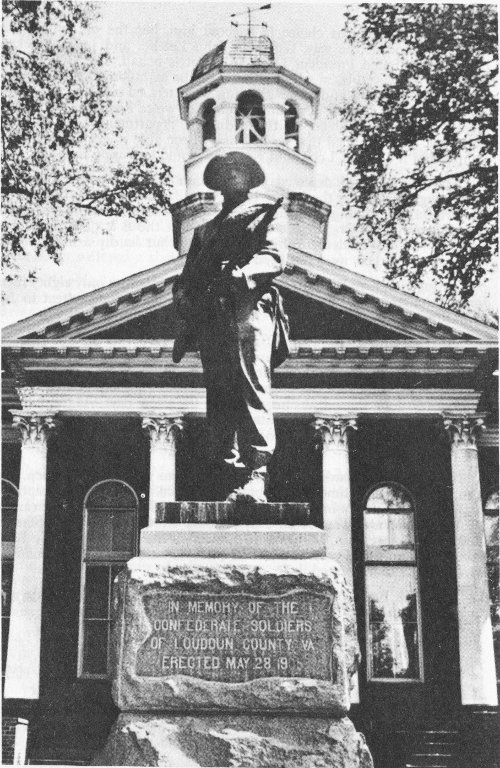
Confederate Monument in front of the Court House, Leesburg.
IN MEMORY OF THE
CONFEDERATE SOLDIERS
OF LOUDOUN COUNTY VA.
ERECTED MAY 28 1908
25
Confederate Monument In Leesburg
The very fine Confederate monument in front of the Courthouse
in Leesburg is the work of an excellent and well known sculptor, F.
William Siever of Richmond. The statute occupies a warm place in the
hearts of the people of Loudoun. With the Courthouse, the clerk’s
office and the lawn, it forms a unit that stands as a symbol of the government
which has been carried on in the county since it was established
in 1757.
The statue attracts much attention from tourists. It has become almost
a daily occurrence to see a visitor photographing the Confederate
Soldier.
I had the good fortune to be given two folders that give fascinating
details of the activities of the Confederate Veterans and the Daughters
of the Confederacy in years past. One was the program of the ceremony
held at the unveiling of the monument on Thursday, May 28, 1908, and
the committees responsible for its erection. The money to pay for the
statue had been raised by the Daughters of the Confederacy. These were
the members of the monument committee:
DAUGHTERS OF THE CONFEDERACY
- Mrs. John George
- Mrs. Agnes Summers
- Mrs. William N. Wise
- Mrs. E. G. Caufman
- Mrs. Sallie Fendall
CONFEDERATE VETERANS
- John H. Alexander
- Lewis W. Shumate
- Geo. F. Everhart
- W. A. McFarland
- Peter F. Schroff
SONS OF CONFEDERATE VETERANS
- Paul Garrett
- John T. Hourihand
- J. H. Leslie
- Claude Van Sickler
- Clifton Myers
COMMITTEE ON CONTRACT
- L. M. Shumate
- J. T. Hourihane
- E. B. White
- John L. Norris
Sculptor—William Siever, Sr.
26
PROGRAMME
All Committees and Escorts to Meet at Court House
at 9:45 A. M.
10:30 A. M.
Assemble in Court House.
Prayer by Rev. F. P. Berkeley.
Singing, “Maryland, My Maryland.”
Presentation of Crosses of Honor.
MARCH TO CEMETERY
in the following order:
MUSIC
Sons of Confederate Veterans,
Daughters of the Confederacy,
Children of the Confederacy,
Confederate Veterans,
Citizens on foot,
Citizens in Carriages.
At Cemetery, Invocation by Rev. W. H. Burkhardt.
Singing of Assembly, “Nearer, My God, to Thee.”
Placing of Flowers on Graves.
Return to Court House.
12 M.
The President of the Loudoun Chapter of the Daughters of the Confederacy will entertain the Veterans and Sons of Veterans at luncheon on the Court House Green.
1 P. M.
Introduction of Speakers by Judge C. E. Nicols, Hon. Claude A. Swanson, Governor of Virginia, on behalf of Sons of Veterans.
Col. Edmund Berkeley
on behalf of Confederate Veterans.
MUSIC
Unveiling Speech by
Hon. John W. Daniel, U. S. Senator from Virginia.
Poem, Mr. Harry T. Harrison.
Unveiling of Statue by
Master Elijah V. White
Assisted by
Miss Mary H. Keeler, Middleburg Chapter D. of C.
Miss Hannah B. McIntosh, Loudoun Chapter D. of C.
Master Thos. F. Carruthers for Blue Ridge Chapter D. of C.
MUSIC
There will be a committee of ladies at the rooms of the Loudoun Chapter of the Daughters of the Confederacy, over The Peoples National Bank, to entertain lady visitors.
Music by courtesy of the Bluemont Band.
27
It might be of interest to identify those who took part in the program.
Rev. F. P. Berkeley, who invoked the opening prayer, was minister of the
Leesburg Baptist Church. Rev. Burkhardt who offered the Invocation at
the cemetery, was the Rector of St. James Episcopal Church, Leesburg.
Col. Edmund Berkeley, who made the speech on behalf of the Confederate
Veterans, had served in the famous 8th Virginia Regiment. His three
brothers, Norbourne, William and Charles Fenton were also members of
this same outfit. At one time Norbourne was the commanding officer of
the 8th Virginia, to which numerous Loudoun men belonged. After Gen.
Eppa Hunton was elevated to command, they all served as officers in this
regiment for the duration of the war. It will be recalled that the 8th Virginia
fought at the Battle of Ball’s Bluff under the command of Gen.
Hunton.
The four Berkeleys were all born in a house in Aldie now called Pembroke.
At the time of the Berkeleys residence there, they call it Aldie. At
present, the house is unoccupied but is owned by William F. Bullis, headmaster
of the Bullis School. In later years, several of the Berkeleys developed
their own estates in the vicinity of Aldie. They were great-uncles of
William J. Cox, Leesburg.
There are still those who recall that the unveiling took place on a
very hot day. In spite of this, Senator Daniel spoke for over two hours.
Mr. Harrison, who gave the poem, was the late husband of Mrs. Harry
Harrison and father of Mrs. Alfred diZerega. Master Elijah V. White is
the grandson of Col. E. V. White of Laurel Brigade fame and one of the
best known Loudoun soldiers. Mr. and Mrs. White now live on Cornwall
Street, Leesburg.
Miss Mary Keller is Mrs. Edwin Reamer of Middleburg. Miss Hannah
B. McIntosh is Mrs. James diZerega of Leesburg. Master Thomas F.
Carruthers, a Purcellville native, now lives in Charleston, W. Va.
An article about the sculptor, F. William Siever, by Ulrich Troubetzkoy
appeared in Virginia Cavalcade, autumn 1962. The author stated that
Mr. Siever was 90 years old and still a resident of Richmond, where he has
lived since 1910. He had promised himself that he would settle in the
place where he received his first major commission. Richmond was selected
as a result of his being asked to do the Virginia Memorial at Gettysburg.
When the Virginia State Commission called for designs for this memorial,
36 sculptors submitted models. The fact that Mr. Siever was selected
from that many competitors is an excellent indication of his skill as a
sculptor. After being chosen, he put much time and effort in getting all
the details correct. The Commission prepared a list of men who had fought
in the battle and the sculptor sent them questionnaires regarding the facts
he needed to know. When the Gettysburg Centennial was celebrated in
July, 1963, Mr. Siever was present at the Virginia Monument to greet the
visitors.
He has been a prolific producer. Two of his best known statues are
of Stonewall Jackson and Matthew Fontaine Maury on Monument Avenue,
Richmond.
28
The second folder given me is:
SOUVENIR
CELEBRATION
Of the Birthday of
GEN. ROBERT E. LEE
by
Clinton Hatcher Camp C.V.
Sons of Veterans and
Daughters of the Confederacy
Leesburg Opera House
January Nineteenth
1904
The “Leesburg Opera House” was what those of us who remember
it, called the “Old Town Hall” that stood on King Street where White’s
store is now located.
This statement is found inside the folder:
To the surviving members of the Lost Cause who have assembled today
to pay tribute to the memory of the dead Chieftan, Robt. E. Lee, with the
compliments of
Loudoun National Bank
Menu
Lynn Haven Bays
Stewed Oysters
Celery
Chow Chow
Cold Slaw
Mixed Pickles
Cucumber Pickles
Fried Oysters
Roast Turkey, Fitz Dressing
Baked Pig, a la Beaureguard
Old Virginia Ham
Roast Saddle of Mutton, a la Col. White
Baked Chicken, Virginia Style
Roast Duck, Longstreet Dressing
Stonewall Beaten Biscuits
Confederate Ice Cream
Cake
Coffee
Apollinaris
I realize that in those days, when they ate, they ate. However, I find it
perfectly astonishing that they fed Confederate Veterans a meal composed
of 3 kinds of oysters, 2 fowls and 3 meats to a group of men who were
hungry day after day during the war. Could this possibly be some form of
compensation?
29
A Short History of the Society Of Friends in Loudoun County
Delivered Before the Loudoun County Historical Society, November 16, 1962
By Asa Moore Janney
The members of the Religious Society of Friends were the last of the
three elements which make up our county to arrive. With the coming of
the Friends, the Germans were pretty well settled in that part of the county
north and northwest of Waterford, and the slave holders were to the
southeast of the Catoctin Hills and in the southwestern part of the county.
Loudoun’s Friends were introduced to the county, no doubt, by the
settlement of Friends along the Opekon Creek in what was then Orange
County, now Frederick, before the year 1732. In 1734, when George Washington
was two years old, these Friends from Pennsylvania and Elk River
in Maryland, applied for and were granted from East Nottingham Meeting
in Cecil County, Maryland, a meeting for worship which they called
Hopewell. The next year this was enlarged to a monthly meeting for business
and discipline under what came to be called Concord Quarterly Meeting,
composed of East Nottingham and Chester Quarterly Meeting held at
Concord, Chester County, Pennsylvania, and attached to Philadelphia
Meeting. At nearly the same time a Meeting at Monocacy, Maryland,
just across the Blue Ridge due east of Hagerstown, Maryland, in Prince
George County, was included in Hopewell Meeting. Without a doubt it
was this proximity of Hopewell Meeting to Loudoun County which
prompted Friends from the same meetings in Pennsylvania and Maryland
who established Hopewell to set up their meetings in Loudoun.
The good word that there were fine lands in Prince William County
got around, for in February of 1730 Samuel Marksberry ran a survey for
his grant “on Kittockton Mountain near the Thoroughfare or Hunting
Path thru said Mountain.” This place we now call Clarks Gap. Lower
down the Catoctin Creek the Irishman, Asa Moore, had in 1732, according
30
to tradition, built a home on the South Branch of Catoctin and called
it after his native Waterford. While Moore probably had neighbors,
unknown to us to-day, it was not long before Amos Janney in 1733 left
his home at the Falls of the Delaware in Bucks County, Pennsylvania, and
settled in the Waterford community along with several Janneys, Thomas
John, Edward Morton, Samuel Harris, Thomas Bourne and others.
Since John Mercer, land speculator, and Catesby Cocke, clerk of
Prince William County and later of Fairfax, had already been granted the
land around Waterford, these early Friends must have leased or bought
from them, for we find in the Fairfax County, records that David Potts in
1746 leased 866 acres of land on “Kittockton Run from Catesby Cocke
for (5) five Shillings, paid in Hand, with the right to Purchase and an
annual Rental of one Ear of Indian Corn.”
According to the Register of Pennsylvania, edited by Samuel
Hazard, in Vol. VII, printed in 1831—About the year 1733, Amos
Janney from Bucks County, and soon after divers other Friends, settled
about 40 miles lower in Virginia than the Opeckon, who obtained
leave to hold a meeting for worship on first days, which was held at the
said Amos Janney’s and other Friends houses till the year 1741 when a
piece of land was purchased, and a meeting-house built thereon called
Fairfax, whose meetings have since been held twice a week.
Janney’s History of Friends notes in a memorial concerning his wife
Mary Janney, “he (Amos) is mentioned as a valuable Friend and true
helper Zion ward; and she is described as a devoted Christian, whose meekness,
gentleness, and kindness rendered her company truly agreeable and
instructive.
“When they came to Virginia, the neighborhood where they settled
was almost uninhabited, but other Friends soon coming after and settling
near them, a meeting for worship was held in their house.”
At first, in 1733, Amos Janney was authorized to hold an “Indulged
Meeting” by East Nottingham Monthly Meeting; then the Waterford
Meeting was organized in 1735 as a Preparative Meeting, under the auspices
of Hopewell Meeting. Soon its membership increased and when the
first meeting house was built, probably of logs in 1741, the meeting applied
to Hopewell to be allowed to proceed as a monthly meeting. The application
was allowed, and in 1744 Fairfax Monthly Meeting was set up
along with Monocacy Preparative Meeting, just two years after Fairfax
County came into being. At the first Monthly Meeting six couples requested
permission to marry. Jane Hogue was clerk of Women’s Meeting with
Elizabeth Norton and Mary Janney as overseers; Samuel Harris and Jacob
Janney were overseers and Amos Janney clerk of the Men’s Meeting. Monocacy
Meeting was laid down in 1762; there is more of its history following
this date, but since it is out of our scope, we will leave it where it lies.
Meanwhile the yeast of settlement was working, and about ten years
from the coming of the first settlers to Waterford we find them bringing
in their friends from up North and East. People were coming from Bucks
and Chester Counties in Pennsylvania, from New Jersey, Calvert County,
Maryland, and direct from England and Wales. Pressing out at the southwest
they found unclaimed land, some which, even that indefatigable
31
amasser of Loudoun County land, George Slater, had missed; rich and
valuable, between the North and Beaverdam Forks of Goose Creek. Here
they established themselves in settlements called Harmony, now Hamilton,
and Goose Creek, now Lincoln.
It is interesting to see how the land was granted to these later settlers;
for instance, the three earliest grants in the Harmony, Goose Creek,
Philomont, so called “Quaker Settlement” area were as follows: William
Diggs, of Diggs Valley (of which Clarence Case’s farm was a part) acquired
1,074 acres on August 27, 1731, William Bowell, 602 acres on August
27, 1731, and George Atwood, 1,092 acres on September 24, 1737.
Diggs and Bowell obtained their grants the last year Robert (King) Carter
acted as agent for Fairfax, as Carter died in 1732, and Fairfax was having
no more of the high handed manner in which Carter had handled the
business; so, the office was closed until Lord Fairfax came over himself
and issued a few grants in 1737, when the above George Atwood must
have gotten his. The office was not again opened until William Fairfax,
acting as agent for Fairfax, was ready for business in 1739, when the
Quakers stepped in and got theirs.
Around 1745, or sooner, Jacob Janney, his wife Hannah and others
came down from Bucks County and settled in the Goose Creek neighborhood.
In going over the certificates of removals granted persons leaving
the northern meetings and repairing to Virginia and comparing these
certificates with the dates of their grants, we see that several, but not all,
had been down to Virginia, taken a grant, and gone home for wife and
family, for instance: On third month 2nd, 1741, Joseph Hollingsworth and
wife obtained a certificate from Newark or Kennet Meeting; his grant is
dated April 20th, 1742.
In the minutes of the Falls Meeting: “Abel Janney was reported at
the Pertomock” on 10th Mo. 1st, 1742; his grant was dated March
17th, 1741.
George Gregg had a certificate on 5th Mo. 4th, 1740 from Newark
and a grant of June 3rd, 1744. (Wonder where he was the four years).
Isaac Nichols, a certificate on 9th Mo., 1743, for wife and Herman
Cox from Kennet and a grant for 560 acres on March 25th, 1743.
Jacob Janney received a certificate from the Falls Meeting of 8th Mo.,
the 5th, 1743, and a grant of 690 acres on June 20th, 1743. Jacob married
in 1742, if he came to Virginia in 1745 as historians claim, where was he
from the date of his grant in 1744 and the date of his certificate, 1743?
Some of the grants were quite large: Ames Janney—2,345 acres, John
Mead 1,289 acres, Gidney Clark 3,000 acres. Four Janney families got
4,843 acres, and more too, which was possible as Amos was a surveyor for
Fairfax and knew where all the “waste and ungranted lands” were.
Hannah Janney, the wife of Jacob, must have been a very strong
character as shown by a memorial in the minutes of Goose Creek Meeting
of 1818, the year of her death at the age of 93. It is stated that soon after
their establishment in their new home she went regularly twice a week to
a log in the forest where she set up an altar to her God by spending some
time in silent devotion.
As early as 1746 Fairfax Quarter granted to Friends settled on the
banks or tributaries of Goose Creek, which also included South Fork, at
32
Union (now Unison), the priviledge of holding a meeting for worship on
the third day of each month at the residence of the members. About 1750,
or 51, a regular meeting was established at Goose Creek. The first meeting
house was built of logs and was said to have been built on the site where
Hannah held her devotions.
A traveling minister wrote in his autobiography: “On seventh day we
went to their monthly meeting at Fairfax, 8 miles from Leesburg, which
was large and solemn—On second day was at Goose Creek, 8 miles ye
Meeting house small yet did not hold half ye pepal which was a great disc-advantage
yet came away pretty Ese.”
That the French and Indian War did not overly affect Loudoun
County is well known. However, the people well knew the hardship endured
by the Friends in the Valley, as this bit from the “Autobiography of
William Reckitt,” who was a visitor in our county in 1757 shows. “Crossing
Potomac we came into Virginia to Fairfax; where we had a meeting on
the second day of the week and 12th of the 12th month. It was a good
meeting, truth having the dominion—We lodged at Mary Janney’s, a
discrete orderly woman, who had several sober, well inclined children. From
hence we went to Goose Creek and had a meeting on third day; it was
well. On 4th day we had a meeting at David Pole’s several Friends accompanying
us. I had a travail in spirit—We left David Pole’s house on 5th
day and rode over the Blue Ridge or Blue Mountains, where the Indians
had done much mishief, by burning houses, killing, destroying, and carrying
many people away as captives; but Friends had not hitherto been hurt:
yet several had left their plantations and fled back again over the Blue
Mountains, where the lands had been rightly purchased of the Indians.”
Daniel Staunton in “Life, Travels and Gospel” reports that in December
of 1760, “We went forward crossing the Patowmac into Virginia: the
next Meetings were Fairfax, Goose Creek, Potts’, or the Gap, some of
which were largely favored with solid comfort and satisfaction, there appearing
many dear Friends with whom I had unity in Spirit: from the
last place we traveled till we got over Shanandore river, and lodged at John
Vestal’s.”
The Potts’ or Gap Meeting to which Staunton alludes, was held at
Hillsboro and was a meeting held under Fairfax. It was a constant source
of disputation and trouble to its Monthly Meeting, delegations often
being sent to try to straighten things out with the Potts and Janneys of
that section, but to no avail; for instance, Fairfax minutes report in 1761—“As
Friends of Goose Creek and Friends of the Gap have not attended
business meetings—this meeting appoints Mary Janney, Rachel Hollingsworth
and Sara Janney to visit (them) to excite them to more diligence.”
In 1765 “—if any disorder appear this meeting appoints David Potts to
supervise.” Still in 1765 “—this meeting takes no note of the great deficiencies
of the Gap Friends in several particulars—” Meetings were held in
the home of David Williams until finally the Gap Meeting came through
with a meeting house, as this minute from Goose Creek testifies: “Friends
of the Gap reporting that they have built a house for the conveniency of
holding their meetings in, and got it now nearly ready, this meeting concurs
with their proposal in 1770 of holding it therein accordingly.” The
land was two acres conveyed by Mahlon Hough to Stephen Gray, Isaac
33
Nichols, Jr., Thomas Smith and William Hough, “to permit Such People
Called Quakers to erect a Meeting House, Schools, Yard and Place of
Burial.” In 1804 it is noted that the Gap Meeting is small and in 1805 it
is laid down. Sic transit mundi.
South Fork Meeting was another meeting which did not long survive,
despite the observation of the traveling minister John Comly in 1829
that it was strong and healthy. Yardley Taylor states that the meeting was
active in 1853. A later minister reported that all they thought about was
cock fighting and horse raceing. South Fork’s “worldiness” caused “concern”
for its members “drank to excess,” “fought, gambled”, “took to
horse raceing,” and “were lax morally.” This meeting was laid down shortly
after the Civil War, and the administration of its graveyard on a small
budget has been a head ache to Goose Creek Meeting ever since.
In 1757, while the Goose Creek Meeting was bursting out of its log
meeting house, the county of Loudoun was formed from Fairfax. The
trustees acted quickly. “On the 31st day of August, in the year of our
Lord one thousand seven hundred and fifty-seven, between William Hatcher
of the County of Loudoun and Colony of Virginia, planter of one
part, and Issac Nichols, Jacob Janney and Thomas Clows, of the said
county, planters of the other part, for five shillings sterling, together with
all trees, woods, underwoods, ways, paths, waters, watercourse, easments,
profits, commodities, advantages, emoluments, hereditaments, rights,
members and appurtentences whatsoever to the same belonging”—were
handed over to the said Nichols, Janney and Close for one year in consideration
of “one pepper corn in and upon the feast of St. Michael the
Archangel if demanded.”
The object of this, one of the first deeds in the Clerk’s office of Loudoun
County, was to conform to the Statute of Uses and Possession, for
on the very next day, September 21st, 1757, William Hatcher sold to Isaac
Nichols, Jacob Janney and Thomas Clows for thirty shillings the very property
he had rented them the day before, “to said grantees. In TRUST
to suffer and permit such of the people called Quakers—inhabiting said
County, to erect and build so many Meeting Houses, School-Houses, Yards
or Places of Burial—as they see fit—for the worship of God, the instruction
of youth and burial of the dead.” One day had evidently been enough
to show that the property was in use by the Religious Society of Friends.
As new settlers and babies arrived in the neighborhood the log meeting
house was found too small to accommodate the members, and the stone
meeting house across the road, according to the best information, was
erected between 1765 and 70. A minute of Fairfax Monthly held on ye
24th of ye 9th month, 1774 reads: “This meeting received a copy of a
minute of our Quarterly Meeting dated the 15th of last month, granting
the request of Goose Creek Friends, a preparative meeting. This meeting
is willing to assist them as far as capable, and appoints Mahlon Janney,
Jonathan Myers, John Schooley, Moses Cadwalader, and William Williams
to go and sit with them at their first preparative meeting.”
Friends in the Quarterly Meeting of which Fairfax was one part were
most cautious in extending monthly meeting status to Goose Creek, possibly
from unfortunate experiences elsewhere. We find from the minutes
of Warrington and Fairfax Quarterly Meeting the following report of a
34
committee appointed to judge of the expedience of settling a Monthly
Meeting at Goose Creek. “Most of our members have visited the preparative
meetings consituting Fairfax Monthly Meeting likewise attended the
service of that meeting and have since met together and agree to report
that we feel most easy to encourage the division proposed—and a Monthly
Meeting being settled at Goose Creek. Submitted to the Quarterly Meeting
by Isaac Everett, William Ballenger, James Steer, William Kersey, Harman
Updegraft, Alan Farquhar, Elisha Kirk, Nathaniel, Jonah Hollingsworth,
Ruth Holland, Rachel Hollingsworth, Mary Updegraft.—It is
agreed that a Monthly Meeting be settled there accordingly.”
The first monthly meeting was held 12th month 26th, 1785 and William
Kenworthy was selected clerk. In the first minutes we read the following:
“Joel Lewis and Sara Daniel handed their intentions of marriage
before the Meeting.” “Moses Cadwalader and Isaac Nichols are appointed
to inquire into Joel’s clearness of other engagements, also to make inquiry
into his conversation and what else may be needful.”
About the beginning of the 19th century the membership became too
large to be comfortably accommodated in what came to be called “the old
Stone Meeting House.” It was not until 1812, with a war going on, that
the question of the most practical way of obtaining more room was
brought before the meeting. The committee appointed to undertake the
building of what came to be “the large new Meeting House,” was
Jonas Janney, Isaiah Brown, Israel Janney, Isaac Nichols, Samuel Nichols,
Stephen Wilson, Thomas Treham, Jesse Janney, George Walter, Joseph
Bradfield and Mahlon Taylor. These gentlemen saw the meeting turn
down a proposal to add a log addition to the stone building and finally
on 2nd month, 27th, 1817, it was decided to build an entirely new house
with Mahlon Taylor, Stephen Wilson and William Kenworthy as the
building committee. Kenworthy was most likely treasurer of the committee
as his name is signed to all the documents connected with the building
operations.
William Kenworthy took in the subscriptions, which ranged all the
way from ten dollars to three hundred dollars, with the final total collected
being $3,606.00. Daniel Cockrell was to do the job, furnishing all the
foundings, for the sum of $3,550.00. In the final report of the committee
we find:—“the house being about completed, and in a good measure answerable
to the contract, we have paid him the whole of the amount. We
also examined his account of expenditures, by which it appears he will suffer
considerable loss, by the contract, unless he be allowed some further
renumeration.” They stated that it would be difficult to ascertain the exact
loss but thought the meeting should pay Cockrell an additional $500.00.
A committee was formed which raised the additional amount and paid
the same to Cockrell.
On 1st month 27, 1819, Jonathan Taylor, a frequent visitor to Goose
Creek Friends Meeting, “Preached the first sermon in our large new Meeting
House.”
Jesse Janney who was on the original building committee, never lived
to see it used. His foresight, however, solved one of the problems that building
a new meeting house created, as is shown by this minute in April,
1819—“The committee continued in the first month last to propose to
35
this Meeting what particular purpose the donation of Jesse Janney, Dec’d,
shall be applied to reported that they had agreed to propose that it be applied
to enclosing a yard and erecting some necessary buildings at the back
of the New Meeting House. With which the Meeting concurred.”
Jesse Hirst, Samuel Nichols, Daniel Janney, Jonas Janney, Mahlon
Taylor, William Piggott and Joshua Gore were appointed, “to consider
what use the Old Meeting House would be most advantageously applied
to, and the probable expense.” The William Piggott named above
“Were the rich Billy Piggott what had glass windows in his barn.”
By an old record these reasons are given for establishing a meeting:
“Ye objects of Religious assn. are to strengthen ye bonds of love, to encourage
to good works, to support ye weak, to comfort ye mourners, to
watch over one another for good and to reclaim those who have gone astray.”
A few quotes from the minutes of the meetings and a short review of
Friends accomplishments in Loudoun may let us see how well they attained
“Ye objects of Religious Assn.” The meetings were frank and firm
with their members, for when Goose Creek was “informed that Jonathan
Bradfield had joined with light company in dancing,” a committee
pleaded with him several times to reform his ways and at last upon his not
giving satisfaction he was reluctantly dropped from the rolls.
A more unfortunate event is recorded in the business meeting of the
28th of 1st month, 1819: “A testimony was produced against S— N—
which was read, approved, and signed being as follows and handed to the
Women’s Meeting. S— N— who has a right of membership in the Society
of Friends thru in attention to the dictates of Truth in her own Breast hath
so far deviated as to be guilty of fornication for which reproachful conduct
we deny her any longer a right of membership until she be enabled & make
suitable satisfaction for her offence, which is our desire for her.”
Fairfax and Goose Creek records are a mine of genealogical data.
Henry B. Taylor in response to the request from a lady out west once sent
her what the minutes had to say about her Quaker ancestors. Several had
been “kicked out of meeting or been delt with” for drunkness, fighting and
adultery. She received his letter and some time later wrote again to Henry,
“that she was glad to state that her family had done better since they had
joined the Methodists.”
The Meetings took care of their own, for often entries like the following
are found in the minutes: “Samuel Nichols, Seir. produced his account
of articles furnished for the support of Martha Scott.” Social security
was unknown in those days. At Fairfax we find that a committee was
appointed to divide the estate of Richard Brown, deceased; to raise a
fund to settle the estate of a member who died poor and in debt; to
look after the widows and orphans; to see that members paid their
debts; to attend to a member “for encouraging the visits of a man not
of our Society in Courtship of his daughter”; to reprove a man “for taking
off his hat at a courtsmartial to gain favor with the officer in charge.”
Friends in Loudoun owned slaves in the early years and for the first
quarter of a century the Fairfax minutes mention only that “Blacks in the
home should be well treated,” and “African children” should be given a
useful education. In 1790 a committee was appointed “to care for freed
36
slaves.” Later there was considerable opposition against slavery in the
meetings, several Friends were disowned for owning slaves. In 1836 a committee
“treated” with William Stone for hiring a slave, and in 1856 Mary
Jane Hough was disowned for doing the same, though her husband escaped
a like fate by saying he was sorry and wouldn’t do it again. It was not until
1818 that the last ownership of slaves by Friends ceased in Virginia.
The story is told that John Woolman talked long and earnestly with William
Nichols that he free his slaves but when William died in 1804 there
were slaves mentioned in the inventory of his estate. My grandfather,
Francis Hogue Janney, was disowned for hiring a slave and marrying out
of meeting.
A manumission society was organized in the Oak Dale schoolhouse
in 1824 for the purpose of sending slaves to Haiti and Africa, though we
have no information of any being sent.
It is my understanding that the small colored settlements at Rock
Hill and Guinea Bridge were made on land (rocky and poor, it is true)
sold cheaply to free negroes by Friends that they might build a home of
their own and not be sold back into slavery.
The first county map published in what was once Prince William
County was that of Loudoun by the Quaker Yardley Taylor. This work of
enduring value was published in 1853 and up to its time was the finest in
Virginia. Yardley was a nurseryman and the beautiful spruce trees around
Lincoln are his still living legacy to the beauty of Loudoun.
Yardley Taylor was engaged in the underground railroad trade. He
was castigated for it in at least one newspaper article in the fifties written
in the peculiar vehemence of the time. Samuel M. Janney never said he
helped a slave along physically but he was brought before the county court
for publishing that “the owners had no right of property in their Slaves.”
His Statement to the court, “That the more you keep this subject before
the people the more they will be to my way of thinking,” had the desired
effect and the indictment was squashed.
It was in 1803 that Thomas Jefferson writing to a friend said, “The
county of Loudoun had been so exhausted and wasted by bad husbandry,
that it began to depopulate, the inhabitants going southwardly in search
of better lands—it is now become one of the most productive counties of
the State of Virginia and the price given for the lands is multiplied manifold.”
This was the result of the LOUDOUN SYSTEM of agriculture we
have heard so much about. When Alexander Binns (no Quaker) published
his little “A Treatise on Practical Farming” in 1803, the County found out
what the Friends knew all along: that ground should lie in grass and clover
in rotation with the corn and wheat then grown, and what’s more, that
lime was a must to get the most out of the grass and clover. Israel Janney
on a trip to Chester County, Pennsylvania, had brought down some crushed
limestone in his saddlebags and tried it out on some oats. The oats
flourished and so did the clover which Israel grew and sold to his neighbors
a quart at a time to try to get them started on this grand forage plant.
Binns tried all kinds of lime and plaster, he even bought a ton of Israel
Janey’s lime and some of his clover seed, but the real service he did was
to experiment and publish his results.
The peace testimony of Friends was constantly appearing in the minutes.
37
Members were “spoken to” for attendance at muster; were “delt
with” for purchasing substitutes and paying the muster tax. At first the
Revolutionary War affected the Fairfax Meeting but little, however, before
it was over some fifteen members had been disowned for joining the
army. George Washington summed up the general attitude towards the
Quakers then in his famous, “Leave the Friends alone for you cannot induce
them to swear or fight for or against us. They are harmless, peaceful
and industrious people who will produce bread and meat, and if they will
not sell it to us, we will take it, if we need it; we need bread and meat
as much as we need soldiers.”
During the Civil War soldiers of both sides were quartered in the
Waterford Meeting House. When meeting was going on they stepped
outside and some even came to meeting and as one writer said, “When
they (the Southern soldiers) first came to Waterford they seemed to entertain
a strong animosity against Friends—but becoming better acquainted,
some of the soldiers acknowledged (that) Friends delt with them
more fairly than any they had met on their march from the South, and
their prejudices were removed.” It did seem strange to Friends to hold
meetings with swords hanging along the walls. A very original account of
captivity during The War is given by William Williams. He and Robert
J. Hollingsworth were imprisoned in Richmond for two Southerners likewise
treated by the Federals. After much travel and hard work on the
part of wife Mary and Friends the two were released, though not before
suffering many real hardships.
Young Quaker men, being sympathetic with the Union, went North
in great numbers during The War, many to Ohio; they obtained jobs
and found a living away from Loudoun County and never came back to
stay. It was this exodus which began the decline of the meeting at Waterford.
Many Friends during the hostilities wished to travel to Baltimore in
order to go to Yearly Meeting. To do so they had to run the blockade
along the Potomac. Many ignored the guards at the river crossings, but
many a one was turned back. Samuel M. Janney was questioned by General
(Shanks) Evans after he was arrested for crossing the river during the
early part of the war.
General Evans—“Don’t you know that your first duty is to your
country.”
S.M.J.—“No, my first duty is to my God.”
General Evans—(After a pause) “Yes, but your second duty is to
your country.”
It was just poor business arguing with Sam Janney. In fact he got so
tired of arguments every time he wished to cross the Potomac he obtained
a pass from the Federal President, which I have seen,—an ordinary page
from a school boy’s lined tablet on which was written, “Allow the bearer,
Samuel M. Janney, to cross the Potomac at any time.”—A. Lincoln. That
pass was just about as all inclusive as one can be made.
Samuel Janney claims that Loudoun County did not have near the
troubles of neighbor against neighbor as did East Tennessee, and it can,
38
he says, be credited largely to the influence of Friends. In fact, it was not
uncommon when the Confederates occupied the section for the Secessionist
neighbors to help out their Union friends and vice versa when the
Union occupied the county.
The War cost the Friends of Waterford at least $23,000.00, while
those at Goose Creek lost over $80,000.00, including both property damage
and livestock loss. In 1872 all loyal Loudoun citizens received $61,821.13
for livestock losses, nothing for property lost by burning. Friends from
Philadelphia largely built back the mill of Asa M. Janney where Coit
McLean now lives, known as Forest Mills. If it had not been for the generosity
of Friends in the North there would have been real suffering among
Friends in Loudoun after the end of hostilities.
As early as 1792 a committee on “Spiritous Liquors” was appointed
at Fairfax and it must have done a good job, for by 1809 no member was
reported to deal in them. In the year 1819 Goose Creek had a committee
report that several members had even stopped the giving of liquor to harvest
hands and found it to be such a good idea that a minute was written
admonishing against its use thereafter at harvest. It was not by accident
that Loudoun County was for years the center of the Womans Christian
Temperance Union in the state of Virginia. When the Lincoln Lyceum
Association Hall was built in 1874 a Men’s Temperance Society, the Good
Templars, flourished there for some time. The first performance in the
new hall was “Ten Nights in a Barroom.”
Nearly every deed to a meeting house calls for a school house, for the
instruction of the young. At Fairfax a school fund was raised in 1779, but
it was not until 1802 that a plan for “pious and guarded education for children
of Members of the Society” was instituted. The school, built for
$400.00, remained open until 1871, when the public school system took
over.
At Goose Creek, on the first of 6th month 1815, a committee of William
Smith, Mahlon Taylor, Jonas Janney, Stephen Wilson and Samuel
Nichols, Sr., were appointed to consider the building of a school on the
Meeting lot. The committee reported in favor of the building on the 27th
of 6th month, and in 8th month reported to build the school for the sum
of about $400.00 or thereabouts; already subscribed was $346.00.
In 8th month, 1816, the following committee was appointed to have
care and oversight of the school held in the recently erected schoolhouse:
Israel Janney, Amos Gibson, Mahlon Taylor, Isaac Nichols, Bernard Taylor
and William Kenworthy. Jonathan Taylor was the first teacher employed.
As committees were released, new ones were appointed whose duties
were care and oversight, the hiring of the teachers and visiting the school.
On such an occasion, a student of the school has told us, they looked forward
to the visit of the dear old Friends, kindly offering to assist with a
hard lesson or difficult problem. (How they have changed since his day.)
When the lessons were all through the copy books were placed before them
39
for inspection and marked 1, 2, and so on, down to the one containing “pot
hooks and hangers” as the curves were then called.
This school continued right on through the summer without any intermission
except for two weeks for wheat harvest. No holidays were observed.
One teacher taught ten years with only one day off and that the
day of his wedding. A roll of the students of the Oak Dale School shows
one-third of them to be either Taylors, Nichols, Janneys, Hirsts, or
Browns, with one-half the teachers of like surnames. For many years the
bequest of Isaac Nichols, deceased, was used to defray the expenses of poor
children going to this school.
Early Friends had schools in other places: one a spring house on the
Isaac Wilson farm, where several families pitched in together to keep
school. There was a log school at Ivandale, one called Summer Hill in
front of the present driveway to Thomas Taylor’s home, where P. G.
Clark now lives, built of logs hauled by Josh Hatcher, who has been called
Loudoun County’s first bank. Another was Flint Hill Academy at
Hugesville, run by Friends.
At Springdale, in Lincoln, Samuel M. Janney had a boarding school
for girls, charging $32.50 per quarter in 1839-40, with extras, pen, ink, pencils
and lights 50 cents additional per quarter. Drawing and French were
three dollars extras. Day students paid twenty dollars the quarter. Supplies
were taken in lieu of cash. Henry S. Taylor paid his tuitions in 1842-44
with several quarters of beef, barrels of flour, a horse and sheep (the horse
for transportation, not eating). Henry B. Taylor states—“dried peaches
and apples were standbys in the diet of that day and hominy was the universal
substantial breakfast food, one that would stick to the ribs. Samuel
Janney bought hominy at Waterford mills, 5 or 6 bushels at a time. No
Shredded Wheat or toasted hay for breakfast food at Springdale.”
Before 1908, Will Smith and Josh Brown and others were canvassing
the county and Philadelphia neighborhood for money to build a high
school. At last $15,000.00 was raised, and in 1908 Lincoln High School
opened its doors. The labors and work of erecting this school, the first
high school in the county, was borne mostly by Friends. When the building
burned in 1926, there was agitation to take the insurance money to
another town to rebuild; a lengthy hearing was held at the Goose Creek
Meeting House, but people had reckoned without the canniness of the
original builders as the deed stated that the money was to be used to build
a school within one quarter of a mile of the meeting house and that was
where it was rebuilt. For the year the rebuilding was going on the students
were taught in the meeting house, the present store building, and the
old Phin Janney store building in Lincoln.
Friends engaged in businesses of all kinds, of course, stores, iron
foundries, such as the William H. Taylor foundry at Lincoln, where the
celebrated Taylor plow, bells, and frog doorstops were made, woolen mills,
flour and grist mills and the like. Though transportation was a difficult
problem Friends were right up front in the first turnpike and railroad ventures.
Many a Quaker trunk contained crumbling shares of the stocks.
40
Israel Janney was a trustee of the Leesburg-Dranesville turnpike and Phineas
Janney of Alexandria, treasurer of the road from there into Alexandria.
Phineas Janney’s reports are on file at Richmond, and are referred to by
one writer as being “full of these and thous and common sence.”
The meetings became a sort of Chautauqua for visiting Friends having
a ‘concern’ and many came to hear these people from far off. John Woolman
visited Fairfax in the early 1740’s. The famous Elias Hicks visited in
1798, and several times later; Stephen Grollet in 1801 and Richard Mott in
1801; John Kersey (the book has it Jersey Kersey), a famous Quaker preacher
and author of the driest book I have ever read; Elizabeth Robson, Bartholomew
Wister and Ruth Ely, 1826. Elizabeth Robson was an English
Friend with very Orthodox views as was Thomas Shillitoe, another English
Friend who came to Loudoun on a preaching mission in 11th month 1827.
Also gracing the fronting benches of the Loudoun Meetings were Elisha
Bates, John Comly, Edward Hicks, whose primitive paintings are so
much in demand, and the famous Benjaman Hallowell who started Robert
E. Lee in mathematics.
Stephen Grellet, Elizabeth Robson, and Thomas Shillitoe were the so-called
Orthodox Friends whose ministry throughout the country helped to
cause such sad havoc in Friends meetings and brought about the separation
of 1827-28. Loudoun Friends at this time were little affected by the
ideas advanced by these people, based mostly on theology and evangelism
which at the time was traveling thru many of the churches of the land.
Some eight families took off from Goose Creek Meeting only, Fairfax
being affected not at all. These Orthodox Friends, as they came to be
called as opposed to the so-called Hicksite Friends, built a meeting house
south of the graveyard in Lincoln on the next hill, a corner now of J. C.
Chappell’s heirs. Here they had a meeting until the Civil War, when it
was laid down.
Along about the early 1880 this sad chapter in Friends history had to
be reopened when Richard and Mary Snowden Thomas, brother and sister
from Baltimore, raised the clarion call of evangelism. At first, in 1885,
the Orthodox meetings were held in the Lincoln Lyceum Hall until a
house could be built. In all about eight families withdrew from Goose
Creek to form this new Lincoln Monthly Meeting of Friends which occurred
in April of 1887 in their new meeting house. Daniel J. Hoge, Clark
and Rebecca I. Brown were appointed overseers with Joseph Pancoast as
treasurer. A subordinate meeting was organized at Silcott Springs in 1894
but its life was short, being closed in the winter of 1904-5 and the building
sold in 1933.
As is usual with such religious separations there was too much feeling
on both sides, and I am not going to say there was not. Now we can
laugh at Will Brown’s sally to one of the Orthodox driving by the old
meeting to go up the road to the Orthodox meeting on a very blustery, wet
day: Brown, “Well, Hoge, the new road to heaven is a damn wet one,
isn’t it?” Or an Orthodox Friends referring to the Hicksites (in the words
41
of a Hicksite), as “those cigarette smoking, whiskey drinking, Christ rejecting
Hicksite Friends.”
Fairfax Meeting House was burnt in 1887, and in spite of the decrease
in numbers it was rebuilt at a cost of $4,840.00. Its young men having
gone away to the west and the opportunities limited to educated persons,
as the Quakers undoubtedly were, the meeting lost members until the
sad day came when it was laid down in 1926. The last paper was signed in
1929 and the final grand meeting held with many a Friend wiping away a
furtive tear.
Goose Creek Friends were not paying their preacher either, for during
a terrible wind and rain storm in 1943 half the roof and the west end
of their meeting house was blown off and in, making the house unusable.
The Orthodox Friends came to the rescue and meetings were held together
in their house until the Goose Creek meeting house could be rebuilt.
Friends found out they could get along together and like it. All the younger
Friends wondered what it had all been about anyway, so after the grand
opening of the newly reconstructed meeting house in 1948, the Goose
Creek United Monthly Meeting of Friends came into being in 1950.
Friends have stepped on many toes with their advanced views, but
they have been right so often as to gain much respect throughout the
country. That their worship is not understood by many is well known and
even as early as 1776 Nichols Cresswell went to meeting in Leesburg and
reported, “Mr. Brooks and I went to the Quaker Meeting, but were too
late, tho it would have been equally as well as if we had been sooner, for
the spirit did not move any of them to speak. Can’t conceive what service
the people can receive by grunting and groaning for two or three hours
without speaking a word. This is a stupid religion, indeed.”
The Religious Society of Friends is as the name implies a group of
people with the religious conviction that one’s life is the experience of
love, love of God and love of one’s fellow man. It is a living fellowship
rather than a sacred institution. From this view comes all of its good. It
affirms that it is the Presence in the Midst—that God is everywhere—that
every man is endowed with this light within. Religion for Friends is
not apart from life nor for special days. The early Friends had no Christmas
nor Easter, every day is equal in the sight of God. It is “the life we
lead, the things we do” which count; as witness their history in Loudoun:
that African children should be educated; that men should be free; a man
should not demean himself by taking off his hat to another; that work
is noble; that the laborer is worthy of his hire; that no man should lose
while you gain; that children must be educated to live a fuller life for
mankind; that no one has the right to take a life that only God can give;
that the fallen should do better and come back into the fold, “which
is our desire for her.”
Friends hold their meetings for worship unplanned; with no constant
jumping up to do this or sitting down to do that; in a plain room without
42
distracting influences, trying to find in a silent communion, enfolded by
His presence, the spiritual guidance they seek.
And so I find it well to come
For deeper rest to this still room,
For here the habit of the soul
Feels less the outer world’s control;
The strength of mutual purpose pleads
More earnestly our common needs,
And in the silence multiplied
By these still forms on either side,
The world that time and space have known
Falls off and leaves us God alone. Whittier.
Sources other than acknowledged in the text: Henry B. Taylor, Howell
S. Brown, Mabel N. Lybolt, L. H. Taylor, for minutes, notes, articles,
manuscripts, and consultation; Landmarks of Old Prince William; Briscoe
Goodhart, The Loudoun Rangers; James Head, The History of Loudoun
County; Loudoun Historical Society Bulletin, 1958; Samuel M. Janney,
Memoirs and History of Friends; Hopewell Friends, History of Hopewell
Friends Meeting; Hinshaw, Quaker Genealogy; Frederick Gutheim, The
Potomac, from “Rivers of America” series.
43
The Uses of History
A Lecture Delivered Before Members of the Society, January 15, 1965
By Col. Trevor N. Dupuy
At the outset I should make clear that I have no credentials in historiography.
In fact I do not have even have the so-called Union Card
for the professional academic historian—a Ph. D. degree—but I do believe
that I have enough practical experience in the writing of history, and
in teaching it at three universities, to warrant having some thoughts on the
nature of history, and of its uses. And I have another reason, as well, as
you will see.
Let me start by explaining how I intend to treat this important topic:
The uses of history. First I shall give you my interpretation of what the
nature of history is. Next I will offer some very general thoughts on the
uses of history. Then I would like to make one or two comments on how
I visualize history being currently useful for Loudoun County. Finally, I
shall tell you a little bit about my own day-to-day involvement in several
very specific uses of history.
First, then, for my views on what history is—and what it is not. Several
months ago there was an interesting debate in the New York Times Magazine
about the nature of history, provoked by an article written by Barbara
Tuchman, the historian whose public reputation is based primarily
upon her magnificent book, The Guns of August. The essence of the debate
was whether history is what actually happened in the past, or is
merely the record of what happened. The subtle distinction, of course,
is comparable to that involved in the question of whether there can be
noise—as from a tree falling in the middle of an impenetrable forest—if
there is no ear to hear the sound waves. I don’t intend to revive the debate;
I merely want to suggest that there are various ways of looking at
the nature of history. You are about to be exposed to my way of looking
at it.
As I see it, recorded history is society’s memory. For society as a
whole, as well as for an individual, memory can provide insights, wisdom,
44
and the recollection of past experiences which are in some way relevant
to every new experience—no matter how unanticipated the manifestation
of that new experience may be. And of course each new experience adds to
the information stored in that amazing electronic computer—the human
brain. Sometimes the new experience reinforces the information already
stored there, sometimes it qualifies the existing information, but always
the new experience is in some way relevant to events in the past which are
already recorded in the memory. This same process is to some degree true
of society as a whole.
Every event of significance in mankind’s past can enrich the memory
of human society, and can be used to the future benefit of mankind—if
some way can be found to relate that experience to current issues and
problems, without distortion, through some kind of memory process. The
historian, of course, is the essential element of this memory process.
In considering this relationship of experience to memory, it is pertinent
to point out that even the most startling new scientific development
invariably has had a historical background of its own. New wonders
of technology and science all have a direct connection with the past,
not only through the evaluation and analysis of empirical records, but also
through discontinuities or continuities which exist between the new
development and what has happened in the past.
If there is anything to my suggestion that historical experience is
the basic material for the memory of society, then the record of past
experience is a natural resource, which can and should be mined for the
present and future benefit of mankind. Save possibly in the area of
science, human society has never come near to efficiently exploiting this
resource of its own experience.
When it is mined, this natural resource can make its principal
contribution to social memory by enriching wisdom. We have a tendency
to speak of the “lessons” of history, as though they were immutable—I
do this as much as anyone—but I realize that in a literal sense this is impossible.
One can never recreate, in every detail and particular, the exact
circumstances of a past event. History can never exactly repeat itself, and
so its so-called lessons cannot be applied blindly or automatically.
But if history doesn’t repeat itself it does, in the words of Herman
Kahn, paraphrase itself. Kahn, incidentally, is a scientist and not a historian,
but he, like Toynbee and other historians, recognizes that human
and institutional relationships in modern times can often bear a close
resemblance to events of the past. One can discern many parallel patterns
in history, and both trends and specific events are often directly comparable
between these patterns. The rise and fall of nations and dynasties,
for instance. And since human reactions to circumstances and stimuli
are not ever likely to change radically, it is easy to note danger signals
from certain circumstances in related patterns of events, and to see what
kinds of actions have been successful in certain circumstances in the past,
and which have failed, in similar patterns.
Thus, while rejecting the idea that history teaches us lessons from
the past, I am convinced that history will widen our horizons, revealing
new perspective, providing insights, and generally enriching wisdom in
using good judgment in dealing with the present. There is still one caution,
45
however. If there is any immutable lesson which history teaches,
it is that no quantity of insights can ever replace or substitute for good
judgement or the basic intellectual capacity which experience transforms
into wisdom.
I have tried to indicate what I think the nature of history is, and in
the process I have given you some very general thoughts about the use
and utility of history. I would like to pursue this question of uses of history
a bit further.
What really do any of us have in mind in speaking of the “Uses of
History?” Is it history for the enrichment of one’s life? For the lessons
(so-called) to be gained from experience? For developing patriotism or a
sense of one’s heritage? For making money?
At this point it might be useful to recall that a number of ancient
and not-so-ancient philosophers have commented on the value and importance
of history. Let me simply refresh your memory on four that I
happen to like:
Polybius: For it is history and history alone,
which will mature our judgment and prepare us to
take right views, whatever may be the crisis or
the posture of affairs.
Shakespeare: The past is prologue.
Santayana: Those who cannot remember the past are condemned to
repeat it.
John Gardner: “In the renewing society the historian consults the
past in the service of the present and the future.”
But, like so many philosophical sayings, these aphorisms are somewhat
cryptic. We understand them, but they require some elaboration, and
possibly some interpretation.
Many academic historians would insist that history doesn’t need to
have a use. Its existence is as inevitable as life itself; as last night’s sunset,
this morning’s sunrise. These scholars feel that the study of the
events which make up history is rewarding in itself without any further
direct use. It is a part of the well-educated man or woman.
There are other people, of course, who would insist that—save for
the scholars who teach it—history has no more utility than knowledge of
Latin and Greek. Having found no adult use for the contents of their
history textbooks, such people might be pardoned for feeling that history
is merely the useless foible of educators. (I leave it up to you whether it
is appropriate to apply the same logic to the so-called dead languages.)
Yet, if there is any validity to what I said earlier about history being
the memory of human society—and of individual humans as well—I suspect
that history has had some utility—direct and indirect—to even the
most pragmatic amongst us. Certainly something of what was taught us
in our history courses has entered our memories, even if subconsciously
so. Otherwise we could not have any opinions about it. It is even more
certain that the reader of a daily newspaper will retain some recollection
of what he has read in that paper, and then will relate these recalled
events to what he does, what he thinks, what he talks about, and what
he reads in the next day’s newspaper. These events, recorded in the
newspaper, are as much history as events which happened in the days of
46
Roman power, as recorded by Julius Caesar, Livy, and other writers of
those times. Thus the man who reads a daily newspaper, or a weekly
newsmagazine, is making definite use of history—otherwise he wouldn’t
bother to read!
Equally, events which happened to us in our daily work last year,
last week, even today, are as much historical events as things which
occurred centuries ago. These events are experience, and our recollection
of these day to day events are used by all of us in planning and doing
things in subsequent days. Deprived of this memory, we would be both
useless and helpless. The same is true of society as a whole. Recognizing
this, there are economic and social historians who concentrate their efforts
on events of the very recent past, in order to provide useful inputs
to the memories of scholars, policy makers, and others who are concerned
with modern economic or social affairs. It is beside the point
whether or not we believe the job could be done more systematically.
Even more basically, some of us believe that a sense of history, and
a consciousness of participation in history, is a basic human need. Now
there are, of course, different kinds of basic human needs—there are the
powerful and elemental forces of life and the preservation and continuation
of life; instincts and drives relating to food, shelter, sex, parenthood
and survival. Then there are the other, more social, needs—as for recreation,
privacy, living space, and the like. It is in this latter category that
I would place the need for a sense of history. Aside from the memory
aspect, to which I have already alluded, there is an enrichment and
humanizing effect on peoples’ lives resulting from a consciousness of
making history as they vote in an election, testify at a local hearing, help
create a local institution, or work at responsible jobs. Essential to this
enrichment is some kind of prior realization of what history is, and how
these personal activities can contribute to it.
What I have been saying so far has all been rather theoretical and
ethereal. I believe it is probably time for me to come down to earth with
some practical uses of history, as I see them, and as I have personally
experienced them.
First let me say a few words about how the use of history can be
directly relevant to Loudoun County. Before going further I should explain
to you that, even though I am not a resident, I am no stranger to
the County or to Leesburg. For about twenty years the Dupuys have
been property-owners in Loudoun County. As my father used to comment,
we are thus modern recruits of the Army of Northern Virginia.
My wife and I even have plans for a house which we someday expect
to build on our property on the banks of Goose Creek.
So I know something about the county, and something about its
history. Not enough to discuss in any detail with this group—but enough
to know that it is an appropriate place to settle for one who (like myself)
has forebears who fought on both sides in the Civil War (a conflict
which, as most of you know, my friends, Pat Andrews, always refers
to as the War of Northern Aggression; I won’t bother you with the details
of my many Civil War controversies with Pat; I’ll simply mention
the fact that our principal dispute centers over the question whether
McClellan was a greater detriment to the Union cause than Braxton
47
Bragg was to that of the Confederacy.)
To return to history and Loudoun County.
A number among you know my father—who is still at heart a recruit
in the Army of Northern Virginia, and who left Loudoun County only
because of pressure on him from those of the family who felt that his
age and health required a less rigorous life and a more accessible home
than conditions permitted in their isolated house on Goose Creek. While
he lived here, he took the time to immerse himself in Loudoun County
History; in fact, he probably should be talking to you tonight instead
of me.
Anyway, I recall his telling me about the old canal locks in front of
his house—long since inundated by the dam built largely on what used
to be their property. These canal lock ruins clearly demonstrated the relationship
of past events to the present—and of the usefulness of being
able to interpret such relevance. Even submerged, they are mute evidence
of a dream of mass transportation—movement of Loudoun County produce
to the Potomac. This dream was a bubble pricked by the unexpectedly
rapid growth of the railroads. The local railroad, in turn, has
given way to the equally unexpected rapid growth of road transportation,
which has not only brought this rural region into the suburban
circle of the nearby metropolis, but has actually brought about the appearance
within the county of the major metropolitan terminus for a
still newer means of mass transportation—and of course I am speaking
of Dulles Airport.
This is only one of the many manifestations of the fact that history
is certainly sweeping Loudoun County into the Eastern Seaboard Megalopolis.
This historical fact has great relevance and use to this county—and
I should think poses a challenge to this Historical Society.
I am sure the county must have some plans for coping with this
historical fact, and I imagine that this Society has probably done much
thinking about its role in these plans. But let me mention anyhow, at
the risk of telling you things you have already thought of, how I visualize
using history for planning purposes in Loudoun County right now.
I understand that Fairfax County has recently begun to prepare to
identify its historical landmarks. There are several reasons for such
identification, particularly to permit the county to preserve the essentials
of its past history, as embodied in places, objects and memories,
while still participating in present history. I would hope that Loudoun
County has done, or will do, the same, relying upon this Society for
advice and counsel.
I should like to spend the next few minutes in telling you about
some examples of practical use of history by an organization created for
the specific purpose of making use of history.
This is the Historical Evaluation and Research Organization—which
we modestly call HERO. HERO is dedicated to stimulating improved
use of historical experience—as well as improved use of the professional
historians who are most competent to marshal and to evaluate historical
experience—in the development of national security policy.
Interestingly, and not surprisingly, we have encountered some skepticism
amongst Government officials and others who had some doubts
48
about the need for or the utility of our principal function: The application
of historical experience to the development of current and future
national security policy. There were two principal reasons for the skepticism.
First, there are a number of people who feel that the tremendous
technological advances of our times have totally invalidated any possible
relevance of the past experience which is the stuff of history. Secondly,
there are those who feel that the competent Government specialist has
no need for the services of the historian; he is usually far more conversant
with his field of interest than any academic scholar can be; he has his
files available for documentation; he knows what facts can be considered
relevant, and he will include these in any statement which may be
required of “Facts Bearing on the Problem.”
As to the first of these doubts, as I shall show, we have clearly
demonstrated the relevance of history to current policy issues. For the
second, we believe that the dangers of the concept of “every man his
own historian” are becoming apparent to many Government officials.
The historical background of Government specialists, even in their own
area of specialty, is not only spotty, but their recollection of historical
experience is limited mostly to those examples which tend to support
their own pre-conceived ideas. Furthermore, their own Governmental
documentation is often inadequate in most areas other than in classified
documents. More and more people are beginning to recognize the ability
of the trained historian to bring out all of the pertinent facts, and to
weigh their relative value far more objectively than is possible for the
average person without historical training.
Thus, HERO is convinced of the utility of our primary mission of
mining the rich natural resource which we think history is, and also of
refining the ore so as to permit history to serve mankind, as philosophers
have always said it should. This has never been done before, either here
or in any other country, to the best of my knowledge—though, as a historian,
I am aware of the danger of using such absolute terms as “never,”
or “the first ever.”
Rather than going into any generalized explanation of how we go
about mining and refining this resource, I think I can demonstrate how
we do it—and at the same time give concrete examples of some uses of
history—by talking about some of HERO’s past and current work.
The first study which HERO completed was done for the Sandia
Corporation—a special contracting agency for the Atomic Energy Commission.
The purpose of this study—which we dubbed “Pre-Alert”—was
to ascertain the extent to which historical example and experience could
be useful in the area of military command and control. The Sandia
Corporation had the responsibility for developing the so-called “black
box” to provide foolproof, automatic controls which will prevent accidental
or unauthorized employment of nuclear weapons systems. Our
study was unclassified, so we didn’t get into the classified details of these
foolproof, automatic controls. Our task was to assess the likelihood that
such controls might be so complicated, or might be so inhibiting to individual
initiative, as to preclude adequate military response in the event
of unforeseen emergency conditions or circumstances.
Sandia had, of course, called upon the psychologists and sociologists
49
to study this problem but the results of these scientific studies were not
completely satisfactory in synthetic “model” environments. So we were
asked to see if anything could be learned from historical experience.
After surveying the history of weapon systems, and the sometimes
divergent history of command and control systems, we came to the conclusion
that much could be learned from history about the human aspects
of command and control. We laid out a program for a detailed
investigation of a number of pertinent case studies, and some general
areas for intensive research. We don’t know how useful our study was
to the Sandia Corporation. We do know, however, that it aroused considerable
interest in the Army. And it proved to us, without question,
that our thesis about the relevance of history to current and future problems
was as sound in the nuclear era, and with respect to nuclear weapon
systems, as we had believed would be the case.
Our next study was for the U. S. Arms Control and Disarmament
Agency. Entitled “Riposte,” the purpose of this study was to survey historical
experience in the field of international treaties, to analyze this
experience, and to point out lessons applicable to current and future
treaty negotiations and treaty enforcement, particularly as this experience
might be relevant to arms control treaties.
For over a year we surveyed and analyzed modern treaty experience,
particularly looking at instances of violations of treaties, and enforcement
measures that were taken, or that could have been taken, in response
to these violations. We gave special attention to the enforcement
(and non-enforcement) of the Treaty of Versailles; to sanctions and
treaty enforcement experience of international organizations like the
League of Nations, the Organization of American States, and the United
Nations; and to the details of experience in negotiating and enforcing
agreements with the Communists since World War II, such as those
dealing with access rights to Berlin, the Geneva Conferences of 1954
and 1961 on Southeast Asia, and the Korean Armistice.
We were very pleased with the results of this study, and we understand
that the Arms Control Agency was, also. We demonstrated how
our Government may profit from its own experience and from that of
others in the fields of treaty negotiation and enforcement.
Perhaps the most significant study we have done to date, and the
one which gives promise of having the greatest impact upon policy
makers, is one which we completed for the Army last fall, entitled “Historical
Trends Related to Weapon Lethality.” The purpose of the study
was to provide useful insights to men who are trying to develop new
doctrines, and new organizations, for the most efficient possible employment
of the terribly destructive new weapons which are available to the
Army today. In the process we surveyed the history of weapons development
from the Fourth Century B. C. to the end of the Korean War.
This comprehensive survey provided us with a formidable mass of
data on weapon experience in the history of war. We grouped related
facts according to novel schemes of classification and analysis, and then
tried to ascertain what these groupings meant. From this we derived a
number of most interesting conclusions. Let me mention a few:
We learned that the mere invention of a new weapon has almost
50
never affected the course of world events, or altered the balance of power.
The real impact of weapons on events comes from the assimilation of
weapons into an effective military system. (By assimilation of a weapon
we mean its integration into the nation’s milita organization and doctrine
in such a way that it is employed effectively and confidently, and
that its employment usually results in a relative decrease in the user’s
casualties, while permitting the user to inflict higher casualties on military
forces that have not assimilated it.) One interesting pattern which
emerged from our analysis of assimilation, incidentally, is the fact that it
has almost always, through history, taken at least one full generation, or
about 20 years, for a weapon to become assimilated after its first adoption.
This time lag of about 20 years seems still to be with us today,
despite the accelerating trends of technological weapon development.
Nuclear weapons, first employed in 1945, have not yet been effectively
assimilated into a tactical system by our army or—to the best of our
knowledge—any other army—though of course the weapons are available,
and can be used.
Of the many significant conclusions that emerged from this study,
however, one seemed to us to be especially important: New and effective
tactical systems in history seem to have been more the result of new
ideas than of new or improved weapons. New and imaginative concepts
have often permitted inferior forces to overcome handicaps in numbers
and/or equipment. We suspect that Vietnam is no exception to this.
Another thing which we did in this report was to develop a basis
for calculating what we term “lethality indices” for all weapons in history,
from hand-to-hand implements of antiquity to nuclear explosives.
Using data derived from history, we have been able to calculate the relative
theoretical efficiency of weapons, and have discovered that these
lethality indices are consistent with actual combat experience in a number
of wars which we analyzed in depth. This, in turn, permitted us to
develop a quantitative relationship between lethality, mobility, and dispersion
in combat.
As a military historian, what we did, and what we ended up with, in
that study are particularly fascinating to me. I might add that we have
also stimulated very gratifying interest in the Army. This very afternoon
I presented a briefing of the study report to the Army staff, and discussed
some new, and we think potentially important, tactical concepts
which the results of the study seem to point out to us.
Before leaving the subject of this study, I wish to mention that one
of the members of your Society—Mr. Marshall Andrews—was a very important
contributor to that study.
HERO has also done quite a bit of work in a rather different field
of historical research—in which we have concerned ourselves with the
teaching of history in American schools—which also demonstrates how
history can be used.
We became interested in the subject of the teaching of American
history in our schools for two reasons. First, because we have reason to
think that the teaching of history has not been as good or as effective
as it can be and should be. Too often children think of history as one
of the dullest of their subjects, instead of one which can provide endless,
51
dramatic fascination. And, as historians, we saw in this situation the
possibility that historians could make a direct contribution to one of the
great social problems of our time: the alienation of important minority
groups, particularly in our large urban areas, from the rest of American
society.
It is our hypothesis that improvement in the teaching of history will
not only be a contribution to American education in general, but may
also be a start toward the building of a bridge between these alienated
minorities and the main stream of American society. This will be no
easy task. The imaginations of Negro, Puerto Rican, and Mexican-American
children will not be stimulated by such simple methods as
teaching them about great American heroes—nor teaching them about
Negro, Puerto Rican or Mexican-American heroes. History and historians
can play only a contributory role in this task, which will require the
cooperation of many different specialists. We know that two apparently
divergent results must be achieved by this cooperation: improvement of
the self-concept and self-respect of these minority children, who have
been largely second-class citizens, while at the same time stimulating
their feeling of association with the larger white majority.
As a start toward testing—and we hope proving—our hypothesis that
history can help in the effort to achieve these apparently divergent goals,
we developed a five-city survey plan to see how history is being taught
in five major cities, and particularly how it is being taught to the underprivileged
minority groups in those cities. We developed these plans with
the cooperation of the school authorities in New York, Washington,
D.C., Detroit, Phoenix, and Los Angeles. We are currently seeking
funds which will permit us to undertake this planned survey which, in
turn, will provide the basis for long-range research and experimentation
in the teaching of history to underprivileged minority groups.
Without waiting for the survey, we have already begun one small
experimental program ourselves. We came to the conclusion, while we
were developing our survey plans, that if History is to have any effective
impact on these minority group children, they should be exposed to it
as early as possible, and as effectively as possible, before they have become
embittered and alienated in their reaction to the social conditions
in which they live. We accordingly developed a teachers’ source-book for
teachers of kindergarten and the early elementary grades. The book comprises
27 separate essays on important holidays commemorating events of
significance in American history. I can perhaps best describe the book,
and what we hope it will accomplish, by reading two paragraphs from
its introduction:
“‘Holidays’ has been written primarily for elementary school teachers
who are searching for ways to communicate meaningfully and with
balanced perspective to very young children those values inherent in
American history: patriotism, heroism, self-reliance, and tolerance, to
name but a few. The book is intended to help busy teachers who need
brief, pithy, scrupulously-researched essays that are laced with ideas for
presentation. The authors are specialists, whose experience and scholarship
have particularly qualified them to write with authority and accuracy
on their subjects.
52
“Included in this book are regularly celebrated American holidays for
all races, creeds, and regions across the entire nation. Among these are:
Alamo Day, celebrating the memory both of valiant Mexican-Texans and
Anglo-Americans who died together for the principle of self-government;
United Nations Day and Pan-American Day, which both symbolize
world unity and peace; American Indian Day and Commonwealth Day,
neither widely celebrated, but both undeniably American. From these
and the other stories youngsters can start to learn about their privileges
and responsibilities as members of a pluralistic, democratic society. They
will also begin to establish a useful base of historical knowledge upon
which they can build in subsequent school years.”
In this endeavor, and in some related educational-historical projects,
we believe that we are indeed making some very good use of history in
the national interest.
I have one last HERO project which I should like to mention as
being relevant to the uses of history.
You will recall my concept of history as society’s memory. Several
of us, through long and bitter experience, have come to the conclusion
that the memory of the Government is not very good. We are dismayed
by the duplication of effort in Government research and in policy-making;
by the lack of communication which exists between people
doing related work in different Government offices, and by the lack of
communication within individual Government offices—which is another
way of saying lack of continuity.
We have also been struck by the fact that the richest single source
of material for the Government’s memory has been almost ignored, and
never organized or utilized systematically. This is the mass of information
on all of the varied activities of the Government which is available
in unclassified publications prepared in and for the Congress. For all
practical purposes, this material is not even usefully available, in organized
form, to members of Congress or its committees. Accordingly,
HERO has decided to do something about this.
We are in the process of developing what we call a “Defense Memory
System.” This comprises the collection of all Congressional documents
dealing with national defense, abstracting them, then indexing the
abstracts so that queries on any aspects of national defense can be
answered by going directly—via the index—to the abstract or abstracts
which deal with the topic in question, and—if necessary—going to the
basic document itself. What we are doing, essentially, is to apply to the
conceptual field of non-technical, non-scientific policy-type information
the same kind of modern storage and retrieval methods which have been
so successfully applied to the physical sciences, to engineering data, and
to hardware information.
We are in the process of preparing a prototype of this system for
demonstration next month to Congress and to possible private users of
this historical data. In this project, then, we at HERO are not only making
use of history, we are organizing it so that others can use it as well.
Which is, I think, about as much as I can say about the uses of
history.
53
The Skirmish At Mile Hill
By Col. A. B. Johnson
U.S. Army (Ret.)
Following the battle of Second Manassas General Lee brought his
Army of Northern Virginia through Loudoun County for the first
invasion of the North. One of Lee’s prime considerations for the movement
through Loudoun is best described in a letter from Lee to President
Davis dated September 4, 1862: “I did not think it advantageous to follow
the enemy into his fortifications. If I had possessed the necessary ammunition
I should be unable to supply provisions for the troops. I therefore
determined to draw troops into Loudoun County where forage and provisions
could be obtained.”
White’s Ford, a low water crossing of the Potomac, offered his best
access to the Maryland shore. (White’s Ford is not to be confused with
present day White’s Ferry. The ford is about three miles upstream, and
can be reached via Routes 661 and 656, east of Route 15).
General J. E. B. Stuart’s cavalry was to screen the advance, and in
doing so he sent Colonel T. T. Munford with the 2nd Virginia Cavalry
toward Leesburg. Munford’s mission was to clear the enemy from the
river crossings, and in so doing he was to strike the “notorious Means”
who was thought to be at or near Leesburg.
Captain Samuel C. Means of Waterford had organized a company of
Union cavalry known as the Loudoun Rangers from the northern part
of Loudoun. This act had embittered the Confederates and at every opportunity
they tried to annihilate these Virginians who would not support
54
the State. The Rangers had been roughly handled a few days before at the
Waterford Baptist Church by Major E. V. White’s 35th Battalion, Virginia
Cavalry.
On September 1, Munford left the army and bivouaced at Goose
Creek near where it crosses Route 7. In the meantime, Cole’s Independent
Maryland Cavalry (3 companies) and Means’ depleted company were in
Leesburg.
On the 2nd as Munford approached Leesburg he divided his command,
sending Captain Irvine of Company C with a squadron to drive
through the town. With the remainder of the regiment, Munford turned
off Route 7 in a northerly direction, crossing the Edwards Ferry road and
the Trundle plantation (Exeter). While Munford was making this flanking
movement, Captain Irvine charged into the town wounding four of
the Loudoun Rangers and causing Means to withdraw north on present
day Route 15.
Cole’s three companies had taken position on a slight eminence about
a mile north of town. In taking up this position Cole had dismounted his
troopers and sent the horses to the rear near Big Spring; one holder was in
charge of four horses, thus depleting his fighting strength by one fourth.
(Cole’s line was in the “V” between old Route 15 and the new part that
has been recently straightened, and approximately on the ridge at the
entrance to Ball’s Bluff.)
Fences bordered the road and a wheat field in shocks was on the
southeast side. Irvine’s squadron had followed Means from the town and
was firing from behind the shocks as they drove the Loudoun Rangers
back on Cole’s line.
Irvine had performed his work well, for in attacking from the front
he had allowed Munford with the rest of the regiment to circle around
behind Cole unnoticed. Suddenly from the rear came the horseholders
at a full gallop shouting, “Here come the Rebs.” Munford with most of
his regiment riding boot to boot and shouting at the top of their lungs
was upon them. No time was lost in formal maneuvers as Cole shouted
to his men to mount up and charge to the right—the melee was on. Some
of the blue troopers were shot down and sabred before they could mount,
others were captured on foot; many with blood streaming down their
faces from sabre cuts on the head.
The melee developed into a running fight as Cole led his men toward
the mountain road that runs past the Burdett Wright farm toward
Waterford. Again the sabre was freely used as it was impossible to reload
revolvers on moving horses. The pursuit continued for about two miles
55
until Munford called a halt to secure horses and prisoners that had been
passed in the chase.
From existing reports it is difficult to reconcile either the strength or
the casualties for the opposing forces in this engagement. Munford officially
reported his strength at 163. This figure seems low, for at this early
date in the war a company of only 16 men was the exception rather than
the rule. Munford adds further that: “A squadron of 40 men under Captain
H. Clay Dickinson disgraced itself, having run as far as Goose Creek
and failed to support the regiment in the fight.” The usual Confederate
system for reporting strength was to count only those on the field with
musket in hand; thus, it is possible that the 2nd Virginia Cavalry had a
pre-battle strength of 203 of all ranks.
The Confederates list only 2 killed and 5 badly wounded; evidently
there were no slightly wounded or they failed to report them.
The Union strength was not reported officially. Goodhart, the company
historian, estimates the Loudoun Rangers had 30 men on the field.
Its casualties were 1 killed, 6 wounded and 4 captured; four of the wounded
also fell into the hands of the enemy. Cole’s strength may be placed
at 150 or an average of 50 men per company for his three companies. The
battalion historian gives the names, which total 6 killed, 27 wounded, of
whom 11 were captured, as the losses sustained.
Goodhart says that this engagement coming in such close succession
after the debacle at Waterford, and before the company had attained proficiency
in discipline and drill, seriously affected recruiting and nearly
broke up the company.
It is interesting to note the high percentage of officers among the
casualties; this is no doubt due to the fact that in cavalry the officers rode
in front and led the charge.
The psychological effect of a mounted charge, particularly when a
surprise, is powerful. In this instance the 2nd Virginia Cavalry with about
200 men was reported by Cole as an entire brigade.
Cole’s great mistake was of course in not posting pickets at his rear
and flanks to prevent just what happened, a surprise attack. He left the
Smart’s Mill road, less than a half mile from his flank, entirely unguarded;
a fatal mistake as it left open a road mostly sheltered from view for Munford
to follow to his rear.
Munford appears to have handled his operations without flaw. He
kept his men well under control, even in pursuit of Cole, which so often
broke up commands and caused the men to scatter and not answer recall.
56
He was completely successful in clearing the enemy from the area to allow
Lee’s infantry and artillery to make uninterrupted marches to the river
crossings.
Source material has been drawn from the following sources:
- Goodhart: The History of the Loudoun Rangers
- Newcomer: Cole’s Maryland Cavalry
- Official Records: Vol. XIX parts 1 & 2
- Manuscripts of an unpublished history of the 2nd Virginia Cavalry now in the library at Duke University
57