I. The new churches which the Emperor Justinian built
in Constantinople and its suburbs, the churches which
were ruinous through age, and which he restored, and all
the other buildings which he erected there, are described
in my previous book; it remains that we should proceed to
the fortresses with which he encircled the frontier of the
Roman territory. This subject requires great labour, and
indeed is almost impossible to describe; we are not about
to describe the Pyramids, that celebrated work of the Kings
of Egypt, in which labour was wasted on a useless freak,
but all the strong places by means of which our Emperor
preserved the empire, and so fortified it as to render vain
any attempt of the barbarians against the Romans. I
think I should do well to start from the Median frontier.
When the Medes retired from the country of the Romans,
restoring to them the city of Amida,[33] as has been narrated
in my ‘History of the Wars,’ the Emperor Anastasius
took great pains to build a wall round an, at that time,
unimportant village named Dara, which he observed was
situated near the Persian frontier, and to form it into a
city which would act as a bulwark against the enemy.
Since, however, by the terms of the treaty formerly made
by the Emperor Theodosius with the Persians, it was forbidden
that either party should build any new fortress on
their own ground in the neighbourhood of the frontier,
the Persians urged that this was forbidden by the articles
of the peace, and hindered the work with all their power,
although their attention was diverted from it by their war
with the Huns. The Romans, perceiving that on account
of this war they were unprepared, pushed on their building
all the more vigorously, being eager to finish the work
before the enemy should bring their war against the Huns
to a close and march against themselves. Being alarmed
through their suspicions of the enemy, and constantly expecting
an attack, they did not construct their building
carefully, but the quickness of building into which they
were forced by their excessive hurry prevented their work
being secure; for speed and safety are never wont to go
together, nor is swiftness often accompanied by accuracy.
They therefore built the city-walls in this hurried fashion,
not making a wall which would defy the enemy, but
raising it barely to the necessary height; nor did they
even place the stones in their right positions or arrange
them in due order, or fill the interstices with mortar. In
a short time, therefore, since the towers, through their
insecure construction, were far from being able to withstand
snow and hot sun, most of them fell into ruins.
Thus was the first wall built round the city of Dara.[34]
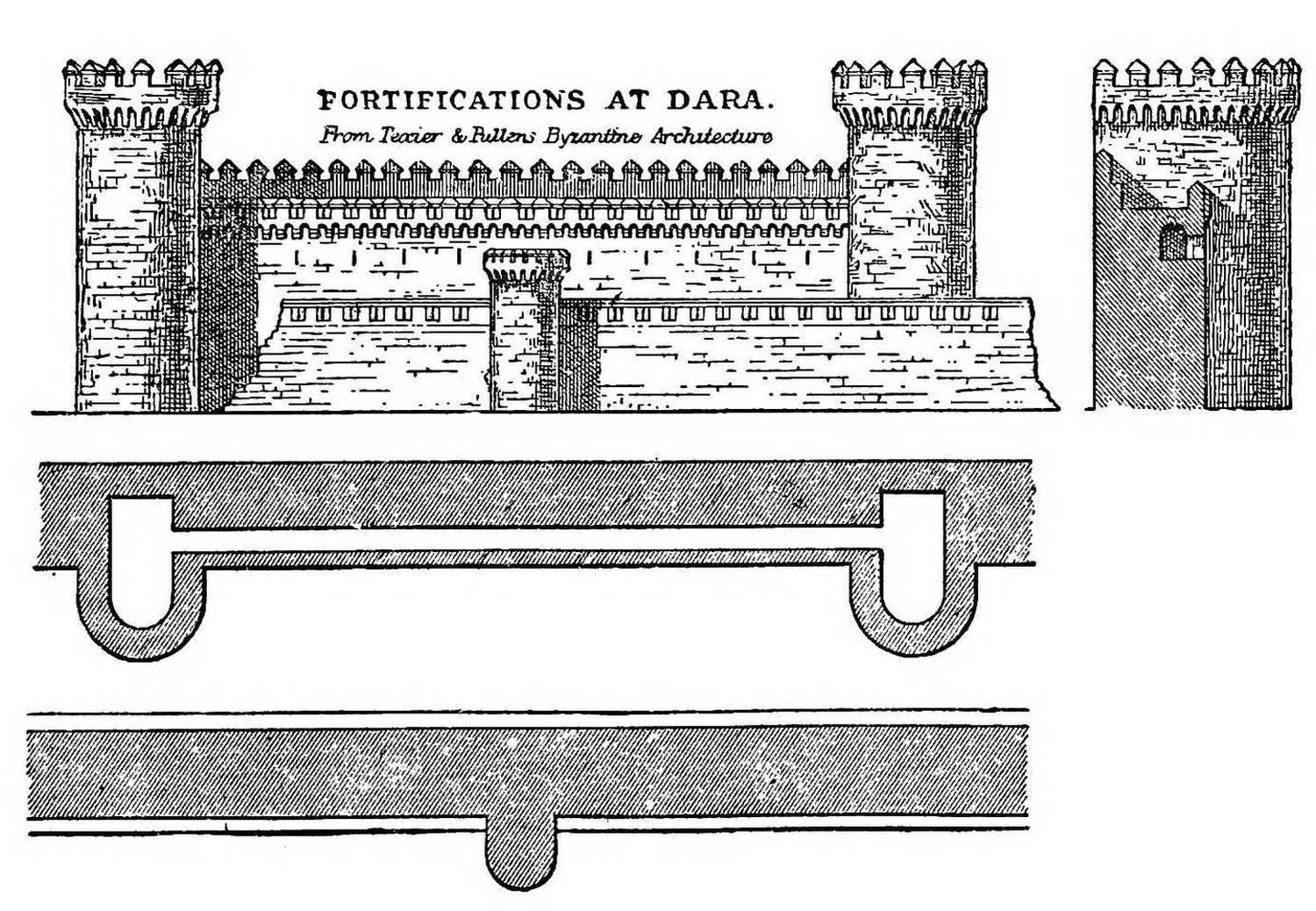
FORTIFICATIONS AT DARA.
From Texier & Pullan’s Byzantine Architecture
It occurred to the Emperor Justinian that the Persians
would not, as far as lay in their power, permit this Roman
fortress to stand threatening them, but that they would
march against it with their entire force, and use every
device to assault its walls on equal terms; and that a
number of elephants would accompany them, bearing
wooden towers upon their backs, which towers instead of
foundations would rest upon the elephants, who—and
this was the worst of all—could manœuvre round the city
at the pleasure of the enemy, and carry a wall which could
be moved whithersoever its masters might think fit; and
the enemy, mounted upon these towers, would shoot down
upon the heads of the Romans within the walls, and assail
them from above; they would also pile up mounds of
earth against the walls, and bring up to them all the
machines used in sieges; while if any misfortune should
befall the city of Dara, which was an outwork of the entire
Roman Empire and a standing menace to the enemy’s
country, the evil would not rest there, but the whole state
would be endangered to a great extent. Moved by these
considerations he determined to fortify the place in a
manner worthy of its value.
In the first place,[35] therefore, since the wall was, as I
have described, very low, and therefore easily assailable,
he rendered it inaccessible and altogether impregnable.
He placed stones which so contracted the original battlements
as only to leave small traces of them, like windows,
allowing just so much opening to them as a hand could
be passed through, so that passages were left through
which arrows could be shot against the assailants. Above
these he built a wall to a height of about thirty feet, not
making the wall of the same thickness all the way to the
top, lest the foundations should be over-weighted by the
mass above, and the whole work be ruined; but he surrounded
the upper part with a course of stones, and built
a portico extending round the entire circuit of the walls,
above which he placed the battlements, so that the wall
was throughout constructed of two stories, and the towers
of three stories, which could be manned by the defenders
to repel the attacks of the enemy; for over the middle of
the towers he constructed a vaulted roof, and again built
new battlements above it, thus making them into a fortification
consisting of three stories.
After this, though he saw, as I have said before, that
many of the towers had after a short time fallen into
ruin, yet he was not able to take them down, because the
enemy were always close at hand, watching their opportunity,
and always trying to find some unprotected part of
the fortifications. He therefore devised the following
plan: he left these towers where they were, and outside
of each of them he constructed another building with
great skill, in a quadrangular form, well and securely
built. In the same manner he securely protected the
ruinous parts of the walls with a second wall. One of
these towers, which was called the Watchtower, he
seized an opportunity of demolishing, rebuilt it securely,
and everywhere removed all fear of want of strength from
the walls. He wisely built the outside part of the wall
to a sufficient height, in due proportion; outside of it he
dug a ditch, not in the way in which men usually make
one, but in a small space, and in a different fashion. With
what object he did this, I will now explain.
The greater part of the walls are inaccessible to besiegers,
because they do not stand upon level ground, nor
in such a manner as would favour an attack, but upon
high precipitous rocks where it would not be possible to
undermine them, or to make any assault upon them; but
upon the side turned towards the south, the ground,
which is soft and earthy and easily dug, renders the city
assailable. Here, therefore, he dug a crescent-shaped
ditch, deep and wide, and reaching to a considerable
distance. Each end of this ditch joined the city wall,
and by filling it with water he rendered it altogether impassable
to the enemy. On the inner side of it he built a
second wall, upon which during a siege the Roman soldiers
keep guard, without fear for the walls themselves and for
the other outwork which stands before the city. Between
the city wall and this outwork, opposite the gate which
leads towards Ammodius, there was a great mound, from
which the enemy were able to drive mines towards the
city unperceived. This he entirely removed, and levelled
the spot, so as to put it out of the enemy’s power to
assault the place from thence.
II. Thus did Justinian fortify this stronghold;[36] he also
constructed reservoirs of water between the city walls and
the outwork, and very close to the Church of St. Bartholomew
the Apostle, on the west side. A river runs from
the suburb called Corde, distant about two miles from the
city. Upon either side of it rise two exceedingly rugged
mountains. Between the slopes of these mountains the
river runs as far as the city, and since it flows at the foot
of them, it is not possible for an enemy to divert or meddle
with its stream, for they cannot force it out of the hollow
ground. It is directed into the city in the following
manner. The inhabitants have built a great channel
leading to the walls, the mouth of which is closed with
numerous thick bars of iron, some upright and some
placed crosswise, so as to enable the water to enter the
city, without injury to the strength of its fortifications.
Thus the river enters the city, and after having filled these
reservoirs, and been led hither and thither at the pleasure
of the inhabitants, passes into another part of the city,
where there is an outfall constructed for it in the same
way as its entrance. The river in its progress through
the flat country made the city in former times easy to be
besieged, for it was not difficult for an enemy to encamp
there, because water was plentiful. The Emperor Justinian
considered this state of things, and tried to find
some remedy for it; God, however, assisted him in his
difficulty, took the matter into His own hands, and without
delay ensured the safety of the city. This took place
in the following manner.
One of the garrison of the city, either in consequence
of a dream or led of his own accord to it, collected together
a great number of the workmen engaged in building
the fortifications, and ordered them to dig a long
trench in a certain place, which he pointed out to them, a
considerable distance within the city wall, declaring that
they would there find sweet water flowing out of the
ground. He dug this trench in a circular form, making
the depth of it for the most part about fifteen feet. This
work proved the saving of the city, not through any foresight
of the workmen, yet, by means of this trench, what
would have been a misfortune was turned into a great
advantage to the Romans; for, as during this time very
heavy rain fell, the river, of which I just spoke, raged
outside the fortifications and rose to a great height, being
unable to proceed, because when it was swollen to such a
size neither the channel nor the entrances in the wall
were large enough to contain it, as they had been before.
It consequently piled up its waters against the wall, rising
to a great height and depth, and in some places was stagnant,
and in others rough and violent. It at once overthrew
the outwork, swept away a great part of the city
wall, forced its way through the city gates, and, running
with a great body of water, occupied almost the whole
city, invading both the market-place, the narrower streets,
and the houses themselves, swept off from them a great
mass of furniture, wooden vessels, and such like things,
and then, falling into this trench, disappeared under ground.
Not many days afterwards it reappeared near to the city
of Theodosiopolis, at a place about forty miles distant
from the city of Dara, where it was recognised by the
things which it had swept away out of the houses at Dara,
for there the whole mass of them reappeared. Since that
period, in time of peace and quiet, the river flows through
the midst of the city, fills the reservoirs with water, and
passes out of the city through the outfall especially constructed
for it by the builders of the city, which I described
above, and, as it supplies that region with water,
becomes a great boon to the inhabitants of the neighbourhood.
When, however, a hostile army advances to besiege
the city, they close the passages through the iron gratings
with what are called sluice-doors, and at once force the
river to change its course and to flow into the trench and the
subterranean gulf beyond, so that the enemy suffer from
want of water and are at once obliged to raise the siege.
Indeed Mirrhanes, the Persian general, in the reign of
Cabades, came thither to besiege the city, and was compelled
by all these difficulties to retire baffled after a short
time; and a long while afterwards, Chosroes himself advanced
with the same intentions, and attacked the city
with a numerous army; but being driven to great straits
through want of water, and perceiving the height of the
walls, he imagined the place to be entirely impregnable, gave
up his project, and straightway retired into Persia, being
out-generalled by the foresight of the Roman Emperor.
III. Such were the works of the Emperor Justinian in
the city of Dara. I shall now describe what he arranged
to prevent any second misfortune happening to the city
from the river, in which matter his wishes were manifestly
assisted by Heaven. There was one Chryses of Alexandria,
a clever engineer, who served the Emperor as an architect,
and constructed most of the works both in the city
of Dara and in the rest of the country. This Chryses was
absent when the misfortune from the river befell the city
of Dara; when he heard of it, he retired to bed in great grief,
and dreamed the following dream: A figure of more than
human stature appeared to him, and showed and explained
to him a device which would protect the city from any
dangerous inundation of the river. He, conceiving this
idea to be divinely inspired, at once wrote an account
of the device and of the vision, and sent it to the Emperor,
giving a sketch of what he had been taught in his dream.
It happened that not long before this a message reached
the Emperor from the city of Dara, giving him an account
of what had happened with the river. Thereupon the
Emperor, disturbed and alarmed at what had taken place,
straightway summoned those most celebrated architects,
Anthemius and Isidorus, whom I have mentioned before.
He informed them of what had happened, and inquired
what arrangement could be devised to prevent this mischief
befalling the city a second time. Each of them
described what he considered to be a suitable plan for this
purpose; but the Emperor, evidently acting under a
divine impulse, although he had not yet seen the letter of
Chryses, miraculously invented and sketched out of his
own mind the plan suggested by the dream. The interview
terminated without the adoption of any distinct plan,
and without their deciding upon what was to be done; but
three days afterwards came a messenger to the Emperor,
who brought the letter from Chryses, and who explained
the form of the arrangement which he had seen in his
dream. The Emperor now again sent for the architects,
and ordered them to recall to mind their former ideas of
what ought to be done. They repeated everything in
order, both their own devices and the spontaneous inventions
of the Emperor; after which the Emperor brought
forward the messenger sent from Chryses, and showing
them the letter and the sketch of what he had seen in his
dream, caused them to wonder greatly, when they perceived
how Heaven had assisted our Emperor in everything
for the advantage of the Empire. The plan of the
Emperor accordingly won the day, and triumphed over
the art and learning of the architects. Chryses returned
to the city of Dara, with orders from the Emperor to carry
out the work which he had described with all speed, according
to the plan revealed in the dream. He carried out
his orders in the following manner.
In a place about forty feet distant from the outwork of
the city, across the valley in which the river runs between
the two mountains, he constructed a barrier of considerable
height and width, joining each end of it to the mountain on
either side, in such a manner that the water of the river
in its strongest flood could never force its way through it.
This work is called by those who are learned in such
matters a dam, or sluice, or whatever else they please.
He did not build this barrier in a straight line, but in the
form of a crescent, in order that its arch, which was
turned against the stream of the water, might be better
able to resist its violence. The upper and lower parts of
this barrier are pierced with apertures, so that, when the
river suddenly rises in flood, it is forced to stop there and
to flow no further with the entire weight of its stream,
but passing in small quantities through these apertures it
gradually diminishes in violence and power, and the wall
is never damaged by it; for the flow of water, collecting
in the place which, as I have said before, is about forty
feet in length, lying between the barrier and the outwork,
is never unmanageable, but runs gently to its usual
entrance, and thence is received in the artificial channel.
As for the gate, which the fury of the river broke open in
former times, he removed it from thence, and blocked up
its site with enormous stones, because this gate, being situated
on flat ground, was easily reached by the river when
in flood; but he placed the gate not far off, in a lofty place
in the most precipitous part of the circuit of the walls,
which it was impossible for the river to reach. Thus did
the Emperor arrange these matters.
The inhabitants of this city suffered greatly from the
want of water, for there was no fountain springing out of
the ground, nor was any water carried about the streets
in an aqueduct, or stored up in cisterns; but those who
lived in the streets through which the river passed could
draw drinking-water from it without trouble, while those
who dwelt at a distance from the course of the river had
either to fetch their drinking-water with great trouble or
to perish with thirst; however, the Emperor Justinian
constructed a great aqueduct, by which he brought the
water to every part of the city, and relieved the distress
of the inhabitants. He also built two churches, that
which is called the Great Church, and the Church of St.
Bartholomew the Apostle.[37] Moreover, he built very spacious
barracks for the soldiers, that they might not inconvenience
the inhabitants.
Not long after this he restored the wall and outworks
of the city of Amida, which had been built in former
times, and were thought likely to fall into ruins; thus
ensuring the safety of that city. I am now about to
speak of his buildings in the forts which stand on the
frontier of the territory of these cities.
IV. As one goes from the city of Dara towards the land
of Persia, there lies on the left a tract entirely impassable
for carriages or horses, extending to the distance of about
two days’ journey for a lightly-equipped traveller, ending
in an abrupt and precipitous place called Rhabdium.[38] The
land on each side of this road to Rhabdium belongs for
a great distance to Persia. When I first saw this I was
surprised at it, and inquired of the people of the country
how it was that a road and tract belonging to the Romans
should have enemy’s land on each side of it. They
answered, that this country once belonged to the Persians,
but that at the request of the King of Persia one of
the Roman Emperors gave a village abounding in vines
near Martyropolis,[39] and received this region in exchange
for it. The city of Rhabdium stands upon precipitous
and wild rocks, which there rise to a wondrous height;
below it is a region which they call ‘the field of the
Romans,’ out of wonder, I suppose, at its belonging to
the Romans, though it lies in the midst of the Persian
country. This Roman field lies on flat ground, and is
fruitful in all kinds of crops; one might conjecture this
from the fact that the Persian frontier surrounds it on
every side.
There is a very celebrated fort in Persia, named Sisauranum,
which the Emperor Justinian once captured and
razed to the ground; taking prisoners a great number of
Persian cavalry, together with their leader Bleschanes.
This place lies at a distance of two days’ journey from
Dara for a lightly-equipped traveller, and is about three
miles distant from Rhabdium. It was formerly unguarded,
and altogether neglected by the Romans, so that
it never received from them any garrison, fortification, or
any other benefit, wherefore the peasants who tilled this
country, of which I just spoke, besides the ordinary taxes,
paid an annual tribute of fifty gold pieces to the Persians,
in order that they might possess their lands and enjoy the
produce of them in security. All this was altered for them
by the Emperor Justinian, who enclosed Rhabdium with
fortifications, which he built upon the summit of the mountain
which rises there, and, taking advantage of the position
of the ground, rendered it impossible for the enemy
to approach it. As those who dwelt in it were in want of
water, there being no springs on the top of the cliff, he
constructed two cisterns, and by digging into the rocks in
many places made large reservoirs of water, so that the
rain-water might collect, and the garrison might use it
freely, and not be liable to capture through distress for
want of water.
He also rebuilt solidly, and gave their present beauty
and strength to all the other mountain forts, which reach
from this point and from the city of Dara to Amida;
namely, Ciphæ, Sauræ, Smargdis, Lurnes, Hieriphthon,
Atachæ, Siphris, Rhipalthæ, Banasymeon, and also
Sinæ, Rhasius, Dabanæ, and all the others which were
built there in ancient times, and which before this were
constructed in a contemptible fashion, but which he made
into an impregnable line of outposts along the Roman
frontier. In this region there stands a very lofty mountain,
precipitous, and altogether inaccessible; the plain
below it is rich and free from rocks, suitable both for
arable and pasture land, for it abounds in grass. There
are many villages at the foot of this mountain, whose
inhabitants are rich in the produce of the country, but lie
exposed to the attacks of the enemy. This was remedied
by the Emperor Justinian, who built a fort upon the
summit of the mountain, in which they might place their
most valued possessions, and themselves take refuge at
the approach of the enemy. This is named the Fort of
the Emperors. Moreover, he carefully rebuilt and safely
fortified the forts in the neighbourhood of the city of
Amida, which before were only surrounded by mud walls,
and were incapable of defence. Among these were
Apadnæ and the little fort of Byrthum: for it is not easy
to set down all their names in detail, but, speaking
generally, he found them all exposed to attack, and has
now rendered them impregnable; and since his time
Mesopotamia has become quite protected against the
Persian nation.
Nor must I pass over in silence what he devised at the
fort of Bara, of which I just now spoke. The interior of
this fort was entirely without water, and Bara is built
upon the precipitous summit of a lofty mountain. Outside
its walls, at a great distance, at the bottom of the hill,
there was a fountain which it was not thought advisable
to include within the fortification, lest the part which was
situated upon the low ground should be open to attack.
He therefore devised the following plan. He ordered
them to dig within the walls until they reached the level
of the plain. When this was done in accordance with the
Emperor’s order, to their surprise they found the water of
the fountain flowing there; thus the fort was both constructed
securely and conveniently situated with regard
to water supply.
V. In the same manner, since the walls of Theodosiopolis,[40]
the bulwark of the Roman Empire on the river
Aborrhas, had become so decayed by age that the inhabitants
derived no confidence from their strength, but rather
terror, as they feared that before long they would fall down,
the Emperor rebuilt them for the most part, so that they
were able to check the invasions of the Persians into
Mesopotamia. It is worth describing what he did at
Constantina. The original wall of Constantina was so
low that a ladder would easily reach the top, and in its
construction was greatly exposed to attack, and seemed
hardly to have been built in earnest; for the towers were
of such a distance from one another, that if the assailants
attacked the space between them, the garrison of the
towers would be too far off to drive them back; moreover,
the greater part of it was so ruinous from age that it
seemed likely soon to fall. In addition to this, the city
had an outwork which was more like a siege-work to
enable the enemy to attack it; for it was not more than
three feet in thickness, cemented with mud, the lower
part of it built of rock fit for making mill-stones, but the
upper part of what is called white-stone, which is not to
be trusted and is very soft, so that the whole work might
easily be captured. However, the Emperor Justinian rebuilt
the decayed part of the walls, more especially on the
west and north sides; between every two towers of the wall
he placed the third, so that since his time all the towers for
the defence of the wall stand close together. He also greatly
raised the height of the wall and of all the towers, so as to
render the place impregnable to an enemy. Moreover, he
built covered approaches to the towers, each of which
towers contained three stories of vaulted stone, so that
each one of them was called and really was a castle in
itself, for what the Greeks call ‘phrourion’ is called a
‘castle’ in the Latin tongue. Besides this, Constantina
used formerly to be reduced to great straits for want of
water; there are indeed wells of good water outside the
walls at the distance of a mile, round which grows a large
wood of very lofty trees; within the walls, however, since
the streets are not built upon level but upon sloping ground,
the city in ancient times was waterless, and its inhabitants
suffered much from thirst and the difficulty of obtaining
water; but the Emperor Justinian brought the water
within the walls by means of an aqueduct, adorned the
city with overflowing fountains, and may justly be termed
its founder. These were the works of the Emperor
Justinian in these cities.
VI. The Romans had a fort by the side of the river
Euphrates on the extreme frontier of Mesopotamia, at the
place where the river Aborrhas[41] effects its junction with
the Euphrates. This fort was named Circesium,[42] and had
been built in former times by the Emperor Diocletian; however,
our present Emperor Justinian, finding that it had become
ruinous through lapse of time, and was neglected and
not in a posture of defence, altered it into a strong fortification,
and made it into a city of eminent size and beauty.
When Diocletian built the fort he did not completely
surround it with a wall, but brought each end of the walls
down to the river Euphrates, built a tower at each end of
them, and left the side between them entirely unfortified,
imagining, I suppose, that the waters of the river would
suffice to defend the fort on that side. In the course of
time, however, the stream of the river, continually eating
away the bank, undermined the tower on the south side,
and it became evident that unless prompt measures were
taken it would shortly fall. Now appeared the Emperor
Justinian, entrusted by Heaven with the glory of watching
over, and, as far as one man can do, of restoring the
Roman Empire. He not only saved the undermined
tower, which he rebuilt of a hard stone, but also enclosed
all the unprotected side of the fort with a very strong
wall, thus doubling its security by adding the strength
which it derived from the wall to that afforded by the
river. Besides this, he also built a powerful outwork
round the city, especially at the spot where the junction
of the two rivers forms a triangular space, and thus left no
place exposed to the attacks of the enemy. Moreover, he
appointed a general who had the title of Duke, and who
always resided there with a garrison of picked soldiers,
thus rendering the place a sufficient bulwark for the
frontier of the empire. He also rebuilt in its present
splendour the public bath which is used by the inhabitants,
which had become quite ruinous and useless by the incursions
of the river; for he found all that part of it which is
suspended above the solid foundation for the convenience
of bathers, underneath which the fire is placed, and which
is called the hypocaust, exposed to the influx of the river,
by which the bath was rendered useless; he therefore
strengthened with stonework, as I have said, the part which
formerly had been hollow, and built another hypocaust
above it, which the river could not reach, thus restoring
the enjoyment of the bath to the garrison. In this manner
did our Emperor restore the buildings of Circesium.
Beyond Circesium there is an ancient fort named Annucas,
whose wall the Emperor Justinian found a mere ruin,
and which he rebuilt in so magnificent a fashion that its
defences vie with those of the most celebrated cities; and
in the same manner he rendered formidable, and altogether
unapproachable by an enemy, those forts situated near the
city of Theodosiopolis, which before his time were either
without walls, or only walled with mud and absurd heaps
of stones. These are Magdalathum, with two others on
either side of it, and the two forts, the Great and Little
Thannurium, Bismideon, Themeres, Bidamas, Dausaron,
Thiolla, Philæ, Zamarthas, and, one may say, all the rest.
There was an extensive position near Thannurium, which
could easily be occupied by our enemies the Saracens, by
crossing the river Aborrhas, from which point they were
able to penetrate in small parties into the thick and
extensive forest and the mountain which is situated in
that region, and make inroads upon the Roman inhabitants
of that country; now, however, the Emperor Justinian
has built a tower of hard stone in that place, manned it
with a considerable garrison, and has altogether repressed
the incursions of the enemy by the establishment of this
bulwark against them.
VII. The above are the works of the Emperor Justinian
in this part of Mesopotamia; I must speak in this place
of Edessa, Carrhæ, Callinicum, and all the other strong
places which are in that country, since they lie between
the two rivers. Edessa[43] stands on the banks of a small
stream called Scirtus, which collects its waters from many
places, and runs through the midst of the city: from
thence it passes onwards, after having supplied the wants
of the city, effecting its entrance and exit through by a
channel constructed by former generations, which passes
through the city walls. This river once, after much rain,
rose to a great height, and seemed as though it would
destroy the city; it tore down a large part of the outworks
and of the walls, inundated almost the whole city, and did
much damage, suddenly destroying the finest buildings,
and drowning a third part of the inhabitants. The Emperor
Justinian not only at once restored all the buildings
of the city which were overthrown, among which were the
church of the Christians and a building called Antiphorus,
but also arranged with great care that no such disaster
should ever again occur, for he made a new channel for
the river, outside the city walls, which he arranged in
the following manner. The ground on the right bank
of the river was formerly flat and low-lying, while that on
the left was a precipitous mountain, which did not allow
the river to turn aside from its accustomed course, but
forced it to flow into the city, because when flowing
towards the city it met with no obstacle on its right bank.
He therefore dug away the whole of this mountain, making
a channel on the left bank of the river deeper than its
former bed, and built on the right bank an enormous wall
of stones, as large as a waggon could carry, so that if the
river ran as usual with a moderate volume the city would
not be deprived of the convenience of its water; but if it
should be swollen into a flood a moderate stream would
run as usual throughout the city, but the excess of water
would be forced into this channel constructed by Justinian,
and thus extraordinarily conquered by human art and skill
might run round the back of the race-course, which is
situated not far off. Moreover he forced the river within
the city to run in a straight course, by building a wall
above it on either side, so that it could not turn out of a
straight path; by which means he both preserved the use
of it for the city, and removed all fear of it for the future.
The wall and outwork of Edessa, like those of the other
places, had for the most part fallen into ruins through
age; wherefore the Emperor restored them both, making
them new and much stronger than they were before. Part
of the wall of Edessa is occupied by a fort, outside of
which rises a hill very close to the city and overhanging
it; this hill was in ancient times occupied by the inhabitants,
and included in their walls by an outwork, that it
might not form a weak point to the city. Their work,
however, made the city much more open to assault in
that quarter; for their outwork was very low, built on
an exposed site, and could be taken even by children
playing at sieges. Justinian therefore took it down and
built another wall on the top of the hill, which is in no
danger of an assault from higher ground in any quarter,
and which follows the slope of the hill down to the level
ground on both sides, and joins the city wall.[44]
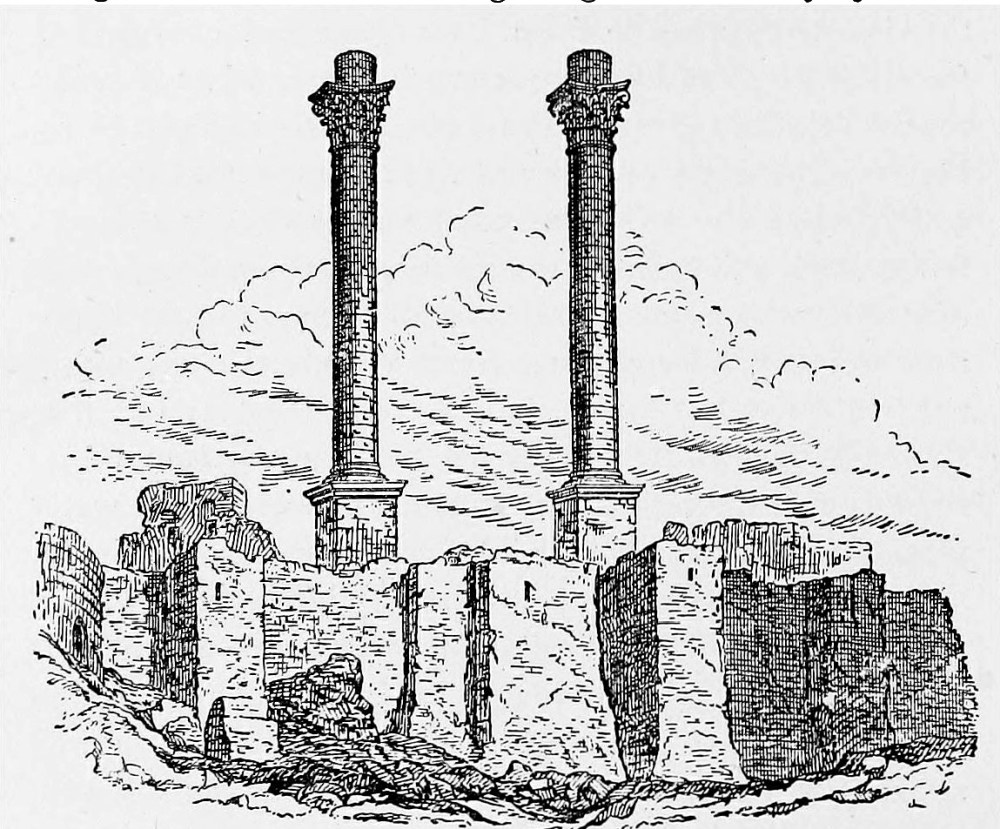
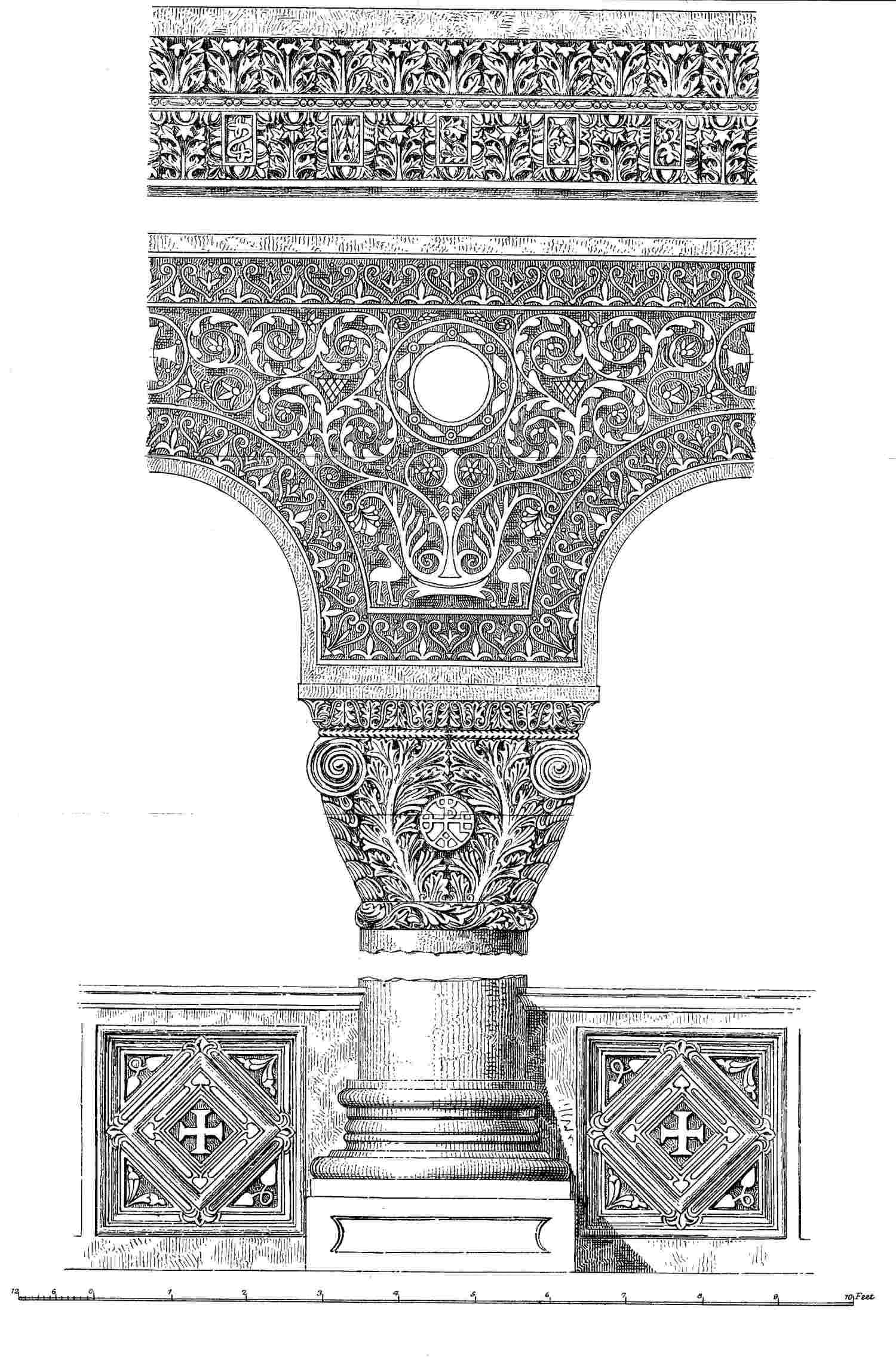
EDESSA.
From Texier & Pullan’s Byzantine Architecture
COLUMNS ON A TERRACE OF THE CASTLE.
Also at the cities of Carrhæ[45] and Callinicum[46] he
destroyed the walls and outworks, which were much
impaired by age, and rendered them impregnable by
building the present complete fortifications; he also
built a strong wall round the unprotected and neglected
fort at Batnæ,[47] and gave it the fine appearance which it
now presents.
VIII. These, as I have said before, were the works of
the Emperor Justinian in Mesopotamia and Osrhoene.
I will now describe what was done on the right bank of
the river Euphrates. In all other parts the Roman
and Persian frontiers border upon one another, and each
nation proceeds from its own country to make war and
peace with the other, as all men of different habits and
empires do when they have a common frontier; but in the
province which was formerly called Commagene, which is
now called Euphratesia, they dwell nowhere near to one
another, for the Roman and Persian frontiers are widely
parted by a country which is quite desert and devoid of
life, and possesses nothing worth fighting for. Yet each
nation, though not regarding it as a work of much importance,
has built a chain of forts of unbaked brick where the
desert borders upon their inhabited country. None of these
forts have ever been assaulted by their neighbours, but
the two nations dwell there without any ill-feeling, since
there is nothing for either of them to covet; however, the
Emperor Diocletian built three of these forts in this
desert, one of which, named Mambri, had fallen into ruin
through age, and was restored by the Emperor Justinian.
About five miles from this fort, as you go towards the
Roman country, Zenobia, the wife of Odenathus, the chief
of the Saracens in those parts, built a small city in former
times and gave it her own name, calling it Zenobia.[48]
Since then, long lapse of time brought its walls to ruin,
and as the Romans did not think it worth caring for, it
became entirely uninhabited. Thus the Persians, whenever
they chose, were able to place themselves in the
midst of the Romans before any news had been heard of
their coming; however, the Emperor Justinian rebuilt the
whole of Zenobia, filled it with numerous inhabitants, placed
in it a commander with a garrison of regular soldiers, and
thus formed a powerful fortress, a bulwark of the Roman
Empire and a check upon the Persians. He did not
merely restore it to its former appearance, but made it
far stronger than it was before. The place is closely surrounded
by high cliffs, from which the enemy were formerly
able to shoot down upon the heads of the defenders of the
wall; being desirous to avoid this, he constructed a building
upon the walls, on the side nearest these cliffs, which
might always act as a protection to the defenders. This
building is called a ‘wing,’ because it appears to hang
upon the wall. Indeed, it is not possible to describe all
that our Emperor built at Zenobia: for as the city is
situated far away in the desert, and for this reason is
always exposed to peril, and cannot derive any succour
from the Romans, who dwell at a distance, he took the
greatest pains to render it secure. I will now relate some
few of his works there.
Zenobia stands beside the river Euphrates, which flows
close to its walls on the eastern side. This river, surrounded
by high mountains, has no space in which to
extend itself, but its stream is confined among the neighbouring
mountains and between its rugged banks. Whenever
it is swollen by rain into a flood, it pours against the
city wall and washes not merely against its foundations
but as high as its very battlements. The courses of stone
in the walls, drenched by this stream, became disarranged,
and the whole construction was endangered; he, however,
constructed a mole of enormous masses of hard rock, of
the same length as the wall, and forced the flooded river
to expend its rage in vain, setting the wall free from any
fear of injury, however high the river might swell. Finding
that the city wall upon the northern side had become
ruinous from age, he razed it to the ground, together with
its outwork, and rebuilt it, but not upon its former site,
because the houses of the city were so crowded together
at that point as to inconvenience the inhabitants; but he
proceeded beyond the foundations of the wall, beyond the
outwork and the ditch itself, and there built an admirable
and singularly beautiful wall, thus greatly enlarging
Zenobia in this quarter. There was, moreover, a certain
hill which stood near the city towards the west, from
which the barbarians, when they made their attacks, were
able to shoot with impunity down upon the heads of the
defenders, and even of those who were standing in the midst
of the city; this hill the Emperor Justinian surrounded
with a wall on both sides, and thus included it in the city
of Zenobia, afterwards escarping its sides throughout, so
that no enemy could ascend it. He also built another
fort upon the top of the hill, and thus rendered it altogether
inaccessible to those who wished to assault the
city, for beyond the hill the ground sinks into a hollow
valley, and therefore it cannot be closely approached by
the enemy; above this hollow valley the mountains at
once rise on the western side. The Emperor did not
merely watch over the safety of the city, but also built
churches in it, and barracks for the soldiers: he also constructed
public baths and porticos. All this work was
carried out under the superintendence of the architects
Isidorus and Joannes, of whom Joannes was a Byzantine,
and Isidorus a Milesian by birth, being the nephew of that
Isidorus whom I mentioned before. Both of these were
young men, but showed an energy beyond their years, and
both displayed equal zeal in the works which they constructed
for the Emperor.
IX. After Zenobia was the city of Suri,[49] situated on the
river Euphrates, whose fortifications were so contemptible
that when Chosroes assaulted it, it did not hold out
for so much as half-an-hour, but was instantly taken
by the Persians. This fort, however, like Callinicum, was
restored by the Emperor Justinian, who surrounded it
with a strong wall, strengthened it with an outwork, and
enabled it for the future to resist the attack of the enemy,
There is in Euphratesia a church dedicated to Sergius,
an eminent saint, whom the ancients so admired and
looked up to that they named the place Sergiopolis,[50] and
surrounded it with a low rampart, sufficient to prevent the
Saracens in that region from capturing it by assault; for
the Saracens are by nature incapable of attacking walls,
and consequently the weakest mud wall is sufficient to
resist their onset. In later times this church received so
many offerings as to become powerful and famous throughout
the land. The Emperor Justinian, reflecting upon
these matters, at once applied himself to its protection,
surrounded it with a most admirable wall, and provided a
quantity of water, stored up in reservoirs, for the use of
its inhabitants; besides this, he built in the place houses
and porticos, and all the other buildings which are regarded
as the ornaments of a city. He also placed a
garrison of soldiers in it to defend the walls in time of
need; and, indeed, Chosroes, the King of Persia, who
determined to take the city, and who brought up a large
army to besiege it, was compelled to raise the siege, being
overcome by the strength of the walls.
The Emperor spent equal care upon all the towns and
forts on the borders of Euphratesia, (namely) Barbalissus,[51]
Neocæsarea, Gabula, Pentacomia, which is on the
Euphrates, and Europus.[52] At Hemerius, finding the walls
built in some parts carelessly and dangerously, and in some
parts formed only of mud, while the place was deficient in
water-supply and consequently despicable as a fortification,
he razed them to the ground, and at once carefully rebuilt
them of courses of the hardest stone, making the wall
much wider and higher than before. He also constructed
reservoirs for water in all parts of the works, all of which
he filled with rain-water, and, placing a garrison there, he
rendered the place as powerful and secure as we now see
it. Indeed, if one were carefully to consider this, and to
inspect all the other good works of the Emperor Justinian,
one would say it was for this alone that he had received
the crown, by the manifest favour of God, who watches
over the Roman people.
Besides these places he also found Hierapolis,[53] which is
the chief of all the cities in that region, lying exposed to
any enemy that might attack it, but by his own provident
foresight he rendered it safe; for, as it originally enclosed
a large empty space and on that account the entire circuit
of the walls could not be guarded, he cut off the part
which was useless, arranged the walls in a safer and
more compact form, and, by thus reducing it to the size
necessary for use, made it one of the strongest cities of the
present day. He also conferred upon it the following
benefit. A fountain of sweet water springs perpetually out
of the earth in the midst of the city, and forms therein a
wide lake; this, indeed, added to the safety of the city
when it was beleaguered by an enemy, but in time of peace
was by no means necessary, as much water was brought
into the city from without. In process of time the inhabitants,
having enjoyed a long period of peace, and having
never experienced any distress, neglected this spring; for
it is not in human nature when in prosperity to make
provision against times of adversity; consequently they
gradually filled up the lake with rubbish, and were accustomed
to bathe in it, to wash their clothes in it, and to
throw all kinds of refuse into it....
In this province of Euphratesia were situated two other
towns, Zeugma[54] and Neocæsarea, which were indeed
towns in name, but were merely surrounded by dry stone
walls, built so low that they might be crossed by an
enemy without any difficulty, since they could leap over
them without fear; while they were so narrow as to be
altogether indefensible, because they afforded no room
for the garrison to stand upon to defend them; however,
the Emperor Justinian surrounded these places also with
real walls, of a sufficient width and height, and equipped
them with all other means of defence, thus giving them
a just right to be termed cities, and rendering them safe
from the attacks of the enemy.
X. Moreover, with regard to the cities taken from
Chosroes, that barbarian, disregarding the perpetual
peace which he had sworn to observe, and the money
which he had received on account of it, was filled with
envy of the Emperor Justinian, because of the conquests
which he had made in Libya and in Italy, and considered
his plighted faith to be of less importance than the gratification
of this passion; he watched his opportunity,
when the greater part of the Roman army was away in the
West, and invaded the Roman territory unexpectedly,
before the Romans had any news of the approach of the
enemy; these cities, I say, the Emperor Justinian so
strengthened and beautified that they are all at the
present time much more flourishing than before, and have
no dread of injury from barbarian invasion, fearing no
attacks of any kind.
Above all, he rendered the city of Antiochia,[55] which is
now surnamed Theopolis, far more beautiful and powerful
than it was before; its wall in ancient times was too
large, and extended beyond all reason, uselessly enclosing
flat ground in one place, and lofty cliffs in another, so
that it was full of weak points. The Emperor Justinian
reduced it to a useful size, making it protect the city
alone, and not the places which it formerly enclosed. In
the lower part of the fortifications, where the city had
spread out to a dangerous extent over a smooth plain,
and was indefensible through the great length of the wall,
he drew it back as far as possible, advantageously reducing
the size of the city in that quarter, and strengthening it
by concentration. As for the river Orontes, which formerly
flowed past it in a circuitous course, he changed its
direction, and caused it to skirt the walls of the city.
Thus, by an artificial channel, he brought the course of
the river as near the city as possible, by which means he
relieved the city from the danger of its unmanageable
size, and yet retained the protection afforded by the river
Orontes: then, by building new bridges, he supplied fresh
means of intercourse across the river, which he diverted
from its course as far as was required, and then returned
to its former bed.
The upper part of the city, on the high ground, he
fortified in the following manner. On the summit of the
mountain which is called Orocassias there is a lofty rock
which stands close outside the wall opposite to the fortifications
in that quarter, and which renders them easy to
attack. It was from this point that Chosroes took the
city, as I have explained in my work on the subject.
The region within the walls was for the most part
uninhabited and difficult of access, for the place is divided
by lofty rocks and deep ravines, which cut off all the
paths, so that the wall of Antiochia seems there to belong
to another city. He therefore disregarded the rock which
overhangs the wall so close and renders it liable to
capture, and decided to build his new wall at a distance
from it, having learnt by experience the folly of the
original builders; moreover, he levelled the ground within
the walls, which formerly had been precipitous, and made
the ascent to this part of the city not only practicable for
people on foot, but for horsemen and even for carriages.
On this high ground he also built baths and reservoirs for
water within the walls, and dug a well in each tower,
remedying the original waterless character of the place
by the storage of rain-water.
It is worth our while to describe his works upon the
torrent which descends from these mountains. Two
precipitous mountains overhang the city, standing close
to one another; of these, the one is called Orocassias,
the other Stauris. They are joined by a glen and ravine
which lies between them, which in time of rain produces
the torrent named Onopnictes, which used to flow down
from the high ground and overflow the fortifications, and
sometimes rose so high as to pour into the streets of the
city, doing much mischief to the inhabitants. The
Emperor Justinian remedied this in the following manner.
In front of that part of the wall which is nearest to the
ravine, from which the torrent used to rush against the
wall, he built an exceedingly high wall, reaching from
the hollow bed of the ravine to the mountains on either
side, so that the torrent was not able to rush past it, but
was forced to stay and collect its waters there. In this
wall he made apertures, through which he forced the
water to run gently in a smaller volume, checked by this
artificial barrier, so that it no longer broke with its full
force against the city wall so as to overflow it and ruin
the city, but proceeded gently and quietly, as I have
explained, and flowing in this manner passed wherever it
was desired to go through the channels constructed for it
by the former inhabitants.
Thus did the Emperor Justinian reconstruct the walls
of Antiochia; he also rebuilt the entire city, which was
burnt by the enemy. As the whole city was reduced to
ashes, and levelled to the ground, and only heaps of
rubbish remained after the conflagration, it was at first
impossible for the citizens of Antiochia to recognise the
site of their own dwellings. He consequently removed
all the ruins, and cleared away the charred remains of the
houses; but, as there were no public porticos or halls supported
by columns, no market-place, and no streets which
marked out the quarters of the city, there was nothing to
point to the site of any particular house. However, the
Emperor, without any delay, removed the rubbish as far
as possible from the city, thus freeing the air and the
ground from all impediments to building, and first covered
the foundations of the city everywhere with stones large
enough to load a waggon. After this he divided it by
porticos and market-places, defined all the blocks of
building by streets, arranged the aqueducts, fountains, and
watercourses with which the city is adorned, constructed
theatres and public baths in it, and graced it with all the
other public buildings which belong to a prosperous city.
He also brought thither a number of workmen and
artificers, and thus rendered it more easy for the inhabitants
to rebuild their own houses; the result of this is
that Antiochia at the present day is a more celebrated
city than before. He also built therein a large church in
honour of the Virgin, the beauty and magnificence of
which is in all respects beyond description. He endowed
this church with a considerable revenue, and also built a
large church dedicated to St. Michael the Archangel.
Moreover, he made provision for the sick poor in that
place, and built dwellings for them, separate for the
different sexes, in which they were supplied with attendants,
and the means of curing their diseases; while at
the same time he established hospices for strangers who
might be staying for any time in the city.
XI. In like manner he also restored, greatly strengthened,
and brought into its present condition the wall of the city
of Chalcis, together with its outwork, which had become
weak and ruinous through age.
There was in Syria an utterly neglected village named
Cyrus,[56] which the Jews had built in ancient times when
they were led captive from Palestine into Syria by the
army of the Medes, from which country they were long
afterwards released by Cyrus the King; wherefore they
called the place Cyrus in honour of their benefactor. In
the course of time Cyrus became quite overlooked and
was entirely without walls; but the Emperor Justinian,
with a prudent zeal for the safety of the Empire, and also
out of reverence for the SS. Cosmas and Damianus, whose
bodies lay near that place down to my own time, made
Cyrus into a flourishing and admirable city, rendering it
safe by a very strong wall, with a numerous garrison, large
public buildings, and with all other appurtenances on an exceedingly
magnificent scale. In former times the interior of
this city was without water, but outside the walls was a
plenteous spring which provided abundance of drinking-water,
yet was altogether useless to the inhabitants, since
they had no means of drawing water from it without great
labour and peril; for they were obliged to go to it by a
circuitous path, as the country between it and the city
was precipitous and altogether impassable, so that an
enemy, if he were present, could easily lay an ambush and
cut them off. He therefore constructed a watercourse
from the city walls to the fountain, not open, but concealed
underground with the greatest care, which supplied
the city with water without either trouble or danger.
He also very strongly rebuilt the entire circuit of the
walls of Chalcis,[57] which had fallen into ruin down to its
very foundation and was altogether indefensible, and he
strengthened it with an outwork; he also restored all the
other towns and forts in Syria in an admirable fashion.
Thus did the Emperor Justinian provide for the security
of Syria; there is, too, in Phœnicia, by the side of Lebanon,
a city named Palmyra, which was built in the desert in
ancient times, and which was conveniently placed on the
road by which our enemies the Saracens would enter
our country. It was, indeed, originally built for this purpose;
namely, in order to prevent the barbarians making
unexpected inroads into the Roman territory. This place,
which through lapse of time had become almost entirely
deserted, was strongly fortified by the Emperor Justinian,
who supplied it abundantly with water, and filled it with a
garrison of soldiers, so as to check the inroads of the
Saracens.