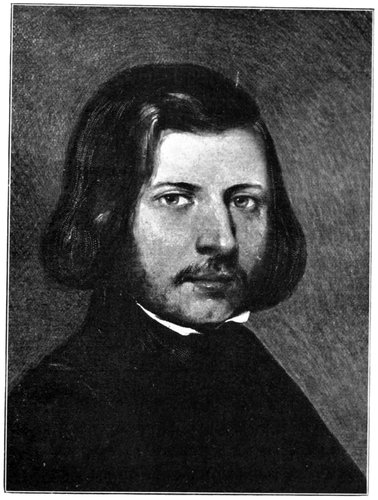
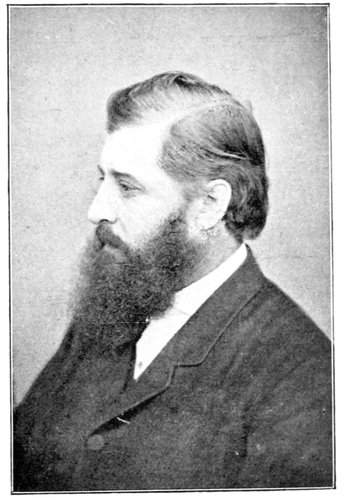
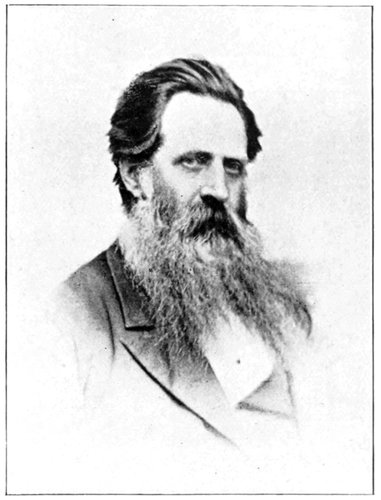
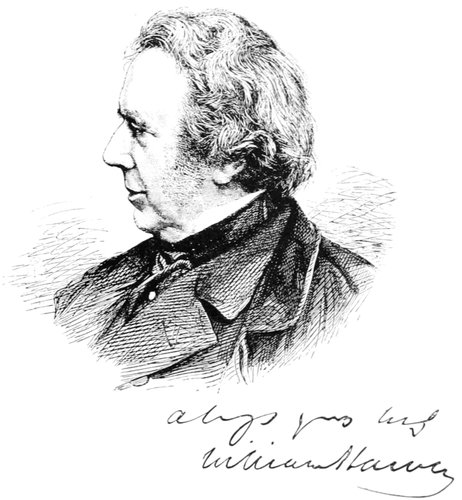
Charles Knight, Sir William Allan, R.A., P.R.S.A, John Franklin,
William Mulready, R.A., George Routledge, Sir John Tenniel,
George Cruikshank, W. E. Frost, R.A., F. R. Pickersgill, R.A.,
Fred Walker, A.R.A., R.W.S., Sir John Gilbert, R.A., P.R.W.S.,
Richard Doyle, and W. M. Thackeray.
Very early in our career we were, through our
friend William Harvey, introduced to Charles Knight,
the eminent publisher who did so much as a pioneer
in introducing cheap and good literature to the
people, as his "Penny Magazine," "Penny Cyclopædia,"
"Charles Knight's History of England," and
many other kindred works bear ample evidence.
And not only in literature but in art as well he
took a bold and leading part: see his elaborately
illustrated edition of Shakespeare's Works, the Bible,
"The Land we Live in," and many highly interesting
and instructive books. Perhaps the most
beautiful of all was the illustrated edition of Lane's
"Arabian Nights' Entertainments," a book which
must always hold a foremost place among the most
tastefully decorated volumes this country has produced.
It was only in association with Landells and
Charles Gray that we were at all connected with
this work, not having, at that time, any personal
transaction with Mr. Knight, though we subsequently
did a great deal of work for him, notably in his
"Shakespeare" and "The Land we Live in."
Mr. Ramsay, Mr. Knight's sub-editor and literary
manager, used to tell a curious story about one of
the literary contributors to these volumes, whose
name, for obvious reasons, we will withhold.
In this gentleman's early connection with Mr.
Knight, he called and had a serious conversation
with Ramsay, confessing his uncontrollable weakness
for strong drink, and that his only safeguard
was an empty pocket. He therefore begged of
Ramsay never, under any circumstances, to advance
him one penny upon his work, no matter how hard
he might plead, or what story he might tell in
urging the necessity for an advance of cash. Ramsay
was to be firm and refuse to listen to him, and on
no account to let him have money, and that all payment
for work was to be forwarded to his wife.
Ramsay promised faithful observance, and so matters
went smoothly on for a considerable time. But one
day M. N. came with a sad, doleful face, begging
for an advance of ten pounds. Ramsay positively
declined, reminding him of their compact.
"Yes, yes, that's all right, old fellow," he answered;
"but this business is quite away from
everything else. I don't forget the injunction I
laid upon you, but this is altogether different; it is
a case of the most urgent necessity." Then he went
on and told a sad, touching tale of his boy having
died suddenly, and the shock having brought on a
serious illness with his wife, while, unfortunately, he
was totally without funds to meet the unexpected
demands upon his purse, or procure a nurse to
attend upon her, as well as the comforts that were
absolutely necessary under the circumstances.
For a time Ramsay stood firmly out, always
reminding M. N. of his own proposition, but the
man was so impressively urgent, appealing again and
again on the score of his wife's critical condition,
that at last Ramsay's scruples gave way, and M. N.,
lavish in his thanks, left the office with the ten
pounds in his pocket.
It is, perhaps, needless to say that M. N. was
not seen in Fleet Street for many days, and when
he did turn up, shaky and dilapidated in appearance,
it was only to load Ramsay with the most
crushing abuse for having broken faith with him,
and when Ramsay tried to shelter himself under the
pathetic tale he had told about his sick wife and
dead son, he only replied:
"D—— the sick wife and dead son! Why
didn't you stick to your promise? I told you
distinctly that it was possible I might come with
some trumped-up story of urgent necessity, and a
lot of such rubbish, and now see what a hole
you have let me into. My son is perfectly well,
and as healthy a lad as ever lived, and as for my
wife, well, she was never better in her life, and is
only suffering from the misery brought about by
your unaccountably bad behaviour to me. I tell
you, Ramsay, you are a traitor and a false friend,
who has used me shamefully—shamefully!"
With these words M. N. left the office, but
returned within half an hour seeking condonation,
begging that Ramsay would overlook the foolish
words he had used in a moment of unjustifiable
irritation, and further show his good feeling by
advancing him a trifle—say, a sovereign? No?
Well, then, let it be five shillings? Still no! Ramsay
was obdurate, and M. N., muttering, "Cruel man!
Cruel, cruel man!" went away.
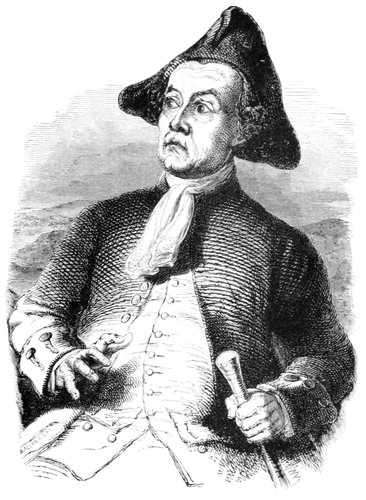
Mackay, as the Bailie Nicol Jarvie.
FROM THE ABBOTSFORD EDITION' OF "ROB ROY."
From a Painting by Sir William Allan, R.A., F.R.S.A.
By permission of Messrs. Adam & Charles Black.
In the year 1842 or 1843, through the kindness
of the late Clarkson Stanfield, R.A., we were introduced
to Mr. William Dicks, who officiated as
art agent for Mr. Cadell, the Edinburgh publisher,
then issuing a very elaborately illustrated edition of
the Waverley Novels, which he named "The Abbotsford
Edition," and employing on the work many
of the very first artists of the day, both English and
Scotch. We were entrusted to engrave a large
number of the drawings. Among the first of these
was a wonderfully life-like portrait of the Scotch
actor, Mackay, in the character of "Bailie Nicol
Jarvie," painted by Sir William Allan, R.A. and
P.R.S.A.[2] The engraving of this portrait gave
such entire satisfaction both to Mr. Cadell and
Mr. Dicks that we were constantly employed upon
the undertaking until its completion.
Among the artists whose drawings we had to
engrave during the progress of this edition of the
great "Wizard of the North's" novels, we may
especially mention William Harvey, Clarkston Stanfield,
R.A., Sir J. Noel Paton, P.R.S.A., John Franklin,
Edward H. Corbould, Sir David Wilkie, R.A.,
Alexander Christie, and Robert McIan.
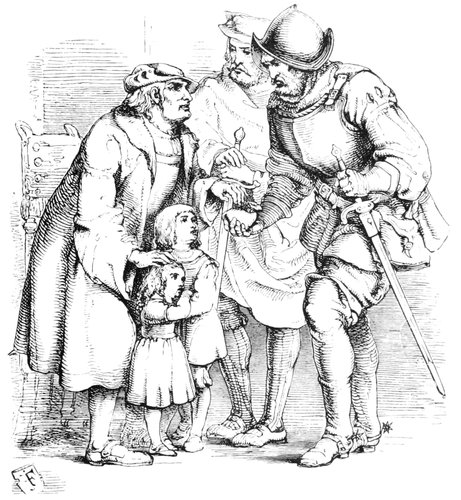
Children in the Wood. By John Franklin.
FROM CUNDALL'S SERIES OF CHILDREN'S BOOKS.
Through the friendship that sprung up with
several of these gentlemen, and our connection with
the Institute of the Fine Arts,[3] we became acquainted
with many of the young artists who were introducing
a new and more realistic feeling into the black and
white work of the day. Among them were John
Tenniel, at that time just returned from his studies
in Germany, and strongly impressed with German
Art, and what was termed "The Shaded Outline
School"; Alfred Elmore, R.A.; Fred Pickersgill,
R.A.; F. W. Topham; Edward Duncan; George
Dodgson; John Absolon; all, except the Royal
Academicians, members of the Old Water Colour
Society, and the New—now called the Royal
Institute of Water Colour Painters—besides many
others who have since risen to great eminence in
their profession.
John Absolon being then engaged on a set of
illustrations to Collins' Poetical Works, to be published
by David Bogue, he placed many of the
drawings in our hands to engrave, which was the
commencement of a long and intimate friendship—not
only with the artist, for it also opened up a
connection with Bogue which enabled us to produce
some very creditable works together.
Early in 1851 John Franklin, many of whose illustrations
to "The Abbotsford Scott" and the "British
Ballads" we had engraved, placed in our hands some
drawings he was making to illustrate a series of Fairy
Tales, edited by Sir Henry Cole, then known to the
literary world as "Felix Summerly," to be published
by Mr. Joseph Cundall of Bond Street, who was an
enlightened publisher with strong artistic taste, his
great idea being a desire to raise the character of
children's picture books. This was about the time
that Van Voorst published "The Vicar of Wakefield,"
with Mulready's illustrations; one of the first high-class
books of the period, which was so highly
thought of that Mulready said he had commissions
offered to him for pictures from these designs
sufficient to keep him at work for the remainder of
his life. It was at this time that Cundall induced
Mulready to make a set of drawings for a child's
primer: and very beautiful they are.
This series of Fairy Tales was continued, with
pictures by Frederick Taylor, P.R.W.S., H. C.
Horsley, R.A., and other artists of high repute.
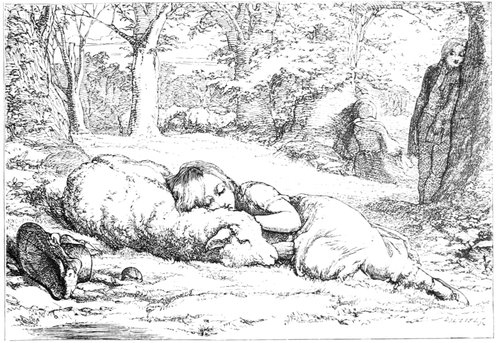
Sleeping Child and Lamb. By William Mulready, R.A.
FROM A BOOK OF POEMS BY THE REV. T. J. JUDKIN.
Our connection with these two London publishing
houses, added to the work we were doing for
Mr. Cadell of Edinburgh, tended considerably to
increase our responsibilities. And this may be the
most convenient place to state that it was at Mr.
Cundall's we were first introduced to Mr. George
Routledge, who had called for the express purpose
of asking Mr. Cundall to recommend a "good man"
to engrave a small drawing on wood, a portrait of
Sir Robert Peel, which he then had in his pocket.
The commission was entrusted to us, and thus commenced
a connection and a friendship which continued
with unabated confidence and harmony for a period
extending over forty years.
George Routledge, a strong-minded, clear-headed
man of business, in his early days used to go personally
to the larger north country towns, and get
orders from the booksellers. His capacity in this
branch was said to be something marvellous. An
old Quaker bookseller, of Darlington, told us that
Routledge never said, "Will thee buy this book?"
but that it always was with him, "Thee must take
it"; and as his wares were always good, the results
were said to be many times beyond those of any
other man "on the road." In the publishing business,
he, in combination with his partners, William and
Frederick Warne—both clever, energetic men,—made
a force which developed their vast business so rapidly
that Henry G. Bohn, the big publisher of that
day, felt so jealous of their great success, that he
used to say, "Well, it has taken three strong men
to do it." After having produced sets of pictures
by various artists, to many sorts of books, the most
important of which was a small octavo of Longfellow's
Poems, with illustrations by John Gilbert,
they invited our co-operation, assistance, and direction
in such matters, and it was then determined to do
another edition of the same poems, more extensively
illustrated by the same artist. They agreed to give
us one thousand pounds for the pictures, which was
to include Gilbert's charges as well as our own. The
book proved a great success from every point of
view, and to this day holds its own as one of the
most beautiful examples of Sir John Gilbert's work
as an illustrator. After the first edition many other
poems were added, including "Miles Standish," all
having Gilbert's illustrations to them.[4]
The book when first completed created a sensation.
We remember asking Routledge what he
thought of it. He was a pure business man. His
reply was:
"We will wait and see what the trade has to
say about it first—see whether they will subscribe
largely, and then I will tell you what I think about
it."
Edmondson, the binder, was so in love with
his part of the work that, holding the volume in
his hands, he said, "It is a beautiful book! a
very beautiful book!" then added, in a slightly
condescending tone, "And a good book inside,
too."
William Warne dying rather early in life,
Frederick Warne, his younger brother, separated from
the Routledges, after the sons of George entered
the firm, and built up a large publishing house of
his own. We were on the very best of terms
with all of them, and continued to work for both
houses for many, many years.
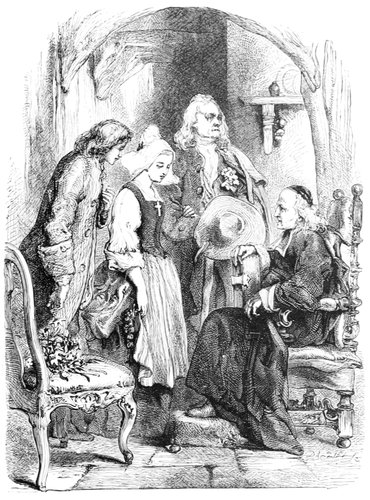
Evangeline.
FROM THE POETICAL WORKS OF LONGFELLOW.
ILLUSTRATED BY SIR JOHN GILBERT, R.A., P.R.W.S.
By permission of Messrs. George Routledge & Sons.
Frederick Warne, a really clever, many-sided
man, has now retired, but his three sons—all men
worthy of their father—continue to conduct their
large business on the old lines.
Of the many illustrated books which it has been
our lot to superintend and issue to the world, there
are two for which we are to a great extent exclusively
responsible: these are "The Spirit of Praise,"
a collection of hymns, and "Golden Thoughts from
Golden Fountains," a collection of such literary
extracts from favourite authors as the title of the
book will fully explain—one of us having spent
much of his leisure hours in collecting and arranging
their contents. The first of these volumes was
originally published in the usual quarto form, with
decorative borders and initial letters, printed in gold
and colours, and subsequently much enlarged by the
addition of many hymns as an octavo volume. The
other, "Golden Thoughts," was in its main lines
uniform with the first edition of "The Spirit of
Praise." In both of these books are many of our
own contributions, both in pen and pencil, in addition
to several very fine examples of A. B. Houghton.
"The Abbotsford Edition" of the Waverley
Novels did not prove a marked financial success,
and when the property was acquired by Messrs.
Adam and Charles Black, Edward H. Corbould, R.I.,
was commissioned to do a large number of illustrations
for their new edition of these books, nearly
all of which were entrusted to us to engrave.
In the early part of Queen Victoria's reign
Corbould held a high position as a painter in
water colour, and was one of the original members
of the "Royal Institute of Water Colour Painters"—then
called the "New Water Colour Society"—and
so highly was his artistic ability appreciated
by the Prince Consort that he was selected as
art tutor to the Royal children. Perhaps no better
selection could at that time have been made; for,
though somewhat severe in style, he was a good
draughtsman, painstaking, and of a kindly, genial
disposition. He was ever full of amusing anecdotes
of the sayings and doings of the Queen, Prince
Albert, and his pupils.
Corbould did not appear to think it possible
for any of those young people to commit a fault.
In his eyes they were all sweetness and the
perfection of goodness, "being," as he said, "without
the least appearance of affectation." When asked
if any of the young Princes or Princesses were
clever, he invariably evaded a direct answer by
saying:
"Er—well, you see, the Princess Royal makes
up for the shortcomings of all the others, she is
so very clever. Er—er—they are all clever and
very nice."
During Corbould's connection with the Royal
Family, on one occasion he wrote to us saying
the Prince of Wales had got a scrapbook, and
he was commissioned by the Prince to say how
pleased he would be if we would give him some
proofs of our engravings to put into it. We
sent a large parcel, and in return Corbould wrote
that the Prince was delighted with our contribution
and wished him to express his "Warmest
thanks to Messrs. Dalziel for their great kindness
and liberality."
"26 July, 1863,
"21 Rutland Gate,
"Hyde Park.
"Dear Sirs,—I have received the impression, as well as my
own, as also the proof for the Prince of Wales. I shall be at
Osborne either on Thursday or Friday next, and I will give it
to him. That which you engraved for the 'Keepsake, 1854,' is
very beautiful, and so I shall keep the proof. Mr. Heath will
be quite content and so shall I. You can tell him that I
require nothing done to it. I thank you for the proof, but
where are those from Spencer?[5]
"Yours very truly,
"Edward Henry Corbould."
During the early part of our career we became
associated with Mr. Samuel Carter Hall, who was
originator, editor and at that time proprietor of the
Art Journal, and in a somewhat desultory fashion
did a considerable amount of work together. Among
other matters, we engraved many of the illustrations
for "A Book of British Ballads," which was edited
by Hall and published by Messrs. How and Parsons
of Fleet Street. The drawings by Sir J. Noel
Paton, P.R.S.A., John Franklin, W. B. Scott, E. H.
Corbould, Henry Warren, and other artists, passed
through our hands. When the great International
Exhibition of 1851 was in preparation, and during
the time it was open to the public, Hall published
a series of profusely illustrated supplements to the
Art Journal, showing the various classes of objects
exhibited. On this work we were very liberally
employed. These supplements were subsequently
put together and published in one large, handsome
quarto volume as an Illustrated Catalogue of that
great and important Exhibition.
Many other catalogues, official and non-official,
were published of the Exhibition, which contained
a marvellous amount of every conceivable class of
handicraft and ingenious device, but certainly, for
comprehensive completeness, none of them at all
approached the very beautiful volume which Mr.
Hall gave to the world.
When we had finished our portion of the engravings,
he was so grateful for the help we had
given that he volunteered the promise that no other
wood engravers should ever be employed upon his
works. But perhaps it is only characteristic of the
man to say that this promise was never carried
out.
As already stated, we engraved a very large
number of drawings for Mr. Hall with undeviating
approval, and we were much gratified by the following
passage in a letter addressed to him by E. M.
Ward, the Royal Academician, on our submitting a
proof of an engraving we had executed:
"The cut is admirable in every way. I have nearly finished
the drawing of 'The Royal Family of France,' and will send it
immediately it is done. I hope you will have the 'Royal Family'
done by Dalziels', as you said it should be; they would manage
the faces much better than——
"Yours ever truly,
"E. M. Ward."
Almost as a matter of course we became associated
with Kenny Meadows, a clever, erratic genius,
and an artist of great ability. He had a wonderful
and strangely fanciful imagination, and perhaps
will be best known in time to come by his
"Illustrated Shakespeare" and his "Heads of the
People"; there is one other work which is not likely
to be forgotten, "A Head of 'Old Father Christmas,'"
which did good service for a Christmas
number of the Illustrated London News. He
was intimately connected with Orrin Smith, the
distinguished wood engraver; their earliest work
being character sketches and heads of the people
done for Bell's Life in London, which was somewhat
a pioneer in illustrated journalism. Meadows
at that time was generally known as "Iron Jack,"
from the fact of his robust health, which he
attributed entirely to a simple style of living in
his early life, much of which was spent in a
lighthouse, where, he declared, they never had
enough to eat. He said, "I used to devour my
food like a ravening wolf."
No amount of alcohol ever appeared to hurt
him, and to those who suffered from excess of
indulgence he attributed it entirely to over-eating in
their early days, before the constitution was fairly
and properly formed.
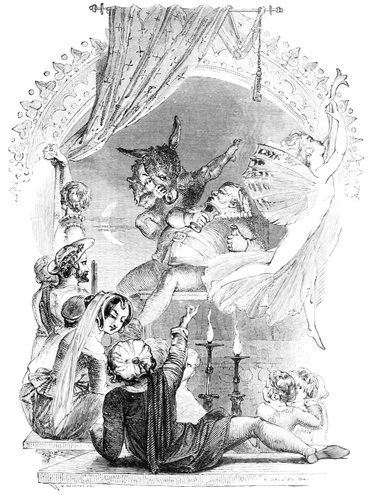
"Or sweetest Shakespeare, Fancy's child,
Warble his native wood-notes wild."
"L'Allegro" and "Il Penseroso."—Milton.
By Kenny Meadows.
By permission of the Council of the Art Union of London.
We were so closely connected with him that
when he was first asked to work for Punch, he
stipulated that we should have all his drawings to
engrave. This arrangement did not last long, for
he was of a very uncertain nature, and changeable
in his moods. His friendship was not of the kind
that would stand much, if any, strain, and after he
had "imbibed" a little, he not infrequently became
"nasty." Once at a public dinner, on the name of
Punch being mentioned, he started from his chair,
saying, "Gentlemen, I am Punch!" which really
was more than insulting to several Punch men
who were present.
At one of the early Illustrated News dinners,
Herbert Ingram, speaking of the great success of
the journal, said, "And, gentlemen, we all share
in the credit of producing this wonderful paper."
Meadows was immediately on his legs, saying,
"Yes, but have we all shared and shared alike in
the recompense?" "Yes, Mr. Meadows," said
Ingram, "we have all shared alike, according to
what we put into the venture."
While Meadows worked for the Illustrated London
News we engraved many of his drawings and saw
much of Herbert Ingram and his partners, Nathaniel
Cook and William Little. Ingram was the founder
and principal proprietor of the paper; a man of
strong character, self-willed, but both generous and
just. We were in the habit of suggesting and procuring
subjects for them.
We had induced Richard Doyle to make twelve
drawings of the months for the Illustrated London
Almanack. Nathaniel Cook disputed our charge,
but we stood out. Ingram sat quiet whilst the talk
went on. At last he said, "Have Messrs. Dalziel
done the work well?" "Oh! there is no dispute
about that; the work is well done." "Then," said
Ingram, "pay the money and let there be no dispute
about it."
That is a single, but a true, illustration of the
sort of man Herbert Ingram was.
Meadows used to say that Nature put him out,
and so it did. Looking at his raised hand with
pointed finger, he would say, "I cannot see a hand
as I would draw it."
The first time Meadows met John Leech after
he began to draw on Punch, he raved about the
drawings, said Leech was the greatest man who
had ever drawn on wood, that he, Meadows, ought
to retire from art altogether and seek some other
occupation, that his light was out, and much more
to the same purpose. But as the bottle went
round, the feeling gradually changed, and it ended
in Meadows praising his own work and telling
Leech that he must alter his style altogether if he
ever hoped to take a position as an artist—that
his work was mere commonplace drivel, and that
he must put imagination into his work "such as I
do in mine, sir."
But judged by his time, Meadows was a very
clever man with much quaint fancy. Many of his
initials are singularly pretty, and his "Shakespeare"
will always have a place in the history of black
and white work.
In Kenny Meadows' days, the artist in black
and white had not thought of the advantages of
drawing from the living model; neither William
Harvey nor Sir John Gilbert ever drew from Nature,
and George Thomas was one of the first, if not
indeed the very first, to draw on wood direct from
life. This was about the early part of the Crimean
War, and his subjects were chiefly of sailors and
their doings, and very clever they were. It created
something of a sensation at the time, for the idea
of an illustration being drawn from the life had not
before been heard of except in special cases. No
doubt Mulready had life models for his "Vicar of
Wakefield" drawings, and later on Millais never drew
without the life, nor did any of the pre-Raphaelite
School, but this was the gradual and natural development
of a new method, and innumerable drawings by
the younger artists which passed through our hands
were all drawn direct on wood from the life.
After spending much time and labour in
experimenting, as well as spoiling a great many
blocks, we succeeded in getting fairly good photographs
for the engraver's purpose on other pieces
of wood, and so the valuable original drawings were
preserved. This success was obtained about the
beginning, though not at the very beginning, of our
operation on the Bible illustrations. Then followed,
as a matter of course, the constant practice of making
drawings upon paper which were photographed on
wood. By this means nearly all the exquisite drawings
in black and white made by Leighton, Poynter,
Houghton, and many other of the artists who worked
in association with us have been preserved, and now
adorn some of the public permanent galleries.
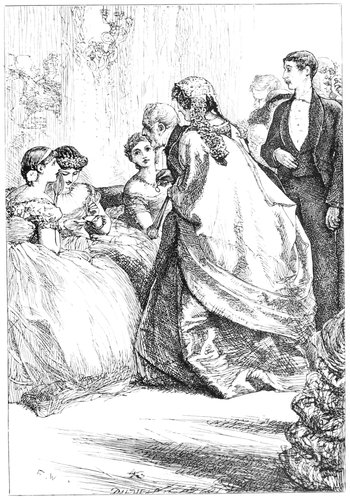
A Ball-Room. By Frederick Walker, A.R.A., R.W.S.
FROM "LONDON SOCIETY."
By permission of Mr. James Hogg.
Among the early drawings by John Leech that
passed through our hands were those he made for
Thackeray's "Irish Sketch Book," which were probably
copied from Thackeray's own pencil work, for
he was not above having help on his drawings,
the result not always being such as he expected.
One day he said to Joseph Swain, "Why don't you
engrave my drawings to come out like John Gilbert's—his
work always looks so strong and mine so weak
and scratchy?" Swain tried other helping hands,
but seldom with satisfactory results. It was in this
way that Fred Walker's connection with Thackeray
began, Swain having induced him to work on the
author's drawings, which he did on one or two,
but very soon declined to go on with them.
Walker asked that he might make original drawings
direct from the story in his own manner, to which
Thackeray agreed; and the result was a fine set of
drawings for "Philip" and for other stories, as well
as a close friendship between author and artist, only
broken by the death of the great novelist.
We engraved many of Leech's drawings, notably
the first he did for Punch—"Foreign Affairs" (as
before mentioned). It was a full page, and had to
be worked at from the moment it came into our
hands till it was given to the printer.
John Leech, speaking of Frith's picture of "The
Derby Day," could not understand how it was that
Frith, in this carefully thought out and elaborate
work, had missed one of the most notable facts at
such places—inasmuch as he had not depicted anyone
of the crowd smoking a pipe or cigar.
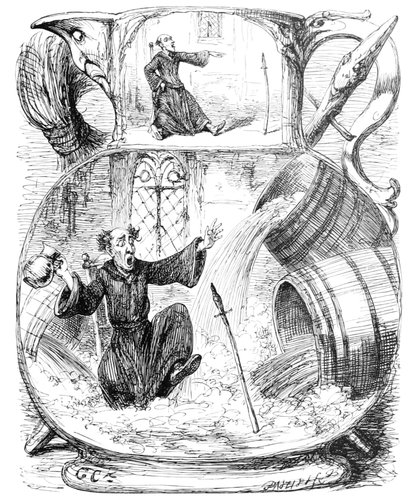
A Lay of St. Dunstan. By George Cruikshank.
FROM THE "INGOLDSBY LEGENDS."
By permission of Messrs. Macmillan & Co.
The vain, versatile George Cruikshank believed
himself another "Admirable Crichton." He really
thought he could do anything, and that most of
his time having been spent as an illustrator was the
result of circumstance and not of choice. He was
impressionable in the highest degree, and depending
on the subject under notice, immediately realised
and expressed his ideas of what "should be done,
and what he would have done if things had
favoured him for a career in that direction." Once,
the question being of a naval character, he said,
"It was by the merest chance that I did not
go into the Navy; and with my knowledge of such
matters, no doubt I would have been a Rear-Admiral."
He was great, also, on the Army, and
no doubt felt that had circumstances drifted him
in that direction, he would have become another
Duke of Wellington. No man ever had greater
faith in self than the clever, excitable George
Cruikshank.
On the occasion of his exhibiting a small oil
picture at the British Institution, called "The
Dropped Penny," the fact that it was purchased
by Prince Albert no doubt called extra special
attention to it, to the extent that it might have
been sold many times over. One gentleman was
most anxious to have it; or, if this was impossible,
would he make a replica? This George
declined to do, but undertook a commission, only
on the understanding that choice of subject and
of size were to be left to him. This was readily
agreed to. "The Dropped Penny" was a little
thing about 18 by 24 inches. It was a comic
picture—two urchins in church, one of whom having
dropped a penny on the stone floor is about to
pick it up, but they are observed by the Beadle.
When the new work was completed, the gentleman
was invited to see it. He found, to his
amazement, a picture 16 feet by 20 feet; subject,
"The Raising of Lazarus."
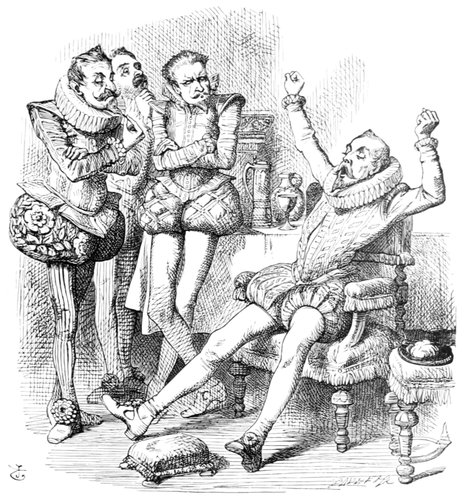
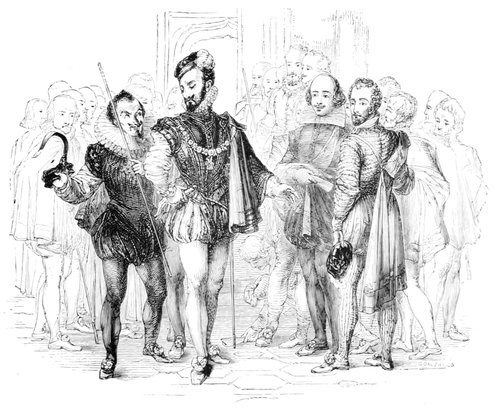
The Lord of Toulouse. By Sir John Tenniel.
FROM THE "INGOLDSBY LEGENDS."
By permission of Messrs. Macmillan & Co.
George always thought his true forte was the
Grand Historical, and with much cause, when we
think of his wonderful illustrations to Harrison
Ainsworth's "Tower of London," "Windsor Castle,"
and other romantic histories.
In the illustrated edition of the "Ingoldsby
Legends," published by Messrs. R. Bentley & Son,
we had the good fortune to engrave nearly all
the drawings contributed by John Tenniel and
George Cruikshank. During the progress of the
work we saw much of the latter gentleman, who
was an exceedingly entertaining companion, being
always ready with some anecdotes or reminiscences
of his experience. Amongst his many grievances
(and George Cruikshank's stock was an assorted
one) he complained bitterly of the treatment he had
received at the hands of Charles Dickens, with
reference to the authorship of "Oliver Twist."
Cruikshank maintained "that he had not only
suggested the subject to Dickens, but that he had
also given him the entire plot, sketched the characters,
arranged all the incidents, and, in fact,
constructed the entire story; so much so, indeed,
that the book was, to all intents and purposes,
HIS; for all that Dickens had to do with it was
TO WRITE IT OUT, and any man who could hold a
pen might have done it better"; concluding with,
"I am only sorry now I didn't do it myself."
Those were the old man's identical words, as
spoken to us.
On one of his visits he related the following
interesting circumstances in connection with his
famous publication of "The Bottle."[6] This was a
series of pictures, the first showing a young, well-conditioned
mechanic, sitting in his small, comfortably
furnished room surrounded by his wife
and three or four children; then followed in order
how, in consequence of a constantly increasing
habit of intemperance, they sink gradually down in
the scale of life, until they go entirely to ruin; his
sons to penal servitude, and his daughter to degradation,
while both his wife and himself die in the
greatest misery and want.
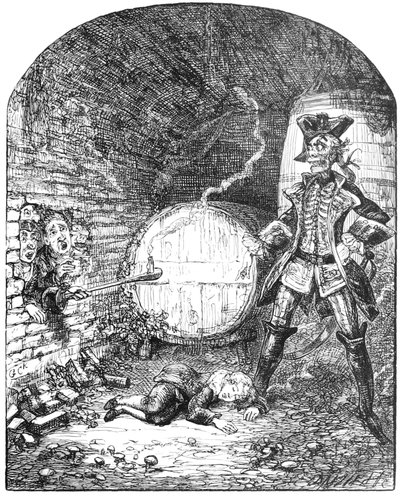
The Wedding Day. By George Cruikshank.
FROM THE "INGOLDSBY LEGENDS."
By permission of Messrs. Macmillan & Co.
When on the eve of publication, Cruikshank
obtained permission to submit the etchings to
Dr. Blomfield, the then Bishop of London. The
Bishop took great interest in looking at the
pictures, and asked many questions as the series
was turned over, expressing his great admiration
in the warmest terms. Then turning and looking
Cruikshank full in the face, he said:
"And am I right in coming to the conclusion,
Mr. Cruikshank, that you are a staunch total
abstainer?"
Cruikshank, in relating this incident to us, said
he never in all his life felt himself in such an
awkward position, for he was obliged to confess
that he did indulge in a little alcohol—occasionally—and
that in great moderation.
"You astonish me, Mr. Cruikshank!—you very
greatly astonish me!" said the Bishop. "For how
a man who is able to depict so forcibly all the
misery, the horrors and degradation arising from
the indulgence in strong drink as you have done,
and himself indulge, even in a moderate degree,
is a mystery which I cannot understand."
"On my way home," continued Cruikshank, "I
felt so inexpressibly ashamed of myself, and how
true the Bishop's remarks were, that I resolved
at once to begin the change which I had long
contemplated, and I subsequently succeeded in
bringing about the desired effect.
"It so happened that a few days after my
interview with the Bishop, I received an invitation
to dine with a gentleman who was famous in
Society for the recherché character of his frequent
dinner parties, where the wines were of the
choicest brands and most tempting quality, and
everything was served in the most dainty and
perfect fashion.
"Now is the time, I said to myself, to prove
my strength of purpose. I was successful in resisting
all temptation, and left the house after
spending a delightful evening without having tasted
a single drop of any other liquid than water.
"The next morning when I went into my
study," continued Cruikshank, "I patted my head
and said, 'George, old boy, you have done well!
You have succeeded, George. You have gained
a gigantic triumph, and now you must go on,
unflinchingly, and conquer!'—and I did. From that
day no alcohol of any description ever crossed my
lips, and never shall! Never! I'd rather die first!"—here
the gallant old fellow posed himself in a
dramatic attitude, and throwing out his left arm,
and striking his right hand sharply upon his breast,
cried in his ringing voice, "Fire!"
During the latter half of his active life he gave
much of his time to the cause of temperance,
and no doubt his influence had very great effect.
At one of his lectures on the subject at Exeter
Hall he held up a brand new "pot" hat of shiniest
kind and said, "Ladies and gentlemen, this hat
as you see it represents George Cruikshank, the
temperance advocate, as he now is." Then
throwing the hat to the ground, the brim being
undermost, he jumped on the crown, crushing it
flat, then holding it up to the audience, shouted,
"And this represents George Cruikshank, the
drunkard, as he was!"
The old man stuck to his resolution for the
remainder of his life, and even on his death-bed,
when his medical attendant, the late Sir W. B.
Richardson, himself a staunch total abstainer, prescribed
that small quantities of brandy should be
taken—of course medicinally—he persistently refused
to drink it, and so died at an advanced age, firm
in the determination which he had formed many
years before that not a drop of alcohol of any
description should ever pass his lips again.
The first drawings by F. R. Pickersgill that
came into our hands to engrave were for "Poems
and Pictures," an early "fine art" book, published by
J. Burns, of Orchard Street, which contained designs
by many of the leading artists of the time, including
several by W. Dice, R.A., Cope, R.A., Creswick, R.A.,
and others. Our connection with Pickersgill—one of
the kindest and best of men—soon ripened into a
close friendship, and it was to him that we gave the
first commission at our own cost for a set of drawings
to illustrate "The Life of Christ," desiring to
follow the example of Rethel's "Dance of Death,"
which had just been published in Germany at a
very small price.
Our first Part contained six large pictures, printed
with a flat tint, the price being one shilling. The
second Part, "The Miracles of our Lord," contained
the same number of pictures, and at the same price.
Our attempt to produce high class art at what was
then thought to be a nominal price was not responded
to. Other interests were too strong for
us; and although we tried the aid of some first-class
publishers the scheme would not take. We
well remember calling on a well-known publisher of
Scripture work, who, admitting the excellence as
well as the cheapness of the publication, summed
up his refusal to purchase copies with the remark,
"I really cannot afford to set your cask of wine
alongside my barrel of beer."
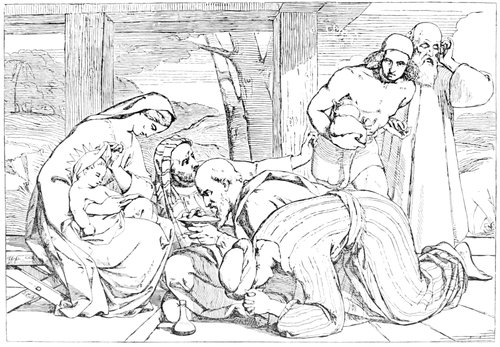
The Adoration of the Maji. By F. R. Pickersgill, R.A.
REDUCED COPY FROM ONE OF HIS PICTURES FOR "THE LIFE OF CHRIST."
Published for the Brothers Dalziel by Messrs. Chapman & Hall.
Pickersgill made drawings for many of the fine
art books produced under our care. He also made
a series of large drawings on the subject of "The
Lord's Prayer," the text of which was paraphrased
in verse by Dean Alford; the book being published
by Messrs. Longman & Co. He also contributed
many beautiful drawings for our Bible Series.
A friend of Pickersgill, the Rev. T. J. Judkin,
an eloquent preacher and clever amateur artist, and
a pupil of Constable's, produced a Volume of Poems
to which many of his artist friends contributed drawings,
amongst whom were F. R. Pickersgill, R.A.,
W. Mulready, R.A., Clarkson Stanfield, R.A., E. M.
Ward, R.A., and W. E. Frost, R.A., all of which
we engraved for him.
F. R. Pickersgill, R.A., J. C. Hook, R.A., and
W. E. Frost, R.A., formed a trio in their student
days, working much together, and all illustrating the
same subjects—chiefly passages from Spencer's
"Fairy Queen," and Italian or Venetian History,
basing their style very much upon the Early Italian
School. Later in life a closer tie existed between
two of these artists, Pickersgill marrying Hook's
eldest sister.
Pickersgill told us a somewhat comical experience
Hook had with the Council of "The Art Union of
London," who were then procuring a set of drawings
on wood by various artists. One subject having
been entrusted to Hook, he sent his drawing in,
and was asked to call at a stated time, which he
did. He saw at once there was something wrong, as
the gentlemen sat looking at each other. At last
one mustered courage to speak, saying:
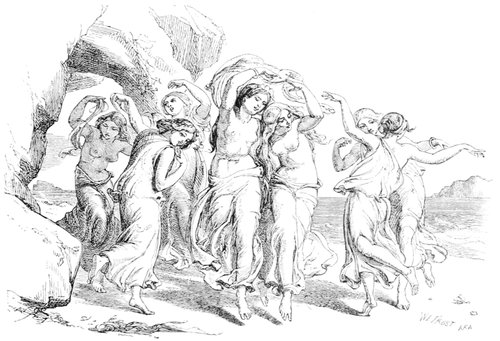
Fairy Dance. By W. E. Frost, R.A.
FROM A BOOK OF POEMS BY THE REV. T. J. JUDKIN.
"We like your drawing very much, Mr. Hook,
but—er—doesn't it want colour?—er—where—er—where
is your bit of black?"
"I don't want a bit of black," said Hook.
"Oh, but we must have a bit of black. There's
Mr. B——, now, he always gives a bit of black."
Hook, feeling fearfully annoyed, took up the
drawing, and dipping his finger in a glass of water,
smeared it over, saying:
"There, gentlemen, there is your 'bit of black,'"
and throwing down the drawing, left the room.
The following short letter from Mr. Hook,
which bears upon this subject, will be of interest:
"Tor Villa, Kensington,
"8th April.
"Dear Sirs,—I do not manage wood-drawing well at all—not
well enough even to do me credit, or I would have done
you a drawing with pleasure. I failed some time back in doing
one for the Art Union, and recollecting that the blocks they
sent me had your name on them, I return them also.
"Believe me, dear Sirs,
"Yours truly,
"J. C. Hook.
"Messrs. Dalziel."
In a conversation with Richard Doyle he told us
that his father (who was the celebrated "H.B.," a
political caricaturist during the thirties and forties)
always urged his sons to practise drawing from
memory, taking all sorts of subjects; that in their
walks they should always try to remember one or
more figures they had seen, and immediately on their
return home, make the best drawing they could in
pen and ink; also to frequent the National Gallery
or other important picture exhibitions, remaining in
front of any one picture that might attract their
attention until they had fairly mastered the subject,
and then to make the best recollection of it in pencil
or colour as they felt inclined. He highly approved
of this method, and felt he had derived great benefit
from the process himself.
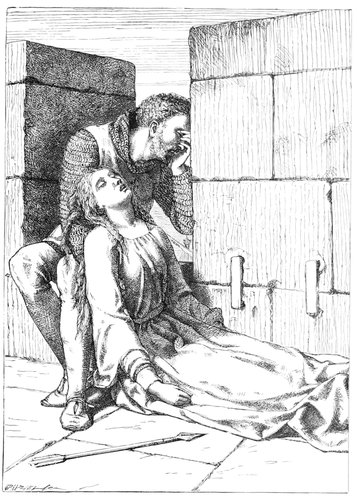
"O breaking heart that will not break,
Oriana!
O pale, pale face so sweet and meek,
Oriana!
Thou smilest but thou dost not speak,
And then the tears run down my cheek,
Oriana!"
—Tennyson.
By F. R. Pickersgill, R.A.
By permission of Messrs. George Routledge & Sons.
Doyle had a facile pencil when once fairly at
work, but he was singularly deficient as to the value
of time, which appears strange in one who produced
so many elaborate drawings; but little reliance could
be placed upon him even when working for periodical
publications. On one occasion when illustrating a
story by Thackeray, the number had to be issued
short of certain pictures that had been arranged
for. Thackeray was a good deal annoyed and
asked Doyle if he could give any reason why he
had not done the drawings. He replied in his
cool, deliberate manner: "Eh—er—the fact is, I
had not got any pencils."
The matter of pencils was always one of some
trouble and difficulty with Doyle. The following
letter is a fair example of what was a not infrequent
occurrence:
"17 Cambridge Terrace, Hyde Park.
"My dear Sirs,—For the reason that if I see my way in
anything about the realities of the Exhibition, I feel bound to
do it for you and Chapman, I must decline Mr. Bogue's proposal.
"I intended to have spoken to you the first time I saw you
about pencils for drawing upon wood; do you know a good maker?
It is impossible to get anything of the kind at this end of town.
If it would not be troubling you too much I would be very much
obliged to your getting me half a dozen of the hardest, and sending
them the next time your messenger comes to me?
"You probably know the best makers, which I do not, having
always got my pencils through the Punch engravers.
"Yours very truly,
"Richard Doyle."
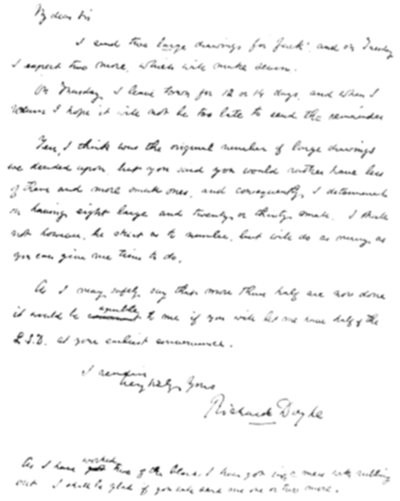
My dear Sir
I send two large drawings for Jack, and on Tuesday
I expect two more, which will make seven.
On Thursday I leave town for 12 or 14 days, and when I
return I hope it will not be too late to send the remainder.
Ten, I think was the original number of large drawings
we agreed upon, but you said you would rather have less
of them and more small ones, and consequently I determined
on having eight large and twenty or thirty small. I shall
not however, be strict as to number, but will do as many as
you can give me time to do.
As I may safely say that more than half are now done
it would be agreeable to me if you will let me have half of the
L.S.D. at your earliest convenience.
I remain
Very Truly Yours
Richard Doyle
As I have worked two of the blocks, I have got into a mess with rubbing
out. I shall be glad if you will send one me or two more.
We gave Doyle a commission to do a Panorama
of an Overland Journey to the Great Exhibition of
1851, which it was intended should be published
before, or immediately after, the opening day. We
need hardly say the drawings were not done to
time; in fact, the last of them was not finished until
just on the closing of the Exhibition, consequently
the publication was a dead failure.
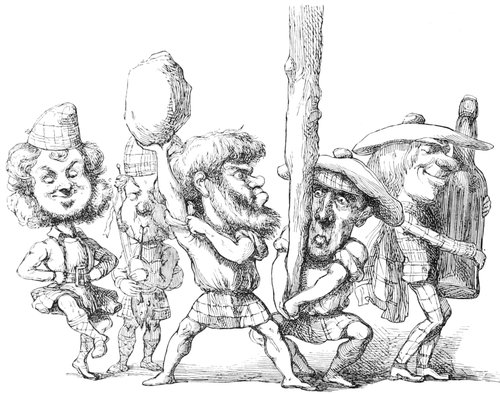
"Scotland."
FROM "AN OVERLAND JOURNEY TO THE GREAT EXHIBITION OF 1851."
By Richard Doyle.
Published for the Brothers Dalziel by Messrs. Chapman & Hall.
It is greatly to be regretted that Doyle did
not see his way to complete this work at the
date agreed upon, and while the great excitement
about the Exhibition was at fever heat, for the
characteristic humour which is so peculiarly his own,
and so cleverly depicted in the various Nationalities
forming the Panorama, must have secured
for the work a very extensive circulation, and
thereby have added greatly to his reputation.
"Dear Sir,—With regard to the Exhibition procession, I
would like to have your opinion as to whether, now the 'Glass
House' being open and the public so much seriously occupied
with the Exhibition, my drawings will be relished. I don't express
any decided opinion now myself, but I put it to you and would
like you to ask Mr. Chapman his opinion. I saw the 'procession'
that came out a long time ago for the first time the other day
to look over, and I really did not know before that the idea was
so much the same as mine, and I greatly fear that mine will be
thought stale, however original I can make it. It is, in fact, next
to impossible to represent any of the countries by other types than
those already done in publications already out.
"As far as I myself am concerned—much time as I have
lost over this, to me, unfortunate subject—I would rather sacrifice
it as lost time than bring out a failure. I cannot expect you, who
have also spent some time upon the work, to feel the same.
"What occurred to me, however, was that perhaps the drawings
of the 'procession' might be engrafted upon something else, of
which it might form a part. I don't see my way, but I throw it
out, and would like to have your notion on the subject.
"Very truly yours,
"Richard Doyle."
When Doyle retired from contributing to Punch,
we gave him a commission to illustrate all the popular
Children's Nursery Tales. He expressed himself
delighted to undertake the work, and "Jack the
Giant Killer" was to be the first. This was done,
and published by Cundall and Addy of Bond Street.
"The Sleeping Beauty" was the second, but the
drawings for this book came so lingeringly to hand
that the idea of a series was abandoned, and the
blocks were put aside for some time. Those we
had, however, were considered so beautiful, and so
full of quaint fancy that we decided to enlist the
co-operation of J. R. Planche to set new words to
them, which he did very charmingly, and the book
was published for us by Messrs. G. Routledge and
Sons, under the title of "An Old Fairy Tale Told
Anew." Those two stories were all Doyle ever
did for the series; and their production extended
over several years instead of a few months, as
would have been the case in the hands of a more
business-like artist.
"My dear Sirs,—I send the drawing, which has occupied
me almost all the week, and you will see that there is plenty of
work in it. The subject is taken from these words in Jack's
history: 'He delighted in reading stories about wizards, giants
and fairies, and listened eagerly when anybody related the brave
deeds of the Knights of the Round Table.'
"It is intended to be the first page of the book (not the
title page), and type is to go into the space left in the centre.
"I feel a little anxious about the engraving of the upper
half of this drawing, which represents the legend told by the old
woman, as I have never yet had that etching style of drawing
engraved perfectly to my satisfaction; perhaps that is impossible,
but, at all events, as there is plenty of time I shall expect this
to be a chef d'ouvre of wood engraving, as I certainly look for
more than ordinary care in this drawing.
"I have begun another large drawing, which I expect will
be ready for you on Monday at six o'clock.
"Very truly yours,
"Richard Doyle."
We cannot help feeling that much excellent work
has been lost by Doyle not carrying out this
scheme, and fancy what exquisite things he would
have made of "Cinderella," "Jack and the Bean
Stalk," etc., etc.
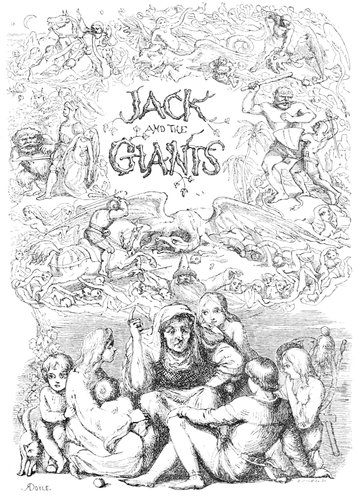
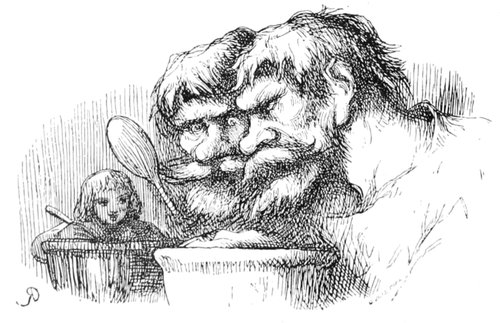
FROM "JACK THE GIANT KILLER."
By Richard Doyle.
Published for the Brothers Dalziel by Cundall and Addy.
"17 Cambridge Terrace, Hyde Park.
"Monday.
"My dear Sir,—I hear from my brother that you called
some days ago wishing to see me. I have settled in town again,
after an absence of near three months, and shall be happy to see
you at any time. You probably wished to see how the 'Sleeping
Beauty' was going on, and I have to relate a misfortune connected
therewith; I am sorry to say, several drawings which I
had packed in my portmanteau got so rubbed during my journey,
that while some were only injured, some were quite spoiled. I
have doctored two or three of these, which will be ready for
your messenger whenever you will be good enough to send. I
shall certainly let you have all the drawings in time to be out
for Easter.
"If you could let me have the half of the sum agreed upon
for the illustrations, thirty pounds, as early as convenient to you,
I should feel much obliged. I think something was said about
paying half when half the drawings were done, and therefore I
am not strictly entitled to it yet, but forestall the time as it will
be a convenience to me to have the money now.
"Yours very truly,
"Richard Doyle."
Notwithstanding his tardiness, so long as Doyle
continued to draw upon wood we were in constant
communication with him, engraving his productions.
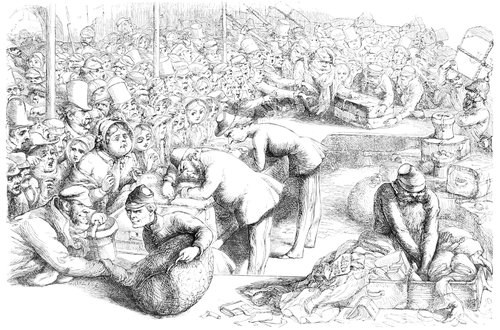
The Arrival at Cologne. "The Passengers Passing their Examination."
FROM "BROWN, JONES AND ROBINSON," BY RICHARD DOYLE.
By permission of Messrs. Bradbury & Agnew.
Among these may be mentioned many of the illustrations
he did for Charles Dickens' Christmas
Stories, as well as those he made for Ruskin's charming
fairy tale, "The King of the Golden River,"
Leigh Hunt's "A Jar of Honey from Mount
Hylba," and the entire set for "Bird's-Eye Views of
Society," published in the Cornhill Magazine. We
also engraved a large number of his "Brown, Jones
and Robinson" pictures. He proposed to us a
scheme for doing a companion volume: "Brown,
Jones and Robinson in the Highlands of Scotland,"
but through his dilatory disposition, and the many
and varied engagements we had at that time on our
hands, the project was not carried out.
Although we had been accustomed for several
years, through our connection with Ebenezer
Landells and the Illustrated London News, to work
upon Sir John Gilbert's drawings—perhaps among
the very first was a small drawing of "Cupid
Delivering a Love Letter," published in an early
number of Punch—it was not until 1851 that we
came into active communication with him. Our
first personal interview was to ask him to make
two drawings, a title page and frontispiece to
"Praise and Principle." He took a small foot rule
out of his pocket, measured the size of the two
wood blocks, and said, "The price will be thirty-five
shillings each, but I could not possibly give
them to you tomorrow; but the next morning you
may rely on having them." The drawings were
duly sent, and with them an account for the
sum named; also a letter to say he had made a
mistake in the price, and that all future drawings
of the same size and character would be two
guineas each. This promptitude, it is worthy of
remark, was a striking characteristic of the man,
for during the many years that we were in
constant intercourse with him, and engraved many
hundreds of his drawings, we have no remembrance
of him ever being a day behind the time
he promised to send in his work.
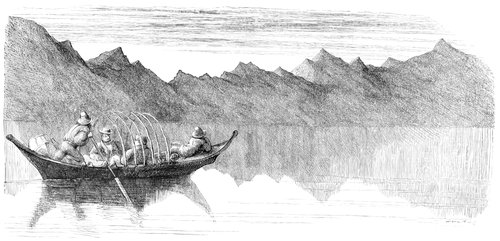
Evening on the Lago-Maggiore.
FROM "BROWN, JONES AND ROBINSON" BY RICHARD DOYLE.
By permission of Messrs. Bradbury & Agnew.
The drawings for "Praise and Principle" were
followed by many sets of illustrations, generally
eight in number, for books issued by the Messrs.
Routledge.
As an example of his peculiar method of book
keeping in those early days the following letter
will be interesting:
"Vanburgh Park,
"Blackheath, June 2nd.
"Dear Sirs,—I am now going out to send the drawings by
the Parcels Delivery Company. Will you kindly let me know that
you have received them safely?
"My charge for the four is twelve guineas. As I have no account
with any one now, and therefore no book wherein to enter such
a transaction, only a pencil mem. stuck into a frame on the wall,
I will ask you at your convenience to let me have a cheque for
the amount.
"Very truly yours,
"John Gilbert.
"Messrs. Dalziel."
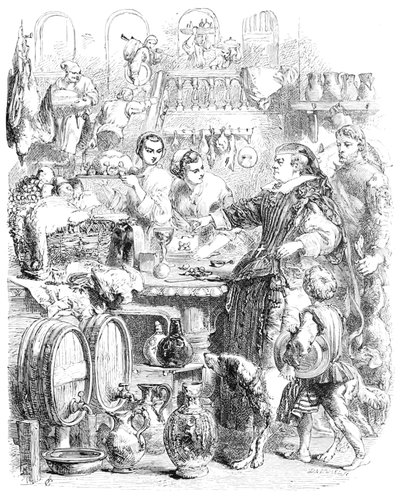
"His mother she prepared a feast—
Great stores of venison and wine."
"The Salamandrine."—Dr. Charles Mackay.
By Sir John Gilbert, R.A., P.R.W.S.
By permission of Messrs. George Routledge & Sons.
Early in 1852 we were commissioned by Messrs.
Ingram and Cook, who had then added a book
publishing business to their other operations, to
engrave the pictures for an édition de luxe of
Dr. Charles Mackay's beautiful and fantastical
poem "The Salamandrine," which Sir John Gilbert
had undertaken to illustrate; and it may be confidently
said that of the thousands of drawings which
he afterwards made he never surpassed the charm
and grace of his manipulative skill as shown in this
exquisitely decorated volume. The book was very
beautifully got up and most perfectly printed. Of
our labour and part in the production, perhaps it
may be sufficient to quote a short note Dr. Mackay
wrote to us on the subject:
"December 27th, 1852.
"My dear Sir,—I cannot but express to you and your brother
how gratified and obliged I feel for the care you have bestowed
upon the illustrations for 'The Salamandrine.' I think they are
triumphs of the art of wood engraving, and I sincerely hope that
your efforts will be amply rewarded not only in present and
future reputation but in pecuniary advantages.
"The Morning Chronicle of Saturday contains a fitting tribute
to your exertions, and it is likely, I think, that other papers will
follow in the same strain.
"Believe me,
"Ever yours truly,
"Charles Mackay.
"E. Dalziel, Esq."
Following "The Salamandrine," began the most
important works of our lives, and it was through
the enterprise of Messrs. Routledge and Warne
that we were enabled to produce so long a list of
"Fine Art Books," some of them on commission,
and many others entirely on our own responsibility.
These also brought us many important commissions
from such houses as Messrs. Longman & Co.,
W. Blackwood & Son, Smith, Elder & Co.,
J. Nisbet & Co., Appleton & Co., New York,
Roberts Brothers, Boston, and several other publishers
of high standing both in England and
America.
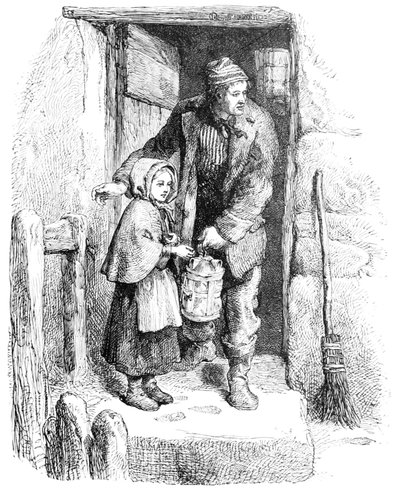
Lucy Gray, or Solitude.
"To-night will be a stormy night,
You to the town must go,
And take the lantern, child, to light
Your mother through the snow."
—William Wordsworth.
By Sir John Gilbert, R.A., P.R.W.S.
By permission of Messrs. George Routledge & Sons.
An important feature in Sir John Gilbert's
practice in this branch of his art was his marvellous
power of design, and wonderful dexterity in execution.
On one occasion during the progress of his
work he spoke of a drawing that had given him
some trouble. He said, "Would you believe it,
sir, I was so dissatisfied with it that I absolutely
rubbed it out." He was asked one day whether
he ever made an alteration on any other drawing
for "The Salamandrine." He replied, "Was there
ever any evidence of such a thing?"
But the greatest work of his that passed through
our hands was Staunton's "Shakespeare," also
published by Messrs. Routledge, the publication
extending over four years. Vast as it was, he
never disappointed us as to time, and when we
take into consideration the number and elaborate
character of the drawings, his regularity in sending
them in was really surprising. The system
adopted was to leave the tailpieces at the end of
each Act to be drawn according to the size of the
spaces left on the pages, and it was our custom
to send a set of sheets of a Play down to him by
special messenger with the understanding that he
was to bring the drawings, four or five, as the case
might be, back with him the same evening, which
he always did: many of them being so elaborately
and so carefully finished as to prove that Gilbert
literally had the subjects at "his fingers' ends."
The following letters are of interest as expressing
Gilbert's opinion and impression on seeing the
first number of this important work:
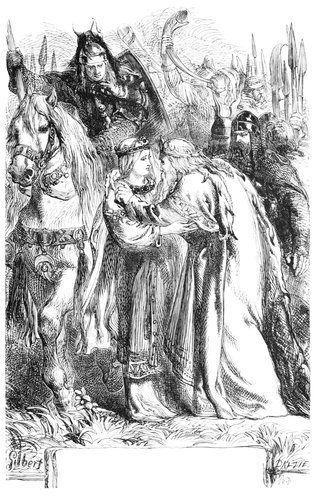
King Lear.
ONE OF SIR JOHN GILBERT'S EIGHT HUNDRED AND
THIRTY-TWO ILLUSTRATIONS TO THE
WORKS OF SHAKESPEARE.
By permission of Messrs. George Routledge & Sons.
"Blackheath,
"Wednesday Evening.
"Dear Sirs,—I have looked at, examined, and criticised the
first number of 'Shakespeare' to that extent that positively I
hardly know what opinion to express of the first fruits of our
labours.
"The Frontispieces will be an immense addition; without
them it seems that there are not enough pictures for the money—and
yet, eighteen cuts such as these are is surely a good shilling's
worth. It appears to me—mind, I don't feel quite convinced of
it, for, as I said before, I've so over and over considered it that
I get quite confused—that large cuts are wanted, fewer and larger.
What do you think of two cuts to each act, and those, ten in
all, larger, keeping the little ones for tailpieces, where necessary
to have a tailpiece?
"Turn this over in your mind, and if you think it desirable,
consult Messrs. Routledge. I cannot help thinking ten cuts,
about two-thirds the size of the space occupied by the type,
would have a greater effect, and I should say cost no more
than the sum laid down.
"You desired to have my opinion of the number, but I
fear you will say, 'Here is no opinion at all.'
"Believe me to be, dear Sirs,
"Yours truly,
"John Gilbert."
On the completion of the first volume, he says:
"Mr. Routledge and Mr. Warne both wrote to me expressing
their great satisfaction with the last number, and I suppose it
must be considered a good shilling's worth. You know how I
appreciate your labours; there are cuts in the last number that
cannot be exceeded, and looking at the volume, I think, for general
even goodness of style in engraving, it has never been excelled."
That the printing of some of our books was
not at all times faultless, the following note from
Sir John Gilbert will testify. In acknowledging a
volume of India proofs, he says:
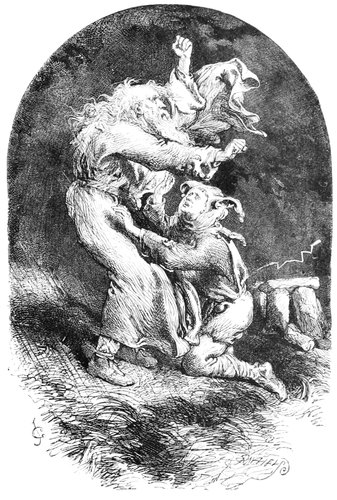
King Lear and Fool in a Storm.
Lear. "Blow, winds, and crack your cheeks! rage! blow!
You cataracts, and hurricanoes, spout
Till you have drench'd our steeples."
—Shakespeare.
By Sir John Gilbert, R.A., P.R.W.S.
By permission of Messrs. George Routledge & Sons.
"I write to acknowledge a volume of proofs. Its size and
thickness impressed me, and I don't well know how sufficiently
to thank you for having had the proofs bound up with such care
and taste. I can only say that I thank you very much for it, and
that it will be highly valued by me. I had no idea of the magnificent
style you had intended to get it up. Comparing these proofs
with the impressions in the volume of poems, I am more than
ever impressed that the printer has not done his part properly:
the difference is immense.
"Believe me, very truly,
"John Gilbert."
About this time W. Harrison Ainsworth was
editing "Bentley's Miscellany," and published some
of his own works through that journal, Sir John
Gilbert making the illustrations to "The Lancaster
Witches," which were entrusted to us for engraving
and printing. In sending a cheque, Ainsworth
wrote:
"I have much pleasure in sending you a cheque in payment
of your account for the engraving and printing of the designs, all
of which have my entire satisfaction."
Again, in another letter accompanying a set of
drawings by Gilbert, illustrating "The Constable of
the Tower," he says:
"I have always thought Mr. Gilbert's illustrations to 'Lancaster
Witches' as in every way charmingly engraved, and I have no
doubt the present cuts will equal them, if not surpass them, in
beauty.
"Ever yours truly,
"W. Harrison Ainsworth."
While the illustrations to "Shakespeare" were
in progress we had two sets of engraver's burnished
India proofs taken by skilled hands, under our own
special care, before the wood blocks were delivered
to the printer. One set, we are pleased to say, is
now the property of the British Museum, where
they will remain in all their original beauty.
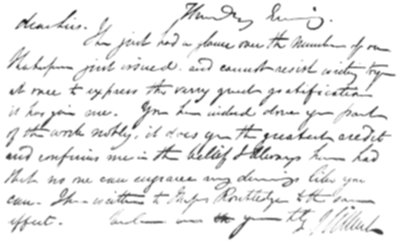
Thursday Evening
Dear Sirs,
I have just had a glance over the number of our
Shakespeare's just issued, and cannot resist writing to you
at once to express the very great gratification
it has given me. You have indeed done your part
of the work nobly, it does you the greatest credit
and confirms me in the belief I always have had
that no one can engrave my drawings like you
can. I have written to George Routledge to the same
effect.
Believe me yours truly
John Gilbert
Sir John Gilbert died at his house, Vanburgh
Park Road, Blackheath, on October 5th, 1897, in
his 81st year.
His brother, Mr. Frederick Gilbert, writing on
his death, says, "My brother, Sir John, had a long
and distressing illness, but we are thankful to think
not a very painful one—he died very peacefully."
A friend of Sir John's called upon him a few
months before his death and found him hard at
work, and making a favourable remark about the
picture he was engaged upon, the veteran replied,
quite seriously, "Well, yes! I think I'm improving."
"And I am told, Sir John," continued the friend,
"that you have never painted from the living
model."
Sir John turned his head, with an amused look
about the eyes, saying, "Well, to tell you the
truth, I cannot remember the time when I did
so."
The writer of a highly appreciative article in
the Magazine of Art, says, "Though Sir John
Gilbert painted art in every branch, it is only
in one, and that not in the public estimation the
one by which he defies the rivalry of all comers,
that he showed himself head and shoulders above
the draughtsmen of his time.... Distinguished
as he was as a painter, it is in virtue of his
achievements in black and white that he takes his
place among the few masters, not of his age and
country only, but of all time, who through the
medium of the hand and printing press have ranged
themselves among the highest.... He may be
voted old-fashioned for the moment, but real art
rises superior to mode or vogue in taste: it has
time upon its side.
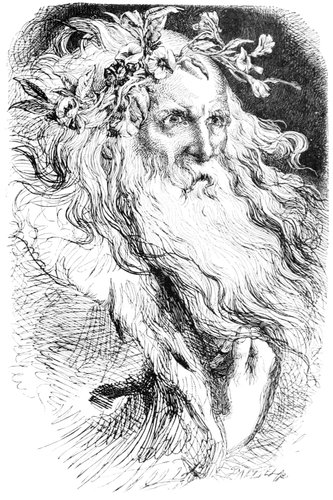
Lear Fantastically Dressed with Flowers.
By Sir John Gilbert, R.A., P.R.W.S.
By permission of Messrs. George Routledge & Sons.
"Added to innumerable illustrations made for
the London Journal, it is estimated that Sir John
Gilbert made at least 30,000 drawings for the
Illustrated London News.[7] He sent 50 pictures to
the Royal Academy, 20 to the British Artists, 40 to
the Royal Water Colour Society, 40 to the British
Institute, and produced about 270 works which have
never been exhibited. Added to this stupendous
list of works he contributed 110 drawings to the
Illustrated Edition of 'Longfellow's Poems,' 50 to
Dr. Charles Mackay's 'Salamandrine,' 832 to
Staunton's 'Shakespeare,' several to 'Lays of
the Holy Land,' 'The Book of Job,' and 'Wordsworth's
Poems,' as well as a liberal contribution
to the long series of books known as 'Dalziel's
Fine Art Books.'"
In referring to Gilbert's book illustrations a
recent writer says, "There is no sign of haste,
though many are sketchy; still, there is nothing
which suggests that greater excellence would have
attended greater elaboration."
CHAPTER III. — FOOTNOTES:
Sir J. E. Millais, P.R.A., Holman Hunt, Dante G. Rossetti, Arthur
Hughes, Millais' "Parables of Our Lord," Sir J. Noel Paton,
P.R.S.A., Sir John Tenniel, Etc.
Much has been written about "The Golden
Period of Illustration" as it existed in the early
Sixties, represented by wood engraving and the
admirable drawings done for that process by such
artists as Sir John Millais, Fred Walker, A. Boyd
Houghton, Dante G. Rossetti, G. J. Pinwell, Sir
E. J. Poynter, Lord Leighton, Sir E. Burne-Jones,
F. Sandys, and other notable artists.
Our opportunities were favourable. We were
equally fortunate in being so intimately connected
with men possessing such exceptional talent, and it
must ever be a great satisfaction to us that we were
in a position to avail ourselves of their brilliant
ability.
Our co-operation with Sir John Millais began
about midway in the fifties, when, at his request,
Moxon, the publisher, brought one of the Tennyson
drawings for us to engrave, and continued for many
years, during which time a large majority of the
drawings he made for wood engraving were entrusted
to us. These included his work for the Cornhill
Magazine, Good Words, and the majority of those
he did for other serial publications, including the
illustrations to Anthony Trollope's "Orley Farm,"
"The Small House at Allington," and "Framley
Parsonage." This artistic association only ceased
when he discontinued doing this class of work.
During the entire time we gave the most perfect
satisfaction to Millais, who frequently expressed
himself in the warmest, and to us extremely flattering,
terms of appreciation.
We subsequently discovered that it was to
Richard Doyle we were indebted for our introduction
to Millais, who was then living at Bowerswell.
Perth, where Doyle was on a visit, and
noticing the delicate character of a drawing he
was at work upon said he believed the Dalziels
were the only engravers who could do justice to
such elaborate manipulation. Upon this Millais requested
Moxon to place the drawings in our hands,
and so satisfied was he with our first performance,
that all the remaining drawings he made for this
edition of "Tennyson's Poems" were given to us.
Previous to Mr. Moxon entrusting Millais' drawings
to us, he had placed all the subjects with the
different artists, but found great difficulty in getting
the work from them. He gave us a list of those
waited for, and placed the completion of the engravings
in our hands, asking us to look up the
artists, which brought us in close communication
with those engaged upon the work.
He also asked us to superintend the printing of
the book, which was being done by Messrs. Bradbury
and Evans, who certainly bestowed the greatest
care upon its production, but no sheet was sent
to Press until we had signed it as "approved."
The number printed was 10,000 copies, which were
done at the old hand press, for at that time
cylinder machine work was not considered good
enough: but all that has long been changed—the
finest and most elaborate work being now produced
in this way.
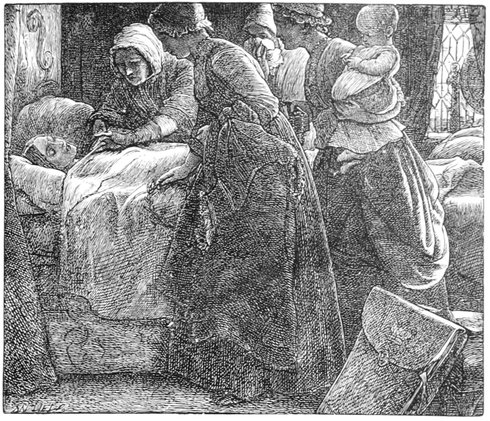
The Lord of Burleigh.
Tennyson.
By Sir J. E. Millais, P.R.A.
By permission of Messrs. Macmillan & Co.
This edition will always be known as "Moxon's
Tennyson," and will stand out as a landmark in the
history of book illustration. In the work of the
younger men engaged on it, beyond the extreme
beauty of their designs, there was an evidence of
earnestness to search after truth that went so deep
into nature as to give the work a stamp of
superiority: and this advance in art—for it was an
advance—we endeavoured to follow and to promote
to the best of our power.
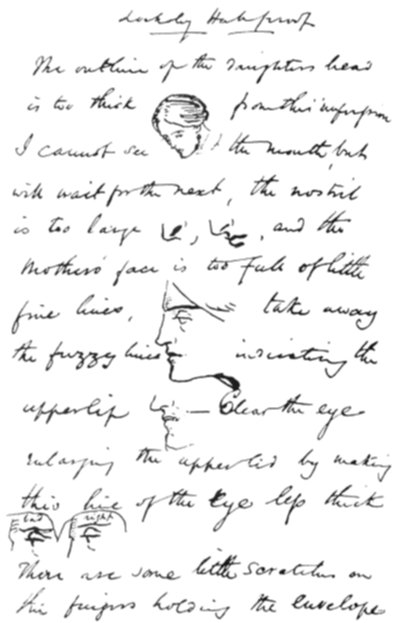
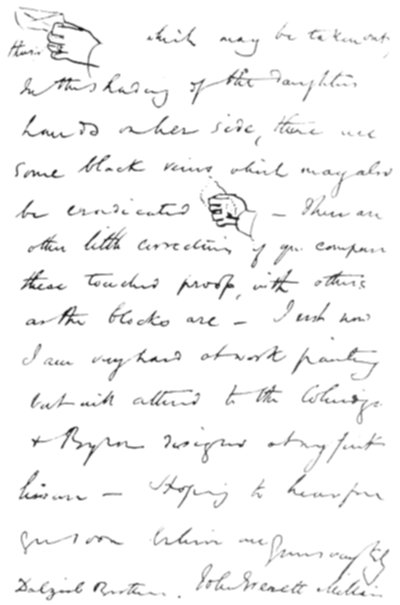
Locksley Hall proof
The outline of the daughters head
is too thick from this' in....ssion
I cannot see her mouth but
will wait for the next, the nostril
is too large, and the
mother's face is too full of little
fine lines, take away
the fuzzy lines indicating the
upper lip—Clear the eye
enlarging the upper lid by making
this line of the eye less thick
bad right
There are some little scratches on
his fingers holding the envelope
thus which may be taken out,
In the shading of the daughters
hands on her side, there are
some black veins which may also
be eradicated—There are
other little corrections if you compare
these touched proofs, with others
as the blocks are—I rush now
I am very hard at work painting
but will attend to the Coleridge
& Byron designs at my first
liaison—Hoping to hear from
you soon believe me yours very truly
Dalziel Brothers. John Everett Millais
The volume was published by Mr. Moxon at
£1 11s. 6d., but the public did not respond as had
been expected, consequently a large stock was left
on hand. These were sold to Messrs. Routledge and
Co., and, with the stock, the entire set of the wood
blocks went also. The price of the volume was
reduced to £1 1s., and it sold out immediately.
On this success Messrs. Routledge wished to produce
a new edition, but Tennyson's terms were too high to
leave any margin of profit to the publisher. This
doubtless was the cause of the book being so long
out of print; but the property having since passed
into the hands of Messrs. Macmillan they have
reproduced this very interesting book.
On November 23rd, 1856, Mr. Holman Hunt, on
receiving the proof of a drawing he had made for
Moxon's edition, writes:
"I find the proof of the last design for 'Oriana' very
satisfactory, giving the character of the drawing with great
truth."
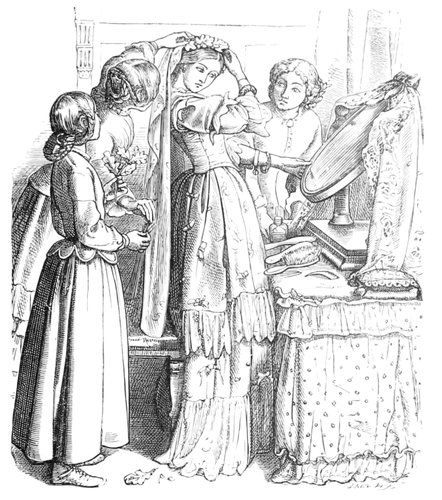
From "The Talking Oak."
Tennyson.
By Sir J. E. Millais, P.R.A.
By permission of Messrs. Macmillan & Co.
Although we were in communication with Dante
Gabriel Rossetti at an earlier date, when we engraved
a small drawing[9] which he made in illustration to
a poem, "The Maids of Elfin-Mere," by William
Allingham, published by Bell and Daldy, in a volume
entitled, "Day and Night Songs"—Rossetti's artist
co-workers in this book were J. E. Millais and
Arthur Hughes, all the drawings being engraved
by ourselves—we did not come in contact with him
again until we received the following letter:
"17 Orange Grove, Bath.
"My dear Sirs,—I have just had a note from Mr. Moxon
sent to me here, by which I learn that you are cutting a
drawing of mine, and that it will soon be finished. Will you
kindly send me the proof here (to the above address) and I
will at once retouch it and send it back to London. I have
been lately admiring your work in the 'Poets of the 19th
Century,' and can only hope for a rendering equal to what
Millais has there had at your hands.
"Yours very truly,
"D. G. Rossetti."
The Millais drawings here alluded to are those
made to illustrate passages from Byron and Coleridge,
mentioned later on. His own was the St. Cecillia
which Rossetti did for the "Illustrated Tennyson."[10]
It would be obviously out of place for us to
comment upon the difference in treatment which
we gave, and that of other engravers who were
entrusted to operate upon some of the drawings he
made for this book, or to remark upon the comparisons
of certain critics writing upon the subject;
we can only affirm that Mr. Rossetti expressed
himself both verbally and by letter as being well
pleased with our work. Writing on the receipt
of two finished proofs, he says:
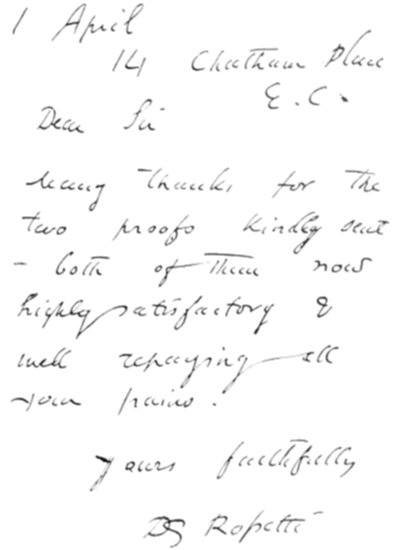
1 April
14 Chatham Place
E.C.
Dear Sir
Many thanks for the
two proofs kindly sent—both
of them now
highly satisfactory &
well repaying all
your pains.
Yours faithfully
DS Rossetti
That Rossetti was a man difficult to please in
his literary work as well as in his art, the following
is an apt illustration:
In one of the "Allingham letters," he says:
"I lately heard from Aubrey de Vere with a request to
my sister and self to contribute something to a verse collection.
We looked up scraps and expected proofs, but these come not,
and I imagine that the result, when in type, will be the usual
incentive to Blasphemy."
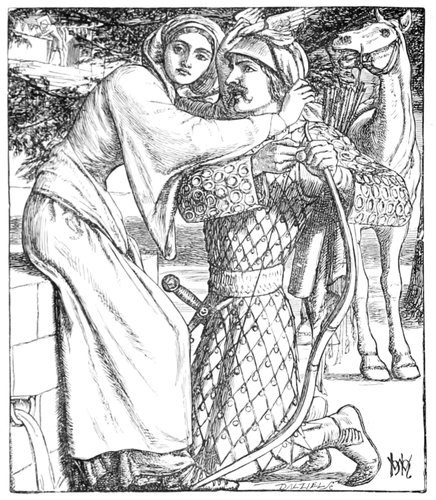
The Ballad of Oriana.
Tennyson.
By Holman Hunt.
By permission of Messrs. Macmillan & Co.
Mr. W. M. Rossetti, writing of his brother's
social peculiarities, says:
"He assumed the easy attitude of one born to dominate—to
know his own place and to set others in theirs. He was
a genial despot, good natured, hearty and unassuming in manner,
and only tenacious upon the question at issue."
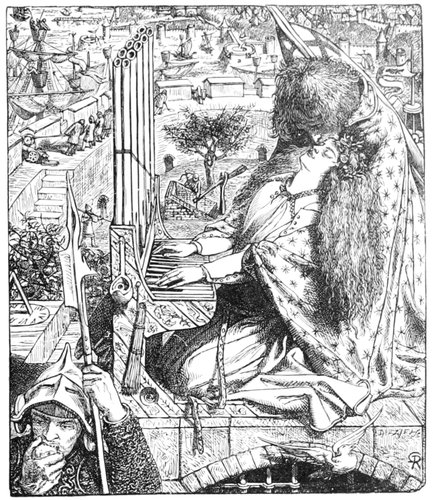
St. Cecillia.
THE "PALACE OF ART."
Tennyson.
By Dante G. Rossetti.
By permission of Messrs. Macmillan & Co.
Though we never had any personal interview
with Rossetti's sister, Miss Christina Rossetti, we
had considerable correspondence with this gifted
lady, extending over several years, she having written
some short poems which helped to adorn the pages
of one or more of our Fine Art Books. We
also published her charming little Nursery Rhyme
Book, "Sing Song," which was very tastefully illustrated
by Arthur Hughes. The manuscript of this
book was somewhat of a curiosity in its way. On
each page, above the verse, was a slight pen sketch,
drawn by Miss Rossetti, suggesting the subject to
illustrate, but of these Mr. Hughes made very little
use, and only in two instances actually followed the
sketch. The book was published on our behalf by
Messrs. George Routledge & Co.
On one occasion when Mr. Arthur Hughes sent
in some of the drawings which he had made, one of
the pages of manuscript was missing, and on this
being pointed out to him he sent the following note:
"July 31, '71.
"Dear Messrs. Dalziel,—I am sure that I put in the
rhyme of 'Dancing on the hill tops.' I am very careful with
them—going two or three times through them before packing up.
I don't remember which was 45, but the four figures representing
the Seasons is to the poem of the Months, beginning 'January,
cold, desolate'; and as well as I can remember the poem for
the drawing of a man with fagot and basket meeting his child—it
goes thus:
'Dancing on the hill tops,
Singing in the valleys,
Laughing with the echoes,
Merry little Alice.
If her father's cottage
Turned into a palace,
And he owned the hill tops
And the flowering valleys,
She'd be none the happier—
Happy little Alice.'
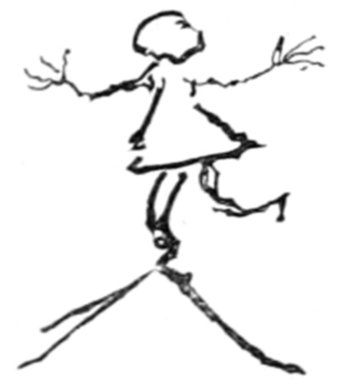
—and had a pencil sketch at top of a child on
a pointed hill.
"I am just about finishing a batch of these—belonging to last
week, alas!—but I am also finishing the frontispiece of the Carols.
These shall come very soon.
"Believe me,
"Faithfully yours,
"Arthur Hughes."
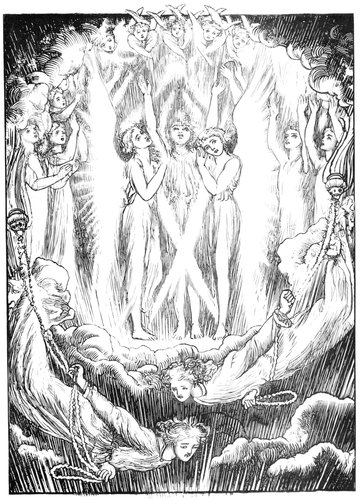
Hallelujah.
THE "SUNDAY MAGAZINE."
By Arthur Hughes.
Published by Mr. Alexander Strahan.
We had for a long time cherished the idea
of doing an important series of illustrations to
"The Parables of Our Lord." This occupied much
anxious thought and careful consideration, for we
felt it would be useless attempting the subject unless
the drawings were made by an artist of acknowledged
high-class ability. We found our chief difficulty
in fixing upon one capable of treating the
subject with sufficient dignity, and at the same time
likely to avoid the old conventional style in which at
that time Biblical art was treated. As many of Sir
John Millais' charming drawings had been passing
through our hands—among others we would mention
some exceptionally beautiful work illustrating selected
passages from poems by Byron and Coleridge, as well
as his exquisite drawing of "The Finding of
Moses"—it seemed to us that he would be a safe
man to consult on the subject, and likely to give
us something more original in treatment than any
other artist who was doing this class of work.
Millais entered warmly into the subject and very
readily undertook the commission, as the accompanying
letter will show:
"Bowerswell, Perth,
"13 August, '57.
"Dear Sirs,—I shall be very glad to accept your offer, but
you must give me time. One great inducement for me to undertake
these illustrations is the fact that the book will be entirely
illustrated by me alone. The subject is quite to my liking; you
could not have chosen anything more congenial to my desire. I
would set about them immediately if you will send me some
blocks. Will you send me a list of the Parables, or leave it to
me? I would prefer the former. There is so much labour in
these drawings that I trust you will give me my own time, otherwise
I could not undertake the commission. I should make it
a labour of love like yourselves.
"Yours very truly,
"John Everett Millais."
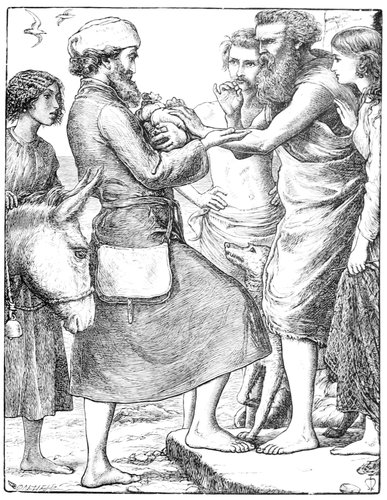
The Pearl of Great Price.
FROM "THE PARABLES OF OUR LORD."
By Sir J. E. Millais, P.R.A.
By permission of Messrs. Herbert Virtue & Co., Ltd.
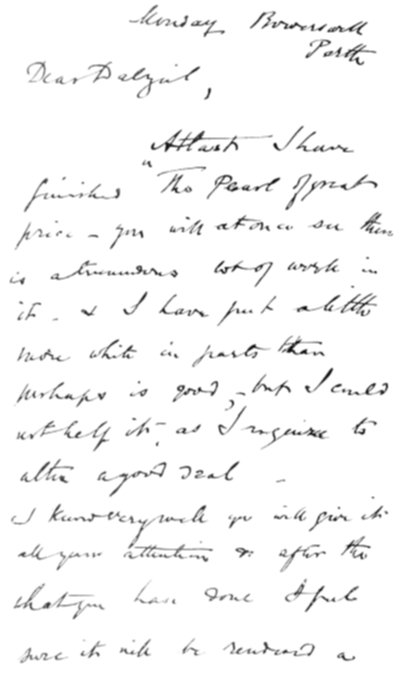
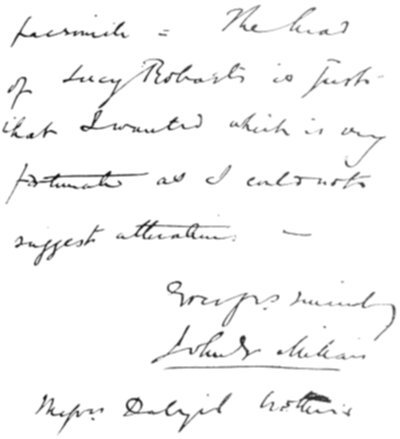
Monday Bowerswell
Perth
Dear Dalziel,
At last I have
finished "The Pearl of great
price"—you will at once see there
is a tremendous lot of work in
it., & I have put a little
more white in parts than
perhaps is good,—but I could
not help it, as I require to
alter a good deal.
I know very well you will give it
all your attention & after all
that you have done I feel
sure it will be rendered a
facsimile = the head
of Lucy Roberts is just
what I wanted which is very
fortunate as I could not
suggest alterations—
Yours sincerely,
John E Millais
Messrs. Dalziel brothers
Millais produced several of the drawings very
promptly, but, as time went on and he became more
popular—the demand for his pictures daily increasing—longer
intervals gradually took place
between the delivery of the drawings, and it was
not until the end of 1864 that the last was sent in.
Even then he had only made twenty drawings out
of thirty, which he at first undertook to do. At
the same time he requested us to release him from
the remainder of the agreement, and to this we
had no choice but to comply, though we did so
very reluctantly, feeling that the world of art would
be so much the poorer.
In 1862 we accepted an offer from Mr.
Alexander Strahan, and twelve of these pictures
were published in Good Words Magazine. Later, in
1864, the entire series was published for us in
book form by George Routledge & Sons. But we
are sorry to say they did not receive that liberal
recognition from either the public or the critics
which their undoubted excellence ought to have
commanded.
When we conceived the idea of doing an
Illustrated Bible, of which we will have much to
say further on, Millais was one of the first
artists we consulted on the subject. He warmly
approved of the project, and promised his most
hearty and liberal co-operation; but like many
other equally hearty promises from artists of note,
they were never fulfilled, not, we are sure, from
any want of sympathy with the subject, but owing
entirely to the pressure of other engagements. At
last his undertaking on this work simmered down
to a positive promise of one drawing, and that to
be "Adam and Eve in the Garden of Eden," but
though he was often solicited, and always promised
to set about it immediately, he never made the
drawing, nor do we know that he went so far
as to make even the slightest rough sketch of a
design for it. To us this was an inexpressible
disappointment, as without that picture it was obviously
impossible to commence the publication.
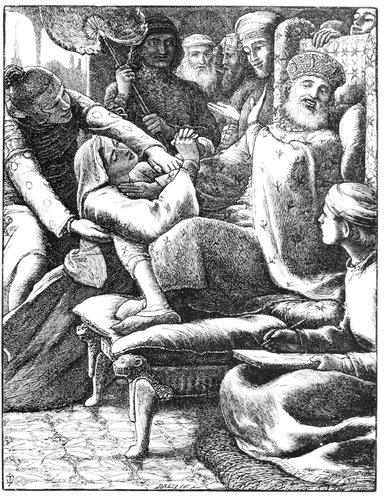
The Unjust Judge.[11]
FROM "THE PARABLES OF OUR LORD."
By Sir J. E. Millais, P.R.A.
By permission of Messrs. Herbert Virtue & Co., Ltd.]
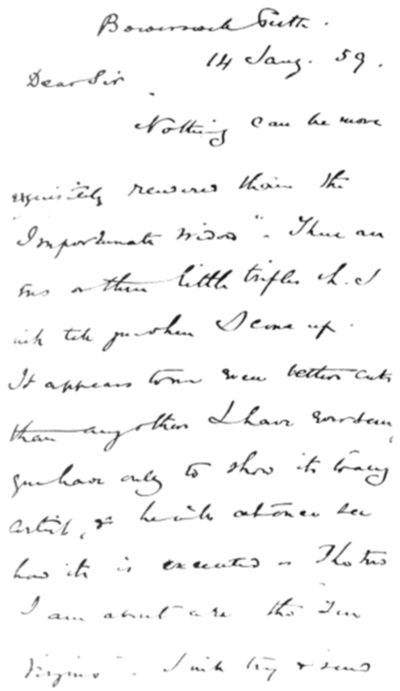
Bowerswell Perth.
14 Jany. 59.
Dear Sir,
Nothing can be more
exquisitely rendered than the
"Importunate Widow". There are
two or three little trifles wh. I
will tell you when I come up.
It appears to have been better cut
than any other I have ever seen,
you have only to show it to any
artist, & he will at once see
how it is executed—The two
I am about are the "Ten
Virgins". I will try & send
you one next week. I am
only sorry that I cannot
turn them out faster. I am
charmed with yr. work.
Faithfully yrs,
John Everett Millais
This, with many other similar disappointments of
help which we had confidently relied upon, caused
the project to hang fire, until at last, in 1880, we
resolved to abandon the idea of an Illustrated
Bible, and publish some of the engravings we had
made in a folio under the title of "Dalziel's Bible
Gallery."
That our difficulties in carrying out the elaborate
project we had formed began at an early date,
the following extract from a letter by Sir John
Millais, dated February 8th, 1863, will show:
"There is a decided move in the matter of 'The Bible.'
Hunt, Watts, and Leighton will not, I expect, work for you, as
they say they are, with me, in honour bound to work for the
publisher who first made the proposal. There can be no doubt
but that we should, in such a case, work together.
"Yours very faithfully,
"John Everett Millais."
The "publisher who first made the proposal"
here referred to was Mr. Joseph Cundall, who was
not at that time in business as a publisher, but
had formed a project of publishing an "Illustrated
Bible." His progress in the matter merely consisted
in his having commissioned the several artists
named by Millais, with two or three others, while
his actual purchase was three small drawings of
minor importance. These, with his "priority of
claim," we subsequently purchased from him. We
never used the drawings, however, not considering
them favourable specimens.
In a letter, which is without date, showing
how earnestly Millais laboured and how anxious
he was to give his most perfect work in producing
the charming series of illustrations to "The Parables
of Our Lord," he says:
"I send off by post the Parable of 'The Leaven which the
woman hid in the three measures of meal'; she is mixing the
leaven in the last of the three. The girl at the back I have
made near the oven with one of the loaves, and the other rests
against the wall of the window."
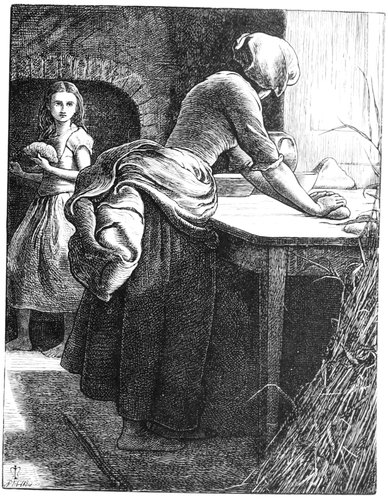
The Leaven.
FROM "THE PARABLES OF OUR LORD."
By Sir J. E. Millais, P.R.A.
By permission of Messrs. Herbert Virtue & Co., Ltd.
Further on in the same letter he writes:
"It is almost unnecessary for me to say that I cannot produce
these quickly even if supposing I give all my time to them. They
are separate pictures, and so I exert myself to the utmost to make
them as complete as possible. I can do ordinary illustrations as
quickly as most men, but these designs can scarcely be regarded
in the same light—each Parable I illustrate perhaps a dozen times
before I fix, and the 'Hidden Treasures' I have altered on the
wood at least six times. The manipulation of the drawings takes
much less time than the arrangement, although you cannot but
see how carefully they are executed. Believe me, I will not again
halt in the work, but will supply you regularly, although I may
occasionally delay in the production. I know you will take every
care in the cutting, so I will not say anything about that. I
enclose with the block a few remarks.
"Ever yours truly,
"John Everett Millais.
"I suppose you have nearly completed the 'Five Foolish
Virgins.' I am always anxious to get the proofs."
Sir John was at all times ready to help a
brother or sister artist, and avoid as far as possible
running in competition, as the following few lines
will show.
In a letter dated February 8th, 1863, he writes:
"I forgot to ask you not to publish the 'Lost Sheep' amongst
the Parables in Good Words, as I have had a letter from Mrs.
Blackburn stating that she had a drawing for the paper of the
same subject, and wishing me to keep back that illustration if it
did not interfere with the arrangement. I suppose it will make
no difference to you, so please withhold it from the set devoted
to Good Words."
In reference to the engraving of "The Lord of
Burleigh" he says:
"Perth,
"December 10, '56.
"My dear Sirs,—I received the proofs this afternoon and
am quite satisfied with the cutting, which is perfect. I mention
a few corrections, or rather additions, which I think will improve
them. As I have omitted to add my monogram to the other
drawings I should like it cut out of the snow in the illustration
to the 'Old Year.' The only improvement I see is a want of
softness in some of the outlines, which may be reduced or made
to look more tender. I have written in pencil such faults as strike
me may be easily remedied.
"The more I have looked into the cutting of both these
(but especially the 'Burleigh') the more delighted I am with the
rendering. I wish you would send me a good proof of each of
them, as I have all the others.
"Again thanking you for the evident care you have taken in
rendering my drawings,
"Believe me,
"Ever yours truly,
"John Everett Millais."
Millais, on returning proofs which we had submitted
for his touching or approval, invariably made
such favourable remarks on our portion of the work
as the following:
"November 6, '63.
"The proofs you sent me are perfectly satisfactory. 'The
Good Shepherd' doesn't require anything, and the other only wants
a touch on the face. Next to the King is a little coarse in the
shadow: make it a little less scratchy."
In reply to a letter of ours asking for a further
supply of "Parable" drawings, Mrs. Millais writes:
"Bowerswell,
"August 9th.
"Dear Sir,—I am very sorry to write to you instead of
packing up for you some wood drawings. Mr. Millais has
begged me to write to you, as he says he is ashamed of himself,
but he has felt such a disinclination to turn to that kind of
drawing at present, when he is painting out of doors, that he
must beg you to have patience with him. Several times as
he has got designs and drawings ready, I have got him to sit
down to them, but he rose up disgusted and feeling incapable.
He goes to London next week but returns in a few days. He
declares he will then set to work, so we must hope the fit
will have come on for work of the kind in which you are
interested. In the meantime he has nothing nearly ready, if
he would only begin again, but he is at work all day, and
in the evening too tired. Next week the young ladies he is
painting from leave, and he will be free to turn to something
else.
"With best regards,
"Believe me, yours truly,
"Effie Millais."
Mrs. Millais, writing on another occasion to
account for the non-delivery of drawings, says:
"Bowerswell, Perth,
"November 26th.
"He is very sorry not to answer your letter about the
Parables. He says, at this season, that he is always occupied on
his pictures, and that although he can occasionally do drawings
on the wood at odd times, that he cannot attempt to do the
Parables, which are, as you know, much finer work. He is anxious
to make that work as perfect as possible, and when he does one
or more he puts his painting aside for the time. He cannot do
that during the winter and spring, and therefore begs you to have
patience with him, as he will work at them whenever he has
sufficient leisure. He is well aware how anxious you are to have
the work finished. I am sure he is also. But he often makes
designs, and continues to improve them until he is quite satisfied
that it is as good as he can make it, and this takes a long time.
"Very truly yours,
"Effie Millais."
On our sending Millais complete copies of "The
Parables" he wrote the following letter:
"7 Cromwell Place,
"South Kensington,
"5th Dec., 1863.
"Dear Dalziel,—I am quite delighted with the Book, and I
think you will find the public will slowly and surely appreciate
it. Six copies will not quite do for the friends I have promised
it to, but will be enough for the present. I desired to send copies
to men who will very much forward the sale—such as Tennyson,
Layard, Thackeray, Leech, etc. If you could send me another
six I think that would do amply. I will not forget 'The Arabian
Nights.' The only fault, I think, in the Book is that in the middle
there are too many blank pages, but I suppose that could not be
helped.
"Sincerely yours,
"John Everett Millais."
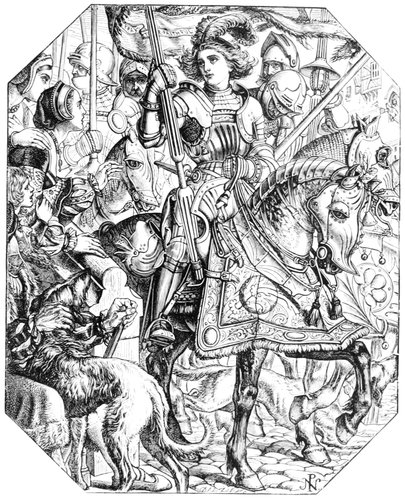
"Now, Randolph, tell thy tidings,
However sharp they be."
"Edinburgh, after Flodden."—Aytoun.
FROM "LAYS OF THE SCOTTISH CAVALIERS."
By Sir J. Noel Paton, P.R.S.A.
By permission of Messrs. William Blackwood & Sons.
The following is an extract from the Preface to
the first edition of the book:
"Mr. Millais made his first drawing to illustrate the Parables
in August, 1857, and the last in October, 1863. Thus he has
been able to give that care and consideration to his subjects
which the beauty as well as the importance of 'The Parables'
demanded, for the work has extended over a period of six years."
During the years from 1858 to 1863 we engraved
several grand drawings by Sir J. Noel Paton in
illustration to a fine art edition of Professor Aytoun's
"Lays of the Scottish Cavaliers," published by
Messrs. Blackwood of Edinburgh. In a letter, dated
October 8th, 1858, he says:
"33 George Street, Edinburgh.
"Dear Sirs,—Judging from your work in the 'Tennyson,'
and from proofs now before me, I can with perfect security and
confidence recommend the Messrs. Blackwood to entrust you
with as many of my drawings as you care to undertake. Indeed
I did so in those very words when, a few months ago, we were
discussing this question of engraving, and I am quite ready to
repeat my recommendation, though having, by my own desire,
left the choice of engravers entirely in the hands of Messrs.
Blackwood.
"I remain, Gentlemen,
"Yours very truly,
"J. Noel Paton."
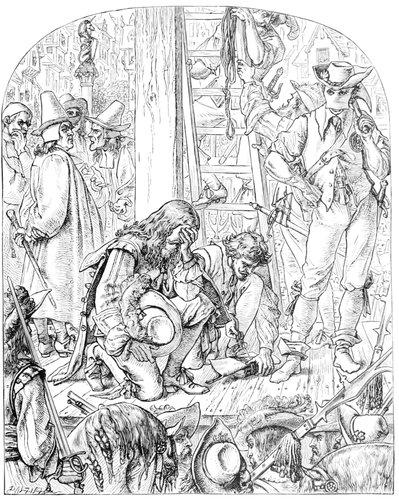
"Yet a black and murky battlement
Lay resting on the hill."
"The Execution of Montrose."—Aytoun.
FROM "LAYS OF THE SCOTTISH CAVALIERS."
By Sir J. Noel Paton, P.R.S.A.
By permission of Messrs. William Blackwood & Sons.
On returning parcels of touched proofs, he
wrote the following letters:
"33 George Street, Edinburgh,
August 22, 1862.
"Gentlemen,—I herewith return the three printed proofs
touched upon, and by that you will kindly do your best to carry
out the alterations indicated.
"The last proofs sent (eight in number) will be forwarded
to Mr. Simpson to-day. They are, upon the whole, very satisfactory,
though all, more or less, requiring careful overhauling,
though through no shortcoming of yours, as the drawings have
been wonderfully rendered. I would more especially mention as
worthy of all praise, as specimens of engraving, 'The Melrose,'
and the interior with figures, and the suit of armour. The latter
is certainly very perfect.
"Your kind offer of a proof of Mr. Houghton's beautiful
design, and your beautiful Engraving of the long-haired Lady
with Children, I cannot refuse; though in what I said in my last,
I merely meant to indicate the desire, which so many must feel,
that high class things of that sort could be got by themselves and
printed in a manner worthy of their excellence—they are generally
so indifferently printed in the Periodicals in which they appear
and dis-appear.
"In haste.
"Very faithfully yours,
"J. Noel Paton."
"Messrs. Dalziel."
"Absence from Town, and other causes, has prevented me
from acknowledging more promptly 15 proofs of your engravings
for the 'Lays of the Scottish Cavaliers,' which, I am happy to
say, are all very satisfactory indeed.
"I am, Gentlemen,
"Yours very truly,
"J. Noel Paton."
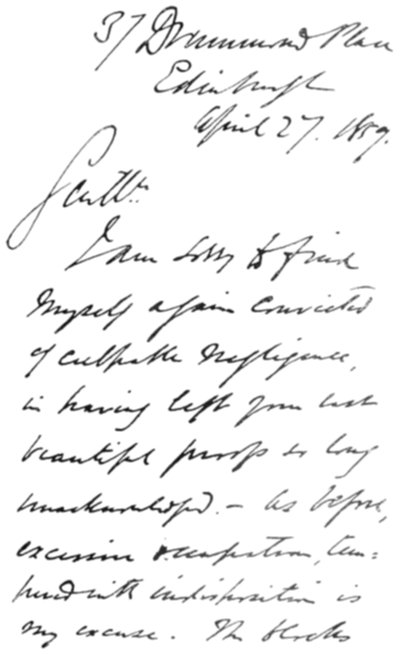
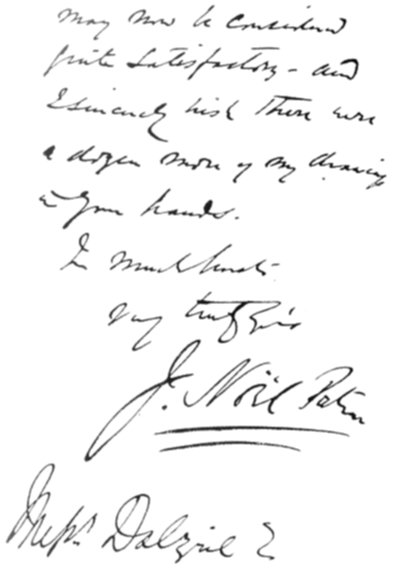
37 Drummond Place
Edinburgh
April 27. 1859.
Gentlem...
I am sorry to find
myself again convicted
of culpable negligence,
in having left your last
beautiful proofs to lay
unacknowledged.—As before,
excessive occupation, tempered
with indisposition is
my excuse. The blocks
may now be considered
quite satisfactory—and
I sincerely wish there were
a dozen more of my drawings
in your hands.
In much haste—
Very truly yours,
J. Noel Paton
Messrs. Dalziel
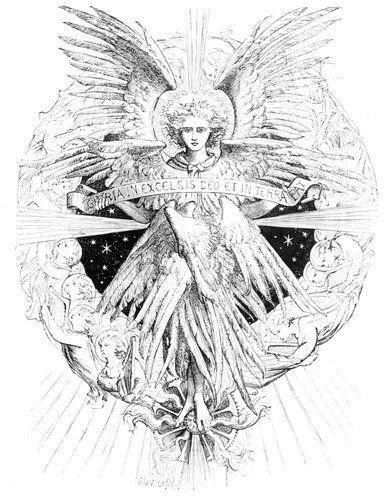
"On wheels of light, on wings of flame,
The glorious hosts of Zion came."
"The Song of Bethlehem."—Campbell.
FROM "LAYS OF THE HOLY LAND."
By J. R. Clayton.
By permission of Messrs. James Nisbet & Co.
"The Lays of the Holy Land" was projected
by Mr. Watson, then the head of James Nisbet
and Co., who, mainly under our guidance, made
a very wise selection for the figure subjects.
Tenniel's are exceptionally fine, "The Destruction
of Sennacherib" being perhaps the most important.
The "Song of the Jewish Maiden," by
F. R. Pickersgill, R.A., is one of his best, and
there is a lovely drawing, "Ruth and Naomi," by
J. H. Powell, but the one picture that stands
alone is "The Finding of Moses by Pharaoh's
Daughter," by Millais. The strength and power
as well as the treatment are so original as to
give it even in this fine collection a marked
degree of undoubted prominence. Wolf has several
exquisite examples, so has Birket Foster. Of our
own drawings we will only mention "Tears for
Jerusalem" and "The Raising of Lazarus." There
is also a very beautiful drawing, "The Song of
Bethlehem," in a fine decorative manner, by J.
R. Clayton.
Clayton has been our friend and comrade for
over fifty years. We met as fellow students at the
Life School at Clipstone Street, when Edward
Duncan was President and Treasurer, and Charles
Keene, John Tenniel, George Boyce, H. T. Wells,
and Arthur Lewis were amongst the regular workers.
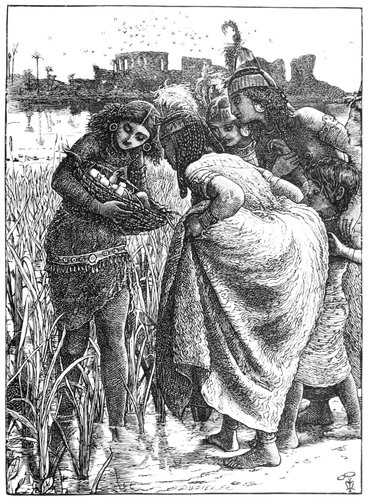
The Finding of Moses by Pharaoh's Daughter.
FROM "LAYS OF THE HOLY LAND."
By Sir J. E. Millais, P.R.A.
By permission of Messrs. James Nisbet & Co.
This much-gifted, many-sided man began his
artistic work as a sculptor with Sir Charles Barry,
and under the influence of Sir Gilbert Scott, attaining
much knowledge in architecture and ecclesiastical
matters, he soon developed a decided taste for
decorative work. During this period, however, his
wonderful facility for design found an easy outlet in
drawing on wood. Our early connection with him
began on the Illustrated London News, for which
he did much beautiful work, notably some illustrations
to "New Songs Written to Old Tunes,"
by Dr. Charles Mackay. He also illustrated an
edition of "Krumacher's Fables," translated by
Dr. Hy. W. Dulcken, a dear old friend, who was
then one of the managers of Ingram and Cook's
book branch of the Illustrated London News.
Clayton also did a set of illustrations to "Bunyan's
Pilgrim's Progress." We had the benefit of his
work in many of the "Fine Art Books" on which
we were from time to time engaged. He did
the figure subjects for "Herbert's Poetical Works,"
and, in companionship with Sir John Tenniel, made
most of the figure subjects for "Pollock's Course
of Time."
Clayton's taste for decorative work gradually
took the form of stained glass, and his success in
that way became so extensive that the art of Book
Illustration sank into the background. Although
not really one of the P.R.B., he was of them, and
with them in all their ways and works. If the
Royal Academy had a more extensive scale of
fitness for the honour, there is no man to our
knowledge whose great ability as a true artist better
deserves the distinction of R.A.
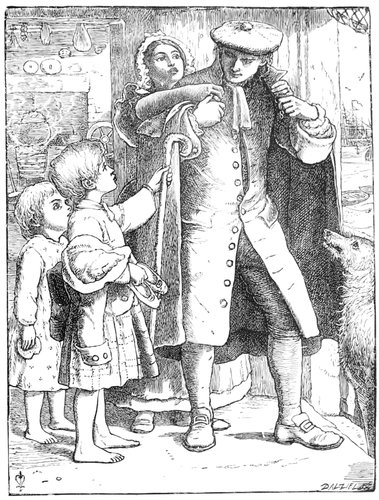
There's nae Luck About the House.
FROM "HOME AFFECTIONS WITH THE POETS."
By Sir J. E. Millais, P.R.A.
By permission of Messrs. George Routledge & Sons.
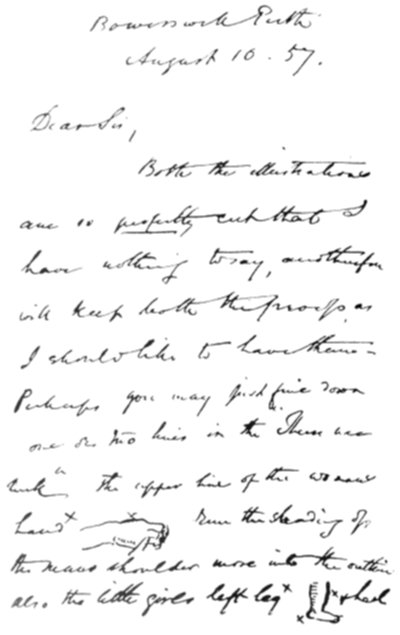
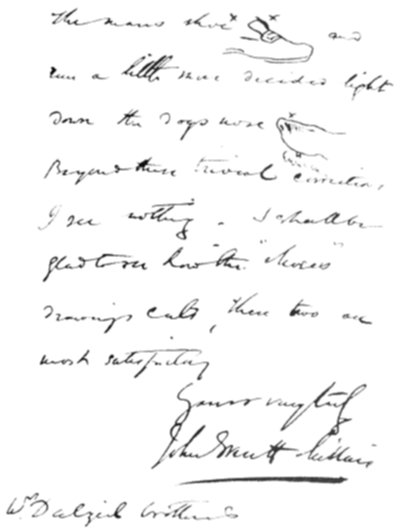
Bowerswell Perth
August 16. 57.
Dear Sir,
Both the illustrations
are so perfectly cut that I
have nothing to say, and therefore
will keep both the proofs, as
I should like to have them—Perhaps
you may just fine down
one or two lines in the "There's nae
luck" the upper line of the womans
hand Run the shading of
the mans shoulder more into the outline
also the little girls left leg should
the mans shoe and
run a little more decided light
down the dogs nose
Beyond these trivial corrections
I see nothing. I shall be
glad to see how the "Moses"
drawings cut, these two are
most satisfactory
Yours very truly,
John Everett Millais
Wm. Dalziel brothers
Edward Duncan, George Dodgson and F. W.
Topham, with a few other members of the "Old
Society of Painters in Water Colours," formed
a club for outdoor sketching, the rule being that
at a selected spot all should sit down as close to
each other as possible, taking various points of
view according to individual taste. One day whilst
at work in a field on the banks of the Upper
Thames, they saw a sturdy farmer coming towards
them looking very fierce and angry. When he got
near the party he said:
"What be you lot o' lazy devils a-doing in
my field?"
"Sketching, sir, sketching!"
"Is that fit work for men? When the young
ladies from Miss Gray's boarding school come
down to 'sketch' I say let 'em; if it pleases
them, it don't hurt me, an' there be no harm; but
when I see a lot of great hulking men like you
fellows about such nonsense it makes me fair
angry! Why, domn it, you might be doing a
lot o' good work o' some sort! I would rather
break stones by the roadside for a shilling a day
than fool away my time like you be doing. You
ought to be ashamed o' yourselves, you ought!"
They tried to explain to him that they made
their living by painting pictures. After some strong
expressions of doubt the farmer sobered down a
little and asked Dodgson how much he would get
for the one he was "doing." Dodgson, knowing
the sort of man he had to deal with, said:
"Perhaps as much as ten shillings, or maybe
twenty if I can find a friend who fancies it."
The answer came, "Thee be a domned liar as
well as a lazy lout!" Then with a look of contempt
the tiller of the soil stumped away.
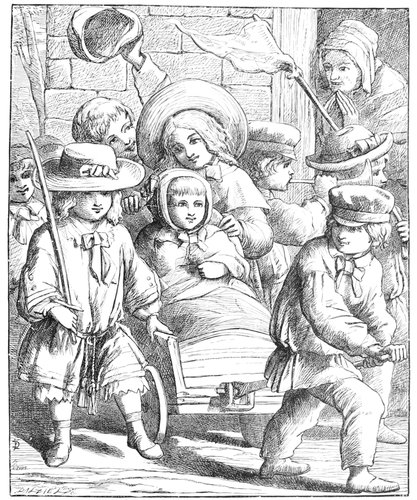
"From the window I look out,
To mark thy beautiful parade;
Stately marching in cap and coat,
To some tune by fairies played."
"Threnody."—Ralph Waldo Emerson.
FROM "HOME AFFECTIONS WITH THE POETS."
By Edward Dalziel.
By permission of Messrs. George Routledge & Sons.
"The Poets of the Nineteenth Century," in addition
to the two fine drawings by Millais already
named, has many other good pictures; one of
the most remarkable, perhaps, is the "Prisoner of
Chillon," by Ford Madox Brown. Sir John Tenniel
is well represented, the "Death of Marmion" being
one of his best. Sir John Gilbert, too, has several:
"The Vicar," "To my Mother's Picture," and
"Hohenlinden." So pleased were we with the latter
design that we offered him a commission for a
water colour drawing of the subject. His reply was,
"Yes, and it shall be one of my best." And it
certainly was one of his most successful as a highly-finished
work and will always hold its own. There
are also several interesting drawings by William
Harvey, J. D. Harding, Edward Duncan, and G.
Dodgson; a large number of exquisite examples of
Birket Foster, and several figure subjects by J. R.
Clayton, F. R. Pickersgill, R.A., Edward Corbould,
and Harrison Weir. Of our own many drawings in
this book we will mention a small roadside landscape,
"Taste," and a single figure, "The History of a Life."
On February 6th, 1856, Mr. Ford Madox Brown,
in returning a volume of the Illustrated Edition of
"Longfellow's Poems," wrote:
"The bearer will return the volume of 'Longfellow,' which I
have looked through with great delight; and I think it bears
honourable testimony to the high excellence which wood engraving
has attained in this country."
Subsequently, on seeing the volume, "The Poets
of the Nineteenth Century," he wrote:
"Let me take this opportunity of expressing my admiration
of the work you last brought out, and the drawings by Dalziel[12]
in particular, which are most poetic and took us by surprise,
although whether yours or your brother's I, as yet, know not. The
Millais' are admirable, both as regards him and the engraver."
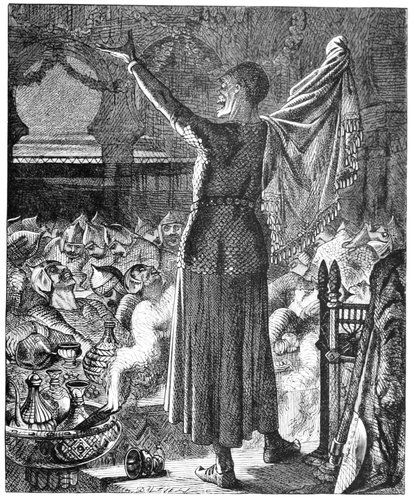
"There, ye wise Saints, behold your Light, your Star—
Ye would be dupes and victims, and ye are."
The Veiled Prophet of Khorassan.
FROM "LALLA ROOKH."
By Sir John Tenniel.
By permission of Messrs. Longman & Co.
In "Home Affections with the Poets," Millais
again stands pre-eminent in his two contributions.
"There's Nae Luck About the House," when
compared with his drawing of the "Finding of
Moses," is an apt illustration of his wonderful versatility,
and a proof that in art all subjects were
equally within his power.
F. R. Pickersgill has some fine pictures in this
book, his "Oriana" being full of tender feeling. Sir
John Tenniel, too, is very strong, his "Fair Inez"
being the best. Sir John Gilbert and Birket Foster
are both very powerful; the former in "When I
Come Home," "The Two Angels," and "The Wee
Thing"; the latter in his "True Love," "Come
Awa', Come Awa'," "My Sister Ellen," and "The
Graves of the Household." There is a very clever
drawing, "The Sailors Journal," by George Thomas,
and a grand picture, "The Shipwreck," by Edward
Duncan. Among our own drawings in the collection
are, "To Mary in Heaven," Emerson's
"Threnody," and "My Mother Dear."
Among the first works of importance by Sir
John Tenniel that came into our hands to engrave
were several drawings for an illustrated edition of
Tupper's "Proverbial Philosophy," as well as his
contributions to the illustrated publications issued by
the Art Union of London. He also made a great
many important drawings for the numerous "Fine Art
Books" which we produced; among them we would
particularly mention "Dramatic Poems," by Barry
Cornwall, and "Pollock's Course of Time"; likewise
several exceptionally clever drawings for "The
Ingoldsby Legends," published by Richard Bentley.
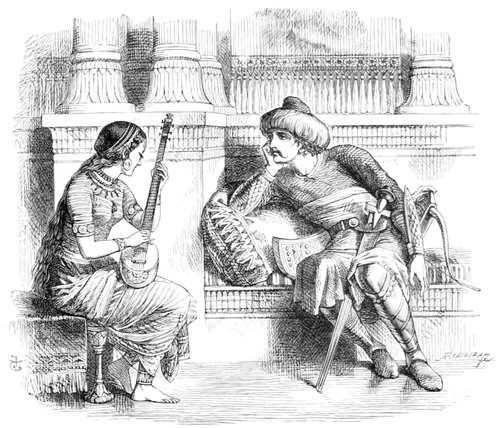
"Poor maiden!" thought the youth, "if thou wert sent."
The Veiled Prophet of Khorassan.
FROM "LALLA ROOKH."
By Sir John Tenniel.
By permission of Messrs. Longman & Co.
One of his most elaborate works was the set
of illustrations to "Lalla Rookh." The drawings
were all made on the wood with lead pencil, and
were fine examples of his varied powers of design
and delicate manipulation—such as gave us great
pleasure in the rendering. The book was published
by Messrs. Longman & Co. If Tenniel
had never done any other work than "Lalla
Rookh," and those two remarkable books "Alice
in Wonderland" and "Through the Looking
Glass," they alone would have been sufficient to
immortalise him. What a piece of work the
frontispiece to the former is! What dignity and
rare grotesque humour are shown in both these
books! What beautiful pictures "Advice from
Caterpillar" and "The Father William" make!—and
how perfectly they are all drawn! "Pig and
Pepper," "The Kitchen Scene," and "Alice and
the Duchess" are among the best.
As a matter of fact, Tenniel did not wish to
do the second book, so Mr. Dodgson ("Lewis
Carrol"), the author, asked various other artists to
undertake the task, amongst them Sir J. Noel
Paton, who, being out of health at the time, at once
declined, saying, "No, Tenniel is the man." And
most fortunately, both for author and artist, he was,
the drawings being most grotesque, and the delightful
fooling and outrageous fancy beyond description:
for instance, "Looking-Glass House," "Tweedle-dum-tweedle-dee-dee,"
"Humpty-Dumpty," "The
Lion and Unicorn," and last of all "Queen Alice."
Such pictures were half the battle in the success of
these two delightful little volumes.
During the process of completing the illustrations
a great deal of correspondence, always of the most
agreeable nature, took place with the Rev. Mr.
Dodgson, as to their execution and finish. It is well
known that he was more than usually critical, both
with the drawings and with the engravings. Mr.
Dodgson also entrusted us later with the drawings
made by Mr. A. B. Frost—a very clever and
highly esteemed American artist, who fully entered
into the quaint humour of the text—for "Rhyme
and Reason" and "A Tangled Tale."
So much was Tenniel engaged at this time that
we always regarded his undertaking the pictures,
seven in number, for our "Arabian Nights," as an
act of kindness to ourselves.
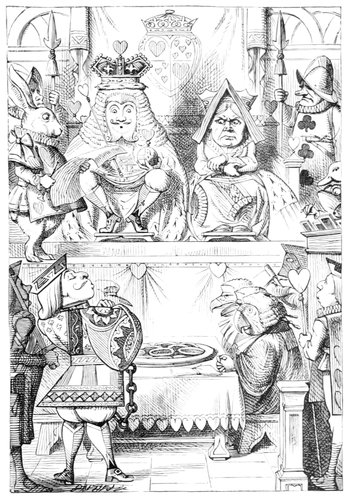
Alice in Wonderland.
By Sir John Tenniel.
By permission of Messrs. Macmillan & Co.
Outside his Punch work, we believe nearly all
Tenniel's work for wood engraving was executed
by us.
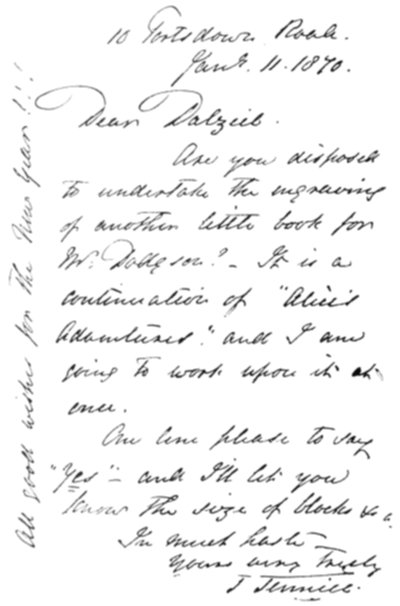
10 Portsdown Road
Jany. 11. 1870.
All good wishes for the New Year!!!
Dear Dalziel,
Are you disposed
to undertake the engraving
of another little book for
Mr. Dodgson?—It is a
continuation of "Alice's
Adventures," and I am
going to work upon it at
once.
One line please to say
"Yes"—and I'll let you
know the size of blocks &c.
In much haste
Yours very truly
J Tenniel.
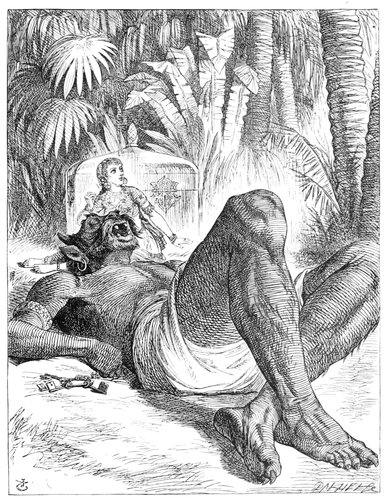
The Sleeping Genie and the Lady.
FROM "DALZIEL'S ARABIAN NIGHTS."
By Sir John Tenniel.
By permission of Messrs. Ward, Lock & Co.
Messrs. Bradbury and Evans had at one time the
idea of publishing an "Illustrated Shakespeare," and
Tenniel was to do all the drawings, but beyond two
very characteristic subjects which we engraved the
project was abandoned. Doubtless he found the
undertaking more than he could carry out when
added to his weekly work for Punch and his other
engagements.
No matter what other work he had in hand, he
always contributed his weekly cartoon to Punch.
The moral teaching of these drawings is beyond
measure. Whether it be in caustic satire or exquisite
pathos, he held the town for over fifty
years, proving himself to be not only a great artist,
but one who will rank amongst the highest of
Britain's worthies.
Sir John Tenniel was never very effusive in his
observations, though his remarks were invariably
complimentary. The following are two of his letters
received on submitting proofs for his correction:
"3 Portsdown Road,
"Tuesday.
"Dear Sirs,—The 'Falcon' proofs are everything I could
wish. The third proof requires just a touch.
"I wish you would find me two subjects instead of those
which I return herewith—something with more action or incident
in them. I am quite tired of love subjects, they admit of so little
variety of treatment.
"Before you send the wood for the 'Pollock'[13] drawings,
I think it would be well for me to give you a notion of the size
I shall require—whether half page, and so on—and this I will do
when I have the book back again.
"I am, my dear Sirs,
"Very truly,
"John Tenniel."
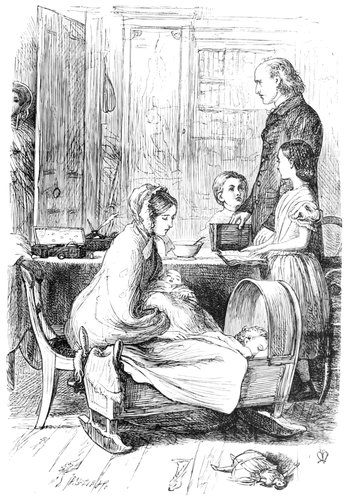
The Crawley Family.
FROM "THE FRAMLEY PARSONAGE."
By Sir J. E. Millais, P.R.A.
By permission of Messrs. Smith, Elder & Co.
"3 Portsdown Road,
"Saturday.
"Dear Sirs,—I like the proofs you sent very much, but
they require just a little alteration, the 'Rokby'[14] especially. I
will touch upon them and return them to you.
"I have such an accumulation of work on hand just now
that I do not feel justified in undertaking the two new subjects
you have sent, as I do not know when I shall be able to let you
have the drawings. I am doing some work for the Queen, and
as it is wanted as soon as possible, all things else must wait till
it is finished. But apart from this, the 'Coronation' subject,
although a good one, is very painful. I should not like doing it
on that account. And the other, although certainly very beautiful,
I do not care much about illustrating just now—it requires too
much thought to be disposed of hurriedly. I will, however, do
my best to let you have the 'Barry Cornwall'[15] soon.
"Yours, my dear Sirs,
"Very truly,
"John Tenniel."
When the Cornhill Magazine, in 1859, was
first advertised for publication at the price of one
shilling, with Thackeray as editor, the announcement
fell like a bomb in the midst of the magazine
publishers—Blackwood, Frazer, Colburn, Bentley
and others—for nothing of this description had even
been so much as dreamt of before at a less price
than the orthodox half-crown. The heavy government
duty on paper, then only recently removed,
may have been some apology for the high price
hitherto charged for this class of literature, which
at the present day is so far surpassed, if not
always in quality certainly in quantity, at less than
half the price of the great "Cornhill innovation."
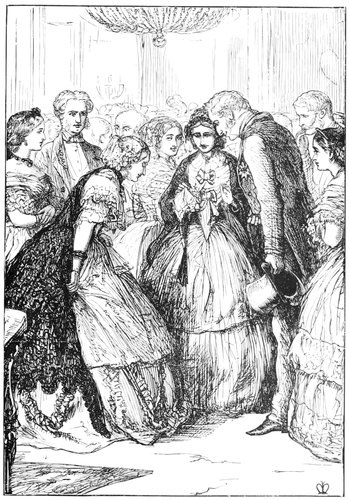
Lady Lufton and the Duke of Omneum.
FROM "THE FRAMLEY PARSONAGE."
By Sir J. E. Millais, P.R.A.
By permission of Messrs. Smith, Elder & Co.
In 1847 or '48 we were introduced to Mr. George
Smith, of Smith, Elder and Co., and for several years
executed a fair share of the engravings they required.
Amongst the earlier of these works we contributed
to "The Jar of Honey, from Mount Hybla," by
Leigh Hunt, and "The Dwarf of the Golden River,"
by John Ruskin. During this period we were not
infrequently brought into correspondence with Mr.
Williams, literary adviser of the firm. He was a
grand old gentleman, with a kind, sympathetic
manner, which won for him the sincere regard of
all with whom he became associated.
When the Cornhill Magazine was started we
were asked by Mr. George Smith (whose courtesy and
kindness were at all times most marked during the
many years of our connection) to undertake the
engravings, as he purposed issuing one or two
full page plates with each monthly number. This
we did for several years, producing during the
time, among the more important works, charming
illustrations by Millais, Richard Doyle, Lord
Leighton, P.R.A., F. Sandys, and other artists,
all of whom, as time rolled on, acquired a prominent
position in their art.
Artists not being proverbial for the just appreciation
of punctuality, many of these engravings
were produced under great pressure, as the following
letter from Mr. George Smith will show:
"Dear Sirs,—I am delighted with Mr. Millais' drawing,
and I am obliged to you for having engraved it so well
considering the pressure of time. There will be another illustration
for the June number and another for August; Mr.
Millais already has the proofs of the chapters of 'Framley
Parsonage' for June and August.
"Believe me,
"Yours faithfully,
"G. Smith.
"Messrs. Dalziel Brothers."
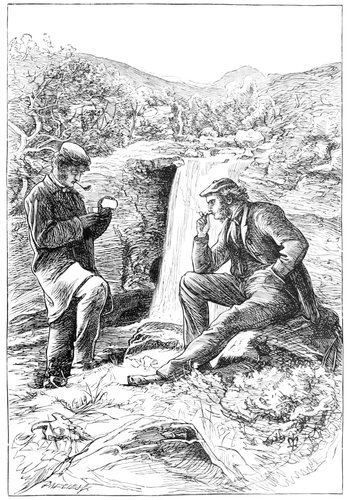
Temptation.—Horace Saltoun.
FROM THE "CORNHILL MAGAZINE."
By Sir J. E. Millais, P.R.A.
By permission of Messrs. Smith, Elder & Co.
Richard Doyle's "Bird's-eye Views of Society,"
which first appeared in the Cornhill, were afterwards
published in book form, and had a very
considerable sale.
It was also through our connection with the
Cornhill Magazine that we were introduced to
George Augustus Sala, who was at that time contributing
a series of papers and illustrating the
articles himself. On our submitting proofs for his
correction or approval, he wrote:
"Messrs. Dalziel.
"Gentlemen,—I have received proofs of engravings. You
will permit me to thank you for the exquisitely artistic manner
in which my rude scratchings on Wood have been rendered by
your graver. 'The Group of Beggars,' 'The View of Genoa,'
and the background under the Arcade are, to me, marvellous.
My chief defect appears to be heaviness and blackness of
touch, caused by painfully defective sight. I will, however,
endeavour to remedy this by using a harder point, and trusting
more to your tasteful interpretation, without overloading my
shadows with cross-hatching. There are a dozen more drawings
to come, but I wanted to see the proofs of the first instalment
before commencing the second batch.
"Believe me to be,
"Gentlemen,
"Your very obliged Servant,
"George Augt. Sala."
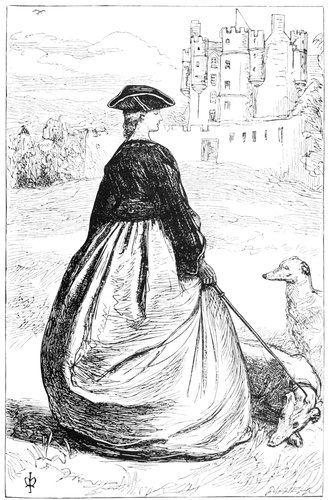
Lady with Hounds.
FROM "LONDON SOCIETY."
By Sir J. E. Millais, P.R.A.
By permission of Mr. James Hogg.
CHAPTER IV. — FOOTNOTES:
Birket Foster, R.W.S., Alexander Strahan, Sir E. Burne-Jones,
John D. Watson, Holman Hunt, Frederick Sandys, Harrison
Weir, J. Wolf, J. M. Lawless, Tom Taylor, Lord Tennyson,
Sir John E. Millais, The Emperor Napoleon III.
Birket Foster was a genuine man; kind and
generous to a degree in all the ways of life. He
stands as one of England's most popular landscape
draughtsmen, and as a painter in water colour
of great distinction.
We first knew him as a little boy with round
jacket and turn-down collar. Later he came to
be apprenticed to Ebenezer Landells to learn the
art of wood engraving; but in this he made literally
no progress, and Landells considering that as a
landscape draughtsman he might be more likely to
take a foremost position, the youth's attention was
turned to this branch of art with the most satisfactory
results. His improvement was very rapid, and all
that could be desired by his employer.
Shortly before the termination of his engagement
with Landells he went for a holiday to Scotland,
where, unfortunately, he had a very bad accident,
breaking an arm and receiving other serious
injuries, which for a long time quite incapacitated
him for work. It was during his illness that the
period of his indentures expired, but as soon as he
was well enough to resume work he insisted on
returning to his duties that he might make up the
time that had been lost; and this he did without
any request on Landells' part. On his return we
well remember seeing him at work in a little top
room in Birch Court, E.C. He was making small
drawings of pots and pans, teapots, gridirons, and
other such articles for an ironmongers catalogue,
and said, in the most cheerful manner, "It is
right that I should return here and do this work;
it is good practice, and will enable me to draw
all these sorts of things with some practical knowledge."
Our first personal business connection with Birket
Foster was in 1851, when we commissioned him to
make a set of eight illustrations to "Kirk White's
Poetical Works" for Messrs. George Routledge and
Co. After this he illustrated several small books
in a similar manner for us, as well as becoming a
constant and very liberal contributor to many
of the "Fine Art Books" which we produced.
Amongst these we may mention "Wordsworth's
Poems," where his many tastefully selected views of
the Cumberland and Westmoreland Lake scenery
give such a charm to the book; also "Odes and
Sonnets," illustrated by a series of very beautiful
landscapes which were printed in tints; "Summer
Time in the Country," etc. After hundreds of his
drawings had passed through our hands we asked
him to make a series of larger pictures, which
were to be the best and most perfect work he
could do, and they were, as far as possible, to be
thoroughly representative subjects of rustic English
scenery.
Foster most readily undertook the commission,
and was very anxious to commence working upon
it, as the following letter shows:
"Dear Sirs,—I shall be most glad to do the 50 drawings
for £300, and the vignettes at your own price; I will do them
for £50 if nothing is said about it. You must give me this week,
as I've a good deal to get done, but next week you shall have
some 'Minstrels.'[16]
"Yours truly,
"Birket Foster."
Notwithstanding this, having regard to his other
engagements and the elaborate nature of the drawings,
he made but slow progress, and fully four years
elapsed from the commencement to the completion
of the work. During this time he had been elected
a member of the Royal Society of Painters in
Water Colours, and from the day he exhibited his
first picture there, there was an ever-increasing
demand for examples from his brush, and a corresponding
delay in his completing this commission.
It is somewhat interesting to state that the last
drawing of this series was the very last he made in
black and white for the wood-engraver's purpose.
Instead of the fifty principal subjects and the
fifty small vignettes contracted for, at his earnest
request we consented to reduce the fifty large pictures
to thirty, and forgo altogether the fifty small
vignettes.
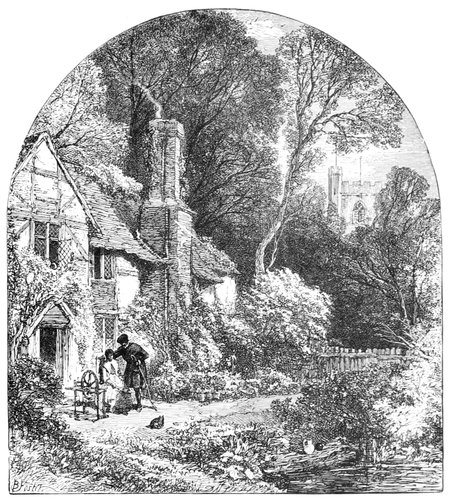
"Come awa, come awa,
An' o'er the march wi' me, lassie:
Leave your Southron wooers a',
My winsome bride to be, lassie.
Lands nor gear I proffer you,
Nor gauds to busk ye fine, lassie,
But I've a heart that's leal an' true,
And a' that heart is thine, lassie."
"Come Awa, Come Awa."—Thomas Pringle.
FROM "HOME AFFECTIONS WITH THE POETS."
By Birket Foster, R.W.S.
By permission of Messrs. George Routledge & Sons.
When the thirty drawings were completed we
asked him to reproduce the entire series as water
colour drawings, of such varied dimensions as he
himself might decide, for which we offered to pay
him the sum of £3000; but after giving the matter
very careful consideration, he said, in consequence
of his other engagements, he felt reluctantly compelled
to decline the commission.
There is no need for us to dilate on the earnest
manner in which Foster carried out these thirty
subjects. He gave us such beautiful drawings, so
exquisitely manipulated, that we naturally bestowed
infinite care in their reproduction, and it was
throughout a labour of pleasure and delight to us.
We published the work through Messrs. Routledge
and Co. as "Birket Foster's Pictures of English
Landscape," and it is a satisfaction to us to be
able to record that the book was fully appreciated
by the British Public.
An important part of our scheme in preparing
this book was to have a page of verse, either descriptive
of or in sympathy with each picture, so
that it might possess literary as well as pictorial
interest. When our work was drawing to a completion,
we submitted some of the proofs to Sir John
Millais; and it is, perhaps, hardly necessary to say
that he was charmed with the pictures, and warmly
entered into the idea of having poetic descriptions
to them. When asked his opinion whether he
thought Lord, then Mr., Tennyson would be likely
to co-operate with us, he immediately, in the most
generous manner, offered to write to him on the
subject, saying:
"I wish I could give sufficient time to the subject, for to tell
the truth there's nothing I should enjoy more than to do the verses
myself. But, of course, my pictures place that idea entirely out of
the question. But I'll tell you what I'll do," he continued, "I'll
write to Tennyson and ask him to take the matter up—he's rather
particular, you know, and perhaps he might the more readily
consent to do it for me, than if you wrote to him."
The following letter from Lady Tennyson to
Millais will show how the proposition was received:
"Farringford,
"June 7, 1861.
"Dear Mr. Millais,—Alfred was in the New Forest when
your kind letter came, or it would have been answered yesterday,
though I am sorry to have to answer the thing is impossible.
Poems do not come to him so, and if they did not come, you are,
I flatter myself, too much his friend to wish to find them there or
anywhere.
"May I ask you to do him the favour to decline the offer as
you will best know how to do with all courtesy.
"Accept Alfred's thanks for your kind invitation and for what
you say about the portrait.
"Believe me,
"Yours truly,
"Emily Tennyson."
This letter was accompanied by the following
note from Millais:
"My dear Dalziel,—I enclose Mrs. Tennyson's answer to my
note. I said that not to bother him, if he couldn't say 'Yes,' to
write himself. It is just what I expected; however, we have lost
nothing by the attempt. I should have thought it easy enough
to write a few lines to each, as I should find it easy enough to
illustrate anything. I am sorry to have kept you so long for the
two fellows seated on the gate.[17] Cut it with all your might.
"Yours very truly,
"J. E. Millais."
Ultimately the matter was placed in the hands of
Tom Taylor, the dramatic author, who was at that
time art critic to the Times, as well as a liberal
contributor to Punch, of which journal he subsequently
became editor. He wrote:
"8 Richmond Terrace,
"Whitehall, S.W.
"June 5.
"Dear Sirs,—I have just received the proofs. I have thought
much over the subject of poems to Birket Foster's drawings, and I
think that I would do what you wish on certain conditions.
"1st.—That I might call in aid my wife's verses, it being understood
that she will do one here and there. I may say that she is
homely born and bred, and that her verses would be above the mark
of my own, as far as I can judge. She has written much, both
words for music and music, before her marriage, as Miss Laura
Barker, and her music is of a very high order. I merely write this
that you may understand I am not forcing a novice on you. I wish
her to be associated with me in the work, from a belief that the
union of her with me will increase its value to the public.
"2nd.—The price I would suggest for thirty poems is £100.
This is putting the work at 'Once A Week' terms, and is the lowest
price at which I could write and do justice to both you and myself.
If these terms suit you, I believe I could have the thirty by the end
of July, or if your arrangement is to publish in parts, at the rate of
four a week, the mode of payment to depend on that of delivery,
i.e., according as it is of the whole at once or of the poems in fours.
I will retain the whole set of proofs till I have your answer.
"And I am, dear Sirs,
"Yours truly,
"Tom Taylor.
"Messrs. Dalziel
"P.S.—I send you two samples of the kind of illustration I
should supply to the drawings.
P.S.—If my terms or my verses do not suit you, I should
suggest your application to the Rev. J. W. Barnes, of Dorchester,
author of two very remarkable volumes of poems in the Dorset
dialect. Our respective contributions to be distinguished by initials
of the writers."
Taylor, in undertaking the commission, said:
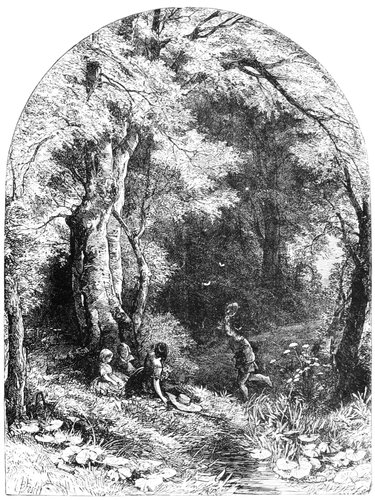
"... Who played
Beneath the same green tree,
Whose voices mingled as they prayed
Around one parent knee!"
"The Graves of the Household."—Mrs. Hemans.
FROM "HOME AFFECTIONS WITH THE POETS."
By Birket Foster, R.W.S.
By permission of Messrs. George Routledge & Sons.
"I accept this with great pleasure, for independent of the
beauty of the work, Foster and I are both 'Tyne-siders,' and that
will give an additional pleasure to me."
In August, 1881, we published an Édition de Luxe
of the book, a large, handsome volume, the pictures
all printed on India paper. On sending copies to
Foster we received the following reply:
"The Hill,
"Witley, Surrey,
"31 Augt., 1881.
"My dear Dalziel,—Accept my best thanks for the three
copies of the 'English Landscapes.' It is really a splendid volume,
admirably printed, and the get-up is altogether charming.
"I sincerely hope it may prove a success.
"With kind regards,
"Believe me,
"Very sincerely yours,
"Birket Foster."
Wishing to present a copy of the book to the
Emperor of the French, we wrote to his Secretary,
and the following letter came as his reply:
"CABINET
"DE
"L'EMPEREUR.
"Palais des Tuileries,
"Le 19 Juillet, 1863.
"Messieurs,—L'exemplaire des paysages anglais de Mr. Birket
Foster que vous avez exprimé le désir de faire agréer à l'Empereur,
est parvenu à sa haute destination. Mais Sa Majesté, presque
toujours en voyage depuis, n'a pu encore examiner cet album qui,
d'après ses ordres, doit être remis sous les yeux à son retour à Paris.
"Recevez, Messieurs, l'assurance de ma considération distinguée.
"Pour le Sénateur, Secrétaire de l'Empereur,
"Chef du Cabinet, et par autorisation,
"Le Sous-Chef
"Sacaley.
"Messieurs Dalziel."
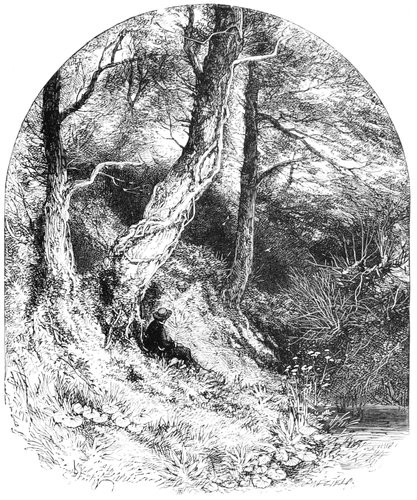
"I heard a thousand blended notes,
While in a grove I sat reclin'd,
In that sweet mood when pleasant thoughts
Bring sad thoughts to the mind."
"Lines Written on Early Spring."—Wordsworth.
By Birket Foster, R.W.S.
By permission of Messrs. George Routledge & Sons.
To which we replied expressing our wish that
it should be a presentation work, when again the
secretary wrote:
"CABINET
"DE
"L'EMPEREUR.
"Palais des Tuileries,
"Le 6 Janvier, 1864.
"Messieurs,—Avant de prendre une décision relativement
à l'Album de gravures sur cois, d'après les paysages de Mr. Birket
Foster que vous avez adressé à l'Empereur, Sa Majesté a exprimé
le désir d'en connaître le prix. Veuillez bien faire parvenir ce
renseignement au Cabinet.
"Recevez, Messieurs, l'assurance de ma considération distinguée.
"Pour le Sénateur, Secrétaire de l'Empereur,
"Chef du Cabinet, et par autorisation,
"Le Sous-Chef
"Sacaley.
"M.Mrs. Dalziel Frères.
"CABINET
"DE
"L'EMPEREUR.
"Palais des Tuileries,
"Le 1er Février, 1864.
"Messieurs,—L'Empereur a bien voulu accepter l'Album de
gravures, d'après les dessins de Birket Foster, dont vous lui avez
offert l'hommage. Sa Majesté a examiné ces planches avec intérêt,
en a apprécié l'exécution et elle m'a chargé d'avoir l'honneur
de vous adresser ses remericments sincères.
"Recevez, Messieurs, l'assurance de ma considération distinguée.
"Pour le Sénateur, Secrétaire de l'Empereur.
"Chef du Cabinet, et par autorisation.
"Le Sous-Chef.
"Sacaley.
"M.Mrs. Dalziel Brothers, Editeurs."
The book was sent to St. Cloud, and doubtless
perished in the flames when that picturesque Palace
was burnt down during the Siege of Paris in 1871.
Lord Leighton in acknowledging the receipt of
a copy of this book says:
"Dear Sir,—When your messenger came yesterday I was
unable to write and thank you and your brother, as I do now, for
the very handsome present you have made me, of the extent of
which I own I had not the slightest notion when I accepted it with
so much alacrity the other day. I have looked through the volume
with great interest, and am much struck with the great talent displayed
in very many of the designs—some, I think, quite excellent—and
with the great spirit and brilliancy of your rendering of
them.
"Once more my best thanks.
"Yours ever faithfully,
"Fred. Leighton."
Birket Foster was a constant visitor at our office
in High Street, Camden Town, generally bringing
a parcel of drawings with him. On one of these
occasions the conversation turned upon water colour
painting and the great demand there was for that
class of art, when, having seen some of his slight
sketches in colour, we expressed a little surprise
that he did not "go in" for it. He replied that
his wife had suggested the same thing, but—and he
shrugged his broad shoulders, saying, "Um—I don't
know—but we shall see—we shall see." He did
"see," and all the art loving world knows with
what result.
Foster's success as a water colour painter was
quite phenomenal. There was a mad rush for his
work by collectors, and the prices went up as a
natural consequence. Down at Witley in Surrey,
where he subsequently built a most charming residence,
he said to us, "When I sit down in that
chair after breakfast it means at least twenty guineas
before I get up again."
It was about this time that two celebrated
picture dealers met at the Charing Cross Railway
Station: they had taken tickets for Witley, and
both knowing they had the same object in view,
travelled down together. On arriving at their
destination they found only one fly at the station.
A. made a rush for it, when B. stopped him, saying,
"No, sir; this is my fly. I telegraphed for it from
London, but I will be most happy to give you a
lift to Fosters; only remember I am first." And he
was "first," for he cleared out every scrap Foster had
to dispose of, and A. had to go away empty handed.
On Fosters first visit to the Galleries after he
had been elected a member of the "Old Water
Colour," as it was then called, he was received in a
most patronising manner by J. D. Harding, the then
President of the Society, who complimented him,
and dilated on the great advantage it would be
to him being a member of the Society. He also
begged him to appreciate this by a close study of
nature, adding:
"If you do as I suggest, I have no doubt you
will one day take a good place amongst the best
of us."
It was Foster's invariable custom to make small
water colour sketches for his more important black
and white work; sometimes they were partly pencil,
or pen and ink tinted. Some little time before
he seriously took to water colour painting, a West
End publisher frequently asked him for some of
these sketches; so he gave his friend a "bundle"
of original drawings, for which the publisher
thanked him, saying that one day, when he could
afford to do so, he would have them bound
in a nice book. It was after Foster won distinction
as a painter that he said to us, "Those
drawings would now represent a money value of
some hundreds of pounds." His mother, a dear
old Quaker Lady, who was present, said, "Thee
mustn't mind that, Birket. Thee gave him the
drawings and they are his, no matter what the
value of them may be now."
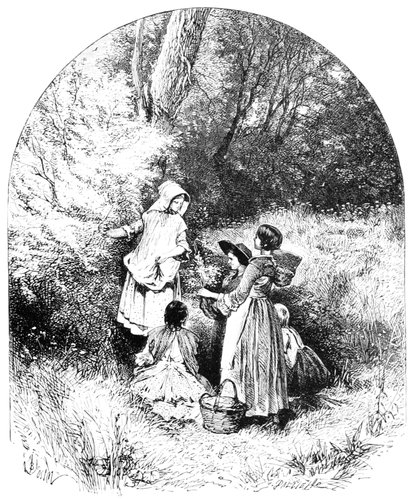
"The Earth herself is adorning
This sweet May morning;
And the children are pulling on every side,
In a thousand valleys far and wide,
Fresh flowers."
"Intimations of Immortality."—Wordsworth.
By Birket Foster, R.W.S.
By permission of Messrs. George Routledge & Sons.
Birket Foster naturally spent much of his time
in the country, often locating himself at farm houses,
and being of a genial nature always became very
friendly with the people. On one occasion an old
farmer took the greatest interest in the work as
it went on, in fact to the extent that the old boy
seemed to feel that he had a sort of partnership in
the production of the picture. Some time after this
a friend of Foster's, who stayed at the same farm,
found the old man most anxious to know all about
Foster, but particularly as to how much money he
had got for the picture "that we done down here."
The friend said, "A hundred pounds at least."
The old man was incredulous, in fact he would not
believe it. When assured that such an amount was
small for a picture by so clever and popular a man,
he seemed unable to grasp it, saying, "Why, it
would be like pickin' up sovereigns as if they was
turnips or eggs; and if it was so, all I can say
is, he must ha' sold it to a friend."
After the success of our volume Messrs. Routledge
made a collection of engravings from Foster's drawings
in their various books, for publication.
Here is an amusing letter from Foster on seeing
this new work announced:
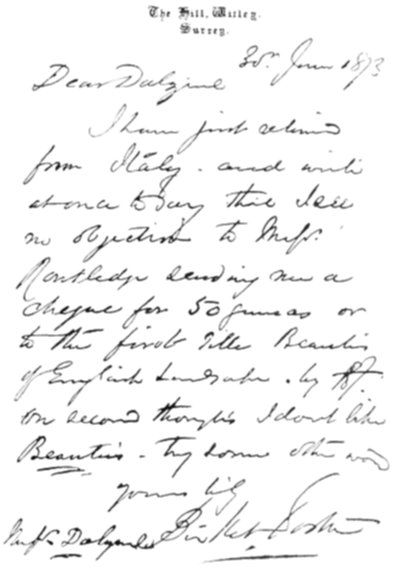
The Hill, Witley.
Surrey.
30th June 1873
Dear Dalziel
I have just returned
from Italy, and write
at once to say that I see
no objection to Messrs.
Routledge sending me a
cheque for 50 guineas on
to the first title Beauties
of English Landscapes, by BF
on second thought's I don't like
Beauties—Try some other word.
Yours truly
Birket Foster
Messrs. Dalziel
When our book appeared the Press was unanimous
in its praise. The Times said: "It would be
difficult to do justice to these delineations of rural
life and scenery without seeming to fall into extravagant
praise"; the Academy spoke of "the inherent
beauty of the designs"; the Art Journal of
"the grace of composition and idyllic beauty"; the
Saturday Review of the "subtile feeling for rustic
character, and his sympathy for the poor; his curious
love for unsophisticated company in sequestered
places."
The public responded well, but not in large numbers—the
days of large numbers had not then come.
But of all that was said about these pictures
we most treasured a letter written to us by John
Ruskin, which we regard as "an appreciation" from
one of the best and most original writers on art
matters of his period.
"Geneva, August 12, '62.
"Gentlemen,—I am much obliged by your having sent me
those beautiful Proofs. They are superb specimens of the kind
of Landscape which you have rendered deservedly popular, and
very charming in every respect. I wish, however, you would
devote some of your wonderful powers of execution to engraving
Landscape, which should be better than 'charming,' and which
would educate the public taste as well as meet it. These pieces,
however, are peculiarly good of their class—rich, gracefully composed,
exquisite book illustrations, and very precious as examples
of wood execution.
"Believe me, sincerely yours,
"J. Ruskin.
"Messrs. Dalziel."
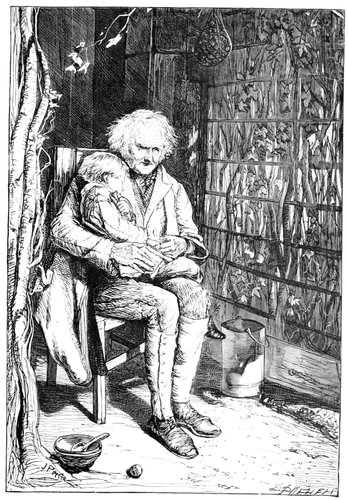
Grandfather Nursing a Sick Boy.
FROM "GOOD WORDS."
By John Pettie, R.A.
Published by Mr. Alexander Strahan.
As the work progressed we sent proofs to Foster
for approval or correction, and according to his custom
he wrote all his remarks on the margin of the India
paper. These proofs were all preserved, and they
show how completely he was satisfied with the
care we had bestowed on the reproduction of his
beautiful drawings.
It is a great pleasure to us to be able to state
that these touched proofs are now the property of
the Trustees of the British Museum, where doubtless
they can be seen with John Ruskin's letter
and some of Foster's own on application at the
Print Room of that institute in Bloomsbury.
Birket Foster spent his latter years at Weybridge,
where he died. Surrounded by many old and sorrowing
friends, he was laid to his rest at Witley,
his beautiful Surrey home.
Having already engraved several drawings for
Good Words, we were, early in the year 1862, asked
by Mr. Alexander Strahan to undertake the engraving
and entire control of the illustrations for this journal,
which was being edited by Dr. Norman Macleod, a
Scottish minister of great repute and a Chaplain to
the Queen. The offices were subsequently removed
from Edinburgh to London, and shortly after the
house added to its publications the Sunday Magazine,
a journal devoted to "Sunday reading." This
was edited by another celebrated Scottish divine,
Dr. Thomas Guthrie, author of "The City: Its
Sins and Sorrows," and other works of a kindred
description. A great many of the illustrations for this
periodical we also engraved.
This connection naturally enabled us to introduce
works by the then most promising artists in black
and white, and by many other men who have since
taken a high position in art.
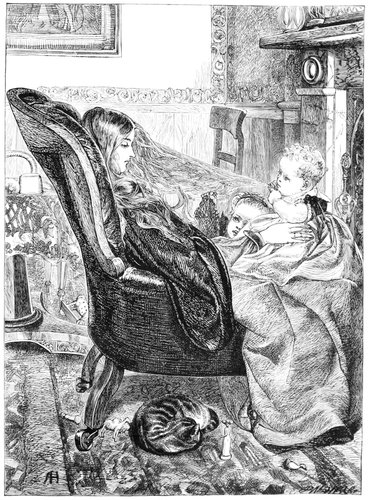
Coach and Horses.
FROM "GOOD WORDS."
By A. Boyd Houghton, R.W.S.
Published by Mr. Alexander Strahan.
Alexander Strahan was the originator of the
sixpenny illustrated magazine. His Good Words,
considering the period of its advent, was equal to
anything that has yet been done at that price, and, if
measured by the distinguished artists and brilliant
writers of whose work it was composed, it is a
question whether any of the more recent magazines
would equal it in actual merit.
Strahan is a man of great taste, both in literature
and in art. We were indebted to him for introductions
to a number of highly-gifted young Scotch
artists. Amongst them were Orchardson, J. Pettie,
MacWhirter, and Tom Graham, all of whom soon
became famous and won honours of distinction.
Pettie made several fine drawings for Good Words,
and he and MacWhirter illustrated a beautiful little
edition of Wordsworth's "Poems for Children," for
which, by the way, Millais made a charming vignette.
Strahan also introduced us to Robert Buchanan,
who kindly helped us in some of our "Fine Art
Books," concerning which we will speak later.
While engaged upon these publications it often
happened that the drawings came into our hands
so late that insufficient time was left for engraving.
It might be that drawings came to us
on a Saturday evening, and we were compelled to
deliver the engraved blocks to the printers on the
Monday morning. This could only be done by
taking each wood-block into two, three, or four
pieces, and by two, three, or four engravers working
all the night through upon them; for while any
strain might be put upon the engraver, no excuse
was permissible for keeping the printing machine
waiting for a single hour. But under the circumstances,
and by the best available means, we did our
utmost with the drawings that were placed in our
care for engraving purposes, though we are free to
admit not at all times with that success we ever
had so much at heart.
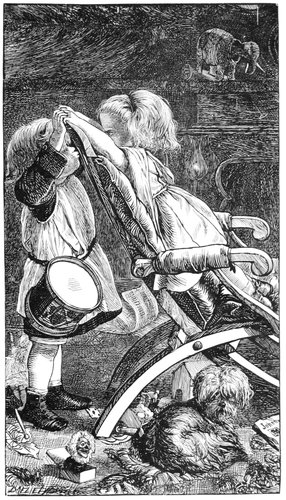
Kiss Me.
FROM "GOOD WORDS."
By A. Boyd Houghton, R.W.S.
Published by Mr. Alexander Strahan.
As examples of the many complimentary letters
we received from artists whose drawings we engraved
about this period, we may quote the following:
"New Place,
"Woodchurch Road, W.
"Dear Mr. Dalziel,—I consider the cutting of my drawing
quite a masterpiece, and in every respect up to my expectation.
There is nothing I can suggest that would improve it.
"With kind regards,
"Very truly yours,
"Seymour Lucas."
"Grove Lodge,
"Palace Garden Terrace, W.
"Messrs. Dalziel.
"Gentlemen,—I am entirely delighted with your rendering
of my drawing; it could not be better done as far as work is
concerned.
"Yours faithfully,
"Geo. H. Boughton."
"Dear Sirs,—There are parts of it I like very much indeed;
indeed I like it all, but some parts of it I think are perfectly
beautiful.
"Yours very truly,
"Richard Ansdell."
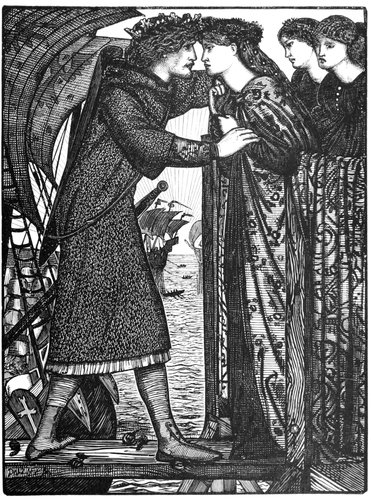
Sigurd.
FROM "GOOD WORDS."
By Sir E. Burne-Jones, Bart.
Published by Mr. Alexander Strahan.
Our early friend, the late F. R. Pickersgill, R.A.,
frequently wrote in high appreciation of the careful
manner in which we had reproduced his drawings,
but in deference to the wishes expressed by his
family we refrain from publishing any of the
letters.
When Mr. Alexander Strahan proposed that we
should take the entire control of the art part of
Good Words, we asked all our most distinguished
artist friends to make drawings for the journal.
Amongst others was Holman Hunt, who readily
offered his co-operation, and also favoured us with
the letter here given, which certainly foreshadowed
the coming eminence of one who has made a lasting
mark on the history of English art.
"November 21st, 1861.
"My dear Sir,—I have looked over Good Words, and carefully
read Miss Mulock's poem of 'Go and Come.' The poem
I esteem very highly, and shall be pleased to do an illustration
of some kind, although I cannot hope to do it justice in the little
leisure I have between this and the time you mention as the
date when the drawing ought to be ready.
"In addition to the desire to satisfy your anxiety with respect
to the illustration to Miss Mulock's poem, I write to speak of a
friend of mine who I feel very strongly might be of great value
to you in the illustrating of Good Words. He is perhaps the
most remarkable of all the younger men of the profession for
talent, and will, undeniably, in a few years fill the high position
in general public favour which at present he holds in the professional
world. He has yet, I think, made but few if any
drawings on wood, but he has had much practice in working
with the point both with pencil and pen and ink on paper, and
so would have no difficulty with the material. I have not seen
him lately, but remember that he has sometimes said that he
should like to try his hand at drawing on wood, so without
further ceremony I will enclose a letter to him which you may
use at your own discretion. His name, as you will see by the
enclosed, is Edward Jones.
"Yours ever sincerely,
"W. Holman Hunt."
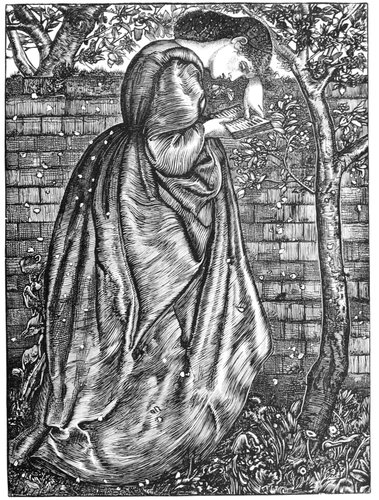
Summer Snow.
FROM "GOOD WORDS."
By Sir E. Burne-Jones, Bart.
Published by Mr. Alexander Strahan.
Hunt's letter of introduction was followed by a
visit to Edward Jones (afterwards Sir Edward
Burne-Jones, Bart.,) at his studio in Bloomsbury.
The room was crowded with works of varied
kinds, in every sort of method, all showing wonderful
power of design, vivid imagination, and
richness of colour. We were so fascinated with the
man and his art that we at once asked him to
paint a water colour drawing, size and subject to be
left to him. About that time he had painted a
picture, "A Harmony in Blue," for John Ruskin,
and it was suggested that ours should be "A
Harmony in Red." After some months the result
was a most highly elaborated water colour, "The
Annunciation." This, of course, was in his early
manner, and of great beauty. Later on he made
for us a Triptych illustrating the Birth of Christ, the
first subject being the "Shepherds Guided by the
Star," the centre the "Manger," and the third the
"Wise Men from the East." The work was fine
in conception and rich in colour. He also made
a set of small water colour drawings of the "Seven
Days," which were intended for reproduction in our
contemplated Illustrated Bible, for which he also
made a few drawings on the wood. His contributions
to Good Words were very limited. At
our request, however, he made slight water colour
sketches from some of the few subjects he did do.
The two following letters show that at this time
he was quite unknown to the general public,
although he was appreciated in the highest degree
by those who knew him and his work:
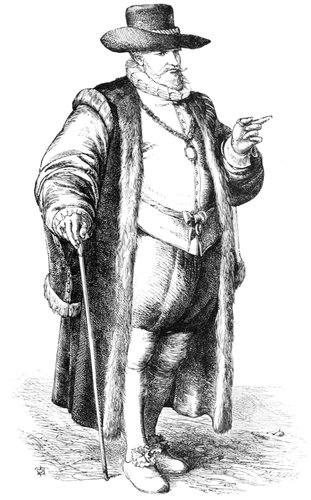
Worldly Wiseman.
FROM THE "PILGRIM'S PROGRESS."
By J. D. Watson, R.W.S.
By permission of Messrs. George Routledge & Sons.
"62 Gt. Russell St.,
"August 1st, 1863.
"Dear Sir,—Understanding that you are going abroad for
a short time, I write to say that if agreeable to you I should like
to keep 'The Annunciation' in my studio until you return; for,
as I do not exhibit, that is my only way of letting people see
what I have been doing. Pray do not take the trouble to answer
if this will be convenient to you.
"And believe me, dear Sir,
"Very faithfully yours,
"E. Burne-Jones."
"62 Gt. Russell St.,
"Oct. 17, 1863.
"Dear Sir,—Your messenger arrived an hour after I posted
to you. I send the Triptych. You will have 'The Annunciation'
next week; but until it is quite finished, I am unwilling to send
it out of my studio. The little drawing of 'The Days' is at this
moment gone to have a new glass put before it, but will be ready
on Monday. I am sorry that it will not be before. In haste.
"Yours very faithfully,
"E. Burne-Jones."
The following letter alludes to his election into
the Royal Society of Painters in Water Colours,
one of the three pictures necessary to be sent in
being "The Annunciation." This gave him a place
for public exhibition.
"62 Gt. Russell St.,
"Feb. 10, 1864.
"Dear Sir,—You may know by now that I was elected on
Monday. The picture is in my studio again now; but if you will
leave it with me for a week or two, I think I may find time before
leaving town to do one or two things at it which I notice.
"Believe me,
"Very sincerely yours,
"E. Burne-Jones."
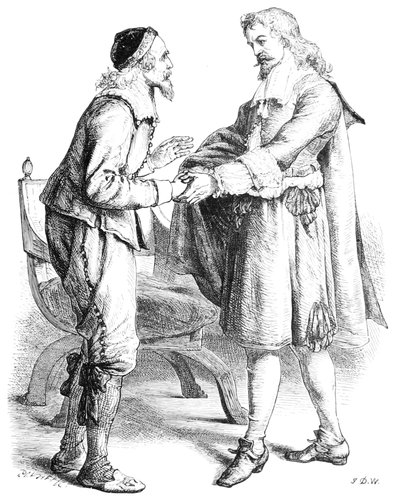
Crusoe Visits the old Captain.
FROM "ROBINSON CRUSOE."
By J. D. Watson, R.W.S.
By permission of Messrs. George Routledge & Sons.
His connection with the Society was of short
duration, owing to an unfortunate incident connected
with an early exhibit of his. If we remember
rightly, the picture was of a classic, semi-nude
character, at which some "great lady" had felt
very much shocked; in fact, to such an extent that
she said it ought to be taken off the walls, as it was
quite indecent. This the committee foolishly did,
with the result that Burne-Jones at once resigned his
membership—a course followed by his friend Sir F.
W. Burton, at that time one of their most prominent
members. It is only just to state that many
years after, both men were urgently invited to
return to the Society, and did so. But Burne-Jones
never sent much of his work there, for fresh and
larger fields had opened up to him at "The
Grosvenor Gallery," followed by "The New," at
both of which he was a great power. His work
was always grand in subject, with the highest aim
and noblest purpose. He was elected into the Royal
Academy, but these other connections held him so
close that he resigned his Associateship to make
room for others to whom the honour would be of
more importance.
The death of this highly gifted artist, who
in himself combined all that is good, kindly, and
generous, was universally regarded as a sad loss
to the world of art.
Early in the Sixties we had been commissioned
by Messrs. Routledge, Warne and Routledge to
find an artist—"A new man, sir," as Mr. George
Routledge expressed it, who could illustrate Bunyan's
"Pilgrims Progress" with a fair amount of originality,
and give something better than had ever
been done in this way before. This, we naturally
felt, was a very difficult task, and fully realised the
responsibility that would rest upon us for the success
or failure of the work—the number of artists of
great ability working in black and white at that
time was very different to what it is now.
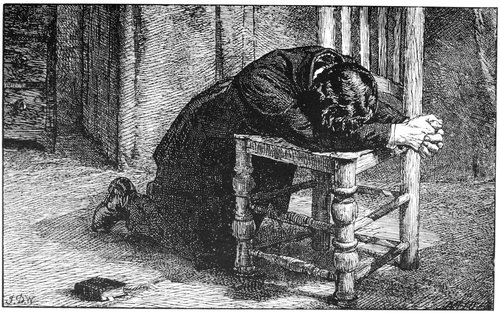
Abject Prayer. By J. D. Watson, R.W.S.
By permission of Mr. James Hogg. FROM "LONDON SOCIETY."
We had had many conversations on the subject
as to the most fitting man for the work, when early
in the year 1865 Mr. Alexander Strahan sent us
two drawings to engrave for a short fairy tale he
was about to publish in Good Words. There was
novelty and freshness of style, as well as a purity
of drawing, in the designs which attracted our attention,
and at once suggested the idea that the artist
might be competent to undertake the pictures for
the "Bunyan." On enquiry we found he was John
Dawson Watson, a young man living in Edinburgh,
who subsequently became eminent as a black and
white artist, as well as a painter in oil and
water colours, and a prominent member of the
Old Water Colour Society. We at once wrote to
him about the "Pilgrim's Progress," asking if he
would send us two drawings as examples of the
manner in which he would propose to treat the
subject. His reply came by return of post, not
accompanied by drawings, but saying he was coming
to London at once, and would call upon us on his
arrival. This he did, and a very pleasant interview
terminated by our placing in his hands the commission
to do one hundred drawings for this work.
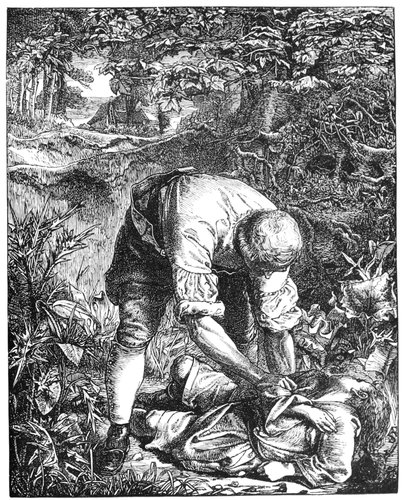
"To seek the wanderer, forth himself doth come
And take him in his arms, and bear him home.
So in this life, this grove of Ignorance,
As to my homeward I myself advance,
Sometimes aright, and sometimes wrong I go,
Sometimes my pace is speedy, sometimes slow."
"Life's Journey."—George Wither.
FROM "ENGLISH SACRED POETRY."
By Frederick Sandys.
By permission of Messrs. George Routledge & Sons.
It is perhaps hardly necessary here to state how
perfectly our confidence in J. D. Watson's ability
was indorsed, not only by the publishers, but by
the public voice and the pen of the critics; this
edition of Bunyan's immortal work being, in a
pecuniary sense, among the most successful of the
many Fine Art Books issued by the Messrs. Routledge.
Immediately on the publication and instant
success of this book, we were instructed to secure
Watson's services in illustrating De Foe's "Robinson
Crusoe" with a like number of pictures. This he
readily undertook to do, and, as a series of
drawings in black and white, they will certainly
compare favourably with any work of the kind this
country has produced.
After the "Pilgrim's Progress" and "Robinson
Crusoe" perhaps there is no other work where the
versatility of his power is so strongly shown as
in "English Sacred Poetry," to which book he
was a very large contributor, having no less than
ten drawings to "Gray's Elegy in a Churchyard,"
and twenty or more to other poems—"Time and
the Year," and "Scene in a Scottish Cottage"
being among the best.
On one occasion Watson happened to be at our
offices when Birket Foster came in. They had
never met before, and on being introduced, seemed
mutually pleased to make each other's acquaintance,
and left together. This acquaintance ripened into a
life-long friendship, Birket Foster marrying Watson's
sister.
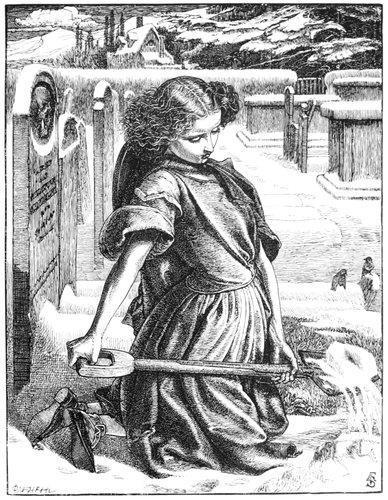
"'My father and my mother
And my sisters four—
Their beds are made in swelling turf,
Fronting the western door.'
"'Child, if thou speak to them,
They will not answer thee;
They are deep down in the earth—
Thy face they cannot see.'"
"The Little Mourner."—Dean Alford.
FROM "ENGLISH SACRED POETRY."
By Frederick Sandys.
By permission of Messrs. George Routledge & Sons.
Watson was a kind-hearted, liberal-minded man,
and gifted in many ways outside his art. In the
early days of our connection with him he often
spoke of what he called his "fatal facility," and
no doubt that gift told to his detriment. His art
was no trouble to him; and this was the root
of a certain indolence shown in his later productions
which, generally speaking, were far inferior
to what might have been expected from his natural
powers—though his work was at all times full of
tender refinement, beauty and sympathetic feeling.
He did many very clever drawings for the
periodicals. One of his finest, perhaps, was for
London Society, the subject being the figure of
a man on his knees in the attitude of "Abject
Prayer."
During the sudden rage that sprung up for
water colour drawings his work was much sought
after by the dealers. We remember him on one
occasion speaking of this eagerness for his pictures,
and saying:
"I believe if I were to spit upon a piece of
paper and smear it over with my hand they would
declare it beautiful, and have a scramble who was
to buy it."
On Watson coming to London our connection
developed into close social friendship. We had a
great liking for his work outside his black and
white. The first picture we bought from him was
off the walls of the Royal Academy, "A Pet
Goat," a small but most highly finished work. He
did several water colour portraits of members of
our family, and some fine heads, by point work,
in sepia-coloured inks. We also purchased several
small water colour drawings from him which he
made to be reproduced in colour.
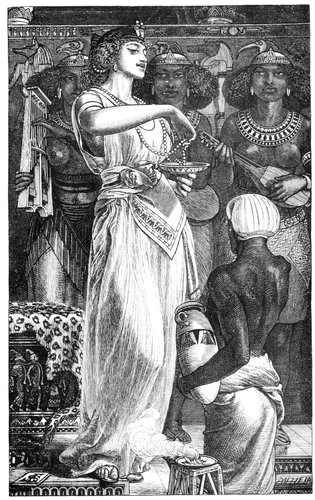
Cleopatra.
FROM THE "CORNHILL MAGAZINE."
By Frederick Sandys.
By permission of Messrs. Smith, Elder & Co.
Watson had great dramatic taste; his connection
with Birket Foster, and the frequent visits to
his big house, "The Hill," at Witley, in association
with Fred Walker and two or three other kindred
spirits, gave him plenty of opportunity for exercising
his favourite hobby. In the plays they got up
he was everything, leading business, scene painter,
costumier, stage and general manager. He had a
perfect knowledge of costume—used to cut out the
dresses, and, with the assistance of his wife and
sister, did all the "tailoring." These plays were
delightful and a joy to all who had the good fortune
to witness them.
"English Sacred Poetry" gave an opportunity
for beautiful pictures, and in the work of the various
artists engaged on it there seems to be a greater
unity of feeling than is generally the case where
the art is mixed. At the same time, perhaps
there is no stronger contrast in method than that
which exists between the works of Holman Hunt
and Frederick Sandys: for instance, Holman Hunt's
beautiful illustration to Dean Trench's pathetic
verses, "The Lent Jewels" (which we made the
frontispiece to the volume), and the two very
powerful drawings, "Life's Journey" and "The
Little Mourner," by Frederick Sandys.
Of the many high class drawings which appeared
in the Cornhill Magazine, there is no one
work more remarkable than that of "Cleopatra," by
Frederick Sandys, which for dignity and grandeur
of design must always be regarded as a fine specimen
of that artist's work.
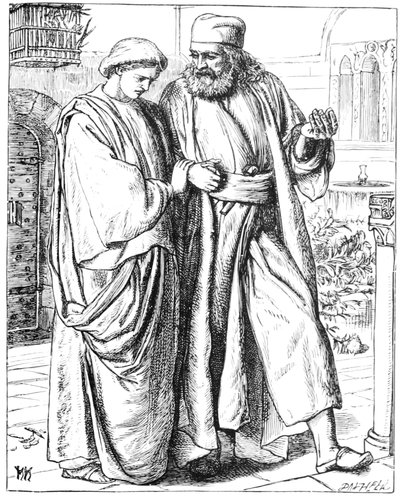
"What question can be here? Your own true heart
Must needs advise you of the only part;
That may be claimed again which was but lent,
And should be yielded with no discontent;
Nor surely can we find herein a wrong,
That it was left us to enjoy so long."
"The Lent Jewels."—Richard Chevening Trench.
FROM "ENGLISH SACRED POETRY."
By Holman Hunt.
By permission of Messrs. George Routledge & Sons.
Stacy Marks also gave us some of the best
drawings he ever made for the wood engraver—notably
"A Quiet Mind," "The Ring," and "The
Two Weavers." From Harrison Weir we had a
set of four drawings, "The Only One." Sir John
Gilbert's "Landing of the Primrose" is a fine
example, but not so good as his set of illustrations
to "A Hymn." There is a grand picture
of a storm at sea, "The Watching of Providence,"
by G. H. Andrews, and Charles Keene's illustration
to "Contentment" is a very strong bit of work.
We engraved many of Keene's early drawings
and were close friends, working together constantly
at the Life Schools in Clipstone Street, next door
to which he had his queer little box of a room,
where for a long time he did all his work. It
was a strange mass of scraps, sketches, studies;
bits of costumes, armour, and "all sorts" of oddments
in the way of properties. It was his custom
to make several studies for each figure he drew,
and many of them were pinned to the dilapidated
paper on the walls, helping to make up the somewhat
picturesque appearance of the place. We were
very anxious to produce some large and important
work with him, and offered him a commission to do
an elaborately illustrated edition of "Don Quixote,"
one of the conditions being that he should visit
Spain, with the view of collecting new material for
the purpose. He liked the subject, and would have
undertaken it, but mainly on the ground that he
could not bind himself to do any important work
within a fixed time, he finally declined our offer.
He felt that his best efforts were due to Punch,
but even with the proprietors of that journal he
objected to be put on any fixed agreement, like
Tenniel, Leech, Du Maurier, and others; for, he
said, it would make him feel that he must produce
a given amount of work in a given time. "No,"
he said, "I prefer to send in my drawings as I
finish them, whatever they may be, and be paid
for the work I have done."
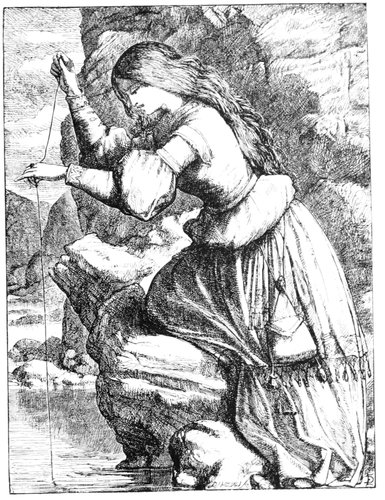
"There sits a lovely maiden,
The ocean murmuring nigh,
She throws the hook and watches;
The fishes pass it by.
"A ring with a red jewel
Is sparkling on her hand;
Upon the hook she binds it,
And flings it from the land."
"A Northern Legend."—W. Cullen Bryant.
By Edward Dalziel.
Published by Messrs. D. Appleton & Co., New York.
We need hardly say it was a disappointment
to us. This was before the "Don Quixote" of
Gustave Doré had been given to the world; and
we fancy that Art is the poorer by Charles Keene
not considering himself free to accept our commission.
Messrs. D. Appleton, of New York, requested
us to provide a set of illustrations to the Poetical
Works of William Cullen Bryant. They wished for
a large number by Birket Foster, who at that
time was at the very height of his popularity for
black and white work. Out of something like one
hundred pictures he gave us thirty-six, all of which
are beautiful examples; many of them exquisite little
vignettes. William Harvey supplied some graceful
pictures; Sir John Tenniel, J. R. Clayton, and
F. R. Pickersgill were responsible for several of
the figure subjects; while Edward Duncan drew
some very delicate little sea pieces.
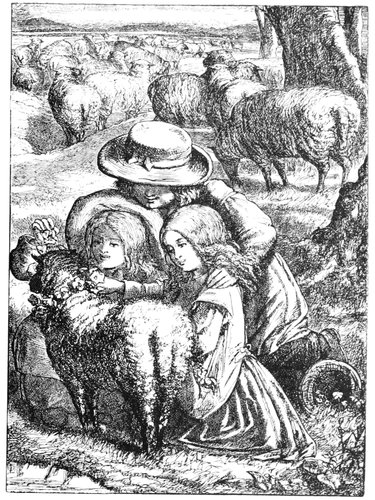
"Once this soft turf, this rivulet sands,
Were trampled by a hurrying crowd,
And fiery hearts, and armed hands,
Encountered in the battle cloud.
* * * * * * *
"Now all is calm, and fresh and still,
Alone the chirp of flitting bird,
And talk of children on the hill,
And bell of wandering kine are heard."
"The Battle-field."—W. Cullen Bryant.
By Edward Dalziel.
Published by Messrs. D. Appleton & Co., New York.
There are many of our own drawings in this
book, of which we make mention—"The Battle-field";
"An Indian Girl's Lament"; "Life";
"A Northern Legend"; "The Lady of Castle
Windeck"; and "An Evening Reverie."
Harrison Weir sent us some good pictures of
animals, notably "The Maiden's Sorrow." Weir, one
of our earliest connections, is a gifted and brilliant
conversationalist, brimful of anecdote—humorous and
otherwise, a genial companion and an old friend.
He is a man of many parts: poet, painter,
draughtsman, and naturalist; and how much that
word "naturalist" means in the knowledge that
fitted him for the varied branches of art which
he encompassed in his numerous works! Not the
least amongst them being the many children's books
he created.
One of the most beautiful books ever entrusted
to our care, in which the pictures were to be by
various artists, was the "Poems of William Wordsworth."
We feel, when looking at the book now,
after a lapse of forty years, how happy we were
in having the co-operation of such very suitable
artists as Birket Foster, Sir John Gilbert, and
Joseph Wolf.
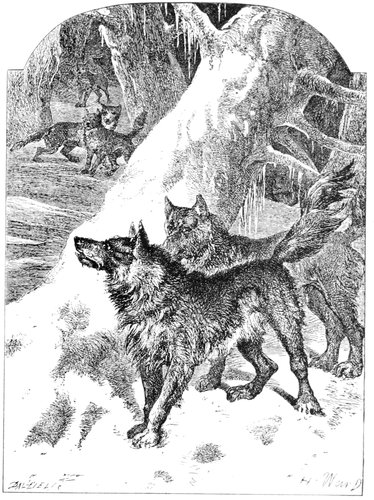
"There, I think, on that lonely grave
Violets spring, in the soft May shower,
There, in the Summer breezes, wave
Crimson phlox and narcissus flower.
"There the turtles alight, and there
Feeds with her fawn the timid doe;
There, when the Winter woods are bare,
Walks the wolf on the crackling snow."
"The Maiden's Sorrow."—W. Cullen Bryant.
By Harrison Weir.
Published by Messrs. D. Appleton & Co., New York.
Wolf came of a family of agriculturists. Bred
amid field, woodland and hedgerow, he gathered
his love of all things beautiful, animate and
inanimate, direct from Nature. From his earliest
boyhood he had an intense love of birds, and so
strong was his feeling in that direction that he never
lost a chance of dissecting and thoroughly making
himself master of the anatomy of the specimen
under his immediate observation. In maturer life
it was not enough for him to give a surface
resemblance to a bird; he was one of the earnest
men who must go deep down to the very root of
his subject. Whatever eminence he gained as an
all-round naturalist, it is by his bird pictures that
he will always stand out the more prominent.
As a book illustrator he became so popular
that no collection of varied art seemed complete
without one or more of his exquisitely graceful
pictures.
He was a great lover of music, and would
often dream away the idle hours, as he called
them, on his favourite instrument, the zither; and
a propos, surely there was much sweet and even
grand music in his groups of birds, such as "The
rooks sat high" and "The mother kite watching
and guarding her nest."
In our long connection with the firm of Thomas
Nelson & Sons, of Edinburgh, we made a large
number of drawings and did much engraving for their
books. The work was mostly of an instructive and
amusing kind for young people. Among the various
artists employed upon their publications, Keeley
Halswell, who at that time resided in Edinburgh,
did a great many drawings. The Messrs. Nelson
had an art department in connection with their vast
establishment. In this branch William Small was
a pupil; and there he illustrated many of their story
books before he came to London to take a first
place amongst the most distinguished artists in black
and white. Small became an important contributor
to the Graphic in its early days, and made many
drawings for Good Words and other magazines of
Strahan's. He also made a few clever drawings
for Buchanan's "North Coast Poems."
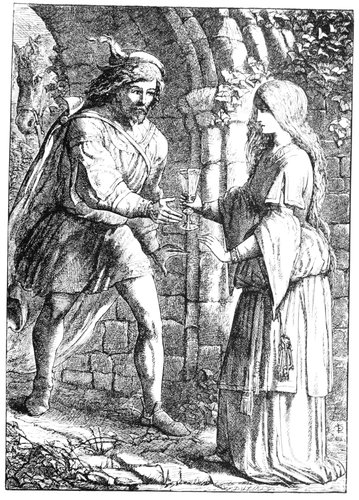
"The careless words had scarcely
Time from his lips to fall,
When the Lady of Castle Windeck
Came round the ivy wall.
"He saw the glorious maiden
In her snow-white drapery stand,
A bunch of keys at her girdle,
The beaker high in her hand."
"The Lady of Castle Windeck."—W. Cullen Bryant.
By Edward Dalziel.
Published by Messrs. D. Appleton & Co., New York.
We saw much of Mr. William Nelson, the eldest
brother, during his visits to London, which were
by no means infrequent. He was a man with a
large, warm heart, and kindly, genial disposition,
and though holding broad views in most matters,
he (like the majority of his countrymen in the last
generation) looked for many years with the greatest
aversion on all things theatrical, and from his early
training considered "the door of the theatre as
the gate to destruction." At one of his quiet dinner
parties Madame Antoinette Stirling and her husband
were present, and the talk naturally turned
on music and the drama, when he related the
following as his first introduction to theatrical entertainments:
"On one occasion I was, very reluctantly, prevailed
upon to go to the theatre to see the comic
opera, Les Cloches de Corneville. At first I was
indifferent to what was going on, but as the play
progressed my interest increased so much that at
the end I came away delighted at what I had
seen, and the next morning, turning the matter over,
I found myself none the worse, either bodily or
mentally, for having been at the play. Indeed, the
performance gave me so much pleasure, that I
resolved to repeat the indulgence on every possible
opportunity; but that, of course, could not be done
in Edinburgh. Feeling that I have lost a great
deal of intellectual enjoyment, I make a point of
going to a theatre on every disengaged evening I
have when in London."
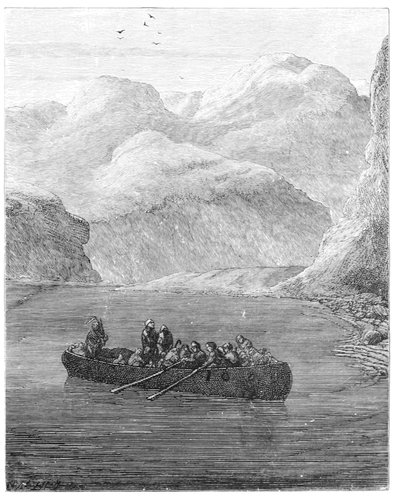
"In the mid-water, moving very slowly,
With measured stroke of dripping oars, a boat
Appeared out of the fading mist of the morning."
"The Exiles of Oona."—Robert Buchanan.
By Thomas Dalziel.
By permission of Mr. John Hogg.
When James Hogg and Sons removed their
publishing house from Edinburgh to London we
became intimately connected with them. James,
the father, was associated with many of Scotland's
best and noblest writers: De Quincey was a friend
and companion, also Professor Wilson (Christopher
North), and Dr. Brown, the distinguished author of
"Rab and his Friends."
The two clever sons, James and John, were
both most resourceful men, full of energy and
enterprise. James was one of the first to follow
the example of the Cornhill by starting a Shilling
Illustrated Magazine, London Society, which he
successfully conducted for many years. He gave
examples of Sir John Millais, P.R.A.; Fred
Walker, A.R.A.; John Pettie, R.A.; Tom Graham;
Gordon Thomson, and J. D. Watson. Amongst the
lady artists were Florence and Adelaide Claxton,
whose style of work well suited the nature of the
publication. The Christmas Number of London
Society held a prominent position for many years.
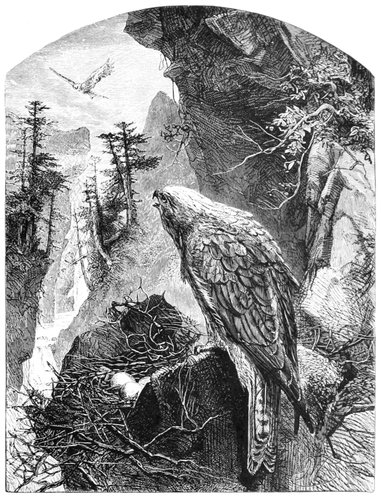
"To seek their bread from public charity,
They and their wives and children—happier far
Could they have lived as do the little birds
That peck along the hedges, or the kite
That makes its dwelling on the mountain rocks!"
"The Deserted Cottage."—Wordsworth.
By Joseph Wolf.
By permission of Messrs. George Routledge & Sons.
John Hogg, the younger brother, while publishing
many books of a useful and instructive
high-class character, also conducted the Churchman's
Family Magazine; and when amongst the artists we
find the names of Frederick Sandys, G. J. Pinwell,
and others, evidence of his capability for the position
is afforded. John Hogg is an earnest Freemason,
and closely identified with the publications
of the craft.
Nursery Rhymes! what delightful subjects they
give for pictures, and how often we have had the
pleasure of working on them. The first collection
we made is very fully illustrated by William
McConnell, "a comic artist" of some repute in his
day. He was the close friend of the Brothers
Brough and of George Augustus Sala, for whom
he made a set of elaborate drawings to illustrate
"Twice Round the Clock." McConnell was a
most prolific artist.
Our next essay on the same subject was a
commission from the Routledges, and was issued as
"Our Favourite Nursery Rhymes." This was altogether
much more important from an art point,
many of the best draughtsmen of the time being
engaged upon it. J. B. Zwecker made a capital set
of drawings illustrating "Old Mother Hubbard";
while J. A. Pasquier, a very clever artist in black
and white, and a skilful painter in water colours,
contributed several appropriate designs.
We well remember presenting a copy of this
volume to Professor Sir Richard Owen, the great
naturalist. He said what enjoyment it had given
to him: it was like meeting the friends of his
childhood. The grand old man's face really beamed
with delight as he, in his sweet, quiet voice, said,
"They have not only pleased me, but I will have
the further pleasure of showing all my young friends
these dear old Nursery Rhymes and Jingles."
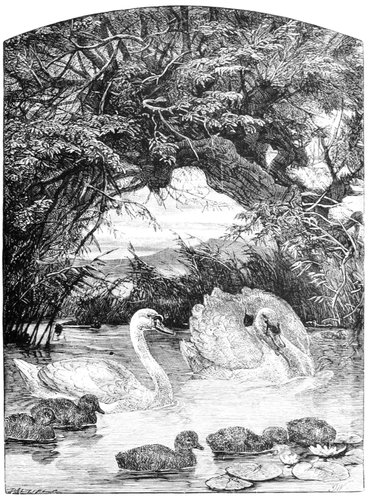
"He swells his lifted chest and backward flings
His bridling neck beneath his towering wings;
The female with a meeker charm succeeds,
And her brown little ones around her leads,
Nibbling the water-lilies as they pass."
"An Evening Walk."—Wordsworth.
By Joseph Wolf.
By permission of Messrs. George Routledge & Sons.
In conjunction with Messrs. Novello, Ewer & Co.
we produced "Our National Nursery Rhymes."
The rhymes were set to music by J. W. Elliot,
and the pictures were of an important character,
A. B. Houghton, G. J. Pinwell, Stacy Marks and
others employed thereon being all at their best.
As well as many of our own drawings, there were
several landscape and rustic pictures by E. G.
Dalziel in the collection.
We produced the pictures for two other books
for the same firm: "The Sunlight of Song," being
a charming collection of sweet songs set to music,
and "Christmas Carols." Both were fully illustrated
by popular artists. Amongst those for the "Carols"
were many most refined and appropriate drawings
by Arthur Hughes, who was one of the most
earnest of the pre-Raphaelite Brotherhood, and who,
independent of his painting, did a large amount of
black and white work. We are doubtful whether he
made any drawings for "The Germ." Our first
connection with him was for "The Music Master,
and other Poems," by William Allingham, for which
he did two drawings; one, a fairy moonlight subject,
being exquisitely beautiful. He did much fine work
for Good Words, and many fanciful fairy subjects for
Dr. George Macdonald's stories, which appeared in
Good Words for the Young, amongst which were
"On the Back of the North Wind" and "Chamber
Dramas."
CHAPTER V. — FOOTNOTES:
Frederick Walker, A.R.A., R.W.S., Charles Dickens, Professor Hubert
von Herkomer, R.A., George J. Pinwell, R.W.S., A. B. Houghton,
R.W.S., Ward & Lock, Frederick Barnard, Jean Ingelow, Robert
Buchanan, J. M. Lawless.
Fred Walker often said that he wanted to come
to us as a pupil, but that we would not have him.
When he left the North London Collegiate School,
where he was educated, he came to ask our advice
as to the method of drawing on wood, and as to
the chances of earning money as an illustrator. We
advised him to begin by copying, in pen and ink,
pictures from the Illustrated London News and
other illustrated periodicals, specially recommending
the works of John Gilbert and Birket Foster as
the best models for style and manner.
He then went to J. W. Whymper, who at that
time took pupils to learn the art of drawing on
wood. There he studied and copied the works
we had recommended, and so quickly acquired the
manner of John Gilbert that when he made designs,
so close was his imitation that his drawings might
easily have been taken for Gilbert's own work.
But his own individuality soon began to assert itself,
and he quickly developed into the great master he
was. During this period he occasionally came to
us for advice on various subjects, and we gave him
commissions on some boys' books for Routledge
and other publishers, including "Hard Times" and
"Reprinted Pieces," by Charles Dickens.
On sending Dickens a set of finished proofs
of the latter, we received the following letter in
reply:
"Friday, Fourth October, 1861.
"Gentlemen,—I beg to acknowledge the receipt of the
India proofs you have had the kindness to send me, of the illustrations
to 'Reprinted Pieces.' Both in conception and execution
the illustrations are very satisfactory indeed.
"Faithfully yours,
"Charles Dickens."
Walker made many drawings for Good Words.
One struck us as being so exceedingly beautiful
that we asked him to make us a water colour
drawing from it, which he did; and, apart from its
being rather crude in colour, it is a charming work,
called "A Dinner in the Fields"—a group of rustic
children. This, we believe, was his first commission
for a picture. His early paintings were not fine in
colour. He did not evince much capacity in this
direction until he went down to West Somerset, and
worked side by side with his friend, J. W. North,
whose influence, aided by the lovely colour of the
district, brought about a marvellous improvement
in both his tone and mode.
Walker was of a very excitable nature, and with
his rapidly growing power and popularity, soon got
a high sense of his own importance. One day he
came to us in an angry, irritated state, saying he
had just finished a large water colour drawing that
a well-known dealer had promised to come and
see, but had failed to do so. "I want, when he
comes to-day, to be able to say, 'That picture
is sold.' Can you help me in this humiliating
position?" After a few words of consultation, we
said, "Yes, we will give you a hundred guineas for
it." The picture was not a good example either in
subject or treatment. It was a social scene, called
"Strange Faces," but had a special interest in the
fact that William Harvey, whom we had introduced
to Walker, stood as model for the principal figure.
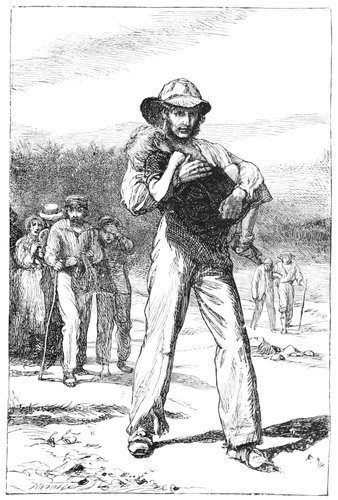
"God knows all he does for the poor baby; how cheerfully he
carries him in his arms when he himself is weak and ill; how he
feeds him when he himself is griped with want; how he folds his
ragged jacket round him, lays his little worn face with a woman's
tenderness upon his sun-burnt breast."
"The Long Voyage."—Charles Dickens.
FROM "REPRINTED PIECES."
By Frederick Walker, A.R.A., R.W.S.
By permission of Messrs. Chapman & Hall.
His first picture in oil, exhibited in the Royal
Academy, was done from his drawing, "A Woman
in the Snow," published in Good Words, and engraved
by us.
About this time we commissioned him to make
thirty drawings on wood the same size as those
of Birket Foster's "Pictures of English Landscape."
These he willingly undertook, and worked at earnestly;
but the great demand for his pictures
increased so rapidly that the drawings came less and
less frequently, and at last the scheme fell through,
after his having given us some eight or ten.
All of these were perfect works of their class, and
it would have made a grand book had it been
completed. Later, we published the engravings with
those of other artists, mostly by G. J. Pinwell and
J. W. North, first in "A Round of Days" and
"Home Affections," and afterwards in an India paper
edition, as "Pictures of English Rustic Life," by
Frederick Walker, A.R.A., and G. J. Pinwell, R.W.S.
One of the designs we had a small water colour
drawing of, "Come in out of the Rain"; also one
of "Strange Faces," which, being in his later
manner, was far better than the original picture.
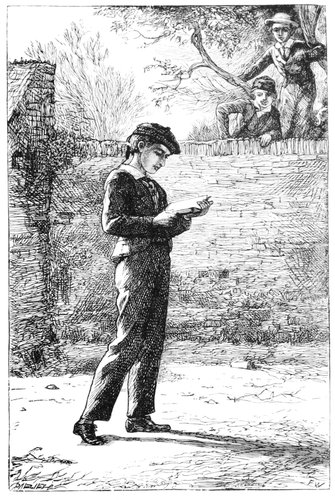
"In the midsummer holidays some of our fellows, who lived
within walking distance, used to come back and climb the trees outside
the playground wall on purpose to look at Old Cheeseman reading
there by himself. He was always as mild as the tea—and that's pretty
mild, I should hope! So when they whistled to him, he looked up
and nodded; and when they said, 'Hello, Old Cheeseman! what have
you had for dinner?' he said 'Boiled mutton.'"
"The Schoolboy's Story."—Charles Dickens.
FROM "REPRINTED PIECES."
By Frederick Walker, A.R.A., R.W.S.
By permission of Messrs. Chapman & Hall.
Of these rustic drawings, fortunately, through
the aid of photography, several of the originals
were saved, some of which are at Kensington
Museum, where the beautiful manipulation of the
work may be studied—the material and method;
the mixture of pencil, point work, in some instances
ink, and wash; the delicate colour of the wood,
and the skilful use of body colour (Chinese white),
all combining to bring about a most beautiful result.
Walker had a fine sense of humour, which was
shown in the few drawings he did for Punch.
At a social gathering the commencement of a
new story by Miss Muloch was humorously discussed.
The opening chapter dwelt much on early childhood.
The term, "Sacred Blue Pinafore," being used frequently
so tickled Walker's fancy that he there and
then made a rough sketch in blue chalk, which we
here reproduce. The same evening he made the
portrait sketch of his friend, W. P. Burton, a clever
but eccentric character, who was present at the
time.
Fred Walker's art culminated in the production
of his "Harbour of Refuge," one of the greatest
English pictures for beauty, pathos, and grandeur
ever painted. He said one day to a friend, "look
at that little old man sitting against the distant
tree: that is a portrait of myself when I get to be
as old as he."
We considered ourselves fortunate in securing
a few of his water colour paintings. Independent
of those already referred to, we may mention
"Philip in Church," which was the first picture
that brought him into prominent notice, and has
always been considered a thoroughly representative
work. It certainly helped to secure his election
into the Old Water Colour Society.
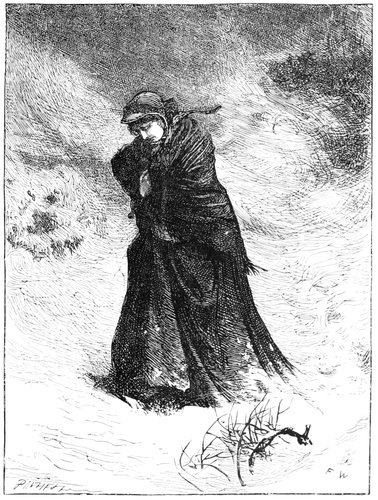
A Woman in the Snow.
FROM "GOOD WORDS."
By Frederick Walker, A.R.A., R.W.S.
Published by Mr. Alexander Strahan.
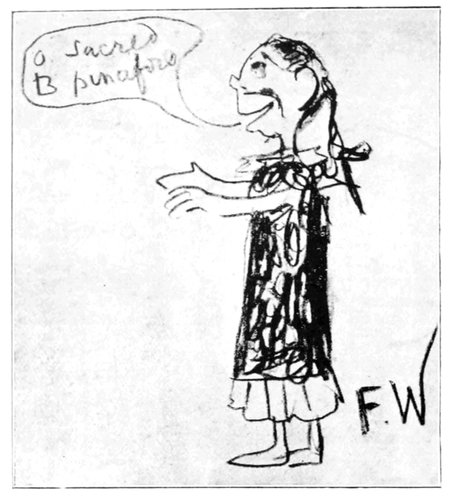
"O Sacred Blue Pinafore."
Sketch by Frederick Walker, A.R.A., R.W.S.
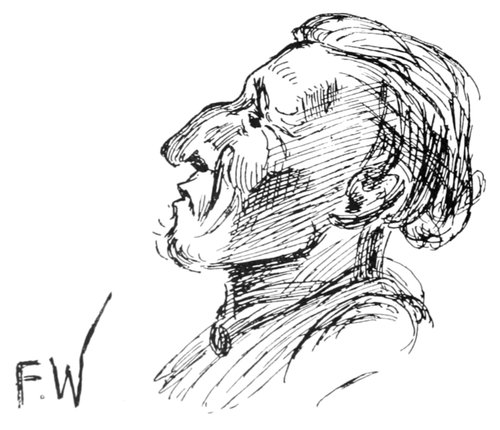
A Fancy Portrait Sketch of W. P. Burton.
By Frederick Walker, A.R.A., R.W.S.
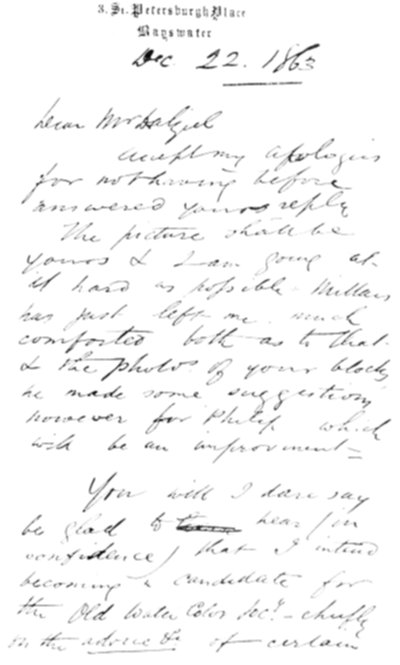
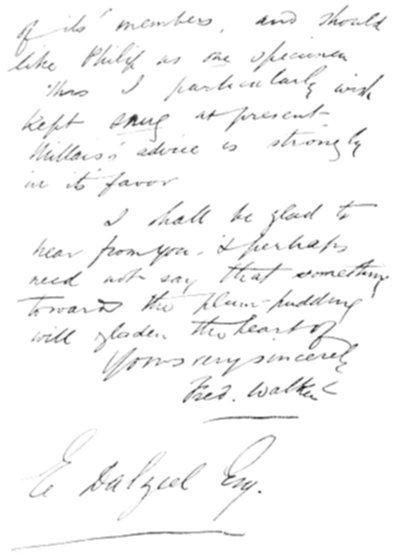
3. St. Petersburgh Place
Bayswater.
Dec 22. 1863
Dear Mr Dalziel
Accept my apologies
for not having before
answered your reply.
The picture shall be
yours & I am going at
it hard as possible—Millais
has just left me much
comforted both as to that
& the photos of your blocks,
he made some suggestions
however for Philip which
will be an improvement—
You will I dare say
be glad to hear (in
confidence) that I intend
becoming a candidate for
the Old Water Color Socy.—chiefly
on the advice of certain
of its members, and should
like Philip as the specimen.
This I particularly wish
kept snug at present.
Millais's advice is strongly
in its favor.
I shall be glad to
hear from you. I perhaps
need not say that something
toward the plum-pudding
will gladden the heart of
Yours very sincerely
Fred. Walker
E. Dalziel Esq.
Years after, Professor von Herkomer produced
a very charming etching of this picture, the same
size as the original.
Gilbert Dalziel, son of Edward Dalziel, sat to
Walker for the boy in "Philip in Church." Walker
took a great fancy to him, and they had many
games together. The following is a letter from
him to his youthful model, which will give an idea
of the nature of their friendship:
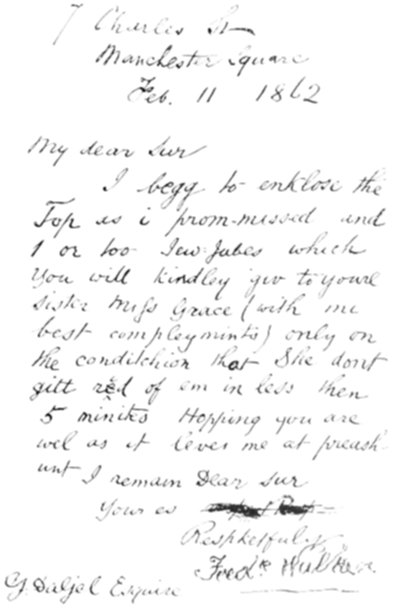
7 Charles St
Manchester Square
Feb. 11 1862
My dear Sir
I begg to enklose the
Top as i prom-missed and
1 or too Jew-Jabes which
You will kindley giv to youre
sister Miss Grace (with mi
best compleymints) only on
the conditchion that She dont
gitt rid of em in less then
5 minites Hopping you are
wel as it leves me at preashunt
I remain Dear Sur
Your es
Respketfuly
Fredk. Walker
G. Dalziel Esquire
For the first two years after the picture was
finished it was seldom in our possession for more
than a week or two at any one time, it being in
frequent request, either for exhibition in the
provinces or abroad; and not infrequently in
Walker's own studio, when he wished to show it
to his friends.
"Feby. 21, '66.
"My dear Mr. Dalziel,—I have just received a letter
from Miss Minnie Thackeray to say her sister, who comes to
town to-day, is so unwell as to be unable to visit us to-day. Will
you have the kindness to let the picture, which has just arrived,
remain here for a day or two? and with many thanks,
"Believe me,
"Sincerely yours,
"F. Walker.
"George Dalziel, Esq."
With reference to the following letter from
Mr. Allen E. Everet, containing an application from
the Birmingham Society of Artists that the picture
might be exhibited at their rooms, we were given
to understand that the Society awarded Walker
their gold medal for the best water colour picture
of the year. A like honour was bestowed by the
Council of the Paris International Exhibition of
1865; in Dublin also, where it was on view, it was
awarded a prize.[18]
"Society of Arts,
"Birmingham,
"2 July, 1864.
"Dear Sir,—I just take the liberty of writing a line to ask
if you have been able to obtain for us the loan of your fine
drawing of 'Philip,' for our ensuing Exhibition, as all the members
of this Society will feel most anxious to see this most interesting
work on our walls this autumn? Hoping, therefore, that you
will be able to oblige us,
"I remain, dear Sir,
"Respectfully yours,
"Allen E. Everet,
"Hon. Secretary.
"F. Walker, Esq."
Perhaps it is hardly necessary to say here that,
with the exception of the first two, Walker made
the entire series of illustrations to Thackeray's novel
of "Philip; his way through the World," or that
this picture is an elaborately finished painting from
one of these designs. Walker held this gifted
author in very high esteem.
In a note addressed to us, dated December
28th, 1863, we find the following passage:
"I have not been very well, and should have passed a happier
Christmas but for this sad news of poor Thackeray. I have lost a
good friend."
Our first knowledge of Professor Hubert von
Herkomer, R.A., came to us in the form of a
parcel, containing two or three drawings, through
the post from Southampton. They were not very
remarkable, but had sufficient skill to justify us
in using his work. His development was wonderful,
showing a facility of design and artistic
taste far above the average. But in spite of his
all-round cleverness he had severe struggles in
the early days. He always had dramatic taste,
and he told us that it was a chance whether he
persisted in his painting or went on the stage.
He is a well-trained musician—a composer as
well as an executant; and one time thought of
joining a Christy's Minstrel troupe. In fact, he
offered himself as "bones," but there was "no
vacancy," so he continued drawing and painting,
getting decorative work to do at South Kensington
Museum, where he did some stencilling on a ceiling,
under conditions explained in the following letter:
"32 Smith Street, Chelsea,
"Monday Morning.
"My dear Sirs,—Would you kindly send me the proof
of my two drawings this week? I am working at Kensington
Museum, doing some decorative work, which will at least keep
the wolf from the door and still give, or rather leave, me
plenty of time for other work.
"When I have some more things done I will take the
liberty to show them to you.
"Yours very faithfully,
"Hubert Herkomer.
"P.S.—The zither still continues to be my dearest companion."
All this while he was gaining power, and
whenever he had the good fortune to sell a
picture he immediately "speculated" to the extent
of going abroad for fresh study and experience.
The first picture of any importance that he
exhibited in London was a large water colour—"Harvesters"—at
the Dudley Gallery. It was a
very clever work and fresh in style. We advised
Mr. Strahan to buy it, which he did for forty
pounds. Herkomer also made a full page drawing
on wood from this picture for Good Words. On
this success he went to Treport. It was at the
time of the Franco-Prussian War; and here he
painted a market scene called "Reading the News,"
which news was evidently adverse to the French.
The groups of angry women and gloomy men tell
the tale very clearly. When the people got to
know he was of German origin, so great was their
anger and hatred towards him that he was obliged
to beat a speedy retreat for England; but
not before he had finished a very clever and
characteristic picture, which, with the exception of
the colour, holds its own with much of his later
work. Upon this he was invited to join the Royal
Institute, from which he retired, and later in life became
a member of the Royal Water Colour Society.
We were fortunate enough to become the
owners of the picture immediately on his return.
It was after one of his successful visits to
Bavaria that he built a small wooden studio in the
back garden of his house in Smith Street, Chelsea,
and there painted, in 1875, his large oil picture,
"The Last Muster," a production that will always
rank as one of the finest English works. Soon after
this he was elected an Associate, and in due
course a full Member of the Royal Academy of
Arts, as well as receiving several Continental decorations.
Subsequently he succeeded John Ruskin
as Professor of Painting at Christ College, Oxford.
But all this is too well known to be dwelt upon
here. Our own personal experience of Herkomer
is that he is as good and generous as he is clever,
and that whatever service we were able to render
him in the past has been recognised by him over
and over again.
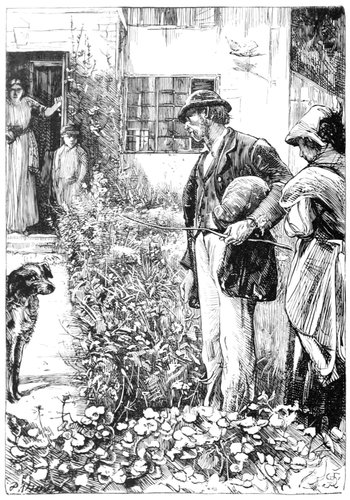
"This is a sweet place, ain't it? a lovely spot? and I wonder
if they'd give two poor, foot-sore travellers, like me and you, a drop
of fresh water out of such a pretty, genteel crib? We'd take it wery
kind on 'em, wouldn't us? wery kind, upon my word, us would."
"Tramps."—Charles Dickens.
FROM "THE UNCOMMERCIAL TRAVELLER."
By G. J. Pinwell, R.W.S.
By permission of Messrs. Chapman & Hall.
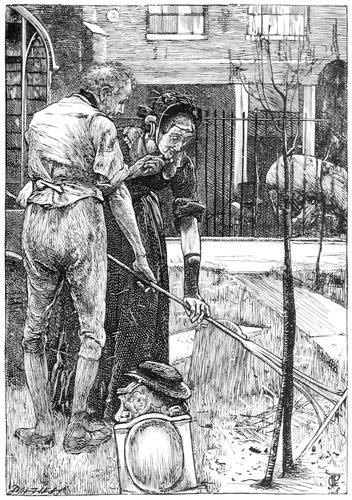
"They looked like Time and his wife. There was but the one rake
between them, and they both had hold of it in a pastorally-looking
manner; and there was hay on the old woman's black bonnet, as if
the old man had been playful."
"City Churchyards."—Charles Dickens.
FROM "THE UNCOMMERCIAL TRAVELLER."
By G. J. Pinwell, R.W.S.
By permission of Messrs. Chapman & Hall.
When G. J. Pinwell first called on us he brought
a small water colour drawing with him. The
subject was a lady of the "Old Ballad" style, with
a decided sense of beauty in it, and in colour looked
as if he had been studying the work of Holman
Hunt. We recognised at once his cleverness, and
that study and practice only were required to develop
his great ability.
We first gave him some work on Fun, as is
shown by this letter from him:
"Dear Sir,—I now send you a Fun drawing, which I hope
you will like. I think it will print well.
"Believe me,
"Yours truly,
"G. J. Pinwell."
We also gave him, and obtained for him, work
of the most varied kind, such as sets of illustrations
for boys' books. He soon became a regular contributor
to Good Words, and in its pages over one
hundred of his drawings appeared. From several
of them he painted water colour drawings, perhaps
the most important being a highly finished work:
"Landlord and Tenant," which shows his appreciation
of character in the landlord, and of deep
pathos in the fine group of the poor woman and
her children. This picture was painted expressly
for us and was never exhibited.
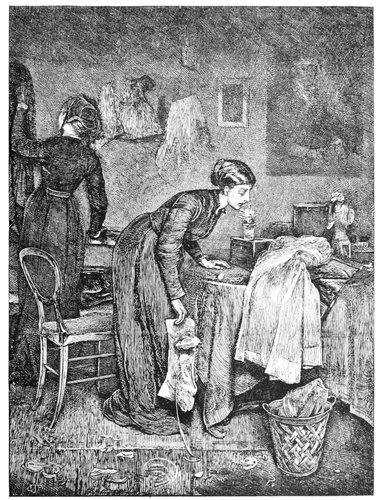
The Sisters.
PINWELL'S FIRST HIGHLY FINISHED PICTURE.
Reduced from an Engraving made for the "Graphic" by the Brothers Dalziel.
By permission of the Proprietors.
He made a few drawings for "Dalziel's Arabian
Nights," but did not go far, as we had placed
entirely in his hands our edition of "Goldsmith's
Works," for which he made a wonderful set of
drawings considering the short time allowed for
their production. He, however, lost nothing in force
of design or in excellence, the manipulation only
being a little less painstaking but more suitable for
rendering in the reproductions.
Pinwell always objected to working against time:
he held that if a thing was worth doing at all it
must be done at his best. He often said that
"money was not enough for him."
Amongst his most careful and finished work
are the exquisite rustic pictures which we issued
in "A Round of Days" and "Wayside Posies,"
also those to illustrate "Poems by Jean Ingelow,"
notably the sets for "The High Tide" and
"Winstanly." He also did some strong character
work for Robert Buchanan's "North Coast and
Other Poems," some of a classic and romantic
kind for his "Ballad Stories of the Affections,"
and a small set of illustrations to Charles Dickens'
"Uncommercial Traveller." The pictures of "Old
Time and His Wife," and "The Tramps," were
amongst the best, and for these we gave him a
commission to paint water colour drawings, and
very exquisite examples they are.
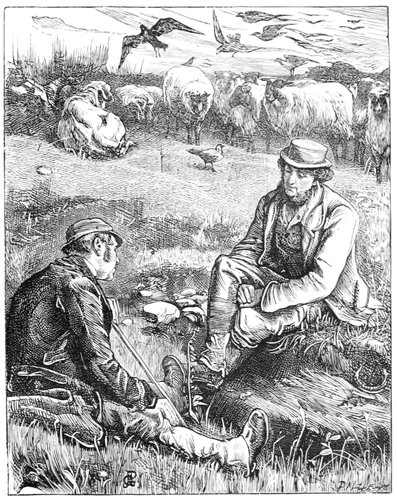
"That's where it lies! We get no good by asking questions, neighbour;
Parsons are sent to watch our souls while we are hard at labour.
This world needs help to get along, for men feed one another;
And what do we pay parsons for, if not to manage t'other?"
"An English Eclogue."—Robert Buchanan.
By G. J. Pinwell, R.W.S.
By permission of Mr. John Hogg.
When Pinwell was a little boy a lady asked his
mother what she intended bringing him up to. She
said she did not know, but that he was so fond of
drawing she thought he would like to be an artist.
"Oh," said the lady, "do not let him be that, for
none but the best ever make any money." "But,"
said Mrs. Pinwell, "why may not my George be one
of the best?" The dear old lady, of whom Pinwell
always spoke with reverent affection, did not live
to see that he was "one of the best"—aye, of the
very best—of that wonderful group of young men
with whom he was associated; for he possessed
some of the finest and highest qualities in a supreme
degree; his sense of beauty, his fine colour, his
grace of design, his poetic art, being equalled only
by his force of character. In much of his work
there is a tinge of sadness; but as a rule, and in
his water colours particularly, beauty dominates
everything.
Outside our close connection with him as an
illustrator, our interest in him as a painter was
constant from the commencement up to the day of
his death—owning his first finished picture and his
last, on which he worked the day before he died.
His first he called "The Sisters"; his second, a
very highly finished picture, was "The Rats," from
"The Pied Piper of Hamelin." While this was on
the easel we commissioned him for two others from
the same poem, "The Children," and "The Piper
Bargaining with the Burghers in the Market Place."
The latter was never done. "The Children" we
lent to the Paris Art Exhibition, where it was
hung under a glass roof and "baked" until the
colour was all taken out of it, to the extent that he
said he would repaint it; but after he had gone
so far with the replica he found it so hard a
task that he set to work on the first picture, the
modelling all being perfect, and restored the colour
to its original beauty.
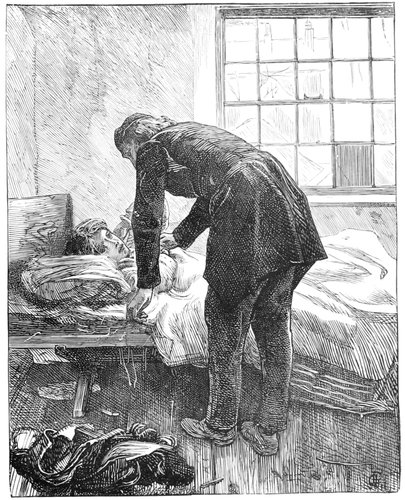
"'Say it again,' cried little Jim; and when,
To please his heart, I said the song again,
In through the smoky glass the setting sun
Gleamed sickly; and the day was nearly done."
"The Ballad Maker."—Robert Buchanan.
By G. J. Pinwell, R.W.S.
By permission of Mr. John Hogg.
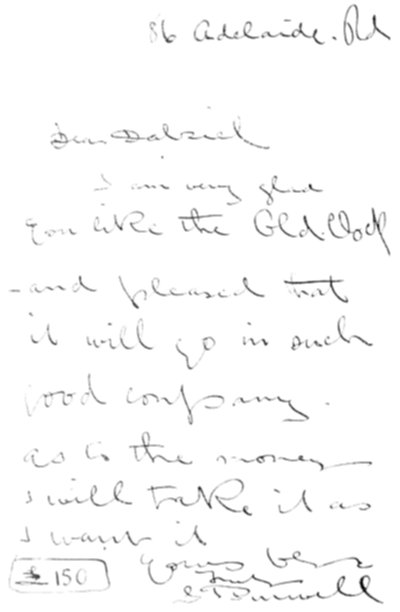
86 Adelaide. Rd
Dear Dalziel
I am very glad
you like the Old Clock—and
pleased that
it will go in such
good company,
as to the money
I will take it as
I want it
£150
Yours very
truly
S T Pinwell
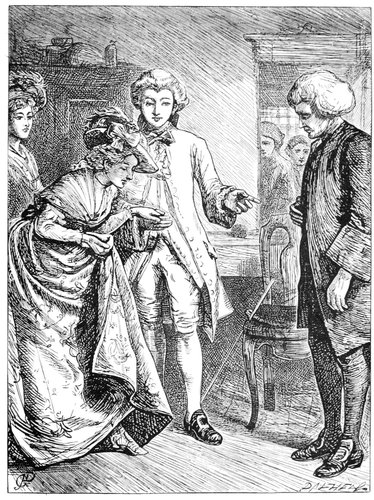
"Two young ladies, richly dressed, whom he introduced as women
of very great distinction, and famous, from Town."
"The Vicar of Wakefield."
FROM "DALZIEL'S GOLDSMITH."
By G. J. Pinwell, R.W.S.
By permission of Messrs. Ward & Lock.
One of the last pictures we purchased from
Pinwell was "The Old Clock," it being a repeat of
one of the rustic drawings he made for us.
At the time of his death we had acquired a
great number of his finished works, both large
and small. At the sale of the remainder of his
works at Christie's we purchased about one third
of the collection. Amongst them were two for
which he had been commissioned by us—one, a
repeat of "The Elixir of Love," smaller than the
original, and, although unfinished, much the finer
work of the two; the other a water colour repeat
of an oil painting of "Vanity Fair," which he had
in progress.
Two or three other unfinished efforts in oil,
"The Earl of Quarter Deck," "Sally in Our
Alley," and "The New Slipper," all go to show
that he was a perfect master of the material; and
had he lived to complete any of these, his election
into the Academy would have been assured.
Pinwell had not the advantage of high culture
early in life, but he was a true gentleman; though
sometimes rough and brusque in manner, which
showed most strongly when he came across or
heard of any act of petty meanness, in all the
ordinary ways of life he was good-natured, genial
and sociable, brimful of tenderness, of a vivid
imagination, and generous to a degree. His life
was a truly domestic one, spending most of his
time at home with a charming wife and a few
chosen friends, amongst whom, perhaps, E. G. Dalziel
and A. B. Houghton were the closest and most
constant. He was the soul of good fellowship,
perfectly human, and sympathetic in the highest
degree. Sir John Millais, speaking of him, summed
him up in his own emphatic way, saying, "no man
could produce work like his who was not a man of
exquisite taste and refined poetic feeling."
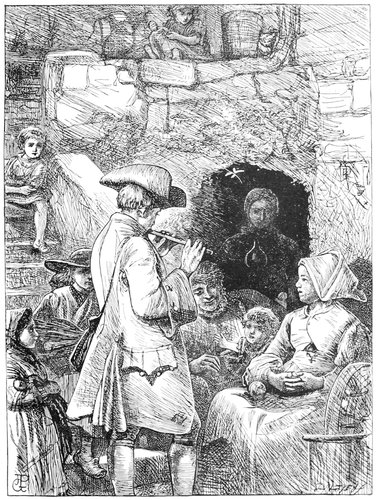
"Whenever I approached a peasant's house towards nightfall, I
played one of my most merry tunes, and this procured me not only
a lodging, but substance for the next day."
"The Vicar of Wakefield."
FROM "DALZIEL'S GOLDSMITH."
By G. J. Pinwell, R.W.S.
By permission of Messrs. Ward & Lock.
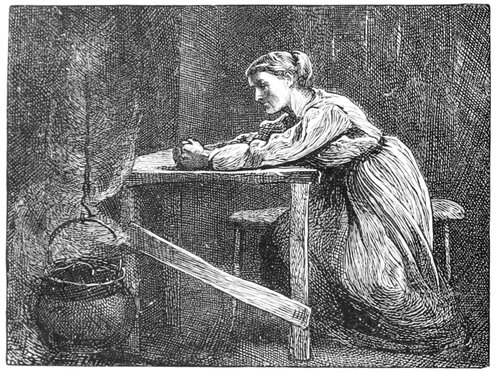
"Then, with a strange trouble in her eyes, Meg Blane
Crept swiftly back into her hut again."
"Meg Blane."—Robert Buchanan.
By A. Boyd Houghton, R.W.S.
By permission of Mr. John Hogg.
Pinwell had all his life been in delicate health,
and succumbed to a lung trouble at an early age.
A. Boyd Houghton was perhaps one of the
most versatile of the black and white draughtsmen
of our time. Amongst his early friends he was
called "The Young Genius," and his first efforts in
art showed that he well deserved that appellation.
He did not require the model set before him—to
look at his subject was sufficient. It was like a
"snap-shot" fixed on the brain, and memory was
enough for his purpose. He had a vivid fancy, and
was brimming over with the finest qualities of the
designer's art. Our connection with him was a long
and very close one. He was a most delightful
companion—his fine sense of humour was coupled
with a pleasant tinge of satire, such as comes from
a man who knows the world in its various phases
of life, but always cultured and refined.
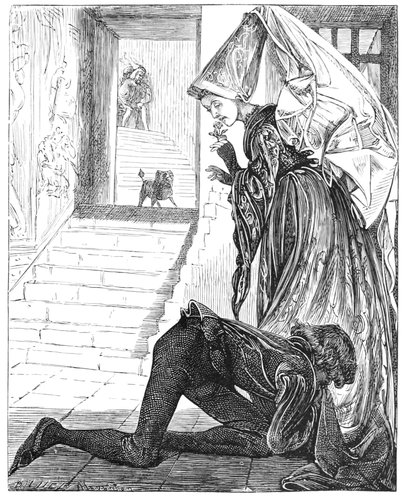
"And, ah! she trembled, fluttering and panting,
While on my knees I fell."
'"The Saint's Story."—Robert Buchanan.
By A. Boyd Houghton, R.W.S.
By permission of Mr. John Hogg.
One of his characteristics was his great love of
children. It was a pleasure to him to get a party
of young people together, and go off to the fields
to romp and play all sorts of games and antics.
His taste in that way is fully shown in the set of
some thirty or more drawings he made for us of
"Child Life," which we published, through Routledge,
as "Home Thoughts." But he made other
pictures of the little ones: "Kiss Me," done for
Good Words, is an excellent example.
He had special advantages to assist him in his
work on our edition of "The Arabian Nights." He
was born in India. His father, his brothers, and
many relatives were Indian army men, who had
fine collections of articles of virtu, curios, costumes,
and every sort of thing invaluable for the illustrators
purposes, much of which he placed at
the disposal of Thomas Dalziel, thus enabling both
to work with uniformity in all necessary details.
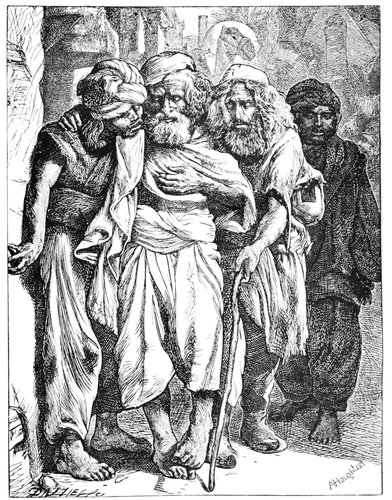
The Three Blind Men Watched by the Thief.
FROM "DALZIEL'S ARABIAN NIGHTS."
By A. Boyd Houghton, R.W.S.
By permission of Messrs. Ward & Lock.
There is no doubt that these "Arabian Nights"
drawings of Houghton's are amongst the best work
in black and white of the period; but strange as
it may appear, publishers did not take willingly to
his art. Alexander Strahan was almost the only
one who fully appreciated his great ability. He
used his drawings largely in his various magazines
and also bought several of his pictures—one, a
large oil, "Sheik Hamel," a truly grand picture.
We had a water colour of the same subject, which
by many was considered the finer work of the two.
Both were painted from the original drawing done
for Good Words. One of the most beautiful water
colours we had from him was "Coach and Horses,"
a portrait picture of his wife and two children,
now in the possession of his youngest daughter,
Mrs. Charles Davis, a lady of refined taste, whose
greatest pleasure is to acquire works of her much-loved
father. The small water colour of "Useless
Mouths," exhibited in the R.W.S., was a subject
he was very fond of—people being driven out of a
beleaguered city. We had two oil pictures (which
he painted with slight variations) of the same
subject, as well as "The Daughter of Herodias
Dances before Herod." Another, which he named
"The Sorceress," was a beautiful young girl being
tried as a witch before the tribunal of the Inquisition.
Both the latter pictures were exceptionally fine.
We commissioned him for one hundred illustrations
to "Don Quixote," which he did most ably.
Frederick Warne & Co. published the book for us.
His illustrations to "Krilof's Fables" are very
clever. He contributed to nearly all our "Fine
Art Books," notably, "Jean Ingelow's Poems," "Our
National Nursery Rhymes," "Buchanan's North
Coast Poems," and "Ballad Stories of the Affections."
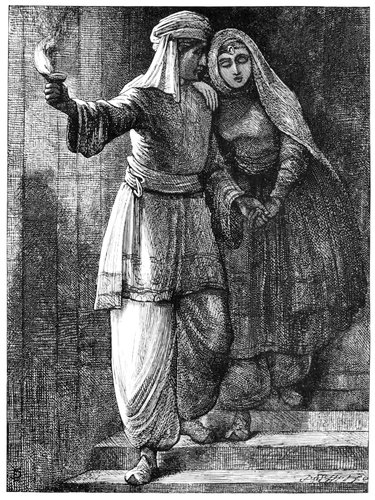
King Zeyn Conducts the Queen-Mother to the Vaults.
FROM "DALZIEL'S ARABIAN NIGHTS."
By Edward Dalziel.
By permission of Messrs. Ward & Lock.
Houghton was the essence of kindness and
generosity. His impulsive nature knew no bounds.
If any case of distress to a brother artist came
before him he was the first to offer help. We could
give many special instances where he emptied his
pockets that he might help those in immediate want.
Although we had done much work with the
house of Ward & Lock from their first commencing
business, it was not until 1863 that we held any
financial interest in what they published. In that
year we entered into a contract with them to
produce a series of popular standard works, fully
illustrated, to be under the able editorship of Dr.
H. W. Dulcken, and to be published with the general
title of "Dalziel's Illustrated Edition." We were to
share equally in the cost of production, and participate
equally in the profits, if there were any. Before
the first number appeared, Mr. J. Stephens, proprietor
of the Family Herald, was so much attracted
by the probable success of the scheme, that he
begged to be included in the partnership, suggesting
that all costs, losses, or profits should be equally
borne by the three parties. To this we agreed.
"The Arabian Nights' Entertainments," it was
decided, should be the first of the series. Some of
the drawings were made by Sir John E. Millais,
P.R.A., Sir John Tenniel, J. D. Watson, R.W.S.,
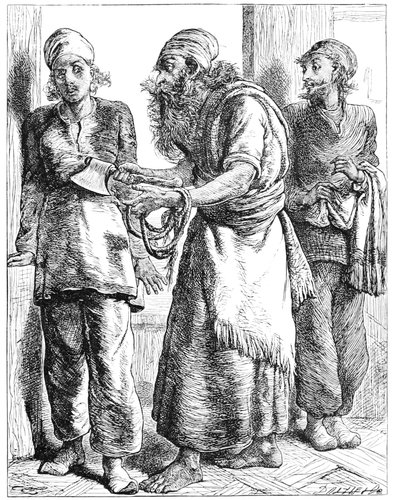
The Genie brings the Hatchet and Cord.
FROM "DALZIEL'S ARABIAN NIGHTS."
By Thomas Dalziel.
By permission of Messrs. Ward & Lock.
G. J. Pinwell, R.W.S., and other artists, but the
great majority of them were done by A. Boyd
Houghton, R.W.S., and Thomas Dalziel.
This was followed by "The Works of Oliver
Goldsmith," illustrated by George J. Pinwell, R.W.S.
The work being entirely illustrated by one artist,
and he a very great one, gives it a special interest
and value. Some of Pinwell's finest black and
white is here seen.
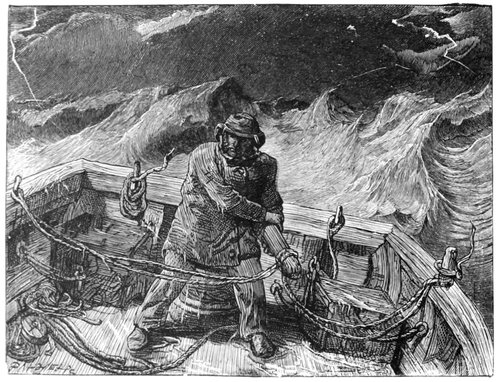
"Lord, hearken unto me,
Help all poor men at sea."
"Meg Blane."—Robert Buchanan.
By Thomas Dalziel.
By permission of Mr. John Hogg.
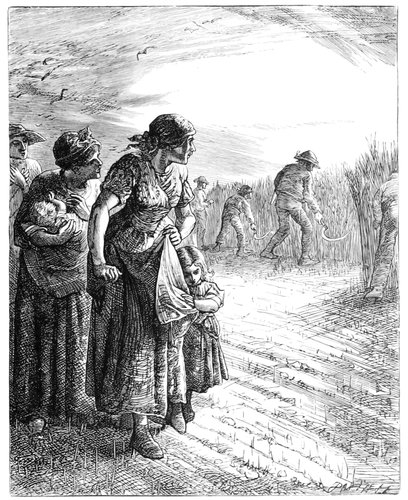
"And women barred their doors with bars of iron
In the silence of the night; and at the sunrise
Shivered behind the husbandmen afield."
"Celtic Myths."—Robert Buchanan.
By Thomas Dalziel.
By permission of Mr. John Hogg.
Though these two books, upon which we
bestowed much anxious care, were very highly
appreciated by the press generally, and still more
highly by the art-loving world, the public, unfortunately,
did not respond so enthusiastically as we
had expected, and, as a large debt had by this time
been incurred, all further progress in the scheme
was abandoned.
Amongst much interesting work in which we
were associated with Ward & Lock, was a very
charming edition of "The Pilgrim's Progress,"
containing 100 beautiful pictures, drawn entirely
by Thomas Dalziel—thus adding another to the
many editions of this wonderful book which we had
been called upon to embellish.
Our connection with Messrs. Ward & Lock continued
for many years after "The Arabian Nights"
transaction had terminated.
It was through an introduction by G. J. Pinwell
that we first met J. W. North. He began as a
pupil of J. W. Whymper, in whose studio he made
many small drawings, most of which were modelled
on the works of Birket Foster. North said
that all the art teaching he ever got at Whymper's
was that when a subject was given him, a print
of one of Foster's was placed before him, with
instructions to make his drawing in that manner.
We were struck, not only with the earnestness of
his method, but the beautiful drawing and his sweet
simplicity of style. But it is a fact that publishers
generally did not care for his work, and, broadly
speaking, all the drawings he did for us were in
the form of commissions given direct by ourselves,
and at our own risk. Most certainly we have
nothing to regret in this; for in different forms he
gave us some of the finest English landscapes that
have been produced in black and white. Amongst
the most important are those which we placed in
our "Round of Days," in "Home Thoughts," and
in "Jean Ingelow's Poems." And whatever reputation
North may have gained in other branches of
art, we feel assured that these early works will form
no small part of that distinction.
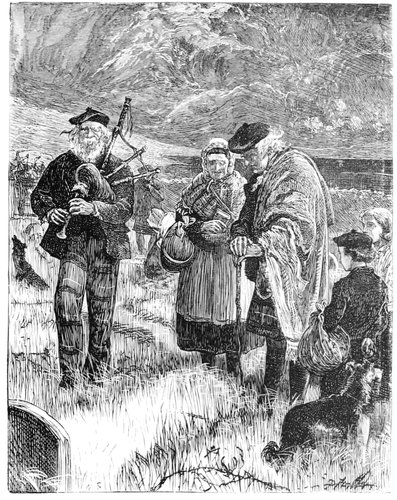
"Silent they stood, each gazing on the dust
Of kindred;—on the well-beloved ones
Whom they should never lie beside in slumber."
"The Exiles of Glen Oona."—Robert Buchanan.
By William Small.
By permission of Mr. John Hogg.
From his earliest practice of art he devoted
much time to water colour painting, and was
elected, on his first "sending in," to the Royal
Water Colour Society, where he at once became
one of its most prominent members, producing, year
by year, landscapes of singular beauty. He also
painted several important landscapes in oil, which
called forth much attention at the Grosvenor and
at the New Gallery, and for some years now has
had the distinction of A.R.A. as an affix to
his name.
It has always been a pleasant memory to us
in having had it in our power to be of some
service to this talented artist when he started on
"the battle of life."
We became possessed of several of his very
charming water colour drawings, one of the most
important being two beautiful rustic children looking
at a dead robin lying on the snow; another, "An
Old Wooden Bridge," the design of which he used in
illustrating one of Jean Ingelow's poems; and "A
Storm at Sea," which is an exquisite piece of colour.
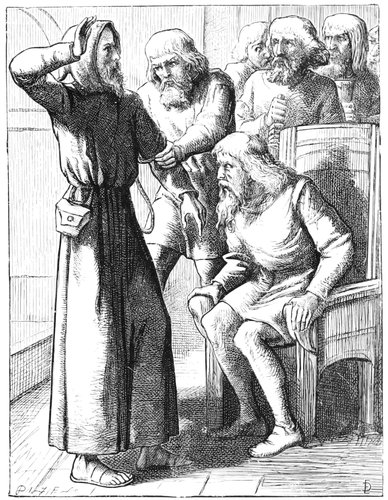
"Then calling to his henchman red,
'Slit me the throat of the Priest,' he said;
'His red heart's blood shall flow before
A gracious sacrifice to Thor.'"
"Hahon."—Robert Buchanan.
By Edward Dalziel.
By permission of Mr. John Hogg.
Our first introduction to Jean Ingelow was
through Mr. Niles, of Roberts Brothers, Boston,
U.S., who wanted some illustrations done for her
poems. Some six or eight page drawings were made
by J. W. North, and the success of that venture
induced us to make terms with her for the
elaborately illustrated edition of "Jean Ingelow's
Poems," for which we retained the English rights, and
which we produced and placed in the hands of
Messrs. Longman, her English publishers. The pictures
were by various artists—Pinwell is at his very
best in "The High Tide," "Winstanly," and many
others; so is J. W. North, who gave us numerous
examples in his most refined manner. Wolf, Small,
and Houghton are all there in good form. There
is one fine example of Sir E. J. Poynter, P.R.A.,
of "Euphrosyne," and there are a number of our
own drawings of which it is needless to particularize.
It was in our connection with Good Words that
we first came in contact with Robert Buchanan,
who was at that time coming right to the front as
a popular poet. At our invitation he was induced
to write and procure verses to the set of pictures
by Fred Walker and others, which were published
as "Wayside Posies," and for which he gave us
much beautiful work. After this we made arrangements
with him to produce an illustrated book, to
be called "North Coast and Other Poems," which
afforded plenty of scope for pictures of varied kinds.
Commencing with "Meg Blane," a strong dramatic
story of the sea is fully illustrated by A. B. Houghton
and Thomas Dalziel. "An English Eclogue" has a
fine example of G. J. Pinwell; the same may be
said of "The Battle of Drumlie Moor," and of
the illustrations to "The Ballad Maker" and
"Sigurd of Saxony." Houghton's pictures to "The
Northern Warning" and to "The Saint's Story"
are all powerful works. There are also two very
fine drawings by William Small from the truly
pathetic story of "The Exiles of Glen Oona."
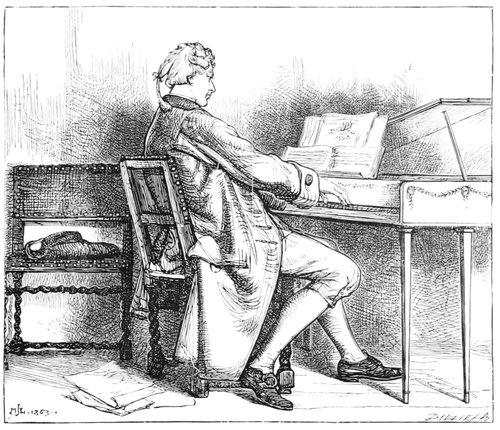
Music.—A Man at the Spinet.
FROM "GOOD WORDS."
By J. M. Lawless.
Published by Mr. Alexander Strahan.
"Ballad Stories of the Affections" was always a
favourite book with us—the fine old ballads giving
such an opportunity for pictures of an imaginative,
poetic character. Two of Pinwell's—"Maid
Mettelil" and "Young Axelvold"—are of exceeding
beauty. Of A. B. Houghton's those for "Signelil, the
Serving Maiden," and that for "The Two Sisters"
are amongst his best. J. D. Watson has some good
pictures, and those by J. Lawson illustrating "Aage
and Elsie" are strong dramatic work. As to our
own drawings, which are numerous, we will only
say that we loved the subjects, and had much
pleasure in making the drawings.
Among the many truly gifted young artists who
came under our notice at this period was J. M.
Lawless. His drawings were of such a refined
and accomplished character that he at once took a
place amongst the distinguished men of the time.
He exhibited some few pictures at the Royal
Academy which brought him prominently before
the public; one of these, "A Midnight Mass,"
another, "A Sick Call"—a poor woman has been
to fetch a priest, who, with his acolytes, is being
rowed across a river; the woman's deep grief, and
the solemnity of the entire scene, gives a touch of
pathos to the group, and suggests it being a case
in extremis. From "A Man at the Spinet," which
we give, he painted a sweet water colour. Lawless
was regarded as a "coming man," but, alas! like
others of that "golden period" of Illustrative Art
he passed away at quite an early age.
CHAPTER VI. — FOOTNOTES:
Lord Leighton, P.R.A., G. F. Watts, R.A., Sir E. J. Poynter, P.R.A.
F. Madox Brown, Holman Hunt, Thomas Dalziel, S. Solomon,
Sir E. Burne-Jones, Bart., F. R. Pickersgill, R.A., Sir George
Grove.
"Dalziel's Bible Gallery" is composed of
sixty-two pictures, most of which are of a very high
order; many quite up to the standard we aimed at
when planning our project for an "Illustrated Bible."
Special mention may be made of those by Lord,
then Sir Frederick, Leighton, Bart., P.R.A., whose
drawing of "Cain and Abel" will always rank as
one of the grandest examples of Biblical art of
modern times; nor less highly must be estimated
his "Death of the First Born." The "Samson"
subjects also are very fine, particularly that of
"Carrying the Gates"; and another notable subject
is "Moses Viewing the Promised Land"; but all
his contributions, nine in number, will stand amongst
the finest of his works in black and white.
An art critic, in an appreciative notice of works
exhibited at the Old Water Colour Galleries, where
some of Lord Leighton's drawings were on view,
wrote the following words in reference to one of
the illustrations done for the "Bible" series:
"Whenever we have had anything to write of the late
Lord Leighton we have always praised him as a draughtsman;
we have always pointed to his book illustration as his greatest
achievement...."
"It is not, we must confess, so impressive a design as the
grand 'Moses,' or the powerful 'Samson bearing away the Gates.'
But it has been put together with all the dignity that the old
decorators would have bestowed upon the subject, 'The Death of the
First Born.' It might have been, with its three panels beneath,
designed for an altar.... The drawing was done for 'Dalziel's
Bible,' a publication that was packed with as good book illustrations,
as varied illustrations, as ever were produced in England,
but that was financially a failure. There is, therefore, every reason
why the public should never have appreciated the original designs.
But though for Messrs. Dalziel the book was financially never a
success, some day their effort to produce the best engravings
they could from the best drawings they could get will be
acknowledged."—Daily Chronicle, Feb. 20th, 1897.
The following letters will interest the reader, as
showing how earnestly Lord Leighton entered into
this project of illustrating the Bible:
"Dear Sirs,—I have begun to consider the subjects you
propose to me, and will shortly send you a list of the passages in
the stories of Samson, of Elijah, and of Jezebel, which appear to
me particularly to suggest illustrations. One question I would ask:
when you spoke of 'six designs' was it that you wished no more
from those chapters, or was it that some are already given for
variety to other hands, or that you thought I would not do more
for you? I ask this because the subjects I shall send you may be
more likely twelve than six. By-the-by, eventually when you get
to the Apocalypse I have a great fancy to design the Four Riders.
"I am, dear Sirs,
"Yours very faithfully,
"Fred. Leighton."
Again:
"Dear Sirs,—Many thanks for your letter. When I
selected, as particularly congenial to me, the subjects from
Elijah and those which concern Jezebel, it was only to secure
them for myself eventually, as I have a great fancy for them, but
I am quite ready to take the subjects of this year as early in the
Bible as you please, if you will only send me your suggestions.
Who is going to do that magnificent subject of the 'Promise to
Abram that his seed shall be as the stars'? If no one, I shall
be glad to take it. Of the three subjects you propose I should
like to single out 'Moses Viewing the Promised Land' (not the
design I made for St. Paul's) and 'David's Charge to Solomon,'
also 'Balaam and his Ass' if you like. I don't see my way to
making a good thing of the 'Judgment.' The others seem to call
for a great many figures, and you expressed a wish, when I saw
you last, to confine yourself to subjects expressed with very few,
if possible.
"The 'Samson' is indeed short, but contains much that lends
itself for illustrations. I should have wished to treat the following
subjects at least: 'The Angel Disappearing in a Flame after
announcing to Manoah and his Wife, the Birth of Samson,'
'Samson and the Lions,' 'Samson and the Gates,' 'Samson in
the Mill'; the other subjects from the wonderful story would
require complicated groups. The above are all broad, simple,
and very pictorial. As it is you will find it impossible to distribute
your illustrations equally over a book like the Bible, in
which one chapter will sometimes contain four or five subjects,
and four or five chapters be without one. Will you let me know
at your convenience what passages you would like me to treat
early in the Bible this summer? It will save time if you can;
I shall meanwhile ripen them in my head.
"I am, dear Sirs,
"Yours faithfully,
"Fred. Leighton."
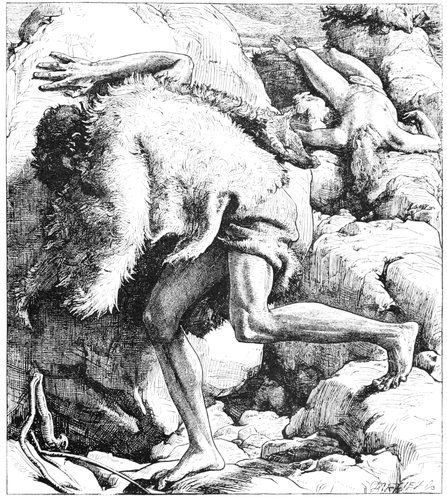
Cain and Abel.
By Lord Leighton, P.R.A.
FROM "DALZIEL'S BIBLE GALLERY."
By permission of Messrs. Herbert Virtue & Co., Ltd.
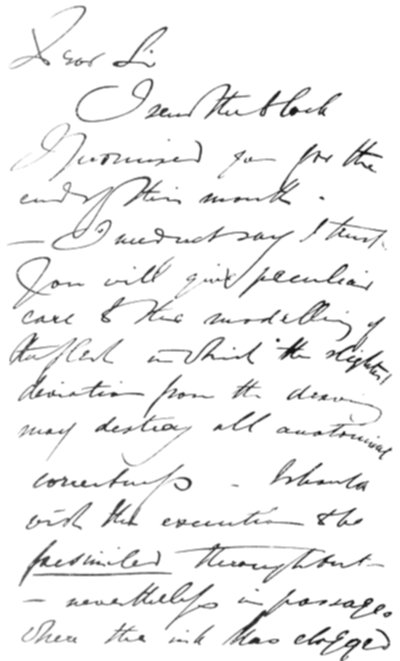
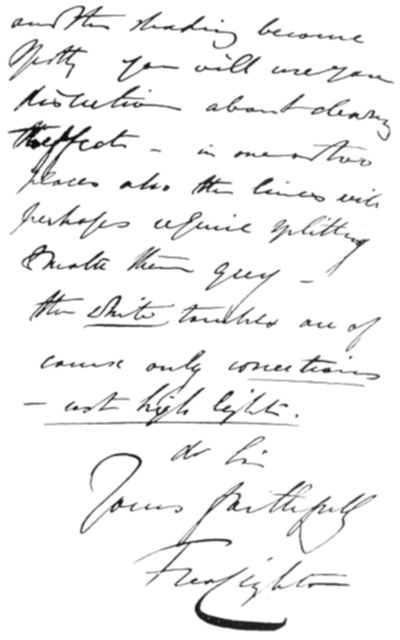
Dear Sir
I send the block
I promised you for the
end of this month.—I
need not say I trust
you will give peculiar
care of the modelling of
the flesh in which the lightest
deviation from the drawing
may destroy all anatomical
correctness—I should
with the execution the
facsimiles throughout—nevertheless
in passages
where the ink has changed
and the shading become
spotty you will use your
discretion about leaving
the effects—in one or two
places also thin lines will
perhaps require splitting
to make them grey—the
white troubles are of
course only corrections—not
high lights.
dear sirs
Yours faithfully
Fred Leighton
"Monday.
"Dear Sirs,—Before starting for the Continent I write to
tell you that you will, in a day or two, receive three wood cut
drawings from me. I should have sent you a fourth which was
also finished, and the best of the four (it represented the 'Escape
of the Spies from the house of Rahab'); unfortunately at the last
moment I spilt some Indian ink on the upper part of it, and shall
have a very tedious day's work to restore it, when I return early
in November. I am sorry for this as I rather pleased myself on
this design. I shall be in Venice all September—a letter addressed
to me, poste restante, in that town, will find me. I start in a few
hours.
"In haste,
"Yours faithfully,
"Fred. Leighton."
Why Lord Leighton did not execute so many
drawings for our "Bible" as he had originally
intended, the following note will explain:
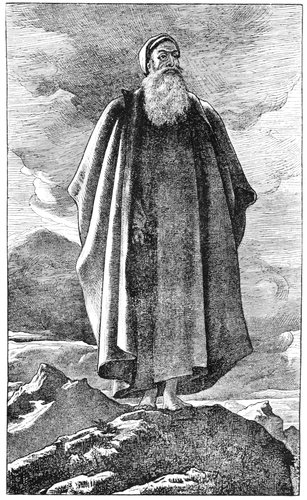
Moses Views the Promised Land.
By Lord Leighton, P.R.A.
FROM "DALZIEL'S BIBLE GALLERY."
By permission of Messrs. Herbert Virtue & Co., Ltd.
"Dear Sirs,—I send you two designs for the 'Bible' with
apologies for the delay in finishing them. I very much regret I
find that the minute work—without which I cannot satisfy myself—on
these drawings has proved terribly trying to my eyes. I must
therefore ask you to relieve me, for some time at least, of my
promises to make some other drawings, as I know that you have
already suffered much delay. I hope you will not scruple to
give away my subjects.
"In haste,
"I am, dear Sirs,
"Yours faithfully,
"F. Leighton."
G. F. Watts, R.A., also expressed himself in
high approval of the project, and promised his
ready help, but ultimately he contributed only three
drawings. His letter will be of interest:
"Little Holland House,
"July 19th, 1863.
"Gentlemen,—I am sorry my designs have been so long
delayed. I have not succeeded in rendering one sufficiently
satisfactory to myself to send to you. The fact is I have not the
habit of making designs for wood cutting, and the subject is not
a good one; my time also is fully occupied, and my health is
not good. These reasons taken together may form some excuse
for my apparent neglect; I don't think I can find time, anyhow,
to make any fresh attempts for the next ten days or a fortnight,
so perhaps I had better send you back the wood block. If you
can wait till after that time I will again try what I can do, in
order that you may not be disappointed, but I do not feel I
can make much of the subject.
"Yours truly,
"G. F. Watts."
Some slight objection having been taken to one
of Mr. Watts' drawings, and a reconsideration suggested,
he wrote the following letter:
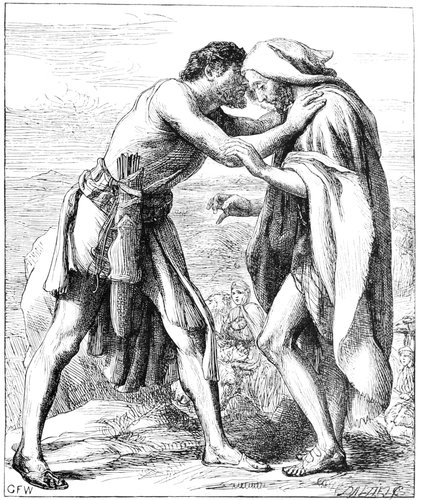
Esau Meeting Jacob.
By G. F. Watts, R.A.
FROM "DALZIEL'S BIBLE GALLERY."
By permission of Herbert Virtue & Co., Ltd.
"December 16th, 1863.
"Gentlemen,—I am always ready to receive and act upon
criticism, and have therefore added a little to the size of the
head of Noah, according to your suggestion; but my object is
not to represent the phrenological characteristics of a mechanical
genius, but the might and style of the inspired Patriarch. For
the same reason I have thought it fit to give the length of limb
and flexibility of joint still commonly seen in the East, tho' very
rare in northern countries.
"I made drawing my principle study for a great many years,
and consider myself at liberty to depart from mere correctness
if necessary for my purpose; especially if the incorrectness resulting
be more apparent than real. The accompanying figure, traced
from the drawing, as you can verify, will show that the disproportion
is not much less than you imagined, and that the stretch of limb
is perfectly possible; at the same time I think it most probable
that it would be objected to, and I do not ask you to risk condemnation,
and by no means wish you to keep the drawing; but
if I do anything for you, or anybody else, I must carry out
my own sentiment.
"I remain, Gentlemen,
"Yours very truly,
"G. F. Watts."
Unstinted praise ought also to be given to the
ten contributions of Sir E. J. Poynter, P.R.A. For
conception of subject, beauty of design, and wonderful
manipulation, they must all be regarded as fine
examples of Scriptural art. We must specially
mention the drawings from "The Life of Joseph":
"Joseph Distributing the Corn," "Pharaoh Honours
Joseph," and "Joseph Presents his Father to
Pharaoh." From the latter design he painted for
us a most exquisite water colour drawing. Then,
again, "Moses and Aaron before Pharaoh,"
"Miriam," and "Daniel's Prayer," are all remarkable
for purity of treatment.
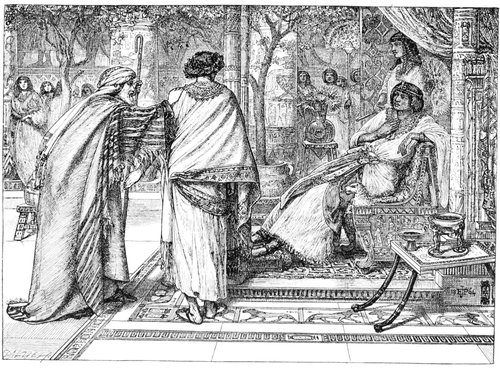
Joseph Presents his Father to Pharaoh. By Sir E. J. Poynter, P.R.A.
By permission of Messrs. Herbert Virtue & Co., Ltd. FROM "DALZIEL'S BIBLE GALLERY."
While arranging subjects for illustration for the
"Bible" we received the following note:
"62 Great Russell Street,
"November 6th, 1865.
"Dear Dalziel,—May I do the following subjects from the
Psalms?—
"(1) 'David singing praises to the harp,' to be put either as
a heading to the Book of Psalms or to illustrate any of the Hymns
of Praise and Thanksgiving.
"(2) 'David penitent,' or a figure of 'Penitence,' to head the
Fifty-first Psalm. I have made sketches for these, which I think
will do. Something, I think, might be made of the following,
although I have no decided notion upon them as yet:
"(3) 'The Heavens declared,' etc.—Psalm xix. 21.
"(4) 'Yea though I walk through the valley of the shadow
of death I will fear no evil,' etc., etc., etc.—Psalm xxiii. 4.
"(5) 'The singers went before,' etc., etc., etc.—Psalm lxviii. 25.
"I dare say I could find more, but these are enough to go
on with for the present, no doubt; if I think of others I will let
you know. I am sorry that you have again had to send in vain
for the 'Joseph' drawing, but the fault was not mine; I was
out of town and had left word with the servant that she was
to give it to the messenger, which she failed to do. I think
I could go on with the two first subjects at once.
"Very truly yours,
"Edward J. Poynter.
"I will take up your 'Joseph' drawing as soon as I can
manage to get up so far."
Sir E. J. Poynter, P.R.A., was born in Paris,
1836; and was educated at Westminster, Ipswich,
and Brighton College. He returned to Paris to
receive his art training, and entered the studio of
Gleyre, going afterwards to Antwerp, where he was
fellow-student with Alma-Tadema and George Du
Maurier. In Rome he made the acquaintance of
Leighton, and for a short time worked in his
studio there. He was elected into the Royal
Academy, 1869, and to full honours in that institution,
1876, attaining the highest honour, that of
President, November, 1896. This is but a short
record of a very brilliant career.
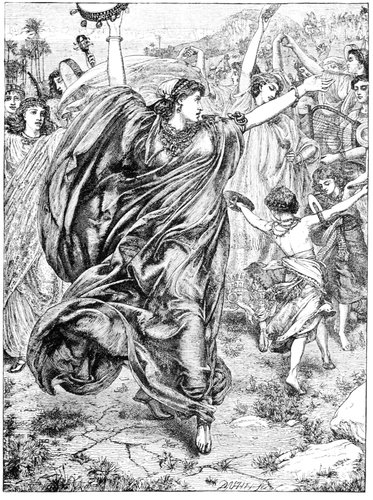
Miriam.
By Sir E. J. Poynter, P.R.A.
FROM "DALZIEL'S BIBLE GALLERY."
By permission of Herbert Virtue & Co., Ltd.
We were first attracted to his work, at a minor
Exhibition in Newman Street, by a small, but very
charming water colour drawing of "Egyptian Water
Carriers"—two, half-length, beautiful girls—which we
bought, on its merits, not having any previous
knowledge of the artist. Several years after, this
picture was engraved and included in our "Bible
Gallery."
The following letter, remarking upon a proof
from one of his drawings for the "Bible" submitted
for correction, is one of several we received from
Sir Edward J. Poynter during the progress of the
work:
"University College,
"Thursday, Nov. 28th, 1871.
"Dear Mr. Dalziel,—I have touched a little on the proof
with a view to getting a little more breadth of light. The reduction
so concentrates the effect that it looks rather spotty; I was a
little afraid it might. The light on the floor especially seems to
want shading more gradually into the background; cutting out
the cross lines in the hatching on the left hand side would, I should
think, do this, and thinning the lines generally as they get nearer
the light. I have made a slight alteration in the head of the
young lady standing up by taking out some of the shading, and
one or two other points are touched with a view to simplicity.
I hope I am not giving you too much trouble! The engraving
is most beautiful, especially the two near figures, which are wonderful;
indeed, whatever is wrong is my own fault.
"Very truly yours,
"Edward J. Poynter."
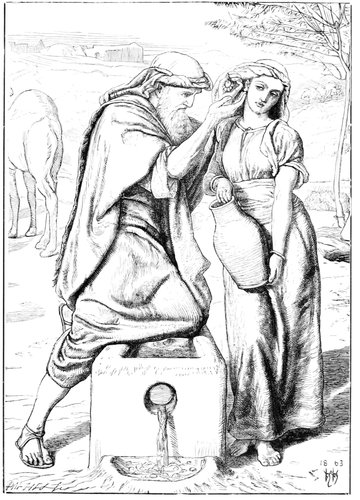
Eliezer and Rebekah at the Well.
By Holman Hunt.
FROM "DALZIEL'S BIBLE GALLERY."
By permission of Messrs. Herbert Virtue & Co., Ltd.
We are tempted here to print a letter received
from him in reply to one from us in congratulation
upon his election as President of the Royal
Academy of Arts:
"28 Albert Gate, S.W.,
"November 16th, 1896.
"Dear Dalziel,—It was a very great pleasure to me to
receive your letter recalling the delightful times when I was
working for you, and the kind reception you always gave me
and my work. There is no part of my life or of the practice of
my part to which I look back with greater pleasure. Many and
cordial thanks for your friendly congratulations and good wishes.
I can hardly keep pace with my correspondence just now, or
these should have been sent earlier, for one of the first to welcome
me in my new and honourable post was your letter.
"Believe me,
"Very truly yours,
"Edward J. Poynter."
The Holman Hunt drawing of "Eliezer and
Rebekah at the Well" is a work of such simplicity
of design and delicate treatment as might be expected
from this distinguished artist, whose life has
been mainly devoted to Biblical art. Of the three
grand designs made for us by the veteran artist
G. F. Watts, R.A., we have selected that of "Esau
Meeting Jacob," as being a fine example of the
artist, who has always worked with the highest
and noblest aims. Of Ford Madox Brown's three
contributions we have chosen "Elijah and the
Widow's Son," as being not only an original conception
of the subject, but perhaps one of the most
beautiful specimens of manipulative skill he ever
produced. He called it an etching, and so it was
to all intents, it being perfectly pure line work.
Although more beautiful, it is in no way finer
than "Joseph's Coat," or "The Death of Eglon."
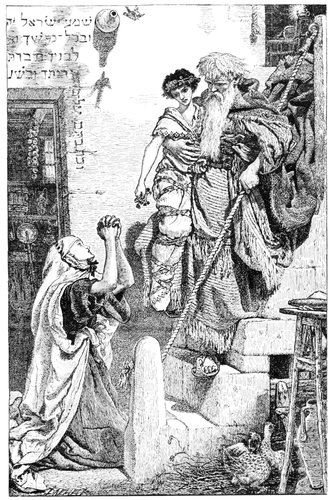
Elijah and the Widow's Son.
By Ford Madox Brown.
FROM "DALZIEL'S BIBLE GALLERY."
By permission of Herbert Virtue & Co., Ltd.
F. Sandy's one drawing, "Jacob hears the Voice of
the Lord," is a very strong piece of work. There are
many other important pictures by F. R. Pickersgill,
R.A., E. Armitage, R.A., A. B. Houghton, R.W.S.,
H. H. Armstead, R.A., A. Murch, William Small,
E. F. Brewtnall, R.W.S., F. S. Walker, R.H.A.,
and Sir E. Burne-Jones. There are also twelve
designs by Thomas Dalziel, which are regarded by
many competent judges to be amongst the best
work in the collection. "Hosannah," by S. Solomon,
is also a very beautiful work. What joy and fervour
of music are expressed in the drawing! We well
remember the small picture he painted of the subject;
it hung on the line at the R.A., and was
looked upon as the work of a coming man.
Burne-Jones' "overwhelming" amount of work,
as explained in the following letter, must be accepted
as the reason why he contributed only one
drawing to the "Bible," in which he took such keen
interest at its commencement.
"52 Gt. Russell St.,
"Bloomsbury,
"Friday.
"My dear Sir.—In a few days you will have 'Ezekiel,' and
soon after 'The Coming of the Dove to the Ark.' My work has
simply overwhelmed me and my walks the last month, but for
the fortnight I can almost give myself to your subject. Your
private commission still delights me with its congenial nature.
The three subjects you name explain the 'Noah' subject; as soon
as I have made a scheme of the 'Carol' you shall have it, and
consider about it. Do you think of having a 'Temptation of
Adam and Eve'? It would be famous for engraving, with a horny
snake all round the tree, and the naked figures could be sufficiently
concealed in the thicket so as not to offend the prurient (for they
ought not to offend the modest). I shall thoroughly enjoy all this
work. You may depend on having the 'Ezekiel' in a few days. I
should like a larger block for 'The Building of the Ark.'
"Yours very sincerely,
"E. B. Jones."
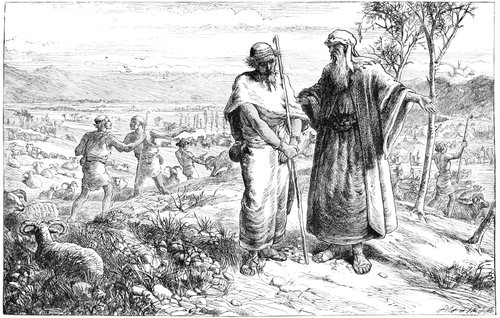
Abraham Parting with Lot. By Thomas Dalziel.
By permission of Messrs. Herbert Virtue & Co., Ltd.
FROM "DALZIEL'S BIBLE GALLERY."
Yet with all this vast array of talent our
"Bible," commercially speaking, was a dead failure.
It was carefully printed on India paper, and issued
partly in portfolio and partly in book form, but the
British public did not respond, some two hundred
copies being all that were sold. The balance of
the number printed were disposed of at prices which
we will not here record. Thus ended a work,
begun with the highest aims, over which we spent
many years of careful, patient labour, and several
thousands of pounds.
Fortunately, many of the best of the original
drawings have found their way to the National
Collection at the Kensington Museum, where they
will remain as records of some of the very finest
examples of the black and white work of this
period, and to the lasting fame of the artists.
It may be interesting to state that, at the
time we were placing commissions for designs to
illustrate the "Bible" and other important works in
the hands of such artists as Sir F. Leighton,
P.R.A., Sir John Millais, P.R.A., Sir E. J. Poynter,
P.R.A., H. H. Armstead, R.A., A. Armitage, R.A.,
Sir E. Burne-Jones, A.R.A., Marcus Stone, R.A.,
John Pettie, R.A., W. Q. Orchardson, R.A., H.
Stacey Marks, R.A., Professor H. Von Herkomer,
R.A., G. F. Watts, R.A., Fred Walker, A.R.A.,
Fred Pickersgill, R.A., J. W. North, A.R.A., and
J. MacWhirter, R.A., all of whom have since
attained the highest position in their art, without
a single exception not one of them had at the
time of our first correspondence entered into the
ranks of the Royal Academy.
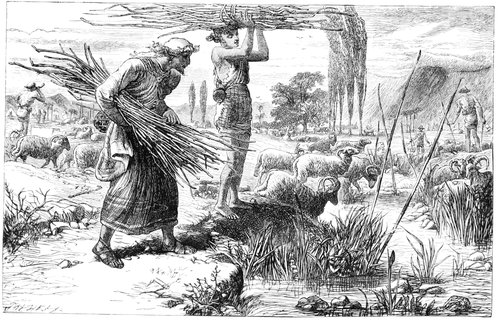
Jacob and the Flocks of Laban. By Thomas Dalziel.
By permission of Messrs. Herbert Virtue & Co., Ltd.
FROM "DALZIEL'S BIBLE GALLERY."
Almost the same may be said of many young
artists who were not contributors to the "Bible
Gallery," in whose hands we placed commissions
long before they had risen to fame and fortune.
Frederick Sandys, on having a proof submitted
to him for correction, wrote the following letter:
"My dear Sirs,—The proof is absolutely splendid—one or
two things I should like a little altered, but these I will see you
about. I have two of 'Joseph' nearly ready, and have been
for some month or more, but I have, unfortunately, crushed the
bone of the top joint of the middle finger of my right hand. It
is getting on well, and I have this week commenced working on
a large picture, but I am debarred for the present still from
touching the wood cut. I could not have sent the portrait of
Mrs. Lewis to the Academy had it not been for some assistance
kindly given me by Holman Hunt. I think I may promise,
without disappointing you, one, if not two,[19] blocks in the first
week in May.
"Ever yours truly,
"Frederick Sandys."
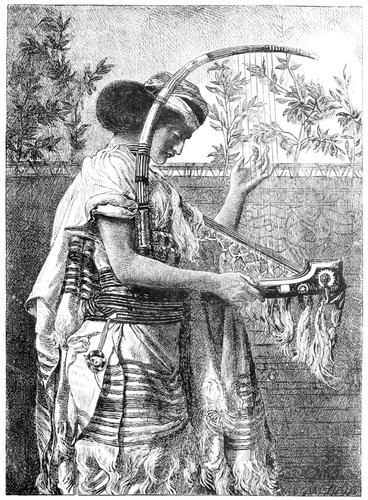
Hosannah. By Simeon Solomon.
FROM "DALZIEL'S BIBLE GALLERY."
By permission of Messrs. Herbert Virtue & Co., Ltd.
Our original intention being to publish an
"Illustrated Bible," we were desirous that it should
be carefully watched through the press, and, if
necessary, some few explanatory notes appended.
With this object we offered the editorship to
Sir George Grove. The following letter is of
interest, explaining his reasons for declining the
responsibility:
"Crystal Palace,
"Sydenham,
"November 28th, 1863.
"Dear Sirs,—I have carefully considered the proposition
you were kind enough to make to me and am reluctantly
compelled to decline it. If I edit a Bible at all I should prefer
it to be one in which the notes might bear a larger proportion to
the text than that which you contemplate, and in which modification
of the arrangement of the text itself might be introduced without
imperilling the sale of the work, which they would no doubt do
in the present case. And as I am not likely to be able to
edit more than one Bible in my lifetime, I've no alternative
but to reserve myself for a more favourable opportunity. I should
also like to be more certain than I am in the present case that
there would be no discrepancies between the illustrations and
the notes. If you are not provided with any person to undertake
the work I think I can recommend you a gentleman who would
do it very efficiently. I am sorry that we will not have the
pleasure of working together in this instance. With many thanks
for your courtesy,
"I am, dear Sirs,
"Yours faithfully,
"George Grove.
"Messrs. Dalziel Brothers."
This refusal of Sir George Grove's co-operation,
combined with other insurmountable difficulties which
came in the way, caused us very reluctantly to
abandon our original project.
Being invited to contribute to the Fine Art
section of the Victorian Era Exhibition held at
Earl's Court in the summer of 1897, we sent a
frame containing selections from Tenniel's illustrations
to "Through the Looking Glass," some specimens
after F. Walker, and a large frame containing
about twenty examples from "Dalziel's Bible," by
Lord Leighton, Sir E. J. Poynter, Holman Hunt,
Ford Madox Brown, Thomas Dalziel, Sir E. Burne-Jones,
and others, with four proofs from Sir J. E.
Millais' illustrations to "The Parables." For these
contributions the Committee awarded us a Diploma
for a Silver Medal.
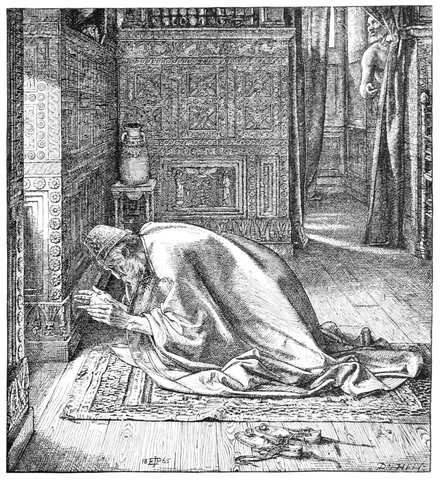
Daniel's Prayer.
FROM "DALZIEL'S BIBLE GALLERY."
By Sir E. J. Poynter, P.R.A.
By permission of Messrs. Herbert Virtue & Co., Ltd.
Among our schemes for publishing high-class
works was "The Biblical Life of Joseph," to
be fully and carefully illustrated. We consulted
Frederick Sandys upon the subject. The following
letter will show the feeling with which he received
the proposition:
"Thorp, next Norwich,
"Thursday, October 24th, 1861.
"My dear Sirs,—Many thanks, not only for my own proofs,
but for those you were good enough to send Rose and Rossetti.
"I have not yet commenced the drawings of 'Joseph'—it
requires an immense amount of research, and it would be most
unwise to spoil the series, and I promise you the drawings as soon
as you reasonably can ask for them. When would you like to
have the 'Life' out—in twelve months? If so you shall have my
drawings in time. I am coming to town in a week to make some
drawings at the British Museum from the Marbles, and to get some
Jewish dresses—can you help me here?
"I am doing all this that I may thoroughly, or, as far as it is
my gift, make myself to be acquainted with Jews and Egyptians—to
know all that is characteristic and beautiful, and avoid all that is
hideous. Millais' 'Moses' is not a bit what I want—it is not a
Princess; a daughter of Pharaoh he has drawn. Now, what do
you say about time? Let's have it out in twelve months. Autumn
is the right time, is it not, for publishing?[20]
"With kindest regards to all of you.
"Believe me,
"Very faithfully yours,
"Fred Sandys.
"The more I look at the cutting of 'Life's Journey' the
more I am delighted and full of hope for 'Joseph.'"
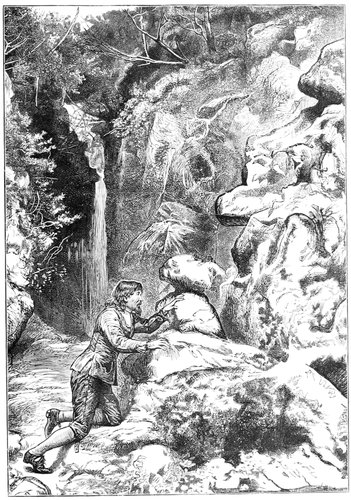
Christian Climbing the Hill of Difficulty. By E. G. Dalziel.
FROM "BUNYAN'S PILGRIM'S PROGRESS."
Published by Mr. Alexander Strahan.
Of the many books placed in our hands for
illustration, "The Pilgrim's Progress," by John
Bunyan, exceeded in number all others. That
immortal work came to us in every form—published
at various prices, from one shilling, with a large
number of original outline designs by a distinguished
artist, to the edition produced by Alexander
Strahan, in 1880, at five guineas. In this instance
we printed all the larger pictures for him on India
paper. There were one hundred drawings, no less
than sixty-six of them being by that highly-gifted
artist, Fred Barnard, whose dramatic power quite
equalled his high sense of humour. Of his large
pictures in the book, while all are good, those of
"The Giant Despair," "The Man with the Muck
Rake," and "The Atheist," are amongst the best.
As to his smaller designs, it is difficult to say
whether one admires them most for their strength
of character or for the delicate and refined touch
of his pencil.
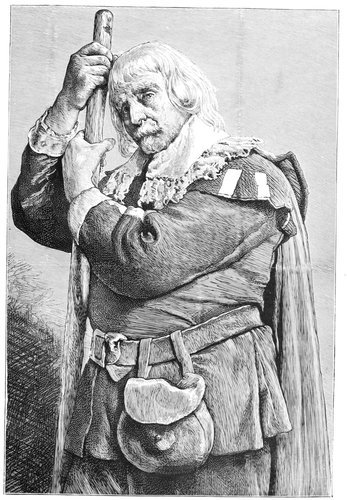
Old Honest. By Sir James D. Linton, P.R.I.
FROM "BUNYAN'S PILGRIM'S PROGRESS."
Published by Mr. Alexander Strahan.
There were other men of distinction to help
Strahan with the full-page pictures. E. F. Brewtnall
had ten drawings, all good. "The Three Shining
Ones" is very refined and original in treatment.
William Small's "Slough of Despond," and
"At the Gate," are both worthy of this accomplished
artist. E. G. Dalziel had five pictures,
of which "Christian Climbing the Hill of Difficulty,"
and "Christian and Faithful Crossing the
River of Death," are most remarkable works.
John Ralston, another of the clever young Scotch
artists who came to London, had three pictures,
"The Ladies of the House—Beautiful Reading to
Christian," being by far the finest. Sir James D.
Linton, P.R.I., had four very powerful drawings,
which were typical of all the work of this long-distinguished
and painstaking artist, who always
gives good sound readings of his subjects: "Old
Honest" is an admirable example. Of Towneley
Green's four pictures, "The Bundle Falls off Christian's
Back," we like best; but all are good. The
one picture by Joseph Wolf, "Lions in the Path,"
is simply grand.
A most important and comprehensive work which
Messrs. Routledge entrusted to us was the production
of the pictures for the "Illustrated Natural
History," by the Rev. J. G. Wood. They were,
of course, to be under the superintendence of
the author, who was at that time Chaplain of St.
Bartholomew's Hospital.
During the publication of the book, which was
issued in monthly parts, and extended over a period
of nearly four years, it was our custom to go there
and see him every Monday morning, accompanied
generally by Mr. George Routledge, to receive
new lists of subjects, to report progress of those in
hand, and to discuss the matter generally. From
there we went on to the printing office of Richard
Clay & Sons, who were printing the work under
our supervision.
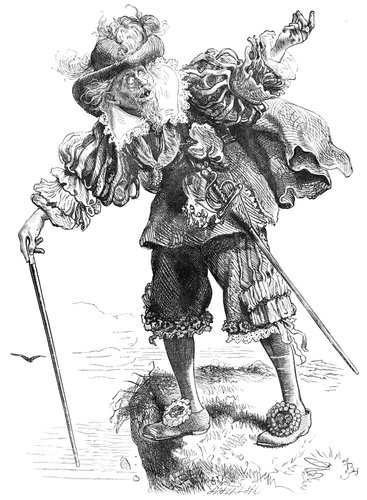
The Atheist. By Frederick Barnard.
FROM "BUNYAN'S PILGRIM'S PROGRESS."
Published by Mr. Alexander Strahan.
Among the many distinguished artists engaged
we would first mention William Harvey, of whom we
have spoken elsewhere. He did not, however, make
many drawings, from the fact that J. G. Wood
thought them too mannered and conventional; the
same objection was held by the author to Harrison
Weir. Although this clever artist contributed considerably
to certain sections of the book, J. G.
Wood summed up his drawings in a few words:
"Always picturesque, but never correct."
Joseph Wolf, a German by birth, made a large
number of drawings for the work, and gave the
author every satisfaction. By many it is held that
his birds are more correct than those by any other
draughtsman; certainly his perfect manipulation gives
them a beauty that cannot be excelled. There can
be no doubt that his contributions are by far the
best: take his lions, tigers, or his groups of monkeys
and of birds—all denoting the artist of high
culture. He was appointed Special Artist to the
Zoological Society, and worked very much at their
Gardens in Regent's Park and also at their
Museum.
While we were preparing the first sheets for
the press, a very fine specimen of the gorilla,
preserved in spirits, most opportunely arrived at
the Zoological Gardens, one of the first, we were
informed, that had ever reached this country.
Permission was obtained for Mr. Wolf to be
present at the opening of the barrel which contained
the defunct animal, so that he might have a
better opportunity of making notes for his guidance
in doing the drawing, one of the best in the entire
book, than the indifferently stuffed specimen in the
Museum afforded him. Wolf afterwards remarked
that opening the barrel and lifting the animal out
of the spirits was extremely interesting, but the
effluvia was sufficient to poison a regiment of
soldiers—whether he considered it a fact that soldiers
as a rule are less susceptible to the influence of
poisonous gases than other men, he did not take
the trouble to explain.
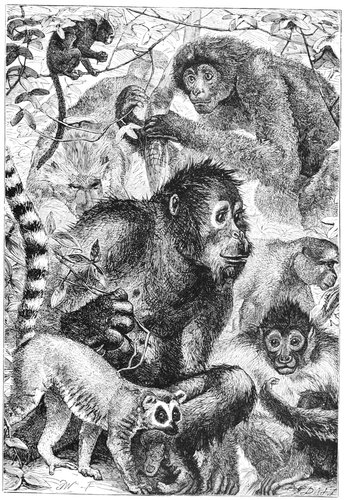
Monkeys. By Joseph Wolf.
FROM "WOOD'S NATURAL HISTORY."
By permission of Messrs. George Routledge & Sons.
From J. B. Zwecker, who was also a German
by birth, we had considerable help. He was a
highly-educated artist of the Dusseldorf School.
He painted in oil and water colour; his work
always showed good drawing and design, but was
generally heavy in effect. He made a large number
of drawings for the "Natural History" and for
other publications—his being a ready pencil. He
was an accomplished athlete, a genial companion,
a kind-hearted man, and an enthusiastic son of the
"Fatherland."
Another of the many-sided artists with whom we
were connected in this work was W. S. Coleman.
On coming to London he called upon us and we
were of some service to him, we believe, in introducing
him as a wood draughtsman. Beyond his
art taste and knowledge, he had considerable skill
in a literary way, creating some small books of
his own—"A Book on Butterflies," and another on
"Birds' Eggs," being amongst the first and best.
The Rev. J. G. Wood always said he could rely
on Coleman doing his utmost, for when living
specimens could not be obtained he would take
any amount of trouble in searching for the most
reliable representation of the objects required.
We must have had hundreds of his drawings
through our hands. He painted both in oil and
water colour, his landscapes in the latter medium
being always very sweet and tender in feeling. In
fact, Coleman's work ranges from a careful drawing
of a butterfly—as decoration for a Christmas card—to
classic or nude figures full life size.
T. W. Wood, an artist, in no way related to
the Rev. J. G. Wood, made many careful drawings
for the book—principally of birds and butterflies.
Though always technically correct, he was deficient
in artistic treatment—in fact, a playful artist friend
once dubbed him the "Wooden Wood."
The commission to prepare the pictures for
"The Natural History of Man" was also placed
in our hands by Messrs. Routledge, in the same
manner as for the "Natural History," with this
difference, that, with the exception of implements—warlike,
domestic and otherwise, huts, etc., which
were all copied from the best authorities by other
hands, the entire set of drawings were done by
one artist, J. B. Zwecker, who, having an excellent
knowledge of the human figure, was well qualified
for dealing with the Kaffir, Zulu and other South
African tribes, of which the first portion of the
"History" deals so exhaustively. Zwecker always
received his lists and instructions direct from the
author; our portion being the engraving of the
wood blocks and a general supervision of the
printing.
CHAPTER VII. — WHAT THE MOON SAW. — MY BOOKS. — DEATH OF GENERAL GORDON. — A SONG FOR OUR BRAVES. — MY MOTHER'S SONGS. — FOOTNOTES:
Tom Hood, Edward Wylam, Henry Sampson, Paul Gray, H. S. Leigh,
W. S. Gilbert, Tom Robertson, Clement Scott, G. A. Sala,
Arthur Sketchley, W. J. Prowse, Ashby Sterry, C. H. Leland,
Godfrey Turner, Dutton Cook, George R. Sims, Henry Doyle,
A. B. Houghton, R.W.S., F. Barnard, G. Thomson, Professor
von Herkomer, R.A., Sir John Gilbert, R.A., Hal Ludlow,
G. J. Pinwell, R.W.S., E. G. Dalziel, F. A. Fraser, J. F. Sullivan,
Lord Dunraven, Ernest Griset, Edward Lear, John Ruskin.
Early in 1865 Mr. Edward Wylam became
proprietor of the comic periodical Fun—at that time
the only competitor of Punch—and was fortunate
enough to secure Tom Hood as editor. On taking
up the direction, Hood informed us that one of
the stipulations he made with Wylam was that
we should be solicited to undertake the engraving
of all the drawings. At first we felt some hesitation
in accepting the commission, thinking it might
considerably interfere with very important works we
were then engaged upon; but ultimately satisfactory
arrangements were concluded, and our relationship
continued in the most amicable manner, without a
break for six years. In 1870—Mr. Wylam wishing
to devote his entire attention to the development
of "Spratt's Dog Biscuits," the patent for which he
had recently purchased—we became the sole proprietors
of the publication, paying for the goodwill
and copyright the sum of £6,000, Hood continuing
editor until his death.
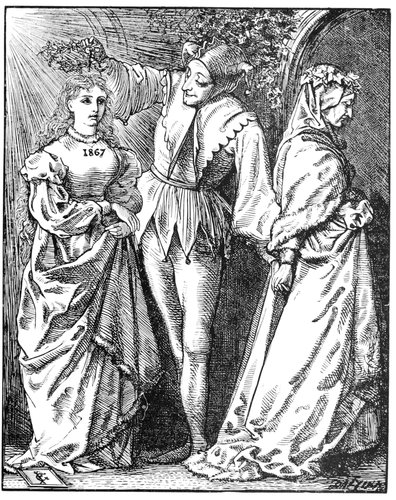
The Old Year and the New.
FUN CARTOON, 1867.
By Paul Gray.
In 1869 Hood commenced the publication of
"Tom Hood's Comic Annual," which at once secured
a large amount of public favour. The second
issue more than covered the slight loss sustained
on the first.
While the
third issue
was in preparation
we purchased
from Hood
the title, copyrights,
and stock of all
literary and artistic
matter connected
with it for the sum
of £600.
Tom Hood was,
as perhaps half the
world knows, the
only son of the celebrated
wit and poet,
Thomas Hood, the
author of "The
Song of the
Shirt," "The
Bridge of
Sighs," "Eugene
Aram,"
and many other
poems of great beauty and purport.
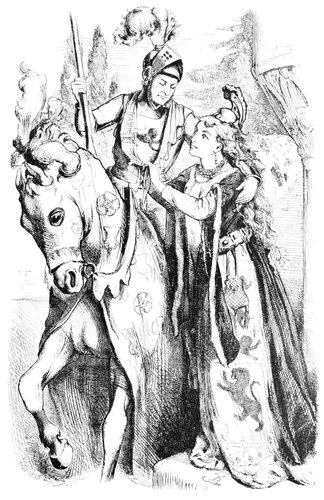
The Chosen Champion. By Frederick Barnard.
FUN CARTOON, 1869.
Tom Hood, like his father, was somewhat of an
artist, possessing considerable skill in caricature, and
giving a comic "twist" to his sketches. Many of
his drawings are scattered through the pages of Fun.
He invariably expressed himself well pleased with
the manner in which they were reproduced. The
following is only one of many letters we received
from him:
"I am delighted beyond measure with the blocks. I have
returned some of the proofs, which I have touched for alteration;
which, with scarcely an exception, however, arises from my mistake
and not from the engravers'.
"Ever yours faithfully,
"Tom Hood."
During the many years of our intimate association
with Tom Hood, we received hundreds of letters
and notes from his pen, but the following is the
first and only instance in which he signed his name
"Thos. Hood." After this, when he had resigned
his post at the War Office and sat down steadily
to literary work, he always studiously signed his
name "Tom," with the express object that his
name might not be confounded with that of his
father, or that he should be accused of "making
capital" out of his father's name and reputation.
"21 Montpelier Square,
"Brompton, S.W.
"Dear Sir,—I believe Mr. Routledge has (or is going to
do so) given you the illustrations of my book to engrave.
"I need not ask you to do me justice, for I know you will
do that; but as I am not a professional artist, but an amateur, I
fancy I may give you more trouble to understand me at times.
"There are one or two blocks that I wish particularly to call
your attention to as requiring facsimile engraving, they being
likenesses. Two drawn in pencil I wish you not to touch, as I
intend, when I come to see you (which I hope to do soon), to
put in initial letters, as I think the fun in them forced. I have
drawn a rude sketch of them on the other side. I can introduce
them thus: a 'W' on the board, and an 'O' on the flag. At
present I am sorry to say I am too ill to come over, but I hope to
be on my legs again by the end of the week.
"I am at the War Office from 10 till 4. Should I be able to
see you at 5 if I called?
"I hope this will not be our first and last connection in this
line, but that it will be a case of 'cut and come again.'
"Believe me,
"Yours truly,
"Thos. Hood."
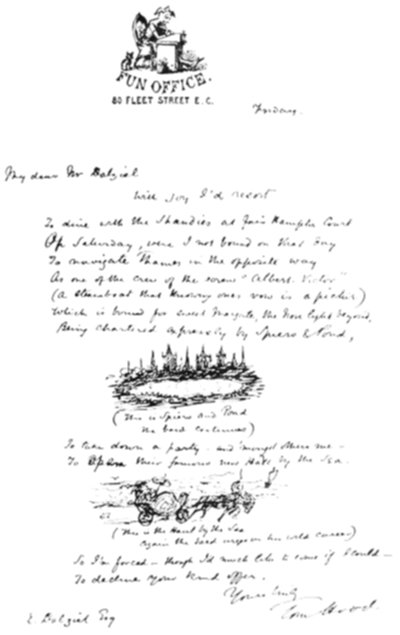
FUN OFFICE.
80 FLEET STREET E.C.
Friday.
My dear Mr Dalziel
With joy I'd resort
To dine with the Shandies at fair Hampton Court
On Saturday, were I not bound on that day
To navigate Thames in the opposite way
As one of the crew of the scow "Albert-Victor"
(A steamboat that knowing ones vow is a pictur)
Which is bound for sweet Margate, the shore light beyond,
Being chartered expressly by Spiers & Pond,
(This is Spiers and Pond
the bard continues)
To take down a party—and 'mongst others me—
To open their famous new Hall by the Sea.
(This is the Haul by the Sea
Again the bard urges on his wild careen)
So I'm forced—though I'd much like to come if I could—
To decline your kind offer.
Yours truly
Tom Hood
E. Dalziel Esq
All our transactions with Hood, which continued
for close upon ten years, were of the most friendly
and agreeable character, leaving behind delightful
remembrances of his truly social and sympathetic
nature. The letter which we give in facsimile was
received in reply to an invitation to join us at an
"up-the-river" dinner party, where we promised he
should meet a few kindred spirits and spend a very
enjoyable day.
Unhappily, Tom Hood died too soon, after an
illness of some short duration, against which he fought
with great courage. He worked with the assistance
of his friend Henry Sampson, to the last—taking
part in preparing the number of Fun that was published
the day after his death, which took place at his
house, in Peckham Rye, on November 26th, 1874.
Subsequently his widow handed us the following
letter, with the remark that they were the last
lines he ever wrote:
"My dear Sirs,—To the best of my ability, and to the
utmost of my power, I have served you loyally and honestly while
strength remained. If I have failed it has not been wilfully, and
when we have differed in opinion I have only done what I have
believed it right to do, or assert beyond mere matter of expediency.
"Sampson has long co-operated with me, and now so well
understands the working of the paper that it has been of the greatest
comfort and use to me to have, for the first time in my life, some
one on whom I could entirely rely when I was disabled.
"A more disinterested and faithful friend man never had, and
I am sure if you transfer the bauble from my hands to his you will
have secured fidelity and ability of no unusual order, loyalty and
discretion, zeal and determination. It is my dying wish that he
might be my successor on Fun. Of course I only express this as
simply a wish of
"Yours always,
"Tom Hood."
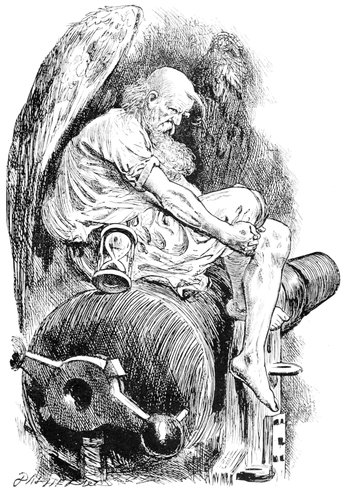
Old Father Time. By Gordon Thomson.
A PORTION OF FUN CARTOON, 1871.
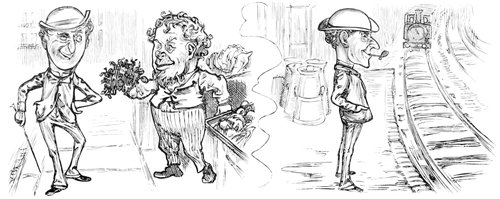
AN URBAN DELUSION.
Jones knew a thing too much for most people. "Nice bunch o' water-cresses, just fresh in," said his greengrocer. "Oh,
ah!" said the knowing Jones; "fresh—oh, yes! after being brought all the way from the country! Not for me, thankee!"
For the fact was that the knowing Jones was just off for a day or two in the country himself.
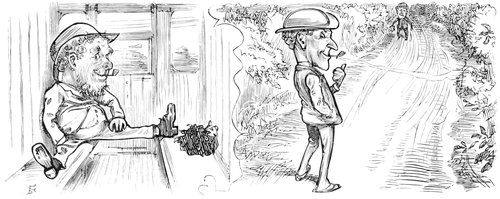
AN URBAN DELUSION—(continued.)
But it so happened that the same bunch of water-cress went down by the same train as Jones did, and alighted at the same rural
station. "Ha!" said Jones, in a stroll down the country lanes, "now, here comes a fellow with a real fresh country bunch of water-cresses;
I will buy them and take them home to town with me the day after tomorrow. That's the way to get the real fresh article!"
By J. F. Sullivan. From Fun.
Among the many men, with whom our connection
with Fun and the "Comic Annual" brought
us into close communication, who have steadily
ascended the ladder of fame—some, alas! no longer
with us,—mention ought to be made of Henry S.
Leigh, author of "Carols of Cockayne," "Strains from
the Strand," and other volumes of verse; a man
possessed of rare wit and unquestionable genius,
but, unfortunately, without one atom of application
or appreciation of the value of time. On one
occasion, when some change of contributors was
contemplated, Hood wrote:
"As for Leigh, he is hopeless: when perpetual motion is
patented, a machine might be invented to bring him to the
scratch regularly, but—he is unluckily a 'genius.' You might
give him a retaining salary that would ensure—his never doing
a line."
Yet, notwithstanding his extreme dilatoriness, he
was a thoroughly good fellow, and Hood was at all
times only too glad to receive any contributions he
cared to send, for they were certain to contain some
quaint conceit and out of the way sentiment.
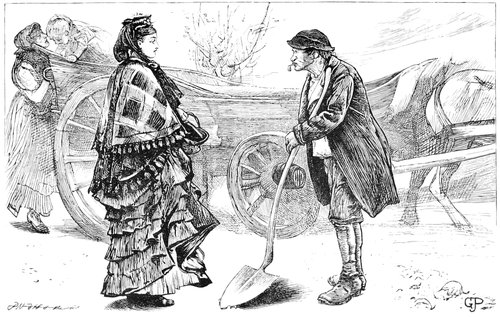
That or Nothing. By G. J. Pinwell, R.W.S. From Fun.
Mrs. Vicar.—"Thomas, what has become of you lately? I haven't seen you at Church for several months."
Thomas.—"Noa, ye ain't. But I haven't been nowheres else."
On Leigh being remonstrated with for non-delivery
of promised copy, we received the following:
"35 Strand,
"1st Feb., 1881.
"To Messrs. Dalziel Brothers,
"You have treated me so kindly that I dared, a little blindly,
An ambition and a future to your care to recommend.
He is timid, he is nervous, but may God above preserve us
If we cannot stretch a point or so to gratify a friend.
I have sent you oft a lyric, either genial or satiric:
Some were bad, and some indifferent, and some were very good.
So my errors don't be hard on, but beneficently pardon,
Were it only through the memory of dear old Tommy Hood."
Of W. S. Gilbert, of "Bab Ballads" and Comic
Opera fame, it may not be generally known that
all those "topsy-turvy" rhymes were published in
Fun: though they were by no means the only
work he did for the journal. For a considerable
period he wrote a comic paraphrase upon the most
popular play produced during the week, as well as
an extremely clever series of papers called "People
I Have Met." He also wrote several stories for
the "Comic Annual." In his selected edition of
"Fifty Bab Ballads" he gives the following account
of how these happened to be published in Fun:
"It may interest some to know that the first of the series,
'The Yarn of the Nancy Bell,' was originally offered to Punch,
to which I was at that time an occasional contributor. It was,
however, declined by the then editor on the ground that it was
'too Cannibalistic' for his readers' taste."
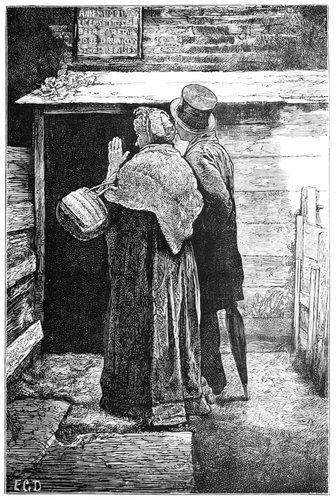
To Even Money! By E. G. Dalziel. From Fun.
Teetotal Wife.—"Ah, when that 'evingly Sir Wilfrid 'as 'is way, 'e'll put that
nasty beer down!"
Irreverent Brute.—"Hope he'll put it down to the price it used to was—thruppence
a pot."
W. S. Gilbert, like many of his fellow workers
on the staff of Fun, began life in the Civil Service,
he having been for a short time in the Education
Office; but the "diurnal drudgery" was not congenial.
His impetuous temperament would not brook
direction or control, as his most intimate friends
were not slow to discover. Immediately on his
fairly breaking away from the "ten to four slavery,"
the first thing he did was to buy a quire or more
of foolscap paper, a bundle of quill pens, and a few
pieces of boxwood. Thus armed, he commenced
to fire away with pen and pencil, for at that time
Gilbert contemplated turning his attention to art.
His connection with Fun began in his early days,
when he sent some of his "topsy-turvy" things to
Mr. Maclean, the first proprietor, who, detecting
the unquestionable merit, insisted upon their being
accepted and published.
Clement Scott, another early and very valued
writer on Fun, in a short sketch of his own career,
referring to Gilbert, says:
"He was courteously, as a contributor, invited to the weekly
Fun dinners, and I fear from what I have heard, that at the
outset the young writer was not very courteously treated by some
of those who afterwards recognised his great talent to the
utmost, and became his warmest friends and companions. Frank
Burnand, owing to his novel, 'Mokeanna,' was promoted to
Punch; Tom Robertson, the dramatist, whom I met at the
club on the Fun meetings every week of my life for half a
dozen years; Arthur Sketchley, with his 'Mrs. Brown'; and for
verse writers, the delightful Henry S. Leigh, Saville Clarke, and
your humble servant, who has been writing bad verses for over
thirty-five years."
So long as Hood lived, George Augustus Sala
was a constant contributor, as were Edmund Yates
and Arthur Sketchley; the latter gentleman's "Mrs.
Brown at the Play," as well as a long series of
"Mrs. Brown" papers, chiefly comments on the current
events of the day, were all published in Fun,
and had immense popularity.
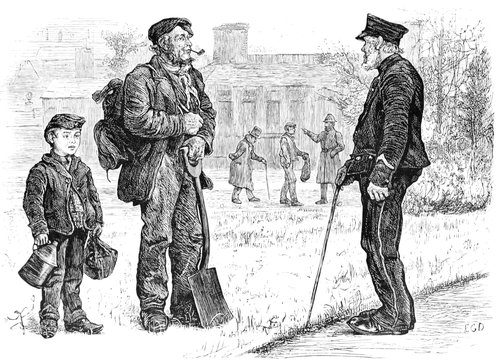
Chelsea Hospitality, under a Cloud. By E. G. Dalziel. From Fun.
Pensioner (to Workman).—"Got e'er a bit o' baccy about ye?"
Workman.—"No, mate!—just smoking the last bit!"
Pensioner.—"Come off that there grass—directly!"
Another prominent member of the staff was
William Jeffrey Prowse, a journalist of great brilliancy
and power, and a "leader writer" and
constant contributor to the Daily Telegraph. His
advent, under the nom de plume of "Nicholas," was
announced by Hood in the following quaint terms:
"With feelings of considerable pride we inform our readers
that we have been enabled (at some expense) to secure the
exclusive services of the celebrated 'Nicholas.' ... 'Nicholas,'
that friend of man, has benevolently consented to impart (for a
certain weekly stipend) the experience of—well, let us say middle
age to the generous ardour of youth: AND THIS IS HOW HE
DOES IT."
But Jeffrey Prowse was something more than
the ordinary journalist working to order; he was
a poet of no mean power. Some of his productions
in this way were published after his death
at the end of a small volume of "Nicholas Notes,"
edited by his friend, Tom Hood. Among his best
are "To Be, to Do, and to Suffer," a poem showing
great ability; and one named "The City of Prague,"
of which the following are the first and last verses:
"I dwelt in a city enchanted,
And lonely indeed was my lot;
Two guineas a week, all I wanted,
'Twas certainly all that I got:
Well, somehow I found it was plenty,
Perhaps you may find it the same,
If—if you are just five-and-twenty
With industry, hope, and an aim.
Tho' the latitude's rather uncertain,
And the longitude also is vague,
The persons I pity who know not the city:
The beautiful City of Prague.
* * * * * * *
L'Envoi.
As for me I have come to an anchor,
I have taken my watch out of pawn,
I keep an account with a banker,
Which, at present, is not overdrawn;
Tho' my clothes may be none of the smartest
The 'snip' has receipted the bill;
But the days I was poor and an artist
Are the dearest of days to me still!
Tho' the latitude's rather uncertain,
And the longitude also is vague,
The persons I pity who know not the city:
The beautiful City of Prague."
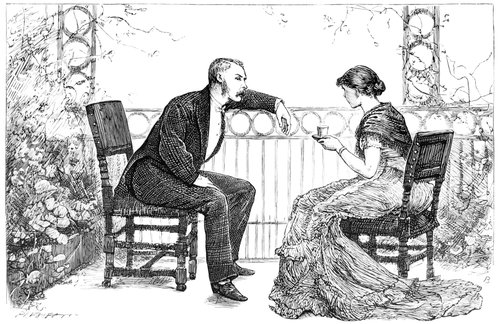
Park Lane. By E. F. Brewtnall. From Fun.
He.—"What a dreadful noise there is down there with those cabs and things! You can hardly hear yourself speak."
She.—"Yes; almost as bad as being at the opera, isn't it?"
Poor Prowse died at the early age of thirty-four.
Hood, in a short memoir, says:
"Prowse, as a writer, was gifted with a great charm of
style; with a fertile imagination he possessed a logical mind.
The amount of work he has done is astonishing, writing
often two or even three leaders a day; and yet amid this constant
and fatiguing trial he found time to write poems and essays,
papers for the magazines, the annuals, and for Fun."
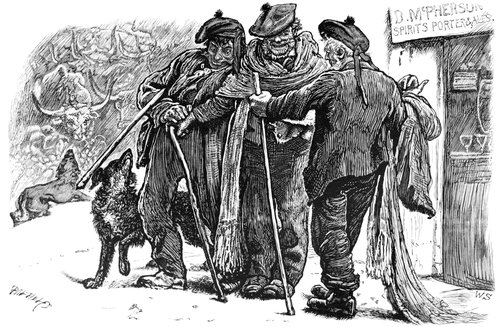
A Drap o' the Best. By William Small. From Fun.
First Hielan'man.—"She'll pe ta pest wusky I shall have tastit for efermore."
Second Hielan'man.—"So tit I, neither!"
Third Hielan'man.—"Neither tit I, too!"
We must not omit to mention Ashby Sterry as
one of the staff, and a contributor to Fun's pages
of much graceful verse. He is well known for his
volume, "Lays of a Lazy Minstrel." Then, Charles
H. Leland, who gained considerable reputation as the
genial Dutchman, Hans Breitmann. This gentleman
contributed very liberally to the "Comic Annual."
He is one of the most affable and interesting
men it has been our good fortune to be associated
with. He was full of entertaining anecdote, a true
artist and no mean draughtsman—in appearance,
a giant, in manner as simple as a child. On
one occasion in America he asked a negro the
name of a black man of rather fine physique and
superior appearance, who was standing near.
"He Injun," replied the nigger; "he big
Injun; he heap big Injun; he dam heap big
Injun; he dam mighty great heap big Injun; He
Jones." Jones appeared to be the nigger's culminating
pinnacle of greatness!
Godfrey Turner, one of the talented young men
who, in the early days, did so much towards
placing the Daily Telegraph in the high position
which it attained among the London morning
papers, worked very constantly upon Fun, as well
as on the "Comic Annual." Poor fellow! a protracted
illness, generally attributed to overwork,
incapacitated him during the last two or three years
of his life.
Dutton Cook's short stories appeared constantly
in the "Annual"—among his very last work being
one he wrote for that periodical. Nor must we
omit to mention Leman Blanchard, who was the
author of more Christmas pantomimes than can well
be counted. He did this work for Drury Lane
under F. B. Chatterton, and then Sir Augustus
Harris, for many years, as well as for many of
the Provincial theatres. The able and accomplished
editor of Sketch, John Latey, also was one
of our most-esteemed contributors.
Henry J. Byron did much good work for
Fun under Hood, but he retired from the staff on
commencing a paper of his own, under the title
of the Comic News, which unfortunately for the
proprietor had but a short existence.
Frank Barrat, Manville Fenn, Austin Dobson,
Byron Webber, Moy Thomas, H. C. Newton, and
Christie Murray, are the names of others whose work
frequently appeared in Fun and the "Comic Annual."
On the death of Tom Hood we complied with
his dying request and placed the "Bauble" in the
hands of Henry Sampson, who had been a
constant fellow worker with Hood for some two
or three years previous. One of the first things
Sampson did was to introduce George R. Sims
upon the staff. It is superfluous for us to comment
upon Sims' great ability as a dramatist, a
writer of short stories and sympathetic ballads,
because the voices of the reading and the play-going
world have already proclaimed their high
appreciation of his genius. Suffice it to say that
it was in the pages of Fun that he found his first
opportunity of appearing in print.
In 1893 when Fun passed out of our hands, he
alluded to us in the Referee, with which he had
long been associated under the nom de plume of
"Dagonet," in the following kind words:
"It was by writing a small 'Poem' in Fun that I first won
a little journalistic recognition. It was called 'A Dumpty Captain....'
It was in November, of 1874, that I first joined the staff
of Fun and made my bow to the British public as an anonymous
journalist. Tom Hood had just been laid to rest. It was in
those days that I commenced my life-long friendship with Henry
Sampson, the new editor. Though for me it was a time of struggle,
I would give a good deal for the light heart with which I braved
the slings and arrows in those dear old days."
Again, Sims writes:
"Although I left Fun in 1877, my association with the
Brothers Dalziel was never severed, and right up to the last issue
(October, 1893) I was a contributor to 'Hood's Comic Annual,'
of which they were the proprietors and editors. I have nothing but
pleasant memories of the cheery, generous-hearted brothers and
their clever sons; and I am delighted to hear that this year the
honoured name will still be on the front page of 'Hood's Annual,'
for it is to appear as usual under the editorship of Mr. Charles
Dalziel.[21]"
Later, in January, 1894, he kindly wrote in the
same paper:
"For nearly half a century the firm of Dalziel Brothers carried
on the business of newspaper proprietors and engravers with credit
to themselves and advantage to the public, and they gathered around
them the best of young men, many of whom have become shining
lights in the world of art and letters. To those who had the honour
and pleasure of working under them, their friendship and their
hospitality were always freely extended, and I have nothing but
pleasant memories of the days when I was allowed to be one of
their working staff.
"The Brothers Dalziel paid me the first money I ever received
for verse. Tom Hood, the editor of Fun, had gone to Paris for a
holiday, and Henry Sampson edited the journal in his absence, and
gave me half a column to fill, and I plunged into poetry at once;
and when I left Fun, in 1876, the Brothers wrote me a charming
letter, which I still possess. Though my connection with Fun
ended then, I remained one of the contributors to 'Hood's Annual'
until last year; and so our business relations continued uninterruptedly
and pleasantly for nearly twenty years—yes, for quite twenty
years, for it was in 1874 that I did my first work for them. Had
there been no Dalziels there might have been no 'Dagonet.'"
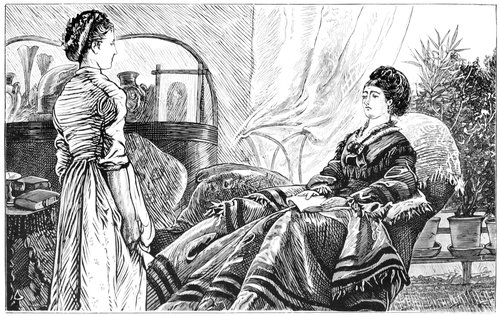
Mistress and Maid. By A. Boyd Houghton, R.W.S. From Fun.
Mistress. "Biddy, how is it you did not answer the bell when I rang?'
Maid. "Sure, mem, 'twas bekase I didn't know what you was ringing for, mem!"
So long as Sims continued on the staff he was
at all times a most welcome contributor, and, with
one exception, always to our entire satisfaction.
The exception came about from the severity of a
criticism which he wrote upon Sir Henry Irving's
rendering of Macbeth, the humour of the article not
being quite as apparent as it was intended to be.
This caused Irving [and his friends] so much
annoyance that he commenced an action against us
for libel. However, Sims at once acknowledged the
authorship of the article, with ample apologies and
regrets, and assurance that there was no "malice
aforethought," and Henry Sampson did the same as
the responsible editor, so Sir Henry, in a very
handsome and kindly manner, withdrew from the
prosecution, and the matter ended.
For several years George Dalziel (the elder of
the Brothers), regularly contributed short stories and
verse to "Hood's Annual." Among the latter was
a rather lengthy poem, of which we give a few of
the verses:
Oh, can the earth, so dream-like sleeping lie
Beneath the rays of that pale silvery moon,
That never gives a weary moan or cry,
Or sign that sorrow dwelt 'twixt night and noon?
There, calmly sailing on amid the stars,
She looks as though no ruthless thought nor care,
Nor wicked deed could ever be that mars
And lays the black spots of our nature bare.
She looks as though she never yet had seen
An ill deed done in all the million years
That she has gazed upon the earth, or been
Pale witness to a flood of bitter tears,—
Pale witness to the darkest deeds that man,
With demon brooding in his heart, could frame:
Foul, miry spots her gentle eye doth scan,
And "Lady Moon" goes smiling, all the same.
Lo! she did see the budding earth when young;
She saw the first red rose that e'er did bloom;
She heard the first grand carol that was sung,
And saw the mountains clothed with golden broom.
She heard each silvery stream and gurgling brook
Hymn its new song of never-ending praise,
And leaves and flowers, in every ferny nook,
Sing psalms to greet the glorious king of days.
* * * * * * *
She heard the first wild notes of Jubal's lyre,
That fell upon the ear like magic sound—
The first bright spark of that celestial fire
That thrills with rapture rare the whole world round.
She heard the first loud burst of ocean roar,
And saw the crested waves careering fly;—
She heard its ripple kiss the sandy shore,—
And saw the white foam dash against the sky.
* * * * * * *
Years, centuries told, come on, and quickly fly,
And this world rolls beneath the silvery moon
As she sails calmly through the deep blue sky
Unheeding joy or sorrow, night or noon.
Unheeding revel, wail, or bitter cry,
Or joy, or grief, or weary toil, or rest,—
She slowly climbs the ever-darkening sky,
While dying sunlight pales upon her breast.
George Dalziel.
From another issue of the "Annual" we make
a few extracts from some verses which are entitled:
My books! my friends, my dear companions all!
My never-failing—ever true and fair!
There standing round, come ready to my call,
And talk, and sing, and tell their wonders rare.
If I am sad, they give me joyous song;
Or if I wish for pleasant talk the while,
My friends are there, and will for short or long,
Just as I please, the ling'ring hour beguile.
With them at ease I play the conjurers part,—
They bring for me the stores of other times,—
Oh, rare the grace!—oh, rare the cunning art
That stirs the sluggish heart with ringing rhymes!
I see the patriot rear his banner high;
The troops march gaily through the busy town;
Methinks I hear the trembling maiden sigh
As her true knight goes forth to seek renown.
King Arthur, with his warriors brave and good,
Comes forth, the dauntless flower of chivalry;
And there be priests in monkish garb and hood,
As well as motley fools of revelry.
'Neath walls of Troy I see the valiant Greek,
Brave Ajax, and the mighty Hector there;
In fancy hear the aged Priam speak,
And see fair Helen with the golden hair;
The war-like braves in single combat stand,
The ponderous spear each doughty hero hurled,—
Fair Beatrice takes Dante by the hand,
And shows the myst'ries of the hidden world.
* * * * * * *
Sweet scenes of peace! here in my native land
These loving friends will each a posie bring,
With wooing words they take my ready hand,
And lead, where meadows smile and brooklets sing;
Where scented flow'rs cling round the cottage home,
Sweet new-mown hay, and fields of ripening corn,—
The broad smooth lake, the gorge where waters foam,
The shady grove, or by the scented thorn.
I see the fairies in the woody dells,
I join their midnight revels on the green;
The tower where the Enchanted Princess dwells,
Embowered in a blaze of golden sheen.
With them I travel o'er the arid plain,—
And wander where the palm and plantain grow,—
Through citron groves—or vine-clad summit gain,
Climb mountains clad with thousand years of snow,
The heathy moor, and o'er the high hill top,
And seem to breathe the cold crisp frosty air,
As from the lofty Alpine icy slope
I see the fertile valleys stretching there.
'Mong lofty pines, or where the olives grow;
Through far-off lands with Livingstone I roam,
Or loiter where the mighty rivers flow,
While sitting in my easy chair at home.
There is no land in all the world we know,
There is no mighty lake or frozen sea,
No hidden depth where foot of man can go,
But my true friends will find and show to me.
For some will sing, and some will tell a tale,
A simple story full of jocund glee,—
And anecdote with point that cannot fail
To cheer the heart with true hilarity;
Kind jovial friends that merry songs can sing,
Or with a touch of pathos bring the tear;
Anon I hear the wedding bells out-ring,
And now for gallant deeds the sounding cheer.
Here true they stand, the many great and good,
The fairest names the world can ever tell;
For some like gold the test of time have stood,
And some!—Oh, there be "maidens fair" as well,
That take a foremost place amid the true,
Good trusty friends there loitering by the wall;
Here Art and Poetry and Science too,
With Travellers that come whene'er I call.
When day is done, with all its toil and care,
The time that busy men together strove,—
My friends come forth the quiet hour to share,—
The friends I trust, and trusting, best I love;
Here motley fool may preach a sermon true,
Or sombre garb may tell a merry tale;
Here by the fire where these warm friendships grew
They talk to me—the friends that never fail.
George Dalziel.
During the period that Fun was in our possession
George Dalziel was a constant contributor, writing
upon the passing events of the day under the
general heading of "Dots by the Way."
Few matters in modern history caused greater
excitement in the public mind than the many
unsuccessful attempts of our troops to reach
Khartoum for the relief of General Gordon, and,
on the news of how the place had fallen and the
brave hero had been murdered by a horde of
savage Dervishes, the following verses appeared:
["The Fortress of Khartoum was treacherously delivered up to the Mahdi on
January 26th, 1885, when General Gordon was slain."—Daily Paper.]
Hush! let no sound of revelry or song
Be heard in all our busy streets to-day,—
For such dark news falls 'mong the surging throng
As sends men sadly pondering on their way.
Sad news that sends a pang of crushing pain
To every honest heart throughout the land.
Khartoum betrayed! her brave defenders slain,
And Gordon fallen by the assassin's hand.
Great, noble Gordon, ever true and brave,
That held this 'leagured city 'gainst the foe,—
And all that man could do, he did to save
The women and their babes from direful woe;
But who can stand against the cunning art,
The cruel, dark device, and darker sin
That traitors use, when with a fiendish heart
They ope' the gates and let the foemen in?
Beloved by all who knew his noble heart,
Or ever felt the warm grasp of his hand,
The loving kindness and the ready part
He took in each good work in every land.
A gentle nature, kind as it was brave,
To help the lowly in their poor estate,
He spent his life to free the fettered slave,
And guide the suffering to a better fate.
O grand career, unsullied to its close!
Its splendour yet shall brighter shine, and tell
In glowing numbers how he faced his foes,
And how by treason dire, great Gordon fell.
With head bowed down we mourn the good man gone,—
And with our sorrow comes a sense of shame,
That in the midst of foes he stood alone,
And died with added glory to his name.
The tale spreads like a black cloud o'er the land;
'Tis like a darkening blight that falls at noon,
When men together meet and wondering stand,
And gaze as though the stricken heart would swoon,—
The flaming sword, the "lightning of the spear,"
Shone in the place where multitudes were slain,
The air is full of wailing, and we hear,
Mingled with prayer, the groan of mortal pain.
George Dalziel.
Again, when the decisive battle was fought
under the command of Lord, then Sir Garnet,
Wolseley, at Tel-el-Kebir, which practically brought
the revolt led by Arabi Pasha to a close, this
song appeared:
[On the return of Troops from Egypt in 1882, after the victory at Tel-el-Kebir.]
A song now for the Guards,
Right gallant deeds they've done,
And liberal rewards
Their bravery has won;
The world beheld with pride
On Egypt's sandy plain
Their dreary midnight ride—
The battle charge. Like rain
Before the raging storm they swept the foe away,
And victory was won at the dawning of the day.
There in the dull grey morn,
With paling stars o'erhead,
We hear the bugle horn,—
The shouts of those who led;
We seem to hear the crash,
To see the gleaming steel,—
The cannons roar and flash,
The dusky foemen reel:
One moment at their guns they stood, then fled in wild dismay,
And victory was won at the dawning of the day.
Our heroes now come back,
In pride they march along;
Be sure they shall not lack
Warm welcome, cheers and song;
Tho' some were left behind,
And fill a soldier's grave,
Their honoured names we'll find
'Mong records of the brave
Who fell that morn while fighting and upheld old England's sway,
When victory was won at the dawning of the day.
George Dalziel.
For many years we published at intervals several
small volumes of short stories, by George Dalziel,
some of them having been previously printed in the
various issues of the "Comic Annual." These volumes
had considerable popularity, the most successful being,
"My Neighbour Nellie," "Dick Boulin's Four-in-Hand,"
"The Story of a Shop," "A Soldier's Sweetheart,"
and "Only a Flower Girl." We also put
together three volumes of verse, with the titles of
"Mattie Grey, and Other Poems," "Faces in the
Fire," and, later, "Unconsidered Trifles." The first
two of these were printed exclusively for private
distribution, but the last volume was addressed to
the public through the publishing house of Mr.
Elliot Stock. Some few of the poems in each of
these volumes appeared originally in the pages of
the "Annual."
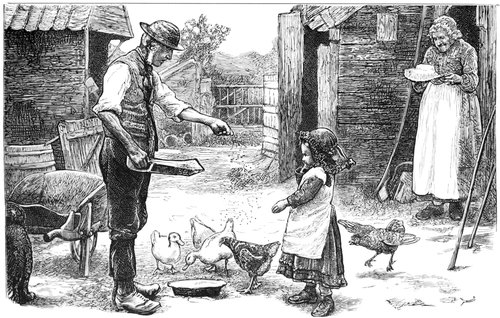
An Illogical De-duck-tion. By E. G. Dalziel. From Fun.
New Mother.—"Now then, Polly, come and have your hat on, there's a little duck!"
Polly.—"Shan't! Other little ducks don't wear none—there now."
[The rest of the argument is lost in outcries and dissolved in tears.
The following lines, printed in "Faces in the
Fire," were written as an affectionate tribute to the
memory of one of the sweetest and most loveable
of women:
Of all the songs from sweetest voice,
In the sweet days of old,
That made my inmost soul rejoice,
However oft they're told,
Are those sweet songs my mother sung
While we were round her knee;
When all the world seemed blythe and young
And fresh and fair to see.
O, I have wandered far away
In sunny lands of song,—
And I have heard the minstrels play
That thrilled the listening throng;
Tho' sweet the charm when beauty sings,—
And sweet the minstrelsie,—
There is no charm that memory brings
Like those old songs to me.
Oft in the calm clear starry night,
Among the leafy trees,—
Or on the weird lone mountain height,
And in the gentle breeze,—
Or on the rough wild stormy sea,
When all is dark and drear,
The dear old songs will come to me,—
My mother's songs I hear.
Sweet is the strange enchanting spell
That lures all thought away,
To warm fireside or woody dell,
Where we were wont to play.
Around my boyhood's happy home
Glad mem'ries fondly cling;
And oft' the sweet old songs will come
My mother used to sing.
Through many years of joyous life
I reach the sere and old;
Now all the battle and the strife,
The fierce sun, and the cold,
Are o'er for me, and calm I wait
Until the "joy-bells" ring;
For I shall hear at Heaven's gate
My angel mother sing.
George Dalziel.
Of the many art contributors, it will be sufficient
if we state the names of the principal men whose
works have adorned the pages of Fun and Hood's
"Comic Annual." Of these, naturally, the cartoonists
take the foremost place. Paul Gray, who
held this position on Hood assuming the editorship,
was a young Irish artist of very considerable
promise, and displayed much fine feeling for black
and white work. He also made drawings for some
of our "Fine Art Books." He was a man of
delicate constitution, and within twelve months of
his joining the Fun staff he fell into a consumption
and died. Shortly before the sad event, writing to
us on other subjects, he said:
"I take the opportunity of saying how very pleased I am
with the way in which the cartoons are engraved—some of the
latter, more especially, could not possibly be better."
Jeffrey Prowse, in one of his poems, makes the
following touching allusion to the early death of his
young friend:
"There is one of our band whom we cherished—
The youngest, the purest, the best—
In the frost of the night-time he perished,
Going quietly home to his rest;
And we thought, as we buried our dear one,
And mournfully turned us to go,
That the summons was still sounding near one—
Listen! On bot,
On bot le rappel là-haut!"
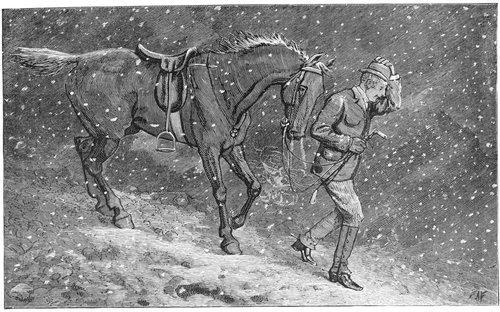
Going Home to Love in a Cottage. By F. A. Fraser. From Fun.
The very spot where the Snorkers held a pic-nic. Oh! didn't the ladies cry out in one voice, "I could live in such a charming
place for ever, if only——" At the self-same pic-nic, Tilbury Pawkins plighted his troth to Amelia Softispoon. Now they are
married, and Amelia has begun trying to live in the "charming place," and Pawkins is going home to a damp cottage and a
rheumatic wife as blithely as a newly-married man should.
Then came W. J. Weigand, followed by A.
Boyd Houghton. Notwithstanding the great ability
of the latter, his quality of mind hardly fitted
him to join in with Tom Hood's idea of the
punctuality indispensable for conducting a weekly
periodical. Next came Henry Doyle, a brother
of the more famous Richard Doyle—an extremely
careful and painstaking artist—who subsequently
became Keeper of the Dublin National Gallery,
with the distinction of C.B. After Doyle came
Fred Barnard, an artist of surpassing versatility
and humour. Perhaps it is not too much to say
that in wit and true comicality he far outstripped
all his predecessors on the journal; but some slight
difference of opinion with the editor—or was it some
interference on the part of Mr. Wylam, the then
proprietor—caused him to secede from the position.
Then followed Gordon Thomson, an artist upon
the merits of whose productions there was a wide
difference of opinion; but he did much good work—the
series of double-pages in connection with
the Franco-Prussian War being exceptionally strong.
His large pictures for Christmas and other Holiday
Numbers were remarkable for the varied topical
events he crowded into them, and those who
remember his "Academy Skits" will know what
quaint burlesques they were. Here is an appreciation
by one of his most distinguished contemporaries:
Sir John Gilbert said:
"These funny 'Academy Skits' are extravagant to a degree,
and at the same time they give such a complete embodiment of
the picture in hand as to stamp the subject in my mind far
more fixedly than any careful copy could possibly do."
Among the general contributors to Fun were
many well-known draughtsmen—Professor H. von
Herkomer, R.A.; George J. Pinwell, R.W.S.; Hal
Ludlow, and "E. G. D." The last named (the
eldest son of Edward Dalziel) was a young artist
full of promise and great ability. Had he given
continued attention to his oil painting he must undoubtedly
have taken a very high position. He
exhibited many pictures at the Royal Academy, the
Grosvenor, and other galleries, but the allurement of
black and white became too much for him, and he
laid aside his brush for the pencil. He contributed
many excellent works to our various "Fine Art
Books," as well as to our "Bible Gallery." Unfortunately
he died at the early age of 39. Amongst his
many admirers was Sir John Gilbert, as the following
letter, which refers to his drawings in Fun, will show:
"Vanbrugh Park, Blackheath,
"20th December, 1878.
"Dear Mr. Dalziel,—Pray accept my best thanks for
your kind remembrance.
"The drawings as they appear weekly in Fun I always
admired. The uncommon humour, the wonderfully expressive faces,
with attitude in accordance with the face, is always delightful
and wonderful.
"The idea of gathering them together in a volume was
excellent and I had intended to get the book. I thank you
again for it.
"Pray remember me very kindly to your brother and your
son, and with best wishes for your continued prosperity, health
and happiness,
"I am, very truly yours,
"John Gilbert."
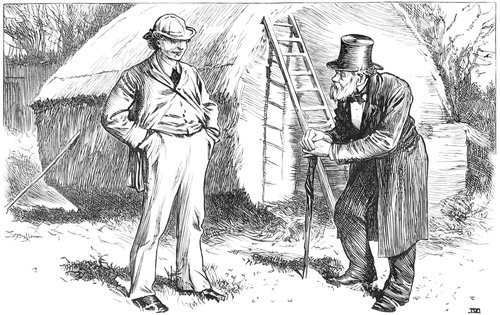
Argumentum ad Hominem. By J. Mahoney. From Fun.
Young Graceless.—"Natural selection!"
Old Graceless.—"Certainly! Only the finest specimens of the race survive."
Young Graceless.—"Come now, that won't do! Why, you're over sixty now, and good for another twenty years!"
Among other artists employed on Fun were—William
Small; Harry French; "F. A. F." (Francis
A. Fraser), and his brother, G. Gordon Fraser,
whose sketches of humorous Irish character were
for several years a prominent feature in the journal
(poor fellow! during the very severe winter of
1895 he was accidentally drowned while skating);
E. J. Brewtnall, R.W.S., the water colour painter;
F. S. Walker, R.H.A.; George Gatcombe, Harry
Tuck; and J. W. Houghton. The last named
also contributed the dramatic criticisms, with illustrations,
for several years. Jack Houghton is a
ready writer of smart, clever verse, and wrote all
the rhymed descriptions to Gordon Thomson's
"Academy Skits."
Another very talented youth who it was our
good fortune to introduce on Fun's pages, both in
literature and art, was J. F. Sullivan. He was a
student at South Kensington, when he first forwarded
some sketches for our inspection; and seeing they
gave evidence of considerable ability, we at once
availed ourselves of his drawings. Though he had
much originality of conception and design, he did
not very readily acquire a "style" of his own,
such as is evidenced in his later productions.
Perhaps the most notable works Sullivan did were
some very clever character sketches—"The British
Working-man" and "The British Tradesman." But
he was not an artist only, for, during the many
years he was associated with Fun, he contributed
to it a fair amount of very good verse and general
comic matter.
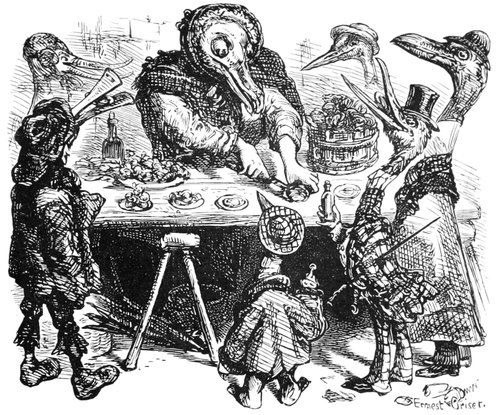
OYSTERS.
"Here you are! the finest natives! best of appetite-creatives.
Come and buy! Taste and try!"
By Ernest Griset. From Fun.
There was a distinct cleverness about the quaint
grotesque drawings of Ernest Griset, a young
Frenchman, who made his appearance in London
now many years ago. His drawings were at first
exhibited in the window of a book shop close to
Leicester Square, where they attracted considerable
attention. Tom Hood had a great opinion of the
artist's ability. They were generally in pen and
ink, lightly tinted with delicate colour. We thought
very highly of Griset's drawings, and soon enlisted
his services, not only on Fun and "Hoods Annual,"
but upon many other publications—for which we
bought hundreds of his drawings, and from them
made selections. Tom Hood wrote clever verses to
some of these, and we published them in book
form through Messrs. Routledge as "Griset's Grotesques."
We also got together several of his
drawings which had appeared in Fun and published
them as shilling books from the Fun Office.
Griset was, and is, a hard and rapid worker.
He has been engaged in many other ways as an
illustrator; much on "Prehistoric Man." Also as a
decorator of public halls, he has done good things.
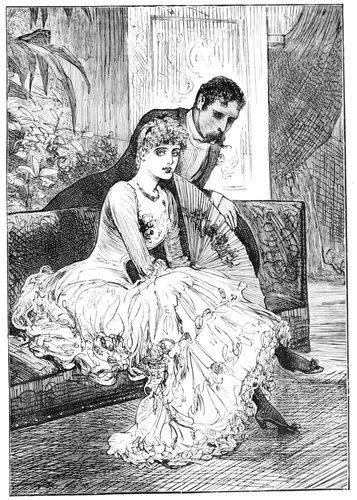
Àpropos to a Proposal. By Hal Ludlow. From Fun.
Frank (just accepted).—"Love thee, dearest? Ay, and when time shall have
furrowed these youthful cheeks and dimmed the lustre of your eyes, when age shall have
threaded silver amidst these glossy locks and bowed the figure erstwhile straight——"
Laura (hastily).—"Oh, Frank, I hope not! Think how old you will be!"
W. S. Brunton, known as "Billy" Brunton, was
a young Irishman full of racy humour and odd
fancies. He was a constant contributor of comic
sketches dealing with passing events of every-day
life. It is well known that when the present Earl
Dunraven was a young man he was occupied for
many years as a journalist, on the London Press.
He was of a genial disposition, a fluent writer,
and a general favourite among his brethren of
the pen, as well as a popular member of the
Savage Club at the time that "Billy" Brunton
and some few other kindred spirits kept the place
pretty lively with their jovial nights and merry Irish
rollicking. On one occasion, shortly after Dunraven
had come into the title and estates, a small group
of "Savages" were standing gossiping in the club
smoke-room, when he very quietly said:
"By the way, old chums, now that my position
in the world is a little altered, and I have been
obliged to change my name, I hope there may be
no reserve on your parts, or change of feeling
towards me, and that we shall continue to meet and
chum together on precisely the same friendly terms,
and with the same cordial good-fellowship, that
has always existed among us."
"Billy" Brunton, who happened to be one of
the group, laid his hand, with a caressing pat, on
Dunraven's shoulder, and in an encouraging tone
said:
"All right, old man, that shall be all right, so
let your mind be entirely at ease on that score.
Bedad, I pledge my word for it; and I'm sure I
speak the sentiments of every member of this club,
that 'although your position in the world is a little
altered, and you have been compelled to change
your name,' you'll find no change in us—for you
shall at all times be treated with precisely the same
respect and the same consideration that has always
been shown you here; and to prove I'm entirely
in earnest in what I say—gentlemen, I propose that
Dunraven stands glasses round."
It is hardly necessary to say that the proposal
met with approval by the entire party, or that it
was responded to by the noble "Savage."
Henry Sampson remained editor of Fun and
"Tom Hood's Comic Annual" for nearly four
years, when he resigned that position to commence
a weekly newspaper—the Referee.
Early in the Sixties we made the acquaintance
of Edward Lear, who was a landscape painter of
great distinction, a naturalist, a man of high culture,
and a most kind and courteous gentleman. He
came to us bringing an original chromo-lithographic
copy of his "Book of Nonsense"—published some
years before by McLean of the Haymarket. His
desire was to publish a new and cheaper edition.
With this view he proposed having the entire set
of designs redrawn on wood, and he commissioned
us to do this, also to engrave the blocks, print, and
produce the book for him. When the work was
nearly completed, he said he would sell his rights
in the production to us for £100. We did not
accept his offer, but proposed to find a publisher
who would undertake it. We laid the matter before
Messrs. Routledge & Warne. They declined to
buy, but were willing to publish it for him on
commission, which they did. The first edition sold
immediately. Messrs. Routledge then wished to
purchase the copyright, but Mr. Lear said, "Now
it is a success they must pay me more than I asked
at first." The price was then fixed at £120, a
very modest advance considering the mark the
book had made. It has since gone through many
editions in the hands of F. Warne & Co.
Lear told us how "The Book of Nonsense"
originated. When a young man he studied very
much at the Zoological Gardens in Regent's Park.
While he was engaged on an elaborate drawing of
some "Parrots," a middle-aged gentleman used to
come very frequently and talk to him about his
work, and by degrees took more and more interest
in him. One day he said, "I wish you to come
on a visit to me, for I have much that I think
would interest you." The stranger was the Earl
of Derby. Lear accepted the invitation, and it
was during his many visits at Knowsley that these
"Nonsense" drawings were made, and the inimitable
verses written. They were generally done in
the evening to please the Earl's young children, and
caused so much delightful amusement that he redrew
them on stone, and published them as before
stated. That is how this clever, humorous book
came into existence; a work that will cause laughter
and pleasure to young and old for all time. John
Ruskin says of Lear's "Book of Nonsense":
"Surely the most beneficent and innocent of all books yet
produced is the 'Book of Nonsense,' with its corollary carols,
inimitable and refreshing, and perfect in rhythm. I really don't
know any author to whom I am half so grateful for my idle
self as Edward Lear. I shall put him first of my hundred
authors."
John Proctor, the celebrated cartoonist, had
retired from his position, and had gone over to
Moonshine, the then new "comic," and William
Boucher had taken his place, before we became
connected in any way with Judy, or The London
Serio Comic Journal. Charles H. Ross was the
editor when the paper came into our hands in 1872.
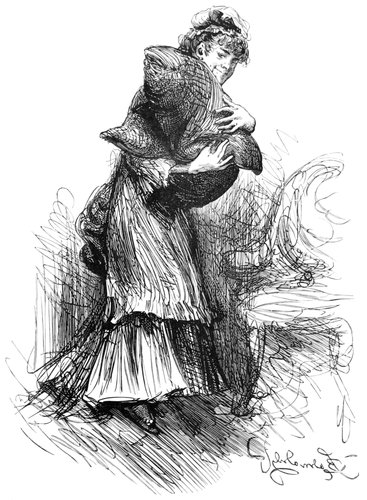
Madame. By Frederick Barnard.
"She is one of the most amiable ladies I ever met, and has a pleasant
smile and a pretty something to say to one and all, and she doesn't mean
a word she says. Watch her now softly crossing the floor, no doubt
fearful of waking old Mr. Topperton, whose heavy breathing might by the
ill-disposed almost be likened to a snore. See, she is carrying a pillow;
doubtless it is to prop up Topperton's head, now resting against the hard
wooden edge of the chair at a painful angle. Not a bit of it."
"Behind a Brass Knocker" (Judy).—Charles H. Ross.
Published by Mr. Gilbert Dalziel.
He was a gifted writer of varied powers, a dramatist
and novelist of the most sensational order. But
above all, Ross was a great humorist, with a
manner peculiarly his own. He was also a skilful
draughtsman, and we engraved hundreds of his
drawings. His pages of humorous pictures, which
appeared in Judy, were generally signed "Marie
Duval" (his wife's maiden name), and the subjects
often savoured somewhat of French origin.
One of the principal contributors to the paper
at this period was Ernest Warren, an admirable
verse writer. He, too, wrote for the stage. Of his
books, many of which were of "The Round Table"
series, the most popular were "Four Flirts," and
"The White Cat." Another, which had run through
the Journal, and was written in collaboration with
his friend Ross, was "Rattletrap Rhymes and
Tootletum Tales." All three books went through
many editions.
"The Bloomin' Flower of Rorty Gulch" was
published in the last-named book, and shows Ross's
power as a sarcastic verse writer. As a recitation,
the poem is very popular, and in the hands
of that clever and esteemed actor, E. J. Odell, who
has made a feature of it for many years, it is
highly appreciated in Bohemian and other circles.
In his "Book of Beauty" Ross says "On Love":
"Ladies and gentlemen! there is no such thing as love.
"This fact is thrown in by A. Sloper without any extra
charge.
"Some people take a long while to find this out, and some
never do quite find it out: those are the lucky ones.
"During A. Sloper's infancy, when A. Sloper was a mere
boy, he was under the impression that he was in love, and couldn't
eat over two eggs and a couple of rashers for breakfast; but it
turned out he was wrong, and only wanted medicine.
"Later on he had another attack, and made poetry. He
made a line that ended with love, and stuck grove on to the end
of another, and move on to the end of a third, and hove and stove
on to the end of the fourth and fifth, and still he was not happy,
nor was any one else to whom he read the poem.
"Love has been the stock-in-trade of all poets ever since
the first poet started in business, and they have generally treated
the subject from a thoroughly business-like point of view.
"A young man once late at night told A. Sloper that some
people never tell their love, but feed on their damask—and he
fell down immediately after making the observation.
"A. Sloper has known men who could not make love, but
have made boots, Geneva watches, and other things, very well
indeed. He has also known men who could make love, but
could never propose. You might have brought actions against
them, and still they couldn't."
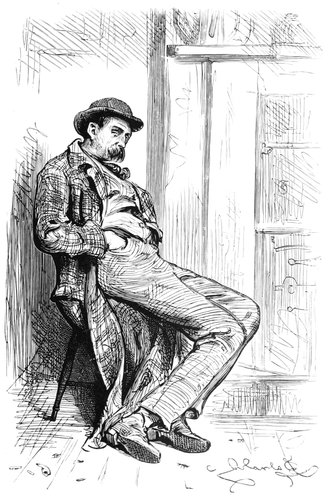
Mister Mite. By Frederick Barnard.
"'What is it?' she asks.
"'It is him—papa,' responds Melia; 'he has come back!'"
"Behind a Brass Knocker" (Judy).—Charles H. Ross.
Published by Mr. Gilbert Dalziel.
And see the glowing description of "The Beautiful
Gymnast: A Fragment":
" ... Nothing could have been more lovely!
"Scarcely eighteen summers had passed over the golden-hued
silkiness of the tightly-bound tresses of that classic head. The
flush of health was on her peachy cheeks. The joyousness of
youth lit up her big blue eyes, and wreathed her red lips into a
smile, that showed two rows of glistening teeth. The tightly-fitting
dress revealed in all its glorious young beauty the faultless contour
of her form.
"She cast an eye of pardonable pride upon the shapely limbs
supporting her; then turned her eyes upward towards the horizontal
bar, set her teeth, and jumped.
"An instant later, and she had sat down sharply on the resonant
bounding-board with a deuce of a bump! and all the plain
young women looking on were smiling...."
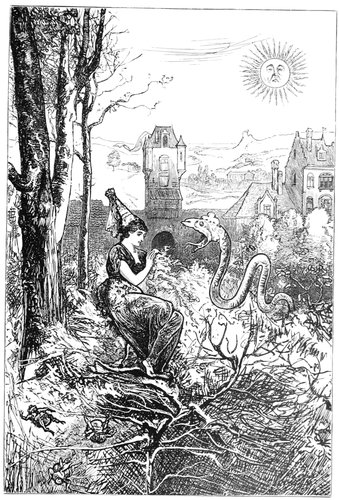
On the Uselessness of Nursery Lore. By E. G. Dalziel.
"NURSERY MORALS" (JUDY).
Published by Mr. Gilbert Dalziel.
One of the most interesting series of stories that
Charles H. Ross wrote for Judy, he called "Behind
a Brass Knocker." This was done in conjunction
with Fred Barnard, who made all of the drawings.
It was rather a sad theme—the experiences of a lot
of impecunious people living together in a boardinghouse,
the poorest of them all being Mrs. Mite,
whose shifts and cunning ways are told with a
touch of pathos, her crowning trouble being a
drunken husband. The work had considerable
success in volume form. Fred Barnard's work in
this was of his very best kind.
Ross also wrote a series of wonderfully clever
articles to accompany a set of drawings by E. G.
Dalziel, which were strangely unlike the usual work
of this artist—so much so, as to suggest the idea
that he must have been under the influence of
Gustave Doré at the time. Ross called them
"Nursery Morals," which were of a fanciful character.
After playfully rebuking "Little Bo-Peep"
on her vanity, he concludes:
"I think the artist might as well have shown us the nose
of one of the silly sheep peeping round a distant corner; but
perhaps the sheep were all tired of her airs and graces, and had
taken themselves off in disgust. I am not naturally of a malignant
disposition, but I sincerely trust she never did find those sheep.
Don't you?"
"On The Giant-Killer," he writes:
"I have every reason to believe that abnormally large men
are comparatively harmless. There must be exceptions, of course,
and I will give you 'Sir Roger' and Count Fosco. The Count,
by the way, is a fictitious personage, and perhaps 'Sir Roger'
was also rather that way inclined.
"These, however, were enormously fat men, not giants, and
I have to do with giants. Now, we have it on good authority,
that the intellect of a giant is generally as weak as his knees.
We hear over and over again of giants in shows being awfully
bullied by the 'smallest man in the world,' who travels with him,
and who is exhibited outside on the parade in a largish-sized
doll's house, through the roof of which he pokes out his head,
whilst he rings a bell from the second-floor window, and rests
his feet in the front parlour."
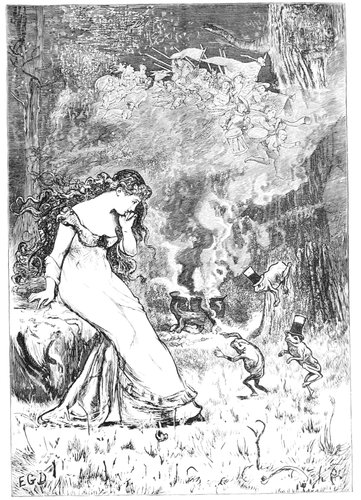
On Love as a Passion. By E. G. Dalziel.
"NURSERY MORALS" (JUDY).
Published by Mr. Gilbert Dalziel.
He remarks "On the Utter Wrongness of
Nursery Lore":
"The more I reflect upon the unworthiness of the Nursery
hero, as compared with the spotless purity of my own character
(I am a London tradesman), the more am I lost in wonder to
think that these alarming humbugs should so long have been
tolerated by an indulgent public. When I think of that fellow
whose name is associated with the beanstalk of abnormal growth—an
unhappy combination of rogue and fool—when I think of
that wholesale murderer (another Jack), and indeed all the rest
of them, I ask myself 'Why so?' and all that remains of the
Echo, at one halfpenny, is discreetly silent."
"On Love as a Passion":
"The passion of love is very properly excluded from the
subjects discussed in the best regulated nurseries. Indeed, in households
where the young lady's material has reached a certain height
and breadth and fulness, the love that has any particular amount
of passion in it is not the one discussed. And I think it right
that it should not be.
"Writing as I do exclusively for female babes (or rather, I
should say, young lady babes, because a young lady babe ought
not to be called a female, and would with reason feel annoyed
at being called one), I am anxious to do away with the passionate
love-fiction altogether. Of course, I know I have only to
explain the thing properly, in my own particular way, and the
thing will at once be done away with; and surely it is my duty
to do so, when by doing so, I know I shall do good."
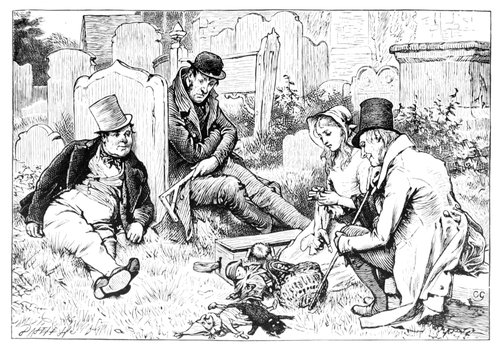
"Even Mr. Codlin had nothing to urge against a proposal so seasonable. Nelly, kneeling
down beside the box, was soon busily engaged in her task, and accomplishing it to a miracle."
"The Old Curiosity Shop" (Household Edition).—Charles Dickens.
By Charles Green, R.I.
By permission of Messrs. Chapman & Hall.
In 1888, Gilbert Dalziel, who had been working
in the interests of the paper from the day it came
into our hands, took over the journal, paying the
sum of eight thousand pounds for it. He at
once made considerable alterations in the conduct
of the paper. Amongst his artistic staff were that
powerful draughtsman, W. G. Baxter; Bernard
Partridge, one of the most brilliant and deservedly
popular black and white men of our time; Maurice
Greiffenhagen, whose drawings had graced the pages
of Judy from the day of his early studentship;
Alfred Bryan, inimitable in his way; Fred Pegram,
Raven Hill, F. H. Townsend, and Fred Barnard.
With such a list of artists at work week by
week, small wonder that it should now be spoken
of as "The Golden Period" of Judy.
In the pages of Judy, Charles H. Ross created
the character of Ally Sloper and also of his friend
Ikey Moses. In the early part of 1884, Gilbert
Dalziel conceived and modelled a new publication,
to be called the Half-Holiday, in which Ally Sloper
was to be a leading character. It was finally decided,
however, to add the Old Man's name to
the title, and on May 3rd, 1884, Ally Sloper's
Half-Holiday made its first appearance.
Amongst the many quaint features of the paper,
perhaps the "Award of Merit" stands foremost.
This decoration consists of a very clever design by
W. G. Baxter, executed in colours, and has been
presented to and accepted by men and women of
the highest distinction in all branches of art, science,
literature, music, and the professions generally.
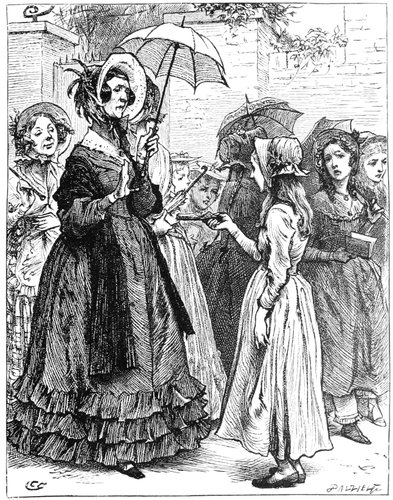
"'You're the wax-work child, are you not?' said Miss Monflather.
"'Yes, ma'm,' replied Nell, colouring deeply."
"The Old Curiosity Shop" (Household Edition).—Charles Dickens.
By Charles Green, R.I.
By permission of Messrs. Chapman & Hall.
Gilbert Dalziel has in his possession a collection
of autograph letters, in acknowledgment of the
"Award," from some of the most eminent folks
before the public during the latter part of the old
century, amongst whom may be mentioned—Lord
Tennyson, as representing Literature; Sir John E.
Millais, Bart., P.R.A., for Painting and Drawing on
Wood; Sir Arthur Sullivan, for Music; Sir Charles
Russell, for Law; Arthur W. Pinero and Sir Henry
Irving, for the Drama; Lord Charles Beresford,
for the Navy; and Lord Roberts (when he was
in command in India), for the Army.
Charles H. Bennett was one of the most original
artists of his period. Alas! his life was all too short.
There was an individual stamp about his work—independent
in manner and full of deep thought.
We had many of his drawings through our hands
and knew him well. A more earnest man concerning
his work we never met; and, not unlike Pinwell,
he held it as a principle that time should never be
allowed to enter into the question; the task should
be defined, but never trammelled by, "How long
will it take?"—whether it be days, weeks or years,
for the proper execution of the project. Perhaps
his "Bunyan's Pilgrim's Progress" will rank as his
greatest achievement.
We have already spoken of our connection with
Messrs. Chapman & Hall, on that light feat
of Doyle's, the "Panorama." There were also a
very clever set of drawings for "Fairy Tales of
all Nations," by Richard Doyle, and illustrations to
Morley's "Oberon's Horn, and other Fairy Tales,"
by Charles H. Bennett, which we produced for the
same firm.
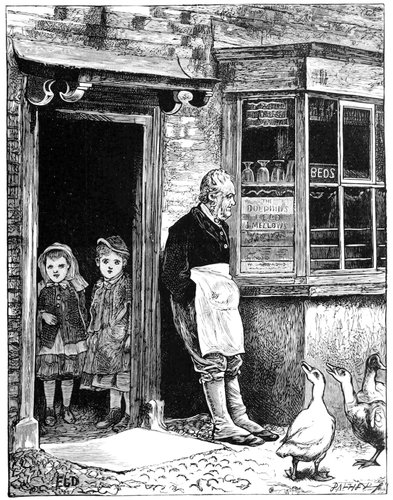
"I made my way back to the 'Dolphin's Head.' In the gateway I
found J. Mellows looking at nothing, and apparently experiencing that
it failed to raise his spirits.
"'I don't care for the Town,' said J. Mellows, when I complimented
him on the sanitary advantage it may or may not possess; 'I wish I
had never seen the Town.'"
"The Uncommercial Traveller" (Household Edition).—Charles Dickens.
By E. G. Dalziel.
By permission of Messrs. Chapman & Hall.
When Charles Dickens abandoned the etchings
of H. K. Browne as a means of illustrating his
books, the next work, "Our Mutual Friend," was
placed in the hands of Marcus Stone, whose father,
Mr. Frank Stone, A.R.A., had for many years been
a next-door neighbour and a very constant friend
of Dickens. Some of these drawings, which are
marked with all the refinement and good taste of
this popular artist, were entrusted to us to engrave.
We were early engaged on the various editions
of the works of Charles Dickens, commencing
(through our friend, Ebenezer Landells,) with the
wood engravings for "Master Humphrey's Clock,"
which were soon followed by those for the "Christmas
Books" from drawings by Richard Doyle,
John Leech, and Daniel Maclise.
But by far the most important commission ever
placed in our hands by Messrs. Chapman & Hall
was the production and entire control of the illustrations
for the Household Edition of the Works
of Charles Dickens, which was commenced in serial
form in 1871 and completed in 1879, thus extending
over a period of eight years. The publishers
began the issue with "Pickwick," using the original
designs by H. K. Browne ("Phiz"), but immediately
after this Mr. Frederick Chapman placed the entire
control of the illustrations in our hands. We were
to find the best artists we considered suitable for
the various works. The first selected was James
Mahoney, who had already attained some distinction
in drawing on wood. He did in all three
books, the first being "Oliver Twist," followed by
"Little Dorrit" and "Our Mutual Friend." Mahoney
had a firm, clear style of manipulation, and no one
knew better than he how to make work look solid and
firm by leaving large masses of white in his arrangement
of colour. He painted some good water colours.
We had several small examples, the most important
of which is "A Bird of Prey," a repeat of one of
his designs for "Our Mutual Friend." Charles
Green, R.I., made a beautiful set of illustrations
to "The Old Curiosity Shop." Every picture is
carefully studied both as to character, scene, and
subject; the picture of "Short and Codlin," with
Nell and her Grandfather, being one of the most
perfect. Green painted many very fine water
colour pictures, several of which we were fortunate
enough to possess.
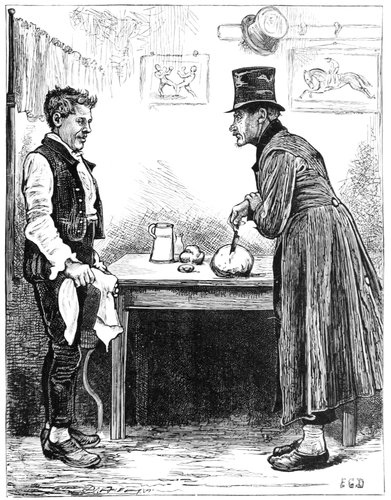
"On the second occasion of my seeing him he said, huskily, to the
man of sleep, 'Am I red to-night?' 'You are,' he uncompromisingly
answered."
"The Uncommercial Traveller" (Household Edition).—Charles Dickens.
By E. G. Dalziel.
By permission of Messrs. Chapman & Hall.
"78 Park Road.
"Dear Mr. Dalziel,—These proofs are so beautiful I
cannot find any fault; and should be a brute if I did. The only
one I have touched is because it is a little too dark and heavy—perhaps
it is a heavy proof. I am delighted with them generally.
I send two more drawings. Please do not forget to let me have
the three proofs I mentioned in this morning's letter.
"Yours very truly,
"C. Green."
Again on another occasion:
"I like those proofs very much indeed; they are beautiful.
There is only one thing wants touching—the face of the Charwoman
in No. 27 is rather muddy, it wants clearing up a bit. I have
touched the proof."
H. French, a clever and popular artist, the son
of an accomplished wood engraver, who came of
the Bewick school, did the pictures for "Hard
Times," and very good they were.
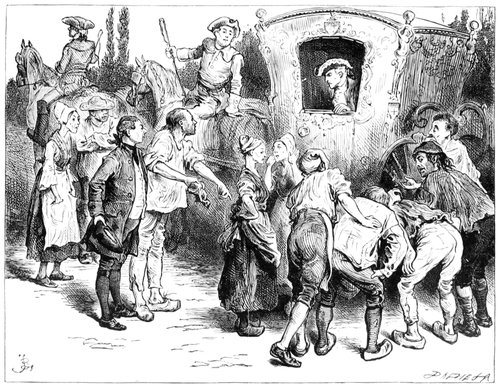
"He stooped a little, and with his tattered blue cap pointed under the carriage. All his
followers stooped to look under the carriage."
"A Tale of Two Cities" (Household Edition).—Charles Dickens.
By Frederick Barnard.
By permission of Messrs. Chapman & Hall.
F. A. Fraser, a well-known illustrator, made
those for "Great Expectations."
A. B. Frost, an American artist of great ability,
did "American Notes," and Gordon Thomson
"Pictures from Italy." E. G. Dalziel undertook
"Reprinted Pieces" and "The Uncommercial Traveller,"
as well as other short stories. Of "E. G. D.'s"
work we will here quote two letters by distinguished
artists in appreciation.
"2 Palace Gate,
"30th January, 1878.
"Dear Dalziel,—I ought to have thanked you for your kind
and thoughtful present of Xmas books. The illustrations of your
son to 'The Uncommercial Traveller' are admirable. I recognise
his work in Fun, and the care of his work is not lost upon
"Yours very truly,
"J. E. Millais."
"Vanbrugh Park,
"Blackheath,
"23rd December, 1877.
"Dear Mr. Dalziel,—I thank you for the volume, where
your son's drawings show an amazing care and truth—a certain weirdness
most telling in some subjects, notably, 'Chips, the Carpenter'—the
Devil with the Rat on his shoulder is grand. There is a
Donkey, taken into custody by the police, most beautifully drawn.
The Cart is by Albert Durer, so also is 'Mr. Baker's Trap';
'A Cheap Theatre' is good, full of varied character; so is the
Group of Chair-menders on title—the man's eyes screwed up
because of the sun, and the woman looking through the back
of the chair. There is a group of old women on p. 136
which is capital; very good character on p. 101, also on p. 84.
'Mr. J. Mellows,' p. 112, very good.
"With best wishes for health and happiness to you and yours,
"I am, dear Mr. Dalziel,
"Very truly yours,
"John Gilbert."
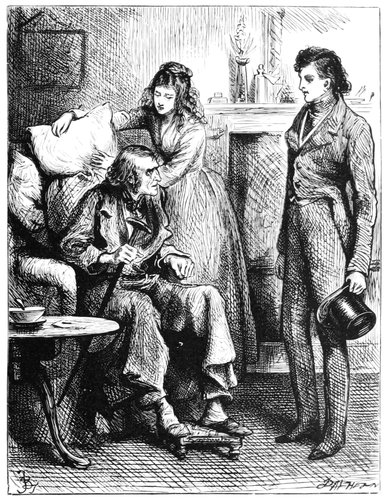
"'No matter! What do you mean, sir?' was the tart rejoinder.
'No matter! Do you think you bring your paltry money here as a
favour or a gift; or as a matter of business, and in return for value
received?'"
"Nicholas Nickleby" (Household Edition).—Charles Dickens.
By Frederick Barnard.
By permission of Messrs. Chapman & Hall.
But of all the artists engaged on this edition
Frederick Barnard held the most prominent position,
he having fully illustrated no less than nine out
of twenty books.
Barnard ranks as one of England's truly comic
artists; but he was not only comic, he was one
of the most versatile artists of our time. He
unquestionably stands among the foremost illustrators
of Dickens. The many drawings he made
for the Household Edition, as well as some larger
pictures, illustrating the works of the great author,
all possess a certain peculiarity: while the drawings
are strictly in his own style, there is just enough
resemblance to the figures created by H. K. Browne
to save you a shock; the Dick Swiveller, the Bill
Sykes, and other characters are the same as one
had accepted when the stories were first written.
A powerful set of drawings are those for "How
the Poor Live," which were commissioned by
Gilbert Dalziel, in connection with G. R. Sims'
articles, for publication in the Pictorial World.
Again, how grand are many of his designs for
the "Pilgrim's Progress," which we prepared for
Alexander Strahan; one of the most effective is
"Lord Hategood," from which we commissioned him
to paint an oil picture. Barnard was no mean
painter: perhaps his "Saturday Night in the East
End" and "The Guards' Band Marching" are
amongst his most important works. He also painted
a "Ball-room Scene," of an elegant character, from
one of the Dickens' books, that had a very prominent
place in the Institute of Painters in Oil Colours.
Our long connection with Barnard was of close
intimacy and friendship; he was a delightful companion,
amusing, and full of bright repartee, and
would often "set the table in a roar."
As a mimic and comic singer he was inimitable.
A favourite song of his at studio evenings was "I
Long to be a Hartist, Mother," written by himself,
we believe, and screamingly funny. As a practical
jokist, Fred Barnard was simply au fait. On one
occasion he called at Soane's Museum in Lincoln's
Inn Fields, and asked the porter if Sir John Soane
was at home. "Why, lor bless you, sir," said the
man, "Sir John Soane has been dead these sixty
years." Barnard was staggered at the news and
overwhelmed with grief, and beating his breast he
cried, "Dead! Dead! Dead! And we were boys
at school together!"
His own death, poor chap, was tragic, and a
great shock to all who knew him. He was an
ardent smoker. One morning, having had breakfast
in bed, he requested that he should not be disturbed
again for some hours; when the servant went to call
him there was no response, and on the door being
forced open the room was found to be full of smoke,
the bed-clothes smouldering fire. It is supposed that
while courting further sleep he lit a pipe, which, falling
from his mouth, ignited the clothes; although
somewhat severely burnt, his death was, in fact, due
to suffocation, and he passed away while in a state
of insensibility.
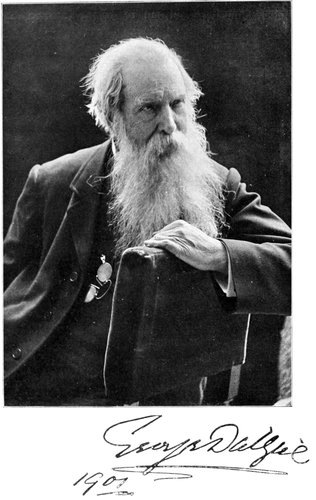
From a Photograph by Grace and Dora Dalziel.
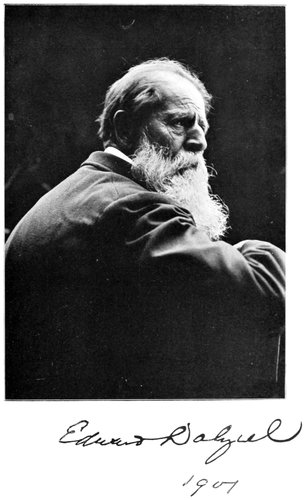
From a Photograph by Grace and Dora Dalziel.
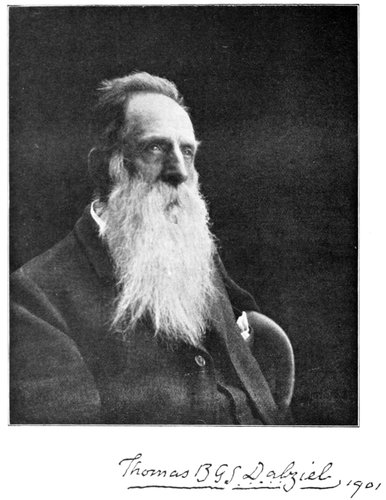
Thomas BGS Dalziel 1901
From a Photograph by Lovel Dalziel.
OUR PUPILS.
Early in the year 1844 we took our first pupil,
Francis Fricker, a very steady, industrious fellow,
who was always punctual and reliable. He became
a good engraver, and remained with us, without
intermission—with the exception of two or three
weeks' holiday in each year, which we made a
practice of giving to all our pupils—until we broke
up our establishment in 1893.
Being all draughtsmen ourselves, we did not
take pupils specially for engraving alone; although,
from our earliest days, we made it a rule to place
any commission that was intrusted to us in the
hands of the best artists we could find, whose
peculiar ability suited them for the subject in
question.
Nevertheless, we established a school to teach
our pupils drawing. We got together a good collection
of plaster casts—the best obtainable; also
other matter suitable for study from the flat and
round; works on "Anatomy," on "Beauty," and on
"Perspective." We also provided all the materials
for working free of cost. The engraver's day at
that time was a long one—nine hours—and the
drawing only began after the day's work had been
finished; and to this, perhaps, is due the fact that all
did not avail themselves of what had been planned
for them. The pupils who did attend the meetings,
and who doubtless possessed the stronger love of
art, benefitted to no small extent.
Among those who availed themselves of these
advantages were Harry Fenn and Charles Kingdon,
two of our earliest and very cleverest pupils. Soon
after they completed their term with us they took
ship to Canada, having determined to visit the principal
cities there and in the United States of America.
This they did, settling in New York City, where
they soon found profitable employment.
Harry Fenn took at once to drawing on wood
and water colour painting, making very rapid progress
in both branches of art, and soon becoming
the most popular landscape draughtsman in America.
It was he who projected, planned, and made all
the drawings for "Picturesque America." It came
about in this way. He was dining with the
well-known publisher, D. Appleton, who, during
conversation, regretted that America did not afford
such fine material for landscape art as the Old
Country—that there was, in fact, nothing picturesque
in America. Fenn said: "Give me the chance and
you shall see what a variety of beautiful material
you have got in America." The reply was: "Well,
you shall have a try if you like. Do a few drawings
and let us see." Fenn made a few drawings,
which encouraged the publisher to carry out the
idea; and he did a work which was, perhaps,
one of the most brilliantly successful illustrated
books ever published, and the forerunner of several
similar works, all of which were filled with beautiful
examples of his skilful pencil. He still continues
to be a popular black and white artist, but devotes
much time to painting in water colours.
Joseph Pennell, in his "Modern Illustration,"
says, "Henry Fenn's illustrations to 'Picturesque
America' entitle him to be called the Nestor of
his Guild, not only for the delicacy, truth and
refinement of his drawing, but also because of the
enormous success of the publication."
Charles Kingdon, by far the best engraver of
the two, was also very popular in America, but he
was of a restless nature and had not the persistent
industry of his companion. He died young, and
in his death the world lost a brilliant young artist.
He married an American lady soon after settling
there, and it is worthy of mention, so we have been
told, that his daughter, who evidently inherited her
father's art instincts and good looks—for Kingdon
was a very handsome fellow—was a popular member
of the celebrated Augustin Daly's company, and
became the wife of an American millionaire.
Another of the most industrious and constant
workers was George G. Kilburne, who, soon after
completing his engagement with us, gave up
engraving altogether and took to painting—mostly
in water colours—in which he has long held a
prominent position in the Royal Institute of Painters
in Water Colours, as well as being a very frequent
exhibitor at the Royal Academy. He was one of
the most satisfactory pupils we ever had. He took
up engraving with great aptitude, and from the day
he came to us his work was always good. Only
the second drawing given to him to work upon was
so perfect, that it was published with the set to which
it belonged. A peculiarity with Kilburne was that if
he were asked to do anything, you found him doing
it immediately; with him no time was wanted for
preparation. Though he left our studio and forsook
the branch of art we taught him, our connection,
instead of being severed, became the closer by his
marrying the elder daughter of our late brother
Robert.
Charles A. Ferrier, a young Scotchman of varied
capabilities, who had made some small efforts at
wood engraving in his native town of Arbroath,
without instruction, came to us to seek employment
through an introduction he had obtained to William
Harvey. He was a youth of considerable promise
and full of enthusiasm for his art. Though the
specimens he had to show were very crude, he
had evidently been looked upon as a genius by his
Scottish friends; but on entering our studio he was
indefatigable in his studies, and eager for improvement.
Before he had been two months with us he
became London correspondent to an Arbroath weekly
paper. This letter he generally knocked off during
the hour allowed for dinner in the middle of the
day. We have reason to believe he turned his
attention very much to scientific subjects, and became
a Fellow of more than one of the learned Societies.
During the whole of his life he has been a staunch
teetotaler, and has worked hard in the temperance
cause. He became the personal friend of George
Cruikshank, Dr. Richardson, and many scientific
people, who preferred him as an engraver because
of the knowledge he possessed of the objects he
had to work upon. Taken altogether, Ferrier
became one of the most remarkable men who had
their beginning in our studio.
"W. Y.," a pupil whose name for obvious reasons
we will not give, came to us when about nineteen
years of age. He was a member of a good county
family—a younger son; he had good taste for art
and some skill as a draughtsman. By the wish of
his elder brother, he was put with us to learn
engraving. His development in our art was simply
wonderful, his manipulative power was quite extraordinary;
it was the one case in our experience
where it seemed as if the pupil had come to teach
the masters. He was steady, punctual to his long
day's work, and in every way exemplary, a gentleman
in manner, and a great favourite with all the
assistants and other pupils; but it was known to
his fellow-workers that at a certain date he was
to come into a considerable sum of money, and he
had often said that when he got it, "then farewell
to industry, to art, and to respectability." His
words were: "When I get it I will let fly." And,
sad to relate, he did "let fly." He had been
working out of our studio for some two or three
months, when he suddenly disappeared, and the last
we heard of him was that he was spending his time,
and his money chiefly in the immediate vicinity of
the Surrey Theatre, and that in an adjacent public-house
bar he was seen lighting his pipe with a five
pound note. Poor fellow! It was the old, old story—the
drink—the drink that did it.
Alexander Aitcheson Dalziel and John Sanderson
Dalziel, the two sons of our brother Robert, also,
on leaving school, became pupils to learn wood
engraving. The elder brother, Alexander, shortly
after completing his term, married and went out
to South Africa, where for a time he coupled
scholastic work with his engraving; but after a bit
he gave up art altogether and went on with his
teaching only—while John emigrated to America, and
settled down in Philadelphia for many years, where
he executed a large number of elaborate, highly-finished
works, chiefly of a scientific character, much
of which has been reproduced in this country. At
the time we write he is turning his attention to
fruit culture in Colorado.
A. W. Bayes was introduced to us by H. Stacy
Marks, R.A., as a young man who had been
engaged as a draughtsman at some manufacturing
works in the country, and had shown a wonderful
capacity for design. We could not say he came
to us as a pupil; but whatever progress he made in
our studio was the result of the practice derived from
the subjects given to him, and owing to the advantage
of his seeing a great variety of drawings by
the leading artists of the time. He was very industrious
and very rapid. He worked with us for
many years, until, for the further development in
painting and other branches of his art, he found
it an advantage to have a place of his own. With
us he had illustrated a number of children's books,
the most important being the works of Hans
Christian Andersen, for which he made a very
large number of drawings. These books went
through many editions. He also made a set
of drawings from Bible history, and another set
from the New Testament, all of which were
published for us by Messrs. Routledge, Warne &
Co., with a fair amount of success. Bayes for
some years has devoted himself almost entirely to
painting in oil, and has produced many important
works—chiefly of a historical order.
Phil Ebbutt came to us on the recommendation of
our friend George R. Sims. He had a natural taste
for drawing, and was quick at design. He worked
much on our publication, Jack and Jill, including
political cartoons, and romances strictly historical.
He also made many drawings for Fun, which were
mostly of a social character. In all he was an industrious,
willing worker, but his progress was hindered
by an affection of the eyes, which now and again
demanded complete rest; though that, for a time,
was got over and he went to work again. He
also made many drawings as book illustrations, and
was one of the original artists on the Daily Graphic,
working for the first number of that journal. But
the eye trouble again caused him to terminate so
close a connection, and he continued as an occasional
contributor only. He still holds a prominent place
as a journalistic artist, doing much good work.
Hal Ludlow as a boy showed great taste and
skill in drawing. His friends wished him to be
a wood engraver and placed him with us as an
apprentice for that purpose; but he made little or
no progress in that branch and was soon put to
drawing entirely, and very quickly developed as a
clever designer. He made hundreds of drawings
for children's and other books; some of the former
were carried out in colours—what are generally
known as "Toy Books." He soon became an expert
in pure pen and ink work, and when the Pictorial
World was under our control, made a large number
of careful drawings of social life—many of every-day
events, notably river and race scenes. He
also made many important drawings of theatrical
representations—new plays, opera and music hall
subjects. His work had become so popular that
Mason Jackson came to us on behalf of the Illustrated
London News, to know if we would allow
Ludlow to make drawings on wood for that journal,
saying, "it was a pity that such clever drawings
should all be reproduced by process," which he
regarded as an inferior manner of rendering them.
What a change has come since that period! How
completely has the then-thought "superior" manner
had to stand aside for the "inferior"! We may
here state that, in the long past, we always
thought that some automatic process would be
perfected for the proper reproduction of point work,
or what was always known as "facsimile" drawing.
Of Ludlow's work as a popular designer and
painter, it is not necessary to speak further than
to say that his smaller water colours rival in grace
and minute finish the work of Jan Van Beers.
George Gatcombe was a companion and friend
of Phil Ebbutt, and through that fact came to us.
He showed an early taste for drawing, was from the
first a very rapid workman, and soon developed to
an extent that made his work suitable for publication.
We gave him an opportunity by the introduction
of his work on Fun, in which he evinced
a distinct capacity for the elegant in his social
pictures. He made many illustrations for books; and
did much at various times for "Hood's Annual."
Some of his political cartoons, too, showed a distinct
taste in that direction. He also produced several
designs of a historical character. Gatcombe is a
good all-round black and white artist.
Among the many other pupils and assistants
who have passed through our studios, and proved
themselves steady and accomplished artists, we must
not omit to mention Harry Leighton, E. J. Wallis,
who has lately turned his attention very successfully
to landscape photography, Walter Williams,
William Arrowsmith, and James Clark, who, like
his fellow-pupil Frank Fricker, remained with us
for over forty years.