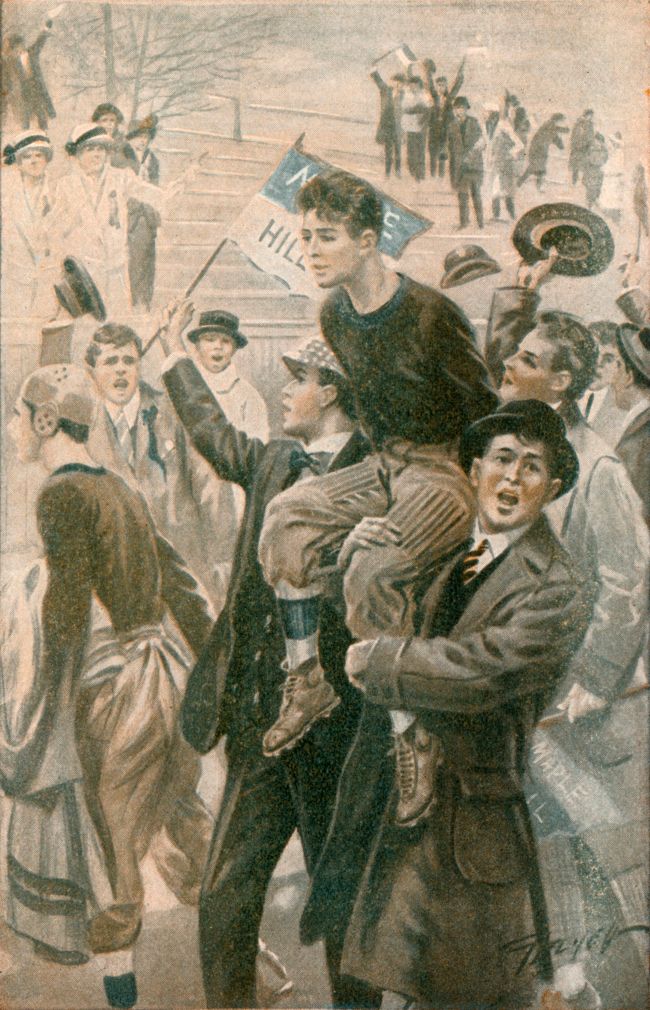
“Greenridge! Greenridge! Have your
tickets ready, please!”
There was a hoarse blast from the
whistle and the steamer sidled in toward the
wharf. Rodney Merrill, his brand new suitcase
tightly clutched in his left hand and his ticket
firmly held in his right, followed the dozen or
so passengers who were crowding toward where
three deck hands waited to push over the gangplank.
As the Henry Hudson edged up to the
landing the main street of the little town came
suddenly into view, leading straight up the hill
at a discouraging angle until lost to sight behind
the overhanging branches of great trees.
Rodney thought he had never seen so many
trees before. They were everywhere—elms,
maples, beeches and oaks—hiding the houses
spread up the side of the ridge so that only here
and there was visible a gray roof or a white
wall or a red chimney top. Even here by the
river edge the trees seemed to be trying to dispute
the margin with the wharves and buildings.
Where Rodney had come from folks
first built houses and then planted trees,
afterwards tending them as carefully as
though they were rare flowers. Here, it
seemed, folks had tucked their houses away in
a veritable forest. He mentally compared the
leaf-roofed street before him with Capitol
Avenue, back in Orleans, Nebraska. Capitol
Avenue was lined with trees, too, but the
trees were as yet barely twelve feet high
and cast about as much shade as would a lady’s
parasol.
At the left of the wharf was a ferry slip, with
a little brown shed beside it bearing the legend,
Greenridge and Milon Ferry Company. A
handful of people waited there under the shelter
and watched the arrival of the river steamer.
The paddles thrashed, the steamer shivered and
bumped, the gangplank thudded to the wharf,
and the disembarking passengers moved forward.
Rodney followed, gave up his ticket, and
found himself on land. He yielded his bag and
trunk check to a hackman, asked directions,
and with a farewell glance at the Henry Hudson
gained the shadiest side of the ascending
street.
It was still only a little after two o’clock
and he had all the afternoon before him. Somewhere
at the top of the hill was Maple Hill
Academy, for which he was bound. But, as he
would undoubtedly see quite enough of that institution
during the next nine months, he was
in no hurry to reach it. Rodney’s father had
accompanied the boy to New York and had fully
intended coming to Greenridge-on-Hudson with
him, but, just as they had sat down to dinner
in the hotel the evening before, an imperative
telegram had reached him, and this morning
Rodney had boarded a Hudson River steamboat
and Mr. Merrill a Chicago train. Naturally
Rodney had been disappointed, but he was
quite used to his father’s erratic flights from
home—it was the penalty of having a father
who was an important factor in a big railway
system—and he had made the best of it. There
had been so much to see from the moment the
steamer had left its dock in the North River
until it had bumped against the big piles at
Greenridge that Rodney had forgotten to be
lonesome. Besides, to a boy of fifteen, even
though he has been brought up to be self-reliant
and is fairly accustomed to looking out for himself,
there is something inspiriting in journeying
alone, in being thrown on his own resources.
He experienced a fine feeling of independence
as he loitered up the street, and perhaps was
guilty of a suggestion of swagger, for which I
think he may be excused.
The street—River Street was the name of it,
as he soon discovered—was lined with funny,
half-asleep little shops. There was nothing
smart about them. Their windows looked as
though they were seldom washed and the goods
displayed therein were often dusty and fly-specked.
And then the names over the doors
amused him; as “Liverwell and Nagg, Fine
Groceries and Provisions,” “Huckens and
Soper, Hardware,” “Jernigen’s Pharmacy, New
York Prices,” “Sauerwien’s Home Bakery” and
“Fogg and Frost, Stationery, Books, Periodicals,
Post Cards, Lending Library and Candy.”
Hands in pockets, he looked in the windows,
peered up shady side streets at the half-hidden
doorways and porches of comfortable, old-fashioned
houses and, in short, loafed enjoyably,
finding all sorts of things to interest him in this
queer, hundred-year-old-town.
Presently, when he had progressed three or
four blocks up the hill, he came to an uncovered
bridge spanning the railroad. Below on one
side, reached by a flight of steps, was a small
station. He paused there above long enough
to determine in which direction New York City
lay, and then, as no trains came along to offer
entertainment, he went on again, up and up
under the wide trees. It was rather hard climbing
and the day was none too cool now that he
had left the river behind. And so at the next
corner he entered a drug store and sank onto
a stool in front of the soda fountain. While he
waited for someone to appear from the dim
mysteries behind the partition at the back, he
amused himself by deciphering the sign on the
window. YCAMRAHP S’ELTTILOOD was
about the way it appeared from inside. When
he had puzzled it out he glanced around the
empty store and chuckled. It was, he thought,
well named.
“Chocolate ice-cream soda, please,” he requested
presently, when a youth with sandy hair
strolled into sight wiping his hands on a soiled
white apron. “Lots of chocolate, please,” he
added.
The clerk glanced doubtfully at the faucet
inscribed “Choc.,” tried it and shook his head.
“All out of chocolate just now,” he announced,
looking dreamily across the street. “I’m going
to make some more this afternoon. Something
else do?”
“Strawberry,” said Rodney.
This time the clerk had better luck. While
Rodney consumed the concoction, the clerk
leaned wearily against the fountain and watched
the street. At last, “School?” he asked.
“What?”
“You an Academy boy?”
“Not yet.” Rodney glanced at the round
faced clock in the center of the partition. “Not
till five o’clock probably.”
“Just come, eh?” continued the clerk with a
slight show of interest. “Well, it’s a pretty
good school, I guess. ’Bout as good as any in
New York State, they say.”
“Is it?” Rodney didn’t seem much impressed.
“If I’d had my way I’d have gone to a military
academy back in Michigan. But my brother
used to go here and he made dad send me, too.
I suppose it will do.”
“Where’d you come from?” asked the other.
“Orleans, Nebraska. Ever been out there?”
“N-no. Nebraska’s quite a ways, ain’t it?
Out—out near Illinois, ain’t it? Or Texas?”
“Out that way,” replied Rodney dryly. “Sort
of between those places and Oregon. It’s the
finest state in the Union.”
“That so?” The drug clerk grinned. “Guess
you ain’t lived in the east much, have you?”
“No, not lived, but I’ve been in about every
state except Maine and Vermont and West Virginia.
And Nebraska’s got them all thrown and
hog-tied.”
“You must have travelled some! Ever been
in Utah?”
“Several times,” answered Rodney, scraping
the last particle of ice cream from his glass with
a sigh of regret.
“Is that so? I don’t suppose you ever ran
across a fellow named Stenstream out there, did
you?”
“I don’t think so. What town is he in?”
“Town? I don’t know. One of those Mormon
towns, I think. He’s a sort of cousin of
mine, Pringle is.”
“Did he come from here?” asked Rodney as
he drained the last drop in his glass.
“Yes, he used to work for Huckins, down the
street. Always was a sort of adventurous chap,
though. Nobody wasn’t surprised much when
he up and lit out for Utah.”
“Utah ought to be a fine place for a fellow
with a name like that,” said Rodney gravely.
“What did you say it was?”
“His name? Pringle Stenstream.”
“My, this is sure one fine place for names,
isn’t it?” laughed the boy.
The clerk blinked as he washed the glass.
“Names? How do you mean? What’s the matter
with the names?”
“Oh, they’re all right, but sort of—of unusual.”
“Stenstream ain’t unusual around here,” responded
the clerk a trifle resentfully. “There’s
stacks of ’em in New York State. It’s as common
as—as my own name.”
“What’s that?” asked Rodney.
“Doolittle,” was the calm reply.
“Oh, is this your store?”
“Nope, it’s my uncle’s. I work for him.
Gosh!”
“What’s the matter?” asked Rodney, following
the clerk’s gaze through the window.
“There’s that Watson feller coming, and he
always wants chocolate and I haven’t got any.”
“Give him strawberry,” suggested Rodney,
amused by the clerk’s expression of alarm.
“Are those Maple Hill fellows?”
The clerk nodded gloomily. “Yes, and that
Watson feller’s the worst of the lot. The rest
of ’em ain’t so bad.”
“Cheer up,” said Rodney. “Maybe they
won’t come in.”
They did, though. There were four of them,
their ages ranging apparently from fourteen to
seventeen. They came in laughing and made directly
for the soda fountain. As there were
but three stools, Rodney got up and moved to
the corner of the confectionery case, curious to
see what manner of boys these Maple Hill students
might be. It wasn’t difficult to determine
which was Watson. He was the biggest of the
four, good-looking in a heavy way, and evidently
the leader of the present expedition. It was
Watson who sang out a greeting from the doorway.
“Hello, Doolie, Old Top! Poisoned anyone
to-day?”
Young Mr. Doolittle smiled uneasily. “You
almost lost me my job that time, Watson,” he
said sadly. “That wasn’t a joke, that wasn’t!”
“Wasn’t it?” laughed Watson. “It was a
peach of a joke!” He had caught sight of
Rodney on entering, and now he inquired confidentially
but quite audibly, “Who’s your
dressy friend, Doolie?”
The clerk replied in low tones, leaning across
the counter. Watson grinned.
“What ho, fellows! Luck’s with us! Here’s
a new one!” He regarded Rodney jovially.
“Doolie says you’re a Maple Hiller.”
“Yes,” replied Rodney pleasantly.
“Fine! Welcome to our school!”
“Thank you,” returned Rodney politely.
“Well, fellows, what’ll you have to-day?”
asked the clerk.
“Hold your horses, Doolie. You see,” Watson
went on, turning to the newcomer again,
“it’s a long-established custom here that new
boys have to stand treat. You’re lucky there
aren’t any more of us, isn’t he, Tommy?”
“Rather!” agreed a light-haired, freckle-faced
boy of about Rodney’s age. “If he doesn’t
hurry up there may be.”
“You mean,” inquired Rodney interestedly,
“that I’m supposed to buy sodas for you
chaps?”
“Spoken like a gentleman! Right you are,
Old Top! Line up, fellows. Ice creams all
around, Doolie.”
The clerk looked hesitantly at Rodney. The
latter smiled but shook his head. “Suppose I
haven’t enough coin, fellows?” he inquired.
“That’s all right, Doolie will chalk it up, won’t
you, Doolie? Doolie’s a nice, obliging little
poisoner.”
“Very glad to charge ’em,” said the clerk.
“What flavors?”
“Hold on,” protested Rodney. “I’m not one
of you fellows yet. I won’t be until I reach
school. I guess that lets me out. Still, I don’t
want to seem stingy, so I’ll tell you what I’ll
do.”
“What?” asked Watson, frowning darkly.
“I’ll buy ice-cream sodas for the crowd if
you’ll all take the same flavor. You—” nodding
at Watson—“choose it. You’ve only got one
guess, though.”
“How do you mean, one guess?”
“Why, if you call for a flavor he hasn’t got,
you lose. That lets me out. Savvy?”
“Oh, that’s it? Don’t you worry, cutie. We
know what we want, don’t we, fellows?”
“I want—” began a younger boy.
“Cut it! You get what I order. Didn’t you
hear him say so? Doolie, you may prepare four
of your finest chocolate ice-cream sodas.”
Had Watson observed the clerk’s expression
during the arrangement of terms he might have
hesitated about agreeing to them, but he had
not. It was only when young Mr. Doolittle began
to stammer vaguely that Watson scented
trouble.
“What’s the matter, Doolie?” he demanded
peevishly. “Four chocolates. Didn’t you hear
the dressy party agree to pay for them?”
“I—the fact is, Watson—the—the chocolate
is—is——”
“The chocolate is what?” asked Watson, suspiciously
calm.
“Out!”
“Out! Oh, run away and play, Doolie! Quit
your joking! Of course you’ve got chocolate!
If you haven’t you’d better dig some up mighty
quick, Old Top! Get a move on now! Ginger
up, Doolie, ginger up!”
“I’m awfully sorry, Watson, but there ain’t
any. You see, I was just going to make some
when that fellow came in and——”
“Asked for it, I’ll bet a doughnut!” exclaimed
Watson. “Say, you, Mr. Smart Aleck”—Watson’s
jaw dropped. “Where is he?” he demanded.
“The new fellow?” replied one of the younger
boys. “Oh, he just went out!”
CHAPTER II RODNEY MEETS THE TWINS
Rodney, smiling at his thoughts, was a
block away. While he was by no means
running, he was at the same time proceeding
decidedly faster than before. The vicinity
of Doolittle’s Pharmacy was not, he told
himself, a healthy locality for him just then.
In fact, he was somewhat relieved when the
main street, as though despairing of being able
to climb any further in a straight line, broke in
two like a letter Y. Once around the turn to
the left he would be no longer in sight from the
drug store. His instructions from the expressman
had been to take the left-hand road where
River Street branched. What he was to do
after that he no longer recalled. Consequently
when he came to a cross street that appeared to
curve back toward the other branch of the Y he
let it severely alone. But a few rods further on
he doubted his wisdom. The stores had
stopped two blocks below—he was still climbing
upward, although at a more comfortable
grade—and residences had taken their place.
About him now were large yards, with many
trees and beds of flowers; dahlias and asters
and flaming scarlet sage and golden-yellow
marigolds; with quiet, peaceful old-fashioned
white houses with green window shutters tucked
well away from the street. Ahead of him the
road seemed bent on losing itself in open country,
and the dwelling houses were growing
scarcer. The Westcott house, whither his baggage
had gone and where he himself was leisurely
bound, was opposite the Academy campus;
the letter from Mrs. Westcott had distinctly so
stated; and as yet there was nothing even dimly
resembling a campus in sight. He paused
under the shade of a big elm, whose far-reaching
branches had already begun to carpet the
street with their rusty-yellow leaves, and looked
about him.
Across the road a narrow side street, scarcely
wider than a lane, according to Rodney’s notions,
ran briskly downhill until it passed from
sight. Rodney at once eliminated that thoroughfare
from his calculations. Rather than
strike downward and have to climb that hill
again he would stay just where he was and
starve to death. Not, however, that there was
any immediate danger of that contingency, for
he had managed to eat a particularly hearty
meal some three hours since in the big dining
saloon of the steamer. But three hours is three
hours, and any normal, healthy boy can look
with favor on food after a fast of that duration.
So he produced a piece of sweet chocolate from
a pocket, removed the tin-foil with some difficulty,
since the warmth of the day had softened
the delicacy to a condition of mushiness, and
looked about him for a place to rest and refresh
himself. A few feet farther along a big granite
horseblock stood at the edge of the sidewalk—with
a narrow gate in the fence behind, but he
didn’t notice that—and so he sat himself comfortably
down on it and proceeded to nibble.
It was perceptibly cooler up here on the hill,
for he was almost at the summit of the ridge
that paralleled the river for many miles, and a
fresh breeze was blowing along the shady street.
It was still only—he looked at his watch—only
ten minutes after three and he had nearly two
hours of freedom yet, if he wanted it. He
sighed contentedly.
While he sits there let us have a look at him.
Fairly tall for his fifteen years—fifteen and a
half, to be strictly accurate—splendidly healthy
and capable in appearance, Rodney Merrill was
on the whole distinctly attractive. Perhaps you
would not have called him a handsome boy. If
not Rodney would have had no quarrel with you
since, in a boy’s language, handsome implies
some quality of effeminacy most undesirable.
He had brown hair, brown eyes—very nice
brown eyes they were, too—a fairly large mouth
and a full share of freckles in a face that was
well-tanned, clear-cut and wholesome. And
there was a self-reliant air about him that might
have belonged to a much older lad. He was
neatly if not strikingly dressed. A plain gray
suit of flannel, a straw hat, brown shoes and
black stockings, and a rather effective negligee
shirt of alternating rose and green stripes on a
gray ground made up his attire. Perhaps I
ought to make mention of the black and white
scarf from which just at present he was flecking
a crumb of sticky chocolate.
Once as he sat there he thought he heard a
rustling in the hedge behind him or the branches
above, and looked around. But nothing was in
sight. A locomotive whistled somewhere below
as it passed. The trees, however, cut off his
view of the railroad. In fact, from where he
sat not even the river could be glimpsed, and he
thought vaguely that he would like it better
later on when the leaves were off and a fellow
could see something. He was accustomed to
wide views at home and the trees and hedges
and shrubs were beginning to pall on him. He
felt so sort of shut in. He finished the last of
the chocolate and sighed again, this time with
repletion. Then he rolled the tin-foil into a
small and glittering ball, lifted his hand to toss
it away——
“Was it good?” asked a voice behind him.
And,
“Don’t throw it in the street,” warned another
voice.
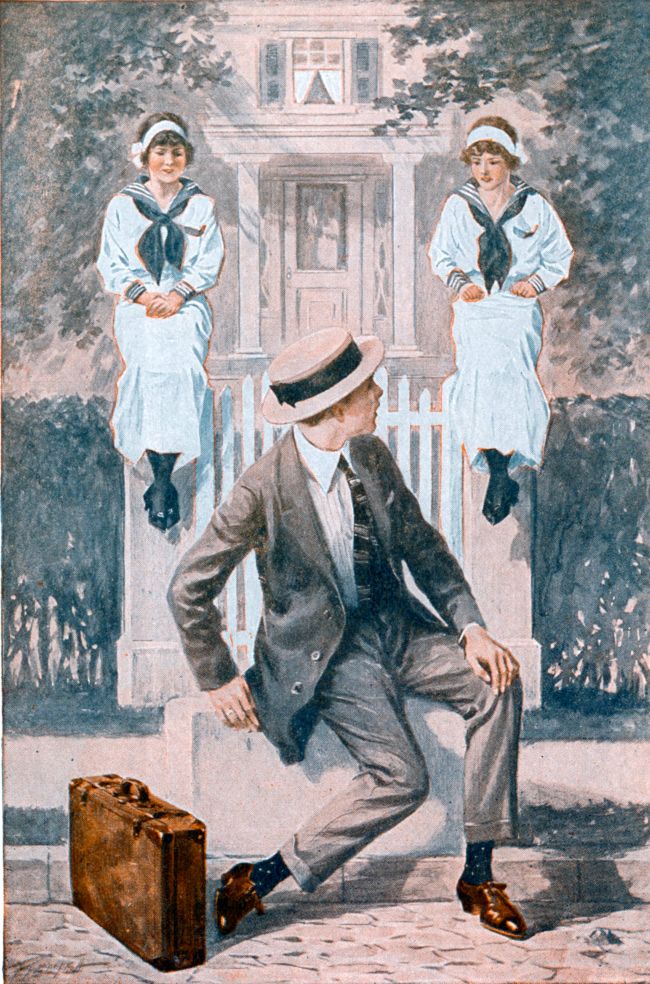
Rodney, startled, whisked around. On either
side of the narrow gate was a square wooden
post terminating in a flat top. On either post
sat a girl. Rodney’s surprise turned to bewilderment
as his glance swept from one side of
the gate to the other. Each member of his unsuspected
audience wore a white middy suit
trimmed with red, each had yellow-brown hair,
each sat with crossed feet, hands folded in lap,
looking calmly down upon him; in short one
was so startlingly like the other that for a moment
Rodney thought he was seeing double.
“It’s all right. There really are two of us,”
announced the first speaker reassuringly. “You
see, we’re twins.”
“Oh!” said Rodney. “I—I should think you
were!”
“Did we scare you?”
“Not much. What are you doing up there?”
“We were watching you,” replied the left-hand
twin with a smile.
“Watching you eat your chocolate,” added the
right-hand twin. At least, reflected Rodney,
relieved, their voices were different; and, yes,
when you looked closer you saw that, whereas
the left-hand twin had very blue eyes, the right-hand
twin’s eyes were almost black. And perhaps
the latter’s nose was a little bit straighter.
But for the rest—Rodney wondered how their
mother told them apart.
“You were mighty quiet about it,” he commented
a trifle indignantly. “It isn’t nice to
sneak up and watch folks behind their backs.”
He discovered that he was still holding the
wad of tin-foil in his hand and again started
to toss it away.
“Please don’t throw it in the street,” said the
right-hand twin earnestly.
“Why not?”
“It is untidy to throw paper and things in the
streets.”
“May’s a member of the Village Improvement
Society,” explained the left-hand twin.
“Oh! What’ll I do with it, then?”
“Couldn’t you put it in your pocket until you
get to a rubbish barrel?” asked the right-hand
twin. “You’ll find one at the next corner, you
know.”
“All right.” Rodney dropped the tin-foil in
his pocket with a grin. “You’re a funny pair,
you two.”
“So many people say that,” replied the left-hand
twin with something between satisfaction
and wonder. “I don’t see why, though. What
is it that’s funny, please?”
“Oh, I don’t know.” He hesitated. “I suppose
it’s your being so much alike and—and
everything. Do you live in there?” He
nodded toward a white house that peeked out
from over the overgrown lilac hedge.
“Yes,” replied the left-hand twin. “Our name
is Binner. My name is Martha Binner and
hers is Mary Binner. We’re thirteen. What’s
your name?”
“Rodney Merrill.”
“I think Rodney’s a very pretty name, don’t
you, May?”
“Yes. I don’t believe we have ever known a
boy with that name, have we?”
“You said her name was Mary,” charged Rodney.
“It is, but she’s called May. I’m called
Matty. What do they call you?”
“Rod, usually.”
“I don’t care for that,” said the right-hand
twin judicially. “I think we’ll call him Rodney,
Matty.”
The left-hand twin nodded agreement. “Are
you an Academy boy?” she asked.
“I’m going to be before long. I’m on my way
there now. Say, where’s Mrs. Westcott’s
house?”
“Oh, are you going to be a Vest?” exclaimed
Matty.
“A what?”
“Of course he doesn’t understand,” said May.
“He wouldn’t, you know.”
“I suppose not,” replied Matty. “You see,”
turning to Rodney again, “the boys at Mrs.
Westcott’s are called Vests. It—it’s a pun.”
“Oh, is it?” he asked. “I don’t see any pun
there.”
“You don’t? Why, Westcott—waistcoat—vest!
Now do you see?”
Rodney shook his head puzzledly.
“Perhaps,” said May, “you’d better let me explain.”
Matty nodded. “Yes, you always explain
things more clearly than I do.”
“Well, Rodney, you know a vest is called a
waistcoat, and——”
“Oh, I savvy! I’d forgotten. We call them
vests where I come from. So I’m a Vest, am I?
Hope I’m not a fancy one! Well, I guess I’d
better pull my freight.”
“Do—do what?” asked Matty.
“Pull my freight; hit the trail; move along.
Which way did you say Mrs. Westcott’s was?”
“We didn’t say,” replied Matty, “but it’s the
next house to ours, around the corner on Bow
Street. Must you go now?”
“I suppose so, pretty soon anyway. Won’t
take me long to get there, though, I guess.”
“Only a minute or two. If you like you can
go through our garden. There’s a place where
you can get through the hedge. I suppose you
came on the boat, didn’t you?”
Rodney nodded.
“Most of the boys come on the train that gets
here about four. Don’t you think the Hudson
River is perfectly beautiful?”
He did, but pretended he didn’t. “Rather
pretty in spots,” he answered patronizingly.
“We’ve got rivers out west——”
“O-oh!” exclaimed May from her post, with
a protesting wriggle. “You know it’s beautiful!
It—it’s wonderful!”
“It’s called the American Rhine,” added
Matty conclusively, “and I guess that settles it!
And you needn’t say you’ve got rivers in your
state that are finer, because you haven’t, and
we don’t believe it!”
“I didn’t say in my state,” denied Rodney.
“I said out west. And we have—stacks of
them! They’re not so—so placid, maybe, but
they’re much grander and—and picturesquer.”
“They’re not,” said Matty indignantly.
“They are,” said Rodney firmly.
“They couldn’t be! How could they? Why—why——”
“Still, Matty, we don’t know,” interposed
May cautiously, “and so perhaps we oughtn’t to
contradict him. I don’t think it is very
nice of him to say our river isn’t beautiful,
but maybe he doesn’t see beauty. They say
some folks don’t. It—it’s a deficiency, you
know.”
“Beauty!” scoffed Rodney. “Why——”
“Perhaps you’re right, May,” said the other
twin thoughtfully. “And so—we beg your pardon
for contradicting you.”
“Both of us,” added May earnestly.
“Oh, that’s all right,” replied the boy, his
good nature restored. “I guess I contradicted
you, too. Besides, I didn’t mean that your river
isn’t a very nice river, because it is. I—I guess
you might call it beautiful,” he added magnanimously.
“And of course you do have perfectly wonderful
rivers in the west,” replied Matty. “We’ve
read about some of them and seen pictures of
them, haven’t we, May?”
“Yes, indeed. They are very fine.”
Rodney in the heat of the discussion had forgotten
his announced intention to finish his journey
to Mrs. Westcott’s, and had reseated himself
on the horseblock. After all, there was lots
of time yet. And the twins were amusing, and,
as girls went, quite pretty. He had three sisters
of his own and pretended to be something
of an authority on girls, their ways and idiosyncrasies.
“I suppose,” said Matty, after a moment,
“you are going into the First Form.”
“Yes, but I don’t know why they call it a
form. Isn’t class good enough for them? Form
sounds so silly. I suppose it’s terribly English.
And then they call the Principal the Head
Master!”
Matty giggled. “The boys call him ‘the Doc.’
And they have such lovely names for the submasters,
too. Mr. Howe is ‘Gussie,’ and Mr.
Stanhope is ‘P. N.’——”
“‘P. N.’?” questioned Rodney. “Why do
they call him that?”
“Because he’s always saying a thing is ‘perfect
nonsense.’ They used to call him that,
‘Perfect Nonsense,’ you know, but it was too
long and so they shortened it.”
“I see. And there’s a teacher they call ‘the
baron,’ isn’t there?”
“Yes, that’s Mr. Steuben; he’s a dear old
German; we adore him, don’t we, May?”
“We adore him,” agreed the other twin firmly
and calmly.
“And ‘Mike’ is awfully nice, too. That’s Mr.
Kelly, the English teacher. He has such beautiful
coppery-red hair.”
“Any more?” laughed Rodney.
“Yes, there’s Mr. Cooper. The boys call him
‘Chawles’ because he talks that way. We don’t
like him, do we, May?”
“No, we don’t.”
“And that’s all,” continued Matty. “Except
Mrs. Farron, the Doctor’s wife. She’s called
‘the Missis.’ You’ll like her awfully. All the
boys do.”
“What’s Mrs. Westcott like?” inquired Rodney.
Matty pursed up her lips, shot a mischievous
glance at May and replied primly: “She’s very
nice.”
“Oh,” said Rodney, doubtfully.
“She is just like a mother to her dear,
dear boys,” chanted May gravely, her eyes
fixed on space. “It’s such a happy little
home!”
Rodney started perplexedly until the twins
turned to regard each other seriously for an
instant and then go off into a gale of laughter
that threatened to shake them from their
seats.
“Oh, that’s the sort,” muttered Rodney.
“Well, she can’t be a mother to me! Say, what
sort of a chap is Watson? Know him?”
“Guy Watson?” Matty recovered her composure
and her equilibrium and frowned. “You
won’t like him, I guess. We don’t, do we, May?
He’s—” she paused, searching for a word—“he’s
coarse!”
“And ungentlemanly,” added May, nodding
decisively.
“But I suppose,” said Matty, “we should also
say that he is a very good football player. And
he is on the track team, too. He’s a Third Form
boy. Do you know him?”
“Not very well.” Rodney smiled. “I met
him on the way up here. He and three others.”
Then he recounted the incident in the drug
store and the twins clapped their hands with
delight.
“How perfectly splendid!” cried Matty.
“Think of anyone getting the best of Guy Watson
like that!”
“He will be awfully angry, though,” said May.
“I think you should look out for him, Rodney.
He won’t be satisfied until he gets even with
you, will he, Matty?”
“No, I’m afraid he won’t.” She regarded
Rodney gravely and shook her head. “I’m
afraid you’ll have trouble with him. But perhaps—Who
do you room with?”
“Room with? I don’t room with anyone, I
suppose!”
“Oh, yes you do. You have to.”
“I do?” asked Rodney gloomily. “If I’d
known that I wouldn’t have come. I didn’t
want to, anyway!”
“Oh, but you’ll like it after awhile, really!”
assured May earnestly. “And if they put you
in with a nice boy—Matty!” May’s eyes grew
round. “It’ll be ‘Kitty’!”
“Of course it will! Jack Leonard’s gone,
hasn’t he?” Matty clasped her hands in ecstacy,
her blue eyes dancing. “You’ll room with
‘Kitty’!”
“‘Kitty’ is Phineas Kittson,” began May,
“and he’s——”
“No, May, no!” cried Matty. “We mustn’t
tell him! It would just spoil it!”
“So it would,” agreed May beamingly. “Oh,
wouldn’t you love to be there, Matty?”
“You mean when——”
“Yes, when——”
“Oh, wouldn’t I?” She gasped. “If we only
could!” She turned to Rodney and clasped her
hands ecstatically. “Oh, Rodney, it’s going to
be such fun!”
Rodney arose and observed them disgustedly.
“I’m going,” he said.
CHAPTER III “WESTCOTT’S”
“And this is Rodney Merrill!” exclaimed
Mrs. Westcott, beaming upon him as
she swept into the parlor with rustling
skirts. “I’m so glad to see you! And how nice
to get here early! Doctor Farron has told me
all about you, my dear, dear boy, and we’re going
to make you so happy here at our wonderful
school, so very happy!”
And Mrs. Westcott, shaking hands, beamed
harder than ever. She was a tall, thin woman
with prominent features and a dark blue silk
gown that rustled. It was in that order that
Rodney noted those particulars. Her face was
kindly if not very attractive, and her voice
quite pleasant.
“You had a comfortable journey, I hope?
Won’t you sit down a moment, Rodney? This
is our parlor. We meet here in the evenings
and have such pleasant, homelike times. One
or two of my boys sing very nicely.” Mrs.
Westcott sank rustling into a chair, folded her
thin hands in her lap and beamed. “The Doctor
said you were fifteen. That is right, I presume?
Yes. And you’re to be a First Form
boy? Yes. Isn’t that splendid? I hope you
will like us all very much. I have such a fine
family this year, such dear, dear boys! Perhaps
you’d like to go up and see your room?
Your trunk and bag came and are awaiting you
upstairs. This way, if you please, Rodney.”
And Rodney, who had just seated himself
uncomfortably on the edge of a chair, arose and
followed. The room, he had to acknowledge to
himself, was really rather jolly. It was at the
back of the house but had windows on two sides,
each of which looked out upon the campus. It
was very nearly square and of good size. The
furnishings were neither elaborate nor particularly
new, but there was a generous study table
covered with green baize—interestingly adorned
with cabalistic marks and ink stains—a sufficiency
of chairs, two single white-enamelled
beds, two tall and narrow chiffoniers, and a
bench which, evidently of home manufacture,
stood under the side window and did duty as a
window-seat. The floor was uncarpeted, but
rugs, the kind that are woven of old carpets, lay
about the floor. Everything was immaculately
neat and clean. There was something about
Mrs. Westcott that forbade the thought of dust
or grime.
The walls were painted a light tan, and the
woodwork about the room was of varnished
pine. The effect, with the rugs, whose predominant
color was brick-red, was decidedly cheerful.
There were no pictures—Rodney learned
that denizens of the Westcott Cottage were not
allowed to hang anything on the walls—but the
back of one of the chiffoniers held a number of
photographs.
“This will be your side of the room,” announced
Mrs. Westcott. “When you have unpacked
your trunk I will show you where to put
it in the storeroom. In the closet”—Mrs. Westcott
swung open the door—“you will use the
seven hooks to the left and half the shelf.
Clothes that are not in present demand should
be kept in your trunk. You will be able to get
to it whenever you like. We have no washstands
in the room as the boys use the bathroom,
which is just across the hall, you see. In
the coat-closet downstairs you will find blacking
and brushes for shoes. I hope you will keep
your shoes looking nice. I am very particular
about that. We have a regular bathroom schedule
in the morning. Each boy is allowed ten
minutes by the clock. Your time will be from
seven-twenty to seven-thirty. You will find the
schedule on the door. That is all for now.”
Mrs. Westcott, who had delivered the foregoing
in the manner of one repeating a well-learned
lesson, paused for breath.
“Who’s the other chap in here?” asked Rodney,
who, hands in pockets, was still examining
his quarters.
“Your roommate,” said Mrs. Westcott, beaming
again, “is Phineas Kittson. Such a dear
boy! You’ll like him, I know. He is a year
older than you, and in the Second Form. I
hope you will be great friends. Phineas is—”
Mrs. Westcott paused and seemed searching for
just the right word. Finally, “so interesting!”
she ended triumphantly. “Not exactly like my
other boys, you know, rather—rather exceptional.
We all expect great things from Phineas
some day. He has such a—a remarkable
mind! Now perhaps you’d like to unpack and
arrange your things. The rest of my boys
will be along very shortly. Two have come already,
but they’ve gone out. If you want anything,
Rodney, you’ll find me downstairs. Make
yourself at home, my dear boy.”
When Mrs. Westcott had gone Rodney subsided
into a chair and grinned at the empty chiffonier.
“She’s going to make me happy if it
kills me, isn’t she?” he inquired of the chiffonier.
Then, with a chuckle, he arose and again made
the circuit of the room, testing the bed by punching
it, pulling open the drawers of the chiffonier,
and pausing at each window to take in the view.
The window at the rear, just at the foot of
his bed, looked over the back yard and across
the intersection of two tree-lined streets. Beyond
that the foliage cut off his view, although
he glimpsed the copper-roofed turret of a building
a block or so beyond. From the side window
the school buildings in the campus were in
plain sight across the street. There were four
of them, all of red brick and limestone; a large
one in the center of the group with a tower at
one end, two others nearer at hand, and a
fourth at the farther side of the campus. The
middle one Rodney rightly surmised to be the
recitation hall and the others dormitories.
Maple Hill took care of one hundred and fifteen
pupils, of which number but ninety could be
accommodated in the dormitories. The newcomers
usually had to go to one or other of
the half dozen private houses which, while run
independently of the Academy, were, as Rodney
discovered later, very much under the Head
Master’s supervision. From the side window
Rodney lounged across to Phineas Kittson’s
chiffonier and viewed the collection of photographs
there. Finding those but mildly interesting,
and having by this time returned to
where his trunk and bag reposed upon a rug
near the hall door, he bethought him of unpacking.
The bag was quickly emptied and then he
tackled the trunk. It wasn’t easy to decide
which things should remain in it and which
should be stowed in his half of the much too
small closet. And he was still in the middle of
his task when voices and laughter and many
footfalls below told him that the rest of the
household had arrived. He paused with a Norfolk
jacket, which had twice made the journey
to the closet and return, in his hand to listen.
“Hello, Mother Westcott! What’s the good
word with you? Got anything to eat?”
“That’s so, Mother, we’re starving! Look at
my poor thin form! Does it not move you to
tears of pity? Say, Mother, got any cake?”
“Shut up, Tad, and get out of Pinkie’s way!
That’s my trunk, Pinkie, the one with the lock
busted. You know my room. Say, Pete, lend
me a half till to-morrow, will you?”
Now and then Mrs. Westcott’s voice was to
be heard, but for the most part the boys’ laughter
and chatter filled the house. Presently
heavy steps on the stairs indicated the ascent of
Pinkie with a trunk. Close behind him other
steps sounded and a voice called:
“Jack, we’ve a new one! He’s in with Kitty!”
“Shut up! He’ll hear you,” a low voice warned.
“What of it? I haven’t said——” But the rest
was drowned in the general noise. There
were three other rooms on the floor and the
new arrivals distributed themselves therein,
still, however, keeping up their conversation.
“We’ve got new curtains, Warren!” announced
a triumphant voice.
“Get out! They’ve just been washed. I’ve
got a new spread, though. Mother always did
love me best!”
“What do you think of that for favoritism!
I’m going to kick! It isn’t fair——”
“Tom!”
“Hi?”
“Got my bag in there? Pinkie says he——”
“Heads out, fellows! See who’s coming!”
Rodney could hear the rush to the front windows,
followed by applause and cries of “Good
old Kitty!” “Breathe deep, Kitty, breathe
deep!” “What’s your time, old man?”
Presently the last arrival entered the house
and Rodney heard Mrs. Westcott exclaim:
“Why, Phineas, how well you look! You dear,
dear boy, I’m so glad to see you back again.”
A deeper voice answered, but as the uproar
in the other rooms had begun again Rodney
heard no more. Desperately he doomed the
Norfolk jacket and the trousers that went with
it to the trunk again, and began to arrange his
shirts in the second drawer of the chiffonier.
Rodney was rather proud of his collection of
shirts. Most of them had been bought in New
York and were things of beauty, especially the
negligees, which ran to color combinations of
lavender and blue, pink and green and old rose
and gray stripes. He was assorting them carefully
and approvingly and had for the moment
forgotten everything else when footsteps at the
doorway caused him to turn his head. What
he saw was sufficiently interesting to put the
shirts out of mind. Not Mrs. Westcott, who was
beaming from the threshold, but the boy who
was with her. Rodney, staring wonderingly,
thought he had never seen a more remarkable
person in his life. And he went right on staring,
most impolitely, but quite excusably, until
Mrs. Westcott’s voice broke his trance.
“Rodney,” she announced, “this is Phineas
Kittson. Phineas, dear, this is Rodney Merrill,
your new roommate. I just know you’re going
to be such good friends!”
“Great Scott!” thought Rodney.
CHAPTER IV PHINEAS KITTSON
Phineas Kittson, or Kitty, as he was
called, was sixteen years of age, but
looked a year older. He was large—perhaps
bulky would be the better word—very
broad shouldered, very deep chested. His legs
were short and so were his arms, giving him the
appearance of being all body. He had a large,
round face, somewhat sallow, but not unhealthy,
of which the principal features were his eyes
and his mouth. The eyes were of the palest
green and unusually prominent and caused him
to look as though he had just made a most
astounding, stupendous discovery and was on
the point of breaking into excited announcement
of it. He wore a pair of rubber-rimmed spectacles
with big round lenses, which magnified his
eyes to an uncanny extent. His mouth was
wide and very serious, turning down at the corners
as though in gentle disapproval of the
world. His nose was not remarkable, but appeared
to belong on someone else, being small
and narrow and seemingly quite lost on such a
broad expanse. His hair was dark brown and
stood in need of trimming. It also appeared to
stand in need of brushing, but later Rodney
found that brushing had little effect on Phineas
Kittson’s hair. Its constantly touseled appearance
was due to the fact that it had never
decided in which direction to grow and so was
trying them all. There was a tuft over his left
eye that grew straight, a tuft over his other
eye that grew down, a patch on the top of his
head that curled to the right, and a patch over
one ear that shot straight out. And there were
other patches that were still experimenting.
Phineas wore a suit of some indescribable
shade of grayish green which looked as though
he had slept in it, and carried in one hand a
much worn suitcase and in the other a brown
straw helmet with a green-lined brim and a
metal peak on top for ventilation. Afterward
Rodney made the discovery that his hands were
very small, as were his feet, and that of the latter
the left one was encased in a dusty black
Oxford and the right one in a low-cut Blucher
that had at one time been tan.
“How are you,” said Phineas, advancing and
shaking hands. “Glad to know you.” He had
a deep, pleasant voice and spoke slowly, pronouncing
each word very distinctly. When he
had shaken hands he looked Rodney over attentively
with his startled eyes and asked,
“Ever try inhaling?”
“I don’t smoke,” replied Rodney disapprovingly.
The green eyes blinked.
“Not smoke, air. Fresh air. Try it. Fine
for the lungs. Take long walks and inhale. Expand.
Nothing like it, Merriwell.”
“Merrill,” corrected Rodney, amused.
“Beg pardon. I don’t remember names.” He
placed his hat on the table, sat down, got up,
saw that Mrs. Westcott had gone, and sat down
again with a sigh. “Twelve minutes, twenty-eight
and two fifths,” he said.
“Indeed?” asked Rodney politely.
Kitty nodded gravely. “I’ve done better than
that by nearly two minutes. In the winter.
Air’s better then. Lungs work better. It follows,
of course.” He seemed to demand an answer
and Rodney nodded gravely, too.
“Naturally,” he agreed. “What the dickens
are you talking about?”
Kitty viewed him thoughtfully. “My fault,”
he said after a moment. “Thought you knew.
Walking up the hill, you know. Station to
house. Twelve minutes, twenty-eight and two-fifths.”
He pulled a stop-watch from his pocket
and studied it. Apparently satisfied, he clicked
the hands back into place again. “Warm to-day.
Heat enervates the air. There’s a difference.
You’ve noticed it, I guess.”
“I can’t say I ever have,” replied Rodney,
turning again to his shirts. “Must be quite a
climb up that hill, though. Did you lug that bag
with you?”
“Yes. Forgot I had it. That counted against
me, of course.” He looked for a moment at the
suitcase. Then, “Funny about my trunk,” he
meditated aloud.
“What’s wrong with it?” asked Rodney indifferently.
“Left it in New York. Ferry station. Forgot
to recheck it. Got any collars?”
“What size do you wear?”
“Oh, thirteen or fourteen, I think. I’ll borrow
a couple. Thanks, Morrill.”
“Of course. Beg pardon. What time is it?
I forgot to wind my watch yesterday.”
Before Rodney could oblige him with the desired
information there was a sound of approaching
footsteps and voices in the hall, and
in a moment half a dozen boys whose ages varied
from fourteen to seventeen years flocked in. In
deference to the stranger their entrance was
quite decorous. One boy, a youth of Rodney’s
own age, was grinning broadly, but the rest
were politely serious.
“Thought we’d come in and get acquainted,”
announced the eldest of the six, a tall, nice-looking
chap of seventeen, who was evidently
the leader at Westcott’s.
“Hello,” responded Kitty. “Funny about my
trunk——”
“Never mind about your trunk,” laughed another
visitor. “We’ve heard all about it, Kitty.
I wonder you didn’t forget to bring yourself!”
The others chuckled, and Rodney, a trifle embarrassed,
smiled. The boys seated themselves
here and there about the room and there was a
painful silence. Kitty, viewing them absently,
was apparently deep in thought. Finally, with
a laugh:
“Come on, Kitty,” said the eldest youth. “Introduce
your friend.”
“Eh?” Kitty looked vaguely around the room
until his eyes encountered Rodney, still standing
at the chiffonier. “Oh, yes. Beg pardon.
This chap’s name is—er—” Kitty paused at a
loss and turned inquiringly to Rodney. “What
is it, now?”
“The same as it was a few minutes ago,”
laughed Rodney. “It’s Merrill, Rodney Merrill.”
“Glad to know you,” replied the older boy.
“My name’s Billings. This grinning ape is
Mudge. Mr. Greenough is the thoughtful gentleman
at your left. Over there are Hoyt,
Trainor and Trowbridge. There’s no use waiting
for Kitty to introduce. He’d fall into a
trance in the middle of it.”
Kitty smiled untroubledly. The others, having
nodded, or, if near enough, shaken hands,
laughed. The irrepressible Mudge—Tad, for
short; Theodore Middlewich for long—removed
the last vestige of restraint.
“Welcome, Merrill, to our happy little home,”
said Tad. “Hope you’ll like us and our quaint
ways. Pete, get up and give Merrill a seat, you
impolite loafer.”
“Thanks, but I don’t want to sit down,” replied
Rodney. “I was putting my things away.”
“Don’t let Kitty impose on you,” advised Tom
Trainor, a slender, light-complexioned chap.
“If you don’t watch him he will have his things
all over the place. Sometimes he forgets which
is his own bed and goes to sleep in the other
one. You got here early, Merrill.”
“I came on the boat from New York. It was
very nice.”
“It’s nice enough once—or even a couple of
times—” said Hoyt, a short chap with a snub
nose and a bored expression. “After that it’s
monotonous.”
“I’d hate to be world weary as you are, Warren,”
said Jack Billings, dryly. “Well, we’re
having early supper to-night, fellows, so we’d
better move along. Come in and see us, Merrill,
when you get straightened out. By the way, it’s
Faculty Reception to-night; about seven-thirty;
better come along and meet the tyrants. We’re
all going—all except Kitty.”
Kitty looked across in greater surprise than
ever and blinked. “Thought I’d go,” he said.
“You think so, but you’ll forget it,” laughed
Jack.
After the visitors had dispersed to their own
rooms, Phineas turned to Rodney and said, “I
haven’t a very good memory for some things.
Sometimes I forget. They like to joke about it.
I don’t mind, of course. It amuses them, Maynard.”
“I see.” Rodney didn’t correct him this time.
What was the use?
CHAPTER V RODNEY ENCOUNTERS WATSON
School began on Wednesday, and by Friday
Rodney was pretty well settled down
in his groove. Finding his place at Westcott’s
was easy enough. As it happened he was
the only First Form boy there, although Tad
Mudge, Warren Hoyt and Tom Trainor were of
his age. Phineas Kittson and Pete Greenough
were sixteen; Eustace Trowbridge—called
Stacey—and Jack Billings were seventeen. On
the whole they were a nice lot of fellows, Rodney
thought, although they were rather different
from the boys he knew at home. He liked Jack
Billings immensely; everyone did, he found; and
he liked Tad Mudge and Pete Greenough and
Tom Trainor. Warren Hoyt he thought disagreeable.
Warren put on airs and pretended
to be bored by everything. Stacey Trowbridge
was a quiet fellow who kept to himself a good
deal and was hard to know. Rodney thought
that he would probably like Stacey if he ever
got really acquainted with him. As for Phineas—well,
Rodney realized that he would have to
make the best of that strange roommate of his.
Not that Kitty caused any trouble. He didn’t.
Let Kitty alone and Kitty let you alone. He
seemed to live in a different altitude from the
others, on some higher and finer plane. He
studied a good deal, had a wonderful memory
for lessons, and stood well in class. When he
was not poring over his lessons he was either
exercising or reading books on physiology, hygiene
and kindred subjects, of which he possessed
a veritable library. When Kitty exercised
he hung a pedometer from his belt, took a
stop-watch in hand, and walked violently about
the country for hours at a time. Kitty’s theory,
as Rodney soon learned, was that if a fellow developed
his lungs properly his other organs
would look out for themselves. He talked a
good deal about something he called “glame,”
and inhalation and expansion and contraction,
and Rodney got rather tired after a while of
those subjects. But, on the whole, Phineas was
a well-meaning, good-humored chap who bothered
no one and who was quite contented to be
left to his own devices.
The entering class that year numbered twenty-seven.
Rodney had a chance to look them
over Thursday evening when the new First
Form held a meeting in the Assembly Hall and
organized. A fellow named Sanderson was
elected president, and a youth named White was
chosen for secretary and treasurer. Rodney
took small part in the proceedings, but met,
after the business meeting was over, quite a
number of his classmates. They seemed a decent
lot, he thought. They ranged in age from
twelve to fifteen and hailed from seven States,
most of them living within a half day’s journey.
Rodney was the only Nebraska representative
and came from farther away than any of them,
except one boy whose home was in Colorado.
So far he had not again encountered Guy
Watson, and was rather glad of it. Not that he
was physically afraid of Watson, but he anticipated
trouble sooner or later, and, being a sensible
chap, preferred to avoid it as long as possible.
One thing that amused Rodney was the
fact that no one had as yet connected him with
his brother, who had graduated from Maple Hill
four years previous. Sooner or later fellows
would discover that the famous Ginger Merrill
and the unknown Rodney were brothers. Until
they did Rodney was satisfied to remain in obscurity,
having no desire to shine in reflected
glory. He hadn’t been there twenty-four hours
before he heard Stanley’s name mentioned—they
didn’t call him Stanley, however; he was
Ginger to fame. At Maple Hill they compared
every promising football player with Ginger
Merrill, and each year’s team to the team that
Ginger had captained four years before. Of
course, Rodney knew that that remarkable
brother of his had been something unusual on
the football field, but he didn’t realize Stanley’s
real greatness until he reached Maple Hill and
heard fellows hold forth. They spoke of Ginger
almost with bated breath, at least with a pride
and reverence that warmed Rodney’s heart and
made him wonder if fellows would ever speak
like that of him after he had been gone four
years. If they ever did, he reflected, it would
not be because of his prowess on the gridiron,
for football had no place in Rodney’s scheme.
He liked to watch the game and could get as
excited and partisan as anyone over it, but as
for playing—well, one football hero was enough
in a family, and Rodney had confined his athletic
interests to baseball and tennis. Of those
he was fond, especially tennis. He rather
prided himself on his tennis. He had tried football,
had even played a whole season on a team
composed of grammar school youngsters in Orleans,
but he had never become an enthusiast,
nor ever made a name for himself. If someone,
ball in arm, ran the length of the field and fell
triumphant over the goal line, it was never Rodney.
Rodney played in the line, took his medicine
unflinchingly, did his best to give as good
as he got, and was always somewhat relieved
when the final whistle sounded. No, it wouldn’t
be for his football prowess that posterity would
remember him.
Rodney had an interest in life, however. He
liked to learn things, all sorts of things; mathematics
even. History had no terrors for him.
He could even find reasons to remember dates.
Latin he liked immensely, and Greek he found
absolutely romantic, although, what Greek he
knew he had picked up almost unaided. Modern
languages—well, a fellow had to know French
and German, of course, but Rodney was less enthusiastic
about them. Geography, physics,
even botany—all was grist that came to his mill.
This love of learning he had inherited from his
father. Mr. Merrill had started in life as a
farmer’s boy, and by sheer passion for learning
things had climbed up and up until to-day at
forty-five he was the actual if not yet the official
head of one of the biggest railroad systems of
the country. Of Mr. Merrill’s five children, two
boys and three daughters, only Rodney had succeeded
to his father’s thirst for knowledge.
Stanley was smart enough and had managed to
do fairly well at his studies both at school and
at college, but, to use his own expression, “he
was no shark.” Stanley was far more contented
in the Omaha office of the railroad than he had
been in the classrooms. Perhaps Rodney’s
youngest sister, Eleanor, was more like Mr.
Merrill than any of the children save Rodney;
although aged thirteen, her thirst for knowledge
took the form of ceaseless questioning.
At grammar school, back at home, Rodney’s
friends and companions had viewed his studiousness
with surprise, and for awhile with disapproval.
Finding eventually, however, that
aside from his strange love for lessons he was
very much the same as they were, they forgave
him his peculiarity. But at Maple Hill scholarship
was not regarded askance. In fact, Maple
Hill rather went in for learning, and Rodney
found himself in congenial surroundings.
Maple Hill had its own local idiom, and in
its language to study was to nose, and one
who was of professed studiousness was a
noser. Doubtless the word was suggested
by the expression “with his nose in his
book.” At all events, Rodney became a noser,
and settled down quite happily and contentedly.
Of course, just at first there were some lonesome
hours. In fact there was one whole day
of homesickness. That was Thursday. On
Thursday Orleans, Nebraska, seemed a terribly
long way off and the trees sort of smothered
him, and the cool, crisp breeze that blew along
Maple Ridge brought an ache with it. But
somehow on Friday morning it was all different.
He awoke to find Kitty lying on his back
in the middle of the floor, chastely attired in a
suit of white and pink pajamas, going through
his first exercises. He had different ones for
almost every period of the day. Just now he
was stretched at length, inflating and deflating
his lungs and making strange, hoarse noises in
his throat. Rodney looked on for a moment in
amusement, and then suddenly discovering that
the sunlight streaming across the foot of his
bed was very bright, that the morning air held
an invitation, and that he was most terribly
hungry, he made a bound that just cleared
Kitty’s prostrate form and was ready for anything
that fate had in store. And fate, as it
happened, had quite a number of things up its
sleeve.
After breakfast—and, oh, how he did enjoy
that meal—he had only to cross the road, enter
through a little revolving stile in the fence, and
follow a path for a short distance across the
campus to reach the classrooms in Main Hall.
He went alone because none of the other Vests
were ready. It was the custom to wait on the
porch of the cottage until the morning bell began
to ring and then make a wild dash for the
hall, arriving there just as the last clang sounded;
you say ‘Good morning, sir,’ and be quick about
ten minutes before the hour, but they were not
deserted. Main Hall entrance was a sort of
general meeting place for the boys, a forum
where all sorts of matters were discussed before,
between, and after recitations. This
morning the wide stones held some twenty
youths when Rodney approached. Two First
Formers, sticking close together for companionship,
nodded to Rodney eagerly. He had met
them last evening, and now he would have
joined them if fate hadn’t sprung its first trick
just then.
“Hello, little brighteyes!” greeted a voice.
The appellation was novel to Rodney, but the
voice had a familiar sound and so he turned.
The speaker was Guy Watson. He was grinning,
but Rodney didn’t like the expression back
of the grin.
“Hello,” he answered quietly, and crossed
over to join his classmates.
“Not quite so airy, please,” continued Watson.
“A little more respect, sonny. Now, then,
try it again.”
He lolled over in front of Rodney, a frown
replacing the grin.
Rodney was puzzled. “What is it you want?”
he asked.
“I’ll tell you what I don’t want, you fresh
young kid. I don’t want any of your cheek.
Get that?”
“I haven’t cheeked anyone,” protested the
other. “You said ‘Hello,’ and I answered you.”
The boy next him was nudging him meaningly,
but Rodney was still at a loss. Watson
sneered.
“Innocent, aren’t you?” he demanded.
“Don’t they teach you manners where you live?
Where is that, anyway?”
“I live in Nebraska,” answered Rodney.
“Nebraska, eh! Out with the Indians. Well,
of course you wouldn’t know any better. So I’ll
explain to you, Mr. Wild West, that here at
Maple Hill a First Former says ‘Sir’ to Third
and Fourth Form fellows. Get that?”
“Yes, thanks. How was I to know you were
a Fourth Former, though?”
There was a ripple of amusement at that and
Watson flushed. “You’re supposed to know,
kid. It’s your place to find out. Now, then, let’s
try it again.”
“Try what again?”
“You know what I’m talking about! Now
you say ‘Good morning, sir,’ and be quick about
it.”
“Oh! That’s it? Why, good morning, sir.
How do you do?”
“Cut the flip talk, now!” warned the older
boy angrily. “You’re too smart for this place,
anyway. You need taking down, you do, and I
wouldn’t be surprised if you got what you need;
I wouldn’t be at all surprised.”
“Oh, let him alone, Guy,” protested another
boy. “He’s new yet.”
“And he’s fresh, too,” answered Watson. “He
can’t get off any of his funny pranks with me,
though.”
“That’s just his breezy Western way,”
laughed the boy who had spoken. “He’ll get
over it.”
“You bet he will! And let me tell you something,
kid, whatever your name is. You owe
Doolittle for four ice-cream sodas and you’d
better trot down and settle. First Formers
aren’t allowed to have tick.”
“I don’t owe Doolittle a cent,” replied Rodney
firmly. “And if he waits for me to pay him
he will wait a powerful long time.”
“Oh, you’ll pay all right,” laughed Watson.
“You thought you’d played a funny trick, didn’t
you? Well, you got stung, kid.”
Rodney shrugged his shoulders. Watson, he
decided, was getting tiresome.
“Don’t do that!” exclaimed the other sharply.
“Do what?”
“Don’t shrug your shoulders at me! You pay
Doolittle what you owe or I’ll pay you what I
owe. Understand?”
“What’s the row, Guy?” asked a quiet voice.
Jack Billings suddenly appeared at Watson’s
elbow.
“Hello,” grumbled the latter. “It’s none of
your affair, Jack. This kid’s been getting fresh,
that’s all.”
“Merrill’s in my house,” responded Jack,
gravely. “What’s wrong, Merrill?”
“You’d better ask him,” answered Rodney resentfully.
“He’s been nagging me for five minutes.”
“Oh, drop it,” advised another youth. “Let
up, Guy, and forget it.”
“Don’t you get fresh, too, Billy,” warned
Watson, turning to the speaker. Billy laughed.
“All right, Mister Grouch. Want me to say
‘Good morning, sir?’”
“I want you to mind your own business.”
Then, turning to Jack, “If this kid’s in your
house you’d better teach him a few things, such
as respect to upper form fellows, Jack. If he
opens his mouth to me again I’ll punch his fresh
young head for him!”
“Then I’ll punch yours,” said a deep voice.
Watson swung around, looked, grunted, and
grinned. Phineas Kittson, blinking hard behind
his goggles, viewed him calmly.
“Merrill’s a friend of mine,” went on Kitty.
“Good fellow. Roommate, fellow Vest, and all
that, Watson. Mustn’t thump him, you know.
I’d make trouble.”
The assemblage, which had been increasing
every moment, burst into a shout of laughter.
“Good old Kitty!” “Don’t hurt him, Kitty!”
“How are the lungs this morning, Kitty?”
“I’ll punch you, too, if you get gay, Kittson,”
Watson informed him. Then he swept the
laughing throng with his gaze. “And if any of
you other fellows are looking for trouble——”
But at that moment the bell in the tower overhead
began to clang, and Watson’s belligerent
voice was drowned. The boys swarmed up the
steps and into the hall, still laughing and joking.
Rodney, following, found Jack Billings beside
him in the press. Jack put an arm over
the younger boy’s shoulders.
“Keep away from Watson, Merrill,” he said
kindly. “He’s got a mean temper. And don’t
answer back. And never act fresh, Merrill.”
“I didn’t! At least, I didn’t mean to. He
came up and——”
“All right. You can tell me about it some
time,” interrupted Jack. “Scoot along now. If
he tries to make more trouble for you, get away
from him and come to me.”
And, with a smiling and reassuring nod, Jack
pushed Rodney toward the stairway.
CHAPTER VI RODNEY IS DISCOVERED
“Thanks for—for what you said to Watson,”
said Rodney when, after morning
school, he was once more in his room in
the cottage. Kitty, pulling a heavy sweater
over his touseled head—he had a theory that
the sort of sweaters that buttoned up the front
were not as good as the old style—emitted an
unintelligible reply from the woolen folds. “It
was mighty nice of you,” went on Rodney,
watching with fascination the gradual appearance
of Kitty’s moonlike face above the neck of
the garment.
“Nothing at all,” panted Kitty. “If he touches
you come to me. Overbearing fellow, Merrill.”
“Y-yes. He doesn’t seem very popular either,
Kittson.”
Kitty considered. “Don’t know about that.
Pretty well liked, I believe. Fellows understand
him. Plays good football, you know. Too bad,
though, about his lungs.”
“What’s the matter with them? You don’t
mean he—he’s consumptive?”
“Worse,” said Kitty solemnly. “Undeveloped.
Never exercises them. Too bad. I’ve
spoken to him often. Begged him. No good.
Laughs at me. Show him some time, though.
Where’s pedometer?” And Kitty, armed for
the fray, strode out.
Rodney saw him a moment later from the
window. Head and shoulders back, the faded
brown turtle-neck sweater enveloping most of
his body, Phineas Kittson disappeared rapidly
from sight down the street, determination in
every stride. Rodney smiled as he lounged
back to the table and searched for a book.
“Queer old duffer,” he murmured.
Later Jack Billings sought him out and heard
his story of the trouble before school. “I don’t
see that you were much at fault,” he said finally.
“Still Watson had an excuse, Merrill. You see,
First Form fellows are supposed to be respectful
to the upper form fellows; that is, the Third
and Fourth Formers. It isn’t necessary always
to say ‘Sir’ to them, but it’s proper to be respectful.
Of course, when you get to know an
upper form fellow it’s different. For instance,
you needn’t stand on ceremony with me. None
of the fellows in the house do, because we all
know each other pretty well. But if I talk to a
lower form chap from one of the dormitories
or another house, I expect him to stick the ‘Sir’
on. I dare say it’s sort of a silly idea, but it’s
the custom.”
“I didn’t know about it,” said Rodney. “I
wouldn’t have minded saying ‘Sir’ to him if I’d
known that was what he wanted. The trouble
is, he’s peeved with me about that—that drugstore
affair. And he says I’ve got to pay Doolittle
for the sodas they drank. That isn’t fair,
because I stipulated——”
“Where do you get hold of such big words,
Merrill?” laughed Jack. “Go on. You ‘stipulated’?”
“That if the fellow didn’t have what they
called for the first time I wasn’t to pay. And
Watson said chocolate and he was out of that,
and—and so it’s got nothing to do with me!”
“And you knew there was no more chocolate
and knew that Watson always asked for it,”
commented Jack, smiling. “On the whole, Merrill,
I don’t think it would do you any harm to
have to pay. It was—well, it was a little bit too
tricky. Don’t you think so?”
Rodney considered. “Maybe it was,” he acknowledged
at last. “But I don’t think he had
any right to ask me to stand treat, Billings.”
“Yes, he had a perfect right. It’s a custom
and customs are laws that haven’t grown up.
While you’re here at Maple Hill you’ll have to
play the game the way we play it, Merrill. Now,
if I were you, I’d drop down to Doolittle’s this
afternoon and pay up that score. If you’re
short of cash I’ll let you have it.”
“I’ve got plenty, thanks. It wasn’t that.”
“And that reminds me of another thing you
ought to know,” continued Jack. “First Form
fellows are not allowed to have credit at the
stores. It’s in the rules. Perhaps you didn’t
notice it.”
“I did, but I wasn’t trying to get credit. I
didn’t intend to have them charge those sodas
to me. They hadn’t any right to, either.”
“No, not according to the terms of the agreement.
But you played a pretty sharp trick on
Watson and he got back at you with another. I
don’t think there’s much choice between you.
Take my advice and settle. Then keep away
from Watson until he has forgotten all about
it.”
“Well,” said Rodney unwillingly. “All right.
I’ll pay. And after I do he’s got to let me
alone.”
“Watson? He probably will,” returned Jack
soothingly. “Don’t let him worry you.”
“He doesn’t,” said Rodney stoutly. “I’m not
going to. He’s a regular bully, though.”
“He isn’t so bad really, Merrill, after you get
to know him a little better. He’s hot tempered
and he can be as mean as a pup when he wants
to be, but—well, I’ve known Guy to do some
very decent things. Besides, Merrill, it’s a
mighty good idea not to start off disliking anyone.
You usually find out later that you are
wrong, and then you’re a bit sorry. And besides
that, disliking folks hurts you more than
it does them.”
First football practice was held that afternoon,
and Rodney, nothing loth, accepted Tad
Mudge’s invitation to walk over with him. Tad
had taken a great liking, it appeared, to the
new Vest. Tad was only five months older than
Rodney and seemed even younger. He was a
gay-spirited, happily irresponsible youth with
a ready laugh and an inexhaustible flow of conversation.
Tad was in the Second Form and
roomed with Eustace Trowbridge, who was as
quiet and reserved as Tad was talkative and
frank.
“Leave your books here,” instructed Tad, piling
his own on the marble slab above the big
radiator in the entry of Main Hall. There were
many other piles there already and Rodney
added his. “No good going over to the house,”
continued Tad. “Just wastes time and wears
out shoe leather. Come on.”
There was a winding driveway that encircled
Main Hall and led on one side to East Hall and
on the other to West Hall. The third dormitory,
known as Beecher, stood nearer the front
of the campus. Tad, however, didn’t trouble to
follow the curve of the gravel road, but struck
off straight for the gate. There were several
small signs near at hand bearing the words:
“Keep Off The Grass.” Rodney nodded at one.
“Don’t those mean anything, Mudge?” he inquired.
Tad glanced at them contemptuously. “Oh,
those!” he answered. “Those are for the faculty.”
A gate at the back of the campus opened into
Maple Street. Tad led the way across the leaf-strewn
road and through another gate opposite.
Here a wide walk ran straight between hedges.
On one side was a stone and shingle cottage,
which Tad explained was Doctor Farron’s residence.
Rodney couldn’t see much of it for the
shrubbery, but what little was visible looked
very attractive. A little further along there
was a break in the hedge, and another path led
across an expanse of turf to a two story building
with a copper-roofed turret in the center.
This Rodney recognized as the building he had
seen above the trees from his window.
“That’s the gym,” said Tad. “It’s a peach,
too. We’ll have a look at it after practice.”
“Are those tennis courts beyond there?” asked
Rodney.
“Yes. Do you play?”
“Yes, do you?”
“I taught McLoughlin all he knows,” laughed
Tad. “We’ll have a game some day. Take you
on to-morrow morning if you like.”
“I’d like to very much. I guess you’re better
than I am, though.”
Tad observed him thoughtfully and shook
his head in doubt. “I don’t know. You look
dangerous, Merrill. Say, what’s your other
name? Roderick, isn’t it?”
“Rodney.”
“That so? That’s some name, isn’t it?
How’d you like to go through life with Theodore
pinned to you?”
“Seems to me I’ve heard of a Theodore who
made quite a stir,” replied Rodney.
“You mean Teddy? Bet you they’d have
given him a third term if his name had been
John or William. Theodore’s a beast of a
name. I’m going to call you Rod. It’s easier
than Merrill.”
They had come to another street and another
gate and in front of them spread a wide field
of closely cropped turf that was just beginning
to lose its summer green. Two stands flanked
a blue-gray running track, within whose oval
the white lines of a newly marked gridiron shone
brightly. Already the scene was a busy one.
Practice had not actually begun, but many candidates
were on hand and a greater number of
fellows were grouped and strung about the edge
of the field to look on.
“That’s a dandy field!” exclaimed Rodney admiringly
as his gaze went off across to where a
line of young willows marked the further side
of the enclosure.
“Almost seven acres,” said Tad proudly.
“Bet you there isn’t a better field in the country.
And look at the view!”
Rodney obeyed. From where they stood
near the entrance they could look down over the
dwindling houses of the end of the village, and
follow the course of the Hudson for many miles
as like a broad blue ribbon it wound slowly and
majestically northward between sloping hills
of forest and meadow.
“That’s Milon over there,” explained Tad.
“And Wickerstaff further along. If you look
sharp you can see Bursley. See where the railroad
goes through a cut there? Then look above
and just a little to the right. That’s it. You
can see three or four of the buildings.”
“I do, but what is it? Bursley, I mean?”
Tad stared. “Why, Bursley School!”
“Oh!” But Rodney still looked mystified.
“It is—is it a good one?”
“A good one!” groaned Tad. “It’s fierce!
It’s our hated enemy, Rod. We loathe it!
That is, we do theo—theo—what’s the word I
want?”
“Theoretically?”
“Yep, theoretically. Between you and me
and—and the grandstand, it’s a pretty fine
place. They’ve got us beaten all hollow on
buildings and such things, only we don’t acknowledge
it. But they haven’t a field that can
touch this. They’ve got more fellows than we
have, but at that we manage to wallop them
about as often as they wallop us. I think
they’ve done us up at football fourteen times to
our twelve. Something like that. They beat
us last year and three years ago. There was
once though when we got ’em three years running.
That was when Ginger Merrill— Say,
your name’s Merrill, too, isn’t it?” Tad turned to
observe Rodney curiously. “Do you play, too?”
“Football? Not much. I’ve tried it but
never made it go very well. I like baseball
though.”
“So do I! They can keep their old football;
give me baseball every time! I played substitute
outfielder last year on the second nine.
Not that I don’t like to see a good game of football,
though. This fellow, Ginger Merrill, I
was speaking of was a wonder! Of course I
never saw him; he was before my time; but I’ve
heard fellows talk about him. They made him
captain in his Third Form year! We beat
Bursley that year and the year before and the
year after. He was captain two years and I
guess that shows that he was pretty good, eh?”
“I should think so,” replied Rodney as they
moved on toward the gridiron. “He must have
been popular.”
“He was. I guess he was the most popular
fellow we’ve ever had here. You want to speak
soft and cast your eyes down when you mention
him. He’s a sort of Saint, Saint Ginger!” And
Tad chuckled. “Funny your name should be the
same though,” he went on presently, when they
had paused at the inner edge of the running
track and Tad had acknowledged the salutations
of numerous comrades. “He doesn’t happen
to be a relation of yours, does he?”
“This Ginger chap? Why, do I look like
him?” Rodney smiled.
“I’ve only seen his pictures, but—but I kind
of think you do—just a little. Still I guess if
you were related to him you’d know it. So
would we,” he added with a laugh. “You’d be
likely to mention it!”
“Who’s the tall fellow in the funny sweater?”
asked Rodney.
“That’s Doyle. He’s captain. What’s the
matter with the sweater?”
“Nothing except it’s a funny color.”
“It’s just faded. It used to be light green.
I suppose you know that the school colors are
green and gray? Green for the maple trees
and gray for the rocks.”
Rodney nodded. “What’s Bursley’s color?”
“Punk! Red and blue. There’s Cotting, our
coach. They say he discovered Ginger Merrill.”
“Discovered him? How?”
“Why, saw that he had the making of a good
player and—and trained him. Taught him all
he knew, they say.”
“Rot!” said Rodney. “Stanley knew football
before he ever saw Maple Hill!”
“Well, I don’t know. That’s what I heard.”
Tad swung around suddenly and stared at his
companion. “Look here, how the dickens do
you know so much about Ginger Merrill?” he
demanded in surprise.
“Why—you told me about him, didn’t you?”
“I didn’t tell you his name was Stanley, I’d
forgotten it, they always call him Ginger; I
didn’t tell you he knew football when he came
here.”
“Didn’t you? I suppose—I’ve heard lots of
fellows speak of him. What’s Cotton doing?”
“His name is Cotting,” answered Tad, still
eyeing Rodney speculatively. Finally, when the
other had refused to meet his glance, he turned
to look at the coach. “He’s taking the fellow’s
names. A lot of them are new boys. Why don’t
you have a try, Rod?”
“No good. Besides I’m a bit young yet for
the team.”
“Cotting likes to catch them young. Stacey
began in his first year, and now look at him.”
“Where?” asked Rodney.
“I mean look where he is on the team. Only
a Third Form fellow and first string quarterback!”
“Do you mean Stacey Trowbridge?” asked
Rodney in surprise.
“Of course. The chap I room with. Why
not?”
“Why—why, no reason at all, except—why,
somehow he seems so—so sort of quiet and——”
“Oh, he doesn’t talk much, but he can think
like—like a judge! Jack says we have a well
balanced room; says all the talking’s done on
one side and all the thinking on the other!” Tad
laughed. “But Stacey is a wonder at football.
You wait till you see him drive the team some
day. I guess it’s just because he doesn’t talk
much that fellows listen when he does.” Tad
was silent a brief moment. Then, “Guess I’ll
try that myself,” he added thoughtfully.
The candidates, who had gathered around the
coach, were now dispersing in squads to different
parts of the field. In all there seemed fully
sixty of them, and Rodney expressed his surprise.
“Oh, most of them don’t last long,” replied
Tad carelessly. “After three or four days Cotting
will make a cut, and then a lot of them will
retire to private life. Finally he gets down to
about thirty-two or three. Then he divides
that bunch into two teams, a first and a second.
Watch Tyson punt. He’s got the ball now.
He’s a daisy at it. Look at that! The chap
running to catch it is Wynant. He didn’t get
it though. Gordon cut in on him.”
“Does Billings play?” asked Rodney.
“No, Jack’s baseball captain this year. He’s
a dandy fellow. Don’t you like him?”
“Immensely. He gave me a lecture this
noon.”
“Jack did? What about?”
“Oh, about not disliking fellows at first, till
you get to know all about them. Other things,
too.”
“Who is it you dislike? Me?”
“No, that Watson chap.”
“Oh, yes, Pete was telling me about Watson
ragging you before morning school. Watson’s
like that. Still—” Tad thought a moment.
“Jack’s right though. Watson isn’t a bad sort
after all. I’ll tell you something——”
But Rodney didn’t hear it just then for Tad’s
voice died away. A few feet distant Cotting,
Captain Doyle, and Guy Watson were standing
just inside the side line. “There he is now,”
murmured Tad.
“And he looks as though he wanted to jump
on me again,” added Rodney. “Come on. I
promised Billings I’d keep away from him.”
Rodney turned to stroll away, Tad following,
when a voice called:
“Tad Mudge!”
The boys turned. Captain Doyle was coming
toward them, followed by the coach and
Guy Watson. “Wait a minute, Tad,” said
Doyle.
“Want me to take your place to-day, Terry?”
asked Tad.
“Not to-day, Tad.” The football captain was
a tall well built boy of eighteen with coppery-red
hair, gray eyes and a pleasant and unmistakably
Irish countenance. “Introduce your
friend, Tad,” he added, with a glance at Rodney.
“This is Merrill, First Form. Rod, shake
hands with Captain Doyle.”
“Glad to know you,” said the captain. Then,
turning to Coach Cotting, who had joined them,
“It’s Merrill, all right, Coach.”
Cotting smiled. “Thought I wasn’t mistaken,”
he said, studying Rodney with frank interest.
“Shake hands, boy. Your brother and
I were pretty good friends.”
Rodney flushed. “Yes, sir. I—I’ve heard
him speak of you.”
CHAPTER VII COACH COTTING EXACTS A PROMISE
Rodney felt rather than saw the look of
hurt surprise and disgust on Tad’s face,
but the incredulous astonishment that
sprang into Watson’s countenance he viewed
with secret satisfaction. Doyle’s surprise was
less but his interest greater, while the coach
showed only pleasure in the meeting. Mr. Cotting
looked about thirty and was small and wiry,
with keen gray eyes in a thin and deeply tanned
face. He had a pleasant smile and a pleasant
voice and spoke quickly and incisively.
“And how is that brother of yours, Merrill?
Doing well, I hope.”
“Yes, sir, Stanley’s getting on finely. He’s
in Omaha, in the railroad office. He’s assistant
to the Traffic Manager.”
“I’d like to see him again. He’s never been
back but once since he left us. Then he came
up one fall and helped with the coaching for
three or four days. You look like him in the
face, but you’re built lighter.”
“Look here,” interrupted Watson, “do you
mean that this kid is Ginger Merrill’s own
brother?”
“Certainly,” replied Mr. Cotting. “I knew
it the moment I set eyes on him. Why didn’t
Ginger let us know you were coming, Merrill?”
“He—he wanted to, sir, but—I asked him not
to.”
“I see.” The coach smiled. “Wanted to
avoid publicity, eh? But how is it you’re not
out to-day? You play, of course.”
“No, sir, that is, not well.”
“How old are you?”
“Fifteen, sir. I’ll be sixteen next January.”
“You’ve got lots of time then. You’d better
come out to-morrow and let me see how bad
you are.” He smiled encouragingly.
“I’m pretty bad,” answered Rodney. “And
I don’t care much for football,” he added apologetically.
“Nonsense!” This was Captain Doyle, and
he spoke impatiently. “You don’t expect us to
believe that Ginger Merrill’s brother isn’t a
born football player. Where have you played?”
“At home, Orleans, Nebraska.”
“I mean what position, Merrill.”
“Oh, guard and tackle. I’ve never played
much. I’m—I’m no good at it, sir.”
“Well, you haven’t any objection to proving
it to us, have you?” asked the coach with a
laugh. “You come out to-morrow, Merrill.”
“I—I’d rather not, sir, if you please.”
“Rather not!” The coach stared. Watson
laughed. Captain Doyle exclaimed impatiently.
“Come, come, Merrill! That’s no way
to act,” protested Mr. Cotting. “The school
needs good material. You may not be a wonderful
player now, my boy, but, for that matter,
neither was your brother when I first saw him.
But he buckled down and learned. You can do
the same, I think. Anyhow, it’s up to you to
try. Of course, if you really find you can’t
make a go at it, there’s no harm done and it’s
nothing against you. But you really ought to
try, Merrill. You owe it to the school—and to
Ginger.”
“He knows I’m a duffer, sir; he says so himself,”
answered Rodney sadly.
“He does?” Mr. Cotting seemed impressed
by that and looked Rodney over again doubtfully.
“Well, you are fairly light, but—hang it,
Merrill, you look intelligent and you’re well put
together and seem healthy. You come out to-morrow
and report to me. If you can’t show
anything I’ll let you go. That’s a bargain, eh?”
“Very well, sir,” answered Rodney.
“Look here,” said Doyle, “if you haven’t
played football where’d you get those muscles
and that chest?”
“Tennis, I guess. And I’ve played baseball
a little, too.”
“That settles it,” grunted Watson. “Never
knew a tennis player that was any good at football.
I guess the kid knows what he’s talking
about, Coach.”
“We’ll see. To-morrow, then, Merrill.” The
coach nodded, smiled and turned away. Doyle
and Watson kept pace with him. Tad turned to
Rodney indignantly.
“You’re an awful liar, Rod!” he exclaimed.
“I didn’t lie,” replied Rodney calmly. “I
didn’t say Ginger wasn’t my brother. You
asked if we were related, and I just asked if I
looked like him.”
“Well, you let me think so,” grumbled Tad.
“What if I did?” asked Rodney cheerfully.
“That isn’t lying, is it? If I didn’t care to own
up to it, that’s my business, isn’t it?”
“Well, I don’t see why you’re ashamed of it.
Gee, if Ginger Merrill was my brother I’d be
strutting around and clapping my wings and
crowing all over the shop!”
“Oh, no you wouldn’t,” laughed the other.
“Besides, you see what’s happened. I knew
that would be the way of it if they found
out.”
“What has happened?” asked Tad.
“Why they think I can play, and they’re making
me try it. I can’t play, and they’ll find
it out, and then they won’t have any use for
me at all.”
“How do you know you can’t play?” asked
Tad. “Why Cotting can make a football player
out of—out of a piece of cheese!”
“Thanks! I’m not a piece of cheese, though.
It would take fifty Cottings to make a football
player out of me, Mudge. And besides that I
don’t want to play football!”
“Oh, that wouldn’t matter. If you can play
you’ll have to. Maple Hill expects every man
to do his duty. You’ll learn all right, Rod.
Bet you’ll be on the second team before the
season’s over!”
“Don’t talk silly! And look here, Mudge, use
your brain, can’t you? Don’t you see that even
if I did learn a little football the school would
expect a whole lot of me just because I’m Stanley
Merrill’s brother? And I couldn’t deliver
the goods, and everyone would be disappointed
in me. That’s why I didn’t want to play at
all.”
“But if you’re Ginger’s brother,” replied Tad
confidently, “you must know how to play. It
stands to reason. Or, as Kitty says, ‘It follows.’
Maybe you think you can’t play football,
but it’s in you somewhere, Rodney, old
boy, and Cotting will get it out! Don’t you
worry!”
“You make me tired,” sighed Rodney. “I
wish I’d never come here. I haven’t got time
for football anyway. I want to study.”
“You want—to—what!” exclaimed Tad incredulously.
“Study. That’s what I came here for, isn’t
it?”
“My word!” Tad looked at him sorrowfully.
“You’re a queer one, Rod. You don’t want
folks to know you’re Ginger Merrill’s brother;
you don’t want to be a football hero; and you
want to study! Honest, old man, you positively
alarm me! I don’t know whether I ought to
associate with you. Suppose I caught it, too!”
“I guess it wouldn’t do you any harm,”
laughed Rodney. “Where are you going?”
“Over here. Come along.”
Tad made straight for a group of boys near
the center of the sideline, a firm grip on Rodney’s
arm impelling that youth to follow. What
followed was distasteful to Rodney, distasteful
and embarrassing. Tad hailed the biggest boy
of the group when a few yards away.
“Fielding! Want you to meet a friend of
mine. This is Merrill, First Form. He’s a
brother of Ginger Merrill. Shake hands with
Fielding, Rod. And this is Sykes, and Canterbury,
and Jones, and Kemp.”
Between names Rodney’s hand was shaken
by different members of the group, who expressed
surprised delight at meeting him and
hurled questions. Rodney, very red of face,
muttered politely and, when it was over, turned
upon Tad in wrath. “What did you do that
for?” he demanded. “I felt like a perfect fool!”
Tad grinned. “You needn’t, Rod. We’re
none of us perfect!”
“Well, I’ll thank you to mind your own business
after this, Mudge,” replied Rodney crossly.
“Look here.” Tad turned upon him soberly.
“You are Ginger Merrill’s brother, aren’t you?”
“Yes, but——”
“Then fellows have a right to know it. They
want to know it.”
“It’s none of their business——”
“You bet it is! We’re proud of Ginger Merrill
here and if Ginger Merrill’s black cat or his
skye terrier came here we’d want to know it.
That’s why I introduced you to those chaps.”
“I don’t thank you,” returned Rodney, ungraciously.
“And I’ve had enough of this. I’m
going back.”
Tad, hands in pockets, watched Rodney’s back
for a while with a puzzled frown on his face.
Then he whistled expressively, shrugged his
shoulders and turned again to watch practice.
Rodney, thoroughly angry at he didn’t quite
know what, left the athletic field behind him, and
instead of entering the back campus, as the
ground containing the head master’s house and
the gymnasium was called, turned to the right
on Larch Street and wandered down it, kicking
the dead leaves out of his path. He was heartily
sick of hearing the name of that tiresome
brother of his. If, he told himself savagely,
anyone said ‘Ginger Merrill’ to him again to-day
he’d—he’d strike them! The last thing he
wanted to do was to join the football candidates,
and here he was pledged to appear to-morrow
afternoon for practice. And he didn’t even possess
a pair of football trousers. He wished
heartily he had kept away from the field.
He passed one intersecting street which, he
knew, would take him back to Westcott’s, and
kept on. He wasn’t ready for home yet. There
would probably be fellows about and he wasn’t
in the humor to talk to them. At the next corner
progress ahead was closed to him, and having
the choice of turning to left or right, he
turned to the left. A block further on he realized
that the street looked strangely familiar,
a fact explained when he sighted a granite
horseblock set at the edge of the sidewalk in
front of a narrow gate in a lilac hedge.
“I hope,” he muttered, “I don’t run into those
silly twins.” And then in the next instant he
found himself hoping he would. Somehow he
felt a desire to unbosom himself to someone
sympathetic, and girls, even if they did hold
strange views on a good many subjects, were
sympathetic. So when he reached the gate he
looked through, and there on the croquet lawn
which he had traversed the other day were the
objects of his thoughts. They didn’t see him
and he stood for a moment and looked and listened.
“I’m very sure, just as sure as I can be, that
you haven’t been through the middle wicket,”
declared one of the twins—he hadn’t the faintest
idea at that distance which twin she was!
“And I’m perfectly certain I have been,” declared
the other with equal firmness. “I came
across there after I sent you into the geranium
bed and got in position for the side wicket——”
“And I came over here on my next shot. And
then you went through the side wicket and your
next shot took you over there——”
“And I went through the next turn!”
“You didn’t, because I hit you and took my
two shots——”
“But you left me in position and I went
through!”
“Oh, I do wish there was someone here to
settle it! I’m just as sure as sure that I’m
right!”
“And so am I! I suppose we’ll just have to
begin over again.” Rodney could hear at the
gate the sigh accompanying this. “This makes
three times that it’s happened. We never will
get a game finished!”
“Because you always forget what wicket
you’re for.”
“No, because you forget.”
“We-ell, come on, then. It’s your first again.”
One of the twins sent her ball toward the further
stake.
“Tell you what you do,” said Rodney. “Get
a couple of clothespins, tie different colored ribbons
on them and then, when you go through
a wicket, stick your clothespin on it.” He was
enjoying the looks of surprise on the faces of
the twins. “It’s a good scheme, really.”
“It’s—now whatever did he say his name
was?” exclaimed one of the girls.
“I forget. I remember we said it was an
unusual name, though,” was the reply. The
two viewed each other doubtfully.
“I think it was Reginald.”
“No, Roderick!”
“Anyway, it began with an R!”
“It’s Rodney,” laughed that youth. “May I
come in?”
CHAPTER VIII CROQUET AND CONFESSIONS
“Of course. We are trying to remember
your name. That’s why we didn’t invite
you in. How do you do?”
“Fine.” Then he remembered his tribulations
of a few minutes ago and added, “That is,
pretty fair.” He closed the gate behind him
and joined the twins, who had started down the
path to meet him. “You must be hard up for
something to do,” he said with a superior air,
“if you have to play croquet!”
“We’re very fond of it,” replied the blue-eyed
twin. “Do you play?”
“I used to sometimes,” answered Rodney carelessly.
“It’s a girl’s game though.”
The blue-eyed one—he remembered now that
she was Matty—smiled. “Would you like to
play a game?”
“I don’t mind. I’ll stand you two.”
“I think we’d better each play separately,”
said Matty. “You see, May and I play pretty
well. We do, don’t we, May?”
“We do,” replied the other gravely.
“All right,” Rodney laughed. “Each for
himself then. Have you another mallet and
ball?”
May supplied them from a box on the floor
of the tumble down, rustic summer-house nearby.
“I’ve brought you green,” she announced.
“Somehow you suggest green to me, Rodney.
Does he to you, Matty?”
“N-no, I think brown,” answered the other
twin reflectively. “Perhaps a greenish-brown,
though.”
“Oh, I’m not as green as I look. Who goes
first?”
“May does. She plays red. Then you come
next. Then I play.”
May took the first two wickets in one, got into
position at the third wicket with the next shot,
went through it with the next and then placed
her ball in front of the middle arch. Rodney
negotiated the first two wickets cleanly but his
next shot left him badly placed for the third and
his attempt to go through resulted disastrously.
His ball glanced off a wire and rolled into the
path of the on-coming Matty. When she arrived
she hit the green ball, skillfully sent it
to the further side of the third wicket, went
through herself, hit him again, sent it into the
path and herself to the middle wicket, played
off May’s ball for two wickets and finally landed
within a yard of the further stake. Rodney
frowned as he recovered his ball. Evidently
these young ladies knew more about croquet
than he had ever dreamed of.
May cleverly got herself into position again
and Rodney rolled short. Matty hit the stake,
took the next two wickets at one stroke and
crossed to the further side arch. May reached
the first of the double wickets on her next play.
Rodney got into position for his third. He was
still at the middle wicket when Matty, closely
pursued by May, struck the home stake.
“These wickets are awfully narrow,” murmured
Rodney. “Want to try again?”
“We’d love to if you’re not tired,” replied
Matty. “I’m sorry you had such poor luck,
Rodney. And then of course, you’re not used
to the grounds. There’s a lot in being used to
the grounds, isn’t there, May?”
“Lots,” agreed May. “It’s your first, Rodney.”
The second game resulted as disastrously for
Rodney as had the first, and when it was over
he had the grace to acknowledge that the twins
were “some players.”
“I thought I knew a little about the game,”
he said ruefully, “but I guess I don’t. You girls
play better than anyone I’ve seen play.”
“We play a good deal,” replied May. “Almost
every day in summer. Practice makes
perfect, you know.”
Rodney wished she hadn’t used the word
practice. It reminded him unpleasantly of what
awaited him on the morrow. His face clouded
up and he sighed. Matty, seeing his expression,
imagined him tired and suggested a rest.
So they went into the summer-house, which was
almost enveloped in honeysuckle vines, and sat
down on the curving seat.
“How are you getting on at school?” asked
Matty politely.
“All right, I guess. The studies aren’t hard.”
“Probably that’s because you are naturally
smart,” responded the girl. “You impress us
as being clever. Doesn’t he, May?”
“You do,” said May. “We both said so the
other day.”
“And, Oh, please tell us how you like your
roommate!” And Matty clasped her hands
eagerly. May giggled. Rodney frowned at
the levity.
“He’s all right,” he replied. “Sort of a peculiar
fellow, but I rather like him.”
“And how are his lungs?” asked May very,
very solicitously.
Rodney grinned. “All right, I guess. He
wants me to take walks with him. Says it would
do me a lot of good.”
“Perhaps it would,” said Matty, “although
you don’t look very weak. You’re not, are you?
May and I decided that you looked rather athletic.
Do you go in for football or baseball?
Anything besides croquet?”
Rodney caught the little mocking gleam in
the girl’s blue eyes and flushed uncomfortably.
“That’s all right about the croquet,” he said
defensively. “If I played half as much as you
kids——”
“He’s quite right, Matty,” declared May. “I
think you should not have said that.”
“I was just in fun,” replied the other twin
contritely. “I’m sure you’d play the game
beautifully if you had more practice.”
“I guess,” said Rodney, mollified, “I’d never
get good enough to beat you two. I’ve never
played very much. Out home I used to play
with my sisters sometimes. They like it.”
“Where do you live?” asked Matty. “We
meant to ask you the other day.”
“Orleans, Nebraska. Ever been in Nebraska?”
Each shook her head. “We haven’t travelled
much,” confessed May. “After we finish High
School, though, we’re going abroad with mother.
Have you ever been in Europe?”
“No. Don’t want to. What’s the use?”
“Oh, but think of seeing the pyramids!” exclaimed
Matty.
“And the tomb of Napoleon!” said May with
calm rapture.
“And Venice!”
“And the Alps!”
“Pompeii!”
“The Nile!”
“Piffle!” grunted Rodney. “What’s the Nile?
Ever been down the Missouri and Mississippi?
They’ve got the Nile beaten to a thick froth!
As for the Alps, why, you could set them down
in the Rockies and never be able to find them
again! Say, ever see the Grand Canyon, you
girls?”
They shook their heads in unison. They did
almost everything in unison.
“Well that’s something worth while! You
come out in my part of the world and I’ll show
you things that’ll make your eyes pop out. You
won’t think about Europe after that, nor Africa
either!”
“But—but the antiquities!” said Matty.
“All right. We’ve got antiquities in our own
country, haven’t we?” asked Rodney indignantly.
“Look at the cliff dwellings!”
“What are those?” asked May.
“There it is!” he exclaimed triumphantly. “I
knew it! Never heard of the cliff dwellers!
That’s always the way with folks who spout
about Europe. They don’t know what—what’s
in their own country!”
“We will read about them,” replied May untroubled.
“We will find a book in the library
that tells about them. Please remind me,
Matty.”
“You’d better,” grumbled Rodney. “Learn
about your own country first, that’s what I
say!”
“Of course,” agreed Matty, “only—well, we
might not have another opportunity to go
abroad for years and years, and so it wouldn’t
do not to go just because we hadn’t seen those
places you spoke of, would it?”
Rodney agreed that it wouldn’t. After that
they talked of many things out there in the summer-house,
while the sun sank lower and lower
over the trees. And finally, just as Rodney had
secretly hoped it would, the story of his dilemma
came out. He wanted sympathy, and he
received it, but he was a little bit annoyed at
the manner in which the twins clasped their
hands and said “Oh!” quite breathlessly when
he told them that he was a brother of Ginger
Merrill’s.
“Think of that!” exclaimed Matty, who was
the first to recover from her surprise. “Aren’t
you proud?”
“No, I’m not,” returned Rodney, speaking in
very bored tones. “I wish Stanley had never
been at school here.”
“Why, Rodney!” This was May, scandalized.
“How can you say such a thing? Just
think what it is to be the brother of a real
hero like Ginger Merrill! You can’t mean
it!”
“Do, though,” grunted Rodney doggedly.
“I’m sick of hearing about him and sick of seeing
his pictures all over the shop. And look
what a mess I’m in on his account. Got to go
out to-morrow and fall around on a slippery old
football and get bruised up. I can’t play and
I told them so, but it didn’t do any good.” He
kicked exasperatedly at the mallet he held.
“I’ve a good mind not to go at all!”
“Oh, Rodney!” cried Matty. “You must!
Think what a splendid thing it will be to get on
the team and play against Bursley and maybe
win the game for us!”
“Tell you I’m no good at it!” said Rodney impatiently.
“I’ve tried it. Besides, I don’t
want to play football. I won’t have time.”
“Why won’t you?” asked Matty.
“Because I want to study. I’m going to try
for a scholarship. I’m willing to try for the
baseball team and I like to play tennis, but I
don’t want anything to do with football.”
“But—but—you ought to, Rodney! Your
duty to the school——”
“Piffle!”
Matty looked pained. “But you did ought
to——”
“Had ought to, I think,” corrected May.
“Should ought to,” laughed Rodney. “Oh,
well, I’ll have to see it through, I guess. After
I’ve been out a few days they’ll be glad to let
me alone. Only that’s going to get fellows sort
of down on me. They’ll say ‘Ginger Merrill’s
brother is an awful duffer. He can’t even hold
the ball!’”
“But I don’t believe you’re nearly as bad
as you try to make out,” said Matty, smiling.
“How could you be? Ginger Merrill’s
brother——”
“There you go! I wish they’d forget I’m
Ginger Merrill’s brother. You, too. I’m going
home.”
“Well, it was very nice of you to play croquet
with us, wasn’t it, May?”
“It was,” agreed May promptly and calmly.
“And to-morrow, if mama will allow us to,
we’ll go over to the field and watch you practice.”
And Matty smiled encouragingly.
“Rather you didn’t,” replied Rodney gloomily.
“So long.”
He squirmed through a thin place in the
hedge that separated the Binner’s garden from
Mrs. Westcott’s yard, and entered the cottage.
Mrs. Westcott, as luck would have it, was seated
in her private parlor at the left of the door,
and at sight of Rodney hurried into the hall.
“My dear, dear boy!” she exclaimed rapturously.
“I’ve just heard the news!”
“What news, ma’am?” asked Rodney unsuspiciously.
“Why, that you are Stanley Merrill’s brother!
Why didn’t you tell us?” She had both his
hands now and was beaming radiantly upon
him. “Just to think that we never suspected
it! Why, I can’t tell you how proud I am, Rodney!
Your dear brother used to come very
often to my house to see my boys, and he and
I were the best of friends! And to think that
you are his brother!”
“Guess who we’ve got here in the house!”
exclaimed Pete Greenough, encountering
Jack Billings in front of the cottage just
before supper time that evening. Jack, who
had been playing baseball, carried a favorite
bat in one hand, and now he raised it threateningly.
“Go ahead with your joke,” he said grimly.
“It isn’t a joke at all,” Pete protested. “It’s
something about this chap Merrill. Tad just
told me. Who do you suppose he is?”
“Tad?”
“No, Merrill, you silly goat!”
“His name is Rodney Merrill,” replied Jack
calmly. “He lives in Orleans, Nebraska, and
he is a younger brother of Ginger Merrill, of
blessed fame!”
“Oh, somebody told you!” exclaimed Pete disappointedly.
“No, I guessed it, two days ago. I heard
Merrill say he was from the west and I stopped
in at the office and looked him up. Then I got
an old catalogue and found that Ginger came
from the same town. After that it was only
necessary to compare their looks.”
“Well, why didn’t you tell a fellow?”
Jack shrugged his shoulders as he entered
the gate. “He didn’t seem to want to have it
known, Pete, so I kept still.”
“That’s what gets me,” said Pete. “Why the
dickens did he keep so mum about it? Anyone
would think he was ashamed of it! Say, it’s a
bit of a feather in our hat, isn’t it? Having
Ginger Merrill’s brother in our house, I mean.”
“Why, yes,” answered Jack, taking a seat on
the top step and studying a nick in his bat. “It’s
going to be a little hard on Merrill though,”
he added soberly.
“What is?”
“This being Ginger’s brother. Fellows will
expect a lot from him, won’t they?”
“I guess so,” acknowledged Pete thoughtfully.
“Yes, and from what I see of young Merrill
he’s just a decent, ordinary sort of kid. That’s
what I mean. If he doesn’t turn out a great
football player or a great something else, the
fellows are going to be disappointed in him.
Besides that, Pete, he stands a pretty good show
of getting a swelled head on his brother’s account,
eh?”
“Oh, we’ll look after that,” returned Pete
confidently. “If he shows any of that sort of
thing we’ll take it out of him. He doesn’t yet,
though, does he? His keeping quiet about Ginger
looks as if he was sort of a modest kid, eh?”
“Yes, unless——”
“What?”
“Unless he did it to get a better effect, if you
see what I mean.”
“Can’t say I do, Jack.”
“We-ell, he must have known that it would
come out sooner or later. Maybe he thought
if he kept quiet about it it would make more of
a sensation when it did become known.”
“Oh!”
“That’s only what might be, Pete. I’m not
saying it’s so. From what I’ve seen of Merrill
I rather like him. Perhaps a little too—too independent,
but a decent sort for all that. What
he’s got to be made to understand, Pete, is that
being Ginger Merrill’s brother butters no parsnips;
that if he’s going to make good he’s got
to forget that and dig out on his own account.”
“Going to tell him so?”
“Me?” Jack shook his head slowly. “No, at
least not in so many words. Perhaps a hint
will do him good some time though. I don’t
believe in interfering much, Pete. Every fellow
has his own row to hoe, and you can’t help
him very much. For my part, I shan’t say anything
to him about his brother. Better let
him think we don’t care much about whose
brother he is. Who made the discovery,
Pete?”
“Cotting. Tad says Cotting knew him the
moment he saw him, and came up and shook
hands with him.”
“Oh, is Merrill out for the team?”
“Not yet. He and Tad were looking on. He’s
going out to-morrow though, Tad says. Cotting
wouldn’t take no. Merrill says he can’t
play, but Cotting wouldn’t believe him. Neither
do I. Stands to reason that Ginger Merrill’s
brother can play football, doesn’t it?”
“I don’t see why, Pete. Anyhow, I hope he
makes good. It’ll save him a lot of trouble if
he does. Let’s go and wash up.”
Rodney came down to supper looking self-conscious
in spite of his efforts not to. He suspected
that all the other fellows in the house
had learned of his relationship with the redoubtable
Ginger, for Kitty had shaken him gravely
by the hand ten minutes before and assured him
that he considered it an honor to have Ginger
Merrill’s brother for a roommate. Kitty also
declared that the records showed Ginger to have
had one of the finest chest developments in the
history of the school, a fact which ennobled that
youth more in Kitty’s estimation than all his
football prowess. Pete Greenough, reading
Rodney’s expression aright, recalled Jack’s
theory and concluded that perhaps after all
young Merrill wasn’t such a modest kid as he
had thought. At table, however, not a word
was said about Ginger Merrill until Mrs.
Westcott herself brought up the subject.
Wasn’t it delightful, she asked, to have dear
Stanley’s brother with us? Whereupon Jack
said:
“Pass the bread, please, Tom,” and Warren
Hoyt expressed the hope languidly that Merrill
could chase a pigskin half as well as his brother
had. That gave Rodney the opportunity he
wanted.
“I can’t though,” he said bluntly. “I’m no
good at football and I don’t want to play it. I
told Mr. Cotting so but he insisted that I was
to come out to-morrow. I won’t stay long
though.”
“No, he will drop you quick enough if you
can’t deliver the goods,” said Tom Trainor.
Tom spoke from sad experience. Stacey Trowbridge
looked across from the other end of the
table.
“You’ve played, have you, Merrill?” he asked
quietly.
“Yes, a little. Enough to find out I’m no good
at it.”
“You can’t tell,” said Pete. “Cotting has a
way of making the most of fellows, I guess.”
“He makes mistakes sometimes though,” said
Tad Mudge gravely. “He let Tom get away.”
There was a laugh at this sally, which Tom
joined in good-naturedly, and the conversation
wandered to other subjects. After supper Rodney
and Tad made up their tiff.
“Sorry I was so grouchy,” said Rodney.
“That’s all right. I don’t blame you, Rod.
I guess I was rather fresh anyway. Want to
take a walk?”
By the next morning Rodney’s fame had
spread throughout the school. Fellows nudged
each other at sight of him and whispered when
they thought he couldn’t see. But Rodney did
see, or at least knew it somehow, and was half
pleased and half annoyed. He was glad that
fellows held his brother in the esteem they did
and hoped that some day they might like him
half as well, but it was a little bit annoying to
be looked on as Ginger Merrill’s brother, as
though he was of no importance on his own account.
One of the submasters, Mr. Steuben,
who was known as the Baron, shook hands with
him and told him pleasant things about Stanley,
and inquired solicitously after that youth.
“We vare friends, your great brother and I,”
said the Baron, smiling through his thick lenses.
“Ven you write to him you must tell him I still
think of him. And tell him also, that I am so
glad to have his brother here to teach him the
German and the physics.”
Rodney and Tad went over to the gymnasium
at three, Rodney lugging a bundle of football
togs donated by Tad. The new boy had never
been inside the gymnasium before and he was
both surprised and impressed by the elaborateness
of it. Apparently it contained everything
desirable. Big windows threw light everywhere
and even the darker corners under the
running gallery were walled with white glazed
brick so that even there one could see perfectly.
The big floor of white oak shone with cleanliness
and even the chest weights and more complicated
apparatus that lined the walls were miraculously
free from dust. In the dressing and
bath rooms the floors were of concrete, and
wherever possible concrete brick and steel took
the place of wood. There was a fine batting
cage in the basement, a bowling alley and
smaller rooms for fencing and boxing. A staircase
of steel and slate led from the entrance hall
to the second story where a low-ceilinged room
held a rowing tank and several rowing
machines. Doors led from the upper hall to
the running track, and Tad pushed them open
and the boys descended the sloping curve at the
turn and viewed the gymnasium from the gallery
railing.
“Looks bigger from here, doesn’t it?” asked
Tad. “Those little black dots painted on the
floor are to show you where to stand in gym
class.”
“What’s the circle in the middle?” asked Rodney.
“For basket ball. We used to play it a lot,
but faculty got down on it and now it’s barred,
except for scrub playing. We used to have
some hot old games with Bursley. Fellows got
hurt a lot though. Bursley played too rough,”
Tad chuckled.
“Meaning Maple Hill didn’t?” asked Rodney
with a smile.
“Oh well, when the other fellow starts something
you’ve got to keep up with him,” responded
Tad with a grin. “I guess it was
about an even thing.”
Back in the hall Tad drew Rodney’s attention
to a cabinet against the wall under the broad,
high window. “Trophy case,” he explained.
Inside, behind the glass doors, were a dozen or
more footballs, each inscribed with the score of
the game in which it had been used. “The winning
team keeps the ball, you know,” said Tad.
“Look at this one over here. ‘M. H. 28; B. 9.’
That was a peach of a game, I’ll bet. That was
the second year your brother was captain. And
here’s the one the year before. ‘Maple Hill 12;
Bursley S. C.’”
There were baseballs there, as well, and a
few hockey pucks, and against the back of the
case some faded silk banners whose gold lettering
was well nigh illegible. The latter, Tad explained,
were old track trophies and dated back
to what he called the dark ages. On the walls
about the trophy case and all the way down the
stairs were hung dozens of group photographs—football
teams, baseball teams, track and field
teams, rowing crews, hockey teams, basket-ball
teams. Under each photograph was set down
the year and, in most cases, cabalistic letters
and figures, as, under one group of lightly-clad
youths, the inscription: “M. H. 64½; B. 31½.”
“That’s the 1911 track team,” said Tad.
“They slammed it into Bursley good and hard,
didn’t they?”
“Yes,” murmured Rodney. His gaze had
wandered to a group of football players,
eighteen sturdy looking youths in togs of whom
the center figure, holding a football on his
knees, looked strangely familiar. It took a second
look to identify the youth as Ginger Merrill,
for Ginger in the picture looked years
younger, and of course was without the carefully
cared for mustache that nowadays adorned
his upper lip.
“That,” said Tad at Rodney’s shoulder, “was
the team that won 12 to 6. That was your
brother’s first year as captain. He was only
a Third Former then. Here he is the year before
that.”
Rodney looked where Tad pointed, and finally
distinguished his brother peering over the
shoulder of a comrade from the rear row of the
group. He looked in that picture scarcely
older than Rodney himself at the present moment.
Tad exhibited him several more times—as
captain of the victorious eleven which had
sent Bursley down to defeat by the 28 to 9 score,
as a substitute on a hockey seven, and as a member
of a baseball team which had met defeat.
“Seems to be all over the shop,” grunted Rodney.
“Wonder if he ever did a lick of work
when he was here.”
“Who cares?” asked Tad flippantly. “He did
a heap of things that counted just as much.”
“Better not let any of the faculty hear you
say that,” laughed Rodney. “They wouldn’t
agree with you.”
“Faculties never did agree with me,” responded
Tad, leading the way down stairs. “I
can’t stand the things. I’m in favor of abolishing
’em, Rod.”
CHAPTER X RODNEY JOINS THE SQUAD
“Well, Stanley used to tell wonderful
yarns about this place,” said Rodney
as they reached the lower hall, “but I
didn’t believe quite all he said then. I do now.
It’s certainly a fine building. Still——”
“Still what?” asked Tad jealously.
“Well, I don’t see what the idea is in putting
so much expense into a gymnasium, Tad.”
“Why not?”
“We-ell, it seems to me that a building that
is used so little——”
“Used so little! Say, you want to come over
here some evening next week and see the gymnastic
class at work! And pretty soon they’ll
begin the regular gym work. I guess, Rod, this
place is as much used as any building here.
Why, I’ve seen this dressing-room so full in
spring that you couldn’t move around without
treading on some fellow’s toes!”
Tad secured a locker for Rodney and the latter
changed to his football garb. The trousers
were a bit too tight at the waist, but by lacing
them not quite close they answered very well.
The jacket fitted better. As for jersey and
shoes, Rodney furnished those himself. Before
he was dressed the other candidates began
pouring into the room, and the place, which had
been almost deserted when the two boys arrived,
hummed like a beehive. Guy Watson
nodded to Rodney as he took a seat on a neighboring
bench, and to Rodney’s surprise the nod
seemed to express toleration rather than dislike.
Captain Doyle came up and said a few
words, and Stacey Trowbridge smiled gravely
across at him. A big chap with a good-natured
round face that broke into a dozen creases when
he laughed was Pounder, who played center.
“‘Two Hundred Pounder,’ the fellows used to
call him,” explained Tad, “although he only
weighs a hundred and seventy or so. He’s a
dandy center. The fellow with the bandage on
his head is Roger Tyson, left half. He’s a wonder.
If we had ten other fellows like old Roger
we’d beat everything of our size in the country.”
“What’s the matter with his head?” asked
Rodney.
“Hurt it yesterday. Got an awful crack, they
say. It was after you went. He was down and
out for five minutes. Are you all fixed? Let’s
start along, then.”
“I’m going to put you with the kindergarteners
to-day, Merrill,” announced Mr. Cotting
when Rodney reported. “I guess you won’t
stay there long. Don’t try to overdo it to-day.
Save your muscles. Gordon, will you take
charge of Merrill, please? By the way, you
might give me your name and so on first.” And
the coach drew out his memorandum book and
Rodney supplied answers to the questions he
put. Then he trailed off with Gordon, who was
fullback on the first team, and joined a group
of tyros at the further side of the field. Most
of them were Fourth Form boys, although there
were three or four older youths in the squad.
Gordon was extremely patient, but it wasn’t
difficult to see that he didn’t love his task.
Teaching the rudiments to a group of beginners
is rather uninteresting work. Rodney passed
the ball, caught it, fell on it, practised starts,
and went through the usual programme that
afternoon. In comparison with the performance
of the others in the squad his efforts were
almost brilliant and Gordon viewed him with
hopeful interest. Once when the ball had eluded
him and dribbled its way to the sideline, Rodney,
rescuing it, heard his name spoken, and
looked up to discover the twins standing nearby.
“You’re doing beautifully!” called Matty with
enthusiasm. “We’re awfully proud of you,
Rodney, aren’t we, May?”
“Awfully,” agreed May, calmly emphatic.
“And we were sure all the time that you could
play, Rodney!”
“This isn’t playing,” scoffed Rodney. “Anyone
can do this sort of thing!”
He was glad when it was finally over and he
could retire to a bench under one of the stands,
draw a blanket around him, and watch the first
and second squads trot about the field in signal
work. On the other side the twins were still
looking on, Tad Mudge and Warren Hoyt in
attendance. The twins were not the only representatives
of their sex present, for amongst
the spectators from outside the school Rodney
saw quite a number of girls. Later Rodney
joined the twins and Tad—Warren Hoyt had
taken himself off—and walked to the gymnasium
steps with them.
“How did it go?” asked Tad with a grin.
Rodney shrugged. “All right. I’ve been
through it before. I’m sort of weak in the
knees, though.”
“We thought you played very nicely indeed,”
said Matty. “We watched you all the time.
You did much better than those other boys.”
“I should think I might,” laughed Rodney.
“They were all beginners, I guess.”
“They want us to play croquet,” announced
Tad. “I said I would if you would. Want
to?”
“Why yes, if there’s time. Won’t it be pretty
late?”
“Not if you get a move on,” answered Tad.
“We’ll go ahead. You hurry up and come over.
Matty and I will stand you and May. I’m a
fierce player, but it’s good fun.”
It was good fun, although there was only time
before supper for two hard-fought games, both
of which were won by Tad and Matty. It was
Matty, however, who really won, for Tad was
even weaker than Rodney with a croquet mallet.
Matty, playing rover, came back and nursed
Tad’s ball through the wickets, and while May
later performed the same service for Rodney,
the luck was against them and they had to accept
defeat. On the way across to the cottage
Tad observed:
“I didn’t know you knew the Binner twins.
Where’d you run across them?” Rodney explained
and Tad laughed at the picture of the
girls seated atop the fence posts. “They’re
funny kids. They’re good-hearted, though, and
lots of fun. Rather pretty, too, eh?”
“I suppose so,” Rodney replied indifferently.
“Have they a father? I never hear them speak
of him.”
“No, he died a long time ago I think. And
Mrs. Binner is a sort of an invalid, never goes
out much, except to drive in a carriage. They
say she’s awfully nice, but I’ve never seen her.
The kids go to high school and are so smart that
they jump a class every year, I guess.”
“They ought to be through pretty soon, then,”
laughed Rodney. “If they’re as clever in school
as they are at croquet I can understand it.”
“Say, can’t they play?” asked Tad admiringly.
“Of course, it’s only a girl’s game, but—hang
it, it makes a fellow sort of mad to have
those kids beat him every time! And they can
play a pretty decent game of tennis, too.
There’s a neighborhood court over on Dunn
Street. Some time we’ll take the twins and
have a four-handed set. By the way, we didn’t
get our game this morning. I forgot it, did
you?”
“Yes, until about noon. I’ll play you to-morrow,
if you like.”
“To-morrow’s Sunday, you idiot.”
“Well, we’ll try it some other time. I hope
we have something good for supper. I’m
starved!”
Rodney’s first Sunday at school passed quietly
and uneventfully. There was church in the
morning for everyone, the boys walking to and
from their chosen place of worship with one of
the submasters. Tad confided to Rodney that
there were more Episcopalians than any other
denomination in school because the pews in the
Episcopal church had higher backs and you
didn’t have to sit up all the time. In spite of
that attraction, however, Rodney joined the
group of fellows who, in charge of Mr. Cooper,
attended service at the little white Methodist
church down by the river. It was a long way
down there and a longer way back, and when
Rodney gained the cottage once more he was
quite ready for the Sunday dinner, which at
Mrs. Westcott’s was a very elaborate meal.
Rodney topped off with two dishes of ice cream
and two slices of cocoanut layer cake and then
went upstairs and tried to write a letter home.
But it was a wonderful, warm September day
and the outdoors called him. So, after a brief
struggle, he took his tablet and fountain pen
downstairs and found a shady spot under a
pear tree at the side of the house. Before he
had written more than “Dear Mother and Dad,”
however, he was joined by Tom Trainor and
Pete Greenough. A few minutes later Tad
added himself to the group, and Rodney laid
his letter aside. For an hour and more they
lay on their backs on the grass and talked, discussing
idly and lazily all the hundred and one
subjects of interest to boys, from the incidents
of church going to the college football situation,
including the catching of black bass and the best
way to get money from parents.
“I used to write that I wanted to get my hair
cut,” confided Tad reminiscently, staring up
into the branches. “That did pretty well when
I was a youngster——”
“What are you now?” asked Pete Greenough
slightingly.
“Shut up! Finally, though, mother wrote me
that she had been keeping a record and that
I’d had exactly fifteen haircuts in four months,
and she was afraid my hair might get discouraged
and then I’d be bald. So I had to think
up something else.”
“What?” asked Tom Trainor interestedly.
“Subscriptions to school societies and things.
At Christmas vacation father asked me how
many societies I belonged to, and I forgot and
said one. That spoiled that.”
“You know you were lying,” said Pete
severely.
“Ye-es, I suppose I was, in a way. But I
didn’t think of it then, honest. I don’t do it
any more. Now when I want extra money I
write and tell the truth.”
“What do you say?” asked Rodney.
“I tell them that Pete has borrowed all I
had!”
“What do you think of that?” asked Pete indignantly.
“I only owe you seventy-five cents.
And I’ll pay you the first money I get, you fresh
kid!”
“Please don’t Pete!” begged Tad. “If you
do, I’ll have to think up something else.”
“Just lend it to me instead,” suggested Tom
helpfully. “I don’t mind.”
“That wouldn’t be lending,” replied Tad.
“That would be giving it.”
That letter of Rodney’s didn’t get written
until evening.
CHAPTER XI KITTY SUPPLIES A SENSATION
On Sunday Rodney had returned from
church by way of River Street and the
sight of Doolittle’s Pharmacy had reminded
him that he had not yet kept his promise
to Jack Billings. So on Monday he slipped
down the hill between Latin and English recitations
to settle his indebtedness. Young Mr.
Doolittle didn’t remember him until Rodney recalled
the circumstances and informed him that
he wanted to pay for the four ice-cream sodas.
“Oh, you were the fellow that played the trick
on Watson, eh?” asked the clerk with a chuckle.
“Say, maybe he wasn’t peeved about it!”
“Was he? Well, he got them anyway.”
“Yes, he made believe he was going to pay
for them himself, and then when he and his
friends had drank ’em he said I was to charge
’em to you.”
“That’s all right. Forty cents, wasn’t it?”
“He’s all the time doing things like that,” continued
the clerk grievedly. “Did I tell you
about the time he got a bottle of liniment off
the shelf and emptied it into the sarsaparilla
tank when I wasn’t looking? Well, he did.
And Deacon Whittier and Si Moon——”
“What?” laughed Rodney. “Who’d you say?”
“Si Moon; keeps the livery stable,” replied the
other, puzzled by the boy’s amusement. “Know
him?”
“No, but I’m going to start a list of names.
You’ve got some corkers around here! What
do they call Mr. Moon for short? Sirocer?”
“They call him Si,” replied the clerk with
the hauteur of one who discovers that he has
made a humorous remark and doesn’t know
what it was. “Don’t know what you mean about
Si Rocker.”
“Never mind. What happened to old Si-moon?”
“He was sick as a horse, he and the Deacon,
too. And——”
“Perhaps it was horse liniment?” suggested
Rodney gravely.
“No, ’twa’n’t, it was Hipplepot’s Embrocation.
I know because I found the bottle behind
the fountain there. ’Most half empty it was,
too. Might have killed ’em!”
“How did you find out Watson did it?”
“Why, he’d been in here a while before, and
I just naturally suspected him. And when I
asked him he owned right up.”
“Well that was honest anyway, wasn’t it?
He might have told a lie about it.”
“Watson wouldn’t,” said the clerk grudgingly.
“I’ll say that for him. He’s a terror, all right,
but he owns up to things. I nearly lost my job
that time, though.”
“Too bad. Well, here’s the money. Just
cross off that bill, will you?” and Rodney laid
a half dollar on the counter. The clerk looked
at it doubtfully.
“What’s that for?” he asked.
“Why, to pay for those sodas.”
“Oh! They’re paid for. Thought you knew.
Watson came down Saturday and paid for ’em.”
“He did!” Rodney stared and thoughtfully
returned the money to his pocket. “I wonder
what he did that for?”
“I don’t know. Said something about only
being in fun the other time. I just took the
money and was glad to get it. There’s lots of
fellows up to school don’t pay up as well as he
does.”
Hurrying back up the hill Rodney wondered
why Watson had changed his mind, and debated
whether to speak to him about it. He
finally decided to let the matter drop. Whatever
Watson’s motive might have been, Rodney
had an idea that the older boy wouldn’t care
to be thanked.
It was two days after that that Phineas Kittson
startled the school and provided several
days of amusement by announcing his candidacy
for a position on the football team. Rodney
learned of it first. He found Kitty frowning
over a book of football rules that afternoon
after practice. Kitty looked up as Rodney
came into the room, nodded, and went back
to his study. Rodney observed the blue covered
book curiously, until in a moment Kitty
asked:
“Merrill, what do you mean when you say a
ball is ‘dead’?”
“Why, that it isn’t—isn’t playable. Like when
the fellow who has it is tackled, you know, or
when it goes over the goal line.”
“Oh. Seems to me the person who wrote
these rules tried to make them as difficult as
possible. All mixed up, I call them. Silly.”
“Aren’t thinking of playing, are you?” asked
Rodney smilingly.
Kitty turned down the corner of a leaf and
nodded slowly. “Yes, I’ve decided that I’ll have
to try,” he replied calmly. “Got more time
this year. Reading in a paper yesterday that
football is great developer of the lungs. Don’t
see why it shouldn’t be, eh? Course, a fellow
couldn’t rely on football alone. Have to take
regular exercises, too. It follows. But in its
way, don’t see why football wouldn’t be—er—beneficial.
Would it seem so to you, Merrill?”
“Yes.” Rodney struggled to keep from
laughing. “Yes, I’d say football might develop
the lungs beautifully.”
“Shall try it. Been trying to get the sense
of that.” He nodded at the rule book. “Guess
you have to play the game to learn what it’s
all about though. Complicated. Contradictory.
Can’t make heads nor tails of it. What do you
wear?”
“Oh, you wear canvas breeches and a canvas
jacket thing that laces up the front. And a
jersey underneath. And long stockings and
shoes with cleats.”
“Cost much?”
“Mm, that depends. Twelve dollars will do
it, I guess.”
“Buy them in the village?”
“I think so. Yes, Tad told me I could get
most everything here. I forget what the name
of the shop was.”
“Porgan’s, I guess.”
“Or Humpernickle’s,” suggested Rodney with
a grin.
“Don’t know that. Think I’ve seen footballs
and such things in Porgan’s. Where’s
Humpernickle’s?”
“Search me,” laughed Rodney, “but I’ll bet
there’s a place of that name here somewhere.
When you going to start, Kittson?”
“Me? Oh, tomorrow, I guess. What do you
do? Any—er—formalities?”
“N-no, just—just go over to the field dressed
for play and tell—” Rodney’s grin wouldn’t be
suppressed any longer—“tell Mr. Cotting you
want to try for the team.”
“I see. All right. Much obliged. Mind going
down to Porgan’s after school and helping
me buy things?”
“Glad to,” replied Rodney gravely. “I say,
do you mind if I tell the fellows about it?”
Kitty stared across in mild surprise. “About
me? No.” The tone implied that Kitty didn’t
see why he should mind! “Tell ’em if you want
to. Not important though, is it?”
“Oh, well, I only thought that—that they’d
like to know.”
“Suppose they would. What time is it? Half
past five! I’m late this evening!” And Kitty
gravely threw aside his jacket, pulled his faded
brown sweater over his head, attached his
pedometer to his belt, and set forth on his final
stunt of the day, which was a little jaunt
down to the river and back up the hill at top
speed.
Rodney left the room close on the heels of
Kitty and burst into Jack Billings’s room. Only
Tom Trainor was there, Tom bending over a
book with both hands clutching desperately at
his hair.
“Busy,” grunted Tom, without looking
around.
“Don’t care if you are,” answered Rodney.
“You aren’t too busy to hear some news.”
“Yes, I am. Don’t want to hear any news.
Get out, Rod!”
“It’s about Kitty.”
“Nothing is news about Kitty,” scoffed Tom.
But he stopped tearing his hair and looked
around. “What is it?”
“He’s going out for the team!”
“What team?”
“Football!”
“Never!”
“He is! Honest injun, Tom!”
“Not Kitty!”
“Kitty!”
“Whoops!” Tom’s chair went over with a
crash and he flew to the hall. “Fellows! Pete!
Stacey! Everybody this way!”
“Shut up!” came a wail from the closed
door of Pete Greenough’s room. But Stacey
answered, and he and Tad tumbled into the
hall. “What’s up? Where’s the fire?” asked
Tad.
“News, fellows! Glorious news! Kitty——”
Pete, who had opened his door and stuck his
head out, groaned and started back.
“Hold on, Pete! Wait till you hear it!
Kitty’s going to play football!”
There was a moment of intense silence. Then
shrieks of delight broke forth, and Tom and
Tad clasped each other ecstatically and danced
along the hall. At that moment Jack Billings
and Warren Hoyt appeared on the stairs, and
the news was broken to them very gently by
five voices shouting in unison. After that they
piled into Jack’s room and laughed and joked
to their heart’s content.
“I know where I’m going to be to-morrow
afternoon at three-thirty,” announced Tad.
“Right on the sideline, fellows, where I can see
it all!”
“That’s where we’ll all be!” gurgled Tom.
“And he’s going down to Porgan’s after school
to-morrow to buy an outfit. Let’s all go along
and help, fellows!”
But Jack demurred. “That would be too
strong,” he said. “It is funny, but we don’t
want to hurt old Kitty’s feelings. It’s going to
be funny enough anyway, without that.”
“That’s so,” Stacey agreed. “Besides,” and
he smiled in his quiet way, “he might take offence
and quit then and there.”
Further discussion was halted by the sound
of steps on the stairway. The fellows grinned
at each other and Warren Hoyt called: “Is that
you, Kitty? What’s this Merrill’s telling us?”
Kitty appeared at the doorway, breathing
deeply and perspiring freely, and observed them
anxiously through his spectacles.
“About football?” he inquired. “Yes, I’m
going to try it. I’ve read that it is fine for the
lungs. May be wrong though. What do you
think, Stacey?”
“Nothing better,” replied Stacey gravely.
“I think it’s fine of you,” said Tad earnestly.
“Cotting will be so pleased, Kitty!”
“Think so?” Kitty looked modest. “Of
course I don’t know much about it. Learn,
though, I guess. Understand strength and
stamina are requisites of football. Got ’em.
You fellows know that.”
“You bet we do, Kitty! I’d back you against
Sandow any old day,” declared Tom. “My
word, but it’s a bully thing for the team!”
“Don’t know about that. Afraid it’ll take me
a while to learn the—er—fine points, eh?”
“Pshaw!” said Warren. “A fellow of your
ability can learn the game in a day, Kitty!”
“Suppose you’re kidding me,” replied Kitty
good-naturedly. “Don’t mind. May be an ass,
but I’ll have a try at it.”
And Kitty, nodding with a final owl-like stare,
took himself off.
CHAPTER XII COTTING IS PUZZLED
News travels fast in school, and by ten
o’clock the next morning it was known
from one end of the campus to the other
that Kittson was going to report that afternoon
for football practice. The result was that
every fellow who could possibly get to the field
was on hand long before the fateful hour of
three-thirty. Tad, who had the effrontery to
walk to a point of observation some ten feet
away, declared later that it was worth a thousand
mile journey to see the expression on
Coach Cotting’s face when Kitty informed him
that he would like to try for the team, please.
Kitty, in brand new football togs, with his
trousers at least six inches too long for his
short legs—there had been no time to alter them—and
his knotty calves incased in green stockings,
was a sight to behold. And yet there was
no suggestion of self-consciousness about him.
Had you attired Kitty in the uniform of a
Scotch Highlander or a Turkish bashi bazouk
he would have shown no awkwardness. Kitty
had a mind above clothes.
Coach Cotting, maintaining his composure
with the utmost difficulty, entered Phineas Kittson
in his red book and consigned him to the
awkward squad. Rodney, who had just been
promoted from that aggregation, mourned the
fact. He wanted so much to be near when
Kitty fell on his first ball.
The school at large cheered when Kitty followed
his companions down the gridiron, and
after that, flocking closely along the side line,
they watched his every performance and offered
him enthusiastic applause and encouragement.
Kitty knew well enough that he was being
joshed, but he didn’t mind. Fellows were always
poking fun at him for one thing or another.
Let them! Kitty had his own ideals
and pursued them, his own views and held to
them. No, Kitty didn’t mind much. Not nearly
so much as Gordon. The fullback stood the
ribald shouts and laughter and cheers as long
as he could, and then walked over to the throng
and informed them that this was football practice
and not a funny show, and that if they didn’t
shut up he’d have Cotting put them out and
close the gates. After that practice proceeded
more decorously.
Meanwhile Kitty was having his troubles.
But the queer thing about Kitty was that he
had a funny notion that troubles were things
you could get the better of if you put your head
down and worked hard. So Kitty did as he
was instructed to do to the best of his ability,
using up a good deal of unnecessary strength
in the doing, and was perhaps after all no more
awkward than half a dozen others in the squad.
And Gordon, who had smiled for a while at first,
soon came to admire the fellow’s dogged courage
and perseverance, and was extraordinarily
patient and gentle with him toward the last.
By that time the novelty had worn away for the
spectators and the crowd had thinned out, and
Kitty’s return to the gymnasium in the wake
of the others was unattended by any demonstration.
On the next day he was again the
cynosure of all eyes, as Tad so aptly put it, and
again on the day following. But after that the
school decided that the fun had worn thin.
On Friday Coach Cotting made the first cut,
and some dozen youths abandoned aspirations
for that season. Strange to say, however,
Kitty, at the good-natured solicitation of Gordon,
was retained and became a fragment, a
rather weighty fragment, of the third squad.
Rodney, too, was retained, and whether he
was glad or sorry he couldn’t make up his
mind. He was confident that he would never
survive the next cut, and he begrudged the time
that practice took from his studies, although
for that matter he couldn’t honestly say that
his class standing was suffering any. On the
other hand, he had discovered to his surprise
that he was getting not a little interested in
football. He rather liked the camaraderie of it,
and the feeling of well-being that followed a
hard afternoon out there on the yellow turf and—yes,
and he would have been less than human
otherwise—he liked the knowledge that less fortunate
fellows observed him with respect as one
who had succeeded where they had failed, and
as one chosen to uphold the gridiron honor of
Maple Hill. And all the time he was growing
to like it better he was telling himself that no
matter how hard he tried or how hard Coach
Cotting tried he would never become anything
more than an indifferent player. But meanwhile
he did as best he could, and Cotting and
Captain Doyle puzzled over him considerably.
“He knows football,” said Doyle one day when
he and the coach were discussing Rodney,
amongst other candidates, “but he doesn’t seem
to get beyond a certain point. He plays as
well and not much better than he did the first
day, as far as I can see.”
“I can’t make him out,” acknowledged the
coach. “He seems willing enough to learn, and
he seems to try hard enough, but he gets no—no
‘forrader.’ Why?”
Doyle shook his head. “Blessed if I know.
Guess he lacks football instinct.”
“‘Football instinct,’” echoed the coach smilingly.
“You’ve been reading stories, Terry.
‘There ain’t no such critter’ as football instinct.
Instinct is a natural impulse. You may say
that a boy has a natural impulse toward athletics
and, if he happened to come of athletic
parents, you’re probably right. But football
hasn’t been played long enough in this country
to generate instinct, if you see what I mean.
Perhaps in another hundred or two hundred
years boys may be born with football instinct,
but not now, Terry.”
“Well, it’s something,” replied the other
vaguely, “and Merrill doesn’t seem to have
it.”
“Call it football sense,” said the coach. “He
does as he is told and as he has been taught,
but he appears to have no initiative. In other
words, if he found himself during a game suddenly
in a position where he had to depend on
his own resources, mental and physical, he’d
likely fail right there. Strange, too, that I was
speaking to Mr. Howe about Merrill yesterday.
Howe has him in two classes, I think. He said
he’d never found a boy with a greater aptitude
for learning nor one with a more retentive memory.
But then perhaps that proves my contention.
Merrill, I dare say, lacks imagination.
Well, we’ll keep him along for another week or
so and see what happens.”
Maple Hill went down the river a few miles
on Saturday and played her first game of the
season. Her opponent was Phoenixville High
School, an aggregation not at all formidable.
In fact the contest was looked upon as nothing
more than a slightly glorified practice, and for
that reason Coach Cotting took along two complete
elevens and used every player at some
time during the game. Phoenixville managed
to score a touchdown as the result of a fumble
by a Maple Hill substitute near the end of the
last period, but the Green-and-Gray ran up
twenty-eight points and was well enough satisfied.
Neither Rodney nor Phineas was taken
along that day. How Kitty spent his afternoon
I don’t know; probably, however, in taking a
little ten mile jaunt around the country; but
Rodney, after declining the invitation of Tom
and Pete to follow the team as a rooter, remained
at home and joined Tad and the twins
at tennis. Rodney had Matty for a partner,
and there were two hard fought sets. For some
reason Rodney’s strokes were less certain than
usual and, although he played perhaps as well
as Tad, the opponents won each set, the first
7–5 and the second 9–7. Matty was not up to
her sister on the tennis court, and May’s better
playing accounted for the double victory. They
had a jolly time, however, and afterwards Tad
played host at Doolittle’s and they consumed
ice-cream sodas and talked over the contests.
Tad insisted that playing football had injured
Rodney’s tennis.
“It always does,” he said. “Your arm gets
sort of stiff and set, you see. A fellow has to
keep his wrist pretty supple to do good backhand
work.”
Rodney agreed that possibly football was to
blame. “As soon as they let me go, I’ll try you
again,” he said.
“Don’t worry. They won’t let you go, Rod.
Why, you’re doing finely, aren’t you?”
“No, I’m not. I’m playing about as poorly
as the rest of the duffers in the second squad,
I suppose. I guess another week will settle
me.”
At this there were lamentations from the
twins. They had, it seemed, made up their
minds that Rodney was to be a football star like
his famous brother. “You oughtn’t to talk like
that,” Matty protested earnestly. “You—you
must think you’re going to do well, mustn’t he
May?”
“Yes, indeed. What we think we are,” replied
May gravely.
“I think,” laughed Rodney, “that I’m full of
soda.” He pushed his glass away.
“Don’t you like it?” asked Matty, viewing his
unemptied glass.
“Yes, but I’ve got to walk up that hill yet.
I’m thinking about that.”
“You don’t have to go back yet, do you?
Let’s you and I play against them at croquet.
It’s only fair we should beat them at something!”
So presently they toiled up the street to the
little side gate in the hedge, and after
recovering from their exertion—for thirty
games of tennis leaves one rather disinclined
for further effort for awhile—they
played three fairly hard games of croquet,
of which Rodney and Matty managed to win
two.
A week later autumn announced her arrival.
Rodney awoke one morning to find a brisk wind
blowing and the trees nearly bare of foliage.
Yellow and red and russet-brown leaves
frolicked along the roads and there was a keen
nip in the air that lent zest to living. After
that football practice was less like hard labor,
and the players didn’t come off the field bathed
in perspiration and feeling as though they had
emerged from a particularly strenuous Turkish
bath. That afternoon Coach Cotting drove
his charges hard. As soon as the candidates
reached the field they were put to work punting
or catching, all, that is, save Stacey Trowbridge
and Roger Tyson, who put in the time trying
goals from the field. At last, when all the
players were out, there was one lap around the
track at a fast jog, the pace being set by Mr.
Cotting, who, clad in a faded green jersey and
an old pair of gray flannel trousers, trotted at
the head of the bunch. For several minutes one
heard only the fall of many feet on the cinders,
the swish-swish of rasping canvas, and the
breathing of the runners. When the circuit
was complete the several squads assembled
quickly and, under the direction of shrill-voiced
quarterbacks, went through twenty minutes of
signal work. Then:
“All right!” called the coach. “Get your
head guards!”
That was the signal for scrimmage, and the
fellows hurried to the sidelines and donned the
black leather helmets. Somehow, everything to-day
was done on the jump. The brisk weather
was incentive enough, and the coach’s perfunctory
“Look alive, fellows!” was quite unnecessary.
Later, though, when the second squad
backs appeared to have lost some of their snap,
the coach’s voice rang out harshly enough.
“Stop loafing, you backs! If I catch you at
it again out you come! And you don’t go back!
Now get into it!”
The warning had the desired effect, for Coach
Cotting kept his word and every fellow knew it.
The third squad went over to the practice
gridiron and played the Third Form Team, and
both Rodney and Kitty got into the game and
enjoyed it thoroughly. The Third Form Team
had had only a few days of practice under the
direction of one of the submasters and so were
not formidable opponents. The third squad
scored almost at will, and in some fifty minutes
of actual playing ran up forty-nine points
against their opponents, who, taking a long
chance on a forward pass that ought not to
have worked but did, crossed the third squad’s
goal line for a solitary touchdown.
CHAPTER XIII THE FINAL CUT
Meanwhile, across on the main gridiron,
Mr. Cotting was hammering speed
into his teams. The formation used
this year for the backfield differed somewhat
from that of the previous season and the players
were having difficulty with it, simple though it
was. The left half, fullback and right half
lined up behind quarter in a slanting tandem in
the order named, left half being to the left of
quarter, the fullback behind him and the right
half at his right. From this formation the order
to shift—which became “Hep!” in the quarterback’s
vernacular—was followed by one or
two quick jumps to the right or left as the signal
demanded. It was a good “shift formation,”
since it allowed the backs to get into position
for the play very quickly, and at the same
time was capable of all sorts of combinations.
A jump to the right by the tandem changed what
seemed like an attack on the right of the opposing
line to an attack on the left, and, since it
was only necessary for the backs to come to
momentary pause before the ball was snapped,
the enemy had short time in which to change
its defence to meet the play at the threatened
spot. Even when the shift had taken the backs
to the right of their quarter there was, however,
no certainty that the play would hit that side
of the line. Often enough left half and fullback
would plunge around quarter for an attack
on the opposing tackle, while the right half
caused a diversion by banging straight ahead.
Or sometimes it was the left half who faked an
attack on the other side, leaving fullback and
right half to charge at the enemy’s center. And
it lent itself excellently well to end running besides.
But it was new as yet and Coach Cotting
had much fault to find with the execution
of the plays. And he wasn’t over kind that
afternoon to the forwards of either team.
“Where were you going that time?” he demanded
sharply of Tyson after a line plunge
had been smothered by the second.
“Through guard, sir.”
“No, you weren’t! You were over here at
tackle. Why didn’t you follow your signal?”
“There was no hole at guard, sir. That man
was in the way, and so——”
“I don’t care who was in your way, Tyson!
The signal told you to carry that ball through
guard. If the hole wasn’t there for you that’s
none of your business. That’s up to the linemen.
You go where you’re supposed to. Now,
then, whose place was it to open up that hole?
Yours, Doyle? All right, then it’s up to you.
Now try it again. And don’t try to push them
back; get down and lift ’em up!”
The play was tried again, and this time a
second squad back plunged through and upset
the runner in the line. The coach jumped into
the mêlée.
“Who got through then? Watson? That’s
the way to do it, Watson!” He thumped the
second squad man on the back. “That was
dandy! You keep on playing like that and I’ll
have you over on this side, by jingo! Now,
then, you first team, what have you got to say?
Who let that man through? That was you,
Pounder. Look at him! Weighs half what
you do! Now you fellows quit this half hearted
playing and get down and work! I want to
see that play go and go right! Same signals,
Quarter! And make it good!”
“A formation! 34—45—87! Hep!”
Back came the ball to Stacey, away plunged
the fullback, the pigskin went to Tyson at a
hand pass and, following in the wake of the big
fullback, the right half tore through for three
full yards, in spite of the fact that the second
knew where the attack was coming and had
concentrated its secondary defence there. The
players scrambled or were pulled to their feet,
panting, and Mr. Cotting voiced approval.
“That’s better, fellows! Put some punch into
it! All right now! Fourth down and six to go!”
Then, with Gordon back and his arms outstretched
for the ball for all the world as though
he meant to dropkick it over the crossbars, now
only twenty odd yards away, the pigskin went to
Tyson again, and that youth skirted the second
team’s right end and, with the coach crying
“Cut! Cut!” finally found his opening and cut
for a good twelve yards and a first down.
And so it went for thirty minutes or so of the
hardest sort of work, with no let-ups. When a
player showed signs of exhaustion he was sent
off and a substitute summoned on from the
waiting line at the edge of the field. There
was no loafing that afternoon. And all the time
the coach’s sharp voice barked criticism or censure
or, less frequently, commendation. “Clean
up that line, Second! Get under ’em! Put ’em
back!” ... “Ball! Ball! Bring it back five
yards here, First. Don’t let me catch you doing
that again, Watson! All right. Third
down and five to go!... Rotten! Rotten, Second!
Look where your guards were playing.
Spread out your line! Try that again!” ...
“Signals! What are you giving ’em, Trowbridge?
What? On their twenty yard line?
Use your brain, man!... Fuller! Fuller!
Come in here and play left tackle! Show these
fellows how to hold that side of your line!...
Low, low! Play low, Second! That’s better!...
Wynant, where were you then? Fall
asleep, did you? Start with the ball, man!
You were all out of the play!”
And even when finally the scrimmage was
ended, the first having earned a touchdown and
a field goal and held their opponents scoreless,
there was still work for the centers, backs, and
ends. The other players trotted breathlessly
back to the gymnasium, but a dozen or so unfortunates
remained for punting practice, the
centers to snap back the ball to the punters, the
backs to catch and run the pigskin back, and the
ends to get down under the kicks and head off
the catchers. It was almost dark when the last
thump of boot against ball was heard and Mr.
Cotting let them go. In the locker room at
the gymnasium fellows grinned tiredly at each
other, and shook their heads as if to say, “Don’t
ask me what got into him to-day! All I know
is I got mine aplenty!”
But an hour or so later, refreshed by showers,
trooping into supper, the hard words and hard
knocks were all forgotten, or, remembered, had
lost their sting. “That was some practice, old
man! Say, didn’t he rub it into us for fair?
Bet you, though, we learned more than we have
all season so far, eh? He’s a little wonder when
he gets het up, what?” And bruises were exhibited
proudly, vaingloriously, while a wonderful
glow of wellbeing encompassed their wearied
bodies as they satisfied gigantic appetites, and
already they were thinking of the morrow and
looking forward eagerly to the next practice,
each fellow resolved in his heart to “show him
a few things next time!”
It’s a wonderful game, this football; wonderful
for what it will do for flabby muscles and
hollow chests, but more wonderful still for what
it can do for flabby characters. There’s young
Jones, for instance, who came to school with a
quick and mighty ugly temper, an intolerance of
anything savoring of discipline, and no especial
ambition beyond doing as he pleased and being
as selfish as fourteen years of spoiling at home
had taught him to be. And there’s young
Smith, fat and flabby and lazy when he came up,
with only a sneering laugh for the form of
school patriotism that caused other boys to keep
their bodies clean and healthy and to toil on
gridiron or diamond or cinder path for the
glory of the school. Don’t look the same to-day
do they? They fought and struggled and
matched muscles and wits against each other
this afternoon for a solid hour or more, took
hard knocks and gave them, sweated and panted
for breath, and rolled in the mud of a wet field,
lost their tempers perhaps now and then for a
brief instant—they’re only youngsters yet, after
all. And now, side by side, they’re talking it
over, laughing at the mishaps, criticising the
misplays, praising each other’s good feats, each
feeling for the other the respect—yes, and the
affection, too—that every brave warrior has
felt for a worthy opponent since the world began.
Yes, it’s a wonderful game, this football,
a gentleman’s game.
Who misses or who wins the prize,
Go lose or conquer as you can;
But if you fail or if you rise
Be each, pray God, a gentleman!
Young Jones learned to accept criticism and
submit to authority, to govern his temper and
consider the welfare of someone other than his
own selfish little self. I fancy it didn’t come
very easily, just at first; it was probably something
of a shock to him to discover that on the
football field he was only one, and an inconsiderable
one, of many, and that no one cared a
straw if he got a black eye. But he learned and
profited, and it did him a heap of good. And
should you ask him to-day about the young
Jones that he used to be he’d probably tell you
frankly and succinctly that that boy was “a selfish
little brat!” And Smith worked the flabbiness
out of his body and his mind, and got rid
of his fat and his laziness together. It didn’t
take him long to discover that his fellows had
scant sympathy for his views, and that his
sneers met only disgust and dislike. Doubtless
he would have found himself ultimately without
the aid of football, but football turned
the trick very expeditiously. Smith, they say,
is in line for the captaincy now. Success to
him!
The second game of the season was played
with Mumford Preparatory School, and in the
fourth period, when Maple Hill was two scores
to the good, Rodney had his first experience on
the firing line. He and two other third string
men went in for a few minutes, just before play
ended. Rodney was trying for halfback. He
was given the ball but once, since Maple Hill
was on the defensive most of the time he played,
and then managed to get the two yards required
for a first down. An instant later the whistle
sounded and Maple Hill was the victor by a 15
to 5 score. But if that brief experience in the
line up had not especially advanced Rodney’s
chance of being retained, although he could not
be certain of that, it had left him with a redoubled
desire to make the team. Figuratively,
he had smelled the smoke of battle, and he
wanted to fight again.
And so it was with not a little anxiety that he
awaited the next cut in the squad. This had
been looked for on Friday but had not come,
and it was now whispered about that it would
be made Monday. On Sunday Rodney observed
to Kitty:
“Well, Kittson, I suppose you and I will get
our walking papers to-morrow. For my part
it’ll be rather a relief—” There he stopped,
realizing that he had been about to say something
very far from the truth. Instead he
ended: “A relief to know.”
Kitty, engaged on a letter, looked up and
blinked through his spectacles. “How do you
mean, Merrill?” he asked.
“Why, Cotting’s going to make another cut
to-morrow, they say.”
“Cut? You mean he’s going to let some of
the football players go?”
“Yes, some of the second squad fellows. He’s
got too many, you see.”
“Really? Think he will keep you, don’t you?”
“I don’t believe so. I don’t see why he should.
He’s got five perfectly good backs without me.”
“Oh, I hope he will,” said Kitty earnestly.
“I—I’d feel a bit lonesome if you weren’t there,
you know.”
Rodney stared. Then he laughed. “Well,
you seem pretty sure of your place, Kittson!
It might just be that we’d both get fired.”
Kitty stared untroubledly and shook his head
gently. “I don’t think so. Team needs fellows
like me. Too many weak chaps on it. Cotting’s
sensible, eh? You’ll see. Maybe I might
say a good word for you, what?”
“I don’t think you’d better,” replied Rodney
soberly. “I hope he does keep you, Kittson.”
And, after a moment spent in reviewing the
events of the last week of practice, “I don’t see
why he shouldn’t, either,” added Rodney
thoughtfully. “You’ve shown up pretty well,
by Jove!”
Kitty blinked agreement. “For a beginner,
eh? Seems so to me. May be mistaken,
though. Hope not. Like the game. Fine for
the chest. Fine for the whole body. Surprised
me, really, what a lot of exercise there was in
it!” Kitty took a long, deep breath that threatened
to expand his lungs beyond the capacity
of his Sunday waistcoat, and patted his chest
approvingly. “Great for the lungs, Merrill!”
Monday afternoon Rodney entered the gymnasium
in a funk. He had watched Tracey and
two other Vests start along, and then, keeping
behind them, had followed. He wanted to be
alone when he faced the little black bulletin
board in the entrance of the gymnasium. But
in spite of his scheming he wasn’t, for when he
swung open the big outer door and passed into
the little lobby inside, two boys were in front of
the board. One was Guy Watson and the other
Peterson, the right end. There were so many
notices of different kinds posted on the board
that Rodney couldn’t see, from where he stood
a few feet away, whether the announcement of
the cut had been posted. He waited with his
heart thumping a little harder than usual, for
the others to move away. And then he heard
Peterson say, with a laugh:
“Kittson! Well, what do you know about
that, Guy?”
“That’s Gordon’s doings,” growled Watson,
with a shrug of his broad shoulders. He turned
then and saw Rodney, and nodded. “Hello,
Merrill. Want to see the list?” he asked.
“You’re down. Come on, Jim.”
They went on through the swinging doors,
leaving Rodney alone in the lobby. So he and
Kittson were both dropped! Well, now that he
knew, it wasn’t so bad. And it had been foolish
of him to expect anything else. Only—well, he
had expected, or at least hoped! There was no
especial reason now for reading the list, since
Watson had told him, but he felt a desire to see
for himself. As he stepped to the board he
wondered why Watson had not taken the opportunity
to sneer a little. He didn’t read the
heading, but began with the names, which
were arranged alphabetically. “Anson, Atwell,
Browne, Burnham, Doyle——”
“Doyle?” Rodney read it again. How could
they drop Doyle? Then his eyes flashed to the
top of the sheet and he read:
“Football candidates. The following are retained.
Cotting, Coach.”
With a leap of his heart Rodney’s eyes swept
down the list. “Johnson, Kittson, Merrill——”
He wasn’t dropped! He still had a chance!
For a full minute he stood there with his eyes
on that one word, stood there until the sudden
turning of the big latch behind him warned him
that others were coming. Then he pushed on
through the swinging doors, turned to the stairway,
and took the stairs at four bounds, stopping,
however, at the foot to pull his features
into an expression of becoming calm before he
entered the dressing-room. The room was well
filled, for most of the thirty-two fellows who
had been retained were already there, but the
first figure that Rodney’s gaze fell on was Phineas
Kittson, Phineas in his new togs, now
somewhat soiled, with his ridiculous trousers
dropping half way to his feet. Kitty smiled
and blinked at his roommate, and as Rodney
joined him he said:
“Saw your name on the board up there, Merrill.
Awfully glad. Cotting’s sensible, though.
Said so right along. Better hurry. Most half
past.”
Rodney got into football attire in record time,
his heart beating a very happy tune, and raced
across to the field. Stacey Trowbridge saw him
and walked to meet him.
“Glad you made it, Rodney,” he said kindly.
“Good luck to you.”
Then he smiled and walked away. It was
the first time Stacey had called him by his first
name. Rodney felt happier than ever, and a
little bit proud. To-day practice went with a
vim. Even tackling the dummy seemed rather
good sport, and usually most of them hated it.
There was a full twenty minutes of scrimmage
later. Rodney and Kitty were on the second
team, Kitty as substitute guard and Rodney as
substitute left half. Both got into the play in
the second ten minutes and both performed acceptably
if not brilliantly. The coach seemed to
take a good deal of notice of Phineas, and more
than once instructed him. Slowness, Rodney
gathered, was Kitty’s failing. Had he but
known it, lack of initiativeness was his own
trouble. More than once he was stopped with
the ball for the simple reason that, finding himself
unable to gain where the signals indicated,
he slowed up, at a loss, and was brought down.
“Why don’t you fight, Merrill?” demanded
the second team quarter once. “Hang it, what
do you stop for? This isn’t a game of tag!”
And Rodney, returning to his position, would
make up his mind to do better the next time.
And when the next time came he would fail in
just the same way.
The first team ran away with the scrimmage
game that afternoon, piling up four touchdowns
and kicking three goals after them, while the
second failed to get nearer to the other goal
than the twelve yard line. Two days later the
tables were turned, for the second kept the first
from crossing their goal line, and then in the
last two or three minutes of play sent a neat
kick from the field over the cross-bar. Rodney
played fifteen minutes that day, but I can’t honestly
say that much of his team’s success was
due to his presence. Rodney had a whole lot
to learn yet. But “old Kitty” was making good.
CHAPTER XIV THE TWINS ARE BORED
Brother Stanley wasn’t a very good
correspondent. Rodney had written him
a whole long, newsy letter a fortnight
after he had arrived at Maple Hill and had
sent him weekly messages in his epistles to his
parents, but it was not until well toward the
last of October, by which time Rodney had been
a Maple Hiller for over a month, that a reply
arrived from Ginger. And after he had read
it Rodney didn’t know whether to be most
amused or most annoyed.
Dear Kid [Stanley wrote],
I meant to answer your letter long ago, but I’ve
been awfully busy at the office and outside it, too. Of
course the mater and dad have kept you posted on
home news. Not much goes on there anyway. Even
Omaha’s pretty dull this fall. Well, I’m glad you’ve
got shaken down so well at school. It’s a great little
school, and I hope you appreciate the advantages you
are getting there. I tell you, Rod, if I had it to do
over again I’d make a lot better use of my time than I
did both there and at college. A fellow never knows
until it’s too late what a lot of chances he is wasting
at school. But you are more of a grind than I ever
was—you call it noser at Maple Hill, don’t you? And
I guess you’ll do better in the study line. I see by
your letters home that you’ve gone out for football.
More fool you. You haven’t the making of a good
player, as I’ve told you lots of times and you’re just
wasting your time. I tell you football takes a lot of
time away from study just when a fellow needs it
most. At the beginning of the year a fellow ought to
pay a lot of attention to study, or else he gets in wrong
and queers himself at the start. You take my advice,
Kid, and let football alone. You say Cotting made you
come out. That’s like old Cot, too. But if he hasn’t
found out yet that he’s wasting his time on you, you tell
him I say he is and that he’s to let you go. Wait until
spring and try for baseball. You’re a pretty good baseball
player for a young fellow, and you might make
good there. But you stick to study this fall and winter.
If you don’t you’ll have to answer to me when I see
you, Rod. I’m not going to have you get through there
and not learn anything. I’d like to get back east for
some of the big games next month, especially our game
with Yale and your game with Bursley. Hope you
fellows wipe the earth with them. Give my best to
Cotting and tell him he’s to come out here this winter
and see me. Tell him I’ll show him a good time all
right. Best to the Baron, too, and any of the others
that may remember me. Now, Kid, you do as I say
and quit trying to play football. You’re not built
for it in the first place, and then besides you haven’t
the head for it. Cotting’s an ass to waste time on you,
and I guess he’s doing it as a sort of favor to me. I
wish he wouldn’t because it’s no good. You tell him I
say so. Write and tell me how things are shaping, and
send me a school paper once in a while. Here’s a fiver
which may help out. Be good and work hard.
Yours,
Stan.
That letter sounded so much like Stanley that
Rodney had only to close his eyes to get a mental
picture of that big brother of his frowning
over the paper as he set down all that virtuous
advice. Rodney smiled as he read it over again
and noted the lack of punctuation and the slovenly
composition. The writing of English had
never been one of Ginger’s accomplishments,
and Rodney had often wondered how the former
had managed to get through four years at
school and a like term at college without showing
any improvement in that art. But his smile
disappeared as he finished the letter for the
second time, and a frown took its place. On the
whole he thought Stanley had a good deal of
cheek to write him that he was no good at
football, or at any rate to be so cocksure of it.
He guessed that Stanley had forgotten that he
wasn’t much of a player himself until Mr. Cotting
had taken hold of him. He thought that
his big brother was a bit more conceited than
he had suspected. That remark to the effect
that Mr. Cotting was probably encouraging
Rodney merely as a favor to Stanley indicated
it.
“I’d just like to make good to show him that
he doesn’t know it all,” muttered Rodney. “He
seems to think he’s the only one in the family
that’s good for anything. Maybe if Mr. Cotting
takes as much trouble with me as they say
he did with Stanley, I’ll do mighty nearly as
well. Anyway I don’t intend to quit just because
he says so. And I’ll tell him so, too!”
But by the time Rodney got around to answering
that letter his annoyance had decreased
to such an extent that he could write quite
good-naturedly. “I don’t think he took me on
just on your account,” he wrote. “They say
here that he likes to get hold of fellows in the
first year, catch them while they’re young, you
know, and nurse them along. That’s about
what he did with you, isn’t it? Of course I
don’t expect ever to be a wonder at football,
but I like the game, and as long as Cotting
wants to keep me on I’ll stay. Maybe, though,
I’ll get fired before the season’s over. But they
made the last cut the other day and I survived
it. Everyone here seems to think I ought to
know how to play just because I’m Ginger Merrill’s
brother, and of course that is nonsense.
Still I may learn in time. Anyway I’m having
a lot of fun out of it so far. And a lot of work,
too. Cotting’s a bear at making the fellows
work. We’ve got an average team here this
year, they say. Doyle is a dandy captain, and
the fellows think a lot of him. So far we
haven’t developed our attack much. Cotting
has been hammering defence into us right along,
and I think we’re pretty well developed that
way. He’s teaching us a shift formation that’s
a peach. I wish you might come on for the
Bursley game, Stan. Can’t you do it? They’d
make a regular hero of you, I guess. I wouldn’t
wonder if the town would hang out flags and
meet you with a brass band. Try to come,
please. I saw a lot of pictures of you in the
gym awhile ago, groups, you know. Gee, but
you were a funny little tyke, weren’t you?”
Rodney smiled maliciously as he wrote the
latter sentence. He could imagine Stanley’s
gasp as he perused that bit of cheek from his
kid brother. You see Rodney’s awe of Stanley
was fast disappearing.
He confided the tenor of Stanley’s letter to
Tad, reading a few choice bits of it to that
youth, and Tad was properly indignant and outraged.
“What’s he think you are, anyway?” he
demanded. “A babe in arms? I’d write back
and tell him to chase himself around the block,
I would! That’s the trouble with older brothers
though,” he continued feelingly. “They’re
all alike. I’ve got two and I know! They think
a fellow can’t do anything on his own hook, and
want to fill you up to the chin with their silly
advice. You take it from me, Rod, it doesn’t
do to humor ’em. You’ve got to sit on ’em hard
just about so often. That’s the way I do. And
say, you go ahead with your football and show
Ginger that he isn’t the only fellow who can
play the game. Why shucks, Rod, I’ll bet you
anything you’ll make his record look like a punctured
tire by the time you’ve been here three
more years!”
“No, I shan’t do that,” answered Rodney,
“but I might make the team. And that would
be something, wouldn’t it?”
“Open his eyes a bit, I guess,” replied Tad,
with a chuckle. “Funny how your older brothers
don’t seem to think it’s possible you can be
any good at anything! You’d think they’d take
it for granted that if you were their brother
you’d be bound to be a wonder, if you see what
I mean.” Tad paused to silently con his sentence.
Rodney nodded his comprehension and
Tad went on, relieved. “But they don’t. They
think they’re all to the good themselves and
that you’re a sort of idiot. Not flattering to
them, I say. But they’re all proper fools.” He
shrugged his shoulders hopelessly over the incomprehensibility
of elder brothers, slipped a
hand into Rodney’s arm, and led him down the
steps. “Come on over and see what the twins
are up to,” he suggested.
The twins were up to nothing, as it proved.
They were frankly bored. As it was Sunday
afternoon, croquet was naturally an impossibility
and they were seated on the porch, in a
sunny angle, each with a book turned face down
on her knees. They hailed the appearance of
the two boys with all evidences of pleasure as
the latter slipped through the hedge, but warning
gestures of fingers to mouths cautioned
the visitors to be quiet. Matty jumped off
the porch and met them half way across the
grass.
“Mama’s asleep in there,” she whispered
hoarsely, pointing to a nearby lower window of
the house, “so we mustn’t make any noise.
Let’s go over to the summer-house.”
“Let’s take a walk,” said Tad as May joined
them. “The summer-house is too near, and
Rod’s such a noisy fellow he might wake your
mother up.”
Matty observed her sister doubtfully. “Do
you think she’d mind?” she asked.
“I don’t believe so. Not if we told Norah we
were going and didn’t stay very long. I’d love
to go. We’ve been just bored to death ever
since dinner, haven’t we, Matty?”
“Bored stiff,” responded Matty inelegantly
and emphatically. “You run and tell Norah,
May, please.”
A few minutes later they made their escape
through the narrow gate and turned northward
along Hill Street.
“You see,” confided May, “it was the dumplings.”
“What was the dumplings?” asked Rodney,
perplexed.
“That made us bored. They always do.
We’re very fond of them, and Norah gives them
to us for Sunday dinner quite often. But she
oughtn’t to, because they make us feel very
bored.”
“Bored is a new name for it!” laughed Tad.
“I’d call it indigestion!”
“Oh, but it really isn’t! At least, I don’t
think it is. Do you, Matty?”
The blue-eyed twin gazed doubtfully into the
distance and laid an inquiring hand on the front
of her white gown. “I—I don’t know, May. It
might be. I think—I think I did feel sort of
queer inside after the third dumpling.”
“After the third!” exclaimed Tad. “Great
Scott, how many did you eat?”
Matty turned surprised eyes to him. “Why,
I ate four, and May ate—how many did you
eat, May?”
“Only three to-day,” was the virtuous reply.
“Sometimes I eat five. They’re rather small
dumplings, Tad. But to-day I—I began to feel
bored quite soon.”
“I should think so! I’d be ‘bored’ after two
of the things, I guess,” said Tad with a grin.
“I think a walk is just what you girls need.”
“I suppose dumplings are a little indigestible,”
acknowledged Matty. “But they’re awfully
good. Norah puts lots of cinnamon in
with the apple and we have just heaps of hard
sauce. I think, May, that there were several
left over. They’d be nice cold for supper,
wouldn’t they?”
“Talk about a boy’s appetite!” said Tad despairingly.
“Gee, we don’t know anything
about stuffing ourselves, do we, Rod?”
“How would it do,” suggested Rodney, “if
we—if we had those cold dumplings when we
get back?”
Matty and May clapped their hands and
laughed. Tad smiled and winked at Rodney.
“Not a bad idea, that,” he answered. “Just to
keep the twins from killing themselves, eh?”
When they were a good two miles into the
country, with the river lying below them silver-blue
in the afternoon sunlight, Matty announced
that she was no longer bored. May, too,
thought she had recovered from her affliction,
and so they wheeled around and started homeward,
those cold dumplings seeming to beckon
from the distance. When they got back to the
house Mrs. Binner had finished her nap and had
retired to her room upstairs and there was no
longer any necessity for keeping quiet. The
twins left the two boys in the tumble-down
summer-house and went on to find Norah.
When, a few minutes later, they returned, they
bore a tray on which were the cold dumplings,
a generous portion of hard sauce, saucers and
spoons, a pitcher of water and four tumblers.
You just had to have water when you ate
dumplings, May asserted. Cold apple dumplings
may not appeal to the reader, especially
when eaten out of doors on a late October
afternoon with a westerly breeze sending shivers
up and down one’s spine in spite of a
heavy sweater, but they tasted awfully good to
the boys, and even May and Matty managed,
without much apparent effort, to dispose of one
apiece. Finally, surfeited, they laid the remains
of the feast aside and sank back in
comfort.
“How do you feel, Tad?” asked Rodney with
a sigh of repletion.
“I feel—I feel just a tiny bit ‘bored,’” answered
Tad. “I also feel as if it will be quite
unnecessary for Mother Westcott to prepare
any supper this evening for me.”
Rodney agreed as to that, and for a few minutes
the conversation dealt desultorily with all
sorts of subjects, from the chill in the air to the
outbreak of mumps in Beecher Hall, where several
of the First Form youngsters were confined
to their rooms. Tad chuckled.
“Yesterday Tommy Sands went over in front
of Beecher and yelled ‘Heads out!’ And when
about eight or ten kids came to the windows
with their faces tied up, Tommy pulled a nice
big lemon from his pocket and held it for them
to see. They say you could hear the groans
’way over at East Hall!”
“That was a mean trick,” laughed Rodney.
“Mumps are—is—which should you say?
Mumps are no fun, or mumps is no fun?”
“I think mumps are singular,” hazarded May.
“I mean, is singular.”
“Plural,” said Tad. “Mumps is a disease of
the parrot glands——”
“Of the what glands?” demanded Rodney.
“Parrot, I think. These glands here, anyway.”
“Parotid, I think. Well, anyway, as I started
to say, mumps is no fun, and——”
“That doesn’t sound just right, does it, May?”
said Matty. “‘Mumps is.’”
“Ever have them?” asked Tad.
The twins nodded gravely. “Yes, we had
them together—” began Matty.
“Oh, you had them together all right,”
laughed Tad. “You do everything together,
you two!”
“Yes, and we had whooping-cough together,”
replied May, “and measles and scarlet
fever——”
“It was only scarlatina, though,” interrupted
Matty apologetically.
“—And—and—quinsy——”
“And mastoids!” added Matty triumphantly.
“I don’t see but what you two kids have been
pretty well through the list,” laughed Tad.
“Ever have charley-horse?”
“What?” asked Matty.
“Don’t mind him,” said Rodney. “You get it
playing football, when you bruise your hip.
Hello, there goes Kitty! Let’s call him in. Do
you mind?”
“Of course not,” said the twins in unison.
So Rodney hurried to the gate and brought
back Kitty, who, clad for walking, with his
faithful pedometer at his belt, was very red of
face and moist of brow.
“Had a dandy stroll,” declared Kitty as he
joined the others in the summer-house. “Went
all the way over to Finger Rock and back.”
“Finger Rock!” exclaimed Tad. “Why, that
must be five miles!”
“Just about.” Kitty consulted his pedometer.
“A little less, I think. This thing says nine and
about a half. Fine day for walking, though.”
“Isn’t it?” agreed Matty. “And—and are
your lungs pretty well, Phineas?”
Kitty nodded gravely. “Yes, thanks; can expand
eight inches now. Never felt better than
I do this fall. Think football is good for me,
too. Think I can observe a slight—slight benefit.”
“What is Finger Rock?” asked Rodney.
“It’s wonderful!” declared Matty, and May
nodded agreement. “It’s down the river nearly
to Thurling. Haven’t you ever seen it?”
“I’ve never been further that way than we
went this afternoon,” replied Rodney.
“Oh, but you can see it from the field,” said
Tad. “They call it Finger Rock because it
stands up like—like a sore thumb! It’s ’most a
hundred feet high, isn’t it, Kitty?”
“Eighty-six feet, they say. Quite sheer,
though.”
“Quite—what?” asked Rodney.
“Straight up and down,” explained Tad. “I
guess not many folks have ever climbed to the
top of it, although you can get up about half
way without much trouble.”
“I’ve been on top,” said Kitty. “Twice.”
“Oh, run away!” exclaimed Tad.
Kitty nodded soberly. “Fact. Last year,
and then about three weeks ago. Hard work,
though.”
“I’d like to see it,” said Rodney. “Will you
show it to me some day, Kitty?”
“Yes, any day you say.”
“He will walk you to death,” warned Tad.
“I say, fellows—and young ladies—wouldn’t it
be fun to take some lunch and go down there
some day? Have a sort of picnic, you know.
What do you say?”
“We’d love to!” cried Matty. “Wouldn’t we,
May?”
“Love to,” echoed May ecstatically. “But I
don’t suppose mama would let us do it,” she
added doubtfully.
“I wonder if she would,” mused her sister.
“Anyway, we could ask her. When would we
go, Tad?”
“Why, I don’t know. You fellows have practice
in the afternoons, don’t you? We might
go some Saturday morning and get back about
two. We could hire a rig——”
“Oh, it would be so much more fun to walk,”
said Matty.
“Walk! All the way there and back?” Tad
groaned. Then, with a shrug of his shoulders,
“All right. I’m game if you are. Will you
come along, Kitty?”
“Thanks. Like it very much.” Kitty looked
both surprised and gratified at being included.
“Let’s make it next Saturday morning,” suggested
Rodney, “and get a good early start so
we can get back in time for the game in the
afternoon. You ask your mother, Matty, and
see if you can go.”
“We have our music Saturday mornings,”
said Matty sadly.
“Then I guess we’d better wait until spring,”
responded Tad with a somewhat relieved tone
in his voice.
“Perhaps, though,” said May thoughtfully,
“we could get Miss Mapes to let us have our
lesson Friday after school. We could ask her,
Matty.”
So, in the end, it was agreed that the twins
were to try to arrange things so that they could
get away next Saturday morning, and that, if
they were successful, the party was to start
out for Finger Rock at half-past eight, or as
soon after as possible. Then, the twins having
volunteered to attend to the luncheon, and the
boys having indicated their preferences in the
matter of viands, the assemblage broke up,
Kitty by this time being thoroughly chilled
through, and the boys retired to their own
premises by way of the hedge.
“We’ll let you know to-morrow noon,” called
Matty from the porch.
“All right,” answered Tad. “And I say,
Matty! If we do go, keep away from dumplings
the day before, please!”
They could hear the twin’s laughter as they
gained their own side of the hedge.
CHAPTER XV FINGER ROCK
The fall tennis tournament began the day
following. Both Tad and Rodney had
entered, Rodney at Tad’s earnest solicitation.
“You see,” Tad had explained, “I want
to feel that there’s some one in the tournament
I can beat!” This was sheer bravado, however,
since in the two or three contests which the two
had waged together Rodney had easily shown
his superiority, in spite of the fact that he
seemed to have lost some of his former dexterity.
There were nearly a hundred entrants,
and, since it was a handicap affair, some very
good matches were played the first part of the
week. Rodney met and defeated Sanderson,
the First Form president, on Tuesday, while
Tad, who had drawn a bye, didn’t meet his first
antagonist until Wednesday. Then he barely
scraped through, losing one set, two games to
six, pulling out of the next, six to four, and
finally winning the third, nine to seven. Owing
to the epidemic of mumps, which had ceased to
be a joke, since by the middle of the week fully
twenty boys were down with the malady, the
original drawings for the tournament were
sadly interfered with, and match after match
had to be postponed. Even the class football
teams suffered, the First Form team being
shorn of five of its players and having to give
up practice for the time, and the Second Form
team being scarcely better off. In order to keep
the disease from spreading any further the faculty
placed a ban on visiting. But in spite of
that precaution new cases cropped out day by
day, and fellows were seen surreptitiously feeling
their necks and testing themselves with
pickles and lemons. Even the school team was
not exempt, for Jim Peterson was missing from
practice on Thursday, and investigation showed
that James was marooned in his room in East
Hall, his jaws tied up in cotton and gauze.
Westcott’s escaped the malady, although there
was an anxious time when Warren Hoyt had a
sore throat, and Pete Greenough moved out of
Number 2, bag and baggage, until the doctor
allayed his fears. Tad declared that for his
part he’d rather like to have mumps so that he
wouldn’t have to attend recitations for a week
or so, but it was noticed that when Warren was
under suspicion Tad gave him a very wide
berth.
The tennis tournament dragged along to the
middle of the second week. Tad met his Waterloo
on Friday when he was opposed to a Fourth
Form youth named Wallace. Wallace played
at scratch, and Tad’s one-half of fifteen couldn’t
save him from a severe drubbing. Rodney
lasted until Tuesday and the semi-final round,
and put up a game fight against Jack Billings.
Rodney, like Tad, had a handicap of one-half
of fifteen, and Jack played at scratch. It was
the latter’s service that finally won for him.
After getting the first set, 6–4, Jack let down,
and Rodney captured the first three games before
Jack recovered. Then, on his own service,
Jack secured the fourth game and the sixth.
Rodney got away with the fifth and seventh,
and then broke through Jack’s service and won
the eighth, winning the set 6–2, much to the
surprise of the gallery, which included Tad and
the twins, and Jack as well. The third set see-sawed,
Jack winning on his service and Rodney
on his, until the games stood seven all.
Then Jack’s age and experience told and he
literally wore his opponent out. Rodney lost
the next game 15–40, and then, on his own
service, gave Jack an ace by double faulting,
smashed the next return out of court and was
0–30 before he knew what had happened. But
after that he managed to draw even by two
fine serves that Jack failed to handle, and the
game stayed at deuce for fully ten minutes.
When finally Jack sent a swift ball across the
court that Rodney missed by a hair’s breadth
and so ended the match, there was a good round
of applause for both players. Jack reached a
brown hand across the net and said, as Rodney
shook it:
“Sorry, Rod. You deserved to win. You
gave me the hardest tussle I ever had, I
think.”
“Thanks,” replied Rodney. “Glad you won
though, Jack. Hope you keep going, too.
Only——”
“What?” asked Jack, with a smile, as he
vaulted the net, towel in hand.
“Only I’m sorry you won’t be here next year,”
said Rodney. “I’d like to try you then.”
“Try me in the spring,” laughed Jack. “I
wouldn’t wonder if you could do it then,
Rod!”
Rodney was glad he had secured a cut from
football practice that afternoon, for he was
pretty well worn out. However, a shower
helped matters a deal, and after they were
dressed he and Jack strolled down the hill to
Doolittle’s and Jack treated to sodas. On Friday,
Jack met Hanford, the school champion.
Rodney didn’t see that match, for it was played
during football practice, but most of the other
Vests were on hand to applaud and encourage
their leader. In the finals the match was three
sets out of five, and Jack, who started off with
a rush, played Hanford off his feet for two sets
and seemed, as Tad put it when he related the
details later to Rodney, to have the title holder
“agitated to an emulsion.” But Hanford
wormed out of the third set 7–5, secured the
fourth 9–7, and then ran away with the deciding
set, allowing Jack but three games, and securing
his right to the championship for another
year.
On Monday, Matty had announced that Mrs.
Binner had consented to the proposed expedition
to Finger Rock, and that Miss Mapes, the
piano teacher, had obligingly transferred the
Saturday morning lesson to Friday afternoon.
Consultations between the twins and Tad had
followed at intervals during the week, and at a
little before nine on Saturday morning the five
set off on the picnic. The luncheon had been
thoughtfully divided into separate packages
and each of the party carried one. Kitty, for
once minus his beloved turtle-neck sweater, led
the way at a business-like pace which soon drew
groans of protest from Tad.
“Look here, Kitty,” he said when they had
traversed perhaps a mile of the way, “this isn’t
any cross country race, you know. We aren’t
trying to establish a new record. I love to
walk, but I don’t want to overdo it. I’ve been
warned by the doctors not to overtax my
strength. Let’s pause here a minute and admire
the beautiful view. Let’s pause several
minutes. I’m in no hurry. In fact I love to
pause!”
Rodney and the twins seemed as willing as
Tad to seat themselves on a rock beside the
road. Kitty blinked in mild surprise. “I
wasn’t walking fast, was I?” he asked solicitously.
“What do you call it?” panted Tad.
“Why—er—I call that just an amble.”
“An amble! Jumping Jehosophat! I’d like
to see you when you were in a hurry then!”
Kitty smiled leniently.
“You can see the Rock now,” said May to
Rodney, and his four companions obligingly
pointed it out to him. As, however, he attempted
to follow each finger and attend to all
directions at once, it was several minutes before
he actually discerned the object of their
journey. When he did it looked rather disappointing.
From a distance of three and a
half miles Finger Rock was merely a point
against the sky, its base hidden by a belt of
woods that intervened. Presently they went
on again, more leisurely now, Kitty looking
around every little while to make certain that
the pace was not exhausting his companions.
He held forth for a quarter of a mile on the
benefits of walking, and instructed the others
how to hold their bodies, how to move their
legs, and which part of the foot to walk on in
order to derive the greatest good from the exercise.
Tad listened with suspiciously profound
attention, but the others soon wearied.
When Kitty had concluded, Tad undertook to
walk according to instructions received and the
result was so mirth provoking that Matty had
to sit down on a stump beside the road and recover.
Kitty, however, only smiled tolerantly.
He was quite accustomed to having his hobby
made sport of. It didn’t hurt him any if others
played the fool.
It had been quite nippy when they had started
out, but as the sun climbed higher the chill gave
way to a genial warmth and the frozen surface
of the road began to thaw, making the walking
rather slippery in places. A beech grove was
a mass of gold, across a field to the left, and
further inland the edge of the forest showed all
shades of vermillion and scarlet and russet yellow
and green. On the river side of the hill a
rocky pasture had grown up in young oaks, and
these supplied a tone of brown-pink, as Matty,
who dabbled in paints, called it, that quite drove
that young lady to despair.
“Isn’t it wonderful, May?” she exclaimed.
“Did you ever see such a color? I—I wouldn’t
know how to get it at all.”
“I’ll pick a few leaves for you,” volunteered
Tad, “and you can take them home with you.”
But the leaves on nearer acquaintance quite
failed to produce the effect of the trees at a
distance, and Matty discarded them and went
on with many backward glances, murmuring to
herself, totally absorbed in the problem. At
their left the Hudson was in sight much of the
way, winding and twisting, at times broadening
out into small inland seas across which ridiculous
ferry boats plodded. Now and then a
white sail broke the intense blue of the surface
and once a river steamer passed down, brave in
white and gold. There were several raids on
wayside orchards, and Tad, who constituted
himself general sampler for the expedition, was
biting into and discarding apples all the way
along. Unfortunately, by the time he had tasted
an apple and found it satisfactory the tree it
had come from had been left several hundred
yards behind them. But Tad, ever hopeful, set
his eyes on the next orchard and tried again.
Except that he worked up a slight stomach ache
eventually, their raids were rather unproductive.
May, who looked on trespassing as a
crime, held her eyes askance when the others
wandered from the road, and only accepted the
fruits of transgression under protest. She appeared
to enjoy what fell to her share, however
as well as any of them.
It was well into the middle of the forenoon
when they finally tramped over a crest of the
road and saw Finger Rock rising into the air
a quarter of a mile ahead. A lane, which ran
from the main road along the back of a farmyard,
wound uphill to a wooded plateau and
from the summit of the latter Finger Rock stood
up for all the world like the sore thumb of Tad’s
description. It looked from that distance like
one huge lump of rusty pink granite set on end,
but Kitty explained that it was in reality a number
of ledges heaped up together, and rattled
on quite knowingly about glaciers and moraines.
The lower part of the Rock was scantily clothed
with scrub trees, bushes and grass, but the upper
half of it was bare of all vegetation save
moss and lichen.
“How big is it on top?” asked Rodney as they
turned into the lane to the excited barking of a
dog in the farmer’s yard.
“About twenty feet across,” answered Kitty.
“It’s uneven though; lots of loose rock up
there.”
“We couldn’t get up, could we?”
Kitty shrugged. “You and I could; Tad,
maybe; the girls couldn’t.”
“I should think not!” said Matty. “I wouldn’t
try it for anything. Would you, May?”
May replied vehemently that she certainly
would not. Tad observed Kitty indignantly.
“You say you and he could, but I couldn’t?
Why couldn’t I, I’d like to know?”
“Didn’t say you couldn’t,” replied Kitty,
blinking. “Said you might. Don’t believe you
could though, Tad.”
“Why not?” challenged Tad.
“Takes strength and plenty of wind. You
haven’t the lungs, Tad.”
“What’s the matter with my lungs?” inquired
Tad irritably.
“Undeveloped,” responded Kitty calmly.
“Undeveloped, your grandmother!” Tad
struck himself sharply on the chest and went
into a fit of coughing. “There’s no—nothing
the mat—matter with my—my lungs! And just
to prove it I’ll climb that old Rock and show
you!”
“Better wait until after we’ve had lunch
though,” Rodney laughed. “If you fell off
you’d miss the eats.”
“Well, I guess that would be wiser. Might
as well be sure of my lunch. Where will we
eat it? Ought to have some water, too.”
“There’s a spring over there,” replied Kitty,
with a nod toward the edge of the woods a few
hundred feet away. “And there’s a ledge about
fifteen feet up on the other side that we can
get to easily. Good view from there. Plenty
of room, too.”
So they followed a path that led around the
base of the Rock through sweetfern and small
bushes until Kitty indicated a place where by
following the lower face of the Rock up and
around it was not difficult to climb. Kitty led
the way up the well worn trail, Tad followed,
and Rodney went last to give a hand now and
then to the twins. A few minutes of climbing
and scrambling brought them to a jutting ledge
about ten feet broad, carpeted with grass and
Christmas ferns, and somewhat littered with the
remains of former repasts. A blackened cranny
against the overhanging face of the Rock showed
where a fire had been built at some time.
“They had courage to lug wood up here for a
fire,” said Tad. “Wish they’d left some,
though.”
“We haven’t anything to cook,” objected
Matty.
“No matter. A fire is always good fun. We
might boil water, anyway. Can you go on up
from here, Kitty?”
“Yes. Climb around that corner and then
up about twenty feet. After that you work
around to the left on some crumbly rock, and
then go up where there’s a sort of fissure. That
brings you pretty nearly to the top. There’s a
bit of hard climbing after that though, about
ten feet or so.”
Tad walked to the further side of the lunching
place and cast a speculative eye up the face
of the cliff. Then he looked down at his rubber
soled shoes and nodded.
“Looks easy,” he said carelessly. “I’ll try it
after luncheon I guess.”
“You may if you like,” said Rodney, who had
followed him to the edge. “I wouldn’t go up
there for fifty dollars!”
“It isn’t so awfully hard,” said Kitty. “Got
to keep your head, though. Mustn’t slip, either.
Might have a bad fall.”
Rodney looked down for some fifteen or
twenty feet and shuddered. “You might,” he
agreed dryly, “even from here. If you fell further
up I guess you’d never know what struck
you.”
The twins were already undoing the parcels
and arranging the luncheon, and Kitty volunteered
to go for water. As, however, they had
brought along nothing larger than tin cups it
was decided that they should do without water
until they wanted it, and then each one should
go for his own. “We can bring up enough for
Matty and May in a cup,” said Rodney. But
Tad instantly declared that if he didn’t have a
drink at once he wouldn’t be able to eat a mouthful,
and so presently set off down the path with
four cups to fill.
Kitty and Rodney helped set the viands
around on paper napkins and box covers.
There were sandwiches and hard boiled eggs,
doughnuts—Tad had insisted on doughnuts—and
cake, a jar of currant jelly, olives, pickles,
and bananas. They were observing the spread
approvingly when the sound of scrambling
footsteps reminded them of Tad. He was toiling
up the path, two cups of water in each
hand, pausing at intervals to maintain his equilibrium,
and grunting fearsomely. Now and
then the water from the cups splashed out into
his shoes or on to his shirt. By careful management
he finally attained to within a few
yards of the ledge, and just as those on top were
about to accord congratulations something happened.
I think Tad stumbled over a rock. At
all events he waved his arms wildly, distributing
the contents of the tin cups in a shower
about him, strove heroically to recover his balance,
failed, and toppled against the side of the
path, while the cups went bounding and clattering
down the rock. Tad’s descent to a sitting
posture was gradual and extraordinarily deliberate.
Clutching wildly at the air, an expression
of bewildered surprise and dismay on his
face, he sank slowly down the face of the rock,
his feet slipping from under him in spite of all
his efforts to find foothold. When he finally
brought up his feet hung over the edge of the
path and he was seated quite cozily and comfortably
with his back to the rock for all the
world as though he had settled there purposely
to observe the view. Up above three faces
struggled against the laughter that would not
be denied. Only Kitty remained grave. He
blinked with mild surprise. It was Tad who
relieved the situation. Finding his progress
down the rock at an end, he looked about him
and then at his bespattered clothes. Finally,
with a grin, he raised his gaze to the quivering
faces above him.
“‘Water, water everywhere,’” he quoted pathetically,
“‘and not a drop to drink!’”
Whereupon Rodney and the twins laughed
until the tears came, and Kitty, after consideration,
smiled as if in duty bound. Then he went
down and helped Tad to his feet, rescued the tin
cups, and set off himself for the water. Five
minutes later, sitting up there in the sunshine
with a mild autumn breeze fluttering the paper
napkins about, they lunched hungrily, enjoyably,
laughing and chattering and voting the
picnic a huge success.
CHAPTER XVI TAD IN DANGER
It was high noon before, satisfied to repletion,
they leaned back against the big Rock and
viewed apathetically the scattered remains
of the feast. The remains weren’t many, however.
A five mile walk on a crisp October morning
is calculated to produce a very gluttonish appetite,
and even the twins had surpassed themselves.
Tad, watching them alarmedly, had
feared that they would become ‘bored!’
“Someone,” he murmured sleepily, “ought to
clear up that mess. You’re nearest to it, Rod.”
“Lazy duffer!” murmured Rod, depositing
with an effort a crumpled wad of napkin and a
banana peel in one of the cracker boxes and then
subsiding again.
“Don’t overtax your strength,” warned Tad.
The twins giggled. Kitty, alone of the five,
seemed unaffected by the general lassitude. He
sat erect and blinked solemnly at the autumn
world as though planning new feats of pedestrianism.
Rodney, watching him lazily, expected
any moment to see him jump up and stride off
toward the horizon. Presently Tad, who had
apparently gone to sleep, broke the silence.
“There was a young fellow named Tad,
A worthy and excellent lad,
He went off with a bunch
And ate too much lunch,
And the fate of that Tad lad was sad.”
Matty sat up and clapped her hands. “Let’s
all do it! Let’s all make limericks. You make
the next one, Rod.”
“Too full for utterance,” muttered Rodney.
“Please try. Then Phineas will and——”
There was a choking gurgle from Tad.
Matty observed him inquiringly. “Nothing,” he
murmured. “I—I was just laughing at something
funny.”
“Now,” continued Matty, wrinkling her forehead,
“we’ll be very quiet while everyone composes.”
“I,” remarked Tad, “shall compose myself to
slumber.”
“Here’s mine,” announced Rodney. “There
was——”
“Oh, wait a minute,” exclaimed May. “Let’s
give a prize for the best one! Shall we?”
“What’s the prize?” asked Tad. May looked
about in search of it.
“Banana skin,” suggested Rodney.
“No, a beautiful silver cup,” replied May,
“engraved with the winner’s name.”
“Where do we get the cup?”
“Right here.” May picked up one of the tin
cups and flourished it.
“How beautiful!” murmured Tad, seeking a
more comfortable position for his head. “I’ll
take it now, please.”
“Indeed you won’t!” said Matty. “You wait
until we’ve said our verses. Now go ahead,
Rod, please.”
“I guess I’ve forgotten it now,” replied Rodney,
wrinkling his brow. “No, I haven’t. Here
it is:
“There was a young fellow named Mudge
Who tried up a steep hill to trudge,
He fell on his back
With a horrible crack,
And was heard to exclaim, ‘Oh fudge!’”
The twins clapped loudly, but Tad said it
was a perfectly rotten limerick.
“Better than yours, though,” laughed Rodney.
“Nothing of the sort! Mine was an exceptionally
fine example of the art of—ah—composition.
Mine had—had poetic qualities. Hand
over the prize, if you please!”
“I’ve got one,” announced Kitty somberly.
“It isn’t very good, though.” He blinked about
the circle, and Matty murmured that she was
sure it would be a very nice one indeed.
“There was a boy named Merrill
Who climbed up a rock like a squirrel——”
Kitty paused there, whether to receive applause
for the ingenuity of the rhyme or to
grope for the rest of the verse they didn’t know.
The twins, however, encouraged him with expressions
of delight, and after a moment he continued:
“And when he was on top
Of the very big rock
He shouted aloud in his peril!”
Kitty finished with a flourish and beamed
self-approval. The applause was deafening.
Tad said it was magnificent.
“Now it’s up to you girls,” said Rodney.
“I’m ready,” replied May. “Are you, Matty?”
“Yes, but you go ahead, May.”
“Well.” May took a long breath, fixed her
eyes on the edge of the horizon and began:
“There was a young lady named Matty
Who left home looking very natty——”
“May Binner!” interrupted the subject of her
poetic effusion, “if you use ‘fatty’ I—I’ll——”
“Not going to,” replied May triumphantly.
“But when she got back
She had torn her new sack,
And her mother said, ‘My, you look ratty!’”
“Clever but inelegant,” remarked Tad.
“I don’t think ‘ratty’ is a very nice word to
use,” objected Matty. “Besides, I don’t wear a
sack!”
“That’s just a metaphor,” returned May serenely.
“I couldn’t very well make ‘dress’
rhyme with ‘back,’ could I?”
“It’s a perfectly good limerick,” laughed Rodney.
“And I think it’s the best yet.”
“Wait!” cried Matty. “I’ve got a new one.
Listen:
“There was a young lady named May,
Who didn’t know just what to say,
So the words of her verse
From bad grew to worse,
And her friends from her side turned away.”
“Too pathetic,” decided Tad. “A limerick
should be cheerful, I think. That last line
brought tears to my eyes, Matty.” But for
some reason Kitty approved enthusiastically of
the latest attempt and clapped loudly.
“We’ll have to vote to see who gets the prize,
I guess,” said Rodney. “Who do you say,
Tad?”
“It isn’t over yet,” announced Tad, pulling
himself to a sitting posture. “I have another
one.”
“But you’ve had your turn,” protested Matty.
“No, that was before the contest started.
Shove the prize this way and lend me your ears.
All set? Go!”
“There were two twins named Binner,
You couldn’t tell which was the thinner,
With one accord
They said, ‘We feel bored,
We had apple dumplings for dinner!’”
“Here you are!” laughed Rodney as he
tossed the tin cup across. “Catch! You
win!”
Tad caught the prize deftly and bowed, hand
on heart. “I thank you all,” he said. “Words
fail me with which to express my—my appreciation
of this honor you have done me. Perhaps
the intrinsic value of this beautiful prize is
not great, but as a—a recognition of poetic genius,
as you might say——”
“Wouldn’t think of saying it,” interrupted
Rodney.
Tad cast a reproachful glance at him. “You
have caused me to lose the thread of my discourse.
I think I’ll climb the Rock now.” He
pulled himself to his feet with a sigh and looked
contemplatively at the crag which towered above
him.
“Don’t be a chump,” advised Rodney.
“You’re too full of food to climb anything. Besides,
we’d hate to have to carry you all the
way home. It’s a longish way, Tad.”
“Please don’t try it,” begged Matty. “We’d
so much rather you didn’t, Tad.”
“My ability as a mountain climber has been
assailed,” responded Tad firmly. “Old Leather
Lungs over there thinks he’s the only one who
can pull off a little stunt like this. Now you
fellows just watch your Uncle Theodore!”
Tad took a pull at his belt, groaning over the
operation, and stepped jauntily toward the place
where an ill-defined track crept away over the
face of the Rock. Kitty watched him blinkingly.
“Think you can do it?” he asked.
“One more insult from you, Kitty, and I’ll hurl
you into yon bottomless depths! If I couldn’t
climb to the top of this twopenny old Rock, I’d
resign my presidency of the Alpine Club. You
fellows are evidently not aware that I am the
original monkey when it comes to climbing!”
“We didn’t know just what kind you were,”
murmured Rodney, “but we knew you were.”
“Please don’t try it, Tad,” said Matty. “We’ll
be just worried to death, won’t we, May?”
“Worried to death,” echoed May.
“Shucks! Don’t be silly. This isn’t any kind
of a trick. Anyone else coming along? You,
Kitty?”
Kitty shook his head. “Guess not. I’ve done
it twice. Don’t believe in exercise too soon after
eating. Be careful near the top, Tad. It’s
hard going. If you want help, sing out.”
“What’ll you do? Come up and boost me?”
Tad laughed as he laid aside his coat. “Here
goes, then!”
He swung off from the ledge, found a footing
on the narrow trail that led steeply away
around the corner of the Rock, and in a moment
was out of sight.
“He’s a silly ass,” grumbled Rodney. “What
did you let him do it for, Kitty?”
Kitty looked surprised. “Me? Didn’t tell
him to do it, did I?”
“No, but you could have stopped him. If he
falls and hurts himself——”
“I just know he will!” sighed May. “I—I feel
it.”
“If he does, he will feel it,” muttered Rodney,
trying from the edge of the jutting ledge to
catch a glimpse of the climber. But Tad was
out of sight, and Rodney sat down again to wait
his return. “We ought to be starting back
pretty soon, too,” he grumbled, studying his
watch. “It’s almost twenty to one.”
“Won’t take him long—if he does it,” said
Kitty. “Don’t believe he will, though. He’s
eaten too much lunch. It follows.”
“If we went down on the ground we could
see him,” suggested Rodney. But Matty, who
was clearing up the débris of the feast, demurred.
“I couldn’t watch him, Rodney. I—I’d
scream!”
“I do wish he’d come back,” sighed May.
“Ten minutes,” prophesied Kitty calmly.
“Well, we’ll get ready to start along,” said
Rodney, “so we won’t waste time when he does
get down. It would be a funny note though
if he got up there and couldn’t climb down
again!”
“I don’t think it would be funny at all,” responded
Matty severely. “It would be perfectly
horrible.”
“Anyway, it would sort of delay the game,”
agreed Rodney. “Listen! Did you hear anything?”
The twins shook their heads.
“Did you, Kitty?”
“Not sure. Maybe he called to let us know
he’s on top.” Kitty filled his lungs and let out
a bellow that might have been heard half way to
Greenridge. “O Tad! Tad Mudge!” Then
they listened. A faint hail came back to them
around the elbow of the Rock.
“Are you on top?” shouted Rodney.
“No-o-o!” was the faint response.
“Are you all right?” bellowed Kitty.
There was no reply for a moment, and then,
“No-o-o!” came the reply.
The four on the ledge looked at each other apprehensively.
“Perhaps he didn’t understand what we asked
him,” said Rodney nervously.
“Maybe—maybe,” whispered May, “he’s
fallen! Maybe he’s lying down there on the
ground all broken to pieces.”
“May!” said her sister sharply. “Don’t be
silly! Ask him again, Phineas.”
“Tad, are you all right?” shouted Kitty.
“No-o-o! Stuck!”
Kitty pulled his cap on firmly, threw off his
coat and kicked his feet out of the heavy shoes
he wore. “You go down and see where he is,”
he said to Rodney. “I’ll climb up.”
CHAPTER XVII KITTY CLIMBS TO THE RESCUE
In a flash Kitty was off the ledge and worming
his way with hands and feet up the side
of the Rock. Rodney, followed by the twins,
hurried down the path to the ground below
and then around to the other side. The first
thing they saw was Kitty, scrambling fast about
fifty feet up the ledge, and then their gaze
found Tad. He was flattened against the face
of the Rock at what looked a fearsome distance
from the earth. Both hands were clutched desperately
at the stone, and one foot was thrust
into a crevice. But the other foot hung in the
air. Evidently he could find no support for
it. The summit of the Rock seemed to be
about ten or twelve feet above his head. The
twins gazed upward with white and horrified
faces. Rodney put his hands to his mouth and
called:
“Guess I’ve got to!” he called rather faintly.
“Tell Kitty to hurry up!”
“He’s almost to you now,” shouted Rodney
encouragingly. Then he moved around and
hailed Kitty. “He’s all right so far, but he
wants you to hurry, Kitty!” There was no response
from Kitty, but the latter went on steadily,
his stockinged feet finding incredible footholds,
and his hands seeming to glue themselves
to the sheer surface of the granite. A jutting
elbow of rock still hid Tad from his sight as,
reaching the shallow fissure, he used knees as
well as feet and found himself presently but a
scant four yards from the summit. Then it was
plain to be seen why Tad had come to grief.
After emerging from the fissure, instead of
keeping straight up he had worked to the left,
taking advantage of a crack into which he could
thrust his toes, evidently in the expectation of
reaching a projecting point of rock some twelve
feet beyond. Had he gained the boulder he
could easily have pulled himself to the top and
so gained the final summit. But, unfortunately,
the crack had narrowed speedily and at last, having
set his right foot on the last foothold, he
could go no further. Nor, since his grip of the
rock above him was none too secure, did he
dare remove the weight of his body from that
right foot to work back the way he had come.
All this Kitty saw, as, panting with the rapidity
of his ascent, he paused at the top of the fissure.
Tad was about level with him, but separated by
some eight feet of rock.
“Keep your head,” he said shortly. “Be
there in a minute.”
“Hello, Kitty!” Tad tried to speak lightly,
but the strain of sticking there like a limpet to
the almost straight up and down face of the
ledge was beginning to tell, and his voice shook
a little. “I’m in a fix,” he added. “Can’t get
one way or t’other. See any place I can stick
this left foot, old man?”
“No. Stay where you are a minute. Can
you hold on?”
“Got to, haven’t I?” responded Tad grimly.
“If you can do anything, Kitty, do it quick,
though. My fingers are numb, and this right
foot of mine is about all in.”
“All right.” But Kitty, frowning and blinking,
studying the situation with sharp, quick
glances, was stumped. To reach Tad from
above seemed the most feasible plan, but in that
case he would have to lower a rope or something
to the other, and Kitty much doubted whether
Tad would be able to grasp it, or, having
grasped it, be able to hold on to it long enough
to be pulled over the edge. Kitty knew from experience
just how a fellow’s muscles felt after
clinging to one position for many minutes. To
reach Tad by following in his footsteps across
the rock was easy, but what help could Kitty
lend him when he was there? Kitty’s gaze fell
finally to the ledge below Tad’s precarious perch,
and at that moment Tad spoke again.
“You there, Kitty?” he asked. Evidently he
was afraid to turn his head to look for fear the
movement would dislodge one of the straining
hands.
“Yes,” replied Kitty.
“Can’t you—do anything?” panted Tad anxiously.
“Yes. Hold on a minute more, Tad.”
“I will—if I can,” answered Tad in a weak
voice.
“You’ve got to,” said Kitty. He was already
scrambling back down the fissure. Rodney,
watching below with a thumping heart, groaned.
It looked as though Kitty had given up. But
at the bottom of the fissure Kitty paused,
gripped the rock with both hands, and sent one
gray-stockinged foot searching to the left for a
projection. At last he found it, tested it,
paused an instant, and then wormed his body
from the fissure and out against the blank wall
of rock. The granite was loose and crumbly
thereabouts and a little shower of gravel trickled
down. Kitty studied the rock beyond. Here
and there small inequalities gave faint promise
of affording hold for feet and hands, but from
where Rodney stood below the journey across
that steep face of rock looked hopeless and foolhardy.
Matty and May had ceased watching.
At a little distance under the shadow of the
Rock they stood white faced and miserable.
“Kitty’s trying to get across to him lower
down,” announced Rodney to them. “I don’t
see how he can do it though. It doesn’t look as
if—” Rodney’s voice broke off short and a gasp
escaped him. Kitty, in taking his weight from
one foot, had placed too much reliance on a tiny
projection above him and a nodule of granite
had broken off in his hand. For an instant he
had swayed dangerously before, summoning his
strength, he had thrown his body against the
rock. Then during a heartbreaking moment he
clung there while his disengaged hand travelled
here and there above him, the clutching fingers
seeking a new hold. They found it at last and
Rodney’s fast beating heart leaped with relief.
How Kitty ever made the journey across that
seemingly smooth face of granite will always
remain a mystery to the others. Afterwards
Kitty himself acknowledged that he didn’t believe
he could do it again, adding with conviction,
“Sure I don’t want to try!” But across
it he went, at a snail’s pace to be sure, but steadily.
And at last he was directly under Tad,
and by reaching one hand upward could touch
that youth’s heel.
“I’m under you, Tad,” panted Kitty.
“I know,” answered Tad.
“Hold on a second longer while I get my
breath,” instructed the rescuer. There was no
reply to this. Tad had no energy to waste in
talk. Kitty remained very still while one might
have counted fifty. Then, flattened against the
wall of rock, his stockinged feet set on tiny
roughened angles and the fingers of his left hand
clutching a point of rock above his head, he
reached his right hand upward until it was under
Tad’s hanging foot.
“My hand is under your left foot, Tad,” he
said quietly. “Find it.”
Very gingerly Tad moved the dangling rubber
soled “sneaker” to and fro, until at last
it settled into the palm of the upstretched
hand.
“All right,” instructed Kitty. “Put your
weight on it slowly.”
“Can you hold it?” asked Tad anxiously.
“Yes. All ready? Now!” He braced himself
as the weight of Tad’s body came against
him. His toes were cutting cruelly against the
rough granite, and his left hand strained about
its precarious hold.
“Now move your other foot further to your
right and get a new grip with it. Straight
along, Tad.”
There was a groan from above. “It’s numb,”
said Tad. “I can’t feel anything.”
“Do as I say,” said Kitty gruffly. “Find the
crevice with it. Got it?”
“I—I think so.”
“Put your weight on it carefully and see. I
can’t look up.”
There was an instant of silence. Then,
“It’s all right,” sighed Tad. “I’m going to
get a new hold with my hands, Kitty.”
“One at a time,” said Kitty. “Go slow. I
can hold you for awhile.”
“I’ve moved one,” said Tad presently. “It—it’s
sort of weak though, I guess——”
“Work the fingers and get the blood back.
Better?”
“Y-yes.”
“Now get your other over.”
The weight on Kitty’s hand increased for an
instant. Then Tad announced that he had
moved his left hand over. “I guess I can get
that foot into the crack now,” he said nervously.
“All right. Go easy though. Try your
weight on the other first. How is it?”
“All right. Here goes, Kitty.”
There was a moment of hesitation. Then the
weight on Kitty’s hand was gone, there was a
gasp from Tad, and Kitty, finding a hold with
the released hand, dared to look up. Tad’s feet
were both thrust into the crevice, and Kitty
gave a sigh of relief. Tad’s legs were trembling
and Kitty could hear his quick breathing above
him.
“Stay where you are now until I tell you to
go on,” said Kitty. “You’re perfectly safe, but
you’d better rest a bit.”
“I—know,” replied Tad faintly.
There was a hail from the ground. “Are
you all right, Kitty?” shouted Rodney anxiously.
“Yes! Be down in a minute or two. Get my
shoes and the coats from the ledge, Rod! Now
then, Tad, start along to the big crack in the
rock. Make sure of your holds, though, before
you put all your weight on them. I’ll follow
below, and if you want help, sing out.”
Tad made slow work of it, but at that it was
all Kitty could do to make similar progress.
Tad had easy going compared with Kitty, and
it was only the fact that his nerves were pretty
well unstrung and his muscles quivering that
allowed his rescuer to reach the fissure at the
same moment. Once there Tad braced his knees
against the sides of the cavity and looked for a
moment very much as though he was going to
faint away.
Kitty, seeing the danger, shouted a warning
from below.
“None of that, you idiot!” he called sharply.
“Brace up or you’ll fall! Here, put a foot on
my shoulder for a minute. Now take a dozen
good long breaths.”
“I—can’t!” muttered Tad.
“You can! When I count now! One—two—three—
Doing it?”
“Yes, but—it makes me dizzy.”
“Stop, then, and close your eyes a minute.
If you’d take decent care of your lungs,” went
on Kitty grumblingly, “they wouldn’t mind a
little pure air!”
“Old—Leather Lungs!” murmured Tad with
a very wan smile. Kitty grunted.
“Come on down now. Feel pretty good?”
“I guess so. Yes, I’m all right. Go ahead,
Kitty.”
Tad followed to the end of the slanting fissure
and then began the scramble down and
around the corner. When they were near the
ledge Kitty called, “Don’t try getting to the
ledge. Come straight down. There’s good going.
Watch me.”
Tad watched and followed and in another minute
the two boys dropped into a bed of sweet
fern, Kitty on his feet and Tad on his back.
“Don’t mind—me,” muttered Tad, closing his
eyes. “I—I’m sort of done up, I guess.” Then
his white face suddenly went whiter still and
Matty, who, closely followed by May, had run
up in Rodney’s wake, exclaimed, “Oh, Rod, he’s
fainted!”
CHAPTER XVIII LUDLOW SCORES A SAFETY
“Won’t hurt him,” said Kitty. “Get some
water, someone.” May and Matty
dashed helter skelter in the direction
of the spring before they realized that they
had nothing to bring water back in. Rodney,
however, who had brought the cups from the
ledge when he had gone for the coats, tumbled
them out of a box and sped after the girls.
When they got back Tad’s eyelids were already
fluttering, and when Matty had applied her
handkerchief, dipped in water from a cup, to
Tad’s forehead the latter heaved a deep sigh and
looked about him.
“Where the dickens—” he began. Then recollection
returned and he frowned. “Gee, I went
and fainted, didn’t I?” he asked disgustedly.
“Ain’t I the fine little hero? Say, let’s go
home!”
“Don’t get up yet,” begged Matty. “You’d
better rest awhile. Hadn’t he, Phineas?”
“Yes. Got a long walk ahead. Better have
a good rest.”
“Put your head in my lap, Tad,” said Matty,
seating herself on the ground. “You’ll be more
comfortable.”
“Oh, thunder!” said Tad, with a sheepish
grin. But he allowed Rodney to hitch his shoulders
up, and Matty squirmed nearer, and Tad’s
head went back with a sigh.
“I say, Kitty,” he said after a moment, during
which the color began to creep back into his
cheeks.
“What?”
“Thanks.”
“That’s all right,” answered Kitty gruffly. “It
wasn’t anything.”
“Oh, Kitty!” said May.
“Yes, it’s all right now,” responded Tad
gravely, “but there was a time when I thought
it wasn’t going to be. I—I’m sorry I made
such an ass of myself, fellows—and ladies. I
hadn’t any business trying it. I’d never done
any climbing before.”
“Yes, you certainly were an ass,” agreed
Rodney severely. He as onlooker had perhaps
felt the nervous strain more than Kitty himself,
and was inclined to be a bit cross. “We told
you not to do it.”
Matty gazed at him reproachfully, and May
murmured, “Don’t, Rod!” But Tad smiled.
“That’s so. I own up. You may kick me when
I get up.”
“I don’t want to kick you,” responded Rodney
grudgingly, “but I do think—” However
Matty’s imploring gaze moved him to silence.
Kitty, blinking at Tad, said,
“Foolish thing to try if you’ve never done
it. Thought from what you said you had.
Otherwise I wouldn’t have let you try. It follows.”
“You were certainly a brick, Kitty,” said Tad
feelingly. “And I don’t know how to thank
you. I guess if you hadn’t got along about
when you did—” Tad paused, shuddered and
then smiled. “I guess Stacey would have had
to find a new roommate, what?”
“Oh, Tad!” murmured May.
“Shut up!” growled Rodney.
“All right. Say, you fellows, what time is
it?” Tad sat up suddenly and stared anxiously
while Kitty pulled leisurely at his fob. “What?
’Most one? Say, you fellows will be late for
practice!”
“Can’t be helped, I guess,” answered Kitty.
“Besides, there isn’t any practice today. We
play Ludlow. Won’t need us anyhow.”
“I tell you what,” said Tad. “The rest of
you start along. I—I’m a bit weak on my pins
yet, but I’ll follow in a little while. Maybe I’ll
catch you up.” He winked at Rodney. Kitty
shook his head.
“Better keep together, I guess,” he said. “No
hurry. Plenty of time. Think so, Rod?”
“Yes, Cotting won’t mind for once if we don’t
report on time.”
They rested there fully a half-hour. Then
Kitty, who had taken command of the situation
the instant he had shed his shoes to begin his
climb to the rescue, gave permission to start
homeward. By that time Tad seemed quite
himself again, and the first thing he did was to
walk around the Rock and follow with his eyes
the course of his climb and of Kitty’s. It looked
pretty high up from down there, and the wall
of granite seemed even more perpendicular than
it really was. Tad shook his head.
“I don’t see how I got as far as I did,” he
said.
“Neither do I,” returned Kitty. “You got off
the track after you left the fissure. Ought to
have gone almost straight up. See that three-cornered
rock sticking out at the left? That’s
the way. Instead you went off across that face.
Risky. Might have fallen. Next time——”
“Huh?” demanded Tad.
“Next time,” repeated Kitty, blinking.
“There isn’t going to be any next time,” replied
Tad with emphasis. “I don’t believe I was
cut out for a mountain climber.”
“Next time,” continued Kitty as though he
had not heard, “pull yourself until you get your
knee over that three cornered rock. After that
the ledge slopes more and you can crawl up.
Not very hard.”
Tad observed the rock in question thoughtfully,
darted a look at Kitty and nodded. “All
right. If I ever do try it again, Kitty, I’ll remember.”
“You will,” said Kitty. “Sooner or later.
They always do.”
“If you ever do, Tad,” said Matty severely,
“I—I’ll never, never forgive you!”
Tad made no answer, but a few moments
later when they were descending the hill, he
paused and looked back at Finger Rock. “It
doesn’t look so hard from here, does it?” he
asked Rodney, who had stopped beside him.
“And I hate to be beaten, Rod. I wouldn’t wonder
if Kitty is right.”
“About what?”
“He says they always try again sooner or
later. Somehow, I think I’d like to have another
go at it some day.”
“If you do you’re a silly ass,” replied Rodney.
“Come on.”
The journey back seemed twice the length of
the morning trip, and all save Kitty were thoroughly
weary when the turret of the gymnasium
showed at last over the bare branches of the
trees. Kitty seemed as fresh as ever, and Tad,
who had naturally felt the walk more than any
of the others, observed him disgustedly.
“Kitty,” he said, “you make me tired. Anyone,
to look at you, would think you’d just
walked around the block! Don’t you ever get
enough?”
Kitty blinked gravely. Then he nodded uncertainly.
“Y-yes, sometimes. When I do
twelve miles at a good clip I—I get quite fatigued.”
“Fatigued!” Tad groaned. “What do you
know about that? If he walks twelve miles he
gets fatigued, Rod! Honest, Kitty, you ought
to see a doctor about it. You need building
up!”
Kitty actually smiled. The idea of his going
to a doctor was really funny.
The game with Ludlow Academy had started
when they reached the corner of Larch Street;
they could hear the piping of the whistle and
the cries of the players, and once a half-hearted
cheer from the Maple Hill supporters. The
twins declined an invitation to see the contest,
declaring that they must hurry home for fear
that Mrs. Binner was worrying about them, and
Tad volunteered to go along as escort. Kitty
and Rodney turned into Larch Street and hurried
toward the field. They had not gone far,
however, when Tad shouted to Kitty and they
stopped and waited for him.
“I don’t believe I half thanked you, Kitty,”
he said earnestly and embarrassedly. “I do
though, awfully. What you did was terribly
plucky, and—and I certainly do appreciate it.
I guess—I guess you saved my life, old man.”
Kitty, to his horror, found himself shaking
hands.
“You’re welcome,” he muttered. “Nothing at
all, really. Glad I could help. I—er—we’d better
get along, Rod. Cotting will be mad. See
you later, Tad.”
And Kitty hurried away with evident relief,
leaving Rodney to smile at Tad and then follow.
Rodney caught Kitty at the gate.
“Seems to me,” said Kitty, “we’d better not
say anything about what happened, eh? Might—might
make a rumpus. Faculty might stop
fellows going to the Rock. Better keep mum,
eh?”
Rodney laughed as they entered the field.
“Much you care about that, Kitty. All you’re
afraid of is that fellows might find out what a
blooming hero you are.” Then he added teasingly,
“I’m going to tell all about everything,
Kitty.”
“If you do,” said Kitty earnestly and convincingly,
“I—I’ll lick you!”
Their explanation to Mr. Cotting, which made
no mention of the real cause for tardiness,
passed muster, although the coach didn’t hesitate
to assure them that if it occurred again
they’d lose their places. Today, as it happened,
their services were not in demand until
late in the last period of the contest. They
watched the game until the first half ended and
then followed the team to the gymnasium and
got into their togs. Maple Hill had piled up
twenty-one points against Ludlow in those first
two ten-minute periods, while Ludlow, with a
very weak line, had proved even weaker on attack
than defence and had failed to score. But
in the third period a miserable fumble by Fuller,
who had taken Wynant’s place at right half,
gave Ludlow her chance. One of her forwards
fell on the ball on Maple Hill’s twenty-two yard
line. Two attacks on the ends of the Green-and-Gray
line failed of results, and a forward pass
struck the ground. On the fourth down Ludlow
sent back her quarter to try a field goal.
It was an easy task, but the quarter was slow,
and the ball was partly blocked and came to
earth near the five yard line. Stacey Trowbridge
got it on the bound, but before he could
run it back he was tackled by a Ludlow end and
thrown across the goal line for a safety. Maple
Hill was disgusted and Ludlow jubilant. Her
two or three dozen rooters on the further side of
the field managed to make a deal of noise in celebration
of those two points.
But that was the last of the visitors’ success.
From then on Maple Hill, peeved by the mischance
that had allowed such a weak team to
score upon her, literally ripped the Ludlow line
to pieces and scored almost at will. Thirteen
points in the third period and six in the fourth—Cotting
sent in seven substitutes in that last
ten minutes—piled up a grand total of forty,
against which Ludlow’s two looked less objectionable.
Kitty and Rodney each had a few
minutes of work in the final period, but neither
was in the lineup long enough to distinguish
himself. After the game was finished Stacey
was very glum over that safety, and refused to
be comforted although Kitty and Rodney on the
way back to Westcott’s ventured consolation.
“If you hadn’t grabbed the ball one of the
Ludlow chaps would have got it and scored a
touchdown,” said Rodney. “Better to let them
have a safety than that.”
“I ought to have seen how near the line I
was,” replied Stacey gloomily. “I ought never
to have let him throw me over it.”
“Shucks! What’s two points, Stacey?”
“A whole lot when they shouldn’t have scored,
Rod! It was a piece of bonehead work, that’s
what it was.”
“Don’t think,” observed Kitty, “that I’d worry
much about it; not if I’d played the way you
played today. Silly, I call it!”
“Do, eh?” Stacey smiled for the first time
since the occurrence. “What do you know
about football anyway, Kitty?”
Kitty blinked several times before he answered.
Then, “Not much, maybe. Learning
though. Still, fellow doesn’t have to know a
heap of football to know that it’s no use
troubling over spilled milk. Doesn’t get you
anything. Waste of energy. Bad for you.”
CHAPTER XIX NEARING THE GOAL
But life wasn’t all football, nor all play,
nor all thrilling rescues from danger.
They believed in hard work at Maple
Hill, and shirking study was a thing severely
frowned upon. Since the system followed
showed at the end of each week the class standing
of every student, it wasn’t possible to get
very far in arrears with lessons. More than
one football aspirant was forced to retire from
practice, temporarily at least, during the season.
Rodney was not one of these, however, for
in spite of the demands made on his time by
gridiron work he managed to keep well up with
his studies. But it meant bending over his
books lots of times when the other Vests were
at play, and it wasn’t long before the word went
around that Ginger Merrill’s brother was a
good deal more of a noser than a football player.
Not, though, that the school in general thought
less of him for that reason, for Maple Hill fellows
held studiousness in respect and honored
the student who stood high in class. But I
think they were a little bit disappointed, nevertheless.
Perhaps they reasoned that there were
plenty of fellows to maintain the school’s prestige
for brains, while Ginger Merrills were few
and far between.
But Rodney got on. He made new friends
day by day and when, toward the last of October,
a boy named White, who had been elected
secretary and treasurer of the entering class,
was forced to leave school because of illness,
Rodney was the unanimous choice of his classmates
for the vacant office. As the position was
largely honorary and entailed very little labor,
Rodney accepted. More than one boy told him
that had it been known prior to the class election
that he was Ginger Merrill’s brother he
would have been made president. Whereupon
Rodney smilingly declared that in that case he
was glad it hadn’t been known. And meant it,
too.
October sped quickly. Maple Hill met rival
after rival on succeeding Saturday afternoons,
marked up three victories and one defeat, and
fixed her gaze on the final contest of the season,
the game with Bursley, now only a matter of
three weeks away. Rodney found time to play a
little tennis, sometimes with Tad alone on the
school courts and sometimes with the twins,
joined in several diversions of the Vests, and so
did not want for recreation. For, to be quite
truthful, being a member of the football team,
even if only a substitute on the second, is not
by any means all recreation. There’s pleasure
in it, but the hard work outweighs the fun.
There were discouraging moments when even
Rodney almost wished he were out of it. Almost,
but never, I think, quite. At such times
it was Matty who bolstered his failing hopes and
supplied encouragement. Both the twins were
determined that Rodney should win glory on
the gridiron, and enjoyed in anticipation the
prestige to be theirs when, having snatched his
team from defeat by some brilliant run through
a tangled field or some mighty plunge through
a close defense—you see the twins read their
football stories—they might proudly lay claim
to his friendship. The twins were properly romantic,
in spite of a big leaven of practicality,
and hero worshippers of the most enthusiastic
sort.
Meanwhile Rodney tried very hard. There
was no one on either team more willing to learn,
more anxious to listen to instruction and profit
by it. And there was no one who seemed to
fail as sadly. Cotting still had hopes of him,
and gave him plenty of opportunities to show
that he had the making of a football player.
Sometimes Rodney did things that almost justified
the coach’s belief in him. More often, however,
he stopped just short of fulfillment.
“If he’d only think for himself!” grumbled
Mr. Cotting.
“If he’d only fight!” responded Terry Doyle.
“It isn’t that. He can fight. But he doesn’t
seem to know when it’s time to.” Cotting shook
his head for the twentieth time over Rodney’s
shortcomings, and then, as always, added
leniently, “Well, we’ll give him a little more
time. He may find himself yet.”
But if Rodney had his times of discouragement,
not so Phineas Kittson. Kitty went serenely
ahead, overcoming all obstacles in much
the same way as a strong-headed bull might walk
through a fence by the simple expedient of putting
his head down and not thinking of splinters.
Kitty put his head down and kept going. In
the middle of the month he ousted Farnham
from his place at left guard on the second, and
the school, which had begun by laughing, now
regarded him with awed delight. He made a
good guard. His weight, and there was lots of
it, was set low, and an opponent could no more
put Kitty off his feet than he could upset one
of the pyramids. And Kitty developed what
Cotting had called football sense. He played his
own position nicely, was as firm as a rock on
defense and as relentless as a freight engine on
attack, and he helped his center wonderfully.
Slow he was, and the coach despaired of his
ever being otherwise, but it was the slowness of
one who performs thoroughly. Kitty as a football
player was no longer a joke.
And he took it all with a lack of either modesty
or conceit that was delightful. To Kitty it
was a matter of course. To sum up the situation
in his own words, Cotting was sensible,
what? The word serene best describes Kitty’s
course and Kitty’s attitude, and only two things
disturbed that serenity in the least. One was
the fact that he could not wear his spectacles
when playing—he had tried it with disastrous
results—and the other that practice seriously
interfered with his walks. The fact that football
was proving a very good lung developer,
though, partly reconciled him to the latter objection.
But having to go without his spectacles
was a more serious matter, for Kitty was
lamentably near sighted and for a while felt
quite helpless. Tad’s suggestion that he wear
automobile goggles that strapped around his
head was not accepted seriously.
Maple Hill played Dudley Academy to a
standstill the last Saturday in October, and as
Dudley had a strong team that had proved hitherto
well nigh impregnable the Green-and-Gray
was well pleased. After battling for three ten-minute
periods and struggling through six minutes
of the final quarter, holding her opponent
scoreless during that time, Maple Hill at last
worked her way down to Dudley’s eight yard
line, and then sent Gordon plunging through
the much-boasted Dudley line for the only touchdown
of the game. The fact that Tyson, who
was called on to kick goal, failed miserably in
the attempt, took away none of the glory of the
hardest fought contest of the season. So Maple
Hill saw November come in and the Bursley
game approach with confidence.
But Fortune is always playing tricks, and
football teams are seldom exempt from them.
Four days after Dudley turned homeward with
trailing banners, Wynant, right halfback on the
first team, developed a fine case of water on the
knee. That meant the substitution of Fuller
and the withdrawal of Anson from the second
team to the first. It also meant the promotion
of Rodney from substitute to regular on the second.
As Fuller was almost as good a back as
Wynant, save in the matter of punting, the first
team had not suffered a great deal by the latter’s
loss. But it would be idle to say that Rodney
acceptably filled the place left vacant by
Anson. He had the weight and the strength, in
short all the physical attributes necessary for
his position, and he was fast on his feet, dodged
cleverly, seldom fumbled a pass and possessed
about everything he should have possessed for
the making of a good halfback. But he lacked
one thing, and even Cotting couldn’t put a name
to it. The second team quarterback railed and
stormed, begged and pleaded, and Rodney tried
his level best. But his level best didn’t carry
him far enough, and soon it was a settled custom
to give the ball to the other half or to the
fullback, or to draw one of the tackles back,
when it was a case of, “Fourth down, Second!
You’ve got to do it!”
But Fortune, presumably giggling to herself,
wasn’t through even yet. After the Meadowdale
game, which was lost by Maple Hill, strictly
according to precedent and prophecy, Terry
Doyle neglected his studies just once too often—he
had an excuse if any boy did—and Nemesis
in the shape of an outraged faculty reached out
and seized upon him. Terry was off the team
pending faculty consideration of his case.
The school received the news with consternation.
Terry received it with, or so some said
at least, bitter tears. But he did the only sensible
thing. He handed over the temporary captaincy
to Guy Watson, retired from the scene,
and tried his best to get square again with
his studies and the faculty. It was not believed
that Terry’s banishment would be for long, but
meanwhile it took another player from the second
team and that player was Phineas Kittson.
Kitty’s advance to the position of first substitute
on the school team had been predicted weeks before.
So there was nothing startling about it.
But his withdrawal left the second badly off for
players, and after struggling along for several
days with six men in the line the team was dissolved
a whole week earlier than usual, to be
exact, on the eve of the game with St. Matthew’s,
the next to the last contest of the season. Several
of the second team were retained by Coach
Cotting for the first, and among the several was
Rodney. Perhaps Cotting still had hopes of the
boy, or perhaps he felt it best to be prepared for
future whims of Fortune by having plenty of
backfield players. In any case, Rodney, who
had never dared hope to reach the first team
that year, now suddenly found himself a second
substitute on it.
CHAPTER XX RODNEY HESITATES
The St. Matthew’s game was played in a
drizzle of rain on a field already slippery
and sodden. St. Matthew’s sent a husky
bunch of some twenty odd players, who, stripping
off their blue and white sweaters, romped
on to the field for their warming up. Beside
them Maple Hill’s warriors looked frail and
delicate. Tad, who with Pete Greenough had
good-naturedly escorted the twins to the game,
confided to Matty that for his part he didn’t see
any use in playing the game, that it could be
settled on the gymnasium scales.
“I think,” returned Matty loyally, “that our
boys are very much nicer looking. Don’t you,
May?”
“Ever so much,” replied her sister unhesitatingly.
“Looks don’t count though,” said Pete.
“No, if they did we’d have them licked to a
finish right now. Why, Kitty alone would settle
’em. We’d just march Kitty out into the middle
of the field and the enemy would fade away!”
St. Matthew’s was a new opponent on the
schedule, and Maple Hill knew very little of her
ability. But it wasn’t long before it became
evident that the Blue-and-White would take a
lot of beating. Wet grounds militated sorely
against the home team, for quick starting was
out of the question, and by the time the Maple
Hill attack reached the line it was still going
so slowly, had so little punch to it, that it usually
crumpled up against the St. Matthew’s defense
like a paper kite against a stone wall. On the
other hand, the heavier and slower opponents
managed to keep their feet well, and crashed
into the Green-and-Gray for short gains. The
first period ended without a score and without
either team having got near enough to its opponent’s
goal to attempt one. Each seemed to
be trying the other out, and each stuck pretty
closely to line plunging, punting only when
forced to.
But in the second period Maple Hill altered
her game. On attack the wide formation was
used, and for a time Tyson and Gordon were
fortunate in slicing off good gains. Stacey
Trowbridge brought the spectators to their feet
once by getting away with the ball for a wide
end run that might have netted a touchdown had
he been able to keep his feet, and did gain nearly
thirty yards. When he was picked out of a
mud puddle with the pigskin still firmly clasped
to his breast the teams lined up on the St. Matthew’s
twenty-eight yards. A forward pass
failed to work, Gordon made four through center,
Kitty, who had been put in a moment before,
opening a fine wide hole for him, and with six
to go Tracey tried a drop kick for goal on third
down. But the ball went low, was partly
blocked and recovered by the visitors. After
that it was all St. Matthew’s until the middle of
the field had been passed. Here the Green-and-Gray
braced, and St. Matthew’s kicked. Gordon
returned the punt immediately and gained ten
yards on the exchange. St. Matthew’s tried a
forward pass and netted twelve yards, failed on
two plunges at the left of the line, made three
through Pounder and from kick formation sent
her fullback on an end run. This ended disastrously,
however, for Peterson brought the big
blue-stockinged warrior to earth for a five yard
loss, and the pigskin again changed hands.
From then until the end of the half the ball
progressed back and forth in the middle of the
field with little advantage to either side.
In the intermission Maple Hill, clad in raincoats
and slickers, got together and tried a few
songs and did some cheering, the rain drizzling
down upon them steadily and depressingly.
The twins, snuggled under a huge umbrella,
were much pleased when Rodney, trailing a wet
and bedraggled blanket behind him, climbed the
stand to them.
“It’s a perfectly grand game!” declared
Matty. “I’ve been so excited I couldn’t sit still!
Isn’t Kitty lovely, Rodney?”
“Old Kitty is playing a great little game,”
Rodney agreed warmly. “I heard Cotting say
that he was putting it all over that big St. Matthew’s
guard.”
“Are we going to win?” asked May.
“I don’t know.” Rodney shook his head.
“They’re a lot heavier than we are. We can’t
do much with their line. And it’s hard to make
any trick plays work, the ground’s so slippery.
I guess we’ll be satisfied enough to keep them
from scoring.”
“Are you going to play?” Matty asked.
“Me? Oh, I don’t think so. Maybe I’ll get
in for a few minutes at the last. Cotting will
probably try to save the first string fellows as
much as he can for next Saturday. Isn’t it a
brute of a day?”
“We like it,” said Matty. “Don’t we, May?”
“We always like rain,” May agreed. “Mama
says we make her think of a pair of water
spaniels. Just as soon as ever it begins to rain
Matty and I grab our raincoats and get out of
doors. We like snow, too, don’t we, Matty?”
Matty nodded. “I wish you might have seen
the snowman we made last winter, Rodney. It
was twice as high as I am, and we put a pipe in
his mouth and an old hat on his head and called
him ‘Chawles,’ for Mr. Cooper.”
“And when we were laughing about it, Mrs.
Westcott heard us from her window and called
up mama on the telephone and told her that we
were insulting Mr. Cooper!”
“And then,” added Matty complacently, “we
changed him to a woman and called her Mrs.
Westcott.”
“The boys said it looked just like her,” murmured
May reminiscently.
Tad and Pete, who had gone to join the
cheerers below, returned to their seats, and
presently Rodney returned to the substitutes’
bench just as the teams trotted back on the field,
the water spouting under their feet.
It was evident soon after the third period began
that Coach Cotting had decided to play a
defensive game and take as few risks of injury
to his players as possible. Gordon punted as
soon as the ball went into Maple Hill’s possession,
and after that Stacey invariably called for
a kick on second or third down. The punting
game was not ill advised, either, for with a wet
ball and a slippery field fumbles by the opposing
backs might well be looked for. They came, too,
but good luck attended St. Matthew’s that day
and her fumbles were always recovered before
the Maple Hill ends could get to the ball. Toward
the last of the third period the Green-and-Gray
partisans were treated to an anxious
three minutes. Using a shift formation that
was hard to meet, St. Matthew’s took the ball
from her own forty-five yard line by successive
rushes down to Maple Hill’s twenty-seven.
There, with the stands imploring Maple Hill to,
“Hold them!” and Watson begging the team to
get together, a fumble by the St. Matthew’s quarter
lost two yards, although the ball was recovered
by a back, and another try netted but a
fraction of a yard, Kitty and Pounder refusing
to be budged and the entire Green-and-Gray
backfield, solving the play, piling in behind them.
There was a conference then by the St. Matthew’s
quarter and the captain, and after one or two
false starts the right tackle was sent back to try
a place kick at goal. Maple Hill, however, broke
through desperately and the ball bounded away
from some charging defender, and, although a
St. Matthew’s player fell upon it some ten yards
up the field, it went to Maple Hill a moment
later when Peterson intercepted a forward pass.
A plunge at left tackle gained two yards, and
Gordon punted and Maple Hill’s goal was once
more out of danger. The period ended after
the visitors had gained a first down with the
ball near the middle of the field in St. Matthew’s
territory.
It had been a gruelling game, and more than
one of Coach Cotting’s players showed the pace.
With the big game only seven days distant it
would not do to overtax his best men, and so
during the short intermission the Maple Hill
lineup was considerably changed. Of the forwards
only Pounder, Kittson, and Peterson remained
when the fourth period began, while,
with the exception of Gordon, an entirely new
backfield was presented. St. Matthew’s went
desperately to work for a score, and her heavy
charges at the Green-and-Gray line soon began
to tell. The right side of it was weak, and most
of the gains were made there. St. Matthew’s
went down to her opponent’s thirty-four yards
without losing the ball. Then there was a slip
up on signals, and Kitty wormed through and
fell on the pigskin. In Maple Hill’s first play,
a double pass behind the line, Anson, who had
substituted Fuller, wrenched his knee when
tackled, and when, a moment later, he tried to
run up the field under Gordon’s long punt and
had to subside in a pool of water, Cotting called
him out and sent in Rodney. There remained
only some six minutes of playing time. St.
Matthew’s, who had made several changes in her
line already, now put in a new backfield entire,
perhaps concluding that her chance of winning
had gone by and that the best to be had was a
no score tie.
She started back with the ball, but much of
her aggressiveness had departed, and the new
backfield was slow and uncertain. In spite of
that, however, she managed to keep the ball until
she had gained two first downs. Then she was
set back for holding and presently punted. The
kick was poor, and Gordon, playing back, raced
in with upraised hand and made a fair catch on
the forty-four yards. The Maple Hill supporters
arose and loudly demanded a touchdown
and for a minute or two it looked as though their
demand might be satisfied, for two gains outside
of tackles brought a first down with the pigskin
on the thirty-two yard line. Gordon gained
three straight through center, Rodney made two
on a skin tackle plunge at the left, and Gordon
again took the ball, but was stopped for no gain.
It was then fourth down with five to go, and
after a conference Gordon fell back to kicking
position. But the signals told a different story
and Rodney sprinted across the field, Peterson
close behind him.
“Forward pass!” cried the opposing quarter.
“Look out!”
Peterson, slackening his pace, turned for the
throw. Rodney met the first of the enemy and
sent him staggering aside. The ball came arching
across the field. But Gordon had thrown
too far and Rodney saw that the flying oval
would pass over Peterson’s head. He stepped
back, dodging a blue stockinged enemy, heard
Peterson’s warning cry as his upstretched hands
failed to grasp the ball, and got it himself, head
high. In front of him at the instant stretched
an open path to the goal line. From the stands
came frenzied cries of delight, from the enemy
hoarse shouts of warning. Had Rodney started
on the instant and made straight for the goal
line he would have scored, and Maple Hill would
have won another hard fought battle. But for
just the instant that it took to turn the opponent’s
confusion into action Rodney hesitated.
The ball should have been Peterson’s, he realized,
and by some chance it had come to him.
For an infinitesimal instant of time that thought
crowded back all others. Then he saw what was
to be done and bounded off, throwing aside a
pair of clutching arms. But the hesitation cost
him success. The stretch of sod that had been
empty a second before was now guarded, and
eager hands reached for him. Peterson did his
best, but the enemy was too many and Rodney
was pulled to earth on the twelve yard line,
ignominiously defeated by his own inaction, by
the lack of that one factor that Terry Doyle
called football instinct and Coach Cotting
termed football sense.
The game ended 0 to 0 and the teams cheered
each other dispiritedly, each feeling, doubtless,
that by rights the contest should have been its
own. Not a soul spoke to Rodney of his failure.
In fact, it seemed to him that every fellow looked
more kindly upon him than usual. But he knew
what had happened, knew that by just a fraction
of a moment he had lost the game for his team,
and between the sounding of the final whistle
and the reaching of the gymnasium door he came
to a decision. He would resign from the team.
CHAPTER XXI COTTING TELLS A STORY
“Stood there like a silly dummy and let
St. Matthew’s jump on him, that’s what
he did!”
“Lost his head completely, Teddy! Worst
case of stage fright I ever saw on a football
field!”
“Had a clear field ahead of him if he’d started
on the jump. Gee, it’s enough to sour your disposition!”
“I always said he’d never make another Ginger.
Anyone can see that by looking at him.
Don’t see what the dickens Cotting kept him on
for!”
“Well, he’s played a pretty fair game at times,
Bill, you’ve got to say that for him. I suppose
every fellow is likely to make mistakes——”
“Mistakes! He didn’t make any mistake; he
just didn’t do anything—until it was too late.
Of course, the St. Matthew’s game doesn’t mean
much to us, although they looked such a cocky
lot I’d liked to have seen them beaten, but, if
he does things like that in an unimportant game,
he’s likely to do them when we’re playing Bursley,
I guess. Best thing Cotting can do is drop
him.”
This is the conversation Rodney overheard
that evening in the corridor of West Hall. He
had hurried through his own supper in order to
catch Mr. Cotting before the latter left the school
dining-hall, and arriving there early, had
perched himself on top of a radiator in a dim
angle of the corridor to wait. The three boys
who had emerged from supper a minute later
either didn’t see him or failed to recognize him,
and their remarks lasted from the doorway to
the entrance, a few yards distant, where they
stood a few moments before going their separate
ways. Rodney’s thoughts had not been
pleasant before, but this exposition of what Rodney
believed to be the popular judgment left him
tingling and miserable. As little inclined as he
was to be seen just now, he left his corner and
stood in the light for fear that others might come
out, and, not noticing him, give further expression
of public opinion. He was glad when Mr.
Cotting emerged presently. A boy who followed
him out started toward the coach, but Rodney
got ahead of him.
“Mr. Cotting, may I speak to you, please, sir?”
The coach, slipping into his raincoat, turned.
“Hello, Merrill! Why, yes, certainly.” He
put his cap on and led the way to the entrance.
Rodney was relieved to find that the three
critics had taken their departure. “Will you
walk along with me toward my place, or shall
we drop into the library?”
“I’ll walk, sir. It isn’t much, what I want to
say. I——”
“Stopped raining, I guess. How do you feel
after your game, Merrill?”
“All right, thanks.”
The coach took the circling path that led
around Main Hall and Rodney ranged alongside.
“I just wanted to say, sir, that—that I’ve decided
to resign from the team.”
“Have, eh?” Mr. Cotting seemed neither surprised
nor disturbed. “Decided to give up
football, have you?”
“Yes, sir, for this year, anyway.”
“Think you’d like to try again next fall?”
“Yes, sir, I think so.”
“It doesn’t occur to you, does it, that I might
hesitate to take you back and give you another
trial if you had run away on the eve of battle,
so to speak?”
Rodney glanced up in surprise and found the
coach smiling.
“Why, sir, I thought—it seemed the best way
out of it!”
“Best way out of what, Merrill?”
“Out of—out of the mess I made to-day. I
lost the game, you know, sir!”
“Hardly that, Merrill. You failed to win it,
but you can’t be said to have lost it. Even if
you had, though, what’s that got to do with it?
Seems to me if you made a mess of things you’d
want to stick around and see what you could
do another time. Sort of weak, isn’t it, to cut
and run?”
“But—I thought—” Rodney stopped, trying to
get the coach’s surprising point of view.
“I know what you thought, Merrill.” Mr. Cotting
laid a hand on the boy’s shoulder. “You
thought everyone had it in for you, that we
blamed you for the loss of the game, and that
we wouldn’t want you any longer, eh?”
“Yes, sir, about that.”
“Yes. Well, let me tell you something that
happened to me, Merrill, when I was here, and
that’s a good many years ago now. I made the
team in my second year. Our game was a good
deal different then from what it is now, but we
took it pretty nearly as seriously. I was rather
a clever end for a youngster, and so when we
played Bursley I got in at the beginning of
the second half. In those days an end had
less to do than he has now, but he was supposed
to get down under punts no matter what else
he did or didn’t do, and that was rather a
specialty of mine. I had a neat way of fooling
my opponent and getting off quickly, and once
off I was hard to stop. Bursley had us six to
four when the second half began and we needed
a touchdown to win. Half way through that
half we punted and I streaked down under the
ball. I remember that Stallings was our punter—he
played with Princeton afterwards—and
he was a wonder. Used to get fifty yards
often. This time he outdid himself, and the
Bursley quarter saw that the ball was going
over his head and started back toward his goal
for it. I was after him hard and the ball struck
beyond both of us and bounded away at a funny
angle toward the side of the field. We each got
to it at about the same instant. I stood as good
a chance of getting it as he did, better, I’ve
always thought, because I was rather a clever
kid with a rolling ball; and if I had got it I
could have romped over the line for an easy
score. Well, what do you suppose I did, Merrill?”
Rodney shook his head.
“I tackled that quarter! I brought him down
good and hard when we were both a couple of
yards from the ball, and I wound my arms
around him and held him tight. I can still remember
the surprised grunt he gave when I
crashed into him. Don’t ask me why I did it!
Heaven only knows, Merrill! Call it mental
aberration, that’s as good a name for it as I
know of. I did it, though. And I thought I
knew football!”
“And—and what happened to the ball, sir?”
The coach shrugged his shoulders. “A Bursley
man came along and picked it up and romped
back a few dozen yards with it before anyone
got to him. That ended our chance and we
lost the game.”
“That was too bad,” said Rodney sympathetically.
“I thought so then. I didn’t dare look anyone
in the face the rest of that day. The coach
called me all the kinds of a fool he could think
of. I didn’t mind that half as much as I minded
what the fellows didn’t say but thought! A
week after I was surprised to discover that I
was holding my head up again, that the world
was still turning around, and that from a
tragedy the thing had become a joke. It was a
pretty sore joke for me, but I took it many and
many a time, and gritted my teeth and smiled.
Well, it took me two years to even up. The
next season I was so afraid I’d do some other
fool trick that I didn’t play half the game I could
have. Every time we got into a tight place I
was haunted with the fear that I’d make another
costly mistake. As a result I played
everything safe, and was probably one of the
worst ends the team ever had. I don’t know
now why they kept me on. But the next year I
got together again and—I made good.”
“How, sir?”
“Oh, it’s ancient history now, Merrill. I had
my chance in the Bursley game and took it,
that’s all. They said I won the game, but I
didn’t win it any more than you lost to-day’s.
I’ve told you all this just to show you, Merrill,
that the world doesn’t bust up and blow away
because you make a mistake or let a chance slip
in a game of football. If it comes to that, every
game that is lost can be traced to someone’s
failure at some moment in the contest, Merrill.
If there were no mistakes the game would be
pretty uninteresting. We’re all human and all
likely to fall down at a critical moment some
time or other. My advice to you is, forget it,
Merrill. Have you got time to come in for a
minute?”
They had reached the steps of the house in
which the coach had his rooms.
“Yes, sir, if you want me to,” replied Rodney.
He followed the other into the house, and
waited at the door of the room while Mr. Cotting
found the gas jet and lighted it.
“Sit down, Merrill. Throw your coat off
first. Put it anywhere. Now then, let’s talk
this thing over. Your brother and I were good
friends, my boy, and we’ve had some fine old
chats in this room. You may have wondered
sometimes why I kept you on the squad when
you weren’t showing very much in the way of
football, Merrill. I’m speaking quite frankly,
you see. I did it because, in spite of appearances,
I had it in my head that you could be
taught the game, taught to play it—well, perhaps
not quite the way your brother did, but
well enough to make it worth the trouble. I
still think so, Merrill. But there’s something
wrong yet. You haven’t found yourself. Perhaps
you don’t put your whole soul into it.
Now tell me about to-day. You had the ball,
the way was clear. What went wrong?”
“I hardly know, sir. I—I wasn’t supposed
to take the pass, and when it came I—somehow
I didn’t seem to know what to do for a second.
And then—it was too late.”
Mr. Cotting nodded. “I see. Mind didn’t
work quick enough. Well, that’s something that
will remedy itself, I think. After all, the best
way to learn football is to play it. What you
need is, I fancy, only experience, after all. So,
Merrill, I guess we won’t say anything more
about resigning.”
“Then, sir, you think——”
“I think you’d much better stick it out.
Watch the way other fellows play the game,
do the best you can when you get your chance
and, above all, don’t imagine that because your
wits failed you to-day they’re bound to do it
again. I made that mistake, as I’ve told you,
and wasted a year. Perhaps you won’t get into
the game next week, it’s likely your turn won’t
come; but keep on watching and learning, Merrill.
We may need you badly next year.”
Rodney tramped back toward school through
the dim, leaf strewn streets comforted and encouraged.
And he made up his mind that when
the next chance came, if ever it did come, he’d
be ready for it.
CHAPTER XXII THE EVE OF BATTLE
It was surprising how nice the other Vests
were to him the next few days, Rodney
thought. Old Kitty seemed to be trying,
awkwardly enough, to make him understand
that nothing that had happened or that might
happen would make any difference. Jack Billings
went out of the way to be nice to him, and
even Warren Hoyt, whom Rodney liked less
than any of the other Vests, showed unusual
friendliness. Tad, of course, was eagerly sympathetic
and tried not to show it too much lest
Rodney resent it. Any of the fellows would
have gladly discussed the incident in Saturday’s
game had Rodney introduced the subject, and
would have told him to “Forget it!” and “Buck
up!” but Rodney kept silence.
But the attitude of his friends was not the
attitude of the school in general. The consensus
of opinion was that Ginger Merrill’s brother
was a failure at football. “He’s a wonder in
class,” said one youth, “but he’s no good on the
gridiron. It all comes of jumping to the conclusion
that because you’ve got a brother who
has done wonders you can do them yourself.
What the dickens did Cotting keep Merrill on
the team for? I could show as much football
as he has!”
The school did not feel unkindly toward Rodney,
save perhaps for a brief hour or two after
the game was over, but it seemed to think that
Rodney had been trading on the reputation of
his famous brother. Some charged him with
having worked a sort of confidence game on
the usually astute coach. And most all agreed
that his usefulness to the team was over. Consequently
when they found him back at practice
on Monday they were surprised and somewhat
inclined to criticism.
“He’s got Cotting hypnotized, I guess,”
grumbled one fellow. “Thought he had more
sense.”
His companion shrugged his shoulders.
“What’s the difference? I suppose it’s so near
the end of the season that Cotting thinks he
might as well let him stay. He can’t do any
harm just practicing.”
Coach Cotting felt the loss of the second team
during the first three days of that final week
of preparation. And he also doubtless felt the
absence of Terry Doyle. Doyle’s fate was still
undecided, although it was generally believed
that he would be reinstated in time for Saturday’s
game. Mr. Cotting had enough candidates
on hand to make two teams for scrimmage
purposes, but as each team used the same signals,
and as the players on one side were continually
being shifted to the other, the scrimmages
were not especially valuable. Rodney
played in various positions on the substitute
teams; left half, right half and, on one occasion,
fullback. He had no chance to distinguish
himself but played a steady game and showed
a lot more fight than at any time previously.
In the meantime disturbing accounts of Bursley’s
prowess reached the school. Bursley had
played through a most successful season without
a serious upset, losing but one game of the
seven, and at Maple Hill it was conceded that
she would bring over a stronger team than she
had presented for several years. The last hard
work came on Wednesday. On Thursday there
was a long signal practice on the field, and on
Friday evening the fellows walked through the
plays to be used against Bursley on the morrow.
This final preparation took place in the
gymnasium and after it was over Coach Cotting,
according to custom, made a short speech
to the players.
“My position to-night, fellows,” he said earnestly,
“is that of a general who has marched
and manoeuvered his army to its position for
the battle. To-morrow I shall be on hand to
watch the fray and to direct it to some extent,
but from a distance. After the first shot is fired
it is up to you. The outcome of the battle will
show whether I have done my part well or ill,
and if a defeat awaits us I shall accept my
share of the blame. But from now on, fellows,
it depends on you, individually and collectively.
I’ve watched my army pretty closely for two
months, and I think I know pretty well what
it is capable of. It is weak in some places, as
all armies are, but it is strong in others, and
I am firmly convinced that its strength exceeds
its weakness and that as a whole it is mighty
enough to command victory. But an army is
made up of fighting units and success depends
on each unit doing his level best, fighting hard
from the first gun fire to the end of the combat.
I want you to remember that.
“But, leaving out metaphors, fellows, we’ve
got a hard game ahead of us. Bursley has a
good team and she’s coming across the river to-morrow
to win—that is, she’s coming to try to
win. Whether she does or does not depends
now on you. You may start handicapped by
the absence of your captain, although that is
not certain. If you do, you’ll just have to work
all the harder. My experience has shown me
that the competitor who enters with a handicap
against him is generally the one who wins.
Let’s have it that way to-morrow. Now, in
spite of all my talk about armies and battles,
we both know that what we are going to do to-morrow
is play a game. There’s no harm in
playing it earnestly, no harm in doing all you
can to win. Playing a game is like anything
else. That is, if it’s worth doing it’s worth doing
well. But let’s remember that it is a game,
fellows. Let’s play it cleanly and like gentlemen.
And if we lose, let’s lose like gentlemen.
But, and I say this convincedly, if you play as
you can play you won’t lose!”
Then there were cheers, sturdy, confident
cheers, for the coach, and for the second team
that wasn’t there to hear, and finally for the
school. And then, a little serious, as befits the
warriors on the eve of battle, they went out
and sought their rooms just as nine o’clock was
striking.
Stacey, Kitty, and Rodney walked home together
through the starlighted night. There
was a sharp breath in the air that promised a
brisk day for the game. They went in silence
until the lights of West Hall greeted them
through the branches of the leafless trees.
Then it was Stacey who spoke.
“Funny,” he said thoughtfully, “the feeling
you always have the night before a big game.
You don’t get it any other time. At least, I
never do.”
“What sort of a feeling?” asked Kitty curiously.
Stacey laughed. “I guess I can’t tell you if
you haven’t got it, Kitty. I suppose, though,
it’s a case of nerves.”
“Probably,” agreed Kitty. “That comes of
poor circulation due to weak respiration. If
you developed your lungs——”
“Help!” laughed Stacey. “Stop him, Rodney!”
“You can’t when he gets started,” replied
Rodney. “I guess, though, I know the sort of
feeling you mean, even if old Leather Lungs
here doesn’t. It makes me kind of glad I’m not
going to play. If I was I’d be in a blue funk!”
“Hm,” said Stacey. “You never can tell.”
What it was you never could tell Rodney
didn’t find out, for they reached the cottage
just then. Mrs. Westcott came out of her room
to inform them that she had made some cocoa
for them. “You’ll find it on the stove, Stacey.
And the cups and everything are on the dining
room table. You know there’s nothing better
than cocoa to give you a good night’s sleep.”
They thanked her a trifle doubtfully, since
none felt inclined for the beverage, and, rather
than disappoint her, went out to the kitchen
and bore the steaming pot of cocoa back to the
dining room. It didn’t taste so bad, after all,
nor did the crackers she had provided. Stacey
explained softly that once some ten years before
one of Mrs. Westcott’s boys who was a
football player had asked for a cup of cocoa the
night before a game, and that ever since she
had provided it religiously. “And,” concluded
Stacey, “if you don’t drink it she feels terribly
hurt.”
“Tastes very good,” commented Kitty, “but
it’s fattening. One shouldn’t drink much of it.
I’m sleepy. Good night.”
Stacey watched Kitty depart with an envious
smile. “Hasn’t a nerve in his whole body,” he
said to Rodney. “I suppose he will sleep eight
solid hours to-night!”
“And snore all the time,” laughed Rodney.
Stacey sighed. “Wish I could,” he said.
“Good night, Rodney.”
CHAPTER XXIII BURSLEY ARRIVES
The Bursley game was to be started at
two o’clock. At half past ten that
morning it became known that Terry
Doyle, who had been missing from his usual
haunts for ten days, had caught up with his
studies and that the faculty had reinstated him.
The tidings brought vast relief and satisfaction
to Maple Hill. Without Terry Doyle defeat
was possible; with him victory was assured.
So argued the school. The twins heard the
news over the hedge from Tad, who, having
nothing better to do that morning, was trying
to kill time by manufacturing a bow from a
section of barrel stave.
“I’m so glad!” exclaimed Matty, clapping
her hands and smiling radiantly over the hedge.
“So glad,” echoed May, equally delighted of
countenance.
“Now we’ll surely win, won’t we, Tad?” continued
Matty.
Tad chose to be pessimistic. “Can’t say.
Maybe. They’ve got a corking team over there
at Bursley this year. You girls going?”
“Yes.” This from Matty. After a pause, “I
suppose you’ll be with the cheerers, Tad,” she
added.
Tad nodded. “Have to. Sorry. I’ll take
you over, though, if you’ll be ready by one-thirty.”
“Will you? Then we’ll be ready, won’t we,
May?”
“We’ll be ready,” agreed May with decision.
“Will Rod play to-day?” asked Matty, after
a moment of silence spent in watching Tad’s
manipulation of his knife. Tad looked cautiously
at Rodney’s window. Then, lowering
his voice:
“Not a chance,” he answered, “after what
happened last Saturday. At least, that’s what
all the fellows say. Poor old Rod made an
awful mess of it, didn’t he?”
“I don’t think they ought to hold that against
him,” said Matty stoutly. “Lots of other boys
have done things just as bad. Besides, he
might—might redeem himself to-day if they’d
let him play.”
“Suppose he might. Then again he mightn’t.
As far as I’m concerned I wish they’d give him
another show. Anyway, Cotting kept him on
the squad, and that was pretty fair.”
“What are you going to do with that?” asked
May, nodding at the implement Tad was concerned
with.
“Shoot tigers,” replied the boy. “Saw a
beauty last night near your summer-house.
Must have been twelve feet long from tip to
tip.”
“Twelve inches, you mean,” answered Matty
scathingly. “That was the Thurston’s black
and yellow cat. He comes over here to catch
birds, the old rascal. We’ll be ready at half
past one, Tad. Don’t forget.”
“All right. See you later.”
The twins’ faces disappeared from above the
hedge and Tad, snapping his knife shut, went
off in search of a cord.
Shortly after one o’clock Bursley came. As
she had only to journey by train or carriage
down the river to Milon, a distance of something
under two miles from the school, and then
cross in the ferry to Greenridge, the trip was
brief and inexpensive, and as a result practically
the entire enrollment of Bursley School,
over two hundred all told, invaded the stronghold
of the enemy that morning. As the tiny
ferryboat was unable to accommodate them all
on one voyage, it landed its first contingent and
then hurried back across the river, puffing and
panting importantly, and brought the rest, the
first hundred or so waiting at the landing and
raiding the popcorn and peanut stands. Finally,
when they had formed into a long procession
two abreast to make more of a showing,
they started off up the hill. Every boy was
armed with a small red megaphone adorned
with a blue B, and through it as he kept step,
or tried to, for marching up the steep ascent
of River Street is no light task, he proclaimed
over and over:
“B, U, R, S, L, E, Y, Rah, rah, rah!
B, U, R, S, L, E, Y, Rah, rah, rah!”
Chanting their refrain and keeping time with
aching legs, they stormed the hill. Greenridge,
from the sidewalks, looked on smilingly and
occasionally waved a defiant Green-and-Gray
banner in the face of the invader. At the head
of the procession two cheer leaders held a six
foot banner of red silk on which “Bursley” was
blazoned in big blue letters. Long before they
reached the Y at the top of the hill their deep,
sonorous slogan had penetrated to the campus,
and Maple Hill emptied itself from dormitory
and boarding-house and assembled along the
road. Bursley always turned into Academy
Street and marched through the campus on her
way to the field, and always, where the driveway
separated in front of Main Hall, she paused
and cheered her rival. And to-day she made
no exception. Still chanting, although with
failing voices, her “B, U, R, S, L, E, Y, Rah,
rah, rah!” she followed the head cheer leader
as, waving his yard-long megaphone, he swung
through the big gate between rows of smilingly
hostile faces. They were a good, sturdy looking
lot of fellows, those Bursleyans, and Jack
Billings said as much to Warren Hoyt as the
two, having raced across from Westcott’s,
watched them file past.
“Not so worse,” replied Warren in his rather
affected manner. “Sort of lack class, though,
it seems to me.”
Jack laughed. “You’re a beast of a snob,
Warren,” he said; “or you want fellows to think
you are. You know perfectly well that those
chaps are every bit as good as we are. Now,
don’t you?”
Warren raised his eyebrows languidly. “Er—theoretically,”
he said.
“Theoretically! What the dickens do you
mean by theoretically?” demanded Jack. “Come
on. They’re getting ready to cheer.”
Over in front of Main Hall the procession
had stopped and the cheer leaders were hurrying
to positions along the line. Then:
“All ready, Bursley!” announced the chief
marshal of the parade, his big megaphone high
in air. “Regular cheer for Maple Hill! One!
Two! Three!”
“Rah, rah, rah! Rah, rah, rah! Rah, rah,
rah! Maple Hill!” shouted two hundred voices,
and a responsive “A-a-ay!” swelled from the
throats of the enemy. Then Borden, Fourth
Form President and Crew Captain, sprang to
the steps and waved his arms and Maple Hill
returned the compliment. More “A-a-ays!”
from both contingents, and Bursley took up her
march again, and, having in a measure recovered
her breath, started once more her reiterative
chorus as she went tramp, tramp, tramp
along the gravel driveway and around the end
of Main Hall on her way to the field. Maple
Hill watched with grudging admiration. Bursley
made a brave showing, there was no gainsaying
that. There was a fine nonchalance in
the way in which the veriest junior at the tag-end
of the procession carried himself and a
sturdy self-possession and equanimity in the
faces of all. They were proud to be Burslians,
and, incongruous as that might seem at first
thought, Maple Hill on reflection felt a thrill of
sympathy and understanding. Certainly those
shouting Red-and-Blue partisans had made a
frightful mistake in the choice of a school, but,
having committed themselves, they were right
to stand up for it, to be proud of it and to fight
for it! Many Maple Hill hearts warmed toward
the paraders as they disappeared from
sight, still chanting their “B, U, R, S, L, E, Y,
Rah, rah, rah!” around the corner of the building.
There had been a few jeers from youngsters
who knew no better, and some smiles of
derision as Bursley had passed, but on the whole
Maple Hill had been polite, respectful, even
friendly in a distant way. Why not? They
could well afford to let Bursley have their fun
now since in two hours they would send her
home defeated and disappointed. At least, so
most of Maple Hill argued.
Meanwhile Bursley went on her way, quite as
convinced of a coming victory as the enemy, and
debouched onto the field and took possession
of the cheering section reserved for her on the
further stand. There many fellows, who had
been unable or disinclined to attend the early
dinner at school, produced packets of sandwiches
and fruit and, with much skylarking and
laughter, fortified the inner man.
At one-thirty Maple Hill assembled in front
of Main Hall. They were far fewer in numbers
than Bursley, but they had the Greenridge
Silver Cornet Band to lead them, and that more
than equalized matters. The band, more enthusiastic
than skilled, more vociferous than
tuneful, numbered but eight, though you’d
scarcely have guessed its quota as less than
twenty had you heard it blare out a Sousa
march. While the boys hurried from all directions
to form in line the band played “Everybody’s
Doing It” so inspiritingly that dignified
Fourth Form fellows clasped each other and
danced hilariously over gravel and lawn to the
astonishment of First Formers and the laughter
of others. At last they were in line, four
abreast, arranged by forms, Borden, armed
with a big green megaphone bearing a gray
“M. H.,” in command. In front went the Silver
Cornet Band, gay in blue and gold uniforms,
almost as excited as the students, struggling
hard to find the step. Then the bass-drum
sounded “Attention!” and the strains of “See
Who’s Marching” burst forth as the procession
passed through the gate and straightened itself
out on Academy Street. Feet tramp-tramped
in unison, the drums thumped, the wind instruments
blared and four score voices took up the
refrain:
“See who’s marching now this way!
You can hear the music play;
Maple Hill is out to-day;
See the colors flying!
Here they come, an hundred strong,
Cheering as they march along!
Ev’ry voice is raised in song,
Ev’ry voice is crying:
“‘March, march on to victory!
We’re the men to do or die!
We’ve the courage and the will!
Rah! Rah! Rah! Maple Hill!’
“Hear the tramp of many feet
As they march along the street,
Keeping time to ev’ry beat
Of the music playing!
Hail the flag of Green-and-Gray!
Cheer the victor of the fray!
Maple Hill will win to-day!
You can hear them saying:
“‘March, march on to victory!
We’re the men to do or die!
We’ve the courage and the will!
Rah! Rah! Rah! Maple Hill!’”
Into Bow Street they swung, into Arrow and,
finally, into Larch, where, opposite the gymnasium,
they stopped and cheered the team, the
coach, the trainer and everyone else they could
think of. Then the drum thumped and they
went on, Borden swinging his big megaphone
like a giant baton, and turned into the field.
Bursley welcomed them with long-drawn
“A-a-ays!” of approval as they came in singing
and found their seats. Already the stands
were well-filled with spectators from Greenridge
and Milon and nearby towns, with Old
Boys back for the game and with parents and
relatives and friends. All the morning automobiles
decorated with green and gray or red
and blue, had chugged into Greenridge, and now
they were honking along the road outside, seeking
the parking space at the far end of the
big field. The four cheer leaders, each armed
with a big green megaphone, took up their stations
along the foot of the sloping stand and the
cheering began. Maple Hill cheered Bursley
and Bursley responded through its red and blue
megaphones that lent a fine dash of color to the
opposite sections.
Then the Bursley team dashed on like a lot of
young colts and the Bursley sections went wild.
Blankets were thrown aside and the invading
warriors, brave in red jerseys and red and blue
stockings jumped into the field, formed into
squads and tore up and down in signal practice.
A minute later the Maple Hill trainer appeared
and the local partisans cheered loudly. More
cheers from the Green-and-Gray broke forth
when Tim, the rubber, appeared propelling a
wheelbarrow containing a carboy of water, a
bag of footballs and a miscellaneous collection
of paraphernalia. Then there was a commotion
at the gate, the cheer leaders froze into attention
with upraised hands and the Maple Hill
team burst through the crowd at the entrance.
The big megaphones were tossed aside and the
four leaders, green-sweatered and bare-headed,
waved and leaped as the stand broke forth into
a measured cheer that might have been heard
down at the river—and doubtless was!
Soon the gridiron was busy with the trotting
squads and alive with flying pigskins. Gordon
and Tyson evoked applause by their punting,
as did also the Bursley crack. Stacey tried a
few goals from placement and at one minute
past two the teams trotted back to the side lines.
A small and immaculate referee and a large
and imposing umpire appeared and the rival
captains walked into the middle of the field,
shook hands and conversed a moment with the
officials. Then a coin glinted as it was tossed
in air and fell to the ground. A cheer from the
further side of the field proclaimed that Bursley
had won the toss. The captains retired and
the cheers began again. The linesman with his
two assistants, a green-sweatered youth and a
red-sweatered one, appeared with the chain.
Maple Hill started one of the songs in her repertoire,
with the band, at the foot of the cheering
section, doing its best to follow the tune.
“As we go marching and the band begins to p, l, a, y,
You can hear the people shouting: ‘Maple Hill will win to-day!’
Rah! Rah! Rah! Maple Hill!”
Doctor and Mrs. Farron, accompanied by two
submasters, came on the field just as the opposing
teams scattered to their positions. A burst
of hand-clapping welcomed them. It was a
well-known fact that the Head Master wasn’t
able to tell the difference between a touchdown
and a fair catch, but he attended the games when
it was possible, and the fellows appreciated it.
Bursley had chosen to receive the kick-off.
As there was practically no wind to render one
goal more desirable than the other the winning
of the toss had not counted for much. The sky
to-day was almost cloudless and the thermometer
in front of Main Hall had registered
forty-seven at noon. In short it was, from the
point of view of player and spectator alike, an
ideal day for football. As the teams awaited
the sound of the whistle a hush fell over the
stands. The Bursley players looked fast and
extremely well-conditioned, and were rangy
rather than heavy. Their center, who was to
oppose the big Pounder, was a smallish youth
who looked as though he would tip the scales
at not over a hundred and forty. In spite of
Tad’s disparaging criticism, the Bursley uniform
of red jerseys and red-and-blue-ringed
stockings looked bright and attractive, rather
paling the quieter colors of Maple Hill. Borden,
whose green sweater held on its breast
crossed oars under the gray “M. H.,” summoned
one last cheer, and as it died away on the
Autumn air the whistle shrilled and the Big
Game was on!
CHAPTER XXIV THE BATTLE IS ON
It was just 2 to 6 as the Bursley left guard
stepped forward and, swinging a long leg,
sent the yellow pigskin soaring high and
far down the field. For Maple Hill Terry
Doyle was back at the left of Pounder, and Guy
Watson was on the other side of the center.
In the backfield Stacey Trowbridge, doubtless
secretly resolved to allow no safeties to be made
through him on this all-important occasion, was
at quarter, Tyson at left half, Fuller at right
half and Gordon at full. The other players
were the same that had played the positions
all season. But the first time the Green-and-Gray
ranged themselves for the attack it was
seen that Cotting had sprung a new formation.
Fuller went into the line between left guard
and tackle, leaving only three players in the
backfield. To meet this extension of the line
Bursley was forced to stretch her own line thinner,
with the result that Tyson on the first play
got through center without hindrance for
twelve yards and brought the cheering section
on the south stand to its feet in wild joy. But
after that Bursley watched the ball more closely
and, while the new formation worked well, it
did not result in any more such gains through
the center. Bursley made end runs hazardous
from the first by playing her tackles well out
on defense, with her ends close to her tackles,
and these two players, one man taking the interference
and the other the runner, upset
many Maple Hill attempts to skirt the wings.
The first fifteen minutes went by without a
score, each team playing desperately but experimentally.
Over-eagerness brought four
penalties to Bursley and two to Maple Hill. On
punting Gordon so far had excelled his opponent,
but punts had been called for only in extremities.
Neither team had shown anything
really new in attack, although the Bursley offense
looked as if it might have some deceptive
plays up its sleeve.
In the second period Maple Hill tried its
first forward pass, made a twenty yard gain
and immediately followed it up with another.
The second attempt went wrong, however, and
Bursley got the ball. It was from there that
Bursley began to show its ability. Her attack
suddenly became fast and shifty and her
backs made gain after gain through the Green-and-Gray
line, mostly on the right side. Losing
the ball once on downs, she quickly regained
it on a fumble by Fuller, who had played back,
with Tyson in the line, and again began her advance.
But once beyond Maple Hill’s thirty
yards it was all she could do to get her distance
in four downs and at last she was forced to try
a placement kick for goal. Luckily this went
wide, and Maple Hill punted to her adversary’s
forty-five yard line. Gordon was hurt on the
next play and was taken out, Hunter replacing
him for the rest of the period. Bursley’s wide
run from punt formation lost her five yards
and she was presently forced to kick. Stacey,
who caught the ball on his thirty-four yards,
ran in twenty-odd before he was caught. Tyson
and Fuller taking the pigskin, Maple Hill
worked her way to the center of the field where
she was held with half a yard to go on the fourth
down. Bursley began her advance once more
but the whistle sounded when the ball was near
Maple Hill’s forty-five yards.
It was still anybody’s game. Bursley and
Maple Hill were each confident of ultimate victory
and so the cheering and singing that began
anew when the teams had trotted, blanketed,
from sight of the spectators was as loud
and hearty as ever. Bursley, with her two hundred
supporters massed along the middle of the
north stand, put the local cheering section on
its merits. Their cheerfully reiterated refrain
of “Bursley! Bursley! Hi! Hi! Hi!” sung over
and over to an old tune, brought laughter and
applause from across the empty gridiron.
Maple Hill came back with:
“Cheer for the Green-and-Gray!
Ours the victory to-day!
Fight hard and grin, boys,
At them and win, boys,
Win for the Green-and-Gray!”
But the honors didn’t rest long on the south
side of the field, for Bursley had brought along
a new song that captured the gathering at once.
It was a tuneful, rollicking effusion that set
heels to tapping time against the planks.
“We’ve enjoyed our visit to you, Maple Hill;
We’ve enjoyed your little party to the fill;
We’ve listened to your singing
And heard your cheers aringing,
And we’ve liked it very much, Maple Hill.
“You have entertained us finely, Maple Hill,
And, though we’d love to linger with you, still,
While we do not want to grieve you,
It is time for us to leave you
And to take the football home, Maple Hill!”
Maple Hill greeted the song with laughter and
derisive applause, promptly bursting into song
herself and proclaiming loudly that “No matter
what you do you can’t break through the
line of Green-and-Gray!” To this challenge
Bursley responded flippantly as follows: “Who
are we? We’re the team that put the ‘ill’ in
Maple Hill!”
Tad and Tom Trainor went visiting during
the intermission and wormed their way up a
neighboring section of the south stand to where
the twins were seated with sparkling eyes and
flushed and excited faces. Everyone talked at
once without waiting for replies, criticising the
playing of the two teams, predicting victory for
Maple Hill, praising the efforts of the Westcott
representatives on the eleven and commenting
on the size of the assemblage, which, according
to the twins, was easily the largest that had
ever attended a Maple Hill-Bursley contest.
May wanted to know if Tad didn’t think that
Jack Billings led the cheering better than any
of the other leaders and if Tom didn’t think he
looked awfully handsome. Neither youth
paid the slightest attention to the inquiries
and May seemed not to expect any. Besides,
just at that instant Matty was tragically explaining
what she would do if by any unthought
of, not-to-be-considered possibility Maple Hill
didn’t win! And the fate she mapped out for
herself was so breath-taking that Tom found
himself almost hoping for a Bursley victory.
Then the teams trotted back to the field and the
boys scampered.
Gordon was back when the third period commenced
and it was Gordon who, five minutes
later, got away around the Bursley left and
reeled off thirty-eight yards and planted the
pigskin almost under the Red-and-Blue’s goal.
Cotting had improved his time between halves,
it seemed, for the Bursley tackle and end had
been as nicely boxed as you please, leaving a
two-yard opening for the nimble Gordon. On
Bursley’s twenty-two yards Maple Hill tried
the opposing line twice for a total gain of four
yards and then sent Tyson plunging at the right
end. But this time there was no gain and a
try for goal was ordered. Stacey fell back, the
ball was passed nicely and the two lines crashed
together. The quarter back dropped the pigskin,
met it with his toe as it bounded from the
turf and then, staggering aside under the impact
of a Red-and-Blue player, watched it arch
slowly over the bar.
Maple Hill went wild over that first score
and cheered and shouted crazily until the ball
was again in flight. Bursley came back hard
and for the next ten minutes almost rushed
Maple Hill off her feet. When the whistle blew
the ball was well down in Maple Hill territory,
between the thirty and thirty-five yard lines, in
Bursley’s possession.
Bursley made three changes in her line up
then and Maple Hill two. For the latter a new
left end and a new left tackle were substituted
and Hunter again went in at full. Gordon was
pretty well played out. When the fourth period
began it was very evident that Bursley meant
to score. Twice it was only Maple Hill’s secondary
defense that kept a Bursley runner from
getting clean away, while once the Red-and-Blue
captain, with the ball clutched to his
breast, made a nine yard gain around Maple
Hill’s right wing.
Down near the twelve yard line, with two to
go on fourth down, the visitor’s chance of scoring
looked slim, and her excited supporters implored
a field goal. But a field goal would only
tie the score and not win, and Bursley was out
for everything or nothing. She didn’t even
fake a kick, but concentrated her entire attack
on Watson, the fullback carrying the ball.
There was one frenzied, doubtful moment and
then the Green-and-Gray line yielded, the attack
staggered and toppled ahead and the
whistle blew. It was necessary to use the tape
then, but when the measurement was made
Bursley had won her distance and a first down
by several inches. The referee waved his hand
to the linesmen and Bursley broke into a cheer.
Again the two teams faced each other, panting,
wearied, desperate. Again a back caught the
ball to his stomach, put down his head and
plunged forward. Chaos for a moment, and
then the whistle and——
“Second! Eight to go!” cried the referee.
A half darted past left tackle but was brought
down with only a yard of gain. “Third down;
seven to go!” Then Maple Hill blundered. The
Bursley quarter took the ball, stepped back and
hurled it ten yards to the left. An end caught
it and tore straight ahead for the goal line.
Tyson tried a tackle, but the end squirmed free,
and when Stacey locked his arms desperately
about the runner’s body and brought him to
earth only a short foot lay between the extended
pigskin and that last white line.
CHAPTER XXV RODNEY FINDS HIMSELF
Over near the twenty-yard line, on the
side of the field, Coach Cotting squatted
on one knee and watched with expressionless
face. But a pebble, picked from the
turf, flew back and forth incessantly from one
hand to the other. Further along a line of
blanket-draped substitutes crouched low, their
faces anxious and intent. One of these was
Rodney and one was Phineas Kittson. Kitty
had twice expressed mild surprise that his services
had not been called for. I think he had
almost begun to doubt Cotting’s intelligence.
But the coach redeemed himself then and there.
As the whistle shrilled he sprang alertly to his
feet.
“Kittson!” he cried.
Kitty, dropping his blanket, hurried across.
The coach clapped him on the shoulder.
“Go in for Captain Doyle,” he said quietly.
“And stop them where they are, Kittson!”
Doyle, after an instant of bewildered rebellion,
handed the captaincy to Stacey Trowbridge,
yielded his head-guard to Kitty and
walked off, none too steadily, to a loyal cheer
from the south stand. Then a hush fell on the
field and the quarter-back’s signals sounded
clearly and ominously.
“41—21—64!” A pause, and then: “41—21——”
There was a mad plunge, a confusion of striving
bodies and then the fateful sound of the
whistle. Slowly the tangled players found
their feet. There was an instant of suspense
for the watchers on the stands. Then Bursley,
jumping and waving, started back up the field
and Maple Hill ranged herself behind the posts.
The ball lay squarely on the line and the Red-and-Blue
had scored a touchdown!
Two minutes later another point had been
added to Bursley’s score and the game stood 7
to 3. There was six minutes remaining when
the ball was recovered after the goal had been
kicked and the teams again ranged themselves
on the field. Captain Doyle, blanketed, white
of face and dismayed, paced slowly back toward
the center of the field at the coach’s side. The
ball arched up and away and the players raced
toward it. Beyond the further end of the
trampled field the sun was setting in a blaze
of golden glory.
“There’s Merrill,” the coach was saying.
Terry Doyle shook his head hopelessly.
“They’ll play on the defense now,” went on
Mr. Cotting. “It’s a time to try everything we
have, Terry. We can’t lose any more and we
may win something. We might put in Burnham,
too.”
“All right, sir. You know best. But Tyson
still looks good.”
“I know, but—Who’s got that ball? He’s
down! Fumbled! Good work, Hunter! He’s
played a good game, Hunter. Well, we’ll try
Merrill, I guess. I’ll send him in after this
play. Merrill!”
Rodney ran up, trailing his blanket behind
him. The coach took his arm and led him
along with them as they walked. “Merrill,”
he said, never taking his eyes from the play for
more than a fleeting instant, and speaking easily
and untroubledly, “do you want to go in and
have a try at it?”
“Yes, sir!” Rodney’s heart jumped into his
throat.
“Well, go ahead after this play. You know
you slipped up the other day, Merrill. Maybe
this is a good time to get square. What do you
think?”
“Yes, sir! I’ll try, Mr. Cotting.”
The coach nodded. “I would. Tell Trowbridge
I said he was to use you and that from
now on everything goes. He will understand.
Get it?”
“He’s to use me and from now on everything
goes,” repeated Rodney.
“Right. There’s the whistle. Go in for Tyson.”
Rodney dropped his blanket and raced on
with upraised head. The teams were on Maple
Hill’s forty-five yards and already Stacey was
taking his position behind Pounder.
“Substitute for left half, sir!” cried Rodney
to the referee.
Stacey rose and nodded. “You’re off, Roger,”
he said. He drew back with Rodney. “Any
instructions?”
“Cotting says you’re to use me and that
from now on everything goes,” whispered
Rodney.
“All right. Watch close! Got your signals
pat, Rodney? Don’t miss ’em! All right, fellows!
Make this go now! Here’s where we
start something!”
Rodney, pulling his head guard on, jumped to
his place between guard and tackle.
Then came the signals and he dropped back,
the other half taking his position on the opposite
side. Then the ball was in play and Rodney
was snuggling it to his stomach and plunging
straight ahead through a hole that Kitty and
Pounder had opened. But the Bursley backs
smothered him after a two-yard gain and he
struggled to his feet again before the whistle
had ceased its shrill command. Once more he
took the ball and slid off at a tangent, by the
left guard, and once more he was stopped for
a short gain. Then Hunter found a hole and
went through and, with three to go, Stacey
called for kick formation and then himself took
the ball and made the distance straight through
center. Maple Hill cheered loudly.
“Line up, fellows! Quick!” shouted Stacey.
“Here we go!”
And go they did. One white line after another
passed under foot. Bursley hurried in
substitute after substitute, delaying the game
as much as they could. Two times out of every
three the ball went to Rodney and only once in
that long advance did he fail to make a gain.
Past the enemy’s forty-five yards went the
Green-and-Gray, Stacey trying every trick in
his budget and making most of them tell against
a team now largely made up of second-string
players. Not that Bursley gave way easily, for
she didn’t. She fought hard, and, once behind
her forty yards, showed renewed resistance
and on three plays the Green-and-Gray made
but five yards. A forward pass got the rest,
though, with an added yard for good measure
and Maple Hill scented victory.
But time was going fast. On the thirty-one
yards Fortune frowned. There was a mix-up
of signals and Rodney, carrying the ball, found
himself without interference. Before he could
make headway he was pinned by relentless arms
and borne back, fighting, for a three-yard loss.
With seven to go on the third down Stacey
again tried a forward pass and, although the
left end received it, he was downed in his tracks
for no gain. It seemed then to be a case of
kick or nothing, but a try at goal, even if it
succeeded, would still leave Maple Hill defeated.
Stacey, hesitating a minute, called for
kick formation, and Hunter, who was only an
indifferent kicker, dropped back up the field.
Stacey fell to one knee to take the pass and
hold the ball for a placement. But when the
pass came it was not to Stacey but to Rodney,
a yard away on his left.
“Fake! Fake!” shrieked Bursley.
But Rodney, with the entire left wing of the
Maple Hill team trailing along between him and
the enemy, was racing across the gridiron. His
chance came at last, some fifteen yards from
the side of the field, and he turned squarely and
shot in. There was no hesitation this time.
For an instant it seemed that he was racing
straight into the arms of the enemy, but Kitty
hurled himself forward, there was a confused
mass of falling bodies and Rodney sprang
across and was free for the instant. But the
Bursley quarter was awaiting him and Bursley
foemen were in pursuit. His interference now
had been outstripped and he was alone. The
quarter feinted to the right, Rodney countered
to the left, a hand grasped at his jacket and fell
away as he spun the quarter, and then,
with two red-stockinged players groping for
holds, he tore across the last white line,
stumbled, picked himself up and went on and,
finally with two Bursley men dragging him
down, subsided behind the nearer post!
When they pulled him to his feet, a little limp,
but quite unhurt and quite ready to try it all
over again, it was Guy Watson who threw his
arms about him and hugged him, Watson with
a face one great grin and eyes with tears in
them!
“Kid, you’re a wonder!” said Watson. “You—you’re
all right!”
After that it was all very confused. Rodney
trotted back up the field and someone, he never
remembered who, tried for goal and missed it
badly. And then the teams lined up again and,
after the first play, the final whistle blew and
he was trying to make his way through the
crowd that suddenly flooded the field. Hands
seized him and arms lifted him aloft and he
went swaying uncertainly about on the shoulders
of three shrieking, happy youths whom he
didn’t even know by sight. Once, as they
passed the almost deserted south stand he
caught sight of the twins, waving, laughing.
One of them—he never knew whether it was
Matty or May—blew him a kiss. Then he lost
sight of them again. Cheers filled the air.
Swaying unsteadily, following a line of other
captured players, Rodney smiled happily. At
last, he told himself, he was something more
than just the Brother of a Hero!
Except for the frontispiece, illustrations have been moved to
follow the text that they illustrate, so the page number of the
illustration may not match the page number in the List of
Illustrations.
Printer’s, punctuation and spelling inaccuracies were silently
corrected.
Archaic and variable spelling has been preserved.
Variations in hyphenation and compound words have been preserved.