Evolution of the Ironclad Battleship
"Our ironclads and torpedo-boats
Have never met the foe,
But times of peace don't alter us,
Our hearts are right, you know;
As right and tight as in the days
When glorious fights were won,
And if duty call, we'll on them fall
With torpedo, ram, and gun, my boys,
With torpedo, ram, and gun.
They may blow us up,
They may blow us down,
They may blow us every way;
But we'll sink or win,
And ne'er give in,
Though they blow us right away, my boys,
Though they blow us right away!"
"Sink or Win" (Joe the Marine). From "Per Mare",
Jane's Naval Annual, 1895.
We are accustomed to think of the armour-clad war-ship as
entirely a thing of to-day, or at any rate of the last fifty or
sixty years. This is, however, not altogether correct. Armour
is not necessarily steel or iron—witness the derivation of
"cuirass" from the French cuir, i.e. "leather". A French
battleship is called cuirassé.
Protective devices of various kinds and materials have
been used for hundreds, nay thousands, of years for the
defence of ships specially designed for fighting purposes,
though never, it must be admitted, so generally and extensively
as at the present day. Raw hides were constantly
used in ancient and mediæval times to protect ships and the
wooden towers used in sieges on shore. Thick felt was also
utilized for this purpose. The Normans hung their galleys
with this material in a battle with the Saracens off Palermo
in 1071, and it played not only a defensive but a decorative
part in the equipment of the big "dromons" of the Saracens
and Byzantines, which were covered with thick woollen cloth
soaked in vinegar to render it fire-proof, and hung with
mantlets of red and yellow felt—a rather gaudier war-jacket
than the slate-grey of our "Dreadnoughts".
Whatever the advantages of felt, there were naval constructors
who stood fast by the old "adage", "There's nothing
like leather". Thus, at the siege of Tyre in 1171 and the
forcing of the entrance of the Nile in 1218, an extensive use
was made of a species of small craft known as "barbots" or
"duck-backs", whose crews were protected by a strong domed
deck or roof covered with leather. Again, in 1276, Pedro III
of Aragon cuirassed two of his biggest ships with leather—probably
raw hides—before sending them to engage the fleet
of Charles of Anjou. Lead was also used for ship armour in
mediæval times. It is said that the great dromon captured
by Richard I off Beyrout had some kind of leaden plating.
Later on, this heavy metal preceded copper as a sheathing for
the under-water portions of ships: the Grande Françoise,
launched in 1527, was lead-sheathed from her keel to the first
wale above her water-line. Three years later than this date a
regular "lead-clad" was launched at Nice, where she had been
built to the order of the Knights of Malta, who had not very
long before been driven out of Rhodes by the Turks.
This big vessel, the Santa Anna, was a regular "Dreadnought"
in her day. While as fast as other unprotected
vessels of her time, she was heavily plated with lead, fastened
to her sides with brazen bolts, from her upper deck down
to her keel; and this armour was so strengthened by the thick
backing of her timbers that, "having been many times engaged,
and received much cannonading, she was never pierced
below the bulwarks". She carried fifty heavy guns, besides
numerous smaller pieces, of which not a few were carried aloft
in her many fighting-tops.
It is interesting to note that she had a large armoury,
a chapel, forges, a bakery, and a band. "She had various
lodges and galleries round the poop, and chests and boxes full
of earth, wherein were planted cypresses and divers other
trees and flowering shrubs, after the fashion of a garden,
small but beautiful." This is about the only garden I have
ever heard of afloat, except the mythical "garden in the main-top",
where are said to be grown any vegetables, "tin-bag"
or other, which arouse the inquisitiveness of ship-visitors.
But the main-top has now gone, and I suppose the "garden"
with it.
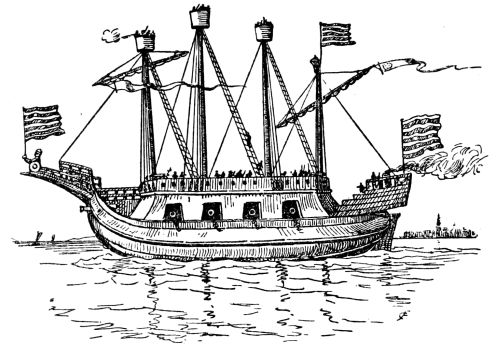
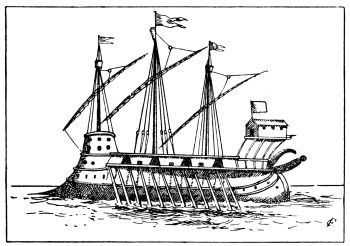
The
Finis Belli, the first regular Ironclad Ship armed with Cannon
The funnel on the poop is presumably the galley funnel, though placed in an
unusual position.
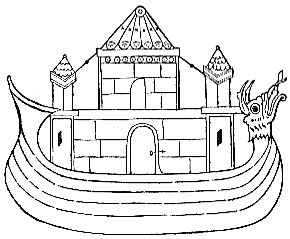
It has been stated, but without any authority being quoted
for the statement, that "chain-netting of iron was suspended
to the sides of men-of-war, which were also strengthened by
plates in the time of Henry VIII and Elizabeth". I should
say this is very doubtful, since Sir William Monson, in his
Naval Tracts, published at that period, does not mention
this practice, although he refers to a number of other protective
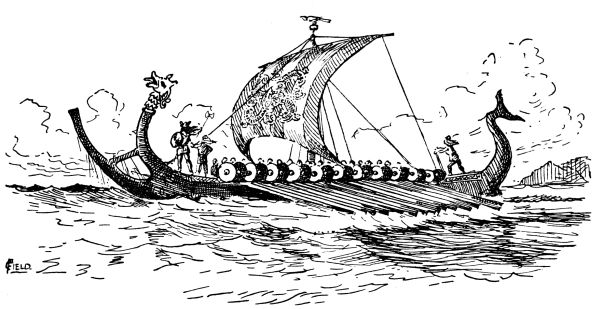
devices. But, as we have already seen, iron was used
as a protection—probably against ramming—by the Viking
ships of many centuries before this time.
The first regular ironclad ship armed with cannon appears
to be that quaint craft christened the Finis Belli, which was
constructed by the burghers of Antwerp what time they were
closely besieged by the redoubtable Alexander Farnese, Duke
of Parma, in the year 1585. With this floating battery, for
it was little else, the besieged hoped to be able to break the
Spanish blockade. There are various accounts of her. One
states that she was protected by iron plates, another that
her sides were from 5 to 10 feet thick, "filled with rotten
nets, well rammed in, which made them firm and almost
impenetrable". Probably the hull proper, which was very
low in the water, was protected in this way, and the built-up
battery or casemate, which she had amidships, was covered
more or less with iron. She mounted twenty heavy guns,
besides lighter pieces, and carried a large number of musketeers,
some in her fighting-tops, some behind a loopholed
bulwark over her battery, and others, "which could not be
hurt, being lodged lower than the cannon could batter".
Unfortunately for les braves Belges the Finis Belli was
a total failure. In spite of her three rudders she was
"very troublesome to govern", and eventually ran aground
and had to be abandoned. The Spanish besiegers laughed
prodigiously at this effort, and nicknamed the abandoned
ironclad the Caramanjula or "Bogey-bogey". As for her
designers, they re-named her Perditæ Expensæ, or "Money
thrown away".
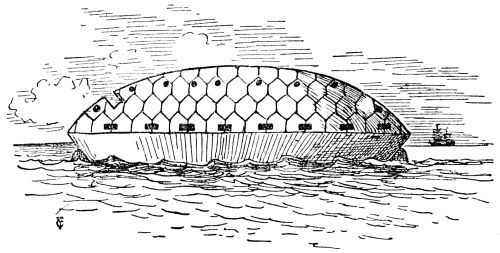
Japanese Ironclad of about 1600
A.D.
(
From a drawing by a Japanese Naval Officer)
With hull covered with plates of copper and iron, two rudders, one at the bow
and one at the stern; and a paddle-wheel as her propelling machinery, fitted inside.
The Dutch patriots struggling for freedom from Spanish
tyranny had tried their hands at a somewhat similar contrivance
about ten years earlier, which was known as The
Ark of Delft. This seems to have been a double-hulled
arrangement, with three hand-turned paddle-wheels placed
between the two hulls. The Ark only rose 5 feet above the
water-line, was 110 feet long and 46 feet broad. She mounted
twenty guns, and "a large gallery was suspended from her
three military masts"—whatever that may mean. It is a
curious but generally accepted fact that a great many more
or less modern "inventions" have been forestalled in the Far
East. Gunpowder was first made in China; water-tight compartments
were commonly used in the ships of that country
hundreds of years before they found a place in our men-of-war.
It is not altogether strange, therefore, that the Japanese
should have been in possession of what may well have been
a pretty formidable armour-clad so far back as the year 1600—a
remarkable-looking craft, more like a big turtle than
anything else. She was cased with hexagonal plates of iron
and copper, fitted closely together. She had a rudder at both
bow and stern, and was propelled by a paddle-wheel amidships,
something like the Ark of Delft. A Captain Saris, who
made a voyage to Japan in 1613, mentions that he there saw
a junk of from 800 to 1000 tons, sheathed all over with iron.
This was probably the one just described, which, by the way,
is stated to have carried a battery of cannon.
It is hardly necessary to point out that impenetrability
does not necessarily imply armoured protection. An earthen
rampart may well be impenetrable, as may a thick-sided
wooden ship, as was the Great Michael to the artillery of her
day; yet, while affording protection to those behind it, neither
the one nor the other is armoured. Between 1600 and 1800
there were many attempts at special forms of protection, from
the floating batteries employed by the English in the mismanaged
expedition to La Rochelle to the famous Spanish
floating batteries destroyed at the Siege of Gibraltar in 1781;
but iron ship-armour does not appear again till the year of
Trafalgar.
In the Naval Chronicle for that year we have an account
of a vessel designed by a son of the General Congreve who is
famous as being the inventor of the "Congreve rocket", once
a somewhat highly esteemed missile. The ship—it does not
appear whether it was actually built or not—was intended
for the attack of the French invasion flotillas which were
blockaded inside their ports by our fleets. It was to have
sloping sides covered with iron plates and bars, proof against
any gun of the period, and was to be armed with four big
mortars and the same number of 42-pound carronades. Her
rudder, anchors, and cables were to be entirely under water,
and so not exposed to hostile artillery, while she was to be
rigged in such a way that masts, yards, and sails could be
lowered or erected in a quarter of an hour. When these were
"struck" and housed under the armour she could be moved—probably
at a very slow pace—by oars pulled by forty men,
worked entirely under cover.
Fulton, the famous American inventor, who built a submarine
boat, and invented mines and torpedoes and other
weapons of war, turned his attention to the protection of
war-vessels. He was probably responsible for a little paddle-wheel-propelled
vessel for towing torpedoes, which is described
as being covered with ½-inch iron plates, "not to be injured
by shot". Later on he built a steam frigate, which he called
the Demologos, or "Voice of the People". This relied on 13-feet-thick
sides to protect her crew, but was not armour-plated.
She was blown up by accident in 1829, and replaced by the
Fulton the Second, which seems to have been to some extent
protected by iron armour.
But it was not till towards the end of the Crimean War
that real steam-propelled armour-clad ships appeared, in the
shape of a series of slow and unwieldy floating batteries,
specially designed for the attack of the massive Russian fortifications.
If anyone would like to see what these were like—that
is, as regards their hulls, for the masts have long since
disappeared—he has only to travel as far as Chatham Dockyard
and ask the policeman on duty at the main gate to direct
him to the Thunderbolt pier.
The Thunderbolt is one of these old ironclads which has
come down to the useful but inglorious duty of acting as
a landing-stage in the River Medway. Neither she nor any
of her English sisters was ever in action; they were too late
in the field—or rather the water. But several of the French
floating batteries, almost precisely similar vessels, took a
prominent part in the bombardment of the Russian fortress
of Kinburn, where their fire proved most effective. As for
the shot and shell from the Russian forts, they rebounded
from their sloping iron sides like so many tennis-balls. These
armoured batteries were, however, slow, clumsy, flat-bottomed
affairs, with no speed under steam or sail and but moderately
seaworthy. It remained for the French—whose models in the
"days of wood and hemp" were generally better than our
own—to go another step forward and produce a regular sea-going
ironclad.
This was the famous La Gloire. She was no beauty. She
had an extremely ugly bow and was very short in proportion
to her beam. She was not a new ship, but the old two-decker
Napoleon cut down, lengthened, and covered along her whole
side with iron plating 5 inches in thickness. She took two
years to finish, and was not ready till the end of 1859. She
naturally created a good deal of excitement, and it was at
once seen that we must follow suit.
But our naval men did not see why they need be content
with so unsightly a war-ship. They had been much impressed,
a year or two before, by the Niagara, a fine United States
frigate which had visited the Thames, and which had what
was then regarded as the immense length of 337 feet. Our
constructors, therefore, were rather inclined to follow her lines
than those of La Gloire, and turned out the Warrior, a magnificent-looking
vessel, not improvised out of an old wooden
ship, but entirely built of iron. Her armour-plating, however,
did not extend from bow to stern, but only covered her battery
amidships, which occupied somewhere about two-thirds of her
total length. The Warrior was 382 feet long, and fitted with
a not very obtrusive ram. As a matter of fact, it was not
perceptible at all, since the stem was finished off with a very
graceful swan bow adorned with one of the finest figure-heads
ever executed. She was fully rigged, did 14½ knots
under steam at her trials, and carried an armament of thirty-eight
68-pounders, then the heaviest guns afloat. In short,
the Warrior was a triumph of British shipbuilding, and a
worthy ancestor of the magnificent armour-clad fleet which
has played such an important part in the history of the
nation. She had one sister, the Black Prince, after which
a few smaller ironclads were built, the Defence, Resistance,
Hector, and Valiant. Next came four bigger ships, the
Achilles, Minotaur, Northumberland, and Agincourt. These
were all improved Warriors, armoured along their whole
length, with ram bows, a heavier armament, and no less than
five masts. They were imposing-looking ships, though, of
course, to-day about as obsolete as the Henri Grace à Dieu.
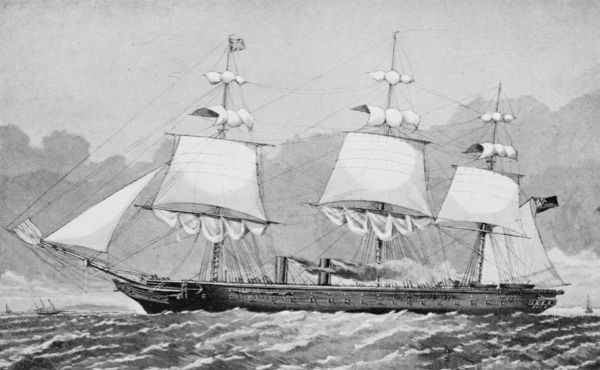
H.M.S.
WARRIOR, OUR FIRST SEA-GOING IRONCLAD BATTLESHIP
She was a very efficient reply to the French La Gloire, which was a wooden ship converted into an ironclad. Observe the Red-and-blue
Ensign. The White Ensign with St. George's Cross did not become universal in the Royal Navy till 1864.
I have a vivid recollection of a visit to the Minotaur when
a boy. Possibly a few extracts from notes made at the time
may be of interest. "She has five masts and is a tremendous
length. Her upper deck is furnished with a good many small
guns for repelling boat attacks. Round the masts are placed
some of the shot and shell for the large guns below, painted
white, and the knobs (i.e. studs to fit the rifling) and points
gilded. Were here shown a Gatling gun for service on shore
or for clearing the decks of boarders, &c. On going below
we saw a couple of rocket-tubes burnished like a looking-glass. . . .
In the steerage we saw a 7- or 9-pounder boat
gun polished beautifully (as was all the metalwork in the
ship) which had an arrangement for reducing the recoil by
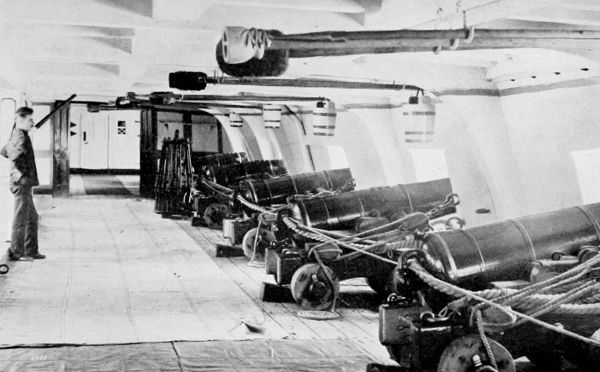
a cylinder full of oil. The main-deck battery consisted of
12-ton guns, lacquered to look like jet." The carriages, I
remember, were painted white and the slides under them
scarlet, which, with their burnished gun-metal machinery,
gave them a most brilliant appearance, very different from
the slate-coloured monsters of to-day. These guns were some
which had replaced her original armament of more numerous
but lighter cannon, and in consequence every other port in
the battery was vacant. But the long line of guns presented
a most imposing appearance. "Between the guns were field-guns,
boat-guns, &c. Round the hatchways were ranged shot,
shell, and canister, which also appeared in every available
corner."
Among other notes, too long to be transcribed, I find that
the Whitehead torpedoes in the Minotaur were made of
copper, a material which has long since been superseded by
steel, and that I was shown "the Rumpf coil for generating
the electric light which can be shown in three places". Compare
this very modest installation with the numbers of powerful
search-lights which a battleship carries to-day, to say
nothing of the thousands of incandescent lamps which light
her interior. The "cylinder full of oil" for checking the
recoil of a small boat-gun, which is referred to above, is noteworthy
as the prototype of the almost universal system now
in use both ashore and afloat, though in the Minotaur none
of the big guns were fitted with this very effective apparatus.
As guns grew more powerful, and, in consequence, armour
increased in thickness and weight, the amount of side protection
had perforce to be reduced, so that as time went on
the battleship's cuirass was cut down to a comparatively
narrow water-line belt, with a "box-battery" containing her
heavy guns amidships. In later types the foremost and aftermost
guns in these batteries were placed at an angle and
the port "recessed" in the ship's side, so that these guns could
fire on the broadside and nearly ahead as well. In some
ships, such as the Sultan, Alexandra—which, by the way,
was long flagship of the Mediterranean fleet and a notable
ship in her day—Triumph, and Iron Duke, the box-battery
was arranged in two tiers, one above the other. All these
were broadside ships and fully rigged. If they could not
get along very fast under sail alone, the sails, under some
circumstances, were useful in "easing the engines" and getting
a little more speed out of the ship.
But in any case naval officers had not then brought themselves
to accept the idea of relying on their engines alone;
they liked to have a second string to their bow. Besides,
the work and evolutions aloft were undeniably a splendid
thing for the seamen; it rendered them quick, smart, and
self-reliant, and kept them in excellent physical training.
The reverse side of the picture was the weight of yards,
rigging, and sails, the resistance they offered to the wind
when the ship was steaming against it, the danger in action
to those quartered on the upper deck from the fall of yards,
blocks, and spars from aloft, and the time taken in preparing
them for action. The top-gallant masts were sent down on
deck as well as the upper yards, the top-masts were generally
lowered till they only showed a few feet above the heads of
the lower masts, extra slings had to be put in place to secure
the lower yards, the shrouds supporting the masts on either
side had to be "snaked down", by coiling wire hawsers in
a species of zigzag from top to bottom, so that if one or more
shrouds were cut the whole would hang together, and many
other precautions taken which occupied valuable time and
were, perhaps, after all of a merely negative nature—that is
to say, the rigging was more of a danger in action than
a useful asset. The tops were the only part of it that were
of use. As in ancient days they afforded stations for archers
and stone-throwers, and later on for musketry, swivel-guns,
and grenade-throwers, so they were at this time utilized for
mounting machine-guns to fire down upon an enemy's decks.
For at that period "close action" was always expected.
Boarders were told off when the ship "went to quarters for
action", and boarding-pikes and cutlasses were provided for
their use, while the small upper-deck guns—usually breech-loading
Armstrongs—were mounted on carriages which enabled
them to be fired downward to repel a boat attack or
the rush of a steamboat with a spar torpedo. The ideas of an
action at sea were practically the same as those which obtained
in the days of Nelson. "Masts and yards" were the source
of yet another danger. The "smartness" of a ship was still
generally gauged by her "smartness" aloft. All evolutions
in the Navy are done "against time", and for a ship to get
her "royal yards across" some seconds before any other ship
in the squadron was a notable feat of which every soul on
board was proud to a degree. These ideas were those of the
old sailing navy, and in spite of the advent of steam, ironclads,
rifled guns, and torpedoes, the conservatism of our
great sea service rendered them still paramount, so that even
gunnery took a second place. There were regulation quantities
of ammunition to be fired—"expended" was the usual term—at
regulated periods, there were orders that torpedoes were
to be run at stated intervals, that bluejackets and marines
should be landed for drill ashore every week when in harbour.
But in most ships these things were regarded as secondary and
annoying performances, to be got over and done with as soon
as possible, if they could not be avoided altogether, so that
all hands might be set to their "games with sticks and string",
as, in course of time, irreverent observers began to call the
cherished evolutions with mast and yards, and the important
business of cleaning paintwork, burnishing "brightwork",
and generally making the ship as spick and span as possible.
"Spit and polish" were the idols worshipped in those days
by captains and more especially commanders, for it was almost
universally recognized that their promotion depended more on
the brilliant appearance of their ships at an inspection than
on any other earthly matter. But for all that the days of
"sticks and string" were numbered, as were those of broadside
ironclads and box batteries.
The prime cause of the approaching change was the appearance
of a queer-looking little craft in the Civil War in
America between 1861 and 1864. The United States Government
had a fine fleet of wooden steamships at the outbreak
of hostilities, but the naval authorities of the seceding
Southern States, having raised the Merrimac, a 40-gun frigate
which had been sunk at the Norfolk navy yard, cut her
down, built a battery amidships armoured with two or three
thicknesses of railway iron, and attacked the Federal fleet.
The Merrimac had it all her own way, rammed and sank the
frigate Cumberland, set the bigger Congress on fire and compelled
her to surrender, and withdrew with all the honours
of war. But she was yet to meet her match. John Ericsson,
a Swedish engineer, was commissioned by the United States
Government to construct a small ironclad of his own designing.
While the Merrimac was engaged in defeating the
wooden ships of the Federals in Hampton Roads, the Monitor,
as the new vessel was called, was on her way south from New
York. She joined the Federal fleet the very night before the
Merrimac made a second sortie. On this occasion, as she
came out into the Roads and opened up the fleet she intended
to attack, the Merrimac spotted what someone described as
looking "like a cheese-box on a raft". It was an excellent
description of the little Monitor, which was built with a very
low freeboard and had nothing on her deck but a cylindrical
revolving turret containing a couple of guns, no masts, and
but the merest apology for a funnel. Yet she proved one too
many for the Merrimac with her more numerous battery of
guns. She was unable actually to pierce her sides, as her
commander had received the most peremptory orders not to
use more than 15 pounds of powder to load his guns, but
the Merrimac got so "rattled" that she had to sheer off.
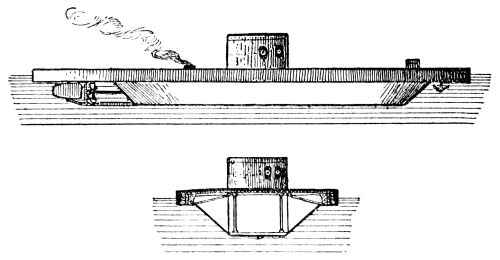
The
Monitor, the famous little ship that revolutionized warship design
The upper figure is a broadside view, the lower one a transverse section amidships.
The upper portion of the hull was very like a raft, and was heavily armoured all over, as
was the turret and the little pilot-box forward.
This first duel between ironclad vessels attracted an
enormous amount of attention, as is only to be supposed.
The net result in this country was that Captain Cowper
Coles, R.N., was allowed to have a cupola- or turret-ship
built which he had designed some years before. The Royal
Sovereign, a wooden three-decker, was cut down to within
a few feet of the water-line, plated with 5½-inch iron, and
fitted with four turrets. The foremost one carried two guns,
the remainder one apiece. She had very light pole masts
and light, hinged iron bulwarks, which gave her 3-1/3 feet more
freeboard at sea but had to be lowered before she could fight
her guns. Captain Coles, however, had the usual hankering
after "masts and yards", and, the Royal Sovereign having
proved moderately successful, induced the Admiralty to build
a fully rigged turret-ship. This was the unfortunate Captain,
whose low freeboard, heavy turrets, superstructures,
and fully-rigged tripod masts caused her to turn turtle in
a squall off Cape Finisterre on the night of 6th September,
1870. Her inventor went down in her. Her gunner and
seventeen men were the sole survivors. One other full-rigged
turret-ship was built—the Monarch. As she had
a very considerable freeboard she proved a seaworthy ship,
but she was the last of her kind.[42]
In the meantime several small coast-defence turret-vessels
had been built, such as the Scorpion and Wyvern in 1865,
the Abyssinia, Magdala, and Cerberus in 1870, and the
Glatton, Gorgon, Cyclops, and others a year or so later. They
had one or two masts, but were not rigged ships. These
little turret-ships developed into the battleships Devastation,
Dreadnought, and Thunderer, launched between 1873 and
1877. Each had two turrets containing a couple of heavy
guns apiece. Their hulls were heavily armoured, and they
had but one mast fitted with a military top for machine-guns.
It is from this branch of our earlier armour-clad construction
that our modern "Dreadnoughts" derive their descent rather
than from the broadside type.
To explain further developments it must be noted that
while in this country the success of the Monitor induced
us to experiment with placing guns in revolving armoured
turrets, in France the tendency was to build a fixed armoured
tower in the ship, and place the guns inside on a turntable
en barbette—that is to say, so mounted that they could
fire over the top of the armour in any direction. We tried
to go one better in the Temeraire (1877). She was a broadside
ship, with a "box-battery" amidships, but forward and
aft two pear-shaped armoured barbettes were built into her,
the tops of which rose about 1 foot or 18 inches above her
upper deck. In each of these was placed a 25-ton gun—we
classified guns by weight in those days, and not by inches
of calibre as we do now—on a mounting, which enabled it
to sink down on being fired, and to be raised up again into
its firing-position when loaded. The Temeraire, it may be
said, was an experimental ship in many ways. Though heavily
rigged, she had only two masts, so was like an enormous brig.
I believe I am right in saying that her mainyard was the
longest and heaviest in the Service. At one time, too, she was
painted grey, instead of the black which was then universal,
except when ships were in hot climates, when it was generally
changed to white. Yellow funnels were regulation, as was
"mast-colour"—a sort of deep-yellow ochre with a reddish
tinge—for all masts and spars. Ships were, and had been for
very many years, painted white withinboard instead of the
old eighteenth-century red. Outboard the black sides were
finished off generally with a white water-line, and a broad
white band along the upper part of the bulwarks, known
as a "boot-top". Sometimes another white line was painted
on the black side a few inches below it.
There was a good deal of controversy about this time as
to the relative merits of "broadside" fire and "end-on" fire.
Space forbids us from entering further into this question,
but, generally speaking, if a British ship carried four guns
heavier than the rest, they were so arranged that two could
be fired ahead or astern, and all four on either broadside.
But in a French ship the four corresponding guns would be
each mounted singly in barbettes arranged diamond-fashion,
so that three could be fired either ahead, astern, or on either
broadside. A couple of armoured cruisers, the Imperieuse
and Warspite, were built, probably as an experiment, on these
lines, on the latter of which I had the honour of serving for
something like twelve months. They were originally brig-rigged,
like the Temeraire, but this was done away with later
and replaced by a single military mast. Personally I do not
think they were a success. The Warspite, at any rate, was
a very wet ship. When steaming against quite a moderate
sea the water ran all over her, into the barbettes and down
below, and she was much cramped in many ways by the
arrangement of her guns. The Devastation and her sisters
proved very formidable and successful ships, but with the
idea of getting a heavier fire ahead or astern a new departure
was made in the Inflexible—the biggest ironclad we had yet
constructed—by placing her turrets, not one forward and
the other aft on the centre line of the ship, but en echelon—that
is to say, diagonally amidships. Theoretically this arrangement,
which had been copied from the big Italian ships
Duilio and Dandolo, had a good deal to recommend it, but
practically there is more to be said against it than for it.
Nevertheless, four other smaller ships were built on these
lines, the Ajax and Agamemnon—which gained notoriety as
being almost impossible to steer—and the Edinburgh and
Colossus. The last two were armed with breech-loading guns,
which were now superseding the old muzzle-loaders to which
the ordnance authorities had clung with such obstinacy long
after every other nation had consigned them to the scrap heap.
Meanwhile a smaller single-turret ship, the Conqueror,
had been built, an unwieldy-looking craft which went by the
name of the "half-boot" from the resemblance her general
outline had to that useful article of military equipment. But
she seems to have met with the approval of the Admiralty,
since an improved sister-ship, the Hero, was launched about
five years later. These ships probably suggested the very
much larger ones, Victoria and Sans Pareil, each of which,
on a displacement of 10,470 tons only, carried a couple of
111-ton guns of 16·25-inch bore in a single turret—that is
to say, as their main armament. They had also a 10-inch
gun aft, and a dozen 6-inch breech-loading guns. These
formed what is called her "secondary battery". The provision
of such batteries marks a step in the evolution of war-ship
construction which is very noteworthy. The bigger
and bigger guns carried by battleships necessitated stronger
and stronger armour. In spite of improvements in quality and
manufacture the weight of armour tended constantly to increase.
The area covered had therefore to be more and more
restricted. To carry all this weight of guns and armour comparatively
large ships were necessary, and a great part of their
sides had to go without any protection at all. Their flotation
might be preserved—against attack by gun-fire—by the combination
of armoured belt and sloping armoured decks which
had by now become almost universal. But it was obvious
that the unarmoured portions of the ship above water could
be torn to pieces by the fire of comparatively light weapons.
This led to the installation of "secondary batteries" of 4-, 5-,
and 6-inch guns, for the purpose of attacking an enemy's ship
in this way and of neutralizing his attack by keeping down
the fire of his secondary batteries.
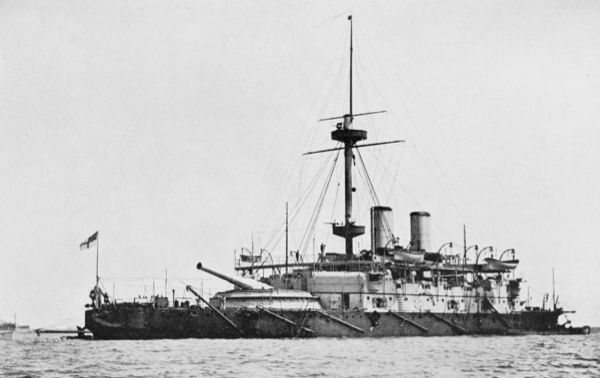
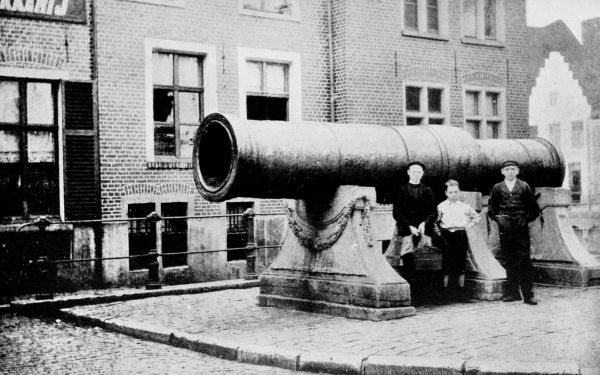
Photo. West & Son, Southsea
A MONSTER GUN WHICH IS NOW OBSOLETE
The 111-ton gun on the old Benbow, which was very slow of fire and whose life was estimated at little more than 70 rounds.
The development of torpedo-attack brought about the
Whitehead automobile torpedo, and the improvements in the
speed and construction of destroyers and torpedo-boats caused
also the introduction of "auxiliary batteries" of rapid-firing
3- and 6-pounder-shell guns. The machine-guns firing rifle
bullets, and, later on, small steel shot, were found to have no
"stopping-power" against torpedo-craft, and more powerful
weapons became imperative.
The tragic end of the Victoria, which cost the nation, not
only a fine ship, but the lives of the greater portion of her
crew, and that very talented naval commander, Sir George
Tryon, is a well-known tragedy of the sea, and there is little
doubt that the enormous weight forward of her huge turret
and guns, with nothing aft to counterbalance it, was one of
the causes contributing to the completeness of the catastrophe.
No more ships were built on such lines, but about this
period an important innovation was made by the introduction
of a class of ships in which the four heavy guns were carried
in a couple of high barbettes with sloping sides, instead of
in turrets. The whole gun was exposed, but not its mountings
or crew, since the top of the barbette was closed in by
a flat shield which revolved with the guns. These were the
Collingwood, Camperdown, Howe, Rodney, Anson, and Benbow.
The last-named had one 111-ton gun in each barbette,
instead of a pair of rather smaller cannon. Amidships, between
the barbettes, were secondary batteries of half a dozen
6-inch guns (the Benbow had ten). These were entirely unprotected
except from fire coming from ahead or astern, from
which they were covered by armoured bulkheads reaching
across the ship immediately behind each barbette.
I well recollect my first sight of these ships, which had all
been completed during four years I had been away on a distant
station, though, as a matter of fact, I had seen the Rodney
launched before I left England. I was on board H.M.S.
Aurora, a new cruiser which had been specially commissioned
for the naval manœuvres. We left Plymouth and proceeded
to Spithead, where a large fleet had been assembled to do
honour to the Kaiser—with whom we were then on rather
more friendly terms than latterly, and who came over at the
head of a squadron of his war-ships. He was much more
anxious to exhibit German war-ships to the British fleet than
his naval commanders seem to have been during the Great
War. We got into Spithead about six on a morning when
there was a thick drizzle almost amounting to a fog, and as
one after another of these monsters—as we thought them
then—loomed up out of the mist and vanished astern, they
presented a most impressive picture of strength and solidity.
They really did look in the dim light like "castles afloat"!
But they were not by any means among our most successful
efforts. No one liked the unprotected secondary batteries,
and thought of the well-armoured Devastation and her sisters.
They had no secondary batteries—but they were so well
armoured that these were not necessary, except for purposes
of offence. This consideration doubtless led to the building
of the Nile and Trafalgar, in which the four big guns were
carried in turrets and the secondary armament in an armoured
battery amidships. They were extremely well-protected ships
and would have given a very good account of any ship of their
day. But the tendency was ever for bigger ships, which
allowed, generally speaking, for greater speed, greater radius
of action, greater seaworthiness, and afforded a steadier gun
platform.
This produced the "Royal Sovereign" class, of over 14,000
tons displacement, a great advance in size on any ships which
had preceded them. They created a considerable sensation at
the time of their appearance, especially the Royal Sovereign
herself, the first of them. My own first sight of her was
somewhere in the Irish Sea, not far from the Isle of Man.
I was serving on board H.M.S. Triumph in the naval manœuvres
of 1892. The Royal Sovereign passed us just at the
time tea was going on in the wardroom, which would be
between half-past three and four, and I remember how everybody
rushed up on deck to get a look at the new marvel
in shipbuilding.
The Royal Sovereign became practically the regulation
type of battleship until the advent of the "Dreadnoughts",
though of course each successive batch was an improvement
on the preceding one in speed, protection, and gun-power.
All had four heavy guns in low barbettes, covered with
armoured hoods which revolved with the guns—so they may
be said to have been a combination of turret and barbette.
The single exception was the Hood in the "Royal Sovereign"
batch, which carried her four heavy guns in two regular
turrets. All had secondary batteries, whose guns were distributed
in armoured casemates at considerable intervals from
each other, and all had a couple of military masts, with
one or two fighting-tops on each, armed with light rapid-fire
guns. This fine series of battleships amounted to forty in
all, and formed a homogeneous and magnificent fleet, the like
of which the world had never seen. Nearly all had a displacement
of from 14,000 to 15,000 tons, and a speed of from 17 to
18 knots. Most are still in service, and though they have been
put rather in the background by our "Dreadnoughts" and
"Super-Dreadnoughts", we may still be very proud of them.
There were two intermediate steps between them and the
epoch-making Dreadnought. The first was the creation of
the "King Edward" class of five ships, dating from 1902-3.
These were very similar to their predecessors, but had over
1000 tons more displacement, were more thoroughly armoured,
and, in addition to the four 12-inch and ten or a dozen 6-inch
guns which formed their armament, were provided with four
guns of 9·2 inches calibre, each placed singly in a turret at
the corners of the superstructure. The final type before the
Dreadnought made her sensational appearance was the "Lord
Nelson" class, which, however, only comprised two ships—the
Lord Nelson herself and the Agamemnon.[43] They were very
little bigger than the "King Edwards", but in their case the
6-inch guns were replaced by ten guns of 9·2-inch calibre, a
most formidable secondary battery, capable of penetrating a
considerable thickness of armour. The Battle of Tsushima,
between the Japanese and Russians, led to the temporary
abandonment of the secondary battery. It was considered
that battles would in future be fought at such immense ranges
that a decision, one way or another, would be reached before
the smaller guns could be brought within effective range of
the enemy, and the events of the European War go to confirm
this theory. So it was that we once more arrived at the
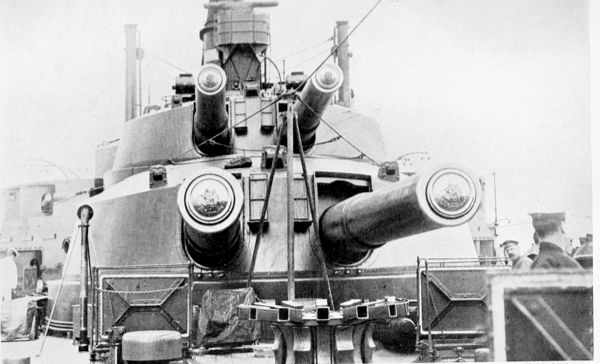
"all-big-gun ship", and in the Dreadnought, launched in 1906,
went back to the principle followed in the armament of her
namesake of 1875, and confined her armament—except for
a few small anti-torpedo-boat guns—to cannon of the largest
size. A comparison of the two Dreadnoughts will form an
appropriate termination to this chapter, which has already
occupied more pages than I intended.
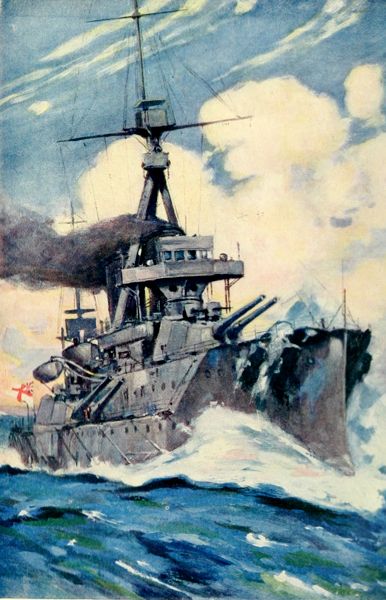
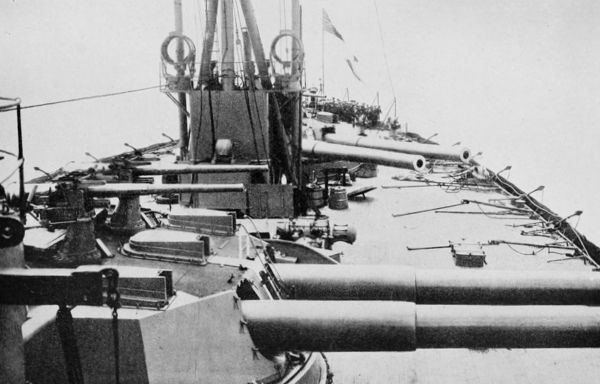
1875—H.M.S. Dreadnought. Displacement, 10,820 tons; speed, 14
knots; guns, four muzzle-loaders; armour, 10, 11, 13, and 14 inches;
weight of projectiles, 809 pounds; penetration of wrought iron at
1000 yards, 17½ inches.
1906—H.M.S. Dreadnought. Displacement, 17,900 tons; speed, 21
knots; guns, ten breech-loaders; armour, 6, 7, 9, and 12 inches;
weight of projectiles, 850 pounds; penetration of wrought iron at
1000 yards, 36 inches.