THE WINTER—POSITION OF THE FRENCH—THE TURKISH
CONTINGENT—PREPARATIONS FOR THE NEXT CAMPAIGN—THE ARMISTICE—THE
PEACE AND THE EVACUATION.
Anniversaries—An Explosion—Casualties—Terrible Scene—Cause of
the Catastrophe—Accident in the Redan—Samuel Goodram—Love of
Fighting—Contrast between the Years 1854 and 1855—The Flank
March—Mistakes in the first Instance—Russian Troops—The Sports
of Sebastopol.
THE month of November would seem to have been ruled by some genius
unfavourable to our arms. If it gave to us the glorious remembrance of a
profitless and bloody victory, it also brought with it a day of disaster
and gloom—the beginning of a long series of calamities. The first
anniversary of that day passed away amid mutual congratulations and
reminiscences, rendered all the more joyous by the contrast between the
present and the past. We had beheld a spectacle of unusual splendour and
grandeur, one indeed which no native of these isles has ever yet
witnessed, so far as I am aware. On the 14th of November, 1855, the
purity of the air—the health of the troops—the abundance of
stores—the excellence of the roads—the quantity of hutting—the
hospital accommodation—the fineness of the day—the beauty of the
sky—the dryness of the soil—the prospects of the army—the bright-hued
future: all these were contrasted by a myriad tongues in endless
difference of phrase, coloured by many a recollection of personal
suffering. There was no sorrow, no calamity could reach us now, and of
all things which fate could grant us, most of all were we desirous of
meeting that alone with which fate seemed to threaten us—an assault by
the enemy. But, suddenly, up from the very centre of our camp, so that
every ear should hear and every eye should see, rushed with such a crash
as may forewarn the world of its doom, and with such a burst of flame
and smoke as may never yet have been seen by man, except in the throes
of some primeval eruption, a ghastly pillar of sulphureous vapour. It
spread as it rose, bearing aloft for hundreds of yards men, horses,
fragments of limbs, rocks, shells, and cannon-shot, and then extended
its folds in writhing involutions, as though it were tortured by the
fire within, raining them down over the astounded soldiery below! For a
moment the boldest lost heart, and "the bravest held his breath." There
was no safety in flight—the wings of the wind could not have left that
dreadful shower of iron behind; and as one of the most collected and
cool soldiers in the army said to me, "I had only presence of mind to
throw myself on the ground and ask the forgiveness of God, and I
received his mercy!" In fact, the effect resembled some great convulsion
of nature. Many thought it was an earthquake; others fancied it was the
outburst of a volcano; others, that the Russians had got hold of Lord
Dundonald's invention, and that they had just given it a first trial.
Indeed, one officer said to another, as soon as he recovered breath and
could speak, "I say, that's a nice sort of thing, is it not? The sooner
we go after that the better." He was persuaded the Russians had thrown
some new and unheard-of instrument of destruction into the camp.
I was riding from head-quarters, reading my letters, and had just
reached the hill, or elevated part of the plateau, at the time, and
happened to be looking in the very direction of the park when the
explosion took place. The phenomena were so startling as to take away
one's breath. Neither pen nor pencil could describe them. The earth
shook. The strongest houses rocked to and fro. Men felt as if the very
ground upon which they stood was convulsed by an earthquake. The
impression of these few moments can never be eradicated. One's
confidence in the stability of the very earth was staggered. Suppositos
incedimus ignes. What part of the camp was safe after such a
catastrophe? The rush of fire, smoke, and iron, in one great pillar,
attained a height I dare not estimate, and then seemed to shoot out like
a tree, which over-shadowed half the camp on the right, and rained down
missiles upon it. The colour of the pillar was dark grey, flushed with
red, but it was pitted all over with white puffs of smoke, which marked
the explosions of the shells. It retained the shape of a fir-tree for
nearly a minute, and then the sides began to swell out and the
overhanging canopy to expand and twist about in prodigious wreaths of
smoke, which flew out to the right and left, and let drop, as it were
from solution in its embrace, a precipitate of shells, carcasses, and
iron projectiles. The noise was terrible; and when the shells began to
explode, the din was like the opening crash of one of the great
cannonades or bombardments of the siege. I clapped spurs to my horse and
rode off as hard as I could towards the spot as soon as my ears had
recovered the shock. As I rode along I could see thousands hurrying away
from the place, and thousands hastening to it. The smoke became black;
the fire had caught the huts and tents. General Windham overtook me,
riding from head-quarters as hard as he could go. He was ignorant of the
cause and locality of the explosion, and was under the impression that
it was one of the French redoubts. Sir Richard Airey followed close
after him, and General Codrington rode towards the fire a few minutes
afterwards.
THE GREAT EXPLOSION.
On arriving close to the place, I saw that the ground had been torn up
in all directions. The fragments of shell were still smoking, and shells
were bursting around in most unpleasant proximity. Captain Piggott, in
a short time, came up with the ambulances at a gallop, and urged the
horses through the flames and amid the exploding shell in order to
render assistance to the sufferers; and in this arduous duty he was
manfully and courageously assisted by Surgeons Alexander, Muir, Mouat,
and others. As we were all looking on at the raging fire, an alarm
spread that the mill used as a powder magazine had caught fire. A
regular panic ensued—horses and men tore like a storm through the camp
of the Second Division. I did not escape the contagion, but, at my
servant's solicitation, mounted my horse, and rode off like the rest. I
soon came up to Colonel Percy Herbert, who was actively engaged in
trying to get the men of his Division under arms, but he told me he
could find neither drummers, buglers, officers, nor sergeants. The panic
was soon over. The mill did not catch, though the roof and doors and
windows were blown in. The officers, in the most devoted way, stripped,
and placed 300 wet blankets over the powder inside just as the flames
were raging behind the mill and at the side of it within 200 yards.
Hundreds of rockets rushed hissing and bursting through the air, sheets
of flame shot up from exploding powder, carcasses glared out fiercely
through black clouds of smoke, and shells burst, tossing high in air
burning beams of wood and showers of sparks, and boxes of small-arm
ammunition exploded with a rattling report like musketry, and flew about
in little balls of fire.
My reading in military matters is not sufficient to enable me to say,
with any confidence, that there never was so terrible an explosion; but
having witnessed and heard the explosions at Pavlovskaia and Kertch, at
Oczakoff, of the French magazines on the 17th of October, 1854, and of
the Russian forts on the 9th of September, 1855, I must say that, in
volume of sound, in appalling effect, they were far exceeded in
vehemence and grandeur by this tremendously abrupt and startling
catastrophe. The quantity of Russian powder which went up was about
1,700 barrels, and there were about 800 barrels of French powder
exploded in the three magazines. Each barrel contained about 100lb.
weight of gunpowder, so that the total quantity which furnished the
elements of this prodigious combustion cannot have been less than
250,000lb. But in addition to that enormous mass of powder there were
vast mounds of shell, carcasses, rockets, and small-arm ammunition,
contributing to the intensity and violence of the fiery blast.
Appalling as was the shock to those who were near, the effect was little
diminished by distance. The roar and concussion were so great in
Balaklava that the ships in harbour, and outside at anchor, trembled and
quivered, and the houses shook to their foundations. The ships at
Kamiesch and Kazatch reeled and rolled from side to side. Mules and
horses, seven and eight miles away, broke loose, and galloped across the
country, wild with fright. The noise pealed through the passes at Baidar
like the loudest thunder. The sense of hearing was quite deadened in
many persons, and their nervous systems have not yet recovered the
shock, so that any sudden noise startles them. The French had 6
officers killed and 13 wounded; 65 of their men, mostly of the
artillery, were killed, and 170 wounded, of whom many will never
recover. The destruction in money value of articles appertaining to the
siege-train was very great. But when we came to men—to those gallant
fellows who had survived the battles and the dangers of the
campaign—our loss was irreparable. What value could be placed on those
noble artillerymen of the siege-train who, with little praise or
encouragement, stood by their guns in so many bombardments, and who had
acquired skill, practice, and hardihood in the greatest siege the world
ever saw?
The casualties in the Light Division were as follows:—
7th Fusiliers, 1 killed, 12 wounded; 19th Regiment, 9 wounded; 23rd
Fusiliers, 2 killed, 6 wounded; 33rd Regiment, 2 killed, 13
wounded; 34th Regiment, 1 killed, 14 wounded; 77th Regiment, 3
killed, 6 wounded; 88th Regiment, 2 wounded; 90th Regiment, 1
wounded; Rifle Brigade, 1 killed, 6 wounded; total 10 killed, 69
wounded.
SUPPOSED CAUSE OF THE EXPLOSION.
The Right Siege Train suffered as severely—seven poor fellows were
buried the first night, and the bodies of three more artillerymen were
so torn and scattered that their remains could not be collected for
interment. To this loss of ten must be added that of seven artillerymen
"missing." The total of the casualties in the train amounted to
fifty-two. Mr. Yellon, Deputy Assistant-Commissary of the field train, a
most active, zealous officer, whose name was mentioned along with that
of Mr. Hayter in Colonel St. George's despatch, was blown to pieces.
Lieutenant Roberts had his left arm broken, and was severely burnt;
Lieutenant Dawson lost his leg above the ankle from a dead shell, which
struck him as he was in the act of carrying off a live shell from the
park to a place of safety. The legs, arms, and trunks of men were blown
into the camps of the Rifle Brigade and of the 34th Regiment, on the
extreme right of the Light Division. I saw lying amid a heap of ruins,
of old iron stores, rubbish, shot, splinters of shell and beams of wood,
a man's arm scorched and burnt black, on which the tattered pieces of
clothing retained the traces of a sergeant's gold stripes. The dead were
terrible to look upon; but the living in their agony were still more
frightful. I solemnly declare, that from the lips of none of these
mutilated masses which I saw stretched out in long rows in every
hospital did I hear either groan or sigh. No sound escaped them, as
those who could see rolled their sad orbs and gazed upon the stranger,
except in one instance, when an involuntary expression of pain was
uttered by a poor French soldier in the hospital of the 23rd, where he
had been trepanned, and was all but beyond the reach of his misery.
Although the Russians have been justly praised for their endurance of
pain, I must say I never beheld them submit to such tortures as our men
experienced. As I looked upon the shattered frames before me, in which
such noble spirits were enshrined, I could not but remember the howls of
a Russian corporal, at Kinburn, who had been wounded in the heel. The
surgeons displayed the greatest courage and kindness, and every man was
at his post in the midst of fire and shell. Drs. Muir, Watt, Mouat, and
Longmore particularly distinguished themselves.
Marshal Pelissier named a commission of inquiry to report upon the cause
of the disastrous accident. Our men declared, of course, that it was the
work of an incendiary. General Codrington seemed to give credence to the
report, inasmuch as he ordered the army to turn out an hour before
daybreak, to be prepared for the Russians if they really had calculated
on crippling us.
The manner in which this great disaster was caused is said to have been
this:—Some French artillerymen were engaged in shifting powder from
case to case in the park, and as the operation is rather dangerous,
every precaution was taken to prevent accidents. The powder was poured
from one case into the other through copper funnels, and no fire was
allowed near the place where the men were so employed. As one of the
soldiers was pouring the powder out of a case he perceived a fragment of
shell gliding out of it into the funnel, and, not wishing to let it get
into the other case, he jerked the funnel to one side; the piece of
shell fell on the stones, which were covered with loose powder, and is
supposed to have struck fire in its fall, for the explosion took place
at once. Miraculous as it may appear, this artilleryman, who was, as it
were, in the focus of the explosion, escaped alive, being only slightly
burnt and scorched. His comrade, who held the other case was blown to
atoms. Another strange incident was the death of the French commandant
of artillery for the day. He was near the park at the time of the
explosion, and as soon as he had seen everything in order, he went off
to have a look at the French batteries in and about Sebastopol, on which
the Russians had just opened a heavy fire. As he rode along, a
cannon-shot struck off his head. The escapes were astounding.—Clothes
were torn off men's backs; the chairs or beds on which they sat, the
tables at which they were eating, the earth on which they stood, were
broken and torn by shot, shell, rocket-irons, shrapnell, grape,
canister, and musket-balls, which literally rained down upon them. The
distance to which fragments flew exceeds belief. It is difficult to
explain it by mere names of localities. One piece of shell flew over
Cathcart's Hill; another killed a horse in New Kadikoi. Some struck men
and horses in the Guards' camp. In the Land Transport Corps of the Light
Division fourteen horses were killed and seventeen were wounded. One
flew over my hut; another struck the ground close to it; another went
into the camp of the Land Transport Corps behind it. Mrs. Seacole, who
keeps a restaurant near the Col, avers that a piece of stone struck her
door, which is three and a half or four miles from the park. Pieces
struck and damaged the huts in New Kadikoi. There had been some warnings
of the dangers of carelessness already.
The day before the explosion Samuel Goodram, No. 6 Company, Coldstreams,
a soldier of the same regiment, and a sergeant, were on duty in the
Redan; the two men went into one of the casemates to remove powder and
rubbish, while the sergeant remained outside. Scarcely had the men
entered before an explosion took place. Goodram was blown into the air,
and then buried amid fragments of gabions and falling earth, and both
men were buried in the Guards' cemetery next day. I am the more
particular in giving names, that I may relate an anecdote of Goodram at
the attack on the Redan. The night before the attack, the Coldstreams
were on duty, and were relieved some hours before the assault. On
arriving at camp, Samuel Goodram was missing; and it was feared that he
had gone away to indulge in potations, or had been hit as he came from
the trenches. But this gallant soldier had remained behind from a pure
love of fighting, and from a desire "to have a go in at the Roosians."
Knowing that the assault would take place in a few hours, Goodram, as
the regiment mustered and marched off, had secreted himself in the
trenches, and employed his leisure time before his comrades left in
filling the breast of his coat and every available place about his
person with cartridges from their boxes, fearing that his private supply
of fifty rounds would fail him before he had got his fill of fighting.
When the storming party was advancing from the fifth parallel, Goodram
appeared, rifle in hand, and joined it as a volunteer, and his regiment
claim him as being the first private soldier in the Redan on that
memorable day. He was twice driven out of the Redan, and was over and
over again engaged individually with the Russians, and in these
encounters he received two wounds—one in the side and one in the
arm—but still kept up a fire when driven back by the last rush of the
enemy's infantry, and forced over the parapet with the rest of our men
into the ditch. Instead, however, of retiring with the others, as
opportunity offered, and keeping in the ditch or getting under cover in
the parallels, Goodram made an impromptu rifle-pit on the broken glacis
outside the ditch, and there he maintained his fire on the enemy till
his ammunition became exhausted, and his wounds so painful that he could
no longer use his rifle. Then he shouldered his arms and marched stiffly
up through the trenches and across the open space till he reported
himself to his regiment. He was, I believe, tried for being absent
without leave and for stealing his comrades' cartridges, but Minos
himself could not have condemned a soldier like this to any severe
punishment for a crime which Minos's jurymen would have called heroic.
RETROSPECTS
The Situation—Retrospects.
EITHER the year 1854 was remarkable in the annals of the Crimea for its
severity, or we enjoyed a season of exceptional mildness in 1855. Storms
lowered over us and passed away; dark skies threatened us and melted
into floods of golden sunbeams. The wind seemed alone to be busied in
tossing the French steamers at sea and keeping the mail late, in which
it succeeded very effectually, so that our letters were behind time with
the greatest regularity. The country was open in every direction to
carriage, man, or beast; the trenches were dry; in fact, the weather
presented contrasts of endless variety to that which prevailed the year
before, and afforded ground for infinite speculation and comment. There
was no reason, however, to suppose that the English army would have had
much reason to congratulate itself on the fact that the clemency of the
season had averted the evils which want of roads, excessive fatigue, and
a false position would have entailed upon them, inasmuch as it is
certain the bad weather paralyzed the enemy, cut off their reserves,
impeded their transport of food and of reinforcements, and prevented
their making another attempt—not at Inkerman, of which, they had to
their cost learnt the strength, but from the Traktir bridge, or at some
point of the Tchernaya then in their possession, from which they could
have debouched into the plain of Balaklava, and made a grand attack on
the rear of our lines. Although those lines had been greatly
strengthened, and the profile altered and improved, they were far from
being perfect or unassailable. In November, when rumours to the effect
that the Russians were gathering a force towards Baidar, with the
intention of assaulting us, prevailed, the country between Tchongar,
Perekop, and Simpheropol was, however, in such a state that it was with
the utmost difficulty the garrison of Sebastopol could be fed, and very
strong reinforcements were kept for weeks waiting at Odessa,
Nicholaieff, and Cherson, till the spring of 1855. But for these
impediments, the Russians would have had a prodigious army about
Sebastopol early in December, 1854, and if they had been indisposed to
try another Inkerman, they could certainly have pressed us much harder
in the trenches, and wearied our men by strong and repeated sorties. At
times it was difficult for even a single battalion to march from the
army of the Belbeck or Mackenzie's Farm into the city, or to effect the
usual reliefs.
If to these considerations be added the notorious sentiments and
opinions of persons high in authority, who advocated the abandonment
of the siege,[31] and the retreat of the army from the Crimea after the
battle of Inkerman, it will be seen that our prospects would not have
been much better had weather like that we enjoyed in the latter part of
1855 prevailed last winter. The inconvenience to which the famous flank
march subjected the army became more apparent every day after the
failure of the first bombardment. The flank march was opposed, or was
viewed with disfavour, by officers of great authority, and by one whose
sagacity and skill are seldom deceived in military operations, although
he is not a soldier, and does not command on land.[32] The descent on
the Crimea itself was a bold stroke; it was the first step towards the
capture of Sebastopol. The battle of the Alma left the approach to the
city open to us whenever we liked. Prince Menschikoff's flank march to
Bakshiserai and Simpheropol, although somewhat ridiculed at the time, is
now considered a judicious and daring movement, but it certainly
uncovered the north of Sebastopol, the Tchernaya, and Balaklava; and as
it was determined by our generals to abandon the dashing character of
the expedition, and to assume for our operations a strategical
character, to which they had no previous pretensions, we were obliged to
look out for harbours, and the inlets of Balaklava, Kamiesch, and
Kasatch met the eye and fixed our destiny. Then came the period during
which, without let or hindrance, or attempt at interference or
prevention, the Russians were allowed to recover from their alarm and
flock back to Sebastopol, under the direction of a man of extraordinary
genius. Then they began the rudiments of the vast works which baffled
our efforts for eleven long months of trial, suffering, and bloodshed,
heroically endured and overcome.
WINTER ARRANGEMENTS.
It is now perceived that if the advice of Sir George Cathcart had been
followed, the city might have been ours by a vigorous assault on the day
after we arrived on the plateau. The ships alone could never have
defended the place, and the greater portion of the feeble garrison, such
as it was, consisted of the equipages, or crews, of those very ships.
The enemy, when they retreated to the north side, would have been as
impotent as they were when they had crossed over in the autumn of 1855,
and Sebastopol, in all its beauty, and with all its vast stores and
riches, would have been in our possession. That is the hypothesis as to
the result of vigorous action from the south side. But had we approached
the city from the north side, there can be no doubt that the forts would
speedily have fallen; the fire of the shipping could have affected our
operations but very slightly, and the only inconvenience would have been
the want of a harbour at which to land siege-trains and stores, in case
any mishap prevented the army carrying the place. The anchorage is good
all along the coast up to Eupatoria, and, except on the great gale of
the 14th of November, no damage would have occurred to our merchantmen
or men of war riding off the coast. The mouths of the Katcha, or even of
the Belbek, when the fire of the battery which just reached the latter
was reduced, could have been made available for landing such stores and
matériel as we required. With the northern forts, the whole city of
Sebastopol and the remainder of the fleet would have been ours;[33] our
army could have reposed on its laurels for the winter in an impregnable
position; a year would have been saved in the war; and the Crimea would
have been cleared of the Russians early in the spring of 1855.
Such is the hypothesis respecting operations from the north side; such
were the discussions which arose in the army when it had rested from its
labours and saw a vanquished enemy gathering strength in a position
which appeared impregnable or unassailable. The Russian General must
have been a man of extraordinary confidence if he thought that on the
return of spring he could have extricated his army from the grasp of an
enemy which clutched the whole of his coast, was established at two
points in his rear, and had four distinct bases of operation, with
sufficient troops to use them all, and to concentrate a prodigious force
on any point he pleased. The Russian infantry, in spite of its stubborn
endurance and passive courage, is not equal to either French, Sardinian,
English, or Turkish troops. Every day showed us that it had no chance
even against the latter when they were led and officered by Englishmen
or brave and skilful European soldiers. Their cavalry, in equal numbers,
will be ridden down like grass whenever they stand against English or
French squadrons; and notwithstanding the excellence of their artillery,
compared with other arms of their service, it cannot compete with ours
as regards rapidity of motion or precision of fire. In reference to
future operations I wrote at this time some remarks, which even now are
not uninteresting. I said:—"Prince Gortschakoff will be a grand
strategist opposed to very weak generals if he succeeds in saving his
army and marching them scatheless from the Crimea. The health of our
troops is excellent; the draughts which arrive are rather younger than
is desirable, but they will obtain experience and instruction during the
winter. They are admirably clothed, and fed as no army was ever fed
before—fresh meat, bread, and vegetables are issued to all. Henceforth
the men are to receive fresh meat only three times a week, and bread
only three times a week, instead of every day. On the other days they
will have pork or salt beef, and excellent biscuit. In respect of winter
clothing, hutting, and feeding, our men are immeasurably better off than
our Allies, and it is not unusual to see the latter eating in the
English camp of the excess of our soldiers' cooking kettles. Little
friendships have sprung up in this way. 'Franceese' comes over with his
spoon, a smile, an onion, and a bit of salt, or a savoury condiment, to
some sapper or grenadier, day after day, about dinner-time, indulges in
pantomimic conversation, interlarded with many 'bonos,' and regales on
good soup and broth, to the great delight of his entertainer. Thus both
are satisfied—a true entente cordiale is established through the
medium of the stomach, and no one is a loser. The reinforcements to our
ally contain, like our own, many very young men, and I was particularly
struck with the youthful appearance of the men of a regiment which
arrived at Kamiesch on Monday." It is somewhat mortifying to add that
all speculations on the probable conduct of the war were rendered
abortive by the peace, which left Russia in military possession of the
north side of Sebastopol.
DECORATIONS OF THE HUTS.
Whilst the army was waiting patiently till spring should give it freedom
of action, it set itself to work to provide for the winter. The spoils
of Sebastopol materially contributed to our comfort and efficiency in
this respect. Kitchen-ranges, boilers, iron-bars, Stourbridge bricks—I
had some in a chimney built into the side of my hut, which were marked
"Harpers, Stourbridge"—ovens, brass, iron, and copper stoves, pots and
pans, flues, kettles, and hundreds of similar articles, were seized and
utilized with wonderful tact. Fine well-built cook-houses were
constructed from the cut stone of Sebastopol, which was found in large
blocks around unfinished houses or was taken from the ruined edifices
and walls about the place. Mechanical ingenuity was largely developed in
the adaption of materials. One officer converted the funnel of a small
steamer into a chimney; another used one of the pipes of an engine as a
hot-air apparatus to heat his hut; a third arranged a portion of
machinery so that he could communicate from his salon, sleeping-room,
and dining-room (three single gentlemen rolled into one), with his cook
in the adjacent kitchen, and dinner was handed through direct from the
fire to the table, after the fashion of those mysterious apparatus which
obey the behests of London waiters in the matter of roast meats, boiled
beefs, and their satellites. Many officers distinguished themselves by
the trouble they took in showing the men how to make themselves
comfortable. The number of those employed on the roads and in various
other ways rendered it difficult to get on with these works, and in many
cases the officers were unable to complete their huts for want of wood
and labour, and the unfinished walls stood in grim ruin here and there
about the camp. Wood, canvas, little bits of glass, tar and pitch, and,
above all, nails and tacks, were eagerly sought after. At the
headquarters' sale, on General Simpson's departure, a hammer, hatchet,
and saw sold for £2 15s. A bag of nails was disposed of by auction the
same week for 40s., and on counting the contents it was found there
were only 130 nails in the bag. Friendly little felonies of planking and
such things were not unheard of, and the greatest favour you could do a
friend was "to let him have a piece of board about six feet long by a
foot wide;" or "The Captain says, sir, as how he'd be very grateful if
you could give him a bit of glass about three inches square, sir, for
his winder." The heart soon grew hardened under constant pressure, and
one was at last obliged to refuse "a couple of tenpenny nails" or "the
loan of a hammer for an hour" with the sternness of a Brutus.
Pictures of saints, the erotic scripture pieces, in which the Muscovites
delight, fat Potiphar's wives and garmentless Josephs, very plump
Susannahs and very withered elders, and "subjects" of the kind, as well
as straight-backed uncomfortable arm-chairs of walnut, heavy tables, and
chests of drawers, were not uncommon in the officers' tents. Cats from
Sebastopol abounded in camp, and were very useful, inasmuch as the huts
were overrun with rats and mice, not to speak of other small deer, which
disappeared before the march of King Frost. Dogs came in from the
deserted city, and domesticated themselves, whether you would or not.
There were always an odd half-dozen about my hut and tent, which made
night hideous with their quarrels—greyhounds, mastiffs, and sheep-dogs,
and their descendants, of very mixed and indistinct types; and for two
whole days my peace was menaced by a huge double-humped Bactrian camel,
which took a fancy to the space before the door of my hut and lay there
constantly, so that our legs as we went out and in were within easy
reach of his prodigious teeth. But he was a good-natured brute, and
never attempted to bite unless one tried to mount him, when he disgorged
his food, and spat it out at the assailant or snapped his jaws at him
in terrorem. However, no one was sorry when he heard that the "ship of
the desert" had got under way owing to the deposit of a piece of live
coal and some matches on his back, and had sailed off on a piratical
excursion against other infidel habitations. There were, however, thefts
committed in camp more serious than those of planks or nails. Blankets
were not safe those chilly nights on horses in outlying stables, and the
regiments that came back from Kinburn found their huts broken into and
robbed on their return. The officers' furniture and clothing were gone.
On three occasions this week my horses were turned loose, and on two
they were deprived of their blankets and clothing: a spade and a hatchet
were stolen from the outside of the hut, and the thieves entered the
stables of the Land Transport Corps of the division close at hand,
turned some horses loose, and stole their blankets. Geese arrived at a
fair state of obesity, or turkeys and fowls, were not safe for a moment,
and it was almost impossible to identify the robbers.
The Sardinian officers who visited our ambulances declared that they
were superior to the French, and took much interest in the cases of
conservative surgery, which exhibited great skill and professional
knowledge. In some instances, the elbow-joint having been injured, the
surgeon made clean surfaces on the bones of the lower and upper arms,
cut away the fractured pieces, and then brought the surfaces together,
and the bones joined by a false joint, or by a sort of ligamentous
union, making a stiff short arm indeed, but with a serviceable hand
attached to it. The principle was extended to other injuries of limbs,
and was never, perhaps, adopted to such an extent in the field as it
was by our English army surgeons.
Four Months of Winter—Situation of my Hut—Warm Clothing—Useful
Works—The Electric Telegraph—Crimean Mud again—Spirit
Vendors—Drainage—Railway Works—A Sight of the Enemy—Criticisms
by Civilians—Omar Pasha's Expedition.
THERE were now four months of winter before us, and the drill-sergeant
was busy all day. Every camp resounded to his voice and to the tramp of
the awkward squad. Recruits had little time to spend in idleness and
drinking, and steps were taken to provide soldiers with the means of
reading, which they so much needed and enjoyed in the long winter
nights. Why could not Government have been a little more liberal in the
matter of candles? The issue of light was one ration to every twelve
men—that is, one ration for each tent or sergeant's guard. Now, good
Public, do you know what one ration consists of? It is just two-thirds
of an ounce of sperm candle, or two ounces of tallow candle—that is,
of a bit very like what economic housewives are familiar with under the
name of "save-alls." No one need ever say, "Put out the light" in a
British camp, for the candle is not lit very long before it dies of its
own accord. An officer receives the same ration as is given to twelve
men, but he can afford to buy candles, and if he is a field-officer his
rations are increased, on the principle, I suppose, that there is more
necessity for his keeping wide awake than exists in the case of a
subaltern. The libraries were well filled with books, but there was
little time to use them by day, and it fell dark before six o'clock;
twelve men were not likely to make much progress in a novel, a tract, or
an entertaining miscellany by the aid of two-thirds of an ounce of
candle. They clubbed their little pieces of candle together, and
resorted to many ingenious devices for keeping the lights in. Some of
them, like the Russian or Dutch sailors at Spitzbergen, of whose very
uncomfortable residence we all have read, used the extra fat of mutton
in lamps, but in general they were obliged to purchase what extra
candles they required. And all this time there were the canteens alight
till an hour or more after "retreat." We had "ball" at Kamiesch, which
were distinguished by remarkably good conduct on the part of all
present. There were hotels established at Kamiesch, and restaurants, at
which excellent fare was to be had at high but not extravagant prices.
THE BALAKLAVA RAILWAY.
My hut commanded a view of a considerable portion of the plateau at the
other side of the Tchernaya, and overlooked the spurs at Mackenzie's
Farm, the Russian encampments at Inkerman, and between it and the Lower
Belbek; from the windows, the movements of the enemy were plainly
visible in moderately clear weather. On the 23rd of November we observed
the whole of the enemy in motion along the plateau, and from an early
hour in the morning till two o'clock in the afternoon their battalions
were marching to and fro, but it was evident they were only changing
their troops, and that the regiments which left Mackenzie were replaced
by regiments from the camp in the rear. The new comers at the spur huts
seemed to be dressed better, to be taller men, and to wear darker coats
than those who were relieved by them, and that appearance gave rise to
the notion that the troops so close to us belonged to the Imperial
Guard. Their various camps were rapidly losing the look of snowy
neatness of canvas, and were being converted into dingy rows of huts. We
could see their telegraphs at work with the greatest facility, and I
could make out the flags with my glass. It was a pity one could not have
got the Imperial Code Book of Signals and a dictionary.
During November excellent warm clothing was issued to the men, and so
uniform was it in style that no one could distinguish officers from men,
unless by the difference of style and bearing. Our Allies were
astonished at the profuseness of our military wardrobe, which not only
contained a waterproof suit, helmet and all, but fur coats and caps,
cowhide boots, tweed coats lined with cat or rabbit skin, &c., and for
the officers, suits of sealskin, sold at moderate prices. The French
only received from their Government an ordinary cloth capote, and were
obliged to buy any waterproofs or furs which they found necessary.
The roads indeed, even then, when we had no trenches, no prospects of an
attack, no want of labour—the roads were even then objects of much
interest to us all. The whistling locomotives on the railway—the
"Alliance," the "Victory"—which recalled to us the familiar sounds of
Wolverhampton or of Swindon, and made us believe for the moment that we
were in a civilized country, were not to be taken as material guarantees
for the possession of material comforts in the coming winter. Mr.
Beatty, with small means at his command, placed the railway on an
excellent basis, as far as wood, iron, and stone could secure it.[34]
The soundness of his judgment in laying out the line was confirmed by
Mr. Doyne's adoption of a course very nearly parallel to it throughout
for the grand main road between Balaklava and the camp. Mr. Beatty was
obliged to retire from a post in which he rendered services not only to
the army collectively, but to many individuals in it, who will always
retain a deep sense of his kindness and friendly assistance in times of
domestic difficulty about huts and transports, in consequence of
ill-health, which not long after proved fatal to him.
Mr. Doyne, after careful examination, found that it would require much
less labour to make a new and good road between Balaklava and Kadikoi
by a different route, than to attempt to repair the old one while the
traffic was passing over it. Accordingly, a main drain was cut down the
centre of the valley, running into the head of Balaklava harbour, to
intercept all water flowing from the east of it, and free the road and
railway drains rapidly from the rain-water. The road was made parallel
to the railway, the material over which it passed being deep, spongy,
vegetable soil, easily drained in its natural state, but very retentive
if worked up under wet; drains four feet deep were cut at forty feet
apart, and the surface between rounded to a foot higher at the centre.
Cross-drains were cut at every forty-four yards, connecting main-drains,
and the large stone pitching, twenty-eight feet wide, was filled in with
smaller stones, and afterwards macadamized. Before laying on the
pitching, the whole traffic of the camp was turned over the formed
surface for five days to beat it down, and to consolidate it, a strong
force of navvies being employed in the morning and evening to keep up
the proper form. This course proved perfectly successful—the surface
was quite smooth when the metalling was laid on, and consequently the
rain ran freely off without penetrating the soil. On this section there
was laid down about 13,000 tons of hard limestone pitching and metalling
on a length of one mile.
From Kadikoi to the stationary engine the old road up the Vinoy ravine
was so steep (1 in 12), and thus liable to be washed away, and the
ground over which the down line was prepared to pass was so bad (in some
places 1 in 7), that Mr. Doyne determined to abandon both, and to make a
new road, round the eastern base of Frenchman's Hill, nearly parallel
with the railway, and Sir Richard Airey gave his assent to the change.
Here for a considerable distance the road was terraced out in the
hill-side, formed of hard carboniferous limestone rock, and a clear
metalled roadway was obtained from twenty to twenty-five feet wide
throughout. In the next section, to Mrs. Seacole's hut, the old French
road was widened, deep drains cut, the centre raised, and a deep coat of
limestone metalling laid on.
THE DOYNE ROAD.
In the next section, up to the Col, the ground again sloped very
rapidly, and the road was terraced out for a mile, partly in rock,
sandstone, and clay, and was then formed and metalled as before. From
Balaklava to the Col the chief difficulty to be contended with in
maintaining a road was the numerous courses of water which came down the
hill-sides. To protect the road against this, trenches were cut on the
upper side, zig-zagging according to the line of the ground, so as to
intercept the water and convey it into large culverts constructed under
the road at every dip in the undulation of the hill. Thus no water could
get upon the road except that which actually fell upon its surface, and
that small quantity was rapidly carried away into the side-drains. To
relieve a road in every way from the destructive action of water, both
by sub and surface drainage, is the first principle of road-making;
without attention to this, any amount of labour will prove fruitless.
From Balaklava to the Col, about three miles and a half, the works
throughout were of a very heavy character, and the provisions for
drainage were upon an extensive scale; besides about ten miles of open
ditching, there were between 150 and 200 culverts constructed; from the
great want of materials these were formed in every variety of way—many
with Army Works Corps' water-barrels, some with Commissariat pork-casks,
others with Royal Engineer's fascines and green platform timber.
But the work which required the greatest amount of labour was the
metalling, there having been over this three and a half miles nearly
40,000 tons of hard limestone rock quarried, collected, and laid upon
the road. Above the Col the main trunk proceeded over the plateau of
Sebastopol, following nearly the direction of the railway, crossing the
Woronzoff road up to the camp of the Light Division, on the extreme
right. Here the difficulties were of a different character, and the
surface and geographical formation changes from deep clay valleys and
plains, and carboniferous limestone rock hills, to a comparatively
uniform surface of a very plastic retentive clay; on examination, Mr.
Doyne found this did not exceed an average of eighteen inches deep, and
that underneath there is a light rubbly oolitic limestone rock, similar
to that found in the neighbourhood of Stroud, in Gloucestershire.
The whole of the clay was removed for a width of thirty-two feet, and a
solid foundation was discovered, upon which the road was securely
constructed by paving and metalling it with the parts of the oolite
rocks which had become harder by exposure to the weather, and for the
worst parts hard metal was brought from the other district. It was
opened for traffic in forty-eight days from the time of its
commencement. There was no gradient upon it worse than 1 in 17.
I ventured to express an opinion almost immediately after the capture of
the south side, that the enemy's preparations indicated the intention of
wintering where they lay. It was not because St. Vladimir was converted
in the Crimea that Prince Gortschakoff held Mackenzie's Farm and the
plateau of the Belbek and Tchernaya. But he knew that until he was
dislodged, the Allies were paralyzed, and that they could establish no
safe basis of operations against Nicholaieff or Cherson while he was at
Simpheropol, for it would be contrary to common sense to leave such an
army in their rear and flank. He hoped, therefore, either to be able to
hold the Crimea during the next campaign, or to be able to make such
dispositions in the event of a great defeat as would ensure the safe
retreat of his army to Perekop and Tchongar, and perhaps by a third
road, of the existence of which across the Sivash there were very strong
indications. The electric telegraph kindly aided him in establishing
himself all the more securely, for the rumour of a Russian attack, to
which it gave official weight, prevented the occupation of Kaffa and the
destruction of Arabat that autumn. Talk of the harm done by newspaper
correspondents compared with that which was done by the electric
telegraph! The first expedition to Kertch, the despatch of the
Highlanders to Eupatoria, and the expedition to Kaffa were all prevented
by our electric batteries at London and Paris, and it is very
questionable if they did not do the Allies more harm than the Russian
guns. The French were, indeed, adverse to the Kaffa movement, and
Admiral Bruat was, it appears, more especially opposed to it; but there
is no reason to doubt that it would have been successful, and the
occupation of that place and the destruction of Arabat would have most
materially complicated the difficulty of the Russian position, and
contributed to the strength of the Allies.
The needy knife-grinder, had he been a resident in our camp during the
last week of November, would not have been in possession of more
abundant materials for anecdote than he was when he met Mr. Canning,
several years ago, in the neighbourhood of Eton. We were all ankle-deep
in mud. Ankle-deep! No! that would have been nothing! It would have been
no great matter of complaint or grievance if we had had to deal with the
ordinary material, so familiar to all Londoners, before the scavengers
remove the formidable soft parapets which line the kerbstones after a
day or two of rain. That can be scraped off, cleaned, rubbed away, or
washed out. This Crimean preparation nothing but long and persevering
efforts, continually renewed, and combining all the former operations,
could remove. It stuck in pasty clods to the shoes, and would insist on
being brought into clean huts and tents to visit your friends. It had a
great affection for straws, with which it succeeded in working itself up
into a gigantic brick, somewhat underdone, in which condition it
threatened to build your legs into the ground if you stood long enough
in one place to give it a chance; and it mightily affected horseshoes
also, and sucked them off, with a loud smack of relish, in those little
ravines between rocky hill-sides in which it exercised the greatest
influence. Literally and truly, it was like glue half boiled and spread
over the face of the earth for the depth of several feet. It was no joke
for a soldier to see his sleeping-place, in hut or tent, covered with
this nasty slime; yet they could not be kept clean. Take but one step
outside, and you were done for. The mud was lying in wait for you, and
you just carried back as much on your feet as if you had walked a mile.
Carts stuck immovably in the ground, or the wheels and axles flew into
pieces from the strain of the horses and mules.
SOCIAL VULTURES.
The waste of property as of life in war is prodigious, and much of it
seems unavoidable. I firmly believe that for three feet deep the whole
of the quay at Balaklava, near the Commissariat landing-place, was at
this time a concrete of corn. It was no uncommon thing to see a Croat or
Turkish labourer waddling slowly along with a sack on his back, from
which the corn descended in streams against his heels, till he arrived
from the ship at the store, and then to behold him depositing the
collapsed and flaccid bag on the heap with great gravity and
satisfaction at his success in diminishing his load at every step. In
the various Divisional Commissariat depôts an enormous loss of grain
occurred from similar causes, and from shifting the sacks and the
distribution of the rations. But it seemed to be impossible to prevent
these losses, which were regarded as incidental to a state of war. Our
authorities waged a war of extermination against spirit vendors, and,
above all, against rakee importers. This villanous spirit inflamed men's
brains and set them mad; it had all the abominable properties of
fresh-run rum or new whisky, but it affected the nervous system more
mischievously, and produced prostration, which frequently ended in
death. It was dreadfully cheap, colourless like gin, with a taste of bad
anisette and a fiery burning smack on the tongue, and was alcohol all
but pure, with the exception of the adulteration, which contributes the
flavour. The owners were compelled to start the poison into the sea, and
then to leave the Crimea instanter.
Every canteen-keeper or storekeeper on whose premises a drunken soldier
was seen, no matter what the excuse might be, was fined £5 for each, and
the Provost-Marshal had more money than he knew what to do with from
this source alone. But they are a wealthy race, these social
vultures—many of them king vultures—respectable birds of prey, with
kempt plumage and decent demeanour—others mere "adjutants," dirty and
predaceous. The sutlers of Kadikoi cared little for £5 fines while they
could get 6d. a dozen for tacks, and 2s. a pound for lard sub
nomine butter, and they paid their taxes like lords, or rather much
more willingly, now that the income-tax is pressing on the poor
nobility. Taxes!—what is the man talking about? It is quite true,
nevertheless. There was an unchartered corporation in the town of
Kadikoi, with a Mayor and Aldermen, or Town Councillors, and a vigorous
administrative staff that would astonish the elder brethren about
Guildhall. They had a machinery of scavengers and the sewer-men, and
they paid about £120 a month for keeping their city in order. But
sutlers, and canteens, and provisions were of no use without roads, and
the word was heard of oftener, and the thing thought of more than
anything else, in the autumn of 1855.
Notwithstanding the numerous good roads through the camps, there were
exceedingly deep and heavy tracts to be traversed by thousands of
animals under their burdens. There were two men to every three horses or
mules, and it was scarcely possible for them to perform long marches,
from the divisional camps to Balaklava and back again, and afterwards to
attend to the animals and clean them properly. In some muddy pool or in
some deep scarp on the hill-side the poor animal, which perhaps stood in
uncovered stables all night, and was badly groomed, or not rubbed down
at all, sank beneath its load and died there in lingering agony. No one
was permitted to shoot these wretched creatures. I well remember the
skeleton spectre of a wretched grey horse, with a sore back, which
haunted Fourth Division camp for weeks before it fell into a ditch and
died. It had been turned loose to live or perish, and it was a shocking
sight to behold the dogs leaping up against it to lick its sores; but
there it remained for days, with its legs drawn close together, and no
one dared to put it out of pain. These spectacles recalled the terrors
of the previous winter. Every one exclaimed, "How fortunate that
Sebastopol has fallen! What should we have done had we to guard the
trenches this winter!" Not that there could have been an equal amount
of physical suffering, but that there would have been a great deal of
unavoidable misery, and disease, and death incident on another winter's
active operations, despite railroads, depôts, roads, warm clothing, and
abundant food. It must not be supposed that there are no inconveniences
in living in the open air during a Crimean winter. A bed with a lively
little sewer intersecting it is not the most agreeable thing in winter
time; but the camp view of such a catastrophe is that "it serves them
right for not pitching their tents better." At the same time there were
loud outcries against the new huts, and the letters "O.L.B.," with which
they were marked, were said to mean "Officers' Leaky Bunks." It is
considered that if the Government had sent out hammers, nails, planks,
and felt, the men would have done much better. Early in December the
siege artillery was ordered home—and the batteries were filled up to
their full complement. The staff officers of the train returned to
Woolwich.
A second Christmas in the Crimea—Festivities—Strength of the
Russian Army in the Crimea—Exhaustion—Camp Followers—Stirring
Incidents—Harbour Discipline—Russian Fire—Order of
Merit—Destruction of the Docks—Plan of Proceeding—Grand Review
of English Troops—Splendid Appearance of the Men.
THE SECOND CHRISTMAS.
The monotony of life in the huge military colony before Sebastopol was
broken slightly by the appearance of the Russians on the heights of
Ourkousta, and by some demonstrations of an intention on their part to
try the strength of the French positions in the Baidar Valley. As the
French retired in the presence of winter, the enemy threw forward their
advanced posts at Koluluz and Markul to the north-east, and from Aitodor
and Ozembash to the north of Baidar. On Sunday morning, the 9th of
December, the Russians, with their feline aptitude for surprises, crept
round the little village of Baga in the dark, and just at the dawn
rushed in upon the small party of the French which occupied it. For a
time the surprise was complete; but our gallant allies soon got
together, and after a smart fusillade, drove out the enemy at the point
of the bayonet. The Russians had many horsemen with them. In the pursuit
of the Cossacks our Allies managed to capture some forty horses, for the
former gentry fled by a road which in old times was good enough for a
run, but they were astonished to find themselves stopped by a deep scarp
at a pretty spot, where a wall of rock closed the road at the right-hand
side, and a precipice formed the left-hand boundary, so they had nothing
for it but to dismount and scramble across, leaving the horses,
accoutrements and all, to their fate. In this affair the French had 1
officer mortally wounded, 7 men killed, and 13 wounded, and the Russians
left 70 dead on the ground, and 20 men prisoners in the hands of the
French.
On Monday, December 10, a High Mass, at which many English officers
attended, was performed on board the French flagship for the soul of
Admiral Bruat. The decease of the Admiral was heard of by our navy with
sincere regret.
About the same time we heard of the fall of Kars. Criticism on military
matters by civilians is worthless when the questions agitated relate to
the details of manœuvres or to pure strategy, but military men cannot
expect to be exempted from the criticism of civilians on general
questions relative to the conduct of the war. Captain Smith may have his
Grenadier company in perfect order and discipline, and may lead them
with the greatest gallantry; but the civilian who from some eminence
sees Captain Smith taking his men into broken ground, filled with
riflemen or swept with grape, where their order and discipline are of
little service to them, is entitled to exclaim, "What a fool that fellow
is!" When Kars had fallen, every one said, "What the deuce were Omar
Pasha and his Turks doing so long at Baidar, or encamped on the tumuli
overlooking the plains of Balaklava and the English head-quarters? Of
what use were they perpetually in transitu between Eupatoria and the
Col of Balaklava, or on the tramp between Kamara and Phoros? Why was
Kars allowed to fall, and why was Omar Pasha sent to Asia Minor so late
in the year?" The defence of Kars was honourable, but so was the defence
of Sebastopol, and Kars was not less Russian because it was won by so
much of their best blood. The Turks, indeed (according to the testimony
of all acquainted with them), were most miserably mismanaged and badly
handled, and no use was made of them except to garrison Eupatoria, which
they would have been able to do with at most half of their army. Thus
the remaining half might have been set free for active operations.
Although the fate of Kars could not materially influence the result of
the struggle in the Crimea, active operations directed against the enemy
from Kars might, in the opinion of most excellent judges, have produced
very considerable results on the calculations of the next campaign, and
on the prospects of the war. But the fall of Kars produced no
surprise—the wonder rather seemed to be that it held out so long, and
every one admitted that he had a secret presentiment that the city must,
sooner or later, fall into the hands of the Russians. Every one who knew
the country felt persuaded that Omar Pasha's expedition set out too
late, and yet we all fell into ecstasies at the passage of the Ingour,
and talked of the march on Kutais as if these things could save Kars,
and no one cared to look at the map or consider the chances of such a
result.
The winter at last set in, but cold and frost had lost their terrors for
the army then. There is an old saying, that "a green Christmas makes a
full churchyard," and it might have been realized, inasmuch as the
cholera appeared in the Highland regiments—notable sufferers in
epidemics of the kind—and some cases occurred in other regiments,
before the thermometer fell below freezing-point. On Tuesday forenoon
(Dec. 11th) the thermometer was at 55°; on Wednesday (Dec. 12th) it was
50°; on Thursday (Dec. 13th) it fell to 28°; on Friday (Dec. 14th) it
was 22°; on the 15th it marked 20° Fahrenheit. With moderate exercise,
hard ground, good footing, good feeding, warm clothing, and occupation,
there was little reason to entertain any apprehension for the troops
during the winter. It must be stated, however, that the complaints
against the new huts were numerous and well founded, and during the wet
weather it was seriously proposed to remove the men, and put them into
double tents. They never were intended, I presume, to keep out water
without some felt or waterproof covering, and none had been provided:
not even the tar and pitch in one of the vessels at Balaklava could be
landed. Still this promised to be a joyous Christmas. Solitary
subalterns rode out to Miskomia, and gazed gloomily on the beautiful
mistletoe which grows on all the wild pear and apple trees in these
lovely valleys. Their contentment returned when they thought of the fat
goose, which, tied by the leg, was waiting his doom by the kitchen tent
or bakehouse, or of the tender pig, which had been reared up from his
childhood for the sole object of doing honour to the coming feast, and
was "just fit to be killed."
Contrasts were drawn between dinners in the trenches, on dreary
outposts, on remote guards and pickets the year before, and the luxuries
which were then forthcoming for the grand English festival. Men
remembered "that tough old turkey, which cost 40s., and that turned
the edge of the carver like plate glass," and laughed over the fate
which seemed somehow to attend most efforts to be jolly that Christmas,
and then turned and looked round their huts, which generally, it must be
confessed, were very like retail grocers' establishments, backwood
stores, or canteen-men's magazines. The shelves placed along the walls
in layers, the cupboards made of packing-cases or powder boxes, filled
with pâtés in Strasburgh ware, hams, tins of soups and preserves, made
dishes, vegetables, long-necked bottles of French manufacture, and the
stumpier sturdier work of the English glass-blower. There was a stove or
some substitute for a fireplace in each hut, which always enjoyed the
advantage of a famous draught from the door and walls. As to the latter,
the embellishments upon them whiled away many an idle hour, and afforded
opportunities for the exercise of taste, good and bad, the monuments of
which perished with the spring. They consisted chiefly of illustrations
from the pictorial papers and Punch, transposed ingeniously by the
introduction of faces, figures, and bits of different engravings, with
the view of giving them a ludicrous or whimsical character, and the
result was often very amusing. The walls were covered with them; a
pastepot, a pair of scissors, some old papers, and a little fancy—these
were materials of which a man could make wonderful use in enlivening and
decorating the wooden walls of his temporary residence.
NEW BALAKLAVA.
On the night of the 12th of December, the storm howled and raged
fearfully over the camp, and brought a deluge of rain, which it
discharged in water-spouts, driving it through huts and tents, and
forcing it in streams through the minutest interstices. The gusts were
extremely violent, and the beating of the rain kept many a one awake
with only one topic of consolation, namely, that there was "No trench
guard to-night." Until four o'clock the wind seemed to come from the
south-west, but at that hour it veered round towards the north, and
became bitterly cold. All at once the rain was converted into hail and
snow; the wet ground began to freeze; and at eight o'clock, by one of
those magical changes which can only be equalled by the chymical
landscapes of our childhood, the whole camp, which, at sundown the night
before, was an expanse of blackish mud, dotted with white tents and
huts, became a sheet of dazzling white, marked with lines of dusky,
greyish habitations of canvas and wood. The wind was exceedingly cold
and penetrating. The unfortunate natives of Southern Europe or of Asia,
employed in such myriads in the service of the army, suffered greatly on
such occasions, and perished like flies in frost. The huge swarm of
camp-followers, who, to the number of some ten thousand, hovered about
the canteens and round Balaklava, Kadikoi, and the fairs, also felt the
effects of this weather.
There were not less than 25,000 camp followers, including those of the
French, Sardinians, and English, belonging to the Allied army, or
hanging on their skirts. In the pursuit of gain, most of these people
exposed themselves to considerable hardships and privations. How they
provided fodder for the beasts they drove was one of the secrets of
their peculiar existence, and the variety of vehicles belonging to these
Bashi-Bazouks of trade and commerce constituted a curious detail of the
wonders of the camp. One might witness the incidents of the scenes of
the last year repeated in the winter of '55. I saw an old Turk in a
moribund state carried into Balaklava on the back of a native almost as
wretched-looking as himself; and riding on to the Land Transport camp,
between Kadikoi and the Col, I beheld a native bearing in the same way a
living skeleton from one tent into another. These men were provided by
Government with long Turkish gregos, but, somehow or other, exposure to
bad weather produced disastrous results upon them, although their frames
seemed very vigorous. I am afraid the Temperance Society won't forgive
me if I express a private opinion that a little stimulant might have
been "exhibited" on these poor fellows, who ate largely of vegetables,
and were saturated with onions, garlic, and leeks; and that, under the
circumstances, they might, without injury, have partaken of a moderate
quantity of spirits. If I am not mistaken, Sir Philip Crampton is of
opinion that so long as the Irish are a potatophagous race, a
predilection for whisky will be found among them, in obedience to a
secret sympathy of nature, which seeks an ally in alcohol against the
effects of her esculent enemy. I do not know for certain that the
gallant Surgeon-General ever expressed that opinion, nor would I invoke
teetotal wrath and water on his head by saying so; and I beg to
disclaim, also, the smallest intention of theorizing, for I think of the
Hindoos and rice, of Yankee whalers and hot coffee, and I tremble and am
silent. Sometimes a very pretty little rebellion sprang up among the
native drivers of the Land Transport Corps of the Fourth Division. They
would not stir, in spite of eloquent exhortations in the best
Hindostanee addressed to them by Captain Dick, who, standing knee-deep
in snow and mud, harangued them as they lay inside their tents. They
"sahibbed" away and shrugged their shoulders, and plaintively expressed
a decided desire to be flogged, accompanied by suggestions also that
they should be at once executed; but they one and all declared that work
they would not on such a raw and gusty day.
The discipline of the harbour was strict, but it sometimes happened that
unruly Turks or Greeks ran their vessels right in slap-dash among the
shipping, neither comprehending signals nor regulations. The order of
mooring was preserved strictly by English ships. The vessels lay with
sterns to the quay, in three rows, the inner line consisting of ships
with cargoes of first necessity, and so on; the large ships in deep
water at the Diamond Wharf, higher up the harbour on the western side.
The Sardinians had a portion of the harbour near the cattle wharf, and
the French a reserved quay close to them. With its forest of masts
closely packed together—its wall-like sides of rock—its wooden
houses—its railway—its parti-coloured population—its Babel of
tongues—its huge mountains of stores piled for many feet high by the
water's edge—its tremendous traffic—its mud—its locomotive whistling
through the main street, and regarded by the rude Tartar from distant
holes as a wild beast of inconceivable power and ferocity—and its
picturesque old ruins, Balaklava was well worth a visit. By the bye, any
antiquary desirous of seeing the castle ought to have gone out quickly;
it was undergoing demolition fast, and the work of the Genoese was from
time to time being transferred to the holds of merchantmen in the
ignoble form of "ballast!" It is lucky, perhaps, that the Piræus was not
the scene of our operations, for in that case the Acropolis in a
fragmentary state might have been en route for Newcastle, as the
centre of gravity of the Black Diamond transport, and the Parthenon
might have been employed to trim the John Smith of London. But, if we
destroyed, so did we create. A splendid military road from Balaklava to
the front, with numerous branches and arms, was no bad equivalent for
the walls of a ruined fortress.
DESTRUCTION OF THE DOCKS.
The air was full of drumming and fifing and trumpeting. The regiments
were getting up their bands again, and the exertion was generally
distressing to the neighbourhood; but there was no use in writing to the
Times on the subject. It was, however, irritating to the last degree
to be surrounded by drummers, who were sent to my part of the camp as a
favourable spot for practice, and I was compelled for hours to be the
unwilling auditor of first lessons on the bugle and French horn. The
French were indefatigable at this work. Every one recollects the three
little drummers who were always "dubbing" away like mad on that little
spot at Capecure, near the south pier of Boulogne. They were out in the
Crimea multiplied exceedingly, and as active in elbow and wrist as ever.
It would be a curious subject for the statist to ascertain when the
French drummer is perfect in his art. As far as I can perceive, he must
be a tolerably elderly man before he leaves off practice, and can only
be enjoyed in perfection for a very brief period before he retires from
the service altogether.
The Russians kept up a pertinacious fire upon the town. Sebastopol was a
disagreeable place to go to on pleasure, for shot and shell were
continually lobbing along the streets, houses falling piecemeal, and
stones flying about from the shock of cannon-balls. The casualties,
however, were very few, and the French displayed great ingenuity in
erecting comfortable magazines and shops in out-of-the-way parts of the
town, where one could get a cup of coffee and a cigar without much
danger. But to the uninitiated the roar of a ball and the twittering
hiss of a shell fail to give zest to these luxuries. It was no longer an
occurrence of every week to go down to Sebastopol, and few people
resorted to the docks unless they were on duty, or had just come out,
and were under the painful necessity of going en amateur. The whole
establishment of a cantinière went smash one day through the operation
of a shell, and, although it was tolerably well filled, the only damage
done was to the poor proprietress, who lost her hand and an immense
amount of crockery, comestibles, and customers.
Writing under the date December 13, I said, "It is to be hoped that if
an Order of Merit be established, it will bear the name of the Queen in
whose reign it was instituted, and with the signification of whose royal
prænomen it would so thoroughly harmonize. There is a strong desire that
bronze crosses should be prepared bearing inscriptions relating to the
number of bombardments, so that each man should bear a distinctive mark
of the amount of trench-duty he has done. When Kenealy, one of the
privates of the 41st who entered the Redan with Major-General Windham,
was asked whether he would have the £5 or a decoration, he replied he
would much sooner have the latter; and this feeling is shared by all
good soldiers: whereas, the notion with the home authorities seemed to
be, that money was more welcome than anything else."
The frost continued, and on December 14 the thermometer marked 22°, but
there was a clear fine sky and a bright sun above. The mud became a
rigid furrowed lake, with iron waves cast up by old cart-tracks and
horses' hoofs, and the roads were crowded and blocked up by the vast
numbers of fourgons, carts, horses, and pack animals so suddenly
forced upon them.
The destruction of the far-famed docks of Sebastopol was an event in the
annals of military engineering. A regular diary of the operations was
kept by the officers engaged, and this, should it ever be published,
cannot fail to be most interesting. War has stern necessities, but there
was something lamentable in seeing such great and magnificent works as
these docks were, thus pitilessly destroyed. It may give some idea of
the labour necessary to reconstruct these docks, to say that after
clearing away the ponderous ruins it would be necessary to dig down some
twenty feet below the original bottom—so much has the earth been
disturbed by the successive explosions—to drive piles and use concrete,
and form an entirely new foundation.
During the latter part of December the weather was extremely cold, but
all that month and the following January preparations were urged forward
for the destruction of the docks of Sebastopol. Although to most persons
the general aspect of these docks has probably become well known from
descriptions and drawings, I will briefly explain their position and
arrangement. They extended nearly due north and south (a little to the
east of north and west of south), and consisted of three inner docks, a
basin, and two outer docks, with a lock between them. The French
undertook the destruction of the outer docks, the lock, and the northern
half of the basin; the English that of the inner docks and the southern
half of the basin. The lock, although capacious, was easier to destroy
than a dock, its circumference being a plain stone wall, instead of
heavy stone steps fit for a giant's staircase. The French did their
share of the work very effectually. For various reasons the English
works were more gradual in their progress, but were not less thoroughly
carried out, and, if a non-professional but highly-interested observer
might express an opinion, they did great credit to the scientific skill
of the engineers to whom they were entrusted. I believe the first idea
was to blow up the whole at once, which would probably have given a more
picturesque appearance, and have produced a more thorough ruin. But this
plan was abandoned by reason of the dampness of the ground. Water flowed
in from the ravine in the rear of the docks, and rose in the shafts of
the mines. It is probable that, had the engineers waited to explode the
numerous mines until all of them were complete, the powder would have
become damp in many of them, and would not have ignited; so it was
resolved to blow up a little at a time. It was difficult for any one who
has not seen these docks both before and after their destruction, fully
to appreciate the magnitude of the operations, and the force that must
have been applied to root up and utterly overthrow such massive
constructions, such huge blocks of granite so firmly cemented, such
mighty timbers, which now lie snapped asunder like reeds or rent into
huge splinters.
DESTRUCTION OF THE DOCKS.
There were probably two reasons for the care with which the engineers
measured their charges. One, that by leaving the docks encumbered and
filled up with their own ruins they bequeathed a harder task to any
future rebuilder than if they scattered the stone linings far and wide,
and left the chasms comparatively clear. The second reason, that by more
violent explosions they would probably have shaken down buildings,
overthrown the dockyard wall (which already totters and loses stones
from its summit when a mine is let off), and perhaps caused accidents.
The Russians fired a great deal at times, but although their fire was
occasionally accurate enough, shell after shell falling into the docks,
they caused little loss. Of accidents occurring from the explosions, one
was of a peculiar nature. The explosion by the dock-gate had taken
place, and some sappers were busy at the bottom of a shaft forty or
fifty feet off, when a noxious gas, generated by the explosion, entered
the gallery, filtering through the intervening earth. The effect was
gradual—one after another the men became giddy, and some of them
insensible. With infinite alacrity and courage non-commissioned officers
and soldiers descended the shaft, braving a danger which seemed the
greater because its extent and nature were unknown, to succour their
comrades, and as they got down they in turn were overpowered by the
offensive gas. Major Nicholson and Lieutenant Graham also went down, and
suffered in consequence. The former was insensible, when, supported by
his men, he reached the top of the shaft, and it was some time before he
recovered. To sum up the accident: one man perished, and seven or eight
were seriously affected, but recovered. A man went down into the mine
after the accident, holding in his mouth the extremity of a tube down
which air was pumped to him, and he walked about with perfect impunity,
and collected the men's caps and things they had left behind.
The quantity of powder used in the explosion of Fort Nicholas was 50,000
kilogrammes, or 100,000 French pounds. Double that quantity was found
under the fort when the engineers commenced their operations. This was
not the only concealed store of powder the French discovered in their
part of Sebastopol. The intention was that all the mines should explode
simultaneously, and that they did not do so was attributable to some
fault in Beckford's fuse, known among the French as le cordon Anglais.
The effect, however, was very fine, and nothing could be more complete
than the destruction. The operations against the docks may be said to
have commenced at the end of November, for although a beginning was made
at an earlier period, the works were quickly suspended, and resumed only
at the above date. The French did their work in four explosions; the
English had six, besides minor ones of small extent.
Fort Alexander was blown up, in three explosions, at one o'clock on
February 11th. The destruction was complete, but the place did not look
such a perfect level as the site of Fort Nicholas, and the sea face was
intentionally left standing. The day was dry, but not bright, and the
absence of sun detracted from the striking nature of the spectacle,
which was, however, sufficiently imposing, but not equal to that of Fort
Nicholas's downfall. The Russians, who had been firing a little from the
Inkerman Batteries just before the fort blew up, were perfectly silent
for some time after the explosion, apparently thinking it more dignified
to contemplate the destruction of their fortresses calmly than to
exhibit impotent wrath and to expend their ammunition unprofitably. At a
later period of the day they fired more than usual from the north side.
A stroll about the environs of Sebastopol, and the sight of the
enormous cannon-balls and fragments of monster shells that strew the
ground in all directions, impressed one with a respectful idea of the
power of powder; but the respect was vastly increased by a view of the
havoc it played in such stupendous works as the docks—structures formed
to last for ages, and to the duration of which no limit could be
assigned. The difficulty of destruction was enhanced in the case of the
docks allotted to the English by the fact that these were in part hewn
out of solid rock. The basin thus formed was lined with huge masses of
stone, and between rock and stone earth was filled in. The engineers
availed themselves of the soft interval for their mines, and blew the
walls and counterforts inwards, but the rock remains, marking in places
the outline of the docks. The counterforts were of prodigious strength
and thickness. Then there was a deep covered drain outside the docks,
for the purpose of emptying them when desired, of which the engineers,
of course, made use. Greatly incommoded at first by the water that
flowed down the ravine in their rear, they overcame this difficulty at
no small expense of labour. Their mode of operating against the docks
varied according to circumstances, but seems to have consisted in a
great measure of regular mines, with shaft and gallery. Two of these
shafts down which I looked were about thirty feet deep. The engineers
had blown up the eastern pier, or extremity of that side of the dock, to
which a gate was attached—one of the jaws of the dock; and this
explosion seems to have been as complete in its effect as any that have
taken place. The huge mass was lifted up and dislocated, and the
enormous transverse beams, masses of black timber of incalculable
strength, were torn from their fastenings, snapped in twain, and
remained with their splintered ends resting against each other, in the
shape of a house-roof. Below the pointed arch thus formed was a black
chasm, and heaped around, piles of stone and dusty ruins. Everything was
removed and riven without being scattered; and this was the object at
which our engineers constantly aimed. They sought all along, and
generally with much success, so to proportion the charges of their mines
that, while everything should be overturned, rooted out, and thrown into
the utmost confusion (literally topsyturvy), as little as possible
should be thrown out of the crater. And accordingly most of their
explosions had not the appearance which would popularly be anticipated
from the letting off of two, three, or more thousand pounds of powder.
There was no diverging gush of stones, but a sort of rumbling convulsion
of the ground; a few blocks and fragments were cast up to a moderate
height, but the effect upon the spectator was that of some gigantic
subterranean hand just pushing the masses a short distance out of their
places, turning them upside down, and rolling them over each other in a
cloud of smoke and dust.
GRAND REVIEW.
On the 25th of February 25,000 of our infantry were there assembled for
inspection and review by the Commander-in-Chief, and the bayonets of
forty-six British battalions bristled upon Telegraph Hill, overlooking
the valley of the Tchernaya. The morning was so cold, that some who
impatiently awaited the spectacle feared it would be again postponed,
but the earth and air were dry, and after church service the divisions
were seen marching from their camps in the direction of the
parade-ground. As the troops marched up, the pioneers busied themselves
with filling the small circular trenches where tents had formerly stood;
and, when the review was over, the whole surface had been trodden by
hoof and foot as level as a bowling-green.
Those English officers, of various arms and departments, whom duty did
not call out or keep in, flocked in hundreds to witness the review of a
larger number of British troops than has been held for forty years.
There was every variety of French and Sardinian and even Spanish
uniform. Marshal Pelissier came on the ground in his carriage and four,
by which is not to be understood a handsome vehicle and showy team, with
well-kept harness and neat postilions—but a very rough, nearly
paintless drag, with harness partly of rope, horses that matched the
carriage as regards roughness, and soldiers in artillery saddles on the
near wheeler and leader. His little escort of Chasseurs contrasted with
the English Hussars who followed Sir William Codrington. Marshal
Pelissier alighted from his carriage, and took his station at the foot
of a hillock, opposite the centre of the line, of the whole of which he
then commanded a good view. The array of the troops was nearly completed
when a shell was seen to burst high in the air above the valley of the
Tchernaya. Our Russian friends politely informed us that they were
present and attentive, reckoning that we should see their messenger,
though they could not expect him to reach us.
The line was formed in continuous columns of companies, with intervals
of six paces between each regiment. Its face was towards the Russian
positions beyond the valley. On the right were the Guards and the
regiments forming the First Division; then came the Highlanders; then
the Second, Third, and Fourth Divisions; and finally the Light Division.
When the inspection was completed, General Codrington took up his
station in front, to the right of the knoll where Marshal Pelissier was
posted, and the troops marched past in open column. The Guards came by,
of course with their own favourite tune, "The British Grenadiers;" the
pipes of the Highlanders squeaked, squealed, and droned forth that
strange combination of sounds so dear to Scotch ears, and so discordant
to those of Saxon or Gaul; one brigade marched on to "Partant pour la
Syrie," in compliment to the French.
The Second Brigade of the Fourth Division had one of the best bands, and
played a spirited march, but, generally speaking, the music of this army
had not recovered the losses of the war. The troops marched past in
front of the ground on which they had just stood in line. The morning
had been grey and dull up to the commencement of the review, but the
clouds then grew thinner and dispersed a little, and a few fitful gleams
of sunshine shone upon British legions as they descended the slope in
most perfect order, a broad steady torrent of bayonets, not rapid but
irresistible. A finer military sight could hardly be seen than was
presented by that matchless infantry. The healthy appearance of the men
testified to good keep and much care taken of them; their soldierly
carriage and perfect dressing proved that their officers had profited by
the unusually fine and open winter to hasten the military education of
the numerous recruits.
The Rifles were much praised by the foreign officers. Many were the
tattered and shot-rent banners borne by. The colours of the 23rd
Fusiliers were like a sieve, pierced with countless bullets, and telling
the eloquent and bloody tale of the Alma and of Inkerman. Those of the
77th and 97th were much riddled, and many regiments were fain to keep
their banners furled, their torn condition not allowing of their display
to the breeze. The whole of the troops having marched past in open
column, formed up at some distance to the north of Telegraph Hill, on
lower ground, nearer to the camp, and thither General Codrington
proceeded. People were chilled with sitting still on their horses, and
delighted to get a canter; the ground was good, the air fresh, the
opportunity tempting, and away went high mettled English chargers, fleet
Arabs, and tough Turkish and Tartar ponies at a smart pace. The field
was a large one, and two or three small ditches towards the end of the
course gave animation to the chase, until at last the General was run to
earth, hard by where sat the French Marshal in his carriage, and all
passed up to witness the second défilé, which was in close column.
After this the divisions marched straight away to their various camps,
and the country on all sides was seen thickly sprinkled with horsemen
cantering homewards, bent, in most cases, on taking to themselves
something of a warming nature, for the cold had really been sharp, and
no speculative canteen-man had thought of sending emissaries with
well-lined baskets to the scene of the review.
When all was over, Marshal Pelissier went up to General Codrington, and
complimented him in the highest terms on the appearance of his troops.
The numbers on parade would have been considerably larger had the whole
of our effective infantry turned out, but General Warren's brigade,
stationed at Balaklava, was not ordered up, neither were the 72nd
Highlanders and the two battalions of the 1st Royals, which were
encamped some way beyond Kamara; and then there was the garrison of
Sebastopol, and the Redan picket, camp guards, &c.; so that, altogether,
there were many battalions and parts of battalions absent. It was purely
an infantry review—no artillery, nor cavalry, save the handful of
Hussars employed in escorting the General and keeping the ground.
DELAY AND DISAPPOINTMENT.
News of an Armistice—Destruction of the White Buildings—The
Explosion—A lively and novel Scene at Traktir
Bridge—Fraternization—The Cossacks—Meeting of the
Generals—Death of Major Ranken—The Armistice finally
settled—Ruin of Sebastopol—Can it rise again?—Visits to the
Tchernaya—Discussions on Army Matters—System of Purchase—Pros
and Cons.
THE Morning of February 28th brought us news of the conclusion of an
armistice. The Russians had it first, by telegraph from St. Petersburg,
and the mail from Constantinople brought its confirmation to the Allies.
At 8 A.M. a boat, bearing a flag of truce, put off from the north side,
and was met half-way across the harbour by one from the French. The
Russians brought a communication from General Lüders. As if to celebrate
the armistice, the so-called White Buildings were blown up in the
afternoon. Soon after three o'clock, spectators began to assemble at the
Redan, in front of Picket-house Hill, on Cathcart's Hill, and in other
commanding positions. There was not a very strong muster at any of these
places, for we were rather blasé in the matter of explosions; and,
although the day was bright and sunny, the ground was very heavy with
mud and snow, and the cold too sharp to be pleasant. There was a certain
amount of snowballing among the pedestrians, which doubtless contributed
to keep up a supply of caloric, and one or two base attacks were made
upon unfortunate equestrians, who, not having snow within their reach,
or a supply of ready-made snowballs in their pockets, had no choice but
to charge their assailants or resort to ignominious flight. Half an hour
passed; feet were very cold, noses very blue, fingers hardly felt the
reins, grumbling was heard: "It is nearly four o'clock; why the deuce
doesn't it go off?" Patience, I fear, was not a very common virtue in
the Crimean army. An impromptu "shave," suggested by the circumstances
of the moment, was passed about. "Pelissier is coming; they wait for
him."
Now it so happened that Pelissier was not coming. The armistice gave
him something to do and think of, and moreover, he had been disappointed
a few days before, when it had been notified to him that the White
Buildings were to be blown up. So he no longer put his faith in the
unpunctual engineers of perfidious Albion. Some French and other foreign
officers came, waiting patiently and confidingly in the Redan, and in
front of Picket-house Hill, just over the ravine. Another half-hour
passed. A quarter-past four, and no explosion. Strong language began to
be used; wishes were uttered, the fulfilment of which would certainly
not be desired by the engineers, at whose door, rightly or wrongly, the
delay was laid. The third half-hour had not quite elapsed when the
report spread that the explosion was "put off." According to some
accounts, it would occur in an hour and a half; according to others,
next day, while a third party talked of the next week; there was a
general movement campwards. A few Artillery officers still stuck to the
Redan; Picket-house Hill was quickly cleared, except of one or two
obstinate expectants, Cathcart's Hill was abandoned by many. Just at a
quarter to five, when few of the weary who had departed could have
reached their quarters, and some could have been but a hundred or two
yards on the wrong side of the hill-crests, out gushed a small puff of
white smoke from the White Buildings—then came a big puff of black
smoke. There was a slight explosion, a grumbling roar; stones were
hurled into the air and pitched high over the eastern wall into the
docks, and after a silence which seemed to last nearly a minute, came a
series of pops and puffs as mines went off in rapid succession, an
immense volume of smoke appeared, not in dense sluggish masses slowly
surging up, as at the explosion of Fort Nicholas, but in a thinner
cloud, which rose so high that the summit of the murky column was
visible over Picket-house Hill to persons some way down the Woronzoff
Road, where it passed through the Light Division camp. After the
explosions of the buildings, Fort Constantine sent a solitary shell into
the French side, so the armistice was not considered to be perfect until
after the conference.
Major George Ranken, of the Royal Engineers, was killed at the explosion
of the White Buildings. A mine having failed to explode, Major Ranken
sent his men to a distance and entered the place to renew the train.
From the position in which his corpse was found it was supposed that he
had completed his perilous task, and was about getting through a window
when the explosion took place and the building fell in. His arm was
broken, and there were injuries to the skull and spine which must have
occasioned instant death. Major Ranken commanded the ladder party in the
last attack on the Redan. He was a most promising officer, a great
favourite with his comrades, and his loss was deplored by all who knew
him. It was hard to have escaped the murderous fire of the 8th of
September only to die, less than five months later, crushed beneath a
shattered wall. The unfortunate officer was buried with military
honours, at the Engineers' Cemetery, Left Attack. He was followed to the
grave by General Eyre, commanding the Third Division; by Colonel Lloyd,
commanding the Royal Engineers; and by a large number of officers of his
own corps and of other arms. Major Ranken had the melancholy distinction
of being the last Englishman killed in the Crimea. The last Frenchman
killed there fell in a duel.
THE COSSACKS.
On the morning of February the 29th there was a lively and novel scene
at ten o'clock at Traktir Bridge. At its further end a white flag was
hoisted, and just beyond it some five-and-twenty Cossacks halted, who
had escorted thither the Russian General Timovoieff and his staff. At a
few minutes past ten General Barnard and some staff officers rode down
through the ravine between the two hills on which the battle of the
Tchernaya was fought, and crossed to the other side of the river. The
Generals who met to arrange the details of the armistice occupied two
tents, pitched on a strip of greensward in the rear of the bridge. They
were, General Timovoieff, Chief of the Staff of the 4th Corps of the
Russian army, which was in front and furnished the advanced posts;
Generals de Martimprey and Windham and Colonel Count Pettiti, Chiefs of
the Staffs of the French, English, and Sardinian armies. The three
latter were deputed by their Generals-in-Chief to present the proposals
of armistice which these had discussed and decided upon. Their mission
extended no further, and General Timovoieff, not being authorized to
accept those proposals without referring them to his General-in-Chief,
merely took a copy of them to transmit to General Lüders.
There were, perhaps, half a dozen other English officers, about as many
French, and a much larger number of Sardinians. All these went over the
bridge, and a sort of fraternization ensued between them and some
Russian officers—that is to say, there was a good deal of civility, and
some ill-treatment of the French and German languages; but, as to
carrying on much conversation with our Muscovite friends, it was not an
easy matter, for there seemed a mutual embarrassment as to what subject
to pitch upon. Horses were a natural theme, and the Russians expressed
admiration of some of those present, and were probably rather astonished
at their good condition.
The great object of curiosity to us was the fur-capped Cossacks, around
whom the allied officers assembled, examining their arms; and equipments
and entering into conversation, which, in most cases, was carried on by
signs. They were slender, wiry men—ugly enough, most of them—mounted
on small, rough, active horses, and carrying, besides sword and carbine,
flagless lances, whose long black poles terminated in a small but very
sharp-pointed steel head. They seemed well pleased to cultivate the
acquaintance of their enemies, and also had evidently an eye to the main
chance. One of the first things I saw was a Cossack corporal proposing a
barter to a Sardinian officer. The latter had a tolerably good
riding-whip, for which the astute child of the Don insisted on swapping
a shabby sort of instrument of torture, of which his pony was doubtless
rejoiced to be rid. The Sardinian hesitated, the Cossack persisted, and
the exchange was effected, the officer looking, as I thought, rather
ruefully after his departed cravache, and somewhat contemptuously at
the shabby but characteristic stick and thong he had received for it.
The signal thus given, the whip trade soon acquired great activity.
Probably some of the officers present were ready enough to part with a
tolerably good whip for a bad Cossack one, as a souvenir of the day's
proceedings and of the commencement of the armistice.
It had been expected that vedettes would be placed, and that very little
freedom of intercourse would be allowed beyond the bridge of Traktir,
and people at first thought themselves fortunate in getting over the
bridge and having a good view of the Cossacks and a chat with some stray
Russian officer. Later, however, as the morning, which had previously
been cold and raw, advanced, and the sun shone bright and warm, the dry,
grassy, and shrub-grown plain of the Tchernaya looking tempting for a
canter, officers began to get restless, and to move away from the bridge
across a small stream or ditch, and up a strip of level ground leading
to a sort of monument, a square pedestal of rough stones surmounted by a
dwarf pillar, of no particular order of architecture, and concerning
whose origin and object the Russians, of whom inquiry was made, could
say nothing. Some more Sardinian and French officers had by this time
come down, but besides those engaged in the conference and attached to
General Windham's staff, I do not think there were a dozen English
officers on the ground. The general disposition of all seemed to be to
move outwards in the direction of the Russian lines. People did not know
how far they might go, and accordingly felt their way, cantering across
a bit of level ground, and up a hill, and then pausing to look about
them and reconnoitre the country and see whether there was any sign of
obstacles to further progress. The soil was of a lighter and more sandy
nature than it was generally found to be within our lines; in some
places it was rather thickly sprinkled with bushes, saplings, and tall
weeds. Several brace of red-legged partridges were sprung, some of them
so near our horses' feet that a hunting-whip would have reached them.
THE CONFERENCE AT TRAKTIR.
As the day advanced, the field grew still larger. A French General
arrived with his Staff and several French Hussar officers. Numbers of
Sardinians came, but the English were detained in camp by a muster
parade, and many also had been misinformed that the meeting of the
Generals was not to take place until twelve or one. The horses, long
accustomed to sink to the fetlock in horrid Balaklavan and
Sebastopolitan mire, seemed to enjoy the change to the firm, springy
turf beyond the Tchernaya; more partridges were sprung, to the immense
tantalization of some there present, who would have given a month's pay
for a day's shooting over such ground; some hares also were started, and
one of them was vigorously pursued by a subaltern of a sporting turn,
whose baggage pony, however, was soon left far in rear by puss's active
bounds. By this time we were getting far on towards the Russian lines
and batteries, when the field began to spread out, some taking to the
right, and getting very near to a Cossack vedette, who seemed rather
puzzled to account for the presence of so many strange horsemen within
musket-shot of his post, and who, after beginning to circle once or
twice in signal of an enemy's approach, received a reinforcement in the
shape of another Cossack, who rode down the hill as if to warn the
intruders off forbidden ground. Another party of gallopers went close up
to the battery known as No. 49, and held communion with some vedettes,
with whom they smoked an amicable cigarette, until a Russian officer
came up and politely informed them in French that his orders were to
allow no one to come any further, and that he hoped they would retire,
which they of course did. More to the left a numerous body of horsemen,
followed by a straggling array of Zouaves, Chasseurs, Bersaglieri, and
other infantry soldiers, who had made their way to the ground, rode up
to the ridge just below the spur of the hill to the south of Inkerman.
Here they were very near the Russian pickets, and within particularly
convenient shot of various batteries, had these thought proper to open,
and there most of them paused, for to go further really looked like
abusing the good-nature of the enemy, who had thus allowed us to profit
by the conference to enjoy a ride further into the Russian territory
than any one has been since this camp was formed, and to take a near
view of their positions and defences. Only half a dozen adventurous and
inquisitive spirits pushed ahead, and seemed as if they intended
charging a Russian battery, and the vedettes in this direction began to
move uneasily about also, when up came a Sardinian staff officer at full
speed, his blue plume streaming in the wind, and gave chase to the
forward gentlemen, shouting to them to return. They, seeing themselves
thus cut off in the rear, and perhaps to avoid a rebuke, made a
retrograde flank movement, escaped their pursuer, and rejoined the main
body; and, as orders were then given that no one should go further, a
return towards the bridge became pretty general. On reaching the bridge
a halt was again called round the group of Cossacks, and all eyes were
fixed upon the two neat blue and white-striped tents, with awnings over
their entrances. Some of the Generals were standing outside, and it was
evident that the conference was drawing to a close.
A short delay ensued, which I perceived that the Cossack corporal
availed himself of to exchange his Sardinian whip for a much better
French one, the receiver of the former doubtless imagining he had
secured a genuine Russian article. Then cocked hats and feathers were
seen moving among the horses near the tents; orderlies and escorts
mounted; the Cossacks did the same, and presently English, French,
Sardinian, and Russian Generals and Staff rode over the bridge and
between a double line formed by the spectators. General Timovoieff, a
soldierly-looking man of agreeable physiognomy, rode first, and
smilingly returned the salutes with which he was received. General
Windham was close beside him, a little in the rear. There was an escort
of French Chasseurs-à cheval and a small one of the 11th Hussars, and
the big horses and tall well-fed men of the latter strikingly contrasted
with the puny, although hardy steeds, and with the meagre frames of the
Cossacks, who seemed to regard them with some wonderment, while the
Hussars glanced at them as if they thought that one squadron of theirs
would have an easy bargain of half a dozen sotnias of such antagonists.
The cortége proceeded a short distance into the plain, and then the
allied portion took leave of "nos amis l'ennemi" and retraced their
steps to the bridge. They had passed over it, and the crowd of
spectators was following, when they were met by a throng of officers
from the English camp, coming down "to see the fun," which,
unfortunately, was over. Nevertheless, they were pressing forward across
the bridge, and would, doubtless, had they been allowed, have ridden up
to the Bilboquet battery, or across to Mackenzie's Farm—for it is an
axiom that nothing will stop an English infantry officer, mounted on his
favourite baggager; but a French Staff captain, seeing what was likely
to ensue, ordered the sentries to allow no one to cross the bridge. As
we rode up the ravine between the two mamelons, which witnessed such
sharp fighting on the 17th of August, 1855, we met scores more of
English officers coming down, only to be turned back.
At one on the afternoon of March 14th, the Staff of the allied and
Russian armies again met at Traktir Bridge—on this occasion to sign the
conditions of the armistice, which were finally agreed to, the Russians
having shown themselves tolerably pliant. The day was raw, dull, and
disagreeable, with a sharp northerly breeze blowing, but nevertheless a
considerable number of English, French, and Sardinian officers found
their way to the bridge, doubtless in hopes of a repetition of the
canter of the 29th of February; but if that was the bait that lured them
there they were completely disappointed.
Altogether, there was a good number of Russian officers at or near
Traktir Bridge. Some of them were strolling by twos and threes in the
field, at a short distance beyond, and when these were descried there
was usually a regular charge down upon them by the allied officers,
eager to make their acquaintance. Their manner was generally grave and
rather reserved, but they conversed readily, and all had the tone and
appearance of well-bred men. Some of them were very young. There was one
youth of eighteen, who named to us the regiment of Hussars in which he
was an officer, and seemed knowing about horses, pointing out the
English ones from among the French, Italians, and Arabs that stood
around. All—cavalry as well as infantry, and the General and his
Staff—wore the long uniform greatcoat of a sort of brown and grey
mixture, and seemed to have no other insignia of rank than the different
colours and lace of the shoulder-strap. There was also a difference of
fineness in the cloth of their coats from that of the soldiers, but this
at a very short distance was not apparent. The Staff wore white kid
gloves, and I noticed some of them with smart patent leather
boots—elegancies rarely seen in our part of the Crimea.
This time there was no scouring the plain and gossiping with vedettes;
the aqueduct was the limit, observance of which was enforced by a chain
of Zouave sentries patrolling to and fro. A Russian picket was stationed
at about rifle-shot distance beyond the river, along the further bank of
which Cossack and Dragoon vedettes were posted at short intervals. There
was nothing else of any interest to observe, and most of the persons
whom curiosity led to the spot soon grew tired of standing at the edge
of a ditch, and gazing at a distant handful of Muscovites; so they
turned their horses, and tried to warm themselves by a canter back to
the camp.
RUINS OF SEBASTOPOL.
But so far as Sebastopol was concerned there was little for the Russians
to gain by covering it with the thin cloak of an armistice.
Had fire been rained down from Heaven upon the devoted city its
annihilation could not have been more complete. The shells of princely
mansions which remained on the French side of the town had been knocked
to atoms by the Russian batteries on the north side; the theatre was
demolished, and the beautiful church of St. Peter and St. Paul laid in
ruins by the same implacable foe; and they directed particular volleys
of round shot and shell on a monument to one of their naval heroes,
which stood conspicuously placed in front of a beautiful little kiosk in
the midst of a garden, to which there was a fine approach from the place
behind Fort Nicholas by a handsome flight of steps, now destroyed. On a
quadrilateral pedestal of some pretensions, supporting entablatures with
allegorical devices, and ornamented at the summit by a puppis, were
inscribed, when first I saw it, the name of "Kazarski," and the dates
1829 and 1834, with an intimation that the monument was erected in his
honour. Most of the letters were stolen and knocked away; and had not
the fire from the north ceased, the pedestal itself would have
disappeared likewise. The French garrison, somewhat harassed by the
incessant fire on the town, which, however, did them or us but little
mischief, constructed out of the débris of the houses a very neat
quartier inside the walls. The huts of which it was composed consisted
of wood, ranged in regular rows, with the usual street nomenclature in
these parts of the world. The stranger who halted to survey it from the
neighbouring heights, deceived by the whitewashed and plastered walls of
the houses, might think that Sebastopol was still a city; but when he
walked through its grass-grown, deserted streets, formed by endless rows
of walls alone, of roofless shells of houses, in which not one morsel of
timber could be seen, from threshold to eaves; when he beheld great
yawning craters, half filled with mounds of cut stone, heaped together
in irregular masses; when he gazed on tumuli of disintegrated masonry,
once formidable forts, and shaken, as it were, into dust and powder;
when he stumbled over the fragments of imperial edifices, to peer down
into the great gulfs, choked up with rubbish, which marked the site of
the grand docks of the Queen of the Euxine; beheld the rotting masts and
hulls of the sunken navy which had been nurtured there; when he observed
that what the wrath of the enemy spared was fast crumbling away beneath
the fire of its friends, and that the churches where they worshipped,
the theatres, the public monuments, had been specially selected for the
practice of the Russian gunners, as though they were emulous of running
a race in destruction with the allied armies—he would, no doubt, come
to the conclusion that the history of the world afforded no such
authentic instance of the annihilation of a great city. It is certainly
hard to believe that the site can ever be made available for the
erection of houses or the construction of docks; but I am by no means
certain that the immense resources in the command of manual labour
possessed by the Government of Russia, of which this very struggle
afforded us all such striking proofs, in the Quarantine Battery, the
Bastion Centrale, the Bastion du Mât, the Redan, the Mamelon, and the
Malakoff, may not be made available in time to clear away these modern
ruins, and to rebuild houses, theatres, palaces, churches, forts,
arsenals, and docks, as before.
In the Inkerman ravines are inexhaustible supplies of building material,
which can be floated by the Tchernaya into the waters of the harbour
with very little trouble. The immense quantity of cut stone lying in
piles at the upper end of the harbour showed that the Allies interrupted
the Russians in the development of the splendid architectural plans
which it was the ambition of emperors to accomplish, and which engaged
every thought and energy of the Muscovite governors of the Crimea.
THE PURCHASE SYSTEM.
Notwithstanding the very cold weather which prevailed, numbers of our
officers and men descended to the Tchernaya every day to communicate
with the Russians, to examine the new race-course, or to wade after the
wild-fowl which abound in the marshes. There was nothing new in these
interviews, except that the Russians grew more cordial, or less sullen.
The number of officers who came down to our side bore a very small
proportion to that of the allied officers who attended these réunions.
The men seemed never to tire of looking on each other. French, English,
and Sardinians swarmed down to the banks of the Tchernaya, in spite of
the cold and bitter winds, to confabulate with the Ruskis, to exchange
money with them, and to stare at their dogged, and, it must be added,
rather dirty-looking enemies, who were not quite so eager or so active
in their curiosity as the allied soldiery, and who needed the stimulus
of turning a dishonest penny in the exchange of small coins to tempt
them from grass cutting, and the pursuit of wild ducks and hares by the
flats beneath Mackenzie's Farm to the banks of the stream. The men I saw
on the warm 20th of September on the slopes of the Alma seemed repeated
and multiplied in every direction across the Tchernaya. There was a
wonderful family likeness among the common soldiers. The small round
bullet-head, the straight light hair, high cheek-bones, grey keen eyes,
rather deeply set beneath straight and slightly defined eye-brows,
undemonstrative noses, with wide nostrils, large straight mouths, square
jaws, and sharp chins, were common to the great majority of them. Their
frames seemed spare and strongly built; but neither in stature nor
breadth of shoulder did they equal the men of our old army of 1854. Many
of the officers could scarcely be distinguished from the men in air,
bearing, or dress, except by the plain, ill-made, and slight swords,
which they carried from an unornamented shoulder-belt; but now and then
one met with a young fellow with the appearance of a gentleman, in spite
of his coarse long coat; occasionally a great tall lumbering fellow, who
seemed to be of a different race from the men around him, slouched along
in his heavy boots. The clothing of the troops appeared to be good.
Their boots, into which they tucked their loose trousers, were easy and
well-made, and the great-coats worn by the men fitted them better than
our own fitted the English infantry. The colour, not so much a grey as a
dunnish drab, is admirably suited not only to conceal the wearers in an
open country, but to defy dust, mud, or rain to alter its appearance.
It was but natural that the two armies should be interested in each
other's condition. The better-informed Russian officers were of course
aware of the nature of our purchase system, but to most of them, that
system was incomprehensible as novel. Its anomalies were, however, so
strongly felt that the debates in Parliament which took place about this
time on the subject were read with deep interest, and repeated and
re-argued over and over again in camp. The friends of the system took it
for granted that the arguments used against it must emanate from men of
democratical and unconstitutional tendencies, and from enemies to the
army and to the aristocracy, and Captain Figgs or Colonel Cottontwist
were as fierce in their denunciations of Lord Goderich, Sir De Lacy
Evans, and even Lord Palmerston, because he made some theoretical
admissions against the system, as Lord Plantagenet or the Earl of
Saxo-Grammaticus. They protested loudly that the object of these
innovators was to drive "gentlemen" out of the army; while their
opponents declared that the effect of the system was to keep
"gentlemen"—those fiery cadets of old families who in other times were
the true soldiers of fortune, the descendants of the gentry
cavaliers—out of the army. If the ex-Sergeant Jones, holding a
commission in one of our corps or regiments, was noisy in his cups and
over-elated with his good fortune, his peccadilloes were the subject of
rejoicings, and were regarded as sufficiently conclusive evidence that
we could not open our commissions to the rank and file; and if he
happened to be brought to a court-martial and reprimanded or cashiered,
the demonstration was complete.
At the time I wrote, "It must be admitted that the training of our
barrack-rooms is not favourable to the acquirement of decent manners and
gentlemanlike demeanour, and that until we elevate the profession of
arms in England, and remove the stigma popularly impressed from the rank
of a private soldier, we cannot expect to induce the needy members of
the more respectable classes in society to enter as volunteers; and the
high rate of rewards for skill in all mechanical and industrial arts
will ever offer an obstacle to the efforts of the recruiting sergeant to
enlist a better sort of recruits so long as the present scale of pay and
ration stoppages is maintained. The advocates for the abolition of
purchase are impressed by the force of such objections as are presented
by the general constitution of our army; but, after all, what the
country keeps up its army for is, not that it may consult the wishes or
the tastes of any class whatever, however numerous, powerful, and
wealthy, but that the army may fight its battles, and maintain its
liberties and its glory against all comers. Pompey's dandies were, no
doubt, greatly displeased at being slashed in the face by Caesar's rough
legionaries, and thought them very low fellows; nor had Rupert's
cavaliers any great opinion of the good breeding or politesse of Old
Noll's Ironsides; but the camp has never been regarded as any special
school for demeanour or the inculcation of etiquette, however favourable
it may be to the development of some of the nobler qualities of
humanity; and if we really can procure brave, intelligent, zealous, and
deserving officers by some enlargement of the limits which have hitherto
circumscribed our choice, we must submit to the inconvenience, though
they may have a smack of the barrack-room about them. It must be
recollected that our boasted mess system utterly breaks down in active
campaigning, and that, in the field, the officers live separately or in
very small groups, so it is only in times of peace that those whom
Providence finxit meliore luto will be obliged to come in contact with
the commissioned grossier, who will, after all, always represent a
very small minority. It is forgotten by the friends of the system of
"rank for money," that there has as yet been no officer from the ranks
whose conduct before the enemy has been the subject of unfavourable
notice, and that not one of them has been obliged to leave the service
for refusal to perform his duty in the trenches; nor has it always been
officers from the ranks who have been subjected to courts-martial, by
the sentences of which they were forced from the army. In fact, many of
those who take this side of the question are arguing, not for
aristocracy, but for aurocracy; they are sacrificing to Plutus when they
think they are worshipping Mars, and they confound the two questions—in
themselves entirely distinct, but so mingled in camp dialogue as to be
inseparable—of the purchase system with that of promotion from the
ranks. There are such difficulties in the way of an abolition of the
former system, that its most intrepid advocate may well pause before he
suddenly demolishes it, and the devotion, the courage, and the
endurance of the British officer of the army, and the respect of the men
for him, are very weighty considerations in the way of the theoretical
reformer.
"But if it have its advantages, the system has also its great, its
crying evils, of which every mouth is full, and which are only met by
the remark that there are evils in every system. Look at the case of
Lieutenant-Colonel Cuddy, of the 55th. At the battle of Inkerman, he, as
senior Captain, took the command of his regiment, when his senior
officers were either killed or wounded. Throughout the whole of that
terrible winter he served in the trenches, kept his handful of men
together, and in all respects proved himself as careful as he was brave,
and as prudent as he was zealous. Although lieutenant-colonel in the
army, he was only captain in his regiment, and after having gone through
the winter of 1854 and the spring of 1855, with all their hardships and
conflicts, when the regimental majority was for purchase, owing to the
retirement of the gallant Major Coats (whom I saw so badly hit at the
Alma, that I thought he could scarce recover), Colonel Cuddy had the
mortification of seeing Captain Cure, who was seven years his junior in
the list of captains, and who had served at home with the depôt during
the beginning of the campaign, pass over his head by purchase, and take
the command of the regiment out of his hands. And can the country now
heal the wound in that proud spirit? No; poor Cuddy fell at the Redan,
and his cares and his sorrows are over for ever.
PROCLAMATION OF PEACE.
"Cases somewhat similar are not wanting in other regiments. Right or
wrong, had this war gone on, the purchase system was doomed. General
Orders were crowded with notices that Captain So-and-So, having done the
duty of field officer, that Lieutenant Such-a-One, having acted as
Captain, and that Sergeant-Major Nobody, having acted as quartermaster
of his regiment from such a date, would draw pay and allowances
accordingly. War pushed our system horribly out of shape, and gave its
delicate frame such squeezes, and deranged it so terribly, that its
dearest friends scarcely knew it when we carried it home. Some of the
young and intelligent officers on the Staff did not hesitate to express
a hearty wish for the abolition of the system. To the French it was
utterly incomprehensible, and it is a fixed idea in the mind of Private
Jean François Marie that General Codrington paid enormous sums for the
honour of commanding the army—otherwise he cannot understand it."
Proclamation of Peace—Preparations for the Evacuation—Review of
the Struggle—What might have been done—Russian Song on the
Incidents of the War—Excursions into the Interior of the
Crimea—Defences on the North Side of Sebastopol—Resources of the
Country—Tour in the Interior—Crimean Flora—A real
Obstacle—Useful Public Works executed by the Party—Various
Adventures—Return to Camp.
AT two o'clock P.M. on Wednesday, the 2nd of April, proclamation of
peace was made to the Allied armies by salutes of 101 guns, fired by the
field batteries of the Light and Second Divisions, from the heights over
the plain of Balaklava; by the French batteries at the Quartier
Générale; by the Sardinian redoubts at Fedukhine; and by the men-of-war
at Kamiesch and Kazatch; but an early General Order and a very
widely-spread rumour had diffused the intelligence among officers and
men long before the cannon exultingly announced it by their thundering
voices.
The news was known at Balaklava by eight o'clock A.M., and the
Leander, Captain Rice, bearing the flag of Admiral Fremantle,
"dressed," and the merchant shipping followed her example, by order, so
that the harbour presented a gayer scene than human eye ever witnessed
since it was first discovered by some most investigating, shore-hugging,
and fissure-pursuing navigator. It was a fine day—at least it appeared
so by contrast with its recent predecessors,—and the effect of the
firing from so many points, all of which were visible from the heights
of the plateau near the Woronzoff Road, was very fine. The enemy saw the
smoke and heard the roar of our guns, but they maintained a stern and
gloomy silence. One would have thought that they, above all, would have
shown some signs of satisfaction at the peace which they sought, and
which they had made such sacrifices to obtain, while no one would have
wondered if the batteries of the English and Sardinians expressed no
opinion on the subject. However, there was not a Russian shot fired or
flag hoisted from Fort Constantine to Mackenzie, nor, although we had
ceased to be enemies, did any increase in our intimacy take place.
The preparations for the evacuation of the Crimea were now pressed on
with rapidity and energy. Each division collected about 4,000 shot a-day
from the iron-studded ravines and grounds in front of our camp, and they
were carried to Balaklava as fast as the means at our disposal—railway
and land transport—permitted. Our soldiers were about to leave the
scene of their sufferings and of their glory. Alas! how many of those
who landed lie there till the judgment-day! Who can tell how many lives
were wasted which ought to have been saved to the country, to friends,
to an honoured old age? These questions may never be answered, least of
all were they answered at Chelsea Hospital. Heaven lets loose all its
plagues on those who delight in war, and on those who shed men's blood,
even in the holiest causes. The pestilence by day and night, deadly
fever, cholera, dysentery, strategical errors, incompetence and apathy
of chieftains, culpable inactivity, fatal audacity—all these follow in
the train of armies, and kill more than bullet or sword. But war has its
rules. The bloody profession by the skilful exercise of which liberty is
achieved or crushed—by which States are saved or annihilated, has
certain fixed principles for its guidance; and the homœopathic
practitioner in the art, the quack, the charlatan, or the noble amateur,
will soon be detected and overwhelmed in the horrors of defeat and ruin.
Perhaps on no occasion was the neglect of the course of regular practice
so severely punished, even although in the end the object was gained, as
in the siege of Sebastopol.
RETROSPECT.
Every statement made by the Russian officers in conversation with us
concurred in this—that we might have taken Sebastopol in September,
1854; that they were not only prepared to abandon the city to its fate,
but that they regarded it as untenable and incapable of defence, and had
some doubts of their position in the Crimea itself, till our inaction
gave Menschikoff courage, and raised in him hopes of an honourable
defence, which might enable him to hold us in check, or to expose us to
the attack of overwhelming masses. They admitted that their great error
was the assumption of a simply defensive attitude after the battle of
Inkerman, and they felt that they ought to have renewed the attack upon
our enfeebled army, notwithstanding the terrible loss they suffered in
that memorable action. It might have been mere military fanfaronade on
their part to put forward such an assertion, but the Russians one and
all declared they could have retaken the Malakoff under the fire of
their ships, but it had been clearly demonstrated since the fire opened
on September the 5th, that it would be impossible to hold the south
side under the increasing weight and proximity of the bombardment. "It
was a veritable butchery, which demoralized our men so far as to make
them doubt the chances of continuing the struggle. We lost 3,000 a-day.
No part of the city was safe, except the actual bombproofs in the
batteries. We were content to have beaten the English at the Redan, to
have repulsed the French at the Bastion of Careening Bay (the Little
Redan), the Gervais Battery, and the Bastion Centrale and to leave them
the credit of surprising the Malakoff; but, even had we held it, we must
soon have retired to the north side, and we had been preparing for that
contingency for some days."
The battle of the Alma had produced such an effect that there seemed to
be no chance of offering resistance to the Allies, and the fall of
Sebastopol was regarded as certain. The Russians, however, meditated a
great revenge, and, knowing the weakness of our army, and that it could
not hold the heights and storm the town at the same time, they intended
to take the very plateau on which we were encamped, to fall on our
troops while we were disorganized by our success, and get them between
the fire of the Russian shipping, of the northern forts, and of the
field artillery outside the place. At first they could not understand
the flank march to Balaklava, except as a manœuvre to escape the fire
of the north forts, and to get at the weak side of the city, and for
three or four days they waited, uncertain what to do, until they learned
we were preparing for a siege. It was then—that is, about five days
after we appeared before the place—that they commenced the work. Men,
women, and children laboured at them with zeal, and for the first time a
hope was entertained of saving Sebastopol, or of maintaining the defence
till the corps d'armée destined for its relief could march down to
raise the siege.
It was the first instance on record of such a place having been taken by
the mere fire of artillery; for it was admitted by the Russians that
even if the assault on the Malakoff had been repelled, they must have
abandoned a position exposed at every nook and chink and cranny to such
a fire that the very heavens seemed to rain shot and shell upon them. We
lost an army in establishing that fire, and we did not (notwithstanding
the honeyed words of Lord Palmerston, every soldier of the Crimea feels
what I say is the truth)—we did not add to our reputation—nay, we did
not sustain it—in the attacks of the 18th of June and the 8th of
September. And will it be said that because the particulars of those
conflicts have been made known to the world, and because the daring,
the devotion, the gallantry, the heroism of our officers and men have
been displayed before its eyes, that the English nation has lost its
military prestige? Would it have been possible to have concealed and
slurred over our failures? Would it have been better to have let the
story be told in Russian despatches, in French Moniteurs, in English
Gazettes! No; the very dead on Cathcart's Hill would be wronged as
they lay mute in their bloody shrouds, and calumny and falsehood would
insult that warrior race, which is not less Roman because it has known a
Trebia and a Thrasymene. We all felt well assured that it was no fault
of our officers that we did not take the Redan. We could point to the
trenches piled deep with our gallant allies before the Careening Bay and
the Central Bastion, and turn to the Malakoff, won without the loss of
200 men, and then invoke the goddess Fortune! Alas! She does not always
favour the daring; she leaves them sometimes lifeless at the
blood-stained embrasure, before the shattered traverse, in the deadly
ditch and she demands, as hostages for the bestowal of her favours,
skill and prudence, as well as audacity and courage.
There was a song on the incidents of the war very popular in the Russian
camp, in which Prince Menschikoff was exposed to some ridicule, and the
Allies to severe sarcasm. Menschikoff was described as looking out of
the window of a house in Bakshiserai, and inquiring for news from
Sebastopol; courier after courier arrives and says, "Oh! Sebastopol is
safe."—"And what are the Allies doing? "—"Oh! they are breaking down
the houses of Balaklava and eating grapes." The same news for a day or
two. At last a courier tell him the Allies are cutting twigs in the
valleys, and that they are digging great furrows three-quarters of a
mile from the place. "I declare they are going to besiege it," says he;
"and, if so, I must defend it." And so he sends for his engineers. They
at first think the Allies, misled by ancient traditions about the mines,
must be digging for gold; but at last they make a reconnaissance, and,
finding that the Allies are really making approaches, they say, "Why, we
shall have time to throw up works, too;" and so they draw up their
plans, and Todleben says, "Give me five days, and I'll mount three guns
for their two;" and Menschikoff dances and sings, "Ha, ha! I've saved
Sebastopol!" The Russians were astonished at their own success; above
all, they were surprised at the supineness and want of vigilance among
the Allies. They told stories of stealing upon our sentries and carrying
them off, and of rushing at night into our trenches, and finding the men
asleep in their blankets; they recounted with great glee the capture of
a sergeant and five men in daylight, all sound in slumber (poor
wretches, ill-fed, ill-clad, and worked beyond the endurance of human
nature!) in one of the ravines towards Inkerman.
AFTER THE WAR.
Among many stories of the kind which I heard, one is remarkable. When
the attack on Inkerman was projected, it was arranged that one strong
column, having crossed the bridge of the Tchernaya, near the head of the
harbour, should march along the road which winds up above the Quarries
ravine, and which leads right upon the ground then occupied by Evans's
Division; but this was conceived to be the most daring part of the
enterprise, "as no doubt, strong pickets would be posted on that road,
and guns commanding the bridge, or raking the road, would be placed
behind the scarps, and these guns would have to be taken, and the
pickets and their supports driven in. Judge of our astonishment when we
found no scarps at all, and not a single gun on this point! Our General
cried, as he gained the level of the plateau without a shot being fired,
'We have them—Sebastopol is saved!' The bridge over the Tchernaya was
not repaired for the passage of men and guns till past five o'clock in
the morning of the 5th, and the men did not begin till after dark on the
preceding evening."
But, after all, we were probably saved from severer trials by our own
want of enterprise. When the conflict before Sebastopol assumed such
gigantic proportions it became the war itself. The armies of Russia
were absorbed into it, and perished in detail. Had we taken Sebastopol
at the outset, we must have been prepared, with our small armies, to
meet those corps d'armée which lost tens of thousands in their hasty
march to relieve the place, but who, in the event of its capture, would
have closed slowly round us, and the same incapacity which prevented our
reaping the fruits of our coup-de-main in attempting the Crimean
expedition, might have led to more serious evils in a protracted
campaign in the open field against a numerous and well handled, if not a
daring, enemy. Success was indeed obtained, but its cost had been great.
What shall be said if much of that cost can be shown to have been a
gratuitous outlay of time and money? To me, next to the graveyards,
verdant oases in the dark plateau, the most melancholy and significant
object was our old parallel opened against the Malakoff, which the
French took from us as the basis of their attack in the spring of 1855.
One man who came into Balaklava after the peace was observed to be very
anxiously peering about the walls of a new store. On being asked what he
was about, he confessed he was searching for the site of his house, in
the cellar of which he had deposited a good deal of plate and valuables.
I fear he had but a Flemish account of them. The Russian military band
(150 strong) at Mackenzie was a great object of attraction. It played at
four o'clock every afternoon. At the hymn of "God preserve the Czar," or
whatever the exact translation of the title may be, all the Russians
took off their caps. I could have wished that our officers who were
present, and who understood the occasion, had done the same, for
immediately afterwards, when the band played "God save the Queen," the
Russians uncovered their heads, and paid to our national anthem the same
mark of respect as they had paid to their own. A Russian officer—a very
young man—covered with orders, was pointed out to some of the officers
as one who had never left the Flagstaff Bastion for eleven months. He
had been shot through the body, and had been wounded in the head, in the
arm, and in the thigh, on different occasions; he had insisted on
remaining in the bastion, nor would he permit himself to be removed to
hospital. Many of the soldiers wore the cross of St. George and other
orders. What a phenomenon would a British private be with the riband of
the C.B. on his breast! The Russians were very anxious to get some of
our medals, and there were some stories afloat concerning the cleverness
with which men sold florins at high prices for Sebastopol medals.
Some officers soon penetrated to Bakshiserai, and returned with alarming
accounts of the price of eatables, drinkables, and accommodation—porter
twenty francs a bottle, champagne thirty-five francs a bottle, dinner
and bed a small fortune. There were some very hospitable fellows among
the Russian officers, and they gave and took invitations to lunch,
dinner, and supper very freely. One of our Generals[35] up at Mackenzie,
was asked to stay to tea by a Russian officer, whose hut he was
visiting, but Madame, who presided at the tea-table, darted such a look
at her peccant spouse when he gave the invitation, and glared so
fiercely at the heretical Englishmen, that our General and Staff turned
tail and bolted, leaving the Ruski to the enjoyment of the lecture which
Madame Caudelska would no doubt inflict upon him. Perhaps the poor lady
was short of spoons, or trembled for her stock of sugar.
As there was nothing doing in camp I proceeded on a week's excursion to
Simpheropol, the Tchatir Dagh, Bakshiserai, Orianda, Yalta, and by
Aloupka. The Russians sent passes to head-quarters, with one of which I
was furnished. It was as follows: "Carte de passe pour les avant postes"
(in print), "General de Service Tchervinsky;" then in Russian MS.,
"Allowed to pass—General Major."
Before I left I went over the north forts, and carefully examined the
defences of the place. Fort Constantine bore very few marks of the
bombardment and cannonade of the 17th of October, 1854. The crown of the
arch of one embrasure was injured, and supported by wood, and the
stone-work was pitted here and there with shot; but the "pits" had been
neatly filled in and plastered over. Fort Catherine, or Nachimoff
(formerly Suwaroff), was uninjured, but St. Michael's, which was badly
built, suffered from the French mortar fire after we got into the town.
The citadel was covered on all sides by earthworks, and the hill-sides
furrowed up by lines of batteries bearing on every landing-place and
every approach. In line from Fort Constantine to the Quarantine and
Alexander Forts were sunk, before the 17th of October, three
eighty-fours, then one hundred-and-twenty, then two eighty-fours, and
then one fifty-four. Inside this line was a strong boom, which would
have brought up any vessels that had succeeded in bursting through the
sunken ships. This outer line and the boom itself were so much damaged,
however, by the gale of the 14th of November as to be of little use. The
second boom, consisting of chain cables floated by timber, extended from
Fort Nicholas on the south to the west of St. Michael's Fort on the
north. Inside this boom were sunk, commencing from the north side, a
sixty-gun ship, an eighty-four, a one-hundred-and-twenty, an
eighty-four, and a sixty-gun frigate. Then came the bridge of boats from
Fort Nicholas to St. Michael's. Inside that, in two lines, lay the rest
of the Russian fleet. The first was formed of three eighty-fours, a
one-hundred-and-twenty, and one hundred-and-ten-gun line-of-battle ship;
the second consisted of a seven-gun steamer, a six-gun ditto, a
thirteen-gun ditto, and an eighty-four, close to the ruins of Fort Paul.
Nearer to Inkerman, in the creeks and bays on the north side, were
sunken steamers, five brigs of war and corvettes, and a schooner yacht
sunk or aground.
The boats of the men-of-war were safe in one of the creeks which our
guns could not reach.
HIGH PRICES IN THE CRIMEA.
The Russians shouted at us lustily as we were engaged in examining the
timbers. Although the teredo had not attacked the wood, it was covered
with barnacles and slime, and from what we saw of the ships, it did not
seem likely they would ever be raised as men-of-war again. The famous
"Twelve Apostles" the "Three Godheads" the "Tchesme" the
"Wratislaw" and the "Empress Maria" were unseaworthy before they
were sunk, and the only ship for which the Russians expressed any sorrow
was the "Grand Duke Constantine," one-hundred-and-twenty, the finest
ship in their navy. She seemed quite content with her berth on the
bottom, and it will be some time before a timber of her floats again.
The impression left upon the mind of every person who made the little
tour round the coast was that the resources of Russia in men were
reduced to a low ebb in the course of this war, and that she would have
been utterly unable to maintain an army in the Crimea, or to continue in
possession of it, had we made an aggressive movement with all our forces
from Theodosia or Eupatoria, or even left her in an attitude of
watchfulness along the extended line from the north side of Sebastopol
to Simpheropol. That she possessed considerable means of transport, and
had arabas, telegas, and horses sufficient, in ordinary times and on
good roads, for the service of her army, was evident enough; but I was
assured, on authority beyond question, that for two whole days in the
winter the troops at Mackenzie were left without food, in consequence of
the state of the roads. The prices of provisions, allowing very amply
for the extortions of needy Tartars, of famished innkeepers, and for an
extremely liberal spirit on the part of English tourists, were enormous,
and it was almost impossible in many places to procure barley or corn
for horses at any sum whatever. The country was deserted, the fields
uncultivated, agriculture unheeded. A few flocks of sheep and herds of
cattle were to be seen here and there in the course of a week's ride,
but these were the property of the Government or of contractors, and
were not for sale; along the south coast fresh meat was unknown, and
salt fish and salt pork were the food of those in good circumstances. A
mouthful of hay for a horse cost half a rouble or fifty copecs—eggs
were 5d. a-piece—fowls utterly beyond the means of Crœsus.
But amid all these evidences of desolation, the Cossack was seen here,
there, everywhere—singly—in twos and threes—in pickets—in
patrols—in grand guards—in polks—trotting, walking, or galloping,
mounted high on his quaint saddle over his shaggy, long-tailed pony,
flourishing with one hand his cruel whip, while with the other he guided
the docile animal, above which he towered like a giant, his dirty grey
coat fluttering in the breeze and his lance-point shining brightly in
the sun. He was sown broadcast all over the Crimea. But you did not see
regular soldiers in any numbers till you entered the typhus-haunted
streets of Simpheropol, or waded through the mud of Bakshiserai; and
even here the miserable, jaded, utterly spiritless, ill-clad, ill-fed,
and broken-down militiamen were in the proportion of two to one to the
soldiers of the line.
In order to judge of the state of the country, I shall transcribe from
my diary during the tour such portions of it as appear likely to afford
information respecting the effects of the war, or give an insight into
the condition of the Crimea. Some other portions, referring to matters
of less importance, may, however, prove amusing, if not instructive,
more from the novelty of the circumstances to which they relate than
from any merit of narration or powers of description.
VALLEY OF BAIDAR.
"April 12th.—Started at ten o'clock from camp. The party consisted of
four officers, two civilians—one of them myself, the other a travelling
gentleman—an interpreter, two soldier servants, and one civilian
servant. We took with us a strong two-wheeled light cart, drawn by two
mules and a pack-pony, and carried in the cart a canteen, a few bottles
of spirits and sherry, cases of preserved beef, two tents,
fowling-pieces, a fishing-rod, picks and spades, blankets and
horse-cloths. The cart was started early, with orders to halt at Baidar
till we arrived, and the party were trotting along the Woronzoff Road
towards Kamara by eleven o'clock. The day was most favourable—a clear
sky, genial sun, and light southerly wind. I met the 4th Hussars
(French) on their march in from their cantonments about Baidar, where
they have been long exposed to most trying work on outpost duty, and in
the ordinary occupation of light cavalry in war time. They were fine
soldierly fellows, and were 'quite ready as they sat to ride either to
the Great Wall of China or St. Petersburg.' Each man carried a portion
of the cooking utensils of his mess, forage for his horse, blankets, and
necessaries for the march, and seemed heavily charged, but on
examination he would be found to weigh a couple of stone less than an
English Hussar—otherwise, indeed, his small horse, however
high-tempered, could not carry him. The Sardinians were also on the
move, and sending in baggage to Balaklava. The large village of sheds
and sutlers' shops on the road at the Fedukhine heights, which was
called 'Woronzoff,' was in considerable excitement at the prospect of
losing its customers, notwithstanding that the Russians flocked in to
supply their place. The French camp here is built like that of their
neighbours the Sardinians, very much on the Tartar or Russian plan, and
the huts are semi-subterranean. They present in appearance a strong
contrast to the regular rows of high wooden huts belonging to the
Highland Division opposite, at Kamara, but the money saved to France and
Sardinia by the ingenuity and exertions of their soldiers in hutting
themselves must have been very considerable in amount. To counteract the
mesquin look of these huts, our Allies—more especially the
French—planted the ground with young firs and evergreens, brought a
considerable distance from the hill-sides of Baidar, so that, after all,
their camp is more pleasant to look at than that of the English. They
have also made gardens, which promise to bear fruit, flowers, and
vegetables for Tartars and Muscovites, and they have turned a large
portion of ground by the banks of the Tchernaya, and close to the
Traktir Bridge, into a succession of gardens, each appropriated to
different companies of the regiments encamped in the neighbourhood. Sic
vos non vobis.
"As we entered the gorge which leads into the valley of Varnutka we met
some Tartar families, men and children, on the road, looking out
possibly for some place to squat on. These poor creatures are menaced
with a forced return to their nomadic habits of centuries ago.
Civilization has corrupted them. The youngsters run alongside your
horse, crying out, if you are English, 'I say, Johnny, piaster! give me
piaster, Johnny!' if you are French, 'Doe dong (intended for dites
donc), donnez moi piaster'—when young, a bright-eyed, handsome race,
with fine teeth and clear complexions; and when old, venerable-looking,
owing to their marked features and long beards, but in manhood sly,
avaricious, shy, and suspicious. The Russians give bad accounts of them,
and say they are not to be trusted, that they are revengeful and
ill-disposed—the slave-owner's account of his nigger. Most of the
fruit-trees in the pretty valley of Miskomia and Varnutka have been cut
down for fuel. Crossing the ridge which separates this valley from that
of Baidar, we pass the gutted and half-ruined chateau dit 'Peroffsky.'
For a long time this charming little villa supplied French and English
cavalry outposts with delicious, wine from its cellars, and was spared
from ruin; but bit by bit things were taken away, and at last a general
spoliation of all the place contained was made—the furniture was
smashed to atoms, the doors broken, the windows carried away. One
officer attached to the light cavalry regiment quartered there took away
a handsome china service, and most of these dangerous visitors brought
off some memento of their visits. The Tartars were rather rejoiced at
the ruin of the place, for Count Peroffsky was no favourite with them,
but they always express the greatest regard and affection for Prince
Woronzoff. Baidar itself—a middling Tartar hamlet at the best of
times—looks worse than ever now; garance dyed breeches were hanging out
of the window-holes on all sides, and outside one very shaky,
tumble-down wattle-house, there was a board declaring that there was
good eating and drinking in the 'Café Pelissier.' The village has one
advantage, of which no Tartar village is ever destitute—a stream of
clear water flows through it, and there are two or three fine springs
close at hand. The people are miserable; the men are employed by the
French as woodcutters and as drivers of arabas, but the money they
receive is not sufficient to procure them full supplies of food or
proper clothing.
"From Baidar the road ascends by the mountain ridges to the Foross or
Phoros Pass, and affords many delightful views of the great valley of
Baidar, which is, as it were, a vast wooded basin, surrounded by
mountain and hill ranges covered with trees, and sweeping right round
it. Blackbirds, thrushes, nightingales, large gaudy jays, wood-pigeons,
doves, rock-pigeons, hawks, falcons, and great numbers of magpies,
frequent the valley, and those which have good voices make it right
musical towards sunset. Nightingales are very numerous, and so are
varieties of flycatchers, titmice, and buntings. In winter, the hills
are full of woodcock, the springs are haunted by snipe, wild duck,
widgeon, and teal; and the woods give shelter not only to roe-deer, but,
if certain reports promulgated this winter are to be believed, to wolves
and bears. The road to Phoros is not good, and in winter must have been
of little use. The summit of the pass at Phoros is surmounted by a stone
arch which crosses the road at a place guarded by walls of rock,
hundreds of feet in height. There is a French guard here, and, of
course, we had to exhibit our passes. That was but a little matter, but
on entering the archway we found it was fortified after the first rules
of art: there were traverses and parapets of great height and thickness,
and at the other side of the arch were similar obstacles. The mules were
taken out of the cart; then it was unloaded, and the things carried one
by one to the other side of these entrenchments; then the wheels were
taken off, and by the united strength of our whole party, aided by some
good-natured French soldiers, the cart itself was lifted up bodily and
carried across all the gabions, earthworks, and traverses, and landed
with a cheer on the narrow road at the other side of the pass.
PUBLIC WORKS—PHOROS PASS.
"The scene which bursts upon the eye on emerging from the arch is one of
the finest I have ever witnessed—indeed, I am not sure that it is not
the most beautiful and grand that can be seen anywhere. You find
yourself standing in a very narrow road, on the left hand of which a
sheer slab of rock rises to the height of 600 or 700 feet above—its
surface rent with fissures, here and there dotted by stunted firs, which
cling like weeds to its surface, diversified with all the tints for
which volcanic rocks are remarkable. At the base of this cliff, which
stretches further than the sight can trace it, there is a ragged fringe
of mighty boulders, of fragments of mountains tossed down in the wildest
confusion amid the straggling brushwood. On your right, nearly 1,000
feet below, is the sea, washing the narrow selvage of land which,
covered with thick groves and dotted with rocks, tumbles down beneath
your feet in waves of verdure, so rapidly that the dark blue waters,
which are really nearly a mile distant, seem to be only a few hundred
yards from the road. This narrow shelving strip of land, which lies
beneath the cliff and descends to the sea, formed of the débris of the
mountain-chain above it, extends along the coast from Phoros to Demur
Kapu, or the Iron Gate, widening as it runs eastward, and losing its
distinctive character completely ere it reaches Aloushta, in consequence
of the great wall of cliff on the left hand receding rapidly inland and
northwards from the point opposite Yalta. The length of this strip is
thirty miles. It is nearly a mile broad at Phoros, and thence it
gradually expands, till at Aloupka it attains a breadth of three miles
from the sea to the base of the cliff, and at Yalta is five miles. The
road winds for many miles along the foot of these stupendous crags, but
there is a lower road, reached by zig-zags, which leads to the villas
situated in the lovely valleys by the coast. This strip of shelving land
is of the most varied formation. It is tossed about into hill and dale,
and is seamed with shady ravines and deep woody dells, which are
watercourses in winter. As it is quite sheltered by the cliff from
northerly winds, and is exposed to the full power of the sun, the
climate here is beautifully mild until the heats of summer begin, and
the land produces in great perfection an astonishing variety of
vegetable productions.
"The Crimea has a Flora of its own, but the lady is dressed so quaintly,
uses such strange language, and is called so many hard, long names, that
in my ignorance I am afraid to approach her, or to do anything more than
to praise her general effect and appearance at a distance. But here
indeed is a horrid reality to talk about. Some half-mile from Phoros,
the road runs through a solid rock by means of a tunnel about thirty
yards long. I happened to be riding in advance, and saw that this tunnel
was blocked up by a wall seven feet in height and eight feet in
thickness. All passage for the cart seemed hopeless. We never could lift
it up so high. There was no getting round the rock, and so I smote my
breast and returned to the party. But there were two or three among us
not easily to be deterred from their purpose. An examination was made; a
council of war was held; and it was decided that over the wall we must
go, and that the obstacle intended to prevent the march of Cossack
cavalry and the carriage of mountain guns, was not to impede six British
tourists. Under the direction of our acting engineer, to work we went.
The party got on the wall, and proceeded to dislodge the stones on both
sides with regularity and precision, rolling them down so as to form a
kind of solid arch out of the centre of the wall. Shins were cut, toes
were smashed, spurs were bent, but the work went on, and at the end of
three-quarters of an hour the way was declared to be practicable. The
mules were taken out of the cart, and walked by a footpath round the
rock; the heavy articles were unloaded, and then, with main strength,
the cart was spoked up to the top of the mound of rocks and stones,
after a desperate struggle, and then, with immense difficulty, was
backed down to the road on the other side. Maybe the old tunnel did not
re-echo three tremendous cheers when the work was over, and the mules
emerged with their triumphant chariot! But our troubles were not half
over. The French were uneasy at Phoros—they had scarped the road, and
what they had spared, two winters of neglect had very nearly demolished.
Before we moved six miles we executed, in addition to these labours, the
following great public works, in order to get our cart over: No. 1.
Built a wall to bank up the roadside at a precipice; No. 2. Filled up a
crevice with brushwood and loose stone; No. 3. Made the road practicable
with fascines; No. 4. Cut away hill-side, so as to widen the road by the
side of a precipice where it had given way; No. 5. Unloaded cart and
spoked it over a bad bit, and loaded it again.
"It is about twenty-two miles from the camp to Phoros pass, and our
halting-place for the night is the ruined chateau of Isarkaia, which is
about six miles from Phoros. We reached this secluded spot about seven
o'clock in the evening. The walls and roof alone are left. The windows
are smashed in, woodwork and all, and the only thing untouched in the
place is a mangle in the kitchen. We stable our horses in the parlours
and library, for all I know to the contrary, unpack the cart, and carry
in saddles and bedding to the room designed for dining and sleeping.
There are no boarded rooms, but the clay floor is soft, a fountain and a
stream of water run hard by. The horses are groomed and supplied with
hay and corn, and we prepare for dinner. A horrid announcement is
made—'The Major has forgot to bring either kettle, gridiron, or
saucepan! The tea and the sugar have got mixed! But that is no
consequence.' What is to be done? Ingenious engineer suggests that my
tinned iron dish shall be used as a frying-pan; carried nem. con. As
to saucepan, some ingenious person drives two holes in a potted beef tin
case, thrusts a piece of wood through them as handle, and proceeds to
make soup therein over a blazing fire lighted up in one of the ruined
fireplaces of the drawing-room. Just as soup is ready, handle burns
through, and soup upsets into the fire, a disaster quite irretrievable,
and so we proceed to devour tough ration-beef done in steaks on the tin
dish. Sherry is forthcoming, bread, and preserved vegetables. Water is
boiled in a small teapot, and produces enough for a temperate glass of
grog; the blankets are spread on the floor, and preparations are made
for sleep. First, however, the watch is appointed. Each man takes an
hour in the alphabetical order of his name, from eleven to five o'clock,
to watch the horses, to keep in the fire, and to guard against theft.
The mangle is broken up for firewood. In doing so, the best made London
axe, bought from an eminent saddler, flies in two at the first
chop!—useful article for travelling! Odd legs of chairs and tables,
bits of drawers, and dressers, and cupboards, are piled up for the same
purpose, and our first watch is left on his post. We muster three
double-barrelled guns and four revolvers between us, a total of thirty
shots; the night passes quietly.
TOILS BY THE WAY.
"Below the walls of the house in which we encamped, buried amid orchards
and vineyards, is a ruined villa with marble fountains and handsome
rooms. It is pillaged and wrecked like the rest, but it tempts our party
to plunge down through the brushwood and thick scrubby woods, interlaced
with 'Christ's thorn' and long creepers, to the ledge on which it stands
above the sea. The silence, broken only by the cry of the eagles which
soar about the cliffs, the surge of the wave on the rocks, and the
voices of the birds in the groves, is rather a source of pain than of
pleasure. 'Malheur à la dévastation' is inscribed on the walls. But
who were the devastators? The Russians allege it was the Allies—the
Tartars declare it was the Russians themselves. There are many who
believe that these very Tartars had no small share in the plundering and
wrecking of their taskmasters' and conquerors' summer palaces. We know
from experience that on the march to Sebastopol, every village, every
little villa and farmhouse, was sacked and destroyed by the enemy, and
Bourliouk, Eskel, Mamashai, Belbek, &c., were in ruins before our
outposts reached them. The evidence so far is against the Russians. As
the walls and roofs of these houses are untouched, they look as
picturesque and pretty from a distance as ever they did, and it is only
on nearer approach that traces of the hand of the spoiler become
visible.
"We had a very excellent breakfast, notwithstanding the extraordinary
rich flavour of onions in the tea, which was accounted for by the
circumstance that the water had been boiled in the soup-kettle. Some
officers of the Guards who had followed us, and bivouacked near the
post-house which we had passed on the road, came in as we were at 'our
humble meal,' and relished their share of it exceedingly. Their cart
pushed on in advance of ours, and as they profited by our labours of
yesterday, so did we in a smaller degree (our cart was larger than
theirs) reap the advantage of their preceding us part of the way to-day.
We started about eleven o'clock, and our hard work soon commenced.
Between the enemy, the French, and the winter, the road scarcely
existed; it had been swept down into the ravine. However, our motto was
'vestigia nulla retrorsum,' and the colonel, the major, the captain,
the D.A.C.G., the civilians, and the soldiers, worked as if for their
lives and succeeded, in the course of the day, in executing the
following useful public works: No. 1. Road blocked up by rocks from
mountain—cut down trees, made levers, and cleared the way—major's leg
nearly broken, every one dirtied with wheel grease, finger-nails broken,
hands cut, &c. No. 2. Road repaired by Guards (who left us a bit of
paper on a stick to commemorate the fact) was found too narrow, the
hill-side was dug-out, stones laid, and road extended. No. 3.
Landslip—edge of the road gone. We built up a wall of stones to support
the edge, and passed over triumphantly. No. 4. Were riding along at a
smart pace down the road, which winds like a piece of tape (not red, but
white) along the mountain side, when frantic cries from the next turn
recalled us to our cart—found it had gone down over a gulley, shooting
out beds and bundles some hundreds of feet below, and was lying right
over in the mud of the aforesaid gulley atop of the wheel mule. No one
hurt. Took off wheels, cut fastenings, and unharnessed mule, which
escaped without a hurt, but was covered with mud; raised cart, carried
up beds, &c., out of ravine; unpacked cart and carried baggage across
bad parts of landslip; set cart on wheels, loaded it, and went on our
way rejoicing.
"Just after this accident we met General Eyre and his staff, attended by
a Russian officer and several Cossacks, on his way to Phoros. The
gallant General had been round to Bakshiserai, Simpheropol, and
Aloushta, and was just reversing our route, which our party had the
honour of being the first to drag a cart over. The General had been
assisted up to this point by a village full of Tartars, who were caught
by the Russians, to get his cart over the bad places. No. 5. Came upon
the Guards and their servants, who were busy mending the road where it
was cut by a mountain water-course: aided them and ourselves; got over
our cart first and preceded them on the road. No. 6. Cut fascines and
filled in a gap in the road. Let it be understood, all this time, that
there is the sea below us on the right, the quaint wall of cliffs,
600ft. or 700ft. high, on our left, and at times, as it were, toppling
over on our heads, and a rugged slope of wood and vineyard dotted with
villas between us and the beach. No. 7. Having come up to a party of
Guardsmen who were bivouacking with some artillerymen on their way back
to Baidar, we were told that the road was utterly impassable; it had
been carried away by a landslip. Resolved to go on; soon afterwards
repaired road, and proceeded cautiously through mud from the ice rills
which had bored through and broken up the path in many places.
SIMEIS TO ALOUPKA.
"It was becoming late, and yet we had not got more than eight or nine
miles from Asarkaia; and Aloupka, for which we were bound, was still as
many miles ahead of us. The cliff at this part of the coast, which is
somewhere between Kikineis and Limena, recedes further from the sea, and
there is a considerable tract of hills from its base to the road. These
hills are covered with brushwood, and our vedette in front reported to
us that two round knobs, which, no doubt, served as heads to as many
Cossacks, were visible in advance, amid the young foliage. As we
approached, the knobs disappeared, but presently two lance-points peered
above the rocks at the turn of the road, and in another moment or two we
were in the presence of three mounted Cossacks of the Don, who by signs
demanded our passes in a very civil and agreeable manner. As none of
them could read, this formality seemed useless, but they gave us to
understand by signs that one of our party must go to the officer of the
post, and the Major and his interpreter were accordingly handed over to
the care of an individual with one eye, and were out of sight very
speedily. Our cart was ordered back, and it was explained that we had to
drag it over the slope of the hills on our left, as the road before us
had actually gone over the cliffs. Our friends were intelligent,
good-looking young fellows, and while waiting for the Major we spent
some time rather agreeably with them in a mutual examination of arms and
interchange of tobacco. They wore heavy curved swords, without guards to
the handles, in large sheaths of wood covered with leather. Their heads
were covered with sheepskin caps, the top being formed of red cloth, and
slightly conical in shape. Their coats were like those of the infantry
of the line—long garments of grey cloth, fastened by a strap at the
back, and their trousers were tucked into their boots more
Muscovitorum. Each man had a long carbine slung over his shoulder, and
I was rather surprised to observe that they had percussion locks. This
armament was completed by a long and very light lance. The edges of
their swords were as sharp as razors—their lance-points were equally
keen. Their hair was closely cut, and they had the whiskerless cheek,
the beardless chin, and the mustachioed lip of the "regulation." Their
horses were barely fourteen hands high, and were high in the bone and
low in the flesh, but their speed and endurance are undeniable. The
Cossack rides high above his horse—he sits in the hollow of a saddle
which looks like two pillars of black leather, at such a height that his
heels are against the horse's flank, and when the animal trots, his
rider's head is thrown forward over the shoulder, so that a right line
let fall from his head would be in advance of his toes by some inches.
The manes of the Cossack horses are very long, and their tails often
sweep the ground. We soon found they were very quick walkers, and got
over the ground with rapidity and ease.
"As the Major did not return, we concluded, after a long stay, that he
was on the road before us, and we resolved to urge the cart over the
hill. The Cossacks helped us in this (which was no easy matter) as soon
as their comrade came back with an intimation, as we understood, which
would be interpreted in English that 'it was all right.' The cart was
once more unloaded, and its contents were dragged by us across the steep
hill; then the cart was spoked up over the spongy ground, was loaded
again, and the drivers were conducted to the road by the Cossacks, while
we were shown a shorter cut, and descended under escort of our amiable,
but strongly scented friends, down through shady ravines to the Tartar
village of Simeis. Simeis, like all Tartar villages, is built by the
side of a brook, which brawls pleasantly through a succession of little
cascades as it leaps down from the mountains to the sea. The ravine in
which the village is situate is shaded from the sun by enormous walnut
and chestnut trees, and by the humbler branches of pear, apple, and
peach trees. The houses are built on the slope in layers, with broad
flat roofs, which are rendered watertight by a thick covering of sand
and bitumen, and on looking down on it, or on any of the Tartar
villages, not a house is visible; all that can be seen is a succession
of little brown square patches with one hole in each, descending the
slope in regular terraces, the backs being formed by the hill-side
itself. In Simeis we were halted till the curiosity of a strong Cossack
picket and some regulars was satisfied. About sixty men passed us in
review, and then we were let to climb the hill up to the road, at which
we found another Cossack waiting to relieve our silent friend who had so
far accompanied us.
"It was getting dark; there was no sign of the Major; but, for a wonder,
one of the Cossacks spoke German, and he told us an English officer was
on in front. In a few moments our guide began to ride down a steep
zigzag road towards the sea. The cart had come up all right, and we
found we were on our way down to Aloupka, which is close to the
sea-shore. The zigzag was as steep and sharp in its turns as any Swiss
mountain path, and the horses, already tired by the nature of the day's
journey, showed signs of distress very visibly. The descent lasted for
an hour; it seemed a night; the young moon just lighted up the Cossack's
white horse, and the feathery tips of tall poplars and branches of grey
olive-trees and all else was in darkness. We heard the roar of the sea
close at hand at last, and a low white building peered above the trees.
We cantered into the open space before it by a nice avenue with a
regular paling on each side. The Cossack dismounted, fastened up his
horse, and went into the house, leaving us in profound ignorance and
great hunger outside. The sounds of very noisy and drunken singing,
which roused the night owls through the windows, led us to believe the
house was a Cossack barrack, but after some time the door opened, and
out came a brisk little man, who spoke good French, and a decent body,
his wife, who astonished us with excellent English, and we found that we
were at 'the hotel' at Aloupka. The cause of the noise was soon found.
It was the work of a drunken Russian Colonel, chief of the police at
Yalta, who had introduced himself to some English officers at that
place, and had, in spite of them, accompanied them so far on their way
to Phoros. 'Violà,' said a little voice in our ears, as the door of
the dining-room was opened,—'Violà la noblesse Russe—il est noble
parcequ'il est Colonel.' The room in which we found ourselves was a
comfortable apartment, with sofas and easy-chairs, engravings of Count
Potocki, of the Czar (of course), of Prince Woronzoff, of very warm
subjects from French burins, on the walls, and a table well covered with
bottles and glasses. At the end of the table was seated a Russian
officer, screaming at the top of his voice some inscrutable snatches of
song, for which he prepared himself by copious doses of brandy, sherry,
and Crim wine. He was offensively drunk, but the terror which he
inspired in the landlord and landlady was not the less on that account,
and was evidently only equalled by their hatred of him. We are told that
the Russians read the London papers so diligently that they know
everything that passes as well as we do ourselves. I do not wish to get
our good host and his wife, or even the inebriated Muscovite, into a
scrape, or I would relate a few particulars respecting their demeanour
which might prove amusing. The Colonel of the Aloupka district, when he
heard of the condition of his brother 'authority,' gave orders that he
should be turned out, but these were not carried into effect till late
in the evening. He spoke a little French, and I think he understood
English, though he professed not to know a word.
"Our dinner consisted of salt meat and an omelette au lard, washed
down with plenty of Crim wine. We had also a tin of preserved beef. It
was very fat, and we all put away the excess of adipose matter on a
plate, where it formed a pretty large pile. The Colonel, who had been
eating the meat, suddenly seized upon this plate, and stuffed huge
mouthfuls of the fat and grease down his throat on the point of a knife
with infinite gusto. A Cossack brought us in our passes. In spite of his
standing at attention, the man's look betrayed a feeling of greater
disgust at the Colonel's condition than I should have given him credit
for. Our horses, which were put in a distant stable, could only be fed
by the intervention of some others of our Dons, who also undertook to
guard them all right—'the Greeks were such robbers.' Our beds were
clean and comfortable, and we slept well till morning, although the
Colonel kicked up at intervals a dreadful row outside.
THE ALMA REVISITED.
"Distance lends enchantment to the view of Prince Woronzoff's palace
from the sea. Hence it seems a splendid combination of Tartar and Norman
architecture, donjons and keeps, and battlemented walls, strangely
intermingling with minarets and the dome of a mosque. It is quite close
to our hotel, and is approached by a beautiful walk, like the back lodge
avenue in an English estate. The path is marked by a wooden paling,
inside which are olives and fruit-trees and evergreens, and immense
chestnut and walnut trees and silvery poplars. We pass a quiet chateau
with a verandah and terraced front. It was the Prince's residence before
he built his palace, and it is now used as a summer retreat by his son.
The furniture is simple and handsome, and there is a beautiful view from
the windows. A Russian servant (the only one we saw about the place)
readily showed us over the premises.
"From Aloupka we continued our course by the coast as far as the village
of Alushta, whence we turned off towards the north, crossing the Tchater
Dagh and descending to Simpheropol. From that town we made our way to
Bakshiserai, and so home to camp."
Visits to the Alma—Aspect of the Locality—Criticisms on the
Battle—Conflicting Statements—Memorials of departed Heroes.
ERE I left the Crimea I went twice to the Alma, and examined the
battle-ground. I shall reproduce my account of the excursion in the
language in which it was written at the time. "The road from the
plateau, on which for one long year the hopes and fears and anxieties of
civilized Europe were concentrated, leads down from the ridge on which
the battle of Inkerman was mainly fought to the deep ravine out of which
the materials for the mansions, quays, harbours, docks, and forts of
Sebastopol have been hewed. It presents a wild and desolate aspect. The
graves of the slain are numerous. The slabs of oolite tower
perpendicularly for several hundred feet on the right hand and the left
to the verge of the elevated plateau, and rise, like great white walls
of masonry, aloft from a base of huge blocks and disintegrated masses of
the same substance. This ravine, deepening as it descends, falls at
right angles to the valley through which the Tchernaya eats its way to
the head of the Roads of Sebastopol. At the lower end of the ravine the
aqueduct spans it, and then is carried on a light and handsome bridge of
masonry, supported on some ten or twelve arches right across, and
disappears in a tunnel through the solid rock on the left-hand side.
Passing underneath, through one of the arches, you find yourself by the
banks of the sluggish Tchernaya, and a ride of 500 yards or so past the
perpendicular cliffs, perforated with caves, which bound the margin of
the valley, leads you to the causeway across the marsh towards Inkerman.
An excellent wooden bridge, built by our engineers, stretches across the
river, and the marsh beyond is crossed by a high causeway. At the near
end are our guard-tents; and the pass is kept by the Russian and English
sentries, who seem on very good terms with each other. Arrived at the
end of the causeway, the cliffs of northern Inkerman are above you, and
the road winds up to a ravine which leads you to their recesses. A
curious chapel and monkery in the caves are visible in the face of the
cliff. Embrasures are above, before, and on each side of you on entering
these fastnesses. The black pupils of these dull eyes have been removed,
but there is enough of the works left to show how hot and frequent they
could have flashed on you in their anger. There are five batteries on
various points of this ravine, and the slopes of the plateau afford many
fine sites for field artillery or guns of position. The road is good. On
the right, about a mile from the entrance of the ravine, are numerous
deep shafts in the clay, from, which the Russians draw their supply of
water. The road winds gradually upwards till it leads you to the level
of the north plateau of Inkerman, just as the Quarries road took you
down from the south plateau to the level of the valley of the Tchernaya,
from which you are now ascending. Here is the Russian camp, at which we
have so often gazed from the heights on the right of our position. It is
now very much altered in appearance. The huts have been abandoned, and
the men are living in a very pretty, clean, and well-kept camp of
canvas, but the purlieus are very dirty, and have the usual disagreeable
smell of Russian quarters. The tents are square in shape, and at the
top, which tapers to a point from the side of the wall, there is a knob,
gilt or painted, which gives them an air of finish. The path or streets
of the camp are bordered with wild flowers and fir branches. The
regiments stationed here belong to the Seventh Division, which forms the
First Division of the third corps d'armée, and are, as well as I could
ascertain, the 13th (Smolensko) and 14th (Politsch), and number about
6,000 men. There is a brigade of field artillery—two batteries—close
to this camp, and the pieces are very well kept, and in excellent
condition.
THE ALMA REVISITED.
"The cantonments extend as far as the heights over the valley of the
Belbek on the left-hand side, and could have contained about 18,000 men,
which considerably exceeds the strength of the whole of the Seventh
Division. A steep road descending from the verge of the plateau, at the
point where the Russian bazaar is established, leads to the Belbek,
which is crossed by two bridges. One of these is a fine, well-built new
structure of wood; the other is that by which the army crossed in the
flank march, and the post-house near which Sir George Cathcart took up
his quarters still remains intact. The Fourth Division bivouacked here
the night before we entered Balaklava, when Lord Raglan slept at
Traktir, on the Tchernaya, and Sir George was very uneasy, on account of
his isolated position, separated, as he was, from the rest of the army,
and believing that a body of Russians intervened between them. It was
from this that General Windham rode with despatches to the Katcha,
anticipating Commander Maxse's arrival from the Tchernaya by more than
half an hour, and from this neighbourhood the army turned towards
Mackenzie. Lord Raglan reconnoitred Sebastopol from a hillock close to
the road on the right, a short time before we fell in with the
rear-guard and baggage of the enemy. The village of the Belbek is
greatly changed since then—the trees have been cut down, and the
valley, once so beautiful, blooms no more. The villas have been used as
hospitals, and there are many Russian graves, marked with black wooden
crosses, in the neighbouring ravines. From this valley you ascend
another steep hill to the top of the plateau which lies between it and
the valley of the Katcha. The ground is covered with dwarf trees and
thick brushwood, full of lizards and small birds, which are persecuted
by numerous falcons and hawks. There are patches of naked ground and
ashes scattered over the plateau, which show where parties of the enemy
were encamped; but the country is not suited for large bodies of men, as
water is not to be had except at the rivers. The plateau is intersected
by numerous woody ravines, and the tracks followed by the allied armies
are plainly visible. They have been much used by the Russians.
"A ride of three-quarters of an hour takes us to the valley of the
Katcha, still beautiful and rich with verdure, for this part of it is
too far from the immediate operations of war, and too much out of the
track from Bakshiserai, to have suffered much. The place which we
approach was once the village of Eskel; it is now in ruins. The Tartar
houses are pulled down or unroofed; the population have fled; and the
Russian houses are just as they were left by the Cossacks on our
approach after the Alma. The church gleams brightly through the dense
branches of the fruit-trees, which are covered with blossoms, but the
large tracts of vineyards which welcomed us nearly three years ago, are
now uncultivated. The Doctor's house is in a sad plight—one of the
first we entered after the Alma—and is still the picture of neglect and
ruin. Lord Raglan's comfortable residence is in the custody of an old
Tartar, who shows the broken furniture, the sofas ripped open, the
chairs smashed, and the beds cut up, with great pride, and leads one to
infer pretty plainly that Ruskie did all the mischief. It was at this
village that the Russians halted to recover breath after their headlong
flight from the Alma, and from it they fled the same night in panic on
the cry being raised that the Allies were coming.
"The Katcha is a deep narrow stream with rotten banks, and some people
think it would have afforded a better position than the Alma; but, in
fact, it is too near Sebastopol. We found a few Russian soldiers in the
houses; and on the first occasion it happened to be the Greek Easter
Sunday, and we were most hospitably entertained by a poor Russian
family, who insisted on our partaking of painted eggs, of salt pork
steeped in vinegar, and cabbage, of brown bread, butter, vodka, or white
home-made brandy, and Crim tobacco, and then on embracing us because we
were Christians—a severe punishment, which, if often repeated, might
lead to recantation. Crossing the Katcha by the bridge over which our
army filed into Eskel, we find ourselves on the steppe—the dry barren
plain studded with tumuli, which extends in wavy folds right away to
Perekop. At this season of the year it is glorious with large beds of
wild flowers, sweet-pea, roses, mignonette, thyme, orchids of all kinds,
sweet-william, and many other varieties, whose tame and developed
species are the ornaments of our gardens at home; it is musical, too,
with the song of birds singing to their mates in the nest; but in
September it is an arid, scorched waste, covered with coarse hay, and as
it is devoid of water, it is unfit for pasturage. The ride to the Alma
from the Katcha is not more than eight miles, but it seems twice the
distance. The white telegraph station over the river, which stood on the
Russian left, can be seen for many miles on a clear day, but on the
steppe mirage is very common, and the horizon is rarely well defined. It
is often lost in a fantastic margin resembling the sealine of an
agitated ocean. Bustards, on the qui vive about their young ones, soar
slowly before us, and eagles, vultures, and many species of falcons are
visible in pursuit of their prey, which must consist for the most part
of hares, which are very large and numerous. Some of these hares have
been found to weigh ten or twelve pounds, and I have heard of a monster
who turned the scale at fourteen pounds. In one of the hollows in the
steppe, about three miles from the Alma, there is a small hamlet, but,
with this exception, not a habitation is visible over the whole of this
vast expanse of land. It is famous ground for a long canter, or as much
of a gallop as your horse will stand; so with the help of an occasional
scurry after a hare the distance melts away, and as we go crashing
through the sweet flowers, the telegraph rises higher and clearer till
we pull up at the foot of the mound on which it stands. This was the
scene of a fierce struggle, and it was here the French had some really
hard fighting before they forced the enemy to fly.
THE ALMA REVISITED.
"The telegraph is a quadrilateral figure of white stone, and it has
never been finished. It is covered with names; and one side is engraved
'La Bataille d'Alma, 8 Septembre.' The French had put the right date,
the 20th; but the Russians obliterated it, and altered it to their own
style. There are fifteen large sepulchral mounds around the telegraph,
wherein lie French and Russians, and the ravines are still full of
bones, and of fragments of clothing and accoutrements. Cannon-shot
appear to have been carefully removed. There is an excellent view of the
French position and attack from the edge of the plateau. The enemy must
have had every movement of the Allies under their eyes from the time
they left Bouljanak till they halted to form for battle; and the
spectacle could not have been one to have given them much courage, or to
have inflamed their ardour. The Russians declare they had only 33,000
or 34,000 on the field; but, admitting that to be so, they made a bad
fight, considering the position they occupied, and their cavalry
exhibited that passive and unenterprising character which it maintained
throughout the war. An officer of the old Pestal regiment told me that
he charged our first attacking body when they were checked with the
bayonet, and that if all the troops inside and on the flanks of the
redoubts had rushed out simultaneously, the day would have been lost to
us; but he was rather surprised when he heard that our Third and Fourth
Divisions were still intact, and that the Guards, whom he supposed to
have been routed, were never broken except in the centre, where the
Scots Fusiliers wavered for a time in their advance under the heavy fire
of the Russians and the pressure of the disjointed groups of the Light
Division. The French are disposed to think that the English were too
slow in beginning the attack, which it was agreed should not take place
till our allies had gained the left of the Russian position. It is
certain that Lord Raglan received one, if not two, pressing messages
from Marshal St. Arnaud to hasten his columns: but one may ask how it
was that here, as everywhere else, the honour of taking the initiative
was ceded to our allies, and the opportunity given to them of saying
'The English were too late.' They only numbered 23,000, whereas we had
27,000. If it resulted from their position on our right, why did they
take the left when we halted before Sebastopol?
"The assaults on the place were made on the same principle—the French
first, the English afterwards; and, whether it be true or false that we
were 'too late,' there can be no doubt there was from the beginning a
tendency to say so. It is beyond question, in the opinion of many
officers, that the Light Division were not followed closely enough by
the First in their advance up the hill at the Alma. In other words, the
latter were too slow or 'too late.' The French did their part admirably,
and their intelligence and personal activity were wonderfully displayed
in their progress up the steep ravines and sides of the high banks of
the plateau, but their loss in killed and wounded was under 700 men,
while ours was just 2,000. The Admiral Bouet Willaumez, in his recent
so-called 'History of the French Navy,' distinctly avers that the
English General would not permit the victory to be followed up by
marching next day, and that the French were retarded by their allies. A
different impression prevails in our army; but this is one of the points
which must be cleared up for history by those who were in the confidence
of Lord Raglan. The statement, at all events, shows what was the belief
of the chef d'état major of the French navy in the Black Sea. Of the
necessity and of the motives for the delay, of its results, of the
practicability of getting such aid from the fleet as would have relieved
us entirely from the charge of sick, wounded, and prisoners, I shall not
speak; but it is to be remarked that the feebleness and imbecility of
our arrangements in this portion of our administration became apparent
at the very first pressure by the abandonment of our ambulances just at
the very time they were most needed, by the disgraceful exhibition of
the Kangaroo crowded with sick and wounded till she had to make the
signal that she was unmanageable and unsafe in the sight of the whole
fleet, by the sufferings of her miserable cargo, left to the charge of
one surgeon, who could not attend to a tithe of his patients, and who
could not even get at them if he could have dressed their wounds, and by
the foolish and cruel expedient of leaving another surgeon, Dr.
Thompson, and his servant on the field to take care of 700 wounded men.
Dr. Thompson felt the hopelessness and positive cruelty of such a
proceeding, and remonstrated against it, but he was told it had been
'ordered,' and that if the 'Cossacks' came down his 'professional
character' would protect him.
"The battle of the Alma was one of the most brilliant in the world—the
shortest and sharpest, and our army, young in action, but veteran in
service, displayed the best qualities of British infantry. We have since
heard of the incredulity, of the dismay, with which the news was
received in St. Petersburg, and of the subsequent eagerness of the
Russian army to avenge the defeat and to hurry to the Crimea, to drive
the Allies into the sea. They found a barrier they could not break at
Inkerman; but they are a people prone to put faith in their own
invincibility, and slow to credit defeat. They believe in themselves
yet. The position of the Alma is so well marked that it can never be
mistaken by any future visitors. The French attacked the steep and
almost perpendicular cliffs, which are broken here and there by ravines
which mount upwards from the river. Their columns were divided from our
regiments by the most marked and extensive of those ravines, and
eastward of that boundary the whole of the ground suddenly falls, and,
instead of rising abruptly from the Alma, gains the high level of the
hills by a series of sweeping undulations, offering many positions for
guns, with extensive glacis to the front.
PEACEFUL EXPLORATIONS.
"Descending from the plateau, some of our party crossed the bridge, and
went out on the plain towards Bouljanak to the tumuli which stud the
plains, and which denote the extreme range of the Russian guns. On
turning round towards the south, the eye takes in the whole scene of
battle, from the sea on the right to the low slopes which formed the
right of the Russian position. Their left was separated from their right
by a deep ravine running at right angles toward the Alma, and this
ravine also is the boundary between the high and steep cliffs which, on
the south bank, overhang the tortuous course of the Alma from the ford
to the sea, and the gentler rising grounds on which the enemy's left
lay, strengthened by the epaulements and by the mass of the Russian
artillery. It will then be seen how the Russian left depended on the
nature of the ground as its best defence, and what a fatal mistake
Menschikoff committed when he omitted to take into consideration the
effect of the fire of the ships. That fire soon drove back their left,
and forced it to reform on the centre, which it put into confusion, and
the French, ascending by the ravines with the utmost courage and
activity, made good their footing on the right and turned the Russian
left completely, with comparatively little loss. The advance of our
allies was covered to a great extent by the thick foliage on the banks
of the Alma, and the cliffs are so high and rotten that the enemy's guns
could not be used with success against them. The course of the river is
much further from the base of these cliffs than it is from the slopes on
the Russian right, where the British attacked, so that it would be
scarcely commanded by guns on the top of the plateau; whereas, we were
under fire for several hundred yards before we reached the Alma at all.
"A mound, composed of fifteen graves, at the distance of 400 or 500
yards from the river on its north side, denotes the resting-place of
those who fell before the army crossed the stream, or who died after the
fight in the ambulances. The road by which we advanced to the bridge was
just as it was on the 20th of September, and on the right, close to the
stream, were the blackened ruins of the village of Bourliouk. It will be
remembered that the enemy partially destroyed the bridge, but that it
was repaired during the action by the Royal Engineers and a party of
Sappers and Miners. The bridge has been substantially rebuilt, by means
of a strong wooden way thrown across the stone arches, and supported by
beams and uprights. The old post-house, on the right of the road before
you come to the bridge, was about being reconstructed, and a guard of
soldiers were lodged in its ruins. It will be, to all appearances, a
handsome house of fine white freestone when it is finished. I surveyed
its ruins with peculiar interest, for I know a person very intimately
who took shelter in this house, part of which was on fire, to get out of
a fire still hotter, till he was driven out by a shell falling through
the roof, and it was at the wall outside, which was yet torn by shot,
that I met the first two wounded officers I saw that day—two officers
of the 30th, one hit through the chest or side; the other wounded, I
think, in the leg or arm. They were helping each other from the river,
bleeding and weak, and I was fortunate enough to be able to bring to
their aid a Staff surgeon, belonging, I believe, to the Cavalry
Division, who kindly examined their wounds under fire. Close to this I
had previously seen the first man killed—a drummer, who was carrying a
litter, and who was struck by a round shot which bowled slowly along the
road and hit him, with a peculiar squashing sound, on the hip. He fell,
and never moved; nor did his comrade, who was carrying the other end of
the litter, stop to mourn over his death.
"After the intrepid rush of the Light Division up the hill, its
wavering, its broken and unwilling halt, the bold advance of
Pennefather's Brigade, and the billow-like march of the Guards, I
pressed on immediately in the rear of the Light, and in front of the
Third Division, and I was able to warn Colonel Waddy, as he approached
at the head of the 50th, that he was moving right along the line of fire
of the enemy's guns, and, as there was a very conclusive proof given of
the correctness of the statement just as I spoke, that gallant officer
moved off his men, who were in dense column, a little to the left, and
got off the road to the fields. All these things and many more came back
upon me as I looked around. I could recall that narrow road filled with
dead and dying—old friends jesting at scars and wounds, and exulting in
victory, and awaiting with patience the arrival of men to carry them
away to the surgeons—a white-haired field-officer (of the 55th), whose
name I don't know, badly wounded through the body, who could only moan
bitterly, 'Oh, my poor men! oh, my poor men! they hadn't a chance;' then
the river stained here and there with blood, still flowing from the dead
and dying who lay on the shallows and the banks, lined nevertheless by
hundreds, who drank its waters eagerly; the horrid procession of the
dripping litters going to the rear of the fight; the solid mass of
Adams' brigade, halted by Lord Raglan's orders as it emerged from the
smoke of Bourliouk: the Staff itself and the Commander-in-Chief,
gathered on the rising ground close by; that ghastly battle-field where
so many lay in so small a place putrescent with heat and wounds; the
grey blocks of Russians melting away like clouds, and drifted off by the
fierce breath of battle; the shriek and rush of the shells from the
brass howitzers in the battery, the patter of the rifle, the rattling
roll of the musketry, the frantic cheers of our men as they stood
victors on the heights, drowning the groans and cries which for a moment
succeeded the roar of battle; the shrill flourish of the French bugles,
and the joyous clamour of their drums from the other side of the
ravine—all came back upon the ear again, and the eye renewed its
pleasure as it gazed from the ridge upon the plain where it had before
seen the Russians flying in disorder, with their rear still covered by
the threatening squadrons of their cavalry. Then one recalled the spot
where one had seen some friend lying dead, or some one—friend or
foe—whom it were no mercy to strive to keep alive. Watkin Wynn,
stretched on the ground in front of the trench, with a smile on his
face—Chester, with a scornful frown, and his sword clenched in the
death grasp—Monck, with the anger of battle fixed on every
feature—these and many another friend in the peaceful camp of Aladyn or
Devno rose up as they lived in the memory. The scowling Russians who
glared so fiercely on their conquerors and seemed to hate them even as
they supplied their wants, then seen for the first time, left an
impression respecting the type of the Muscovite character which has
scarcely been effaced now that they have ceased to be enemies. I
recalled the two days passed as no army ought to pass two days—on the
field of battle amid the dead—the horrid labours of those hours of
despondency and grief where all should have been triumph and rejoicing,
and the awakened vigour with which the army broke from its bivouac on
the Alma and set out with no certain aim, no fixed project, on its
chance march which fate made successful.
THE ALMA REVISITED.
"The intrenchment can be distinctly seen for a mile north of the river.
It is placed half-way down the slope of the little hill-side. There were
no other works, trenches, redoubts, or field-works of any description
except one more epaulement and a few sods of earth turned up to afford
cover to a few skirmishers; and all the accounts of such defences filled
with riflemen and guns which have been made public were erroneous. The
enemy had very few riflemen, and the ground, except on the extreme left,
was of such a nature that good cover for guns could be had for the
seeking. For many years to come the battle-field is likely to remain as
it is now, the only difference being that the vines which flourished on
the 20th of September, 1854, and which are now destroyed, may be
cultivated once more. On ascending from the river towards the
intrenchment, you find yourself on the left completely covered by a rise
of the hill in front from the parapet, so that men could form in this
hollow for the attack, without being exposed to fire; but the Russians,
aware of this, sent down on their extreme right large bodies of
infantry, who fired at the Left Brigade of the Light Division as they
were trying to get into order after crossing the river.
"On the right, nearer to the bridge, the ground is more exposed to guns
from the parapet of the trench, and on advancing a few yards the fair
open glacis, gently sloping upwards to their muzzles, gives a terrible
solution of the reason why for a time the Light Division was held in
check, and lost in a few moments upwards of 1,000 men. At the base of
this glacis, and scattered along the ridge towards the river, are mounds
of earth about thirty feet long by fifteen in breadth, which are covered
with large stones and slabs of slate. There are fifteen or sixteen of
these mounds, and many of them contain the remains of friends and foes.
Some small black wooden crosses are placed here and there among these
mounds, which rise to the height of two or three feet above the level of
the plain, and are all covered with rank vegetation and wild flowers.
The parapet of the work is still about three feet outside, and a foot
deeper in the trench inside. Near the centre is placed a handsome
monument of white stone, with the following inscription:—
"'During the attack on these heights, 20th September, 1854, Her
Britannic Majesty's 23rd Royal Welsh Fusileers lost their
commanding officer, Lieutenant-Colonel H. Chester, Captains A. W.
Wynn, F. Evans, J. Conolly, Lieutenants P. Radcliffe, Sir W. Young,
Bart., J. Anstruther, and J. Butler, all killed on the field: also
Lieutenant Applewaite, mortally wounded, who died 22nd September,
1854. This stone is erected to their memory.'
"On the other side,'The regiment also lost Sergeant J. H. Jones,
Colour-Sergeants R. Hitchcock, J. F. Edwards, one drummer, and
forty privates, killed on the field.'
"In the ditch of the field-work there are about twenty large graves
covered with long grass and wild flowers. The trench is about 150 yards
long, and it is filled with earth which has tumbled down into it from
the parapet; the traces of the embrasures still remain. There are two
stone crosses erected inside the trench on heaps of dead. This was all
that remained to betoken the scene of the action on our side, except a
few pieces of threadbare rags and bits of accoutrements, leathern
straps, old shakos, and fragments of cowhide knapsacks. Some miserable
Tartars prowled about the ruins of Bourliouk to act as unintelligible
guides, and to pick up the fragments left after the river-side meal of
the visitors. Starting at six o'clock A.M. from Sebastopol, one can go
to the Alma, spend, three hours there, and return to the city or to
Balaklava by dinner-time on a good horse. It is under fifty miles. The
last time I was there I threw a fly over the waters, having heard that
there were trout in the stream, but only a few 'logger-headed chub' and
a kind of dace, responded to the effort. And so I take leave of this
little river, which shall henceforth be celebrated in history to the end
of time."
Departure of General della Marmora and the Sardinian Staff—General
After Order—Inspection of the Siege-Works, offensive and
defensive—Memorials to the Dead—Major Hammersley's
Tour—Information obtained—What might have been effected by an
Advance after the 8th of September—Aspect of the Country.
THE departure of General della Marmora and the Sardinian Staff, which
occurred on Monday, 19th May, was the signal for strong demonstrations
of the regard and esteem in which they were held by our army. The ships
in harbour hoisted the Sardinian flag, the Leander manned yards, and
the General set his foot on the deck of the vessel which was to bear him
home amid enthusiastic cheers. The good feeling which existed between
the Sardinians and the allies was never marred for one moment by
untoward jealousies or rivalry; more especially were they ever on terms
of friendship with the English, although their knowledge of French gave
them greater facilities for communicating with our allies. The position
at Fedukhine brought them into constant contact with French and Highland
Brigades, and they left behind many kindly remembrances. In all my
rambles I rarely, if ever, saw a drunken Sardinian; their behaviour in
camp, in the canteens, at Kadikoi, and on the roads was exemplary.
The English Commander-in-Chief issued the following General
After-Order:—
"Head-Quarters, Sebastopol, May 17th, 1856.
"No. 1. The greater part of the Sardinian army has quitted the
Crimea, and General della Marmora himself will soon embark.
"A guard of honour, with artillery, will be held in readiness for
the departure of the Sardinian Commander-in-Chief.
"The Commander of the Forces trusts that General della Marmora will
himself receive, and convey to those whom he has commanded in the
Crimea, the good wishes of the English army for their future
prosperity.
THE EVACUATION.
"With steadiness, with discipline, with resource, the Sardinian
army has long maintained and efficiently guarded the advanced
position entrusted to it; and it bore its honourable share with the
troops of France in the battle of the Tchernaya.
"In our intercourse there has neither been difficulty nor
difference, and this good feeling between all the armies of the
Alliance has had a very important influence in determining the
peace of Europe.
"By order. C. A. Windham, Chief of the Staff."
As we were about to part, our anxiety to learn more of our late foes
increased. The Russians surveyed our camps, we visited their hospitals,
studied their commissariat, inquired into their military system, and
inspected their positions; our engineers minutely examined the works of
our allies, with which they were necessarily but slightly acquainted
during the progress of the attack.
The approaches to the place afforded no opportunity to our English
engineers of developing the use of mines. We were never sufficiently
near to the Redan, and our works were not assailable by the same agency
for the same reason. The French system of mines in front of the Bastion
du Mât presented a most astonishing display of labour and skill. To the
Russians, however, belonged the credit of performing the most extensive
operations. The enemy's mines consisted of two series of galleries and
magazines, the first being twenty-seven feet below the surface, the
second being forty feet below the first. The workmen were supplied with
air by means of force-pumps. In one magazine at the end of one of the
galleries there was found 8,500 lbs. of powder, all tamped in and ready
for firing by electric wires. This magazine would have formed an
étonnoir far in the rear of the French advance; and the explosion was
intended to destroy not only the French parallels, but the works of the
Bastion du Mât itself, so as to prevent the French turning the guns. The
destruction of the docks was effected by a smaller quantity of
gunpowder. The Russians intended to fire some of these mines in case of
an assault on the Bastion being repulsed under circumstances which gave
them a chance of occupying the enemy's advanced saps; others would only
have been fired in case of a retreat from the city, in order to destroy
as many of the enemy as possible and to check pursuit. There were two or
three mines inside the Redan, and there were some extensive galleries
and mines in front of the Malakoff, but it was at the Bastion du Mât, or
Flagstaff Battery, that the French and Russians put forth their strength
in mine and countermine. The galleries were pushed for fifty yards
oftentimes through the solid rock. These labours were of the most
stupendous character, and must have proved very exhausting to the
garrison. Many of the shafts sprang out of the counterscarp, there were
numerous chambers cut into the ditch of the bastion, which were used as
bombproofs. It was also discovered that the Russians had cut a
subterranean gallery from inside the parapet, under the ditch, to an
advanced work which they used as a place d'armes in making sorties,
and the French, who had been puzzled to understand how the men used to
collect in this work without being seen, now perceived the modus
operandi.
The effect produced by the French mines could only be conceived by those
who looked down the yawning craters of the étonnoirs, the wild chaos
of rocks cast up all around by the explosion, as though Titans and Gods
had met there in deadly combat. Some of these gulfs resembled the pits
of volcanoes.
The British army, relieved from the pressure of military duties, and
warned of their approaching departure, laboured, regiment by regiment,
for many long weeks, to erect memorials to the comrades whose remains
would be left behind. The works of this nature, which the hasty
embarkation did not permit the army to complete, were undertaken by the
few skilled soldier-labourers belonging to us. The Chersonese from
Balaklava to the verge of the roadstead of Sebastopol was covered with
isolated graves, with large burial-grounds, and detached cemeteries.
Ravine and plain—hill and hollow—the roadside and secluded valley—for
miles around, from the sea to the Tchernaya, presented those stark-white
stones, singly or in groups, stuck upright in the arid soil, or just
peering over the rank vegetation which sprang beneath.[36]
The French formed one large cemetery. The Sardinians erected a pedestal
and obelisk of stone on the heights of Balaklava, close to their
hospital, to the memory of General della Marmora and of their departed
comrades; we erected similar monuments on the heights of Inkerman and on
the plain of Balaklava to commemorate the 5th of November and the 25th
of October.
A tour made by Major Hammersley, Captain Brooke, and Mr. St. Clair in
the north of the Crimea demonstrated the enormous difficulties
experienced by the Russians in maintaining their position. It satisfied
every one, that if the Allies had advanced after the 8th of September,
and followed the enemy, the Russian army of the South must have
surrendered, and Cherson, Berislaff, Nicholaieff, and Odessa would have
been seriously menaced. All the north side, its guns, its garrison, all
the matériel, all the provisions and magazines of Bakshiserai and
Simpheropol, must have fallen into our hands, and about 60,000 or 70,000
men. "But why so?" some one will ask. "Could they not have got away?"
Most certainly not. There are but two outlets from the Crimea; the first
is by the isthmus at Perekop, the second is by the bridge over the
Putrid Sea at Tchongar. The approaches to these outlets lie over
waterless, foodless plateaux, broken up by deep salt lakes. The wells,
which yield a scanty supply of disagreeable water, are profound pits, of
which the shallowest is 100 feet, and many are as deep as 150 to 250
feet. They are scattered over the country very sparsely, and they
contain but little water. Under such circumstances, the Russians were
obliged to send in their reinforcements by driblets, to carry water
whenever they wanted to push on a single regiment. It would have been
impossible for them to have marched a body of 5,000 or 6,000 men by
either of those routes in dry weather. Imagine how helpless would have
been the position of an army of 70,000 or 80,000 men of all arms,
hemmed in by this salt prairie, and by the waters of the Sivash, under a
burning sun, and pressed by a victorious enemy. They could not have
marched, nor, if they had once got away, could we have pursued; but no
General in his senses would have risked the entire destruction of his
army by retreating under circumstances like those from the south of the
Crimea; and the Russians confessed their position was hopeless had they
been attacked and beaten at any point along the line.
DEFENCES OF PEREKOP.
When our travellers arrived at Perekop, they observed that the defences
consisted of redoubts directed against an advance from Russia Proper,
and not from the south of the Crimea; they made a similar discovery at
Tchongar, where the tête-de-pont was strongly fortified towards the
north, and was open towards the south. These works were mostly thrown up
at the time of the Kinburn expedition, which the Russians very naturally
believed to be the precursor of an immediate operation against the
Crimea, to which they looked with very great apprehension.
General Von Wrangel received them with much hospitality and kindness at
Perekop. The old Tartar citadel and the remains of a wall and parapet
were visible; but the defences of the place were very weak; water was
very scarce, and very bad; but the climate is healthy, except when the
wind blows across the Sivash. No less than 25,000 men died of sickness
at and near Perekop. There were large hospitals and ambulances, but they
were far too small for the demands upon them, and many convoys had to be
sent on to Cherson, Berislaff and Nicholaieff. At Tchongar the tourists
were refused permission to pass the bridge, and that refusal was
confirmed by the General commanding at Genitchi, to whom they applied to
rescind the decision of his subordinate. They examined the bridge,
however, and found it was well and substantially built of wood. The
waters of the Sivash are as clear as crystal, and are so intensely
bitter that no fish frequent them except small flounders. The bottom
consists of a stratum of fine shells, of two or three inches in
thickness, just sufficient to bear a man treading lightly upon it, but
if one presses with all his weight this crust breaks, and up rushes
black mud and stinking gas, probably sulphuretted hydrogen.
The banks are high and steep, and all the way from Genitchi to the
bridge of Tchongar, in the centre of the stream, there is a channel,
about nine feet deep. This sea presents the curious phenomenon of a
steady current running from Genitchi west to Perekop, where there is no
outlet whatever, so that there must be an under current out again, or,
as the natives believe, a prodigious evaporation on the shoals at the
extremity of the sea. The salt lakes are very conspicuous features in
the desolate scenery of Northern Crimea. They are surrounded by very
high precipitous banks; and the waters seem black from their great
depth. One of these, Lake Veliki, is connected with Perekop by the line
of redoubts, seven in number, recently constructed. Wherever these
abound, fresh water is rare, and the wells are deep. Each village has
about two wells, and the supply is so small that it would take a day at
any one station to water a regiment of cavalry. In the south there is
abundance of fresh water, of blooming valleys, of fruit, corn, vines,
and forest trees; but for the cultivation and growth of these Russia is
mainly indebted to the industrious German colonists. Kronthal, Neusatz,
Friedenthal, Rosenthal, Zurichthal, Heilbronn, and other villages
founded by these industrious people, are patterns of neatness and frugal
comfort. Most of the emigrants came from Wurtemburg, and they spoke
fondly of "fatherland." The Russians gave them small ground for
complaint. They are exempt from all military service for 100 years, and
their only tribute to the State is a capitation-tax of twenty silver
roubles, which they are in general well able to pay. Another interesting
point visited was the Fortress of Arabat, which was bombarded for
several hours by the Allied squadron. The fact is, however, that not
only was little or no harm done to the fortress, but that the Russians
claim it as a victory, and have promoted the officer who commanded for
"beating off the Allied fleet." Such will always be the result of an
attack by sea on any land-defences so long as the enemy retain one gun
to fire when the attack has ceased.
The Spit of Arabat was very little used at any time, and a curious
instance of the ignorance of chart-makers was discovered on referring to
the sites of wells marked on the maps. There were no wells, for the
simple reason that they were not required. The water of the Sea of Azoff
close to the Spit is quite fresh, and can be drunk with safety by man or
beast.
Vast as the population of Russia is in the aggregate, the extent of her
territory is such that, in the state of her internal communication, it
was difficult for her to concentrate troops, notwithstanding the
conscription and compulsory levies. Towards the end of the war,
Sebastopol swallowed up her armies by whole divisions, a battalion a day
was engulfed in the yawning craters of our shells. The march of a
regiment through a country such as has been described was as fatal as a
battle, and it was customary to estimate the reduction in strength
caused by moving from Odessa to Sebastopol at 35 per cent. During the
worst days of its trials the Russian army in the Crimea lost 500 men a
day! This did not include casualties caused in the siege. The attention
of their medical men was directed to the enormous losses of their army,
and to its extreme unhealthiness in campaigns; and a Board, consisting
of a few of their most eminent men, made minute inquiries into the
medical administration of the Allied armies. They were greatly impressed
with what they saw at Balaklava, and one of them exclaimed, "We heard
you were prepared for a three years' war; we find you are ready for
twenty."
THE EVACUATION.
The uttermost efforts were made by the Allies to remove the stores and
matériel accumulated on the plateau, and to embark the troops for
their different destinations, but so vast was the mass of warlike
necessaries, and so large the force congregated in the Crimea, that it
was not till July they had so far succeeded as to be able to name a day
for the formal cession of the last position held by them on Russian
soil. On the 12th of July the 50th Regiment furnished a rear-guard which
was posted outside Balaklava to await the Russian officer who was to
take over charge of the town. He came across the plain with 50 Cossacks,
and the two parties saluted and then returned to the town, where the
Russians posted their sentries, and the English troops embarked on board
H.M.S. Algiers. The General in command of the British forces, Sir W.
Codrington, and his staff left the Crimea at the same time.
During the expedition the English lost—killed in action and died of
wounds, 3,500; died of cholera, 4,244; of other diseases nearly
16,000;—total (including 270 officers), 24,000; 2,873 officers and men
were disabled. The French loss was estimated at 63,500 men, killed in
action or died in camps. The loss of the Russians was estimated as high
as 500,000. The war added to the National Debt £41,041,000.
FINIS.
In times to come this Cathcart's Hill will be a chosen terminus of Saxon
pilgrimage. Whether the traveller beholds from its humble parapet the
fair aspect of the Imperial city, guarded by threefold mightier
batteries than before, or sits upon the Cemetery wall to gaze upon the
ruins of Sebastopol, he must, if he has any British blood in his veins,
regard with emotion that little spot which encloses all that was mortal
of some of the noblest soldiers that ever sprang from our warrior race.
He will see the site of those tedious trenches where the strong man
waxed weak day after day, and the sanguine became hopeless, and where
the British soldier fought through a terrible winter with privation,
cold, frost, snow, and rain, more terrible and deadly than the fire of
the enemy. With the Redan, the Malakoff, the Quarries, the Mamelon,
Gordon's Attack, Chapman's Attack, under his eyes, he will revive with
the aspect of the places where they stood the memories of this great
struggle, and in his mind the incidents of its history will be renewed.
CATHCART'S HILL.
The Cemetery is a parallelogram of about forty yards long by thirty
broad, formed by the base of a ruined wall, which might in former days
have marked the lines of a Tartar fort, or have been the first Russian
redoubt to watch over the infancy of Sebastopol. Although many a humble
tumulus indicated to the eye of affection the place where some beloved
comrade rests till the last reveillée, the care and love of friends
had left memorials in solid stone of most of those whose remains were
buried in this spot. The first grave towards the front and west of the
Cemetery consisted of a simple mound of earth. I know not whose remains
lie below. The second was marked by a simple slab, with the following
inscription:—"Sacred to the memory of Lieutenant H. Tryon, Rifle
Brigade, killed in action on the 20th of November, 1854." He was a
thorough soldier, brave, cool, and resolute, and in the terrible crisis
of Inkerman he used a rifle with more deadly certainty and success than
any of his men. In the struggle for the "Ovens" on the 20th of November,
in which a small body of the Rifle Brigade dislodged a force of the
enemy much greater than their own, he displayed such gallantry that
General Canrobert paid him the rare honour of a special mention in the
next "General Order of the Day" for the French army. Next to his reposed
the remains of a lamented officer. The stone recorded his name, "Sacred
to the memory of Brigadier-General Thomas Leigh Goldie, commanding the
first Brigade of the 4th Division of the British army,
Lieutenant-Colonel of the 57th Regiment, who fell at Inkerman, November
5, 1854." No. 4 was a rude cross of stone, without mark or name. The
fifth grave was distinguished by a stone cross at the feet, and at the
head was a slab with an ornamental top, beneath which was written,
"Sacred to the memory of Brigadier-General Fox Strangways, killed in
action November 5, 1854." A few lines in Russian asked the Christian
forbearance of our enemies upon our departure for the bones of one whom
they would have admired and loved had they known him. No. 6 was
conspicuous by a large tombstone, with an ornamental cross at the top,
and some simple efforts at the chisel at the sides and base. Come and
read! "Here lieth the mortal remains of Captain Edward Stanley, 57th
Regiment, killed at the battle of Inkerman, November 5, 1854, to whose
memory this stone is erected by the men of his company—'Cast down but
not destroyed,' 2 Corinthians, iv. 9." Who will not look with respect on
the tombs of these poor soldiers, and who does not feel envy for the
lot of men so honoured? There were fourteen other graves in the same
row, of which only one could be identified.
Sir George Cathcart's resting-place was marked by a very fine monument,
for which his widow expressed her thanks to those who raised it to the
memory of their beloved commander. There was an inscription upon it
commemorating the General's services, and the fact that he served with
the Russian armies in one of their most memorable campaigns—the date of
his untimely and glorious death, and an inscription in the Russian
language stating who and what he was who reposed beneath. In the second
row to the east there were two graves, without any inscription on the
stones; the third was marked by a very handsome circular pillar of hewn
stone, surmounted by a cross, and placed upon two horizontal slabs. On
the pillar below the cross in front was this inscription: "To
Lieutenant-Colonel C. F. Seymour, Scots Fusileer Guards, killed in
action, November 5, 1854." Beneath these words were a cross sculptured
in the stone, and the letters "I.H.S.;" and a Russian inscription on the
back, requesting that the tomb might be saved from desecration. At the
foot of the tomb there was an elaborately carved stone lozenge
surmounting a slab, and on the lozenge was engraved the crest of the
deceased, with some heraldic bird springing from the base of a coronet,
with the legend "Foy pour devoir, C.F.S. Æt. 36." How many an absent
friend would have mourned around this tomb! Close at hand was a handsome
monument to Sir John Campbell, than whom no soldier was ever more
regretted or more beloved by those serving under him; and not far apart
in another row was a magnificent sarcophagus in black Devonshire marble,
to the memory of Sir R. Newman, of the Grenadier Guards, who also fell
at Inkerman. With all these memorials of death behind us, the front wall
at Cathcart's Hill was ever a favourite spot for gossips and spectators,
and sayers of jokes, and raconteurs of bons mots or such jeux
d'esprit as find favour in military circles.
THE LANDING IN THE CRIMEA.
Lord Raglan To the Duke of Newcastle.
(Received September 30.)
Camp Above Old Fort Bay, September 18, 1854.
My Lord Duke,—I do myself the honour to acquaint your Grace that the
combined fleets and their convoys appeared in the Bay of Eupatoria on
the 13th instant, and in the course of the following night proceeded
some miles to the southward, where the Allied Armies commenced
disembarking early in the morning of the 14th,—the French in the bay
below Old Fort, the English in the next bay nearer to Eupatoria,—and
before dark the whole of the British infantry and some artillery, and
most of the French troops were on shore.
Shortly before dark, the weather unfortunately changed, and it became
hazardous to attempt to continue landing either troops or guns.
The surf on the beach impeded the operation the following morning; and
since, on more than one occasion; but thanks to the great exertions of
the Navy, under the able and active superintendence of Rear-Admiral Sir
Edmund Lyons, who was charged with the whole arrangement, every obstacle
has been overcome, and I am now enabled to report to your Grace that the
disembarkations have been completed.
I should not do justice to my own feelings, or to those of the troops I
have the honour to command, if I did not prominently bring to the
knowledge of your Grace the deep sense entertained by all, of the
invaluable services rendered by Her Majesty's Navy.
The spirit by which both officers and men were animated, made them
regardless of danger, of fatigue, and indeed of every consideration but
that of performing an arduous and important duty; and that duty they
discharged to the admiration of all who had the good fortune to witness
their unceasing efforts to land horses and carriages, with the utmost
expedition and safety, under frequently the most trying circumstances.
I have, &c.,
(Signed) Raglan.
LORD RAGLAN'S DESPATCH AS TO THE BATTLE OF
THE ALMA.
Lord Raglan To the Duke of Newcastle.
(Received October 8.)
Head-quarters, Katscha River, September 23, 1854.
My Lord Duke,—I have the honour to inform your Grace that the Allied
Troops attacked the position occupied by the Russian Army, behind the
Alma, on the 20th instant; and I have great satisfaction in adding that
they succeeded, in less than three hours, in driving the enemy from
every part of the ground which they had held in the morning, and in
establishing themselves upon it.
The English and French Armies moved out of their first encampment in the
Crimea on the 19th, and bivouacked for the night on the left bank of the
Bulganac, the former having previously supported the advance of a part
of the Earl of Cardigan's brigade of light cavalry, which had the effect
of inducing the enemy to move up a large body of Dragoons and Cosaques,
with artillery.
On this, the first occasion of the English encountering the Russian
force, it was impossible for any troops to exhibit more steadiness than
did this portion of Her Majesty's cavalry.
It fell back upon its supports with the most perfect regularity under
the fire of the artillery, which was quickly silenced by that of the
batteries I caused to be brought into action.
Our loss amounted to only four men wounded.
The day's march had been most wearisome, and under a burning sun the
absence of water, until we reached the insignificant but welcome stream
of the Bulganac, made it to be severely felt.
Both armies moved towards the Alma the following morning, and it was
arranged that Marshal St. Arnaud should assail the enemy's left by
crossing the river at its junction with the sea, and immediately above
it, and that the remainder of the French divisions should move up the
heights in their front, whilst the English Army should attack the right
and centre of the enemy's position.
In order that the gallantry exhibited by Her Majesty's troops, and the
difficulties they had to meet, may be fairly estimated, I deem it right,
even at the risk of being considered tedious, to endeavour to make your
Grace acquainted with the position the Russians had taken up.
It crossed the great road about two miles and a half from the sea, and
is very strong by nature.
The bold and almost precipitous range of heights, of from 350 to 400
feet, that from the sea closely border the left bank of the river, here
ceases and formed their left, and turning thence round a great
amphitheatre or wide valley, terminates at a salient pinnacle where
their right rested, and whence the descent to the plain was more
gradual. The front was about two miles in extent.
Across the mouth of this great opening is a lower ridge at different
heights, varying from 60 to 150 feet, parallel to the river, and at
distances from it of from 600 to 800 yards.
The river itself is generally fordable for troops, but its banks are
extremely rugged, and in most parts steep; the willows along it had been
cut down, in order to prevent them from affording cover to the
attacking party, and in fact everything had been done to deprive an
assailant of any species of shelter.
In front of the position on the right bank, at about 200 yards from the
Alma, is the village of Bouliouk, and near it a timber bridge, which had
been partly destroyed by the enemy.
The high pinnacle and ridge before alluded to was the key of the
position, and consequently, there the greatest preparations had been
made for defence.
Half way down the height, and across its front, was a trench of the
extent of some hundred yards, to afford cover against an advance up the
even steep slope of the hill. On the right, and a little retired, was a
powerful covered battery, armed with heavy guns, which flanked the whole
of the right of the position.
Artillery, at the same time, was posted at the points that best
commanded the passage of the river and its approaches generally.
On the slopes of these hills (forming a sort of table land) were placed
dense masses of the enemy's infantry, whilst on the heights above was
his great reserve, the whole amounting, it is supposed, to between
45,000 and 50,000 men.
The combined armies advanced on the same alignement, Her Majesty's
troops in contiguous double columns, with the front of two divisions
covered by light infantry and a troop of horse artillery; the 2nd
Division, under Lieutenant-General Sir De Lacy Evans, forming the right,
and touching the left of the 3rd Division of the French Army, under His
Imperial Highness Prince Napoleon, and the Light Division, under
Lieutenant-General Sir George Brown, the left; the first being supported
by the 3rd Division, under Lieutenant-General Sir Richard England, and
the last by the 1st Division, commanded by Lieutenant-General His Royal
Highness the Duke of Cambridge.
The 4th Division, under Lieutenant-General Sir George Cathcart, and the
cavalry under Major-General the Earl of Lucan, were held in reserve to
protect the left flank and rear against large bodies of the enemy's
cavalry, which had been seen in those directions.
On approaching to near the fire of the guns, which soon became extremely
formidable, the two leading divisions deployed into line, and advanced
to attack the front, and the supporting divisions followed the movement.
Hardly had this taken place, when the village of Bouliouk, immediately
opposite the centre, was fired by the enemy at all points, creating a
continuous blaze for three hundred yards, obscuring their position, and
rendering a passage through it impracticable. Two regiments of
Brigadier-General Adams' brigade, part of Sir De Lacy Evans' division,
had, in consequence, to pass the river at a deep and difficult ford to
the right under a sharp fire, whilst his first brigade, under
Major-General Pennefather, and the remaining regiment of
Brigadier-General Adams, crossed to the left of the conflagration,
opposed by the enemy's artillery from the heights above, and pressed on
towards the left of their position with the utmost gallantry and
steadiness.
In the meanwhile, the Light Division, under Sir George Brown, effected
the passage of the Alma in his immediate front. The banks of the river
itself were, from their rugged and broken nature, most serious
obstacles, and the vineyards, through which the troops had to pass, and
the trees which the enemy had felled, created additional impediments,
rendering every species of formation, under a galling fire, nearly an
impossibility. Lieutenant-General Sir George Brown advanced against the
enemy under great disadvantages.
In this difficult operation he nevertheless persevered, and the 1st
Brigade, under Major-General Codrington, succeeded in carrying a
redoubt, materially aided by the judicious and steady manner in which
Brigadier-General Buller moved on the left flank, and by the advance of
four companies of the Rifle Brigade, under Major Norcott, who promises
to be a distinguished officer of light troops.
The heavy fire of grape and musketry, however, to which the troops were
exposed, and the losses consequently sustained by the 7th, 23rd, and
33rd Regiments, obliged this brigade partially to relinquish its hold.
By this time, however, the Duke of Cambridge had succeeded in crossing
the river, and had moved up in support, and a brilliant advance of the
brigade of Foot Guards, under Major-General Bentinck, drove the enemy
back, and secured the final possession of the work.
The Highland Brigade, under Major-General Sir Colin Campbell, advanced
in admirable order and steadiness up the high ground to the left, and in
co-operation with the Guards; and Major-General Pennefather's brigade,
which had been connected with the right of the Light Division, forced
the enemy completely to abandon the position they had taken such pains
to defend and secure.
The 95th Regiment, immediately on the right of the Royal Fusiliers in
the advance, suffered equally with that corps an immense loss.
The aid of the Royal Artillery in all these operations was most
effectual. The exertions of the Field Officers and the Captains of
troops and batteries to get the guns into action were unceasing, and the
precision of their fire materially contributed to the great results of
the day.
Lieutenant-General Sir Richard England brought his division to the
immediate support of the troops in advance, and Lieutenant-General the
Honourable Sir George Cathcart was actively engaged in watching the left
flank.
The nature of the ground did not admit of the employment of the cavalry
under the Earl of Lucan; but they succeeded in taking some prisoners at
the close of the battle.
In the details of these operations, which I have gone into as far as the
space of a despatch would allow, your Grace will perceive that the
services in which the General and other Officers of the Army were
engaged, were of no ordinary character; and I have great pleasure in
submitting them for your Grace's most favourable consideration.
The mode in which Lieutenant-General Sir George Brown conducted his
division under the most trying circumstances demands the expression of
my warmest approbation. The fire to which his division was subjected and
the difficulties he had to contend against, afford no small proof that
his best energies were applied to the successful discharge of his duty.
I must speak in corresponding terms of Lieutenant-General Sir De Lacy
Evans, who likewise conducted his division to my perfect satisfaction,
and exhibited equal coolness and judgment in carrying out a most
difficult operation.
His Royal Highness the Duke of Cambridge brought his division into
action in support of the Light Division with great ability, and had for
the first time an opportunity of showing the enemy his devotion to Her
Majesty, and to the profession of which he is so distinguished a member.
My best thanks are due to Lieutenant-General Sir R. England,
Lieutenant-General the Honourable Sir George Cathcart, and
Lieutenant-General the Earl of Lucan, for their cordial assistance
wherever it could be afforded; and I feel it my duty especially to
recommend to your Grace's notice the distinguished conduct of
Major-General Bentinck, Major-General Sir Colin Campbell, Major-General
Pennefather, Major-General Codrington, Brigadier-General Adams, and
Brigadier-General Buller.
In the affair of the previous day, Major-General the Earl of Cardigan
exhibited the utmost spirit and coolness, and kept his brigade under
perfect command.
The manner in which Brigadier-General Strangways directed the artillery,
and exerted himself to bring it forward, met my entire satisfaction.
Lieutenant-General Sir John Burgoyne was constantly by my side, and
rendered me, by his counsel and advice, the most valuable assistance;
and the Commanding Royal Engineer, Brigadier-General Tylden, was always
at hand to carry out any service I might direct him to undertake.
I deeply regret to say that he has since fallen a victim to cholera, as
has Major Wellesley, who was present in the affair of the previous day,
notwithstanding that he was then suffering from serious illness. He had,
during the illness of Major-General Lord de Ros, acted for him in the
most efficient manner. I cannot speak too highly of Brigadier-General
Estcourt, Adjutant-General, or of Brigadier-General Airey, who, in the
short time he has conducted the duties of the Quartermaster-General, has
displayed the greatest ability as well as aptitude for the office.
I am much indebted to my military secretary, Lieutenant-Colonel Steele,
Major Lord Burghersh, and the officers of my personal staff, for the
zeal, intelligence, and gallantry they all, without exception,
displayed.
Lieutenant Derriman, R.N., the Commander of the Caradoc, accompanied
me during the whole of the operation, and rendered me an essential
service by a close observation of the enemy's movements, which his
practised eye enabled him accurately to watch.
I lament to say that Lieutenant-Colonel Lagondie, who was attached to my
head-quarters by the Emperor of the French, fell into the enemy's hands
on the 19th, on his return from Prince Napoleon's division, where he had
obligingly gone at my request, with a communication to his Imperial
Highness.
This misfortune is deeply regretted, both by myself and the officers of
my personal staff.
The other officer placed with me under similar circumstances, Major
Vico, afforded me all the assistance in his power, sparing no exertion
to be of use.
I cannot omit to make known to your Grace the cheerfulness with which
the regimental officers of the Army have submitted to most unusual
privations.
My anxiety to bring into the country every cavalry and infantry soldier
who was available prevented me from embarking their baggage animals, and
these officers have with them at this moment nothing but what they can
carry, and they, equally with the men, are without tents or covering of
any kind.
I have not heard a single murmur. All seem impressed with the necessity
of the arrangement, and they feel, I trust, satisfied that I shall bring
up their bât horses at the earliest moment.
The conduct of the troops has been admirable. When it is considered that
they have suffered severely from sickness during the last two months;
that since they landed in the Crimea they have been exposed to the
extremes of wet, cold, and heat; that the daily toil to provide
themselves with water has been excessive, and that they have been
pursued by cholera to the very battle-field, I do not go beyond the
truth in declaring that they merit the highest commendation.
In the ardour of attack they forgot all they had endured, and displayed
that high courage, that gallant spirit for which the British soldier is
ever distinguished and under the heaviest fire they maintained the same
determination to conquer, as they had exhibited before they went into
action. I should be wanting in my duty, my Lord Duke, if I did not
express to your Grace, in the most earnest manner, my deep feeling of
gratitude to the officers and men of the Royal Navy for the invaluable
assistance they afforded the Army upon this as on every occasion where
it could be brought to bear upon our operations.
They watched the progress of the day with the most intense anxiety; and
as the best way of evincing their participation in our success, and
their sympathy in the sufferings of the wounded, they never ceased, from
the close of the battle till we left the ground this morning, to provide
for the sick and wounded, and to carry them down to the beach; a labour
in which some of the officers even volunteered to participate, an act
which I shall never cease to recollect with the warmest thankfulness.
I mention no names, fearing I might omit some who ought to be spoken of;
but none who were associated with us spared any exertion they could
apply to so sacred a duty.
Sir Edmund Lyons, who had charge of the whole, was, as always, most
prominent in rendering assistance and providing for emergencies.
I enclose the return of killed and wounded. It is, I lament to say, very
large; but I hope, all circumstances considered, that it will be felt
that no life was unnecessarily exposed, and that such an advantage could
not be achieved without a considerable sacrifice.
I cannot venture to estimate the amount of the Russian loss. I believe
it to have been great, and such is the report in the country.
The number of prisoners who are not hurt is small, but the wounded
amount to 800 or 900. Two General officers, Major-Generals Karganoff and
Shokanoff, fell into our hands. The former is very badly wounded.
I will not attempt to describe the movements of the French Army—that
will be done by an abler hand; but it is due to them, to say that their
operations were eminently successful, and that under the guidance of
their distinguished commander, Marshal St. Arnaud, they manifested the
utmost gallantry, the greatest ardour for the attack, and the high
military qualities for which they are so famed.
This despatch will be delivered to your Grace by Major Lord Burghersh,
who is capable of affording you the fullest information, and whom I beg
to recommend to your especial notice.
I have, &c.,
Raglan.
MARSHAL DE ST. ARNAUD'S DESPATCH AS TO
THE ALMA.
Field of Battle of Alma, September 21, 1854.
Sire,—The cannon of your Majesty has spoken; we have gained a complete
victory. It is a glorious day, sire, to add to the military annals of
France, and your Majesty will have one name more to add to the victories
which adorn the flags of the French army.
The Russians had yesterday assembled all their forces, and collected all
their means to oppose the passage of the Alma. Prince Menschikoff
commanded in person. All the heights were crowned with redoubts and
formidable batteries. The Russian army reckoned about 40,000 bayonets,
from all points of the Crimea. In the morning there arrived from
Theodosia 6,000 cavalry and 180 pieces of heavy and field artillery.
From the heights which they occupied, the Russians could count our men
man by man, from the 19th to the moment when we arrived on the Bulganak.
On the 20th, from six o'clock in the morning, I carried into operation,
with the division of General Bosquet, reinforced by eight Turkish
battalions, a movement which turned the left of the Russians and some of
their batteries. General Bosquet manœuvred with as much intelligence
as bravery. This movement decided the success of the day. I had arranged
that the English should extend their left, in order at the same time to
threaten the right of the Russians, while I should occupy them in the
centre; but their troops did not arrive until half-past ten. They
bravely made up for this delay. At half-past twelve the line of the
Allied army, occupying an extent of more than a league, arrived on the
Alma, and was received by a terrible fire from the tirailleurs.
In this movement the head of the column of General Bosquet appeared on
the heights, and I gave the signal for a general attack. The Alma was
crossed at double-quick time. Prince Napoleon, at the head of his
division, took possession of the large village of Alma, under the fire
of the Russian batteries. The Prince showed himself worthy of the great
name he bears. We then arrived at the foot of the heights, under the
fire of the Russian batteries. There, sire, commenced a battle in
earnest, along all the line—a battle with its episodes of brilliant
feats of valour. Your Majesty may be proud of your soldiers: they have
not degenerated: they are the soldiers of Austerlitz and of Jena. At
half-past four the French army was everywhere victorious. All the
positions had been carried at the point of the bayonet, to the cry of
"Vive l'Empereur!" which resounded throughout the day. Never was such
enthusiasm seen; even the wounded rose from the ground to join in it. On
our left the English met with large masses of the enemy, and with great
difficulties, but everything was surmounted. The English attacked the
Russian positions in admirable order, under the fire of their cannon,
carried them, and drove off the Russians. The bravery of Lord Raglan
rivals that of antiquity. In the midst of cannon and musket-shot, he
displayed a calmness which never left him. The French lines formed on
the heights, and the artillery opened its fire. Then it was no longer a
retreat, but a rout; the Russians threw away their muskets and knapsacks
in order to run the faster. If, sire, I had had cavalry, I should have
obtained immense results, and Menschikoff would no longer have had an
army; but it was late, our troops were harassed, and the ammunition of
the artillery was exhausted. At six o'clock in the evening, we encamped
on the very bivouac of the Russians. My tent is on the very spot where
that of Prince Menschikoff stood in the morning, and who thought himself
so sure of beating us that he left his carriage there. I have taken
possession of it, with his pocket-book and correspondence, and shall
take advantage of the valuable information it contains. The Russian army
will probably be able to rally two leagues from this, and I shall find
it to-morrow on the Katcha, but beaten and demoralized, while the Allied
army is full of ardour and enthusiasm. I have been compelled to remain
here in order to send our wounded and those of the Russians to
Constantinople, and to procure ammunition and provisions from the fleet.
The English have had 1,500 men put hors de combat. The Duke of
Cambridge is well: his division, and that of Sir G. Brown, were superb.
I have to regret about 1,200 men hors de combat, three officers
killed, fifty four wounded, 253 sub-officers and soldiers killed, and
1,033 wounded. General Canrobert, to whom is due in part the honour of
the day, was slightly wounded by the splinters of a shell, which struck
him in the breast and hand, but he is doing very well. General Thomas,
of the division of the Prince, is seriously wounded by a ball in the
abdomen. The Russians have lost about 5,000 men. The field of battle is
covered with their dead, and our field hospitals are full of their
wounded. We have counted a proportion of seven Russian dead bodies for
one French. The Russian artillery caused us loss, but ours is very
superior to theirs. I shall all my life regret not having had with me my
two regiments of African Chasseurs. The Zouaves were the admiration of
both armies: they are the first soldiers in the world.
Accept, sire, the homage of my profound respect and of my entire
devotedness.
Marshal R. de St. Arnaud.
FRENCH ACCOUNT OF THE FIRST BOMBARDMENT OF
SEBASTOPOL.
From General Canrobert.
M. le Maréchal,—Yesterday, at sunrise, we opened our fire in concert
with the English army. Matters were going on well, when the explosion of
a battery powder magazine, unfortunately of considerable size, somewhat
disturbed our attack. This explosion produced the greater effect from
the number of the batteries in proximity to the spot where it occurred.
The enemy took advantage of this incident to increase his fire, and the
General in command of the artillery agreed with me, that we were under
the necessity of suspending our fire in order to make our repairs, as
well as to complete the system of attack towards our right by the
construction of new batteries to approach those of the English army.
This delay is certainly much to be regretted, but we are compelled to
submit to it, and I am making every arrangement necessary for shortening
it as much as possible.
Sebastopol has sustained the fire far better than was expected; the
enclosed space, throughout its enormous development in a straight line,
carrying all it can hold of heavy sea-guns, renders it capable of
prolonging the contest. On the 17th, our troops took possession of the
plateau that faces the point of attack, called the Bastion du Mât; they
now occupy it. This evening we shall construct there the mask of a
12-gun battery, and, if possible, that of a second battery, on the
extreme right, above the ravine. All our means of attack are
concentrated on this bastion, and we shall, I trust, dismantle it
rapidly, with the assistance of the English batteries that are battering
its left front.
Yesterday, about ten in the morning, the Allied fleets attacked the
outer batteries of the place, but I have not yet received information
that will enable me to give you an account of the results of this
attack.
The English batteries are in the best possible state: they have received
nine new mortars, which will, it is supposed, produce great effect.
Yesterday there was an immense explosion in the battery surrounding the
tower situate to the left of the place. It must have injured the enemy a
great deal. Since then this battery has fired but little, and this
morning there were only two or three pieces able to fire.
I have no precise news of the Russian army. Nothing tends to show that
it has changed the positions it held, and in which it expected its
reinforcements. I have received almost the whole of the reinforcements I
expected in infantry from Gallipoli and Varna. General Levaillant has
just arrived with his staff, which raises to five divisions the
effective force in infantry of the army that I have here under my
orders. The sanitary state is highly satisfactory, the spirit of the
troops excellent, and we are full of confidence.
Canrobert.
LORD RAGLAN'S BALAKLAVA DESPATCH.
Lord Raglan To the Duke of Newcastle.
(Received November 12.)
Before Sebastopol, October 28, 1854.
My Lord Duke,—I have the honour to acquaint your Grace that the enemy
attacked the position in the front of Balaklava at an early hour on the
morning of the 25th instant.
The low range of heights that runs across the plain at the bottom of
which the town is placed, was protected by four small redoubts hastily
constructed. Three of these had guns in them, and on a higher hill, in
front of the village of Camara, in advance of our right flank, was
established a work of somewhat more importance.
These several redoubts were garrisoned by Turkish troops, no other force
being at my disposal for their occupation.
The 93rd Highlanders was the only British regiment in the plain, with
the exception of a part of a battalion of detachments composed of weakly
men, and a battery of artillery belonging to the Third Division; and on
the heights behind our right were placed the Marines, obligingly landed
from the fleet by Vice-Admiral Dundas. All these, including the Turkish
troops, were under the immediate orders of Major-General Sir Colin
Campbell, whom I had taken from the First Division with the 93rd.
As soon as I was apprised of this movement of the enemy, I felt
compelled to withdraw from before Sebastopol the First and Fourth
Divisions, commanded by Lieutenant-Generals His Royal Highness the Duke
of Cambridge and the Honourable Sir George Cathcart, and bring them down
into the plain; and General Canrobert subsequently reinforced these
troops with the First Division of French Infantry and the Chasseurs
d'Afrique.
The enemy commenced their operation by attacking the work on our side of
the village of Camara, and, after very little resistance, carried it.
They likewise got possession of the three others in contiguity to it,
being opposed only in one, and that but for a very short space of time.
The farthest of the three they did not retain, but the immediate
abandonment of the others enabled them to take possession of the guns
in them, amounting in the whole to seven. Those in the three lesser
forts were spiked by the one English artilleryman who was in each.
The Russian cavalry at once advanced, supported by artillery, in very
great strength. One portion of them assailed the front and right flank
of the 93rd, and were instantly driven back by the vigorous and steady
fire of that distinguished regiment, under Lieutenant-Colonel Ainslie.
The other and larger mass turned towards Her Majesty's heavy cavalry,
and afforded Brigadier-General Scarlett, under the guidance of
Lieutenant-General the Earl of Lucan, the opportunity of inflicting upon
them a most signal defeat. The ground was very unfavourable for the
attack of our Dragoons, but no obstacle was sufficient to check their
advance, and they charged into the Russian column, which soon sought
safety in flight, although far superior in numbers.
The charge of this brigade was one of the most successful I ever
witnessed, was never for a moment doubtful, and is in the highest degree
creditable to Brigadier-General Scarlett and the officers and men
engaged in it.
As the enemy withdrew from the ground which they had momentarily
occupied, I directed the cavalry, supported by the Fourth Division,
under Lieutenant-General Sir George Cathcart, to move forward and take
advantage of any opportunity to regain the heights; and not having been
able to accomplish this immediately, and it appearing that an attempt
was making to remove the captured guns, the Earl of Lucan was desired to
advance rapidly, follow the enemy in their retreat, and try to prevent
them from effecting their object.
In the meanwhile the Russians had time to re-form on their own ground,
with artillery in front and upon their flanks.
From some misconception of the instruction to advance, the
Lieutenant-General considered that he was bound to attack at all
hazards, and he accordingly ordered Major-General the Earl of Cardigan
to move forward with the Light Brigade.
This order was obeyed in the most spirited and gallant manner. Lord
Cardigan charged with the utmost vigour; attacked a battery which was
firing upon the advancing squadrons; and, having passed beyond it,
engaged the Russian cavalry in its rear; but there his troops were
assailed by artillery and infantry, as well as cavalry, and necessarily
retired, after having committed much havoc upon the enemy.
They effected this movement without haste or confusion; but the loss
they have sustained has, I deeply lament, been very severe in officers,
men, and horses, only counterbalanced by the brilliancy of the attack,
and the gallantry, order, and discipline which distinguished it, forming
a striking contrast to the conduct of the enemy's cavalry, which had
previously been engaged with the Heavy Brigade.
The Chasseurs d'Afrique advanced on our left, and gallantly charged a
Russian battery, which checked its fire for a time, and thus rendered
the British cavalry an essential service.
I have the honour to enclose copies of Sir Colin Campbell's and the Earl
of Lucan's reports.
I beg to draw your Grace's attention to the terms in which Sir Colin
Campbell speaks of Lieutenant-Colonel Ainslie, of the 93rd, and Captain
Barker, of the Royal Artillery; and also to the praise bestowed by the
Earl of Lucan on Major-General the Earl of Cardigan and
Brigadier-General Scarlett, which they most fully deserve.
The Earl of Lucan not having sent me the names of the other officers who
distinguished themselves, I propose to forward them by the next
opportunity.
The enemy made no further movement in advance, and at the close of the
day the brigade of Guards of the First Division, and the Fourth
Division, returned to their original encampment, as did the French
troops, with the exception of one brigade of the First Division, which
General Canrobert was so good as to leave in support of Sir Colin
Campbell.
The remaining regiments of the Highland Brigade also remained in the
valley.
The Fourth Division had advanced close to the heights, and Sir George
Cathcart caused one of the redoubts to be reoccupied by the Turks,
affording them his support, and he availed himself of the opportunity to
assist with his riflemen in silencing two of the enemy's guns.
The means of defending the extensive position which had been occupied by
the Turkish troops in the morning having proved wholly inadequate, I
deemed it necessary, in concurrence with General Canrobert, to withdraw
from the lower range of heights, and to concentrate our force, which
will be increased by a considerable body of seamen, to be landed from
the ships under the authority of Admiral Dundas, immediately in front of
the narrow valley leading into Balaklava, and upon the precipitous
heights on our right, thus affording a narrower line of defence.
I have, &c.,
Raglan.
LORD RAGLAN AT INKERMAN, Nov. 5.
Lord Raglan To the Duke of Newcastle.
(Received November 22.)
Before Sebastopol, November 8, 1854.
My Lord Duke,—I have the honour to report to your Grace that the army
under my command, powerfully aided by the Corps of Observation of the
French Army, under the command of that distinguished officer, General
Bosquet, effectually repulsed and defeated a most vigorous and
determined attack of the enemy on our position overlooking the ruins of
Inkerman, on the morning of the 5th instant.
In my letter to your Grace of the 3rd, I informed you that the enemy had
considerably increased their force in the valley of the Tchernaya. The
following day this augmentation was still further apparent, and large
masses of troops had evidently arrived from the northward, and on two
several occasions persons of distinguished rank were observed to have
joined the Russian camp.
I have subsequently learnt that the 4th corps d'armée, conveyed in
carriages of the country, and in the lightest possible order, had been
brought from Moldavia, and were to be immediately followed by the 3rd
corps.
It was therefore to be expected that an extensive movement would not be
long deferred.
Accordingly, shortly before daylight on the 5th, strong columns of the
enemy came upon the advanced pickets covering the right of the position.
These pickets behaved with admirable gallantry, defending the ground
foot by foot against the overwhelming numbers of the enemy, until the
2nd Division, under Major-General Pennefather, with its field guns,
which had immediately been got under arms, was placed in position.
The Light Division, under Lieutenant-General Sir George Brown, was also
brought to the front without loss of time; the 1st Brigade, under
Major-General Codrington, occupying the long slopes to the left towards
Sebastopol, and protecting our right battery, and guarding against
attack on that side, and the 2nd Brigade, under Brigadier-General
Buller, forming on the left of the 2nd Division, with the 88th Regiment,
under Lieutenant-Colonel Jeffreys, thrown in advance.
The Brigade of Guards under His Royal Highness the Duke of Cambridge and
Major-General Bentinck, proceeded likewise to the front, and took up
most important ground to the extreme right on the alignement of the 2nd
Division, but separated from it by a deep and precipitous ravine, and
posting its guns with those of the 2nd Division.
The 4th Division, under Lieutenant-General Sir George Cathcart, having
been brought from their encampment, advanced to the front and right of
the attack; the 1st Brigade, under Brigadier-General Goldie, proceeded
to the left of the Inkerman road; the 2nd Brigade, under
Brigadier-General Torrens, to the right of it, and on the ridge
overhanging the valley of the Tchernaya.
The 3rd Division, under Lieutenant-General Sir Richard England, occupied
in part the ground vacated by the 4th Division, and supported the Light
Division by two regiments under Brigadier Sir John Campbell, while
Brigadier-General Eyre held the command of the troops in the trenches.
The morning was extremely dark with a drizzling rain, rendering it
almost impossible to discover anything beyond the flash and smoke of
artillery and heavy musketry fire.
It, however, soon became evident that the enemy, under cover of a vast
cloud of skirmishers, supported by dense columns of infantry, had
advanced numerous batteries of large calibre to the high ground to the
left and front of the 2nd Division, while powerful columns of infantry
attacked with great vigour the Brigade of Guards.
Additional batteries of heavy artillery were also placed by the enemy on
the slopes to our left; the guns in the field amounting in the whole to
90 pieces, independently, however, of the ship guns and those in the
works of Sebastopol.
Protected by a tremendous fire of shot, shell, and grape, the Russian
columns advanced in great force, requiring every effort of gallantry on
the part of our troops to resist them.
At this time two battalions of French infantry, which had on the first
notice been sent by General Bosquet, joined our right, and very
materially contributed to the successful resistance to the attack,
cheering with our men, and charging the enemy down the hill with great
loss.
About the same time a determined assault was made on our extreme left,
and for a moment the enemy possessed themselves of four of our guns,
three of which were retaken by the 88th, while the fourth was speedily
recaptured by the 77th Regiment, under Lieutenant-Colonel Egerton.
In the opposite direction the Brigade of Guards, under His Royal
Highness the Duke of Cambridge, was engaged in a severe conflict.
The enemy, under the cover of thick brushwood, advanced in two heavy
bodies, and assaulted with great determination a small redoubt which
had been constructed for two guns but was not armed. The combat was most
arduous, and the Brigade, after displaying the utmost steadiness and
gallantry, was obliged to retire before very superior numbers, until
supported by a wing of the 20th Regiment of the 4th Division, when they
again advanced and retook the redoubt.
This ground was afterwards occupied in gallant style by French troops,
and the Guards speedily re-formed in the rear of the right flank of the
2nd Division.
In the meanwhile, Lieutenant-General the Honourable Sir George Cathcart,
with a few companies of the 68th Regiment, considering that he might
make a strong impression by descending into the valley, and taking the
enemy in flank, moved rapidly forward, but finding the heights above him
in full occupation of the Russians, he suddenly discovered that he was
entangled with a superior force, and while attempting to withdraw his
men, he received a mortal wound, shortly previous to which
Brigadier-General Torrens, when leading the 68th, was likewise severely
wounded.
Subsequently to this, the battle continued with unabated vigour and with
no positive result, the enemy bringing upon our line not only the fire
of all their field batteries, but those in front of the works of the
place, and the ship guns, till the afternoon, when the symptoms of
giving way first became apparent; and shortly after, although the fire
did not cease, the retreat became general, and heavy masses were
observed retiring over the bridge of the Inkerman, and ascending the
opposite heights, abandoning on the field of battle 5,000 or 6,000 dead
or wounded, multitudes of the latter having already been carried off by
them. I never before witnessed such a spectacle as the field presented,
but upon this I will not dwell.
Having submitted to your Grace this imperfect description of this most
severe battle, I have still two duties to discharge, the one most
gratifying, and the last most painful to my feelings.
I have the greatest satisfaction in drawing your Grace's attention to
the brilliant conduct of the Allied troops. French and English vied with
each other in displaying their gallantry and manifesting their zealous
devotion to duty, notwithstanding that they had to contend against an
infinitely superior force, and were exposed for many hours to a most
galling fire.
It should be borne in mind that they have daily for several weeks
undergone the most constant labour, and that many of them passed the
previous night in the trenches.
I will not attempt to enter into the details of the movements of the
French troops, lest I should not state them correctly; but I am proud of
the opportunity of bearing testimony to their valour and energetic
services, and of paying a tribute of admiration to the distinguished
conduct of their immediate Commander, General Bosquet, while it is in
the highest degree pleasing to me to place upon record my deep sense of
the valuable assistance I received from the Commander-in-Chief, General
Canrobert, who was himself on the ground and in constant communication
with me, and whose cordial co-operation on all occasions I cannot too
highly extol.
Your Grace will recollect that he was wounded at the Alma. He was again
wounded on the 5th, but I should hope that he will not long feel the
effects of it.
I will in a subsequent despatch lay before your Grace the names of the
officers whose services have been brought to my notice. I will not
detain the mail for that purpose now, but I cannot delay to report the
admirable behaviour of Lieutenant-General Sir George Brown, who was
unfortunately shot through the arm, but is doing well; of
Lieutenant-General His Royal Highness the Duke of Cambridge, who
particularly distinguished himself; and of Major-General Pennefather, in
command of the Second Division, which received the first attack, and
gallantly maintained itself under the greatest difficulties throughout
this protracted conflict; of Major-General Bentinck, who is severely
wounded; Major-General Codrington, Brigadier-General Adams, and
Brigadier-General Torrens, who are severely wounded; and
Brigadier-General Buller, who is also wounded, but not so seriously.
I must likewise express my obligations to Lieutenant-General Sir Richard
England for the excellent disposition he made of his division, and the
assistance he rendered to the left of the Light Division, where
Brigadier-General Sir John Campbell was judiciously placed, and
effectively supported Major-General Codrington; and I have great
pleasure in stating that Brigadier-General Eyre was employed in the
important duty of guarding the trenches from any assault from the town.
Lieutenant-General Sir De Lacy Evans, who had been obliged by severe
indisposition to go on board ship a few days previously, left his bed as
soon as he received intelligence of the attack, and was promptly at his
post, and though he did not feel well enough to take the command of the
division out of the hands of Major-General Pennefather, he did not fail
to give him his best advice and assistance.
It is deeply distressing to me to have to submit to your Grace the list
of the killed, wounded, and missing on this memorable occasion. It is,
indeed, heavy; and very many valuable officers and men have been lost to
Her Majesty's service.
Among the killed your Grace will find the names of Lieutenant-General
the Honourable Sir G. Cathcart, Brigadier-General Strangways, and
Brigadier-General Goldie.
Of the services of the first it is almost unnecessary to speak. They are
known throughout the British empire, and have within a short space of
time been brought conspicuously before the country by his achievements
at the Cape of Good Hope, whence he had only just returned when he was
ordered to this army.
By his death Her Majesty has been deprived of a most devoted servant, an
officer of the highest merit, while I personally have to deplore the
loss of an attached and faithful friend.
Brigadier-General Strangways was known to have distinguished himself in
early life, and in mature age, throughout a long service, he maintained
the same character.
The mode in which he had conducted the command of the artillery, since
it was placed in his hands by the departure through illness of
Major-General Cator, is entitled to my entire approbation, and was
equally agreeable to those who were confided to his care.
Brigadier-General Goldie was an officer of considerable promise, and
gave great satisfaction to all under whom he has served.
It is difficult to arrive at any positive conclusion as to the actual
numbers brought into the field by the enemy. The configuration of the
ground did not admit of any great development of their force, the attack
consisting of a system of repeated assaults in heavy masses of columns;
but judging from the numbers that were seen in the plains after they had
withdrawn in retreat, I am led to suppose that they could not have been
less than 60,000 men. Their loss was excessive, and it is calculated
that they left on the field near 5,000 dead, and that their casualties
amount in the whole, in killed, wounded, and prisoners, to not less than
15,000.
Your Grace will be surprised to learn that the number of British troops
actually engaged little exceeded 8,000 men, while those of General
Bosquet's division only amounted to 6,000, the remaining available
French troops on the spot having been kept in reserve.
I ought to mention that while the enemy was attacking our right, they
assailed the left of the French trenches, and actually got into two of
their batteries; but they were quickly driven out in the most gallant
manner with considerable loss, and hotly pursued to the very walls of
Sebastopol.
I have, &c.,
Raglan.
THE BATTLE OF INKERMAN.
Head-Quarters before Sebastopol, November 7, 1854.
M. le Maréchal,—I have the honour to confirm my telegraphic despatch of
the 6th of November, couched in these terms:—"The Russian army,
increased by reinforcements from the Danube, and the reserves in the
southern provinces, and animated by the presence of the Grand Dukes
Michael and Nicholas, yesterday attacked the right of the English
position before the place. The English army sustained the combat with
the most remarkable solidity. I caused it to be supported by a portion
of the Bosquet division, which fought with admirable vigour, and by the
troops which were the most easily available. The enemy, more numerous
than we were, beat a retreat with enormous losses, estimated at from
8,000 to 9,000 men. This obstinate struggle lasted the whole of the day.
On my left General Forey had, at the same time, to repulse a sortie of
the garrison. The troops, energetically led on by him, drove the enemy
from the place, with the loss of 1,000 men. This brilliant day, which
was not concluded without loss to the Allies, does the greatest honour
to our arms."
The action, of which the above telegraphic despatch forms the summary,
was most animated and warmly contested. At the first shot, the deserters
who came to us revealed the real situation of the Russian army in regard
to numbers, and enabled us to calculate the reinforcements it had
successively received since the battle of the Alma. They are—1st
contingent, from the coast of Asia, Kertsch, and Kaffa; 2nd, six
battalions and detachments of marines from Nicolaieff; 3rd, four
battalions of Cossacks from the Black Sea; 4th, a great portion of the
Army of the Danube; and the tenth, eleventh, and twelfth divisions of
infantry forming the fourth corps, commanded by General Dannenberg.
These three divisions were transported by express, with their artillery,
from Odessa to Simpheropol, in a few days. Afterwards arrived the Grand
Dukes Michael and Nicholas, whose presence could not fail to produce
great excitement among this army, which forms, with the garrison of
Sebastopol, a total of at least 100,000 men.
It was under these circumstances that 45,000 men of this army attacked
by surprise the heights of Inkerman, which the English army could not
occupy with a sufficient force. Only 6,000 English took part in the
action, the rest being engaged in the siege works. They valiantly
sustained the attack until the moment when General Bosquet, arriving
with a portion of his division, was able to render such assistance as to
insure their success. One does not know which to praise the most—the
energetic solidity with which our allies for a long time faced the
storm, or the intelligent vigour which General Bosquet (who led a
portion of the Brigades Bourbaki and D'Autemarre) displayed in attacking
the enemy, who rushed upon their right.
The third regiment of Zouaves, under the chiefs of battalion, Montandon
and Dubos, supported, in the most striking manner, the ancient
reputation of that force. The Algerian riflemen (Colonel de Wimpfen), a
battalion of the 7th light (Commander Vaissier), and the 6th of the line
(Colonel de Camos), rivalled each other in ardour. Three charges were
made with the bayonet, and it was only after the third charge that the
enemy surrendered the ground, which was covered with his dead and
wounded. The Russian field artillery and artillery of position was much
superior in number, and occupied a commanding position. Two horse
batteries, commanded by M. de la Boussinière, and a battery of the
second division of infantry, commanded by M. Barval (the whole under the
orders of Colonel Forgeot), sustained the struggle during the whole day,
in conjunction with the English artillery.
The enemy decided upon beating a retreat, leaving more than 3,000 dead,
a great number of wounded, a few hundred prisoners, and also several
caissons of artillery, in the possession of the Allies. His losses,
altogether, cannot be estimated at less than from 8,000 to 10,000 men.
While these events were being accomplished on the right, about 5,000 men
made a vigorous sortie against our attacks to the left, favoured by a
thick fog and by ravines which facilitated their approach. The troops on
duty in the trench, under the orders of General de la Motterouge,
marched upon the enemy, who had already invaded two of our batteries,
and repulsed him, killing more than 200 men within the batteries. The
general of division, Forey, commanding the siege corps, by rapid and
skilful arrangements, arrived with the troops of the fourth division to
support the guards of the trenches, and marched himself at the head of
the fifth battalion of foot chasseurs. The Russians, beaten along the
whole of their line, were retreating precipitately upon the place with
considerable losses, when General de Lourmel, seeing them fly before
him, and urged by a chivalric courage, dashed in pursuit of them up to
the walls of the place, where he fell severely wounded. General Forey
had much difficulty in withdrawing him from the advanced position to
which his brigade had been hurried by excess of bravery. The Brigade
d'Aurelle, which had taken up an excellent position to the left,
protected this retreat, which was effected under the fire of the place
with considerable loss. Colonel Niol, of the 26th of the Line, who lost
his two chiefs of battalion, took the command of the brigade, whose
conduct was admirably energetic. The enemy, in this sortie, lost 1,000
men in killed, wounded, or prisoners, and he received a very
considerable moral and material check.
The battle of Inkerman, and the combat sustained by the siege corps,
were glorious for our arms, and have increased the moral power which the
Allied armies have attained; but we have suffered losses to be deplored.
They amount, for the English army, to 2,400 men killed or wounded, among
whom are seven generals, three of whom were killed; and, for the French
army, to 1,726 killed or wounded. We bitterly lament the loss of General
de Lourmel, who died from his wound, and whose brilliant military
qualities and conduct in private life seemed to promise future renown. I
also have the regret to announce to you the death of Colonel de Camos,
of the 6th of the Line, killed at the head of his troops at the moment
when engaged with the enemy.
The vigour of the Allied troops, subjected to the double trials of a
siege, the difficulties of which are without a precedent, and to actions
of war which recall the greatest struggles of our military history,
cannot be too highly eulogized. I enclose my order of the day to the
army for the battle of the 5th.
Accept, &c., Canrobert,
General-in-Chief.
ASSAULT ON REDAN, JUNE 18.
Lord Raglan To Lord Panmure.
(Received July 2.)
Before Sebastopol, June 19, 1855.
My Lord,—I informed your Lordship on the 16th that new batteries had
been completed, and that in consequence the Allies would be enabled to
resume the offensive against Sebastopol with the utmost vigour.
Accordingly, on the 17th, at daylight, a very heavy fire was opened from
all the batteries in the English and French trenches, and maintained
throughout the day, and the effect produced appeared so satisfactory
that it was determined that the French should attack the Malakoff works
the next morning, and that the English should assail the Redan as soon
after as I might consider it desirable.
It was at first proposed that the artillery fire should be resumed on
the morning of the 18th, and should be kept up for about two hours, for
the purpose of destroying any works the enemy might have thrown up in
the night, and of opening passages through the abattis that covered the
Redan; but on the evening of the 17th it was intimated to me by General
Pelissier that he had determined, upon further consideration, that the
attack by his troops should take place at three the following morning.
The French, therefore, commenced their operations as day broke, and, as
their several columns came within range of the enemy's fire, they
encountered the most serious opposition, both from musketry and the guns
in the works, which had been silenced the previous evening; and
observing this, I was induced at once to order our columns to move out
of the trenches upon the Redan.
It had been arranged that detachments from the Light, 2nd, and 4th
Divisions, which I placed for the occasion under the command of
Lieutenant-General Sir G. Brown, should be formed into three columns;
that the right one should attack the left face of the Redan between the
flanking batteries; that the centre should advance upon the salient
angle; and that the left should move upon the re-entering angle formed
by the right face and flank of the work; the first and last preceding
the centre column.
The flank columns at once obeyed the signal to advance, preceded by
covering parties of the Rifle Brigade, and by sailors carrying ladders
and soldiers carrying wool-bags; but they had no sooner shown themselves
beyond the trenches than they were assailed by a most murderous fire of
grape and musketry. Those in advance were either killed or wounded, and
the remainder found it impossible to proceed. I never before witnessed
such a continued and heavy fire of grape combined with musketry from the
enemy's works, which appeared to be fully manned; and the long list of
killed and wounded in the Light and 4th Divisions, and the seamen of the
Naval Brigade, under Captain Peel, who was unfortunately wounded, though
not severely, will show that a very large proportion of those that went
forward fell. Major-General Sir John Campbell, who led the left attack,
and Colonel Shadforth, of the 57th, who commanded the storming party
under his direction, were both killed, as was also Colonel Yea, of the
Royal Fusiliers, who led the right column.
I cannot say too much in praise of these officers. Major-General Sir J.
Campbell had commanded the 4th Division from the period of the battle of
Inkerman, till the arrival very recently of Lieutenant-General Bentinck.
He had devoted himself to his duty without any intermission, and had
acquired the confidence and respect of all; I most deeply lament his
loss.
Colonel Shadforth had maintained the efficiency of his regiment by
constant attention to all the details of his command, and Colonel Yea
was not only distinguished for his gallantry, but had exercised his
control of the Royal Fusiliers in such a manner as to win the affections
of the soldiers under his orders, and to secure to them every comfort
and accommodation which his personal exertions could procure for them.
I shall not be able to send your Lordship correct lists of the killed
and wounded by this opportunity, but I will forward them by telegraph as
soon as they are made out.
I have not any definite information upon the movements of the French
columns, and the atmosphere became so obscured by the smoke from the
guns and musketry, that it was not possible by personal observation to
ascertain their progress, though I was particularly well situated for
the purpose; but I understand that their left column, under General
d'Autemarre, passed the advanced works of the enemy, and threatened the
gorge of the Malakoff Tower; and that the two other columns, under
Generals Mayran and Brunet, who both, I regret to say, were killed, met
with obstacles equal to those we encountered, and were obliged in
consequence to abandon the attack.
The superiority of our fire on the day we opened, led both General
Pelissier and myself, and the officers of the Artillery and Engineers of
the two services, and the Armies in general, to conclude that the
Russian Artillery fire was, in a great measure, subdued, and that the
operation we projected could be undertaken with every prospect of
success. The result has shown that the resources of the enemy were not
exhausted, and that they had still the power, either from their ships or
their batteries, to bring an overwhelming fire upon their assailants.
Whilst the direct attack on the Redan was proceeding, Lieutenant-General
Sir R. England was directed to send one of the brigades of the 3rd
Division, under the command of Major-General Barnard, down the Woronzow
Ravine, with a view to give support to the attacking columns on his
right; and the other brigade, under Major-General Eyre, still further to
the left, to threaten the works at the head of the Dockyard Creek.
I have not yet received their reports, and shall not be able to send
them to your Lordship to-day; but General Eyre was very seriously
engaged, and he himself wounded, though I am happy to say not severely,
and he possessed himself of a churchyard, which the enemy had hitherto
carefully watched, and some houses within the place; but as the town
front was not attacked, it became necessary to withdraw his brigade at
night.
I shall make a special report upon this by the next mail, and I shall
avail myself of the same opportunity to name to you the officers who
have been particularly mentioned to me.
I am concerned to have to inform you, that Lieutenant-Colonel Tylden, of
the Royal Engineers, whose services I have had the greatest pleasure in
bringing so frequently to your Lordship's notice, is very severely
wounded. The account I received of him this morning is upon the whole
satisfactory, and I entertain strong hopes that his valuable life will
be preserved.
I feel greatly indebted to Sir G. Brown for the manner in which he
conducted the duties I entrusted to him; and my warmest acknowledgments
are due to Major-General Harry Jones, not only for his valuable
assistance on the present occasion, but for the able, zealous, and
energetic manner in which he has conducted the siege operations since he
assumed the command of the Royal Engineers.
He received a wound from a grape-shot in the forehead yesterday, which I
trust will not prove serious.
I brought up the 1st Division from the vicinity of Balaklava as a
reserve, and I shall retain them on these heights.
The Sardinian troops, under General La Marmora, and the Turkish troops,
under Omer Pasha, crossed the Tchernaya on the 17th instant, and occupy
positions in front of Chorgouna. They have not come in contact with any
large body of the enemy.
I have, &c.,
Raglan.
GENERAL PELISSIER'S DESPATCH.
Head-quarters before Sebastopol, June 22.
Monsieur le Maréchal,—Since the capture of the external works on the
7th of June I had rapidly made every arrangement to make them the basis
of our attack against the enceinte itself of Karabelnaia. We armed
them with powerful artillery; the Russian communications and place
d'armes were turned to our own use; the ground plan of attack studied
in detail; the Allied armies had their respective tasks allotted to
them. The English were to storm the Great Redan, and we were to carry
the Malakoff Tower, the redan of the Careening Bay, and the
intrenchments which cover that extremity of the faubourg. It is
superfluous, M. le Maréchal, to point out to your Excellency what would
have been the result of such an operation if it had succeeded. Since our
last successes the attitude of the enemy and the enthusiasm of our
troops promised victory. There was no time to be lost.
In concert with Lord Raglan, on the 17th we poured a crushing fire into
Sebastopol, especially into the works we intended storming. At an early
hour the enemy ceased replying from the Malakoff and from the Redan. It
is probable they were economizing their batteries and fire, and that
they did not suffer so much from the effects of our artillery as we were
led to presume.
However that may be, the superiority of our guns confirmed us in our
plan for making an assault on the 18th, and on the night before we made
all the necessary arrangements for a general movement on the morrow.
Three divisions were to take part in the combat—the divisions of Mayran
and Brunet, of the 2nd corps; the Division d'Autemarre of the 1st. The
division of the Imperial Guard formed the reserve.
Mayran's division had the right attack, and was to carry the
intrenchments which extend from the battery of the point to the redan of
Careening Bay.
Brunet's division was to turn the Malakoff on the right.
D'Autemarre's division was to manœuvre on the left to carry that
important work.
General Mayran's task was a difficult one. His First Brigade, commanded
by Colonel Saurin, of the 3rd Zouaves, was to advance from the ravine of
Careening Bay as far as the aqueduct, to creep along the left hill side
of the ravine, avoiding as much as possible the fire of the enemy's
lines, and to turn the battery of the point by the gorge.
The Second Brigade, commanded by General de Failly, was to make an
attempt on the right of the redan of Careening Bay. They were provided
with everything necessary to scale the works.
The special reserve of this division consisted of two battalions of the
1st Regiment of the Voltigeurs of the Guard.
All these troops were ready at their post at an early hour. Brunet's
division had one of its brigades in advance and to the right of the
Brancion Redoubt (Mamelon), the other in the parallel in the rear and to
the right of that redoubt.
A similar arrangement was made as regards D'Autemarre's division—Niol's
brigade in advance and to the left of the Mamelon; Breton's brigade in
the parallel in the rear.
Two batteries of artillery, which could be served à la bricole, were
placed behind the Brancion Redoubt (Mamelon), ready to occupy the
enemy's positions in case we succeeded in carrying them.
The division of the Imperial Guard, forming the general reserve of the
three attacks, was drawn up in a body in the rear of the Victoria
Redoubt.
I selected the Lancaster Battery for my post, from which I was to give
the signal by star rockets for the general advance. Notwithstanding
great difficulties of ground, notwithstanding the obstacles accumulated
by the enemy, and although the Russians, evidently informed of our
plans, were on their guard and ready to repel an attack, I am inclined
to think that if the attack could have been general and instantaneous on
the whole extent of the line—if there had been a simultaneous action
and the efforts of our brave troops had been united—the object would
have been achieved. Unhappily, it was not so, and an inconceivable
fatality caused us to fail.
I was still more than 1,000 mètres from the place whence I was to give
the signal, when a violent fire of musketry, intermixed with grape,
apprised me that the combat had commenced seriously on the right. In
fact, a little before 3 A.M., General Mayran fancied he recognized my
signal in a shell with a blazing fuse sent up from the Brancion Redoubt.
It was in vain that he was informed of his mistake.
This brave and unfortunate General gave the order for the attack. The
Saurin and De Failly columns immediately rushed forward. The first rush
was magnificent, but scarcely were these heads of columns in march when
a shower of balls and grape was poured in upon them. This crushing fire
came not only from the works which we wished to carry, but also from the
enemy's steamers, which came up at full steam and manœuvred with
great skill and effect. We, however, caused them some damage. This
prodigious fire stopped the efforts of our troops. It became impossible
for our soldiers to advance, but not a man retired one step. It was at
this moment that General Mayran, already hit in two places, was knocked
down by a grapeshot, and was compelled to resign the command of his
division.
All this was the work of a moment, and General Mayran was already
carried off the field of battle when I sent up the signal from the
Lancaster Battery. The other troops then advanced to support the
premature movement of the Right Division. That valiant division, for a
moment disconcerted by the loss of its General, promptly rallied at the
voice of General de Failly. The troops engaged, supported by the second
battalion of the 95th of the Line, and by a battalion of the Voltigeurs
of the Guard, under the orders of the brave Colonel Boudville, hold a
footing in the bend of the ground where the General places them, and
boldly maintain their position there. Informed, however, of this
position, which might become critical, I ordered General Regnault de St.
Jean d'Angely to send four battalions of the Voltigeurs of the Guard,
taken from the general reserve, to the support of that division.
Generals Mellinet and Uhrich marched with that fine body of men, rallied
the stragglers in the ravine of Careening Bay, and gave a solid support
to General de Failly, by occupying the bottom of the ravine.
General Mellinet in person advanced to the right of General de Failly at
the head of a battalion of Grenadiers, placed the evening before to
defend the ravine, and was of great service to him by covering his
right.
The attack on the centre had not a better fate. General Brunet had not
yet completed all his arrangements when the signal-rockets were fired.
The whole of the right was already prematurely engaged for more than
twenty to twenty-five minutes. The troops, nevertheless, resolutely
advanced, but their valour was of no avail against the well-sustained
fire of the Russians and against unforeseen obstacles. At the very
outset General Brunet fell mortally wounded by a ball in the chest. The
flag of the 91st was cut in two by a ball, but it is needless to add
that its fragments were brought back by that gallant regiment.
General Lafont de Villiers took the command of the division, and
intrusted that of the troops engaged to Colonel Lorencez. The latter
held firm while the remainder of the division occupied the trenches to
provide against the eventualities of the combat.
To the left, General d'Autemarre could not go into action before
Brunet's division, nor could he explain the hasty fusillade he heard in
the direction of Careening Bay; but at the signal agreed upon for the
attack he threw forward with impetuosity the 5th Chasseurs-à-Pied and
the first battalion of the 19th of the Line, which, following the ridge
of the Karabelnaia Ravine, arrived at the intrenchment which connects it
with Malakoff Tower, scaled the intrenchment, and entered the enceinte
itself. The sappers of the Engineers were already placing the
scaling-ladders for the remainder of the 19th and 26th Regiments, who
were hurrying up by order of General d'Autemarre to follow his gallant
column. For an instant we believed in success. Our eagles were planted
on the Russian works. Unhappily, that hope was promptly dispelled. Our
allies had met with such obstacles in their attack on the Grand Redan,
they had been received with such a fearful shower of grape, that,
despite their well-known tenacity, they had already been obliged to beat
a retreat. Such was the spirit of our troops that, despite this
circumstance, they would have pushed on and charged down upon the enemy,
but the want of unity in the attack of our divisions permitted the
Russians to fall upon us with their reserves and with the artillery of
the Great Redan; and the enemy did not lose a moment in advancing all
the other reserves of the Karabelnaia against our brave
Chasseurs-à-Pied.
Before so imposing a force Commandant Garnier, of the 5th battalion,
already struck by five balls, endeavoured, but in vain, to maintain the
conquered ground. Compelled to give way to numbers he re-crossed the
intrenchments. General Niol came up to support his brigade, reinforced
by the 30th of the Line. A new offensive movement was attempted to
assure the success of the new effort, and on a message from General
d'Autemarre to the effect that his reserve was reduced to the 74th of
the Line, I sent him the regiment of Zouaves of the Guard; but on the
arrival of those hardy veterans of our African campaigns, as the
movement had no longer any desirable ensemble for so vigorous a blow,
with a single division without support either on the right or on the
left, and cut up by the artillery of the Redan, the attack upon which
had been relinquished by our allies, I at once saw that all chance of
success was over. Another effort would only have led to useless
bloodshed. It was half-past eight o'clock, and I ordered a general
retreat to the trenches. This movement was carried out proudly, with
order and coolness, and without the enemy following us on any point. A
portion of the Russian trenches remained even occupied by some of our
men, who evacuated them gradually, without the enemy daring to turn
their advantage to account against them.
Our losses have been great. We took care at the very commencement of the
action to carry off most of our wounded. But a certain number of those
glorious dead remained lying on the glacis or in the ditches of the
place. The last duties were rendered to them the following day.
Besides General Brunet and General Mayran (who died during the night) we
have to deplore the loss of an officer beloved and appreciated by the
whole army, the young and brave Lieutenant-Colonel of Artillery De
Laboursinière, killed while scaling the reverse of a trench obstructed
by troops on his way from one of his batteries to the Brancion Redoubt.
It is a great loss. In him were the germs of future promise. A number of
brave superior officers have been wounded while showing the most noble
example. The officers of the staff and of the troops worthily performed
their duties, and the conduct of the men was admirable everywhere.
We had 37 officers killed, and 17 taken prisoners; 1,544
non-commissioned officers and privates killed or missing. On the evening
of the 18th, 96 officers and 1,644 men went to the ambulances.
Many wounds, at first thought very serious, will ultimately prove not to
be so. The bearers of these honourable scars will shortly rejoin their
colours.
These losses have not shaken either the ardour or the confidence of
these valiant divisions. They only ask to make the enemy pay dearly for
this day's work. The hope and the will to conquer are in every heart,
and all count upon it that in the next struggle fortune will not play
false to valour.
Pelissier,
Commander-in-Chief.
THE BATTLE OF THE TCHERNAYA.
Head-quarters, before Sebastopol, August 18.
Monsieur le Maréchal,—You will have learnt by my telegraphic
despatches of yesterday and of the day before the general results of the
battle of the Tchernaya; to-day I send your Excellency a detailed report
of that battle, so glorious for our arms.
For some days, although the enemy abstained from any apparent
movement, certain indications made us suppose he would attack our lines
on the Tchernaya. You know those positions, which are excellent, and
which are covered to the full extent by the Tchernaya itself, and by a
canal, which forms a second obstacle. The Sardinian army occupies the
whole of the right, opposite Tchorgoun; the French troops guard the
centre and the left, which joins after a declivity our plateaux of Inkerman.
Independently of a few fords, which are bad enough, there are
two bridges across the Tchernaya and the canal. One, a little above
Tchorgoun, is under the guns of the Piedmontese; the other, called
Traktir Bridge, is below, and almost in the centre of the French positions.
Looking straight before one towards the other bank of the Tchernaya,
you behold to the right the heights of Tchouliou, which, after extending
themselves in undulating plateaux, fall somewhat abruptly towards the
Tchernaya below Tchorgoun, opposite the Piedmontese. These heights
diminish opposite our centre, and starting from that point to the rocky
sides of the Mackenzie Plateaux, there is a plain about three or four kilomètres
in width. It is by that plain that the Mackenzie Road leads across
the Tchernaya at Traktir Bridge, and, after passing through our pontoons,
leads into the Balaklava plain.
A strict watch was kept all along our lines—the Turks, who occupy
the hilly grounds of Balaklava, were on the alert, and watched Alsou;
and General d'Allonville, also put on his guard, doubled his vigilance in
the high valley of Baidar. My mind was quite at rest, moreover, as
regards the extreme right; it is one of those mountainous regions where
it is impossible to manœuvre large bodies of men. The enemy could only
make false demonstrations there—in fact, that is what occurred. In the
night between the 15th and 16th of August, General d'Allonville notified
that he had troops opposite him; but his attitude imposed upon the
enemy, who attempted nothing on that side, and dared not attack him.
During this time, the main body of the Russian troops, which had
descended from the Mackenzie Heights with the intention of debouching
near Ai Todor, advanced, favoured by night, on the Tchernaya; to the
right, the 7th, 5th, and 12th Divisions crossed the plain; and to the left,
the 17th Division; a portion of the 6th and the 4th followed the plateau
of Tchouliou. A strong body of cavalry and 160 pieces of artillery
supported the infantry.
A little before daybreak the advanced posts of the Sardinian army,
placed as vedettes as far as the heights of Tchouliou, fell back, and
announced that the enemy was advancing in considerable force. Shortly
afterwards, in fact, the Russians lined the heights of the right bank of
the Tchernaya with heavy guns (pièces de position), and opened fire
on us.
General Herbillon, who commanded the French troops on this point,
had made his arrangements for battle. To the right of the Traktir Road,
Faucheux's division, with the 3rd battery of the 12th artillery; in the
centre, his own division, with the 6th company of the 13th; to the left,
Camou's division, with the 4th battery of the 13th. On his side, General
Della Marmora had ranged his troops in order of battle. At the same
time, General Morris's fine division of Chasseurs d'Afrique, speedily
joined by General Scarlett's numerous and valiant English cavalry, took
up a position behind the hills of Kamara and Traktir. This cavalry was
to take the enemy in flank, in case he should succeed in forcing a passage
by one of the three outlets of Tchorgoun or Traktir, or at the incline to
the left of General Camou.
Colonel Forgeot, in command of the artillery of the Tchernaya lines,
kept six batteries of horse artillery, two of which belonged to the
Imperial Guard, ready to act as a reserve. Six Turkish battalions of
Osman Pasha's army, led by Sefer Pasha, came to lend us their assistance.
Finally, I ordered forward Levaillant's division of the 1st corps,
Dulac's division of the 2nd corps, and the Imperial Guard, comprising
reserves capable of remedying the most serious contretemps. The thick
mist which covered the depths of the Tchernaya, and the smoke of the
cannonade which had just commenced, prevented us distinguishing against
which particular point the chief effort of the enemy would be directed;
when, on our extreme left, the 7th Russian division came tilt against
Camou's division. Received by the 50th of the Line, the 3rd Zouaves,
who charged them with the bayonet, and by the 82nd, which took them
in flank, the enemy's columns were compelled to make a demivolte to
recross the canal, and could only escape the fire of our artillery by
getting out of range to rally. That division did not appear again during
the day.
In the centre, the struggle was longer and more desperate. The enemy
had sent two divisions (the 12th supported by the 5th) against Traktir
Bridge. Many of their columns rushed at once upon the bridge, and
the temporary passages they constructed with ladders, pontoons, and
madriers. They then crossed the Tchernaya, the trench of our lines, and
advanced bravely on our positions. But, assailed by Generals Faucheux
and De Failly, these columns were routed, and the men recrossed the
bridge occupied by the 95th, and were pursued beyond it by the 2nd
Zouaves, the 97th of the Line, and by a portion of the 19th battalion of
Chasseurs-à-Pied.
However, while the artillery was roaring on both sides, the Russians
re-formed their columns of attack, the mist had cleared, and their movements
became distinctly visible. Their 5th division reinforced the 12th,
which had just been engaged; and the 17th was preparing to descend the
heights of Tchouliou to support these two first divisions.
General Herbillon then ordered General Faucheux to be reinforced by
Cler's Brigade, and gave the 73rd as a reserve to General de Failly.
Colonel Forgeot, moreover, placed four batteries of horse artillery in
position, which gave him on this front a total of seven batteries to be
brought to bear upon the assailing masses. The result was, that the
second attempt of the Russians, in spite of its energetic character, proved
of no avail against us; and they were compelled to retreat with great loss.
The 17th Russian Division, which had come down throwing out large
bodies of riflemen as skirmishers, had no better success. Received with
great resolution by General Cler's Brigade, and by a half battery of the
Imperial Guard, harassed on the left by the troops of Tretti's Division,
who pressed it closely, that division was compelled to recross the Tchernaya,
and to fall back behind the batteries of position which lined the
heights from which it had started.
From this moment, 9 A.M., the defeat of the enemy was inevitable.
Their long columns withdrew as fast as they could, under the protection of
a considerable body of cavalry and artillery.
For a moment I felt inclined to order a portion of the cavalry to
charge and cut down the remnant of the 17th Russian Division, between
the Tchouliou and Traktir Bridges. With this object in view, I had
prepared some squadrons of Chasseurs d'Afrique, who were joined by
some Sardinian squadrons, and by one of General Scarlett's regiments,
the 12th Lancers (from India); but the retreat of the Russians was so
prompt, that we could only have made a small number of prisoners, and
this fine cavalry might have been reached by some of the enemy's batteries
still in position; I deemed it preferable not to expose it for so small
a result. General Della Marmora did not, moreover, stand in need of
this support boldly to retake the advanced positions which his small posts
occupied on the heights of Tchouliou.
At three o'clock the whole of the enemy's army had disappeared. The
Division of the Guard and Dulac's Division relieved the divisions engaged,
as they stood in need of some rest. I sent back the first corps of Devaillant's
Division, and the cavalry returned to its usual bivouac. This
splendid action does the greatest honour to the infantry, to the horse
artillery of the Garde, to that of the reserve, and to the artillery of
divisions. I will shortly ask your Excellency to place before the Emperor
the names of those who have deserved rewards, and to submit to the
approbation of his Majesty those which I may have awarded in his name.
Our losses are doubtless to be regretted, but they are not in proportion to
the results obtained, and to those we have inflicted upon the enemy. We
have eight superior officers wounded, nine subaltern officers killed, and
fifty-three wounded; 172 non-commissioned officers and soldiers killed,
146 missing, and 1,163 wounded. The Russians have left 400 prisoners
in our hands. The number of their killed may be estimated at more
than 3,000, and of their wounded at more than 5,000, of which number
1,626 men and thirty-eight officers have been taken to our ambulances.
Among the slain found by us are the bodies of two generals, whose names
I have not been able to ascertain.
The Sardinian army, which fought so valiantly at our side, has about
250 men hors de combat. It inflicted a much greater loss upon the
enemy. One hundred prisoners, and about one hundred and fifty wounded,
remain in its hands. I am sorry to announce to your Excellency that
General Della Marmora has informed me that Count de Montevecchio,
whose character and talents he greatly appreciated, was killed gloriously
at the head of his brigade.
I must point out to your Excellency the rapidity with which
General Scarlett's cavalry, placed at my disposal by General Simpson,
came up. The martial appearance of these magnificent squadrons
betrayed an impatience which the happy and prompt result of the battle
did not allow me to gratify.
The English and Sardinian position batteries, and the Turkish
battery which Osman Pasha had sent to Alsou, fired with great
precision and success. I thanked Osman Pasha for the promptitude
with which he sent me six Turkish battalions under Sefer Pasha (General
Koscielzki), four of which during the day occupied the passage near
Tchorgoun.
Nothing remarkable took place during the day on the Sebastopol side.
Generals De Salles and Bosquet were, however, prepared to drive back
with energy any attack of the besieged. I send your Excellency with
this report the copy of the plan for the battle of the 16th, found upon
the body of a Russian general, supposed to be General Read, who commanded
the enemy's right, and was especially entrusted with the attack
on Traktir Bridge.
I am, &c., &c.,
Pelissier,
Commander-in-Chief.
As this battle really decided the fall of the place, inasmuch as it
enabled the Allies to continue without fear of molestation the armament
of those tremendous batteries which would have annihilated the whole
forces of Russia inside the walls of Sebastopol, it may not be
uninteresting to add the despatches of General Simpson, who was late on
the field, and of General Della Marmora, who took an active part in
directing the operations of the Sardinians on this memorable day.
General Simpson wrote as follows:—
Before Sebastopol, August 18.
My Lord,—In my despatch of the 14th instant, I informed your Lordship
that I had reason to believe that the Russians would attempt by a
vigorous attack to force us to raise the siege! This they endeavoured to
do on the morning of the 16th, but the result was most glorious to those
of the Allied troops who had the good fortune to be engaged.
The action commenced before daylight, by a heavy column of Russians
under the command of General Liprandi, and composed of the 6th and 17th
Divisions, with the 4th and 7th Divisions in reserve, attacking the
advanced posts of the Sardinians. The ground occupied by them is on
commanding hills on the right of the position, on the left bank of the
Souhaia river, where it forms its junction with the Tchernaya, with two
advanced posts on the opposite side. These were held with very
determined gallantry for a considerable time; but being separated from
their supports by the river, and not having the protection of artillery,
they were compelled to leave the most advanced one.
About the same time, the 5th and 12th Divisions, to which was added a
portion of the 17th, advanced against the bridge of Traktir, held by one
battalion of French infantry of the Line, who were for a short time
obliged to yield and fall back upon the main supports; with these,
however, they quickly retook the bridge at the point of the bayonet.
Again the Russians attacked with persevering courage, and were enabled
to follow up their advantage by gaining the heights which rise
precipitously on each side of the road; their success was but
momentary—they were driven back across the river, leaving the ground
covered with dead and wounded.
The Russian General, in no way daunted by the failure of his two
attempts, ordered a second column, of equal force to the first, to
attack; they advanced with such impetuosity, covered by the fire of
their numerous artillery, that a third time the bridge was carried, and
the heights above it crowned, but they were again repulsed, and retired
in great confusion into the plain, followed by the bayonets of our
gallant allies. The General Officer who commanded the Russian column,
and who is supposed to be General Read, was killed, and in his
possession was found the orders for the battle, signed by Prince
Gortschakoff, who commanded in person. From these it would appear that
it was a most determined attempt to force us to raise the siege. Had
they succeeded, Balaklava was to have been attacked by one portion of
their army, whilst the heights on which we now are were to have been
stormed with the other; at the same time a vigorous sortie was to have
been made from the town on the French works on our extreme left from the
Quarantine, and another on the works on our extreme right on Mount
Sapoune.
The action which I have endeavoured to describe is most glorious to the
arms of the French and Sardinian troops. To meet the force of the
Russians, the former had but 12,000 infantry and four batteries of
artillery engaged; the latter had 10,000 men in position, 4,500 actually
engaged, and twenty-four pieces of cannon.
The Russian force consisted of from 50,000 to 60,000 men, with 160
pieces of artillery, and cavalry to the amount of 6,000. This disparity
of numbers will readily explain to your Lordship the difficulty that
would have been experienced had an attempt been made to follow up the
advantage by a pursuit. The Russian retreat, moreover, was protected by
the fire from the heavy guns in position on the Mackenzie Heights.
The loss sustained by the Russians is estimated at between 5,000 and
6,000 men, including 600 prisoners, whilst on the part of the Allies it
does not amount to more than 1,000 men.
This brilliant affair has caused the greatest delight amongst the ranks
of the Allied army; and while it adds fresh lustre to the gallant
achievements of the French arms, it is with the utmost pleasure that I
have to record the intrepid conduct and gallant bearing of the Sardinian
troops, under General Della Marmora, who have for the first time met,
conquered, and shed their blood against our common enemy, who is now
disturbing the peace of Europe.
Captain Mowbray's battery of 32-pounder howitzers was placed in advance
with the Sardinian troops, and did most excellent service in preventing
the advance of the enemy's artillery.
Our cavalry, under Lieutenant-General Sir J. Scarlett, K.C.B., was
placed in the plain of Balaklava, prepared to take advantage of any
circumstance that might present itself, but the opportunity did not
arise for calling upon their services.
I regret that I am unable to give a more detailed account of the part
performed by the Sardinians, as up to this time I have not received
General Della Marmora's report.
I have, &c.,
James Simpson,
General Commanding.
Lord Panmure, &c. &c. &c.
Before Sebastopol, August 21.
My Lord,—In my despatch of the 18th instant I was unable to give as
detailed an account of the part taken by the Sardinian troops, in the
battle of the Tchernaya, as I could have wished. I have since received
General La Marmora's report, of which I have now the honour to send you
a copy.
The killed and wounded of the Russian army exceed, if anything, the
number I originally stated. An armistice was granted, to enable the
enemy to bury the dead, and vast quantities were carried away.
The fire from the batteries of the Allies has been very effective, and
the result attained has been sufficient to enable the works against the
place to progress satisfactorily.
I beg to enclose the list of casualties to the 19th instant.
Major M'Gowan, 93rd Highlanders, who was reported by me as missing in my
despatch of the 11th August, I have since ascertained was attacked
whilst posting his sentries in advance of the trenches, wounded
severely, and made prisoner.
I have, &c.,
James Simpson,
General Commanding.
The Lord Panmure, &c. &c. &c.
[Translation.]
Sardinian Army.—Head-quarters of the Expeditionary
Forces in the East, Kadikoi, August 17.
Sir,—The interest which you are so kind as to evince in everything
relating to the Sardinian Expeditionary Army makes it imperative upon me
to inform your Excellency of the share taken by the troops under my
command in the engagement on the Tchernaya yesterday.
Upon receiving the report of Colonel Dessaint, attached to the French
head-quarters, which you were good enough to communicate to me on the
evening of the day before yesterday, and by which we were led to expect
very shortly an attack on the line of the Tchernaya, I at once gave
orders that my troops should be under arms yesterday morning at an
earlier hour than usual.
At break of day our outposts stationed on the Mamelon, which commands
Tchorgoun, were enveloped in a well-sustained fire of artillery, which
proceeded from three batteries posted opposite to the breastworks by
which our outposts were covered, and on the two Mamelons further to the
right, which form the two banks of the Souliou. They were at the same
time vigorously charged by three Russian columns, which came on with
fixed bayonets, and attacked our breastworks in front and rear. The men
composing these columns carried ladders with them to scale the parapets.
The preconcerted signal of alarm was immediately given; and the troops
took up the positions which had been assigned to them in anticipation of
this attack.
I begged his Excellency Hosman Pasha to bring up the Turkish troops
which were stationed furthest off; and I ordered the 4th battalion of
Riflemen (bersaglieri) to the support of our outposts, which only
consisted of three companies, in order that these latter might be
enabled to hold their ground as long as possible, and thus give us time
to complete our arrangements.
Attacked in the rear by the enemy's artillery, and charged by three
columns of infantry, the outposts, after an hour's firing, fell back,
the reinforcements I had sent to them greatly facilitating their
retreat. At the same time I made every effort to silence the enemy's
guns. In this endeavour I was assisted by the Turkish field-pieces from
Alsou, and by the English battery, with which you were good enough to
reinforce us. Several of the enemy's ammunition wagons exploded between
seven and eight o'clock.
In the meantime the Russians had stationed fresh batteries near the
centre of their position, and had opened a most effective fire of
artillery on the tête-de-pont at Traktir, and on the French positions on
our left. A column of infantry, under cover of this fire, attacked the
Mamelon, which formed the extreme right of General d'Herbillon's
Division. The first column had crossed the Tchernaya, and surmounted the
steep ascent of the Mamelon in spite of the fire of the tirailleurs,
when it was vigorously attacked by the French troops in support, and
hurled back, broken and disordered, into the Tchernaya.
As I considered, from the subsequent dispositions of the enemy's forces,
that he only intended to make a demonstration of artillery before our
position, while he concentrated his infantry chiefly on the extreme
right of the Third Division (Faucher's), on which point a second column
was now advancing, I ordered a portion of my 5th Brigade, under the
command of General Mallard, to march to the support of the right wing
of the French, and I posted two of our batteries in a position from
whence they could maintain an oblique fire upon the Russians. At the
same time I requested the English cavalry to move down into the plain to
be in readiness to charge. I had given similar orders to my own cavalry.
When the soldiers of my 5th Brigade arrived at the Mamelon, they found
that the enemy's attack had been already repulsed; but the fire of the
two batteries of the 2nd Division (Trotti's) appeared to do great
execution on the 2nd Russian column, which, checked in front by the
French troops, and harassed in the rear by the fire of our batteries and
the musketry of our battalions, fell back in the greatest disorder. I
then ordered some of our battalions to advance under cover of the
Riflemen (bersaglieri), but I was requested to countermand this
movement.
The enemy, repulsed at all points, commenced his retreat. One column,
which appeared to me to consist of a division, retreated by the valley
of the Souliou. Another division, the one which had attacked our
outposts and the French right in the morning, fell back upon the zigzag
Mamelon; while a third division followed the road which leads to
Mackenzie's Farm.
I took advantage of this state of things to reoccupy with my troops the
zigzag Mamelon; in which design I succeeded perfectly, in spite of the
imposing force which the enemy still retained on that point. In the
meantime, three battalions of Turkish troops advanced into the Valley of
Tchorgoun, to replace the battalion of Cialdini's Brigade, which was
occupying the heights of Karlooka.
Later in the day I crossed the Tchernaya with four squadrons, and
marching in a parallel line with the zigzag Mamelon, came upon the old
Russian redoubt, whence I could easily discern, at a little distance
before us, a very fine array of regular cavalry, supported by horse
artillery. It was distributed in twelve separate bodies, and must have
been composed of at least fifty squadrons. This cavalry did not fall
back on Mackenzie Road till the whole of the infantry and artillery had
effected their retreat.
The losses sustained by our troops, a portion only of whom was engaged,
were very inconsiderable. They amount to about two hundred men placed
hors de combat; and I impute the fact of our not having lost more men
mainly to the works with which we fortified our position, and to the
batteries of heavy guns which you were so obliging as to lend us for
their defence. It is, however, my painful duty to announce to your
Excellency that Count Montevecchio, the General commanding the 4th
Brigade, is mortally wounded; a ball passed through his chest.
Pray accept, General, the assurance of my high consideration.
The General Commanding-in-Chief the
Sardinian Expeditionary Forces,
(Signed) La Marmora.
To his Excellency the General Commanding-in-Chief
the English Army.
GENERAL SIMPSON'S DESPATCH.
General Simpson To Lord Panmure.
(Received September 22.)
Before Sebastopol, September 9, 1855.
My Lord,—I had the honour to apprise your Lordship in my despatch of
the 4th instant, that the Engineer and Artillery Officers of the Allied
Armies had laid before General Pelissier and myself a report
recommending that the assault should be given on the 8th instant, after
a heavy fire had been kept up for three days.
This arrangement I agreed to, and I have to congratulate your Lordship
on the glorious results of the attack of yesterday, which has ended in
the possession of the town, dockyards, and public buildings, and
destruction of the last ships of the Russian Fleet in the Black Sea.
Three steamers alone remain, and the speedy capture or sinking of these
must speedily follow.
It was arranged that at twelve o'clock in the day the French columns of
assault were to leave their trenches, and take possession of the
Malakoff and adjacent works. After their success had been assured, and
they were fairly established, the Redan was to be assaulted by the
English; the Bastion, Central, and Quarantine Forts, on the left, were
simultaneously to be attacked by the French.
At the hour appointed our Allies quitted their trenches, entered and
carried the apparently impregnable defences of the Malakoff with that
impetuous valour which characterizes the French attack; and, having once
obtained possession, they were never dislodged.
The Tricolor planted on the parapet was the signal for our troops to
advance.
The arrangements for the attack I entrusted to Lieutenant-General Sir
William Codrington, who carried out the details in concert with
Lieutenant-General Markham.
I determined that the second and light divisions should have the honour
of the assault, from the circumstance of their having defended the
batteries and approaches against the Redan for so many months, and from
the intimate knowledge they possessed of the ground.
The fire of our artillery having made as much of a breach as possible in
the salient of the Redan, I decided that the columns of assault should
be directed against that part, as being less exposed to the heavy
flanking fire by which this work is protected.
It was arranged between Sir W. Codrington and Lieutenant-General Markham
that the assaulting column of 1,000 men should be formed by equal
numbers of these two divisions, the column of the light division to
lead, that of the 2nd to follow. They left the trenches at the
preconcerted signal, and moved across the ground preceded by a covering
party of 200 men, and a ladder party of 320. On arriving at the crest of
the ditch, and the ladders placed, the men immediately stormed the
parapet of the Redan, and penetrated into the salient angle. A most
determined and bloody contest was here maintained for nearly an hour,
and although supported to the utmost, and the greatest bravery
displayed, it was found impossible to maintain the position.
Your Lordship will perceive, by the long and sad list of casualties,
with what gallantry and self-devotion the officers so nobly placed
themselves at the head of their men during this sanguinary conflict.
I feel myself unable to express in adequate terms the sense I entertain
of the conduct and gallantry exhibited by the troops, though their
devotion was not rewarded by the success which they so well merited; but
to no one are my thanks more justly due than to Colonel Windham, who
gallantly headed his column of attack, and was fortunate in entering,
and remaining with the troops, during the contest.
The trenches were, subsequently to this attack, so crowded with troops
that I was unable to organize a second assault, which I intended to make
with the Highlanders under Lieutenant-General Sir Colin Campbell, who
had hitherto formed the reserve, to be supported by the third division
under Major-General Sir William Eyre. I, therefore, sent for these
officers, and arranged with them to renew the attack the following
morning.
The Highland Brigade occupied the advanced trenches during the night.
About eleven o'clock the enemy commenced exploding their magazines, and
Sir Colin Campbell having ordered a small party to advance cautiously to
examine the Redan, found the work abandoned; he did not, however, deem
it necessary to occupy it until daylight.
The evacuation of the town by the enemy was made manifest during the
night. Great tires appeared in every part, accompanied by large
explosions, under the cover of which the enemy succeeded in withdrawing
their troops to the north side by means of the raft-bridge recently
constructed, and which they afterwards disconnected and conveyed to the
other side.
Their men-of-war were all sunk during the night.
The boisterous weather rendered it altogether impossible for the
Admirals to fulfil their intention of bringing the broadsides of the
Allied Fleets to bear upon the Quarantine Batteries; but an excellent
effect was produced by the animated and well-directed fire of their
mortar vessels, those of Her Majesty being under the direction of
Captain Wilcox, of the Odin, and Captain Digby, of the Royal Marine
Artillery.
It now becomes my pleasing duty, my Lord, to place on record the high
sense I entertain of the conduct of this Army since I have had the
honour to command it. The hardships and privations endured by many of
the regiments during a long winter campaign are too well known for me to
comment upon. They were borne both by officers and men with a patience
and unmurmuring endurance worthy of the highest praise, and which gained
them the deserved applause and sympathy of their country.
The Naval Brigade, under the command of Captain the Honourable Henry
Keppel, aided by Captain Moorsom, and many gallant officers and seamen
who have served the guns from the commencement of the siege, merit my
warmest thanks.
The prompt, hearty, and efficacious co-operation of Her Majesty's Navy,
commanded by Rear-Admiral Sir Edmund Lyons, and ably seconded by Sir
Houston Stewart, has contributed most materially to the success of our
undertaking; and here, perhaps, I may be permitted to say that, if it
had pleased God that the successful result of this memorable siege
should have been reported by my ever to be lamented predecessor in this
command, I am sure that it would have been one of his most pleasing
duties to express the deep sense which I know he entertained of the
invaluable assistance and counsel he received on all occasions from Sir
Edmund Lyons. When at times affairs looked gloomy and success doubtful,
he was at hand to cheer and encourage; and every assistance that could
tend to advance the operations was given with the hearty goodwill which
characterizes the British sailor.
Nothing has contributed more to the present undertaking than the cordial
co-operation which has so happily existed from the first between the two
services.
I cannot sufficiently express my approbation of the conduct of the Royal
Engineers under Lieutenant-General Sir Harry Jones, who has conducted
the siege operations from the beginning of this year. For some time past
he has been suffering on a bed of sickness, but the eventful hour of the
assault would not permit him to remain absent; he was conveyed on a
litter into the trenches to witness the completion of his arduous
undertakings.
My warmest thanks are due to the officers and soldiers of the Royal
Artillery under the command of Major-General Sir R. Dacres, who, during
the arduous operations of this protracted siege, have so mainly
contributed to its ultimate success.
I must beg further to record my thanks for the cordial co-operation and
assistance I have received in carrying out the details of the service
from the Chief of the Staff, the Adjutant and Quartermaster-Generals,
and General Staff, as well as Generals commanding Divisions and Brigades
of this Army.
I must reserve to myself, for the subject of a future despatch, bringing
before your Lordship the particular mention of officers of the various
branches of this Army, whom I shall beg to recommend to your favourable
notice.
I entrust this despatch to the care of Brevet-Major the Honourable
Leicester Curzon, who has been Assistant Military Secretary to my noble
predecessor and myself since the commencement of this war, and who will
be able to give your Lordship more minute details than the limits of a
despatch will allow.
I have, &c.,
James Simpson,
General Commanding.
FINAL ASSAULT ON SEBASTOPOL.
Marshal Pelissier's Report.
Head-quarters, Sebastopol, September 11, 1855.
Monsieur le Maréchal,—I shall have the honour to send you by next
courier a detailed report of the attack which has rendered us masters of
Sebastopol. I can only give you to-day a rapid sketch of the principal
features of this great military achievement.
Since the 16th of August, the day of the Battle of the Tchernaya, and
despite the repeated notifications of a new and more formidable attack
of the enemy on the positions which we occupy on that river, every
preparation was being made for a decisive assault upon Sebastopol
itself. The artillery of the Right Attack opened already on the 17th of
August a better sustained fire against the Malakhoff and against the
Redan and Careening Bay, the neighbouring defences, and the roadstead,
so as to allow the engineers to establish lodgments near the place,
where the troops could throw themselves promptly on the enceinte. The
engineers, moreover, prepared their scaling ladders, and all our
batteries of the left opened a very violent fire against the town on the
5th of September. On their side the English kept up a heavy and
incessant fire at the Great Redan and its redoubts, which they had to
attack.
Everything being ready, I resolved, in concert with General Simpson, to
give the assault on the 8th of September, at noon.
M'Mahon's division was to storm the Malakhoff works; Dulac's division
the Redan of Careening Bay; and in the centre the division of La
Motterouge was to march against the Curtain which unites those two
extreme points. In addition to these troops I have given General Bosquet
General Mellinet's division of the Garde to support those three first
divisions. So much for the right.
In the centre the English were to attack the Great Redan by scaling it
at its salient.
On the left the first corps, to which General della Marmora added a
Sardinian Brigade, having at its head Levaillant's division, was to
penetrate by the Central Bastion into the interior of the town, and then
turn the Flagstaff Bastion, to make a lodgment there. General de Salles'
instructions were only to follow up his attack if circumstances allowed
him.
Moreover, the fleets of Admiral Lyons and Bruat were to make a powerful
diversion by attacking the Quarantine, the roadstead, and sea fronts of
the fortress. But the state of the sea, owing to a strong wind from the
N.E., was such that neither the line-of-battle ships nor frigates could
leave their anchorage. The English and French mortar-boats were,
however, enabled to open fire. They fired in a remarkable manner, and
did us good service.
Precisely at noon M'Mahon, La Motterouge's, and Dulac's divisions,
electrified by their leaders, threw themselves against the Malakhoff,
the Curtain, and the Little Redan of Careening Bay. After surmounting
unheard-of obstacles, and after a terrible hand-to-hand struggle,
M'Mahon's division succeeded in making good a footing in the front part
of the Malakhoff. The enemy kept up a hail of projectiles of every
description upon our brave troops. The Redan of Careening Bay, exposed
to a cross fire and to the fire of the steamers, was obliged to be
evacuated after having been occupied; but La Motterouge's division held
its ground on a portion of the Curtain, and M'Mahon's division gained
ground in the Malakhoff, where General Bosquet poured in reserves, which
I hastened up.
The other attacks were subordinate to that of the Malakhoff, the key of
the defences of the whole place.
From the Brancion Redoubt, where I had placed myself, I saw that the
Malakhoff was in our hands, and I gave the signal agreed upon with
General Simpson.
The English at once advanced bravely against the salient of the Great
Redan; they succeeded in lodging themselves there, and struggled for a
long time to keep it; but, overwhelmed by the Russian reserves, which
never ceased advancing, and by a violent fire of artillery, they were
forced to fall back into their parallels.
At the same signal General de Salles attacked the Central Bastion.
Levaillant's division had commenced establishing itself there, as also
on the right lunette, when, after a sweeping fire of grape, such strong
Russian reinforcements came up, that our troops, decimated by the fire,
and their officers hors de combat, were compelled to return to the
places d'armes they had started from.
Convinced that the capture of the Malakhoff must decide the success, I
prevented a renewal of the other attacks, which, by occupying the enemy
on all the points of his vast enceinte, had already fulfilled their
chief object, and I concentrated all my attention on the possession of
the Malakhoff, now completely in the power of General M'Mahon. A
critical moment was, however, at hand.
General Bosquet had just been struck by a large fragment of a shell, and
I was obliged to give his command to General Dulac. A powder magazine in
the Curtain near the Malakhoff blew up, and made me fear the most
serious consequences.
The Russians, hoping to profit by this accident, advanced in dense
masses, and in three columns attacked the centre, left, and right of the
Malakhoff. But arrangements had already been made within the work.
General M'Mahon had daring troops, who feared nothing, to oppose them,
and after some desperate attempts the Russians were compelled to beat a
retreat. From that moment they relinquished any offensive attack. The
Malakhoff was ours, and could not be taken from us. It was half-past
four. Measures were immediately taken to put us in a condition to
repulse the enemy, should he attempt to attack us in the night. But our
uncertainty was soon put an end to. At nightfall flames burst out on all
sides, mines exploded, powder magazines blew up. The spectacle of
Sebastopol in flames, witnessed by the whole army, was one of the most
imposing and terrible sights ever presented in the history of wars. The
enemy was evacuating the place. The retreat was effected during the
night by means of the bridge established between the two sides of the
roadstead, and under cover of the successive explosions, which prevented
me from approaching to harass it. On the morning of the 9th the whole
south side of the town was abandoned and in our hands.
I need not point out to your Excellency the importance of such a
success; nor need I speak of that brave army whose warlike virtues and
devotion are so well appreciated by our Emperor, and I shall have,
though the number is great, to point out to you those who distinguished
themselves among so many valorous soldiers. I cannot do so yet, but I
shall fulfil that duty in an early despatch.
Accept, M. le Maréchal, the expression of my respectful devotion.
Pelissier,
Commander-in-Chief.
On the 9th of September, when it became known that the city was
abandoned, the following order was issued:—
"General After-Order.
"Head-quarters, September 9.
"The Commander of the Forces congratulates the army on the result of the
attack of yesterday.
"The brilliant assault and occupation of the Malakoff by our gallant
Allies obliged the enemy to abandon the works they have so long held
with such bravery and determination.
"The Commander of the Forces returns his thanks to the general officers
and officers and men of the Second and Light Divisions, who advanced and
attacked with such gallantry the works of the Redan. He regrets, from
the formidable nature of the flanking defences, that their devotion did
not meet with that immediate success which it so well merited.
"He condoles and deeply sympathizes with the many brave officers,
non-commissioned officers, and men who are now suffering from the wounds
they received in the course of their noble exertions of yesterday.
"He deeply deplores the death of the many gallant officers and men who
have fallen in the final struggle of this long and memorable siege.
"Their loss will be severely felt, and their names long remembered in
this army and by the British nation.
"General Simpson avails himself of this opportunity to congratulate and
convey his warmest thanks to the general officers, officers and soldiers
of the several divisions, to the Royal Engineers and Artillery, for
their cheerful endurance of almost unparalleled hardships and
sufferings, and for the unflinching courage and determination which on
so many trying occasions they have evinced.
"It is with equal satisfaction that the Commander of the Forces thanks
the officers and men of the Naval Brigade for the long and uniform
course of valuable service rendered by them from the commencement of the
siege.
"By order,
H. W. Barnard, Chief of the Staff."
STATE OF ARMY, MARCH, 1855.

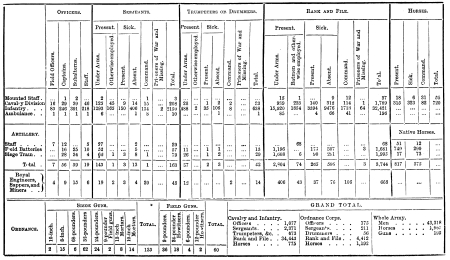
THE FOLLOWING ARE THE MOST IMPORTANT ARTICLES OF THE TREATY, SIGNED
BY THE REPRESENTATIVES OF THE GREAT POWERS, AT THE END OF THE
CRIMEAN WAR.
Art. VII. Her Majesty the Queen of the United Kingdom of Great Britain
and Ireland, His Majesty the Emperor of Austria, His Majesty the Emperor
of the French, His Majesty the King of Prussia, His Majesty the Emperor
of all the Russias, and His Majesty the King of Sardinia, declare the
Sublime Porte admitted to participate in the advantages of the public
law and system (concert) of Europe. Their Majesties engage, each on
his part, to respect the independence and the territorial integrity of
the Ottoman Empire; guarantee in common the strict observance of that
engagement, and will, in consequence, consider any act tending to its
violation as a question of general interest.
Art. VIII. If there should arise between the Sublime Porte and one or
more of the other signing Powers any misunderstanding which might
endanger the maintenance of their relations, the Sublime Porte, and each
of such Powers, before having recourse to the use of force, shall afford
the other Contracting Parties the opportunity of preventing such an
extremity by means of their mediation.
Art. IX. His Imperial Majesty the Sultan, having, in his constant
solicitude for the welfare of his subjects, issued a firman which, while
ameliorating their condition without distinction of religion or of race,
records his generous intentions towards the Christian population of his
empire, and wishing to give a further proof of his sentiments in that
respect, has resolved to communicate to the Contracting Parties the said
firman, emanating spontaneously from his sovereign will.
The Contracting Powers recognize the high value of this communication.
It is clearly understood that it cannot, in any case, give to the said
Powers the right to interfere, either collectively or separately, in the
relations of His Majesty the Sultan with his subjects, nor in the
internal administration of his empire.
Art. XI. The Black Sea is neutralized: its waters and its ports, thrown
open to the mercantile marine of every nation, are formally and in
perpetuity interdicted to the flag of war, either of the Powers
possessing its coasts, or of any other Power, with the exceptions
mentioned in Articles XIV. and XIX. of the present Treaty.
Art. XIII. The Black Sea being neutralized according to the terms of
Article XI, the maintenance or establishment upon its coast of
military-maritime arsenals becomes alike unnecessary and purposeless; in
consequence, His Majesty the Emperor of all the Russias and His Imperial
Majesty the Sultan engage not to establish or to maintain upon that
coast any military-maritime arsenal.
Art. XXII. The Principalities of Wallachia and Moldavia shall continue
to enjoy, under the suzerainty of the Porte, and under the guarantee of
the Contracting Powers, the privileges and immunities of which they are
in possession. No exclusive protection shall be exercised over them by
any of the guaranteeing Powers. There shall be no separate right of
interference in their internal affairs.
Art. XXVIII. The Principality of Servia shall continue to hold of the
Sublime Porte, in conformity with the Imperial Hats which fix and
determine its rights and immunities, placed henceforward under the
collective guarantee of the Contracting Powers.
In consequence, the said Principality shall preserve its independent and
national administration, as well as full liberty of worship, of
legislation, of commerce, and of navigation.
Art. XXIX. The right of garrison of the Sublime Porte, as stipulated by
anterior regulations, is maintained. No armed intervention can take
place in Servia without previous agreement between the High Contracting
Powers.
Treaty between Her Majesty, the Emperor of Austria, and the
Emperor of the French, guaranteeing the Independence and
Integrity of the Ottoman Empire.
Signed at Paris, April 15, 1856.
Ratifications exchanged at Paris, April 29, 1856.
Art. I. The High Contracting Parties guarantee, jointly and severally,
the independence and the integrity of the Ottoman Empire, recorded in
the Treaty concluded at Paris on the thirtieth of March, one thousand
eight hundred and fifty-six.
Art. II. Any infraction of the stipulations of the said Treaty will be
considered by the Powers signing the present Treaty as casus belli.
They will come to an understanding with the Sublime Porte as to the
measures which have become necessary, and will without delay determine
among themselves as to the employment of their military and naval
forces.
THE DENUNCIATION OF THE TREATY OF PARIS.
Earl Granville to Sir A. Buchanan.
FOREIGN OFFICE, Nov. 10, 1870.
Sir,—Baron Brunnow made to me yesterday the communication respecting
the Convention between the Emperor of Russia and the Sultan, limiting
their naval forces in the Black Sea, signed at Paris on the 30th of
March, 1856, to which you allude in your telegram of yesterday
afternoon.
In my despatch of yesterday I gave you an account of what passed between
us, and I now propose to observe upon Prince Gortschakoff's despatches
of the 19th and 20th ult., communicated to me by the Russian Ambassador
on that occasion.
Prince Gortschakoff declares, on the part of His Imperial Majesty, that
the Treaty of 1856 has been infringed in various respects to the
prejudice of Russia, and more especially in the case of the
Principalities, against the explicit protest of his representative, and
that, in consequence of these infractions, Russia is entitled to
renounce those stipulations of the Treaty which directly touch her
interests.
It is then announced that she will no longer be bound by the Treaties
which restrict her rights of sovereignty in the Black Sea.
We have here an allegation that certain facts have occurred which, in
the judgment of Russia, are at variance with certain stipulations of the
Treaty, and the assumption is made that Russia, upon the strength of her
own judgment as to the character of those facts, is entitled to release
herself from certain other stipulations of that instrument.
This assumption is limited in its practical application to some of the
provisions of the Treaty, but the assumption of a right to renounce any
one of its terms involves the assumption of a right to renounce the
whole.
This statement is wholly independent of the reasonableness or
unreasonableness, on its own merits, of the desire of Russia to be
released from the observation of the stipulations of the Treaty of 1856
respecting the Black Sea.
For the question is, in whose hand lies the power of releasing one or
more of the parties from all or any of these stipulations?
It has always been held that that right belongs only to the Governments
who have been parties to the original instrument.
The despatches of Prince Gortschakoff appear to assume that any one of
the Powers who have signed the engagement may allege that occurrences
have taken place which in its opinion are at variance with the
provisions of the Treaty; and, although this view is not shared nor
admitted by the co-signatory Powers, may found upon that allegation, not
a request to those Governments for the consideration of the case, but an
announcement to them that it has emancipated itself, or holds itself
emancipated, from any stipulations of the Treaty which it thinks fit to
disprove. Yet it is quite evident that the effect of such doctrine, and
of any proceeding which, with or without avowal, is founded upon it, is
to bring the entire authority and efficacy of Treaties under the
discretionary control of each one of the Powers who may have signed
them; the result of which would be the entire destruction of Treaties in
their essence. For whereas their whole object is to bind Powers to one
another, and for this purpose each one of the parties surrenders a
portion of its free agency, by the doctrine and proceeding now in
question one of the parties, in its separate and individual capacity,
may bring back the entire subject into its own control, and remains
bound only to itself.
Accordingly, Prince Gortschakoff has announced in these despatches the
intention of Russia to continue to observe certain of the provisions of
the Treaty. However satisfactory this might be in itself, it is
obviously an expression of the free will of that Power, which it might
at any time alter or withdraw; and in this it is thus open to the same
objections as the other portions of the communications, because it
implies the right of Russia to annul the Treaty on the ground of
allegations of which she constitutes herself the only judge.
The question therefore arises, not whether any desire expressed by
Russia ought to be carefully examined in a friendly spirit by the
co-signatory Powers, but whether they are to accept from her the
announcement that, by her own act, without any consent from them, she
has released herself from a solemn covenant.
I need scarcely say that Her Majesty's Government have received this
communication with deep regret, because it opens a discussion which
might unsettle the cordial understanding it has been their earnest
endeavour to maintain with the Russian Empire; and for the
above-mentioned reasons it is impossible for Her Majesty's Government to
give any sanction, on their part, to the course announced by Prince
Gortschakoff.
If, instead of such a declaration, the Russian Government had addressed
Her Majesty's Government and the other Powers who are parties to the
Treaty of 1856, and had proposed for consideration with them, whether
anything has occurred which could be held to amount to an infraction of
the Treaty, or whether there is anything in the terms which, from
altered circumstances, presses with undue severity upon Russia, or
which, in the course of events, had become unnecessary for the due
protection of Turkey, Her Majesty's Government would not have refused to
examine the question in concert with the co-signatories to the Treaty.
Whatever might have been the result of such communications, a risk of
future complications and a very dangerous precedent as to the validity
of international obligations would have been avoided.
I am, &c.,
(Signed) Granville.
P.S.—You will read and give a copy of this despatch to Prince
Gortschakoff.
Prince Gortschakoff to Baron Brunnow.
Czarskoe Selo, 8 (20) November, 1870.
M. le Baron,—The English Ambassador has read to and given me a copy of
a despatch of Lord Granville relating to our communications of the 19th
(31) of October.
I have hastened to place it before His Majesty the Emperor. It has
pleased our August Master to notice, first, the earnest desire of the
Cabinet of London to maintain a cordial understanding between England
and Russia, and secondly, the assurance that it would not refuse to
examine the modifications which circumstances have caused in the results
of the Treaty of 1856. As regards the view of strict right laid down by
Lord Granville we do not wish to enter into any discussion, recall any
precedent, or cite any example, because such a debate would not conduce
to the understanding that we desire.
Our August Master has had an imperative duty to fulfil towards his
country, without wishing to wound or threaten any of the Governments who
signed the Treaty of 1856. On the contrary, His Imperial Majesty appeals
to their sentiments of justice, and to the consciousness of their own
dignity.
We regret to see that Lord Granville dwells chiefly on the form of our
communications. It was not done by our choice. Assuredly, we should have
desired nothing better than to arrive at the result in harmony with the
Powers who signed the Treaty of 1856. But Her Britannic Majesty's
principal Secretary of State well knows that all the efforts repeatedly
made to unite the Powers in a common deliberation, in order to do away
with the causes of complication which trouble the general peace, have
constantly failed. The prolongation of the actual crisis, and the
absence of a regular Power in France, remove still further the
possibility of such an union. Meanwhile, the position of Russia by this
Treaty has become more and more intolerable. Lord Granville will allow
that the Europe of to-day is very different from that which signed the
Act of 1856. It was impossible that Russia should consent to remain
indefinitely bound by a transaction which, already onerous when
concluded, lost its guarantees from day to day.
Our August Master knows his duty towards his country too well to impose
on it any longer an obligation against which the national feeling
protests.
We cannot admit that the abrogation of a theoretical principle without
immediate application, which only restores to Russia a right of which no
other nation would be deprived, can be considered as a menace to peace,
or that the annulment of one point in the Treaty implies the annulment
of the whole.
Such has never been the intention of the Imperial Cabinet. On the
contrary, our communications of the 19th (31st) of October declare in
the most explicit manner that His Majesty the Emperor adheres entirely
to the general principles of the Treaty of 1856, and that he is ready to
come to an understanding with the Powers who signed that transaction,
either by confirming the general stipulations, or by renewing them, or
by substituting for them any other equitable arrangement which will be
considered fitting to ensure tranquillity in the East, and the
equilibrium of Europe. There seems to be no reason why the Cabinet of
London, if agreeable to it, should not enter into explanations with
those who signed the Treaty of 1856.
On our part, we are ready to join in any deliberation having for its
object the general guarantees for consolidating the peace of the East.
We are sure that this peace would receive additional security if a
permanent cause of irritation now existing between the two Powers most
directly interested in it was removed and their mutual relations were
resettled on a good and solid understanding.
You are requested, M. le Baron, to read and give a copy of this despatch
to Lord Granville.
The principal Secretary of State of Her Britannic Majesty has expressed
to you the regret he would experience if this discussion would alter the
good understanding which the Government of Her Majesty the Queen has
striven to maintain between the two countries. Will you inform his
Excellency how much the Imperial Cabinet would share in this regret.
We think the good understanding of the two Governments essentially
useful to the two countries, as well as to the peace of the world. It is
with a lively satisfaction that we have seen it become during the last
few years more and more intimate and cordial.
The parity of the circumstances in which we are placed seem of a kind to
render this more desirable than ever.
Receive, &c.,
Gortschakoff.
Earl Granville to Sir A. Buchanan.
Foreign Office, Nov. 28.
Sir,—The Russian Ambassador has read and given to me a copy of a
despatch of Prince Gortschakoff of the date of 8th (20th) November.
It is not necessary for Her Majesty's Government to recur to the
important questions of international law raised by the circular of
Prince Gortschakoff, as they have nothing to add to the declaration on
the subject which they have already made.
His Excellency has been good enough to appeal to my knowledge of facts
which His Excellency states prevented that consultation and agreement
with other parties to this Treaty which Russia would have preferred.
I am aware that suggestions for Congresses to settle other European
questions have been made and not adopted.
It has been also stated to me that intimations have been given to some
of my predecessors, that in the case of certain contingencies, which
however have never occurred, such as the possession of the
Principalities by Austria, Russia would feel bound to call into question
some of the provisions of the Treaty of 1856. But I am ignorant of any
occasion on which Russia, the party most interested, has proposed in any
way to this country that a relaxation of the Treaty should be taken into
consideration.
I cannot therefore admit that the Imperial Government can justify this
proceeding by the failure of efforts which have never been made.
The courteous language in which Prince Gortschakoff's despatch is
written, his assurance of the manner in which he would have preferred to
open this question, and his declaration of the strong desire for a
confirmation of good relations between the two nations, particularly
important at this time, encourage Her Majesty's Government in the belief
that the obstacle to such relations will be removed.
They observe that His Excellency describes the declaration which has
been made by Russia as an abrogation of a theoretical principle without
immediate application. If these words are to be construed into an
announcement that Russia has formed and stated her own opinion of her
rights, but has no intention of acting in conformity with it without due
concert with the other Powers, they go far to close the controversy in
which the two Governments have been engaged.
Her Majesty's Government have no objection to accept the invitation
which has been made by Prussia to a Conference, upon the understanding
that it is assembled without any foregone conclusions as to its results.
In such case Her Majesty's Government will be glad to consider with
perfect fairness, and the respect due to a great and friendly Power, any
proposals which Russia may have to make.
You will read and give a copy of this despatch to Prince Gortschakoff.
I am, &c.,
(Signed) Granville.
THE CONFERENCE OF 1871.
THE RESULT OF THE DENUNCIATION OF THE TREATY OF PARIS BY
RUSSIA WAS THAT A CONFERENCE, SUGGESTED BY PRINCE BISMARCK,
WAS ARRANGED TO MEET AT LONDON.
Protocol No. 1.
At the Sitting of January 17.
Earl Granville expressed himself as follows:—
Earl Granville—
"The Conference has been accepted by all the co-signatory Powers of the
Treaty of 1856, for the purpose of examining, without any foregone
conclusion, and of discussing with perfect freedom, the proposals which
Russia desires to make to us with regard to the revision which she asks
of the stipulations of the said Treaty relative to the neutralization of
the Black Sea.
"This unanimity furnishes a striking proof that the Powers recognize
that it is an essential principle of the law of nations that none of
them can liberate itself from the engagements of a treaty, nor modify
the stipulations thereof, unless with the consent of the contracting
parties by means of an amicable understanding."
The Plenipotentiary of Russia requested the permission of the
Conference to read a summary which he wished to be inserted in the
Protocol:—
"He instanced specially the precedent of the Conferences held at
different periods in Paris, and cited the decisions adopted by
general agreement with the view of modifying the Government of the
Principalities of Moldavia and Wallachia, an alteration which
received the sanction of the Sublime Porte, as well as the assent
of the other Contracting Powers.
"He affirmed that these deviations from the Treaty have exercised
no influence on the firm intention of the Emperor to maintain
intact the general principles of the Treaty of 1856, which have
defined the position of Turkey in the system of Europe.
"In fact, these stipulations, suggested at another period under the
influence of conjunctures entirely different from the present
situation are no longer in harmony with the relations of good
neighbourhood which exist at this moment between the two Riverain
Powers."
Annex.
The Plenipotentiaries of North Germany, of Austria-Hungary, of Great
Britain, of Italy, of Russia, and of Turkey, assembled to-day in
Conference, recognize that it is an essential principle of the law of
nations that no Power can liberate itself from the engagements of a
treaty, nor modify the stipulations thereof, unless with the consent
Powers by means of an amicable arrangement.
In faith of which the said Plenipotentiaries have signed the present
Protocol.
Done at London, the 17th January, 1871.
(Signed) Bernstorff.
Apponyi.
Granville.
Cadorna.
Brunnow.
Musurus.
Broglie.
March 13, 1871.
A,
B,
C,
D,
E,
F,
G,
H,
I,
J,
K,
L,
M,
N,
O,
P,
Q,
R,
S,
T,
U,
V,
W,
Y,
Z
Adams, Brigadier-General, at Inkerman, 169
Adelaide, the, her arrival in Balaklava, 201
Agamemnon, the, her orders for sailing, 81;
enters Balaklava, and attacks the fort, 137
Airey, General Sir R., his encampment, 42;
superseded, 423
Aladyn, encampment at, 42, 46
Alexander, Colonel, 128
Alexander, Dr., 8
Allied armies, assembled at Varna, 50;
military review of the, 51;
their great losses in killed and wounded, 341;
their preparation for winter quarters, 379;
error of their campaign, 494, 495.
See French, and Soldiers
Alma, the river, halt of the Allied forces at, and preparations for the battle of, 98;
account of the battle, 102 et seq.;
position of the Russians on, 106;
the Allies victorious, 120;
retreat of the Russians from, ib.;
military conduct of the battle of, 121;
state of the battle-field, 483;
telegraph at, 486;
position and attack at, 486, 487;
bitter reflections on the battle, ib.;
graves at, 489;
frightful losses at, 490;
its entrenchments, ib.;
monument at, 491
Aloupka, visit to, 482;
the Colonel of, ib.;
dinner at, ib.
Aloushta, 476;
visits to, 479
Ambalaki, capture of, 268
Ambulance corps, wretchedness of the, 199;
disbanded, 378
Ambulances, their great utility, 363;
superiority of the English ones, 439
Anderson, Captain, 42, 87
Araba drivers, their disappearance from Roumelia and Bulgaria, 201
Arabas, arrival of, with provisions, 97
Arabat, Spit of, 277, 496;
unsuccessful attack on the fortress of, ib.
Armies of the Russians and the Allies, condition of the, 303;
their respective positions before Sebastopol, 305;
general state of the, 469
Armistice, for the burial of the dead, and interchange of civilities during the, 228, 246, 267;
sad scenes during the, 295;
news of, from the respective governments, 457;
mutual visits after the, 458 et seq.;
agreed to, 462;
followed by peace, 467
Arms, a gallant feat of, 258, 259
Army, British, its distressed position at Varna, 62;
its different divisions, and General Commander, 87;
its improved condition, 238;
its concentrated attack on Sebastopol, 351 et seq.;
its amount of armament in the bombardment of Sebastopol, 336 et seq.;
jealousies in the, 385, 386;
preparations for its winter encampment, 420.
See Crimea, and Soldiers
Artillery, duel of, 249;
its powerful effects, 463
Athens, Gulf of, 12
Athos, Mount, 12
Autemarre, General d', the French Commander in the Sea of Azoff, 265.
Azoff, expedition to the Sea of, 265;
capture of Yenikale, 268;
operations in the, 270 et seq.;
destruction of the Russian shipping, &c., 280;
complete success of the expedition, 281;
purity of its water, 496
Baidar, miserable state of, 475
Bakschiserai, retreat of the Russians to, 131;
visit to, 472;
miserable state of, 474
Balaklava, march of the expedition to, 137;
a poor village, ib.;
surrender of the town, ib.;
cholera at, 138;
intended attack of the Russians on, 156;
fortified earthworks thrown around, 166;
hurricane at, 180 et seq.;
miserable condition of, 191, 192;
dreadful scenes among the Turks in, 192;
false alarm at, 193;
improvements in, 235;
general state of, 250;
movements in front of, 325;
its singular aspect, 375;
discipline in the harbour of, 450;
improvements in, ib.
Baltschik, rendezvous of the expedition in, 70, 71
Barnard, General, appointed chief of the staff, 305;
his meeting with the Russians, 458
Bashi-Bazouks, their military characteristics, 51;
their encampment, 52;
disbanded, 57
Batteries before Sebastopol, 214, 215;
relative position and strength of the, 336 et seq.
Bayonet, sanguinary charge with the, at Inkerman, 169, 170;
contests with the, 255, 259;
reluctance to charge with the, 347
Bazancourt's strictures on the Allied forces, 97-100
Beatty, the engineer, his death, 250
Belbek, the river, 132;
scenery of the, ib.;
barrier of the, 133;
arrival of the Allied troops at, ib.;
false alarm at, 135;
deliberations at, 136;
march from the, ib.;
heights of the, 484;
cantonments on the, ib.
Bell, Captain, his gallantry at Alma, 114
Bentinck, Major-General Sir H., lands at Eupatoria, 86;
his orders relative to the services of the fourth division, 392
Berdiansk, attack on, 270
Birds, crowds of, on board ship, 9, 10;
Crimean varieties, 233
Bizot, General, killed, 252
Black River, the, 133;
gorge of the, 166
Black Sea, entrance of the expedition into the, 39
Blane, Major, 183
Bombardment of Sebastopol, 250 et seq.;
terrible effects of the, 335, 338 et seq.
See Sebastopol
Bomb-shells of the Russians, 248, 343
Bonaparte, Emperor, his intended visit to the Crimea, 260
Bono Johnnies, 53, 54, 175
Bosphorus, arrival of the British troops in the, 23;
scenery of the, 37, 38
Bosquet, General, commander of the second division of the French, 56;
his command at the Alma, 98;
his bravery, 102, 103;
at the Tchernaya, 155;
at Inkerman, 172
Bouljanæk, affair at, 94 et seq.
Bouet Willaumez, the French Admiral, 487
Boussiniere, his bravery at Alma, 103
Boxer, Admiral, commander of Balaklava, 210;
his improvements at Balaklava, 239
British soldiers, their devoted heroism, 2, 3
British troops, their disembarkation at Eupatoria, 84.
See Soldiers
Brown, General Sir G., 8;
visits Rustum Pasha, 15;
his quarters, 16;
cordiality of the French towards, 16;
a strict disciplinarian, 23;
proceeds to Varna, 36;
his landing at Eupatoria, 85;
his danger, ib.;
commands the light division, 87;
his gallantry at the Alma, 113, 114;
at Inkerman, 169;
his operations, 242;
commander of the expedition to the Sea of Azoff, 265
Bruat, Admiral, 27;
death of, 447;
high mass celebrated for the soul of, ib.
Bucharest, captured by Omar Pasha, 55
Bug, river, expedition up the, 413;
scenery on the banks of the, ib.;
conflict with the Russians, 414;
its confluence with the Dnieper, 415;
operations in the, 416, 417;
raising of the blockade, 419;
difficulties of ascending it, ib., note
Bulair, town of, 16, 21;
military works at, 23;
fortifications at, 27
Bulgaria, peasantry of, 43, 44;
immense forces assembled in, 48, 49;
the natives forsake their homes, 46
Buller, Brigadier-General, 42
Burgoyne, Sir John, proposes the flank march, 132, 134;
his departure for England, 243
Burliouk, ruins of, 489, 491
Burrell, Dr., 8
Cafés at Gallipoli, 17, 18
Calvert, Mr., the consul at Gallipoli, 15;
his active efforts, ib.
Cambridge, Duke of, his arrival at Gallipoli, 30;
dines with the Sultan, 33;
lands at Eupatoria, 86;
commands the first division, 87;
his gallantry at Alma, 114;
at Inkerman, 169
Camel, anecdote of one at Sebastopol, 439
Cameron, General, of the Highland division, 324
Camp-followers in the Crimea, 449, 450
Camp life, 48
Campbell, General Sir Colin, 25;
his military experience, 114
Campbell, General Sir J., of the fourth division, 242;
his military operations, ib.;
death of, 292
"Canards," hatching of, 215
Canrobert, General, 6;
at Gallipoli, 15;
arrives at Varna, 41;
his bravery at Alma, 102;
assumes the command of the French troops, 139;
at Inkerman, 172;
his order of the day after the battle of Inkerman, 190;
his address to the troops, 260
Canteen-keepers, their rapacity, 445
Carbuccia, General, death of, 56
Cardigan, Lord, his difficult reconnaissance, 54;
his early operations, 94;
at the Tchernaya, 155;
his desperate cavalry charge at Balaklava, 159
Careening Bay, Sebastopol, 143
Casualties, number of, 324, 432
Cathcart, Sir G., commands the fourth division, 87;
at Balaklava, 139;
slain at Inkerman, 170;
his advice while living disregarded, 436
Cathcart's Hill, its position, 248, 249, 252;
view of Sebastopol from, 334;
present state of, 375
Cavalry brigade, British, criticisms on the, 152;
its charge on the Russians, 157;
relics of the, 257
Cemetery, struggle for the, 292;
its capture, 294
"Chambers of horrors," 367
Chapman, Captain, at Sebastopol, 151
Charges at night, difficulties of describing, 261
Chasseurs, at Inkerman, 171;
review of the, 261
Cherson, Cape, lighthouse of, 138
Cherson Bay, cruise up the, 413
Chersonese, Cape, 76;
memorials of the brave at the, 494
Cholera, its violence in Bulgaria, 56;
at Varna, 57, 58;
horrors attending it, 58, 61, 62;
its ravages at Balaklava, &c., 138, 139, 447
Christian subjects of Turkey, their right to protection, 2
Christmas of 1854, its dreariness in the Crimea, 196;
of 1855, 447
Church, desolated interior of a, 257
Civilians, their criticisms on military matters, 447
Classical fictions, 10
Clifford, Hon. Mr., 115
Climate of the Dardanelles and surrounding country, 25, 26
Clothing, terrible deficiency of, 196, 197;
supplied by the Times' commissioner, 196;
general supplies of, 202, 441
Codrington, General Sir W., his gallantry at Alma, 111, 112;
at Inkerman, 169;
his justification, 353;
appointed commander-in-chief, 423;
his various promotions, 424, 425;
his career, 425;
his general orders, 425;
his grand review of the British troops, 454-456;
his general orders respecting the departure of the Sardinians, 492
Coffee, wretched supply of, 204
Colborne, Major, 31
Cold, destructive effects of the, 205, 206;
paralyzing effects of, 221
Colville, Captain, his bravery at Alma, 111
Comet, appearances of the, 9
Commissariat department, 8;
its difficulties at Gallipoli, 20, 21;
its pressure of business, 59;
its supplies, 179;
its deficiencies, 191;
improvement in the supplies, 238;
favourable changes in the, 437
Commission, mixed, at Sebastopol, for distributing the prize captures, 381-385
Cooking, want of apparatus for, 478
Cooking rations, receipts for, 219
Corn, destruction of, in the Sea of Azoff, 270;
quantity of, issued to the English army, 375;
great waste of, 444
Cossacks, appearance of the, 80, 84;
first encounter with the, 94, 95;
their indefatigability, 202;
their cunning, 212;
a brush with the, 258;
their sly manœuvres at Kinburn, 420;
their appearance and habiliments, 459, 473, 480;
their horses, 480, 481
Councils, divided, evils of the, 426
Crimea, causes of the expedition to the, 1;
preparations for the campaign, 2 et seq.;
influence of the press on the, 2, 3;
early difficulties, and imperfect arrangements for the war, 15, 17;
orders for attacking the, 56;
preparations for invading the, ib.;
Russian forces at the, ib.;
departure of the expedition, 70;
its shores and anchorage, 73 et seq.;
landing at Eupatoria, 84-86;
first encounters with the Russians, 89, 94, 95;
amount of the invading force, 87;
Tartar race of the, 88;
march of the Allied army, 83 et seq.;
battle of the Alma, 97 et seq.;
advance from the Alma, 129;
movements of the Russians, 133;
advance on Belbek, 134;
capture of Balaklava, 137;
arrival at Sebastopol, 138;
and its investment, 141 (see Sebastopol);
battle of Inkerman, 169;
hardships of the campaign, 179;
attack on Eupatoria, 190;
attack of the French on Sebastopol, and the progress of the siege, 200;
great hardships, 203;
climate, ib.;
the Times' fund sent to the, 196;
commencement of active operations in the spring, 231;
railway in the, 232;
birds and flowers in the, 233;
sports of the camp, 234;
march of improvement in, 235;
severe fighting before Sebastopol, 244 et seq.;
Kertch expeditions, 263, 265;
expedition to the Sea of Azoff, 265;
severe fighting before Sebastopol, 284 et seq.;
death of Lord Raglan, 299;
General Simpson appointed Commander-in-Chief, 301;
battles of the Tchernaya, 155, 315;
the Sardinian contingent, 310;
capture of the Malakoff, 343;
retreat of the Russians, 361;
capture of Sebastopol, 362;
review of the great struggle, 370 et seq.;
state of the two armies, 387;
ruins of Sebastopol, 387-389;
General Simpson's despatch respecting operations in, 390;
mildness of the weather in November, 1855, 427, 429;
disadvantageous position of the Allies in the, 427;
winter of 1855, 440;
mud of the, 444;
Russian forces in the, 446;
a second Christmas in the, 447;
winter in the, ib.;
storm in the, 448;
camp followers in the, 449;
destruction of the Sebastopol docks, 451-453;
the British forces in the, 454-456;
armistice takes place, 462;
peace proclaimed, 467;
preparations for evacuation, 468;
review of the great struggle, 468-471;
excursion into the interior, 472;
tour through the, and general aspect of the country, 473;
departure of the Sardinian staff from, 492;
memorials of the brave, 494;
tour in the north of the, ib.;
its outlets, and the difficulties these presented to the Russians, ib.;
wells of the, ib.;
salt waters of the, 495;
German villages of the, 496;
reflections on the campaign, ib.
Crimean Flora, 477
Croat labourers, their physical strength and endurance, 232
"Crow's Nest," battery so called, 338
Cuddy, Lieut.-Colonel, his bravery and ill-treatment, 466;
his death, ib.
Dardanelles, arrival of the British troops at the, 12;
coasts of the, ib.;
climate and scenery of the, 25, 26
Dead, armistice for the burial of the, 228, 246, 287, 295
Death, the valley of, 64, 67
Demur Kapu, 476
Desaint, Colonel, 56
Deserters from the Allied forces, 204;
from the Russians, 204, 234;
their accounts from Sebastopol, 204;
stories of the, 387;
their miserable plight, ib.
Devno, march to, 50; the Valley of Death, 64, 67
Diarrhœa among the troops at Varna, 46
Dickson, Colonel, 24;
at Balaklava, 139;
at Sebastopol, 146;
at Inkerman, 170
Dinner, a Crimean one, 219
Discipline, relaxation of, 427
Divisions of the British forces, and their commanders, 87;
their landing at Eupatoria, 85, 86;
their order of march, 93
Djemel Pasha, commander of the Dardanelles, 19;
his learning and intelligence, 19, 20
Dnieper, entry of the united squadron into the, 415;
its blockade raised, 419;
difficulties of ascending the, 419, note
Dobrudscha, campaign in the, and losses experienced thereby, 56
Docks, of Sebastopol, destroyed, 451-453
Dog-hunting in the Crimea, 235
Dogs and cats from Sebastopol, 439
Doyne, Mr., the head engineer, his vigorous labours at Sebastopol, 388, 421, 441
Dragoon Guards, their charge on the Russians, 157
Drainage, operations of, 442
Dress of the British soldiers, 18
Drummers of the Crimea, 450
Drunkenness, punishment of, 445
Dundas, Admiral, 41;
his orders, 76
Egerton, Colonel, his bravery at the Alma, 116
Egyptian troops at Varna, 49
Elchingen, Duc d', death of, 56
Electric telegraph laid down, 236;
its tendency to mischievous consequences, 443
Electricity, agencies of, 278
Eman, Colonel, killed, 353
Emperor, the guiding star of the fleet, 82
Engineering works, scarcity of men for, 243, 244
England, her commercial interests as regards Turkey, 1
England, Sir Richard, arrives at the Dardanelles, 25;
commands the third division, 87
English. See Soldiers, and Army
Enniskilleners, their charge on the Russians, 157
Enos, town of, 15
Entrenchments, advance of the, 308
Espinasse, General, 56
Estcourt, General, 129; death of, 299
Etesian wind, 11
Etonnoirs of the French, 255, 494
Eubœa, 12
Eupatoria, survey of the coast of, 59;
coast of, 75, 76;
town of, 80;
selected for the landing-place, ib.;
inhabitants of, 82;
landing of the French at, 82, 83;
resolution to garrison it, 91;
Russian attack on, 190
Evans, General Sir de Lacy, arrives at the Dardanelles, 25;
commands the second division, 87;
lands at Eupatoria, 86;
his bravery at the Alma, 107, 115;
his report of military operations at the Alma, 116;
his despatch from the heights of the Tchernaya, 161-163;
his illness, 165, 175
Expedition, Crimean, its departure, 70;
its extent, 71;
vastness of the armada conveying it, 73;
its voyage from Varna to the Crimea, 73-75;
its uncertainties, 75, 76;
account of its disembarkation, 84-88;
military force of the, 87;
marches into the interior, ib.;
its order of march, 93;
its halt at the Alma, 96;
at the Katcha, 132;
accession of forces at the, ib.;
makes a détour round the Belbek, 132 et seq.;
its march from the Belbek to Balaklava, 136, 137.
See Crimea, and Sebastopol
Explosions, disastrous ones, 328, 361, 380, 429-433;
causes, 433
Eyre, Brigadier, 25;
appointed to the command of the third division, 311;
his excursion in the interior of the Crimea, 479
Fatigue parties, severe duties of the, 197
Fatima Hanoum, the Kurdish chieftainess, 54
Ferguson, General, 7
Fidonisi, French rendezvous of, 71
Fighting, love of, an anecdote, 434
Filder, Commissary-General, 40;
his office in Varna, 59;
his instructions, 67
Fire, a disastrous one, 380
Flagstaff Battery, contentions for the, 191
Flank march of the Allies, 134
Fleet of the Russians, its submergement, 472, 473
Flowers of the Crimea, 233
Food, prices of, at Varna, 41
Forey, General, his bravery at the Alma, 103
Fort Constantine, in Sebastopol, 138
Forts of the north side of Sebastopol, 472
Fourth division, General Bentinck's testimony to their services, 392
France, her political interests as regards Turkey, 1
French camp, sickness in the, 218;
their superiority in cooking, ib.
French fleet, conveying the expedition, 73, 74
French Spahis effect a landing at Eupatoria, 83
French forces, their arrival at Malta, 6;
their superior arrangements, 15, 16, 21, 47;
their accommodations at Gallipoli, 17, 18;
their police regulations, 18;
their mode of making purchases, 17;
number of, at Gallipoli, 16, 21;
their cordiality to the English, 18, 48;
their uniforms, ib.;
their methods of dealing with the Turks, 17;
review of, at Gallipoli, 28;
staff of the, 29;
first land on the Crimea, 82, 83;
their successful bravery at the Alma, 102;
their landing at Kamiesch, 138;
their siege and bombardment of Sebastopol, 140 et seq.;
their order of battle at Inkerman, 174, 175;
road made by the, 198;
important reinforcements received, 205;
their sufferings, 209;
their conflicts with the Russians, 239;
their contests for the rifle-pits, 253-255;
their gallantry, 259;
their capture of the Mamelon, 284, 285;
their unsuccessful attack on the Malakoff, 290, 291;
great losses sustained thereby, 292-294;
their second attack, and capture of the Malakoff, 343;
engaged at the battle of the Tchernaya, 316, 319;
amount of their ordnance on their last bombardment of Sebastopol, 336;
their works for storming the Malakoff, 364;
their operations after the fall of Sebastopol, 375 et seq.;
review of the, 422;
their system of mines, 493
Frost-bites in the Crimea, 202, 205, 221
Fury, the, her reconnaissance of Sebastopol, 59
Fusileer Guards, their arrival at Malta, 5;
their severe losses, 357
Gallipoli, departure of the English and French troops for, 8, 9;
arrival at, 13;
description of, 13, 14;
wretchedness of, 14;
population of, ib.;
its bad quarters, 15-17;
difficulties of the commissariat at, 17, 21;
high price of provisions, 22;
police regulations at, 18;
alarming fire at, 24;
confusion arising therefrom, 24, 25;
climate and scenery of, 25, 26;
arrival of generals at 27, 30
Gambier, Lieut. Colonel, commander of the siege train at Sebastopol, 146;
at Inkerman, 170
Generals of the army, deficiency of, 190
German colonists of the Crimea, 496
Genitchi, attack on, 270
Gibb, Captain, 9
Golden Fleece, the, 8, 9, 10, 12;
her arrival at Gallipoli, 13
Golden Horn, the, 37
Goldie, Brigadier-General, at Inkerman, 169;
slain, 170
Goodram, Samuel, blown up, 434;
anecdotes of, ib.
Gordon, Captain, 42;
at Sebastopol, 142
Gortschakoff, Prince, 101;
his operations, 437;
his intended plan of operations, 441
Grant, Captain, of the ambulance corps, 199
Greece, localities of, 10, 11
Greek and Latin Churches, their quarrels in Turkey, 1
Greek hermit, 11
Greeks, their religion, 16;
their apathy, 29
Greys, their charge on the Russians, 157
Guards, their departure from London, 3;
their arrival at Malta, 4, 5;
their difficulty of obtaining provisions, 6;
their arrival at Varna, 47;
leave Varna for the Crimea, 67;
their gallantry at the Alma, 110, 114, 120;
their heroism and severe losses at Inkerman, 171, 175;
Queen Victoria's presents to the, 212;
their magnificent appearance in line, 115, 116
Hall, Dr., his letter to Dr. Smith, 385
Hallewell, Captain, 15, 31
Hamelin, Admiral, 41
Hammersley, Major, his tour in the north of the Crimea, 494
Handcock, Colonel, killed, 346
Harbour discipline at Balaklava, 450
Highland Brigade, their condition, 64;
leave Varna for the Crimea, 67;
their gallantry at the Alma, 110, 120;
steadiness of their movements in action, 115;
their bravery at the Tchernaya, 156;
their kilt, 202
Hill, Captain, shot, 247
Himalaya, the, her arrival at Malta, 5;
at the Bosphorus, 23;
her enormous cargo of horses and men, 90
Hoey, Colonel, his bravery at the Alma, 118
Horses, difficulty of getting them on shore, 90;
great havoc among, 206
Hospital quarters at Gallipoli, 17
Hurricane at Balaklava, 180;
its violence, 181-186;
distress caused thereby, 184, 185;
miserable state of Balaklava after the, 187
Hussars, arrival of the, 255
Hut of the author, 440;
its situation, 441
Huts, decorations of the, 439, 448;
robberies of the, 439;
complaints against the, 448
Ida, Mount, 12
Inkerman, the British force taken by surprise at, 168;
sanguinary battle of, 169-172;
a series of sanguinary hand-to-hand fights, 170;
review of the dreadful battle-field, 173;
the frightful slaughter at, 174-176;
ghastly relics of the battle, 257
Isarkaia, ruined chateau of, 478
Jack Tar at his tricks, 238;
his playbill, 329
John Bull at a nonplus, 326-328
Jones, General Sir H., replaces Sir J. Burgoyne, 243, 305
Kadikoi, encampment at, 144;
road made from, 198;
its administrative government, 445
Kamara, village of, 166
Kamiesch, landing of the French at, 138;
amusements at, 440
Kara-Bournou, destruction of the magazines, at, 267
Karaguel, town of, 67
Kariakoff, the Russian commander, 101
Kars, fall of, 447
Katcha, mouth of the, 59;
valley of the, 129-132;
river of the, 130;
Russian vessels sunk in the harbour of the, 132;
march from, 134
Keppel, Captain, commander of the naval brigade, 302
Kertch, expedition to, 263;
return of the expedition, 264;
second expedition, 265;
town of, 268, 269;
capture of, 268;
plunder of, 269, 270, 279;
its inhabitants, 272, 273;
hospital at, 274;
dreadful ravages in, 275, 276;
peninsula of, 419, note
Kinburn, expedition to, 406;
description of, ib.;
plan of the attack on, 407-409;
bombarded by the Allied fleet, 410;
surrender of, 411;
fort described, 412;
refortified by the Allies, 419;
Cossacks in the neighbourhood of, ib.
Koran, not adapted to the civil law of Turkey, 20
Kostendji, village of, laid waste, 57
Kurds, chieftainess of the, 54
Lancaster gun, destroyed by a shot, 252
Laspi, the French doctor, plundered by the Turks, 313
Lawrence, Colonel, 9, 111, 112
Leblanc, Mr., accidentally shot, 241
Leander, frigate, 12
Leslie, Lieutenant, wounded, 119
Letters from head-quarters, 31
Levinge, Major, death of, 60
Levinge, Captain, 42
Liège muskets, used by the Russians, 178
Light Cavalry Brigade, its desperate charge at Balaklava, 159;
ordered to embark for Eupatoria, 393
Light division, its heroic gallantry, 109, 111, 112;
its severe losses, 357;
its casualties, 432;
its attack at the Alma, 491
Lights, short supplies of, 440
"Looting" at Kertch, 272
Lucan, Lord, commander of the cavalry division, 33, 87;
at the Tchernaya, 154;
his desperate cavalry attack, 159;
his recall, 220
Lüders, General, 457
Luggage of the English and French armies, 30
Lyons, Admiral, his opinions on the flank march of the expedition, 134;
commands the expedition to the Sea of Azoff, 266;
his operations in Cherson Bay, 413 et seq.
Machines, for exploding, 278
Mackenzie's Farm, 133
Macnish, Lieutenant W. L., drowned, 34
Malakoff Tower, 207;
French preparations for attacking, 215;
unsuccessful attack on the, 290, 291;
great losses sustained, 292-294;
a second attack on the, left to the French, 303;
the French advances towards, 308;
assaulted and captured by the French, 343;
contest in the rear of the, 350, 351;
its capture causes the loss of Sebastopol, 365;
strength of its works, ib.;
terrible scenes of the, ib.;
number of guns captured in the, 383
Malea, Cape, 10, 11
Malta, arrival of the Guards at, 4;
busy scenes in, 5;
cordial reception of the British troops at, 5, 6;
arrival of the French troops at, 6, 8
Mamelon, attack on the, 243;
contest for the, 244;
firing from the, 249;
capture of the, 284;
continued struggles for the, 285;
interior of the, 297
Manilla, her arrival at Malta, 5
Mansell, Captain, 24, 54
Markham, General, assumes the command of the second division, 305
Marmora, Sea of, 14, 16, 25, 37
Marmora, General della, the Sardinian commander, 264;
his departure from the Crimea, 492;
honours paid to, ib.
Martimprey, General, 6
Matapan, Cape, 10
Maule, Colonel, death of, 60
May-day, in the Crimea, 262
Medals, distribution of, at Sebastopol, 372
Medicines, utter want of, in the Crimea, 208
Mediterranean, storm in the, 9
Mehemet Kiprisli Pasha, 34
Memorials of the brave in the Crimea, 494
Menschikoff, Prince, the Russian commander, at the battle of the Alma, 101;
his military force, 123;
his military genius, 436;
satirical songs on, 470
Michael, Grand Duke, at the battle of Inkerman, 168;
his reconnaissance of the Allied armies, 191
Middle Packet Ravine, 246, 296
Military spectacle, a grand one, 260
Military matters, criticisms of civilians on, 447
Mines, explosion of, 255;
of the French and Russians, 493
Minié rifle, its destructive effects, 171, 172
Miskomia, valleys of, 448, 475
Mitylene, 12
Mixed commission for dividing the spoils of Sebastopol, 381-385
Monastir, town of, 64, 67
Monetary arrangements, intricacy of, 22
Money, waste of, 326
Money-changers, Jew and Armenian, 32
Montezuma, her arrival at Malta, 6
Monument at the Alma, 491
Morea, coast of the, 10;
arrival of the troops at, 12
Mortar-battery, contest for the, 245
Mounted staff corps, disbanded, 378
Mud, of the Crimea, 444;
of Balaklava, 445
Mule-litters of the French, 199
Muscovite character, type of the, 490
Muscovite infantry, a bad lot of, at Kinburn, 412
Music, military, influence of, 141
Musketry, affair of, between the Russians and the French, 210
Napoleon, Emperor, his Christmas presents to the Crimean army, 198
Napoleon, Prince, arrives at the Dardanelles, 27;
reviews the troops, ib.;
his arrival in Bulgaria, 48
Naval brigade, their attack on the Redan, 291;
their severe losses, 294;
their admirable practice, 336
"Navvies," their rapid progress, 214;
their industry, 232
Newbury, Mr., death of, 60
Newspaper correspondence in the Crimea, 188;
its difficulties, 189
Newspapers, effect of their statements, 209, 210
Nicholaieff, its situation in the bay, 404;
dockyards of, 418;
its ship-building and arsenal, ib.
Nicholas, the Czar of Russia, his menacing pretensions, 1;
his ideas respecting the campaign, 65, 66;
death of, 236
Nicholas, Grand Duke, at the battle of Inkerman, 168
Niel, General, the French engineer, 214
Night attacks, difficulty of describing, 261
Nightingale, Miss Florence, her devoted labours at Scutari, 24
Nixon, Lieutenant, his bravery at the Alma, 111
Nolan, Captain, killed at Balaklava, 160
Norcott, Colonel, 105;
his bravery at the Alma, 109, 111, 114
November, anniversary of the month, 429;
favourable change of circumstances in the, ib.;
its seasonable mildness, ib.
Oczakoff, fort of, destroyed, 412
Odessa, threatened by the Allied fleets, 398;
the alarm of the inhabitants, 399;
reasons for not attacking, 401, 403;
description of, 398, 402
Old Fort, selected for the landing-place for the expedition, 81
Omar Pasha, his military appearance, 50;
his review of the troops, 51;
at Varna, 33;
his conference with Lord Raglan and Marshal St. Arnaud, 34;
his proposed plans, ib.;
his arrival at Sebastopol, 197;
his visit to the Crimea, 217;
undertakes to send 20,000 Turks to Sebastopol, 239;
is tired of his inactive position in the Crimea, 306;
his expedition in Asia Minor, 447
Order of Merit, suggestion respecting, 296, 451
Osmanli, their military courage, 49;
their want of discipline, ib.;
their military appearance, ib.;
their temperance and spare diet, 145;
their kindness to the sick, 165
Out-posts, good-fellowship of the, 211
Ovens, combat for the, 191
Paget, Lord G., ordered to Eupatoria, 393
Pashas of Turkey, their adherence to ancient usages, 20
Paskiewitch, General, his bombardment of Silistria, 34
Patton, Captain, death of, 139
Paulet, Lord, W., his promotion, 420
Pavlovskaia, fort of, 268;
occupation of, 277
Peace, rumours of, 325;
proclamation of, 467
Pelissier, Marshal, succeeds General Canrobert, 264;
created a marshal, 372;
his review of the British troops, 454-456
Pennefather, Brigadier-General, 25, 169
Pera, district of, 38
Perekop, its defences, 495
Peroffsky, mined chateau of, 475
Phoros, visit to, 475;
obstacles at, 476, 477
Pickets, affair of, 187
Piedmont, political situation of, 310;
character of her army, 311
Pluton, the, 8
Polish deserters, 191, 234, 387
Post-house, imperial, in Sebastopol, 130
Potteries district, 252
Powell, Captain, 55, 166
Press, its faithfulness and ability, and its support of the ministry, 2, 3
Promotions of officers, 420
Provisions, prices of, at Gallipoli, 24;
general depôt for, 201;
dearness of, at Balaklava, 213;
want of apparatus for cooking, 478
Purchase system, evils of the, 465-467
Quarantine battery, contentions for the, 191
Quarries, capture of the, 284;
continued contests for the, 285;
batteries of the, 338
Races in the Crimea, 234, 265
Rafts, Russian, capture of, 517
Raglan, Lord, the British Commander-in-Chief, his arrival at Gallipoli, 27;
his conference with Omar Pasha at Varna, 34;
visits the Turkish encampment, ib.;
his head-quarters at Scutari, 32;
his review of the troops, 94;
his want of communication with General Evans, 98;
his strong political feelings and aristocratic prejudices, 104;
an accomplished gentleman, but no general, 105;
his operations against Sebastopol, 140 et seq.;
his orders at Balaklava, 158, 159, 161;
his despatch after the battle of the Tchernaya, 163;
his death, 299;
his qualities, 300;
succeeded by General Simpson, 301
Railway road, its formation in the Crimea, 213, note, 214;
brought into use, 232
Railway train, accident with the, 249
Railway works, 441
Ranken, Major, death of, 458
Rations, ill supply of, 17;
scarce supply of, 440
Reade, Mr., death of, 139
Reconnaissance, preparations for, 220;
frustrated, 222
Red tape and routine business, 208, 212
Redan, defences of the, 253;
unsuccessful attack on the, 291, 292;
great losses sustained, 292-294;
final attack on the, 346 et seq.;
plan of assault, 344, 345;
description of the interior, 349 et seq.;
failure of the English attack, 350;
detailed account of the conflict 351 et seq.;
causes of the repulse, 356;
tremendous losses sustained thereby, 354, 355, 357-359;
ruin and desolation of the, 367;
number of guns captured in the, 383;
melancholy accident in the, 433
Redschid Pasha, the Turkish commander in the Sea of Azoff, 265
Reid, Sir W., 7
Rifle-pits, position of the, 241;
attacks on, and severe contests for the, 242, 243, 244, 253-255, 259
Riza Pacha, 34
Road-making, 375, 421;
difficulties of, 388
Roads, 198;
round Sebastopol, 441;
one from Balaklava to Kadikoi, 442
Rocket practice, its effects, 258
Ros, Lord de, quartermaster-general, 27;
his interview with Omar Pasha, 33
Rose, Brig-Gen., commissioner for the British army, 88
Round Tower of Sebastopol, defences of the, 253;
desperate contests for the, 285
Russia, causes of the war with, 1;
her spirit of aggression, 1, 2;
her armies on the Danube, 33;
and their siege of Silistria, 48;
death of the Emperor of, 236
Russian forces in the Crimea, 60;
their encampment bombarded by the Allied fleet, 89;
first encounter with the, 94, 95;
their determined bravery at the battle of the Alma, 103, 107-109;
their position, 106, 123;
their defeat, 113, 114, 125;
their retreat towards Simpheropol, 120;
their numbers, 123;
their loss in the battle, 126;
their defences on the north of Sebastopol, 133;
their movements ib.;
their defence of Sebastopol, 149 et seq.;
their manœuvring, 155, 159, 193;
their attack from the Tchernaya, 151, 193;
their cavalry defeated, 155;
their retreat from Balaklava, 160;
their fortified position, 166;
surprise the British at Inkerman, 168;
their desperate attack, 171;
defeated, 172;
formation of the army, 177;
their uniform and weapons, 177, 178;
their general appearance, 177, 178;
their devotion to their officers, ib.;
their barbarity to our men, ib.;
their furious conflicts, 214, 216, 227, 239, 242 et seq.;
receive reinforcements from Sebastopol, 243;
their great losses, 246;
their contests for the rifle-pits, 253, 254;
their movements towards the Tchernaya, 263;
their furious attack, and defeat, 263-265;
destruction of their ports, corn, and shipping, in the Sea of Azoff, 270;
continue to receive supplies of men and food, 306;
defeated at the battle of Tchernaya, 318;
the divisions engaged in the battle at Tchernaya, ib.;
concentration of the, 330;
their distressed condition, 339;
lose the Malakoff, and retreat to the north side of Sebastopol, 343;
their retreat after the capture of the Malakoff, 360, 361;
ability of their engineers, 362;
their operations after the fall of Sebastopol, 372, 373;
their defences and activity on the north side of Sebastopol, 376;
their firing, 380;
their miserable state after the capture of Sebastopol, 387;
their continued firing, 388;
capture of their immense rafts in the Dnieper, 417;
apprehensions of their renewed attacks, 435;
their threatening movements, 443, 446;
their attempt to surprise, 446;
their continued firing, 451;
their military music, 471;
their fleet submerged, 472, 473;
their mutual intercourse with the Allies, 465;
their mines, 493;
their immense losses in the Crimea, 496, 497
Russian New Year, opening of the, 200
Russian officer discovered at Eupatoria, 84
Russian song on the war, 470
Rustum, Pasha of Adrianople, 15
Sailor, his comparative comforts, 72
Sailors, British, their good-natured assistance to the troops, 86, 87
Sailors' batteries, their activity, 247, 249
Sailors' brigade, their severe losses, 253
St. Arnaud, Marshal, his arrival at Gallipoli, 30;
dines with the Sultan, 33;
his conference with Omar Pasha, at Varna, 34;
his vigour and coolness, 61;
his declaration to the army, on embarking for the Crimea, 66;
seized with illness, 74;
reviews the troops, 94;
explains his plan of battle, 97;
death, 139
St. Laurent, M., death of, 248
Salt lakes of the Crimea, 266, 495
Saltmarshe, Lieutenant, death of, 65
Sanatorium at Balaklava, 240
Sappers and Miners at Varna, 43
Sardinians, their arrival at the Crimea, 264;
their soldierlike equipments, ib.;
their character as soldiers, 311, 492;
their skill and bravery at the battle of the Tchernaya, 316-318;
their departure from the Crimea, 492;
general orders respecting, ib.
Saros, Gulf of, 16
Scarlett, Brigadier-General, 52;
at Balaklava, 157
Schapan, on the coast of the Crimea, 79
Scutari, arrival of troops at, 23;
the Alied forces at, 31, 32;
departure from, 36
Sea, life at, 72
Sea-passage, the, 9 et seq.
Sebastopol, orders for besieging, 56;
report respecting, 59;
reconnoitring of, 76;
forces of, 89;
its northern defences, 133;
south of, occupied by the Allies, 138;
investment of, and commencement of the siege, 140;
operations against, 141;
first sortie, 143;
the line of operations, 143, 144;
difficulties of the ground, 146;
the Russian defence, ib.;
the first bombardment, ib.;
effects of the fire upon, 146, 147;
the Russian manœuvres, 151;
its continued defence, 186;
its great strength, 211;
the tales of the siege, 193 et seq.;
during the winter, 195 et seq.;
reconnaissance of, 206;
Russian defences of, 206, 207;
furious contests before, 214;
a good view of, 224;
its general appearance, 225;
cannonading of, 227;
ships sunk in the harbour of, 228;
active operations against, 229, 231;
Russian reinforcements, 243;
furious struggles for, 244;
a number of officers killed and wounded, 244, 245;
its general defences, 248, 249;
desultory contests, 249;
continued bombardment of, 250 et seq.;
the various batteries brought against, 252;
its ruinous condition, 253;
renewed operations against, 282;
preparations for the general attack, ib.;
capture of the Mamelon and Quarries, 284;
and further struggles, 285 et seq.;
positions of the contending parties, 303 et seq.;
principal events of the siege, 304-306;
the writer's opinions as to its capture, 308;
letter of a Russian lady respecting, 309;
ominous preparations for the final assault, 312, 313;
crisis of the siege, 330;
commencement of the sixth and last bombardment, 334;
aspect of the city from Cathcart's Hill, ib.;
tremendous bombardment of, 335, 339;
frightful state of the town, 339, 348;
in flames, 341;
the Russians retreat to the north side on the capture of the Malakoff, 343, 360, 361;
visit to the city after its capture, 362;
plunder taken from, 363;
hospital of, 364;
general review of the great struggle, 370;
the Russian defences on the north side of, 376;
the mixed commission appointed for adjudicating the spoils of, 381-385;
materials and build of the forts of, 388;
ruins of, 387-389;
Russian account of its capture, 389;
state of affairs in, 420;
want of proper system and organization, 421;
proceedings of the mixed commission on the division of the spoils, 381-385;
how the city might have been taken, 436;
spoils of, contribute to the comfort of the army, 438;
sales of the different articles, ib.;
destruction of the docks, 451-453;
the city a mass of ruins, 454;
reflections on the siege, 468 et seq.;
northern forts of, 472
Seymour, Lieut.-Colonel, slain, 170
Shipping of the Russians, sunk in the harbour of Sebastopol, 228;
on fire, 340;
sunk and destroyed, 341
Ships of war engaged in the Crimean expedition, 67
Shumla, Turkish forces at, 34
Sick, comforts for the, 378
Sickness of the British troops, 196, 209, 217;
in the French camp, 198, 209, 218
Siege works, formidable progress of the, 236, 308, 322
Sievernaya, the, 133, 309;
defence of the, 133
Silistria, bombardment by the Russians, 34;
siege of, raised, 48
Simeis, Tartar village of, 481
Simoom, her arrival at Malta, 5
Simpheropol, typhus-haunted streets of, 473
Simpson, General, succeeds Lord Raglan as Commander-in-Chief, 300;
not suited for the position of Commander-in-Chief, ib.;
his order of the day announcing his appointment to the command, 301;
his personal staff, ib.;
receives the Grand Cross of the Legion of Honour, 372;
his despatch respecting the operations on the 8th of September, 390;
his failure as a commander, 424;
suspended, ib.;
his farewell address, ib.
Sinope, slaughter of, avenged, 370
Sivash, waters of the, 495
Snow-storm, effects of one, 221-223
Social vultures, 445
Soldier, his hardships, 72
Soldiers, British, their devoted heroism, 2;
their departure for Gallipoli, 9;
their voyage, 9 et seq.;
their arrival at the Dardanelles, 12;
quartered at Gallipoli, 15;
deficiency of accommodation for the, 16;
their difficulties at Gallipoli, 17;
their arrival in the Bosphorus, 23;
their uniforms, 18;
their complaints 46;
their disposition, 33;
their games and amusements, 35;
their sufferings at Varna, 62;
their landing at Eupatoria, 84;
want of accommodation for, 89;
sickness among, 91;
their operations and bravery at the battle of the Alma, 107 et seq.;
enter Balaklava, 137;
their siege and bombardment of Sebastopol, 140 et seq.;
surprised at Inkerman, 168;
their want of clothing, 179;
their distressing position, 180 et seq.;
their heroism, 199;
continual drain of, 209, 210;
effect of the author's statements, ib.;
their armament, 305;
their severe losses, 354, 355, 357-359;
not equal to the French as labourers, 389;
their increased comforts, 437, 441;
grand review of the, 454;
their splendid appearance, 455, 456
Soyer, M., at the Crimea, 328;
his system of cookery, ib.
Spahis, their capture of cattle, 91, 92
Spencer, Hon. General A., commander of the expedition to Eupatoria, 394
Spirit vendors, their abominable articles, 445;
expelled the Crimea, ib.
Sports of the camp, 234
Spring, sports of the, 234;
its genial influence, 239
Spy, Russian, in the trenches, 210;
his information trustworthy, 216
Squadrons, English and French, their formidable array before Odessa, 399, 400;
their plan of operations in the expedition to the Bay of Cherson, 406-409;
their attack on Kinburn, 407 et seq.;
compel its surrender, 411;
their departure from the Bay of Cherson, 417, 419
Strangways, General Fox, slain at Inkerman, 171
Staff of General Simpson, 301
Stanislaff, threatened attack on, 417
Star fort, in Sebastopol, 138, 309
Steamers, Russian, sunk at Sebastopol, 370
Stewart, Admiral Houston, 7;
his operations in Cherson Bay, 413, 414
Storms, in the Mediterranean, 9;
in the Dardanelles, 26;
their fatal effects, 33, 34, 180-186;
in the Crimea, 449
Sullivan, Colonel, 15
Supplies received by the Russians, 306
Surgeons of the Crimean army, official neglect of, 385
Suttlers, their rapacity, 445
Surgery of the English, its skill, 439
Taganrog, attack on, 270
Taioutine regiment, 133
Takli Bournou, Cape of, 266
Taman, coast of, 266
Tarkan Cape, promontory of, 73, 77
Tartar race of the Crimea, 88, 475;
their friendliness, 92;
their ruined villages, 478, 479
Tartars of Kertch, 272
Tchernaya, the river, 133;
occupied by the Russian infantry, 152;
the adjoining country, 153;
the Russians advance from the, 154, 155;
despatch of General Evans after the battle, 161-163;
attack on the, 315;
position of the, ib.;
battle of the, 316 et seq.;
the Russians defeated at, 318;
a review of the battle-field, struggle between the French and the Russians, 319;
fire of the English battery, 320;
last effort of the Russians, ib.;
their retreat, ib.;
memorials of the fight, 322;
excursion to the, after the armistice, 483
Tchongar, its defences, 495
Telegraph, information by, 421;
at Alma, 486
Tenedos, Mount, 12
Thaw, effects of a, 199, 200
Theatre, play-bill of the, 329;
acting in the, 329, 330
Therapia, number of wounded officers at, 311
Thomas, General, at the Alma, 102
Thompson, Dr., 129;
death of, 139
Tice, Dr., 42
Times, commissioner, various articles sent by the, 196;
his valuable supplies to the troops, ib.
Timoyoieff, General, his negotiations respecting the armistice, 459;
characteristics of, 461
Tornado, its violence, 368
Torrens, Brig.-General, at Inkerman, 169
Traktir, hamlet of, 137
Traktir bridge, novel scene at the, 458 et seq.;
armistice signed at the, 462
Transport, want of, at Varna, 46
Transports to the Crimea, 70
Trenches, terrible state of the, 197;
conversations in the, 261;
service in the, 331
Troad, the, 12
Trochu, Colonel, 56
Truce, flags of, 389;
See Armistice
Tryon, Lieut., death of, 190
Turco-Egyptian troops at Varna, 49
Turkey, her independence menaced, 1;
protection of her Christian subjects, 2;
her need of reform, 20
Turkish commission, its difficulties, 19
Turkish forces, strength of the, 34
Turks, their opinion of the English and the French, 18;
their apathy, 29, 35;
at Sebastopol, 145;
their redoubts, 153;
their flight from the Russian attack, 154;
employed in the trenches, 165;
their inefficiency, 165, 166;
their dreadful state in Balaklava, 192;
their removal from Balaklava, 235;
15,000 infantry join the besiegers before Sebastopol, 254;
their dress and appearance, ib.;
reconnaissance by the, 256;
their position in Asia Minor, 306;
their plundering disposition, 313, 314
Turner, Commissary-General, 15
Tylden, Brigadier-General, of the Engineers, death of, 128
Unett, Colonel, killed, 346
Uniforms of the French and English, 18
Upton, Mr., capture of, 138
Valetta, arrival of the British troops at, 5;
of the French troops, 6, 8
Valetta, the transport, 8
Varna, conferences at, between Omar Pasha and the Allied generals, 34;
departure of the troops at, 36;
arrival at, ib.;
town of, described, 40, 41;
march from, 41;
improvements at, 43;
surrounding country of, ib.;
animals of, ib.;
natives of, ib.;
inconveniences at, 45;
further arrival of troops at, 48, 49;
council of war at, 55;
cholera at, 57;
great fire at, 61;
council of war at, 63;
determine on invading the Crimea, ib.;
the army embarks from, 70
Varnutka, valley of, 475
Vatika Bay, landing at, 11
Vegetables and fruits, mismanagement in their supply, 217
Veliki, Lake of, 495
Vicars, Captain, killed, 245
Victor, Colonel, 9
Victoria, Queen, celebration of her birthday in Turkey, 35
Vivandière, the, 21
Wallachia occupied by Omar Pasha, 54
Walpole, Mr., leader of the Indian Osmanli, 55
Walsham, Lieutenant, 119
War, its false economy, 36, 45;
dreadful picture of the horrors of, 97 et seq.;
havoc of, 360 et seq.
Warren, Colonel, his bravery at the Alma, 118
Weare, Captain, 119
Weather, improvements in the, 214;
state of the, 217;
returning mildness of the, 235;
effects of the, 251
Wellington, Duke of, his circular to commanding officers in 1812, 390-392
Wells of the Crimea, 484, 494
Welsh Fusileers, monument to their officers slain at the Alma, 491
Wetherall, Colonel, 185
"Whistling Dick," 165
White buildings of Sebastopol, destruction of the, 457
Whitmore, Captain, 15
Wild-fowl shooting in the Crimea, 203, 234
Wild-fowl of the Crimea, 233
Windham, Colonel, bravery of, 346, 349, 350;
goes for assistance, 349;
his promotion, 420
Winter of 1855, four months of, 440;
its severity, 445
Winter encampments round Sebastopol, 193 et seq.;
requisitions, &c., evil system of, 194, 208
Winter quarters, preparations for, 166, 438
Wolff, Admiral, 270
Woronzoff, Colonel, palace of, 483
Woronzoff Road, 144, 310, 340, 342, 343
Wrangel, General Von, his hospitality, 495
Yalta, visit to, 476
Yea, Colonel, 118
Yellon, Deputy-Assistant-Commissary, killed, 432
Yenikale, capture of, 267;
town of, 270;
destruction and plunder at, 267-269
Yursakova, town of, 67
Yusuf, General, 51, 57
Zouaves, their dress and appearance, 22;
their martial bearing and equipments, 27, 28;
their pillaging propensities, 91, 195, 223;
their bravery at the Alma, 102;
at the Tchernaya, 155;
at Inkerman, 171;
our gay and gallant friends, 195;
their activity and bravery, 242;
review of the, 260;
their capture of the Mamelon, 284
| Typographical errors corrected by the etext transcriber: |
|---|
| Je suis radicalement oppose=> Je suis radicalement opposé {pg 401} |
| Light Divison=> Light Division {pg 49} |
| appeared to be be kept=> appeared to be kept {pg 49} |
| opportuity=> opportunity {pg 111} |
| crosssd=> crossed {pg 124} |
| Divison=> Division {pg 134} |
| Lancastar=> Lancaster {pg 146} |
| havresacks=> haversacks {pg 148} |
| of of => of {pg 163} |
| Quarantime Fort=> Quarantine Fort {pg 164} |
| earthworth of quadrilateral form=> earthwork of quadrilateral form {pg 166} |
| halycon=> halcyon {pg 184} |
| prepared againts=> prepared against {pg 188} |
| enciente=> enceinte {pg 191} |
| suggested by by=> suggested by {pg 192} |
| could not not describe=> could not describe {pg 192} |
| dysentry=> dysentery {pg 198} |
| beame=> became {pg 201} |
| maison bruleé=> maison brulée {pg 206} |
| parrallels=> parallels {pg 206} |
| the managment=> the management {pg 215} |
| The Navvy's Barrow=> The Navy's Barrow {pg 211} |
| Scarely=> Scarcely {pg 222} |
| seriously disabled=> seriously disable {pg 237} |
| twiced blessed=> twice blessed {pg 240} |
| Chasseurs Indigenes=> Chasseurs Indigènes {pg 260} |
| bear the whole brunt=> bears the whole brunt {pg 261} |
| between=> beween {pg 264} |
| these was sometimes=> there was sometimes {pg 273} |
The Austrian Consul was found to have a large store of corn, which he
concealed in magazines painted and decorated to pass as part of his
dwelling-house. It was all destroyed. Amid the necessary destruction,
private plunderers found facility for their work. Along the quay there
was a long line of walls, which once were the fronts of store-houses,
magazines, mansions, and palaces. They soon became empty shells, hollow
and roofless, with fire burning luridly within them by night, and
streaks and clouds of parti-coloured smoke arising from them by day. The
white walls were barred with black bands where the fire had rushed out
of the window-frames. These store-houses belonged to Russians, and were
full of corn—these magazines were the enemy's—these mansions belonged
to their nobles and governors—and these palaces were the residences of
their princes and rulers; and so far we carried on war with all the
privileges of war, and used all the consequences of conquest. In the
whole lengthened front facing the sea, and the wide quay which borders
it, there was not an edifice untouched but one. This was a fine mansion,
with a grand semicircular front, ornamented with rich entablatures and a
few Grecian pillars. The windows permitted one to see massive mirrors
and the framework of pictures and the glitter of brasswork. Inside the
open door an old man in an arm-chair received everybody. How deferential
he was! how he bowed! how graceful, deprecatory, and soothing the
modulation of his trunk and arms! But these were nothing to his smile.
His face seemed a kind of laughing-clock, wound up to act for so many
hours. When the machinery was feeble, towards evening, the laugh
degenerated into a grin, but he managed with nods, and cheeks wreathed
in smiles, and a little bad German and French, to inform all comers that
this house was specially under English and French protection, to save it
from plunder and pillage. The house belonged, on dit, to Prince
Woronzoff, and the guardian angel was an aged servitor of the Prince.
Being paralytic, he was left behind; and did good service in his
arm-chair.
The silence and desolation of places which a few days before were full
of people, were exceedingly painful and distressing. They were found in
every street, almost in every house, except when the noise of gentlemen
playing on pianos with their boot-heels or breaking up furniture was
heard within the houses or the flames crackled within the walls. In some
instances the people had hoisted the French or Sardinian flag to protect
their houses. That poor device was soon detected and frustrated. It was
astonishing to find that the humblest dwellings had not escaped. They
must have been invaded for the mere purpose of outrage and from the love
of mischief, for the most miserable of men could have but little hope of
discovering within them booty worthy of his notice.=> Repeat of Page 276
removed {pg 279-280} |
| Kertch and Yenikalè=> Kertch and Yenikale {pg 281 x 2} |
| Bastion du Mat=> Bastion du Mât {pg 305, 508} |
| confiedently affirmed=> confidently affirmed {pg 329} |
| Divisoin=> Division {pg 346} |
| her novel birth=> her novel berth {pg 369} |
| RESOURCES THE OF RUSSIANS=> RESOURCES OF THE RUSSIANS {pg 373} |
| on the 13th it marked 20° Fahrenheit=> on the 15th it marked 20° Fahrenheit {pg 448} |
| teh bugle=> the bugle {pg 450} |
| Tchnernaya=> Tchernaya {pg 457} |
| why the deuce doesn't go it off=> why the deuce doesn't it go off {pg 457} |
| them came a big puff=> then came a big puff {pg 458} |
| widely-spead rumour=> widely-spread rumour {pg 467} |
| neigbourhood=> neighbourhood {pg 475} |
| gaud jays=> gaudy jays {pg 475} |
| Petersburgh=> Petersburg {pg 488} |
| house of fine fine=> house of fine {pg 489} |
| have surrenderad=> have surrendered {pg 494} |
| CATCHCART'S HILL=> CATHCART'S HILL {pg 499} |
| I must point out out=> I must point out {pg 525} |
| consesequence=> consequence {pg 537} |
| with the ocnsent=> with the consent {pg 544} |