This is Volume II of a two-volume set. Volume I is available at
Project Gutenberg:
https://www.gutenberg.org/ebooks/75616. Index references to pages
within that volume are double-underlined here.
Larger versions of most illustrations may be seen by right-clicking them
and selecting an option to view them separately, or by double-tapping and/or
stretching them.
New original cover art included with this eBook is granted
to the public domain. It uses the original cover with title and author text
added by the Transcriber.
THE BRITISH BATTLE FLEET. — I. THE BARNABY ERA. — PROTECTED CRUISERS OF THE BARNABY ERA. — GUNS IN THE ERA. — THE COMING OF THE TORPEDO. — ESTIMATES IN THE ERA.
The characteristic motif of the Barnaby designs has
been described as a “maximum of offensive power
and the minimum of defence.” This is not
altogether correct; though as a generalization it is no
very great exaggeration. In every Barnaby design
proper, offence was the first thing sought for, but
defence as then understood was by no means overlooked
as to-day it appears to have been.
The bed rock “Reed idea” was to produce a ship
which could attack and destroy the enemy without
much risk of being damaged in doing so. The “Barnaby
idea” was that “the best defensive is a strong offensive”;
and a strict subordination of defence to what might
best serve the attack on the same displacement.
The first big armoured ship to be laid down at all
on Barnaby principles, the Inflexible, was built under
somewhat peculiar circumstances. In the year 1871 a
Committee was appointed. One of its findings was as
follows:—
“As powerful armament, thick armour, speed, and light draught
cannot be combined in one ship, although all are needed for the
defence of the country; there is no alternative but to give the
preponderance to each in its turn amongst different classes of ships
which shall mutually supplement one another.”1
Amongst the Committee’s suggestions had been the
abolition of the complete belt, and its concentration
amidships. This recommendation was mainly intended to
refer to cruising ships rather than to ships definitely
intended for the line of battle; but the idea soon spread.
These suggestions had already been embodied in a
modified form in the Shannon, of which particulars will
be found later on. The Shannon, however, was frankly a
“belted cruiser,” and no idea had then been entertained
of adapting a similar system for heavy armoured ships.
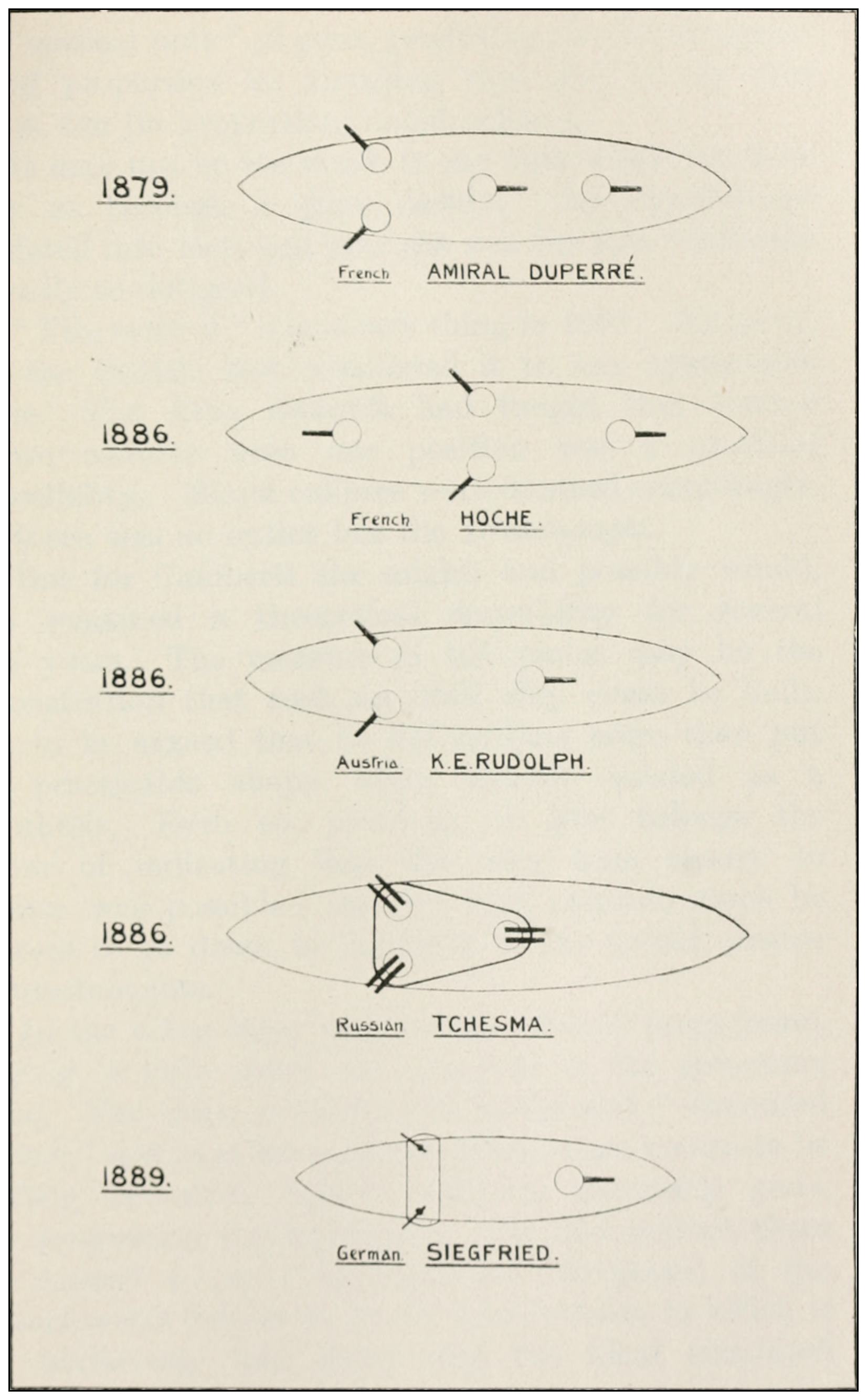
In the year 1874, however, it transpired that the
Italians were evolving an entirely new type of battleship,
the Duilio and Dandolo, and adopting a central box
system. By this means they were able to protect the
citadel with 22-inch armour and mount four 100-ton guns
in two turrets en échelon, so that all four could bear ahead
and astern as well as on either broadside. The seriousness
of the situation was increased by the fact that in
most of the tactical ideas of the day, end-on approach
figured largely.2
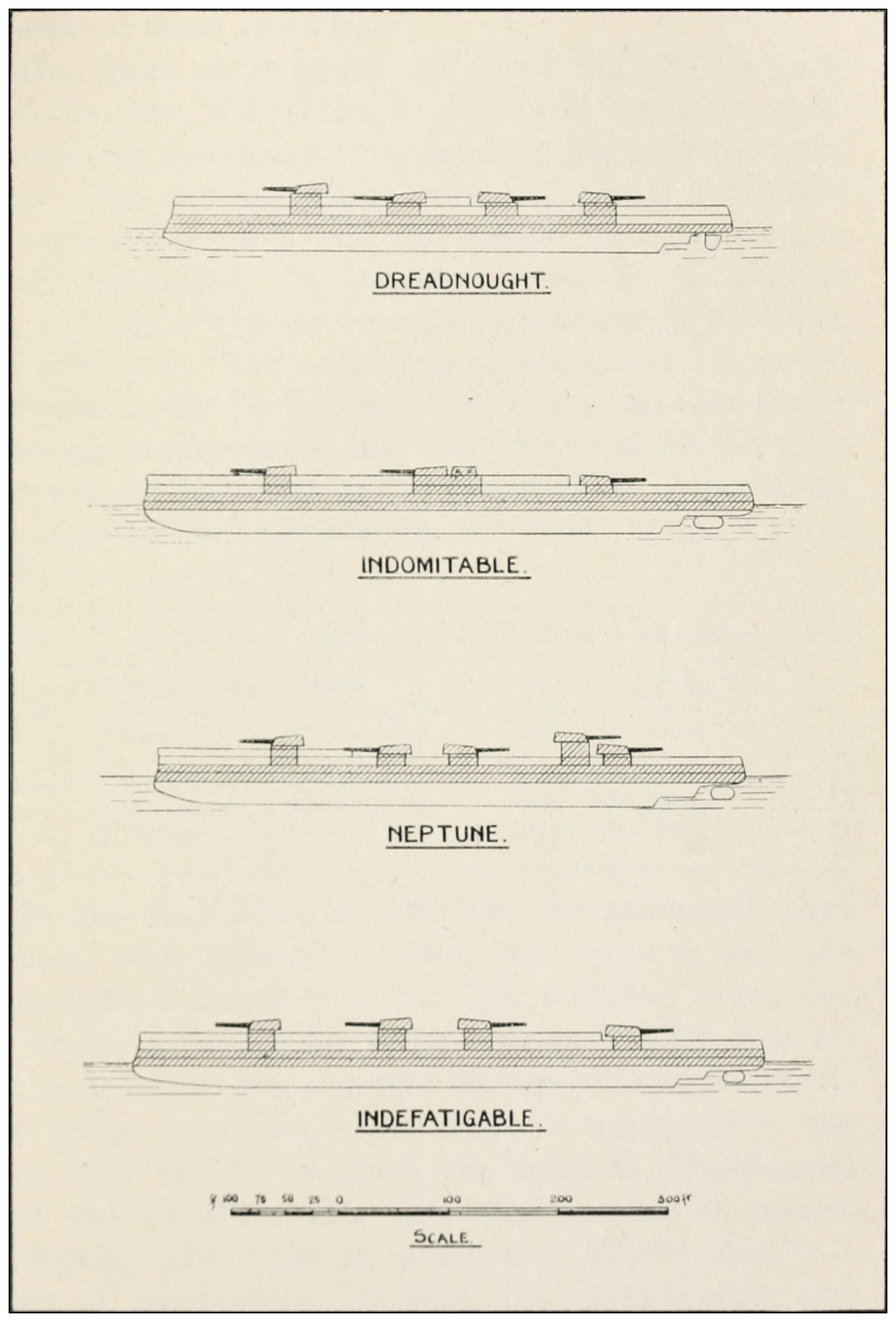
Compared with these Italian designs, the most
powerful British ironclad of those days, the Dreadnought,
with a belt of only 14-inch to 11-inch armour, and bearing
but two of her four 38-ton guns end-on, cut a sorry
figure.
Photo]
[Ellis.
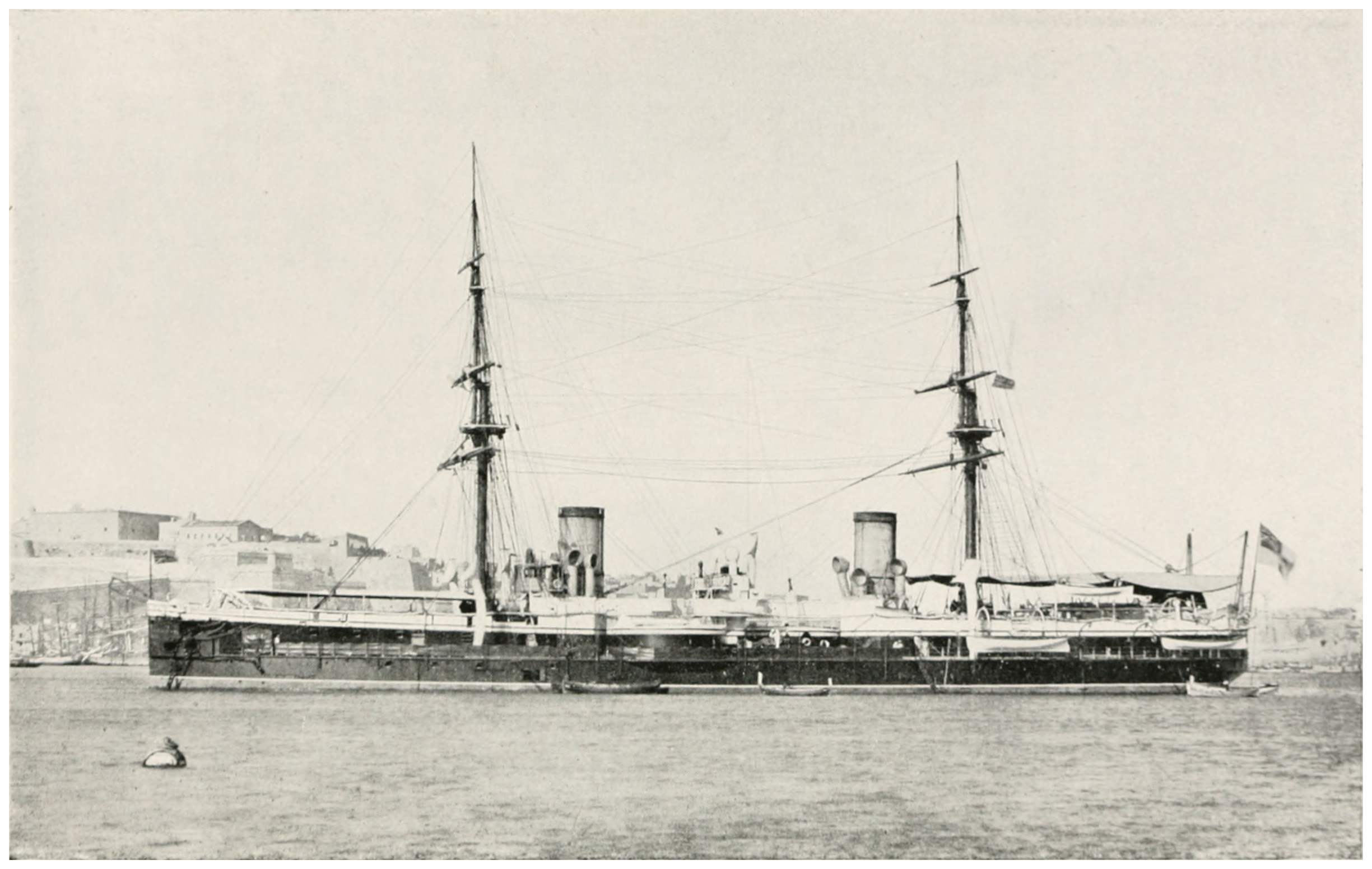
THE INFLEXIBLE, AS ORIGINALLY COMPLETED, 1881.
It was deemed essential to build a “reply.” The
largest gun actually available at the time was, however,
the 81-ton M.L.; so this was adopted for the new ship.
The Inflexible being frankly an adoption of Italian ideas,
she can hardly be described as the design of any one man;
Sir N. Barnaby having been tied down to an extent with
which (from his subsequent writings) he did not, it would
appear, altogether agree. A smaller central citadel than
that of the Italian ships was adopted, but the thickness
was carried to 24-inch, the thickest armour ever introduced
into an ironclad either before or since. The
bulkheads were 20-in. The freeboard of the central
redoubt was 10ft. Round about it, fore and aft, on an
armoured raft-body were built a bow and stern, with
superstructures curtailed to the centre line sufficiently to
allow of unimpeded end-on fire from the big guns, which,
like those of the Italians, were placed in échelonned
turrets.
With a view to satisfying the “masted turret-ship”
ideal, an absurd brig rig was fitted to the Inflexible.
With this it was possible for the ship to drift before the
wind, haystack-fashion, but the rig was so much of the
“placebo” order that it was designed to be taken down
and thrown overboard in case of action! At a later
date it was removed altogether and a military rig
substituted.
The Inflexible was crammed with novelties. Like
the Devastation she was the “Dreadnought” of her time.
Chief among her innovations were the adoption of
submerged torpedo tubes (of which she had two), the
mounting of Nordenfeldts as a definite anti-torpedo-boat
armament, and an ingenious anti-rolling arrangement,
whereby water was admitted amidships to counteract the
roll. This was very partially successful; but in 1910
the idea re-appeared in a slightly altered form and is now
used in certain big Atlantic liners.
An ingenious feature of the Inflexible concerned the
big guns. In the Devastation and Dreadnought types these
could be run in and loaded inside the turret. With the
much larger guns of the Inflexible this was impossible,
without a very considerable increase of the size of the
turrets. Outside loading without protection was recognised
as unsuitable and practically impossible. A special
glacis was, therefore, designed, which admitted of outside
loading under cover, and at the same time
ensured that, in the event of premature discharge, the
projectile would emerge above the water-line and
not below it.
This device is of special interest as the “last word”
of those muzzle-loading guns to which the British Navy
adhered so long as it possibly could. Had it been
thought of earlier, the British Navy might perhaps have
adhered to muzzle-loaders even longer than it did. As
things were, the Inflexible device came too late to stay the
tide which had already begun to set strongly in the
breechloader direction.
Details of the Inflexiblewere:—
Displacement—11,880 tons.
Length (between perpendiculars)—320ft.
Beam—75ft.
Maximum Draught—26⅓ft.
Armour—Belt amidships 24—16-inch, beyond that
a protective deck only; 22—14-inch bulkhead, all
iron; and 17-inch compound armour turrets.
Armaments—Four 81-ton guns (to which eight
4-inch breechloaders were added later on).
Two submerged tubes and two above-water
launching appliances for torpedoes.
Horse-power—8,010 (I.H.P.).
Speed—13.8 knots.
Coal—1,300 tons = nominal 10-knot radius of
5,200 miles.
Built at Portsmouth Dockyard. Engined by
Elder. Completed 1881.
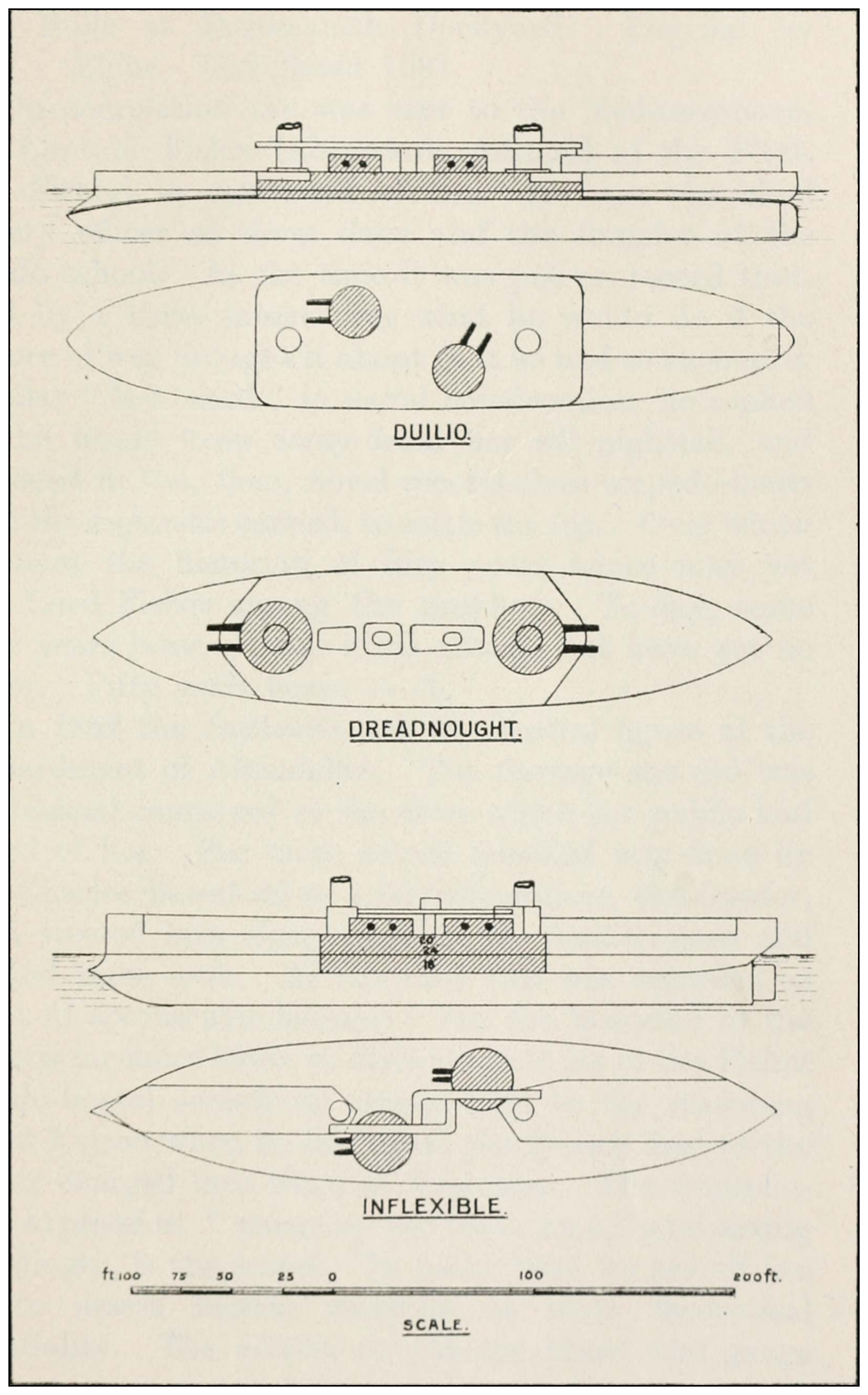
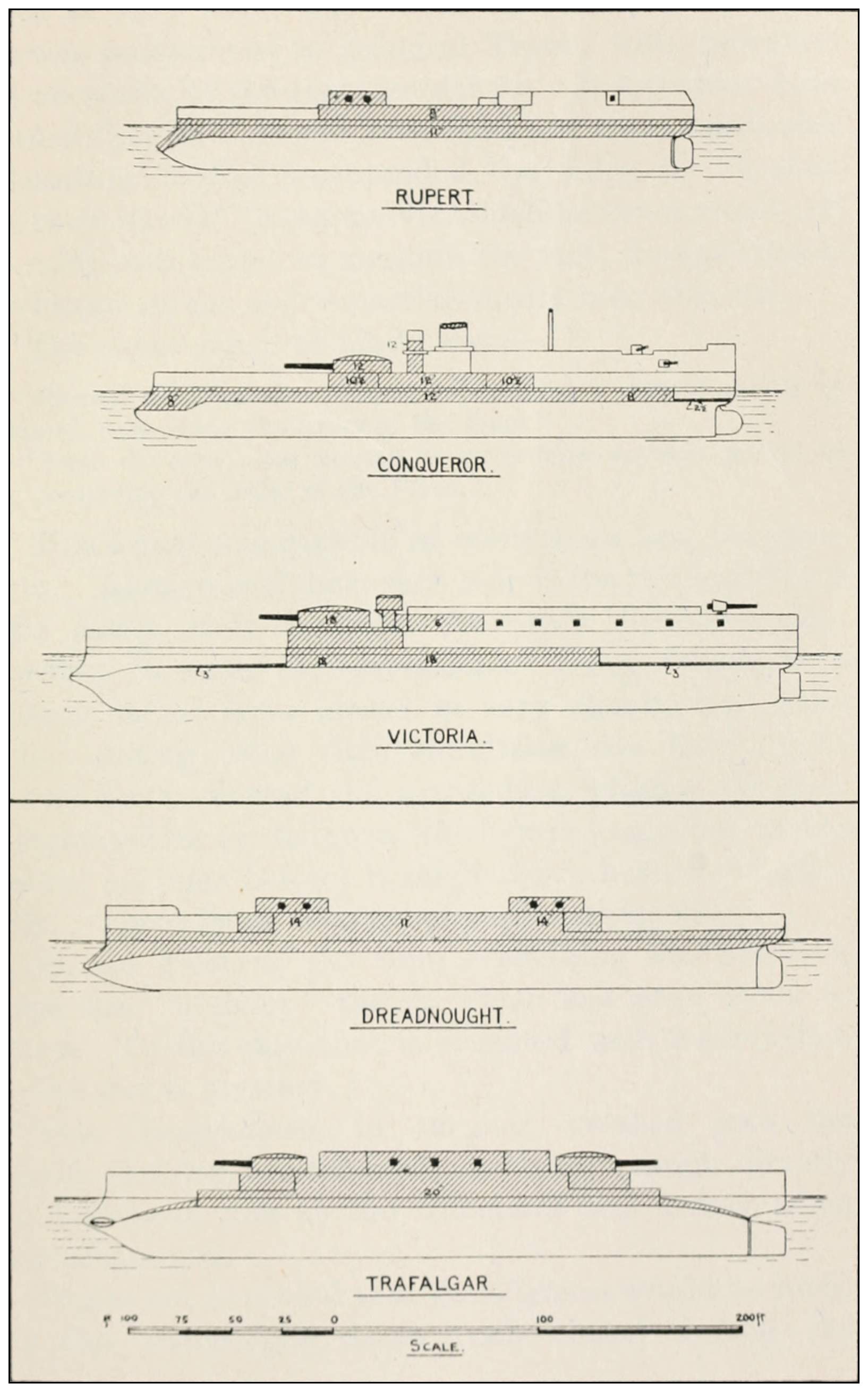
DUILIO.
DREADNOUGHT.
INFLEXIBLE.
EARLY TURRET-SHIPS OF THE BARNABY ERA.
On completion she was sent to the Mediterranean,
with Captain Fisher (afterwards Admiral of the Fleet,
Lord Fisher) in command of her. He was the chief
gunnery officer of those days and the founder of the
torpedo school. At the time it was put on record that,
asked by a Press interviewer what he would do if the
fortunes of war brought it about that he had to encounter
a similar “last word” in naval construction, he replied
that he would keep away from her till nightfall, and
then send in the, then, novel second-class torpedo-boats
which the Inflexible carried, to settle the foe. Over which
statement the historian of fifty years hence may yet
place Lord Fisher among the prophets. To-day, some
thirty years later, similar ideas obtain, but have got no
further. Fifty years hence——?
In 1882 the Inflexible was the central figure at the
bombardment of Alexandria. The damage she did was
infinitesimal compared to the ideas which the public had
formed of her. Far more actual mischief was done by
Lord Charles Beresford in a trivial gunboat, the Condor,
which steered into close range of the hostile guns and
knocked them over. At the time this was regarded as
an act of spectacular heroism; but the historian of the
future is far more likely to discover in it (as in the Fisher
torpedo-boats) something closely akin to the reasoning
behind Nelson when he destroyed the French fleet at the
Nile or charged into them at Trafalgar. The commonplace
expression, “sizing up the other man,” and acting
accordingly, is the secret. In peace time we are all too
apt to assess hostile weapons at their theoretical
potentiality. The victors in war are those who gauge
correctly the handling ability of the man behind the
weapon and—act accordingly.
About the years 1877–78, towards the close of the
Turco-Russian War, an Anglo-Russian war seemed
probable, and four foreign ships building in England
were purchased for the British Navy.
These were the Brazilian Independencia, an improved
Monarch, designed by Sir E. J. Reed, which went into the
British service as the Neptune. Save that she carried
38-ton guns instead of 25-ton, she reproduced the
Monarch idea almost exactly. After certain vicissitudes
she entered the British service, and eventually was fitted
with a couple of military masts. The points of special
interest about her were that (1) owing to some error her
funnels were put in sideways instead of as designed;
and (2) in service in any bad weather the sea regularly
washed out her wardroom; (3) she was the first ship of
the British Navy to carry a bath-room. As an effective
warship she never figured to any large extent.
The other three purchased ships had been destined
for the Turkish Navy; and all three turned out worse
than the Neptune. The Hamidieh, re-christened Superb,
more or less duplicated the Hercules. She took part in
the bombardment of Alexandria a little later, and it was
there discovered that her guns could not train at all well
in comparison with contemporary British naval ships.
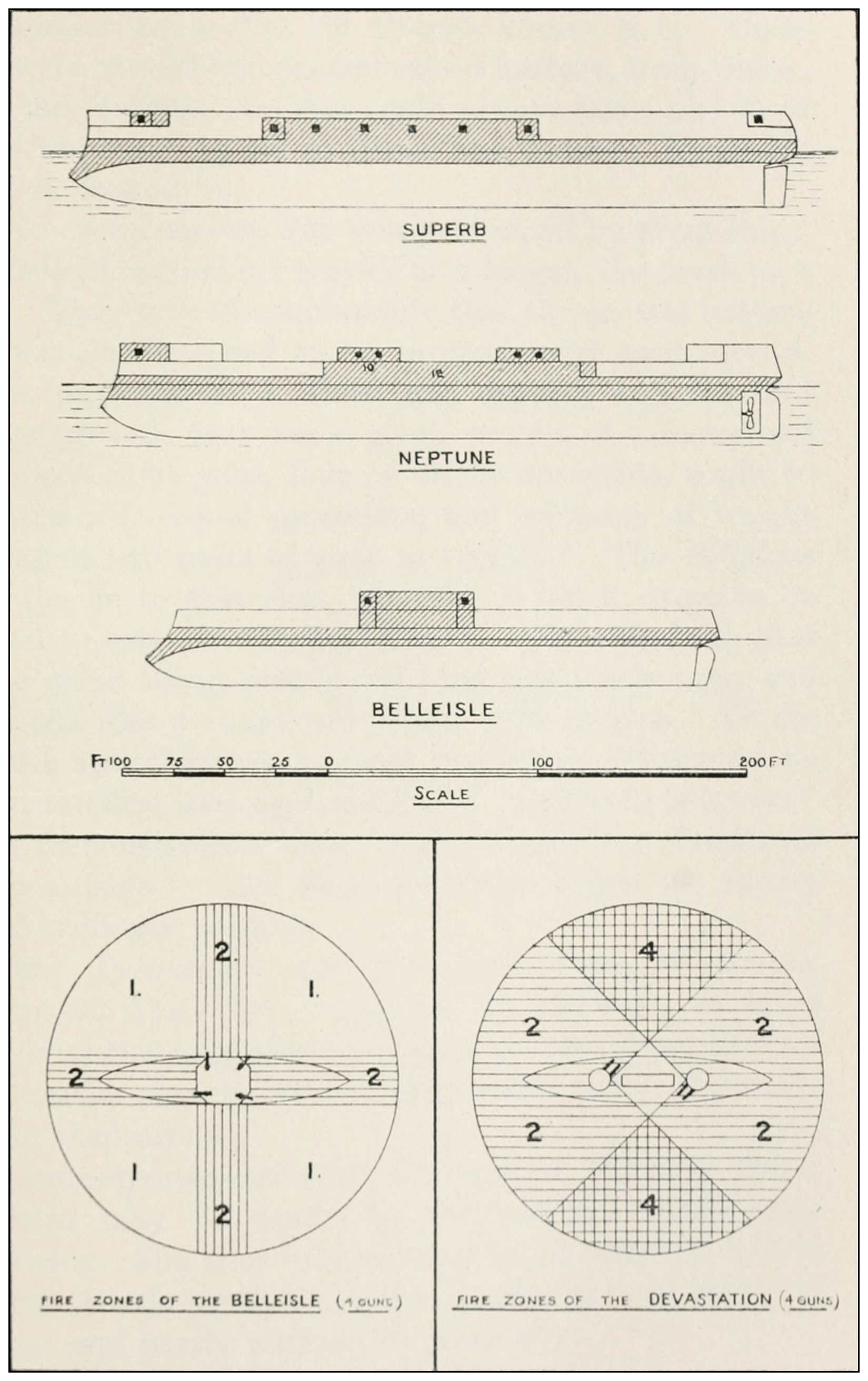
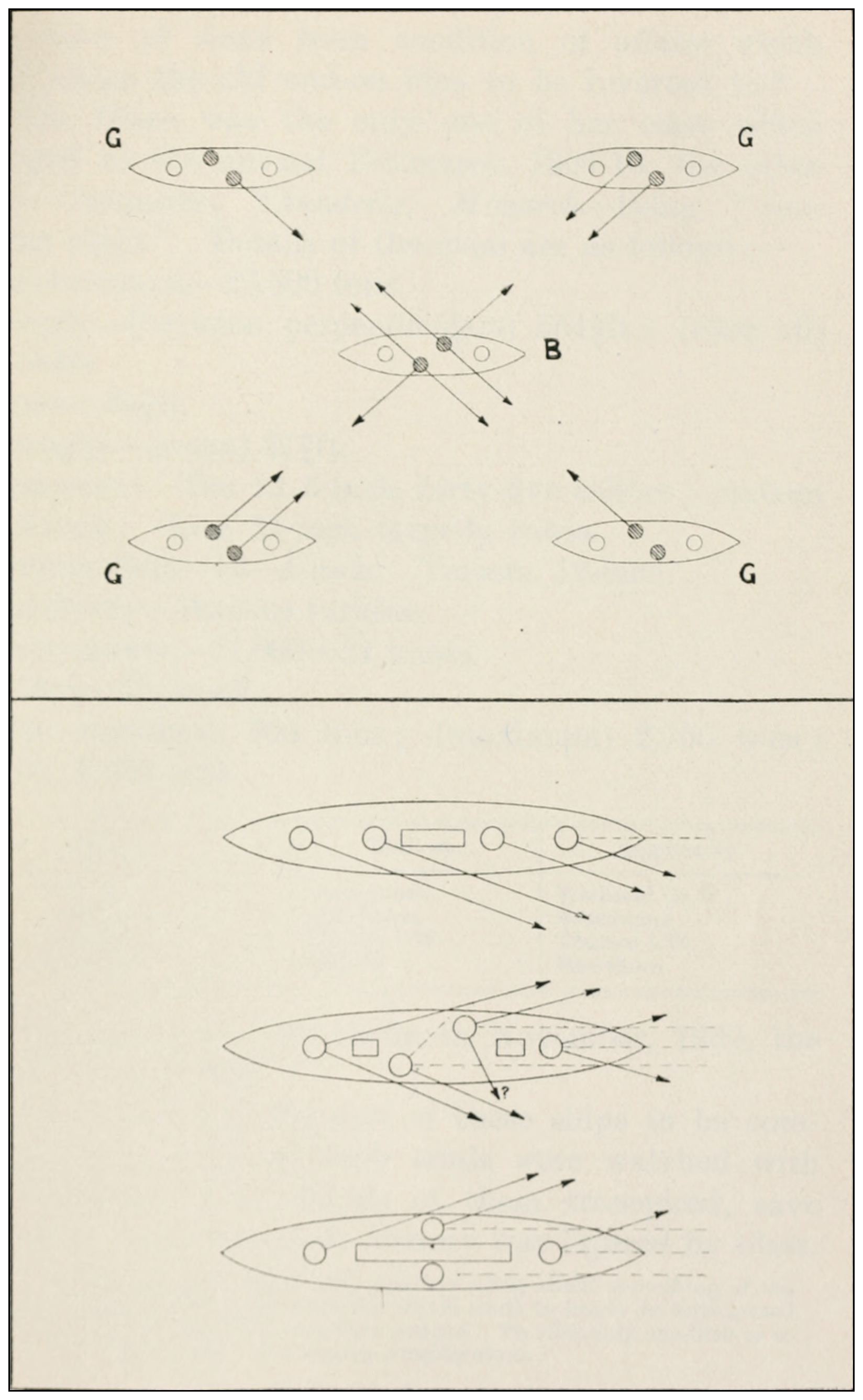
SUPERB
NEPTUNE
BELLEISLE
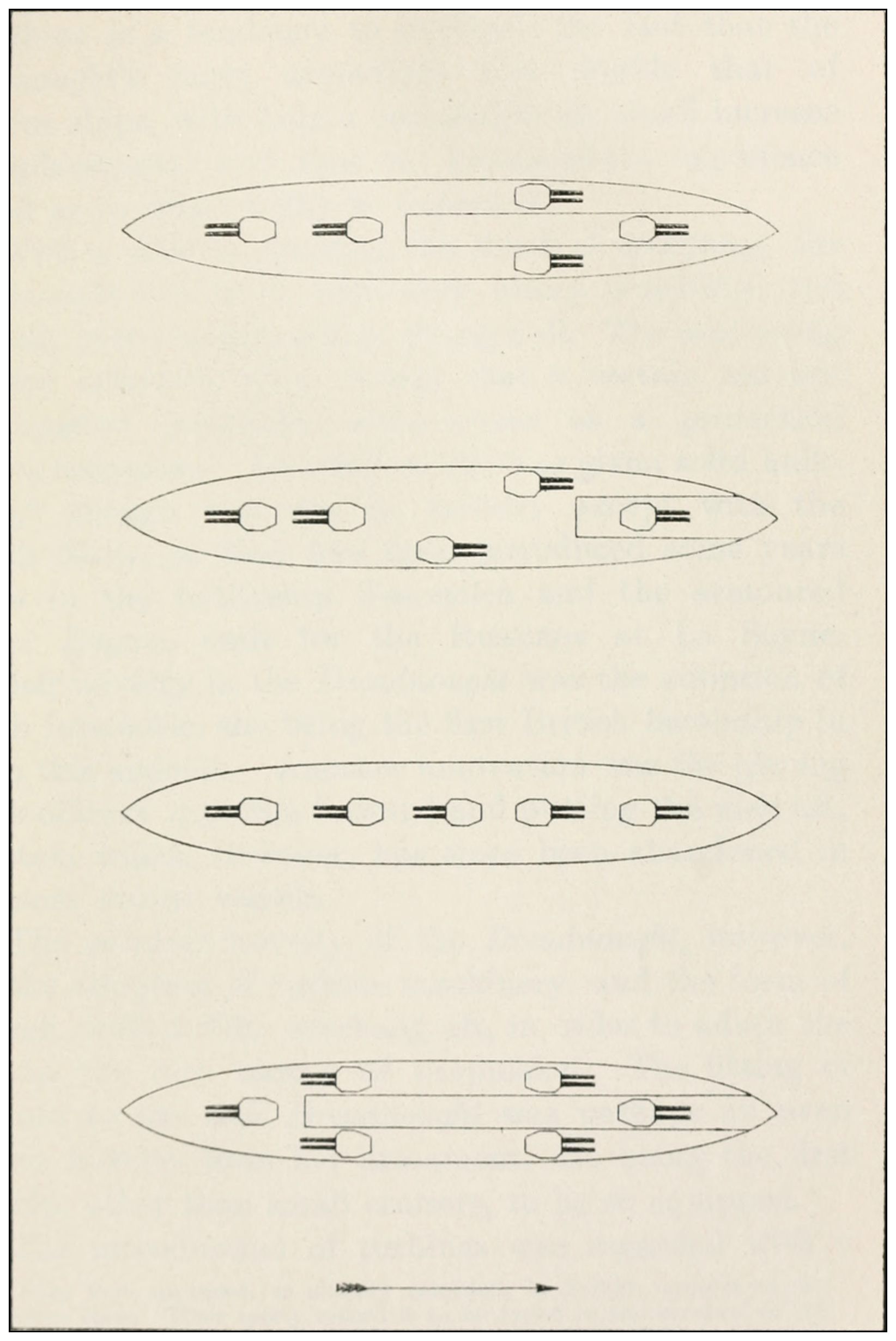
FIRE ZONES OF THE BELLEISLE (4 GUNS)
FIRE ZONES OF THE DEVASTATION (4 GUNS)
FOREIGN SHIPS PURCHASED FOR THE NAVY IN 1877–78.
Of the fighting value of the other two ships, Pakyi-Shereef
and Boordyi-Zaffir, which became the Belleisle
and Orion, the least said the better. They turned out to
be nothing but improvements on a type of “coast
defender,” already obsolete, diminutives of the original
Reed broadside idea applied to a Hotspur type hull. In
place of the single 25-ton gun of the Hotspur, they carried
four similar guns—the old 12-inch 25-ton M.L. These
guns were carried in a central raised battery, from which,
as in the Hotspur, one gun could always bear, and from
which two bearing on an exact and unlikely broadside
might be looked for.
No useful service was ever performed by these ships.
The Belleisle ended her service as a target, the Orion as a
hulk. They proved conclusively that the central battery
idea was obsolete and so far probably did good service.
In the past Sir E. J. Reed had argued, and for that
matter proved, that for a given weight of armour and
armament eight guns, four on either broadside, could be
mounted with equal protection and economy of weight
as against two pairs of guns in turrets.3 The Belleisle
gave the lie to this idea, however, when it came to be
applied to half the number of guns. The step from that
to the same thing with more guns was made easy, and
the turret idea assured, out of the Belleisle type. To the
Belleisle and Orion more than any other ships may be
traced the first real appreciation of “angles in between”—the
demonstration that “right ahead” or “right on
the broadside” were ideal positions which no enemy
would willingly assume.
The Devastation and her sisters had, of course,
anticipated this idea; but to the Belleisle, at most
fighting angles only able to bring a quarter of her battery
into action, may be traced most modern developments
in gun disposition.
Contemporaneous with the special Barnaby ships,
reference may be made to the entirely nondescript
Téméraire. She may be described as an absolute hybrid—partly
Reed, partly Barnaby, partly gun inventors of
the era, and partly nothing in particular.
Details of this ship are:—
Displacement—8,540 tons.
Length (between perpendiculars)—285ft.
Beam—62ft.
Draught—27¼ft.
Armament—Four 25-ton 11-inch M.L. (two in
barbettes), four 18-ton M.L.—two above water
torpedo tubes.
Coal—620 tons = 2,680 miles at economical speed
(nominal).
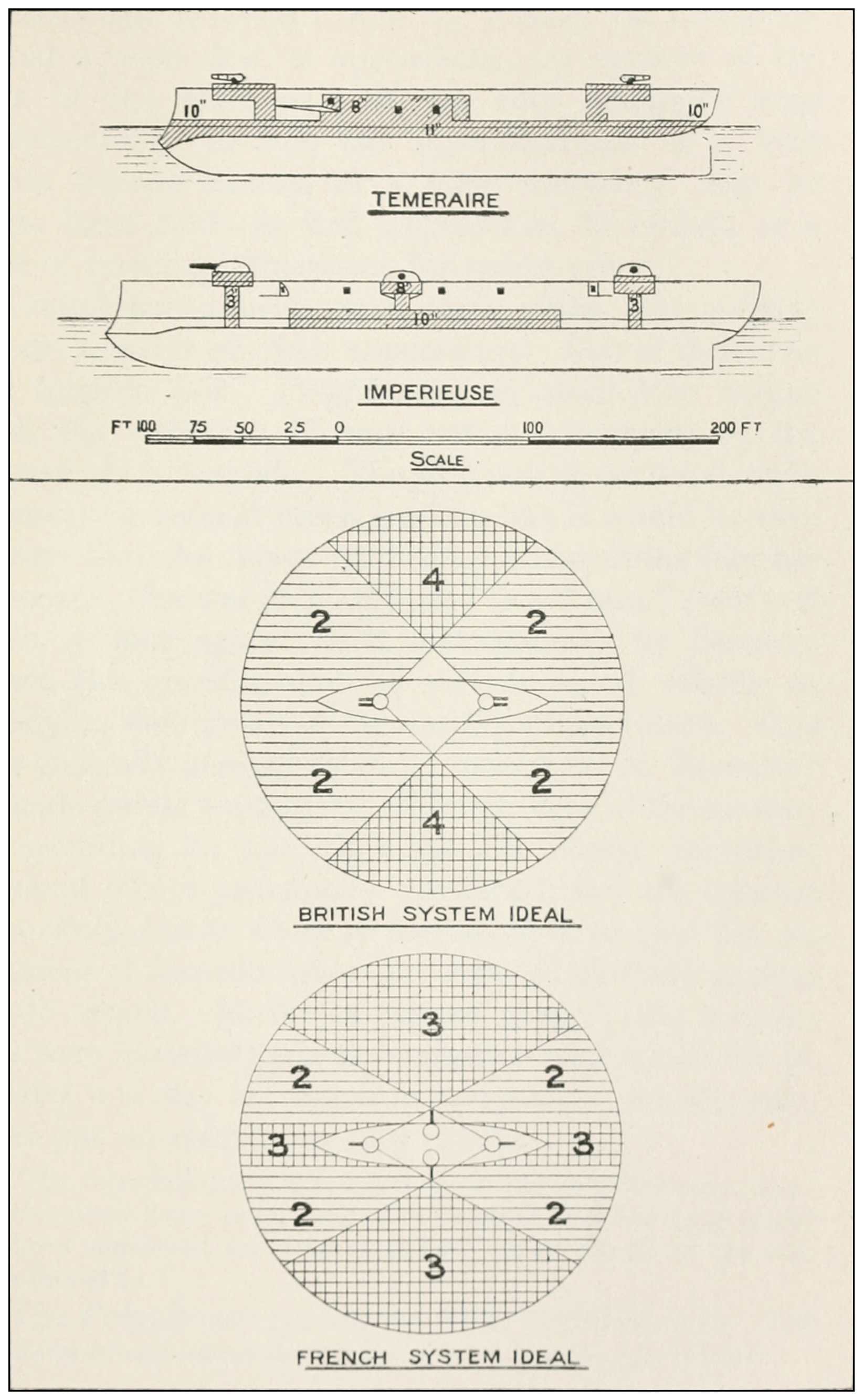
The Téméraire was unique in the world’s navies in
that two of her 25-ton guns were carried—one forward,
one aft—on special Moncrieff mountings, an adaption
for naval purposes of the “disappearing gun,” invented
for forts of that era. The gun, loaded under cover,
was raised to fire by hydraulic mechanism, and then
recoiled to the loading position. The ship was otherwise
essentially of the Reed box-battery type; the other two
25-ton guns being in a central main-deck battery, and
capable of a good deal of ahead fire. The other big guns
(18 tons) were cut off from the 25-ton by an armoured
bulkhead, and merely had the ordinary broadside
training.
Like the Inflexible, the Téméraire had a heavy brig
rig. Towards the end of her active service career this
was replaced by a military rig; but all her active work
was done as a brig. She was built at Chatham Dockyard,
engined by Humphrys, and completed for sea in 1877.
In 1882 she was at the bombardment of Alexandria,
and there did more execution than any other ship. Her
subsequent career was uneventful, and in her own way
she was a “monstrosity” as much as the Polyphemus
was. She is generally understood to have been a “naval
officers’ ideal” ship, rather than the regular production
of the Chief Constructor. Whether this be true is, at
least, doubtful. Certainly she may equally well be
regarded as the forlorn hope of those who looked to see
the general principles of the central battery system
adapted to suit the new ideas as to ironclads. French
ideas4 also had probably something to do with her
peculiar design.
The idea embodied in the Inflexible was so pleasing
to the authorities of that period that she was duplicated
in two smaller vessels of the same type, the Ajax and
Agamemnon, though the precise purpose for which these
vessels were built is difficult to fathom. They were in
every way inferior to the Inflexible, and mainly of
interest as indicating the definite abandonment of the
idea of the masted battleship, and they were also the
last ships to mount muzzle-loading guns:—
Particulars of these ships were:—
Displacement—8,660 tons.
Length (between perpendiculars)—280ft.
Beam—66ft.
Draught (mean)—24ft.
Guns—Four 38-ton M.L., two 6-inch 81-cwt. B.L.
Horse-power—5,440.
Speed—13.25 knots.
These were followed by the Colossus and Edinburgh,
which were laid down in 1879. In these ships the
12-inch breechloader was adopted, and an attempt at
what was then a very considerable speed was made.
An auxiliary armament made its first really definite
appearance, five 6-inch guns being mounted on the
superstructure.
Particulars of these ships were:—
Displacement—9,420 tons.
Length (between perpendiculars)—325ft.
Beam—68ft.
Draught (mean)—26ft. 3ins.
Guns—Four 45-ton B.L.R., five 6-inch, 89-cwt. do.
Horse-power—7,500.
Speed—15.50 knots.
At and about the same time considerable interest
was being taken in rams. This resulted in the laying
down of the Conqueror, a species of improved Rupert, and
a type of ship destined to be enlarged upon in the future.
Particulars of the Conquerorwere:—
Displacement—6,200 tons.
Length—270ft.
Beam—58ft.
Draught—24ft.
Armament—Two 45-ton B.L.R., four 6-inch
89-cwt. do., six 14-inch torpedo tubes (above
water).
Horse-power—(maximum) 6,000.
Speed—15.5 knots.
Coal—650 tons.
The Conqueror was launched in September, 1881.
Some three years later a sister, the Hero, was laid down,
and launched towards the end of 1885. She differed from
the Conqueror only in that all four of her 6-inch guns were
mounted on the superstructure, whereas the Conqueror
carried two of them on the main deck inside the superstructure.
TEMERAIRE
IMPERIEUSE
BRITISH SYSTEM IDEAL
FRENCH SYSTEM IDEAL
BARNABY BARBETTE SHIPS.
Although developed from the Rupert, the Conqueror
differed a good deal in appearance, on account of the
whole of the after part of the ship being one huge
superstructure. In her, the superstructure, as a very
definite feature instead of a mere accessory, may be
said to have made its first appearance, to remain as a
factor of growing importance for many years.
Contemporaneously with these ships two entirely
different types made their appearance. One of these was
the “torpedo ram” Polyphemus, an absolutely unique
vessel, the outcome (though not so designed) of the
influence of the torpedo. The ship was never duplicated,
and never performed much service, but it would be rash
to assert that the future may not see something like her
re-appear. She was first projected as a “ram” pure and
simple, so long ago as 1873, and designed by Barnaby
to suit the specifications of certain naval officers as
embodying their ideals of the warship of the future. This
is the generally accepted theory, though Sir N. Barnaby5
has made public a somewhat different view of the matter,
and according to him, Admiral Sir George Sartorius,
the naval officer principally concerned, lost his interest
in the Polyphemus when it was decided to give her an
armament of torpedo tubes and some quick-firers against
torpedo attack. So far as can be gauged, the torpedo
tubes were likewise a naval innovation with which Sir N.
Barnaby was also not much in sympathy. At any rate,
he has put on record the view5that:—
“The introduction of torpedoes made the ship far more costly
than she need have been, and it is possible that the type would
have been continued and improved had the simplicity of the ram
been adhered to.”
The Polyphemus performed little useful service; her
life on the Navy List was short; and she is always spoken
of as a “failure.” Officers who served in her were, however,
invariably enthusiastic about her, and had war
occurred during the time that she was in existence there
is no telling what she might have accomplished or how
profoundly she might have affected naval construction.
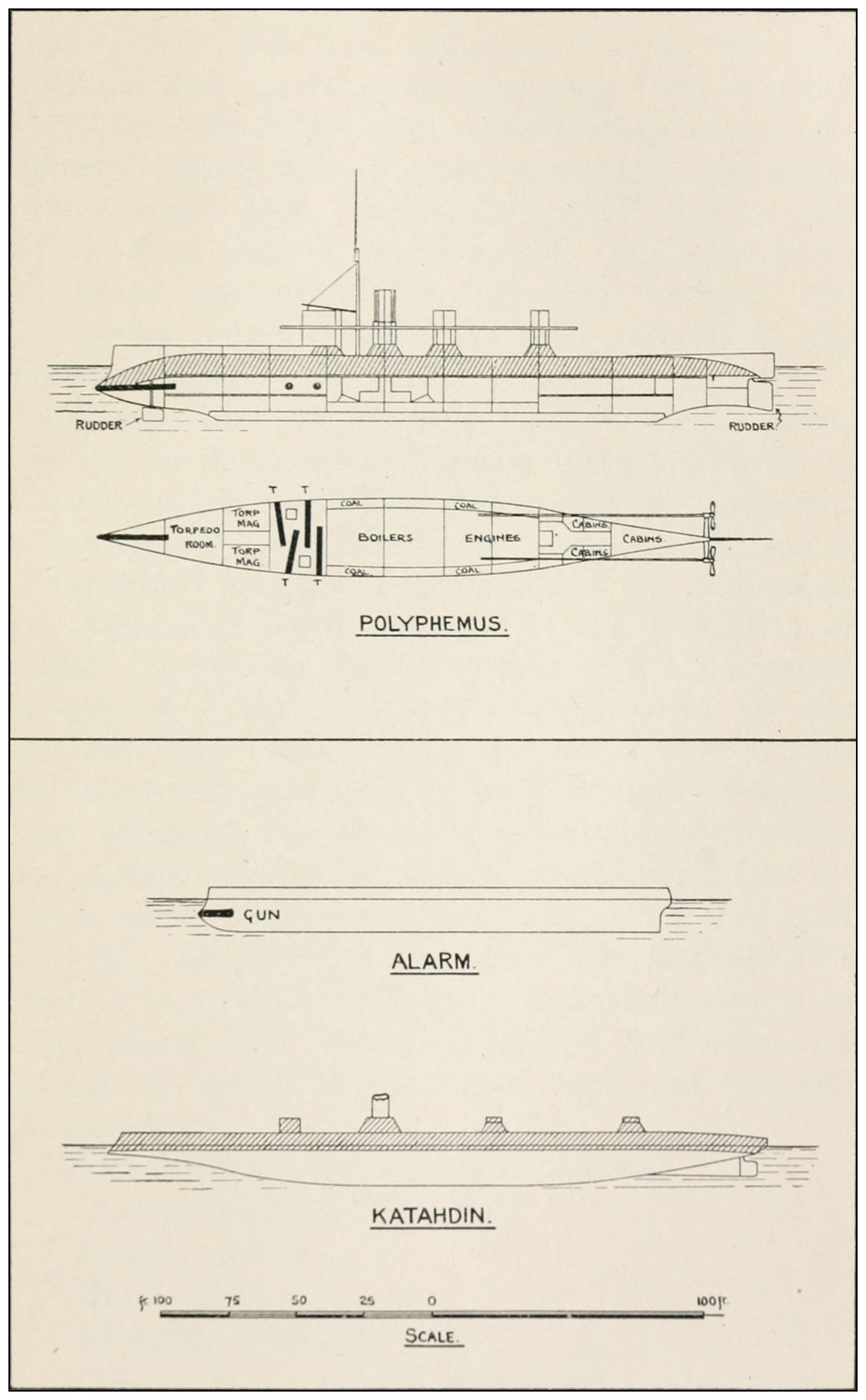
In essence the Polyphemus was a semi-submerged
craft, those parts of her which were above water being
merely a light superstructure for the accommodation of
her crew in peace time.
She was of 2,640 tons displacement, length 240ft.
between perpendiculars, beam 40ft., and a normal mean
draught of 20ft. In form she was cigar-shaped, plated
with 3-inch armour on the upper part of her curved sides.
With 5,520 I.H.P. she had the then very high speed of
17.8 knots. She carried 300 tons of coal, sufficient for
a nominal radius of 3,400 miles at economical speed.
Her principal feature, however, was the fitting of
five submerged tubes, one in the bow the others on the
broadside. For repelling a torpedo attack she carried
six 6-pounders and a couple of machine guns.
POLYPHEMUS.
ALARM.
KATAHDIN.
SOME FAMOUS RAMS.
It is here of interest to relate that some years later
the U.S. Navy created a species of Polyphemus imitation
in the “ram” Katahdin. To a certain extent they had
anticipated her likewise in the Alarm, 720 tons, launched
in 1873, which carried a 15-inch smooth-bore gun under
water in her ram, and the Intrepid (launched 1873), of
1,123 tons, of which no details ever transpired, and it
may be said that she was “strangled at birth.” But the
Polyphemus’s ancestry is undoubtedly American. The
Katahdin (first produced as the “ram” Ammen) was not
launched till 1893. She was of 2,050 tons and seventeen
knots, and having no torpedo tubes, being a “ram”
pure and simple, exactly reproduced the Sartorious-Barnaby
idea. She soon disappeared from the U.S.
Navy List, and she never did anything. She doubled
the armour of the Polyphemus, whilst lacking her torpedo
armament. Since then, the idea has found expression
in three small U.S. “semi-submerged” boats, with
the torpedo as their main armament; but these three
boats never got beyond the “designed” stage. No
other nation ever exhibited the least interest in the
Polyphemus idea.
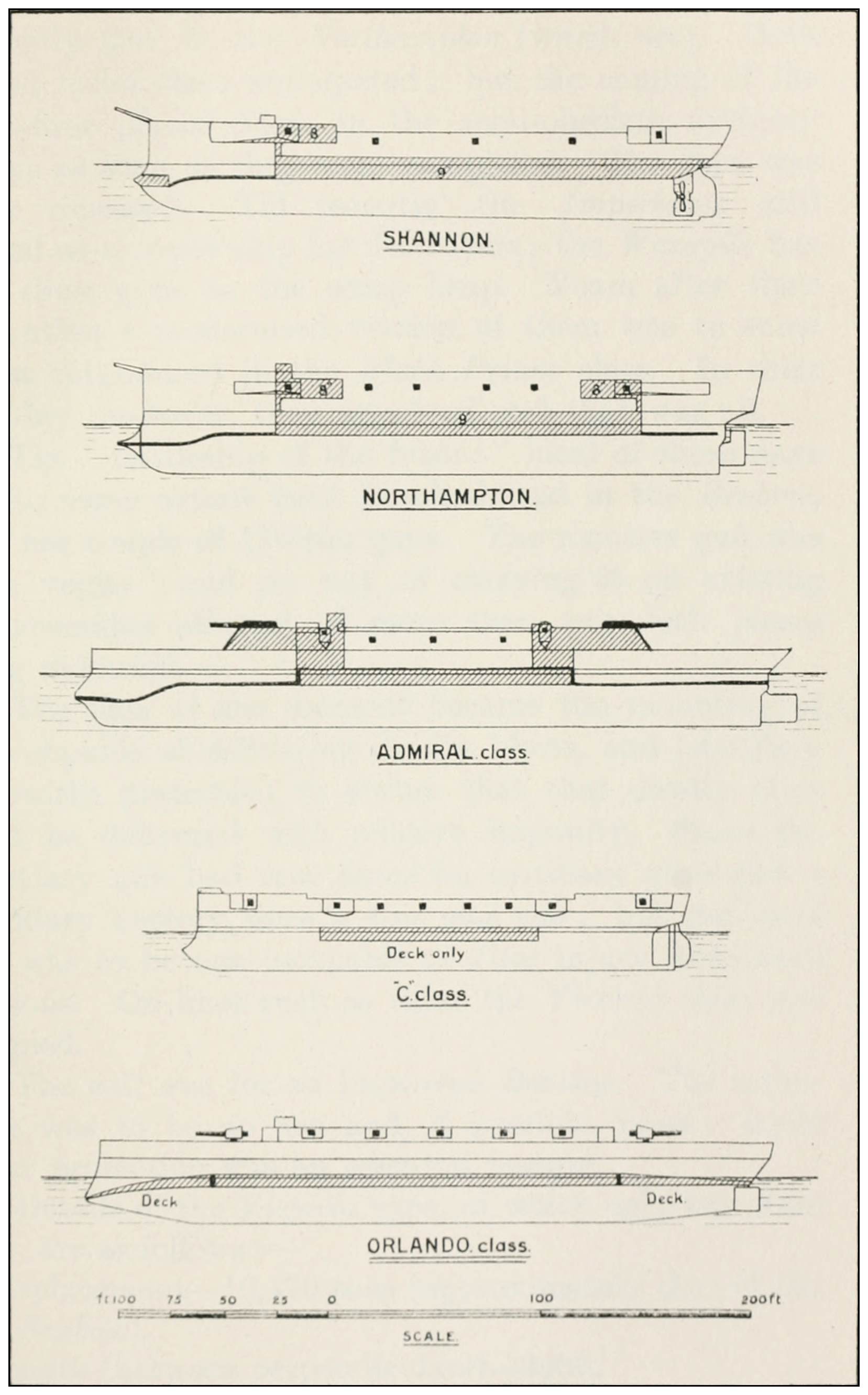
Reference has already been made to the Shannon,
which was the first armoured cruiser of the British Navy.
She was launched towards the end of 1875 and completed
two years later. In substance she was a development of
the idea which first found expression in the Inconstant,
heavy armament being preferred to the protection of
the guns. A narrow belt of armour with a maximum
thickness of 9-ins. protected three-quarters of the
water-line. This belt commenced at the stern and
ended in a bulkhead some 70ft. from the bow. Forward
of this bulkhead was an under-water protective deck,
and a certain amount of armour was concentrated on
the ram under water. The bulkhead, which was from
9in. to 8in. thick, rose to the upper deck, and afforded
protection to a couple of 18-ton muzzle-loaders, capable
of right-ahead fire. The remainder of her armament
consisted of seven 12½ton guns, and was entirely
unprotected.
Other details of the ship are as follows:—
Displacement—5,390 tons.
Length—260ft.
Beam—54ft.
Draught—23ft. 4in.
Horse-power—3,370.
Speed—12.35 knots.
Coal carried—580 tons = nominal economical radius of 2,260 miles.
The speed of the Shannon was so low, even in those
days, that it is a little difficult to surmise for what
purpose she was designed, especially as this design was
more or less contemporary with the re-designing of the
Dreadnought.6 It found favour, however, since she was
almost immediately followed by two larger replicas, the
Nelson and the Northampton, details of which were:—
Displacement—7,630 tons.
Length (between perpendiculars)—280ft.
Beam—60ft.
Draught (maximum)—26ft. 6in.
Armour—Belt amidships, 9in. to 6in., compound:
bulkhead ditto. Armour deck only, at ends.
Main Armament—Four 18-ton M.L.R., eight 12-ton
M.L.R., two above-water 14-inch torpedo tubes.
Horse-power—6,640.
Speed—14.41 knots.
Coal carried—1,150 tons = nominal radius of 3,850
miles.
These ships differed from the Shannon in that the
armour belt was confined to a water-line strip amidships,
while the after guns were also protected by a bulkhead.
The most curious, and to modern ideas, eccentric feature
of these ships, was that they were fitted with triangular
rams, which, “for the sake of safety,” could be removed
in peace time and merely put on for war purposes! As
a matter of fact, the ships always carried their rams
without rendering themselves dangerous to anybody.
On the other hand, shortly after construction, the
Northampton was run into by a small trading schooner,
which cut her down to the water’s edge. The ships,
therefore, started with an unfavourable reputation,
which the Northampton followed up by a total inability
to make even her moderate designed speed. The Nelson,
on the other hand, proved herself a comparatively good
steamer, so much so that at a later date she was to a
certain extent modernised. Both ships were originally
heavily masted, the idea being to perform most of their
peace service when convenient under sail. The Nelson
sailed moderately well, but the Northampton very
badly. It was possibly with some view to remedying
this that some years later, when it was decided that the
Imperieuse, originally built as a brig, should be given
a military rig, her lofty iron fore and mainmast were
taken out of her and substituted for the two equivalent
masts in the Northampton. The change, however, was
not satisfactory, as thereafter she sailed if anything
worse than ever.
At and about this year protected cruisers made
their first appearance in the Comus class. Of these
altogether eleven were built, the best known of these
being the Calliope, which in the early nineties became
famous through steaming out of Samoa Roads in the
teeth of a hurricane, which utterly destroyed every
foreign vessel anchored there at the same time. The
Comus class consisted of the Calliope, Calypso, Canada,
Carysfort, Champion, Cleopatra, Comus, Conquest,
Constance, Cordelia, and Curacoa. They averaged 2,380
tons displacement, though the first mentioned, which
were the last to be built, were slightly larger. The
original armament consisted of two 6-ton muzzle-loaders
and twelve 64-pounders. This was afterwards varied
by the substitution of breechloaders. The ships
generally had a speed of about thirteen knots, and were
completed between the years 1877, for the earliest, and
1884 for the latest. They had a 1½-inch protective deck
for the engines amidships. These ships, which were
generally officially known as the “C” class cruiser, were
undoubtedly diminutives of the Shannon, or, at any rate,
inspired by a similar idea.
Besides growing downwards the idea also grew
upwards, and resulted in the building of six ships of the
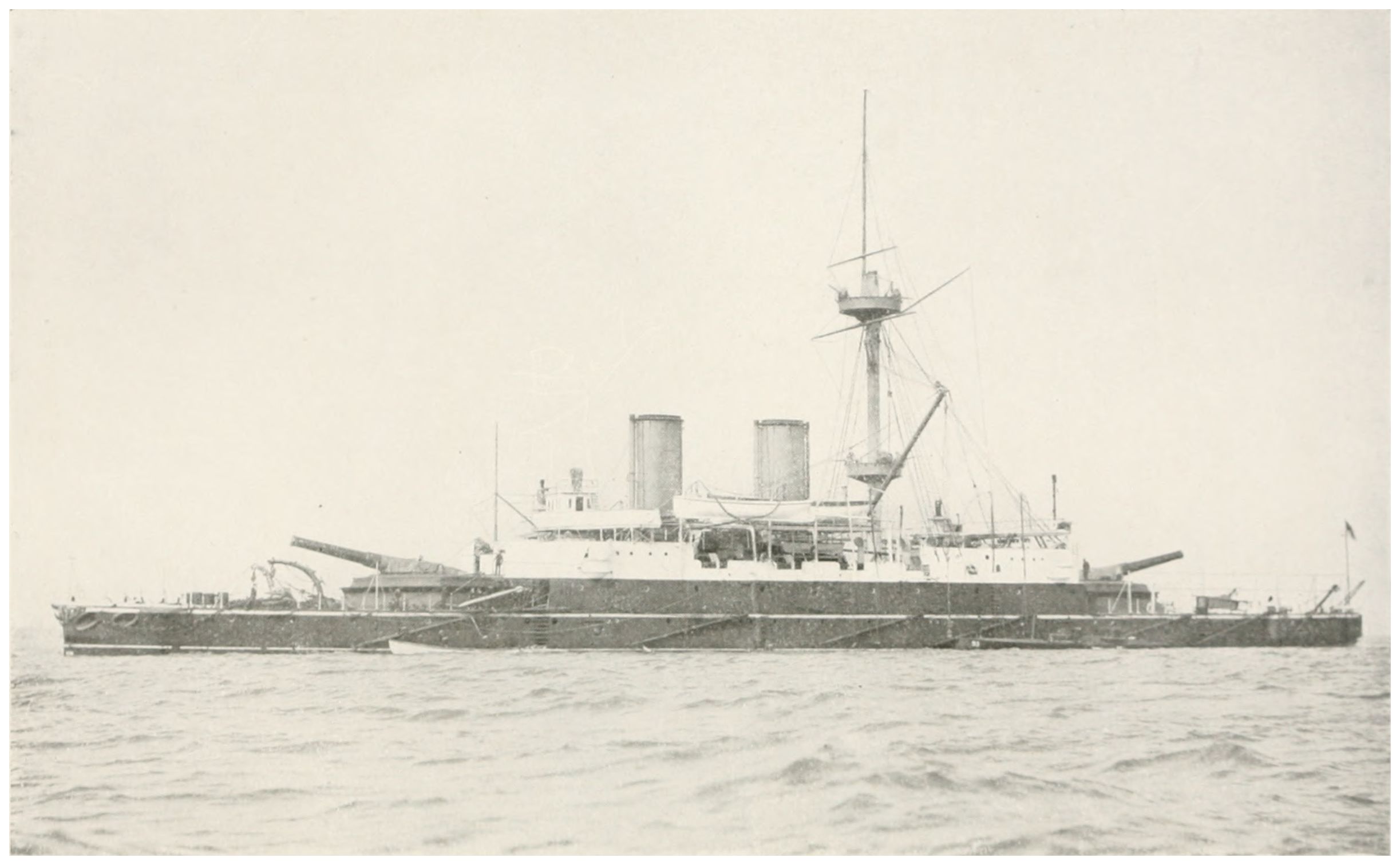
“Admiral” class, of which the first was the Collingwood.
These, which were the apotheosis of the Barnaby idea,
represented an absolute revolution in naval construction,
so far as big ships were concerned.
The “Admirals” were not all identical, as they
formed four different groups in the matter of displacement
and three in armament. In all, however, the integral
idea was the same. Amidships was a narrow belt, 150ft.
long by 7½ft. wide, which sufficed to protect engines,
boilers, and communication tubes of the barbettes. This
belt varied in thickness from 18ins. to 8ins, of compound
armour. The ends of the belt were closed up by 16-inch
bulkheads. Forward and aft was merely a curved
protective deck; there was also a flat protective deck
on top of the armour belt. The ships were of low
freeboard, forward and aft, but had a large superstructure
built up amidships. At either end of the superstructure,
with their bases unprotected by armour except for
the communication tubes already referred to, were
many-sided barbettes with plates set at an angle of
about forty-five degrees. These barbettes were about
11½ins. thick, and carried each a couple of the heaviest
guns then available. These were 12-inch breechloaders
in the Collingwood, and 13.5-inch in the other ships,
except the Benbow, which mounted one 16.5 inch 110-ton
in each barbette instead. An auxiliary armament was
mounted inside the superstructure. The speed of these
ships was about seventeen knots, and was considerably
in excess of the average for the period.
4—12in., 6—6in., and smaller, 2 sub. and 4 above water tubes
4—13.5, 6—6in., and smaller, as Collingwood
4—13.5, 6—6in., and smaller, as Collingwood
2—16.25, 10—6in., and smaller, as Collingwood
As compared with the Colossus and Edinburgh class
of the same date and era of design, the “Admirals”
were somewhat inferior in armour protection, but
because of that secured a far better speed and a greatly
superior big gun command.
In all the “Admiral” class the armour weighed
about 2,500 tons—say, 20 per cent. of the displacement.
This proportion has never been very greatly varied from
either before or since, and the popular idea that Barnaby
designs sacrificed armour weight for other features is
entirely incorrect. The real Barnaby ideal is better
described (the conditions of his own time being kept in
mind) as an attempt to put into practice “everything or
nothing,” so far as protection was concerned. To-day,
a compromise is in fashion, and Barnaby is very much out
of date. It may well be but a phase in the cycle of naval
design. Properly to appreciate the Admiral class
ideal, we have to translate it into the ideal which obtains
to-day. Thus put, the Admirals would be somewhat
swifter than our existing battle-cruisers, their vitals
would be invulnerable and their armaments superior to
that of any potential enemy. They would not, in fact,
very greatly differ from Admiral Bacon’s conception
(published some five years before the present war) of the
battleship of the future, in which he predicted the
disappearance of much of the side armour of to-day.
Photo]
[Symonds & Co.
THE BENBOW—A SHIP OF THE “ADMIRAL” CLASS.
The coming of the medium calibre quick-firer soon
rendered the “Admirals” obsolete and even ridiculous.
The medium calibre quick-firer profoundly modified
design until the development of the big gun enabled it
to act well beyond the effective range of the medium
gun, and incidentally enabled it to fire nearly as fast as
the elementary quick-firers were built to do. Thus we
have come back to something very akin to the condition
under which the Barnaby ships were designed.
These ships could not, perhaps, be described as
an absolutely original idea, save in so far as the British
Navy was concerned, since the Italian Italia was launched
in the same year that the Collingwood, the first of the
“Admirals” was laid down. The Italia, equally abnormally
fast (or faster) for the period, carried four 100-ton
guns échelonned in one large heavily armoured barbette
amidships, but had no water-line belt whatever, and
relied entirely upon an armour-deck to protect the motive
power. In the “Admirals” the motive power was
thoroughly protected by the vertical belt amidships, while
flotation otherwise depended upon internal sub-divisions.
The “Admiral” class idea was re-developed into
armoured cruisers in a somewhat curious fashion. At
that time the French Navy was second in the world, and
French ideas of construction commanded a great deal of
respect. French notions at that era ran largely to single
gun positions, four guns being separately disposed in four
barbettes placed one ahead, one astern, and one on either
side. The particular point of this arrangement was that
while British designs accepted two or four big guns
bearing, the French system allowed for a definite mean of
three. More practically put, this may be translated into a
conception that an enemy would use every effort to avoid
positions in which four big guns could be brought to bear
on him, and seek those in which he was exposed to two
only. A gun-arrangement which gave three big guns
bearing in any position seemed therefore far more
reasonable on paper.
It stands to the credit of Sir N. Barnaby (or else
to the credit of the Admiralty of the era) that he
recognised the impossibility of any such manœuvres in
fleet actions, but at the same time he also realised
how heavily it might tell in cruiser duels. Out of which
the Imperieuse and Warspite were born.
Details of these ships:—
Displacement—8,400 tons.
Length (between perpendiculars)—315ft.
Beam—62ft.
Draught (maximum)—27⅓ft.
Armament—Four 9.2 24-ton B.L., six 6-inch, 89cwt., six torpedo tubes.
Horse-power—10,000=16.75 knots.
Coal—1,130 tons = nominal radius of ten knots of 7,000 miles.
Armour—Belt amidships of 10in. compound, with
9-inch bulkheads, 8-inch barbettes. No armour
to lesser guns. 3-inch protective deck fore and
aft, and on top of belt.
The Imperieuse was built at Portsmouth Dockyard
and engined by Maudslay. The Warspite, built at
Chatham, was engined by Penn. Both were completed
in 1886 at a total cost of about £630,000 each. They
were copper sheathed, and (like the Inflexible) originally
were to carry a heavy brig-rig. This was removed at
an early stage, and a single military mast between the
funnels substituted. The Imperieuse’s masts were subsequently
put in the Northampton (which see). Both
proved faster than anticipated; but the coming of the
quick-firer placed them in the semi-obsolete category
almost as soon as they were completed. The type was
never repeated. Till recently the Imperieuse still
existed as a depot ship for destroyers; the Warspite has
long since gone to the scrap heap. Years after their
conception a modernised version of them was to some
extent reproduced in the Black Prince class. In their
own day, however, they appeared and that was all.
The “battleship of the future” ideal of those days
had to some extent been foreshadowed in the Benbow,
with her couple of 110-ton guns. The monster gun was
“the vogue” and no way of carrying it on existing
displacements allowed of more than two such pieces
being mounted.
The idea of the moment became the mounting of
guns capable of delivering deadly blows, and (corollary
therewith) protection to ensure that that deadly blow
could be delivered with relative impunity. Since the
secondary gun had now come in, auxiliary guns and a
secondary battery were a sine quâ non; but the ideal
ship was to be one incapable of vital injury from such
weapons. On lines such as these the Victoria class was
designed.
The call was for an improved Benbow. The armament
was to be no less and, if possible, more; while
better protection was an essential feature.
Details of the Victoria type, of which only two were
built, are as follows:—
Displacement—10,470 tons (approximately that of the
Benbow).
Length (between perpendiculars)—340ft.
Beam—70ft.
Draught (maximum)—27¼ft.
Armament—Two 110-ton guns (in a single turret), one
9.2 (aft), twelve 6-inch; twenty-one anti-torpedo
guns, and six torpedo tubes (14-inch).
Armour (compound)—18-inch to 16-inch belt amidships,
redoubt and bulkheads, 18-inch turret, 2-inch
in battery. Armour deck, and heavily armoured
conning tower.
Horse-power—14,000 = 16.75 knots.
Coal—1,200 tons = 7,000 miles at 10 knots.
The Victoria was built at Elswick and engined by
Humphrys; launched in 1887 and completed for sea in
1889. The Sanspareil, engined by the same firm, but
built at Blackwall (Thames Ironworks) was launched a
year later, but completed about the same time.
The design of these ships closely approximated to
the Conqueror, of which they were merely enlarged
editions with a heavily increased battery.
The Victoria on completion became the flagship in
the Mediterranean of Admiral Sir George Tryon. In the
course of evolutions off the coast of Syria on June 22nd,
1893, she was rammed and sunk by the Camperdown.
The disaster, which cost the lives of the Admiral and
321 officers and men, teaches no useful lesson, saving
the danger of transverse bulkheads. Water-tight doors
were shut too late. The sea entered. The ship gradually
turned over, then suddenly “turned turtle” and
capsized.
The mystery of her loss has never been fully
explained. Admiral Tryon gave an order for the fleet,
then in two lines, to turn inboard sixteen points, while
at six cables apart. This manœuvre, with turning
circles as they were, was bound to create a collision.
This was pointed out to Admiral Tryon, who, however,
took no notice of the representations. It has since been
assumed that he went suddenly mad. A more reasonable
explanation is that he intended the ships to “jockey
with their screws” (a manœuvre which he never employed
as a rule), and forgot to mention the fact, though details
of evidence in the court-martial hardly bear this out.
The exact signal as made was:—
“Second division alter course in succession sixteen points to
starboard, preserving the order of the Fleet.”
“First division alter course in succession sixteen points to
port, preserving the order of the Fleet.”
This signal was capable of more than one interpretation.
Along one of them each ship in the two squadrons
might easily have rammed the other in succession,
according to some interpretations. Using screws, both
divisions might have closed in very closely but quite
safely. Acting other than simultaneously they might
anyway have effected the manœuvre without disaster.
At eight cables (a distance which was suggested to the
Admiral an hour before) it might have been done quite
safely. There have been other explanations also.
In the Fleet at the time everything was believed,
except the “blunder” theory which has gone down to
history. To this day that is accepted with reservation.
But the rest is mystery.
The Camperdown, in turning, crashed into the
Victoria, striking her forward, curiously enough directly
on a bulkhead, just as the Vanguard was struck when
she was rammed.
It was not expected that the Victoria would be sunk.
Had the water-tight doors been closed during the
manœuvre, instead of at the last moment, she would
probably have remained afloat. As things were, it
was impossible to close many at the time the order
was given, but her low-freeboard also played a part.
The sea invaded the door on the starboard side of the
superstructure and thence got everywhere on that side
of the ship. It was that which threw her over and
capsized her, but the chance circumstance of the blow
on the lateral bulkhead should not be forgotten. The
Victoria was struck just on one of the points where all
the odds were against her being struck.
The Sanspareil had an uneventful career, and was
eventually sold out of the Service somewhat suddenly
under the “scrap-heap” policy of Admiral Fisher in
1904.
Following upon the Imperieuse type, an entirely
new class of armoured cruisers, the Orlandos, were
designed. Just as the Victorias were improved and
enlarged Conquerors, so the Orlandos were “improved
Merseys.” Particulars of these ships, of which seven
were built altogether, are as follows:—
Displacement—5,600 tons.
Length (between perpendiculars)—300ft.
Beam—56ft.
Draught (maximum)—22½ft. (actually more).
Armament—Two 9.2in. B.L.; ten 6in.; and six
torpedo tubes.
Armour (compound)—Belt amidships 10in., with 16in.
Bulkheads. Protective deck at ends. All guns
protected by shields only.
Horse-power—8,500 = 18 knots.
Coal (maximum)—900 tons = nominal radius of 8,000
miles.
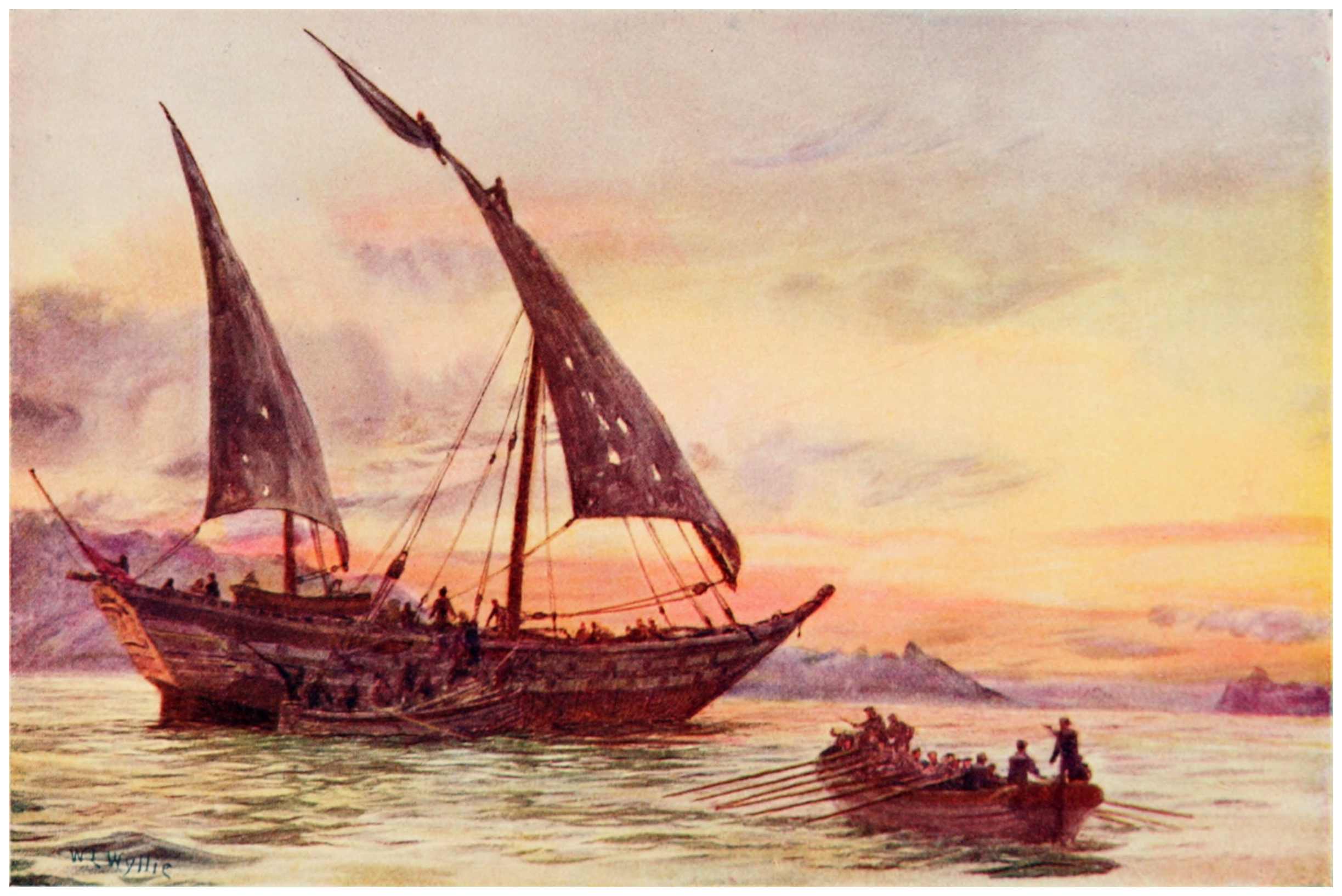
BOARDING A SLAVE DHOW
They were built as follows:—
Name.
Builder.
Engined by
Orlando
Palmer
Palmer
Australia
Glasgow
Napier
Aurora
Pembroke
Thompson
Galatea
Glasgow
Napier
Immortalité
Chatham
Earle
Narcissus
Hull
Earle
Undaunted
Palmer
Palmer
They were laid down in 1885 and 1886. The
Orlando was completed in 1888, all the others in 1889.
They were launched in 1886 and 1887, and some of them,
fitted with wooden guns (“Quakers”), served to swell
the Fleet at the great Jubilee Review of 1887. All made
over their designed speeds on trial, but they did their
trials “light.” In service all proved fairly useful, and
the Undaunted, with Lord Charles Beresford as her
captain in the Mediterranean, “made history” to the
extent of first creating an Anglo-American entente,
beginning with the U.S.S. Chicago, captained then by the
now universally known naval author, Admiral Mahan.
Beresford first achieved fame in the Condor at Alexandra,
in 1882; but it was in the Undaunted that he first
“made history” by ending the previously existing
hostility between the British and U.S. Navies; and
establishing the naval brotherhood of those who speak
the same language.
The Orlandos were the last of the essentially Barnaby
ships. Barnaby was associated with the Navy thereafter;
but the Nile and Trafalgar, though produced
under his régime, were not “Barnaby ships,” and
differences of opinion with the Admiralty about them
eventuated in his resignation.
The tide of naval opinion was then setting back in
the old Dreadnought direction. More complete protection
was being demanded. The quick-firer was just
coming in and its potentialities seemed enormous. The
secondary battery had to be protected. Destruction of
communications on board began to take on a fresh and
more serious aspect. In a word, the Admiralty reverted to
Reed ideas, and in reverting exaggerated them. In such
circumstances the general idea of the Trafalgars was born.
Sir N. Barnaby totally dissented from the Admiralty
line of thought. In his view the size of a ship could not
legitimately be increased unless her offensive powers
increased in proportion; in the Trafalgar idea both speed
and armament were reduced as compared to the Admiral
class, and over a thousand odd tons added entirely to
carry extra defensive armour. Over which dispute he
resigned his position.
Details of the Nile and Trafalgar as built are:—
Displacement—11,940 tons.
Length (between perpendiculars)—345ft.
Beam—73ft.
Draught (mean)—27½ft.
Armament—Four 13.5-inch, six 4.7 Q.F., also
smaller guns, and four 14-inch torpedo tubes,
of which two were submerged.
Armour (compound)—Belt, 230ft. long (i.e., 80ft.
longer than in the Admirals and Victorias),
20—16in., with 16—14 inch bulkheads, protective
deck at ends and over main belt.
Over this a redoubt 141ft. long, 18in. thick.
Above the redoubt a battery, 4in. thick.
Turrets, 18in.
Horse-power—12,000 = 17 knots.
Coal—(normal) 900 tons; (maximum) 1,200 tons
= 6,500 miles at 10 knots.
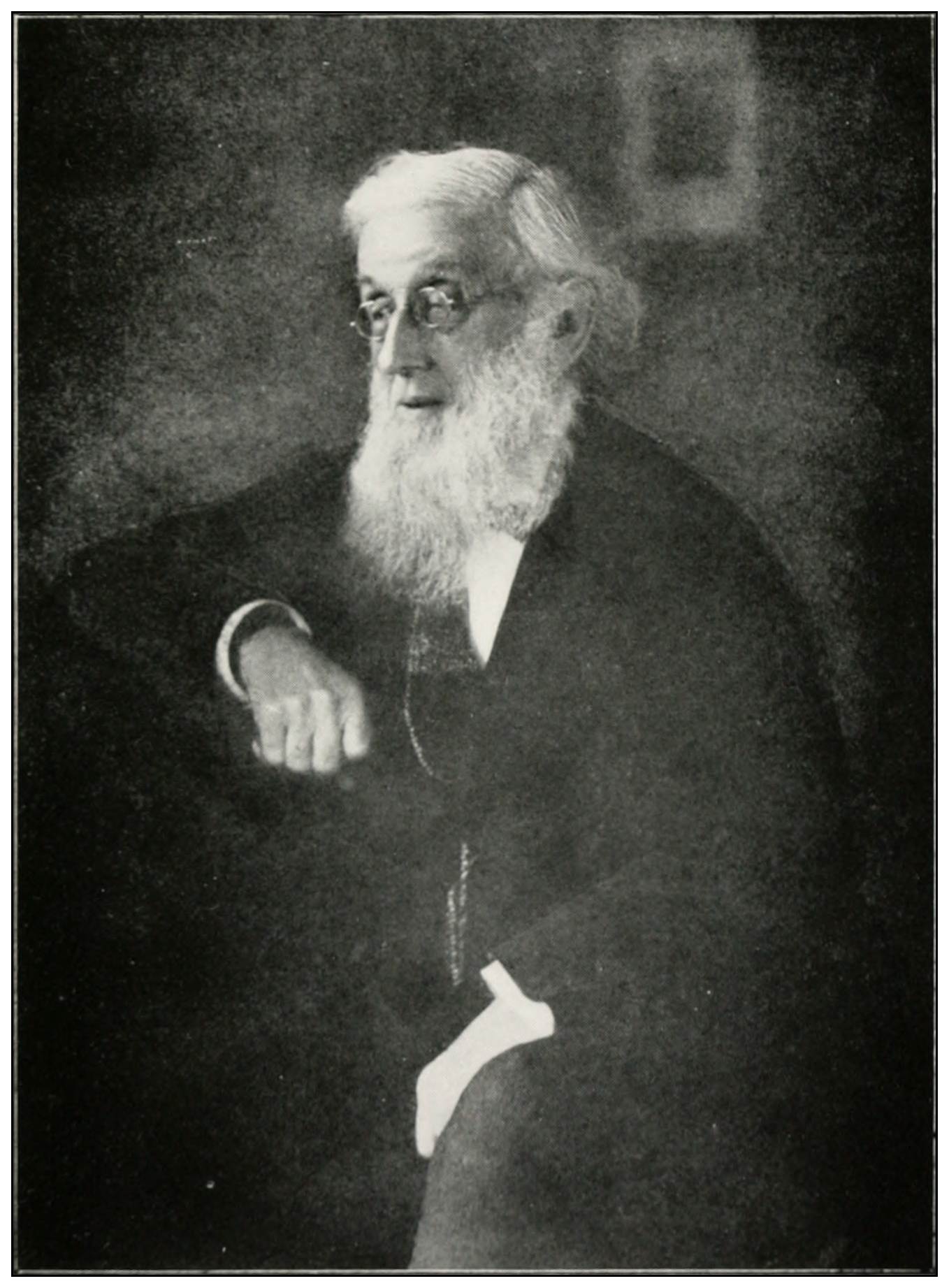
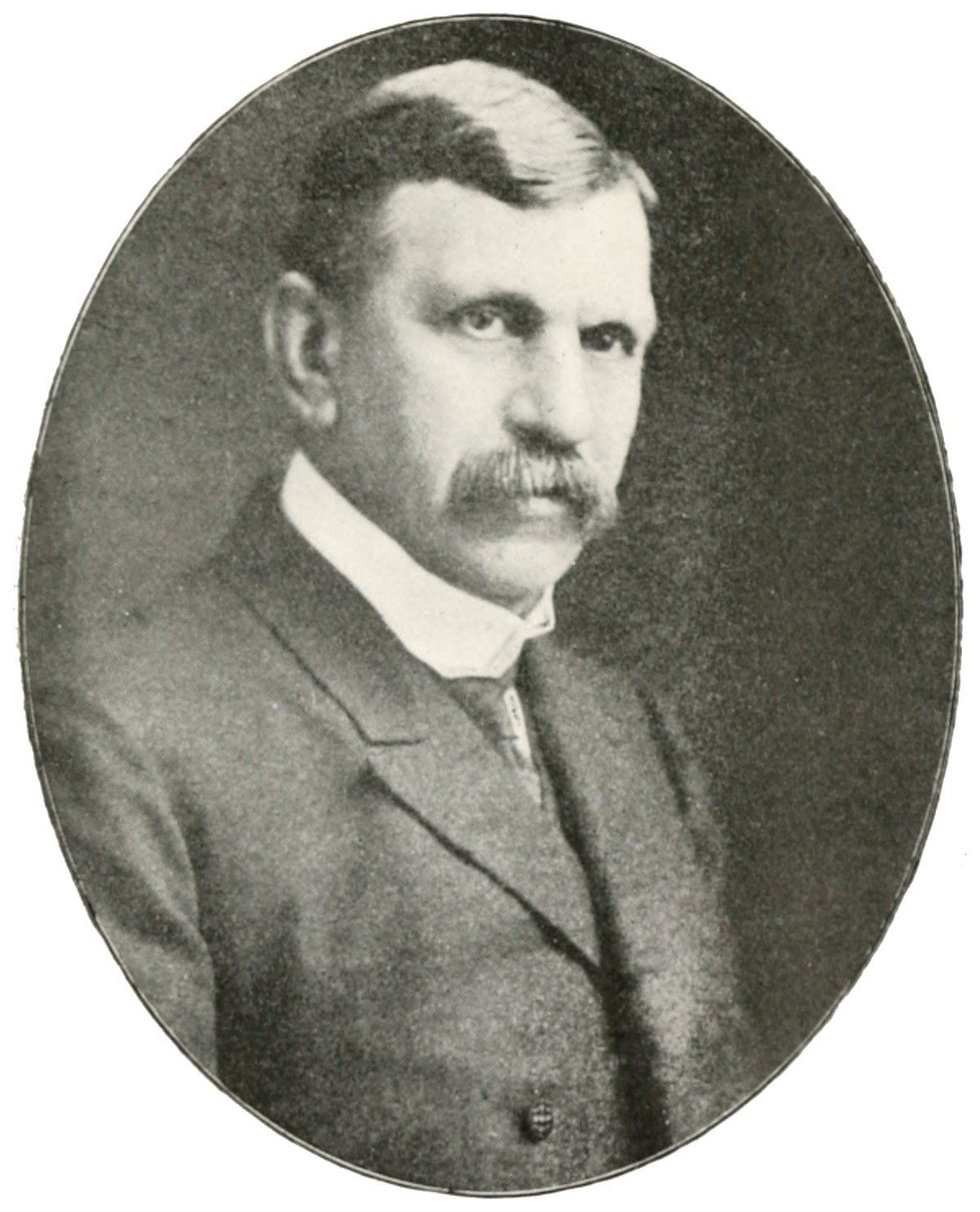
Photo]
[Russell & Sons.
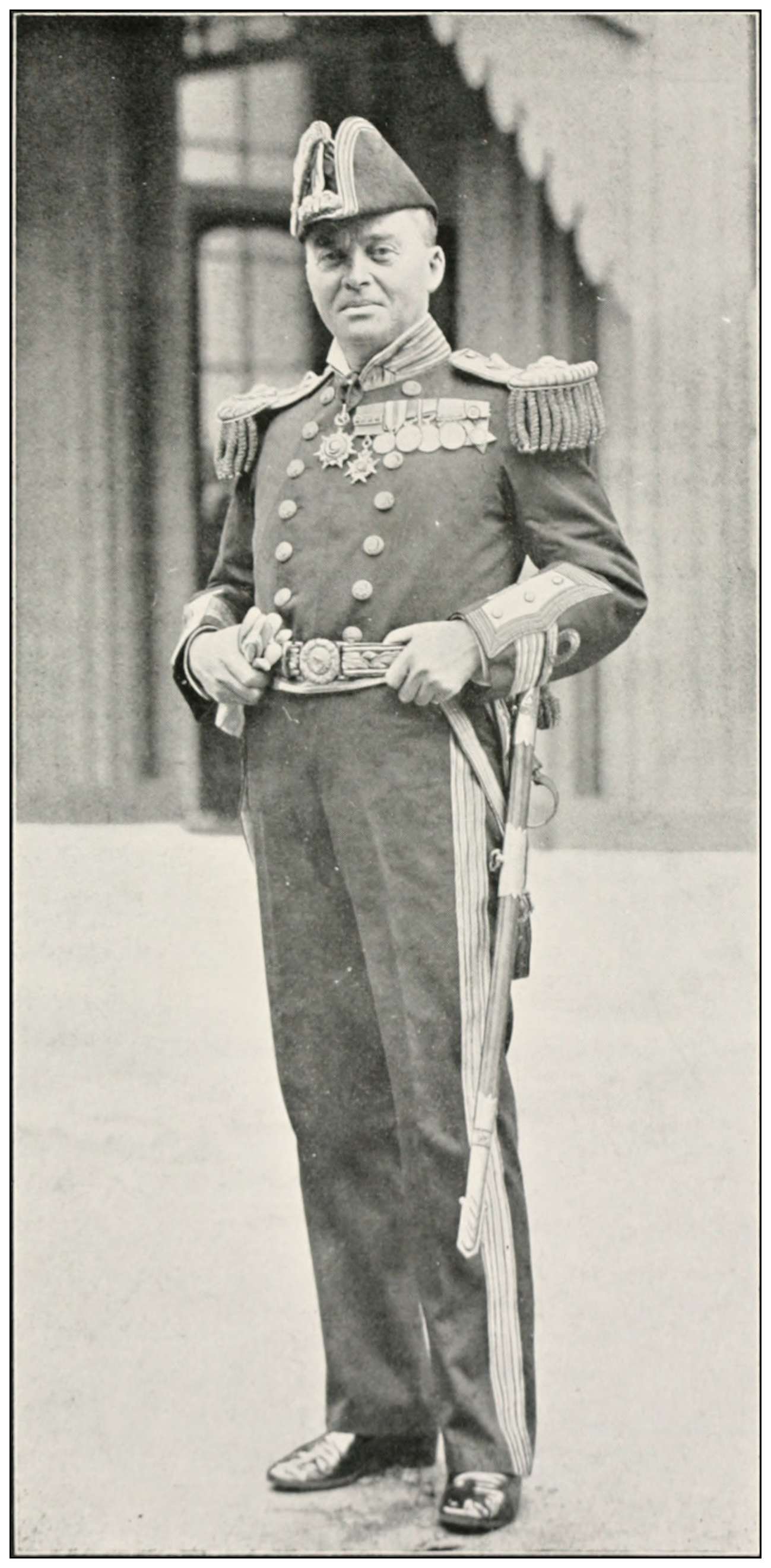
SIR N. BARNABY.
A recent photograph.
The Nile was built at Pembroke and engined by
Maudslay. She was laid down in April, 1886, launched
in March, 1888, and completed some two years later.
The Trafalgar was laid down at Portsmouth in January,
1886, and launched in September, 1887. Her machinery
was supplied by Humphrys. The armour of these ships
weighed no less than 4,230 tons, i.e., some 35 per cent.
of the displacement instead of the more usual 25 per
cent. or so. The then first Lord of the Admiralty took
the occasion of the launch to remark that the days of
such armoured ships were over, and that probably these
were the last ironclads that would ever be built—the
future would lie with fast deck-protected vessels! As,
for three years, no more armoured ships were laid down,
he at least enunciated a definite policy when these
heavily armoured successors of the Admiral class were put
afloat. They differed from the Admirals in that turrets
were reverted to instead of barbettes, and, as already
mentioned, they were really nothing but modernised
versions of the old low freeboard Dreadnought.
At a later date 6-inch Q.F. were substituted for the
4.7’s; but no other schemes of modernising the ships
ever came to a head.
Four ships of the Amphion Class—Amphion,
Arethusa, Leander, and Phæton, of which the first
(Arethusa) was laid down in 1880—represented the first
Barnaby idea of the protected cruiser. They were of
4,300 tons displacement, and 16.5 knots nominal speed.
They carried ten 6-inch guns, and a 1½-inch deck
amidships. According to the ideas of those days they
were heavily over-gunned. They always steamed well;
but it is doubtful whether Barnaby, left to himself,
would ever have produced them. Incidentally, they
were always bad sea-boats.
In 1883, completed about the same time as the
Victoria, the Mersey class—Mersey, Thames, Severn, and
Forth—of 4,050 tons displacement, and carrying two
8-inch and ten 6-inch, were commenced: practically
early essays at the Orlando class idea which followed.
The Orlandos, on only a thousand or so tons more
displacement, carried 9.2’s instead of 8-inch, had
armour-belts as well as protective decks, and were a
good knot faster. Both the Amphions and Merseys may
be described as representing strictly naval Admiralty
ideas—the Orlando, Barnaby ones. Each type was
quickly rendered obsolete by the coming of the quick-firer;
but the Barnaby type of cruiser, for 20 per cent.
extra displacement, certainly offered better chances than
any rival proposition, if only we consider matters in the
light of what existed in those days and what promised
best at that time.
So ends the Barnaby era. Barnaby’s constructional
ideas were blown to mincemeat by the advent of the
quick-firer. Even to-day his ideas seem somewhat
obsolete. Yet a few years hence (if big ships survive)
they stand every chance of being reverted to, because
to-day the big gun has more or less come back to
where it was in 1875–1885. Barnaby, though he worked
into its era, never realised the preponderance or possible
preponderance of the “secondary gun.” In his era it
fired too slowly to count for very much; in our own,
range neutralises whatever it may have accomplished
in the rapidity of fire direction.
Likely enough, the reversion to Barnaby ideals,
which is reasonably probable for the immediate future,
will be merely a phase; and casual historians will ever
put him down as the naval constructor who was least
able to anticipate the years ahead of his creations. But
a hundred years hence Barnaby may come into his own
in a way little suspected to-day. A hundred years hence,
when all the most modern ideas are ancient history,
Barnaby may stand with Phineas Pett, and the Navy
which he created stand for something infinitely more
than the scrap heap to which a later age swiftly relegated
it. Only the historian of the distant future can estimate
him at his real value. His own generation never placed
much faith in his ships; the generation that followed
generally regarded them with scorn. It was probably
wrong, but only the future can prove it to have been so.
The guns which especially belong to the Barnaby
era were as follows:—
Cal. ins.
Weight in tons.
Length in cals.
Weight projectile lbs.
Muzzle velocity f.s.
Muzzle energy ft.
Penetration 2000 yds.
iron.
comp.
M.L.
16
81
18
1684
1590
29,530
22
15
B.L.
16.25
110
30
1800
2148
57,580
29
19
13.5
67
30
1250
2025
35,560
26
17
12
45
25
714
2000
18,060
19
12½
9.2
22
25
380
1809
8622
15
10
8
14
30
210
2200
7060
14
9
6
5
26
100
1960
2665
8
5
In the early part of the period, guns of the Reed
era, down to the 10-inch 18-ton M.L., were also made
use of; but generally speaking, the Barnaby designs
coincide with early breechloading types. It is interesting
to note that the 81-ton gun figured in one ship only (the
Inflexible), and that after this the 38-ton 12.5 M.L. was
reverted to, to be replaced in later designs by the 45-ton
12-inch B.L.
The M.L. guns available for early Barnaby designs
were considerably superior to earlier examples of their
type; as after the fiasco of the Glatton trials,7 copper gas
checks were introduced. These were affixed to the base
of the projectile and expanded on firing. They led to a
certain increased power and accuracy; but, even so,
only of a relative nature compared with the better
results obtained from breechloaders. The Thunderer gun
disaster, which after many experiments was found to
have been caused by doubly loading the gun, added
another argument to the anti-muzzle-loader cause.
The 12-inch, which was the first large B.L. to be
introduced, compared as follows with the 12-inch M.L.:—
Gun.
Length in cals.
Weight tons.
Muzzle energy ft.
Weight of + projectile lbs.
Penetration of iron at
Muzzle. in.
1000 yds. in.
2000 yds. in.
12in. M.L.
13½
35
9470
706
16
15
13
12in. B.L
25
45
18,060
1250
30½
28
26
The enormous difference in efficiency was of course
traceable to other causes than the adoption of the
breechloader instead of the old M.L.; but this was,
equally naturally, overlooked; which, perhaps, was just
as well—otherwise the muzzle-loader might have persisted
to quite recent times. Though the Thunderer
disaster showed that a M.L. could be loaded twice over
by accident, this was an obviously unlikely thing to
occur again. The impression was made by the fact that
the 12-inch B.L. was far more powerful than the old
16-inch M.L. It was possibly this which directly led to
the “monster-gun craze” of the Barnaby era, the way
to which had already been shewn by the 16-inch M.L.
Incidentally it is interesting to note that the present
monster gun era is the third in which, after a
period of adhesion to a 12-inch gun, greatly increased
calibres have suddenly and more or less generally been
resorted to.
Reference has been made in the past chapter to
Sir E. J. Reed’s recognition of the possibilities of the
torpedo; and floating mines were, of course, well known.
It was not, however, till 1874 that either mine or torpedo
came to be regarded at all seriously.
The earliest Whitehead “fish torpedo” was produced
in 1868; though it was then little more than a
curiosity. It was a crude weapon, although it embodied,
with two notable exceptions, most of the features that it
possesses to-day. Its motive power was compressed air;
it carried an explosive head with a sensitive pistol.
The secret was bought by the British Government
at an early stage. It was made strictly confidential;
indeed, to the present day, the internal mechanism of a
torpedo is more or less sacred. Most other nations
purchased the secret also, and guarded it with like
care!
It is but fair to add that this ridiculous situation was
brought about by the inventor, who particularly specified
that the balance chamber must not be revealed even to
admirals commanding fleets, but only to specially
selected officers.
A main difficulty with the torpedo was how to discharge
it. For some while only two methods existed: the
first, a mechanism of catapult type which hurled the torpedo
into the water; the other, by a crude application of
dropping gear, suitable, of course, for launches only.
In either case, especially the former, there was a strong
element of uncertainty as to the direction the torpedo
would take; for one to describe a circle and return to
the firer was not unknown.8
The charge was inconsiderable, and range and speed
were both very small.
An instrument called the Harvey torpedo was more
or less contemporaneous with the Whitehead. It was a
very primitive idea, consisting as it did merely in
attempting to tow explosives across the course of an
enemy. It was too obviously cumbersome to cause
disquietude, and with the invention of torpedo tubes
passed into oblivion.
The advantages of the torpedo tube were quickly
recognised; and though the range was still little over
a hundred yards or so—at any rate, so far as any
probability of hitting was concerned—the torpedo
quickly became a part of the armament of all important
ships. So much was this the case that the submerged
tube was developed with sufficient celerity to be adopted
into the equipment of the Inflexible, of 1874 design.
None the less, however, the possible results of
torpedo attack remained uninvestigated till 1874, and
even then only came to be inquired into after the
Oberon experiments, which were primarily if not entirely
brought about by the advent of the observation mine as
a practical thing.
The mine’s arrival counted for little; the automobile
torpedo being at the moment much in the public eye, the
point that the Oberon experiments were primarily
designed to test the effect of mines got somewhat lost
sight of. The essential fact is that by 1874 the fact of
other enemies to the ship than the gun was established.
For a long time it affected ship design no further than
the gradual introduction of an anti-torpedo-boat armament;
but this was mainly due to Sir E. J. Reed having
in the Bellerophon design endeavoured to anticipate
torpedo effect. In 1874, and onward therefrom for some
time, the double bottom, combined with water-tight
bulkheads, was considered a suitable “reply” to the
“new arm,” and it was not for many years that torpedo
nets were in any degree appreciated.
In the later eighties some torpedo experiments were
conducted against the old ironclad Resistance, in which
the Bullivant net defence system proved altogether
superior to the cumbersome old wooden booms which
were in use: but, despite this, nothing was done for
many a year, and the old pattern was adhered to.
Financial Year.
Amount.
Personnel.
1869
9,996,641
63,000
1870
9,370,530
61,000
1871
9,789,956
61,000
1872
9,532,149
61,000
1873
9,899,725
60,000
1874
10,440,105
60,000
1875
10,825,194
60,000
1876
11,288,872
60,000
1877
10,971,829
60,000
1878
12,129,901
60,000
1879
10,586,894
58,800
1880
10,566,935
58,800
1881
10,945,919
58,100
1882
10,483,901
57,500
1883
10,899,500
57,250
1884
11,185,770
56,950
1885
12,694,900
58,334
II. THE WHITE ERA. — THE BATTLE OF THE BOILERS. — GUNS IN THE ERA. — PURCHASED SHIPS. — NAVAL ESTIMATES IN THE ERA.
The appointment of Sir William White as Chief
Constructor more or less synchronised with a
considerable revolution in naval construction and
ideas. The institution of naval manœuvres drew great
attention to the sea-going quality of various types of ships.
The manœuvres of 1887 mostly centred around the
Polyphemus, and her charging a boom at Berehaven.
Little was here proved except that boom defences were
easily to be annihilated. In 1888, however, the
manœuvres were of a much more extensive nature, and a
Committee was appointed to consider and report upon
them, especially with regard to the following points:—
“The feasibility or otherwise of maintaining an effective
blockade in war of an enemy’s squadron or fast cruisers in strongly
fortified ports, including the advantages and disadvantages of—
(a) Keeping the main body of the blockading Fleets off the
ports to be blockaded with an inshore squadron.
(b) Keeping the main body of the blockading Fleets at a base,
with a squadron of fast cruisers and scouts off the
blockaded ports, having means of rapid communication
with the Fleet.
(c) In both cases the approximate relative number of battleships
and cruisers that should be employed by the
blockading Fleet, as compared with those of the blockaded
Fleet.
“The value of torpedo-gunboats and first-class torpedo boats
both with the blockading and blockaded Fleets, and the most
efficient manner of utilising them.
“As to the arrangements made by B squadron for the attack
of commerce in the Channel, and by A squadron for its protection.
“As to the feasibility and expediency of cruisers making raids
on an enemy’s coasts and unprotected towns for the purpose of
levying contribution.
“As to the claims and counterclaims made by the Admirals
in command of both squadrons with regard to captures made during
the operation.
“As to any defects of importance which were developed in any
of the vessels employed, and their cause.”
As Supplementary Instructions there were:—
(1) As to the behaviour and sea-going qualities of, or the
defects in, the new and most recently commissioned
vessels, as obtained from the reports of the Admirals in
command of the respective squadrons.
(2) The general conclusion to be drawn from the recent operations.”
“That to maintain an effective blockade of a Fleet in a strongly
fortified port a proportion of at least five to three would be essential
and possibly an even larger proportion, unless a good anchorage
could be found near the blockaded port which could be used as
a base, in which case a proportion of four to three might suffice,
supposing the blockading squadron to be very amply supplied with
look-out ships and colliers.”
Torpedo boats were condemned as being of little
value to blockaders, though useful to the blockaded.
For blockade purposes the torpedo-gunboats of the
Rattlesnake class were highly commended.
Attention was drawn to the large number of deck
hands employed down below on account of the insufficient
engine-room complements, and the excess of untrained
stokers. The case of the Warspite was specifically
mentioned. In order to break the blockade at sixteen
knots she sent thirty-six deck hands down below at a
time when every available deck hand would have been
required above had the operations been real war.
A special supplementary report was called for as
to the sea-going qualities of the ships. Considerable
historical interest attaches to this particular report, and
the following extracts are especially interesting:—
Admiral class.
“So far as could be judged, these vessels are good sea-boats,
and their speed is not affected when steaming against a moderate
wind and sea; but we are of opinion that their low freeboard
renders them unsuitable as sea-going armour-clads for general
service with the Fleet, as their speed must be rapidly reduced when
it is necessary to force them against a head sea or swell.
“On the only occasion on which the Collingwood experienced
any considerable beam swell she is reported to have rolled 20 degrees
each way; this does not make it appear as if the Admiral class
will be very steady gun-platforms in bad weather.
“They are said to be ‘handy’ at 6 knots and over.
“In the Benbow much difficulty was experienced in stowing
the bower anchors. This is the case in all low freeboard vessels,
more or less, but the evil appears to have been intensified in this
instance by defective fittings, and by the fact of her being supplied
with the old-fashioned iron-stocked anchors instead of improved
Martins.
“Serious complaints are made from these ships that the forecastles
leak badly, and that the mess-deck is made uninhabitable
whenever the sea breaks over the forecastle at all; it would seem
that this defect might be remedied.”
This opinion was not shared by Admiral Sir Arthur
Hood, who commented as follows:—
“I cannot concur in this opinion, my view being that the
objects of primary importance to be fulfilled in a first-class battleship
are: (1) That, on a given displacement, the combined powers of
offence and defence shall be as great as can be given; (2) that she
shall be handy and possess good speed in ordinary weather, combined
with sea-worthiness; (3) that she shall have large coal-carrying
capacity. I certainly do not consider that the Admiral class,
which, on account of their comparatively low freeboard forward,
must have their speed reduced when steaming against a heavy head
sea or swell to a greater extent than is the case with the long, high
freeboard, older armour-clads, as the Minotaur, Northumberland,
Black Prince are for this reason rendered unsuitable as sea-going
armour-clads for general service with a Fleet. The power of being
able to force a first-class battleship at full speed against a head sea
is not, in my opinion, a point of the first importance, although in
the case of a fast cruiser it certainly is. Admiral Tryon draws
an unfavourable comparison between the speed of the new battleships
and that of the long ships of the old type, when steaming against
a head sea. I admit at once that vessels like the Minotaur class
would maintain their speed and make better weather of it when
being forced against a head sea than would the Admirals; but this
advantage, under these exceptional conditions, cannot for a moment
be compared with the enormous increase in the power of offence
and defence possessed by the Admirals.”
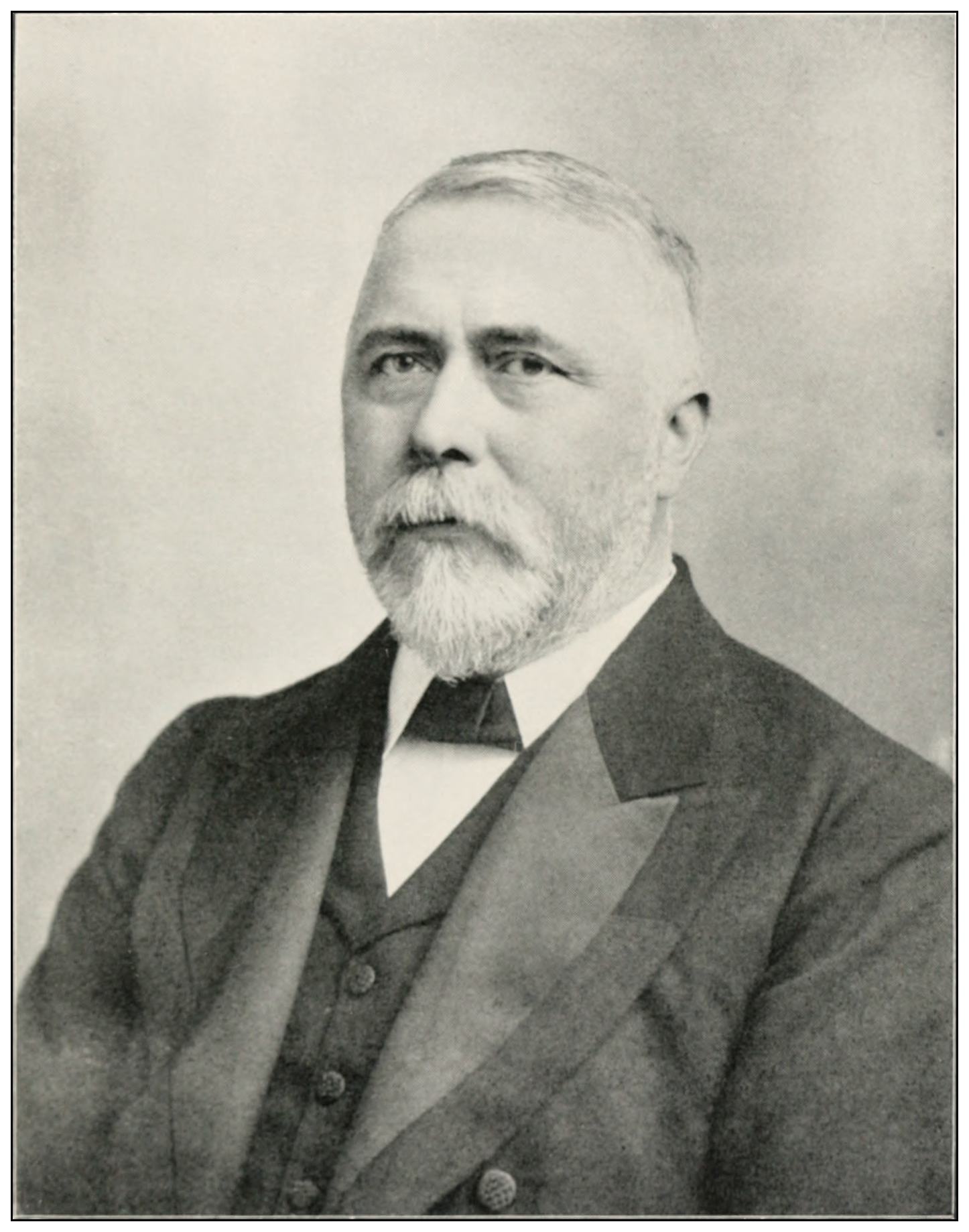
Photo]
[Russell & Sons.
SIR WILLIAM WHITE.
The Conqueror and Hero were reported to roll a great
deal. Being short they felt a head sea quickly, and on
account of their low freeboard it was found impossible to
drive them against a heavy sea at anything approaching
full speed. Incidentally these ships were known as
“half-boots.”
Here, again, Admiral Sir Arthur Hood dissented.
In connection with these points, Admiral Tryon submitted
a report in which he emphasised, as he had
done with the Admirals, that however fast these short
ships might be in smooth water, their speeds fell off
rapidly in a seaway.
The Mersey class were described as being handy,
steady gun platforms and able to fight their guns longer
than most ships.10 The captain of the Severn, however,
reported a view that the 8-inch guns should be removed
and lighter pieces substituted. Admiral Baird agreed
with this. Sir Arthur Hood, in his comments, stated that
he was “decidedly opposed” to any reduction of armament,
both in this case and that of the other cruisers.
The Arethusa type were reported to roll so heavily
when the sea was abeam or abaft that “accurate
shooting would be impossible and machine guns in the
tops would be useless.”
The Committee concurred with Admiral Baird that
the armament of these should be reduced.
For the Archer class it was unanimously suggested
that lighter guns should be fitted forward. Sir Arthur
Hood agreed with this view, which, however, was never
carried into effect.
Particular interest attaches to the Rattlesnake11
class of torpedo-gunboats—these vessels being really
prototypes of the destroyers of the present day. They
were reported as “safe, provided they were handled
with care.” Their handiness was unfavourably reported
on. It was strongly urged that the 4-inch gun mounted
forward should be removed. This, however, was never
done.
With reference to any new vessels of this type,
the Committee reported as deserving immediate consideration:—
(1) Generally strengthen the hull in this type of
vessel.
(2) Raise the freeboard forward.
or (3) “Turtle-back” the forecastle.
In the gunboats that followed the freeboard forward
was considerably raised; but when destroyers came to be
built several years later, it is interesting to observe that
the turtle-back forecastle was adopted, and it was not
till after over a hundred had been built that the high
forecastle, recommended so long before, appeared in the
River class.
The report concluded:—
“The proportion of untrained (2nd class) stokers which were
drafted to several of the ships appears to have been too large;
in point of physique they are reported as unequal to their work,
and in many instances the experience of these men in stokehold
(or any other work on board ship) was nil.
“As a means of affording opportunities for training newly-raised
stokers we recommend that at least one year should be served
by them as supernumerary in a sea-going ship before they are
considered fit to be draughted as part complement to any vessel;
we further are of opinion that a Committee should be appointed
to inquire into the sufficiency or otherwise of the complements allowed
in the steam department of each class of ship, the proportion of
2nd class stokers which should be borne, and the amount of training
which they should be required to undergo before they can usefully
be borne as part complement in a fighting ship.”
An agitation as to the state of the Navy, which was
commenced in the year 1887, mainly by the initiative of
the Pall Mall Gazette,12 finally resulted in the passing of
the Naval Defence Act of 1889. This provided for the
construction of a total of seventy vessels, consisting of
ten armoured ships, nine first-class cruisers, twenty-nine
second-class cruisers, four third-class and eighteen
torpedo gunboats, to be built as quickly as possible at
the estimated cost of £21,500,000.
The substantial part of the programme of 1886 had
consisted of two big turret ships, the Nile and Trafalgar,
and two armoured cruisers, Immortalité and Aurora of
the Orlando class. In 1887 nothing larger than second-class
cruisers was laid down; and in 1888 the most
important vessels on the programme were only the
protected cruisers, Blake and Blenheim. There was,
therefore, ample material for panic.
Details of the Blakeclass:—
Length (p.p.)—375 ft.
Beam—65 ft.
Guns—Two 9.2 in., 22-ton B.L.R., ten 6-in. Q.F.,
eighteen 3-pdr.
H.P.—20,000.
Designed speed—22.0 kts.
Coal—1500 tons.
Builder of Ship—Blake, Chatham; Blenheim,
Thames Ironworks.
Builder of machinery—Blake, Maudsley; Blenheim,
Thames Ironworks.
Launched—Blake, 1889; Blenheim, 1890.
Special features of these ships were a combination of
the armament of the Orlando class with greatly increased
speed secured by the development of deck armour in
place of the belts of the Orlando class. In so far as a
special type of ship may be said to be the development
of some predecessor, the Blake and Blenheim may be
described as enlarged Merseys. They were, however,
unique on account of their relatively great length and
great increase of displacement as compared with preceding
vessels. In them the armoured casemate, a leading
characteristic of nearly all Sir William White’s ships,
made its first appearance. It was employed in the Blake
and Blenheim for four main deck guns, the upper deck
guns being behind the usual shields.
The coming of the casemate, curiously enough,
attracted little attention, compared to its importance.
It may be said to have rendered possible the return to
main deck guns in unarmoured ships. In the Orlando
class, ten 6-inch guns were all bunched together on the
upper deck amidships. Since these ships were designed
the 6-inch quickfirer had made its first appearance, and
the largest possible distribution of armament was
therefore desirable. The adoption of the two-deck
system of the Blake and Blenheim secured this much
larger distribution, rendering it impossible for a single
shell to put more than one of the five broadside 6-inch
out of action, whereas in the Orlando class at least three
guns were at the mercy of a single shell.
Another novelty of the type was the introduction
of a special armoured glacis around the engine hatches.
This system had, of course, been used before in the
Italian monster ships Italia and Lepanto, but it was first
introduced in the British Navy in the Blakes.13
The ships were very successful steamers, for all
that neither made her expected twenty-two knots on
trial.
Trial results:—
Blake: Eight hours’ natural draught, mean I.H.P.—14,525
= 19.4 knots.
Blenheim: Eight hours’ natural draught, mean
I.H.P.—14,925 = 20.4 knots.
Blake: Four hours’ force draught, mean I.H.P.—19,579
= 21.5 knots.
Blenheim: Four hours’ forced draught, mean
I.H.P.—21,411 = 21.8 knots.
The principal item of the Naval Defence Act was
eight first-class and two second-class battleships. All
these ships were designed by Sir William White, and may
be described as battleship editions of the Blake and
Blenheim, so far as the disposition of their armament was
concerned. For the rest they may be described as
attempts to combine in one ship the best features of the
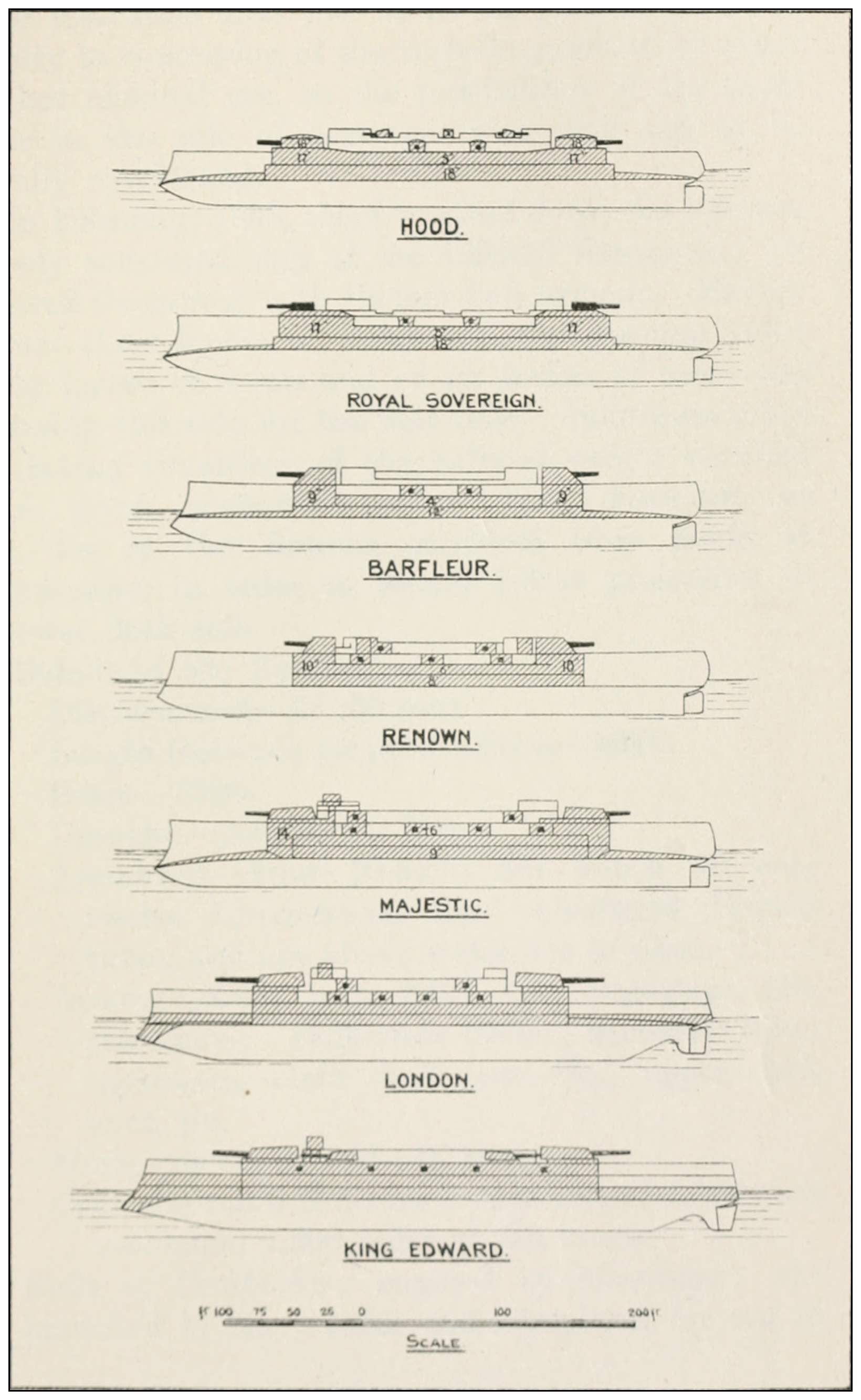
Read and Barnaby ideals. In place of the low freeboard
of the Admiral class, seven of the Royal Sovereigns were
given high freeboard fore and aft, with the big guns about
twenty-three feet above water. The eighth ship, the
Hood, was modified to suit the ideals of Admiral Hood,
and was to some extent an improved Trafalgar, her big
guns being in turrets some seventeen feet above the
water, in turrets instead of en barbette, with guns exposed
as in the rest of the class.
In them, among other special features, 18-inch
torpedo tubes were first introduced instead of 14-inch,
and a stern torpedo tube appeared.
The original idea of end-on torpedo tubes was
torpedo attack from the bow in place of the ram. The
Polyphemus was the first ship in which an end-on tube
appeared (submerged). In cruisers of a later date the
bow tube was found to injure speed, and there was
always the danger of a ship over-running her own torpedo.
On this account the bow-tube never secured in the British
Navy that vogue which it obtained, and still has, in
Germany.
The stern-tube appears to owe its origin to an idea
that a defeated or overpowered ship, running from
an enemy, might save herself by it: dim ideas of
“runaway tactics” had also begun to appear.
Sir William White never claimed for himself that
he had anticipated the future in any way in his torpedo
armament, even when defending himself against criticisms,
to the effect that he “gave too little for the
displacement.” Yet his torpedo innovations, besides
discounting the future, all helped to swell the total
weight; as also did many internal strengthenings of the
kind which do not show on paper. Possibly he did not
realise his own greatness as the designer of a class of ship
which was so much better than any contemporary vessel,
that even in these days of “Super-Dreadnoughts” the
Royal Sovereigns are still looked back upon with respect,
and invariably regarded as marking the beginning of an
entirely new phase in ship construction.
In April, 1889, their designer read a paper about
them at the Institution of Naval Architects, in which the
principal points which he claimed were that much superior
command of guns was given, and that the auxiliary
armament was nearly three times the weight of that of
the Trafalgars. The following points were also mentioned
by him:—
“(a) ‘That (it was officially decided that) it was preferable to
have two separate strongly protected stations for the four heavy
guns, rather than to have a single citadel.’
“(b) ‘That on the whole the 4-inch armour amidships, from the
belt deck to the main deck, associated as it would be with the
internal coal bunkers, sub-divided into numerous compartments,
might be considered satisfactory; but that if armour weight became
available, it could be profitably utilised in thickening the 4-inch
steel above the middle portion of the belt.’
“I would draw particular attention to the first of these conclusions,
since it expresses a most important distinction between the
two systems of protection.
“With separate redoubts, placed far apart, the two stations are
isolated, and there is practically no risk of simultaneous disablement
by the explosion of shells, or perforation of projectiles from the
heaviest guns. Each redoubt offers a small target to the fire of
an enemy, and its weakest part—the thick steel protective plating
on the top—is of so small extent that the chance of its being struck
is extremely remote. Serious damage to the unarmoured turret
bases therefore involves the perforation of the thick vertical armour
on the redoubts.
“With a single citadel, extending the full breadth of a ship, the
case is widely different.
“Over a comparatively large area of the protective deck-plating
in the neighbourhood of each turret, perforation of the deck, or its
disruption by shell explosions at any point, involves very serious
risk of damage to the turret bases and the loading apparatus. In
fact, such damage may be effected and the heavy guns put out of
action while the thick vertical armour on the citadel is uninjured.
Moreover, as the turrets stand at the ends of a single citadel, there
is a possibility of their simultaneous disablement by the explosion
of heavy shell within the citadel.
“This last risk may be minimised (as in the Nile and Trafalgar)
by constructing armoured ‘traverses’ within the citadel; but it
cannot be wholly overcome, so long as both turrets stand in one
armoured enclosure.
“It may be thought that the risk of damage to a 3-inch steel
deck situated 11 ft. above water is remote; but I think the facts
are as stated, when actions at sea are taken into account.
“For example, if a ship of 70 to 75 ft. beam is rolling only to 10
degrees from the vertical, which is by no means a heavy roll, she
presents a target having a vertical (projected) height of 13 to 14 ft.
to an enemy’s fire, and even if she is a steady, slow-moving ship,
she will do this four or five times in each minute.
“Now, at this angle of inclination, assuming the flight of
projectiles to be practically horizontal, even the thickest protective
steel decks yet fitted in battleships are liable to serious damage from
the fire of guns of moderate calibre, and this danger is increased by
the employment of high explosives. Of course, I do not mean to
say that this damage is to follow from fire intentionally aimed at
the protective deck; but with a great and sustained volume of fire,
such as is possible with a powerful auxiliary armament, and especially
with quick-firing guns, it is obvious that there is a very real danger
of chance shots injuring seriously the wide expanse of the protective
deck at the top of a long citadel.
“Again, it must be noted that the chances of damage to a deck
placed 10 or 11 ft. above water, and with large exposed surfaces in
the neighbourhood of the turrets when a ship is inclined or rolling,
are greater far than those of a deck 7 or 8 ft. lower, and with 5-inch
armour on the sides protecting the deck from the direct impact of
shells containing heavy bursters. It is for the naval gunner to
estimate these chances of injury; but, unless I am greatly mistaken,
their verdict will be that a far greater number of shots are likely to
strike at a height of 8 to 10 ft. above water than at a height of 4 to 5 ft.
“These considerations, I submit, amply justify the selection of
the separate redoubt system, in association with the thin side armour
above the belt, and the lowering of the protective deck to the top of
the belt in the new designs.
“It may be urged that, if the redoubt system be adopted, it
should be associated with side armour and screen bulkheads of
greater thickness than 5-inch steel, and more strongly backed. This
is perfectly practicable, but necessarily costly, involving an additional
load of armour, and a corresponding increase in the size of the ship.”
The designs were vigorously criticised by Sir Edward
Reed, whose chief objections centred on the fact that
the lower-deck protection was thin armour only. Sir
William White combatted this idea, and proved very
conclusively that, according to the needs of the moment,
his views were correct. It is, however, worthy of record
that at a later date with the Majestic class (see a few
pages further on), he effected modifications which brought
his ships more into line with what Sir Edward Reed had
advocated. It should, however, be mentioned that this
was not done until improvements in armour construction
rendered possible things that were certainly impossible
in the days of the Royal Sovereigns.
In connection with the later career of the Royal
Sovereign class these items may be added. On completion
they were found to be singularly simple in all
their internal arrangements, and extraordinarily strong.
When they went to the scrap-heap in 1911–12, they
were, constructionally, practically as good as when built.
They proved to be good sea boats, but at first rolled very
badly, which resulted in their getting an unenviable
notoriety in this respect. This was, however, completely
cured by the fitting of bilge keels, after which the ships
were everything that could be desired in the way of
being steady gun platforms.
The ever increasing vogue of the quickfirer tended
to render them rather quickly obsolescent over things
which to-day would count much less than they did in
the past. The defects of the Sovereigns, as realised not
very long after completion, were:—
(1) That the big guns’ crews were practically
unprotected, and easily to be annihilated by
the newly-introduced high explosive shells
of the secondary armament of an enemy.
(2) Only four of the ten 6-inch were armour protected,
which also was considered a fatal
drawback.
In the first case nothing was ever done; but in the
second, about the year 1900, casemates were fitted
for the upper-deck guns of all ships except the Hood,14
which on survey was found unsuitable for such reconstruction.
The only thing that remains to add is that although
in the course of years the ships lost the speeds for which
they were designed, up to the very end they proved
capable of doing about thirteen knots indefinitely.
In addition to the Sovereigns two “second-class
battleships” were built, the Centurion and Barfleur,
of which details are:—
Displacement—10,500 tons. Complement, 620.
Length—(Waterline) 360ft.
Beam—70ft.
Draught—(Maximum) 27ft.
Armament—Four 10-inch, ten 4.7-inch, eight 6-pounders,
twelve 3-pounders, two Maxims, two 9-pounder boat
guns. Torpedo tubes (18-inch)—two submerged and
one above water in the stern.
The Barfleur was laid down at Chatham in November,
1890, launched in August, 1892, and completed two
years later. The Centurion, laid down at Portsmouth in
March, 1891, was launched a year later, but completed
before her sister.
The ships were armoured generally on the Royal
Sovereign plan, with 12-inch belts which, however, were
only 200ft. long, instead of 250ft. The bulkheads were
six inches only, and the upper belt (nickel steel) an inch
less than in the big ships. The barbettes were reduced
to nine inches only, but on the other hand were made
circular instead of pear-shaped, and 6-inch shields were
provided for the big guns—probably as the result of
criticisms of the unprotected big guns of the Sovereigns.
With a few early exceptions as to the shape of the base,
and with certain variation in form, this kind of “turret”
has been adhered to ever since in the British Navy and
copied into every other.
Both ships were engined by the Greenock Foundry
Company, and designed for 13,000 H.P., with forced
draught, giving a speed of 18.5 knots, which speed both
exceeded on trial. This high speed and their coal
endurance—they carried a maximum of 1,125 tons,
sufficient for a nominal 9750 mile radius—makes them
something more than the “second-class battleships”
which they nominally were.
Compared to the Sovereigns they were:—
Minus Points:
Barfleurs.
Sovereigns.
Displacement (tons)
10,500
14,100
Principal guns
4—10in., 10—4.7
4—13.5, 10—6in.
Armour belt
12 inches.
18 inches.
Plus Points:
Horse Power
13,000
13,000
Speed
18.5
17
Nominal endurance (kts.)
9,750
7,900
From which the existence of an elementary conception
of the “battle-cruiser” of to-day seems fairly
apparent. To-day the battle-cruiser, instead of having
guns of reduced calibre, carries a reduced number, but
the general principle of “moderate sacrifices for increased
speed” obtains.
The Barfleur and Centurion proved excellent steamers
and good sea-boats. Their defect was their weak armament,
and in 1903 it was decided to remedy this. In
that year they were “reconstructed.” Their 4.7’s were
taken out and 6-inch guns substituted, and the six on
the upper deck were put into casemates. As a species
of make-weight the foremast was taken out of both
ships; but this made little difference. The “improvements”
were a total failure; the ships were immersed
far below what they had been designed for, and they
never thereafter realised much more than about sixteen
knots. Within seven years they were removed from the
Navy List altogether, and such service as they performed
after modernising was entirely of a subsidiary order.
For the first-class cruisers of the Naval Defence
Act reduced examples of the Blenheim were decided
on. These vessels were the Edgar, Endymion, Grafton,
Hawke, St. George, Gibraltar, Crescent, and Royal Arthur
(formerly designated as the Centaur). They were
launched between 1891 and 1892, averaging 7,350 tons
(unsheathed) and 7,700 tons (sheathed and coppered, in
the case of the last four mentioned). Except the two
last, all had the Blenheim armament of two 9.2 and ten
6-inch. The two latter had a couple of extra 6-inch on
a raised forecastle substituted for the forward 9.2.
No attempt was made to obtain the high speed
of the Blenheims—19.5 knots being the utmost aimed
at. Not only, however, did the Edgar class exceed
expectations on trial, but they proved most remarkably
good steamers in service. No engine-room defects of
moment were ever encountered in any of them, and
twenty years after launch most were still able to steam
at little short of the designed speed. Like the battleships,
they were given 18-inch torpedoes in place of the
14-inch of the Blenheims.
In the course of their service careers, the St. George
(or rather her crew) earned distinction in the Benin
Expedition. The Crescent was served in by King
George V, and the Hawke achieved notoriety by ramming
the Olympic in the Solent in 1911.
The lesser cruisers of the Naval Defence Act
numbered altogether 28. Of these twenty belonged to
the Apollo class of 3,400 tons (unsheathed) and 3,600
tons (sheathed). They were Apollo, Andromache,
Latona, Melampus, Naiad, Sappho, Scylla, Terpsichore,
Thetis, Tribune (unsheathed), and Aeolus, Brilliant,
Indefatigable (named Melpomene in 1911), Intrepid,
Iphigenia, Pique, Rainbow, Retribution, Sirius, and
Spartan (sheathed).
In all, the armament was two 6-inch and six 4.7,
with lesser guns, and, above-water, 14-inch torpedo
tubes. The speed was twenty knots in the unsheathed,
and a quarter of a knot less in the sheathed ones.
When built all proved able to steam very well, but
after some years service certain of them fell off very
badly in speed. Others, however, remained as fast as
when they were built—the Terpsichore, in 1908, averaging
20.1 knots, and the Aeolus, in 1909, nearly nineteen
knots.
During their service, the Melampus was commanded
by King George as Prince George, while the Scylla,
under Captain Percy Scott, gave birth to the “dotter,”
and the “gunnery boom” which followed. In 1904
and onwards seven of them, scrapped from regular
service—the Latona, Thetis, Apollo, Andromache, Iphigenia,
Intrepid, and Thetis—were totally or partially disarmed
and converted into mine layers.
SECOND CLASS CRUISER OF THE NAVAL DEFENCE ACT ERA. NOW CONVERTED INTO A MINE-LAYER
The remaining eight cruisers of the Act—Astræa,
Bonaventure, Cambrian, Charybdis, Flora, Forte, Fox,
and Hermione—were increased in size up to 4,360 tons,
and given a couple of extra 4.7, and 18-inch in place of
14-inch tubes. Instead of their 4.7’s being mounted in
the well amidships, they were placed on the upper deck
level, a much better position in a sea-way, but they
never proved themselves quite such good ships for their
size as did the earlier type. They served to illustrate
the general rule that slight improvements on a design are
rarely satisfactory, and that while every staple design
has its defects, it is extremely difficult to remove one
drawback without creating another. Moreover, such
improvements invariably cause increased cost, and an
essential with the small cruiser is that she shall be cheap
enough to be numerically strong. Four Astræas cost as
much as five Apollos. They were rather more seaworthy,
but no faster—if as fast. The total broadsides
obtained were only one 4.7 more and two 6-inch less.15
A considerably greater possible bunker capacity was
obtained; but the normal supply (400 tons) was the
same for both.
In the British Navy, in 1908–11, a precisely similar
thing obtained. It was probably inevitable. In the
German Navy, between 1897 and 1907, displacement
for small cruisers rose from 2,645 to 4,350 tons, with
practically the same armament. But here the horse-power
rose from about 8,500 or less to 20,000, and
designed speeds in proportion, from a twenty-one knots
(not made) to a 25.5, which, on trial, turned out to be
27,000 I.H.P. and over twenty-seven knots.
Here, however, there was a definite aim—increased
speed, with only trivial improvements in any other
direction. With similar British cruisers the defect has
invariably been “general improvements” on what the
original design might have been if plotted a year or two
later than it actually was. There is no question—or
very little—but that Germany in its ultra-conservative
policy gauged the situation better than any British
Admiralty ever did till just before the war.
Minor cruisers must be cheap to construct. Any
improvement in them must have a definite intrinsic value.
Lacking that, it is worth very little. The Astræas, as
cited, indicated how a supposed advantage may even be
a real deficit from another point of view.
The value of increased speed cannot be put into
£ s. d., but armament easily can be. Like reconstruction,
minor “improvements” on a design rarely pay. With
the original conception the naval architect is given
certain data for which he arranges accordingly. Ordered
to improve upon it in any direction he can only add
displacement and upset the balance of everything.
The Naval Defence Act also included a certain
number of third-class cruisers—Pallas, Pearl, Philomel,
and Phœbe—for the ordinary service, and five similar
ships for the Australian station, originally named Pandora,
Pelorus, Persian, Phœnix, and Psyche. These
were later altered to Australian names, Katoomba,
Mildura, Wallaroo, Tauranga, and Ringarooma. They
were of 2,575 tons, with 2½ decks, armaments of eight
4.7-inch and four above-water 14-inch tubes. The
designed speed was 19 knots.
Thirteen torpedo gunboats, improved Rattlesnakes,
were laid down under the Act, corresponding to nine
others of the normal Programme, of which two were
for Australia. The Naval Defence boats were Alarm,
Antelope, Circe, Gleaner, Gossamer, Hebe, Renard, Speedy—all
laid down in 1889, as also were the Whiting (afterwards
Boomerang) and Wizard (renamed Karahatta) for
Australia. Those laid down normally in the previous
year were the Salamander, Seagull, Sheldrake, Skipjack,
Spanker, Speedwell, for the British Navy. Two others,
Assaye and Plassy, were built for the Indian Marine at
and about this time. All carried a couple of 4.7-inch
guns, were of about 750–850 tons displacement, and were
first known as “catchers.” They were all intended to
steam at 19 knots or over with locomotive boilers; but
in service none ever did. At a later date, reboilered with
water-tubes, many reached or exceeded the designed
speed, and the majority of them are still in service for
auxiliary purposes—many being specially fitted as mine
sweepers, and the rest used as tenders for various
services.
They are of considerable interest on account of the
fact that the destroyers of 1909–12 were practically the
same displacement and general shape, with a not very
dissimilar armament—two 4-inch instead of two 4.7.
The modern destroyers, however, were approximately ten
knots faster—an interesting commentary on engineering
improvements in the course of twenty years!
More interesting still, however, is the fact that Sir
William White should have evolved twenty years
ago almost exactly what—except in the matter of
modern speed possibilities—is to-day the recognised
ideal for destroyers.
In the British Navy the torpedo gunboats never
get beyond the “catcher” stage—they never had the
opportunity; but it is worthy of note that the first
two ships to be torpedoed under anything like modern
war conditions—the Chilian Blanco Encalada and the
Brazilian Aquidaban—were both sunk by vessels of almost
exactly the same type as the “catchers,” and not by
torpedo boats.
So far as the British Navy was concerned, the
“catchers” tested in the “secret manœuvres” of 1891
did uncommonly well. They hung about off the torpedo
bases, and though only about one to four, accounted for
at least 90 per cent. of the hostile torpedo boats. To this
very success, perhaps, was due the fact that in their own
day they were not thought of as an offensive arm against
big ships—destruction of the torpedo boat was then the
principal aim in view. This they fulfilled. The South
American Republics discovered their “other uses,” and
so really led the way to the evolution of the destroyer
of a later era.
Perhaps the only nation which really read the lesson
involved was Germany. So long ago as 1895 she had
launched the 2,000-ton “small cruiser” Hela; in 1898
the Gazelle of 2,645 tons was set afloat. For years
Germany added to the Gazelle class, at a time when
all the rest of the world had decreed that “third-class
cruisers” were useless. Not for many a year did the
British Admiralty discover that Germany had seen the
matter of the Lynch and the Sampaio16 better than any
other Power.
Neither of these ships in attacking got hit. They
got home without. But they might have been hit.
Germany evolved something that even if hit badly
would still float long enough to get off her torpedoes.
Till the Chilian “catchers” in 1891 proved their
offensive abilities, no one had ever considered that side
of the question. To this day Germany has never really
received her meed of credit for perceiving that a small
third-class cruiser has potentialities with torpedoes
against a battleship at night.
HOOD.
ROYAL SOVEREIGN.
BARFLEUR.
RENOWN.
MAJESTIC.
LONDON.
KING EDWARD.
BATTLESHIPS OF THE WHITE ERA.
So late as the present day much comment
about German small cruisers being inadequately gunned,
a clear indication that just as in the past there was a
difficulty in conceiving of the torpedo-gunboat for other
than her nominal use, so the possibilities of the small
cruiser in the role of destroyer were still apt to be
generally overlooked.
In February, 1893, there was laid down the Renown,
the only armoured ship of the 1892–93 Estimates; an
improved Centurion, with thinner belt armour. Harvey
armour—three inches of which had the resisting value
of four inches of compound or six inches of iron—was
adopted in this ship for the first time. Influences other
than taking advantage of the reduced weight required
for a given protective value were, however, at
work, for in the Renown sacrifices were made at
the water-line in order to secure better protection to
the lower deck side.
Details of the Renown:—
Displacement—12,350 tons.
Length (between perpendiculars)—380ft.
Beam—72⅓ft.
Draught—(maximum) 27ft.
Armament—Four 10-inch, ten 6-inch 40 cal.,
twelve 12-pounders, four submerged 18-inch
tubes, and one above water-line in stern.
Armour—8—6in. belt, 200ft. long amidships, 6in.
side above. Bulkheads 10—6in., barbettes 10in.,
casemates, main deck ones 6in., upper deck
ones, 4in.
Horse-power—12,000 = 18 knots.
Coal—(normal) 800 tons; (maximum) 1,760 tons
= nominal 7,200 miles at ten knots.
Built at Pembroke; engined by Maudslay; she
was launched in May, 1895, and completed for sea in
April, 1897, having taken no less than 4¼ years to build.
Cost, £746,247.
She proved one of the best steamers ever built
for the Navy. On a four-hour trial she made 18.75
knots, with 12,901 I.H.P. Her economical speed
proved to be fifteen knots. She always steamed
well, and after thirteen years’ service did 17.4 knots
with ease.
The special feature of this ship was that in her
instead of the ordinary flat deck on top of the belt, a
sloping deck behind the belt was first introduced. This
system—rigidly adhered to in the British Navy ever
since, and copied eventually into every other Navy—was
based upon the idea of reinforcing the deck-protected
cruiser with side armour. The principle involved was
that at whatever angle the belt might be hit and
penetrated, the incoming projectile would then meet
a further obstruction at a 45° angle, calculated to
present a maximum of deflecting resistance. Professor
Hovgaard and others have since indicated that, weight
for weight, three inches of inclined deck armour, having
to be spread more, represent as much or more tons as six
inches of vertical armour (the nominal equivalent), and
protective decks behind armour are to-day much thinner
than of yore and little better than “splinter decks.”
The principle, however, remains, as originated by Sir
William White, and is, perhaps, the most characteristic
feature of his era: seeing how universally the idea was
copied.
The French were the last to adopt it. Instead,
they used the flat deck below the belt in addition to the
one on top of it. This was made use of so late as the
République and Liberté class. While ideally better for
resisting projectiles which might penetrate the belt, it
was impossible of really practical application amidships
on account of the difficulty of keeping the engines
entirely below it.
PROTECTED CRUISER.
ROYAL SOVEREIGN.
RENOWN.
SUFFREN (FRENCH)
SYSTEMS OF WATER-LINE PROTECTION.
The Renown was the first ship to carry all her
secondary guns in casemates. She was fitted as a
flagship, and first served on the North American
Station. When Admiral Fisher went from there to the
Mediterranean he took the Renown with him as flagship,
presumably with the idea that speed was better than
power in a flagship. The Renown’s fighting power was
small even then, but she was well fitted for the social
side of flagship work—so nicely, indeed, that the flash-plates
of the big guns had been taken up so as not to
interfere with ladies’ shoes in dances!
After leaving the Mediterranean the Renown
was still further converted into a “battleship yacht,”
the six-inch guns being removed. She was painted
white, and used to convey the then Prince of Wales
to India. Thereafter she practically disappeared from
the effective list and eventually became a training ship
for stokers.
The Renown was followed by the ships of the
Spencer programme, nine battleships of the Majestic
class, which were spread over the 1893–94 Estimates,
and those of the next year. The Majestics were in
substance amplified Renowns, their special and particular
feature being that in place of the two amidships belt of
varying thickness a single belt of 16ft. wide of a uniform
9in. thickness was substituted.
In the Majestics, the 13.5, which had been for so
long the standard gun for first-class battleships,
disappeared in favour of a new type of 12-inch,
a Mark VIII. of 35 calibres. The two types compare
as follows:—
Bore. Inch.
Length. Cals.
Weight. Tons.
Projectile. lbs.
Maximum Penetration against K.C. (capped projectiles).
at 5000 yds. in.
at 3000 yds. in.
13.5
30
67
1250
9
12
12
35
46
850
11½
14½
The new gun was, therefore, superior in everything
except weight of projectile, and that was not considered
much in those days. To-day, of course, it has quite a
special meaning.
In the Majestics, except in the first two, all-round
loading positions for the big guns were introduced in
place of the cumbersome old system whereby, after firing,
the guns had to return to an end-on position, tilt up,
and at a fixed angle take their charges at what was little
but an adaption for breechloaders of the loading system
evolved twenty years before for the old Inflexible.
Armament—Four 12-inch 35 cal., twelve 6-inch 40
cal., sixteen 12-pounders, twelve 3-pounders.
Torpedo tubes (18-inch), four submerged and
one above water in stern.
Armour (Harvey)—Belt, (220ft. by 16ft.) 9in.
Bulkheads, 14in. Barbettes, 14in. with 10in.
turrets. Casemates, 6in.
Horse-power—12,000 = 17.5 knots.
Coal—(normal) 1,200 tons; (maximum) 2,200 tons
= nominal radius of 7,600 miles at 10 knots and
4,000 at 15 knots.
The ships were built, etc., as follows:—
Name.
Laid down.
Builder.
Engined by
Magnificent
Dec.
’93
Chatham
Penn
Majestic
Feb.
’94
Portsmouth
Vickers
Hannibal
April,
’94
Pembroke
Harland & Wolff
Victorious
May,
’94
Chatham
Hawthorn, Leslie
Mars
June,
’94
Laird
Laird
Prince George
Sept.
’94
Portsmouth
Humphrys
Jupiter
Oct.
’94
Clydebank
Clydebank
Cæsar
March,
’95
Portsmouth
Maudslay
Illustrious
March,
’95
Chatham
Penn
Mostly they were completed inside two years, the
only ones which took appreciably longer being the
Hannibal and the Illustrious. In these and the Cæsar
an innovation introduced in the others—the placing of
the chart house round the base of the foremast with the
conning tower well clear ahead—was done away with,
and the old system of the bridge over the conning
tower reverted to. In the Cæsar and Illustrious, laid
down later than the others, an improvement was effected
by the introduction of circular instead of pear-shaped
barbettes. The Majestic, Magnificent, and Cæsar were
built in dry dock instead of on slips—the first instance of
this since the days of early coast-defence monitors.
The total cost was approximately a million per
ship.
On trials most of them exceeded the designed speed,
but all were light on trials. They proved very handy
ships, with circles of 450 yards at fifteen knots. Coal
consumption was always high.
Compared to the Sovereigns, the following figures
are of interest:—
Name.
Displacement (tons).
Weight of Armour (tons).
Weight of Armament & Ammunition (tons).
H.P.
Normal Coal (tons).
Majestics
14,900
4260
1500
12,000
1200
Sovereigns
14,100
4600
1410
13,000
900
The total dead weight carried in armament, armour,
and coal thus works out at practically the same figure,
despite the rise of 800 tons in displacement. On these
grounds certain attacks were made upon the ships,
mainly by those who argued against the unarmoured
ends. The criticisms were, however, mainly of the
captious order—the ships were certainly the finest
specimens of naval architecture of their day.
At a later date electric hoists were fitted to the
6-inch guns, and 400 tons of oil fuel were added to the
fuel capacity (the maximum coal capacity being reduced
by 200 tons). The first ship to be so fitted was the Mars.
Another innovation was shifting the torpedo nets, first in
the Mars, then in all the others, from the upper deck to
the main deck level; the idea being to keep the nets
clear of the 6-inch guns.
The Majestic and Magnificent served for a long time
as flagships in the Channel Fleet. Admiral Sir F.
Stephenson and Sir A. K. Wilson flew their flags in the
Majestic, of which ship Prince Louis of Battenberg was
at one time captain.
It was during the early service of the Majestics in
the Channel Fleet that “invisible” colours for warships
first came into consideration, all ships up to that date
being painted with black hulls, white upper works, and
yellow masts and funnels. For these experiments the
Magnificent was painted black all over, the Majestic and
Hannibal were given grey and light green upper works
respectively. The latter was really the more “invisible”
of the two, but both ships were left with black hulls.
Ultimately a grey, a little darker than that which the
Germans had long used, was adopted as the regulation,
though for some time it varied greatly between ship and
ship, following the old system under which a good deal
of latitude in painting was allowed.17
To this era, 1894–95, belong two groups of protected
cruisers, the Powerfuls and the Talbots. The latter, nine
in all, were merely enlarged (5,600 tons) editions of the
later cruisers of the Naval Defence Act, and call for no
comment. The former group were the Powerful and
Terrible, “replies” to the Russian Rurik and Rossiya.
They displaced nearly as much as the battleships—14,200
tons—and ran to the then unheard of length of
500ft. between perpendiculars. They carried no belt
armour whatever, but were given stout protective decks,
no less than 6in. on the slopes amidships. The two big
guns (40 calibre, 9.2) were given 6in. Harvey barbettes,
the twelve other guns18 (6-inch) being in 6-inch casemates.
Sixteen 12-pounders were disposed about the upper
works. Designed horse-power 25,000 = 22 knots. Total
bunker capacity of 3,000 tons, equal to a nominal 7,000
miles at fourteen knots. Both ships were laid down in
1894, the Powerful by Vickers and the Terrible at
Clydebank. They were launched in the following year.
In service the Powerfuls proved capable of keeping
up a speed of twenty knots almost indefinitely. For the
rest, they were unhandy ships with large turning circles.
At the time of the South African War, both of them were
at the Cape, and did service with landed naval brigades.
Of these, one from the Powerful, with some 4.7’s on
special Percy Scott gun-carriages, materially assisted in
the defence of Ladysmith.
During the year 1911 the decision was come to that
it was not worth while preserving either ship, on account
of the large crews required and their comparatively small
fighting value under modern conditions.
Two considerable novelties were embodied in these
ships. The first of these was the adoption of electrical
gear for the big guns. The other and more far-reaching
was the adoption of Belleville boilers.
Owing to favourable reports of their use in the French
Navy, Belleville boilers were in 1895 experimentally
fitted to the Sharpshooter, torpedo gunboat; but the
decision to adopt them in large ships was taken from
French rather than any British experience. Trouble
and failure were freely predicted. With the result
frequently attending lugubrious predictions, very little
trouble has ever been experienced with any type and
then only in the very early stage when the water-tube
boiler was an almost unknown curiosity to the engine-room
staff.
The chief advantages claimed for Belleville boilers
were the higher working pressures, economy in maintenance
and fuel consumption, saving of weight, rapid steam
raising, and great facility for repairs.
WHITE ERA BATTLESHIPS OF THE MAJESTIC CLASS
The Belleville was the first water-tube boiler to
come into prominence; other types, however, soon
appeared. In the period 1895–98, torpedo gunboats
were experimentally fitted as follows:—Sharpshooter,
Belleville; Sheldrake, Babcock; Seagull, Niclausse;
Spanker, Du Temple; Salamander, Mumford; Speedy,
Thornycroft—these three last being of the small tube
type. Other existing types were the Yarrow, White-Foster,
Normand, Reed, Blechynden, all these being of
the small tube type also, and regarded as suitable for
small craft only.19
In the matter of big ships, so far as the British
Navy was concerned, “water-tube boiler” for some
years meant Bellevilles only, whence it came that in the
insensate “Battle of the Boilers,” which presently
broke out, Bellevilles were the main object of attack in
Parliament and elsewhere. Actually, of course, the
whole principle was in the melting pot. All the elements
opposed to change in any form rallied to the attack, led
on and influenced in some cases by those whose interests
were bound up with the old style cylindrical boilers.
It was all over again the old story of the fight for the
retention of the paddle against the screw propeller, with
an equal disregard for facts.
Unfortunately the party of progress played somewhat
into the hands of the reactionaries. In fitting the
Belleville type only, they had not much alternative, other
types being then in a less forward state. The error made
was that in the wholesale adoption of a new type of
steam generator, requiring twice the skill and intelligence
necessary for the old type, it was practically impossible
to train quickly enough a sufficiency of engineers and
stokers. Hence troubles soon arose. An even greater
error was that the boilers were mostly built in England
to the French specifications, without, in many cases,
sufficient experienced supervision; and minor “improvements,”
such as fusible plugs and restricting regulations,
were introduced by more or less amateur Admiralty
authorities—which also produced trouble.
For example, French practice had taught that
adding lime to the feed water was desirable; but in
many British ships this rule was ignored. Again, one
Belleville essential was to throw on coal in very small
quantities at a time, in contradistinction to the old
cylindrical practice in which shovelling on enormous
quantities of coal was the recipe for increased speed.
This feature was often disregarded.
The Belleville, ever a complicated and delicate
mechanism, if its full efficiency is to be secured, was a
worse boiler for the experiments than many of the simpler
types of to-day would have been. But no water-tube
boiler of any type would have stood any chance of
success against the opposition. There were some terrible
times in the boiler rooms in those days. One or two
ships whose chief engineers had been specially trained in
France secured marvellous results, usually by ignoring
Admiralty improvements and regulations.20 But for one
success there were many early failures.
The agitation triumphed to the extent of a Committee
of Inquiry being appointed. An interim report
of this Committee made a scape-goat of the Belleville,
to the extent of recommending that no more should be
fitted. But the victory of the retrogrades ended there.
A species of compromise with public opinion inflamed
against the water-tube system was temporarily adopted,
and absurd mixed installations of cylindrical and water-tube
boilers were fitted to some ships. Four large tube
types were selected as substitutes for Bellevilles, the
Niclausse, Dürr (a German variant of the Niclausse),
the Babcock and Wilcox, and the Yarrow large tube.
It may approximately be said that every water-tube
boiler is a species of compromise between facility for
rapid repair on board ship and complication, and the
need of great care in using and working. It is usual to
put the Belleville at one end of this scale and the Yarrow
(large tube) at the other, this last boiler now requiring
little, if any, more care than the old type of cylindrical.
In the course of comparatively short experiments,
both the Niclausse and the Dürr were found to possess
most of the alleged deficiencies of the Belleville without
its advantages; and it was decided to fit all future types
of large ships with the Babcock and Yarrow types only.
The absurd mixture of cylindrical and water-tube boilers
was wisely done away with. Curiously enough, the
Belleville boiler, once the agitation had ceased, also
ceased to be troublesome. This was no doubt due to
the increased experience which had been gained in the
interim.
Both the Babcock and Yarrow boilers have been
immensely improved since the days when they were first
brought out. Something of the same sort is, of course,
true of all the standard types, and there is to-day hardly
any question as to which of them may be the best
or worst. Each type has some special advantage of
its own, and in no case, probably, is that advantage
sufficiently pronounced to render any one type absolutely
the best. When adopted by the Admiralty the
Belleville was certainly the best water-tube boiler
available. Had it been persisted in and not “improved”
by amateurs it would probably have done quite as well
as any type adopted to-day. The real issue was mainly
not one of type, but of principle. That principle was the
water-tube boiler as opposed to the old type cylindrical.
The Estimates for 1896–97 provided for five battleships
which were somewhat sarcastically alluded to as
“improved” Majestics. These ships were the Canopus
class, and they mark a species of early striving after the
ideal of the battle-cruisers of to-day. That is to say,
certain sacrifices were made in them with a view to
securing increased speed.
Particulars of these ships:—
Displacement—12,950 tons.
Length—(over all) 418ft.
Beam—74ft.
Draught—(maximum) 26½ft.
Armament—Four 12in., 35 cal., twelve 6in. 40 cal.,
ten 12-pounders, four submerged tubes (18in.)
Armour—Harvey-Nickel. Belt amidships 6in.
with 2in. extension to the bow and 1½in. skin
aft on the water-line. Bulkheads and barbettes
12in. Turrets 8in.
Horse-power—31,500 = 18.25 knots.
Coal—(normal) 1,000 tons; (maximum) 2,300 tons
= nominal radius of 8,000 miles at 10 knots.
The adoption of Harvey-Nickel armour, which was
of superior resisting power to Harvey armour in the ratio
of about 5 to 4, partly, but not entirely accounted for the
thinning of the armour of this class. Theoretically, the
9in. armour belt of the Majestic was equal to 18in. of
iron, while the belt of the Canopus class was equal to
about 15in. of iron. In place of the 4in. deck of the
Majestics, the Canopus class had only a 2½in. deck. The
thin bow (2in.) plating was introduced as a sop to a
public agitation against soft-ended ships. Such a belt is,
of course, perfectly useless against any heavy projectile,
or, for that matter, against 6in., except at very long
range indeed. Sir William White never made any secret
of his cynical disbelief in these bow belts. They were and
always have been what doctors call a “placebo.”
In the following year the sixth ship of this class was
built—the Vengeance. She differed from the others in
the form of her turrets, which were flat sided for the first
time. In her also a mounting was first introduced,
whereby, in addition to being loaded in any position,
big guns could also be loaded at any elevation.
Some other details of the Canopus class are:—
Name.
Built by
Engines by
Laid down.
Completed.
Canopus
Portsmouth
Greenock
Jan.
’97
1900
Goliath
Chatham
Penn
Jan.
’97
1900
Albion
Thames I.W.
Maudslay
Dec.
’96
1902
Ocean
Devonport
Hawthorn Leslie
Feb.
’97
1900
Glory
Laird
Laird
Dec.
’96
1901
Vengeance
Vickers
Vickers
Aug.
’97
1901
The cruisers of the following year were eight cruisers
of the much discussed Diadem class, small editions of the
Powerful (11,000 tons), and carrying a pair of 6-inch
guns in place of the 9.2’s of the Powerfuls. For the first
four (the Diadem, Andromeda, Europa, and Niobe) a
speed of 20.5 knots only was provided, but in the late
four (the Argonaut, Ariadne, Amphitrite, and Spartiate)
the horse-power was increased to 18,000, in order to
provide twenty-one knots. At the present time (1912)
these ships have for all practical purposes already
passed from the effective list, all the weak points of the
Powerfuls being exaggerated in them.
In the Estimates for the years 1895 to 1898,
provision was made also for eleven small third-class
cruisers of the “P” class of 2135 tons and twenty knot
speed. The armament consisted of eight 4-inch guns.
On trials most of them did well, but in a very short
time their speeds fell off, and at the present time, such
of them as remain on the active list are slower than the
far older cruisers of the Apollo class.
In the Estimates for 1897–98, in addition to the
Vengeance, already mentioned, three improved copies of
the Majestic were provided. These ships were:—
Name.
Laid down.
Built at.
Engines by.
Formidable
March,
’98
Portsmouth
Earle
Irresistible
April,
’98
Chatham
Maudslay
Implacable
July,
’98
Devonport
Laird
The only difference between them and the Majestics
lies in advantage being taken of improvements in gunnery
and armour to increase the offensive and defensive items.
The absurd 2-inch bow belt of the Canopus was repeated
in them, but raised within 2½ft. of the main deck. A
40-calibre 12-inch was mounted, also a 45-calibre 6-inch.
These were the first ships of the British Navy in
which Krupp cemented armour was used. This armour,
generally known as “K.C.,” has approximately a resisting
power three times that of iron armour. That is to
say, the 9in. belts of the Formidables were approximately
33 per cent. more effective than the similar belts of the
Majestics. These ships proved faster and more handy,
easily exceeding their designed eighteen knots. The
superior handiness was brought about by a superior
form of hull—the deadwood aft being cut away for the
first time in them.
In this year’s Estimates armoured cruisers definitely
re-appeared, six ships of the Cressy type being laid
down.
Armour—6in. Krupp belt amidships, 250ft. long
by 11½ft. wide, 2in. continuation to the bow.
Barbettes 6in. Casemates 5in.
Horse power—21,000 = 21 knots.
Coal—(normal) 800 tons; (maximum) 1,600 tons.
Name.
Laid down.
Built at.
Engines by.
Sutlej
Aug.
’98
Clydebank
Clydebank
Cressy
Oct.
’98
Fairfield
Fairfield
Aboukir
Nov.
’98
Fairfield
Fairfield
Hogue
July,
’98
Vickers
Vickers
Bacchante
Dec.
’99
Clydebank
Clydebank
Euryalus
July,
’99
Vickers
Vickers
In substance these ships were armoured editions of
the Powerful. They steamed very well in their time, but
have now fallen off considerably and are no longer of
any importance. Total weight of armour 2,100 tons.
An innovation introduced in these ships was the fitting of
non-flammable wood, which at a later date was objected
to on the grounds that it deteriorated the gold lace of the
uniforms stored in drawers made of it. The Cressy was
completed in 1901; the others, excepting the Euryalus,
in 1902. This latter ship was greatly delayed from
various causes, and not completed until 1903.
The 1898–99 Estimates consisted of three battleships
and four armoured cruisers. The battleships were
practically sisters to the Formidable, but differed from her
in that the main belt, instead of being a patch amidships,
has a total length of 300ft. from the bow. At the bow it
is 2in., quickly increasing to 4in., 5in., 6in., and finally to
9in., and this provided a measure of protection that the
2in. belts of preceding ships could never afford. The
flat-sided turrets, first introduced in the Vengeance, were
also fitted in these ships, the Formidables having the old
pattern turrets.
The advantages of flat-sided turrets lie in the fact
that K.C. can be used for them instead of the relatively
softer non-cemented. K.C. is not applicable to curved
surfaces, for which reason barbettes, casemates, and
batteries with curved portholes in them and rounded
turrets cannot be constructed of it. Flat-sided turrets
consist of a number of flat plates placed to meet each
other at predetermined angles, thus forming one homogeneous
whole.
These battleships were:—
Name.
Laid down.
Built at.
Engines by.
London
Dec.
’98
Portsmouth
Earle
Bulwark
March,
’99
Devonport
Hawthorn
Venerable
Nov.
’99
Chatham
Maudslay
All were completed in 1902.
The cruisers of the same year, the Drake class, were
“improved” Cressies, with increased displacement,
power and speed. The increased displacement allowed
of four extra 6-inch guns being mounted, these being
placed in casemates on top of the amidships casemates.
Particulars of the Drakeclass:—
Displacement—14,000 tons.
Length—(over all) 529½ft.
Beam—71ft.
Draught—(maximum) 28ft.
Armament—Two 9.2, 45 cal. (instead of 40 cal., as
in the Cressies), sixteen 6-inch, 45 cal., and fourteen
12-pounders, two submerged tubes (18in.).
Armour—2,700 tons, as in Cressy, except that
the casemates are 6in. thick.
These ships were altogether superior to the Cressy
class. On trial they all easily made their contract speeds
and subsequently greatly exceeded them. It was discovered
that increased speed was to be obtained by
additional weight aft, and this was so much brought to a
fine art that weights were adjusted accordingly, and in
one of them, seeking to make a speed record, the entire
crew were once mustered aft in order to vary the trim!
Building details are as follows:—
Name.
Laid down.
Completed.
Built at.
Engines by.
Good Hope
Sept.
’99
1902
Fairfield
Fairfield
Drake
April,
’99
1902
Pembroke
Humphrys & T.
Leviathan
Nov.
’99
1903
Clydebank
Clydebank
King Alfred
Aug.
’99
1903
Vickers
Vickers
For some years these were the fastest ships in
the world. In 1905, in a race by the Second Cruiser
Squadron across the Atlantic, with ships of nominally
equal speed, the Drake came in first. In December, 1906,
at four-fifths power for thirty hours, she averaged 22.5
knots. In 1907, the King Alfred averaged 25.1 knots
for one hour, and made an eight hours’ mean of 24.8.
They proved very economical steamers, being able to
do nineteen knots at an expenditure of eleven tons of
coal an hour, and though they are now getting old, as
warships go, they have never yet been beaten on the
results achieved by horse-power per ton of displacement.
The Estimates of 1898–99 included a supplementary
programme of four armoured ships which, like the
Canopus class, again foreshadowed the battle cruisers of
to-day. These were the famous Duncan class, and may
be described as slightly smaller editions of the London,
with armour thickness sacrificed for superior speed.
The belt amidships was reduced from 9in. to 7in., but
against this the belt at the extreme bow was made an
inch thicker, and 25ft. away from the ram became 5in.
thick. The displacement sank by 1,000 tons, the horse-power
was increased by 3,000, and the speed by one knot.
The total weight of armour is about 3,500 against
4,300 tons in the Londons. The Duncans may be
regarded as a species of recrudescence of Barnaby ideas,
plus a later notion that a well-extended partial protection
was better than a more concentrated protection
of less area. Generally speaking, they were improved
duplicates of the Canopus class, in the same way that
the Formidable and the ships that followed her were
duplicates of the Majestic. Two ideas were obviously
at work. In other forms these two ideas have (with
variations) existed to the present day. Then it was
purely a question between ratios devoted to speed and
protection. To-day (1912) matters have been so far
modified that increased displacements are given to
secure speed advantages, but protection remains proportionately
as it was. Reduced armament has always
been accepted.
Construction details of the Duncans, of which two
more figured in the estimates for 1899–1900:—
Name.
Laid down.
Built at.
Engines by.
Duncan
July,
’99
Thames, I.W.
Thames, I.W.
Russell
March,
’99
Palmer
Palmer
Cornwallis
July,
’99
Thames, I.W.
Thames, I.W.
Exmouth
Aug.
’99
Laird
Laird
Albemarle
Jan.
’00
Chatham
Thames, I.W.
Montagu
Nov.
’99
Devonport
Laird
The Montagu was wrecked on Lundy Island in 1906.
Contemporaneous with the Drakes, and extending
over four ships in the Estimates of 1898–99 to two in the
following and four in the year later, ten armoured
cruisers were provided for, which in essence were little
but an attempt to provide a normal second-class protected
cruiser of the Talbot class, with armour protection.
These ships—the County class—are of 9,800 tons displacement,
and may also be regarded as diminutives
of the Drake and Cressy classes, with a touch of the
Diadems thrown in. In place of the fore and aft 9.2’s of
the Drake and Cressy, they were supplied with a couple
of pairs of 6-inch guns mounted in turrets fore and aft.
The belt amidships was reduced to 4in. (a thickness in
K.C. which has no virtues over armour of earlier type)
with the usual extension of 2in. to the bow. The twin
turrets, in which, like those of the Powerful, electrical
control was once more introduced, have never given
satisfaction, being very cramped for working purposes,
and probably no more efficient than single gun turrets
would have been, certainly less than the single gun 7—5in.
turrets, originally proposed as an alternative, would have
been.
Had the ships been regarded frankly as modern
variants of the second-class protected cruisers, they
probably would have been esteemed more than they
were. Unfortunately they have always been regarded
as “armoured ships” and discounted on account of
their obvious inferiority to the Drakes. In the matter
of steaming all of them have invariably done well (except
in the case of the Essex, over which a mistake in design
was made). The anticipated twenty-three knots was
made quite easily, once certain early propeller difficulties
were overcome. The Boiler Commission, already referred
to, affected these ships, in so far that, instead of the
hitherto inevitable Bellevilles, the Berwick and Suffolk
were given Niclausse boilers and the Cornwall Babcocks.
The total weight of armour is 1,800 tons.
Details of the construction of this class are:—
Name.
Laid down.
Built at.
Engines by.
Essex
Jan.
’00
Pembroke
Clydebank
Kent
Feb.
’00
Portsmouth
Hawthorn
Bedford
Feb.
’00
Fairfield
Fairfield
Monmouth
Aug.
’99
L. & Glasgow
L. & Glasgow
Lancaster
Mar.
’01
Elswick
Hawthorn L.
Berwick
April,
’01
Beardmore
Humphrys
Donegal
Feb.
’01
Fairfield
Fairfield
Cornwall
Mar.
’01
Pembroke
Hawthorn
Cumberland
Feb.
’01
L. & Glasgow
L. & Glasgow
Suffolk
Mar.
’02
Portsmouth
Humphrys & T.
All were completed during 1903 and 1904.
For the year 1900–01 only two battleships were
provided: the Queen, built at Devonport and engined
by Harland and Wolff, and the Prince of Wales, built
at Chatham and engined by the Greenock Foundry Co.
These were laid down in 1901 and completed in 1904.
They were copies of the Londons in every detail, saving
that, instead of being enclosed, their upper deck batteries
were left open as in the Duncans. The Queen was given
Babcock boilers instead of Bellevilles.
The 1901–02 Estimates provided three battleships
and six armoured cruisers of the County class. These
were the last ships designed by Sir William White. The
battleships, of which eight were built altogether—three
for 1901–02, two for the next year—were of a different
type from any which had preceded them, and to some
extent may be said to mark the birth of the Dreadnought
era. That is to say, in them the old idea of the two
calibres, 12in. and 6in., died out, and heavier auxiliary
guns began to appear.
Particulars of these ships, the King Edward VII
class, are as follows:—
Displacement—16,350 tons.
Length—(over all) 453¾ft.
Beam—78ft.
Draught—(maximum) 26¾ft.
Armament—Four 12-inch, 40 cal., four 9.2, 45 cal.,
ten 6-inch, 45 cal., twelve 12-pounders, fourteen
3-pounders, five 18-inch submerged tubes (of which
one is in the stern).
Armour—As in the London (but a 6in. battery instead
of casemates).
Horse-power—18,000 = 18.9 knots.
Coal—(normal) 950 tons; (maximum) 2,150 tons,
also 400 tons of oil, except in the New Zealand.
Name.
Laid down.
Built at.
Engines by.
Commonwealth
June,
’01
Fairfield
Fairfield
King Edward
Mar.
’02
Devonport
Harland & W.
Dominion
May,
’02
Vickers
Vickers
Hindustan
Oct.
’02
Clydebank
Clydebank
New Zealand(now Zelandia)
Feb.
’03
Portsmouth
Humphrys & T.
Africa
Jan.
’04
Chatham
Clydebank
Britannia
Feb.
’04
Portsmouth
Humphrys & T.
Hibernia
Jan.
’04
Devonport
Harland & W.
Except the last three, all were completed in 1905.
The others were completed very shortly afterwards.
The boilers fitted to these ships varied considerably.
The King Edward, Hindustan, and Britannia were
given a mixed installation of Babcocks and cylindricals;
the New Zealand Niclausse boilers; the other ships
Babcock only. In the Britannia, super-heaters were also
fitted to six of her boilers. The point differentiating
these ships from their predecessors was the mounting
of four 9.2 guns in single turrets at the angles of the
superstructure. Equally novel was the placing of 6-inch
guns in a battery behind the armour on the main deck.21
Fighting tops, a feature of all previous ships, disappeared,
and in place of them fire-control platforms were
substituted.
When produced, these ships were considered as
something like the “last word”; but in service later
on it was very soon found that the two calibres of big
guns rendered fire-control extremely difficult, and they
have been a somewhat costly lesson in that respect.
They cost about £1,500,000 each, and were found to be
all that could be desired tactically, their turning circles
with engines being only about 340yds. at fifteen knots.
All of them did not make their speeds on trials, and
some have never quite come up to expectations in that
respect, but they have all proved remarkably reliable
steamers.
Six armoured cruisers provided for in the 1901–02
Estimates were the Devonshires. These were originally
intended to have been enlarged Counties, carrying a
single 7.5 fore and aft, in place of the twin 6-inch
turrets of the prototype ships. The design was, however,
modified to the extent of substituting a single 7.5 for
each of the forward pairs of 6-inch casemates.
Details of these ships are:—
Displacement—10,850 tons.
Length (between perpendiculars)—450ft.
Beam—68½ft.
Draught—(maximum) 25½ft.
Armament—Four 7.5, six 6-inch, 45 cal.; two
12-pounders, twenty-two 3-pounders, two 18in.
torpedo tubes submerged.
Armour Belt—(length 325ft. from the bow, width
10½ft.), 6in. amidships, thinning to 2in. right
forward. Barbettes 6in. Turrets 5in. Casemates
6in.
Horse-power—21,000==22.5 knots.
Coal—(normal) 800; (maximum) 1,800 tons.
Other details are:—
Name.
Laid down.
Built at.
Engined by.
Devonshire
Mar.
’02
Chatham
Thames I.W.
Antrim
Aug.
’02
Clydebank
Clydebank
Argyll
Sept.
’02
Greenock Foundry
Greenock F.C.
Carnarvon
Oct.
’02
Beardmore
Beardmore
Hampshire
Sept.
’02
Elswick
Elswick
Roxburgh
June,
’02
L. & Glasgow
L. & Glasgow
Like the King Edwards, various boilers were given
to them. All of them have one-fifth cylindrical boilers.
The Devonshire and Carnarvon were otherwise given
Niclausse; Antrim and Hampshire, Yarrow; Argyll,
Babcock; and Roxburgh, Dürr. The designed speed
was exceeded by all on trials, but none have proved
successful steamers ever since. They were completed
between 1904 and 1905.
These were the last ships to be designed by Sir
William White. He resigned his position from ill-health;
but, like his predecessors, left under a cloud—at any rate,
with his services not really appreciated. He had created
a magnificent fleet; but its very magnificence made many
of his designs look poor on paper against any foreign
construction of less displacement, but—on paper—of
equal or superior qualities. It is the fate of the naval
architect in peace-time to be judged on paper with small
regard to issues such as nautical qualities, constructional
strength, and a score of other details which are not to be
expressed by any statistical formulæ, but yet make all
the difference between efficiency and the absence of it.
EARLY TYPE OF “27 KNOT” DESTROYERS.
Sir William White’s period of office was marked by
an almost complete naval revolution. It began with the
quick-firer and the disappearance of the low freeboard
battleships. It ended with the coming of submarines,
fire-control, and wireless. In between, it included the
coming of the destroyer, the re-birth of the armoured
cruiser; the arrival of the water-tube boiler, new forms
of hull, unprecedented advances in both guns and
armour—in fact, almost every conceivable change.
Through these troubled waters with a steady hand and
cool brain Sir William White guided the destiny of the
Fleet and the millions of pounds expended in shipbuilding.
Already his era is “the pre-Dreadnought” one, and to
present-day ideas the term “pre-Dreadnought” is already
very nearly akin to “pre-historic.” His creations preserved
the peace, for which very reason they failed to
secure glory. Already some have gone to the scrap-heap,
and others are well on their way thither to join the Reed
and Barnaby ships in that oblivion to which modern
Dreadnoughts will just as surely go in their season. More
might be said: but cui bono? Such public epitaph as
Sir William White received when he retired was of the
“about time, too!” order. The creator of the finest
fleet that the world has ever seen left office with less
honour and no more public interest than did half-a-dozen
mediocre admirals who had chanced to fly their flags in
some of his creations. It is not given for the stage
manager to stand in the lime-light reserved for the
principal actors. But the historian of a hundred years
hence, placing great Englishmen in perspective, will
assuredly place Sir William White far ahead of many
who loom greater in the public eye to-day.
The guns which especially belong to the White era
are as follows:—
Designation.
Weight. Tons.
Projectile. lbs.
Velocity f.s.
Maximum Penetration with capped shot against K.C. at
5000 yds.
3000 yds.
13.5, 30 cal.
67
1250
2016
9
12
12in., 35 cal.
46
850
2367
11½
14½
12in., 40 cal.
50
850
2750
16
20
10in., 32 cal.
29
500
2040
5½
7½
9.2, 30 cal.
24
380
2065
4
6
9.2, 40 cal.
25
380
2347
6¾
9¼
9.2, 45 cal.
27
380
2640
8¾
11¼
7.5, 45 cal.
14
200
2600
5¾
7½
6in., 40 cal.
7½
100
2200
—
—
6in., 45 cal.
7
100
2535
—
4½
In the year 1902 two ships, the Constitucion and
Libertad, were laid down at Elswick and Vickers-Maxims’
respectively for the Chilian Government. They were
designed by Sir Edward Reed, and compare interestingly
with the King Edwards in being much longer and
narrower. It will be remembered that in the past Reed
ideals had always centred round a “short handy ship.”
They had also always embodied the maximum of
protection, while these ships carried medium armour
only. His ships had, further, always been characterised
by extremely strong construction, while these verged
on the flimsy, the scantlings being far lighter than in
British naval practice.
Out of all which it has been held that they represented
the Reed ideal of armoured cruisers interlaced with whatever
limitations the Chilian authorities may have specified.
Particulars of these ships, which in 1903 were
purchased for the British Navy and renamed Swiftsure
(ex Constitucion) and Triumph (ex Libertad):—
Displacement—11,800. Complement, 700.
Length—(over all) 470ft.
Beam—71ft.
Draught—(Maximum) 24ft. 8in.
Armament—Four 10-inch, 45 cal.; fourteen 7.5-inch,
50 cal.; fourteen 14-pounders, four 6-pounders,
four Maxims; two 18-inch submerged tubes.
Armour—Practically complete belt 8ft. wide, 7-inch
thick amidships, reduced to 3-inch at ends. 10-inch
bulkheads at ends of thick portion of belt. Redoubt
above (250ft. long), 7-inch on sides 6-inch bulkheads
to it. Deck 1½-inch on slopes amidships, 3-inch on
slopes at ends. Barbettes 10-inch, with 8 to 6-inch
turrets. Battery and upper deck casemates, 7-inch.
Horse-power—14,000 = 20 knots. Yarrow boilers.
Coal—(normal) 800 tons; (maximum) 2,000 tons.
These ships compare interestingly with the King
Edwards and Devonshires, between which they struck a
mean, as follows:—
King Edward.
Swiftsure.
Devonshire.
Displacement
16,350
11,800
10,850
Principal Guns
4—12in.
4—10in.
4—7.5.
4—9.2
14—7.5
6—6in.
16—6in.
5—18in. tubes
2—18in. tubes
2—18in. tubes
Armour belt
9—2in.
7—3in.
6—2in.
Speed
18.9 knots
20 knots
22.25 knots
Coal (Normal)
950
800
800
Coal (Maximum)
2,150—400 (oil)
2,000
1,800
Other items of interest are that the armament of
the Swiftsures (10-inch and 7.5’s) had somewhere about
that time been laid down by Admiral Fisher as the ideal
armament of the future, on the principle that the best
possible was “the smallest effective big gun, and the
largest possible secondary gun.”
In service these ships never proved brilliantly
successful. They rarely managed to make their speeds
successfully, and there was a great deal of vibration with
them. They were shored up internally in places with
a view to strengthening them. On the other hand, it
should be mentioned that some of these alleged defects
have been put down to conservatism in nautical ideas,
and that the shoring up was not really required. Their
great drawback was that so far as the British Navy was
concerned they were neither one thing nor the other,
being too light in heavy guns to be satisfactory with the
battleships, and too slow to act with the cruisers. Had
there been six or so of them they would, possibly enough,
have formed an ideal squadron. Being two ships only,
they of necessity became round pegs in square holes.
In the following year 1903–04 three ships (the last
of the King Edwards) were provided for. The total
number of battleships designed for the British Navy by
Sir William White was therefore 48. There were in
addition 26 armoured cruisers—making a total of 74
armoured ships, and about as many protected cruisers,
including some for Colonial service.
III. THE WATTS ERA. — TORPEDO CRAFT. — END OF THE PRE-DREADNOUGHT ERA.
Sir William White was succeeded by Mr., afterwards
Sir Philip Watts, who came to the Admiralty
from Elswick, where he had been Chief Constructor.
He came with the reputation of “putting in plenty of
guns,” and his appointment was favourably received,
both inside the Navy and outside.
The armoured cruisers Duke of Edinburgh and Black
Prince were the first ships for which he was personally
responsible.
Coal—(normal) 1,000 tons; (maximum) 2,000;
also 400 tons of oil.
The former ship was laid down at Pembroke and
engined by Hawthorn; the latter was built and engined
by the Thames Iron Works. In the matter of armament
and its arrangement the ships were to some extent
cruiser versions of the King Edward; but equally, in
the adoption of a number of single gun-houses for big
guns, and the jump from two to a larger number of big
guns, the influence of the Chilian O’Higgins, built at
Elswick, may be noticed. The big guns were placed one
forward and one aft, two on either beam and two on
either quarter. The 6-inch were placed in an armoured
battery below. As originally designed, right ahead fire
was given to the forward battery guns, but this was
dispensed with at a later date. The ships were never
good sea boats, and the 6-inch guns were soon found to
be well-nigh useless in any sea.
The armour was disposed in generous fashion—a
complete belt reaching up to the main deck, 4in. forward,
6in. for some 260ft. amidships, and 3in. aft of that. A
6in. battery (K.N.C.) with bulkheads surmounts the belt-7in.
barbettes with 6in. K.C. flat-sided gunhouses.
Both were given a mixed installation of Babcock and
cylindrical boilers. A novelty was the standardisation
of all their machinery, a very valuable innovation, which
has been followed ever since. Parts of any one ship’s
machinery can be used for any other of her class, thus
facilitating rapid repairs and requiring a considerably
reduced stock of spares.
On trials the Duke of Edinburgh did on her eight
hours’ full power trial I.H.P. 23,685 = 22.84 knots, the
Black Prince 23,939 = 23.6 knots. In service, however,
the former has generally proved the better steamer.
Another innovation in these ships was the re-appearance
of the stern torpedo tube, first introduced in the
Centurions. As re-introduced it was built submerged, a
feature long desired, but which had previously presented
innumerable difficulties in design.
SWIFTSURE.
WATTS ERA.
LORD NELSON.
BLACK PRINCE.
WARRIOR.
MINOTAUR.
PRE-DREADNOUGHTS OF THE WATTS ERA.
For the Estimates of the following year (1903–04)
four more ships of the same type were provided—
Name.
Laid down.
Builders.
Engines by.
Achilles
Feb.
’04
Elswick
Hawthorn
Cochrane
Mar.
’04
Fairfield
Fairfield
Warrior
Jan.
’04
Vickers
Vickers
Natal
Nov.
’03
Pembroke
Wallsend Co.
In these the defect of the low 6-in. battery of the
Black Princes was anticipated, and instead of ten 6-inch
guns, four 7.5 were mounted in gun-houses on the upper
deck amidships. Yarrow and cylindrical boilers mixed
were installed. Otherwise no change was made. On
trial the Achilles reached a maximum of 23.27, the other
three ships all made their contracts or over.
These four, generally known as the Warriors, proved
to be the finest cruisers as sea-boats ever built for
the British Navy. They have always proved most
remarkably steady gun platforms. Shooting from them
is invariably good—they have always been near the top
of the list in gunnery returns. For a single ship in a
single commission good shooting is attributable to causes
other than the ship; but with four ships and different
crews at different times the effect of the design is obvious.
Apparently the extra weight on their upper decks is
responsible; for their dimensions are identical with
those of the unsatisfactory Black Princes.
In all these ships, as in the Devonshires which
preceded them, raking masts and stumpy funnels were
introduced. The latter proved most inconvenient for
navigating purposes, and in 1911 all the Warriors had
their funnels considerably heightened.
In these four latter the “dove-cot” platform fire-controls
first appeared; they were fitted also to the
three latest ships of the King Edward class.
The main defect of all six is the trivial anti-torpedo
armament. The 3-pounders are perfectly useless against
destroyers. Incidentally it may be noticed that the class
signalled the scientific placing of such guns for control
purposes. In the Warriors some guns were mounted on
turret tops also, this being with a view to their survival
after an action. It was contended that an actual hit
was extremely improbable on any anti-t.b. guns, but
that shells bursting underneath might easily disable them.
Hence the search for an armoured base. This idea seems
to have originated in the German Navy, though the
Germans never adopted the turret-top position.
The Estimates (1904–05) provided for two battleships
and three armoured cruisers. The latter of these,
the Minotaur class, were “improved Warriors”; but,
as a matter of fact, except for a larger armament,
they proved somewhat inferior to their immediate
predecessors:—
Draught—(maximum) 28ft. (but a foot less in
Shannon).
Armament—Four 9.2, 50 cal., ten 7.5, fourteen
12-pounders, five 18in. tubes (submerged).
Horse-power—27,000 = 23 knots.
Coal—(normal) 1,000 tons (950 only in Shannon);
(maximum) 2,000, also 400 tons oil.
SIR PHILIP WATTS.
The 9.2 were placed in double turrets fore and aft.
For those of the Minotaur electric manœuvring was
substituted for the usual hydraulic. The 7.5’s are
disposed in ten single gun houses on the upper deck,
Warrior fashion. The armour belt is of the same
maximum thickness, but only 3in. for 50ft. from the
bow. Thereafter it thickens gradually for the next 75ft.
then reaches its maximum. Vertical armour above the
main deck was given up in order to allow for the increased
weight of armament and its protection—a total of 2,073
tons. The Minotaur has Babcock, the other two Yarrow
large-tube boilers. No cylindricals were fitted; the
opponents of the water-tube system having lost their
influence by 1905, when the ships were laid down.
None of these ships came up to expectations on trial,
though they developed considerably more than the
contract horse-power. The Minotaur just made her
speed, the Defence just failed to reach it, the Shannon
failed by half-a-knot. This last ship had been varied
from the others with an idea that a new form of hull,
would produce better speed—an unfortunate surmise.
Shortly after completion all had 15ft. added to their
funnels. The increased draught added to their power
somewhat, but did not materially better their speeds.
Further details of these three ships are:—
Name.
Laid down.
Built at.
Engined by.
Minotaur
Jan.
’05
Devonport
Harland & Wolff
Defence
Feb.
’05
Pembroke
Scott S. & E. Co.
Shannon
Jan.
’05
Chatham
Humphrys
All were completed in 1908. Average cost,
£1,400,000 per ship. In them solid bulkheads first
appear, their engine-rooms having no water-tight doors.
The battleships of the same programme (1904–05)
were the Lord Nelson and Agamemnon.
Armament—Four 12-inch, 45 cal., ten 9.2, 50 cal.
fifteen 12-pounders, sixteen 3-pounders, five
submerged tubes (18in.).
Horse-power—16,750 = 18.5 knots.
Coal—(normal) 900 tons; (maximum) 2,000 tons;
also 400 tons oil.
The Lord Nelson was built and engined by Palmer,
the Agamemnon by Beardmore and engined by Hawthorn.
The former was given Babcock, the latter Yarrow boilers.
Both on trial easily exceeded the contract speed, and
proved abnormally handy ships. They cost £1,500,000
or only a little more than the Minotaurs.
The Nelsons are often counted as “Dreadnoughts”;
but their only claim to the position is they do not happen
to carry any 6-inch guns. Actually they are nothing but
improved King Edwards, bearing to those ships very
much the same relation as the Warriors to the Black
Princes. Their comparatively slow speeds and their
mixed armaments entirely differentiate them from the
swifter “all-big-gun” ship which followed, and, for that
matter, caught them up.23
The Nelsons were never really successful ships outside
the points alluded to above. Eight of their ten 9.2’s
were placed in twin turrets, and in many circumstances
two 9.2 so mounted proved very little superior in
efficiency to a similar single gun in an isolated gun-house.24
In the matter of protection the Nelsons far exceeded
the King Edwards. In place of a 9in. belt amidships
they were given a 12in. one, while the 8in. and 6in.
strakes above of the earlier ships became a uniform 8in.
The bow belt forward was also augmented to 6in. on
the water-line, surmounted by 4in., instead of a belt
uniformly increasing from 2in. to 6in. further aft. But
none of this made them “Dreadnoughts,” and the
absence of “Dreadnought” features relegated them to
the second line very soon after they were completed.
In these ships the tripod mast, the idea of which
dates back to the Captain era, re-appeared. The
Nelsons were given as mainmasts the first of those
modern tripods which have characterised nearly every
British capital ship since built till the Lion was altered.
The idea of the tripod mast is to avoid the many
shrouds of an ordinary mast; and so give greater training
to the guns. Whether the idea be of use is another matter.
Generally speaking ideas abandoned by our forefathers
have failed to live long if resuscitated.
In the 1902–03 and 1903–04 Estimates provision was
made for four vessels each year of a new type, known
as “Scouts.” These were the Adventure and Attentive
(Elswick), Forward and Foresight (Fairfield), Pathfinder
and Patrol (Laird), Sentinel and Skirmisher (Vickers-Maxim).
One was awarded each year to each of the
firms mentioned, but all were actually laid down between
June, 1903, and January, 1904. The first four to be
given out to contract were originally named Eddystone,
Nore, Fastnet, and Inchkeith.
These vessels came to be built owing to an appreciation
of the fact that destroyers had altogether lost
their original rôle and had become torpedo-boats, pure
and simple. The “Scouts,” though from three to four
times the size, were the old “catchers” re-introduced.
A 1½ deck on slopes amidships was provided for
the “Scouts,” which incidentally were designed for ten
12-pounders only. By the year 1912 it became
abundantly clear that, like their predecessors the
“catchers,” they were doomed to pass quickly into
the “little use” category on account of their weak
armaments and small sea-keeping capacity.
It has already been mentioned that Sir William
White’s period of office saw the coming of the destroyer.
The origin of this craft is to be found in a public
agitation, which arose out of the tremendous attention
paid to torpedo boats by the French, who were then
our most likely enemy, and who had an overwhelming
superiority in torpedo craft.
Some years before a type of craft, the torpedo
gunboats already referred to, which were first known
as “torpedo boat catchers” and subsequently as
“catchers” had been introduced. It soon, however,
became very clear that they were little likely to achieve
this end, and the doctrine that “the torpedo boat is the
answer to the torpedo boat” was being steadily preached.
At that time (1892) the then insignificant navy of
Germany was in possession of eight very large torpedo
boats, which were known as “division boats.” Austria
also had one or two fast craft, capable of dealing with
torpedo boats. Upon these existing lines a new type of
craft was developed for the British Navy. The first two
to be built were the Havock and Hornet, which were
launched in 1893. In substance they were very large
torpedo boats of about 250 tons displacement, designed
by Messrs. Yarrow. Their speed of 27 knots was well
in excess of that of any existing torpedo boat, and it
was confidently expected that they would easily run
down and destroy any such. In addition to what was
then the very considerable armament of one 12-pounder
and three 6-pounders, they were also fitted with torpedo
tubes.26 The original idea of this was that when hostile
torpedo boats had been annihilated by them, the
destroyers could be used as torpedo boats in case of need.
In 1894 the Havock and Hornet were used in
manœuvres and tested by being made to lie by for
twenty-four hours in the Bay of Biscay. They underwent
the test very well, and to this is probably attributed the
realisation of the fact that in them a more or less really
effective sea-going torpedo boat had been evolved. A
large number of duplicates were ordered; at first of
27 knots. Later this was increased to 30, and in a few
boats to a little more.
The whole of these boats were nothing but enlarged
editions of existing torpedo boats, and some of them
proved rather weak for the service demanded of them.
In the year 1902 and onwards, therefore, a type of better
sea-going qualities was demanded, and the River class,
which totalled about 35 boats, began to be built. A
feature of the River class was that they were a blend of
the early torpedo gunboats of the Rattlesnake type, with
the later and heavier torpedo gunboats. There was a
reduction of speed to 25½ knots, with a view to securing
better sea-going qualities. On account of their slow
speed the River class are verging on the obsolete to-day,
but the high forecastle first embodied in them has
never been departed from, and the very latest types of
destroyers are nothing but swifter and larger editions of
them.
It is interesting to note that here again to some
extent the Germans led the way. German destroyers
had the North Sea to consider, whereas all early British
destroyers were built with a view to being used only in
the Channel. Consequently and naturally enough the
Germans were the first to perceive the necessity for a
high forecastle.
The submarine also appeared in the pre-Dreadnought
era, but the boats of that time were of such a primitive
type that they need hardly be specially mentioned.
They will be found alluded to in a later chapter.
So ended the pre-Dreadnought era. It was characterised
by a multiplicity of types which had included:—
First class battleships.
Second class battleships.
Fast intermediate battleships.
First rate armoured cruisers.
Second rate armoured cruisers.
First class protected cruisers.
Second class protected cruisers.
Third class protected cruisers.
Scouts.
Torpedo gunboats.
Sloops.
Gunboats.
Destroyers.
Torpedo boats.
Submarines.
Although the whole of these types were not all
building or provided for at any one and the same time,
yet towards the end of the period there was a general
feeling that too many types of ships were in use.
Reductions in this direction were announced, at first
indicating that in future programmes provision would
be made only for:—
“Armoured ships.”
Destroyers.
Submarines.
Contemporaneously with this came Admiral Fisher’s
famous “scrap-heap policy,” whereby some eighty
vessels of one kind and another were struck off the
effective list, and either sold or relegated to subsidiary
service.
The ships removed included all battleships and
armoured cruisers of earlier date than the Trafalgar,
several ships of the Apollo class, all earlier protected
cruisers, some of the “P” class, and the bulk of the
small fry in the way of sloops and gunboats.
This action aroused a certain amount of criticism
on the grounds that the clearance was excessive. As
some of the ships were subsequently restored to the
active list, something is undoubtedly to be said for that
point of view; especially as no steps were taken to
replace the scrapped cruisers. On the other hand, most
of the ships removed were of trivial fighting value;
though here again the zeal of the reformer somewhat
overlooked the fact that the police duties rendered by
the small fry had been valuable.
In connection with this policy some of the outlying
naval bases were done away with, and there commenced
a “reorganisation” of the Fleet which has continued
intermittently from that day to this! Certain other
considerable changes affecting the personnel will be
found dealt with in a later chapter.
IV. THE DREADNOUGHT ERA—(WATTS). — SUPER-DREADNOUGHTS. — PROTECTED CRUISERS OF THE DREADNOUGHT ERA. — DESTROYERS IN THE DREADNOUGHT ERA. — GUNS OF THE WATTS ERA. — TORPEDO PROGRESS. — NAVAL ESTIMATES OF THE WATTS ERA.
A new era in battleship design, not only for the
British Navy, but for the navies of the entire
world, was opened with the advent of the
Dreadnought. As has been seen, it was in a way led up
to by previous designs, notably the Lord Nelson class.
The essential point of difference, however, lies in the fact
that whereas the Lord Nelson carries heavy guns of two
calibres, in the Dreadnought the main armament is
confined to one calibre only. The advantages of this
on paper are not particularly great, but for practical
purposes, such as fire control and so forth, the superiority
to be obtained by a uniformity of big gun armament is
tremendous.
As the historical portion of this book indicates, the
“Dreadnought idea” has been a fairly regular feature
of British Naval Policy, but in this particular case the
inception would seem to have been due to accident and
circumstance rather than to any settled policy.
Immature and abortive attempts to realise something
of the “Dreadnought ideal” had taken place in
the past. The earliest ship claimed to represent the
Dreadnought ideal was the U.S. Roanoake, built at the
time of the Civil War. This was a high freeboard ship,
fitted with three turrets in the centre line. A few years
later something of the same sort found expression in the
four-turreted British Royal Sovereign and Prince Albert,
though these were merely coast defence ships. Still
later in the Tchesma class, Russian, and in the Brandenburg
class of the German Navy, six big guns were installed
as the primary armament. Both these two ideas were
laughed out of existence; and it became a settled
fashion to carry four big guns, two forward and two aft.
GENERAL CUNIBERTI.
Matters were at this stage when the late “Colonel”
Cuniberti, Constructor to the Italian Navy, conceived
the idea of a ship carrying a considerable number
of big guns, and embodying in herself the power
of two or three normal battleships. This design was
considered altogether too ambitious for the Italian
Navy; but permission was given him to publish the
general idea, subject to official revision. It first saw
the light in “Fighting Ships,” in 1903, and is now so
historically interesting that I here reproduce the article
in full, the original being long since out of print:—
“Admiral Sir John Hopkins, late Controller of the
British Navy, in his admirable article, ‘Intermediates
for the British Fleet,’ published in the last edition
(1902) of this Annual, asks what results it would be
possible to obtain in the British Navy by extending the
ideas of the two Italian Ministers of Marine, Admiral
Morin and Admiral Bettolo, which were translated into
fact in the Vittorio Emanuele III (12,625 tons), so as to
arrive at the much greater tonnage of recent British
battleships, in the same manner as the ideas that found
concrete form in the projected vessels of the Amalfi class
were amplified and realised in the Italian battleships
alluded to and regarding which, even now, so many
doubts are expressed as to such realisation being
practicable.
“To proceed from 8,000 to 12,000, and from 12,000
to 17,000 tons of displacement, constitutes not only a
problem of naval architecture, but also involves high
considerations of quite another nature, such as the
special functions of the Fleet, so as to harmonise with
the political objects of any given maritime Power, the
geographical position of that Power, the state of its
finances, etc., etc. So that not only does the answer to
such a question entail a certain amount of difficulty from
the constructive point of view, but before the answer
can be seriously considered it is absolutely necessary to
determine exactly what end this ideal British battleship
is to serve; for it is not to be imagined that we are
going merely to enlarge the Vittorio Emanuele until we
arrive at a displacement equal to that of the King
Edward VII. For example, putting an extra 4,000 tons
on board will produce a vessel that will perhaps be a
little steadier in heavy weather than the original ship.
* * * * *
“In Britain are to be found naval experts of the
highest possible order, and they will have their own ideas
as to what type of vessels best fulfil the needs and ideals
of the British Fleet, so that it would almost appear a
presumption on my part to offer suggestions for any Navy
other than the Italian. But in deference to the courteous
interrogation of Admiral Hopkins I may be permitted
to point out that from the purely human point of view
there are two leading methods by which one can strike
to the ground one’s opponent, either by gradually
developing the attack and disposing of him little by
little, or, on the other hand, killing him at one blow
without causing him prolonged suffering. In like manner
there are two distinct modes of sending an enemy’s ship
to the bottom.
“Let us take, for example, a human combat. The
first—the most commonly used, and the most practical
in the majority of cases—has as its basis the progressive
dismemberment of the enemy.
“Two mortal foes place themselves on guard at a
distance; they begin with exceptional strokes, with
feints, with opportune advances and retreats, never
coming to close quarters for a deadly blow until the
capabilities of the enemy, both offensive and defensive,
are well tested, and until some fortunate stroke, even
although not actually deadly, has considerably weakened
the foe, has rendered his defence less able, and has
somewhat demoralised him. Covered with blood, stunned,
mutilated, and hardly capable of remaining on his feet,
then comes the moment when his adversary closes in
upon him and delivers the final and mortal blow. And
we may almost imagine we hear the beaten one, with
thick and choking voice, repeat the terrible words of
Francesco Ferruccio at the battle of Gavinana: ‘Maramaldo,
thou but killest a man already dead!’
“Similarly, two opposing ships, with but slight
differences in their powers, will commence their combat
at a great distance, utilising their evolutionary abilities
and their speed in prudent manœuvres, seeking to gain
as much advantage as possible from their offensive
powers, and attempting to place every obstacle in the way
of the antagonist utilising powers in either direction.
The discharge of projectiles will commence in earnest,
greatly assisted by the rapid loading of which the guns
of medium and small calibre are now capable. What
results can reasonably be expected from the discharge of
the smaller guns at such great distances is hard to say;
nor can the slender expectation of, let us say, chancing
to hit the captain of the opposing ship in the eye with a
lucky shot, at all justify such a waste of ammunition.
Gradually nearing one another, the ships manœuvring
less freely, hits will become more dangerous; the boats
that were not set adrift before the action began will be
alight and burning fiercely; the cowls of the wind trunks,
the funnels, and the masts will be in fragments.
“The crew, wounded and reduced in numbers, will
have lost their calm, and consequently the firing will have
become wilder; finally, one of the two antagonists will
get in a lucky shot that will disable the other. She will
speedily become unmanageable, and her enemy will as
speedily close into within the thousand metres which will
permit of a torpedo being launched with every chance of
success, or the battle may be concluded by a final rush
and the point of the ram.
“As the wounded hull sinks slowly beneath the waves,
the flag which had put such heart into the crew, and the
sight of which had spurred them to fight to the last, may
well seem as it disappears to repeat to the enemy these
sad words, ‘Thou but slayest one already dead.’
“Four ships in place of two, eight in place of four, will
repeat in a perhaps more complex action the same phases
of attack, and the same foolish waste of ammunition,
which in these days causes the greatest preoccupation of
those who, having to design warships, must decide on
the quantity of ammunition and projectiles provided for
each different calibre of the armament.
* * * * *
“There is, however, another method of fighting and
sending your enemy to the bottom; but it is one that is
capable of adoption only by a Navy at the same time
most potent and very rich.
“Let us imagine a vessel whose armour is so well
distributed and so impervious as to be able to resist all
the attacks of an enemy’s artillery with the exception of
the projectiles of the 12-inch guns. Such a ship could
approach her enemy without firing a shot, without
wasting a single round of ammunition, absolutely
regardless of all the scratchings that her antagonist
might inflict on the exterior of her armour plates.
“And as to-day the belts of fighting ships are
generally of such thickness that, when we leave the
results of the proving ground and come to the conditions
of actual combat, we find that it would be more than
difficult to penetrate them with 6-inch guns, we see at
once that it would be useless to equip our contemplated
ship with such artillery.
“Further, if this ideal vessel which we have imagined
to be so potently armoured is also very swift, and of a
speed greater than that of a possible antagonist, she
could not only prevent this latter from getting away,
but also avail herself of her superiority in this respect
for choosing the most convenient position for striking the
belt of the enemy in the most advantageous manner.
“For this swift vessel a numerous and uniform
armament of 8-inch guns, such as was contemplated for
the Amalfi class,27 would appear to be sufficient, if we had
only to consider the penetration at right angles of modern
belts, especially if capped projectiles are adopted.
“If, however, the hit is an oblique one, and the
distance is considerable, it appears necessary that we
should adopt the calibre of 12-inch if we want to be
absolutely certain of sinking the adversary, striking him
only on the belt. But the loading of such guns is as yet
very slow, although it has been greatly improved of late.
Besides, the number of hits that one can get in on to the
belt itself is small. From this it appears that in our
ideal and intensely powerful ship we must increase the
number of pieces of 12-inch so as to be able to get in at
least one fatal shot on the enemy’s belt at the water-line
before she has a chance of getting a similar fortunate
stroke at us from one of the four large pieces now usually
carried as the main armament.
“We thus have outlined for us the main features of
our absolutely supreme vessel—with medium calibres
abolished—so effectually protected as to be able to
disregard entirely all the subsidiary armament of an
enemy, and armed only with twelve pieces of 12-inch.
Such a ship could fight in the second method we have
delineated, without throwing away a single shot, without
wasting ammunition. Secure in her exuberant protection
with her twelve guns ready, she would swiftly descend on
her adversary and pour in a terrible converging fire at the
belt.
“Having disposed of her first antagonist, she would
at once proceed to attack another, and almost untouched,
to despatch yet another, not throwing away a single
round of her ammunition, but utilising all for sure and
deadly shots. A large and abundant supply of 12-inch
projectiles and ammunition can be provided, in addition
to the belt and guns contemplated, out of the 4,500 tons
of increase of displacement that will be disposable in the
enlargement of the Vittorio Emanuele III to become the
national British type of vessel in place of the King
Edward VII.
“It will be necessary to defend our ‘Invincible’
with a thick complete belt of twelve inches, and a
battery also protected with the 12-inch armour (for the
redoubt must be thus defended as well as the water-line,
so as to eliminate the perils of the first system of attack
sketched out, of progressive damages being adopted
against her); and at the same time she must be armed
with twelve pieces of 12-inch, arranged as in the Amalfi
class or in the Vittorio Emanuele III, so as to be able
herself to attack in the second method that has been
outlined, that is to say, the system of the stronger, of
the better defended, and most certainly that of the
richer. But when a certain number of such colossi of
17,000 tons—six, for example—had been constructed, it
is more than probable that the adversary would do his
utmost to prevent their getting near him, and, fearful
of the fatal result of so unequal a combat, would seek to
betake himself elsewhere immediately on the appearance
of the famous Invincible division.
“In that case the command of the seas, or a deluded
belief that they have such command, will remain with
these Invincible ships, even although they may be of slow
speed; but to stop at this point would be too little and
unworthy of the Navy of the richest and most potent
Power in the world.
“For this squadron or division, however ‘invincible,’
will not be really and truly supreme if it cannot also
catch hold of the enemy’s tail. The bull in the vast ring
of the amphitheatre deludes himself with the idea that
because he is more powerful than the agile toreador he
therefore has absolute command of the scene of the
combat; but he is too slow in following up his adversaries
and these almost always succeed in eluding his terrible
horns.
“We must, therefore, come to the conclusion that the
type of vessel will not be absolutely supreme and worthy
of such a nation unless we furnish it with such speed
that it can overtake any of the enemy’s battleships and
oblige them to fight. It is, then, possible to give to a
vessel of 17,000 tons displacement—
Protective armour of 12ins.
Twelve guns of 12-inch calibre.
An abundant supply of ammunition, and
A very high speed, superior to that of all and existing
battleships afloat.
“It has been said and written—indeed, repeatedly
written—that the Vittorio Emanuele III was a practical
impossibility. But before long she will be actually in
the water, and facts already show how vain were the
suppositions and criticisms of such croakers.28
“But it has also been asserted that in the case of this
vessel surpassing the contemplated speed of 21½ knots on
trial and attaining that hoped for of 22 knots, such would
only prove that that particular tonnage of displacement
especially lends itself to obtaining a form of hull with
which we can realise a very high speed, and more so than
with larger ships. This, however, is not quite exact.
The law which governs the speed and displacement,
other things being equal, is well known to all naval
constructors, who have by heart the rule that whilst the
displacement increases as the cube of the dimensions, the
resistance, on the other hand, at a given speed does not
increase in the same proportion as the displacement.
The pith of the kernel lies in utilising the most opportune
dimensions, or, rather, let us say, in adopting the special
form of hull most adapted to those dimensions, more
than in the actual amount of the displacement itself.
“The amount of the displacement, however, is
intimately bound up with the question of the defensive
and offensive powers that it is wished to give to a ship;
so that once the particular objectives of the Italian
Navy had been laid down, and thereby the defensive
and offensive power sought for decided on, the question
resolved itself into harmonising them with a form of
hull of the greatest possible efficiency, and this worked
out at 12,600 tons. Nor does it appear that the problem
could have been satisfactorily solved with a vessel of
less displacement, as in that case it would have been
impossible to realise the required power, while with a
greater displacement the ship would have been incapable
of obtaining the desired speed.
“In the same manner the defensive and offensive
power of the projected ships of the Amalfi class was
harmonised with a form of hull of such high efficiency
that it would have been possible to obtain a speed of
23 knots and probably more; but the statement that the
problem could not have been solved with a displacement
of much less or much greater tonnage than that projected,
is not to be taken as insisting that the solution must be
interpreted in a too absolute manner, asserting that the
speed of 23 knots could not be efficiently obtained save
with a displacement of from 8,000 to 9,000 tons, for this
would be inexact.
“If now the question be put—Is it possible for some
naval architect to design a special form of hull having
a displacement of 17,000 tons, and with which we can
realise a very high speed—twenty-four knots, for
example?
“‘Without doubt,’ will answer all practical naval
constructors.
“If we go further, and ask—Is it possible for him at
the same time to arm such a vessel with twelve pieces of
12-inch?
“‘Without doubt,’ will answer but a certain number
of such experienced men.
“But if we go still further, and demand, finally—Is
it also possible for him to protect such a ship with 12-inch
armour?
“‘Without doubt,’ will answer only one here and
there who may have already made researches in that
direction.
“And as the solving of such a problem necessitates
many and many a calculation, and no amount of
discussion or argument on the matter could in any way
be conclusive unless based on definite plans and figures,
these lines might well conclude here.
“But, in deference to the courteous inquiry of Admiral
Hopkins, this brief article must not be allowed to close
in a manner so indefinite.
“I would, therefore, say frankly at once that the
designs for such a vessel have already been worked out,
and that its construction seems quite feasible and attainable.
Following up the progressive scale of displacement
from 8,000 to 12,000 tons, and then on to 17,000 tons, a
new King Edward VII has been designed, 521½ft. (159
metres) in length, with a beam of eighty-two feet (twenty-five
metres), and mean draught of 27ft. (8.5 metres);
with the water-line protected with 12-inch plates, and
the battery similarly armoured; having two turrets at
the ends, each armed with a pair of 12-inch guns, and
two central side turrets high up (similar to the two with
8-inch guns in the Vittorio Emanuele III), also each
armed with two pieces of 12-inch, and four turrets at
the four angles of the upper part of the battery, having
each one 12-inch gun.
“This vessel has no ports whatever in her armour;
she carries no secondary armament at all, but only the
usual pieces of small calibre for defence against torpedo
attack.
“The speed to be realised, as proved by the tank
trials, is twenty-four knots.”
The idea was at first received with derision and
scepticism, which lasted until, in the Russian-Japanese
War, it was announced that the Japanese had laid down
two battleships, the Aki and Satsuma, which “were to be
more or less on the lines of the ship projected by Colonel
Cuniberti.” Contemporaneous with this the United
States authorised the building of the South Carolina and
Michigan, which carry eight 12-inch guns, so disposed as
to be available on either broadside.
Both these ideas were public property before the
British Dreadnought was laid down. She was, however,
built with such rapidity that she was completed long
before any other vessel of the type.
THE “DREADNOUGHT”—1906.
In the design for a new type of British capital ship,
a great many ideas were considered and rejected.
Eventually, however, it was decided to equip the
Dreadnought with five turrets so disposed that eight guns
were available on either broadside and six guns available
ahead or astern. The designed speed of the ship was
twenty-one knots.
Together with this type of ship, another type,
somewhat more resembling the Cuniberti ideal, was laid
down. Three ships of this class, the Invincible class,
were designed for a speed of twenty-five knots, and
given big guns so disposed that eight guns were available
on either broadside and six big guns ahead or astern.
The Dreadnought was officially laid down in December,
1905, and completed ten months later. Actually,
however, materials for her were collected months beforehand,
and the rate at which she was built,29 like the
secrecy with which her building was surrounded, consisted
in great measure of a theatrical display, very impressive
to the general public at the time, but to-day generally
regarded as “unfortunate” on account of the foreign
attention thus attracted. But, while the previous
chapter is clear proof of the futility of any real secrecy
about the “Dreadnought idea,” so far as the British
Navy was concerned, it likewise serves to refute a charge
which has been made to the effect that the “secrecy
policy” induced foreign nations to build Dreadnoughts
also. The most that can be said is that had the
Dreadnought been built without so much attention being
attracted to her, foreign nations might have been less in
a hurry to copy her. But it is absolutely clear that the
all-big-gun ship era had arrived, just as in the past the
ironclad era came, or, in earlier days still, the gun and
steam eras did. The actual place of the Dreadnought in
history is that she marks a wise and rapid recognition of
new conditions.
The Dreadnought was unique in every particular.
The exact disposition of her big gun armament was only
arrived at after a long and careful consultation, and the
consideration of a number of alternatives. It admits of
eight big guns bearing in nearly every position, and
allows a minimum fire of six in any case. It is understood
that, in addition to the plan actually adopted, in the
earliest plan of all (which was merely an adaption of the
Lord Nelson class), consideration was given to a scheme
of five turrets, all in the centre line, and also to an
arrangement whereby the two amidship turrets would be
placed en échelon.
One of the particular arguments in favour of the
plan ultimately adopted was that next to four, eight big
guns form the best workable unit for fire control purposes.
It was also considered that eight guns would probably
be the maximum that could safely be fired together
continuously, with full charges in battle conditions.
ALTERNATIVE DESIGNS FOR THE DREADNOUGHT.
In these days when all big gun armaments are the
rule, there is a tendency to overlook the fact that the
Dreadnought’s main armament was double that of
previous ships, with only a comparatively small increase
of displacement, and that no intermediate experience
existed as to what might be expected.
With a view to standing the shock of discharge, the
Dreadnought was built with very heavy scantlings and
generally given an immensely strong hull. The armouring
followed orthodox lines, except that a certain amount
was applied internally under-water as a protection
against torpedoes. In addition she was given solid bulkheads,30
though this was no novelty except with the
British Navy, as they had been introduced some years
before in the battleship Tsarevitch and the armoured
cruiser Bayan, built for the Russians at La Seyne.
Another novelty in the Dreadnought was the adoption of
a high forecastle, she being the first British battleship in
which this appears. Another innovation was the placing
of the officers’ quarters forward and putting the men aft,
a system which, however, has since been abandoned in
the most recent vessels.
The greatest novelty of the Dreadnought, however,
was the adoption of turbine machinery, and the form of
her hull, with a 30ft. overhang aft, in order to adapt the
ship to the new means of propulsion. The fitting of
turbines to the new Dreadnought was perhaps an even
greater novelty than her armament, she being the first
warship, other than small cruisers, to be so equipped.
The introduction of turbines was regarded with a
good deal of apprehension in certain quarters, especially
when it became known that the three other big ships
belonging to the same programme were also to be turbine
propelled. The type selected for all was the Parsons with
four shafts. The wing shafts of the Dreadnought have
each one high pressure ahead and one high pressure
astern turbine. The amidship ones are fitted with three
turbines each—one low pressure one ahead, and one low
pressure astern, and one turbine for going astern. Each
turbine has 39,600 blades.
On her first trials the Dreadnought exceeded her
designed speed for short spurts by three-quarters of a
knot, but on the eight hours’ run barely succeeded in
making a mean of twenty-one knots. Shortly afterwards
she fell a little below this, but at a later date picked up
again, and on more than one occasion since she has easily
made twenty-two knots or over. Such early difficulties
as occurred were due to the fact that her engine-room
complement were at first necessarily unfamiliar with
working so large an installation. The total cost of the
Dreadnought, which belongs to the 1905–06 programme,
was £1,797,497, and save that her draught somewhat
exceeded anticipations, the ship was a success in every
way, proving a remarkably steady gun-platform.
The Committee which sat on the Dreadnought design
was by no means entirely unanimous as to what sacrifice
should be made for speed. The Dreadnought herself,
despite a considerable increase of speed as compared with
the battleships that preceded her, did not obtain that
speed by the sacrifice of any battleship qualities, but
almost entirely on account of the substitution of turbines
for reciprocating engines. To that extent, therefore,
though nearly as fast as the armoured cruisers of a few
years before, she may be said to have developed entirely
along normal lines, rather than on those laid down by
Cuniberti.
The table on the next page and diagrams indicate how
the original Cuniberti idea compares with the first results
obtained. It will be noticed that, except in the case of
the Invincible type, and there only at a sacrifice of armour
and armament, was, however, anything like the Cuniberti
speed attempted. It should be stated that in the
Cuniberti ship the peculiar “girder construction” of his
Vittorio Emanuele was obviously contemplated. This
construction, which admits of far lighter scantlings than
usually employed, has not been attempted in any other
Navies, and a corresponding extra dead-weight results.
Coming to details, there is uncertainty as to the
exact original design of the Satsuma; but a uniform
armament of big guns was certainly the first to be
projected. It is not clear whether it was abandoned from
a preference for a numerically larger but mixed battery;
or with a view to utilising such guns as were most likely
to be available for early delivery. Japan was then at
war, and there was the natural anticipation that the
ships might be wanted before the war was over. It
should, on the other hand, be borne in mind that the
Kashima and Katori, of 16,400 tons, carrying four 12-inch,
four 10-inch, twelve 6-inch, and twelve 14-pounders, with
9-inch belts and 18.5 knot speeds were at that time held
up in England on account of the war. Hence it has with
some considerable show of reason been argued that the
Satsuma and Aki are nothing but normal developments
of the Kashima design, bearing just the same relation to
it as the British Lord Nelsons bear to the King Edwards.
It was also practically admitted by the Japanese at a
later date that for diplomatic reasons, in accounts of the
contemporary armoured cruisers of the Tsukuba class, the
armaments31 were exaggerated.
ORIGINAL DREADNOUGHT DESIGNS.
Normal Displacement. Tons.
Armament.
Belt. in.
Des’d. Speed. Knots.
Laid Down.
Cuniberti (as built)
17,000
12—12in., 18—12 pdr.
12
24
pro. 1903
Satsuma Design
19,250
12 or 10—12in., 12—4.7
9
20
——
Satsuma
19,250
4—12in., 12—10in., 12—6
9
20
1905
S. Carolina, pro.
16–17,000
8—12in., (or 4—12in., 8—10in.), 30—14 pdr.
10
18–20
——
S. Carolina
16,000
8—12in., 22—14 pdr.
12
18½
1906
Dreadnought, 1st Design
?
10—12in.
..
..
——
Dreadnought (as built)
17,900
10—12in., 27—12 pdr.
11
21
1905
Invincible
17,250
8—12in., 16—4in.
7
25
1906
Nassau (as “S”)
?
8—11in., 12—6in., 10—24 pdr.
?
19½
1906
Nassau
18,500
12—11in., 12—6in., 10—24 pdr.
9¾
19½
1907
Note.—The Nassau was delayed a year owing to alterations in design.
Be all these things as they may, however, Japan
is obviously entitled to some considerable share in
originating the “Dreadnought movement.”
The claims of the United States Navy rest on a
stronger basis. The South Carolina type, all big guns
in the centre line, all bearing on either broadside, was
a distinct advance and novelty. The actual chronological
date of laying down goes for nothing; the ships
were designed and authorised long before they were
commenced. No secrecy whatever was observed about
them, and a strong body of opinion will always credit
the United States with being the first Navy that
definitely adopted the “all-big-gun idea.” It is interesting
to note (see table) that at one stage a mixed 12-inch
and 10-inch armament was regarded as a possible
alternative.
CUIBERI.
SATSUMA.
S CAROLINA. FIRST DESIGN
S CAROLINA. FIRST BRITISH DREADNOUGHT DESIGN
DREADNOUGHT.
INVINCIBLE.
NASSAU FIRST DESIGN
NASSAU AS BUILT
ORIGINAL DREADNOUGHT DESIGNS.
It has been claimed, either by those responsible for
the Dreadnought herself, or by others professing to speak
for them, that the Dreadnought was evolved entirely
independently of Cuniberti’s ideal. It is practically
impossible to say definitely how far there can be any
truth in this. In all Admiralties, ships are, as a rule,
designed as “projects” long before they see the light
(some never see it at all, as witness the sea-going masted
turret-ship of his design referred to by Sir Edward Reed
in some remarks quoted on an earlier page!). The first
British all-big-gun ship design (see diagram) is a lineal
enough descendant of the King Edward and Lord Nelson,
just as Cuniberti’s is a descendant of the Vittorio
Emanuele.
The Cuniberti design appears, however, to have been
submitted as early as 1901. In any case, to Cuniberti
belongs the first clear exposition of the idea, while the
ridicule with which it was at first received indicates the
general novelty.
Germany is also a claimant to having evolved
Dreadnoughts with the “S” type, intended to have been
laid down in 1906, to follow the Deutschlands. These
ships can hardly have been designed much later than
1904. When first heard of they were reported to carry
four big gun turrets, of which two were placed on either
side amidships. Six big guns was the first reputed
armament, later each turret was to carry two guns.
The absurd secrecy with which subsequent German
designs have been shrouded was not then in evidence;
and all the indications are that the Nassau, as originally
contemplated, was to have been a four-turret ship—the
two extra 11-inch being Germany’s equivalent for the
four 12-inch, four 9.2, of our King Edwards. This would
perhaps accord Germany a priority in actually adopting
the principle of an increased number of heavy guns.
All of which suffices to indicate that the adoption
of more than four big guns had little or nothing to do
with the somewhat theatrical building of the original
Dreadnought.
On the other hand (with the possible and doubtful
exception of the South Carolinas32) it appears clear that
the Dreadnought was the first ship in which the all-big-gun
principle was adopted as a technical asset in gun-laying
over and above guns qua guns. After four, eight was
the “tactical unit” of guns, promising results altogether
out of proportion to anything that six, or for that
matter, ten (in proportion) could achieve.
1879.
French
AMIRAL DUPERRÉ.
1886.
French
HOCHE.
1886.
Austria
K.E.RUDOLPH.
1886.
Russian
TCHESMA.
1889.
German
SIEGFRIED.
EARLY EXAMPLES OF WING TURRETS.
It may not be too much to say that what Cuniberti
“saw as through a glass darkly,” the Dreadnought
translated into fact, and that she was the first battleship
avowedly so designed.
“Fire control” was a new thing in 1905. No navy,
save the British, had considered it to any appreciable
degree. The King Edwards had taught that control
of two calibres from one position was a practical
impossibility. Mixed calibres were damned accordingly,
and there was no outlet but the Dreadnought.
But for Cuniberti she might, and possibly would,
have remained a theoretical desirability for several
more years. The measure of his genius may be the
demonstration that such an ideal ship could be built.
It is to be argued that he did nothing more than put
into practicable shape what already existed as a
hypothesis. Even so, however, to him belongs the
honour of indicating that the step from theory to
practice was possible; and on that account alone he
deserves to go down to posterity as the actual creator
of Dreadnoughts.
In the other three ships of the 1905–06 programme,
however, a high speed was accepted as the governing
factor. The ships as built were designated “armoured
cruisers,” and in so far as the Japanese were known to be
building armoured cruisers carrying battleship guns,
that designation was legitimate. For that matter, there
also existed a paper by Professor Hovgaard, of the
Massachusetts School of Naval Architecture, in which it
was tentatively laid down that the ideal armoured
cruiser of the future would be a battleship in armament
and armour, increased in size, to obtain greater speed.
The three companion ships to the Dreadnought—the
Invincible, Inflexible, and Indomitable—adhered no more
closely to the Hovgaard ideal than to the Cuniberti one.
In principle they varied from the Dreadnought design
only in that they sacrificed a certain amount of armour in
order to obtain a greater speed. By the adoption of the
échelon system, the same broadside-fire was secured for
them (on paper, at any rate) as for the Dreadnought,
though with a turret less. In practice it has been found
that there are very few positions in which they can bring
more than six big guns to bear, but this must be considered
as an error of construction rather than of principle.
They have turned out to be wonderful steamers, but
considerably inferior sea-boats to the Dreadnought, and
in the British Navy are generally likely in the future to
become regarded as obsolete long before the former.
For all that, they probably approximate more nearly to
the warship of the future than the Dreadnought.
Admiral Bacon, in his views as to the warship of the
future, generally inclined to the idea of very large and
very swift ships, relying on armament, speed, and
super-scientific internal sub-division rather than on
armour protection. These ships would act more or less
independently, each, as it were, representing a divided
squadron group of to-day.
It is interesting to note that Italy, which in the
seventies evolved in the Duilio and Dandolo the “Dreadnought”
of that period, eventually developed a very
similar idea in the Italia and Lepanto, which had no side
armour whatever. In later designs a thin belt was
reverted to, and finally the old cycle was resumed.
This result was brought about by the quickfirer,
which appeared as a rival to the hitherto predominant
monster gun. To-day the torpedo is becoming paramount
and a danger to a fleet in close order at almost any range—hence
the Bacon ideal. It remains to be seen whether
the future will produce any analogy to the cycle of the
quickfirer of the eighties.
As originally designed, the anti-torpedo guns of these
ships would have been the same as the Dreadnought’s,
but, having been completed nearly two years later and
a new pattern 4-inch quickfirer having been invented
in the interim, they were fitted with these guns. The
trial results were as follows:—Invincible, 26.6 knots;
Inflexible, 26.5 knots; and Indomitable, 26.1 knots;
the designed horse power being considerably exceeded
in every case. After they were commissioned and had
shaken down, these trial speeds were considerably
exceeded, and at one time and another they all did
well over 28 knots; the Indomitable having made a
record of 28.7.
The fuel consumption of these ships is naturally
enormous. The Indomitable, in crossing the Atlantic at
full speed, burned about 500 tons of coal a day, as well
as about 120 tons of oil. As steamers they are to be
considered remarkably successful. The average cost of
construction was about £1,752,000, which works out at
a little under £102 per ton.
Towards the close of the year 1911 the official
designation of “armoured cruiser” for them and similar
ships was abandoned, and the term “battle cruiser”
substituted. No further secret was made of the fairly
obvious fact that they were designed as “fast battleships,”
intended to engage and hold a retreating enemy till such
time as the main squadron could come up.
Curiously enough, for some while, though every
nation started building Dreadnoughts, Germany alone
proceeded to build Invincibles also. In 1911 Japan
ordered a ship of fast battleship type; but, generally
speaking, foreign nations have abstained from embodying
this portion of the Cuniberti ideal in their designs.
DREADNOUGHT.
INDOMITABLE.
NEPTUNE.
INDEFATIGABLE.
DREADNOUGHTS.
The programme for the years 1906–07 had been
originally intended to include the building of four
armoured ships, presumably one Dreadnought and three
Invincibles; but the Liberal party, which had just come
into power, modified this to three battleships of an
improved Dreadnought type. This action led to a
popular agitation which ultimately eventuated in the
provision of no less than eight armoured ships in the
estimates of three years later.
The three ships which followed, the Dreadnought,
the Bellerophon, Téméraire, and Superb, are some seven
hundred tons heavier, but otherwise differ only in minor
details. For the one heavy tripod of the Dreadnought,
two were substituted, and the 4-inch anti-torpedo gun
was also mounted. In the next year the St. Vincent
class, a group of similar type, but increased by 650 tons,
were provided. The anti-torpedo armament is carried
to 20 guns in the St. Vincent class, which are 10ft. longer
than their predecessors, and carry fifty-calibre big guns
in place of the forty-five calibre pieces of the earlier ships.
The constructive particulars of these ships are as
follows:—
Name.
Built at.
Machinery by.
Laid down.
Completed.
Trials.
Bellerophon
Portsmouth
Fairfield
Dec.,
’06
Feb.,
’07
21.9
Téméraire
Devonport
Hawthorn, Leslie
Jan.,
’07
May,
’09
Superb
Elswick
Wallsend Co.
Feb.,
’07
June,
’09
St. Vincent
Portsmouth
Scott Eng. & S. Co.
Dec.,
’07
Jan.,
’10
21.9
Collingwood
Devonport
Hawthorn, L.
Feb.,
’08
Jan.,
’10
22
Vanguard
Vickers
Vickers
April,
’08
Feb.,
’10
22.1
In the Estimates for 1908–09, the armoured ships
provided were reduced to two, the Neptune and the
Indefatigable. Provision in the United States, Argentine,
and Brazilian Navies for ships bearing ten big guns on
the broadside and the prospect of ships with equal broadsides
being constructed elsewhere is presumably the
reason why in the Neptune the original Dreadnought
design was varied, and a new arrangement of turrets
introduced. The Neptune, which is of 20,200 tons, is a
species of compromise between the Dreadnought and
Invincible designs, the amidship guns being en échelon,
and so mounted that they give a very full arc of fire
on either broadside. The increased space occupied by
this arrangement necessitated a certain cramping aft,
for which reason the forward of the two after turrets
was superposed to train over the aftermost, American
fashion.
On trial she developed at three-quarter power I.H.P.
18,575, with a speed of nineteen knots, and at full power
27,721, with 21.78 knots. Her best maximum spurt
speed was 22.7—that is to say, about one and three-quarter
knots over contract.
In the Neptune the original Dreadnought practice of
mounting the anti-torpedo armament on top of the
turrets was entirely abandoned, and these guns were
placed inside or on top of the superstructure in three
main groups.
The number of torpedo tubes was reduced to three,
the reason for this being partly to save space and also
to take advantage of improved methods for securing
rapidity of fire. In the Neptune the possibility of aero
craft first received consideration, the upper deck being
built sufficiently thick to be proof against bombs dropped
from aloft.
“INDEFATIGABLE” AND “INVINCIBLE” 1911.
The Neptune was one of the cheapest ships ever
built for the British Navy, her cost working out at a
little under £87 per ton.
The other ship of the same programme was the
Indefatigable, an improved Invincible. She represents
an increase of nearly 2,000 tons over the type ship, with
an increase in length of 18ft. and a foot more beam.
Save for the addition of four more anti-torpedo guns the
armament remains the same, but an extra inch is added
to the belt. The principal improvement achieved in her
is that the two amidship turrets are much less crowded
up than in the type ship, thus securing a considerably
better range of fire.
Although the horse power is proportionately less
than that of the Invincibles, the better lines of the ship
have made her even more speedy. She easily exceeded
her designed speed on trial, and has reached as high as
29.13 knots.
The cost of construction was £1,547,426, which
works out at about £82 10s. per ton, as against the
average £120 per ton that the Invincibles cost to build.
She was the cheapest ship ever built for the British
Navy,33 to her date.
Details of the Indefatigableare:—
Displacement—19,200 tons.
Length—578ft.
Beam—79½ft.
Draught—27¾ft.
Guns—Eight 12-inch, fifty calibre, twenty 4-inch.
Armour Belt—8-in. amidships, diminished to 4-in.
at the ends.
Two other battle-cruisers almost identical to the
Indefatigable, the Australia at Clydebank, for the
Australian Navy, and the New Zealand at Fairfield,
a gift from New Zealand to the British Navy, were
launched in 1911.
The programme for 1908–09, consisting as it did of
only two armoured ships, and the fact that the corresponding
German programme was increased by one capital ship,
bringing the total to four, brought the naval agitation
to a head. Meetings demanding eight “Dreadnoughts”
were held all over the country, with the result that the
British programme for 1909–10 rose to four armoured
ships with four other “conditional” ships. The ships
of the former programme were the Colossus, Hercules,
Orion, and Lion, and the first two of these were laid down
some months before the usual date, the Colossus being
commenced in July instead of at the end of the year.
The “conditional” ships were all eventually laid
down in April of the following year. They were the
Monarch, Conqueror, Thunderer, and Princess Royal.
Under this programme there were no less than three
distinct types of ships. The first two, the Colossus and
Hercules, are practically sisters of the Neptune, but of 400
tons greater displacement. They differ in appearance in
having but one tripod mast instead of two. This, like
the Dreadnought’s, is placed abaft the foremost funnel.
The Colossus was built and engined by the Scott Shipbuilding
and Engineering Co., commenced in July, 1909,
and completed two years later. The Hercules, built by
Palmer’s, followed a month later in both cases. The
first is fitted with Babcock, and the second with Yarrow
boilers. A point of minor interest about these two ships
is that whereas the anti-torpedo armament of the
Neptune is in three groups, that of the Colossus and
Hercules is in two groups only, the mounting of small
guns between the échelon turrets being done away with.
The other two types of the 1909–10 Estimates
are the ships generally known as “super-Dreadnoughts.”
The most obvious feature of the so-called “super-Dreadnoughts”
is the introduction of the 13.5-inch
gun, particulars of which will be found at the end of
this chapter. This gun was experimented with with a
certain amount of secrecy, and was for a long time
officially designated as the 12-inch “A,” although
practically everybody knew that it was really a 13.5.
It was only rendered possible by recent improvements in
gun-mountings and gun-construction. It is not very
appreciably heavier than the latest type of 12-inch, as
mounted in the Colossus, and its adoption was not so
much a matter of obtaining an increased range and
penetration, as of securing the tremendously increased
smashing power of the heavier projectile.
Somewhat less obvious to the general public, but
really of a great deal more far-reaching importance, is
the “Americanising” of British naval design exhibited
in all the “super-Dreadnoughts.” Though differing in
detail, the arrangement of the armament in all the
“super-Dreadnoughts” followed the American centre-line
system, an interesting indication of the progress of
the United States Navy from the days, not so very long
ago, when American warship design was more or less
a pour faire rire! It is none the less interesting from
the fact that in the earliest designs, in all ships carrying
more than two turrets, the centre line was the only
arrangement ever built or even considered. Yet when
an increased number of turrets came into being, the
American Navy was the only one which followed the
original practice. In all other Navies ideas of the
period 1870–1880, when strong end-on fire was considered
an all-important essential, influenced design. America
alone appreciated the prophecy long ago made by
Admiral Colomb to the effect that whatever else might
temporarily obtain, broadside to broadside would always
be reverted to for battle, on the grounds that thus, and
thus only, could the maximum number of guns be
utilised.
It is proper here to remark that though the Americans
adopted the centre line from the outset for practical
reasons, this disposition became more or less a necessity
when 13.5’s came in, owing to the infinitely greater
strain on the structure. This has been occasionally used
as an argument against American influence having made
itself felt, but the balance of evidence shows that even
had the 13.5-inch not appeared, the centre line system
would have figured in the Navy. The original centre-line
idea disappeared because the échelon system looked so
superior. The échelon system of the 1875–85 era,
however, died out in its turn on account of certain
practical disadvantages. It was resurrected when these
had been forgotten in the lapse of years; but the
disadvantages entailed in firing across a deck soon
made themselves felt again once the system was
reverted to.
U.S.
ROANOKE.
British.
ROYAL SOVEREIGN.
Russian.
ADMIRAL LAZAREFF.
French.
AMIRAL BAUDIN.
German.
BRANDENBURG.
U.S.
S. CAROLINA.
CENTRE-LINE SHIPS OF VARIOUS DATES.
One of the earliest advocates, if not the first of
modern advocates, of the centre-line in England was
Admiral Hopkins. Discussing the original Cuniberti
ideal, Admiral Hopkins pointed out that although for
an absolute right-ahead or astern fire wing-turrets gave
an advantage, a very slight yaw entirely altered the
proportion, and that circumstance in which the enemy
was dead right-ahead necessitating such a yaw were
likely to occur very rarely indeed in war. He leaned,
therefore, to the opinion that a fewer number of guns
all in the centre line would be equally as efficacious,
practically, as a larger number disposed partly in wing
turrets.
The échelon system, of course, renders practically
no assistance here, the arc of the guns firing across the
deck being necessarily restricted, even with the best
échelon arrangement. While, therefore, the échelon
system is good for absolute end-on, or for more or less
absolute broadside firing, any intermediate and more
probable position renders it less efficient than a centre-line
arrangement.
Another defect of the échelon system is that with it,
except exactly end-on, one side of the ship is necessarily
more efficient than the other, and that this is reversed
according to whether the enemy is ahead or astern,
twenty-five per cent. of the big-gun armament being
affected thereby in a four turreted ship.
Though attention never seems to have been drawn
to the matter, it is a fact worthy of some attention that
the Von der Tann, which is to be regarded as Germany’s
“answer” to the Invincibles, has (like all German34 ships
on the same system) her échelonned turrets exactly in
reverse order to British ones. All British ships have the
port turret foremost; all German ones the starboard.
The net result of this is that (as the diagram indicates)
there are two worst and two best positions for either
design. An Invincible getting and keeping a Von der
Tann upon her starboard bow or port quarter would
have a twenty-five per cent. superiority over her, while,
supposing the German type to maintain a position on
her starboard quarter or port bow she would be to the
same extent over-matched, and to a certain extent “in
chancery.”
With the centre line system, the imposition of
fighting one side rather than the other is not imposed, and
overhauling or being overhauled causes no disadvantage.
Nothing is lost, save in the almost hypothetical case of
two ships engaging exactly end-on—a condition which in
no case would endure for more than a very short space
of time, to say nothing of the fact that practically
all gunnery errors being of “elevation” and not of
“direction,” a ship adopting the end-on position offers
the equivalent of a vertical target of some 60ft. to 70ft.
instead of the equivalent of 30ft. or so that she would
present broadside on.
The centre-line system may, therefore, be expected
to endure against all other dispositions pending the
appearance of some fresh condition of affairs which
would cause the old end-on idea to be reverted to.35
DIAGRAM TO ILLUSTRATE WEAK POINT OF THE ÉCHELON SYSTEM.
The Orion was the only one of her class which
belonged to the normal Estimates, 1909–10, the other
three—Conqueror, Thunderer, Monarch—being “contingent
ships.” Details of the class are as follows:—
The Orion was laid down in November, 1909, the
others in April, 1910.
The Orion was the first of these ships to be commissioned,
and her gunnery trials were watched with
great interest. Few details of them transpired, save
that part of the secondary battery was injured by blast.
After commissioning, the Orion was sent for a voyage
across the Bay of Biscay, and attracted much attention
by rolling very heavily, this being attributed to the fact
that her bilge keels were not large enough—not to any
general structural defect.
An interesting feature of the Orion type is that in
it provision first appears for the protection of boats in
action.
Belonging to the same programme (1909–10), the
first belonging to the normal Estimates and the second
to the “contingent,” are the battle cruisers Lion
and Princess Royal. A great deal of secrecy was
observed about these ships, but their main details are
approximately as follows:—
Displacement—25,000 tons. Full load, 26,350 tons.
Length—(water-line), 675ft.; (over all) 690ft.
Beam—86½ft.
Draught—(maximum) 30ft.
Armament—Eight 13.5 inch 45 calibre, twenty 4-inch,
three 21-inch torpedo tubes.
Princess Royal—Built at Vickers; engined by Vickers.
The Lion was laid down in November, 1909,
and launched in the following year. The Princess
Royal was laid down in April, 1910, and launched
a year later. Both were arranged to be completed
during 1912.
The Lion was somewhat delayed owing to slight
repairs being required to her turbines. In addition, the
authorities very wisely did not “hurry” her—hurrying
ships to fit an exact official date having done more
mischief than anything else in the past.
The Lion did her trials early in 1912, and reached a
maximum of 31.7 knots by patent log, with a mean of
29 knots at full power and 24.5 or so at three-quarter
power. For her trials the Lion burned coal only, and
this at the seemingly enormous rate of 950 tons a day,
which worked out at approximately about a ton and a
quarter per mile. This consumption, heavy though it
seems, really pans out at about the usual “ton a mile,”
as the ship developed horse-power far in excess of the
contract. At the same time it necessarily draws attention
to the enormous increase in coal stores required for
supplying modern warships. It is unfortunately by no
means clear that the question of the very great increase
in coal required for modern warships has been thoroughly
realised by the authorities. The amount provided may
be said to be what ships needed in the pre-Dreadnought
era. It is now an open secret that at the time of the
“war scare” with Germany in 1911, the British Home
Fleet was unable to proceed to sea owing to a shortage of
coal supply, many ships being a thousand tons short and
no proper arrangements for rapid remedy existing.
This state of affairs, at one time alleged to be merely a
newspaper canard, is not likely to occur again; but it is
an indication of how difficult it is adequately to realise
the problem of coal supply to ships of ever-increasing
horse-power.
During the Lion’s trials it was found that the heat
from the fore funnel was so great that the fire-control
station (then carried on a tripod mast placed immediately
over the forward funnel) was so intense as to render that
position practically impossible. On the navigating bridge
also, instruments were badly affected by the heat. The
ship was consequently further delayed in order to effect
essential modifications. These included the abolition of
the tripod mast, shifting the fore funnel back a long way,
and enormously increasing the height of all funnels.
The principal item of the Estimates of 1910–11 was
five armoured ships. Of these, four, the King George V
class, are slightly improved replicas of the Orion, while
the remaining vessel, the Queen Mary, is a battle-cruiser
of the Lion type.
Ships of the George V class are as follows:—
Name.
Built at.
Machinery by.
King George V
Portsmouth Y.
Hawthorn
Centurion
Devonport Y.
Hawthorn
Ajax Scotts
Scotts
Scotts
Audacious
Cammell-Laird
Cammell-Laird
The over-all length is increased to 596ft., and the
horse-power to 31,000. All were laid down during 1911,
with a view to launching during 1912 and completion in
1913. The displacement of these ships is 23,000 tons
odd.
The Queen Mary, laid down at Palmers’ early in
1911, and engined by Clydebank, is virtually a sister to
the Lion, differing from her merely in a slight variation
of the lines, and some increase in length. Save for these
items, and a small difference in the arrangement of the
anti-torpedo armament, the ship belongs to the same
class and type.
The 1911–12 Estimates provided for five further
large armoured ships, which represent an increase in
dimensions over their predecessors. Of these the first
four are battleships varying from their predecessors in
the inevitable increase in size to allow of somewhat
superior protection and an improved secondary battery—twelve
6-inch being substituted for the sixteen 4-inch of
the King George class.
The selection of the 6-inch gun as the anti-torpedo
craft weapon was due partly to the way in which Germany
had persisted in her rigid adherence to that calibre for
her minor armament, and partly to the rapidly increasing
size of destroyers. It was held as questionable, even by
the most ardent believers in the ability of the big ship
to defend herself against destroyer attack, whether the
4-inch was sufficient to disable large destroyers. Hence
the adoption of the 6-inch—the largest gun that can be
man-handled.
The nominal displacement of these battleships, the
Iron Duke class, rises to 25,000 tons as against 23,000 of
the previous class. The length is increased to 620ft.
and the beam to 89½ (instead of 89ft.). Owing to
improved lines, the horse-power is reduced to 30,000
without any very material loss of speed. In all these
super-Dreadnoughts, as in the Dreadnoughts themselves,
21 knots has always been the selected speed, though in
units there have been slight variations.
Ships of the Iron Duke class are as follows:—
Name.
Built at.
Machinery by.
Iron Duke
Portsmouth Y.
Cammell-Laird
Benbow Beardmore
Beardmore
Beardmore
Emperor of India
Vickers
Vickers
Marlborough
Devonport Y.
Hawthorn
The Emperor of India was originally named Delhi.
The first two were given Babcock, and the second two
Yarrow boilers. All were completed in 1914, but only
the Iron Duke was available for service on the eve of the
outbreak of the war with Germany and Austria. The
other three were, however, rapidly completed and put
into commission.
The fifth ship of the 1911–12 Estimates was the
battle cruiser Tiger, nominally belonging to the Lion
group, but actually differing very considerably in various
important details.
She was laid down at Clydebank in June, 1912, a
great deal of official reticence being maintained concerning
her. She was not complete on the outbreak of war;
but as she was available for service not long afterwards
she is included in this survey.
The marked and most characteristic difference
between her and the Lions is that the third turret instead
of being cramped amidships as in the Lion design, is
moved further aft, thus giving a greatly improved arc
of fire. Twelve 6-inch were substituted for the sixteen
4-inch of the Lions for reasons already given.
The Tiger is approximately 720ft. long, with a
nominal horse-power of 75,000. Babcock type boilers
are fitted. Her nominal speed is 27 knots, but this has
more than once been very considerably exceeded.
For 1912–13 the Estimates provided for four capital
ships, the usual twenty destroyers, and a new type of
warship designated as “lightly armoured cruisers.”
This programme is of abounding interest, not only
on account of the fact that—so far as the larger types
of ships are concerned—it probably embodies the last new
construction available for the British Fleet in the war
(unless the war endure beyond all anticipations) but
also because of its more or less revolutionary nature.
EARLY “30 KNOT” DESTROYERS.
The big ships of the programme were as follows:—
Name.
Built at.
Machinery by.
Queen Elizabeth
Portsmouth Yard
Wallsend
Warspite
Devonport Yard
Hawthorn
Valiant
Clydebank
Fairfield
Barham
Fairfield
Fairfield
Malaya
Elswick
Wallsend
The fifth ship in this list, the Malaya, is an extra
vessel paid for and presented to the British Navy by the
Federated Malay States.
In general appearance these ships of the Queen
Elizabeth class do not greatly differ from their predecessors;
but there all resemblance ends. In every other
way they embody a “new idea”—an attempt so to
blend the battleship proper with the battle-cruiser so as
to secure the best points of both.
Roughly, the battleship proper sacrifices speed for
extra gun power and protection; while the battle-cruiser
sacrifices these two latter for speed. The speed of the
Queen Elizabeths was fixed at 25 knots—something
rather less than that of battle-cruisers, but still sufficiently
high to take them out of the ordinary battleship
category as hitherto understood. Certainly they differ
from the normal quite as much as the original Dreadnought
differed from her immediate predecessors.
It was only possible to secure this high speed, plus
other qualities, by the bold adoption of oil fuel only—in
itself of the nature of a gigantic experiment, which,
however, results have more than justified. The designed
horse-power to secure 25 knots is 58,000.
If, however, the motive power embodied novelty,
still more so did the armament. For the ten 13.5’s of
preceding ships, eight 15-inch guns were substituted.
So far as power is concerned the 13.5 is ample for all
contingencies, but the 15-inch embodies a marked
superiority in range and the additional accuracy which
a heavier projectile naturally affords. Furthermore—a
very important point—the “life” of the 15-inch gun is
much longer, owing to there being no necessity to utilise
the full power of which it is capable.
The general arrangement of turrets is that of all the
super-Dreadnoughts, with the middle turret (always the
most restricted in arc of fire) omitted.
Nothing has ever been officially stated as to the
armour protection; but it is known to be equal or
superior to that of any preceding battleships.
When war broke out, the first two of these ships
were nearing completion—the first being completed
about the end of 1914 and the second at the end of
March, 1915.
The 1913–14 Estimates provided for five more or
less normal battleships designed for coal fuel,36 the usual
21 knots speed, but 15-inch instead of 13.5-inch guns.
Name.
Built at.
Machinery by.
Royal Sovereign
Portsmouth Y.
(not stated)
Royal Oak
Devonport Y.
(not stated)
Resolution
Palmer
Palmer
Ramillies
Beardmore
Beardmore
Revenge
Vickers
Vickers
Beyond that they are of 25,750 tons, and were
designed for 31,000 horse-power, no details of these ships
have been furnished. Two were estimated to be completed
by the end of 1915—the others in 1916.
The rest of the programme consisted of eight more
lightly armoured cruisers, a reduced number of destroyers
and an increased number of submarines.
In the 1914–15 Estimates three more battleships of
the Royal Sovereign class—to be named Renown, Repulse,
and Resistance—were provided for, also a sixth ship of the
Queen Elizabeth class, which was provisionally named
Agincourt. The participation of any of these in the war
is very improbable.
The other vessels of the programme were four
lightly armoured cruisers, twelve destroyers and an
unstated number of submarines.
When war broke out three battleships building in
British Yards—two for Turkey and one for Chili—were
taken over by the British Admiralty. Details of these
are as follows:—
Name.
Displacement.
Armament.
Agincourt (ex-Sultan Osman I)
27,500
14—12in., 20—6in.; 3 tubes.
Erin (ex-Sultan Rechad V)
23,000
10—13.5, 16—6in.; 3 tubes.
Canada (ex-Almirante Latorre)
28,000
10—14in., 16—6in.; 4 tubes.
There were also taken over three Brazilian armoured
gunboats—renamed Humber, Severn, and Mersey—of
1,200 tons each, carrying two 6-inch guns forward and
two 4.7-inch howitzers aft. The speed is about 11½
knots, and early use was made of these vessels on the
Belgian coast shortly after the outbreak of war.
In addition to the above, two large Chilian destroyers
building at Cowes were taken over and renamed Broke
and Faulknor.
A variety of other vessels were likewise incorporated
into the British Fleet, liners (to act as auxiliary cruisers),
trawlers (to act as mine sweepers), plus various hospital
ships, transports, and so on and so forth. Roughly, from
25 to 33 per cent. of the British Mercantile Marine came
to be used in some way or other by the Admiralty—to
say nothing of innumerable private yachts and motor
boats.
The destroyers of the period have not materially
differed from their predecessors of the Dreadnought era,
save for the adoption of two, and subsequently three,
4-inch guns in the armament, instead of one.
Submarines and aerial craft are dealt with in a
separate chapter.
* * * * *
At and about the year 1912, the “super-Dreadnought”
may be said to have reached its apotheosis.
For what it is worth, however, it may here be put
on record that junior opinion in the Navy was then
becoming opposed not only to “super-Dreadnoughts”
but to Dreadnoughts in any shape or form. Hardly any
naval officer under the rank of Commander, and an
ever-increasing percentage over that rank, was to be
found who was not more or less convinced that the days
of the Dreadnoughts and “super-Dreadnoughts” might
be nearly numbered, and that we were possibly on
the verge of some as yet indeterminate revolution in
naval construction as great as any that the “fifties”
saw.
As yet no very clear argument can be produced.
Only vaguely it is put forward that with torpedo
range what it is, the big ship’s chance against torpedo
craft is practically relegated to not being found, and
“not being found” depends mainly upon the “super-Dreadnought”
being screened with very numerous
smaller craft.
When Lord Charles Beresford put it on record that
a hundred anti-torpedo attack guns would be useless
in a battleship, he spoke for all progressive naval ideas.
A destroyer may be hit and hit vitally, but it is hard
to imagine a hit which will stop her drifting within
easy range of her quarry before going down. If hostile
destroyers get in, the only real chance of big ships is to
sweep their decks with the modern variant of “case shot”
and so kill the crews, a difficult proposition at the best
owing to the small amount of time available. The
proposition is rendered tenfold harder by the certainty
that attack, if it comes, will not come from one quarter
only, but from several. Consequently to preserve the
Dreadnoughts, an ever increasing number of auxiliaries
is demanded. Of these no Navy can be said to have a
sufficiency. Hence it is argued that a destroyer attack
is bound to succeed sooner or later, while even did a
sufficiency of small craft exist, the big ship has to be so
nursed and protected that her sphere of usefulness is
enormously reduced. Submarines also are a deadly
danger.
On the other hand it is argued that, given sufficient
bulk to the big ship, torpedoes are likely to be relatively
harmless to her; it is also asked how can the small craft
protect their own big ships and also search out and
attack the enemy’s mastodons?
There, till the war proves something definite one
way or the other, the matter must be left. The big ship
has been doomed so often, and so often adapted itself to
changed conditions, that it may well do so again, despite
the seemingly heavy odds against it.
The original conception of the Dreadnought era
was “nothing between the most powerful armoured
ships and torpedo craft,” though so far as second class
cruisers were concerned the last of these had been laid
down in 1901.
The persistence with which Germany continued
yearly to build small protected cruisers eventually,
however, began to cause some perturbation; and in
the 1908–09 Estimates five protected cruisers of the
Bristol class were provided for. These were the Bristol
(Clydebank), Glasgow (Fairfield), Gloucester (Beardmore),
Liverpool (Vickers), Newcastle (Elswick). The designed
displacement was 4,820 tons, length 453 feet over all,
beam 47 feet, and mean draught 15¼ feet. Armament
two 6-inch, ten 4-inch, and two submerged tubes. A
speed of 25 knots was expected from 22,000 horse-power.
On trials all exceeded 26 knots. All were fitted with
Yarrow boilers, also turbines of the Parsons type, except
in the Bristol, in which Curtiss type turbines were
installed.
For 1909–10 four more similar ships were provided—the
Weymouth class. Displacement rose to 5,250 tons,
and a uniform armament of eight 6-inch was substituted
for the mixed armament of the Bristol class. These
four “Town” cruisers were the Weymouth (Elswick),
Yarmouth (London and Glasgow Co.), Dartmouth
(Vickers), and Falmouth (Beardmore). All were given
Yarrow boilers and Parsons turbines except the Weymouth,
which was supplied with Curtiss turbines.
The Estimates of 1910–11 contained three cruisers,
the Chatham, Dublin, and Southampton, of the same
type, but with a displacement increased by 200 tons.
Three more, the Birmingham, Nottingham, and Lowestoft,
figured in the Estimates of 1911–12.
In 1907 the practice was instituted of building a
Scout or two a year, those constructed to date being the
Boadicea, Bellona, Blanche, Blonde, Active, Amphion, and
Fearless, all of which are unarmoured, and so more or
less compelled to fight modern destroyers on equal terms.
Of these the Amphion was lost early in the war by a
mine.
Of the original type were three Australian cruisers,
Sydney, Melbourne and Brisbane, of which two were built
in this country and the third built, or put together, in
Australia. In all these ships the slight increase in
displacement was due to the introduction of a thin
armour belt amidships—a “reply” to a similar innovation
in the German Navy.
The 1912–13 Estimates saw no more of the “Town”
class cruisers being provided for, but, as already stated,
they heralded the appearance of eight vessels of a new
type, officially described as “lightly armoured cruisers.”
They were at one and the same time an entirely new
type, and also a reversion to the original Bristol with
modifications born of experience.
In essence, these ships of the Arethusa class—Arethusa,
Aurora, Galatea, Inconstant, Royalist, Penelope,
Phaeton and Undaunted, compared with the prototype
as follows:—
Arethusa.
Bristol.
Displacement (tons)
3520
4800
Armament
2—6in.
2—6in.
6—4in.
10—4in.
4 above water t. tubes
2 submerged t. tubes
Side protection
2½″
nil.
H.P.
30,000
22,000
Speed (est.) kts.
30
25
Fuel supply has never been given out officially, but it
may be stated that, roughly, by making use of oil fuel
in the Arethusa, a radius equal to that of the Bristols
was secured with a considerable saving in weight.
Incidentally, this is one of the most interesting
examples of how the progress of invention makes possible
to-day the impossibility of yesterday. When the Bristols
were designed they were the “best possible” of 1908.
Four years later oil fuel had opened out an entirely
novel vista.
In the 1913–14 Estimates another eight of similar
cruisers were provided for, with, however, 250 tons odd
added to the displacement and an extra 6-inch gun
forward allowed for; though this, however, was altered
afterwards, as this batch of cruisers, the Calliope, Caroline,
Carysfort, Champion, Cleopatra, Comus, Conquest, Cordelia,
do not carry any 6-inch guns forward like the Arethusa,
but mount a couple, one abaft the other aft—a wise
arrangement, as a heavy weight forward does not make
for sea-worthiness.
The Arethusas and the “C” class, therefore, compare
as follows:—
Forward.
Amidships.
Aft.
Arethusas
One 6in.
Four 4in.
One 6in., two 4in.
“C” class
Two 4in.
Six 4in.
Two 6in.
which indicates a couple of 4-inch guns gained for the
extra 250 tons.
In the 1914–15 Estimates four similar vessels were
provided for, but no details whatever have been published
concerning them.
The Dreadnought era, while simplifying types of
big ships, was the early institution of two distinct types
of destroyers, plus an experimental vessel which was
not duplicated. The original staple idea of Dreadnought
era destroyers was to build very fast ocean-going
destroyers for fleet work, and smaller craft, “coastals,”
for local duties. A considerable flourish of trumpets
accompanied the announcement of this decision, which,
however, was in no way really novel. It merely reproduced
in destroyers the long exploded idea of sea-going
and coast-defence ironclads.
Of these boats the first instalment amounted to
a total of eighteen; the most important being the
experimental boat Swift, which was given a displacement
of 1,825 tons, and so might just as well have been
designated a fast small cruiser. The horse-power provided
was no less than 30,000, the speed 36 knots, though
on trials she once reached nearly 39 knots. Armament
four 4-inch, two 18-inch tubes. Cost about £280,500.
It is interesting to note that in 1885 a precisely
similar idea found vent in a Swift (afterwards renamed
t.b. 81) of 125 tons against the 40 to 65 tons that was
then normal for torpedo boats. It was nine years before
anything else of the same size was built.
The first standard destroyers of the era were the
“Oceans” (often known as “Tribals”). These averaged
880 tons, 33 knot speed with oil fuel only. Between 1906
and 1910 altogether a dozen were built. The armament
given to the five first was five 12-pounder, and two
18-inch tubes; in later boats two 4-inch, 25-pounder
were substituted for the five 12-pounders.
The “coastal destroyers,” which have since lost
that name, and are now known as first-class torpedo-boats,
were built in groups of twelve for three years;
the first batch averaging 225 tons, and later boats about
260 tons. In all the armament is two 12-pounder and
three 18-inch torpedo tubes; speed 26 knots. Parsons
turbines in all, and oil fuel instead of coal.
In 1908–09 there came a revulsion of official feeling
against both types, and an attempt to evolve a species
of intermediate was made. It was held that the Oceans
were exceedingly costly; also somewhat fragile. The
new boats, the Beagle class, averaged 900 tons instead
of the thousand tons that the latest Oceans were
getting to. Armament was reduced to one 4-inch,
25-pounder, and three 12-pounders, with the usual
two 18-inch torpedo tubes. Speed was cut down to
27 knots. Oil fuel was done away with, and coal
reverted to.
The 1909–10 programme provided for 20 destroyers
of the Acorn class. These are slightly smaller than the
Beagles, armed with two 4-inch and two 12-pounders,
but with oil again instead of coal only.
On account of considerable agitation in Parliament
as to the small number of modern British destroyers,
the construction of all this class was accelerated by a
few months, and with a single exception they were
completed in June, 1911.
Up till this time considerable latitude had been
given to contractors for destroyers. In the 1910–11
programme the Acheron class, an Admiralty design,
was given out for fourteen of the boats, which, except
that they had two funnels instead of three, closely
corresponded with the destroyers of the preceding year.
In the other six boats the firms of Thornycroft, Yarrow,
and Parsons were given some considerable freedom of
design with two boats each, and an increased speed was
obtained with all.
For 1911–12 boats a similar principle was followed,
and there was also still further acceleration. These
latest boats are somewhat faster than heretofore, and
an interesting innovation in the case of one of them—the
Thornycroft type—is the appearance of the Diesel
engine for partial propulsion instead of steam. As a
matter of fact, this idea did not eventually materialise,
owing to various circumstances of the side issue nature.
More or less contemporaneously with this the Yarrow
firm in the Archer and Attack, their special destroyers,
evolved a system of super-heated steam, which led to a
very considerable increase in speed, as compared with
older methods. A conflict between steam and “gas
engines” for destroyers was, therefore, in 1912, a
probable feature of the early future, a conflict still in the
“to-morrow” stage; but it may be unwise to place too
much reliance on the fact that a similar conflict with
motor cars ended in the practical extinction of steam,
for all that the probabilities point in that direction.
The superior convenience of the Diesel engine whether
for destroyers or larger ships is obvious, but there are
undoubtedly still certain practical difficulties which
cannot be ignored.
In 1912 the destroyer may be said to have reached
its apotheosis. Later boats are considerably larger,
more powerfully armed, and occasionally a trifle faster,
but, taken all in all, they do not indicate any definite
advance on the “general idea” of a destroyer.
Novelty, such as it exists, is confined to the introduction
of flotilla leaders. The idea is not new, since the
Germans hit on it for torpedo boats long before destroyers
as we understand them were evolved. There is also the
still older idea of our original Swift.
The integral notion is in each case the same. The
idea is to provide the commander of the flotilla with a
boat swifter and more powerful than those of his normal
command, and thus to enable him to reinforce as requisite
any particular portion of his squadron. Thus viewed, the
idea is, of course, as old as naval warfare itself, or, for
that matter, any warfare whatever; and it is strange that
the principle of the superior power of the chief should
ever have been allowed to lapse.
It is, however, curious to note that at the outbreak
of the present war the British was the only Navy
in which the idea was in actual practice. Not till
the war is over shall we learn whether the seeming
advantage is or is not of real value. All the indications,
however, are that it should be an immense asset
if properly handled.
The principal guns of the Watts era are as follows:—
Calibre in.
Length in cals.
Weight tons.
Weight of projectile lbs.
Maximum penetration A.P. capped against K.C.
at 5000 yds.
3000 yds.
in.
in.
13.5
45
80
1250
22
26
12
50
58
850
19
24
12
45
50
850
17½
22
9.2
50
30
380
10
13
9.2
45
27
380
8¾
11¼
It may be noted that the 12-inch, 45 cal. (as mounted
in the original Dreadnought) is quite capable of penetrating
anything in existence at most ranges, and the 12-inch,
50 cal. anything likely to exist. The main advantage of
the 13.5 is the superior weight of the projectile and the
better capacity of its shell.
Modern progress in gunnery is remarkably demonstrated
by a comparison between the 13.5 of the Barnaby
era and the same calibre of the Watts era.
Calibre in.
Length in cals.
Weight tons.
Projectile lbs.
Maximum penetration A.P. capped against K.C. at
Corresponding value in K.C. of belt of ship carrying
5000 yds.
3000 yds.
13.5
30
80
1250
9
12
9
13.5
45
67
1250
22
26
12
From which it will be seen that armour has in no
way kept pace with the gun, except in so far as that
in the conditions which obtained with the old 13.5
a range of 3,000 yards was considered an outside
limit, 12,000 yards is now held in the same or even
less estimation.
Along such lines progress has been practically
nullified during the last twenty years. But the limit of
vision has now been reached, and increased gun-power
cannot, practically speaking, any longer be met by
range. Whence the argument of many that, failing
the production of some armour altogether superior to
anything now existing, the armoured ship is closely
approaching the status of the armoured soldier of the
Middle Ages. A precisely similar remark, however, was
first made in 1887,37 and proved an incorrect prophecy.
To-day, therefore, those best able to judge are extremely
careful about prophecying.
Meanwhile, the outbreak of war synchronised with
the fact that both the British and German Navies had
under construction ships carrying 15-inch guns; thus
indicating a trend of opinion towards ships capable of
delivering heavier and heavier projectiles.
The principal feature of the last few years has been
the steadily increasing efficiency of torpedoes, mainly
by the adoption of improved engines. For many years
2,000 yards had been the maximum torpedo range.
About 1904 an 18-inch Whitehead with 4,000 yards
range and a maximum speed of 33 knots came into
service. This was presently improved upon by torpedoes
of 7,000 yards range. The exact range of the latest type
Hardcastle torpedo—so called after its inventor, Engineer
Commander Hardcastle—is a matter of uncertainty, but
it is supposed to be capable of about 7,000 yards at 45
knots, and up to 11,000 at 30 knots. As a torpedo would
take about 5½ minutes to travel this distance, it is
obviously unlikely to be able to anticipate the position
of a single enemy sufficiently to ensure hitting her,
except by pure chance. On the other hand, if a fleet be
fired at, hits with a torpedo are almost as likely as hits
from a gun, and it seems impossible that the old idea of
ships fighting in line can possibly survive, and Admiral
Bacon’s theory that for the squadron of the past there
will have to be substituted the isolated monster ship of
the future seems the only reasonable one, despite all
the protests against “mastodons.”
With the improvement of torpedoes, especial
attention has been devoted to under-water protection
against them. One form of this, the solid bulkheads of
the original Dreadnought, was, after a time, partially
abandoned owing to its extreme inconvenience. Another
form of protection adopted in all Dreadnoughts is a
certain amount of internal armour, an idea first evolved
in France for the battleship Henri IV, which was laid
down in July, 1897. Experiments with a view to testing
the efficiency of this device were not very promising.
An improvement on the system was effected by M.
Lagane, of La Seyne, in the Russian Tsarevitch in 1899.
This ship was actually torpedoed in the Russo-Japanese
War, but unfortunately she was not hit on the specially-protected
portion, so no experience was gained of the
war utility of the system. While at the outbreak of
war it was believed by some that the modern system
is proof against half a dozen torpedoes, others were
extremely sceptical as to whether any real immunity is
afforded. The most that could ever be prophesied was
that the next naval war would see the torpedo accomplish
either a great deal more or a great deal less than is
generally assumed. A paradoxical position; but so things
are! No one can predict with any more certainty, even
now that war is on us. We do not know what may
happen. Some of us adhere to the idea that the torpedo
is going to be omnipotent: that the gun is going to be
relegated to the second place. The future is likely enough
to discount the destroyer idea. But, from the submarine
the torpedo is likely to do many unexpected things. If the
Germans realise the torpedo, startling things are toward.38
The period just preceding the war saw a curious
state of affairs in connection with net defence against
torpedoes. Practically ever since nets were invented the
use of them had been confined to the British, Russian and
Japanese Navies—most other navies making no use of
net defence. Curiously enough the adoption of nets by
Germany and Austria coincided with their abandonment
in the British Navy—the British theory being that net
cutters had become so efficient that any kind of net
would immediately be cut through. Incidentally it may
be observed that with nets down a ship can only proceed
at a very slow speed.
Financial Year.
Amount.
Personnel.
Ships provided.
Battleships
Battle-cruisers
Armoured cruisers.
Prot. cruisers.
1902–03
31,003,977
122,500
2
2
1903–04
35,709,477
127,100
3
4
1904–05
36,859,681
131,100
2
3
1905–06
33,389,500
129,000
1
3
1906–07
31,472,087
129,000
3
1907–08
31,419,500
128,000
3
1908–09
32,319,500
128,000
1
1
5
1909–10
35,142,700
138,000
6
2
3
1910–11
40,603,700
131,000
4
1
3
1911–12
44,392,500
134,000
4
1
3
1912–13
44,085,400
136,000
3
1
Later in 1912 the sum of £1,000,000 was handed to
the Navy out of the Budget surplus. This sum, the
“supplementary estimate,” was allotted in order to set
off a corresponding German increase.
The decrease of 1905–1908 is probably directly
responsible for the increase 1910–1912; owing to the
fact that the British decrease was met by a corresponding
rise in German expenditure. It was the fashion before
the war to deplore the sums spent on naval armaments,
while little or nothing was said about the military
estimates.
For 1912–13 the Naval Estimates were £45,075,400.
For 1912–14 they increased to £48,809,300, and for
1914–15 they stood at £51,550,000.
On the face of things, this ever-increasing naval
outlay looked likely to lead to ultimate financial ruin.
This, however, is really a somewhat superficial view, and
mostly nothing but a modern equivalent to that “Insular
Spirit” which has been referred to in previous pages.
Compared to the national interests at stake, the
increase regarded as an insurance is more apparent than
real. It is, if anything, a smaller percentage on national
existence; also over a period of a hundred years it is
far less than the corresponding increase in the Civil
Service Vote, which lacks any claims to be considered
an “insurance.” The entire amount spent in shipbuilding
is expended in the country, and about 70 per cent. of it
goes in direct payment to “Labour”: which is probably
a larger percentage than would be achieved were the same
sum spent in any other way whatever.
The “ruinous competition in naval armaments”
so prated on by certain publicists was really little better
than an idle phrase so far as the British nation is
concerned; and there was never any real reason to
regard future increases with apprehension.
Now that the nation is at war this fact is being
recognised. We must continue to recognise it. In
trenches over the water we may attack. But on the
British Navy depends our defence of home interests.
V. SUBMARINES.
The submarine as anything of the nature of a
practical arm made its first appearance as a
“submarine torpedo boat,” useful merely for
harbour defence. As such it was eagerly embraced by
the French Navy, and had a considerable vogue therein,
besides being a commonplace in the United States long
before the British Admiralty accepted it as serious in a
way.
As a matter of fact, till the invention of the
periscope enabled it to see where it was going when
submerged, the submarine was little if anything but a
paper menace. The periscope altered all this.
The first submarines for the British Navy figured in
the 1901–2 Estimates. Five copies of the American
Holland were laid down at Barrow, the first being
launched in October, 1901. These boats were of 120
tons submerged displacement, and used merely as
instructional or experimental craft almost as soon as
completed.
SUBMARINES LEAVING PORTSMOUTH HARBOUR.
They were followed immediately by the “A” class,
totalling thirteen boats in all. Displacement submerged,
207 tons. Those numbered from five to thirteen were
given sixteen cylinder surface motors of 550 horse-power
in place of the 450 horse-power twelve cylinder ones
of the earlier boats. In 1904 A1 was lost with all
hands under tragic circumstances off Spithead, being run
down by a merchant steamer. This disaster led to the
installation of double periscopes in later types. A3 was
lost off Spithead in 1912, being run down by the Hazard,
very near where A1 was lost.
The B class which followed numbered eleven boats,
of which B1 was originally known as A14. The remaining
B class belong to the 1904–05 Estimates. The submerged
displacement in these rises to 313 tons, and the surface
speed to thirteen knots, instead of eleven and a half,
though, owing to improved lines, the horse-power was
little increased.
New boats, completed in 1906 and later, though
generally identical with the B class, were known as the
C class, and totalled thirty-eight altogether. One, C11,
was lost at sea from a collision.
In 1907 the earliest boat of a new type (D Class)
was put in hand. Displacing 600 tons submerged, she
practically doubled her predecessors. Her surface speed
rose to sixteen knots with 1,200 horse-power. Three
instead of two torpedo tubes were fitted, also wireless
telegraphy was experimentally adopted in her. She
herself was never any great success, but the rest of the
type were far more successful.
By the end of 1911 eight boats of the D class had
been launched. It was originally intended to build a
total of nineteen of this class, but meanwhile an improved
boat of the E type was evolved. The E class are 177ft.
long, with a submerged displacement of 800 tons or
thereabouts, and four 21-inch tubes. They are fitted
with wireless. Their special feature, however, is the
fitting of guns, as a regular and integral part of the
design.
The first submarine to mount a gun was D4, in which
a special 12-pounder was experimentally mounted, so
that it could be housed when the boat was submerged;
for later boats two guns were decided on.
The E class were followed by an F class—and a
variety of other boats, most of which have been completed
since the war began and concerning which it is obviously
undesirable to say anything whatever.
Guns for submarines were expected to appear
sooner than they actually did. At an early stage it was
foreseen that, once radii developed, submarines were
likely enough to find themselves in contact with hostile
submarines and to need something to attack them with.
The original idea of the submarine as “the weapon of the
weaker Power” soon went the same way as did a similar
idea about torpedo boats at their first inception.
In torpedo-boats it was at once self-evident that,
whatever the value of the torpedo boat, the stronger
Power was able to build far more than the weaker, and
to annihilate accordingly.
For a time the submarine seemed to defy this law.
It was fatuously hoped that “submarines cannot injure
hostile submarines”; and that the “torpedo boat is the
answer to the torpedo boat” would not have as sequel
“the submarine is the answer to the submarine.”
Photo
Stephen Crabb. Southsea.
SUBMARINE E 2.
It may well be in the womb of the future that
submarines to-morrow, or perhaps to-day, may be what
the ironclad was yesterday or the day before. The
submarine battleship may appear and render obsolete
the “Dreadnought” of to-day! But nothing can alter
the cardinal fact that, given equal efficiency, the Power
with most such craft must win, and that, given an
inferior efficiency, defeat may be looked for as the natural
corollary on lines entirely unconnected with whether the
“capital ship” is of a type that floats only or one that
can be submerged at will.
Tactics may alter, the means may alter, and the
most obvious instruments of naval strategy may do the
same. But nothing whatever can affect the bedrock
truth that, given equal efficiency, “numbers only can
annihilate.” Given the “equal efficiency” nothing else
really matters!
If the creators of weapons keep themselves to date,
if those who supply them see to it that the supply is
sufficient, if those who work the weapons are efficient,
the part of those in chief control resolves itself into
little save achieving victory with the minimum of loss.
The day may yet arrive when someone discovers that a
good deal of what has been written about the genius of
various famous admirals of the past is verbiage rather
than fact, that they were a part of one great whole,
rather than the sole controlling organisation—at any rate,
once battle was engaged.
In the future, if the submarine “Dreadnought”
becomes an actuality, this is probably likely to be so to
a greater extent than anything which obtained in the
past. So far as we can to-day conceive of such future
fights, much of the battle, at any rate, will entail more
or less blind work under the surface, individual enemies
engaging one another, the leader compelled to rely more
and more upon the efficiency of his individual units and
less and less upon his own tactical combinations.
Of course things may turn out otherwise. Inventions
yet undreamed of may come to the fore, and the nether
waters present no greater obstacle to regular operations
than the surface does to-day. Plunging may offer no
salvation to a beaten enemy. We can only make idle
speculations now.
Yet, however things may shape, success or failure,
victory or defeat must assuredly depend in a great
measure on the makers of the weapons and the efficiency
of those who work them—the tools, on the reliability of
which every admiral must trust for victory.
When this war started there were roughly thirty
German submarines to something like seventy British.
At the moment of writing (June, 1915) at least twenty
of those German submarines have gone below. How and
why cannot be published: but they have gone under in
one way or another. Means of defeating submarines are
being developed.
Where big ships are concerned the principle means
in use are high speed and a zig-zag course, the combination
making it difficult for the relatively slow submarine
to arrive at the correct striking point.
In this connection it has to be remembered that the
vision of a submarine is limited; and so that though the
range of modern torpedoes is something like five miles,
the actual effective range of a submarine’s torpedoes is
nearer a mile or less.
So much is this the case that German submarines
are fitted with a torpedo which has a range of only a
thousand yards or thereabouts, the reduced range being
compensated for by a greatly increased charge. This
charge, 420 lbs. of very high explosive instead of the
usual charge of 300 lbs. or less, accounts for the devastating
effects of German torpedoes fired from submarines.
It is merely a phase in submarine warfare. At
present a submarine dare not fire too near its victim lest
it be involved in the common destruction. That,
however, is likely enough to be guarded against in future
construction, and the prospects of the early future is one
of more importance for submarines rather than less.
They are bound to become larger and larger, their radius
increasing with the size. Coincidently with this we may
expect to see the birth of small submarines designed to
attack big ones: some new variant of the swordfish
and the whale.
VI. NAVAL AVIATION.
The aeroplane idea is so old that we find it in Greek
mythology, and it is consequently of unknown
antiquity. Hundreds of years before Christ there
were hoary old legends of Dædalus and Icarus, who made
wings for themselves and flew. Icarus flew too high, the
sun melted his wings, with the result that there happened
to him what happens about once a week to aviators
to-day, he fell and died. Contemporary with these
legends, are legends of floating rocks which spurted out
fire—stories which sounded inestimably silly till steamships
came along. We may imagine prophets able to
look ahead39 and to invest their day with visions
of the future. Equally we can discard prophets
and imagine a civilisation long since dead which
knew all about flying and steamers, and survives
in legends only.
Photo]
[“Topical.”
BRITISH NAVY SEAPLANE.
The latter alternative is really the more reasonable
of the two. While imagination can do a very great deal
and exaggerate to any extent, it must have a base to work
on. It is easier to believe in some long gone and extinct
civilisation which destroyed itself in the air, than to
believe that pure imagination accounts for the flying
stories of long ago. Africa is full of traces of vast cities
older than any history, telling of past civilisations of
which nothing is or ever will be known. Also there is
practically no known age in which anything but the
motive power stood between aeroplane theories and
their realisation.
In support of the theory that men flew before to-day
there is the following:—Somewhere about the year 1100,
that is to say, back in the reign of King Stephen, a
French historian relates the appearance of “as it were,
a ship, in the air over London.” It anchored, and the
citizens of London got hold of the anchor. The airship
sent a man down to free it, and the citizens
of London caught him and drowned him in the river.
The rest of the aviators then cut the rope and sailed
away.
This incident is mentioned so baldly and casually
and so much mixed up with ordinary petty chat of the
era (chat which proves to have been quite true), that it
takes far more faith to accept it as “pure lies” than to
accept it as fact more or less.
These legends cannot be disregarded lightly. They
one and all give priority to the aeroplane—the “heavier
than air” vehicle. Once in a way the “lighter than air”
idea got a casual look in; but it was not till the end of
the eighteenth century that it got into the regions of
practical politics with the French Montgolfiers. But
there were people who invented elementary aeroplanes
long before Montgolfier.
From the end of the eighteenth century until to-day
the Montgolfier idea of “lighter than air” has got little
further. The shape has altered; instead of hot air,
hydrogen gas is now employed; and by means of motors
the balloon no longer drifts before the wind. But
progress is terribly slow. That it is so, is a very
important thing to recognise, as slow development is by
no means a reason for ignoring an invention. Sometimes
it is quite the opposite.
It will probably be a good many years before it
is definitely settled whether the “heavier than air”
or “lighter than air” principle is the better
for Naval purposes, though there are not wanting
enthusiasts who decry the “lighter than air”
machines altogether.
This is probably a grave mistake, brought about by
the fact that practical balloons existed long before
practical aeroplanes, and dirigibles made flights before
ever aeroplanes rose off the earth. Yet the dirigible
is in a far more elementary stage than the aeroplane is.
Not only is the aeroplane a much older idea in the
theoretical direction, but, being very much smaller, it
on that account has very possibly developed more
quickly.
The world has been building ships for thousands of
years, yet it has only recently developed Tigers and
Olympics, and both are still developing and likely to
do so for some time to come. Row-boats, however,
arrived at perfection a good thousand years ago.
That is to say, there has been no alteration or
improvement in them at all commensurate with
the alterations that have taken place in big ships during
the same period.
Photo]
[Sport & General.
HOISTING A NAVAL SEAPLANE ON BOARD THE HIBERNIA.
Something of the same sort is quite possible with
aeroplanes. It is already comparatively easy to forecast
their eventual form without much danger of being
proved a false prophet later on. We may safely say that
they will become capable of much higher speeds than at
present; also (which is perhaps more important) slower
speeds; and that all existing troubles with stability will
eventually be overcome. But experiments made with
birds indicate that the run which an aeroplane has to take
before it can rise occurs in much the same proportion
with birds; and so there are few, if any, practical men
who now expect to see future aeroplanes capable of rising
vertically from the ground, or hovering in the air except
under such conditions as any bird can hover without
inconvenience.
The possibilities of the dirigible, on the other hand,
no man can foresee. The gasbag that can be brought to
the ground by a single bullet hole in it, is a very
different thing from the possibility of airships of the
future, which may be a mile or two long, divided into
innumerable compartments, filled with non-explosive gas
such as is sure to be discovered sooner or later. Two
miles seems an extraordinary length to-day, but a ship
ten miles long would only be something like the ratio
of the early dirigible to the future ones compared
to the ratio Dreadnoughts bear to the first ships built
by men.
On the water, bulk is limited by the depth and
size of harbours, but in the vast regions of the air there
are practically no limitations whatever, and there is
virtually nothing to limit size, save the building of land
docks on open plains into which airships could descend
for purposes of repair and so forth. Consequently those
who hastily assume from a few accidents that the
“lighter than air” craft has no future are probably
making a mistake; at any rate, so far as naval work
is concerned. Certain definite uses are apparent
even now to those who think and ignore commercial
rivalries.
It has been wisely laid down that aeroplanes for
naval purposes must be capable of rising from and
descending on the water. The Curtiss was the first
successful hydro-aeroplane, but since then floats have
been fitted to various other types with equal success.
It is doubtful whether naval aeroplanes will ever be
carried on shipboard like boats, although this is by no
means impossible. It will, however, be more convenient
for a variety of reasons to use them like submarines with
their own special depot ships.
The main naval use of aeroplanes at the outbreak of
war was for scouting purposes. How near they would
be able to approach a hostile fleet was a question not
likely to be solved until the day of battle. The question
of their being hit is secondary to the question of their
being upset, owing to tremendous concussions of heavy
gun fire. The idea of aeroplanes dropping bombs down
the funnels of warships can be dismissed as the entirely
fanciful dreams of people who know nothing whatever
about aeroplanes or the mathematical problems involved.
Judging by recent events, dropping bombs anywhere upon
a moving ship is nearly or entirely impossible, except at
ranges where the aviator would at once be brought down
by rifle fire.
A far more likely and useful service would be the
destruction of enemy aeroplanes. For this purpose
a special gun, firing a species of chain shot, has already
been suggested, and the naval aeroplane of the future
was always certain to carry a gun of some kind. The
off-chance of doing a certain amount of damage to a
hostile ship by dropping a bomb upon it, is nothing
compared to the importance of destroying the enemy’s
aeroplanes. This last seems likely to be all-important as
time goes on.
The duties of naval airships will be of a different
nature. Already a point kept in view in their design is
ability to “keep the air” for a considerable period, and
with what are in these days “large airships” of the
Zeppelin type (to which the ill-fated Naval Airship No. 1
Mayfly belonged) there seems no reason why an airship
should not be kept in the air for three or four days
already.
The fuel problem is not very difficult, because a great
deal can already be done without the use of the engines,
or with only partial use of them. It is also more than
probable that with a view to further economy some kind
of sails, combined with sea-anchors, will be evolved,
whereby the ship might become able to sail in the air
nearly as well as the old three-deckers, or, at any rate,
as well as the masted ironclads, sailed in the water. The
difficulty of “keeping the air” is the inevitable leakage
of gas, but as leakage nowadays is infinitesimally less
than it once was, the assumption is that as the years
go on it will eventually be reduced to almost a minus
quantity. Gales will be met by “bulk” and efficient
anchors, on the principle that the gale which swamps a
fishing-boat or blows over a haystack has no effect on a
Dreadnought or a cathedral.
Ability to keep the air will enable all Fleets to be
accompanied by airships, which would detect mines and
perhaps submarines, and with their ability to adapt their
speeds at will, the presumption is that they would be able
to destroy submarines by bombs.
A further and very important duty would be the
detection of torpedo attacks at night. Experiments
carried out in Austria some few years ago with a captive
balloon proved conclusively that except in cases of thick
fog any vessels in motion are easily detected at a distance
of ten or twelve miles. It is not merely the tell-tale
flames in the funnels which betray attacking vessels;
their wakes are always clearly visible, and as a general
rule the vessels themselves, no matter how dark the
night.
Bomb-dropping from an airship must be a more
serious matter than from aeroplanes, as so much more in
the way of explosives could be carried. The chance of
being hit, however, would probably be so much greater
that it was (when war broke out) unlikely that any
airships would be risked for such purposes. Nor is it
very probable that naval airships will for some time to
come attack each other, if they can possibly avoid it,
the reason being that for a good many years they will
be comparatively few in number, and the attack would
have, in most cases, to be delivered in the presence of a
fleet, which would make the attack, to say the least of it,
very hazardous.
Eventually, of course, aerial Dreadnoughts fighting
each other are probable enough; but “the Trafalgar of
the air” is unlikely to be witnessed within the lifetime
of most or any of us now living. Nor is it likely that
aerial Dreadnoughts will replace Dreadnoughts of the
water, although as years go on they may cause profound
modifications in design in order to allow of mounting
guns for vertical fire.
We are in the presence of the introduction of a “new
arm.” But between what a “new arm” can actually
accomplish, and what enthusiastic inventors say it will
do, there is always an enormous gap. Inventors, when
they come to prophesying, are usually one of two things—asses,
or prodigious asses! France—once the second
Naval Power in Europe—became of little or no account
because it took the submarine at the enthusiastic
inventor’s face value, and neglected the present and
immediate future.
The present stage of aerial progress in the
British Navy is briefly to be summarised as follows:—
1. A big Zeppelin type naval airship was built
in 1909–1911. It proved a total failure.
2. In 1911 four naval officers were appointed to
learn aeroplane work. Subsequently a few others were
appointed. Others, again, qualified privately. In 1912,
the Royal Flying Corps was established—both naval and
military aviators becoming “wings” of the same body—an
excellent principle, but one necessarily experimental
so far as practical work was concerned.
3. In practice it proved a failure; so the Naval
Air Service was formed into a branch by itself. Four
small army airships were handed over to it—craft
too small to be of any value except for instructional
purposes.
At the outbreak of war there were two effective
dirigibles—one of French type of Astra-Torres design,
the other a Parseval purchased in Germany. Neither
of these ships is in any way comparable to the German
Zeppelins in dimensions or endurance. A number of
other dirigibles of varying sizes were on order, but it is
inadvisable to publish any particulars on this subject.
The designs for these were foreign, but the construction
was British.
In the matter of aeroplanes a number of special
naval stations were established and supplied with
seaplanes and landplanes of various types, while strenuous
efforts were made towards the training of a large number
of efficient pilots. The building of an aeroplane is a
matter of only a few weeks, whereas the training
of a really efficient pilot is a matter of a year or
thereabouts.
VII AUXILIARY NAVIES.
No account of the British battle fleet would be
complete without reference to the various auxiliary
navies. Though none of them possesses any
very serious fighting value, yet all possess potentialities
for the future which can with difficulty be computed.
The auxiliary navies may be divided into two main
sections—(1) those which are direct branches of the
British Navy, and (2) those which belong to the semi-independent
colonies.
Of the former, the principal is the Royal Indian
Marine, which consists of a number of armed troopships.
Of these the chief are the Northbrook, launched at
Clydebank in 1907, 5,820 tons, 16 knot speed, and an
armament of six 4-inch and six 3-pounders. The
Dufferin, which was launched in 1904, is of 7,457 tons,
has a speed of 19 knots, and an armament of eight 4-inch
and eight 3-pounders. The Hardinge, launched 1900, is
of 6,520 tons, 18 knots speed, and carries six 4.7-inch
guns as well as six 3-pounders and 4 Maxims.
There are three older troopships, the Minto (1893),
the Elphinstone (1887), and the Dalhousie (1886). These
are supplemented by ten small steamers and nine small
mining vessels.
The germ of this fleet was created in the early
seventies when the breastwork monitors Abyssinia and
Magdala were sent out for the defence of Indian harbours.
These were small predecessors of the Devastation, very
similar to the home coast-defence monitors of the Cyclops
class, and carried four 18-ton muzzle-loading guns.
About the year 1888 some new torpedo boats (Nos.
100–106) were lent for the Indian Marine service. These,
with their names and numbers, were as follows:—Baluch
(100), Ghurka (101), Kahren (102), Pathan (103),
Maharatta (104), Sikh (105), and Rajput (106). The two
earliest numbers were built by Thornycroft, and were of
92 tons; the others were built by White, of Cowes, and
were of 95 tons displacement.
In the years 1890–91 two torpedo gunboats, Plassy
and Assaye, of the Sharpshooter class, were launched at
Elswick for the Indian Marine, in which they remained
until withdrawn in the early years of the present century.
On a similar footing to the Royal Indian Marine
are the flotillas, mostly consisting of river gunboats,
maintained in North and South Nigeria and in Central
Africa, and the gunboats on the Nile under the Egyptian
Government.
The Colonial Navies are on a different standing.
First place in their formation belongs to Australia.
The monitor Cerberus, practically a sister of the Abyssinia
and Magdala already mentioned, was launched at Jarrow
in 1868 for Victoria. This vessel (which still exists as a
drill ship) is of 3,480 tons, armed with four 18-ton
muzzle-loaders, and protected with an 8-inch belt.
In 1884 Australia’s local defence was re-inforced
with four gunboats as follows:—The Protector, of 920
tons, carrying one 8-inch and five 6-inch guns, for South
Australia. She, as well as the others, was built at
Elswick. For Western Australia a similar vessel of
530 tons, named the Victoria, was built, armed with
one 18-ton muzzle-loader. The Gayundah and Paluma,
also of the same type, carrying one old 8-inch and one
6-inch, were built for Queensland. Their displacement
is 360 tons each.
From that time onward the Australian Navy
occasionally sent a few officers and men for training in
the British Navy.
Towards the end of the eighties interest began to
be taken in Australian naval defence, and five cruisers
and two torpedo gunboats were ordered for local
Australian service while borne on the Royal Navy List.
Of these vessels the five cruisers were the Katoomba
(ex Pandora), Mildura (ex Pelorus), Ringarooma (ex
Psyche), Tauranga (ex Phœnix), and the Wallaroo
(ex Persian), all 2,575 vessels of the old Pallas class, of
which at the time of writing the Philomel still
exists. These ships had a designed speed of 16.5 knots,
a protective deck, and an armament of eight 4.7-inch
and some smaller guns.
The torpedo gunboat Boomerang (ex Whiting) and
Karrakatta (ex Wizard) belonged to the Sharpshooter
class, and were lent under the same conditions as the
cruisers.
In the course of time all of them wore out and were
eventually recalled.
Coincident with this the Australians commenced to
have a revived interest in Imperial defence, and in the
year 1905–6 Australia and New Zealand contributed
£240,000 to Imperial naval defence, and a project was
put forward for the building of eight destroyers and four
torpedo gunboats for Colonial Defence purposes.
A few years later this project took a more definite
shape, and about the year 1910 the battle-cruiser
Australia, a sister of the Indefatigable, was ordered. As
part of the same programme, three protected cruisers of
the Dartmouth type, the Melbourne, Sydney, and Brisbane,
were also ordered. Previously to this, three destroyers
of the Paramatta type had been commenced, and in 1911
three more were ordered, thus forming a nucleus of a
serious Australian Navy.40
New Zealand’s interest in the Imperial Navy may
be said to have commenced about the year 1900. It
eventuated in paying for the battleship New Zealand41 of
the King Edward class, which was laid down in September,
1903. An old gunboat of the Magpie class was purchased,
re-christened the Amokoura, and used for training
purposes, while to replace some old torpedo boats, which
had been sent to New Zealand about the same time as
similar boats went to Australia, three destroyers of the
Paramatta type were ordered. Finally, an offer from the
New Zealand Premier to supplement the Dreadnought
efficiency of the British Navy culminated in the battle-cruiser
New Zealand, which was offered to be provided
about the same time or a little before Australia offered
a similar vessel.42
BATTLE CRUISER “NEW ZEALAND” ON THE STOCKS—1912.
The Dominion of Canada has always maintained a
certain number of small vessels for Customs duties or
fishery protection, also for service on the Great Lakes.
In 1909 the question of a Canadian Navy became
insistent, and two old British cruisers—the Niobe of
the Diadem class and the Rainbow of the Apollo class—were
purchased as training ships for the Canadian Navy.
A project was also brought forward for the creation
of Canadian dockyards and building therein four second-class
cruisers of the Dartmouth class and six destroyers,
though up to the time of writing none of these ships have
materialised, and the Canadian Navy is still very much a
project in the air.
Newfoundland has a naval reserve, trained over
many years in the drill-ship, which is ex H.M.S. Calypso.
The whole subject of Colonial Navies is somewhat
involved, owing to the question as to how far they should
be under the orders of and part of the British Navy,
liable to be used when and where required for Imperial
needs, and how far they should be regarded as merely for
local defence. It has been argued from one point of view
that Colonial Navies acting on their own responsibility
might create undesirable Imperial complications—as for
instance, Australia with Japan, or Canada with the
United States. On the other hand it is argued that it
would not be possible to arouse Colonial enthusiasm for
a Colonial fleet which was not always on the spot, despite
any strategical grounds that might exist for its being
elsewhere. New Zealand, in May, 1912, negatived this
by presenting her battle-cruiser to the Imperial Navy for
use where most needed, but generally speaking Colonials
think first of local defence.
These two divergent points of view, which are
certainly extremely delicate, may be said to be still
subjudice, but in the year 1911 the following agreement,
which is of the nature of a very judicious compromise,
was drawn up:—
1. The naval services and forces of the Dominions
of Canada and Australia will be exclusively under the
control of their respective Governments.
2. The training and discipline of the naval forces of
the Dominions will be generally uniform with the training
and discipline of the fleet of the United Kingdom, and
by arrangement, officers and men of the said forces will
be interchangeable with those under the control of the
British Admiralty.
3. The ships of each Dominion naval force will
hoist at the stern the white ensign as the symbol of
the authority of the Crown, and at the jack-staff the
distinctive flag of the Dominion.
4. The Canadian and Australian Governments will
have their own naval stations as agreed upon and from
time to time. The limits of the stations are described
in Schedule A (Canada) and Schedule B (Australia).
5. In the event of the Canadian or Australian
Government desiring to send ships to a part of the
British Empire outside of their own respective stations,
they will notify the British Admiralty.
6. In the event of the Canadian or Australian
Government desiring to send ships to a foreign port,
they will obtain the concurrence of the Imperial Government,
in order that the necessary arrangements with the
Foreign Office may be made, as in the case of ships of
the British Fleet, in such time and manner as is usual
between the British Admiralty and the Foreign Office.
7. While ships of the Dominions are at a foreign
port a report of their proceedings will be forwarded by
the officer in command to the Commander-in-Chief on
the station or to the British Admiralty. The officer in
command of a Dominion ship so long as he remains in
the foreign port will obey any instructions he may
receive from the Government of the United Kingdom
as to the conduct of any international matters that may
arise, the Dominion Government being informed.
8. The commanding officer of a Dominion ship
having to put into a foreign port without previous
arrangement on account of stress of weather, damage,
or any unforeseen emergency, will report his arrival and
reason for calling to the Commander-in-Chief of the
station or to the Admiralty, and will obey, so long as
he remains in the foreign port, any instructions he may
receive from the Government of the United Kingdom
as to his relations with the authorities, the Dominion
Government being informed.
9. When a ship of the British Admiralty meets a
ship of the Dominions, the senior officer will have the
right to command in matters of ceremony or international
intercourse, or where united action is agreed upon, but
will have no power to direct the movements of ships
of the other service unless the ships are ordered to
co-operate by mutual arrangement.
10. In foreign ports the senior officer will take
command, but not so as to interfere with the orders that
the junior may have received from his Government.
11. When a court-martial has to be ordered by a
Dominion and a sufficient number of officers are not
available in the Dominion service at the time, the
British Admiralty, if requested, will make the necessary
arrangements to enable a court to be formed. Provision
will be made by order of his Majesty in Council and by
the Dominion Governments respectively to define the
conditions under which officers of the different services
are to sit on joint courts-martial.
12. The British Admiralty undertakes to lend to
the Dominions during the period of development of
their services, under conditions to be agreed upon, such
flag officers and other officers and men as may be needed.
In their selection preference will be given to officers and
men coming from, or connected with, the Dominions,
but they should all be volunteers for the service.
13. The service of officers of the British Fleet in
the Dominion naval forces or of officers of those forces
in the British Fleet will count in all respects for
promotion, pay, retirement, etc., as service in their
respective forces.
14. In order to determine all questions of seniority
that may arise, the names of all officers will be shown in
the Navy List, and their seniority determined by the
date of their commissions, whichever is the earlier, in
the British, Canadian, or Australian services.
15. It is desirable in the interests of efficiency and
co-operation that arrangements should be made from
time to time between the British Admiralty and the
Dominion for the ships of the Dominions to take part in
fleet exercises or for any other joint training considered
necessary under the Senior Naval Officer. While so
employed the ships will be under the command of that
officer, who would not, however, interfere in the internal
economy of ships of another service further than is
absolutely necessary.
16. In time of war, when the naval service of a
Dominion or any part thereof has been put at the
disposal of the Imperial Government by the Dominion
authorities, the ships will form an integral part of the
British Fleet, and will remain under the control of the
British Admiralty during the continuance of the war.
17. The Dominions having applied to their naval
forces the King’s Regulations and Admiralty Instructions
and the Naval Discipline Act, the British Admiralty and
Dominion Governments will communicate to each other
any changes which they propose to make in these
Regulations or that Act.
The Schedules A and B defined the stations of
Canadian and Australian ships respectively. These
stations cover the territorial and contiguous waters in
each case. The agreement generally seems framed in
an exceedingly able and statesmanlike spirit, designed
so far as may be to avoid any possible friction or
misunderstanding in the future, and in preparation for
the day when the Imperial British Fleet shall be something
very much more than a dream or just a fancy.
This chapter merely records the birth of something
the end of which none can foretell. It may be the
first hint of a great world-wide English-speaking confederation:
it may be the swan song of the British
Empire. But it is probably one or the other in full
measure.
VIII. GENERAL MATTERS IN THE LAST HUNDRED YEARS.
Since the Great French Wars the British Navy has
altered out of all recognition in its materiel; but
changes in the personnel are often considerably less
than appears on the surface.
To take matters in the same order as they are taken
in Chapter VIII, Vol. I., uniform has, of course, long
established itself. It has done so with a formality which,
in the view of many, has “established the régime of the
tailor rather than the sailor.” Within the last few years
a slight change for the better has occurred; but of the
greater part of the period so far as concerns purposes
for which uniform was first introduced—the sailor and
tailor exchanged places. Much has been written about
admirals and captains whose ideas of naval efficiency
were limited by “spit and polish,”43 but “spit and
polish” at its worst was never so bad as that tailoring
idea which was the ultimate result of George II admiring
the costume of the Duchess of Bedford.44
Photo]
[Stuart, Southampton.
ADMIRAL FISHER.
The mischief is popularly supposed to lie with naval
officers. Actually its roots lie with officials, who have
piled regulation upon regulation, and the Vanity of
Vanities is to be found so far back as the days of the
great St. Vincent and his recorded orders about officers
shoe-laces. Lesser lights than he, being in authority,
blindly imitated. And so the uniform fetish grew and
prospered.
This is not to be taken wholly as a condemnation—for
all that a system which made one of the most
important duties of a lieutenant to be the carrying round
of a tape measure with a view to ascertaining whether
every man was “uniform” within a fraction of an inch
may seem more suggestive of comic opera than of naval
efficiency. Within reasonable limits, conformity has
many virtues; and a man slovenly in observing uniform
regulations is likely enough to be slovenly in things of
greater moment. Like most bad things in the Navy, the
principle was ideal: only the carrying of it too far was
at fault. There is not the remotest reason to believe
that a Navy not in uniform would be as efficient as one
in uniform—all the probabilities are that it would be
less so. The man who invented the saying that “a
pigmy in uniform is more impressive than a giant in
plain clothes” was making no idle statement, but stating
a general verity. The trouble is solely in the difficulty
that has ever been experienced in striking a common-sense
mean—a difficulty created by the first mediocrity
who tried to stand in St. Vincent’s shoes, and who
lacked the brains to realise that what St. Vincent had
started with a definite Service object in view, he—the
unknown mediocrity—had merely lost in the means.
An example once created had to be followed. The
hardships of conformity—of which overmuch is heard
nowadays—are actually trivial, on account of the custom.
The mischief lies not in the conforming, but in the waste
of time of those who are made responsible for that
conformity.
In essence, modern uniform is simple enough: that
the various ranks should be noted by special insignia is
obviously desirable. For combatant officers, the distinguishing
sleeve-marks are:—
Engineer officers wear the same insignia with purple
between the stripes. Non-combatant officers are without
the curl to the stripes, and wear colours to distinguish
them as follows:—Doctors, red; Paymasters, white;
Naval Instructors, blue.
The system for the supply of the personnel is to-day
altogether different from what it was a hundred years
ago. Till comparatively recently future deck officers
were taken very young, passed into the Service as Naval
Cadets, and thence promoted up to Midshipmen, etc.,
while Engineers and officers of the other civilian branches
joined later in life.
More or less contemporaneously with the Dreadnought
era this was altered by the “New Scheme of
Entry,” also known as the “Selbourne Scheme,” after
the then first Lord of the Admiralty, but really the
creation of Admiral Fisher, the Sea Lord who was the
moving spirit at the Admiralty at that time.
Few schemes have been more virulently criticised—few,
in some cases, more unfairly. Like nearly all Admiral
Fisher’s innovations, the scheme was better on paper
than in fact. Like all his other schemes it was carried
through at far too great a pace for the ultra-conservative
moods of the British Navy, which has ever resented
anything but the most gradual of changes. On the
other hand, it is too often forgotten by critics that a
great agitation on the part of naval engineer officers,
backed by very considerable shore-influences, was then in
existence. Something had to be done, and done quickly.
Of Admiral Fisher it may ever be said that he acted
where others merely argued.
Under the New Scheme, the deck-officer, the
engineer, and the marine-officer were all to enter as
cadets at a very tender age, undergo a common training,
and be specialised for any Branch at option or at
Admiralty discretion later on.
Whatever may be said against the New Scheme, it
was magnificent on paper. Engineer officers had first
come into the Navy as mechanics to work an auxiliary
motive-power in which no “seamen” had much faith.
From that humble beginning the status of their Branch
grew and grew, till both motive-power and the existence
of nearly everything on ship-board depended on the
engineers. At the same time the official status of the
Branch remained practically in the same stage as it did
when the first few “greasers” were entered. The deck-officer
was (nominally, at any rate) drawn from the
aristocracy; the engineer officer from the democracy in
a great measure. In so far as this obtained, “social
war” was added to the real issue. It was obvious that
this state of affairs was detrimental to naval efficiency.
Something had to be done.
Admiral Fisher cut the Gordian knot in his own
fashion. In substance his Scheme provided that future
engineer officers were to be drawn from the same class
as deck-officers—to gild the pill, marine officers were
flung into the same melting pot. He might have done
better: but far more conceivably harm might have been
perpetrated.
As an argument behind him, he had Drake and
Elizabethan conditions, the history of the days when
every man was made to “sail his ship and fight it too.”
The U.S. Navy had already plunged on a somewhat
similar experiment. When the Russo-Japanese War
came, the Japanese, in the middle of a life-and-death
fight, suddenly granted executive rank to their engineer
officers—i.e., that right to control and punish their own
men which British marine officers have always had.
The Scheme met its first rock in the Marines. For
three hundred years or thereabouts the “Sea Regiment”
has been afloat as a thing apart. The “leather-necks”—as
the sailors call them—have built up their own
traditions. They have ever remained a force apart from
both Army and Navy, belonging to both and yet to
neither. The record of the Marines is such that when,
recently, it was proposed that they should have a
regimental colour with their battles emblazoned on it,
the idea had to be abandoned because there was not
room on the flag for their services!
Any attempt to interfere with the continuity of
such a corps was fore-doomed to failure from the first.
The Marines resisted being turned into sailors just as
they would have resisted being turned into soldiers.
They stood out uncompromisingly for being “the Sea
Regiment.” The expected happened. By 1911 this
part of the New Scheme was practically shelved, and
the most unique body of men in the world was left to
carry out its own traditions.
Photo]
[Russell & Sons, Southsea.
ADMIRAL SIR JOHN JELLICOE.
In the matter of future engineers, snags were struck
likewise, but here a more or less unreasoning conservatism
on the part of parents played its full part. The average
parent objected to his son becoming an engineer specialist
over old-time reasons. A further and weightier objection
was, and continues to be, raised by engineering experts,
who argue that engineering is a life profession, not to
be picked up efficiently by casual specialization.
The matter is still under discussion, and its verification
or otherwise rests with the future. As to the first
point, a serious effort to overcome it was made early in
1912 by the promulgation of an order that New Scheme
officers, specialised for engineering, would be eligible for
the command of submarines equally with deck-officers.
The importance of this particular point is great;
for by the end of 1911 it was generally believed that
the motor warship would at some more or less early date
in the future replace the steam-driven one; and so the
“sail-his-ship-and-fight-it-too” theory found a new
interpretation.
As regards the rank and file of the Navy, the
difference of a hundred years has been so great and so
commented on that to-day we perhaps tend to make it,
seem far greater than it really is. It is to be doubted
whether the “prime seaman” has altered to anything
like the extent imagined. We are all too prone to forget
that in the days of the Great French Wars all the crews
were not jail-birds, pressed-men, and riff-raff. The
leaven of the mass were the “prime seamen,” who, in
their own way, were as well trained for the naval service
as are the bluejackets of to-day.
Since then the “prime seamen” have had many
vicissitudes. So long ago as the time of the Crimean War
men of ten years’ continuous service were in existence,
but whatever the “paper” value of this force may have
been, the extracts given in Chapter VIII, Vol. I, make it
abundantly clear that the “prime seaman” was in practice
very scarce. It is long since then that the long service
system was built up.
Under this every bluejacket was a “prime seaman”
either in posse or in esse. He was entered for a period of
ten years, with option to re-engage for a further ten
years at slightly increased pay and a pension on retirement.
At a later and comparatively recent stage this
total of twenty years got increased to twenty-two years.
The prospects were improved to the extent that the best
men of the Lower Deck upon reaching Warrant Rank
were able, towards the close of their careers, to reach
the rank of lieutenant on the Active List. In a word,
the idea of a Navy consisting entirely of “prime seamen”
was more or less actually reached.
This system had, however, one drawback. It was,
relatively speaking, very expensive. When the Fisher
revolution took place Economy was very much the
motto of the day. It was pointed out that outside the
Royal Naval Reserve, consisting of merchant seamen,
no effective reserve existed. It was further pointed out
that on board a modern battleship there were many
duties which could just as well be performed by partially
trained or even untrained men as by skilled men.
Out of these two points (according to some critics),
by using the first as a cloak for the economy of the
second, a certain retrograde movement was established
in the institution of the Short Service System. Under
this the old time “landsman” was revived under another
name. Under the Short Service System a man could
enter the Navy for five years, receiving ordinary pay
for ordinary duties, but without prospects of promotion
or pension, except in so far as he might afterwards be
utilised for reserve purposes.
How far this scheme made for efficiency is a moot
point, but it certainly led to economy. As certainly it
was bitterly resented by the men of the Navy. The
views of the officers on the subject of “ticklers”—as
Short Service men were termed afloat—were less decided.
Some considered the scheme an abomination; others
thought it very satisfactory.
With so conservative an institution as the British
Navy, it is yet too early to give a definite decision one
way or the other on the subject. But it is worth noting
that no one seems to have remarked on the fact that it
was a tentative return, under modern and peace
conditions, to what obtained in the days of the Great
French Wars, and then at least satisfactorily answered
requirements.
No one really knew, and no one could do more than
surmise, what would be required for manning the Fleet
in the next great war in which the British Navy was
engaged. It was generally assumed that in the present
century the re-institution of the press-gang would be
quite impossible owing to public opinion.
Public opinion, however, is a variable quantity, and
with a Navy in desperate plight for men there is no
saying definitely what might or might not happen, either
publicly or sub rosa. It was generally agreed on all hands
that, large as the trained personnel of the British Navy
is, it might prove totally inadequate in a big naval
war. In such case extra men would have to be found—sentiment
or no sentiment. The Short Service System,
despite all its drawbacks, has so far proved a loophole to
avoid the horrors of the press-gang of the old days; and
much which on the face of it was at the time obviously
unsatisfactory may in the future prove to have been
foresight of an unexpectedly high order.
It only remains to add that nothing of this sort has
ever been advanced in extenuation by advocates of
Short Service, who have confined themselves entirely to
the obvious point of economy and the more or less
debatable point of an efficient reserve.
To-day, of course, the crews do not find their ships
a prison; but it is a moot question whether they are
relatively much better off than in Nelson’s day. A
great deal of leaven is given—far more, indeed, than is
represented by philanthropic agitators—but it is mainly
of the nature of “short leave.” This—in these days of
travel—means very little relatively, since it rarely allows
of a trip home. For good or ill, the bluejacket of to-day
is a “home-bird”; consequently, what a hundred years
ago would have represented “ample liberty,” to-day
appears much on all fours with the old time confinement
to the ship. Modern facilities for travel have swallowed
up most of the difference! This is among the matters
not understood by the Powers That Be. The perspective
has changed; and Service Conditions have not yet been
fully accommodated to the alteration.
Food remains a source of naval grievance to-day
almost as much as in the days of the Great Mutiny.
That it does so is mostly an inherited tradition of the
past; for both quality and quantity are now excellent.
An impression prevails, however, that were messing
provided by the Admiralty on non-profit lines instead
of by contract, “extras” would either be cheaper, or
that what are now “canteen profits” on them would
be more available than they are at present. There is
little reason to believe that this is so. Like the purser
of a hundred years ago, the modern contractor probably
does not make a tenth of the profit that he is legendarily
supposed to make, nor is there any clear proof that
things could be materially bettered, except in details
which have little or nothing to do with the main point.
When all is said and done, the bluejacket of the
Twentieth Century has always been fed as well or better
than his brother in civilian life, and his growls upon the
subject of messing do not demand any very serious
attention. Just as the Great Mutiny of 1797 brought
about an attention to details of uniform, regulations and
things of that sort which have ever since endured, so it
perpetuated a corresponding impression that an official
eye must ever be directed to keeping messing more or
less up to the mark. And that eye has never slumbered.
In Chapter VIII, Vol. I, a page is devoted to surgery
in the Great War Era. Here, as in some other matters,
progress may be more real than imaginary. Now, as
then, the Navy offers little in the way of lucrative
inducements to a good surgeon. In one sense it offers
less than it did; for, though exceptions can be found,
the general naval conception of the doctor is still the
old-fashioned notion of someone to cure the sick man
rather than the more modern idea of preventing the man
from becoming sick.
The problem, it must, however, be admitted, is a
difficult one in many ways. In peace conditions the
medical staff is rather too large than too small; for all
that, for modern war conditions it is probably hopelessly
inadequate.
It is more or less accepted that in modern battle
the wounded must lie where they fall. Theoretically, at
any rate, this is mitigated by certain instructions in
First Aid, and the furnishing of hypodermic syringes to
one member of each gun’s crew for use on the badly
wounded. The days when lint was forbidden as a
useless extravagance, and sponges were restricted for the
sake of economy, have indeed gone, just as surely as
has the old-time surgeon who, unable to afford his own
instruments, had to borrow from the carpenter an
ordinary saw to amputate a limb! But—relatively to
shore-practice of equal date—the naval medical service
is not much less hampered than it was a hundred odd
years ago; and a really big naval action is likely enough
to see as much superfluous agony (relatively speaking)
as in the old days!
The true position of the surgeon in a warship is not
recognised; the official duties of a doctor are officially
purely “curative,” very rarely “preventive.” Some
or most of this is due to the prevalence of old-fashioned
obsolete ideas in high quarters; but some also is to be
laid at the door of the “Churches,” and their fancy for
differentiating between diseases. The matter is not one
that admits of further discussion here; but the enforcement
upon naval surgeons (who have to deal with large
bodies of men crowded into spaces necessarily favourable
for contagion) of conditions which, rightly or wrongly,
are deemed to be for the public’s ultimate welfare on
shore, are a terrible menace to naval efficiency. Things
are indeed bettering in this respect, but still somewhat
slowly.
After the Great Mutiny of 1797 the pay of the men
was approximately trebled. Although “extras” have
since been added, the normal pay has remained to all
intents and purposes stationary, while if qualifications
be taken into account it has actually decreased, since
the “ordinary” of to-day is called on to do just about
what the “able seamen” of a hundred odd years had
to do.
Since the cost of living has certainly gone up at
least twenty per cent. in the interim, and since the
normal increase is undoubtedly under that, a prima facie
case is certainly made out for those who contend that
the British sailor is, if anything, worse paid than he was
a hundred years ago.
The board and lodging which he obtains of course
adds to the actual total; but the fact remains that the
board and lodging labourer of to-day, who takes no risks
of his life, is now as much ahead of the sailor as he was
behind him in 1797. And “uniform” means a heavy
extra expense for clothing.
In 1912 the men of the Navy definitely asked for a
twenty per cent. increase of pay. It amounted to nothing
but an adjustment of 1797 conditions to modern ones.
They did not obtain it—unasked for off-chances of
“Democracy on the Quarter Deck” were given instead.
Later on a 3d. a day concession was made to able seamen
after the completion of six years’ more service.
There at the moment the question remains. It has
to a certain extent been obscured by question of naval
punishments; about which a good deal of nonsense has
been written by people who in some cases should know
better.
Naval punishments are severe; but discipline
necessitates punishments, and these have been regularly
toned down to the spirit of the age. The real and
genuine grievances of to-day are almost identical with
the genuine grievances of which the “prime seamen”
complained in 1797:—pay, leave, and the treatment of
men who happen to come into the hands of the ship’s
medical staff through no fault of their own.
In 1912 a Commission was enquiring into punishments,
and further reductions in them to suit modern
ideas resulted; but it is by no means certain that any
advantage in efficiency will be acquired therefrom.
Naval Discipline—no matter how harsh—is a tricky
thing to tamper with. The highest possible ideal of
Discipline was reached by the Japanese, who, previous
to the war with Russia, ran their Navy on “the honour
of the flag” lines; and presumably had some similar
system in the Army. In what is certainly the most
patriotic land of our era this succeeded in peace time.
Yet in the attacks on Port Arthur, when a great assault
was made, when the time came to cease bombarding the
hostile position, the guns were turned on the possible
line of retreat, ensuring that for a man to retire was
more dangerous to him than to go forward. In the case
of the Japanese it was perhaps an unnecessary precaution,
but it was borrowed from old-time precautionary usage
in Europe.
Every system of discipline is based on the fact that
either sooner or later there will be some man who will
be frightened enough to turn tail, and lead others to
follow his example, unless there is something still worse
to stop him. On this foundation stone the most
seemingly trivial items of discipline are based.
No normal man, when it comes to the point, cares to
risk his life or limbs. Here and there an individual of
the “don’t care” order is to be found; but generally
speaking he is an anomaly. In the ordinary way the
safest assumption is that he will think more of his skin
than anything else—and on this theory all systems of
discipline are founded. All rely on the ultimate fact
that “it is worse to go back than to go forward.” The
curse of the present age is the semi-educated humanitarian
who criticises the means (often crude enough)
without taking the end into proper account. At the
other extreme are those who, though familiar with the
story of the Russian sentry regularly placed to protect
a favourite flower which had died two hundred years
before, understand that there is a reason for everything,
but fail to realise fully that conditions change.
Many works have been written on the tactical and
strategical superiority of those who have led British
Fleets to victory; but in the great majority of cases
there is little to show that the majority of our admirals
were really more clever than many of their opponents.
He would be a bold man who set out to prove in black
and white that Collingwood had more brain than
Villeneuve, or would have done better than that unlucky
admiral had they changed places with each other. Nor
would he have much more luck in attempting to prove
that at any era in history British sailors were really
braver than French ones.
In one critical period of English history Drake
appeared—and the most lasting sign of “how he did it”
was “spit and polish”! In another dark time came
St. Vincent—and his sign manual was “tailoring” and
“routine.” In yet another critical hour came Nelson
who supplied enthusiasm by his care for the health of
his men. But it was Nelson who went out of his way to
congratulate St. Vincent on hanging mutineers out of
hand on a Sunday instead of keeping them till the
Monday! These three great men knew what they relied
upon.
The real secret of British naval success has surely
lain in the possession of naval architects able to create
the kind of ship best calculated to stand hammering,
and hard-hearted folk in authority who created a
discipline which, however unreasonable some of it may
now seem, has ever ensured victory.
Superior British courage then, as now, was a
pleasing topic for the music hall or its equivalent; but
the real driving power of the British battle fleet in the
past was “discipline.” Those who to-day would amend
or alter even the most seemingly ridiculous anomalies of
discipline will do well to ponder and walk warily, lest
they upset greater things than they wot of—lest they
damage the keystone embodied in the crude words of
that unknown stoker who said: “It’s just this—do your
blanky job.”
WARSHIP NICKNAMES PAST AND PRESENT. — FOOTNOTES
Achilles
A-chilles, also The Chilly
Aeolus
Oily
Anson
Handsome
Agamemnon
Aggie, also Mother Weston
Alexandra
Alex
Ajax
Queen of Hearts
Andromache
Andrew Mark
Apollo
Pollie
Ariadne
Harry Agony, also Hairy Annie
Bacchante
Boozer, also Black Shanty
Belleisle
Belle-isle
Bellerophon
Bellyfull
Black Prince
British Public
Brilliant
Hair Wash
Caesar
Gripes
Calliope
Cally-ope
Cambrian
Taffy
Camperdown
Scamperdown
Circe
Sirse
Collingwood
Collywobbles
Colossus
Costly
Conqueror
Corncurer
Cornwallis
Colliwobbles
Cumberland
Cumbersome
Curacoa
Cocoa
Curlew
Curly
Cyclops
Sickly
Daphne
Duffer
Devastation
Devy
Diana
Die Anyhow
Dido
Diddler
Donegal
Don’t Again
Duke of Wellington
The Dook
Dreadnought
Fearnought
Endymion
Andy Man
Fantome
Ghost
Galatea
Gal to Tea
Gibraltar
Gib
Glory
Ruddigore
Gorgon
Guzzler
Grasshopper
Grass Bug
Hannibal
Annie Bell
Hawke
Awkward
Hecate
Tom Cat
Hercules
Her-cules
Hermione
Hermy-one
Highflyer
Aeroplane
Hindustan
Dusty One
Hogue
Road Hog
Howe
Anyhow
Illustrious
Lusty
Immortalité
Immortal Light, also Immorality
Imperieuse
Impy
Indefatigable
Antipon
Iphigenia
Silly Jane
Isis
Icy
Jupiter
Jupes
King Alfred
Alfie
King Edward
Neddie, also King Ned
Lancaster
Lanky
Leda
Bleeder
Lion
Liar, also Lie On
Magnificent
Maggie
Melpomene
Melpo-mean
Montagu
Montie
Narcissus
Nasty Sister
Niger
Nigger
Nile
Jew
Northampton
Northo’, also Bradlaugh
Northumberland
Northo’
Onyx
Only One
Pandora
Paddler
Penelope
Penny Lope
Perseus
Percy
Philomel
Filly
Polyphemus
Polly
Prince George
P.G.
Psyche
Sue, or Sukey, also Sickly
Queen Elizabeth
Black Bess, also Bessie, also Lizzie
Ramillies
Mutton Chop
Rattlesnake
Ratto
Repulse
Beecham
Resolution
Reso
Royal Sovereign
Royal Quid
Salamander
Sally and her Ma
Sanspareil
San Pan
Scylla
Silly
Seagull
Gull
Sheldrake
Shell Out
St. Vincent
Saint
Sutlej
Suble J.
Tartar
Emetic
Téméraire
Temmy
Terrible
Orrible
Undaunted
Dauntless
Yarmouth
Lunatic
Warspite
War Spider
Note.—From time to time Nicknames vary, as occasionally
they are bestowed by other ships. This list is not quite complete
on that account.
1 Most of the criticism past and present of the Barnaby era is rendered
worthless by an ignoring of this report.
2 This is instanced by the increasing ahead fire given to the broadside
ironclads.
8 In the Chili-Peruvian War—as late as 1879–81—a torpedo fired from the
Huascar did this.
9 The full report is to be found in Part IV of Brassey’s Naval Annual,
1888–9.
10 It is worthy of note that these ships were abnormally “over-gunned”
according to the ideas which were then in official favour, and which, later on,
came more into favour still. The same applies to the Arethusa class.
11 It is interesting to note that the Laird firm, who built the Rattlesnake,
which was easily the fastest of her class, made her engines considerably
heavier than Admiralty specifications. For this they were fined £1,000,
which sum, however, was remitted after the brilliant success of the ship in the
manœuvres above referred to.
12 Mr. W. T. Stead, who edited the Pall Matt Gazette at that time, intimated
some twenty years later that Lord Fisher was behind him in commencing
the agitation. Lord Charles Beresford, then in political life, brought the
Bill forward.
13 In 1899 the Blake was re-boilered. The ships remained upon the effective list
till 1906, when they were converted into sea-going depot ships for destroyers,
most of their guns being removed. They now carry each 670 tons of coal
of their own, and 470 tons stowed in one cwt. bags for use by destroyers.
14 This ship very greatly exceeded her nominal displacement of 14,200 tons.
She was actually 15,400 tons. The essentially White ships were, on the other
hand, of about their nominal displacement. Of the Hood it may further be
added that she was greatly inferior to the others as a sea-boat—a serious
set-off against her superior big gun protection.
16 The Lynch and Condell (launched 1890) sank the Chilian Blanco Encalada
in 1891; the G. Sampaio (1893) the Brazilian Aquidaban in 1894.
17 In 1894 the Thunderer had her upper works painted in black and white
chequers, like the old three-deckers of the Nelson era. Ships with the top of
their upper works yellow were also not uncommon.
18 About 1902–3 four additional casemates for 6-inch guns were added on
top of the four amidship casemates.
19 The large tube Yarrow, now so general, did not appear till at a later date.
20 Comparatively recently a ship—best left unnamed—made wonderful
speed. With a new Engineer Commander she suddenly lost 25 per cent.
of her horse-power. The newcomer was rather inexperienced in the type,
and closely followed Admiralty regulations. Presently the ship recovered
her power—he had given up following the book! It is only fair to say
that the restrictive regulations of the Admiralty were mostly forced upon
them by people ashore, who probably had not even a nodding acquaintance
with the engine-room of a warship, or warship requirements.
21 This idea was borrowed from the Continent. Germany had long
adopted batteries, and nearly every other nation had followed suit.
22 Also under Naval Defence Act an additional sum of £10,000,000, spread
over seven years.
23 The Nelsons were delayed in completion, as the 12-inch guns made
for them were appropriated for the Dreadnought, in order to ensure rapid
completion of that ship.
24 To some extent this is probably true of slower firing of larger guns.
The only warships with single 12-inch—the Italian Victor Emanuele class—have
generally achieved almost as many hits at target practice as the Brine,
with two pairs of 12-inch. Improved mountings have since appeared,
but certain advantages still seem inevitable to the single gun. Its disadvantage
lies, of course, in much extra weight, and to-day in the space
question also.
26 They had a bow tube besides broadside tubes. This bow tube was soon
done away with and a couple of 6-pounders substituted.
27 The vessels of the Amalfi class designed by Col. Cuniberti in 1899 were
of 8,000 tons displacement; they were to have been armed with twelve
203-m/m (8-inch), twelve 76-m/m (12-pounders), and twelve 47-m/m (3-pounders).
The armour belt was 152-m/m (6-inches) thick, as also was the
armour of the battery and of the turrets. The engines were to be 19,000
H.P., and the speed with 15,000 H.P. was to be 22 knots.
28 The Vittorio Emanuele proved a most successful ship, answering all
expectations of her. One of her chief novelties was the employment of a
special girder construction, and the scientific reduction of all superfluous
weights upon a scale never before attempted. Though apparently lightly
built the ship was found to be abnormally strong.
29 The false impression that a British battleship could be built in about a
third of the time that German ships take to construct had far more to do
with subsequent shipbuilding reductions than any deliberate ignoring of
naval needs, such as those responsible were accused of.
30 They first appeared, as already recorded, in British cruisers of the
Minotaur class. Their safety record is to be found in the survival of the
Pallada at Port Arthur; their inconvenience in the fact that in the Neptune
they were abandoned.
31 These were announced as intended to carry four 12-inch and eight
10-inch, besides smaller guns. The 10-inch proved later on to be mythical.
32 American scientific gunnery rather post-dates the South Carolina design.
33 It should be remembered that alterations were made in the Invincible
class in the course of construction, and this probably helped to swell the cost.
34 In the Chinese ships Ting Yuen and Chen Yuen, built in Germany in 1882
with big guns en échelon, the former had the port big guns foremost, the
latter the starboard ones—presumably an appreciation of and an attempt
to overcome the inherent defect of the échelon system—the two ships being
intended to fight in company, and so have one of the two always in the
best fighting position were the enemy anywhere on the beam or quarter.
35 The torpedo, for example, may possibly bring about something of the
sort by a state of speed and accuracy which leads to heavy or anticipated
heavy long-range losses from it in fleet actions. To offer only one-fifth or so
of the target would then be a serious consideration.
36 This is rumoured to have been abandoned for oil fuel.
37 Something of the same kind was also observed about 1870 or earlier,
when a Whitworth gun punched through a 6-inch iron plate!
38 Since these words were written the Lusitania has been torpedoed. I
see no reason whatever to alter the original thesis.
39 Dean Swift in “Gulliver’s Travels” described almost exactly the moons
of Mars long before their existence was ever suspected.
40 Of these, the third in either case was built or put together in Australia.
Punctuation, hyphenation, and spelling were made
consistent when a predominant preference was found
in the original book; otherwise they were not changed.
Simple typographical errors were corrected; unbalanced
quotation marks were remedied when the change was
obvious, and otherwise left unbalanced.
Armament and other sizes and quantities were printed in
inconsistent ways.
Illustrations in this eBook have been positioned
between paragraphs and outside quotations. In versions
of this eBook that support hyperlinks, the page
references in the List of Illustrations lead to the
corresponding illustrations.
Footnotes, originally at the bottoms of the pages that referenced them,
have been collected, sequentially renumbered, and placed near the end of
the book, just before the index.
In the original two-volume set, the index for both volumes was
printed at the end of the second volume. The Transcriber has copied
that index to the first volume. In versions of this ebook that support
hyperlinks, both copies of the index link to pages in both volumes, by
referencing the Project Gutenberg copy of the other volume. Those links
to the other volume are double-underlined, and generally will work only
within a Browser.
Many alphebetization errors in the index were
remedied, but some may remain. Page references in
the index were checked automatically, but some may
be incorrect.
Page 28: The table contains an asterisk for which
there is no matching footnote.