THE BRITISH BATTLE FLEET — PREFACE — PREFACE TO NEW EDITION
Transcriber’s Notes
This is Volume I of a two-volume set. Volume II is available at
Project Gutenberg:
https://www.gutenberg.org/ebooks/75617. Index references to pages
within that volume are double-underlined here.
Larger versions of most illustrations may be seen by right-clicking them
and selecting an option to view them separately, or by double-tapping and/or
stretching them.
New original cover art included with this eBook is granted
to the public domain. It uses the original cover with title and author text
added by the Transcriber.
ITS INCEPTION AND GROWTH
THROUGHOUT THE CENTURIES
TO THE PRESENT DAY
BY FRED T. JANE
AUTHOR OF “FIGHTING SHIPS,” “ALL THE WORLD’S AIRCRAFT,”
“HERESIES OF SEA POWER,” ETC., ETC.
With Illustrations in Colour
from original water-colour drawings by
W. L. WYLLIE, R.A.
And Numerous Plans and Photographs.
Vol. I.
London The Library Press, Limited 26 Portugal St., W.C. 1915
TO THOSE
WHO IN ALL AGES BUILT THE SHIPS OF
THE BRITISH NAVY
AND TO THE UNKNOWN MEN
WHO HAVE WORKED THOSE SHIPS
AND SO MADE POSSIBLE THE
FAME OF MANY ADMIRALS.
This book is not intended to be a “history” of the
British Navy in the generally accepted sense of
the term. For this reason small space is devoted to
various strategical and tactical matters of the past which
generally bulk largely in more regular “naval histories”—of
which a sufficiency already exist.
In such histories primary interest naturally attaches
to what the admirals did with the ships provided for them.
Here I have sought rather to deal with how the ships
came to be provided, and how they were developed from
the crude warships of the past to the intricate and complicated
machines of to-day; and the strictly “history”
part of the book is compressed with that idea principally
in view. The “live end” of naval construction is
necessarily that which directly or indirectly concerns the
ships of our own time. The warships of the past are
of special interest in so far as they were steps to the
warships of to-day; but, outside that, practical interest
seems confined to what led to these “steps” being
what they were.
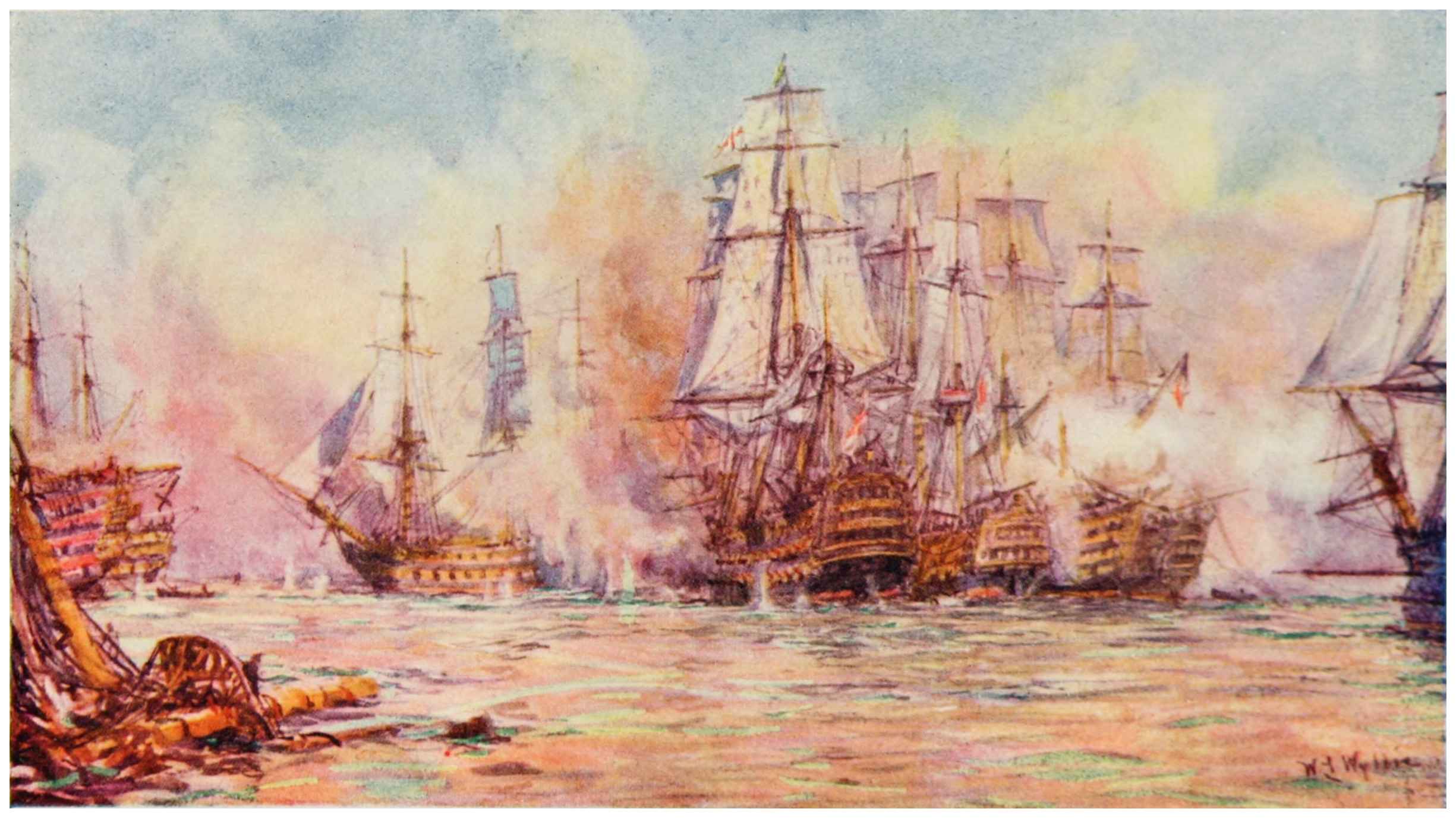
Thus regarded, Trafalgar becomes of somewhat
secondary interest as regards the tremendous strategical
questions involved, but of profound importance by reason
of the side-issue that the Victory’s forward bulkhead
was so slightly built that she sustained an immense
number of casualties which would never have occurred
had she been designed for the particular purpose that
Nelson used her for at Trafalgar. The tactics of Trafalgar
have merely a literary and sentimental interest
now, and even the strategies which led to the battle
are probably of little utility to the strategists of our
own times. But the Victory’s thin forward bulkhead
profoundly affected, and to some extent still affects,
modern British naval construction. Trafalgar, of course,
sanctified for many a year “end-on approach,” and so
eventually concentrated special attention on bulkheads.
But previous to Trafalgar, the return of the Victory
after it for refit, and Seppings’ inspection of her, the
subject of end-on protection had been ignored. The
cogitations of Seppings helped to make what would have
very much influenced history had any similar battle
occurred in the years that followed his constructional
innovations.
Again, at an earlier period much naval history turned
upon the ventilation of bilges. Improvements in this
respect (devised by men never heard of to-day) enabled
British ships to keep the seas without their crews being
totally disabled by diseases which often overmastered
their foes. The skill of the admirals, the courage of the
crews, both form more exciting reading. Yet there is
every indication to prove that this commonplace matter
of bilges was the secret of victory more than once!
Coming back to more recent times, the loss of the
Vanguard, which cost no lives, involved greater subsequent
constructional problems than did the infinitely
more terrible loss of the Captain a few years before.
Who shall say on how many seeming constructional
failures of the past, successes of the yet unborn future
may not rest?
A number of other things might be cited, but these
suffice to indicate the particular perspective of this book,
and to show why, if regarded as an orthodox “history”
of the British Navy, it is occasionally in seemingly distorted
perspective.
To say that in the scheme of this book the ship-builder
is put in the limelight instead of the ship-user,
would in no way be precisely correct, though as a vague
generalisation it may serve well enough. In exact fact
each, of course, is and ever has been dependent on the
other. Nelson himself was curtailed by the limitations
of the tools provided for him. Had he had the same
problems one or two hundred years before he would
have been still more limited. Had he had them fifty
or a hundred years later—who shall say?
With Seppings’ improvements, Trafalgar would have
been a well-nigh bloodless victory for the British Fleet.
It took Trafalgar, however, to inspire and teach Seppings.
Of every great sea-fight something of the same kind may
be said. The lead had to be given.
Yet those who best laboured to remove the worst
disabilities of “the means” of Blake, contributed in that
measure to Nelson’s successes years and years later on.
Their efforts may surely be deemed worthy of record,
for all that between the unknown designer of the Great
Harry in the sixteenth century and the designers of
Super-Dreadnoughts of to-day there may have been
lapses and defects in details. There was never a lapse
on account of which the user was unable to defeat any
hostile user with whom he came into conflict. The
“means” provided served. The creators of warships
consistently improved their creations: but they were not
improved without care and thought on the part of those
who produced them.
To those who provided the means and to the rank
and file it fell that many an admiral was able to do
what he did. These admirals “made history.” But ever
there were “those others” who made that “history
making” possible, and who so made it also.
In dealing with the warships of other eras, I have
been fortunate in securing the co-operation of Mr. W. L.
Wyllie, R.A., who has translated into vivid pictorial
obviousness a number of details which old prints of an
architectural nature entirely fail to convey. With a
view to uniformity, this scheme, though reinforced by
diagrams and photographs, has been carried right into
our own times.
Some things which I might have written I have on
that account left unrecorded. There are some things that
cold print and the English language cannot describe.
These things must be sought for in Mr. Wyllie’s pictures.
In conclusion, I would leave the dedication page to
explain the rest of what I have striven for in this book.
F. T. J.
This book was originally written three years ago.
Since it was first published the greatest war ever
known has broken out. To meet that circumstance this
particular edition has been revised and brought to date
in order to present to the reader the exact state of our
Navy when the fighting began.
Modern naval warfare differs much from the warfare
of the past; at any rate from the warfare of the Nelson
era. But if men and matériel have altered, the general
principles of naval war have remained unchanged.
Indeed, there is some reason to believe that the wheel of
fortune has brought us back to some similitude of those
early days when to kill the enemy was the sole idea that
obtained, when there were no “rules of civilised war,”
when it was simply kill and go on killing.
To these principles Germany has reverted. The
early history of the British Navy indicates that we were
able to render a good account of ourselves under such
conditions. For that matter we made our Navy under
such training. It is hard to imagine that by adopting
old time methods the Germans will take from us the Sea
Empire which we thus earned in the past.
THE BRITISH BATTLE FLEET. — I. THE BIRTH OF BRITISH NAVAL POWER.
The birth of British naval power is involved in
considerable obscurity and a good deal of legend.
The Phœnicians and the Romans have both been
credited with introducing nautical ideas to these islands,
but of the Phœnicians there is nothing but legend so far as
any “British Navy” is concerned. That the Phœnicians
voyaged here we know well enough, and a “British fleet”
of the B.C. era may have existed, a fleet due to possible
Phœnicians who, having visited these shores, remained in
the land. Equally well it may be mythical.
Whatever share the ancient Britons may have
had in the supposed commercial relations with Gaul,
it is clear that no fleet as we understand a fleet existed
in the days of Julius Cæsar. Later, while England
was a Roman province, Roman fleets occasionally
fought upon British waters against pirates and in
connection with Roman revolutions, but they were
ships of the ruling power.
Roman power passed away. Saxons invaded and
remained; but having landed they became people of
the land—not of the sea. Danes and other seafarers
pilaged English shores much as they listed till Alfred
the Great came to the throne.
Alfred has been called the “Father and Founder
of the British Fleet.” It is customary and dramatic
to suppose that Alfred was seized with the whole
modern theory of “Sea Power” as a sudden inspiration—that
“he recognised that invaders could only be
kept off by defeating them on the sea.”
This is infinitely more pretty than accurate. To
begin with, even at the beginning of the present
Twentieth Century it was officially put on record that
“while the British fleet could prevent invasion, it
could not guarantee immunity from small raids on our
great length of coast line.” In Alfred’s day, one
mile was more than what twenty are now; messages
took as many days to deliver as they now do minutes,
and the “raid” was the only kind of over-sea war
to be waged. It is altogether chimerical to imagine
that Alfred “thought things out” on the lines of a
modern naval theorist.
In actual fact,1 what happened was that Alfred
engaged in a naval fight in the year 875, somewhere
on the South Coast. There is little or no evidence to
show where, though near Wareham is the most likely
locality.
In 877 something perhaps happened to the Danes
at Swanage, but the account in Asser is an interpolated
one, and even so suggests shipwreck rather than a
battle.
In 882 (possibly 881) two Danish ships sank: “the
rest” (number not recorded) surrendered later on.
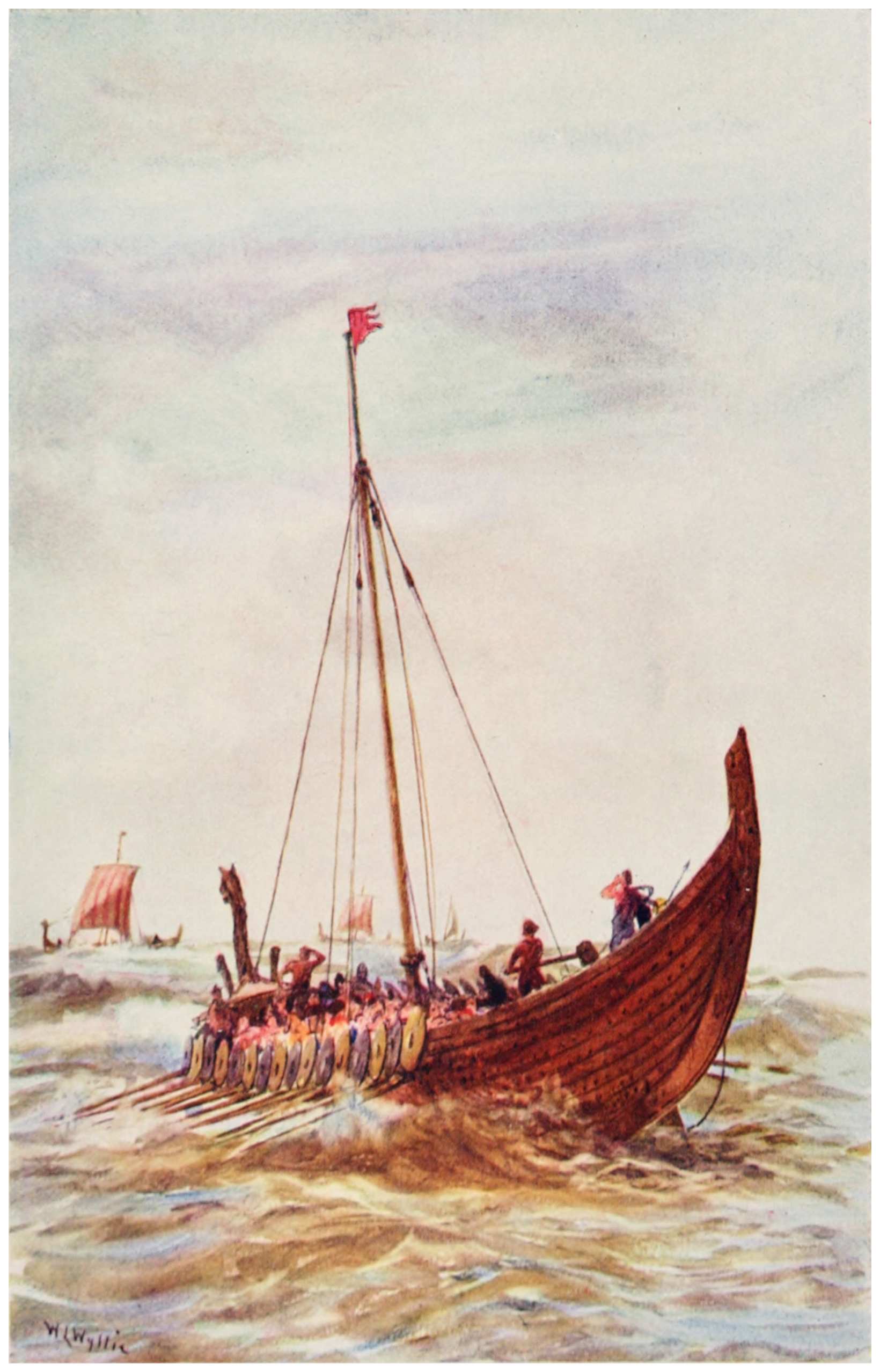
WARSHIP OF THE TIME OF KING ALFRED.
In 884 occurred the battle of the Stour. Here
the Saxon fleet secured a preliminary success, in which
thirteen Danish ships were captured. This may or
may not have been part of an ambush—at any rate
the final result was the annihilation of King Alfred’s
fleet.
In 896 occurred the alleged naval reform so often
alluded to as the “birth of the British Navy”—those
ships supposed to have been designed by Alfred, which
according to Asser2 were “full nigh twice as long as
the others ... shapen neither like Frisian nor the
Danish, but so as it seemed to him that they would be
most efficient.”
Around these “early Dreadnoughts” much has
been weaved, but there is no evidence acceptable to the
best modern historians that Alfred really built any
such ships—they tend to reject the entire theory.
The actual facts of that “naval battle of the
Solent” in 897 from which the history of our navy
is popularly alleged to date, appear to be as follows:
There were nine of King Alfred’s ships, manned
by Frisian pirates, who were practically Danes. These
nine encountered three Danish vessels in a land-locked
harbour—probably Brading—and all of them ran
aground, the Danish ships being in the middle between
two Saxon divisions. A land fight ensued, till, the
tide rising, the Danish ships, which were of lighter
draught than the Saxon vessels, floated. The Danes
then sailed away, but in doing so two of them were
wrecked.
All the rest of the story seems to be purely
legendary. Our real “island story”—as events during
the next few hundred years following Alfred clearly
indicate—is not that of a people born to the sea; but
the story of a people forced thereto by circumstances
and the need of self-preservation.
It is a very unromantic beginning. There is a
strange analogy between it and the beginning in later
days of the Sea Power of the other “Island Empire”—Japan.
Japan to-day seeks—as we for centuries
have sought—for an historical sequence of the “sea
spirit” and all such things as an ideal islander should
possess. Neither we nor they have ever understood or
ever properly realised that it was the Continentals who
long ago first saw that it was necessary to command
the sea to attack the islanders. The more obvious
contrary has always been assumed. It has never
been held, or even suggested, that the Little Englander
protesting against “bloated naval armaments,” so far
from being a modern anachronism, an ultra-Radical
or Socialist exotic, may really claim to be the true
exponent of “the spirit of the Islanders” for all time.
That is one reason why (excluding the mythical Minos
of Crete) only two island-groups have ever loomed big
in the world’s history.
When Wilhelm II of Germany said: “Unsere
Zukunft liegt auf dem Wasser,” he uttered a far more
profound truth than has ever been fully realised. Fleets
came into being to attack Islanders with.
The Islanders saw the sea primarily as a protection
existing between them and the enemy. To the
Continental the sea was a road to, or obstacle between
him and the enemy, only if the enemy filled it with
ships. The Islanders have ever tended to trust to the
existence of the sea itself as a defence, except in so far
as they have been taught otherwise by individuals who
realised the value of shipping. Those millions of British
citizens who to-day are more or less torpid on the
subject of naval defence are every whit as normal as
those Germans who, in season and out, preach naval
expansion.
The explanation of all this is probably to be found
in the fact that the earliest warfare known either to
Continentals or to Islanders was military warfare. The
ship as at first employed was used entirely as a means
of transport for reaching the enemy—first, presumably,
against outlying islands near the coast, later for more
over-sea expeditions.
Ideas of attack are earlier than ideas of defence,
and the primary idea of defence went no further than
the passive defensive. King Alfred, merely in realising
the offensive defensive, did a far greater thing than any
of the legendary exploits associated with his history.
The idea was submerged many a time in the years
that followed, but from time to time it appeared and
found its ultimate fruition in the Royal Navy.
Yet still, the wonder is not that only two Island
Empires have ever come into existence, but that any
should have come into existence at all. The real
history of King Alfred’s times is that the Continental
Danes did much as they listed against the insular
Saxons of England, till the need was demonstrated for
an endeavour to meet the enemy on his own element.
In the subsequent reigns of Athelstan and Edmund,
some naval expeditions took place. Under Edgar, the
fleet reached its largest. Although the reputed number
of 3,600 vessels is, of course, an exaggerated one, there
was enough naval power at that time to secure peace.
This “navy” had, however, a very transient existence,
because in the reign of Ethelred, who succeeded to
the throne, it had practically ceased to exist, and an
attempt was made to revive it. This attempt was so
little successful that Danish ships had to be hired for
naval purposes.
A charter of the time of Ethelred II exists which
is considered by many to be the origin of that Ship
Money which, hundreds of years later, was to cause so
much trouble to England. Under this, the maintenance
of the Navy was made a State charge on landowners,
the whole of whom were assessed at the rate of producing
one galley for every three hundred and ten hides of
land that they possessed.
This view is disputed by some historians, who
maintain that the charter is possibly a forgery, and that
it is not very clear in any case. However, it does not
appear to have produced any useful naval power.
That naval power was insufficient is abundantly clear
from the ever increasing number of Danish settlements.
In the St. Bride’s Day massacre, which was an attempt
to kill off the leading Danes amongst the recent arrivals,
further trouble arose; and in the year 1013, Swain, King
of Denmark, made a large invasion of England, and in
the year 1017, his son Canute ascended to the throne.
Under Canute, the need of a navy to protect the
coast against Danish raids passed away. The bulk of
the Danish ships were sent back to Denmark, forty
vessels only being retained.
Once or twice during the reign of Canute successful
naval expeditions were undertaken, but at the time of
the King’s death the regular fleet consisted of only
sixteen ships. Five years later, an establishment was
fixed at thirty-two, and remained more or less at about
that figure, till, in the reign of Edward the Confessor
trouble was caused by Earl Godwin, who had created
a species of fleet of his own. With a view to suppressing
these a number of King’s ships were fitted out; but
as the King and Godwin came to terms the fleet was not
made use of.
Close following upon this came the Norman invasion,
which of all the foolhardy enterprises ever embarked
on by man was theoretically one of the most foolish.
William’s intentions were perfectly well known. A
certain “English fleet” existed, and there was nothing
to prevent its expansion into a force easily able to
annihilate the heterogeneous Norman flotilla.
How many ships and men William actually got
together is a matter upon which the old chroniclers
vary considerably. But he is supposed to have had
with him some 696 ships3; and since his largest ships
were not over twenty tons and most of them a great
deal smaller, it is clear that they must have been crowded
to excess and in poor condition to give battle against
anything of the nature of a determined attack from an
organised fleet.
No English fleet put in appearance, however.
Harold had collected a large fleet at Sandwich, but
after a while, for some unknown reason, it was dispersed,
probably owing to the lateness of the season. The
strength of the fleet collected, or why it was dispersed,
are, however, immaterial issues; the fact of importance
is that the fleet was “inadequate” because it failed to
prevent the invasion. A neglected fleet entailed the
destruction of the Saxon dominion.
II. THE NORMAN AND PLANTAGENET ERAS.
William the Conqueror’s first act on landing was
to burn all his ships—a proceeding useful enough
in the way of preventing any of his followers
retiring with their spoils, but inconvenient to him shortly
after he became King of England. Fleets from Denmark
and Norway raided the coasts, and, though the raiders
were easily defeated on shore, the pressure from them
was sufficient to cause William to set about recreating
a navy, of which he made some use in the year 1071.
In 1078 the Cinque Ports were established, five ports
being granted certain rights in return for policing the
Channel and supplying ships to the King as required.
But the amount of naval power maintained was very
small, both in the reign of William the First and his
successors.
Not until the reign of Henry II was any appreciable
attention paid to nautical matters. Larger ships than
heretofore were built, as we assume from records of the
loss of one alleged to carry 300 men. It was Henry II
who first claimed the “Sovereignty of the British Seas”
and enacted the Assize of Arms whereby no ship or
timber for shipbuilding might be sold out of England.
When Richard I came to the throne in 1189, fired
with ambition to proceed to the Crusades, he ordered
all ports in his dominions to supply him with ships
in proportion to their population. The majority of
these ships came, however, from Acquitaine. The fleet
thus collected is said to have consisted of nine large
ships, 150 small vessels, thirty galleys, and a number
of transports. The large ships, which have also been
given as thirteen in number, were known at the time
as “busses.” They appear to have been three-masters.
The fleet sailed in eight divisions. This expedition to
the Holy Land was the first important over-sea voyage
ever participated in by English ships, the greatest
distance heretofore traversed having been to Norway
in the time of Canute. This making of a voyage into
the unknown was, however, not quite so difficult as it
might at first sight be supposed to be, because there
is no doubt whatever that the compass was by then
well-known and used. Records from 1150 and onwards
exist which describe the compass of that period. A
contemporary chronicler4 wrote of it:—
“This [polar] star does not move. They [the seamen] have an
art which cannot deceive, by virtue of the manite, an ill brownish
stone to which iron spontaneously adheres. They search for the
right point, and when they have touched a needle on it, and fixed
it to a bit of straw, they lay it on water, and the straw keeps it
afloat. Then the point infallibly turns towards the star; and when
the night is dark and gloomy, and neither star nor moon is visible,
they set a light beside the needle, and they can be assured that the
star is opposite to the point, and thereby the mariner is directed
in his course. This is an art which cannot deceive.”
The compass would seem to have existed, so far
as northern nations were concerned, about the time of
William the Conqueror. Not till early in the Fourteenth
Century did it assume the form in which we now know
it, but its actual antiquity is considerably more.
In connection with this expedition to the Holy
Land, Richard issued a Code of Naval Discipline, which
has been described as the germ of our Articles of War.
Under this Code if a man killed another on board ship,
he was to be tied to the corpse and thrown into the sea.
If the murder took place on shore, he was to be buried
alive with the corpse. The penalty for drawing a knife
on another man, or drawing blood from him in any
manner was the loss of a hand. For “striking another,”
the offender was plunged three times into the sea. For
reviling or insulting another man, compensation of an
ounce of silver to the aggrieved one was awarded. The
punishment for theft was to shave the head of the
thief, pour boiling pitch upon it and then feather him.
This was done as a mark of recognition. The subsequent
punishment was to maroon a man upon the first land
touched. Severe penalties were imposed on the mariners
and servants for gambling.
Of these punishments the two most interesting are
those for theft and the punishment of “ducking.”
This last was presumably keel-hauling, a punishment
which survived well into the Nelson era. It is to be
found described in the pages of Marryat. It consisted
in drawing the offender by ropes underneath the bottom
of the ship. As his body was thus scraped along the
ship’s hull, the punishment was at all times severe;
but in later days, as ships grew larger and of deeper
draught, it became infinitely more cruel and heavy than
in the days when it was first instituted.
The severe penalty for theft is to be noted on
account of the fact that, even in the early times, theft,
as now, was and is recognised as a far more serious
offence on ship board than it is on shore—the reason
being the greater facilities that a ship affords for
theft.
14
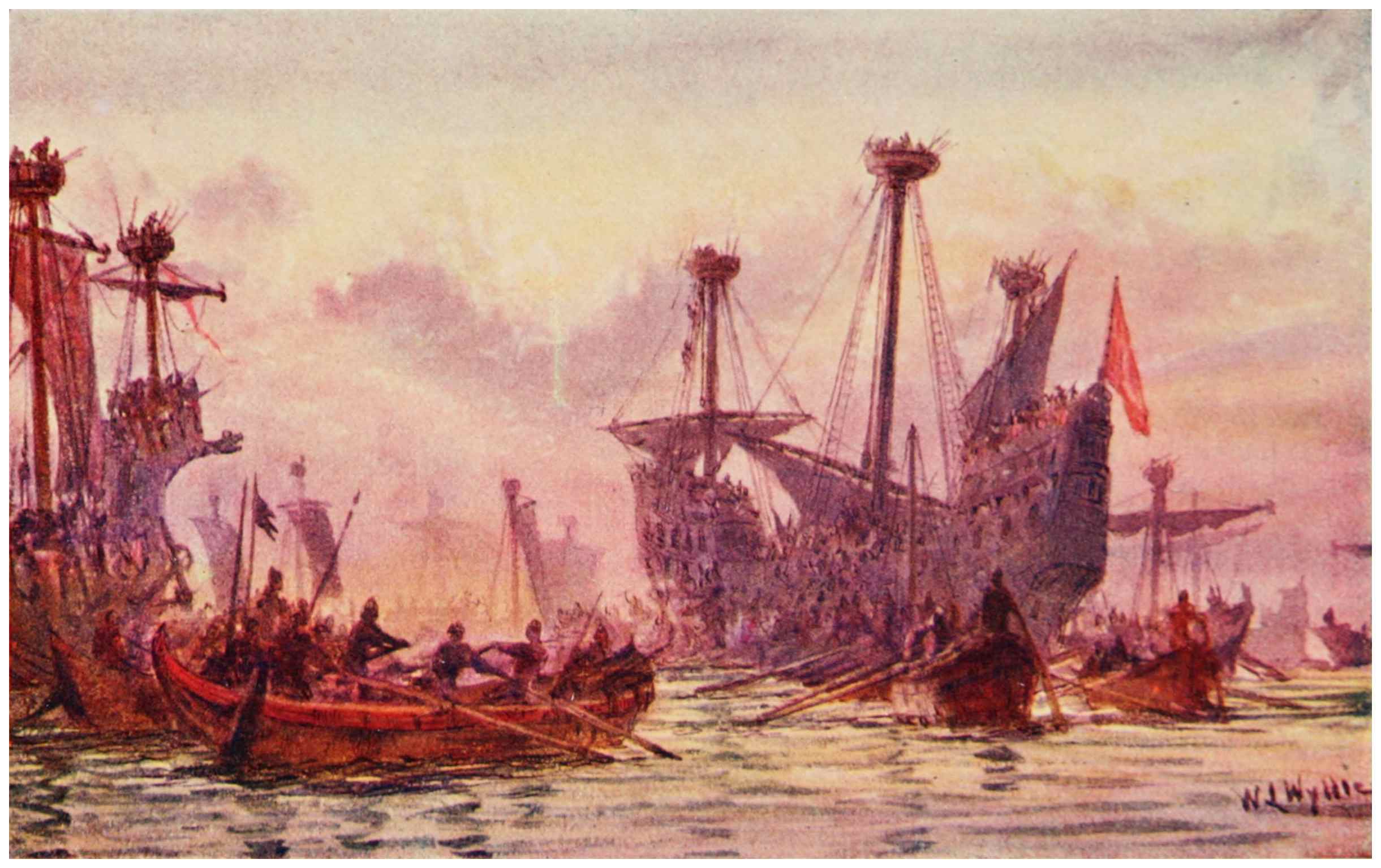
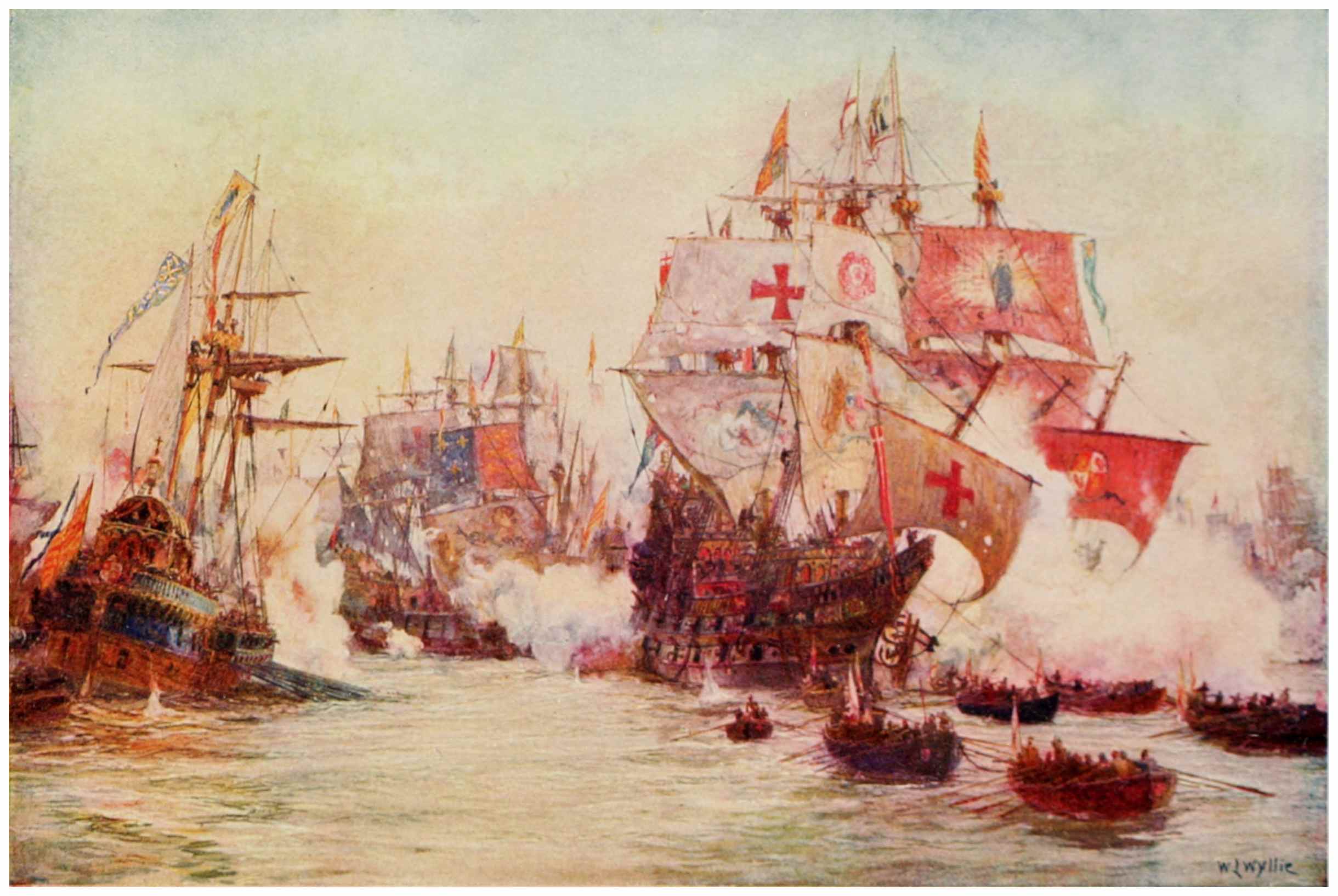
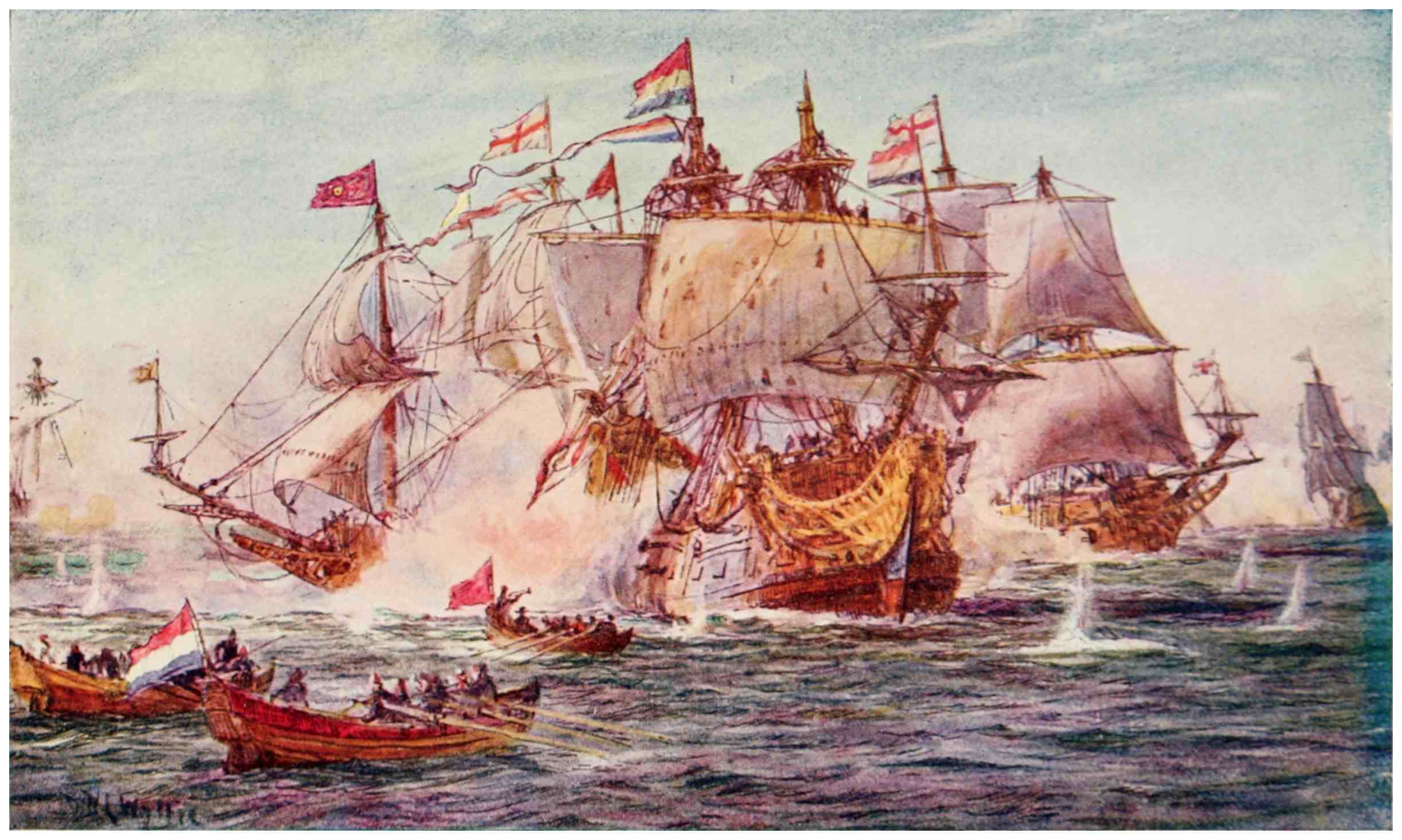
RICHARD 1ST IN ACTION WITH THE SARACEN SHIP.
On his way to the Holy Land, Richard had a dispute
at Sicily with the King of France, out of which he
increased his fleet somewhat. Leaving Sicily, somewhere
between Cyprus and Acre he encountered a very
large Saracen ship, of the battle with which very
picturesque and highly coloured accounts exist. There
is no doubt that the ship was something a great deal
larger than anything the English had ever seen heretofore,
although the crew of 1,500 men with which
she is credited by the chroniclers is undoubtedly an
exaggeration.
The ship carried an armament of Greek fire and
“serpents.” The exact composition of Greek fire is
unknown. It was invented by the Byzantines, who by
means of it succeeded in keeping their enemies at bay for
a very long time. It was a mixture of chemicals which,
upon being squirted at the enemy from tubes, took
fire, and could only be put out by sand or vinegar.
“Serpents” were apparently some variation of Greek
fire of a minor order, discharged by catapults.
In the first part of the attack the English fleet
was able to make no impression upon the enemy, as
her high sides and the Greek fire rendered boarding
impossible. Not until King Richard had exhilarated
his fleet by informing them that if the galley escaped
they “should be crucified or put to extreme torture,”
was any progress made. After that, according to the
contemporary account, some of the English jumped
overboard and succeeded in fastening ropes to the
rudder of the Saracen ship, “steering her as they
pleased.” They then obtained a footing on board, but
were subsequently driven back. As a last resource
King Richard formed his galleys into line and rammed
the ship, which afterwards sank.
The relation of Richard’s successor, King John, to
the British Navy, is one of some peculiar interest.
More than any king before him he appears to have
appreciated the importance of naval power, and naval
matters received more attention than heretofore. In
the days of King John the crews of ships appropriated
for the King’s service were properly provisioned with
wine and food, and there are also records of pensions
for wounds, one of the earliest being that of Alan le
Walleis, who received a pension of sixpence a day for
the loss of his hand.5
King John is popularly credited with having made
the first claim to the “Sovereignty of the Seas” and
of having enacted that all foreign vessels upon sighting
an English one were to strike their flags to her, and
that if they did not that it was lawful to destroy them.
The authenticity of this is, however, very doubtful;
and it is more probable that, on account of various
naval regulations which first appeared in the reign of
King John, this particular regulation was fathered upon
him at a later date with the view to giving it an historical
precedent.
In the reign of King John the “Laws of Oleron”
seem to have first appeared, but it is not at all clear
that they had any specific connection with England.
They appear rather to have been of a general European
nature. The gist of the forty-seven articles
of the “Laws of Oleron,” of which the precise
date of promulgation cannot be ascertained, is
as follows:—5
“By the first article, if a vessel arrived at Bordeaux, Rouen,
or any other similar place, and was there freighted for Scotland, or
any other foreign country, and was in want of stores or provisions,
the master was not permitted to sell the vessel, but he might with
the advice of his crew raise money by pledging any part of her
tackle or furniture.
“If a vessel was wind or weather bound, the master, when a
change occurred, was to consult his crew, saying to them, “Gentlemen,
what think you of this wind?” and to be guided by the majority
whether he should put to sea. If he did not do this, and any
misfortune happened, he was to make good the damage.
“If a seaman sustained any hurt through drunkenness or
quarrelling, the master was not bound to provide for his cure,
but might turn him out of his ship; if, however, the injury occurred
in the service of his ship, he was to be cured at the cost of the said
ship. A sick sailor was to be sent on shore, and a lodging, candles,
and one of the ship’s boys, or a nurse provided for him, with the
same allowance of provisions as he would have received on board.
In case of danger in a storm, the master might, with the consent
of the merchants on board, lighten the ship by throwing part of
the cargo overboard; and if they did not consent, or objected to
his doing so, he was not to risk the vessel but to act as he thought
proper; on their arrival in port, he and the third part of the crew
were to make oath that it was done for the preservation of the vessel;
and the loss was to be borne equally by the merchants. A similar
proceeding was to be adopted before the mast or cables were cut
away.
“Before goods were shipped the master was to satisfy the
merchants of the strength of his ropes and slings; but if he did
not do so, or they requested him to repair them and a cask were
stove, the master was to make it good.
“In cases of difference between a master and one of his crew,
the man was to be denied his mess allowance thrice, before he was
turned out of the ship, or discharged; and if the man offered
reasonable satisfaction in the presence of the crew, and the master
persisted in discharging him, the sailor might follow the ship to her
place of destination, and demand the same wages as if he had not
been sent ashore.
“In case of a collision by a ship undersail running on board one
at anchor, owing to bad steering, if the former were damaged, the
cost was to be equally divided; the master and crew of the latter
making oath that the collision was accidental. The reason for this
law was, it is said, ‘that an old decayed vessel might not purposely
be put in the way of a better.’ It was specially provided that all
anchors ought to be indicated by buoys or ‘anchor-marks.’
“Mariners of Brittany were entitled only to one meal a day,
because they had beverage going and coming; but those of
Normandy were to have two meals, because they had only water
as the ship’s allowance. As soon as the ship arrived in a wine
country, the master was, however, to procure them wine.
“Several regulations occur respecting the seamen’s wages, which
show that they were sometimes paid by a share of the freight. On
arriving at Bordeaux or any other place, two of the crew might go
on shore and take with them one meal of such victuals as were on
board, and a proportion of bread, but no drink; and they were to
return in sufficient time to prevent their master losing the tide.
If a pilot from ignorance or otherwise failed to conduct a ship in
safety, and the merchants sustained any damage, he was to make full
satisfaction if he had the means to; if not, he was to lose his head;
and, if the master or any one of the mariners cut off his head, they
were not bound to answer for it; but, before they had recourse to
so strong a measure, ‘they must be sure he had not wherewith to
make satisfaction.’
“Two articles of the code prove, that from an ‘accursed custom’
in some places, by which the third or fourth part of ships that were
lost belonged to the lord of the place—the pilots, to ingratiate
themselves with these nobles, ‘like faithless and treacherous
villains,’ purposely ran the vessel on the rocks. It was therefore
enacted that the said lords, and all others assisting in plundering
the wreck, shall be accursed and excommunicated, and punished as
robbers and thieves; that ‘all false and treacherous pilots should
suffer a most rigorous and merciless death,’ and be suspended to
high gibbets near the spot, which gibbets were to remain as an
example in succeeding ages. The barbarous lords were to be tied
to a post in the middle of their own houses, and, being set on fire
at the four corners, all were to be burned together; the walls
demolished, its site converted into a marketplace for the sale only
of hogs and swine, and all their goods to be confiscated to the use
of the aggrieved parties.
“Such of the cargoes as floated ashore were to be taken care of for
a year or more; and, if not then claimed, they were to be sold by the
lord, and the proceeds distributed among the poor, in marriage portions
to poor maids and other charitable uses. If, as often happened,
‘people more barbarous, cruel, and inhuman than mad dogs,’
murdered shipwrecked persons, they were to be plunged into the sea
till they were half-dead, and then drawn out and stoned to death.”
Those laws, unconnected though they appear to be
with strictly naval matters, are none the less of extreme
interest as indicating the establishment of “customs of
the sea,” and the consequent segregation of a “sailor
class.” It has ever to be kept very clearly in mind
that there was no such thing as a “Navy” as we
understand it in these days. When ships were required
for war purposes they were hired, just as waggons may
be hired by the Army to-day; nor did the mariners count
for much more than horses. The “Laws of Oleron,”
however, gave them a certain general status which they
had not possessed before; and the regulations of John
as to providing for those engaged upon the King’s
service—though they in no way constituted a Royal
Navy—played their part many years later in making
a Royal Navy possible, or, perhaps, it may be said,
“necessary.” Necessity has ever been the principal
driving force in the naval history of England.
To resume. The limitations of the powers of the
master (i.e. captain) in these “Laws of Oleron” deserve
special attention. “Gentlemen, what think you of this
wind?” from the captain to his crew would be considered
“democracy” carried to extreme and extravagant
limits in the present day; in the days when it was
promulgated as “the rule” it was surely stranger still!
Little wonder that seamen at an early stage segregated
from the ordinary body of citizens and became, as
described by Clarendon in his “History of the Rebellion”
a few hundred years later, when he wrote:—
“The seamen are a nation by themselves, a humorous and
fantastic people, fierce and rude and resolute in whatsoever they
resolve or are inclined to, but unsteady and inconstant in pursuing it,
and jealous of those to-morrow by whom they are governed to-day.”
To this, to the earlier things that produced it,
those who will may trace the extreme rigour of naval
discipline and naval punishments, as compared with
contemporaneous shore punishments at any given time,
and the extraordinary difference at present existing
between the American and European navies. The
difference is usually explained on the circumstance that
“Europe is Europe, and America, America.” But
“differences” having their origin in the “Laws of
Oleron” may play a greater part than is generally
allowed.
The year 1213 saw the Battle of Damme. This
was the first real naval battle between the French and
English. The King of France had collected a fleet of
some “seventeen hundred ships” for the invasion of
England, but having been forbidden to do so by the
Pope’s Legate, he decided to use his force against
Flanders. This Armada was surprised and totally
destroyed by King John’s fleet.
After the death of John the nautical element in
England declared for Henry III, son of John, and
against Prince Louis of France, who had been invited
to the throne of England by the barons. Out of this
came the battle of Sandwich, 1217, where Hubert de
Burgh put into practice, though in different form,
those principles first said to have been evolved by
Alfred the Great—namely, to attack with an assured
and complete superiority.
Every English ship took on board a large quantity
of quick-lime and sailed to meet the French, who were
commanded by Eustace the Monk. De Burgh manœuvred
for the weather gauge. Having gained it,
the English ships came down upon the French with
the wind, the quick-lime blowing before them, and
so secured a complete victory over the tortured and
blinded French. This is the first recorded instance
of anything that may be described as “tactics” in
Northern waters.
The long reign of Henry III saw little of interest
in connection with nautical matters. But towards the
end of Henry’s reign a private quarrel between English
and Norman ships, both seeking fresh water off the
Coast of Bayonne, had momentous consequences. The
Normans, incensed over the quarrel, captured a couple
of English ships and hanged the crew on the yards
interspersed with an equal number of dead dogs.
Some English retaliated in a similar fashion on such
Normans as they could lay hands on, and, retaliation
succeeding retaliation, it came about that in the reign
of Edward I, though England and France were still
nominally at peace, the entire mercantile fleets of both
were engaged in hanging each other, over what was
originally a private quarrel as to who should be first
to draw water at a well.
Ultimately the decision appears to have been come
by “to fight it out.” Irish and Dutch ships assisted
the English. Flemish and Genoese ships assisted the
Normans and French. The English to the number of
60 were under Sir Robert Tiptoft. The number of the
enemy is placed at 200, though it was probably considerably
less. In the battle that ensued the Norman
and French fleets were annihilated.
This battle, even more than others of the period,
cannot be considered as one of the battles of “the
British fleet.” It is merely a conflict between one
clique of pirates and traders against another clique.
But it is important on account of the light that it sheds
on a good deal of subsequent history; for the fashion
thus started lasted in one way and another for two or
three hundred years.
Nor were these disputes always international. Four
years later than the fight recorded above, in 1297, the
King wished to invade Flanders with an army of 50,000
men. The Cinque Ports being unable to supply the
requisite number of ships to transport this army,
requisitions were also made at Yarmouth. Bad blood
soon arose between the two divisions, with the result
that they attacked each other. Thirty of the Yarmouth
ships with their crews were destroyed and the expedition
greatly hampered thereby.
Two events of importance in British naval history
happened in the reign of Edward I. The first of these,
which took place about the year 1300, arose out of acts
of piracy on foreigners, to which English ships were
greatly addicted at that time. In an appeal made to
Edward by those Continentals who had suffered most
from these depredations, the King was addressed as “Lord
of the Sea.” This was a definite recognition of that
sea claim first formulated by Henry II and which was
afterwards to lead to so much fighting and bloodshed.
The second event was the granting of the first
recorded “Letters of Marque” in the year 1295. These
were granted to a French merchant who had been taking
a cargo of fruit from Spain to England and had been
robbed by the Portuguese. He was granted a five year
license to attack the Portuguese in order to recoup
his loss.
In the reign of Edward II the only naval event of
interest is, that when the Queen came from abroad and
joined those who were fighting against the King, the
nautical element sided with her.
The reign of Edward III saw some stirring phases
in English history. With a view to carrying on his
war against France, Edward bestowed considerable
attention on naval matters, and in the year 1338, he
got together a fleet stated to have consisted of 500
vessels. These were used as transports to convey the
Army to France, and are estimated to have carried on
the average about eighty men each.
Meanwhile, the French had also got together a
fleet of about equal size, and no sooner had the English
expedition reached the shores of France than the whole
of the south coast of England was subjected to a series
of French raids. Southampton, Plymouth and the
Cinque Ports were sacked and burned with practical
impunity. These raids continued during 1338 and 1339;
the bulk of the English fleet still lying idle on transport
service at Edward’s base in Flanders. A certain number
of ships had been sent back, but most of these had
been as hastily sent on to Scotland, where their services
had been urgently needed. Matters in the Channel
culminated with the capture of the two largest English
ships of the time. A fleet of small vessels hastily fitted
out at the Cinque Ports succeeded in destroying Boulogne
and a number of ships that lay there, but generally
speaking the French had matters very much their own
way on the sea.
Towards the end of 1339, Edward and his expedition
returned to England to refit, with a view to preparing
for a fresh invasion of France during the following
summer.
As Edward was about to embark, he learned that
the French King had got together an enormous fleet
at Sluys. After collecting some additional vessels,
bringing the total number of ships up to 250 or thereabouts,
Edward took command and sailed for Sluys,
at which port he found the French fleet. He localised
the French on Friday, July 3rd, but it was not until
the next day that the battle took place.
The recorded number of the enemy in all these
early sea fights requires to be accepted with caution.
For what it is worth the number of French ships has
been given at 400 vessels, each carrying 100 men. The
French, as on a later occasion they did on the Nile,
lay on the defensive at the mouth of the harbour, the
ships being lashed together by cables. Their boats, filled
with stones, had been hoisted to the mast-heads. In
the van of their fleet lay the Christopher, Edward, and
various other “King’s ships,” which they captured in
the previous year.
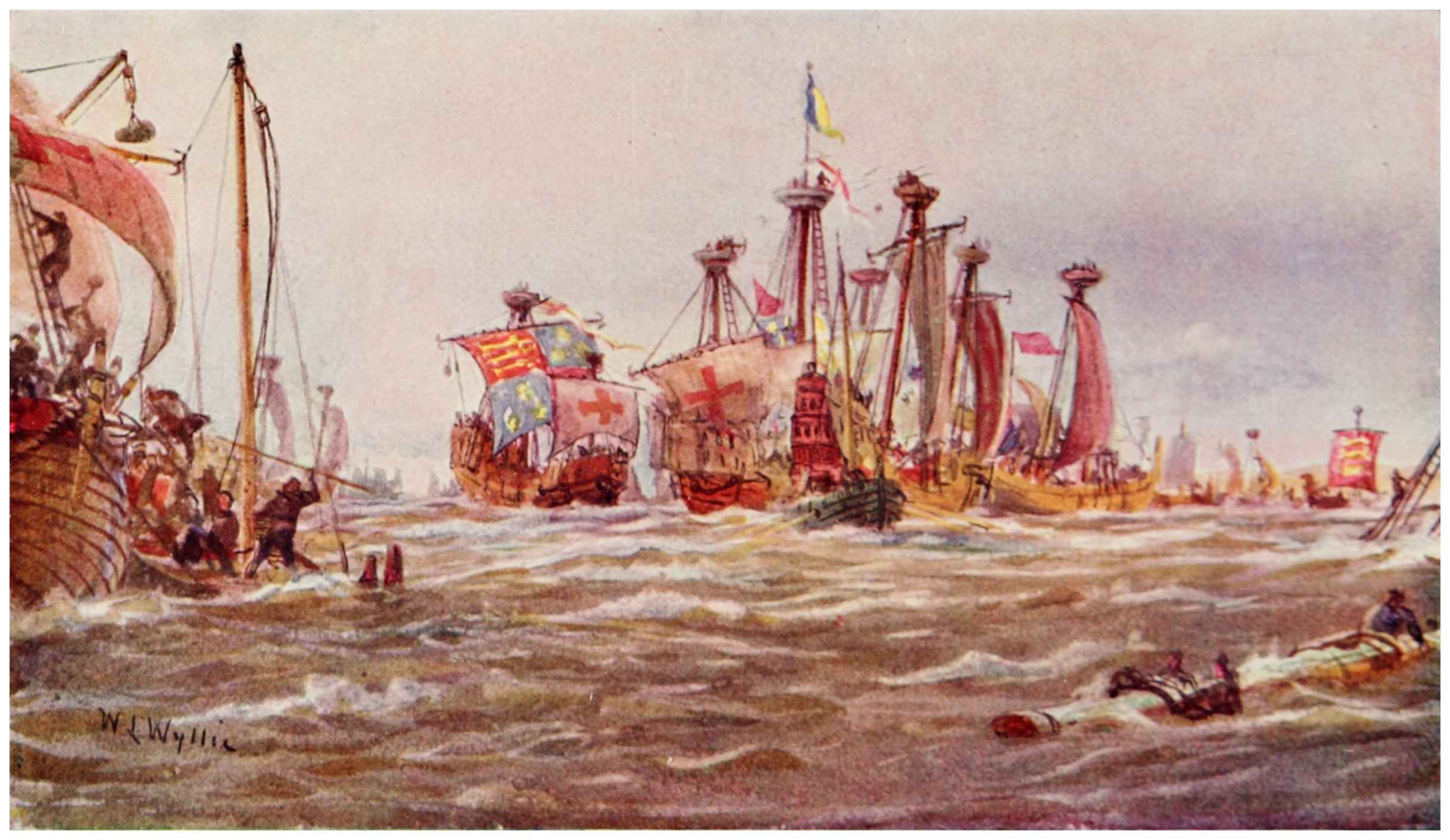
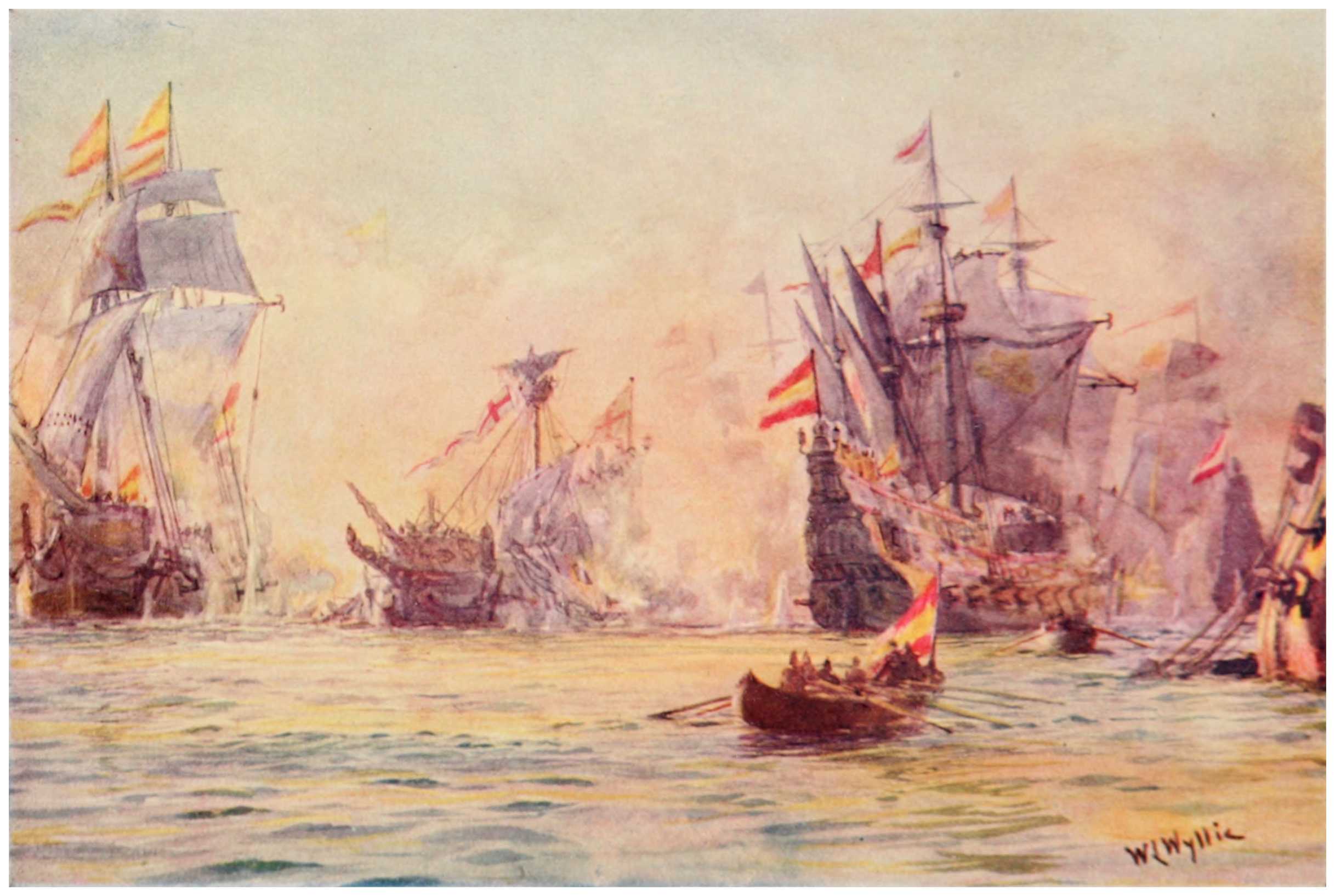
BATTLE OF SLUYS—1340.
The English took the offensive, and in doing so
manœuvred to have the sun behind them. Then, with
their leading ships crowded with archers they bore
down upon the main French division and grappled with
them. The battle, which lasted right throughout the
night, was fought with unexampled fury, and for a
long time remained undecisive, considerable havoc
being wrought by the French with the then novel idea
of dropping large stones from aloft. The combatants,
however, were so mixed up that it is doubtful whether
the French did not kill as many of their own number
as of the enemy; whereas, on the other side, the use
of English archers who were noted marksmen told
only against those at whom the arrows were directed.
Furthermore, the English had the tactical advantage
of throwing the whole of their force on a portion of
the enemy, whom they ultimately totally destroyed.
This Battle of Sluys took place in 1340. In 1346,
after various truces, the English again attacked France
in force, and the result was the Battle of Cressy. A
side issue of this was the historic siege of Calais, which
held out for about twelve months. 738 ships and
14,956 men are said to have been employed in the
sea blockade.
Up to this time the principal English ship had
been a galley, i.e., essentially a row boat. About the
year 1350 the galley began to disappear as a capital
ship, and the galleon, with sail as its main motive power,
took its place. Also a new enemy appeared; for at
that time England first came into serious conflict with
Spain.
To a certain extent the galleon was to the fleets
of the Mid-Fourteenth Century much what the ironclad
was to the last quarter of the Nineteenth Century,
or “Dreadnoughts” at the end of the first decade of
the Twentieth Century.
The introduction of this type of vessel came about
as follows:—
A fleet of Castillian galleons, bound for Flanders,
whiled away the monotony of its trip by acts of piracy
against all English ships that it met. It reached Sluys
without interference. Here it loaded up with rich cargoes
and prepared to return to Spain. The English meanwhile
collected a fleet to intercept it, this fleet being
in command of King Edward himself, who selected the
“cog Thomas” as his flagship.
The English tactics would seem to have been
carefully thought out beforehand. The Castillian ships
were known to be of relatively vast size and more or
less unassailable except by boarding. The result was
that when at length they appeared, the English charged
their ships into them, sinking most of their own ships
in the impact, sprang aboard and carried the enemy
by boarding. The leading figure on the English side
was a German body-servant of the name of Hannekin,
who distinguished himself just at the crisis of the
battle by leaping on board a Castillian ship and cutting
the halyards. Otherwise the result of the battle might
have been different, because the Castillians, when
about half only of the English ships were grappled
with them, hoisted their sails, with the object of
sailing away and destroying the enemy in detail.
Hannekin’s perception of this intention frustrated the
attempt.
The advantages of the galleons (or carracks as they
were then called), must have been rendered obvious in
this battle of “Les Espagnols-sur-Mer,” as immediately
afterwards ships on the models of those captured began
to be hired for English purposes.
Concurrent, however, with this building of a larger
type of ship, a decline of naval power began; and ten
years later, English shipping was in such a parlous
state that orders were issued to the effect that should
any of the Cinque Ports be attacked from the sea, any
ships there were to be hauled up on land, as far away
from the water as possible, in order to preserve them.
In the French War of 1369, almost the first act
of the French fleet was to sack and burn Portsmouth
without encountering any naval opposition.
In 1372 some sort of English fleet was collected,
and under the Earl of Pembroke sent to relieve La
Rochelle, which was then besieged by the French and
Spanish. The Spanish ships of that period had improved
on those of twenty years before, to the extent that
(according to Froissart), some carried guns. In any
case they proved completely superior to the English,
whose entire fleet was captured or sunk.
This remarkable and startling difference is only to
be accounted for by the difference in the naval policy
of the two periods. In the early years of Edward III’s
reign, when a fleet was required it was in an efficient
state, and when it encountered the enemy, it was used
by those who had obviously thought out the best means
of making the most of the material available. In the
latter stage, there was neither efficiency nor purpose.
The result was annihilation.
How far the introduction of cannon on shipboard
contributed to this result it is difficult to say exactly.
In so far as it may have, the blame rests with the
English, who were perfectly familiar with cannon at
that time. If, therefore, the very crude stone-throwing
cannon of those days had any particular advantages
over the stone-throwing catapults previously employed,
failure to fit them is merely a further proof of the
inefficiency of those responsible for naval matters in
the closing years of Edward III’s reign. Probably, however,
the cannon contributed little to the result of
La Rochelle, for, like all battles of the era, it was a
matter of boarding—of “land fighting on the water.”
The reign of Richard II saw England practically
without any naval power at all. The French and
Spaniards raided the Channel without interference worth
mention. Once or twice retaliatory private expeditions
were made upon the French coast; but speaking
generally the French and Spaniards had matters entirely
their own way, and the latter penetrated the Thames
so far as Gravesend.
In the year 1380, an English army was sent over
to France, but this, as Calais was British, was a simple
operation, and although two years later ships were
collected for naval purposes, English sea impotence
remained as conspicuous as ever. In 1385, when a
French armada was collected at Sluys for the avowed
purpose of invading England on a large scale, no attempt
whatever seems to have been made to meet this with
another fleet. Fortunately for England, delays of one
kind and another led to the French scheme of invasion
being abandoned.
Under Henry IV, matters remained much the same,
until in the summer of 1407, off the coast of Essex,
the King, who was voyaging with five ships, was attacked
by French privateers, which succeeded in capturing all
except the Royal vessel.
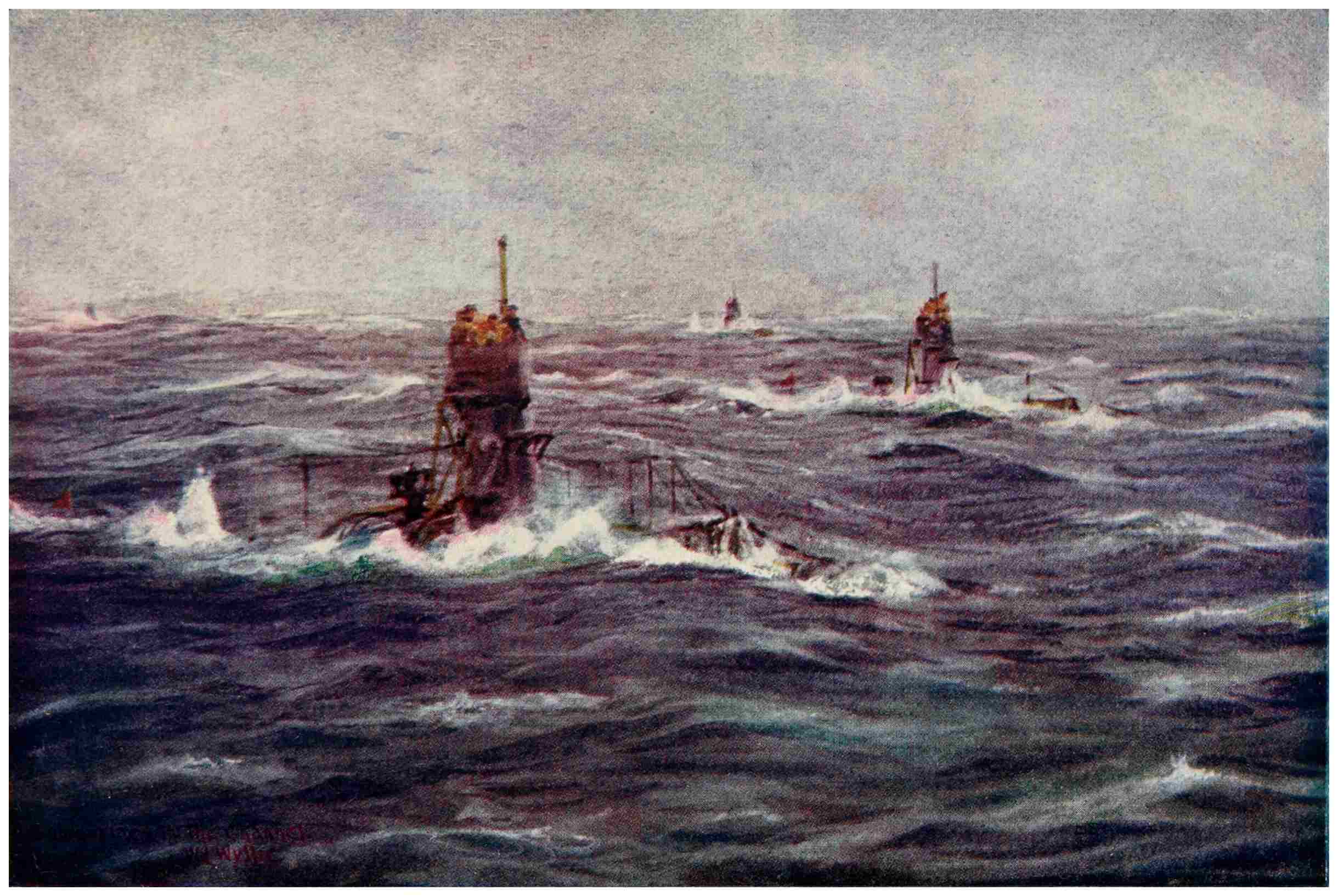
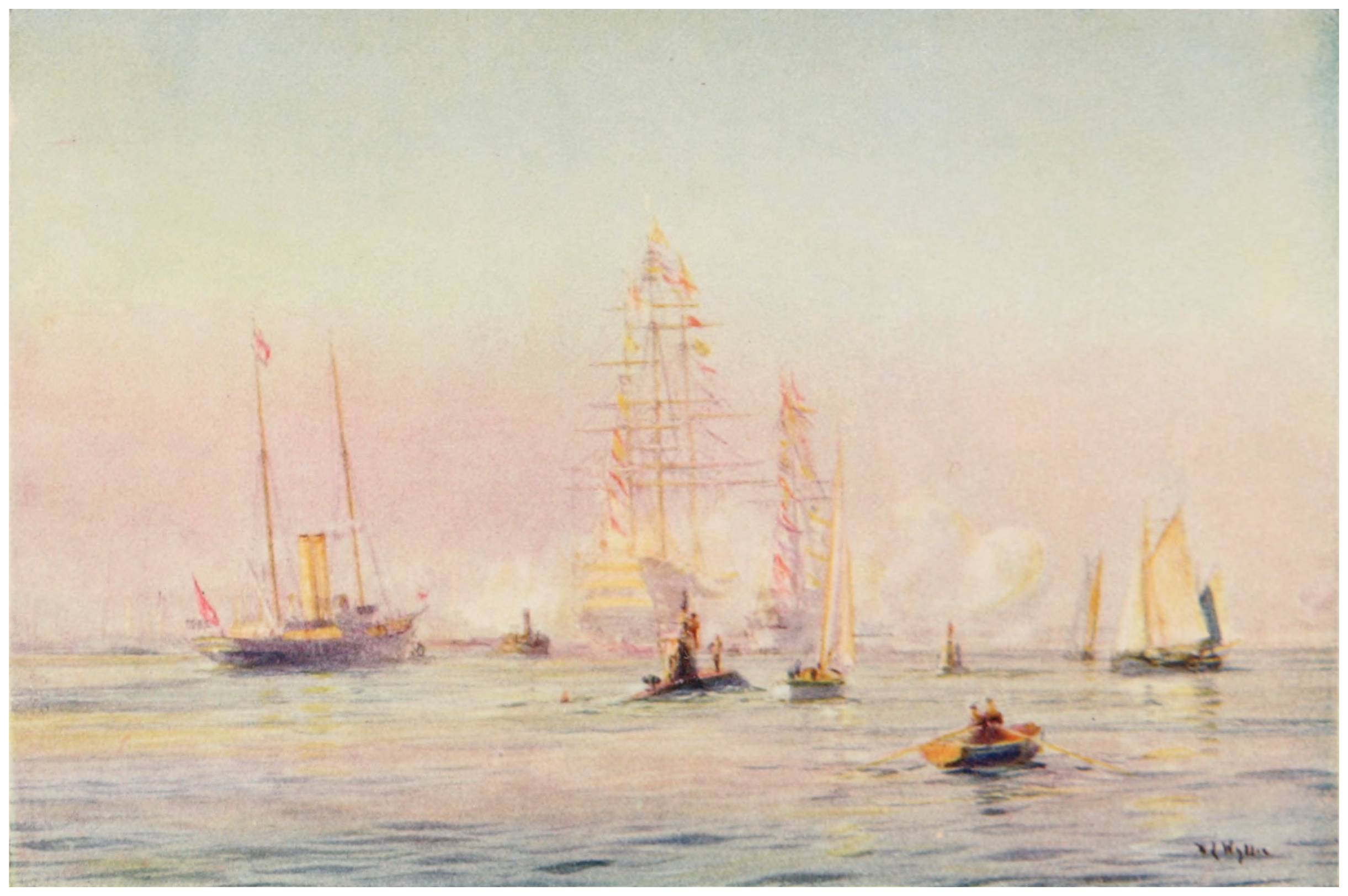
PORTSMOUTH HARBOUR—1912.
This led to the organisation of a “fleet” and a
successful campaign against the privateers. The necessity
of Sea Power began to be realised again, and this so
far bore fruit that in the reign of Henry V no less
than 1,500 ships were (it is said) collected in the Solent,
for an invasion of France. But since some of these
were hired from the Dutch and as every English vessel
of over twenty tons was requisitioned by the King,
the large number got together does not necessarily
indicate the existence of any very great amount of
naval power. This fleet, however, indicated a revival
of sea usage.
In 1417, large ships known as “Dromons” were
built at Southampton, and bought for the Crown, but
these were more of the nature of “Royal Yachts” than
warships. The principal British naval base at and
about this period was at Calais, of which, at the time of
the War of the Roses, the Earl of Warwick was the
governor.
The first act of the Regency of Henry VI was to
sell by auction such ships as had been bought for the
Crown under Henry V. The duty of keeping the Channel
free from pirates was handed over to London merchants,
who were paid a lump sum to do this, but did not do
it at all effectively.
Edward IV made some use of a Fleet to secure his
accession, or later restoration. Richard III would seem
to have realised the utility of a Fleet, and during his
short reign he did his best to begin a revival of “the
Navy” by buying some ships, which, however, he hired
out to merchants for trade purposes; and so, at the
critical moment, he had apparently nothing available
to meet the mild over-sea expedition of Henry of
Richmond. So—right up to comparatively recent times—there
was never any Royal Navy in the proper meaning
of the word, nor even any organised attempt to create
an equivalent, except on the part of those two Kings
who we are always told were the worst Kings England
ever had—John and Richard III. Outside these two,
there is not the remotest evidence that anyone ever
dreamed of “naval power,” “sea power,” or anything
of the sort, till Henry VII became King of England,
and founded the British Navy on the entirely unromantic
principle that it was a financial economy.
Such was the real and prosaic birth of the British
Navy in relatively recent times. It was made equally
prosaic in 1910 by Lord Charles Beresford, when he
said, “Battleships are cheaper than war.”
There is actually no poetry about the British Navy.
There never has been—it will be all the better for us if
there never is. It is merely a business-like institution
founded to secure these islands from foreign invasion.
Dibden in his own day, Kipling in ours, have done their
best to put in the poetry. It has been pretty and nice
and splendid. But over and above it all I put the
words of a stoker whose name I never knew, “It’s just
this—do your blanky job!”
That is the real British Navy. Henry VII did not
create this watchword, nor anyone else, except perhaps
Nelson.
III. THE TUDOR PERIOD AND BIRTH OF A REGULAR NAVY.
That Henry VII assimilated the lesson of the utility
of naval power is abundantly clear. Henry VII it
was who first established a regular navy as we now
understand it. Previous to his reign, ships were requisitioned
as required for war purposes, and, the war being
over, reverted to the mercantile service. The liability of
the Cinque Ports to provide ships when called upon
constituted a species of navy, and certain ships were
specially held as “Royal ships” for use as required,
but under Henry ships primarily designed for fighting
purposes appeared. The first of these ships was a
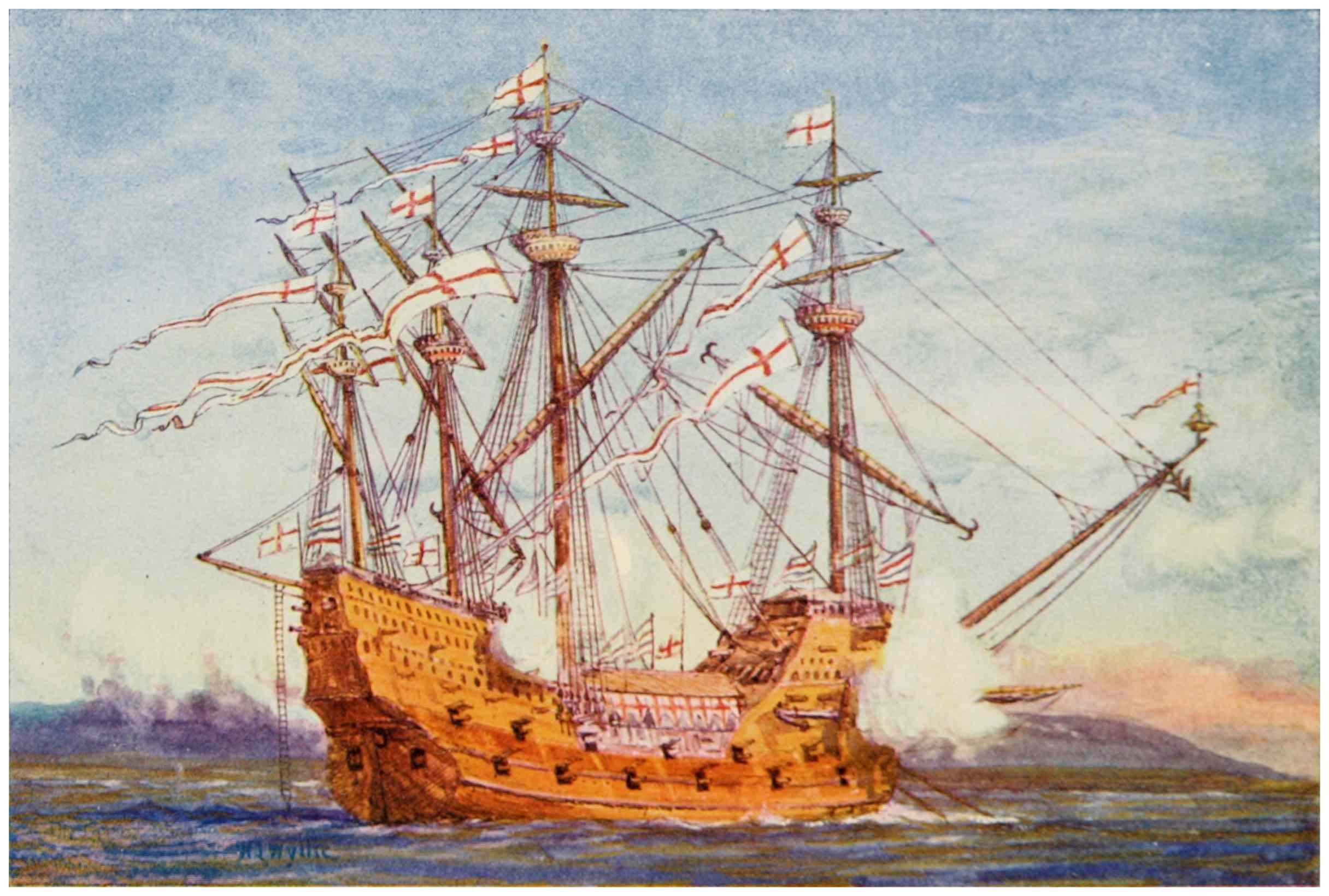
vessel generally spoken of as the “Great Harry,” though
her real name seems to have been The Regent, built in
1485. Incidentally this ship remained afloat till 1553,
when she was burned by accident. She has been called
“the first ship of the Royal Navy”; and though her
right to the honour has been contested, she appears
fully entitled to it. The real founder of the Navy as
we understand a navy to-day was Henry VII.
Another important event of this reign is that during
it the first dry dock was built at Portsmouth. Up till
then there had been no facilities for the underwater
repair of ships other than the primitive method of
running them on to the mud and working on them at
low tide. While ships were small this was not a matter
of much moment, but directly larger vessels began to
be built, it meant that efficient overhauls were extremely
difficult, if not impossible.
Yet another step that had far reaching results was
the granting of a bounty to all who built ships of over
120 tons. This bounty, which was “per ton” and on a
sliding scale, made the building of large private ships
more profitable and less risky than it had been before,
and so assisted in the creation of an important auxiliary
navy as complement to the Royal Navy.
The bounty system did more, however, than encourage
the building of large private ships. The loose
method of computing tonnage already referred to,
became more elastic still when a bounty was at stake;
and even looser when questions of the ship being hired
per ton for State purposes was at issue. Henry VII,
who was nothing if not economical, felt the pinch;
the more so, as just about this time Continentals with
ships for hire became alarmingly scarce. Something
very like a “corner in ships” was created by English
merchants.
Henry VII was thus, by circumstances beyond his
own control, forced into creating a permanent navy
in self defence. He died with a “navy” of eighteen
ships, of which, however, only two were genuinely
entitled to be called “H.M.S.” He had to hire the
others!
This foundation of the “regular navy” is not at
all romantic. But it is how a regular navy came to
be founded—by force of circumstances. Henry VII,
“founder of the Royal Navy,” undoubtedly realized
clearer than any of his predecessors for many a hundred
years the meaning of naval power. But—his passion
for economy and the advantage taken by such of his
subjects as had ships available when hired ships were
scarce, had probably a deal more to do with the
institution of a regular navy than any preconceived
ideas. In two words—“Circumstances compelled.”
And that is how things stood when Henry VIII came
to the throne.
The nominal permanent naval power established by
Henry VII consisted of fifty-seven ships, and the crew
of each was twenty-one men and a boy, so that the
Great Harry, which must have required a considerably
larger crew, would seem to have been an experimental
vessel. The actual force, however, was but two fighting
ships proper.
Under Henry VIII, however, the policy of monster
ships was vigorously upheld, and one large ship built in
the early years of his reign—the Sovereign—was reputed
to be “the largest ship in Europe.” In 1512 the King
reviewed at Portsmouth “twenty-five ships of great
burthen,” which had been collected in view of hostilities
with France. These ships having been joined by others,
and amounting to a fleet of forty-four sail, encountered
a French fleet of thirty-nine somewhere off the coast
of Brittany.
This particular battle is mainly noteworthy owing
to the fact that the two flagships grappled, and while
in this position one of them caught fire. The flames
being communicated to the other, both blew up. This
catastrophe so appalled the two sides that they abandoned
the battle by mutual consent; from which it is to
be presumed that the nautical mind of the day had,
till then, little realised that risks were run by carrying
explosives.
The English, however, were less impressed by the
catastrophe than the enemy, since next day they rallied
and captured or sank most of the still panic-stricken
French ships.
Henry replaced the lost flagship by a still larger ship,
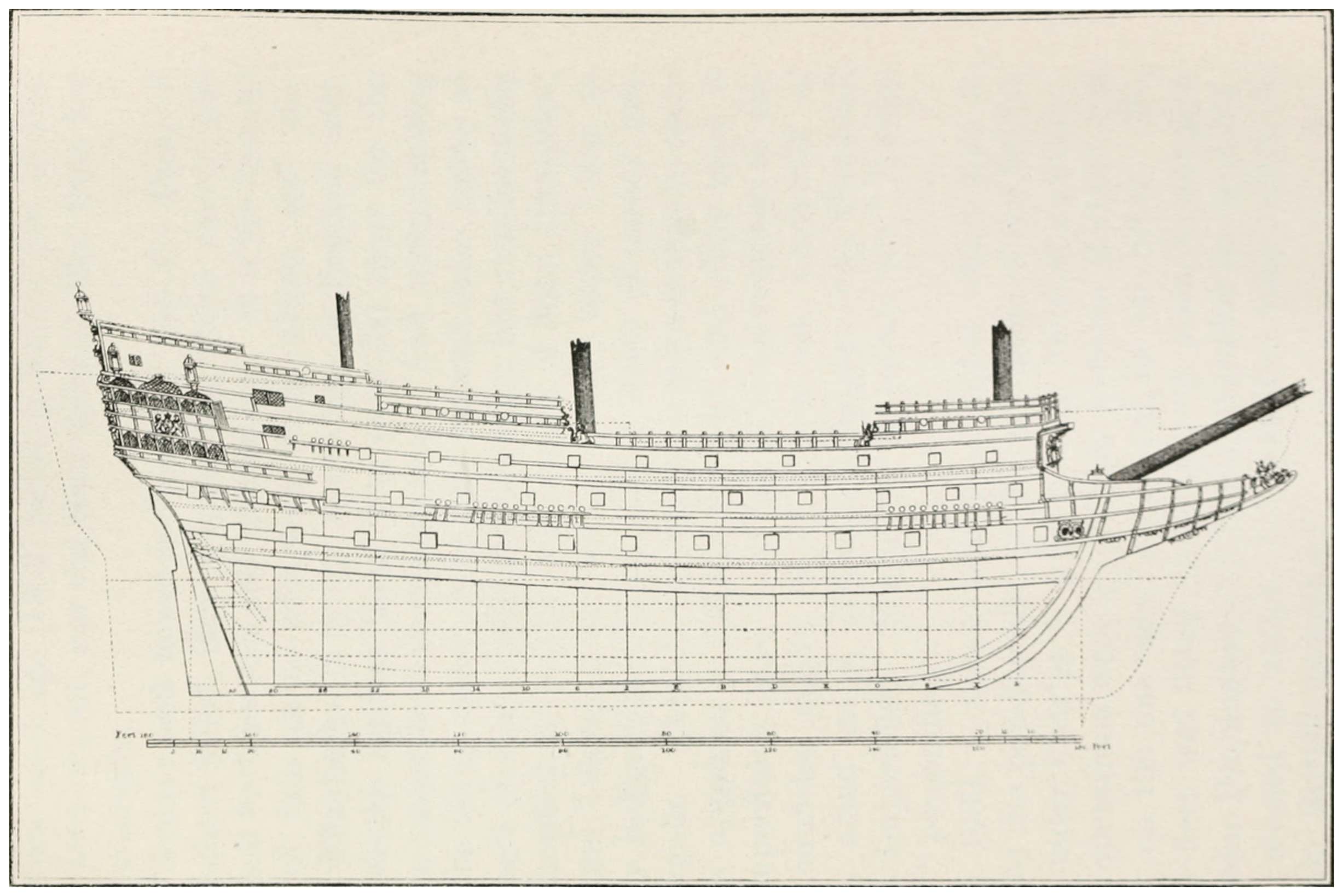
the Grace de Dieu, a two-decker with the lofty poop and
forecastle of the period. She was about 1,000 tons.
Tonnage, however, was so loosely calculated in those
days that measurements are excessively approximate.
When first cannon were introduced, they were (as
previously remarked) merely a substitute for the old-fashioned
catapults, and discharged stones for some
time till more suitable projectiles were evolved. Like
the catapults they were placed on the poop or forecastle,
as portholes had not then been introduced. These
were invented by a Frenchman, one Descharges, of
Brest. By means of portholes it was possible to
mount guns on the main deck and so increase their
numbers.
THE “GRACE DE DIEU” 1515.
Although the earliest portholes were merely small
circular holes which did not allow of any training, and
though the idea of them was probably directly derived
from the loopholes in castle walls, the influence of the
porthole on naval architecture was soon very great
indeed. By means of this device a new relation
between size and power was established, hence the
“big displacements” which began to appear at this
time. The hole for a gun muzzle to protrude through,
quickly became an aperture allowing of training the
gun on any ordinary bearing in English built ships.
The English (for a very long time it was English only)
realisation of the possibilities of the porthole in Henry
VIII’s reign contributed very materially to the defeat
of the Spanish Armada some decades later. Indeed,
it is no exaggeration to say that the porthole was to
that era what the torpedo has been in the present one.
Introduced about 1875 as a trivial alternative to the
gun, in less than forty years the torpedo came to
challenge the gun in range to an extent that as early
as 1905 or thereabouts began profoundly to affect all
previous ideas of naval tactics, and that by 1915 has
changed them altogether!
Another great change of these Henry VIII days
was in the form of the ships.6 At this era they began
to be built with “tumble-home” sides, instead of sides
slanting outwards upwards, and inwards downwards as
heretofore. With the coming of the porthole came the
decline of the cross-bow as a naval arm. In the pre-porthole
days every record speaks of “showers of
arrows,” and the gun appears to have been a species of
accessory. In the early years of the Sixteenth Century
it became the main armament, and so remained unchallenged
till the present century and the coming of
the long-range torpedo.
Henry VIII’s reign is also remarkable for the
first institution of those “cutting out” expeditions
which were afterwards to become such a particular
feature of British methods of warfare. This first
attempt happened in the year 1513, when Sir Edward
Howard, finding the French fleet lying in Brest Harbour
refusing to come out, “collected boats and barges”
and attacked them with those craft. The attempt was
not successful, but it profoundly affected subsequent
naval history.
Therefrom the French were impressed with the idea
that if a fleet lay in a harbour awaiting attack it
acquired an advantage thereby. The idea became
rooted in the French mind that to make the enemy
attack under the most disadvantageous circumstances
was the most wise of policies. That “the defensive
is compelled to await attack, compelled to allow the
enemy choice of the moment” was overlooked!
From this time onward England was gradually
trained by France into the role of the attacker, and
the French more and more sank into the defensive
attitude. Many an English life was sacrificed between
the “discovery of the attack” in the days of Henry
VIII, and its triumphant apotheosis when centuries
later Nelson won the Battle of the Nile; but the
instincts born in Henry’s reign, on the one hand to
fight with any advantage that the defensive might offer,
on the other hand to attack regardless of these advantages,
are probably the real key to the secret of later
victories.
The Royal ships at this period were manned by
voluntary enlistment, supplemented by the press-gang
as vacancies might dictate. The pay of the mariner
was five shillings a month; but petty officers, gunners
and the like received additional pickings out of what
was known as “dead pay.” By this system the names
of dead men, or occasionally purely fancy names, were
on the ship’s books, and the money drawn for these
was distributed in a fixed ratio. The most interesting
feature of Henry VII and Henry VIII’s navies is the
presence in them of a number of Spaniards, who presumably
acted as instructors. These received normal
pay of seven shillings a month plus “dead pay.”
The messing of the crews was by no means indifferent.
It was as follows per man:—
Sunday, Tuesday, Thursday: ¾ lb. beef and ½ lb.
bacon.
Monday, Wednesday, Saturday: Four herrings and
two pounds of cheese.
Friday: To every mess of four men, half a cod,
ten herrings, one pound of butter and one
pound of cheese.
There was also a daily allowance of one pound of bread
or biscuit. The liquid allowance was either beer, or a
species of grog consisting of one part of sack to two of
water. Taking into account the value of money in
those days and the scale of living on shore at the time,
the conditions of naval life were by no means bad,
though complaints of the low pay were plentiful enough.
Probably, few received the full measure of what on
paper they were entitled to.
Henry VIII died early in 1547. In the subsequent
reigns of Edward VI and Mary, the Navy declined, and
little use was made of it except for some raiding
expeditions.
When Elizabeth came to the throne the regular
fleet had dwindled to very small proportions, and, war
being in progress, general permission was given for
privateering as the only means of injuring the enemy.
It presently degenerated into piracy and finally had to
be put down by the Royal ships.
No sooner, however, was the war over than the Queen
ordered a special survey to be made of the Navy.
New ships were laid down and arsenals established for
the supply of guns and gunpowder, which up to that
time had been imported from Germany. Full advantage
was taken of the privateering spirit, the erstwhile
pirates being encouraged to undertake distant voyages.
In many of these enterprises the Queen herself had a
personal financial interest. She thus freed the country
from various turbulent spirits who were inconvenient
at home, and at one and the same time increased her
own resources by doing so.
There is every reason to believe that this action
of Elizabeth’s was part of a well-designed and carefully
thought out policy. The type of ship suitable for
distant voyages and enterprises was naturally bound to
become superior to that which was merely evolved
from home service. The type of seamen thus bred was
also necessarily bound to be better than the home-made
article. Elizabeth can hardly have failed to realise
these points also.
To the personnel of the regular Navy considerable
attention was also given. Pay was raised to 6/8 per
month for the seamen, and 5/- a month with 4/- a month
for clothing for soldiers afloat. Messing was also increased
to a daily ration of one pound of biscuit, a gallon
of beer, with two pounds of beef per man four days out
of the seven, and a proportionate amount of fish on the
other three days. Subsequently, and just previous to
the Armada, the pay of seamen rose to 10/- a month,
with a view to inducing the better men not to desert.
The regular navy was thus by no means badly
provided for as things went in those days; while service
with “gentlemen adventurers” offered attractions to a
very considerable potential reserve, and so England
contained a large population which, from one cause
and another, was available for sea service. To these
circumstances was it due that the Spanish Armada,
when it came, never had the remotest possibility of
success. It was doomed to destruction the day that
Elizabeth first gave favour to the “gentlemen
adventurers.”
Of these adventurers the greatest of all was Francis
Drake, who in 1577 made his first long voyage with five
ships to the Pacific Ocean. Drake, alone, in the Pelican,
succeeded in reaching the Pacific and carrying out his
scheme of operations, which—not to put too fine a point
on it—consisted of acts of piracy pure and simple
against the Spaniards. He returned to England after
an absence of nearly three years, during which he
circumnavigated the globe.
There is little doubt that Drake in this voyage,
and others like him in similar expeditions, learned a
great deal about the disadvantages of small size in
ships. Drake, however, learned another thing also.
Up to this day the crew of a ship had consisted of
the captain and a certain military element; also the
master, who was responsible for a certain number of
“mariners.” The former were concerned entirely with
fighting the ship—the latter entirely with manœuvring it.
This system of specialisation, awkward as it appears
thus baldly stated, may have worked well enough in
ordinary practice. It did not differ materially from the
differentiation between deck hands and the engineering
departments, which to a greater or less extent is very
marked in every navy of the present day.
Drake, however, started out with none too many
men, and it was not long before he lost some of those
he had and found himself short-handed. His solution of
the difficulty is in his famous phrase, “I would have the
gentlemen haul with the mariners.” How far this was a
matter of expediency, how far the revelation of a new
policy, is a matter of opinion. It must certainly have
been outside the purview of Elizabeth. But out of it
gradually came that every English sailor knew how to
fight his ship and how to sail her too, and this amounted
to doubling the efficiency of the crew of any ship at one
stroke.
Of Drake himself, the following contemporary pen-picture,
from a letter written by one of his Spanish victims,
Don Franciso de Zarate,7 explains almost everything:—
“He received me favourably, and took me to his room, where
he made me seated and said to me: ‘I am a friend to those who
speak the truth, that is what will have the most weight with me.
What silver or gold does this ship bring?’
“... We spoke together a great while, until the dinner-hour.
He told me to sit beside him and treated me from his dishes, bidding
me have no fear, for my life and goods were safe; for which I kissed
his hands.
“This English General is a cousin of John Hawkins; he is the
same who, about five years ago, took the port of Nombre de Dios;
he is called Francis Drake; a man of some five and thirty years,
small of stature and red-bearded, one of the greatest sailors on the
sea, both from skill and power of commanding. His ship carried
about 400 tons, is swift of sail, and of a hundred men, all skilled and
in their prime, and all as much experienced in warfare as if they
were old soldiers of Italy. Each one, in particular, takes great pains
to keep his arms clean;8 he treats them with affection, and they treat
him with respect. I endeavoured to find out whether the General
was liked, and everyone told me he was adored.”
Less favourable pictures of Drake have been penned,
and there is no doubt that some of his virtues have
been greatly exaggerated. At the present day there is
perhaps too great a tendency to reverse the process.
Stripped of romance, many of his actions were petty,
while those of some of his fellow adventurers merit a
harsher name. Hawkins, for instance, was hand-in-glove
with Spanish smugglers and a slave trader.
Many of the victories of the Elizabethan “Sea-Kings”
were really trifling little affairs, magnified into an
importance which they never possessed.
But, when all is said and done, it is in these men
that we find the birth of a sea spirit which still lingers
on, despite that other insular spirit previously referred
to—the natural tendency of islanders to regard the
water itself as a bulwark, instead of the medium on
which to meet and defeat the enemy.
The Spanish, already considerably incensed by the
piratical acts of the English “gentlemen adventurers,”
presently found a further cause of grievance in the
assistance rendered by Elizabeth to their revolting
provinces in the Netherlands. Drake had not returned
many years from his famous voyage when it became
abundantly clear that the Spaniards no longer intended
quietly to suffer from English interference.
Spain at that time was regarded as the premier
naval power of Europe. Her superiority was more
mythical than actual, for reasons which will later on be
referred to: however, her commercial oversea activities
were very great. The wealth which she wrung from
the Indies—though probably infinitely less than its
supposed value—was sufficient to enable her to equip
considerable naval forces, certainly larger ones numerically
than any which England alone was able to bring
against them.
Knowledge of the fact that Spain was preparing the
Armada for an attack on England, led to the sailing
of Drake in April, 1587, with a fleet consisting of four
large and twenty-six smaller ships, for the hire of which
the citizens of London were nominally or actually
responsible. His real instructions are not known, but
there is little question that, as in all similar expeditions,
he started out knowing that his success would be
approved of, although in the event of any ill-success
or awkward questions, he would be publicly disavowed.
Reaching Cadiz, he destroyed 100 store ships which
he found there; and then proceeding to the Tagus,
offered battle to the Spanish war fleet. The Spanish
admiral, however, declined to come out—a fact which
of itself altogether discredits the popular idea about the
vast all-powerful ships of Spain, and the little English
ships, which, in the Armada days, could have done
nothing against them but for a convenient tempest.
On account of this expedition of Drake’s, the sailing
of the Armada was put off for a year. So far as
stopping the enterprise was concerned, Drake’s expedition
was a failure. Armada preparations still went on.
It is by no means to be supposed that the Armada
in its conception was the foolhardy enterprise that on
the face of things it looks to have been. The idea of
it was first mooted by the Duke of Alva so long ago
as 1569. In 1583 it became a settled project in the
able hands of the Marquis of Santa Cruz, who alone
among the Spaniards was not more or less afraid of
the English. In the battle of Tercera in 1583, certain
ships, which if not English were at any rate supposed
to be, had shown the white feather. Santa Cruz assumed
therefrom that the English were easily to be overwhelmed
by a sufficiently superior force, and he designed a scheme
whereby he would use 556 ships and an army of 94,222
men.
Philip of Spain had other ideas. Having a large
army under the Duke of Parma in the Netherlands,
he proposed that this force should be transported thence
to England in flat-bottomed boats, while Santa Cruz
should take with him merely enough ships to hold the
Channel, and prevent any interference by the English
ships with the invasion.
Before the delayed Armada could sail Santa Cruz
died; and despite his own protestations Medina Sidonia
was appointed in Santa Cruz’s place to carry out an
expedition in which he had little faith or confidence.
His total force at the outset consisted of 130 ships and
30,493 men. Of these ships not more than sixty-two
at the outside were warships, and some of these did
not carry more than half-a-dozen guns.
The main English fighting force consisted of forty-nine
warships, some of which were little inferior to the
Spanish in tonnage, though all were much smaller to
the eye, as they were built with a lower freeboard and
without the vast superstructures with which the
Spaniards were encumbered. As auxiliaries, the
English had a very considerable force of small ships;
also the Dutch fleet in alliance with them.
The guns of the English ships were, generally
speaking, heavier, all their gunners were well trained,
and their portholes especially designed to give a considerable
arc of fire, whereas the Spanish had very
indifferent gunners and narrow portholes. The Spaniards
themselves thoroughly recognised their inferiority in
the matter of gunnery, and the specific instructions
of their admiral were that he was to negative this
inferiority by engaging at close quarters, and trust to
destroying the enemy by small-arm fire from his lofty
superstructures.
The small portholes of the Spanish ships, which
permitted neither of training, nor elevation, nor
depression, are not altogether to be put down to
stupidity or neglect of progress, for all that they were
mainly the result of ultra-conservatism. The gun—as
Professor Laughton has made clear—was regarded in
Spain as a somewhat dishonourable weapon. Ideals
of “cold steel” held the field. Portholes were kept
very small, so that enemies relying on musketry should
not be able to get the advantage that large portholes
might supply. To close with the enemy and carry by
boarding was the be-all and end-all of Spanish ideas
of naval warfare. When able to employ their own
tactics they were formidable opponents, though to the
English tactics merely so many helpless haystacks.
On shore, in England, the coming of the Armada
provoked a good deal of panic; though the army
which Elizabeth raised and reviewed at Tilbury was
probably got together more with a view to allaying
this panic than from any expectations that it would
be actually required. The views of the British seamen
on the matter were entirely summed up in Drake’s
famous jest on Plymouth Hoe, that there was plenty
of time to finish the game of bowls and settle the
Spaniards afterwards!
THE SPANISH ARMADA—1588.
Yet this very confidence might have led to the
undoing of the English. The researches of Professor
Laughton have made it abundantly clear that had
Medina Sidonia followed the majority opinion of a
council of war held off the Lizard, he could and would
have attacked the English fleet in Plymouth Sound
with every prospect of destroying it, because there, and
there only, did opportunity offer them that prospect of
a close action upon which their sole chance of success
depended. Admiral Colomb has elaborated the point
still further, with a quotation from Monson to the
effect that had the Armada had a pilot able to recognise
the Lizard, which the Spaniards mistook for Ramehead,
they might have surprised the English fleet at Plymouth.
This incident covers the whole of what Providence
or luck really did for England against the Spanish.
To a certain extent a parallel of our own day
exists. When Rodjestvensky with the Baltic fleet
reached Far Eastern waters, there came a day when
his cruisers discovered the entire Japanese fleet lying
in Formosan waters. The Russian admiral ignored
them and went on towards Vladivostok. The parallel
ends here because the “Japanese fleet” was merely a
collection of dummies intended to mislead him.9
The first engagement with the Spanish Armada
took place on Sunday, June 21st. It was more in the
nature of a skirmish than anything else. The Spaniards
made several vain and entirely ineffectual attempts to
close with the swifter and handier English vessels.
They took care, however, to preserve their formation,
and so to that extent defeated the English tactics,
which were to destroy in detail what could not be
destroyed without heavy loss in the mass. So the
Spaniards reached Calais on the 27th with a loss of
only three large ships.
They there discovered that Parma’s flat-bottomed
boats were all blockaded by the Dutch, and that any
invasion of England was therefore entirely out of the
question. It must have been perfectly obvious to the
most sanguine of them by this that they could not
force action with the swifter English ships, while they
could not relieve the blockaded boats without being
attacked at the outset. In a word, the Armada was
an obvious failure.
On the night of the 28th, fire ships were sent into
the Spanish fleet by the English. This, though the
damage done was small, brought the Spanish to sea,
and the next morning they were attacked off Gravelines
by the English. The battle was hardly of the nature
of a fleet action, so much as well-designed tactical
operations intended to keep the enemy on the move.
It resulted in the Spaniards losing only seven ships in
a whole day’s fighting. The only really serious loss
that the Spaniards sustained was that they were driven
into the North Sea, with no prospect of returning home
except by way of the North of Scotland.
Followed for awhile and harried by a portion of the
English fleet, which fell upon and destroyed stragglers,
the Spaniards were driven into what to most of them
were unknown waters and uncharted seas. To the
last the retreating fleet maintained a show of order.
Fifty-three ships succeeded in returning to Spain.
THE END OF A “GENTLEMAN-ADVENTURER.”—THE “REVENGE.”—CAPTURED BY SPANIARDS, 1591.
Stripped of romance this is the real prosaic history
of the defeat of the Spanish Armada. The wonder is
not that so few Spanish ships returned, but that so
many did! The loss in Spanish warships proper appears
to have been little over a dozen all told, and of these
not more than three at the outside can be attributed
to “the winds.”
Havoc was undoubtedly wrought, but the “galleons”
which “perished by scores” on the Scotch and Irish
coasts were mainly the auxiliaries, transports, and small
fry; the battle fleet proper kept together all the time,
and with a couple of exceptions the ships reached home
together as a fleet.10
At no time in the advance of the Spanish—probably
at no time in the retreat either—could the English
have engaged close action with any certainty of success.
Victory was attributable solely and entirely to the
evolution of a type of ship, fast, speedy and handy,
able to hit hard, and which had been more or less
specially designed with an eye to offering a very small
target to the clumsily designed Spanish style of gun
mounting.
It was “history repeating itself” in another way.
As Alfred overcame the Danes by evolving something
superior to the Danish galleys; so, in Elizabethan days,
there was evolved a type of warship meet for the
occasion.
From the defeat of the Armada and onwards,
English naval operations were mainly confined to raiding
expeditions against the Spanish coast, with a view
to checking the collection of any further Armadas.
These operations were chiefly carried out by the “gentlemen
adventurers”; but the real Navy itself was
maintained and added to, and at the death of Elizabeth
in 1603, it consisted of forty-two ships, of which the
68-gun Triumph of 1,000 tons was the largest. This
Navy was relied upon as the premier arm in case of
any serious trouble.
IV. THE PERIOD OF THE DUTCH WARS. — THE CIVIL WAR. — THE FIRST DUTCH WAR. — THE SECOND DUTCH WAR. — THE THIRD DUTCH WAR.
With the accession of James I peace with Spain
came about, but the Dutch being ignored in the
transaction, out of this there arose that ill-feeling
and rivalry which was later on to culminate in the
Dutch wars.
In James I’s reign no naval operations of great
importance took place, but considerable interest attaches
to the despatch of eighteen ships (of which six were
“King’s Ships”), to Algiers in 1520. This was the first
appearance of an English squadron in the Mediterranean.
Under James I the numerical force of the Navy
declined somewhat. The art of shipbuilding, however,
made considerable advance.11 A Shipwrights’ Company
was established in 1656, and Phineas Pett, as its first
master, built and designed a 1,400 ton ship named the
Prince Royal. Pett introduced a variety of novelties into
his designs, and the Prince Royal and her successors
were esteemed superior to anything set afloat elsewhere
at the time.
Here it is desirable to turn aside for a moment
in order to realise the influences at work behind Phineas
Pett. It has ever been the peculiar fortune of the
Royal Navy—and for that matter of the inchoate
“Navy” which preceded its establishment—to have
had men capable of “looking ahead” and forcing the
pace in such a way that new conditions were prepared
for when they arrived.
Of such a nature, each in his own way, were
King Alfred, King John, Richard III, and Henry VII, but
greater than any of these was Sir Walter Raleigh,
whose visions in the days of Elizabeth and James I
ran so clearly and so far that even now we cannot
be said to have left him behind where “principles”
are concerned. Drake was the national hero of
Elizabethan days, but in utility to the future, Raleigh
was a greater than he, albeit his best service was of
the “armchair” kind.
The following extracts from Raleigh’s writings,
except for geographical and political differences, stand
as true to-day as when he wrote them about 300 years
ago. The idea of a main fleet, backed up by smaller
vessels, the idea of meeting the enemy on the water and
so forth, are commonplaces now, but in Raleigh’s time
they were quite otherwise. The italicised portions in
particular indicate quite clearly in Elizabethan words
the naval policy of to-day.
“Another benefit which we received by this preparation was,
that our men were now taught suddenly to arm, every man knowing his
command, and how to be commanded, which before they were ignorant
of; and who knows not that sudden and false alarms in any army
are sometimes necessary? To say the truth, the expedition which
was then used in drawing together so great an army by land, and
rigging so great and royal a navy to sea, in so little a space of
time, was so admirable in other countries, that they received a
terror by it; and many that came from beyond the seas said
the Queen was never more dreaded abroad for anything she ever did.
“Frenchmen that came aboard our ships did wonder (as at a
thing incredible) that Her Majesty had rigged, victualled, and
furnished her royal ships to sea in twelve days’ time; and Spain,
as an enemy, had reason to fear and grieve to see this sudden
preparation.
“It is not the meanest mischief we shall do to the King of
Spain, if we thus war upon him, to force him to keep his shores
still armed and guarded, to the infinite vexation, charge and
discontent of his subjects; for no time or place can secure them so
long as they see or know us to be upon that coast.
“The sequel of all these actions being duly considered, we may
be confident that whilst we busy the Spaniard at home, they dare not
think of invading England or Ireland; for by their absence their fleet
from the Indies may be endangered12 and in their attempts they
have as little hope of prevailing.
“Surely I hold that the best way is to keep our enemies from
treading upon our ground: wherein, if we fail, then must we seek to
make him wish that he had stayed at his own home. In such a case,
if it should happen, our judgments are to weigh many particular
circumstances, that belong not to this discourse. But making the
question general, the position, whether England, without that it is unable
to do so: and, therefore, I think it most dangerous to make the
adventure. For the encouragements of a first victory to an enemy,
and the discouragement of being beaten to the invaded, may draw
after it a most perilous consequence.
“Great difference, I know there is, and diverse consideration to
be had, between such a country as France is, strengthened with
many fortified places, and this of ours, where our ramparts are but
the bodies of men. But I say that an army to be transported over
sea, and to be landed again in an enemy’s country, and the place
left to the choice of the invader cannot be resisted on the coast of
England without a fleet to impeach it; no, nor on the coast of France, or
any other country, except every creek, port, or sandy bay had a powerful
army in each of them to make opposition.... For there is no man
ignorant that ships, without putting themselves out of breath, will easily
outrun the soldiers that coast them.13
“Whosoever were the inventors, we find that every age hath
added somewhat to ships, and to all things else. And in mine own
time the shape of our English ships hath been greatly bettered. It
is not long since the striking of the topmast (a wonderful ease to
great ships, both at sea and in harbour) hath been devised, together
with the chain pump, which takes up twice as much water as the
ordinary did. We have lately added the Bonnet and the Drabler.
To the courses we have devised studding-sails, topgallant-masts,
spritsails, topsails. The weighing of anchors by the capstone is also
new. We have fallen into consideration of the lengths of cable, and
by it we resist the malice of the greatest winds that can blow.
Witness our small Millbroke men of Cornwall, that ride it out at
anchor half seas over between England and Ireland, all the winter
quarter. And witness the Hollanders that were wont to ride before
Dunkirk with the wind at north-west, making a lee-shoar in all
weathers. For true it is, that the length of the cable is the life of
the ship, riding at length, is not able to stretch it; and nothing
breaks that is not stretched in extremity. We carry our ordnance
better than we were wont, because our nether over-loops are raised
commonly from the water, to wit, between the lower part of
the sea.
“In King Henry VIII time, and in his presence at Portsmouth,
the Mary Rose, by a little sway of the ship in tacking about, her
ports being within sixteen inches of the water, was overset and lost.
“We have also raised our second decks, and given more vent
thereby to our ordnance lying on our nether-loop. We have added
cross pillars14 in our royal ships to strengthen them, which be
fastened from the keels on to the beam of the second deck to keep
them from setting or from giving way in all distresses.
“We have given longer floors to our ships than in elder times,
and better bearing under water, whereby they never fall into the
sea after the head and shake the whole body, nor sink astern, nor
stoop upon a wind, by which the breaking loose of our ordnance,
or of the not use of them, with many other discommodities are
avoided.
“And, to say the truth, a miserable shame and dishonour it were
for our shipwrights if they did not exceed all others in the setting
up of our Royal ships, the errors of other nations being far more excusable
than ours. For the Kings of England have for many years being at
the charge to build and furnish a navy of powerful ships for their own
defence, and for the wars only. Whereas the French, the Spaniards, the
Portuguese, and the Hollanders (till of late) have had no proper fleet
belonging to their Princes or States. Only the Venetians for a long
time have maintained their arsenal of gallies. And the Kings of
Denmark and Sweden have had good ships for these last fifty years.
“I say that the aforenamed Kings, especially the Spaniards and
Portugals, have ships of great bulk, but fitter for the merchant than
for the man-of-war, for burthen than for battle. But as Popelimire
well observeth, ‘the forces of Princes by sea are marques de
grandeur d’estate—marks of the greatness of an estate—for whosoever
commands the sea, commands the trade; whosoever commands the trade
of the world commands the riches of the world, and consequently the
world itself.’
“Yet, can I not deny but that the Spaniards, being afraid of
their Indian fleets, have built some few very good ships; but he hath
no ships in garrison, as His Majesty hath; and to say the truth, no
sure place to keep them in, but in all invasions he is driven to take up
of all nations which come into his ports for trade....
* * * * *
“But there’s no estate grown in haste but that of the United
Provinces, and especially in their sea forces, and by a contrary way
to that of Spain and France; the latter by invasion, the former by
oppression. For I myself may remember when one ship of Her
Majesty’s would have made forty Hollanders strike sail and come to an
anchor. They did not then dispute de Mari Libero, but readily
acknowledged the English to be Domini Maria Britannici. That we
are less powerful than we were, I do hardly believe it; for, although
we have not at this time 135 ships belonging to the subject of 500
tons each ship, as it is said we had in the twenty-fourth year of
Queen Elizabeth; at which time also, upon a general view and
muster, there were found in England of able men fit to bear arms,
1,172,000, yet are our merchant ships now far more warlike and better
appointed than they were, and the Navy royal double as strong as
it then was. For these were the ships of Her Majesty’s Navy at
that time:
1. The Triumph
2. The Elizabeth Jonas
3. The White Bear
4. The Philip and Mary
5. The Bonadventure
6. The Golden Lyon
7. The Victory
8. The Revenge
9. The Hope
10. The Mary Rose
11. The Dreadnought
12. The Minion
13. The Swiftsure
to which there have been added:—
14. The Antilope
15. The Foresight
16. The Swallow
17. The Handmaid
18. The Jennett
19. The Bark of Ballein
20. The Ayde
21. The Achates
22. The Falcon
23. The Tyger
24. The Bull
“We have not, therefore, less force than we had, the fashion, and
furnishing of our ships considered, for there are in England at this
time 400 sail or merchants, and fit for the wars, which the Spaniards
would call galleons; to which we may add 200 sail of crumsters,
or hoyes of Newcastle, which, each of them, will bear six Demi-culverins
and four Sakers, needing no other addition of building
than a slight spar deck fore and aft, as the seamen call it, which is
a slight deck throughout....
“I say, then, if a vanguard be ordained of those hoyes, who will
easily recover the wind of any other sort of ships, with a battle of
400 other warlike ships, and a rear of thirty of His Majesty’s ships
to sustain, relieve, and countenance the rest (if God beat them not)
I know not what strength can be gathered in all Europe to beat
them. And if it be objected that the States can furnish a far
greater number, I answer that His Majesty’s forty ships, added to
the 600 beforenamed, are of incomparable greater force than all that
Holland and Zealand can furnish for the wars. As also, that a
greater number would breed the same confusion that was found in
Xerxes’ land army of 1,700,000 soldiers; for there is a certain proportion,
both by sea and land, beyond which the excess brings nothing
but disorder and amazement.”
I have quoted from Raleigh at considerable length—a
length which may seem to some out of all proportion
to the general historical scheme of this work. But of
the three possible “founders of the British Navy,”
King Alfred by legend, King Henry VII by force of
circumstances, and Sir Walter Raleigh, Knight, by his
realisation of certain eternal verities of naval warfare,
the palm goes best to Raleigh, to whose precepts it
was mainly due that England did not succumb to
Holland in the days of the Dutch wars. Compared to
the struggle with the Dutch, neither the Spanish wars,
which preceded them, nor the great French wars which
followed, were of any like importance as regarded the
relative risks and dangers. And the interest is the
greater in that where the United Provinces were, about
and just after Raleigh’s time, Germany stands towards
the British Navy to-day.
In 1618 the Duke of Buckingham was appointed
Lord High Admiral and continued in that position after
the accession of Charles I. Of the incapacity of the Duke
much has been written, but whatever may be said in
connection with various unsuccessful oversea enterprises,
for which he was officially responsible, naval shipbuilding
under his régime made very considerable progress.
Things were quite otherwise, however, with the
personnel. Abuses of every sort and kind crept in unchecked,
and the men were the first to feel the pinch.
The unscrupulous contractor appeared, and with him
the era of offal foods and all kinds of similar abuses,
of which many have lasted well into our own time,
and some exist still. The money allotted for the men
of the fleet became the prey of every human vulture,
the officers, as a rule, being privy thereunto. Besides
food, clothing also fell into the hands of contractors
who supplied shoddy at ridiculously high prices, with
the commission to officers stopped out of the men’s pay.
Pay, nominally, rose a good deal, and in 1653
reached twenty-four shillings a month for the seaman,
but the figures (approximately equal in purchasing
value to the pay of to-day) convey nothing. The men
were half-starved, or worse, on uneatable food, and
their clothing was such that they went about in rags
and died like rats in their misery.
The first naval event in Charles I’s reign is mainly
of interest because of the peculiar personal circumstances
that attended it. One King’s ship and six
hired ships were despatched, nominally to assist the
French against the Genoese. On arriving at Dieppe,
however, the English officers and men discovered that
they were really to be used against the revolted French
Protestants of La Rochelle. This being against their
taste, they returned to the Downs and reported themselves
to the King. They were ordered to sail again
for La Rochelle. One captain, however, point blank
refused to do so. The other ships went, but the officers
and men, with a single exception, having handed their
ships over to the French, returned to England.
Little or nothing seems to have been done in the
way of punishment to the mutineers (possibly on account
of public opinion). But the incident sheds an interesting
sidelight on the state of the Navy at the time. It is
hardly to be conceived that the Army at the same
period could have acted in similar fashion with equal
impunity.
PHINEAS PETT, 1570–1647.
From the contemporary portrait by William Dobson in the National Portrait Gallery.
The history of the British Navy of this period
is the history of a navy lacking in discipline, and its
officers divided against each other. Such expeditions
as were undertaken against France and Spain signally
failed. It is usual to attribute these failures to the
mal-administration of the Duke of Buckingham, an
unpopular figure. But whether this is just or not is
another matter. The entire Navy was rotten to the
core in its personnel. But Buckingham’s share in it
would seem to have been inability to understand rather
than direct carelessness.
Under the Duke’s régime the building of efficient
warships continued to progress. The “ship money,”
which was to cause so much trouble inland later, is
outside the scope of this work, save in so far as its
direct naval aspect is concerned. This, of course, was
the principle that inland places benefited from sea
defence quite as much as seaside districts. A great
deal of the money was undoubtedly spent on shipbuilding;
indeed, some of the trouble lay over alleged
(and seemingly obvious) excessive expenditure on the
“Dreadnought” of the period, Phineas Pett’s Royal
Sovereign, a ship altogether superior to anything before
built in England, and the first three-decker ever constructed
in this country. She was laid down in 1635
and launched in 1657. An immense amount of gilding
and carving about her irritated the economically minded,
but it is questionable whether the objections were well
informed.
Just about this time elaborate ornamentations of
warships was the “vogue,” and it carried moral effect
accordingly. What to the uninitiated landsmen merely
spelt “waste of money on unnecessary display” spelt
something else to those who went across the seas.
Even in our own present utilitarian days a fresh coat
of paint to a warship has been found to have a political
value; and fireworks and illuminations (seemingly pure
waste of money) have played their share in helping to
preserve the peace.
John Hampden, according to his lights, was a
patriot, and according to the purely political questions
with which he was concerned he may also have been;
but on the naval issue of Ship Money he was little more
or less than the First Little Englander, and hampered by
just that same inability to see beyond his nose which
characterised the modern Little Englander who protested
against “bloated naval expenditure.” The intentions
were excellent—the intelligence circumscribed.
A contemporary account of the Royal Sovereign is
as follows:—
“Her length by the keele is 128 foote or thereabout, within
some few inches; her mayne breadth or wideness from side to side,
48 foote; her utmost length from the fore-end to the stern, a prova
ad pupin, 232 foote. Shee is in height, from the bottom of her
keele to the top of her lanthorne, 76 foote; she beareth five
lanthornes, the biggest of which will hold ten persons to stand
upright, and without shouldering or pressing one on the other.
“Shee hath three flush deckes and a forecastle, an halfe decke, a
quarter-decke, and a round house. Her lower tyre hath thirty ports,
which are to be furnished with demi-cannon and whole cannon,
throughout being able to beare them; her middle tyre hath also
thirty ports for demi-culverin and whole culverin; her third tyre
hath twentie sixe ports for other ordnance; her forecastle hath
twelve ports, and her halfe decke hath fourteen ports; she hath
thirteene or fourteene ports more within board for murdering-pieces,
besides a great many loope-holes out of the cabins for musket shot.
Shee carrieth, moreover, ten pieces of chase ordnance in her right
forward, and ten right off, according to lande service in the front
and the reare. Shee carrieth eleven anchores, one of them weighing
foure thousand foure hundred pounds; and according to these are
her cables, mastes, sayles, cordage.”
Ex. Fincham.
THE ROYAL SOVEREIGN.
The dotted lines represent a ship of the time of 1850.
It remains to add that the ship was extraordinarily
well built. She fought many a battle and survived some
fifty years, and then only perished because, when laid up
for refit in 1696, she was accidentally burned. And about
sixty-three years ago (1852) naval architects still alluded
to her with respect, nor did their designs differ from her
very materially.
Wherever and however Charles I and the Duke of
Buckingham failed, their shipbuilding policy cannot but
command both respect and admiration. It is the curious
irony of fate that—excepting King Alfred, and also
Queen Elizabeth—it is the Sovereigns of England with
black marks against them who ever did most for the
Navy or understood its importance. And understanding
what the Navy meant, generally secured these marks at
the hands of some quite well meaning but intellectually
circumscribed prototype or successor of John Hampden,
to whom “meeting the enemy on the water” was an
entirely indigestible theory, and a waste of money into
the bargain. There is no question whatever that to them
the sea appeared a natural rampart and ships upon it
pure superfluity, save in so far as inconvenience to the
shore counties might result. Later on, Cromwell, of
course, acted on a different principle—but Cromwell
was an Imperialist. Hampden was merely the “Insular
Spirit” personified.
In 1639, a naval incident occurred which goes to
discredit the popular idea of the impotence of the British
Navy under Charles I, whatever its internal condition.
Naval operations were in progress between Holland and
France on the one side, and Spain on the other. The
British fleet was fitted out under Sir John Pennington
(that same Pennington who had commanded the squadron
which refused to attack La Rochelle) with orders to
maintain British neutrality.
The Spanish fleet took refuge from the Dutch in
the Downs, whereupon Pennington informed the rival
admirals that he should attack whichever of them
violated the neutrality of an English harbour. The
Spanish having fired upon the Dutch, the Dutch Admiral
Van Tromp applied to Pennington for permission to
attack the Downs. This was given, and the bulk of
the Spanish fleet destroyed. The incident suggests that
the English fleet was recognised as a neutral able to
enforce its orders against all and sundry.
In connection with this, it is interesting to record
the existence of a naval medal of the period, bearing
the motto: “Nec meta mihi quae terminus orbi”—a free
translation of which would be, “Nothing limits me but
the size of the World.” However short practice may
have fallen, Charles and his advisers had undoubtedly
grasped the theory of “Sea Power.”
When the Civil war began in 1642, the regular fleet
consisted of forty-two ships. It was seized by the
Parliamentarians and put under the Earl of Warwick,
who held command for six years. With his fleet he
very effectually patrolled the Channel, rendering abortive
all over-sea attempts to assist the King with arms and
ammunition.
On Warwick being superseded in 1648, the fleet
mutinied, and seventeen ships sailed for Holland to join
Prince Charles; but upon Warwick being reinstated
the bulk of the fleet returned to its allegiance to the
Parliamentarians. That the Parliamentarians were fully
alive to the importance of naval power is evidenced by
the fact that they seized every opportunity to lay down
new ships; and “Parliament” once in power made it
very clear indeed that the Sovereignty of the Seas
would be upheld at all costs.
Some forty years before, Sir Walter Raleigh, discussing
the rise of the Dutch United Provinces, remarked:
“But be their estate what it will, let them not deceive
themselves in believing that they can make themselves
masters of the sea.” He advised the Dutch to remember
that their inward and outward passages were through
British seas. There were but two courses open to the
Dutch: amity with England or destruction of English
naval power.
Since both nations had large commercial fleets,
rivalries were inevitable; and for some long while
previous to 1652, both sides were ready enough for a
quarrel. Minor acts of hostility occurred. The Dutch
failed to pay the annual tax for fishing in British waters.
In May, 1652, a Dutch squadron refused to pay respect
to the English flag. It was fired on accordingly, and
after some negotiations, war was declared two months
later.
The war is interesting because it saw an end to
the old ideas of cross-raiding with ships regarded
primarily as transports in connection with raids or to
cover such. In this war fighting on the sea for the
command of the sea first made a distinct appearance.
Its birth was necessarily obscure and involved, both
sides having the primary idea of attacking the commerce
of the enemy and defending their own, rather than
of attacking the enemy’s fleet. The earlier battles
which took place were brought about by the defence
of merchant fleets.
None of the battles of 1652 were conclusive, and
though marked with extraordinary determination on
both sides the damage done was, relatively speaking,
small. The general advantage for the year rested
slightly with the Dutch, mainly owing to Tromp’s
victory over Blake, who was found in considerably
inferior force in the Downs.
In February of the following year Tromp, with a
fleet of seventy warships and a convoy of 250 merchant
ships, some of which were armed, met Blake with sixty-six
sail in the famous Three Days’ Battle.
In the course of this fight the Dutch lost at least
eight warships, and a number of merchant-men variously
estimated at from twenty-four to forty. The English
admitted to the loss of only one ship. At the end
of the third day, however, Blake drew off, and the
Dutch admiral got what was left of his convoy into
harbour.
Oliver Cromwell being now in full power, naval
preparations were pressed forward with unexampled
vigour, and on June 2nd an English fleet of ninety-five
sail under Monk and Deane met Van Tromp and forced
him to retreat. Reinforced by Blake with eighteen
more ships the English fleet renewed the battle,
ultimately driving Van Tromp into harbour with the
loss of several ships.
On the 29th July the Dutch ran the blockade
and came out. On the 31st a battle began in which
Van Tromp was killed, and the Dutch with the loss
of many ships driven into the Texel.
The English fleet, though it lost few ships, appears
to have been badly mauled in this final battle, on
account of which the Dutch claimed a victory.
BLAKE AND TROMP. PERIOD OF THE DUTCH WARS.
In the following month the Dutch fleet again came
out, and under De Witt took one convoy to the Sound
and brought another back without interference. Just
afterwards, however, their fleet was so severely injured
by a tremendous three days’ gale that further naval
operations were out of the question. Overtures for
peace were therefore made, and concluded.
The types of English warships in this first Dutch
war are given in Pepys’ Miscellany as follows:—
Rate.
Name.
Length of Keel. ft.
Breadth.
ft. in.
Depth.
ft. in.
Burthen Tons.
Highest No. of
Men.
Guns.
First
Sovereign
127
46 6
19 4
1141
600
100
Second
Fairfax
116
34 9
17 4½
745
260
52
Third
Worcester
112
32 8
16 4
661
180
46
Fourth
Ruby
105½
31 6
15 9
556
150
40
Fifth
Nightingale
88
25 4
12 8
300
90
24
Sixth
Greyhound
60
20 3
10 0
120
80
18
The principal Dutch vessels were conspicuously
inferior to the best of these English ones, and the war
may be said to have been considerably decided by ship
superiority. In the peace that followed—which was
really very little better than an armed truce—the Dutch
set themselves to build warships more on English lines.
And, as we shall presently see, they evolved from the
war,15 future strategies based on its lessons.
Considering the number of battles and the desperate
nature of them, it is perhaps curious to note the
relatively small amount of damage done. With the
advent of the porthole and the consequent multiplication
of guns a hundred and fifty years before, it had
seemed that any naval engagement must result in swift
mutual destruction. Much the same kind of idea
obtained as when at the end of 1910 a squadron of
Dreadnoughts almost instantly obliterated a target five
miles off. But as in the Armada fights, so in this First
Dutch War, an immense amount of fighting was done
with comparatively, and relatively to what might have
been anticipated, small harm on either side.
This result is partly to be attributed to the fact that
defence increased with offence. The warship proper
was designed to stand hammering, and every increase in
size, involving increased gun-carrying capacity, involved
also increased strength of construction. Something may
also be put down to the very inferior artillery then in
use, and the great deal of boarding which took place.
There is some reason to believe that Cromwell, with
his complete recognition of the advantages of naval
power, with his assiduous energy in the creation of a
strong fleet, recognised—as perhaps both Buckingham
and Phineas Pett had done before—the advantages of
the “big ship.” Yet under his rule no appreciable
advance in size took place. Nor, for that matter, did
it take place any time within a hundred and fifty years
later on.
The reason is interesting. It was purely a matter
of trees. The length of a ship was circumscribed by the
height of trees; other dimensions by similar hard facts.
The beam was dependent on the ship’s length; while
the draught was governed by the harbours and docking
facilities. It is doubtful whether any man ever sought
to solve the problem of an invincible navy with more
energy than Oliver Cromwell; yet under his rule nothing
in the way of improvement was evolved at all comparable
with the step taken with the Royal Sovereign under
the weaker Charles Stuart—Buckingham régime. The
limitations of the tree proved the limitations of the ship.
When Cromwell died, his record was left in numbers.
The Navy at his death consisted of 157 ships. His
architectural improvements were but a new form of
bottoms.16
Oliver Cromwell had not been long dead when the
Navy—then under Monk—decided to restore the
Monarchy. It sailed to Holland, embarked Charles II
and James, Duke of York, and established Charles on
the throne without opposition. Monk is popularly
regarded as a political time-server. But in his change
of sides he made one very important stipulation: that
Charles was to pledge himself to the upkeep of the fleet.
The fleet accomplished the Restoration. The bulk of
evidence is that it did so with little regard for any issue
other than the naval one.
The second Dutch War broke out in 1665. As usual
a state of unofficial war had preceded it. Both sides,
having thought over the first war, had come to the
conclusion that protecting their own merchant ships and
attacking those of the enemy at one and the same time
was an impossible proposition.
Both officially ordered their merchant ships to keep
inside harbour; but in both nations there were traders
who took their own risks at sea and found warships
handy to protect them. None the less, this war is of
much importance as the first in which the command of
the sea, fleet against fleet, received general recognition.
The battles themselves of this war are of little
interest. They were marked by that same equality of
courage and determination which was an outstanding
feature of the First War. Slight early English successes
led to little but attacks on merchant shipping; then the
Great Plague paralysed English efforts. The Dutch
got to the mouth of the Thames, but a sudden sickness
among their crews scared them off after a sixteen days’
blockade.
Following this the French took side with the Dutch;
but inconclusive fighting still resulted, till the Dutch,
imagining that they had done better than they really
had, found themselves engaged in the battle of the
North Foreland.
Defeated in this they retired to Ostend, and the
English scored on their trade by landing operations and
harbour attacks, the result of which Admiral Colomb
has estimated as proportionately equivalent to sixty-six
million pounds’ worth of damage at the present day!
But it was conceded on the English side (vide Pepys)
that it was mainly a matter of luck that this immense
blow was struck.
Shortly after this event, the Insular spirit asserted
itself with what in these days is known as “Economy
and Efficiency.” The Duke of York (afterwards
James II) opposed it, but it was generally carried that
the Dutch were defeated, and that a few economical
fortifications would save the country against any further
Dutch danger. No one having knowledge of the Dutch
agreed. Indeed, the situation was precisely the same
as when a few years ago the British Government cut
down the Naval Programme. Charles II, peace talk
being in the air, cut down expenses probably for his own
ends; British Governments of the 1906–1907 era cut
down with a view to expending the saving on “social
reforms.” But the practical results were identical. The
Dutch in their era did what the Germans did in our
own—met the decrease by an increase. They omitted
to consider the ethics involved; they looked merely after
their own ends. The result was a great Dutch attack
on the Thames, which, though not so serious as the
similar previous English attack on them, produced an
enormous amount of mischief.
That the Dutch did not bombard London itself
was purely a matter of contrary winds and luck. They
did destroy numerous new warships on the river,
and Sheerness fell entirely into their hands. “Dutch
guns were heard in London”—to quote the popular
histories. Actually luck favoured the English, and
diplomacy secured a peace which the reduced fleet could
never have achieved. The pen, for the moment, proved
mightier than the sword. England obtained thereby a
peace favourable to her, while the Dutch secured a
breathing space to enable them to prepare for the Third
Dutch War, which, had the Second been carried to its
end against them, would never have occurred.
This War also began in the usual way—irregular
attacks on commerce, without any declaration of war, and
in March, 1672, an English Squadron wrecked havoc on
the Dutch Indiamen. As in the Second War, the Dutch
after this prohibited their merchant ships from proceeding
to sea. No such prohibition took effect in England,
where the merchant navy rapidly increased.
In the Second War the French were the allies of the
Dutch. In the Third, they joined in with the English.
In both cases their underlying political motive appears
to have been to egg Great Britain and the Dutch on to
mutual destruction. The assistance actually obtained by
the Dutch from the French in the Second War was a
minus quantity, and though in the Third, French ships
actually joined the English fleet, the advantage therefrom
ended there.
The allied fleet, under the command of the Duke of
York, consisted of sixty-five English and thirty-six French
warships, twenty-two fire ships, and a number of small
craft. This fleet lay at Sole Bay (Southwold on the
Suffolk coast). Here they were surprised by De Ruyter
with ninety-one men of war, forty-four fire ships, and a
number of small craft.
The Royal James, flagship of the Earl of Sandwich,
who commanded one of the two divisions of the English
Fleet, was attacked and destroyed by fire-ships, and the
Earl was drowned in attempting to escape. The French
Squadron under D’Estrées fell back and took little
part in the fight. None the less, however, victory rested
with the English, and the Dutch retreated to their own
coasts, and were blockaded in the Texel. On shore the
Dutch were badly pressed by the French armies, their
naval energies being restricted accordingly.
With the approach of winter, the Allied fleet was
broken up and returned to its harbours. In the early
part of the following year, the Dutch conceived the
project of blocking the English fleet in the Thames, and
prepared eight ships full of stones with that object in
view. This appears to have been the first instance of a
device similar to that more recently unsuccessfully
undertaken by the Americans, at Santiago de Cuba, in
the Spanish-American War, and by the Japanese, at
Port Arthur, in the Russo-Japanese War. The Dutch
attack was never actually made; presumably circumstances
did not admit of it. In the view of Admiral
Colomb, it was frustrated by the English fleet putting to
sea at an earlier date than had been expected.
The Allied fleet formed a junction off Rye, in
May. It consisted altogether of eighty-four men-of-war,
twenty-six fire-ships and auxiliaries. The English
divisions were commanded by Prince Rupert and
Spragge. The third division was under D’Estrées as
before, but in order to avoid a repetition of what had
happened at Sole Bay, the French ships were distributed
in all three divisions of the fleet, instead of in a single
division as they previously had been.
Having embarked a number of troops, the Allies
sailed for Zealand, and found the Dutch fleet concentrating
at the mouth of the Scheldt. It consisted of
about seventy men-of-war, under De Ruyter, Tromp and
Bankert. For some days, owing to fog and bad weather,
no fighting was possible; but on the 28th of May, the
Dutch weighed anchor and a battle of the usual sort
took place, both sides claiming victory. The loss of
life in the Allied fleet, crowded as it was with troops,
was very heavy, and no attempt was made to follow
up the Dutch, who had retired inside the mouth of the
river.
On the 4th of June, the Dutch fleet again came out.
The English retired before it. An entirely inconclusive
action eventually resulted, after which each fleet returned
to harbour.
Having embarked a number of fresh troops at
Sheerness, the Allies again put to sea and appeared on
the Dutch coast. No landing was, however, attempted;
and on the 10th of August the final battle took place.
The French fleet on this occasion was allowed to act by
itself, and, as before, drew off and left the English to
shift for themselves. Spragge, having had two flagships
disabled, was drowned in moving to a third, and victory,
such as it was, went to the Dutch. No further battles
took place, and in 1664 peace was concluded.
The net result of these three wars was in favour of
the English, but mainly on the trade issue.
At the beginning of the First, the Dutch had by far
the larger merchant shipping. At the end of the Third,
the proportion was reversed.
Although tactics, as we understand them, cannot be
said to have been employed, certain definite war lessons
were undoubtedly learned. It came to be thoroughly
believed that the principal use of a fleet was to attack
the fleet of the enemy; and on that account these wars
are an important feature of English naval history.
Following the conclusion of peace, the English
Navy was entirely neglected, and the condition of the
ships became so bad that in 1679 a Commission was
appointed and thirty new ships were laid down. But
the majority of these ships, having been launched, were
allowed to decay; Charles II’s early interest in the
fleet having become a dead letter in his later years.
When James II came to the throne in 1685, he
appointed another Special Commission, and the repair of
the Navy was systematically undertaken. The personnel,
however, was neglected. It remained in a very dissatisfied
state, and tacitly agreed to his deposition.
At the abdication of James II, in December, 1688,
the Navy consisted of 173 ships, manned by 42,003 men,
and carrying 6,930 guns. Of these ships, nine were first-rate,
11 second, 39 third, 41 fourth, 3 fifth, and 6 sixth.
There were 26 fire-ships and 39 small craft. The best of
the first-rates in those days was the Britannia. She was
of 1,739 tons, carried 100 guns and a crew of 780 men.
Her length was 146 feet, her beam 47 feet 4 inches, and
her draught 20 feet. The second-rate ships were 90 gun-vessels,
third-rate 70 guns, and fourth-rate 54.
During James II’s reign, bomb vessels were first
introduced and regular establishments of stores were
instituted. It is somewhat difficult to assess how far
naval progress was actually indebted to this, the first
King of England who was a naval officer, and how far
to the efforts of a determined few who realised the
absolute importance of naval power. Probably of
James I, as of all the Stuarts,17 it may be said that
they realised the principle, but required pressing to act
upon it. To thus acting may be traced the unpopularity
of at least some of the Stuarts—there are practically no
signs that the nation generally understood the importance
of a powerful Navy. All the indications are in a contrary
direction.
V. THE EARLY FRENCH WARS. — WAR OF THE SUCCESSION.
The accession of William of Orange and the French
support of James soon brought about a war.
Early in 1689 James invaded Ireland with French
ships and men. He did sufficiently well there for a
considerable English army to be employed against him,
and in the summer of 1690, William himself went over
to take command, leaving Queen Mary as Regent with
little save the militia as military defence and a more or
less unprepared fleet.
A Jacobite rising in England was planned. In
conjunction with it the French proposed to hold the
Channel in superior force to cover the landing of troops
in England, and then, by a blockade in the Irish Channel,
prevent the return of King William and his army. The
attitude of the English fleet was uncertain—a strong
Jacobite element being in it—and the scheme was
generally a very promising one for the French.
A personal appeal from Queen Mary is said to have
secured the allegiance of the English fleet: but in
everything else the subsequent French failure was due
only to luck and the wisdom of the British Admiral,
Lord Torrington.
It was more or less realised that the French would
concentrate at Brest. Squadrons were sent out to
interfere with this, but convoys and the like bulked
largely in their orders. There is not the remotest
indication that the Home Government appreciated the
danger, which ended in Torrington finding himself
opposed by a greatly superior French fleet, which he was
ordered to fight at all costs.
Therefrom ensued the battle of Beachy Head, a
defeat and a “strategical retirement to the rear” for
which Torrington was subsequently court-martialled and
acquitted. He alone appears to have realised that his
defeat would have meant the success of the French plans,
while so long as he could avoid action the threat of his
existence must interfere with invasion.
The French movements throughout were somewhat
obscure. On the 25th June, according to Torrington,
they might have attacked him but did not do so. When
the battle took place on the 30th, it was Torrington who
attacked. In the subsequent retreat, the French pursued
for four days, but did so in line of battle and without much
energy. They captured or destroyed five disabled ships,
but of real following up of the victory there was none.
The Anglo-Dutch fleet took shelter at the Nore; but
the French drew off at Dover, and sailing west attacked
Teignmouth and then returned to Brest. Their failure
to follow up and destroy Torrington has never been
satisfactorily explained.
The panic which they had created in England bore
early fruit. Thirty new ships were laid down. Of these
seventeen were eighty-gun ships of 1000 tons, three were
1050 tons but carried seventy guns only, the remaining
ten, sixty-gun ships of 900 tons.
In 1692 another Jacobite rising was planned, and a
French army collected to assist it. Taught by the
experience of Beachy Head the Anglo-Dutch fleet
concentrated early. It consisted of no less than
ninety-eight ships of the line,18 besides frigates and
auxiliaries, the whole being under command of Russell.
A descent upon St. Malo was the principal objective
contemplated.
Neither side appears to have had much conception
of the intentions of the other. De Tourville, with a fleet
of only fifty ships of the line, is supposed to have sailed
under the impression that the Dutch had not joined up
with the English.
In the fog of early morning on May 19th, he
blundered into the entire Anglo-Dutch fleet off Cape La
Hogue, and sustained a crushing defeat. At least twenty-one
French ships of the line were lost in the battle itself
or destroyed in the harbours they had escaped into.
Following upon this victory came a lull in operations.
It would seem to have been the English idea that the
French fleet, having been beaten and dispersed, all that
remained to do was to get ready to defeat the new fleet
that France was preparing, and so the year 1693 passed
uneventfully, except that damage was done to trade on
either side.
In July, 1694, the Allies made a move, bombarding
Dieppe and Havre from a squadron of bombs which had
been specially prepared. In September, Dunkirk received
attention from a new war device called “smoak-boats”19
the invention of one Meerlers, which did not inconvenience
anyone very much. Meerlers also had “machine ships,”
which likewise did no harm. These appear to have been
an elementary idea on large scale of the modern torpedo—improved
fire-ships.
A fleet was generally busy defending trade in the
Mediterranean, where for the first time it was permanently
stationed. Nothing in the way of fleet action was
attempted by the French, and the next few years were
spent in privateering on their part, and bombardments
of ports which sheltered privateers on the part of the
Allies.
English naval estimates in 1695 amounted to
£2,382,172, and the House of Lords, in an address to the
King, advocated an increase of the fleet on the grounds
that it was essential to the nation that its fleets should
always be superior to any possible enemy. A French
invasion was projected in the winter months; but
abandoned on the appearance of a fleet under Russell.
There is no question that in this war the French did
more mischief with their privateers than with their fleet.
English trade suffered very heavily; and there were
continual complaints about the inability of the fleet to
suppress the corsairs, a Parliamentary enquiry being
eventually made into the matter.
The French privateers—“corsairs” is the more
correct term—were in substance a species of naval
militia, of a quite different status from English privateers
sailing under letters of marque. They hailed principally
from St. Malo; trading in peace time and preying on
commerce in time of war. There were special regulations
under which they were governed. The owner had to
deposit a sum of about £600 with the Admiralty as
security. He had to pay ten per cent. of the profits to
the Admiralty and five per cent. to the Church. Two-thirds
of the balance was his profit, the remaining third
went to the crew. Often enough the privateer was a
royal ship, let out for the purpose, and in the years
following the battle of Cape La Hogue, most of the
French frigates were on this service, with naval officers
and men on board very often.
The privateers carried few guns, their object being
to capture prizes, not to sink them. They sailed mostly
in small squadrons, so making a considerable number of
guns, and were rarely particular about using false colours.
It was therefore comparatively easy for them successfully
to attack weak convoys: some dealing with the warships
and others making prizes; and the inefficiency laid to
the blame of the English fleet in trade protection at that
period was, in some measure, at any rate, due to a failure
to appreciate the enormous difficulties. Duguay-Trouin
himself records using the English flag to approach an
English warship, and firing on her under these colours.
The unhandy warships of those days, faced with
light enemies, which they could never overhaul, had a
tremendous task set them. That the Navy of William III
era successfully defended anything against men like
Duguay-Trouin and Jean Bart, is of far more moment
and more to be wondered at than any failures. In this
particular war the fast lightly-armed corsair reached its
apotheosis at the hands of veritable experts to a degree
impossible to-day, or for that matter, ever hereafter,
unless aircraft prove able to act as “privateers” of the
future—a role which, to date, has been entirely forgotten
in all discussions as to the value of aircraft.
ANTHONY DEANE.
In 1697, the peace of Ryswick was signed. According
to Burchett, the net result of the war was the loss of
fifty English warships and fifty-nine French ones. The
historians generally indicate that the French were worn
out with the struggle; but on the whole the English
seem to have been well out of the war also.
It was about this time that Peter the Great appeared
in England, and engaged John Deane, brother of the
famous naval architect, Sir Anthony, to go back to
Russia with him to establish a navy. This is the first
instance of the foundation or reorganisation of a foreign
navy by this country. The experiment was by no means
very successful; the bulk of the English naval officers
taken over by Peter being men who, for various reasons,
had been dismissed from the Royal Navy. Some proved
incompetent, and all of them were quarrelsome.
The war of the Spanish Succession synchronised
with the accession of Queen Anne, in 1702. In the
interval following the peace of Ryswick the French
fleet had had considerable attention paid to it. The
principal innovation consisted in increasing the size
without (as hitherto) increasing the armament in ratio.
The French three-deckers were now built of 2,000 tons
instead of 1,500 as formerly. The superior sailing
qualities, ever a feature of French ships, were still
further enhanced.
In England, though shipbuilding had also been
vigorously pursued, improvements commensurate with
those of France were not made. English ships of the
period were, generally speaking, overgunned.
At the outbreak of the war of the Succession, the
fleet consisted of seven first-rate, fourteen second-rate,
forty-five third, sixty-three fourth, thirty-six fifth,
twenty-nine sixth, eight fire ships, thirteen bombs, and
ten yachts—a total tonnage of 158,992; an increase of
about a third in thirteen years. The first-rates were
a new type of ship; the second-rates consisted of
the old type first and second rates—the three deckers
of ninety guns and special service eighty-gun two
deckers. The third-rates were the staple battle type—two
deckers of seventy guns on home service and
mounting sixty-two guns when sent abroad. The
fourth-rates carried nominally fifty guns and forty-four
on foreign service.
One third of the naval power of Europe was
English; France and Holland between them made up
another third, the balance being represented by the rest
of the Powers.20 Though the phrase, “Two Power
Standard,” was then unknown, the fleet, representing as
it did the result of agitations in Parliament and elsewhere
for suitable naval power, was clearly based on a
similar general idea, and the Two Power Standard theory
may be dated from the time of William of Orange.
The general idea of the campaign on the English
side was combined naval and military attack on Ferrol—the
fleet, consisting of fifty English and Dutch ships of
the line and some frigates and transports to the number
of 110, being under Sir George Rooke. The military
element amounted to 12,000 troops under the Duke of
Ormonde. Nothing came of the attempt owing to
internal dissentions; and the expedition was on its way
back when news was received of Chateau-Renault with
a French-Spanish fleet of twenty-one warships at Vigo.
A combined attack was delivered and the entire hostile
fleet was sunk or captured without much loss, and a
valuable convoy captured also.
In this year there also happened the greatest
disgrace that ever befell the Royal Navy. Admiral
Benbow, who had risen from the “Lower Deck,” was
detached with six ships of the line to the West Indies,
where he met a French squadron of five, under du-Casse.
Two of his captains refused to engage the enemy
altogether, and the others, save one, did so but half-heartedly.
Benbow was mortally wounded and a French
victory gained. On their return to England two of the
captains were executed “for cowardice,” but timidity
had actually nothing whatever to do with the business.
It was purely and entirely an act of personal hostility.
It is generally put down to Benbow’s lowly origin;
but officers of the Benbow class were so plentiful,
and Benbow had so long been in important positions
afloat,21 that the “obvious reason” played but a minor
part. Benbow’s great defect was a lack of that
“personality” of which in later years Nelson was the
prime exponent. Coupled with this was the state of
much of the Navy generally owing to Jacobite intrigues
with those who were unable to forget their old allegiance
to the Stuarts.
In 1703 very special orders were issued as to cutting
down expenditure on non-essentials in ship construction.
In this year the ornamental work so conspicuous in ships
of the Stuart era was reduced almost to extinction.
The naval events were inconsiderable. A few French
prizes were made, and it was found from these that
the French theory of increasing dimensions without
increasing the armament had reached such a stage that
fifty-gun French ships were larger than sixty-gun English
ones,22 but it was not for some years that practical
attention was directed to the point.
In 1704 there took place another of the combined
naval and military operations peculiar to this war. This
was to Lisbon and in connection with the Austrian
Archduke Charles. It is mainly of interest because it
led to the more or less accidental capture of Gibraltar,
and in that it otherwise had much to do with the
prevention of a junction of the French Brest and Toulon
fleets which was destined to loom so largely in future
history that to this day “junctions” remain a principal
“idea” for naval manœuvres.
Sir George Rooke, who commanded the main fleet,
had with him forty-eight ships of the line and details;
Sir Cloudesley Shovell was in the channel with some
twenty-two more.
The Brest fleet sailed for Toulon under the Count
de Toulouse. They were chased without effect by
Rooke, till near Toulon, when on the evening of May
29th, he gave up the pursuit as too risky, and returned
to Lagos, where Shovell joined him on June 16th.
The combined English fleet being now assumed
superior to the combined French fleet, attacks on Cadiz
and Barcelona were contemplated, but as insufficient
troops were available it was decided to attack Gibraltar
instead. The motive for doing so does not appear to
have been anything greater than that the King of
Portugal and the Archduke Charles were worrying the fleet
to “do something.” Gibraltar was suggested and settled
on, apparently, as being as suitable as any other place.
Gibraltar lies at the end of a narrow peninsula. On
this peninsula, on July 21st, 1,800 marines from the fleet
landed under the Prince of Hesse. As they carried only
eighteen rounds per man, the presumption is obvious
that either little opposition was expected or else that
the attack was merely delivered to satisfy those who had
urged that something should be done. The former is
generally assumed to be the case, but the latter is by
no means improbable. In any case, the marines met
with little opposition and demanded the surrender of the
fortress, while some of the English ships, under Byng,
were warped into bombarding positions under a mild
fire from the forts. This occupied a whole day.
Early on the 23rd, fire was opened on both sides,
and the inhabitants of the town fled to a chapel on the
hill. The bombardment continued till noon, when the
“cease fire” was ordered, so that results might be
ascertained. It was found that some of the batteries
were disabled, and it was then decided to land in the
boats and capture them.
On the cessation of fire, the inhabitants, mostly
women and priests, who had fled out of the town, began
to come back. Sir Cloudesley Shovell (who was on board
Byng’s flagship) ordered a gun to be fired across these;
whereupon they all ran back to the chapel in which they
had been sheltered. This gun was taken by the fleet
generally to be a signal to re-open the bombardment.
Under cover of this firing, the landing party got ashore,
and had things much their own way till about a hundred
of them were killed or wounded by the blowing up of
the Castle.
At this they began to retreat, but reinforcements
arriving, they retrieved the position and captured other
works without difficulty, establishing themselves between
the town and the chapel where the women had taken
refuge. Giving this as his reason, the Governor
capitulated next day. His entire garrison, according to
Torrington’s Memoirs, consisted of but eighty men.
The Anglo-Dutch force lost three officers and fifty-seven
men killed, eight officers and 207 men wounded.
Thus the capture of Gibraltar, “the impregnable.”
At Toulon, a large French fleet was getting ready for
sea—a fleet quite large enough to have done to the
English what Teggethoff, in 1866, did to the bombarding
Italians at Lissa.
There seems little doubt that Rooke under-estimated
his fleet. On the other hand, as he had look-outs, and
the wind was not in the enemy’s favour, the risks he
actually ran were trifling compared to those taken by
Persano. From which many lessons have been deduced
and morals drawn.
In actual fact, however, it is greatly to be doubted
whether either commander thought round the matter at
all. The “science” of naval warfare is a thing of quite
modern origin, and the strategies displayed by most
admirals in the past—if studied with an unbiassed mind—are
just as likely to be luck as forethought. Analogous
to this is Ruskin on the artist Turner. Turner painted
wonderful pictures: Ruskin found wonderful meanings
in them. These “meanings” were, however, more news
to Turner than to anyone else!
On August 10th, the French fleet, reported as
sixty-six sail, was sighted thirty miles off by a look-out
ship. Rooke’s fleet at that time was short of five Dutch
ships which he had sent away, twelve other ships were
watering at Tetuan—miles away from him—and all the
marines of the fleet were on shore at Gibraltar as garrison.
The light craft were sent into Gibraltar to bring back
half the marines as quickly as possible, while the main
fleet retreated to pick up the Tetuan division, and later
got its marines on board.
The French, meanwhile, either ignorant of the state
of affairs, or else from general incompetence, made no
attack at the time, and it was not till the 13th that
battle was joined by the English bearing down on them.
The resulting engagement was indecisive, and the fleets
withdrew to repair damages. The French, however,
declined to renew action, eventually retreated to Toulon,
and never attempted a fleet action again during the war.
Rooke’s fleet consisted of fifty-three ships of the line.
The French had fifty-two, of which they lost five.
Following the battle of Malaga, the marines were
landed again at Gibraltar, together with some gunners
and forty-eight guns. The fleet then returned to England,
leaving at Lisbon a dozen ships under Sir John Leake—the
only ships which, after survey, were considered not
to be in urgent need of refit at home. This squadron
was subsequently reinforced by eight ships of the line.
The French and Spaniards presently invested
Gibraltar by land and sea. In the first attempt the
blockading fleet was short of supplies and had to retire to
Cadiz. Leake arrived, but finding nothing there returned
to the Tagus.
The French then sent a light squadron to assist the
siege, and the whole of those were surprised and captured
by Leake, on October 29th, 1704. There is reason to
believe that this action saved the fortress, as a grand
assault was on the tapis.
Leake remained at Gibraltar three months, during
which time stores and some 2,000 troops were brought
in from England; then, the garrison being now in no
straits, the English ships withdrew in January, 1705, to
Lisbon to refit, leaving the land investment to proceed.
In March, a squadron of fourteen French ships of the
line appeared off Gibraltar, but owing to a gale only
five got into the harbour. Here they were presently
surprised and captured by the English. The remaining
ships fled to Toulon and the siege was then raised—having
lasted five months.
From these operations it is abundantly clear that
the English had by now realised that Gibraltar was
perfectly safe so long as its sea communications were
kept open. De Pointis, the French Admiral, realised the
same thing, and in the whole of the naval operations he
appears to have been obeying, under protest, orders
from the French Government, which at no time appears
to have realised the futility of such operations in face
of a superior Anglo-Dutch fleet.
Following the abandonment of the siege of Gibraltar,
the French became very active with their corsairs,
inflicting heavy losses on English trade. On the ultimate
inutility of this guerre de course much has been written;
but perhaps hardly proper attention has been bestowed
on the other side of the question. The French had
small stomach for anything of the nature of a fleet action,
and there is little or no reason to suppose that had they
concentrated on line operations any success would have
attended their efforts. Their personnel was generally
inferior. Their materiel on the other hand was superior,
and the problem really before them surely was, not
which method, “grand battle” or guerre de course, was
better, but how best to inflict damage with the
means available. And here the guerre de course held
obvious promise.
In the summer of 1705, a combined land and sea
attack was delivered on Barcelona, the Earl of Peterborough
being in supreme command of both forces. The
town surrendered on October 3rd. The history of
Gibraltar was then repeated. The fleet withdrew, leaving
Leake with a few ships to watch. The enemy then
invested the place, which was relieved just in time by
Leake so heavily reinforced that the French squadron
made no attempt to fight him. A variety of other towns
was then captured by combined attacks, also the
Balearic Islands, except Minorca.
In 1706, combined operations on the north of
France were arranged for, but ultimately abandoned
owing to the weather. Ostend was captured in this year;
but a combined attack on Toulon, in 1707, signally failed.
In 1708, the French attempted combined operations
on Scotland and reached the Firth of Forth with twenty
sail, but an English squadron under Byng arriving they
sailed away again at once. The superior mobility of the
French was evidenced by the fact that Byng’s pursuit
resulted in nothing but the capture of an ex-English
ship which could not keep up with her French-built
consorts. The Anglo-Dutch combined operations of
the year resulted in the capture of Minorca. Minor
operations took place in the West Indies.
1709 passed mostly in the relief of places which
had been acquired and were now besieged. In 1710, the
French became more active, capturing one or two
English warships and making a combined attempt
against Sardinia. This last was frustrated by Sir John
Norris. An English attempt on Cette in the same year
proved a failure; but conspicuous success attended
similar operations in Nova Scotia.
In the following years the principal of such
operations as took place were on the American coast.
Of these, the chief was an abortive attack on Quebec,
mainly remarkable for an extraordinary escape of the
entire English fleet one night in the Gulf of St. Lawrence.
A military officer, one Captain Goddard, insisted that he
saw breakers ahead. As no one would credit him he
finally dragged the Admiral out of bed and up on deck,
by which time the fleet was close on to the breakers. As
things were, seven transports were wrecked and nearly a
thousand soldiers drowned. The warships very narrowly
escaped.23
This disaster led to the abandonment of the
expedition. Peace was declared in 1713. The English
loss in the war was thirty-eight ships, mounting 1,596
guns; the French lost fifty-two ships, mounting 3,094
guns.24 A very large number of English ships became
unserviceable during the war, because, despite the fact
that many new ships were built and that the bulk of
the ships lost by the French entered the English service,
the entire navy diminished by twenty-five vessels.
Most of the ships were in poor condition, and in the
early years of George I’s reign, large sums had to be
expended on refits. Foul bilge water was the main cause
of internal decay, and in 1715 organised steps were
taken for the ventilation of the bilges. A certain
increase in size for ships of all classes was also ordered,
those of 100 guns being increased by 319 tons, and the
eighty-gun ships by sixty-seven tons. This increase,
however, by no means brought the tonnage to gun ratio
down to the French limits, nor were the improvements
in underwater form of much serious moment. The
French maintained a superiority in this respect which
they held till the present century. To-day, of course,
the situation is completely reversed, and for any given
horse-power any British ship is appreciably faster than
a French one.25
Some special attention was also devoted to the
preparation of timber for immediate use in shipbuilding.
This subject was first drawn attention to in 1694, and
the net result of the enquiries in 1715 did not really go
much further. It was not till eleven years later that the
problem was seriously grappled with.
In 1715, an English fleet under Norris was in the
Baltic, acting against Sweden and allied with the
Russians and Danes, Peter the Great himself being in
chief command. Nothing of moment happened. These
operations extended to 1719, when sides were changed.
In 1718, Spain, which had recently made some considerable
efforts towards the creation of naval power,
used her power for an attack on Sicily. Admiral Byng
arriving with a superior English fleet, attacked and
destroyed the greater part of the Spanish squadron in
the Battle of Cape Passaro. No state of war existed.
The Spaniards had attacked an English ally, and this
was Byng’s only excuse for action. A few months later
war was formally declared against Spain, and early in
1719 a curious replica of the Armada took place. Forty
Spanish transports, escorted by merely five warships,
sailed from Cadiz for the coast of Scotland; the idea
being that the 5,000 troops which they carried should
co-operate in a Jacobite rising. This “Armada” was
dispersed by a severe gale off Cape Finisterre, and only
a small fraction of it reached the coast of Ross, where a
landing, easily defeated by the military, was made. It
is noteworthy that no fleet met the expedition, and it
was not till a month after its dispersal in a gale that
Norris sailed to look for it.
The remainder of this particular war, which lasted
only three years, was devoted to the re-conquest of
Sicily and the capture of Vigo. Peace was concluded in
1721. In the course of this war the usual combined
attack was made upon Gibraltar in 1720; but the arrival
of an English fleet easily relieved the garrison.
At and about this time the Russian fleet, hitherto
allies, became the enemy, and early in 1720 Admiral
Norris was despatched to assist the Swedes against them.
He appears to have done very little save squabble with
the Swedish admiral as to precedence. In any case the
Russians did much as they listed against the Swedish
coast till Sweden had to sue for peace, and Russia
became the predominant Baltic naval power. Her
position as such was the more extraordinary in that the
Russian fleet was technically very incompetent. The
situation was mainly brought about by the personal
genius of Peter the Great. His ships were generally the
speedier, and he issued the strictest orders that no enemy
was to be engaged unless at least one-third inferior in
power. In the presence of an enemy the Swedes considered
nothing,26 the English comparatively little. The
brain of Peter, was, therefore, an easy match for them,
despite the technical inferiority of his personnel. This
campaign is a most striking illustration of Alexander the
Great’s maxim “that an army of sheep led by a lion is
better than an army of lions led by a sheep.”
In 1726, an Anglo-Danish naval demonstration
against Russia took place at Kronstadt, but nothing came
of the incident, which was repeated equally ineffectually in
the following year, when larger preparations were made.
In 1726, the preservation of ships’ timbers came once
more on the tapis, when the results of some experiments,
commenced six years before, were inspected. Up to
about 1720, woods were prepared for use by a system
known as “charring.” This consisted in building a fire
one side of the plank and keeping the other side wet till
the required condition was produced. One, Cumberland,
invented a system known as “stoving.” By this, the
wood was put into wet sand and then subjected to heat
till the juices were extracted and the wood in suitable
condition. A ship was planked with both systems,
side by side, and on these being examined in 1726, it
was found that while the “stoved” planks were in good
condition the “charred” ones were already rotten.
A grateful country vaguely presented Cumberland
with one tenth of whatever might be the saving which
his system would produce. Cumberland, however, was
equally vague, since he could supply no data as to the
amount of heat or time of subjection, and experiments
had to be carried out in the Yards in order to ascertain this.
The authorities were apparently still ascertaining when
one Boswell, of Deptford Yard, in 1736, hit upon using
steam, and his system became at once general—though
a few years later it was replaced by boiling the timber.
When George II came to the throne the country
was at peace, but this peace was mainly and entirely
secured by the policy of Walpole, who kept the Navy on
a war footing. Feeling against Spain ran so high on
account of the action of the Guarda-Costas in searching
English ships in the West Indies, that Walpole’s hands
were forced in 1739. In the House of Commons, Captain
Vernon announced that with six ships he could capture
Porto Bello. Promoted to Rear Admiral, he essayed the
task, and accomplished it, by coming into close range
and landing under cover of a bombardment. His loss
was trifling—nineteen killed and wounded, all told. The
garrison turned out to have been only 300 strong, of
whom forty surrendered. The rest had either been killed
or had fled. It is to be observed that no state of war
existed at the time.
War with Spain was declared in October, 1739. The
English fleet in commission consisted of thirty-eight
ships of the line, and there was a reserve of twenty-four
ready for immediate service. There were also thirty-six
minor vessels in commission and eight in reserve.
An interesting circumstance of this war was the
whole-world scale on which naval operations were
planned. In substance the scheme was as follows:—Admiral
Vernon was to attack the east coast of Darien.
Captain Cornwall was to round the Horn, attack the
west coast of Darien and then go to the Philippines, where
he was to meet Captain Anson, who was to voyage thither
via the Cape of Good Hope. The scheme was not carried
out in its entirety, as the Cape of Good Hope expedition
never sailed, Anson being substituted for Cornwall.
Vernon, having been reinforced with a number of
bombs and fire-ships, proceeded, in March, 1740, to
attack Cartagena, which he bombarded for four days
without much material result. Then he proceeded to
Chagres, which, after a two days’ bombardment, surrendered
to him. A considerable Spanish squadron being
reported on its way out, and a French fleet (suspected of
hostile designs) also sailing, Vernon withdrew to Jamaica,
where he lay till reinforced by twenty ships under Ogle.
Ogle performed his voyage without adventure,
except that six of his ships encountered a French squadron
and fought it for some little time under the impression
that a state of war existed. The error being discovered,
the squadrons parted with mutual apologies.27
Ogle arrived in January, 1741. After a short refit
the fleet sailed to look for the French and observe them.
They presently learned that the French, short of men and
provisions, had gone back to Europe. Upon receipt of
this news it was decided to attack Cartagena.
Vernon had with him twenty-nine ships of the line,
twenty-two lesser craft and a number of transports,
carrying 12,000 troops. The seamen and marines of the
fleet totalled 15,000. For a time some success was met
with, but divided councils, mutual recrimination between
Navy and Army, sickness in the troops, all did their
share, and eventually the attack was abandoned.28
Attacks on other places led to no happier results,
and while efforts were thus being frittered away in
the West Indies, the commerce was suffering badly.
Petitions from the commercial world to Parliament were
of almost daily occurrence. Vernon requested to be
recalled, and eventually was superseded, but his
successor fared no better than he.
Meanwhile, we must turn aside for a moment to
consider the operations of Anson. The following items
in connection therewith are summarised from Barrow’s
Voyages and Discoveries, published in 1765.
On arriving at Madeira, Anson, who had left England
on the 13th of September, 1740, learned of a Spanish
squadron, under Pizarro, lying in wait for him. This
squadron, attempting to round the Horn ahead of Anson,
encountered a furious gale, and was eventually driven
back to Buenos Ayres, with only three ships left, and
these reduced to the utmost extremities. A second
attempt to round the Horn fared no better, and eventually
Pizarro returned to Spain in his own ship, manned
chiefly by English prisoners and some pressed Indians.
These latter mutinied, but not being joined by the
English prisoners, as they had hoped, were defeated.
Anson left Madeira on November 3rd, 1740, and
shortly afterwards his crews fell sick, through lack of
air, the ships being too deep for the lower ports to be
opened. Anson had several ventilating holes cut. Then
fever came, carrying off many. Just before Christmas he
arrived at St. Catherine’s, Brazil, but his hopes of
recruiting his men’s health were abortive. His own
flagship, the Centurion, lost twenty-eight men dead and
had ninety-six others on the sick list.
On January 18th, 1741, Anson sailed for the Horn.
A gale scattered his squadron, one ship being separated
for a month; eventually, however, all rejoined. There
followed three months’ tempests rounding the Horn.
Scurvy appeared, and the ships got separated again.
Finally, on June 9th, the Centurion alone reached
Juan Fernandez, short of water and only about ten
men fit for duty in a watch.
A few days later the Tryal appeared at the island,
her captain, lieutenant and three men being all who were
available for service. A third ship, the Gloucester,
appeared on June 21st, but so short-handed was she
that, though assistance was sent her, it took her an
entire fortnight to make harbour! On August 16th, the
victualler ship, Anna Pink, arrived, all her crew in good
condition, she having put into some harbour en route.
Of the other three ships, two (the Severn and Pearl),
failed to round the Horn and returned to Brazil; the
third, the Wager, was wrecked.
In September, a sail was sighted. The Centurion
put to sea and found her to be a Spanish merchant ship.
From the prisoners it was learned that a Spanish
squadron from Chili had been on the look out for Anson,
that a ship had been lying off Juan Fernandez till just
before his arrival, but that assuming him lost they had
now all gone back to Valparaiso.
Thereafter several prizes were taken, one being fitted
out to replace the Tryal, which was abandoned. The
Anna Pink had also had to be abandoned as useless.
Now began the most extraordinary part of the
enterprise. Treasure ships were captured, thirty-eight
men landed, held up and captured Payta, a good half of
these attired in feminine costume, which they found in
houses wherein they had sought substitutes for their
rags—only one man drunk in all the sack of the town—the
terror of prisoners, who, when released, refused to
accept liberty till they had thanked Anson for his
courtesy—Anson’s insistence on treasure being divided
equally between those who attacked and those who kept
ship, while giving his own share to the attackers—the
night chase of a supposed galleon which turned out to
be but a fire on shore—the fearful sufferings of boats’
crews sent out to look for the treasure ship29—the release
of prisoners, and the Spanish reply thereto by the
despatch of luxuries to the English—the final loss of the
Gloucester, worn out by keeping the sea—the arrival at
Guam of the Centurion with only seventy-one men
capable of “standing at a gun” under even any
emergencies—these things belong to special histories.
Here it suffices to give but a general outline, of which
the first event is that having reached Macao and refitted,
Anson went into the Pacific again, and, having given his
men considerable training in marksmanship and gun-handling,
finally intercepted and captured the Spanish
treasure ship that he sought.
On his subsequent return to China with his prize,
the experiences of “Mr. Anson” (as he is generally called
throughout the history from which I quote) were mainly
of a personal nature. Visited by a mandarin who
showed a liking for wine, Anson had to plead illness and
delegate his duties of glass for glass to the most robust
officer he had. He provisioned by weight with ducks
(found to be filled with stones to make them heavier)
and pigs filled with water. Ultimately he had to go up
to Canton with (so far as I can ascertain) the first
instance of a crew in regular uniform. To quote from
the entertaining contemporary narrative:—
“Towards the end of September, the commodore finding that
he was deceived by those who had contracted to supply him with
sea provisions; and that the viceroy had not, according to his
promise, invited him to an interview, found it impossible to surmount
the difficulty he was under, without going to Canton and visiting the
viceroy. He, therefore, prepared for this expedition: the boat’s crew
were clothed, in a uniform dress, resembling that of the water-men of
the Thames. There were in number eighteen, and a coxswain; they
had scarlet jackets, and blue silk waistcoats, the whole trimmed with
silver buttons, and had also silver badges on their jackets and caps.”
Leaving Macao, the Centurion reached the Cape of
Good Hope on the 11th of March, 1744. From here,
signing on forty Dutchmen, Anson proceeded home.
So ended the most prodigious oversea combined
enterprise ever before attempted. Anson was not the
first to circumnavigate the world, but few had done so
before him, and on that account the real purpose of
his expedition has been generally overlooked in the
circumnavigation feat.
As ever in British naval history luck was with him;
but something more than “luck” must have been in an
enterprise where Pizarro, sent to intercept him, gave up,
while Anson fought through the perils of Cape Horn,
with his sickly crews and crazy ships.
To resume the general history of the war. In
October, 1742, the Victory (100) was lost, presumably
on the Caskets, though her actual fate was never
ascertained. France had now entered into the war; her
fleet consisted of forty-five ships of the line; the
corresponding English fleet totalling ninety ships of the
line.
In 1742, Ogle succeeded Vernon in the West Indies,
and a series of small bombardments resulted, usually
without success.
Formal hostilities with France (delayed as was the
custom of the time) were declared in 1744, and outlying
possessions changed hands. Anson, in command of the
Channel Fleet in 1747, defeated and captured the Brest
fleet, and some minor actions took place, mostly in
connection with convoys. The war ended in 1748; its
net naval results being as follows:—
English.
Spanish.
French.
Warships lost or captured
49
24
56
Merchant ships captured
3,238
1,249
2,185
The economy order referred to on a previous page
was possibly in part responsible for the bad showing
made by the English as warships in this war. In any
case the standardisation of classes had disappeared, and
no two ships were of the same dimensions. Many ships
were found so weak at sea that they had to be shored
up between decks,30 and of all the complaint was
continual that they were very “crank” and unable to
open their lee ports in weather in which foreign ships
could do so. The seamanship, however, was of a high
order compared to that of either the French or
Spaniards; possibly the very badness of the English
ships helped to make the seamanship what it was.
After the war many constructional improvements
were suggested and some few of them carried into
practice. Among the prizes of the war was a Spanish
ship, the Princessa of seventy guns, which attracted
general admiration. In 1746, a glorified copy of her, the
Royal George, was laid down.31 At and about this time
an era of slow shipbuilding set in; for example, this
Royal George was ten years on the stocks. The slow
building was part and parcel of the naval policy of the
period, and in no way to be connected with what any
such tardiness would mean to-day.
A ship on the stocks was more easily preserved
from decay than one in the water. With precisely the
same idea the authorities at the end of the war disbanded
the bulk of the personnel. Upon a war appearing
likely, the press-gang was always available to supplement
any deficiency in the rank and file not filled by allowing
jail-birds to volunteer.
Officering the fleet was a less easy matter. The
choice lay between retired officers more or less rusty,
and the best of the “prime seamen,” who had been afloat
in such warships as were retained in commission. The
Admiralty selected its officers from both indiscriminately.
There is this much, but no more, warrant for the idea
that in the old days the sailor from forward could rise
to the highest ranks, while to-day he cannot do so.
The fact is correct enough, but the circumstance had
nothing to do with inducements and encouragements.
Once on the quarter deck the tarpaulin seaman, if he
had it in him, might win his way to high rank and fame,
as did Benbow, Sir John Balchen, Captain Cook, and
several others. But he obtained his footing on entirely
utilitarian grounds which passed away when a more
regular system of personnel came into custom.
In the year 1753, a Dr. Hales was instrumental in
one of the greatest improvements ever effected in the
navy. To him was due the adoption of a system of
ventilation with wind-mills and air pumps. The
immediate result was a very great reduction in the
sickness and death-rate on shipboard, the Earl of
Halifax placing it on record that for twelve men who
died in non-ventilated ships, only one succumbed in the
ventilated vessels.
Early in 1755, a war with France became probable
on account of hostile preparations made in North
America. As a matter of precaution a French squadron
on its way out was attacked and two ships captured.
Something like three hundred French merchant ships
were also taken during the year. War, however, was not
declared on either side!
Early in 1756, news was received of French designs
on Minorca, a considerable expedition collecting at
Toulon. After some delay, Byng left England with ten
ships of the line, picked up three more at Gibraltar, and
sailed to relieve Minorca, where Fort St. Philip was
closely invested by 15,000 troops. Supporting these last
was a French squadron of twelve ships of the line,
under La Gallisonniére.
On Byng arriving, La Gallisonniére embarked 450
men from the attacking force to reinforce his crews,
and on May 20th ensued the battle of Minorca, which
resulted in the defeat and retreat of Byng.32 Ten days
later the British force in the island surrendered.
Byng was subsequently court-martialled and shot at
Portsmouth for having failed to do his utmost to destroy
the French fleet. His ships were indifferently manned
and in none too good condition. He encountered a
better man than himself, and there is no reason to
suppose that had he resumed action, anything but his
total defeat would have resulted. At the same time, the
execution of Byng, pour encourager les autres, probably
bore utilitarian fruit in the years that were to follow.
The execution has since been condemned as little better
than a revengeful judicial murder; but a realisation of
the circumstances of the times suggests that other
motives than punishment of an individual were
paramount.
BATTLESHIPS OF THE WHITE ERA AT SEA.
War was formally declared shortly after the fall of
Minorca. No events of much moment marked the rest
of the year 1756, but early in the following year,
Calcutta, which had fallen to the natives, was recaptured
by Clive, assisted by a naval force.
In 1758, the Navy consisted of 156 of the line and
164 lesser vessels. The personnel was 60,000.
The situation at this time was that in North
America the French colonies were being hotly pressed,
Louisbourg being invested. The French had a species
of double plan—to relieve Louisbourg directly, and also
the usual invasion of England.
The relief of Louisbourg came to nought; a Toulon
squadron which came out being driven back by Osborne,
while Hawke destroyed the convoys in the Basque Roads.
Louisbourg finally fell, four ships of the line that were
lying there being burned, and one other captured,
together with some smaller craft.
Nearer home, combined naval and military attacks
were pressed upon the French coast, Anson wrecking
havoc on St. Malo, while Howe destroyed practically
everything at Cherbourg.
The invasion of England project remained, however.
In 1759, the French had somewhere about twenty ships
of the line, under De Conflans, at Brest, twelve at
Toulon, under De la Clue, five with a fleet of transports
at Quiberon, five frigates at Dunkirk with transports,
a division of small craft and flat-bottomed boats at
Havre, and a squadron of nine ships of the line with
auxiliaries in the West Indies.
These were watched or blockaded by superior British
squadrons in every case—the maintenance of blockades
being mainly possible owing to the improved ventilation
of the ships. Provisions were still bad and scurvy
plentiful, but the blockade maintained was better and
closer than anything that the French can have anticipated.
This war, indeed, saw the birth of scientific
blockade in place of the somewhat haphazard methods
which had previously existed. In part, it arose from a
better perception of naval warfare, the study of history
and the growth of definite objectives. But since side
by side with these improvements tactical ideas were
nearly non-existent and ships in fighting kept a line of
the barrack-ground type regardless of all circumstances,33
improvements in naval architecture may claim at least
as big a part as the wit of man. Ideas of blockading
and watching were as old as the Peloponnesian War,
but means to carry them into effect had hitherto been
sadly lacking.
To resume, the French fleets being cornered by
superior forces, had no option but to wait for lucky
opportunity to effect the usual attempted junctions.
This opportunity was long in coming, and meanwhile
Rodney made an attack on the invading flotilla at Havre,
bombarded it for fifty-two hours, and utterly destroyed
the flat-bottomed boats which had been collected.
In July, 1759, Boscawen, having run short of water
and provisions, had to withdraw from Toulon to
Gibraltar, where he began to refit his ships, and De la
Clue, learning of this, came out of Toulon in August,
slipping through the straits at midnight, with the English
fleet in pursuit shortly afterwards.
De la Clue had intended to rendezvous at Cadiz, but
having altered his mind, made the almost inevitable
failure of getting all his ships to comprehend it.34 So it
came about that daylight found him near Cape St.
Vincent, with only six sail, and eight of Boscawen’s ships
(which he at first took to be his own stragglers) coming
up. In the action that followed, three of the French
ships were captured, two burned and one escaped.
The stragglers of the French fleet got into Cadiz as
originally directed, and a few months later escaped back
to Toulon.
Thurot, with a small squadron, slipped out from
Dunkirk, in October, merely to intern himself in a
Swedish harbour.
Hawke continued his blockade of Brest, being now
and then driven off by gales, and during one of these
absences, Bempart, with his nine West Indian ships, got
into Brest. The Brest fleet was apparently very short-handed,
or else the West Indian squadron in a very bad
way; in any case the crews of the latter were distributed
among the former, and De Conflans sailed with only
twenty-one ships on November 14th.
The expeditionary force which he proposed to
convoy lay at Quiberon, which place owing to weather he
did not make till the 20th. There he sighted and gave
chase to the blockading English frigates, and in doing so
met Hawke’s fleet of twenty-three ships of the line.
In the battle of Quiberon which followed, the French
lost six ships of the line. Eleven, by throwing their guns
overboard, escaped into shallow water, the remainder
reached safety at Rochefort. Two English ships ran
aground, otherwise little damage was sustained.35
Out of these happenings the French fleet—which, in
this year alone, lost thirty-one ships of the line—ceased
to have any importance; while to the general naval
activity of the English must be attributed the capture of
Quebec, by Wolfe.
In 1760, the British ships of the line had sunk to
120 in number, though the personnel rose to 73,000.
Naval operations were mainly confined to the relief of
Quebec and the consequent capture of the whole of
Canada, and the suppression of privateering—over a
hundred French corsairs being captured in 1760 alone.
The results of privateering have been put at 2,500
English merchant vessels being captured in the four
years ending 1760; the French merchant-ship loss being
little more than one-third. In 1761, when French naval
power had practically ceased to exist, 812 English
merchant ships were captured. It must, however, be
borne in mind that every year saw great increases in
English shipping. Heavy as the numerical losses were,
they did not exceed ten per cent., and the bulk of vessels
captured were coasters.
French mercantile losses were considerably smaller,
but simply for the reason that France had fewer and
fewer ships to lose, for her trade was being swept from
the sea. English trade on the other hand grew and
multiplied exceedingly. It may even be argued that so
far from really injuring our trade, the guerre de course in
this war actually fostered it by the enhanced profits
which safe arrival entailed, this attracting the speculative.
But for the speculative the loss of larger vessels would
have been smaller than it was. These were they, who,
on a convoy nearing home waters, sailed on ahead,
chancing attack in the hopes of the greatly increased
profits to be made by early arrivals. Ships which
obeyed the orders of the escorting warships were very
rarely captured.
The following years saw the capture of Pondicherry,
Dominica, a successful attack on Belle Isle and also a
general loss of French colonial possessions. To quote
Mahan, “At the end of seven years the Kingdom of
Great Britain has become the British Empire.”
In 1762, Spain declared war. She had a fleet
consisting nominally of eighty-nine sail, but joined in
far too late to be of any assistance to France. No
naval battle of importance took place.
Peace was signed early in 1763. By it England
secured Canada from France, and Spain lost Florida.
During this war the usual complaints about ships’
bottoms were made, especially from the West Indian
Station; and in October, 1761, the Admiralty ordered
a frigate to be sheathed with thin sheets of copper as an
experiment. This was at first found extremely successful,
but after the lapse of a few years it was noted that
chemical action had set up between the copper and the
iron bolts at the ships’ bottom—most of these bolts
being rusted away.
Experiments were, however, continued, since, though
the life of a copper bottom was but three to four years,
its general advantages were very great. Ultimately iron
bolts were abandoned in favour of copper ones. The
cost of this came to £2,272 for a ship of the first-rate,
and was only relatively satisfactory.
Ever since the Treaty of Paris in 1763, friction had
been growing between the Home Country and the North
American Colonies. The causes which led to it concern
the British Navy only in so far as it was used for the
harsh enforcement of the regulations entailed by the
Treaty in question—regulations which bore heavily on
the Colonists. The rest of the story is merely the tale
of political incapacity at home.
The American Colonists, in addition to a few fast
sailing frigates which they handled with unexpected
aptitude, possessed a so very considerable mercantile
fleet that it was estimated that 18,000 of their seamen
had served in the English ships in the late war with
France. Consequently, the Colonists were in a position
to fit our privateers, and with these, in the first eight years
of the war, they captured nearly 1,000 English merchant
ships. Their own losses were, however, greater, and it is
probable that despite all the military blunders which
characterised English conduct of the war, the Colonists
would eventually have been worn down but for the active
intervention of France in 1778, and Spain a little later.
As regards naval operations against the Americans
themselves, these were mainly in the nature of sea
transport. Where they were otherwise, they were of an
inglorious nature, owing to the total inability of the
Home Government to appreciate the position. The naval
story of the war is, in the main, the story of frigates
attempting difficult channels, and going aground in the
attempt. It is of interest mainly because in 1776 one
David Bushnell made the first submarine ever actually
used in war, and attempted to torpedo the English flagship,
Eagle (64). He reached his quarry unsuspected,
but the difficulties of attaching his “infernal machine”
were such that he had to rise to the surface for air and
abandon the enterprise. His subsequent fate was
undramatic—he and his boat were captured at sea on
board a merchant ship, which was carrying him elsewhere
for further operations.
France, which had been rendering considerable
secret assistance to the revolted Colonists, had, ever
since the Treaty of Paris, been steadily building up her
Navy, till she had eighty ships of the line and 67,000
men. The efficiency of the personnel had been increased
by the enrolment of a special corps of gunners, who
practiced weekly. Efforts—which, however, were only
moderately successful—had also been made to break
down the serious class rivalries between those officers
who were of the noblesse and those who were tarpaulin
seamen. But the majority of officers were skilled
tactically, and special orders were issued that to seek
out and attack the enemy was an objective.36 Here,
again, another weak point existed: d’Orvilliers, who
commanded the main fleet, also received orders to be
cautious—orders very similar in tenor to those by which
his predecessors in previous wars were hampered.
The fleet of Great Britain, spread over many quarters
of the world, including ships being fitted, consisted of
about 150 ships of the line, besides auxiliaries; but the
actual available force of Home water fleet with which
Keppel sailed just before the opening of the war was
twenty ships only!
Capturing two French frigates and learning from
them that thirty-two ships were at Brest, Keppel got
reinforcements of ten ships, and on the 27th of July,
1778, met d’Orvilliers, also with thirty ships, off Ushant.
The battle lasted three hours, when the fleets drew
apart without any material result having been achieved.
The tactical ability lay with the French, and but for
the inefficiency of the leader of one French division, the
Duc de Chartres (the future “Phillipe Egalité”), would
have done so still more. Yet, though Keppel had
obviously done his best, public opinion in England
had expected a great naval victory, and Keppel was
the subject of a most violent controversy, which soon
developed on political lines.
At and about the time of the battle of Ushant,
D’Estaing, with twelve ships of the line and five frigates,
reached the Delaware. The English fleet under Howe,
which consisted of only nine inferior ships of the line,
took refuge inside Sandy Hook. D’Estaing came outside
and remained ten days in July, but then sailed away.
His failure to operate has been put down to the
advice of pilots, but more probably, as pointed out by
Admiral Mahan, he had secret instructions not to assist
the Colonists too actively. The destruction of Hood’s
fleet would have meant the capture of New York,
peace between England and America, and a considerable
force released for operations against France. Most of
the subsequent movements of the year seem to have
been coloured by a similar policy. In 1779, the West
Indian islands of St. Vincent and Grenada fell into
the hands of the French. Subsequently D’Estaing
returned to the North American Coast, but no important
operations took place there. Finally he returned with
some ships to France, sending the others to the West
Indies.
Spain declared war against England in 1780. Her
fleet then consisted of nearly sixty ships of the line,
which—like the French—were in a more efficient state
than in previous wars. Her prime object was the
recovery of Gibraltar.
A combined Franco-Spanish fleet of sixty-four ships
of the line appeared in the Channel, causing an immense
panic in England. The only available English fleet consisted
of thirty-seven sail of the line, under Sir Charles
Hardy, and this wandered away to the westward, leaving
the Channel quite open to the allies, who, however, also
wandered about without accomplishing anything. As
usual with allies, there were divided councils, and in
addition the French fleet, having had to wait long for
the unwilling Spaniards, was badly incapacitated from
sickness. Thus, and thus only, is their failure to invade
to be explained: they had 40,000 men ready to be
transported over, also a naval force ample to defeat
any available English fleet, and able to cover landing
operations as well.
When the war first began, there was in France an
English admiral—that same Rodney who had destroyed
the invading flotilla at Havre in the previous war—who
by reason of his debts was unable to return to his own
country. In private life he was a merry old soul of
sixty or so, and at a dinner one night boasted that if he
could pay his debts and go back to England, he would
get a command and easily smash the French fleet.
Hearing this, a French nobleman promptly paid his
debts for him, and sarcastically told Rodney to go back
and prove his words.
Rodney, who had the reputation of being an able
officer, but nothing more, got home in 1779. In 1780,
having secured a command for the West Indies, he left
Portsmouth with twenty sail of the line and a convoy
for the relief of Gibraltar. Off Finisterre, he captured
a Spanish convoy carrying provisions to the besiegers.
Off Cape St. Vincent he fell in with eleven Spanish ships
and attacked them at night, in a gale, blowing up one,
and capturing six. Thence he proceeded to Gibraltar,
relieved it from all immediate danger, Minorca also; and
then sailed for the West Indies. Here, on April 17th,
some three weeks after arrival, he met the French under
Guichen, and made the first attempt at that “breaking
the line” associated with his name. The attempt was
not a success, as his orders were misunderstood by
several of his own captains and his intentions realised
and foiled by his opponents.37
This action was indecisive; as also were two more
that followed.
In this year (1780), Captain Horatio Nelson, then only
twenty-two years old, made his first appearance in the
Hinchinbrook (28), in an attack on San Juan, Nicaragua.
He succeeded, after terrible loss of personnel from disease.
A Spanish squadron then joined the French, but
an epidemic—that most fruitful of all sources for the
upsetting of naval plans—overtook it. The Spaniards
were incapacitated and the French returned home.
Rodney went to New York, where his operations delayed
the cause of the Colonists; then returning to the West
Indies, operated against the Dutch, who had by now
joined the French and Spaniards.
The general position of Great Britain, in 1781 and
1782, was well nigh desperate. Gibraltar was only held
by a remarkable combination of luck and resolution.
To quote Mahan, “England stood everywhere on the
defensive.” She fought with her back to the wall. In the
East Indies, Suffren kept the French flag flying: and things
were generally at a very low ebb, when in 1782 Rodney
“broke the line” in the victory of the Battle of the Saints.
On April 9th, the fleets had come into contact
without much result on either side. On the 12th, De
Grasse, being then in some disorder, with thirty-four
ships, encountered the English with thirty-six in good
order. Rodney and Hood broke the line in two places.
Admiral Mahan has been at pains to show us that this
result was much a matter of luck and change of wind,
and that the victory was by no means followed up as it
might have been. One French ship was sunk and five
were taken, including De Grasse himself, whose losses in
his flagship, the Ville de Paris, were greater than those
in the entire English fleet.
To the nation at this juncture, however, anything
savouring of victory was a thing to be made the utmost
of, and Rodney has probably received more than his
meed of merit over what was mainly a matter of luck.
Two features of special interest in connection with
this battle are that, though up to it, British ships had
recently, owing to coppering, proved better sailers than
the French; in the sequel to this fight, the French proved
equal to sail away. The rapid deterioration of coppering,
already mentioned, may account for some of this, but in
this battle there is also reason to believe that the French
fleet instituted firing at the rigging. Contemporary
statements exist as to the French having made a
wonderful number of holes in English hulls without much
material result, but these may be dismissed as pardonable
temporary bluster. More germane is the fact that
the English ships were supplied with carronades38—harmless
at long range and deadly at short—for which
reason the French tried to keep them at a distance, so
that altogether superior efficiency with men and weapons
would seem to have played a greater part than any
tactical genius on the part of Rodney, in whom a dogged
insistence to get at the enemy was ever the main
characteristic rather than “thinking things out.” The
Mahan estimate of him sorts better with known facts
than the estimate of his accomplishment at the time.
As regards Rodney himself, it is interesting to record
that Navy and Party were so synonymous at the time
that he, being a strong Tory, had already been superseded
by political influence when he won the battle that
broke French power in the West Indies. It lies to the
credit of the Whigs that both he and Hood, his second
in command, received peerages; but the most difficult
thing of all to understand to-day is, that in a life and
death struggle such as this war was, the personal political
element should have managed to find expression.
In 1782, Gibraltar, which had been twice relieved,
was once more in grievous straits. The French had
evolved floating batteries for the attack, similar in
principle to those which, some seventy years later, were
to figure so prominently in the Crimea.
Being merely armoured with heavy wood planks,
however, they were easily set on fire with red-hot shot,
and the great bombardment failed long before the
relieving force, under Howe, arrived. The garrison,
however, were in great straits for supplies, and their real
relief was Howe’s fleet, which the combined Franco-Spanish
squadrons did not dare to attack.
The Treaty of Versailles, in 1783, followed soon
afterwards. By it the United States of America were
recognised, Minorca was given up, but most of the
captured West Indian islands restored to Great Britain.
Just before the close of the war, the relative naval
strengths were assessed as follows:—39
Description of Vessels.
Great Britain.
France.
Spain.
Holland.
Ships of the Line
105
89
53
32
Fifty-gun Ships
13
7
3
0
Large Frigates
63
49
12
{28
Small Frigates
69
54
36
Sloops
217
86
31
13
Cutters
43
22
0
0
Armed Ships
24
0
0
0
Bombs
7
5
14
0
Fire-Ships
9
7
11
6
Yachts
5
0
0
0
Total
555
319
160
79
In this list it is interesting to note the British
inability to maintain even a Two-Power Standard in
ships of the line, whereas in sloops and such like, an
enormous preponderance prevailed. For the suppression
of privateering on the coastal trade, these small craft
proved very useful. Also worthy of note is the decline
of the fire-ship as a naval arm.40
The figures as a whole suggest with much clarity
that had the Allies been able to act together, Great
Britain would never have emerged from the war so well
as she did.
The ten years’ peace that followed was little more
than a breathing space. War was constantly apprehended,
and known improvement in French ships were
such that they had to be carefully watched. The frigates
built in England were made longer than before, with a
view to keeping pace with French sailing qualities.
Considerable interest was taken in how far the
country was self-supporting in the matter of timber for
shipbuilding, a certain reliance on foreign supplies having
previously existed. At, and about 1775, the cost of
shipbuilding for the East India Company had exactly
doubled in a few years. The home supply trouble arose,
partly from the increased size of shipping, partly from
the tendency of owners to fell trees as early as possible.
Out of which special oak plantations were set up in the
New Forest and elsewhere, though oak happened to cease
to be of value for shipbuilding long before they had
grown large enough for the larger timbers.
The question of repairs also came in for consideration,
an average of twenty-five years’ repair totalling the cost
of a new ship. At and about this time also, the building
of ships by contract in peace time was first recommended
on the grounds that thus the private yards would be
better available in case of war.
Regular stores for ships in the dockyards were also
instituted, with a view to the speedy equipment of ships
in reserve.41 It was mainly owing to this last provision,
introduced by Lord Barham in 1783, that, though when
the war of the French Revolution broke out in 1793 but
twelve ships of the line and thirty lesser vessels were in
commission, a few months later seventy-one ships of the
line and 104 smaller craft were in service. The number
of men voted in 1793 was 45,000.
VI. THE GREAT FRENCH WAR.
The first incident of the war was connected with
Toulon, which was partly Royalist and partly
Republican. The story in full is to be found most
dramatically rendered in Ships and Men, by David
Hannay. Here it suffices to say that the Royalists
and Moderates having coalesced at the eleventh hour,
surrendered the town to Admiral Hood; that the British
Government repudiated Hood’s arrangements, and that
eventually in December, 1793, he was compelled to
evacuate the place after doing such damage as he could
and bringing away with him a few ships of the French
navy.42 The incident little concerns our naval history,
the Navy being but a pawn in the political game of the
moment. Indeed, it is mostly of some naval interest
only because two figures, destined to bulk largely in
future history, loomed up in it—Captain Horatio Nelson,
of the Agamemnon, who laughed when the Spanish fleet
excused its inaction by saying that it had been six weeks
at sea and was disabled accordingly; and Napoleon, who,
as much as anyone, served to hurry the English out.
Early in 1794 the British fleet had ninety-five ships
of the line in commission, besides 194 lesser vessels. The
personnel amounted to 85,000.
The centre of interest was the French Brest fleet.
Under Villaret-Joyeuse, a captain of the old Navy, made
Admiral by the Terrorists, whose cause he had espoused,
this fleet was by no means inefficient, like the undisciplined
Toulon fleet had been. It carried on board
the flagship Jean Bon St. André, the deputy of the State,
who, whatever his faults, realised the meaning of
“efficiency.” The bulk of the crew were men who had
done well in America. Howe, on the other hand,
commanded a somewhat raw fleet, hastily brought up
to strength and still by no means “shaken down.”
Howe’s orders were threefold—to convoy a British
merchant fleet; to destroy the French fleet; and to
intercept a convoy of French grain coming from America.
From the 5th to the 28th May, Howe was keeping
an eye on Brest and looking for the French convoy, the
interception of which was more important than anything
else, as France was dependent on these grain ships for
the means to live.
On the 28th, the French fleet was sighted a long
way out in the Atlantic. Villaret-Joyeuse, who was out
to protect the grain convoy at all costs, drew still
further out to sea, Howe following in pursuit.43 Towards
evening, the last French ship Revolutionnaire (100), was
come up with and engaged by six British (seventy-four’s),
of which one, the Audacious, was badly crippled. The
Revolutionnaire herself was dismasted, but was towed
away by a frigate in the night.
This particular incident is one of the most
prominent examples of the power of the “monster” ship
as compared with the “moderate dimension” ship44 of
the period. The six did not attack her simultaneously,
and some were never closely engaged. She was magnificently
fought also; but even when these elements are
subtracted, the fact of the extraordinary resisting power
exhibited remains. As only the Audacious, which
attacked last, did much harm to the Frenchman, the
explanation in this particular case probably lies in the
stouter scantlings required for a ship of 110 guns,
compared to smaller ships.
On the following day the action was renewed.
Villaret-Joyeuse allowed his tail ships to drop into range
of the leading British vessels with a view to crippling
them. Howe cut the line, but being somewhat outmanœuvred
by the French admiral, obtained no special
advantage therefrom. Some of the French ships were,
however, disabled, and had to be towed in the general
action that was to follow later.
Two days’ fog now interrupted operations, but on
Sunday, June 1st, battle was joined. The opposing fleets
then consisted as follows:—
British.
French.
3 of 100 guns.
1 of 120 guns.
4 of 98 guns.
2 of 100 guns.
2 of 80 guns.
4 of 80 guns.
16 of 74 guns.
19 of 74 guns.
25
26
This gives 2,036 British to 2,066 French guns, but
as, at least, one Frenchman was considerably disabled,
there was probably a slight British superiority.
Howe, more or less, arranged his heavy ships to
correspond with the heavy ships of the enemy, and
having hove-to half-an-hour for breakfast, flung the old
fighting instructions45 to the winds and bore right down
into the enemy. In the melee that ensued, some of the
English failed to close, and seven of the French drifted
to leeward out of action.
Of the French fleet, two eighty-gun and four
seventy-four’s were badly mauled and eventually struck,
while a seventh French ship, the Vengeur (seventy-four)
was sunk.46 Four were badly disabled, but drifted
to leeward out of the fight. On the British side a
number of ships were badly damaged.
The fleets, having drawn apart, Villaret-Joyeuse
succeeded in getting a portion of his fleet into some sort
of order again, and threatened the disabled English ships.
Howe protected these, but did not renew action; and
the French, with the disabled ships in tow, made off.
Such was the battle of “the glorious First of June.”
Howe has been greatly blamed since then for not having
followed up his victory, but there are not wanting indications
that the caution of Curtis, his captain of the fleet, who
pleaded with Howe not to re-engage lest the advantage
gained should be lost, was justified. Villaret-Joyeuse, the
captain, hastily placed in command of a large fleet, was
one of the most, if not the most, capable admirals France
ever had against us. How badly all the French ships had
suffered we now know, but the means of telling it were
absent then. The all-important question of intercepting
the grain convoy was also possibly present in Howe’s mind.
Be that as it may, the convoy was not intercepted.
It reached France in safety, and all question of starving
the Revolution into surrender was at an end. On that
account the battle was reckoned as a victory by the
French as well as in England.47
Other naval events of this year (1794) were the capture
of Corsica, by Hood; and in the West Indies, the capture
of Martinique and St. Lucia. Guadaloupe was also taken,
but quickly re-captured. Among the prizes of the year
was the French forty-gun frigate Pomone, which proved
infinitely faster than anything in the English fleet. This led
to much discussion in the House of Commons. A considerable
party denied that any such superiority existed; others
alleged that even if so, British ships were better and more
strongly built. Others again attributed the circumstance
to the heavy premiums awarded by the French Government
to constructors who produced swift sailing ships.
Nothing of much moment came out of the discussion.
Orders were issued that ships were to be built a little
longer in future, and with the lower deck ports less near
the water than heretofore, but the general tendency to
over-gun ships in relation to their size still remained.
For the year 1795, the personnel of the fleet was
increased to 100,000, and provision was made for a very
considerable increase of small craft. The Dutch declared
war in January, but the year was not marked by any
operations of much moment so far as they were concerned.
The principal theatres of naval operations were in
the Mediterranean and the Channel. This year is marked
by a curious indecisiveness, which had much to do with
the formation of Nelson’s (who was serving in the Mediterranean
as captain of the Agamemnon, sixty-four),
subsequent character as an admiral.
The British fleet consisted of fifteen ships of the line,
under Hotham. The French had got together fifteen sail
at Toulon. These made for Corsica, in March, and on the
way captured one of Hotham’s ships, the Berwick. With
the remainder, Hotham put to sea, and on the 12th, off
Genoa, he was sighted by the French. His fleet was in considerable
disorder, and in the view of Professor Laughton,
the incapacity of the French alone averted a disaster. In
the desultory operations of the next two days, two prizes
were taken and two English ships crippled. Nelson, who
was mainly responsible for the prizes, urged Hotham to
pursue and destroy the enemy, but the admiral refused.48
In July, Nelson, who was on detached service, was
met and chased back to Genoa by the whole French
fleet, which, however, drew off when Hotham’s fleet was
sighted. Hotham, with a greatly superior fleet, came
out, and eventually found the enemy off Hyeres. Chase
was ordered and one French ship overhauled and
captured; then, on the grounds that the shore was
too near, Hotham hauled off.
These operations (or lack of them) on the part of
Hotham, are important beyond most. In the view of
Professor Laughton,49 Hotham’s indecision was mainly
responsible for the rise and grandeur of Napoleon’s
career. Vigorous action on his part would have written
differently the history of the world. As like as not, in
addition to no Napoleon, there would also have been no
Nelson, to go down as the leading figure in British naval
history. The survival of the French fleet rendered possible
that invasion of Italy which “made” Napoleon, and those
sea battles which made Nelson our most famous admiral.
Villaret-Joyeuse (who had commanded the French
fleet in the battle of the First of June) displayed considerable
activity in 1795, capturing a frigate and a
good many merchant ships. The weather, however, was
against him, and he lost five ships of the line wrecked.
He, notwithstanding, kept the sea with twelve ships of
the line, and with these met Cornwallis with five, off
Brest, on June 16th. Cornwallis retired, but was overhauled
the next day, and his tail ship the Mars,
(seventy-four) badly damaged, the French, as usual,
firing at the rigging. Cornwallis, in the Royal Sovereign,
(100) fell back to support the Mars, but was well on the
way to be defeated when he adopted the clever ruse of
sending away a frigate to signal to him that the Channel
fleet was coming up. The code used was one known to
have been captured by the French, and they, reading the
signals, hastily abandoned the pursuit and made off.
Three days later, Villaret-Joyeuse did actually
encounter the Channel fleet, under Hood (now Lord
Bridport). He made off south, chased by Bridport, who
had fourteen ships, mostly three-deckers, of which the
French had but one. After a four days’ chase, Bridport
came up with the tail of the enemy, off Lorient. A
partial action ensued, in which three French ships were
captured, after which Bridport withdrew. He gave as
his reason the nearness to the French shore—exactly the
reason that Hotham gave for neglecting a possible
victory. In both cases, the reason was rather trivial.
The practical assign it to the old age of the admirals
concerned. To the imaginative, these two almost incomprehensible
failures to take advantage of circumstances
gave some colour to Napoleon’s theory of “his destiny.”
In this year, a number of East Indiamen were
purchased for naval use. One of these, the Glatton,
(fifty-six) was experimentally armed with sixty-eight
pounder carronades on her lower deck, and forty-two
pounders on the upper. On her way to join her
squadron, she was attacked by six French frigates, of
which one was a fifty-gun, and two were of thirty-six.
She easily defeated the lot—another instance of the
“big ship’s” advantage in minor combats. Despite
this instance of what might be done, the heavy gun idea
made no headway, and the Glatton remained a unique
curiosity, till many years later the Americans adopted it
to our great disadvantage.
Towards the end of 1795 (December) Hotham was
replaced in the Mediterranean by Sir John Jervis—an
admiral of unique personality, who left upon the Navy a
mark that easily endures to this day. Somewhat hyperbolically
it has been said of him that he was the saviour
of the Navy in his own day, and the main element
towards its disruption in these times!
Jervis had made his mark in the War of American
Independence, as captain of the Foudroyant. Discipline
was his passion; and by means of it, he had made an
easy capture of a French ship. Thereafter, he became
a unique blend of martinet and genius.
He was the first openly to re-affirm Sir Walter
Raleigh’s theory, quoted in an earlier chapter, that
fortifications were useless against invasion, and that only
on the water could an enemy be met successfully,
combatting Pitt himself on this point. When the Great
War broke out, his first employment was in the West
Indies, where he achieved St. Lucia, Martinique and
Guadaloupe. He went to the Mediterranean, at a time
when France was numerically superior to us in the
Channel, and when Spain was daily expected to declare
war. The fleet to which he went was like all others,
tending to a mutinous spirit, and finally he had to go out
in the frigate Lively. In those days, for an admiral to
take passage in anything less than a ship of the line was
considered a most undignified thing. It rankled so with
Jervis that he never forgot it, and years after harped upon
it as a grievance. Of such character was the man who
took command in the Mediterranean at the end of 1795.
In 1796, the personnel of the Navy was increased to
110,000. Jervis, in the Mediterranean, did little beyond
blockading Toulon, and training his fleet on his own
ideas. Spain declared war in October; but her intentions
being known beforehand, Corsica was evacuated, and at
the end of the year the Mediterranean was abandoned
also, Jervis with his entire fleet lying under the guns of
Gibraltar. Nothing else was possible.
Elsewhere invasion ideas were uppermost in France,
and 18,000 troops, convoyed by seventeen ships of the
line and thirteen frigates, sailed from Brest for Bantry
Bay, at the end of the year. Only eight ships of the line
reached there; a gale dispersed the transports and
nothing happened in the way of invasion. The only
other event of the year was the capture of a Dutch
squadron at the Cape of Good Hope. Matters generally
were, however, so bad, that attempts were made to
secure terms of peace from France. These attempts failed.
The year 1792 saw 108 ships of the line and 293
lesser vessels in commission. Something like sixty ships
of the line were building or ordered, also 168 lesser craft.
The first incident was the Battle of Cape St. Vincent
(14th February, 1797). The Spaniards, having come
out of Cartagena, were making for Cadiz, when sighted
by Jervis.
The rival fleets were:—
British.
Spanish.
2 of 100 guns.
1 of 130 guns.
3 of 98 guns.
6 of 112 guns.
1 of 90 guns.
2 of 80 guns.
8 of 74 guns.
18 of 74 guns.
1 of 64 guns.
27
15
The battle is mainly of interest on account of Nelson’s
part in it. The Spaniards were sailing in no order
whatever, the bulk of them being in one irregular mass,
the remainder in another. Jervis, in line ahead,
proposed to pass between the two divisions, and destroy
the larger before the smaller could beat up to assist
them. The Spaniards, however inefficient they may have
been in other ways, saw through this manœuvre, and
their main body was preparing to join up astern of the
British, when Nelson, in the Captain, flung himself across
them and captured two ships by falling foul of them and
boarding. Three other ships were captured, the rest
escaped. In this battle, as in those of the year before,
the same caution about following up the victory was
observed, and the age of the admiral concerned has
again been produced as the reason. But the thoughtful—taking
the previous career of most of those concerned
into consideration—may suspect the existence of some
special secret orders about taking no risks, as yet unearthed
by any historian. The only really workable
alternative is Napoleon’s “destiny” theory already
alluded to. Of the two, the secret order hypothesis is
the more practical. Into the whole of these victories not
properly followed up, it is also possible, though hardly
probable, that the mutinous state of the personnel entered.
THE “FOUDROYANT” ONE OF NELSON’S OLD SHIPS.
In the battle of Cape St. Vincent, the Spaniards
had an enormous four-decker, the Santissima Trinidad,
of 130 guns. She was the first ship engaged by Nelson,
and was hammered by most of the others closely engaged
as well, but her size and power saved her from the fate
of the rest of the ships that were with her.
It is difficult even now to assess the exact situation
of the mutineers of 1797. The organised self-restraint
of the Spithead Mutiny is hard to understand, when we
remember the heterogeneous origin of the crews. “Jail
or Navy” was an every-day offer to prisoners. Longshoremen,
riff-raff, pressed landsmen, thieves, murderers,
smugglers, and a few degraded officers, were the raw
material of which the crews were composed. They were
stiffened with a proportion of professional seamen, and
it is these that must have leavened the mass, and kept
the jail-bird element in check.
Pay was bad, ship life close akin to prison life,
discipline and punishments alike brutal, and the food
disgracefully bad. It was this last that brought about
the mutiny. There is an old saying to the effect that
you may ill-treat a sailor as you will, but if you ill-feed
him, trouble may be looked for! One or two isolated
mutinies, like that of the Hermione, were due to a
captain’s brutality; but mainly and mostly bad food
and mutiny were closely linked.
Commander Robinson50 draws attention to the fact
that the pursers themselves were hardly the unscrupulous
rascals they were supposed to be on shore, and that the
system and regulations of victualling were recognised by
the seamen as at the bottom of the mischief.
The same authority quotes a contemporary:—
“The reason unto you I now will relate:
We resolved to refuse the purser’s short weight;
Our humble petition to Lord Howe we sent,
That he to the Admiralty write to present
Our provisions and wages that they might augment.”
Discontent had, of course, long been brewing, but
the Admiralty seems to have been without any suspicions.
They dismissed the petition as being in no way representative;
later, having received reports to the contrary,
ordered Lord Bridport’s fleet at Spithead to proceed to
sea. On April 15th, when the signal to weigh anchor
was made, the crews of every ship manned the rigging
and cheered. No violence was offered to any officer;
the men simply refused to work. Each ship supplied a
couple of delegates to explain matters, and after an
enquiry, their demands were granted and a free pardon
given. Delays, however, ensued, and on May 7th, the
fleet again refused to put to sea.
On this occasion, the officers were disarmed, confined
to their cabins, and kept there, till a few days later a
general pardon was proclaimed, when this mutiny ended.
A similar mutiny at Plymouth was equally mild.
Of a very different character was the mutiny at the
Nore, which broke out on May 13th, under the leadership
of the notorious Richard Parker. Parker was a
man of considerable parts, said to have been an ex-officer
dismissed the service with disgrace, and to have entered
as a seaman. He possessed undoubted ability and
considerable ambition. He very clearly aimed at
something more than the redress of grievances, since his
first act was to put a rope round his own neck by
instigating the crew of the Inflexible to fire into a sister
ship, on board which a court-martial was being held.
Subsequently, delegates were sent to the Admiralty with
extravagant claims, which—as Parker may have anticipated—were
ignored.
Eleven ships of Admiral Duncan’s fleet (then blockading
the Texel) had joined Parker by the first of June.
Duncan was left with but two ships in face of the enemy.
By showing himself much and making imaginary signals
Duncan managed to conceal the facts from the Dutch:
but he had considerable trouble to keep his two ships
from joining the mutineers now blockading the Thames.
There is reason to believe that Parker was in touch
with the Revolutionists in France and the dissatisfied
Irish, but the bulk of the mutineers were altogether
uninfluenced by political ideas. The mutiny began to
waver. The ships at other home ports were unsympathetic,
and Parker and his friends found men cooling
off. In order to keep things together it was their custom
to row round the fleet51 and inspect ships suspected of
being “cool,”—the side being piped for them. In one
case, however, the boatswain’s mate refused to do so,
and flung his call at their heads. On coming on board,
they sentenced him to thirty-six lashes for “mutinous
conduct!” On June 10th, despite this disciplinary
system, two of the mutineer ships sailed away under fire
from the others, and on the 14th, Parker’s own ship
surrendered and handed him over to the authorities.
He was hanged on June 29th.
In the Mediterranean fleet, mutiny broke out in two
ships off Cadiz, but Jervis (now Earl St. Vincent), compelled
the mutineers to hang their own ringleaders. In
connection with this, Nelson, who was now rear admiral
commanding the inshore squadron, wrote to St. Vincent—
“I congratulate you on the finish, as it ought, of the St.
George’s business, and I (if I may be permitted to say so) very much
approve of its being so speedily carried into execution, even although
it is Sunday. The particular situation of the service requires
extraordinary measures. I hope this will end all the disorders in
our fleet: had there been the same determined spirit at home, I do
not believe it would have been half so bad.”
It is noteworthy that in Nelson’s own ship there
was no trouble whatever. The ship had had a reputation
for insubordination, but shortly after Nelson joined her,
a paper intimating that no mutiny need be feared was
dropped on the quarter-deck. Nelson brought with him
a reputation for taking a personal interest in his men.
Then, as now, hard work and a dog’s life were not
objected to, provided the personal equation were present.
St. Vincent proceeded to stamp out the embers
of mutiny in his own fashion. He set himself to invest
his rank with every circumstance of pomp, awe and
ceremony. Every morning he appeared on the quarter
deck in full dress uniform, paraded the Marines, and had
“God save the King” played with all hats off. His
regulations were catholic enough to embrace lieutenants’
shoe-laces. In all the pomp that he created the
mutinous spirit was smothered.
To him is due the vast abyss between the quarter-deck
and lower-deck which marks the Navy of to-day.
Whether this, advantageous as it was a hundred odd
years ago, is equally advantageous now, is another
matter. It makes a barrier altogether different from that
existing between officer and man in the Army—it is
something closely akin to the racial differences mark in
India; and this sorts ill with the democratic ideas of
to-day, when class distinction is quite a different matter
from what it was a hundred years ago.
There are still possible two views of the question.
One is embodied in a letter I received some few years
ago from a man from the lower-deck. He wrote, “When
I was a boy in a training ship, my captain seemed to
me something as far away and above me as God himself,
and the impression thus created I have carried with me
towards all officers ever since. Though in private life I
might meet his brother with feeling of perfect equality,
I could never be other than ill at ease meeting an officer
in the same conditions.”
Here, at any rate, is the psychology of what St.
Vincent aimed at. To-day, however, one is far more
likely to hear about “the side of officers,” or that
“officers, when cadets, are taught to regard the men
with contempt!” The conditions are such, that despite
mixed cricket and football teams, mutual sympathy
between officers and men is well nigh impossible.
Of “the great God Routine” which St. Vincent set
up, it is beyond question that it is to-day an irritating
superfluity to both officers and men alike.
To resume. As the Spaniards obstinately refused to
come out from Cadiz, St. Vincent sent Nelson in to
bombard them with mortar boats; but this attempt to
force them out did not succeed. Following upon this,
Nelson, with three seventy-four’s, one fifty, three frigates
and a cutter, was despatched to Santa Cruz. On the
night of July 24th, he led a boat attack in person. Most
of the boats missed the Mole and were stove in. Such
as reached the Mole were met by a withering fire.
Nelson was struck on the right elbow by a grape shot,
and taken back to the Theseus, where his arm was
amputated. Troubridge took command of the 300 odd
men who had got ashore, and being surrounded by the
Spanish, made terms, whereby the Spaniards found
boats for his party to return to their ships. The
squadron rejoined St. Vincent, and Nelson sailed for
England to recover.
The blockade of the Texel had been vigorously
maintained till October, when Duncan returned to
Spithead to refit. He had no sooner done so than the
Dutch, under De Winter, came out—presumably with a
view to reaching Brest. Duncan’s frigates, however,
promptly reported them, and sailing at once he met
them off Camperdown, on October 11th.
The rival fleets were:—
British.
Dutch.
7 of 74 guns.
4 of 74 guns.
7 of 64 guns.
7 of 64 guns.
2 of 50 guns.
4 of 50 guns.
16
15
Duncan’s original plan was the old fashioned ship-to-ship
system, but in the actual event, the Dutch line
was broken. One of the Dutch fifty-gun ships fell back
to avoid the Lancaster (sixty-four), five others for some
reason or other following her; the remaining nine fought
desperately, till further resistance was impossible.
The prizes were:—two seventy-four’s, five sixty-four’s,
two fifties, and a couple of frigates. Both the
captured fifties were lost; the other ships were with great
difficulty got to England. All were found to have been
damaged beyond repair, and some of Duncan’s ships
were in little better condition. His losses in personnel
were over 1,000 in killed and wounded. His crews, it
is interesting to note, consisted mostly of Parker’s
erstwhile mutineers.
During 1797, a few frigates only were lost. These
included the Hermione, whose crew mutinied and handed
her over to the enemy. The brutality of her captain,
Pigot, whose idea of efficiency was to flog the last two
men down from aloft, was the cause of this particular
outbreak.52
In 1797, a large ninety-eight gun ship, the Neptune,
was added to the Navy, also a seventy-four and a sixty-four.
Private yards launched no less than forty-six
frigates and smaller craft, and the total number of warships
built, building and projected, was 696.53
For the year 1798, the personnel voted was 100,000
seamen and 20,000 marines; and the total Naval
Estimates amounted to £13,449,388.
In France, Buonaparte was forging to the front, and
he threw himself into those schemes for the invasion of
England which so appealed to the French mind and so
terrified the British public. Ireland was selected as the
most suitable spot, and two expeditions were prepared,
one at Rochefort, the other at Brest. Of these, one,
the Rochefort expedition, materialised in August, reached
Killala Bay, in Ireland, and soon afterwards had to
surrender to the English Army. The Brest expedition,
escorted by a line of battle ship and a number of frigates,
was more or less annihilated by Admiral Warren, on
October 12th.
As already stated, the Mediterranean had become
a species of Franco-Spanish lake. St. Vincent was
outside Gibraltar, and he was still there when Nelson, in
the Vanguard, arrived to join him as rear-admiral, at the
end of April.
Nelson, with a small squadron, was at once despatched
to discover what the French were doing at
Toulon. Rumours of all kinds were current. He found
fifteen ships of the line and a great many transports,
news of which he sent to the Admiral. On the top of
this came a gale, which dismasted the Vanguard. She
was, however, towed into San Pietro, Sardinia, and
hastily re-fitted, and four days later the ships were off
Toulon again, only to find that the French had sailed.
Reinforced by ten sail of the line, under Troubridge,
Nelson now sailed in search of the French fleet. Reaching
Alexandria and finding nothing known there of the
French, he worked back to Syracuse, where he revictualled
in cheerful disregard of the neutrality remonstrances
of the Governor. Thence he returned eastward,
and having received information of where the French
had last been seen, eventually found them anchored in
Aboukir Bay, where he attacked them on the evening of
August 1st, 1798.
The rival fleets were:—
British.
French.
13 of 74 guns.
1 of 120 guns.
1 of 50 guns.
9 of 74 guns.
14
10, also 4 Frigates.
The French, under Brueys, were drawn across the
Bay in a “defensive position.” They were in no way a
very efficient force, some of the ships being old and
short of guns, all of them rather short-handed, and even
so, manned with many new-raised raw men. On the
other hand, they were so sure of the safety of their
position that their inshore guns were not cleared for
action. By all the naval theory of the day this idea of
impregnability was justified.
The battle itself was simple enough. Nelson came
down with the wind on the French van, approximately
putting two of his ships one on either side of each of the
Frenchmen, and so on, the rear being unable to beat up
to support them. The result was the practical annihilation
of the French fleet. Of the thirteen ships of the
line, only two escaped in company with two frigates.
So complete a naval victory had never before been
known. In all the battles of the previous two or three
hundred years, the percentage of losses to the vanquished
had been small. The battle of the Nile, therefore,
received an attention perhaps beyond its intrinsic worth.
As Nelson wrote to Howe:—“By attacking the enemy’s
van and centre, the wind blowing directly along their
line, I was enabled to throw what force I pleased on a
few ships.” The real point of interest is not the result,
which was foregone, but Nelson’s ability to see his
opportunity and to make the utmost of it. Therein lay
his superlative greatness.
Of the prizes, three were found to be new and good
ships. One of them, the Franklin, was renamed Canopus,
and as late as 1850 was still on the effective list of the
British Navy.
The defeat of the French at the Nile had far reaching
effects. Russia, Austria, Turkey, Naples and Portugal
formed with England a great anti-French Alliance. A
large Russian fleet appeared in the Mediterranean, but
accomplished no services there. It was under suspicion
of having private designs on Malta rather than of assisting
the Alliance.
From 1762 onward, when Catherine the Great came
to the throne of Russia, an enormous number of retired
or unemployed English officers took service in the Russian
Navy. To one of these, Captain Elphinstone (who
subsequently re-entered the British service), has been
traced the origin of the idea upon which Nelson acted in
the battle of the Nile. To another, General Bentham,
originally a shipwright, who returned to the British service
in 1795, was due a revolution in dockyard management.
To him was due the introduction of machinery into
dockyards: a matter needing much diplomacy and
caution, as popular feeling against machinery then ran
high. However, by 1798, Bentham had steam engines
installed in the dockyards. He also commenced the first
caisson known in England, using it for the great basin
at Portsmouth Yard. In the face of considerable
opposition he also introduced deep docks, basins and
jetties at Portsmouth, for the speedy fitting out of ships.
In 1799, the personnel was settled at 120,000, and
the Naval Estimates were £13,654,000.
In April of this year, the French, under Bruix,
with twenty-five ships of the line, came out of Brest,
which was being cruised off by Bridport with sixteen sail.
Having warned Keith, who was blockading Cadiz, and
St. Vincent, who lay at Gibraltar, Bridport fell back on
Bantry Bay, where he was reinforced with ten ships.
GENERAL BENTHAM.
Bruix ran down south, his orders being to join the
Spaniards in Cadiz, but the weather was unfavourable and
his crews so illtrained54 that he made no attempt to attack
Keith’s squadron, but ran on into the Mediterranean.
Keith himself joined St. Vincent at Gibraltar.
On May 11th, St. Vincent arrived at Minorca with
twenty sail. Nelson, with sixteen ships (of which four
were Portuguese) was scattered over the Mediterranean,
his base being at Palermo. On the 13th, Bruix reached
Toulon, and a week later seventeen Spaniards from
Cadiz reached Cartagena.
To prevent these joining up with Bruix, St. Vincent
lay between the two bases: but the risk that either fleet
might suddenly fall on Nelson was such, that he sent four
of his ships to him. He was, however, presently reinforced
with five ships, bringing his net total to twenty-one.
St. Vincent’s health having now given out, he handed
the fleet over to Lord Keith, who learned that Bruix,
with twenty-two sail, had left Toulon on the 27th May;
but for some reason or other made for that place. Bruix
reached the Spaniards at Cartagena, without interference,
on June 23rd, and so had thirty-nine ships to oppose
the British twenty-one. These, falling back upon
Minorca, were there reinforced by ten ships from home,
thus bringing the total up to thirty-one.
Meanwhile, Bruix putting to sea again at once, made
for Cadiz, which he reached on July 12th, and leaving
again on the 21st, made for Brest; Keith, some two
weeks behind him, in pursuit.
The net result of Bruix’s cruise was that the French
fleet at Brest rose to the enormous total of ninety
warships, collected to cover an invasion of England.
As, however, Napoleon, who was to command, did
not reach France until October, nothing was done in
1799, thus allowing ample time for the concentration of
English ships. Had the Brest Armada struck at once,
matters for England had been none too rosy, since the
only force guarding the Channel was Bridport’s fleet of
twenty-six sail, at Bantry.
August saw 20,000 Russians landed at the Helder
from British transports. These captured the Texel
fortifications, inside of which lay what was left of the
Dutch fleet. The Dutch admiral declined to surrender,
but his crews refused to fight, and eventually the ships
were handed over without firing a shot. The ships were
found to be antiquated in design and badly built, and
were never of any use to the English Navy.
In the latter part of this year, two Spanish frigates
were captured by four English. These ships were
bringing home the year’s South American treasure.
The prize money divided among the four captains
amounted to £160,000.
Twenty-one vessels were lost during the year. Only
three of them, however, were lost by capture, and of
these the largest was a ten-gun brig!
The prizes of the year consisted of eight French
frigates, five Spanish frigates and twenty-four Dutch
ships. In this year also the very fast French privateer,
Bordelais, was taken, being chased and overhauled by the
Revolutionnaire, an ex-French frigate, and the only
frigate in the Navy at this time able to catch up with
French ones.
The personnel granted for the year 1800, was 110,000,
with an additional 10,000 for March and April only.
The ships in commission were 100 ships of the line,
seventeen small two-deckers and 351 frigates and lesser
craft.
No naval fighting of much importance took place,
but the year was otherwise very momentous. Napoleon,
who had made himself First Consul, was busy reorganising
the French Navy, and one of his first acts
was to offer terms of peace. These, however, were
refused by the British Government.
On July 25th, the Danish frigate, Freya, out with a
convoy, was met by some British ships. She refused to
allow “the right of search.” Firing followed, and the
Freya was captured. An embassy, to explain matters to
the Danes, went, accompanied by a fleet of nine ships of
the line, five frigates and four bombs, under Admiral
Dickson.
This action—the intentions of which were obvious—aroused
the resentment of the Russian Emperor Paul.
Nelson’s suspicion that the Russians wished to capture
Malta for themselves, have already been alluded to.
These intentions came to light now; for Paul, having
got himself declared Grand Master of the Knights of
St. John of Malta, seized some 300 British merchant
ships in Russian ports, and said that he would not let
them go till Malta (which was then besieged and about
to fall to the British) was given up to him.
The British Government ignored the Malta claim,
and many of the British merchant ships equally ignored
the Russian orders about remaining in harbour. Quite
a number sailed away; the rest, however, were seized
and burned, by Paul’s orders. To reinforce himself
against very probable reprisals, Paul—presumably influenced
by Napoleon—formed the “Armed Neutrality.”
Russia and Sweden signed on December 16th, and on the
19th, Denmark and Prussia.
Meanwhile, Malta, which had been blockaded and
besieged by the British ever since the battle of the Nile,
was in grievous straits. In February, 1800, the Genereux,
seventy-four (one of the two ships of the line which
escaped from the Nile), left Toulon, with some frigates,
intent on relief. She was, however, intercepted and
captured by Nelson.
In March, the Guillaume Tell, the other survivor of
the Nile, which had been lying at Malta, attempted on
the night of the 30th to run the blockade to procure
help. In doing so, she encountered the British frigate
Penelope, which chased her, attacking her rigging. The
firing brought up two ships of the line, Foudroyant and
Lion, but the Frenchman made such a defence that both
these were disabled before she was reduced to submission,
and it was to the Penelope frigate that she ultimately
struck. This particular fight is generally reckoned as
the finest defence ever made by a French ship.
Malta was eventually starved into surrender, and
the final capitulation took place on the 5th September,
1800, after a siege of practically two years.
The capture of Malta was perhaps one of the finest
exhibitions of “Admiralty” in the whole war. No
waste of life in assaults took place: the fortress was
systematically starved into surrender by the judicious
use of Sea Power to prevent any relief.
In this year (1800), several ships were lost, the
principal being the Queen Charlotte (100), which was
accidentally burned and blown up off Capraja, on the
17th of March. The majority of her crew perished with
her. Eighteen other ships were wrecked, while two (a
twenty gun and a fourteen) mutinied and joined the
enemy. These were the only British ships that actually
changed hands. Captures amounted to fourteen ships
of from eighty to twenty-eight guns, and a large number
of privateers and small craft.
The year 1801 saw the Estimates at £16,577,000.
The personnel voted was 120,000 for the first quarter of
the year, after which it was to rise to 135,000, with a
view to dealing with the Armed Neutrality. The number
of ships in commission was substantially the same as in
the previous year.
The avowed objects of the Armed Neutrality were to
resist “the right of search,” to secure any property
under a neutral flag, that a blockade to be binding must
be maintained by an adequate force, and that contraband
of war must be clearly defined beforehand. In substance,
they amounted to the free importation into France of
those naval stores of which she stood most in need.
Wisely enough the British Government decided to break
up the coalition by diplomacy, if possible, and failing
that, by force. Incidentally, it may be noted that the
Tsar, who was at the head of the coalition, was more or
less a madman, in possession of a very considerable fleet.
In March, 1801, a fleet of twenty ships of the line
and a large number of auxiliaries, under Sir Hyde Parker,
with Nelson as second in command, sailed for the Baltic.
On arrival at Copenhagen, the Danes were found to
be moored in a strong position under cover of shore
batteries. The attack was confided to Nelson with
twelve ships, which fared badly enough for Parker after
the battle had lasted three hours to make a signal to
withdraw.55 Nelson, however, disregarded this, and
continued till the Danish fire began to slacken an hour
later. But as the Danes continually reinforced their
disabled ships from the shore, and fired into those which
had surrendered, the slaughter promised to go on
indefinitely. Things being thus, Nelson, under a flag of
truce, threatened to set fire to the damaged ships and
leave their crews to their fate unless firing ceased. It
has been alleged that this was a clever piece of bluff in
order to extricate his ships from an awkward position:
but all the evidence goes to show that he was fully in a
position to carry out his threat, while as he made no
attempt to move during the negotiations the bluff story
is absurd. It appears to have been an act of humanity,
pure and simple.
Ultimately, the bulk of the Danish fleet was
surrendered, and a fourteen weeks’ armistice arranged,
Nelson explaining that he required this amount of time
to destroy the Russian fleet!
Subsequently the Swedish fleet was dealt with, but
it took refuge under fortifications. About the same time
news came that the mad Tsar had been assassinated, and
that his successor had no wish to continue hostilities.
Nelson (now Commander-in-Chief) appeared off
Kronstadt, under the guns of which the Russians had
taken shelter in May. Negotiations followed,56 and
ultimately Russia was granted the right to trade with
belligerents—probably a diplomatic concession in order
to detach her sympathy from France.
In the meantime, Napoleon’s invasion schemes were
shaping. To this day it is unknown whether he was
serious or not at this, or for that matter, any other
period. That he intended his preparations to be taken
seriously (as they were by all save Nelson) is clear enough.
It is further clear from his vast preparations that he
would have used his flotilla had the chance occurred;
but the mere fact that he never attempted actual
invasion is of itself sufficient answer to all the homilies
that have been written about Napoleon’s inability to
understand “Sea Power.”
The army at Boulogne, the flat-bottomed boats, all
served to keep England in a panic, and that was worth
much. He had experience to guide him. Past experience
was an English attack on the flotilla like that of Rodney
many years before. In August, 1801, such an attack
came, Nelson directing it. It was found fully prepared
for and defeated with ease.
In the Mediterranean, Ganteaume, who had left
Brest with seven ships of the line convoying 5,000 troops,
reached Alexandria, but before he could disembark his
soldiers, Keith appeared, and he hurried back to Toulon.
Linois left Toulon with a small squadron, and was
driven into Algeciras, where he beat off Samaurez and a
considerably more powerful squadron. Retreating from
this, Samaurez fell in with a Spanish squadron, the ships
of which, in the confusion of a night action, attacked each
other, with the result that the two best ships were
destroyed.
In October, 1801, the preliminaries of the Peace of
Amiens were signed and hostilities ceased.
The total losses to the enemy in the war are given as
follows by Campbell:—
French.
Dutch.
Spanish.
Total.
Ships of the line
45
25
11
81
Fifties
2
1
0
3
Frigates
133
31
20
184
Sloops, etc.
161
32
55
248
Total
516
The corresponding British loss was only twenty-one
ships of all classes, and of these only two ships of the
line were captured. The bulk of British losses was
accounted for by wrecks.
VII. FROM THE PEACE OF AMIENS TO THE FINAL FALL OF NAPOLEON.
With the Peace of Amiens the usual reduction of
the Navy took place. The 104 ships of the line
in commission the year before sank to thirty-two
in 1802. The personnel fell to 50,000.
It may here be remarked that of the ships put out of
commission a great number were unfit for further service:
111 ships of various classes being in so bad a way that
they were sold or broken up. Many others were cut down
to serve in inferior rates.
Early in 1803 it became abundantly clear that
Napoleon was preparing for a new war, and in May, war
was declared on him by the British Government. It is
of interest to note that Napoleon, in dismissing the
British Ambassador, said to him that he “intended to
invade England,” adding that he considered it might
be “a very risky undertaking.” At the time war was
declared Napoleon was not quite ready, and never
regained the ground thus lost.
Little or nothing happened to show that a great
naval struggle was in progress. The French ships lay
secure in harbour; the British tossed outside in ceaseless
blockade work. But these months of seeming inaction
settled the fate of France. The French crews, never
very efficient, grew less and less so in harbour, while
every day outside hardened the British and added to
their efficiency. Seeing that the British personnel, which
was but 50,000 at the early part of the year, was
suddenly expanded to 100,000 in June, the advantages
of this shaking down of raw crews were obvious enough.
When eventually battle was joined, the difference between
the English and the French personnel was such that for
every round got off by the latter, any British ship could
fire three! Victory was won long before a single battle
shot had been fired. Trafalgar was made a certainty by
the great blockades.
When war broke out the general disposition of the
hostile squadrons was as follows:—(the figures in brackets
representing frigates and small craft)—
British.
French.
Outside.
Inside.
Toulon
14
(32)
10
(6)
Ferrol
7
(4)
5
(2)
Rochefort
5
(2)
4
(7)
Brest
20
(11)
18
(7)
Texel to Dunkirk
9
(21)
5
(11)
The invasion flotilla was distributed about Boulogne
to the tune of 1,450 of the flotilla, 120 brigs and a few
frigates. In the Texel district were 645 more of the
flotilla.
Reserve squadrons were stationed in home waters
ample to deal with the small craft defending flotillas.
So passed away the year 1803. Both sides reinforced
their squadrons as rapidly as new ships could be
produced. Beyond this nothing happened.
POSITIONS OF THE SHIPS OF THE LINE AT THE OUTBREAK OF WAR.
The year 1804 opened with the same lack of result.
Napoleon made himself Emperor in May, and to some
extent weakened his squadrons by the removal from
them of officers suspected of Republican views. In July,
however, things were nearing completion, and Latouche
Treville was put in supreme command of the whole
expedition against England. He received explicit orders
to evade Nelson (who watched Toulon) and to rendezvous
at Brest for invasion purposes. He died, however, in
August57 and the plans fell through.
After some delay, Villeneuve was appointed in his
place; but instead of the invasion idea there came plans
of oversea enterprises, possibly designed with a view to
drawing all British forces of the moment away from the
Channel, thus leaving things clear for an invasion. But
again there comes the doubt whether Napoleon ever
expected this to succeed, whether he really thought of
much else than keeping England perturbed and busy
while he matured plans for other parts of Europe, and
whether he did not realise that “Sea Power” had its
limitations as well as its advantages, and never really
sought anything further than to cause Britain to spend
so much in naval defence that she had little left to
subsidise his Continental foes with. Better than most men
he was able to estimate Nelson’s limitations. He clearly
estimated fully enough that Nelson was no particularly
brilliant strategist, and that he was more likely to
forecast correctly what Nelson would do, than was Nelson
to divine his purpose. He under-estimated indeed what
Nelson really did mean,—the particular genius which
made Nelson invincible as a leader of men, how Nelson
was a tactician able to gauge exactly the competence of
the enemy and to win victory by doing seemingly foolish
things accordingly.
At least, it would appear that there Napoleon erred.
But there is no judging Napoleon—the strangest mixture
of genius and charlatan that the world has ever seen or
is ever likely to. It is even unsafe to say that Napoleon
did not foresee Trafalgar; unsafe to believe that, in his
view, French fleets had no purpose other than to keep the
English occupied. Napoleon is ever the one man in
history that no one can ever surely know, whether we
take him as the biggest liar who ever lived, or as the
greatest genius the world has ever known.
In January, 1804, the British Fleet in commission
consisted of seventy-five ships of the line, with forty
others in reserve; 281 lesser craft were in commission
and a few in reserve.
The intentions of Spain had long been mistrusted
in England. As a precaution, the Spanish treasure fleet
was attacked without warning, and over a million
pounds’ worth of booty secured. Spain, thereupon,
made her intentions clear, and declared war. A few
lesser ships changed hands during the year; but even
the minor happenings were of small account.
In the year 1805, the number of British ships built,
building and ordered, stood at 181 ships of the line, and
532 lesser vessels besides troop-ships, store-ships and
harbour vessels. The personnel was 120,000 and the
Naval Estimates £15,035,630.
Napoleon’s “Army of Invasion” now amounted to
a nominal 150,000 men58 in the Boulogne district alone,
men all trained in embarking and disembarking. The
famous “Let me be master of the Channel but for six
hours” had been uttered.59 If ever invasion were
seriously contemplated it was so in this year 1805.
There followed those well-known operations—the
“drawing away of Nelson,” of which so much had been
written.
In substance, Napoleon quite understood the
situation so far as Nelson was concerned. He understood
that Nelson’s fleet did not watch Toulon closely.
He understood that if Villeneuve came out from Toulon
when Nelson was not close by, Nelson would blindly
seek him, probably in the wrong direction.
In this, and up to a certain point beyond, Napoleon
was entirely correct. But he made one error. He
regarded Nelson as a fool. In estimating Nelson to be
easily outwitted he was not perhaps far wrong; but
beyond that, he failed to understand the man with
whom he had to deal.
It was these qualities of Nelson that rendered any
invasion hopeless. Nelson had seen enough to know that
the fighting value of the enemy was small, and that for
him to attack at all costs and all hazards meant no
hazard to the result. With one single idea, to find the
enemy and destroy him, he was just the one enemy for
whom Napoleon’s genius had no answering move.
Villeneuve got out of Toulon on January 20th. He
cruised about, Nelson cruising elsewhere looking for him.
Eventually, Villeneuve, damaged by a gale, returned to
Toulon, whence he presently emerged again on March
29th, and sailed for the West Indies. Ten days after he
had done so, Nelson learned that the French had passed
Gibraltar on April 8th; but delayed by contrary winds
and lack of information, the British fleet was a long way
behind. As for Villeneuve, he picked up six Spaniards
at Cadiz, and went to the West Indies with seventeen
ships of the line. Nelson followed far behind with ten.
He pressed on so hard, however, that he reached
Barbadoes on June 4th, the same day that Villeneuve, not
so very far away, left Martinique, where he had been lying.
Therefrom, Nelson sailed south to Trinidad, off which
he arrived at the same time as Villeneuve, sailing north,
came off Antigua.
On June 11th, Villeneuve (whose crews were already
sick) set out to return to Europe. Two days later,
Nelson, who had gone north again, followed suit.
These hole and corner movements, impossible to-day,
are not of much interest, save in so far as they indicate
the certainty of information in these days and the
uncertainty in those.
The “decoyed away fleet” idea has nothing in it,
because in any such scheme Villeneuve could surely either
have doubled back when half-way, or in any case would
not have remained in the West Indies.
Nelson sent ahead fast frigates, with information
that Villeneuve was returning; consequently arrangements
for his reception were made. Off Finisterre,
Villeneuve encountered Calder, and an indecisive action
resulted. Two Spanish ships were captured. The
following day, Villeneuve attempted to attack, but wind
and weather prevented. On the third day the wind
shifted, but Calder failed to attack. For this he was
subsequently court-martialled and severely reprimanded.
Nelson, meanwhile, touched Gibraltar,60 then proceeded
north to join Cornwallis off Brest, and thence
to England in his flagship Victory. Villeneuve, having
picked up a few more ships at Ferrol, making his total
force twenty-nine sail, put into Cadiz,61 off which Collingwood
maintained a weary blockade of him.
BATTLE OF TRAFALGAR. 1805.
Early in September, news reached England that
Villeneuve was at Cadiz, and Nelson left Southsea Beach
on September 14th, sailing next day.
Collingwood, off Cadiz, had been reinforced up to
twenty-four sail. A martinet officer of the old type, it
is likely enough that had Villeneuve come out, he might
have done something against the worn-out blockaders.
The arrival of Nelson, on September 28th, changed all
this. Collingwood’s red tape restrictions were countermanded,
and the spirit of the entire fleet changed
accordingly. As usual, Nelson spared no effort to keep
the men fit and healthy.
On the 19th October, Villeneuve came out—driven
thereto by threats from Napoleon. As Napoleon had
broken up his Boulogne camp on August 26th and by
now had the greater part of that army in Germany, his
forcing Villeneuve to sea is one of those mysteries which
can never be fathomed. He acted in the teeth of naval
advice, and there are few more pathetic pictures in history
than the disgraced Villeneuve putting to sea to known
certain defeat, endeavouring to fire his men with hope.62
On the 20th October, the Franco-Spanish fleet was
at sea with thirty-three ships of the line, the British
consisting of twenty-seven. Nelson let the enemy get
clear of the land, and then on October 21st, attacked
them off Trafalgar.
Of this battle so much has been written that any
detailed description here is superfluous. To this day,
the historians dispute as to what the exact tactics were,
and it is doubtful whether anything will ever get beyond
Professor Laughton’s summary in his Nelson. Here the
most emphasis is laid on the fact that in his memorandum
of October 9th, Nelson expected to handle forty ships
against a still larger hostile force. All these matters are,
however, but for the academicians. The main facts are
that Nelson correctly gauged the inability and gunnery
inefficiency of the enemy and sailed down on them in
two lines ahead, they lying in line abreast—a position
which, had they been able to shoot well, promised them
victory better than any other.
As an exhibition of tactics, Trafalgar was not even
original—Rodney in the past had done something very
similar. On no principle of “theory” was Nelson right.
Simply and solely his genius lay in ability to calculate
the human element, to lay his plans accordingly, and to
achieve certain victory on that!
Villeneuve did all that was possible; and several of
the French ships fought with remarkable courage. But
nothing could avail them against Nelson’s understanding
that it was quite safe to take this risk of sailing end-on
into them and then overwhelming a part of them with
superior numbers.
After some four hours’ fighting, eighteen of the
enemy, including Villeneuve’s flagship, the Bucentaure,
were captured, and the rest drew off.
Nelson himself, within about twenty minutes of
falling foul of the enemy, was mortally wounded by a
musket shot from the tops of the Redoubtable.
The losses to the allied Franco-Spanish fleet at
Trafalgar in killed and wounded were extraordinarily
heavy, averaging something like 300 or more per ship.
In one, the casualties amounted to five in every six.
This enormous loss was due to the raking broadsides of
the English vessels, which wrought terrible destruction.
Nelson’s last order had been to anchor. Collingwood,
on whom the command now devolved, saw no object in
this; to which is generally attributed the fact that most
of the prizes were lost in a gale that followed the battle.
Some were wrecked, some re-captured by the enemy
off Cadiz, some destroyed to prevent re-capture. All
told, only four of the eighteen prizes ever reached
Gibraltar. These were the Swiftsure (an ex-British ship),
and three of the Spaniards, Bahama, San Ildefonso, and
San Juan Nepomuceno. All were old and worthless.
From the battle, Dumanoir had escaped with four
French ships. With these he made for the Mediterranean,
but being intercepted by Sir R. Strachan, was compelled
to surrender his damaged ships after a short action.
One of the captured ships, the Duguay Trouin, was
renamed Implacable, and till quite recently was a
training ship at Devonport.
Although some considerable Franco-Spanish naval
force still existed, it was now so scattered in different
parts, and so blockaded, that danger from it was no
longer to be apprehended. In December, however, two
divisions of the Brest fleet, the first consisting of five
ships of the line and three other vessels, under Vice-Admiral
Leissegues, and the second of six ships of the line
and four other vessels, under Rear-Admiral Willaumez,
evaded the blockade. They were destined for the West
Indies and the Cape respectively. On February 6th,
1806, off San Domingo, Leissegues was met by Sir John
Duckworth, and seven ships. Three of the French were
captured and two others were run ashore and destroyed.
Willaumez eventually reached the West Indies also, but
did not accomplish anything of moment, and having lost
four ships, finally returned to France.
In 1806, the British personnel was 120,000. Estimates
£18,864,341. Fleet 551 ships, of which 104 were of the
line. This year was mainly remarkable for the extraordinary
inaction displayed by the French, who lay
sheltered in creeks and inlets along the coast. However,
some of their frigates were captured by boat attack.
For 1807, the personnel was 120,000, afterwards
increased to 130,000. Estimates £17,400,000. Seven
hundred and six ships in service, 104 of them being of
the line.
In this year a special system of education for shipwright
apprentices and the establishment of a school of
naval architecture was recommended. It was not,
however, until some years later that anything was
actually done in this direction, the old haphazard system
of construction being still followed.
In this same year the “18-gun brig-sloop” appeared,
no less than twenty-five being ordered. These vessels
were of about 380 tons, and carried sixteen thirty-two-pounder
carronades and two long six-pounders. They
were found to be extremely useful vessels. During this
year the Turkish and Italian Navies were suspected of
being likely to pass into the hands of France. Sir John
Duckworth was, therefore, sent to Turkey with orders to
force the Dardanelles and demand the surrender of the
Turkish fleet to the British. Failing this he was to
capture or destroy it and to bombard Constantinople.
On the 19th of February, the fleet ran through
the unprepared Dardanelles without much injury.
It was fired on by a small Turkish squadron, most
of the ships of which were destroyed. The neighbourhood
of Constantinople was reached; but the
Turks refused to agree to what was demanded and
busied themselves with strengthening the fortifications
of the Dardanelles.
On the 1st of March, Duckworth, having done
nothing, save realise his awkward situation, came down
through the Dardanelles, running the gauntlet of guns
which threw stones weighing nearly half-a-ton, some
considerable damage being done to such ships as were
hit. These guns were, in some cases, holes bored in the
rocks filled with powder and stones; others were genuine
“monster guns.”
Operations against Copenhagen, under Admiral
Gambier, were opened on a considerably larger scale.
He had under him eighteen ships of the line, forty lesser
vessels and nearly 400 transports. This fleet arrived
early in August, and demanded the surrender of the
Danish Navy until such time as peace should come about,
when it would be returned to its original owners. This
being refused, troops were landed, and on the 1st of
September, Copenhagen was bombarded and presently
surrendered. Fifteen ships of the line and ten other
vessels were given up, and one ship, which tried to
escape, was captured. Three ships of the line were found
building; two of these were taken to pieces and carried
away; the third, being more nearly completed, was
destroyed. All the naval stores were also brought away
from the dockyard, necessitating the employment of no
less than ninety-two of the transports.
Only five of the prizes were considered worthy of
taking into the British service. Of these, one was the
Christian VII (eighty), of 2,131 tons. This ship was so
good that four copies of her were built for the British
Navy.
In the winter of this year, Sir Sydney Smith, with
nine ships of the line, blockaded the Tagus and demanded
the surrender of the Portuguese fleet, or else the
retirement to South America of the Prince Regent, who
naturally enough (and as had been expected) accepted
the latter condition and went to South America with the
bulk of his fleet. During the year, Curacoa was surprised
and captured from the Dutch; St. Thomas and Santa
Croix were taken from the Danes. The French being
now in possession of Portugal, Madeira was also taken
possession of by the British.
Losses to the extent of thirty-nine British ships
were sustained during this year, mostly by wreck; one
sloop, two brigs and six cutters being the only ships
captured by the enemy. At the end of 1807, Russia,
which had hitherto been an ally, declared war, owing to
the peace of Tilset. England, Austria and Sweden were
thus at war with the rest of the continent.
Russia had eleven ships of the line under Senyavin
in the Mediterranean. Senyavin made a bolt for the
Baltic with most of them, but having got as far as the
Tagus found himself blockaded by Sir Sidney Smith.
A squadron was sent under Samaurez to the Baltic
in June to co-operate with the Swedes against the
Russians who were in Rogerswick harbour. An attempt
was made to destroy the entire Russian fleet, but owing
to a strong boom the operation failed. The blockade
was continued for two months, after which the British
fleet retired.
For 1808, the personnel was 130,000. Estimates,
£18,087,500. Ships of the Navy, 842; of which 189 were
of the line. Of these, seventy-six were 74-gun ships.
Napoleon had been steadily renovating his Navy
ever since Trafalgar, and it now consisted of over sixty
ships of the line, besides at least twenty others completing.
A certain increase of naval activity consequently
ensued, and early in the year Admiral Ganteaume, with
five ships of the line, escaped from Rochefort in a gale
during the absence of the blockading fleet and succeeded
in reaching Toulon. Here he was joined by five more
ships of the line and some frigates and transports. He
sailed again and effected the relief of Corfu and thence
returned to Toulon.
In August, the Russian Admiral, Senyavin, who all
this time had been blockaded in the Tagus, offered to
surrender his ships to the British on condition that they
should be given back after the war and that he and his
men should be free to return to Russia. These terms
were agreed to.
This year saw the launch of the Caledonia of 120
guns, the largest ship yet built in England. She was of
2,616 tons. An interesting item in connection with this
ship is that she was designed and ordered to be laid
down as long ago as 1794, but steps to build her were
not taken until eighteen years later.
For 1809, the personnel was 130,000. Estimates,
£19,578,467. Ships of the Navy, 728; of which 113
were of the line. In this year the maintenance allowance
of the British fleet, which had been £3 15s. 0d. per man
per month, was increased to £4 16s. 0d.
In February, owing to a gale, the British fleet
blockading Brest had to withdraw; and Willaumez
came out with the object of collecting a few ships at
Rochefort and Lorient, and then sailing to relieve
Martinique. He was, however, found and blockaded in
the Basque roads, and attack on him by fire-ships was
suggested.
In April, Lord Cochrane was sent out with a squadron
to attack by fire-ships. Three of these were the special
invention of Cochrane. The hold of each was filled with
powder casks and sand, covered in with big booms and
topped with hand grenades and rockets.
On the 11th, Cochrane, leading the expedition with
one of his “explosion vessels,” went in to attack; to
discover that the enemy had anticipated things and
built a boom. This, however, was struck by Cochrane’s
vessel, which was then blown up, shattering the boom to
pieces. The rest of the fire-ships came down through the
gap, but were badly handled in the majority of cases,
and no French ships were fallen on board of. The
“explosion vessels” had, however, created such a panic
that the French ships cut their cables and drifted ashore,
except one ship, which was grappled with, but succeeded
in disengaging.
When day broke, the French ships were seen to be
mostly ashore, and Cochrane urged immediate attack.
Gambier, however, displayed considerable lack of energy,
consequent on which many of the French got off. Three
ships were, however, captured and destroyed, and two
others were destroyed by the French themselves.
Cochrane thought that it should have been possible
to destroy the whole fleet, and made use of his being a
Member of Parliament publicly to oppose the vote of
thanks to Lord Gambier. Gambier then demanded a
court-martial, which was undoubtedly “packed.” He
was acquitted; and Cochrane, one of the most brilliant
officers of the Navy of that day, was compelled to leave
the Service. Until his re-instatement, many years afterwards,
he spent his career in the service of the revolting
Spanish colonies in South America.
Napoleon had long been fortifying and improving
the Scheldt, and in 1809 the decision to destroy it was
come to. The expedition, which left England on the
28th July, consisted of thirty-seven ships of the line,
thirty-nine frigates or intermediates, fifty-four sloops or
brigs, together with 400 transports, carrying 39,000
troops, under the Earl of Chatham. The fleet was
commanded by Rear-Admiral Sir Richard Strachan.
The object of the expedition was to destroy all ships
there and demolish the dockyard and fortifications.
But, owing to delays, the French had ample warning of
the impending attack, and put all their ships up the river
out of reach. It was also found impracticable to attack
the dockyard or Antwerp. Flushing was therefore
blockaded, and surrendered on the 15th August. One
thirty-eight gun frigate was captured, and a frigate and
a brig building in the dockyard were burned, while the
timbers of a seventy-four gun ship that was building
were carried away to Woolwich, and a ship, afterwards
named the Chatham, built from them.
Walcheren was also captured. Twelve thousand
troops were left garrisoning Walcheren. Of these, nearly
half died of disease in the swamps, after which the place
was evacuated.
In October, a French squadron with transports
slipped out of Toulon during the absence of Collingwood,
who was blockading the port with fifteen ships of the line
and a number of smaller vessels. On the evening of
October 24th, three French ships of the line and a frigate
were sighted and chased. On the following morning two
of the ships of the line were driven ashore, where their
crew set fire to them and abandoned them; the other
ship of the line and the frigate managed to get into
Cette, whence they subsequently got safely back to Toulon.
Of the convoy, the transports and the smaller vessels,
which had made up the rest of the French squadron, some
were captured, the others ran into Spanish harbours and
took shelter under the fortifications. Eleven of these had
taken shelter at Rosas, and were cut out by boat attack.
The remaining naval operations of the year were the
capture of Senegal, Cayenne, and French Guiana.
In the Baltic, the Russian fleet was blockaded. One
or two boat actions were the only incidents of the year.
For the year 1810, the personnel rose to 145,000,
and the total estimates amounted to £18,975,120. The
number of ships in commission were 108 ships of the line
and 556 lesser vessels.
In the Mediterranean, Collingwood resigned his
command on account of ill-health, and died on his way
back to England. He was succeeded by Sir Charles
Cotton. There were no incidents of moment, for though
the French had been busily building ships inside Toulon,
the only use made of these was one or two small sorties
when the blockading force happened to be weak.
In the Channel, French frigates and large privateers
were very active. Of the privateers, several were
captured or destroyed, but the frigates held their own.
Abroad, Guadaloupe was captured by a combined
naval and military attack in a series of operations in the
Antilles.
In July, the Isle of Bourbon was captured, and
following this an attack was then made on Mauritius,
which was the head-quarters of a considerable French
privateer fleet. The first attack was delivered by
Captain Pym on Grand Port. He had with him four
frigates. Two French frigates and two smaller vessels
lay inside.
On August 22nd, the first attempt was made, but
owing to Captain Pym’s ship, the Sirius, getting aground,
it was delayed until next day. In the next day’s attempt,
both the Sirius and Magicienne ran aground, almost
out of range. The other two ships, Iphigenia and
Nereide, got in and drove the French ships ashore.
Firing from them, however, still continued, and ultimately
the Nereide had to surrender. The two British ships
which had run ashore were blown up by orders of
Captain Pym. The Iphigenia succeeded in getting out
of the harbour with the crews of these two ships, but
while warping out was surprised and also captured by
another French squadron. The entire attack proved a
failure. The incident is mainly of interest as being the
only instance in the war in which a British squadron
sustained defeat.
Following upon this, a more serious attack was made
on Mauritius; 10,000 troops were embarked, accompanied
by one ship of the line and twelve frigates. A landing
was effected at the end of November, and the island
subsequently surrendered.
In the Baltic, Sweden, which had hitherto been a
British ally, joined the French side. The Russian fleet
was still blockaded by Admiral Samaurez, but as the
Tsar was known to be wavering in his allegiance to
Napoleon, no actual hostilities took place against him,
and during the greater part of the year British merchant
ships freely traded with Russian ports.
When peace was declared between England and
Russia, the ships of Senyavin which had been captured
in the Tagus were restored, but they contributed nothing
to naval history. During the year, five frigates were
captured from the French and two British frigates were
captured by the enemy. British losses of the year included
one ship of the line and seven frigates wrecked or blown
up to prevent capture, as well as some smaller vessels.
For the year 1811, the personnel remained at 145,000.
The Estimates were £19,822,000, and the number of
ships in commission were 107 of the line, and 513 of
inferior rates.
A considerable blockading squadron was still maintained
off Toulon, but the French ships there, though
they occasionally came out into the Road, were extremely
careful to avoid any engagement.
On March 13th, a small battle, which took place off
Lissa between six French frigates, accompanied by five
smaller vessels, under Dubourdieu, and a British squadron
consisting of three frigates and a twenty-two gun ship,
commanded by Captain William Hoste, indicates very
clearly the inferiority to which the French fleet had
fallen. One French ship was driven ashore and two
others surrendered.
This sort of thing was in no way unique, and a single
ship action of the same year is an even more startling
example. The British sloop Atlanta (eighteen) met and
engaged the Entrepennant (thirty-two). After an engagement
lasting two-and-a-half hours the French frigate
struck, having lost thirty men killed and wounded, the
total loss to the British ship being only five men wounded.
In this year the island of Java was captured from
the Dutch, and there were a number of small actions in
the Channel, mostly the attacks of praames on small
British ships. The total loss to the enemy consisted of
three French frigates captured, two French frigates
destroyed and one wrecked. Two Venetian frigates were
also captured. The losses to the British Navy during the
same period were much more heavy: three ships of the
line, five frigates and an eighteen-gun brig-sloop were
wrecked. Three small ships were captured and various
other small vessels became unserviceable, the total loss in
these amounting to fifty-one.
In January, 1811, the report of the Commission of
1806 was first brought into operation by the introduction
of apprentices to be trained at the Royal Naval College,
at Portsmouth. This was known as the School of Naval
Architecture, and was the first genuine attempt at
introducing science into naval construction. Students
were given three days technical work a week and three
days theoretical in mathematics and theory, under
Dr. Inman. From the School of Naval Architecture the
students were sent to the Navy Office, and also to the
various dockyards, for the study of routine. Unfortunately,
however, the experiment was received with disfavour
by many of the old-type of dockyard officer, with the
result that most of the students were either not proficient
or else became disgusted and found employment
elsewhere.
For the year 1812, the personnel still remained at
145,000. The Estimates were £19,305,759. Ships in
commission amounted to 102 ships of the line and 482
lesser vessels, with a certain number of ships in reserve.
At and about this period various experimental ships
were built, of which the most interesting was the floating
battery Spanker. She was of somewhat amateur construction;
intended to carry guns of the largest size and
mortars for bombardment and harbour defence. The
main deck had an over-hang fitted with scuttles, down
through which guns could be fired. The idea of this was,
that supposing she were attacked by boats, these would
go under the over-hang and very easily be destroyed.
In practice, however, there was so much miscalculation
that the over-hang was only a few inches above the
water-line. The ship was also found to be so unmanageable
that she was very shortly relegated to
harbour service.
The blockades of Toulon and the Scheldt were
continued, but nothing of much naval interest took place.
A small French squadron broke out of Lorient, but after
cruising about for three weeks and making a few prizes,
returned to Brest and was blockaded there.
In the Baltic, peace was made with Sweden, and
war definitely broke out between France and Russia,
this being the war which culminated in Napoleon’s
disastrous invasion of Russia.
In the Channel and in the Mediterranean a number
of single ship actions took place, and one ship, the Rivoli
(seventy-four), built at Venice for the French Navy, was
captured. This particular ship held out for 4½ hours, and
at the time of her surrender had only two guns left
available and fifty per cent. of her crew were out of
action. She was captured by the Victorious (seventy-four).
The most important naval event of the year was the
American declaration of war against England. The war
had been prepared for some time, and the American
Navy, such as there was of it, was in a very efficient and
up-to-date state. It contained no ships of the line, but
a number of very heavily-armed frigates, manned by
well-trained crews. In the single ship actions that
ensued the Americans were almost invariably victorious.
For the year 1813, the personnel was 14,000; the
Estimates £20,096,709. Ships in commission, 102 of the
line and 468 inferior vessels. The problem of meeting
the American frigates was very seriously considered
and a certain number of large ships were razeed with
a view to meeting the American frigates on more even
terms.
The most famous event of the year was the fight
between the Shannon (British) and the Chesapeake
(American). The former was rated at thirty-eight, but
actually carried fifty-two guns. The latter was rated at
thirty-six, but carried fifty. She had done well, but at
the time of the fight had just been re-commissioned with
a new crew, of whom a number were British deserters
and some forty were Portuguese. The Shannon, on the
other hand, had been in commission for some years;
and Captain Broke had assiduously trained his men in
gunnery, having anticipated the “dotter” of to-day.
Being in this state of efficiency he came off Boston
and sent in a challenge to the captain of the Chesapeake.
Whether the challenge was actually received or not, the
Chesapeake came out accompanied by yachts crowded
with sightseers and a cargo of handcuffs for the anticipated
British prisoners.
Firing was not opened until the two frigates were
only fifty yards apart. It lasted only about ten minutes,
when the Chesapeake being almost blown to pieces, the
Shannon fell aboard her and carried her by boarding in
another five.
The rest of the war with America, which lasted well
on into 1815, is of no great naval interest except for the
side issues involved. In a series of actions, the American
big gun theory was triumphantly demonstrated, and
more than once small British squadrons were wiped out.
No material result, however, followed in consequence.
On the other hand, Washington was attacked in 1814,
and the public buildings burned, again without much
material result. The real interest of the war lies in side
issues.
The submarine appeared in this war, but the
American authorities refused to give it any official
sanction, and attempts made against British ships were
by private individuals who had ignored the express
orders of the American authorities. None of the
experimenters were successful, but this was mainly a
matter of luck.
A matter of greater interest was the construction of
an American war vessel, the Fulton. The Fulton—which
was driven by a steam paddle in the centre of the vessel,
and was armoured with wood so thick that none of the
shot of the period could get through it, was armed with
two 100-pounder guns on pivot mountings and carried
a ram shaped bow—can undeniably lay claim to being
the precursor of the Monitor or Merrimac, and also to
being the first steam warship. She took too long to
complete, however, to take any part in the war; but had
the war continued, few British ships could have survived
her attacks, presuming her to have been seaworthy.
THE END OF AN OLD WARSHIP.
To resume: 1813 as regards the French was not
productive of much in the way of naval operations.
The French had by now built so many new ships at
Toulon that they were actually superior to the blockading
British squadron. But they made no attempt to use
this superiority, and nothing resulted except a few small
skirmishes. A few insignificant captures were made on
the British side.
At the beginning of the year 1814, there were
ninety-nine ships of the line in commission and 495 lesser
vessels. The personnel amounted to 140,000, and the
estimates £19,312,000.
A number of single ship actions took place between
frigates, and in most of these a considerable improvement
in French efficiency was noted. Nothing, however, was
done with the larger ships, and the war ultimately ended
with the deportation of Napoleon to Elba.
No sooner was peace declared than the fleet was
greatly reduced and a large number of ships sold or
broken up. Nineteen ships of the line and ninety-three
other vessels were thus disposed of. The personnel for
the year 1815 was reduced to 70,000 for the first three
months and 90,000 for the remainder of the year. The
estimates stood at £17,032,700, of which £2,000,000
was for the payment of debts.
The re-appearance of Napoleon and the events
which culminated in the battle of Waterloo did not lead
to any naval operations, and with the final deportation
of Napoleon to St. Helena, a further reduction of the
fleet took place. The estimates sank to £10,114,345, and
considerable reductions of officers and men were made.
VIII. GENERAL MATTERS IN THE PERIOD OF THE FRENCH WARS. — FLAGS.
Naval uniform, as we understand it, first came into
use for officers in the days of George II,63 who so
admired a blue and white costume of the Duchess
of Bedford that he decided then and there to dress his
naval officers in similar fashion. No very precise
regulations were, however, followed, and for many years
uniform was more or less optional or at the fancy of
the captain.
The first uniform consisted of a blue coat, with white
cuffs and gold buttons. The waistcoat, breeches, and
stockings were white. The hat was the ordinary three-cornered
black hat of the period with some gold lace
about it and a cockade. Other officers wore uniforms
which were slight variants upon this: while as special
distinguishing marks only the captain (if over three
years’ seniority) wore epaulettes upon both shoulders.
A lieutenant wore one only.
From time to time the uniform was altered slightly,
mostly as regards the cuffs and lapels; but enormous
latitude was allowed, and some officers even dressed as
seamen.
There was no general uniform whatever for the men;
though circumstances led to the bulk of the men in any
one ship being dressed more or less alike.
This was the result of the “slop chest.” This was
introduced about the year 1650, and amounted to nothing
more than a species of ready-made tailor ship at which
men at their own expense could obtain articles of clothing.
Later on it became compulsory for newly-joined men,
whose clothes were defective, to purchase clothing on
joining, to the tune of two months’ pay.
These articles being supplied to a ship wholesale,
were naturally all alike, and so the men of one ship would
all be more or less uniformly attired. Men of another ship
might be dressed quite differently, though also more or
less like each other. But any idea of uniform as
“uniform,” right up to Trafalgar, was entirely confined
to one or two dandy captains, and they mainly only
considered their own boat’s crews.64 Some fearful and
wonderful costumes of this kind are recorded.
Uniform wearing of the “slop chest” variety was,
however, always regarded as the badge of the pressed man
and jail bird. The “prime seaman” who joined decently
clad was allowed to wear his own clothes, and these were
decided by fashion. There were dudes in the Navy in
those days, and contemporary art records a good deal of
variety. In our own day, when exactitude is at a
premium, it has erred badly enough to depict bluejackets
with moustachios.65 In the old days it was probably
even more careless still. Consequently everything as to
the costume of men in the Nelson era required to be
accepted with caution. It is, however, clear from the
more reliable literary and descriptive sources that the
dandy sailor existed very freely. The “prime seaman”
loved to hall-mark himself by his costume.
On board ship in dirty weather he wore anything and
his best when coming up for punishment.66 In a general
way fashion always worked from the officers’ uniform,
with fancy additions. A natty blue jacket was the
essential feature, with as many brass buttons as the owner
could afford. A red or yellow waistcoat seems to have
been a la mode. Trousers, preferably of white duck, but
sometimes of blue, were also “the fancy.” Sometimes
these were striped. In all cases they were ample, free,
and flowing, as they are at the present day. Convenience
of tucking up on wet decks is the usual explanation;
but there is good reason to believe that idle fashion of
the Nelson days had just as much or more to do with the
modern bluejacket’s trousers.
The quaint little top hat of the midshipman was
generally worn by the Lower Deck dandy. A pig tail
was also a sine qua non during the period of the Second
Great War.
The origin of the pigtail is wrapped in some mystery.
It has been variously ascribed to copying the French
Navy67 and to imitating the Marines, who wore wonderfully
greased pigtails at this period.
To complete the rig the seamen used to decorate
themselves with coloured ribbons let into their clothes.
They lived a hard life, and much has been written upon
the subject. But the evidence generally tends to prove
that the “prime seaman” as a rule had a far better time
than those who (failing to recognise that conditions
have altered to-day) appear to realise.68 The lack of
liberty, entailed by the presence of so many men who
would assuredly desert on half a chance, was so general
and so long-standing that it is doubtful whether it was
felt to any really great extent. Customs cover most
things.
To our modern ideas the punishments afloat were
horribly brutal; but here again it is necessary to
remember the difference in era. Floggings and kindred
punishments were plentiful enough ashore; and there is
a good deal of evidence to indicate that they were taken
as “all in the day’s work afloat.” The victim was usually
“doped” by his messmates, who saved up part of their
rum tots for the purpose, and the horrors of the cat have
undoubtedly been somewhat exaggerated. It was undeniably
brutal and cruel; but, to select a homely
simile, so were dental methods a few years ago. Our
fathers submitted to things in this direction which none
of us would, or, for that matter, could stand nowadays.
The bulk of contemporary evidence is that the (to our
eyes) brutal punishments of the Navy of a hundred odd
years ago were never regarded as serious grievances by
those who stood to undergo them.
The actual grievances revolved entirely around the
administration of undeserved punishments. A certain
number of captains misused their powers and prerogatives,
but only a small percentage did so. At no time does the
average captain appear to have been a brutal bully.
This is, however, to be qualified by the midshipmen, of
whom a certain number deliberately bullied men into
doing things for which they got brutally punished
afterwards. But outside this the conditions were by no
means so horrible as generally depicted. The real
sufferers were the pressed landsmen, who certainly
learned to be seamen in a very hard school.
It is necessary, however, even here to remember the
times and the conditions. This view is borne out by the
Great Mutiny. The mutineers, even at the Nore, never
demanded the abolition of the cat. When trouble was
connected with it in any way, it was over its unreasonable
use, as, for instance, in the insensate flogging of the last
two men off the rigging, which led to the Mutiny in the
Hermione. This—which entailed punishing the smartest
men since these had furthest to go—goaded the “prime
seamen” to desperation and sympathy with the landsmen
element afloat, which was ever in a semi-mutinous
condition. It is impossible to hold that Captain Pigot
of the Hermione did not deserve his fate. But Pigots
were comparatively rare, and captains like Nelson by no
means scarce. Nelson had no hesitation in flogging men,
but he flogged justly, and no troubles ever occurred in
any ship commanded by him. For that matter it was
characteristic of the time that a captain might be a
Tartar, and yet be quite popular with his crew so long
as he was just. The “prime seamen” who formed the
nucleus of the ship’s company realised the necessity of
severe measures and strict discipline in order to tame
the human ullage which made up the rest of the crew.
In this connection it is interesting to note that
towards the end of the period there began to creep in
the commencement of a later classification of ratings not
liable to corporal punishment.
Had life afloat in the days of the Great War been
quite as terrible as it is often depicted as having been,
the volunteer element of trained seamen could hardly
have existed, nor could the glamour of the sea have
brought so many raw volunteers as it did. When a ship
was commissioned, the first step was advertising for men.
The advertisements were specious and alluring enough;
but the captain’s character generally had most influence
on the response; and all the essential seamen element,
unless they had spent all their money, were pretty wary
as to who they shipped with.
To be sure it did not take the seaman long to lose his
money. On a ship paying off he received a considerable
accumulated sum, and every kind of shark and harpy was
on the lookout to relieve him of it. He got gloriously
drunk and so remained while the money lasted, and in
this condition the press-gang often got him.
The press-gang was a legalised form of naval
conscription. In theory any seafaring man who could
be laid hands on might be taken; in practice all was
fish that came to the press-gang’s net.
The press-gang, armed with cudgels and cutlasses,
used to operate at night, generally in the naval towns,69
but at times also further afield. It laid hands upon all
and sundry, hitting them over the head if they resisted.
A cargo secured, the men were taken on board and
kept between decks under an armed guard pending
examination by the captain and surgeon. Certain people,
such as apprentices or some merchant seamen, were
exempt and had to be liberated. Badly diseased men
were also let loose again. Verminous and dirty folk were
scrubbed with a brutality which created subsequent
cleanly habits. Their clothes were either fumigated or
else thrown away altogether, and fresh clothing supplied
from the “slop chest” at so much off their pay.
If within a fortnight the pressed man cared to call
himself a volunteer he received a bounty; but, whether
he volunteered70 or not, once aboard the ship there he
remained till death or the paying off of the ship years
later. It was this confinement to the ship which led to
so much agitation, and was made one of the principal
grievances of the mutineers at Spithead.
On the side of the authorities it has to be remembered
that had any man been allowed ashore he would certainly
never have been seen again, at any rate, so long as he
had any money. In most fleets also, an attempt at a
substitute was made by allowing ship to ship visiting.
Such visits invariably resulted in drunken bouts and subsequent
floggings. Nelson went further—he instituted
theatricals on shipboard. It is generally clear that—very
crudely, of course—the authorities were not blind to the
desirability of relieving the tedium of imprisonment on
board ship.
The feeding of the men in the days of the Great War
is generally considered to have been villainous. It was
one of the causes of the Mutiny; but there is some reason
to believe that it was not invariably bad. Rodney’s
fleet is said to have been excellently provisioned, and
much of what has been written about “thieving pursers”
in the past is now known to be mythical. It was a
classical legend that the purser stole and swindled with
bad food. He might do so, and many did. But all did
not, either from honesty or because they did not get the
chance. Under Nelson or Rodney an unscrupulous
purser stood to have a very bad time indeed, and there
were others very keenly alive to the fact that good feeding
and efficiency went hand in hand. The bad food at the
time of the mutinies seem to have been a feature of that
particular time, and even so due rather to mismanagement
than much else. For the rest, the real culprits were
economists on shore, who had no connection whatever
with the Fleet, and were merely interested in husbanding
the financial resources of the country.
The provisions as made were almost uniformly good,
and the stories of unscrupulous contractors who, in league
with the pursers, foisted inferior food on the Fleet, may
mostly be dismissed. Such cases occurred now and again,
but comparatively rarely. “Rogues in authority” were
mainly mythical. There are yarns by the score. There
are corresponding yarns to-day, quite as plentiful, which
the careless historian of the future will no doubt swallow.
For example, at the present day it is an article of faith
with every bluejacket that the first lieutenant pockets odd
sixpences out of the canteen, and nothing ever can or
ever will remove the impression.
It is absolutely absurd; but within the last ten
years I have had it chapter and verse all about the
peculation of 1s. 4d. by a first lieutenant whose private
income ran well into five figures! It is a sea-legend so
hoary that bluejackets honour it, no matter how
ridiculously improbable. The purser of the days of the
Great War was not perhaps entirely clean handed, but
as Commander Robinson has pointed out,71 even at the
Spithead Mutiny, when the provision question was very
much to the fore, the mutineers did not complain of the
purser, but of the system and regulations. It was
people on shore, not the man afloat, who, when it came
to the point, mixed up the instrument with the handlers
thereof.
The Spithead trouble, which was purely naval (the
Nore Mutiny was more or less political) arose entirely, so
far as food was concerned, out of the economists already
referred to. Vast stores of provisions had been accumulated,
and many were going bad. Pursers received very
strict orders to use up the old “likely to decay soon”
before touching the new. The result was the issue of
decayed pork, stinking cheese, and mildewed biscuits to
an unprecedented degree. A badness that had hitherto
been more or less occasional chanced just about the
Mutiny period to be general.
The men were by no means starved or badly fed,
presuming the food to be good. The usual scale was
somewhat as follows:—A daily issue of a pound of biscuit
and a gallon of beer or else pint of wine; and when
these were exhausted, one gill of Navy rum diluted with
three of water twice a day. On Tuesdays and Saturdays
an issue of 2lbs. of beef was made; on Sundays and
Thursdays 1lb. of pork. Over the week the issue of
other articles was 2lbs. pease, 1½lbs. oatmeal, 6ozs. of
butter, an equal amount of sugar, and 12ozs. of cheese
and half-a-pint of vinegar nominally per man; but
actually every four men took the provisions of six. Nine
pounds of meat a week could hardly be called starvation
fare even to-day, and in those times it was an extraordinarily
liberal diet for men who at home would not
have had anything like it.72 Except in cases with
admirals like Collingwood (who in the matter of understanding
the ratio of health to efficiency was about the
most incompetent admiral the British Navy ever had), it
was generally seen to that, whenever possible, fresh
provisions could be purchased from traders who regularly
visited blockading fleets.
Furthermore, rations were normally varied so far as
circumstances would permit, and when possible fresh beef
and mutton were substituted for the salt meat allowance.
Nelson went to almost extravagant lengths in these
directions; but the majority of other officers were not
far behind. Whatever hell the Lower Deck of the Fleet
entailed, the blame in hardly any case lay with the
officers, executive or otherwise, but entirely with civilian
officials and Members of Parliament with ideas of their
own about economy. All the reliable evidence is to the
effect that the responsible authorities desired their
fighting men to live (relatively speaking) like fighting
cocks, that the difference between the ideal and the real
was due to civilian influence, and that even so it was
only really thoroughly bad just before the Great Mutiny.
Had it been a regular thing the Mutinies would probably
never have happened, the men would have been too used
to the conditions to find in them a special cause of
complaint.
The whole trouble in messing in the old days arose
out of quality, not quantity. The beef and pork were
almost invariably bad, owing to the system of using up
the old provisions first, with a view to economy. Every
ship carried tons of good provisions going bad, while
those already bad and decayed were being consumed.
Consequently the men starved in the midst of relative
plenty.
It remains to add that the officers fared little
better.73 On the whole, taking their general shore food
into consideration, it may be argued that they fared
worse. As a rule, they had to eat what the men ate,
a fact too often forgotten by those who believe that the
officers of those days generally peculated on provisions
for the men.
Both aft and forward there was one consolation.
Liquor was plentiful enough for anyone who wanted to
be half seas over by eventime. So was the hard life
lived, with an occasional battle to break the monotony.
To both officers and men battle seems to have been
the “beano” of to-day. Conditions on board were not
rosy enough to make life worth clinging to, while battle
meant a good time afterwards to those who got through
unscathed. There was only one terror—being wounded.
The horrors of the cockpit are beyond exaggeration.
The surgeons did their best. They were poorly paid
men74 and expected to find their own instruments: only if
they could not did they borrow tools from the carpenter.75
A TRAFALGAR ANNIVERSARY.
They heated their instruments before use so as
to lessen the shock of amputation; they doped their
patients with wine or spirit so far as might be. They
took all as they came in turn, whether officer or man.
If anyone seemed too badly wounded to be worth
attention they had him taken above and thrown
overboard. If, at a hasty glance, taking off an arm or
a leg, or both, seemed likely to promise a cure, they gave
the wounded man a tot of rum and a bit of leather to
chew, and set to work! The wounded who survived
were treated with a humanity which makes the “more
humanity to the wounded” of the Spithead mutineers a
little difficult to understand at first sight. They were
fed on delicacies; and anything out of the ordinary on
the wardroom table was always sent to them. They
also got all the officers’ wine.
On the other hand, time in the sick bay was deducted
from their pay,76 and they were liable to all kinds
of infectious diseases caught from the last patient.
To satisfy the demands of the economists, lint was
forbidden and sponges restricted, so that a single sponge
might have to serve for a dozen wounded men. Blood-poisoning
was thus indiscriminately spread, and a
wounded man thus infected with the worst form of it,
was mulcted in his pay for medicines required. When
the Spithead mutineers demanded “more humanity to
the wounded” those were the things that probably
they had in mind. It has further to be remembered that
a man wounded too badly to be of any further use afloat
was flung ashore without pension or mercy. The
surgeons were fully as humane as their brethren ashore,
possibly much more so, from the mere fact that any
community of men flung together to sink or swim together
compels common sympathies. To the men the purser
was classically a thief, the surgeon a callous brute, the
officers generally brutes of another kind. This cheap
view of the situation has been perpetuated ad lib. But
all the best evidence is to the effect that, as a rule, and
save in exceptional cases, most of those on board a warship
pulled together, and that all strove to make the best
of things. Things to be made the best of were few,
no doubt, and the grumblers and growlers are the folk
who have left most records. Allowing for the different
era, similar growls can be found to-day. To-day the
contented man says nothing; the discontented says a
little, and outside sympathisers say a great deal. The
truth probably lies with the actually discontented’s
version somewhat discounted. In the days of the Great
War, the same fact probably obtained. Unquestionably
the seaman proper loved the sea and his duty, despite all
hardships and drawbacks. To this fact is to be attributed
the easy victories of the Great Wars, and, relatively to
corresponding shore life, sea life afloat can hardly have
been quite so black as most people delight to paint it.77
The pay of the Navy of the period remains to be
mentioned. It ran as follows:—
Captain—6s. to 25s. a day, according to the ship, plus
a variety of allowances.
Midshipmen—£2 to £2 15s. 6d. a month.
Surgeons—11s. to 18s. a day, with half-pay when
unemployed.
Assistant-Surgeons—4s. and 5s., with half-pay when
unemployed.
Chaplains—about 8s. 6d. a day, with allowances.
Schoolmasters—£2 to £2 8s. a month, with bounties.
Boatswains—£3 to £4 16s. a month.
Boatswain’s Mate—£2 5s. 6d. a month.
Gunner—£1 16s. to £2 2s. a month.
Carpenter—£3 to £5 16s. a month, according to the ship.
Quartermaster—£2 5s. 6d. a month.
Sailmaker—£2 5s. 6d. a month.
Sailmaker’s Assistant—£1 18s. 6d. a month.
Master-at-Arms—£2 0s. 6d. to £2 15s. 6d. a month.
Ship’s Corporals—£2 2s. 6d. a month.
Cook—11s. 8d. a month and pickings.
Able Seaman—11s. a month (33s. a month after 1797).
Ordinary Seaman—9s. a month (25s. 6d. a month after 1797).
Landsman—7s. 6d. a month (23s. a month after 1797).
Ship’s Boy—13s. to 13s. 6d. a month.
As a rule the men received their pay in a lump when
the ship paid off. Hence those extraordinary scenes of
dissipation with which the story books have made us
sufficiently familiar. Jews78 and women soon fleeced the
Tar, who was generally too drunk to know what he was
doing, there being dozens of willing hands ready to see
to it that he was well plied with liquor.
In the year 1800 the Union flag was altered to its
present form by the incorporation of the red cross of St.
Patrick. This flag, the Union Jack, was used for flying
on the bowsprit,79 and at the main masthead by an
Admiral of the Fleet. To hoist it correctly, i.e., right
side up, was a special point of importance in the Fleet
of Nelson’s day, and many a foreigner seeking to use
British colours got bowled out from hoisting the flag
incorrectly, i.e., without the greater width of white being
uppermost in the inner canton nearest the staff. To this
day many people on shore do the same.
The ensign was coloured according as to whether the
Admiral was “of the white,” “blue,” or “red.” It was
flown, as till quite recently, from the mizzen peak.
For battle purposes this variety ensign died out after
Trafalgar, where, in order to avoid confusion, Nelson
ordered all ships to fly the white ensign—he himself
being a Vice-Admiral of the white, while Collingwood was
Vice-Admiral of the blue. Trafalgar was thus the first
battle to be fought deliberately under the white ensign.
IX. THE BIRTH OF MODERN WARSHIP IDEAS.
In 1816 took place the bombardment of Algiers,
whereby 1,200 Europeans who were in slavery
were released. None of these, however, proved
to be British subjects. A noticeable feature of the
bombardment was the heavy damage done by the large
ships engaged.
For the year 1817 the personnel stood at 21,000 only.
Ships in commission were fourteen of the line and 100
lesser craft. Two hundred and sixty-three (of which
eighty-four were of the line) were laid up “in ordinary”
and the remaining ships were condemned.
In this year a new rating of ships was introduced.
Up till now the carronades had not been included in the
armament of ships. Under the new rating they were
included, and so the thirty-eight gun ship actually
carrying fifty-two guns appeared for the first time with
her proper armament.
Although the Navy was so reduced, considerable
attention was paid to shipbuilding and improvement of
construction. Trussed frames were introduced, and a
variety of other inventions which had long been in use
in France. Much attention was paid to the strong
construction of the bow, with a view to resisting raking
fire.80 Sterns were also made circular to enable more
guns to bear aft. A curious objection to this was made
on the grounds that in time of war it was the enemy
who would be in retreat and most in need of stern fire,
and that by the introduction of this into the British
Navy the enemy would copy and so have the advantage
of being better able to defend himself than heretofore!
It was, however, pointed out that perhaps war vessels
propelled by steam might be met with in blockades, and
that it would be extremely important to sail away from
these and be able to destroy them while so doing!
The years 1818 and 1819 passed uneventfully. The
personnel was 20,000, and the estimates averaged
between six and seven million pounds. They remained
at about this figure for several years, and beyond some
slight operations in Burmah, in 1824, the British Navy
performed no war services till the year 1827. In the
Burmese operations, the Diana, a small steam paddle
vessel took part. It is also of some interest to record
that Captain Marryat, the naval novelist, commanded
the Lorne (twenty) in these operations.
In 1827, the combined fleets of England, France
and Russia met those of the Turks and Egyptians at
Navarino, in connection with the war between Turkey
and Greece. The allied fleet consisted as follows:—
BRITISH
{
Three ships of the line.
Four frigates.
Several other vessels.
FRENCH
{
Three ships of the line.
Two lesser vessels.
Two schooners.
RUSSIAN
{
Four ships of the line.
Four frigates.
The combined Turko-Egyptian fleet consisted of
three ships of the line, fifteen large frigates, eighteen
corvettes, and a number of gunboats, etc.
The Turkish fleet was anchored in the harbour. The
combined fleet sailed into the harbour and anchored to
leeward of the Turks. These fired upon some English
boats and a general action ensued, in which the greater
part of the Turko-Egyptian fleet was destroyed with the
loss of somewhere about 4,000 men. The Allies lost 650,
and the principal English ships were so damaged that
they had to be sent home for repairs.
At and about this time, and right on for some years,
an enormous number of experiments were carried out
between ship and ship with a view to improving the
sailing qualities, and side by side with this, the question
of propulsion other than by sail was first seriously
considered. A certain number of small steam tugs had
been added to the Navy, there being no less than twenty-two
such built in the reign of George IV. Of these the
largest was built in 1835. Very little reliance was placed
on steam at first for any possibilities outside towing and
harbour work, and a great deal of energy was expended
in devices to enable ships to be moved by manual labour.
In place of the “sweeps” of ancient history, paddles were
fitted, and in 1829 the Galatea (forty-two) frigate was
thus moved at a speed of three knots in a dead calm.
The Galatea was commanded by Captain, afterwards
Admiral Sir Charles, Napier, who so long ago as 1819
had been concerned in financing an unsuccessful attempt
to run iron steamers on the Seine. The first ship in
which hand paddles were tried was the Active, frigate.
No success was met with, but Napier evolved a different
system for the Galatea. Those of the Active were worked
by the capstan; Napier installed a series of winches
along each side of the main deck. It took about two-thirds
of the ship’s company to work them.
The earliest known use of steam was as long ago as
in the year 1543. The account of it was in the original
records which had been preserved in the Royal Archives
of Simancas, among the State Papers of the city of
Catalonia, and those of the Naval Secretary of War, in
the year 1543, and was extracted on the 27th August, 1825,
by the keeper, who signed his name “Tomas Gonzalez.”
The inventor, a naval officer named Garay, never
revealed the secret of his invention, but mention is made
of a “cauldron of boiling water” and “wheels of
complicated movement on each side of the vessel.” He
succeeded in obtaining a speed of “two leagues in three
hours,” also “at least a league an hour” with his device,
fitted to a 200-ton vessel named Trinidad.81 Honours
were bestowed on Garay, but the monarch who had
patronised him, being busy with other matters, did not
follow up the invention. Otherwise much naval history
might have been different from what it is.
In 1736, Jonathan Hulls took out a patent in
England for a stern wheel. It should be remembered
that at this time the question of means of propulsion
other than by sail was eagerly considered, and that
paddles came to be tried in the place of oars, with a view
to more continuity of action. Steam ideas somewhat
trended to the idea of sucking water in forward and
ejecting it aft. The screw propeller also was known
certainly at as early a date as the paddle.
In 1789, a sixty-feet boat was driven for nearly seven
miles an hour with a twelve horse-power engine, but
for a very long time nothing was expected except canal
work and towing. Even as steam progressed, it did so
in the merchant service first.
By the year 1818, however, the Americans had built
a sea-going steamer, Savannah, which crossed the Atlantic
to Russia. On her return voyage the United States was
reached twenty-five days after leaving Norway.
In England, in the year 1821, a steam mail service,
between Holyhead and Dublin, was established, and in
1823 a steam mail service between England and India
was seriously asked for, and in 1829 the subject again
came upon the tapis.
In 1839, the steam liner Great Britain, was laid down.
She was 322 feet long overall and a beam of fifty-one
feet, and a displacement of 2,984 tons, with 1,000
horse-power. It was originally intended to make her a
paddle-vessel. Instead of that, however, she was made a
screw-steamer, and made her first trip in December, 1844,
when she succeeded in exceeding her anticipated speed.
This serious attention to steam in the mercantile
marine naturally attracted considerable interest in
the Navy, the more so as two naval officers, Captains
Chappel and Claxton, were the principal promoters of
the mercantile enterprises. It was, however, generally
pointed out that useful as steam might be for such
purposes, it was unsuitable for warships proper, on
account of the liability of the machinery to damage, and
the practical impossibility of combining paddles with
sailing. It was laid down that the first essential of a
warship was to be able to sail, that if steam power
could be usefully applied as an auxiliary it might be
“desirable.”
After considerable experiments and investigations,
it was found possible to place the machinery under the
water-line, but the paddle-wheels were still exposed, and
the armament space available was so slight that steam
did not gain much favour.
The first steam vessel actually brought into the
British service was the Monkey, built about the year 1821.
She was bought into the service and used as a tug.
In the following year, the Comet was specially built
for the packet service,82 but none of these were steam
warships.
In 1843, the success of the Great Britain influenced
the Admiralty, and the Penelope (forty-six) was cut
apart and lengthened by sixty-five feet, and had engines
of 650 horse-power fitted to her.
In 1844, the Earl of Dundonald (Cochrane) submitted
plans to the Admiralty for a steamer of 760 tons, called
the Janus. This vessel was built with an engine of his
own design, but as this was a failure, ordinary engines
were fitted.
In all these steamers the gun-fire was chiefly end-on,
but in 1845 the Odin and the Sidon, especially designed
for broadside fire, were put in hand.
So long ago as the year 1825, the paddle was
recognised as a source of danger for warships, and in
that year a two-blade propeller, designed by Commander
Samuel Brown, was accepted.
In 1836, Ericsson (subsequently to be of Monitor
fame) patented some propellers in England, but as he
met with very little sympathy from the authorities, he
retired to America. The main objections to the propeller
appears not to have been due to any lack of appreciation
so much as opposition from those who had invested
heavily in paddle-propulsion plant.
SALAMANDER PADDLE WARSHIP.
218
In 1842, however, the Admiralty seriously took the
question up. The Rattler, of 777 tons, and 200-horse-power,
was lashed stern-to-stern with the paddle-yacht
Electro of the same displacement and horse-power. Both
ships were driven away from each other at full speed,
and the Rattler succeeded in towing the Electro after her.
After this, in 1844, a screw frigate, the Dauntless, was
ordered to be constructed; but as late as the year 1850,
steam was merely regarded as an auxiliary, and received
little or no consideration outside that.
The use of iron instead of oak as a material for
shipbuilding was first seriously considered about the year
1800. In 1821, an iron steamer was in existence, and
in 1839 the Dover was ordered to be built for Government
service as a steam packet. In 1841, the Mohawk was
ordered by the Admiralty for service on Lake Huron, but
the first iron warship for the Royal Navy proper was the
Trident, of 1850 tons and 300 horse-power, built at
Blackwall, by Admiralty orders, in 1843.
Iron, as a material for warship construction, was
looked on with considerable suspicion, both in England
and in France. Experiments were conducted at Woolwich
with some plates rivetted together like the sides of an
iron ship, these plates being lined inside with cork and
india-rubber (the first idea of a cofferdam). It was
expected that this preparation, which was known as
“kamptulicon,” would close up after shot had passed
through and prevent ingress of water. This was found
to be quite correct, but the egress of shot on the other
side had quite the opposite result. The plates were
sometimes packed with wood and sometimes cased with
it, but the general result of the experiments was held
prejudicial to the use of iron, which was supposed to
splinter unduly compared to wood.
The importance of deciding whether warships should
be built of iron or wood was accentuated by the necessity
of replacing those heavy warships which had been
converted to auxiliary steam vessels. All such proved to
be cramped in stowage and bad sea boats.
So long ago as 1822 shell-guns had been adopted.
Consequently, in the experiments as regards iron, shell-fire
had to be taken into consideration.
In 1842, experiments were made with iron plates
three-eighths of an inch thick, rivetted together to make
a total thickness of six inches. It was, however, reported
that at 400 yards these were not proof against eight-inch
guns or heavy thirty-two pounders. These matters were
taken into consideration by Captain Chads, whose official
report was as follows:—
“The shot going through the exposed or near side generally
makes a clean smooth hole of its own size, which might be readily
stopped; and even where it strikes a rib it has much the same
effect; but on the opposite side all the mischief occurs; the shot
meets with so little resistance that it must inevitably go through
the vessel, and should it strike on a rib on the opposite side the
effect is terrific, tearing off the iron sheets to a very considerable
extent; and even those shot that go clean through the fracture being
on the off side, the rough edges are outside the vessel, precluding
the possibility almost of stopping them.
“As it is most probable that steam vessels will engage directly
end-on I have thought it desirable to try to-day what the effect of
shot would be on this vessel83 so placed, and it has been such as
might be expected, each shot cutting aways the ribs, and tearing
the iron plates away sufficient to sink the vessel in an instant.”
THE LONDON—TWO DECKER WOODEN CONVERTED SCREW SHIP OF THE LINE.
Designed by Sir William Symonds. Launched 1840. Damaged at the bombardment of Fort Constantine, Sevastopol, 1854. Turned into
hulk at Zanzibar, 1874.
In 1849 an official report stated that:—
“Shot of every description in passing through iron makes such
large holes that the material is improper for the bottom of ships.
“Iron and oak of equal weight offering equal resistance to shot,
iron for the topsides affords better protection for the men than oak,
as the splinters from it are not so destructive.
“Iron offering no lodgment for shells in passing through the side,
if made with single plates it will be free from the destructive effects
that would occur by a shell exploding in a side of timber.”
Certain modifications were then introduced and
tried in the year 1850, and Captain Chad’s report was
that:—
“With high charges the splinters from the shot were as numerous
and as severe as before, with the addition in this, and in the former
case, of the evils that other vessels are subject to, that of the
splinters from the timber.
“From these circumstances I am confirmed in the opinion that
iron cannot be beneficially employed as a material for the construction
of vessels of war.”
As a result of this report, seventeen iron ships which
were building, the largest being the Simoon, of nearly
2,000 tons, were condemned; and it was definitely
decided that ships must be built of wood, and that iron
in any form was disadvantageous.
The advantages of the shell were fully understood,
and at least half of the guns of the ships of the line of
the period were sixty-five cwt. shell guns. Experiments
had fully taught what shell-fire might be expected to
accomplish. General Paixham, the inventor of the
shell gun, had long ago stated that armour was the only
antidote to shell, and the fact that armour up to six
inches had been experimented with indicates that this
also was understood. Between the appreciation of the
fact and acting upon it, there was, however, a decided
gulf. In the British Navy, as in others also, the natural
conservatism of the sea held its usual sway.
Matters were at about this stage when, in the year
1853, the Russian Admiral Nachimoff, with a fleet consisting
of six ships of the line, entered the harbour of
Sinope, on the 30th November, 1853, and absolutely
annihilated, by shell fire, a Turkish squadron of seven
frigates which were lying there. The damage wrought
by this shell-fire was terrific. “For God’s sake keep out
the shells!” is generally believed to have been the cry of
most naval officers about that period, though there is
some lack of evidence as to whether this demand was
ever actually made, except by the Press. The terrible
effect of shell-fire was, however, obvious enough; but as
stated above it was really well-known before the war test
that so impressed the world.
When the Crimean War broke out in 1854, the
British personnel stood at 45,500, and the Estimates
were £7,197,804. On the 28th March, war was formally
declared. Naval operations in the Crimean war were
almost entirely of secondary note. Some frigates
bombarded Odessa, in April, and a certain amount of
damage was done along the Caucasian coast.
In September, the British fleet, consisting of ten ships
of the line, two frigates and thirteen armed steamers,
convoyed an enormous fleet of Turkish and French warships
crammed with troops for an attack on Sebastopol.
The Russian fleet lay inside that harbour and made no
attempt whatever to destroy the invading flotilla, though
it might easily have done considerable mischief, if not
more. Instead of that, the ships were sunk at the
entrance of the harbour, and the siege of Sebastopol
presently commenced. On October 17th, the Allied fleet
attempted to bombard Fort Constantine, but the ships
were soon defeated by the shore defences and many of
them badly injured.
The French, who had formed somewhat more favourable
opinions of iron armour than we had, had, after
Sinope, already commenced the construction of five
floating batteries which were to carry armour. They
were wooden ships of 1,400 tons displacement, with four-inch
armour over their hulls. They carried eighteen
fifty-pounder guns and a crew of 320. As originally
designed they were intended to sail, although they were
fitted with slight auxiliary steam power. When completed
they were found unable to sail, so pole masts were
fitted to them. Artificial ventilation was also supplied
and their funnels were made telescopic. The designs of
these vessels were sent to the British Admiralty, who,
after considerable delay, built four copies, the Glatton,
Meteor, Thunder, and Trusty. These, however, were not
completed in time to take any part in the war.
So soon as the French armoured batteries were ready
they were sent out to the Crimea, where they joined a
large fleet which had been prepared to attack Kinburn,
which was bombarded in October, 1855. In a very short
while the forts were totally destroyed, and with very
small loss to the armoured batteries. The effect created
by this was so great that four more armoured batteries
were ordered in England, the Etna, Erebus, Terror, and
Thunderbolt.
In the Baltic, to which a British fleet, under
Admiral Napier, had been sent, the Russians kept
behind the fortifications at Kronstadt, and nothing was
accomplished beyond the bombardment of Sveaborg,
and the destruction of the town and dockyard. Some
small bombardments also took place in the White Sea
and on the Siberian coast, where Petropavlovsk was
attacked and the attack was defeated, and such other
actions as took place were generally unsuccessful. It
had become abundantly clear that against fortifications
wooden ships had very small chance of success.
Incidental items of naval interest are that in this
particular war Captain Cowper Coles mounted a sixty-eight-pounder
gun upon a raft named the Lady Nancy.
This attracted so much attention from the small target,
light draft and steady platform, that Coles was sent
home to develop his ideas. In this war, also, mines
appeared, the Russians dropping a good many off
Kronstadt. Those used by the Russians were filled
with seventy pounds of powder, and exploded on contact
by the familiar means of a glass tube of sulphuric acid
being broken and the acid falling into chlorate of potash.
No material damage was done to ships by this means,
but a considerable number of those who had picked them
up and investigated them were injured.
The ingenuity and new means of offence were,
however, by no means confined to the Russians, for a
Mr. Macintosh, after the failure of the first bombardment
of Sebastopol, evolved a system of attacking fortifications
with a long hose supported by floats, through which
naptha was to be pumped. Being set alight with some
potassium, the fort attacked would be immediately
smoked out.
Experiments at Portsmouth having proved that this
system was “simple, certain and cheap,” Mr. Macintosh
proceeded to the Crimea with his invention at his own
expense. He was eventually given £1000 towards his
expenses, but no attempt was made to employ the system.
It is by no means clear how the necessary potassium was
to be got into the water at the requisite spot.
The same war also produced the fire-shell of the
British Captain Norton. This appears to have been a
resurrection of the old idea of Greek fire. It could be
used from a rifle or from a shell-gun, and like the previous
invention “rendered war impossible,” and again like the
previous invention does not appear to have ever
materialised into practice.
On the practical side more results were achieved.
The Lancaster gun which fired an oval shot was actually
used with success in the war. From it the rifled gun
presently emerged. There also emerged the then
amateur invention of one Warry, who invented a new
type of gun capable of firing sixteen to eighteen rounds
per minute. The idea of wire wound guns was also
apparent, and Mr. Armstrong84 (as he then was),
suggested the idea of percussion shell. It is interesting
to note that these last were received with extreme
dissatisfaction in the Navy on the grounds that they
might go off at the wrong time.
Of the Crimean War, however, it may be said that
though it was not noted for naval actions, it was probably
the most important war in its indirect results on the Navy
that ever took place. It brought in the armoured ship,
the rifled gun, and what was ultimately to develop into
the torpedo. It saw the crude birth of “blockade
mines” and rapid fire guns; everyone of them inventions
that, judging by the slow progress of steam, would—failing
war to necessitate swift development—have been
still in the experimental stage even to-day.
In our own times war having ever been a nearer
possibility than in the 1850 era, peace progress has
always been more rapid, and no invention of practical
value ever failed to secure full tests. Yet there were not
wanting those who prophesied that the Dreadnoughts
of to-day merely reproduced in another form the 120
screw ships of the line of sixty years ago; and that the
next great naval war might well bring about changes
every whit as drastic as any that the Crimean War
caused to come into being.
The torpedo had become fully as great a menace
to the modern ship of the line as the shell gun was to the
big ship of 1853. The submarine was an infinitely greater
menace to it than the crude Russian mines of the Crimean
War ever were. Endless potentialities resided in aircraft.
Wherefrom it was well argued that out of the
next great naval war (despite whatever lesser wars in
between may have taught), the battleship was likely to
be profoundly modified.
That it will be swept out of existence was improbable.
The whole lesson of history is that the “capital ship”
will ever adjust itself to the needs of the hour. It has
always been the essential rallying point of lesser craft—the
mobile base to meet the mobile base of the enemy.
Meanwhile, it is beyond question that at the time
of the Crimean War the British Navy from one cause
and another was little better than a paper force. It is
plain enough that little remained of the fleet of the
Nelson era. The fleet “worried through,” but very
clearly it had reached the end of its tether.
The reason why will be found in the next chapter.
* * * * *
The above paragraphs were originally written in 1912. Since then
much has happened. In this edition they have only been revised to the
extent of substituting the past for the present tense. Nothing has
occurred to alter what then was the obvious.
X. THE COMING OF THE IRONCLAD.
The period immediately following the Crimean War
saw a gradual change in the relations between
England and France. In 1858 a panic similar to
those with which later years have familiarised us began
to arise, and in December, 1858, and January, 1859, a
committee sat under the Administration of Lord Derby
“to consider the very serious increase which had taken
place of late years in the Navy Estimates, while it
represented that the naval force of the country was far
inferior to what it ought to be with reference to that of
other Powers, and especially France, and that increased
efforts and increased expenditure were imperatively called
for to place it on a proper footing.”
This committee found that whereas in 1850 there
were eighty-six British ships of the line to forty-five
French ones, this ratio had altogether ceased to exist;
and that both Powers had now twenty-nine screw ships
of the line. Any other large ships had ceased to count.
In 1859 there also appeared the famous “Leipsic
Article,” commenting on the decline of the British Fleet
and the rise of the French. Certain extracts from this,
though dealing with the past for the most part, are here
given en bloc, for they indicate very clearly the circumstances
in which, under pressure from German influences,
the modern British Navy came to be founded. It is, to say
the least of it, questionable whether but for this Teutonic
agitation public opinion in England would ever have been
aroused from its lethargy in time. This epoch-making
article appeared in the Conversations Lexicon, of Leipsic.
After some prelude the article referred to the appearance
of the French Fleet in the Crimean War:—
“The late war in the East (Crimean) first opened the eyes of
Englishmen to the true position of affairs, and it was not without
some sensation of alarm that they gazed at this vision of the
unveiled reality. Here and there, indeed, an allusion, having some
foundation in fact, had been heard, during the Presidency of Louis
Napoleon, and had drawn attention to the menaced possibility of
an invasion of the British Isles; but such notions were soon overwhelmed
by the derision with which they were jeeringly greeted by
the national pride.
“Those expressions of contempt were, however, not doomed to
be silenced in their turn by the sudden apparition in the autumn of
1854 of thirty-eight French ships of the line and sixty-six frigates
and corvettes, fully manned and ready for immediate action. During
the three preceding years Louis Napoleon had built twenty-four
line-of-battle ships, and in the course of the year 1854 alone thirteen
men-of-war were launched, nine of which were ships of the line. In
addition to these, the keels of fifty-two more, comprising three ships
of the line and six frigates, were immediately laid down. The
English had thus the mortification to be obliged not only to cede to
their allies the principal position in the camp, but also reluctantly to
acknowledge their equality on that element whereon they had hoped
to reign supreme....
* * * * *
“If we carried our investigation no further than this we
should naturally conclude that, with such a numerical superiority,
sufficient in itself to form a very respectable armament for a second-rate
power, England has very little to fear from the marine of
France. We must not forget, however, that quality as well as
numbers must be considered in estimating the strength of a Fleet.
When we take this element into our calculations, we shall find the
balance very soon turned in favour of France. We perceive, then,
that while the English list comprises every individual sail the
country possesses, whether fit for commission or altogether antiquated
and past service (and some, like the Victory, built towards the close
of the last or the beginning of this century), the French Navy, as
we have observed, scarcely contains a single ship built prior to
the year 1840; so that nearly all are less than twenty years old.
This is a fact of the greatest importance, and indicates an immense
preponderance in favour of France. Though many of England’s
oldest craft figure in the ‘Navy List’ as seaworthy and fit for active
service, we have no less an authority than that of Sir Charles Napier
(in his Letter to the First Lord of the Admiralty in 1849) that some
are mere lumber, and many others cannot be reckoned upon to add
any appreciable strength to a Fleet in case of need. Independently,
too, of the introduction of the screw, such fundamental changes have
been introduced, within the last fifty years, both into the principles
of naval architecture and of gunnery, that a modern 120-gun ship,
built with due regard to recent improvements, and carrying guns of
the calibre now in ordinary use, would in a very short space of time
put ten ships like the Victoryhors de combat, with, at the same time,
little chance of injury to herself.
“It is time, however, to turn our attention to another important
part of the material, namely, artillery. Under this head we purpose
designating, not only to the number of guns and their calibre, but
also the mode in which they are served, for in actual warfare this, of
course, is a primary consideration. If we take the received history
of naval warfare for the basis of our investigation, we cannot fail to
remark one notable circumstance in favour of the English, which
can only be ascribed to their superiority in the use of this arm. That
circumstance is the important and uniform advantage they have had
in the fewer number of casualties they have sustained as compared
with other nations with whom they may have chanced to have been
engaged. To prove that our assertions are not made at random,
we subjoin some statistics in support of this position. In April,
1798, then, the English ship Mars took the French L’Hercule; the
former had ninety killed and wounded, the latter 290. In the
preceding February there had been an engagement between the
English Sybil and French La Forte, in which the killed and wounded
of the former numbered twenty-one, and those of the latter 143. In
March, 1806, the English ship London took the French Marengo;
the English with a loss of thirty-two, the latter of 145 men. On
the 4th November, 1805, two English ships of the line engaged four
French vessels, and the respective losses were, again, 135 and 730.
On the 14th February, 1797, in an action between the Fleets of
England and Spain, the English lost 300 and the Spaniards 800.
On the 11th of October of the same year, in the engagement off
Camperdown between the English and Dutch, the respective losses
were 825 and 1,160. On the 5th July, 1808, the English frigate
Seahorse took the Turkish frigate Badere Zuffer, and of the Turks
there fell 370 against fifteen English. Finally, in the same year the
Russian ship of the line Wsewolod was taken by two English ships of
the line, with a loss to the latter of 303, and to the former of only
sixty-two.
“This contrast, so favourable to England, has been constantly
maintained, and can only be attributable to her superior artillery.
Her seamen not only aimed with greater precision, and fired more
steadily than those of the French and of other nations, but they had
the reputation of loading with far greater rapidity. It was remarked,
in 1805, that the English could fire a round with ball every minute,
whereas it took the French gunners three minutes to perform the
same operation. Then, again, the English tactics were superior.
It was the universal practice of the French to seek to dismast an
adversary; they consequently aimed high, while the English
invariably concentrated their fire upon the hulls of their adversaries;
and clearly the broadside of a vessel presents a much better
mark to aim at than the mere masts and rigging. British guns were
also usually of higher calibre, for though they bore the same
denomination, they were in reality much heavier. Thus, the English
Lavinia, though nominally a frigate of forty guns, actually carried
fifty; and thirty-six and 38-gun frigates nearly always carried
forty-four and forty-six. The English ship Belleisle, at Trafalgar,
though said to be a seventy-four, carried ninety pieces of ordnance,
while the Spanish ship she engaged, though called eighty-four had,
in fact, only seventy-eight guns. From this disparity in the number
and calibre of their guns, as well as in the mode in which they were
served, it resulted that France and her allies lost eighty-five ships
of the line and 180 frigates, while her antagonist only suffered to the
extent of thirteen ships of the line and eighty-three frigates.
“It was not until the close of the war that France became fully
aware to what an extent her inferiority in the above respects had
contributed to her reverses; otherwise the unfortunate Admiral
Villeneuve would not invariably have ascribed his mishaps to the
inexperience of his officers and men, and to the incomplete and
inferior equipment of his vessels. The truth was, that not only was
the artillery, as we have shown, inferior, but the whole system in
vogue at that period on board French ships was antiquated, having
continued without reform or improvement for two hundred years;
it was deficient, too, in enforcing subordination, that most essential
condition of the power and efficiency of a ship of war.”
The French inscription maritime is then dealt with at
great length, after which occur the following passages,
even more interesting perhaps to-day than when they
were written:—
“In considering, then, what perfect seamanship really is, we
must first adopt a correct standard by which to estimate it. The
English sailor has been so long assumed as the perfect type of the
genus seaman, that the world has nearly acquiesced in that view, and
even we in Germany have been accustomed to rank our crews below the
English, though it is an unfair estimate. There are no better sailors
in the world than the German seamen, and there is no foreign nation
that would assert the contrary.85 On the other hand, it has also been
the fashion universally to abuse French seamanship, and to speak of
her sailors as below criticism. None proclaimed this opinion more
loudly than the English; but in doing so they recurred to the men
they had beaten under the Revolution and Bonaparte. The Crimean
War, however, opened their eyes, and taught them that the French
sailors of to-day were no longer the men of 1806, and that, to say the
least, they are in no respect inferior to the British. England had for
years been compelled to keep up a large effective force always ready
for action, in consequence of the nature of her dependencies, which,
as they consist of remote colonies across distant seas, required such
a provision for their protection. This gave her an immeasurable
superiority in days gone by. But since France in 1840 discovered her
deficiency, it has been supplied by the maintenance of a permanent
experimental Fleet, which, under the command of such Admirals as
Lalande de Joinville, Ducas, Hamelin, and Bruat, has been the
nursery of the present most effective body of officers and men;
which, since 1853, have not ceased to humble the boasted superiority
of England, besides causing her many anxious misgivings.
“Anyone who had the opportunity of viewing the two Fleets
together in the Black Sea or the Baltic, and was in a position to
draw a comparison, could not fail to be convinced that everything
connected with manœuvring, evolutions, and gunnery was, beyond
comparison, more smartly, quickly, and exactly executed by the
French than by the English, and must have observed the brilliant
prestige which had so long surrounded England’s tars pale sensibly
beside the rising glories of her rival.”86
That this was not merely captious criticism is borne
out by the following extracts from “The Life and
Correspondence of Admiral Sir Charles Napier, K.C.B.”:—
“We have great reason to be afraid of France, because she
possesses a large disposable army, and our arsenals are comparatively
undefended—London entirely so—and we have no sufficient naval
force at home. Of ships (with the exception of steamers) we have
enough; but what is the use of them without men? They are only
barracks, and are of no more use for defence than if we were to build
batteries all over the country, without soldiers to put into them.
* * * * *
“Such were our inadequate resources for defence, had the
Russians been able to get out of the Baltic, and make an attempt
on our unprotected shores.
* * * * *
“The great difficulty consisted in the manning of such a fleet.
Impressment was no longer to be thought of; but, strange to say,
the Bill which had passed through Parliament, empowering, in case
of war, the grant of an ample bounty to seamen, was not acted upon,
and consequently most of the ships were very inefficiently manned—some
of them chiefly with the landsmen of the lowest class. Nothing
had been done towards the training of the men, and no provision was
even made to clothe them in a manner required by the climate to
which they were about to be sent....
“Our Ambassador likewise warned the British Government
that the Navy of Russia could not with safety be under-estimated,
and, moreover, the Russian gunners were all well trained, while those
of the British Squadron were most deficient in this respect. The
object of the Russians, in wishing to get their best ships to Sveaborg,
was the impression that Cronstadt would be first attacked; in
which case, calculating on the strength of the forts to repel an
assault, they would have fresh ships wherewith to assail our disabled
and weakened fleet, should they be obliged to retreat.87 Sir Hamilton
Seymour warned our Government of the great number of gunboats
the Russians could bring out, eighty of which were to be manned by
Finns, fifty men to each boat....
* * * * *
“Such,” says the author of the biography, “were the reasons,
no doubt powerful enough, for hurrying off, even without pilots, the
ill-appointed and under-manned squadron placed under Sir Charles
Napier’s command, at this inclement season of the year, when the
periodical gales of the vernal equinox might be daily expected. The
squadron, on leaving Spithead, consisted of four sail-of-the-line, four
blockships, four frigates, and four steamers (not a single gunboat);
and with this force, hastily got together, for the most part manned
with the refuse of London and other towns, destitute of even clothing,
their best seamen consisting of dockyard riggers and a few coastguard
men—and without the latter, it has been alleged, the squadron could
not have put to sea—with this inefficient force did Sir Charles
Napier leave our shores, to offer battle to the Russian Fleet, consisting
of seven-and-twenty well-trained and well-appointed ships of the
line, eight or ten frigates, seven corvettes and brigs, and nine
steamers, besides small craft and flotillas of gunboats, supposed in
the aggregate to number one hundred and eighty....
* * * * *
“It is, probably, an unprecedented event in the annals of war,
or, at least, in those of our history, that a fleet should be sent out, on
a most momentous service so ill-manned that the Commander was
directed to endeavour to ‘pick up,’ if possible, foreign seamen in
foreign ports, and so ill-provided with munitions of war, that he was
restricted in the use of what he most required, in order to render his
inexperienced crews as efficient as possible. It is equally worthy of
record that the Board of Admiralty, throughout the whole campaign,
never supplied the Fleet with a single Congreve rocket, although it
was no secret that great numbers had been made in London for the
Russians, to whom they were of far less use than to the British
Fleet, which could not well undertake any bombardment without
them. The Board of Admiralty must have been perfectly aware of
the conditions, in these respects, of that Fleet on whose efficiency
so much depended, and from which so much was expected, for,
in a letter to Sir Charles Napier, from a member of that Board, I
find it recorded as his opinion, that the Emperor of Russia ought
either to burn his Fleet, or try his strength with the British Squadron
whilst he mustered double their numbers, and whilst our crews were
‘so miserably raw!’ Yet this inefficiency was fully and frankly
admitted by Sir James Graham, from whom infrequent instructions
arrived to supply the deficiency of good men by picking up foreign
sailors in the Baltic. The anxiety of the First Lord upon this point
was excessive. He was continually inquiring whether the Admiral
had been able to ‘pick up any Swedes or Norwegians, who were good
sailors and quite trustworthy.’ He was told to ‘enter them
quietly.’ If he could not get Swedes and Norwegians, ‘even Danes
would strengthen him, for they were hardy seamen and brave.
There was, it is true, a difficulty with their Governments, but if the
men enlisted freely, and came over to the Fleet, the First Lord did
not see why the Admiral should be over-nice, and refuse good seamen
without much inquiry as to the place from whence they came.’
“Admiral Berkeley, moreover, instructed the Admiral to the
same effect. ‘Have any of your ships tried for men in a Norwegian
port? It is said that you might have any number of good seamen from
that country.’ On the 18th of March the Admiral had been apprised
that the James Watt, the Prince Regent and Majestic would now
join him; ‘but men are wanting, and it is impossible to say how long
it will be before they are completed.’ On the 4th of April Admiral
Berkeley stated: ‘Notwithstanding the number of landsmen
entered, we are come nearly to a dead standstill as to seamen; and
after the James Watt and Prince Regent reach you, I do not know
when we shall be able to send you a further reinforcement, for want
of men! Something must be done, and done speedily, or there will be
a breakdown in our present rickety system.’”
The German article produced a great stir in
England. This was followed up by the publication in
1859 of The Navies of the World, by Hans Busk, M.A.,
of Trinity College, Cambridge, who, while nominally
casting cold water on the “Leipsic Article,” added fuel
to the fire. This writer was one of the first to concentrate
attention upon the fact that the French were building
“iron-plated ships.”
From this scarce and remarkably interesting work I
quote the following:—
“The determination of the French Government to build a
number of iron or steel-cased ships imperatively obliges us to follow
their example. The original idea of plating ships in this way, so
as to render them shot-proof, is due, not, as is generally supposed in
this country, to the present Emperor, but to a Captain in the French
Navy, who, about a quarter of a century since, suggested that all
wooden vessels should be sheathed with composite slabs of iron of
fourteen or fifteen centimetres in thickness; that is to say, with
stout plates of wrought-iron having blocks of cast metal between.
A similar suggestion was made among others by General Paixhans;
but one of the first to reduce it to practice was Mr. Stevens, of New
York, the well-known steamship builder, who about ten years ago
communicated to Mr. Scott Russell the results of a long series of
experiments, instituted by the American Government, for the purpose
of testing the power of plates of iron and steel to resist cannon-shot.
Mr. Lloyd, of the Admiralty, proposed the adoption of plates 4ins.
in thickness, instead of a number of thinner sheets, as recommended
by the Emperor. The English and French floating batteries were,
as is well known, protected upon Mr. Lloyd’s plan. From trials
recently made, however, it has been pretty well ascertained that
this iron planking, on whatever principle applied, will only repel
hollow shot or shells; heavy solid projectiles of wrought iron, or
those faced with steel, having been found, on repeated trials, to
perforate the thickest covering which has ever been adopted, and
that, too, even at considerable ranges.
“Mr. Reed,88 already alluded to, proposes to protect only the
midship portion of the ship, and to separate it from the parts fore
and aft by strong watertight compartments, so that, however much
the extremities might suffer, the ship would still be safe and the
crew below protected; but, as he himself admits, there would
obviously be no defence against raking shot.
“The French vessels last alluded to, follow the lines and
dimensions of the Napoleon (one of the best, if not the finest ship in
their Navy); but they will only carry thirty or thirty-six guns, and
the metal sheathing will be from ten to eleven centimetres (about
4¼ins.) in thickness. Two similar ships are to be commenced here
forthwith; and as the First Lord of the Admiralty has prophetically
warned us that they will be the most expensive ships ever constructed
in this country, it is earnestly to be hoped that they may be found
proportionately valuable, should their powers ever come to be
tested; they will each cost from £126,000 to £130,000, or £4,200 per
gun; the ordinary expense of a sailing man-of-war being about
£1,000, and of a steamer from £1,800 to £2,000 per gun.”
After this follow various statistics of the French
Fleet of no particular interest here except for the
following passage:—
“Irrespective of the above are the four frégates blindées, or iron-plated
frigates, two of which are now in an advanced state at Toulon.
“These ships are to be substituted for line-of-battle ships;
their timbers are of the scantling of three-deckers; they will be
provided with thirty-six heavy guns, twenty-four of them rifled,
and 50-pounders, calculated to throw an eighty pound percussion
shell. Such is the opinion of French naval officers respecting the
tremendous power of these ships, that they fully anticipate the
complete abolition, within ten or a dozen years, of all line-of-battle
ships.”89
Here it is desirable to leave ships for a moment
and deal with the corresponding stage of gunnery, which
began to take on its modern form contemporaneously
with the ironclad ship. In 1858–9 began that contest
between the gun and armour, which can hardly be said
to be ended even in our own day, for improved kinds
of armour are still being sought and experimented
with. To quote the work of Hans Busk and its contemporary
summary:—
“A number of guns, cast at Woolwich, were sent to Mr. Whitworth’s
works at Manchester to be bored and rifled. In April, 1856,
trial was made with a brass 24-pounder of the construction above
described. The projectiles employed on that occasion varied from
two to six diameters in length, and a very rapid rotary motion was
communicated to them. The gun itself weighed 13cwt.; the bore,
instead of being of a calibre fitted to receive a spherical 24-pound
shot, was only of sufficient capacity to admit one of 9 pounds.
The hexagonal bore measured 4ins. in diameter, and was rather
more than 54ins. long. It was entirely finished by machinery, and
the projectiles were fitted with mathematical precision, the spiral in
both cases being formed with absolute accuracy. The gun, externally,
had only the dimensions of a 24-pound howitzer, but it projected
missiles of 24 pounds, 32 pounds, and 48 pounds each, the additional
weight having been obtained by increased length. Upon this new
system, then, it will be seen that guns capable, under the old plan,
of supporting the strain of a 24-pound ball, may be made with ease
to throw a 48-pound shot; the reduction of the calibre allowing of
a sufficient thickness of metal being left to ensure safety. The
32-pound and 48-pound projectiles used in the above experiments
were respectively 11¾ins. and 16½ins. in length. They were pointed
at the foremost extremity, being shaped and rounded somewhat
like the smaller end of an egg. At the base they were flat, and
slightly hollowed towards the centre. The gun was mounted for
the occasion upon an ordinary artillery carriage, which shows no
symptoms of having been strained, nor of being in any way injured
by the concussions to which it had been subjected.
* * * * *
“Subsequently, some further experiments were made with the
same gun with reduced elevation, when the projectiles, striking the
ground at comparatively short distances, rebounded again and
again till their momentum was expended. The first shot thus fired
weighed 32 pounds, the charge of powder being only 3 ounces, and
the gun having an elevation of 2 degrees. The projectile made its
first graze at a distance of 92 yards, furrowing the ground for about
7ft., and leaving distinct indications of its rotary axial motion. It
rose again to an elevation of about 6ft., grazing, after a further
flight of 64 yds. The third graze (owing probably to the hard nature
of the soil at the point struck) was at a distance of 70yds. further;
after which it traversed some ploughed land, grazing several times,
coming finally to rest after having accomplished altogether a distance
of 492yds.
“The second shot also weighed 32 pounds; the charge, as
before, consisted of 3 ounces of powder; but this time the elevation
given to the gun was 3 degrees. The projectile first grazed the ground
at a point 108yds. from the muzzle; the second graze was 126yds.
further; but happening to touch the lower bar of an iron fence—a
circumstance which appeared to affect its flight—it dropped
finally after having accomplished 490yds. Some further experiments
were then made with shot weighing 48 pounds each.
“These very reduced charges rendered it necessary to make
use of wooden wads to fill the cavities in the base of the projectiles.
This had a tendency to reduce very much the power of the gun.
“A further trial with the hexagonal gun was made at Liverpool
on the 7th of May. Several shots, varying from 24 to 48 pounds in
weight, were fired. The first, weighing 24 pounds, with a charge
of 11 pounds of powder, attained a distance of 2,800 yards, the
elevation given having been 8 degrees. These experiments could
hardly be said to have exhibited the maximum capacity of the gun,
having been interrupted by the rapid rising of the tide. The average
range of several 48-pound shots was 3,000 yards, but there is little
doubt that a much greater distance will be achieved when Mr.
Whitworth has perfected some guns he is now constructing.
“A good deal of attention having previously been drawn to
the subject of Armstrong’s gun, respecting which few particulars
had been allowed to transpire, on the 4th of March last the Secretary-at-War
made an official statement to the House, and gave some
details as to its alleged capabilities. Without describing its construction,
he stated that one piece, throwing a projectile of 18
pounds, weighed but one-third as much as the ordinary gun of that
calibre. With a charge of 5 pounds of powder, a 32-pounder attained
a range of 5¼ miles; at 3,000 yards its accuracy, as compared with
that of a common gun, was stated to be in the proportion of 7 to 1.
At 1,000 yards it had struck the target 57 times successively, and
after 13,000 rounds the gun showed symptoms of deterioration.
In conclusion, it was said that the destructive effects occasioned
by this new ordnance exceeded anything that had been previously
witnessed, and that in all probability it was destined to effect a
complete revolution in warfare.”
Armstrong’s own statement was:—
“Schemers whose invention merely figure upon paper, have
little idea of the difficulties that are encountered by those who carry
inventions into practice. For my part, I had my full share of such
difficulties, and it took me nearly three years of continual application
to surmount them.... Early last year a committee was
appointed to investigate the whole subject of rifled cannon. They
consisted of officers of great experience in gunnery; and after having
given much time for a period of five months to the guns, projectiles,
and fuses which I submitted to them, they returned a unanimous
verdict in favour of my system. With respect to the precision and
range which have been attained with these guns, I may observe that
at a distance of 600 yards an object no larger than the muzzle of an
enemy’s gun may be struck at almost every shot. At 3,000 yards a
target of 9ft. square, which at that distance looks like a mere speck,
has on a calm day been struck five times in ten shots. A ship would
afford a target large enough to be hit at much longer distances, and
shells may be thrown into a town or fortress at a range of more than
five miles. But to do justice to the weapon when used at long
distances, it will be necessary that gunners should undergo a more
scientific training than at present; and I believe that both the
naval and military departments of Government will take the
necessary measures to afford proper instruction, both to officers and
men. It is an interesting question to consider what would be the
effect of the general introduction of these weapons upon the various
conditions of warfare. In the case of ships opposed to ships in the
open sea, it appears to me that they would simply destroy each other,
if both were made of timber. The day has gone by for putting men
in armour. Fortunately, however, no nation can play at that game
like England; for we have boundless resources, both in the production
and application of iron, which must be the material for the armour.
In the case of a battery against a ship, the advantage would be greatly
in favour of the battery, because it would have a steady platform for
its guns, and would be made of a less vulnerable material, supposing
the ship to be made of timber. But, on the other hand, in bombarding
fortresses, arsenals, or dockyards, when the object to be struck
is very extended, ships would be enabled to operate from a great
distance, where they could bid defiance to land defences.”
After some observations, the author continued:—
“Notwithstanding the high estimation in which Sir William
Armstrong’s guns are held, and deservedly so from their great
intrinsic merit, they have certainly in Mr. Warry’s great invention
a rival that may eventually be found to eclipse them.
“The Armstrong gun cannot be fired oftener than three times
a minute, and the bore, it is said, has to be constantly sluiced with
water; whereas Warry’s admits, as has been affirmed, of being
discharged 16 or 18 times a minute, or 1,000 an hour, without
difficulty, though of course not without heating, as some reporters
have misrepresented. Guns of the former description are expensive,
and must be made expressly by means of special machinery. Mr.
Warry, on the other hand, asserts that he can convert every existing
gun into a breech-loader upon his principle, and at a moderate
outlay: an advantage of the greatest moment at the present time.
“This gun is fired by means of a lock. On one side of the breech
there is a lever, so contrived that by one motion of the hand it is
made to cock the hammer and to open the chamber. A second
movement closes the charger again, pierces or cuts the cartridge,
places a cap on the nipple, and fires the gun almost simultaneously.
“With a due supply of ammunition, therefore, a destructive
torrent of shot and shell may be maintained ad libitum. It is not
difficult to form a conception of the havoc even one such gun would
occasion if brought to bear upon the head of an advancing column.
“The inventor has, besides, made application for a patent for
a new coating he has devised for all kinds of projectiles, in lieu of
any leaden or metallic covering, which has been found very objectionable
in actual practice. The new coating, it is said, reduces the
‘fouling’ to a minimum.
“But we cannot turn even from this very brief consideration
of the improvements in modern cannon without offering a few
observations relative to an invention of a different kind, but one
that may possibly prove of greater moment than either of the guns
that have been described. This is the composition known as
‘Norton’s liquid fire.’ In the terrific character of its effect it rivals
all that has been recorded of the old Greek fire; at the same time
it is perfectly manageable, and may be projected from an
Enfield rifle, from a field-piece, or from heavier ordnance. The
composition Captain Norton uses consists of a chemical combination
of sulphur, carbon, and phosphorus. He merely encloses this in a
metal or even in a wooden shell, and its effect upon striking the
side or sails of a ship, a wooden building, or indeed any object at
all combustible, is to cause its instant ignition. This ‘liquid fire’
has apparently the property of penetrating or of saturating any
substance against which it may be projected, and such is its affinity
for oxygen that it even decomposes water and combines with its
component oxygen. Water, consequently, has no power to quench
it, and if burning canvas, set on fire in this way, be trodden under
foot and apparently extinguished it soon bursts again into flames.”
It is not uninteresting to reflect that although
Norton’s liquid fire came to nothing, yet the present
century has already seen three variations on the idea.
The first instance is the type of big shell used by the
Japanese at Tsushima. Little is known as to their
exact composition, but they were undoubtedly extremely
inflammable. Captain Semenoff in “The Battle of
Tsushima” thus describes them:—
“The Japanese had apparently succeeded in realising what the
Americans had endeavoured to attain in inventing their ‘Vesuvium.’
“In addition to this there was the unusual high temperature
and liquid flame of the explosion, which seemed to spread over
everything. I actually watched a steel plate catch fire from a burst.
Of course, the steel did not burn, but the paint on it did. Such
almost non-combustible materials as hammocks, and rows of boxes,
drenched with water, flared up in a moment. At times it was
impossible to see anything with glasses, owing to everything being
so distorted with the quivering, heated air.
* * * * *
“According to thoroughly trustworthy reports, the Japanese
in the battle of Tsushima were the first to employ a new kind of
explosive in their shells, the secret of which they bought during the
war from the inventor, a colonel in one of the South American
Republics. It was said that these shells could only be used in guns
of large calibre in the armoured squadrons, and that is how those
of our ships engaged with Admiral Kataoka’s squadron did not
suffer the same amount of damage, or have so many fires, as the
ships engaged with the battleships and armoured cruisers.”
The second instance is the Krupp fire shell designed
for use against dirigible balloons. The third is the
“Thermite shell,” which, early in 1912, was proposed
for adoption in France. It was calculated that one
12-inch A.P. shell exploding would melt half a ton of
steel.
The following passage from Hans Busk is of
interest:—
“In 1855 Mr. Longridge, C.E., proposed to construct cannon
of tubes covered with wire wound round them so tightly as almost
entirely to relieve the inside from strain. On the 25th of June of
the same year Mr. Mallet read a paper advocating the construction
of cannon of successive layers of cylinders, so put together that all
should be equally strained when the gun is fired; thus the inside
would not be subject to fracture, while the outside would be useless
as in a cast mass. His method of effecting this was, as is well known,
to have each cylinder slightly too small to go over the one under it
till expanded by heat, so that when cool it compresses the interior
and is slightly strained itself. Thirty-six-inch mortars have been
made on the principle, and if they have failed with 40lbs. of powder,
cast-iron must have failed still less. In 1856 Professor Daniel
Treadwell, Vice-President of the American Academy, read a paper to
that body recommending the same principle of construction; and
Captain Blakely has himself for some years been endeavouring to
urge its adoption by argument and direct experiments. In December,
1857, some trials were made with guns constructed by that officer;
and the result of a comparative trial of a 9-pounder with a cast-iron
service gun of similar size and weight gave results proving the
soundness of his views; for Captain Blakely’s gun bore about double
the amount of firing the service gun did, and being then uninjured,
was loaded to the muzzle, and was thus fired 158 times before it
burst.”
JOHN SCOTT RUSSELL.
From these contemporary extracts it will be seen
that by 1859 the germ of nearly every modern idea in
connection with gunnery existed, and has since developed
somewhat on “trial and error” lines for at any rate the
greater part of the intervening period.
The contemporary situation as regards defence is
also best summed up from the authority from whom the
above gunnery extracts are taken:—
“The result of numerous trials appeared to convince those best
competent to judge of such matters that iron plates, or, rather, slabs,
eleven centimetres (about 4½ins.) in thickness, would offer adequate
protection to a ship from the effects of hollow shot. Acting upon this
impression, four floating batteries, resembling in most respects those
constructed here, were ordered to be built, and notwithstanding the
enormous difficulties connected with such an undertaking, these four
vessels were turned out, complete in all respects, in ten months—an
astonishing instance of the resources of French dockyards and the
ability of French engineers.
“From this event may be dated the commencement of a new
epoch in naval tactics. The next problem was to determine whether
a form better adapted for progression than that of these batteries
could not be given to vessels sheathed in a similar manner. Hence
originated the iron-plated frigates (frégates blindées). The intention
of their designer is, that they should have a speed and an armament
at least equal to that of the swiftest existing frigates, but their
colossal weight, and consequently their great draught of water, must
almost preclude the fulfilment of this expectation. Should they
prove successful, a number of larger ships of the same kind are to be
commenced forthwith. It is difficult to understand how, in the case
of these ships being found to answer, it will be possible for us to avert
a real “reconstruction” of our Navy, or, how any other nation,
aiming to rank as a maritime Power, can avoid the adoption of a
similar course. In fact, the necessity has been appreciated, and we
are already at work. But a good deal has to be accomplished ere the
use of such vessels become universal. If these iron-plated vessels
do resist shell, it seems certain, as has been already stated, that solid
shot will either perforate at short ranges any thickness of metal that
has yet been tried, or will so indent the sheathing at longer distances
that the internal lining and rib-work of oak will be riven, shattered,
loosened, or crushed to an extent that would almost as speedily put
the ship hors de combat as if she had but been built after the old
fashion, much, as in days gone by, upon the introduction of gunpowder
into warfare, the use of armour was found rather to aggravate,
than to ward off, the injuries inflicted by gunshot. It was the
result of the operations against Kinburn that more particularly gave
rise to the high opinion at present entertained in favour of these
vaisseaux blindées. Unwieldy and cumbersome as they appeared,
they were certainly a great improvement upon the floating batteries
used by the French and Spanish against Gibraltar in 1782. Those
were merely enormous hulks, destitute of masts, sails, or rigging;
their sides were composed of solid carpentry, 6ft. 6ins. in thickness,
and they carried from nine to twenty-four guns. When in action,
streams of water were made to flow constantly over their decks and
sides, but notwithstanding every precaution, such an overwhelming
storm of shell and red-hot shot was poured upon them by the English
garrison that they were all speedily burnt. Not so the Devastation,
La Lave, and La Tonnante before the Russian fortress above
mentioned, on the memorable 14th October, 1855. At 9 p.m. they
opened fire, and in an hour and twenty-five minutes the enemy was
silenced, nearly all the gunners being killed, their pieces dismounted,
and all the ramparts themselves being for the most part demolished.
To accomplish this destruction in so short a space of time, the three
batteries, each carrying eighteen fifty pounders (supported, of course,
by the fire of the English vessels), advanced in very shallow water
within 800 yards of the walls, receiving themselves very little
damage in comparison with the immense havoc they occasioned.”
From the above extract it is clear that the “impenetrable
coat of mail” idea, popularly supposed to
have led to the introduction of ironclads, never existed
to any appreciable extent. Indeed, when the Committee,
alluded to on an earlier page, concluded its
labours in 1859, it merely recommended the conversion
of nineteen more sailing ships into steamers. It was
Sir John Pakington who decided to lay down a couple
of “armoured steam frigates,” and to build them of
iron instead of wood.
The French frégates blindées were wooden ships,
armoured. John Scott Russell is said to have been
Pakington’s chief adviser in this matter of building
iron armoured ships and disregarding all the laborious
conclusions of Captain Chads against iron hulls.
As regards the general recommendations of the
committee already referred to, these had resulted in
1861 in there being no less than sixty-seven wooden
unarmoured ships of the line building or converting into
“screw ships.”
The two iron-plated steam frigates were decided on
without any popular enthusiasm concerning them. Now
and again retired Admirals paid surreptitious visits to
the French “blindées” and returned with alarming
reports; but, with the possible exception of flying
machines, no epoch-making thing ever came in quite
so quietly as the ironclad. The wildest dreamer saw
nothing in it beyond a variation on existing types. The
ironclad was something which, by carrying a great deal
of weight, could keep out shell; beyond that no one
seems to have had any particular ideals whatever, except
perhaps Sir Edward Reed.
Early in 1859 designs for a type of ship to “answer”
the French frégates blindées were called for, and fourteen
private firms submitted designs. All, however, were
discarded.
Details of the designs submitted were as follows:90—
Designer.
Length.
Breadth
Displ’m’t. Tons.
Speed. Knots.
Wt. of Armour Displ.
Wt. of Hull Displ.
I.H.P. of Eng.
Laird
400.0
60.0
9779
13½
.11
.51
3250
Thames Co.
430.0
60.0
11180
.10
.58
4000
Mare
380.0
57.0
7341
.13
.46
3000
Scott Russell
385.0
58.0
7256
.18
.38
3000
Napier
365.0
56.0
8000
13½
4120
Westwood & Baillie
360.0
55.0
7600
13½
.16
.36
4000
Samuda
382.0
55.0
8084
13½
.16
.57
2500
Palmer
340.0
58.0
7690
13½
4500
Abethell
336.0
57.0
7668
2500
Henwood
372.0
52.0
6507
.18
.40
2500
Peake
354.9
56.0
7000
.14
.46
3000
Chatfield
343.6
59.6
7791
.14
Lang
400.0
55.0
8511
15
.14
.53
2500
Cradock
360.0
57.6
7724
.20
.42
2500
Admiralty Office
380.0
58.0
8625
14
The Abethell and Peake designs were wooden
hulled, all the others iron ships.
The two ships, Warrior and Black Prince, as actually
laid down, differed from the Admiralty design in certain
details. The beam was increased slightly, and the
displacement rose from 8625 to 9210.
The Warrior was laid down on the 25th May, 1859,
at the Thames Ironworks, Blackwall; the Black Prince
a little later at Glasgow.
THE WARRIOR, AS COMPLETED, 1861.
In substances they were ordinary “wooden frigates,”
built of iron instead of wood, with armour to protect
most (but not all) of the guns. This was done by a patch
of armour amidships, covering about 60% of the side.
It was deemed advisable to protect the engines; otherwise
as like as not the armour would have been over
the battery only. Waterline protection was entirely
unrealised, the steering gear of the Warrior being at
the mercy of the first lucky shot.
This, as Sir N. Barnaby has pointed out, was due
to accepting existing conditions:—
“The tiller was necessarily above the water-line and was outside
of the cover of the armour. The wooden line-of-battle ships, with
which the designers of these first iron-cased ships were familiar, had
required no special water-line protection, and when wheel ropes or
tiller were shot away the ship did not cease to be able to fight. The
line-of-battle ships, which they knew so well, had a lower, or gun
deck about four feet above the water-line, and an orlop deck about
three feet below the water-line. Between these two decks the ship’s
sides were stouter than in any other part, and shot did not easily
perforate them. When a shot did enter there, between wind and
water, as it was called, ample provision was made to prevent the
serious admission of water.
“In this between-deck space the sides of the ship were kept free
from all erections or obstructions. The ‘wing passages’ on the
orlop were clear, from end to end of the ship, and they were patrolled
by the carpenter’s crew, who were provided with shot plugs of wood
and oakum and sail cloth with which to close any shot holes. As
against disabled steering gear there were spare tillers and tiller ropes,
and only injury to the rudder head itself was serious.”
It is easy to-day to indicate where the old-time
designers erred; and later on they realised and repaired
their error with commendable promptitude. The really
interesting point is that British designers evolved the
ideal thing for the day, while the French evolved the
idea of the ideal thing for the to-morrow. Unhappily
for the latter, their evolution was unable to survive its
birth till the day of its utility. La Gloire, the first
French ironclad, was broken up more years ago than
any can remember; the Warrior and the Black Prince,
though long ago reduced to hulk service,91 still float as
sound as when in 1861 the Warrior first took the water.
To the French belongs the honour of realising what
armour protection might mean; but to England goes the
credit of reducing the idea to practical application.
The Warrior was designed by Messrs. Scott Russell
and Isaac Watts, the Chief Constructor. Her length
between perpendiculars was 380 feet. She carried
originally a uniform armament of forty-eight 68-pounders
smooth bores, weighing 95cwt. each. These fired shell
and cast-iron spherical shot. The guns were carried as
follows:—Main deck, thirty-eight, of which twelve were
not protected by armour. On the upper-deck, ten, also
unprotected.
This armament was subsequently changed to two
110-pounder rifled Armstrongs on pivot mountings, and
four 40-pounders on the upper-deck; while the main-deck
battery was reduced to thirty-four guns. At a later
date it was again altered to four 8-inch 9-ton M.L.R.,
and twenty-eight 7-inch 6½-ton M.L.R.
In addition to her armour the Warrior was divided
into 92 watertight compartments, fore and aft. She
had a double bottom amidships, considerably subdivided
(fifty-seven of the compartments), but no double
bottom in the modern sense.
255
The Warrior’s engines, by Penn, were horizontal
single expansion. On trial they developed 5,267 I.H.P.,
and the then excellent speed of 14.079 knots.92 Her
six hours’ sea speed trial resulted in a mean 5,092 H.P.
and 13.936 knots.
FRENCH LA GLOIRE
WARRIOR & BLACK PRINCE
HECTOR
ACHILLES
MINOTAUR
NORTHUMBERLAND
EARLY BRITISH BROADSIDE IRONCLADS
Save for her unprotected steering gear, the Warrior
may be described as a brilliant success for her era. She
was launched on December 29th, 1860, and completed in
the following year. The Black Prince was completed in
1862.
The Warrior and Black Prince, under a system
which long endured in the British Navy, were followed
by a certain number of diminutives, of which the first
were the Defence and Resistance, of 6,150 tons, with
speeds of just under 12 knots, and an armament of
16 guns. The armour was the same, but the battery
protection was extended fore and aft, so that all guns
were inside it. These ships were completed in 1862.
Three more ships were projected, of which the
Hector and Valiant, completed in 1864 and 1865, were of
precisely the same type as the Resistance, but displaced
6,710 tons, with about a knot more speed, and carried
a couple of extra guns.
A third ship, originally intended to have been of
the same class, was the Achilles, but, mainly owing to
the influence of Mr. Reed (of whom more anon), who
pointed out the danger of unprotected steering gear, her
design was altered and a complete belt of 4½-inch armour
given to her instead of a partial one.
Those changes in the design, together with an
increased horse-power which produced on trial 14.32
knots, advanced the displacement of the Achilles to
9,820 tons, while the armament was brought up to
fourteen 12-ton guns and two 6½-ton. The weight of
armour was 1,200 tons.
The Achilles, like many another ship that was to
follow her, was the “last word” of her own day. No
expense was spared in seeking to secure a maximum of
efficiency in her. As originally completed she was a
ship-rigged vessel, but with a view to improving her
sailing efficiency, this was subsequently altered to a
four-masted rig, which proved so little successful that
eventually she reverted to three masts again.
In the meantime the authorities were so pleased
with the Achilles that three improved editions of her
were designed. They were not completed until a new
type of ship, which was completed before they were,
replaced them; but chronologically they followed close
upon the Achilles. They were laid down in 1861, and
designed by Isaac Watts. They were named Agincourt,
Minotaur, and Northumberland. They differed in minor
details, but in substance were all about 1,000 tons more
than the Achilles, and their increased displacement
mostly went in one inch extra armour protection (5½-inch
against 4½-inch).
As originally designed they were intended to mount
seven 12-ton and twenty 9-ton guns, but at a very early
date the first two were given a uniform armament of
seventeen 12-ton. A small portion of this armament
of the upper deck was provided with armoured protection
for right-ahead fire.
THE ACHILLES AS A FOUR-MASTER.
Photographed about 1866.
In appearance they were magnificent ships, fitted
with five masts. Being 400 feet between perpendiculars
they were the largest ships of their time, and at sea
always proved very steady under both sail and steam.
261
These ships were the subject of violent disputes
between the Controller of the Navy and their constructor.
The Controller insisted that they were extravagantly
large ships, as compared to French ships. The constructor
insisted that it was essential that for any given power and
protection a British ship must be larger than a foreign
one, because of her more extended probable duties, and
the consequent necessity of a larger coal supply.93
THE MINOTAUR, 1867, ORIGINAL RIG.
At and about this period there were a number of
wooden ships-of-the-line building, which had been laid
down from the year 1859 onwards. Following the
French fashion, they were converted into ironclads.
These ships, displacing from 6,100 to 6,830 tons, were
the Repulse, Royal Alfred, Zealous (laid down 1859),
Caledonia, Ocean, Prince Consort, Royal Oak (1860).94
The upper-decks of these ships were removed, and
they were fitted with side armour, which was 4½ inches in
the earliest to be treated, and 5½ inches in the latest.
All of them carried sixteen 9-ton guns and four 6½-ton,
with provision for ahead fire.
The experiment, though useful as a temporary
expedient, was very expensive, and several of the ships
had to be lengthened before anything could be done to
them. None of them were very successful, and most of
them disappeared from the Navy List at an early date.
This ends the period of “broadside ironclads”;
of the best of which it may be said that they were
nothing but efforts to adapt new ideals to old methods.
XI. THE REED ERA. — GUNS IN THE ERA. — UNARMOURED SHIPS OF THE ERA.
In 1862 Mr. (afterwards Sir) E. J. Reed, was appointed
Chief Constructor, and proceeded at once to produce
the type of ship chiefly associated with his name.
His ideals ran in the direction of short, handy ships of
medium size, as heavily armed as possible, and with a
good turn of speed. His arguments in favour of these
ideals he afterwards described as follows:—95
“The merits of ironclad ships do not consist in carrying a large
proportion of weights to engine-power, or having a high speed in
proportion to that power; but rather in possessing great powers
of offence and defence, being comparatively short, cheap, and
handy, and steaming at a high speed, not in the most economical
way possible, but by means of a moderate increase of power on
account of the moderate proportions adopted in order to decrease
the weight and cost, and to increase the handiness.”
Generally speaking, his views were very revolutionary.
The greatness of Sir E. J. Reed lay in the fact
that he was the first man to conceive of the ironclad as
a separate and distinct entity. Previously to him the
ironclad was merely an ordinary steamer with some
armour plating on her.
SIR E. J. REED.
From a portrait made when he was Chief Constructor of the British Navy
His first ship was the Bellerophon, of 7,550 tons
displacement. She embodied distinct novelties in the
construction of her hull, described by her designer in the
following passages:—95
“The Warrior and the earlier ironclads are constructed with
deep frames, or girders, running in a longitudinal direction through
the greater part of the length of the ship, combined with numerous
strong transverse frames, formed of plates and angle-irons, crossing
them at right angles. In fact, up to the height of the armour the
ship’s framing very closely resembles in its character that of the
platform or roadway of a common girder bridge, in which the
principal or longitudinal strength is contributed by the continuous
girders that stretch from pier to pier, and the transverse framing
consists of short girders fitted between and fastened to the continuous
girders. If we conceive such a platform to be curved transversely
to a ship-shape form, and the under side to be covered with iron
plating, we have a very fair idea of the construction of the lower
part of the Warrior. If, instead of this arrangement, we conceive
the continuous longitudinal girders to be considerably deepened,
and the transverse girders to be replaced by so-called ‘bracket-frames,’
and then, after curving this to a ship-form, add iron-plating
on both the upper and the under sides, we have a correspondingly
good idea of the construction of the lower part of the Bellerophon.
The Bellerophon’s construction is, therefore, identical in character
with the cellular system carried out in the Menai and other tubular
bridges, which system has been proved by the most elaborate and
careful experiments to be that which best combines lightness and
strength in wrought-iron structures of tubular cross-section. The
Warrior’s system, wanting, as it does, an inner skin of iron—except
in a few places, such as under the engines and boilers—is not in
accordance with the cellular system, and is inferior to it in strength.
As regards safety, also, no comparison can be made between the
system of the Warrior and that of the Bellerophon. If the bottom
plating is penetrated, in most places the water must enter the
Warrior’s hold, and she must depend for safety entirely on the
efficiency of her watertight bulkheads. If the Bellerophon’s bottom
is broken through, no danger of this kind is run. The water cannot
enter the hold until the inner bottom is broken through, and this
inner bottom is not likely to be damaged by an ordinary accident,
seeing that it is two or three feet distant from the outer bottom.
Should some exceptional accident occur by which the inner bottom
is penetrated, the Bellerophon would still have her watertight
bulkheads to depend on, being, in fact, under these circumstances
in a position similar to that occupied by the Warrior whenever her
bottom plating is broken through; while an accident which would
prove fatal to the Warrior might leave the Bellerophon free from
danger so long as the inner bottom remained intact.”
As to be related later, the Vanguard disaster tended
to contravert this optimism—but of that further on.
The point of present interest is the recognition and
establishment of a principle which, however commonplace
to-day, was in those days a complete novelty and
a special feature of the iron ship as a peculiar war entity.
Equally of interest, in some ways more so, are the
following anticipations of torpedo possibilities. The
torpedo is such a familiar thing to-day that it is hard
to throw ourselves back into the point of view necessary
to appreciate the prophetic instincts of the man who
created the first vessels which can really be called
“battleships.”
“It may be proper in this connection to draw attention to the
fact that the probable employment of torpedoes in a future naval
war has not been lost sight of in carrying out these structural
improvements. Up to the present time torpedoes have been used
almost solely for coast and harbour defence, and have, under those
circumstances, proved most destructive, as a glance through the
reports of the operations of the Federal Fleet at Charleston and
other Confederate ports will show. It is still doubtful, however,
whether these formidable engines of war can be supplied with
anything like the same efficiency at sea under the vastly different
conditions which they will there have to encounter. The Americans
have, it is true, proposed to fit torpedo-booms to their unarmoured
ocean-cruisers, such as the Wampanoag, and a naval war would
doubtless at once bring similar schemes into prominence. Nothing
less than actual warfare can be expected to set the question at rest;
but whatever the result of such a test may be, it is obviously a
proper policy of construction to provide as much as possible against
the dangers of torpedoes; and it must be freely admitted that the
strongest ironclad yet designed, although practically impenetrable
by the heaviest guns yet constructed, would be very liable to damage
from the explosion of a submerged torpedo. No ship’s bottom
can, in fact, be made strong enough to resist the shock of such an
explosion; and the question consequently arises: How best can the
structure be made to give safety against a mode of attack which
cannot fail to cause a more or less extensive fracture of the ship’s
bottom, even if it does no more serious damage? In our recent
ships, as I have said, attempts have been made to give a practical
answer to this question. Seeing that the bottom must inevitably be
broken through by the explosion of a torpedo which exerts its full
force upon the ship, it obviously becomes necessary to provide, as
far as possible, against the danger resulting from a great in-flow of
water. This is the leading idea which has been kept in view in
arranging the structural details of our ships to meet this danger,
and the reader cannot fail to perceive that the double bottom and
watertight subdivisions described above are as available against
injury from torpedoes as they are against the injuries resulting
from striking the ground.”
THE BELLEROPHON, COMPLETED 1866.
Details of the Bellerophon were as follows:—
Displacement—7,550 tons.
Length—300 ft. between perpendiculars.
Beam—56ft. 1in.
H.P.—6,520.
Mean Draught—26ft. 7ins.
Guns—Ten 12-ton M.L.R., five 6½-ton M.L.R.
(changed in 1890 to ten 8-in. 14-ton B.L.R.,
four 6-in., six 4-in. ditto.)
The 12-ton guns were on the main deck, the 6½-ton
on the upper deck, two of them being in an armoured bow
battery. The Bellerophon, completed in 1866, was ship
rigged, and carried the then novel feature of an armoured
conning tower, abaft the mainmast.96 She proved
extremely handy, her turning circle being 559yds. as
against 939yds. for the Minotaur and 1,050yds. for the
Warrior. A balanced rudder, introduced in her for the
first time, helped this result to some extent; but the
well thought-out design of this, the first real “battleship,”
was the main cause.
The Bellerophon was followed by a series of
“improved Bellerophons,” which will be dealt with later.
First, however, it is necessary to revert to the coming of
the turret-ship.
So long ago as the Crimean War Captain Cowper-Coles
had introduced the Lady Nancy, “gun-raft,”
previously mentioned in connection with that war. In
the year 1860 his plans had matured sufficiently for him
to make public the designs of a proposed turret ship,
with no less than nine turrets in the centre line, each
carrying two guns which were to recoil up a slope and
return automatically to position.
There has been much discussion in the past as to
whether Coles or Ericsson, the designer of the Monitor,
first hit upon the turret-ship idea. As a matter of fact
neither of them invented it, as the idea was first propounded
in the 16th century, and “pivot guns” had
long existed. In so far as adapting the idea to modern
uses is concerned, Ericsson was first in the field, but his
turret revolved on a spindle. The merit of the Cowper-Coles
design was that he evolved the idea of mounting
the turret on a series of rollers, thus making it of real
practical utility.
THE ROYAL SOVEREIGN, 1864.
Coles’ ideal turret ship was not received officially
with any great show of enthusiasm; as a matter of fact it
was an impracticable sort of ship. The famous fight
between the Monitor and the Merrimac, early in 1862, in
the American Civil War, was, however, followed by a
perfect “turret craze.” Turret ships were popularly
acclaimed as essential to the preservation of British
naval power. The idea of a sea-going ship without sail
power was unthinkable; but the turret ships for coast
defence purposes were demanded with such insistence
that in 1862 Captain Coles, now more or less a popular
hero, was put to supervise the reconstruction of the old
steam wooden line-of-battleship Royal Sovereign into a
turret ironclad.
This ship was originally a three-decker. Coles cut
her down to the lower deck, leaving a freeboard of ten
feet. The sides were covered with 4½-inch iron armour.
Four turrets were mounted on Coles’ roller system, the
forward turret carrying two and the other three one 12½-ton
guns. These turrets were generally five inches thick,
but at the portholes were increased up to ten inches.
They were rotated by hand power. There was one
funnel, in front of which a thinly armoured conning
tower was placed. Three pole masts were fitted. This
ship was completed in 1864, and was fairly successful on
trials. The cost of conversion was very heavy, and
being wooden-hulled her weight-carrying ratio was small,
1837 tons to 3,243 tons, weight of hull.
Coles was at no time satisfied with this old three-decker
an a proper test of his ideas, and his agitation
was so far successful that the Prince Albert was presently
built to his design. She was an iron turret-ship,
generally resembling the Royal Sovereign, though carrying
only one gun in each turret.
Particulars of her are:—
Displacement—3,880 tons.
Length—240ft. p.p.
Beam—48ft. 1in.
H.P.—2,130.
Mean Draught—20ft. 4ins.
Speed—11.65 knots.
Coal—230 tons.
Guns—Four 9-in. 12-ton M.L.R.
To the same era belong three armoured gunboats—Viper,
Vixen, and Waterwitch—of about 1,230 tons each,
armed with a couple of 6½-ton M.L.R. guns, armour
4½ins. The Waterwitch, which was slightly the heavier,
was fitted with a species of turbine, sucking water in
ahead and ejecting it astern (a very old idea revived).
This was moderately successful, as the trial speeds of the
three were:—
Viper—8.89 knots.
Vixen—9.59 knots.
Waterwitch—9.24 knots.
In the Vixen twin screws were for the first time
tried.
The Prince Albert was completed in 1866, the same
year as the Bellerophon. Long before she was completed,
Coles was agitating for the application of his principles
to a sea-going masted ship.
THE WATERWITCH, COMPLETED 1867.
Sir E. J. Reed has left it on record that his attitude
in the matter was that of an interested observer. He was
at no time blind to the advantages that the turret system
conferred; but, unlike the Coles’ party, he was equally
observant of its disadvantages. At a very early date he
threw cold water on the masted turret-ship idea, and
insisted that for a sea-going turret-ship to become
practicable she must be mastless. He further pointed out
that for a given weight eight guns could be mounted
broadside fashion for four carried in turrets.
He developed his own ideas in the Hercules, laid down
in 1866. The Hercules, except that recessed ports were
introduced to supply something like end-on fire to the
battery, was an amplified Bellerophon. Particulars of the
Hercules (which was always a very successful ship) are:—
Displacement—8,680 tons.
Length—325ft.
Beam—59ft. ½in.
Mean Draught—26ft. 6ins.
H.P.—6,750.
Guns—Eight 18-ton M.L.R., two 12½-ton M.L.R., four 6½-ton M.L.R.
Armour (iron)—9in. 6in. Belt and Battery.
Speed—14.00 kts. (14.69 on the measured mile trials).
Coal—610 tons.
Cost—Hull and machinery, £361,134.
The Hercules was completed in 1868, contemporaneously
with the completion of the Agincourt and
Northumberland, which were very slowly finished.
At and about the same time the Penelope was built.
She was designed for light draught and river service, her
maximum draught being kept down to 17½ft. She
carried eight 9-ton guns and had a 6-inch belt. Sir E.
J. Reed being absent from office, his chief assistant,
afterwards Sir N. Barnaby, was mainly responsible for
this ship. She was given twin screws.
Captain Coles meanwhile continued to demand
turret-ships, and in 1865 submitted a design for a sea-going
turret-ship, which was referred to a Committee of
Naval Officers. They declined to approve the design,
but expressed much interest in the principle involved,
and recommended that an Admiralty design on similar
principles should be worked out, and a ship built to it.
This eventuated in the Monarch, which in substance was
an ordinary ironclad of less freeboard than usual (14ft.)
with two turrets on the upper deck, carrying each a pair
of the heaviest guns then in existence (25 tons).
BROADSIDE AND CENTRAL BATTERY SHIPS OF THE REED ERA.
It is difficult to ascertain what part (if any) Sir
E. J. Reed had in the design of the Monarch. At a later
date in the work already referred to (1869) he criticised
her severely enough.97
“I have already intimated that the enlarged adoption of the
turret system has usually been associated in my mind with those
classes of vessels in which masts and sails are not required. It is
well known that others have taken a wider view of its applicability,
and have contended that it is, and has all along been, perfectly well
adapted for rigged vessels. I have never considered it wholly
inapplicable to such vessels: on the contrary, I have myself projected
designs of sea-going and rigged turret-ships, which I believe to be
safe, commodious, and susceptible of perfect handling under canvas.
But most assuredly the building of such vessels was urged by many
persons long before satisfactory methods of designing them had
been devised; and my clear and strong conviction at the moment
of writing these lines (March 31, 1869) is that no satisfactorily
designed turret-ship with rigging has yet been built, or even laid
down.
“The most cursory consideration of the subject will, I think,
result in the feeling that the middle of the upper deck of a full-rigged
ship is not a very eligible position for fighting large guns.
Anyone who has stood upon the deck of a frigate, amid the maze
of ropes of all kinds and sizes that surrounds him, must feel that to
bring even guns of moderate size away from the port holes, to
place them in the midst of these ropes, and discharge them there,
is utterly out of the question; and the impracticability of that
mode of proceeding must increase in proportion as the size and
power of the guns are increased. But as a central position, or a
nearly central position, is requisite for the turret, this difficulty
has had to be met by many devices, some of them tending to reduce
the number of the ropes, and others to get them stopped short above
the guns. In the former category come tripod masts; in the latter,
flying-decks over the turrets; the former have proved successful
in getting rid of shrouds, but they interfere seriously with the fire
of the turret guns, and are exposed to the danger of being shot
away by them in the smoke of action; the latter are under trial,
but however successful they may prove in some respects, they will
be very inferior in point of comfort and convenience to the upper
decks of broadside frigates. In the case of the Monarch, which has
a lofty upper deck, neither a tripod system nor a flying deck for
working the ropes upon has been adopted. A light flying deck to
receive a portion of the boats, and to afford a passage for the officers
above the turrets, has been fitted; but the ropes will be worked
upon the upper deck over which the turrets have to fire, and consequently
a thousand contrivances have had to be made for keeping
both the standing and running rigging tolerably clear of the guns.
It seems to me out of the question to suppose that such an arrangement
can ever become general in the British Navy, especially when
one contrasts the Monarch with the Hercules as a rigged man-of-war.
Nor is the matter at all improved, in my opinion, in the case of
the Captain and other rigged turret-ships in which the ropes have
to be worked upon bridges or flying-decks poised in the air above
the turrets. Such bridges or decks, even if they withstand for long
the repeated fire of the ship’s own guns, must of necessity be
mounted upon a few supports only; and I am apprehensive that
in action an enemy’s fire would bring down parts, at least, of these
cumbrous structures, with their bitts, blocks, ropes, and the thousand
and one other fittings with which a rigged ship’s deck is encumbered,
with what result I need not predict.
“It is well known that both in the Captain and in the Monarch
the turrets have been deprived of their primary and supreme
advantage, that of providing an all-round fire for the guns, and
more especially a head fire. This deprivation is consequent upon
the adoption of forecastles, which are intended to keep the ships
dry in steaming against a head sea, and to enable the head-sails to
be worked. When it first became known that the Monarch was
designed with a forecastle (by order of the then Board of Admiralty)
there were not wanting persons who considered the plan extremely
objectionable, and who took it for granted that as a turret-ship the
new vessel would be fatally defective. The design of the Captain
shortly afterwards, under the direction of Captain Coles, with a
similar but much larger forecastle, was an admission, however, that
the Board of Admiralty did not stand alone in the belief that this
feature was a necessity, however objectionable. Both these ships,
therefore, are without a right-ahead fire from the turrets, the
Monarch having this deficiency partly compensated by two forecastle
(6½-ton) guns protected with armour, while the Captain has
no protected head-fire at all, but merely one gun (6½-ton) standing
exposed on the top of the forecastle.”
Time has shown that he was quite correct in his
views; but in 1866 and the years that followed he was
regarded as unduly conservative and non-progressive.
ROYAL SOVEREIGN.
TYPICAL U.S. MONITOR.
SCORPION.
CAPTAIN.
MONARCH.
REED IDEAL OF A MASTED TURRET SHIP.
TURRET-SHIPS OF THE REED ERA.
Captain Coles objected to the Monarch altogether.
He insisted with vehemence that she did not in the least
express his ideas. She had a high forecastle, also a
poop; these features depriving her of end-on fire, except
in so far as a couple of 6½-ton guns in an armoured
forecastle supplied the deficiency. The Admiralty
replied that a forecastle was essential for sea-worthiness;
but Coles was so insistent that eventually he was allowed
to design a sea-going turret-ship on his own ideas, in
conjunction with Messrs. Laird, of Birkenhead, who had
already had considerable experience in producing masted
turret-ships.98 Coles was given a free hand. As a naval
officer his form of turret displays the practical mind;
as a ship designer he was simply the raw amateur. The
Captain, which he produced, accentuated every fault of
the Monarch, except in the purely technical matter of
rigging being in the way of the guns. Coles got over this
by fitting tripod masts (which Laird’s had evolved before
him99); but for the light flying bridges of the Monarch
he substituted a very considerable superstructure erection.
For the Monarch’s armoured two-gun forecastle, which
he had so violently condemned, he substituted a much
larger unarmoured, one-gun structure. Owing to an
error in design, his intended 8-ft. freeboard was actually
only 6ft., and his ideal ship resulted in nothing but a
Monarch of less gun power, and of 8ft. less freeboard.
Her fate is dealt with later. Details of the two ships
are:—
It has been said that Captain Coles was tied down
by Admiralty ideas that a sea-going ship must have
auxiliary sail power. All the evidence is, however, to
the effect that not only did he recognise this limitation
from the first, but that he concurred with it and believed
his design to fill the conditions best. It failed to do so,
the Monarch under all conditions doing far better than
the Captain on trial (except occasionally under sail).
Sir E. J. Reed’s objections to the Captain design
have already been mentioned. He was not the only
critic, since Laird’s, of Birkenhead, who built the ship,
were so suspicious of the design that they requested the
Admiralty to submit her to severe tests for stability.
The ship, however, came through these tests very
well, and the public were more convinced than ever that
she was the finest warship ever built. One or two naval
officers who had criticised her also modified their opinions
after she had done a couple of very successful cruises
across the Bay of Biscay. Her crew had the utmost
confidence in her. She was commanded by Captain
Burgoyne, and Captain Coles was also on board her
when she made her third cruise in September, 1871.
On the 6th September she was off Cape Finisterre in
company with the Channel Fleet, consisting of the Lord
Warden, Minotaur, Agincourt, Northumberland, Monarch,
Hercules, Bellerophon, and the unarmoured ships Inconstant
and Bristol. Admiral Milne came on board her
from the Lord Warden, and drew attention to the fact
that she was rolling a great deal,102 but nobody on board
the Captain agreed with him that this was dangerous.
During the night a heavy gale suddenly arose, and
in the morning the Captain was missing. Eighteen
survivors reached the land with the story of what had
happened.
THE CAPTAIN.
From this it appears that about midnight the ship
was under her topsails, double reefed. She had steam up,
but was not using her screw. The ship gave a heavy
lurch, righted herself, and the captain gave the order,
“Let go the topsail halyards,” and immediately afterwards,
“Let go fore and main topsail sheets.” The ship,
however, continued to heel, and “18 degrees” was
called out. This increased until 28 degrees was arrived
at. With the ship lying over on her side some of the
crew succeeded in walking over her bottom, and these
were practically the only survivors. Immediately afterwards
the ship went down stern first. There were at
this time some five and twenty survivors, including
Captain Burgoyne and Mr. May, the gunner. Some of
these were in the launch, others clinging to the pinnace,
which was floating bottom upwards. Captain Burgoyne
was amongst those who were clinging to the pinnace,
and that was the last seen of him. A few of the men in
the pinnace succeeded in jumping into the launch and
so escaped. The rest were never seen again.
The subsequent court-martial placed it on record
that “the Captain was built in deference to public
opinion and in opposition to the views and opinions of
the Controller of the Navy and his Department.” The
instability of the ship and the incompetence of Captain
Coles to design her were emphasised.
After the loss of the Captain considerable panic on
the subject of turret-ships arose. The Monarch was
submitted to a number of tests which, however, generally
proved satisfactory, and there was never anything to be
said against her except that the forecastle and the poop
necessitated by her being a rigged ship, negatived one of
the principal advantages of the turret system.
To the loss of the Captain is to be traced some of
the extraordinary opposition which the Devastation idea
subsequently encountered.
The various writings of Sir E. J. Reed make it
abundantly clear that just as in the Bellerophon he had
realised that an ironclad battleship must be something
more than an old-type vessel with some armour on her,
so he realised from the first that the ordinary sea-going
warship with turrets on deck, instead of guns in the
battery, was no true solution of the turret problem.
There is ample evidence that he studied the monitors of
the American Civil War with a balanced intelligence far
ahead of his day, taking into consideration every pro and
con with absolute impartiality, and applying the knowledge
thus gained to the different conditions required for
the British Fleet. It is no exaggeration to say that
he was the only man who really kept his head while the
turret-ship controversy reigned; the one man who
thought while others argued.
He swiftly recognised the tremendous limitations of
the American low-freeboard monitors, and at an early
date evolved his own idea of the “breastwork monitor,”
which began with the Australian Cerberus, and ended with
the predecessor of the present Dreadnought. The ships
of this type varied considerably from each other in detail;
but the general principle of all was identical. All,
whether coast-defence or sea-going, were “mastless”;
all, while of low freeboard fore and aft, carried their
turrets fairly high up on a heavily armed redoubt amidships.
Side by side with them he developed the central
battery ironclads of this particular era. He ceased to
be Chief Constructor before either type reached its
apotheosis; but all may be deemed lineal descendants of
his original creations.
THE OLD “INVINCIBLE.” 1872.
First, however, it is desirable to revert to the Reed
broadside and central battery-ships.
The Audacious class, which followed closely upon
the Hercules, and were contemporary in the matter of
design, were avowedly “second-class ships,” intended
for service in distant seas. The ships of this class, of
which the first was completed in 1869 and the last
in 1873, were the Audacious, Invincible, Iron Duke,
Vanguard, Swiftsure, and Triumph. As the sketch plan
illustrations indicate, the main deck battery in them
was more centralised than in the Hercules, while instead
of the bow battery they carried on their upper decks four
6½-ton guns capable of firing directly ahead or astern.
Excluding the converted ships, the Audacious was
the eleventh British ironclad to be designed in point of
date of laying down, but in the matter of design she
followed directly on the eighth ship—Hercules.
Her weights, as compared with the Bellerophon,
were:—
Name.
Weight of hull.
Weight carried.
Bellerophon
3652 tons.
3798 tons.
Audacious
2675 tons.
3234 tons.
In some of these ships the principle of wood-copper
sheathing was re-introduced; the iron ships having
been found to foul their hulls more quickly than wooden
hulled ships. The Swiftsure and Triumph (the two
latest) were the ones so treated. Sir E. J. Reed was not
responsible for the experiment, which was entirely an
Admiralty one. It proved successful enough, the loss
of speed being trifling.
The sheathing increased the displacement of the two
latest ships by about 900 tons in the Swiftsure, and some
600 tons in the Triumph. These two were single-screw
ships only, whereas all the others were twin-screw.
In September, 1875, the Vanguard was rammed and
sunk by the Iron Duke.
THE VANGUARD, COMPLETED 1874.
The finding of the Court Martial was as follows:—
“The court having heard the evidence which had been adduced
in this inquiry and trial, is of opinion that the loss of Her Majesty’s
ship Vanguard was occasioned by Her Majesty’s ship Iron Duke
coming into collision with her off the Kisbank, the Irish Channel,
at about 12-50 on the 1st September, from the effects of which she
foundered; that such collision was caused—First, by the high rate
of speed at which the squadron, of which these vessels formed a
part, was proceeding whilst in a fog; secondly, by Captain Dawkins,
when leader of his division, leaving the deck of the ship before the
evolution which was being performed was completed, as there were
indications of foggy weather at the time; thirdly, by the unnecessary
reduction of speed of H.M.S. Vanguard without a signal from the
vice-admiral in command of the squadron, and without H.M.S.
Vanguard making the proper signals to the Iron Duke; fourthly,
by the increase of speed of H.M.S. Iron Duke during a dense fog,
the speed being already high; fifthly, by H.M.S. Iron Duke
improperly shearing out of the line; sixthly, for want of any fog
signals on the part of H.M.S. Iron Duke.
“The court is further of opinion that the cause of the loss of
H.M.S. Vanguard by foundering was a breach being made in her side
by the prow of H.M.S. Iron Duke in the neighbourhood of the most
important transverse bulkhead—namely, that between the engine
and boiler rooms, causing a great rush of water into the engine-room,
shaft-alley, and stoke-hole, extinguishing the fires in a few minutes,
the water eventually finding its way into the provision room flat,
and provision rooms through imperfectly fastened watertight doors,
and owing to leakage of 99 bulkhead. The court is of opinion that
the foundering of H.M.S. Vanguard might have been delayed, if not
averted, by Captain Dawkins giving instructions for immediate
action being taken to get all available pumps worked, instead of
employing his crew in hoisting out boats, and if Captain Dawkins,
Commander Tandy, Navigating-Lieutenant Thomas, and Mr. David
Tiddy, carpenter, had shown more resource and energy in endeavouring
to stop the breach from the outside by means at their command,
such as hammocks and sails—and the court is of opinion that Captain
Dawkins should have ordered Captain Hickley, of H.M.S. Iron Duke,
to tow H.M.S. Vanguard into shallow water. The court is of opinion
that blame is imputable to Captain Dawkins for exhibiting want of
judgment and for neglect of duty in handling his ship, and that he
showed a want of resource, promptitude, and decision in the means
be adopted for saving H.M.S. Vanguard after the collision. The
court is further of opinion that blame is imputable to Navigating-Lieutenant
Thomas for neglect of duty in not pointing out to his
captain that there was shallower water within a short distance, and
in not having offered any suggestion as to the stopping of the leak
on the outside. The court is further of opinion that Commander
Tandy showed great want of energy as second in command under
the circumstances. The court is further of opinion that Mr. Brown,
the chief engineer, showed want of promptitude in not applying the
means at his command to relieve the ship of water. The court is
further of opinion that blame is imputable to Mr. David Tiddy, of
H.M.S. Vanguard, for not offering any suggestions to his captain
as to the most efficient mode of stopping the leak, and for not taking
immediate steps for sounding the compartments and reporting from
time to time the progress of the water. The court adjudges Captain
Richard Dawkins to be severely reprimanded and dismissed from
H.M.S. Vanguard and he is hereby severely reprimanded and so
sentenced accordingly. The court adjudges Commander Lashwood
Goldie Tandy and Navigating-Lieutenant James Cambridge Thomas
to be severely reprimanded, and they hereby are severely reprimanded
accordingly. The court imputes no blame to the other officers and
ship’s company of H.M.S. Vanguard in reference to the loss of the
ship, and they are hereby acquitted accordingly.”
HOTSPUR French Ram TAUREAU (1865)
GLATTON
RUPERT
RAMS OF THE REED ERA.
This disaster drew attention to the ram, the more
so when it became known that the Iron Duke was
uninjured. Ram tactics had, of course, been heard of
before, and had been discussed at great length by Sir
Edward Reed in 1868. At that date, although one or
two special ram-ships had been built, Sir E. J. Reed had
expressed a certain amount of scepticism as to whether
the ram could be successfully used in connection with a
ship in motion, and pointed out that in the historical
instance of the Re d’Italia at the battle of Lissa, the ship
was stationary. He further had written:—104
“Even if the side were thus broken through, any one of our
iron-built ships would most probably remain afloat, although her
efficiency would be considerably impaired, the water which would
enter being confined to the watertight compartment of the hold,
enclosed by bulkheads crossing the ship at a moderate distance
before and abaft the part broken through. In fact, under these
circumstances the ship struck would be in exactly the same condition
as an ordinary iron ship which by any accident has had the bottom
plating broken, and one of the hold-compartments filled with water,
so that we have good reason to believe that her safety need not be
despaired of, unless, by the blow being delivered at, or very near,
a bulkhead, more than one compartment should be injured and
filled. All iron ships can thus be protected to some extent against
being sunk by a single blow of a ram, and our own vessels have the
further and important protection of the watertight wings just
described; but wood ships are not similarly safe. One hole in the
side of the Re d’Italia sufficed to sink her; but this would scarcely
have been possible in an iron ship with properly arranged watertight
compartments. The French, in their latest ironclads, have become
alive to this danger, and have fitted transverse iron bulkheads
in the holds of wood-built ships in order to add to their safety.
No doubt this is an improvement, but our experience with wood
ships leads us to have grave doubts whether these bulkheads can be
made efficient watertight divisions in the hold, on account of the
working that is sure to take place in a wood hull. This fact adds
another to the arguments previously advanced in favour of iron
hulls for armoured ships; for it appears that an iron-built ship,
constructed on the system of our recent ironclads, is comparatively
safe against destruction by a ram, unless she is repeatedly attacked
when in a disabled state, while a wood-built ship may, and most
likely will, be totally lost in consequence of one well-delivered
heavy blow.”
This is in strange contrast to the fate of the Vanguard,
but the finding of the court-martial indicates
that the precautions taken were hardly such as were
contemplated by the ship’s designer! Furthermore, she
appears to have been struck immediately on one of the
watertight bulkheads, and so, instead of being left with
seven of her eight compartments unfilled, she had only
six unfilled. The shock, also, was such that most of the
other bulkheads started leaking; and in addition to this
the double bottom is said to have been filled with bricks
and cement,105 and so less operative than it might otherwise
have been, since any shock on the outer bottom
would thus be immediately communicated to the inner
one.
The actual successor of the Hercules, in the matter
of first-class ships, was the Sultan. She differed from
the Hercules merely in a somewhat increased draught
and displacement, and increased provision for end-on
bow fire—four 12½-ton guns able to fire ahead being
substituted for the one smaller gun in the Hercules.
This end-on fire was given because ram-tactics were
then coming greatly into favour. Particulars of the
Sultan,106 which was the last of the central battery ironclads
to be designed and built by Sir E. J. Reed, are as
follows:—
Displacement—9,290 tons.
Length—325ft.
Beam—59ft. ½-in.
H.P.—7,720.
Mean Draught—26ft. 5ins.
Guns—Eight 18-ton M.L.R., four 12½-ton M.L.R.
Coal—810 tons.
Armour (iron)—9ins., 8ins., and 6ins.
Speed—14.13 knots (single screw).
Builder of Ship—Chatham.
Builder of Machinery—Penn.
Cost—Hull and machinery, £357,415.
Launched—1870; completed for sea in 1871.
CERBERUS.
DEVASTATION.
FURY.
DREADNOUGHT.
BREASTWORK MONITORS.
Sir E. J. Reed’s “breastwork monitors” have
already been referred to. They were received with little
enthusiasm by the Admiralty, and the first of them were
merely Colonial coast defence vessels. These were:—
Name.
Displ’m’t. Tons.
Speed. Knots.
Armour. Inches.
Turret Armour.
Completed.
Cerberus
3480
9.75
8
10
1870
Abyssinia
2900
9.59
7
10
1870
Magdala
3340
10.67
8
10
1870
In general design all were identical, a redoubt amidships
carrying two centre line turrets and a small oval
superstructure between. Twin screws were employed.
The belief in the ram already alluded to had by now
attained such proportions that a ship specially designed
for ramming was called for, and the Hotspur was the
result. Nothing written by Sir E. J. Reed (and he wrote
a great deal) indicates that he was in sympathy with her
design, though nominally responsible. The Hotspur was
not even a turret-ship. She carried a fixed armoured
structure of considerable size,107 inside of which a single
25-ton gun revolved, firing through the most convenient
of several ports. She was fitted with two masts with
fore and aft sails. Particulars of her were:—
Displacement—4,010 tons.
Length—235ft.
Beam—50ft.
H.P.—3,060.
Mean Draught—21ft. 10ins.
Guns—One 25-ton M.L.R., two 6½-ton.
Belt Armour—11in. to 8in.; complete belt.
Turret Armour—10in.
Coal—300 tons.
Speed—12.8 knots (twin-screw).
Builder—Napier, Glasgow.
Launched—1870; completed, 1871.
Cost—Hull and machinery, £171,528.
She was built solely and simply as an “answer” to
a series of “rams” projected for the French Navy,
apparently more with an Admiralty idea of not being
caught napping “in case,” than from any belief in her
efficacy.
THE HOTSPUR, AS ORIGINALLY COMPLETED, 1871.
Sir E. J. Reed’s ideas in the matter of turret-ships
now found expression in four ships of the Cerberus type
enlarged. These were the Cyclops, Gorgon, Hecate, and
Hydra. Like their prototype, they were of the breastwork
type, and differed only in having an inch more belt
armour and a displacement of 3,560 tons. Differing from
them, and perhaps more on Reed lines, was the Glatton.
Her special feature was the introduction of water to
reduce her freeboard in action. She had a single turret
only, but her belt was 12ins. thick, and she represented
the, then, “last word” in coast defence ships, so far as
the British Navy was concerned. Details of her are as
follows:—
Displacement—4,910 tons.
Length—245ft.
Beam—54ft.
H.P.—2,870.
Mean Draught—19ft. 5ins.
Guns—Two 25-ton M.L.R.
Armour (iron)—12-10in. Belt Turret, 14in.
Coal—540 tons.
Speed—12.11 knots (twin screw).
Builder of Ship—Chatham Dockyard.
Builder of Machinery—Laird.
Floated out of Dock—1871; completed, 1871.
Cost—Hull and Machinery, £219,529.
The last ship of this group was the ram Rupert, of
5,440 tons, laid down at Chatham, in 1870. She was,
in substance, merely an enlarged Hotspur, carrying two
18-ton guns in a single revolving turret forward and two
64-pounders behind the bulwarks aft. Her armour was
slightly inferior to the Glatton’s: her speed considerably
higher—14 knots being aimed at, though it was never
reached. She was one of the very few ships which had
their engines built in a Royal Dockyard, hers being
constructed at Portsmouth Yard.
About the year 1890, when re-construction was very
much to the fore, the Rupert was re-constructed. She
was given a couple of 10in. breech-loaders instead of her
old 10in. M.L., a military-top, and a few other improvements.
The net result of this re-construction was that
when, after it, she first proceeded to coal she began to
submerge herself almost at once. Her torpedo tubes
were awash before she had received her normal quota of
coal, and she was, generally, the most futile example of
re-construction ever experienced.
The failure was such that thereafter no further
attempt to modernise old ships was ever made; instead,
a policy of “scrapping” all such was introduced. This
is probably the best service that the Rupert ever rendered
to the Navy. She demonstrated for all time that—so
far as the British Navy was concerned—modernising was
a hopeless task. It took France and Germany many
years to learn a similar lesson. To-day, it is generally
recognised that, as a ship is completed, she represents
the best that can be got out of her; and that any
attempt to improve her in any one direction merely
spells reduced efficiency in some other. Hence the
apparently early scrapping of many ships of later date
and the present day proverb, “Re-construction never
pays.”
The whole of the series, however, can only be
regarded as improvements on the old Prince Albert idea.
Sir E. J. Reed’s real answer to the Captain was the
Devastation, designed in 1868, but not completed till
1873; at which date he had left the Admiralty. The
Devastation and the Thunderer (completed four years later
than her sister) cost Sir E. J. Reed his position. In them
he introduced all his ideas as to what the sea-going
turret-ship should be. He carried the Admiralty with
him; but before ever the Devastation was set afloat, it
was “proved” to the satisfaction of the general public
that she was an “egregious failure.” The date of her
design is about 1868, though, as mentioned above, she
was not completed till 1873. The Dreadnought of more
or less these times was nothing in the way of novelty
compared to the Devastation of the later sixties.
313
Details of the Devastation (laid down Nov., 1869),
were:—
On her trials the Devastation proved completely
successful. An interesting and little known item in
connection with her is that as designed she was to carry
two signal masts,109 one forward of the turrets, one aft.
For these, on completion, a single mast on the superstructure
was substituted.
THE DEVASTATION, AS COMPLETED, 1873.
How the Devastation, even after successful completion,
was received by the public can be gleaned
from the following extracts from the contemporary
press:—110
“It is a weakness with the officers and men of any of Her
Majesty’s ships to ‘crack up’ the vessels to which they belong, and
it is rarely that a bluejacket growls openly against his ship. The
warm confidence expressed in the ill-fated Captain by her unfortunate
crew is well remembered, and is sufficient to prove that even the
first of this necessarily uncomfortable class of monitors was not met
by the seamen of the Fleet in any complaining spirit, but that they
submitted to the discomforts imposed upon them with characteristic
cheerfulness. When, therefore, an unmistakable feeling of dissatisfaction
prevails throughout a ship, and no hesitation is shown
in expressing it, we may be certain that there is some valid reason
for so unusual an occurrence. We hesitated to give currency to
reports which reached us during the cruise of the Devastation
around the coast with the Channel Squadron, as we had good
reason to believe that it was the intention of the Admiralty to
pay her off, and berth her in Portsmouth harbour as a tender to
the Excellent, the advantage of so doing being that a very large
number of men passing through the School of Gunnery would thus
be enabled to become acquainted with the latest improvements in
the turret system.... But since the arrival at the Admiralty
of Rear-Admiral Hornby, late in command of the Channel Squadron,
who certainly should be able to form a correct estimate of the
Devastation’s fitness in every respect for sea service, it has been
determined that she shall be ordered to Gibraltar, there probably
to remain during the coming winter as a kind of ‘guardo.’ A cruise
across the bay in the month of November is not looked forward to
by the present crew, who have had a little experience both of being
stifled by being battened down and of being nearly blown out of
their hammocks when efforts at ventilation are made by opening
every hatch. Her qualities as a sea-boat have been fairly tested,
and the present notion of filling her up with stores for six months’
further service, and then stowing her away at Gibraltar, leads to
the conclusion that on this point at least the value of the counsel
of the First Lord’s new Naval adviser is not altogether apparent.
“... It is needless to comment on the facts. They speak
for themselves. The condensers will be repaired, no doubt, and
strengthened and modified; but no engineer can guarantee that they
will not fail again, or, if they turn out a permanent job, that the
cylinders will not split, or some other of the mishaps to which
marine engines in the Navy are subject may not happen. If the
failure takes place in the day of battle it will constitute little short
of a national calamity. Even as it is, it must be looked on as a most
fortunate circumstance that the sea was perfectly smooth and the
vessel near a port. Had the breakdown occurred during the six
hours’ run of the ship—which was to have been made on Wednesday—and
in a stiff breeze blowing on a lee shore, the ship might have
been lost before an effort could have been made to save her. Very
important improvements in marine engines of large size must be
made before we can reconcile ourselves to the adoption of mastless
sea-going monitors.”
With such labour and travail was the modern
British battleship born! Public opinion decidedly
modified naval construction—leading, as it did, to a
considerable delay with the Thunderer,111 the re-designing
of the Fury, and the building of some old-type ships
which else had probably never been constructed.
As already mentioned, Sir E. J. Reed left the
Admiralty before the Devastation was completed. None
the less the ships which immediately followed were in
all essential particulars “Reed Ships,” and so are
included in this chapter.
The Devastation, owing to the Committee on Designs,
received certain minor modifications before completion.
These mainly concerned the hatches. Her sister ship,
the Thunderer, built at Pembroke and engined by
Humphrys, was held back, pending the Devastation’s
trials, and not completed till 1877.
Save that in one turret she carried a couple of 38
ton (12.5-inch) instead of 35 ton (12-inch) guns, she was
a replica of the Devastation.
A third ship of the same type, named the Fury,
was in hand, but criticisms of the Devastation caused
her to be re-designed, and she was eventually completed
as the Dreadnought. In her the very low freeboard
forward and aft of the Devastation type was done away with
and freeboard maintained at a uniform medium height.
The Devastation and Thunderer had their armour-plates
amidships pierced with square portholes. These
with some reason were attacked as likely to weaken the
armour very considerably, and the Dreadnought was
built entirely wall-sided and so depended on artificial
ventilation, known in the Navy in those days as “potted
air,” even more than her predecessors.
Particulars of the Dreadnought:—
Displacement—10,820 tons.
Length—320ft.
Beam—63ft. 10in.
Draught—26ft. 9in.
Armament—Four 38-ton M.L.R., two 14in. torpedo tubes.
In the original design of the Fury provision was
made for a conning tower with a heavily-armoured
communication tube. She proved a very successful
ship. No sisters were ordered, probably because the
Admiralty wished to see how she did before committing
themselves to the type. Ere she was finished a
different fashion in warships had set in. The cost of the
Dreadnought was about £600,000.
The Alexandra was designed long after Reed had
left the Admiralty. That famous constructor had nothing
whatever to do with her. None the less she was the
apotheosis of his box-battery ironclad ideas and for that
reason is included in his era. She was simply an
“improved Sultan.”
Particulars of her:—
Displacement—9,490 tons.
Length (between perpendiculars)—325ft.
Beam—63⅔ft.
Draught—26½ft.
Armament—Four 25-ton M.L., ten 18-ton M.L.,
four above-water torpedo dischargers (14in.)
Armour (iron)—12-6in. belt, flat deck on top of
it. Bulkheads 8-5in. Battery 12-6in.
Horse-power—9,810 = 15 knots.
Coal—680 tons = 2,700 knots at 10 knots (nominal).
She was built at Chatham Dockyard; engined by
Humphrys; completed for sea, 1877.
Four of the 18-ton guns were carried in an upper
deck battery, and had end-on training. The other guns
were carried in the main-deck battery, which was some
10ft. high. The 25-ton guns had a right-ahead training.
After completion she served as Mediterranean flagship,
though at the bombardment of Alexandria the flag
was transferred to the Invincible, which, being of lighter
draught, was able to enter the inner harbour. At a later
date (about 1890) she was “partially reconstructed.”
For her original barque rig a three-masted military rig
was substituted, and six 4-inch Q.F. were mounted on top
of her upper deck battery. She has been described as the
apotheosis of Reed broadside ideas, and a very apotheosis
she was. No broadside or central battery ironclad of
the British or any other Navy ever equalled her, and she
dropped out of the first rank only because the big gun
rendered broadside ships entirely obsolete.
The principal guns (all M.L.R.) in the Reed Era
were as follows:—
Weight in tons.
Bore in inches.
Length in Calibres.
Weight of Projectile lbs.
Muzzle Velocity. f.s.
Muzzle Energy. f.t.
Penet’n Iron at
yds. 2000
yds. 1000
38
12.5
16
810
1575
13,930
16
18
35
12
13½
707
1390
9470
13
15
25
12
12
609
1288
7006
11
12
25
11
12
544
1314
6560
13
14
18
10
14½
406
1370
5360
10
12
12½
9
14
253
1440
3695
9
10
9
8
15
174
1384
2391
7
8
6½
7
16
112
1325
1400
6
7
In the early part of the period Armstrong breech-loaders
up to 120 pounders had been in use, but the
elementary breech blocks were so unsatisfactory that
the Navy quickly discarded them, and adhered to
muzzle-loaders long after all other Powers had given
them up.
The big muzzle loaders tabulated were of a very
elementary type also. They were made by shrinking
red hot wrought-iron collars over a steel tube; and it
was never quite certain how far the interior would be
affected. The projectiles never fitted accurately, with
the result that there was considerable leakage of gas and
very erratic firing. The rifling consisted of five or six
grooves into which studs in the projectile fitted.
In 1872 some experiments were carried out, the
Hotspur firing at the Glatton’s turret at a range of 200
yards. The first shot missed altogether, the other two
struck the turret, but not at the point aimed at. The
turret was not appreciably damaged, though theoretically
it should have been completely penetrated. This
eventually led to the invention of an improved gas
check—reference to which will be found at the end of
the Barnaby Era.
Contemporaneously with the Hercules the Inconstant
was designed. She was inspired by the United States
Wampanoag, a type of large, fast, unprotected, heavily-gunned
frigate, to which the Americans had always been
partial. The Wampanoag, as a matter of fact, never
reached expectations, whereas the Inconstant was a
decided success so far as she went. She marked, so far
as the British Navy was concerned, the first appearance
of the theory that speed and gun power—in other words,
“the offensive”—might be developed advantageously,
at the cost of defensive arrangements, a theory which
still survives in the “battle-cruisers” of to-day, though
of course in a very modified form. None the less, the
Inconstant represents the germ idea of our present
battle-cruisers, and is supremely important on that
account.
Particulars of the Inconstantwere:—
Displacement—5,780 tons.
Length (between perpendiculars)—337⅓ ft.
Beam—50¼ft.
Draught (mean)—25½ft.
Guns—Ten 12½ ton M.L.R., six 6½ ton M.L.R.
H.P.—7,360 = 16 knots (trial 16.2).
Speed—Sixteen knots (trial 16.2).
Built at Pembroke Dockyard. Completed for
sea 1868 at a cost of £213,324. She had an
iron hull, wood-sheathed and coppered. A
coal supply of 750 tons gave a nominal radius
of 2780 miles. She was ship-rigged and sailed
well.
She was followed by a couple of variants on her,
the Raleigh and Shah, the former 5,200 tons and the
latter 6,250 tons.
The Shah was originally named the Blonde, but
rechristened out of compliment to the Shah of Persia,
who was visiting England at the time of her launch.
At a later stage in her career (1877) the Shah, then
flagship on the S.W. Coast of America, fought a much-criticised
action with the Peruvian turret-ship Huascar,
a Laird-built monitor, carrying a couple of 12½ ton guns,
launched in 1865, and generally of the same type (though
smaller) as the British Hotspur and Rupert.
The Huascar had been seized by the Revolutionists
and practically turned into a pirate ship. In attacking
her the British Admiral de Horsey gave hostages to
fortune, seeing that it was an axiom of those days that
an unarmoured ship was helpless against an ironclad
monitor. He had, however, no alternative.
As things turned out, the Huascar never succeeded
in hitting either the Shah, or the Amethyst which accompanied
her, while the British flagship, having a speed
advantage, the efforts of the Huascar to ram her were
futile. The Huascar was hit about thirty times, and one
man was killed on board her, but the damage done to the
turret-ship was practically nil. The engagement is of
further special interest as for the first time a torpedo was
used from a big ship in action. The range, however, was
too great and no hit was secured.
During the night following the action an attempt
was made to torpedo the Huascar from the Shah’s steam
pinnace, but the enemy could not be found. Yet it is
probable that the knowledge of the Shah’s torpedoes was
the reason why Pierola surrendered the Huascar next
morning to the Peruvian fleet.
It must have been abundantly clear to him that he
had next to nothing to fear from the British gun-fire,
while a single water-line hit from him would probably
have put the Shah entirely at his mercy, save in so far
as her torpedoes might make attempts to ram fatal to
him.
END OF VOL. I.
A SHORT GLOSSARY OF COMMON NAVAL TERMS. — FOOTNOTES
ABAFT.—Behind or towards the
stern of the vessel. Thus one would
say that the aftermost turret guns in
any ship are “abaft” the mainmast.
ABEAM.—On the side of a vessel
amidships. To say an object is abeam
(or on the beam) means that its
bearing by compass is at right angles
to the vessel’s course.
ADMIRALTY, BOARD OF.—That
department of State which is responsible
for the proper constitution,
maintenance, disposition, and direction
of the Fleet in its material and personal
elements, executing the duties formerly
charged upon the Lord High Admiral;
it is presided over by the First Lord (a
Cabinet Minister) and consists of Naval
Officers—the Sea Lords—and Civil
Officials.
AHEAD.—In advance—an object
is said to be ahead of the ship when its
compass bearing is nearly the same as
the vessel’s course.
AHEAD FIRE.—The discharge of
guns along the line of the keel directly
ahead of the vessel.
AMIDSHIPS.—Generally speaking,
in the middle portion of a vessel.
The point of intersection of two lines—one
drawn from stem to stern, the
other across the beam (or widest part)—is
the actual “midships.”
ANCHOR.—A ship carries several
distinct kinds of anchor: the bowers,
which are always used for anchoring
or mooring the ship; the sheet anchor,
as an auxiliary to the bowers; the
stream and kedge anchors, which can
be used for special purposes.
ANTI-TORPEDO ARMAMENT.—Those
guns in a ship which are
specially mounted for repelling attack
by torpedo craft.
ARC OF FIRE.—That sector of a
circle through which a gun can be
moved or trained for effective practice.
ARMAMENT.—The weapons of
offence with which a ship is armed,
including guns and torpedo tubes.
ARMOUR.—Any effective covering
which protects a ship. The following
specify a few main features of armour
protection:—
1. Armour Belt.—The vertical
belt of armour which forms
the citadel or fortress of a
ship, and may extend right
forward to the bows and
right aft the stern.
2. Side Armour.—Vertical armour
placed on the exterior of a
ship, being both the belt
and additional thereto.
3. Armoured Deck.—A curved
steel deck protecting the
engine room and other
vital portions of a ship
inside the citadel. A ship
may have as many as three
armoured decks.
4. Armour Backing.—A thick
layer of teak which acts as
a cushion behind the
armour and to which it is
secured.
5. Bulkhead Armour.—Vertical
armour in the interior of
the ship, placed across it
from side to side.
ASTERN.—The opposite to ahead.
ASTERN FIRE.—The discharge of
guns along the line of the keel directly
astern of a vessel.
ATHWARTSHIPS.—At right angles
to the keel.
AUXILIARY.—A ship—not necessarily
a fighting ship—which forms a
component part of a Fleet. These
include Repair vessels, Hospital ships,
Depôt, Submarine and Destroyer
Mother-ships, Colliers, etc.
AUXILIARY ENGINES.—The machinery
employed for boat-hoisting,
pumping, electric lighting, refrigerating,
ventilating, and other purposes on
board ships.
BACKSTAYS.—Ropes stretched from
a mast or topmast head to the sides of
a vessel—some way abaft the mast—to
give support to the mast and
prevent it going forward.
BALLAST.—Weighty material
placed in the bottom of a ship to give
her “stiffness”; that is, to increase
her tendency to return to the upright
position when inclined or heeled over
by the force of the wind or other
cause.
BALLISTICS.—That branch of
science particularly devoted to the
theory of gunnery.
BARBETTE.—The steel platform
or mounting on which a power-worked
gun rests and within which it revolves.
BARGE.—A general term given to
flat-bottomed boats. The Admiral’s
(or Captain’s) Barge is usually a
special steamboat belonging to a
warship reserved for the use of the
Admiral or Captain.
BATTEN.—Long strips of wood
used for various purposes.
To batten down.—To cover up and
fix down, usually spoken of
hatches when they are covered
over in rough weather.
BATTERY.—That portion of a
ship’s armament inside the citadel.
The entire armament is frequently
spoken of as a “battery.”
BATTLE CRUISER.—A vessel combining
the speed and other essential
qualities of a cruiser with an armament
and protection sufficient to enable her
to take her place in the fighting-line
beside the battleships.
BATTLE PRACTICE.—An annual
practice carried out in the Navy, to
test the battle or fighting efficiency of
the component parts of a ship’s
armament.
BATTLESHIP.—A ship specially
designed to take and give the hard
knocks of a Fleet action.
BEAK.—The extreme fore part of a
vessel.
BEAM.—The widest measurement
across a ship.
BEARINGS.—This word properly
belongs to the art of navigation, in
which it signifies the direction (by
compass) in which an object is seen.
BEFORE.—Forward or in front of;
the opposite to abaft.
BERTHON BOAT.—A collapsible
boat used in destroyers and small
craft.
BETWEEN DECKS.—In a vessel of
more than one deck, to be between the
upper and the lower.
BINNACLE.—The fixed case and
stand in which the compass in any
vessel is placed.
BLOCKADE.—So to besiege a port
that no communication can take place
from seaward.
BLUE PETER.—A square blue flag
with a square white centre, hoisted to
denote that a vessel is about to sail
and that all persons concerned must
repair on board immediately (the letter
“P” in the international flag signal
code.)
BOOM.—A boom is a pole extending
outboard—i.e., away from the sides of
a vessel.
Lower and Quarter Booms.—Booms,
conveniently placed, to
which boats can make fast.
BORE.—The interior diameter of a
gun at the muzzle; also the name
given to the interior of a gun. Also
a word used to express a sudden rise
of the tide in certain estuaries as in the
Severn.
To bore.—When down by the
head a ship is said to “bore.”
BOTTOMRY.—The hull of a ship
pledged as security for a loan.
BOWS.—A term indicating those
portions of a vessel immediately on
either side of her stem (q.v.). Differentiated
in association with the terms
“Port” or “Starboard.”
BOWSPRIT.—A pole of “sprit”
projecting forward from the stem of
the ship.
BOX THE COMPASS.—To name the
points of the compass in regular order,
i.e., in the direction taken by the hands
of the clock.
BREAKWATER.—An artificial wall
or bank, set up either outside a harbour
or along the coast, to break the violence
of the sea and so create a smooth
shelter.
BREECH.—The end of the gun into
which the projectile and cartridge are
inserted when loading.
BREECH-BLOCK.—A heavy steel
block which seals the breech when the
gun is loaded.
BREECH-LOADER (B.L.)—Formerly
a gun which was loaded at the
breech end as opposed to a muzzle-loader.
Now used to denote a gun
the cartridge of which is not contained
in a metal cylinder.
BROADSIDE.—The number of guns
which can be brought to bear on one
side of, or the total weight of metal
which can be fired at once from either
side of a ship.
BULKHEAD.—A structure, transverse
or longitudinal, dividing the
interior of a ship into compartments.
BURDEN.—The capacity of a vessel,
as 100 tons burden, etc.
BURGEE.—Properly a flag ending
in a swallow-tail. Yacht clubs’
burgees are frequently “pennants”
which are flags ending in a point.
CADET, NAVAL.—A youth who is
under training to become a commissioned
officer in the Navy.
CAISSON.—A hollow, watertight
vessel which can be raised or sunk by
compressed air or water, and which is
used when building foundations under
water; or, specifically a lock gate
used for closing the entrance to dry
docks.
CAISSON DISEASE.—A disease to
which divers are subject.
CALIBRE.—The calibre of a gun is
the diameter of the bore (q.v.). This
diameter is used as a unit of measurement.
Thus, a 50-calibre 12-in. gun
is a 12-in. gun which is 50 ft. long, etc.
CAMEL.—A hollow tank or vessel
filled with water and placed under the
hull of a stranded ship. When well
secured, the water it contains is
pumped out, and the buoyancy thus
created helps to lift the ship to
which it is attached.
CAPITAL-SHIP.—A general term
for all warships of such high standard
in fighting capacity as would enable
them to take part in a Fleet action.
CAREEN.—To heel a ship or make
her lie over on one side.
CASEMATE.—An armoured gun-emplacement
in the side of a ship.
CATAMARAN.—Properly a species
of sailing craft used in the Indies.
The heavy wooden rafts which are
used to protect the ship’s side when
she is lying alongside a dockyard wall.
CAULKING.—The operation performed
in making the sides or wooden
decks of a ship watertight.
CLASS.—A ship is said to belong to
a certain “class” when there are
others identical in appearance or
design.
CLEARING.—The passing of a vessel
through the Customs after she has
visited a foreign port.
COAMING.—A raised edge of iron
or wood placed round a hatchway to
prevent water from washing below.
COASTAL-DESTROYER.—A large
torpedo-boat not considered sufficiently
strong structurally to do more than
coastal work.
COASTGUARD.—A semi-naval organisation
of seamen, mostly living
along the shores of the United Kingdom
intended originally for the prevention
of smuggling, but now converted into
a force for the defence of the coast or
to assist wrecks.
COMMISSION.-A ship is said to be
commissioned when she is manned for
service in the fleet.
A commission, the length of time
the crew remain in a ship; the
order by which a person becomes
an officer.
COMMODORE.—A Naval Captain
specially appointed to take command
as such of a squadron of war vessels,
or perform some special duty not
assigned to an officer of flag rank.
COMPLEMENT.—The total number
of officers and men forming the crew
of a ship.
COMPOSITE BATTERY.—A battery
consisting of more than one type of gun.
CON.—To direct the steering of a
vessel.
CONNING-TOWER.—An armoured
compartment in a ship from which she
can be steered, or the gun-fire in an
action controlled if necessary. A ship
may have more than one conning-tower.
CONTINUOUS VOYAGE, DOCTRINE
OF.—The doctrine or principle which
enables contraband of war to be
captured when consigned to a neutral
port, but intended for a belligerent.
CONTRABAND.—Munitions of war
or other goods which are prohibited
entry into a belligerent State.
(a) Absolute Contraband, material
which is always contraband.
(b) Conditional Contraband, material
which may be declared
contraband.
CONTROL STATION.—A platform
whence range-finding instruments are
managed, or from which the gunnery
officers of a ship control gun-fire in an
action.
CONVERSION OF MERCHANTMEN. The
right or practice of converting
merchant vessels into warships on the
high seas or in neutral ports.
CONVOY.—A number of merchant
steamers crossing the ocean under the
protection of warships.
CORDITE.—The explosive used in
guns for discharging projectiles.
COUNTER.—That portion of a vessel
which overhangs the keel towards the
stern (q.v.).
COUNTER MINING.—To lay out and
explode mines in the vicinity of hostile
ones, in order to destroy them by
percussion.
CRANK.—A vessel is said to be
crank when she lists over easily.
CRUISER.—A warship of high speed,
usually employed in scouting, commerce
protection, and special service.
They fall into various categories:—
(a) Armoured Cruiser, a vessel
having vertical external
armour. See also “Battle-Cruiser.”
(b) Light Cruiser, a vessel with
deck protection only; or,
if armoured, of but small
size and with a thin belt.
(c) Unprotected Cruiser, a cruising
vessel having no
armour; included in the
Light Cruiser class.
CRUISING SPEED.—The most economical
speed from the point of view of
fuel consumption at which a ship can
travel.
DEMURRAGE.—Compensation paid
to the owner of a vessel when she has
been detained longer than her time for
unloading.
DERELICT.—A ship whose crew
have abandoned her when at sea.
DESTROYER.—A large type of
torpedo-boat originally intended to
destroy such craft by gun-fire—now,
with submarines, the chief medium for
torpedo-attack.
DEVIATION OF THE COMPASS.—The
amount of the variation of a ship’s
compass from the true magnetic
meridian, caused by the proximity
of iron.
DIRECTOR TOWER.—An armoured
compartment in a ship whence torpedoes
are fired.
DISPLACEMENT.—The weight of
water a ship displaces when floating.
Normal Displacement.—The weight
of water a ship displaces when
she has her normal amount of
stores, etc., on board.
DOCK.—A place in which a ship may
be placed for repair or loading and
unloading. See “Floating Dock” and
“Graving Dock.”
DOCKYARD.—The works, etc., where
ships are built or repairs can be carried
out. In the Government dockyards
ships are commissioned and supplied
with stores, ammunition, coal, etc.
DRAUGHT.—The vertical distance
between the lowest portion of the keel
and the water line.
“DREADNOUGHT.”—Battleships
and cruisers evoked by H.M.S. Dreadnought,
which was the first ship to be
armed with one type of big gun.
“A.B.G. ships”—All-big-gun-ships.
“DREADNOUGHT” CRUISERS.—Cruisers
derived from the principle of
design of H.M.S. Dreadnought, now
called Battle Cruisers (q.v.).
ECHELON.—Guns are said to be
mounted en echelon when they are not
mounted symmetrically but are placed
diagonally athwart-ship.
ENGINES.—The reciprocating, turbine,
or internal-combustion machinery
for propelling vessels.
ENSIGN.—(Usually pronounced
“ens’n.”) The flag carried by a ship
as the insignia of her nationality or the
nature of her duties.
ESTIMATES.—The annual estimate
or expenditure on the Royal Navy for
its administration, personnel, and for
the upkeep or building of new vessels.
FIRST LORD OF THE ADMIRALTY—The
Cabinet Minister who presides over
the Board of Admiralty. See
“Admiralty.”
FIRST SEA LORD.—The Senior
Naval Officer serving on the Board of
Admiralty.
FLARE.—The over-hang of the upper
part of a ship’s sides beneath the
forecastle. The peculiar outward and
upward curve in the form of a vessel’s
bow. When it hangs over she is said
to have a “Flaring Bow.”
FLEET.—A number of vessels in
company, be they war or other vessels.
FLEET IN BEING.—An inferior
naval force, capable of action and
influencing or impeding the operations
of an enemy.
FLEET RESERVE.—Short-service
men who have left continuous service,
but are liable to be called upon in case
of war.
FLEET-UNIT.—A vessel fit to form
a unit in a fleet.
FLOATING DOCK.—An oblong
floating structure in which a ship may
be placed, and out of which the water
may be pumped, bringing her above
water-level, so that the bottom of the
ship can be repaired, etc.; they have
usually no motive power.
FLOTTENVEREIN.—The German
Navy League.
FLUSH DECK.—A deck having
neither raised nor sunken part, so that
it runs continuously from stem to stern.
FORE AND AFT.—In the direction
of a line drawn from stem to stern of a
vessel—at right angles to athwartships.
FORWARD.—In front of—the forepart,
in the vicinity of the bows of a
vessel.
GRAVING DOCK.—A dock excavated
out of the land into which entry
is made from seaward.
GUNBOAT.—A small type of slow
cruiser armed with light guns, specially
adapted for harbour or river service.
GUN-COTTON.—A high explosive
used in torpedoes and submarine mines,
etc.
Wet Gun-Cotton.—Gun-Cotton
with a certain percentage of
moisture in it; it is useless as
an explosive unless dry gun-cotton
is present to detonate it.
GUNLAYER.—A man specially
qualified to train (lay) and fire a gun.
Gunlayers’ Test.—An annual
practice carried out in every
ship to test the efficiency of the
gun-layers individually.
GUN-POWER.—The fighting efficiency
of a ship expressed in the total
weight of metal capable of being
discharged in a single broadside or a
specified period of time.
HALYARD.—A rope with which a
sail, flag, or yard is hoisted.
HARVEYISED.—Armour made by
the “Harvey” process. Now obsolete.
HATCH, HATCHWAY.—An opening
in the deck of a ship through which
persons or cargo may descend or be
lowered.
HEAVY GUN.—Any gun greater
than and including a 4-in. Q.F. or B.L.
HOG.—When a vessel has a tendency
to droop at her ends she is said to hog.
HORNPIPE.—The dance once popular
among the sailors of the British
Navy and still sometimes performed
at festive times.
HOSPITAL SHIP.—An auxiliary
vessel specially designed for the
reception of sick and wounded men;
by nature of her duties and under
rules of International Law she is
immune from attack.
HULL.—The body, framework, and
plating of a vessel.
HURRICANE DECK.—In large
steamships a light upper deck extending
across the vessel amidships.
HYDRO-AEROPLANE.—A seaplane.
(q.v.)
HYDROPLANE.—A type of boat
the flattened keel of which is so
constructed that, after a certain speed
has been attained, the hull rises in the
water and skims lightly over the surface,
thus driving forward above rather than
through the water. The hydroplane
cannot rise into the air and fly.
IDLERS.—Those, being liable to
constant duty by day, who are not
required to keep the night watches,
such as carpenters, sail-makers, etc.,
also called “Daymen.”
JACK-STAFF.—A flagpole for flying
the Union Jack, invariably at the bows
of the ship.
KEEL.—That portion of a ship
running fore and aft in the middle of
a ship’s bottom.
KEEL-PLATE.—The lowest plate of
all in the keel; this plate is the first
to be laid down when building is
commenced.
KNOT.—The unit of speed for ships.
A ship is said to be going x knots, when
she is going x sea (or nautical) miles
in one hour. One sea mile = 6,080 ft.
N.B.—The word knot should never be
used to indicate distance.
KRUPP STEEL.—Steel hardened by
a special process discovered and
applied at Essen.
LABOUR.—When a vessel pitches
or strains in a heavy sea she is said to
“labour.”
LANDLOCKED.—Sheltered on all
sides by the land.
LARBOARD.—The old term for
port. (q.v.)
LATITUDE.—Distance north or
south of the equator, expressed in
degrees.
LAUNCH.—To place a ship in the
water for the first time.
LAY DOWN.—To commence building
a ship.
LEE.—Or Leeward (pronounced
Loo’ard). The side of a vessel opposite
to that upon which the wind blows.
LIGHTER.—A powerful hull or
barge with a flat bottom, used for
transporting heavy goods, such as
coal, ammunition, etc.
LIST.—A vessel is said to have a list
if she heeled temporarily or permanently
to one side.
LOG.—The instrument used to
measure a vessel’s speed through the
water. Also the ship’s daily journal.
LONGITUDE.—Distance east or
west of a first meridian, expressed in
degrees.
MAGAZINE.—The place on board
ship or on shore where ammunition is
stored.
MAN.—To place the right complement
of men in a ship or boat to work her.
MARINE.—A soldier specially
trained for sea service. “Soldier and
sailor too.”
MAST.—The tall structure in a ship
formerly for the carrying of sail, but
now carrying control stations, fighting
tops, and wireless telegraphy apparatus.
MASTER.—The Captain of a
merchant vessel who holds a master’s
or extra master’s certificate.
MINE.—A weapon of war which is
placed in the sea by the enemy, and
explodes on a ship striking it; or can
be fired from the shore or ship by
means of an electric current.
MINEFIELD.—A space near a
harbour specially devoted to mining
operations.
MINE-LAYER.—A ship specially
fitted to lay mines out.
MINE-SWEEPER.—A ship whose
duty it is to discover and destroy the
enemy’s mines in order to leave a clear
passage for friendly craft.
MOLE.—A stone break-water or
sea-wall.
MOOR.—To anchor a ship with two
anchors.
MOTHER-SHIP.—A depot ship for
torpedo craft, submarines, etc.,
victualling and issuing stores to the
crews of the vessels under her command
controlled by her officers.
MUZZLE ENERGY.—The force
which is propelling the projectile when
it leaves the gun.
MUZZLE VELOCITY.—The speed
at which a projectile is travelling when
it leaves the gun.
NAUTICAL MILE.—One sixtieth of
a degree of latitude. It varies from
6,046 ft. at the equator to 6,092 ft. in
lat. 60° N. or S. The nautical mile
for speed trials, generally called the
Admiralty Measured Mile, = 6,080 ft.,
1.151 statute miles, 1,833 metres.
NAVIGATION.—That branch of
science which teaches the sailor to
conduct his ship from place to place.
NAVY LEAGUE, THE.—A strictly
non-party organisation formed in
January, 1895, with Admiral of the
Fleet, Sir G. Phipps Hornby, G.C.B.,
etc., as its first President, for the
purpose of urging upon the Government
and the electorate the paramount
importance of a supreme Fleet as the
best guarantee of peace.
Its agencies are employed in all parts
of the Empire spreading information
on matters affecting the Royal Navy.
NUCLEUS CREW.—The essential
part of a crew of a ship such as the
gun-layers, petty officers, etc. Some
ships are manned by nucleus crews
only, being completed to full strength
in case of mobilisation. Such ships
are sometimes colloquially known as
“Nucoloid.”
OAKUM.—The substance to which
old ropes are reduced when unpicked.
OCEAN GOING DESTROYER.—A
large type of torpedo boat destroyer,
specially designed for service in any
wind or weather.
ORDNANCE.—A general term
applied to guns collectively, and to
the Department concerned with them.
ORLOP DECK.—The lowest deck
in the ship.
PAY OFF.—To end a “Commission.”
PENDANT OR PENNANT.—A long,
pointed flag.
Paying-off Pennant.—A long
streamer hoisted at the mainmast
of a war vessel to denote
she is “paying off.”
POOP.—An extra deck on the after
part of a vessel.
PORT.—The left-hand side of the
ship as you stand looking forward.
PRIMARY (or main) ARMAMENT.—The
largest guns mounted in a ship.
PRIZE.—In war time, any vessel
taken at sea from an enemy.
PROJECTED.—A ship is said to be
“projected” before keel plate is
actually laid.
Q.F. GUN.—Quick-firing gun. A
gun the cartridge of which is contained
in a metal cylinder, as opposed to the
B.L. gun.
QUARTERS.—A term indicating
those portions of a vessel immediately
on either side of her stern (q.v.).
Differentiated in association with the
terms “Port” or “Starboard.”
“Quarters” also designates the living
space for the personnel and the
stations of the crew when in action.
RAKE.—The inclination of the mast
(or funnels) from the perpendicular;
the “rake” is very nearly always in
a direction aft, but when the mast
slants forward it is said to have a
“Forward rake.”
RAKISH.—Having a smart or fast
appearance. (Applied to ships.)
RANGE.—The distance in yards of the
object fired at. The extreme range is
the longest distance to which a projectile
can be fired by any particular gun.
RANGE-FINDER.—An instrument
used for determining ranges.
RATE.—The classification of a vessel
for certain purposes.
RATLINES.—Small lines crossing
the shrouds of a ship and thus forming
ladders.
REFIT.—To place a ship in dockyard
hands for overhauling her machinery,
etc.
REPAIR SHOP.—A Fleet auxiliary
(q.v.) which is fitted with a foundry,
etc. on board, and can carry out minor
repair work.
RIBS.—The timbers which form the
skeleton of a ship or boat.
RICOCHET.—A leap or bound such
as a flat piece of stone makes when
thrown obliquely along the surface of
the water. Generally spoken of with
reference to projectiles. A “ricochet
hit” is made when a projectile hits
the enemy or target after it has first
struck the water.
RIG.—The rig of a vessel is the
manner in which her masts and sails
are fitted to her hull.
RIGGING.—The system of ropes in
a vessel whereby the masts are
supported and the sails hoisted.
There are two kinds of rigging, viz.,
standing rigging and running rigging,
the latter term including all movable
ropes.
ROLL.—The oscillation of a vessel
in a heavy sea.
SAG.—A drooping or depression. A
ship is said to sag when her centre
tends to droop below the line joining
her stem and stern; the opposite to
hogging.
SALVO.—A discharge of fire from
several guns simultaneously.
SCOUT.—A light, swift, protected
cruiser specially adapted for scouting
work.
SCREENING CRUISERS.—Cruisers
separated from the battle fleet to
deceive the enemy as to the Fleet’s
position.
SEAPLANE.—The official naval
designation of the Hydro-aeroplane
which is a man-carrying apparatus
equally capable of flight in the air and
navigation on water. Also called
Navyplane, Waterplane, Flying-Boat,
Airboat.
SEARCH, RIGHT OF.—The right
to search neutral vessels for the
discovery of contraband.
SECONDARY ARMAMENT.—The
guns which support the primary
armament.
SHEET.—The rope attached to a
sail so that it can be “worked” as
occasion demands.
SHROUDS.—Strong ropes (generally
wire) which support the mast laterally.
SLIP.—The wooden “way” on
which a ship is built.
SPEED TRIALS.—Trials carried out
periodically to test a vessel’s speed.
SQUADRON.—A number of ships
under command of a single officer.
STANCHION.—An upright post
supporting the deck above in a ship.
STARBOARD.—The right-hand side
of the ship as you stand looking
forward.
STAYS.—Strong ropes supporting
spars and masts in a ship.
STEM.—The “nose” or “cutwater”
of any ship.
STERN.—The aftermost part of a
vessel.
STRAKE.—A line of planking extending
the length of a vessel.
STRATEGY.—The disposition and
handling of Squadrons or Fleets to
dominate the forces of an enemy or
control the time or place of an
engagement. The broad disposition
of naval forces.
SUBMARINE.—A war-vessel the
chief work of which is to operate below
the surface.
SUBMERGED SPEED.—The speed
at which a submersible or submarine
can travel under water.
SUBMERSIBLE.—A vessel which
can be made to dive but which
generally navigates on the surface.
SUPERIMPOSED BARBETTES.—Barbettes
or turrets mounted behind
and above other barbettes or turrets
so that the guns in the first are enabled
to fire over those in the second.
SURFACE SPEED.—The speed at
which a submersible or submarine can
travel when navigating on the surface.
TACTICS.—The handling and conduct
of ships or squadrons in actual
contact with an antagonist, or exercises
for training for such engagements.
TENDER.—A vessel attached to
a parent ship.
TOP.—A position or platform on
the mast of a vessel. A fighting top
in a top armed with light guns.
TOPHAMPER.—The upper works
of the ship, such as masts, funnels,
bridges, cowls, etc.
TORPEDO.—An engine of war which
is discharged from a tube (submerged
or above water) and which travels
under water; it is loaded with a
charge of gun-cotton which explodes
on impact.
TORPEDO-BOAT.—A vessel specially
designed for attack on larger ships
by means of torpedoes.
TORPEDO-NET.—A steel wire net
which is thrown over the side of a ship
and held extended by means of booms;
it hangs down about 20 to 30 ft. below
the surface, and acts as a defence
against torpedoes.
TORPEDO TUBE.—A tube from
which torpedoes are ejected either by
means of a small charge of gunpowder
or compressed air.
TRAJECTORY.—The line of flight
of a projectile after leaving the gun.
TROUGH.—The hollow between two
waves.
TRUCK.—The cap at the head of
the mast or a flagstaff. It generally
contains one or more holes for the
reception of signal halyards.
TURRET.—The revolving armoured
structure in which big guns are
mounted, including the turn-table,
ammunition hoists, etc. See
“Barbette.”
TWO-KEELS-TO-ONE-STANDARD.
The standard under which the British
Fleet should be maintained at a
strength, as against the next strongest
Power, of two completed capital-ships
to one.
TWO-POWER STANDARD.—The
standard which indicated that the
British Fleet was equal in strength to
the fleets of the two next strongest
Powers. This standard has been
abandoned.
WAIST.—That portion of a ship on
the upper deck between the forecastle
and quarter deck.
WATER-TUBE BOILER.—A boiler
in which the water is contained in
tubes round which the hot gases
circulate.
WAY (Momentum).—It is important
to note the difference between this
and the term “weigh,” the two being
very often confounded. A vessel in
motion is said to have “way” on her;
and when she ceases to move to have
“no way.” But a vessel under weigh
in one not at anchor or secured to the
shore.
WEATHER-SIDE.—The side on
which the wind blows.
WEEPING (or Sweating).—Drops of
water oozing through the sides of a
vessel or caused by condensation on
the surface of the beams, etc.
WEIGH.—To lift the anchor from
the ground.
WIRE-WOUND.—All big British
guns are made by winding miles of
steel wire or ribbon round a tube over
which the exterior tubes are afterwards
shrunk.
YARD.—A spar suspended to a mast
for the purpose of hoisting or extending
a sail, or to which signal halyards can
be taken.
From “The Navy League Annual,” by the courtesy of
Alan H. Burgoyne, Esq., M.P.
9 So far as I am aware nothing about this appears in any official account.
I have no Japanese confirmation, but accounts gleaned at the time from the
Russian auxiliaries—who, being foreigners had no object in lying—make it
perfectly clear to my mind that the Russian admirals believed that the
Japanese were astern of them till they met them at Tsushima. It is the only
logical explanation of why Rodjestvensky essayed the narrow passage with
his best ships, when he could equally well have gone round Japan with them
unopposed, and so secured at Vladivostok that refit of which he was so much
in need.
10 It was badly weather-beaten, of course, and in sore straits on account of
its lengthy voyage.
11 In 1620 the first submarine appeared. It was invented by a Dutch
physician, C. Van Drebel; and James I went for a lengthy underwater trip
in a larger replica.—See Submarine Navigation, by Alan H. Burgoyne.
13 It is interesting to note that this particular argument, seemingly rather
hyperbolical to-day on account of railways, is so only if the hostile ships can be
kept under observation.
14 This practice appears to have been allowed to die out. At any rate it
was re-introduced in the time of Queen Anne.
15 Admiral Colomb (Naval Warfare) traced the Dutch defeat—or perhaps
one should write, “lack of advantage”—mainly to the fact that the Dutch
had a larger mercantile marine to protect, and merely mentions incidentally
the constant complaints of Van Tromp and others to the inferiority of Dutch
warships compared to English ones. But since so many of the Dutch
merchantmen carried very fair armaments, and as “tactics” played no part
in this war, I prefer to accept the explanation of the Dutch Admirals, none
of whom assigned failures to the more obvious excuse of being hampered by
convoys. Dutch contemporary accounts of this and following wars appear
generally to be nearer the actual truth than English ones.
17 Charles II always had an eye for and interest in improvements in
detail, and himself invented new forms of hull, which, however, did not come
up to his expectations. Both he and James wore devoted to yachting
and steered their own boats.
A singular defect of all the Stuarts in naval matters was their inability to
appreciate the importance of the human as well as the material element. In
the Cromwell régime, all the old abuses in connection with food, clothing and
delayed pay, wore done away with; to re-appear, however, almost as bad as
ever soon after the Restoration.
21 He was Master of the fleet at Beachy Head and also at Cape La Hogue.
22 The Pembroke (sixty-four) captured by the French in 1710, in this war,
had her armament reduced to fifty guns by them.
23 This extraordinary story of a soldier saving the fleet is made all the
stranger by the fact that Sir Hovenden Walker, the Admiral, was a teetotaller
and a vegetarian, an almost unheard of thing in those days.
25 See later references to Sir William White and Sir Philip Watts.
26 Their recklessness was such that Peter had to give orders that no Swedish
ship was to be boarded unless the superior officers were killed. Swedish
captains, attacked by superior forces, made a regular practice of allowing
themselves to be boarded and then blowing up their ships!
28 For a very full and detailed account see Chapter XV. of Colomb’s
Naval Warfare.
29 The treasure ship was well armed and did not hesitate to engage him.
Anson’s success was in some considerable measure attributable to the fact that
not having enough men for the broadside firing of the period, he ordered
independent firing. It was the Spanish custom to lie down as the enemy fired
a broadside, then jump up and fire back. Anson’s independent firing caused
much unexpected slaughter on them. This rule of “broadsides” compares
interestingly with the salvo firing of the present day.
30 See earlier reference to the same thing in Raleigh’s time.
31 Is the well-known Royal George, which capsized at Spithead, in 1782.
32 Admiral Mahan (Influence of Sea Power upon History, p. 286) shows how
Byng’s dread of anything unconventional in the way of tactics led to the
action being indecisive.
33 Time after time, hostile ships, having had enough of it, passed away
ahead and escaped, because to have pressed them would have “disorganised
the line.”
34 Our own naval manœuvres in recent years have seen more than one
disaster from the change of a rendezvous.
35 While this battle of Quiberon was in progress, people in England were
burning Hawke in effigy for having allowed the French fleet to escape!
36 This appears to be the solitary instance in French history in which a use
of the fleet on English lines was ever contemplated.
37 Admiral Mahan (Influence of Sea Power upon History) has quoted at
length (p. 380) from French authorities to show that only the action of the
captain of the Destin (74), in hurrying to block the gap, prevented Rodney
from getting through the line on this occasion.
38 I draw this from Mahan (Influence of Sea Power upon History) (page 494).
Fincham specifically mentions (p. 107) the introduction of carronades ten
years later.
42 By the burning of the bulk of the ships in Toulon, the French Toulon
fleet was rendered non-existent; but the state of affairs with that fleet was
such that its fighting value had long been a cypher.
43 In order to bring the enemy to action, Howe formed a detached squadron
of his faster ships. Hannay (Ships and Men) extols him because, in this and
certain other movements in the battle, he reverted to the tactics of Monk and
other Commonwealth admirals, and threw aside the conventional practice of
his own day.
44 For two opposite views of this particular incident, see Admiral Mahan’s
Influence of Sea Power on the French Revolution, and Chapter X. of Brassey,
1894.
45 The preservation of an orderly line throughout the battle.
46 The story of this ship going down firing, her crew crying Vive la
Republique, is pure fiction. She surrendered after a very gallant fight, and
sank with an English flag flying.
47 Seeing that, had Howe sunk the grain convoy and then been totally
destroyed himself, the Revolution would still have come to nothing from
starvation, this French view of the matter is intelligible enough and also very
reasonable.
48 It was in connection with this engagement that Nelson wrote, “Had I
commanded our fleet on the 14th, either the whole of the French fleet would
have graced my triumph, or I should have been in a confounded scrape.”
Also, commenting on Hotham’s, “We must be contented, we have done very
well”—“Now, had we taken ten sail and allowed the eleventh to escape,
when it had been possible to have got at her, I could never have called it well
done.”
51 The title of “delegates” seems quaintly enough to have led Parker and
his friends into trouble. The men got hold of the word as “delicates,” and
interpreted it more or less literally as a claim to superiority.
52 For a very interesting detailed account, see Ships and Men, by David
Hannay.
55 He, at the same time, sent a private message to Nelson that if he wished
to continue, he was at liberty to do so. The telescope to his blind eye was
merely a little jest on Nelson’s part, and in no way disobedience of orders.
Parker’s whole object in making the signal to withdraw was to intimate to
Nelson that if he deemed himself defeated, he (Parker) would accept
responsibility.
56 Paul had just been murdered, and Alexander changed his policy.
57 Compare with the similar delay of the Spanish Armada.
58 Actually never exceeded 93,000.—Campaign of Trafalgar.—Corbett.
59 Six was sometimes twelve, sometimes longer periods still. The most
reasonable explanation is that Napoleon’s real intentions were to use the
army to invade England, if luck and chance threw the opportunity in his
way; but otherwise to use it only as a threat.
60 It was here that he recorded in his diary that he went on shore on
July 20th—the first time for close on two years!
61 His orders were to go to Brest; but having been frightened by some
purely mythical news of a British fleet of twenty-five sail (sent him via a
neutral ship), he went to Cadiz. As, had he got to Brest, he would have
found Cornwallis with thirty-five ships of the line, this piece of precaution
(which incidentally led to Trafalgar) saved him for a while.
62 Rodjestvensky, seeking to inspire the Baltic fleet on its way to Tsushima,
is a close modern parallel.
63The British Tar in Fact and Fiction, Commander Robinson, R.N.
64Vide Anson’s boat’s crew in his trip up to Canton. Some captains
spent a good deal of money in providing white shirts for their boat’s crews.
Others indulged in purely fanciful attires.
65 A year or two ago a famous Royal Academy picture showed a fleet of
Dreadnoughts cruising at sea with the steam trial water tanks on board!
66 To wear the smartest possible clothes on coming up for punishment was
invariable routine. It was hoped that a smart appearance would mitigate
the captain’s wrath.—Vide, Sea Life in Nelson’s Time, John Masefield.
67 To this day the British bluejacket calls himself a “matlo”—a corruption
of the French matelot; so this pigtail introduction theory may be correct
enough.
69 The curious, who wander into the by-lanes off Queen Street, Portsea,
will still find heavy iron gates in places. Inside these gates those anxious
to escape the press-gangs used to take refuge.
70 The “bounty” offered, however, was a decided inducement. Cases of
bounties as high as £70 can be found.
72 There are West Country villages to-day in which, to my own knowledge,
one pound of meat a week is an outside estimate of what is eaten per head.
73 There were those who accepted weevils in ship’s biscuits as mites in
Gorgonzola cheese are accepted to-day! Unpalatable as ship’s biscuit is,
there is a certain acquired taste about it. In the later nineties I have
frequently seen it handed round as a species of dessert in the wardroom,
every senior officer taking some and enjoying it. In the 1890 manœuvres
the wardroom officers of “C fleet” did three weeks on “ships” only, in
quite a casual way, though the quality even then left something to be desired.
74 They began at 4s. a day, working up to 11s. a day after six years, and
18s. a day at twenty years’ service, which few ever reached.
75 For extremely detailed accounts of surgery in action see Sea Life in
Nelson’s Times, John Masefield.
76 A form of this rule exists to-day. A man wounded in action is not now
mulcted; but a man who tumbles down a hatchway and breaks his leg has to
suffer “hospital stoppages,” and “pay for his own cure,” to a certain extent.
77 Commander Robinson, R.N., in The British Tar in Fact and Fiction,
seems to have got nearer the true picture than those who have painted
things in darker and more lurid colours. He is practically the only writer
upon the subject who has realised that many old yarns are capable of being
discounted.
78 It is only fair to the Hebrew race to say that “Jew” was a generic
term for a special type of person who grew rich on advancing money to
sailors and selling them shoddy articles at ridiculously enhanced prices.
Quite a large number of them were not of the Jewish race.
79 To-day this is flown at the bow only when a ship is at anchor.
80 At Trafalgar, the Victory, as she bore down, suffered heavily from the
shot that penetrated her thin forward bulkhead.
88 Subsequently Sir E. J. Reed, Chief Constructor.
89 c.f. Views expressed about Dreadnoughts, for another reason in the
present year (1915).
90 From Naval Development of the Century, by Sir N. Barnaby, K.C.B.
91 The Warrior now forms part of the Vernon Establishment at
Portsmouth.
92Our Ironclad Ships, by (Sir) E. J. Reed. Sir N. Barnaby in Naval
Development of the Century gives 5,470 = 14.36 knots.
93 Apparently the first instance of the putting forward of a principle which
later on profoundly affected construction.
94 In 1863, three ironclads, the Lord Clyde and Lord Warden, of 7,840 tons,
and a small ship, the Pallas, 3,660 tons, were constructed with wooden hulls,
in order to use up the stores of timber which had been accumulated.—See
p. 70, Our Ironclad Ships, by Sir E. J. Reed.
96 The American monitors all had conning towers; but British masted
battleships were without them.
97 At a subsequent date, after he had left the Admiralty, he designed the
Independencia for Brazil. This ship, afterwards bought into the British
Navy as the Neptune, was simply an enlarged Monarch. Probably, however,
the general features of the ship were specified by the Brazilians.
98 The Scorpion and Wivern, built for the Confederate States and bought
in 1865. The Peruvian Huascar also ante-dated the Captain in design. All
of these were low freeboard ships. Coles had something to do with the
designs of all.
99 All the above ships had one or more tripod masts.
100 For two of these, 12½ ton M.L.R. were afterwards substituted.
101 Coles had projected 1,000 tons; but 500 was all that she could take.
103 The Audacious herself was “modernised” in the later eighties. Her
sailing rig was removed and a “military rig” substituted. Some minor
changes in her lesser guns were also made.
106 The Sultan was built as a ship-rigged ship. In 1894–96 she was “reconstructed,”
two military masts being substituted for her original rig. She
was also re-engined and re-boilered by Messrs. Thompson, of Clydebank.
Beyond going out for the naval manœuvres one year she did not, however,
perform any service in her altered condition, and is now used as a hulk.
107 Later on this was removed and an ordinary revolving turret, carrying
two 25 ton guns, substituted.
108 About the year 1890–2 Devastation and Thunderer were re-boilered and
re-armed with 10-inch B.L.R.
109 c.f. Frontispiece to Our Ironclad Ships, E. J. Reed.
Punctuation, hyphenation, and spelling were made
consistent when a predominant preference was found
in the original book; otherwise they were not changed.
Omitted and incorrect accent marks have not been
remedied.
Simple typographical errors were corrected; unbalanced
quotation marks were remedied when the change was
obvious, and otherwise left unbalanced.
Illustrations in this eBook have been positioned
between paragraphs and outside quotations. In versions
of this eBook that support hyperlinks, the page
references in the List of Illustrations lead to the
corresponding illustrations.
Footnotes, originally at the bottoms of the pages that referenced them,
have been collected, sequentially renumbered, and placed at the end of
the book.
In the original two-volume set, the index for both volumes was
printed at the end of the second volume. The Transcriber has copied
that index to the first volume. In versions of this ebook that support
hyperlinks, both copies of the index link to pages in both volumes, by
referencing the Project Gutenberg copy of the other volume. Those links
to the other volume are double-underlined, and generally will work only
within a Browser.
Many alphebetization errors in the index were
remedied, but some may remain. Page references in
the index were checked automatically, but some may
be incorrect.