THE ROAD OF RECORDS
Robinson Crusoe, weary of his island solitude, sighed, so the poet tells
us, for “the midst of alarms.” He should have chosen the Brighton Road;
for ever since it has been a road at all it has fully realised the
Shakespearian stage-direction of “alarums and excursions.” Particularly
the “excursions,” for it is the chosen track for most record-breaking
exploits; and thus it comes to pass that residents fortunate or
unfortunate enough to dwell upon the Brighton Road have the whole panorama
of sport unfolded before their eyes, whether they will or no, throughout
the whirling year, and see strange sights, hear odd noises, and (since the
coming of the motor-car) smell weird smells.
The Brighton Road has ever been a course upon which the enthusiastic
exponents of different methods of progression have eagerly exhibited their
prowess. But to-day, although it affords as good going as, or better than,
ever, it is not so suitable as it was for these displays of speed.
Traffic has grown with the growth of villages and townships along these
fifty-two miles, and sport and public convenience are on the highway
antipathetic. Yet every kind of sport has its will of the road.
The reasons of this exceptional sporting character are not far to seek.
They were chiefly sportsmen who travelled it in the days when it began to
be a road: those full-blooded sportsmen, ready for any freakish wager, who
were the boon companions of the Prince; and they set a fashion which has
not merely survived into modern times, but has grown amazingly.
But it would never have been the road for sport it is, had its length not
been so conveniently and alluringly near an even fifty miles. So much may
be done or attempted along a fifty miles’ course that would be impossible
on a hundred.
SPORTING EVENTS
The very first sporting event on the Brighton Road of which any record
survives is (with an astonishing fitness) the feat accomplished by the
Prince of Wales himself on July 25th, 1784, during his second visit to
Brighthelmstone. On that day he mounted his horse there and rode to London
and back. He went by way of Cuckfield, and was ten hours on the road: four
and a half hours going, five and a half hours returning. On August 21st of
the same year, starting at one o’clock in the morning, he drove from
Carlton House to the “Pavilion” in four hours and a half. The turn-out was
a phaeton drawn by three horses harnessed tandem-fashion—what in those
days was called a “random.”
One may venture the opinion that, although these performances were in due
course surpassed, they were not altogether bad for a “simulacrum,” as
Thackeray was pleased to style him.
Twenty-five years passed before any one arose to challenge the Prince’s
ride, and then only partially and indirectly. In May, 1809, Cornet J.
Wedderburn Webster, of the 10th (Prince of Wales’s Own) Light Dragoons,
accepted and won a wager of 300 to 200 guineas with Sir B. Graham about
the performance in three and a half hours of the journey from Brighton to
Westminster Bridge, mounted upon one of the blood horses that usually ran
in his phaeton. He accomplished the ride in three hours twenty minutes,
knocking the Prince’s up record into the proverbial cocked hat. The rider
stopped a while at Reigate to take a glass or two of wine, and compelled
his horse to swallow the remainder of the bottle.
This spirited affair was preceded in April, 1793, by a curious match which
seems to deserve mention. A clergyman at Brighton betted an officer of the
Artillery quartered there 100 guineas that he would ride his own horse to
London sooner than the officer could go in a chaise and pair, the
officer’s horses to be changed en route as often as he might think
proper. The Artilleryman accordingly despatched a servant to provide
relays, and at twelve o’clock on an unfavourable night the parties set out
to decide the bet, which was won by the clergyman with difficulty. He
arrived in town at 5 a.m., only a few minutes before the chaise, which it
had been thought was sure of winning. The driver of the last stage,
however, nearly became stuck in a ditch, which mishap caused considerable
delay. The Cuckfield driver performed his nine-miles’ stage, between that
place and Crawley, within the half-hour.
The next outstanding incident was the run of the “Red Rover” coach, which,
leaving the “Elephant and Castle” at 4 p.m. on June 19th, 1831, reached
Brighton at 8.21 that evening: time, four hours twenty-one minutes. The
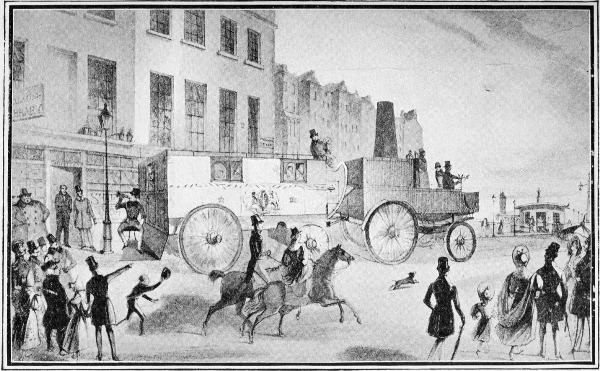
fleeting era of those precursors of motor-cars, the steam-carriages, had
by this time arrived, and after two or three had managed, at some kind of
a slow pace, to get to and from Brighton, the “Autopsy” achieved a record
of sorts in October, 1833. “Autopsy” was an unfortunate name, suggestive
of post-mortem examinations and “crowner’s quests,” but it proved not
more dangerous than the “Mors” or “Hurtu” cars of to-day. The “Autopsy”
was Walter Hancock’s steam-carriage, and ran from his works at Stratford.
It reached Brighton in eight hours thirty minutes; from which, however,
must be deducted three hours for a halt on the road.
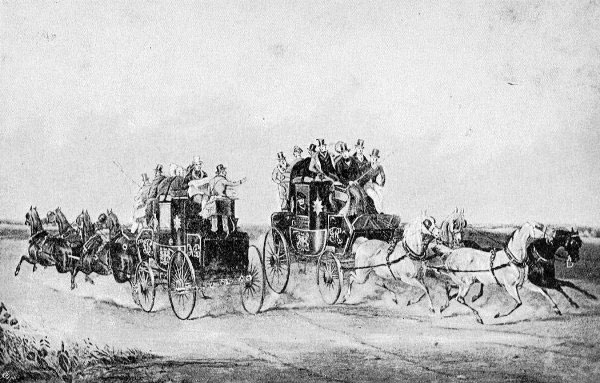
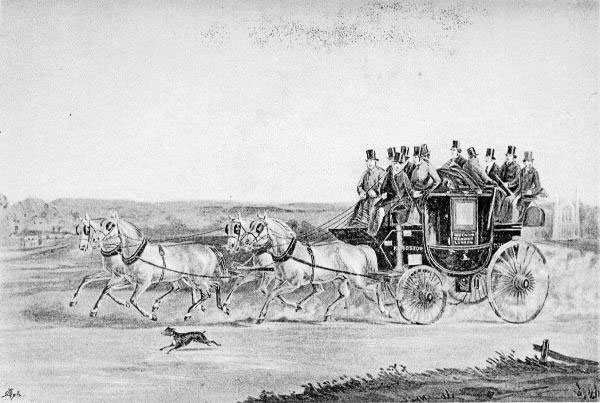
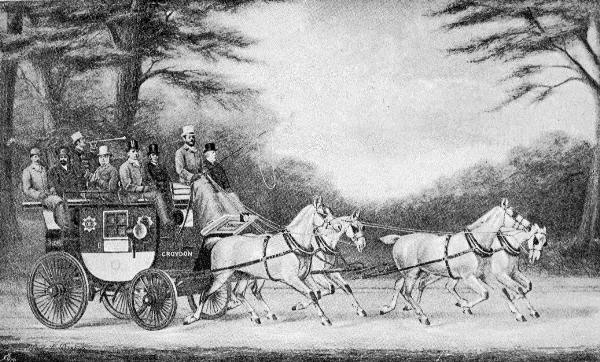
In the following year, February 4th, the “Criterion” coach, driven by
Charles Harbour, took the King’s Speech down to Brighton in three hours
forty minutes—a coach record that not only quite eclipsed that of the
“Red Rover,” but has never yet been equalled, not even by Selby, on his
great drive of July 13th, 1888; his times being, out and home
respectively, three hours fifty-six minutes and three hours fifty-four
minutes.
In March, 1868, the first of the walking records was established, the
sporting papers of that age chronicling what they very rightly described
as a “Great Walking Feat”: a walk, not merely to Brighton, but to Brighton
and back. This heroic undertaking, which was not repeated until 1902,
was performed by one “Mr. Benjamin B. Trench, late Oxford University.” On
March 20th, for a heavy wager, he started to walk the hundred miles from
Kennington Church to Brighton and back in twenty-five hours. Setting out
on the Friday, at 6 p.m., he was back at Kennington Church at 5 p.m.
Saturday, having thus won his wager with two hours to spare. It will be
observed, or guessed, from the absence of odd minutes and seconds that in
1868, timing, as an exact science, had not been born; but it is evident
that this stalwart walked his hundred miles on ordinary roads at an
average rate of a little over four and a quarter miles an hour. “He then,”
concludes the report, “walked round the Oval several times, till seven
o’clock.”
To each age the inventions it deserves. Cycling would have been impossible
in the mid-eighteenth century, when Walpole and Burton travelled with such
difficulty.
When roads began to deserve the name, the Mail Coach was introduced; and
when they grew hard and smooth, out of their former condition of ruts and
mud, the quaint beginnings of the bicycle are noticed. The Hobby Horse
and McAdam, the man who first preached the modern gospel of good roads,
were contemporary.
THE HOBBY-HORSE
I have said the beginnings of the bicycle were quaint, and I think no one
will be concerned to dispute this alleged quaintness of the Hobby Horse,
which had a certain strictly limited popularity from 1819 to 1830. I do
not think any one ever rode from London to Brighton on one of these
machines; and, when you come to consider the build and the limitations of
them, and then think of the hills on the way, it is quite impossible that
any one should so ride. It was perhaps within the limits of human
endurance to ride a Hobby Horse along the levels, to walk it up the rises,
and then to madly descend the hills, and so reach Brighton, very sore; but
records do not tell us of such a stern pioneer. The Hobby Horse, it should
be said, was an affair of two wooden wheels with iron tyres. A heavy
timber frame connected these wheels, and on it the courageous rider
straddled, his feet touching the ground. The Hobby Horse had no pedals,
and the rider propelled his hundredweight or so of iron and timber by
running in this straddling position and thus obtaining a momentum which
only on the down grade would carry him any distance.
Thus, although the Hobby Horse was a favourite with the “bucks” of George
the Fourth’s time, they exercised upon it in strictly limited doses, and
it was not until it had experienced a new birth and was born again as the
“velocipede” of the ’60’s, that to ride fifty miles upon an ancestor of
the present safety bicycle, and survive, was possible.[4]
THE BONESHAKER
The front-driving velocipede—the well-known “boneshaker”—was invented by
one Pierre Lallement, in Paris, in 1865-6, and exhibited at the Paris
Exhibition of 1867. It was to the modern pneumatic-tyred “safety” what the
roads of 1865 are to those of 1906. It also, like the Hobby Horse, had
iron-shod wooden wheels, but had cranks and pedals, and could be ridden
uphill. On such a machine the first cycle ride to Brighton was performed
in 1869. This pioneer’s fame on the Brighton Road belongs to John Mayall,
junior, a well-known photographer of that period, who died in the summer
of 1891.
This marks the beginning of so important an epoch that the circumstances
attending it are worthy a detailed account. They were felt, so long ago as
1874, to be deserving of such a record, for in the first number of an
athletic magazine, Ixion, published in that year, “J. M., jun.,” who, of
course, was none other than Mayall himself, began to tell the wondrous
tale. He set out to narrate it at such length that, as an editorial note
tells us, the concluding portion was reserved for the second number. But
Ixion never reached a second number, and so Mayall’s own account of his
historic ride was never completed.
He began, as all good chroniclers should, at the very beginning, telling
how, in the early part of 1869, he was at Spencer’s Gymnasium in Old
Street, St. Luke’s. There he saw a packing-case being followed by a Mr.
Turner, whom he had seen at the Paris Exhibition of 1868, and witnessed
the unpacking of it. From it came a something new and strange, “a piece of
apparatus consisting mainly of two wheels, similar to one I had seen, not
long before, in Paris.” It was the first velocipede to reach England.
It is a curious point that, although Mayall rode a “velocipede,” and
although these machines were generally so-called for a year or two after
their introduction, the word “bicycle” is claimed to have been first used
in the Times in the early part of 1868; and certainly we find in the
Daily News of September 7th in that year an allusion, in grotesque
spelling, to “bysicles and trisicles which we saw at the Champs Elysées
and the Bois de Boulogne this summer.”
But to return to the “velocipede” which had found its way to England at
the beginning of 1869.
The two-wheeled mystery was helped out of its wrappings and shavings, the
Gymnasium was cleared, and Mr. Turner, taking off his coat, grasped the
handles of the machine, and with a short run, to Mayall’s intense
surprise, vaulted on to it. Putting his feet on what were then called the
“treadles,” Turner, to the astonishment of the beholders, made the circuit
of the room, sitting on this bar above a pair of wheels in line that ought
to have collapsed so soon as the momentum ceased; but, instead of falling
down, Turner turned the front wheel at an angle to the other, and thus
maintained at once a halt and a balance.
JOHN MAYALL JUNIOR
Mayall was fired with enthusiasm. The next day (Saturday) he was early at
the Gymnasium, “intending to have a day of it,” and I think, from his
account of what followed, that he did, in every sense, have such a day.
As Spencer had hurt himself by falling from the machine the night before,
Mayall had it almost wholly to himself, and, after a few successful
journeys round the room, determined to try his luck in the streets.
Accordingly, at one o’clock in the afternoon, amid the plaudits of a
hundred men of the adjacent factory, engaged in the congenial occupation
of lounging against the blank walls in their dinner-hour, the velocipede
was hoisted on to a cab and driven to Portland Place, where it was put on
the pavement, and Mayall prepared to mount. Even nowadays the cycling
novice requires plenty of room, and as Portland Place is well known to be
the widest street in London, and nearly the most secluded, it seems
probable that this intrepid pioneer deliberately chose it in order to have
due scope for his evolutions.
It was a raw and muddy day, with a high wind. Mayall sprang on to the
velocipede, but it slipped on the wet road, and he measured his length in
the mud. The day-out was beginning famously.
Spencer, who had been worsted the night before, contented himself with
giving Mayall a start when he made another attempt, and this time that
courageous person got as far as the Marylebone Road, and across it on to
the pavement of the other side, where he fell with a crash as though a
barrow had been upset. But again vaulting into the saddle, he lumbered on
into Regent’s Park, and so to the drinking-fountain near the Zoological
Gardens, where, in attempting to turn round, he fell over again. Mounting
once more, he returned. Looking round, “there was the park-keeper coming
hastily towards me, making indignant signs. I passed quickly out of the
Park gate into the roadway.” Thus early began the long warfare between
Cycling and Authority.
Thence, sometimes falling into the road, with Spencer trotting after him,
he reached the foot of Primrose Hill, and then, at Spencer’s home,
staggered on to a sofa, and lay there, exhausted, soaked in rain and
perspiration, and covered with mud. It had been in no sense a light matter
to exercise with that ninety-three pounds’ weight of mingled timber and
ironmongery.
On the Monday he trundled about, up to the “Angel,” Islington, where
curious crowds assembled, asking the uses of the machine and if the
falling off and grovelling in the mud was a part of the pastime. The
following day, very sore, but still undaunted, he re-visited the “Angel,”
went through the City, and so to Brixton and Clapham, where, at the house
of a friend, he looked over maps, and first conceived the “stupendous”
idea of riding to Brighton.
The following morning he endeavoured to put that plan into execution, and
toiled up Brixton Hill, and so through Croydon, up the “never-ending”
rise, as it seemed, of Smitham Bottom to the crest of Merstham Hill.
There, tired, he half plunged into the saddle, and so thundered and
clattered down hill into Merstham. At Redhill, seventeen and a half miles,
utterly exhausted, he relinquished the attempt, and retired to the railway
station, where he lay for some time on one of the seats until he revived.
Then, to the intense admiration and amusement of the station-master and
his staff, he rode about the platform, dodging the pillars, and narrowly
escaping a fall on to the rails, until the London train came in.
On Wednesday, February 17th, Mayall, Rowley B. Turner, and Charles
Spencer, all three on velocipedes, started from Trafalgar Square for
Brighton. The party kept together until Redhill was reached, when Mayall
took the lead, and eventually reached Brighton alone. The time occupied
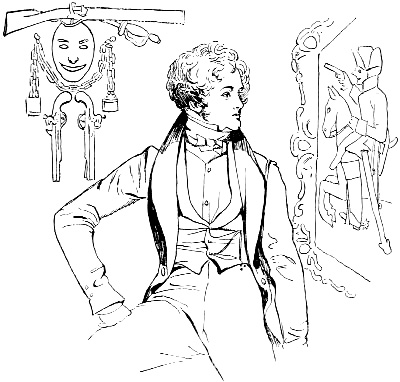
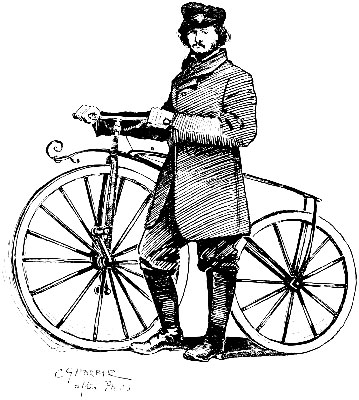
was “about” twelve hours. Being a photographer, Mayall of course caused
himself to be photographed standing beside the instrument of torture on
which he made that weary ride, and thus we have preserved to us the weird
spectacle he presented; more like that of a Russian convict than an
athletic young Englishman. A peaked cap, an attenuated frock-coat, very
tight in the waist, and stiff and shiny leather leggings, completed a
costume strange enough to make a modern cyclist shudder. Fearful whiskers
and oily-looking long hair add to the strangeness of this historic figure.
RECORDS
With this exploit athletic competition began, and the long series of
modern “records” on the Brighton Road were set a-going, for during the
March of that year two once well-known amateur pedestrian members of the
Stock Exchange, W. M. and H. J. Chinnery, walked down to Brighton in 11
hrs. 25 mins., and on April 14th C. A. Booth bettered Mayall’s adventure,
riding down on a velocipede in 9 hrs. 30 mins.
Then came the Amateur Bicycle Club’s race, September 19th, 1872. By that
time not only had the word “velocipede” been discarded for “bicycle,” and
“treadles” become “pedals,” but the machine itself, although in general
appearance very much the same, had been improved in detail. The 36-inch
front wheel had been increased to 44 inches, the wooden spokes had given
place to wire, and strips of rubber, nailed on, replaced the iron tyres.
Probably as a result of these refinements the winner, A. Temple, reached
Brighton in 5 hrs, 25 mins.
JOHN MAYALL, JUNIOR, 1869.
From a contemporary photograph.
By 1872 the bicycle had advanced a further stage towards the giraffe-like
altitude of the “ordinary,” and already there were many clubs in
existence. On August 16th of that year six members of the Surrey and six
of the Middlesex Bicycle Clubs rode from Kennington Oval to Brighton and
back, Causton captain of the Surrey, being the first into Brighton.
Riding a 50-inch “Keen” bicycle he reeled off the fifty miles in 4 hrs. 51
mins. The new machine was something to be reckoned with.
On February 9th. 1874, a certain John Revel, junr., backed himself in
heavy sums to ride a bicycle the whole distance from Brighton to London
quicker than a Mr. Gregory could walk the 22½ miles from Reigate to
London. Revel was to leave Brighton at the junction of the London and
Montpellier roads at the same time as Gregory started from a point between
the twenty-second and twenty-third milestones. The pedestrian won,
finishing in 3 hrs. 27 mins. 47 secs., Revel taking 5 hrs. 57 mins. for
the whole journey.
The bicycle had by this time firmly established itself. It grew more and
more of an athletic exercise to mount the steadily growing machines, but
once seated on them the going was easier. April 27th, 1874, found Alfred
Howard cycling from Brighton to London in 4 hrs. 25 mins., a speed which
works out at eleven miles an hour.
In 1875 the Brighton Road seems to have been left severely alone, and 1876
was signalised only by two of the fantastic wagers that have been
numerously decided on this half-century of miles. In that year, we are
told, a Mr. Frederick Thompson staked one thousand guineas that Sir John
Lynton would not wheel a barrow from Westminster Abbey to the “Old Ship”
at Brighton in fifteen hours; and the knight, accepting the bet, made his
appearance airily clothed in the “shorts” of the recognised running
costume and wheeling a barrow made of bamboo, and provided with handles
six feet long. He won easily, but whether the loser paid the thousand
guineas, or lodged a protest with referees, does not appear. He should
have specified the make of barrow, for the kinds range through quite a
number of varieties, from the coster’s barrow to the navvy’s and the
gardener’s. But the wager did not contemplate the fancy article with which
Sir John Lynton made his journey. At any rate, I have my doubts about the
genuineness of the whole affair, for, seeking this “Sir John Lynton” in
the usual books of reference of that period, there is no such knight or
baronet to be discovered.
According to the Sussex newspapers of 1876, over fifteen thousand people
assembled in the King’s Road at Brighton to witness the finish of the
sporting event between Major Penton and an unnamed competitor. Major
Penton agreed to give his opponent a start of twenty-seven miles in a
pedestrian match to Brighton, on the condition that he was allowed a
“go-as-you-please” method, while the other man was to walk in the fair
“heel-and-toe” style. The major won by a yard and a half in the King’s
Road, through the excitement of his competitor, who was disqualified at
the last minute by breaking into a trot.
Freakish sport was at this time decidedly in the ascendant, for the sole
event of 1877 was the extraordinary escapade of two persons who on
September 11th undertook to ride, dressed as clowns, on donkeys, from
London to Croydon, seated backwards with their faces towards the animals’
tails. From Croydon to Redhill they were to walk the three-legged
walk—i.e., tied together by right and left legs—and thence to Crawley
(surely a most appropriate place) on hands and knees. From that place to
the end their pilgrimage was to be made walking in boots each weighted
with 15 lb. of lead. This last ordeal speedily finished them, for they had
failed to accomplish more than half a mile when they broke down.
John Granby was another of these fantastic persons, whose proper place
would be a lunatic ward. He essayed to walk to Brighton with 50 lb. weight
of sand round his shoulders, in a bag, but he sank under the weight by the
time of his arrival at Thornton Heath.
MORE RECORDS
In 1878 P. J. Burt bettered the performance of the Chinnerys, ten years
earlier, by thirty-three minutes, walking to the Aquarium in 10 hrs. 52
mins. Most authorities agree in making his starting-point the Clock Tower
on the north side of Westminster Bridge. 52¼ miles, and thus we can
figure out his speed at about five miles an hour. All the athletic world
wondered, and when, in 1884, C. L. O’Malley (pedestrian, swimmer,
steeplechaser, and boxer), walking against B. Nickels, junr., lowered that
record by so much as 1 hr. 4 mins., every one thought finality in
long-distance padding the hoof had been reached.
Meanwhile, however, 1882 had witnessed another odd adventure on the way to
Brighton. A London clubman declared, while at dinner with a friend, that
the bare-footed tramps sometimes to be seen in the country were not to be
pitied. Boots, he said, were after all conventions, and declared it an
easy matter to walk, say, fifty miles without them. He challenged his
friend, and a walk to Brighton was arranged. The friend retired on his
blisters in twelve miles; the challenger, however, with the soles of his
stockings long since worn away, plodded on until he fainted with pain when
only four miles from Brighton.
On April 6th. 1886, J. A. M’Intosh, of the London Athletic Club, walked to
Brighton in 9 hrs. 25 mins. 8 secs., improving upon O’Malley’s best by 22
mins. 52 secs.
The year 1888 was notable. On January 1st the horse “Ginger,” in a match
against time, was driven at a trot to Brighton in 4 hrs. 16 mins. 30
secs., and another horse, “The Bird,” trotted from Kennington Cross to
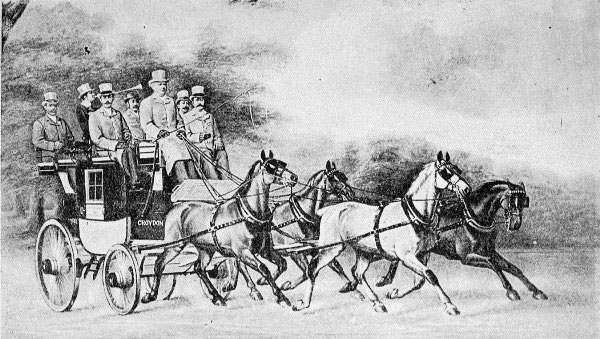
Brighton in 4 hrs. 30 mins. On July 13th Selby drove the “Old Times” coach
from the White Horse Cellar, in Piccadilly, to Brighton and back in ten
minutes under eight hours, thus arousing that competition of cyclists
which, first directed towards beating his performance, has been continued
to the present day.

![[image]](https://openoldbooks.sgp1.digitaloceanspaces.com/books/the-brighton-road/images/wheels.jpg) . Thus, in contradistinction from
all other railway or tramway practice, the flanges were not on the wheels,
but on the rails themselves. The very frugal object of this was to enable
the waggons to travel on ordinary roads, if necessity arose.
. Thus, in contradistinction from
all other railway or tramway practice, the flanges were not on the wheels,
but on the rails themselves. The very frugal object of this was to enable
the waggons to travel on ordinary roads, if necessity arose.
 E
E
 l
l