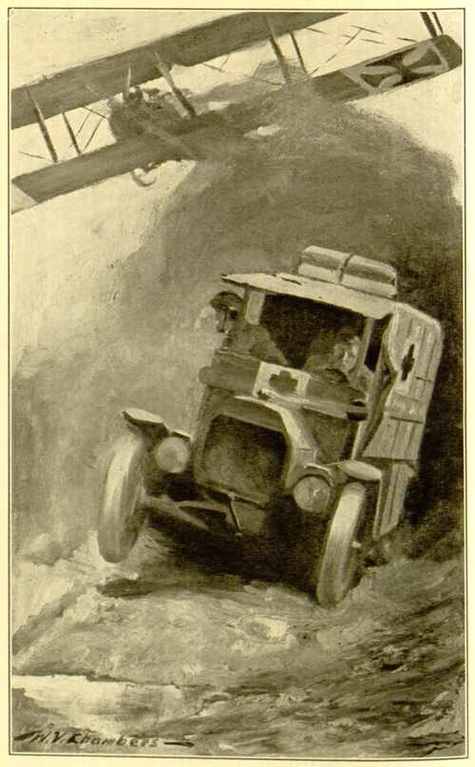
Staplely and Duncan with their weapons
ready, waited, crouching. In their
agitation they had not observed other
ambulances coming along the road at the
foot of the hill and they did not doubt that
the spies, seeing no light and not suspecting
the return of the ambulancier whose car
they had broken and whose passenger they
had killed, might be returning perhaps to
lie in wait for him. They seemed to be
having things all their own way of late so
why should they not try to accomplish more?
The glaring lights came nearer. The throbbing
motor had easily the better of hills
such as this. The seekers of a just revenge
tried to see who was on the driver’s seat
behind the lights—a difficult thing to do.
A voice caused their weapons to lower.
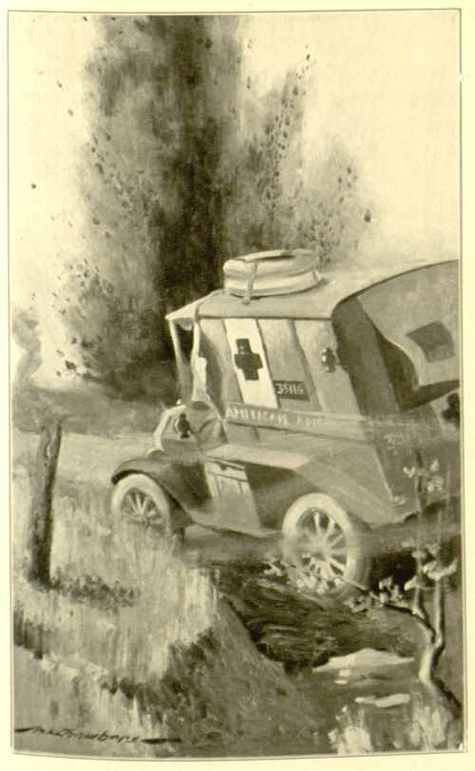
“Reckon dis de place t’ stop. One amberlance
done quit gittin’ all het up, heah.
Yu kin turn her roun’ easy by backin’ into
de fiel’ a ways, lessen yu hits a groun’hawg
hole er sumpin’.”
“No groundhogs in this country, Wash.
We might hit a rock, though. Hello, you
fellows! Are you stuck?” This last addressed
to Duncan and Stapley who had risen and
come forward.
If Clem felt any bitterness toward Don he
did not think of it now; there was too much
else to occupy his mind. But Don, leaping
to the ground instantly, seemed not to know
him. Duncan knew Don and at once began
to relate their experiences.
“And you mean to say you fellows couldn’t
stop them? Let them get away up yonder
and murder this poor helpless soldier on the
way! And only yesterday this fellow,” with
a bend of his head he referred to Clem,
“rubbed it into me because—”
“Well, that—that was dif—” began Clem.
“Not a bit of it! But why parley? Duncan,
you and I can get busy. Those fellows are
down there yet, in the road just west of the
lane. They’re doing something to their car.
That’s twice I’ve run into them fixing it,
but I didn’t know them this time. Wash,
confound you, were you asleep? Why didn’t
you tell me—?”
“Sleep yuse’f! How’s I know—?”
“Cut the comedy! Come on, if you’re
sure that was the spies,” Clem said.
“Hold on! You’re not in this and they’ll
be there awhile, you can bet,” said Don.
“You fellows slipped up in your attempt
and this is my job. There’s one way to get
those chaps and that only, Duncan. Listen
to me—Wash, you get in back and lie low.
We two will get in on the front seat. We’ll
dim the lights and then go along singing
and let on we’re half tipsy until we get
right up to them. I’ll stop and ask them for
a drink and you turn the bull’s-eye on them
and if it’s the spies we’ll act quick; see?”
“I’m going with you,” said Clem.
“Not in my car,” Don retorted. But Clem
walked to Don’s ambulance and jumped in.
“We can scrap afterwards, Richards; not
now. Come on—three are better than two.”
“That’s so,” asserted Duncan.
The plan was carried out as laid down.
With all their science and suspicions those
Hun spies had no idea of any such thing
being pulled off. Though three half-drunk
Yankees were an unusual sight, especially
in an ambulance, it was nothing to bother
about. To humor them and let them go on
was a simple matter.
“Oh, we won’t go home till evenin’!”
sang Clem.
“Till mornin’, you blamed fool! D-don’t
ye know the words?” Don shouted, tickled
to give Clem a dig. “Aw, dry up an’ let
me sing it! Thish-a-way it goes: Oh, we
won’t get home till mornin’, till broad-s-say—.”
With a grinding of brakes the ambulance
came to a sudden stop, almost even with the
long, low car by the roadside. “S-say,”
continued Don, “any—you blokes got a drink?
One good service man to another; eh, friend?
Just a little nip—you fellers are Red Cross,
ain’t you? Eh? Les’ see—. Hands up!
Both of you, quick! One move and you’re
dead men! Out, fellows, and put a rope on
them!”
One of the spies, the weazen fellow, began
to protest in excellent English:
“What do you mean by this? We haven’t
done anything to—.” But Duncan snatched
up a clump of grass roots and shoved it into
the fellow’s mouth. The other man cowered
back and tried at first to keep his face away
from the electric bull’s-eye Clem threw on
them. Through Duncan’s dexterity with
strong twine taken from Don’s toolbox,
both men had their arms tied behind them
in a jiffy so that they winced with the pain.
“Do you fellows think this is funny?
Let us loose, at once! We have no time for
jokes!” demanded the taller one, gazing at
Don’s revolver in a manner that showed he
knew it was no joke.
“But you had time to play one of your
kind of jokes on that poor wounded soldier
up on the hill,” Clem returned and the thin
face of the spy grew ghastly white. “We
haven’t been up on the hill,” he asserted—but
another wad of grass-roots stopped his
talk also. Don took the bull’s-eye from Clem
and threw it into the tall man’s face.
“Well, Stapley, I guess you know him;
don’t you?”
“The fellow on the train, sure enough,”
Clem said.
“Wonderful!” said Don. “You do have a
lucid flash now and then.” But before Clem
could reply Don began to enlighten the spy:
“I guess you remember us back there in
America. We got off at Lofton, too. We got
your cronies, Shultz and the whiskered chap,
and I got your pard up near Montdidier.”
Of course the man could make no reply.
Don continued:
“Duncan, you can run my car, I guess.
You take these nice chaps into camp. In
about half an hour they’ll face a firing squad.”
But Duncan shook his head. “What’s
in me has got to come out. I’m an ambulance
driver and working to save people—ours
and theirs, too—but that don’t say I don’t
just love gettin’ square more’n anything
else on this green earth! I told the corporal
here I have a little Indian in me. I have a
heap and it’s reached high mark right now.
It might get the corporal in trouble and it
may get me in trouble, but I reckon you’re
out of it, Richards. No matter; what I
want is to be the firing squad that fixes these
blood-smeared polecats. But I don’t want
to do it with a gun. You just leave it to me.
I’m goin’ to take ’em over here in this field
an’ stick a knife into—”
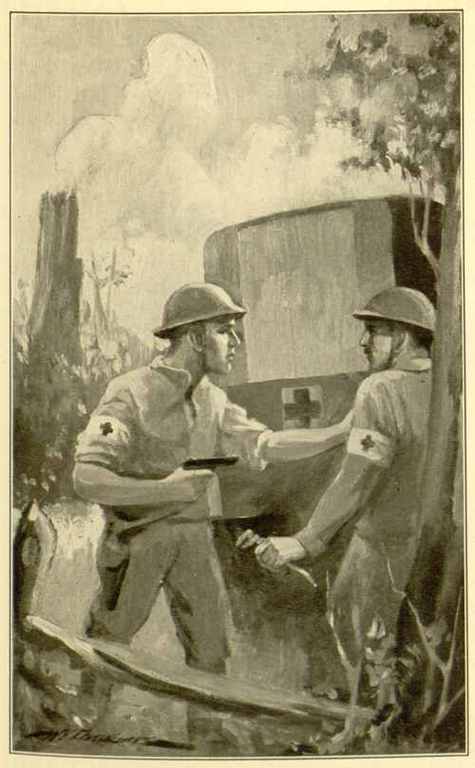
“No, Duncan, you are not going to do
anything of the kind!” Don said in horror.
“I won’t consent to this being anything
irregular. You may go along and see them
shot, if you want to, but you can’t knife them.
Hold on there! Put that knife up, or I’m
going to shoot it out of your fingers. It
would just about break my heart to hurt
you, old man, because I know you’re good
stuff, but don’t try that thing. Come, you’ve
got more white blood in you than Indian
and don’t imitate these Huns.”
Duncan stood looking earnestly at Don
while he spoke. Then, without a word,
he put his long-bladed claspknife into his
pocket.
“You take my car, because it’s surer than
this one, and get these chaps where they’ll
do no more harm. I’ll run their car and I’ll
have them send out for yours and fix it.
I hope they’ll let you get into the squad
that does the shooting.”
“I don’t like to deprive you of your own
car,” Duncan said. It was easy to see that
the fellow was true-blue, even if an act
of savagery made his blood boil with desire
for personal revenge.
“Your errand is more important than
mine,” Don continued. “Besides, I’m glad, for
Stapley and I would be sure to scrap on the
way. I’d have to rub it in about his letting
these men get away on the hill. And Stapley
can’t take anything from me good-naturedly.
He can explain to you later what he thinks
of me. I know already and I don’t care a
hoot. Come, Wash, climb out of there!
We’ve got to see if we can make this ramshackle
ambulance travel. So long, Duncan.”
The military court gave the spies short
shrift. Duncan was one of the firing squad
that did quick executions. The army ambulancier
then went his way. Before morning
he was again driving his own ambulance
and Don Richards’ car had been turned over
to him and the grinning Wash. Work on
Hill 165 had been finished.
“The marines are going to try to take
Bouresches and Belleau Wood to-day, I
hear,” Don said to Duncan, as they met on
the road.
“I wish I was in that bunch of real men,”
Duncan replied and passed on. That was
the last Don ever saw of the brave fellow,
for Duncan was shifted north of the Oise
River where another Hun drive seemed imminent,
as they were short of ambulances
in that sector.
Don’s orders were to run in close to the
American fighting forces without too grave
risk, and if there was an advance, to keep
pretty near to it, as there would necessarily
be many casualties. As the Germans had
learned already to recognize the Yanks as
their most formidable foes, they were sending
some of their best troops to stop them.
The Red Cross was showing splendid efficiency
now. From stretcher bearers to dressing
stations, from its own evacuation hospitals
to ideally equipped bases and convalescent
camps, it was the model for all things
humane in warfare. Eager were its men and
women in doing their share of the arduous
and dangerous work, and proud, indeed,
those who were identified in any way with
its glorious efforts.
“Drive the enemy from Bouresches and
Belleau Wood!” was the order from headquarters.
Again, as one man, the marines
went forward. The Huns must be taught
that their advance at the Château-Thierry
front was at an end.
“Pound the enemy’s lines in Bouresches!”
came the order to the artillery as a forerunner
of the charge of the marines, and the
artillery pounded. Across the grain and
flowering fields marched the soldiers,
advancing in thin lines, one after the other,
the marines in the center and on either flank a
battalion of doughboys, regulars of the United
States army. This was the good old training
in American fighting methods: Advance on a
run and lie down, advance and lie down,
the front rank shooting all the while, and
when these fellows, who must bear the brunt
of the strong defense that the enemy was
making, were thinned out reinforcements
were rushed from the rear to fill up the
broken ranks.
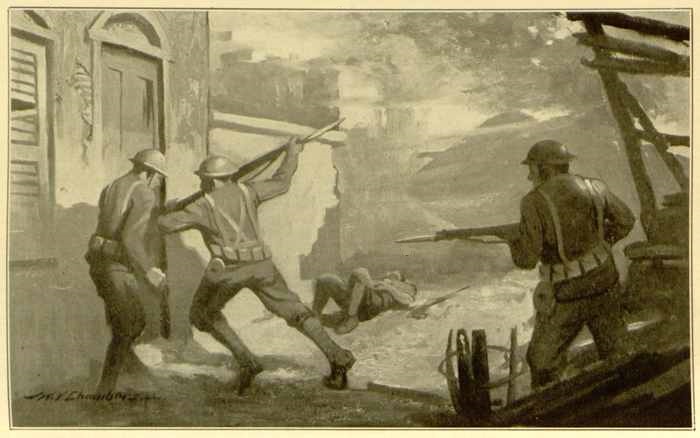 They Went Right to Work Dislodging
the Huns from the Houses.
In every conceivable point of shelter,
from every thicket, bit of woodland, hollow
or knoll around the village there were enemy
machine-gun units, with here and there larger
calibre quick-firing fieldpieces, sending a perfect
hail of lead and iron across the fields
at those ever-advancing boys in khaki.
But it mattered little to the boys in khaki
how fast and furious came this death-dealing
rain of bullets, for they kept right on into
the village, and they went right to work
dislodging the Huns from the houses, using
rifle, hand-grenades, bayonets and pistols.
The enemy sought every means of protection;
they fortified themselves behind walls which
the American artillery had left standing,
or behind piles of débris the shelling had made.
They poked their rifles and machine-guns
out of windows, and cellar-entrances, and
down from roof tops. They made street
barriers of parts of ruined buildings, and thus
contested every inch of ground until the
Americans were upon them and when they
could no longer fight, they surrendered.
Some ran away while some went down
fighting, for they had been told it was better
to die than to be taken prisoner by the cruel
Americans.
When the village of Bouresches was clean
of Huns, their artillery made it hot for the
conquerors. So marines and the doughboys
found it their turn to seek shelter. They
did this so well that after hours of shelling
they had hardly lost another man.
Meanwhile, the troops not needed to defend
the village from counter-attacks of the enemy,
rapidly re-formed and turned to make the
first assault on Belleau Wood, a hill crowned
with a jungle of trees and thickets. This
stronghold of the enemy had for three days
proved impregnable. After the artillery had
hammered it a while, tearing to pieces half
the trees on its southern edge, a reorganized
regiment of marines made a final charge,
yelling like Indians, and gained the crest.
Then they swept through the forest, broke
up the enemy machine-gun nests and drove
nearly double their number of Huns out
of the place. This was the bloodiest hand-to-hand
fighting, for they had to use the
bayonet almost exclusively. Even at this
game the Americans proved themselves superior
to the enemy, not only man to man, but
when fighting in formation. Necessarily it
was a scattering fight, but it illustrated
the personal valor and intelligence of the
Yanks.
Thus, on June 11, 1918, the German
strongholds at and near Château-Thierry sector
were captured, and their line pushed
back over three miles. Never again were the
Huns to advance, but always to retreat
until the war ended. They had, as it were,
run against a stone wall from the top of
which now floated the Stars and Stripes.
Corporal Stapley had been among those
to charge into and capture Bouresches. He
had, of course, been in the ranks with his
platoon, dashing forward, dropping on the
ground, hearing the bullets sing above and
around him; then going on again, blinded to
everything but the mad desire to come up
with those machine-gun nests and to destroy
the men and guns which were trying so hard
to destroy him and his comrades. And
reach the positions of the gun nests they
did. But as some of Stapley’s squad charged
a group of six Huns pivoting a gun around
and working frantically with the mechanism,
Clem was aware that only three other men
were with him. He dimly remembered seeing
one or two of them fall, and fail to get
up again. But there was no time to think
of this now. With bayonets leveled, his
comrades followed their fleet-footed corporal
and were upon the boches before they could
shoot. “Kamerad!” called out one fellow,
lifting high his hands, and the others, throwing
down their weapons, followed suit.
Another marine squad followed without an
officer. Clem took command of this also.
“Two of you hold this bunch here! Kill
them if they get gay! Come on—the rest
of you!”
They ran on. The houses of the village
were close at hand and in among these they
went. Two of the men had originally qualified
as grenade-throwers. Clem told them to
blow up anything that looked like a gun
nest. The others were to use rifle, bayonet
and pistol only. It was necessary to shout
these orders above the rattle of guns and yells
of the charging marines on every side. The
words were hardly out of Clem’s mouth
before the long, jacketed barrel of a machine-gun
was poked out of a cellar entrance on
the street not fifty feet ahead of them and
the fire began to streak from its muzzle
toward a group of marines coming down a
cross street. One of Clem’s new men lighted
his grenade, dashed forward, bowled it over-hand
with a skill that would have done
credit to an expert cricketer. A mass of dust,
dirt and mangled objects blew out of the cellar
and that gun nest was no more. The little
squad rushed on. Opposite a square stone
building from a window of which came a
burst of flame and a ripping sound. Clem
saw some steps to the right which might
lead to this nest. He shouted to his men
and leaped forward. At the top step he
glanced about. Three of his squad lay on
the ground. Two were following him. The
heavy door was fastened. Clem drew back
the butt of his gun to break the lock, but
one of the others fired into it, and as they
threw their bodies against the door it burst
open.
Within a large room, like an inn parlor,
two Huns were working the machine-gun
and a third met them with leveled rifle.
Before Clem could fire one of his men threw
his weapon like a Zulu his spear and the
bayonet transfixed the Hun, who sank with
a gasp. The other marines were upon the
two gunners before they had time even to
shout “Kamerad!” Freeing their bayonet
points all three turned to leave the building
when a lone marine jumped in, shouting:
“Gun nest on the roof!”
“Get ’em!” shouted Clem, who was dimly
aware that the man was Martin, of his
own squad.
They found a stairway. Dashing up this
and along a hall, they climbed another
flight where they saw a ladder leading to
an open trap door.
“I can fix ’em!” cried the remaining
grenade man who had a rifle also. He handed
the weapon to Clem, ran up the ladder,
lighted his fuse and tossed it out on the roof.
The explosion brought down plaster within
and filled the place with dust; Clem saw
the body of a man fall past the window.
The grenade man was knocked off the ladder
by his own bomb, but he landed on his feet.
The four men dashed down to the street,
and as they ran along, a Hun from behind
a broken wall hurled a grenade at them.
Clem leaped to dodge it and two of his men
ducked and fell flat, but poor Martin, looking
away, caught the full force of the explosion
at his feet. They saw him lifted up, twisted
about and fall in a broken heap, his clothing
half torn from his body. They knew their
friend’s death had been instantaneous. Clem
was pushed back as by a great wind. The two
other men were rolled over and over. One
of them looked up from where he lay and
saw the Hun grinning at them. He jumped
up and leveled his gun, but the Hun dodged
back and they only had a glimpse of him
lighting another grenade. With all the speed
at his command Clem made for the wall,
and with a leap cleared it. He came down
on the fellow with both feet, at the same
time stabbing downward with his bayonet.
He felt the mass beneath his feet quiver and
sink inert. Then Stapley started to climb
back over the wall and found himself pushed
back by his other two men who followed
him over. Seven Germans coming along the
street, had seen the three marines and started
toward them, firing. The three Americans
gave them such a warm reception that two
of the Huns dropped in their tracks and
the other five turned and fled.
“After ’em, boys!” shouted Clem, and
the three chased along a narrow street to
the eastern edge of the town where the
Germans turned a corner and came face to
face with a full platoon of Americans who
took them prisoner.
The lieutenant in charge of this unit
took great pleasure in the sight of five Germans
being pursued by three Americans.
As the little squad came up, he asked Clem
to report action and casualties.
“Orders now are to report southwest of
the village. Battalion will reform. Fall in
with us.”
Clem was glad of this. Though such
fighting was intoxicating while it lasted,
it was sickening business after all. He had
had enough of it. He was glad he had done
his duty—glad the town had been won and
if there were enough men left to hold the place,
but a rest wouldn’t go badly. Still, if there
was to be more of such work, he was ready.