| Single Copies | .05 | Cents |
| One Copy Three Months | .65 | Cents |
| One Copy Six Months | $1.25 | |
| One Copy One Year | $2.50 | |
Postage Free.
HOW TO SEND MONEY—At our risk send P. O. Money Order, Check, or
Registered Letter: remittances in any other way are at your risk. We
accept Postage Stamps the same as cash. When sending silver wrap the
Coin in a separate piece of paper to avoid cutting the envelope. Write
your name and address plainly. Address letters to
Sinclair Tousey, President }
N. Hastings, Treasurer }
Owen E. Nylander, Secretary }
Frank Tousey, Publisher
24 Union Sq., New York
The superintendent of an orphan asylum in Oxford, N. C., lately received
the following letter, offering a good education to some deserving boy:
"Dear Doctor, I wants to git a gude boye from the assylim to hep mee in
mye farm wurk. I will treet him cindely and giv him as gude edicatin as
I hev got myself. Your truly," etc.
By way of reply to the 14-inch gun which has been adopted, by some other
navies, the British Admiralty are constructing, we understand, a
15-inch, 50-caliber gun. If the present rate of increase continues, it
will not be long before we are back to the 17-inch caliber, which was
used in a few monster weapons of 20 years ago that were mounted in
certain Italian warships.
For conniving at the crimes of notorious robbers, eleven of the
detective officers of Moscow have been sentenced to various terms of
imprisonment—five of them to hard labor in the Siberian mines. The
detectives were denounced in a private letter to the czar, written by a
thief who had refused to operate with the officers and divide his
plunder with them.
One hundred dollars for one standing white pine tree was the stiff price
paid to George Burgess of Clark County, Wis. The tree was cut and scaled
slightly over 5,000 feet when cut into six logs, making a good profit
for the buyer at the present price of lumber. At that rate a quarter
section of pine would make a man a millionaire many times over.
According to cable dispatches from Gibraltar, the new battleship
"Neptune" has recently made a test of a new system of aiming the main
battery, which has been originated by Percy Scott, the father of the
modern system of target firing. It is stated that while the "Neptune"
was steaming at 13-knots she fired two broadsides in quick succession at
a target moving at the same speed at a distance of 8,000 yards, and that
every shot went home. The aiming and firing of the guns is done entirely
from the conning tower, the duties of the gun crews being merely to load
the guns. If this be true, Scott has made an advance second only in
importance to his famous improvements of five or six years ago.
At Douen, in France, on the River Seine, there is a bridge that is a
sort of aerial ferry. In order to avoid interference with shipping at
this point, it was determined to place no structure in the stream or
near its surface. Instead of a bridge in any of the ordinary forms, a
horizontal flooring, sustained by steel towers and suspension cable, was
stretched across the river at an elevation of 167 feet. On this flooring
run electrically-driven rollers, from which is suspended, by means of
steel ropes, a car that moves at the level of the wharves on the river
banks. The car is 36 feet wide and 42 feet long, and is furnished, like
a ferryboat, with accommodations for carriages and foot passengers. The
ropes that carry the hanging car are interlaced diagonally in such a
manner that the support is rigid, and a swinging motion is avoided.
To secure sound rock for the entire length of the Catskill aqueduct
tunnel it has been necessary to go down over one thousand feet below the
river surface. Investigation was made by wash borings, by diamond drills
operated from scows on the river, and by inclined diamond borings
started from the bottom of shafts sunk 300 feet on each side of the
river. One of these inclined holes was over 3,000 feet long. The
inclination was determined by sinking the shaft glass tubes filled with
hydrofluoric acid, which etched a true horizontal line on the interior
surface.
Shockit—Does learning the bicycle require any particular application?
Sprockitt—No; none in particular. But arnica is about as good as
anything.
Visitor—What makes you so ugly, Tommy? Don't you love your baby
brother? Tommy (viciously)—Well, I did till somebody came in and said
he looked like me.
Waiter (seeing dissatisfaction on guest's face)—Wasn't the dinner
cooked to suit you, sir? Guest—Yes; all but the bill. Just take that
back and tell them to boil it down a little.
"George, I wish you'd leave this little package at the express office."
Me carry a bundle? I guess not. Besides, I've got to lug both my tires
and a handle bar down to the repair shop.
Lawyer—I'll defend you, Sambo, in this bigamy case, but what defense
have you? Sambo—I kin prove an alibi. Lawyer—An alibi? How will you
prove it? Sambo—By two odder wives whut I had.
Miss Smart (after an hour of patient listening to a tortured violin)—Do
you play a great deal, Mr. Sawton? Mr. Sawton (modestly)—Oh, not a
great deal, I assure you. I play only to kill time. Miss S.
(enthusiastically)—How well you succeed!
Judge—Have you anything to say, prisoner? Prisoner—Yes. I'm engaged to
be married. I've been engaged for the last ten years. Judge—Why aren't
you married? Prisoner—Because we've never been out of jail together.
She comes out to-morrow.
The pupils in a school in Boston were asked to give in writing the
difference between a biped and a quadruped. One boy gave the following:
"A biped has two legs and a quadruped has four legs, therefore, the
difference between a biped and a quadruped is two legs."
Mistress—Oh, Briget! Briget! What an awful numbskull you are! You've
put the potatoes on the table with their skins on, right in front of our
visitors, too. You—you—what shall I call you? Briget (affably)—Call
me "Agnes," if ye loike, mum; 'tis me other name.
A real joke was sprung by a student at the Western Reserve University
last week. This student suffers from the stigma of obesity; it appears
that even professors do not love a fat man. After a particularly
unsuccessful recitation in English III., the professor said: "Alas, Mr.
Blank! You are better fed than taught." "That's right, professor,"
sighed the youth, subsiding heavily. "You teach me—I feed myself."
A writer in the Philadelphia Saturday Evening Post tells of a big,
overgrown, bashful booby of a farmer's boy who was afraid even to speak
to a girl, and whose father one day finally lost patience and scolded
him roundly for not looking about and finding some girl to marry. "Why,"
he said, "at your age I had been married three years and had a house and
farm of my own!" "Well, but, dad," complained the boy, "that ain't the
same thing at all. You only had to marry mother, while I've got to go
and hunt up some strange girl and ask her to marry me!"
Three years ago I went down to Marshlea to spend the summer. It is a
sea-breezy, bird-singing country, and the Ocean House, having been taken
by a friend of mine for the season, I knew I should have unexceptionable
quarters, and "rust" as my friend Charley Williard says, to my heart's
content.
Change of scene is a good thing, but utter solitude, under the names of
rustication and rest, is a penalty I never willingly undergo.
I knew that there would be plenty of people at Marshlea—people in
undress and holiday tempers—fashionables exhibiting, scholars seeking,
invalids languishing, flirts flirting, and many good people simply
enjoying relief from care and the salubrious situation.
I expected as much of the people as I did of the place, and accepted
them quite as willingly.
My quarters were comfortable, a cool northeast room and a little east
bedroom looking upon the sea, both rooms furnished freely in bamboo and
India matting.
I wheeled my bed so that I could see the sun rise in the morning, quite
comfortable, and with no thanks to Mr. Bierstadt, and heard the gong
sound two hours later, while I was reading Thackeray.
I never took morning sea-baths—they did not agree with my
constitution—but at noon, when the tide lapped the shingles, full of a
soft wash and warm swells, I took a stretch of half a mile, and felt the
better for my tonic.
But of a morning, as the tide came in, it was pleasant to watch the
bathers—men swimming with fearless little boys, mothers dipping
astonished babies, and acres of scarlet-clad figures tripping along the
sand, or waltzing in the surf, like blossoms blown about—while the sky
lay low and fleecy and warm over the scene.
I remember the sand-piper's cry, the peals of laughter, and lowing of
the cattle in the marshes.
I recollect the saxifrage that grew among the rocks, the spring that
pushed its way over the salt pebbles to the waters of the cove, and the
sweet notes of the little brown shore birds.
I recall a day when the sunshine was very bland; glittering carriage
loads of dolce far niente pleasure-seekers rolled slowly down the sands.
Staniels' canopied boat, its silken flag fluttering, softly rocked at
his moorings, little white tents, the mushroom dwellings of sportsmen,
dotted the rocks, and the sea glittered and tossed under the serene
blueness of the sky.
It was all enjoyable then, but an element of tragedy entered into it
afterwards which makes me recall the place with a pang of sorrow.
I seem to hear a woman's shrieks ringing out over that blue, smiling
water.
I was smoking in the bowling alley one evening, when a light coupe came
dashing over the sands, and stopped at the door of the hotel.
John Saunders, my good friend and host, came out to meet a singularly
handsome man, who alighted, and entered into conversation with him.
"By jingo!" exclaimed a volatile voice in my ear. "Colonel Staniels!"
and my mercurial friend, Walt Summers, finished his exclamation of
surprise with a prolonged whistle.
"Are you sure?" I asked, for I knew the name, though not the man then.
"Yes; know his carriage. And then no one could ever see Eben Staniels
and mistake him afterwards."
I was certain of that when I saw the gentleman at supper.
He was about the medium height, with a magnificent chest, a handsome
head covered with curling brown hair, and a prompt, military bearing.
His eyes were gray, bright, unflinching and very handsome.
He wore a closely-trimmed dark beard, and his regular features, straight
brows and bold white forehead made his face as fine as it was fearless.
He seemed entirely indifferent to the sensation he produced.
It was generally known that he had been divorced from his wife two years
previous, and this fact, together with his wealth, standing and personal
appearance, made him an object of attention to everybody.
His manner was unexceptionable, and his bearing perfectly cool, to an
ordinary observer; but as I passed him on the porch, late in the
evening, smoking, I saw him looking silently over the moon-lighted sea,
and wincing at his secret thoughts.
His room adjoined mine. He was at Marshlea three weeks before I made his
acquaintance.
He knocked at my door one evening just at sunset.
"Mr. Cathmor, would you like to drive in town with me to-night? The
sunset promises us a fine evening."
I had planned a sail by the moonlight, but an impulse to accept Colonel
Staniels' invitation instantly seized me.
I admired the colonel, was glad to know more of him, as this opportunity
suggested, and I liked fine horses, and the colonel's were very fine. I
accepted the invitation.
When we went out the sun had just set, and a boy was holding the horses.
As soon as he left their heads we sailed away.
The animals were magnificent, wanting nothing but guiding.
In town we went to the postoffice and bank, and then turned homewards.
The colonel talked well. We touched briefly on a score of standard
subjects, and momentarily my respect for the man beside me increased.
He made many remarks worth recording, among these this:
"It is a very common mistake among men that they must rule their wives."
This was nearly four years ago, before the diffusion of the woman's
rights question, now so generally discussed. The words, and his manner
of saying them, gave me a clew to the track of his observations, if not
his experience.
I glanced at the stern contour of his face, the unquiet glance of his
eye, and chose to believe the latter.
Suddenly his manner changed.
"Mr. Cathmor, I have a fancy to receive your congratulations first. I am
to be married in a few days, and bring my wife to the Ocean House," he
said.
I expressed the pleasure his manner conveyed to me.
"My little girl will like this place, I think," he said.
The singular sweetness of his smile charmed me. After a moment he took a
little oval miniature case from his breast and handed it to me. It
contained a sweet, pure, earnest face—a sparkle in the modest eyes,
too, that told of exuberant life.
"That is what I call lovable," I exclaimed, in enthusiasm.
My praise seemed to touch him to the quick.
"I think so, too," he answered, quietly, putting the picture back in its
hiding-place, with a moment's happy abstraction.
We drove fleetly up to the door. A little knot of men gathered about the
horses as usual. I went up to my room with a new item for thought.
The next day Colonel Staniels took the boat for New York. In three days
he was back with his wife.
Brides are not generally to my taste, they are usually too suggestive of
clothes, and plume themselves to a fatiguing extent. They are too
demonstrative and important, too publicly tender, and too generally
oppressive. But I liked Mrs. Staniels the moment I heard her glad
laugh. It was a laugh, and her face was like a sunbeam.
She was not overdressed or burdened with the consciousness of her
position; she did not caress her husband in public, or betray any
unusual excitement.
She talked in an arch, merry little way with everybody she won to her
side, telling of places, things, people, anybody but herself and the
colonel.
She had just returned from Europe. She was pretty, and an heiress, but
she was not spoiled.
I admired the colonel more than ever at that time. He received the
ladies' congratulations and compliments on his wife with a grave
sweetness; I noticed that the men did not jest with him, and that their
appearance did not suggest any of the stale jokes and comments on
matrimony, common to a mixed company. More than all this, their composed
and friendly demeanor when together, and the quiet system of their
glances, pleased me.
But I knew that Staniels was very happy. His face unbent—its only fault
had been a little coldness and sternness—and revealed a warmth and
geniality that made him quite resistible.
He formed the habit of coming into my room to smoke, remarking that:
"Say did not like tobacco smoke."
I never saw him smoke in her presence.
The name on her wedding cards was Sarah Fay Pomfret, but this stately
appellation the colonel abbreviated to the diminutive title, "Say," and
it seemed to quite suit her.
One day, about three weeks after their arrival, a party of us went down
the shore gunning, Colonel Staniels was of the number.
My luck was unusually good. My game bag became heavy.
Towards noon I flung myself down under a tree to rest.
In a few minutes Staniels appeared and took a seat beside me. He was out
of spirits.
"What is the matter?" I asked.
He tried to smile, ruthlessly, but I saw a tear flash in his eye.
"My cursed obstinacy! I was cross to Say this morning."
He arose restlessly, and walked away. I saw that he was far from being
happy, but it was a matter requiring no interference of mine.
"Who breaks—pays," I muttered, and lay flat on my back for a full hour
before the rest came up.
I reached home first.
The day had been unusually hot, but a cooling breeze had sprung up as
the sun set.
I entered the house, and passing up to my room met Say Spaniels, all in
white, in the hall.
"Mr. Cathmor, is Eben coming?" she asked.
"He has come; he will be up directly," I answered.
"Keep still as a mouse," she whispered, "I am going to play a trick on
him. Don't tell where I am—hush!" as a step sounded on the stair.
She turned and fled noiselessly into an alcove of the hall.
Staniels came rather slowly up the stairs. I thought he was deliberating
what kind of a reception might greet him, fearing, perhaps, tears, pouts
or frowns.
But I, seeing the merry, peeping face, knew that the matter to which he
was probably keenly sensible was utterly disregarded by the sweet,
healthy nature of his wife.
He entered the room, closed the door. All was silent after he crossed
the floor. Say tiptoed down the hall and stood listening, her head with
its glossy waves of chestnut hair bent, her red lips parted, her cheek
dimpling.
Suddenly we heard the report of a pistol. She started bewildered. I
leaped from my seat, and sprang past her into the room. Staniels lay
dead on the floor, shot through the heart. Beside him lay the innocent
paper which had caused the deed.
It was a little note saying:
"You do not love me. I have gone away. Good-by. Say."
The cheat had been too certain. With a sore conscience, and a heart in
which memories of a hidden past had probably rankled all day, the
husband had been thoroughly duped. The thoughts that rushed upon him
maddened him; the first act was self-destruction.
And so, when I think of beautiful Marshlea, I always hear above the
murmur of the sea and the songs of the birds, the dreadful shrieks of an
agonized woman, whose innocent, childlike love had been the cause of so
terrible a tragedy.
A fierce fight between a monster wildcat and two dogs was witnessed the
other day by Henry T. Frankelfield on Saw Creek, a tributary of the
Bushkill, in lower Pike county, Pa. Mr. Frankelfield is the landlord of
the Falls House at Resaca, Pa. He had been hearing the cries of the
wildcat for several nights. A recent snowfall made excellent tracking
and he started out in pursuit of the animal in company with his dogs,
Sport and Watch.
The hunter had not gone far when Sport struck the trail of the wildcat.
The two dogs started off with a yelp and followed the scent almost to
Saw Creek and then stopped. When Frankelfield came up he found one of
the dogs smelling around an old tree stump. It was evident that the cat
had been there recently, but had left again, after Watch found the trail
again, and the animal was traced into Little Pine Swamp. Frankelfield
remained at the edge of the swamp while the dogs entered it. He heard
them bark and knew that they had found their game, and he made his way
to the spot. He found both dogs at the foot of an old tamarack stump
which had fallen against another tree, and in the top of the stump was
the wildcat eying them both.
Frankelfield took deliberate aim and discharged both barrels of his gun
at the animal, but failed to kill it outright. Wounded and maddened with
pain, the cat gave a loud screech, sprang from the tree stump to the
ground, and landed on the back of one of the dogs. The infuriated beast
got one of its paws in on Sport and almost scalped the dog, while Watch
planted his teeth in the cat. Then began one of the liveliest scrapping
matches Frankelfield has ever seen. Snarling and snapping, the cat
fought both animals, the blood from the gunshot wounds dyeing the snow a
deep red. Frankelfield watched the battle some time, and tried to shoot
the animal, but the combatants seemed to be all in a snarl, and he was
afraid to fire lest he should hit the dogs. It was nip-and-tuck for a
long time, and the wildcat, although fighting against odds, clawed and
chewed first one dog and then the other, as the trio rolled over and
over. At last the cat, exhausted from loss of blood, gave up the fight
and was killed by its opponents. Frankelfield carried the animal home,
and intends having it mounted. It weighed forty pounds, and is the
largest cat that has been killed in Poke County in many years.
A clerk in Belgrade, Servia, named Vellslaw Simmonovitch, on the
strength of an increase of salary, recently telegraphed to a young woman
of Losnitsa and asked her to share his fortunes. The regulation tax
allows ten words for the minimum fee, and her answer ran: "Yes, gladly,
willingly, joyfully, delightfully, gratefully, lovingly, yes, yes,
yes."
The Dissolving Penny.—A genuine penny is held by the fingertips. You
offer it to your friend, and when he attempts to take it, the penny
suddenly vanishes without any trace and is immediately reproduced from
some quite unexpected place. Price, 12c
CHAS. UNGER, 316 UNION ST., JERSEY CITY, N. J.
MOSSBERG WRENCH DCO. ATTLEBORO MASS. U.S.A.
DEVILINE'S WHISTLE.—Nickel plated, polished; it produces a
near-piercing sound, large seller; illustration actual size.
Price, 12c., by mail.
WOLFF NOVELTY CO., 29 W. 26th St., N. Y.
MICROSCOPE.—By use of this wonderful little microscope you can magnify
a drop of stagnant water until you see thousands of crawling insects; is
also useful for inspecting grain, pork, linen and numerous other
articles. This little instrument does equally as good work as the best
microscopes and is invaluable to the household. Is made of best finished
brass; size when closed one inch by two and a half inches. Price, 30c.
L. SENARENS,
347 Winthrop St.,
Brooklyn, N. Y.
MANY TOOL KEY RING.
The wonder of the age. The greatest small tool in the world. In this
little instrument you have in combination seven useful tools embracing
Key Ring, Pencil Sharpener, Nail Cutter and Cleaner, Watch Opener, Cigar
Clipper, Letter Opener and Screw Driver. It is not a toy, but a useful
article, made of cutlery steel, tempered and highly nickeled. Therefore
will carry an edge the same as any piece of cutlery. As a useful tool,
nothing has ever been offered to the public to equal it.
Price, 15 cents, mailed, postpaid.
WOLFF NOVELTY CO., 29 W. 26th St., N. Y.
VANISHING CIGAR.—This cigar is made an exact imitation of a good one.
It is held by a rubber cord, which with the attached safety pin, is
fastened on the inside of the sleeve. When offered to a friend, as it is
about to be taken, it will instantly disappear. Price by mail, postpaid,
10c. each.
Chas. Unger, 316 Union St., Jersey City, N. J.
LINK THE LINK PUZZLE.
The sensation of the day. Pronounced by all, the most baffling and
scientific novelty out. Thousands have worked at it for hours without
mastering it, still it can be done in two seconds by giving the links
the proper twist, but unless you know how, the harder you twist them the
tighter they grow.
Price, 6 cents; 3 for 15 cents; one dozen, 50 cents, by mail, postpaid.
WOLFF NOVELTY CO., 29 W. 26th St., N. Y.
CACHOO OR SNEEZING POWDER.—The greatest fun-maker of them all. A small
amount of this powder, when blown in a room, will cause everyone to
sneeze without anyone knowing where it comes from. It is very light,
will float in the air for some time, and penetrate every nook and corner
of a room. It is perfectly harmless. Cachoo is put up in bottles, and
one bottle contains enough to be used from 10 to 15 times.
Price by mail, 10c. each; 3 for 25c.
WOLFF NOVELTY CO., 29 W. 26th St., N. Y.
ROUGH AND READY TUMBLERS.
These lively acrobats are handsomely decorated with the U. S. flag and
with gold and silver stars and hearts. Upon placing them upon any flat
surface they at once begin a most wonderful performance, climbing and
tumbling over each other and chasing each other in every direction, as
if this evil spirit was after them, causing roars of laughter from the
spectators. They actually appear imbued with life. What causes them to
cut up such antics is a secret that may not be known even to the owner
of the unruly subjects. If you want some genuine fun send for a set of
our tumblers.
Price, per set, 10 cents; mailed postpaid.
A. A. WARFORD, 16 Hart St., Brooklyn, N. Y.
THE GERMAN OCARINO.
A handsome metal instrument, made in Germany, from which peculiar but
sweet music can be produced. Its odd shape, which resembles a torpedo
boat, will attract much attention. We send instructions with each
instrument, by the aid of which any one can in a short time play any
tune and produce very sweet music on this odd looking instrument.
Price 10 cents by mail postpaid.
WOLFF NOVELTY CO., 29 W. 26th St., N. Y.
TRICK PUZZLE PURSE.—The first attempt usually made to open it, is to
press down the little knob in the centre of purse, when a small needle
runs out and stabs them in the finger, but does not open it. You can
open it before their eyes and still they will be unable to open it.
Price by mail, postpaid, 25c. each.
FRANK ROBINSON, 311 W. 44th St., N. Y.
THE JOKER'S CIGAR.
The biggest sell of the season. A real cigar made of tobacco, but
secreted in center of cigar about one-half inch from end is a fountain
of sparklets. The moment the fire reaches this fountain hundreds of
sparks of fire burst forth in every direction, to the astonishment of
the smoker. The fire is stage fire, and will not burn the skin or
clothing. After the fireworks the victim can continue smoking the cigar
to the end.
Price, 10 cents; 3 for 25 cents; 1 dozen, 90 cents, mailed, postpaid.
WOLFF NOVELTY CO., 29 W. 26th St., N. Y.
JAPANESE TRICK KNIFE.—You can show the knife and instantly draw it
across your finger, apparently cutting deep into the flesh. The red
blood appears on the blade of the knife, giving a startling effect to
the spectators. The knife is removed and the finger is found in good
condition. Quite an effective illusion. Price by mail, 10c. each.
WOLFF NOVELTY CO., 29 W. 26th St., N. Y.
Good Luck Banks
Price 10 Cents
Ornamental as well as useful. Made of highly nickeled brass. It holds
just One Dollar. When filled it opens itself. Remains locked until
refilled. Can be used as a watchcharm. Money refunded if not satisfied.
L. SENARENS
347 WINTHROP ST.,
BROOKLYN, N. Y.
HAPPY HOOLIGAN JOKER
With this joker in the lappel of your coat, you can make a dead shot
every time. Complete, with rubber ball and tubing.
Price, 15 cents, by mail, postpaid.
Chas. Unger, 316 Union St., Jersey City, N. J.
THE GREAT FIRE EATER.
A great Sensational Trick of the Day! With the Fire Eater in his
possession any person can become a perfect salamander, apparently
breathing fire and ejecting thousands of brilliant sparks from his
mouth, to the horror and consternation of all beholders. Harmless fun
for all times, seasons and places. If you wish to produce a decided
sensation in your neighborhood don't fail to procure one. We send the
Fire Eater with all the materials, in a handsome box, the cover of which
is highly ornamented with illustrations in various colors. Price of
all complete only 15 cents, or 4 boxes for 50 cents, mailed postpaid;
one dozen by express $1.20.
N. B.—Full printed instructions for performing the trick accompany
each box, which also contains sufficient material for giving several
exhibitions.
FRANK ROBINSON, 311 W. 44th St., N. Y.
THE SURPRISE BOUQUET.
The best practical joke of the season. This beautiful button-hole
bouquet is made of artificial flowers and leaves which so closely
resemble natural flowers that not one person in a thousand would detect
the difference. After placing the bouquet in your button-hole you call
the attention of a friend to its beauty and fragrance. He will very
naturally step forward and smell of it, when, to his utter astonishment,
a fine stream of water will be thrown into his face. Where the water
comes from is a mystery, as you can have your hands at your side or
behind you, and not touch the bouquet in any manner. You can give one
dozen or more persons a shower bath without removing the bouquet from
your button-hole, and after the water is exhausted it can be immediately
refilled without removing it from your coat. Cologne can be used in
place of water when desired. We have many funny things in our stock, but
nothing that excels this.
Price, complete in a beautiful box, with full printed instructions, 25
cents, or three for 60 cents; by mail post paid.
Chas. Unger, 316 Union St., Jersey City, N. J.
IMITATION GOLD TEETH.—Gold plated tooth, shape made so that it will fit
any tooth.
Price, 5c., postpaid
WOLFF NOVELTY CO., 29 W. 26th St., N. Y.
CARTER AEROPLANE No. 1
Will fly on a horizontal line 150 feet! Can be flown in the house, and
will not injure itself nor anything in the room. The most perfect little
aeroplane made.
The motive power is furnished by twisted rubber bands contained within
the tubular body of the machine. It is actuated by a propeller at each
end revolving in opposite directions. Variation in height may be
obtained by moving the planes and the balance weight. It can be made to
fly either to the right or the left by moving the balance sidewise
before it is released for flight. PRICE 35 Cents Each, Delivered.
L. Senarens, 347 Winthrop St., Brooklyn, N. Y.
SNAKES IN THE GRASS.
Something entirely new, consisting of six large cones, each one nearly
one inch in height. Upon lighting one of these cones with a match, you
see something similar to a 4th of July exhibition of fireworks. Sparks
fly in every direction, and as the cone burns down it throws out and is
surrounded with what appears to be grass; at the same time a large snake
uncoils himself from the burning cone, and lazily stretches out in the
grass, which at last burns to ashes, but the snake remains as a
curiosity unharmed. They are not at all dangerous, and can be set off in
the parlor if placed on some metal surface that will not burn. An
ordinary dust pan answers the purpose nicely.
Price of the six cones, packed in sawdust, in a strong wooden box, only
10 cents, 3 boxes for 25 cents, 1 dozen boxes 75 cents, sent by mail
post paid.
M. O'NEILL, 425 W. 56th St., N. Y.
COMICAL RUBBER STAMPS.
A complete set of five grotesque little people made of indestructible
rubber mounted on black walnut blocks. The figures consist of Policeman,
Chinaman, and other laughable figures as shown in pictures. As EACH
figure is mounted on a separate block, any boy can set up a regular
parade or circus by printing the figures in different positions. With
each set of figures we send a bottle of colored ink, an ink pad and full
instructions. Children can stamp these pictures on their toys, picture
books, writing paper and envelopes, and they are without doubt the most
amusing and entertaining novelty gotten up in years. Price of the
complete set of Rubber Stamps, with ink and ink pad, only 10 cents, 3
sets for 25 cents, one dozen 90 cents, by mail postpaid.
L. Senarens, 347 Winthrop St., Brooklyn, N. Y.
ELECTRIC PUSH BUTTON.—The base is made of maple, and the center piece
of black walnut, the whole thing about 1-1/4 inches in diameter, with a
metal hook on the back so that it may be slipped over edge of the vest
pocket. Expose to view your New Electric Bell, when your friend will
push the button expecting to hear it ring. As soon as he touches it, you
will see some of the liveliest dancing you ever witnessed. The Electric
Button is heavily charged and will give a smart shock when the button is
pushed.
Price 10c., by mail, postpaid.
WOLFF NOVELTY CO., 29 W. 26th St., N. Y.
THE FLUTOPHONE.—A new musical instrument, producing the sweetest dulcet
tones of the flute. The upper part of the instrument is placed in the
mouth, the lips covering the openings in the centre. Then by blowing
gently upon it you can play any tune desired as easily as whistling. But
little practice is required to become a finished player. It is made
entirely of metal, and will last a lifetime. We send full instructions
with each instrument.
Price, 15c., or 2 for 25c., by mail, postpaid.
A. A. WARFORD, 16 Hart St., Brooklyn, N. Y.
Good Luck Puzzle
It consists of three horseshoes fastened together. Only a very clever
person can take off the closed horseshoe from the two linked horseshoes.
But it can be done in a moment when the secret is known.
Price by mail, 10 cents each
FRANK ROBINSON, 311 W. 44th St., N. Y.
THE MAGIC CARD BOX.
One of the best and cheapest tricks for giving parlor or stage
exhibitions. The trick is performed as follows: You request any two
persons in your audience to each select a card from an ordinary pack of
cards, you then produce a small handsome box made to imitate pebbled
leather, which anyone may examine as closely as they will. You now ask
one of the two who have selected cards to place his or her card inside
the box, which being done, the lid is shut, and the box placed on the
table. You then state that you will cause the cards to disappear and
upon opening the box the card has vanished and the box found empty. The
other card is now placed in the box; the lid is again closed and when
the box is opened the first card appears as strangely as it went. Other
tricks can be performed in various ways. You may cause several cards to
disappear after they are placed in the box, and then you can cause them
all to appear at once. You may tear a card up, place it in the box, and
on lifting the cover it will be found whole and entire. In fact, nearly
every trick of appearance and disappearance can be done with the Magic
Card Box.
Full printed instructions by which anyone can perform the different
tricks sent with each box.
Price 20 cents, by mail postpaid.
WOLFF NOVELTY CO., 29 W. 26th St., N. Y.
657 Fred Fearnot's Three-Bagger; or, The Hit That Won the Game.
658 Fred Fearnot's Border Scouts; or, After Mexican Outlaws.
659 Fred Fearnot's Best Pitching; or, Putting Them Right Over.
660 Fred Fearnot and the Saloonkeeper; or, Working for Temperance.
661 Fred Fearnot's Ninth Inning Rally; or, Turning Defeat Into Victory.
662 Fred Fearnot at New Era; or, A Week Among Old Friends.
663 Fred Fearnot and the Cave Men; or, Lost in the Mountains.
664 Fred Fearnot's Game for Life; or, Taking the Last Chance.
665 Fred Fearnot and "Scrapper Sam"; or, Always in a Fight.
548 The Liberty Boys with Morgan's Riflemen; or, Dick Slater's Best
Shot.
549 The Liberty Boys as Privateers; or, The Taking of the "Reward."
550 The Liberty Boys' Redcoat Enemy; or, Driving Howe from Boston.
551 The Liberty Boys and Widow Moore; or, The Fight at Creek Bridge.
552 The Liberty Boys Saving the Colors; or, Dick Slater's Bravest Deed.
553 The Liberty Boys' Swamp Angels; or, Out with Marion and His Men.
554 The Liberty Boys' Young Spy; or, Learning the Enemy's Plans.
555 The Liberty Boys' Runaway Battle; or, Foiling a Tory Plot.
556 The Liberty Boys' March to Death; or, Escaping a Terrible Fate.
456 Young Wild West and the Ropers; or, A Finish Fight on the Range.
457 Young Wild West Trailing the Express Thieves; or, Arietta's Golden
Reward.
458 Young Wild West Trimming the Toughs; or, Making Music for a Dance.
459 Young Wild West's Bandit Shake-Up; or, Arietta's Daring Deception.
460 Young Wild West's Red Hot Fight; or, The Hidalgo's Hidden Haunt.
461 Young Wild West's Lariat Swing; or, Arietta and the Broken Bridge.
462 Young Wild West and the Redskin Road Agents; or, Trouble at the
Double Six Ranch.
463 Young Wild West Shooting for His Life; or, Arietta's Able
Assistance.
301 Clear Grit; or, The Office Boy Who Made Good.
302 Dealing in Stocks; or, Saved by a Wall Street Ticker.
303 The Sailor's Secret; or, The Treasure of Dead Man's Rock.
304 Capturing the Coin; or, The Deals of a Boy Broker. (A Wall Street
Story.)
305 On His Own Hook; or, Making a Losing Business Pay.
306 Lucky Jim; or, $100,000 from Stocks. (A Wall Street Story.)
307 "Millions in It"; or, A Boy with Ideas.
308 The Mystery of the Mining Chart, and the Wall Street Boy Who Solved
it.
309 Grasping His Chance; or, The Boy Merchant of Melrose.
684 Fighting for Greece; or, Three Yankee Boys Against the Turks. By
Gen. Jas. A. Gordon.
685 The Winning Nine; or, Batting for a Fortune. By H. K. Shackleford.
686 Lost Hope Mines; or, The Boy of the Haunted Diamond Claim. By Jas.
C. Merritt.
687 A Paper of His Own; or, How Phil Bright Became an Editor. By Allan
Arnold.
688 The Lost Schoolship; or, Twenty Boys Afloat. By Capt. Thos. H.
Wilson.
689 Wall Street Will; or, Winning a Fortune in a Week. By A Retired
Banker.
690 10,000 Miles from Home; or, The Boy Ivory Hunters of the Congo. By
Richard R. Montgomery.
691 Toney, the Boy Clown; or, Across the Continent with a Circus. By
Berton Bertrew.
For sale by all newsdealers, or will be sent to any address on receipt
of price, 5 cents per copy, in money or postage stamps, by
Frank Tousey, Pub., 24 Union Sq., N. Y.
620 The Bradys Best Trick; or, The Clew in the Glass Jar.
621 The Bradys and the Cracksmen; or, A Desperate Game For Millions.
622 The Bradys in the Coal Mines; or, The Mystery of Shaft No. 10.
623 The Bradys and the Voodoo Queen; or, A Dark Case From San Juan Hill.
624 The Bradys and the Boy Spy; or, Solving a Secret of Seven Years.
625 The Bradys and the Missing Money; or, Shadowing a Suspected Man.
626 The Bradys' Chinatown Case; or, The Hidden Den of Pell Street.
627 The Bradys and the Double Daggers; or, The Secret Sign of Vengeance.
628 The Bradys and "Old Breaklock"; or, Trapping a Desperate Crook.
629 The Bradys on a Raid; or, Rounding Up the Circus Fakirs.
630 The Bradys and the Snake Charmer; or, The Search for the Hindoo
Idol.
631 The Bradys After the Bronx Burglars; or, Nabbing the Gas House Gang.
632 The Bradys and the Dumb Boy; or, The Fate of Messenger No. 9.
633 The Bradys and the Blind Chinaman; or, The White Slaves of Mott
Street.
634 The Bradys Tracking a Skeleton Arm; or, The Clew in the Tree.
635 The Bradys and the Factory Boy; or, The Mystery of the Mill Pond.
636 The Bradys and the Poisoned Pen; or, Foiling a Desperate Plot.
637 The Bradys Chasing the Black Crook; or, Solving a Fifth Avenue
Mystery.
638 The Bradys and the Banker's Boy; or, The Kidnappers of Mulberry
Bend.
639 The Bradys After the Gold Brick Men; or, Chasing a Gang of
Swindlers.
640 The Bradys and the Diamond Heart; or, The Mystery of a Mummy.
641 The Bradys' Red Glove Clew; or, The Secret Band of Seven.
642 The Bradys and the Man Next Door; or, The Mystery House on High
Street.
643 The Bradys' Case in Chinatown; or, Tracking the Hip Sing Tong.
644 The Bradys and the Mad Barber; or, Solving a Singular Secret.
645 The Bradys' Six Days' Chase; or, Running Down a Clever Crook.
646 The Bradys and the Black Dwarf; or, Working Up a Poison Clew.
647 The Bradys' Masked Foe; or, The Man With the Missing Finger.
648 The Bradys and the Sneak Thieves; or, Running Down the Red Hook
Gang.
649 The Bradys Working a "Blind"; or, The Secret of the Sealed Room.
650 The Bradys and the Laundry Check; or, A Dangerous Hunt in Chinatown.
651 The Bradys on a Hot Trail; or, The Boy Who Escaped From Sing Sing.
652 The Bradys and the Conspirators; or, The Case That Came From Mexico.
653 The Bradys After the Second Story men; or, Tracking a Box of
Treasure.
654 The Bradys and the Mad Student; or, The Mystery of the Medical
College.
655 The Bradys' Desperate Deal; or, Foiling a Slick Bunch.
656 The Bradys and the Brass-Bound Chest; or, The Case Which Came Out of
the Sea.
657 The Bradys Leather Locket Clew; or, The Secret of the Old Grave
Yard.
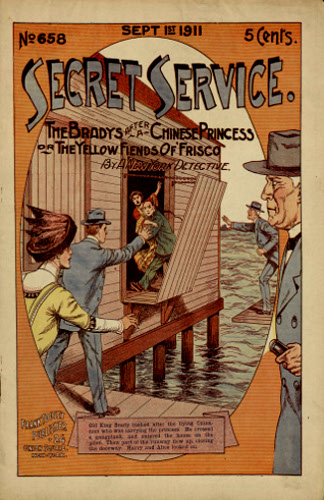
658 The Bradys after a Chinese Princess; or, The Yellow Fiends of
Frisco.
For sale by all newsdealers, or will be sent to any address on receipt
of price, 5 cents per copy, in money or postage stamps, by
FRANK TOUSEY, Publisher, 24 UNION SQUARE, N. Y.
IF YOU WANT ANY BACK NUMBERS of our weeklies and cannot procure them
from newsdealers, they can be obtained from this office direct. Write
out and fill in your Order and send it to us with the price of the
weeklies you want and we will send them to you by return mail. POSTAGE
STAMPS TAKEN THE SAME AS MONEY.
FRANK TOUSEY, Publisher, 24 UNION SQUARE, N. Y.
No. 43. HOW TO BECOME A MAGICIAN.—Containing the grandest assortment of
magical illusions ever placed before the public. Also tricks with cards,
incantations, etc.
No. 45. THE BOYS OF NEW YORK MINSTREL GUIDE AND JOKE BOOK.—Something
new and very instructive. Every boy should obtain this book, as it
contains full instructions for organizing an amateur minstrel troupe.
No. 48. HOW TO BUILD AND SAIL CANOES.—A handy book for boys, containing
full directions for constructing canoes and the most popular manner of
sailing them. Fully illustrated.
No. 49. HOW TO DEBATE.—Giving rules for conducting debates, outlines
for debates, questions for discussion, and the best sources for
procuring information on the questions given.
No. 50. HOW TO STUFF BIRDS AND ANIMALS.—A valuable book, giving
instructions in collecting, preparing, mounting and preserving birds,
animals and insects.
No. 51. HOW TO DO TRICKS WITH CARDS.—Containing explanations of the
general principles of sleight-of-hand applicable to card tricks; of card
tricks with ordinary cards, and not requiring sleight-of-hand; of tricks
involving sleight-of-hand, or the use of specially prepared cards.
Illustrated.
No. 52. HOW TO PLAY CARDS.—Giving the rules and full directions for
playing Euchre, Cribbage, Casino, Forty-Five, Rounce, Pedro Sancho, Draw
Poker, Auction Pitch, All Fours, and many other popular games of cards.
No. 53. HOW TO WRITE LETTERS.—A wonderful little book, telling you how
to write to your sweetheart, your father, mother, sister, brother,
employer; and, in fact, everybody and anybody you wish to write to.
No. 54. HOW TO KEEP AND MANAGE PETS.—Giving complete information as to
the manner and method of raising, keeping, taming, breeding, and
managing all kinds of pets; also giving full instructions for making
cages, etc. Fully explained by twenty-eight illustrations.
No. 55. HOW TO COLLECT STAMPS AND COINS.—Containing valuable
information regarding the collecting and arranging of stamps and coins.
Handsomely illustrated.
No. 56. HOW TO BECOME AN ENGINEER.—Containing full instructions how to
become a locomotive engineer; also directions for building a model
locomotive; together with a full description of everything an engineer
should know.
No. 58. HOW TO BE A DETECTIVE.—By Old King Brady, the well-known
detective. In which he lays down some valuable rules for beginners, and
also relates some adventures of well-known detectives.
No. 59. HOW TO MAKE A MAGIC LANTERN.—Containing a description of the
lantern, together with its history and invention. Also full directions
for its use and for painting slides. Handsomely illustrated.
No. 60. HOW TO BECOME A PHOTOGRAPHER.—Containing useful information
regarding the Camera and how to work it; also how to make Photographic
Magic Lantern Slides and other Transparencies. Handsomely illustrated.
No. 62. HOW TO BECOME A WEST POINT MILITARY CADET.—Explains how to gain
admittance, course of Study, Examinations, Duties, Staff of officers,
Post Guard, Police Regulations, Fire Department, and all a boy should
know to be a cadet. By Lu Senarens.
No. 63. HOW TO BECOME A NAVAL CADET.—Complete instructions of how to
gain admission to the Annapolis Naval Academy. Also containing the
course of instruction, description of grounds and buildings, historical
sketch, and everything a boy should know to become an officer in the
United States Navy. By Lu Senarens.
No. 64. HOW TO MAKE ELECTRICAL MACHINES.—Containing full directions for
making electrical machines, induction coils, dynamos, and many novel
toys to be worked by electricity. By R. A. R. Bennett. Fully
illustrated.
No. 65. MULDOON'S JOKES.—The most original joke book ever published,
and it is brimful of wit and humor. It contains a large collection of
songs, jokes, conundrums, etc., of Terrence Muldoon, the great wit,
humorist, and practical joker of the day.
No. 66. HOW TO DO PUZZLES.—Containing over three hundred interesting
puzzles and conundrums, with key to same. A complete book. Fully
illustrated.
No. 67. HOW TO DO ELECTRICAL TRICKS.—Containing a large collection of
instructive and highly amusing electrical tricks, together with
illustrations. By A. Anderson.
No. 68. HOW TO DO CHEMICAL TRICKS.—Containing over one hundred highly
amusing and instructive tricks with chemicals. By A. Anderson.
Handsomely illustrated.
No. 69. HOW TO DO SLEIGHT-OF-HAND.—Containing over fifty of the latest
and best tricks used by magicians. Also containing the secret of second
sight. Fully illustrated.
No. 70. HOW TO MAKE MAGIC TOYS.—Containing full directions for making
Magic Toys and devices of many kinds. Fully illustrated.
No. 71. HOW TO DO MECHANICAL TRICKS.—Containing complete instructions
for performing over sixty Mechanical Tricks. Fully illustrated.
No. 72. HOW TO DO SIXTY TRICKS WITH CARDS.—Embracing all of the latest
and most deceptive card tricks, with illustrations.
No. 73. HOW TO DO TRICKS WITH NUMBERS.—Showing many curious tricks with
figures and the magic of numbers. By A. Anderson. Fully illustrated.
No. 74. HOW TO WRITE LETTERS CORRECTLY.—Containing full instructions
for writing letters on almost any subject; also rules for punctuation
and composition, with specimen letters.
No. 75. HOW TO BECOME A CONJURER.—Containing tricks with Dominoes,
Dice, Cups and Balls, Hats, etc. Embracing thirty-six illustrations. By
A. Anderson.
No. 76. HOW TO TELL FORTUNES BY THE HAND.—Containing rules for telling
fortunes by the aid of lines of the hand, or the secret of palmistry.
Also the secret of telling future events by aid of moles, marks, scars,
etc. Illustrated.
No. 77. HOW TO DO FORTY TRICKS WITH CARDS.—Containing deceptive Card
Tricks as performed by leading conjurers and magicians. Arranged for
home amusement. Fully illustrated.
No. 78. HOW TO DO THE BLACK ART.—Containing a complete description of
the mysteries of Magic and Sleight-of-Hand, together with many wonderful
experiments. By A. Anderson. Illustrated.
No. 79. HOW TO BECOME AN ACTOR.—Containing complete instructions how to
make up for various characters on the stage; together with the duties of
the Stage Manager, Prompter, Scenic Artist and Property Man.
No. 80. GUS WILLIAMS' JOKE BOOK.—Containing the latest jokes, anecdotes
and funny stories of this world-renowned German comedian. Sixty-four
pages; handsome colored cover containing a half-tone photo of the
author.
No. 81. HOW TO MESMERIZE.—Containing the most approved methods of
mesmerism; animal magnetism, or, magnetic healing. By Prof. Leo Hugo
Koch, A.C.S., author of "How to Hypnotize," etc.
No. 82. HOW TO DO PALMISTRY.—Containing the most approved methods of
reading the lines on the hand, together with a full explanation of their
meaning. Also explaining phrenology, and the key for telling character
by the bumps on the head. By Leo Hugo Koch, A.C.S. Fully illustrated.
No. 83. HOW TO HYPNOTIZE.—Containing valuable and instructive
information regarding the science of hypnotism. Also explaining the most
approved methods which are employed by the leading hypnotists of the
world. By Leo Hugo Koch, A.C.S.
No. 84. HOW TO BECOME AN AUTHOR.—Containing information regarding
choice of subjects, the use of words and the manner of preparing and
submitting manuscript. Also containing valuable information as to the
neatness, legibility and general composition of manuscript.
For sale by all newsdealers, or will be sent to any address on receipt
of price, 10 cents per copy, in money or postage stamps, by
FRANK TOUSEY, Publisher 24 UNION SQUARE, N. Y.