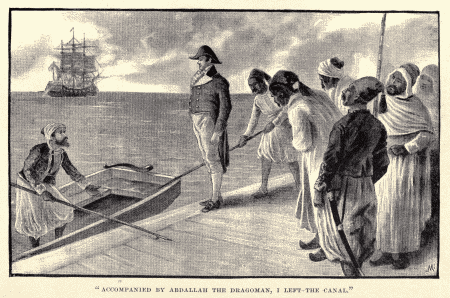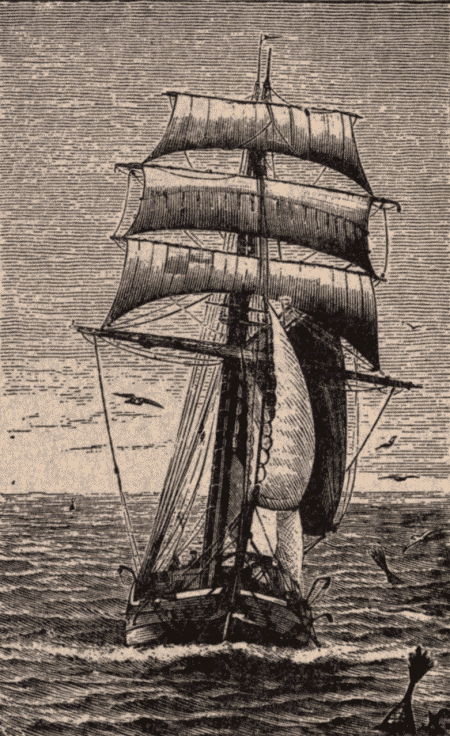
The truth of President Adams's words was shown the very next year after
they were uttered, when new difficulties arose with the Barbary Powers.
We have seen how the old difficulties with Algiers had been settled, at
least for a time, by a treaty which cost the Government a million. Under
this treaty we agreed to send every year to the Dey of Algiers a present
of naval stores of the value of twelve thousand sequins, or about twenty
thousand dollars. In the autumn of 1800 this present—or tribute, as it
was well called, for it was little else than a tribute—was carried to
Algiers by the ship "George Washington," commanded by Captain
Bainbridge. While his ship was lying in the port, the Dey commanded
Bainbridge to go to Constantinople with an Algerine ambassador and
presents for the Sultan of Turkey; for Algiers was then a vassal of the
Ottoman Porte, although the Porte allowed the Dey to do much as he
pleased in most things. It was a grievous outrage that a ship of the
United States should be compelled to do such a service for a barbarian
prince; but there is no doubt that Bainbridge chose the better part in
complying with the demand. Though sometimes rash in war, he was wise
and prudent in diplomacy; and as our Government, by yielding to the
clamor of the Algerines for tribute, instead of chastising them for
their outrageous conduct, had pointed out the line of action that it
meant to follow, Bainbridge was right in conforming to the same rule. If
he refused, unnumbered evils might happen: our unprotected commerce
would be swept away; more of our countrymen would be captured and
enslaved, or kept for years confined in dungeons; and fresh payments
must be made for ransom. So he went to Constantinople.
It was then the rule—and it still is, for that matter—that foreign
ships-of-war wishing to enter the Turkish straits of the Dardanelles and
Bosphorus must first ask and receive permission from the Sultan.
Bainbridge, who felt that he had had enough humiliation on the voyage,
did not stop for this, but passing by the forts at night, anchored
unannounced in the harbor of Constantinople; and here he lay, flying a
strange flag which no one in the place had ever seen borne by a ship of
war.
A Turkish officer was sent off to find out to whom this new craft
belonged, and Bainbridge in reply told him, "the United States." When
this was translated by the interpreter, and reported to the Turkish
officials on shore, they shook their heads,—thinking the national
appellation somewhat vague, as perhaps it is,—and sent a second time to
gain more definite information. Bainbridge now answered that he came
from "the New World." This statement seemed greatly to impress the
Turks, and the ship was piloted into the inner port, and Captain
Bainbridge and his officers were treated thereafter with deep respect,
as was becoming toward any one who came from so remarkable a region.
When the "George Washington" had fulfilled her mission and had returned
to Algiers, the captain found that the Dey had suddenly declared war
against France, and had ordered all the French in his dominions to be
put in prison. The foreign consuls, seconded by Bainbridge, implored the
Dey to revoke his cruel order; and they were so far successful that he
consented to put off its execution for forty-eight hours. But the Dey
swore by his beard that if every soul—man, woman, and child—that
belonged to France had not departed by that time from his territories,
he would put in irons those that remained. The "George Washington" was
at the moment the only ship in the harbor, and she was shifting ballast
in the mole. But Bainbridge would not leave the Frenchmen to their fate;
and by working night and day with all his officers and men he got the
ship ready, took the fugitives on board, and sailed away, glad to get
out of the clutches of this Oriental despot. He had no time to spare;
for in less than an hour after his departure the limit had expired.
Sixty Frenchmen were thus rescued by the captain's efforts, and after a
short passage they were safely landed at Alicant, and the "George
Washington" returned home.
About this time a new and very serious trouble began with another of the
Barbary powers. This was Tripoli. When the Pasha of Tripoli had made his
treaty with the United States some years before, he had received a large
amount of money, but no agreement had been made for tribute. As soon,
however, as the Pasha found that the Americans were sending every year a
shipload of presents to Algiers, of whose power he was always jealous,
he became enraged beyond all bounds; and he wrote to the President
insolent letters demanding money and arms and naval stores. In one of
these he said:—
"We could wish that these your expressions were followed by
deeds, and not by empty words. You will therefore endeavor to
satisfy us by a good manner of proceeding. We on our part will
correspond with you with equal friendship, as well in words as
deeds. But if only flattering words are meant, without
performance, every one will act as he finds convenient."
As no attention was paid to these demands, the Pasha announced to the
American consul that he would declare war; "For paid I will be," he
said, "in one way or another." The consul tried to smooth over the
difficulty, but without success; and on the 14th of May, 1801, just a
week after Bainbridge had landed the French refugees at Alicant, the
Pasha cut down the flagstaff of the American consulate at Tripoli, by
which act he declared war against the United States.
It had been known at home for some time that trouble was brewing at
Tripoli, and as the French war was now entirely over, a squadron was at
this very time fitting out to go to the Mediterranean. It was commanded
by Com. Richard Dale, that gallant veteran of the Revolution who had
been the first lieutenant of the "Bon Homme Richard" in her fight with
the "Serapis." But in this cruise Commodore Dale, though he had a good
squadron, was not allowed to show what he could accomplish; because,
although Tripoli had declared war, Congress had not yet recognized the
fact, and the President was of the opinion that until Congress had
passed an act making a declaration, the navy could not carry on war
against a foreign State. The commodore was therefore prevented by his
orders from capturing any prizes or prisoners; and from this singular
arrangement it resulted, as might be expected, that nothing of any great
importance was accomplished.
One event, however, took place in August of this year which at least
showed the Tripolitans that war with the Americans was no child's play.
That fine little schooner the "Enterprise," which had done such good
service in the West Indies, was one of the ships of Commodore Dale's
squadron, under the command of Lieutenant Sterrett. While cruising about
in the Mediterranean, on the lookout for pirates, she chanced upon a
Tripolitan polacca called the "Tripoli," of about the same force and
size. The Rais or captain who commanded the polacca, Mahomet Sous,
thought he would try the mettle of the American schooner, and made a
furious attack upon her. The Tripolitans fight desperately; for they are
little better than cut-throats, and, as their Pasha says, war is their
trade. But they have not the skill of the Americans. Sterrett placed his
schooner where he pleased. When the battle had fairly begun, he took the
offensive himself; he attacked the enemy on her quarter, on her bow; he
raked her fore and aft. After a bloody fight the "Tripoli" had received
several shot in her side, and was badly cut up in her rigging. Then she
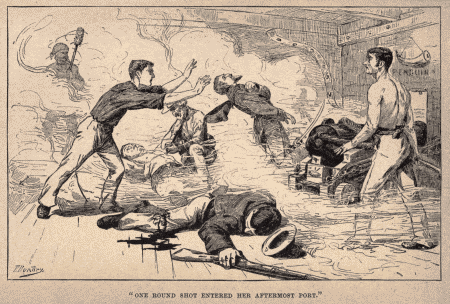
hauled down her flag. The crew of the "Enterprise" left their guns, and
gave three cheers, thinking that the victory was won. But the
Tripolitans, though brave, were treacherous villains, and no sooner was
their enemy off his guard than they hoisted their flag again and opened
fire on the "Enterprise." So the battle began anew. This time the Turks
attempted to board, crowding on the rail with their scimitars. But they
were driven back, and again they made a pretence of surrendering,
only to renew the fight at the first favorable moment.
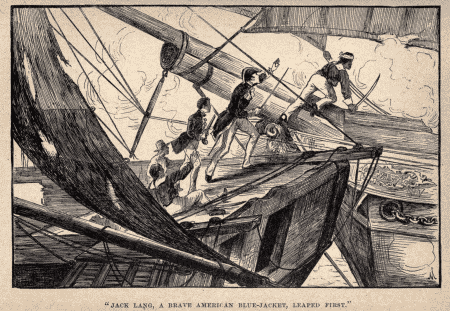
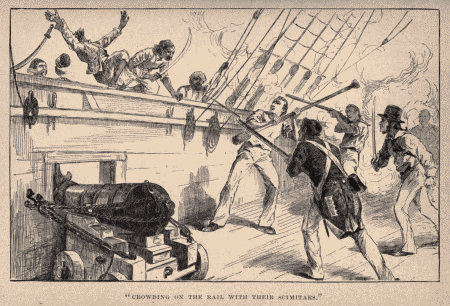 "CROWDING ON THE RAIL WITH THEIR SCIMITARS."
The American blue-jackets were now in no humor for trifling. Their blood
was up, for they were indignant at such unheard-of treachery, and it
looked as if there would be no question to settle about prisoners, for
the reason that none of the Tripolitans would be left alive. But the
polacca was by this time in a sinking condition, her mizzen-mast was
shot away, her deck was slippery with blood, and the dead and wounded
were lying about in heaps; and the Rais, Mahomet, himself wounded and
disheartened, convinced that the time had come when neither ferocity nor
fraud could help him, threw his flag into the sea and prostrated himself
upon the rail, begging for quarter. Then Lieutenant Sterrett, who was as
generous as he was gallant, ordered the firing to cease and took
possession of the enemy.
As the polacca could not be made a prize, the Americans cut away her
masts, threw overboard her guns, and left her with the surviving
fragment of her crew to make the best of her way back to Tripoli. Upon
her arrival, the Pasha was so incensed at the news of her defeat that he
had the Rais, wounded as he was, mounted on a jackass and paraded up and
down the streets of the city, after which he was given five hundred
blows of the bastinado. Such was the result of the first fight between
the Americans and their piratical enemy, and it was a long time before
the latter forgot the lesson.
By the autumn of 1801 the terms of enlistment of Dale's crews having
nearly expired, his ships were ordered home, and in the next spring a
new squadron was sent out under Commodore Richard Morris, Congress
having meantime passed an act that was to all intents a declaration of
war. But the new commodore was not an energetic man, nor did he seem to
concern himself much about what was to be done; and a whole year was
passed by the squadron in fruitless cruises among the Mediterranean
ports, sometimes convoying merchantmen, sometimes merely lying in
harbor, but doing little or nothing against the enemy. At the end of
this time the President found it necessary to replace Commodore Morris
by a more active man; and in the summer of 1803 he was ordered home, and
upon his arrival was dismissed the service.
Already the Government had determined to fit out a new squadron, and to
take more vigorous measures against Tripoli; for the people were rightly
impatient at the dallying which had prolonged through two years this war
with a little barbarian State, and it was against the navy that this
impatience was mainly directed. Strange as it may seem, party feeling
had run so high that the gallant exploits of the French war were thought
by many Americans to be the bad results of a mistaken policy, rather
than a source of pride and satisfaction to the country; and the officers
and seamen of the navy, who were then and who have always been the
single-minded and devoted servants of the people, were looked upon
simply as the instruments of an odious party that meanly cringed to
England and sought to embroil us in a war with France. In the last
general election this party had been defeated and broken up, and the
navy came in for a large share of the popular condemnation; which, as we
at this day can clearly see, was exceedingly unjust to the brave men who
composed the service.
Whatever men may have thought and said about the navy, it was evident
that nothing but a naval war would bring Tripoli to terms, and the
Government set about the work in earnest. Four new ships were built,
which, though they were small, were well suited to their purpose,—the
brigs "Argus" and "Siren," and the schooners "Nautilus" and "Vixen." Two
of the larger frigates were sent out,—the "Constitution" forty-four,
and the "Philadelphia" thirty-eight, the latter commanded by Captain
Bainbridge; and last, but not least, one vessel of the old squadron
remained, the schooner "Enterprise," which had already made herself
famous under Sterrett, but which was to acquire still greater fame under
Lieut. Stephen Decatur, who now commanded her.
The new squadron was strong in its ships, but its efficiency was mainly
due to the officer who was ordered to take the chief command, Com.
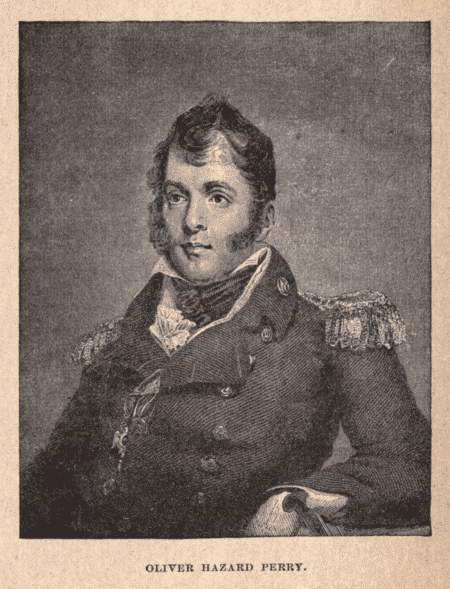
Edward Preble. Although not an old man, he was one of the few veterans
of the Revolution that were still in the service; and though he had been
a mere lad when he first sailed as a midshipman in the Revolutionary
cruisers of Massachusetts, he had served throughout the war, and had
learned well the lessons of naval discipline. What Paul Jones was in
that war, and what Truxtun was in the West Indies, Preble became in the
campaign against Tripoli,—the central figure of the war. He had around
him the best and bravest of the young officers of the new navy,—as good
as any navy the world has ever seen, but up to this time untried and
unknown,—and it was Preble who in great measure made them what they
afterward became.
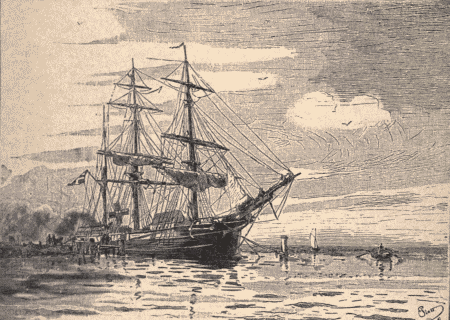
Among the first of the new vessels to come out was the "Philadelphia."
She had no sooner arrived in the Mediterranean than she made a most
unexpected discovery. She had left Gibraltar to search for some
Tripolitans that were reported to be cruising somewhere off the coast of
Spain. One evening after dark, off Cape de Gatt, she fell in with two
vessels,—a ship and a brig. Captain Bainbridge hailed the ship, which
proved to be the "Mirboka," a cruiser of Morocco; and allowing her to
suppose that he was English, Bainbridge ordered her to send him her
passports. The Moorish officer who came on board the "Philadelphia" fell
into the snare, and told Bainbridge that the brig which he had with him
was an American. This was an extraordinary piece of news, for Morocco
was then at peace with the United States; yet here was one of her
ships-of-war preying on American commerce. The Moors must have thought
that a State which could not protect its vessels from the attacks of
Tripoli need not be much respected, and that the time was ripe for them
to take a hand in the plundering which their neighbors were carrying on
with such success and profit; so they had sent out their cruisers, and
this was the first that had made a prize. The captured ship was the brig
"Celia," of Boston, whose crew and captain were at that moment confined
in the "Mirboka's" hold, to be carried to Morocco and sold as slaves or
held for ransom. Fortunately Captain Bainbridge had arrived just in time
to rescue the prisoners; and seizing the "Mirboka," he took her with him
to Gibraltar.
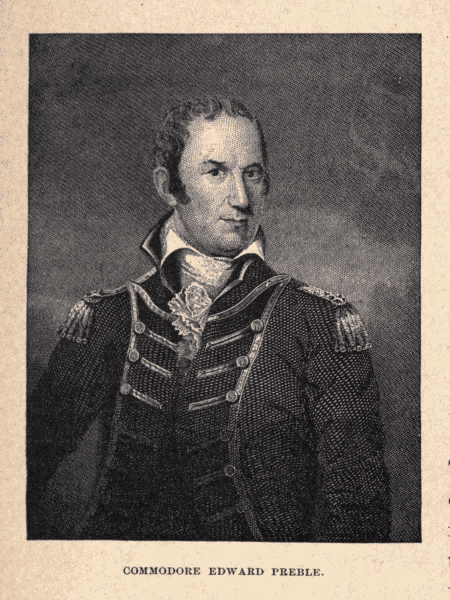 COMMODORE EDWARD PREBLE.
This was the state of affairs when a few weeks later Commodore Preble,
with the "Constitution," came out to take command of the squadron. He
saw the situation at a glance, and he was not a man to hesitate long
about taking action. If the Moors, who had seaports on the Atlantic,
were not put down and the strait opened, it would be of no great use to
clear the inland sea of pirates. The commodore immediately assembled all
his ships, gave them orders to capture every Moorish vessel they could
find, and himself proceeded in the "Constitution" directly to Tangier,
in Morocco. The Emperor was expected to arrive here shortly with his
army. He sent to know whether Preble would fire a salute in his honor.
The commodore sent back his answer by the consul.
"As you think," said he, "it will gratify his imperial Majesty, I shall
salute him and dress ship; and if he is not disposed to be pacific, I
will salute him again!"
The resolute tone which Preble took in this and other communications had
the desired effect. In three days after the Emperor arrived he had
consented to renew the treaty his father had made with the United
States, and had ordered the release of all the Americans that had been
seized, together with their property. At the same time the orders which
had been given to capture American vessels were revoked; whereupon
Preble restored the "Mirboka," and withdrew his own order to seize the
vessels of Morocco. This done, he sailed for Tripoli.
Already the "Philadelphia," with the schooner "Vixen" in company, had
taken her station before the enemy's port, and preparations were made to
maintain a strict blockade. It needed two vessels at least for this
service; for if any accident happened to one alone, she would certainly
be lost, being so far from help and close to the watchful guards of the
enemy's harbor. Nevertheless, immediately after his arrival Captain
Bainbridge heard from a Neapolitan merchantman that one of the enemy's
corsairs had sailed the day before, and he sent the "Vixen" off to find
her.
Next day, it being the 31st of October, a Tripolitan vessel was descried
to the eastward of the city, attempting to work into the harbor. Captain
Bainbridge at once gave chase. The wily Tripolitan kept on his course,
not far from the shore, where he knew the water was full of reefs and
sunken rocks which he could easily avoid, but which he hoped might prove
a trap for his unsuspecting enemy. And so it came about; for the
captain, whose zeal, as we have already seen, was sometimes greater than
his prudence, forgetting the dangers of the treacherous coast, followed
the Tripolitan, with a fair breeze and a good eight-knot speed, until
suddenly the water began to shoal. Then realizing for the first time his
peril, he turned his vessel's head off shore. But it was now too late;
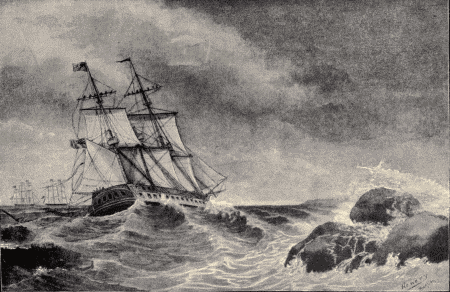
and an instant later the "Philadelphia" had shot up on a sunken reef,
where she hung hard and fast, her great stem and bowsprit pointing
upward in the air.
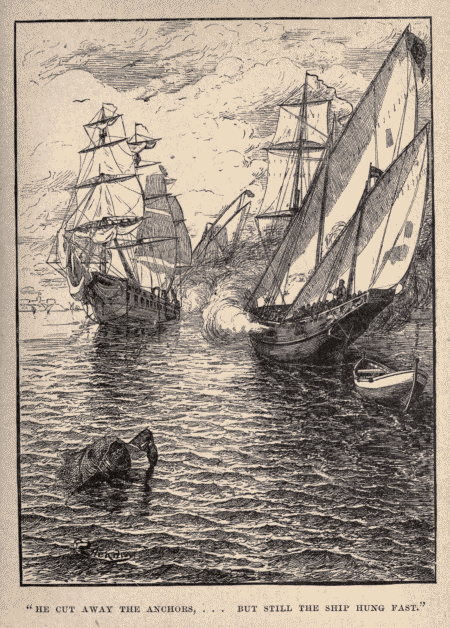 "HE CUT AWAY THE ANCHORS, ... BUT STILL THE SHIP HUNG
FAST."
"HE CUT AWAY THE ANCHORS, ... BUT STILL THE SHIP HUNG
FAST."
Even now the captain did not lose his confidence, and setting all sail
he tried to force the vessel over; but this only had the effect of
thrusting her higher on the rocks, and making escape more hopeless than
ever. It was clear that this plan would not work. The boats were then
sent out with leadsmen, who found deep water astern of the ship, and the
yards were braced aback, and every one watched anxiously to see if she
would not back off; but she did not move an inch. Then Bainbridge tried
to lighten her. He cut away the anchors and threw overboard the forward
guns, but still the ship hung fast.
Meantime the enemy discovered that their stratagem had proved
successful, and word having been sent to the city, the Tripolitan
galleys could now be seen in motion, evidently preparing to make an
attack upon the helpless frigate. Soon they came out in a long line,
their white lateen sails glistening in the afternoon sunlight, and their
decks crowded with men eager for the splendid prize that chance and
craft, combined with their opponent's over-confidence, had thrown within
their reach. But they were wary, and they remembered the lesson which
Sterrett had given them, that the Americans were stubborn fighters, and
this time they meant to run no risks. Taking up their positions on the
stern and quarter of the "Philadelphia," at a little distance, where no
guns could be brought to bear on them, they opened fire with their heavy
cannon; for each of these gunboats carried a long eighteen or
twenty-four pounder in her bow, and the whole flotilla was a hostile
force not to be despised even by a ship that could manœuvre.
As it was, the "Philadelphia" had heeled over, and the few guns that
remained on board were useless, even after great holes had been cut
with axes in her side to enable the crews to point them. The enemy fired
high and only cut the spars and rigging; but all the same their ultimate
success was sure if the ship could not get off the reef. In spite of the
shot that rained upon them, the officers did not relax their efforts.
The tanks of water in the hold were pumped out, and finally the foremast
was cut away, carrying with it the main top-gallant mast. But it was all
of no use, for the ship obstinately refused to budge; and as the sun was
sinking in the horizon, Captain Bainbridge, to prevent what seemed
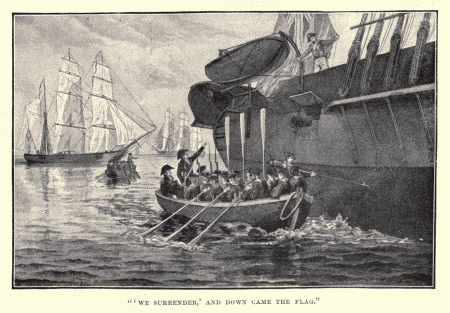
likely to be a useless sacrifice of men, hauled down his colors.
No sooner was the flag lowered than the Tripolitans, setting up a shout,
rowed quickly to the frigate and swarmed on board, over the rail and
through every port-hole. Then there was a scene which has never before
or since been witnessed upon an American ship-of-war. The pirates,
intent first of all on plunder, looted every chest and locker in the
ship. Nor did they stop here. The officers were forced to give them all
that they demanded, and like so many highway robbers they took watches,
epaulets, money; and when all the valuables were given up, coats,
waistcoats, and cravats, until all the prisoners were stripped to their
shirts and trousers. In this condition they were thrust into the boats
and carried to the city. Here they were taken before the Pasha, who was
so much elated by his capture that he received them in high good-humor,
and as he counted over the number,—three hundred and seven officers and
men,—he stroked his beard, and his avaricious eyes glistened as he
thought of the heavy ransom that the United States would have to pay him
before it could get them back. So he ordered them to be well cared for,
and sent the officers to be quartered in the building which before the
war had been the American consulate, where they were to remain during
many months of captivity.
It was bad enough that so many officers and men should have been taken;
but the mischief did not end here. For the next two days the Tripolitans
worked away at the grounded frigate with their gunboats and lighters,
and anchors carried out with hawsers from the stern; and by these means,
with the help of favoring wind and tide, they at last succeeded in
getting the "Philadelphia" off into deep water. Bainbridge, before he
abandoned her, had ordered the carpenters to bore holes in her bottom;
and if this had been well done, she would never have got afloat again.
But the carpenters in their excitement and flurry had only half
performed their task, and the ship was now in the enemy's hands in as
good condition, barring a little needed repair, as she was before the
accident. Even the anchors and guns which had been thrown overboard were
discovered lying on the reef, where the water was only twelve feet deep,
and the Tripolitans got them up without much trouble.
Meantime Commodore Preble, having despatched his business at Morocco to
the great satisfaction of his Government, was now on his way to Tripoli
in the "Constitution." Falling in one day with the British frigate
"Minerva," he received the first news of the disaster; and going
directly to Malta, he found there a letter from Captain Bainbridge
confirming the report. It was a staggering blow to all his hopes at the
very outset of his command. The Tripolitans, who had already become
tired of the war and of the annoyances of the blockade, and whom he had
hoped by resolute attacks speedily to overawe into submission, were
encouraged by this their first great success to renewed efforts. Not
only would they stand more firmly to their previous demands for tribute,
but they would clamor for an enormous ransom for the three hundred
prisoners; and unless they could be utterly crushed, they would get it,
for they had the prisoners in their power, and in some way or other
those three hundred Americans must be set free. The squadron, none too
powerful at the beginning, had now lost one of its two principal
vessels, and the force of the enemy was correspondingly increased. No
wonder that Commodore Preble, writing to the Department of the loss of
the frigate, should say in the bitterness of his heart, "It distresses
me beyond description." But however great his distress, he never yielded
to despondency, and the loss only urged him on to greater efforts to
harass and reduce the enemy.
For the next two months the commodore and all the ships of his squadron
were busy making preparations for the coming campaign. The first blow to
be struck was against the captured frigate, and Preble resolved upon her
destruction from the very moment when he heard of her loss. But he bided
his time, patiently waiting until a good opportunity should arrive.
Meanwhile a rendezvous for the squadron was established at Syracuse. The
"Argus" was stationed at Gibraltar, to watch the Moors and guard the
strait. The other ships were cruising about from point to point, giving
protection and convoy to American vessels, and seizing any Tripolitan
vessels they could find, though there were few of them that dared to
venture out. About Christmas-time the "Enterprise" fell in with one of
these craft, a ketch named the "Mastico," which was on her way to
Constantinople with slaves on board,—a present from the Pasha to his
master the Sultan. The slaves were not a capture of much benefit to the
commodore, but the ketch was; for she had once been a French gunboat,
and he saw how she might be of service in carrying out his most
cherished scheme. So he made a tender of her and called her the
"Intrepid."
All this time the prisoners at Tripoli were not forgotten. The Danish
consul in the city, a kind-hearted and generous man, Nissen by name, was
pleased to do all that he could to help the Americans. Through him
Preble and Bainbridge were enabled to get letters to and from each
other, and supplies were sent from Malta through an agency established
there by the commodore. The secret parts of the letters were written in
sympathetic ink, so that one only saw the writing when the letter was
held before a fire. In this way the commander of the squadron was kept
informed of all that went on in Tripoli, as far as Bainbridge knew it;
and Bainbridge in his turn was much cheered by getting word from time to
time that his friends outside had not forgotten him. He needed it badly,
for what with the loss of his ship, and the gloomy prospect of a long
captivity, he was at this time in great despondency; so that it did him
good to hear from Preble the words the latter wrote in January from
Malta: "Keep up your spirits, and despair not; recollect 'there's a
sweet little cherub that sits up aloft'!"
When Preble returned to Syracuse after this visit to Malta, he had
completed his plan for the destruction of the "Philadelphia."
Lieutenant Decatur, of the "Enterprise," had volunteered to command the
expedition; and although he was very young, and had been only five years
at sea, no better man could have been chosen than this gallant and
true-hearted officer. He was to take the "Intrepid," whose Tripolitan
rig would make a good disguise, and whose small size would enable her
safely to navigate those dangerous waters, and with seventy-five
officers and men to attack the frigate. The "Siren" was to go with him
to support and cover his retreat. It was a perilous enterprise; almost
rash, one would think, for the "Philadelphia" was lying fully armed and
manned in the inner harbor, under the guns of the Pasha's castle and all
the neighboring forts, and around her lay the galleys of the enemy's
flotilla. Decatur took three other lieutenants, Lawrence, Joseph
Bainbridge, whose brother was in prison in Tripoli, and Thorn; and six
midshipmen were told off to go with them. Among these last were Thomas
McDonough, who afterward won the great battle of Lake Champlain in the
war with Great Britain, and Charles Morris, who in the same war was
first lieutenant of the "Constitution" in her fight with the
"Guerrière." Morris was at this time a boy of nineteen; and I shall tell
the story of the attack as nearly as may be in his words.
A Maltese pilot, Catalano, who knew the harbor of Tripoli, and who could
speak the language, had been engaged to go with the expedition. When the
two vessels arrived off Tripoli, the wind was fresh and the sky
lowering, and all seemed to threaten a storm. The "Siren" and "Intrepid"
anchored under cover of the night, and Morris and the pilot were sent in
with a boat to see if the passage to the harbor was safe, of which the
pilot was doubtful. They found the surf breaking in a long line of
foaming waves across the entrance, and Morris coming back reported that
it would be dangerous to make the attempt. "It was a severe trial," said
the poor boy, "to make such a report. I had heard many of the officers
treat the doubts of the pilot as the offspring of apprehension, and the
weather was not yet so decidedly boisterous as to render it certain that
an attempt might not be made, notwithstanding our report; should such be
the case, and should it succeed, the imputations upon the pilot might be
repeated upon me, and, unknown as I was, might be the cause of my ruin
in the estimation of my brother officers." Still, in spite of their
murmurs of dissatisfaction, Morris, being a brave and independent lad,
stood firm in his opinion, and the attempt was given up.
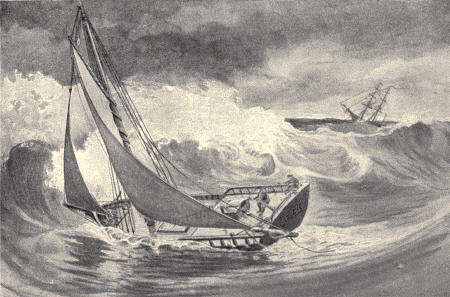
It was well that this was done; for before morning a furious gale had
come up, and the ships, with difficulty getting away from the shore,
were driven far to the eastward. For six days the storm continued, the
officers and men being all this time cooped up in the little ketch with
hardly room to breathe, and overrun with vermin which the slaves had
left behind them. The midshipmen slept on the top of the water-casks on
the lower deck, while the sailors were berthed in the same way in the
hold.
At last the wind abated, and on the 16th of February the ships were once
more in sight of Tripoli. The breeze was light and the sea smooth, and
the "Intrepid" stood in slowly toward the town. The "Siren" stayed
outside to lull suspicion; but in spite of all precautions she was seen
and noticed from the harbor. The plan was for the "Siren's" boats to
come in after dark and join in the attack. All through the afternoon
the "Intrepid" kept on sailing slowly in, her drags in the water astern
checking her headway so that she might not reach the town too early. Her
crew remained below, that no suspicion might be roused by the unusual
numbers, and only six or eight, dressed as Maltese, were allowed to come
on deck. As the sun went down, the breeze grew fainter; and Decatur,
fearing that if he delayed longer he might not be able with the light
wind to reach the frigate, decided that he would not wait for the
"Siren's" boats, saying to his officers, like Henry V. at Agincourt,
"The fewer the number, the greater will be the honor."
It was now dark, and the lights could be seen glittering in the houses
of the town and on the boats in the harbor, throwing bright reflections
over the water. The last preparations were made on board the "Intrepid,"
and the officers, speaking in low tones, told each man once more his
allotted duties, and cautioned all to steadiness and silence. The
watchword for the night was "Philadelphia," by which they were to
recognize one another in the confusion of the attack. There was no need
to enjoin silence, for each man was busy with his own thoughts. "My
own," said Morris, "were now reverting to friends at home, now to the
perils we were about to meet. Should I be able to justify the
expectations of the former by meeting properly the dangers of the
latter?" These thoughts, mixed with calculations to get a good place in
boarding, were passing through the minds of all as they waited in
breathless expectation.
Gradually the "Intrepid" was borne along by the gentle breeze toward the
inner basin. Her boat was towed astern. The young moon gave light enough
to show her movements, but nothing could be seen upon her deck except
Decatur and the pilot standing at the wheel, and here and there a man
whose Maltese cap and jersey gave no indication of his hostile
character. From end to end of the little ship the rest of the crew,
crouching under the shadow of the bulwarks, were lying concealed from
view, each man with his eye fixed on Decatur, waiting for him to give
the order. Before them could be seen the white walls of the city and the
forts.
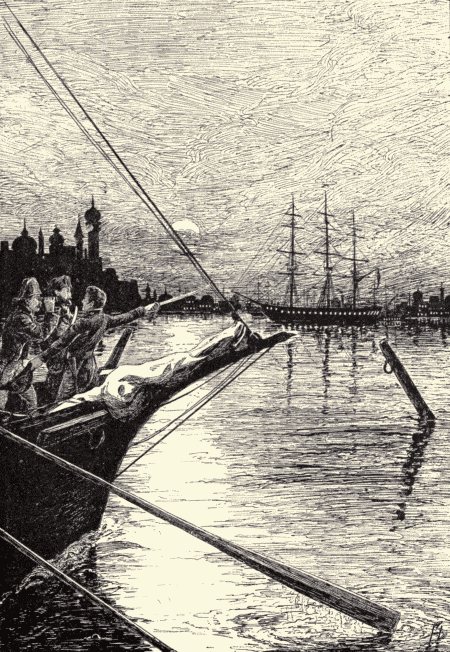 "THE LIGHTS COULD BE SEEN GLITTERING IN THE HOUSES."
The first battery is now passed in silence, every man holding his
breath. Right in the path of the "Intrepid" towers the "Philadelphia,"
with her great black hull and lofty spars, and around her lies the
circle of batteries. The little craft speeds on noiselessly, steering
directly for the frigate. Suddenly the anxious silence is broken by a
hail from the enemy demanding the name and purpose of the ketch, and
ordering her to keep away. Among the officers and men stretched on the
deck can be seen the eager movements of heads bending forward to hear
the colloquy. The pilot, speaking the language of the country, answers
for Decatur, who prompts him in low tones. He says that he has lost his
anchors in the gale,—which, as it happened, was the truth,—and asks to
be allowed to run a hawser to the frigate and to ride by her during the
night. To this the captain of the "Philadelphia" consents, and the ketch
is approaching, when suddenly the wind shifts, blowing lightly from the
ship, and leaves the "Intrepid" at rest not twenty yards away,
motionless under the enemy's guns.
It is a moment of terrible suspense. The least mistake, the least
disturbance or excitement, must mean detection, and detection now will
seal the fate of all. But Decatur has that perfect calmness and
clearness of judgment which is the highest bravery. There is no flurry.
In his low quiet voice he orders the boat manned. His calmness calms the
men, and with an air of lazy indolence they get in and take the oars,
carrying a rope to another boat which meets them from the frigate. The
work is done in silence; the ends are fastened, and the boat returns.
The hawser is passed along the deck; the crew lying on it pull
noiselessly, and the ketch slowly, slowly but surely, nears her place
and lies fast alongside the enemy.
Suddenly a piercing cry breaks the stillness. "Americanos! The
Americans are upon us!" The enemy has now discovered the disguise. But
at the same moment Decatur's voice is heard ringing out, "Board!" and he
and Morris, who has been watching him, leap to the enemy's deck.
Springing to their feet as one man, the crew follow them, each with his
cutlass and pistol. The Tripolitans are panic-struck; for a moment they
huddle in a frightened crowd on the forecastle. One instant Decatur
pauses to form his men, and then at their head he dashes at the enemy.
The few who stay to offer resistance are cut down; one is made prisoner;
the rest, driven to the bow, leap from the rail into the water.
The ship is now captured, and the victorious crew hurry to their
appointed stations. Two parties are told off to the berth-deck, one to
the forward store-rooms, and one under Morris to the cockpit. Each
prepares its supply of combustibles, and when all is reported ready, the
order is given to set fire. This done, each party leaves the ship, but
Morris and his men barely escape through the smoke and flame with which
the lower deck is already filled. Decatur, standing on the
Philadelphia's rail, while the smoke rises around him and the flames
are bursting from her ports, waits till the last man has returned, and
as the "Intrepid's" head swings off, he leaps into her rigging.
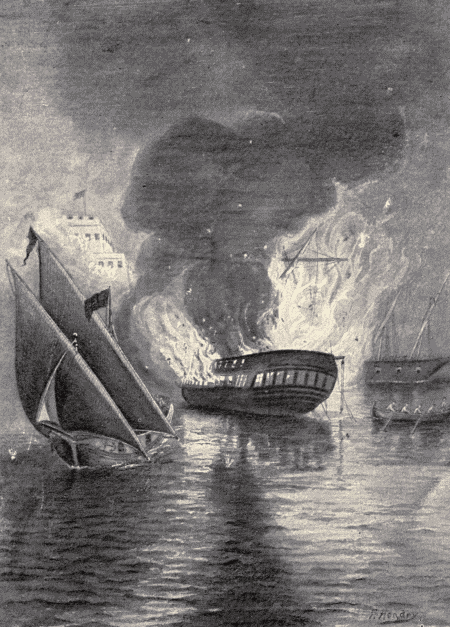 "THE 'PHILADELPHIA' LIGHTS THEM ON THEIR WAY."
By this time all the Tripolitans have caught the alarm, and from
batteries and gunboats in quick succession, all around the wide sweep of
the harbor, are seen the sudden jets of flame followed by clouds of
smoke, and the shores resound with the roar of cannon. One hundred guns
are firing upon the little ketch, whose white sails are lighted up by
the flames of the burning frigate. The harbor is a circle of fire, and
the gallant band seem doomed to pay the penalty of rashness. The frigate
is herself a source of danger, for her magazine must soon explode. But
the crew of the "Intrepid," after giving three rousing cheers for their
success, man the long sweeps and head their vessel seawards. The
"Philadelphia," which reveals them to the enemy, lights them on their
way. Her appearance is magnificent. The flames illuminate her ports, and
mounting up the rigging and masts form columns of fire, which, meeting
the tops, branch out in beautiful capitals. Behind her, thrown out into
strong light by the burning ship, are the city walls and roofs, with
dome and minaret rising above them,—bright points against the sky.
The guns of the "Philadelphia" commanding the harbor have been loaded
and double-shotted. As the fire reaches them they are discharged, but
their missiles do more injury among the Tripolitans than among their
foes. The "Intrepid" seems to bear a charmed life under the converging
fire of the enemy. The cannon-balls fall thickly in the water, ahead,
astern, alongside, throwing up columns of spray; but only one shot
touches her, and all the harm that does is to make a hole in her
top-gallant-sail. A favoring breeze now springs up, and aided by the
strong arms of the rowers at their sweeps, the ketch is carried out of
range, and in a short time she has reached the open sea and joined her
consort.
Meantime in the squadron lying at Syracuse the officers and men, and
above all the commodore, had undergone profound anxiety. It had been
thought that a week, or ten days at most, would be sufficient time for
the two vessels to accomplish their work and return to the station. But
as the time wore on and day after day passed by, the hopes of all began
to turn to apprehension; for no one knew that for a week after they
reached the enemy's coast the "Siren" and "Intrepid" had been driving
about before the gale, their efforts for the moment directed only
against the elements. Each day the horizon was scanned by the lookouts
aloft, and as the second week came to an end with no sign of the
expedition, the most hopeful shook their heads, and all were filled with
a sense of dull foreboding. But on the morning of the fifteenth day the
fleet was startled by the cry of "Sail ho!" from the mast-head, and
every face peered anxiously toward the southern horizon. First one ship
was seen, then two; and as they came nearer, and little by little their
spars and rig could be distinguished, the hope that they might prove to
be the missing vessels grew slowly into certainty.
Now a signal could be descried from the "Siren's" mast-head. What did it
mean? Was it success, or failure? At length there was no doubt; and when
from alternations of despair and hope the news was spread that Decatur
had successfully achieved his purpose, and that the "Philadelphia" was
indeed destroyed, the men's excitement knew no bounds, and cheer upon
cheer of welcome and of exultation went up from all the vessels.
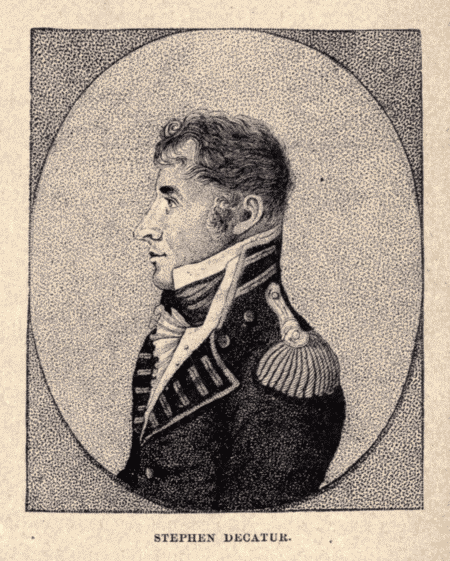 STEPHEN DECATUR.
One thing is certain: that no exploit of our navy since that time has
surpassed in bravery and finished excellence this of Decatur,—"the most
bold and daring act of the age," as it was called by Nelson, then
commanding the fleet off Toulon. The commodore wrote his despatch to the
Department, asking that Decatur might immediately be raised to the same
grade as himself; and when the Government heard the news, it lost no
time in granting Preble's generous request. In this way it came about
that young Decatur, though barely five-and-twenty, became a post-captain
in the navy, which he had entered less than six years before; and among
all the officers of Preble's squadron, who were in all things like a
band of brothers, there was not one that grudged him his promotion.
After the destruction of the "Philadelphia" the commodore desisted for
the time from further enterprises; for it was now midwinter, and at this
stormy season the dangers of the rocky coast made it imprudent to
attempt active operations against the enemy. But there was no slackening
in preparations for the campaign of the next summer, and meantime the
blockade was maintained with strictness. By this means was captured a
brig of sixteen guns which belonged to the Tripolitan consul at Malta,
and which was seeking to smuggle powder and other contraband into the
enemy's port. The prize was re-named the "Scourge" and taken into the
service, making a useful addition to the squadron.
All this time the commodore was on the alert,—at Syracuse, Messina,
Malta, Naples, as occasion called him, but never long in one place. At
one time he appeared off Tripoli and gave the Pasha an opportunity to
reduce his terms; but the Pasha, sulking after the loss of the
"Philadelphia," would not yield one jot in his demands. The commodore
next took three of his ships to Tunis, to quiet threatening
demonstrations in that quarter, and to let the Bey know that the
Americans, though occupied with Tripoli, still had time to keep an eye
fixed upon him. Some of the vessels needed repairs, and these were in
turn attended to. The weakness of the squadron in small gunboats,
wherein lay so much of the enemy's strength, was a source of great
concern; and Preble in his letters to the Department entreated that
permission might be given him to buy or build them in the Mediterranean
ports. But to this the Government would not consent; and Preble, as a
last resort, went to Naples and obtained from the King of the two
Sicilies, who was an enemy of the Tripolitans, a loan of six gunboats
and two bomb-vessels, or mortar-boats, as we should call them now. They
were not very seaworthy or efficient, and "required careful nursing," as
the commodore said. "However," he added in his report to the Department,
"as they were the best I could obtain, I have thought it for the good of
our service to employ them, particularly as the weather in July and
August is generally pleasant, and without them my force is too small to
make any impression upon Tripoli."
At last all the preparations were completed, and the commodore toward
the end of July set out to begin operations against the city. His whole
force consisted of one frigate, three brigs, three schooners, and the
eight small gunboats and mortar-boats which he had borrowed at Naples.
Taking these last, the "Constitution," "Nautilus," and "Enterprise" set
out from Syracuse, and arriving before Tripoli were joined by the
blockading squadron, composed of the "Argus," the "Siren," the "Vixen,"
and the "Scourge." The ships made a brave display as they all appeared
before the enemy's city; but in reality they were an insufficient force
to bring to the attack of such a place, with its hundred guns protected
behind massive walls, its fleet of nineteen gunboats, and its army on
shore of twenty-four thousand soldiers. For they were desperate
fighters, these Turkish bandits, when it came to a hand-to-hand
conflict, as we have already seen from their fight with Sterrett; and in
all the American fleet there were not above one thousand men. But the
assailants were strong in one thing, and that was in their officers.
Young as the officers were, they counted among their numbers the flower
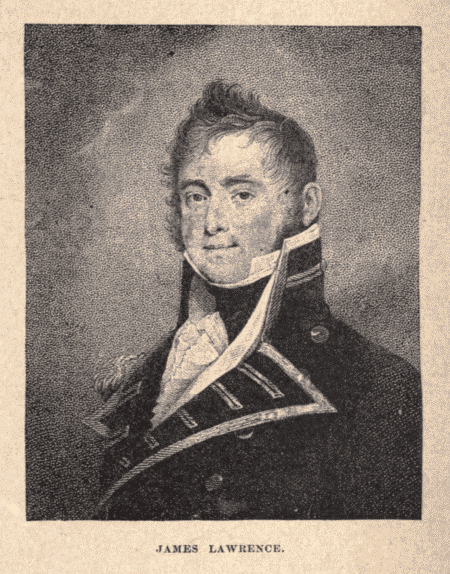
of the navy. There were Somers and the two Decaturs,—Stephen and James;
Lawrence, the brave captain of the "Chesapeake" in the War of 1812;
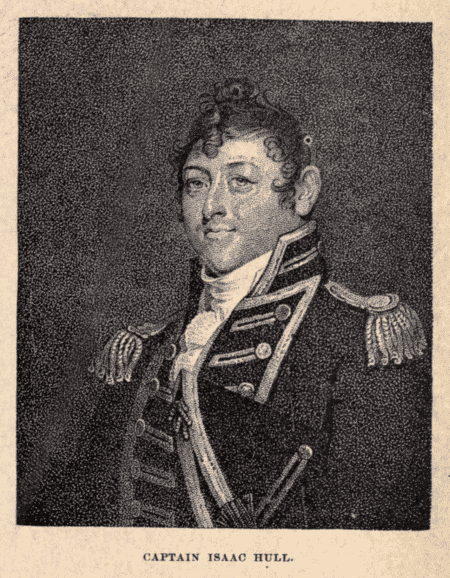
Hull, who captured the "Guerrière;" Stewart, who took the "Cyane" and
the "Levant;" Charles Morris, Macdonough, Warrington, Blakely, Spence,
Henley,—all of them preparing now for the greater war that was to come,
in which they were to win new renown for the navy and the country. They
believed in their commander-in-chief, who they knew would lead them to
victory if any man could. They believed too in each other, and they
fought side by side like true and generous comrades.
For several days the wind blew violently on shore and prevented any
active operations. The ships hastened to gain an offing; but the gale
increased, and on the last day, when it was at its height, the gunboats
pitching and tossing in the heavy sea seemed on the point of foundering.
The foresail and main-topsail of the frigate, though close-reefed, were
blown out into ribbons from the bolt-ropes. Fortunately before any worse
accident happened the gale subsided, and the squadron was once more able
to approach the town.
At last came the 3d of August,—a day ever memorable in the annals of
our naval history. There was a light breeze blowing from the southeast
as the squadron stood in slowly for the town, whose white walls,
surmounted by glistening mosques and minarets, and surrounded by gardens
and groves of palms, seemed to the Americans like some fabled city of
old myths, which they were always approaching and which never could be
reached. There is no fable about it on this day, however. Within these
walls are three hundred of their companions confined in prison by a
barbarian despot who calls himself a Pasha, but who is little better
than the leader of a gang of pirates. His hundred cannon are frowning
from the walls, his batteries are manned, and his fleet of galleys is
drawn up in battle order outside the bristling line of rocks that covers
the entrance of the harbor. They are there to have a fight, and the
commodore is not a man to balk them in their purpose.
The fleet is now advancing, the bombs and gunboats still in tow.
Presently the ships wear, with their heads off shore. The Pasha, on the
battlements of his castle, surrounded by his courtiers, is watching the
movements of the Americans, and says to his officers, "They will mark
their distance for tacking; they are a sort of Jews, who have no notion
of fighting." But he is going to find out before night. The ships are
now passing within hail of the commodore, and each captain is receiving
his final orders for the attack. Officers and men are transferred from
the larger vessels to the gunboats. The latter are arranged in two
divisions,—the first under Somers, the second under Decatur. There are
only six of them in all, and they are to attack nineteen of the enemy,
while the mortar-boats shell the town, and the "Constitution" and her
attendant brigs and schooners deliver their broadsides at the
batteries.
At half-past one in the afternoon, the ships, wearing in succession, are
headed for the batteries. As they approach silently and steadily, the
bombs and gunboats are cast off. The batteries give no sign of life,
there is no sound to break the stillness of the clear midsummer
afternoon; and looking at the picture as the sun shines peacefully from
the bright blue sky upon the white city walls, and the ships under their
clouds of canvas, and the sparkling waters, one can hardly fancy that in
a few moments it will be transformed into a scene of mortal combat.
At length the bombs have taken their position and come to anchor, and
the signal for battle is displayed at the mast-head of the
"Constitution." Each of the mortars flings out a little curling puff of
smoke. An instant later, with a deafening din and uproar, all the guns
in the squadron and in the batteries on shore, as if directed by one
man, have opened fire with their heavy round shot. The gunboats, led by
Decatur and Somers, dash out against the enemy, and soon they are lost
to view beneath the smoke of battle.
The cannonade continues. Meantime Somers, though his boat is a dull
sailer, by dint of hard work with the sweeps has reached the enemy's
rear division, and single-handed as he is drives them in confusion
behind the rocks. Decatur, followed by his brother James, by Trippe, and
by the younger Bainbridge, attacks the van. The bowsprits have been
unshipped so that there will be nothing to impede the boarders, for it
is by boarding that Decatur means to gain his prizes. Bainbridge in his
advance loses his lateen yard by a shot, and can only support the
attacking column from a distance. Trippe dashes up alongside one of the
enemy's boats crying out, "Board!" and leaps over the rail, followed by
Henley, his midshipman, and nine of his crew. The others are about to
jump, when the boats fall apart. It is hot work for the little handful
of Americans. The enemy is more than three times their number. But there
is no time for thought, and without a second's hesitation the boarders
make a rush upon the crew of the galley with pike and cutlass. For a few
minutes the struggle is desperate. Trippe singles out the leader, a tall
and well-built Turk, as his own antagonist. As he comes up, the Turk
makes a swift cut at him with his scimitar; but Trippe parries the blow
skilfully with his sword, receiving only a slight wound. Stroke after
stroke descends, as the enemy, swinging his curved blade with the
rapidity of lightning, cuts savagely at his opponent. But Trippe is a
cool and expert fencer, and though he is gashed and cut again and again,
he holds his ground until he has passed his weapon through the body of
the Turk. His companions, in the fury of their attack, have killed
thirteen of the enemy; and though there are still more than twenty left,
the rest seeing their leader fall are panic-struck and fall on their
faces begging for mercy. Trippe carries off with him eleven honorable
scars, and three of his men are wounded; but none have fallen, and the
Tripolitan gunboat is a prize.
Meanwhile the two Decaturs, in the other gunboats, are not idle. The
elder, Stephen, runs on board the largest of the enemy's boats, taking
with him his whole crew of Americans, twenty-three in number, and
leaving the Neapolitan gunners to guard his boat. For ten minutes they
are fighting pellmell on the enemy's decks,—another bloody hand-to-hand
encounter with the same result. Despite their numbers, the Turks cannot
resist the impetuous charge of the Americans. Many of them are killed,
some jump into the sea, a few rush in terror to the hold, the rest
surrender. The flag is lowered, and Decatur takes his prize in tow, to
draw her out of the battle.
At this moment Lieut. James Decatur's gunboat comes up under his stern
and he learns that his brother, after receiving the surrender of one of
the galleys, has been shot through the head by her commander. Decatur
has left most of his crew on board the prize, but he does not stop to
think of that; his brother has been murdered by a treacherous enemy, and
he must meet the Turk and exact from him the penalty. The boat is
pointed out; she has taken refuge within the enemy's line. But this is
nought to Decatur. Plunging into their midst, he finds himself beside
the object of his search, and in a moment he has leaped upon the
galley's deck. He does not look to see whether he is followed; but young
Macdonough has joined his leader with a handful of men, and at his side
they charge the enemy. As Decatur rushes upon the Turkish captain, the
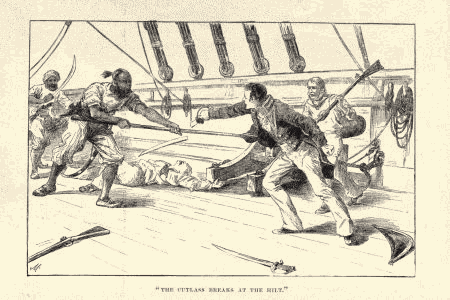
latter makes a thrust at him with a boarding pike. Decatur parries with
his cutlass, but the blade breaks at the hilt. The Turk makes another
lunge, and this time wounds Decatur in the breast. The American wrenches
the weapon from his antagonist, and they grapple and fall to the deck,
Decatur uppermost. At this moment another Tripolitan makes a cut with
his scimitar at Decatur's head; but as the weapon is raised in the air a
young blue-jacket, Reuben James, whose name will ever be remembered for
this act of self-devotion, since he cannot stop the blow with his
wounded arms, stoops down and intercepts it with his head.
The fight now goes on around the two prostrate captains. The active and
sinewy Turk, making one last effort, turns and gets Decatur under him.
Drawing a knife from its sheath, he is about to bury it in the captain's
throat. But Decatur is as cool as he is valiant. Seizing the Turk's
uplifted arm with a grip like iron, he feels with his right hand for the
pistol in his pocket. Quickly it is cocked, and without drawing it,
Decatur aims and fires. The dagger drops from the Turk's hand, and his
body, limp and lifeless, rolls over on the deck. Another prize has been
captured, and Decatur has avenged his brother's death.
While the gunboats are thus actively engaged, the ships keep up a steady
cannonade. Twice the reserve division of the enemy, stationed behind the
rocks, endeavors to come out, and by rallying and supporting the
defeated rear, to renew the contest; but each time it is covered and
checked by the guns of the "Constitution," and after losing three more
galleys which are sunk by the frigate's fire, it gives up the attempt.
Presently the wind comes out from the northward, freshening, and the
gunboats are signalled to retire from action. The "Constitution," now
only two cables' length from the batteries, tacks, and firing two
broadsides in stays, drives the Tripolitans from the castle and sends a
minaret in the town crashing down about the people's heads. The
gunboats, bringing with them their three prizes, rejoin the squadron.
The commodore sends his barge to bring Lieut. James Decatur on board the
flag-ship, and he is tenderly lifted in and rowed swiftly to the
frigate. He lies in the stern-sheets, his head in Morris's lap, and with
him is his brother. But his strength is going fast, and he dies before
they reach the ship.
The squadron now takes the gunboats and bombs in tow, and all the ships
stand out to sea. The last gun has been fired, the batteries are silent,
and the first attack on Tripoli is ended.
Soon after the battle of the 3d of August Commodore Preble received a
letter from the French consul intimating that the Pasha would be ready
to lower his terms and treat for peace. But the commodore refused to
make the first advances, and on the 7th he was ready for another attack.
The enemy's gunboats wisely kept their stations within the rocks, where
it would have been folly to engage them, and the attack was directed
only against the town and batteries.
The bombs were ordered to take their position in a bay to the westward
and throw shells into the city, while the gunboats, now increased to
nine by the addition of the three prizes, were to silence a heavy
battery that commanded the entrance to the bay. At nine in the morning
the "Constitution" lay at anchor six miles from the city. The smaller
vessels lay three miles within her. It was nearly calm, but with a
strong current setting in to the eastward. The gunboats and bombs
advanced slowly to the attack with sails and oars. The "Constitution"
had her top-sails set ready for the first breeze; and at half-past one,
when a light wind sprang up from the northeast, she weighed and stood
in. As the wind was on shore, it was imprudent for any of the larger
vessels to join in the movement; for if a mast were shot away, it would
be almost impossible to save the ship.
At half-past two, signal was made to begin the attack, and the bombs and
gunboats opened a heavy fire upon the town, to which the batteries
replied. In a short time the walls of the seven-gun battery were nearly
demolished. The small vessels kept their stations steadily under an
annoying fire. Suddenly on board one of the prize gunboats was seen a
burst of flame followed by a terrific crash; a hot shot had passed
through the magazine and exploded it. The young commander of the
gunboat, Lieutenant Caldwell, and Dorsey, one of the midshipmen who
stood with him on the quarter-deck, with all the seamen near them, were
killed, and the stern of the boat was blown to atoms. In the bow was the
gun's crew under Midshipman Robert Spence. The crew had just loaded the
gun, and for a moment stood paralyzed, as the boat was sinking fast.
"All right, boys!" sung out Spence as he coolly pointed the gun. "We'll
give them one more, any way. Fire!"
Crack! went the gun.
"Now, then, three rousing cheers for the flag! Hip, hip, hurrah!" The
gallant tars gave three cheers, and the boat sank from under them.
Spence, who could not swim, seized an oar as he plunged into the water,
and so kept himself up until help came to him from one of the boats near
by. In this way were rescued all whom the explosion had left alive.
The eight remaining gunboats, which though here and there cut up were
not disabled, continued the action until late in the afternoon, when the
freshening wind warned the squadron to retire. During the engagement a
strange sail had been seen to the northward, and the "Argus" was sent in
chase. It proved to be the frigate "John Adams," Captain Chauncey,—the
first ship of the new squadron that was coming out from the United
States. Unfortunately she had left her gun-carriages to be brought out
by the other ships, so that she could not be used for active operations.
Still more unfortunately it turned out that the authorities at
Washington, who were somewhat given to red-tape, had thought it
necessary to send an officer in command of the squadron of reinforcement
who was higher in rank than Preble, and who would therefore upon his
arrival replace the latter in the command. It was a cruel blow to the
commodore to be cast aside after having done so much where others had
accomplished little; and in his private journal, written with his own
hand in the solitude of his cabin, and meant only for his own eye, we
find these words:—
"How much my feelings are lacerated by this supersedure at the
moment of victory cannot be described, and can be felt only by
an officer placed in my mortifying situation."
At first the commodore thought it only right that he should now wait for
his successor to arrive. But in a day or two the Pasha sent him a
message through the French consul, offering to treat for peace if the
United States would pay one hundred and fifty thousand dollars for the
ransom of the captives. The last proposal before this had been for a
ransom of half a million; all which showed that the two attacks had
lowered the Tripolitan demands to less than one third of what they had
been, and that in time they would come down still further.
Preble therefore renewed his operations, making the same zealous and
eager efforts that he would have done had the Department not superseded
him. Decatur, whose new commission as captain had come out in the "John
Adams," and Chauncey rowed into the harbor one dark night in two small
boats to find out how the enemy's flotilla was arranged at night. When
this was ascertained, a night attack was planned, and the gunboats and
bombs were sent into the harbor, where they bombarded the town from two
o'clock till daylight. It was a beautiful sight to one who could watch
it from a distance; but it filled the people of the city with terror,
and if the Pasha had had any concern for the feelings of his subjects,
he would have made peace then on any terms. But as long as his castle
stood, and taxes could be wrung from his people, and he had plenty of
food and slaves, it mattered little to him that the town should suffer
from the horrors of a night bombardment.
A few nights later the attack was repeated, and it was shortly followed
by a warm engagement with the forts and gunboats in the harbor, in which
the enemy was repulsed and great damage was done in the town. This last
attack, the fifth which the squadron had made, exhausted nearly all its
ammunition; and as the bad season was coming on, the commodore
determined to use up what was left in carrying out a plan which he had
some time before projected, and which was to inflict a final blow on the
enemy. The plan was to load the "Intrepid" with gunpowder and shells,
making a kind of infernal machine of her, and send her in to explode
among the Tripolitan shipping. One hundred barrels of powder were stowed
in her magazine, and one hundred and fifty fixed shells were placed in
different parts of the vessel. The whole was to be fired by a fuse
calculated to burn a quarter of an hour.
The direction of this hazardous undertaking was intrusted to Lieut.
Richard Somers, a gallant and devoted officer who had shared with
Decatur the command of the gunboats in all the attacks upon Tripoli.
Lieut. Henry Wadsworth went with him; and at the last moment young
Israel, another of the "Constitution's" lieutenants, begged so hard to
be allowed to go that the commodore consented. They took with them the
two fastest boats in the squadron, one of them from the "Nautilus" with
four men, the other from the "Constitution" with six men.
On the evening of the 4th of September everything was ready, and the
"Intrepid" got under way and stood for the entrance of the harbor. The
"Argus," "Siren," and "Nautilus" went with her as far as the rocks, and
remained there to pick up the boats on their return. The night was
thick, and there was a faint starlight, and the "Intrepid" was gradually
lost to sight in the gathering gloom as she passed between the rocks at
the entrance. But the Tripolitan sentries on the mole were on the watch,
and presently the batteries opened fire upon her. Still she held
silently on her course, steering straight for the mole, where the
enemy's flotilla lay at anchor. Suddenly, before the allotted time had
passed, the explosion came. There was a quick flash, a sheet of flame, a
deafening report, then the sound of bursting shells and cries of alarm
as for an instant the city walls, the harbor, and the vessels were
lighted up by the blaze, and then—darkness and silence.
The three ships remained for hours off the entrance watching anxiously
for some signs of the returning boats or men. Every ear was strained to
catch the plash of the oar in the water or its dull rattle in the
rowlock, and every eye strove to pierce the shroud of mist that hung
over the waters; but in vain. None of that devoted band were destined
ever to return. They had given up their lives as a sacrifice for their
country; and whether their destruction was caused by one of the enemy's
shot, or whether, finding himself attacked by boarders, Somers had
lighted the fuse, as he had resolved to do in such an event, and had
blown up himself and his assailants together, no man knows to this day.
Thirteen bodies drifted ashore the next morning, and Captain Bainbridge
was taken from his prison to see them; but they were scarred and burned
beyond recognition.
With this melancholy tragedy Commodore Preble's operations before
Tripoli came to a close. The bad season was upon him, when attacks were
impossible, and the Pasha on his stormy coast was secure behind his
barriers of rocks and shoals. A week later the new squadron came out and
the commodore gave up his command.
In the following spring, when the season again opened, Commodore
Rodgers, who was now at the head of the squadron, appeared before
Tripoli with an overwhelming force. There were six frigates, two brigs,
three schooners, and twelve bombs and gunboats. At the same time an
adventurous expedition had been led from Egypt by General Eaton, and had
captured the city of Derne, an outlying dependency of Tripoli. Against
such a force the Pasha, after what he had been taught by Preble in the
summer before, knew that he could not long hold out; and the
negotiations for peace, which were conducted on board the flagship,
lasted only a week. On the 3d of June, 1805, the treaty was signed.
Bainbridge and his companions were set at liberty, and the war with
Tripoli was over.