ESQUIMAUX INDIANS.
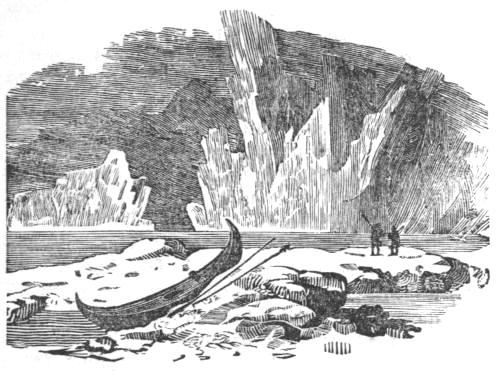
Captain Ross, in the Journal of his Arctic Expedition,
gives the following account of his first
interview with the Esquimaux, in the northern
parts of Baffin’s Bay:
“These Esquimaux,” says he, “conceived
the ships to be living and flying creatures.”
... “I had been employed, with a
good telescope, in observing their motions, and
beheld the first man approach, with every mark
of fear and distrust—looking frequently behind
to the other two, and beckoning them to come
on, as if for support. They occasionally retreated,
then advanced again, with cautious
steps, in the attitude of listening; generally
keeping one hand down by their knees, in
readiness to pull out a knife, which they had in
their boots: in the other hand they held their
whips, with the lash coiled up: their sledges
remained at a little distance—the fourth man
being apparently stationed to keep them in
readiness for escape. Sometimes they drew
back the covering they had on their heads, as
if wishing to catch the most distant sounds:
at which time I could discern their features,
displaying extreme terror and amazement,
while every limb appeared to tremble as they
moved.” They were requested to cross a
chasm, which separated them from the interpreter,
by a plank; but “appeared still much
alarmed, and requested that Sackhouse (the
interpreter) only should come over. He accordingly
passed to the opposite side, on which
they earnestly beseeched him not to touch
them, as, if he did, they should certainly die.
After he had used many arguments to persuade
them that he was flesh and blood, the
native, who had shown most courage, ventured
to touch his hand; then, pulling himself by the
nose, set up a shout, in which he was joined by
Sackhouse and the other three. The presents
were then distributed, consisting of two or
three articles of clothing, and a few strings of
beads. After which, Sackhouse exchanged his
knife for one of theirs.”
Captain Ross and Lieutenant Parry then went
on the ice, and, “by the time they reached it,
the whole were assembled: those who had
originally been left at a distance, with their
sledges, having driven up to join their comrades.
The party now, therefore, consisted of
eight natives, with all their sledges, and about
fifty dogs, two sailors, Sackhouse, Lieutenant
Parry, and myself—forming a group of no
small singularity, not a little increased, also, by
the peculiarity of the situation on a field of ice,
far from the land. The noise and clamour may
be easily conceived—the whole talking and
shouting together, and the dogs howling, while
the natives were flogging them with their long
whips, to preserve order. Our arrival produced
considerable alarm, causing them to retreat
a few steps towards their sledges. On
this, Sackhouse called to us to pull our noses,
as he had discovered this to be the mode of
friendly salutation among them. This ceremony
was accordingly performed by each of
us, the natives, during their retreat, making use
of the same gesture; the nature of which we
had not before understood.” Presents were
then made, and, “on seeing their faces in the
glasses, their astonishment appeared extreme,
and they looked round in silence, for a moment,
at each other, and at us. Immediately afterwards,
they set up a general shout, succeeded
by a loud laugh, expressive of extreme delight
as well as surprise—in which we joined, partly
from inability to avoid it, and willing also to
show that we were pleased with our new acquaintances.”
Confidence shortly after became
established, and uncovering of heads was substituted
for pulling of noses—the natives appearing
to comprehend the nature of this ceremony
more quickly than the seamen did the
other, and probably not considering it a much
more reasonable, although a more inconvenient,
testimony of respect. They were then invited
to the ship, to which one of them thought proper
to address a speech, “pausing between
every question, and pulling his nose with the
utmost solemnity.” All the wonder to be expected
was here excited; but the quantity of the
wood and iron appeared to be the chief objects
of surprise.
“Their knowledge of wood seemed to be
limited to some heath of a dwarfish growth,
with stems no thicker than the finger; and,
accordingly, they knew not what to think of
the timber they saw on board. Not being
aware of its weight, two or three of them, successively,
seized on the spare topmast, evidently
with the view of carrying it off; and, as
soon as they became familiar with the people
around them, they showed that desire of possessing
what they admired, which is so universal
among savages. The only thing they
looked upon with contempt, was a little terrier
dog;—judging, no doubt, that it was too small
for drawing a sledge. But they shrunk back,
as if in terror, from a pig, whose pricked ears
and ferocious aspect (being of the Shetland
breed) presented a somewhat formidable appearance.
This animal happening to grunt,
one of them was so terrified, that he became,
from that moment, uneasy, and appeared impatient
to get out of the ship. In carrying his
purpose into effect, however, he did not lose
his propensity to thieving, as he seized and
endeavoured to carry off the smith’s anvil:
finding that he could not remove it, he laid
hold of the large hammer, threw it on the ice,
and following it himself, deliberately set it on
his sledge, and made off.”
A CHOCTAW COUNCIL.
The conduct of the government of the United
States towards the Indian tribes, however politic
it may seem, is certainly not based upon the
Christian precept “to do unto others as we would
that they should do unto us.” All our proceedings
towards them have tended to their gradual
extirpation from the land of their birth. Our
wars, our treaties, our purchases of land, our
system of intercourse with them, have all the
same end. The following extract will show
how well the Indians understand this.
The reader will recollect, that it has become
the settled policy of the United States to remove
the several tribes of Indians to a country west
of the Mississippi. In order to discuss and determine
on this subject, in 1830 the Choctaw
Indians held a council, in which it was resolved
to sell off their lands to the United States, for
one million of dollars, and to remove without
the States, provided Government would give to
each man a section of land, in fee simple, west
of the Mississippi, and be at the expense of
transporting the tribe to their place of destination,
and of supporting them twelve months
after their arrival. The council sat four days,
and the following is a short sketch of their
proceedings:—
The National Council was organized in the
afternoon of the 15th of March. This was a
juncture of peculiar interest. To see the rulers
of a people, preparing to decide upon a course
in which their posterity, to the latest generation,
was deeply affected, could not but produce
a deep and universal solemnity, and this interest
was greatly increased by the bitter tears
shed by some of the females present. The
voice of sorrow is always eloquent; but, at
such a season, never could the female voice
speak more forcibly the sympathies of our nature.
Who could avoid exclaiming, ‘O, my
native country! Land of my fathers, I must
leave thee!’
The Chief presented them with a concise
view of the difficulties of their situation, and
the alternatives which were before them, and
the sad necessity of immediately making their
selection. It was at the intimation, that a removal
was one of the alternatives, that the
women wept.
The Chief was followed by an old Captain
in the nation, who, in brief simplicity, recounted
his sufferings as a warrior and captain, in fighting
for his White brothers, under General Jackson.
He named several places where he had
fought, and seen the Choctaws bleed and die.
At that time, little did he think that his White
brothers would ever make it necessary for him,
in his old age, to leave his country, and the
bones of his father. He would greatly prefer
giving up his country, than submit to laws, the
nature of which he could not learn, and among
a people, the wicked part of whom would
harass and ruin them. He expressed a belief
that the President would give them a good
treaty; and, if he would do so, aged as he was,
he would give his voice to go to their lands
west of the Mississippi—and, moreover, expressed
his belief, that the Great Father above,
would go with them, and bless them in their
new home.
A Captain of the eastern part of the nation,
next came forward. He appeared many years
in advance of the first speaker. His white
head, palsied limbs, and tremulous voice, made
him an object of deepest interest. He was said
to have been a warrior under General Wayne.
He recounted some of the scenes of his past
life, and the hopes which had borne him onward
in his course;—he touched upon the disappointment
that had clouded his setting sun;
but, awakening, as if by supernatural power,
he spoke boldly of his confidence in his Great
Father above, and expressed his full assurance,
that He would accompany his nation, and bless
them. The discussion continued until a late
hour of the fourth day, when the vote was
taken, and found in favour of emigration.
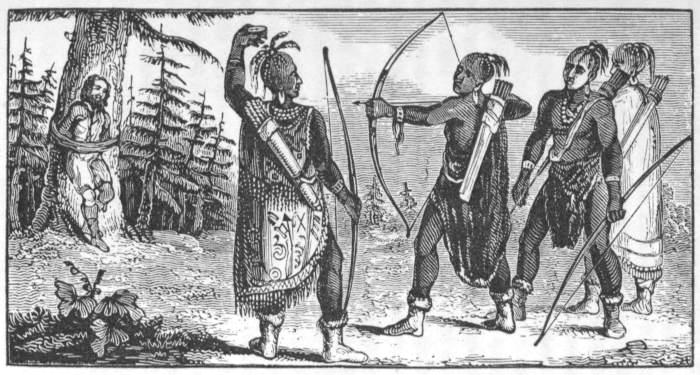
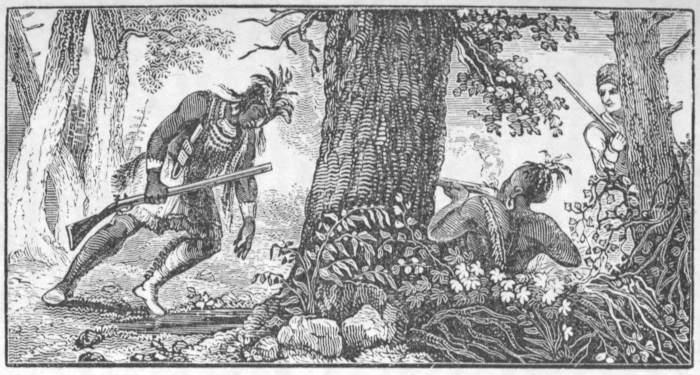
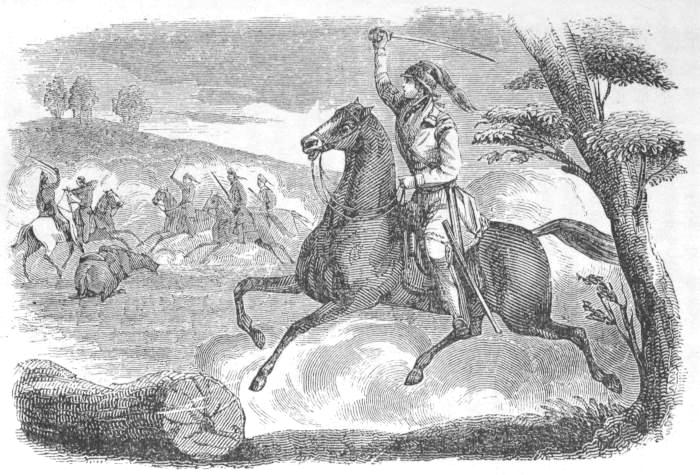
Indians Shooting their Prisoners.
THE YOUNG INDIAN CHIEF. [4]
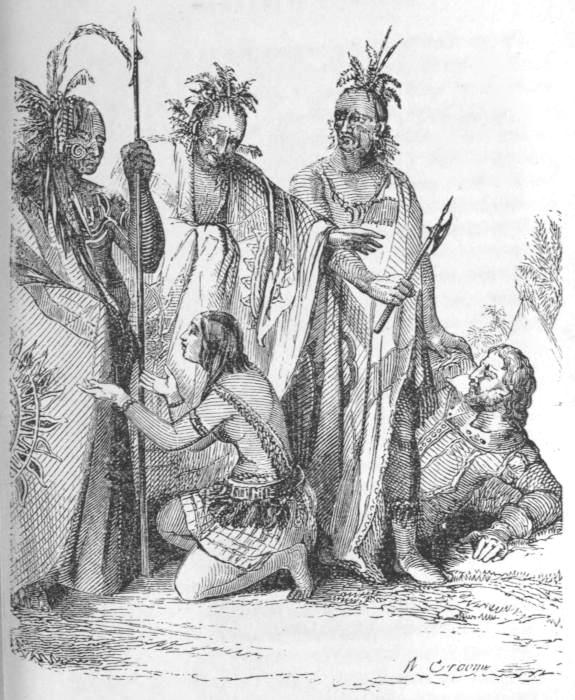
This young warrior, of fine size, figure and
countenance, is now about 25 years old. At
the age of 21 his heroic deeds had acquired for
him in his nation the rank of “bravest of the
brave.” The savage practice of torturing and
burning to death their prisoners existed in this
nation. An unfortunate female taken in war,
of the Paduca nation, was destined to this horrible
death. The fatal hour had arrived, the
trembling victim, far from her home and her
friends, was fastened to the stake; the whole
tribe was assembled on the surrounding plain
to witness the awful scene. Just when the fire
was about to be kindled, and the spectators on
the tiptoe of expectation, this young warrior,
who sat composedly among the chiefs, having
before prepared two fleet horses, with the necessary
provisions, sprung from his seat, rushed
through the crowd, loosed the victim, seized
her in his arms, placed her on one of the
horses, mounted the other himself, and made
the utmost speed towards the nation and friends
of the captive. The multitude, dumb and
nerveless with amazement at the daring deed,
made no effort to rescue their victim from her
deliverer. They viewed it as an act of the
Great Spirit, submitted to it without a murmur,
and quietly returned to their village. The released
captive was accompanied through the
wilderness towards her home, till she was out
of danger. He then gave her the horse on
which she rode, with the necessary provisions
for the remainder of the journey, and they
parted. On his return to the village, such was
the respect entertained for him, that no inquiry
was made into his conduct; no censure was
passed on it, and since the transaction, no human
sacrifice has been offered in this or any
other of the Pawnee tribes. Of what influence
is one bold act in a good cause!
On the publication of this anecdote at Washington,
the young ladies of Miss White’s Seminary,
in that city, presented that brave and humane
Indian with a handsome silver medal, on
which was engraven an appropriate inscription,
accompanied by an address, of which the following
is the close:—“Brother, accept this
token of our esteem; always wear it for our
sake; and when you have again the power to
save a poor woman from death and torture,
think of this, and of us, and fly to her rescue.”
SHENANDOH, THE ONEIDA CHIEF.
Although the dignity of a chief is hereditary
in his family, generally, the aristocracy of the
Indians is not one of birth merely, nor one
of wealth; but it is an aristocracy of merit. A
chief is liable to be deposed for misconduct;
and a brave warrior takes his place on account
of the actions he has performed. Among those
who have maintained an ascendancy among
their countrymen by the force of individual
merit, none is more remarkable than Shenandoh,
the Oneida chief.
This celebrated chief, whose life measured a
century, died in 1816. He was well known in
the wars which occurred while the United
States were British colonies; and, also, in the
war of the Revolution—as the undeviating
friend of the Americans.
In his youth he was very savage, and addicted
to drunkenness; but, by the force of
reflection, and the benevolent exhortations of a
missionary to the tribe, he lived a reformed
man for more than sixty years, and died in
Christian hope.[5]
Shenandoh’s person was tall and muscular
but well made—his countenance was intelligent,
and beamed with all the ingenuous dignity
of an Indian Chief. In youth, he was
brave and intrepid—in his riper years, one of
the ablest counsellors among the North American
tribes. He possessed a strong and vigorous
mind; and, though terrible as the tornado
in war—he was bland and mild as the zephyr
in peace. With the cunning of the fox, the
hungry perseverance of the wolf, and the
agility of the mountain cat, he watched and
repelled Canadian invasions. His vigilance
once preserved from massacre the inhabitants
of the then infant settlements of the German
Flats. His influence brought his tribe to assist
the Americans, in their war of the Revolution.
His many friendly actions in their behalf,
gained for him, among the Indian tribes, the
appellation of the ‘White Man’s Friend.’
To a friend who called to see him, in his wane
(he was then blind), he thus expressed himself:
“I am an aged hemlock—the winds of a
hundred winters have whistled through my
branches—I am dead at the top. The generation
to which I belonged have run away and
left me. Why I live, the Great Spirit alone
knows! Pray to my Jesus that I may have
patience to wait for my appointed time to die.”
‘Indulge my native land; indulge the tear
That steals impassioned o’er the nation’s doom:
To me each twig from Adam’s stock is near,
And sorrows fall upon an Indian’s tomb.’
INDIAN GRATITUDE AND WIT.
Soon after Litchfield began to be settled by
the English, an unknown Indian came into the
inn at dusk, and requested the hostess to furnish
him with food and drink; stating, that he
had had no success in hunting, and could not pay
till he had better fortune. The woman refused;
calling him a lazy, drunken, good-for-nothing
fellow. A man who sat by, noticed the Indian
as he turned away from the inhospitable place,
and perceiving that he was suffering very severely
from want and weariness, he generously
ordered the hostess to furnish him with a good
supper, and call on him for payment. After
the Indian had finished his meal, he thanked
his benefactor again and again, and assured
him he should never forget his kindness, and
would, if it were ever in his power, faithfully
recompense it. He observed, that he had one
more favor to ask; if the woman was willing,
he wished to tell a story. The hostess, whose
good nature had been restored by money,
readily consented. The Indian, addressing his
benefactor, said, “I suppose you read the
Bible?” The man assented. “Well, the Bible
says, God make the world; and then he took
him, and looked on him, and say ‘all very
good.’ Then he made light; and took him,
and looked on him, and say, ‘all very good.’
Then he made land and water, sun and moon,
grass and trees; and he took him, and looked
on him, and say, ‘all very good.’ Then he
made beasts, and birds, and fishes; and he
took him, and looked on him, and say, ‘all
very good.’ Then he made man; and took
him, and looked on him, and say, ‘all very
good.’ Then he made woman; and took him,
and looked at him, and——he no dare say
one such word.”
Many years after this, the Indian’s benefactor
was taken prisoner by an Indian scout,
and carried into Canada. He was saved from
death by one of the tribe, who asked leave to
adopt him in the place of a son, who had
fallen in battle. Through the winter, he experienced
the customary effects of savage hospitality.
The following summer as he was at
work in the forest alone, an unknown Indian
came to him and appointed a meeting at a certain
place, on a given day. The prisoner consented;
but afterwards, fearing mischief might
be intended, he neglected the engagement.
The Indian again sought him, reproved him
for his want of confidence in him, and assured
him the meeting would be for his good. Encouraged
by his apparent friendship, the man
followed his directions. He found the Indian
provided with muskets, ammunition, and knapsacks.
The Indian ordered him to arm himself
and follow him. Their course was towards
the south, and day after day the Englishman
followed, without being able to conjecture
the motives of his guide. After a
tedious journey, he arrived at the top of an
eminence, commanding a view of a country
somewhat cultivated and populous. “Do you
know that country?” said the Indian, with an
arch smile. “Oh, yes! it is Litchfield,” replied
the white man, as he cordially pressed his
hand. “Many years ago, you give weary Indian
supper there,” said he. “He promise to
pay you, and he pay you now. Go home, and
be happy.”
MAGNANIMITY AND DISINTERESTED GENEROSITY: WITH STRIKING TRAITS IN THE SAVAGE CHARACTER.
The Pawnee Loups (Wolf Pawnees) a tribe
of Missouri savages, lately exhibited the anomaly
among the American aborigines of a people
addicted to the superstitious rite of offering
human victims, in propitiation of ‘Venus, the
Great Star.’ The inhuman ceremony was
annually performed at the period immediately
preceding their horticultural operations, in order
to insure a bountiful return from the earth:—the
neglect of which duty, it was believed,
would occasion a total failure of crops. To obviate,
therefore, a national calamity so formidable,
any person was at liberty to offer up a
prisoner, of either sex, whom the fortune of
war had placed in his power.
The devoted individual was clad in the gayest
attire, pampered with a profusion of the
choicest food, and constantly attended by the
conjurers, alias priests, who anticipated all his
wants—cautiously concealed from him the real
object of their sedulous attentions—and endeavoured
to preserve his mind in a state of cheerful
composure:—with the view of promoting
obesity, and thus rendering the sacrifice more
acceptable to their Ceres.
When the victim was sufficiently fattened, a
day was appointed for the sacrifice, that all
might attend the celebration. In the presence
of the assembled multitude, he was bound to a
cross; a solemn dance was performed; and,
after certain ceremonies, the warrior who had
captured him, cleft his head with a tomahawk;
and, at the same moment, numerous arrows
were discharged at the body.
It appears, this barbarous rite has lately been
abolished. Latelesha, or Knife Chief, principal
of the nation, having long regarded this sacrifice
as cruel and unnecessary, had vainly endeavoured
to wean his countrymen from the
observance of it. At length an Iotan woman,
brought captive into the village, was doomed to
the Great Star. Having undergone the necessary
treatment, she was bound to the cross. At
this critical juncture, Petalesharoo, son of Latelesha,
stepped forward, and declared, that it
was his father’s wish to abolish a custom so inhuman;
that, for his part, he was determined
to release the victim, at the risk of his life. He
now cut the cords that bound her, carried her
swiftly through the crowd, and placed her on a
horse; mounted another himself, and conveyed
her beyond the reach of pursuit.
Notwithstanding the success of this enterprise,
it was reserved for another display of the
firmness of this young warrior, to abolish the
sanguinary sacrifice—we hope for ever. The
succeeding spring, a Spanish boy was captured,
and confided, by the warrior who took him, to
the priests, to undergo the usual preparation for
sacrifice. The Knife Chief consulted with his
son how to avoid the repetition of the horrible
rite. “I will rescue the boy,” said Petalesharoo,
“as a warrior ought—by force.” But the
father, unwilling that his son should again expose
himself to imminent danger, devised other
means for rescuing the devoted victim:—that
is, by ransom. For this purpose he repaired to
a Mr. Pappon, then trading in the village, who
generously contributed a quantity of merchandize.
Other contributions were added by
the Knife Chief himself, and by Petalesharoo,
and other Indians. The whole was laid up in
a heap, in the Chieftain’s lodge, and the warrior
was summoned to attend.
Latelesha, armed with his war-club, commanded
the warrior to accept of the merchandize,
as a ransom for the boy, or prepare
for instant death. The warrior refused to comply:
the chief flourished his club in the air.
“Strike!” said Petalesharoo, “I will meet the
vengeance of his friends.” But the more politic
Chief preferred adding to the mass of merchandize
a few more articles, in order to give
the warrior another opportunity of complying,
without breaking his word. The expedient
succeeded. The goods were reluctantly accepted;
the boy was liberated, and afterwards
conducted to St. Louis by the traders. The
merchandize was sacrificed in his place: the
cloth was cut in shreds, and suspended on poles,
and many of the valuables were consumed by
fire, to appease and propitiate the Indian Ceres.
TECUMSEH, WHEN A YOUTH.
Tecumseh was one of the most remarkable
men that has ever figured in our aboriginal
history. He gained an ascendancy over the
minds of his countrymen entirely by the commanding
force of his character, and the persuasive
power of his eloquence. These instruments
enabled him to produce a degree of union and
combination among the North-western tribes, by
no means less remarkable than the confederacies
which signalized the times of king Philip and of
Pontiac. His brother, the prophet, was a pusillanimous
driveller, compared with Tecumseh;
and exerted all his influence by addressing the
superstitious fears of his countrymen; whereas
the great warrior addressed himself to the
higher principles of their nature, and made successful
appeals to their reason, and even to their
humanity. Of the last we have a signal example
in his arresting the massacre of the American
prisoners at Fort Meigs.
It has somewhere been observed, that “every
circumstance relating to this extraordinary man
will be read with interest.” We believe it, and
therefore proceed with the following account,
which appeared in a western periodical of 1826.
“About thirty years ago (as the writer received
the narrative from Captain Thomas
Bryan, of Kentucky) the said Bryan was employed
as a surveyor of the Virginia Military
Lands, northwest of the Ohio river. While
engaged in completing a chain of surveys, extending
from the head waters of Brush Creek
to those of Paint Creek (now the central part
of the State of Ohio), his provisions became
scant, and at length entirely exhausted. He
directed his hunter—who had been unsuccessful
on a recent excursion—to make another
attempt to procure subsistence, and to meet
him at a particular point then designated;
where, after closing the labour of the day, he
should encamp with his chain-men and marker.
“Towards evening, the men became exhausted
with hunger. They were in the heart
of a solitary wilderness, and every circumstance
was calculated to produce the greatest
dejection of spirit. After making great exertions
to reach the point designated, where they
were to encamp upon their arrival, they met
their hunter, who had been again unsuccessful.
Feeling for himself and his comrades every
emotion of a noble heart, he was alarmed for
their situation. The hunter declared he had
used every exertion in pursuit of game, but all
his attempts were of no avail; that the whole
forest appeared to him to be entirely destitute
both of birds and beasts! Under these awful
apprehensions of starvation, he knew that it
would be a vain attempt to reach the settlement;—he
trembled, and shed tears. Captain
Bryan, at this critical juncture, felt his spirits
roused at the reflection of their desperate situation;
he thrust his jacob-staff in the earth, and
ordered his men to prepare a camp, and make
a good fire; he seizes the gun and ammunition
of the unsuccessful hunter, and darted forth in
pursuit of game. The weather had become
exceedingly cold, for it was in the depth of
winter—every rivulet was bound in ice. He
had not proceeded far before he was gratified
with the cheering sight of three elks, making
towards him. He succeeded in killing two,
and, shortly after, a bear. He now called for
his men, and ordered his game to be carried to
the camp. No one, but those similarly situated,
can conceive the feelings excited on such an
occasion.
“But, perilous as the situation of the surveyor
and his party might appear, there were others
who were threatened with the like appalling
distress. Three or four Indians, who had been
out on a hunting excursion, hearing the report
of Captain Bryan’s gun, made immediately
in that direction, and had arrived at the camp
before Bryan returned. On his appearance
there, they informed him, as well as they could
(some of them speaking a little English), of
their wretched situation. They told him that,
for three days, their whole party had subsisted
on one skunk, and that was exhausted. They
described the absence of the game, in the language
of the hunter, as if “the whole forest
was entirely destitute both of birds and beasts.”
They were informed by Captain Bryan, that he
had plenty for himself, his men, and themselves;
desired them to fix their camp, make a
good fire, and assist his men in flaying the bear
and elks, which were now brought into camp—and
then to cut, carve, and cook for themselves.
Their very looks were expressive of the joy
they now felt for a deliverance so unexpected—nor
did they spare the provisions. Their hunger
was such, that, as soon as one round was
served, another—another—and another, in succession—was
greedily devoured.
“A fine-looking, tall, dignified savage, then
approached the surveyor’s camp—rather young
in appearance than otherwise. He very gracefully
stepped up to Captain Bryan (who was
now reposing in his camp, on account of rheumatism,
occasioned by his recent exposure),
and informed him, that the old man in his
camp was a Chief; that he felt under great
obligations to the Great and Good Spirit for so
signal an interposition in their favour; that he
was about to make a prayer, and address the
Good Spirit, and thank him: that it was the
custom, on such occasions, for the Indians to
stand up in their camp; and that his Chief requested
the captain and his men, to conform,
in like manner, by standing up in their camp.
The captain replied, that his men would all
conform, and order should be preserved; but,
as for himself, his affliction would compel him
to keep his seat—but this must not be construed
into disrespect. The captain remarked
to me, that he was not himself a religious character,
though a man of feeling.
“The old Chief raised himself upon his feet,
as did those around him; and, lifting up his
hands, commenced his prayer and thanksgiving
with an audible voice. And such an address
to Deity, on such an occasion—as far as I could
understand him—I never before heard flow
from mortal lips! The tone—the modulation
of his voice—the gestures—all corresponded to
make a very deep impression upon us. In the
course of his thanksgiving—as I gathered from
the Indians—he recapitulated the doleful situation
in which they were so recently placed—the
awful horrors of starvation, with which
they were threatened—the vain attempts they
had made to procure food, until He, the Great
and Good Spirit, had sent that good White
man, and had crowned his exertions with success;
and so directed him and them to meet,
and to find plenty.” Who can fully describe
the abundant overflowings of a grateful heart?
He continued in this vehement strain for about
half an hour, “when,” remarked Captain B.,
“my own men reflecting on their own recent
situation, retrospecting what had taken place,
and beholding the pious gratitude of a ‘Child
of the Forest,’ feeling the same sensations, they
were melted into tenderness—if not into tears.”
The person who so gracefully addressed
Captain Bryan, in behalf of his Chief, was
Tecumseh.
INDIAN FIDELITY.
Some time after the commencement of the
Revolutionary war, when the northern Indians
were beginning to make inroads on the people
living on the east side of the Ohio river, General
O’Hara having come out to the upper Moravian
town, on the Muskingum, on business
and there taken lodging with a respectable and
decent family of Indians in the village—I had
one evening scarcely laid down to sleep when
I was suddenly roused from my bed by an Indian
runner, (or messenger) who in the night
had been sent to me, 9 miles, with the following
verbal message: “My friend, see that our friend
O’Hara, now at your town, be immediately
taken off to the settlement of white people,
avoiding all paths leading to that river. Fail
not in taking my advice, for there is no time to
lose—and hear my son further on the subject.”
The fact was, that eleven warriors from Sandusky,
were far advanced on their way to take
or murder O’Hara; who at break of day would
be at this place for the purpose. I immediately
sent for this gentleman, and told him that I
would furnish him with a conductor, on whom
he might depend, and having sent for Anthony,
(otherwise called Luke Holland) informed him
of the circumstance and requested his services;
he (the Indian) wished first to know, whether
my friend placed confidence in him, and trusted
to his fidelity; which question being answered
by O’Hara himself, and to his full satisfaction;
he replied,’well, our lives cannot be separated!
we must stand or fall together! but take courage,
for no enemy shall discover us!’
The Indian then took Mr. O’Hara through
the woods, and arriving within a short distance
of the Ohio river, pointed out to him a hiding
place, until he, by strolling up and down the
river, should discover white people on the opposite
shore; when finally observing a house
where two white men were cleaning out a
canoe for use, he hurried back to bring on his
friend, who, when near the spot, advised his
Indian conductor to hide himself, knowing those
people to be bad men, he feared they might kill
him, for his services. The Indian finally seeing
his friend safe across the river, returned and
made report thereof.
The young Indian, who had been the bearer
of the message from his father to me, had immediately
returned on seeing O’Hara off, in
order to play a further deception on the war
party, for the purpose of preventing them even
from going to our town, fearing, that if there,
and not finding their object, they might probably
hunt for his track, and finding this, pursue
him. He indeed effected his purpose so
completely, that while they were looking for
him in one direction, his conductor was taking
him off in another.
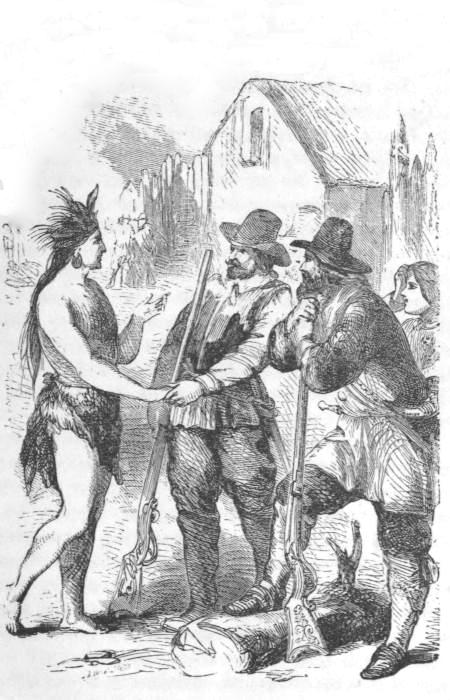
Indian Friendship.
The father of the young lad, who was the
principal cause that O’Hara’s life had been
saved, had long been admired by all who knew
him for his philanthropy; on account of which
the traders had given him the name of “the
gentleman.” Otherwise this Indian was not
in connection with the Christian Indian Society,
though a friend to them. He lived with his
family retired and in a decent manner.
While I feel a delight in offering to the relatives
and friends of the deceased, as also to the
public, this true and faithful picture of Indian
fidelity—I regret that, on necessarily having
had to recur to the names ‘Anthony’ and ‘Luke
Holland,’ I am drawn from scenes of pleasure,
to crimes of the blackest hue. The very Indian
just named, who at that time joyfully reported
to me his having conducted his friend out of
danger, to a place of safety, some years after
approached me with the doleful news that
every one of his children, (all minors) together
with his hoary headed parents, had been murdered
by the white people, at Gradenhutten, on
the Muskingum.
JOHN HECKELWELDER.
THE HEROIC COLLAPISSA.
In the heart of the savage, there are some
noble and redeeming qualities; he can be
faithful, even unto death, to the friend or the
stranger who has dwelt beneath his roof, or
sat under the shadow of the same tree. He
can be generous also; can endure all tortures,
rather than show weakness or fear.
“An instance of this occurred,” says Bossu,
“when the French were in possession of New
Orleans: a Chactaw, speaking very ill of them,
said the Collapissas were their slaves; one of
the latter, vexed at such words, killed him with
his gun. The nation of Chactaws, the greatest
and most numerous on the continent, armed
immediately, and sent deputies to New Orleans
to ask for the head of the murderer, who had
put himself under the protection of the French.
They offered presents to make up the quarrel,
but the cruel people would not accept any!
they even threatened to destroy the village of
the Collapissas. To prevent the effusion of
blood, the unhappy Indian was delivered up to
them: the Sieur Ferrand was charged with the
commission. The Indian was called Tichou;
he stood upright in the midst of his own people
and of his enemies, and said, “I am a true man,
that is, I do not fear death; but I pity the fate
of a wife and four children, whom I leave behind
me very young; and of my father and
mother, who are old, and for whom I got subsistence
by hunting.” (He was the best hunter
in the nation.)
He had hardly spoken the last word of this
short speech, when his father, penetrated with
his son’s love, rose amidst the people, and
spoke as follows:—
“It is through courage that my son dies;
but, being young and full of vigour, he is more
fit than myself to provide for his mother, wife,
and four little children: it is therefore necessary
he should stay on earth to take care of them.
As to myself, I am near the end of my career;
I am no longer fit for anything: I cannot go
like the roebuck, whose course is like the
winds, unseen; I cannot sleep like the hare,
with my ears never shut; but I have lived as
a man, and will die as such, therefore I go to
take his place.”
At these words, his wife, his son, his daughter-in-law,
and their little children, shed tears
round the brave old man: he embraced them
for the last time. The relations of the dead
Chactaw accepted the offer; after that, he laid
himself on the trunk of a tree, and his head
was cut off with one stroke of a hatchet.
Every thing was made up by this death; but
the young man was obliged to give them his
father’s head: in taking it up, he said to it,
“Pardon me thy death, and remember me in
the country of spirits.”
All the French who assisted at this event
were moved even to tears, and admired this
noble old man. A people among whom such
things could be done, hardly deserved the
sweeping censures of Mather and other good
men, who painted them rather as fiends in
human shape. Courage is, of course, the virtue
held in most honour: those who run away
or desert in an action are not punished, they
are considered as the disgrace of human nature:
the ugliest girls will not accept of them
for husbands: they are obliged to let their hair
grow, and to wear an alcoman, or apron, like
the women. “I saw one of them,” says Bossu,
who dwelt a long time among the Indians
“who, being ashamed of his figure, went by
himself to fight the Chicachas, for his misery
was more than he could bear: for three or four
days he went on creeping like a snake, and
hiding himself in the great grass, without eating
or drinking; so he came to their country,
and watched a long time to do some exploit;
often lying down in the rushes, when his enemies
came near, and putting out his head
above the water from time to time, to take
breath. At last he drew near a village in the
night, cried the cry of death, killed one of the
people, and then fled with the speed of an
arrow. He was out three months upon this
expedition: when he drew nigh to his own
village, weary, and bearing the head of his
enemy, they came down the hill to meet him.
The women were loud in his praises—the
warriors gathered round him; and then they
gave him a wife.”
JOHN ELIOT’S FIRST MISSION TO THE INDIANS.
On the 28th of October, 1646, Eliot set out
from his home, in Roxbury, Massachusetts, in
company with three friends, to the nearest Indian
settlement: he had previously sent to give
this tribe notice of his coming, and a very large
number was collected from all quarters. If the
savages expected the coming of their guest, of
whose name they had often heard, to be like
that of a warrior or sachem, they were greatly
deceived. They saw Eliot on foot, drawing
near, with his companions; his translation of
the scriptures, like a calumet of peace and love,
in his hand. He was met by their chief, Waubon
who conducted him to a large wigwam.
After a short rest, Eliot went into the open air
and standing on a grassy mound, while the people
formed around him in all the stillness of
strong surprise and curiosity, he prayed in the
English tongue, as if he could not address heaven
in a language both strange and new. And
then he preached for an hour in their own
tongue, and gave a clear and simple account of
the religion of Christ, of his character and life,
of the blessed state of those who believed in
him.
Of what avail would it have been to set before
this listening people the terrors of the
Almighty, and the doom of the guilty? This
wise man knew, by long experience as a minister,
that the heart loves better to be persuaded
than terrified—to be melted than alarmed. The
whole career of the Indian’s life tended to
freeze up the finer and softer feelings, and make
the more dark and painful passions familiar to
him. He resolved to strike a new chord, and
when he saw the tear stream down their stern
faces, and the haughty head sink low on the
breast, as he painted the ineffable love of
Christ, he said it was “a glorious and affecting
spectacle to see a company of perishing forlorn
outcasts, so drinking in the word of salvation.”
The impressions this discourse produced, were
of a very favourable nature: as far as the chief,
Waubon, was concerned, they were never
effaced. Afterwards the guest passed several
hours conversing with the Indians, and answering
their questions. When night came, he returned
to the tent with the chief, and the people
entered their wigwams, or lay down around,
and slept on the grass. What were Eliot’s feelings
on this night? At last, the longing of
years was accomplished; the fruit of his
prayers was given to him.
“Could the walls of his loved study speak,”
says his friend, “they would tell of the entreaties
poured forth before the Lord, of the days
and nights set apart with fasting—that thus,
thus it might be.” A few of the chiefs’ friends
alone remained, after the people were retired.
One of the Christians perceived an Indian, who
was hanging down his head, weeping; the
former went to him, and spoke encouraging
words, after which he turned his face to the
wall, and wept yet more abundantly: soon
after, he rose and went out. “When they told
me of his tears,” said Eliot, “we resolved to go
forth, and follow him into the wood, and speak
to him. The proud Indian’s spirit was quite
broken: at last we parted, greatly rejoicing for
such sorrowing.”
He now resolved to continue his labours;
but, on the 26th of November, when he met
the assembly of the Indians for the third time,
he found that, though many of them had constructed
wigwams at the place of meeting, for
the more readily attending his ministry, his
audience was not so numerous as on the former
occasions. The Powahs (or soothsayers) had
strictly charged the people not to listen to the
instructions of the English, and threatened them
with death in case of disobedience. Having
warned his auditors against the impositions of
these men, he proceeded to discourse as formerly,
and was heard with the greatest attention.
“It is wonderful,” observed one of his
friends, “to see what a little light will effect,
even upon hearts and spirits most incapable.”
On the night after this third meeting, many
were gathered in the tent, looking earnestly at
Eliot, with the solemn gravity and stillness
which these savages affected; when the chief,
Waubon, suddenly rose, and began to instruct
all the company out of the things he had heard
that day from Eliot, with the wild and impressive
eloquence of the desert. And waking
often that night, he many times was heard
speaking to some or other of his people, of the
words of truth and mercy that he had heard.
Two or three days after these impressions
had been made, Eliot saw that they were likely
to be attended with permanent consequences.
Wampas, an intelligent Indian, came with two
of his companions to the English, and desired
to be admitted into their families. He brought
his son, and several other children with him,
and begged that they might be educated in the
Christian faith: the example quickly spread
and all the Indians who were present at the
fourth meeting, on the 9th of December, offered
their children to be instructed.
The missionary was himself surprised at the
success of his first efforts, as well as at his
facility of preaching and conversing in the Indian
tongue; it was the reward of his long and
patient application. “To think of raising,”
says Mather, “these hideous creatures unto the
elevations of our holy religion, must argue a
more than common or little soul in the undertaker:
could he see any thing angelical to encourage
his labours?—all was diabolical among
them.”
Eliot saw that they must be civilized ere they
could be christianized; that he must make men
of them, ere he could hope to see them saints.
It is, no doubt, far easier and more flattering to
the soul of the agent, to see men weep and
tremble beneath his word, than to teach them
to build, to plant, to rear the walls and the roof-tree,
and sit at their own hearth-side: this is
slow and painful work for a man of lofty mind
and glowing enthusiasm. But in his own
words, “he abhorred that he should sit still,
and let that work alone;” and lost no time in
addressing himself to the General Court of the
colony, in behalf of those who showed a willingness
to be placed under his care. His application
was successful; and the Indians, having
received a grant of land on which they might
build a town, and enjoy the Christian instruction
which they desired, met together, and gave
their assent to several laws which he had
framed, to enforce industry and decency—to
secure personal and domestic comfort.
The ground of the town having been marked
out, Eliot advised the Indians to surround it
with ditches and a stone wall; gave them instruments
to aid these objects, and such rewards,
in money, as induced them to work
hard. It was a strange and novel thing to see
these men of the wilderness, to whom a few
months previous all restraint was slavery, and
their lakes and forests dearer than the palaces
of kings, submit cheerfully to this drudgery of
bricks and mortar—chief as well as serf; the
very hands that were lately red with slaughter,
scooping the earth at the bidding of Eliot, from
morn to night. He soon had the pleasure of
seeing Nonanetum completed.
The progress of civilization which followed,
was remarkable for its extent and rapidity: the
women were taught to spin, and they soon
found something to send to the nearest markets
all the year round: in winter they sold staves,
baskets, and poultry; in spring and summer
fish, grapes, strawberries, &c.
In the mean while, he instructed the men in
husbandry, and the more simple mechanical
arts: in hay-time and harvest, he went forth
into the fields with them. All this was not done
in a day, for they were neither so industrious
nor so capable of hard labour as those who had
been accustomed to it from early life.
AN INDIAN FUNERAL AT NONANETUM.
At a funeral, on the 7th of October, 1647, a
change in the usages and prejudices of the Indians
was evinced in a striking manner. The
deceased was a man of some consequence.
Their custom had been to mourn much for the
dead, and to appear overcome with grief, especially
when the earth shrouded them from their
sight. The departed was borne to the grave
on a light bier, and interred in a sitting posture;
in his hand was placed a calumet and some
tobacco, that he might present the ensigns of
peace to the people of another world. If the
corpse was that of a warrior, his quiver full of
arrows, a bow, and a hatchet, were placed by
his side, and also a little mirror, that he might
see how his face looked after passing through
the region of death; and a little vermilion to
take away its extreme paleness. His was a
bold hand that could at once tear aside these
loved usages, and make the dust of the warrior
of no more consequence than that of the meanest
of his followers. The cemetery of the new
town was in the woods, and the procession of
all the inhabitants moved slowly beneath their
shadow, in deep and solemn silence, with the
missionary at their head: no wail was heard—no
wild gush of sorrow. To estimate this
sacrifice, it is necessary to recur to the Indian
belief, “that after death they should go to a
very fertile country, where they were to have
many wives, and, above all, lovely places for
hunting:” often, no doubt, the shadowy chase
of the bear and the stag came on the dreams
of the dying man; and afterwards, beautiful
women would welcome him, weary to his
home. When the dead was laid in the grave,
Eliot read the funeral service over him, and
then told the many people, that in heaven they
neither married nor were given in marriage;
that the passions of this world, the wild chase
or the warrior’s joy, could never come there;
there was neither chieftain nor slave; that in
the love of Christ, who was the resurrection
and the life, all these things would be lost.
And they believed him—those fierce and brutal
men—and wept, not for the dead, but for themselves;
“so that the woods,” says a gentleman
who was present, “rang with their sighs and
prayers;” he also adds these words,—“God
was with Eliot, and the sword of his word will
pierce deep, in the hand of the mighty.” His
opinion of the mental powers of this people
was not a very low one:—“There is need,”
he says, in one of his letters, “of learning, in
ministers who preach to Indians, much more
than to Englishmen and gracious Christians;
for these had sundry philosophical questions,
which some knowledge of the arts must help
to give answer to, and without which they
would not have been satisfied. Worse than
Indian ignorance hath blinded their eyes, that
renounce learning as an enemy to gospel ministers”.
So acute were many of the questions
proposed by the Indians, and so deeply expressive
of a gentler and better nature, that more
than one educated stranger was induced to
attend regularly the assemblies of the missionary.
THE BURNING OF SCHENECTADY.
The incursions of the Indians on our frontiers
in early times were usually the result of Spanish
influence in the South, or French influence in
the North. The French reduced the incitement
of Indian hostilities to a complete system, and
their officers and soldiers were not ashamed to
accompany the savages in their murdering and
marauding expeditions into New England and
New York. Among all the recorded instances
of this kind, none appears to have been attended
with more atrocious circumstances of cruelty
and rapine, than the burning of Schenectady.
This affair is marked by many traits of the very
worst description. The inhumanity of murdering
in their beds the very people who had formerly
relieved their wants, is, perhaps, without
a parallel.
In 1690, Count de Frontignac, governor
general of Canada, sent out three expeditions
against the American colonies. The first of
these proceeded against Schenectady, then a
small village, situated on the Mohawk river.
This party, after wandering for twenty-two
days through deserts rendered trackless by
snow, approached the village of Schenectady
in so exhausted a condition, that they had determined
to surrender themselves to the inhabitants
as prisoners of war. But, arriving at a
late hour on an inclement night, and hearing
from the messengers they had sent forward that
the inhabitants were all in bed, without even
the precaution of a public watch, they exchanged
their intention of imploring mercy to
themselves, for a plan of nocturnal attack and
massacre of the defenceless people, to whose
charity their own countrymen had once been so
highly indebted. This detestable requital of
good with evil was executed with a barbarity
which, of itself, must be acknowledged to form
one of the most revolting and terrific pictures
that has ever been exhibited of human cruelty
and ferocity. Dividing themselves into a number
of parties, they set fire to the village in various
places, and attacked the inhabitants with
fatal advantage when, alarmed by the conflagration,
they endeavoured to escape from their
burning houses. The exhausted strength of
the Frenchmen appeared to revive with the
work of destruction, and to gather energy from
the animated horror of the scene. Not only
were all the male inhabitants they could reach
put to death, but women were murdered, and
their infants dashed on the walls of the houses.
But either the delay caused by this elaborate
cruelty, or the more merciful haste of the
flames to announce the calamity to those who
might still fly from the assassins, enabled many
of the inhabitants to escape. The efforts of
the assailants were also somewhat impeded by
a sagacious discrimination which they thought
it expedient to exercise. Though unmindful
of benefits, they were not regardless of policy:
and of a number of Mohawk Indians who
were in the village, not one sustained an injury.
Sixty persons perished in the massacre, and
twenty-seven were taken prisoners. Of the
fugitives who escaped half naked, and made
their way through a storm of snow to Albany,
twenty-five lost their limbs from the intensity
of the frost. The French, having totally destroyed
Schenectady, retired loaded with plunder
from a place where, we think, it must be
acknowledged that even the accustomed atrocities
of Indian warfare had been outdone.
REMARKABLE CUSTOM OF THE NATCHES.
The Natches were a very considerable nation;
they formed several villages, that were
under some peculiar chief, and these obeyed
one superior of the whole nation. All these
chiefs bore the name of suns; they adored
that luminary, and carried his image on their
breasts, rudely carved. The manner in which
the Natches rendered divine service to the sun
has something solemn in it. The high-priest
got up at break of day, and marched at the
head of the people with a grave pace, the calumet
of peace in his hand. He smoked in
honour of the sun, and blew the first mouthful
of smoke towards him; when he rose above
the horizon, they howled by turns after the
high-priests, and contemplated it with their
arms extended to heaven. They had a temple
in which they kept up an eternal fire.
So proud were these chiefs, who pretended
to trace their origin to the sun, that they had a
law, by which every Natchez, who had married
a girl of the blood of the suns, must follow
her in death, as soon as she had breathed her
last. There was an Indian, whose name was
Etteacteal; he dearly loved a daughter of one
of these suns, and married her; but the consequence
of this honour had nearly proved very
fatal to him. His wife fell sick: he watched
over her day and night, and with many tears
he besought her not to die, and they prayed together
to Wachil, or the sun, that he would
spare her life; at last he saw her at the point
of death, and then he fled: for the moment she
ceased to breathe, he was to be slain. He embarked
in a piragua on the Mississippi, and
came to New Orleans. He put himself under
the protection of M. de Bienville, the then governor,
who interested himself for him with
the Natches; they declared that he had nothing
more to fear.
Etteacteal, being thus assured, resolved to
return to his nation; and, without settling
among them, made several voyages thither;
he happened to be there, when the chief called
the Stung Serpent, brother to the head of the
nation, died; he was a relation of the late wife
of Etteacteal, and the people resolved to make
the latter pay his debt, and arrested him.
When he found himself in the hut of the grand
chief of war, he gave vent to the excess of his
grief.
The favourite wife of the deceased Stung
Serpent, who was likewise to be sacrificed,
and who saw the preparations for her death
with firmness, hearing the complaints and
groans of Etteacteal, said to him, “Art thou no
warrior?” he said, “Yes, I am one.” “However,”
said she, “thou criest, life is dear to
thee; and as that is the case, it is not good
that thou shouldst go along with me—go with
the women.” Etteacteal replied, “True, life
is dear to me: it would be well if I walked
yet on earth; wait, O wait till the death of the
great sun, and I will die with him.” “Go thy
way,” she said, “it is not fit that thou die with
me, and thy heart remain behind on earth;
the warriors will obey my word, for now, so
near to the Spirit of life, I am full of power:
go away, and let me see thee no more.” He
did not stay to have this order repeated; he
disappeared like lightning. Three old women,
two of whom were his relations, offered to pay
his debt; their age and their infirmities had
disgusted them with life, none of them had
been able to walk for a great while; but the
hair of the two that were related to Etteacteal,
was no more grey than that of young women;
the third was a hundred and twenty years old;
they were sacrificed in the evening, at the going
down of the sun.
The generosity of these women gave the Indian
life again, acquired him the degree of
Considered, and cleared his honour, that had
been sullied by his fearing death. The hour
being come for the sacrifice of the favourite
wife of the deceased chief, she came forth, and
called her children round her, while the people
stood a little way off: “Children,” she said,
“this is the day on which I am to tear myself
from your arms, and to follow your father’s
steps, who waits for me in the country of the
spirits; if I were to yield to your tears, I
should injure my love, and fail in my duty. I
have done enough for you by bearing you next
to my heart, and by suckling you with my
breasts. You that are descended of his blood,
and fed by my milk, ought you to shed tears?
rejoice, rather, that you are suns and warriors:
go, my children, I have provided for all your
wants, by procuring you friends; my friends,
and those of your father, are yours too. And
you, Frenchmen,” she added, turning herself
towards our officers, “I recommend my orphan
children to you;—you ought to protect
them; we shall be longer friends in the country
of the spirits than here, because we do not
die there again. And now the day is sinking
behind the hills; yet a few moments, my husband,
and I come!”
Moved by these words, a noble woman
came to join herself to the favourite wife, of
her own accord, being engaged, she said, by
the friendship she bore the Stung Serpent, to
follow him into the other world. The Europeans
called her the Haughty Lady, on account
of her majestic deportment, and proud and
beautiful features: on this account the French
officers regretted very much her resolve, and
strove to dissuade her from it, but in vain: the
moving sight filled them all with grief and
horror.
PONTIAC.
Great as were many of the western Indian
warriors, none was greater than Pontiac, a chief
whose fame was not only spread throughout
America, but widely diffused in Europe. He
was the chief of all the Indians on the chain of
lakes: the Ottawas, to which he belonged, the
Miamis, Chippewas, Wyandots, Pottawatomies,
Winnebagoes, Shawanese, Ottagamies, and Mississagas,
all of which tribes afterwards were led
by Tecumseh. Pontiac is said to have possessed
a majestic and princely appearance, so pleasing
to the Indians, and this in part accounts for his
popularity among them.
In 1760, after the capture of Quebec, Major
Rogers was sent into the country of Pontiac to
drive the French from it. Being informed of
his approach, Pontiac sent word to him to wait
until he came to him. The major waited, and
when Pontiac came, that chief asked him why
he entered his dominions without permission.
The major answered that he came not against
the natives but the French; and at the same
time gave the chief several belts of wampum;
whereupon Pontiac replied, “I stand in the path
you travel until to-morrow morning.” By this
was meant that he must not proceed until the
next morning. Upon an offer of the Indian,
Major Rogers bought a large quantity of parched
corn, and other provisions. The next day Pontiac
offered him every facility for the undertaking.
Messengers were sent to the different
tribes to assure them that the English had his
permission to pass through the country, and he
even accompanied the major and troops as far
as Detroit. He was noted for the desire of
knowledge, and while the English were in his
country, he was very curious in examining their
arms, clothes, &c., and expressed a wish to go
to England. He said that he would allow
white settlements within his domains; and was
willing to call the king of England uncle but
not master. He further told the soldiers that
they must behave themselves peaceably while
in his country, or he would stop the way.
Pontiac had distinguished himself at Detroit
and Michillimackinac. When the French gave
up Canada (1760), their Indian allies still preserved
their hatred towards the English, and as
Pontiac was the most considerable enemy of
that nation, the adjacent tribes all came to him
as a support against them. Pontiac had advanced
farther in civilization than any of the
neighbouring chiefs: he appointed a commissary
during the war of 1763, called Pontiac’s war;
and issued bills of credit, on each of which was
pictured the thing desired, and the figure of an
otter, the symbol of his tribe. In 1763 Major
Rogers sent a bottle of brandy to him, which
Pontiac was counselled not to drink, as it probably
contained poison. But with the greatest
magnanimity he exclaimed, “It is not in his
power to kill him who has so lately saved his
life.”
THE IDOL OF THE PEORIAS. (FROM AN OLD TRAVELLER.)
“We arrived at the village of the Peorias,
allies of the Illinois, through a fine large meadow,
which is many leagues long. This village
is situated on the banks of a little river, and
surrounded with great pales and posts: there
are many trees on the banks, and the huts are
built beneath them. When we arrived there,
I inquired for the hut of the grand chief: I was
well received by him and his first warriors.
They had just been beaten by the Foxes, their
mortal enemies, and were now holding a consultation
about it. A young Indian lighted the
calumet of peace; then they brought me a dish
of maize flour, called sagamité, sweetened with
the syrup of the maple-tree; and afterwards a
dessert of dry fruits, as good as Corinth raisins.
The next day I saw a great crowd in the plain:
they were for making a dance in favour of
their new Manitou; the high priest had a bonnet
of feathers, like a crown, on his head. I
was at the door of the temple of their false
deity; he begged me to go in. Judge of my
astonishment, for this is the picture of their
Manitou: his head hung upon his breast, and
looked like a goat’s; his ears and his cruel eye
were like those of a lynx, with the same kind
of hair; his feet, hands, and thighs were in
form something like those of a man.
“The Indians found him in the woods, at the
foot of a ridge of mountains, and the priests
had persuaded them to adopt him for a divinity.
This general assembly was called, to invoke his
protection against their enemies. I let the Indians
know that their Manitou was an evil
genius; as a proof of it, I said that he had just
permitted the nation of Foxes, their most cruel
enemies, to gain a victory over them, and they
ought to get rid of him as soon as possible, and
be revenged on him. After a short time, they
answered, ‘Houé nigeié, tinai labé,’—‘we believe
thee, thou art in the right.’ They then
voted that he should be burnt; and the great
priest, after some opposition, pronounced his
sentence, which, according to the interpreter’s
explanation, was in these terms: ‘O thou, fatal
to our nation, who has wrongfully taken thee
for her Manitou! thou hast paid no regard to
the offerings which we have made thee, and
hast allowed our enemies, whom thou dost
plainly protect, to overcome us; therefore our
old men, assembled in council, have decreed,
with the advice of the chief of the white warriors,
that to expiate thy ingratitude towards
us, thou shalt be burnt alive.’ At the end of
this sentence, all the assembly said, ‘Hau, hau,’
which signified ‘yes.’
“As I wished to get this monster, I went to
the priest, made him a small present, and bid
my interpreter tell him that he should persuade
his countrymen, that if they burnt this evil genius,
there might arise one from his ashes that
could be fatal to them; that I would go on purpose
across the great lake, to deliver them from
it. He found my reasons good, and got the
sentence changed, so that it was strangled. I
got it instantly dissected, in order to bring it to
France, where its skeleton is now in the cabinet
of natural history of M. de Fayolles. The
assembly dispersed, and returned to their village
by the river side. In the evening you might
see them sitting in groups at their doors, and on
the shore, with many fires made of the branches
of the trees, whose light was on the water and
the grove; while some of them danced the
dance of war, with loud shrieks, that were
enough to strike an awe into the heart.”
AN INDIAN IN COLLEGE.
The first serious disappointment which John
Eliot, the Indian Apostle, experienced, was in
his efforts for the instruction of the Indian
youth in the classic languages; many of the
ablest and most promising among them were
set apart for this purpose; his ambition was
to bring them up “with our English youth
in university learning.” Where was the use
of this? Eliot’s best purposes were prone
to be carried to excess. He gave away
a whole year’s salary, at a wretched cottage,
while his wife was probably expecting
it at home for household demands. He had
learned his Indians to read and write; many
could read English well; and now he wished
to give them a polite education, that must have
sat as gracefully on them as the full-sleeved
gown and bands of the divine. Considerable
sums were expended in their board and education:
a substantial building of brick, which cost
between three and four hundred pounds, was
erected; it was large enough to accommodate
twenty scholars. It must have been Spartan
discipline to the heads as well as hearts of the
poor Indians, to labour morn and night through
the Greek and Roman authors, to try to discover
and relish the beauties of style and the
splendour of imagery. No doubt, their thoughts
sometimes fled away to their deserts, where
their fathers roved in dignity and freedom, and
books never came. The design might be praiseworthy,
but Providence did not smile upon it,
most of these young men died when they had
made great proficiency in their studies, as if the
languages wore out their hearts; others abandoned
their books, even when they were prepared
to enter Harvard College, in the town of
Cambridge; their patience was probably exhausted,
and the boon of literary dignity could
lure them no further. A few of these, passing
from one extreme to the other, burst their bonds
at once; and as if mind and body panted together
to be free, hastened back to the wilderness
again, into its wigwams and swamps;
where neither Homer nor Ovid was like to
follow them.
“These circumstances proved very discouraging
to the godly in New England,” says a
contemporary. “Some were so far affected by
them, as to conceive that they were manifest
tokens of the Divine disapprobation. Mr. Eliot,
however, whose faith was more vigorous, considered
them merely as trials, to which they
ought to submit without reluctance.” In consequence
of the death and failure of those who
entered the aforesaid building, it was soon after
chiefly occupied by the English. Only one of
these Indian students appears to have obtained
his degree at Harvard College; and at the conclusion
of two Latin and Greek elegies, which
he composed on the death of an eminent minister,
subscribed himself “Cheesecaumuk, Senior
Sophista.” What an incongruous blending
of sounds!
Eliot at last saw his error, and, instead of
the classics, applied with fresh ardour to his
more useful translations, of which the circulation
was so rapid, that he printed a fresh edition
of the “Practice of Piety.” He also soon
after established a lecture at Naticke, in which
he explained the leading doctrines of theology
and logic: here he was on safe ground, and his
labours were eminently useful. During the
summer months they assembled eagerly once
a fortnight, and many of them gained much
knowledge; yet he was far from being satisfied
with his oral instructions, and he printed a
thousand copies of a logic primer, and made
little systems of all the liberal arts, for the use
of the Indians. The same minds that had pined
and sunk beneath the study of the classic
tongues, embraced these things with ardour.
CAPTAIN JOHN SMITH.
This gentleman figures, in the early history
of our country, as the most strenuous promoter
of colonization, the most wise founder, and the
most active governor, of colonies. In New
England he acted as discoverer and settler; in
Virginia he sustained both these characters, as
well as that of the most efficient and able governor
of the first permanent colony. When
he landed upon the soil, he was a private
citizen; but the misgovernment of others soon
made it necessary to call him to the office of
governor.
Under his directions James-Town was fortified
by such defences as were sufficient to repel
the attacks of the savages; and, by dint of
great labour, which he was always the foremost
to share, the colonists were provided with
dwellings that afforded shelter from the weather,
and contributed to restore and preserve their
health. Finding the supplies of the savages
discontinued, he put himself at the head of a
detachment of his people, and penetrated into
the country; and by courtesy and liberality to
the tribes whom he found well disposed, and
vigorously repelling the hostilities of such as
were otherwise minded, he obtained for the
colony the most abundant supplies.
In the midst of his successes he was surprised
on an expedition, by a hostile body of savages,
who, having succeeded in making him prisoner,
after a gallant and nearly successful defence,
prepared to inflict on him the usual fate of their
captives. His eminent faculties did not desert
him on this trying occasion. He desired to
speak with the sachem or chief, and, presenting
him with a mariner’s compass, expatiated on
the wonderful discoveries to which it had led,
described the shape of the earth, the vastness of
its lands and oceans, the course of the sun, the
varieties of nations, and the singularity of their
relative positions, which made some of them
antipodes to the others.
With equal prudence and magnanimity he refrained
from all solicitations for his life, which
would only have weakened the impressions
which he hoped to produce. The savages
listened with amazement and admiration. They
had handled the compass, and viewing with
surprise the play of the needle, which they
plainly saw, but found it impossible to touch,
from the intervention of the glass, this marvellous
object prepared their minds for the reception
of those vast impressions by which
their captive endeavoured to gain ascendency
over them.
For an hour after he had finished his harangue,
they seem to have remained undecided; till
their habitual sentiments reviving, they resumed
their suspended purpose, and, having bound
him to a tree, prepared to dispatch him with
their arrows. But a stronger impression had
been made on their chief; and his soul, enlarged
for a season by the admission of knowledge, or
subdued by the influence of wonder, revolted
from the dominion of habitual ferocity. This
chief was named Opechancanough, and destined
at a future period to invest his barbarous
name with terror and celebrity. Holding
up the compass in his hand, he gave the signal
of reprieve, and Smith, though still guarded as
a prisoner, was conducted to a dwelling where
he was kindly treated, and plentifully entertained.
But the strongest impressions pass
away, while the influence of habit remains.
After vainly endeavouring to prevail on their
captive to betray the English colony into their
hands, they referred his fate to Powhatan, the
king or principal sachem of the country, to
whose presence they conducted him in triumphal
procession. The king received him with
much ceremony, ordered a plentiful repast to be
set before him, and then adjudged him to suffer
death by having his head laid on a stone and
beat to pieces with clubs. At the place appointed
for this barbarous execution, he was
again rescued from impending fate by the interposition
of Pocahontas, the favourite daughter
of the king, who, finding her first entreaties disregarded,
threw her arms around the prisoner,
and declared her determination to save him or
die with him. Her generous affection prevailed
over the cruelty of her tribe, and the king not
only gave Smith his life, but soon after sent
him back to James-Town, where the beneficence
of Pocahontas continued to follow him
with supplies of provisions that delivered the
colony from famine.
ANECDOTES OF KING PHILIP’S WAR. — COMMENCEMENT OF THE WAR. — INTERVIEW BETWEEN ELIOT AND PHILIP. — CHRISTIAN INDIANS ENGAGE IN THE WAR. — MISFORTUNES OF PHILIP. — CLOSE OF THE WAR. — DEATH OF PHILIP.
In the year 1674, the number of Eliot’s towns
and settlements, in which industry, comfort,
good order, and the best instruction, were established,
amounted to more than twelve, when
an unforeseen event happened, that threw a
cloud over all his prospects. This was the war
in which the colonists of New England were
involved with Philip, son of Massasoit, the celebrated
chief, and, for the last years of his life,
the firm friend of the English. “O, thou sword
of the wilderness, when wilt thou be quiet?”
says Mather, forgetful that it was bared by the
aggressions of the settlers, as well as by the
fierce and restless spirit of the Indian prince.
Ever since the foundation of the colonies, the
former had conducted themselves, says more
than one divine of the period, with great kindness
to their heathen brethren. The truth of
this assertion is very doubtful. The missionary
took no part in the disputes, save to urge his
countrymen to forbearance and peace. “We,
the poor church of Naticke,” he writes to them,
“hearing that the honoured rulers of Plymouth
are pressing and arming of soldiers to go to
war with the Indians, do mourn greatly on account
of it, and desire that they may not be
destroyed, because we have not heard that they
have done any thing worthy of death. It is
your duty to offer, accept, and desire peace, and
we pray you, for God’s sake, and for your
souls’ sake, obey this word; we long to hear
of a happy peace, that may open a clear passage
for the gospel among that people.” Simple
as these words are, they unfold an affection
on the part of the missionary and his converts,
for those who had few claims on their regard;
for Philip, and most of his chiefs, had sternly
rejected all persuasions to Christianity. But
Eliot was not of the sentiment of another divine,
who rejoiced in the rejection of the proposals
by the Indians, that “this thing was of
the Lord.” He saw only on one side an exquisite
jealousy, roused by many wrongs, a
heart burning with vindictive feelings; on the
other, a sordid ambition, an unhallowed love
of glory. It was a source of sorrow, that the
torch of discord was first kindled by one of his
own people. In the end of the year 1674, John
Seusoman, a converted Indian, after having
apostatized from the faith, devoted himself to
the service of Philip, as secretary. He informed
the English that his countrymen had resolved
to adopt measures for their destruction. “He
could write,” says the historian, “though the
king, his master, could not read.”
This renegade, fearing the consequences of
what he had done, returned to the protection
of the settlers, and was soon after slain by two
of the Indian captains. The English arrested
the perpetrators of the deed, and, on a trial by
jury, finding them guilty, they were executed.
Philip was alarmed at the condemnation of his
counsellors, and, conscious that he had given
cause for suspicion, resolved to be the first in
the field. He had probably long waited for an
opportunity. Rash, headstrong, and vindictive,
with the courage but not the talents of his
father, Massasoit, the slow and artful aggressions
of the settlers stung him to the quick.
He began to gather his warriors around his
dwelling-place, at the strong forts near the Naraganset
river; he received the accession of
several other tribes. In the mean time, it was
said, strange sights and sounds foreboded, in
many parts of the colonies, the woes that were
near; the singing of bullets, and the awful
passing away of drums in the air; invisible
troops of horses were heard riding to and fro;
and in a clear, still, sunshiny morning, the phantoms
of men, fearfully flitting by! Philip, heedless
of omens and dreams, sent away the women
and children, and took his stand on Mount
Hope, a low and beautiful eminence, on which
was his strongest fort. Ere matters came to a
fatal extremity, and all the evils of war were
let loose on his settlements, Eliot did his utmost
to turn them aside; he saw that many of his
people would inevitably be involved with one
party or the other. His town of Pakeunit was
very near Mount Hope; he had visited the latter
during the life of Massasoit, and though he
felt not the same regard or esteem for his son,
a friendly intercourse had subsisted between
them. His applications to the colonists for
peace being fruitless, he resolved to try them
also on the former.
A few miles only distant, the encampment
of the Indians around their Mount was distinctly
visible from Pakeunit; and Eliot, with
two or three of his people, went to have an interview
with the chieftain. Philip respected
his character, though he disliked his proceedings,
for he had always treated his mission with
contempt and slight; among the warriors, however,
both of his own and other tribes, were
many who had heard Eliot preach, and had received
him beneath their roof. The interview
was without any success; the spirit of the Indian
was made up to the desperate struggle,
and all that could be done was to beseech him
to spare the settlements of the converts.
The contrast between the two men must
have been sufficiently striking. Philip was in
the prime of life, with a frame nerved by early
hardship, and the usages of savage warfare, in
which he was very expert; he was dressed like
his chiefs, save that he wore a silver-laced tunic,
or coat, and that his arms were more rich;
his chief ensign of dignity was his princely, yet
cruel and gloomy features, where the thirst of
revenge was stamped. The frame of the missionary
was not bowed even by seventy years,
though they had turned his hair white; the
leathern girdle was about his loins, that he
always wore, and the simple apparel that he
loved; he stood among these fierce and exasperated
men as calm and fearless as in his own
assembly at Naticke: he could not but foresee
the devastation about to be let loose on the
land; that the fire and the sword would waste
all his pleasant places, and scatter his converts;
and he returned with a heavy heart to his
home. Several of the latter afterwards sided
with the forces of Philip: whether from this
circumstance, or from the nearness of the settlement
of Pakeunit to the camp of the prince,
the colonists contracted the strongest dislike
and mistrust of the Christian Indians. Eliot,
when he saw there was no longer a chance of
peace, exhorted his people in the above town,
and at Naticke, as well as the other congregations,
not to be moved by the example or seductions
of either party.
The contagion was, however, too strong; and
Eliot at last saw many of them also take up
arms against their infidel countrymen. The order
and harmony of their dwelling-places were for
a time utterly blasted; on the hills around Naticke
and Pakeunit the watch-fires were blazing;
the war-whoops were often heard in the
night; at intervals, a solitary musket, and then
a signal cry, came from the neighbouring
woods; and yet nearer, the poor Indians at
last saw their plantations without the town,
burning; for Philip began hostilities by a sudden
attack on them, so that their taking up
arms was partly in self-defence. After several
actions, he retired from Mount Hope to the
woods, swamps, and fastnesses of the interior,
in the dominion of the great tribe of the Naraganset
Indians, who, for his sake, had now
broken treaty with the English. It was the
depth of winter, yet the latter resolved to follow
him to his retreats, and an army of fifteen
hundred men, under the command of the Hon.
J. Winslow, marched to the abode of the Indians.
This was on an island of about five or
six acres, the only entrance to which was upon
a long tree over the water, so that but one
man could pass at a time: but the water was
frozen; the trees and thickets were white with
their burden of snow, as was the surface of the
earth, so that the smallest movement of the
Indians could be seen.
Within the isle were gathered the powers of
the Pequot and Naraganset tribes, with their
wives, families, and valuable things; the want
of leaves and thick foliage allowed no ambush,
and the savage must fight openly beside his
own hearth and store. It was the close of day
when the colonists came up to the place; a
fort, a blockhouse, and a wall that passed round
the isle, proved the skill, as well as resolution,
of the assailed; the frozen shores and water
were quickly covered with the slain, and then
the Indians fought at their doors and around
their children, till all was lost, and a thousand
of them fell. Philip fled with his surviving
forces to a distant position, where it was impossible
to follow him. Concord, one of the
first settlements of Eliot, and one or two other
towns, were this winter destroyed, and its poor
people turned from their dwellings into all the
rigours of the winter; many perished in the
woods or amidst the snows, or by the secret
and sudden ambushes of the enemy.
The last defeat, in which his best fighting
men were slain, had broken the power, but not
the spirit, of Philip. Unable to meet the colonists
in the open field, he harassed them in a
thousand ways, so that, as the spring advanced,
the more industrious and timid were thrown
into the extremity of despair, and said, “How
shall we wade through another summer like
the last?” But the chief was now a wandering
exile; his paternal dominion was taken; the
singular friendship of Quanonchet, “the mighty
sachem of the Naragansets,” was his last support.
The fidelity of this man was tried to the
uttermost: he had received the fugitive with
open arms; rallied all his forces around him;
they fought, side by side, with the heroism of
men on the last strand of their country; were
defeated, and fled together, without a reproach
or complaint on either side; they retreated yet
farther into the interior, and, by their persuasions,
engaged other tribes in the cause; but, at
this moment, the Maquas, a powerful nation in
the west, made a descent on them, and wasted
their band. In spite of these disasters, they
again advanced.
Eliot, during these troubles, was subjected to
much contempt and reproach. His efforts to
protect his people, and watch over their interests,
were incessant; but so strong was the
suspicion against them, that the colonists, not
content with confining a great number of them
in Long Island, inflicted on them many sufferings,
and a few of the more cruel said that they
were worthy of death.
But the war began to draw to a close: Quanonchet,
venturing out with a few followers
near the enemy, was pursued and taken. His
behaviour under his misfortunes was very noble
and affecting; for when repeated offers were
made him of life, if he would deliver up Philip,
and submit his own people to the English, he
proudly rejected them. They condemned him
to die, and, by a refinement of cruelty, by the
hands of three young Indian chiefs. The heroic
man said, “that he liked it well, for he
should die before his heart was soft, or he had
spoken any thing unworthy of himself.”
Philip was deeply moved by the death of the
chieftain, for their friendship was like that of
David and Jonathan, strongest in misery and
exile. He was not yet left desolate: his beloved
wife and only child were with him.
They had shared all his sufferings; in his
flights, his inroads, his dwellings in the swamps,
they seem never to have left his side. The unfortunate
prince now returned to Mount Hope,
the scene of his former power and happiness;
it was for no purpose of defence that he came,
for it was too near the English settlements, but
merely to visit it once more. “He finds it,”
says Mather, “to be Mount Misery, Mount
Confusion!”
No doubt it was so to his bleeding spirit;
for, with all his savage propensities, this prince
was susceptible of some of the finest feelings
of our nature. He sat down mournfully on the
beautiful Mount, on which were now the ruins
of his fortress and camp; but he could not remain
long here, for the feet of his pursuers
were nigh, and he was compelled to seek his
distant retreats again:—there was a greater
agony in store for him than the sight of his
ruined home.
Early one morning, his quarters were surprised
by the English, most of his followers
slain, and his wife and son made captive. The
chief fled, broken-hearted, but unsubdued, leaving
all he loved on earth in the hands of those
who had no mercy. “This was no small torment
to him,” quaintly says the historian. “Wo
to him that spoileth! His peag, or silver belt,
the ensign of his princedom, also remained in
our hands, so hardly did he escape.” The measure
of his woes was not yet full. The Indian
princess of Pocasset was warmly attached to
his cause, and had more than once aided him
in his extremity; she had received him beneath
her roof, soothed his sorrows, and, what was
more, summoned her people to fight for him;
and saved him and his people in her canoes the
year before. Now, she followed him in his
flight, and, as the more devout said, as if by a
judgment, could not find a canoe to transport
her, and, venturing over the river upon a raft,
it broke under her, and she was drowned. Her
body was soon after washed on shore, and the
English, forgetful of all decency and delicacy
to a woman of her rank, though a savage, cut
off her head, and placed it on high, which,
when the Indians who were her people saw,
they gathered round, and gave way to the most
sad and touching lamentations.
Philip now began, like Saul of old, when
earth was leaving him, to look to the powers
beyond it, and to apply to his magicians and
sorcerers, who, on consulting their oracles,
assured him that no Englishman should ever
kill him. This was a vague consolation, yet it
seems to have given him, for a while, a confidence
in his destiny, and he took his last stand
in the middle of a distant and almost inaccessible
swamp. It was a fit retreat for a despairing
man, being one of those waste and dismal
places to which few ever wandered, covered
with rank and dense vegetation. The moist
soil was almost hidden by the cypress and other
trees, that spread their gloomy shades over the
treacherous shallows and pools beneath.
In the few drier parts, oaks and pines grew,
and, between them, a brushwood so thick, that
the savage could hardly penetrate: on the long
rich grass of these parts, wild cattle fed, unassailed
by the hand of man, save when they
ventured beyond the confines of the swamp.
There were wolves, deer, and other animals;
and wilder men, it was said, were seen here; it
was supposed that the children of some of the
Indians had either been lost or left here, and
had thus grown up like denizens of this wild.
Here the baffled chieftain gathered his little
band around him, like a lion baited by the
hunters, sullenly seeking his gloomy thickets,
only to spring forth more fatally; despair was
his only friend; for what other was now left:
his love was turned to agony; his wife was in
the hand of his enemies; and would they spare
her beauty? His only son, the heir of his long
line, must bow his head to their yoke; his chief
warriors had all fallen, and he could not trust
the few who were still with him.
Quanonchet, whose fidelity and attachment
were stronger than death, was in the land of
spirits, chasing the shadowy deer, and solaced
with many wives; for Philip, to the last, believed
in the religion of his country. In this
extremity, an Indian proposed to seek peace
with the English;—the prince instantly laid him
dead at his feet. This man had a friend, who,
disgusted with the deed, soon after fled from the
place to Rhode Island, where the English were
recruiting their weary forces, and betrayed the
place of his retreat. On this intelligence, a
body of forces instantly set out.
The night before his death, Philip, “like him
in the army of Midian,” says the historian,
“had been dreaming that he was fallen into the
hands of the English; he awoke in great alarm,
and told it to his friends, and advised them to
fly for their lives, for that he believed it would
come to pass.” The place was well suited to
awake all the terrors of the imagination; to
any eye but that of the savage, it was like the
“valley of the shadow of death;” the cypress
and oak trees hung heavy and still, over the
accursed soil; the faint gleam of the pools and
sluggish lakes on every side, in the starlight,
and the howl of the wolf, fitfully, as if it
warned that the hour was nigh. “Now, just
as he was telling his dream, Captain Church,
with his company, fell in upon them.” They
had been guided by the deserter to the swamp,
and, with great difficulty, across some felled
trees, into its labyrinths. The battle was fierce
and short: Philip fought till he saw almost
every follower fall in his defence, then turned,
and fled; he was pursued by an Englishman
and an Indian; and, as if the oracle was
doomed to be fulfilled, the musket of the former
would not go off; and the latter fired, and shot
him through the heart.
With his death, all resistance ceased; his
dominions fell into the hands of the colonists,
and peace was restored to the settlements, but
prosperity came not with it. It was a cruel
blow to Eliot, nearly all whose life had been
given to his beloved cause, to look around on
the plantations ravaged, the dwellings empty,
the defences broken, and, more than all, the
spirit of his people in despair. Of twelve
towns, at the beginning of the war, four only
were now undestroyed.
CHICKATAUBUT.
Chickataubut, was a sachem of considerable
note among the Massachusetts tribe, and one
of those who, in 1621, acknowledged themselves
the subjects of King James. He was
Sachem of Passonagesit (Weymouth,) where
his mother was buried. In Drake’s Indian Biography
the following is related from Thomas
Morton’s New Canaan. In the first settling of
Plymouth, some of the company in wandering
about upon discovery, came upon an Indian
grave, which was of the mother of Chickataubut.
Over the body a stake was set in the
ground, and two huge bear skins sewed together
spread over it; these the English took
away. When this came to the knowledge of
Chickataubut, he complained to his people and
demanded immediate vengeance. When they
were assembled, he thus harangued them:
‘When last the glorious light of all the sky was
underneath the globe and birds grew silent, I
began to settle as my custom is to take repose;
before mine eyes were fast closed, me thought I
saw a vision, at which my spirit was much
troubled, and trembling at that doleful sight
cried aloud; Behold! my son, whom I have
cherished, see the paps that gave thee suck, the
hands that clasped thee warm, and fed thee oft,
canst thou forget to take revenge on those wild
people that hath my monument defaced in a
despiteful manner; disdaining our ancient antiquities,
and honorable customs. See now the
Sachem’s grave lies, like unto the common
people of ignoble race, defaced. Thy mother
doth complain, implores thy aid against this
thievish people newly come hither; if this be
suffered I shall not rest in quiet within my
everlasting habitation.’ Battle was the unanimous
resolve, and the English were watched
and followed from place to place, until at length
as some were going ashore in a boat, they fell
upon them, but gained little advantage. After
maintaining the fight for some time, and being
driven from tree to tree, the chief captain was
wounded in the arm and the whole took to
flight. This action caused the natives about
Plymouth to look upon the English as invincible,
and was the reason that peace was maintained
so long after.
When Boston was settled Chickataubut
visited Governor Winthrop, and presented him
with a hogshead of corn. Many of his ‘sanops
and squaws’ came with him, but were most of
them sent away after they had all dined, Chickataubut
probably fearing they would be burdensome,
although it thundered and rained and the
Governor urged their stay. At this time he
wore English clothes, and sat at the Governor’s
table, where he behaved himself soberly, &c.
as an Englishman. “Not long after he called
on Governor Winthrop and desired to buy of
him a suit of clothes for himself, the governor
informed him that ‘English Sagamores did not
use to truck;’ but he called his tailor and gave
him orders to make him a suit of clothes,
whereupon he gave the governor two large
skins of coat beaver. The clothes being ready,
the governor put him into a very good new suit
from head to foot, and after, he set meat before
them; but he would not eat till the governor
had given thanks, and after meat he desired
him to do the like, and so departed.”
RELIGION OF THE INDIANS.
Of the religion of the Indians we have no
full and clear account. Indeed, of the opinions
of a people who have nothing more than a
few vague and indefinite notions, no distinct
explanation can be given. On this subject the
Indians are not communicative; and to obtain
a thorough knowledge of it would require
familiar, attentive, unsuspected, and unprejudiced
observation. But such observation is not
easily made; and a few general, and on some
points uncertain, notices only can be given.
On looking at the most renowned nations of
the ancient heathen world, we see the people
prostrating themselves before innumerable divinities;
and we are ready to conclude that
polytheism is the natural belief of man, unenlightened
by revelation. But a survey of the
vast wilds of America will correct this opinion.
For there we find a multitude of nations, widely
separated from each other, all believing in One
Supreme God, a great and good spirit, the father
and master of life, the maker of heaven and
earth, and of all other creatures. They believe
themselves entirely dependent on him, thank
him for present enjoyments, and pray to him for
the good things they desire to obtain. They
consider him the author of all good; and believe
he will reward or punish them according to
their deeds.
They believe in inferior spirits also, both
good and bad; to whom, particularly to the
good, they give the name of Manitou, and
consider them tutelary spirits. The Indians are
careful observers of dreams, and think themselves
deserted by the Master of life, till they
receive a manitou in a dream; that is, till they
dream of some object, as a buffalo or beaver, or
something else, which they think is an intimation
that the Great Spirit had given them that
object as a manitou, or medicine. Then they
are full of courage, and proud of their powerful
ally. To propitiate the manitou, or medicine,
every exertion is made, and every personal
consideration sacrificed. “I was lately the
proprietor of seventeen horses,” said a Mandan;
“but I have offered them all to my medicine,
and am now poor.” He had turned all these
horses, which constituted the whole of his
wealth, loose into the plain, committed them to
his medicine, and abandoned them for ever.
But, although they offer oblations to the manitous,
they positively deny that they pay them
any adoration, and affirm that they only worship
the Great Spirit through them.
They have no regular periodical time either
of private or public religious worship. They
have neither temples, altars, stated ministers of
religion, nor regular sacrifices; for the jugglers
are connected rather with the medical art than
with religious services. The Indians in general,
like other ignorant people, are believers in
witchcraft, and think many of their diseases
proceed from the arts of sorcerers. These arts
the jugglers pretend to counteract, as well as to
cure natural diseases. They also pretend to
predict the weather and to make rain; and
much confidence is placed in their prognostications
and their power.
The devotional exercises of the Indians consist
in singing, dancing, and performing various
mystical ceremonies, which they believe efficacious
in healing the sick, frustrating the designs
of their enemies, and securing their own success.
They often offer up to the Great Spirit a
part of the game first taken in a hunting expedition,
a part of the first produce of their fields,
and a part of their food. At a feast, they first
throw some of the broth, and then of the meat,
into the fire. In smoking, they generally testify
their reverence for the Master of life, by
directing the first puff upwards, and the second
downwards, or the first to the rising, and the
second to the setting sun: at other times they
turn the pipe to every point of the compass.
They firmly believe in the immortality of the
soul, and in a state of future retribution: but
their conceptions on these subjects are modified
and tinged by their occupations in life, and by
their notions of good and evil. They suppose
the spirit retains the same inclinations as when
in the body, and rejoices in its old pursuits. At
times, an Indian warrior, when about to kill
and scalp a prostrate enemy, addresses him in
such terms as the following:—
“My name is Cashegra: I am a famous
warrior, and am going to kill you. When you
reach the land of spirits, you will see the ghost
of my father: tell him it was Cashegra sent
you there.” The uplifted tomahawk then descends
upon his victim.
The Mandans[7] expected, when they died, to
return to the original subterraneous abode of
their fathers: the good reaching the ancient village
by means of the lake, which the weight
of the sins of the bad will render them unable
to pass. They who have behaved themselves
well in this life, and been brave warriors and
good hunters, will be received into the town of
brave and generous spirits; but the useless and
selfish will be doomed to reside in the town of
poor and useless spirits.
The belief of those untutored children of nature
has an influence on their conduct. Among
them the grand defect is, an erroneous estimate
of good and evil, right and wrong.
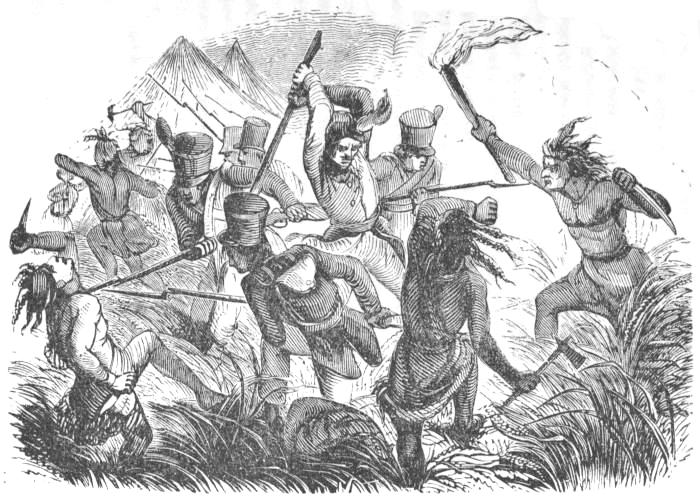
Destruction of the Pequots.
THE GREAT MASSACRE OF VIRGINIA.
The peace which had subsisted since the
marriage of Pocahontas had lulled the English
into security, and disposed them to extend their
plantations along the banks of the rivers, as far
as the Potomac, in situations too remote from
each other. Their houses were open and free
to the natives, who became acquainted with
their manner of living, their hours of eating, of
labor and repose, the use of their arms and tools,
and frequently borrowed their boats, for the
convenience of fishing and fowling, and to pass
the rivers. This familiarity was pleasing to the
English, as it indicated a spirit of moderation,
which had been always recommended, by the
Company in England, to the planters; and, as
it afforded a favourable symptom of the civilization
and conversion of the natives; but by
them, or their leaders, it was designed to conceal
the most sanguinary intentions.
In the spring of the next year, (1622) an
opportunity offered, to throw off the mask of
friendship, and kindle their secret enmity into a
blaze. Among the natives who frequently
visited the English, was a tall, handsome, young
chief, renowned for courage and success in war,
and excessively fond of finery in dress. His
Indian name was Nematanow; but by the
English he was called Jack of the Feather.
Coming to the store of one Morgan, he there
viewed several toys and ornaments, which were
very agreeable to the Indian taste; and persuaded
Morgan to carry them to Pamunky,
where he assured him of an advantageous
traffic. Morgan consented to go with him; but
was murdered by the way.
In a few days, Nematanow came again to the
store, with Morgan’s cap on his head; and
being interrogated by two stout lads, who
attended there, what was become of their
master, he answered that he was dead. The
boys seized him, and endeavoured to carry him
before a magistrate; but his violent resistance,
and the insolence of his language, so provoked
them, that they shot him. The wound proved
mortal; and when dying, he earnestly requested
of the boys, that the manner of his death might
be concealed from his countrymen, and that he
might be privately buried among the English.
As soon as this transaction was known, Opechancanough
demanded satisfaction; but being
answered that the retaliation was just, he formed
a plan for a general massacre of the English,
and appointed Friday, the twenty-second day
of March, for its execution; but he dissembled
his resentment to the last moment. Parties of
Indians were distributed through the Colony, to
attack every plantation, at the same hour of the
day, when the men should be abroad and at
work. On the evening before, and on the
morning of that fatal day, the Indians came as
usual to the houses of the English, bringing
game and fish to sell, and sat down with them
to breakfast. So general was the combination,
and so deep the plot, that about one hour before
noon, they fell on the people in the fields and
houses; and, with their own tools and weapons,
killed, indiscriminately, persons of all ages,
sexes and characters; inhumanly mangling their
dead bodies, and triumphing over them, with all
the expressions of frantic joy.
Where any resistance was made, it was
generally successful. Several houses were defended,
and some few of the assailants slain.
One of Captain Smith’s old soldiers, Nathaniel
Causie, though wounded, split the skull of an
Indian, and put his whole party to flight.
Several other parties were dispersed by the
firing of a single gun, or by the presenting of a
gun, even in the hands of a woman.
James-Town was preserved by the fidelity
of Chanco, a young Indian convert, who lived
with Richard Pace, and was treated by him as
a son. The brother of this Indian came to lie
with him, the night before the massacre, and revealed
to him the plot, urging him to kill his
master, as he intended to do by his own. As
soon as he was gone in the morning, Chanco
gave notice of what was intended, to his master;
who, having secured his own house, gave the
alarm to his neighbours, and sent an express to
James-Town. Three hundred and forty-nine
people fell in this general massacre; of which
number, six were members of the Council.
EXPLOIT OF CAPTAIN STANDISH.
“The 23d of March (1623) being a yearly
court day, we came to this conclusion; that
Captain Standish should take as many men as
he thought sufficient to make his party good,
against all the Indians in the Massachusetts
Bay; and because it is impossible to deal with
them upon open defiance, but to take them in
such traps as they lay for others; therefore that
he should pretend trade, as at other times; but
first go to the English, and acquaint them with
the plot and the end of his own coming, that by
comparing it with their carriage toward them,
he might better judge of the certainty of it, and
more fitly take opportunity to revenge the same;
but should forbear, if it were possible, till such
time as he could make sure of Wittuwamat, a
bloody and bold villain, whose head he had
orders to bring with him. Upon this, Captain
Standish made choice of eight men, and would
not take more, because he would prevent
jealousy. On the next day, before he could go,
came one of Weston’s company to us with a
pack on his back, who made a pitiful narration
of their lamentable and weak estate, and of the
Indians’ carriage; whose boldness increased
abundantly, insomuch as they would take the
victuals out of their pots, and eat before their
faces; yea, if in any thing they gainsayed them,
they were ready to hold a knife at their breasts.
He said that, to give them content, they had
hanged one of the company, who had stolen
their corn, and yet they regarded it not; that
another of them had turned savage; that their
people had mostly forsaken the town, and made
their rendezvous where they got their victuals,
because they would not take pains to bring it
home; that they had sold their clothes for corn,
and were ready to perish with hunger and cold,
and that they were dispersed into three companies,
having scarcely any powder and shot.
As this relation was grievous to us, so it gave
us good encouragement to proceed; and the
wind coming fair the next day, March 25th,
Captain Standish being now fitted, set forth for
Massachusetts.
“The Captain being come to Massachusetts,
went first to the ship, but found neither man nor
dog therein. On the discharge of a musket, the
Master and some others shewed themselves,
who were on shore gathering ground-nuts and
other food. After salutation, Captain Standish
asked them how they durst so leave the ship,
and live in such security? they answered, like
men senseless of their own misery, that they
feared not the Indians, but lived and suffered
them to lodge with them, not having sword nor
gun, nor needing the same. To which the
Captain replied, that if there were no cause, he
was glad. But upon further inquiry, understanding
that those in whom John Sanders had
reposed most confidence were at the plantation,
thither he went, and made known the Indians’
purpose, and the end of his own coming; and
told them that if they durst not stay there, it
was the intention of the Governor and people
of Plymouth, to receive them, till they could be
better provided for. These men answered that
they could expect no better, and it was of God’s
mercy that they were not killed before his
coming, desiring that he would neglect no
opportunity to proceed; hereupon he advised
them to secrecy and to order one third of their
company that were farthest off to come home,
and on pain of death to keep there, himself
allowing them a pint of Indian corn, to a man,
for a day, though that was spared out of our
feed. The weather proving very wet and
stormy, it was the longer before he could do
any thing.
“In the mean time an Indian came to him
and brought some furs, but rather to get what
he could from the Captain than to trade; and
though the Captain carried things as smoothly
as he could, yet, at his return, the Indian reported
that he saw by his eyes that he was
angry in his heart, and therefore began to suspect
themselves discovered. This caused one
Pecksuot, who was a Pinese (chief) being a man
of a notable spirit to come to Hobamock
(Standish’s Indian guide and interpreter) and
tell him that he understood the Captain was
come to kill himself and the rest of the savages
there: ‘Tell him, said he, we know it, but fear
him not, neither will we shun him; but let him
begin when he dare, he shall not take us at
unawares.’ Many times after, divers of them,
severally or a few together, came to the plantation,
where they would whet and sharpen the
point of their knives before his face, and use
many other insulting gestures and speeches.
Among the rest, Wittuwamat bragged of the
excellency of his knife, on the handle of which
was pictured a woman’s face. ‘But, said he,
I have another at home, wherewith I have
killed both French and English, and that hath a
man’s face on it, and by and by, these two must
be married.’ Further he said of that knife
which he there had, Hinnaim namen, binnaim
michen, matta cuts, that is to say, by and by
it should see, by and by it should eat, but not
speak. Also Pecksuot being a man of greater
stature than the Captain, told him ‘though you
are a great Captain, yet you are but a little
man; though I be no Sachem, yet I am a man
of great strength and courage.’ These things
the Captain observed, but, for the present, bore
them with patience.
“On the next day, seeing he could not get
many of them together at once, but Pecksuot
and Wittuwamat being together, with another
man and the brother of Wittuwamat a youth
of eighteen, putting many tricks on the weaker
sort of men, and having about as many of his
own men in the same room, the Captain gave
the word to his men; and the door being fast
shut, he begun himself with Pecksuot and
snatching the knife from his neck, after much
struggling killed him therewith; the rest killed
Wittuwamat and the other man; the youth
they took and hanged. It is incredible, how
many wounds these men received, before they
died, not making any fearful noise, but catching
at their weapons, and striving to the last. Hobamock
stood by as a spectator, observing how
our men demeaned themselves in the action;
which being ended, he, smiling, brake forth and
said, ‘Yesterday Pecksuot bragged of his own
strength and stature, and told you that though
you were a great Captain, yet you were but a
little man; but, to-day, I see you are big enough
to lay him on the ground.’
“There being some women, at the same time
there, Captain Standish left them, in the custody
of Weston’s people, at the town; and sent word
to another company, to kill those Indian men
that were among them. These killed two more;
himself with some of his own men, went to
another place and killed another; but through
the negligence of one man, an Indian escaped,
who discovered and crossed their proceedings.
“Captain Standish took one half of his men
with one or two of Weston’s and Hobamock,
still seeking them. At length they espied a file
of Indians, making toward them; and, there
being a small advantage in the ground, by
reason of a hill, both companies strove for it.
Captain Standish got it; whereupon the Indians
retreated, and took each man his tree, letting
fly their arrows amain, especially at himself and
Hobamock. Whereupon Hobamock cast off
his coat, and chased them so fast, that our
people were not able to hold way with him.
They could have but one certain mark, the arm
and half the face of a notable villain, as he
drew his bow at Captain Standish, who with
another, both discharged at him, and brake his
arm. Whereupon, they fled into a swamp;
when they were in the thicket, they parlied but
got nothing but foul language. So our Captain
dared the Sachem to come out and fight like a
man, showing how base and woman-like he
was, in tonguing it as he did; but he refused
and fled. So the Captain returned to the plantation;
where he released the women and took
not their beaver coats from them, nor suffered
the least discourtesy to be offered them.
“Now were Weston’s people resolved to
leave the plantation, and go to Monhegan,
hoping to get passage and return to England
with the fishing ships. The Captain told them,
that for his own part, he durst live there with
fewer men than they were; yet since they were
otherwise minded, according to his orders from
the Governor and people of Plymouth, he would
help them with corn, which he did, scarce
leaving himself more than brought them home.
Some of them disliked to go to Monhegan;
and desiring to go with him to Plymouth, he
took them into the shallop; and seeing the
others set sail, and clear of Massachusetts Bay,
he took leave and returned to Plymouth, bringing
the head of Wittuwamat, which was set
up on the fort.
“This sudden and unexpected execution,
hath so terrified and amazed the other people
who intended to join with the Massachusencks
against us, that they forsook their houses,
running to and fro like men distracted; living
in swamps, and other desert places, and so
brought diseases upon themselves, whereof
many are dead; as Canacum, Sachem of Manomet;
Aspinet, of Nauset; and Ianough, of
Matachiest. This Sachem, (Ianough) in the
midst of these distractions, said, ‘the God of
the English was offended with them, and would
destroy them in his anger.’ From one of
these places, a boat was sent with presents to
the Governor, hoping thereby to work their
peace; but the boat was lost, and three of the
people drowned; only one escaped, who returned;
so that none of them durst come
among us.”
ADVENTURES OF JAMES CARTIER IN CANADA.
After spending some time in exploring the
northern coast, to find an opening to the northward;
in the beginning of September, 1535, he
sailed up the river St. Lawrence and discovered
several islands; one of which, from the multitude
of filberts, he called Coudres; and another,
from the vast quantity of grapes, he
named Bacchus, (now Orleans.) This island
was full of inhabitants who subsisted by fishing.
When the ships had come to anchor between
the N. W. side of the island and the main, Cartier
went on shore with his two young Savages.
The people of the country were at first afraid
of them; but hearing the youths speak to them
in their own language, they became sociable,
and brought eels and other fish, with a quantity
of Indian corn in ears, for the refreshment
of their new guests; in return for which, they
were presented with such European baubles as
were pleasing to them.
The next day, Donacona, the prince of the
place, came to visit them, attended by twelve
boats; but, keeping ten of them at a distance,
he approached with two only, containing sixteen
men. In the true spirit of hospitality, he
made a speech, accompanied with significant
gestures, welcoming the French to his country
and offering his service to them. The young
savages, Taignoagni and Domagaia answered
him, reporting all which they had seen in
France, at which he appeared to be pleased.
Then approaching the Captain, who held out
his hand, he kissed it, and laid it round his own
neck, in token of friendship. Cartier, on his
part, entertained Donacona with bread and
wine, and they parted mutually pleased.
The next day Cartier went up in his boat to
find a harbour for his ships; the season being
so far advanced that it became necessary to secure
them. At the west end of the isle of
Bacchus, he found “a goodly and pleasant
sound, where is a little river and haven; about
three fathom deep at high water.” To this he
gave the name of St. Croix, and determined
there to lay up his ships.
Near this place was a village called Stadacona,
of which Donacona was the Lord. It
was environed with forest trees, some of which
bore fruit; and under the trees, was a growth
of wild hemp. As Cartier was returning to his
ships, he had another specimen of the hospitable
manners of the natives. A company of
people, of both sexes, met him on the shore of
the little river, singing and dancing up to their
knees in water. In return for their courtesy,
he gave them knives and beads; and they continued
their music till he was beyond hearing it.
When Cartier had brought his ships to the
harbour and secured them, he intimated his intention
to pass in his boats up the river to Hochelaga.
Donacona was loath to part with
him; and invented several artifices to prevent
his going thither. Among others, he contrived
to dress three of his men in black and white
skins, with horns on their heads, and their faces
besmeared with coal, to make them resemble
infernal spirits. They were put into a canoe
and passed by the ships; brandishing their
horns and making an unintelligible harangue.
Donacona, with his people, pursued and took
them, on which they fell down as if dead.
They were carried ashore into the woods, and
all the savages followed them. A long discourse
ensued, and the conclusion of the farce
was, that these demons had brought news from
the God of Hochelaga, that his country was so
full of snow and ice, that whoever should adventure
thither would perish with the cold.
The artifice afforded diversion to the French,
but was too thin to deceive them. Cartier determined
to proceed; and on the 19th of September,
with his pinnace and two boats, began
his voyage up the river to Hochelaga.
Among the woods on the margin of the river
were many vines loaded with ripe grapes, than
which nothing could be a more welcome sight
to Frenchmen, though the fruit was not so delicious
as they had been used to taste in their
own country. Along the banks were many
huts of the natives; who made signs of joy as
they passed; presented them with fish; piloted
them through narrow channels; carried them
ashore on their backs, and helped them to get
off their boats when aground. Some presented
their children to them, and such as were of
proper age were accepted.
The water at that time of the year being
low, their passage was rendered difficult; but
by the friendly assistance of the natives they
surmounted the obstructions. On the 28th of
September they passed the rapids between the
islands in the upper part of the lake Angoleme,
(now called St. Peter’s) and on the second
of October they arrived at the island of Hochelaga;
where they had been expected, and
preparations were made to give them a welcome
reception. About a thousand persons
came to meet them, singing and dancing, the
men on one side, the women on the other, and
the children in a distinct body. Presents of
fish and other victuals were brought, and in return
were given knives, beads and other trinkets.
The Frenchmen lodged the first night in
their boats, and the natives watched on the
shore, dancing round their fires during the
whole night.
The next morning Cartier, with twenty-five
of his company, went to visit the town, and
were met on the way by a person of distinction,
who bade them welcome. To him they gave
two hatchets and two knives, and hung over
his neck a cross which they taught him to kiss.
As they proceeded, they passed through groves
of oak, from which the acorns were fallen and
lay thick on the ground. After this they came
to fields of ripe corn, some of which was gathered.
In the midst of these fields was situate
the town of Hochelaga.
It was of a round form, encompassed with
three lines of palisades, through which was
one entrance, well secured with stakes and bars.
On the inside was a rampart of timber, to
which were ascents by ladders, and heaps of
stones were laid in proper places for defence.
In the town were about fifty long huts built
with stakes and covered with bark. In the
middle of each hut was a fire, round which
were lodging places, floored with bark and
covered with skins. In the upper part was a
scaffold, on which they dried and preserved
their corn. To prepare it for eating, they
pounded it in wooden mortars, and having
mixed it with water, baked it on hot stones.
Besides corn they had beans, squashes and
pumpkins. They dried their fish and preserved
them in troughs. These people lived chiefly
by tillage and fishing, and seldom went far
from home. Those on the lower parts of the
river were more given to hunting, and considered
the Lord of Hochelaga as their sovereign,
to whom they paid tribute.
When the new guests were conducted to an
open square in the centre of the town, the females
came to them, rubbing their hands and
faces, weeping with joy at their arrival, and
bringing their children to be touched by the
strangers. They spread mats for them on the
ground, whilst the men seated themselves in a
large circle on the outside. The King was then
brought in a litter, on the shoulders of ten men,
and placed on a mat next to the French Captain.
He was about fifty years old, and had no
mark of distinction but a coronet made of porcupine’s
quills dyed red; which he took off
and gave to the Captain, requesting him to rub
his arms and legs which were trembling with a
palsy. Several persons, blind, lame, and withered
with age, were also brought to be touched;
as if they supposed that their new guests were
messengers from heaven invested with a power
of healing diseases. Cartier gratified them as
well as he could, by laying his hands on them
and repeating some devotional passages from a
service book, which he had in his pocket; accompanying
his ejaculations with significant
gestures, and lifting up his eyes to heaven. The
natives attentively observed and imitated all his
motions.
Having performed this ceremony, he desired
men, women and children to arrange themselves
in separate bodies. To the men he gave
hatchets, to the women beads, and to the children
rings. He then ordered his drums and
trumpets to sound, which highly pleased the
company and set them to dancing.
Being desirous of ascending the hill, under
which the town was built, the natives conducted
them to the summit; where they were
entertained with a most extensive and beautiful
prospect of mountains, woods, islands and waters.
They observed the course of the river
above, and some falls of water in it; and the
natives informed them that they might sail on
it for three months; that it ran through two or
three great lakes, beyond which was a sea of
fresh water, to which they knew of no bounds;
and that on the other side of the mountains
there was another river which ran in a contrary
direction to the south-west, through a country
full of delicious fruits and free from snow and
ice; that there was found such metal as the
Captain’s silver whistle and the haft of a dagger
belonging to one of the company which
was gilt with gold. Being shown some copper,
they pointed to the northward, and said it
came from Saguenay. To this hill Cartier gave
the name of Montreal, which it has ever since
retained.
ADVENTURES OF SIMON BUTLER AMONG THE INDIANS.
Simon Kenton, alias Butler, from humble
beginnings, made himself conspicuous by distinguished
services and achievements, in the
first settlement of this country, and ought to be
recorded as one of the patriarchs of Kentucky.
He was born in Virginia, in 1753. He grew to
maturity without being able to read or write;
but from his early exploits, he seems to have
been endowed with feelings, which the educated,
and those born in the upper walks of
life appear to suppose a monopoly reserved for
themselves. It is recorded of him, that at the
age of nineteen he had a violent contest with
another competitor for the favour of the lady
of his love. She refused to make an election
between them; and the subject of this notice
indignantly exiled himself from his native
place. After various peregrinations on the long
rivers of the west, he fixed himself in Kentucky,
and soon became a distinguished partizan
against the savages. In 1774, he joined
himself to Lord Dunmore, and was appointed
one of his spies. He made various excursions,
and performed important services in this employ.
He finally selected a place for improvement
on the site where Washington now is.
Returning one day from hunting, he found one
of his companions slain by the Indians, and his
body thrown into the fire. He left Washington
in consequence, and joined himself to Colonel
Clark in his fortunate and gallant expedition
against Vincennes and Kaskaskia. He was
sent by that commander with despatches for
Kentucky. He passed through the streets of
Vincennes, then in possession of the British
and Indians, without discovery. Arriving at
White river, he and his party made a raft, on
which to cross with their guns and baggage,
driving their horses into the river, and compelling
them to swim it. A party of Indians
was concealed on the opposite bank, who took
possession of the horses as they mounted the
bank, after crossing the river. Butler and his
company seeing this, continued to float down
the river on their raft, without coming to land.
They concealed themselves in the bushes until
night, when they crossed the river, pursued
their journey, and delivered their despatches.
After this, Butler made a journey of discovery
to the northern regions of the Ohio
country, and was made prisoner by the Indians.
They painted him black, as is their custom,
when a victim is devoted to torture; and
informed him that he was destined to be burned
at Chillicothe. Meanwhile, for their own amusement,
and as a prelude to his torture, they manacled
him hand and foot, placed him on an
unbridled and unbroken horse, and turned the
animal loose, driving it off at its utmost speed,
with shouts, delighted with witnessing its mode
of managing under its living burden. The
horse, unable to shake off this new and strange
incumbrance, made for the thickest covert of
woods and brambles, with the speed of the
winds. It is easy to conjecture the position and
sufferings of the victim. The terrified animal
exhausted itself in fruitless efforts to shake off
its load, and worn down and subdued, brought
Butler back to the camp amidst the exulting
yells of the savages.
Having arrived within a mile of Chillicothe,
they halted, took Butler from his horse, and
tied him to a stake, where he remained twenty-four
hours in one position. He was taken from
the stake to ‘run the gauntlet.’ The Indian
mode of managing this kind of torture was as
follows: The inhabitants of the tribe, old and
young, were placed in parallel lines, armed
with clubs and switches. The victim was to
make his way to the council house, through
these files, every member of which struggled to
beat him, as he passed, as severely as possible.
If he reached the council house alive, he was
to be spared. In the lines were nearly six
hundred Indians, and Butler had to make his
way almost a mile in the endurance of this infernal
sport. He was started by a blow; but
soon broke through the files, and had almost
reached the council house, when a stout warrior
knocked him down with a club. He was
severely beaten in this position, and taken back
again into custody.
It seems incredible, that they sometimes rescued
their prisoners from these tortures, adopted
them, and treated them with the utmost lenity
and even kindness. At other times, ingenuity
was exhausted to invent tortures, and every renewed
endurance of the victim seemed to stimulate
their vengeance to new discoveries of
cruelty. Butler was one of these ill-fated subjects.
No way satisfied with what they had
done, they marched him from village to village,
to give all a spectacle of his sufferings. He ran
the gauntlet thirteen times. He made various
attempts to escape; and in one instance would
have effected it, had he not been arrested by
some savages who were accidentally returning
to the village from which he was escaping. It
was finally determined to burn him at the lower
Sandusky, but an apparent accident changed
his destiny.
In passing to the stake, the procession went
by the cabin of Simon Girty, who had just returned
from an unsuccessful expedition to the
frontiers of Pennsylvania. The wretch burned
with disappointment and revenge; and hearing
that there was a white man going to the torture,
determined to wreak his vengeance on
him. He found the unfortunate Butler, threw
him to the ground, and began to beat him.
Butler, who instantly recognized in Girty a former
companion of his youth, made himself
known to him. His savage heart relented. He
raised him up, and promised to use his influence
to save him. Girty had a council called,
and he moved the savages to give Butler up to
him. He took the unfortunate man home, fed,
and clothed him, and Butler began to recruit
from his wounds and torture. But the relenting
of the savages in his favour was only momentary.
After five days, they repented of
their relaxation in his favour, reclaimed him,
and marched him to Lower Sandusky to be
burned, according to their original purpose. By
a surprising coincidence, he there met the Indian
agent from Detroit, who from motives of
humanity, exerted his influence with the savages
for his release, and took him with him to
Detroit. Here he was paroled by the governor.
He escaped, and by a march of thirty days
through the wilderness, reached Kentucky.
THE CROWNING OF POWHATAN.
The Virginia company in London, deceived
by false reports, and misled by their own sanguine
imaginations, had conceived an expectation
not only of finding precious metals in the
country, but of discovering the South Sea, from
the mountains at the head of James-river; and
it was thought, that the journey thither, might
be performed in eight or ten days. For the
purpose of making this capital discovery, they
put on board Newport’s ship, a barge capable
of being taken to pieces, and put together again
at pleasure. This barge was to make a voyage
to the head of the river, then to be carried in
pieces across the mountains, and to descend the
rivers which were supposed to run westward
to the South Sea. To facilitate this plan, it was
necessary to gain the favour of Powhatan,
through whose country the passage must be
made; and as means of winning him, a royal
present was brought over, consisting of a bason
and ewer, a bed and furniture, a chair of state,
a suit of scarlet clothes, with a cloak and a
crown, all which were to be presented to him
in due form; and the crown placed on his head,
with as much solemnity as possible. To a
person who knew the country and its inhabitants
so well as Smith, this project appeared chimerical,
and the means whereby it was to be carried
on, dangerous. With a small quantity of
copper and a few beads, he could have kept
Powhatan in good humour, and made an advantage
of it for the colony, whereas a profusion
of presents he knew would but increase his
pride and insolence. The project of travelling
over unknown mountains with men already
weakened by sickness, and worn out with
fatigue, in a hot climate, and in the midst of
enemies, who might easily cut off their retreat,
was too romantic even for his sanguine and adventurous
spirit. His opinion upon the matter
cannot be expressed in more pointed language,
than he used in a letter to the company. “If
the quartered boat was burned to ashes, one
might carry her in a bag, but as she is, five
hundred cannot, to a navigable place above the
falls.” His dissent however was ineffectual,
and when he found that the voice of the council
was for executing it, he lent his assistance to
effect as much of it as was practicable.
Previously to their setting out, he undertook,
with four men only, to carry notice to Powhatan
of the intended present, and invite him to come
to James-Town, that he might receive it there.
Having travelled by land twelve miles to Werocomoco,
on Pamunky (York) river, where he
expected to meet Powhatan, and not finding
him there, whilst a messenger was dispatched
thirty miles for him; his daughter Pocahontas,
entertained Smith and his company with a
dance, which for its singularity, merits a particular
description.
In an open plain, a fire being made, the
gentlemen were seated by it. Suddenly a noise
was heard in the adjacent wood, which made
them fly to their arms, and seize on two or
three old men, as hostages for their own security,
imagining that they were betrayed. Upon this
the young princess came running to Smith, and
passionately embracing him, offered herself to
be killed, if any harm should happen to him
or his company. Her assurances, seconded by
all the Indians present, removed their fears.
The noise which had alarmed them, was made
by thirty girls, who were preparing for the intended
ceremony. Immediately they made
their appearance, with no other covering than a
girdle of green leaves and their skins painted,
each one of a different colour. Their leader
had a pair of buck’s horns on her head, an
otter’s skin as her girdle, and another on one
arm; a bow and arrow in the other hand, and
a quiver at her back. The rest of them had
horns on their heads, and a wooden sword or
staff in their hands. With shouting and singing,
they formed a ring round the fire, and performed
a circular dance for about an hour, after which
they retired in the same order as they had advanced.
The dance was followed by a feast,
at which the savage nymphs were as eager with
their caresses as with their attendance; and this
being ended, they conducted the gentlemen to
their lodging by the light of fire brands.
The next day Powhatan arrived, and Smith
delivered the message from his father, Newport
(as he always called him) to this effect. “That
he had brought him from the King of England,
a royal present, and wished to see him at James-Town,
that he might deliver it to him; promising
to assist him in prosecuting his revenge
against the Monacans, whose country they
would penetrate even to the sea beyond the
mountains.” To which the savage prince with
equal subtility and haughtiness, answered, “If
your King has sent me a present, I also am a
King, and am on my own land. I will stay
here eight days. Your father must come to me,
I will not go to him, nor to your fort. As for
the Monacans, I am able to revenge myself.
If you have heard of salt water beyond the
mountains, from any of my people, they have
deceived you.” Then with a stick he drew a
plan of that region on the ground; and after
many compliments the conference ended.
The present being put on board the boats,
was carried down James-river and up the Pamunky,
whilst Newport, with fifty men, went
across by land and met the boats, in which he
passed the river, and held the proposed interview.
All things being prepared for the ceremony
of coronation, the present was brought
from the boats; the bason and ewer were deposited,
the bed and chair were set up, the
scarlet suit and cloak were put on, though not
till Namontac (an Indian youth whom Newport
had carried to England and brought back again)
had assured him that these habiliments would
do him no harm; but they had great difficulty
in persuading him to receive the crown, nor
would he bend his knee, or incline his head in
the least degree. After many attempts, and
with actual pressing on his shoulders, they at
last made him stoop a little and put it on.
Instantly, a signal being given, the men in the
boats fired a volley, at which the monarch
started with horror, imagining that a design
was forming to destroy him in the summit of
his glory; but being assured that it was meant
as a compliment, his fear subsided, and in
return for the baubles of royalty received from
King James, he desired Newport to present him
his old fur mantle and deer skin shoes, which in
his estimation were doubtless a full equivalent;
since all this finery could not prevail on the wary
chief to allow them guides for the discovery of
the inland country, or to approve their design
of visiting it. Thus disappointed they returned
to James-Town, determined to proceed without
his assistance.
THE FLORIDA INDIANS.
The Palarches, Eamuses and Kaloosas, were
the ancient possessors of Florida, and are all
extinct. The present Florida Indians are the
remains of that ancient and warlike tribe on
the Mississippi, which being almost extirpated
by the French, retreated along the Northern
coast of the Gulf of Mexico, and united with
broken bands of Biloxies, Red Sticks, and runaway
Creeks, called Seminoles. The largest
portion of these Indians are Lower Creeks, and
are of the most dissolute, daring, and abandoned
of that tribe.
The word Seminole signifies a wanderer or
runaway, or it means a wild people or outsettlers,
the ancestors of the tribe having detached
themselves from the main body of the Creeks,
and dwelt remotely, wherever the inducements
of more game, or greater scope for freedom of
action, might casually lead them. They settled
in Florida about 115 years ago.
That this is the period of their becoming a
separate community, is confirmed by the connection
of their history with that of the Yemasees,
of whom there occur frequent notices in
the account of the early settlement of Georgia
and South Carolina.
In a talk, which the Seminoles about the
year 1820, transmitted to the American government,
they say, alluding to their ancient independence:
“An hundred summers have seen
the Seminole warrior reposing undisturbed under
the shade of his live oak, and the suns of
an hundred winters have risen on his ardent
pursuit of the buck and the bear, with none to
question his bounds, or dispute his range.”
The greater part of East Florida appears to
have been originally in possession of the Yemasees—a
powerful people, who not only occupied
this province, but spread themselves
over Georgia, and into the limits of South
Carolina, which on its first demarcation was
bounded on the South by the Altamaha. Some
of the tribes resided within the present limits
of that State, in and about Beaufort and Savannah
River, and also the Sea Islands. Bartram
relates that these people, after a hardy
contest, and many bloody defeats, were nearly
exterminated by their ancient enemies the
Creeks, who had a tradition, that a beautiful
race of Indians, whose women they called
Daughters of the Sun, resided amidst the recesses
of the great Oakefanokee wilderness,
where they enjoyed perpetual felicity, in ever
blooming islands, inaccessible to human approach.
Bartram with probability supposes, that this
fable took its rise from a fugitive remnant of
the Yemasees, who found a refuge in this
swamp, and were perhaps, after a lapse of
years, accidentally seen by some of the hunters
of the Creek nation.
There is frequent mention, in the early colonial
history of South Carolina of wars between
the first settlers and the Yemasees, the latter
having been excited to attack the Colony by
the Spanish authorities in St. Augustine.
A formidable war was kindled by these people,
which would have proved destructive to
the infant settlement of Carolina, had not timely
intimation of the danger been obtained by
means of one of the outsettlers to whom Sanute,
a chief of the hostile Indians, from a feeling
of friendship, gave notice of the impending
attack. On this occasion the Indians were defeated
by Gov. Grant, and driven out of the
province. Dr. Ramsay mentions that the Yemasees
retired into Florida, to which country
they seem to have been subsequently restricted
by the increasing power of the whites, and by
the Creeks. No further mention of them occurs,
until the Seminoles came into notice, by
whom they were conquered, and nearly exterminated,
in 1721, in the manner mentioned by
Bartram. When in the year 1715, the Yemasees
were driven within the limits of Florida,
they became slaves to the Seminoles. Another
account states, that the Yemasees left St. Augustine
in a body, in 1722; or rather were expelled
by the Spaniards, who essayed in vain
to compel them to labours which were regarded
as degrading drudgeries by the warriors of
Yemasee.
The Yemasees were remarkably black people,
and the Ocklewahaw tribe, who are of a
deeper shade than the Seminoles, are descendants
of the conquered race. The chief of the
Ocklewahaws, Yaha Hadgo, who was killed by
General Shelton in the campaign of ’36, was
very dark; but generally, the Seminole’s complexion
is like that of the Creeks.
Under King Payne, grandfather of Micconope,
(the present Chief) the Seminoles invaded
and achieved the conquest of the territories
they lately occupied. He lived to near 100
years of age, and married a Yemasee woman,
his slave, by whom he had the late chief Payne,
who bore, in the darkness of his complexion, a
proof of his Yemasee descent.
The Indians were formerly very numerous
in Florida, perhaps as much so as in Mexico.
They are now reduced to comparatively small
bands, in few villages.
GENERAL JACKSON’S CONQUEST OF THE INDIANS.
An artful impostor, Tecumseh of the Shawnees,
a man of most extraordinary abilities and
consummate address, conceived the bold design
of an union of the red against the white population
of America, under a hope that by a general
and continued assault along the whole line
of our frontiers, the future extension of settlements
might be checked, if the present inhabitants
could not be driven into the ocean. Assuming
the attributes of a prophet, and, among
other things, assisted by the fortuitous occurrence
of an earthquake, of which he had hazarded
a prediction, a confidence began to be
reposed in the sacredness of his character and
mission. A majority of the Creek nation were
enlisted in his cause, and the storm of an exterminating
savage war hung over the West.
Its first explosion was on Fort Mims, a rude
stockade defence, into which the Southern inhabitants
of Alabama had lately retreated for
security. More than 300 persons, including
women and children, fell victims to savage barbarity.
“The slaughter was indiscriminate;
mercy was extended to none, and the tomahawk
often transfixed mother and child at the
same stroke. But seventeen of the whole number
in the fort, escaped to give intelligence of
the dreadful catastrophe.” In the midst of an
alarm which such an inhuman outrage was
calculated to excite, the eyes of Tennessee were
turned on Jackson. Though confined at this
period to his house by a fractured arm, his
characteristic firmness did not desert him, and
he cheerfully yielded to a second call for his
services in the cause of his country. Two
thousand militia were ordered to assemble at
Fayetteville in Tennessee, in addition to five
hundred cavalry previously raised under the
command of Gen. Coffee.
The alarming accounts of the concentration
of the forces of the enemy, with a view of deluging
the frontier in blood, compelled General
Jackson (though individually in a most disabled
state of body) to take the field before the ranks
of his army had been filled, or his troops organized.
With this undisciplined force, he prepared for
active operations; but the wisest dispositions
were counteracted, and all his movements embarrassed,
by the failure of unfeeling and speculating
contractors.
The enemy were gathering strength, and on
the advance; they had already threatened a
fort of Indian allies. In this situation, to retreat
was to abandon our frontier citizens to the
mercy of savages; to advance, was with the
certainty of exposure to every privation.
Jackson hesitated not on the alternative, and
with but six days’ rations of meat, and less than
two of meal, he moved with his army upon the
Coosa; and, with Coffee’s command, gave a
most decisive blow to the enemy at Tallushatchee,
in less than twenty-five days after he
had marched from the rendezvous at Fayetteville.
The loss of the Creeks in this engagement,
was 186 killed, and 84 prisoners.
Though compelled by the want of supplies
to return to his depots on the frontier, we find
him in less than six weeks in the field, at the
well fought battle of Talledega, and in the subsequent
conflicts at Emuckfau, Enotichopco,
and Tohopka, annihilating the hopes and expectations
of the Creeks, and crushing the hydra
of savage hostility in the South.
MASSACRE OF MR. COOLY’S FAMILY.
On the 6th of January, 1836, whilst Mr.
Cooly was from home, a party of about thirty
Indians made an attack upon his family, settled
at New River, about 12 miles from Cape Florida.
They murdered his wife, three children,
and a Mr. Flinton, who was employed as their
teacher. The children were sitting in the hall,
getting their lessons, when the Indians came up
by stealth, and shot them down. Flinton was
killed on the threshold of the door; the little
girl about eleven years old was found dead,
with her book in her hand. As soon as the
firing commenced, Mrs. Cooly snatched up her
infant child, and endeavoured to effect their escape
by a back way. She was shot at a distance
of about one hundred and fifty yards
from the house: the ball entered between her
shoulders, and after passing through her breast,
broke the arm of the child which was cradled
on her bosom. The little boy, about eight or
nine years of age, was found in the yard with
his skull and arm fractured, probably done with
a billet of wood. Having destroyed all of the
white inhabitants, they shot the cattle, plundered
the house of property worth from one
thousand to twelve hundred dollars, took away
two negroes and all the horses, and finally set
fire to the house.
The circumstances attending the murder of
Mr. Cooly’s family, are well calculated to illustrate
the treachery of the Indian character. He
had resided among them for many years, spoke
their language well, and treated them with uniform
kindness and hospitality. Indeed, such
was his friendship for them, that he named two
of his sons after their chiefs Alnomock and
Montezuma. His wife had once been a captive
among them, and was esteemed a great
favourite. Standing in this relation, and confiding
in their professions of friendship, which
lulled him into a fatal security, he left his home
for a few days, and returned to find it desolate.
It is a remarkable fact, that the villains who
perpetrated the deed of death, had not the
hardihood to scalp the poor mother and her
three innocent children. Was it the recollection
of former friendship, that induced them thus to
spare? Or were they conscious that their own
savage colleagues would have blushed for the
chivalry of those warriors, who could find no
work more befitting their tomahawks and scalping
knives, than the cruel butchery of women
and children? Did they fear that some chief,
more feeling than the rest, would ask,
“Oh wherefore strike the beautiful, the young,
So innocent, unharming? Lift the knife,
If need be, ’gainst the warrior; but forbear
The trembling woman.”
The unfortunate schoolmaster shared a different
fate. To him they owed no obligations
of friendship; he was a man, and as such, capable
of resistance; his scalp was therefore
torn from him, and borne off as a testimony of
their savage triumph.
PHYSICAL CHARACTER OF THE INDIANS.
In their physical character, the American
Indians are considered by Blumenbach as
forming a particular variety of the human
species, differing, though not very widely, from
the Mongolian. Believing, as we do, that the
New World was peopled from the Old, and
considering that the Mongol race was situated
nearest to the point where Asia and America
come almost into contact, we incline to ascribe
these variations merely to a change of outward
circumstances. The face is broad and flat, with
high cheek-bones; more rounded and arched,
however, than in the allied type, without having
the visage expanded to the same breadth. The
forehead is generally low; the eyes deep, small,
and black; the nose rather diminutive, but
prominent, with wide nostrils; and the mouth
large, with somewhat thick lips. The stature,
which varies remarkably throughout the Continent,
is, in the quarter of which we treat,
generally above the middle size. This property,
however, is confined to the men, the females
being usually below that standard, a fact which
may be confidently ascribed to the oppressive
drudgery they are compelled to undergo. The
limbs, in both sexes, are well proportioned;
and few instances of deformity ever occur.
The colour of the skin in the Indian is
generally described as red or copper-coloured;
or, according to Mr. Lawrence’s more precise
definition, it is “an obscure orange or rusty iron
colour, not unlike the bark of the cinnamon-tree.”
Although we believe that climate is the
chief cause of the diversities in human colour,
yet it is certain that all savages are dark-tinted.
This peculiarity may be accounted for by their
constant exposure to the inclemency of the
seasons, to sun, air, and tempests; and the same
cause in civilized countries produces a similar
effect on sailors, as well as on those who work
constantly in the fields. In the Old World, the
intermediate tints between white and black are
generally varieties of brown and yellow. The
red tint is considered characteristic of the New
World. We must, however, observe, that the
traveller Adair, who lived upward of thirty
years among the Indians, positively asserts that
it is artificially produced; that in the oil, grease,
and other unctuous substances with which they
keep their skin constantly smeared, there is
dissolved the juice of a root which gradually
tinges it of this colour. He states, that a white
man, who spent some years with the natives,
and adorned himself in their manner, completely
acquired it. Charlevoix seems also to lean to
the same opinion. Weld, though rather inclined
to dissent from it, admits that such a notion was
adopted by missionaries and others who had resided
long in the country. It is certain that the
inhabitants glory in this colour, and regard
Europeans who have it not as nondescript
beings, not fully entitled to the name of men.
It may be noticed also, that this tint is by no
means so universal as is commonly supposed.
Humboldt declares that the idea of its general
prevalence could never have arisen in equinoctial
America, or been suggested by the view of
the natives in that region; yet these provinces
include by far the larger part of the aboriginal
population. The people of Nootka sound and
other districts of the north-western coast are
nearly as white as Europeans; which may be
ascribed, we think, to their ample clothing and
spacious habitations. Thus the red nations
appear limited to the eastern tribes of North
America, among whom generally prevails the
custom of painting or smearing the skin with
that favourite colour. We are not prepared to
express a decided opinion on this subject; but
it obviously requires a closer investigation than
it has yet received.
The hair is another particular in which the
races of mankind remarkably differ. The ruder
classes are generally defective, either in the
abundance or quality of that graceful appendage;
and the hair of the American Indians,
like that of their allied type the Mongols, is
coarse, black, thin, but strong, and growing to a
great length. Like the latter, also, by a curious
coincidence, most of them remove it from every
part of the head, with the exception of a tuft
on the crown, which they cherish with much
care. The circumstance, however, which has
excited the greatest attention, is the absence of
beard, apparently entire, among all the people
of the New World. The early travellers viewed
it as a natural deficiency; whence Robertson
and other eminent writers have even inferred
the existence of something peculiarly feeble in
their whole frame. But the assertion, with all
the inferences founded upon it, so far as relates
to the North American tribes, has been completely
refuted by recent observation. The
original growth has been found nearly, if not
wholly, as ample as that of Europeans; but the
moment it appears, every trace is studiously
obliterated. This is effected by the aged females,
originally with a species of clam-shell,
but now by means of spiral pieces of brass-wire
supplied by the traders. With these an old
squaw will in a few minutes reduce the chin to
a state of complete smoothness; and slight
applications during the year clear away such
straggling hairs as may happen to sprout. It is
only among old men, who become careless of
their appearance, that the beard begins to be
perceptible. A late English traveller strongly
recommends to his countrymen a practice which,
though scarcely accordant with our ideas of
manly dignity, would, at the expense of a few
minutes’ pain, save them much daily trouble.
The Indians have probably adopted this usage,
as it removes an obstacle to the fantastic
painting of the face, which they value so highly.
A full beard, at all events, when it was first seen
on their French visiters, is said to have been
viewed with peculiar antipathy, and to have
greatly enhanced the pleasure with which they
killed these foreigners.
The comparative physical strength of savage
and civilized nations has been a subject of
controversy. A general impression has obtained
that the former, inured to simple and
active habits, acquire a decided superiority;
but experience appears to have proved that this
conclusion is ill founded. On the field of battle,
when a struggle takes place between man and
man, the Indian is usually worsted. In sportive
exercises, such as wrestling, he is most frequently
thrown, and in leaping comes short of his
antagonist. Even in walking or running, if for
a short distance, he is left behind; but in these
last movements he possesses a power of perseverance
and continued exertion to which
there is scarcely any parallel. An individual
has been known to travel nearly eighty miles in
a day, and arrive at his destination without any
symptoms of fatigue. These long journeys,
also, are frequently performed without any refreshment,
and even having the shoulders loaded
with heavy burdens, their capacity of supporting
which is truly wonderful. For about twelve
miles, indeed, a strong European will keep
ahead of the Indian; but then he begins to flag,
while the other, proceeding with unaltered pace,
outstrips him considerably. Even powerful
animals cannot equal them in this respect.
Many of their civilized adversaries, when
overcome in war, and fleeing before them on
swift horses, have, after a long chase, been
overtaken and scalped.
DRESS OF THE INDIANS.
Having thus given a view of the persons of
the Indians, we may proceed to consider the
manner in which they are clothed and ornamented.
This last object might have been expected
to be a very secondary one, among tribes
whose means of subsistence are so scanty and
precarious; but, so far is this from being the
case, that there is scarcely any pursuit which
occupies so much of their time and regard.
They have availed themselves of European intercourse
to procure each a small mirror, in
which, from time to time, they view their personal
decorations, taking care that everything
shall be in the most perfect order. Embellishment,
however, is not much expended on actual
clothing, which is simple, and chiefly arranged
with a view to convenience. Instead
of shoes, they wear what are termed moccasins,
consisting of one strip of soft leather
wrapped round the foot, and fastened in front
and behind. Europeans, walking over hard
roads, soon knock these to pieces; but the Indian,
tripping over snow or grass, finds them a
light and agreeable chaussure. Upward to the
middle of the thigh, a piece of leather or cloth,
tightly fitted to the limb, serves instead of pantaloons,
stockings, and boots; it is sometimes
sewed on so close as never to be taken off. To
a string or girdle round the waist are fastened
two aprons, one before and the other at the
back, each somewhat more than a foot square
and these are connected by a piece of cloth like
a truss, often used also as a capacious pocket.
The use of breeches they have always repelled
with contempt, as cumbrous and effeminate.
As an article of female dress, they would consider
them less objectionable; but that the limbs
of a warrior should be thus manacled, appears
to them utterly preposterous. They were particularly
scandalized at seeing an officer have
them fastened over the shoulder by braces, and
never after gave him any name but Tied-Breech.
The garments now enumerated form the
whole of their permanent dress. On occasions
of ceremony, indeed, or when exposed to cold,
they put over it a short shirt fastened at the
neck and wrists, and above it a long loose robe,
closed or held together in front. For this purpose
they now generally prefer an English
blanket. All these articles were originally fabricated
from the skins of wild animals; but at
present, unless for the moccasins, and sometimes
the leggins, European stuffs are preferred.
The dress of the female scarcely differs from
that of the male, except that the apron reaches
down to the knees; and even this is said to
have been adopted since their acquaintance
with civilized nations. The early French writers
relate an amusing anecdote to prove how
little dress was considered as making a distinction
between the sexes. The Ursuline nuns,
having educated a Huron girl, presented her,
on her marriage to one of her countrymen,
with a complete and handsome suit of clothes
in the Parisian style. They were much surprised,
some days after, to see the husband,
who had ungenerously seized the whole of his
bride’s attire and arrayed himself in it, parading
back and forward in front of the convent,
and betraying every symptom of the most extravagant
exultation. This was farther heightened
when he observed the ladies crowding to
the window to see him, and a universal smile
spread over their countenances.
These vestments, as already observed, are
simple, and adapted only for use. To gratify
his passionate love of ornament, the Indian
seeks chiefly to load his person with certain
glittering appendages. Before the arrival of
Europeans, shells and feathers took the lead;
but, since that period, these commodities have
been nearly supplanted by beads, rings, bracelets,
and similar toys, which are inserted profusely
into various parts of his apparel, particularly
the little apron in front. The chiefs
usually wear a breastplate ornamented with
them; and among all classes it is an object of
the greatest ambition to have the largest possible
number suspended from the ear. That
organ, therefore, is not bored, but slit to such
an extent that a stick of wax may be passed
through the aperture, which is then loaded with
all the baubles that can be mustered; and if
the weight of these gradually draw down the
yielding flap till it rest on the shoulder, and the
ornaments themselves cover the breast, the Indian
has reached his utmost height of finery.
This, however, is a precarious splendour; the
ear becomes more and more unfit to support
the burden, when at length some accident, the
branch of a tree, or even a twitch by a waggish
comrade, lays at his feet all his decorations,
with the portion of flesh to which they
were attached. Weld saw very few who had
preserved this organ entire through life. The
adjustment of the hair, again, is an object of
especial study. As already observed, the greater
part is generally eradicated, leaving only a tuft,
varying in shape and place, according to taste
and national custom, but usually encircling the
crown. This lock is stuck full of feathers,
wings of birds, shells, and every kind of fantastic
ornament. The women wear theirs long
and flowing, and contrive to collect a considerable
number of ornaments for it, as well as for
their ears and dress.
But it is upon his skin that the American
warrior chiefly lavishes his powers of embellishment.
His taste in doing so is very different
from ours. “While the European,” says Creuxius,
“studies to keep his skin clean, and free
from every extraneous substance, the Indian’s
aim is, that his, by the accumulation of oil,
grease, and paint, may shine like that of a
roasted pig.” Soot scraped from the bottoms
of kettles, the juices of herbs, having a green,
yellow, and, above all, a vermilion tint, rendered
adhesive by combination with oil and
grease, are lavishly employed to adorn his person,
or, according to our idea, to render it
hideous. Black and red, alternating with each
other in varied stripes, are the favourite tints.
Some blacken the face, leaving in the middle a
red circle, including the upper lip and tip of the
nose; others have a red spot on each ear, or
one eye black and the other of a red colour. In
war the black tint is profusely laid on, the
others being only employed to heighten its
effect, and give to the countenance a terrific expression.
M. de Tracy, when governor of Canada,
was told by his Indian allies, that, with
his good-humoured face, he would never inspire
the enemy with any degree of awe. They
besought him to place himself under their
brush, when they would soon make him such
that his very aspect would strike terror. The
breast, arms, and legs are the seat of more permanent
impressions, analogous to the tattooing
of the South Sea Islanders. The colours are
either elaborately rubbed in, or fixed by slight
incisions with needles and sharp-pointed bones.
His guardian spirit, and the animal that forms
the symbol of his tribe, are the first objects delineated.
After this, every memorable exploit,
and particularly the enemies whom he has
slain and scalped, are diligently graven on some
part of his figure; so that the body of an aged
warrior contains the history of his life.
INDIAN HUNTING.
It is a mistake to suppose that hunting is pursued
by the Indian merely as a means of subsistence.
It is also his favourite sport; and no
English gentleman who spends his thousands of
pounds per annum on his horses and hounds,
follows the sports of the field with a keener zest,
than the wild Indian who has never beheld the
face of a white man. The accounts of Catlin,
who spent much time among the wildest tribes,
show, that amusement, in its most liberal sense,
is pursued by the Indians in this way. Hunting
is not drudgery to them.
The means of procuring subsistence must
always form an important branch of national
economy. Writers take a superficial view of
savage life, and, seeing how scanty the articles
of food are, while the demand is necessarily
urgent, have assumed that the efforts to attain
them must absorb his whole mind, and scarcely
leave room for any other thought. But, on the
contrary, these are to him very subordinate objects.
To perform a round of daily labour,
even though ensuring the most ample provision
for his wants, would be equally contrary to his
inclination and supposed dignity. He will not
deign to follow any pursuit which does not, at
the same time, include enterprise, adventure,
and excitement. Hunting, which the higher
classes in the civilized parts of the world pursue
for mere recreation, is almost the only occupation
considered of sufficient importance to
engage his attention. It is peculiarly endeared
by its resemblance to war, being carried on
with the same weapons, and nearly in the same
manner. In his native state, the arrow was the
favourite and almost exclusive instrument for
assailing distant objects; but now the gun has
nearly superseded it. The great hunts are rendered
more animating, as well as more effectual,
from being carried on in large parties, and even
by whole tribes. The men are prepared for
these by fasting, dreaming, and other superstitious
observances, similar to those which we
shall find employed in anticipation of war. In
such expeditions, too, contrivance and skill, as
well as boldness and enterprise, are largely employed.
Sometimes a circle is formed, when all
the animals surrounded by it are pressed closer
and closer, till they are collected in the centre,
and fall under the accumulated weight of weapons.
On other occasions they are driven to
the margin of a lake or river, in which, if they
attempt to seek refuge, canoes are ready to intercept
them. Elsewhere a space is enclosed
by stakes, only a narrow opening being left,
which, by clamour and shouts, the game are
compelled to enter, and thereby secured. In
autumn and spring, when the ice is newly
formed and slight, they are pushed upon it, and
their legs breaking through, they are easily
caught. In winter, when the snow begins to
fall, traps are set, in which planks are so arranged,
that the animal, in snatching at the
bait, is crushed to death. Originally the deer,
both for food and clothing, was the most valuable
object of chase; but, since the trade with
Europeans has given such a prominent importance
to furs, the beaver has in some degree
supplanted it. In attacking this animal, great
care is taken to prevent his escape into the water,
on which his habitation always borders;
and with this view various kinds of nets and
springes are employed. On some occasions the
Indians place themselves upon the dike which
encloses his amphibious village. They then
make an opening in it, when the inmates,
alarmed by seeing the water flowing out, hasten
to this barrier, where they encounter their enemies,
armed with all the instruments of destruction.
At other times, when ice covers the
surface of the pond, a hole is made, at which
the animal comes to respire; he is then drawn
out and secured. The bear is a formidable
enemy, which must be assailed by the combined
force of the hunters, who are ranged in
two rows, armed with bows or muskets. One
of them advances and wounds him, and, on
being furiously pursued, he retreats between
the files, followed in the same line by the animal,
which is then overwhelmed by their united
onset. In killing these quadrupeds, the natives
seem to feel a sort of kindness and sympathy
for their victim. On vanquishing a beaver or
a bear, they celebrate its praises in a song,
recounting those good qualities which it will
never more be able to display, yet consoling
themselves with the useful purposes to which
its flesh and its skin will be applied.
Of the animals usually tamed and rendered
subservient to useful purposes, the Indians have
only the dog, that faithful friend of man.
Though his services in hunting are valuable,
he is treated with but little tenderness, and is
left to roam about the dwelling, very sparingly
supplied with food and shelter. A missionary,
who resided in a Huron village, represents his
life as having been rendered miserable by these
animals. At night they laid themselves on his
person for the benefit of the warmth; and,
whenever his scanty meal was set down, their
snouts were always first in the dish. Dog’s
flesh is eaten, and has even a peculiar sanctity
attached to it. On all solemn festivals it is the
principal meat, the use of which, on such occasions,
seems to import some high and mysterious
meaning.
But, besides the cheering avocations of the
chase, other means must be used to ensure the
comfort and subsistence of the Indian’s family;
all of which, however, are most ungenerously
devolved upon the weaker sex. Women, according
to Creuxius, serve them as domestics,
as tailors, as peasants, and as oxen; and Long
does not conceive that any other purposes of
their existence are recognized, except those of
bearing children and performing hard work.
They till the ground, carry wood and water,
build huts, make canoes, and fish; in which
latter processes, however, and in reaping the
harvest, their lords deign to give occasional aid.
So habituated are they to such occupations, that
when one of them saw a party of English soldiers
collecting wood, she exclaimed that it was
a shame to see men doing women’s work, and
began herself to carry a load.
Through the services of this enslaved portion
of the tribe, those savages are enabled to combine
in a certain degree the agricultural with
the hunting state, without any mixture of the
pastoral, usually considered as intermediate.
Cultivation, however, is limited to small spots
in the immediate vicinity of the villages, and
these being usually at the distance of sixteen
or seventeen miles from each other, it scarcely
makes any impression on the immense expanse
of forest. The women, in the beginning of
summer, after having burned the stubble of the
preceding crop, rudely stir the ground with a
long, crooked piece of wood; they then throw
in the grain, which is chiefly the coarse but productive
species of maize peculiar to the Continent.
The nations in the south have a considerable
variety of fruits; whereas those of Canada
appear to have raised only turnsols, watermelons,
and pompions. Tobacco used to be
grown largely; but that produced by the European
settlers is now universally preferred,
and has become a regular object of trade. The
grain, after harvest (which is celebrated by a
festival), is lodged in large subterraneous stores
lined with bark, where it keeps extremely well.
Previous to being placed in these, it is sometimes
thrashed; on other occasions merely the
ears are cut off, and thrown in. When first discovered
by settlers from Europe, the degrees of
culture were found to vary in different tribes.
The Algonquins, who were the ruling people
previous to the arrival of the French, wholly
despised it, and branded as plebeian their neighbours,
by whom it was practised. In general,
the northern clans, and those near the mouth of
the St. Lawrence, depended almost solely on
hunting and fishing; and when these failed
they were reduced to dreadful extremities, being
often obliged to depend on the miserable
resource of that species of lichen called tripe
de roche.
The maize, when thrashed, is occasionally
toasted on the coals, and sometimes made into
a coarse kind of unleavened cake. But the
most favourite preparation is that called sagamity,
a species of pap formed after it has been
roasted, bruised, and separated from the husk.
It is insipid by itself; yet when thrown into the
pot, along with the produce of the chase, it enriches
the soup or stew, one of the principal
dishes at their feasts. They never eat victuals
raw, but rather overboiled; nor have they yet
been brought to endure French ragouts, salt,
pepper, or, indeed, any species of condiment.
A chief, admitted to the governor’s table, seeing
the general use of mustard, was led by curiosity
to take a spoonful and put it into his
mouth. On feeling its violent effects, he made
incredible efforts to conceal them, and escape
the ridicule of the company; but severe sneezings,
and the tears starting from his eyes, soon
betrayed him, and raised a general laugh. He
was then shown the manner in which it should
be used; but nothing could ever induce him to
allow the “boiling yellow,” as he termed it, to
enter his lips.
The Indians are capable of extraordinary
abstinence from food, in which they can persevere
for successive days without complaint or
apparent suffering. They even take a pride in
long fasts, by which they usually prepare themselves
for any great undertaking. Yet, when
once set down to a feast, their gluttony is described
as enormous, and the capacity of their
stomachs almost incredible. They will go from
feast to feast, doing honour to each in succession.
The chief giving the entertainment does not
partake, but with his own hands distributes
portions among the guests. On solemn occasions,
it is a rule that everything shall be eaten;
nor does this obligation seem to be felt as either
burdensome or unpleasant. In their native
state, they were not acquainted with any species
of intoxicating liquors; their love of ardent
spirits, attended with so many ruinous effects,
having been entirely consequent on their intercourse
with Europeans.
HABITATIONS OF THE INDIANS.
There is great diversity among the various
tribes of North American Indians in respect to
manners and customs, dress, and modes of
living. The inhabitants of the sultry regions
of Florida and Texas, of course pay less attention
to the texture of their garments, and the
comfort of their dwellings, than those who reside
in the more northern regions; and other
diversities of habit are produced by differences
of climate and situation. Still there is a certain
degree of simplicity inherent in savage life
which pervades all the tribes:—it is the simplicity
which is the necessary consequence of
poverty and ignorance.
The habitations of the Indians receive much
less of their attention than the attire, or, at
least, embellishment of their persons. Our
countrymen, by common consent, give to them
no better appellation than cabins. The bark
of trees is their chief material both for houses
and boats: they peel it off with considerable
skill, sometimes stripping a whole tree in one
piece. This coating, spread not unskilfully
over a framework of poles, and fastened to
them by strips of tough rind, forms their dwellings.
The shape, according to the owner’s
fancy, resembles a tub, a cone, or a cart-shed,
the mixture of which gives to the village a
confused and chaotic appearance. Light and
heat are admitted only by an aperture at the
top, through which also the smoke escapes,
after filling all the upper part of the mansion.
Little inconvenience is felt from this by the
natives, who, within doors, never think of any
position except sitting or lying; but to Europeans,
who must occasionally stand or walk, the
abode is thereby rendered almost intolerable;
and matters become much worse when rain or
snow makes it necessary to close the roof.
These structures are sometimes upward of a
hundred feet long; but they are then the residence
of two or three separate families. Four
of them occasionally compose a quadrangle,
each open on the inside, and having a common
fire in the centre. Formerly the Iroquois had
houses somewhat superior, adorned even with
some rude carving; but these were burned
down by the French in successive expeditions,
and were never after rebuilt in the same style.
The Canadians in this respect seem to be
surpassed by the Choctaws, Chickasaws, and
other tribes in the south, and even by the
Saukies in the west, whose mansions Carver
describes as constructed of well-hewn planks,
neatly jointed, and each capable of containing
several families.
In their expeditions, whether for war or
hunting, which often lead them through desolate
forests, several hundred miles from home, the
Indians have the art of rearing, with great expedition,
temporary abodes. On arriving at
their evening station, a few poles, meeting at
the top in the form of a cone, are in half an
hour covered with bark; and having spread a
few pine-branches within by way of mattress,
they sleep as soundly as on beds of down.
Like the Esquimaux, they also understand how
to convert snow into a material for building;
and find it in the depth of winter the warmest
and most comfortable. A few twigs platted
together secure the roof. Our own countrymen,
in their several campaigns, have, in cases of
necessity, used with advantage this species of
bivouac.
The furniture in these native huts is exceedingly
simple. The chief articles are two or
three pots or kettles for boiling their food, with
a few wooden plates and spoons. The former,
in the absence of metal, with which the inhabitants
were unacquainted, were made of
coarse earthenware that resisted the fire; and
sometimes of a species of soft stone, which
could be excavated with their rude hatchets.
Nay, in some cases, their kitchen utensils were
of wood, and the water made to boil by throwing
in heated stones. Since their acquaintance
with Europeans, the superiority of iron vessels
has been found so decided, that they are now
universally preferred. The great kettle or
caldron, employed only on high festivals associated
with religion, hunting, or war, attracts
even a kind of veneration; and potent chiefs
have assumed its name as their title of honour.
INTELLECTUAL CHARACTER OF THE INDIANS
The intellectual character of the American
savage presents some very striking peculiarities.
Considering his unfavourable condition, he of
all other human beings might seem doomed to
make the nearest approach to the brute; while,
in point of fact, without any aid from letters or
study, many of the higher faculties of his mind
are developed in a very remarkable degree. He
displays a decided superiority over the uninstructed
labourer in a civilized community,
whose mental energies are benumbed amid the
daily round of mechanical occupation. The
former spends a great part of his life in arduous
enterprises, where much contrivance is requisite,
and whence he must often extricate himself by
presence of mind and ingenuity. His senses,
particularly those of seeing and smelling, have
acquired by practice an almost preternatural
acuteness. He can trace an animal or a foe by
indications which to a European eye would be
wholly imperceptible; and in his wanderings
he gathers a minute acquaintance with the
geography of the countries which he traverses.
He can even draw a rude outline of them by
applying a mixture of charcoal and grease to
prepared skins, and on seeing a regular map he
soon understands its construction, and readily
finds out places. His facility in discovering the
most direct way to spots situated at the distance
of hundreds of miles, and known perhaps only by
the report of his countrymen, is truly astonishing.
It has been ascribed by some to a mysterious
and supernatural instinct, but it appears to be
achieved by merely observing the different
aspect of the trees or shrubs when exposed to
the north or the south, as also the position of
the sun, which he can point out, although hidden
by clouds. Even where there is a beaten track,
if at all circuitous, he strikes directly through
the woods, and reaches his destination by the
straightest possible line.
Other faculties of a higher order are developed
by the scenes amid which the life of savages is
spent. They are divided into a number of little
communities, between which are actively carried
on all the relations of war, negotiation, treaty,
and alliance. As mighty revolutions, observes
an eloquent writer, take place in these kingdoms
of wood and cities of bark, as in the most
powerful civilized states. To increase the influence
and extend the possessions of their own
tribe, to humble and, if possible, to destroy those
hostile to them, are the constant aims of every
member of those little commonwealths. For
these ends, not only deeds of daring valour are
achieved, but schemes are deeply laid, and pursued
with the most accurate calculation. There
is scarcely a refinement in European diplomacy
to which they are strangers. The French once
made an attempt to crush the confederacy of
the Five Nations by attacking each in succession;
but as they were on their march against
the first tribe, they were met by the deputies of
the others, who offered their mediation, intimating
that, if it were rejected, they would make
common cause with the one threatened. That
association also showed that they completely
understood how to employ the hostility which
prevailed between their enemy and the English
for promoting their own aggrandizement. Embassies,
announced by the calumet of peace, are
constantly passing from one tribe to another.
The same political circumstances develop in
an extraordinary degree the powers of oratory;
for nothing of any importance is transacted
without a speech. On every emergency a
council of the tribe is called, when the aged and
wise hold long deliberations for the public weal.
The best speakers are despatched to conduct
their negotiations, the object of which is unfolded
in studied harangues. The functions of
orator, among the Five Nations, had even become
a separate profession, held in equal or
higher honour than that of the warrior; and
each clan appointed the most eloquent of their
number to speak for them in the public council.
Nay, there was a general orator for the whole
confederacy, who could say to the French
governor, “Ononthio, lend thine ear; I am the
mouth of all the country; you hear all the
Iroquois in hearing my word.” Decanesora,
their speaker at a later period, was greatly admired
by the English, and his bust was thought
to resemble that of Cicero. In their diplomatic
discourses, each proposition is prefaced by the
delivery of a belt of wampum, of which what
follows is understood to be the explanation, and
which is to be preserved as a record of the
conference. The orator does not express his
proposals in words only, but gives to every
sentence its appropriate action. If he threatens
war, he wildly brandishes the tomahawk; if
he solicits alliance, he twines his arms closely
with those of the chief whom he addresses;
and if he invites friendly intercourse, he assumes
all the attitudes of one who is forming a road
in the Indian manner, by cutting down the trees,
clearing them away, and carefully removing
the leaves and branches. To a French writer,
who witnessed the delivery of a solemn embassy,
it suggested the idea of a company of
actors performing on a stage. So expressive
are their gestures, that negotiations have been
conducted and alliances concluded between
petty states and communities who understood
nothing of one another’s language.
The composition of the Indian orators is
studied and elaborate. The language of the
Iroquois is even held to be susceptible of an
Attic elegance, which few can attain so fully as
to escape all criticism. It is figurative in the
highest degree, every notion being expressed
by images addressed to the senses. Thus, to
throw up the hatchet or to put on the great
caldron is to begin a war; to throw the hatchet
to the sky is to wage open and terrible war; to
take off the caldron or to bury the hatchet is to
make peace; to plant the tree of peace on the
highest mountain of the earth is to make a
general pacification. To throw a prisoner into
the caldron is to devote him to torture and
death; to take him out, is to pardon and receive
him as a member of the community. Ambassadors
coming to propose a full and general
treaty say, “We rend the clouds asunder, and
drive away all darkness from the heavens, that
the sun of peace may shine with brightness
over us all.” On another occasion, referring
to their own violent conduct, they said, “We
are glad that Assarigoa will bury in the pit
what is past; let the earth be trodden hard over
it, or, rather, let a strong stream run under the
pit to wash away the evil.” They afterward
added, “We now plant a tree, whose top will
reach the sun, and its branches spread far abroad,
and we shall shelter ourselves under it, and live
in peace.” To send the collar under ground is
to carry on a secret negotiation; but when expressing
a desire that there might be no duplicity
or concealment between them and the
French, they said that “They wished to fix the
sun in the top of the heaven, immediately
above that pole, that it might beat directly
down and leave nothing in obscurity.” In
pledging themselves to a firm and steady peace,
they declared that they would not only throw
down the great war-caldron, and cause all the
water to flow out, but would break it in pieces.
This disposition to represent every thing by a
sensible object extends to matters the most important.
One powerful people assumed the
appellation of Foxes, while another gloried in
that of Cats. Even when the entire nation
bore a different appellation, separate fraternities
distinguished themselves as the tribe of the
Bear, the Tortoise, and the Wolf. They did
not disdain a reference even to inanimate things.
The Black Caldron was at one time the chief
warrior of the Five Nations; and Red Shoes
was a person of distinction well known to Long
the traveller. When the chiefs concluded treaties
with Europeans, their signature consisted in a
picture, often tolerably well executed, of the
beast or object after which they chose to be
named.
The absence among these tribes of any written
or even pictorial mode of recording events,
was supplied by the memories of their old men,
which were so retentive, that a certain writer
calls them living books. Their only remembrancer
consisted in the wampum belts; of
which one was appropriated to each division of
a speech or treaty, and had seemingly a powerful
effect in calling it to recollection. On the
close of the transaction, these were deposited as
public documents, to be drawn forth on great
occasions, when the orators, and even the old
women, could repeat verbatim the passage to
which each referred. Europeans were thus enabled
to collect information concerning the
revolutions of different tribes, for several ages
preceding their own arrival.
INDIAN VERACITY.
“He once told a lie”—was the emphatical
expression of an Indian to me, in 1794, when I
was attending to the surveying of a large body
of lands in, what was then called, ‘The French-Creek
Country,’ and West of the Alleghany
River: and, as some of my people were killed
by the Western Indians, I found it necessary,
while the surveying was going on, to visit the
Indian Towns on the Alleghany River frequently:—they
were inhabited by the Senecas.
General Wayne was then on his way, with his
army, to the Indian settlements on the Miami
River.
One day, when I was at the Cornplanter’s
town, the ‘News-Spout,’ as it is called, was
heard. All the Indians in the village immediately
retired to their houses (and even their dogs
went with them;) when an old man went out
to meet the person who brought the news, and
to take him to the Long, or Council-House,
where a fire was made and refreshments were
carried to him, and time given for him to dress
and paint himself, so as to appear decent.
When sufficient time had elapsed for the
preparatives to be performed, the chiefs went
first to the house; and, as the young men were
following, I asked an Indian—who spoke
English, and to whom (as he professed to be a
priest, physician, and conjurer) I gave the name
of Doctor—whether there was any impropriety
in my going to hear the news. He said, “No”—and
that, as I was received as a friend and
visiter, all their houses were open to me: and
if I did not go without any ceremony, it would
appear as if I doubted their words and hospitality;
which was considered as the greatest
affront that could be put on an Indian. For
that, if there was any secret business going on
they would inform me of it, in a friendly way
and then I might retire.
I accordingly went into the house with him;
when the Chiefs immediately rose, and gave me
a seat among them.
All the Indians in the house were smoking
their pipes when I came in; and the stranger
was sitting opposite the Chiefs, in a seat, or
rather a platform, by himself. The time appeared
to me very long, as I was anxious to
hear the news; being much interested in the
event, as the Indians had been deliberating,
whether or not they would permit me to continue
surveying, or send me out of the country:
and, what surprised me, was, that no one—contrary
to their usual custom—asked him for the
news; and I was at a loss to account for their
conduct. Eventually, the Indian himself—after
prefacing the business, with telling them, he
had no doubt,—as they knew he had been to
the West—they would be gratified in hearing
his news. But no one appeared to signify his
assent or negative. The Indian then gave an
account of an affair between a convoy of
Americans—who were carrying reinforcements
and provisions to one of our frontier posts—and
the Indians; and they had killed the commanding
officer and a number of our men:
and, after he had related all he had to say, no
one asked for any particulars of the action, or
for any corroborating circumstance; as I had
formerly observed, they were particularly polite
to strangers and visiters, and were very cautious
to say or do any thing to hurt their feelings,
and, soon after, the chiefs and other Indians
began to leave the house.
I left the house with the Doctor; and, as
soon as we had passed the door, I expressed my
surprise to him, at the manner they treated the
man who brought the news, as it was so
different from any treatment I had before seen,
when visited by strangers; and that I would
thank him to inform me of the cause of it:—when
he, without any hesitation, and with
considerable emphasis, answered, “He once
told a lie”—and continued: “What that man
said, may be so true; may be so not. We
always listen to what a newsman has to say,—even
when we know him to be a liar. But,
whether we believe him or not, it is not our
custom to let him know; or to say any thing
on the subject: for, if we had asked him any
questions about the fight, it would have been
a great gratification to him; as he would have
concluded some of the company did believe
him: which is a thing we do not indulge any
person in, who has been guilty of telling a lie.”
He concluded, by saying, “He all one as dead.”
PETER OTSAQUETTE, THE ONEIDAN
Peter Otsaquette was the son of a man of
consideration among the Oneida Indians of
New York. At the close of the Revolutionary
war, he was noticed by the Marquis de La
Fayette, who, to a noble zeal for liberty, united
the most philanthropic feelings. Viewing, therefore,
this young savage with peculiar interest,
and anticipating the happy results to be derived
from his moral regeneration, he took him, though
scarcely twelve years old, to France. Peter arrived
at that period when Louis XVI. and Maria
Antoinette were in the zenith of their glory.
There he was taught the accomplishments of a
gentleman;—music, drawing, and fencing, were
made familiar to him, and he danced with a
grace that a Vestris could not but admire. At
about eighteen, his separation from a country
in which he had spent his time so agreeably
and so profitably, became necessary. Laden
with favours from the Marquis, and the miniatures
of those friends he had left behind.
Peter departed for America—inflated, perhaps,
with the idea, that the deep ignorance of his
nation, with that of the Indians of the whole
continent, might be dispelled by his efforts, and
he become the proud instrument of the civilization
of thousands.
Prosecuting his route to the land of his parents,
he came to the city of Albany; not the
uncivilized savage, not with any of those marks
which bespoke a birth in the forest, or years
spent in toiling the wilds of a desert, but possessing
a fine commanding figure, an expressive
countenance, an intelligent eye, with a face
scarcely indicative of the race from which he
was descended. He presented, at this period,
an interesting spectacle: a child of the wilderness
was beheld about to proceed to the home
of his forefathers, having received the brilliant
advantages of a cultivated mind, and on his way
to impart to the nation that owned him, the
benefits which civilization had given him. It
was an opportunity for the philosopher to contemplate,
and to reflect on the future good this
young Indian might be the means of producing.
Shortly after his arrival in Albany—where
he visited the first families—he took advantage
of Governor Clinton’s journey to Fort Stanwix
(where a treaty was to be held with the Indians,)
to return to his tribe. On the route, Otsaquette
amused the company (among whom were the
French Minister, Count De Moustiers, and
several gentlemen of respectability) by his
powers on various instruments of music. At
Fort Stanwix, he found himself again with the
companions of his early days, who saw and recognised
him. His friends and relations had
not forgotten him, and he was welcomed to his
home and to his blanket.
But that which occurred soon after his reception,
led him to a too fearful anticipation of
an unsuccessful project; for the Oneidas, as if
they could not acknowledge Otsaquette, attired
in the dress with which he appeared before
them,—a mark which did not disclose his
nation,—and, thinking that he had assumed it,
as if ashamed of his own native costume, the
garb of his ancestors, they tore it from him with
a savage avidity, and a fiend-like ferociousness,
daubed on the paint to which he had been so
long unused, and clothed him with the uncouth
habiliments held sacred by his tribe. Their
fiery ferocity, in the performance of the act,
showed but too well the bold stand they were
about to take against the innovations they supposed
Otsaquette was to be the agent for
affecting against their immemorial manners and
customs, and which, from the venerable antiquity
of their structure, it would be nothing
short of sacrilege to destroy.
Thus the reformed savage was taken back
again to his native barbarity, and—as if to cap
the climax of degradation to a mind just susceptible
of its own powers—was married to a
squaw!
From that day, Otsaquette was no longer the
accomplished Indian, from whom every wish
of philanthropy was expected to be realized.
He was no longer the instrument by whose
power the emancipation of his countrymen
from the thraldom of ignorance and superstition,
was to be effected. From that day, he was
again an inmate with the forest; was once
more buried in his original obscurity, and his
nation only viewed him as an equal. Even a
liberal grant from the State, failed of securing
to him that superior consideration among them
which his civilization had procured for him with
the rest of mankind. The commanding preeminence
acquired from instruction, from which
it was expected ambition would have sprung
up, and acted as a double stimulant, from either
the natural inferiority of the savage mind, or
the predetermination of his countrymen—became
of no effect, and, in a little time, was
wholly annihilated. Otsaquette was lost! His
moral perdition began from the hour he left
Fort Stanwix. Three short months had hardly
transpired, when Intemperance had marked
him as her own, and soon hurried him to the
grave. And, as if the very transition had
deadened all the finer feelings of his nature, the
picture given him by the Marquis—the very
portrait of his affectionate friend and benefactor
himself—he parted with!
Extraordinary and unnatural as the conduct
of this educated savage may appear, the anecdote
is not of a kind altogether unique; which
proves, that little or nothing is to be expected
from conferring a literary education upon those
children of the forest:—An Indian, named
George White-Eyes, was taken, while a boy, to
the college at Princeton, where he received a
classical education. On returning to his nation,
he made some little stay in Philadelphia. He
was amiable in his manners, and of modest demeanour,
without exhibiting any trait of the
savage whatever; but, no sooner had he rejoined
his friends and former companions, in
the land of his nativity, than he dropped the
garb and manners of civilization, and resumed
those of the savage, and, drinking deep of
their intoxicating cup, soon put a period to his
existence.
Many other instances might be adduced, to
show how ineffectual have been the attempts
to plant civilization on savage habits, by means
of literary education—“Can the leopard change
his spots?”
THE CATASTROPHE.
The son of a Kickapoo Chief, being engaged
to a Ouiattanon girl, came in quest of her to
fort Knox, at Vincennes—though an Indian
war was then waging against the United States;
and, in this, the Kickapoos were among the
most formidable. We happened to be there at
this time. It was summer, and the weather very
warm. The young Kickapoo was admitted into
the fort, and, among other presents, threw down
several joints of venison; observing to the commanding
officer, that, if he could not eat them
himself, (for they were tainted,) they might
answer for his hogs and dogs—muttering at
the same time, and making the sign of a halter
round his neck, that perhaps they might hang
him for appearing among them; alluding, no
doubt, to the then Indian war.
On the evening of the same day the young
Kickapoo got into a drunken frolic, with other
savages, among whom was the before mentioned
Indian. The latter said to the Kickapoo,
“May be I shall kill you:” and, without further
preface, he plunged a knife into him—which
instantly proved fatal. At this moment the
Ouiattanons in company took the alarm—fearful
of the consequences that might befall their
tribe, from the death of the son of a powerful
chieftain. It was therefore determined to propitiate
the Kickapoo’s father, by sending a
deputation to him with the present of a ten
gallon keg of whisky as a peace offering. This
was furnished for the purpose, on request, by
the commanding officer of the fort. They had
not gone far when the precious liquor proved
too great a temptation: the keg was broached,
and soon emptied. What then was to be done?
Next morning, however, they appeared again
at the fort—deplored the ‘accident,’ (as they
called it,) and begged for another keg of liquor.
This too was granted—and off they went again.
But this keg met with the fate of the former:
its contents proved an irresistible temptation.
As no more whisky could now be obtained, the
mission fell through.
Upon this, the Indians appeared before the
fort, with the murderer in custody, under the
window of the writer, and demanded justice to
be done on the prisoner. He told them it was
an affair for themselves to settle, as it was confined
to themselves alone. They now marched
in Indian file, carrying off the murderer, who,
every now and then, looked fearfully behind
him—for the brother of the deceased’s sweetheart
had taken post next in his rear. They had
not proceeded far, when this brother plunged a
knife into the prisoner’s back, which broke, and
a part was left buried in the wound. The
whole party now returned before the fort—the
wounded man singing his death-song. He was
borne off by his friends into a thicket, in the
prairie, where all their efforts to extract the
broken blade proved ineffectual; and the next
day or two he died.
The Spider, a brother of the murderer, and
then at Kaskaskia, hearing of the predicament
which had befallen the latter, hastened to Vincennes—but
death had closed the scene. He
came in time, however, to attend the funeral.
When the body was about to be consigned to
the earth, he opened the blanket which enveloped
the corpse, and taking off a silver ornament
which encompassed his head, he bound it
around that of the defunct, saying, “There,
brother! this will bring you respect in the land
of Spirits.”
BUFFALO HUNTING.
The buffalo, more properly called the bison,
is the great object of Indian hunting in the
west. These animals abound in the prairies; and
they are often seen coursing over the plains in
immense herds. Thousands of them appear
under the direction of one of their number,
who acts as leader. This propensity to follow
a leader affords a ready means to the Indians
of destroying them. The manner in which
this is accomplished is graphically described in
the following extract from the account of a
late writer. It affords a wild picture of the
scenes which present themselves to the notice
of the traveller as he passes through the great
prairies of the west.
We passed a precipice of about one hundred
and twenty feet high, under which lay scattered
the fragments of at least one hundred carcases
of buffaloes, although the water, which had
washed away the lower part of the hill, must
have carried off many of the dead. These
buffaloes had been chased down the precipice,
in a way very common on the Missouri, and
by which vast herds are destroyed in a moment.
The mode of hunting is, to select one of the
most active and fleet young men, who is disguised,
by a buffalo skin around his body, the
skin of the head, with the ears and the horns,
fastened on his own head, in such a way as to
deceive the buffalo. Thus dressed, he fixes
himself at a convenient distance, between a
herd of buffaloes and any of the river precipices,
which sometimes extend for some miles. His
companions, in the meantime, get into the rear,
and on the side of the herd, and, at a given
signal, show themselves, and advance towards
the buffalo: they instantly take the alarm; and,
finding the hunters beside them, they run towards
the disguised Indian or decoy, who leads
them on at full speed toward the river, when,
suddenly securing himself in some crevice of
the cliff which he had previously fixed on, the
herd is left on the brink of the precipice. It is
then in vain for the foremost to retreat, or even
to stop—they are pressed on by the hindmost
rank, who, seeing no danger, but from the
hunters, goad on those before them, till the
whole are precipitated, and the shore is strewed
with their dead bodies. Sometimes, in this
perilous seduction, the Indian is himself either
trodden under foot, by the rapid movements of
the buffaloes or missing his footing in the cliff,
is urged down the precipice along with the falling
herd.
The Indians now select as much meat as they
choose, and the rest is abandoned to the wolves,
and creates a most dreadful stench. The wolves
who had been feasting on these carcases were
very fat, and so gentle, that one of them was
killed with an espontoon.
RELIGION OF THE INDIANS.
The earliest visiters of the New World,
on seeing among the Indians neither priests,
temples, idols, nor sacrifices, represented them
as a people wholly destitute of religious opinions.
Closer inquiry, however, showed that a belief
in the spiritual world, however imperfect, had
a commanding influence over almost all their
actions. Their creed includes even some lofty
and pure conceptions. Under the title of the
Great Spirit, the Master of Life, the Maker of
heaven and earth, they distinctly recognise a
supreme ruler of the universe and an arbiter of
their destiny. A party of them, when informed
by the missionaries of the existence of a being
of infinite power, who had created the heavens
and the earth, with one consent exclaimed,
“Atahocan! Atahocan!” that being the name
of their principal deity. According to Long, the
Indians among whom he resided ascribe every
event, propitious or unfortunate, to the favour
or anger of the Master of Life. They address
him for their daily subsistence; they believe him
to convey to them presence of mind in battle;
and amid tortures they thank him for inspiring
them with courage. Yet though this one elevated
and just conception is deeply graven on their
minds, it is combined with others which show
all the imperfection of unassisted reason in attempting
to think rightly on this great subject.
It may even be observed, that the term, rendered
into our language “great spirit,” does not really
convey the idea of an immaterial nature, it
imports with them merely some being possessed
of lofty and mysterious powers, and in this
sense is applied to men, and even to animals.
The brute creation, which occupies a prominent
place in all their ideas, is often viewed by them
as invested, to a great extent, with supernatural
powers; an extreme absurdity, which, however,
they share with the civilized creeds of Egypt
and India.
When the missionaries, on their first arrival,
attempted to form an idea of the Indian mythology,
it appeared to them extremely complicated,
more especially because those who attempted
to explain it had no fixed opinions.
Each man differed from his neighbour, and at
another time from himself; and when the discrepancies
were pointed out, no attempt was
made to reconcile them. The southern tribes,
who had a more settled faith, are described by
Adair as intoxicated with spiritual pride, and
denouncing even their European allies as “the
accursed people.” The native Canadian, on the
contrary, is said to have been so little tenacious,
that he would at any time renounce all his theological
errors for a pipe of tobacco, though, as
soon as it was smoked, he immediately relapsed.
An idea was found prevalent respecting a certain
mystical animal, called Mesou or Messessagen,
who, when the earth was buried in water, had
drawn it up and restored it. Others spoke of a
contest between the hare, the fox, the beaver, and
the seal, for the empire of the world. Among
the principal nations of Canada, the hare is
thought to have attained a decided preeminence;
and hence the Great Spirit and the Great Hare
are sometimes used as synonymous terms.
What should have raised this creature to such
distinction seems rather unaccountable; unless
it were that its extreme swiftness might appear
something supernatural. Among the Ottowas
alone the heavenly bodies become an object of
veneration; the sun appears to rank as their
supreme deity.
To dive into the abyss of futurity has always
been a favourite object of superstition. It has
been attempted by various means; but the
Indian seeks it chiefly through his dreams, which
always bear with him a sacred character. Before
engaging in any high undertaking, especially
in hunting or war, the dreams of the principal
chiefs are carefully watched and studiously
examined; and according to the interpretation
their conduct is guided. A whole nation has
been set in motion by the sleeping fancies of a
single man. Sometimes a person imagines in
his sleep that he has been presented with an
article of value by another, who then cannot,
without impropriety, leave the omen unfulfilled.
When Sir William Johnson, during the American
war, was negotiating an alliance with a
friendly tribe, the chief confidentially disclosed
that, during his slumbers, he had been favoured
with a vision of Sir William bestowing upon
him the rich laced coat which formed his full
dress. The fulfilment of this revelation was
very inconvenient; yet, on being assured that
it positively occurred, the English commander
found it advisable to resign his uniform. Soon
after, however, he unfolded to the Indian a
dream with which he had himself been favored,
and in which the former was seen presenting
him with a large tract of fertile land most commodiously
situated. The native ruler admitted
that, since the vision had been vouchsafed, it
must be realized, yet earnestly proposed to cease
this mutual dreaming, which he found had
turned much to his own disadvantage.
The manitou is an object of peculiar veneration;
and the fixing upon this guardian power
is not only the most important event in the
history of a youth, but even constitutes his
initiation into active life. As a preliminary, his
face is painted black, and he undergoes a severe
fast, which is, if possible, prolonged for eight
days. This is preparatory to the dream in which
he is to behold the idol destined ever after to
afford him aid and protection. In this state of
excited expectation, and while every nocturnal
vision is carefully watched, there seldom fails to
occur to his mind something which, as it makes
a deep impression, is pronounced his manitou.
Most commonly it is a trifling and even fantastic
article; the head, beak, or claw of a bird, the
hoof of a cow, or even a piece of wood. However,
having undergone a thorough perspiration
in one of their vapour-baths, he is laid on his
back, and a picture of it is drawn upon his
breast by needles of fish-bone dipped in vermilion.
A good specimen of the original being
procured, it is carefully treasured up; and to it
he applies in every emergency, hoping that it
will inspire his dreams, and secure to him every
kind of good fortune. When, however, notwithstanding
every means of propitiating its
favour, misfortunes befall him, the manitou is
considered as having exposed itself to just and
serious reproach. He begins with remonstrances,
representing all that has been done for it, the
disgrace it incurs by not protecting its votary,
and, finally, the danger that, in case of repeated
neglect, it may be discarded for another. Nor
is this considered merely as an empty threat;
for if the manitou is judged incorrigible, it is
thrown away; and by means of a fresh course
of fasting, dreaming, sweating, and painting,
another is installed, from whom better success
may be hoped.
The absence of temples, worship, sacrifices,
and all the observances to which superstition
prompts the untutored mind, is a remarkable
circumstance, and, as we have already remarked,
led the early visiters to believe that the Indians
were strangers to all religious ideas. Yet the
missionaries found room to suspect that some
of their great feasts, in which every thing presented
must be eaten, bore an idolatrous character,
and were held in honour of the Great
Hare. The Ottawas, whose mythological system
seems to have been the most complicated, were
wont to keep a regular festival to celebrate the
beneficence of the sun; on which occasion the
luminary was told that this service was in return
for the good hunting he had procured for his
people, and as an encouragement to persevere
in his friendly cares. They were also observed
to erect an idol in the middle of their town, and
sacrifice to it; but such ceremonies were by no
means general. On first witnessing Christian
worship, the only idea suggested by it was that
of their asking some temporal good, which was
either granted or refused. The missionaries
mention two Hurons, who arrived from the
woods soon after the congregation had assembled.
Standing without, they began to speculate
what it was the white men were asking, and
then whether they were getting it. As the service
continued beyond expectation, it was concluded
they were not getting it; and as the devotional
duties still proceeded, they admired the perseverance
with which this rejected suit was
urged. At length, when the vesper hymn began,
one of the savages observed to the other:
“Listen to them now in despair, crying with all
their might.”
The grand doctrine of a life beyond the grave
was, among all the tribes of America, most
deeply cherished and most sincerely believed.
They had even formed a distinct idea of the
region whither they hoped to be transported,
and of the new and happier mode of existence,
free from those wars, tortures, and cruelties
which throw so dark a shade over their lot upon
earth. Yet their conceptions on this subject
were by no means either exalted or spiritualized.
They expected simply a prolongation of their
present life and enjoyments, under more favourable
circumstances, and with the same
objects furnished in greater choice and abundance.
In that brighter land the sun ever shines
unclouded, the forests abound with deer, the
lakes and rivers with fish; benefits which are
farther enhanced in their imagination by a faithful
wife and dutiful children. They do not reach
it, however, till after a journey of several months,
and encountering various obstacles; a broad
river, a chain of lofty mountains, and the attack
of a furious dog. This favoured country lies
far in the west, at the remotest boundary of
the earth, which is supposed to terminate in a
steep precipice, with the ocean rolling beneath.
Sometimes, in the too eager pursuit of game,
the spirits fall over, and are converted into
fishes. The local position of their paradise appears
connected with certain obscure intimations
received from their wandering neighbours of
the Mississippi, the Rocky Mountains, and the
distant shores of the Pacific. This system of
belief labours under a great defect, inasmuch as
it scarcely connects felicity in the future world
with virtuous conduct in the present. The one
is held to be simply a continuation of the other;
and under this impression, the arms, ornaments,
and everything that had contributed to the welfare
of the deceased, are interred along with
him. This supposed assurance of a future life
so conformable to their gross habits and conceptions,
was found by the missionaries a serious
obstacle when they attempted to allure them
by the hope of a destiny, purer and higher indeed,
but less accordant with their untutored
conceptions. Upon being told that in the promised
world they would neither hunt, eat, drink,
nor marry, many of them declared that, far
from endeavouring to reach such an abode, they
would consider their arrival there as the greatest
calamity. Mention is made of a Huron girl
whom one of the Christian ministers was endeavouring
to instruct, and whose first question
was what she would find to eat. The answer
being “Nothing,” she then asked what she
would see; and being informed that she would
see the Maker of heaven and earth, she expressed
herself much at a loss how she should
address him.
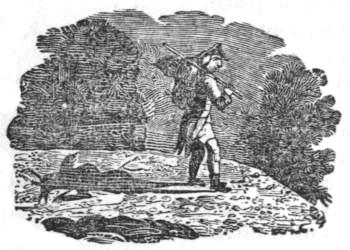
INDIAN FUNERALS.
Another sentiment, congenial with that now
described, is most deeply rooted in the mind of
the Indians. This is reverence for the dead,
with which Chateaubriand, though somewhat
hastily, considers them more deeply imbued than
any other people. During life they are by no
means lavish in their expressions of tenderness,
but on the hour of final separation it is displayed
with extraordinary force. When any
member of a family becomes seriously ill, all
the resources of magic and medicine are exhausted
in order to procure his recovery. When
the fatal moment arrives, all the kindred burst
into loud lamentations, which continue till some
person possessing the requisite authority desires
them to cease. These expressions of grief,
however, are renewed for a considerable time
at sunrise and sunset. After three days the
funeral takes place, when all the provisions
which the family can procure are expended in
a feast, to which the neighbours are generally
invited; and, although on all solemn occasions
it is required that every thing should be eaten,
the relations do not partake. These last cut off
their hair, cover their heads, paint their faces of
a black colour, and continue long to deny themselves
every species of amusement. The deceased
is then interred with his arms and ornaments,
his face painted, and his person attired
in the richest robes which they can furnish. It
was the opinion of one of the early missionaries,
that the chief object of the Hurons in their
traffic with the French was to procure materials
for honouring their dead; and, as a proof of
this, many of them have been seen shivering
half naked in the cold, while their hut contained
rich robes to be wrapped round them after their
decease. The body is placed in the tomb in an
upright posture, and skins are carefully spread
round it, so that no part may touch the earth.
This, however, is by no means the final ceremony,
being followed by another still more
solemn and singular. Every eighth, tenth, or
twelfth year, according to the custom of the
different nations, is celebrated the festival of the
dead; and, till then, the souls are supposed to
hover round their former tenement, and not to
depart for their final abode in the west. On
this occasion the people march in procession to
the places of interment, open the tombs, and, on
beholding the mortal remains of their friends,
continue some time fixed in mournful silence.
The women then break out into loud cries, and
the party begin to collect the bones, removing
every remnant of flesh. The remains are then
wrapped in fresh and valuable robes, and conveyed
amid continual lamentation to the family
cabin. A feast is then given, followed during
several days by dances, games, and prize-combats,
to which strangers often repair from a
great distance. This mode of celebration certainly
accords very ill with the sad occasion;
yet the Greek and Roman obsequies were
solemnized in a similar manner; nay, in many
parts of Scotland, till very recently, they were
accompanied by festival, and often by revelry.
The relics are then carried to the council-house
of the nation, where they are hung for exhibition
along the walls, with fresh presents destined
to be interred along with them. Sometimes
they are even displayed from village to village.
At length, being deposited in a pit previously
dug in the earth, and lined with the richest furs,
they are finally entombed. Tears and lamentations
are again lavished; and during a few
days food is brought to the place. The bones
of their fathers are considered by the Indians
the strongest ties to their native soil; and when
calamity forces them to quit it, these mouldering
fragments are, if possible, conveyed along with
them.
BEAUTIFUL TRAIT OF CHARACTER.
One M’Dougal, a native of Argyleshire, having
emigrated to Upper Canada, from anxiety
to make the most of his scanty capital, or some
other motive, he purchased a location, where
the price of land is merely nominal, in a country
thinly peopled, and on the extreme verge of
civilization. His first care was to construct a
house, and plant in the wild. This task finished,
he spent his whole time, early and late, in the
garden and the fields. By vigorous exertions,
and occasional assistance, he brought a few
acres of ground under crop; acquired a stock
of cattle, sheep and hogs; made additional inroads
on the glade and the forest, and, though
his toils were hard, gradually and imperceptibly
became, in a rough way, “well enough to live,”
as compared with the poverty he had abandoned
at home.
His greatest discomforts were, distance from
his neighbours, the church, markets, and even
the mill; and, along with these, the suspension
(or rather, the enjoyment) after long intervals
of time, of those endearing charities and friendly
offices, which lend such a charm to social life.
On one occasion, M’Dougal had a melder of
corn to grind, and as the distance was considerable,
and the roads none of the smoothest, this
important part of his duty could only be performed
by starting with the sun, and returning
with the going down of the same. In his absence,
the care of the cattle devolved on his
spouse, and as they did not return at the usual
hour, the careful matron went out in quest of
them. Beyond its mere outskirts, the forest was,
to her, terra incognita, in the most emphatic
sense of the term; and with no compass, or
notched trees to guide, it is not to be wondered
at that she wandered long and wearily to very
little purpose. Like alps on alps, tall trees arose
on every side—a boundless continuity of shade—and,
fatigued with the search, she deemed it
prudent to retrace her steps, while it was yet
time. But this resolution was much easier
formed than executed; returning was as dangerous
as “going o’er,” and, after wandering
for hours, she sunk on the ground, her eyes
swollen and filled with tears, and her mind
agitated almost to distraction. But here she had
not rested many minutes, before she was startled
by the sound of approaching footsteps, and,
anon, an Indian hunter stood before her, “a
stoic of the woods, a man without fear.” Mrs.
M’Dougal knew that Indians lived at no great
distance, but as she had never seen a member
of the tribe, her emotions were those of terror—quickening,
it may be said, every pulse, and
yet paralyzing every limb. The Indian’s views
were more comprehensive; constantly on the
look out, in search of the quarry, and accustomed
to make circuits, comprising the superficies of
many a highland mountain and glen, he had
observed her, without being observed himself,
knew her home, recognized her person, comprehended
her mishap, divined her errand, and
immediately beckoned her to follow him. The
unfortunate woman understood his signal, and
obeyed it, as far as terror left her power; and,
after a lengthened sweep, which added not a
little to her previous fatigue, they arrived at the
door of an Indian wigwam.
Her conductor invited her to enter, by signs:
but this she sternly refused to do, dreading the
consequence, and preferring death in the open
air to the tender mercies of cannibals within.
Perceiving her reluctance, and scanning her
feelings, the hospitable Indian darted into the
wigwam, and communed with his wife, who,
in a few minutes, also appeared: and, by certain
signs and sympathies, known only to females,
calmed the stranger’s fears, and induced her to
enter their lowly abode. Venison was instantly
prepared for supper, and Mrs. M’Dougal—though
still alarmed at the novelty of her situation,
found the viands delicious, and had rarely,
if ever, partaken of so savoury a meal. Aware
that she was wearied, the Indians removed from
their place near the roof, two beautiful deer
skins, and, by stretching and fixing them across,
divided the wigwam into two apartments. Mats
were also spread in both, and next, the stranger
was given to understand, that the further dormitory
was expressly designed for her accommodation.
But here again her courage failed
her, and to the most pressing intreaties, she
replied by signs, as well as she could, that she
would prefer to sit and sleep by the fire. This
determination seemed to puzzle the Indian and
his squaw sadly. Often they looked at each
other, and conversed softly in their own language:
and, at last, the Red took the White
woman by the hand, led her to her couch, and
became her bedfellow. In the morning she
awoke greatly refreshed, and anxious to depart,
without further delay—but the Indian would
on no account permit it. Breakfast was prepared—another
savoury and well-cooked meal—and
then the Indian accompanied his guest,
and conducted her to the very spot where the
cattle were grazing. These he kindly drove
from the wood, on the verge of which Mrs.
M’Dougal descried her husband, running about
every where, hallooing and seeking for her, in
a state of absolute distraction. Great was his
joy, and great his gratitude to her Indian benefactor,
who was invited to the house, and treated
to the best the larder afforded, and presented,
on his departure, with a suit of clothes.
In about three days he returned, and endeavoured,
by every wile, to induce Mr. M’Dougal
to follow him into the forest. But this invitation
the other positively declined—and the poor
Indian went on his way, obviously grieved and
disappointed. But again he returned; and,
though words were wanting, renewed his intreaties—but
still vainly, and without effect:
and then, as a last desperate effort, he hit upon
an expedient, which none, save an Indian
hunter, would have thought of. Mrs. M’Dougal
had a nursling only a few months old—a fact
the Indian failed not to notice. After his pantomimic
eloquence had been thrown away, he
approached the cradle, seized the child, and
darted out of the house with the speed of an
antelope. The alarmed parents instantly followed,
supplicating and imploring, at the top
of their voices. But the Indian’s resolves were
as fixed as fate—and away he went, slow
enough to encourage his pursuers, but still in
the van by a good many paces, and far enough
ahead to achieve the secret purpose he had
formed—like the parent-bird, skimming the
ground, when she wishes to wile the enemy
from her nest. Again and again Mr. M’Dougal
wished to continue the chase alone—but maternal
anxiety baffled every remonstrance; and
this anxiety was, if possible, increased, when
she saw the painted savage enter the wood, and
steer, as she thought, his course towards his
own cabin. The Indian, however, was in no
hurry;—occasionally, he cast a glance behind,
poised the child almost like a feather, treading
his way with admirable dexterity, and kept the
swaddling clothes so closely drawn around it,
that not even the winds of heaven were permitted
to visit it roughly. It is, of course, needless
to go into all the details of this singular
journey, further than to say, that the Indian, at
length, called a halt on the margin of a most
beautiful prairie, teeming with the richest vegetation,
and comprising many thousands of acres.
In a moment the child was restored to its parents—who,
wondering what so strange a procedure
could mean, stood, for some minutes, panting
for breath, and eyeing one another in silent and
speechless astonishment.
The Indian, on the other hand, appeared
overjoyed at the success of his manœuvre—and
never did a human being frisk about and
gesticulate with greater animation. We have
heard, or read, of a professor of signs: and
supposing such a character were wanted, the
selection could not—or, at least should not—be
a matter of difficulty, so long as even a remnant
remains of the aborigines of North America.
All travellers agree in describing their gestures
as highly dignified, eloquent, and intelligent:
and we have the authority of Mr. M’Dougal
for saying, that the hero of the present strictly
authentic tale, proved himself to be a perfect
master of the art. The restoration of the child—the
beauty and wide extent of the prairies,
and various other circumstances combined—flashed
across our countryman’s mind—operating
conviction where jealously and distrust had
lurked before. Mr. M’Dougal, in a trice, examined
the soil, and immediately saw the propriety
of the advice given by the untutored one.
By a sort of tacit agreement, a day was fixed
for the removal of the materials of our countryman’s
cabin, goods and chattels;—and the
Indian, true to his word, brought a detachment
of his tribe to assist in one of the most romantic
“flittings” that ever was undertaken either in
the old or new world. In a few days a roomy
log-house was fashioned, and a garden formed
in a convenient section of the beautiful prairie,
from which the smoke was seen curling, and
the woodpecker tapping at no great distance.
M’Dougal was greatly pleased at the change—and
no wonder, seeing that he could almost
boast of a body-guard as bold as the bowmen
of Robin Hood. His Indian friend speedily
became a sort of foster brother, and his tribe as
faithful as the most attached Tail of Gillies that
ever surrounded a Highland chieftain. Even
the stupid kine lowed, on finding themselves
suddenly transferred to a boundless range of
richest pasture:—and, up to the date of the
last advices, were improving rapidly in condition,
and increasing in numbers.
The little garden was smiling like a rose in
the desert—grass, overabundant, was gradually
giving way to thriving crops, and the kine so
well satisfied with their gang, that the herds
and enclosures were like unheeded to keep them
from the corn. The Indians continued friendly
and faithful—occasionally bringing presents of
venison and other game, and were uniformly
rewarded from the stores of a dairy, overflowing
with milk, butter, and cheese.
Attached as the Red man was to his own
mode of life, he was induced at length to form
a part of the establishment, in the capacity of
grieve, or head shepherd—a duty he undertook
most cheerfully, as it still left him opportunities
of meeting and communing with his friends,
and reconnoitering the altering denizens of the
forest. Let us hope, therefore, that no untoward
accident will occur to mar this beautiful
picture of sylvan life; that the M’Dougal colony
will wax stronger, till every section of the
prairie is forced to yield tribute to the spade
and the plough.
STRATAGEM DEFEATED.
Early in the war of the American revolution,
a Sergeant, who travelled through the woods
of New Hampshire, on his way to the American
army, met with a singular adventure, which
ended much to his credit.
He had twelve men with him. Their route
was far from any settlement, and they were
obliged every night to encamp in the woods.
The Sergeant had seen a good deal of the
Indians, and understood them well;—early in
the afternoon, one day, as they were marching
on, over bogs, swamps, and brooks, under the
towering maple trees, a body of Indians, exceeding
their own number, rushed out upon a
hill in front of them.
They appeared to be pleased at meeting with
the Sergeant and his party. They considered
them, they said, as their best friends; for themselves,
they had taken up the hatchet for the
Americans, and would scalp and strip those
rascally English for them, like so many wild
cats. “How do you do, pro?” (meaning
brother) said one. “How do you do, pro?”
said another, and so they went about, shaking
hands with the Sergeant and his twelve men.
They went off, at last, and the Sergeant,
having marched onward a mile or two, halted
his men, and addressed them,—“My brave
fellows,” said he, “we must use all possible
caution, or before morning we shall all of us
be dead men. You are amazed, but depend
upon me, these Indians have tried to put our
suspicion to sleep; you will see more of them
by-and-bye.”
It was concluded, finally, to adopt the following
scheme for defence: they encamped for the
night, near a stream of water, which protected
them from behind. A large oak was felled,
and a brilliant fire kindled; each man cut a log
of wood, about the size of his body, rolled it
nicely up in his blanket, placed his hat on the
end of it, and laid it before the fire, that the
enemy might take it for a man.
Thirteen logs were fitted out in this way,
representing the Sergeant and his twelve men.
They then placed themselves, with loaded guns,
behind the fallen tree; by this time it was dark,
but the fire was kept burning till midnight.
The Sergeant knew, that if the Savages ever
came, they would come now.
A tall Indian was seen, at length, through
the glimmering of the fire, which was getting
low. He moved cautiously towards them,
skulking, as an Indian always does. He seemed
to suspect, at first, that a guard might be
watching, but seeing none, he came forward
more boldly, rested on his toes, and was seen to
move his finger, as he counted the thirteen men,
sleeping, as he supposed, by the fire. He
counted them again, and retired; another came
up, and did the same. Then the whole party,
sixteen in number, came up and glared silently
at the logs, till they seemed to be satisfied they
were fast asleep. Presently they took aim,
fired their whole number of guns upon the logs,
yelled the horrid war-whoop, and pushed forward
to murder and scalp their supposed victims.
The Sergeant and his men were ready for them;
they fired upon them, and not one of the Indians
was left to tell the story of that night. The
Sergeant reached the army in safety.
SCENES IN KING WILLIAM’S WAR, 1689. — SURPRISE OF DOVER. — TREATMENT OF THE PRISONERS AT SALMON FALLS IN 1690.
Thirteen years had almost elapsed since the
seizure of the 400 Indians, at Cocheco, by
Major Waldron; during all which time an
inextinguishable thirst of revenge had been
cherished among them, which never till now
found opportunity for gratification. Wonolanset,
one of the sachems of Penacook, who was
dismissed with his people at the time of the
seizure, always observed his father’s dying
charge, not to quarrel with the English; but
Hagkins, another sachem, who had been treated
with neglect by Cranfield, was more ready to
listen to the seducing invitations of Castine’s
emissaries. Some of those Indians, who were
then seized and sold into slavery abroad, had
found their way home, and could not rest till
they had their revenge. Accordingly a confederacy
being formed between the tribes of
Penacook and Pigwacket, and the strange
Indians (as they were called) who were incorporated
with them, it was determined to
surprise the major and his neighbours, among
whom they had all this time been peaceably
conversant.
In that part of the town of Dover which lies
about the first falls in the river Cocheco, were
five garrisoned houses; three on the north side,
called respectively, Waldron, Otis, and Heard;
and two on the south side, Peter Coffin and his
son’s. These houses were surrounded with
timber walls, the gates of which, as well as the
house doors, were secured with bolts and bars.
The neighbouring families retired to these houses
by night; but by an unaccountable negligence,
no watch was kept. The Indians who were
daily passing through the town, visiting and
trading with the inhabitants, as usual in time of
peace, viewed their situation with an attentive
eye. Some hints of a mischievous design had
been given out by their squaws; but in such
dark and ambiguous terms that no one could
comprehend their meaning. Some of the people
were uneasy; but Waldron, who, from a long
course of experience, was intimately acquainted
with the Indians, and on other occasions had
been ready enough to suspect them, was now so
thoroughly secure, that when some of the people
hinted their fears to him, he merrily bade them
to go and plant their pumpkins, saying that he
would tell them when the Indians would break
out. The very evening before the mischief
was done, being told by a young man that the
town was full of Indians, and the people were
much concerned; he answered that he knew
the Indians very well, and there was no danger.
The plan which the Indians had preconcerted
was, that two squaws should go to each of the
garrisoned houses in the evening, and ask leave
to lodge by the fire; that in the night when the
people were asleep they should open the doors
and gates, and give the signal by a whistle,
upon which the strange Indians, who were to
be within hearing, should rush in, and take
their long meditated revenge. This plan being
ripe for execution, on the evening of Thursday
the 27th of June, two squaws applied to each
of the garrisons for lodging, as they frequently
did in time of peace. They were admitted into
all but the younger Coffin’s, and the people, at
their request, shewed them how to open the
doors, in case they should have occasion to go
out in the night. Mesandowit, one of their
chiefs, went to Waldron’s garrison, and was
kindly entertained, as he had often been before.
The squaws told the major, that a number of
Indians were coming to trade with him the
next day, and Mesandowit while at supper,
with his usual familiarity, said, “Brother Waldron,
what would you do if the strange Indians
should come?” The major carelessly answered,
that he could assemble 100 men, by lifting up
his finger. In this unsuspecting confidence the
family retired to rest.
When all was quiet, the gates were opened
and the signal given. The Indians entered, set
a guard at the door, and rushed into the major’s
apartment, which was an inner room. Awakened
by the noise, he jumped out of bed, and though
now advanced in life to the age of eighty years,
he retained so much vigour as to drive them
with his sword through two or three doors, but
as he was returning for his other arms, they
came behind him, stunned him with a hatchet,
drew him into his hall, and seating him in an
elbow chair on a long table insultingly asked
him, “Who shall judge Indians now?” They
then obliged the people in the house to get them
some victuals: and when they had done eating,
they cut the major across the breast and belly
with knives, each one with a stroke saying, “I
cross out my account.” They then cut off his
nose and ears, forcing them into his mouth—and
when, spent with the loss of blood, he was
falling down from the table, one of them held
his own sword under him, which put an end to
his misery. They also killed his son in law
Abraham Lee; but took his daughter Lee with
several others, and having pillaged the house,
left it on fire. Otis’s garrison, which was next
to the major’s, met with the same fate; he was
killed, with several others, and his wife and
child were captured. Heard’s was saved by
the barking of a dog just as the Indians were
entering: Elder Wentworth, who was awakened
by the noise, pushed them out, and falling on
his back, set his feet against the gate and held
it till he had alarmed the people; two balls
were fired through it but both missed him. Coffin’s
house was surprised, but as the Indians
had no particular enmity to him, they spared
his life, and the lives of his family, and contended
themselves with pillaging the house.
Finding a bag of money, they made him throw
it by handfuls on the floor, while they amused
themselves in scrambling for it. They then
went to the house of his son who would not
admit the squaws in the evening, and summoned
him to surrender, promising him quarter: he
declined their offer, and determined to defend his
house, till they brought out his father and
threatened to kill him before his eyes; filial affection
then overcame his resolution, and he
surrendered. They put both families together
into a deserted house, intending to reserve them
for prisoners; but while the Indians were busy
in plundering, they all escaped.
Twenty-three people were killed in this surprisal,
and twenty-nine were captured; five or
six houses with the mills were burned; and so
expeditious were the Indians in the execution
of their plot, that before the people could be
collected from the other parts of the town to
oppose them, they fled with their prisoners and
booty. As they passed by Heard’s garrison in
their retreat, they fired upon it, but the people
being prepared and resolved to defend it, and
the enemy being in haste, it was preserved. The
preservation of its owner was more remarkable.
Elizabeth Heard, with her three sons and a
daughter, and some others, were returning in
the night from Portsmouth; they passed up the
river in their boat unperceived by the Indians,
who were then in possession of the houses; but
suspecting danger by the noise which they
heard, after they had landed they betook themselves
to Waldron’s garrison, where they saw
lights, which they imagined were set up for
direction to those who might be seeking a
refuge. They knocked and begged earnestly
for admission, but no answer being given, a
young man of the company climbed up the
wall, and saw, to his inexpressible surprise, an
Indian standing in the door of the house with
his gun. The woman was so overcome with
the fright that she was unable to fly, but begged
her children to shift for themselves, and they
with heavy hearts left her. When she had a
little recovered she crawled into some bushes,
and lay there till day-light: she then perceived
an Indian coming toward her with a pistol in his
hand, he looked at her and went away; returning,
he looked at her again, and she asked him
what he would have. He made no answer, but
ran yelling to the house, and she saw him no
more. She kept her place till the house was
burned and the Indians were gone, and then returning
home found her own house safe. Her
preservation in these dangerous circumstances
was more remarkable, if (as it is supposed) it
was an instance of justice and gratitude in the
Indians: for at the time when the 400 were
seized in 1676, a young Indian escaped and
took refuge in her house, where she concealed
him; in return for which kindness he promised
her that he never would kill her, nor any of her
family in any future war, and that he would
use his influence with the other Indians to the
same purpose. This Indian was one of the
party who surprised the place, and she was well
known to the most of them.
The same day, after the mischief was done,
a letter from Secretary Addington, written by
order of the government, directed to Major
Waldron, giving him notice of the intention of
the Indians to surprise him under pretence of
trade, fell into the hands of his son. This design
was communicated to Governor Bradstreet by
Major Henchman of Chelmsford, who had
learned it of the Indians. The letter was dispatched
from Boston, the day before, by Mr.
Weare; but some delay which he met with at
Newbury ferry prevented his arrival in season.
The prisoners taken at this time were mostly
carried to Canada, and sold to the French; and
these, so far as can be learned, were the first
that ever were carried thither. One of these
prisoners was Sarah Gerrish, a remarkably fine
child, of seven years old, and grand-daughter of
Major Waldron, in whose house she lodged that
fatal night. Some circumstances attending her
captivity are truly affecting. When she was awakened
by the noise of the Indians in the house,
she crept into another bed, and hid herself under
the clothes to escape their search. She remained
in their hands till the next winter, and was sold
from one to another several times. An Indian
girl once pushed her into a river; but, catching
by the bushes, she escaped drowning, yet durst
not tell how she came to be wet. Once she was
so weary with travelling, that she did not awake
in the morning till the Indians were gone, and
then found herself alone in the woods, covered
with snow, and without any food; having found
their tracks, she went crying after them till they
heard her and took her with them. At another
time they kindled a great fire, and the young
Indians told her she was to be roasted. She
burst into tears, threw her arms round her
master’s neck, and begged him to save her,
which he promised to do if she would behave
well. Being arrived in Canada, she was bought
by the Intendant’s lady, who treated her courteously,
and sent her to a nunnery for education.
But when Sir William Phips was at Quebec she
was exchanged, and returned to her friends, with
whom she lived till she was sixteen years old.
The wife of Richard Otis was taken at the
same time, with an infant daughter of three
months old. The French priests took this child
under their care, baptised her by the name of
Christina, and educated her in the Romish religion.
She passed some time in a nunnery,
but declined taking the veil, and was married
to a Frenchman, by whom she had two children.
But her desire to see New England was
so strong, that upon an exchange of prisoners
in 1714, being then a widow, she left both her
children, who were not permitted to come with
her, and returned home, where she abjured the
Romish faith. M. Siguenot, her former confessor,
wrote her a flattering letter, warning her
of her danger, inviting her to return to the
bosom of the catholic church, and repeating
many gross calumnies which had formerly been
vented against Luther and the other reformers.
This letter being shown to Governor Burnet, he
wrote her a sensible and masterly answer, refuting
the arguments, and detecting the falsehoods
it contained: both these letters were
printed. She was married afterwards to Captain
Thomas Baker, who had been taken at Deerfield,
in 1704, and lived in Dover, where she
was born, till the year 1773. The Indians had
been seduced to the French interest by popish
emissaries, who had begun to fascinate them
with their religious and national prejudices.
They had now learned to call the English heretics,
and that to extirpate them as such was
meritorious in the sight of heaven. When their
minds were filled with religious frenzy, they
became more bitter and implacable enemies
than before; and finding the sale of scalps and
prisoners turn to good account in Canada, they
had still farther incitement to continue their
depredations, and prosecute their vengeance.
The following instances of cruelty, exercised
towards the prisoners taken at Salmon falls, are
mentioned by Dr. Mather. Robert Rogers, a
corpulent man, being unable to carry the burden
which the Indians imposed upon him, threw it
in the path and went aside in the woods to conceal
himself. They found him by his track,
stripped, beat, and pricked him with their
swords: then tied him to a tree and danced
round him till they had kindled a fire. They
gave him time to pray, and take leave of his
fellow prisoners, who were placed round the
fire to see his death. They pushed the fire
toward him, and when he was almost stifled,
took it away to give him time to breathe, and
thus prolong his misery; they drowned his
dying groans with their hideous singing and
yelling, all the while dancing round the fire,
cutting off pieces of his flesh and throwing
them in his face. When he was dead they left
his body broiling on the coals, in which state it
was found by his friends and buried. Mehetabel
Goodwin was taken with a child of five months
old; when it cried they threatened to kill it,
which made the mother go aside and sit for
hours together in the snow to lull it to sleep;
her master seeing that this hindered her from
travelling, took the child, struck its head against
a tree, and hung it on one of the branches; she
would have buried it but he would not let her,
telling her that if she came again that way she
might have the pleasure of seeing it. She was
carried to Canada, and after five years returned
home. Mary Plaisted was taken out of her
bed, having lain in but three weeks: they made
her travel with them through the snow and “to
ease her of her burden,” as they said, struck
the child’s head against a tree, and threw it into
a river. An anecdote of another kind may
relieve the reader after these tragical accounts.
Thomas Toogood was pursued by three Indians
and overtaken by one of them, who having
enquired his name, was preparing strings to
bind him, holding his gun under his arm, which
Toogood seized and went backward, keeping
the gun presented at him, and protesting that he
would shoot him if he alarmed the others who
had stopped on the opposite side of the hill.
By this dexterity he escaped and got safe into
Cocheco; while his adversary had no recompense
in his power but to call after him by the
name of Nogood.