THE BOYHOOD OF GREAT INVENTORS — The Boyhood of Great Inventors
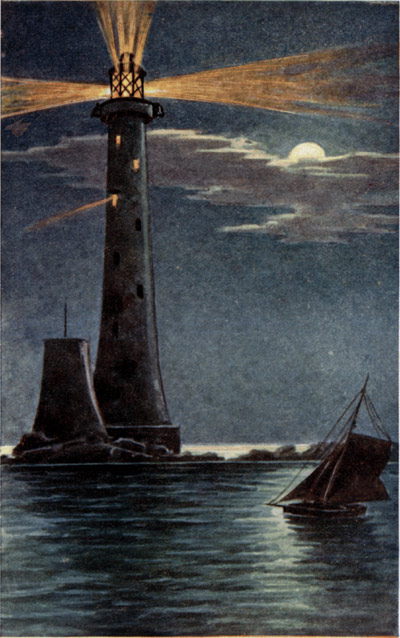
THE EDDYSTONE LIGHTHOUSE.
Frontispiece.
BY
A. FRASER ROBERTSON
AUTHOR OF “EARLY YEARS OF SOME NOBLE LIVES”
NEW EDITION
LONDON
JOHN F. SHAW AND CO.
48, PATERNOSTER ROW, E.C.
Whole book · 12 sections
BY
A. FRASER ROBERTSON
AUTHOR OF “EARLY YEARS OF SOME NOBLE LIVES”
NEW EDITION
LONDON
JOHN F. SHAW AND CO.
48, PATERNOSTER ROW, E.C.
| THE BOYHOOD OF GREAT INVENTORS | A. Fraser Robertson. |
| TWILIGHT STORIES | Catharine Shaw. |
| FOR LOVE AND DUTY | Frank Saville. |
| THE BOYS OF ALL SAINTS | Mabel Mackintosh. |
| DARING DEEDS | Frank Saville. |
| MIDSHIPMITE CURLY | Dr. Gordon Stables. |
| THE DOG CRUSOE | R. M. Ballantyne. |
| THE SWORD OF THE CAREWS | Duncan McLaren. |
| THE NUGGET FINDERS | H. Alger. |
| ROBIN HOOD & HIS BRAVE FORESTERS | S. Percy. |
| MARTIN RATTLER | R. M. Ballantyne. |
| THE KING’S MESSENGER | L. Marston. |
| FOUR, AND WHAT THEY DID | H. Campbell. |
| FOR WANT OF A WORD | M. Mackintosh. |
| FOR ELSIE’S SAKE | J. Chappell. |
| CURLEY’S CRYSTAL | Emma Marshall. |
| IN SHADOWLAND | E. Everett-Green. |
| ROB AND MAG | L. Marston. |
| THAT BOY TOM | Ismay Thorn. |
| TIM’S TREASURE | Alice Lang. |
| LITTLE BOOTS | J. Harrison. |
| CLEMENT AND GEORDIE | Emma Marshall. |
| GOLD THAT GLITTERS | E. S. Holt. |
| PETER’S PROMISES | Emma Marshall. |
| MOLLIE WYNTER | M. Mackintosh. |
| THE SLAVE GIRL OF POMPEII | E. S. Holt. |
| MISS PRIMROSE | Agnes Giberne. |
| MAB’S BURDENS | E. Boddy. |
| BESIDE ALL WATERS | M. L. Astree. |
| WATCHING FOR THE KING | L. Marston. |
| NAN, THE CIRCUS GIRL | Frances Stratton |
| HOW THE TIDE TURNED | S. Watson. |
| A BROTHER’S RANSOM | Alice Lang. |
| LITTLE EYEBRIGHT | Agnes Giberne. |
| A LITTLE CURIOSITY | Emma Marshall. |
| MADCAP MARIGOLD | Mabel Mackintosh. |
| THE GOLDEN PAVEMENT | E. Chapman. |
| A WAIF OF THE WAVES | S. Watson. |
| CHRISTOPHER’S NEW HOME | Emma Marshall. |
| HIRA’S QUEST | L. Marston. |
| FROGGY’S LITTLE BROTHER | Brenda. |
LONDON: JOHN F. SHAW & CO.,
48, Paternoster Row, E.C.
People who have been on a long sea voyage, and have ended by sailing up the English Channel, tell us how their hearts beat high, after weary weeks and months at sea, when the cry went up while as yet land was a mere shadowy outline, “The Eddystone in sight!” For the gleaming lighthouse standing immovable in the midst of boiling waves and great mountains of blinding white spray spells “home” to the voyager.
To us the “stone” round which the waters ceaselessly churn and “eddy” speaks of John Smeaton, the man who built it. The great engineer has been in his grave now for more than a century, but his most lasting monument stood for longer than that time firm as a rock.
John Smeaton was born in 1724, near Leeds. Not the Leeds of to-day—a bustling, smoky centre of manufacture—but a quaint little town hemmed in by green country fields and lanes. It was in one of these that Austhorpe Lodge stood, the house of Smeaton’s father, a lawyer in Leeds.
We shall yet come across many boyhoods tinged with shadow and struggle, and are not sorry to find this one happy, fondly tended, and bright with sunshine. There was no pinch in the lot of the Smeatons, no grinding poverty that we sometimes find to spur a boy to manhood before his time. Little John was cradled, as it were, in love. As a child his parents taught him at home. He was not eager to mix with other boys in outdoor romp or play, and very early, while yet hardly more than a baby, he showed a strong love for pulling his toys to pieces to see what they were made of! Never was he happier than when he could get hold of a cutting-tool with which to shape toy pumps and houses and windmills. Another amusement of his babyhood was to divide squares and circles!
As a boy he was rather quiet and thoughtful, though his tongue straightway loosed the moment anything in the shape of a workman came to his father’s house. He was then always to be found on the spot, and with eager eyes fixed on their every movement, he would unconsciously “pose” them with eager questions—such questions as from the boyish lips made them shake their heads and stare at him dumb and stupid.
And all the time the boyish brain was deeply plotting, and it was ever that he might “go and do likewise.” One day, after watching a millwright at work, his anxious parents were alarmed by the sight of their boy perched on the top of the barn fastening a windmill to the roof! At another time, when a pump was being made in the village, by good luck a piece of bored lead came in little John’s way. He promptly set to work and made a toy one after the pattern of the big one, and even managed to make it raise water.
But his greatest childish feat took place on his discovering a fire-engine being erected at a colliery in the village to pump the water out of the mine. He was constantly on the spot, eagerly watching it as it slowly progressed, and quickly his boyish brain grasped the whole.
He went home and began with trembling fingers one day to copy it. His father had given him an outhouse with bench and tools to carry out his hobby, and soon the engine worked. He looked round to see what he could use it upon, and espied the fish-pond. So he began to pump out the water till he had pumped the whole place dry. When his father came home it was to find an empty pond, and all his fish lying dead at the bottom!
And now John had to leave his beloved workshop for school in Leeds. And there it seemed as if the boy showed up quite a different side of himself. The bright, eager alertness that marked him at home or with the workmen about Austhorpe was gone. He was quiet with the boys—out of his element. He did not care for their rough play. He was like a fish out of water. Silent, shy, even stupid—the boys nicknamed him “Fooley Smeaton.”
But though he might be dull at school, the boy’s real education was surely going on at home among his pumps and model engines, his lathes and chisels.
The boyish hands had begun to do that which all through life threw over him a very spell of fascination—to construct—to build up. The baby fingers were learning how to use tools in a way that was to give him one day, long years after, a skill that would place him on the very top of the ladder. And all the time the young mind was pondering great mechanical principles that were by-and-by to make the name of John Smeaton famed throughout the world. So it was not to games and boyish play that he gave his spare moments, but to his workshop. When he was fifteen he could use his turning-lathe to turn wood and ivory. When he was eighteen he could handle tools as deftly and cleverly as any workman who all his life had known no other trade.
When he was sixteen he left school and took his place in his father’s office, and tried to bring his mind to look forward to law as his life-work. He worked conscientiously day after day, coming home at evening to spend half the night in working—making—constructing things. He had all the instincts of a born mechanic. It was almost as if he could not help it.
When his father sent him to London to study law, the boy tried again to stifle his longings, and to set himself to carry out his father’s wishes. But strive and struggle as he would, it was impossible to crush the desire of his heart. And so one day he sat down and wrote to his father that he could go on with law no longer. Nothing except to be a mechanic would satisfy him. His father, deeply disappointed though he was, quietly made up his mind to what could not be helped, and wrote to John that he must make his own choice.
The boy was delighted. He had chosen what was then the work of a common labourer, with a labourer’s wages. The term Civil Engineer was unknown. With a heart beating high with hope he went off and engaged himself to a philosophical instrument-maker—a man who made instruments for navigation and astronomy. With him he worked steadily—eager to improve the instruments—eager to improve himself—so eager, indeed, that he divided out his time so as to make the most of it: so much for reading, so much for experiments, so much for business, and so much for rest and relaxation.
And so on the threshold of manhood—having got, as it were, “a free hand”—he made great strides onward. He may not have done much business at the time, but he read papers before the Royal Society, and he kept open a keen, mechanical eye for everything—from minute, delicate instruments to the building of canals and bridges and waterworks. He thought no trouble too great to take if so it made him thorough. He set himself to study French and Italian, so as to read the works in these languages on mechanical subjects, and he even set off to Holland—that land of dykes and harbours and docks—that he might examine them for himself.
And while he looked about him, always at the same time busy with the work that lay nearest to his hand, the great work of his life was drawing close to his door.
Many years before Smeaton lived, England was in the custom of lighting up her rocky headlands with lights or beacons. First came “the candle in the cottage window” to light the sailor husband home, then stacks of blazing wood, piles of coal, oil, torches, pitch-pots. Guided by these flaring lights in the darkness, men and vessels plying round our coast were saved from shipwreck and death. Sometimes these beacons, flaming high from their pinnacles, warned the people inland that war was expected, the country was in danger of being invaded, or that pirates were about to swoop down upon them. At other times false lights were shown by men known as “wreckers,” and homeward-bound vessels, rich in goods and human souls, were dashed upon the rocks. So our coasts were lighted up in those old days, but it happened at times that the pitch would become drenched and drowned, the wood and coal fires would spurt up for a space and then drop down and fade. Things were uncertain. It did not matter, perhaps, greatly, as long as England’s commerce by sea was small, but when our trade with foreign lands began to grow, there grew, too, the question how best to light our rocky coasts and docks and headlands. So an order of monks—the Brethren of Trinity House—was made, and these prayed for the safety of the sailors, and later looked to the lighting of the coast.
Eddystone rock we can easily find on the map, a low, black reef lying S.S.W. of Plymouth, a place of lurking danger as well for ships cruising up and down the Channel as for those coming into Plymouth harbour. In the days of Smeaton, and for some time earlier, the way in which lighthouses were built was for a private man to go to the owner and say, “I will build a lighthouse on that rock if you will let me.” If his offer were accepted and he carried out the work he had then the right to levy dues on the ships that passed, or, in other words, to make them pay toll. In this way he sometimes collected quite a large income.
Towards the end of the seventeenth century a man called Winstanley undertook to build a lighthouse on Eddystone. He drew out plans and started on the work, and it was no light work. The base of the rock was narrow and sloping. It was hard to make the foundations fast, for winds and waves had a way of rising suddenly, and the whole of the work would be drowned for the time, and perhaps many of the materials swept away. But by dint of waiting patiently for fine weather and smooth water the building was at last finished. It was made of wood, rather in an ornamental style, and had many projections. It took four years in the building, for although in other parts of the Channel the waters might be smooth enough, yet round the Eddystone they were almost sure to seethe and foam. For several seasons the building stood.
“I wish,” exclaimed the builder one day, elated that his work had turned out so well, “that I might be here in the fiercest storm, just to see it stand.”
After it had stood some three years from its finish Winstanley went out one day to see to some repairs. He remained on the rock overnight, and during the night his wish, though hardly as he would have had it, was fulfilled. A gale and storm terrific in their fury burst overhead and broke along the English coast. With the first streak of dawn an anxious people looked from shore to see how it fared with the lighthouse. Not a trace of it remained. Not a speck was to be seen on the waters. It and its maker had been utterly swept away!
Next came a man called Rudyerd, who volunteered to build a lighthouse that would stand. He pondered the last, and he came to the conclusion that it had failed in form. He determined to alter that. So he made a long, high column in the shape of a cone, with no ornaments, no projections jutting out to catch the wind, and at the end of four years the thing was finished—a wooden building coated over with oakum and pitch.
For a time all went seemingly well. It held four rooms, one above the other. The lantern was lit by candles. Years went on, and still it stood defying the winds and storms for half a century. There were two light-keepers, who snuffed the candles overnight, sitting up for four hours at a time. One of these men fell ill and died. A storm was raging at the time. No help could come to his companion, and so through a long month he kept the body, afraid to throw it into the sea, in case he should be thought a murderer.
At last help came from shore, but the loneliness and horror had told so terribly upon the remaining man that ever afterwards three men were employed to keep the light burning, in case of one falling ill or dying.
But in spite of its long standing there was a hidden flaw in the lighthouse. It was inflammable—capable of catching fire. One day—no one could quite tell how it happened, it might be the flame had dried and scorched the timber. At any rate, a man going in to snuff the candles found that fire had broken out. It wanted but a few minutes till the place was in flames. The men rushed below, while a perfect rain of beams and burning lead fell in showers about their heads. Seeing the blaze from the shore a boat put off with all speed. When it reached the rock it found the men, not on the rock, but crouching beneath a ledge, dripping and half dead, and with just enough life in them to enable them to catch the rope thrown to them, for it was too rough for the boat to reach the rock. And so they were towed on board.
And now the third attempt at the lighthouse was to be made by John Smeaton.
“Thou art the man to do it,” were the words of the letter asking him to undertake the work. And so Smeaton was launched on that which was to make his name famous.
The first step he took was to get and study the plans of the former men. To succeed he had first to find out where the others had failed.
The first building had failed in weight. The second had not been fire-proof. And so he decided to make his lighthouse of stone. People when they heard of it called out that it was a wild project. It could not be done. “Nothing but wood could possibly stand on the Eddystone.” But Smeaton was in no way moved or cast down. What he made he wanted to stand, and not to last for a few years merely; and so of stone he determined it should be.
He began to draw out the design. He kept to the shape of Rudyerd’s—the long cone-like column. He made the diameter of the foundation broader. He planned the locking and bonding and dovetailing of the stones—each to each, and all to the centre. When this was all carefully thought and made out he started from London for Plymouth. He was six days on the journey owing to the “badness of the roads.”
On the 2nd of April he set sail for the rock, but winds and waves beat so vehemently that he found it impossible to land. All he could do was to view the low, treacherous black thing on which he was to build his house of stone. Back he went three days later, and for the first time he stood on Eddystone, but only for a couple of hours. There was almost nothing to be seen, only one or two iron branches left from the wrecks of the former wooden buildings. On the third attempt he made he could not even see the rock. Spray and foam hid it entirely from view. In the same way his fourth and fifth visits failed, but his sixth was successful, and he landed at low water, and in the stillness of the evening made his first measurements.
“I went on with my business till nine in the evening,” he wrote, “having worked an hour by candlelight.”
Again and again he tried to get a landing. Sometimes he managed it, at others it was impossible. After having spent fifteen hours in all on the rock he went back to London, and with his own expert hands made a model. The work took him two months in all, and that proficiency that he had learned as a boy in his little workshop at Austhorpe stood him in good stead now. After this he set out for Plymouth again. No detail of his work was too small for him to attend to himself. He visited the quarries where the stones were to be hewn. He carefully chose the kind of cement that was to bind them together; the workmen, the work-yards, the ships that were to carry the stones to the rock. Each and all passed under his eye.
It was a great day when, in August, 1756, he and his men started for Eddystone, and the master fixed the centre and laid down the lines. Now the work might be said to be fairly begun. But was ever work so often broken in upon? Winds and waves are not to be counted on—least of all about the stormy Eddystone, for often though the water is calm and smooth in other places, it smothers in foam the low black reef.
There were times when the workmen could work as long as six hours at a stretch, going on eagerly by torchlight if necessary. Again it would happen they could not work more than two hours out of the twenty-four. Time was precious, and time was grievously taken up in going to and from Plymouth, and so Smeaton arranged that a “buss”—a fishing-vessel with two masts and a cabin at either end—should ride at anchor near the scene of work, with provisions and other necessaries.
But here, again, it was hard to plan ahead. One day a mighty storm arose. The men could not work. Their yawl broke from its moorings. They could neither send to shore, nor could they get help. But they must eat. Days passed, and gradually their store of provisions grew less and less. By the time relief reached them they were at their last crust.
During the long months of winter when work was out of the question the time was spent in dressing the stones in the yard on shore. Smeaton himself saw them laid out in lines and numbered, after which they were put in order on board ready to be lifted off when the rock was reached, and easily put in their places. Dangers and difficulties often crowded thick on the work, enough to daunt a man less dauntless than Smeaton. One night on the homeward way a big storm arose.
The night was dark, and Smeaton was roused from sleep by the sound of much stamping and hurrying to and fro overhead. He rushed on deck in his nightshirt. The helmsman was holding frantically by a rope.
“For God’s sake,” he shouted when he saw Smeaton and others, “heave hard at that rope, if you mean to save your lives.”
So Smeaton as well as the others laid hold. In the pitchy darkness there fell on their horror-struck ears the sound of waves breaking on the rocks. The jibsail was blown to pieces. They hastily lowered the mainsail. The waves dashed over them. But gradually the ship obeyed the straining helm and rounded off. In anxious fear they lay out to sea. When morning broke land was nowhere to be seen, and they found themselves driving towards the Bay of Biscay. For four long days they were tossed and driven to and fro before they made Plymouth harbour.
One day Smeaton had an accident, which, however, might have been worse in its effects. He was taking a turn up and down the narrow strip of rock that was all that afforded a promenade when his foot slipped and he fell among the rocks. When he got up he thought himself unhurt till a stinging pain informed him that he had dislocated his thumb. He was hours from shore—far from a surgeon. Delay meant disablement. So he took hold of it with his other hand, pulled hard, and it snapped into place.
But in spite of danger and difficulty and hindrance the great work went on, though slowly still surely. By the end of the second year the building had risen thirty-five feet high—out of reach of the heavy dash and thud of the waves. Gradually one above another rose the rooms for the light-keepers—their walls twenty-six inches thick to stand against the fearful onslaught of the wind as it blew up the Channel from the Atlantic. For in a gale the place shook and the doors slammed and the windows rattled with such terrific force that the new and unaccustomed keepers earnestly wished themselves at Land’s End or anywhere else, so that it meant land.
To say that as it neared the finish it was much in the great builder’s thoughts is to draw but a faint picture of how day and night it lay upon his heart. How when on land the early morning found him out betimes on the Hoe, at Plymouth, telescope in hand, gazing out to sea. If a storm raged and the spray flew high for a moment it seemed to his sinking heart that it was Winstanley’s lighthouse over again and that there was no Eddystone!
Again his heart leaped in gratitude a moment afterwards when the upright column—strong, firm, immovable—pointing black and clear against the sky, came to view, and a deep “Thank God!” would burst from his lips.
And now the months flew by and the great work neared its end. Smeaton himself chose the last details—the iron railings—the glass for the lantern. In the upper storeroom directly beneath the ceiling he had the motto carved—“Except the Lord build the house they labor in vain that build it.” And the mason’s last work was a “Laus Deo” in stone.
Towards the end Smeaton could not leave it. With his own hands he fitted the windows in their sashes—fixed the gilt ball on the top—no easy matter—but he had ever filled the post of danger himself. He asked no one to put himself where he was not willing too to go. Expert as any skilled mechanic, he himself gave his great work its finishing touches. Twenty-four candles in a chandelier formed the light. The lightning-conductor was fixed—the rooms finished. The magnificent column towered to seventy feet, the lantern and gilt ball twenty-eight inches higher, and on October 16th, 1759, the work was done.
Three years later a mighty storm broke along the coast, wrecking docks and ships and harbours, but the Eddystone stood firm.
And now Smeaton’s name was made. Other feats followed. Other triumphs awaited him—the building of docks and harbours and bridges—but the thing that men will ever link with his name is the Eddystone. After the stress and struggle of public life, he went back again to the old home of his boyhood. He gathered again about him his workshop, his study, his observatory. And so he worked to the end. He could not help it. He could not live without his tools.
Great man though he was, his wants were very few and simple. Offers of riches and magnificence had no power to tempt him, and when he refused a post abroad which meant wealth and position, the Russian Princess who offered it exclaimed, in wondering admiration—
“I shall go back to Russia and tell them there is one man who has not his price.”
He was happiest in the quiet of his own home. As a boy he had been rather retiring and thoughtful. As a man he was found the same. Simple, modest, while he would converse easily on other subjects, it was hardly possible to get him to talk of self. In this, as well as in his life-work, “he was indeed a very great man.”
He had had a long life of work—hard, incessant toil—from six to sixty, though it had been work that he had loved. It may be he had overtaxed his strength, for as age crept on he grew less robust. In his sixty-eighth year he had a slight stroke. He feared a gradually clouding brain. “The shadow must lengthen as the sun goes down,” he said to himself. But this distress was spared those dear to him, and with not much suffering, on the 28th October, 1792, he passed away. They buried him in the old church of Whitkirk, and raised a tablet to his memory, naming in it that great work of his that will “convey to distant ages, as it does to every nation of the globe, the name of its constructor.”
The world looks still upon John Smeaton as a wonderful engineer—a great mechanic—a man who climbed to the top of his profession, and the sound of whose fame spread over Europe; but he will ever be best remembered by the light of the Eddystone, that memorial monument that stood firm for more than a century, sometimes hid in blinding spray, anon gleaming out clear and steady, a rescuer from shipwreck and death.
Till 1877 storms continued to beat upon it without avail. Then, owing to the undermining of a portion of the reef, it was thought well to build a new house on another part of the rock. The old base still stands on the old place, and the upper rooms have been put on the Hoe at Plymouth.
These are, after all, the best monuments we could have of the builder. Welded into the stones, it seems to us we can trace, not alone genius and great mechanical power, but a patience in difficulty, a courage in danger, and in face of long, wearing months of anxiety. It is these, perhaps, more than all else, for which we honour the name of Smeaton.
Had we passed along one of the poorer streets of the city of London some 150 years ago, we might have chanced on a humble shop displaying in the window plaster-casts and figures in clay, and had we lifted the latch and entered, in the cramped space behind the counter we should have found the child who was one day to become England’s greatest sculptor, John Flaxman.
A ricketty, weakly baby in a high stuffed child’s chair, so that his little pale face might be on a level with the counter; the sweet dreamy eyes looked out on the world, all unthinking that a day was coming when the fame of his name would reach wherever men knew and loved his art.
Born in the city of York in 1755, a few months before the Flaxmans settled in London, there were times when his father and mother hardly believed they would be able to “rear” the delicate child. Attacks of illness and weakness were common to him. Indeed, one day he was seized with a fit of gasping so severe that the breath seemed to leave his body, and they even laid him out for dead, but he revived, and his breath came again, and by-and-by he even grew. Few amusements, no childish games were open to the little cripple. The green fields, the blue of the country skies were to him things unknown. The dingy four walls of the narrow cramped shop had to serve him instead. But day by day he grew quick to note the familiar beauty of his father’s casts. He came to see the shape of these white things with the eye of the poet and the artist. There came into his mind the strong desire to copy, inborn in most children, and the baby fingers set to work to mould, and fashion, and make some likeness—if even a dim one—to those of his father’s models. In these old days gentlemen were accustomed to wear bunches of seals dangling from their watch-chains, and the child used to keep a stock of wax, and when he thought a customer seemed kind, he would summon courage to ask him to let him take the impression on the soft wax.
In little John’s early years, when he was as yet a baby of five, a great ceremony took place in London, the coronation of King George III. Rumour went that to celebrate the great event there was to be a coronation medal struck, and that hundreds of these were to be thrown to the crowd. The cripple child in the dingy side street of the great city set his little heart on possessing one of these treasures, and begged his father to get him one. But Flaxman was not successful. On the way home, with his mind full of his disappointment, his eye happened to light on a plated button on the pavement, stamped with a horse and jockey. He picked it up. Would he disappoint his little son, or deceive him? He decided on deceiving him, and gave the eager and expectant child the button. The boy received the trophy in wonderment. He was glad to get it, but he remarked that it seemed a strange medal for a coronation!
Customers who came to Flaxman’s house could hardly help noticing the child who sat behind the counter, the big head on the lame body, the high shoulders, the beautiful pure eyes, the sensitive, proud face. They spoke to him, and they found him no common child.
One day, by good luck, when little John was hardly more than seven, a customer, a Mr. Matthew, a clergyman, came to Flaxman’s shop. Writing of that visit, when it had become a memory and the child a great man, Mr. Matthew says—
“I went to the shop of old Flaxman to have a figure repaired, and whilst I was standing there I heard a child cough behind the counter. I looked over, and there I saw a little boy seated on a small chair, with a large chair before him, on which lay a book he was reading. His fine eyes and beautiful forehead interested me, and I said, ‘What book is that?’ He raised himself on his crutches, bowed, and said, ‘Sir, it is a Latin book, and I am trying to learn it.’
“‘Aye, indeed!’ I answered. ‘You are a fine boy, but this is not the proper book. I will bring you a right one to-morrow.’
“I did as I promised, and the acquaintance thus casually begun ripened into one of the best friendships of my life.”
It is a picture! The child of seven trying patiently to make out his Latin book—his weakly frame on one chair, the unwieldy volume spread out before him on another. The beautiful eyes and brow, the winning smile, and the long, brown hair curling to the shoulders.
But the wheel of his fortune seemed as if it had got a turn. Mr. Matthew was as good as his word, and brought him the promised book, and more followed. Translations of old Greek fables and stories from Homer that stirred the imagination of the boy. Then followed the fascinating adventures of Don Quixote. These fired his brain. How great and how heroic it seemed to him to rescue maidens in distress, to set the wrongs of the world right. So strong a hold did the thought take of the imagination of the child that one day, hobbling on his little crutches, he started off for Hyde Park in the hope that he might perchance find some forlorn maiden in need of his protection! But no old-world lady of the kind did he happen on among the thousands of teeming London—either in the Park or Kensington Gardens—and he had to come home cast down and disappointed.
Meantime he strove and worked and laboured in his own childish way—with perhaps no great present results—receiving now and then even a check from which the sensitive mind recoiled, as when one day he showed an artist a drawing of a human eye, to be met with the quizzical question, “Is that an oyster?” Perhaps more secretly after that, but still as perseveringly as ever, he worked.
Long years after, a friend gazing on these early works was struck with proofs of his diligence as a child, and asked him how he had managed to do them.
“Sir,” Flaxman answered, “we are never too young to learn what is useful, or too old to grow wise and good.”
When he was about ten years old a better gift than any fortune could bestow was granted to him. The feebleness of childhood seemed to leave him. The sickly frame seemed suddenly to knit itself together. The weakly limbs gradually strengthened, and the boy was able to throw away his crutches.
No need now to sit solitary in the cramped little shop behind the counter, dreaming lonely day-dreams and fashioning his models all by himself. With new strength a new life was opening up to him—or rather the old life grew day by day transformed and beautified.
It was Mrs. Matthew, the wife of his friend the clergyman, who first drew the boy from his life of loneliness. She was touched and interested in him, and she asked him to her house. He went and he went again. He met there men who fired his smouldering longing one day to be a sculptor—to do some great thing in the world of art. Mrs. Matthew had many friends among such. At other times he spent evenings not less delightful when she herself read aloud from Virgil and Homer soul-stirring tales of ancient heroes—and the boy sat by drinking in the poetry while he tried with eager, untaught fingers to draw some of the passages that took his fancy. Again she would lay aside her book and talk to him of the wonders of sculpture, while there sprang up in his heart a great longing amounting almost to a passion.
No wonder these were golden hours, full of pleasure to young John, and looked back upon many a time in after years as among the happiest times of his life.
A gentleman, seeing some of these boyish attempts, gave the boy an order for a set of drawings, and by and by more orders followed.
When he was eleven years old he left the privacy and quiet of the little side eddy of the stream of life in which he had been living and struck out, as it were, into the mid-stream. That year he won a prize from the Society of Arts for models of figures in clay. Two years later he was again successful. What we know as the Royal Academy then first came into being, and when it was in its second year, and when Flaxman was only fifteen years old, he exhibited models there. Step by step, small steps at first, he was entering on the beginning of that which for long had been the desire of his heart. In the same year he entered as an Academy student, and won the silver medal. People already were beginning to acknowledge his outstanding ability. Rewards, prizes came upon him one by one. The boy’s outlook was beginning to be very bright, and his heart was beginning to beat high with hope, when just as he had reached the age of sixteen he got an unexpected check.
He made up his mind to try for the gold medal—the highest reward of merit—and among all the students he was generally allowed to have the best chance. Hardly a fellow-student but felt sure that he would get it. “Flaxman! Flaxman!” they cried almost unanimously, for they were strongly impressed with the skill and ability of the grave, reserved boy. Speaking of this time in later years Flaxman said—
“I had made up my mind that I was to win.... It was given by Reynolds to Engleheart. I burst into tears. This sharp lesson humbled my conceit, and I determined to redouble my exertions....”
May he perhaps have over-estimated his own skill? Years after he said of himself—
“I was the most conceited artist of the day.” And yet where another might have been downcast he refused to be discouraged. He was upheld by a strong and silent sense of power within him. He went home to his father, and he said, “Give me time, and I will yet produce works which the Academy will be proud to acknowledge.”
Engleheart, the winner of the medal, was never heard of in later life, while the loser made for himself a name that afterwards “waxed wide.”
Now he worked harder than ever. He studied, he exhibited, he moulded, he designed the figure for a statue of Alexander the Great, which brought him some fame. But his father could not keep him, and he was driven to look about and bethink himself how he could keep himself. At this time—the most needy, perhaps, of his life—a door seemed to open to him. He fell in with the great Staffordshire potter, Josiah Wedgwood, and Wedgwood, with that keen eye of his ever on the outlook to discover talent, instantly recognised it in the boy.
A great time was beginning for pottery. For ages hideous things had adorned people’s houses and tables till Wedgwood arose, and there entered his great mind the idea of making common things beautiful, of giving people something to look at, even at their meals, that would raise their tastes and be a sort of education. After Wedgwood discovered young Flaxman he gave him some orders. The boy threw his whole soul into the work. Not that it was such work as always showed the artist at his best. The sculptor had first to make the model in wax. Then a mould was taken of this, and into this the potter’s stuff, soft as dough, was carefully pressed. The thing was not finished yet. It remained for it still to be fired and polished, and so it is not wonderful if some of the delicacy and finish of the first design may have been occasionally lost.
But with Flaxman’s work Wedgwood was satisfied, and while he worked hard for him he paid him handsomely. It was not the sort of thing to bring him name and fame, but there was always the need to live to be faced, and he bravely took what offered and was thankful. And by living simply and saving where he could, he managed to keep himself by what he made. He faced this time of drudgery quietly and patiently, bringing to bear upon its hardships something of that serene spirit that belonged to him all through life.
He gave to Wedgwood, as far as in him lay, of his best. Models of the four seasons, models of the ancient gods and goddesses—those deities whose stories were familiar to him from his childhood, Juno, Jupiter, Minerva, Apollo—models of vases. And besides these, chimney-pieces, plaques, candlesticks, inkstands, anything and everything, for Wedgwood held that a common teapot or a jug might be still a thing of beauty. For the models of the ancient gods he would get perhaps 10s. each, and for a pair of vases as much as £3 3s.
Some of these were so exquisitely done that Wedgwood said more than once, “It really hurts me to think of parting with these gems.”
Long years afterwards, when he had reached the top of the tree, Flaxman used to find endless pleasure in talking of these humble labours.
And all this time he was leading a very quiet life. That strong thirst for knowledge that had always been his, spurred him on to learn all he could. So during the day he worked at casts and models, and in the evenings he sketched or turned to his beloved poets. Either he preferred the old Greek poets’ company to that of living friends, or it might be that the slight deformity that was his through life—the high shoulders, the sidling gait—left him shy and sensitive, and in a measure inclined to creep into his shell.
Looking over the huge portfolio of Flaxman’s drawings that one can still see to-day, it is easy to discover where he went for most of his subjects. The poets came in for their share, and also history and portraits, but his great delight was to produce scenes from the Bible and the Pilgrim’s Progress, “The Marys at the Sepulchre,” “The Flight into Egypt,” “The Angels round the Cradle of Christ.”
But although he was getting to be known among men of talent he was still poor and struggling. It is proof enough of this for us to read how at this time he made his busts half life-size and of clay, whereas had he been rich they would surely have been full-size and of marble. About this time he began to talk of what had been with him till now a secret longing. It was to see Rome. The desire had been long growing in his heart. To Rome sculptors and painters flock, for it is the great city of sculpture and painting, and to a sculptor it is as if his education were unfinished, so long as his eyes have not feasted on those beautiful examples of art.
“If I remain here,” he said sadly, “I shall be accused of ignorance concerning those noble works of art which are to the sculptor what learning is to a man of genius.”
About this time he took what seemed a foolish step, looking alone to the progress of his art. He married. Sir Joshua, the President of the Royal Academy, who had not given him the gold medal, met him in the street one day and stopped him. “Ha! Flaxman,” he said, “I have heard that you have married. I tell you you are ruined for an artist. You cannot now go to Rome to study the great sculptors of antiquity.”
Young Flaxman went home downcast. Not to go to Rome! Not to realise his boyhood’s golden dreams and his life’s ambition!
He told his wife what had happened. She met him with the brave reply, “You will e’en go to Rome and I will accompany you. We must work and economise.”
And now for the next five weary years this brave young couple put their shoulders to the wheel. She kept house and he worked—harder than ever—for Wedgwood chiefly—toiling for long hours, but upheld all the time by the thought of the goal to which he was straining. That journey to Rome!—the very thought of it made all hardship easy. He turned out much beautiful work for Wedgwood at this time. Groups of children—romping, skipping, playing “blind man’s buff.”
Nothing that meant making money came amiss to him. He even collected what was known as “watch rates” for the parish of St. Anne’s, and might have been seen going about with an ink-bottle in his buttonhole.
Often the desires of our heart tarry long in coming to us. This was among the times of hardest work and trial in all Flaxman’s life, and he came out of it well. At the end of the five years the needed money was collected!
And now, while the great event of his life was drawing near, his boyhood had left him, and he was entering on the work of the man. Already he had gained some fame in London. The newspapers took notice of his going.
“We understand that Flaxman the sculptor is about to leave his modest mansion in Wardour Street for Rome.”
And now a very feast of delight awaited him. With his arrival in Rome, what wonders opened to his view, what grandeur and sublimity in the examples of ancient art! What skill and magnificence and luxuriance he saw in the churches, what wealth of creation on their walls and windows and cupolas, what sculpture, what painting! It was as if an enchanted world had suddenly spread itself out before his eyes.
Gradually it came to be known that Flaxman had arrived, and there gathered about him men of taste and culture—rich men many of them—men of position. But the great sculptor’s ways were just the simple ones of old. He was not easily affected by the great of the world. He was always his manly simple self to rich and poor alike. He adopted no more luxurious ways of living with his days of prosperity. He prized money little, just as a something in exchange for which he could get food and clothing, or with which he might help the poor and suffering. The fine character of the boy seemed to have expanded into fuller beauty in the man.
After his stay in Rome he returned to London, his spirit, one could imagine, bathed in a very inspiration from all he had seen and heard. He came back to his native land with a name made, and quietly set about getting a house, a studio, assistants, workmen, models.
He executed a statue of Lord Mansfield, for which he was paid £2,500. Prices were indeed altered from the old days, in which he counted himself well paid with ten shillings for the model of a goddess!
“This little man cuts us all out,” said one generous sculptor to another, willing to acknowledge Flaxman’s great superiority. Honours now flowed in upon him. He was made an Associate of the Royal Academy. He was given the Professorship of the Chair of Sculpture. At his first lecture he was enthusiastically cheered. He had climbed to the highest height of his art. It almost seemed as if no honour remained to be bestowed. He was surrounded by fame and applause, but he was in no wise uplifted. So the years went on in the delight of the work he loved.
But, unexpectedly and all unknown to his friends, his life was drawing to a close. In the winter of 1826 he caught a cold, seeming for a time to be slightly, though not seriously, ailing. In the beginning of December he grew much worse, but he would not go to bed.
“When I lie I cannot breathe,” he said. So, sitting up to the end, and with scarce a struggle, he passed away on the 7th of December.
They buried him quietly in the churchyard of St. Giles-in-the-Fields. There was no great publicity, no large concourse of people. Just a few friends, a few artists—the greatest—were there, men who in tremulous, hushed voices said to each other they “had lost something greater and dearer than they should see again.”
Turning from the ending of his life, we cannot but feel that we are turning from the record of a man who has lived it well.
An enthusiastic admirer has said, “He was a remarkable mixture of simplicity and genius—were you to try any other ingredients you would scarcely form so glorious a creature.” And we hardly think he was far wrong.
We can see very clearly the fine simplicity of his nature in his treatment of his workmen. They were to him rather friends than servants. They in their turn repaid him with a warm and devoted affection, calling him “the best master God ever made.”
To the end, as well in time of difficulty and of toil as in time of triumph, the man retained very much those qualities that had drawn out people’s love for him in boyhood, the kindly word from the customer in the shop behind the counter. The world offered him of its best, as it has a way of doing to those who do well for themselves, but it had no power to draw him from his work and the simplicity of his simple home-life. It was only and always to that which is highest and best that he gave of his genius. That noble mind of his could stoop to nothing less. In churches all over England are to be found beautiful creations of his. In him were at once goodness and genius linked together.
“If ever purity visited this earth,” someone has said, “it remained with Flaxman.”
Amid the wild beautiful scenery of Cornwall, where the waters of the Atlantic wash our English shores, was born in the winter of 1778 the greatest chemist England has ever seen. We read in our childish geography books that for being the birthplace of Humphrey Davy the town of Penzance has for long been famous, for the coming into the world of that man whose name is perhaps best known for the invention of the Miners’ Safety Lamp, that has lit the darkness of our coal mines and saved hundreds of human lives.
Humphrey was the son of a wood-carver, a man not high up in the world, but we find him free enough from the straits of poverty that have often been the cradle of genius, though, indeed, a cradle out of which genius has had a way of growing to sturdy stalwart manhood. The child from the outset entered on life with eagerness and enthusiasm, seeming to take a firm, earnest grip, as it were, even from babyhood. It was this same vigour of mind that spurred him on all through—in boyhood and manhood alike—that made him face difficulty with such a brave, dauntless spirit, and overcome obstacles with never a thought of letting them overcome him.
He was quick, energetic, and alert, even as a child. When hardly more than five years old his mother often noticed him with baby fingers rapidly turning the pages of some book as if he were counting their number or glancing at the pictures. To her no small astonishment on questioning him, she found the lisping baby lips could repeat the story. It was the same through life. Long years after, when he was a great chemist, making wonderful experiments in his laboratory, he had no patience with slowness. He would keep several experiments going at the same time, attending first to one, then to another. If the exact instrument he wanted were not at hand, he would recklessly break or alter another to suit his purpose. His impetuous spirit could never brook delay. With him quickness meant power, and while quick he was also sure.
As a child he specially loved the Pilgrim’s Progress. The charm of its word-pictures, its characters fired his quick imagination. And history too, especially the history of his own country. These two, it may be, inspired him very early to a love of romance and story, and among the boys at school in Penzance he was not slow to gain the reputation of story-teller. Some were tales of fun, others tales of thrilling wonder and terror, but all flowed easily from the boy’s lips and held his listeners enthralled.
When he was no more than eight years old he would take his stand on a cart in the middle of the market-place, his boyish figure drawn to its full height, and there harangue the boys who gathered in little groups to hear the young orator. At school there was nothing in any way remarkable about young Humphrey, except, perhaps, that somewhere hid away within him was the gift of rhyme or the gift of poetry. English and Latin verse alike came easy to him, and by-and-by his schoolfellows found out his facility, and they pressed him into their service to compose valentines and love-letters. But except for this he seemed in these early years to be nothing more than a happy, healthy English boy, full of fun and spirits. He would fish off Penzance Pier for grey mullet, catching more than his companions. He would bait his hooks and wait till a shoal of these difficult fish were swimming about the bait, then by a clever jerk of his tackle entangle and capture them. His love of fishing remained with him all through life—almost to the end. So strong was it that even as a man he never could conceal his annoyance if unsuccessful, or if he discovered a friend to have caught a larger number than he. So keen and ardent was he that he would dress himself in green that the wily fish might know no difference between him and the green trees and grassy banks!
In his boyhood we find it difficult to trace any germs of that talent for experimenting and inventing that distinguished him in later life. He scooped turnips hollow, and lighted up the insides with candles—but what boy has not experimented in the same way? He made squibs, or “thunder-powder,” that exploded on a stone with a loud report that delighted his companions. But there is no trace of an unusual bent of mind here—just an example of an ardent, eager English boy, full of life and spirits.
In 1793 he went to school in Truro, not far from Penzance. He was quick, but that was all—a clever boy, not a prodigy. His master, writing long years after, when the boy’s name had become a household word in England, said:—
“I did not at that time discover any extraordinary abilities.”
It must have been a school of the old sort that Mr. Davy had lighted upon for his son, for the story goes that young Humphrey, at times in scrapes like other boys, while punishment hung over him, had these doggrel lines fired off by his master at his head—
And with the end of the rhyme down came the flat ruler on the open palm of the culprit! School, while it may not have done him a great deal of good, at least did not do him much harm. His own frank, buoyant mind prevented his being twisted into a cut-and-dried shape, or pressed into any special mould. Long years after he gave thanks that in those young days he was left very much to his own bent.
“What I am I have made myself,” he said. “I say this without vanity, and in pure simplicity of heart.”
So passed the long, sunshiny days of school-time, and when he was sixteen he left school finally. After that, for one short, blissful year he shot and fished and lived chiefly in the open, surrounded by the beauties of Cornish scenery, for which in after years his heart always kept a tender memory, when the bustle and din of a city, and the whirl of city life, had well-nigh drowned for him Nature’s softer tones. He grew then to know familiarly bird and beast, and rock and flower. In after years, when his life was more fully filled than most men’s, a chance word or reference would seem to waft him a whiff of the sea off the Cornish shore, and a great longing would seize him for the loved scenes of his childhood. Then, in the midst of his work, he would take a hurried run home. During this year of holiday, which he enjoyed with the whole-heartedness of a careless, happy boy, he collected a number of birds, and stuffed them with his own hands—and with not a little skill.
Almost to the end of life he kept his love of shooting. As in fishing he tried to efface himself and deceive the wily fish, so in shooting he was strangely beset by fear of an accident, and he would study to make himself as conspicuous as possible in a scarlet hat! Almost at the end, when his strength was failing, it is pathetic enough to find him ask to be driven to the field, that he might still fire a shot.
But already over his young life there brooded its first great shadow. In 1794 his father died. It may have been this which helped to change young Humphrey from the happy, careless boy to something more serious, more thoughtful, that fixed his mind on the responsibilities life was so full of, that helped to turn it from mere sport and pleasure to the improvement of his mind—to the gaining of knowledge. At any rate, about this time the boy laid hold of life, and, as a rower in a boat-race might do, steadied down to his responsibilities.
His mother apprenticed him to a surgeon and apothecary in Penzance, and straightway with that ardour and enthusiasm that carried him through so much of his great work in later life, he fell in love with chemistry. He tried boyish experiments. He used the rudest instruments—anything that he could lay hands on. Pots, pans, vessels in the surgery—nothing was safe or sacred from his touch. He filled the house with strange and hideous odours—he burnt holes in his sister’s dresses. When he turned the garret into a laboratory his good old guardian would exclaim—
“This boy Humphrey is incorrigible! Was there ever so idle a dog? He will blow us all into the air.”
Half an hour later he would proudly and fondly call the boy “Philosopher,” or “Sir Humphrey,” as if already his prophetic eye pierced the future and beheld his greatness.
So he spent much of the day, and in the long summer evenings he would ramble along the seashore as far as Marazion armed with a hammer with which to chip off “specimens” from the rocks, for already geology had thrown over him its peculiar spell. He would end these happy days with tea at a favourite aunt’s. And it was not merely boyish enjoyment these solitary rambles brought. They and the still small voice of Nature were telling on him. Gradually they were making and moulding the boy, approaching now as he was, very near to the threshold of manhood.
Even then, however, he was trying to improve himself. With the roar of the waves and the howl of the winds in his ears in these lonely walks, he would declaim to the elements, in the hope of softening a defect in his voice. This probably arose from his having what is called “no ear.” He had no notion of either time or tune. It used to trouble him much that he never could keep step in the Volunteer Infantry corps to which he belonged, and someone tried to teach him “God Save the King,” but without success.
The surgical part of his profession was always disagreeable and distasteful to the boy, although from no want of courage on his part. The story goes that one day about this time he was bitten in the leg by a dog supposed to be mad. No sooner did he realise what had happened to him than he there and then took a knife and cut the piece right out of his leg, and then went to the surgery and had the wound cauterised.
His mind was such that it instinctively rose to emergencies and grappled with anything—a big thing or a little thing. Both were to him alike. Knowledge was what he wanted. He wanted to know as much as possible, and he liked to get to the bottom of a difficulty for himself. Into each new thing that came his way he threw himself with all the ardour and impetuosity of his nature. Nor was he merely practical and nothing more. He had that sympathy and delicacy of mind that revelled in communing with nature. This expressed itself in sonnets and poems—some of which he wrote when he was only twelve. A great poetic genius once said of him—
“If Davy had not been the first chemist he would have been the first poet of his age.”
But poetry was not the field in which he was to shine. His genius was for experiments. He went on eagerly experimenting on anything—heat, light, air. Anything connected with chemistry drew him as with a magnet. The first time some real experimenting apparatus found its way to his hands he could not conceal his delight. Specially did an air-pump charm him. It was to him as a new and fascinating toy to a child. He kept working the piston up and down, and would hardly let it go!
And now it seemed as if it were almost time for him to try his wings in the larger air of the great world. More than one man had come to Penzance who perhaps gave the boy a foretaste of the delights he was to know by-and-by as a man in the atmosphere of culture and talent in which his lot was to be cast. Among these were Josiah Wedgwood, the Staffordshire Potter, and young Watt, the son of the inventor of the Condensing Steam Engine.
There was about young Humphrey’s outward appearance about this time nothing specially attractive. He had round shoulders, not a comely face, and a manner that was in no way remarkable or engaging, but surely the light of genius must have shone from his eyes!
However, such as he was outwardly, he now prepared to launch away into the great world. A professor of chemistry in Bristol had heard of his experiments in light and heat, and proposed to him that he should become assistant in the Pneumatic Institution there. There was not much money to be earned by it.
“He must be maintained, but the fund will not furnish a salary from which a man can lay up anything.” So they told him. But was it not his most direct road to fortune?
Perhaps Humphrey thought so. At any rate, the Penzance surgeon was prevailed upon to cut short the term of the boy’s apprenticeship, “on account of the singularly promising talents Mr. Davy had displayed.”
So Humphrey went out from his native town, and from his home, as many a young man had gone before him, with a heart beating high with hope, and, as his young, ardent spirit believed, the world spread out before him.
And certainly a brilliant future was opening to the boy. He turned his steps to Bristol, throwing himself in his own characteristic way into his new work.
He made experiments on air and gases, some of these daring and dangerous enough, and entailing not a little personal risk. But while these things lay nearest to his heart, he had eye and ear both open for all that was going forward in his new life. He was so many-sided himself, it was as if he could not come in contact with anyone without catching some spark of interest from him—the philosopher, the poet, the physician, the sportsman. He had something in common with all.
He entered into his work as if body and mind knew no fatigue. If an idea came into his head he could not rest until he had worked it out. If he broke down in health, he simply started afresh when he had recovered.
In his spare time he wrote books and pamphlets on chemistry, so that in writing and experimenting his name came to be known to the scientific men of the day. And now it seemed as if one step in fame followed another. Success was crowned by success.
He was appointed Assistant Lecturer in Chemistry to the Royal Institution in 1801. He had now entered on manhood, and was launched on the great world of London, having all the ability to carry himself through. He may have been handicapped with slight flaws of manner. If he appeared over-confident, it probably was that in reality he was shy and timid, and attempted to cover these little awkwardnesses. His friends grieved in secret over the noticeable change, fearing lest with simplicity of manner he might throw over simplicity of character. But no man is, after all, perfect, and in spite of this, Davy was rapidly mounting the ladder of success.
The young chemist soon discovered that his lectures drew crowds, even created a great and extraordinary sensation. In imagination we can picture the lecture-room, the crowded audience—all sorts and conditions, from lovers of science, ladies of fashion, men of rank, to the threadbare-coated student—eagerly watching the experiments, and all drinking in his words as the young lecturer, fired with his subject, animated with all the charm of which he was so complete a master the dry bones of geology with life and breath, or again brought the study of chemistry, hitherto unget-at-able and out of reach, down to their level. The audience hung on his lips spellbound.
The young popular lecturer was caressed and made much of.
“Davy, covered with glory,” writes a friend at this time, “dines with me to-day.”
Soon they made him Professor of Chemistry to the Institution. Promotion followed promotion, but each year was a spur to greater exertion. Time would fail to enumerate the steps in his triumphs. A continuous sun seemed to shine upon him. And his strength seemed equal to all demands. Money had never been of much account to him. Now, indeed, he might have had it in abundance had he chosen, by helping forward manufactures with his scientific knowledge, but that was not his aim. His ambition was scientific glory.
“To be useful to science and mankind was the pursuit in which he gloried.”
The years that followed were years full of hard work. In 1812 he was knighted. It seemed as if almost everything he touched were like a gold mine which yielded some new treasure to him.
“Science,” he said once to a young man anxious to pursue it, “is a harsh mistress, and repays one poorly.” But for him she surely rather had “full measure pressed down and running over.”
And now, when he was about thirty-seven, his thoughts were first turned to the great triumph of his life, the invention that was to make his name famous.
There was in England, especially in the north and midland counties, a great and crying evil—the danger in which our miners and their families lived, as these brave men daily and hourly carried their lives in their hands. Constantly the newspapers were filled with terrible accounts of accidents in our coal-pits—mines exploding, men and boys and horses being blown to pieces or buried alive—and always from the same cause—the want of a safety lamp. A great quantity of gas got cooped up, in spite of contrivances for leading pure air into the murky passages of the mines, and these gases, directly they came in contact with a naked flame, exploded. There had been old days in which men worked by a feeble light borrowed from the phosphorescence of decaying fish-skins or “steel mills,” which gave out fitful gleams or sparks when a piece of flint was struck against them; but these days had passed, and accidents multiplied. And though men were startled and shocked when they read of them, still the wholesale slaughter went on. The gas exploded, bursting up everything near, killing the miners, erupting great masses of coal and dust and mangled men and horses. And not only this, but it blew down the trap-doors, leaving men to die of “after-damp,” the more horrible death of suffocation, because lingering and slow.
To remedy this crying evil Davy bent the whole force of his brilliant intellect, and after much thought invented the Safety Lamp. He surrounded the flame of his lamp with wire gauze. The gas entered and exploded within it, but the explosion did not pass outward.
It was the most glorious triumph of his genius. In 1816 it was adopted. With his “Davy” in his hand there was now no fear for the miner.
“The highest ambition of my life,” he wrote, “has been to deserve the name of a friend to humanity.”
He took out no patent. He wanted no money for it. It was reward enough for him to see it work.
“If you had patented it,” said a friend to him one day, “you might have been drawing your five or ten thousand a year.”
“No, my good friend,” was his reply, “I never thought of such a thing. My sole object was to serve the cause of humanity. It might undoubtedly enable me to put four horses in my carriage, but what would it avail me to have it said that Sir Humphrey drives his carriage-and-four?”
“I value it,” he said again, “more than anything I ever did.”
And now the world’s honours waited upon him. In 1818 Government made him Baronet. In 1820 he was made President of the Royal Society.
But already in the zenith of his triumph, there were small signs that showed too surely that he was failing. In 1826 he retired from the Presidentship, and later in the year he was attacked by apoplexy, followed by paralysis.
“Here I am,” he wrote pathetically from Rome, “a ruin among ruins.”
And so he began to look death in the face.
“I do not wish to live so far as I am personally concerned,” he said, “but I have views which I could develop—if it please God to save my life—which would be useful to science and mankind.”
Never again, however, was he to return to England. In Rome he had a second seizure. He had a great longing to reach Geneva, and a few hours after he arrived, although he appeared at first to rally, he took ill, and there passed away quietly and peacefully, not merely, as someone has it, “one of the greatest, but one of the most benevolent and amiable of men.”
They buried him in the little burying-ground at Geneva, the long procession wending its way to his last resting-place on foot. His widow erected a tablet to his memory in Westminster Abbey.
He was the greatest chemist of the age; but after all, his best memorial will abide in the memory of his fellow-men as the inventor of the Safety Lamp.
To himself his invention brought no small happiness.
“I was never more affected,” he said on one occasion, “than by a written address I received from the working colliers, when I was in the north, thanking me, on behalf of themselves and their families, for the preservation of their lives.”
His, indeed, is a career of striking brilliancy. He is like some mountain climber who climbs ever upwards. And we, looking up, seem to see him leap from one dazzling peak to another. Honours and attainments were his such as come to few men in this world, but we cannot but feel that what gave him the greatest joy in life was that he had been enabled to rescue hundreds of lives, to bring light out of darkness, and cheer and safety where before there had been uncertainty and death. It is for this that the name of Humphrey Davy will be blessed by men and women in the ages still to come.
Perhaps no man has risen out of lower depths of poverty and ignorance and obscurity to the very top of fame’s ladder than Richard Arkwright. More than 150 years ago, towards the end of December, 1732, there was born in a house in a humble side street of Preston, a child who was to leave his stamp, not only on his native town, but on the whole of England, and indeed on the civilisation of the world.
The son of poor parents, and, like Josiah Wedgwood, the youngest of thirteen, it may be that that Christmas held even less brightness than usual for the struggling Arkwrights because of the coming of an extra mouth to feed. At any rate, if ever child were confronted by the chill and dreary outlook on a cold world, that child was the baby Richard.
Preston was not, 150 years ago, the Preston of to-day. Then it was a town with a few thousand inhabitants, “beyond the trading part of the county,” while to-day it is in the very centre of the cotton manufacture, hiving with crowds of human beings—a great town because here, in a squalid, insignificant by-street, one bleak December day, there first saw the light the man who was to “give to England the power of cotton.”
As there was scant enough money for food and clothing in the Arkwright house, so it followed that for schooling there was none at all. Young Richard would have stood a poor chance had it not been that his uncle Richard took pity on the boy growing up in a state of neglect and ignorance, and taught him to read. In later days he added something to this small beginning by attending classes in the winter evenings. And so the early years of his life passed, and in time the boy went out into the world, poorly and scantily enough armed for its difficult battle. Long years after he bemoaned his ignorance and want of education when he felt all the drawbacks, the trammelling, the holding-down of it, when he realised how it handicapped him in the race of life. And when he was an old man over fifty, after pressing into the day as many as sixteen working hours, he would steal an hour from sleep to learn English grammar and another hour to practise writing and spelling.
But, poorly equipped as young Richard was in most ways, he went out into life provided with a great brain, and had he known it, that brain was to open to him a door through which—could he have looked then—he might have seen stretching away into the years a long vista of triumphs and successes. The boy began on a very low round of the ladder—a strange enough beginning for the future maker of the cotton world: he entered on his career as apprentice to a barber. But, boy as he was, he threw himself with energy and ardour—these two qualities that made him a great man later on—into the new business. He took a firm hold of it. He worked steadily at it for years, having most likely nothing in his mind higher than the setting up for himself—the becoming some day a master barber! It was this goal at that time that seemed to him getting on in life.
So his boyhood sped away, and when his apprenticeship had come to an end he took the great and important step of setting up for himself. He left Preston and went to Bolton. Poor indeed must have been his stock of money at this point in his fortunes. It was no imposing shop he took, with windows and painted sign, but the smallest and poorest place to be had. He rented an underground cellar, but his eager spirit was to be damped neither by poverty nor a dreary outlook. He bent all his powers on getting customers, and as the first step to this he stuck out a placard above his cellar door with the scrawled invitation—
“Come to the subterraneous barber, he shaves for a penny.”
In the little world of hair-dressing the rude appeal made a small sensation. Here, as in other businesses, there was competition. Arkwright shaved for a penny. At this rate the subterraneous barber would draw away the customers of others! While the underground cellar would be crowded, their shops would be empty. And so they were forced to let down their prices, and others besides Arkwright shaved for a penny.
Young Richard, rising one morning, grasped the fact that he was now not alone in his prices. Others were running him dangerously close. He was merely one of many now, but with the enterprise that outdid others by-and-by in the great world of mechanical invention he resolved to strike out a bold new line. The old placard was taken down and another printed and set up in its stead.
“A clean shave for a halfpenny!”
But Arkwright was not content to stand still in shaving people’s chins or in anything else. These were the days of wearing wigs, and it struck him that something was to be made out of wigs, or perukes, as they were called, and so he gave up his business of shaving in a measure and began to travel about the country buying and selling human hair. He regularly attended country fairs and bought the locks and tresses of the young girls who came there to be hired out to service. In time he grew to make successful bargains with these, and to add to this he discovered a chemical dye, with which he dyed the hair and sold it to wig-makers, and by-and-by “Arkwright’s Hair” came to be known as the best in the market.
It most likely was—at any rate, it may have been in those journeys—going in and out among the houses and cottages in the country that he came to be familiar with the sound of the “weaver’s shuttle” and the turning of the “one-thread machine.” Long years after he was to find that familiarity stand him in good stead. But, successful and hard-working as he was, life was still a struggle, and with all his efforts he earned but a bare living. It was hard to wrest a fortune from wig-making and chin-shaving, so gradually there grew up in his busy brain a project. It formed very slowly, but it did grow. It was the genius within him struggling with disadvantages and drawbacks that would have “posed” most men. His mind, leaning strongly to the mechanical, groped vaguely at first after something, and then gradually it settled down to the “spinning machine,” and from that time onwards all his energies were bent on that.
In his journeys among the cottagers it had been easy enough to see that the yarn could not be made quickly enough for the weaver, that though in thousands of cottages the “one-thread machine” turned from morning till night and again from night till morning, it could not keep pace with the shuttle. What was wanted was a dozen, fifty, a hundred threads to be made by a single pair of hands. Did he perhaps see dimly even then that he was to be the man who should throw out the old-fashioned hand-wheel?
One day he noticed a red-hot bar of iron become elongated as it passed between two iron rollers. In that instant he first saw dimly the tiny seedling that was to grow one day to the mighty tree of the spinning-frame. The idea lodged in his brain and took firm hold of him.
In outward appearance at this time Arkwright was in no way specially attractive or remarkable, but genius is not always outwardly beautiful, and “there were notions in that rough head of his” that were one day to alter England.
But Arkwright was no practical mechanic, and so he called in help from outside—from one Kay, a clockmaker in Warrington, and under his directions Kay made rollers and wheels, and shortly Arkwright had his models ready to hand. Meantime, while his heart beat high with hope and exultation, his pet models being always in his mind though for bread and butter he still made wigs and shaved chins, he received a sudden and unexpected check. His wife—for he was already married—chafing in secret over what she considered his fantastic imaginings and idle dreamings, made up her mind to destroy that which distracted his mind from the business of shaving and money-making. As the surest means to her end she burned his models one day when he was out of the way. Poor Arkwright returned and discovered the mischief. In an instant his whole stubborn nature was up in arms. Indeed, so wrathful was he that he would from that day have nothing more to do with his wife, and the two separated.
And now the great question was—how best to push the new model Kay had made. Poverty handicapped him sadly. It was impossible to push anything without money. He cast about in his mind where the money was to come from, and settled on an old friend in Preston, “a liquor merchant and painter” (probably a house-painter). To Preston he took his way. The friend consented to help him, and together with high hopes and great rejoicing he and Kay set up their model. But their secrecy had roused suspicion. Behind this friend’s house there happened to be a closed-in garden with a number of gooseberry bushes. Close by in a neighbouring cottage lived two old ladies. At nights they declared they heard a strange humming noise among the bushes, as if the devil himself were making music, tuning up his bagpipes for Arkwright and Kay to dance a reel! The story got abroad. The people of Preston, excited and curious, were eager to break into the house and discover if Arkwright and Kay were indeed in league with the Evil One.
But after the model had been set up and was about to be shown in the Free Grammar School in Preston, there came a sudden memory of dark stories still fresh in men’s minds of how other inventors had been treated in Preston—how they had been mobbed and furiously ill-used, while their inventions had been smashed to atoms by a people panic-stricken because of their dread of machinery, which they believed would throw them out of work and take the bread out of their and their children’s mouths. Arkwright remembered all this, and he and Kay finally made up their minds to pack up their models and set off for Nottingham.
While Arkwright had been at Preston engrossed with thoughts of his model a political election took place, and he was called upon to vote. But so poor and so wretchedly clad was the man who was by-and-by to be a knight—the man who was to leave behind him half a million—that before he could present himself at the poll, several people had to club together to exchange the tattered garments for something that would at least be presentable!
Arrived at Nottingham, Arkwright tried to get someone to help him with money. This brave man had firm faith in his invention and firm faith in himself. It was simply impossible to discourage him. But the time of waiting was long and weary before he fell in with a Mr. Strutt, the inventor of the stocking-frame. An inventor himself, perhaps he was the man who could best understand and appreciate Arkwright’s invention. The two entered into partnership, and it may have seemed to Arkwright that his time of trial and waiting had at last come to an end.
And now truly enough he had his foot firmly planted on the ladder of success. Behind him was a hard and toilsome boyhood. Before him were still long waiting, difficulties to face, men’s opposition to overcome, dislike, distrust, envy, and jealousy to live down and conquer. But the first step had been taken, and never once along the difficult way do we find him flinch.
In 1769, the same year in which James Watt patented his Condensing Steam Engine, Arkwright at the age of thirty-seven took out the patent for his Spinning-Frame. His next step was to erect a cotton mill at Chorley, and following that, one at Cromford, in Derbyshire. No sooner were they finished than men flocked from Lancashire, and indeed from all parts of England, to see them at work. They were the gazing-stock of the country.
But Arkwright’s brain was not the only one that had pondered on cardings and rollers and wheels and spindles, and soon there sprang up men who said this invention was not all his. He had taken other men’s thoughts and adapted them, and joined them together, and called the whole his own. And now there followed hard years of opposition, fightings, struggles, before which a weaker man than Arkwright would have gone down. But nothing discouraged or defeated him. Not even five years of weary waiting, an expenditure of £12,000, and yet no profit from his invention! His brave spirit was still undaunted. Men did not try to hide their envy and jealousy. They fell upon his mill at Chorley in mobs of hundreds. A strong force of police, and even of the military, was called out to quell the rioters. Two of them were shot dead, one was drowned, and several were wounded; while the rest smashed every machine they could lay hands on, everything that was worked by horse-power or by water-power, sparing only and alone what human hands could undertake. And it was not the workmen only who, with blind or short-sighted eyes, looked on machinery as a curse, believing that it would rob them of their living, but the better, more enlightened classes as well, who regarded Arkwright as an enemy to mankind. They were doubtless at the same time looking to their pockets. If working men were thrown out of work, it meant that they would have larger poor rates to pay, and so they too fell upon Arkwright, not seeing that here was the man ready and anxious, if they would but listen to him, to give thousands of people work where now instead only hundreds had it.
Meantime he faced his opponents, showing always a brave front, and trying to defend himself at every point. He endured the spoiling of his property, and then, not content with browbeating him, they seized upon his patent rights and disputed them. And the upshot was that Arkwright’s patent was set aside by Parliament. But even then the great inventor was not overwhelmed. Passing by the hotel where some of his enemies were standing after his defeat, he overheard one say to another—
“Well, we have done for the old shaver at last.” Arkwright turned round, ready, cool, immovable.
“Never mind,” he said, “I have a razor left in Scotland that will shave you all yet.”
He had first tried horse-power for his mills. Now he was trying water-power, and he foresaw that Lanark, in Scotland, so well situated on the Clyde for his purpose, would furnish him with all that was wanted.
Meantime, cotton was gradually growing to a great industry in England. People who had looked suspiciously and enviously on Arkwright at first now reluctantly admitted that his goods were the best to be had, and by-and-by it was he who fixed the prices in the market. It was as if by his own efforts he had created a little world. The originality of each part of his invention, may not entirely have been his. This part or that—a roller, a carding, a crank, a spindle—one of these may have belonged to some other man, but to Arkwright belongs the joining of all together. It was his master mind that collected under one roof the whole series of machines, from the engine that received the cotton-wool, much as it came from the pod, to that which wound it in bobbins—a hard and firm cotton-yarn. It was he who made each thing dovetail into the other, who worked out the one perfect, harmonious whole. His, too, was the strong mind that trained men and boys—never before used to machinery—to its irksomeness, its regularity, its exactitude, taking them from idle, desultory lives, it might be, and accustoming them to system and discipline. In the old days the slow sale of the yarn and the stupidity of workmen had sometimes almost daunted him, but these days were past.
And how the man worked!—with a quick, all-grasping mind. It was the boy over again in his underground cellar, unwilling to be worsted in his “penny a shave,” striking out the bold line of a halfpenny one. Riches from his machines—and even more from his mills—flowed in upon him. He was a man of no small account now. England had come to identify the name of Arkwright with an open door to a great source of wealth for the land. King George III. knighted him, and a year later he was made High Sheriff of Derbyshire. But still he went on working, managing, superintending his mills and his machinery—leading a life of sacrifice. As he had done when a boy, so still as a man, he made the very most of his time, even grudging that spent on a journey, and generally travelling with four horses in order to overtake it quickly. He who had lived as a boy in an underground cellar, now occupied a magnificent mansion, and was a man of note in the county and in England. But we remember, and not without sadness, how for long in the midst of his hard work he was a victim to bodily suffering—subject to severe asthma—and how bravely and uncomplainingly he bore up and struggled on in spite of all! Now, already early—while he was but in his sixtieth year—he began to fail. Asthma was complicated with other disorders. There were, too, the strain and stress of a life of hard work, and these reached a climax while the great man was still in the zenith of his mental powers, and he passed away on the 3rd August, 1792.
Arkwright’s name was now of world-wide fame. Hundreds and thousands of people, many of whom had come to see his first cotton-mill, crowded the rocks and roads about Cromford, and mingled with the long procession that bore the body of the great inventor to his last resting-place.
They erected a monument in the church of Cromford to his memory. But the name of Arkwright needs no carved memorial of stone. His memorial is of a more lasting kind, for it is he whom England has to thank to-day for an industry that has enriched the land. Not “proud Preston” alone—a small town at his birth, a mighty place of manufacture now—has Arkwright made to grow and flourish.
He was a man of “Napoleon nerve.” Where other men saw but a short way ahead, he grasped the end from the beginning; where other minds saw merely a part, his eye was able to take in the whole. He may have gathered up some threads from other men’s brains, but it was he who wove them into one great whole. He had a business faculty—he had shown it as a boy—that rose almost to the height of genius. And he believed in himself. He had great notions, great ambitions. Nothing was too big a project for him to attempt. And success was his—great success, as the world counts it. Immense riches, too, were his, for when he died he left behind him half a million. But to us that seems not of so much account as that that great mind of his was the first to grasp what was to put within their reach a source of riches and profit to thousands of working-people in England, and this in face of bitter opposition from the people themselves. He braved their jealousy, he held his own against their prejudices and attacks, and working often in bodily weakness and pain, but with persevering determination, he brought this boon to his country. With untiring courage and long, patient labour, he built up the splendid scheme that has turned out for us to be the Factory System of our country to-day.
When Josiah Wedgwood was born, some 170 years ago, I daresay the people of the little village of Burslem would have been greatly astonished had they been told that the humble potter’s child was by-and-by to change the place, with its few straggling houses, into a flourishing town with thousands of inhabitants. And not this alone, but that he would make for himself such fame that his name should be a household word throughout Great Britain, and indeed throughout the world.
When Josiah came into the world there was already a small army of brothers and sisters awaiting him in the humble little house close by the churchyard of Burslem, for he was the youngest of thirteen.
Although then large towns and places near the sea were marching on with the progress of civilisation, little country places buried inland were shunted into a siding, as it were, and so were left far behind the great world. In this way the midland counties of England were a long time emerging from the darkness of the Middle Ages. Staffordshire, the county of pottery, lagged a long way behind in improvements. Its villages were straggling and dirty. Its houses little better than thatched hovels or mud huts. Heaps of waste and dirt and rubbish blocked their doorways. Broken ware was scattered everywhere. Hollows in the ground, where clay had been scooped out to make ware, gaped close to the doorways, and collected great pools of evil-smelling stagnant water.
Burslem was in something of this sorry state when Josiah Wedgwood opened his eyes on the world. The people of the village for the most part had been potters for upwards of 200 years. That is, they made pots and butter-dishes and porringers—for spoons and plates were still of wood—out of the clay of which their soil was made; not fine and polished and gleaming white, as we know them to-day, but rough-hewn things, for the trade of pottery was yet in its infancy.
A potter’s work could be divided among one family. The father and sons made and fired the dishes. The mother and daughters strapped them on the backs of horses and donkeys, driving them along roads so wretched that the poor beasts often stuck in the mud or fell down in the ruts, while the women, with pipes in their mouths and rough words on their lips, urged them on with whip and lash.
It was this sort of life that lay before Josiah. But he had been born with a boy’s best blessing—a good mother—a woman who had a heart large enough for thirteen children, and who tried what she could to hand down to them by example a birthright better than riches—to make them patient, industrious, dependent on self.
When the child was little more than a baby, and able only to toddle with uncertain step, he was sent to a dame’s school, quite as much to be out of the way as to learn his A B C. For the rest he played about the door of the cottage, his greatest treat to bestride the pack-horse’s back, hoisted up by some good-natured packman. When he was seven years old he was sent to school to a place called Newcastle-under-Lyme, some three and a half miles across the fields. In long days of sunshine the walk was full of pleasure to the boy, as he came to know Nature’s beauties—her birds and flowers and sweet fragrances—as we best can know things, by close and loving intimacy. Long years afterwards, when he had reached the highest heights of his trade, it was the unforgotten faces of the wild flowers lurking in the fields between Newcastle and Burslem that rose before his mind’s eye as he decorated his china services with coloured leaves and flowers.
When Josiah was nine years old his father died, and the mother was left to struggle with her thirteen as best she could. Nor do we find that she failed. She was a woman with a large, loving heart, that rarely quailed before stress or struggle. The old potter had not been able out of his hard-won earnings to leave to his children much—£20 when they reached the age of twenty-one.
“And so,” as Josiah used to say long afterwards, “I began on the very lowest round of the ladder.”
And now the child’s scanty schooling had come to an end. He could write and he could read, and he knew something of the mysteries of arithmetic, but for the rest—that great storehouse of knowledge the world contained—he had to unlock the door of that for himself, and he did it patiently, often in weariness and pain and suffering, as the years went on.
To his eldest son Thomas the father had left the pottery, and now it fell to him to act as father to the family. Josiah, as a matter of course, went into the business, beginning, I suppose, at the humble post of turning what was called “the potter’s wheel.”
This was a wheel with a strap round it attached to a disc that revolved horizontally and beside which sat a man called “a thrower,” shaping with his fingers and hands the moist clay that was to form a bowl or plate or whatever vessel was to be made, copying a pattern in front of him.
The boy worked steadily, but hardly had he reached the stage of “thrower,” hardly had people noted and admired the wonderful deftness with which the boyish hands moulded and shaped the clay, when a cloud descended and settled on his life—a cloud that, though he struggled bravely against its depression all through life, never entirely lifted.
The terrible epidemic of small-pox visited Burslem, and the Wedgwood family, living as they did on the edge of the churchyard, were among the first to take it, the youngest so badly that his life was despaired of. However, after long struggle, they pulled him through; but the disease left behind it a knee which gave him hours and days of excruciating pain, and seemed almost as if it would blight his whole life and ruin his career. Every remedy was tried, in vain. At first when he rose in bed, weak and unstrung, he fell back again. When later he began to stand it was with weariness and pain. But the dark cloud had, though all unseen at first, a silver lining. Out of what looked a great calamity there sprang good. The boy when he crawled back to work was no longer fit for the “thrower’s” bench. The position he had now to take—with his leg stretched out in front of him—cramped and impeded him. No longer active and able-bodied, he was thrown, as it were, in upon himself, and so took to thinking—not in a gloomy, despondent way, but thinking how best he could improve himself, how best he could succeed in that calling that from the very outset held a charm for him and all through life lay very near to his heart.
At the age of fourteen Josiah was formally bound apprentice to his brother. Here is the form. The quaint words sound ceremonious—almost solemn. The writing provided that he was—
“To learn the Art, Mystery, Occupation or Imployment of throwing and handling which he, the said Thomas Wedgwood, now useth, and with him as an apprentice to dwell, continue and serve.”
An apprentice in those days at the pottery works was allowed “his meat, drink, washing and lodging, with suitable apparel of all kinds, both linen and woollen and all other necessaries, both in sickness and in health.”
In return the master “was to teach or cause to be taught the art of throwing and handling.”
How poor these potters were, and how poorly they paid their apprentices, may be gathered from this:
For the first three years he got 1s. a week, for the second three years he got 1s. 6d. a week, and for the seventh and last 4s. a week. Besides this he got, once a year, a pair of shoes. At the end of his apprenticeship, if he chose, he got 5s. a week for five years. It was a dreary enough outlook for an eager, ambitious boy anxious to make his way in the world.
But boy though he was, the difficulty of getting on—pain, weakness—none of these obstacles were allowed to overcome Josiah. Then even at that early age he showed the germs of that perseverance that stood out so strongly by-and-by in the character of the man.
Strange as it may seem to us, what sounds the very common business of making rough earthenware milk-bowls and butter-pots and plates was often half shrouded in mystery, and went near to being something of a secret.
Pottery was yet in its beginnings—not yet an art—and it could only grow and come to perfection by someone giving to it deep thought and long, patient, painstaking experiments. For instance, one man might pore over the matter and discover something new or come to some conclusion. He might find one substance, a clay or a soil, that when mixed with a second substance produced a third thing—something new. He might begin to work this out in his pottery, and immediately all the workmen in the place knew the secret of how he did it. The knowledge spread, and while he believed it was still all his own, other men had seized on his discovery; other potteries were turning out his ware and selling it.
So keen were men to find out the discoveries of other men, and so closely have these secrets been kept, that sometimes a master would prefer to employ idiots, when he could get them, to turn his wheel. If one workman appeared more skilled than the others he was shut up while at work. The door was locked, the windows were blinded, and when he came out he was carefully searched. Men have been known to pretend to be idiots just that they might get inside a noted pottery; even to put up with kicks and blows for their stupidity; to make intentional mistakes to encourage the falsehood; to hold on to this perhaps as long as two whole years; while night after night they crept home and there wrote down carefully every item of what they had seen, and so made the secrets their own.
In Josiah’s boyhood there was much of this sort of thing carried on. A strict secrecy—a protection of themselves—as merchant vessels on the high seas in olden days guarded themselves from the pirates who, ready to pounce upon them, roamed the waters.
But as a man—a great, large-hearted, open-minded man—and one of the greatest inventors of his time, Wedgwood never followed this line of action. Rather was he nobly willing that others should be the better for his brains. And so during his long life he took out only one patent, as we call that which makes an invention all a man’s own and prevents others touching it.
At the time we write of there was just beginning to dawn on Josiah’s boyish mind what was by-and-by to raise him to the very top of his calling.
He took to pondering and considering and making experiments with the clay that lay about the doors. How to make the black mottled ware more delicate—the ruddy-coloured of a fairer hue—how to mould rough edges more smoothly—how to introduce fresh colours and glazes.
The whole thing threw over the boy a great glamour of fascination. They show in Burslem yet a teapot—an ornamented thing made of the ochreous clay of the district—as “Josiah Wedgwood’s first teapot.”
But the elder brother, brought up to the cut-and-dried routine of the potteries life, had little patience with what he looked on as the younger’s shiftless dreamings. He had brothers and sisters to keep, and money to make, and if Josiah were not more practical he wanted him no longer.
And so the honest but short-sighted brother, his eyes blinded by the present need of ready money, failed to realise that there was something greater, and that the young brother would one day leave him and his plodding ways far behind.
But while his brother looked upon the boy as an unpractical dreamer, there were others in Burslem who saw the beauty of the patient, uncomplaining, steadfast life, and more than one father in the place called on his sons to take a pattern from Josiah Wedgwood.
But in the midst of his patient inquiries, and while he was yet little more than a boy, a swift blow descended upon the Wedgwoods. The mother who had for so long been father and mother in one to them was taken from them. They laid her in the quiet little church of Burslem, and the brothers and sisters went on living together.
It was not till he had reached the age of twenty-two that Josiah cut the knot that bound him to home and went out into the great world to seek his fortune, as eager youths will do to the end of time. He took with him his little all—his father’s legacy of £20, a pair of capable hands, and a wonderful brain.
His boyhood was over. Manhood lay before him—rough places at first in the world, puzzles, difficulties, trials, but in the end name, fame, riches. If we could follow him past boyhood and just peep at the future, I should like to tell you how he let some of these fancies his brother had despised have free play; how he invented a new green earthenware, forming plates in the shape of ornamental leaves; how he coloured snuff-boxes and toilet vessels to imitate precious stones, and how the London jewellers eagerly bought these up. How he made flowered cups and saucers, familiar enough to us to-day, but strange and beautiful to people then. Under him things took a step forward. People even at their meals saw things of beauty. These became an education to them—an art. Besides this they found other improvements. Lids fitted, spouts poured, handles could be held! These were small beginnings, but from these Josiah made great strides.
And one of the secrets of these strides was that he bent his whole mind upon his work. At night, after a day of hard work, he would sit down and write out every smallest detail of his experiments and discoveries. No pains were too great for him to take. Neither would he trust to memory, so often in pain and weariness, but with a perseverance that was never daunted, he would make his evening notes.
To him no trouble seemed too great, no detail too small. The boyhood rarely fails to show the stuff the man is made of, and it was no ordinary stuff the great potter was made of. So we are not surprised that step by step he moved upwards and onwards. Hands and brain were never idle. Often prostrate with pain and weakness, he would still read and think and plan. Indeed, so much did he get into the habit of planning that many a night it robbed him of his sleep, for he never lay down at nights without making in his head a programme for the coming day.
Another secret of his success was his courage. Was it long familiarity with pain—for his knee broke out again and again, and gave him weary hours of suffering—that taught him to endure and resolutely refuse to be overcome? Was it this made him say with Napoleon, “Nothing is impossible”?
He met all difficulties alike with patience and with a steadfast purpose to overcome them. He had two special ones. His workmen—often lazy, indolent, drunken—were a trouble to him, as were also the furnaces, where the heat had to be of a certain degree to fire his ware, and where sometimes the work and labour of months would be destroyed in a few hours. By patience he won the hearts of the first, and they came to trust him, and by patience, too, he gradually righted the second. He pulled down and he built up till the kilns were right.
“It must be done,” he used to say of any difficult enterprise, “let what may stand in the way.”
He had great ambition for his beloved calling. He wanted to make it an art. England had been long famed for cheapness but not for beauty, and so he set himself to study the designs of the ancients and of the Greeks, copying them on china and porcelain.
And yet it seemed that even as he took step after step there were ever on each round of the ladder new difficulties. There was a long-standing one—the wretched state of the roads in Staffordshire, and the difficulty of getting the ware carried to other places for sale, and of getting necessaries for the work brought into the county.
The backs of horses and donkeys, these were the only mode of conveyance—miserable underfed creatures that tottered and stumbled along and not seldom stuck in the muddy lanes or fell in the ruts and rugged roads, and often broke their legs and their wares, and had to be shot where they lay—a happy release for the poor animals. Josiah saw all this, and realised that something must be done to remedy the evil. So in the midst of his watchful care and constant thought for his beloved potteries he made time to push the grand scheme of a canal that began gradually to see daylight. It was not pack-horses that would labour slowly to Birmingham and Sheffield, but a broad waterway to carry goods to Liverpool and other seaports. This was what his native county wanted. And so he subscribed largely to this, and helped to push a Bill through Parliament.
“I scarcely know,” he wrote, “whether I am a landed gentleman, an engineer, or a potter, for indeed I am all three and many other characters by turns.”
In time Burslem, to which he had come back after absence, could hold him no longer, so he bought a place near and called it Etruria, because for long he had admired the beautiful work of the Etruscans away north of the Tiber in Italy.
By his wonderful enterprise he made this bare place blooming and fruitful, and from a lonely wilderness converted it into a place with thousands of flourishing houses and workmen. And he himself was the mainspring of it all—the moving spirit.
Now the inventions of his brain were selling all over the country, and indeed all over the world. His delicate china had attracted the notice of the Queen—Charlotte, the wife of George III. It was the full development of that “cream” ware whose first beginnings had dawned on his brain as a boy. She ordered a set of it, and henceforth it was known the “Queen’s Ware,” and she sent to Josiah Wedgwood and said he might call himself “Potter to the Queen.”
And now his name was made, and soon a fortune followed. He discovered a “jasper dip,” and he invented a special kind of ware of which he made vases, and for a time it seemed as if the country went mad for Wedgwood’s vases. “A violent vase mania,” he called it himself. The mania spread to Ireland and the Continent. Before this he had opened showrooms in London, and the Wedgwood vases were wont to draw crowds as great as the pictures in the Royal Academy. Nor did he confine himself to vases. He made portraits in china of great men, and fashioned beautiful chimney-pieces. His heart went out in burning indignation against the curse of slavery, and he produced a model of a negro chained in a supplicating attitude, with this motto round the figure: “Am I not a Man and a Brother?”
Now he had made his fortune, but the man remained the same, much as he had been as a boy—hard-working, conscientious, painstaking. As a grand foundation to all his work he had made the surface of the earth a mighty study, and when he died he left 7,000 specimens of soils and clays labelled and classified.
Even when rich and famous he still took minute note of details. He would visit each department of his works himself. He would have nothing “scamped.” Well did the workmen know the “thud” of his wooden leg on the floor that announced his coming, and with his stick he would break any article he did not think perfect.
“That won’t do for Josiah Wedgwood!” he would say.
As life advanced, while it brought him joys, it brought him also clouds and sorrows. His knee grew so tormenting that he was forced to have it taken off. After this he used a wooden leg, or rather many wooden legs, for he was very particular about having it often renewed. Partial blindness attacked him, general ill-health, but his pluck, his perseverance never failed.
As he withdrew a little from active life he took to gardening, but his family noted his failing powers—not of mind, but of body. Asthma was added to his other sufferings.
“I am becoming an old man,” he wrote. “Age and infirmity overtake me, and more than whisper in my ear that it is time to diminish rather than increase the objects of my attention.”
The end came very suddenly, and while he was yet not old. A pain in his jaw was the beginning. Fever and insensibility followed, and in his sixty-fifth year Josiah Wedgwood closed his eyes on a world that he left the better for his passage through it.
He had scaled the ladder to its highest height. He was born in a humble potter’s cottage. He died in a mansion, surrounded by a population he had gathered together and made to flourish. He left half a million, but he had used his riches well. He had given of them to suffering and distress. He made a poor depressed trade into one of the flourishing industries of Great Britain, and for himself a world-wide name. He was a great pioneer, and he accepted with patience the difficulties, the thanklessness, the buffetings that confront the man who in anything attempts the first beginning.
But while we admire his splendid qualities, it is the singular beauty of his nature—a nature doubtless softened and sweetened by trial—his uncomplaining bravery, his thought for others, his simple, steadfast determination to carry through his life-work, in spite of the burden of weariness and sickness and bodily pain, that most of all speak to our hearts.
If a town, or even a village, is of any importance nowadays it is sure to have within it or alongside it a railway station, a place that brings it into touch with the great outside world. Some seventy-five years ago there were no railways or railway-stations in Great Britain, or anywhere else, and people were content to post or coach along roads behind horses. But now times are changed, and it is not wonderful that the name of George Stephenson, the man who has opened up the country and spread lines upon it like a mighty network, is a name to-day that people look up to as one of the greatest inventors the world has ever known.
Most of us are fond of seeing the small beginnings of great endings, so it is natural enough that for us the tiny village of Wylam should be of deepest interest, for here George Stephenson first saw the light.
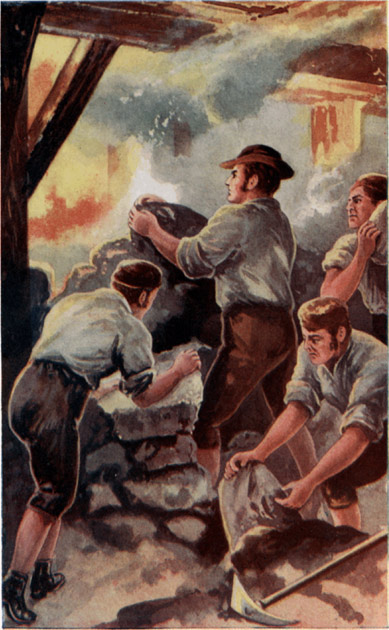
We cannot visit Wylam without feeling at once that we are in the heart of the colliery country. Newcastle’s lofty chimneys tower some eight miles off, and chimneys closer at hand belch forth great volumes of smoke and smut, and flaming furnaces shoot out lurid lights by night far across the country.
In a common little wayside house, just a labourer’s cottage, standing on the roadside, some 120 years ago a baby opened his eyes on a world that was to be rough enough at first for his young feet, though at last they were to land on the very topmost round of the ladder.
The second child of the fireman of the old pumping-engine of the colliery of Wylam, little George was born to grinding poverty. Time as it passed brought other children besides George to the Stephensons, and soon it came to be a question how the fireman and his wife and six children were to live on 12s. a week!
It was indeed a problem to solve and a struggle to face. When food had been got for the little mouths, what was left for clothes and schooling? Very little for the first, nothing for the second. No schooling certainly for little George, and so he spent his childhood between running errands for his mother and standing by his father’s engine fire, where the boys and girls of the village loved to gather to listen to old Robert’s wondrous tales, or to see the birds fed, for the old man loved birds of all kinds, and would save the crumbs from his own scant dinner to feed the robins. Here it was that baby George learned that early love of birds that lasted as long as life. As a boy he would catch and tame the blackbirds, and these would fly about the cottage all day, and at night come and roost at his bed-head. Years after, when he was an old man, he used to tell how, walking with his father one day, he parted some thick branches overhead and lifted the child in his arms that he might peep at a nest full of young blackbirds. It was a sight he never forgot.
But, baby though he was, his days were not all spent in play. At home there were seven younger brothers and sisters to be nursed and watched and kept out of the way of the heavy waggons that were dragged by horses along the tram-road in front of the house, and much of this fell to George’s share.
As the years passed the Stephenson family, obliged like other colliers “to follow the work,” moved to a place called Dewley Burn, and now as George had reached the age of eight he was ready to earn some money!
To show how smart and quick the child was for his years there has come down to us a pretty story.
He and his sister Nell had gone to Newcastle one day, and among their little commissions they were bent on buying Nell a new bonnet. They found the very thing she wanted in a shop, but the price was beyond their purse. It was 1s. 3d. over the mark, and the pair, sadly downcast, had to leave the shop. Standing crestfallen outside the boy suddenly exclaimed, “I have it! Wait here till I come back.” Off he darted, and Nell waited while the minutes wore to hours, and still he did not come. Just as she began to think he must either have been killed or run over he dashed up breathless and thrust the coveted 1s. 3d. into her hand.
“But where did you get it?” she asked, astonished.
“By holding gentlemen’s horses,” was the reply.
The child’s first situation at this time was with a woman who kept a farm and needed a boy to herd her cows and keep them out of the way of passing waggons. For this the little herd-boy was paid 2d. a day. How happy he was in long leisure hours to bird’s-nest or whittle whistles out of reeds, or in company with another boy—by-and-by, like himself, to be one of the world’s great engineers—to model toy engines out of clay, using hollowed corks for corves and hemlock stalks for steam pipes!
Soon George advanced a step in life. His work was still farm-work—hoeing turnips for 4d. a day, leading the plough horses when his little legs could hardly stride the furrows, and working in the dawning hours of day when other children slept.
But his heart was really at the engine fire or in the coal shaft. It was “bred in the bone,” and he gladly returned to the black, grimy life, and along with his brother became a coal-picker, separating stones and dross from the coal, and so earning 6d. a day.
By-and-by he was advanced to driving “the gin-horse,” a horse that travels round and round at the pit’s mouth drawing up and letting down by means of a rope wound round a drum, baskets of coal or buckets of water, and for this he was paid 8d. a day.
Long miles he had to walk every day to and from his work, “a grit-growing lad, with bare legs and feet,” and I think we may be sure there was not a bird’s nest on that familiar road that the little bird-lover did not know by heart.
His next rise was to a shilling a day. This was a great step up, and for this he had what was called a night shift, lading and unlading the coals as they came to the mouth of the pit, and reversing the rope to go down again. Monotonous enough work it was, but he held on to it for two years. And now another step up was at hand. It was a proud day for the boy—that Saturday afternoon when he was told that his wage had been raised to 12s. a week!
“I am a made man now,” he exclaimed in great delight.
And now he was seventeen years old. He had really stepped beyond his father both in wage and position. But there was one thing which he had yet to master. It may seem strange to us, but George could neither read nor write. It began to dawn upon him then that things about which he wanted to know—pumps and engines and the great world of mechanics—could only be learned from between the boards of books that were closed to him. But with George to realise an evil was to try at once to mend it. Inside the boy’s rough working jacket there beat a manly heart, with a great longing to make the most of his opportunities, to let no chance slip of doing his best.
So he actually went to school at nights—three times a week, spending 3d. out of his wages to be taught to read and write. He laboured on and made progress, and in time he wrote and read, and by-and-by he took another step and added to these arithmetic. With marvellous quickness he “caught on” to figures. In the long weary night shifts sitting by the blaze of the fire he would “work” the sums his master had “set” him or write his copies, just as years after, so eager was he to seize every opportunity that offered, he would many a time (in odd moments) chalk his sums on the sides of the coal waggons!
So little by little, by untiring labour and unwearied industry, by “neglecting nothing,” he rose. The miners who were his daily companions were, many of them, a rough lot. Their life was a hard one and their pleasures few, and on Saturday afternoons—pay-day—their amusements were cock-fighting, dog-fighting, and drinking in the ale-house, while the future great engineer might be found engaged in pulling to pieces his engine, cleaning it, getting to know it as we know the character, the habits, the face of our dearest friend, all the time laying in such a store of practical knowledge as was to serve him in good stead in time to come.
Not that George did not delight in exercise. Indeed, few of his companions could equal him in athletics. There was nothing he enjoyed like challenging them to feats of strength in throwing the hammer or in lifting heavy weights. And even in comparative old age he loved to engage in a wrestle with a friend.
About this time George had a favourite dog which he taught to fetch and carry his dinner in a pitcher tied round his neck. At the appointed hour the creature used to go straight to his master, turning neither to the right nor to the left. But one day he was beset with danger in the shape of a bigger dog with murder in its eye. George’s dog closed with it, and a deadly tussle began, but it beat the bully and came off victorious but bleeding. When he reached his master the pitcher was there, but the dinner was spilt; but George was prouder far, when an onlooker described the fight, of his dog’s courage than he would have been of the most sumptuous feast.
But in spite of his larger wage money was scarce, and George beat about in his own mind how he was to earn a few extra shillings. With keen eye ever on the outlook for what lay nearest, he lighted on the shoes of his fellow-workmen! He took to mending these, and he mended them so well that the pitmen soon got into the way of making George their cobbler. And from this he went on to making shoe-lasts for the village shoemaker. In this way it came to pass that in a fortnight’s time he would sometimes make as much as £2. When he had by long and careful labour saved his first guinea great was his delight. “I am now a rich man!” he said.
Yet another source of earning money was at hand. One day the chimney of his house went on fire, and being drenched with water, the soot and water together succeeded in damaging an eight-day clock that stood in his kitchen. Money was still scarce, and the watchmaker did not work without pay, so George set to work and took the clock to pieces, cleaned it, and put it together again. Rumours of this new “handiness” spread, and colliers from far and near sent their watches and clocks to him to doctor. It was almost as if nothing came amiss to these wonderful hands or, indeed, to that wonderful brain.
A wheezy engine pump, a clock out of gear, a pair of worn-out shoes—he had a remedy for all. Painstaking, conscientious, thorough—the work of the boy shadowed forth the success of the man.
If I had space I could tell you how, after he ceased to be a boy, he became a splendid man. That divine capacity—the creative faculty for making something out of nothing—that had been struggling long within him came to the surface, and he burst on the world as an Inventor.
The boon he gave to men—the thing with which his name will ever be linked in history—is the Locomotive Steam Engine.
What battles he fought for it when the country rose in arms and said they would rather hold by the old post-horses and coaches that had been good enough for their fathers! They were hard to convince. They declared if railways and trains came the country would be ruined. The engines would vomit forth smoke. No bird could live in the poisoned air. Game all over the country would be spoiled. The sparks that came from the engine would set fire to the houses near which they passed. Hens would stop laying! Cattle would cease to graze! The man who said he would send engines flying through the air at the rate of twenty miles an hour was a fool and a maniac!
Then Stephenson showed the same patience—for the world was long of being convinced—as he had done on those long night-shifts, sitting lonely by the engine fire and working out his sums, or as years later, when prospects were very dark and money scarce, he wept bitter tears, “for he knew not where his lot in life would be cast.”
But though only a self-taught mechanic, Stephenson stuck to his guns in the face of the most skilled engineers in the land. For two long months the thing hung in the balance. It came before the great House of Commons. George himself was put into the witness-box. Single-handed, undaunted, he faced a world that was all against him. And then he had to bear the great trial of his life. The Bill was thrown out of Parliament. But still he did not despair. He looked into the future, and he saw himself conqueror. The Bill was again brought forward and eventually passed. I could tell you then of his long course of triumphs. How his engine, “The Rocket,” won a £500 prize. How really the first seed of the Railway System of the world was sown then. How then he got leave to make a railway between Stockton and Darlington, and in time one between Manchester and Liverpool. How when, in 1830, the line was finished, people flocked in hundreds and thousands to see “a steam coach running upon a railway at three times the speed of a mail-coach.”
The people were carried away with excitement! The great steam-horse that we look at half a dozen times a day with indifference was thought to be the world’s greatest wonder. And George Stephenson was the hero of the hour. As the train neared Manchester, the people in their excitement broke all bounds, and even the military could not keep order, as they swarmed on the carriage like bees, and hung on to the handles, many of them being tumbled off, while shoutings and cheers went up from a thousand throats.
And now that he was successful, now that people praised where they had blamed, and pandered where they had scoffed, the man remained the same—modest, single-minded, just what he had been as the boy earning his shilling a day by driving the old “gin” horse at the pit’s mouth.
And now from the humble labourer’s cottage he had climbed to the highest heights of fame. He was the first mechanical genius in the eyes of the world. The greatest in the land rejoiced to honour him. From the depths of poverty he had risen to wealth. Honours flowed in upon him. But the “boy is father to the man,” and it was peculiarly true of George Stephenson.
“I never want,” he had said long years before, when he was earning £100 a year, and was able to keep a horse, “I never want to be higher.”
He was much the same as in those old days. There was no dazzling him with worldly display or worldly honours. He cared little for social distinctions. His instincts all along had been “to dwell among his own people.” It gave him the keenest pleasure to have a day at Newcastle among the scenes of his boyhood, looking up the simple friends of his youth. And his tastes, too, remained in many ways just the old simple ones. When he was an old man, and nearing the end of his pilgrimage, when he was surrounded by every luxury of table and otherwise, he would call for a “crowdie,” and with the basin of boiling water between his knees, would stir in the oatmeal with his own hands, watching it with great satisfaction, and then sup the whole with sweet milk, pronouncing it “capital.”
His last days were very peaceful. He removed from the swirling current of business life into a side eddy, when he was about sixty, to a place called Tapton, where he lived a quiet life, meditating among his beasts and birds and flowers, reading in each something of the beauty of the mind of a Greater Inventor than he. He took no part in business life, leaving it to his son, though now and then he would hear from afar echoes from the old world as the old war-horse scents the smoke of battle.
There was no long illness to mar the end of his splendid energetic life. Those who had known him in the full tide and flush of health had not the pain of noting either physical or mental decay. He was at a meeting in connection with engineering in July. Some weeks later he took a severe fever, and after ten day’s illness, without much suffering, the end came. On the 12th August, in his sixty-seventh year, George Stephenson, the great engineer, passed away.
The whole civilised world bewailed his going. He had lived long enough for it to realise and appreciate the mark he had made on the age. But most of all did the colliers mourn him—the men to whom he had been as a kindly father, a leader, a hero. They laid him in the quiet little churchyard at Chesterfield, and they raised monuments to him all over the country, as a grateful people will do,—erected statues and memorial schools, and painted portraits. But a man like George Stephenson needs no memorial of stone. He has left an undying work to speak for him, and a character that has moved men to admiration everywhere for its simplicity, combined with its greatness, its manliness, that made it possible for him, the poor collier’s son, to meet on equal ground—himself also being a man—men of the highest rank in the land.
We cannot, any of us, imitate his genius or his power of invention, or his splendid physical strength, but it is within the scope of all of us, however young or insignificant, to copy his conscientious, unwearied hard work.
“Ah, ye lads,” he used to say to young men when he was himself an old one, in his broad, honest Doric, “there’s none o’ ye know what wark is!”
He has left us a splendid example of patience, content, courage, attention to detail. But most precious of all, of a heart that beat as kindly in old age as in youth, that made him dearly loved by his workmen, and that never turned away from hearing and helping those in trouble.
Riches and success and prosperity, crowding upon him in later years, had no power to spoil the simple beauty of his character, for the Wylam collier’s son, besides being the world’s honoured inventor, was also “one of Nature’s gentlemen.”
To see as a boy the greatest inventor of the age, we shall have to cross the Atlantic and take a journey to the United States of America. England has done wonders in the way of discovery and invention, but it is to New England, as we call it, because she is a daughter of the old Mother Country, that we must go for a brightness and a sharpness of wit that sometimes make us think of the flash of polished steel.
We all know the name of Edison. It is not a name of history, for he is living to-day, a man still in his prime, still sending out from that wonderful brain of his things that astonish men, and have won for him the name of the “wonder-worker of the modern world.”
I have before me as I write the picture of a square, brick house, with outside shutters hooked back, a white paling half encircling it, and a couple of bare, leafless trees before it. The house is plain and poor, and has a strangely unfamiliar look to our English eyes, but it is of the deepest interest to us as the birthplace of Thomas Edison.
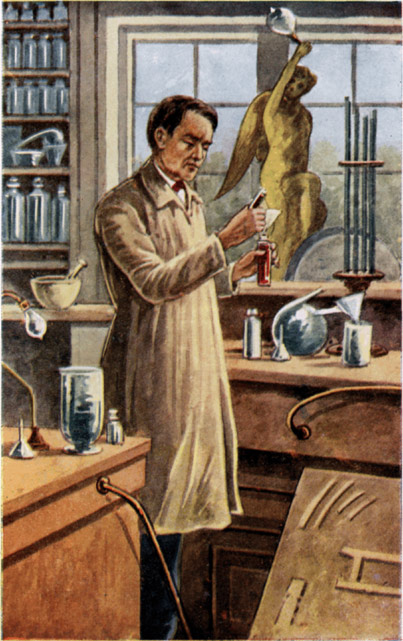
The boy first saw the light in 1847, and though he came into the world with but a poor provision waiting him, he found himself welcomed with a very wealth of love and tenderness. Mrs. Edison had Scotch blood in her veins, and she was a mother in a thousand. It is a common thing in history to find that a son draws his greatness, many of his best qualities, from his mother, and this son took many of his from Mrs. Edison. She was his constant companion, his loving nurse, his gentle teacher during those early years of life that leave so deep an impress on the “afterwards.”
The child was seven years old when the Edison family moved to a place called Port Huron, and there he began to spend every spare moment in reading. So earnest was he that he set himself to read through the Detroit Free Library, and had devoured a close row of volumes before his attempt was discovered.
Strange and solemn sound some of the titles of the books he read when he was twelve years old—a time when most boys are lightly dipping into newspapers and magazines and books of adventure. Burton’s Anatomy of Melancholy, Hume’s History of England, Gibbon’s Decline and Fall of the Roman Empire.
In 1862, when he was barely fifteen years old, he came out more fully from the shelter of home and mixed with the busy world, making a place in it for himself by his own young wits. He was a newspaper boy, and sold his papers like other boys, not stopping still in one place, but going on the train to different stations along the line, and selling as he went.
About this time there was a great fever and ferment in America. The North were fighting with the South, and people panted for news of each battle as it took place. Papers with reports were devoured as soon as printed.
“Now,” thought Edison, “is my chance,” and there began to work in the brain of the boy a big scheme. As the first step to carrying it out, he betook himself to the station telegraph clerk.
“If,” he said, “you will let me wire the war news on a few stations ahead, and have it written up on the blackboard, I will promise you some papers, and now and then a magazine.”
He repeated his request to the different clerks along the line. His eager face and twinkling eyes and earnest words won all hearts, and his request was granted. He next went to the editor of a well-known paper.
“Give me a thousand copies,” he begged, “and I will pay out of the proceeds of my venture.” Here, again, he succeeded. And now it remained but to get the engine-driver to promise him a few minutes at the different stations, and he started on his venture.
At the first stopping-place he had been wont to sell some half-dozen papers. That day, as he looked out, the platform was strangely crowded, and it suddenly dawned on him, from the eager faces of the people and their excited gestures, that it was papers they wanted! He dashed on to the platform, and in a few minutes had sold forty at five cents each, or about a penny of our money. It was much the same at the next station. The people had read the headings on the station blackboard, and they crowded on to the platform, an excited, hustling mob, for papers! It dawned on the boy, here was a chance to raise his prices, so he doubled them, and sold 150 where he had used to sell a dozen! It was the same all along the line. At the last station—Port Huron—his home, the people were most excited of all. The town was a mile from the station. Edison started off with his papers, but was met half-way by an eager, hurrying crowd. They all wanted news. He stopped, drawing up in front of a church where a prayer-meeting was being held. Presently the people poured out and surrounded the boy, willingly paying him five times the usual price of his paper. He began “to take in,” as he expressed it, in his own terse, telling words, “a young fortune.”
After this the busy boyish brain began to look eagerly ahead, to face life seriously. He did not start off on a fresh tack. He took hold of what was nearest to his hand, and he bent his mind on improving that. He had found people were in a hurry for news. The quicker they got it the better they were pleased. Nothing could surely be quicker than that they should get it damp from the press! So it flashed into his brain—why not print a paper on the train?
The question was no sooner asked than answered.
He looked about till he lighted on an old car, and he rigged it up as a printing-office with old types and stereos he begged from a newspaper office. In this novel press-room he threw off sheet after sheet of what he called The Grand Trunk Herald, the first and last paper ever printed on a train. The boy of fifteen was editor, compositor, and newsvendor in one. The paper “caught on,” and the circulation went up to 400.
But, alas! misfortune was soon to overwhelm the young adventurer. One unlucky day the printing-office—the old car, which grew daily more decrepit and unequal to the jolting of the journey—by a more violent lurch than usual threw over a bottle of phosphorus. The cork flew out, and in a few seconds the car was in flames. They were easily enough got under, but Edison’s venture had received its deathblow. The furious car-conductor would henceforth have none of him. He boxed his ears, and pitched him on to the platform along with his precious belongings—the whole paraphernalia of his craft.
It is a sorry picture that presents itself to our mind’s eye. The boy standing half stunned, the rubbish and débris of his belongings strewn at his feet, and the cherished old jolting car, the scene of his labours, gradually fading into distance! It seemed as if his bright dreams were all extinguished, his golden hopes doomed to come to nothing. As he stood there he faced it all—a mere boy low down in the world, badly fed, poorly clothed, almost penniless, but we do not hear that he either flinched or complained, or that a boyish sob rose in his throat. He was made of the stuff of the Stoic. It is our hearts that are sore and anguished, not chiefly for the hopes and dreams disappointed, but because of a terrible calamity that befell him then, when he was perhaps hardly conscious of it; but that grew darker and weightier as the years rolled on.
When the irritated conductor had boxed the boy’s ears, so brutal had been his onslaught that the delicate nerves were injured for life, and now with the flight of years has come deafness to wrap the great inventor in a partial mantle of silence. It is perhaps we who feel most the infinite pathos of the thing, while the man himself bears his affliction with the same noble patience with which he accepted disappointment long years ago as a boy.
At that time he straightway turned his eyes bravely homewards. He picked up his precious belongings, and carried them to a cellar in his father’s house.
It was about this time that his mind began to bend towards that which has ever held for him a keen interest through life—the Telegraph. A waking ambition in him desired strongly to perfect himself in it. He was poor and friendless, and yet firmly, doggedly resolved to get on somehow. So out of his scant earnings—still as newsboy—he bought a book on Telegraphy, and this he pored over night and day.
And now at this early age I think the great inventor must have touched that mine that was afterwards to yield him so wondrously of its wealth.
The boyish mind was putting out feelers, gropingly at first, in the direction of creation, that divine faculty that is granted to so few of us. We can recognise the seed in its first tiny sproutings. He and a boy friend resolved to make a telegraph. They made a line of wire between their houses, insulated with bottles, and crossed under a busy thoroughfare by means of an old cable found in the bed of the Detroit River. The first magnets were wound with wire and swathed in ancient rags, and a piece of spring brass formed the key. Edison pressed two large and formidable-looking cats into his service, tied a wire to their legs, and applied friction to their backs. But the experiment ended in failure. The cats, frightened and furious, resented the liberty, and parted company with, the wire, dashing off in different directions.
But failure never discouraged Edison, nor stayed the working of his brain. He was a true philosopher, and he was, like an elastic ball, possessed of enormous rebound.
Handed down to us there is a story of the boy which, while it may not throw much light on his brain, throws some on his heart and on his ready courage. He was still a newspaper boy on the trains, and while at most stations a few minutes was the limit of waiting, at a certain station where shunting took place the minutes ran to half an hour. The boy was wont to spend this half-hour with the stationmaster’s child, of whom he was fond, or to loiter about his garden. On this particular day the engine-driver had unlinked the cars in a siding, and one was being sent with a good deal of impetus to join another portion. It came on steadily, no one on it to control it, and right in its path was the unconscious baby smiling in the morning sunshine. Not a moment was to be lost. Edison threw down his papers and his hat on the platform and dashed to the rescue. And not a second too soon. As he threw himself and the child free of the line the car passed and struck his heel. The two fell with such violence on the gravel beyond that the stone particles were driven into their flesh, but they were safe!
The grateful father was at a loss how he could show his gratitude to the rescuer of his child. He had little money and no reward to give. At last a plan occurred to him.
“I will teach you telegraphing,” he said to the boy, “and prepare you for the position of night operator at not less than twenty-five dollars a month.”
Edison was delighted. The bargain was struck. The wage seemed, no doubt, a small fortune to the boy—rather more than five of our English pounds.
And now he had got his “toe on the tape,” his foot on the ladder, if it were only on the lowest round. In three months he could teach his master, and the promised situation was got for him. From that he passed to other situations, and gradually he began to make his mark.
He had a mind wonderfully quick to see a difficult situation and to deal with it.
There is a story told of how one winter a severe frost had coated the great river between Port Huron and Sarnia, how the cable was broken, and people could neither get news nor send it to the opposite bank of the river. The spot was crowded with people, baffled and vexed. Edison came along with a brain rarely at fault and faced the thing. Suddenly, to the onlookers’ astonishment, he mounted a locomotive and sent a piercing whistle across the water, imitating by the toots of the engine the dots and dashes of the telegraph system.
In this way he shouted—
“Holloa, Sarnia! Sarnia, do you get what I say?”
At first there was silence on the part of the telegraph man across the water. The people on the bank were breathless with excitement. At last the reply came clear—thrilling. The man on the other side had understood, and the two cities could “talk” again to each other.
After this, people began to hear of Edison’s fame. But the mania for experiments had seized him. The cut-and-dried monotonous routine of work seemed flat and stale to him by comparison. It was as if an enchanted region of fairyland had been opened to the boy. To be allowed to revel in it he denied himself food and necessary sleep. When he was seventeen years old he invented a telegraph instrument that would transfer writing from one line to another without the help of the operator.
There were no want of openings now for him to choose from, but sometimes doors after they had been opened were rudely shut again through envy and evil feeling. In the great world of invention and discovery there are perhaps more “ups and downs” than in any other. Some of Edison’s fellow-workers were kind and generous—others were jealous and detracting. One manager did him an ill turn. He was unequal to completing a discovery he had begun. On the thing being shown him, Edison immediately “saw a light” and brought it to completion, but jealousy crept into the man’s small mind and he dismissed the boy on a false charge.
So at seventeen he was thrown again on the world. Money was still scarce. Books and instruments and calls from home swallowed up the most of it. The boy was chafing under ill-treatment and a sense of injustice. The want of sleep, perhaps of proper food, was telling on him, but he looked forward with a clear, undaunted eye. He wanted to reach a certain town where he believed work awaited him. It meant a walk of a hundred miles. He was weak, disheartened, ill-prepared for it, but he did it. He arrived footsore and weary, with torn shoes and tattered clothes, and his worldly possessions tied in a handkerchief on his back.
In this shabby plight he presented himself at the telegraph office. He was eyed coldly enough at first, but by-and-by when tests were given he stood the tests. There was that in the eager eyes and underneath the shabby clothes that could not but make itself felt as a power. He began work. At first his fellow-clerks laughed at him. In time they were won over, and later he stood out as a workman of the first order.
He began to collect about him materials for printing—machinery without which he never felt quite happy. He did a clever thing one day in the office that brought him into notice. He took a press report at one sitting—a sitting that lasted from 3.30 p.m. till 4.30 a.m.! After that he carefully divided it into paragraphs so that each printer would have exactly three lines to print, and so that a column could be set up in two or three minutes!
It may be that about this time money was rather more plentiful, for Edison began to go to second-hand bookshops and so to gratify his deep-seated thirst for knowledge.
His kindness of heart was well known, and there were many about only too ready to take advantage of it. There were telegraphists who roamed the country in time of war—“tramp operators” they were called, who took short engagements and generally ended their time with a “spree.” These found out Edison—a man who did not drink himself and a man who might be persuaded to lend them money—and these were his worst enemies.
One day he had bought at an auction fifty volumes of the North American Review. Half a dozen men were sponging off him in his rooms when he brought home the books and ranged them unsuspiciously round his walls. Directly he had gone out his guests helped themselves to his purchase, landed them at the nearest pawnbroker’s, and drank the money they brought.
But his love for experiments sometimes brought him into scrapes and disaster, as when he moved a bottle of sulphuric acid one day, strictly against rules, and the bottle spilt, the contents eating through the floor to the manager’s room below and there eating up his floor and carpet, the unlucky accident bringing Edison his dismissal.
And now, at the age of twenty-one, after many different situations and different experiences, Edison turned his steps to Boston. His openhandedness had left him short of money. As was often the case with him, he was sailing very close to the wind. His dress was poor and shabby, and four days’ and nights’ travelling had not improved his appearance. When he presented himself at the office where he was to be taken on, the other clerks ridiculed him as “a jay from the woolly west.”
They made up their minds to play a practical joke on him. They took the New York telegraph man into their confidence. It was arranged he should send a despatch which Edison was to receive. By this time Edison had so perfected himself in receiving messages that he could write from forty-six to fifty-four words a minute—quicker than any operator in the United States.
Not knowing his man, the sender began slowly—then quickened his pace. So did Edison. Quicker still he worked. Edison was in no way discomfited. Soon the New York man had reached his highest speed, to which Edison responded with ease, cool, collected, and stopping now and then to sharpen a pencil between.
By this time he had discovered that the others were trying to get “a rise” out of him, but he went on steadily with his work. Then he stopped and spoke quietly through to the New York man.
“Say, young man,” he said, in his dry humorous way, “change off and send with your other foot.”
But the New York man had reached the end of his tether and had to get someone else to finish, and so Edison won his laurels, and “the jay from the woolly west” was regarded ever after with enormous respect.
After that his place was in the front rank. Now he had reached the threshold of manhood, and a long, dazzling vista of achievement and success stretched before him had he known it. About this time a great, strong conviction of his responsibilities and of the opportunities life held out to him swept over him.
“Adams,” he said to a friend, “I’ve got so much to do, and life is so short, that I’m going to hustle.”
And if we try to look at what he has crowded into a life not long, we must allow he has indeed “hustled” to some purpose. As we briefly glance at the bent of his manhood, his doings fairly dazzle us. He read enormously all sorts of works on telegraphy and electricity, and he produced from his brain that which makes him the greatest inventor of the age. If we tried to enumerate his inventions the names alone would fill pages. We can do little more than name a few. Among the first of these was how to send four messages at the same time over one telegraph wire.
But even after he had embarked on the glorious sea of discovery, what “ups and downs”—what sea-saws of fortune were in store for him! Hunger at times, torn clothes, and battered shoes. But from depths and half-drowning up again he always came to the surface. He rose grandly, relying on his own indomitable will. About this time good fortune befell him. For inventing some telegraphic appliances he got 50,000 dollars, or rather more than £10,000. He could hardly believe his good luck, and it was with this he immediately rigged up for himself a workshop.
And now he was rapidly rising, and the field before him was gradually opening up wider and wider. He started a laboratory at a place called Newark, and from this time onwards his inventions seemed to flow from his brain in a well-nigh continuous stream.
His workmen were devoted to his service. His genial good-humour and kindliness, the absence of all harshness in his manner, and his love of fun could not but endear him to them. They caught the infection, too, of his earnestness. When he had an idea in his brain he worked at it, as it were, red-hot, almost without rest or cessation, and they were rarely reluctant to help him.
“Now, you fellows!” he would say, shutting himself and his workmen up in a room on the top flat, “I’ve locked the door, and you’ll have to stay here until this job is completed.”
During sixty hours, perhaps, he would take no sleep and little food, while his brain would work at highest pressure until the thing was wrought. Then he would relax, and sleep for as long as thirty-six hours at a stretch.
And now his fame had spread far and wide. The people at Menlo Park, to which he removed—some twenty-four miles from New York—began to look upon him as a wizard—a man possessing magical powers. It seemed to them there was nothing he could not do. Exaggerated tales of his wonderful powers spread over the country.
“If people track me here,” he said (he had been besieged at Newark), “I shall simply have to take to the woods.”
Child after child was the offspring of the inventor’s brain. At one time, within the space of a few years, as many as forty-five were born.
There was the Microphone, which is much like the Telephone, except that in the Microphone the sound is magnified. There was the Megaphone, which brings far-away sounds near, so that cattle crunching grass six miles off could be heard distinctly at Menlo Park! There was the Kinetoscope we all know, which by swiftly passing pictures—as many as forty-six a second—seems to give us a single person in motion, somewhat on the lines of that toy of our childhood, “The Wheel of Life.” And there was the grand king of inventions—the Phonograph—that overtops all the rest.
We know it, all of us, by this time. We have listened to it, with the tubes at our ears, while the voice of someone speaking at a distance is distinctly borne to us, or the strains of a song sung by some great singer.
In 1888 Edison sent his first phonogram by steamer to England. His friend here had only to take out the wax cylinder, put it into his machine, and set it in motion, and lo! it seemed to him as if Edison himself were in the room talking to him!
Great men all over the world recorded their astonishment and their praises of the wonderful invention. The Queen sent him a message of congratulation. People flocked to every exhibition to see it—to the French one from countries all over Europe. They saw it and straightway went into raptures. Edison himself, looking into the future, seemed to see volumes it might yet be brought to do. It might be used to write letters merely from dictation. It might be used to make clocks speak—to tell when it was time to come to meals. It might be used for toys. A tiny phonograph might be placed inside a doll, and it would straightway “talk”; or in a toy animal, and it would grunt and growl!
What a strange thing that in this world of passing-away and change we should be able to preserve from destruction such treasures sheltered in a wax cylinder—some great man’s words of wisdom, or the silver tones of a sweet musician!
The more Edison’s brain accomplished the more did it seem able to do. As a man he showed himself untiring as when a boy. He went on discovering. He invented a way of telegraphing from a moving train. He invented an Electric Railroad, that drew delighted thousands at the Chicago Exhibition.
In 1879 his attention turned to lighting, and he bent all his energies on inventing an Incandescent lamp for electric light. He spent days working at a sort of white heat. He began on the 16th October, but mishaps and accidents seemed to threaten his invention.
“Let us,” he cried to his partner in a ferment of excitement—“let us make a lamp before we sleep, or die in the attempt.” On the morning of the 21st it was done!
It astonished the world. It opened up possibilities for miners and divers, and for men everywhere.
On the occasion of its exhibition people flocked from all parts of the United States. Special trains were run. The same furore over the marvel reigned at the Paris Exposition, and at every other exhibition. And through it all—a fame, a popularity enough to turn the head of most mortals—the man remained the same—modest, simple, unpretentious.
From Menlo Park he went to Orange. His laboratory there was fitted up with everything conceivable that an inventor red-hot and eager might want at a moment’s notice. And yet often the workrooms presented the strangest appearance of disorder. Workmen sometimes stretched on benches or floor after a heavy strain, the great master himself thrown down—a stick under his head, a coat wound round it for a pillow, and so snatching a short interval of sleep! He will not be interrupted by visitors. In this great world of his own he seems at times to live a sort of separate existence.
We are amazed, dazzled, astonished by the tremendous results one man in his lifetime has achieved. He has not been content to take some thing and modify and improve it and set it to a new purpose as men whom we call inventors have done in all ages. But he seems to have called upon the very forces of nature to do his bidding. It is almost as if he had harnessed the winds, the air, sound, electricity, for his purposes.
A man after a single discovery not seldom rests on his laurels for life. This man is still in his prime, and we cannot tell yet what product of his brain will still astonish us, and we cannot touch here on a tithe of what he has done. He lives sometimes in his northern home, in New Jersey, sometimes at Orange.
As a man he shows the same genial, kindly sympathy which, as a boy, never failed to win the hearts of his fellow-clerks, the same modesty that disarmed their jealousy. These things chain his workmen to him to-day with links of love. Now that men praise and laud him all over the world he shows the same good-natured indifference to name and fame he has shown all through. And he has lost nothing of the tireless energy that used to support him through hard work and long night-sittings as a boy—this man who, as someone has it, “has kept the path to the patent office red-hot with his footsteps—this wonder-worker of the modern world.”
There is perhaps no inventor’s name with which the British boy is more familiar than with that of James Watt. In every college of mechanics or engineers we are met in bust or print by the kindly, shrewd, benevolent face of the great inventor of the Condensing Steam Engine.
It is difficult for us to picture what the world must have been before James Watt came into it—before, as it were, steam took its place and while yet men and horses and wind and water struggled feebly to do what steam now does with such apparent ease.
On the west coast of Scotland stands what is to-day the busy, thriving, seaport town of Greenock—the birthplace of James Watt. But in 1736, more than 150 years ago, it was little more than a picturesque fishing-village, looking out on a peaceful, smiling bay, where a few modest fishing-craft were to be seen, and beyond to the hills of Argyllshire, before smoke and funnels blotted the fairness of the landscape.
In an unpretentious little house in a Greenock by-street James Watt first saw the light. His father was by trade a carpenter, an undertaker, a general “merchant,” for there was little competition in those simple days, and men often “professed” more than one trade. In the course of a few years little James was left the sole surviving child of five, and perhaps on that account was specially precious to his parents. Neither as the years went on did he grow into a sturdy, lusty country boy, but rather struggled up slowly, anxiously overlooked by a mother’s care, a prey to ill-health and headache, even in his baby years. So that most of his early education fell to his parents, his mother opening up to him the beginnings of reading, his father those of writing and arithmetic.
School, to which he went by-and-by, proved a failure. Shy and shrinking, he cared little for the play of other children. He was slow at games, perhaps dull in class, and the boys and girls laughed at him. Ill-health, too, made it hard for him to get on. He liked best to be at home. For amusement he would draw in chalk on the kitchen floor, and for playthings he would choose his father’s instruments. One day a neighbour remarked on the child’s drawing.
“He should be at school,” she said, “and not trifling away his time.”
“Look first,” said the father, pointing to the floor, “before you blame him. He is solving a problem in geometry.”
The child was then six years old!
We are familiar with the story handed down to us through the centuries of how the dreamy-eyed boy was engaged in watching the steam hiss from the kettle-spout, the while holding a teaspoon below to count and catch the drops of water. Tradition likes to see in this the tiny seedlings of that mighty tree—the Condensing Steam Engine, but we fear that common sense in the shape of his robust-minded aunt was nearer the mark when she exclaimed—
“James Watt, I never saw such an idle boy as you are. For the last hour you have not spoken one word, but taken off the lid of that kettle and put it on again, holding now a cup and now a silver spoon over the steam, watching how it rises from the spout, catching and counting the drops it falls into.”
For change of air the boy was sometimes sent to Glasgow, the great commercial capital being then no larger than a country market-town. Mightily astonished were his relatives, and, according to their own account, not a little scared, when of an evening his tongue was loosed, and he would launch into tales, wonderful things that held them entranced for hours, and sent them wakeful to bed. Was this time prophetic of those later years when he would hold men and women fascinated by the charm of his conversation?
And now young James was sent to the Greenock Grammar School, but he made no great mark there, except in mathematics, in which he easily headed the class. But Latin and Greek are not a boy’s only education. At home he was learning other things, from his parents’ talk, from the pages of books. And then there were the long golden hours when he put on a leather apron like his father, and installed himself in his father’s workshop with a small forge and a small bench all his own, and with his boyish fingers handled the tools so deftly and so cleverly that the workmen watching him exclaimed—
“Little Jamie has gotten a fortune at his fingers’ ends.”
But while he worked his mind was not idle. He read eagerly and precociously, as a delicate child sometimes does, devouring all such books as he could lay hands on. Solid enough reading they will seem to boys to-day.
The Cloud of Witnesses, Henry the Rymer’s Life of Wallace, Boston, Bunyan.
Added to this was his parents’ talk, that fell on his young ears and stamped itself on his young mind, and the picturesque surroundings of his home, for he loved nature’s beauties—the hills, the stars, the trees. The mountains and the plains about his home were made romantic by memories and associations of Covenanting times, told him by his father, and his boyish rambles were made beautiful by wild flowers, and again there were long delightful days of fishing to add to these.
But in the midst of all this struggling in the boy’s mind was that strong leaning to mechanical invention longing for an outlet. It peeped out here and there—for instance, in being unable to see an instrument without wishing to discover all its uses. And so well did he show himself able even then to fashion delicate things like compasses and quadrants—an instrument in shape like the fourth of a circle—that his father, after much thought, made up his mind that James should learn the trade of a mathematical instrument maker.
So in 1754 James came out from the shelter of home and launched himself on the great world, rather more of an ordeal to the shy, timid boy than it would have been to one more robust and enterprising. This was practically the last of Greenock. The peaceful fishing-village was never again to be his home. Naturally he turned his steps to Glasgow. We can picture the great event in the quiet household. The boy getting ready, his modest baggage, his clothes (his mother’s tender care), a leather apron, some carpenter’s tools, and a quadrant.
But he was destined to go yet farther afield. No mathematical instrument-maker was to be found in Glasgow. A professor to whom James was introduced advised him to go to London. “To London” is an easy enough journey to-day—then it was a mighty undertaking. No trains—no steamers. One could only go by slow coach or on horseback. James chose the latter. His trunk was sent by sea from Leith, and he along with a friend set off on his long journey. He left on the 7th day of June, and travelling by Coldstream and Newcastle, he arrived in the great metropolis after a ride of twelve days!
Most likely, although there might have been fear in the boyish heart, it also beat high with hope. Again and again has London made fair promises to boys such as he. But disappointment was to meet him on the very threshold. He found that apprentices who intended to serve a term of seven years were only accepted. This was very far from James’s thoughts. What he wanted was to learn the trade, start off home again, and set up in Glasgow for himself as soon as possible. After many failures, however, he at last found a man willing to take him on for a year on his promise to pay twenty guineas with the results of his work during that time.
And now began a time of stern work and self-denial. He took poor lodgings. He scrimped himself in everything but the bare necessaries of life. He spent on himself exactly eight shillings a week. He could not, he wrote, do with less. He scraped and pinched, remembering how ill his father could afford his keep.
When he could get extra work he took it home at nights to his poor rooms and sat up late over it, often ill and weary. In a month he could make a quadrant better than any of the other apprentices. And so he struggled on against loneliness and headache and depression. It was rarely safe to venture out at night at that time in London, for sailor press-gangs were abroad. No able-bodied man was spared. In one night they took as many as 1,000 men. Sitting as he did close to the shop door when at work, he was often exposed to cold, and caught rheumatic pains which did not leave him for many a day. After a year of this he went home to Greenock, in his possession some tools and instruments, and in his hands and brain a mighty store of skill and knowledge.
Revived by his native air he set out again to seek his fortune—again to Glasgow. Again to be met with disappointment! He had not learned his trade in Glasgow, and therefore Glasgow would have none of him. Not so much as a workshop would it give him. It seemed almost as if there were no place open for the boy.
But his friend the professor came to the front again. If Watt could find no place in the city, then the University should shelter him. And so they gave him a workshop twenty feet square in the old College grounds, and a room in which to sell his instruments, and he was at last fairly launched.
But business progressed but slowly. He lived, to be sure, in an atmosphere that must have delighted him. The professors and the students found him out. They came and came again. He seemed always to have something original to say. He was a man who read much and thought much—humble as a child about his own attainments—eager with the generosity of the great man to give others their due—yes, even more than their due. They found out that he knew all about engineering, and not a little about natural history, art, languages—and then the trick of observation was so strong with him that nothing escaped him. In time it came to be the general opinion that the young instrument-maker was one of the ablest men about the University. But gratifying as was the making of these friends, they did not bring Watt in any money. Somehow his instruments did not sell well. He was too far from the town. Indeed, his business was so poor he sometimes thought of giving it up. It may have been there was a want of practical “push” in him, a quality he never gained all through his life. Somewhat discouraged he took to making fiddles and flutes and guitars and even organs,—but he was yet very far from making that fortune he had come out to seek.
There are crises, turning-points in the lives of most people. They are seldom noisy. Sometimes, indeed, they come so quietly as to be hardly noticed. And now Watt was gradually nearing his.
About this time his thoughts began to turn to steam. It may be that had he been busy and successful as an organ-maker, his great invention might never have seen the light.
People had, of course, known for long that there was a power in water exposed to heat. Now in 1759, when Watt was twenty-three, his attention was drawn to the Steam Engine. He pondered it. After he had pondered it he set to work. His first model was a failure. But the idea had silently and firmly lodged in his brain. He went on with his everyday business, but ever in his leisure back sprang his mind to that subject that was to be his all-absorbing life-work. He read eagerly what other men had done. He got a model of another man’s engine and he studied it. He found what he thought defects. He groped steadily on—now seeing a light—again thrown into darkness—now following what turned out to be a will-o’-the-wisp—again getting hold of an idea that seemed to him a gem.
There came to him gradually dawning thoughts. First, that of Latent Heat. Again, that a small quantity of water in the shape of steam heats a large quantity of cold water. Yet, again, that at 212° water is elastic, and that steam heats six times the weight of cold water to a temperature of 212°, the temperature of steam.
And so he went on step by step, till one day the thing burst on him, full-fledged, as it were—complete, dazzling, a perfect inspiration.
It was a Sunday afternoon in the spring of 1765. He was taking a stroll in a quiet part of Glasgow, now a paved and busy thoroughfare called the Green. A Sunday calm brooded over what was on weekdays a scene of busy life—of washing and drying clothes. His thoughts, as usual, hovered about his beloved theme. It inspired him with a very passion as a child of his own. The key to his engine—long sought—suddenly flashed before his mind’s eye. The thing had been waiting incomplete for want of it. It came to him then—the idea of a Separate Condenser.
A great uprising of his mind followed. In his solitary walk the flashing thought filled the man with rapture.
Two drawbacks—waste of steam and waste of fuel—had been the ruin of former inventions.
“Ye need not fash yourself about that, man,” Watt said to a friend, answering some objection that he had made, “I have now made an engine that shall not waste a particle of steam.”
And so, though it was but the beginning, though years of weary labour and disappointment and discouragement waited him before the end was reached, the Condensing Steam Engine, as we have it now, first sprang into being that spring afternoon on the Green in Glasgow.
And now the young inventor set himself with eager enthusiasm to make a model. There were no skilled workmen to be had, no self-acting tools, as in our day, and so the first model was only partly successful. But not a whit discouraged, he went on.
“My whole thoughts are bent on this machine,” he said. “I can think of nothing else.”
And now there remains but to tell in a few words—for it is the record of his manhood—the “ups and downs” just beginning, the disappointments, the failures, the hopes and fears that waited on this offspring of his brain. He was poor, and money was the first thing that was needed. Who would risk thousands on such a vague and shadowy thing?
Meantime the pot had to be kept boiling! He looked into the future, and he saw great things steam might yet be made to do, but there was bread and butter needed for the present. So he went bravely in for surveying, though there was little enough to be made by that. He had still ill-health to struggle against. “I am still plagued with headaches,” he wrote about this time, “and sometimes heartaches.”
But after a time a gleam of hope shone through the clouds. After failures and difficulties he at last succeeded in finding someone willing to risk his money. So in 1769 he patented his engine, and began to build it. In six months it was finished, and as it neared completion Watt could hardly sleep. Then, and for long still in the future, he was to suffer from bad, incapable workmen, and this accounted for his partial failure.
“It was,” he said, “a clumsy job.” Watt grew depressed.
In 1770 he wrote: “I enter on my thirty-fifth year, and I think I have hardly yet done thirty-five pence worth of good in the world.”
A friend, seeing him cast down and unhappy, advised him to give up inventing. As well might he have advised the sun not to shine or living man to cease from breathing. Meantime the years went on. Watt was often, as he said, “heart-sick.” Long years after, remembering this weary time, he said, “The public only look at my success.” He stinted himself in everything but bare necessaries, for as yet his engine had paid him nothing and cost enormously. But light again arose in the darkness when he got as a partner Boulton, of Birmingham, and from that day onwards matters mended. Six of the fourteen years’ patent were gone, but he succeeded in getting a renewal of it for twenty-four years by Act of Parliament, in spite of grumbling discontent of men who wanted to steal the fruit of his brain, and were thus prevented.
Now he set to work in earnest. His first engine was made to blow the bellows of ironworks. His second to pump water out of the mines in Cornwall. In 1776 this was set up, and worked perfectly. “There it was, ‘forking water’ as never engine before had been known ‘to fork.’”
“All the world are agape,” he said, “to see what it can do.”
And it did well. And now the “voice of the country was in its favour.” So the first step was taken. The others followed in quick succession. The partners worked together perfectly. Watt understood engines, but not men. He grew impatient, irritable, peevish if a workman were inefficient, and would have dismissed him on the spot. Boulton was wiser, and never failed to oil the wheels. Watt was despondent, easily cast down; Boulton was his “backbone.”
There came then into Watt’s mind the idea of an engine that would produce rotary motion. This he patented in 1781. All round and about, ready to pounce on it, were a perfect swarm of pirates.
“One’s thoughts seem to be stolen before one speaks them,” he said. And again, “All mankind seem to be resolved to rob us.”
In 1782 the first rotary machine worked. After long waiting there was a brilliant result. It was made to drive a corn-mill. In our day it would be hard to say what Watt’s rotary machine is not made to do. It is made for corn-mills and for cotton-mills, for sugar-mills and iron-mills. It drives our steamers and rolls our hammer-iron and coins our money and prints our books.
And now the great inventor had reached the highest pinnacle of fame. In 1790 he had an interview with the King, who asked about his engines.
But he had not landed at the topmost round of the ladder without much painful climbing and many weary steps. His life had been all through shadowed by ill-health, and an anxious, worrying mind that refused to be calm. He had a shrinking distaste to business, and a fearful habit of looking on the dark side of things. Often would he have sunk in depression and despair had it not been for his cheery partner. It was only in the late years of his life that he came to know anything like peace. His mind all along had been too active for his body.
But though as an old man he retired from public life and from business, he could not altogether retire from invention. He invented a letter-copying machine, and one for copying statuary. In his old age he lived very quietly in his comfortable house near Birmingham, furnishing what he called his Garret, a room where he might be alone and still invent, don again, as in boyhood, the leather apron, cook his own food, and ponder anew the details of those wonderful inventions he had given to the world.
Friends admitted there found “the great Mr. Watt” simple, modest, careless of display—much as he had been as a boy—his voice low and kindly, with still its broad, homely Scottish accent. The world would have liked to draw him from his seclusion, to caress him, to make much of him. It offered him a baronetcy, but his simple tastes lay not at all in the direction of such honours, and he refused it.
In 1819, when he was eighty-three, the end came. “I feel,” said the great man with a calm in strange contrast to the fearfulness and timidity that had accompanied him through life, “I feel that I am now come to my last illness.” He passed away quietly and without suffering. They buried him in Handsworth Church—near to his partner, Boulton—and erected an imposing statue in Westminster Abbey, and beneath it Lord Brougham wrote his famous epitaph.
To us his life has much of pathos. Men have called him “the greatest inventor in all ages,” “the most extraordinary man that the world has ever seen,” but the long years of struggle and labour and waiting, the weakness of body and the oft depression of spirit, are to us not a little sad, specially when we remember how patiently he endured, how uncomplainingly he suffered, that we might profit, that he might, as Lord Brougham has it, “increase the power of man.”
By GORDON STABLES, M.D., R.N.
Large Crown 8vo, Bevelled Boards, Gilt Edges, with Illustrations.
FIVE SHILLINGS each.
IN SHIPS OF STEEL.
A Story of the Navy of To-Day.
“A lively tale of the Navy of to-day, by that popular writer.”—The Guardian.
“We say a great deal when we say it is quite up to the Author’s usual level of exciting story telling.”—The British Weekly.
FOR CROSS OR CRESCENT.
A Romance of the Days of Richard the Lion-hearted.
“A spirited, graphic story.”—Pall Mall Gazette.
IN THE DASHING DAYS OF OLD;
Or, The World-wide Adventures of Willie Grant.
“We can commend this book is the best story for boys which we have read for many a day.”—English Churchman.
FOR HONOUR NOT HONOURS.
The Story of Gordon of Khartoum.
“Dr. Gordon Stables has written again the story of General Gordon, in ‘For Honour not Honours,’ and no English boy will tire of reading it.”—Pall Mall Gazette.
ON TO THE RESCUE.
A Tale of the Indian Mutiny.
“A capital story of the Indian Mutiny. The boy who gets hold of this book is certain to thoroughly enjoy it.”—The Record.
SHOULDER TO SHOULDER.
A Story of the Stirring Times of Old.
“More than a mere Story of the Stirring Times of Old. The tale goes close to the heart of the reader, because it has come from the heart of the writer.”—Aberdeen Free Press.
ENGLAND’S HERO PRINCE.
A Story of the Black Prince.
“A dashing, graphic piece of work, well calculated to arouse the spirit of youth.”—Publishers’ Circular.
’TWIXT DAYDAWN AND LIGHT.
A Tale of the Times of Alfred the Great.
“Splendidly told and well illustrated.”—Pall Mall Gazette.
OLD ENGLAND ON THE SEA.
The Story of Admiral Drake.
“Here we have told with much spirit the story of Admiral Drake. We have plenty of stories of the sea, but what could be better than this true tale?”—The Spectator.
HEARTS OF OAK.
A Story of Nelson and the Navy.
“Tom Bure, the hero, will charm every boy that gets hold of it.”—Literary World.
“A story of the Navy and of Mighty Nelson, told with excellent spirit.”—Saturday Review.
EXILES OF FORTUNE.
The Story of a Far North Land.
“A capital book; written with this popular writer’s accustomed spirit, and sure to be enjoyed.”—Scotsman.
TWO SAILOR LADS.
Their Stirring Adventures on Sea and Land.
“A sea story big with wonders.”—Saturday Review.
“A capital story in Dr. Stables’ best style.”—Spectator.
FOR ENGLAND, HOME, AND BEAUTY.
A Tale of Battle and the Breeze.
“Dr. Stables has almost surpassed himself in this book. Certainly we have read nothing of his which has pleased us more—perhaps we might say as much.”—The Spectator.
IN SEARCH OF FORTUNE.
A Tale of the Old Land and the New.
“The story is naturally and brightly written.”—Standard.
“Just the book boys like.”—Schoolmaster.
FACING FEARFUL ODDS.
A Tale of Flood and Field.
“An exceptionally good book for boys.”—Guardian.
“One of the author’s most fascinating stories.”—Leeds Mercury.
Crown 8vo. 3s. 6d.
“LIFE ON THE OCEAN WAVE.”
A Cruise of the Good Ship “Boreas.”
London: JOHN F. SHAW & CO., 48, Paternoster Row, E.C.

Transcriber’s Notes
In the caption of the illustration on page 102 “Stevenson” has been changed to “Stephenson” (Stephenson fighting the fire).
On page 117 ’ has been changed to ” (of Nature’s gentlemen.”).
On page 159 — has been added (of youth.”—Publishers’ Circular.).
Otherwise the original has been preserved.