Colin wakened early the following morning and got up promptly, planning
to show his alertness, but when he came downstairs and sauntered out
between the oleander bushes toward the water he heard a hail and found
that his chief was already up and was busy unpacking some large boxes
which had been delivered the night before. The boy hurried to help him.
"What are these, Mr. Collier?" he asked, as some large square boxes with
a window in the bottom came into view.
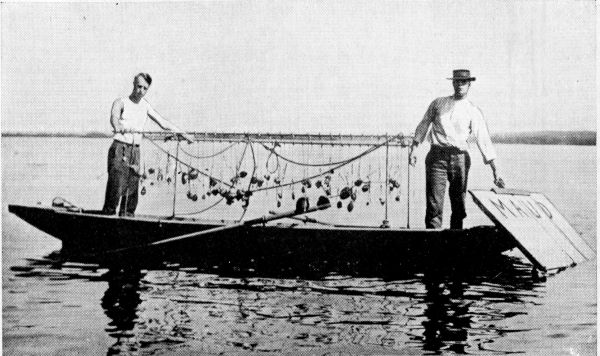
"These are water glasses," the scientist answered, "not the kind that is
used by tourists, but some I have had made specially—lenses with
reflecting mirrors; with them the bottom of the sea ought to show up
clearly. As you notice, they are long enough to be usable from the deck
of a fair-sized sailing boat. It's a shame only to half-see things as
beautiful as the sea-gardens. When a thing's worth while, it is so much
worth while."
"I thought you would probably have to dive," Colin said, "in order to
see the submarine gardens thoroughly."
The curator shook his head.
"You'll find," he said, "that we can see almost as well with these as
though you and I were a couple of angel fish, swimming in and out of the
grottoes of the coral. The water—as you noticed when we were coming
into the harbor—is as clear as crystal. There's nothing in coral sand
to make it cloudy or muddy."
"Are we going out this morning?" the boy queried eagerly, as he helped
in the unpacking of the various instruments that the museum expert had
brought.
"The boat is to be here at half-past eight," was the reply, "and we're
going to find the most beautiful spot that there is in the submarine
Garden of Eden. Our darky boatman, 'Early Bird,' they call him, says he
knows a place quite far out on the reef where there are wonderful groves
and parterres unspoiled by tourists because they lie so distant that it
is not worth while for the excursion boats to make the trip."
"I don't quite see," said Colin, "how the visit of tourists floating
over a stretch of sea could harm the seaweeds and the coral growing on
the bottom."
"But it does, because a number of the glass-bottomed boats carry a diver
who goes down and breaks off specimens of coral at the tourists'
request, selling them for a good sum. But the gardens to which we are
going, I understand, are entirely out of the beaten track and are very
much finer besides. Here is 'Early Bird' now."
As he spoke, a white sailboat with a large spread of sail came skimming
into the little bay, heading for the private wharf of the hotel at a
rapid clip. Colin held his breath as the craft came rushing in, for the
inlet was not much wider than twice the length of the boat and it seemed
certain that the vessel would crash full upon the rocks not twenty feet
beyond the wharf. But at the very last second the tiller was put over,
the sail jibed, and as gently as though she had crept up in a calm, the
Early Bird glided up beside the wharf, her bowsprit narrowly missing
the bushes on the bank as she turned.
"You sure can handle a boat!" cried Colin admiringly.
The owner of the vessel, a young colored man, of good address and with a
clever face, showed his white teeth in a gratified smile as he replied:
"Yas, sah, Ah've sailed a boat roun' the harbor quite a good deal."
"It looked that time as though you were going to be smashed up, sure."
"Ah nevah even scraped the paint of a boat in ten yeahs o' sailin',
sah," the colored boatman answered, "an' thar's lots o' shoals, too."
"It looks as if she were resting on the bottom now!" the boy said.
"No, sah," was the confident reply, "the tide's full in an' Ah knows
this whahf right well. Thar's two feet of wateh under her, right now."
Early Bird—for both boatman and boat answered to the same name—deftly
took aboard the glasses and other special material that had been
prepared, not forgetting a large lunch basket that had been sent down
from the hotel, and then he pushed off into the clear and shining water.
The early morning breeze laid the little craft over on her side but she
had a good pair of heels and in a few minutes the party was well on its
way across Grassy Bay.
"Where are we going?" asked Colin.
Early Bird pointed beyond a group of small islands to where there seemed
to be a depression in the land.
"Thar's a channel, sah," he said, "right in between those two islands.
Thar's a swing bridge across, but the keepeh is always on the lookout
and we can go right through."
A half hour's sail brought them to the gap between the islands. Though
the bridge was shut Early Bird steered confidently straight for the
center, and it swung just in time, the boat shooting by with
undiminished speed and rounding a point to the open water beyond. Before
them stretched an unbroken vista of ocean.
"The next land south of you, Colin," remarked the curator, "is
Antarctica."
Colin thought for a moment, then said in a surprised voice:
"Why, yes. Bermuda is an isolated point, isn't it? I hadn't thought of
that before. Nearly all islands are in chains, but this little bit of a
place is set off all by itself. I wonder why that is?"
"Bermuda is the top of a submarine mountain," was the reply, "perhaps
part of the lost Atlantis—who knows? This stupendous peak rises almost
fifteen thousand feet sheer from the ocean bed and its rugged top
forms the basis of the islands. Think what a magnificent sight it would
be if we could see its whole height rising from the darkness of the
ocean deep."
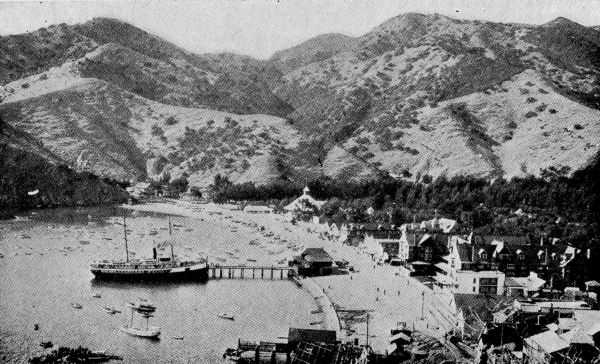
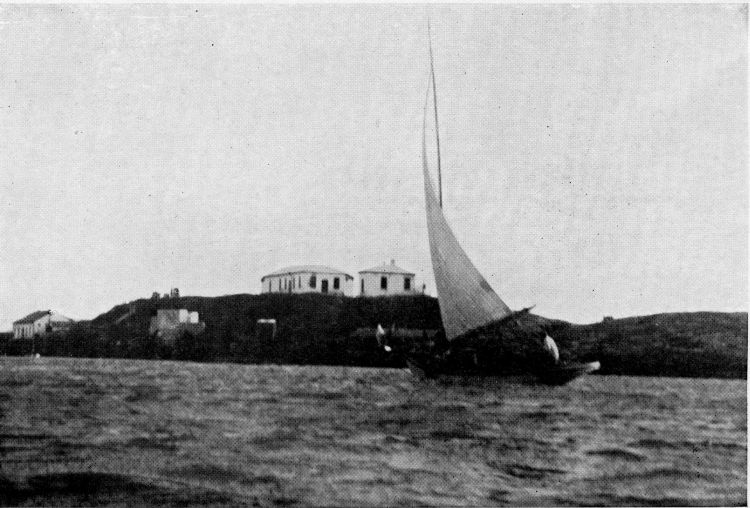
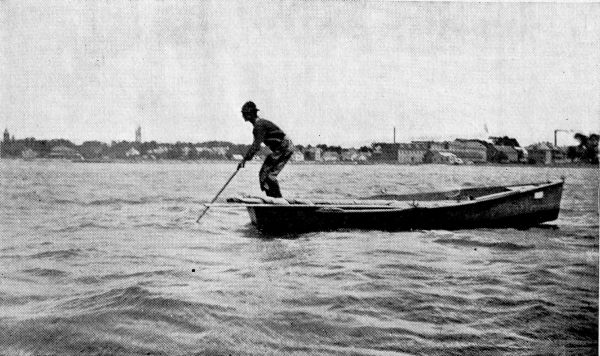
The Early Bird Passing the Bermuda Aquarium, Agar's Island.
Photograph by C. R-W.
"But I thought Bermuda was a coral island!"
"The coral polyp has got to grow on something, hasn't it?" the scientist
reminded him. "Don't forget that the little creatures can't live in deep
water. And, you see, Bermuda has gradually been sinking, the coral
builders keeping pace with the subsidence, so that although the island
is only two miles across at the widest point the reefs are ten miles
wide."
"It really is coral, then?"
"As much as any island is. The base of any coral island is limestone,
being made of the skeletons of coral polypi which have been broken and
crushed by wind and weather and beaten into stone. Just as chalk is made
of thousands of tiny shells, so coral limestone is made of myriads of
coral skeletons."
"Why, that's like sandstone," cried Colin, in a disappointed tone. "I
had an idea that coral was a sort of insect that lived in a shell and
that colonies of these grew up from the bottom of the water like trees
and when they died—millions of them—they left the shells and these
stone forests grew up and up until they reached the top of the water and
then soil was formed and that was how coral islands began."
"I'm not surprised at your thinking that," his chief replied, "lots of
people do. And though that theory is all wrong, still if it has given
folks an idea of the beauty and wonder of the world, there's no great
harm done. Plenty of people still talk about the coral 'insect.' It
never occurs to them to call an anemone an 'insect,' but they don't know
that the coral polyp is more like an anemone than anything else."
"But an anemone is a soft flabby thing that waves a lot of jelly-like
fingers about in the water."
"So does coral," was the reply, "and it eats and lives just in the same
way, only that the coral polyp has a stony skeleton and most of the sea
anemones have not. But every different one has some sort of a story to
tell and I believe they get joy out of life just as we do. Else why
should some of these forms be so beautiful? You note them closely when
we pass over some of the reefs, and I should judge we are coming to them
now."
Certainly if the coloration was any clue, the boat was coming to the
great sea-gardens. Above the white bottom the water shone a vivid
emeraldine green, changing to sharply marked browns over the shoals,
while beyond the inner reefs it varied from all shades of sapphire blue
to radiant aquamarine. Nowhere was the water of the same color for a
hundred yards together, while every ruffling of the surface, every slant
of sunlight gave it a new hue. Colin was entranced and wished to see
more closely, but the boat was going too swiftly to let down a water
glass and he was forced to wait a few minutes.
"Ah b'lieve, sah," said Early Bird presently, hauling in the sheet, "we
might let the sail down heah. We'll drift just about fast enough fo' you
to watch the bottom."
Mr. Collier handed one of the water glasses to the boatman. It was
formed like a deep square box with a glass window for a bottom, and a
specially prepared crystal had been used.
"That's an improvement on the old kind, Early Bird," he said; "what do
you think of it?"
The Bermudian darky looked through the glass critically.
"Yes, sah," he said, "thar's no compah'son 'tween the two. The bottom
looks bettah through that glass than it does when yo' down theh
yo'self. Ah used to do a little diving at one time, but the reefs nevah
showed up that cleah. It would be a big thing fo' the boats that take
tourists out if they could have glasses like that one there."
"It would be, perhaps," the scientist said, laughing, "but they could
almost build a boat for what one of these would cost."
"Isn't that the most gorgeous thing you ever saw!" cried Colin, as he
set his eye to the glass, which Early Bird handed him. "There's no
garden on land with such colors as that."
"There are no flowers in the garden you're looking at, remember," his
friend reminded him.
"Don't need them," said the boy. "Look at that tall purple plant waving
to and fro. Isn't that a sea-fan?"
"Yes," his companion answered, "that's a sea-fan, but it isn't a plant.
It's a kind of coral."
"Is it? I always thought it was a seaweed."
"You'll be calling a sponge a plant next. See those red lumps, near the
bottom of that rock? Those are sponges."
"Now there's some real coral!" the boy cried.
"All coral is real coral. What you are looking at is probably a form of
the stag's horn variety," the curator said, "and that does look more
like the coral of commerce. But everything you are looking at, nearly,
is coral. These great dome-like stones, do you see them?"
"The ones that look like the pictures of a brain?"
"Yes, those are called brain-stone or brain-coral. And those others,
just the same shape only with little holes, instead of grooves, that's
star coral."
"Then there seem to be some that look like a bouquet of flowers all
stuck together."
"That's rose coral," was the reply, "and those are the three forms you
see more generally."
"But where's the pink and red coral? If it's as easy to get at coral as
this, I don't see why people don't come here and make a fortune."
"Fortunes aren't quite as easy to pick up as that. This coral has no
market value; the variety that is used for jewelry comes mainly from
Japan and from the Mediterranean, and the governments of the various
countries keep it under constant watch."
"That's why. I see now. Oh!" exclaimed the boy as some fish swam under
the glass suddenly. "Just look at those angel-fish. They seem twice as
brilliant as the ones I saw in Devil's Hole."
"Of course," the curator said, "you would expect them to look dull in
dull surroundings. That is color protection. Here, everything is gaily
colored and striped and streaked and dotted, so the fish are, too. That
helps them to hide and be unnoticed. A plain-colored open sea fish could
be easily seen."
"Look, sah," said Early Bird, turning to the boy, "Ah've got a little
sailoh's choice, Ah caught this morning; Ah'll throw him in and yo' can
notice how plain yo' can see him."
He tossed the fish overboard. The silver scales shone and gleamed
brilliantly in the transparent water but Colin had barely time to notice
what a conspicuous object it was when in a swirl of water a score of
small fish of all sorts surrounded the morsel. But the groupers followed
hotfoot and the little fish fled. Then came retribution, for, from a
crevice in a near-by rock, out shot the eel-like form of a green moray
and disposed of one of the groupers in short order.
"Did I tell you about the moray?" Colin asked, and on receiving a reply
in the negative, he recounted the story he had heard in Devil's Hole.
The boy rather feared that Early Bird might make light of it even if the
museum curator did not, but the darky remarked that he thought it was a
good thing to let morays alone and that he had heard the story from
other sources before. In the meantime the leader of the expedition had
found a section of the reef which appealed to him and at his request
Early Bird put out a small kedge anchor, holding the boat fast. The wind
had dropped a good deal as the morning wore on and now the little
sailing boat rocked gently over the gorgeous gardens of the sea.
"You told me," the museum official said, "that you were fond of drawing.
Here's a sketch block and some pastel crayons; see what you can do with
them."
Colin lifted his eyebrows in surprise, but he took the sketch block and
pad, hooking his water glass to the side of the boat as directed. His
companion took a large water glass of a different character. It was
right-angled with a lens at the end. In the joint of the angle was a
reflector which threw the image upon a mirror immediately under the
eye-piece.
"What's that for?" the boy asked.
"So that we can look at the reefs at their own level," was the reply.
"No matter how much you allow for refraction and foreshortening, you'll
find it almost impossible to get correct values by studying a reef from
the top only. You know how queer a place looks in a picture that has
been taken from an aëroplane?"
"Yes," the boy answered.
"That's what we've got to avoid here. We are looking down on the reefs
just as an aviator looks down on a city. This glass, however, will give
me the proper perspective. You see I have made it something like a
telescope so that I can add segment after segment and watch conditions
even in fairly deep water. Now I'll show you how I'm going to manage
it."
He took the long L glass with which he was working and fastened it by
little hooks to the direct overhead glass which Colin was using, and as
he did so the boy noticed that the two glasses were so arranged that
they focussed at the same point of the reef, only that one viewed it
from above, the other from the side. A little device worked by a
thumbscrew varied the angle in proportion to the depth.
"Now," he was instructed, "draw in and color—as well as you know
how—everything you see in the field of your glass. You've got all day
to do it in, so there's no need for hurry. Remember, I don't want the
color you think the sea-fans and other forms would be out of the water,
but the color that they seem to you to be when looked at through the
water."
"But I don't draw so awfully well, Mr. Collier," said Colin.
"You don't need to," was the reply, "it's the color that I want. There
isn't a tint known that you can't find in those pastels and I want it as
exact as you can get it. I'm going to do the same thing, you see, only
from the side. The light will cause a good deal of difference, and I
want to determine just how the shadows fall."
The boy had never had such crayons to work with and he was naturally a
good colorist. He became so absorbed that he was quite unaware of the
passage of time and it was with something of a surprise that he heard
the announcement of lunch. This was due to Early Bird, who, seeing that
it was after noon, had unpacked the hamper and set out a good meal. Both
artists dined heartily and Early Bird was not forgotten when the artists
returned to their drawings. But although Colin worked as hard as he
could, it was four o'clock before he felt that he had finished. The
museum expert was also still at work when the sun began to fail to give
a sufficiently direct light to pierce the water. Colin was eager to see
his companion's sketch, but this was denied him.
"No," he was told. "We're coming here to-morrow, and I want you to do
what I was doing to-day, while I do the overhead view."
"What's that for, Mr. Collier?" queried Colin, again.
"No two people see color values just alike," was the reply, "and while
of course I don't expect you to make a perfect picture, still if your
coloring and mine agree, we are nearly sure to have exactly the right
shade."
"But if they don't?"
"Then we have two color conceptions, and it is easy for a third person
to say which looks the most real to him. Early Bird, for example, could
tell which looked the best to him, although, of course, he could not
describe the color."
"Then we're coming back here to-morrow?"
"If the wind is suitable, yes."
Colin was simply aching with eagerness to see the other drawing but had
to be content with the promise that he could see it as soon as he had
done the duplicate, and not before, as he might be prejudiced thereby.
Before going home that day they dropped as a marker a heavy lead disk
about six inches across, painted white, to which was attached a buoy, so
that they could find the identical place again; and the following
morning, when they came out, the buoy was picked up without difficulty
and the boat moored as before.
The second day on the reefs was an exact counterpart of the first,
except that Colin found it much more difficult to work through the L
glass. To look down at a picture which was reflected sidewise made the
drawing of it quite tricky until he caught the knack. Also, shadows
under the water did not behave the same way as above. But, as before,
the entire day was given to it, and though the boy had a headache when
evening came, he had turned out a very respectable piece of work. The
fun came in comparing them.
"You're somewhat of an impressionist," the curator said, as he examined
Colin's two pictures carefully, "and you've succeeded in making your
sketches look more submarine than I have. But I think your perspective
is all out."
"I was afraid that it was," the boy replied, "though I tried hard to get
it."
"What do you think of them, Early Bird?" the museum expert asked, "I
won't tell you which is which."
The boatman, who had a full share of the intelligence and alertness
characteristic of the Bermuda colored population, so excellently
governed under British rule, examined the four pictures carefully and
then said:
"Wa'al, sah, Ah think Ah like these two the best."
He handed back Mr. Collier's drawing of the reef from the side and the
boy's sketch of the reef taken from above.
"I believe you're right, Early Bird," the scientist said, laughing, "the
lad beat me out on that one." Then, as he put the drawings away in the
portfolio he added, "And now we'll see how near we both came to the
right thing."
"How?" queried the boy.
"We'll search a while for perfect specimens. A diver is coming along
with us to-morrow and we're going to scour the reefs for fine specimens
of coral, sea-anemones, sea-whips, black rods, purple fans, and all the
rest of them. Those that we can preserve we will, but the sea-anemones
we'll have to work on in the Aquarium on Agar's Island, where they have
some magnificent specimens."
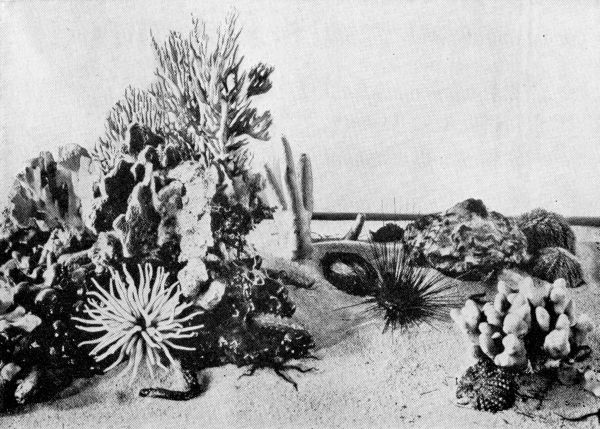
The Gorgeous Submarine World.
Golden sea-anemones, purple long-spined sea-urchins, orange-colored
sponges, and corals upon the white sea-sand.
Courtesy of the American Museum of Natural History, N. Y.
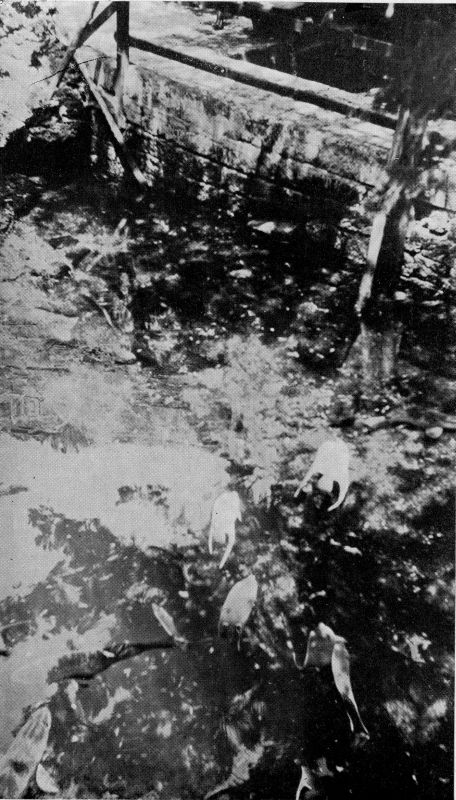
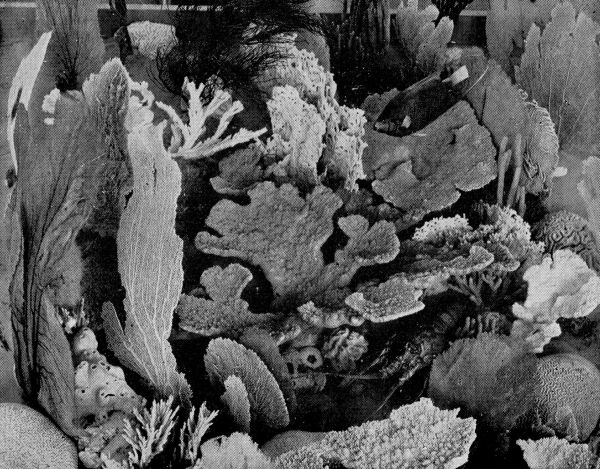
The Gardens of the Sea.
Where purple sea-fans wave under the crystal water. Note the angel-fish
and various forms of coral.
Courtesy of the American Museum of Natural History, N. Y.
"In glass, you mean?" queried Colin. "I should like to see how that's
done."
"Come to my laboratory in New York some time and I'll show you," his
companion answered, "but I can't do that here. I have a specially
prepared black paper here and I'll copy some of the anemone forms so
that I can plan them in glass from my drawings. I'll go with you
to-morrow, but after that you'll have to go out alone."
Accordingly, Colin and the diver went out with Early Bird every day for
a week, Colin spending the entire day peering through the water glass
for perfect specimens, which, when sighted, the diver would descend to
get. He secured an especially fine example of a long-spined black and
white striped sea-urchin, with spines nearly seven inches in length, a
number of pale-blue starfish (an unusual color in that genus), and one
superb sea-fan of a glowing purple color nearly five feet across. Of
sea-anemones he found a large variety, and those he brought to the
aquarium, where Mr. Collier was working steadily; several kinds of
"sea-puddings," closely allied to the famous beche-de-mer—the table
delicacy of China—also were within his discoveries. The boy's eyesight
was keen, and the collecting fever found him an easy victim, but it was
back-breaking work to stoop over the water glass all day.
After about a week of this, however, a surprise awaited him. He noticed,
as they sailed into the bay, a very handsome steam yacht lying at
anchor, a sea-going craft flying the New York Yacht Club's burgee. On
his return to the hotel Colin found his chief waiting for him, a little
impatiently.
"We're going to dinner on the Golden Falcon," he said, as soon as he
saw the boy, "she belongs to a friend of mine. He is going down to
Florida and has offered to take us along. If I can arrange it, that will
save us at least a week's time."
"Bully, fine!" Colin exclaimed. "Is that the yacht down there?"
"Yes."
"She's a beauty. All right, Mr. Collier, I'll get ready just as fast as
I can. And you ought to see a feather star I got to-day. It wasn't so
awfully deep down either."
"I'll see it later," was the reply, "hurry and get ready now; I don't
want to be late going over there. Their launch is to come at half-past
six and it is twenty after now, so that you need to move as fast as you
know how."
"Right, sir," answered Colin, and off he sped.
The yacht was the finest of its kind that the boy had ever boarded and
he spent a very pleasant evening, the more so as the owner of the vessel
had his family aboard, including his son Paul, a lad almost the same age
as Colin. Mr. Murren was a wealthy capitalist, who had financed a chain
of drug-stores throughout the country and still kept a large amount of
stock in them. This corporation used many thousands of sponges annually,
needing moreover a high-grade article which was found difficult to
procure. It had been thought wise to investigate the question of buying
a sponge farm, and he had been asked to look into the matter.
Accordingly, he was taking a run down the coast, but had come first to
see the American Vice Consul at Bermuda—to whom he was related by
marriage.
"I heard a good deal about that sponge-farming business," said Colin,
when the other boy told him this. "Dr. Crafts told me how it was
worked."
"All the more reason for you to join us," his new friend responded. "I
hope you're coming."
"I hope so, too," Colin answered, "and it's likely enough that we will,
since you say your father has been kind enough to ask us. I think Mr.
Collier has nearly finished what he wanted to do in Bermuda, and if you
are going straight to Florida, it would save us a lot of time, as well
as being a jolly trip in itself."
"Going to do more coral-hunting?" the other boy queried, for Colin had
told him about his Bermuda work.
"A little of that, I think; but I believe Mr. Collier intends also to
make an exhibit showing the way sponges grow. So you see he is as much
interested as your father in reviewing the sponge question."
At this juncture Colin heard his name called.
"Yes, Mr. Collier," he answered.
"Do you think you have been over most of the reef?"
"Yes, sir, I think so," the boy answered; "Early Bird said yesterday
that we had covered the sea-garden grounds fairly thoroughly. But, of
course, there are miles of reef that we haven't seen."
"I think, Mr. Murren," the scientist said, turning to his host, "that I
can finish up all my business here by to-morrow night and be ready for a
start the following morning. If that's agreeable to you, we shall be
very glad to accept your invitation."
"That's agreed, then," said the capitalist, "and now we'll have some
music."
The trip to Florida on the Golden Falcon was one of the pleasantest
Colin had ever known. The little craft fairly flew through the water. He
liked his host and hostess immensely, both of whom were accomplished
musicians, and he struck up quite a friendship with Paul. The
capitalist's son, though but a month or two younger than Colin, was
quite inclined to give the latter a little hero-worship. And it was
significant of Colin's make-up that he was equally ready to take it.
Little of note occurred on the voyage save that the yacht almost ran
over a sunfish in the water, which turned a sluggish somersault and
disappeared. What was of more interest to Colin and indeed to Paul also
was the opportunity to use a very powerful microscope belonging to the
museum curator and to find out about the almost invisible life of the
ocean.
"You must remember," the scientist told them, "that these tiny forms,
which look like the most wonderful figures in a fairyland of geometry,
exist in such billions that as they die, their light shells fall through
the sea like a perpetual rain. Some of them, too, are so very light that
it takes them a month to sink to the bottom."
"But what can such tiny bits of things live on, Mr. Collier?" asked
Paul; "other animals smaller still?"
"No, my boy," was the reply, "on plants called diatoms. There are over
four thousand species of these plants known, which are so small that the
microscopic animals readily engulf them. Where it is too cold for
surface animal life, as in the Antarctic Ocean, these dead diatoms form
the mud on the bottom of the ocean, and in the extremely deep parts, the
sea-bed is red clay, but most of it is an 'ooze'—'Globigerina,' as it
is called—made up of the shells of those very creatures you have now
been seeing on that microscope slide. You drop in and see me at New
York, boys," he added kindly, "and I'll show you some models I have made
of them."
On arrival at Key West one of the first things that impressed itself
upon Colin was the sponge wharf, where tens of thousands of sponges of
every sort were drying in the hot September sun. The conversation had
run upon sponges very frequently during the voyage, and Mr. Collier, who
knew the subject thoroughly from a theoretical point of view, had been
of great help to his host. But the economic and commercial side of the
question was another matter. From this aspect Colin found that the
remembrance of his conversation with Dr. Crafts in Washington stood him
in good stead.
"As I understand it, Mr. Murren," he said, as they stood on the wharf
together, waiting for an approaching boat, "the government looks on the
business of growing sponges much as it does on the growing of wheat or
any other form of farming, only it is called aquiculture instead of
agriculture. Sponge planting isn't so very different from potato
planting."
"It looks entirely different to me," the boy's host replied, as he went
down the wharf steps. "I'm sorry Mr. Collier was called away this
afternoon, but I may as well give a preliminary look over this
sponge-farming business and you boys might as well come along. There's
a man here who wants me to buy his sponge farm. Since Mr. Collier is
here I'm not going to decide anything without his advice. He doesn't
want you this afternoon, does he?"
Colin hesitated a moment.
"Not as far as I know, Mr. Murren," he answered.
"I wish you would come, then," urged the capitalist. "You've picked up
some ideas in Washington which may be of help."
"I'll be glad to come, if you feel I'm any use to you," the boy replied,
flattered at this evidence that he could be of service, "I was only
afraid that I'd be in the way."
Colin followed Paul and his father into the boat, where was waiting a
negro as black as the proverbial black hat, a local fisherman who had
taken up sponge growing, and who, while shrewd enough for a business
deal, knew little about sponges.
"You were saying that the Bureau of Fisheries is going to take up
sponge-farming?" the prospective buyer asked. "Do you know what success
the government has had so far?"
"Enough to show that it can be done and that's about all," the boy
replied. "Before long, I think, the Bureau will have a station down on
the Keys here and that will be one of the first questions they will
probably take up. As I heard it put, the Bureau aims to farm every acre
of water as thoroughly as every acre of land."
"That," said the capitalist, "is an ideal that gives all sorts of
chances for development."
Presently the boatman stopped and, resting on his oars, said:
"Lots o' sponges hyeh, boss."
The would-be buyer took the water glass and looked through it at the
bottom, but he was unaccustomed to the appearance of growing sponges and
also to the use of a water glass, so that he gained little from it.
"I don't see any," he said.
"Aren't there any round liver-colored lumps, Mr. Murren?" the boy asked.
"Yes, there are lots of those," was the reply.
"Those are sponges."
"They don't look like it."
"They are, sir, though. A skeleton doesn't ever look just like a man.
The sponge, as you use it in a bath, is just an animal's skeleton, or it
may be of several animals that have grown together."
"Yo' suah o' that, boss?" asked the boatman. "I allus hear' dat a sponge
was a plant—not any animal."
"It's an animal," Colin said shortly.
"But I thought," interjected Paul, "that the difference between a plant
and an animal was that an animal can move around and a plant can't."
"Well, Paul," the boy answered, "the young of sponges are larvæ which
swim in the water by threshing with short hairs until they find
something suitable to stick on. Lots of animals which become fixtures
are free-swimming when young, oysters, for instance."
"Then a sponge doesn't seed itself, like a plant?"
"No, Mr. Murren," said Colin; "so far as I understand, the larvæ, though
of a very simple type, have a certain amount of choice. A seed has got
to grow where it falls, or not at all, but a sponge larva, if it doesn't
find a suitable place on the first thing it touches, can swim about
blindly until it finds one that will do."
"Now about these sponges, Colin," his host said, impressed by the boy's
clear though crude way of explaining himself, "look through the glass
and tell me what you think about the bed."
"There are quite a lot of sponges there," the boy answered after a few
minutes' examination, "some of good size, too, but a number of them are
dead. See, the sand has drifted half over them. There's too much sand
and too little rock."
"Should they have a rock bottom?" the manufacturer queried.
"Rock am de bes', suah," the owner of the ground put in, "but a li'l bit
o' san' don' do no hahm. It shows dat de wateh am runnin'."
"Yes," said the boy, "the boatman is right there, Mr. Murren, sponges
must be in a current after they have once taken hold. They can't swim
around to get their food, so, like all the fixed forms of life, their
food must come to them. If there is no current there is not enough food
carried past for them to live on. If the current is too strong the
sponge has to make an extra tough skeleton to brace itself against the
rush of water and then it becomes too coarse for commercial use. Some of
the polyps live on tiny animals with a lot of flint in their shells and
the skeleton gets like glass. They call them glass sponges. Conditions
have got to be just right for their development, they're a most
particular sort of creature."
"But how do they feed?"
"A sponge is a jelly-like colony of cells with a fibrous skeleton," the
boy explained; "the outside of him is toward the water and is full of
small pores which branch all through his flesh and open at last into a
big pore leading to the outside. All these pores are lined with tiny
hairs that make a current of water go through the jelly-like flesh,
which absorbs any microscopic life there may be. The water is taken in
through the little pores and sent out through the big ones. Some sponge
forms are of one animal, most are of colonies. But they are all on the
same pattern, pumping water in and out again."
"Then is a growing sponge all full of jelly?" asked Paul.
"All that I have seen are," Colin replied.
"How do they get it out?"
"I c'n tell you 'bout that," interjected Pete. "A sponge is all slimy
an' nasty. Yo' put him in de sun an' he dies quick an' all de slime runs
out. Den yo' buries him in san' 'til his insides all decay. Den you puts
him in a pon' an' takes him out, an' beats him wif a stick, lots o'
times oveh, maybe, 'til all de jelly an' all de san' an' all de muck am
out ob him. Den yo' wash him in fresh wateh 'til he's clean an' lets
him dry an' he's done."
"But if sponges will reproduce themselves," the capitalist said,
returning to his former point, "what is the need of planting them?"
"You don't have to work that way on their own beds, sir," the boy
answered, "planting is done to get more out of the industry, using the
sea bottom in shallow waters which now is lying unused."
"And you say only rocky land will do?"
"Any bottom that's hard enough to keep the sponge from being covered up,
Mr. Murren. Soft sand will wash, mud will ooze up, and rank marine grass
or seaweed will smother the young cells. But any hard bottom in warm
salt water with a current is good for sponges."
"I see," was the rejoinder. "As you say, the situation is not unlike
farming. You can either farm cultivated sponge land or plant
uncultivated land."
"You can get land suitable for sponges for almost nothing, I suppose,"
Colin said, "and then if you had a small sponge ground you could plant a
larger area from it."
"What do you think of this ground?"
The boy hesitated.
"I hardly think I know enough about it to say, Mr. Murren," he said;
"you ought to get an expert."
"I'll get an expert before I pay cash," was the prompt answer, "but I
want to know what you think."
"Well, then, sir," Colin answered, "I think it's good ground, but not
good enough."
"Ah got a betteh one than this hyeh, boss," put in the boatman, "it's
mah brotheh's, but he might be willin' to sell. Costs mo' than mine,
though."
"Take us there," ordered the capitalist.
The boatman took to his oars with a will, but it was a long pull, almost
an hour elapsing before he stopped, wiped his forehead on his arms, and
said, as before:
"Lots o' sponges hyeh, boss."
At a nod from the prospective buyer, Colin took the water glass and
watched the bottom carefully as the boatman rowed slowly over it. How
the boy wished for the lenses in the glasses belonging to Mr. Collier
which he had used in Bermuda! But still, though the afternoon was
drawing on and the sun did not strike the water at the right angle,
Colin could see that it was unusually fine sponge ground.
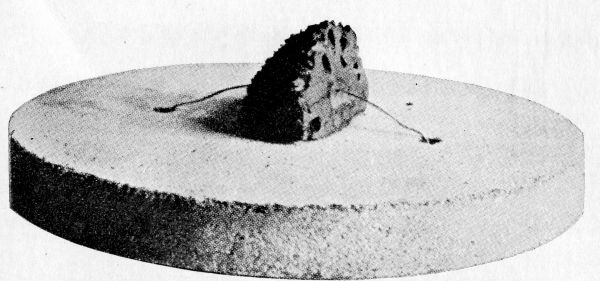
Young Sponge Attached to Cement Disk, Ready for Planting.
(Actual size.)
Courtesy of the U. S. Bureau of Fisheries.
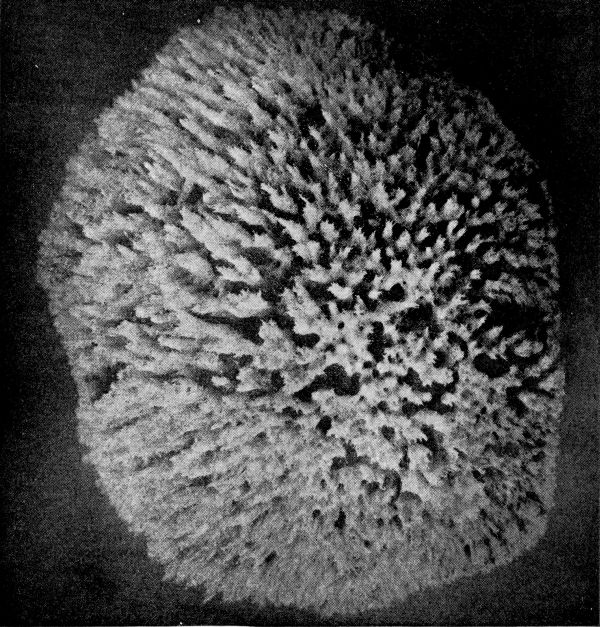
Sheepswool Sponge grown from small piece as above, 48 months old, six inches across.
Courtesy of the U. S. Bureau of Fisheries.
"Yes," he said, "that's more like."
Mr. Murren looked about him.
"How in the world do you know, Pete," he said to the boatman, "that this
is your ground or anybody else's? I don't see any stakes or evidences of
ownership."
"If Ah starts to haul up sponges on somebody else's groun' he'll come up
and make me get off, suah," replied the boatman.
"But suppose he doesn't see you."
The boatman grinned.
"Dat certainly am his own lookout, boss," he said.
"What a cut-throat game," ejaculated the would-be buyer. "If a man
bought a place he'd have to watch it all the time, then?"
"Suah, sah."
"Thank you," was the reply, "I'll take some place in shallow water where
I can build a house and hire some fellow to watch it and work it."
"Ain' no trouble hyeh," the boatman said, shrugging his shoulders,
"ev'body wo'k his own patch."
"But how do you get the sponges?" was the query. "You have to dive for
them, don't you?"
The boatman shook his head.
"Sometimes, if de wateh's mo' than fifty feet deep. Not of'en. See, Ah
show you."
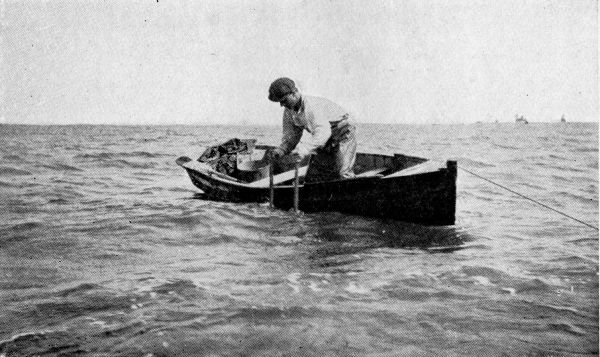
He reached under the forward thwart and pulled out a light three-pronged
hook and fitted it to a jointed pole, screwing the two sections together
so that it made one long pole of about twenty-four feet in length. He
took the water glass and rowed the boat until it was directly over a
sponge.
"Yo' all keep de boat dere a li'l while," he said to Colin, and the lad
took the oars.
Then very deftly the boatman pushed the long unwieldy pole into the
water and nicked a sponge from the bed, bringing it up intact. On
reaching the surface it was seen to be slimy and with a milky fluid
dripping from the bottom.
"That's a ripe sponge, you see, Mr. Murren," the boy said, pointing to
the milky fluid; "the slimy stuff that's dropping is full of germs of
young sponges all ready to grow and swim and fix to something and then
become proper sponges."
"That may be a sponge," said the prospective buyer, "but it looks more
like a piece of liver."
"Fine sponge, sah,—good yellow sponge," the boatman said, and Colin
did not know enough either to affirm or deny.
"Now, Ah show yo' sheepswool sponge, quite diff'nt," the boatman said,
and taking up his water glass he leaned over the edge.
Just as he did so, both Colin and his companion gave a cry.
"Sharks!"
The boatman looked around contemptuously.
"Nu'sing shahks," he said, "sleep all de time." He splashed his hand in
the water and the sharks fled in all directions.
"You wouldn't feel that way if you had been in the water," hazarded the
capitalist.
"Ah done ride on 'em," was the reply. "Lots o' boys 'round dese hyeh
reefs think it fun to steal up ove' a lot o' nu'sing shahks, an' den
dive down an' take a ride. Dey wouldn't bite nothin' biggeh than a
sahdine."
"But you have got dangerous sharks here?"
"Yes, sah, you bet," the boatman answered; "dey was one ol' white shahk
was a holy terror; he use' to show up hyeh reg'lah once a monf. Folks do
say he eat up fo' men at diff'rent times."
"I thought Mr. Collier told us that those shark stories were
exaggerated," said Paul, turning to Colin. "I didn't think so, now you
see, they weren't."
"Oh, I guess the white shark is the real thing, all right," Colin
answered. "Some fishermen found a fair-sized young sea lion almost whole
in a shark's stomach about three years ago."
"That must have been the fish that swallowed Jonah," suggested Paul.
"He could have done it all right," the other boy agreed, "and he is
about the only fish that could."
"There might be some in the bottom of the sea!"
"I don't think so, Paul. Mr. Collier told me on the steamer that in the
very deepest parts of the ocean there were no fish, only worms and
sea-cucumbers and things like that."
"If you'll listen a minute, sah," said the boatman, "yo'll heah somefin'
wo'se than eveh come from de bottom ob de sea."
"Worse?"
"Worse!"
The two exclamations rang like one as the two boys strained into
attention. They listened intently and then across the water came a
whisking rushing sound followed by a deep 'boom' and a distant splash.
It was several moments, too, before the swell from that splash reached
the boat; when it did, the craft rocked noticeably.
"What is that?" asked Colin.
"Vampa, sah," answered the boatman, as he took his oars and started to
row away in the opposite direction.
"Hold on a bit there," the sponge-buyer said, "I never saw a vampire.
What does it look like?"
"Some calls 'em sea-bat or devil-ray," was the reply, "an' the're
twenty, thirty feet 'cross sometimes. They looks lak a sting ray. Ah
don' wan' to see 'em."
"Isn't that a harpoon down there in the boat?" the capitalist asked
calmly.
"Yes, sah, oh, yes, sah, but Lordy, sah, yo' can' do nuffin wif a sea
vampa. No, sah. Why, jes' oveh yondah dey was a big schooneh towed out
to sea by a vampa."
"A schooner?"
"Yes, sah, a seven'y-ton schooneh. Yes, sah. He mus' ha' been a big
fellah an' goin' swimmin' along he struck de anchoh chain wif his hohns.
It made him mad, right mad, it did, an' he jes' heave up dat hyeh anchoh
an' toted it off to sea, draggin' de ship wif him."
The owner of the Golden Falcon laughed.
"Can you beat that? That's the worst fish story I've heard, Colin. You
tell some good ones, too!"
"It's an old story," the boy answered, "and I believe it's true. They
have often run away with boats."
The capitalist took off his coat and rolled up his sleeves.
"I've harpooned dozens of porpoises from the Falcon," he said, "but I
never had a chance at a sea vampire. This begins to look interesting."
"The devil ray, or manta as it is often called, will give you a run for
your money," said Colin, "and after all we can cut the line."
"We'll not cut any line," was the response. "Now, Pete, get after him."
But the negro fairly blubbered in terror.
"Lordy, lordy," he cried, "an' what yo' goin' t' do to a po' ol' niggeh.
Ah'll do an'thin' yo' say, Ah'll tell yo' de troof about de sponge
fahms, an'thin', onl' don' go afteh dat vampa."
"You'll tell me the truth about the sponge farms, eh?" the prospective
buyer remarked sternly. "So you were trying to put up a crooked deal.
I'll attend to you when we get ashore. Now you row after that 'vampa,'
as you call it, and as quick as you know how."
The negro was about to refuse, but he did not dare.
"Oh, Lordy, boss," he cried, "don' go any neaheh. Yas, sah, yas, sah,"
he added as he saw the yachtsman make a move towards him, "yas, sah,
Ah'll row. But we all gwine to be smoddehed alive. Ah jes' knows it."
Again, close at hand, came the swish and the dull 'boom,' and the negro
shivered. Colin was conscious that his heart was pounding a little and
he caught himself wishing that it were the middle of the day instead of
evening. Then out of the water not ten feet from the boat a dark
witch-like specter swooped into the sky, black, horned, with bat-like
wings and a long naked tail like a gigantic rat.
Pete gave a squeal of fright.
The monster rose till he was almost three feet clear of the surface,
then turned so as to strike the water absolutely flat, and just before
the crash and splash of the fall, Murren hurled the harpoon into the
fish, and sprang back to clear the line. Although drenched and gasping
from the torrent of water thrown over the boat by the devil ray, Colin
took a bight of the line from the second coil and passed it around the
foremost thwart. He was just in time, for a few seconds later the rope
tautened. There was just one jerk and the boat started flying through
the water, sending up a green wall on either side that threatened to
swamp it every instant.
With the fight really begun, Colin became at once quite calm. Paul, who
was an absolutely fearless youngster, was laughing in glee.
"Which way are we going, Pete?" asked the capitalist.
"Lordy, Lordy, don' as' me; gwine to de bottom, boss. Ah knows we'he
gwine to de bottom."
The negro crouched down in the bottom of the boat, and the sponge buyer
roared at him:
"Sit up and watch where we're going, you coward! You know these reefs."
"It don' matteh, boss, de vampa tuhn roun' in a minute an' jump on de
boat an' smoddeh we all."
It was not a pleasant suggestion. The ray was undoubtedly big enough to
do that very thing, and everybody in the boat had seen its power to
leap. But even the little study that Colin had given to fishes came to
his aid.
"All rays live on shellfish," he said, "and they have small mouths with
plates instead of teeth to crush the shells with. So that it really
couldn't do us any harm, any way."
"It's de smoddehin', boss, de smoddehin'. Oh, why did Ah try an' make
trouble ober dem durn sponge beds? Ef Ah eber gets on sho' again Ah'll
be a betteh man. Lordy, Lordy, what am Ah gwine to do?"
His voice rose in a shriek.
"He's a-comin' now!"
The pointed fin jerked suddenly and a third of the gigantic shape heaved
itself into the air as the devil ray whirled. There was an instant of
suspense, but the giant went past, one huge fin beating the air like the
waving of some uncanny monstrous moth born in the terrors of a
nightmare, and the boat was wrenched around sharply, half filling it and
almost throwing Colin out.
Over almost exactly the same course that he had taken, the ray raced
back, the weight of the boat seeming to make no difference to its speed;
and then a second time the creature turned. It seemed impossible that
with a speed of not less than twenty miles an hour so huge a
creature—the size of one side of a tennis court—could twist about in
its own length. How the rope and the frame of the boat stood the strain
no one ever knew.
Once more the vampire turned; the boat nearly went over, but she was a
staunch little craft, and the fish started down the lagoon between the
reefs at its top speed. Often the creature put its two horn-like
tentacles down for a dive, but the water was everywhere shallow and
there was no chance to drag the boat under.
"It doesn't seem to be tiring much," the capitalist remarked, "but I
don't see what more we can do."
"No," Colin answered, "I don't think the ray feels our weight at all. I
believe it's going faster."
"We's all gwine to de bottom," wailed the negro. "Lordy, Ah been a bad
man, but ef Ah ebeh gets mah two feet asho' Ah'll nebeh do nuffin
again!"
There was no doubt of it, the vampire was going faster and faster every
minute. The line hissed as it cut through the water, and Pete, despite
his moaning, was baling for dear life. Darkness was closing in and the
ray sped on. On either side were reefs, and many times the boat grazed
sharp coral which would have ripped the bottom out of her if she had
struck. Mr. Murren stood by the bow with knife in hand ready to cut,
waiting to the last minute.
Presently a line of breakers, between two islets, appeared directly
ahead. It was only a matter of seconds till they would be reached, but
remembering how the ray had turned before, Colin clutched the gunwale of
the boat to prevent being flung out of it like a stone from a catapult
when the creature swerved.
"It's a-comin', now!" shrieked Pete. "We's a-gwine to be smoddehed. Oh,
Lordy, Lordy, Ah's a dead niggeh."
"Hold on tight, all, look out for yourself, Paul," Mr. Murren cried;
"he's turning!"
But he was wrong.
Instead of the black fin edging its way up, the whole great bulk of the
uncanny creature heaved itself above the water like a great cloud and
fell into the surf on the rocks, flapped upon them, although half
stranded, and with a heave that seemed to make the reef tremble, plunged
into the sea beyond.
"Better cut!" cried Colin.
But before the word was fairly out of his lips, the bright steel
gleamed in the dark, and with a grinding crash that seemed like the end
of the world to Colin, the boat crumpled into splinters on the reef and
the three men were thrown in a heap among the breakers.
The negro gave a yell that was enough to scare any one out of a year's
growth and lay spread out upon a rock as though he was some ungainly
kind of black crab, arms and legs in every direction, while he fairly
gibbered with fright.
"Lordy, Lordy, don' let de debbil come an' take me now! Lordy, Ah ain'
fit to die! Don' let him come back an' smoddeh us on de rocks! Ah ain'
never goin' to get in a boat agen! On'y let me get home dis once!"
Paul, though the youngest of the party, had escaped the most easily. He
had pitched clear against Pete and thus had broken his fall, while at
the same time the impact of his weight had knocked nearly all the breath
out of the negro's body. He had enough left, however, with which to make
a powerful complaint.
Bruised, even bleeding in one or two places, Colin picked himself out of
the wreckage and looked across in the faint light at the owner of the
Golden Falcon, who seemed to have escaped with a few scratches and
who was standing on the reef looking out to sea as though he wished that
the fight were still on.
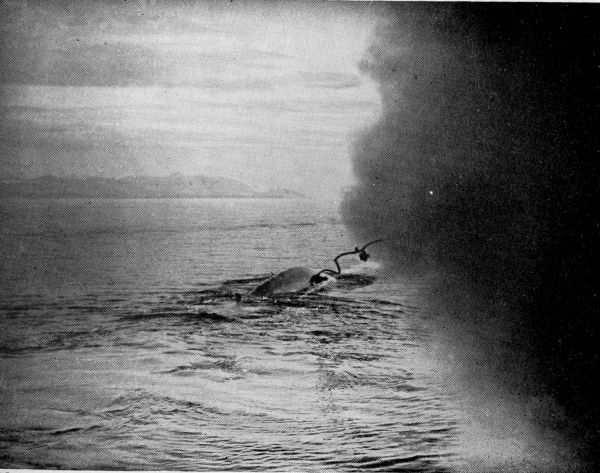
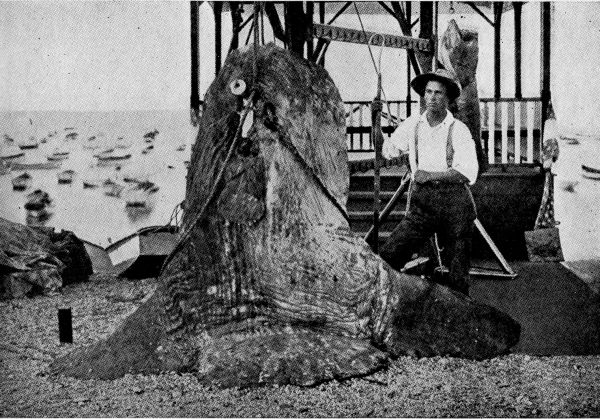
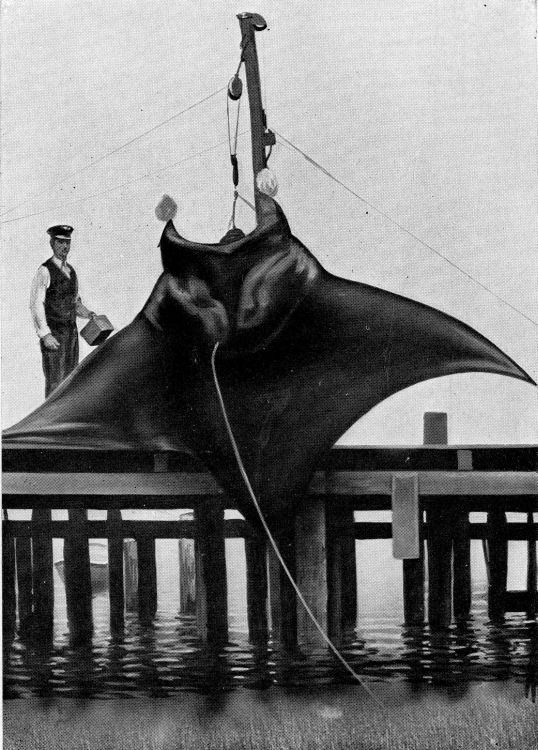
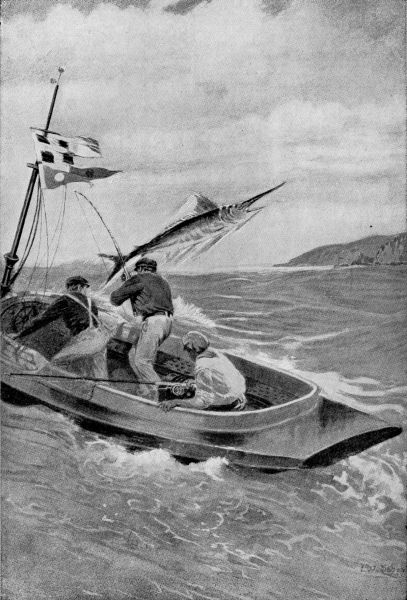
Manta, or Giant Sea-Devil, Captured on the Florida Reefs.
By permission of Mr. Chas. Fredk. Holder.
"I wonder," he said, as he saw that the boys were not hurt, "if the
vampire had as much sport out of that as we did."