"Did he land in that tree?" asked Ralph, addressing
a bystander.
"Yes, the machine seemed to be pretty badly
riddled, and became unmanageable long before he
reached the tree; but he went into it at a smashing
speed. The officer was thrown out and shot
down into that small tree, which broke the fall.
If it hadn't been for that he would have been
mashed to flinders," was the response.
Shortly thereafter the captain showed signs of
recovering consciousness. He raised the uninjured
arm, and soon opened his eyes. He glanced
at the boys, but did not seem to recognize them.
"He seems to be very much better," said the
doctor. "He is bruised up about the same as you
were when you were brought to the hospital at
Cortier," he said, addressing Ralph.
After a wait of half an hour more, the doctor
announced that the patient could be moved, and
he was accordingly carried to the van and comfortably
fixed on the hammock within.
"So you knew the captain?" inquired the doctor.
"Yes; we happened to be crossing the aviation
grounds at Dunkirk, at a time when the captain
was aloft, and some part of the machine broke.
He had a bad fall, and we were, fortunately, close
at hand and helped to rescue him from under the
machine," said Alfred.
The captain opened his eyes; he tried to smile,
but the attempt died away. Then he seemed to
make another effort, and this time succeeded.
"You were right," said the captain in a weak
voice. "We found it; report to the colonel. The
battery must have wiped them out by this time."
He closed his eyes and was silent for a time. It
seemed as though he actually dropped off into a
sound sleep.
"What does he mean? Do you know what he
is talking about?" asked the doctor, turning to the
boys.
The patient's eyelids began to quiver, and the
boys quietly nodded their heads. "That was a
corker!" continued the captain. "Tell the colonel,
by all means."
"What colonel does he mean?" asked Alfred.
"The colonel commanding the battery, or his
brother?"
"Both, of course," suggested Ralph.
The van started, the boys mounting their wheels
and following.
"We are going back to the base camp, and put
him in the hospital there," said the doctor.
"That is where his brother, the colonel, is in
command," remarked Ralph.
"Yes," answered the doctor.
During the foregoing period of time there was
not a moment when the firing on both sides of the
lines had ceased. As the boys turned to the right
to reach the road, they saw hundreds of soldiers
rushing across to reach the third line, and it
seemed as though the firing had grown heavier
than when they had come out the road an hour
before.
"Something unusual is going on," remarked
Ralph. "Why are they gathering the machine
guns behind those trenches? That is the third
line; the second line cannot be more than three
hundred yards behind us."
They were about to turn to the east and west
road, when the most intense shell fire was opened
up on their right.
"Get under cover quickly!" shouted a voice.
The boys turned, but were unable to detect the
speaker. "I suppose we must obey," said Ralph.
"Hide? But where?" asked Alfred.
"Wheel down to the hollow," cried Ralph.
The hollow was reached, and in their eagerness
they almost fell into the ditch. It was the third
line, filled with men ready to do their duty.
Frisky tumbled in with a yelp and a growl.
"What's the matter?" asked Ralph, as he
picked himself up from the bottom of the trench.
"The Germans are making a counter attack over
a front of a mile," was the reply of the corporal.
"Then we are just in time," said Alfred. "Any
guns handy?"
The men looked amused at the request. "Well,
that's no laughing matter," said Ralph. "We're
not here for the fun of the thing."
This prompt answer was an additional cause for
merriment, in which both boys joined.
Crack! crack! crack! R-r-r-r-r-r. The machine
guns began to speak. The men on each side became
subdued, and their faces exhibited set expressions,
for they knew that the voices of the machine
gun meant an enemy near at hand.
At a little alcove, cut in the side of the trench,
was an orderly with a telephone transmitter in his
hand. The corporal leaned over to catch his
words, for the din was now intense.
"The Germans have taken the first line and are
moving the 22d back on the Corbeville road. The
third line must hold them until the additional guns
are brought up. We shall counter attack in the
next section to the south." Such were, in part, the
orders and instructions which the operator imparted
to the corporal.
"Why, this is the Corbeville road," said Ralph
in a tremor of excitement.
"Then we are in for it this time," said Alfred.
"You may have the guns," said the orderly, as
the boys stood before him and repeated the request.
There was no time to give orders as to the positions
they were to take. Almost instantly there
arose a column of troops three hundred feet ahead
and every man, without an order, leveled his gun
across the parapet above the trench and fired as
fast as the levers of the guns could be manipulated.
"Fire deliberately!" said the corporal, as he
walked along the short stretch of the ditch directly
under his command.
The moment the boys began to fire they seemed
to be animated with an entirely different feeling.
The tremor and excitement had gone, and they
were keyed up to the most extreme earnestness.
The dark, greyish line on the other side of the field
kept moving toward them, but gaps in the ranks
were plainly seen. Would they dare charge all the
way up to the trench?
They fired and fired and fired, until their shoulders
began to ache; then something happened. No
more Germans were in sight. What had become
of them?
"They are digging in," said the corporal. "Get
ready, boys."
"I wonder what that means?" asked Ralph.
"Why, don't you see the Germans have stopped
and are digging trenches, and the corporal is going
to order a charge to drive them out?" answered
Alfred.
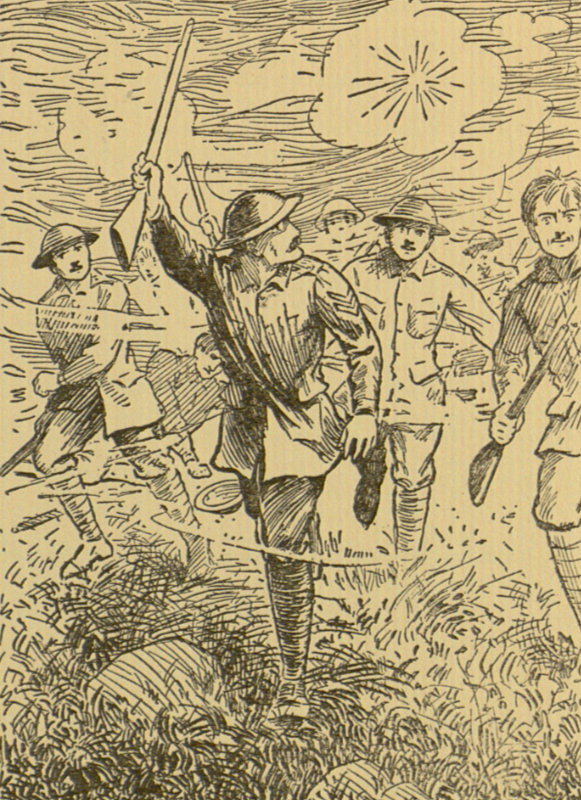
The order came sooner than expected. "Ready!
Forward! Open order!" shouted the corporal,
and he was the first to scramble out of the ditch.
There was no firing now on the part of the British,
for they were too busily engaged in springing
forward and avoiding the obstructions which beset
them every foot of the way. If the hidden Germans
were firing at them they were not aware of
it, for the din was too great to distinguish anything.
The singular thing, to the boys, however,
was the fact that at almost every step, some one
would halt and drop down.
"Halt! Down!" cried a voice. Suddenly the
line was prone on the ground. The man between
the boys thrust his bayonet into the sod and loosened
it, and with his hands quickly built a small
parapet in front of him. Looking about they saw
others do the same.
"Is that called digging in?" asked Ralph.
"That's one way," replied the soldier. The sod
was rolled up and pushed from him, and he dragged
himself forward until his body rested in the
shallow trench thus made, while the roll of sod
in front became, in reality, a protection.
"Ready to repel!" shouted the corporal.
They now understood; for no sooner had the
words left the corporal's lips than the Germans
sprang forward. Every gun must have cracked
at the same time, and the aim was evidently careful,
for their first volley caused the line to halt
and waver.
"At them, boys! Forward on the run!" fairly
shrieked the corporal. Frisky was the first one
out of the trench.
Every man was on his feet. As the boys rose
to follow they happened to glance back for the first
time. The sight that met them created the greatest
enthusiasm and confidence, for, climbing out
of the very trenches they had occupied twenty minutes
before, were hundreds of khaki-clad veterans,—the
reserves, who had come up to support the
counter attack. That banished every fear, if such
a thing was lurking within them. At every step,
and whenever a favorable object came into view,
the gun would be raised and a shot or two given
by each soldier, which only slightly impeded their
forward movement.
Suddenly there was a tremendous cheer to the
right; the boys could see hundreds of men leaping
over the brush, and stumbling across the remains
of a stone fence. The Germans were giving way,
and when the line on their right had passed the
ridge and began to rush down the little incline, the
corporal cried, "Halt!"
The movement of the troop cut off the only line
of retreat of the enemy in front of the position
occupied by the company the boys had engaged.
They stopped but for a moment only, when the
second order came. "Forward march!"
"Kamarad!" shouted several voices, as the
forms appeared through the smoke.
"Come forward!" came the order.
Instantly there rose from the ground, as if by
magic, dozens of men. They stood up with hands
upstretched, and formed themselves together in
columns. The lieutenant in charge of the British
advance stepped forward, gave a quick command,
and the men, now prisoners of war, marched forward
and were ordered to halt long enough to permit
the officer in charge to point out the detail
which was selected to take the prisoners to the
rear.
The corporal looked at the boys, and they knew
that it meant their detail as well. The orderly
marched ahead, and the prisoners with the guard
began the march to the village two miles in the
rear.
As they were about to enter the village, Ralph
shouted to Alfred, who happened to be on the other
side of the row of prisoners: "Say, we forgot to
bring our wheels back!"
The remark brought forth the first ripple of
laughter in that party. It was such an unexpected
thing. Who cared about a couple of
wheels? Escorting prisoners of war to the detention
camp was certainly of more importance
than recovering a pair of bicycles.
"Never mind the wheels," replied Alfred. "We
have better business to attend to just now."
The German lieutenant, who understood the language,
enjoyed the remarks quite as much as the
guards, for he laughed in spite of the disaster to
his troops. Thereupon he and Alfred had quite
a conversation on the way.
The village was entered and passed. Frisky
now darted from one side of the column to the
other and yelped his approval.
"You ought to be ashamed of yourself, Frisky,
making fun of these poor fellows," said Alfred.
"No, he oughtn't to!" shouted Ralph, in reply,
and the smile faded from the face of the German
lieutenant.
The names of the soldiers and officers were
taken down, their clothing searched, and one by
one they passed into the enclosure to remain until
the end of the war, unless exchanged.
"I suppose we are out of a job now," said
Ralph to the corporal. "To whom shall we turn
over the guns?"
The corporal designated two soldiers to take the
guns and cartridge belts. "Before you go, just
give me your name and the detachment to which
you belong," he said.
"Never mind about that," said Alfred. "It
isn't necessary," he added.
"Yes, it is part of my duty; I must include it
in my report."
While speaking, Alfred noticed the orderly belonging
to the battery approaching. He advanced
and handed an envelope to him. Alfred hurriedly
opened it.
"The commandant on the hill desires your presence
at the battery without delay," said the communication.
"All right! We are ready! Come on, Frisky,"
said Ralph.
"The colonel's machine is outside waiting for
you," said the orderly.
"Well, how did you know we were here?" asked
Alfred.
"Colonel Winston, whose machine will take us
up the hill, arrived a quarter of an hour ago, with
some friends of yours, and when he learned you
were not here, sent me down with orders to hunt
you up. I had no idea you came in with the prisoners,
and just stepped over out of curiosity to
have a look at them, and thus, fortunately, found
you," said the orderly.
"Well, who can our friends be that called with
Colonel Winston?" asked Ralph.
"I really don't know," replied the orderly.
"And, by the way, where is Captain Winston?
Does Colonel Winston know about the accident to
his brother?" asked Alfred.
"I presume that is what brought him over so
quickly, for the accident, as you know, happened
less than three hours ago," replied the orderly.
The motor car was not long in making the trip
to the top of the hill. When they passed the ruins
of the cottage, Frisky jumped up onto the seat,
gave a few distinct yelps, and then settled back
into the seat beside Alfred. It is singular that
from the time he attached himself to the boys,
there seemed to be no desire in his mind to return
to his old home.
"Go direct to the commandant's quarters," said
the orderly to the chauffeur.
The commandant and Colonel Winston were at
the door as the machine drove up. The boys were
out and sprang toward them.
"Is the captain all right, sir?" asked Alfred
hurriedly.
"Yes; I left him a half hour ago, very comfortable,
indeed," replied the colonel.
"We received the note, ordering us to come here
at once," said Ralph.
"Yes; we want to inform you that we have
every reason to believe that 300 meters to the right
hit the spot," said the commandant.
"Well, we know it was the right spot," replied
Alfred. "The German battery there was literally
wiped out."
"How did you learn that?" asked the commandant
with the greatest eagerness.
"We learned it from Captain Winston; he told
us about it since the accident," said Ralph.
"I know it from another source," replied Alfred.
"Where? What?" asked the colonel, in astonishment.
"The German lieutenant whom we captured this
morning told me on the way over, that of the six
guns they had south of the hill there wasn't
enough left to gather up, and that was the main
reason why they started the drive that failed so
miserably," said Alfred.
"But the orderly said some friends were up
here to see us," said Ralph.
"Yes; I brought them over with me; they were
afraid you'd get into more trouble," said the colonel,
as he opened a door leading into an adjoining
room.
Ralph stepped forward with some curiosity on
his countenance. He could not speak as his
mother appeared and rushed toward him.
"Oh, you're not my boy any more," she sobbed,
as she embraced him and held him at arm's length
for a moment.
Alfred was no less astounded as his mother first
took him in her arms, and his father also put his
arms around him.
"What naughty boys you've been," said Alfred's
mother. "We didn't hear from you for
four months, and once we were notified that you
were dead; what a joy it is to see you again!"
"But how they have grown," said Ralph's
mother.
"But you must remember, Mother, that they are
men now," said the colonel, with a smile.
THE END
The Motion Picture Comrades
Series
By ELMER TRACEY BARNES
The object of these books is to place before the
reader the unusual experiences of a party of boys who
succeed in filming a number of interesting scenes.
The stories are replete with striking incidents on
land and sea, and above all they describe with remarkable
accuracy the methods employed to obtain many
of the wonderful pictures which may be seen on the
screen.
The Motion Picture Comrades' Great Venture;
or, On the Road with the Big Round Top
The Motion Picture Comrades Through African
Jungles;
or, The Camera Boys in Wild Animal Land
The Motion Picture Comrades Along the Orinoco;
or, Facing Perils in the Tropics
The Motion Picture Comrades Aboard a Submarine;
or, Searching for Treasure Under the Sea
12mo. Cloth 50c per volume
THE NEW YORK BOOK COMPANY
201–213 EAST 12th STREET NEW YORK
THE HILLTOP BOYS SERIES
By CYRIL BURLEIGH
The Hilltop Boys; A Story of School Life
Jack Sheldon, a clean-minded and popular student in the academy,
gains the enmity of several of the boys, but their efforts to injure
him fail. A mystery, connected with Jack's earlier life, is used against
him, but he comes off with flying colors.
The Hilltop Boys in Camp; or, The Rebellion at the
Academy
A strange situation arises in which an airship figures as the bearer
of an important letter. The head-master acts without investigating
all the facts, but matters are all finally adjusted to the satisfaction of
all concerned.
The Hilltop Boys on Lost Island; or, An Unusual
Adventure
The scene now shifts to the West Indies and Jack figures as the
hero of a daring rescue. Their experiences in tropical waters form
a most stirring narrative, and the young reader is assured of a tale of
gripping interest from first to last.
The Hilltop Boys on the River
The Doctor takes a number of the boys on a cruise up the Hudson.
An unlooked for incident finds Jack Sheldon equal to the occasion,
and what at one time promised to be a disastrous trip for all concerned
was turned into a complete victory for our young friends.
12mo. Cloth 50c per volume
THE NEW YORK BOOK COMPANY
NEW YORK
The Hickory Ridge Boy Scouts
A SERIES OF BOOKS FOR BOYS
By Capt. ALAN DOUGLAS, Scout-master
These stories are from the pen of a writer who not only possesses
a thorough knowledge of his subject but who is gifted with the ability
to describe the various experiences of the Hickory Ridge Scouts so the
young reader may enjoy and be benefitted thereby.
The narratives are normal and healthful in their tone—in other
words, real scout stories which hold the reader's interest to the last
page.
The Campfires of the Wolf Patrol
Woodcraft; or, How a Patrol Leader Made Good
Pathfinder; or, The Missing Tenderfoot
Fast Nine; or, a Challenge from Fairfield
Great Hike; or, The Pride of the Khaki Troop
Endurance Test; or, How Clear Grit Won the Day
Under Canvas; or, The Hunt for the Cartaret Ghost
Storm-bound; or, a Vacation Among the Snow Drifts
Afloat; or, Adventures on Watery Trails
Boy Scout Nature Lore to be Found in The Hickory Ridge Boy
Scout Series, all Illustrated:
Wild Animals of the United States—Tracking—Trees and Wild Flowers
of the United States—Reptiles of the United States—Fishes
of the United States—Insects of the United States and Birds of
the United States.
Cloth Binding. Cover Illustrations in Four Colors—50c per Volume
THE NEW YORK BOOK COMPANY
201 EAST 12th STREET NEW YORK
The Campfire and Trail Series
1. In Camp on the Big Sunflower
2. The Rivals of the Trail
3. The Strange Cabin on Catamount Island
4. Lost in the Great Dismal Swamp
5. With Trapper Jim in the North Woods
6. Caught in a Forest Fire
7. Chums of the Campfire
8. Afloat on the Flood
9. The Cruise of the Houseboat
By LAWRENCE J. LESLIE
A series of wholesome stories for boys told in an
interesting way and appealing to their love of the open.
Each, 12mo. Cloth 50c per Volume
THE NEW YORK BOOK COMPANY
201 EAST 12th STREET NEW YORK
THE MOUNTAIN BOYS SERIES
1. Phil Bradley's Mountain Boys
2. Phil Bradley at the Wheel
3. Phil Bradley's Shooting Box
4. Phil Bradley's Snow-Shoe Trail
5. Phil Bradley's Winning Way
By SILAS K. BOONE
These books describe, with interesting detail, the
experiences of a party of boys among the mountain
pines.
They teach the young reader how to protect himself
against the elements, what to do and what to avoid, and
above all to become self-reliant and manly.
12mo. Cloth 50c per Volume, Postpaid
THE NEW YORK BOOK COMPANY
201 EAST 12th STREET NEW YORK
THE MERRYVALE BOYS
By ALICE HALE BURNETT
Six real stories for small boys, each complete in itself, telling about
the many interesting doings of "Toad" and "Chuck" Brown, and their
friends, "Fat," "Reddy" and others.
The books are written so the boy may read and understand them
and the action faithfully portrays boy life in a small town.
CIRCUS DAY AT MERRYVALE
"Toad" and "Reddy," by good fortune, each earn two tickets to the
circus, although they find watering elephants a harder task than it at
first seemed. A jolly party of boys visit the circus.
FATHER BROWN'S INDIAN TALE
Dad's story is followed by an unexpected visitor who at first startles
then interests all of the little party gathered around the fireside.
THE PICNIC AT MERRYVALE
Did you ever go to a picnic in a large farm wagon, filled with boys
and girls? Then did you catch a fine lot of trout and broil them before
a camp-fire? "Toad" and "Reddy" did these very things and had a
day long to be remembered.
CHRISTMAS HOLIDAYS IN MERRYVALE
Daddy Williams' Toy Shop is the center of interest to "Toad" and
his friends long before Christmas arrives. They plan a surprise that
brings joy to a poor family. The boys erect snow forts and the two
sides have a battle royal.
MERRYVALE BOYS ON THE FARM
"Toad's" grandmother invites him and "Reddy" to spend a month
in the country. Their experiences at Sunnyside farm, with its horses,
cows, pigs and chickens, are most entertainingly told, and they have the
time of their lives boating, swimming and fishing in the creek.
HALLOWE'EN AT MERRYVALE
For many days the boys had been looking forward to the party to
be held at Toad Brown's house, but the evening finally arrived and a
number of new games were played, although a few things happened
which were not on the program.
Illustrations in Color 12mo. Cloth 40c per Vol., Postpaid
THE NEW YORK BOOK CO., 201 E. 12th St., New York
THE MERRYVALE GIRLS
By ALICE HALE BURNETT
Six delightful books for the smaller girls, each a complete
story in itself, describing in simple language the interesting
experiences of Beth, Mary and Jerry, three little maids of
Merryvale.
Beth's Garden Party
The three girls take part in a very formal little affair on the lawn of
Beth's home, and each of the guests receives a present. The drive home
in Beth's pony cart furnishes a few exciting moments, but Patsy bravely
comes to the rescue.
A Day at the County Fair
The girls are taken to the fair in a motor, but a slight delay occurs on
the way. How they finally arrived at the fair ground and their amusing
experiences are most entertainingly told.
Geraldine's Birthday Surprise
Geraldine, whom we know better as Jerry, plays hostess to her many
friends, although it must be admitted that her guests knew of the affair
before she did. A jolly evening is spent by the girls which is shared in
by our young Merryvale boy friends.
Mary Entertains the Sewing Club
Mary has the club at her home, and the efforts of the members cause
many outbursts of merriment. The girls hold a "fair of all nations" for
the benefit of the Merryvale Day Nursery, and their plans succeed beyond
their expectations.
Merryvale Girls at the Seaside
The three girls are invited to the light-house where they see many
wonderful things. A luncheon on the shore and days spent in sailing
with the captain make their visit a round of pleasure.
Merryvale Girls in the Country
A real old-fashioned farm affords the girls a most enjoyable time and
every hour is filled with delightful experiences.
12mo. Cloth. Illustrations in Color. 40c per Volume, Postpaid
THE NEW YORK BOOK CO., 201 E. 12th St., New York