The General looked at the boy for a moment
and then exclaimed: "The old wound! When
were you wounded?"
"At Russon, more than a week ago," he answered,
without any attempt at bravado. That
story by this time had gotten to be an old one
with him.
"We cannot give you a machine to take you
back to headquarters, but you may have a horse,"
said the officer; so as soon as the wound was
dressed Ralph mounted a fine animal, and was
told to take the cross country route, as the animal
would leap any ordinary barrier.
Although he had ridden from his earliest recollection
this was the first time that he was ever on
a horse that could leap across obstacles, and when
the first fence came in sight the horse refused to
stop but with Ralph clinging to the saddle vaulted
across with so much ease that it gave him the utmost
confidence.
Ralph found the commanding officer about two
miles behind the former location, with the Germans
coming on in full force. The sound of battle
was incessant, and everywhere could be seen the
ambulance wagons and the doctors attending the
wounded, but over all was the sad reflection that
they were being driven on and on.
St. Trond was entered by the defenders during
the afternoon, but they merely passed through,
and before six that night the Germans had taken
possession. Then came the report that the enemy's
outposts had been reported as far north as
Wellon, in the direction of Hasselt.
It was late that night when Ralph found Alfred.
To him he told the story of his adventures; of the
loss of his machine; of the assistance given to the
wounded soldier, of his mission on foot to the officer
to whom he bore a mission and on his return
on a steed furnished him by the General.
"But what have you been doing?" asked Ralph.
"I want to hear your story."
"Well," said Alfred, "after you left I was sent
to the east, and made several trips to the different
officers who were directed what to do as they retreated
toward St. Trond. The last trip I ran into
a German force, and was made a prisoner."
Ralph's eyes opened wide and glistened at this
announcement.
"What did you do?" he asked eagerly.
"Well, just wait; it didn't amount to much,"
continued Alfred. "They took my machine away,
of course, and then they searched me, and——"
"And took your orders away," said Ralph with
a disgusted look.
"No, they didn't," answered Alfred.
"Why not?" asked Ralph.
"Well, just wait," replied Alfred. "Do you
remember when we were coasting down the hill
the first or second day we were trying out the
machine, that when we put on the brakes too suddenly
it turned over on us and we ripped a hole
in the seat?"
"Yes," answered Ralph.
"Well, when I saw that I was in for it, and that
I couldn't get away, I tucked the paper in the torn
hole in the seat, and it is there now, I suppose,
and even if they do find it now it won't be of any
use to them; at any rate, that is what the General
said."
"But how did you get away? I want to hear
about that," asked Ralph, eagerly.
"Get away? Well, I just walked away," said
Alfred.
"But how?" asked Ralph.
"Oh! It wasn't any trouble," was the answer.
"I stood around, and watched my chance. Of
course, I heard an officer say something to a kind
of under officer, as he pointed to me, and I suppose
he told him to arrest me; but something
happened just then that prevented——"
"What was it?" asked Ralph.
"A big shot landed about fifty feet in front of
us, and exploded, and I never knew there was so
much dirt in the whole of Belgium. You should
have seen how that German officer looked. He
had a most lovely uniform; but it was one mass
of dirt, and I was just wondering, as I looked at
him, if he had another suit like it, when I happened
to think of the soldier who was going to
arrest me. As he was not around just then I
marched down a little lane, which was directly in
front of the place where the shot struck, and
there I crossed the double row of hedges, and
seeing no one ahead I just marched across to the
first field, and when I got there didn't I make
tracks for our lines?" said Alfred, with glistening
eyes.
"And you don't think that amounts to much?"
asked Ralph.
"Well, it is nothing compared with being blown
up in a machine," answered Alfred.
Ralph mused a while, and then burst out laughing.
"Well, that is too good. Both of us to lose
our machines on the same day. I am glad the Germans
didn't get my machine," he said.
"Well, didn't they get it? I should think they
did," and it was Alfred's time to laugh.
The troops were now massed along the crest
of a small hill which crosses the road north of
the town. Early in the morning the German forces
could be seen deploying in all the open spaces to
the north and east of the town, and before seven
the shells began to fly as on the previous day.
The boys meantime were kept busy with orders,
Ralph using the horse which had been turned over
to him, and Alfred, seizing the first opportunity,
secured a new machine.
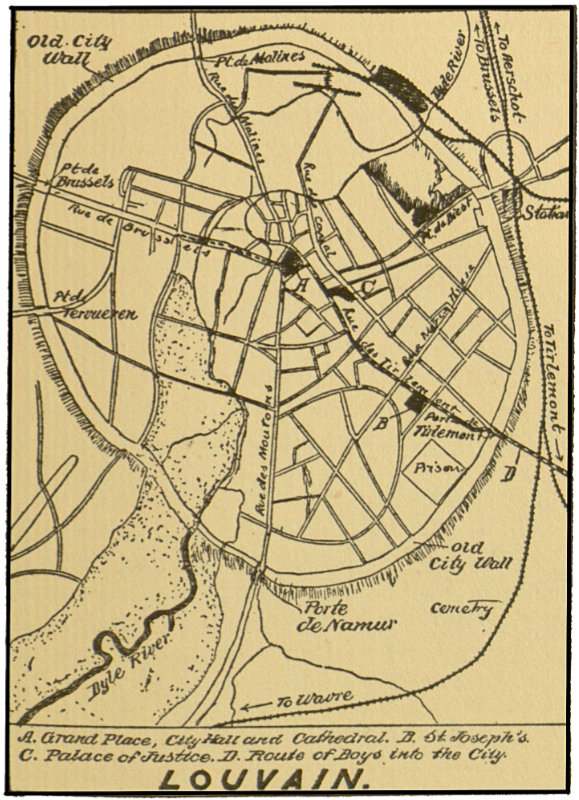
Map of Louvain
The second day's fight was terrific. More than
1000 men fell on that day, on the Belgian side
alone. It was one continual scene of fighting in
the retreat from St. Trond to Tirlemont. Hasselt
and Diest both fell that day, but of this the boys
had no knowledge until later.
The force passed through Tirlemont in good
order, fighting every inch of the way. The Germans
were now, on the 19th of August, advancing
on Louvain by three roads, from Diest, Tirlemont,
and from Hammeville. The boys were with the
central force on the Tirlemont road.
Orders were issued to continue the retreat to
Louvain, as the Germans were known to be east
of the city in great force, and no one knew what
the end would be. Ralph still had his horse, but
it had been wounded late in the afternoon and he
was forced to abandon it.
Alfred had his machine, but it was useless, as
he had no oil for it, and it was finally loaded in
one of the wagons and the two boys were forced
to go along on foot.
Soon there was a halt, and they saw the men
form along the road and spread out along the
sides of a hill. Then the shells began to fall and
the troops in front got into action. They were
being surrounded and cut off, and although the
men knew it they continued to fight.
Then a desperate charge from the open field in
the left told the story. The order was given to
cease firing and as a still greater force came over
the hill, and the entire rear guard of their regiment,
together with a battery, fell into the hands
of the enemy.
Everything was confusion now. The boys
plainly saw a white flag and noted that the firing
had ceased.
"Let us get out of this," said Alfred, so together
they ran across a field and soon reached a
fence beyond. The Belgian troops which filled the
road to the north in another hour had reached the
gate of the city, called Porte de Tirlemont. It
was reported that the Germans had entered the
city at the eastern gate, but once within the city
they hurried through and passed out the gate
Porte de Malines.
On all sides were people, some walking, others
riding, many of them in curious conveyances, and
all excited to the utmost. They had now lost all
trace of the Belgian army, although they knew it
was some miles ahead of them.
That night they were aroused by a cry: "The
Germans are coming."
A half hour thereafter the first troop of horsemen
came from the east, and from that time until
morning there was no cessation from the galloping
of horses, the tramp of infantry and the rumbling
of artillery wheels.
"I wonder where we can get something to
eat?" said Alfred.
At a little cluster of houses, five miles south of
Louvain, they found some food, and after breakfasting
they again resumed the tramp along the
main highway which led to Malines, ten miles
away.
Before noon they reached the city where the
Germans were. They had not been molested on
the highway, but now, as they passed the gate, an
officer gazed at them and commanded a halt.
"Who are you?" he demanded.
"We are American boys, on the way to Antwerp,"
said Ralph.
"What uniform is that?" he demanded.
"Messenger service, sir," responded Alfred, as
he glanced at Alfred.
"In whose service?" asked the officer.
Neither replied.
Motioning to a soldier, the officer said: "Arrest
them."
They were marched to the great military prison,
which was filled to overflowing with men and
women. Two days thereafter they were taken out
and marched through the town, past the great
Cathedral. Crossing the open place they were
taken westwardly along a wide street and turned
to the left along a street that ran alongside a wide
stream, which the boys afterwards learned was
the Dyle.
They were halted in front of a large building
which had the inscription "Salm Inn."
They were met at the door by nurses with large
red crosses on their sleeves, and by smartly
dressed uniformed men in white, also provided
with red crosses.
"This is now a hospital," remarked their companion,
"and it is one of the Red Cross stations."
"What do they want to bring us here for?"
"I suppose they are going to put us to work."
Within was an appalling sight as the boys
went through the ward for the first time. Ralph's
duty was to attend the physicians in their rounds
each morning, and at two in the afternoon. He
furnished supplies, waited on the nurses and attended
to the wants of the sufferers.
Alfred was on like duty in the adjoining ward.
While not together as much as formerly, they were
constantly meeting in the halls, and one day Ralph
was entrusted with the duty of going into the city
on an errand.
The only thing which the boys could not bear
was the fact that they could get no news of the
outside world. All communication was shut off.
Had Liège fallen? Where were the Belgian
forces? Had Brussels yielded? Their captors
would give them no information, and the nurses,
most of them could talk German only, did not seem
to know any more than they did.
Ralph determined to get some information, and
while on his journey sought a stationery establishment
in order to purchase some papers. The
first one he spied had a large assortment of papers
but, singularly, not a single French paper.
He was disgusted, and as he turned away,
voiced his complaint. The shopkeeper said:
"This is now a German province, and no more
French will be spoken or printed here."
During his absence Alfred, in making his rounds
as usual, was startled at hearing his name. He
turned, and near him, with his head bandaged, and
an arm bound with many layers of surgeon's tape,
stood a young man.
"Don't you recognize me?"
"No," said Alfred, with open eyes.
"Have you forgotten Roland?"
Alfred was down by the bedside in a moment.
"Where were you wounded? Is it serious?
How long have you been here?" said Alfred.
"I was wounded over two days ago, and was in
the field hospital a day. My company was captured
in the fight below Malines, and Colonel
Moreau is also a prisoner. What have you been
doing?"
"We have had a wonderful time," said Alfred.
"Where is Ralph?" asked Roland.
"He is here, in the next ward. I will surely
tell him about you."
At the hospital the boys saw every sort of
wound, and soon learned to distinguish between
the gunshot and the shrapnel wounds.
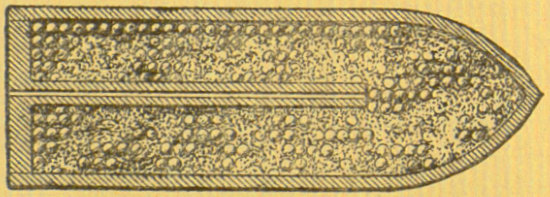
"Why is it that the shrapnel make such awful
holes?" he asked one of the nurses one day.
"Well, you know, shrapnel does not go through
the air as fast as the bullets from the rifles, and
it has been shown that the greater the velocity the
smaller the size of the wound. The bullets from
the Mausers and the Mannlichers, which have such
a high velocity, seem to go through so quickly
that they sear the flesh, and thus form an antiseptic
path which aids the wound in healing. But
the shrapnel bullets are larger and this causes
such terrible wounds."
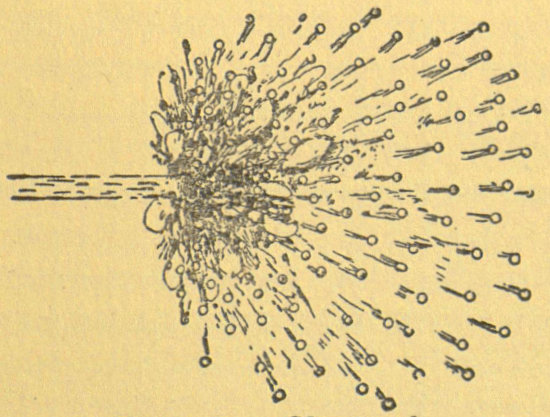
"But they seem actually to tear the flesh," said
Alfred.
"That is caused, not by the bullets which are in
the shrapnel, but by the shell itself. If the shell
bursts near the soldiers it often strikes the poor
fellows and sometimes tears them to pieces."
It would be too sickening to go over the many
details that came to the notice of the boys. They
were kept at their duties daily for over two weeks,
when something happened which made them decide
to effect their escape, if possible.
"Let us get away," said Alfred, after they had
been on duty for a week. "I think we can easily
do it," he added. Ralph hesitated, for a moment.
"Yes, by all means if we can," responded Ralph.
"But I don't mind this work, and do you know
they intend to pay us for it?"
"How do you know?" asked Alfred.
"Because the steward told me so when he made
the rounds to-day and was making up the list."
"Then let's wait until we get some money,"
answered Alfred.
Two days thereafter, to the gratification of the
boys, they were handed envelopes, each containing
a number of pieces of silver coin.
"How much money have we earned?" asked
Ralph.
"Well, each of you has nine marks, and that is
about eleven francs, or five and a half francs a
week," he was informed.
During their work they found that more and
more liberty was accorded them. Each had the
Red Cross emblem on his sleeve, and after the
first week they were furnished with new suits.
During their work they had also been provided
with clean rooms, and opportunities for daily
baths. However, they felt the restraint when that
night as they had several times done before they
wandered down to the heart of the city it was with
a determination to cross the barriers at the first
opportunity.
One day a soldier was brought in whose arm
was completely shattered. On examination it was
found that only a single bullet had passed through.
The surgeon in charge said it was the first instance
he had noted where the high power missile
had caused such a terrible fracture.
Colonel Moreau, who was present, said: "I can
understand the reason for that. The bullet, evidently,
was deflected before striking the arm, and
as it came from a rifled gun, its screw-like action
caused it to set up a motion at its rear end, something
like the upper end of a top, just before it
stops to spin. This is called a key-holing motion,
and as the bullet strikes the solid bone it simply
tears its way through, instead of making a clean
round hole, as is ordinarily the case."
The city was full of soldiers and every street
was as lively at ten o'clock that night as during
any part of the day. Troops were moving through
the town, but most of them passed out through
the Porte de Adeghem toward the northwest.
"Do you notice that all the troops are going
northwest and west?" asked Ralph. "They must
go that way to reach Brussels, and as Brussels is
now in the hands of the Germans," he added, "we
should by all means go to the north or east and
reach Antwerp."
Without molestation they passed through the
streets and moving north through the Rue de
Catharine crossed the great boulevard and out
through Porte de Anvers without being seen.
At twelve that night the road was still filled with
troops, wagons and paraphernalia of war. Watching
an opportunity, Ralph sought information
from a peasant. The latter said:
"The Belgians are not far away, and there has
been a battle hereabouts. If you want to reach
the troops do not follow the road, but go to your
left, directly west. In that way you will get in
touch with them."
"What does the great movement of troops toward
Antwerp mean?" asked Ralph.
"Why, the Germans have determined to capture
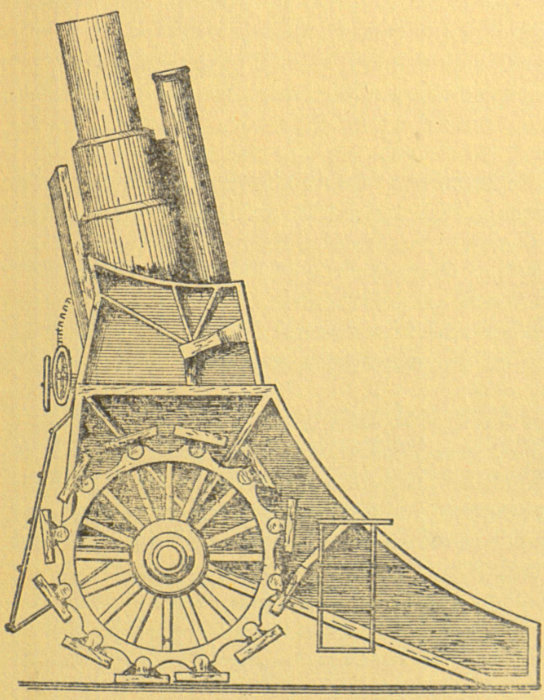
Antwerp, and they are moving up the big
guns to batter down the forts," he was informed.
About five miles north of Malines they reached
the river Nethe. Acting on the suggestion of the
peasant, they left the road at this point and determined
to follow that stream as far as Boom, from
which point they would have a safer route to
Antwerp.
After going less than a mile they saw a road
which had the inevitable cavalry patrols. They
were now undecided what to do, but determined
on one thing—to get to the Belgian lines and to
risk all rather than be recaptured.
So they remained close to the hedge and moved
up carefully to get a more favorable view. They
were soon convinced that the patrols were Germans
and this made it imperative for them to
avoid the highway.
Awaiting the first opportunity they crawled
through the hedge and found themselves in the
roadway, but before there was an opportunity to
cross they were spied by the advance sentries and
the first cry they heard was: "Wer geht da?"
The boys rightly interpreted this to mean "Who
goes there?" but they did not stop. This time
they darted through the bush and ran to the south
along the hedge row, as fast as they could scurry,
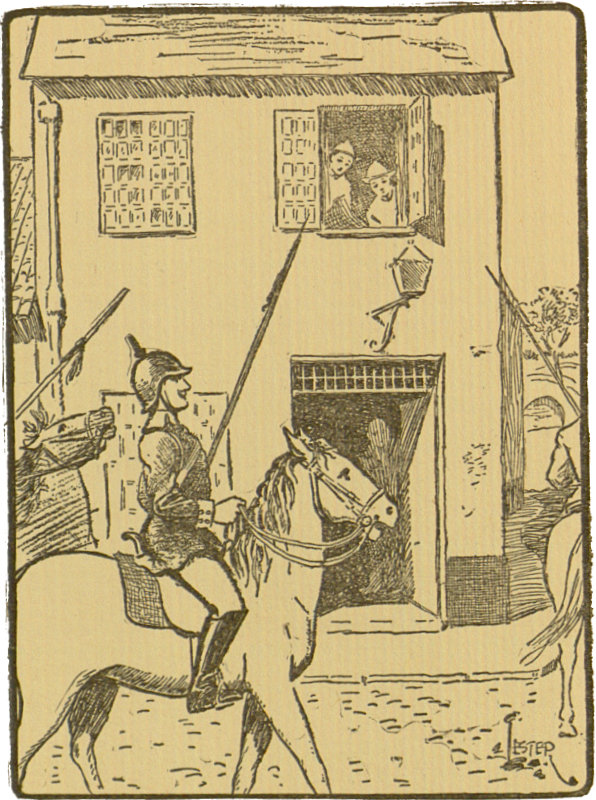
while the sentry, putting the spurs to his horse,
was over the fence at a leap, and after shooting
twice came directly across the field.
The boys knowing that the sentry could not see
them after they crossed the little ravine, entered
the dense shrubbery which grew along the river
bank. Their hearts were in their mouths. As
they looked around, however, they saw three other
horsemen following them.
Now began the flight of their lives. "Let's go
to the left along the river bank. That may throw
them off our tracks. They may turn to the right,
thinking that we would be most likely to go in
that direction," proposed Ralph.
His prediction was verified, for without waiting
to go directly to the brink of the river the horsemen
all headed for the river to the right, thus
enabling the boys to look about for some sort of
protection.
The high grass and weeds enabled them completely
to cover themselves and they had the satisfaction
of hearing the troopers a half-mile in the
distance, beating every clump of shrubbery, but
soon all was quiet.
Ralph laughed as they lay there and reflected
how the Uhlans were outwitted. "What made
you think of that ruse?" he asked.
"I happened to remember what the General said
one day, when they were planning some new movement
of the troops. He said we ought to get east
and occupy the ridge. Our weakest movement
would be to go to the left. Napoleon's policy was
first to consider what a commander would be likely
to do to defend a position, and then do just the
other thing. It was by following this plan in the
field that he won all his battles in Italy, and it
gave him wonderful fame. You see, they were
driving us down the river bank, and they would
naturally think we would not go in the opposite
direction, as it would bring us closer to them, in
stead of farther away."
"Well, that is a good lesson, any way. I suppose
the proper thing for us to do now is to follow
them by going up the river?" said Alfred.
"Certainly. They won't be looking for us in
that direction now," said Ralph.
They were careful, however, not to expose themselves
needlessly, but keeping as much as possible
alongside of the high grass they reached the road.
After safely crossing it they sprinted alongside
of the river, and soon covered another mile. At
this point they saw a little village at the end of
a long bridge which crossed to the western side
of the stream. As it was necessary to pass this
village, and to make a detour around it would
mean a long tramp, they consumed fully an hour
as they quietly made their way toward the town
in order to ascertain whether or not it was occupied
by a force, whether friend or foe.
A woman who crossed their path was greatly
startled at their appearance, but their speech at
once reassured her.
"Do you know, M'selle, whether the Germans
are in the village?" asked Ralph.
"No," she answered. "But we were informed
that they are coming up the road."
"They are not far away. They left the bridge
last night."
"I wonder why the bridge was not destroyed?"
said Ralph. "Well, don't let us wait. We must
go on while we have time," was Paul's eager and
hurried observation.
They leaped forward. They could now see the
villagers,—that is, women and children on the
main road looking east. All were extremely excited
as the boys came up, and some of them began
to retreat toward the houses.
Ralph cried out: "We are Americans, and have
just escaped from the Germans. Which is the
best road to Boom?"
The villagers pointed to the road leading along
the river bank. One of them cried out: "Don't
go that way; the Uhlans are on the road."
Several men were now seen at the lower edge
of the village, where they stood waving their
hands.
"That means the enemy are coming," said
Ralph. "Our only hope now is the bridge," and
without waiting to hear further news, both boys
started on a run to make the crossing.
Throughout this section there was a vast amount
of shrubbery, and the inevitable rows of trees
along the highways made it difficult for those on
the western side of the stream to notice the approach
of any one until they were within a few
hundred feet of the bridge.
This was the boys' salvation. Within a minute
they were on the bridge and they were then
startled by the sound of the first gun behind them.
They did not stop, but on glancing back were
somewhat relieved to find that the shot was not
intended for them. Possibly someone in the village
had been made a victim.
They were now in the middle of the bridge,
when a most terrific explosion shook them, and
they stopped running as though they had been
struck. They looked at each other in consternation.
Then they glanced back, but the dense smoke
hid them from the view of their enemies. A section
of the bridge had been blown up; but by
whom they didn't know, so they now walked
toward the end of the bridge. As they went down
the slight incline a soldier stepped in the roadway
and halted them.
The boys halted for a moment and cried, "Belgique!"
then rushed forward, at which the sentry
understood and permitted them to pass. Behind
the sentry were others who hurriedly motioned
them to conceal themselves by the side of the road.
At the same time they noticed that the lone sentry
also had disappeared.
Looking back, they now saw a platoon of Uhlans
at the other end of the bridge.
"Too bad," said Alfred, "that the explosion
didn't do more damage." The troopers advanced,
some of them dismounting, and within fifteen minutes
sufficient repairs were made to allow a half-company
to cross over.
The leaders were galloping off the bridge when
two distinct explosions took place, one near their
end of the bridge and the other behind the first
explosion, thus completely cutting off those on the
bridge and also entrapping those who had crossed.
A brief order, "Tirez!" on the part of the Belgian
officer brought into view over a hundred concealed
infantrymen, who fired volley after volley
as they made a rush toward the horsemen. Some
of the Uhlans turned and plunged into the stream,
and many of those on the bridge did likewise,
while the officer in command of the Belgians called
out to them to surrender. Most of them did so,
throwing down at the same time their lances and
guns.
Thus the moving column was checked, and at
this very place the Belgians held up the further
movement of the Germans toward the west, until
after Antwerp had fallen.
The fighting was soon over, and when the prisoners
had been rounded up the men started to
the rear with them.
Upon reaching the main camp the first one to
greet the boys was Antonio, and before nightfall
every one in the camp had beard about the boys
and of their achievements. An amusing thing occurred
as the prisoners were being assigned to
their quarters.
Marching along at the head of the tired troopers
was a German lieutenant. The boys now noticed
for the first time that this officer wore the
helmet of the Death's Head Hussar.
"There is a friend of ours," said Ralph, with a
smile.
"Who do you mean?" said Antonio.
"The German lieutenant, with the big helmet
on."
As they moved toward him the officer, who now
recognized the boys, looked at them in astonishment.
He held up a hand in token of recognition,
as Alfred went up to him and said: "Well, Lieutenant,
we intend to put you to work in the hospital."
The officer gazed at him in amazement for a moment,
and then, as he saw the twinkle in the boy's
eyes, said: "Ah! you are not serious. You do
not take these things seriously."
Two days thereafter our young heroes marched
into Antwerp with the troops, where they were
to meet Ralph's family. During their three
weeks' wanderings not a word had been heard
from the boys or from Pierre, and their parents
were naturally much alarmed, knowing that they
were traversing the very section of Belgium where
the first fighting had taken place in the great conflict.
We shall now take leave of our young friends
in the hope that we may have the good fortune to
follow their further adventures on European battlefields.
The Motion Picture Comrades
Series
By ELMER TRACEY BARNES
The object of these books is to place before the
reader the unusual experiences of a party of boys who
succeed in filming a number of interesting scenes.
The stories are replete with striking incidents on
land and sea, and above all they describe with remarkable
accuracy the methods employed to obtain many
of the wonderful pictures which may be seen on the
screen.
The Motion Picture Comrades' Great Venture;
or, On the Road with the Big Round Top
The Motion Picture Comrades Through African Jungles;
or, The Camera Boys in Wild Animal Land
The Motion Picture Comrades Along the Orinoco;
or, Facing Perils in the Tropics
The Motion Picture Comrades Aboard a Submarine;
or, Searching for Treasure Under the Sea
12mo. Cloth 50c per volume
THE NEW YORK BOOK COMPANY
201–213 EAST 12th STREET NEW YORK
THE HILLTOP BOYS SERIES
By CYRIL BURLEIGH
The Hilltop Boys; A Story of School Life
Jack Sheldon, a clean-minded and popular student in the academy,
gains the enmity of several of the boys, but their efforts to injure
him fail. A mystery, connected with Jack's earlier life, is used against
him, but he comes off with flying colors.
The Hilltop Boys in Camp; or, The Rebellion at the Academy
A strange situation arises in which an airship figures as the bearer
of an important letter. The head-master acts without investigating
all the facts, but matters are all finally adjusted to the satisfaction of
all concerned.
The Hilltop Boys on Lost Island; or, An Unusual Adventure
The scene now shifts to the West Indies and Jack figures as the
hero of a daring rescue. Their experiences in tropical waters form
a most stirring narrative, and the young reader is assured of a tale of
gripping interest from first to last.
The Hilltop Boys on the River
The Doctor takes a number of the boys on a cruise up the Hudson.
An unlooked for incident finds Jack Sheldon equal to the occasion,
and what at one time promised to be a disastrous trip for all concerned
was turned into a complete victory for our young friends.
12mo. Cloth 50c per volume
THE NEW YORK BOOK COMPANY
NEW YORK
The Hickory Ridge Boy Scouts
A SERIES OF BOOKS FOR BOYS
By Capt. ALAN DOUGLAS, Scout-master
These stories are from the pen of a writer who not only possesses
a thorough knowledge of his subject but who is gifted with the ability
to describe the various experiences of the Hickory Ridge Scouts so the
young reader may enjoy and be benefitted thereby.
The narratives are normal and healthful in their tone—in other
words, real scout stories which hold the reader's interest to the last
page.
The Campfires of the Wolf Patrol
Woodcraft; or, How a Patrol Leader Made Good
Pathfinder; or, The Missing Tenderfoot
Fast Nine; or, a Challenge from Fairfield
Great Hike; or, The Pride of the Khaki Troop
Endurance Test; or, How Clear Grit Won the Day
Under Canvas; or, The Hunt for the Cartaret Ghost
Storm-bound; or, a Vacation Among the Snow Drifts
Afloat; or, Adventures on Watery Trails
Boy Scout Nature Lore to be Found in The Hickory Ridge Boy Scout Series, all Illustrated:
Wild Animals of the United States—Tracking—Trees and Wild Flowers
of the United States—Reptiles of the United States—Fishes
of the United States—Insects of the United States and Birds of
the United States.
Cloth Binding. Cover Illustrations in Four Colors—50c per Volume
THE NEW YORK BOOK COMPANY
201 EAST 12th STREET NEW YORK
The Campfire and Trail Series
1. In Camp on the Big Sunflower
2. The Rivals of the Trail
3. The Strange Cabin on Catamount Island
4. Lost in the Great Dismal Swamp
5. With Trapper Jim in the North Woods
6. Caught in a Forest Fire
7. Chums of the Campfire
8. Afloat on the Flood
9. The Cruise of the Houseboat
By LAWRENCE J. LESLIE
A series of wholesome stories for boys told in an
interesting way and appealing to their love of the open.
Each, 12 mo. Cloth 50c per Volume
THE NEW YORK BOOK COMPANY
201 EAST 12th STREET NEW YORK
THE MOUNTAIN BOYS SERIES
1. Phil Bradley's Mountain Boys
2. Phil Bradley at the Wheel
3. Phil Bradley's Shooting Box
4. Phil Bradley's Snow-Shoe Trail
5. Phil Bradley's Winning Way
By SILAS K. BOONE
These books describe, with interesting detail, the
experiences of a party of boys among the mountain
pines.
They teach the young reader how to protect himself
against the elements, what to do and what to avoid, and
above all to become self-reliant and manly.
12mo. Cloth 50c per Volume, Postpaid
THE NEW YORK BOOK COMPANY
201 EAST 12th STREET NEW YORK
THE MERRYVALE BOYS
By ALICE HALE BURNETT
Six real stories for small boys, each complete in itself, telling about
the many interesting doings of "Toad" and "Chuck" Brown, and their
friends, "Fat," "Reddy" and others.
The books are written so the boy may read and understand them
and the action faithfully portrays boy life in a small town.
CIRCUS DAY AT MERRYVALE
"Toad" and "Reddy," by good fortune, each earn two tickets to the
circus, although they find watering elephants a harder task than it at
first seemed. A jolly party of boys visit the circus.
FATHER BROWN'S INDIAN TALE
Dad's story is followed by an unexpected visitor who at first startles
then interests all of the little party gathered around the fireside.
THE PICNIC AT MERRYVALE
Did you ever go to a picnic in a large farm wagon, filled with boys
and girls? Then did you catch a fine lot of trout and broil them before
a camp-fire? "Toad" and "Reddy" did these very things and had a
day long to be remembered.
CHRISTMAS HOLIDAYS IN MERRYVALE
Daddy Williams' Toy Shop is the center of interest to "Toad" and
his friends long before Christmas arrives. They plan a surprise that
brings joy to a poor family. The boys erect snow forts and the two
sides have a battle royal.
MERRYVALE BOYS ON THE FARM
"Toad's" grandmother invites him and "Reddy" to spend a month
in the country. Their experiences at Sunnyside farm, with its horses,
cows, pigs and chickens, are most entertainingly told, and they have the
time of their lives boating, swimming and fishing in the creek.
HALLOWE'EN AT MERRYVALE
For many days the boys had been looking forward to the party to
be held at Toad Brown's house, but the evening finally arrived and a
number of new games were played, although a few things happened
which were not on the program.
Illustrations in Color 12mo. Cloth 40c per Vol., Postpaid
THE NEW YORK BOOK CO., 201 E. 12th St., New York
THE MERRYVALE GIRLS
By ALICE HALE BURNETT
Six delightful books for the smaller girls, each a complete
story in itself, describing in simple language the interesting
experiences of Beth, Mary and Jerry, three little maids of
Merryvale.
Beth's Garden Party
The three girls take part in a very formal little affair on the lawn of
Beth's home, and each of the guests receives a present. The drive home
in Beth's pony cart furnishes a few exciting moments, but Patsy bravely
comes to the rescue.
A Day at the County Fair
The girls are taken to the fair in a motor, but a slight delay occurs on
the way. How they finally arrived at the fair ground and their amusing
experiences are most entertainingly told.
Geraldine's Birthday Surprise
Geraldine, whom we know better as Jerry, plays hostess to her many
friends, although it must be admitted that her guests knew of the affair
before she did. A jolly evening is spent by the girls which is shared in
by our young Merryvale boy friends.
Mary Entertains the Sewing Club
Mary has the club at her home, and the efforts of the members cause
many outbursts of merriment. The girls hold a "fair of all nations" for
the benefit of the Merryvale Day Nursery, and their plans succeed beyond
their expectations.
Merryvale Girls at the Seaside
The three girls are invited to the light-house where they see many
wonderful things. A luncheon on the shore and days spent in sailing
with the captain make their visit a round of pleasure.
Merryvale Girls in the Country
A real old-fashioned farm affords the girls a most enjoyable time and
every hour is filled with delightful experiences.
12mo. Cloth. Illustrations in Color. 40c per Volume, Postpaid
THE NEW YORK BOOK CO., 201 E. 12th St., New York