The captain of the Stranger looked toward
the companion-ladder, up which his nephew had
just disappeared, and motioned to Frank to close
the door.
“That is the fourth time I have seen you look
at that barometer during the last half hour,” continued
Frank.
“Yes, and I find it lower every time I look at
it,” answered the old sailor. “It is coming; trotting
right along, too.”
6“What is coming? Another tornado?”
“No, a regular old-fashioned cyclone.”
“I declare, it don’t seem to me that the schooner
can stand much more pounding,” said Frank, drawing
a long breath.
“Oh, she is good for a dozen battles like the one
she has just passed through,” continued Uncle
Dick, encouragingly. “Give me a tight craft, a
good crew, and plenty of elbow-room, and I would
much rather be afloat during a storm than on shore.
There are no trees, chimneys, or roofs to fall on us
here.”
“But we haven’t plenty of elbow-room,” said
Frank, somewhat anxiously. “The islands are
scattered around here thicker than huckleberry
bushes in a New England pasture, and they are all
surrounded with coral reefs, too.”
“I know it; but it is our business to keep clear
of the coral reefs. Now, let me see how much you
know. Where’s the schooner?”
Frank, who now occupied his old position as
sailing-master of the vessel, took a chart from
7Uncle Dick’s desk, and pointed out the position of
their little craft, which he had marked with a red
lead-pencil after taking his observation at noon.
“Very good,” said Uncle Dick. “Which side
of the equator are we?”
“South,” answered Frank.
“How many motions have cyclones?”
“Two; rotary and progressive.”
“Which way do they revolve in the Southern
hemisphere?”
“In the same direction that the sun appears to
move.”
“Correct. Now, suppose that while you were
in command of the Tycoon, you had found out
that there was a cyclone coming—”
“I’m afraid I shouldn’t have found it out,” interrupted
Frank, “for I don’t know what the signs
are.”
“But we will suppose that you knew all about
it. After you have seen one or two, you will know
how to tell when they are coming. We will suppose,
now, that a cyclone comes up, and that the
8wind blows strongly from the northwest. Which
way from you is the centre of the storm?”
“Southwest.”
“And which way is it coming?”
“Toward the southeast.”
“Then if you bore away to the southwest you
would escape, of course?”
“No, sir; I should probably insure my destruction,
for I should sail straight into the vortex. A
northeasterly course would soon take me out of
danger.”
“Yes, you would get out of danger that way,
but how soon I don’t know. The paths of some
of these hurricanes are a thousand miles broad.
You’ll do, however, and you are a very good boy
to learn your lesson so well.”
“Shall I go to the head?” asked Frank, with a
laugh.
The last time we saw the members of the Sportsman’s
Club, they had just found Frank Nelson
after a long separation from him. Their vessel was
lying in the harbor of Honolulu; Captain Barclay,
9the wounded commander of the whaler, had been
taken to a hospital on shore; his ship, the Tycoon,
had passed through the hands of the American
consul, who placed a new captain aboard of her
with orders to take her to the States, where she belonged;
and for the first time in long weeks the
Club were free from excitement, and had leisure to
sit down and calmly talk over the adventures that
had befallen them, and the exploits they had performed
since leaving home.
They had many things to converse about, as we
know, and some of their number had reason to feel
elated over what they had done. Walter had been
a hero for once in his life, for had he not been captured
by robbers, who believed him to be somebody
else, been confined in Potter’s ranche, and held as
a hostage for the chief of the band who was a prisoner
in the fort? That was the worst predicament
that Walter had ever been in, and it was no wonder
that there was a warm place in his heart for Dick
Lewis and Bob Kelly, the men who had rescued
him from his perilous situation.
10Archie Winters was also a hero, for he had lassoed
and ridden the wild horse which had so long
defied all efforts to capture him, and would in all
probability have given him, in a few days more,
into the possession of his lawful owner, Colonel
Gaylord, had not he and his two friends, Fred and
Eugene, unfortunately stumbled upon Zack and
Silas, the trappers who robbed the emigrant. One
thing made Archie hug himself with delight every
time he thought of the various exciting incidents
that happened while he remained in the trappers’
company, and that was, that Zack and Silas did
not get the million dollars after all. He laughed
outright when he remembered how astounded and
enraged they were to find that the box, which they
supposed was filled with nuggets and gold-dust,
contained nothing but a small brass machine something
like the works of a clock. Archie wondered
what had become of the hospitable Pike, and
whether or not he had succeeded in putting his
machine together again, and running his quartz
mill with it.
11But while the members of the Club gave to
Walter and Archie all the credit which their adventures
and achievements demanded, they were
unanimous in according the lion’s share of praise
to Frank Nelson, who had brought himself safely
out of a predicament, the like of which the boys
had never heard of before. It seemed almost impossible
that one who had been “shanghaied” and
thrust into the forecastle of a whale-ship to do duty
as a common sailor, should, in so short a time and
by sheer force of character, have worked his way to
the quarter-deck, and into a position for which only
men of years and experience are thought to be
qualified. But they had abundant evidence that
such was the fact. There was a witness in the person
of the trapper, who was kidnapped at the same
time, and who had escaped in a manner so remarkable
that even Uncle Dick, who had seen a world
of marvellous things, said the same feat could not
be performed again under like circumstances. Besides,
the boys had seen Frank on the Tycoon’s
quarter-deck, had heard him give orders that were
12promptly obeyed, had messed with him in his
cabin, and he had brought them safely into the
harbor of Honolulu, beating the swift little Stranger
out of sight on the way.
As for Frank himself, he was very well satisfied
with what he had done, and often declared that an
adventure which, at first, threatened to terminate
in something serious, had had a most agreeable
ending. His forced sojourn on the Tycoon and all
the incidents that had happened during that time—the
sight of the first whale he ever struck coming
up on a breach close in front of his boat, and looming
up in the air like a church steeple; the excessive
fatigue that followed the long hours spent in
cutting in and trying out; the sleepless nights;
the days and weeks of suspense he had endured;
the race and the desperate battle under a broiling
sun he had had in Mr. Gale’s boat on the day
Captain Barclay deserted him; the fight with the
natives at the Mangrove Islands, and the rescue of
the prisoners—all these things would have seemed
like a dream to Frank now, had it not been
13for the large callous spots on the palms of his
hands, which had been brought there by handling
heavy oars and by constant pulling at tarred
ropes. The sight of these recalled very forcibly to
his mind the days and nights of toil which sometimes
tested his strength and endurance so severely
that he hardly expected to live through them.
Nothing could have tempted him to submit to the
same trials again, but now that they were all over
and he was safe among friends once more, he would
not have sold his experience at any price.
The Stranger remained at the Sandwich Islands
three weeks, and during that time the boys saw
everything of interest there was to be seen. Eugene,
who was impatient to get ashore to see how the
“savages” lived, was quite astonished when his
brother informed him that the natives were considered
to be the most generally educated people in
the world; that there was scarcely a man, woman,
or child of suitable age among them who could
not read and write; that they had contributed a
goodly sum of money to the Sanitary Commission
14during our late war; that they had sent a good
many men to serve in our army and navy; and
that among them were a brigadier-general, a major,
and several officers of lower grade. Eugene could
hardly believe it; but when he got ashore and saw
the fine hotel erected by the government at a cost
of one hundred and twenty thousand dollars, the
prison, hospital, churches, and school-houses, he
was obliged to confess that he was among civilized
people. Frank and Archie were equally astonished
at the familiar appearance of things, and told their
Southern friends that if they could imagine how
Honolulu would look without the bananas, palm,
and tamarind trees, they could tell exactly how
the majority of New England villages looked.
The first Sunday the Club spent ashore they
went to the seaman’s chapel to hear Father Damon
preach to the sailors; and the next day they hired
horses, a pack-mule, and guides for a ride around
the island. This was a great relief to them, especially
to Dick and Bob, for it gave them a taste of
the frontier life to which they had so long been
15accustomed. They were all glad to find themselves
on horseback once more; so they journeyed
very leisurely, and the ride, which could easily
have been accomplished in four days, consumed
the best part of eight.
Having explored Oahu pretty thoroughly, the
Club returned on board the Stranger, which set sail
for Hilo in the island of Hawaii, which place they
reached after a rough passage of four days. At
Hilo—the town has been devastated by a tidal
wave since the Club visited it—they had their first
view of a sport for which the natives of these
islands are so famous—swimming with the surf-board.
It was a fine, not to say a thrilling sight
to see a party of men, some of whom were lying,
others kneeling, and still others standing erect upon
boards which seemed scarcely large enough to support
their weight, shooting towards the beach with
almost railroad speed, closely followed by a huge
comber that seemed every instant to be on the
point of overwhelming them. The grace and skill
exhibited by the swimmers made the feat appear
16very easy of accomplishment, and after watching
the bathers for a few minutes, Eugene declared
that he could do it as well as anybody, and dared
Archie to get a board somewhere and go into the
water with him.
“Find a board yourself, and see if I am afraid
to follow where you dare lead,” was Archie’s
prompt reply; and to show that he meant what he
said, he pulled off his jacket and threw it on the
sand.
“Now, Archie,” remonstrated Frank, “I
wouldn’t undertake anything I was certain to
make a failure of, if I were you. You can’t get
beyond the surf to save your life.”
“I’d like to know if I can’t duck my head and
let a billow pass over me as well as anybody?”
“No, you can’t.”
“There’s where you are mistaken. You’ll see.
Our countrymen can dive deeper and come out
drier than any people in the world, not even excepting
these Sandwich Islanders. I’ll go as far as
my leader goes, you may rely upon that. Say, Mr.
17Kanaker,” added Archie, approaching a stalwart
swimmer who had just been landed high and dry
by a huge billow, “you gives me board, I gives
you, quarter, eh?”
The native smiled good-naturedly and astonished
Archie by replying in plain English, and in much
better terms than he had used—
“You may have it certainly, but I wouldn’t
advise you to try it.”
While Archie stood perplexed and bewildered,
wondering how he ought to apologize to the man
for addressing him in such a way, the latter continued,
“I think your friend has given up the idea
of going out.”
Archie looked toward Eugene, and saw that he
was standing with his boots in his hand, gazing
intently toward the water. He glanced in the
same direction, and was just in time to see a
swimmer overtaken by a huge comber, and carried
out of sight in an instant. Archie was greatly
alarmed, and expected to see the man dashed
stunned and bruised on the beach; but presently
18a head bobbed up and out of the water beyond the
breaker, and the bold swimmer, still safe and sound
and undismayed by his failure, struck out for
another trial, diving under the waves as they came
rolling in, and finally made his way to the smooth
water, half a mile from shore, where he waited for
another high swell to carry him in. That was as
near as Archie and Eugene ever came to trying
their skill with the surf-board. One picked up
his jacket, the other pulled on his boots, and as
both these acts were performed at the same time,
neither could consistently accuse the other of
backing out.
The first excursion the Club made from Hilo was
to a bay, with an unpronounceable name, on the
opposite side of the island, the scene of Captain
Cook’s death; and the next was to the volcano of
Kilauea, the largest active crater in the world.
The trappers, who accompanied the Club wherever
they went, set out on this last expedition with fear
and trembling. The boys had explained to them
the theory of volcanoes as best they could, and to
19say that the backwoodsmen were astonished would
but feebly express their feelings. They had never
heard of a burning mountain before, and they were
overwhelmed with awe. The statement that there
was a hole in the ground three miles long, a mile
broad, and a thousand feet deep, containing two
lakes filled with something that looked like red-hot
iron, was almost too much for them to believe;
but the Club promised to show it to them, and so
the trappers mounted their horses and set out with
the rest. But they went no farther than the Volcano
House, at which the party stopped for the
night. The Club and Uncle Dick took up their
quarters in the house, but the trappers preferred
spreading their blankets on the veranda. Some
time during the night the rainstorm, that had set
in just before dark, cleared away, and old Bob, who
happened to be awake, suddenly caught sight of
something that terrified him beyond measure. He
aroused his companion, and the two sat there on
the veranda until morning looking at it. The
top of the mountain which had been pointed out to
20them as the volcano, seemed to be on fire, and now
and then sheets of flame would shoot up above the
summit, lighting up the clouds overhead, until it
seemed to the two anxious watchers that the whole
heavens were about to be consumed.
By the time daylight came they had seen enough
of volcanoes, and emphatically refused to go another
step toward the crater. There was something
up there, they said, that must be dreadful to
look at, and they didn’t want to get any nearer to
it. The boys went, however, and descended into
the crater, and filled their pockets with chunks of
lava, saw the burning lakes, breathed the sulphurous
fumes that arose from them, walked over a
fiery, molten mass from which they were separated
by only fourteen inches of something Uncle Dick
said was cold lava, but which was still so hot that
it burned the soles of their boots, and finally came
back to the Volcano House again at five o’clock,
with minds so deeply impressed by what they had
seen that it could never be forgotten. They did
not have much to say about their journey—they
21wanted to keep still and think about it; but when
at last their tongues were loosed, the burning lakes
were the only subjects of their conversation until
the new and novel sights of another country took
possession of their minds and thoughts for the time
being.
The trappers were also wonderfully impressed,
though in a different way. They were frightened
again, and after that they had many long and
earnest debates on the subject of an immediate
return to America. But when they came to talk it
over and ask the advice of others, they found that
there were many obstacles in their way. Dick
Lewis remembered and feared the boarding-house
keeper, while old Bob was afraid to trust himself
to any vessel besides the Stranger. Neither he nor
Dick wanted to cross the Pacific again, for what if
one of those big “quids,” or the mother of that
baby whale they had seen, should meet them and
send them to the bottom? No, they dared not go
back, and they dreaded to go on. There were
dangers before as well as behind. New and wonderful
22sights were being brought to their notice
every day, and there were many others yet to come
that they had often heard the boys talk about.
There were animals called lions and tigers, as fierce
as panthers, only a great deal larger and stronger,
some of which were so bold that they would rush
into a settlement in broad daylight, and carry off
the first man that came in their way. There were
other animals called elephants, that stood as high
at the shoulders as the roof of Potter’s rancho,
whose teeth weighed fifty pounds apiece, and one
of whose feet was so heavy that it took two strong
men to shoulder it. There were serpents so enormous
that they could crush and swallow a deer or
a human being, and others so numerous and deadly
that more than thirty thousand people had died in
one year from the effects of their bites. And,
more wonderful than all, here was Uncle Dick,
who had brought them safely through so many
dangers, and who had met and vanquished all these
monsters, and he was going straight back to the
countries where they were to be found! He was
23going to take his nephews and Frank there too,
and the reckless youngsters were eager to go. The
trappers couldn’t understand it. They didn’t
mind an occasional brush with Indians and grizzlies—they
rather enjoyed it; but the thought of a
single man boldly attacking an animal as large as
a house was enough to terrify them.
The trappers talked these matters over at every
opportunity, and finally decided that they would
rather meet the dangers yet to come, provided they
could do so in Uncle Dick’s company and Frank’s,
than go back alone and face those they had left
behind them. They announced this decision quietly,
like men who had determined to bravely meet
the fate they could not avert, and suffered themselves
to be carried away to new countries and new
dangers on the other side of the Pacific.
CHAPTER II. THE GALE.
24
The Sandwich Islands having been thoroughly
explored, the Stranger set sail for the harbor
of Hilo, and shaped her course across the Pacific.
Japan was the Club’s destination, but they
were in no hurry to get there, and besides there
were objects of interest to be seen on the way.
There were numerous islands to be visited, and
among them were the Mangroves. The boys were
anxious to see the place where the fight with the
natives occurred, and Uncle Dick, yielding to their
entreaties, told Frank to take the schooner there,
a command which he gladly obeyed. The boys
would also have been delighted could they have
seen the village which had been burned by Frank’s
orders. They tried to induce Uncle Dick to let them
go there, giving as a reason for this insane desire
25that possibly the savages might be holding other
prisoners whom they could release. But the old
sailor settled that matter very quickly. He wasn’t
going to put his vessel and crew in danger for nothing,
that was certain. The boys might go ashore
after terrapins if the schooner stopped in the bay
over night, and that was all they could do.
When they arrived in sight of the principal island,
and had approached within a mile of the beach,
Uncle Dick said to Frank:
“The natives of course know by this time that
we are coming, and to show them that we are prepared
to take care of ourselves, wouldn’t it be a
good plan to kick up a little dust out there with a
thirty-pound shot?”
“I think it would,” answered Frank. “As our
vessel is small, they will know that we have a
small crew, and the noise of a shell or two whistling
through the trees may save us from an attack if we
lie at anchor all night.”
Since leaving Bellville the crew had been drilled
in the use of small arms and in handling the big
26guns almost as regularly as though the Stranger
had been a little man-of-war; but none of the
pieces had ever spoken yet, and the Club were delighted
with the prospect of hearing Long Tom’s
voice. The crew were at once piped to quarters,
the shifting men took their place about the thirty-pounder
(the vessel’s company was too small to
allow of a full crew for each of the three guns),
and in response to the old familiar order, “Cast
loose and provide,” which they had all heard many
a time when it meant something besides shelling an
unoccupied piece of woods, quickly stripped off the
canvas covering and made the piece ready for business.
A cartridge was driven home, a shell placed
on top of it, the gun was trained in accordance
with Frank’s desires, the second captain lowered
the breech a little, the first captain raised his hand,
and the crew stood back out of the way.
“Fire!” said Frank.
The first captain pulled the lock-string, and the
little vessel trembled all over as Long Tom belched
forth its contents. Then something happened that
27the Club had not looked for. As the smoke arose
from the mouth of the cannon, a crowd of natives,
who had been lying concealed behind the rocks on
the beach, jumped to their feet and ran with all
haste into the woods. The shell ploughed through
the trees above their heads, and exploding, sent up
a cloud of white smoke to mark the spot.
“That was pretty close to some of them, Frank,”
said Uncle Dick.
“It is no matter if it hurt some of them,” said
Frank, in reply. “They had an ambush ready for
us, didn’t they? Suppose we had been out of water,
and had sent a boat’s-crew ashore after some? There
wouldn’t a man of them have come back to us.”
Three more shells followed the first, being thrown
toward other points on the island, to show the
treacherous inhabitants that the schooner’s company
could reach a good portion of their territory
if they felt so disposed, and then the cannon was
taken in charge by the quarter-gunner, who, after
rubbing it inside and out until it shone like a mirror,
put on its canvas covering again. A few minutes
28afterward, the Stranger dropped anchor in the
bay, near the spot where the Tycoon had been
moored when attacked by the natives.
“This is the place,” said Frank, to the boys who
gathered around to hear once more the story of the
thrilling scenes that had been enacted in that lonely
spot but a few short weeks before. “Here is where
the ship was anchored, and that creek over there
was the ambush from which the canoes came. The
boats’ crews who went ashore after water were attacked
on that white beach you see off the port
bow, and there was where we landed when we went
out to burn the village, which was located about
three-quarters of a mile from the beach.”
The boys could understand Frank’s description
of the fight now that they saw before them the
very spot in which it had taken place. They
listened to the story as attentively as though they
had never heard it before, and ran down to supper
telling one another that they would see and learn
more in the morning when they went ashore after
terrapins. “And I hope that then the natives will
29try and see what we are made of,” said Eugene to
Archie, in a confidential whisper. “My new Henry
rifle that I bought in ’Frisco to replace the one
Jack stole from me will rust for want of use if it
lies in its case much longer.”
“I hope we shall have a chance to rescue the
prisoners they are still holding,” said Archie. “It
must be dreadful to pass one’s life here among
these heathen. The worst part of such a captivity
to me would be the knowledge that every now and
then friends came here who would be only too
willing to take me off if I could only get to them.
I wish there were enough of us to take the island.”
Probably the prisoners who were still in the
hands of the natives wished the same thing. Perhaps,
too, they had some hopes of rescue when
they heard the roar of the thirty-pounder awaking
the echoes among the hills. But the schooner’s
company was in no situation to render them assistance,
and the Club were now as near the island
as they ever went. While they were at supper,
the officer of the deck suddenly descended the companion-ladder
30and interrupted the lively conversation
that was going on by asking the captain if
he would come on deck a minute. Uncle Dick
went, and had hardly disappeared before the boys
heard the boatswain’s whistle, followed by the
order: “All hands stand by to get the ship under
way.”
With one accord the Club dropped their knives
and forks and ran up the ladder to see what was
the occasion of the order; some of them being in
such a hurry that they did not stop to find their
caps.
“Master Frank,” said Dick Lewis, who met his
young friend at the top of the ladder, “is that a
quid out thar? Is that ole whale comin’ to ax the
cap’n what he’s done with her baby?”
The trapper pointed seaward, and Frank, looking
in the direction indicated by his finger, saw a dark
cloud rising rapidly in the horizon, and beneath it
a long line of foam and a dense bank of mist that
was moving toward the island.
“Rodgers says we’re done for now,” continued
31Dick, whose face was white as a sheet. “He
says me and Bob never seed a whale yet, but will
see one now; that is, if we have a chance to see
anything afore she opens her mouth and sends us
to—, to—; what sort of a place did he say that
was, Bob?” inquired Dick, turning to his frightened
companion, who stood close beside him.
“I don’t know; somebody’s cupboard,” replied
Bob.
“Davy Jones’s locker, most likely,” explained
Frank. “Now, Dick, when Rodgers or anyone
else, says such a thing to you again, you just tell
him that you know better. We’re going to have
a blow, that’s all. You have seen enough of them
among the mountains and on the prairies to know
what they are.”
“But, whar be we goin’?” asked Dick, seeing
that the Stranger was walking rapidly up to her
anchor.
“We’re going out, of course.”
“In the face and eyes of it?” gasped the trapper,
looking dubious at the angry clouds, whose appearance
32was indeed most threatening. “Why
don’t we stay here whar we’re safe?”
“Because we are not safe here. This is the most
dangerous spot we could be in. The wind will
blow directly on shore, and the waves will come
rolling in here as high as the crosstrees. The
first one that struck us would carry us out there in
the woods.”
“Then, let’s take our shootin’ irons an’ go
ashore,” said Dick. “I’d sooner fight the niggers
than stay on this little boat and be drownded.”
“And what would we do with the schooner?
Leave her to take care of herself? That’s a pretty
idea, isn’t it? She would be smashed into kindling-wood
on the beach, and then how would we
ever get home again? No, no, Dick; we must
take care of the vessel first, so we are going out
where we shall have plenty of room. I wish we
were out there now,” added Frank, anxiously, as
he directed his gaze toward a high rocky promontory
which jutted out into the water a mile in advance
of them. “That point is a pretty long one,
33and if we don’t weather it before the storm breaks
it will be good-bye, Stranger, and Sportsman’s
Club, too.”
“Never fear,” exclaimed Uncle Dick, who happened
to overhear this last remark. “We’ve got
a capful of wind, and that is all we need to make
an offing. Once off this lee-shore, we shall have
plenty of room, unless we are blown up against
the Ladrone Islands.”
“And about the time that happens, look out for
pirates,” said Eugene.
“What’s them?” asked Dick.
“Oh, they are wild, lawless men, like Allen and
Black Bill,” replied Eugene.
The trapper’s brow cleared at once. He was
not afraid of lawless men, for he had met too many
of them during his career on the plains. He was
perfectly willing to meet anything that could be
resisted by the weapons to which he had been accustomed
from his earliest boyhood, but storms
like this that was now approaching, and whales
and “quids,” that could destroy a vessel, and elephants
34as large as a house, Dick did not want to
see.
The Stranger was under sail in a very few minutes,
and with all her canvas spread she began to
move away from the dangerous shore under her
lee. What little wind there was stirring was rapidly
dying away, but it blew long enough to enable
the little vessel to pass the threatening point which
Frank so much dreaded, and then sail was quickly
shortened, and every preparation made to meet the
on-coming tempest.
“Go below, now, boys,” said Uncle Dick, as he
came out of the cabin with his oilcloth suit on, and
his speaking-trumpet in his hand. “I am going to
batten down everything. Take Dick and Bob with
you.”
Before the trappers could refuse to go, as they
would probably have done had they been allowed
time to think, they were pulled down into the
cabin, and the door, being closed behind them, was
covered with a tarpaulin; so were the skylights,
and thus the cabin was made so dark that the boys
35could scarcely distinguish one another’s features.
This was the first time these precautions had been
taken since rounding Cape Horn, and the boys
made up their minds that the storm was going to
be a severe one.
“I don’t like this at all,” said Eugene. “I’d
much rather go on deck and face it.”
“You are safer here, for there is no danger of
being washed overboard,” said Featherweight.
“But I want to see what is going on,” said Eugene.
“I can’t bear to be shut up in this way.”
“How would you like to belong to the crew of a
monitor?” asked George. “In action, or during a
storm at sea, the crew are all below, and they are
kept there by heavy iron gratings.”
“Whew!” exclaimed Eugene. “They must be
regular coffins.”
“They sometimes prove to be, that’s a fact.
The Tecumseh was blown up by a torpedo in Mobile
harbor, and went to the bottom, carrying one
hundred and twelve men with her.”
“Human natur’!” shrieked Dick, as all the occupants
36of the cabin were thrown from their seats
by the sudden lurching of the vessel. “We’re
goin’, too! We’re goin’, too!”
“Oh, no,” replied Frank, picking himself up
from under the table, where he had been pitched
headlong. “That was only the first touch of the
storm.”
“Well, if that’s a touch, I sincerely hope that we
shall not get a blow,” said Archie, crawling back
to his seat and rubbing his elbow with one hand
and his head with the other.
“She will soon come right side up,” said Frank.
But to Dick and Bob, and even to some of the
other occupants of the cabin, it seemed for a few
minutes as though the Stranger was destined to
come wrong side up. She heeled over until the
floor stood at such an angle that it was useless for
one to attempt to retain an upright position, and
the boys were knocked and bumped about in a
way that was quite bewildering. But she came up
to a nearly even keel at last, as Frank had said
she would, and then the boys could tell, confined
37as they were, that she was travelling through the
water at a tremendous rate of speed. They looked
out at the bull’s-eyes, but could gain no idea of the
state of affairs outside, for the glasses were obscured
by the rain and by the spray which was driven
from the tops of the waves. The waves must have
rolled mountains high, judging by the way their
little vessel was tossed about by them, and the
wind roared and screeched so loudly that the boys
could not hear a single order, or even the tramping
of the sailors’ feet as they passed over their
heads. So completely were all sounds of life above
decks shut out from them, that the Club might
have thought that the captain and all his crew had
been swept overboard, had it not been for the
steady course the vessel pursued. That told them
that there was somebody watching over them, and
that there was a skilful and trusty hand at the
helm.
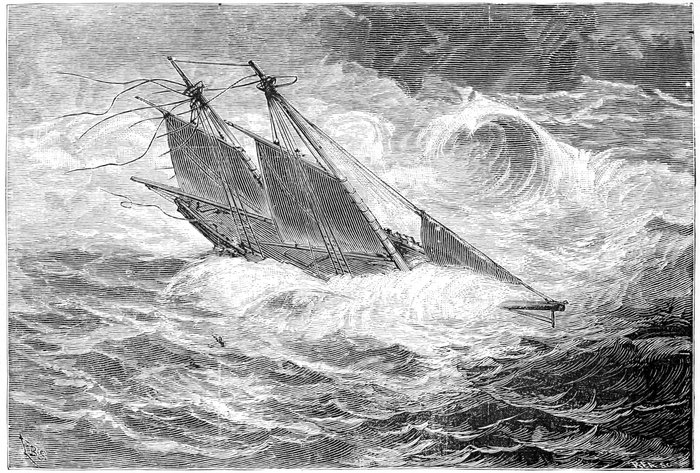
The storm continued with unabated fury all the
night long, but with the rising of the sun the wind
died away almost as suddenly as it had arisen, the
38tarpaulin was thrown off, and the captain came into
the cabin looking like anything in the world except
a man who had spent the last twelve hours in
fighting a gale. He looked as jolly and good-natured
as though he had just arisen from a refreshing
sleep.
“Well, Uncle Dick, this is rather more than a
sailing wind, isn’t it?” asked Eugene.
“Rather,” was the laughing reply. “But the
worst of it is over now. We shall have a heavy
sea for a few hours, but that will not prevent us
from fixing up a little. It was one of the hardest
gales I ever experienced; and if the Mangrove Islands
had been under our lee when it struck us—”
The old sailor shrugged his shoulders, and the
boys knew what he meant by it.
“You said something about fixing up a little,”
said Frank. “Was anything carried away?”
Uncle Dick nodded his head, and the Club went
on deck in a body to take a survey of the schooner.
She did not look much like the Stranger of the day
before, and the boys wondered how she could have
39received so much damage without their knowing
anything about it. The flying jibboom was gone,
and so were both the topmasts. Some of the ratlines
had parted and were streaming out straight
in the wind like signals of distress, the port bulwarks
were smashed in, the deck was littered with
various odds and ends, life-lines were stretched
along the sides, and altogether the handsome little
craft looked very unlike herself. What must have
been the power of the elements to work all this ruin
to a stanch craft which had been built solely for
strength and safety? It must have been tremendous,
and the boys were reminded that all danger
from it had not yet passed when they looked at the
man who was lashed to the helm. Presently they
received another convincing proof of the fact.
The officer of the deck suddenly called out, “Hold
fast, everybody!” and the boys looked up just in
time to see the schooner plunge her nose into a
huge billow which curled up over her bow, and
breaking into a small Niagara Falls, washed across
the deck, sweeping it clean of everything movable,
40and carrying with it one of the sailors, who missed
the life-line at which he grasped. Ready hands
were stretched out to his assistance, but the man
saved himself by clutching at the life-rail and
holding fast to it.
The Club knew now how the bulwarks had been
smashed in. The wave filled the deck almost waist
deep, and they were astounded at the force with
which it swept along. That portion of it which
did not flow down into the cabin passed out through
the scuppers, leaving behind it a party of youngsters
with very wet skins and pale faces, who clung
desperately to the life-lines, and looked hastily
about to see if any of their number were missing.
Their fears on this score being set at rest, they
glanced down into the cabin to see how Uncle
Dick was getting on. The old sailor was holding
fast to the table and standing up to his knees in
water, but he had nothing to say. He was used to
such things.
“Why don’t we lay to till the storm subsides?”
said Eugene, slapping his wet trowsers and holding
41up first one foot and then the other to let the water
run out of his boots.
“The gale is over now,” said the officer of the
deck; “but we can’t expect the sea to go down at
once after such a stirring up as it had last night.”
Although the waves did not go down immediately,
they subsided gradually, so that the men
could be set to work to repair the damage done
during the storm. At the end of a week the Stranger
looked as good as new, and was ready for
another and still more severe test of her strength,
which came all too soon, and promised for the time
being to bring the Club’s voyage to an abrupt ending.
CHAPTER III. THE LAST OF LONG TOM.
42
For four weeks succeeding the gale the weather
was delightful. Propelled by favoring breezes
the Stranger sped rapidly on her way, stopping
now and then at some point of interest long enough
to allow the boys to stretch their cramped limbs on
shore, a privilege of which they were always glad
to avail themselves. Eugene found ample opportunity
to try his new Henry rifle on the various
species of birds and animals with which some of
the islands abounded, and the others collected such
a supply of curiosities, in the shape of weapons
and ornaments, which they purchased from the
natives, that the cabin of the Stranger soon began
to look like a little museum. The Club’s absent
friends, Chase and Wilson, were not forgotten. If
one of their number found any curiosities of special
43value, such as bows and arrows, spears, headdresses,
or cooking utensils, he always tried to procure
more just like them to send to the two boys
in Bellville. Everything passed off smoothly for
four weeks, as we have said, and then the members
of the Club, having made up their minds that they
had seen enough of the islands of the Pacific,
began to urge Uncle Dick to shape the schooner’s
course toward Japan. On this same day Frank
noticed, with some uneasiness, that the captain
seemed to be very much interested in his barometer,
so much so that he paid frequent visits to it;
and every time he looked at it he would come out
of his cabin and run his eye all around the horizon
as if he were searching for something. But he
said nothing, and neither did Frank until dinner
was over, and Archie and George and the rest of
the Club had ascended to the deck. Then he
thought it time to make some inquiries, and the
result was the conversation we have recorded at
the beginning of our first chapter.
“A cyclone!” thought Frank, with a sinking
44at his heart such as he had frequently felt when
threatened by some terrible danger. The very
name had something appalling in it. There they
were, surrounded by treacherous reefs which rendered
navigation extremely difficult and dangerous,
even under the most favorable circumstances, and
Uncle Dick knew that there was a hurricane approaching,
and still he allowed his vessel to run
along with all her sails spread. Frank had read
of shipmasters ordering in every stitch of canvas
on the very first indication of an approaching
storm, and wondered why Uncle Dick did not do
the same.
The old sailor filled his pipe for his after-dinner
smoke, and Frank went on deck to see how things
looked there. Then he found that some precautions
had already been taken to insure the safety
of the schooner and her company. The islands,
which clustered so thickly on all sides of them in
the morning, were further away now, and were all
lying astern. In front and on both sides of them
nothing was to be seen but the sky and the blue
45water. Uncle Dick meant to have plenty of elbow-room.
The first thing that attracted Frank’s attention
after he had noted the position of the islands, was
the unusual gloom and silence that seemed to prevail
everywhere. The men who were gathered
about the capstan conversed in almost inaudible
tones, the two mates seemed to be wholly absorbed
in their own reflections and in watching the horizon;
and even the voices of the merry group on
the quarter-deck were tuned to a lower key. The
wind whistled through the cordage as usual, the
water bubbled up under the bows, the masts and
yards creaked and groaned, but all these sounds
were subdued—were uttered in a whisper, so to
speak, as if the schooner and the element through
which she was passing were depressed in the same
degree and manner that Frank and the rest were.
Away off to the eastward he now discovered a
large ship, standing along with all her canvas
spread that would catch the wind. Frank was
glad to see her. During the fearful convulsion
46that was to follow he thought it would be a great
comfort to know that he and his companions were
not alone on the deep—that there were human
beings near who might be able to extend a helping
hand if they got into trouble. Somebody did
get into trouble, and help was needed and freely
and promptly given; but it was not to the Stranger
or her crew.
“How far is it, Mr. Baldwin?” asked Frank.
“It is close at hand,” was the reply. “Half an
hour will tell the story.”
“Why didn’t we take in something then, and
get ready for it?” inquired Frank.
“Why, we want to run away from it, don’t we?
How could we do it with everything furled? You
may safely trust the captain. There’s a heap of
knowledge under those gray hairs of his.”
“I know that,” returned Frank, quickly. “I
only asked for information.”
“You see,” continued the officer, “hurricanes
are not like ordinary gales. The wind moves in a
circle, and at the same time the body of the storm
47has a motion in a straight line. The pressure of
the atmosphere is less the nearer you get to the
outside of the storm, and greater as you approach
the centre; while if you should get into the very
centre of it, you wouldn’t feel any wind at all.”
“Has that been proved, or is it merely supposition?”
asked Frank.
“It has been proved in a hundred cases, and
once in my own experience. It happened two
years ago, and off the Mauritius. It began with a
rather stiff breeze, which in two hours increased to
a gale, and in two more to the worst hurricane I
ever saw in my life. It blew squarely from the
northeast, and when it got so hard that it seemed
as if wood and iron couldn’t stand it an instant
longer, there came a calm quicker than you could
say Jack Robinson, and there wasn’t a breath of
air stirring. This lasted fifteen minutes, and then
without any warning the wind began again with
the most terrible screech I ever heard, and blew
from the southwest as hard as ever. Now, we don’t
propose to get in there with this little craft. As
48soon as we can tell which way it is coming from
we’ll run off in another direction and get out of its
track. There’s the first puff of it now,” said the
officer, as a strong gust of wind filled the sails, and
the schooner began to careen under the pressure.
“Keep her steady, there.”
Mr. Baldwin started toward the cabin, but Uncle
Dick was on the alert, and came up the ladder in
two jumps. He looked at the compass, made sure
of the direction of the wind, then issued some hasty
orders, and in five minutes more the Stranger was
bounding away on another tack, and in a direction
lying almost at right angles with the one she had
been following. This was the time for Frank to
see if his ideas were correct. He looked at the
compass and found that the wind was coming from
the northeast, coming pretty strong, too, which
proved that they must be some distance inside of
the outer circle of the storm. It proved, too, that
the centre of the storm lay to the northwest of
them, and as it was moving toward the southeast,
of course it was coming directly toward them. The
49shortest way out of its path lay in a southwesterly
direction, and that was the way the schooner was
heading, as he saw by another glance at the compass.
It took him some time to think these points
all out, but Uncle Dick, aided by the skill acquired
by long experience, had decided them without a
moment’s delay.
“What was the old course, quartermaster?”
asked Frank.
“Nor’west, one-half west, sir,” was the answer.
“We were holding as straight for it as we could
go,” said Frank, drawing a long breath. “In a
little while we’d have been in the very midst of it.”
“In the midst of what?” asked Walter, who
with the rest of the Club had watched Uncle Dick’s
movements in surprise. “What is the trouble,
and why was the course of the vessel changed so
suddenly?”
It required but a few minutes for Frank to make
his explanations, and then there were other interested
ones aboard the schooner who watched the
progress of the storm with no little anxiety. They
50noticed with much satisfaction that the strange ship
to the eastward was keeping company with them;
that she also had changed her course, and was
sailing in a direction parallel to the one the
Stranger was following. This proved that her
captain’s calculations had led to the same result as
those of Uncle Dick.
The wind steadily increased in force for almost
four hours, being accompanied at the last by the
most terrific thunder and lightning, and by such
blinding sheets of rain that the boys and the trappers
were driven to the cabin and kept close prisoners
there. This was all they felt and all they
knew of that cyclone until a long time afterward,
when, in another part of the world and under more
agreeable circumstances, Eugene received a paper
from his friend Chase, accompanied by a letter
which contained this paragraph:
“I send you to-day a copy of the Herald, in
which appears an account of a terrible and most
destructive storm that happened down there somewhere.
As the last letter you sent me was written
51while you were approaching the Mangrove Islands,
where Nelson performed the exploit that made him
master of the Tycoon, I felt a little uneasy, fearing
that you might have been caught out in it. Did
you see the waves that flooded the islands named in
the article referred to, and did you feel the wind
that twisted off large trees as if they had been
pipe-stems, and carried the tops so far away that
they were never seen afterwards?”
No, the Club saw and felt none of these, but they
did see and feel the effects of the protracted gale
that set in at the close of that eventful day, and
never abated until the Stranger had been completely
dismantled, and her consort, the large ship
that hove in sight just before the storm commenced,
driven high and dry upon the shores of one of
those inhospitable islands. This happened on the
third day after the cyclone. During the whole of
this time the boys and the trappers were confined
to the cabin, and did not once sit down to a cooked
meal, the storm being so severe that it was impossible
to build a fire in the galley. During the
52night that followed the second day the fury of the
gale seemed to increase a hundred-fold, and the
boys and their two friends passed the long, gloomy
hours in a state of anxiety and alarm that cannot
be described. On the morning of the third day
the tarpaulin that covered the cabin was suddenly
thrown aside, and Uncle Dick came down. The
frightened boys held their breath while they looked
at him, for something told them that he had bad
news for them.
“Go on deck, now,” said the old sailor, shouting
the words through his trumpet, for the gale roared
so loudly that he could not have made himself
understood had he addressed them in any other
way. “Hold fast for your lives and stand by to
do as I tell you. There is an island under our lee
and I can’t get away from it, because the schooner
is dismantled and almost unmanageable. We are
driving ashore as fast as the wind can send us. I
want you boys and Dick and Bob to go to the
pumps. The men are tired out.”
The boys’ hearts seemed to stop beating. They
53followed Uncle Dick to the deck, and grasping the
life-lines he passed to them, gazed in awe at the
scene presented to their view. Never in their lives,
not even when rounding the Horn, had they seen
such waves as they saw that morning. They
seemed to loom up to the sky, and how the
Stranger escaped being engulfed by some of them,
drifting, as she did, almost at their mercy, was a
great mystery. Of the beautiful little schooner
which had been so recently refitted, there was
nothing left but the hull. Both masts were gone,
the bowsprit was broken short off, and a little piece
of sail, scarcely larger than a good-sized pillowcase,
which was rigged to a jury mast, was all the
canvas she had to keep her before the wind. Now
and then, as she was lifted on the crest of a billow,
the boys could see the island a few miles to leeward
of them, and the long line of breakers rolling over
the rocks toward which the vessel was being driven
with tremendous force. It seemed as if nothing
could be done to avert the death toward which
they were hastening, but even yet the crew had not
54given up all hope. There was no confusion among
them, and every man was busy. Some were at
the pumps, and others at work getting up the
anchors and laying the cables. A sailor never
gives up so long as his vessel remains afloat.
Toward the pumps the boys made their way
with the assistance of the life-lines, and taking the
places of the weary seamen, went to work with a
will. Frank’s eyes were as busy as his arms, and
whenever he could get a glimpse of the island he
closely examined the long line of breakers before
him, in the hope of discovering an opening in it
through which the Stranger could be taken to a
place of safety. He could see no opening, but he
saw something else, and that was a crowd of men
running along the beach.
Before Frank had time to make any further observations,
one of the mates tapped him on the
shoulder and made signs for him and his companions
to increase their exertions at the pumps, following
up these signs by others intended to convey
the disagreeable information that the Stranger was
55taking in water faster than they pumped it out.
Frank understood him, and so did the others; and
if they had worked hard before, they worked harder
now. The schooner was sinking, and something
must be done to lighten her. Frank knew that this
was the substance of the communication which Mr.
Baldwin shouted into the ears of his commander,
although he could not hear a word of it on account
of the shrieking of the gale, and when Uncle Dick
pointed toward the thirty-pounder that stood in the
waist, Frank knew what he had determined on.
The gun was to be thrown overboard, and there was
no time lost in doing it, either. The mate removed
the iron pin which held the gun-carriage to a ring
in the deck, and two sailors, with axes in their
hands, crept to the waist by the help of the life-lines.
They stood there until the schooner made a heavy
lurch to starboard, and then in obedience to a sign
from the mate, severed the fastenings at a blow.
The piece being no longer held in position slid
rapidly across the deck, through an opening the
waves had made in the bulwarks, and disappeared
56in the angry waters. That was the last of Long
Tom. Frank was sorry to see it go, and hoped
that the schooner was now sufficiently lightened.
If she was not, the next things to be sacrificed
would be the twenty-four pounders, and in case
they were thrown overboard, what would they
have to defend themselves with if those natives he
had seen on the beach should prove to be hostile?
Small arms, even though some of them did shoot
sixteen times, could not accomplish much against
such a multitude.
The vessel being lightened and the water in the
wells declared to be at a standstill, Uncle Dick
turned his attention to the island and to the long
line of breakers before him, which he closely examined
through his glass. He must have discovered
something that gave him encouragement, for
he turned quickly and issued some hasty orders
which the boys could not hear. But they could see
them obeyed. Another jury-mast was set up, another
little piece of canvas given to the wind, and
the course of the schooner was changed so that she
57ran diagonally across the waves, instead of directly
before them. She rolled fearfully after this. Wide
seams opened in her deck and the water arose so
rapidly in the wells that the boys grew more
frightened than ever. How much longer they
would have succeeded in keeping the vessel afloat
under circumstances like these, it is hard to tell;
but fortunately the most part of the danger was
passed a few minutes afterward. The Stranger
dashed through an opening in the breakers and
ran into water that seemed as smooth as a millpond
compared with the rough sea they had just
left. But the Club never forgot the two minutes’
suspense they endured while they were passing the
rocks. It was awful! It seemed to them that Uncle
Dick was guiding the schooner to certain destruction,
and so frightened were they that they ceased
their exertions at the pumps. The water arose
before them like a solid wall, but it was clear
there, while on each side it was broken into foam
by the rocks over which it passed. The noise of
the waves combined with the noise of the gale was
58almost deafening, and all on board held their
breath when a sudden jar, accompanied by a grating
sound, which if once heard can never be forgotten,
told them that the schooner had struck!
The blow, however, was a very light one, and did
no damage. The next moment a friendly wave
lifted her over the obstruction and carried her
with railroad speed toward the beach. A hearty
cheer broke from the tired crew, and Uncle Dick
pulled off his hat and drew his hand across his
forehead. Then the boys knew that the danger
was over.
“All ready with the anchor!” shouted Uncle
Dick, and that was the first order the boys had
heard since coming on deck.
“All ready, sir,” was the reply.
The schooner ran on a quarter of a mile farther,
the water growing more and more quiet the nearer
she approached the beach, and then the order was
given to let go. The anchor was quickly got overboard,
and when she began to feel its resisting
power, the Stranger came about and rode safely
59within short rifle-shot of the shore where the boys
had expected her to lay her bones, and perhaps
their own. As soon as she was fairly brought up
with her head to the waves, a squad of men was sent
to the pumps, and the boys tottered back, and supporting
themselves by the first objects they could
lay hold of, panted loudly. They were almost exhausted.
“Mr. Baldwin,” said Uncle Dick, “have a fire
started in the galley without a minute’s delay, and
see that the doctor serves up the best he’s got in
the lockers to these weary men. We’ll be the better
for a cup of hot coffee.”
Having given these orders, Uncle Dick came up
and shook each of the boys by the hand with as
much cordiality as he would have exhibited if he
had not seen them for a twelvemonth.
“Now that it is all over, I can tell you that
awhile ago I thought it was the last of us,”
said he. “Mr. Baldwin,” he added, as the mate
came up out of the galley, “have the magazine
lighted. Frank, I think you had better send our
60compliments to those fellows in the shape of a two-second
shell.”
Uncle Dick pointed over the stern, and Frank
was surprised to see a fleet of canoes loaded with
natives approaching the schooner. His mind had
been so completely occupied with other things that
he had not thought of them since he saw Long
Tom go overboard.
“Perhaps they are coming to help us,” said he.
“Well, we don’t want any of their help, and
you had better tell them so in language they will
understand. Do it, too, before they come much
nearer.”
If Frank had been as cool as he usually was,
and as cool as Uncle Dick was in spite of the trying
scenes through which he had just passed, he
would have seen the reason for this apparently
hasty order. One glance at the approaching canoes
would have been enough. He would have noticed
that those of the natives who were handling the
paddles bent to their work with an eagerness which
showed that they were animated by something besides
61a desire to render assistance to the distressed
vessel; that the others brandished their weapons
about their heads in the most threatening manner;
and, had the wind been blowing from them toward
himself, he would have heard yells such as he had
never heard before, not even when the Indians attacked
the wagon-train to which he once belonged.
He went to the gun, which was quietly stripped
and cast loose. A cartridge with a shrapnel attached
was driven home, and the nearest of the
approaching canoes was covered by the weapon.
“Shoot to hit,” said Uncle Dick. “If those
Malays gain a footing on our deck, our voyage
will be ended sure enough.”
“All ready, sir,” said Frank.
“Let them have it, then,” commanded Uncle
Dick.
The twenty-pounder roared, and the shrapnel,
true to its aim, struck the crowded canoe amidships,
cutting it completely in two and sending all her
crew into the water. The destruction that followed
an instant afterwards must have been great. The
62missile exploded in the very midst of the natives,
of whom Uncle Dick said there were at least three
hundred, and created a wonderful panic among
them. They had not looked for such a reception
from a vessel that was little better than a wreck.
The whole crowd turned and made for the shore,
those in the uninjured canoes being in such haste
to seek a place of safety that they left their companions
who were struggling in the water to take
care of themselves as best they could. As the fleet
separated a little, Uncle Dick surveyed the scene
with his glass, and announced that the shot had
been well-directed, four boatloads of natives having
been emptied out into the bay.
“Perhaps they will let us alone now,” said
Frank.
“It will not be safe to relax our vigilance as
long as we stay here, simply because they have
been once repulsed,” returned Uncle Dick. “I
know what those fellows are, for I have had some
experience with them. They have been thrashed
repeatedly by our own and English vessels of war,
63but they soon forget it and act as badly as ever.
A man who falls into their hands never escapes to
tell how he was treated. Now, Frank, load that
gun and secure it; and Mr. Baldwin, have a sentry
kept on that quarter-deck night and day, with
orders to watch that shore as closely as ever—Eh?
What’s the matter?”
The officer in reply pointed seaward. Uncle
Dick and the boys looked, and were horrified to
see a large ship in the offing, drifting helplessly
before the gale.
CHAPTER IV. A CHANGE OF PROGRAMME.
64
“That’s the same ship we saw at the beginning
of the cyclone,” said Frank. “I
know her by her white hull and the black stripe
above her water-line.”
“Heaven help her,” said Uncle Dick, “for we
can’t.”
The rest of the schooner’s company could say
nothing. They could only stand and watch the
hapless vessel, which the angry waves tossed about
as if she had been a boy’s plaything. Like the
Stranger, she was completely dismantled. The
stump of her mizzenmast was standing, and there
was something in her bow that looked like a jury-mast,
with a little piece of canvas fluttering from
it. This was probably the remnants of the storm-sail
that had been hoisted to give the vessel steerageway,
65but it had been blown into shreds by the gale,
and now the great ship was helpless. As she drifted
along before the waves she would now and then disappear
so suddenly when one broke over her, and
remain out of sight so long, that the anxious spectators
thought they had seen the last of her. But
she always came up again, and nearer the threatening
reefs than before. Her destruction was only a
question of time, and a very few minutes’ time too,
for she was too close to the rocks now to reach the
opening through which the schooner had passed,
even had her captain been aware of its existence,
and able to get any canvas on his vessel. The boys
looked on with blanched cheeks and beating hearts,
and some of them turned away and went into the
cabin that they might not see the terrible sight.
In striking contrast to these exhibitions of sympathy
from the schooner’s company was the delight
the natives on shore manifested when they discovered
the doomed ship. They gathered in a body
on the beach opposite the point on the reefs where
the vessel seemed destined to strike, and danced,
66and shouted, and flourished their weapons, just as
they had done when the Stranger first hove in sight.
The ship and her cargo, which the waves would
bring ashore as fast as the hull was broken up,
would prove a rich booty to them. Perhaps, too,
a few prisoners might fall into their hands, and on
these the relatives and friends of those who had
been killed by Frank’s shot could take ample vengeance.
“Mr. Baldwin,” said Uncle Dick, suddenly,
“have the boats put into the water. I don’t know
that it will be of any use,” he added, turning to
Frank, “for it doesn’t look to me, from here, as
though a human being could pass through those
breakers alive. But a sailor will stand a world of
pounding, and if one gets through with a breath in
him, we must be on hand to keep him from falling
into the power of those wretches on shore.”
“Are you going to send the boats out there, Uncle
Dick?” exclaimed Eugene. “You mustn’t go.
The natives would fill you full of arrows and
spears.”
67“Don’t be uneasy,” said the old sailor. “The
mates will go, and Frank will see that the savages
are kept out of range of the boats.”
“Will you open fire on them? So you can. I
didn’t think of that.”
The schooner’s boats, which were stowed on deck,
and which had fortunately been but slightly damaged
by the gale, were quickly put into the water.
Then Uncle Dick, having mustered the crew, told
them what he wanted to do, and called for volunteers,
and there was not a man who was too weary
to lend a hand to the distressed strangers. Every
one of them stepped forward. The best oarsmen
were selected and ordered over the side, the mates
took command, and the boats pulled away behind
the reefs to place themselves in a position to assist
any one who might survive the wreck. Their departure
was announced by another shrapnel from
the twenty-four pounder on the quarter-deck, which
the natives on shore regarded as Uncle Dick intended
they should regard it—as a hint that their
presence on the beach was most undesirable. They
68took to their heels in hot haste the instant they saw
the smoke arise from the schooner’s deck, but some
of them were not quick enough in their movements
to escape the danger. The shrapnel ploughed
through the sand at their feet, and, exploding, scattered
death on every side. Frank was amazed at
the effect.
“Never mind,” said Uncle Dick, who thought by
the expression he saw on the face of his young
friend that he did not much like the work, “they
would serve us worse than that if they had the
power. They are fifty or a hundred to our one,
and as we must remain here for a month at least,
our safety can only be secured by teaching them a
lesson now that they will not forget as long as the
Stranger is in sight. Keep it up.”
And Frank did keep it up. He threw his shells
at regular intervals—firing slowly so as not to heat
the gun—and dropped them first in one part of the
woods, and then in another, to show the natives
that there was no place of safety anywhere within
range of his little Dahlgren. Having found a safe
69passage for the boats along the beach, he turned to
look at the ship once more. She was close upon
the reefs. Even as he looked she was lifted on the
crest of a tremendous billow and carried toward
them with lightning speed. Frank turned away
his head, for he could not endure the sight, and
even Uncle Dick’s weather-beaten face wore an expression
of alarm that no one had seen there when
his own vessel was battling with the gale a short
half hour before. The shock of the collision must
have been fearful, and Frank, who had thus far
clung to the hope that some of the crew might be
saved, lost all heart now. The sea made quick work
with what was left of the ship. She began to go
to pieces at once, and portions of the hull, as fast as
they were broken off by the waves and the friction
of the rocks, were hurled through the breakers
toward the beach.
“It is just dreadful, isn’t it?” said George, who
had kept close at Frank’s side. “I remember that
the first time I saw a ship in New Orleans, I looked
at her beams and braces, and wondered how it was
70possible for so strong a craft to be wrecked. This
one is no more than a chip in a millpond.”
“An element that sometimes exerts a force of six
thousand pounds to the square foot, and which has
been known to move great rocks weighing forty
tons and over, is a terrible enemy to do battle with,”
replied Frank.
“I am afraid the poor fellows are all gone, and
that our boats will be of no use out there,” said
Uncle Dick, “I can’t see anybody.”
“I can,” exclaimed Archie, who had kept his
glass directed toward the ship. “Don’t you see
his head bobbing up and down with that mast, or
spar, or whatever it is? He is the only one I have
seen thus far.”
“One life is well worth saving,” returned Uncle
Dick. “The boats have discovered him, have they
not? I see one of them pulling toward the breakers.”
“Yes, sir; and now they’ve got him, or what the
breakers have left of him,” replied Archie, joyously.
“They’re hauling him in.”
71All the crew could see that now without the aid
of glasses, and when the half-drowned man was
safe in the boat, their satisfaction found vent in loud
and long-continued cheers. After that more cheers
were given, for, as the hull went to pieces, the boys
saw several heads bobbing about in the angry
waters; and although some of them did not pass
the breakers, others did, and those who reached the
smooth water on the other side were promptly rescued
by the boats. Archie called out the number
of the saved as fast as he saw them taken from the
water, and when he said, “That makes eleven,”
Uncle Dick’s surprise and delight were almost unbounded.
“I don’t see how in the world they ever got
through those breakers,” said he, “but I’m glad
all the same that they did. There’s no loss without
some gain. If we hadn’t been blown in here
not one of those eleven men, that we may be the
means of restoring to home and friends once more,
would have been left to tell how his ship was destroyed.
We’re in a scrape that it will take us a
72good month to work out of, but we have lost none
of our little company, and are still able to be of
service to those who are worse off than ourselves.
Do you see any more, Archie?”
“No, sir. There are a good many pieces of the
wreck going through, but I see no more men.
They are transferring all the rescued to one boat
now.”
“That’s right. They’re going to bring them
aboard. Doctor, keep up a roaring fire in the
galley, and you, men, go below and put on some
dry clothes, and lay out a suit apiece for these poor
fellows who have none of their own to put on.”
The second mate’s boat remained on the ground
to pick up any other unfortunates who might survive
the passage of the breakers, while Mr. Baldwin
turned back to take those already rescued on
board the schooner. The boys awaited his approach
with no little impatience. They wanted to be the
first to assist the strangers over the side; but when
the boat came up they drew back almost horrified.
The rescued men lay motionless on the bottom of the
73cutter, and there was only one among them who
had life enough left in him to hold up his head.
Utterly exhausted with their long conflict with the
gale, and bruised and battered by the rocks, they
were hoisted aboard more dead than alive, and tenderly
carried into the forecastle and laid upon the
bunks. Uncle Dick was kept busy after that bandaging
wounds and administering restoratives from
the schooner’s medicine-chest, and the boys, who
wanted to help but did not know what to do, stood
on deck at the head of the ladder watching him.
“I wish we were all doctors,” said Archie, at
length. “I don’t like to stand here with my
hands in my pockets, and if I were to go down
there I might be in the way.”
“No doubt you would,” said his cousin. “But
still there is something we can do. We can relieve
the crew and give them a chance to sleep.
I’ll speak to Mr. Baldwin.”
So saying, Frank hurried off and held a short
consultation with the first officer. When he came
forward again he announced with a great show of
74dignity that he was the officer of the deck now,
and expected to be obeyed accordingly. With an
assumption of authority that made all the boys
laugh, he ordered Archie to relieve the sentry on
the quarter-deck, placed Bob and Perk to act as
anchor watch, and after telling the others that
they might lie down and take a nap if they chose,
he placed his hands behind his back and began
planking the weather side of the quarter-deck.
Mr. Baldwin was much pleased with this arrangement,
for it gave him and the rest of the crew
an opportunity to obtain the rest and sleep of
which they stood so much in need. Uncle Dick
was satisfied with it, too. The latter came out of
the forecastle about midnight, and when he called
for the officer of the deck was promptly answered
by Frank, who in a few words explained the situation
to him. “Have we done right?” he asked.
“Perfectly,” replied Uncle Dick. “It was kind
and thoughtful in you, and I thank you for it.
Our poor fellows are almost worn out, and it is a
pity they can’t have beds to sleep in,” he added,
75glancing at the stalwart sailors who were stretched
out on the deck, slumbering heavily. “If you and
the rest of the boys can stand it until morning
they will be refreshed, and a good breakfast will
put them in a fit condition for work.”
“Oh, we can stand it,” said Frank, “and will do
the best we can.”
“I have no fears. I know you will do just
what ought to be done. All you have to do is to
see that the anchor holds, and keep your weather
eye directed toward the island. The night is
pretty dark, and you must look out for a surprise,
for these natives are bold and cunning. If you
see or hear anything suspicious, bang away without
stopping to call me.”
“I will,” said Frank. “How are our friends
below?”
“Pretty well pounded, some of them, but I
think they will be about soon. They must have
had a hard time by all accounts, but the trouble is
they don’t all tell the same story, and there is no
officer among them of whom I can make inquiries.
76They are all foremast hands. One says their ship,
the Sea Gull, was just from Melbourne, and
another says she was from Hobart Town, Tasmania.”
“Tasmania!” repeated Frank. “That used to
be called Van Diemen’s Land.”
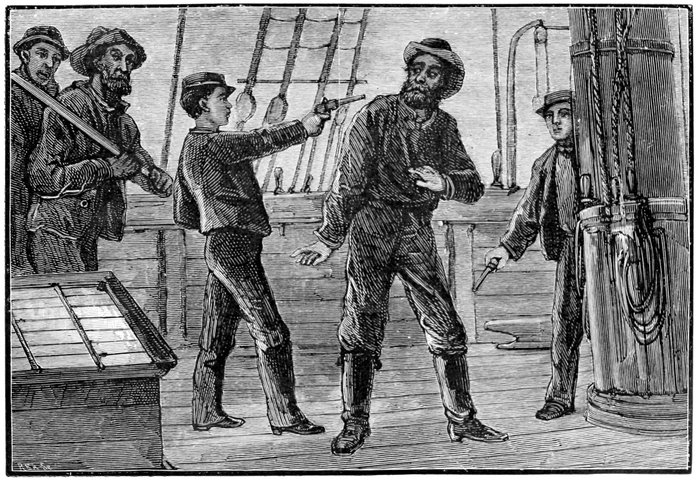
“Yes; and if four of our new friends ought not
to be back there at this minute, I am very much
mistaken.”
“Are they convicts?” asked Frank, drawing a
long breath.
“I don’t know. Wait till you see them, and then
tell me what you think about it. This trouble is
going to interfere with our arrangements a trifle.
This being our second break-up, we have but
few spars and little spare canvas left, so we can
only refit here temporarily—in other words, put
up such rigging as will last until we can reach
some port where we can go into the docks and
have a regular overhauling. If we are going to
Natal we must cross the Indian Ocean, and I don’t
want to venture near the Mauritius with a leaky
77vessel. It blows too hard there sometimes. We
have been driven a long way out of our course,
and if my calculations are correct, our nearest port
is Hobart Town. We’ll go there, and while the
vessel is being refitted we’ll take a run back into
the country and see how the sheep and cattle
herders live. We shall be obliged to stay there a
month or two, and perhaps by the time we are
ready to sail again you boys will decide that you
don’t want to go to Japan. If you do, it will suit
me. By the way, I wish you would step into the
forecastle every half hour or so and see if those
men want anything. Good-night.”
Uncle Dick went down into his cabin, and
Frank walked off where Archie stood leaning on
his musket and watching the island, whose dim
outlines could just be seen through the darkness.
“Do you hear or see anything?” he asked.
“Nothing at all,” answered Archie. “It is dull
business, this standing guard when there’s nothing
going on.”
“Well, I’ll relieve you.”
78“Oh, no; you stay here and talk to me, and I
will hold the musket. What was it Uncle Dick
said about going back to Japan?”
Frank repeated the conversation he had had
with the captain, adding:
“You know his heart is set on going to Natal,
and I believe that was one reason why he undertook
this voyage. He has often told me that he
would go a long distance just to see a wild elephant
once more. If we waste much more time on our
journey we can’t stay a great while in Africa.
Uncle Dick’s wishes ought to be respected.”
“Of course they must be,” said Archie, quickly.
“Well, I’d as soon go to Australia as to Japan.
Perhaps we’ll have a chance to knock over a
kangaroo, and that’s an animal I’ve never seen
yet.”
“I am not sure that they are to be found in Van
Diemen’s Land,” said Frank.
“Van Diemen’s Land!” echoed Archie. “That’s
a convict settlement.”
Frank nodded his head.
79“Well, I am just as near the fine fellows who
live there as I want to be,” said his cousin.
“Perhaps you are nearer to some of them at this
minute than you imagine. What would you say
if you should see four of them come on deck to-morrow
morning?”
Archie raised his musket to his shoulder, and
looked at his cousin. “Did Uncle Dick say that
there are four of them among these strangers?”
“No, he didn’t say so, but I know he thinks so.”
“Whew!” whistled Archie; “here’s fun. I
wonder if they wouldn’t be kind enough to get up
some excitement for us if we should ask them?”
“Haven’t you had enough during the last few
days? I have.”
“There’s too much of a sameness about these
gales and cyclones. We want a change—something
new.”
Archie afterward had occasion to recall this remark.
Before many weeks had passed over his
head he found that the men of whom he was speaking
were quite willing to give him all the excitement
80he wanted, and that, too, without waiting to be
asked to do so.
“But, after all, what can they do?” asked
Archie, after thinking a moment. “They are only
four in number, and Dick Lewis and Rodgers can
take care of them.”
With this reflection to comfort him, Archie once
more turned his attention to the island, and Frank
went forward to see how the anchor watch were getting
on, and to tell them and the rest of the unwelcome
discovery Uncle Dick had made. Of
course the boys were all interested and excited, and
wished that morning would come so that they
might see what sort of looking fellows the convicts
were. Frank also told them of the change Uncle
Dick proposed to make in their route ahead, and
they were all satisfied with it.
Nothing happened that night that is worthy of
record. The wearied sailors slumbered in safety,
while Frank and his companions looked out for the
vessel, and walked the deck, and told stories to
keep themselves awake. The Stranger dragged
81twice before morning, but each time a little more
chain was let out, and finally enough weight was
added to her anchor to make her ride securely.
Frank visited the forecastle every half hour to hand
a glass of water to one of the rescued men, or
moisten the bandages of another, and during these
visits he picked out four of the patients whom he
thought to be the escaped convicts. One of them
was the nearest approach to a giant he had ever
seen. Even Dick Lewis would have looked small
beside him. He reminded Frank of Boson, the
third mate of the Tycoon, only he was a great
deal larger and stronger. The man was sleeping
soundly, and Frank leaned against his bunk and
took a good look at him.
“If these four fellows should attempt any mischief,
I don’t know whether Dick and Rodgers could
take care of them or not,” thought he. “I’m afraid
they’d have their hands full with this one man.”
Frank went on deck feeling as he had never felt
before. He was not sorry that the man had been
saved from the breakers, but somehow he could not
82help wishing that he had been picked up by some
vessel besides the Stranger. If there was any faith
to be put in appearances, the man was but little
better than a brute, and Frank told himself that
the sooner they reached some port and put him
ashore, the sooner he would feel at his ease again.
Uncle Dick came on deck at 5 o’clock, and the
boys all went below to take a short nap; but their
short nap turned out to be a long one, for having
had no sleep worth mentioning for four nights in
succession, they were lost in a dreamless slumber
almost as soon as they touched their bunks, and it
was twelve o’clock before they awoke. Then they
were aroused by the roar of the twenty-four pounder
over their heads. They started up in great alarm,
and pulling on their clothes with all possible haste,
rushed to the deck expecting to find the natives
approaching to attack the vessel, and perhaps clambering
over the side. But they were most agreeably
disappointed. About half of the crew of the
Stranger, aided by some of the rescued men, were
busy setting things to rights, and a short distance
83from the schooner was the cutter, which was pulling
toward the beach.
“Did I frighten you?” asked Uncle Dick, as the
boys crowded up the ladder. “Your faces say I
did. That boat out there is going ashore after
some timber for spars, and that shrapnel was a
notice to the natives to keep out of the way.”
“Oh!” said the boys, who were all greatly relieved.
They took another look at the boat, ran their
eyes along the beach to make sure that there were
no natives in sight, and then turned their attention
to the rescued men, who were working with the
crew. There were five of them—Uncle Dick said
the others were not yet able to leave their bunks—and
conspicuous among them was the giant whom
Frank had picked out as one of the escaped convicts.
All the boys opened their eyes as they
looked at him. Even Frank was astonished. Now
that he could see the whole of him he looked
larger than he did while he was lying in his bunk.
“What do you think of him, Mr. Baldwin?”
84asked Eugene, after trying in vain to induce his
uncle to express an opinion.
“I think there is only one place in the world
that he’s fit for,” was the reply.
“What place is that?”
“The place he came from.”
Some other conversation followed, and when the
boys went below they told one another that Mr.
Baldwin fully expected that Waters—that was the
name the giant had given—would occasion trouble
sooner or later. “And if he once gets started it
will take all the men in the vessel to subdue him,”
said Eugene, somewhat anxiously.
“Will it?” exclaimed Archie. “I can show
you one who will manage him alone.”
“Who is he?”
“Dick Lewis.”
“Now let me tell you what’s a fact,” said Perk.
“Dick can’t stand up against an avalanche.”
“You’ll see,” said Archie, who had unbounded
confidence in his backwoods friend. “You’ll see.”
And sure enough they did.
CHAPTER V. THE TWO CHAMPIONS.
85
For a week nothing occurred to relieve the dull
monotony of their life. The crew worked
early and late, and under the skilful hands of the
carpenter and his assistants the masts, spars, and
booms that were to take the place of those that
had been lost during the gale, began to assume
shape, and were finally ready for setting up. The
timber of which the most of them were made was
brought from the shore, and Frank kept such close
watch over the boats, and the crews and workmen
who went off in them, that the natives never
molested them. If the Malays had kept out of
sight on the first day of their arrival, the boys
might have believed the island to be uninhabited,
for they saw no signs of life there now.
On board the schooner everything was done
86decently and in order, as it always was. The rescued
men were all on their feet now, and able to
do duty. All but four of them—those suspected
of being escaped convicts—were able seamen, and
these lent willing and effective aid in the work of
refitting the vessel. They were all Englishmen,
but for some reason or other they were not as arrogant
and overbearing as the majority of their countrymen
seem to be, and the best of feeling prevailed
between them and the Stranger’s crew.
For a few days Waters conducted himself with
the utmost propriety. He seemed to be awed by
his recent narrow escape from death, and so entirely
wrapped up in his meditations that he could hardly
be induced to speak to anybody. But the impressions
he had received gradually wore off as his
bruises and scratches began to heal and his strength
to come back to him, and he assumed an impudent
swagger as he went about his work, that made the
second mate look at him pretty sharply. He recovered
the use of his tongue too, and began to
talk in a way that did not suit the old boatswain’s
87mate, who one day sternly commanded him to
work more and jaw less. This reprimand kept
Waters in shape for a day or two, and then he appeared
to gain confidence again, and got himself
into a difficulty that was rather more serious.
Swaggering aft one morning after breakfast with a
borrowed pipe in his mouth, he suddenly found
himself confronted by the officer of the deck, who
stepped before him.
“You have no business back here,” said Mr.
Parker. “Go for’ard where you belong.”
Waters took his pipe out of his mouth, and
drawing himself up to his full height, scowled
down at the officer, “Look ’ere,” said he, with
his English twang; “hif you knowed me, you’d
know hit’s jist a trifle dangerous for heny man of
your hinches to stand afore me.”
“I am second mate of this vessel,” answered
Mr. Parker, hotly, “and any more such language
as that will get you in the brig. Go for’ard where
you belong.”
Like a surly hound that had been beaten by his
88master, Waters turned about and went back to
the forecastle. He was sullen all that day, and
“soldiered”—that is, shirked his work—so persistently
that the old boatswain’s mate was almost
beside himself.
“I don’t like the cut of that fellow’s jib, cap’n,”
said Barton, as he ranged up alongside of Frank
that night after the boats had been hoisted at the
davits, and the boarding nettings triced up. “He’s
spoiling for a row. He says if Lucas calls him a
lubber again he’s going to knock him down. He’s
no good. Do you know what he was going aft for
this morning? Well, I do. He was going to take
a look at the old man’s strong box. You know it
stands in the cabin right where you can see it
through the skylights.”
“Why did he want to take a look at the strong
box?” asked Frank. “Has he any designs upon
it?”
“If he hasn’t, what makes him ask so many
questions, sir?” asked the coxswain, in reply.
“He’s pumped the crew, easy like, till he’s found
89out everything. He wanted to know how much
we got a month, and when one of the men told
him that we could each have a handful of bright
new yellow-boys to spend in our next port if we
wanted it, but that the old man had advised us,
friendly like, to leave all our earnings in his hands
and he would pay us interest on it at the end of
the cruise, same as the bank—when he found this
out he wanted to know where the old man kept
his money and how much he had. Now what did
he want to know that for, sir?”
“What, indeed!” thought Frank, as Barton hurried
away in obedience to some orders. “He will
bear watching, I think. I wish he was safe ashore.”
Frank lost no time in making Uncle Dick acquainted
with what he had heard. The old sailor
looked grave while he listened, and although he
said nothing in Frank’s hearing, he told Mr. Baldwin
privately to keep Waters so busily employed
that he would have no time to think of mischief,
and at the very first sign of insubordination to
promptly put him where he would be powerless to
90work harm to the vessel or any of her crew. Waters
made the sign the very next morning. At five
o’clock he was ordered to assist in pumping out the
schooner, and he obeyed with altogether too much
deliberation to suit Lucas, who was accustomed to
see men hurry when they were spoken to. This
was the way Waters always obeyed an order. He
seemed to think he could do as he pleased, and no
one would dare take him to task for it. But when
the old boatswain’s mate was on duty he was on
duty all over, and any of his men who neglected
their work were sure to be called to account. He
had been very patient with Waters because he was
a landsman, but he could not stand “soldiering.”
“I wish this was a man-o’-war now, and that
flogging had not been abolished,” said Lucas, as
Waters came slowly up to the pump, staring impudently
at the mate as if to ask him what he was
going to do about it. “It would do me good to
start you with a cat-o’-nine tails.”
“Do you think the likes o’ you could use a cat
on me now?” sneered Waters.
91“I’ve used it on many a better man,” was the
quick reply. “Make haste, you lubber. I’ll stand
this no longer. I’ll report”—
What it was that the old mate was going to report
he did not have time to tell, for Waters suddenly
drew one of his huge fists back to his shoulder,
and when he straightened it out again Lucas went
spinning across the deck, rolling over and over, and
finally bringing up against the bulwarks. Every
one who saw it—and every one who belonged to
the schooner was on deck, except her captain—was
amazed at the ease with which it was done.
Of course the excitement ran high at once. During
the two years and more that had passed since
the schooner left Bellville, a blow had never been
struck on her deck, and never had an oath been
heard there until these rescued men were brought
aboard. The whole crew arose as one man, not to
punish the offender for striking the petty officer,
but to secure him before he could do any more mischief.
But Waters was fairly aroused, and acted
more like a mad brute than a human being. He
92backed up against the bulwarks, and in less time
than it takes to tell it, prostrated the entire front
rank of his assailants, including Barton, Rodgers,
the Doctor, as the negro cook was called, and the
old gray-headed sailor who had so badly frightened
Dick Lewis by telling him that one of the Sandwich
Islands was the equator, and that when they
passed it they would be on the under side of the
earth.
Having cleared a space in front of him, Waters
sprang to the windlass, and seizing a handspike, was
back against the bulwarks again before any one
could prevent him. “Stand by me, mates,” he
roared, “and we’ll take the ship. Back me hup,
and we’ll drive these Yankees hover among the
sharks.”
“I declare!” gasped Eugene, who was the first
of the frightened boys who could find his tongue,
“he’s started at last, and he’ll walk across the deck
with that handspike as though there was no one
here. The best men in the crew are like so many
straws in his way.”
93All these incidents which we have been so long
in describing, occupied but a very few seconds in
taking place. Before the astonished officer of the
deck could recover himself sufficiently to command
the peace, Waters had complete possession of the
forecastle. And even when the officer did recover
himself the orders he issued might as well have
been addressed to the mast, for Waters paid no attention
to them.
“Drop that handspike,” shouted Mr. Baldwin,
starting forward.
“Yes, I’ll drop it no doubt,” replied Waters.
“You remember what you said to me yesterday,
don’t you, you fellow with the gold band around
your cap? Look hout for yourself, for I’m coming
for you now.”
Waters was as good as his word. Swinging his
handspike viciously about his head to clear a path
before him, he started aft; but before he had made
many steps he ran against something, just as Archie
had predicted. Dick Lewis and old Bob Kelly
had stood silent and amazed spectators of the scene,
94and Archie, who had expected so much of his backwoods
friend in case of disturbance, forgot that he
was present. But now the trapper called attention
to himself by giving one or two fierce Indian yells,
like those that had so often rung in his ears while
he was battling with or fleeing from his sworn
enemies.
“Whoop! Whoop!” yelled Dick.
The boys looked towards him and saw that he
had prepared himself for action by discarding his
hat and pushing back his sleeves. Then he crouched
like a panther about to make a spring, and in a
second more was flying across the deck like an
arrow from a bow. Waters saw him coming, and
halting, drew back his handspike in readiness to
receive him. As the trapper approached within
striking distance, the weapon descended with such
speed and power that the boys all uttered an exclamation
of horror, and Frank involuntarily started
forward as if to shield his friend from the blow
that seemed about to annihilate him. But Dick
was in no need of help. Long experience had
95taught him how to take care of himself in any
emergency. A flash of lightning is scarcely quicker
than was the movement he made to avoid the
descending weapon. It passed harmlessly through
the air over his head, and the force with which
it was driven sent Waters sideways into the arms
of the trapper, while the handspike flew from his
grasp and went over the side.
“Stand by me, mates!” roared the giant, as he
felt the trapper’s strong arms closing about him
with crushing power.
This was all he had time to say—he was not
allowed an instant in which to do anything—for
before the words had fairly left his lips he was
thrown to the deck with stunning force, and held
as firmly as if he had been in a vice. Just then
Uncle Dick appeared on the scene. “Master-at-arms!”
he exclaimed.
“Here, sir,” replied the petty officer, stepping
forward. He knew that his services would be
required and he was all ready to act. He had a
pair of irons in his hand—something the boys
96did not suppose could be found in the schooner’s
outfit.
“Put them on,” said Uncle Dick. “Now,
Lewis,” he added, after the ruffian’s hands
and ankles had been securely confined, “let him
up.”
“Can’t I give him just one leetle whack for
every man he’s knocked down, cap’n?” asked the
trapper, flourishing one of his clenched hands in
the air.
“Let him up,” repeated Uncle Dick.
The backwoodsman obeyed the order very reluctantly.
He arose to his feet, pulling his antagonist
up with him.
“Waters, is this the way you repay us for saving
your worthless life?” demanded Uncle Dick, sternly.
“Some of the men you struck were the very ones
who kept you from falling into the hands of the
savages on shore.”
“I’ll pay you for it hall afore I am done with
you,” gasped the prisoner, panting from the violence
of his exertions. “Hand you, my friend in
buckskin, I’ll see you some other day when this
thing—”
Waters Finds his Master.
97“Silence!” commanded Uncle Dick.
“There’s honly one way to stop my talking
and that is to stop my breath,” declared Waters,
boldly.
“You will go without food for twenty-four
hours for every word you utter,” replied Uncle
Dick. “Master-at-arms, take him down and put
him in the brig. Mr. Baldwin,” he continued, in
a lower tone, “have a sentry put over him with
orders to allow him to hold communication with
no one.”
The fear of being starved into submission effectually
closed the prisoner’s mouth, and without
another word he allowed the master-at-arms to
lead him below. The boys breathed easier when
they saw his head disappear below the combings
of the hatchway.
“How did this trouble begin, Mr. Baldwin?”
demanded Uncle Dick.
98The officer told him in a few words and the
captain said, with a smile,
“That is a good deal of work to be done in
so short a space of time. I came on deck as soon
as I could get up from the table. When we reach
Hobart Town I’ll teach this fellow that he can’t
strike my men with impunity. You say he called
for help from his friends. Did they seem inclined
to give it?”
“Yes, sir, one of them did. He picked up a
handspike, but lacked the courage to use it. The
other two stood still and looked on.”
“Send them to the mast, Mr. Baldwin. They
all belong to the same class, and it may be well to
have a fair understanding with them.”
Mr. Baldwin passed the order to the old boatswain’s
mate, who was going about his work with
an eye bunged up, and presently Waters’s three
friends came to the mast and respectfully removed
their caps. There was no swagger or bluster about
them. The defeat of their champion had cowed
them completely. Uncle Dick first explained why
99he had brought them there, and then for five minutes
talked to them in a way the boys had never
heard him talk before. Even Walter and Eugene
were surprised to know that their jolly uncle could
be so stern and severe. He used words that the
men before him could readily understand. He
bluntly told them that they were escaped convicts
(the start they gave when they heard this showed
that he had hit the nail fairly on the head), and that
he was just the man to deal with such characters as
they were. He would rid his vessel of their unwelcome
presence as soon as he could, and give her
a good scrubbing from stem to stern after they
went. He did not want them there, but while
they stayed they must walk a chalk-mark; and if
he heard so much as a mutinous eye-wink from
any of them, he would show them that the discipline
that was maintained on board the Stranger
could be made as severe as that to which they
had been subjected by their prison taskmasters.
That was all, and they might go forward and bear
everything he had said to them constantly in mind.
100The suspected men, glad to be let off so easily,
returned to their work, and we may anticipate
events a little by saying that they took the old
sailor at his word, and never made the schooner’s
company the least trouble—that is, they made them
no trouble before they reached Hobart Town, whither
the Stranger went to refit. What they did
afterward is another matter; we have not come to
that yet. We may also say that the trapper won a
high place in the estimation of all the foremast
hands by the exploit he performed that morning.
He had peace after that. None of the sailors ever
told him any more stories about the Flying Dutchman,
the squids, and the whale that swallowed Jonah.
It was not because they were afraid of him—no
one who behaved himself could look into the
trapper’s wild gray eye and feel the least fear of
him—but because they wanted to reward him for
what he had done. When the crew assembled
around the mess-chest at meals Dick was always
the first one waited upon by the mess-cook, and if
any of the blue jackets found a tit-bit in the pan,
101it was always transferred to Dick’s plate. Old Bob
also came in for a large share of their attention, and
it was not long before these little acts of kindness
so worked upon the feelings of the two trappers,
that they declared that if the schooner wouldn’t
pitch about so with the waves, and they could have
a chance to use their rifles now and then, they would
as soon be there among the sailors as in the mountains.
Of course the exciting scene of which they had
been the unwilling witnesses produced a commotion
among the boys, who for a long time could
talk about nothing else. If they ever forgot it,
one glance at the battered face which the old boatswain’s
mate carried about with him would instantly
recall it, and set their tongues in motion again.
The ease with which the supple trapper had vanquished
his huge antagonist, was the occasion of
unbounded astonishment to all of them except
Frank and Archie. The latter always wound up
the conversation by saying:
“Didn’t I tell you that Waters would run against
102a stump if he attempted any foolishness? You
have heard the expression ’as quick as lightning,’
and now you know what it means. Hold on till
we get ashore,” he added, one day, “and I’ll show
you some more of it.”
“What are you going to do?” asked Fred.
“I’ll borrow or hire a horse somewhere, and run
a race with Dick.”
“Ha!” exclaimed Eugene, “I know from what
you have said that the trapper must be very fleet,
but he can’t beat a good horse if I ride him.”
“He can run a hundred yards, and turn and run
back to the starting-point, and beat the swiftest
horse that ever moved,” replied Archie, emphatically,
“and you may ride the horse.”
The boys looked toward Frank, who confirmed
Archie’s statement by saying that he had seen him
win a race of that description, but still they were
not satisfied. It was a novel idea to them, this
matching a man’s lightness of foot against the speed
of a horse, and they longed for an opportunity to
see the swift trapper put to the test.
103Meanwhile the work of refitting the vessel went
steadily on. Having a large force at his command,
the work was accomplished in much less time than
the captain expected it could be done. The question
whether their proposed visit to Japan and
India should be given up was discussed, and decided
in the affirmative. Uncle Dick gave the
boys their choice of two courses of action: they
could carry out their original plan, spend a few
weeks in Asia, and after they had seen all they
wanted to see they would start directly for home
by the way of the Cape of Good Hope, stopping
during the voyage only when it was necessary to
take in fresh supplies of food and water; or they
would go to Natal, purchase there a trader’s outfit,
and spend a few months travelling about in the interior
of Africa, skirmishing with the strange animals
they would find there. In either case they
must first go to the nearest port, and have the
schooner completely overhauled and refitted. She
had been badly strained by the gale, and her captain
did not consider her safe. The boys decided
104on the latter course simply because they knew Uncle
Dick wished it.
This was the first time during the voyage that
anything had been said about going “home,” and
the simple sound of the word was enough to set
them to thinking. Up to this time they had been
going away from their native land; but now every
mile which the schooner passed over brought them
nearer to the loved ones they had left behind.
CHAPTER VI. THE CONSUL’S “CLARK.”
105
Finally, to the Club’s great relief, the work
was all done. The masts had been stepped,
the sails bent on, the last ratline knotted, and
Uncle Dick only waited for a high tide to carry
the schooner over the coral reef that marked the
entrance to the bay. When the proper moment arrived
the crew gladly responded to the order of the
old boatswain’s mate, “All hands stand by to get
ship under way!” and to the enlivening strains of
“The girl I left behind me,” which Eugene played
on his flute, walked the little vessel up to her
anchor. Then the sails were trimmed to catch the
breeze, the star-spangled banner was run up to the
peak, and the lonely island echoed to the unwonted
sound of a national salute. The first two guns
were shotted and were pointed toward the island,
106as a parting token of the estimation in which its
inhabitants were held by the schooner’s company,
and the other eleven were fired with blank cartridges.
The boys could not help shuddering as they
passed over the reef. Its course could be traced
for a mile or more on each side of them. The
opening through which they sailed was the only
clear space they could see in the whole length of it,
and that was barely wide enough to admit of the
passage of their little vessel. The Sea Gull could
never have got through it; and how they had ever
passed it in their waterlogged craft, driven by a
furious gale, was something they could not explain.
The waves foamed and roared around
them, and being thrown back by the rocks, followed
in the wake of the schooner as if enraged at being
cheated of their prey. The boys trembled while
they looked, and all breathed easier when the man
in the fore-chains who was heaving the lead, called
out “No bottom!” The reef was passed in safety
and they were fairly afoot once more; but their
107vessel was crippled and leaky, and there was not
one among the five hundred people who saw her
sail so gaily out of the harbor of Bellville who
would have recognized her now. She had no topmasts,
yards, or flying jibboom, and could only
spread four sails where she had once spread nine,
and, when the wind was light, ten, not counting
the studding-sails. All Uncle Dick asked of her
was to take them in safety to Hobart Town, where
she could be put in trim for her long voyage across
the Indian Ocean.
The Club were three weeks in reaching their destination,
and during that time everything passed
off smoothly. The weather was favorable, and
that was something on which Uncle Dick congratulated
himself. Had the schooner encountered
another cyclone, or even a gale, we should probably
have had something unpleasant to record, for she
was in no condition to stand another conflict with
the elements. No one on board, except the Club
and the officers, knew where she was bound, for
Uncle Dick thought it best that this matter should
108be kept secret. If the suspected men were convicts,
as he had every reason to believe they were,
they might object to going back to their taskmasters,
and that was just where Uncle Dick was resolved
they should go, especially Waters, who had
shown that he was not a proper person to be intrusted
with his liberty. The latter was still confined
in the brig, but he was allowed to come out
twice each day, and take his exercise on deck under
the watchful eye of the master-at-arms; and he it
was who first told the crew where the schooner was
bound. He found it out one morning when he
was brought out of the brig to take a breath of
fresh air. Land was then in plain sight; and
after Waters had run his eye along the shore, he
started and muttered something under his breath
that sounded like an oath.
“Hit’s Tasmania, mates,” he exclaimed. “And
there,” he added, pointing with his manacled
hands towards the church spire that could be dimly
seen in the distance, “is ’Obart Town. We’re
back ’ere after hall our trouble.”
109The words reached the ears of his three companions
for whom they were intended, and their
action did not escape the notice of the officer of the
deck, who had his eyes on them all the time.
Leaving their work at once, they gazed eagerly in
the direction of the city, then turned and looked
along the shore as if searching for some familiar
object, and the expression that settled on their faces
was all the proof Mr. Parker needed to confirm his
suspicions.
“Master-at-arms,” said he, “take your prisoner
below and lock him up. You three men,” he
added, pointing to Waters’s companions, “go into
the forecastle until you are told to come on deck
again. If you stay there peaceably, well and good.
Rodgers, go down and keep an eye on them.
Barton, take a musket and stand at the head of the
ladder, and see that they don’t come up without
orders.”
Mr. Parker was simply obeying the instructions
of his commander, which were to the effect that
the suspected men were to be watched night and
110day, and ordered below under arrest the instant the
officer of the deck, whoever he was, became satisfied
that they really were escaped convicts. Mr.
Parker was satisfied now, and so the ruffians were
put where they would have no opportunity to
escape.
The schooner rapidly approached the town, and
at one o’clock dropped anchor at the stern of a
large English steamer, which she followed into the
harbor. The gig was called away at once, and
Uncle Dick got in and was pulled ashore. An
hour elapsed, and at the end of that time a large
yawl, which was slowly propelled by two men, was
seen approaching the schooner. It came alongside,
and a fashionably dressed, kid-gloved young
gentleman about Frank’s age, seized the man-ropes
that were handed to him and was assisted to the
deck.
“Aw! thanks,” said he, as he brushed a speck of
dust from his coat-sleeve. “Where’s the captain?”
“The captain is ashore, sir,” answered Mr. Baldwin.
“I command in his absence.”
111“Aw! there’s my card,” continued the visitor,
producing the article in question and handing it to
the first mate.
“I am glad to meet you, Mr. Fowler,” replied
the officer, glancing at the name on the card. “Can
I be of any service to you?”
“I ham consul’s clark, and I’ve come ’ere to see
about those seamen you rescued from the wreck of
the Hinglish ship Sea Gull. Muster them on deck,
and I’ll take them hoff at once.”
“Produce a written order from Captain Gaylord
to that effect, and I shall be glad to do so,” said Mr.
Baldwin, who it was plain did not like the commanding
tone assumed by the young Englishman.
“I suppose you have one?”
“Naw, I ’ave not. I ’ave an horder from ’er
Majesty’s consul, whose clark I ham.”
“I am not obliged to obey her Majesty’s consul,”
replied Mr. Baldwin. “I am an American, and
responsible to no one but my commander. Our
own consul could not take these men away in Captain
112Gaylord’s absence, without first showing me a
written order from him.”
“Then you refuse to give them hup?”
“Without an order? Yes, sir.”
The young Englishman fairly gasped while he
listened to these words, which, had they been spoken
by one of his own countrymen, he would no doubt
have regarded as highly treasonable. When he
found his tongue again he said he would see ’ow
this thing stood, and whether or not ’er Majesty’s
hofficers could be thus set at defiance; and as he
spoke he threw one leg over the side as if he were
about to climb down into his boat. Then he suddenly
paused and gazed earnestly towards the nearest
wharf—or we ought rather to say “quay,” for
that is what they are called in that part of the
world. He saw a boat approaching, and he made
that an excuse to come back; but the boys, who had
been interested and amused listeners to the conversation,
shrewdly suspected that the real reason why
he came back was because he knew that Mr. Baldwin
was in the right. Like many persons who are
113clothed with a little brief authority, he felt himself
to be very important, and wanted to make everybody
with whom he came in contact bow to him.
“Aw!” said he, addressing himself to Frank,
who had stepped to the side to hand him one of the
man-ropes, “there’s the police commissioner’s boat
coming, and I think I’ll stop and ’ave a look at
those four convicts I ’ear you’ve got on board. Hif
they’re the ones I think they hare hit’s a wonder
they didn’t take your vessel from you. But it
cawn’t be they—it cawn’t be.”
“I don’t know whom you have in your mind, of
course,” replied Frank, who was highly amused by
the patronizing manner in which the young Englishman
addressed him. “One of them showed a
disposition to smash things, but he is now in irons,
while the others are in the forecastle under guard.
The quarrelsome one gave the name of Waters.”
“Waters? Aw! it is he. It is weally wonderful
how you managed to secure him, for he is a
wetired membaw of the Hinglish prize wing. Hit
must ’ave taken ’alf your crew to do it.”
114“On the contrary,” said Frank, “he was very
quickly and easily vanquished by that man you see
standing there.”
“Aw! you surprise me. I must weally ’ave a
look at the gentleman,” said the consul’s clerk.
“He must be simply prodigious. Hisn’t he an
Hinglish gentleman?”
“No, sir,” said Frank, hardly able to control
himself. “He’s an American, every inch of him,
and probably the first representative of his class
that you ever saw.”
The consul’s clerk fumbled in his pocket for a
few minutes, and presently drew out a gold eyeglass.
He had some trouble in fixing it under his
right eyebrow, and when he got it placed to his
satisfaction he looked in the direction Frank pointed,
and met the steady gaze of Dick Lewis’s honest
gray eyes. The stalwart backwoodsman, in company
with his friend, Bob Kelly, was leaning against
the rail, and, although the two men probably did
not dream of such a thing, they presented a picture
115that an artist would have been glad to reproduce
on canvas.
“Aw!” exclaimed the young Englishman; “what
very extraordinary-looking persons. If I might be
allowed the expression, I should say that they had
just come hout of the woods.”
“You have hit the nail squarely on the head,”
said Frank. “They are professional trappers and
Indian fighters.”
The clerk started, and let his eyeglass fall in his
excitement. He was so surprised that he forgot to
put in his usual drawl, and substitute w for r when
he spoke again.
“Trappers!” he exclaimed, “Indian fighters! I
have often read of such things, and no doubt you
will think me simple when I say that I never believed
in their existence.”
“Why don’t you always talk as naturally as
that?” thought Frank.
“You’re sure you’re not chaffing me now?” continued
the clerk.
“Quite sure. I don’t do such things. I have
116known these men a long time, and have spent
months on the prairie and in the mountains in their
company. I know of two Indian fights in which
they have been engaged since I became acquainted
with them.”
“I wonder!” exclaimed the clerk, whose astonishment
and interest were so great that he could
not remove his eyes from the two trappers. “Pray
tell me about those fights.”
Frank thought of the historian, who, being invited
to a dinner party, was requested by a lady to
relate the history of the world during the five minutes
that the host would probably be occupied in
carving the turkey, and laughed to himself at the
idea of taking less than half an hour to describe all
the thrilling incidents that had happened during
the battle at Fort Stockton, as recounted to him by
his friend, Adam Brent, who was present on that
memorable occasion. “It is rather a long story,”
said he.
“Well, then, perhaps at some future time you
117will oblige me,” replied the clerk. “Were you
ever in a battle?”
“Yes, several of them.”
“With the Indians?”
“No. They once attacked a wagon-train to
which I belonged, and tried to run off our cattle
and horses, but we didn’t call that a battle.”
“Were you ever a prisoner among them?”
Frank replied in the affirmative.
“Were you ever tied to the stake?”
“No, but I’ve seen the man who mastered Waters
in that situation, and I saw a tomahawk and
a knife thrown within an inch of his head.”
The young Englishman’s surprise increased every
moment, and Frank thought by the way he looked
at him that he was not quite prepared to believe all
he heard. But Frank did not care for that. He
was not trying to make himself important; he was
only answering the clerk’s questions.
“Are you an officer of this vessel?” asked the
latter, glancing at Frank’s suit of navy blue.
118“I act as sailing master,” was the modest reply.
“What trade are you in?”
“No trade at all. This is a private yacht, and
we have got thus far on our voyage around the
world. Two of those young gentlemen you see
there,” he added, directing the clerk’s attention
toward the Club, who had withdrawn to the quarter-deck,
“are nephews of the owner and captain.”
“I am delighted to hear it,” exclaimed the clerk,
and it was evident that the schooner and her company
arose in his estimation at once. At any rate,
he dropped his patronizing air, and began to act
and talk as if he considered Frank his equal. He
no doubt thought that those who were able to travel
around the world in their own vessel were deserving
of respect, even though they were Americans. “I
wish I had time to make their acquaintance,” he
continued, “but here comes the commissioner’s
boat, and I see your captain is just putting out from
the quay. I hope to meet you again.”
Frank simply bowed. He could not say that he
hoped so too, for he did not. He could see nothing
119to admire in a young man who seemed to think
that only those who were wealthy were deserving
of respect. Frank would have been still more disinclined
to meet him again had he known the circumstances
under which one of their meetings was
to take place. This was by no means the end of
his acquaintance with Mr. Fowler. It was only
the beginning of it.
Frank now stepped to the side in readiness to
hand the man-ropes to the occupants of the commissioner’s
boat, which just then came up. There
were four of them, and he was rather surprised at
their appearance. Each wore a short blue blouse,
confined at the waist by a black belt, a very juvenile-looking
cap, and a broad, white shirt collar,
which was turned down over their coats, making
them look like so many overgrown boys. But the
batons they carried in their hands, and the shields
they wore on their breasts, proclaimed them to be
policemen. And very careful members of the community
they were, too; for without them the law-abiding
inhabitants of the city would have had
120anything but a pleasant time of it, surrounded as
they were by thousands of the worst characters that
Great Britain could produce. They climbed to the
deck one after the other, and the foremost informed
Mr. Baldwin, who came forward to meet them, that
they had been sent to look at the suspected men,
and to take charge of them if they proved to be
convicts. The mate accordingly gave the necessary
orders to the master-at-arms, and presently the four
prisoners came up under guard.
“Aw!” exclaimed the clerk, who had by this
time recovered from the surprise into which he had
been thrown by his conversation with Frank, “that
one in irons is Waters, sure enough.”
“And he seems to know you, too,” said Frank,
as the prisoner, after running his eye over the vessel,
nodded to the clerk, who smiled and bowed in
return.
“Aw! yes; that is, I have often seen him working
in the chain-gang ashore; but I want you to
understand that I have nothing in common with
him, nothing whatever.”
121“I didn’t suppose you had,” answered Frank,
astonished at the clerk’s earnest tone and manner.
“What will your police do with him?”
“They’ll put him back in the gang again, but
Lawd! what’s the use! He’ll soon escape; he
always does. He’s been off the island no less than
four times. Once he was half way to Hingland
before it was found hout who he was.”
“Why don’t the police watch him closer?”
The clerk shrugged his shoulders as much as to
say that he didn’t know, or didn’t care to trouble
himself about the matter, and turned to meet the
captain, who just then sprang on board. Arrangements
were quickly made for removing the strangers,
as everybody called the men who had been rescued
from the wreck of the Sea Gull. The sailors were
given into charge of the clerk, who ordered them
into his boat and pushed off, after telling Frank
that he would hear from him again very soon, and
the convicts were turned over to the officers, who
handcuffed them all, and took them ashore. The
boys were glad to see them go, and Uncle Dick
122privately informed them that he considered himself
fortunate in getting rid of Waters and his companions
so easily. They were a desperate lot, if
there was any faith to be put in the stories of their
exploits which he had heard while he was ashore.
“That clerk told me that Waters belongs in the
chain-gang,” said Frank. “How did he manage
to escape?”
“Ask the police, and if you give them enough,
perhaps they will tell you,” returned Uncle Dick.
“The police!” repeated Frank.
“Yes. A five-pound note will accomplish wonders
sometimes. I know that less than that once
bought off the policeman—or ‘man-hunter’ as we
used to call him—who arrested me.”
“Why, Uncle Dick!” exclaimed Walter.
The old sailor laughed long and loudly. “It is
a fact,” said he. “I was at work one morning at
the mouth of my shaft in the Bendigo mines, and
this man-hunter stepped up and asked me if I had
a license. I told him I had, but it was in the pocket
of my vest, and that was at the bottom of the mine.
123Do you suppose he would let me go down after it?
No, sir. He arrested me at once, and was marching
me off, when I offered him an ounce of gold,
worth about seventeen dollars and a half, if he would
go back and let me show him my license. He
took the gold, but didn’t go back with me, and
neither did he trouble me afterward. If he had
taken me before the commissioner I should have
been lucky if I had got off with a fine of five pounds.
Stand by, Mr. Baldwin. Here comes the tug, and
we are going into the docks now. After that, boys,
we’ll take a run out into the country. I have an
acquaintance a few miles away, who is getting rich,
raising sheep. The last time I saw him he was
glad to break stones on the road in Melbourne for
a pound a day. That would be considered a good
deal of money now, but it didn’t go far during the
time of the gold excitement. Everything was so
dear that the man who earned less than that stood
a good chance of starving.”
We pass over the events of the next few days, as
they have nothing to do with our story. The
124schooner having been hauled into the docks, the
Club set out in company with the trappers to explore
the town, and during the day chanced to fall
in with the consul’s clerk, who, with two other
young Englishmen of the same stamp as himself,
was on his way to visit the schooner. He presented
his card, and introduced Frank to his companions,
and he and they were in turn introduced to the
Club and to the trappers. This being arranged to
the satisfaction of both parties, they adjourned to a
restaurant—an Englishman always wants something
to eat—and Frank thought he could have
enjoyed the splendid dinner that was served up,
had it not been for the presence of the liquors that
were introduced. The Englishmen drank freely,
and pressed their guests to follow their example;
but the Club were proof against temptation, and
astonished their hosts by telling them that they did
not know wine from brandy, and that they had
never smoked a cigar. They remained in their
room at the restaurant until it began to grow dark,
for the Englishmen had many questions to ask, and
125besides they were determined to force a story out
of Dick Lewis; but the trapper was shy in the presence
of strangers, and could not be induced to open
his mouth. Being disappointed in this, the clerk
and his companions, with a laudable desire to increase
their store of knowledge, set themselves at
work to learn everything that was to be learned
regarding the United States and their inhabitants;
but whether or not they gained any really useful
information is a question. The following conversation,
which took place that night in the cabin
of the Stranger, would seem to indicate that
they did not. Walter was relating to Uncle Dick
the various amusing incidents that had happened
at the restaurant, occasioned by the Englishmen’s
astounding ignorance of everything that
related to America and its people, when Frank
suddenly inquired:
“Archie, what in the world possessed you to tell
that clerk that the Rocky Mountains were a hundred
miles from New York, and that grizzly bears
and panthers had been known to come into Broadway,
126and carry off men from behind the counters of
their stores?”
“Why, did he believe it?” asked Archie, in
reply. “Could he fool me that way about his own
country? Just before that Eugene had been telling
him that wild Indians had often been seen in the
streets of New York, and I had to back him up.
Wild Indians, and bears, and panthers go together,
don’t they? I told him that he could find bears
in Wall Street any day, and so he can; and if
they haven’t been known to take men, not only
from behind the counters of their stores, but
right out of house and home, then I have read
the history of speculations in Wall Street to little
purpose.”
Uncle Dick laughed until the cabin rang again.
“But the idea of the Rocky Mountains being only
a hundred miles from New York,” said Frank.
“I didn’t tell him so,” answered Archie, quickly.
“I said that they were at least that distance away;
and so they are. I had to make my statements
correspond with Eugene’s, didn’t I? Just before
127that he had been telling Fowler that the whole of
America was about as large as Ireland—”
“Hold on,” interrupted Eugene. “Didn’t I
tell him that it was fully as large as Ireland?”
“That’s a fact,” said Archie, accepting the correction;
“so you did. Well, now, the United States
and the British possessions in America cover about
six million square miles, and of these the Rocky
Mountains cover nine hundred and eighty thousand,
or nearly one-sixth of the surface of the whole country.
When I came to build my mountains, I had
to build them in proportion to the size of the country
they were supposed to stand in, didn’t I?”
Uncle Dick roared again.
“When Fowler began to question me on distances
I had to be careful what I said,” continued
Archie. “When he asked me how big the Rocky
Mountains were, I told him that they covered at
least five thousand square miles, and you ought to
have seen him open his eyes. He said he had no
idea that there was room enough in America for
any such mountains. Now, since Ireland contains
128thirty-three thousand square miles, I think my proportion
was a pretty good one. If you can come
any closer to it in round numbers, I’d like to see
you do it.”
Frank could not combat such arguments as these,
so he went to his room and tumbled into bed.
CHAPTER VII. MORE ABOUT THE CLERK.
129
The week following the one on which the
Stranger was hauled into the dry-docks, found
the Club settled on a sheep-farm a few miles in the
interior, the guests of Uncle Dick’s friend and fellow-miner,
Mr. Wilbur. If we should say that
they enjoyed their liberty, their target shots, and
horseback rides, we should be putting it very mildly.
The change from their cramped quarters on board
the schooner to the freedom of the country was a
most agreeable one, and they made the most of it.
They were almost constantly on the move, and there
was not a station (in California it would have been
called a ranche) for miles around that they did not
visit, or a piece of woods that they did not explore.
It was while they remained here that the novel
trial of speed which Archie had proposed came off.
130It was no novelty to Uncle Dick and Mr. Wilbur,
who declared that the trapper was certain to prove
the winner, but it was a new thing to the old members
of the Club, who could not bring themselves
to believe that a man could beat a horse in a fair
race, until they had seen it with their own eyes.
The arrangements were made one rainy day, when
there was nothing else the Club could do except to
sit in the house, and sing songs, and tell stories,
and the next morning was set apart for the trial.
Eugene being allowed his choice of all the horses
on the station, selected Mr. Wilbur’s own favorite
riding nag, which had the reputation of being able
to run a quarter of a mile in less time than any
other horse on the island. After the arrangements
had all been made, Archie noticed, with some uneasiness,
that Mr. Wilbur and Eugene held frequent
and earnest consultations, which they brought to a
close whenever he came within earshot of them; and
when the storm cleared away, just before night, he
saw the horse, against which the trapper was to run,
brought out and put through his paces. Mr. Wilbur
131had explained to Eugene that the place where
the horse would lose the race would be at the turning-point.
He would, beyond a doubt, run the
hundred yards before the trapper could; but in stopping
and turning he would lose ground, and Dick
would be half way home before he could get under
way again. Eugene thought he could remedy that
by giving his horse a little practice beforehand, and
the result of his experiment encouraged him greatly.
The intelligent animal seemed to enter into the
spirit of the matter with as much eagerness as his
rider did, and after he had passed over the course
a few times, he would stop on reaching the turning-point,
wheel like a flash, and set out on the homestretch
at the top of his speed; and he would do it,
too, without a word from Eugene.
Archie, from his post on the veranda, witnessed
the whole proceeding, and when it was concluded
and the horse was led back to the stable, he hurried
off to find the trapper. To his surprise Dick did
not seem to be at all uneasy over what he had to
tell him. “Never mind, leetle ’un,” said the trapper.
132“Sposen I should tell you that I had beat a
hoss that had been practiced that way for a hul
week, what would you say?”
“I should say that you had done it,” replied
Archie.
“Wal, I have, and more’n onct, too.”
The next morning, at five o’clock, the Club, and
Mr. Wilbur and all his herdsmen, were on the
ground, and the arrangements for the race had all
been completed. If Eugene had been about to ride
for his life, he could not have made greater preparations.
He had discarded his hat and boots, tied
a handkerchief around his head to keep the hair out
of his eyes, and rode in his shirt-sleeves, and without
a saddle. Dick simply pulled off his hunting
shirt, and tightened his belt.
“I want a flying start,” said Eugene.
“Well, I am sorry to say so, but you can’t have
it,” answered Archie, who acted as master of ceremonies.
“Why, a man can get under way twice while a
horse is getting started once,” said Eugene.
133“That isn’t my fault, or the man’s either,” returned
Archie. “It’s the horse’s.”
“Give him the flyin’ start,” said Dick Lewis.
Uncle Dick and Mr. Wilbur were surprised to
hear this, and the latter told his companion in a
whisper that the trapper must have the greatest
confidence in his speed, or he would not be willing
to give the horse so much of a chance.
Eugene rode back twenty yards from the starting-point,
the trapper took his stand by his side, and
when both were ready they moved off together,
Archie giving the signal to “go” as they passed
the starting-point. Before the word had fairly
left his lips the trapper was flying down the
course like an arrow from a bow. He succeeded in
getting a fine start, but, after all, it was not so great
as everybody thought it would be. Eugene was on
the alert, and so was his horse. The animal made
one or two slow bounds after he passed the starting-point,
and then he settled down to his work, and
went at the top of his speed, Eugene lying close
along his neck, and digging his heels into his side
134at every jump. The horse came up with and passed
the trapper just before the latter reached the end of
the course, and remembering his training of the day
before, made an effort to stop and wheel quickly;
but so great was his speed that he went some distance
farther on, and when he did face about, Eugene saw
that it was too late to win the race. The fleet-footed
trapper was half-way home; and although the horse
quickly responded to his rider’s encouraging yells,
Dick won the race very easily. The Club were
satisfied now. One thing was certain, and that was,
they had never dreamed that a human being was
capable of such speed as the trapper had exhibited
that morning.
“If he were not a good runner he wouldn’t be
here now,” said Archie, in reply to their exclamations
of wonder. “His lightness of foot has saved
his scalp, I suppose, a score of times. He says he
never was beaten.”
The boys did not doubt it at all. They were now
prepared to accept without question anything that
135Frank and Archie might tell them concerning the
trapper.
In a very few days the Club had seen everything
of interest there was to be seen about the station,
and Uncle Dick’s proposition to take a run over to
Australia was hailed with delight. They went by
steamer from Hobart Town to Melbourne, and
during the next three weeks had ample opportunity
to gain some idea of what the settlers meant when
they talked of life in the bush. They first explored
every nook and corner of the city of Melbourne,
spent a few days in the mines where Uncle Dick
had worked during the gold excitement, and finally
camped on another sheep station, where they made
their headquarters as long as they remained in Australia.
Archie did not succeed in shooting a kangaroo,
but his horse was stolen from him by the
bushrangers, and the Club spent a week in trying
to recover it. The animal was never seen again,
however, and it took all Archie’s pocket-money,
and a good share of Frank’s, to make the loss good
136when they reached Melbourne; for that was the
place where the horses had been hired.
At length a letter from Uncle Dick’s agent in
Hobart Town brought the information that the repairs
on the schooner were rapidly approaching
completion, and that she would be ready to sail in
a few days. As he had promised to spend one more
week with his friend, Mr. Wilbur, before he started
for Natal, the captain ordered an immediate return
to Tasmania, and in due time the Club found themselves
once more under the sheep-herder’s hospitable
roof. We must not forget to say, however, that
they stopped two days in Hobart Town, for it was
while they were there that an incident happened
which had something to do with what afterward
befell two of the members of the Club.
On the morning after their arrival, Uncle Dick
and some of the boys went down to the docks to see
how the schooner was getting on, and the rest sauntered
off somewhere, leaving Frank in the reading-room
of the hotel, deeply interested in a newspaper.
Shortly after the others had gone, he was interrupted
137in his reading by a slap on the shoulder, and upon
looking up he saw the consul’s clerk standing beside
him.
“Aw! I’m overjoyed to see you again,” exclaimed
Fowler, extending the forefinger of his right hand.
(The reader will understand that we shall hereafter
write down this young gentleman’s words as he
ought to have spoken them, not as he did speak
them.) “I have been out to Wilbur’s twice—he is
a friend of mine, you know—and I was sorry not
to meet you there. I saw you when you landed
last night, but was so busy that I could not get a
chance to speak to you. Had a good time in Australia?”
“Yes, I enjoyed myself,” replied Frank. “Everything
was new and strange.”
“I have been aboard your vessel nearly every
day since you have been gone, and the foreman tells
me that the repairs on her are nearly completed,”
added Fowler. “When do you sail?”
“Not under ten days, and it may possibly be
two weeks,” answered Frank.
138“What are your arrangements, anyhow? I
ask because I want to have a chance to visit with
you a little before you go.”
Frank did not care to visit with Mr. Fowler, but
he could not well refuse to answer his question.
“The arrangements, as far as they are made, are
these,” he replied. “As soon as the schooner is
ready for sea she is to leave the harbor, go around
into the river, and come to anchor near Mr. Wilbur’s
house.”
“Good!” exclaimed the clerk, settling back in
his chair, and slapping his knees. “That will just
suit us.”
Frank, somewhat surprised at his enthusiasm,
looked at him a moment, and inquired: “Whom
do you mean by ‘us?’”
“Oh, a party of our fellows, who may be up
there to see you before you leave. Go on. What
next?”
“The captain intends to take Mr. Wilbur and
his family out for a short excursion,” replied Frank.
“We shall be gone three or four days; and if the
139weather is fair, we may not be back for a week.
When we return we shall be ready to start for
Natal.”
“All right,” exclaimed the clerk. “Things
couldn’t be arranged to suit me better. I suppose
you will have all your stores and everything else
aboard before you leave the harbor?”
“I suppose so.”
“By the way, who is paymaster of your
craft?”
“Walter Gaylord keeps the books and the key
of the safe,” answered Frank.
“And you act as sailing master, I think you
told me?”
Frank replied that he did.
“You must understand seamanship and navigation,
then,” continued Fowler.
“I am no seaman, but I know something about
navigation.”
“You have commanded a vessel, haven’t you?”
“Yes, two of them.”
“Were they large ones?”
140“One of them was a whaler, and the other was a
gunboat.”
“So I was told. Could you take a vessel from
here to San Francisco?”
“I think I could,” said Frank, with a smile.
“I brought the Stranger from Bellville around the
Horn to ’Frisco.”
Fowler nodded his head, and sat looking at the
floor for some minutes in silence. “Speaking of
your paymaster,” said he, suddenly—“the reason
I asked about him, was because I heard some of
your crew wishing that he would make haste and
come back. They have spent all their money, and
want a new supply. I suppose Walter is able to
pay them all their dues?”
“Oh, yes,” said Frank.
“I suppose, too, that the contents of that little
safe would make you and me rich.”
“I don’t know, I am sure. The captain keeps
money enough with him to pay all expenses, but
whether or not he has any more on hand, I don’t
know. I have never inquired into the matter.”
141“I was told that the safe was full of gold,” said
Fowler. “I should think that Walter would be
afraid to carry the key about with him.”
“I don’t know that he does,” returned Frank.
“But even if he did, why should he be afraid?”
“Oh, because there are plenty of men here who
would knock him over for one-tenth of the sum he
is known to control. Money is everything in this
world, isn’t it?”
“Some people seem to think so,” replied Frank.
“Well, good-by,” said the clerk, jumping up.
“I may not be able to see you again before you go
out to Wilbur’s, but I shall surely see you while
you are there.”
Fowler went away, and Frank was glad to see
him go. He did not resume his reading immediately,
but sat for a long time looking down at the
floor in a brown study. He recalled every word
that had passed between himself and the consul’s
clerk, and somehow he could not rid himself of the
impression that the latter had some reasons for
questioning him so closely, other than those he had
142given. Frank remembered what Barton had told
him about the inquiries Waters had made in regard
to the contents of Uncle Dick’s strong box, and he
could not help connecting that circumstance with
the interview he had just had with the consul’s
clerk. But when he had done so he laughed at
himself.
“What nonsense,” he said mentally. “My short
acquaintance with Waters and his friends has made
me suspicious. Since his attempt to take possession
of our vessel, I think that every one who makes
inquiries about her has some designs upon her. I’ll
try to be a little more reasonable.”
With this, Frank resumed his reading, and dismissed
all thoughts of the consul’s clerk and the
conversation he had had with him.
On the morning of the next day but one Mr.
Wilbur and his big wagon arrived and took Uncle
Dick, the Club, and the trappers out to his station.
Two days after that the schooner came up the river,
and dropped anchor at a short distance from the
house. The boys were delighted to see her looking
143like her old self once more, and as soon as the first
boat came off, they went on board in a body to take
a good look at her. Uncle Dick’s instructions to
the workmen had been faithfully obeyed, and the
Club could hardly believe that she was the same
vessel that had been driven, waterlogged and helpless,
upon the shores of that inhospitable island
away off in the Pacific. She looked just as she did
on the day she came from the hands of the men
who built her.
Shortly after she came to anchor there liberty
was granted to the blue jackets, and then there was
fun indeed around Mr. Wilbur’s house. A sailor
always wants to ride when he comes ashore, and
there were horses enough on the station to mount
every one of them. Among the number were some
wild young steeds which had never felt the weight
of a saddle, and these were the ones that the blue
jackets wanted to ride. Mr. Wilbur cheerfully
gave his consent, and the ludicrous attempts at
horse-breaking that followed were beyond our power
to describe. The owner of the horses and his
144guests were kept in roars of laughter for hours at a
time.
On the second day, to Frank’s great disgust, the
consul’s clerk made his appearance. He was cordially
greeted by Mr. Wilbur, who, after shaking
him by the hand, turned to present him to the
members of the Club. “There’s no need to do
that,” said Fowler. “I know them all, and this
gentleman,” he added, extending his forefinger to
Frank, “I think I can claim as an old acquaintance.”
“Then it is all right, and I am glad you have
come,” said Mr. Wilbur. “I will leave them in
your charge to-day, while the captain and I ride
into the country to see an old friend of ours who
used to be in the mines with us. You are at home
here, Gus, and you will understand that my house
and everything in it, are at your service and theirs.
If those sailors come on shore and ask for horses,
give them as many as they want. It will probably
be dark long before the captain and I return.”
The Club were not at all pleased with this arrangement,
145but they could not oppose it. They
did not like Fowler, and wanted to see as little of
him as possible. There was only one thing they
could do, and that was to get out of sight and hearing
of him. This they did as soon as Uncle Dick
and Mr. Wilbur rode away, all except Frank, to
whom the consul’s clerk stuck like a leech. Frank
could not shake him off without being rude, and
becoming utterly weary of his company at last, he
excused himself, went on board the schooner, and
lay down in his bunk. He did not intend to go to
sleep, but the book he happened to pick up as he
passed through the cabin proved to be rather dry
reading, and before he knew it, he was in the land
of dreams.
When he awoke it was with a start, and a presentiment
that there was something wrong. As
soon as his eyes were open, he saw by the flood of
light that streamed in through the open transom
over his door, that the lamps in the cabin were
burning. Hardly able to believe that he had slept
so long, Frank jumped from his bunk, and looked
146out at the bull’s eye. He could see nothing. Even
the trees on the bank were concealed by the darkness.
Just then the vessel gave a lurch, and laid
over in the water as if she were heeling to the pressure
of her canvas.
“What does that mean?” thought Frank. “She
can’t be under way! She certainly is,” he added,
a moment later, as the schooner began to rise and
fall slowly and regularly as if she were passing over
the waves. “Where are we going, I wonder?”
Frank turned and laid his hand upon the knob,
but the door refused to open for him. He stooped
down and looked at the lock, and saw that the bolt
was thrown into the catch. He was fastened in.
“Archie,” he thought (if any trick was played upon
him he always laid the blame upon his cousin’s
shoulders), “if I had you here for a minute, I believe
I should be tempted to shake you.”
As Archie was not there, Frank shook the door
instead, and listened to hear the footsteps of some
one coming to release him; but there was no stir in
the cabin to indicate that there was anybody there.
147Beyond a doubt the boys were sitting around the
table almost bursting with laughter. Hardly able
to refrain from laughing himself, Frank placed one
foot on his bunk, laid hold of the lower part of the
transom with his hands, and drew himself up until
he could look over into the cabin. Yes, there was
Archie, sitting in Uncle Dick’s easy chair, with his
hands in his pockets, and looking up at his cousin
in the most unconcerned manner possible. Frank
was about to ask what he meant by locking him in
after that fashion, when his eye chanced to light on
another occupant of the cabin—a man who was
seated on the other side of the table, opposite
Archie. He was a low-browed, villainous-looking
fellow, and in his high top-boots, red shirt, and
slouch hat, reminded Frank of the descriptions he
had read of robbers, smugglers, and such worthy
characters. He sat with his elbow resting on the
table, one hand supporting his chin, and the other
grasping a huge revolver, which lay on the table in
front of him.
“How are you?” said Archie, hooking his thumbs
148in the armholes of his vest, and nodding to his
cousin.
“What does this mean?” demanded Frank.
“Who locked me in here, and why is the schooner
underway? Where’s Uncle Dick?”
Archie took one thumb out of the armhole of his
vest long enough to wave his hand toward the man
on the opposite side of the table, and then put it
back again.
“You will know all about it in good time,” said
the man, cheerfully; “and until we want you, you
had better stay in there and behave yourself.”
“You have taken the schooner, have you?”
“That’s the way it looks to us out here. How
does it look to you in there?”
While Frank was wondering how he should answer
this question, the door opened, and Waters,
the convict, and Fowler, the consul’s clerk, came
into the cabin.
CHAPTER VIII. ON THE QUARTER-DECK AGAIN.
149
Up to this time Frank had been all in the dark,
and utterly at a loss to find any explanation
for the situation of affairs; but at the sight of these
two worthies a sudden light broke in upon him.
“Everything is clear to me now,” thought he.
“I know why Fowler had so many questions to
ask concerning the contents of Uncle Dick’s strong
box, and why he was so particular to inquire into
my abilities as a navigator. He is the one we
have to thank for this trouble. He is hale fellow
well met with these convicts, has assisted them to
escape, and expects to get a large share of the money
in the safe. Our voyage around the world ends
right here, and I am in a lovely scrape besides.
These fellows expect me to take them to San Francisco.
150After I get there what shall I do with the
schooner? What will become of Uncle Dick and
the rest in the meantime?”
While Frank was turning these knotty questions
over in his mind, Fowler and his companion came
into the cabin, and closed the door behind them.
“Well, Waters, you are off for America once more,”
said the consul’s clerk, “and this time I think you
are all right. I can’t see what drawbacks you are
going to have. There was no war vessel in the
harbor when we left.”
“But there was one at Melbourne,” replied Waters,
“and it’ll not take long for the commissioners
to set her on our track. We must depend on our
captain to keep us clear of her. I’m sorry you are
here, Archie.”
“So am I,” said the latter. “Your man must
be a regular blockhead to take me for Walter Gaylord.
He looks about as much like me as I look
like you.”
“Oh, that’s the way you came here, is it?” said
Frank to himself. “These fellows wanted to catch
151Walter because he carries the key of the safe, but
made a blunder and captured you in his place.
This makes twice that Walter has escaped trouble
in that way.”
“Mistakes will happen,” said Waters. “I told
Bob here to collar a fellow dressed in black, and
wearing a Panama hat; and as you answered that
description exactly, he took you in. No matter;
we can get along without the key. Some of these
days, when we feel in the humor, we’ll set Bob at
work on the safe with a hammer and cold chisel.
He knows how to do such things, and that’s why
he’s here in Tasmania; eh, Bob?”
The man with the revolver grinned his appreciation
of the compliment, and Archie said:
“How much do you expect to find when you get
into the safe?”
“Oh, enough to make us all rich men in America.”
“And how much will you get, Fowler, for your
share in this business?”
“Nothing at all,” said Waters, before the consul’s
152clerk had time to speak. “He isn’t here because
he wants to be. We made him come.”
“What use will he be to you?”
“Oh, we can use him easy enough. Seeing that
the paymaster ain’t here, he’ll have to act in his
place, and get the bills of credit cashed; that is, if
we find any.”
“That’s too attenuated; it’s altogether too thin,”
declared Archie. “He is the ringleader in this
business, and I know it. In regard to that strong
box, you’re going to be disappointed when you see
what’s in it. You’ll be as badly disappointed as
the two fellows were whom I met in the Rocky
Mountains a few months ago. They captured an
emigrant family, and robbed their wagons, expecting
to find a million dollars in them; but when
they came to break open the box, which they supposed
contained the treasure, they found in it nothing
but a little brass model of a machine with which
the emigrant intended to run his quartz mill. The
million dollars were yet to be made. There’s money
in the safe, no doubt; but not enough to pay you
153for the risk you are running, or to make you rich
in America or anywhere else. The most of it is in
bills of credit, and they will be of about as much
use to you as so much paper. No one but Walter
can get them cashed.”
It made Frank very uneasy to hear his cousin
talk to the ruffian in this way, for he fully expected
that Waters would become angry, and do him some
injury; but the giant took it all in good part, and
laughed heartily at the “little man’s” impudence.
Fowler scowled and looked as black as a thundercloud,
but Archie did not seem to notice it.
“I wonder if our captain has woke up yet?” said
Waters, glancing toward the door of Frank’s stateroom.
“It looks that way in here; how does it look to
you out there?” said Frank, repeating the words
which the man with the revolver had used in reply
to one of his questions. “What’s the use of keeping
me in here? Hadn’t you better open the door,
and let me out?”
“Yes, Bob’ll let you out,” said Waters.
154The man at the table put his revolver into one
pocket, drew a key from another, and unlocked the
door. Frank stepped out into the cabin, and was
greeted with—
“Well, captain, you didn’t think to see us again
so soon, did you?”
“No, I didn’t. I was in hopes I had seen the
last of you,” was the honest reply.
“Oh, I am not such a bad fellow as you may
think,” said Waters, with a laugh. “I’m as peaceable
as a lamb when I ain’t riled; and you and
your mate here will fare well enough so long as
you do as you are told, and don’t try any tricks on
us. That’s something we won’t stand from nobody.
We’re working for our liberty, and we’re bound to
have it. We’ve got the schooner now, and we
brought you aboard because you are a sailor, and
we want you to take us to America.”
“I know what your plans are,” said Frank.
“Will you help us carry them out?”
“I don’t see how I can avoid it,” replied
Frank.
155“I don’t either,” said Waters. “We’re the gentlest
fellows in the world when you stroke us easy;
but when you go against us, we’re a bad lot to have
about. We’ll make you captain of the vessel, and
our little man here,” he added, pointing to Archie,
“we’ll put in for mate. He mustn’t live off our
grub for nothing, you know, and we can’t use him
in any other way. Will he do?”
“Yes, he’ll do,” said Frank. “But now I want
you to understand one thing before we go any further:
I don’t claim to be a seaman, and if we are
blown out of our course or crippled in any way,
you mustn’t blame me for it.”
“Never mind that,” said Waters, quickly. “I
know all about you. I know that you were master
of a whaler, and that you commanded a Yankee
gunboat during the war; so there must be something
of the sailor about you. If you will do as
well as you can, that’s all I ask, and me and you
won’t have no words. Nobody shan’t bother you.
You shall do just as you please. The rest of the
men can sleep in the forecastle, and us five fellows
156that’s here now will mess in the cabin, and
live like gentlemen.”
“How much of a crew have I?” asked Frank.
“There’s just an even dozen of us on board.
There will be ten to do the work.”
“You will be surprised to learn one thing,
Frank,” said Archie. “There are four of our own
men aboard, and three of them came of their own
free will, too. More than that, they helped Fowler
and Waters carry out their plan of seizing the
vessel.”
“Who are they?” exclaimed Frank.
Archie called over the names of the men, and
Frank, astonished beyond measure to learn that
any of the Stranger’s crew could be so disloyal,
dropped into the nearest chair without speaking.
“I suppose you offered them a share of the money
you expect to find in the safe, didn’t you?” said
he, at length, addressing himself to Fowler.
“All’s fair in war,” replied the consul’s clerk.
“The doctor, who is one of the four, is not in
the plot,” continued Archie. “He was aboard
157when these men surprised and captured the vessel,
and Waters wouldn’t let him go ashore.”
“Of course not,” said the convict. “We ain’t
going to starve. There’s plenty of good grub on
board, and we need a cook to serve it up in shape.
Mind you now, captain, no fooling with these men.
We won’t stand that.”
“You need not borrow any trouble on that
score,” answered Frank, hastily. “I shall not
speak to them if I can avoid it. I want nothing
to do with such people.”
“We couldn’t help it,” said Waters. “We
couldn’t undertake so long a voyage with a crew
of landsmen, for we needed somebody to steer the
vessel and go aloft. These men wanted money,
and were ready to join with us, so we took them.
If you’re satisfied with everything, captain, you
might as well go on deck and take charge.”
“Of course I am not satisfied,” answered Frank,
“but I don’t see that anything better can be done
under the circumstances. What shall I do if my
crew refuse to obey my orders?”
158“Oh, they’ll obey your orders. Just show me
the man that don’t start when he’s spoke to, and
I’ll show you somebody who will hurt himself
against these bones,” said Waters, doubling up
his huge fist and flourishing it above his head.
“I ain’t a sailor, but I’m a bully overseer, and I’ll
keep the men straight, I bet you. Me and Bob,
one of us, will be on deck all the time, to see that
things go on smooth and easy, like they had oughter
do. We are working for liberty, mind you, and
we can’t have no foolishness from nobody. Everything
depends on you, captain, and it may comfort
you to know that we’ll have our eyes on you night
and day. You can’t make a move that we won’t
see.”
“I am glad you told me,” said Frank. “I always
like to know what I have to expect. Let’s go on
deck and set the watch, Archie.”
The captain and his mate ascended the ladder
closely followed by Waters. As Frank stepped
upon the deck he looked about him with some
curiosity. He wanted to see the men who were so
159lost to all sense of honor, that they could be induced
to betray their trust for money. He glanced
toward the wheel, and saw that it was in the hands
of one who, next to Freas and Barton, Uncle Dick
had always regarded as his most faithful and trusty
hand. This proved to Frank’s satisfaction the
truth of the old adage, that you must summer and
winter a man before you know him; in other words,
you must see him in all manners of situations, and
in all sorts of temptations, before you can say that
you are really acquainted with him. It proved,
too, that Uncle Dick knew what he was talking
about when he said that a sailor was never satisfied.
Give him a brownstone front to live in, and a hundred
dollars a month to spend, and he will grumble
because he doesn’t live in a palace and get two hundred.
The man hung his head when Frank looked
at him. He could not meet the young captain’s
gaze.
Having satisfied his curiosity on this point,
Frank looked about him to note the position of the
schooner. He told himself that he must have slept
160very soundly indeed, for she had probably been
under way an hour or more before he awoke. She
was already a long distance from the shore, and
the lighthouse at the entrance of the harbor was
fast disappearing in the darkness. The only thing
he could do that night was to make an offing, and
the next day, as soon as he could take an observation,
he would work out a course and fill away for
the States. He would do the best he could, too.
He would perform his duty as faithfully as though
the schooner was his own property, and he and the
rest of her company were bound on a pleasure excursion.
This much he had made up his mind to,
and he had done it simply because Archie was on
board. Of course, if Waters and the rest should
relax their vigilance after a few days, and give him
an opportunity to assume control of the vessel, he
would promptly seize upon it, provided he was
satisfied that his efforts would result in complete
success; but he would take no chance whatever.
He had seen what the giant was when he became
fairly aroused, and he would be very careful not
161to incur his displeasure. Waters knew that Archie
was his cousin; he had been on board the Stranger
long enough to learn a good deal of the history of
the occupants of the cabin, and if he became angry
at Frank, Archie would be sure to suffer. The
young captain wished most heartily that his cousin
was safe ashore with the rest of the Club. He
would have felt much more at his ease.
“Muster the crew, Archie, and divide them into
two watches,” said Frank. “Send the port watch
below, and then go below yourself and try to get a
wink of sleep. Our force is so small that we’ll
have to stand watch and watch; and as there are
only three men able to manage the wheel, you and
I will have to take a hand at it now and then.
Do you think you can do it?”
Archie was quite sure he could. He was in new
business now, but the way he went about the execution
of his cousin’s command showed that he
had kept his eyes and ears open. He ordered the
foremast hands around like any old mate, and they
obeyed as promptly and silently as though they had
162all been trained sailors. The men belonging to
the Stranger’s crew hung their heads, and would
not look at him, and Archie, on his part, acted as
though he did not recognize them.
“Couldn’t you make her go a little faster, captain?”
asked Waters, who kept close at Frank’s
side all the while. “We’re working for liberty,
you know, and we don’t want to waste no time.”
“You’ll go faster presently,” answered Frank.
“The breeze is freshening, and she’s got as much on
now as she can stand. You must remember that
we have only three men to work the topsails, and
I don’t want to run any risks. If you will let me
manage matters my own way I will get you along
just as fast as I can.”
Waters seemed satisfied with this assurance, and
never again offered advice. He kept Frank company
during his watch, and although the latter at
first would have been very glad to be rid of his
presence, he finally became interested in his conversation,
and after a little urging induced him to
tell how it was that he had been able to escape from
163the island four different times, and who had first
put it into his head to seize the Stranger. The
sequel proved that Uncle Dick had not been mistaken
when he hinted that gold would control the
police. Waters and all his companions who were
then on board the Stranger had been tried and
transported for the same offence. One of them—the
convict who was keeping guard over Archie
when Frank awoke, and whom he had heard addressed
as Bob—was a ticket-of-leave man, who
had made considerable money by hauling goods
from Melbourne to the Bendigo mines. Instead of
taking care of himself he stood by his friends, and
it was his gold that had so often released Waters
from the chain-gang, and started him on his way to
England and America. It was his gold, too, that
had made a friend of the consul’s clerk. The latter
knew all about the vessels that were preparing to
sail, and when the convicts were ready to make an
attempt at escape he would select a ship for them,
and assist them in getting on board. Three times
Waters and his friends had gone aboard as gentlemen,
164paid their passage, and messed in the cabin;
but twice they had been overtaken and carried
back by a war vessel, and once the captain of their
ship found out, by some means, who they were; secured
them all by stratagem and carried them back
where they came from. Their last attempt was
made on the Sea Gull. Assisted by Fowler, they
shipped on board of her before the mast, and would
in all probability have succeeded in reaching their
destination, had it not been for the gale which
wrecked their vessel, and threw Waters and his
three friends into the company of the Stranger’s
crew.
It was Waters himself who first conceived the
idea of seizing the schooner. He found opportunity
to talk to Fowler about it, and the latter
was the one who made all the arrangements. Visiting
the schooner every day while she was in the
dry-docks, he selected three of the sailors whom he
thought he could induce to lend their assistance,
and the result proved that he had not been mistaken
in his men. Every one of them had seen
165the inside of the strong box, for Walter always
called the crew into the cabin when he paid them
any money, and they declared that it was full to
the brim with English gold pieces.
Up to this time Fowler and Bob, the ticket-of-leave
man, had no intention of joining the convicts
in their attempt to leave the island. The consul’s
clerk held an honorable position which he was in
no hurry to throw up, while Bob was coining
money at his vocation, and was satisfied to remain
where he was, for the present at least. His pardon
was only a conditional one, and if detected in an
attempt at escape, he would be deprived of his
liberty and sent back to the penal settlement again.
He did not want to go there; but when he learned
through Fowler that there was an opportunity for
him to make a fortune without work, he determined
to assist the others in seizing the Stranger
and take all the chances.
By questioning Frank, the consul’s clerk found
out just what Uncle Dick intended to do as soon as
the repairs on his vessel were completed, and this
166information was in due time conveyed to Waters.
Preparations were made accordingly; and on the
night of the second day after the Stranger entered
the river and came to anchor near Mr. Wilbur’s
house, Waters and his companions quietly unlocked
their irons and betook themselves to the
bush. Fowler was already on the ground. He
stuck to Frank until he drove him on board the
schooner and into his bunk, and then he set to
work to clear the way for the convicts, so that they
would have little or no trouble in boarding the vessel.
He mingled freely with the sailors who were
ashore, and by giving them a glowing description
of a wonderful horse-race that was to come off that
afternoon at a station a few miles distant, he induced
them to apply to Mr. Baldwin for liberty
until twelve o’clock that night, which was granted.
Fowler exerted himself to supply the blue jackets
with all the horses they needed, and having seen
them fairly started on their wild-goose chase, he
turned his attention to the first mate, whom he
tried to induce to remain ashore all night. But in
167this he failed. The officer knew that his place was
on board his vessel, and on board his vessel he
went as soon as it began to grow dark.
About nine o’clock that evening Waters and
his companions arrived, and concealed themselves
among the bushes on the bank opposite the spot
where the schooner lay at anchor. Fowler visited
them shortly afterward to tell them how their plans
were working. After listening to his report the
ticket-of-leave man stole off into the woods to carry
out a particular part of the programme that had
been assigned to him, while the other four entered
the water and swam silently off to the vessel, which
they boarded without opposition. The two mates,
and the few foremast hands who remained on board,
were quickly mustered on deck and held passive by
loaded revolvers, which two of the convicts kept
pointed at their heads, while Waters and another
proceeded to tie them hand and foot. This being
done, they were each gagged to prevent them from
raising an alarm, and then one of the boats was
lowered, and the helpless men were taken ashore
168and laid in the bushes. All this work was performed
so silently that Frank was not awakened.
The convicts saw him asleep in his bunk, and to
make sure of finding him there when they wanted
him, they quietly locked the door, and fastened
him in.
Having concealed their prisoners among the
bushes, the convicts returned on board the schooner,
and, assisted by the three sailors, proceeded
to get her under way. They slipped the anchor,
turned her around with the help of the cutter, and
when she was fairly under the influence of the current,
one of the convicts returned to the shore in
the boat to await the appearance of Fowler and
the ticket-of-leave man, who had been intrusted
with the work of seizing Walter Gaylord. Fortunately
for Walter, there was a slight hitch in
the proceedings right here, and the wrong man
was taken.
CHAPTER IX. A YANKEE TRICK.
169
It had been the custom of the Club, during their
sojourn under Mr. Wilbur’s roof, to pass the
hours that intervened between dark and bedtime
on the veranda, singing songs, or listening to the
stories of one of the sheep-herders. It was to be
Fowler’s business to separate Walter from his companions,
and, under pretence of telling him something
that it was very important he should know,
conduct him down a shaded lane a short distance
from the house. Bob was to be concealed somewhere
along the route, and when they passed his
ambush he was to jump out, collar them both (for
reasons of his own Fowler wished to have it appear
that he was in no way connected with the plot),
and march them down to the river-bank, where the
boat was waiting for them.
170The Club, who had gone off somewhere on purpose
to be rid of the young Englishman, were absent
so long that Fowler began to be very uneasy,
fearing that they might stay until so late an hour
that it would be impossible for him to carry out his
part of the programme. But they came shortly
after dark, to the clerk’s great relief, and after disposing
of a hearty supper gathered on the veranda
as usual. Fowler had more difficulty in persuading
Walter to “take a walk” with him than he had
anticipated. The captain’s nephew had taken a
great dislike to the clerk, for some reason, and
wanted little to do with him; but he yielded at
last, and Fowler took him by the arm and led him
toward the lane.
As bad luck would have it, they encountered
Archie Winters, who was also out for an after-supper
stroll. On Walter’s invitation he joined the
two and walked with them. This did not suit
Fowler. It was a larger party than he had bargained
for. Bob had but two hands, and Fowler
did not see how he could manage three persons
171with them. Either Walter or Archie might elude
his grasp and slip away in the darkness, and that
would be a misfortune. As soon as he had made
good his escape he would go straight to the house,
tell what had been going on in the lane, and that
would lead to an investigation which would probably
result in the discovery of the fact that the
schooner was missing. That was a matter that
must be kept secret as long as possible, in order to
give the managers a good long start. After thinking
over these points for a few minutes, the clerk
turned and went back up the lane again with Walter,
paying no further attention to the movements
of Archie, who, he hoped, would soon get tired of
his walk, and leave the coast clear for him.
“I don’t want to speak in the presence of a third
party,” said Fowler. “We’ll come back as soon as
Archie goes away.”
“Why not tell me now?” asked Walter. “We
are alone.”
“I know, but it is a long story, and it will take
me half an hour to go into all the details.”
172“Oh, let it go till morning then. I am too tired
to spend half an hour more in walking.”
“Perhaps I can tell it in ten or fifteen minutes,”
said Fowler.
“Let it go until morning,” repeated Walter.
“But it is about an attempt to rob your safe
while you were gone.”
“Nonsense!”
“I assure you it is a fact, upon my word and
honor as a gentleman. I found it out by the
merest accident.”
“Then why didn’t one of the mates speak about
it?”
“Because they were in the plot,” replied the
clerk, sinking his voice almost to a whisper. “I’ll
take you to that boat with me if I have to carry
you under my arm,” he added, mentally.
“Fowler!” exclaimed Walter, turning upon him
almost fiercely, “do you want me to—” Walter
finished the sentence by pushing up his coat sleeves.
“Do you? If you don’t, don’t let me hear you say
another word against Mr. Baldwin or Mr. Parker.
173My uncle would trust them with the key of his safe
as readily as he trusts me with it. They’re honest,
and that’s more than I think you are.”
Walter’s leavetaking was so very abrupt and
unceremonious that Fowler could have made no
attempt to detain him, even had he felt so disposed.
But he did not want to make the attempt. He
stood silent and motionless where Walter left him,
and saw the latter join the merry group on the
veranda. Presently they all arose from their seats
and went into the house. It was well for Fowler
that he let him go, for the wiry young paymaster
could have tossed him over the nearest fence with
almost as much ease as Fowler himself could tell
a lie.
Being disappointed in his attempts to make a
prisoner of Walter, the consul’s clerk began to
think of himself. He ran down the river-bank,
and presently reached the spot where Bob and the
other convict were keeping guard over somebody
in a Panama hat and black suit, who was seated in
the stern of the boat.
174“Is that you, Fowler?” demanded the ticket-of-leave
man, impatiently. “I was just going to push
off. I have waited for you long enough. I caught
this fellow half an hour ago.”
“This fellow? What fellow?” demanded the
clerk.
“Why, the paymaster, of course. Who else did
I want to catch? I saw him going along the lane,
so I just jumped out and nabbed him.”
“Oh,” exclaimed Archie, for he it was who was
seated in the stern of the boat. “I wondered what
you could want of me. Seeing that I am not the
fellow you’re after, you’ll let me go, won’t you?”
“Winters!” cried the clerk, in great amazement.
“Now you have made a mess of it, Bob. You’ve
grabbed the wrong chap.”
“Jump in here,” replied the ticket-of-leave man,
seizing the bow of the boat preparatory to shoving
off. “I know just what I’ve done. I got orders
from Waters.”
“But I tell you that you don’t know what you’ve
done. I left the paymaster and saw him go into
175the house not ten minutes ago,” insisted Fowler.
“This fellow is of no use to us.”
“Not a bit,” chimed in Archie. “If money is
what you’re after I can’t help you to a guinea. I
am dead broke.”
The ticket-of-leave man let go of the boat, and
straightening up looked first at his fellow-convict
and then at Fowler. “Well it’s his own fault,”
said he, after thinking a moment. “He had no
business to have them clothes and that hat on.
What shall we do with him?”
“Let me go,” said Archie. “That’s all you can
do with me.”
“Not by a long shot we won’t let you go,” replied
the ticket-of-leave man. “You’d talk too
much when you got back to your friends. If I
only had a piece of rope, I’d tie him and leave him
out in the bushes with the others; but I ain’t got
it. He’ll have to go with us; there’s no other
way. Jump in, Fowler. We’ve wasted too much
time already. The schooner must be a mile or two
outside.”
176Fowler picked up one of the oars, Bob and the
other convict, having pushed the boat away from
the shore, sprang in and picked up two more, while
Archie, in obedience to orders, laid hold of the
tiller ropes. He did not remonstrate with his captors,
for his past experience had taught him that in
circumstances like these words were useless. He
devoted his whole attention to steering the boat
and looking out for the schooner. They found her
a mile outside of the mouth of the river, lying to
and waiting for them. Waters stormed a little at
Fowler because so much precious time had been
wasted, and looked as though he wanted to swear
when he found that Bob had captured Archie instead
of the paymaster; but a few words from the
ticket-of-leave man smoothed his ruffled temper,
and Archie was ordered below under guard.
This is the version of the story which Waters
told Frank that night during the latter’s watch.
When it was finished the young captain said:
“I don’t see that you need Walter at all. You
say that Bob is experienced in such matters, and
177that he can easily work his way into that safe with
a hammer and a cold chisel.”
“I know that,” replied Waters, “and I know
another thing, too: when folks travel in this
way, they generally carry their money in bills of
credit.”
“Well, what of it?” said Frank.
“Well,” repeated Waters, “we wanted the paymaster
to get them cashed for us.”
“He wouldn’t have done it.”
“I think he would. You could have made him
do it easy enough.”
“And do you imagine that I would use my influence
to induce him to turn his uncle’s money
over to you?”
“I do think just that. You’d do it sooner than
see me raise a racket like I did once aboard this
very vessel, wouldn’t you? You wouldn’t like to
have me reach for you, would you?”
“Oho!” exclaimed Frank. “Then it appears
that you intended to make use of me in two different
ways. Besides making me act as captain of
178the schooner, you were going to hold me as a sort
of hostage to compel Walter to do as you wanted
him to do.”
“That’s about the way I fixed it up in my own
mind,” said Waters.
“If you intended to work on the paymaster’s
feelings in that way, you ought to have captured
his brother,” said Frank. “That would have been
the surer way.”
“Never mind that. I know all about you and
him too. You saved Eugene’s life, and helped
Walter out of the worst scrape he ever got into,
and they and their old uncle would give you the
schooner if you asked for it. The paymaster would
do anything before he would see harm come to
you.”
By this time it was twelve o’clock. Frank
called his cousin, and after he had seen the watch
relieved, he went below and tumbled in bed. He
was too excited to sleep much, and at the first peep
of day he was up and dressed. The first object on
which his eyes rested as he stepped out of his stateroom,
179was Waters’s burly form stretched out in front
of the cabin door. “He meant that I shouldn’t
go on deck without waking him,” thought Frank.
“It is anything but agreeable to know that I can’t
move unless this ruffian is at my side.”
Frank seized the man by the shoulder and shook
him roughly, intending to tell him, when he awoke,
that it was time he was going on deck to see how
things were working there; but the giant only
breathed the harder, and rolled from side to side
on his mattress without once opening his eyes.
After spending five minutes in the vain effort to
arouse him, Frank opened the door, stepped over
the prostrate figure and ascended to the deck.
They were alone on the deep. The schooner was
bowling along before a fine breeze, and there was
not a sail in sight. Archie was walking up and
down in the waist with his hands in his pockets,
and the ticket-of-leave-man stood leaning against
the rail close by, keeping guard over him.
“How long has that man been at the wheel?”
asked the young captain.
180“Since three o’clock,” answered Archie. “I
stood there myself until I got so sleepy that I
couldn’t hold her steady.”
Frank went aft to relieve the helmsman, who
was one of the Stranger’s crew. As he laid his
hand upon the wheel the sailor saluted him respectfully,
but Frank paid no sort of attention to him.
The man seemed hurt by this direct cut. He
glanced toward the waist, and seeing that the eyes
of Archie’s keeper were fastened upon him, he
turned and pointed over the stern towards the
horizon, where a faint cloud of smoke marked the
path of a steamer.
“That may be a man-o’-war, sir,” said he, in a
low tone, “but that ain’t what I want to say to you.
I’d give everything that’s coming to me from this
schooner if she was back where she belongs.”
“I wish she was there, too,” said Frank.
“We’re all sick of our bargain, sir, and we don’t
see how we come to do it,” continued the sailor,
still pointing toward the cloud of smoke in order to
make Archie’s guard believe that he was talking
181about the steamer in the distance. “If you want
to take the ship, sir, we’ll all stand by you if we
lose our lives by it.”
“I don’t want to take the ship.”
“You’re afraid to trust us, ain’t you, sir?”
“Yes, I am. Men who will prove unfaithful
once, will do so again.”
“What’s going on there between you two?” demanded
the ticket-of-leave man, suddenly.
“There’s a steamer over there,” replied Frank,
“and Brown says it may be a man-of-war.”
“Well, when he gets through saying it he’d
better get away from there,” returned Bob.
The man went, and Frank kept his place at the
wheel until breakfast was ready. All that morning
he waited and watched for an opportunity to
say a word to Archie in private, but none was
offered until after he had taken his observation at
noon. While he was busy with his chart, Archie
came into the cabin, apparently for the purpose of
changing his coat, but really to exchange a word
or two with his cousin. He went into his stateroom,
182pulled off the coat he had on, and came out
with the other in his hand.
“I have found out something,” said he, in a
low tone, as he bent down and looked over Frank’s
shoulder.
The young captain glanced up hastily and saw
that Waters was standing on the quarter-deck,
watching them closely through the open skylights.
To disarm the man’s suspicions, if he had
any, Frank caught up his parallel ruler, and began
moving it about over the chart as if he were working
out a course.
“Be careful,” he whispered, earnestly. “Don’t
look up. Waters has his eyes on us. What have
you found out?”
“That all our men are sorry for what they have
done, and are ready to make amends for it. Bob
doesn’t watch me as closely as Waters does you,
and so I have had three or four chances to talk
with them.”
“I wouldn’t trust them,” said Frank; and then
he made some figures on a slip of paper and handed
183it over to Archie, who examined it with a great
show of interest.
“I’ve found out another thing, too,” added
Archie, shaking his head as he handed the paper
back, as if to imply that his cousin’s calculations
were not correct, “and that is, that Waters sleeps
like a log. I was in the cabin three times last
night, and the first time I came in I stumbled
over him before I saw him and fell flat; but the
noise I made never awoke him.”
“I know he sleeps soundly,” returned Frank.
“Now, Archie, let me say”—
“And another thing,” interrupted Archie, earnestly,
“there are two loaded revolvers in Uncle
Dick’s bunk, under the foot of the mattress, that
these fellows don’t know anything about. I was
pretty certain they were there, so I went in last
night and satisfied myself.”
“Let them stay there,” replied Frank. “They
are of no use to us. Now, Archie, while I have
the chance, I want to tell you that I shall make no
attempt to take the vessel out of the hands of these
184scoundrels. As far as I am concerned, I am ready
for anything; but if danger should befall you
through me, what should I say to your father and
mother when I get home? I am responsible for
you, in a certain sense, and I wish with all my
heart that you were safe ashore.”
“Do you take me for a little boy?” whispered
Archie, almost indignantly. “I am almost as old
as you are, and I want you to understand that I
am able to take care of myself. You are not responsible
for me in any way. You may be glad
that I am here before this voyage is ended.”
“What you two fellows talking about down
there?” demanded Waters. “Your heads are almost
too close together to suit me. You had better
come up here, my little man.”
“It is his watch below,” said Frank, “I belong
on deck myself.”
“Come up here, then.”
“I will as soon as I get through.”
“Then let the little one go to bed,” exclaimed
Waters, in a louder tone, which showed that he was
185getting angry; “I want you two apart; and if you
don’t get apart pretty quick I’ll come down there
and separate you.”
Archie went into his stateroom, and closed the
door behind him, while Frank, having completed
his calculations, ran up the ladder, and took charge
of the deck.
During the day everything passed off smoothly.
The crew were obedient and prompt, and the schooner
was as well sailed as she would have been had
her lawful captain been on her quarter-deck. Just
before dark some interest was excited among those
on board by the discovery of a large steamer, which
appeared to be following in their wake. Frank
watched her through his glass until the night shut
her out from his view.
“Can you make her out?” asked Waters.
“No, I cannot,” answered Frank. “She is too
far off.”
“Brown says she looks rather suspicious.”
“Well, he’s an old sailor, and ought to be able
186to tell a man-o’-war from a merchantman, even at
that distance.”
“If she is following us, what time will she come
up with us?”
“About midnight, perhaps, if this wind holds.”
“Then look out for fun,” exclaimed Waters,
striking his open palm with his clenched hand.
“We’ve all got two revolvers apiece; we’ve got all
the muskets belonging to the schooner piled up in
the cabin, where we can get our hands upon them
at a moment’s notice; and,” he added, jerking his
thumb over his shoulder toward the twenty-four
pounder, “Brown says you’re the best fellow to
work these guns that he ever saw.”
“I have had some experience with them,” said
Frank.
“We’ll give the man-hunters a lively tussle,”
added the convict.
“What will be the use of that?” asked Frank.
“If you beat off her boats when she sends them out
to board us, she’ll open on us with her big guns
and sink us.”
187“No matter. We’d sooner she’d do that than
take us back. But ’spose now, captain, that
you knew that steamer was a war vessel, and
that you was a smuggler or something, who had
reasons for keeping out of her way, what would
you do?”
“I should wait until it was pitch dark, and then
I’d put out all lights, come about, and sail right
back to meet her,” said Frank, who had already
made up his mind that it would be better to put
this plan into operation than to risk a battle with
the steamer if she should prove to be a man-of-war.
He knew that the convicts would fight desperately
before they would permit themselves to be taken
back. Of course they would be beaten and overpowered,
as they deserved to be, but what would
become of himself and Archie in the meantime?
How would the beautiful little Stranger look after
a broadside from the man-of-war? “I should, of
course, pass her at such a distance that she wouldn’t
discover me,” added Frank, “and at daylight we
would be out of sight of each other.”
188“That’s a regular Yankee trick,” exclaimed Waters.
“Don’t you think you had better try it?”
The young captain thought he had, and he did.
The ruse was entirely successful. They passed the
steamer a little after eleven o’clock. They could
see the lights at her catheads, and hear the pounding
of her paddle-wheels, but their own vessel was
invisible in the darkness. There were no lamps to
betray her to the watchful eyes of the steamer’s
lookout, for those in the cabin were shut out from
view by a tarpaulin which was thrown over the
skylights, and the one in the binnacle threw out
only sufficient light to show the face of the compass.
Waters questioned the sailors, and they told
him that the vessel was undoubtedly a man-of-war.
She showed too few lights for a passenger steamer.
Waters breathed easier when she was out of sight.
“Captain,” he exclaimed, taking Frank’s hand
in his own, and giving it a hearty gripe and shake,
“if I had a thousand pounds of my own I’d as soon
give it to you as not. It takes Yankees to do
things, after all.”
189“That’s a fact,” said Archie. “We whipped
you English gentlemen twice, and we can do it
again.”
Archie’s pert speeches seemed to afford the giant
a world of amusement. “Did you have a hand in
it, my little man?” he asked, with a laugh.
“No,” replied Archie, slowly, “I didn’t. There
was one little thing that prevented me—a very
little thing, and I have always been sorry for it.”
“What was that?” asked Waters.
“I wasn’t born.”
Everybody roared except Fowler, and he was
angry.
Frank remained on deck till midnight, and then
believing that all danger of discovery had passed,
he told Archie to have the tarpaulin removed from
the skylights, to send one watch below, and then
go to bed himself. “You go to bed,” replied
Archie. “I am not at all sleepy, and I might as
well stay on deck as to roll about in my bunk for
six hours. As for that tarpaulin—if it will suit
you as well, I will leave it where it is.”
190“Why do you want to do that? It will be more
cheerful with a little more light on deck.”
“That’s just what’s the matter. I don’t want
more light on deck.”
His cousin told him to do as he pleased about it,
and having seen one of the watches sent below, he
went into the cabin, and lay down on his bunk. It
seemed to him that he had scarcely closed his eyes
in sleep when a hand was laid softly on his shoulder.
He started up quickly, and saw Archie standing by
the side of his bunk with his finger on his lips.
“Not a word above your breath for your life,”
whispered the latter, whose face was as white as a
sheet, and as he said it, he put something into
Frank’s hand. It was one of Uncle Dick’s revolvers.
“It is loaded and all ready for use,”
whispered Archie. “I have done the worst part
of the work. The men are on deck and waiting,
and all you have to do is to tell them what your
wishes are. I’m a little boy, am I, and you’re responsible
for me, are you? You wish I was
ashore where I belong, don’t you? We’ll have the
191schooner in five minutes more. Come out here,
and I’ll show you why I wanted the tarpaulin left
over the skylights.”
All this was Greek to Frank, who, not yet fairly
awake, sat up in his bunk staring blankly, first at
his cousin, and then at the revolver he held in his
hand; but when Archie laid hold of his arm, he
sprang lightly upon the floor and stepped out into
the cabin.
CHAPTER X. ARCHIE PROVES HIMSELF A HERO.
192
“Look there,” whispered Archie. “Could
any little boy do that?”
Frank looked, and was greatly astonished at
what he saw. There lay Waters, fast asleep on his
mattress in front of the cabin door, but he was a
prisoner, his hands and feet being securely ironed.
Frank could scarcely believe that his eyes were not
deceiving him.
“That’s why I didn’t want the tarpaulin taken
off the skylights,” continued Archie. “Bob could
have looked right down into the cabin and seen
everything I did. I slipped down here and put
the irons on him and never woke him up. It was
the hardest piece of work I ever did, too,” he added,
drawing his hand across his forehead, on which the
perspiration stood in great beads.
193Frank could well believe it. His cousin’s face
bore unmistakable evidence that the ordeal through
which he had passed had been a most trying one.
What if the first touch of the cold irons had aroused
the giant from his slumbers! Archie probably
never would have lived to tell what he had attempted
to do. He had more nerve than his
cousin had ever given him credit for.
“I am glad it is done,” continued Archie. “I
don’t know whether I could do it again or not.
I’m afraid I couldn’t. I took his tools, too,” he
went on, drawing a huge revolver from each of the
outside pockets of his coat. “I’ll give you one and
keep the other. The next thing is to make sure of
our friend Bob, and then we’ll pay our respects to
the other fellow on deck. He said he was tired, so
I made him up a good bed and told him to go to
sleep on it.”
By this time Frank had fully recovered from his
amazement and was prepared to act. He saw the
necessity of promptly completing the good work so
well begun. Without saying a word he opened the
194door, stepped over the slumbering giant, and led the
way to the quarter-deck. At the head of the ladder
he encountered the ticket-of-leave man.
“What have you been doing?” demanded the
latter, addressing himself to Archie. “I was just
coming down after you. The next time you go
down there I want to know it, so that I can go with
you, do you hear? I don’t like the way you have
been skipping about the vessel to-night, and I
won’t have any more of it.”
“All right,” said Archie. “I don’t see any
reason that you should get on a high horse simply
because I went down to call the captain. Do you
want me to tell you when I want to wink or sneeze?
Any man with half an eye can see that the breeze
is freshening. Hallo! What’s that over there?
Looks like something.”
While this conversation was going on, Frank
had thrown back one corner of the tarpaulin so that
the light from the cabin lamps could shine through
the skylights. He had a dangerous piece of work
to perform, and he did not want to operate in the
195dark. As Bob turned to look at the object which
Archie pretended he had discovered off the weather
beam, Frank stepped quickly around the corner of
the skylights and laid his hand upon his shoulder.
The ticket-of-leave man faced about and saw the
muzzle of a cocked revolver looking him squarely
in the face. He saw more. He saw three figures
come out from the shadow of the galley, and range
themselves on both sides of him. They were the
negro cook, and two of the sailors belonging to the
crew of the Stranger. They all carried handspikes,
and their presence there indicated that Archie had
neglected no precautions to insure the complete
success of his undertaking. How he had managed
to lay his plans so well when almost every move he
made was closely watched by his keeper, was a
great mystery to his cousin.
The ticket-of-leave man shrank away from the
muzzle of Frank’s revolver, and brought his head
in contact with another six-shooter with which
Archie had covered him on the opposite side.
“Don’t shoot!” he gasped.
196“We don’t intend to shoot, unless you make it
necessary,” replied Frank. “We have things all
our own way now, and if you will quietly submit,
we will treat you as well as you have treated us
with this exception: we can’t allow you your
liberty. Brown, you and the Doctor take hold of
his hands. Stevens, go through his pockets, and
if you find any weapons there, throw them overboard.
Bob will have no further use for them.”
“Where’s Waters?” demanded the ticket-of-leave
man, who showed a disposition to resist when
he saw Archie put up his revolver and draw a pair
of handcuffs from his pocket.
“He’s in the cabin, and in irons, too.”
“I don’t believe it.”
“That doesn’t trouble us any, for we know he
is. He sleeps like a log, as you are aware.”
Archie Recaptures the “Stranger.”
This was all Bob cared to hear. He knew now
how the giant had been secured, and without
another word or the least show of resistance, he
allowed Archie to lock the irons about his wrists
and ankles. This being done, and the revolvers
197which Stevens found in his pockets having been
tossed over the side, the ticket-of-leave man was
commanded to sit down on the deck and remain
there quietly under guard of the negro cook, while
Frank and his companions went forward to secure
the other convicts. The one who belonged to the
starboard watch was fast asleep on the mattress
which Archie had provided for him. He was
ironed before he was fairly awake, and was marched
to the quarter-deck and ordered to sit down by the
side of the ticket-of-leave man. His revolvers
were also consigned to the care of Old Neptune,
for Frank did not think it safe to have too many
of these dangerous weapons on board. The two
convicts who were asleep in the forecastle were
also secured without difficulty. One of them made
a feeble resistance at first, but a sharp punch from
Brown’s handspike brought him to his senses.
The work was all done in five minutes, and then
Frank and his cousin looked at each other and
drew a long breath of relief.
“This relieves me from answering a very disagreeable
198question,” said the young captain—“one
that I could not bear to think of; that is, what
would have become of Uncle Dick and the rest if
we had been obliged to take these fellows to ’Frisco,
and what would we have done with the schooner
after we got there? I thought our voyage was
ended sure enough.”
The two convicts in the forecastle having been
secured, Frank ordered them on deck and marched
them into the cabin, picking up Bob and his companion
on the way. Waters was still fast asleep on
his mattress, and each of the prisoners gave him a
hearty kick as he stepped over him. This finally
aroused the giant, who started up with an angry
exclamation on his lips, but he sank back on his
mattress again when he saw Brown standing over
him with uplifted handspike. Then his eyes wandered
to his companions, who in obedience to
Frank’s orders had seated themselves in a row
against the after bulkhead, and from them they
came back to the irons on his wrists and ankles.
Archie expected him to go into a perfect tempest of
199fury, but Waters did nothing of the kind. He had
probably had the bracelets on him often enough to
know that they render a man utterly powerless for
mischief. He leaned his elbow on the mattress and
rested his head on his hand. “Who done it, cap’n?”
he asked.
“I did,” replied Archie.
“You!” exclaimed the giant. He ran his eyes
over Archie’s slender little figure, and then looked
down at his own colossal proportions. “Well,
you’re the pluckiest little chap I ever saw. There
isn’t a man in Tasmania who could be hired to do
such a thing. Did you know that you ran the biggest
kind of a risk?”
“I did, but I took the chances.”
“I might have knowed that I’d have some
Yankee trick or another played on me before I got
through with this business,” growled Waters.
“Get up and sit with the rest,” said Archie.
“You are right in the way there.”
He hardly expected that the giant would obey,
but he did, and that, too, without an instant’s hesitation.
200He arose and took his place with his companions,
who at once began to upbraid him for being
the cause of their misfortunes. “If he had not
slept so soundly, that little Yankee never would
have thought of putting irons on him,” they said.
“Why couldn’t he keep one eye about half open
when he knew that his liberty was the price of vigilance?”
Waters replied in an angry tone, and the
debate grew hotter and louder until Frank commanded
silence.
“We’re not going to have bedlam here,” said he,
emphatically. “If you want to stay in the cabin
you must keep quiet; if you don’t you’ll all go in
the brig.”
“What’s the matter out there?” demanded a
voice from one of the staterooms.
“Oh! my young cockney friend, is that you?”
exclaimed Archie. “We’ve got something to show
you; here it is.”
Once more Frank had occasion to wonder at the
forethought displayed by his cousin. The latter
raised one corner of the cloth that covered the table,
201and brought out a pair of handcuffs, with which he
went into the clerk’s stateroom. At the sight of
the irons Fowler bounded out of his bunk, and
made an effort to thrust Archie aside so that he
could run out into the cabin.
“Easy, easy,” exclaimed Archie, standing his
ground in spite of the clerk’s efforts to push him
away; “it will do no good to raise a rumpus
now.”
“What’s the meaning of this, and where’s
Waters?” demanded Fowler, as soon as he could
speak.
“It means that you have had charge of the vessel
long enough,” answered Archie. “Our little
pleasure trip is ended now, and we are going back
to Hobart Town. If you want to see Waters, there
he is.”
Archie stepped aside so that Fowler could look
out into the cabin. The latter was almost overwhelmed
by the sight that met his gaze.
“You might as well give in, Gus,” said the
giant. “The Yankees have the upper hand.”
202“Don’t put those things on me,” cried the clerk.
“I won’t do a thing. I—I—”
“Of course,” interrupted Archie. “I know all
about it; but you can’t be trusted, and it must be
done.”
It was done, too. The clerk resisted and remonstrated,
but all to no purpose. With the Doctor’s
assistance the irons were put on, and Fowler
was led out into the cabin, and commanded to sit
down with the rest.
The enemy were now all secured, and Frank
had the vessel to himself. He meant to keep her,
too, so he lost no time in providing for any emergency
that might arise. He knew that his prisoners
would not permit themselves to be carried back
to Hobart Town if they could help it, and if the
opportunity were presented, they would make a
desperate effort to regain control of the schooner.
If Frank had had full confidence in his crew,
he would have felt no uneasiness whatever; but
there were the three foremast hands, who had once
betrayed their trust! True, they had repented,
203and assisted him in securing the convicts; but
might they not also repent of that act, and try to
undo it? There was no dependence to be placed
in such men. There was one he could trust, and
that was the Doctor. Him Frank armed with a
loaded musket, and placed as a guard over the
convicts, with instructions to shoot the first one
who made any effort to free himself from his irons.
Then he went on deck, feeling perfectly safe.
Frank’s first care was to bring the schooner
about, and shape her course toward Hobart Town,
as nearly as he could guess at it, and his next to
put it out of the power of the convicts to do any
great damage, even if they should succeed in freeing
themselves from their irons, and gaining a footing
on deck. He and Archie had possession of the
only loaded firearms on board, and he did not intend
that anybody else should get any without considerable
trouble. The mess-chests were emptied
of the pots and pans they contained, and the muskets
and other small arms belonging to the vessel
being packed away in them, the chests were closed
204and locked. The keys were hidden where no one
but himself would ever think of looking for them,
and the lids were further secured by being nailed
down. The keys to the magazine, which were kept
hung up in Uncle Dick’s stateroom, were also concealed,
and then Frank told himself that he was
master of the vessel. If Waters and his companions
should succeed in regaining their liberty,
either by stratagem or through the treachery of
some of the crew, they would find nothing but
handspikes and belaying-pins to fight with, and he
and Archie, with their brace of revolvers apiece,
could easily overcome them.
When he went into the cabin he told himself
that he had been wise in taking all these precautions,
for Waters had already been trying to bribe
the guard to procure a key and release him.
He had offered him a thousand pounds for the
service.
“Whar’s you gwine to get so much money to
give dis niggah?” the Doctor was saying just as
Frank came in.
205“Oh, it’s in the strong box,” replied Waters, not
at all abashed by the presence of the captain.
“Dat money in dar ’longs to Cap’n Gaylord,”
said the Doctor. “’Pears like you’s makin’ mighty
free wid oder folk’s money.”
“Go on, Waters,” said Frank. “You told me
not to tamper with the men, and I didn’t; but I’ll
give you permission to try all your arts on the
Doctor. He’s true blue.”
“I call him black,” said Waters.
The Doctor laughed heartily at this joke, and
Frank, after glancing at each of the prisoners in
turn, went on deck satisfied that he had left them
in safe hands. He did not go to bed again that
night, and neither did Archie. They and the Doctor
relieved one another every two hours in keeping
watch over the prisoners; and when not on guard,
they stood alternate tricks at the wheel in order to
give the three foremast hands a chance to rest.
“Have me and my mates made amends for striking
hands with them fellows, cap’n?” asked Brown,
when Frank went aft to take his place at the helm.
206“Yes, I think you have,” was the answer.
“What will the old man do with us when we get
to port?” continued Brown.
“I don’t know. If I were in his place, I should
call the thing square. You helped take the vessel,
but you helped get her back again, and so you’re
even.”
“If you was the cap’n would you take us back
into the crew again?”
“Yes, I would.”
“You wouldn’t mind saying that much to the
old man, would you, sir? We want a chance to
show him how sorry we are.”
Frank replied that he would bear the matter in
mind, and the repentant sailor went forward feeling
as if a mountain had been removed from his
shoulders. The other two approached Frank on
the same subject, at the first opportunity, and were
both sent away with the assurance that Uncle Dick
should hear a full account of the services they had
rendered, and if a word of recommendation from
himself and Archie would benefit them in any way,
207they should certainly have it. While he was at
the wheel his cousin came up.
“I declare, it seems delightful to be able to talk
to you once more without having some one around
to hear what I say,” exclaimed the latter. “I hope
we shall always get out of the scrapes we get into
as easily as we got out of this.”
“You have done wonders,” answered Frank.
“The honor all belongs to you, and I hope no one
will rob you of any portion of it.”
“Who’s going to rob me,” demanded Archie.
“Why, after what has been done, we ought to
take the vessel and these prisoners back to Hobart
Town without help from anybody. But if that
steamer we saw last night was a man-o’-war—and
I think she was, for she didn’t show lights enough
for a merchantman—she will soon discover the
trick we played upon her, and be back after us.”
“Well, suppose she does come back after us!
She’ll not trouble us. There is no need of it, for
we are in a position to take care of ourselves.”
“You’ll see,” said Frank. “Her captain probably
208has orders to take charge of the vessel, and if
he comes up with us he’ll do it.”
Archie did see, and so did Frank. Shortly after
daylight, while the latter was taking his turn
guarding the prisoners, Archie suddenly appeared
at the head of the companion-ladder and shouted:
“Here she comes. Shall I send the Doctor
down to relieve you?”
Frank replied in the affirmative, and when the
Doctor came down, he hurried to the deck. The
steamer they had seen the night before was a little
way in advance of them, and about three miles distant.
She was following a course almost at right
angles with the one the Stranger was pursuing, and
that looked as if it was her intention to intercept
the schooner.
“When I first saw the smoke, she was bearing
away to the southwest,” said Archie. “Then the
mist lifted a little, and when she caught sight of us,
she changed her course at once. That means business,
doesn’t it?”
Frank was quite sure it did. He went down
209into the cabin after Uncle Dick’s trumpet, and
wanted to see what the steamer was going to do.
When she had approached within half a mile, the
English flag was run up to the peak, and all her
broadside ports were dropped. Through their
glasses the boys could see that her crew were at
quarters.
“She couldn’t make greater preparations if she
were about to come alongside a hostile frigate,” said
Archie. “I wish she’d sheer off and let us alone.
She is of no use here.”
“Brown, show that captain that we float a prettier
flag than he does,” said Frank.
Brown hurried to the signal-chest, and presently
a little round ball, that one could almost cover with
his hands, went travelling up to the Stranger’s peak.
Then a little twitch with one of the halliards unfastened
the bundle, and the American colors
streamed out to the breeze. The young captain
was as proud of that flag as the English commander
was of his.
Having placed himself directly across the
210schooner’s path, the steamer stopped her engines,
and presently her whistle was blown three times.
Frank replied by bringing his vessel up into
the wind, this being a signal that the British
captain had something to say to him.
“What schooner is that?” shouted a hoarse voice
from the steamer’s deck.
“The Stranger, bound to Hobart Town,” replied
Frank, through his trumpet.
“I’ll send a boat aboard of you,” shouted the
voice.
“Very good, sir,” said Frank.
“I don’t think it is very good,” exclaimed
Archie. “I think it is very bad. We’ve got to
give up the vessel now, and we’ll be taken into
port as if we were prisoners ourselves.”
“We’ll have the satisfaction of going in under
our own flag,” said Frank, “you may depend upon
that.”
“Won’t you haul it down if they tell you to do
so?”
“By no means. We are not prisoners of war.
211If an English officer sails our craft into port, he
will do it with our flag floating over him.”
“Perhaps he will haul it down himself.”
“Perhaps he will, and then again perhaps he
won’t touch it. Did you never hear about those
young English middies who pulled down the flag
that was floating over the American consulate in
Honolulu? They put it back again in short
order, and with an apology, too.”
The steamer’s boat came in sight while this conversation
was going on, and Archie, who levelled
his glass at it, informed his cousin that there were
two officers sitting in the stern sheets, and that it
was crowded with men, who were all armed. It
came alongside in a few minutes, and the old
gray-headed lieutenant who was in charge looked
a little surprised when Frank handed the man-ropes
to him. He had doubtless expected a very
different reception. He clambered aboard, followed
by his men, who handled their weapons nervously,
and looked all about as if expecting an attack
from some quarter. The expression of astonishment
212their faces wore was reflected in the countenances
of their officers, who acted as if they
thought they had got a little out of their reckoning.
“Are you the captain, sir?” asked the gray-headed
lieutenant, returning Frank’s salute.
“At present, yes, sir.”
“There must be some mistake,” continued the
officer. “We are in search of the American yacht
Stranger, who is reported to have been seized by
escaped convicts and taken to sea.”
“This is the vessel, sir, but I am glad to say
that the convicts no longer have control of her.
They are safe under guard in the cabin. Step this
way, if you please.”
The officer, lost in wonder, followed Frank into
the cabin, and his astonishment increased when he
saw the convicts seated in a row before him, and
all securely ironed. “How did you ever manage
to do this, captain?” he asked.
“It was done before they knew what was going
on,” replied Frank.
213“How did you get the irons on Waters?”
“They were put on while he was asleep.”
“While he was asleep!” exclaimed the officer.
“That’s the gospel truth,” said Waters. “It
couldn’t have been done no other way. The Yankees
didn’t give us no chance at all.”
“They probably knew you too well. My orders
are to leave an officer and crew in charge of the
yacht, and to take the prisoners aboard our own
vessel,” added the lieutenant, turning to Frank.
“I protest against such a proceeding, sir,” said
the young captain, quickly. “Your government
has a claim upon these prisoners, but it has no
claim whatever upon this yacht. With the crew
I have, I am able to take care of her myself.”
The lieutenant drew himself up and looked at
Frank without speaking.
CHAPTER XI. AN OBSTINATE CAPTAIN.
214
Frank now began to see that he had been mistaken
in the mental estimate he had made of
one of the two officers who came off in the steamer’s
boat. The midshipman, whose name was Kendall,
as he afterwards learned, he had put down as a conceited
young prig, who would have made a first-rate
companion for the consul’s clerk; and his conduct
a few minutes later gave Frank no reason to
change his opinion. The gray-headed lieutenant he
had supposed to be a gentleman, but on that point
he now began to have some doubts. The officer
seemed to be greatly astonished at the audacity
Frank exhibited in presuming to object to anything
he might see fit to do. He drew himself up,
and stared at the young captain in a way that was
perfectly insulting, and made the latter all the more
215determined to stick to the course he had marked
out for himself.
“I am sailing-master of this craft,” said Frank,
“and in the absence of my superior have a right to
command her.”
“Her Majesty’s officers are in the habit of obeying
any orders they may receive,” returned the
lieutenant, loftily.
“But those orders were given to you under the
supposition that the lawful crew of this vessel were
in need of your assistance,” replied Frank. “When
we passed you last night we should have been glad
of your help; but now we are in a situation to take
care of ourselves.”
“Why did you not hail us when you passed us
last night?” asked the midshipman.
“Because Waters and his friends had full control
of the schooner, and I had no desire to be
pitched overboard,” answered Frank.
“If you had been a brave young man, you
would have done your duty at all hazards. But I
do not wish to waste any more time in argument.
216Mr. Kendall,” said the lieutenant, turning to the
midshipman, “select ten men from that boat’s
crew, and remain in charge of the yacht. Follow
in our wake when we steam away for Hobart
Town.”
The young officer saluted, and hurried up the
ladder to obey these orders, while the lieutenant
turned to the prisoners, and commanded them to
get up and go on deck. Frank followed them up
the companion-way, and when he reached the top,
was surprised to find Mr. Kendall and Archie
engaged in an angry war of words. He had no
trouble in guessing at the cause of it. He looked
toward the stern, and saw Brown standing there
with the color halliards in his hand, and the colors
themselves were partly hauled down.
“I want you to understand that I command this
yacht now,” said Mr. Kendall, shaking his clenched
hand at Archie.
“I don’t dispute it, do I?” returned the latter.
“Then why do you countermand my orders?”
demanded the midshipman.
217“Brown!” exclaimed Frank, sharply, “run that
flag up to the peak where it belongs. Belay the
halliards and go for’ard.”
“There!” said Archie, turning to the officer; “I
hope you are satisfied now that that flag was put
there to stay.”
“Captain,” said the midshipman, trying to speak
calmly, although it was plain to be seen that he
was very angry, “I ordered those colors hauled
down.”
“There is not a man in my crew who will obey
an order of that kind,” replied Frank.
“But I am in command now, and I don’t sail
under that flag.”
“All right, sir. Haul it down yourself, if you
wish to take the responsibility.”
The young officer knew better than to do that.
He bit his lips and looked towards his superior,
who seemed to be utterly confounded by the turn
affairs were taking. “I call this a very extraordinary
proceeding, captain,” said he, at length.
“Not at all, sir,” replied Frank. “If you regard
218our vessel as a prize and ourselves as prisoners,
you have the power to act accordingly; but it
will be useless to ask us to smooth the way for
you.”
“No, no!” exclaimed the lieutenant, quickly;
“you don’t understand the matter at all. We expected
to find the convicts in charge of your yacht,
and to have a fight with them before we could recover
possession of her.”
“Your expectations were not realized,” said
Frank. “We saved you all trouble.”
“Perhaps I had better return and ask further
instructions from my captain,” continued the officer,
after thinking a moment. “Mr. Kendall, you will
remain in charge until you receive other orders.”
So saying, the lieutenant ordered the convicts
into his boat, jumped in himself, and pushed off
towards his own vessel, leaving a very unsociable
company on board the schooner. During the half
hour that followed not a word was exchanged between
any of them, except by the two cousins. The
midshipman planked the weather side of the quarter-deck
219in solitary state; his men were gathered
in a group on the forecastle; and the crew of the
Stranger stood in the waist, Frank and Archie
leaning against the rail a little apart from the others,
so that they could exchange opinions without being
overheard. At the end of the half hour the steamer’s
boat came in sight again, and when she had
drawn up alongside, the coxswain handed a note to
the midshipman. The contents, whatever they
were, evidently surprised and enraged the officer,
who, in a very gruff voice, ordered his men to tumble
into the boat, then jumped in himself and
shoved off without saying a word to Frank.
“Does that mean that you are in command once
more?” asked Archie.
“I don’t know, but I’ll take the risk,” was the
reply.
As soon as the midshipman’s boat was clear of
the side, the Stranger filled away on her course and
dashed across the bow of the steamer, her flag
flaunting defiantly in the faces of the English blue
jackets, who watched her as she flew by. Neither
220of the cousins said a word until they were safely out
of hearing of the people on the steamer’s deck, and
then Archie’s patriotism bubbled over, and he
struck up “Unfurl the Glorious Banner,” and sang
it through to the end.
“You’d better haul it down now,” said Frank,
when the song was concluded, “or you’ll not have
any flag to rave about very long. The breeze will
whip it into ribbons in a few minutes more.”
It was the Stranger’s holiday flag, and they could
not afford to lose it; so Archie pulled it down and
packed it away in the signal-chest, handling it as
tenderly as though the flag could appreciate the
care he bestowed upon it.
As soon as the steamer’s boat was hoisted at the
davits she turned her bow towards Hobart Town,
and before night was out of sight in the distance.
When the sun set, Frank called up his crew to
shorten sail. He knew nothing whatever about
the coast he was approaching, and was afraid to
get too close to it in the dark. He and Archie
kept a bright lookout all that night, and as soon as
221day began to dawn all sail was hoisted again, and
the Stranger once more sped merrily on her way.
The smoke of a steamer was seen in the distance,
but Frank did not take a second look at it until
an hour or two afterwards, when Brown announced
that it was a tug, and that she was headed directly
towards the schooner.
“She ain’t coming out to tow us in, sir,” said
the sailor, “’cause she knows that we don’t want
help with such a breeze as this. I shouldn’t wonder
if your friends were aboard of her, sir.”
After hearing this, Frank began to take some
interest in the movements of the tug. He kept his
glass directed toward her, and presently discovered
a group of persons standing on her hurricane-deck.
A quarter of an hour later he could see that they
were signalling to him with their handkerchiefs;
and finally the two vessels approached so near to
each other that he could see the faces of those composing
the group. Then he recognized Uncle Dick,
his friend Mr. Wilbur, the two trappers, and the
Club. They had probably learned from the captain
222of the steamer that the Stranger was safe and
approaching Hobart Town as swiftly as the breeze
could drive her, but they were so impatient to see
her and their missing companions once more that
they could not wait until she arrived in port, and
so had chartered a tug and started out to meet her.
Frank and Archie were delighted at the prospect
of the reunion which was soon to take place, but
the three sailors looked rather gloomy over it.
They could not bear to meet the captain they had
wronged.
As soon as the tug arrived abreast of the vessel
she began to round to, and Frank threw the Stranger
up into the wind to wait for her to come alongside.
When her bow touched the schooner, the
delighted members of the Club scrambled over the
rail like so many young pirates, and greeted the
cousins in the most boisterous manner. The older
members of the party followed more leisurely and
were not quite so demonstrative, although it was
plain that they were quite as glad to see Frank and
Archie once more as the Club were.
223In obedience to a sign from Uncle Dick the tug
steamed off toward Hobart Town, the Stranger
filled away on her course, and then the party went
into the cabin to talk over the events of the last
few days. Frank first told the story of the seizure
of the schooner, as he had heard it from the lips
of the convict, and described how they had recovered
possession of her, giving Archie all the credit
for the exploit, as he was in duty bound to do.
He laid a good deal of stress on the services rendered
by the Doctor, and said all he could in praise
of the three foremast hands; but when he proposed
that they should be retained as if nothing had happened,
Uncle Dick shook his head.
“That will hardly do, Frank,” said he. “As
far as I am concerned, I should not hesitate to keep
them and trust them as I did before; but we should
have no peace if I did. The rest of the men have
threatened to take vengeance on them, and every
time their liberty was granted there would be
trouble, which would probably end in all the crew
224finding their way into the lockup. I think I had
better discharge them.”
Of course that settled the matter. Frank was
sorry, for he believed that the three foremast hands
were ready to make amends for their misconduct by
every means in their power; but he saw the force
of the captain’s reasoning, and so he said no more
about it.
In accordance with Frank’s request, Uncle Dick
then told how he had first discovered the loss of the
schooner. He and his friend, Mr. Wilbur, had returned
from their ride about nine o’clock, he said,
and had gone to bed believing that everything was
just as it should be. He never troubled himself
about his vessel when he was ashore, for he knew
that his officers were able to take care of her.
Just before daylight, the sailors whom Fowler
had sent off on that wild-goose chase, came back,
having been lost for hours in the bush. They had
found the station which Fowler had described to
them, and were surprised to learn that no arrangements
for a race had ever been made there. Believing
225that they were the victims of a practical
joke they were very indignant, and promised one
another that they would square yards with the
consul’s clerk before another twenty-four hours had
passed over their heads. They put their horses
into the inclosure where they found them, went
down the bank to hail the schooner for a boat, and
were amazed to find that she was gone. Far from
suspecting that there was anything wrong, they believed
that Uncle Dick had taken Mr. Wilbur and
his family out for the excursion that had been so long
talked of; and knowing that if this was the case,
some of the herdsmen could tell them all about it,
they returned to the house and pounded loudly
upon the door. The summons was answered by
Uncle Dick in person, and the bluejackets were as
surprised to see him as he was to learn of the discovery
they had just made. An investigation was
ordered at once, and it resulted in the finding of
the two officers and the rest of the crew, whom the
convicts had left bound and gagged in the bushes
on the bank.
226Uncle Dick did not wait to hear the whole of
the story that Mr. Baldwin had to tell; a very few
words were enough to let him into the secret of the
matter. Accompanied by Mr. Wilbur he set out
on horseback for Hobart Town, and the police
commissioner being hunted up, the matter was
explained to him. That gentleman informed his
visitors that there was no war steamer nearer than
Melbourne, but she should be sent for at once, and
Uncle Dick might go home fully assured that his
vessel would be returned to him in a very few days,
unless she was burnt or sunk by her convict crew
before the man-of-war could come up with her.
Uncle Dick, however, did not go home, and neither
did Mr. Wilbur. They both remained at Hobart
Town and boarded every vessel that came in, to inquire
if anything had been seen of the Stranger;
but they could gain no tidings of her, and Uncle
Dick began to be seriously alarmed. He did not
fear for the safety of his vessel—he scarcely thought
of her—but he did fear for Frank and his cousin.
He remembered what had transpired shortly after
227Waters and his three friends were rescued from the
breakers, and he knew that they had two objects in
view when they captured the vessel. One was to regain
their liberty, and the other was to make themselves
rich by stealing the contents of the strong box.
They might succeed in regaining their liberty, if
they could elude the war-vessel that had gone in
pursuit of them, but they would never make themselves
rich as they hoped. There were not more
than twenty-five pounds in the safe. When the
Stranger was hauled into the dry-docks, Walter
had deposited every cent of the vessel’s funds in
the bank; and all there was in the strong box now
was a little of his own and Eugene’s pocket-money,
which they had put in there for safe keeping.
Uncle Dick did not like to think what would
happen when Waters discovered this fact. Beyond
a doubt he would be very angry, and if he acted as
he had done on a former occasion, when he allowed
his rage to get the better of him, what would become
of Frank and his cousin?
“While I was worrying about that it never occurred
228to me that you were man enough to take
care of him,” added Uncle Dick, nodding to
Archie.
“I declare it beats anything I ever heard of,”
said Featherweight. “I didn’t know you had so
much pluck.”
“If you had seen me while I was doing it and
after it was done, you wouldn’t give me so much
credit,” replied Archie. “I don’t think I was ever
before so badly frightened.”
Uncle Dick then went on to say that the war-steamer
had returned to Hobart Town about ten
o’clock on the morning of the previous day. He
and Mr. Wilbur boarded her as soon as she touched
the quay, and sought an interview with her commander,
who put all their fears at rest by telling
them that he had the convicts safe under guard,
and that he had left the Stranger in the hands of
those who seemed fully competent to take care of
her. Uncle Dick was astonished beyond measure
to learn how completely the boys had turned the
tables upon their captors, and could hardly believe
229it until he was told that Waters himself had confirmed
the story. The English commander further
stated that he would have brought the yacht into
port under convoy, had it not been for the obstinacy
of her captain. Frank having hoisted his
colors would not take them down, and as he had no
right to do it, and his officers could not be expected
to sail under a foreign flag, he had left the Stranger
to take care of herself. Uncle Dick laughed when
he came to this part of his story, and Frank knew
by the stinging slap he received on the back that
he had done just as the old sailor himself would
have done under the same circumstances.
The schooner sailed into port about three o’clock
that afternoon, and as soon as she was made fast to
the quay, the three foremast hands were called into
the cabin and paid off. Uncle Dick gave the same
reasons for discharging them that he had given
Frank, and the sailors accepted the situation without
a word of complaint. They took a sorrowful
leave of the captain and each of the Club, and the
230boys never saw them again after they went over the
side with their bags and hammocks.
When the tide turned the Stranger left the harbor
again, Uncle Dick on the quarter-deck and
the Club acting as the crew, and in a few hours
dropped anchor in her old berth near Mr. Wilbur’s
house. The sailors and the herdsmen, who had
gathered in a body on the bank to see her come in,
greeted her with cheers, and when the cutter went
ashore with Uncle Dick and the rest, the blue
jackets crowded into it with an eagerness that did
not escape the notice of their officers. They expected
to find Brown and his two companions on
board the schooner, and if they had found them
there, it is probable that there would have been
trouble directly. When they learned from the Doctor
that the three men had been discharged at Hobart
Town, a select party of six, among whom were
Lucas and Barton, was appointed to go to the city,
hunt them up, and give them a vigorous trouncing.
But this fine scheme was defeated at the outset, for
when the selected six went aft with their caps in
231their hands to ask their liberty, Mr. Baldwin informed
them that not a man would be allowed to
leave the vessel. The disappointed blue jackets
growled lustily among themselves, but that did not
help the matter.
The next day Mr. Wilbur and his family came
aboard, the sails were hoisted, and the Stranger
sailed away with them. They spent a week in
cruising along the coast, stopping at various points
of interest, and then returned to their old anchorage.
After that more provisions and water were
hoisted in, three American sailors, whom Uncle
Dick found stranded at Hobart Town, were shipped
to supply the places of those who had been discharged,
and the schooner began her voyage to
Natal.
This proved to be the pleasantest part of their
trip around the world, so far as the weather was
concerned. The topsails were spread at the start,
and were scarcely touched until the shores of Africa
were in sight. Of course the voyage was monotonous,
for books were scarce, and almost every
232topic of conversation had been worn threadbare.
The plans they had laid for their campaign in
Africa had been discussed until they were heartily
tired of them, and it was only when Uncle Dick
could be prevailed upon to relate some of the adventures
that had befallen him during the three
years he had spent in the wilds of that almost unknown
country, that the boys exhibited any interest
at all. The welcome cry “Land, ho!” from the
masthead aroused them, and sent them up to the
crosstrees with their field-glasses in their hands.
They were all impatient to get ashore—all except
the two trappers. The latter seemed to have forgotten
the most of their old fears by this time, and
to be quite as much at home in the forecastle as
they were in the mountains and on the prairie.
They had come to realize that they were in no
danger of falling off among the clouds when they
reached the under side of the earth, and were fully
convinced that the phantom ship, the Flying Dutchman,
the whale that swallowed Jonah, and the
monstrous “quids” which had so excited their
233terror, had no existence except in the brains of the
foremast hands; but they knew that there were
such things as elephants, lions, and tigers, for they
had heard Uncle Dick and Frank say so. They
did not care to meet any of these monsters, and
they approached the coast with fear and trembling.
Perhaps if the Club had known just what was in
store for them, they also would have felt a little less
enthusiasm.
CHAPTER XII. BUYING AN OUTFIT.
234
On the afternoon of the same day that land was
discovered from the masthead, the Stranger
sailed into the port of Natal. As soon as the
anchor was dropped the gig was called away, and
Uncle Dick was rowed ashore, where he remained
so long that the boys began to grow impatient and
uneasy; but finally, to their great relief, they saw
him coming back again, and they saw, too, that
there was a trunk in the bow of the boat, and that a
stranger was seated in the stern-sheets beside Uncle
Dick—a tall, gray-headed man, with a weather-beaten
face and mutton-chop whiskers. While
they were wondering who he could be, the boat
came alongside, and Uncle Dick and his companion
sprang on board. “Mr. Baldwin,” said the captain,
“have this trunk taken into the forecastle,
235and give this man a bunk there. Then get under
way at once.”
“Under way,” repeated Walter. “What is the
matter?”
“Nothing at all,” was the reply. “Come down
into the cabin, and I will tell you what I have
done since I went ashore.”
The boys followed, lost in wonder. The order
to get under way, when they had fully expected
that the schooner would remain at her present
anchorage for six or eight months, surprised them
greatly; but the captain explained it in a few
words.
“While I was ashore I had the good fortune to
meet an English colonel who has just returned
from a hunting trip in the interior,” said he. “He
has an outfit that he wants to sell, having no further
use for it, and which is just the thing we want—a
span of oxen, a wagon, a dozen ‘salted’ horses,
and a whole armory of double-barrelled rifles. If
they suit us we will buy them all in a lump, and
that will save us two or three weeks’ time.”
236The boys had read enough to know that a “span”
of oxen was six yoke, and that a “salted” horse
was an animal which had had the distemper and
been cured of it. Such horses were hard to find,
and it sometimes required considerable urging, and
the display of a good deal of money, to induce their
owners to part with them after they were found,
for they were considered to be proof against the
diseases which were so prevalent in the interior.
Many a sportsman had the boys read of, who, when
a thousand miles from the coast and in the midst
of a fine hunting country, had suddenly found himself
without a nag to ride, all his animals having
been carried off by the distemper. Had he taken
the precaution to purchase “salted” horses, he
would not have been in so much danger of being
placed in this disagreeable situation. True, the
lions might kill his stock, or it might die for want
of water; but these were perils that could oftentimes
be averted by a little extra care and forethought.
“This outfit is at Grahamstown,” continued
237Uncle Dick, “and we are going down to take a
look at it. This man I brought off with me is a
Scotchman, named McGregor. He used to be a
transport-rider.”
“What is a transport-rider, and where is Grahamstown?”
asked Eugene.
“Grahamstown is a few miles farther down the
coast, and the point from which the most of the
trading expeditions start for the interior. It is to
Cape Colony what St. Joe and Independence used
to be to our own country. A transport-rider is a
teamster, who makes a business of carrying goods
from one settlement to another. This man, McGregor,
made a little money in that way, then went
to trading and lost his last cent. It wouldn’t surprise
me much if we should sink all the capital we
put into the business, either,” said Uncle Dick, with
a cheerful wink at the Club.
“How did he lose his money?” asked George.
“He lost the cattle he received in exchange for
his merchandise,” answered Uncle Dick. “One
drove died of thirst while crossing the desert, and
238the other was stolen by the natives, who came very
near making an end of McGregor at the same time.”
“Why do you think you will lose your money?”
asked Walter.
“Oh, because there’s trouble brewing between
the Dutch farmers, who are called Boers, and their
sworn enemies, the Griquas; and when they get at
swords’ points, as they do about twice every year,
they make it very unpleasant for travellers, and
especially for traders. They are so cowardly that
they seldom come to blows, but if they catch a
stranger in their country, he is almost sure to suffer.
Each side is afraid that he will lend aid and comfort
to the other, and consequently both treat him
as an enemy. If he passes through the country of
the Griquas, they think, or pretend to think, that
he has been selling munitions of war to the Boers,
and straightway rob him of all he has; and if the
Boers find any extra guns in his wagon, or more
powder than the law allows, they accuse him of selling
contraband articles to their enemies, and confiscate
what he has left. We have come at the wrong
239time, and in that respect we are unfortunate. In
other ways I think we are very lucky. We are
lucky in finding this outfit, and in securing the services
of McGregor. He knows the country thoroughly,
and is capable of acting as interpreter.
Having been a trader, he is experienced, and so we
will give the management of our expedition entirely
into his hands.”
“So we’re bound to be fleeced by one side or the
other, are we?” said Walter.
“It looks that way now. Shall we give up the
journey and go home?”
“No, sir!” cried all the boys at once.
“We have come so far around the world on purpose
to see something of life in Africa,” exclaimed
Eugene. “It was in our minds when we started,
and we have abandoned other plans we have laid
in order that we might carry out this part of our
programme. It would be a pretty thing now if
we should be frightened away by a few negroes
and Dutchmen.”
“Hear! hear!” cried the rest of the Club.
240“All right. We’ll go on,” said Uncle Dick.
And they did go on. They reached Grahamstown
early the next morning, and McGregor (the
boys had become familiar enough with him by this
time to call him “Mack”) struck a bargain with
the English colonel’s agent in less than an hour
after he got ashore. The outfit he purchased comprised
everything our travellers could possibly need
during their journey except provisions, merchandise,
and ammunition. It comprised a good many
things, too, for which they did not think they
should find any use, and some which they thought
were entirely unnecessary, such as camp-stools,
easy-chairs, mattresses, and a carpet to cover the
floor of the tent in which the colonel and his companions
had lived like princes. The boys laughed
when they saw these things, and told one another
that no one but a very wealthy man could be a
hunter if English notions were carried out. They
had spent months on the prairie with no more luggage
than they could carry on their backs, and
they had lived well, too, and enjoyed themselves.
241“The colonel ought to have had just one more
thing, and then he would have been very comfortably
fixed,” said Archie; “that is a bath-tub.”
“Just look here!” cried Frank, as he drew one
of the double-barrelled rifles from its holster.
“There’s no one in our party who can use this
weapon. It was made for a giant.”
It was an elephant gun, the first the boys had
ever seen, and it was a great curiosity to them. It
was so heavy that when Frank raised it to his
shoulders and glanced along the barrels, it required
the outlay of all his strength to hold it steady.
His little Maynard, which weighed just eight
pounds and was warranted to throw a ball a thousand
yards, would have looked like a pop-gun
beside it.
The guns were not the only things in their new
outfit that the boys found to wonder at. The
wagon, and the oxen that were to draw it
during a four or five months’ journey, if they
should be fortunate enough to escape the lions so
long, demanded a good share of their attention.
242The wagon was a huge, clumsy-looking affair—the
largest thing the boys had ever seen mounted
on wheels. It was eighteen feet long, four feet
wide, and looked heavy enough to tax the strength
of the oxen even when there was nothing in it.
It was provided with a cover, like the wagon in
which Frank and his cousin made their first journey
across the plains, but it was not made of canvas.
It was made of green boughs fastened together
with strips of rawhide. It was furnished with two
water-tanks, four boxes in which to carry tools and
clothing, and there was still space enough left in
the body of the wagon to accommodate an ample
supply of provisions, and also a good-sized cargo
of merchandise.
The oxen that were to draw this unwieldy
vehicle were tall, gaunt, wiry-looking beasts, with
wide-spreading horns. They reminded the cousins
of the half-wild cattle they had seen in their
uncle’s ranche in California.
The horses too needed a good looking over. At
first glance they were anything but pleased with
243them, and they expressed great astonishment that
the English colonel, who had spent money so
lavishly on other portions of his outfit, should have
been content with such sorry-looking beasts. There
were but two handsome ones in the lot. The rest,
to quote from Archie, looked like the “breaking
up of a hard winter,” and the sight of them made
the boys wish for the sleek, well-conditioned riding
nags they had left at home. But they proved
themselves capable of good service, and after two
of them, the homeliest and most vicious horses in
the group, had carried their riders safely through
an ambuscade, as they did a few weeks later, nothing
more was said about their looks.
This part of their outfit having been purchased,
the next thing was to lay in a supply of provisions
and ammunition, and also a stock of goods suitable
for barter. Here Mack proved himself to be
an invaluable assistant. He knew just what to
take and what to leave behind, and he showed as
much skill in loading the wagon as any sailor
would have showed in stowing away the cargo of
244his vessel. The boys were as surprised at the
quantity of goods he put into it as they were at
the great variety of articles he selected. For the
Boers, with whom Uncle Dick intended to trade
for cattle, he had everything, from a piece of
thread with which to mend a harness, to a gaudy
handkerchief for the fraus to tie around their
necks. For the Griquas he laid in a supply of
beads, brass and copper wire, and cheap smooth-bore
guns, all of which were to be exchanged for
ivory.
While Mack was employed in this way the rest
of the party were not idle. The horses and guns
were to be distributed, and there were servants to
be engaged. We have said that there were two
desirable animals among the horses, and there were
also among the weapons some light handy pieces,
which the boys would have selected in preference
to any of the others. Of course all could not be
exactly suited, and in order to give every one a
fair opportunity to secure the best, it was decided
to dispose of the horses and guns by lot. The
245colonel’s own riding mare and his favorite double-barrel,
both of which were pointed out by the
agent of whom the outfit was purchased, were first
set aside for Uncle Dick. Those that were left
were then numbered, and corresponding numbers
being placed in Walter Gaylord’s hat, each boy
drew out one, and became temporary owner of the
steed and the rifle whose number agreed with his
own. Frank drew number three; and on hunting
up his property, found that the charger which bore
that number on a card tied to his foretop, was
a long-legged, raw-boned animal, and the most
vicious one in the whole drove. He welcomed his
new master by laying back his ears and making a
savage bite at his hand. When he came to examine
the weapons, he found that number three rifle
was the mass of wood and iron which he had declared
to be heavy enough for a giant. He had
the worst luck of all; and the boys laughed
heartily at the wry faces he made, and more
heartily still at the antics of Archie Winters, who
paraded past his cousin mounted on a high-stepping
246thoroughbred, and carrying a handsome silver-mounted
rifle, both of which had fallen to his
lot.
“Now here’s what I call a horse,” cried Archie,
patting the sleek neck of the animal he bestrode.
“He doesn’t look much like your old crowbait,
does he? I say, Frank, I don’t believe I’d go, if
I were in your place. You can’t possibly keep up
with us, and neither can you shoot anything; for
it will take so long to raise that killdeer to your
shoulder, that all the game within range will have
plenty of time to get safely out of sight. Here’s
a rifle, if you want to look at one. Just lift it,
and see how nicely it is balanced.”
But Frank said he didn’t care to examine it—he
was very well satisfied with his own. He took
charge of his property in a quiet, indifferent sort of
way, that had a volume of meaning in it. He resolved
that his “crowbait” and “killdeer” should
become famous before the journey was ended.
The servants, of whom Uncle Dick was in search,
were soon forthcoming in the shape of four stalwart
247Kaffirs, who had accompanied English sportsmen
on expeditions similar to this, and understood the
duties required of them; but the sequel proved that
they were lacking in some very necessary qualities.
The letter of recommendation that one of them
proudly presented to Uncle Dick would have applied
to them all. It was from his last employer,
and read as follows:
“This man is a good cook, but he is a fearful
twister of the truth, and a most expert thief. Take
him, if you like a good cup of coffee in the morning,
but never take your eyes from him; if you do,
he will be missing some fine day, and so will your
best horse and gun.”
Uncle Dick engaged the Kaffir, but took care to
post the boys, and his head man, Mack, in order
that they might keep watch of him.
At last Mack announced that all the arrangements
had been made, and he was ready to
“trek”—that is, to begin the journey. This was
followed by an order from Uncle Dick to “inspan”
(oxen are not “yoked” or “unyoked” in
248Africa—they are “inspanned” and “outspanned”),
and that occupied the best part of the forenoon. In
the first place the oxen had to be brought in from
the neighboring hills, where they had been driven
to graze, and, of course, some of them had strayed
away, and had to be hunted up, while others, preferring
the freedom of the pasture to labor under
the yoke, didn’t want to be driven to camp. The
training Frank and Archie had received while
living in California came into play here, and the
latter showed that he had not yet lost his skill
with the lasso, by capturing an obstinate brute
which had repeatedly dodged Eugene and Featherweight,
and seemed determined to follow every
road except the one that led toward the wagon.
When the oxen were brought in they were surrounded
to keep them from running away again,
and after a good deal of breath had been expended
in shouting and scolding, and a bushel or two of
stones had been thrown, and the hair had been cut
from some of the most unruly ones by the heavy
whip which Mack handled as if it had been a
249feather, the inspanning was completed and the
journey begun. The wagon went first, driven by
Mack; behind it followed half a dozen cows, twice
as many goats, and three loose horses; while the
boys and the trappers brought up the rear, and
rode on the flanks of the train to keep these extra
animals from straying away. The cows and goats
were expected to furnish the travellers with milk
until they reached the Griqua country, when they
were to be exchanged for ivory. The horses were
to mount any member of the party who might be
so unfortunate as to injure or lose his own nag.
During the first six weeks nothing happened
that is of sufficient interest to be recorded here.
The weather for the most part was pleasant, the
roads much better than they had expected to find
them, and Mack often declared that they were
making wonderful headway. Nothing had yet
been done in the way of trading, for they were too
close to the settlements. Mack was gradually drawing
away from the travelled routes, in order to
reach a colony of Boers who had located their farms
250on the very borders of the Griqua country. Cattle
were plenty and cheap there, and consequently good
bargains could be made. The country through
which they were travelling showed some few signs
of civilization. Once or twice each week they met
a transport rider, and about as often they would
encounter a few Boers going to or returning from
some remote settlement. About as often, too, they
would make their camp near the house of some
farmer, who in the evening would come over and
drink tea with Uncle Dick. All these Boers talked
of was the impending war with the natives, and
every one of them urged Uncle Dick to turn aside
and give the Griqua country a wide berth.
The boys often told one another that if any people
in the world ought to be supremely happy it was
these same Boers. They owned or controlled immense
farms on which horses and cattle, which constituted
their sole wealth, were raised with scarcely
any trouble at all; their tables were abundantly
supplied; they seemed to possess everything in the
way of household comforts that any people with
251their simple habits could ask for; and they lived
in the midst of a hunting country which far surpassed
anything the boys had ever dreamed of.
One of these Boers could get up any morning in
the week, take his old “roer” down from the pegs
at the head of his bed, and knock over an eland or
a springbok for breakfast, and that too without
going any farther than the threshold of his own
door. There were antelopes, large and small,
zebras, quaggas, and buffaloes without number.
Time and again had the boys been awakened from
their morning nap by the clatter of countless hoofs,
and hurried out of their tents to find the plain covered
with these animals as far as their eyes could
reach. Such sights drove the trappers almost wild
with excitement. They reminded them of the
glorious sport they had enjoyed among the noble
game of their own country, the buffaloes, which,
like the class of men to which Dick and Bob belonged,
are fast becoming extinct. Of course the
boys had ample opportunity to try the speed of
their horses and the accuracy of their new weapons.
252The wagon did not halt a single day to give them
a chance to hunt, for theirs was a trading, not a
hunting expedition; but they scoured the country
for miles on each side of the route, and already
large quantities of something which Mack called
“bell-tongue,” but which the boys called “jerked
meat,” was packed away in the wagon for use in
the days when game was not quite so plenty.
The place where this good hunting was found
was in the uninhabited region lying between the
borders of the colony and the remote Dutch settlement
toward which Mack was directing his course.
As they approached the opposite side of it, the
game decreased in numbers, until finally an exceedingly
wild springbok would be the only animal the
boys could find in a day’s hard riding. This was
a sign that the settlement was near at hand. Their
trading begun now, and trouble followed close on
the heels of it.
CHAPTER XIII. A SURLY BOER.
253
The “settlement” that Mack was so anxious to
reach proved to be no settlement at all, as the
boys understood the meaning of the word. It was
simply a collection of a dozen or more families who
were scattered over an immense country, the nearest
neighbors living three days’ journey from each
other. They arrived at the first farmhouse one
bright afternoon, and the sight of the cattle feeding
about it delighted Mack, who declared that he
would not inspan again until he had traded for a
dozen or fifteen of the best of them; but the reception
they met from the farmer himself, made the
boys a little doubtful on that point. They had
seen enough of the Boers by this time to learn
something of their customs. One of these customs
was, that every traveller must be cordially greeted
254at the door, presented to each member of the family
in turn, and invited to dinner; and this farmer was
the first one who neglected this ceremony. When
the wagon drew up in front of the house he stood
in the door with his long pipe in his hand, but he
made no move to welcome them, although Mack
greeted him as an old acquaintance.
“Well, Mynheer Schrader,” exclaimed the driver,
as he jumped off his wagon, “I am glad to
see you again. Where shall I outspan, and where
shall the oxen be driven to graze?”
“There is a fountain five miles further on,”
replied the Boer in broken English.
“But I intend to stop here,” replied Mack.
“You have some fine cattle, and I have the best
stock of goods ever brought out by a trader—ribbons,
and tea and coffee for the women, cloth to
make clothes for the children, and perhaps something
for Mynheer himself. Where shall I offload?”
“I want nothing,” growled the Boer.
“Oh, it’s no trouble at all,” insisted Mack.
255“It’s my business to show goods. That’s what I
am hired for.”
Mack looked around to select a place for the
camp, and discovering a little grove at a short distance
from the house, he drove the wagon there
and proceeded to outspan, just as he would have
done if the Boer had given him the most cordial
welcome. As soon as the oxen were freed from
their yokes one of the Kaffirs drove them away to
graze, and Mack proceeded to make a display of
his goods.
“Are you going to unload?” asked Walter.
“That Boer says he doesn’t want anything.”
“Oh, he don’t know whether he does or not,”
replied Mack. “That’s what they all say at first,
only they generally say it in a more friendly manner.
Wait till the women see what I have to show
them, and perhaps he will change his mind.”
“He’s a surly old rascal,” said Eugene.
“That’s true,” answered Mack. “I don’t much
like the way he welcomed us. We must make a
friend of him if we can, for he’s a field cornet.”
256“What’s that?”
“A sort of magistrate. He’s a big man here,
and the other farmers will be likely to do just as
he does. If he treats us well and trades with us,
the others will do the same; but if he holds off
and acts sulky, we might as well pack up and go
on to the Griquas, for we shall get no cattle.”
“What do you suppose makes him act so?”
asked Bob. “The others have all seemed glad
to see us.”
“Oh, he knows that we want ivory as well as
cattle, and he is afraid we’ll sell guns and powder
to the natives. He may take it into his stupid
head to tell us that we mustn’t go any farther.”
“What will we do in that case?”
“Pay no attention to him. He can’t raise men
enough in the settlement to turn us back—our
twelve men would make a pretty good show drawn
up in line—and before he can send off for help,
we’ll be miles in the Griqua country, where he
dare not follow us. I don’t much like that move
either.”
257“What move?” asked Archie.
Mack bobbed his head toward the house by way
of reply. The boys looked and saw a young Boer,
who they afterward learned was the son of the
owner of the farm, sitting on his horse listening to
some instructions from his father. The old man
was excited, if one might judge by the way he
paced back and forth in front of his house and
swung his arms about his head. When he had
finished his speech the young Boer rode off posthaste.
“I don’t like that move,” repeated Mack. “I
don’t know whether the old chap wants help, or
whether he is sending word to the other farmers
that they mustn’t trade with us. It is one or the
other. If he doesn’t change his tactics pretty soon,
I’ll put all the things back in the wagon and to-morrow
we’ll trek again.”
While Mack was unloading his goods and spreading
them out on the ground so that they could be
inspected by the Boer and his family, if they should
choose to look at them, the boys busied themselves
258in unsaddling the horses, pitching the tents, and
making other preparations for the night. They
stopped to look at the retreating figure of the
young Boer occasionally, and told one another
that his mission, whatever it was, must be one of
importance, for he kept his horse on the run as
long as he remained in sight. Presently a party
of negroes, some on foot and others on horseback,
rode into camp. The boys, who had by this time
learned to look upon these visits as petty annoyances
that could not be escaped (the natives were
great beggars and thieves), did not take a second
look at these newcomers, until they heard Mack
say that they were Zulus and Griquas. He knew
the members of all the tribes and could tell them
as far as he could see them, just as Dick and Bob
could tell a Sioux Indian or a Comanche.
“Griquas!” repeated George. “There’ll be a
row here now, I suppose.”
“Who’ll raise it?” asked Mack.
“Why, that Boer over there,” said Frank. “I
should think the natives would have better sense
259than to go prowling about through an enemy’s
country.”
“Oh, that’s nothing,” returned Mack. “They
haven’t come to blows yet. They are only threatening
each other.”
As the boys expected to see a good deal of the
Griquas before their journey was ended, they looked
at their visitors with a good deal of interest. Unlike
the majority of the natives they had thus far
seen, these were dressed as well as a good many of
the Boers with whom they had come in contact,
only their clothes were made of leather, and instead
of hats they wore gaudy handkerchiefs tied around
their heads, after the fashion of some of the negroes
in our Southern States. They rode sorry-looking
beasts, and each of them carried a cheap smooth-bore
rifle on his shoulder, and an immense powderhorn
under his arm. They were a ruffianly looking
set, and the boys thought that the efforts of the
missionaries, who had lived among them so many
years, had not amounted to much. They had been
taught to wear clothing and to use firearms, and
260that was as far as the white man’s influence had had
any effect on them. Their companions, the Zulus,
were a still harder lot. They looked and acted
like genuine savages. They were on foot, and their
weapons consisted principally of spears and war-clubs.
“They’re the lads that own the ivory,” said
Mack. “If you should go to their country you’d
see elephants by the drove, and have no trouble
at all in filling this wagon with their teeth.”
“Well, why can we not go there?” asked Eugene.
“If the Boers will not trade with us—”
“Oh, I wouldn’t go to the Zulu country for all
the money the wagon could hold,” interrupted
Mack, quickly. “There is no water in the desert,
and the wild bushmen are thicker than blackberries.”
“And they shoot poisoned arrows,” said Walter.
“That’s what’s the matter,” exclaimed Mack.
“I’d sooner face a bullet than one of those arrows.”
261“Mack!” shouted Uncle Dick, from his place
under the fly of the tent where he was lying at his
ease, with his hands under his head, and his big
meerschaum in his mouth, “ask this fellow what
he wants. I’ve forgotten all my Dutch.”
Uncle Dick was surrounded by his visitors, one
of whom was holding his gun in one hand and
making motions around the lock with the other, as
if he were trying to explain something about it.
When Mack inquired into the matter the Griquas
at once gathered about him, and for a few minutes
an animated discussion was carried on. The conversation
was principally by signs, as it seemed to
the boys, for they could not understand how any
one could make sense out of words which sounded
almost exactly like the grunting of pigs.
“His gun is out of order, sir, and he wants somebody
to fix it,” said Mack. “The notch is worn
smooth, and the hammer won’t stay back.”
“Well, tell him that I don’t keep a travelling
gun-shop,” replied the old sailor.
“Let me see it,” said Frank, extending his hand
262for the gun, which the native promptly surrendered
to him.
“Look out there, my boy,” exclaimed Uncle
Dick, “or my first customer will be one of my own
party.”
“Now I’ll tell you what’s a fact. What do you
mean by that?” asked Perk.
“I mean that if you break that gun among you
in trying to fix it, you will have to buy a new one
of me to replace it.”
“Why the weapon is useless now,” said Frank,
bending back the hammer, which instantly fell
down upon the tube when he released it. “Even
if I should break it, it couldn’t be in any worse
condition than it is now.”
“No matter. You’ve got a rogue to deal with,
and he wouldn’t ask any better fun than to make
you give him a new gun for his wornout piece.”
“But I wouldn’t do it,” said Frank.
“Then in two or three days we should have a
band of Griqua warriors down here to ask what’s
the reason,” returned Uncle Dick.
263“Whew!” whistled Frank. “If that’s the
kind of scrape I am likely to get into by being
accommodating, I’ll go no further. Here Mr.—Mr.—”
“Jones,” suggested Archie.
“Here, Jones, take your old gun. I can’t do
anything with it.”
He handed the weapon to the owner as he spoke,
but to his great surprise the native backed away,
put his hands behind his back and refused to receive
it. He shook his head vehemently and gabbled
loudly in Dutch, at the same time appealing
to his companions, who nodded their approval.
“What does he say, Mack?” asked Bob.
“He says that the Englishman must fix it, now
that he has begun it.”
“I haven’t begun it, and I’m not an Englishman
either,” exclaimed Frank.
“No matter. That’s what he and his friends
say,” was Mack’s laughing response.
“Offer it to him again, and if he doesn’t take it
knock him down with it,” suggested Eugene.
264For a second or two it seemed as if Frank
thought it would be a good plan to follow this advice.
He was quite willing to undertake the task
of repairing the weapon as an act of kindness, but
his blood rose when he saw that an effort was being
made to compel him to do so. The sight of the
comical monkey-like face which the native turned
upon him, however, was too much for his anger.
It disappeared almost immediately, and breaking
into a laugh Frank turned to the wagon to hunt
up a file and screw-driver, followed by the Griquas,
who watched all his movements with the keenest
interest. Seating himself on the ground, he removed
the lock, took out the tumbler, deepened the
smoothly worn notch by a few passes of the file,
and then put it back again just as it was before.
The work was done in five minutes, and to show
the native that it was well done, he took a cap
from his own box, put it on the tube and pulled
the trigger. The cap snapped, and the native
with a grunt of satisfaction seized his gun and
walked off, surrounded with his delighted friends.
265Frank put his hands into his pockets and stood
looking after him. “You didn’t expect him to
thank you, did you?” asked Uncle Dick.
“N-no, sir; but I didn’t expect him to grab the
gun as though he thought I was going to steal it.”
“The next time you do a job of that kind
throw in a kick, too,” said Eugene.
“The next time I won’t touch the gun in the
first place,” replied Frank. “Hallo!”
He looked up just then and saw the surly farmer
standing near the wagon enveloped in a cloud of
smoke. Now and then the breeze would carry it
away for an instant, and Frank could see that he
was scowling fiercely.
“Ah! Mynheer Schrader,” exclaimed Mack,
cheerfully, “you have come out at last to look at
my fine goods. Why didn’t you bring the frau
along?”
“I wants nothing,” growled the Boer.
“Now, Mynheer Schrader,” said Mack, in his
most winning tones, “when you see all the fine
goods I have brought out here on purpose to—”
266The Scotchman was as persistent as a book agent,
but he had met his match in the obstinate Boer,
who declared that he didn’t want anything, and
neither would he look at anything. Mack might
as well put his fine goods back into his wagon, and
go his way, for not an ox could he buy of him. A
long and animated conversation followed. As it
was carried on in Dutch, the boys could not, of
course, understand a single word of it, but they
could easily see that the farmer was angry, and
that he was taking Mack to task for something.
Whether he had any advantage of their man,
the boys could not quite decide. They rather
thought not; for when Mack became fairly aroused
he talked as fast as the others did, and slapped his
hands and shouted so loudly that he might have
been heard for half a mile. The Griquas listened
intently, and did not hesitate to put in a word, and
sometimes a good many of them, whenever an opportunity
was offered. The boys thought they
were taking sides with their champion. Finally,
the debate was ended by the Dutchman, who, with
267an exclamation of disgust, turned on his heel, and
walked away, smoking furiously.
“Well, Mack, what is the upshot of the whole
matter?” asked Uncle Dick, as the driver lifted his
hat from his head, and wiped away the perspiration
into which he had been thrown by his exertions.
“Will he trade?”
“No, sir, and neither will any of his people.
They want to discourage traders from coming out
here, for they sell too much ammunition to the
natives.”
“And what did our visitors have to say?” asked
Uncle Dick. “I noticed that they chimed in now
and then.”
“Yes, sir. They assured me that we would
stand a better chance if we should go straight to
their own country, and let the Boers alone; and
the Zulus say that there is ivory enough in their
principal village to fill our wagon. But I wouldn’t
go after it if I could get it for nothing. The Boer
gave you particular fits,” added Mack, turning to
Frank.
268“Me! What have I done?”
“You mended that gun for Mr. Jones,” replied
Mack; whereupon the boys and Uncle Dick broke
out into a hearty peal of laughter. The idea of
giving a civilized name and title to a creature like
that was supremely ridiculous.
“What business was that of the Boer’s?” asked
Frank, as soon as the noise had subsided.
“Why, he contends that Jones couldn’t have
fixed it himself, and so you went and did it, and
gave the Griquas just one more gun to shoot Boers
with. He says we can’t stay in his settlement after
that.”
“We don’t want to stay in his settlement,” said
Uncle Dick. “We’ll start through it early in the
morning; and the goods that we can’t barter to the
natives we’ll bring back with us, and try to sell
to the Boers nearer the colony.”
This decision was acted upon. Mack had the
travellers all astir at an early hour the next morning,
and while the boys were busy striking the
tents and packing them away in the wagon, the
269cook made coffee and the other servants went off to
drive up the oxen. By the time breakfast was disposed
of the inspanning was completed; and when
Mack had taken a turn about the camp to make
sure that nothing had been left behind, he mounted
his box and set the oxen in motion. Uncle Dick
rode on ahead in company with Frank, as he generally
did; the rest of the boys and the trappers
came behind to keep the loose cattle and horses in
their places; and the extreme rear was brought up
by the Griquas on their sorry-looking beasts. The
Zulus had left camp the night before, after begging
a little tea from Uncle Dick. The sight of the
goods that had been displayed for the Boer’s benefit,
made them open their eyes, and they were hastening
to their own country to inform their chief
that a trader was approaching. This was what
Mack told the boys, and he knew it by what he
had overheard of the conversation they had with
the Griquas just before they left. But they needn’t
think that they were going to get him to trek so
far out of the world, he said. He wouldn’t cross
270that desert and take his chances with the wild
Bushmen for all the ivory there was in Africa.
When the wagon passed the farmhouse the
Boer was standing in the door, pipe in hand.
“Good morning and good-by to you, Mynheer
Schrader,” exclaimed Mack, cheerfully. “I may
see you again in a few weeks, and then I hope I
shall find you in a better humor. Remember that
I have the best stock of goods—”
“I wants nothing but that the lions may catch
you while you are going through the veldt,”
growled the Boer, in reply. “Ah! you’re going
to a bad place, and there’ll be no traces left of you
in the morning.”
“Never fear. I know more about that veldt and
the lions that are in it than you do.”
The boys did not quite understand this, so after
a little consultation among themselves, Featherweight
rode up to the wagon to ask some information.
He remained in conversation with Mack for
ten minutes, and when he dropped back beside his
companions again, his face was all aglow with excitement.
271“We may see something now, fellows,”
he exclaimed. “That ‘veldt’ the Boer was talking
about is a valley in the hills about a day’s journey
from here, and the lions are so numerous there that
it is known all over the country as ‘the lion veldt.’
Every traveller dreads it. No one pretends to go
through there by night, and people have been
killed in broad daylight.”
“Human natur’!” ejaculated Dick.
The rest of the party said nothing at once, but
looked down at the horns of their saddles and
thought about it. They had not yet caught a
glimpse of the king of beasts on his native heath.
They had heard his voice on several occasions, and
that was enough for them, especially for the trappers,
who, judging of the animal by the noise he
was able to make, formed the opinion that he must
be of immense size and something fearful to look
at. To hear a tame lion roar in a menagerie, when
they were standing in a crowd of spectators and
the lion was penned up in an iron cage and deprived
of all power for mischief, was one thing;
272and to hear that same tame lion’s uncle or cousin
give tongue in the wilds of Africa on a dark and
stormy night (Uncle Dick had often told them that
when a lion made up his mind to do any particular
damage he always chose a stormy night for it),
when there were no iron bars to confine him, and
nothing but the thin sides of their tent, and a frail
breastwork of thorn-bushes, to keep him from dashing
into their very midst, was another and a
widely different thing. The boys had heard lions
roar under all these circumstances, and George
expressed the sentiments of the most of the party
when he said:
“I have listened to several concerts since I have
been in this country, and I don’t want to hear
another.”
“You will probably hear another within a few
hours,” returned Fred. “The next water we shall
find on the route is in that valley, and there’s
where we shall camp to-night.”
“Ain’t thar no trail that leads around it?” asked
old Bob, nervously.
273“Probably not, or some one would have found
it before this time. All traders pass through there.
Mack told me that about three years ago he
watched the fountain, beside which we are going
to camp next, all one night, and saw three different
troops of lions come there to drink; but he was
so badly frightened by the hubbub they made,
that he dared not shoot at them. He told me
that his shooting-hole is there yet and that I could
use it to-night if I felt so disposed; but I declined.”
“I dare you to stay there with me to-night.”
The astonished boys looked up to see who the
bold challenger was. It was Eugene Gaylord,
who, finding that his companions were staring
hard at him, dropped his reins, placed his hands
on his hips and looked at each of them in turn.
“Don’t all speak at once, because I don’t want
too much company,” said he.
CHAPTER XIV. A TROOP OF LIONS.
274
“There’s no danger that you will be overburdened
with company if you intend to pass
the night at that shooting-hole,” said Bob, with a
laugh. “I know who won’t go. Here’s one.”
“Here’s another,” said George.
“Here’s one who will go,” cried Archie.
“You don’t mean it,” exclaimed George.
“I mean just this: if Eugene is brave enough
to stay beside that spring to-night, I am,” returned
Archie.
“So am I,” said Fred.
“Oh, of course,” laughed George. “If one of
you three go, you’ll all go. Well, I shall stay contentedly
by the fire, and about the time you hear
the roar of the first lion that is coming to the
275spring to drink, you’ll wish yourselves safe beside
the fire, too.”
“Do you really mean to go, Eugene?” asked
Archie, in a low tone.
“Yes, I do, if you two fellows will go with me.
We don’t expect to kill a lion or even shoot at one,
but we’ll have something to brag of. When we
get home we can say we performed a feat that none
of the others dared attempt.”
“How big is one of them critters, anyhow?”
asked Dick Lewis. “Is he much bigger’n a
painter?”
“Why a panther wouldn’t make an ear for a
lion,” replied Eugene. “Well, yes, perhaps he
would, too,” he added, seeing that the trapper’s
eyes were fastened searchingly upon him; “but he
wouldn’t make more than a half a dozen good
mouthfuls. Will you go with us, Dick?”
“Nary time,” exclaimed the trapper, quickly.
“A critter that can make such a bellerin’ as that
one did that stormy night a few weeks back, is
something I don’t want to see.”
276Our three friends, Archie, Fred, and Eugene, had
something to talk about now—something in which
they alone were interested; so they fell back behind
the others, and during the rest of the forenoon were
left almost entirely to themselves. Whether or
not they expected to derive any pleasure from their
projected enterprise, other than to be found in talking
about it after it was all over, it is hard to tell.
They tried their best to make themselves and one
another believe that they did, and repeatedly expressed
the hope that Uncle Dick would not interpose
his authority, and spoil all their sport by
ordering them to stay in the camp. They expected
that he would have something to say about it during
the noon halt, and so he did, but he did not put
his veto on the project. He had done such a thing
more than once during his young and foolish days,
he said, and although he could not be easily induced
to do it again, he would not like to sell his experience
at any price. It was going to be a beautiful
night for sport. It would be as dark as pitch, and
that was just what they wanted. He hoped that
277they would bag lions enough so that each one of the
party could have a skin to remind him of his sojourn
in Africa, and of that night in particular.
Frank talked much in the same strain, and added
that he thought he had enough arsenical soap left
to preserve a few of the heads of the lions, if the
hunters would cut them off and bring them to the
camp. The three friends were not prepared for this,
and they did not know what to make of it. They
had looked for opposition, and instead of that received
encouragement and offers of assistance.
They said nothing until the journey was resumed,
and then they fell behind to compare notes.
“Now what do you suppose is in the wind?”
asked Eugene, as soon as they were out of earshot
of the rest of the party.
“Let Archie guess; he’s a Yankee,” replied
Fred. “There’s something up, I know, or Uncle
Dick and Frank would not have talked as they did.
What is it, Archie?”
“There’s no danger that any lions will come
near the spring,” replied Archie.
278“Why, didn’t Mack tell me this morning that
the veldt was full of them, and that he had seen
three troops of lions at that very fountain?” demanded
Fred. “That can’t be it. Guess again.”
“They think that when night comes and it
begins to grow dark, our courage will give way,
and we will say no more about going out to the
shooting-hole,” said Archie. “Am I any nearer
the mark this time?”
“I think you are,” replied Eugene. “That’s
the best guess you have made yet. They may
think so—it is probable they do—but they will
find that they are mistaken. Do they imagine that
I proposed this thing just to hear myself talk?
They ought to know me better than that.”
The boys having now got it into their heads that
their courage was questioned, were more than ever
determined to carry their plans into execution, provided,
of course, that Uncle Dick did not change
his mind before night came. They tried to look
very unconcerned when they announced this decision,
and perhaps they felt so just then, for it is
279always easy to talk carelessly of danger when the
danger itself is far distant; but as the afternoon
began to wane, and the range of hills toward which
they had been journeying all day seemed to approach
nearer and nearer to them, our three hunters
began to be a little nervous and uneasy. Perhaps
the actions of their companions had something to
do with this. The Griquas, who had all the day
been loitering far in the rear, suddenly urged their
beasts into something resembling a canter, and drew
nearer to the boys, as if for protection; while the
trappers, after exchanging a few words in a hurried
undertone, rode up to the head of the line and joined
Uncle Dick and his party. They seemed to feel
safer in the captain’s presence and Frank’s than
they did anywhere else. The Griquas were prompt
to follow their example, and thus the rear-guard
was reduced to a mere handful.
Archie and his friends cared nothing for the
company of the natives, for they knew that in case
of trouble no dependence was to be placed upon
them; but the hurried flight of the two trappers,
280who had faced so many dangers without flinching,
had anything but a soothing effect upon them.
They would have been glad to ride up to the head
of the line, too, but that would not look well in
three hunters who had announced their determination
to perform an exploit that not another person
in the company was willing to undertake. They
staid because their pride compelled them to do so,
and George staid to keep them company.
An hour later the wagon entered the valley. It
was a dreary, lonely-looking place they found when
they got fairly into it, and they did not wonder
that travellers hurried through it with all possible
speed. It was about two miles wide, and on both
sides arose steep hills, which were covered with
thick forests from base to summit. The surface of
the valley was not a level plain, as they had expected
to find it. It was undulating, and even
hilly in some places; and although almost bare of
trees, it was thickly covered with boulders, some the
size of a man’s head, and others as large as the wagon.
Among these huge boulders the road twisted and
281turned in a way that was quite bewildering, a few
of the bends being so abrupt that in passing around
them the leaders of the team and the wheel oxen
were seen moving in opposite directions. What an
ambuscade it would have formed for hostile natives—wild
Bushmen, for instance—and how easily
a hungry lion could spring out from behind one of
the boulders beside the road, seize a goat or a man,
and jump back again before a shot could be fired
at him! Once safe behind a boulder he was certain
to escape with his booty, for he could spring
from one rock to the cover of a second, and thence
to a third, faster than even the breechloaders could
be charged and fired at him. But if there was any
hungry lion in the neighborhood he did not show
himself, and the travellers passed safely through the
wilderness of rocks, and finally drew up in the edge
of a little grove, where Mack intended to camp for
the night. Our three friends were on the ground
at last.
Archie and his companions did not dismount as
the others did, but set off at once in search of the
282fountain. The first ox that was freed from the
yoke showed them where it was. Knowing that
the animal’s instinct would direct him aright, they
followed in his lead, and presently found themselves
standing on the bank of the spring. It was, perhaps,
a hundred yards away from the wagon.
Travellers on our Western plains, when they
camp for the night, generally take pains to stop
close beside a stream of water; but campers in
Africa are obliged to follow a different custom.
The springs, which are few and far apart, are
generally found on the bare plain, and sometimes
there is not a stick or bush within miles of them.
Sticks and bushes are necessary, one to keep the
fire going, and the other to build the barricade
which is always erected to protect the travellers
and their stock from sudden attacks of wild beasts;
so the camp is made in the nearest piece of woods,
the cattle are driven to the spring, and the traveller
brings back enough of the water to make his tea
and coffee.
Upon reaching the fountain the boys drew rein
283and looked about them with a great deal of interest.
They saw before them a body of water
about fifty yards long and half as wide, whose
source of supply was in the limpid spring that
bubbled out from the low bank that overhung one
side of it. About twenty-five yards from the edge
of the water, and in plain view of it, was the
shooting-hole they were to occupy that night; and
about twenty yards still further back was another
bank, ten or twelve feet high, which completely
shut them out from the view of the camp.
The shooting-hole was an excavation about four
feet deep and six feet square. There was not
much elbow-room in it for three such restless fellows
as our young friends, but still it would afford them
a very comfortable hiding-place if they could only
content themselves with close quarters for a short
time. They had one great objection to it when
they came to look at it, and that was, it was too
close to the water. “Two or three swift bounds
would carry a wild beast from the fountain’s edge
right into our very midst,” exclaimed Eugene;
284“that is, provided, of course, that one comes here
to-night and makes up his mind to pitch into
us.”
“Oh, he’ll come,” shouted Fred, from the other
side of the fountain. “You needn’t borrow any
trouble on that score. Come over here.”
The boys went, and, when they had examined
the ground on that side of the spring, told one
another that it would be surprising indeed if they
did not have visitors before morning. Wild beasts
of some sort came there to drink every night, and
in goodly numbers, too. There could be no mistake
about that, for the shore, which was low on
that side of the spring, was tramped so hard that
the hoofs of the thirty oxen made no impression
on it. An experienced and enthusiastic hunter,
like the English colonel of whom they purchased
their outfit, would have been delighted at such a
prospect for sport.
Their friends at the camp looked curiously at
them when they came back, but saw no signs of
backing out. The three hunters were not only in
285earnest, but they were impatient to begin operations,
if one might judge by the way they hurried
up the preparations for supper. They ate heartily
of the viands that were set before them, and
having satisfied their appetites and bidden their
friends good-by, each boy shouldered his rifles and
a bundle of blankets, and was ready to set out.
We say “rifles,” for each boy carried two. Besides
their double-barrels, Fred and Eugene took
their sixteen shooters, and Archie his Maynard.
They had the most faith in their breechloaders, for
they were accustomed to them. Uncle Dick and
Frank walked down to the spring with them, and
having seen them snugly stowed away in the shooting-hole,
bade them good-night and returned to
the camp.
“I can’t quite understand what makes Uncle
Dick act so,” said Eugene, thoughtfully. “Seems
to me that he ought to have raised some objections,
and I don’t see why he didn’t.”
“Perhaps he and Frank are hiding up there behind
the bank to keep an eye on us, and be ready
286to lend us a hand in case we get into trouble,” said
Fred.
“Well, we don’t want any such backing as that.
If they want to take a hand in this business, let
them come in here with us. There’s room enough
for them with tight squeezing. I’ll just satisfy myself
on that point.”
So saying, Eugene jumped out of the hole and
ran up the bank. The campfire was burning
brightly in the edge of the grove, and by the light
it threw out the young hunter could see that Uncle
Dick and his companion had just joined the rest of
the party, who were busy making preparations for
the night. The native servants, having built a small
inclosure of thorn bushes, were driving the oxen
into it and fastening them in; some of the boys
were arranging the beds in the tent; and the others
were tying the horses, which now began to come
into the camp one after another. These intelligent
animals never waited to be driven in at night as
the oxen did. Their instinct taught them that the
neighborhood of the campfire was the safest place
287for them, and thither they went as soon as it began
to grow dark.
Having completed his observations, Eugene
joined his companions in the shooting-hole, and
reported that he had seen Uncle Dick go into the
camp, and that he and his two friends were alone in
their glory. The sudden silence that fell on the party
when Eugene said this, was evidence that there
was not near as much fun in being alone in their
glory as they thought there was. How plainly they
could hear the voices of the Kaffirs as they shouted
at the oxen! And when the oxen were all driven in
and the voices ceased, how still it became all at once,
and how dark, too! They tried hard to shake off
their feelings of awe and to find something to talk
about, but both efforts were failures. They could
not converse, for their lowest whispers were wonderfully
distinct, and seemed to them loud enough
to frighten away any animal that might be approaching
the fountain. For an hour they remained
almost motionless in their hiding-place,
holding their weapons in readiness, and keeping
288their gaze directed over the edge of the bank toward
the water, and then Fred gave a sudden start and
placed his hand on Archie’s shoulder. “There’s
something there!” he whispered, excitedly.
The others listened, and could distinctly hear a
faint lapping sound, made by some animal in
drinking; but he was invisible in the darkness.
They could not obtain the slightest glimpse of
him.
“It must be a lion,” whispered Fred. “You
know Uncle Dick told us that he has heard lions
drinking within ten yards of him, and couldn’t
see them. They can’t be seen in the dark.”
“But they make a very loud noise in drinking,”
said Archie, “and this animal we can scarcely hear.
It must be something else.”
“I can see him now,” said Eugene, as he pushed
his double-barrel slowly and cautiously over the
bank. “Be ready to give him a broadside in case
I don’t kill him at the first shot. I am not accustomed
to shooting in the dark, you know.”
The other two could see the animal now, but
289not plainly enough to determine what it was. It
was moving swiftly on the other side of the fountain,
and the boys thought it was looking directly
towards their hiding-place. It circled around to
their right, Eugene following all its movements
with his rifle, and only waiting for it to become
stationary for a moment so that he could make a
sure shot, and presently it reached the top of the
bank at the rear of the shooting-hole, and stood
out in bold relief against the sky. Then it got the
“wind” of the young hunters, and, with a whisk
of its tail and a toss of its head, it backed quickly
down the hill out of sight, at the same time setting
up a chorus of yelps that awoke the echoes far and
near, and made the cold chill creep all over the
boys.
“It’s a sneaking jackal,” exclaimed Fred, in
great disgust.
“Yes, and I’d rather see almost anything else,”
said Eugene. “Just hear what a yelping he keeps
up! He’ll bring the lions down on us as sure as
the world.”
290The boys, being well versed in natural history,
were acquainted with the habits of this animal before
they ever saw one, and of late they had had a
little experience with some of his tribe. They
knew that the jackal is a sort of scout for the lion.
Whenever he finds any game that he is afraid to
attack himself, he sets up a terrific yelping, and
any hungry lion who may be within hearing of the
signal comes up and kills it, the jackal standing
by and looking on until the lordly beast has satisfied
his appetite and gone away, when he makes a
meal of what is left. One day, just before they
reached the house of the “surly Boer,” our three
friends, in company with Frank Nelson, were
hunting elands along the route, and in the excitement
of the chase they followed them so far away
that it was night before they rode into camp, to
which they were directed by the firing of signal
guns. Shortly after it began to grow dark, and
while they were yet five miles from the wagon,
they were discovered by a jackal, which followed
them within sight of the campfire, yelping all the
291while and trying his best to call the lions to them.
The cunning animal seemed to know what a gun
was, for he took care to keep at a respectful distance
from the boys, and whenever one of them
halted and tried to shoot him, he would take to his
heels and be out of sight in a moment.
“There he is,” continued Eugene, as the jackal
cautiously raised his head above the top of the
bank and looked down at them; but before the
double-barrel could be brought to bear on him he
had dodged back out of sight.
“Jump up there and shoot him, Archie,” cried
Fred. “You are the nearest to him, and we don’t
want that yelping in our ears much longer.”
“No, sir!” exclaimed Archie, drawing himself
close into his own corner. “I wouldn’t go up
there for—for—No, sir! Who knows but that
he has called up a lion already?”
“I declare he has,” said Eugene, in a thrilling
whisper. “I can see him. I see two—three.
There is a troop of them!”
This startling announcement would have tested
292the nerves of older and more experienced hunters
than Archie and Fred were; and if what they
heard was enough to set their hearts to beating
rapidly, what they saw a moment later was sufficient
to take all the courage out of them. A single
glance showed them that Eugene’s eyes had not
deceived him. There they were in plain sight—a
number of tawny animals moving swiftly about on
the opposite bank of the fountain, passing and
repassing one another in their rapid evolutions,
crouching close to the ground, and gradually drawing
nearer to the top of the bank where the jackal
had disappeared, probably with the object of getting
the “wind” of the boys. Archie tried to
count them; but when he fixed his gaze upon one,
two or three more would pass before it, these would
quickly give place to as many more, and finally
Archie became so bewildered and excited that he
was ready to declare that troops of lions were
springing up out of the ground before his very
eyes. He thought they showed rather plainly in
the dark for lions, but still there could be no doubt
293that they were lions. Their color and their stealthy,
crouching movements were enough to settle that
point.
“If they get in here among us, there’ll not be a
mouthful apiece for them, will there?” said Fred.
“They’ll not all get in here,” replied Archie.
“Now that we are cornered, it is a good time to
show what we are made of. I am going to begin
shooting.”
Before the words had fairly left his lips Archie’s
double-barrel spoke, and one of the lions sprang
into the air, and fell at full length on the ground.
A second received the contents of the other barrel
without falling, and even succeeded in getting
away out of sight, although Archie was certain
that the ball from his Maynard, which he caught
up as soon as his double-barrel was empty, must
have found a lodgment in his body somewhere.
While Archie was thus engaged, his two companions
were not idle. They promptly opened on
the lions with their own weapons, and without
waiting to see the effect of the bullets from their
294double-barrels, caught up their sixteen-shooters,
and pumped the shots right and left. The magazines
were emptied in a trice, and then the three
hunters hastily ducked their heads and crouched
close behind the walls of their hiding-place, holding
their breath in dread suspense, and waiting for
some of the wounded members of the troop to
precipitate themselves into the shooting-hole. But
nothing of the kind happened. All was still outside.
They heard only the beating of their own
hearts.
“We must have hit those we killed,” Fred ventured
to whisper at last.
“Probably we did,” returned Archie. “We
couldn’t have killed them unless we hit them.”
“I mean we must have killed all we hit and
frightened the rest away,” said Fred. “If there
were any wounded ones among them they would
have been in here before this time.”
The Night in the Shooting Pit.
The others were very willing to accept this as
the reason why they had not all been torn in pieces
long ago. It put new life and courage into them,
295and having pushed a cartridge into their breechloaders,
they raised their heads cautiously above
the bank to take a survey of the scene of the
slaughter. They could not see a single lion or
hear anything of one; but they heard something
else—a heavy tramping of feet and a confused
murmur of voices. They looked hastily around,
and saw a bright light shining above the bank
behind them.
“Uncle Dick’s coming!” cried Fred; and the
next moment the old sailor appeared at the top of
the bank, closely followed by the rest of the party,
two of whom carried firebrands in their hands.
CHAPTER XV. “WHERE’S MY HORSE?”
296
“What is it, boys?” asked Uncle Dick, his
voice trembling with excitement and
alarm. “Anybody hurt?”
“No, sir,” replied Eugene, drawing a long breath
of relief; “but if you look about a little you’ll find
some thing out there that’s hurt. We haven’t fired
thirty-nine shots for nothing, I tell you.”
“What was it, anyhow?” asked George. “A
lion?”
“I should think so,” replied Fred.
“Oh, I guess not,” said Mack, incredulously.
“I guess they were lions,” returned Eugene,
quickly. “We saw more than twenty prowling
about here.”
“That’s a larger troop than I ever heard of before,”
said Mack.
297“Well, you hear of it now, and if you had been
here you would have seen it. Archie shot one,
and he jumped clear of the ground, so that we all
had a fair view of him. I tell you he was a big
one—larger than any I ever saw in a menagerie.
He’s out there somewhere.”
“I believe I see him,” said Frank, holding his
firebrand above his head, and looking intently at
some object on the other side of the fountain.
The three hunters scrambled up out of the shooting-hole,
and with the rest of the party followed
after Frank, who led the way down the bank.
There was some animal lying on the ground on the
opposite side of the spring, sure enough; but it was
not the immense object they expected to see after
listening to Eugene’s description of it. When
they had taken a few steps more Mack broke into
a laugh, and Eugene began to think that he must
have looked through a very badly frightened pair
of eyes to make a first-class lion out of the insignificant
beast he saw before him. What had at
first appeared to be a great shaggy head gradually
298dwindled into a pair of shoulders, and presently he
found himself standing beside an animal a little
larger than the wolves he had often seen in his
native State.
“This can’t be the thing I shot,” said Archie.
“I don’t see anything else,” replied his cousin,
raising his firebrand above his head and looking
all around.
“What is it, anyhow?” asked Fred. “It looks
like a dog, and a half-starved one at that.”
“That’s just what it is,” said Mack, “a wild
dog. It was a pack of these animals you fired
into, instead of a troop of lions. I suspected it
all the time.”
“We’ll not stop to skin him, for his hide is not
worth saving,” said Uncle Dick. “We’ll go back
to camp now.”
The three hunters were so greatly astonished that
they had not a word to say. Silently they shouldered
their rifles and followed the party back to
the camp, listening all the while for the words of
ridicule which they expected from their companions,
299but which were never uttered. Nothing was said
about the matter until the next morning at breakfast,
and then the hunters themselves began to make
sport of their night’s work. This led to a long
conversation, during which the boys learned two
things. The first was, that they had been in just
as much danger of an attack from the wild dogs as
they would have been had they been visited by a
troop of lions. Wild dogs were by no means the
insignificant foes they imagined them to be. They
were as fierce as wolves, always hungry, and ready
to attack anything they met, from a springbok to a
buffalo. A single one would take to his heels at
the sight of a human being, but numbers made them
bold, and it was not often that a solitary hunter
met a pack of them and escaped to tell the story.
The second thing they learned was, that the reason
Uncle Dick permitted them to carry out their plan
of watching the fountain, was because Mack assured
him that there was no danger to be apprehended
from lions at that season of the year. These
animals came there to drink only when the springs
300that lay deeper in the veldt were dry. Had they
passed that way two months later, Archie and his
companions would have received orders to remain
in camp. The boys, however, supposed, from what
Mack said, that lions visited the fountain every
night, and they showed no small amount of courage
in what they had done, but they never again proposed
to spend a night in a shooting-hole.
During the next three weeks nothing happened
that is worthy of record, and neither did anything
happen to encourage the hope that their stock of
goods would pay the expenses of the trip. Not a
Boer in the settlement—and they visited every one
of them—would trade with them. The sight of
the fine fat cattle feeding on the farms they passed
induced Mack to spend a good deal of time in the
effort to dispose of the contents of the wagon, but
not a yard of ribbon could he barter. The magistrate’s
orders were strictly obeyed. Indeed, at the
last farm they visited they found the magistrate
himself, who was, if that were possible, more crabbed
than when they first met him. No sooner had
301the wagon halted than he appeared and ordered
Mack to move on; but the Scotchman, who had his
eye on the cattle, believing that there was more
money to be made out of them in Grahamstown
than out of the ivory they expected to receive from
the Griquas, was not to be driven away so easily.
He went directly to the house, found the owner of
the farm, and tried his arts with him, but with no
better success. This one was as cross and surly as
the other, and Mack, finally becoming disgusted at
their obstinacy, jumped on his wagon and put the
oxen in motion.
“I hope the Bushmen will jump down on you
and steal every ox you’ve got,” he exclaimed, shaking
his whip at the Boer as he drove away. “That’s
all the harm I wish you, Mynheer Schrader.”
The Dutchman made an angry reply in his own
language, and seemed to be giving Mack a little
parting advice, for he talked rapidly to him as long
as the driver was within hearing of his voice. The
boys could not tell what he said, but they thought
by the expression that came over the Scotchman’s
302face, that his words had produced an unpleasant
effect. “If I thought that was so, I wouldn’t go
a step farther,” the boys heard him say, when the
Boer ceased his shouting and went into the house.
“If you thought what was so?” asked Eugene.
“Why, Schrader says the Bushmen will be down
on us before they touch him,” answered Mack.
“He says there’s a large party of them between
here and the Griqua country, and that that farmer
back there is going to pack up to-morrow and move
his family and cattle farther into the settlement for
protection.”
“And you say you don’t believe it?”
“I have no reason to disbelieve it,” said Mack,
in a tone the boys did not like to hear. “They’re
always roaming about, these Bushmen are. They’re
something like what I think your Indians must be
from what I hear of them. Although they go about
on foot—the only reason they steal cattle is because
they want something to eat—they get over a good
stretch of country in a day, and jump down on a
fellow before he knows they are near him. If I
303owned this wagon I’d turn back. We’ve got a
journey of four weeks to make before we reach the
Griquas’ principal town, and if the Bushmen are
about they’ll have plenty of time to find us. We
shall see trouble before many days.”
The trouble began that very night. It was commenced
by the Kaffirs, who had overheard what the
Boers said to Mack, and were greatly troubled by
it. When the wagon halted for the night, these
worthies went about the work of outspanning very
reluctantly. They did not shout and sing as they
usually did when their day’s labor was over, but went
into the sulks, and acted like a lot of children who
had been denied something their parents thought
they ought not to have. Uncle Dick, who lay on
his blanket under his tent enjoying his pipe, watched
their actions for a few minutes and then called
Frank to his side. “Just keep your weather eye
open to-night, and see that the horses all come in,”
said he, in a low tone, “and tell the rest of the boys
to be very careful of their guns.”
“What’s the matter?” asked Frank.
304“You know what that Boer said to Mack about
the Bushmen, don’t you? Well, the Kaffirs heard
it and are laying their plans to leave us. They are
afraid of those wild men of the desert.”
“So am I,” said Frank.
“I am not particularly anxious to meet them,”
said Uncle Dick, with a smile, “but I am not going
to run until I see something to run from, and
neither do I mean that our property shall be stolen.
These Kaffirs are noted for deserting their employers
when things don’t go to their liking, and they take
care not to leave empty-handed. They always steal
the best of the horses and the best of the guns, too,
if they can get their hands on them. We must
have a guard every night from this time forward.
Don’t you think it would be a good plan?”
This question was addressed to the driver, who
had been standing in the door of the tent long
enough to overhear the most of what Uncle Dick
said to Frank.
“You surely don’t mean to go on?” said Mack.
“Certainly I do,” answered Uncle Dick. “I
305am not going to take my stock of goods back to
Grahamstown if I can help it.”
“If they belonged to me I should start back
with them to-morrow.”
“Now, Mack, I didn’t expect to hear that from
you,” said Uncle Dick, reproachfully.
“And you wouldn’t either, sir, if it wasn’t that
the Bushmen are prowling about us.”
“Did you ever have any trouble with them?”
“No, sir.”
“Did you ever hear of a trader who did?”
“No, sir.”
“Neither did I. All we know about them is
what we have heard of their fights with the
Zulus.”
This was only the beginning of the conversation
between Uncle Dick and the driver. The latter
seemed to be greatly alarmed at the danger they
were about to run into, and when he found his
employer was resolved to go ahead, he urged him
to pay him off and let him go. This Uncle Dick
refused to do. He could not get on without Mack,
306and besides, the latter had agreed to drive the
wagon to the Griqua country and back to Grahamstown
for so much money, which was to be paid
when the journey was ended. It was not yet half
completed, and if Mack chose to stop work then
and there, he could not expect a farthing for the
services he had already rendered.
“You’re made of good stuff, you Yankees are,”
said Mack, with more earnestness than the occasion
demanded, “and since you are bound to go
on, I’ll stick to you to the death. Bet on me
every time.”
To give emphasis to his words the driver shook
hands with his employer, then with Frank, and
hurried out of the tent to see how the Kaffirs were
getting on with their preparations for the night.
“Did he speak his real sentiments?” asked
Uncle Dick, as soon as he was out of hearing.
“That was the very question I was asking myself,”
replied Frank. “To my mind his tongue
said one thing and his face another.”
Frank, who had his own duties to perform every
307time the camp was made, now went out to attend
to them. He found the rest of the boys and three
of the Kaffirs busy erecting a barricade of thorn-bushes
behind the tent, and joining in the work,
he found opportunity to report to each of his companions
the warning Uncle Dick had given him.
The boys were all eager to stand guard, and Frank,
knowing that Uncle Dick expected him to arrange
the matter, divided them into reliefs, and told
them what hours they would be called on for
duty.
Supper was served in a few minutes, and while
the meal was in progress the horses began to come
into camp and take their stations behind the wagon,
where they were always tied during the night.
As fast as they came up, the owners set down their
plates and went out to secure their steeds, taking
care to see that the halters were tightly buckled
on, and that the tie-reins were well secured. About
the same time Mack, who had been missing for
the last half hour, came up driving the oxen.
Frank told himself that that was something the
308driver had never done before, and then the matter
passed out of his mind until a few hours later,
when something happened to recall it very forcibly.
During the meal one other thing happened that
was unusual, and which soon drew everybody’s
attention. When Uncle Dick’s horse was made
fast to the wagon, he raised his head, and looking
back towards the grove from which he had just
emerged, uttered a loud, shrill neigh. This he
repeated at intervals, until Uncle Dick and the
rest began to think it meant something, and Archie,
having finished his supper, went out to look into
the matter. “I know what it means now,” said
he, at length. “The horses are all here except
mine, and Uncle Dick’s nag is calling him.”
The boys then remembered something which
they might never have thought of again if this
incident had not suggested it to them, and that
was, that Uncle Dick’s horse and Archie’s had
been almost constant companions ever since the
journey began. They never mingled with the
other animals when turned loose to graze, but wandered
309off by themselves; and if any of the nags
belonging to the rest of the party intruded upon
them, they would turn away as if annoyed by their
presence, and hunt up a new feeding-ground. It
was the custom of their masters when on the march
to ride at opposite ends of the train, Uncle Dick in
front, and Archie in the rear with Fred and Eugene.
The horses seemed to dislike this arrangement,
and annoyed their riders exceedingly by
constantly calling to each other. They liked to be
in company, and they were uneasy when separated.
“I wonder what has become of my horse!” said
Archie, anxiously.
“I saw him a quarter of an hour ago, and he was
all right then,” replied Mack. “He will be along
directly.”
“I am not so certain of that,” answered Archie.
“These two animals are never parted if they can
help it, and there must be something the matter.
I’ll soon find out. May I take your horse for a
few minutes, Uncle Dick?”
“Where are you going?” asked Mack, as Archie,
310having received an affirmative reply from the
captain, hurried into the tent and picked up his
rifle.
“I am going out to see what has become of my
horse,” was the answer.
“Oh, I wouldn’t do it, if I were you,” exclaimed
the driver, who seemed, all at once, to take a deep
interest in Archie’s movements. “It will be pitch
dark in five minutes—there’s no twilight in this
country, you know—and if you lose your way out
there in the bush the lions will get you sure. I
tell you that you had better stay here in camp
where you’re safe,” he added, almost appealingly,
when he saw that the rest of the boys were making
ready to accompany Archie.
But the youngsters paid no attention to him.
Hastily catching up their rifles, they mounted their
horses without stopping to put on the saddles or
bridles, and followed after Archie, who, giving
Uncle Dick’s horse his own way, was carried at a
rapid gallop towards the grove. The animal, which
seemed to know just what Archie wanted to do,
311skirted the woods for a few hundred yards, neighing
at intervals, and finally succeeded in bringing
a faint response from among the trees. Then he
turned and was about to plunge into the forest, but
his rider checked him. Archie would not have
gone in there for a dozen horses. The undergrowth
was all thorn-bushes, which stood so closely together
that it was only with the greatest difficulty
that one could make his way among them in daylight
without being terribly scratched and torn.
In the dark it would have been almost as much as
his life was worth to attempt to force a passage
through them.
“We must give him up until morning, if he
doesn’t find his way out before,” said Eugene.
“Then he’ll never come out,” returned Archie,
dolefully. “Something will make a meal of him
before daylight. Good-by horse!”
“What do you suppose makes him stay in there
anyhow? That’s what I can’t understand,” said
Frank. “If he went in there of his own free will
he ought to be able to find his way out.”
312“Are there any natives about here who would
be likely to dig pitfalls for game in these woods?”
asked George.
“Listen!” cried Eugene, suddenly. “That neigh
certainly sounded louder and plainer than the others.
Yes, sir, he’s coming.”
Archie thought this news was too good to be true.
He held his breath and listened until the next
shrill neigh was uttered, and then told himself
there was no mistake about it. Presently the boys
could hear the horse forcing his way through the
bushes, and in ten minutes more he came out into
the open ground, and galloping forward to greet
his companion, rubbed noses with him, and said as
plainly as a horse could say, that he was overjoyed
to see him once more.
When the boys reached the camp Mack was the
first to greet them. Indeed, he was so anxious to
know whether or not the horse had been found,
that when he heard them coming he ran out and
met them a hundred yards from the wagon. “It’s
all right,” said Archie, gleefully.
313“You haven’t brought him back?” exclaimed
the driver, in tones of astonishment.
“Yes, we have.”
This declaration seemed to surprise Mack. He
stood motionless for a moment, and then moved
around to take a look at the horse, which was following
the one on which Archie was mounted.
He saw the animal, but it seemed as if he could
not be satisfied until he had put his hand on him.
This familiarity, however, the horse would not
permit. He bounded out of the driver’s reach, and
turned his heels toward him as if he had a good
notion to kick him.
“There wasn’t any rope on—I mean—”
“Rope!” exclaimed Perk, when Mack hesitated.
“Now I’ll tell you what’s a fact, of course there
wasn’t. Who should put a rope on him?”
“I mean it’s wonderful that you’ve got him
back safe and sound,” said the driver, quickly.
“I was afraid some wild beast had found him
before this time.”
The boys thought the Scotchman acted very
314strangely, but they were so glad to recover the
horse that they did not stop to think about that.
Archie’s first care was to fasten the animal to the
wagon beside Uncle Dick’s horse, and when he
had done that he went into the tent where the
rest of the party were arranging their beds preparatory
to retiring, and trying to decide what it
was that had kept the horse out so long after his
companion had come into camp. The conclusion
at which they arrived was that he had become
separated from the other horse and got bewildered
in the woods. This was the opinion advanced by
the driver, and the rest all thought he was right—all
except Uncle Dick. The latter said nothing,
but he thought there was something suspicious
about the whole proceeding, and that it would be
a good plan to set a watch over the driver. He
could not speak about it then, for Mack was present;
but he resolved that he would do it the first
thing in the morning.
It was now dark and time to post the guards, so
Frank called the first relief, which, singularly
315enough, consisted of Walter and Bob, the very
ones who were on duty the night two of Potter’s
men made a raid on their camp in the Rocky Mountains.
The latter Frank posted at the upper end
of the camp in plain view of the barricade, behind
which the four Kaffirs were lying, and the other
he stationed near the wagon, to keep an eye on the
horses.
“I hope you will not get into as much trouble
as you did the first time I put you on guard,” said
Frank.
“I think there is little danger of it,” laughed
Walter. “There are no outlaws in this country,
and besides I have learned wisdom since then.
I’d like to see a man approach me to-night and
deceive me as completely as those two fellows did.
It couldn’t be done.”
“I don’t suppose that any one will try it. As
long as the Kaffirs know that we are watching
them and the horses, they will probably behave
themselves. We’d be in a nice fix if all our
help should desert us, wouldn’t we? Good-night.
316Keep up the fire, and call Archie at ten
o’clock.”
Frank went back to the tent, wrapped himself
up in his blanket, and went to sleep, lulled by the
yelping of a pack of jackals, which made it a
point to serenade the camp as regularly as the
prairie-wolves did when the travellers were journeying
on the plains. In half an hour more every
person in the camp seemed to be sound asleep except
the two sentries. These paced their beats
alert and watchful, one thinking of home and
friends, and the other recalling the thrilling incidents
that had happened once upon a time while
he was guarding camp away off in the wilds of his
own country. He went through the adventures of
that night again in imagination, and just as he got
to that particular part of them where he first discovered
the outlaws approaching the camp, he
heard a footfall near him, and turning quickly
about saw the driver step over the wagon-tongue.
CHAPTER XVI. DESERTED.
317
“What’s the matter, Mack?” asked Walter.
“Do the jackals disturb you?”
“’Sh!” whispered the latter, making a warning
gesture. “There’s no need of arousing the
camp, for I can make it all right myself.”
“Make what all right?” asked Walter, almost
involuntarily sinking his voice to a low whisper.
“Why, one of the Kaffirs has slipped away from
Bob, and I saw him sneaking off towards the
woods with your uncle’s fine double-barrel in his
hands,” replied Mack.
“You did!” exclaimed Walter. “Then I
must—”
“Never mind. I’ll do all that’s to be done.
Don’t make the least noise, because if you do the
318others will run away too, and we might as well be
at sea in an open boat without oars or sails, as out
here in this wilderness if the Kaffirs leave us. I’ll
bring him back if you will lend me your horse and
gun.”
“Of course I will,” said Walter. “Don’t come
back till you catch him, for I don’t know what
Uncle Dick would do without that rifle. He would
be sorry to lose it.”
“He shan’t lose it,” answered Mack, taking
Walter’s saddle and bridle out of the wagon and
placing them upon the horse. “Say nothing to
nobody. I’ll have him back here in no time, and
if I don’t use the wagon-whip on him! Whew!
I wouldn’t be in his place for no money.”
The horse was saddled and bridled in a trice,
and Mack springing upon his back took the rifle
Walter handed to him, and rode away in the darkness.
All this passed so rapidly that it was done
and Mack was out of sight before Walter fairly realized
it. Then it occurred to him that it was very
strange that the driver should want a horse to pursue
319a man on foot who had but a few minutes the
start of him, but when he came to think about it,
it was not so very strange either. Walter knew
that some of the Kaffirs could run like deer, and
he knew, too, that Mack, having been accustomed
to ride on horseback ever since he was large enough
to sit alone in the saddle, was very much averse to
walking, and very clumsy besides; so perhaps the
best thing had been done after all. He was sorry
to hear of his uncle’s loss, and wondered how the
Kaffir could have succeeded in obtaining possession
of the weapon and stealing away without being
seen by Bob, who stood where he could observe
every move that was made about the tent. He
waited most impatiently for Mack’s return, but
could hear nothing of him—it was so dark that he
could not have seen him until he was close upon
the camp—and at ten o’clock he mended the fire
and called his relief. Archie presently came out
with his Maynard on his shoulder, and Walter told
him what had happened, adding that he had been
looking for Mack every minute during the last
320hour, and now began to fear that the Kaffir had
succeeded in eluding him in the darkness. He lay
down on his blanket, intending to speak to Bob
about it; but the latter lingered to talk to his
relief, and when he came into the tent Walter was
fast asleep.
Mack did not return during Archie’s watch, and
at twelve o’clock he called Eugene, to whom he repeated
the substance of what Walter had told him.
Of course Eugene was highly excited at once, and
when Archie went into the tent, he walked toward
the other end of the camp to take a look at the
Kaffirs, and see who it was that was missing.
There was one among them who had in some way
incurred Eugene’s displeasure, and if this was the
one who had stolen Uncle Dick’s rifle, he would
not be at all sorry to see the wagon-whip used on
him.
“Now just listen to me a minute, and I’ll tell
you what’s a fact. What are you doing here?”
demanded Perk, who stood sentry at that end of
the camp.
321“Do you know that one of your Kaffirs has run
away?” asked Eugene.
“No; and one of them hasn’t run away, either,”
replied Perk, almost indignantly. “I haven’t been
asleep.”
“Oh, he went while Bob was on—stole Uncle
Dick’s fine gun too, the rascal.”
“Then I must be blind, or else he put a dummy
in his bed,” declared Perk. “I counted them when
I came out, and they were all there.”
“Are you sure?”
“Am I sure that I can count as high as four?”
“I begin to think you can’t,” answered Eugene.
“Let’s go and see.”
The two boys advanced on tip-toe toward the
place where the native servants were curled up
under the shelter of the thorn-bushes. They were all
soundly asleep, and so closely covered with their
skin cloaks that nothing but the tops of their woolly
heads could be seen. Eugene counted them twice,
and then to make assurance doubly sure, went
closer and lifted the cloaks so that he could see their
322faces. Then he stepped back again and looked
at Perk. “What do you think now?” asked the
latter.
Eugene did not know what to think.
“Who first started the story that one of them
had run away?” continued Perk.
“Mack started it. He told Walter so.”
“Now I’ll just tell you what’s a fact. Where’s
Mack?”
“He borrowed Walter’s horse and gun and went
out to catch the Kaffir.”
“Yes, and in the morning we’ll have to send
somebody out to catch Mack. I understand now
why he didn’t want Archie to go out to look for
his horse. He had the animal tied up out there in
the woods.”
“No!” exclaimed Eugene.
“Didn’t he ask if there was a rope on him?
The horse got away somehow, and Mack being
afraid that he had brought the rope back with him,
wanted to get hold of him, so that he could take it
off before we saw it. He intended to leave the
323animal out there in the bushes until after dark,
when he would jump on him, and ride away; but
that plan being knocked in the head, he made up
that funny story he told Walter, and got off
after all.”
Eugene waited to hear no more. Believing that
Perk had made a very shrewd guess, as indeed he
had, he rushed into the tent to arouse his uncle,
and in doing so awoke all the boys, who, fearing
that something dreadful had happened, started up
in alarm, and reached hurriedly for their weapons.
“Mack’s gone!” was all Eugene could say in reply
to their questions.
“I thought so,” exclaimed Walter, who then
went on to describe the interview that had taken
place between him and the driver.
“It is all my fault,” said Frank. “I might
have warned you.”
“Don’t worry over it,” returned Uncle Dick,
quickly. “There’s no one to blame except myself.
If I had told you to put the boys on their guard
against Mack, you would have done so. You fellows,
324who are on watch, keep your eyes open, and
see that we don’t lose any more horses and guns,
and the rest of us will go to sleep again.”
Eugene thought this was taking matters very
coolly, but after all he did not see that there was
anything else to be done. Mack was mounted on
a fleet horse and had a good long start; and besides
he was so well acquainted with the country
that he could have escaped if there had been an
army in pursuit of him. He was gone, and there
was an end of the matter.
The boys were gloomy enough the next morning,
but Uncle Dick was as cheerful as usual. He
aroused the Kaffirs at daylight and ordered them
to drive the oxen out to graze, while the boys, having
turned the horses loose, began the work of
packing up. The Kaffirs obeyed very sullenly,
and the old sailor saw plainly enough that the
trouble with his hired help was only just beginning.
They drove the oxen out, and contrary to
his usual custom, the cook went with them. They
passed pretty close to their employer, who saw their
325spear-heads sticking out from under one side of
their cloaks, while the other was bulged out as if
the wearers were carrying something under their
left arms. He suspected the truth at once, but said
nothing, and smoked his morning pipe as serenely
as though everything was working to his entire
satisfaction.
“Where in the world is that cook?” exclaimed
Eugene about an hour later, after the tent had been
struck and all the camp equipage packed away in
the wagon. “I don’t see any preparations for
breakfast.”
“Neither do I,” said Uncle Dick. “Perk, you
used to act as ship’s cook in the Banner once in a
while; suppose you show us what you can do in
that line now. Yes,” he added, in reply to the
inquiring looks that were directed toward him,
“we’re deserted.”
The boys dropped their work and gazed at one
another in speechless astonishment. At first they
could hardly realize what the words meant. They
felt a good deal as shipwrecked mariners must feel
326when they find themselves tossing about in the
waves in an open boat with not a point of land or
a friendly sail in sight.
“From this time forward we must do the best
we can by ourselves,” continued the old sailor,
cheerfully. “The Griquas here will show us the
way to their country, and when we have sold them
everything there is in the wagon that they want,
we’ll hire some of them to guide us back to the
coast.”
“And when we get there, if we ever do, I for
one shall be ready to start for home,” declared
Walter.
“Oh, don’t get gloomy over it. Some of you
have been in worse situations than this.”
“But are you sure the Kaffirs are gone?” asked
Fred.
“As sure as I can be. When they went out
with the oxen this morning they took all their
property with them.”
“And you saw it and never tried to stop them?”
inquired Eugene.
327“I did. Why should I try to stop them?
If a Kaffir will not work willingly you can’t force
him to do it. They would have slipped away
from us some time or other, and since they were
bound to go, they might as well go to-day as to-morrow.”
The boys were stunned, bewildered by this unexpected
calamity, and it was a long time before
Uncle Dick’s cheering words had any effect on
them.
They had depended wholly upon Mack to make
this expedition successful, and to conduct them
safely back to the coast, and now that he was gone
it seemed as if their mainstay was gone, and that
there was nothing left for them but to give up entirely.
They had put such implicit faith in Mack,
too! It was only during the last few hours that
any one began to suspect that he was not altogether
worthy of the confidence that had been reposed in
him.
But this gloomy state of feeling could not long
continue while the old sailor was about. His
328cheerfulness and good-nature were contagious, and
in less than half an hour the boys were talking as
merrily about what they had considered to be a
misfortune as though it was the most agreeable
thing that could have happened to them. Perk’s
breakfast completely restored their spirits, and
when they had done full justice to it, the inspanning
began. This was the most annoying piece of
work the boys had yet undertaken. They shouted
and talked Dutch and threw stones as they had
heard and seen the Kaffirs do, but the oxen were
not acquainted with them, and ran away as fast
as they were brought up to the yokes. Eugene
said it was because the animals were disgusted with
their efforts to talk in a foreign tongue, and advised
his companions to scold them in English;
but this had no better effect. However, after they
had all shouted themselves hoarse, and thrown
stones until their arms ached, the last ox was put
into the yoke, and Walter, who volunteered to act
as driver, picked up the whip.
“Whoa! Haw, there, Buck! Get up!” he shouted;
329and following the example of the absent driver,
who always gave the signal for starting by making
his whip crack like a pistol, he swung the heavy
lash around, but with no other result than to hit
himself a stinging blow across the ear. While his
companions were laughing at him, and Walter was
dancing about, holding one hand to the side of his
head, and trying with the other to unwrap the lash
that had wound itself around his body, Uncle Dick
shouted: “Trek! trek!” The oxen, understanding
this, settled into the yokes, and the wagon was
quickly in motion.
We might relate many interesting and some
amusing incidents that happened during the next
few weeks, but as we have to do principally with
the adventures that befell our heroes, we must hasten
on to the last, and wind up the history of the Sportsman’s
Club. Led by the Griquas, who acted as
their guides, the travellers finally reached the principal
village of the tribe (they saw nothing of the
wild Bushmen during the journey, although they
kept a constant lookout for them) and when they
330had taken a good view of it, they fervently hoped
that their stay there would be a short one. They
could see nothing attractive in the dirty savages who
surrounded them, or in the still dirtier hovels that
served them for shelter. Besides, they were growing
heartily tired of staying ashore. They had seen
quite enough of life in Africa, and began to talk
more about home and friends than they had done
at any time since leaving Bellville. But their departure
from the village was delayed more than a
month. In the first place, the natives proved to be
hard people to deal with. It took them a long time
to make up their minds how much ivory ought to
be given for one of the guns Uncle Dick offered
them, and when that point had been settled, the
chief suddenly found out that there was no ivory
in the village, and that he would have to send and
bring it before any trading could be done. Upon
hearing this, Uncle Dick inspanned at once and set
out for the coast; but before he had gone many
miles he was overtaken by a messenger from the
chief, who told him that if he would return to the
331village he should have an elephant’s tooth for every
gun he had to sell. The travellers turned back, and
after that there was little delay in the trading. The
elephants’ teeth came in rapidly, the last gun was
finally disposed of, and when the ivory had been
packed away in the wagon, and guides and servants
engaged, the travellers were ready to turn their faces
homeward.
The last night they were to pass among the
Griquas was spent by the boys in doing a little
trading on their own account. They were strolling
about, taking a last look at everything, and
exchanging a few beads, and some brass and copper
wire, for spears and war-clubs, when their
attention was attracted by a commotion which suddenly
arose in the upper end of the town. The
boys looked up, and were surprised to see that the
natives were running about in the greatest alarm,
catching up whatever articles of value they could
lay their hands on, and then dodging into their
hovels and barricading their doors after them.
Some of the more timid ones, having collected
332their property, took to their heels, and ran across
the plain as if a pack of jackals were after them.
“What’s up now?” asked Archie. “I don’t see
anything to frighten them.”
“Who are those coming there?” said Frank.
The others looked in the direction he pointed,
and saw a long line of warriors rising over the
nearest hill. While they were looking at them,
wondering who they were and what had brought
them there, they heard Uncle Dick calling to them.
“Here’s more trouble, boys,” said the old sailor.
“I don’t want to alarm you, but it is always well
to be prepared for the worst.”
“Is the village going to be attacked?” asked
Frank.
“Oh, no. These are Zulus, and they are probably
a delegation sent by their king to take us to
that country.”
“Across the desert where the wild Bushmen
live?” exclaimed Eugene.
“Exactly,” replied Uncle Dick.
333“But we have nothing they want,” said Walter.
“We’ve sold all our guns, beads, and wire.”
“I know it.”
“Then tell them so when they come up.”
“What good will it do? Haven’t you seen
enough of these natives to know that you can’t
reason with them any more than you can reason
with a stone?”
“What made the Griquas run so,” asked Bob.
“Oh, these Zulus are a fierce and warlike race,
and the Griquas are afraid of them. But they are
after us now. If their leader has orders to take us
back with him, he’ll have to do it or lose his head
when he gets home.”
This was a most alarming piece of news. The
driver had said so much about the wild Bushmen
and their poisoned arrows, and had given so graphic
a description of the desert they lived in, where
there was no game to be found, and no grass or
water for the stock, that the boys were frightened
whenever they thought of the dangers that must
attend every step of the journey to the Zulu country.
334While they were turning the matter over in
their minds, the warriors marched through the
principal street of the village, which was by this
time entirely deserted, and stopped in front of
Uncle Dick’s tent. There were probably a hundred
and fifty of them in the band. They were
fine-looking men physically, and all except two
were armed with spears and war-clubs, and carried
shields of elephant’s hide. Those who were not
armed followed close behind the leader, and carried
two elephants’ tusks upon their shoulders.
The leader of the warriors stopped in front of
Uncle Dick, and after laying down his shield and
weapons began a speech, which would no doubt
have proved very entertaining to the travellers if
they could have understood it; but as the chief
spoke in his native tongue his words did not make
much of an impression upon them. The speech
occupied the best part of ten minutes, and when it
was concluded the men with the elephants’ tusks
stepped up and laid them on the ground in front of
Uncle Dick, and when they straightened up again
335one of them began to interpret the speech in Dutch.
Then the boys listened with some interest. They
had learned enough of this language during their
intercourse with Mack and the Griquas, to carry on
quite a lengthy conversation with any one who
spoke slowly and distinctly. The native did neither,
but still the Club caught enough of his speech to
satisfy them that Uncle Dick had not been mistaken
in regard to the object the Zulus had in view in
visiting his camp. The speaker said that his king,
who lived on the other side of the desert, was a very
powerful monarch, and having heard that there
was an English trader in the neighborhood (the
natives seemed to think that every white man who
came into their country to hunt and trade must of
necessity be an Englishman), he had sent him and
his companions to conduct him to their principal
town, where there was ivory enough to fill a dozen
wagons. To prove it the king had sent the trader
two elephants’ teeth, in exchange for which he expected
to receive the best double-barrel there was
in the party. The faithful warriors who brought
336these teeth were hungry and thirsty, for they had
travelled far and rapidly, and the Englishman must
furnish them with meat to eat and tea to drink.
Uncle Dick’s reply to this insolent demand was
short and to the point. There was not meat
enough in his wagon to feed so large a party, he
said, and he could not spend time to hunt for it,
for having sold all his guns he had made ready to
start for Grahamstown early the next morning; so
the warriors might take their elephant’s teeth and
go back as they came. The interpreter seemed to
be greatly shocked at this reply, and tried to remonstrate
with Uncle Dick, telling him that he
was running a great risk in defying his king in
that way. But the old sailor repeated what he
had said, adding that as he was a licensed trader,
he was free to go and come when he pleased, and
he intended to exercise the privilege.
The chief listened impatiently while this conversation
was going on, and when it was ended turned
to the interpreter to hear Uncle Dick’s reply. It
threw him into an awful rage at once. He stamped
337his feet on the ground, caught up handfuls of dust
and threw them into the air above his head, swung
his arms wildly about, and shouted at the top of
his voice. The longer he talked the angrier he
seemed to grow; and what he might have been
led to do had he been allowed to go on until his
rage boiled over, it is hard to tell; but just as he
was working himself up to the fighting-point, he
was interrupted most unexpectedly. A series of
terrific Indian yells, so loud and piercing that they
completely drowned the chief’s voice, suddenly
arose on the air, causing the warrior to drop his
arms and stand motionless with amazement. Of
course the yells came from Dick Lewis. He
thought from the looks of things that a fight
would soon be in progress, and began preparing
for it in a manner peculiar to himself. He dashed
his hat upon the ground, pulled off his hunting
shirt and sent it after the hat, and began to loosen
his joints by making the most extraordinary leaps
and contortions, yelling the while with all the
power of his lungs. The chief looked at him for
338a few seconds, and then hastily gathering up his
weapons, made off, followed by his men, who fled
in such haste that they never thought to take the
elephants’ teeth with them. In two minutes from
the time Dick began his leaping and shouting
there was not one of them in sight.
CHAPTER XVII. CONCLUSION.
339
The Club stood speechless with astonishment,
and so did the trapper. Uncle Dick was the
first to break the silence, which he did by laughing
long and heartily. “You have made a reputation
now, Lewis,” said he. “These natives are all firm
believers in witchcraft, and they think you are a
medicine-man.”
This was the reason why the Zulus had fled in
such hot haste. They had never seen a white man
dressed as Dick was, and neither had they ever
seen one act so strangely. It struck them at once
that he was a conjuror, and that he was going
through some sort of an incantation for the purpose
of bringing some dire calamity upon his
foes.
“I think we have seen the last of them for to-night,”
340continued Uncle Dick. “Now when we
resume our journey we must make all haste, for
when these fellows go back to their own country
their king will send an army after us, and Dick
may not be able to frighten them away again.”
As soon as the Zulus were gone the Griquas
came out of their hiding-places and gathered about
the tent, all clamoring to know how it happened
that the dreaded enemy had been driven off so
easily. When Uncle Dick gravely informed them
that his conjuror had found means to send them
away, their gratitude knew no bounds. Then most
of them dispersed at once, and when they returned,
brought presents of milk and corn—articles for
which they had hitherto demanded the highest
prices in beads and wire—and tremblingly placed
them on the ground before the great medicine-man.
Groups of them stood about the fire until
ten o’clock that night, watching every move he
made; and Dick had only to stand erect, look
toward the stars, extend an arm at full length and
pull the other back to his shoulder as if he were
341drawing a bow, to send them scampering away at
the top of their speed.
The next morning the travellers were astir at an
early hour, all eager to begin the journey to the
coast; but now another difficulty was presented.
The Griquas who had been engaged to fill the
places of the Kaffirs were nowhere to be found.
The boys were dismayed, but Uncle Dick was as
serene as usual. “I expected it,” said he. “They
were frightened by that visit from the Zulus. We
must depend upon the oxen to guide us back.”
“Do they know the way home?” asked George.
“No, but they made a trail coming here, and
their instinct will lead them to follow that trail
back.”
“Why, it must be obliterated by this time.”
“No matter for that. They will find and follow
it in the darkest of nights.”
Inspanning was a task the boys did not like,
and they hoped they had assisted in it for the last
time; but as there was no one to do the business
for them they set to work with a will, and by ten
342o’clock the wagon was in motion. Contrary to
their expectations, not a Griqua followed them out
of the village. They were afraid of the Zulus, and
so was Uncle Dick, if one might judge by the way
he disposed of his forces, and the arrangements he
made for repelling an attack. He and Frank went
on ahead as usual, the two trappers brought up the
rear—there were no loose cattle and horses to drive
now—and the others rode beside the wagon, Eugene
being instructed in case of difficulty to take
his brother up behind him. The travellers moved
in this order until the middle of the afternoon,
when they entered the dry bed of what had once
been a stream of considerable magnitude. The
high banks on each side were thickly lined with
bushes and rocks, affording excellent ambush for
an enemy, and as the bed of the stream was only
forty feet wide, and the road ran through the middle
of it, it was impossible for the travellers to get
out of range of the javelins of the Zulus should
they chance to be awaiting them here. And they
were waiting for them, just as Uncle Dick expected
343they would be. The chief of the Zulus, having recovered
from his fright, had made a wide detour
around the village during the night, and concealed
his warriors along the banks of the stream among
the rocks and bushes. When the passage was
about half completed he made his presence known.
The signal for attack was a loud yell given by the
chief, who suddenly appeared on the top of one of
the high rocks on the bank; but no sooner had he
gained a footing there, than a bullet from Bob
Kelly’s ready rifle brought him headlong into
the bed of the stream. His warriors however,
promptly obeyed the signal. They arose from their
concealments on both sides of the road, and the way
the spears whistled through the air for a few minutes
was surprising. The majority of these weapons
seemed to be aimed at the two trappers—the warriors,
no doubt, believing that if the conjuror could
be killed the rest of the travellers could be easily
managed—and it was a wonder how they escaped
being pierced by them. Their horses were struck
down almost instantly, but the trappers landed on
344their feet, and sheltering themselves behind convenient
rocks in the road, opened a hot fire on the
savages.
All these things happened in less than a minute.
Although the attack was not altogether unexpected,
it was still a surprise, it was made so suddenly.
As soon as Uncle Dick had time to think he began
to issue his orders.
“Leave the wagon, boys,” said he, “and run for
that high hill you see yonder.”
“Come on, Dick,” shouted Archie, slinging his
empty Maynard on his back and drawing his pistols
from their holsters.
“Lewis, you and Bob stay where you are,” commanded
Uncle Dick. “You’re safe there, and in a
few minutes we shall be in a position to help you.”
The boys, led by Uncle Dick, at once put their
horses into a full gallop. Walter, who was seated
on the driver’s box, springing up behind his brother,
and Frank bringing up the rear, carrying a revolver
in each hand, and banging away every time he saw
a head to fire at. The oxen, frightened by the
345shouting and the noise of the firearms, tried to follow,
but three of them had already been killed in
the yoke, and the leaders turning back upon those
in the rear, the team became mixed up in the greatest
confusion.
Frank was astonished at the force with which
the Zulus threw their spears. They did not throw
them very accurately, for the reason that they were
so very much afraid of the bullets which rattled
about among the rocks, that they did not spend an
instant in poising their weapons before they launched
them; but they sent them through the air with
great speed, and those which struck the oxen and
horses made wounds that were almost instantly
fatal. Presently Frank was given further proof
that they were terrible weapons in the hands of
those who knew how to use them. Archie, who was
galloping along in front of him, mounted on the
splendid animal which he had paraded before his
cousin when the latter drew the ungainly beast he
was then riding, suddenly came to the ground all
in a heap. Frank drew up on the instant, and the
346utmost horror was depicted on his countenance as
he threw himself from his saddle and kneeled by
his cousin’s side. As he did so a spear whistled
through the air and buried itself in the sand beside
him, but he paid no attention to it. His
thoughts were wholly wrapped up in his cousin, who
set his fears at rest by saying, cheerfully,
“I’m all right, but I’ve lost my horse at last.
Did you see that spear go through his neck? He
has fallen on my leg, and I—Oh, Frank!”
The latter, who had seized his cousin by the
shoulders, and was exerting all his strength to pull
him to his feet, suddenly released his hold and fell
by Archie’s side. At the same time there was a
whistling sound in the air, and Archie looked up
to see the shaft of a spear quivering in the air above
his cousin’s side, the point being out of sight. It
looked as though it was buried in Frank’s body,
but fortunately it was not. It had passed through
the haversack in which he carried the cartridges for
his Maynard, and was thrown with sufficient force
to carry him to the ground. The next moment the
347grim warrior who launched the weapon came tumbling
heels over head down the bank, while a triumphant
shout from Dick Lewis told the cousins
who it was that sent him there.
“It is hot about here, Frank. You had better
take care of yourself,” said Archie.
The only notice Frank took of this friendly advice
was to jump to his feet and renew his efforts
to release his cousin. This time he was successful,
but when he lifted him to his feet Archie found
that he could not stand alone. That, however,
was a matter of small moment seeing that Frank
had a horse close by. The animal had remained
motionless where his rider left him, and it was the
work of but a few seconds for Frank to jump into
the saddle and pull his cousin up after him. This
done, he put the animal to the top of his speed,
and the two were carried safely down the ravine
and into the midst of their friends, who having
reached the hill of which Uncle Dick had spoken,
were in a position to drive the Zulus from the field.
Having a cross-fire upon them they had complete
348command of their position, and one volley was all
that was needed to send them flying up the hill on
each side of the ravine.
As soon as the Zulus were out of sight the trappers
arose from their concealments, and having
removed the saddles and bridles from their dead
steeds and thrown them into the wagon, they proceeded
to put the train in motion, Uncle Dick and
his party keeping up a steady fire all the while to
prevent the return of the savages. While Bob cut
the dead oxen loose from the yokes, Dick forced
the leaders back into their places, and when the
animals had been made to understand what was
required of them, they brought the wagon up the
hill in safety. It was a lucky fight taken altogether.
The Zulus must have suffered severely;
the trappers said they had seen a dozen or more of
them tumble into the ravine, while all the travellers
lost were three oxen and as many horses.
Frank had had a very narrow escape. The weapon
which had so nearly ended his existence was packed
carefully away in the wagon with the haversack
349still fast to it. He intended that these articles
should some day occupy a prominent place among
the curiosities in his room at the cottage.
The misfortunes which had thus far followed
the travellers seemed to end with that fight. From
that time forward things worked as smoothly as
could be desired. Fortune first smiled upon them
the next morning when the Griquas, who had been
engaged to accompany them to the coast, entered
the camp. The Zulus having been whipped and
driven out of the country, they were no longer
afraid to fulfil their contract. Walter was glad
to see them, for he was tired of acting as driver,
and so were the rest of the boys, for they were
relieved of the task of inspanning. They passed
back through the Boer settlement, and here another
surprise awaited them. The Dutchmen having
had time to recover their good-nature were in the
humor for trading, and at every farm they visited
some of the goods, which they thought they would
have to carry back to Grahamstown with them,
were exchanged for fat cattle. Long before they
350reached the coast their stock was exhausted, there
was a drove of eighty oxen following behind the
wagon, and those of the party who had lost their
horses were remounted on animals purchased from
the Boers. Everything was disposed of at a fair
profit, so that the expedition, which at first threatened
to end in failure, turned out much better than
they had ever hoped it would.
Uncle Dick’s first care, when he reached the
coast, was to inquire for his runaway driver, of
whom he had heard at several farm-houses along
the route. He found that the man had been in
Grahamstown, and that he had sold a horse and
gun there; but they were not the same that he had
stolen from his employer. Mack was much too
smart for that. He had traded off Uncle Dick’s
horse and gun at the first opportunity, sold those
he received in exchange, and used the money to
carry him out of the country. Uncle Dick’s gun
had probably been left with some Boer a thousand
miles back in the interior; but of course it would
not pay to go back after it.
351When the last ox, the last pound of ivory, and
the last article composing their outfit had been
disposed of, the party went on board the schooner
in high spirits; and at the turn of the tide the
anchor was hoisted not to be dropped again, they
fondly hoped, until they sailed into the bay at the
rear of Mr. Gaylord’s plantation. Nothing happened
to mar the pleasure of the homeward voyage.
Propelled by favoring breezes the Stranger
sped merrily on her way, and the topsails were
scarcely touched from the day they took their departure
from the Cape of Good Hope until land
was sighted on the other side of the Atlantic. The
first familiar object they saw was Lost Island,
which would ever be memorable in the history of
the Sportsman’s Club, and the next was the village
of Bellville. As the schooner sailed along past
the town—the wind being favorable she did not
signal for a tug to tow her in—her appearance attracted
the attention of the people on the wharves,
who gazed at her with great interest. There were
some among them who had never seen her before,
352while others thought there was something about
her that looked familiar, but they could not tell
who she was. The Club’s friends had learned from
Chase and Wilson that the Stranger was homeward
bound, but they did not look for her so soon,
and not one on the wharf could call her by name
until they saw her round the point above the village
and shape her course towards Mr. Gaylord’s
wharf. Then it was too late to welcome her.
When the schooner rounded the point the Gaylord
mansion and all its surroundings came plainly
into view. The family did not seem to be on the
lookout for her, but they were quickly made aware
of her arrival. The twenty-four pounders, whose
voices had not been heard since they spoke so emphatically
to the inhabitants of that island away
off in the Pacific, awoke the echoes of the hills, and
when the breeze carried away the smoke that rolled
up from their muzzles, some one was seen running
along the carriageway that led from the barn to the
house. It was old Sam. He was gone but a few
minutes, and when he returned he was accompanied
353by Mr. and Mrs. Gaylord. The schooner stood as
close in to the jetty as the depth of the water would
permit, and then dropped her anchor. Before it
had fairly touched the bottom the gig was in the
water, and Uncle Dick and the Club were on their
way to the shore.
Of course, a perfect round of festivities followed
the return of the wanderers, and the happy Christmas
times were repeated. It was a week before
George Le Dell and the cousins could tear themselves
away from the hospitable Gaylord mansion.
The rickety stage-coach carried them to New Orleans,
and when they had taken leave of the trappers
and seen them safely on board a steamer bound
for St. Louis, they took passage on board a Washita
River boat, and the next time they set foot ashore it
was in front of George’s home. There the cousins
remained another week—Archie would have been
glad to prolong the stay indefinitely—and then
started for Lawrence, where they arrived in due
time, their voyage around the world being happily
terminated.
354Now, reader, the story of the Club’s adventures
and exploits is ended, and before bidding them and
you farewell, it only remains for us to tell where
they are now, and what they have been doing since
we last saw them. It is a true saying, that the boy
is father to the man; and from what we know of
our heroes, it is safe to predict that the virtues
of manliness, truthfulness and fidelity which have
ruled their lives in the past will always be strictly
adhered to. Frank Nelson has not yet made anything
more than a local reputation, but that he is
sure to do it some day his friends all feel confident.
He is a practicing lawyer in his native
State. He is as fond of his fishing-rod and double-barrel
as he ever was, and spends a portion of each
summer at the Rangeley Lakes and among the
Adirondacks. If he ever goes into politics, as his
friends are urging him to do, it is to be hoped that
he will use his influence and eloquence to correct
some of the abuses that are now so prevalent. His
home is still at Lawrence, where his mother resides.
Archie Winters, shortly after his return
from abroad, became a student at a certain polytechnic
355institute. He settled down to business
with the determination to make a man and a civil
engineer of himself. He graduated with honors,
stepped at once into a responsible and lucrative
position, and the cards of invitation that were sent
out a few months ago show what he was working
for. Archie is married now, and General Le Dell
and his family go North every summer to visit
him and his wife. Henry Chase and Leonard
Wilson have purchased an orange plantation in
Florida, and report says they are respected and
successful men.
Fred Craven is a first lieutenant in the revenue
service; and when he becomes a captain, as he
probably will before another year has passed over
his head, we should like to see any smuggler outwit
him as Mr. Bell outwitted the captain of the
cutter who overhauled the Banner once upon a
time, and made her captain and crew prisoners.
Jasper Babcock is a commission merchant and
cotton factor in Bellville; George Le Dell, who is
Archie’s brother-in-law, is in the same business in
Memphis; Phil Perkins owns a controlling interest
356in a line of steamers plying between New Orleans
and Galveston; and Walter and Eugene are carrying
on their father’s extensive plantation, Mr. Gaylord
having retired from active business. Of course
they live at home—there is no place in the world
like home, they think—and so does Uncle Dick,
whose cabin is as much a place of resort for the
young men of the vicinity as it used to be for the
boys. The Banner is still in existence, and as for
the Stranger, Uncle Dick says she is as good as she
ever was, and still able to beat anything of her size
that floats.
The intercourse between the cousins and the
Sportsman’s Club which was brought about almost
by accident, has never been interrupted. This
acquaintance quickly ripened into friendship, which
will be as lasting as life itself. Many a grand
reunion have they had since they returned from
abroad; and of all the adventures of which they
have been the heroes, none occupy a more prominent
place in their memories or are so often discussed as
those that befell them while they were sojourning
Among the Boers.
FAMOUS CASTLEMON BOOKS.
GUNBOAT SERIES. By Harry Castlemon. 6 vols. 12mo.
Frank the Young Naturalist.
Frank in the Woods.
Frank on the Lower Mississippi.
Frank on a Gunboat.
Frank before Vicksburg.
Frank on the Prairie.
ROCKY MOUNTAIN SERIES. By Harry Castlemon. 3 vols. 12mo.
Cloth.
Frank among the Rancheros.
Frank in the Mountains.
Frank at Don Carlos’ Ranch.
SPORTSMAN’S CLUB SERIES. By Harry Castlemon. 3 vols. 12mo.
Cloth.
The Sportsman’s Club in the Saddle.
The Sportsman’s Club Afloat.
The Sportsman’s Club among the Trappers.
FRANK NELSON SERIES. By Harry Castlemon. 3 vols. 12mo.
Cloth.
Snowed Up.
Frank in the Forecastle.
The Boy Traders.
BOY TRAPPER SERIES. By Harry Castlemon. 3 vols. 12mo. Cloth.
The Buried Treasure.
The Boy Trapper.
The Mail-Carrier.
ROUGHING IT SERIES. By Harry Castlemon. 3 vols. 12mo. Cloth.
George in Camp.
George at the Wheel.
George at the Fort.
ROD AND GUN SERIES. By Harry Castlemon. 3 vols. 12mo. Cloth.
Don Gordon’s Shooting Box.
The Young Wild Fowlers.
Rod and Gun Club.
GO-AHEAD SERIES. By Harry Castlemon. 3 vols. 12mo. Cloth.
Tom Newcombe.
Go-Ahead.
No Moss.
FOREST AND STREAM SERIES. By Harry Castlemon. 3 vols. 12mo.
Cloth.
Joe Wayring.
Snagged and Sunk.
Steel Horse.
WAR SERIES. By Harry Castlemon. 5 vols. 12mo. Cloth.
True to his Colors.
Rodney the Overseer.
Marcy the Refugee.
Rodney the Partisan.
Marcy the Blockade-Runner.
Other Volumes in Preparation.
Entered according to Act of Congress, in the year 1877, by
R. W. CARROLL & CO.,
In the Office of the Librarian of Congress, at Washington.
TRANSCRIBER’S NOTES
Moved the advertising page from after the title page to the end.
Silently corrected typographical errors.
Retained anachronistic and non-standard spellings as printed.