Author of
The Boy Scouts on Swift River
The Boy Scouts on Lost Trail
The Boy Scouts in a Trapper’s Camp
Illustrated by C. S. Corson
The Penn Publishing
Company Philadelphia
1922
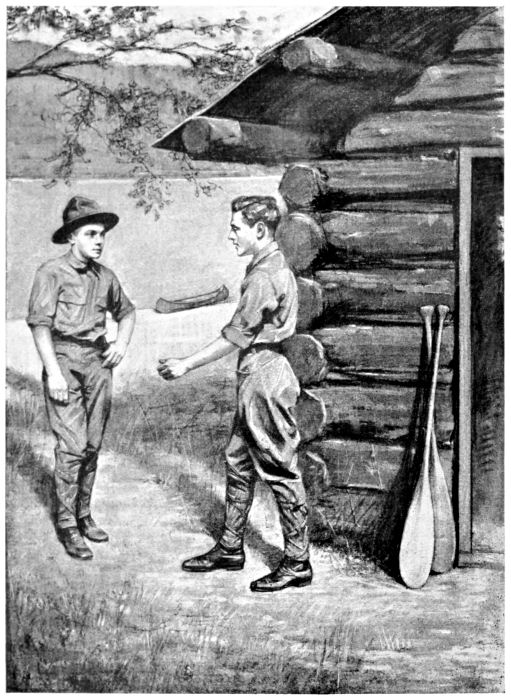
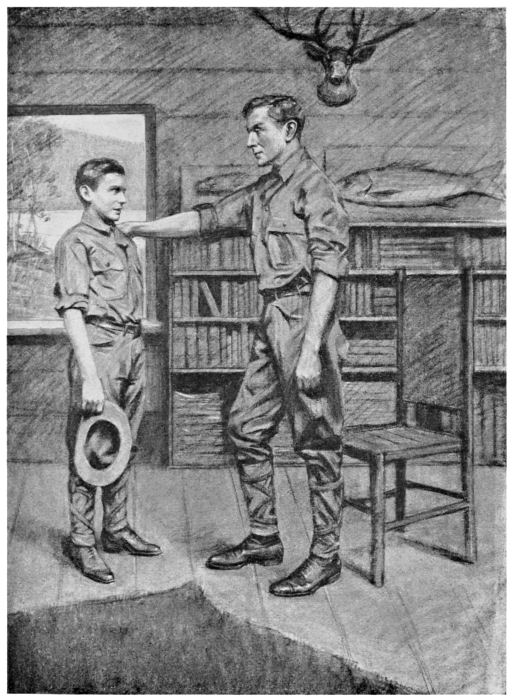
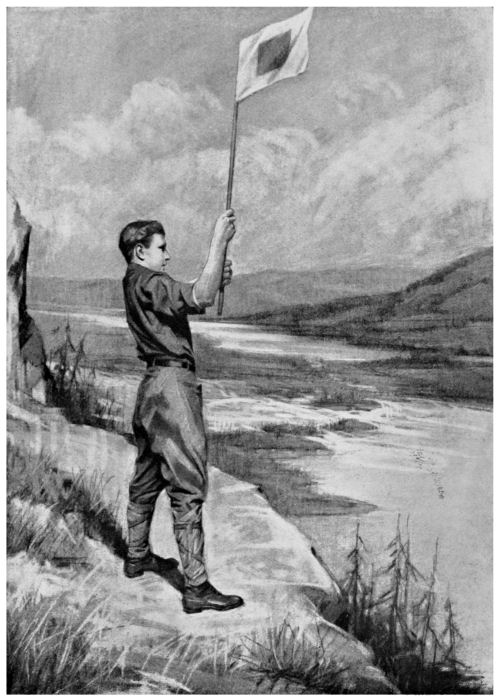
THE CHIEF GREETED HIM PLEASANTLY
To my Wife
whose faith and encouragement
have placed me in her debt
beyond my power to pay
Introduction
5]
The Boy Scout movement has appealed to
me from the very first as a long step in the
right direction. It stands for an organized
boyhood on a world-wide plan. It has in it
the essentials for a stronger and better manhood,
based on character building and physical
development. Clear and clean thinking
and self-reliance are its fundamental principles.
Its weakness has been and is the difficulty
in securing leaders, men with an understanding
of and sympathy with boys, who can
give the necessary time to active work in the
field with the patrols, and who are themselves
sufficiently versed in the lore of the woods and
fields.
For years, before ever the Boy Scouts were
organized, I had dreamed of a woodcraft camp
for boys, a camp which in its appointments
and surroundings should make constant appeal
to the imagination of red-blooded, adventure-loving
boys, and which should at the
same time be a true “school of the woods”
6]
wherein woodcraft and the ways of nature
should be taught along much the same lines
as those on which the Boy Scout movement
is founded.
In this and succeeding volumes, “The Boy
Scouts on Swift River,” “The Boy Scouts on
Lost Trail,” “The Boy Scouts in a Trapper’s
Camp,” I have sought to portray the life of
such a school camp under Boy Scout rules.
“The Boy Scouts of Woodcraft Camp” has
been written with a twofold purpose: To
stimulate on the part of every one of my boy
readers a desire to master for himself the
mysteries of nature’s great out-of-doors, the
secrets of field and wood and stream, and to
show by example what the Boy Scout’s oath
means in the development of character. Many
of the incidents in the succeeding pages are
drawn from my own experiences. And if,
because of reading this story, one more boy is
led to the Shrine of the Hemlock, there to inhale
the pungent incense from a camp-fire and
to master the art of tossing a flapjack, I shall
feel that I have not written in vain.
In the semi-darkness of daybreak a boy of
fourteen jumped from a Pullman sleeper and
slipped a quarter into the hand of the dusky
porter who handed down his luggage.
“You are sure this is Upper Chain?” he
inquired.
“’Spects it is, boss, but I ain’t no ways sho’.
Ain’t never been up this way afore,” replied
the porter, yawning sleepily.
The boy vainly strove to pierce the night
mist which shrouded everything in ghostly
gray, hoping to see the conductor or a brakeman,
but he could see barely half the length
of the next Pullman. A warning rumble at
the head of the long train admonished him
that he must act at once; he must make up
12]
his mind to stay or he must climb aboard
again, and that quickly.
The long night ride had been a momentous
event to him. He had slept little, partly from
the novelty of his first experience in a sleeping
car, and partly from the excitement of
actually being on his way into the big north
woods, the Mecca of all his desires and daydreams.
Consequently he had kept a fairly
close record of the train’s running time, dozing
off between stations but waking instantly
whenever the train came to a stop. According
to his reckoning he should now be at
Upper Chain. He had given the porter strict
orders to call him twenty minutes before
reaching his destination, but to his supreme
disgust he had had to perform that service for
the darkey. That worthy had then been sent
forward to find the conductor and make sure
of their whereabouts. Unsuccessful, he had
returned just in time to hand down the lad’s
duffle.
Now, as the preliminary jerk ran down the
heavy train, the boy once more looked at his
watch, and made up his mind. If the train
was on time, and he felt sure that it was, this
13]
was Upper Chain, the junction where he was
to change for the final stage of his journey.
He would stay.
The dark, heavy sleepers slowly crept past
as the train gathered way, till suddenly he
found himself staring for a moment at the red
and green tail lights. Then they grew dim
and blinked out in the enveloping fog. He
shivered a bit, for the first time realizing how
cold it was at this altitude before daybreak.
And, to be quite honest, there was just a little
feeling of loneliness as he made out the dim
black wall of evergreens on one side and the
long string of empty freight cars shutting him
in on the other. The whistle of the laboring
locomotive shrieked out of the darkness ahead,
reverberating with an eery hollowness from
mountain to mountain. Involuntarily he
shivered again. Then, with a boyish laugh
at his momentary loss of nerve, he shouldered
his duffle bag and picked up his fishing-rod.
“Must be a depot here somewhere, and it’s
up to me to find it,” he said aloud. “Wonder
what I tipped that stupid porter for, anyway!
Dad would say I’m easy. Guess I am,
all right. Br-r-r-r, who says this is July?”
14]
Trudging along the ties he soon came to
the end of the string of empties and, a little
way to his right, made out the dim outlines
of a building. This proved to be the depot.
A moment later he was in the bare, stuffy
little waiting-room, in the middle of which a
big stove was radiating a welcome warmth.
On a bench at one side sat two roughly-dressed
men, who glanced up as the boy
entered. One was in the prime of vigorous
manhood. Broad of shoulder, large of frame,
he was spare with the leanness of the professional
woodsman, who lives up to the rule
that takes nothing useless on the trail and,
therefore, cannot afford to carry superfluous
flesh. The gray flannel shirt, falling open at
the neck, exposed a throat which, like his face,
was roughened and bronzed by the weather.
The boy caught the quick glance of the
keen blue eyes which, for all their kindly
twinkle, bored straight through him. Instinctively
he felt that here was one of the
very men his imagination had so often
pictured, a man skilled in woodcraft, accustomed
to meeting danger, clear-headed, resourceful—in
fact just such a man as was
15]
Deerslayer, whose rifle had so often roused the
echoes in these very woods.
The man beside him was short, thick-set,
black-haired and mare-browed. His skin was
swarthy, with just a tinge of color to hint at
Indian ancestry among his French forebears.
He wore the large check mackinaw of the
French Canadian lumberman. Against the
bench beside him rested a double-bladed axe.
A pair of beady black eyes burned their way
into the boy’s consciousness. They were not
good eyes; they seemed to carry a hint of
hate and evil, an unspoken threat. The man,
taking in the new khaki suit of the boy and
the unsoiled case of the fishing-rod, grunted
contemptuously and spat a mouthful of tobacco
juice into the box of sawdust beside the
stove. The boy flushed and turned to meet
the kindly, luminous eyes of the other man.
“If you please, is this Upper Chain?” he
inquired.
“Sure, son,” was the prompt response.
“Reckon we must hev come in on th’ same
train, only I was up forward. Guess you’re
bound for Woodcraft Camp. So’m I, so let’s
shake. My name’s Jim Everly—‘Big Jim’
16]
they call me—and I’m goin’ in t’ guide fer
Dr. Merriam th’ rest o’ th’ summer and try
to teach you youngsters a few o’ th’ first principles.
What might yer name be an’ whar be
yer from?”
“Walter Upton, but the boys mostly call
me ‘Walt.’ My home is in New York,” replied
the boy.
“Never hit th’ trail t’ th’ big woods afore,
did yer?” inquired the big guide, rising to
stretch.
“No,” said Walter, and then added eagerly:
“But I’ve read lots and lots of books about
them, and I guess I could most find my way
along a trail even if I am a city tenderfoot.
I’ve paddled a canoe some, and I know all
about the habits of wild animals and how to
build a fire and——”
“Son,” interrupted Big Jim, “stop right
thar! Forget it—all this rot you’ve been
a-readin’. Woodcraft never yet was larned
out o’ books, and it never will be. I reckon
you an’ me are goin’ t’ hitch up together fine,
an’ when yer go back t’ yer daddy this fall
yer’ll be able t’ take him out in th’ tall timbers
an’ show him a few stunts what ain’t
17]
down in th’ program o’ city schools, but what
every cottontail born in the north woods
larns the second day he gets his eyes open.
Now yer jes’ fergit all this stuff yer’ve been
a-readin’ and stick t’ me; we’ll git along fine.
I’ll make a woodsman o’ yer yer dad will be
proud o’. Let’s have a look outside t’ see how
the weather is.”
As he followed the big fellow out onto the
platform Walter felt his cheeks burn at this
wholesale condemnation of his treasured
books, one of which, “A Complete Guide to
Woodcraft,” was at that moment within easy
reach in the top of his duffle bag. Despite
his natural admiration for this big guide, to
whom the mountains, lakes and woods were
as an open book, and his unbounded delight
in having made a good impression, Walter
was not yet willing to overthrow his former
idols for this new one, and he was independent
enough to stand by his opinions until convinced
that he was wrong.
“Have you ever read any of them, Mr.
Everly?” he inquired courteously.
“Me? Read them books?” Big Jim’s
laugh rolled out infectiously. “What would
18]
I read ’em for, sonny? I’ve seen some o’
them book-writers in th’ woods, and thet’s
enough fer me. Lordy!” and again Jim’s
hearty laugh rolled forth.
Walter laughed a little too, but deep in his
heart he resolved that he would yet show Big
Jim that there was some good in the despised
books. To change the subject he inquired
about the low-browed owner of the axe back
by the fire.
“Him? Why, thet’s Red Pete, a French
canuck with some Indian in him, an’ th’
meanest man in th’ mountains,” replied Big
Jim.
The mist had begun to burn off. Even as
they watched they saw it roll in great tattered
masses up the side of the opposite mountain.
With the coming of the sun Walter was able
to take note of his surroundings, and his eager
eyes drank in the scene so strange to him but
so familiar to his companion. It was one of
those few moments which come to all of us,
when we experience sensations which so impress
themselves upon the memory that never
are they forgotten. Walter felt a thrill that
made him tingle from head to foot and, from
19]
sheer delight, clinch his hands till the nails
nearly bit into the flesh. Since he was big
enough to read “Deerslayer” and “The Pathfinder”
and Captain Mayne Reid’s fascinating
tales of adventure in forest and on the plains
he had lived in an imaginary world of his own—a
wonderful world, where he penetrated
vast wildernesses, voyaged on great rivers and
climbed snow-capped mountains. Now he
was really in the great woods; his dreams
were coming true in a measure.
Indeed, it was a scene to stir any red-blooded
boy. A gentle breeze, moving across
an unsuspected lake, rolled before it great billowing
masses of vapor. The sun, just rising
above the eastern hills, drew the mist swiftly
up the mountainsides in broken, detached
masses that eddied, separated, came together
and in an incredibly short time dissipated in
thin, clear air, till naught remained save in
the deepest hollows not yet penetrated by the
sun’s rays. Walter drew a long breath.
“Oh!” he gasped, and again, “Oh!”
Big Jim looked at him curiously, while a
sincere liking twinkled in his blue eyes.
“Never see a sunrise in th’ mountains
20]
afore, did yer, sonny?” he asked. “Jes’
yer wait till yer see a sunup from th’ top of
old Baldy, and watch forty lakes throw off
their night clothes all at once.”
Sordid enough was the scene now revealed
close at hand in the clear morning light, the
ulcer of so-called civilization, to be seen
wherever man has pushed the outposts of
commercialism into the great forests. A
dozen log houses and a few ugly frame buildings,
the latter unpainted for the most part,
but with one a glaring red and another a
washed-out blue, dotted an irregular clearing
on either side of the railroad. Close by, the
tail of a log jam choked a narrow river, while
the tall iron stack of a sawmill towered
above the rough board roof that afforded
some protection to the engine and saws. Off
to the right glistened the end of a lake of
which the river was the outlet, its margin a
mass of stark, drowned timber. The peculiar
odor of wet sawdust filled the air. A sawdust
road threaded its way among the scattered
buildings, and all about were unsightly
piles of slabs, heaps of bark and mill waste.
But to Walter it was all fascinating. The
21]
sky-scrapers of his native city seemed not half
so wonderful as these moss and clay chinked
cabins. He pinched himself to make quite
sure he was awake, that it was all real. An
engine and single dingy coach were backing
down a siding.
“Thar’s our train, son,” said his companion.
“Better stow yer duffle aboard. It
won’t pull out for half an hour, and then it’ll
be a twenty-minute run over t’ Upper Lake.
I want to see Tim Mulligan over yonder t’ th’
store, but I’ll join yer on th’ train.”
Taking the hint, Walter put his duffle
aboard the train beside the pack basket of his
friend, and then, to kill time, started out to
form a closer acquaintance with the town.
From most of the houses thin columns of
smoke and the odor of frying bacon or pork
proclaimed that breakfast was being prepared.
Occasionally he had glimpses of weary-faced
women in faded calico gowns. One, standing
in the doorway of her cabin, was barefooted.
A frowzy-headed, dirty-faced little urchin
stared at him from the shelter of her skirts.
The men he met were for the most part rough,
good-natured fellows, dressed in the flannel
22]
shirt of the woods, their trousers thrust into
high, laced, hobnailed boots. Several nodded
kindly or exchanged a “howdy” with
the bright-faced boy.
On his way back, as he neared a cabin
somewhat apart from the others, he heard
voices in angry dispute. Turning a corner of
the cabin he was just in time to see a boy of
about his own age, but a good head taller, strike
a vicious blow at a whimpering hunchback.
In a flash Walter confronted the astonished
young ruffian, eyes flashing and fists doubled.
“You coward!” he shouted. “You miserable
coward, to strike a boy smaller than
yourself, and a cripple!”
For an instant the other stared. Then his
face darkened with an ugly scowl, and he advanced
threateningly.
“Get out av here! This ain’t any av your
business, ye city dude!” he growled.
“I’ll make it my business when you hit a
little fellow like that,” replied Walter, edging
between the bully and his victim.
“Want ter foight?” demanded the other.
“No, I don’t,” said Walter, “but I want
you to leave that little chap alone.”
23]
“Huh, yez do, do yez?” responded the
other, and rushing in he aimed an ugly blow
at Walter’s face. The fight was on.
And just here the young ruffian was treated
to the greatest surprise of his bullying career.
Instead of crushing his slight antagonist as he
had contemptuously expected to, he lunged
into empty space. The next instant he received
a stinging blow fairly on the nose. For
a moment he gasped from sheer surprise, then,
with a howl of pain and rage, he rushed
again.
To all appearances it was a most unequal
match. The young backwoodsman was not
only taller, but was heavy in proportion; his
muscles were hardened by work and rough
outdoor life in a sawmill village, and hard
knocks had toughened him as well. In contrast,
the city boy seemed slight and hopelessly
at a disadvantage. But underneath
that neat khaki jacket was a well-knit, wiry
frame, and muscles developed in the home
gymnasium. Moreover, Walter’s father believed
in teaching a boy to take care of himself,
and it was not for nothing that Walter
had taken lessons in boxing and wrestling.
24]
As before, he avoided the rush by lightly
side-stepping, driving in a vigorous left to the
ear and following this with a right which
raised a lump just under his opponent’s left
eye. The latter backed away. Then he came
in again, but more cautiously. He was beginning
to respect this elusive antagonist who
hit so hard, yet managed to get away untouched.
It was all so new in his experience
that he was utterly at a loss to know what to
expect.
Round and round they circled, each watching
for an opening. Suddenly Walter took
the offensive. As he started to rush he slipped
in the wet sawdust. His opponent saw his
advantage and swung hard, but Walter caught
the blow on his right forearm, and the next
instant they were locked in a clinch. This
was what the bully wanted. Now he would
throw his antagonist and, once he had him
down, that would end the battle, for his ethics
knew no quarter for a fallen foe.
But again he reckoned without his host.
Scientific wrestling was an unheard-of art to
the young giant, while in the home gymnasium
Walter had twice won the championship
25]
for his weight. For a few minutes they
swayed this way and that, then Walter secured
the lock he was trying for, there was an instant
of straining muscles, then the bully was
pinned flat on his back.
A big hand fell on Walter’s shoulder.
“Son,” said Big Jim, “I hate t’ break into
yer morning exercise, but you an’ me hev an
engagement at Upper Lake, and we’ve got
jes’ two minutes t’ ketch thet train.”
Walter jumped up at once, and then held
out his hand to the discomfited bully. “Will
you shake?” he asked.
To the surprise of the delighted onlookers
the fallen terror of the village arose and in a
manly way, though sheepishly, shook the
outstretched hand, for at heart he had the
right stuff in him.
“Ye licked me fair an’ square,” he mumbled.
“Oi wish ye’d show me some av thim thricks.”
“I will if I ever have a chance. You ought
to be a Boy Scout,” shouted Walter as he and
Big Jim sprinted for the train.
CHAPTER II WOODCRAFT CAMP
26]
The light breeze which had lifted the mist
at Upper Chain had dropped to a dead calm,
and when Walter followed the guide from the
train down to the landing on Upper Lake not
a ripple broke its placid surface. As far as
he could see it lay like a great magic mirror,
the heavily-wooded shores reflected so clearly
that the inverted forest appeared no less real
than the original, so marvelously counterfeited.
In every direction mountain succeeded
mountain, for the most part clothed
to their summits with the variegated green of
the mighty woodland growth, the somber
spruce of the higher slopes, black against the
lighter green of yellow and white birch, maple
and ash, which had reclaimed to the wilderness
the vast tracts ruthlessly laid bare by
reckless lumbering twenty years before. One
of the nearer mountains was crowned with
bare, exposed ledges to which clung a few
27]
unsightly blasted trunks, mute witnesses to the
devastation wrought by fire.
By a peculiar optical effect produced by the
angle of light in a dead calm at that time of
the day, floating objects appeared magnified
to many times their actual size, so that a
launch some two miles distant, whose rapid
put-put had drawn their attention when they
first stepped from the train, appeared to be
less than half that distance away.
Big Jim looked at it long and steadily,
shading his eyes with a big hand.
“Thet’s ‘Woodcraft Girl’ all right,” he said,
“and I reckon they’re comin’ down fer us.
Yer make yerself t’ home, son, while I run
back up yonder t’ th’ hotel and rastle up some
grub. We’ll be some hungry before we reach
camp if I don’t.”
Walter seated himself on the end of the pier
and drank in the beauty of the exquisite scene.
Alongside a little mail boat was getting up
steam, her crew busily stowing away express
packages and supplies of all kinds for the
various camps and hotels scattered along the
lake. Half a dozen passengers were already
aboard. Two Adirondack skiffs, each pulled
28]
by a brawny guide, a fisherman lolling at ease
in the stern, were just setting out for the fishing
grounds. All was hustle and activity, in
strange contrast with the quiet lake and the
majestic calm of the mountains.
In a few minutes Big Jim returned with
some sandwiches, which they promptly disposed
of while they waited for the approaching
launch. It was now near enough for
Walter to make out the blue pennant with the
magic words “Woodcraft Camp” fluttering at
the bow, and a moment later there came a
joyous hail of “Oh, you Jim!” from the figure
in the bow, followed by a wild waving of
a small megaphone.
“Oh, you Bob!” bellowed the big guide,
swinging his hat.
The launch drew in rapidly and was deftly
laid alongside. From it sprang two young
fellows of seventeen or eighteen, in olive khaki
trousers, flannel shirts and soft-brimmed hats,
who straightway fell upon Walter’s companion
and pounded and thumped him and shook
both hands at once, and were pounded and
thumped in return.
When their somewhat noisy demonstration
29]
was over the one whom Jim had called Bob
turned to Walter and held out his hand.
“Guess your name is Upton, isn’t it?” he inquired
with a pleasant smile. “My name is
Seaforth, and this is Louis Woodhull, the best
fellow in Woodcraft Camp. Dr. Merriam sent
us down to look for you, but I see you were
already in good company. The doctor was
some worried for fear you might have missed
connections at Upper Chain, but if he’d known
that you were trailing in company with this
old son of the backwoods his mind would
have been easy. Jim, you great big stick of
seasoned timber, it sure does a fellow good
to look at you. Stow this young fellow
and the duffle in the launch while I get
the mail and do some errands, and we’ll be
off. The whole camp’s a-looking for you,
though they don’t expect you till to-morrow.
You’re sure needed. Ed Mulligan is
guiding over on Big Moose and won’t be
with us this year, but his younger brother,
Tom, is taking his place, and I guess he’ll
make good.”
Bob’s errands were soon done, the supplies,
duffle and mail pouch stowed away in the
30]
launch, and her nose pointed down the lake.
Bob took the wheel, while Louis ran the engine.
Walter was up forward, “to be properly
impressed,” as Bob put it. And if that was
really the object in giving him the best post
of observation, its success left nothing to be
desired.
With eager eyes he drank in the wonderful
panorama constantly unfolding—as the launch
sped swiftly over the lake. Here the lake
was less than half a mile wide, then abruptly
it opened up great bays which made it more
than twice that width from shore to shore.
How he longed to explore those bays and coves!
Two big summer hotels on commanding bluffs
were passed, showing but little life as yet, for
the season had not fairly opened. On rocky
points, or half hidden in sheltering coves, he
caught glimpses of summer “camps,” most of
them built of logs, but in many cases little
short of palatial, and the boy’s lips curled with
scorn at this travesty of wealth upon the
simple life. Gradually the camps became
fewer and farther apart until only an occasional
lean-to or a tent now and then, clinging on the
very edge of the forest, was evidence of man’s
31]
invasion, and Walter felt that now in truth he
was entering the wilds.
From the good-natured chaff and talk of
his companions he gathered that Big Jim had
been chief guide at Woodcraft Camp ever since
this famous school in the woods had been
started, and that the two young men had been
among his earliest pupils. With eager ears he
drank in their talk of fish and lures, of deer,
rifles and hunting lore. Occasionally, as they
skirted an island or ran around a sunken reef,
one or another would recall a famous catch of
bass or a big laker taken there.
Of the two young men, Seaforth was the
more talkative. He was dark, with sparkling
black eyes and a merry, likable face, which,
for all its irrepressible good-humor, had in it
a strength and purpose which denoted a solid
foundation of character. He was broad-shouldered,
deep-chested, finely-developed, a splendid
type of young American manhood.
His chum was rather slight in build, but
wiry, with light hair and a rather thin,
clean, serious face which gave the impression
of tremendous nervous energy habitually under
control. He took but little part in the
32]
conversation, but his quiet smile at the sallies
between Bob and the guide was of a peculiarly
winsome sweetness. His slight reserve drew
rather than repelled Walter, who instinctively
felt that the friendship of Louis Woodhull was
something well worth the winning.
They had now come some twelve miles
down the lake, and presently Bob pointed out
a long pier jutting out from the eastern shore,
and beyond it, just to the left of a giant
pine, a flagstaff from which Old Glory was
fluttering limply in the light breeze just beginning
to ripple the surface of the lake.
“There you are, Upton, your first glimpse
of Woodcraft,” he said. “I hope you’ll——”
But what he hoped Walter never knew. A
shrill “Hy-i-i-i-i! We want that tenderfoot!”
cut him short, as a canoe manned by two
youngsters of about Walter’s own age shot out
from an island the launch was just passing.
Both boys were in trunks and jerseys and
paddling like mad to intercept the launch.
Suddenly the one in the stern caught sight of
the guide. For an instant he stopped paddling,
while a look of pleased surprise passed
over his face, and then with a wild yell of
33]
“Jim, oh, you Jim!” he redoubled his
efforts.
Seaforth put the wheel over to port a couple
of spokes. “No you don’t, Billy!” he called
with a grin. “This boat carries Uncle Sam’s
mail, and it can’t stop to pick up tows.”
“Aw, Louis, slow her down, won’t you?”
begged Billy.
Louis smiled good-naturedly; but the engine
slowed down not a bit.
“Ta-ta,” called Bob. “The Indian attack
is foiled, Billy. I’m ashamed of you! Your
paddling is abominable. Where’s that new
stroke that’s going to win the championship?
See you later.”
And then it happened. One moment two
boys were frantically digging up the water
with their paddles and the next a canoe was
floating bottom up, one boy white-faced and
frightened, clinging to the bow, and the other,
with a malicious grin on his freckled face,
swimming at the stern.
The instant it happened Seaforth put the
wheel hard over and, describing a short circle,
headed for the canoe. Walter’s heart had
been in his mouth, but the others seemed not
34]
a bit disturbed. Louis stopped the launch, and
while the guide righted and emptied the canoe,
he and Seaforth hauled the victims aboard.
“You little beggar!” growled Bob as he
grabbed Billy by the slack of his jersey, “I’ve
a mind to duck you until you howl for
mercy. You did that purposely.”
Billy grinned. “You didn’t suppose I was
going to let you land Big Jim and I not be
there, did you?” he asked.
“That’s all right, Billy, but this is going to
be reported,” broke in Louis.
“Don’t, please don’t, Louis,” begged the
culprit.
“Sorry, son, but it’s got to be. We love
you, Billy, and because we love you we’re going
to report. You addle-pated little scamp,
when will you ever learn that whatever risks
a man may run himself he has no right to involve
others in danger? How did you know
that Allen there would be able to take care of
himself, plunged unexpectedly into the water?
He’s been in camp only three days, so what did
you know of his powers of resource? No, my
son, we hate to tell tales, but we’ve a duty to
you to perform, so prepare to pay the penalty.”
35]
The launch was now once more under way
with the canoe in tow. Walter was duly introduced
to the penitent Billy and his victim,
Harry Allen, like himself a new recruit and
therefore a tenderfoot.
Several boys had gathered on the pier to
size up any newcomers the launch might bring,
and Walter felt himself the target for a battery
of eyes. The ordeal was light, however, compared
with what it would have been at nightfall
or earlier in the day, for it was now nine
o’clock and the boys were largely scattered in
the duties and pursuits of camp life.
As the launch was made fast Billy whispered,
“Here comes Dr. Merriam; isn’t he a peach?”
Walter looked up with just a little feeling
of awe to see the man of whom he had
heard so much—a scientist, explorer, author
and lecturer, honored by many scientific societies
and institutions of learning both at
home and abroad, and now content to bury
himself in the north woods as the founder and
head of the most unique school in the world—a
school with a purpose which was, as he himself
whimsically expressed it, “to make big
men of little boys.”
36]
Woodcraft Camp was the outgrowth of
years of study and observation of boy life and
the needs of the tremendous army of youth
annually turned loose upon the country for
three months of idleness and mischief. It
was, in effect, a vacation school, so cleverly
masked in the guise of a camp that probably
not one among the pupils, save a few of the
older boys, recognized it as such. Its courses
were manliness, self-reliance, physical and mental
health, strength of character, simplicity
of desire and love of nature. The curriculum
embraced all forms of athletic sports, swimming,
canoeing, fishing, shooting, forestry, the rudiments
of civil engineering, woodcraft in all its
branches from the pitching of a tent or building
of a lean-to to the cooking of a good meal,
the shooting of a rapid and the way to live off
of the country in an unknown wilderness.
Botany, ornithology, the rudiments of
physiology, as taught by a knowledge of first
aid to the injured—all these things and more
were taught, while the boys, all unconscious
that they were being systematically trained
and developed, thought only of the jolly good
times they were having. Timid, nervous,
37]
under-developed youngsters entering the camp
at the beginning of the summer vacation
went forth to their studies in the fall brown,
hearty, well muscled and with a quiet confidence
in themselves and their own abilities to
do things which won immediate recognition
among their fellows. And not one among
them but held in the secret places of his heart
as his ideal in life the man whom Walter now
saw approaching with a quick, elastic step.
He was about fifty years of age, medium
height, thin, but sinewy, a human dynamo
of nervous energy. He was clean shaven,
slightly gray at the temples, with firm, square
jaw, rather large mouth, prominent nose and
eyes which seemed to see all things at once
yet from which a smile seemed ever ready to
leap forth. It was far from a handsome face,
save in the beauty of strength, but was a face
to love, a face once seen never to forget.
It was now all alight with pleasure at the
sight of Big Jim. The guide leaped forward
to meet the doctor, and in the greeting there
was plainly evident a mutual respect and liking
between these men, so far apart in the social
scale, yet beneath the veneer produced by
38]
circumstance, so closely bound in a common
brotherhood.
Turning from the guide the doctor held out
his hand to Walter. “Upton,” he said with
a kindly smile, “let me welcome you as a
member of Woodcraft Camp. Buxby,” turning
to Billy, “you show Upton the way to Wigwam
No. 1 and where to stow his duffle and
wash up. By the way, Buxby, you and your
canoe look pretty wet. Have an accident?”
Then without waiting for Billy’s reply he
added, “You may police camp for the remainder
of the day, Buxby. Carelessness
and recklessness are equally reprehensible,
and neither should ever go unpunished. Upton,
please report at my office in an hour.
Buxby will show you where it is.”
“And I never said a word; you can’t fool
the doctor,” whispered Woodhull to the discomfited
Billy, as the latter stooped to lift a
package from the launch.
Billy made a wry face and then, good-naturedly
shouldering Walter’s duffle bag, started
up the trail toward a long log cabin.
CHAPTER III FIRST IMPRESSIONS
39]
Woodcraft Camp had originally been the
headquarters for one of the largest lumbering
crews operating in that section of the north
woods. The location had been chosen with
the same strategy a general in the field would
display in selecting headquarters for the direction
of important maneuvers. The site
was on a broad level of ground sufficiently
high to insure perfect drainage. A boiling
spring furnished a perpetual supply of pure
water. A logging road had been driven
straight east, tapping a heavy hardwood belt
on Little Knob, while branching from this
road to the south another opened up the
northwestern slopes of Mt. Sewell. A third,
swinging to the north, brought all of the
southeastern side of Old Scraggy under the
dominion of the axe and peavy. Thus the
operations of three crews could be directed
from the one central point, and the entire cut
40]
of this region be put into the lake with a
minimum of effort. Moreover, it was a scant
half mile to the outlet of the lake, so that the
rafting of the logs into the swift waters of the
river was a comparatively easy matter.
The magnitude of the operations and the
comparative permanency of the camp called
for substantial buildings, and the three log
bunk houses, stables, storehouse and blacksmith’s
shop were splendid examples of the
loggers’ skill with axe and peavy. A long
pier had been built into the lake, and the underbrush
cut out for a considerable distance
around the camp.
With the despoiling of the once noble woodlands
completed the camp had been abandoned
to the occasional hunter or fisherman who
passed that way. The clearing had grown up
to a tangle of raspberry vines, and the deserted
buildings had begun to show signs of neglect
and decay, when Dr. Merriam chanced to
camp there. At once he saw the opportunity
to put into execution his long-cherished
dream of a woodcraft school camp for boys.
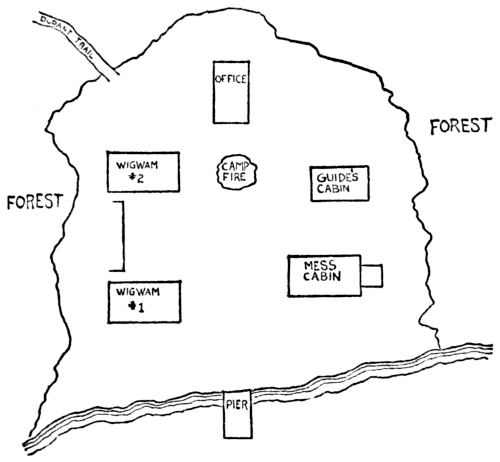
Diagram of Woodcraft Camp
The property, with some five hundred acres
of adjoining land, was bought, the buildings
41]
repaired, with only such changes made as
would adapt them to the needs of the proposed
school, the land in the immediate vicinity
cleared of underbrush, and the pier repaired.
It was Dr. Merriam’s idea to make
as little change in appearance and arrangement
as possible, that the camp might lose
nothing of the romantic charm which
42]
surrounds every logging camp when seen for the
first time by eager boyish eyes.
Walter, following Billy up the trail, was ushered
into the first of the three large cabins.
Inside it was almost as rough as the outside,
yet he was at once conscious of that indescribable
sense of comfort and security which the
log cabin in the forest alone possesses. The
low ceiling, which had originally divided the
loft from the main room, had been removed
to insure a better circulation of air. In a
double tier down the two sides were built
plain box bunks, each containing a tick filled
with straw. Sheets, gray blanket and a thin
pillow, filled with aromatic fir balsam, completed
the equipment. Each bunk was numbered
and a corresponding number appeared
on the bedding in each. In the rear of the
room was a huge fireplace capable of taking
in six foot logs, and on either side a tier of
lockers numbered to correspond with the
bunks.
Tossing Walter’s duffle on to the nearest bunk,
Billy suggested that he open up for his soap,
towel, brush and comb. Supplied with these
necessary adjuncts to the toilet he meekly
43]
followed Billy out to a long, low shed located to
the rear and midway between the cabin he had
just left and another, which was of the same
size and, as he later discovered, of precisely
the same interior arrangement.
A broad shelf ran the entire length of this
shed. On this stood three pails of water, each
with a dipper hanging above it, while beneath
the shelf hung a row of graniteware wash-basins.
Big galvanized nails were driven at
convenient points for the towels and the folding
mirrors which were a part of every boy’s
equipment. It was primitive, very primitive,
but quite in accord with Dr. Merriam’s idea,
and Walter had to admit that it served his
purpose admirably.
While Walter made himself presentable,
Billy plied him with questions. When he got
through Walter felt that he had been pumped
dry, and that the garrulous Billy knew his life
history. Finally he ventured a few questions
himself.
“Is this your first year?” he inquired.
“Me? My first year? Say, do I look like
a tenderfoot?” demanded the indignant Billy.
“Say, you are green. Never was off of Broadway
44]
before, was you? No, sir, this is my
third year. Say, if you want to learn woodcraft,
just you trot with me a while.”
“Said woodcraft consisting at the present
moment in policing camp,” broke in a quiet
voice just behind them. “Probably Upton
had rather be excused.”
Both boys turned to find Louis Woodhull,
who, walking with the noiseless step of the
forest ranger, had come upon them unawares.
“There’s a lot of chips around the wood-pile,
Billy, and cook wants them right now,
so trot along, son,” he continued.
“Doctor told me to look out for Upton,”
protested Billy.
“Upton is quite equal to taking care of
himself, from all I hear,” said Louis drily.
“Wood-pile’s waiting for a good, strong, able-bodied
forester who knows woodcraft, one of
the first essentials of which is knowledge of
how to swing an axe. Insubordination——”
But Billy, with a grimace, had already
started for the chip basket.
Louis laughed. “Billy is one of the best
hearted boys in camp, but he’s a reckless little
beggar, and he does hate work. Look out he
45]
doesn’t lead you into mischief, Upton. By
the way, Big Jim tells me that you’ve already
started in to conquer the wilderness, and have
laid one of the savages low. Where did you
learn to use your fists?”
“My father taught me how to protect myself
almost as soon as I could walk, and then
I took boxing lessons at the gym. That was
nothing this morning; I couldn’t have licked
him if he’d known what I know,” replied
Walter modestly.
“My boy,” said the older lad earnestly,
“right there lies the difference between success
and failure—knowledge—the know how—the
know why—the know when. Knowledge is
power. It is better than bull strength. You
knew how to make the most of what muscle
you have got, and you won. You’ll find that’s
the answer all through life. The man with
knowledge and the power to apply it is top of
the heap every time. Take these big woods
here—how long do you suppose a greenhorn
from the city dropped in the middle of ’em
alone, with nothing but gun and blanket,
would live? But take a fellow like Big Jim,
with his knowledge of the wilderness and
46]
wilderness ways, and he’d hit the nearest settlement
in three days and live like a lord all the
way. Now, if you’re ready I’ll show you the
way to the office. By the way, I’m going to
ask Dr. Merriam to put you in my tribe; I
like your style.”
The “office” was a small detached cabin
which had formerly been the headquarters of
the logging camp boss. It was divided into
two rooms by means of burlap curtains. In
the front room was a desk, a plain deal table,
three rustic chairs and book shelves occupying
two-thirds of the wall space. The head of
a magnificent ten-point buck looked down
from above the fireplace. Over the books were
mounted specimens of salmon, trout, bass and
muskelonge. Mounted specimens of rare
birds, a case of butterflies wholly unlike any
Walter had ever seen, and which he suspected
were from distant lands, specimen stones and
minerals from the surrounding mountains,
added to the fascination of the room. Before
the fireplace lay the skin of a huge bear, and
two tanned deer hides were spread on the
floor. In one corner stood a collection of
guns, rifles, paddles, fishing-rods and landing
47]
nets which caught the boy’s eager eyes the instant
he entered.
Through the parted curtains he had a
glimpse of the same primitive sleeping arrangement,
namely a box bunk, that he had
found in the big cabin where he had left his
duffle. Could he have peeped farther within
he would have found a neat single iron bedstead
with a hair mattress and snowy counterpane,
a dainty white bureau, low, comfortable
rocking-chair, sewing-machine and other evidences
of feminine comfort, for, though Dr.
Merriam religiously insisted on having for
himself nothing more luxurious than he gave
his “boys,” the comfort of Mrs. Merriam—she
was “Mother” Merriam to the whole camp in
the affections of the boys—was another matter,
and no pains were spared to make things
pleasant and comfortable for her. In fact,
not only the boys, but the guides and others
attached to the camp vied with each other in
showing her little attentions and waiting upon
her.
As Walter and Louis entered “Mother”
Merriam came forward at once to greet the
newcomer, and while Louis talked with the
48]
doctor for a few minutes this quiet, sweet-faced,
tactful little woman put the newcomer
so at his ease that when Louis finally bade his
superior good-morning and went out, Walter
turned to meet the head of the camp wholly
free from the awe with which he had entered
the door not five minutes before.
“Upton,” said the doctor, “Woodhull has
just requested that you be assigned to his
‘tribe,’ an honor which you do not appreciate
now, but which you will later. The
camp is divided into four patrols or ‘tribes,’
each under the leadership and direction of one
of our oldest and most trustworthy boys,
known as ‘chiefs.’ Woodhull is chief of the
Delawares, and Seaforth, whom you met with
the launch, is chief of the Algonquins, the two
tribes occupying the big cabin known as
Wigwam No. 1, to which Buxby showed you
on your arrival. Wigwam No. 2 is occupied
by the Senecas and Hurons, under Chiefs
Avery and Robertson. The rules of the camp
are few and simple and every boy is put on
his honor and is trusted to live up to them.
Reveille is sounded at five o’clock every
morning, except Sunday, when it is an hour
49]
later. At five-thirty on week-days and six-thirty
on Sunday mess is served to two of the
tribes and half an hour later to the other two,
the wigwams alternating in the order of service.
“A detail from each wigwam is assigned to
police the camp, that is, clear up all rubbish
and keep the camp in order, wash dishes and
chop fire-wood. Noon mess is served from
twelve to one o’clock and evening mess from
five-thirty to six-thirty. At nine o’clock
‘taps’ is sounded, which means ‘lights out’
and every boy in bed.
“Each boy is expected to look after the
making up of his own bed. There are certain
defined limits on shore and on the lake beyond
which no boy may go without a permit
from his chief, sanctioned by me.
“The building of fires at any time or place
is strictly prohibited save when accompanied
by a guide or chief. Smoking is not allowed.
Violation of either of these two rules is sufficient
cause for expulsion from camp. Boys
who cannot swim are not allowed in the boats
or canoes unless accompanied by an older
competent person, until they have learned to
50]
care for themselves. The carrying or use of
firearms is forbidden except at the rifle range,
where instruction is given daily by one of the
guides. From time to time there will be
‘special duty’ squads, such as the surveying
squad, forestry squad, logging squad, and
others on which boys are expected to serve
willingly, and in the performance of these duties
they will be taught many of the essentials
of woodcraft.
“You will report this afternoon to Mr.
Medcraft, our physical instructor, for examination,
and will be expected to follow his recommendations
for daily exercise. Big Jim
has told me of your encounter at Upper Chain.
My boy, I rejoice in the manliness and courage,
in the sense of fair play, which led to
your defense of the weak. Of all men the
bully is most contemptible. No bullies are
allowed in this camp, and, Upton, no fighting,
unless all other means of settling a quarrel
prove futile. Then it is fought out with
gloves in the presence of the whole camp and
with an unbiased referee. It has happened
but once; I hope it will not happen again. I
mention this now, for I fear that you will
51]
find that you have established a reputation as
a fighter, and such a reputation often leads
one into difficulties which otherwise might be
avoided.
“TELL HIM YOU ARE TO BE A DELAWARE”
“We are glad to have you as a member of
Woodcraft Camp, and I hope we shall make
a first-class scout and a thorough sportsman
and woodsman of you. I will not add ‘gentleman,’
for we feel that every boy is that
when he comes to us. If you are interested
in any special branch of nature study come
and consult me freely that I may aid you in
its pursuit.
“Now you may report to Chief Woodhull,
and tell him you are to be a Delaware. He
will inform you as to the minor rules of the
camp and our methods of learning the most
from this close communion and association
with nature. We want you to go home in
the fall feeling that you have had the best
time a red-blooded boy could have, and that
the summer has been profitable as well.”
With a pleasant smile the doctor shook
hands warmly once more and Walter started
for the wigwam, secretly elated that he was
to be under Woodhull, and that he was to be
52]
a Delaware, the tribe of Uncas and Chingachgook.
He found Woodhull waiting for him.
The chief greeted him pleasantly.
“So the big chief (that’s what we call the
doctor) has made a Delaware of you? I’m
glad of that.”
“So am I,” responded Walter.
“Now the first thing,” the other continued,
“is to get acquainted with the wigwam and
stow away your duffle. The Delawares have
the east side, and the Algonquins the west.
Your number is the skiddoo number, twenty-three,
for bunk and locker, and I hope you’ll
make it a lucky number for the tribe. Stow
your duffle in your locker, and I’ll show you
around the camp and make you acquainted
with some of the boys. By the way, Upton,
do you go in for athletics, besides boxing?”
Walter admitted that he ran a little, being
best at the mile, was fairly good at the running
broad jump, had once won a boy’s canoe
race, and had practiced a lot at a short range
target with a small rifle.
His chief received the information with
manifest pleasure. “You see,” he explained,
“we have a big field day in August, and there
53]
is a lot of rivalry between the tribes, and especially
between the two wigwams. A mounted
deer’s head is offered this year to the wigwam
scoring the greatest number of points in woodcraft
during the summer and in the field day
sports, and we want it over our fireplace. The
biggest fish caught each day counts five points
and the biggest for the week fifteen points;
the best photograph of wild animals or birds
made during the summer counts twenty-five
points; fifteen points each are scored for the rarest
botanical specimen, best mineral specimen,
largest number of birds positively identified,
best collection of insects and largest number
of trees identified. Any exceptional feat of
woodcraft scores to the benefit of the wigwam.
The championship banner goes to the tribe
winning the largest number of points in the
successful wigwam. The Hurons won it last
year, but, son, the Delawares have got to get
it this year. Then there are individual prizes
well worth mentioning. We shall expect you
to miss no opportunity to score for the honor
of the tribe and wigwam. Our wigwam leads
now, but the Algonquins have twenty points
the best of the Delawares. It’s up to you to
54]
do your prettiest to help us get their scalps.
By the way, don’t be surprised if things are
made some interesting for you to-night.
Whatever happens, keep your nerve and
don’t show the white feather.”
Beyond this mysterious hint Woodhull
would vouchsafe no information, and Walter
could only guess at what might be in store
for him.
The tour of the camp included the big mess
cabin, with the cook house in the rear, where
they had a glimpse of Billy and the chip pile,
and the cabin of the three guides, where they
found Big Jim very much at home, the other
two being out with fishing parties, and where
Walter was introduced to Mr. Medcraft, the
physical director, and to Mr. Burnham, a
young Y. M. C. A. man who was Dr. Merriam’s
assistant. These shared the cabin with
the guides. They then went down to inspect
the boats and canoes. Several fishing
parties were just coming in, and Walter was
introduced to some of his fellow tribesmen, as
well as to members of the other tribes.
As they turned back to the wigwam the
bugle sounded for noon mess, and boys
55]
appeared as if by magic from every direction in
a mad rush for the wash-house. Presently
Walter found himself seated at a long table in
the mess room, an agate-ware plate and cup
before him, and an abundant supply of plain
but well cooked food, in which deliciously
browned trout were evidence of the practical
lessons taught at Woodcraft Camp.
CHAPTER IV THE INITIATION
56]
Mess over, Woodhull and Seaforth took
their stand at either side of the door, and
Walter noted that as each boy passed out he
saluted the two chiefs with the Scout’s salute,
and was saluted in return. It was a point of
etiquette which he learned was never omitted,
and which did much to maintain discipline
and to instil the principles of respect for
superior officers. Once outside the mess room
Walter was free to inspect the camp in detail
and at his leisure for, it being his first day,
he was not assigned to any of the duty squads.
There were fifty-two boys in camp, including
the four leaders, or chiefs, and they were
from all quarters, two being from as far west
as Chicago. They represented all classes in
the social scale. A few were from homes of
extreme wealth and one, according to Billy,
was a Boston newsboy in whom the doctor
57]
took a personal interest. But in accordance
with Scout ideals all were on equal footing in
the camp, and the most democratic spirit prevailed.
Achievement in scoutcraft alone furnished
a basis for distinction.
The camp had been established three years
before the Boy Scouts of America came into
existence, but Dr. Merriam had been quick to
perceive the value of the new movement, the
principles of which are, in fact, the very ones
he had been seeking to inculcate in his
unique school. This year the camp had been
placed under Scout regulations, and it was
the doctor’s desire to send every one of his
boys home at the end of the summer as qualified
Scouts of the first class, fitted to take
the leadership of home patrols.
Approaching from behind the wood-pile,
where Buxby’s assignment to duty was keeping
him busy, Walter heard his own name
and paused, uncertain whether to go on or
not. Billy was regaling the cook with an account
of Walter’s exploit of the morning as he
had wormed it out of Big Jim.
“Pretty spry with his fists, they say,” concluded
the talkative Billy. Then he added
58]
as an afterthought, “Bet they’ll get his goat
to-night, though.”
Walter waited to hear no more. He had
not been wholly unconscious of the sly looks
and mysterious winks passed between some of
the boys he had met, and, though he did not
allow it to show outwardly, he was inwardly
not a little perturbed by the thought of the
initiatory ordeal he felt sure he must undergo.
Chief Woodhull’s hint, together with the frequent
exchange of meaning glances which he
had intercepted, could mean but one thing—that
his nerve and courage were to be put to
some strange and crucial test.
Therefore it was with some trepidation that
with the sounding of taps that night Walter
sought his bunk and turned in. In five minutes
lights were out, and apparently the camp
had settled down for the night. Walter lay
listening in suspense for some sound which
would indicate that secret designs concerning
himself were afoot, but nothing but the regular
breathing of twenty-five healthy, tired
boys rewarded his vigilance. It had been a
long, strenuous day, with little rest the night
before, and in spite of himself he soon fell asleep.
59]
He was awakened by the sudden removal
of his blanket. Despite his struggles he was
bound and gagged. Then his arms were
loosed enough for his flannel shirt to be
slipped on. His trousers and shoes followed,
and then he was rolled in his blanket, picked
up bodily and carried forth into the night.
In absolute silence his captors bore him along
what appeared to be a rough, little used trail.
Occasionally a dew-damp twig brushed his
face. Through the tangle of interlacing
branches overhead he caught glimpses of the
stars. The number of his captors he had no
means of knowing. He was carried by relays,
and though there were frequent changes he
could not tell whether each time a new team
of bearers took him or two teams alternated.
Once his bearers stumbled and nearly
dropped him. Once they seemed to lose the
trail, stopping to hold a whispered consultation
of which the victim could catch only a
word here and there. After what seemed like
an interminable length of time Walter heard
in the distance the tremolo of a screech-owl, answered
by a similar call close at hand. A few
minutes later they emerged in an opening.
60]
“Are the canoes ready?” asked a subdued
but sepulchral voice.
“They are, chief,” was the guarded reply.
“Then let them be manned,” was the
order.
Walter was carefully placed in a canoe amidship.
He felt it gently shoved off, and then
it floated idly while, to judge by the sounds,
the other canoes were hastily put in the
water. Presently, at a low command from
the rear of his own craft, there was the dip of
many paddles and he felt the light craft shoot
forward.
Flat on his back, he could see little but the
star-sprinkled heavens. It seemed to him
that never had he seen the stars so bright or
apparently so near. By straining up and
forward he caught the shadowy outline of the
bow man’s back, but the second time he tried
it he was warned to desist. Out of the tail of
his left eye he sometimes caught the arm and
paddle of the stern man on the forward reach.
But thus far there had been nothing to give
him the slightest idea whether he was in the
hands of members of his own tribe or a captive
of one of the rival tribes.
61]
Swiftly, silently, save for the light splash of
paddles and the gurgling ripple at the bow,
the canoe sped on. Never will Walter forget
the spell of that mysterious night ride on that
lonely lake in the heart of the great north
woods. His gag had been removed and, but
for inability to move hand or foot, he was
not uncomfortable. All the witchery of night
in the forest was enhanced an hundredfold
by the mystery of his abduction and the unknown
trials awaiting him.
A mighty chorus of frogs denoted low,
marshy land somewhere in the vicinity.
Strange voices of furtive wild things floated
across from the shore. Once a heavy splash
close to the canoe set his heart to thumping
fiercely until he rightly surmised that it was
made by a startled muskrat, surprised at his
nocturnal feast of mussels. Again, as they
slipped through the heavy shadows close along
shore, there was a crash in the underbrush
which might or might not have been a deer.
It was weird, uncanny, trying in the extreme,
yet sending little electric thrills of fascination
through the nerves of the city boy.
How long the journey lasted Walter could
62]
not tell, but he judged that it was at least half
an hour before there suddenly broke out ahead
a cry, so human yet so wild, that he felt the
very roots of his hair crawl. Once more it
rang over the lake, a high-pitched, maniacal
laugh that rolled across the water and was
flung back in crazy echoes from the shores.
In a flash it came to Walter that this must be
the cry of the loon, the Great Northern Diver,
of which he had often read. This time it was
answered from the rear. A few minutes later
the canoe grated on the shore. Walter was
lifted out, his eyes bandaged, the bonds removed
from his legs and, with a captor on
either side, he was led for some distance along
what seemed like an old corduroy logging road.
On signal from the leader a halt was made
and the bandage was removed from the captive’s
eyes. Curiously he glanced about, but
in the faint light could make out little. Apparently
they were in the middle of a small
opening in the forest. On all sides a seemingly
unbroken wall of blackness, the forest,
hemmed them in. In a half circle before
him squatted some two dozen blanketed forms.
One of these now arose and stepped forward.
63]
He was tall and rather slender. In the uncertain
light his features appeared to be those
of an Indian. A single feather in his scalp
lock was silhouetted against the sky. A
blanket was loosely but gracefully draped
about his figure. Standing in front of the
captive he drew himself up proudly to his full
height and, leveling a long bare arm at the
prisoner, addressed him in a deep guttural.
“Paleface, dweller in wigwams of brick and
stone, it is made known to us that your heart
turns from the settlements to the heart of the
great forest, and that you desire to become a
child of the Lenape, whose totem is the tortoise,
to be adopted by the Delawares, the
tribe of Uncas and Chingachgook; that you
long to follow the trail of the red deer and to
spread your blanket beside the sweet waters;
to read the message of the blowing wind, and
interpret aright the meaning of every fallen
leaf.
“You have come among us, paleface, not
unheralded. Our ears have been filled with a
tale of valor. It has warmed the hearts of the
Delawares and their brothers, the Algonquins.
Our young men have had their ears to the
64]
ground; they have followed your trail, and
they yearn to make a place for you at their
council fire. But, lest the tales to which they
have listened prove to be but the chirping of
a singing bird, it has been decided in secret
council that you must undergo the test of the
spirits.
“Alone in the wigwam of the spirits, where,
it is said, on the fifth night in every month
the spirit of a departed brave, stricken in the
prime of his manhood, comes seeking the red
hand of his slayer,—here alone you shall keep
watch through the black hours of the night.
Thus shall we know if your heart be indeed
the heart of the Lenape; if you are of the
stuff of which Delaware warriors are made;
if our ears have heard truly or if they have indeed
been filled with the foolish chatter of a
Whisky Jack (Canada jay).
“If you meet this trial as a warrior should,
making neither sign nor sound, whate’er befall,
then will the Delawares receive you with
open arms, no longer a paleface, but a true
son of the Tortoise, a blood brother, for whom
a place in the council chamber is even now
ready.”
65]
Turning to the shadowy group squatting
in silence he threw out both arms dramatically.
“Sons of the Lenape, do I speak truly?”
he demanded.
A chorus of guttural grunts signified assent.
Turning once more to the captive the speaker
asked:
“Paleface, are you prepared to stand the
test?”
As the harangue had proceeded Walter recalled
that during the afternoon he had heard
vague references to a haunted cabin across
the lake. Now the conviction was forced
upon him that this was the place in which
he was to be left to spend the night alone.
In spite of himself a shiver of something
very like fear swept over him, for the mystery
of the night was upon him. But he had
firmly resolved not to show the white feather.
Then again he was possessed of a large bump
of sound common sense, and he felt certain that
if, when left alone, he gave way to fear, sharp
eyes and ears would be within range to note
and gloat over it. In fact he shrewdly suspected
that spies would be watching him, and
66]
that his solitude would be more apparent than
real. He therefore replied:
“I am ready.”
Thereupon the leader gave some brief directions
to the band, of whom all but two trailed
off in single file and disappeared in the blackness
of the forest. Presently he heard the
faint clatter of paddles carelessly dropped in
canoes, and surmised that his late companions
were embarking for camp. A few minutes
later the hoot of a horned owl came from the
direction they had taken. This seemed to be
a signal for which his guard had been waiting.
Once more the bandage was placed over his
eyes, and he was led for some distance along
an old tote road.
At length a halt was called. His legs were
bound and he was picked up and carried a
short distance. Although he could see nothing
he was aware by the change of air that
they had entered a building. He suspected
that this was the haunted cabin. He was deposited
on a rough board floor with what appeared
to be a roll of old burlap beneath his
head. He was told that his hands and feet
would be freed of their bonds, but he was put
67]
upon his honor not to remove the bandage
from his eyes for half an hour.
“Keep your nerve, son, and don’t sit up
suddenly,” was whispered in his ear.
He could not be sure, but he had a feeling
that the speaker was Woodhull, and to himself
he renewed his vow that, come what
might, he would not show the white feather.
He heard his captors silently withdraw and
then all was silent.
Cautiously he felt around him. Sticks and
bits of bark littered the floor. Rough hewn
logs shut him in on one side, but on the other
as far as he could reach was open space. Feeling
above he found that there was not room
to sit upright, and he thanked his unknown
friend for that last timely warning.
The silence grew oppressive. It was broken
by a light thump on the roof, followed by
the rasp of swift little claws. “Squirrels,”
thought Walter, after the first startled jump.
Gradually he became aware of a feeling that
he was not the only tenant of the cabin. Once
he heard something that sounded very like a
long drawn sigh. He held his breath and
listened, but there was not another sound.
68]
What were those tales he had heard of the
cabin being haunted? He tried to recall them.
How far from the camp was he? Would
they come for him in the morning or would
he have to find his way in alone?
In spite of his strange surroundings and
lively imagination Walter found difficulty in
keeping awake. Outraged nature was asserting
herself. There had been little sleep for
more than twenty-four hours, and now even
the uncertainty of his position could keep him
awake no longer. In fact he had not even removed
the bandage from his eyes when he fell
sound asleep.
He was awakened by having this suddenly
snatched off. For a few minutes he blinked
stupidly while a mighty shout from the entire
wigwam greeted him:
“Oh, warrior, tried and true,
We hereby welcome you!
We like your nerve!
We like your sand!
A place you’ve won
Within our band.
You’ve won your feather fair—
You are a Del-a-ware!”
Then Walter was hauled forth and shaken
69]
hands with and thumped and pounded on the
back by a whooping, laughing crew of boys in
all stages of undress. It was broad daylight
and, to his amazement, Walter found he was not
in the haunted cabin but in his own wigwam,
where he had spent the night on the floor underneath
his own bunk. The boys, noting
the expression of his face, shouted afresh and
mercilessly guyed him till presently, realizing
how completely he had been duped, he wisely
joined in the laugh at his own expense.
Reveille had sounded. Buxby joined him
at the wash bench, and on the way to mess
explained how the initiation was worked.
When he had been placed in the canoe they
had simply paddled around near camp for half
an hour. He had then been led over an old
trail to an opening near, but out of sight of
the camp, and there Woodhull, in the character
of the Indian chief, had delivered the
harangue. At its conclusion all but the guard
had gone to the wigwam and at once turned in,
one of them first slipping down to the lake and
rattling the paddles, afterward giving the owl
signal. The guard had then led him back to
the wigwam and put him under his own bunk,
70]
where the floor had been strewn with chips
and bark to fool him when he felt around, as
they had foreseen he would.
“You’re all right, Upton, and say, wasn’t
Louis a lulu?” concluded the garrulous Billy.
At mess Walter realized that he had “made
good,” and was already accepted as one of
themselves by the merry crew of sun-browned
youngsters amongst whom he had come a
total stranger less than twenty-four hours before.
Most of all he prized Woodhull’s quiet
“Good boy,” as he saluted him at the door.
CHAPTER V THE RECALL
71]
“Oh, you Delaware!”
“Come tell us that tale of the singing bird!”
“Looks pale; must have seen a haunt!”
“Got your goat with you?”
“Come join the young men at their council
fire!”
Walter grinned at the good-natured chaff of
a group of boys squatting in front of a shelter
tent pitched on the shore of the lake.
“Where’s the fire?” he asked.
“What!” cried Tug Benson. “Is he coming
among us with the eyes of a paleface?”
He spread his hands above the ashes of a long
dead fire as if warming them. “And here,”
he added in an injured tone, “we’ve been sitting
for an hour roasting that loon he heard
last night, that he might feast with us. Now
he doesn’t even see the fire!” He gave an
exaggerated sniff. “He’s done to a turn.”
“Which?” asked Billy Buxby innocently.
“Walt or the loon?”
72]
“Both,” said Spud Ely with conviction.
“Say, Upton, tell us about that scrap.”
“Nothing to tell,” replied Walter.
“Modest, though mighty, as becomes a son
of the Tortoise,” commented Tug. “Say,
Walt, did he have light curly hair and a front
tooth missing?”
“Now you mention it, I believe he did,”
replied Walter.
“Pat Malone!” exclaimed Tug triumphantly.
“Sure thing. Say, fellows, Pat’s
been hanging ’round camp for the last three
or four days; what do you suppose he’s after?”
“Looking for a chance to swipe something,”
said Billy.
“Aw stow it, Billy! Pat’s tough all right,
but that doesn’t make him a thief,” said Chip
Harley.
“I saw Pat talking with Hal Harrison up
on the Old Scraggy trail just at dusk the
other night,” broke in Ned Peasely. “They
seemed mighty ’fraid of being seen. Wonder
what’s up?”
“Oh, probably Hal’s trying to impress on
the natives a sense of his own importance and
the power of the almighty dollar,” said Spud.
73]
“Cut it out, Spud,” advised Tug. “Hal’s
all right. Some day he’ll forget he’s the son
of a millionaire. He’s got good stuff in him.”
“Sure thing,” said Chip. “Say, did you
know that he brought in another record fish
this morning? Six-pound small-mouth bass.
That’s what gets my goat. Here he is, a tenderfoot,
and yet he’s putting it all over the
fellows that have been here two or three years.
He’s rolling up points for the Senecas to beat
the band. Say, I’ll bet that Pat Malone has
put him next to some secret fishing ground or
new bait or something.”
“Speaking of angels——” said Billy.
Walter looked up with the others to see a boy
of perhaps fifteen passing on the trail up from
the lake. He wore the regulation camp dress,
but there was something in his bearing, a suggestion
of superiority, a hint of condescension
in his curt nod to the group around the tent,
that gave Walter the feeling that he considered
himself a little above his companions.
Yet, withal, there was something likable in
his face, despite a rather weak mouth and the
shifty glance of his eyes. Instinctively Walter
felt that Tug was right, and that beneath
74]
the supercilious veneer there was the stuff of
which men are made, submerged now by self-indulgence
and the misfortune of being born
with a silver spoon in his mouth, as Tug expressed
it.
“Hear you’ve put another over on us. Say,
Hal, put us wise to that private preserve of
yours, will you?” called the irrepressible
Billy.
“Do a little scouting and find one for yourself,”
retorted Hal, passing on up the trail.
“I have it! We will do a little scouting.
We’ll trail him ’til we find out where he
gets those big fish. What do you say, fellows?”
“That we’ll do nothing of the kind.”
The words were spoken quietly, but with a
note of authority and finality that admitted
of no contradiction. The boys turned to find
Woodhull in their midst. Unseen he had
come up just in time to hear Billy’s last
words. They all saluted the chief, and then
Billy, who never was known to let the chance
for an argument pass, took up the subject
again.
“Why not, Louis?” he demanded. “I
75]
thought it was a Scout’s duty to always keep
on the trail of an enemy.”
“Meaning whom?” asked Woodhull.
“Why, Harrison, of course. Isn’t he a
Seneca, and aren’t the Senecas the enemies of
the Delawares?”
“Wrong again, Billy,” responded the
chief. “The Senecas are rivals, not enemies
of the Delawares, and we are going to beat
’em to it in fair and open contest—if we can.
But they are brother Scouts, members of
Woodcraft Camp as we are. Just pin that in
your hat. Of all contemptible beings the
most contemptible is a spy, save in actual warfare.
No, my son, if Hal has been smart
enough to beat us all at locating the hiding-places
of big fish he is entitled to the honors.
Put your powers as a Scout to work and find
the fish for yourself, my son; but no spying
on fellow Scouts.
“Tug, suppose you take Upton out to the
swimming raft and try him out. You know
the Hurons drew a prize in Hampton, who
came in last week. Billy, I’ve got a bit of
surveying to do on the Little Knob trail, and
I need a rod man. Are you on?”
76]
“You bet! you know I’d follow you to the
North Pole, Louis,” replied Billy, rising
with alacrity.
Tug and Walter started for their tights,
while the others continued to sprawl lazily
around the tent.
“The chief’s right,” said Spud meditatively.
“It wouldn’t be a square deal to spy
on Hal. Just the same I’d like to know
where he gets those fish. You don’t suppose——”
He broke off abruptly.
“You don’t suppose what?” asked Chip.
“Oh, nothin’!”
“Come, Spud, out with it! What don’t you
suppose?”
Spud clasped his hands about his knees
and gazed thoughtfully into the fireplace.
“What does Hal do with all his spending
money?” he demanded abruptly.
Chip looked up, startled. “You don’t
mean, Spud, that you think for a minute
he——”
“No, I don’t,” Spud broke in. “I don’t
believe there’s a fellow in camp low down
mean enough to try to win points with
things he’d bought. But why couldn’t he
77]
have hired some one to put him next—guide
for him?”
The boys considered this in silence for a
few minutes.
“Aw, forget it, Spud,” advised Chip.
“Hal wouldn’t do that. He’s got us going,
and we’re sore, that’s all. Let’s take a canoe
and try for that big laker you lost the other
day.”
“I’m with you,” replied Spud promptly.
“Bet he don’t get away from me again!”
Meanwhile Walter and Tug had paddled
out to the raft, where boys from both wigwams
were enjoying a morning swim. Walter was
a fair swimmer, but he soon found that Tug
quite outclassed him. As a matter of fact
Tug was the star swimmer of the tribe, and
in the water was as much at home as a fish.
He watched Walter critically for a few minutes.
“You’ll do best at long distance,” he decided.
“We’ll put you in for the quarter
mile. You’re rotten on the crawl, and the
crawl’s the only thing for the hundred yards.
You’ve got something to learn on that overhand,
too. You fight the water too much.
78]
You don’t get in your full power, and when
you try to hit it up you waste your strength.
Here, let me show you!”
With a clean-cut dive Tug left the raft, and
Walter watched with admiration, not unmixed
with envy, the powerful yet easy overhand
strokes that sent the swimmer through
the water without apparent exertion, yet at
a speed that made his own best efforts seem
hopeless. Tug regained the raft, and Walter
noted that he was breathing as easily as if he
had not been in the water at all.
“Say, Tug, will you coach me?” he asked
eagerly.
“Surest thing you ever knew! That’s
what I’m here for,” was Tug’s hearty reply.
“But you’ve got to keep at it every day. No
soldiering, and, kid, no getting mad when I
throw the hooks into you! If we can get even
a third in the quarter we’ll pretty near break
even with the Hurons. The Algonquins have
only one man we’re really afraid of, and the
Senecas don’t cut much ice in the water, but
are all to the good on it.”
“Paddling?” asked Walter.
“Yep,” replied Tug. “They’ve got a great
79]
tandem team, and a four I’m afraid we can’t
touch at all. And then you know they’ve
got a long lead on points for fish, thanks to
Harrison. By Jove, I should like to know
where he gets those big fellows, and what bait
he uses. He’s mum as an oyster.”
Just as they stepped into the canoe to paddle
back to camp the notes of a bugle rang clear
and full across the water.
“Hello!” exclaimed Tug, pausing to look
over the camp. “That’s the ‘recall.’ Wonder
what’s up. That means everybody report at
once. Hit her up, kid!”
As soon as the canoe touched shore the
boys sprang out and turned it bottom up on
the beach. As they hurried up to headquarters
boys were pouring in from all directions,
on every face a look of wondering
curiosity. The recall was sounded only in
case of an emergency.
When the last straggler within sound of the
bugle had hurried in, Dr. Merriam stepped
from the office. His face was very grave as he
studied the expectant faces turned toward him.
An instant hush fell over the waiting boys.
“Scouts of Woodcraft Camp,” began the
80]
doctor slowly, and it seemed as if he measured
each word as he spoke, “I have had the recall
sounded because of a discovery made an
hour since—a discovery unprecedented in the
annals of Woodcraft Camp. It is that there
is or has been a thief in our midst.” He
paused for an instant while his keen eyes
scanned the startled faces before him. Then
with one of his rarely beautiful smiles he
added, “But I do not believe that any member
of this camp is guilty.”
Instantaneous relief rippled over the faces
before him and the doctor, noting it, smiled
again. Then once more his face grew grave
and stern, as he continued:
“For some days little things have been
missed around headquarters. That they were
stolen we have not been willing to believe,
preferring to think that they had been mislaid.
But this morning occurred a loss which admits
of no doubt that there has been a thief
in camp. You all remember the little gold
clasp pin in the shape of a Maltese cross, set
with three small diamonds, which Mrs. Merriam
always wears at her throat?”
The boys nodded. They would have been
81]
poor Scouts indeed had they not noticed the
one bit of jewelry which “Mother” Merriam
allowed herself in camp.
“This morning Mrs. Merriam laid the pin
on the sill of the north window of her room.
Five minutes later she went to get it, but it
was not there. Nor was it on the ground
outside or on the floor inside. The actual
value is not great but, because of sentimental
associations, the value is not to be computed
in dollars and cents. To Mrs. Merriam that
little pin is priceless. I have called you together
to tell you of this loss, believing that
there is not one among you but will gladly
give of his time and best endeavor to discover
the thief and secure if possible the return of
Mrs. Merriam’s valued keepsake. I ask each
one of you to report to me privately any suspicious
circumstances he may be aware of or
may discover. That is all.”
The boys at once broke into excited groups.
That there could be a thief among them was
inconceivable. Still, there had been few
strangers in camp, two or three guides and
a few lumber-jacks passing through, and all
of these above suspicion.
82]
Chip Harley joined Walter and Tug, and
the three walked on in silence. It was broken
by Chip.
“Say, fellows,” said he, “you remember
what was said about Pat Malone this morning?
Well, he was in camp just afterward.”
“How do you know?” asked Tug.
“Saw him,” said Chip. “He came in
while you fellows were swimming. Left a
message for Tom Mulligan. When he left he
took the trail up past headquarters.”
Tug and Walter considered this information
soberly.
“Looks bad,” said Tug. “Shall you report
to the big chief?”
“I don’t know,” replied Chip. “It’s suspicious,
any way you look at it.”
“Don’t do it yet,” said Walter. “You
haven’t got any real evidence, you know.
And let’s not say anything about it to the
other fellows. It does look mighty suspicious,
but I don’t believe that a fellow who
would take a licking and then get up and
shake hands the way Pat did with me would
steal. Let’s do a little scouting before we say
83]
anything. What’s the matter with us three
working together on this thing?”
“Good!” agreed Tug. “Each night we’ll
get together and report all clues discovered.
Gee, but I’d like to find that pin for Mother
Merriam!”
“You bet!” said Walter. “And I’d like to
clear Pat, too,” he added to himself.
The three shook hands on the compact, and
separated to look for clues. True to their
agreement, they said nothing about Pat.
But others had seen the sawmill boy in
camp, and by night there was a pretty general
conviction that Pat was the thief, so easy
is it for mere suspicion to pose as truth. A
few of the more hot-headed were for rounding
Pat up the next day and forcing him to confess,
but wiser council prevailed, and it was
agreed that Pat should be left alone until real
evidence against him was produced. After
evening mess Chip, Walter and Tug met in a
quiet corner to report.
“Well?” said Tug.
“Footprints,” said Chip sententiously.
“Found ’em leaving the regular trail just
north of the office, and pointing toward
84]
Mother Merriam’s window. Just about Pat’s
size, they were. Prints of the hobnails in
the right showed clearly, and three are missing
on the ball. Sprinkled some dirt over the
tracks so that no one else would find them.
What did you find, Tug?”
“Nothin’, except that Pat went from here
straight up to the Durant lumber camp,” replied
Tug.
“And you, Walt?”
“Nothing but this,” said Walter, drawing
the tail feather of a crow from his pocket.
“Found it caught in the window screen.”
“Worse and more of it,” growled Tug.
“Pat usually has a feather sticking in that old
hat of his. Don’t you remember?”
“Yep,” responded Chip.
They sat in silence for a while, considering
the evidence.
“Looks bad, doesn’t it?” said Chip gloomily.
“It sure does,” assented Walter, “but footprints
and a feather are mighty small things
on which to brand a fellow a thief. Let’s
wait till we get something else before we say
anything.”
85]
“Right-oh!” responded Tug, rising to
stretch. “I’m going to turn in. Nine o’clock
sharp at the raft to-morrow, Walt.”
“Sure!” replied Walter.
Then, with the sounding of “taps” the
boys sought their bunks.
CHAPTER VI THE SPECTER IN CAMP
86]
A shadow lay over Woodcraft Camp. The
routine of daily life went on as before, but
there was something lacking. The fun-making
was not spontaneous. There was no enthusiasm
in work or play. The old time jollying
ceased. The rivalry between the tribes
seemed falling into hopeless apathy. Even
Spud Ely’s success in temporarily wresting
the fishing honors from Hal Harrison and the
Senecas by landing a twelve-pound lake trout
served to awaken no more than a passing interest.
Suspicion, the grimmest of all specters,
strode back and forth through the camp.
Whenever a group of boys came together it
peered over their shoulders and with bony
fingers choked back laughter and song and
strangled the old freedom of speech. It sat
at mess, and the chill of its presence was felt
in the wigwams at night. Who had stolen
87]
Mother Merriam’s pin? Who? Who?
Could it be that the thief was really one of
their number?
For more than a week nothing was seen of
Pat Malone. To many, hasty of judgment,
eager to rid themselves of the specter, this was
construed as evidence of guilt. But still the
specter would not down. The strain was telling
not only on the spirits but on the tempers
of the boys. Under it they were becoming
irritable, quick to take offense.
Every night Tug Benson, Chip Harley and
Walter met to report progress, or, rather, lack
of it. Finally, just a week after the sounding
of the “recall,” Chip was sent on an errand
to the Durant lumber camp. As soon as
evening mess was over he signaled Tug and
Walter to meet him back of the wood-pile.
There was a gleam of triumph in his eyes
that belied the studied gloom of his face as
he looked up to greet them.
“Well?” said Tug.
“It’s Pat, all right!” said Chip sententiously.
“Are you sure? Absolutely sure?” Tug
and Walter cried together.
88]
“Sure as—as—sure as I be that skeeters
bite,” replied Chip, slapping viciously at his
neck.
“Did you find the pin?” asked Walter
eagerly.
“Naw! You don’t suppose he’d be such a
fool as to have it lying around in plain sight,
do you?” Chip’s tone indicated his supreme
disgust. “But,” he continued, “it’s a cinch
that he took it just the same. What’d we
better do about it?”
“How the deuce do we know, when you
haven’t told us your story yet? Come, out
with it, you tantalizing blockhead!” growled
Tug impatiently.
Chip shrugged his shoulders and grinned.
“Well,” he began, “you know the big chief
sent me over to the Durant camp with a message
this afternoon. After I’d delivered it I
thought I’d just look round a bit, and do a
little scoutin’. Pat wasn’t there. Fact is, the
whole gang was in the woods ’cept the boss
and the cook. Got kind of chummy with the
cook, and he opened up a nice little can of his
own private troubles and poured ’em out for
my special benefit.
89]
“Seems he ain’t got much use for boys, and
for Pat Malone in particular. Nothin’ special,
I guess, only Pat plays tricks on him and
raids his cooky box pretty often. They’re
good cookies, all right,” he added reminiscently.
“Well, I jollied him along,” continued
Chip, “and went pokin’ ’round like I’d never
seen a lumber camp before. Pretty soon I
see a pair of spiked boots hanging on a nail.
‘What’ll you take for the boots, cookie?’
says I. Cookie grinned. ‘Them ain’t mine,’
says he. ‘They belong to that young rascal
Pat Malone. I reckon money wouldn’t buy
’em of him. Sets as much store by ’em as if
they was pure gold. Was give to him by one
of the fellers over to your camp.’”
Tug looked up startled. “What’s that?”
he asked sharply. “You don’t suppose—you—say,
do you believe it could have been Hal
Harrison?”
Chip grinned. “Sure thing,” said he.
“Found his name in the top of one of
’em.”
Tug and Walter looked at each other
blankly, while Chip went on with his tale.
90]
“When cookie wasn’t looking I just naturally
examined those boots a little closer, and
measured ’em with a bit of string. They’re
just the size of those prints we found under
Mother Merriam’s window, and there’s three
nails missing from the soles of the right
one!” he concluded dramatically. “Now
what do you fellers think we’d better do?”
Tug sat down and idly began to throw
chips. “Looks bad,” he ventured.
“Bad!” snorted Chip, “I call it open
and shut, iron-bound, no-loophole evidence!
Pat’s the thief, or I’ll eat my shirt.”
“Guess you’ll find Durant cookies better
eating,” said Walter drily.
Chip looked a bit sheepish. Then he
slipped a hand into a capacious pocket and
brought forth three crisp brown discs. “They
are pretty good,” he admitted as he passed
one to each of the others. “Might as well
admit that I followed Pat’s lead. Brought
’em along just to prove that I really was
there, Walt’s such a doubter,” he explained
ingenuously.
For a few minutes the boys munched the
cookies in appreciative silence. When the
91]
last brown crumb had disappeared Chip returned
to the subject.
“Well, Walt, what ought we to do?” he demanded.
“Nothing.”
Chip got up from the chopping block and
dramatically planted himself in front of Walter.
“Say, what’s chewing you, anyway?” he
demanded. “You don’t mean to tell us that
you still think Pat innocent!”
“I’m not going to think him guilty until
there is some proof,” replied Walter doggedly.
“Proof!” Chip fairly yelped the word out.
“Proof! Haven’t I given you proof enough?
What more do you want?” Chip flung himself
down on the chopping block in sheer disgust.
“It’s wholly circumstantial evidence, and—and——”
Walter hesitated.
“And what?” demanded Chip. “Spit it
out!”
“Why, the fact is——” Walter hesitated
again.
“Come on! Come on! Out with it!”
Tug broke in.
“Well, there is another pair of hobnailed
92]
boots of the same size in our own camp, and
three nails are missing from the right one!”
Chip and Tug stared at him blankly. Then
Tug gave vent to a long whistle of incredulity.
“Say,” he demanded, “what kind of a
bunco steer are you givin’ us, anyway? Say
that over again, you sawed off pocket edition
of Sherlock Holmes!”
Walter was somewhat nettled and he replied
rather tartly, “I said that there is another
pair of boots in camp that might have
made those prints.”
“Whose are they?” Chip demanded.
Again Walter hesitated, and grew uncomfortably
red in the face. “What is the honor of
a Scout?” he asked abruptly. “Has one
Scout any right to cast suspicion on the honor
of another Scout? I don’t believe that the
owner of this second pair of boots knows any
more than we do about Mother Merriam’s
pin, but if I should tell you who he is you
couldn’t help but wonder, and wondering,
that kind of wondering, leads to suspicion.
You couldn’t help it. Until this thing is
cleared up you couldn’t look that fellow
straight in the face with quite the same feeling
93]
you do now. I didn’t mean to say anything
about it, but I had to to show how little
real evidence Pat’s boots afford. By the way,
Chip, do you know just which nails are missing
from Pat’s boot, and which three were
lacking in those prints?”
Chip confessed that this was a detail he had
wholly overlooked.
“Then that’s where we all fall down on the
footprint clue,” said Walter. “Strikes me
we’re blamed poor Scouts. The prints are gone
now, and if we had both pairs of boots here
what good would they do us? Without
knowing which nails were missing in the
prints we couldn’t tell which boots made ’em,
and there you are! We’d simply be all the
more suspicious of the owner of the second
pair of boots.”
Tug arose and impulsively held out his
hand. “Shake, old man! I for one don’t
want to know who owns those boots. My,
my, this business is bad enough as it is!” he
said.
“Them’s my sentiments too,” Chip broke
in. “It’s bad enough to suspect one fellow
outside the camp, and I should hate awfully
94]
to have that kind of feeling about a brother
Scout.”
Walter’s face cleared as the three shook
hands. “I’m glad you fellows see it that
way,” he said. “We leave matters right
where they were then, do we?”
“Sure thing!” Tug spoke emphatically.
“Mum’s the word. We’ll just keep up our
quiet little hunt and say nothin’. Gee, but I
would hate awfully to think that maybe some
of the fellers thought I was a thief! Of
course I’m naturally curious about that other
pair of boots, but I wouldn’t listen now if you
tried to tell me, for just as sure as little fishes
have tails I’d get to thinkin’ about that feller
in a way I wouldn’t want anybody to think of
me. Funny about those boots of Pat’s, ain’t
it? You don’t suppose Hal gave ’em to him
to pay for—— Oh, rats! There it is! It’s
with Hal just like it would be with the owner
of that second pair of boots. We don’t like him.
He’s licked us to a frazzle fishin’, and here we
are suspectin’ he ain’t on the level. Let’s cut
it out! Say, I’ve got an idea!”
“Phew! You don’t say! I wouldn’t have
believed it of you, Tug,” drawled Chip.
95]
“Hold it down with both hands ’til Walter
can identify it.”
Tug promptly back-heeled Chip and calmly
sat on his head while that unfortunate helplessly
thrashed on the ground and in smothered
tones begged to be released.
“Think you can be respectful to your
elders?” inquired Tug, holding his seat by
pinning down both arms of his victim.
A smothered mumble was translated to
mean assent, and Chip was released.
Tug proceeded to explain his idea. “You
remember what Louis said to Billy the other
day? Well, what’s the matter with us three
hanging together to beat Hal at his own
game? We all like fishin’, and there’s just
as big fish in this little old lake as Hal has
yanked out of it. If he can find ’em we can.
We’ve been trustin’ too much to luck, same
as the rest of the fellers do. My idea——”
Chip cleared his throat, and Tug turned to
glare at his erstwhile victim. But that young
gentleman looked so innocent as he inquired,
“What’s your idea, Tug?” that the latter relaxed
his belligerent attitude and resumed.
“My idea is that we read up about the
96]
different kinds of fish around here, their habits,
what they eat, when they feed, the kind of
bottom they like best and all that sort of
thing. The big chief’s got a lot of books
about fish, and he’ll be tickled silly to have
us read ’em. Then we’ll pump Big Jim and
Tom Mulligan, and do some real scoutin’—for
fish instead of thieves. If Hal has anything
on us then we’ll just naturally take off
our hats to him and give him the high sign.”
“Bully!” cried Walter. “We’ve got just
time before ‘taps’ to read up a little on small-mouth
black bass, and we’ll get away at daybreak
to-morrow mornin’ for our first scoutin’.
I’ll go right up t’ the big chief’s and borrow
the book. Tug, you go hunt up Louis and get
permission for the three of us to take a canoe
and leave before mess, and, Chip, you hustle
over and bamboozle cookie into puttin’ up a
lunch for us.”
The others agreed, and the three boys separated
on their several errands. As they disappeared
in the gathering dusk a rough unkempt
figure crawled from behind the wood-pile
and watched them, an ugly frown darkening
his dirty but usually good-natured face.
97]
“Yez think Oi’m a thafe, do yez?” he
growled. “Oi don’t know what yez think Oi
shtole, fer Oi didn’t get here in toime ter hear
ut all, but if Oi iver get yez alone Oi’ll make
yez chaw thim wurrds and shwaller thim.
Oi’ll—Oi’ll——” He shook a grimy fist at
the retreating figures. His eyes rested a
moment on Walter’s square, sturdy figure and
he seemed to hear again the quiet voice:
“I’m not going to think him guilty ’til
there’s some proof.”
Gradually his face softened. “Thot bye’s
all roight. He’s sound timber, he is,” he
muttered.
He slipped into the blackness of the forest
and presently hit the Durant trail. For the
most part his thoughts were as black as the
shadows around him.
“Thafe, is ut?” he muttered to himself.
“Oi guess ut ain’t healthy fer the loikes av
me around thot camp. What roight have th’
loikes av thim ter be callin’ me a thafe jist
because Oi’m poor an’ live in the woods?
What roight have they to be callin’ me a thafe,
an’ me wid no chance ter say a wurrd? What
show’s a bye loike me got, anyway? Whin
98]
thot Walt bye licked me he said Oi ought ter
be a Bye Scout, an’ Oi’d begun ter think ut
must be somethin’ foine. But if this is the
way they be afther doin’, callin’ a bye a thafe
widout him iver knowin’ what’s been shtole,
Oi want nothin’ ter do at all, at all wid Bye
Scouts. Oi wonder what thot honor bus’ness
is thot Walt bye talked so much about. Oi’ll
pump thot bye wid his pockets full av rocks
an’ see what he knows about ut.”
Abruptly his thoughts reverted to the fishing
pact he had overheard and slowly a grin
crept among the freckles. “Goin’ ter bate
Harrison, be yez?” He slipped a hand into
a pants pocket and clinked some loose change
there. “Oi wonder now, have yez got the
price? Oi guess yez don’t know what yez be
up aginst. Jist the same Oi’d loike thot
Walt bye ter win out.”
A sudden thought struck him. “Oi wonder
now wud he——” He took a silver
dollar from his pocket and held it up so that
a ray from the rising moon was thrown up
from it in a bright gleam. “No,” he said,
“no, Oi don’t belave he wud, though why
not Oi don’t see at all, at all.”
99]
He rapidly strode forward to the bunkhouse,
and for once forgot to play a good-night
trick on the long-suffering cook.
The moon crept higher and higher. It filtered
through the great forest and touched the
white birches with ghostly gleam. It looked
down upon a thousand tragedies among the
little people of the night. It bathed the two
camps in silvery light, and all unconscious of
the greater tragedy in the hearts of men, it
caressed into points of living flame the tiny
diamonds in Mother Merriam’s pin.
But there was no one there to see, and for
a few hours even the specter in the wigwams
slept.
CHAPTER VII FIRST LESSONS
100]
Walter’s skill with his camera gradually
won for him the distinction of being the best
photographer in camp. When, therefore, he
somewhat diffidently told Chief Woodhull of
his ambition to secure some flashlight views
of deer the chief listened attentively to the
plans suggested for securing them, and promised
to lay them before Dr. Merriam. Imagine
Walter’s delight when on the following day
the big chief sent for him, and after close
questioning informed him that it was arranged
for him to make a two days’ trip to Lonesome
Pond with Big Jim for the purpose of trying
for the coveted photographs of wild deer in
their native haunts.
It was an almost unprecedented honor for a
first year boy. The privilege of making such
an expedition alone with one of the guides
was reserved for the older boys, whose experience
and training fitted them for the
101]
“roughing” which such a trip usually involved.
Walter fairly walked on air when he left
Dr. Merriam to seek Big Jim and make the
necessary arrangements. He found the guide
tinkering with a jack-light.
“Dr. Merriam says——” began Walter.
“I know all about it, son,” interrupted the
guide. “You an’ me’ll be pardners for a
couple o’ days, and we’ll start before daylight
to-morrow morning. Rustle round now and
get your picter machine ready. I reckon Mr.
Peaked Toes will be a mighty unsartin subjec’,
a leetle mite bashful. If you don’t get him
th’ first shot, ’tain’t likely he’ll wait fer a second,
so it’s up to you t’ hev everythin’ in
workin’ order. Run over an’ tell cookie thet
I want two loaves o’ bread, a slab o’ bacon,
some butter in a wide-mouth jar, flour, salt,
cocoa an’ sugar fer a two days’ trip. We’re
goin’ light, so you won’t need t’ bring nothin’
but yer fish rod, blankets, sneaks an’ an extra
handkercher. Better turn in early, fer we
want t’ start at four o’clock sharp. Hev cookie
put up a lunch. Now skip!”
At quarter of four the next morning Walter
slipped out of the wigwam. The moon had
102]
not yet set, while in the east appeared the
first faint flush of the coming day. The forest
lay black and still. For a moment or two he
shivered in the chill of the outer air after the
warmth of the wigwam. There was a light in
the guides’ cabin, and thither he made his
way at once.
Just outside the door stood a pack basket,
a tightly rolled blanket lashed across it, and
the handle of a frying-pan protruding from
the top. Big Jim’s favorite paddle leaned
against it. As Walter approached, the door
opened and the guide stepped out.
“Hello, pard!” said he. “I was jes’ comin’
over t’ pull yer out o’ yer blankets. Come in
here an’ hev a cup o’ hot cocoa an’ stow thet
snack away; it’s easier t’ carry inside than
out.”
When Walter had gulped down the hot
drink and eaten the lunch put up for him by
the cook he felt ready for anything.
As they took their way down the trail to
the lake the hoot of a great horned owl suddenly
broke the silence and wakened startled
echoes on Old Scraggy.
“Whooo-hoo-hoo-hoo! Whooo-hoo-hoo!”
103]
“Ole Fly-by-night must hev had poor
huntin’ last evenin’,” said the guide. “Do
you see him, son?”
Walter searched the trees near at hand, but
could make out nothing that resembled a bird,
and his chagrin was deepened by the guide’s
next remark.
“Them books may tell yer where t’ look,
but they don’t teach yer how t’ use th’ eyes
God give yer. Now any five-year-old born in
th’ woods would hev seen thet big swelled up
bunch o’ feathers fust thing. Look at thet
tall pine stump over thar t’ th’ right and——”
“Whooo-hoo-hoo-hoo! Whooo-hoo-hoo!”
rang the fierce cry again, and almost on the
instant the top of the stump resolved into a
huge, broad-winged bird, that swiftly and
noiselessly dropped behind a low hemlock.
A moment later it reappeared, a hare struggling
in its talons, and flew heavily over
toward a swamp. Big Jim promptly seized
upon the episode to drive home a lesson in
woodcraft.
“Pard,” said he, “thar’s a better lesson in
the A B C o’ wood life than I could give yer
in a month o’ talkin’. If thet hare hadn’t let
104]
its narves go on th’ jump, and had remembered
what she ought t’ hev knowed afore she
was born, thet to sit tight an’ not move a
muscle when yer don’t want t’ be seen is th’
first law o’ th’ woods, she’d be sittin’ nice an’
snug this very minute, instead o’ stuffin’ ole
Fly-by-night’s craw. Puss was narvous. The
hoot startled her an’ she moved jest a leetle
bit. Probably she rustled a leaf. Them big
owls is all ears. Fact, son; the whole side o’
th’ head, pretty near, is an ear. He heared
thet leaf rustle, an’ he was Johnny-on-the-spot
in a jiffy. Yer saw what happened.
Never make a sudden move in th’ woods. Sit
tight if yer don’t want t’ be seen, or move so
slowly thet nothin’s goin’ t’ notice it. Don’t
never ferget it! Yer’ve jes’ seen what fergettin’
may cost. When yer go in th’ woods
leave yer narves t’ hum.”
The pack basket and duffle were stowed in
the middle of the canoe, Walter took the bow
seat and the guide, kneeling in the stern, for
he had never outgrown his early training
when canoes of his acquaintance had no seats,
shot the little craft out into the lake. As
they turned into the low marshy estuary
105]
which marked the outlet of the lake, the first
rays of the rising sun glanced over Mt. Seward.
Once in the main channel of the river they
felt the gentle force of the current, and under
Jim’s powerful stroke they swept swiftly on.
Walter had been doing his full share, for he
was a good paddler, but now the guide suggested
that he put up his paddle and hold his
camera ready for whatever they might surprise
along the river’s edge, or up some of the
numerous setbacks.
The boy put his paddle aside and, slipping
a film pack into the camera, set the focus for
one hundred feet. Then with thumb and
forefinger of his right hand on the focussing
screw, ready to shorten the focus should they
get within less than one hundred feet of a
subject, he set himself to watch the shores.
“Remember now, no talkin’ an’ no sudden
moves,” cautioned the guide.
Alas for Walter! The lesson had yet to be
driven home. Not five minutes later the
canoe shot around a bend, and without a
sound glided into a setback. Almost instantly
a low warning hiss from Big Jim put
106]
Walter on his guard. The canoe seemed
merely to drift, but if the boy could have seen
the guide he would have witnessed a magnificent
exhibition of the canoeman’s art as, with
paddle deep in the water and moving so
slowly as to make hardly a perceptible ripple,
he still kept the craft under perfect control.
Walter, every nerve tense, scanned the
shores in a vain effort to discover the cause of
the guide’s warning. Inch by inch the canoe
crept on and still the boy saw nothing but the
placid, pad-strewn surface of the water, and
the forest-lined shore. Presently his eager
ears caught a faint splash off to his right.
Like a flash he turned, swinging his camera
with him. The next instant he realized his
mistake. With a sharp whistle of surprise
and alarm a doe noisily splashed shoreward
from a point not fifty yards distant, where she
had been standing among the lily-pads.
From the instant the canoe had first caught
her attention and excited her curiosity she
had remained so motionless that Walter had
failed utterly to pick her out from the background
with which her protective coloring
blended so marvelously.
107]
But the moment the boy moved she whirled
for the shore, sending the water flying in a
shower of silver. As the boy, in open-mouthed
astonishment, watched her she lightly
leaped a fallen log, and with a parting flirt of
her white flag disappeared in the undergrowth.
Walter’s chagrin was too deep for words.
Indeed, he was very near to tears as he realized
what a rare opportunity he had missed,
and how wholly his own fault it was. He
did not dare look at Big Jim, and there was no
comfort in the guide’s slow, sarcastic drawl:
“A clean miss, pard. Did them books
teach yer thet lightnin’ whirl? ’Pears t’ me
thet you an’ puss back thar, keepin’ company
with ole Fly-by-night, belong in th’ same
class. Now if yer mem’ry had been as good
as yer fergittery we’d most likely hev drifted
right up t’ thet thar deer. No use wastin’
more time in here. Some day when yer hev
larned a leetle more woodcraft mebbe we’ll
run down an’ try it agen.”
This surely was rubbing it in, and Big
Jim meant it to be so. Right down in his
big heart he was almost as disappointed for
108]
the boy as was the boy himself, but he felt
that this was the time to drive the lesson
home. Every word stung the chagrined
young photographer like a whip-lash, and he
could not trust himself to make reply. He
was mortified beyond expression, for he had
prided himself that he knew the value of
noiselessness and motionlessness, and that
when the test should come he would win
golden opinions from the guide for his display
of woodcraft. Now, at the very first opportunity,
he had failed miserably, acting like the
veriest tyro, and he felt himself humbled to
the last degree.
Had he turned he might have caught a
kindly twinkle in the blue eyes watching the
dejected droop of his figure, but he kept his
face steadily to the front, gazing fixedly ahead,
yet seeing nothing, while automatically he
swung his paddle and gloomily lived over the
bitterness of his mistake.
They were now once more in the current,
and in a matter-of-fact way the guide suggested
that Walter put his paddle up and be
ready for whatever else might offer. As he
adjusted the camera the boy resolved that
109]
this time, come what might, he would show
Big Jim that he had learned his lesson.
The opportunity came sooner than he had
dared hope it would. The canoe swerved
sharply toward the east bank, and presently
Walter made out a little brown bunch on the
end of a log. With a nod of the head he signaled
the guide that he saw, and then attended
strictly to his end of the matter in
hand. By this time the canoe was close in to
the bank, so deftly handled that it would approach
within twenty feet of the log before
emerging from the screen of a fallen tree
which the guide had instantly noted and
taken advantage of.
Jim was paddling only enough for steerage
way, allowing the current to drift them down.
They were now close to the fallen tree, and
the guide began to silently work the little
craft around the outer end. Walter had reduced
the focus to twenty-five feet. As they
drifted nearer and nearer to the subject he began
to shake with nervous excitement, so that
it was only by the exercise of all his will
power that he could hold the camera steady.
Inch by inch they crept past the tree and
110]
Walter strained his eyes for a glimpse of the
old log with its little bunch of fur. He was
holding his breath from sheer excitement.
Ha! There was the outer end of the log, and
there, a foot or so back, sat a muskrat, wholly
oblivious to their presence.
Slowly, with the utmost caution, Walter
turned in his seat, so slowly that it seemed
ages to him. The guide had checked the canoe
within less than twenty feet of the log
and Walter altered his focus accordingly.
Now in his reflecting finder he clearly saw
the little fur bearer, a mussel in his paws.
With a sigh of relief Walter heard the click
of the shutter in response to the squeeze of the
bulb, held in his left hand. Then as the rat
made a frightened plunge, he remembered
that he had forgotten to withdraw the slide
before making the exposure.
It is an error the novice frequently makes
and that the expert is sometimes guilty of.
It was, therefore, not surprising that under
the stress of excitement Walter should suffer
this lapse of memory, but coming as it did
immediately after his other fiasco, it was almost
more than he could bear.
111]
Big Jim was chuckling delightedly over
the supposed success. “Reckon musky never
set fer his picter afore! Did he look pleasant?
Pard, yer sure did thet trick well. Had a bit
o’ buck fever fust along, I reckon. Thought
yer seemed kind o’ shaky. Don’t yer mind
thet none. I’ve seen a feller with a clean open
shot at a standin’ deer within fifty yards wobble
his rifle round so thet th’ safest thing in thet
neighborhood was thet thar deer. Now we’ll
go on fer th’ next.”
Walter did not have the courage to tell the
guide then of his second blunder, but resolved
that when they got in camp that night he
would own up like a man. For the next
three miles nothing eventful occurred. Then
the boy got his third chance. It was a great
blue heron this time. It was standing on one
foot, the other drawn up until it was hidden
among the feathers of the under part of the
body. The long neck was laid back on the
shoulders, the sharp bill half buried in the
feathers of the breast. The big bird appeared
to be dozing. The light fell just right, and
as it was intensified by reflection from the
water, Walter felt sure of a good photograph.
112]
Little by little the canoe drifted in. Forty
feet, thirty, twenty, ten—click! This time
there was no mistake. Working quickly but
cautiously, with as little motion as possible,
he pulled out and tore off the tab, set the
shutter and, as the big bird spread its wings,
a second click caught it at the very start of its
flight. The shutter was set at the two hundredth
part of a second, so that despite the
nearness of the subject, Walter felt reasonably
certain that little movement would show in
the photograph.
“Get him?” asked Jim.
“Two of him,” replied Walter, a note of
pardonable pride in his voice.
“Thet’s th’ stuff! Ye’re larnin’ fast,” said
the guide, once more shooting the canoe into
the current.
This success went far to offset the previous
failures and the boy’s spirits rose. He began
to enjoy his surroundings as he had not been
able to since the episode with the deer. Mile
after mile slipped behind them, the limpid
brown water sliding between the unbroken
wilderness on either bank. Try as he would
he could not get over the impression of sliding
113]
down-hill, such was the optical effect of the
swiftly-moving water.
At last he heard a dull roar which increased
in volume with every minute. Then they
rounded a sharp turn, and before them the
whole river became a churning, tumbling
mass of white, with here and there an ugly
black rock jutting above the surface. The
canoe felt the increased movement of the
water and the boy’s heart beat faster as the
bow of the little craft still pointed straight
down the middle of the river. Could it be
that Big Jim would try to run those tumbling,
roaring rapids!
“Sit tight and don’t move!” came the
guide’s sharp, terse command.
The canoe all but grazed a great gray
boulder. Then dead ahead, not two inches
under water, Walter saw another. Surely
they must strike this, and then—he
closed his eyes for just a second. When he
opened them the canoe was just shooting
through the churning froth on the edge of the
rock, and that immediate danger was past.
He realized then how completely the man behind
him was master of the river and their
114]
craft. With fascinated eyes he watched each
new danger loom up and pass almost before
he realized its ugly threat.
The roar of the rapids was now so loud that
it drowned all other sounds. Presently he
became aware that they were no longer in
mid-stream. With a few powerful strokes the
guide shot the canoe into a back eddy and a
second later it grounded lightly on a tiny
sand beach where Jim held it until Walter
could leap out and pull it up securely.
“How’d yer like thet?” shouted the guide
as he lifted his pack basket out.
“Great!” replied the boy, his eyes shining
with excitement, as he helped take out the
duffle.
Big Jim adjusted the basket to his back,
lashed the paddles across the thwarts of the
canoe so that when they rested on his shoulders,
with the canoe inverted over his head,
it balanced perfectly, and leaving Walter to
follow with the rest of the duffle plunged into
what seemed at first glance an almost impenetrable
thicket of maple, birch and moosewood.
Walter found, however, that there was a
well-defined trail, albeit a rough one. It
115]
followed the course of the river, over moss-grown
decaying tree trunks, across old skidways,
now firm to the foot and again a bed of oozy
black swamp muck in which he sank half-way
to his knees. After a mile of this they
came out on the bank of the river just at the
foot of the falls which marked the end of the
rapids. The canoe was launched at once and
in a few minutes they were again speeding
down-stream.
Three and a half miles below they made
another portage. This put them in a lake at
the upper end of which a shallow stream connected
with a string of three small ponds.
The last of these was known as Lonesome
Pond, and this was their destination.
CHAPTER VIII LONESOME POND
116]
Lonesome Pond was well named. A mile
long by perhaps half a mile wide at its widest
point, it lay like a turquoise in an emerald
setting between two mountains whose upper
slopes were dark with a splendid stand of
spruce and pine. A magnificent growth of
birch, maple and ash with an occasional pine
or hemlock scattered among them grew to the
water’s edge, save along the southern end
where they had entered. Here for some distance
a sphagnum swamp, dotted with graceful
tamaracks, extended on either side of the
narrow outlet, in places forming a natural
open meadow.
The pond was shallow at this end, with
great masses of lily-pads, both of the white
and the yellow or cow-lily. In contrast to
this the shore of the upper end was bold and
rocky, heavily wooded to the water’s edge.
Here on a tiny patch of shingle, the only
117]
break in the rocky shore line, the canoe was
beached. A trail led up for a hundred yards
into a grove of hemlocks where, completely
hidden from the lake, was the camp which was
Big Jim’s objective point. Two comfortable
lean-tos had been built perhaps ten feet apart
and facing each other, with a stout windbreak
closing one side between the two. The lean-tos
were of hemlock bark, peeled from forest
giants and flattened to huge sheets. These
sheets formed the sides, back and steeply sloping
roofs, the entire front of each, after the
manner of all lean-tos, being left open. In the
middle, between the two, were the charred
embers of old fires, while the matted brown
needles of small hemlock and balsam twigs in
both lean-tos bore mute witness to the spicy,
comfortable beds of other campers. A rough
board table stood at one side of the fireplace.
“Here we be, pard,” said Big Jim as he
swung his basket to the ground. “You take
this pail an’ follow thet trail yonder till you
find a spring, while I dig out th’ grub. Reckon
you must be hungry. We’ll hev a bit o’ bacon
now and a good square meal to-night.”
It was long past noon, and now that the
118]
excitement of the journey was over Walter realized
how empty his stomach was. He found
the spring easily, and when he returned Big
Jim already had his basket unpacked and was
just starting the fire. He had cut two bed logs
about six feet long and eight or ten inches in
diameter. These he had flattened on top and
one side and had placed side by side, flat sides
opposite and some three inches apart at one
end, spreading to ten inches at the other. Between
these he had built a fire of hemlock bark
started with birch bark, which, by the way, is
as good as kerosene for starting a fire. In a
few minutes he had a bed of glowing coals
over which the frying-pan was soon sizzling,
and that most delicious of all odors, frying
bacon, mingled with pungent wood smoke, assailed
the boy’s eager nostrils.
By making the fireplace and fire in this
way, Big Jim explained, the frying-pan rested
on an even surface, with a steady even heat
beneath it, and one could squat beside it in
comfort without becoming unduly heated.
At the same time the bacon was cooked
thoroughly without scorching.
HE HAD BUILT A FIRE
A kettle of water was set over the coals to
119]
wash the tin plates, knives and forks when the
meal was over. How good that bacon, bread
and butter did taste, washed down by clear cold
water! It seemed to the hungry boy that he
never had eaten such a meal, its one fault
being that there wasn’t enough of it. But Big
Jim laughed at him, telling him that that was
only a lunch, but that he should have a real
dinner at sundown.
When the dishes were cleared away Big Jim
took his axe and went back into the woods returning
presently with half a dozen forked
sticks of green wood. Two of these about
four feet long were driven into the ground,
one at each end of the fireplace. Across them,
supported in the forks, was laid a straight
young sapling which the guide called a lug-pole.
Then he took one of the other sticks
and cut it off about three inches above the
fork or crotch, leaving a good hand grasp.
One branch was cut off some four inches from
the fork, the other branch being left long
enough so that when a small nail was driven
in the end on the opposite side from the short
part of the fork and the fork inverted over
the lug-stick a pail hung from the nail would
120]
swing just over the coals. Other sticks were
made in the same way, but of varying lengths.
The camp range was then complete.
The long sticks (they are called pot-hooks)
were for bringing a kettle close to the fire,
while the shorter ones would allow of keeping
things simmering without boiling or danger
of burning. Moreover, by simply taking up a
pot-hook by the hand grasp a kettle could be
moved anywhere along the lug-stick away
from the hottest part of the fire without burning
the hands. It was simple, quickly made,
yet for all top cooking as effective as the gas
range at home, and Walter felt that he had
learned an important lesson in woodcraft.
After the dishes were cleared away Big Jim
led the way to a balsam thicket, taking with
him two straight sticks about four feet long,
hooked at the lower end. With his axe he
rapidly lopped over a mass of balsam twigs,
showing Walter how to slip them on to the
long sticks so that when he had finished they
had two big green spicy cylindrical piles of
balsam with a hand grasp at the top to carry
them by. Returning to camp Jim rapidly
made up two beds. Small boughs were laid
121]
first, overlapping so that the butts were hidden.
A deep layer of the small twigs were then laid
on in the same way and behold! a bed a king
might covet!
About four o’clock the guide told Walter to
rig his rod and they would go in quest of their
dinner. Paddling over to a cove where
several springs fed the lake they drifted idly
while the guide studied the various insects on
and above the water. Finally he told Walter
to rig two flies, a brown hackle for the tail
and a professor for the dropper. The boy had
already become fairly proficient in getting his
line out cleanly and dropping his flies with
that lightness which so closely simulates the
falling of the living insects on the water. As
yet he had seen no indications of fish, but he
was impatient to try his luck. Big Jim, however,
was lazily smoking, and Walter was
forced to be content with admiring the wonderful
panorama of lake and mountain spread
before him as they idly drifted. Presently
there was a splash on the edge of the shadows
inshore, and then Walter caught a gleam of
silver as another fish broke the mirror-like
surface. The fish had begun to rise.
122]
With the same noiseless stroke that Walter
had so much admired in the morning Big Jim
worked the canoe shoreward toward the widening
circle where the last fish had broken.
At his signal Walter cast, ten feet—twenty
feet—thirty feet. The flies dropped lightly
almost directly above the spot where they had
seen the fish. Hardly had the tackle touched
the water when there was a swift flash of silver
and with a deft twist of the wrist Walter
struck.
With a rush the fish started for deep water,
while the reel sang merrily. Gently but
steadily Walter applied the pressure of the
rod, when the first rush was checked, reeling
in every inch of slack, until five minutes
later he led the tired captive within reach of
Big Jim’s eager fingers, which closed in his
gills and the prize was theirs, a shining half-pound
spotted beauty, which the guide
promptly and mercifully killed by slipping
a thumb into the mouth and bending the
head back till the spine broke at the neck.
So they drifted alongshore, Walter taking
two more of about the size of the first one,
and several smaller ones. As they approached
123]
a lone rock some fifty feet offshore he made
a long careful cast just to the edge of the
deepest shadow of the rock. The strike
which followed was so fierce and the strain on
the rod so great that but for the screaming of
the reel Walter would have been sure that he
had caught a snag. But there was no mistaking
the active form at the other end of the
line. Big Jim had waked to the battle royal
now in progress and was bringing to bear all
his skill in the handling of the canoe.
Straight out into the lake shot the fish.
“Give him th’ butt, boy, give him th’ butt,
but be careful!” shouted the guide. This
Walter did, elevating the tip of the rod until
the springing little bamboo was bent almost
double, the fish pulling against the full spring
of the rod, clear from the butt. This served
to check the rush. A period of sulking in
deep water followed. Then the line slackened
until it hung limply from the end of the
straightened rod.
“He’s off,” thought Walter, his heart sinking.
But the guide was not so easily fooled.
“Reel, boy, reel!” he shouted, deftly turning
the canoe as on a pivot.
124]
Then Walter waked to the fact that the
fish had started a rush straight toward the
canoe, hence the slack line. Madly he reeled
until a sharp tug that pulled the tip of his rod
under water told him that he was still fast.
With a sigh of relief he gently increased the
pressure.
“Must be a four pounder, sartin,” said the
guide, skilfully keeping the canoe bow on.
“Funny he don’t break water. He ought t’
hev been in th’ air half a dozen times ’fore
this.”
Thus far they had not had so much as a
glimpse of the finny warrior. Thrice he had
come almost to the surface, but instead of
the silver flash arching through the air, which
is the joy of the fisherman, there had been no
more than a sudden swirl of the placid surface,
and the fish had again sought the
depths.
Walter’s wrist was feeling the strain. Despite
the excitement he was becoming tired.
His heart was pounding with conflicting emotions,
alternate hope of landing a record prize
and fear of losing it. Another fit of sulking
gave him a few minutes’ respite. When the
125]
next rush started he felt that it was weaker,
nor was it as long. Inch by inch he was recovering
his line, not for one instant relaxing
the steady strain on the fish.
The rushes were short now and quickly
checked. Inch by inch, foot by foot the reel
took up the line. At last in the clear depths
he got a glimpse of a shadowy form as it
started another rush. Big Jim had seen too.
Indeed, he had seen more than Walter had.
“Two o’ em, by gum!” he shouted.
“Steady now, pard! ’Twon’t be safe t’ try t’
land ’em in th’ canoe without a landin’ net.
I’m goin’ t’ work in t’ thet bit o’ shingle over
yonder. Jes’ yer keep ’em comin’ an’ don’t
let up on ’em fer a minute.”
The guide was right. Both flies had been
seized at once. By this time Walter could
occasionally see the two fish, and the sight
brought his heart into his throat. Could he
save both? What a chance to score for the
Delawares! And what a record to send home
to father! He understood now why there
had been no leaping; the fish had checkmated
each other.
As the canoe grated on the pebbles the
126]
guide leaped over, knee-deep in the water.
Walter stood up and gently led the fish
toward the waiting guide. So tired were they
that they were almost passive, their broad
tails feebly winnowing as, getting the line in
his left hand, Big Jim drew them slowly to
him. Gently he sank his right arm in the
water that no sudden move should startle the
fish into a last frantic struggle. Would he
save them? Walter sat down weakly, trembling
with the strain and anxiety.
Slowly the guide’s big hand slipped up the
length of the fish on the dropper. The stout
fingers locked in the gills, there was a deft
throw—Walter could never tell just how it
was done—and both fish were flapping on
the shore. Jim threw himself upon them a
second after, for his quick eye had seen that
the tail fly had torn out. When he stood up
he held out a fish in each hand, such fish!
The young angler could hardly believe the
evidence of his own eyes.
“Smallest’ll weigh ’bout two an’ a half
pounds, an’ t’other ’bout a pound heftier,”
said Jim, eyeing them critically. “Pard,
thet’s goin’ some fer a beginner. Reckon yer
127]
must carry a rabbit’s foot in yer pocket fer
luck.”
Walter disclaimed any witch charms whatsoever
as he produced the neat little spring
scales which had been a parting gift from his
father. These proved the accuracy of Jim’s
guess, one being an ounce less and the other
an ounce and a half more than the weights
he had named. They were the true broad
tails or speckled trout, commonly called brook
trout (Salvilinus fontinalis) than which no
more beautiful fish swims.
As he admired their exquisitely painted
sides something very like regret for a moment
subdued the boy’s elation and pride, for he
was one of the true nature lovers, to whom
the destruction of life must ever bring a feeling
of sadness.
As the guide shoved off Walter started to
bend on a change of flies, but to this Big Jim
quickly put a stop.
“Pard,” said he, “no true sportsman will
ever kill more’n he needs. We’ve got enough—all
we can use. The man who kills jes’ fer
th’ fun o’ killin’ ain’t nothin’ more’n a
butcher. He’d better get a job in one o’
128]
them big slaughter-houses. When I find I’m
guidin’ fer one o’ thet breed he most gen’rally
don’t hev no luck.”
Walter felt the rebuke, but he was fair
minded enough to appreciate and not resent
it. Nor did he ever forget it.
Back at camp Big Jim at once started preparations
for dinner. Going into the woods
he cut a small log of hard wood about two
feet long, out of which he split a slab about
three inches thick. One side of this he
rapidly smoothed. Under his direction
Walter had, in the meantime, built a fire of
small pieces of hard wood. This was soon a
bed of glowing coals which would retain their
heat for a long time, a property which soft
woods do not possess, as the guide took pains
to impress upon him. For this reason hardwood
coals are always preferable for cooking.
When the slab was smoothed to Jim’s satisfaction
he propped it up in front of the coals.
Splitting the largest fish down the back its
entire length, taking care not to cut through
the belly, he cleaned it and wiped it dry.
When the slab was hot he tacked the fish to
it, skin side down, and spread full width.
129]
Then the slab was once more propped in front
of the fire and three strips of bacon were hung
across the top so that the fat would try out
and drip on the fish. When it became necessary
to reverse the ends of the slab so that the
fish would cook evenly the bacon was taken
off and impaled on the pointed end of a small
stick, it becoming Walter’s duty to hold this
so that the drip would continue to baste the
fish.
While Walter tended the fish the guide
made a reflector according to an idea Walter
had given him. Lashing together two sticks
in the form of a T, one two and a half feet
long and the other a foot long, he tacked a
piece of birch about two feet wide to the ends
of the T, thus forming a segment of a circle.
The white side of the bark was turned in. A
flat piece of hemlock bark was fitted across
the sticks and a rough handle was lashed to
the whole. The result was a crude but effective
reflector to concentrate the light from a
flash in a given direction.
By the time this was finished the fish
was done to a turn. A dash of salt and
pepper was added, and it was ready to serve
130]
on the slab on which it was cooked. Have
you ever sat under the sweet smelling hemlocks,
careless of all else in the world save
securing your full share of the flaky pink
flesh of a trout cooked in this way? If you
have then your mouth is watering this very
minute. If you have not—ah, why try to
describe it? My advice to you is simply this:
Follow Walter’s example at the earliest opportunity.
Bread with butter and hot cocoa (Dr. Merriam
tabooed coffee or tea for growing boys)
completed the menu. When the dinner was
finished, to the last shred of pink flesh clinging
to crisp brown skin, Walter felt that never before
in all his life had he eaten half so delicious
a meal.
With dinner out of the way and camp made
ready for the night they prepared to put into
execution the plan which was the real object
of the trip. There was no moon, for the sky
was overcast, and the night promised to be
very dark. This was much to Jim’s liking,
for the blacker the night the less likelihood
that the deer would see ought but the baleful,
fascinating glare of the jack-light.
131]
It was nine o’clock when they left camp,
Walter in the bow as usual, but this time with
nothing to occupy his attention but his camera
and the jack-light strapped on his hat. The
reflector was within easy reach of the guide,
to whom Walter had given careful instructions
in its use. A flash, consisting of two
No. 2 cartridges, had been prepared and
wires connected from a couple of electric batteries.
Jim had merely to press a button to
fire the flash.
It was agreed that Walter should set his
focus for one hundred feet and that, should
they be lucky enough to find the deer, the
judging of the distance and setting off of the
flash should be left to the guide.
It was weird, uncanny, that paddle down
the lake, the black water beneath them and a
black formless void around and above them.
A dozen strokes from shore Walter felt as
utterly lost so far as sense of direction was
concerned as if blindfolded. But not so Big
Jim. He sent the canoe forward as confidently
as if in broad daylight. The jack was
lighted but not uncovered.
Walter became aware presently that the
132]
canoe was moving very much more slowly
and he suspected that they were approaching
the lower end of the pond. At a whispered
word he turned on the jack. The narrow
beam of light cutting athwart the darkness
made the night seem blacker by contrast.
Very, very slowly they were moving, and
there was not so much as the sound of a ripple
against their light craft.
The boy sat motionless, but listen as he
would he could detect no smallest sound to
denote the presence of his companion, much
less to indicate that he was paddling. But
paddling he was, and the canoe steadily crept
forward. A mighty chorus of frog voices in
many keys evidenced the close proximity of the
meadows surrounding the outlet. As the canoe’s
course was altered to parallel the shore
the boy cautiously turned in his seat so that
the rays from the jack were directed shoreward.
At that distance, even in the very center
of the beam of light, the shore was but a
ghostly outline, and Walter wondered how it
could be possible that they could see the eyes
of a deer.
Once the heavy plunge of a muskrat made
133]
him jump inwardly, for his nerves were keyed
to a high pitch. He was beginning to feel
cramped from so long maintaining one position.
One foot and leg had gone to sleep.
But he grimly ground his teeth and resolved
that, come what might, he would not move.
A slight tremor on the port side of the canoe
attracted his attention and he realized
that Big Jim was shaking it, the signal agreed
upon should the guide see the deer first.
Walter forgot his discomfort. Eagerly he
stared at the shore. For a few minutes he
saw nothing unusual. Suddenly he became
conscious of two luminous points—the eyes of
a deer gazing in fixed fascinated stare at the
light. He could discern no faintest outline
of the animal, but the eyes glowed steadily,
unwinking.
Inch by inch the canoe drifted in. Suddenly
the two glowing points disappeared. Walter’s
heart sank. Had the animal taken fright?
No, there they were again! The deer had
merely lowered its head for a moment. A
shake of the canoe warned the boy that there
was something more. Turning his own eyes
from the two burning there in the blackness
134]
he presently became aware of two more,
smaller and lower down. A second later he
saw a third pair.
What could it mean? Could it be that the
deer had enemies stalking it? What if it
should be a lynx or even a panther! His excited
imagination conjured up a thrilling
scene. What if he could photograph it! He
longed to ask the guide what it all meant, but
that was impossible.
Slowly, slowly they drifted in toward the
three pairs of eyes. Walter kept his camera
pointed directly at them, the shutter open,
not knowing what instant the flash might go
off. Still they drifted in, Walter as fascinated
by the six glowing points as were the deer by
the jack. Inch by inch, inch by inch they
drew nearer. Would the flash never go?
Walter felt that he must turn and see what
Big Jim was doing. Could it be that Jim had
disconnected the wires and was unable to fire
the flash?
Even as this dread possibility entered his
mind the water and shore directly in front of
him were lit by a blinding glare. He had an
instantaneous impression of a doe and two
135]
fawns staring in curious alarm from near the
shore of a wild meadow flanked by ghostly tamaracks.
Quite automatically he squeezed the
bulb that closed the shutter. Then for a few
minutes he could see nothing. But he could
hear the plunging of the frightened animals
as they fled for the shelter of the forest, and
his heart leaped at thought of what that negative
in his camera must hold.
“Git ’em, pard?” drawled the voice of the
guide.
“I guess so. I don’t see how I could help
it. Anyway, I held the camera pointed right
at them,” replied Walter.
“Guess thet’ll do fer to-night, son,” said
Jim, swinging the canoe about. “Shut off th’
jack an’ git out yer paddle. It’s us fer th’
blankets now!”
CHAPTER IX A SHOT IN THE DUSK
136]
Day breaks in the great forest in a hushed
solemnity, as if all nature bowed in silent
worship. The very leaves hang motionless.
The voices of the night are stilled. The
prowlers in the dark have slunk back to their
lairs. The furred and feathered folk who
people the mighty woodland through all the
hours of light have not yet awakened. The
peace of the perfect stillness is at once a benediction
and a prayer.
It was at just this hour that Walter awoke.
There was no sound save the heavy breathing
of Big Jim. For a few minutes he lay peering
out through a break in the bark wall of
the shack. Swiftly the gray light threaded
the forest aisles. A rosy flush touched the
top of a giant pine and instantly, as if this
were a signal, a white-throated sparrow softly
fluted its exquisite song from a thicket close
137]
by the camp. Another more distant took up
the song, and another and another until the
woods rang with the joyous matins. A red
squirrel chirred sharply and his claws rattled
on the bark of the roof as he scampered across.
A rabbit thumped twice close at hand.
Cautiously raising himself on one elbow
Walter discovered the little gray-coated fellow
peering with timid curiosity into the opposite
lean-to.
As if this were the morning alarm Big Jim
yawned, then sprang from his blankets. Brer
Rabbit dived headlong for the underbrush,
but the guide’s quick eyes caught the flash of
bunny’s white tail, and he laughed good-naturedly.
“Why didn’t you invite him t’ breakfast,
son?” he inquired.
Walter grinned as he crawled out of his
blankets. “Felt too bashful on such short
acquaintance,” he replied.
“Prob’ly them’s his feelin’s, too,” said the
guide, producing two rough towels from the
depths of his pack basket. “Now fer a wash
and then breakfast.”
There was a sharp nip to the air that made
138]
Walter shiver at the thought of what the
water must be like. He dreaded that first
plunge, but he said nothing, and followed Big
Jim’s lead down to the lake. To his surprise
he found the water warmer than the air, as if
the heavy blanket of mist in which the lake
was still shrouded was indeed a coverlid
provided to hold fast the warmth absorbed
from the sun of yesterday. A brisk swim
followed by an equally brisk rub-down
banished all thoughts of chill, and just as the
first low-flung rays of the rising sun burned a
hole through the slowly rising vapor they
started back for camp and breakfast.
“You start th’ fire while I rastle round th’
grub,” said the guide, as he once more dug
down into the pack. “How will flapjacks
and th’ rest o’ them trout hit yer fer a lining
fer yer stomach, pard?”
While the guide prepared the batter Walter
showed how well he had learned his lesson in
fire building the night before. Between the
two big bed-logs he placed two fairly good-sized
sticks about a foot apart. Dry twigs
and splinters were laid loosely across, and on
these at one side some strips of birch bark.
139]
Two more sticks were now laid across the
twigs at right angles, then another layer of
small sticks. The next layer of larger sticks
was laid at right angles to the former. So the
pile was built up, log-cabin fashion, good-sized
split hard wood being used for the upper
layers.
Touching a match to the birch bark he had
the satisfaction of seeing the whole mass leap
into flame in less than a minute because,
built in this way, air had immediate circulation
to the whole mass, free access of air being
essential to a brisk fire. Then again the whole
would burn down together to live coals, the
object to be obtained for successful cooking.
In the meantime Big Jim had stirred up
the flapjack batter and gone in quest of the
trout, which had been left in a pail hung on
the stub of a dead branch of a pine near by.
He returned with a look of chagrin on his
good-natured face.
“Reckon, pard, thet we’ve had more visitors
than thet leetle cottontail we ketched a
glimpse o’ this mornin’. If yer ain’t no ways
pertic’lar you an’ me will have bacon stid o’
trout with them flapjacks. Ought t’ known
140]
thet if leetle ole Mr. Mink really wanted them
fish he wouldn’t mind takin’ th’ trouble t’
shin up a tree. If I’d hung thet pail by a
wire as I’d ought t’ hev, Mr. Mink wouldn’t
hev th’ laugh on us now.”
Walter laughed at the rueful face of the
guide. “How do you know it was a mink?”
he asked.
“’Cause thar’s no other critter in these here
woods likes fish well enough t’ use his wits thet
way t’ git ’em. Besides, he wasn’t pertic’lar
’bout coverin’ up his tracks. Left ’em ’round
most promiscus and insultin’. Say, son,” he
added, his face brightening with a sudden
thought, “you take thet tin dipper and hit th’
trail past th’ big pine over yonder. Keep
a-goin’ till yer strike a patch o’ old burned-over
ground. Yesterday I see a lot o’ early
blueberries over thar. Pick th’ dipper full
and I’ll give yer somethin’ t’ tickle yer ribs
so thet yer’ll fergit all about them trout.”
Walter took the dipper and following the
trail shortly reached the burned land. Sure
enough, there were the berries, so plentiful
that it took but a short time to fill the dipper.
Before he reached camp he smelt the bacon
141]
and his mouth watered. A pot of steaming
cocoa hung from one of the pot-hooks, and a
plate of crisp bacon rested on one end of the
fore-log where it would keep warm.
Big Jim took the dipper with a grin of satisfaction
and stirred the berries into his kettle
of batter. Then into the sizzling hot frying-pan,
well greased with bacon fat, he poured
enough batter to cover the bottom, and placed
it over the glowing coals before which he
squatted, watching the bubbling cake with a
critical eye. Suddenly he lifted the pan, and
with a dextrous twist of the wrist, so deftly
executed that Walter did not see how the trick
was done, the flapjack was sent into the air,
where it turned over and was caught in the
pan, brown side up as it came down. It was
returned to the fire all in the one motion and
two minutes later, buttered and sugared, was
on its way to “line Walter’s ribs.”
“Well, pard, how do yer like ’em?” inquired
the cook, sending another spinning
over to Walter’s plate.
“They’re just the best ever!” exclaimed the
boy enthusiastically. “I’m going to teach
cook to make ’em when I get home. Wish
142]
dad could have one of these right now. Say,
Jim, it’s my turn to fry now.”
The guide tossed one more to begin on
while Walter was frying the next, and then
turned the frying-pan over to the amateur
cook. Big Jim’s eyes twinkled as the boy
reached for a knife with which to turn the
cake. His big hand closed over the knife
first.
“Nobody can be a side pardner o’ mine who
has t’ take a knife t’ turn a flapjack,” he
drawled, “and, son, I kind o’ think I’d like
you fer a side pardner. Thet bein’ so, up she
goes!”
Walter grinned sheepishly and gave the frying-pan
an awkward toss. The required twist
of the wrist was wholly lacking and, instead
of turning a graceful somersault in the air, the
cake shot out at an angle and landed soft side
down on the very spot the guide had occupied
a second before. That worthy, with wisdom
born of experience, had shifted his base at the
first motion of the frying-pan, and was now
rolling on the ground in huge glee, his infectious
laugh rolling through the camp.
Walter, his face crimson with more than
143]
the heat of the fire, bit his lips in chagrin
which he could not hide, but being blessed
with a strong sense of humor he joined in the
laugh and straightway prepared to try again.
This time, under a running fire of comment
and advice from Big Jim, who solemnly assured
him that in his humble opinion “the
landscape ain’t really a-needin’ blueberry frescoes
t’ improve its beauty,” he succeeded in
sending the cake into the air within catching
distance of the pan, but it lacked the impetus
to send it high enough to turn completely
over, and fell back in the pan in a shapeless
mass.
Big Jim cast an appraising eye at the batter
kettle and, evidently considering that his
chances of a square meal were in jeopardy,
reached for the pan and gave Walter a practical
demonstration. Holding the pan slanting in
front of and away from him he gave it a couple
of preliminary easy flaps to get the swing,
then flipped boldly and sharply. It seemed
the easiest thing in the world, and in fact it is
when you know how. Returning the pan to
Walter he had the latter go through the
motions several times until he was satisfied.
144]
Then he bade him pour in the batter and go
ahead.
Slowly at first, then faster the bubbles broke
to the surface. Presently the edges stiffened
and with a little shake Walter felt that the
cake was loose and free in the pan. Getting
the preliminary swing he gave the pan a sharp
upward flip and a second later the cake was
back over the fire, brown side up.
The guide nodded approvingly. “Reckon
yer goin’ t’ be a sure enough woodsman,” he
said. “Nobody what can’t toss a flapjack has
any business t’ think he’s th’ real thing in th’
woods.”
Breakfast finished it fell to Walter to wash
the dishes while the guide went out to look
for deer signs. Cleanliness is next to godliness
in camp as well as at home, and hot water
is as necessary to wash dishes in the one place
as in the other. Walter had finished his work
and was hanging the towel to dry when he
heard a queer noise behind him. Turning, he
was just in time to see a bird about the size of
a blue jay, but gray and white in color, making
off with the cake of soap which he had left on
a log.
145]
Flying to the nearest tree it started to sample
its queer breakfast. But one taste was
enough. With a harsh scream, which was a
ludicrous blending of disappointment, disgust
and rage, it dropped the soap and vigorously
wiped its bill on the branch on which it was
sitting. Then scolding and protesting in a
harsh, discordant voice, it flew to the next tree,
stopping long enough to give the bill another
thorough wiping on a convenient branch, only
to repeat the performance on the next tree,
and so on until it disappeared in the depths of
the forest.
Walter laughed heartily, disgust was so
clearly manifest in every motion of the bird
and the torrent of invective being poured out
was so very plainly aimed at him personally
as the author of its discomfiture. The boy
had never seen a bird of this species before,
but he recognized it at once from its markings,
the fine silky plumage and certain unmistakable
characteristics in general appearance
and actions, as a member of the jay family.
It was, in fact, the Canada Jay, Perisoreus
canadensis, first cousin to the blue jay, and
a resident the year through of the north
146]
woods, where it is often called the moosebird.
Big Jim returned just in time to witness the
last of the performance.
“Whisky Jack seems t’ think yer ain’t
been usin’ him just right, son,” said he.
“What yer been doin’ t’ rile him up so?”
Walter told him the incident of the soap,
and the guide chuckled with enjoyment.
“Serves th’ old thief right,” said he. “Why,
I’ve had one of them fellers sit on my tent
just waitin’ fer me t’ go out so’s he could go
inside an’ steal somethin’. He’ll swipe a meal
out of yer plate while yer back’s turned. Just
th’ same, it’s kind o’ sociable t’ have him
neighborly if yer happen t’ be all alone in th’
deep woods fifty miles from nowhar, ’specially
in winter.”
“Where did he get the name of Whisky
Jack?” asked Walter.
“Don’t know, son, unless it comes from an
Indian name I heered a half breed in a Canada
lumber camp use once. He called one o’
these jays thet hed got caught tryin’ t’ steal
th’ bait from a mink trap he had set a ‘whis-kee-shaw-neesh.’
When yer say it quick it
147]
sounds something like ‘Whisky John,’ an’ I
reckon maybe thet’s where th’ trappers and
lumbermen got th’ name ‘Whisky Jack.’
Anyhow, thet’s what they all call him. Ever
see one before?”
“No,” replied Walter, “but I knew it was
a Canada Jay as soon as I saw it. You see I
had read all about it in a bird book,” slyly
putting just the least emphasis on the word
book.
Big Jim grunted and then abruptly changed
the subject. “Been a-lookin’ fer signs o’ Mr.
Peaked Toes, an’ they ain’t none too plentiful.
If it was two months later I should say this
country hed been hunted hard. I wonder
now——” he paused abruptly to gaze into
the fireplace with an air of deep abstraction.
“What do you wonder?” asked Walter when
the silence became oppressive.
Big Jim reached for his pipe. “I wonder,”
said he slowly as with his fingers he deftly
transferred a hot coal from the embers to
the bowl of his pipe, “I wonder if some o’
them sneakin’ low-lived poachers ain’t been
a-killin’ deer out o’ season right round these
here parts. Durant’s lumber camp has been
148]
havin’ a right smart lot o’ fresh ‘veal’ all summer,
an’ some one’s been supplyin’ it. You
an’ me will have a look around on th’ ridges
this morning—take a kind o’ census, mebbe.
This afternoon we’ll have another try at th’
trout t’ make up fer those Mr. Mink had fer
breakfast.”
While the guide exchanged his heavy boots
for a pair of moccasins Walter slipped on a
pair of sneaks, for he realized that this was to
be a still hunt, the highest form of sportsmanship,
a matching of human skill against
the marvelous senses of the most alert and
timid of all the animals that live in the forest.
It was to be his first deer hunt, for the jacking
expedition of the night before could
hardly be dignified by the name of hunt, the
advantage lying so wholly with the hunters.
Now, however, the advantage would be reversed,
lying wholly with the hunted, with
ears trained to detect the smallest sound, suspicious
of the mere rustle of a leaf, and with
nostrils so acutely sensitive that they would
read a dozen messages in the faintest breeze.
It was still early and Big Jim at once led
the way to the foot of a series of low ridges
149]
above a swamp that flanked one side of the
pond, explaining as they went that deer are
night feeders, coming down to the lowlands
at dusk and spending the night in the swamps,
and along the watercourses. “’Bout now
they’ll be workin’ back t’ higher ground, till
along ’bout ten o’clock they’ll be well up on
th’ hardwood ridges where they’ll lay up fer
th’ day, snoozin’ behind a windfall or thick
clump o’ evergreens. Then ’long ’bout four
o’clock they’ll git movin’ agin, an’ pretty
quick begin t’ work back t’ low ground and a
drink,” said the guide.
“Now, pard,” he continued, “yer watch
them feet o’ yourn, and put ’em down ’sif this
here ground was made o’ egg-shells. Look
out fer twigs and dead sticks. Snap one o’
’em and it’s good-bye Mr. Peaked Toes! When
I stop jest you stop, freeze in yer tracks, till
I move on agin. Guess yer larned yer lesson
yesterday ’bout sudden movin’.”
By this time they were skirting the foot of
one of the ridges and Big Jim moved forward
slowly, his keen eyes searching the ground
for signs, and sharply scanning the thickets.
It was wonderful to the boy a few feet behind
150]
to note how without any apparent attention
to where he was stepping each foot was
planted surely and firmly without the rustle
of so much as a leaf. It seemed as if the big
moccasins were endowed with an intelligence
of their own, and picked their way among the
scattered litter of dead sticks without attention
from the man whose huge form and
heavy weight they bore so lightly.
Walter himself found that it required every
bit of concentration of which he was capable
to watch his path and at the same time keep
an eye on his companion that he might be
prepared to “freeze” should the latter stop
suddenly. It was a nervous strain that rapidly
became fatiguing in the extreme. He
could not relax for an instant to look about
him, lest in an unguarded moment there
should be a fateful snap underfoot. He wondered
if it could be possible that he would ever
acquire that seemingly instinctive art of still
walking which is inborn in the Indian and
has become almost a sixth sense in the trained
woodsman.
It was a relief when Big Jim suddenly
stopped and pointed to a bit of soft ground
151]
just ahead of them. There, clearly defined,
were the V shaped imprints of sharp-edged
little cloven hoofs. The guide studied them a
moment.
“Doe crossed here within five minutes,”
he whispered.
“How do you know?” asked Walter, imitating
the guide’s guarded whisper.
“Know it’s a doe by th’ size.” He stooped
and pointed to a slight film of moisture on
the edge of one of the prints and even as he
did so a tiny particle of wet soil loosened
and fell. Had more than five minutes elapsed
the edges would have slightly dried out, and
Walter was enough of a scout to realize this
and understand the significance of what he
saw. The guide scanned the side hill to the
right.
“Watch that old windfall,” he whispered.
Walter looked in the direction indicated
and studied the tangle of fallen timber a
hundred yards away, but for the life of him
he could make out nothing that in any way
resembled an animal. A slow smile dawned
on the good-natured, sun-browned face watching
him. Then slowly Big Jim stooped and
152]
picked up a good-sized stick, which he broke
in his hands with a sharp snap.
Instantly there was a startled whistle, followed
by a sudden crash at one end of the
fall, and Walter caught a glimpse of two slim
reddish-brown legs and a white “flag” ridiculously
like a magnified edition of the little
bunch of cotton which had been his last
glimpse of Brer Rabbit early that morning.
There were two or three diminishing crashes
beyond the windfall and then all was still.
Walter turned to look at the guide, whose
mouth was broadly stretched in a hearty but
noiseless laugh. “Did you see her all the
time?” he whispered.
Big Jim nodded. “Sure,” he replied.
“Yer see, son, yer was lookin’ fer somethin’
thet wasn’t thar—Mrs. Lightfoot right out on
full dress parade like yer’ve seen ’em in a
park, mebbe, and o’ course yer didn’t see her.
Now I was lookin’ fer jest a leetle patch o’
red, which couldn’t nohow be leaves at this
season o’ year, and I see it right away. Yer
most generally see what you’re lookin’ fer—if
it’s thar. In the woods th’ thing is t’ know
what t’ look fer.”
153]
His face clouded suddenly as he continued.
“I don’t nohow like th’ way she dusted out.
If it was th’ huntin’ season I wouldn’t think
nothin’ o’ it. But it ain’t, and she ought not
t’ hev run more’n a couple o’ hundred yards
afore she got so blamed curious thet she’d hev
stopped and then come a-sneakin’ back t’ see
what had given her thet sudden attack o’
heart disease. She was sure scared, and she’s
been worse scared quite lately.”
They resumed their tramp in the same cautious
manner as before, finding several old
tracks and two or three fresh ones, to none of
which Big Jim gave more than a moment’s
attention. Then they ran across a trail
which, from the size of the prints, Walter
knew must have been made by a big buck.
The guide wet a finger and carefully tested
the direction of the wind, which was so faint
as not to be perceptible to the dry skin. Satisfied
that the trail led directly into the wind
he started to follow it, explaining as they
went along that had the trail led down wind
it would have been useless to waste time following
it, for the game would have scented
them long before they were near it.
154]
The course now led up to higher ground
and only such trained eyes as the guide’s
could have picked it out. As they approached
the top of the ridge Big Jim suddenly
left the trail and made a wide détour
to the left, then circled back to the top of the
ridge, along which he led the way with the
utmost caution, stopping at every step to
study the landscape in front and below.
Finally in the shelter of a young hemlock
he stopped and nodded for Walter to join
him.
“Look in thet thicket o’ young hemlocks a
couple o’ hundred yards down from th’ top o’
the ridge,” he whispered.
Walter looked as directed, but for a few
minutes could make out nothing unusual.
Then he recalled his lesson earlier in the day
and looked for a “patch o’ red.” Almost at
once he saw it, low down under the hemlocks,
and by looking intently soon made out the
form of the buck lying down in unsuspicious
contentment.
“Foxy old Mr. Peaked Toes has been clear
up on top o’ th’ ridge an’ then doubled back
and laid down whar he can watch his back
155]
track,” whispered the guide. “But we’ve
fooled him this time.”
For a few minutes they watched him.
Then the hush of the great forest was abruptly
broken by the alarm notes of a crow,
so close at hand that Walter instinctively
looked up, expecting to see the black mischief
maker above their heads. But no bird was to
be seen, and a glance at Big Jim’s grinning
face told him that the crow was none other
than the guide himself.
When his glance once more returned to the
buck it was to behold a lordly animal standing
with his magnificent head, crowned with
ten point antlers still in the velvet, thrown
up, his sensitive nostrils testing the wind for
trace of possible danger. For a few minutes
he stood motionless, ears forward to catch the
least sound, big soft eyes searching the hillside,
delicate nostrils expanded and a-quiver
in the effort to read some warning in the air.
So the king stood, suspicious but not alarmed,
a royal animal in the full vigor of maturity.
Satisfied that ears and eyes and nose could
detect no danger, but still suspicious, he suddenly
bounded behind the hemlocks, clearing
156]
a fallen tree with a leap which was a marvel
of lightness. The thicket shut him from
their view, but presently Big Jim called
Walter’s attention to a slight movement of
bushes far up along on the ridge.
“He’s making a sneak t’ high ground whar
he can have a better look around. Then he’ll
make a big circle t’ try the wind from all
quarters. Did yer notice that scar on his
shoulder? He’s been burned thar by a bullet
or had an ugly tear in a scrap with another
buck. Son, you’ve seen th’ King o’ Lonesome
Pond. I’ve tried fer him for th’ last three
years in th’ open season, but th’ old rascal
knows as well as I do when th’ huntin’ season
begins and he’s too smart fer me. No
walkin’ up on him then like we did to-day!
I’d like t’ get him and yet—well, fact is I’d
hate t’ see him dead. He sure is a king!
Now fer camp an’ lunch an’ then a try fer
them trout. Son, yer’ll make a still hunter
one o’ these days, and, son, don’t yer never
fergit thet still huntin’ is th’ only real
sportin’, square deal way o’ huntin’ deer.”
These few words of approval from his companion
amply rewarded the boy for his long
157]
effort to “keep his feet in the way they should
go” and now as they tramped rapidly toward
camp he felt within him for the first time the
sense of mastery and self-reliance which is
ever the woodsman’s best reward.
In the afternoon fishing Walter failed to
equal his record catch of the day before, but
nevertheless landed some handsome trout,
and they soon had all they could use. After
an early supper the guide led the way to a
deer run only a short distance from camp,
where, he said, the animals were in the habit
of coming down to drink. Here at one side
in a position to command an unobstructed
view of a part of the run Walter set up his
camera, masking it with branches broken from
the surrounding trees. A flash was arranged
to be exploded by an electric spark from two
dry cells which had been brought along for
the purpose. A stout thread was fastened
across the run in such a way that an animal
passing up or down must strike it and the
adjustment was such that the least pull would
make the necessary contact and set off the
flash.
“Thar’s a couple o’ other runs close by, and
158]
it’s all a chance whether a deer will take this
partic’lar run, but I think th’ chance is good,”
said the guide.
Back at camp the guide put out the fire lest
the smell of smoke should alarm the game.
Then they sat down to wait, Big Jim whiling
away the time with stories of hunting and adventure
which set the boy’s pulses to faster
beating. Swiftly the shadows crept through
the woods and dusk settled over the landscape.
Through the tree tops Walter caught the gleam
of the first star.
“Ought not t’ be long now ’fore thar’s somethin’
doin’,” said the guide.
Almost with the words the report of a rifle
rang out from the lake in the direction of the
run where the camera was set, and rolled in
heavy echoes along the mountain. Big Jim
was on his feet in an instant, his face contorted
with rage, while he shook a brawny
fist in the direction of the shot.
“You hound, I’d wring yer blasted neck fer
two cents!” he muttered. Then he turned to
Walter and shook his head sorrowfully as he
said, “It ain’t a mite o’ use t’-night, son. Thet
shot hit th’ narves o’ every deer within two
159]
miles o’ here. Might as well go bring in th’
camera. I been sartin all day thet some such
mischief as this was afoot. We didn’t see half
th’ number o’ deer we’d ought to this mornin’
and them was so skeery thet I suspicioned they
was bein’ hunted right along. Guess when
we git back t’ Woodcraft we’ll hev t’ notify
th’ game warden and do a little still huntin’
fer bigger game than Peaked Toes. Reckon I
could guess who th’ feller is, but I ain’t got
no proof, not a mite. If yer was t’ leave thet
picter box out all night yer might ketch one
’long just ’fore daybreak,” he added as an
afterthought.
Walter agreed to this, and they set about
preparing for the night, when both were
startled by a distant flare of light.
“The flash!” cried Walter joyously. “You
guessed wrong that time, you old croaker!”
Big Jim’s face was a study. “Reckon I
did, pard,” he drawled. “Must be one
deer round these parts what is plumb foolish
in her head. Well, we’ll go bring in th’
camera.”
In a few minutes they reached the run.
Sure enough the thread was broken and the
160]
flash sprung. Walter at once slipped in the
slide, and gathering up the apparatus they returned
to camp, the boy in high spirits, but
Big Jim in unwonted soberness.
CHAPTER X A BATTLE FOR HONOR
161]
Reaching Woodcraft late the next afternoon
Walter at once hurried to the dark room
adjoining Dr. Merriam’s office to develop his
plates. To his dismay he found that needed
chemicals for fresh developer were lacking,
and he was unwilling to risk his plates in the
old and necessarily weak developer on hand.
There was nothing for it but to possess himself
in such patience as he could until a fresh
supply could be obtained from the city. Dr.
Merriam promised to send at once. Leaving
Big Jim to report to the doctor the results of
their trip Walter sought the wigwam.
He found Tug rewinding his split bamboo
and Billy Buxby assisting with a ceaseless
stream of unheeded advice.
“Behold the mighty hunter!” exclaimed
Billy with an exaggerated bow of mock deference
as Walter entered.
162]
“What luck?” asked Tug, as he tied the
final knot and reached for the shellac.
Walter rapidly sketched a brief account of
his two days at Lonesome Pond, but in his
enthusiasm over the deer hunt forgot to mention
his double catch of trout. “Anything
new here?” he asked finally.
Tug shook his head. “Nothin’ much.
Harrison came in with a three-pound brook
trout this morning, and unless some one gets
in to-night with something better that will
give the Senecas the score for this week. Say,
the gloom in this little old shanty is something
fierce. If it was any one but Harrison
there’d be no kick comin’. He’s gettin’ such a
swelled head he can’t see anybody outside his
own tribe. I’d like to punch it for him,”
growled Tug savagely.
“Say,” he added as he looked up, “what’s the
matter with you, you grinning Cheshire cat?”
“Nothing much,” replied Walter, “only day
before yesterday I landed a double, for a total
of five pounds; brook trout, too.”
Tug and Billy fell on him as one. “Say it
again! Say it again!” begged Tug as they
pinned Walter to the floor and sat on him.
163]
“I got two trout at one cast, and they
weighed five pounds. Does that beat it?”
gasped Walter, giving up the struggle.
“Counts same as one fish,” whooped Billy
joyously.
“Well, we win anyway, for one of them
weighed over three and a half,” said Walter,
giving a sudden heave that sent Billy sprawling.
“Now what’s the matter, you old gloom
chaser?”
“Walt, you ain’t foolin’, are you? Tell me,
you rabbit-footed tenderfoot, have you got
proof?” implored Tug.
“Big Jim’s word for it, and a photo,” replied
Walter.
Tug’s face cleared. “That’s good enough.
Oh, my eye, wait till that record is posted to-night!”
he chortled.
Tug was not disappointed. The record held,
and the Delawares celebrated that night with
a bonfire and war dance in which Walter, to
his confusion, found himself the central figure.
Harrison’s chagrin was too evident
to escape notice, and his defeat was rubbed
in with a malice born of his growing unpopularity.
164]
The next morning when Walter met him
and offered his hand Hal passed on as if the
other lad were a stick or a stone. The insult
was witnessed by several Delawares and by
members of Hal’s own tribe. That night a
meeting of indignation was held by the Delawares,
and in spite of Walter’s protest and the
efforts of Woodhull and one or two of the
older boys, it was voted to send Harrison to
Coventry so far as the Delawares were concerned,
that is, he was not to be spoken to or
recognized in any way.
In his own wigwam Hal was only a degree
less unpopular. The leaders tried to induce
him to make an apology, pointing out to him
that he was violating both the spirit and word
of the Scout’s oath, but the effort was without
avail. The high-strung, undisciplined boy,
accustomed from babyhood to having his own
way, fawned upon by all with whom he had
hitherto come in contact because of his father’s
great wealth, was utterly unable to adjust
himself to the new conditions which surrounded
him, to the democracy of which he
was now a part yet of which he had no understanding.
So he went his headstrong way,
165]
and if in his heart were bitterness and misery
he made no sign.
The Senecas stood by him with half-hearted
loyalty because he was a fellow tribesman,
but there was not one whom he could call
a friend. So he became more and more isolated,
spending his days fishing, the proudest,
loneliest boy in all the big camp. The
fact that he continued to score with big fish
gave him a measure of standing with his tribe,
and to maintain this became his chief object
in the daily life.
Walter was thinking of this and wondering
what the outcome would be as early one
morning he headed his canoe for a setback
some three miles from camp, which he had
discovered the day before. The entrance was
so hidden in a tangle of alders and brush that
it was only with the greatest difficulty that
he could pick out the channel. He had
passed the spot dozens of times without suspecting
that anything lay beyond.
Patiently and carefully he worked his way
through the tangle, once having to get out and
lift the canoe over a jam of a dozen stranded
logs. Beyond this the channel was comparatively
166]
clear. Unexpectedly it abruptly opened
into a broad body of water perhaps half a mile
long, deep in the middle, and with the upper
end covered with an acre or more of lily-pads.
Walter’s eyes sparkled. “Gee, I bet there’s
pickerel in here!” he exclaimed, unconsciously
speaking aloud.
“Bet yer life thar is,” said a voice with a
chuckle.
Walter turned to find a rude raft anchored
behind the half submerged top of a fallen hemlock,
and on it sat Pat Malone, catching young
striped perch for bait.
“Hello!” exclaimed Walter. “What are
you doing here?”
“Seem ter be fishin’,” replied Pat, a broad
grin spreading across his freckled face.
Walter grinned in return. “Well, what
are you catching?” he asked.
“Mostly fish—some skeeters,” was the
prompt retort.
Pat lifted a wriggling three-inch perch from
the water. “Do you call that a fish?” asked
Walter.
“Mebbe it is an’ mebbe it isn’t,” said the
lumber boy as he dropped the victim into a
167]
battered old pail half filled with water. “How
about this?” He reached behind him and
held up at arm’s length a huge pickerel.
Walter allowed a long low whistle of admiration
escape him. “Are there any more like
that in here?” he asked eagerly.
“Shure,” replied Pat. “That’s nothin’
but a minnie ’longside some old whopperlulus
in here.”
“What’d you catch him with?”
“Bait an’ a hook an’ line.”
Walter laughed. “Pat, you win,” said he.
“I don’t want any of your secrets, but I
should like to catch just one fish like that
one.”
A crafty look swept over the freckled face
grinning across at him. “Yez licked me once.”
Walter nodded.
“An’ yez said that if iver yez had the
chance yez’d show me some o’ thim thricks
what done it.”
Again Walter nodded.
“Will yez do it now if Oi’ll show yez where
thim big fish is an’ how ter ketch ’em?”
asked Pat eagerly.
“I’ll do it anyway, and you don’t need to
168]
show me anything about the fish,” replied
Walter heartily, driving the canoe ashore as
he spoke.
Together they forced their way through the
underbrush until they found a cleared place.
“This isn’t to be another fight?” asked
Walter, a sudden suspicion flashing into his
mind.
“Course it ain’t! What kind av a low-down
hedgehog do ye take me fer, anyway?”
retorted his companion indignantly.
Walter put out his hand and apologized
promptly, ashamed to think that he should
have been guilty of entertaining such a
thought. Then he began by briefly explaining
the rules governing boxing, pointing out
that a blow below the waist line constitutes a
foul, that a man knocked down is allowed ten
seconds in which to get on his feet again, and
during that time must not be touched by his
opponent; that wrestling is not allowed, and
that matches usually are conducted by rounds
of three minutes each, with a minute for rest
in between.
“No true sportsman will ever hit a man
when he’s down,” concluded Walter.
169]
This was difficult for the backwoods boy to
grasp, and it was equally hard for him to
understand why in a fight he should not
scratch, kick and gouge, even use his teeth if
opportunity offered, for in his hard life in the
lumber camps he had witnessed many a rough
and tumble fight where ethics are unknown,
and where fighting men sink to the level of
fighting beasts, employing every weapon with
which nature has endowed them, and giving
no mercy to a fallen foe.
But Pat was blessed with a strong sense of
fair play, and when he had fully grasped the
meaning of the rules they appealed to him
instantly. “’Tis jist a square deal both byes
gits in a foight!” he exclaimed, a light breaking
over his puzzled face.
Then Walter showed him a few of the
simplest guards, how to parry an opponent’s
blow with one arm while countering with the
other, how to protect the body with elbows
and forearms while the hands shield the face,
how to step inside, and how to duck under a
swing, how, by watching his opponent, to
anticipate the coming blow and be prepared
to avoid it. Lastly he showed him the art of
170]
side-stepping, the little shift of the feet which
while keeping the body perfectly poised allows
the blow to pass harmlessly to one side or the
other, at the same time opening an opportunity
to counter on the opponent.
Naturally quick, and with an Irishman’s
inborn love of battle, Pat picked up the points
readily and when at the end of an hour Walter
flung himself on the ground for a breathing
spell Pat executed a double shuffle.
“Shure it be the greatest dancin’ lesson av
me loife!” he whooped joyously, side-stepping,
ducking and lunging into empty space.
“Come on, bye, come on! Oi can lick yez
now! Come on, ye spalpeen! ’Tis Pat Malone
will give yez the greatest lickin’ av yer life!”
Walter declined with thanks, lying back
weak from laughter, while the young giant
continued to dance around sparring, ducking
and countering on an imaginary foe. “’Tis
meself will clane out the Durant camp before
anither sun is up as shure as Oi be the eldest
son av me mither,” he chuckled, flinging himself
beside Walter from sheer exhaustion.
When they had rested a bit Walter proposed
that they go try the fish, and that Pat come
171]
in his canoe. In an instant the young woodsman
had forgotten his newly acquired accomplishments,
for a new idea had suddenly
possessed him.
“Tell me, bye, what’s this about catchin’
the biggest fish at Woodcraft Camp?” he asked
eagerly.
Walter explained the contest fully, and told
how eager he was to score over the Senecas.
“’Tis aisy,” broke in Pat.
“What do you mean?” asked Walter, a bit
puzzled.
Pat struck one side of his nose with a
dirty forefinger and winked solemnly. “Oi
wonder now, have yez forgot the big pickerel
yez have lyin’ down on the raft? ’Twill weigh
ten pounds if it weighs an ounce.”
“But that isn’t mine!” exclaimed Walter.
“It’s yours.”
“Is ut now?” said Pat, scratching his head.
“Shure Oi disremimber ketchin’ ut. Oi’m
thinkin’ yez must hev caught ut in yer shlape
an’ didn’t know ut.”
Walter laughed and thanked his companion
heartily, while he refused the gift. Then seeing
the look of hurt disappointment on Pat’s
172]
face he hastened to make clear why he could
not accept the fish. “You see,” he concluded,
“a Scout’s honor is always to be trusted, and it
would not be honorable to try to win with a
fish I did not catch myself. A man’s honor
is the greatest thing he possesses.”
The other pondered this in silence for a few
minutes trying to adjust his mind to a new
idea. When he spoke it was slowly, as one
feeling his way.
“Yez mane that ter score wid thot fish would
be loike hittin’ a man when he’s down, or
shtalin’ from a blind pup.”
“Exactly,” replied Walter.
“An’ do all the other byes feel the same
way?”
“Of course they do.”
“No they don’t! Anyway, there’s wan
that doesn’t.”
“What do you mean?” cried Walter startled.
“Oi mane thot there’s wan dirty blackguard
has been winnin’ points roight along
wid Pat Malone’s fish. Oi mane thot thot
spalpeen thot yez call Harrison, the wan with
his pockets lined with money, has been buyin’
173]
me big fish fer the last mont’ an’ payin’ me
good money fer ’em. Oi mane thot if yez
hadn’t happened in here this marnin’ yez
moight hev seen him luggin’ in thot big
pickerel this very noight. ’Tis his last fish
he’s had from me, the low-down blackguard.”
Then he added ruefully: “Sure ’tis a glad day
fer Pat Malone an’ a sorry wan fer his pockets
ter hev found out what honor manes.”
The two boys returned to the canoe and
spent the remainder of the morning in a vain
attempt to land another big pickerel. When
they parted it was with a mutual respect and
liking and a promise on Walter’s part to return
the next day in quest of the big fellows.
“Oi’m goin’ ter hunt frogs fer bait this
afternoon an’ Oi’ll be waitin’ fer ye at sunup,”
were Pat’s parting words.
It was a sober boy who paddled back to
Woodcraft that afternoon. What he had
learned that morning filled him with mingled
feelings of contempt and gladness—contempt,
for the fellow Scout who had so perjured himself
and violated his Scout’s oath, and gladness
that his faith in the unkempt boy of the woods
had been so fully justified. Any lingering
174]
doubt of Pat Malone’s innocence of the theft
of Mother Merriam’s pin which he might have
entertained had been banished by what he
had learned of the boy that morning.
And in his own mind the boy was fighting
a battle. Where lay the path of duty? What
did his honor as a Scout demand of him? To
go report what he had learned? To become a
bearer of tales? The very thought was
abhorrent to him! On the other hand had
he any moral right to allow his fellow tribesmen
to suffer through the dishonesty of which
he held the proof? And Hal’s own tribesmen,
was it fair to them to allow them to profit by
points to which, though no fault of theirs,
they had no right?
It was a relief to see Harrison’s canoe approaching
the landing as he pulled his own
out. He would put it up to Hal to do the
square thing—redeem himself by playing the
man for once.
“Hal,” said Walter in a low tone as the
other landed, “I know where you get your
fish.”
Hal turned and faced him. “What are
you talking about?” he said roughly.
175]
Walter flushed and instinctively his fists
doubled, but he kept a check on his temper.
“You have bought your record fish of Pat
Malone,” he said evenly.
It was the other’s turn to flush, but he
maintained his air of bravado.
“That’s silly,” he jeered.
“No it isn’t, and you know it,” replied
Walter.
“Well, what are you going to do about it?”
asked the other sulkily, seeing that denial was
useless.
“I don’t know,” replied Walter sadly.
“Say, Hal, why don’t you go own up to Dr.
Merriam and ask him to try and put you
right with the fellows?”
“What do you take me for? I’m in bad
enough now. If you don’t blab who’s going
to know it? And if you turn telltale I guess
my word’s as good as yours,” sneered Hal.
“For two cents I’d punch——” began
Walter hotly, then pity for the unfortunate
boy before him calmed him. “Hal, I’m not
going to say anything to-night, anyway. Do
the right thing. Remember your Scout’s
oath,” he begged.
176]
“Remember it yourself,” growled Hal.
“There’s mighty little honor in telling tales.”
And with this parting shot he strode off to
the wigwam.
Walter’s preoccupation and sober face were
bound to attract the attention of his mates,
and he came in for a lot of guying.
“Who is she, Walt?”
“Is her papa a big chief?”
“Take us round and give us a knock-down,
Walt.”
“Romance of the big woods! Walt, the
tenderfoot, falls in love with an Indian
princess!”
Walter’s replies to all these sallies were
only half-hearted, and seeing that something
was really amiss with him the boys dropped
their banter. He retired to his bunk early,
only to twist and toss uneasily all night long.
Over and over till his brain grew weary he
kept repeating the perplexing question,
“Ought I to tell? Ought I to tell? Ought I
to tell?”
The problem was no nearer a solution when
in the gray of dawn he slipped a canoe into
the water the next morning and turned her
177]
bow toward the setback. Pat was waiting for
him on the old raft and, true to his word, he
had a pocket full of lively little frogs, which
were giving him no end of trouble in their
efforts to escape. Walter took him aboard,
and they were soon skirting the lily-pads at
the upper end.
Here Pat bade Walter rig his rod and, producing
a lively green frog from his pocket, he
impaled it on the hook by thrusting the barb
through its lips, explaining that in this way
the frog’s swimming was not seriously interfered
with. He then took the paddle and
handled the canoe while Walter cast. The
frog had hardly struck the water before there
was a swirl at the very edge of a patch of lily-pads
followed by a strike that made the reel
sing. A couple of good rushes and then, as is
the way with pickerel, the fish was brought
alongside with hardly a struggle. Pat deftly
scooped it into the canoe and killed it with a
blow that broke its spine. It was fair for a
beginning, weighing perhaps four pounds, and
Walter prepared to try again.
For half an hour they worked along the
pads, taking several smaller fish.
178]
At length they approached an outlying
patch of pads where the water was deep and
black. Two canoe lengths short of it Pat
stopped the canoe. Then he sorted over his
remaining supply of frogs till he found one
that suited his critical fancy. With this he
rebaited Walter’s hook. “Now, ye throw
roight over ter the very edge o’ thim pads,
and don’t ye be in no hurry,” he commanded.
The first cast was short, but at the second
attempt the frog landed with a spat at the
very edge of the pads and began to swim
vigorously in an effort to reach and climb up
on them. Suddenly the water fairly boiled,
and Walter all but lost his balance and upset
the canoe, so sudden and vicious was the
strike.
“Ye have him! Ye have him! Shure ’tis
the king av thim all, an’ ’tis mesilf that
knows ut, for ’tis tree times thot the ould
feller has walked off wid me line and hooks!”
yelled Pat excitedly. “Don’t let him get
foul o’ thim pads!”
Walter soon found that he had the fight of
his life on to keep the wary old warrior in
clear water, but inch by inch he worked the
179]
fish away from the pads until finally he felt
that the danger was past and that it was only
a matter of time when the prize would be his.
A few more heavy lunges, which threatened
by the mere weight of the fish to break the
slender rod, and the battle was over. Softly
Pat slid his hand along till his stout fingers
closed in the gills and the prize was in the
canoe, where Pat speedily put an end to the
snapping of its cruel looking jaws by severing
the spinal cord with his knife.
Walter brought out his scales, and could
hardly believe that he read them aright.
“Thirteen pounds and a half!” he gasped.
“An’ there’s two av me hooks in his
mouth, bad cess ter him,” said the matter-of-fact
Pat, deftly extracting his property.
Pat was for trying for another big fellow,
but Walter had had enough for that morning.
Besides, he was anxious to show his prize at
camp, so reeling in his line they started for
the mouth of the backset.
“Pat, did Harrison ever have much luck
in here?” asked Walter.
Pat stared at his companion for a minute
before he found speech. “What, do ye mane
180]
ter tell me ye be thinkin’ Oi iver showed him
where Oi was ketching the fish he bought?”
demanded Pat. “Not he nor any ither o’ the
Woodcraft byes knows about this setback.
’Tis lucky ye was ter be findin’ the way in yer
own self. Ye will kape ut ter yerself now,
will ye not?”
Walter promised that he would.
“Say, bye, did ye tell the docther av the
low-down thrick this Harrison has been
afther playin’?” Pat suddenly inquired.
Walter confessed that he had not. Then in
a sudden burst of confidence he told the Irish
lad all about the dilemma in which he had
become involved. “What would you do,
Pat?” he concluded.
“Me? Shure Oi dunno at all, at all. Oi’m
thinkin’ Oi’d side-step,” replied Pat, with a
twinkle in his eyes.
“But that’s the trouble, I can’t side-step,”
responded Walter.
The freckled face of the woods boy sobered.
“’Tis a quare thing, this honor ye be tellin’
about, but Oi’m thinkin’ ’tis a moighty foine
thing too,” he said. Then, his Irish humor
rising to the surface, he added: “There be
181]
wan thing Oi wud do; Oi’d knock the block
clane off av that blackguard that’s made all
the throuble.”
Walter laughed. “I’d like to,” he confessed.
They were now at the entrance and setting
Pat ashore Walter turned his canoe toward
camp. His arrival with the big pickerel, to
say nothing of the smaller ones, created a
wave of excitement among the boys who
were in camp, and great jubilation among the
Delawares. It happened that Harrison was
among those present.
“So,” he sneered when no one was near,
“you’ve tried the silver bait! How much
did you pay for the bunch?”
Walter turned on his heel and walked
away. All the joy of the day had vanished.
He wanted to be alone to fight out to a finish
the battle of honor. So immediately after
noon mess he slipped away unseen, and
sought the cool depths of the forest to find in
the peace of the great woodland the solution
of his difficulty.
Late that afternoon, his mind made up, he
turned toward camp. As he approached he
182]
became aware of an air of suppressed excitement
about the camp. Buxby was the first
to see him.
“Hi, Walt! Have you heard the news?”
he shouted.
“No,” said Walter. “What is it?”
“The Senecas’ records have been wiped out;
Harrison’s been buying those fish,” whooped
Billy.
Walter’s first thought was that Hal had
done the right thing and had confessed, and a
great load fell from his shoulders. But Billy’s
next words brought him up short.
“Pat Malone came in this afternoon and
told the big chief that he’d been selling fish
to Hal right along. Brought in what money
he had left, and said he guessed it wasn’t
quite the square thing for him to keep it.
What do you think of that?”
“What did the doctor do?” asked Walter.
“Told Pat that as he had sold the fish in
good faith the money was his, especially as the
camp had had the benefit of them. Then he
called Hal in and paid him back all that he
had given Pat. Then he wiped out from the
Senecas’ score all of Hal’s records. Don’t
183]
know what he said to Hal, but the word’s
been passed that the incident is closed. Gee,
but I’d hate to feel the way Hal must! I
guess Pat’s squared himself with the bunch on
that pin business. A feller that would do
what he did wouldn’t steal.”
After the first burst of indignation the feeling
of the camp settled into contempt, mingled
with pity, for the boy who had so besmirched
his honor. No reference was ever
made to his disgrace, but for the most part he
was left severely alone, only a few, of whom
Walter was one, endeavoring to hold out a
helping hand. So the camp settled down to
the usual routine once more.
CHAPTER XI BUXBY’S BUNCOMBE
184]
The late afternoon sun shone warmly on a
little clearing some two miles from Woodcraft.
It flooded with soft golden light the scar on
the face of the great forest which nature, ever
abhorrent of the ugly, was trying to mask under
a riot of fireweed and early goldenrod.
Blackened stumps were half hidden under
tangled canes of the red raspberry. In the
more open places low bush blueberries carpeted
the ground. At the upper end of the
clearing two boys squatted beside the charred
stump of a great pine.
“There he comes, Billy. Line’s started
again,” whispered one.
“’Tain’t a he, it’s a she,” replied Billy disgustedly.
“Don’t you know that all worker
bees are females? Males don’t make no
honey; they’re the drones.” Billy was strong
on facts, if weak on grammar. “There comes
another and another right behind. They’re
making a mighty short flight. We must be
185]
pretty close to the tree. Gee, Spud, I bet the
eyes of some of the fellers will stick out when
they see us luggin’ in a barrel of honey!”
“Ain’t got it yet,” replied Spud sententiously.
“That tree is sure out of bounds, too.
What we goin’ to do about that?”
“Go on,” said Billy decidedly. “’Tain’t
far out, and I reckon the big chief won’t say
nothin’ when he sees that honey. Gee, but
this will score some for the Delawares!”
The two boys were Billy Buxby and Spud
Ely. Billy had been responsible for what he
called the “big idea,” which was to line out
a bee tree, and Spud had closed with it at
once. With all his happy-go-lucky carelessness
Billy was well versed in outdoor life and
by his powers of observation was continually
surprising even those who knew him best.
Had he been less fun-loving and careless he
might easily have been one of the trusted
leaders among the younger boys of the camp.
But Billy’s impulsiveness was apt to lead him
into situations bordering on the reckless. He
was always dreaming of doing big things and
inclined to act on the inspiration of the moment,
heedless of consequences.
186]
It is doubtful if another boy in camp had
noticed that there were honey-bees working
among the wild flowers. Billy had kept his
discovery to himself until he had perfected a
plan whereby to win laurels for himself and
score for the Delawares. It would not have
been Billy, however, not to have dropped mysterious
hints of the great coup in woodcraft
which he was about to pull off, and, as he was
never taken seriously, it was soon dubbed
“Buxby’s buncombe” and became a standing
joke.
Billy stood for all the good-natured chaff of
his companions without a protest. In fact he
rather encouraged it that his final triumph
might appear the greater. He went about
with an air of secrecy, and for one whole day
was engaged in making a mysterious something
of which he would allow no one a
glimpse. This was nothing more or less than
a bee box, made after a plan once shown him
by an old bee hunter from whom Billy had
learned many tricks in the gentle art of
“lining” bees.
The box was a very simple affair, but admirably
adapted to its purpose. It was made
187]
from an old cigar box and was perhaps three
inches square by three and one-half deep.
Half-way down on one side Billy made a slit
just wide enough to admit a piece of ordinary
window glass cut to fit. Inside he tacked two
little strips or guides on which the glass rested.
When the glass slide was in place it divided
the box into an upper and lower chamber.
The cover had a half-inch hole in the middle
with a piece of glass fastened over it on the inside.
The whole thing was crude, but in a
secret test Billy found that it answered his
purpose fully. It was then that he took Spud
Ely into his confidence and it was arranged
that on the following afternoon they would
give Billy’s plan a try-out.
Preserving the utmost secrecy the two boys
sought the old clearing, where Billy had previously
assured himself that the bees were also
at work. In the lower compartment he put
a piece of bread on which he poured a liberal
amount of syrup, a two-ounce bottle of which
he had begged from the cook. Then he
slipped the glass slide in place and was ready
for business.
It was not long before his experienced eyes
188]
singled out a honey-bee at work on a spray of
goldenrod on the edge of the clearing. Approaching
softly with the box in one hand and
the cover in the other he held the box just beneath
the busy little insect and gently brushed
her into it with the cover, immediately clapping
this in place.
“Gee, that was easy!” exclaimed the admiring
Spud, who entertained a wholesome
respect for all insects with stings.
“Pooh, that’s nothin’! I’ve seen fellers
pick ’em right up in their fingers. If you
ain’t afraid of bees they won’t bother you none.
They know when people are afraid of ’em and
when they ain’t,” replied Billy.
The bee buzzed about angrily for a few minutes,
but in her darkened prison presently
quieted down, the boys taking turns at peeping
at her through the glass in the cover.
When she had taken to a quiet examination
of her narrow quarters Billy very gently
pulled out the glass slide. It did not take her
long to discover the syrup and, forgetful of
everything but the unexpected store of sweets,
she was soon busy “loadin’ up,” as Billy expressed
it.
189]
Carefully he lifted the box and placed it on
a convenient stump, then removed the cover.
Presently, loaded with all she could carry, the
bee took wing. Rising heavily she circled
overhead once or twice to get her bearings,
then shot away in a straight line across the
clearing.
“Now what do we do, chase along after
her?” asked Spud.
“Naw, wait for her to come back, you numskull,”
replied Billy. “And while we’re waiting
let’s catch another.”
This was soon done, and the second bee was
liberated as the first had been. To the surprise
of the boys this one took a direction at
right angles to the course of the first.
“Great snakes!” exclaimed Billy excitedly.
“These woods are full of bee trees!”
Spud glanced at the box and just then a bee
disappeared within. “Another bee has found
the syrup! I just saw it go in!” he exclaimed,
becoming more and more excited.
“’Tain’t another one; it’s the first one come
back, just like I told you she would.” Billy
peeped into the box. “I thought so,” he
added; “she’s brought another bee with her.
190]
When they go back they’ll bring some more
till the whole darn hive knows just where this
little old box is.”
It was even as Billy said. Presently the
bees were clustering thick around the box and
were continually arriving and departing, forming
a double line straight to the hive in the
hollow heart of some forest giant beyond the
clearing. In the meantime the second bee
had carried the good news home and rallied a
force of workers, so that soon two lines were
established.
“What will we do, split up and you follow
one line while I follow the other?” asked
Spud.
“How do you expect to follow the line if
you ain’t got the box? Think a bee’s goin’
to take you by the hand and lead you?”
asked Billy sarcastically, forgetful that this
was a wholly new experience to Spud. “We’ll
stick together and work out the first line,
and then if we have time we’ll try the other.”
He drew out his knife and blazed the stump
on which the bee box sat. Then squatting
down he carefully sighted along the second
line of bees and cut a rough arrow with the
191]
point indicating the exact line of flight.
“Now,” said he, “we can come back any old
time and run down that line.”
He next sighted along the line they proposed
to follow out first till his eye encountered a
slender young spruce on the far side of the
clearing. With this for a marker he slipped
the cover on the box while several bees were
within, and taking it with him walked straight
to the tree he had sighted. On the nearest
stump he placed the box and removed the
cover. At once several laden bees reëstablished
their bearings and started for home. It was
the quick return of one of these which had
drawn from Spud the exclamation exposing
his ignorance of the sex of working bees.
The northern edge of the clearing marked
“bounds” in that direction for the camp,
and only by special permission might the
boys go beyond. Spud, less reckless than
Billy, or at all events less certain that even a
“barrel” of honey would buy Dr. Merriam’s
pardon for deliberate infraction of the rules,
hesitated.
“Let’s give it up now, and run the line out
to-morrow,” he suggested. “We can tell the
192]
big chief and get his permission to go out of
bounds.”
Billy balked. “Oh, you quitter!” he
growled. “Look at that line runnin’ now
and you talkin’ about givin’ it up! Say,
Spud, I picked you to come in on this with
me ’cause I thought you had some sand.
You can go on back, but I’m goin’ to find
that tree! It can’t be more’n a little ways in
anyway, the bees are making such a short
flight. Anyhow, who’s going to know if we
do go out of bounds? We can find the tree
and then to-morrow ask permission to go out
of bounds. Then we can open up the tree
and get the honey.”
The excitement of the hunt led Spud to
lend an all too willing ear to Billy’s argument.
“All right,” he growled, “I’m with you, but
let’s hurry up and get back.”
Imprisoning some bees as before they once
more moved forward and after a short advance
into the woods stopped to reëstablish the line.
This time the bees were back so quickly
that Billy knew that the tree was close by,
but the trees were so thick that it was difficult
to watch the bees and the amateur hunter was
193]
afraid that by continuing to advance along
the line they might pass the tree without seeing
it.
He therefore stationed Spud by the box and
himself went forward along the line of flight
as far as Spud could see him, where he blazed
a tree. Returning he took the bee box with
some captives and started off at right angles.
At about one hundred and fifty yards he
stopped, set his captives free and soon had a
line started from that point.
The locating of the tree was now simply a
matter of each boy moving forward along his
line and where the two lines intersected the
tree would be found. They met at the foot of
a huge pine. Some fifty feet from the ground
was a long gray strip from which the bark
had fallen away, denoting dead wood and a
probable hollow. Studying this carefully
they finally made out a hole just beneath the
stub of a dead branch, and circling near this
some tiny specks which Billy promptly pronounced
bees.
“We’ve got it!” he whooped joyously.
“We’ve got it! Who says there isn’t some
class to us as scouts?”
194]
“Bet that hollow comes half-way down the
tree. Must be a ton of honey in it,” said Spud
examining the tree critically. “What you
goin’ to do, Billy?”
“Goin’ up to have a look at it,” said Billy,
taking off his coat.
“Aw, quit your kiddin’; you can’t climb
that!” replied Spud.
Billy pointed to a young spruce growing
close to it. “I can climb that, though,” said
he, suiting the action to the word.
“Well, hurry up,” growled Spud. “It’s
gettin’ darker’n blazes, and we’ll be in a pretty
pickle if we don’t get out of here mighty
quick.”
In the excitement the boys had lost all
track of time and the shadows had begun to
steal upon them unawares. Up above it was
still bright, but in the hollows it was already
dusk.
Billy had reached a point where he could
see the entrance clearly. A few belated
stragglers were hurrying home with the last
of the day’s spoils. Extending down from
the entrance was a crack which widened
slightly just opposite Billy’s position, and
195]
through it he got a glimpse of weather-stained
comb. The temptation was too great to be resisted.
Working out on a branch of the spruce
he managed to reach over to the tree and with
his knife split off a sliver on one side of the
crack. Then things happened.
Spud, impatiently waiting below, was
startled by a wild yell. He looked up to see
Billy descending at a rate that at first led him
to think that the boy had lost his balance
and was falling. In fact he was literally
dropping from branch to branch. How he
did it he never could tell. The last twenty
feet he dropped clear, landing with a thump
that for a minute knocked all the wind out
of him.
Spud, genuinely concerned, hastened over
to him and then for the first time realized
what had happened. Billy had not come
down alone. A sharp pain beneath one eye
admonished Spud of the fact, and another on
his chin drove the fact home. Yes, Billy had
company, and the company was fighting
mad.
Spud reached for Billy’s jacket and wildly
fought the enemy, while Billy scrambled to
196]
his feet. Then, heedless of direction, they
fled, their one thought to get as far as possible
from the wrath which was being visited
upon them. Crashing through the underbrush,
falling over mouldering logs, barking
their shins, bumping into trees in the fast
gathering dusk, they ran till breath gave
out.
The pursuit had been short, for the approach
of night dampened the ardor of the
avenging insects, and the hive had quieted
down long before the boys stopped running.
When finally they did stop and were convinced
that they had nothing more to fear
from the hot-tempered little fighters, they sat
down to take account of injuries. Billy had
been stung in half a dozen places on the face,
four places on his hands and three on his
legs. Spud had fared better, having but half
a dozen in all, the most painful being the one
beneath the eye, which was already puffed
and swelling rapidly. Billy was considerably
bruised from his fall from the tree, and
Spud had scraped the skin from one shin.
Spud’s concern for Billy, excited by the
latter’s fall, had given place to righteous
197]
wrath. “A pretty bee hunter you are!” he
sputtered. “What in blazes was you trying
to do anyway? I’ve a good mind to punch
your head for getting me into this mess.”
He advanced threateningly. Then Billy’s
pathetic appearance, with his bruised and
swollen face, cooled his wrath as suddenly as
it had blazed up.
“I guess you’ve got yours all right, all right,
and don’t need nothin’ more,” he muttered.
“Now let’s get out of here. This blamed eye
of mine will be closed tight pretty quick.
Gee, how those little duffers can sting!”
Billy had “got his.” There was no doubt
about that. The stings were paining him
acutely and he was stiff and sore from his
bruises. But underneath his happy-go-lucky,
careless disposition was the stuff from which
true manhood is built. It showed now.
“Spud,” he said slowly, “it’s my fault all
the way through. It’s my fault that we came
out of bounds, and it’s all my fault that we
got stung. I’m sorry, and when we get back
to camp I’m going straight to the big chief
and tell him that I’m to blame.”
“’Tain’t your fault no more’n mine,”
198]
growled Spud. “Come, get a move on.
Which way do we go?”
Billy looked up startled, to see the same
look reflected in Spud’s face. For the first
time the boys realized that in their mad flight
they had given no thought to direction.
Neither had the remotest idea of where the
camp lay or even the direction of the bee tree.
And for the first time they had become aware
of how dark it had grown.
“Billy, we’re lost!” whispered Spud, a look
of panic in his face.
CHAPTER XII LOST
199]
The test of manhood is the ability to meet
an emergency squarely, to put fear one side,
think clearly and act sanely. The man who
does not know fear may make no claim to
bravery. Courage he may possess, courage
that may lead to mighty deeds, but the spirit
of true heroism is not his until he has tasted
of the bitterness of fear and conquered it.
Of the two boys sitting with blanched faces
under the first shock of realization that they
were indeed lost in the great forest, with
night fast closing in, Spud was some two years
the older, stocky in build, well muscled, apparently
fitted in every way to be the leader.
Billy, on the other hand, was rather under
size, wiry, quick moving, with the activity of
nervous energy, and highly imaginative.
The sudden fear that whitened Spud’s sun-browned
face clutched at Billy’s heart as well
and prompted him to leap to his feet and
plunge after Spud in response to the latter’s
200]
panic shaken, “Come on! We better keep
going, and maybe we’ll come out somewhere!”
For a few minutes they tore along in frantic
haste. Then Billy showed the stuff of which
he was made. “Stop, Spud!” he yelled
sharply.
It was the voice of authority. It cut
through the terror of the fleeing boy in front
and brought him up short. Billy had taken
command. He began to speak rapidly.
“We’re a couple of idiots. This ain’t goin’
to get us nowhere unless it’s into more trouble,
maybe. We’re doin’ just what always gets
lost people into trouble and gets ’em more
lost. The thing to do is to sit down and talk
it over and try to decide just what we ought
to do. Pretty Scouts we are, running like
a couple of silly hens at the first scare!
Wonder what the big chief would say if he
could see us, after all the lectures he’s given
on what to do when you get lost. Here we
are, and the question is, What are we going to
do about it? What do you say?”
“I—I don’t know,” confessed Spud miserably.
He was shaking a bit. “They’ll send
out searching parties when we fail to show up
201]
to-night. Do you s’pose they’ll come over
this way?”
Billy made a wry face that instantly resolved
into a grimace of pain because of his swollen
features. “No, I don’t,” he replied. “You
see I let some of the fellers think that we was
goin’ over toward Old Baldy, and you know
some of ’em saw us start out on the Baldy
trail. They’ll go huntin’ over that way.
Spud, we might just as well make up our
minds right now that we’ve got to spend the
night in the woods. In the mornin’ we can
shin up a tall tree and p’raps get our bearings.
What we want to do now is to make ourselves
as comfortable as we can, and the first thing
I’m goin’ to do is to get some mud.”
“Mud! What for?” asked Spud in surprise.
“To plaster on these blamed stings,” replied
Billy. “Jerusalem, how my face aches!
Just a little bit back there we came across a
swampy place. Come on and see if we can
find it.”
Retracing their steps in the direction from
which they had made their last mad flight
they soon found the place Billy had noticed.
202]
With hasty fingers he dug up the wet black
muck and plastered it thick over his swollen
face and on his hands and legs. Somewhat
gingerly Spud followed his example. The
cool, moist plasters brought almost instant
relief, and with the easing of the smarting
wounds a measure of steadiness returned to
the shaken nerves. Spud even so far forgot
his fears as to grin as he looked at Billy.
“Gee, you are a sight! Say, the fellows
wouldn’t do a thing if they could see you
now! The wild man of Borneo would be a
beaut ’side of you.”
“Can’t have much on you,” replied Billy.
“That eye of yours looks as if it was about
closed up, and mud ain’t becoming to your
style of beauty. Now let’s make camp before
it gets so dark we can’t see nothin’.”
“Where’ll we make it, right here?” asked
Spud.
“No,” replied Billy decidedly. “It’s too
wet. We’ve got to get on higher ground.”
He stooped and began to make a big ball
of mud.
“What’s that for?” demanded the puzzled
Spud.
203]
“First aid for the injured. These beauty
plasters are goin’ to dry out pretty quick and
we’ll want some fresh ones. You’d better
bring along some too,” replied Billy briefly.
The advice seemed good, and Spud followed
Billy’s example. Then they pushed on for
drier ground, Billy in the lead. Already
his active imagination had seized upon their
predicament as savoring of real adventure.
He pictured their return to camp the next
day as heroes rather than culprits who had
disobeyed one of the most stringent rules of
the camp. He saw himself the center of
admiring groups of his fellows because of his
superior scoutcraft in knowing just what to
do and how to do it in so severe a test as
spending a night lost in the woods. The
anxiety which would be caused by their
absence never entered his head, or if it did
was dismissed as of little consequence. He
would show them that he was a real Scout,
able to take care of himself under any conditions.
Presently they became aware that the
ground was gradually sloping up. It was
firm and dry under foot. By this time it was
204]
so dark that it was with difficulty they could
make out their surroundings. In front of
two trees standing some ten feet apart Billy
stopped.
“We’ll camp here,” he said.
Carefully putting his precious ball of mud
at the foot of one of the trees he singled out a
tall two-inch sapling. “Here, Spud, you bend
this over as far as you can,” he commanded.
“What for?” asked Spud.
“Never you mind; just get busy!” replied
Billy.
By this time Spud had accepted Billy’s
leadership without question and he meekly
obeyed. With his stout scout knife Billy
made a straight cut across the sapling at the
point where the strain was greatest. The
strained fibers of the wood yielded to the first
pressure of the keen blade and in less than
half a minute he had the tree in his hands
with a clean square cut base.
“You can cut down a big tree with a penknife
if you can only bend the tree over far
enough,” said he as he trimmed the sapling.
When he had finished he had a pole perhaps
twelve feet long. Fishing some stout twine
205]
from one of his capacious pockets he lashed
the pole firmly to the two trees about six feet
from the ground.
“Now hustle and get a lot of sticks ’bout
ten feet long,” he commanded.
These were not so easily obtained, but by
dint of much feeling around and effort on the
part of the two boys enough sticks and young
saplings were secured to answer Billy’s purpose.
These were arranged with butts on the
ground and other ends supported on the cross-bar
between the two trees, all slanting evenly
in the same direction.
“Now heap up all the brush and leaves you
can scrape up,” commanded the young architect,
bringing up an armful of spruce boughs
he had obtained from a nearby windfall.
Thatched in this way the rude lean-to was soon
completed. It was a rough but effective shelter,
and with a few balsam boughs spread on the
ground beneath it Billy felt that they could
spend the night with a reasonable degree of
comfort.
“Now if we only had a fire this wouldn’t
be half bad,” he muttered. “Got any
matches, Spud?”
206]
“What do you take me for? You know the
rules,” growled Spud.
Billy knew. Matches were absolutely tabooed
in Woodcraft Camp, that there might
be no chance of a forest fire from the carelessness
of just such reckless youngsters as Billy.
“Wish I’d brought my fire stick,” grumbled
Billy.
“I’ve got mine,” said Spud.
“What! You blink-eyed owl! Why
didn’t you say so before?” whooped Billy.
“Trot it out!”
The cautious Spud demurred. “You know
the rules, Billy, and that building a fire without
permission means expulsion,” he protested.
“Expulsion nothin’!” replied Billy. “Do
you s’pose the big chief’s goin’ to fire us for
keepin’ from freezin’ to death? We’ll be
’bout frozen by morning without blankets nor
nothin’. Here, you give it to me. You
needn’t have anything to do with makin’ the
fire. I’ll make it, and tell the doctor so
when we get in. There ain’t any danger,
’cause one of us will be on watch all the time.”
Billy’s Apparatus for Making Fire
Reluctantly Spud produced from an inner
208]
pocket a little block of wood having in the
middle a shallow pit, already charred with
use. From this pit a V shape groove extended
to the edge. From around his neck
under his coat he unslung a small bow having
a slack leather thong for a string. With
this was a straight stick pointed at both ends.
Lastly he brought forth a small oval piece of
wood having a shallow pit in the center, and
a little bag of finely ground cedar bark.
All of these things he turned over to Billy.
The latter first carefully cleared the ground of
all leaves and rubbish for a considerable space
in front of the shelter. He then felt around
until he had gathered a little bundle of dry
twigs and some shreds of bark from a fallen
birch nearby.
Resting the block of wood or fire-board on
a piece of bark he ordered Spud to hold it
steady. Taking up the straight stick already
mentioned he rested one pointed end in the
hollow of the fire-board, looped the bow thong
around it and, fitting the oval piece to the upper
end of the straight stick by means of the
hollow in the center, he was ready for business.
Holding the oval piece in his left hand
209]
he bore down lightly, at the same time grasping
the bow in his right hand and moving it
rapidly back and forth. This caused the
straight stick or drill, as Scouts call it, to revolve
rapidly.
It was too dark to see, but almost at once
the boys smelled smoke, and a few seconds later
a tiny coal glowed on the piece of bark on
the edge of which the fire-board rested.
Dropping his tools Billy picked up the piece
of bark, and covered the coal with cedar bark
from Spud’s bag, while he gently blew upon
it. The bark was really tinder, prepared as
the Indians prepared it before ever the white
man brought his own first crude fire-making
methods to startle the Red Men. The smoke
increased in volume. A tiny flame flickered,
disappeared, flickered again, then hungrily
licked at the edge of a strip of birch bark that
Billy held to it.
Hastily setting down the piece of bark holding
the tiny fire he arranged the dry twigs
over it in a loose pile and had the satisfaction
of seeing the blaze leap up merrily. Larger
sticks were laid over the pile, and in a few
minutes the dancing flames were making a
210]
circle of cheerful light that flooded the lean-to
with warmth and cast weird shadows among
the trees.
By the light from the fire the boys were
able to gather a supply of wood wherewith to
keep it going through the night and under
its cheering influence their spirits rose wonderfully.
“If we only had something to eat——” began
Billy.
“Shut up!” interrupted Spud. “I’ll be
chewin’ pine-needles in a few minutes.”
Billy had a sudden inspiration. Fishing the
bee box from his coat pocket he extracted the
piece of syrup-soaked bread with which it had
been baited and eyed it critically. “There’s
just half a bite apiece, and a swallow of syrup
for each of us in the bottle,” said he. “Shall
we have it now or wait till morning?”
“I wouldn’t trust you with it till mornin’.
We’ll have it now,” grunted Spud.
The night had settled down still, and with
a chill in the air that made the warmth of the
fire very welcome. Beyond the zone of the
firelight a wall of blackness hemmed them
in. Now that camp had been made and there
211]
was nothing to do but wait for daylight the
loneliness of their situation weighed upon their
spirits. They drew closer together on an old
log which they had drawn before the fire for
a seat. Suddenly Billy raised a warning hand.
“What is it?” whispered Spud, edging a
bit nearer.
“I thought I heard a shot,” replied Billy.
With straining ears the boys sat and waited
what seemed an interminable length of time
before they caught the faint sound of three
shots fired in quick succession. Spud sprang
to his feet.
“They’re lookin’ for us, Billy. Let’s give
’em a yell,” he cried.
First one, then the other, then both together
they yelled at the top of their lungs until their
throats were strained and raw. Then they realized
the futility of wasting breath in this way.
“’Tain’t no use, not a bit. May as well
save our breath. We can’t hear those shots
plain enough to tell what direction they come
from, so of course nobody can hear us,” said
Billy, disconsolately resuming his seat by the
fire.
For a while they heard shots from time to
212]
time, and somehow they brought a certain
amount of comfort. It seemed less lonely to
know that others were abroad in the forest
looking for them, even though they were
miles away. But the shots ceased finally, and
the brooding mystery of the night settled over
and took possession of them. They said little,
but sat absorbed each in his own thoughts or
listening to the strange sounds and uncanny
voices of the night.
A pathetic picture they presented had any
one been there to see, huddled together on the
old log, their swollen, mud-smeared faces still
further distorted by the uncertain flicker of
the firelight. A stick snapping off in the
darkness produced an answering jump in overwrought
nerves, and the sudden scurry of a
rabbit brought a startled “What was that?”
from Spud.
Presently the physical strain and excitement
they had been under began to tell, and
despite their strange surroundings both boys
began to nod, while the fire died down to
glowing embers. It was then that some evil
genius prompted a great horned owl to take
up his watch on a dead pine not fifty feet
213]
away and startle the woodland with his fierce
hunting call:
“Whooo-hoo-hoo, whoo-hoo!”
The sleepers awoke in a panic, frantically
clutching each other. “D-d-did you hear
that?” whispered Spud, his teeth chattering.
As if in reply again the fierce hunting call
rang through the woods:
“Whooo-hoo-hoo, whoo-hoo!”
Billy gave vent to a hysterical little laugh
of relief. “Nothin’ but an owl,” said he as
he heaped more wood on the fire. “He certainly
got my goat that first time, though.
Say, Spud, we’re a couple of ninnies to both
be sittin’ out here asleep. What’d we build
that lean-to for? You turn in there and sleep
for a couple of hours and then you watch and
I’ll sleep. Ain’t any need of either of us
keepin’ watch so far as any danger is concerned,
I s’pose, for there’s nothin’ in these
woods to harm us, but we ought not to leave
the fire burnin’ without some one to watch it.”
This was sound advice, and Spud stretched
out on the fragrant balsam boughs in the
lean-to and soon was sound asleep. Billy
began his lonely vigil. At first it was easy
214]
enough to keep awake. Later an almost
irresistible drowsiness took possession of him,
and it was only by tramping back and forth
or hunting fire-wood within the circle of light
from the fire that he managed to keep awake.
At the end of two hours he roused Spud, and
wearily threw himself in the latter’s place on
the balsam bed.
It seemed to him that he had hardly closed
his eyes when he felt Spud shaking him.
“Go ’way,” he murmured sleepily. “What
you waking me up now for?”
“It’s your turn again to watch,” Spud
growled, unceremoniously hauling Billy off
the boughs.
If it had been hard and lonely work before
it was doubly so now. It was past midnight,
at the hour when vital forces and courage are
at their lowest ebb. Billy was stiff and sore.
Every movement was painful. He had never
felt so utterly miserable in all his life. As he
afterward expressed it, every bit of sand had
run out.
He piled fuel on the fire, and then sat down
on the log and gave himself over to his misery.
How long he had sat there he could not tell
215]
when he was brought out of a semi-drowse by
a slight noise back of the lean-to. In an instant
he was wide awake, straining his ears
for a repetition of the sound.
The fire had burned low and the circle of
light had narrowed to a faint glow of but a
few feet in diameter. Billy held his breath.
Had he imagined it? No, there was a rustle
of leaves back of the lean-to. Something was
moving there. Then there followed a decided
and pronounced sniff! Billy felt his scalp
prickle as if each individual hair was rising
on end. With a wild yell he grabbed a glowing
ember from the fire and hurled it in the
direction of the sound. There was a startled
“whoof,” and the sound of a heavy animal
lumbering off through the brush.
Spud came tumbling out of the lean-to white
and shaky. “For heaven’s sake, Billy, what’s
the matter?” he gasped.
Billy’s teeth were chattering so that he
could hardly speak. “I—I—I th-think it
wa-was a bear,” he finally managed to get
out.
“Go on, what you givin’ us!” said
Spud.
216]
Billy had by now so far recovered himself
that he could give a connected account of what
he had heard, and both agreed that their visitor
could have been nothing less than bruin.
Needless to say there was no more sleep for
either that night. They piled fresh fuel on
the fire and kept watch together, starting
nervously at the smallest sound.
It was with a sigh of profound relief that
they noted the gray of dawn stealing through
the trees, and with the coming of the light
their spirits rose perceptibly.
“What shall we do now, make a break out
of here?” asked Spud when day had fairly
broken.
“Not on your tintype!” replied Billy.
“I’m lost all I’m goin’ to be. You get busy
and build another fire over there about fifty
feet. When it gets goin’ good heap on a lot
of green leaves and rotten wood to make a
smoke. I’ll do the same thing with this fire.
There ain’t a breath of wind; those two smokes
will go straight up, and you know two smokes
means ‘lost.’ Some one will be up at the
lookout on the top of Old Scraggy the first
thing this morning, and he’ll see the smokes.
217]
Then he’ll get word to camp and a party will
come out and find us.”
Wise Billy. He had decided upon just the
right course of action. After the return of
the unsuccessful searching parties Dr. Merriam
had spent an anxious night. Before daybreak
he had dispatched Seaforth with one
of the guides to the top of Old Scraggy. They
had seen the signal smokes at once and heliographed
the location of them to camp. A
party led by Big Jim and Louis Woodhull
had started immediately, and as soon as they
reached the clearing where the boys had
begun their bee hunt they saw the smoke
lazily curling above the tree tops about a mile
beyond.
Firing signal shots and stopping every few
minutes to send a whoop ringing through the
woods they pushed on and presently, guided
by answering whoops from the two victims,
found the camp.
“Mother of saints!” exclaimed Big Jim as
he caught a glimpse of the swollen and mud-stained
faces of the two boys.
Billy smiled feebly, for the effort was painful.
“We found a bee tree,” he said.
218]
“Found a bee tree! Found a bee tree!”
echoed the guide. “’Pears to me thet them
bees did some findin’ on their own account.”
Then seeing what really pitiful condition
the two youngsters were in he called an
abrupt halt to all jollying by the rescuers and
at once prepared for the return to camp. One
of the party was sent on ahead to relieve the
doctor of his worry, and the rest slowly worked
their way out, for Billy was too stiff and sore
to hurry much.
At the first brook a halt was made and the
faces of the two victims were tenderly bathed
and made a little more presentable to enter
camp. Billy’s volatile spirits were already
back to normal. He was full of the bee tree
and the bear and already laying plans for getting
the honey.
At mention of the bear Big Jim smiled.
“Folks thet git lost in th’ woods most generally
meet up with a bar,” he remarked dryly.
“Didn’t give yer a lock o’ his hair fer a soovineer,
did he, son?”
Billy tried to make a face at the guide, but
winced with pain. “I tell you there was a
219]
bear, and he came right up to our lean-to,” he
sputtered indignantly.
And so they came into camp where in front
of the office Dr. Merriam stood gravely awaiting
them.
CHAPTER XIII THE HONEY SEEKERS
220]
Two very sober boys came forth from their
interview with the big chief. It was not
that their punishment for infraction of the two
most rigidly enforced rules of the camp—jumping
bounds and building fires—was to be
so severe. In fact they were getting off much
lighter than they had dared to hope for,
being ordered to police camp for one month
and also being denied the privilege of joining
any of the various special parties going out
with the guides for two and three day trips.
Dr. Merriam considered that their experience
had been in the nature of punishment, severe
enough to warrant him in being lenient in his
dealings with the culprits.
He had simply talked to them, quietly,
kindly, with no shadow of resentment, no
suggestion of scolding. It was just a plain
talk as man to man, in which the doctor made
clear to them how the welfare of all is wholly
221]
dependent upon the individual, and that the
breaking of laws made for the community in
no way harms those in authority, but is an
outrage upon the great body politic and in
time is bound to react upon the lawbreaker.
“The honor of Woodcraft Camp as a whole
is to be safeguarded only by keeping unsullied
the honor of each individual member. By
your acts of deliberate disobedience yesterday
you not only besmirched your own honor as
Scouts under oath, but you blotted the honor
of the entire camp. Buxby, by your own
confession you have sought to take upon
your shoulders the entire blame for this
unfortunate affair. The motive does you
credit. But, my boy,” he concluded, turning
to Spud, “I want you to realize that weakness
which allows one to follow another in wrongdoing
is quite as blameworthy as the act of
the leader, and that therefore I hold you
equally culpable with Buxby in this affair.”
His face lighted with one of his rare smiles.
“I believe that from now on I can trust both
of you implicitly,” he said, giving each the
Scout’s grip.
“The thing that hurts me most is the fact
222]
that the big chief won’t let the findin’ of that
bee tree score for the Delawares. There’s fifty
points thrown away just because I wouldn’t
take your advice, Spud, and wait till we got
permission to go out of bounds,” said Billy,
as half an hour later the two boys sat at one
end of the mess table making up for their
prolonged fast.
Spud stopped a huge slice of bread and
butter half-way to his mouth. “What about
that second line we ain’t run down yet?” he
asked slowly.
Billy stared at him for a minute, then suddenly
choked over the cup of hot cocoa he
was drinking. When he had recovered his
breath a broad smile lighted his battered
face.
“Spud, old Scout, we win!” he exulted.
“Here’s where we beat the big chief after all!
Why didn’t I think of it before? It’s as easy
as picking up chips at a wood-pile. We haven’t
said a word about that second line. We won’t,
except to Woodhull. We’ll take him along
and run that line clear to bounds. Then we’ll
show Louis how to use that bee box, and let
him go on and find the tree. You know there
223]
are no bounds for the tribe leaders. Fifty
points for the Delawares—— Oh, my lucky
stars!” Billy finished with a whoop that
brought the cook running to see what the
trouble was.
In the meantime Dr. Merriam was having
a conference with Big Jim at the headquarters.
“I tell yer, doctor, thet leetle scatterbrain
hev got more woods sense than three-fourths
o’ th’ rest o’ these youngsters put
together. Wish yer could see thet camp o’
theirn. Couldn’t ’a’ built it no better myself.
An’ then he had sense enough t’ stick right
thar and send up them smoke signals. If he
only hed th’ level top piece o’ thet youngster
thet went in t’ Lonesome with me he’d hev
th’ makin’ o’ one o’ th’ best leaders in camp,
even if he did hear a bar.” The big guide
chuckled.
“So you don’t take any stock in the bear?”
asked the doctor.
“Not th’ least leetle mite,” replied Jim.
“Folks thet’s lost allers hears bars or wildcats.
I been watchin’ out some sharp an’ I
ain’t see no sign o’ bar nigher’n ten mile o’
this camp in th’ last three years.”
224]
“Where did those bees come from?” asked
the doctor.
“Feller thet lived in this camp th’ summer
’fore yer bought it had a couple o’ hives.
Guess some o’ ’em must hev got away from
him. Thet youngster cert’nly did run ’em
down slick. Hadn’t never noticed th’ leetle
honey bugs myself.”
The doctor smiled. “I had,” said he, “and
I had intended to line them out some day,
but Billy got ahead of me, and as you say, he
certainly did the trick very cleverly. The
thing that pleases me, however, is the fact
that he was observing enough to notice them.
I don’t believe that there is another soul in
camp beside myself who had discovered them.
Jim, that boy has got the right kind of stuff
in him. We’ve got to take him in hand and
develop his bump of caution and sense of
responsibility.”
“If he could run with young Upton fer a
while——” began the guide.
“The very thing I had in mind,” interrupted
the doctor. “When Buxby’s period
of probation is over I think we’ll have to plan
a trip for you with those two youngsters, one
225]
that will put them on their mettle. It will
be an interesting experiment. What do you
think about opening that bee tree?”
The guide grinned. “A leetle honey
would kind o’ sweeten things up some,” he
ventured.
“All right,” replied the doctor. “Be prepared
to take a small party in to get it day
after to-morrow.”
Big Jim’s “honey party,” as he called it,
was drawn wholly from the Delawares, in
honor of the tree having been discovered by
members of that tribe. It included Woodhull,
Tug Benson, Upton and Chip Harley.
Billy and Spud were denied the privilege of
going out of bounds, so could go no farther
than the edge of the old clearing. Spud announced
that he had had enough of bees anyhow,
and chose to stay in camp. But Billy
was heart-broken. However, he was fair
minded enough to admit to himself that he
deserved all that was coming to him, and hiding
his chagrin led the expedition to the old
clearing and gave the guide the line from the
stump on the upper edge. He watched the
others disappear into the woods in single file
226]
and then sat down to possess himself in such
patience as he could until they should return.
He had no doubt of their success in locating
the tree and as Big Jim was no novice at cutting
bee trees, he anticipated no trouble on
that score. All the party wore gloves and
carried mosquito netting to protect faces and
necks from the maddened bees. In fact both
Tug and Chip had their veils on when they
entered the woods. The guide carried an axe,
as did Woodhull, while Walter and Tug each
carried a galvanized iron water pail for the
expected honey. Billy knew that the guide
would run no risk of having his charges
badly stung and would undoubtedly smoke
the hive well before laying it open.
The minutes passed on leaden wings.
What was the matter? Why didn’t Jim
whoop when he found the tree as he had
agreed to do? Could he have overrun it? A
slight rustle in the bushes on the edge of the
clearing some thirty yards to the right caught
Billy’s attention. Something was moving
there. To kill time he started to investigate.
“Probably a porcupine,” he muttered to himself,
as he softly stole forward.
227]
Creeping on hands and knees to the shelter
of a fallen tree trunk he cautiously raised his
head and peeped over. Instead of the expected
porcupine he saw a little brown furry
animal vainly trying to pull over an old
log, and emitting funny little discontented
whines as it tugged. At first glance it looked
something like a clumsy puppy, and then the
truth flashed across Billy and made his eyes
pop out. It was a bear cub, a very little
fellow at that.
With impulsive Billy to act first and think
afterward was ever the governing principle.
It was so now. Quietly dropping down behind
the tree trunk he hastily slipped off his
jacket. Then rising to his feet he reached
forward and threw it over the head of the unsuspecting
little animal, recklessly throwing
himself after it. For a few minutes there was
a desperate struggle accompanied by muffled
squeals. Then Billy succeeded in getting the
wildly clawing fore-paws smothered in the
folds of the jacket and, pinning down the stout
little hind-legs, he had his victim helpless.
“Gee, now I’ve got him what’ll I do with
him?” he panted. A sudden inspiration
228]
came to him. He remembered noticing a
huge hollow stump in the middle of the clearing.
If he could get him over to that and
drop him into it he could be held prisoner
until the bee hunters returned. Wrapping
the enveloping jacket still tighter around the
imprisoned head and fore-paws Billy gathered
the struggling bundle in his arms and started
for the stump.
Just before he reached it pandemonium
broke loose in the woods behind him. There
were wild yells in all keys from Big Jim’s
deep base to Chip Harley’s shrill falsetto.
Billy chuckled. “Must have stirred them
bees up something awful,” he muttered.
“Funny I didn’t hear ’em choppin’. There,
you little fiend!” He dropped the cub into
the hollow and spread the jacket over the top.
Then for the first time he realized that a baby
as small as his captive must have a mother at
no great distance. His face went a trifle pale
under its coat of tan. “I wish them fellers
would quit fightin’ bees and come out,” he
muttered.
Almost with the thought his wish was gratified.
Chip came first. The bee veil was
229]
still over his head and he looked not on the
order of his coming. He floundered out of
the brush, caught a heedless toe under a stick
and fell headlong. He was up in a flash,
blindly struggled through a raspberry tangle
that he might have gone around, bumped into
a half-hidden stump and went down again
with a little moan. Then he was on his feet
again and passed Billy as if he was trying to
break the hundred yard sprint record.
Tug was a good second, and he had little
advantage over Chip in the method of his
coming. He seemed to have some pressing
engagement back at camp, and was “going
strong” when he passed Billy.
Walter and Woodhull appeared next, but
as they were unencumbered by veils they
picked their footing with more discretion, and
Louis stopped as soon as he reached the open,
Walter following his example half-way to
Billy. Lastly appeared Big Jim, who came
out of the woods leisurely, his axe still in his
hand. Jim was grinning. It was clear to
Billy that something had happened, but that
whatever it was the guide considered the danger
past now.
230]
Something had happened. Following the
guide in single file they had proceeded some
distance when they became aware of a humming
sound which steadily increased in volume
as they advanced. Suddenly Big Jim
abruptly halted and held up a warning hand.
There was a puzzled look on the guide’s face.
“Somethin’ has made them bees plumb mad
fer sartin,” he whispered.
The volume of sound increased. It was as
if off in the tree tops beyond a huge top was
spinning. The brush was still too thick for
them to see the tree itself. Then into the
steady hum of the bees there broke a new note,
half growl, half whine, followed by the ripping
sound of rent wood.
The guide’s face cleared. “You boys are
goin’ t’ see somethin’ in a minute yer won’t
likely ever see agen. Now come on, and be
mighty careful about not makin’ no noise,” he
whispered.
A few feet further on the thick young growth
opened up and they came in full view of
Billy’s bee tree. What they saw drew a startled
exclamation from the three younger boys,
at once silenced by a warning hiss from Big
231]
Jim. There, fifty feet from the ground, gripping
the tree with hind legs and one huge
fore arm, was an immense black bear. The
long claws of the paw that was free had been
hooked into the entrance hole and a long strip
the length of the crack which had led to
Billy’s undoing a few days previous had been
torn out, exposing the hollow packed with
comb. Bruin was then occupied in scooping
out great pieces of comb dripping with honey
and transferring them to her mouth, whining
and growling and stopping every other second
to slap at the bees clustered in an angry
cloud about her head.
What no one did see, because all eyes were
turned up instead of on the ground, were two
little brown bundles of fur that scurried for
the shelter of a windfall.
“Ain’t a mite o’ danger,” whispered the
guide, noting the panicky look on some of the
faces. “In ’bout a minute yer’ll see th’ worst
scared bar in the North Woods. Now don’t
run when she comes down if yer don’t want
th’ hull camp laughin’ at yer,” he warned,
seeing Chip and Tug already beginning to
edge away.
232]
Had Jim been aware of the presence of the
two cubs he would have adopted a very different
course of action. He was counting on the
fact that despite its great size and immense
strength the black bear is one of the most
timid of all wild animals in the presence of
man unless wounded, cornered or called upon
to protect its young. Perhaps timidity is not
quite a fair indictment. Let us say rather
that of all wild animals none has come to
have a more wholesome respect for man, and
it is a well-known fact that not even a deer
will bolt quicker at man’s approach than will
this black comedian of the big woods.
It was with this fact in mind that the guide
advanced a few steps and suddenly sent forth an
ear-splitting whoop. Things happened then
with a rapidity that left no time for thought.
Walter stoutly maintains to this day that the
bear neither slid nor climbed down—that she
simply let go and dropped. Certain it is that
the echo of Jim’s wild yell was still ringing in
the woods when she landed with a thump that
brought forth a grunt. Then, instead of the
mad flight on which the guide had counted,
she reared on her haunches with her back to
233]
the tree, growling savagely, her little pig eyes
red with rage.
“RUN!” HE YELLED
Big Jim took in the situation at a glance.
“Run!” he yelled, himself holding his ground
and swinging aloft his double edged axe.
Even as he uttered the warning the bear
charged. Walter, who stood a little to one side,
unconscious of what he was doing, hurled the
pail he was holding full at the angry beast and
turned to run. This proved the salvation of
Big Jim. The rolling clattering object distracted
the bear’s attention for an instant.
She paused long enough to give the pail a
vicious blow which by chance sent it clattering
noisily into the old windfall behind which
the cubs had taken refuge. There was a
frightened squeal followed by the sound of
scurrying feet among dead leaves.
Big Jim heard the squeal and understood.
“Cubs, by gum!” he exclaimed.
The bear heard too. She stopped, irresolute,
half turned toward the windfall, then faced
the guide and reared, growling savagely.
There was another faint squeal from beyond
the windfall. The bear dropped to all fours
and slowly retreated in the direction of her
234]
cubs, pausing every few steps to turn and
growl threateningly over her shoulder.
It was the guide’s opportunity to retire in
good order and he made haste to avail himself
of it, reaching the clearing just in time to see
Chip and Tug disappear down the home trail
on the far side.
Now that the danger was over the humor
of the situation tickled him immensely and as
he with Walter and Woodhull approached
Billy all three were finding relief in a hearty
laugh.
All at once they became aware that there
was something unusual about Billy. He was
dancing around the old stump like a lunatic,
yelling, “I’ve got him, Jim! I’ve got him!
I’ve got him!” He was without his jacket and
his shirt was in tatters. His face and arms
were bleeding from deep scratches.
The guide gaped at him open mouthed.
“Great smoke, sonny,” he drawled, “yer look
as if yer was th’ one thet had met a bar, not
us.”
“I have, Jim, I have! It’s in there!”
yelped Billy.
The guide peeped into the hollow, and a
235]
long drawn whistle of astonishment escaped
him. Then abruptly his face sobered and he
cast an apprehensive glance back at the forest.
“Must hev been three cubs,” he said, reaching
in and catching the whimpering little bear
by the scruff of the neck. “Bars don’t generally
hev but two, but I’ve heerd say thet
sometimes they has three. This leetle chap
must hev strayed off while his mother was
a-clawin’ fer thet honey. I reckon we better
be movin’ right along. It ain’t goin’ t’ be no
ways healthy round these parts when Mrs.
Bar misses this leetle chap.”
Wrapping the cub in Billy’s jacket once
more Big Jim set the pace for camp at a rate
that kept the smaller boys on a dog trot, not
without many a fearful glance behind them.
Camp was reached safely, where the news
of Billy’s capture spread like wild-fire, and
for once he found himself the hero he had so
often pictured himself; wherever he went he
was the center of an admiring group.
The doctor was petitioned in a round robin
signed by every member of the camp for
permission to keep the cub as a pet. This
was granted, and “Honey,” as he was called,
236]
soon became one of the most important
members of Woodcraft, where his droll antics
were a constant source of amusement.
The Delawares were jubilant, for Billy’s
prize scored them fifty points, and when a
few days later the second bee tree was successfully
lined out and this time the honey
obtained without adventure, Billy’s popularity
was secure for all time, for this also added
fifty points, as he had foreseen it would.
“He was a harum-scarum before, and this
sure will be the ruin of him,” Woodhull bewailed
to his chum, Seaforth.
But Woodhull was wrong. There was a
change in Billy. He was the same lovable,
light-hearted boy as before, but the careless,
reckless spirit that had so often led him into
mischief was lacking. For the first time he
seemed to have a serious purpose in life.
And it dated back to the morning after the
lonely night in the forest. Billy was finding
himself.
“I reckon he did hear a bar thet night,”
said Big Jim to the doctor as they discussed
Billy’s episode with the cub. And Billy
knows he did.
CHAPTER XIV THE SUPREME TEST
237]
Half-way between Woodcraft and the
Durant lumber camp the trail crosses
Speckled Brook, once a noted trout stream
famed for the size of the spotted beauties that
lurked in the black depths of its pools, or
hung on the edge of its boiling rapids watching
for the unfortunate grub or fly struggling
helplessly on the shimmering surface of its
swift current. Persistent whipping day in
and day out through the open seasons by
anglers whose creed is little more than greed
has robbed it of its fame for big strings, and
the ruthless destruction of cover on its watersheds
by the axe of the lumbermen has so reduced
its water supply that a note of pathos
has crept into the sweetness of its song and
sadly marred the beauty of its forest setting.
Yet even now there is an indescribable
charm about Speckled Brook, and in some
of the deeper pools are finny warriors worthy
238]
the skill and patience of lovers of the rod.
Walter never could come within sound of its
purling song without experiencing an irresistible
desire to linger.
It was calling to him now as with noiseless
step he strode along the trail toward the
Durant camp. Since his trip to Lonesome
Pond he had continually practiced “still
walking,” whenever the opportunity offered.
It had been the chief incentive for many a
morning tramp. He had become fairly proficient
by now, and on an ordinary trail
walked with freedom and ease without giving
conscious thought to his feet. Twice he had
surprised deer and frequently approached
smaller game to within close range of observation
before they became aware of his presence.
Each success brought with it a sense
of growing skill, a feeling that in time he
might fairly hope to pit his trained knowledge
against the wonderful senses of the wild
life around him with the advantage not
wholly on their side.
Now as he came within sound of Speckled
Brook he quickened his step that he might
linger for a few minutes on the log bridge
239]
over which the trail ran. It was hidden
from his view by a sharp turn so that he was
almost upon it before he became aware that
someone was before him.
Seated on a stringer of the bridge, his face
buried in his arms, was a khaki and flannel
clad figure. An expensive split-bamboo rod
lay beside him unheeded, the tip jerking up
and down in a way that evidenced something
more than the current tugging at the end of
the line. It was a pathetic figure, contrasting
strangely with the joy of the beautiful
morning. Now and then there was a heave
to the drooping shoulders, while a muffled
sob mingled with the song of the brook.
Walter paused, irresolute. He had recognized
Harrison at the first glance, and his
heart went out to the boy who had sought the
sanctuary of the wilderness to give way to his
misery where none should see. With an inborn
delicacy of feeling Walter turned softly,
and without a sound stole back up the trail
until the turn had effectually hidden him
from view. The bitterest thing in a boy’s life
is to be seen in his hour of weakness by another
boy. Somehow it seems to rob him of
240]
something of his manhood. Without analyzing
it in this way Walter felt that it would be
unfair to Hal to let him know that he had
been seen crying.
At the end of a hundred yards or so Walter
once more turned in the direction of the
bridge, whistling shrilly. This time when he
rounded the turn Hal was on his feet rebaiting
his hook, while a ten-inch trout flapped at
his feet. His hat was pulled low over his
face, but on his cheeks were traces of tears
hastily wiped away.
“Hello, Hal! What luck?” called Walter
cheerily as he approached.
“I don’t know as it’s any business of yours.
You see I’m not buying ’em, anyway,” was
the surly and bitter reply.
Walter flushed, and an angry retort rose to
his lips, but with it came a vision of the picture
of utter misery he had witnessed a few
minutes before. He stepped forward and held
out his hand.
“Don’t, Hal,” he pleaded. “Let’s be
friends.”
“You don’t want me for a friend; nobody
does,” growled the other.
241]
“Hal, I came pretty near punching your
head once, or trying to, anyway. Now I am
coming back at you. When you say that I
don’t want you for a friend you are not telling
the truth. Now, are you going to punch my
head or are you going to shake hands?”
Walter once more extended his hand, all his
good humor restored.
Slowly the other reached forth and gripped
it. “I—I guess I’ll shake,” he said, a sheepish
smile twitching at the corners of his
mouth. Then he pushed back his hat and
faced Walter squarely. “It’s mighty white of
you, Walt,” he blurted out hurriedly. “I do
want you for a friend. I guess I need friends
if any fellow ever did. Nobody’s got any use
for me back there,” nodding in the direction
of the camp, “and I can’t get away, because
I haven’t anywhere to go. You see, my folks
are all in Europe for the summer. I’m stuck
here, and I’ve got to stay.”
“I’m glad of it,” said Walter heartily.
“Wh-what do you mean?” demanded Hal.
“Just what I say,” replied the other. “I’m
glad of it. You’ve got in wrong here with
the camp. If you went away now you’d
242]
always be in wrong with the whole crowd.
Maybe you think that if you got away and
never came back it wouldn’t matter what
the fellows think, but it would. They’d always
remember you, not for what you really
are but for what they think you are, and no
matter how great a success you might make
when you grow up you’d know all the time
that a lot of people didn’t believe in you.
You’ve made a lot of mistakes. Now you’ve
got a chance to correct ’em right where you
made ’em. You can’t forget ’em yourself, and
don’t want to, but you can make the other
fellows forget ’em; and they will, too, if you’ll
give ’em a chance.
“Your dad’s got a lot of money, and I guess
you’ve grown up to think that money is the
only thing that counts. I s’pose it does count
for a lot in the city, but out here in the woods it
doesn’t count a little bit. It’s the fellow himself,
the stuff that’s in him, and not what he’s
got. You forget all about your dad, I mean
his money, and sail in for everything that’s
doin’ here, and you’ll find that the boys will
meet you more’n half-way. Gee, I’m getting
to be a regular preacher!”
243]
Hal laughed, the first genuine laugh he had
had for many a long day. “It’s the best sermon
I ever heard, Walt,” he said. His jaw
suddenly shot forward in set lines. “By
George, I believe you are right, and I’m going
to fight it out right here!—If you’ll help me,”
he added wistfully.
“Sure I’ll help!” replied Walter heartily,
“and so will the rest of the fellows, if you’ll
give ’em a chance.”
Hal gazed at the brook thoughtfully for a
few minutes. “I—I hardly know how to begin,”
he said hesitatingly.
“Go hunt up Chief Avery of the Senecas
and tell him that you know you’ve made a
mess of things and that you want to square
yourself with the tribe and with the rest of the
fellers. He’ll help you out, and tell you what
to do. He’s white all through,” advised
Walter.
“I know he is,” admitted Hal. “He’s
been mighty decent to me. I guess if it
hadn’t been for him the other fellows would
have refused to speak to me at all. I wish—I
wish there was some way I could make up
some of those points the tribe lost when I was
244]
found out. I can’t do it fishing, for honest,
Walt, I don’t know the fishing grounds at
all. I tried to bribe Pat Malone to tell me
where he caught those big fish, but he knew
which side his bread was buttered. Said he’d
catch ’em for me, but I couldn’t make him
loosen up and show me where I could catch
’em myself. There’s one fellow in the woods
that money talks to all right, all right! He
knew that as long as I had to have the points
I’d pay for ’em, and he held me up a little
stiffer each time. I don’t see what got into
him to come peach on me. Did—did you
put him up to it?”
Hal had the grace to blush as he asked the
question, and before Walter could reply he
hastened to apologize. “I know you didn’t.
At first I was sure you did. I guess I was
pretty sore. I thought you had it in for
me, and I wouldn’t blame you a little bit if
you had had. But I don’t see now what
struck Pat. Do you know, I’ve always had
more’n half a suspicion that he stole Mother
Merriam’s pin. I guess he could tell something
about it if he was pinned right down
to it.”
245]
“Forget it, Hal,” Walter broke in. “You
and most of the other fellows have got Pat
sized up all wrong. I don’t know who stole
the pin, but I do know it wasn’t Pat Malone.
I tell you that there isn’t a Scout in Woodcraft
Camp that right down in his heart is
whiter than Pat. Oh, he’s tough, but that’s
because he’s never had half a show. I didn’t
know a thing about his comin’ into camp to
see the big chief until it was all over. He
did it because he’s just begun to learn a few
things about honor and what honor means.
Fact is, Hal, I was up against it on this honor
business myself. I didn’t want to blab on
you, and yet it wasn’t fair to the other fellows
to let you go on scoring when I knew that
you weren’t getting the points on the level.
I was fishing with Pat that morning and he
found what was troubling me. He didn’t say
a word, but while I was off in the woods that
afternoon he took a quick sneak into camp,
and you know the result.”
Hal nodded grimly.
“I tell you, Pat did a big thing,” continued
Walter. “Money doesn’t grow on every bush
in these woods, and those few dollars Pat got
246]
from you meant more to him than a thousand
dollar check would to you or me. And I
don’t think he did it just for me, either. I
think he saw that you were playing it low
down mean on the other fellows, and he began
to see that by keeping mum and taking the
money he was a party to it. Pat came in and
told, to clear himself in his own mind. I tell
you he has the Scout idea all right, and he’s
got it straight. I don’t believe I’d have had
the sand to do what he did.”
The expression on Hal’s face had changed
curiously as Walter spoke. He was seeing
things in a light that he had never seen them
before, getting a new perspective of life.
“Walt, did Pat show you his fishing
ground?” he asked abruptly.
“No, I stumbled on it myself.”
The other laughed a little embarrassed
laugh. “I just wanted to be sure,” he replied.
“I’ve tried mighty hard to fool myself
into believing that you succeeded in
bribing Pat where I failed, perhaps not with
money, but in some way. I heard all about
how you licked him the morning you got
here and I thought that—that maybe
247]
you—you——” he paused and flushed painfully.
“You thought that I promised Pat another
licking if he didn’t show me where the fish
are,” Walter finished for him.
“Something of that sort,” admitted Hal.
“I didn’t really believe it, but I wanted to,
and I guess I tried mighty hard. But all the
time I knew you were on the level and—and
it made me sore to have you beat me twice
with fish when I’d risked so much to win the
points.”
“Well, that’s all past, and we’ll let the past
dig its own grave and bury itself,” said Walter.
“We’re both on the level now, and we’re
goin’ to stay there. I’d let you in on that
fishin’ ground, only when I found it I found
Pat there and I promised him not to tell a
soul. Isn’t there somethin’ else you’re interested
in that you can go in for points on?”
“I don’t know,” replied Hal thoughtfully.
“I like to paddle pretty well.”
“Great!” cried Walter. “Go in for it, and
go in hard. You know I’m out for the quarter-mile
swim. Pluggin’ at it every day. You
do the same thing with your paddling. Get
248]
next to Avery and tell him what you want to
do and that you really mean it. He’ll get a
coach for you before you can turn ’round.
The Senecas need every point they can get,
and Avery knows it. You see the Delawares
are just naturally goin’ to trim you fellows,”
concluded Walter with a grin.
“They sure would if there were any more
Senecas like me,” said Hal mournfully. Then
his face cleared, and he began to reel in his
line. “I’m goin’ straight back to camp now
and hunt up Avery and ask for a chance to
make good!”
“That’s the stuff!” cried Walter heartily.
“Here’s luck to you, old man! I’m awfully
glad we’re friends at last. I’m off to the
Durant camp. Got a permit this morning.
Never was in a real logging camp, and Pat’s
goin’ to show me the whole thing. Keep a
stiff upper lip!”
The boys shook hands warmly, and while
Walter with a light step and lighter heart hit
the trail for the lumber camp Hal resolutely
set his face toward Woodcraft. It was not an
easy thing that lay before him. It was hard,
bitterly hard. He had not realized how hard
249]
until he had left Walter and faced the thing
alone. Never in his whole pampered life had
he had to stand alone on his own feet. Now
he faced the severest test a boy can face.
Dimly he realized that it was a crisis in his
life—a call to his manhood. Could he meet
it? Could he?
“I will! I will! I will!” he repeated
over and over. “I will! I will! I will!”
Presently he began to run, fearing that his
courage would fail him before he could find
Avery and make a clean breast of matters.
When he came in sight of the camp he slowed
down. It was going to be even harder than
he had thought. Perhaps Avery wouldn’t be
there. He found himself hoping that he
wouldn’t. Was it really necessary after all to
so humiliate himself? Perhaps if he waited
a little he could do some big thing that would
win the fellows over to him. Other fellows
were all the time doing things, why shouldn’t
he? There was Billy Buxby with his bee
trees and bear. Why couldn’t he do something
big like that?
Hal was fighting a battle, the hardest battle
that boy or man is ever called to engage in—a
250]
battle with self, a fight to a finish for the
right to look himself in the face without
blushing, a fight for his manhood. Beads of
cold perspiration broke out on his forehead.
And then he looked up and saw Avery standing
in front of the wigwam. The battle would
be won or lost in the next few minutes.
For an instant he faltered. Then his jaw
shot forward in hard set lines as it had back
there in the woods with Walter. “I will! I
will! I will!” he muttered. Somehow with
every repetition of those little words the way
seemed easier. And then in a flash came the
idea for the supreme test of the manhood
within struggling to come into its own. He
began to run once more, to run away from the
coward striving to hold him back, from the
Hal Harrison he had known so long, that the
whole camp knew.
“Chief,” he panted, saluting Avery, “may
I—may I see you alone for a few minutes?”
Avery led the way into the deserted wigwam.
What passed there is known only to
the two lads themselves. When they came
out the face of the younger boy was pale, but
it bore a look of fixed resolve, and there were
251]
lines of character which had wiped out much
of the old weakness.
“You are quite sure you want to do this
thing, Hal? You know it is not necessary,”
said the chief.
“Yes it is necessary—for me,” replied Hal
firmly, “and I’ve simply got to do it for—for
myself.”
After evening mess Chief Avery requested
the Senecas to remain for a few minutes, and
after the Hurons had filed out he briefly announced
that one of their number wished to
say a few words.
Hal rose and faced his comrades. His knees
shook so that he could hardly stand, and little
streams of perspiration trickled down his
face. But there was that new set to the
jaw, and though he gulped painfully once or
twice, he plunged into the task he had set
himself.
“Fellow Scouts,” he began, “I—I want to
apologize to all of you for what I have done
and for the disgrace I’ve brought on the tribe.
I’m sorry. I didn’t realize what I was doin’.
I knew that the fellows didn’t like me, and—and
I wanted to be popular,” he blundered
252]
on. “I thought if I scored a lot of points for
the tribe that maybe I should be and—and I
didn’t see any other way. I’ve made an awful
mess of things, and I see it now. I’d like a
chance to start over again, and—and maybe
really do something for the tribe. I—I—want
to make good and—and have some friends
among the fellows,” he ended lamely.
He sat down weakly, and buried his face on
his arms. At a sign from the chief the tribe
filed out quietly. When the last one had
gone he walked over and put his hand on the
bowed head at the end of the table. “Hal,”
he said gently, “you have made good. That
was the bravest act I’ve ever seen in Woodcraft
Camp. We’re prouder to have you a
Seneca than we would be to win that deer’s
head. That was the supreme test, and we’re
proud, all of us, to have a fellow tribesman
with the sand to meet it as you have done.
You’ll find that you have won your friends,
boy.”
Later, when Hal had recovered his self-possession
somewhat and went out among his
comrades, he found that it was as Avery had
said. On all sides were friendly hands to
253]
greet him, and in a quiet unobtrusive way his
fellow Scouts made it clear to him that at last
he was one of them. He had already made
good.
CHAPTER XV CRAFTY MIKE
254]
When Walter parted from Hal at Speckled
Brook he quickened his pace to make up for
lost time. Presently he came in sight of the
Durant camp. Pat Malone, whose official
capacity at the camp was that of “chore boy,”
was on his way to the spring with a couple of
empty pails. His usual good-natured grin
lighted his face at Walter’s approach.
“Oi’d begun t’ think ye was afther fergittin’
ye had an ingagement wid yer frind av
th’ woods,” he called.
“Hello, Pat! Sorry I’m late,” replied
Walter, offering to carry one of the pails.
Pat waved him aside. “Shure, wud ye be
takin’ th’ bread an’ butter out av the mouth
av a poor worrkin’ man?” he demanded.
“’Tis me job fer which Oi draws me pay, an’
now Oi’ve lost me market fer fish Oi’m
thinkin’ Oi’d best be shure av me shtupendous
sal’ry.”
255]
He picked up the pails brimming with cold
spring water and started for the rear of the
main cabin, whence the voice of “Cookie”
could be heard commanding him to hurry, and
heaping anathemas upon him for a lazy, good-for-nothing
ne’er-do-well.
Pat winked. “Dogs that bark be afther
havin’ poor teeth,” said he. “Oi’ll be wid ye
in a minute.”
He was as good as his word, and was soon
ready to play the host. Walter found the
camp similar in arrangement to Woodcraft.
It lacked the refinements of the latter, but
was snug and comfortable, exactly adapted to
the needs of the rough men to whom it was
“home” the greater part of the year. When
they had thoroughly inspected the cabins,
stable and shop Pat suggested that they visit
the present “cutting.” This Walter was most
anxious to do, for he had never witnessed
actual logging operations.
The trail was rough but well built, for upon
the character of the trail depends much of the
lumberman’s success in getting his logs to the
water. A poorly built trail means costly
waste of time, energy and strength of man and
256]
beast when the time comes for getting the cut
down to the driving point. Wherever the
trail dipped to low or swampy ground logs had
been laid with their sides touching one another.
This is called a corduroy road, and is
the only practical and effective method of
preventing horses and wagons miring in low,
swampy ground. Such a trail is rough traveling
in dry weather, but when the heavy snows
of winter have covered it and have been packed
down and iced it forms an ideal slide for the
lumber bobs with their huge loads of logs.
The trail gradually led up the lower slopes
of Old Scraggy, and some two miles from the
camp the boys came upon one of the crews at
work. The crash of falling trees, the rasp of
saws, the sharp ringing blows of axes biting
into hard wood, the shouting of rough voices
and now and then a snatch of rude song proclaimed
that the work of destruction was in
full blast.
The scene was one of intense interest to the
city boy, and quite upset his preconceived
ideas of how trees are felled. “Why, I
thought they chopped trees down!” he exclaimed.
257]
“Not whin they’ve a good saw an’ two good
byes fer th’ inds av it,” said Pat.
They walked over to where a couple of saw
men were preparing to cut a great pine.
There was a fascination in watching the huge
cross-cut saw with its double hand grasp at
each end eat its way into the trunk of the
great tree, the two men swaying back and
forth in perfect rhythm, broken only when it
became necessary to drive in the wedges that
kept the saw from binding and that would
eventually send the tree crashing down on the
exact spot that they had picked out for it.
Soon there came the warning snap of breaking
fibers, the great tree swayed slightly,
leaned ever so little and then, as with a shout
for all hands to stand clear the saw men sprang
back, it slowly and majestically swung forward
until, gathering speed, it fell with a
mighty crash, carrying down several small
trees that stood in its path, and shivering its
upper branches as it struck the earth.
It seemed to Walter as if it had hardly struck
before the axemen were upon it, their great
double edged axes flashing in the sun as they
stripped off branch and stub until in an
258]
incredibly short time it lay shorn of its glory, a
huge bare pole fit to be the mast of one of the
Yankee clippers that were once the pride of
the American marine.
But no such honor awaited it. Another
team of sawyers attacked it at once, cutting
it into mill lengths. Then came “Jim.” Jim,
so Pat proudly claimed, was “some hoss.”
Clanking at his heels was a stout chain ending
in a sharp heavy hook. This was driven
into one end of one of the logs and then at a
word from his master—one could hardly say
driver, for there were no reins—the big horse
set his neck into his collar and guided solely
by the “gee” and “haw” of shouted command
dragged his burden down to the skidway
where the logs were piled to await the coming
of snow. It was wonderful to see with what
intelligence the horse picked his way through
the tangled brush, and it was equally wonderful
to see the lumber-jacks at the skidway
catch the great log with their peaveys and
roll it up to the very top of the huge pile already
on the skids.
A rough lot, these lumbermen, of many
nationalities, English, Irish, Scotch, French
259]
“canucks,” a half-breed or two, and some who
boasted that they were pure “Yank.” They
were rough in looks and rough of speech,
ready to fight at the drop of a hat, but warm-hearted,
loyal to a fault to their employers,
ever ready for work or frolic. Rough indeed,
but theirs is a rough life. They took a kindly
interest in Walter, explaining the many things
he found so strange, and it was with real regret
that he finally took the back trail.
And it was with something of sadness too,
for he was a true lover of nature and there
was something tragic in the crashing of those
great trees and the despoiling of the great
forest.
But Pat left him little time for thoughts of
this kind. Producing a bag of the famous
cookies of which Walter had once had a sample
through the agency of Chip Harley, Pat kept
up a running fire of comment on his camp
mates, while they munched the crisp brown
wafers.
As they sighted the camp the cook was
hanging a wash. Pat’s eyes twinkled with
mischief. Motioning Walter to follow him
he stole in back of the stable. “Shure ’tis
260]
meself that clane forgot to inthrodush ye to
th’ most important number av Durant camp,”
he whispered. “Shtay here till yez see some
fun.”
He slipped into the stable, and in a few
minutes was back, leaving the door open.
Peeping around the corner Walter saw a crow
walk out with the stately step of his tribe.
“’Tis Crafty Moike!” whispered Pat.
The black rascal stood for a minute or two
blinking in the sun. Then he flew up on the
stable roof, where he appeared to have no
interest in anything in the world save the
proper preening and dressing of his feathers.
In the meantime the cook finished hanging
out his wash to dry and turned back to the
cabin. Hardly was he inside the door when
Crafty Mike spread his wings and without a
sound flew over to the clothes-line, where he
quickly and deftly pulled out every pin, giving
each a throw to one side.
When the last pin was out and half the
wash lay on the ground he flew swiftly to a
tall pine on the far side of the clearing, cawing
derisively as he went. It was plain that
“Cookie” knew only too well what the
261]
sound of that raucous voice meant. With a
pot in one hand and a dish towel in the other
he rushed from the cabin pouring out a perfect
flood of vituperation and invective on his
black tormentor, while behind the stable Pat
fairly hugged himself with glee.
“Caw, caw, Billee, Billee! Caw, caw,
caw!” shouted Mike, sidling back and forth
along a bare limb of the pine, evidently in
huge enjoyment of the joke.
“Oi shplit his tongue so he talks a little,
and Billy is the cook’s name,” whispered Pat,
noting the look of amazement on Walter’s
face when he heard the crow speak.
“Caw, caw, Billee, Billee!” Mike was
quite beside himself with enjoyment as he
watched the angry cook pick up the fallen
clothes, which he was too wise to rehang
while the black rascal was at liberty. Besides,
many of them must be returned to the
tub.
“I’ll blow your blasted head off, that’s what
I will!” shouted the cook furiously as he disappeared
in the cabin with the last of the
wash. In a moment he was out again with
a shotgun in his hands. Walter grabbed Pat
262]
by one arm. “You’re not going to let him
shoot, are you, Pat?” he asked in real alarm.
Pat chuckled. “Don’t yez worry about
Moike,” he said. “’Tis not fer nothin’ Oi
named him Crafty. He knows a gun as well
as Oi do, an’ just how far it will carry.”
The cook was now sneaking toward the pine,
apparently quite unconscious that he was all
the time in plain view of his would-be victim.
Mike waited until he was half-way there, then
spread his wings. The cook threw up the gun
and blazed away with both barrels, though the
range was hopelessly long, while Mike’s derisive,
“Caw, caw, Billee, Billee!” floated back
from the shelter of a thick clump of hemlocks
beyond.
“But won’t the cook get Mike when he
comes back?” Walter asked with real concern.
“Moike won’t come back to-night unless Oi
call him,” replied Pat. “’Tis a woise burrd
he be afther bein’! Whin Oi go in Oi’ll tell
cookie how much the byes will enjoy th’ joke
whin they come in. He’ll shware a bit an’
thin he’ll be afther beggin’ me not to say a
wurrd about it. Oi’ll promise if he’ll promise
263]
to lave Moike alone, an’ that’ll be th’ ind av it
till nixt toime.” It was evident that Pat and
Mike knew their man and were wise with the
wisdom of experience.
“Moike is a great burrd,” continued Pat.
“He’s as full av tricks as a dog is av fleas, an’
th’ wurst thafe in three counties, bad cess ter
him. He’d shtale th’ shmoile off yez face if
it was broight enough an’ he could pry it
loose. He’d follow me into th’ prisince av th’
saints. Oi have ter shut him up whiniver Oi
lave th’ camp or, glory be, he’ll be taggin’
along an’ mebbe gettin’ me in all sorts av
throuble. But Oi love th’ ould rascal just th’
same.”
At Pat’s mention of Mike’s thieving proclivities
a startling thought flashed into Walter’s
mind. Had he at last found the long lost clue?
“Pat,” he broke in abruptly, “did Mike
ever follow you to Woodcraft?”
Pat scratched his head in an effort to remember.
“Oi couldn’t say,” he replied. “Oi
think loikely, fer there’s few places he hasn’t
followed me.”
“Would he follow you there now if you’d
let him?” asked Walter.
264]
“Shure! Oi couldn’t lose him if he wance
saw me hittin’ th’ trail.”
“Can you call him now?” pursued Walter.
“Sure!” Pat answered promptly.
“Listen, Pat,” said Walter eagerly, and he
hurriedly told Pat all about the loss of Mother
Merriam’s pin, discreetly omitting all reference
to the suspicion against Pat himself so long
entertained at the camp.
“Th’ dirthy thafe!” broke in Pat indignantly.
“Now who could it be, Oi wonder!
None av th’ byes here wud do a thrick loike
thot, and yez say there was no sthrangers in
camp. But what has all this got to do with
Moike?”
“I’m coming to that,” said Walter. “Maybe
it hasn’t anything to do with him. That’s
what I want to find out. Maybe you don’t
remember coming into camp on an errand
that morning and visiting Dr. Merriam’s
office, but you did. Now, if Mike had been
following you, and had seen that pin on the
window sill would he have been likely to have
picked it up and carried it off?”
“As sure as little pigs has curly tails,”
replied Pat with conviction. “Oh, th’
265]
villain! It’s mesilf will wring th’ black neck av
him with me own hands wance Oi git thim on
him!” he exclaimed, a realizing sense of the
situation and the position in which he had
been placed dawning on him. “’Tis a wonder
yez didn’t arrist me fer th’ thafe, and Oi
wud not have blamed ye at all, at all! Just
lave me get th’ two hands av me on that
burrd! Sure his heart be as black as his
coat!”
Walter laughed. “Wait a while, Pat, wait
a while,” he said. “We don’t know yet that
Mike had anything to do with it. Now here’s
my plan: You call Mike so that he can see
us start down the trail to Woodcraft. Then
you go with me until we get almost in sight
of the camp. I’ll leave you there and go
ahead. I’ll get a bright button or something
and put it on the window sill of Mother
Merriam’s window and then get out of sight.
Then I’ll whistle three times and you come
along in as if you had an errand at the office.
Go right by the window and around to the
front door, where I’ll meet you. Then we’ll
watch Mike and see what he does.”
“Walter, me bye, ’tis a great nut yez have
266]
on the two shoulders av yez!” exclaimed Pat
admiringly. “We’ll do ut.”
He put his fingers to his mouth and whistled
shrilly. At once there was an answering caw
from the distant hemlocks, and Mike appeared
winging his way toward them but, with the
canny wisdom which had earned him his
name, giving the cabin a wide berth. He
dropped down to Pat’s shoulder at once,
where he jabbered in crow talk as if telling
Pat all about his joke on the cook, all the time
studying Walter with eyes so bright and sharp
as to make the boy almost uncomfortable.
Without further delay they started for
Woodcraft, the crow riding on Pat’s shoulder
or occasionally flying a short distance ahead.
At the edge of the woods Pat sat down to wait
while Walter hurried ahead. Hunting through
his ditty bag he found a bright brass button
and hurried over to the office. Fortunately
no one was about. Putting the button on the
sill where the pin had been left the morning
of its disappearance he slipped around in front
and gave Pat the signal.
Pat came at once, but Mike, distrustful of
the camp or perhaps plotting mischief,
267]
lingered behind. Pat passed the window and
joined Walter in front of the office. Then
they cautiously peeped around the corner to
watch Mike. As soon as he discovered that
Pat was out of sight he quickened his flight
and winged his way directly toward the rear
of the office. The two boys watching could
see him turn his head from side to side as he
flew, his bright eyes scanning everything in
sight. When he reached a point abreast of
and above the window he made an abrupt half
circle, dropped down to the sill as silently as
a shadow, seized the button and then, mounting
high, winged his way in strong swift flight
“as straight as the crow flies” for Durant
camp.
“The black scoundrel!” murmured Pat.
“The black-hearted thafe!”
It was too late for Walter to think of returning
to the lumber camp that afternoon,
and he had an engagement the next morning
at nine.
“Lave it to me,” said Pat. “Oi know ivery
hidin’ place av th’ ould thafe, an’ if he shtole
the pin ’tis in wan av thim this very minnut.
If thot robber took th’ pin, an’ Oi misthrust
268]
he did, ’tis Pat Malone that will have it
back here by half afther eight to-morrow
marnin’.”
After evening mess Walter called Tug and
Chip to one side.
“I’ve got a clue,” he announced with pardonable
excitement.
“What is it? Who is it?” they demanded
as one.
“I’ll tell you to-morrow morning at half-past
eight,” replied Walter, and that was all
they could get out of him that night.
Walter slept but poorly. He was burning
with curiosity to know the result of Pat’s
search, and he was alternately filled with joy
at the thought of being able to return the
precious pin to Mother Merriam, and torn with
the fear that Crafty Mike might have lived up
to his name and hidden his prize beyond Pat’s
reach.
By eight o’clock the next morning he could
wait no longer and started up the Durant trail.
It was just before he reached Speckled Brook
that he heard Pat’s shrill whistle, and by the
sound of it he knew that there was good news.
A few minutes later Pat swung into view.
269]
Crafty Mike, looking abject and bedraggled,
was tucked securely under one arm, while the
free hand was jammed in a trousers pocket.
Pat’s freckled face stretched into a broad smile
as he caught sight of Walter. He drew his
hand from his pocket and spread it wide open.
There in the palm, side by side, lay Mother
Merriam’s pin and the brass button which had
proved Mike’s undoing. Walter sent forth a
joyous whoop, and did a war dance that was
expressive if not dignified.
Before going to the big chief Tug and Chip
were taken into confidence and shown the pin
and the thief under pledge of secrecy. Then
Pat and Walter started for the office. In
response to Dr. Merriam’s cheery “Come in,”
the two boys entered, Walter elated and Pat
diffident. Walter had carefully prepared a
little speech, but in the excitement of the moment
it went completely out of his head. He
did remember to salute his chief, and then he
blurted out the news so fast that the words
fairly tripped over each other: “We’ve found
Mother Merriam’s pin, and we’ve found who
the thief is, and——”
“Wait a minute,” interrupted the doctor,
270]
smiling. “What is this about Mother Merriam’s
pin?”
For answer Pat extended his hand with the
pin on the broad palm. The doctor’s face
lighted with pleasure as he reached out to
take it.
“But the thief?” he said. “I don’t quite
understand.”
“Here he is, sor,” said Pat, thrusting forward
the protesting Mike. The doctor’s face
was a study as he bade the boys sit down and
tell him the whole story. When they had
finished he quietly questioned them until he
had drawn from Walter all that he had hitherto
kept from Pat, how the latter had been
suspected, how he had been sure that Pat was
innocent, how he had found the crow’s feather
caught in the screen, and how this fact had
come to his mind as soon as Pat had mentioned
Mike’s thieving propensities.
“Upton, I want you and Malone, and Mike,
too,” he added with a whimsical smile, “to
remain here until I return.”
He left the room, and a few minutes later
Walter was startled to hear the “recall”
sounded. Many of the boys had not yet left
271]
camp, and the others within hearing came
hastening in. When they had all gathered
the doctor stepped out in front.
“Some time ago,” he began, “the ‘recall’
was sounded to tell you that a thief had been
in our midst, and to ask you to give of your
services in an effort to regain the pin which
had been stolen. It seemed to me that it was
quite as important to again sound the ‘recall’
to tell you that the pin has been recovered.”
He paused as a stir ran through the group
of boys, and they broke out in a hearty cheer.
“And,” he continued when quiet had been
restored, “the thief taken, and that this
happy result has been accomplished by one
of your own members. Who that member is
I am not going to tell you, but I want you to
know that I consider that in his whole course
of action he has displayed the very highest
form of scoutcraft, for he has not only apprehended
the thief and recovered the plunder,
but what is of vastly more importance, he has
removed unjust suspicion from one whose
good name not one of you has had real
cause to doubt.”
He then briefly sketched the story of the
272]
search for and the finding of the pin, no
names being mentioned, and concluded by
bringing forth the pin and Crafty Mike for
all to see.
Sitting in the office Walter and Pat had
heard every word, and Walter’s face glowed
with pleasure at the doctor’s praise. He felt
that his reward had been great indeed, and
when the doctor concluded by saying that
fifty points would be credited to the Delawares
in recognition of his work, his joy was
complete.
An hour later Pat Malone paused on the
trail to Durant camp to look with shining
eyes at a gold piece in his hand. “Caw,”
said Crafty Mike, looking down from his
shoulder with greedy eyes.
“Shut up fer a black-hearted thafe!”
growled Pat. “Sure, ’tis me ruin an’ me
fortune that yez are loike ter be.”
CHAPTER XVI THE POACHER OF LONESOME POND
273]
Hal and Walter stood at the landing waiting
for the launch with the day’s mail and
express matter. There had been an unfortunate
error in ordering the needed photographic
chemicals, and Walter was still in
ignorance of the results of his trip to Lonesome
Pond. As the packages were thrown
out his eye caught the familiar label of the
photographic supply house.
“Hurrah!” he shouted, pouncing on the
long-looked-for package, “I’m off to get first
crack at that dark room. Want to come in
with me while I develop, Hal?”
“I sure do,” was Harrison’s prompt response.
“I’m almost as anxious as you are
to know what you’ve got on those films. The
results may make a big difference to us Senecas,
you know. We can’t give the Delawares
many more points.”
As they started toward the office Big Jim
274]
and a stranger passed them talking earnestly.
The latter had come in the launch. He was
a man of medium build. His hair and eyes
were gray, the latter clear and keen. There
was nothing to especially distinguish him
from the general run of guides of that region.
“Who is he?” asked Hal of Billy Buxby,
who had saluted the stranger.
“Game warden,” replied Billy, briefly.
“Been a lot of deer shootin’ round these
diggings, so they say, and the big chief has
been trying for some time to get the warden
up here. Now he’s here I reckon there’ll be
something doing.”
Walter thought of his experience at Lonesome
Pond, and wondered if the warden
would go in there. As the boys passed
through the office to the dark room Dr.
Merriam, Big Jim and the warden were in
earnest conversation.
“Whom do you suspect, Jim?” It was
the warden who spoke.
“Red Pete,” replied the guide promptly.
“But yer understand I ain’t got a mite o’
proof. Ain’t seen hide nor har o’ him, but
I’ve seen signs thet spells Red Pete t’ me. O’
275]
course some o’ th’ boys up t’ th’ camp will go
out and get a piece o’ meat once in a while,
but thet ain’t doin’ no great harm.”
“It ought to be stopped, Jim!” the doctor
broke in sharply. “The law is law, meant for
the lumber-jack just as much as for the city
sportsman. I have no patience with this attitude
of the natives that the law is made for
the other fellows, not for them. Either the
laws should be wiped off the statute books or
they should be enforced to the letter without
discrimination or favor.”
“Thet may be so, doctor, but folks ’round
here don’t sense it thet way,” replied Big Jim.
“Anyway, th’ real harm thet’s bein’ done th’
deer is from some low down skunk thet’s too
lazy t’ do honest work an’ is jes’ shootin’ fer
th’ lumber camps. An’ if it ain’t Red Pete
may I never sight another rifle! Nobody
knows whar he is, or if they do they won’t
tell. You git yer hands on Red Pete, and
this deer shootin’ will stop.”
The boys passed into the dark room and
heard no more. Walter at once prepared his
developer and also a fresh supply of hypo, for
he was resolved that no precaution should be
276]
neglected to get all that might be in the negatives.
“Going to use tank development?” asked
Hal.
“No,” replied Walter, “I’m not. Ordinarily
I should, but I’m going to give each of
these films separate treatment, and develop
each for all that it holds. You know I want
another fifty points,” he added.
The daylight subjects were developed first
and, with the exception of one fogged across
one corner, were all that could be desired.
Walter was particularly pleased with the results
of his first successful shots on the way in
to Lonesome Pond, and as the image of the
great blue heron rapidly increased in strength
under his skilful manipulation of the developer
he confided to Hal how his rattled nerves
had led him to miss two splendid chances
previous to the opportunity afforded by the
heron.
A portrait of Big Jim holding up Walter’s
double catch of trout would have been hard
to improve, and Hal, looking over the other’s
shoulder, blushed as he recalled the big trout
he had bought only to be beaten by the catch
277]
of which he now saw the proof growing before
his eyes.
For the flashlights Walter prepared a special
developer, and as it washed over the first film
both boys bent over the tray eagerly. Almost
at once three spots, one slightly above the other
two, appeared, and these rapidly took outline
until the eager watchers could see clearly the
doe and three fawns of Lonesome Pond.
“Hip, hip hurrah!” shouted Hal, slapping
Walter on the back. “There are your fifty
points for the Delawares!”
“Now for the last one of all,” said Walter
as, the others all in the hypo, he picked up
the negative made by the flash on the runway.
“I knew what ought to be on the others,
but I don’t know what ought to be on this
except that it ought to be a deer.”
He bent impatiently over the tray, gently
rocking the developer back and forth over the
negative. Presently he looked up, and in the
dim ruby light Hal could see a puzzled frown
wrinkling his forehead. “That’s the queerest
thing I ever got up against!” he exclaimed.
“I can make out the horns of a big buck, but
they seem to be all mixed up with the figure
278]
of a man. If I hadn’t taken such mighty good
care of these films I’d say that it was a case of
double exposure. Must be that I had another
case of rattles, and forgot to pull the tab of the
one made just before the flashlight, and so
made the latter right on top of the former.
Yet this doesn’t act like an over-exposed negative,
and a double exposure would be an over-exposure.
Oh, well, I give it up! We’ll see
what it looks like when it comes out of the
hypo. Here it goes in. Now open that door,
Hal, and I’ll open the window. I’m about
roasted.”
Hal threw open the door and the two boys
stepped out into the office. The doctor was
still there, but Big Jim and the warden were
nowhere to be seen. At the sound of the
opening door the doctor looked up.
“We beg your pardon, doctor, and hope that
we haven’t disturbed you,” said Walter.
“Not in the least, Upton,” he replied smilingly.
“I presume you have been developing
those Lonesome Pond negatives, and to tell
you the truth I am almost as anxious to see
them as you are yourself. You see Big Jim
has told me all about that trip, and he was
279]
positively enthusiastic over the flashing of the
three deer.”
The doctor came over to the dark room and
stepped in. “I presume they are about fixed
by this time,” he said, dipping his hand into
the fixing bath and taking out a negative. He
held it to the light and examined it critically.
“Just a trifle over time, don’t you think, Upton?
Still it is an excellent negative, and the
composition is admirable. Hello, what’s this?”
He had dropped the first one into a tray of
running water and had picked up a second
which he was turning round and round in his
hands as if he hardly knew which was top and
which was bottom. “Ha, I have it!” An
expression of perplexity passed over his face
and his brows puckered. “What’s this, Upton?”
he asked. “I didn’t hear anything
about any such photo as this.”
Walter stepped behind him and looked at
the negative the doctor was holding to the
light. At first he could make nothing of it
but a tangle of foliage. Then suddenly he
saw against this background the figure of a
man stooping beneath the burden of the
body of a deer across his shoulders. Walter’s
280]
mouth gaped foolishly as he studied the
negative.
“What does it mean, Upton?” the doctor
repeated, a twinkle in his eyes as he saw the
boy’s vacant look.
“I don’t know, sir,” replied Walter truthfully
enough.
“But the negative is yours, isn’t it?” persisted
the doctor.
“Yes, sir. No, sir. That is—why, of
course it must be mine,” replied Walter confusedly.
“I don’t understand it at all, sir.”
“How many flashlights did you make?”
“Two; the one of the three deer and the
one on the run. This——” He paused as it
flashed over him for the first time that this
was a flashlight negative.
“Yes,” said the doctor with a quizzical
smile, “this is one of them. And as it certainly
isn’t the one of the three deer it is the
one on the run.”
“But—but what does it mean?” asked
Hal, looking over the shoulders of the others.
“It means,” said the doctor gravely, “that
Upton has secured the evidence that will convict
the poacher of Lonesome Pond.”
281]
He dropped the film back in the fixing
bath. “I see it is not quite clear yet. Fix
and wash it thoroughly and then if you can,
Upton, I wish you would make a print from
this before Jim and the warden return to-night.
They have gone up to the Durant
camp to look about a bit. I must request
you both to say nothing whatever about this
matter until I give you permission. And of
course you understand that the photograph is
to be shown no one. Bring the prints to me
as soon as you have them made. If you have
time make a print from each of your other
negatives. We’ll entertain the warden on his
return.”
By noon the films were dry and by three
o’clock that afternoon a complete set of prints
was in Dr. Merriam’s hands. Late in the
afternoon Big Jim and the warden returned,
and shortly after the doctor sent for
Walter.
“Warden,” said he, “this is Upton, the lad
who was with Jim at Lonesome. I’ve called
him in thinking you may like to question
him a bit as to conditions at Lonesome, and
also that he may have the pleasure of showing
282]
you some photos in which I know you will be
interested, as will Jim also. I tell you,
warden, some of our boys are doing great
work here! It takes something more than
mere knowledge of photography to get such
pictures as these! The man behind the
camera has got to be something of a woodsman,
as I think you will admit when you have
looked these over.”
As he finished speaking he handed the
package of prints to Walter face down, and
the boy, noting that they were numbered in
consecutive order, instantly realized that this
was a cue for him to show them in that order.
As one by one the prints were laid on the
desk Big Jim bent over them with all the
enthusiasm of a great overgrown boy, telling
the warden the story of each and making
comments that made Walter blush to the
roots of his hair. When the beautiful picture
of the doe and her two fawns was put before
him Jim’s delight was without bounds.
The doctor smiled. “So you think that’s
pretty good, do you, Jim?” he asked.
“Good? It’s the best I ever see!” exclaimed
the guide.
283]
“Upton has one that will interest you still
more, I think, Jim. Show it, Upton.”
The warden and guide leaned forward
eagerly as Walter placed the last print on the
desk. For a full minute there was absolute
stillness as the two men studied the print in
surprised astonishment. Walter will never
forget the expression on the guide’s face as he
stared first at the doctor, then at Walter and
finally back at the print, while slowly comprehension
of what it meant dawned.
“What did I tell yer?” he roared, smiting
the desk with a huge fist. “What did I tell
yer? Didn’t I say it was Red Pete? Is this
evidence enough for yer, warden?”
“It’s evidence enough, Jim; but say, I
haven’t got this through me yet. You didn’t
tell me anything about seeing Red Pete, let
alone taking his photograph. It’s a wonder
he didn’t put a knife in you for that.”
Jim laughed. “I expect he would if he
was sure what had happened,” he replied.
“Yer see thet thar buck must hev taken one
o’ th’ other runs an’ reached th’ lake, where
Pete was laying fer him. Pete potted him,
an’ then waitin’ just long enough t’ bleed him
284]
an’ take out his innards (I found ’em th’ next
mornin’) he dug out ’fore we should come
snoopin’ round. He jes’ happened t’ hit th’
run th’ camera was on, an’ o’ course he fired
th’ flash. Oh, glory! I wish I could hev seen
his face right after thet flash! I bet every
black har on his head was standin’ on end an’
thet Pete was reelin’ off prayers t’ every saint
he’s ever heard o’ as fast as his tongue could
go!”
“I notice that he held on to the deer,” observed
the warden dryly.
“You bet he did!” replied Jim. “Thet
flash jes’ naturally blinded him fer a few
minutes, an’ he couldn’t see nothin’! Then
he heered us comin’ on th’ jump an’ he didn’t
hev no time t’ look fer th’ camera an’ bust it.
He jes’ hit th’ trail double quick a-trustin’ t’
luck thet we didn’t git nothin’.”
“This is all the evidence I want,” said the
warden. “Doctor, I want you to let me have
Jim for a couple of days. I need him, for
Pete’s a slippery customer, and it’ll need two
of us to surprise him. We’ll start for Lonesome
early to-morrow morning, and the less
said about our movements the better.
285]
Remember, boy, mum’s the word,” he added,
turning to Walter.
Jim had been studying the photograph
closely. “Whopping big buck Pete’s got
thar!” he remarked, then added sharply,
“Son, come here an’ tell me if this is a
scratch on th’ picter or if it’s in th’ picter!”
The guide was pointing to a tiny white line
on the shoulder of the deer. Walter examined
it closely. “It’s in the picture,” he said
slowly. Then, a startling idea slowly forming
in his mind, he looked up at the guide,
who instantly read his thought.
“Yes,” said the big fellow with angry
bitterness. “It’s him. It’s the King o’
Lonesome Pond, th’ big buck you ’n’ me
trailed thet mornin’, murdered by a half-breed
cutthroat who’d treat you ’n’ me jes’
th’ same if he dared, an’ he could see a dollar
in it. I’m ready t’ start when you are,
warden, an’ th’ sooner I see his ugly mug
behind th’ bars th’ sooner I kin enjoy my
vittles agin.”
When the name of Red Pete was first mentioned
it had sounded strangely familiar to
Walter, but try as he would he could not
286]
place it. Now as he studied the photograph
he recognized the low-browed, surly axeman
who had been in the waiting room at Upper
Chain the morning of his arrival in the
woods, and there flashed through his mind
Big Jim’s characterization of Pete that morning
as the “meanest man in th’ mountains.”
How little he had dreamed that their lines
would ever cross, and now—he shivered involuntarily
as he wondered what the outcome
would be and what would happen if the outlaw
should chance to learn of the evidence
Walter now held in his hand.
“I—I guess you’d better keep the film and
the prints,” he said, turning to Dr. Merriam,
and breathed easier as the doctor took them.
Then excusing himself, he hurried out to find
Hal and warn him not to breathe a word
about the second flashlight picture.
Did Red Pete suspect? And if so what if
he should happen to meet him alone in the
woods? For the next few days he seldom
went far from camp, and never alone. Even
then he had the feeling of being watched, and
would turn suddenly half in fear and half in
hope that he might catch a glimpse of the
287]
breed’s threatening face peering from some
leafy screen. Walter’s nerves were playing
him tricks. Nor did they become any easier
when the warden and Jim returned empty
handed from Lonesome Pond. They had
found plenty of traces of the poacher, in fact
had found his camp, but it was evident that
the outlaw had transferred his headquarters
elsewhere.
Owing to other business the warden was
obliged to postpone the search for the time
being, but left with a promise to return at an
early date to run Pete down. In the meantime
Walter continued to feel uneasy, and the
lumber camp to enjoy fresh “veal.”
CHAPTER XVII THE HAUNTED CABIN
288]
“What’s on this afternoon?”
“Nothin’ much.”
“Come on, push it out! If it’s nothin’
much the sooner it’s out of your system the
better.”
“Well, what’s the matter with a visit to
the haunted cabin? I guess we can get a
permit all right.”
The speakers were Hal Harrison and
Walter. They had just met after noon mess,
and the proposal to visit the haunted cabin
came from Hal.
“Great idea,” exclaimed Walter. “There’s
Chief Avery over there now! You tackle
him while I hunt up Woodhull. I’m pretty
sure he’ll let me go.”
Permission was readily granted, and the two
boys at once launched a canoe, and pointing the
bow up and across the lake soon left the camp
behind. The haunted cabin was the same to
289]
which Walter had heard veiled allusions on
his first day in camp, and to which he supposed
he had been carried for his initiation
ordeal. Ever since then he had intended to
visit it, but until now there had never seemed
a good opportunity. It was located on the
other side of the lake some three miles up,
and was a half mile back from the water some
little distance off to one side of a lumber trail.
As it was out of bounds, it was necessary to
get permission from the chiefs in order to
visit it.
“What do you know about it, Walter?”
asked Hal as they sent their light craft swiftly
over the water.
“Not much except that there was a murder
or a fight or somethin’ of the kind there years
ago. Do you know anything about it?”
“Only the stories that are floatin’ ’round,
and no two agree,” replied Hal. “I’ve
been kind of interested, and have run down
all the stories I could get hold of. I guess
there was a tragedy there all right, but from
all I can gather it was a fair fight, and not
a cold-blooded crime. The story that seems
to be most generally accepted is that there
290]
was a fight over a girl. The cabin was built
by an old half-breed trapper before there were
any lumber trails through these parts at all,
and he lived there with his daughter, who
was said to be a mighty pretty girl. The old
fellow’s name was Duquesne, but he was more
Indian than French, and was commonly
called Indian Joe. He was a grouchy old
fellow, and people didn’t have any more to do
with him than they had to.
“The girl was a beauty, and old Joe was so
jealous of her that he never would let her out of
his sight when they came down to the village
to trade, and the young fellows of the region
found that the vicinity of old Joe’s cabin was
anything but healthy. Finally a young
Scotchman named Bruce moved down here
from Canada and ran a line of traps up in the
region that Joe had come to consider his own
special preserve. This was bad enough, and
roused all the Indian in him, but when he
discovered that young Bruce had fallen in love
with the girl and that she was in love with
him his rage knew no bounds and he made a
lot of ugly threats, so that the friends of the
young fellow warned him to keep away from
291]
the cabin, and I guess the girl begged him to
also.
“But Bruce was hot-headed and afraid of
nothing and no one. When he heard of the
threats he rightly guessed that things were
probably mighty uncomfortable for the girl, so
he jumps into a canoe and heads straight for the
cabin. When he got there old Joe was out
on his trap line and the girl begged Bruce
to leave. But he wouldn’t, and waited till
the old man came back. He was in the cabin
when the old man returned and the latter
got inside before he discovered the visitor.
He started to throw his rifle up, but Bruce was
too quick for him and knocked it out of his
hands. But the old man had a knife, and he
didn’t waste any time. He was all Indian
then, and was on Bruce like a wildcat.
“I guess Bruce saw it was kill or be killed,
with the girl for the stakes, so he whips out
his own knife, and they turned that cabin into
a shambles.
“The young Scotchman had the advantage
of weight and youth, but Joe was all Indian,
with every trick known to that kind of fighting,
and with black hate in his heart. I guess
292]
it was some fight, all right, and the girl seeing
the whole thing. Finally Bruce got in a
lucky thrust that ended things and old Joe
with it. He was cut up something fierce
himself and so weak from loss of blood that I
guess he thought he was going to cash in.
But the girl managed to bind him up and get
him into the canoe, though how she did it no
one knows, for the cabin is half a mile back
from the lake. Anyway, the first the village
knew of it she came paddling in with Bruce
in the bottom of the canoe, more dead than
alive.
“You know lumbermen and backwoods
people are awfully superstitious, and it wasn’t
long before they had the cabin haunted by
Indian Joe’s spirit, moaning for his lost
daughter. Hunters and trappers began to tell
all sorts of stories of queer sounds around the
cabin and soon no one would go near the old
place. Superstition’s a queer thing, isn’t it?”
“You bet it is, and it isn’t confined to
lumbermen and backwoods people by a long
shot!” replied Walter. “What became of
the girl?”
“Oh, Bruce recovered, of course, and
293]
married her, and they moved up into Canada.
There’s the landing at the lumber trail.”
A few minutes later they drew the canoe
out on the shore. A lumberman’s batteau
was drawn up at one side, and they could hear
voices ahead of them on the trail.
“A party going up to the Brown camp, I
guess. I understand they’ve begun cutting
about three miles back,” said Walter.
The boys set out at a brisk pace along the
trail. “Avery says that the trail to the cabin
is so overgrown that it’s hard to find, but that
there is a Scout sign where it turns off of this
trail, and then a line of old blazes,” said Hal.
“It’s on the right a short half mile from the
lake.”
The boys slackened their pace, scanning the
right hand side of the trail as they advanced.
Presently Walter stopped and pointed to a little
group of stones half hidden in the brush
to the right. It consisted of a stone of fair
size with a smaller one resting on top of it
and a third on the ground to the right of the
others. Both boys recognized it as the old
Indian sign which means “Trail to the right.”
Turning in they soon found a tree with a
294]
blaze so old that it was nearly covered with
bark. Getting the direction from this they
were able to sight the next blaze and so pick
out the trail.
“Doesn’t look as if any one had been over
this for an age,” said Hal as they carefully
picked their way along.
In about fifteen minutes they saw an opening
in the tree tops ahead and soon stepped
out into what had once been a small clearing,
but which was now overgrown with brush and
berry thickets, and in places good stands of
second growth birch and maple. In the midst
of this dreary waste stood the “haunted
cabin.”
The boys stood at a little distance and looked
at it in silence for a few minutes, thinking of
the tragedy which was said to have been enacted
there. It was the usual type of log
cabin, a one room affair with the remnants of
a shed or small addition of some kind clinging
to the rear. The cabin had been well
built, for it was in a good state of preservation
save that in places the roof had fallen, leaving
black, yawning holes. It had been turfed at
some time in its existence, and such parts as
295]
were intact were covered with a tangle of grass
and weeds. Altogether it was a desolate and
dreary looking object.
“Gee, I don’t wonder they think it’s
haunted! Well, let’s see what it looks like
inside,” said Walter.
They approached it from the front, and to
their great surprise found the door still intact
and closed. When they attempted to open it
they were further mystified to find that it
would not yield to their combined efforts. It
was locked on the inside.
“What do you know about that!” exclaimed
Hal. “Let’s try the back door.”
Here a further surprise awaited them, for
their entrance was as effectually barred as before.
They stared at each other blankly.
“Wouldn’t that get your goat!” muttered
Walter. “Must be that some hunters have
had nerve enough to use it, and have locked
it up for safe keeping,” he added with a half-hearted
laugh. His eyes idly taking in the
surroundings suddenly became fixed on a
point a few feet distant. “Say, Hal,” said he
abruptly, “there’s a path, and it looks to me
as if it had been used lately. Let’s follow it.”
296]
It certainly was a path, and with every evidence
that it had been recently used. The
boys followed it in puzzled silence until it abruptly
terminated at a spring. It required no
very keen observation to see that the spring
had been cleaned out at no very distant day.
As by a common impulse they turned and
stared back at the cabin, which returned the
stare with its gaping windows, as empty of
life and forlorn in appearance as could well be
imagined. And yet there was something
sinister about the old ruin. It lay like
a wet blanket on the buoyant spirit of adventure
with which they had entered the
clearing.
Walter gave a little embarrassed laugh as
he said, “It’s queer, but I’ve had a feeling of
being watched ever since we struck the clearing.
There’s no reason for it, and yet I can’t
get rid of the idea that somebody’s eyes are
on us.”
“Must be the ‘hant,’” said Hal with a
laugh. But his face sobered as he added, “I’ve
had an awfully uncomfortable feeling myself,
Walt. I don’t believe I’m keen to crawl in
one of those windows. Reckon I’ve seen all I
297]
want to of the old place. What do you say if
we go back?”
“I’ve had enough,” agreed Walter. “I
don’t wonder they call the old thing haunted.
Guess that story got on our nerves all right.
I never thought I was superstitious, but I sure
would hate to spend a night here.”
The boys quickened their pace as they
passed the ruin, throwing a hasty glance in at
the yawning windows, but in the darkness of
the interior they could make out little.
“Ugh!” said Hal as they picked up the
trail out, “I’m glad to leave the blamed old
place. I guess it’s haunted all right!”
Had he looked back and seen the venom in
the pair of black eyes that, through one of the
windows they had so recently passed, watched
them disappear on the trail, he would have
still further rejoiced that they were leaving the
old ruin behind.
They found the canoe where they had left
it, but the batteau was gone. With Hal in the
stern and Walter in the bow they soon had
half a mile of open water between them and
the shore. It was then that Hal noticed for
the first time that there was considerable
298]
water in the canoe and that it was increasing
rapidly. His exclamation of dismay drew
Walter’s attention to their predicament. The
canoe had not leaked before—what did it
mean?
A hasty examination of the interior showed
that the water was coming in slightly forward
of Walter’s seat, and that at the rate it was
gaining their little craft would soon be awash.
There was nothing wherewith to bail except
their hands or sneaks, and these were wholly
inadequate in face of the fact that one must
paddle. They did not dare go back whence
they had come, for instinctively they felt that
the source of their present difficulty lay there.
Camp was still some two and a half miles distant
and the afternoon was growing late. It
was a situation to test their powers of resource
and scoutcraft to the fullest.
Walter hurriedly stripped off his trousers
and shirt. “What are you going to do?”
cried Hal. “You can’t swim from here to
camp!”
“Don’t intend to,” responded Walter hurriedly.
“I’m goin’ to try to find out what’s
happened to us. When I get out you get as
299]
far back on the stern as you can. That will
put her bow clear out of water and give me a
chance to see a good half of her bottom.”
With the words he plunged over, and Hal
crawled back as directed. Walter came up at
once under the bow and found that, as he had
anticipated, he could examine easily the whole
forward half of the canoe’s bottom. It took
but a moment to locate the trouble, two long
gashes close to and parallel with the keel.
“Some one’s cut it!” cried Walter. “Must
be one of those lumber-jacks that was over
there with the batteau did it. Never knew of
them doing anything like this before. They’ve
played tricks on the fellows lots of times for
fun, but never anything low down mean like
this, or anything that meant danger. You
stay back there and paddle a while, Hal, and
I’ll swim. With her bow out that way she
can’t leak any more. By and by you can
swim and I’ll paddle. Water’s fine!” he
added with a grin.
The water had rushed to the stern and Hal,
sitting astride the canoe, was able to bail much
of it out with one of Walter’s sneaks. Then
while Walter swam he slowly paddled so as to
300]
remain close to the swimmer. The wind had
begun to freshen a trifle and as they were
heading it came from a point off the port
quarter, and Hal soon had his hands full to
keep on the course at all, for the high bow was
caught by every little gust and frequently he
was spun around as if on a pivot.
Walter was swimming easily, but he realized
that the distance to be covered was beyond his
powers, and he thought rapidly as he swam.
Hal was not a strong swimmer, but would be
able to cover a short distance while he had a
breathing spell in the canoe. Gradually he
came to a realization of the struggle his comrade
was having with the canoe, and that the
latter’s arms would be strained and weary when
it came his turn to take to the water. They
must try some other plan. Studying the lines
of the canoe he concluded that with both of
them far back in the stern the gashes would be
partly out of water, and that with both paddling
they might make some distance before
the water reached the danger point. Then he
could go overboard again and Hal could bail
out as before.
This plan was at once tried and with both
301]
putting all their strength to the paddles they
gained a full mile before it became necessary
for Walter to go overboard again. This time
they were near a small island, and thither
Hal drove the canoe and had beached and
emptied it by the time Walter arrived. After
a thorough rest they prepared to start again,
when they spied a boat coming down the lake.
One look was sufficient to assure them that
their troubles were at an end. There was but
one pair of shoulders in the woods like those
sending the light craft toward them with
powerful strokes.
“Jim! Jim! Oh, you Jim!” they yelled
shrilly.
The rower stopped and turned toward
them, then altered his course, and in a few
minutes was resting on his oars alongshore
while, both talking at once, they poured out
their story and showed him the gashed canoe.
The big fellow’s face wore a look of perplexity
as, with the boys in his boat and the canoe in
tow, he headed for camp.
“Whar did ye say ye went when ye left th’
canoe?” he asked.
“Up to the haunted cabin,” replied Walter.
302]
“Was the hant t’ hum?” he inquired with
a grin.
“No,” said Hal, “or if he was he was
mighty seclusive. Both doors were locked.”
“What’s thet ye said, son?” demanded the
guide sharply, as he stopped rowing for a
minute.
“I said the doors were locked and we
couldn’t get in,” replied Hal.
“And there was a path down to the spring
that looked as if some one had been using it,”
added Walter.
“Prob’ly some lumberman been in thar
fer a drink,” said the guide with an assumption
of carelessness, and then lapsed into such
a state of abstraction that the boys gave up
trying to interest him further. He came out
of it as they approached the camp.
“Don’t say nothin’ ’bout this; jes’ leave it t’
me,” he advised. “I’ll explain it t’ th’ doctor.
’Tain’t like th’ boys o’ th’ lumber camps t’
do no sech trick as this, and I’d hate t’ hev any
feelin’ stirred up. You boys jes’ keep mum.”
The boys were quite willing to do so, and
bidding them a hasty farewell Jim strode off
toward headquarters.
303]
“Queer thing, the whole business,” mused
Walter as they watched the guide disappear
in the office. “I wonder what Jim’s got on
his mind.”
And he would have wondered still more if
he could have heard the guide exclaim, as he
banged his big fist down on the desk at the
end of a fifteen minutes’ talk with the
doctor:
“It’s him as sure as shootin’! We’ll git
him this time, or my name ain’t Jim
Everly!”
CHAPTER XVIII ON GUARD
304]
On the bald top of Old Scraggy stood a
slender figure in khaki. The broad-brimmed
regulation Scout hat was tilted back, revealing
a sun-browned face which was good to
see. The eyes were clear and steady. The
mouth might have been called weak but for
a certain set of the jaw and a slight compression
of the thin lips which denoted a latent
force of will which would one day develop
into power. It was, withal, a pleasant face,
a face in which character was written, a face
which denoted purpose and determination.
The boy raised a pair of field-glasses to his
eyes and swept the wonderful panorama of
forest and lake that unfolded below him on
every side. Like mighty billows of living
green the mountains rolled away to fade into
the smoke haze that stretched along the
horizon. The smell of smoke was in the air.
Over beyond Mt. Seward hung a huge cloud
305]
of dirty white against which rose great
volumes of black, shading down to dingy
sickening yellowish tinge at the horizon.
Through his glasses the boy could see this
shot through here and there with angry red.
There was something indescribably sinister
and menacing in it, even to his inexperienced
eyes. It was like a huge beast snarling and
showing its teeth as it devoured its prey.
On the back side of the Camel’s Hump
another fire was raging. But neither of these
seriously threatened Woodcraft Camp, for a
barrier of lakes lay between.
“I’m glad they’re no nearer,” muttered the
watcher half aloud. He swung his glasses
around to the camp five miles away by the
trail, though not more than three and a half
in an air line, and his face softened as he
studied the familiar scene. There was a song
in his heart and the burden of it was, “They
have got some use for me! They have got
some use for me! They have got some use
for me!” It was Hal Harrison.
There had been a wonderful change in the
boy in the few weeks since his meeting with
Walter Upton at Speckled Brook. It had been
306]
a hard fight, a bitter fight; sometimes, it
seemed to him, a losing fight. But he had
triumphed in the end. He had “made good”
with his fellow Scouts. He had friends, a lot
of them. With only one or two was he what
might be called intimate, but on every side
were friendly greetings. From being an outcast
he had become a factor in the camp life.
He was counted in as a matter of course in
all the fun and frolic. He had done nothing
“big” to win this regard. It was simply the
result of meeting his fellows on their own
ground and doing his share in the trivial
things that go to make up daily life.
He was thinking of this now and his
changed attitude toward life, toward his fellow
men. In a dim way he realized that a
revolution had been worked within himself,
and that his present status in the little democracy
down there on the edge of the lake was
due, not so much to a change in the general
feeling of his comrades toward him, but in his
own feeling toward them. His present position
had always been his, but he had refused
to take it.
THE BOYS WERE DRILLED IN WIG-WAG SIGNALING
Somehow money, which had been his sole
307]
standard whereby to judge his fellows, had
dropped from his thought utterly as he strove
to measure up his comrades. It had even become
hateful to him as he gradually realized
how less than nothing it is in the final summing
up of true worth, of character and manhood.
And with this knowledge all his old
arrogance had fallen from him like a false
garment, and in its place had developed a
humility that cleared his vision and enabled
him to see things in their true relations.
“My, what a cad I was when I hit Woodcraft,
and how little I realized what the
Scout’s oath means!” he murmured. “The
fellows have been awfully white to me. If—if
I could only do something to show ’em that
I appreciate it, could only really and truly
‘make good’ somehow. Seems to me this
smoke is getting thicker.”
He turned once more toward Seward. The
wind was freshening and the smoke driven before
it was settling in a great pall that spread
and gradually blotted out mountain after
mountain. The blue haze thickened in the
valleys. When he turned again toward Woodcraft
it had become a blur. The sun, which
308]
had poured a flood of brilliant light from a
cloudless sky, had become overcast and now
burned an angry red ball through a murky
atmosphere. His throat smarted from the
acrid smoke. There was a strange silence, as
if the great wilderness held its breath in
hushed awe in the face of some dread catastrophe.
Hal was on guard. It was Dr. Merriam’s
policy to always maintain a watch on the top
of Old Scraggy during dry weather that any
fire which should start in the neighborhood
might be detected in its incipient stages and a
warning be flashed to camp. The boys were
drilled in wig-wag signaling, and in the use of
the heliograph, the former for use on a dull day
and the latter on a bright day, the top of Old
Scraggy being clearly visible from camp, so
that with glasses the wig-wag signals could be
read easily. At daybreak a watch was sent to
the mountain station, while another went on
duty at the camp to receive the signals. At
noon both guards were relieved. Only the
steadiest and most reliable boys were detailed
for this duty. This was Hal’s first assignment
and, while he felt the responsibility, he
309]
had hit the Scraggy trail with a light heart,
for he realized the compliment to his scoutcraft.
And was not this evidence that he was
making good?
The smoke thickened. The smart in his
eyes and throat increased. Uneasily he
paced the little platform that had been built
on the highest point. Suddenly it seemed as
if his heart stopped beating for just a second.
Why did the smoke seem so much thicker
down there to the east at the very foot of
Scraggy itself? With trembling fingers he
focussed the glasses. The smoke was rising at
that point, not settling down! Yes, he could
not be mistaken, there was a flicker of red!
There was a fire on the eastern slope!
Hastily he sprang for the mirror with which
to signal his discovery, but even as his hand
touched it he realized the futility of his purpose.
The sun was hopelessly obscured by the
smoke. The flags! He grasped them and
turned toward the camp. Where was the
camp? Vainly he sought to locate it. The
smoke had drawn a curtain over it through
which even his powerful glasses would not
pierce. For a minute panic gripped him.
310]
Then into the chaos of his mind broke the
calm quiet voice of Dr. Merriam in one of his
weekly talks at the camp-fire: “The man or
boy to face an emergency is the one who keeps
cool—who stops to think.”
Deliberately Hal forced himself to sit down
on the edge of the platform and review the
situation. It was five miles to camp. By the
time he could get there and a party be organized
and return the fire would have gained
such headway that there would be no checking
it. To the west, nearer by at least a mile
and a half, lay the Durant camp. But there
was no broken trail there, nothing but a
blazed trail which he had never even seen and
which at best would be slow following. But
hold on! The loggers were at work this side
of the camp, not over two miles distant in a
straight line! Perhaps they would discover
the fire. A moment’s reflection, however,
convinced him that this was unlikely, at least
until it was too late. A shoulder of the mountain
intervened. Was he Scout enough to hold
his course for two miles through that tangle of
wilderness?
It seemed the only thing to do if he was to
311]
get a warning through in time. There was
no time to lose! His lips tightened and he
got up abruptly and began to tighten his belt.
He would try it. He would do it! Turning
for another look at the fire his glance was arrested
by a box half hidden beneath a corner
of the platform. In a flash he was on his
knees, half sobbing with relief as he dragged
it forth. Why hadn’t he remembered Jack
Appleby’s wireless outfit before?
Jack had been on Old Scraggy the day before
experimenting with wireless messages to
camp, and had left his apparatus on the mountain,
intending to return this afternoon to continue
his experiments. How Hal blessed the
good fortune that had led him to take an interest
in wireless and join the little group of
boys who were continually experimenting with
it in camp! There were several outfits there,
and one or another was in use most of the
time. He prayed with all his soul that such
might be the case now, as, with hasty fingers,
he adjusted the apparatus and sat down to the
key. One after the other he sounded the private
calls of all the stations in camp, between
each call listening for a reply. Would they
312]
never hear? Click, click, click, click, over
and over and over again he repeated the calls,
while the cold sweat stood out on his forehead.
Would they never hear? Would they never
hear? Should he give it up and make the
plunge for the Durant cutting? No, this was
his best chance.
Click, click, click! What was the matter
with them down there? Ha! Was that Joe
Brown’s answering signal? With feverish
haste he pounded out in the Morse code, “Is
this you, Brown?” The reply came promptly:
“Yes. Who are you?” With a sigh of relief
Hal bent over the key and forced himself to
send his message slowly, that there might be
no confusion in receiving it: “This is Harrison,
watch on Scraggy. Fire just started on
eastern slope. Warn Doctor.”
“Warn Doctor of fire. All right,” spelled
the receiver at his ear.
Hal shouted aloud in his relief. Hastily
repacking the apparatus he turned to look
down at the threatened danger. Already the
fire had gained great headway. Would the
doctor be able to bring help in time? A
heavy stand of magnificent timber lay directly
313]
in the path of the flames. It was one of the
choicest holdings of the Durant company.
The boy looked down at the Durant cutting
on the other side. If he could at once warn
the men at work there they might reach the
fire in time. He would try. Carefully noting
the direction with his pocket compass he
headed straight for the cutting.
That trip down the mountain is a nightmare
to Hal to this day. Slipping, sliding down
the steep upper slope, bruised by falls on rocky
ledges, crawling under and over fallen timber,
struggling through seemingly impassable
windfalls, his shirt torn, his hat lost, his face
and hands bleeding from numerous scratches
he struggled on, running whenever the way
was sufficiently open, stumbling, falling but
doggedly holding to the course set by the little
compass in his hand.
It seemed an eternity before the sound of
voices mingled with ringing blows of axes and
the crashing of trees told him that he was almost
there. A few minutes later he staggered
out among the astonished loggers. His message
was soon told, and almost before he had
regained his wind the fire gangs were organized
314]
and with axes and shovels, the latter kept at
hand for just such emergencies, were on their
way to the scene of trouble.
Hal begged to go along, but the boss refused
to let him. “You’ve done your part, my boy,”
he said kindly. “You can be of no help there
and might be in danger. Rest here a bit and
then you trot along down to camp and tell
Cookie to fix you up and give you something
to eat. Son, you may not know it, but you’re
all in.”
Hal did know it. Now that the excitement
was over he began to realize for the first time
how utterly weary he was. He was weak and
trembling. He felt the smart of his bruises
and the ache of strained muscles. The boss
was right. His place was in the rear, not on
the firing line.
A long rest at the Durant camp and the
friendly ministrations of Cookie made him
feel more like himself. Late in the afternoon
he hobbled into Woodcraft. The camp was
nearly deserted, for all of the older boys were
on the fire line. Walter was the first to see
him, and hastened to congratulate him, for
the whole camp knew by this time who had
315]
sent the warning. Then others crowded
around to shake hands and insist on hearing
his story from his own lips. This Hal told,
omitting, however, to mention his terrific
cross country struggle, explaining his bruises
as the result of a tumble over a ledge.
As soon as Walter got a chance he drew
Hal to one side. “Say,” he began eagerly,
“the game warden and a deputy started for
the haunted cabin early this morning.”
“What for? To get the ‘hant’?” asked
Hal.
“Exactly!” replied Walter. “And the
‘hant’ is Red Pete! Big Jim figured it all
out when he picked us up on the lake the
other afternoon. You know they couldn’t
find Pete up at Lonesome Pond. He probably
got wise that Jim would be on his trail
after that shootin’ while we were in camp
there, and promptly vamoosed. When we
told Jim about the cabin’s being locked and
the path to the spring he tumbled in a minute.
That was the safest place in the woods for
Pete, and he was probably right in the cabin
when we tried the doors. Jim went up there
the next day and did a little scouting. He
316]
found a blind trail down to the lake a lot
shorter than the trail we took. Pete was
probably afraid that we’d tell about the locked
cabin and some one would get wise, so as soon
as we were out of sight he made a quick
sneak down to the lake ahead of us and
slashed the canoe in the hope that we’d sink
and get drowned. Jim sent word to the
warden, and now I guess there’ll be something
doing at the haunted cabin!”
“How did you find out all this?” asked
Hal.
“Jim told me this morning. He was going
in with the warden, but when your message
came he had to go fight fire. He told me just
before he started.”
“Gee!” exclaimed Hal. “Some excitement
to-day! Do the other fellows know?”
“No. Jim said I could tell you, but that
we’re to keep it to ourselves.”
Just after sundown the fire fighters returned,
weary but triumphant. The fire had
been gotten under control before serious damage
had been done, but this would have been
impossible but for the timely arrival of the
Durant gang, who were trained fire fighters,
317]
and who had reached the scene first. The
boss had told the doctor of how he received
the warning.
The latter’s first action on reaching camp
was to issue orders for the preparation of a
huge camp-fire to be started after evening
mess. When this was lighted and the whole
camp gathered round Dr. Merriam stepped
into the circle for what the boys supposed was
one of his usual camp-fire talks. He began
by a brief review of Scout principles and the
need of coolness and clear thinking in the
face of sudden emergency, and then briefly
and forcefully he sketched Hal’s exploit of
the day, ending by expressing his personal
indebtedness to the boy who had, by using
his head and supplementing this by a courageous
act, saved property of great value. “It
would not be inappropriate if there should be
some expression of the camp’s feeling at this
time,” concluded the doctor with a twinkle
in his eyes.
In a flash Woodhull was on his feet. “The
Woodcraft yell for the Seneca who has made
good!” he shouted, and beating time with
both arms he led the long rolling
318]
“Whoop-yi-yi-yi! Whoop-yi-yi-yi! Whoop-yi-yi-yi!
Harrison!”
Then despite his efforts to escape Hal was
pushed to the center beside the big chief while
the four tribes circled the fire in the mad
dance of triumph.
But the thing that was sweetest of all to
the tired boy was the discovery that the
Senecas had been credited fifty points for his
feat. At last he had done something to wipe
out the old score. His cup was full.
CHAPTER XIX FOR THE HONOR OF THE TRIBE
319]
All of Woodcraft who could get afloat were
on the water, and those not so fortunate were
ranged on points of vantage along the pier
and on the shore. Dr. and Mother Merriam,
with some of the guests of the camp, parents
of the boys in for the annual field day, occupied
the end of the pier, which commanded
the whole course and was directly on the
finish line. Among the most interested of
the onlookers were Mr. Harrison and Mr.
Upton, who had arrived that morning, taking
their sons by surprise.
The shore events had been run off in the
forenoon, with honors well distributed. The
Algonquins, under Chief Seaforth, had won
the rifle match. Chief Woodhull had scored
heavily for the Delawares by winning the
trail finding contest, the stalking event and
the mile cross-country “hike” without compass
or trail. The relay race, high and broad
320]
jumps had gone to the Hurons, while the
Senecas had taken the hundred yard and
two hundred and twenty yard dashes. The
points for the best individual work during the
summer in the various branches of nature
study had been awarded, and the total score
in the contest between the two wigwams for
the deer’s head offered for the highest total
was Wigwam No. 1—1,460 points; Wigwam
No. 2—1,450 points.
For tribal honors the Delawares had a safe
margin, but the championship banner would
go to the winning tribe in the successful wigwam.
Excitement was at fever pitch, for on
the outcome of the afternoon events hung the
honors of the whole season. It was generally
conceded that the Hurons would take the
swimming events handily, unless the Delawares
developed a dark horse. The Senecas
were strong in the canoe work, and they vowed
that if the Hurons tied the score with the
swimming events they would win the canoe
events.
The swimming races were called first. Before
the first event Chief Woodhull called the
Delawares together. “I haven’t much to
321]
say,” he said as he looked into the eager faces
of his tribe, “only this: I expect every Delaware
to do his best, not for his personal glory,
but for the honor of his tribe and the honor of
his wigwam. It is a great thing to win for
yourself, but it is a greater thing to win for
your fellows. When you reach the point
where it seems as if you hadn’t another ounce
left just remember that the loss is not yours
alone, but of the tribe who are pinning their
faith to you. Another thing; fight for second
and third places just as hard as for first. It’s
the small points that are going to win that
banner, and it’s up to you individually to get
every point you can. And,” he added with a
smile, “don’t forget to cheer the other fellows
when they win. If we must lose let’s be good
losers, but—don’t lose! That’s all.”
The conditions were perfect for the afternoon’s
sport. The lake lay like a huge mirror,
not a ripple breaking its glassy surface.
Clustered about the finish line were the camp
canoes and boats and several launches filled
with guests from the hotels at the other end of
the lake. Several batteaux filled with lumber-jacks
from the Durant camp lined the course.
322]
“Gee, ain’t it great?” said Tug Benson as
he and Walter paddled out to the raft from
which the swimming races were to start.
“You bet!” replied Walter enthusiastically.
“How you feeling?”
“Fine and dandy!” responded Tug. “I’m
goin’ to take that hundred yards if I never
swim another stroke!”
“Wish I felt as sure of a place in my event,”
said Walter.
“Look a-here, you’re goin’ to get more than
place—you’re goin’ to win that event! You’ve
got to! What do you s’pose I’ve been coachin’
you for all summer?” said Tug savagely as he
glared at his companion.
They were to the raft by this time and as
they hopped out and made their canoe fast
they heard the starter announcing the first
event, which was the hundred yard race.
In all events for the afternoon first would
count ten points, second five points and
third three points.
There were eight entries for this event, three
Hurons, two Delawares, two Senecas and one
Algonquin.
“Are you ready?” Bang! There was one
323]
splash as the eight boys took the water. At
the very first Tug took the lead. The distance
was too short to take any chances. He
was using the crawl stroke, and his powerful
muscles drove him through the water like a
fish. But he had need of every bit of strength
and skill he possessed. Two of the Hurons
were pressing him close, and ten yards from
the finish one of them forged up until the
two boys were neck and neck. Tug glanced
ahead to locate the finish line, and gulped his
lungs full of air. Then, burying his face, he
tore through the water like some strange
amphibian, putting every last ounce of reserve
strength into a supreme effort.
Bang! It was the finish gun, and the wild
whoop of the Delawares told him he had won,
but he had hardly filled his strained lungs
when the second and third guns told him by
how narrow a margin he had snatched the victory.
“Two points to the good, anyway,” he said
grimly as Woodhull helped him into a boat.
This made the wigwam score 1,470 to 1,458
and the Delawares and Algonquins whooped
deliriously. But their triumph was short
324]
lived. The two hundred and twenty yard
event gave the Hurons first and second and
the Senecas third. It was now the turn of
the Hurons and Senecas to break loose, and
they made the most of it, for this gave Wigwam
No. 2 a lead of six points.
“It’s up to you now,” growled Tug in
Walter’s ear as they stood side by side awaiting
the starting gun in the quarter mile event.
“I haven’t a look-in, for that hundred killed
me. But I’m goin’ to set the pace for the first
half, and you stick right to me. Don’t you
pay any attention to the rest of ’em, but stick
right to me. When I give the word you dig
out, and win. Remember, this is no sprintin’
match!”
The starting gun banged. When Walter
had shaken the water from his eyes and looked
around he found Tug at his side, swimming
easily with a powerful overhand stroke. Off
to the right two of the Hurons were using the
crawl and were rapidly forging ahead. Already
they had a lead that gave Walter a
panicky feeling. Tug looked at him and
grinned. “Water’s fine,” he grunted, for all
the world as if this was nothing more than a
325]
pleasure swim. “Get your back into that
stroke.”
Tug was still swimming easily, but he was
putting more power into his strokes. Walter
followed his example and kept neck and neck
with him. They were now the last of the field.
The sprint of the two Hurons had given them
a good lead, and this had had its effect on the
other swimmers, all of whom were putting
forth every effort to overhaul the leaders.
Walter found that it took every bit of will
power he possessed not to do the same. The
pace was beginning to tell on those in front,
but Tug never varied his strong easy stroke
and presently Walter noticed that they were
slowly but surely closing up the gap between
them and the nearest competitors.
They had now covered a third of the course
and the leaders were still a long way ahead.
Would Tug never hit it up? What was he
waiting so long for? Perhaps he was, as he
had said, “all in,” and couldn’t go any faster.
Ought he to stay back as Tug had told him
to? If he should lose out for place the
blame would be laid to him, not to Tug. Ha!
Tug had quickened the stroke a bit! It was
326]
not much, but there was a perceptible gain with
each swing of the arms and kick of the legs.
The half-way mark, and still Tug did not
give the word. What was the matter with
him? He glanced at him anxiously, but the
grin on that astute young gentleman’s face revealed
nothing, certainly not anxiety. Two
or three of the swimmers had begun to splash
badly, notably the two Hurons in the lead.
Walter had his second wind, and he found that
he was holding Tug with less effort than at
first. He could hear the shrill yells of the
Hurons and Senecas at the finish line as they
urged on their braves, and there was an unmistakable
note of triumph in every yell. It
gave him a sinking feeling in the pit of his
stomach.
“Now go!” screamed a voice almost in his
ear. Dimly he realized that Tug had given
him the word. Quickening his stroke he put
in every ounce of reserve strength, and at once
the result began to show. One after another
he overtook and passed the other swimmers
until there was only one between him and the
finish line. The two Hurons who had led so
long were splashing in manifest distress. They
327]
were behind him now, their bolt shot, but still
struggling gamely. But the swimmer ahead
was a Huron who had come up strongly in the
last quarter.
The pace was beginning to tell. Every
muscle in his body ached, and his straining
lungs seemed to gasp in no air at all. He was
neck and neck with the leader now, but his
tortured muscles seemed on the point of refusing
to act altogether. If he could only rest
them just a second! Ha, what was that?
“Whoop! Hoo-hoo-hoo-hoo-hoo-hoo! Whoop!
Hoo-hoo-hoo-hoo-hoo-hoo! Whoop! Hoo-hoo-hoo-hoo-hoo-hoo!
Upton!”
It was the long rolling yell of the Delawares.
It seemed to put new life into him. They
were calling on him now for the honor of the
tribe! He was almost there. Could he make
it? He would make it! He gulped his lungs
full of air, buried his face in the water and
swung into the crawl, and then it seemed to
him that his movements were wholly automatic.
“For the honor of the tribe. For the
honor of the tribe. For the honor of the
tribe.” Over and over his brain hammered
that one phrase.
328]
The bang of the finish gun crashed into it,
but for a minute he did not sense what it
meant. “For the honor of the tribe,” he murmured,
weakly paddling the water with his
hands.
“And the honor of the boy!” cried a hearty
voice, as strong hands caught the slack of his
jersey and pulled him into a boat.
He looked up in a daze into the face of
Woodhull. “Did I win?” he gasped.
“You sure did!” was the prompt response.
“No, I didn’t; Tug did it,” muttered
Walter to himself as he saw his coach wearily
finish at the tail end.
Second place had gone to the Hurons and
third to the Algonquins. The score now
stood Wigwam No. 1—1,483; Wigwam No. 2—1,481,
and the excitement of the visitors was
hardly less than that of the tribes as they
waited for the canoe events.
The fours were called first. There were
four entries, one crew from each tribe, four
brawny boys in each canoe, captained by the
four chiefs. The distance was half a mile
with a turn, start and finish being opposite
the pier. A pretty sight they made as they
329]
lined up for the start, each boy on one
knee, leaning well over the side of the canoe,
blade poised just over the water at his utmost
reach.
Almost with the flash of the gun the sixteen
blades hit the water and, amid a wild tumult
of yells, the canoes shot away like greyhounds
from a leash.
“Did you get on to that start of the Hurons—one
long stroke, then five short ones and
then the regular long stroke!” yelled Billy
Buxby, whose sharp eyes seldom missed anything
new.
As a matter of fact this little trick had
given the Hurons the best of the start, the
quick short strokes getting their boat under
full headway before the others. But their
advantage was short-lived, and it could be
seen that as the turning buoys were approached
they were last.
“Wonder if they’ll spring something new
on the turn,” muttered Billy, leaning forward
until he threatened to upset his canoe. “Ah,
I thought so!”
The Delawares had reached the turn first
with the Senecas a close second and the
330]
Algonquins third, but the leaders had not
fairly straightened out for home when the
Hurons turned their buoy as if on a pivot
and actually had the lead.
In silence the spectators watched the flashing
blades draw up the course. It was anybody’s
race, a “heart-breaker,” as Spud Ely
expressed it. Like clockwork the blades rose
and fell. The Algonquins were using a long
body swing. The Senecas swung their shoulders
only, and their stroke was shorter and
faster. The Hurons had dropped a little behind,
but between the three leaders there was
little to choose.
“It’s quite primeval, isn’t it?” said Mr.
Upton as he returned the binoculars which
Mr. Harrison had loaned him.
“That just expresses it,” replied the latter
as pandemonium broke loose in shrill yells
from the four tribes urging on their crews.
“The forest setting, the Indian craft—it’s all
like a picture out of early history.”
The voices of the captains could now be
heard calling for the final spurt. The stroke
in all four boats became terrific as, with heads
bent, hanging far over the sides, the paddlers
331]
drove their blades through the water, recovered
and drove them again, almost faster
than the eye could follow. Ten yards from
the finish the Senecas, paddling in perfect
form, seemed fairly to lift their boat from the
water. It was magnificent, and as they shot
over the line, winners by a scant quarter
length, all four tribes joined in giving them
the Woodcraft yell.
The Algonquins were second, beating the
Delawares by a scant half length. The score
was tied.
The single event was next, and in this both
Walter and Hal Harrison were entered. It
was an eighth of a mile straight away. This
event was confined to the younger boys, and
Walter felt that he had an even chance for
place, though Tobey of the Hurons was generally
picked to win. Harrison was a dark
horse. No one knew much about his paddling
save his chief, who had coached him in
private, and was very chary of his opinion to
anxious inquirers.
“I’m going to beat you, Walt,” said Hal, as
they paddled down to the starting line.
“Not if I can help it,” replied Walter with
332]
a good-natured laugh, “but if I’m going to be
beaten there is no one I should rather have
win than you, Hal. But the Delawares need
those points, and I’m going to get ’em if I
can.”
It was Hal’s first race, his novice event,
and he was plainly nervous at the start, so
that he got away poorly. But he soon recovered
and settled down to his work in a
way that brought a smile of satisfaction to
the lips of Chief Avery watching from the
finish line.
Hal had not told his father that he was
entered for any of the events. Mr. Harrison
had been talking with Dr. Merriam when the
race was called, and had paid no attention to
the boys going down to the start. It was not
until the race was half over that he focussed
his glasses on the canoes.
“Bless me, that looks like my boy out
there!” he exclaimed, wiping his glasses to
be sure that he saw clearly. Then to the delight
of the spectators the man of millions
showed that he was wholly human after all.
He whooped and shouted like an overgrown
boy. “Come on, Hal! Come on, boy!” he
333]
bellowed at the top of his lungs. “He’s
winning! He’s winning! Come on, Hal!
Hit her up! Hit her up!” And all the
time he was pounding the man in front of
him, quite oblivious of the fact that it was
Dr. Merriam himself.
Hal was hitting it up. After the first few
minutes of dumb surprise the Senecas had
rallied to the support of their new champion,
and as the boy heard his name over and over
again at the end of the Seneca yell he ground
his teeth and redoubled his efforts. Little by
little he forged ahead.
Walter was putting up a game struggle, but
he found that his grueling swim earlier in the
afternoon was telling now, and in spite of all
he could do open water was showing between
his canoe and Hal’s. “I’ll get second, anyway,”
he muttered, and then as before the old
slogan, “For the honor of the tribe. For the
honor of the tribe,” began hammering in his
brain.
It was Hal’s race, with Walter second, Buxby
third, and Tobey, the expected winner, a poor
fourth. Wigwam No. 2 was two points to the
good.
334]
The suspense had become almost unbearable
as the last event for the afternoon was
called. This was a “pack and carry” race, a
novelty to most of the spectators, and in some
respects the most interesting of all. Four
canoes were placed side by side on the ground
in front of headquarters. Beside each was
spread a shelter tent, blankets and cooking
outfit. The four chiefs took their places, each
beside one of the outfits. At the signal gun
each began to pack his outfit. As soon as he
had finished he picked up his canoe, inverted
it over his head and carried it to the lake.
Returning for his pack he placed it in his
canoe, paddled out around a buoy, back to
shore, and carried canoe and pack to the starting
point.
Woodhull won handily, but big Bob Seaforth,
who got a good start and was counted
on for second at least, broke a paddle and was
put hopelessly out of it. This gave the Senecas
and Hurons second and third respectively.
The score was once more tied.
It was incredible! Never in the history of
the camp had there been anything like it.
The field sports over and the championship
335]
undecided! And now it hung on the outcome
of a little woodcraft test that hitherto
had been simply a pleasant part of the ceremony
of lighting the last camp-fire—the test
of the fire sticks. It was agreed that the winner
should not only have the usual honor of
lighting the fire, but that he should score five
points for his tribe and wigwam, and that second
and third should not count.
Evening mess was a hurried affair. There
was too much excitement for eating. Promptly
at eight o’clock Dr. Merriam appeared with
the other members of the camp force and a
few guests who had remained, and the tribes
gathered in a circle around the huge pile of
fire-wood in front of headquarters. Each chief
selected five of his followers to represent his
tribe. These squatted in four groups with
their fire sticks before them on the ground.
Behind each group stood an umpire to announce
the first bona fide flame.
The silence was almost painful as Dr. Merriam
raised his arm for the starting shot.
There was a momentary stir as the boys hastily
reached for their sticks, and then no sound
save an occasional long breath and the whirr
336]
of the fire drills. Twenty seconds, twenty-five,
thirty, thirty-one, thirty-two, thirty-three—“Buxby’s
fire!” cried a voice sharply, and
then a mighty yell arose from the Delawares
and Algonquins as Billy leaped forward and
thrust his tiny blaze into the tinder of the
dark pile before him. Wigwam No. 1 had
won!
CHAPTER XX THE HOME TRAIL
337]
Walter stood on the pier at Upper Lake
looking down the long stretch of water. A
mist gathered before his eyes and blurred his
vision. For the moment he was alone. His
father and Mr. Harrison were over by “Woodcraft
Girl,” which was made fast farther down
the pier, and were talking earnestly with
Louis Woodhull. How beautiful it was, and
how hard to leave. What a glorious summer
it had been!
His thoughts ran back to the morning when
he had stood in this same place with Big Jim
and felt for the first time the mystery of the
great wilderness. Was it possible that that
was only eight weeks before? What a lot had
happened in that short time! What a tenderfoot
he had been! How much he had
thought he knew of woodcraft, and how little
it had been compared with what he knew
now.
338]
And yet even now he had learned little
more than the elementary lessons. Big Jim
had been right; “Woodcraft never yet was
larned out o’ books.” And still how much
he owed to those same books. In the light
of the knowledge obtained from them how
much better he had been able to apply the lessons
learned from his practical experiences.
Even the big guide had come to see this, and
had grudgingly admitted that there might be
some good in the despised books, after all.
Walter stretched his arms out toward the
lake and the mountains. “How I hate to
leave it all,” he said, unconsciously speaking
aloud.
“Same here,” said Hal Harrison, who had
come up behind him unobserved. “And a
few weeks ago I would have given anything I
possessed to get away. Now I can’t wait for
next summer to come, so that I can get back
here. You’ll be back, of course?”
“I don’t know. I want to. Seems as if
I’d simply got to. It’s all a matter of whether
Dad can afford to let me,” replied Walter
frankly.
Just then there was a warning toot from the
339]
engine attached to the single coach which was
to take them over to Upper Chain to connect
with the New York express. Woodhull came
up to say good-bye. He, with some of the
older boys, would remain in camp for the opening
of the hunting season. “I shall look for
you back next year, Upton,” he said extending
his left hand for the Scout grip. “The
Delawares need him,” he added, as he shook
hands with Mr. Upton.
Then turning to Hal with his winning smile
he said, “Hal, if we didn’t have so much regard
for Avery the Delawares would certainly
annex you too.”
At Upper Chain there was a half hour wait,
and the boys started out for a final look at the
sawmill village. Suddenly Walter caught
sight of a familiar figure. “Jim! Oh, you
Jim!” he whooped in delight.
At the sound the big guide turned and his
face lighted with pleasure as he strode over to
the boys. “I was afraid I was goin’ t’ miss
yer, son,” he drawled. “Jest got back from th’
county seat, whar I’ve been t’ see th’ last o’ a
friend o’ yourn, leastwise fer some time, I
reckon.”
340]
“Red Pete?” exclaimed both boys together.
The guide grinned. “You’ve sure hit th’
right trail,” he said. “Pete’s on his way to
whar he won’t hev t’ lock th’ doors t’ keep
folks from takin’ a look at his shakedown.
He’ll be in a sort o’ permanent camp ’fore
sundown—ten years at hard labor. When
thet picter o’ yourn, son, was sprung on him
he broke down an’ owned up t’ a lot more
mischief than jest th’ killin’ o’ th’ King o’
Lonesome. Th’ warden got him thet day o’
the fire on Old Scraggy. When th’ warden
an’ deputy got t’ the hanted cabin they found
Pete wasn’t ter hum. So they made themselves
comfortable an’ waited. Long ’bout
four o’clock in th’ afternoon Pete walked right
into their arms, an’ didn’t seem none pleased
t’ see ’em.
“I hed a suspicion thet Pete knew somethin’
’bout thet fire on Scraggy, an’ when they
charged him with it he owned up thet he hed
set it t’ git even with Dr. Merriam fer puttin’
the warden on his trail. I reckon, son, thet if
Pete had knowed what thet leetle picter box
o’ yourn was goin’ t’ do t’ him he’d ’a’ smashed
341]
it plumb t’ pieces th’ mornin’ yer met up with
him an’ me over thar in th’ deepo. Well,” he
sniffed the sawdust-scented air, “seems t’ me
th’ air in these old woods will smell some
sweeter now thet he ain’t a-taintin’ it no
more.”
When they returned to the railway station
they found another familiar face awaiting
them. It was Pat Malone. A broad grin
overspread his freckled face as they approached.
Walter was delighted. He had
seen nothing of Pat for the last week, and it
was with real regret that he had left Woodcraft
without an opportunity to say good-bye.
Pat came forward and rather sheepishly
shook hands with Hal. The latter blushed,
and then manfully he apologized to the Irish
lad for his fault in the fish buying episode of
the summer. The other’s eyes twinkled.
“Sure, ’tis more than mesilf has larned how
ter shpell honor, Oi be thinkin’,” he said.
“Yez can buy no more fish av Pat Malone,
but if ye coom in nixt summer ’tis mesilf will
show ye where ter catch thim.”
Turning to Walter he thrust into his hands
a pair of snow-shoes. “Will ye take these ter
342]
show Noo Yorrk th’ latest shtoile in shoes?”
he asked hurriedly. “Oi made thim for ye mesilf
so ye will remimber th’ bye in the woods
ye licked—but thot ye can’t lick now,” he
added, the twinkle reappearing in his eyes.
“An’ say,” he concluded as the heavy express
drew in to the station, “Oi be goin’ ter
shtart a Scout patrol av th’ Upper Chain byes
thot’ll make yez hustle fer honors when ye
coom back nixt summer.”
The farewells were over. Lolling back in
the luxury of a Pullman seat Walter and Hal
were rushing down through the mountains,
back to the busy world, a world of brick and
stone and steel, of clang and roar, of dust and
dirt and smoke, of never ending struggle, the
world to which they had been accustomed, of
which they had been a part all their lives.
Yet now it seemed a very dim and distant
world, an unreal world.
They sat in silence, gazing out at the darkening
forest, each buried in his own thoughts,
each vaguely conscious that he was not the
same boy who had taken this same iron trail
into the wilderness a few short weeks before;
that there had been a change, a subtle
343]
metamorphosis for which the mere passage of so
brief a space of time could not be accountable.
Hal was the first to come out of the
revery.
“I guess,” he said slowly and thoughtfully,
“that I’ve just begun to learn what life
is. They really live it back there.”
In the seat in front of them the fathers of
the two boys were in earnest conversation,
and Mr. Harrison was voicing almost the
same thought. “I tell you, Upton, that is
real, genuine life up there! Merriam’s idea
is right. It’s great! That isn’t a camp up
there—it’s a ‘man factory.’ Why, look at
that boy of mine! I sent him up there to
get him out of the way and keep him out of
mischief. Sent him up there a helpless infant
in all but years. Been petted and coddled
and toadied to all his life. My fault, I
admit it. And yet less my fault than the
fault of the unnatural and artificial conditions
that wealth produces. On the impulse of a
moment I run up there to have a look at him,
and what do I find? A man, sir!
“I tell you I never in my life put through
a big financial deal with one-half the pride
344]
that I watched that boy push his canoe over
the line yesterday! And when they told me
about that fire exploit of his I was happier
than I’d be if I cornered the market to-day.
I’m proud of him, sir, just as you’re proud
of your boy! You’ve got to strip a man
down bare to know whether he can stand on
his own feet or not. He’s got to, then, or go
under. And Merriam is showing them how
to do it. Now I’ve been thinking of a plan
for next summer for these two youngsters,
and perhaps a couple more from the camp,
and the expense, you understand, is to be
wholly mine.”
He leaned forward and for half an hour
the two men were absorbed in earnest discussion.
Finally Mr. Upton turned to the
seat behind.
“Walter,” said he, “how should you like
to spend next summer at Woodcraft?”
“Like it!” cried Walter. “There’s nothing
in all the world I’d like so much!”
Mr. Upton smiled. “Unless,” said he, “you
like equally well the plan that Mr. Harrison
has just proposed, which is a canoe cruise.”
“A canoe cruise!”
345]
“Yes, for you and Hal, and one of the older
Woodcraft boys, and one other, if you can get
them to go with you. How should you like
that for the last two or three weeks of your
vacation?”
“Hurrah!” shouted Hal, throwing himself
at his father, and giving him a bear hug.
“That’s the bulliest plan you ever made!
We’ll get Louis Woodhull to go with us,
won’t we, Walt?”
“The very one I had in mind,” said Mr.
Harrison.
The train rushed on through the gathering
night. It roared over bridges and rumbled
through tunnels. It shrieked at lone crossings
and slowed to a jolting halt at busy
stations. But unheeding, oblivious to it all
two happy boys sat in the Pullman section
and excitedly discussed who should be invited
and where they should go when the
next summer should bring to them the promised
opportunity to launch their canoes on
strange waters.
The Stories in this Series are:
THE BOY SCOUTS OF WOODCRAFT CAMP
THE BOY SCOUTS ON SWIFT RIVER
THE BOY SCOUTS ON LOST TRAIL
THE BOY SCOUTS IN A TRAPPER’S CAMP
THORNTON W. BURGESS
THORNTON W. BURGESS
was born in Sandwich,
Massachusetts, January
14, 1874. He graduated from
the Sandwich High School in 1891,
afterward taking a course in
Comer’s Commercial College,
Boston. After a few years in
business life he entered the editorial
field as one of the editors
of the Phelps Publishing and
Orange Judd Companies and
was for several years one of the
editors of Good Housekeeping
Magazine, for which he wrote extensively.
For some years he has been a contributor to many
of the leading magazines. Over the name of W. B.
Thornton he won recognition as a writer on out-door
life and nature topics. He is an ardent lover of
nature and since boyhood has spent his spare time in
the woods and fields. His vacations have been spent
with rod, gun and camera, camping and canoe cruising.
Among his books are:
The Boy Scouts of Woodcraft Camp
The Boy Scouts on Swift River
The Boy Scouts on Lost Trail
The Boy Scouts in a Trapper’s Camp
Transcriber’s Note
Minor punctuation errors have been repaired.
Hyphenation has been made consistent.
Page 39 has a reference to Mt. Sewell. Based on the rest of the book, this should probably
read Mt. Seward, but it is preserved as printed.
The following amendments have been made:
Page 150—wonered amended to wondered— He wondered if it could be possible ...
Caption to the illustration facing page 306—WIGWAG SIGNALLING amended to
WIG-WAG SIGNALING for consistency with the rest of the book.
The frontispiece illustration has been moved to follow the title page. Other illustrations
have been moved where necessary so that they are not in the middle of a paragraph.