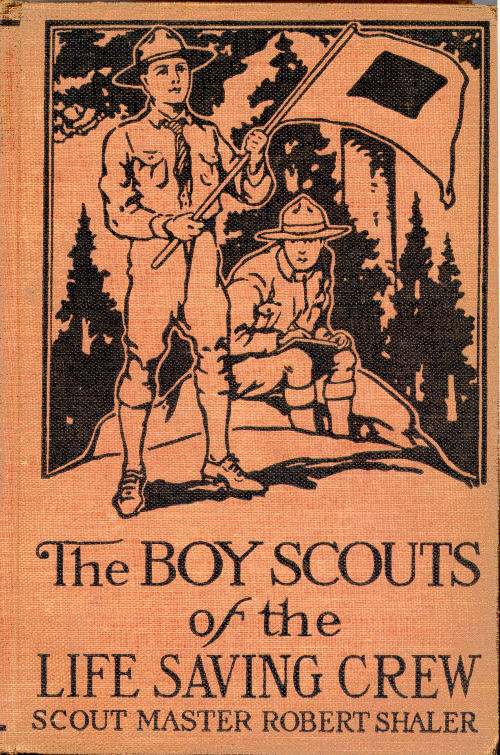
AUTHOR OF “BOY SCOUTS OF THE SIGNAL CORPS,” “BOY SCOUTS OF
PIONEER CAMP,” “BOY SCOUTS OF THE GEOLOGICAL SURVEY,” “BOY SCOUTS
ON PICKET DUTY,” “BOY SCOUTS OF THE FLYING SQUADRON,” “BOY SCOUTS
AND THE PRIZE PENNANT,” “BOY SCOUTS OF THE NAVAL RESERVE,” “BOY
SCOUTS IN THE SADDLE,” “BOY SCOUTS FOR CITY IMPROVEMENT,” ETC., ETC.
NEW YORK HURST & COMPANY
PUBLISHERS
Sterling Boy Scout Books
By Scout Master Robert Shaler
Bound in clothTen titles
1 Boy Scouts of the Signal Corps.
2 Boy Scouts of Pioneer Camp.
3 Boy Scouts of the Geological Survey.
4 Boy Scouts of the Life Saving Crew.
5 Boy Scouts on Picket Duty.
6 Boy Scouts of the Flying Squadron.
7 Boy Scouts and the Prize Pennant.
8 Boy Scouts of the Naval Reserve.
9 Boy Scouts in the Saddle.
10 Boy Scouts for City Improvement.
You can purchase any of the above books at
the price you paid for this one, or the publishers
will send any book, postpaid, upon receipt of 25c.
HURST & CO., Publishers
432 Fourth Avenue, New York
Copyright, 1914, by Hurst & Company.
CONTENTS — The Boy Scouts of the Life Saving Crew.
“We’re almost there now,” said Alec Sands
as he steered the big touring car around a
curve in the road and out upon a long stretch
of hard, smooth, well-oiled clay. “Unless I’m
mistaken, that white church spire over there
beyond the fringe of palm trees marks the end
of our journey. I really didn’t know it was
going to be such a long run, or I’d have told
Bronson to send some lunch with us.”
“Wish you had!” Chester Brownell exclaimed,
leaning back in his seat in the tonneau.
“I’m almost starved!”
6
“I reckon we can make up for it to-night,”
added Billy Worth, who sat in front beside
Alec. “This Santario is quite a place, isn’t
it, Alec?”
“I think so,” answered young Sands. “From
what I’ve heard, I guess it’s a sizable town
now, though only a few years ago it was a
mere village inhabited by fishermen. Someone
discovered that the soil two miles inland
from the village was suited for raising oranges,
so he bought up several acres and planted an
orange grove. Since then others have followed
the leader, and now the village has grown so
large that the oldest inhabitant can hardly
recognize it.”
7
The three young tourists who were speeding
along at a good thirty miles an hour, were all
members of a troop of Boy Scouts whose
summer headquarters were located at Pioneer
Lake, “up North.” Alec Sands, the captain of
the Otter patrol, and Billy Worth, a member
of the Wolf patrol, had been prominent in
many of the contests held at Pioneer Camp.
Chester Brownell of the Otters was less well
known to the boys of the troop, but Alec had
come to know him at Hilltop School and had
found in him a promising athlete.
At this time the boys were far away from
the scene of their earlier adventures, being
on a visit at the winter residence of Alec’s parents—Palmdune,
a splendid mansion near a
picturesque old town on the Florida seacoast.
It was early spring and the weather had
not yet begun to be oppressively warm. Indeed,
the nights were still cold with frequent
threats of frost,—that dread enemy of the
budding orange groves. Alternating with
days and nights of mild stillness were intervals
of semi-storm, of rough winds that swept
the low-lying shore and menaced coastwise
shipping with the danger of being blown landward
upon the numerous sandbars and keys.
8
Like other towns and villages in that part
of the country, Santario had thrived all winter
on the influx of wealthy Northerners who were
accustomed to spend “the worst months of the
year” there. And now these pleasant resorts
were just beginning to slide back into their
usual grooves of inactivity, and to have the
quiet, unruffled appearance which was most
familiar though not most welcome to their
oldest inhabitants. Claynor, the nearest railway
station to Santario, was the town where
the three boys had spent that day. The place
was rich with interesting historical associations,
and they had enjoyed visiting it. Its
little museum contained many relics not only
of the earliest Spanish colonists but also of the
later wars with the Seminole Indians under
their great chief Osceola. At present the boys
were returning, late in the afternoon, to Palmdune,
where Alec hoped to have another guest
for the Easter vacation.
9
His expected guest, who had not yet arrived,
was Hugh Hardin, formerly leader of
the Wolf patrol at Pioneer Camp. After some
hesitation on Hugh’s part, owing to the fact
that he and Alec had not always been on the
best of terms in the past, Hugh had persuaded
himself that to decline Alec’s invitation without
sufficient reason would be both ungracious
and unfriendly, and so he had accepted it in
the same spirit with which it was given. As
a matter of fact, Hugh had done so gladly,
for he had a genuine liking and respect for his
rival, Alec Sands, and he had usually been the
first to regret and to make amends for their
previous unpleasantness. On his journey
down South, Hugh was even now eagerly looking
forward to the visit, while at the same time
his three friends, bowling along the highway
in the big touring car, were discussing his arrival.
10
“If we take the car out again to-morrow to
drive over to Claynor to meet Hugh, we’ll take
some grub with us,—you can bet on that!”
said Alec. “I thought there was some kind
of an inn at Claynor, but we found only that
clam-and-oyster parlor!”
“Gee, what a joint!” exclaimed Billy in an
aggrieved tone. “Bucking broncos wouldn’t
have dragged me into it!”
“Me, neither,” Chester added with ungrammatical
emphasis.
“I had a letter from camp to-day—from
Buck Winter,” he continued. “We left so early
I didn’t have time to show it to you fellows
before we started. Buck says Tom Sherwood
has been elected temporary leader of our patrol,
Alec. Hope he’ll be as good a one as
you were, old scout.”
“Thanks!” responded Alec, laughing. “How
much do you want for handing me that one,
Chet? Can you change five cents?”
“At this moment,” replied Chester, “I
couldn’t change a—Hello! look at that!”
11
As he uttered the words, he leaned forward,
pointing over Billy’s shoulder. Alec, after one
quick glance, threw out the clutch and jammed
on the emergency brake with such suddenness
that Chester, caught unprepared, tumbled
back upon the seat. Before he had recovered
from this jolt, he saw Alec and Billy jump out
of the auto and run swiftly through the tall
grass toward a railway track close to the road.
Leaping from the car he followed them at
full speed.
The track at this point made a long curve
preparatory to crossing a narrow trestle over
an inlet of the ocean, scarcely a hundred yards
distant from the spot where they had left the
car. Not quite halfway across the trestle, a
girl, carrying a basket, was advancing, hurrying
over the ties, and behind her trotted a big
shaggy dog. The three lads had sprinted forward
over a sandy embankment toward the
track because they heard, in the distance behind
the girl, the sudden shrill whistle of a
locomotive and the rumble of an approaching
train.
12
The girl also heard it, glanced back over
her shoulder, and with a shriek of terror, flung
the basket aside and fled onward as fast as she
could run.
As the young Scouts dashed to the rescue,
the ominous rumbling grew louder and louder;
the rails began to hum; then, with another
warning blast of the whistle, the freight train
appeared around the bend and thundered
toward the long bridge.
Billy was the first to reach the end of the
trestle toward which the girl was coming rapidly.
Running forward, leaping from one tie
to another, he realized how precarious was the
footing, how easily one misstep might hurl
anyone into the depths below. Between the
ties underfoot he caught glimpses of the flashing
green water swirling around the upright
piles as the tide flowed in, and, looking up, he
could see the strained, desperate expression on
the girl’s white face.
13
“Don’t lose your nerve!” he called to her.
“You’ll get across all right.” He was not so
confident as he appeared to be, but he knew
instinctively that she needed encouragement.
“Come on, come on; but take care!” he shouted.
“We’re going to flag that train.”
Alec was close at his heels. Stripping off
his coat and waving it frantically, he overtook
Billy just as young Worth, bounding forward,
almost collided with the girl and caught
her outstretched hands in his own. Some little
distance behind them, Chester stood at the
end of the trestle, gazing with horror-stricken
eyes at his friends and wondering what was
the best thing he could do at this crisis.
“Oh!” he groaned despairingly. “They’ll
never stop it! They’ll all be killed!”
14
Without waiting to see what progress Billy
and the girl were making as they turned and
ran, Alec bounded forward for several yards,
and stood in the middle of the track until the
train was almost upon him. Then, with quick
decision, he leaped to one side and flung himself
down on the ground.
The train passed him amid a whirl of dust
and sand and small stones, and in another
minute it was out upon the bridge. Car after
car thundered past, with a deafening rumble
of wheels. There was a sudden shriek and a
jar of the brakes being applied, but before the
engine had come to a standstill it had almost
crossed the trestle.
Alec sprang to his feet before the train
stopped. He looked wildly around and back to
the place where he had last seen Billy and the
girl. They had disappeared!
15
“What has happened?” he wondered, in a
stupor of dread. “Did the train hit them, or
did they jump off the trestle into the water? I
must go back and find out! Oh, there’s Chester
at the other end of the bridge. He’s waving
his arms and shouting.”
Alec wheeled and ran back swiftly down the
track and out on the trestle. The train blocked
his way, but he climbed up a small iron ladder
at the rear of the last car, ran along the
roofs of the cars, and dropped to the ground
just behind the tender, on the left side of the
track. There, stretched out flat on one of the
ties, he peered over, and his eyes met those
of Billy Worth, full of the strain of waiting,
upturned to his face.
With one arm around the girl, whose arms
clung about his neck, and the other flung over
one of the trestle rods under the track, Billy
hung there straight downward over the water
fully twenty feet below. Alec saw that Billy’s
grip was weakening and that there was no
time to lose.
16
Swiftly he twined his legs around the tie
and lowered his body as far as he could. Then
he stretched out his arms; but it was not
enough; he could not reach the girl.
17
CHAPTER II. THE RESCUE.
“Can you lift her up a little, Billy?” he
asked in a low voice.
“I’m afraid to,” Billy whispered brokenly.
“If I move, I’ll—I’ll lose my—grip.”
“Drop, then! Drop into the water, both of
you!”
“Don’t dare—she can’t swim—current’s too
swift. Guess I’ll have to, though, or else——”
He felt the girl’s arms loosen. “Hang on to
me!” he said sternly.
“No, no!” cried the girl. “Let me go! I’ll
try—try to swim. And you can drop after me
and—and—pull me out! Let me go!”
“Wait!” shouted Alec. “Can you hold on a
minute longer, Billy? There’s someone coming!”
18
Then came the sound of someone running
over the ties, and Alec gave a little gasp of
relief.
“Is that you, Chet?” he asked, without looking
up or turning his head.
“Engineer,” answered a gruff but tremulous
voice. “Here, let me help you.”
“Take hold of my feet, then,” Alec replied.
“Lower me down another six inches so that I
can reach them. Quick, now!”
The man obeyed promptly. While he was
speaking, Alec had slackened his hold with his
legs, and the engineer lost not a minute in
catching his ankles in a firm grip. The next
moment Alec held the girl in his arms, and he
managed, by a great effort, to pass her to
Chester, who had just run up to help.
“Now, catch hold again,” he said to the engineer
as he leaned over the edge once more.
“Get a good grip this time; Billy’s no lightweight.”
19
“Hi! what are you going to do?” yelled
Chester, dropping down beside him. “Alec, let
me take a turn! I can pull Billy up if——”
“Never mind me; I can climb up alone,”
called Billy in a faint voice from under the
track. And he swung sidewise until he could
brace his feet against a cross-pile.
Slowly, with aching muscles, he drew his
body upward; inch by inch he climbed, grasping
the projecting ends of the ties. The strain
on his tired arms was tremendous, his shoulders
felt numb, his hands clutched wildly—slipped—and
with a gasp, he lost his hold, and
fell down, down, into the flowing tide.
20
A tremendous splash sent a shower of spray
up into the faces of his friends. Blinking, they
saw him sink, saw the clear green water close
over his head, and after waiting breathlessly
for several minutes, saw him bob up to the surface
and strike out for the nearest point of
land. They knew he could swim like a seal,
but they feared that, weakened by the strain he
had just undergone, he might fail to make any
headway against the current. As it was, they
saw that he would be swept beyond the point
toward which he was struggling into a broader
space of open water that looked very dark and
deep.
Chester was just about to fling off his coat
and shoes on an impulse to dive to the assistance
of his friend, when he was checked by an
outcry from the girl. Plucky and alert, she
had quickly recovered her presence of mind,
and now she ran along past the engine to the
end of the bridge, calling:
“Carlo! Here, Carlo! Come here, boy!”
21
A deep-throated bark greeted her, and her
companion and protector, the big dog, dashed
to meet her, wagging his tail and showing
every sign of canine joy at seeing her again.
But without pausing to respond to his enthusiasm,
she sped along the shore of the inlet
until she came opposite where Billy was now
floating with the tide, wisely resting before he
continued his exertions.
Pointing toward him, the girl urged Carlo
into the water. “Get him, Carlo, good boy!
Go on! Go on! Get him!”
And the faithful animal seemed to understand
at once what was required; at any rate,
he plunged boldly into the water and paddled
out straight as an arrow toward Billy.
Giving a cheer, Alec and Chester, followed
by the trainman, ran over to the spot where
the girl was standing. Meanwhile, Carlo had
come abreast of the swimmer, who, seeing him,
had turned over and was resuming his strokes.
Billy was too tired to disdain the noble dog’s
assistance, so he put out one hand and grasped
Carlo’s collar. Using his other arm and his
legs, he helped the big dog to tow him back
to the embankment.
22
It was slow work, and the tidal current was
merciless, but at last they reached shallower
water where Billy could touch bottom. Releasing
the dog, he waded to the shore and
threw himself on the coarse grass.
“Billy, old scout, you’re a hero!” exclaimed
Alec, bending over his breathless comrade.
“You bet he is, boys!” agreed the engineer.
“Anything pluckier or cooler than the way he
dropped over the side of the trestle, with the
girl hanging onto him for dear life,—when
they thought they wouldn’t be able to get ahead
of the train,—I never saw in all my born days!
And I’ve seen a good many nervy stunts, too,—including
your hand-me-up rescue of the
girl,” he added turning to Alec, whose face,
pale with anxiety, flushed crimson at these
words of praise.
“Are you all right, Billy Wolf?” queried
Chester, alarmed at Billy’s silence.
23
“Yes, I’ll be—all right—in a few—minutes,”
panted Billy, raising his head. As he
did so, his gaze met that of the girl, and he
saw that her dark blue eyes were filled with
tears. “Oh, there you are!” he observed, smiling.
“Not hurt, are you?”
“Not at all, thanks to you!” she answered,
a little sob in her voice. “I—I tried to thank
your friend, a few minutes ago, but I haven’t
thanked you for saving——”
“Oh, that’s all right!” interposed Billy.
“We’re only too glad that we happened to
come along in time. Aren’t we, Alec?”
“Of course we are!” assented the other rescuer
warmly. He patted Carlo’s fine head.
“He’s a great old dog, isn’t he? Whew! Stop
shaking water all over us, Carlo! Can’t you
see Billy is wet enough already?”
“Down, Carlo!” commanded the young girl.
Carlo bounded away, barking joyously.
24
Billy stood up, dripping wet and shivering
slightly, in spite of the warm afternoon sunlight.
His hair was matted with sticky salt
water, his clothes were soiled with mud and
sand, but he laughed as he shook himself.
Chester and Alec began to pat and thump him
vigorously to quicken circulation.
“Take a few sprints up and down the bank,”
advised Chester. “You’re chilled, Billy; your
teeth are chattering.”
“Nonsense!” laughed Billy. “I’m all right.”
As if to prove this assertion, he began a
wrestling match with Carlo, who had come
frisking up to him. But this sport was interrupted
by the departure of the engineer.
“Well, I must be getting up steam again,”
said the man. “Good-by, all!”
After shaking hands all around, he walked
rapidly back to his engine, and soon the big
freight was on its way again, the various
trainmen waving their hands in farewell.
25
“I must be on my way, too,” the girl said,
breaking an awkward little pause which followed
the last echo of the vanishing train. “I
was going over to Santario, to see my father.
He is the keeper of the Life Saving Station
at Red Key,” she explained. “His name is
Anderson,—Peter Anderson. Mine is Ruth.”
“We’re Boy Scouts,” replied Alec, feeling
that some introduction was due. “This chap
is William Worth,—we call him Billy, for
short,—this is Chester Brownell, and I’m Alec
Sands. We are on our way to Santario, too;
we left our machine over yonder. If you like,
we’ll be glad to give you a ride. Will you
come? It’s getting late, the sun’s going down,
and you’ll never walk all the way to Santario
before dusk. Better come with us.”
His suggestion was offered in frank kindness
and Ruth Anderson was quick to appreciate
it.
26
“It’s very good of you to invite me,” she
said. “Thank you very much! I’d love a ride.
You see, I’ve never been in an automobile.
I’ve been in a lifeboat, though; but that’s not
exciting,—unless there’s a storm!”
“That’s something we’ve never done—gone
out in a lifeboat,” Chester remarked. “I visited
a station on the coast of Maine two summers
ago, but I didn’t see the crew at work.”
“I’ve never even seen a Life Saving Station,”
said Billy.
“I have it—a great idea!” exclaimed Alec.
“Some day, soon after Hugh gets here, we’ll
motor down to Red Key and——”
Ruth interrupted him with a silvery laugh.
“Oh, that will be fine!” she cried gaily. “Dad
will be so glad to see you-all and to thank
you for all you’ve done for me to-day. And
I’m sure you’ll like the crew over at Red Key;
they’re the nicest, kindest, bravest fellows in
the world! And they’ll like you, too; I know
they will!”
27
CHAPTER III. COMING EVENTS.
Ruth’s spirits, considering the shock and excitement
which she had experienced scarcely
an hour ago, seemed to have risen wonderfully.
And somehow her light-hearted gaiety
was soon felt by the three courageous young
Scouts who had shared her danger. As they
all walked over to the waiting auto, chattering
and laughing, even Billy forgot his sorry
plight, though he was still “soaked and sticky,”
as he said jocosely. Alec went to find his coat
which he had cast aside, and, returning with
it presently, he made Billy remove his wet one
and put on the dry garment as well as the dust-robe
which lay folded upon the seat in the
tonneau.
28
“I’ll look like an Indian with a blanket,”
said Billy, laughing.
“Never mind; please put it around you
tight—like this,” urged Ruth, and forthwith
she wrapped it shawl-wise around Billy, who
immediately ceased to demur.
She was about to spring into the car, when
she paused, one foot on the running board,
and looked questioningly at Alec.
“Oh, I almost forgot poor Carlo!” she exclaimed,
struck by a sudden misgiving. “What
can we do with him? He can’t run all the way
and keep up with us, can he?”
“Not much!” was Alec’s emphatic reply.
“He’s going to ride with us. There’s plenty
of room in the car.”
“But he’s dripping wet!”
“No matter. In he goes! Nothing’s too
good for old Carlo! Now you and Billy jump
in and take the rear seat, and make him sit
on the floor.”
29
They obeyed without more ado, though some
persuasion was required to make Carlo get
into the car and lie down at their feet. He
showed a decided preference for jumping up
on the seat between Ruth and Billy, and once
there, for shaking himself vigorously. Billy
good-humoredly protested that he was wet
enough, and at last Carlo took the hint to
subside.
Chester cranked the machine, sprang in beside
Alec, and they were off, bowling over the
long smooth road at a rate that defied the
rural speed limits.
30
Alec was an excellent chauffeur, and he handled
his big car with skill and assurance.
There was very little traffic on the road at
this time of day, so he had to look out only for
an occasional mule-drawn market wagon
driven by a negro in ragged blue “jeans,” or
now and then a swarthy, smiling pedestrian
who waved his hat and called out some jolly
greeting, as they flashed by. Ruth was delighted
with the ride. When they had gone
two or three miles beyond a small settlement
near the coast, she asked Alec to drive slower
so that she might point out to him some fine
fishing grounds between the low-lying keys.
“Dad said there is always good fishing out
yonder,” she told him, “and he ought to know,
because he’s very familiar with the shore all
the way from Red Key to Santario. You see,
he used to be one of the regular beach patrol
before he was made captain of the Life Saving
Station.”
“Is that so?” responded Billy, with interest.
“I reckon he could tell us some great yarns
about his experiences.”
“Yes, indeed. I’ll ask him to,” promised
Ruth, “when you-all come over to Red Key and
see the station some day.”
“We’ll do that as soon as Hugh comes,”
Alec said, pleased with the suggestion.
31
“D’you think we could manage to put in a
day or two fishing?” ventured Chester, whose
enthusiasm for all kinds of water sports was
unbounded.
“Yes, I guess so,” answered Alec.
“Are you boys all Scouts?” Ruth asked after
a few minutes, during which she had listened
attentively to reminiscences of their fishing
and canoeing trips at Pioneer Camp. And on
being assured that they were, she continued:
“My brother is, too; he belongs to Florida
Troop No.—I forget the troop number, but
anyway it’s the Bear patrol. They had a camp
near Okechobee last summer.”
“Where are they now?”
“They’re going to meet at Claynor for a
week or two, and then go on an exploration of
the Everglades,” said Ruth. “Perhaps my
brother and you-all will get acquainted one of
these days; and that would be fine!”
32
“What’s your brother’s name?” asked
Chester.
“Marcus,” answered the girl; “but everybody
calls him Mark.”
“We’d be glad to know him, of course,” said
Alec, politely; and Billy promptly added, “Sure
thing, we would.”
Talking thus, they arrived at a place called
Five Corners from the fact that it was the
meeting point of five roads, or rather, the
point where two other roads cut into the main
highway. Ruth then suggested that they
should set her down, for by taking one of the
roads, she could reach Red Key within an
hour, while they could continue their journey
to Santario. But Alec would not consent to
this suggestion, and he turned the car down
the road leading to the little village that clustered
around the life saving station.
33
Arrived there, Ruth introduced the boys to
her father, who thanked them warmly for
their bravery and invited them to visit the
station early in the following week.
“The weather is still sort o’ uncertain at
this time o’ year, and we may have storms
almost any day,” said Peter Anderson. “Usually
they don’t amount to much along this
coast, but you never can tell. Anyway, come
over when you can.”
“We will, thanks,” Alec replied; and after
a cordial farewell, the boys drove away. An
hour later they were at Palmdune, where their
story had a sympathetic hearing and they were
treated to a bountiful supper before they went
to bed. Billy retired somewhat earlier than
the others, yielding to Mrs. Sands’ advice. He
really was more tired than the rest, and, furthermore,
he wanted to write a letter home.
34
When Alec and Chester went up to the
former’s room, which they occupied together,—Billy
was to share the adjoining room with
Hugh, later,—they were not at all sleepy, and
they continued their animated discussion of
plans for the next week. Even after he put
out the light and jumped into bed, Alec continued
talking, until a soft snore from the
other side of the room showed him that Chester
had already fallen asleep. He soon followed
the example, but his mind was not idle, for he
dreamed that he had gone to sea in a big
schooner, and was sailing over the blue ocean.
In his dream, the captain of the schooner
was talking to him and telling him what a fine
sailor he had become. Presently he invited
Alec to breakfast with him and handed the
young mariner a plate of hot buttered toast
and the fin of a shark fried in oil. When Alec
had eaten this, the captain told him to go up
on deck and see what the weather was, for the
sea had begun to be rough and the ship to
pitch and roll in the trough of the waves. Alec
did so, and to his astonishment he found the
foamy seas tossing and roaring and the officers
shouting orders to the men to take in sail.
35
Presently there came a terrific crash, the
masts went by the board, the waves dashed
over the ship, and Alec found himself tumbling
among huge breakers, until, almost in an
instant, he was thrown upon a beach where he
lay helpless, unable to crawl out of the way
of the angry waters. Every moment they
threatened to carry him seaward again. In
vain he tried to work his way up the sand dunes
with his arms and legs. Presently down he
came—to find himself sprawling on the floor!
“What’s the matter?” exclaimed Chester,
awakened by the noise. He sat up in his bed,
looking around in sleepy bewilderment. “What
made all that row?”
“I fell out of bed!” answered Alec dolefully.
“I dreamed I was shipwrecked.”
36
“I’m glad you’re not,” chuckled Chester.
“Get into bed again,—and for pity’s sake
dream of something else.”
Feeling decidedly foolish, Alec, without a
word, meekly did as his friend advised.
37
CHAPTER IV. PLANS AND PROJECTS.
The next morning was dull and foggy with
a suspicion of a wet drizzle in the air. Nevertheless,
the boys were up early, filled with eager
anticipation of the good times in store. Had
not Mr. Sands promised to announce that very
day the plans he had made for their recreation?
Up at Pioneer Camp in the northern woods
they were accustomed to enjoy a plunge in the
lake before breakfast. So now, instead of
dressing, they donned bathing suits, crept
noiselessly downstairs and out on the lawn,
and raced to the beach, which was only a short
distance from the border of Mr. Sands’ estate.
Arriving there, they found it deserted, although
footprints in the sand showed them
that a surfman from the Life Saving Station,
two miles further up the shore, had patroled
the beach during the night.
38
Overhead, huge, white, jagged clouds moved
slowly across the sky. Their close ranks were
broken now and then by shafts of sunlight that
pierced through the fog and struck steely-blue
gleams from the undulating waves. A few
white-caps dotted the ocean, and the heavy
swells rolled ponderously toward the shore,
breaking into cavernous surf that sounded like
far-distant thunder. To Billy Worth, inland
born and bred, the ocean seemed a source of
endless wonder; to Alec and Chester, it had
become a friendly element, and they proved
their familiarity with it by wading boldly in
and diving straight through the green breakers.
“Come on, Billy!” yelled Chester, bobbing
up on the crest of a wave. “The water’s
fi——”
39
No sooner were the words sputtered forth
than Chester was lifted bodily, rolled over and
over, and flung with a thump upon the beach,
almost at Billy’s feet. A wave had broken
unexpectedly and had tossed him around as
though he were a bit of driftwood. He staggered
up, his eyes and mouth full of briny sand,
and rubbed one shoulder gingerly.
“Where am I?” he inquired. “I must have
turned a dozen complete somersaults! Gee!
My shoulder’s out of joint—at least, it feels
so! Why don’t you go in, Billy?”
“I’m going,” replied Billy, doubling up with
laughter. “Look at Alec out there! He’s got
tangled up with a bunch of seaweed, his arms
and legs are covered with the slimy stuff!
Seems to me, it’s more fun watching you fellows;
but here goes, anyway!”
40
He bounded forward and dived through the
green arch of a comber with a skill and daring
that rivaled the best feats of his companions.
Chester followed him as soon as he could get
the sand out of his eyes. For only a short
while the three swimmers disported themselves
in the waves, for they were sensible enough
to go ashore before the exhilaration of the
exercise had even begun to wear off.
As they returned to the house, they noticed
one of the Revenue Marine Bureau cutters
cruising along the shore not far out; and Alec
explained that the cutters made regular trips
up and down the coast during winter and early
spring, to warn or assist imperiled vessels.
“I didn’t know they came as far south as
this,” said Chester.
“Oh, yes; but not so often as they do along
our northern coasts,” Alec rejoined.
After breakfast, Mr. Sands called the three
boys out on the broad veranda, and they all
ensconced themselves in comfortable wicker
chairs.
41
“Well, what have you got to say for yourself,
Dad?” inquired Alec. “What’s the good
word?”
His father looked at him and laughed.
“I suppose you mean you’re waiting to know
what I intend to do with three lively lads who
are making themselves too numerous to mention?
Am I right?”
“Yes, since you put it that way. If you
want to get rid of us, how are you going to do
it?”
“Oh, there are plenty of ways. For instance,
I might hustle you back to school before this
quite unnecessary vacation is over,” said Mr.
Sands, who was fond of teazing and joking.
“Not much! Not if we know it!” protested
Alec, glancing at Billy and Chester, whose
faces were twisted into broad grins. “Besides,
Hugh is coming to-day, and it wouldn’t be
decent of you, Dad, to punish us all like that.
What have we done, anyway? We’ve been
good and——”
42
Here Chester gave way to laughter.
“You see!” cried Alec’s father. “That was
too much for Chester! He knows some secret
which I’ll have to worm out of him before I’ll
commit myself to any program.”
“No, sir, not guilty!” declared Chester.
“On the level?”
“On the level,” solemnly echoed Chester.
“All right, then. What would you all say
to a trip down the coast?”
“A hunting and fishing trip?” Alec asked
eagerly.
“Yes, if you want to try any fishing. You
can’t hunt; it’s not the season, you know.”
“We wouldn’t want to, even if we could,”
his son replied on second thoughts. “But the
fishing would be great sport! That’s a bully
idea of yours, Dad! I’m keen for the trip!”
“How about you two?” Mr. Sands turned to
the others. “Does the plan strike your fancy?”
“It surely does!” was Billy’s prompt reply.
43
“Simply great!” added Chester.
“Good. Do you think Hugh will like it?”
“I’m sure he will,” Billy said. “Hugh’s the
boy for any sort of outing and adventure, sir,
and this one will be just the thing.”
“The ayes have it, then,” said Mr. Sands.
“Well, my plan is this: I’ve found out that I
can charter the small sloop Arrow, Lemuel
Vinton, owner and master,—you remember
him, Alec?—and engage his services as captain.
For crew, he’ll have you four boys and
a certain young man from my New York office
whom I’m sending over to Havana on business.
His name is Roy Norton; he’s a good sailor,
and one of the most sensible and likable young
men I’ve ever had the good fortune to know.
I’ll expect you boys to stand by him as your
leader on this trip, just as you would if he
were George Rawson or your scout master,
Denmead.”
“Is he a scout?” asked Alec.
44
“I believe so; anyway, he knows a lot about
scoutcraft, and he’s deeply interested in it.
He was delighted when I suggested his going
on this trip.”
“Aren’t you going too, Dad?”
“Sorry, I can’t. I’m obliged to go out to
Chicago next week. Business. But Norton’ll
manage you chaps better than I could; he
knows the ropes. He’ll go as far as Key West
with you. You’ll leave him there and come
back in the sloop, under strict sailing orders
from Captain Vinton. Mind you, I want each
one of you to give me his word to render
prompt and willing obedience to any instructions
you may receive, either from Norton or
from the captain.”
45
“We promise,” replied the three Scouts. To
himself Alec added: “Hope this man Norton
isn’t going to boss us around like four kids!
George Rawson and Chief Denmead never do
that. They never have to; a few words are
enough! Wonder what Norton’ll be like?”
Mr. Sands rose from his chair.
“What train is Hugh coming on?” he asked,
consulting his watch.
“Why, Dad! You know there’s only one a
day now arriving at Claynor. It’s due at
eleven-eighteen.”
“Well, you’d better be on the jump toward
the garage, if you’re going to drive the car over
to meet that train. You’ve only a little more
than an hour.”
“We’ll get there in time, all right,” said Alec.
“I wouldn’t miss meeting Hugh—not for a
lot! Come on, fellows.”
46
About an hour later the touring car drew
up at the platform of the station at Claynor,
and its three occupants alighted to seek shelter
from the clouds of dust that a stiff breeze was
blowing from the roads. With the exception
of the station agent and a few negro porters
asleep on a long bench, not a soul was in sight
near the little terminal. Across a small plaza,
where a few dusty palm trees swayed dejectedly
in the wind, could be seen a row of quaint
shops, an old Spanish church, and a moving-picture
theater; beyond this was a vista of the
main street of the town, with people coming
and going, to and fro, in a leisurely manner.
Presently, long after schedule time, the train
rolled up and came to a standstill. Almost the
first passenger to alight was a tall, slender,
yet well-developed young fellow, who rushed
forward at sight of his three comrades and
seized their hands.
“Hugh, old scout, we thought you’d never
get here!” exclaimed Alec.
“Your beastly old train’s late,” added Billy.
“I know it is—worse luck! Don’t blame
me! It wasn’t my fault. I couldn’t get here
sooner or I would, you may be sure.”
47
“Well, we’re mighty glad to see you,” said
Chester.
“Come on, Hugh! We’ve got a lot of news
to tell you on the way home!” exclaimed Alec.
“I’m all ears,” replied Hugh, laughing.
48
CHAPTER V. A VISIT OF INSPECTION.
Red Key, on which the Life Saving Station
stood, was virtually an island, half sand, half
coral reef. It was about one-quarter of a
mile in length, very irregular in its general formation,
and commanded an extensive sweep of
shore,—being one of a group of Keys which
are so small that they rarely appear on ordinary
maps. Yet it was a fairly important
post, one which required the presence of a
regular crew on duty at certain seasons of
the year.
49
In addition to the building which housed
two surfboats, a big chest full of signal flags,
another of rockets, a Lyle gun,—used for
shooting coils of rope out to a floundering ship,—and
a heavy cart on which the gun could be
mounted like a piece of artillery when it was
necessary to drag it to another part of the
shore,—in addition to this building, there was
a small cabin occupied by Peter Anderson, his
wife, their son Mark, and their young daughter
Ruth, who, however, spent most of the time
with her aunt at Santario. The men of the
crew were quartered in the loft of the main
building, above the beach apparatus, and they
took their meals at Anderson’s cabin.
From this loft a steep and narrow staircase
led up into a little tower which served as a
lookout, and, in case of emergency, as a lighthouse.
A big lamp, seldom lighted, hung on
chains fastened to the roof of the tower.
50
All these details the boys learned on their
first visit at the station, two days after Hugh’s
arrival. Anderson himself took them over the
boathouse and explained everything to them,
much to their satisfaction. Hugh was impressed
with the practical efficiency of such
equipment, as well as with the orderly readiness
for instant service which marked both the
apparatus and the men in charge. Chester admired
the boats which were built for contending
with the roughest surf, yet capable of being
easily managed by the brawny men who
wielded the heavy oars. Alec and Billy, glancing
at the surf guns or carronades and then at
the rows of life-preservers hung upon the
walls, expressed a wish that they might some
time have a chance to go out in those boats
to the rescue of a ship in distress, or, at least,
to see the crew in action, even if they should
not be permitted to join in the work.
51
“So you’d like to, eh?” said Anderson,
chuckling grimly. “Well, I’ll remember you
said so. You may have a chance one of these
days,—if there’s not too much danger. Anyway,
since you know all about signaling, you
might be able to work the flags and communicate
with a vessel in distress. Here’s a chart
showing the complete flag signal code. Just
run your eye over that.”
They did so, and their interest in his explanations
made them indifferent to the passing
of time. All the while the tide was rising
steadily and, before they realized it, they found
themselves cut off from the mainland by several
feet of rough water which covered the
connecting sandbar.
“Here’s a nice fix we’re in!” exclaimed Alec.
“What can we do now? Swim ashore?”
“It’s not much of a distance,” observed
Chester, measuring it with level gaze. “But
the water’s pretty rough, and there’s a strong
set toward the ocean. Better not risk it, I
say.”
It was quite unusual for Chester to be so
cautious. His companions looked at him in
surprise.
52
“I second Chester’s motion,” remarked Billy,
who had had quite enough strenuous swimming
for the present.
“You certainly are not going to try any fool
stunt like that, boys!” declared Anderson. “I
know what a current there is through that
inlet, and you couldn’t hire me to let you try
to swim it! Why, out there,”—he pointed to
the nearest extremity of the island,—“is what
is called a sea puss, a place where cross currents
meet and form a whirlpool at mid-tide.
It would swallow you up before you could
guess what had happened to you! No, sirree!
Here you’ll stay until low tide again. Do your
folks know you came over here to-day?”
“Oh, yes; I told them,” Alec answered.
“All right, then; they won’t be worried. If
you hadn’t told them, I’d get out a boat and
take you over, but——”
53
“We’d hate to give you that trouble,” said
Hugh. “Besides, we’re not a bit sorry to stay
here in this interesting place; that is, if you
don’t mind. We’re not in the way?”
“Not a bit of it! The boys’ll be glad of your
company. Sorry that Mark and Ruth are
away, though. You’ll be marooned here twelve
hours. That means all night, as it’s four
o’clock now. Well, never mind. I guess we
can put you up for the night, if you’re not too
particular, and the missus can rustle enough
grub for us all.”
“Thanks, ever so much,” said Alec and Billy,
almost in one breath, and Hugh added: “It’s
mighty good of you, Captain Anderson.” He
was much pleased with the hospitable captain’s
“us all.” It seemed to include all four boys
in a fellowship with the crew of life-savers,
for whom the young scouts had begun to feel
a genuine liking and respect.
54
“I guess you boys can find enough to do to
amuse yourselves till supper time,” the keeper
continued. “If you want to, you can go out
with the beach patrols.”
“Are they going over to the mainland?”
“No, not this afternoon. I guess it won’t be
necessary,” said Anderson, gazing up into the
leaden sky. “It’s pretty windy, to be sure; but
unless this wind shifts to the northeast, all
they’ll need to do, until dark, will be to cross
from one key to another, and so on down for
quite a long way.”
“How will they cross?”
“We keep a dory at each end of Red Key,
and there’s a small pontoon bridge connecting
that point out yonder with the Key just beyond
it. Beyond this end of Red Key”—he
turned around and pointed in a new direction—“the
Keys are so near together you can wade
from one to another, if you wear oilskins and
if the tide isn’t full. Run along now, and tell
Downs and Baley that you’d like to make the
beat with them.”
55
With a joyous whoop, showing that the captain’s
suggestion had met with instant favor,
the four scouts dashed away to find the men.
Jim Downs and Fred Baley—Surfman Four
and Six, respectively—were more than willing
to “tote the youngsters” with them, as Jim said.
They would not start out until sunset, so there
was an interval of impatient waiting. To
while away the time, Surfman Three, a genial
young Irishman named Larry Flynn, proposed
a series of track games between the crew and
their visitors. Larry prided himself on his
speed in the quarter-mile, and his mates—all
but Baley and Downs, who had to hold themselves
fresh for their coming duties—were
prompt to respond to the call of play.
56
In the good-natured competition that followed,
Alec captured the hundred-yard dash;
Hugh and Larry actually tied in the quarter-mile;
while Surfman Five, a tall, lanky, muscular
fellow named Culver, won the broad-jump,
in which all took part. Billy easily carried
off a hurdle race,—the improvised hurdles
were chairs with boards laid upon their backs,—and
Chester distinguished himself in the
high-jump, his chief rivals being Culver and
Hugh. When it came to the weights, the boys
had very little chance against the larger and
brawnier men, and Frank Bowers, Surfman
One, threw the hammer several feet farther
than anyone. He was as skilful with his left
hand as with his right.
“Frank is our best all-round athlete,” said
Surfman Two, addressing the captain.
“You’re a fairly husky one, yourself, Ed,”
returned Anderson, slapping him on the back.
“It isn’t everyone can pull stroke oar in a lifeboat
as steady and strong as you.”
57
The games over, all repaired to the loft,
where Mrs. Anderson helped them arrange “a
couple o’ shake-downs” for the visitors. Bowers
then took his station in the lookout, Hugh
and Chester remaining with him to hear his
interesting accounts of bygone wrecks and rescues,
while Alec and Billy studied maps and
charts downstairs. They were full of enthusiasm
for the proposed sailing trip down the
coast, and they wanted to become familiar with
the shore line, the bays, inlets, keys, etc.
About six o’clock the jangling of a metal
gong, which hung outside Mrs. Anderson’s
kitchen, summoned the crew to supper. True
to the scout principle of being helpful and useful
whenever they could, the four boys insisted
on helping Mrs. Anderson and her aged colored
cook serve the wholesome meal, though
she would fain have treated them as guests.
“It’s great fun!” they declared. “We’re
having the time of our lives!”
After supper they returned to the boathouse.
58
With the setting of the sun there was a lull
in the wind, but when Baley and Downs started
out, at seven o’clock, on their four hours’ tour
of duty, it had risen again and was blowing
with renewed force—but still not from the
northeast. Alec and Chester, the two Otters,
accompanied Baley; while the Wolves, Hugh
and Billy, went with Downs. Thus they set
forth in the long twilight, laughing and talking,
thrilled with this new adventure, unaware of
the danger and disaster that loomed large in
the immediate future.
59
CHAPTER VI. THE BEACH PATROLS.
“Wind’s blowing some,” observed Baley,
raising his voice so that he could be heard
above the angry snarl of the surf.
“Hope nothing hits the bar to-night,”
Downs answered.
Then the surfmen trudged off in opposite
directions, following the line of the wave-beaten
strand, each carrying on his back a
recording clock in a leather case, several candle-like
Coston lights, and a wooden handle.
60
With oilskins buttoned tightly and hip-boots
drawn up, Jim Downs and his youthful comrades
fought the stiff breeze on their watch.
Darkness was slow in coming, so they were not
yet in imminent peril from shifting sands,
driftwood, or tidal waves. Their mission was
a serious one, requiring alertness and keen observation.
Soon a sense of solemn responsibility
subdued even the high spirits of the boys,
finally checking the flow of their eager conversation
altogether.
“Isn’t that a ship ’way out there?” Hugh
asked at length, gazing at something which
seemed to be the dark bulk of a vessel in a sea
of foam.
“Guess it’s only a cloud,” answered Downs,
and Billy agreed with this opinion.
Hugh said nothing in contradiction, but he
was by no means convinced that the slowly
moving form was not that of a schooner. Indeed,
he believed he saw the faint lines of
spars and rigging.
61
After a few minutes Downs, to make sure,
looked again at the distant object. Then, taking
a Coston signal from his pocket and fitting
it to the handle, he struck the end on the sole
of his boot. Like a match it caught fire and
flared out through the mist, a dull red light.
He stood still, holding the torch above his head,
waiting for some answering signal from the
vessel,—if it were one, after all.
No signal was shown in response. Either
the ship was still too far out to catch sight
of the warning beacon, or none of her crew was
on deck at the moment. The glowing torch
sputtered and went out, and with a shrug of
his broad shoulders, Downs trudged on down
the beach.
“Come on, kids, we’ll set off another light
farther on,” he said. “If that’s really a ship,
give her a few minutes to watch for signals.”
In awed suspense, Hugh and Billy followed
him to the end of Red Key. Chained to a
post driven in the sand, they found a stout
dory with two pairs of oars.
“Pile in,” said Downs, “and sit tight. Hardin,
you take one pair of oars, I’ll take t’other,
and we’ll be over on the next key in a jiffy.”
62
The crossing was soon made. Billy tied the
boat to another post, while Downs again
lighted a signal. They were still near enough
the station to notify the lookout there of a
possible ship in distress, and in a few minutes
they caught the gleam of the big lamp in the
tower, shining out through the vapor blown
from the crests of the waves.
Still no sign from the object of their concern.
“Look!” cried Hugh. “It can’t be a cloud;
it hasn’t changed its shape, and——”
“And it seems to be comin’ nearer,” added
Downs, interrupting him quickly. “You’re
right, son; it’s a sailing vessel. She’s being
blown landward, but with good luck, she’ll
slip past the bar out there, and maybe she’ll
make for the lee o’ Turtle Island. Watch and
see. Come on,—but we won’t hike over the
pontoon to-night. I’ll go alone.”
63
Through long vigils in all kinds of weather,
the patrol learns every foot of his beat thoroughly,
and he is able to tell with reasonable
accuracy how and where a storm-tossed vessel
will be driven, or where a stranded one lies.
Downs was no exception to this rule, yet there
were times when, experienced surfman as he
was, he felt uncertain whether a ship was likely
to be forced over on the mainland beach, or
whether she would run aground on the outer
bar at the end of the keys. The latter situation
was the more to be dreaded, for the bar was
far beyond the reach of a line shot from shore.
Deciding to continue his beat, Downs left
the two scouts seated together on a mound of
sand and driftwood, and made his way alone
across the swaying, tossing pontoon.
“I’ll be back in about twenty minutes,” he
said, and he was as good as his word.
64
At the end of his beat he stopped to take a
watchkey attached to a post, and, inserting
it in the clock he carried, to record the time of
his visit at that spot. By this means is kept an
actual record of the movements of the patrol at
all times.
Returning to the place where he had left the
boys, he found them sitting in awed silence.
“No signs from the ship yet?” he shouted.
So quietly had he approached, and so thunderous
was the booming of the surf, Billy
and Hugh were startled at the sound of
Downs’s voice. Even had they not been staring
out to sea, waiting in suspense for the
ship’s signal, they would not have seen him
come up, so thick was the mist.
Billy gasped and jumped up. “What—what
are we going to do now?” he asked.
“Want to go back to the station?”
“No, no!” exclaimed Hugh, springing to
his feet. “We’re out here with you. We’ll
stick by you.”
“But I’m out here for four hours’ duty.
You don’t want to stick it out that long, son?”
65
“Yes, we do—if you don’t mind,” replied
Billy.
“Is there anything you’d rather have us do?”
asked Hugh, beginning to understand a kindly
hint in Jim Downs’s words. “We’d like to be
of real service, if we can.”
“Sure you can! Seeing as the weather’s so
thick, suppose you lads race back to the station
and report what we’ve seen. Then, if the
cap’n sends Larry out to join me, you can come
back with him. See?”
“All right,” they responded.
Again they climbed into the dory and rowed
back to Red Key. Jim waited to light another
torch, and the boys sped up to the boathouse,
where they informed the keeper, who already
knew of the ship, of what they had seen.
66
* * * * * * * *
Meanwhile Baley, with Alec and Chester,
had walked the opposite beat. From the first,
however, they felt sure that the distant object
against the murky horizon was a vessel. With
lighted Coston signal in hand, Baley pursued
his difficult way along the shore, buffeted by
the wind and drenched with flying spray. He
explained to the boys how the outer line of
sandbars, which in summer breaks the blue
ocean into sunny ripples and flashing white
caps, has power to churn the spring tides into
fury and to grip with a mighty hold the keel
of any vessel that is unlucky enough to be
driven on it.
As they trudged doggedly on, the wind
whipped through the beach grasses on the
dunes and spitefully swirled handfuls of cutting
sand into their faces. Fortunately, the
night was not cold, else they might have fared
worse. As it was, the two scouts rather enjoyed
the novel experience. They felt that
they were, for the time being, a part of Uncle
Sam’s coast guard,—members of a crew of
brave men whose vigilance and strength and
presence of mind save hundreds of lives and
valuable property every year.
67
They told Baley how they had learned to
become efficient signalers, and he heartily approved
of that branch of their training. Knowing
a lot about the Boy Scout organization,—for
his son was then a tenderfoot in a
Florida troop,—he was not surprised at the
amount of general “prepared-ness” which Alec
and Chester modestly displayed.
“You never can tell, my lads, just when and
where and how you’ll need to use what you’ve
learned,” he said pleasantly. “For instance:
Suppose we had to signal that ship out there
to-morrow morning, or even to-night, if she
gets into trouble? Could you do it?”
“Reckon we could, Mr. Baley,” replied Chester
quietly.
68
“If we have a chance, you’ll see,” was Alec’s
even more confident answer. The vague possibility
implied in Baley’s question gave him
an adventurous thrill.
When these three reached the end of their
beat and turned back toward the starting point,
they were surprised to meet Culver. He had
been sent out to keep watch with Baley, for
Keeper Anderson thought it best to have four
men on patrol that night. Larry Flynn had
been sent to reinforce Downs.
When the first watch was over, four other
surfmen took the places of those on duty; but
the boys were quite ready to seek the “shakedowns”
prepared for them. The long night
hours passed, and daylight crept slowly and
feebly across a cloudy sky and over a turbulent
sea.
69
CHAPTER VII. THE STRANDED SCHOONER.
“It’s lucky we went across to the mainland
last week for a fresh supply o’ provisions,”
remarked Larry Flynn at breakfast that morning.
“I’m as hungry as a tinker’s goat, and
them lads can stow away enough fodder for
a whole regiment of——”
His jocularity was interrupted by a laugh
from the men, and then by a strange and sinister
sound. Beneath the howl of the wind
could be heard a dull booming, so foreign to
anything the gale brought to their ears that
even Captain Anderson sprang from his seat
at table and ran to the window in alarm.
70
It was useless. The fog was so thick he
could not see further than twenty feet. The
gray light of day had dispelled the darkness,
but the vapor rolling in from the ocean obscured
even the crests of the surf. Culver and
Ed Strong joined him at the window, and all
three remained silent and motionless.
“Never dreamed she’d run aground this
morning,” Bowers muttered, rising from his
chair. “Everybody thought she’d slip past the
bar.”
“There was only a slim chance, after all,”
said Downs.
“Has the ship struck?” asked Hugh, tense
with excitement.
Keeper Anderson nodded.
“Seems so,” he replied gravely. “Get to
work, boys!”
All hurried out of the cabin.
Then came that which they feared to hear:
another dull report brought on the wings of
the wind and fog. All doubt now vanished
from the minds of the crew.
71
“Saints help ’em!” Larry exclaimed fervently,
when they entered the boathouse. He began
to pace the floor impatiently as he worked
like a hound in leash.
“Help who, sir?” asked Chester, following
him.
“The poor divils who are firin’ that ’ere gun,
knowin’ there’s some one near who can lind
’em a helpin’ hand.”
“Do you mean that there’s a wreck?” Alec
queried in a tone so low that none save Captain
Anderson heard him.
“Ay, son,” he answered. “The craft, whatever
she may be, has run aground on the bar.”
“How can you tell without seeing her, sir?”
Billy inquired, wishing that he knew enough
to lend a hand with the boat.
“In the first place, she must be there because
the wind brings us the sound of her signal
gun; she might be only half as far away
on the other side, and we couldn’t hear it so
loud.”
72
“It seems to me that any half-sober skipper
would have been more careful!” declared Culver
reproachfully, pulling on his oilskins. “He
would have clawed off shore at sunset last
night, if he knew his way.”
“What do you count on doing now?” asked
Hugh, always ready for action.
“We’re going to launch the boats!” roared
Anderson, and even before the words were
uttered every man, equipped for the venture,
sprang to his appointed task.
The crew ran the ever-ready surf boat
through the double doors of its house and
down an inclined plane to the beach. Resting
in a carriage provided with a pair of broad-tired
wheels, the staunch craft was hauled by
Powers and Flynn and the four boys through
the clinging sand and into the very teeth of
the wind to the point nearest the vessel.
“Can we go out with you?” yelled Hugh excitedly.
73
The surf rolled in with a deafening roar
that seemed to shake the ground, drowning
the sound of his voice. No one paid the slightest
attention to the eager lads; the men were
too busy and too deeply concerned with the
grave task ahead of them to heed, even had
they heard Hugh’s request. It was but natural
and right; and Hugh was surprised only
at his daring to ask such permission. Nevertheless,
he was keen to share the danger; he
longed to be one of the rescuers.
Each breaker curved high above the heads
of the men, and, receding, the undertow
sucked at their feet and tried to drag them
down. In such surf it seemed impossible to
launch a boat; yet with scarcely a word of
command, every man, knowing from long practice
his position and duties, took his station
beside the boat and, shoving it directly into
the surf, launched it, after a severe tussle.
Climbing aboard, each man took his place.
The captain, grasping a long steering oar in
his hands, stood at the stern.
74
It was then that Anderson, glancing at the
crew who were pulling steadily, saw that Alec
and Hugh, carried away by their eager excitement,
had leaped into the boat with the others
and were adding their strength to that of two
oarsmen.
A dark frown furrowed his brow, for he
could not approve of this intrusion; the next
moment, however, he gave a short, grim laugh.
“They’ll have to take their chance with the
rest of us,” he said to himself. “And, unless
the worst happens, nobody’ll ever know about
their doing this. Confound the plucky young
chumps, they ought to have stayed on shore;
but they’re as venturesome as my Mark!”
75
With a sweep of his oar, he kept the boat’s
head to the seas, skilfully avoiding the most
dangerous crests. To do this required
strength, coolness, and judgment; but Anderson
possessed all three qualities to a remarkable
degree. Instinctively, the two boys had
placed themselves so that the weight in the
boat was evenly balanced, and this fact the
steersman was quick to notice.
At last the first watery rampart was crossed.
Then, adapting their stroke to heavier swells,
the six stalwart rowers propelled their twenty-five-foot,
unsinkable boat at good speed, although
it seemed dreadfully slow to them, no
doubt. Hugh thought of the crew of the
stranded vessel, which was now plainly visible,
now hidden behind a veil of fog with every
gust of wind. Were they helpless and hopeless,
he wondered, or were they taking heart
at the assurance that help was coming?
All of a sudden, Anderson noticed that the
two boys had not donned cork jackets, such as
the men had buckled on.
76
“Here, you crazy scamps!” he shouted. “Put
on those lifebelts!” And he pointed to some
that were fastened to the inside of the boat.
They obeyed him at once, awed by his furious
tone. Perhaps they had done wrong, after
all, in coming out in the lifeboat! They began
to repent of their rashness; though they felt
no fear; it was an opportunity, an adventure
such as might never again come into their
lives. At any rate, it was too late for repentance!
There they were, rowing like mad with
all their strength and enthusiasm! If only
Captain Anderson would not be too angry with
them afterward when it was over!
Over! The adventure had only begun!
How would it end?
Once, indeed, a thought of his parents
flashed into Alec’s mind. He could imagine
his father’s wrath if this perilous escapade
should become known! But Hugh would never
tell, and as for himself—here a wave dashed
up over the thwart, drenching him in a fountain
of foam.
77
And now, when they were actually nearing
the vessel, an unforeseen mischance occurred.
Before the surfboat could reach her, she lurched
over the bar on a mightier wave, veered
halfway around, and drove directly toward
Turtle Island. The crew in the boat could do
nothing, and the few men aboard the schooner
were helpless. With straining eyes, the lifesavers
saw the vessel drift rapidly past them;
they even heard shouts and frantic yells from
the deck, and, in return, they shouted encouragement.
Climbing up into the rigging, the sailors,
eight in number, waited for their craft to strike
the beach. The surfmen, turning their boat,
put for shore again to get the apparatus
needed for the new situation.
78
CHAPTER VIII. THE RESCUE.
To load the surfboat with the crew of the
luckless vessel, when there was none too much
room for the oarsmen, and then to encounter
the heavy surf, would have shown great lack
of judgment on the part of the rescuers. It
was a method to be pursued only in case of
dire need. To reach the ship after it had
become stranded on the key shore or near it
was a much safer and surer method of saving
life for all concerned.
79
Rowing hard against the now outflowing
tide, yet helped by the wind, the lifesavers approached
the beach. With a rush their boat
rolled in on a giant wave and, no sooner had
the keel grated on the sand, than the crew,
including the two scouts, were out knee-deep
in the undertow dragging the boat up high
and dry. No one could deny that the boys
showed remarkable quickness in action and an
alert understanding of what had to be done.
“Get the beach wagon!” commanded Anderson.
Billy and Chester, who had hurried to the
spot where the surfboat landed, greeted their
scout comrades with a whoop of joy, envy
and relief. No time was lost. A minute later
the entire crew, some pulling, some steering,
dragged out the beach wagon: a light framework
supported by two broad-tired wheels, and
carrying a sand-anchor, which was like a huge
cross, in addition to other apparatus.
80
Over hummocks of sand, across pools of
water, in the face of wind and waves, they
ran, dragging the beach wagon along the key
to the place where the driven schooner had
run aground. It lay some distance out, and
was now lurching groggily from side to side.
Then, bringing the wagon to the nearest point
opposite the stranded hulk, the crew unloaded
their appliances.
“Hey there, lads!” shouted Anderson, “dig
a hole in the sand!”
Flynn tossed some shovels to the boys, and
at once they set to work with a will.
While this was being done, two men placed
a small bronze cannon in position and another
got out boxes containing small rope criss-crossed
on wooden pins set upright in the bottom.
These pins merely held the rope wound
in coils until it was ready to be used, when
board and pegs were removed.
81
Captain Anderson carried the free end of
this line, which was attached to a ring in the
end of a cylindrical projectile, over one shoulder;
over the other was slung a box of ammunition.
In a few minutes, aided by Baley
and Culver, he sighted the gun, aiming for
the outstretched yardarms of the schooner.
Long practice under various difficulties and in
all sorts of weather had taught him just how to
aim. As he pulled the lanyard, the gun spat
fire into the mist, and the long projectile sailed
off on its mission, its attached line whirring
out of the box, coil after coil. Baley and
Culver peered out over the breakers to see if
the keeper’s aim had been true.
At last the line stopped uncoiling, and Anderson
knew that the shot had landed somewhere.
Minutes of suspense passed. Nothing
happened. The rope spanned the tossing
waves, but no answering tugs conveyed messages
from the sailors to the waiting surfmen.
“What ails ’em?” muttered Larry Flynn impatiently
“Are they all dead or drunk or
have we——?”
“Shut up, Larry!” came the command.
“Ah, there she goes now!”
Hugh and Chester sprang forward.
82
“The line’s moving!” cried Chester.
“Quit hoppin’ around like a sand-flea!”
Larry admonished him severely. “Don’t make
so much noise! They can’t hear ye, boy.”
Indeed, as Chester had declared, the line began
to slip through Anderson’s fingers and
move seaward. Those on shore knew that it
had been found and that its use was understood;
that is, that this line carried out by the
projectile served merely to drag out a heavier
rope, on which was run a sort of trolley carrying
a breeches-buoy.
And now the eight mariners, securing the
line, made the end of the strong rope fast to
the mast well above the reach of the waves,
and the surfmen wound their end firmly around
the deeply buried sand-anchor. Wading out
a little way, Bowers placed an inverted V-shaped
crotch under the rope, holding it above
water on that end. When this had been done,
as much of the slack was taken up as possible,
and the vessel was connected with the beach by
a kind of suspension bridge.
83
Willing arms then hauled out the buoy along
that suspended line.
Presently they saw a sailor climb into the
stout canvas breeches of the buoy, and felt
the tug on the whip-line that told them the
rescue had begun. All together, with a will,
they pulled on the line. Carrying its human
burden, the buoy rolled along the hawser,
swinging in the wind, now and then dipping the
man in the crests of the waves.
“As long as the old tub holds together and
the masts stay upright, they’re safe,” muttered
Anderson, watching the first passenger on
this aerial railway.
“Do you think the waves will pound her to
pieces?” asked Alec, who stood beside the
keeper.
84
“Don’t know. Depends on how solid she’s
built. By the slab-sided! I can make out her
name now for the first time. Sun’s getting
stronger. It’s the Mary Jane,—I know her
cap’n. Look out there, Frank! He’s coming!
Catch him—easy now—that’s the way!”
The sailor, brought up with a thud against
the V-shaped support of the rope bridge,
scrambled out of the buoy and slid down on
the sand. Without stopping to gasp out his
thanks, he helped the surfmen send the buoy
swiftly back to the vessel, where another man
climbed into it.
Forward, then, and back again they hauled
the buoy, working like madmen to complete
their work.
“She’ll bust to pieces in ten minutes, ’pon
my word!” declared the fourth sailor to come
ashore. “The sea’s running high, and the infernal
old hulk’ll never weather the poundin’
she’s getting!”
“Make haste, then!” roared Anderson, and
his crew redoubled their efforts.
85
Two more sailors swung to safety ashore.
None too soon, for the sixth man had hardly
been dragged to the beach when the schooner’s
mast, unable to stand the buffeting of the
waves any longer, snapped at the middle and
toppled over into the sea, dragging with it a
tangled mass of rigging. Two sailors were
left on the deck of the Mary Jane.
But not for long. A mighty wave struck
the vessel’s side. They were washed off the
sloping deck, and soon were floundering in deep
water, clinging to the broken mast that was
being hauled toward shore. At last they
gained the land, and their rescuers were overwhelmed
with thanks.
86
Such breathless exclamations of gratitude,
such handshakes and hearty greetings! The
four boys stood aside, listening to the story of
the shipwreck, listening in a daze of wonderment,
in a silent thrill of pride because they
had shared in this memorable morning’s work.
Captain Anderson, even, was kind enough to
praise them for their work; and, in turn, they
thanked him for having allowed them to do
whatever they could to assist the regular crew.
In the midst of this rejoicing there was a
loud crash, and the abandoned Mary Jane’s
timbers yielded to the force of the waves.
Broken and bruised and buffeted, she keeled
over on the sandy reef, and the sullen ocean
surged over her again and again, pounding her
mercilessly.
87
CHAPTER IX. HOME AGAIN—AND AWAY.
Though the crew of the vessel was saved,
the surfmen’s work was not yet over. The
breeches-buoy had to be disentangled from the
broken mast, spars and ropes, and the other
apparatus had to be packed on the beach
wagon and returned to the station. All this
occupied some time. The hands of both sailors
and lifesavers were sore and slippery with
brine, the ropes were badly snarled, and the
wind and waves tore viciously at the tackle.
The task was completed at last, however, and
then all made their way to a small shanty or
refuge adjoining the boathouse. Here the
shipwrecked men were provided with dry clothing
and with food which they devoured ravenously.
88
“My stars! that grub looks good to little
Willie!” declared one of the sailors, hastily
climbing into dry flannels and a suit of overalls.
“Thank’ee, cap’n; I’ll take corned beef
an’ brown bread an’—an’ a swig o’ the hot
coffee that ye have handy. Here’s to ye all,
sir, with many thanks and a blessin’ on ye!”
All joined in the toast, and then made an onslaught
on the plain but bountiful repast set
before them.
One man, the captain of the ill-fated schooner,
dejectedly explained between huge mouthfuls
that they had been making for Santario,
to get provisions for a voyage to Key West.
The schooner’s rudder had broken on a reef,
and they had drifted for thirty-four hours
without food, each man filling “the aching
void” with nothing more substantial than
water.
89
While the process of refreshment was going
on, two patrols outside were continuing their
beat, watching for portions of the ship’s cargo
of bales of cotton to be washed ashore. Without
regard to the hardships already undergone,
these men, taking turns, remained on duty all
that stormy day.
Late in the afternoon the wind died down,
and at ebb tide the crew of the Mary Jane and
the four scouts took leave of their brave
friends.
“We’ll never forget this experience as long
as we live,” Hugh said as he grasped Keeper
Anderson’s hand. “It’s meant a lot to us and
has taught us more than we could ever learn
from books.”
“Well, well, guess that’s true, son,” replied
Anderson. “Perhaps I ought not to have let
you boys—but we won’t say anything more
about that, since there’s no harm done.”
90
“Hope we weren’t too much in the way,
sir,” said Billy and Chester, and Alec added
his word to the general chorus. Then, with a
parting invitation from the surfmen to come
again, they departed.
It was a long time before the boys were to
pay another visit to the Red Key Life Saving
Station, and when they did so, it was to be
under very different conditions, They saw it
next at midsummer when the great ocean was
calm, when gentle breezes filled the sails of
vessels passing along the horizon, and when
the sun shone benignly over land and sea.
Meanwhile, soon after their arrival at Palmdune,
and in the midst of preparations for their
cruise on the Arrow, they wrote a joint letter
to Keeper Anderson and his crew thanking
him again for his kindness to them. To this
letter Mr. Sands added a pair of field-glasses
for each of the crew,—even better than those
they already possessed,—and a huge packing-case
full of books and magazines.
91
Roy Norton arrived on the day following
the boys’ return. He had read newspaper accounts
of the unusual storm along the coast,
and he was much interested in hearing all about
the adventures of the youthful lifesavers.
From the first, the boys liked Norton; in
many ways he reminded them of George Rawson,
their assistant scout master at Pioneer
Camp. Unlike Rawson, however, who was tall
and lean and sinewy, Norton was a young man
of medium height, rather thick-set and muscular,
yet agile and quick in action. He, too, possessed
an apparently inexhaustible fund of
energy and good humor.
Captain Lemuel Vinton, who met them one
morning on the main fishing dock at Santario,
proved to be a stout, grizzled, salt water veteran
of fifty years or more. He greeted them
with gruff cordiality and escorted them aboard
the Arrow, where he assigned them their sleeping
quarters.
92
With him, as their future guide through the
Everglades, was Wastanugee, a Seminole Indian
who answered to the more convenient
nick-name of Dave. He was much given to
living among the whites, and, while it was
clear that he liked civilized ways and also hard
dollars, or “chalks,” as the Indians term them,
it soon became evident,—toward the end of the
first day’s cruise,—that he disliked and dreaded
“the big salt,” as he called the ocean.
“Uh! Bad medicine!” he grunted. “Bad
weather. Dave better stay home. Go home,
anyhow, when get Big Cypress Harbor. Incah!”
Having baited the boys’ hooks, he settled
himself resignedly within the folds of his blanket,
stretched out his trousered legs and moccasined
feet, and yawned loudly.
“Best kind of fishing weather, this,” said
Alec. “Tarpon are bound to bite now, aren’t
they, Captain?”
Captain Vinton shook his head slowly.
93
“You can’t never tell ’bout tarpon,” he answered.
“Sometimes they will, then ag’in they
won’t. Mostly they’ll do as they durn please,
which is likely to be jest w’at you don’t want
’em to do. One thing, though: we’re goin’ to
have wuss weather afore we have better, mark
my words.”
Hearing this, Dave grunted dolefully.
Vinton’s remarks about the tarpon seemed
to be verified, for the boys had such poor luck
in getting bites that presently they made their
lines fast by wedging the poles under the
thwarts and turned their attention to a faint
blur of smoke rising far out against the brilliant
blue horizon.
“Wonder if Cap’n Bego really did git out?”
said Vinton, as if communing with himself.
But Norton overhead the query. “Who’s
Captain Bego?” he inquired casually.
94
“Oh, he’s a greaser who’s been havin’ some
trouble with a United States revenue cutter
from Havana. Cutter’s the Eagle. If Uncle
Sam gits after Bego ag’in, there’ll be one set
o’ rascils turned back, I reckon.”
“You mean——”
“Filibusters,” was the startling answer.
95
CHAPTER X. THE SILVER KING.
Within half an hour the mysterious trail of
smoke along the keys was obliterated, although
it was not far in advance of the Arrow’s
course. Even before the boys had ceased to
wonder what it really was, it seemed to vanish
from sight as if blown away by a puff of
wind, leaving them nothing but their useless
speculation.
Presently they became aware of a new motion
of the staunch little Arrow. It rode easily
upon long, slow, oily swells, rising and sinking
at a rate that soon caused the unhappy Seminole
to stagger into the little cuddy of a cabin,
with a look on his leathery face which prophesied
that one Indian was about to be utterly
and unrestrainedly seasick!
96
“Poor Dave!” said Norton, as the victim’s
figure slouched dejectedly into a secluded corner.
“I can sympathize with him, though I’m
lucky enough not to know how he feels!”
“How about you, Billy, you land-lubber?”
inquired Alec. “You’re beginning to look a
trifle pale around the gills!”
“Shut up!” retorted Billy good-naturedly.
“Nice thing to tell a fellow, I must say!”
remarked Chester with a grin.
“It’s enough to make anyone feel seasick,
to be told he looks so!” Hugh added laughing.
“Give a dog a bad name, and he’ll bite—just
to save his reputa——”
“Something else is biting!” yelled Billy, and
he sprang forward eagerly.
There was a rattling noise behind them. The
captain, abandoning the wheel for a moment,
reached forth and grabbed a tarpon rod that
was sliding overboard. He thrust it into Alec’s
hand.
97
“Hang on to it,” he gruffly directed.
“You’ve got somethin’ big, lad. Mebbe,
though, it’s only a shark.”
“Only a shark!” echoed Alec in surprise.
“Why, I thought sharks were enormous!”
“There’s all kinds o’ sharks, big an’ little.”
“I’ve heard of land sharks,” murmured Norton,
“and seen ’em, too; but I’ve never met
with a sea shark. At least, I’ve never been on
speaking terms with one.”
“This one pulls like a whale!” Alec declared,
playing the long line, one hand on the reel.
98
Seeing that his own pole was all right, Billy
remained close beside Alec, ready to lend a
hand if Alec needed assistance. For a while
none was needed, but by and by it began to
appear that the fish was tiring the fisherman,
instead of just the reverse. Alec’s wrists and
forearms positively ached with the strain of
managing the prize, and he allowed Billy to
help him. All stood around, tense with interest,
watching the contest. Even Dave, hearing
their gleeful shouts and exclamations, forgot
his misery and came forth from the cuddy to
add his grunts and mumbled directions. However,
he was unable to remain long on deck.
With a portentous groan, he fled again to contend
with his woes.
As the sloop plunged onward, they played
the fish nearly an hour, taking turns so that
all might share in the sport. Twice, by a skilful
handling of the reel, Hugh barely kept the
line from snapping. At last they drew the
game in far enough to see a gleam of silver
flash through the dark green water. A big
tarpon leaped out of the bosom of a wave,
glittered one moment in the sunlight, and then
darted back into its native element.
“Gee! Did you see him?”
“Did I! Well, you bet I did!”
“Must be a fifty pounder!”
99
“All of that. No wonder he pulls so hard!”
“Keep your hand on the reel, Chester. He’ll
snap the line if we’re not careful,” advised
Norton. “Easy now! He’s tired, but there is
a lot of fight in him yet.”
“Ginger! I should say so! Look at that!”
Again the big fish leaped.
“Where’s Dave with the gaff?” demanded
Captain Vinton. “Dave, you lazy, good-fer-nothin’
sea-cook, come up here. Bring that
gaff.”
Another frantic leap of the tarpon, not so
high this time, brought a shout from Alec.
“Oh, you Dave! Hurry up!”
But the Indian just then was dead to this
world. Not even a groan gave assurance that
he was still alive and miserable. Silence hung
over the deck of the Arrow, silence broken
only by the excited gasps of her fishing crew.
100
Convinced that Dave would not or could
not respond to the call, Vinton lashed the tiller,
and reached into a locker from which he
brought out the gaff. He prepared to use it
as soon as the tarpon came within reach.
But there was more strength than he supposed
in the tiring yet gamey sea-fighter. Out
spun the line from the humming reel; to and
fro darted the silver prize, until more than a
dozen yards lay between him and the Arrow’s
gunwale.
“Reel in, reel in!” cried Norton. “Don’t
give him a chance to jerk away.”
“Slow up a little!” the captain added quickly,
leaning as far out over the rail as his portly
proportions would allow. He was almost as
eager as any of the boys. He had forgotten
his dignity as master of the Arrow, and was
lost in the excitement of capturing a fifty
pounder.
“Slow now. That’s better—ah! He nearly
got away then!”
101
Just about this time Hugh heard a sudden
rasp of line spinning from his rod, which lay
on the opposite side of the deck, wedged under
another thwart.
“Hello! that pole will go overboard unless
I do something,” he cried, and sprang forward
to seize it as it slid toward the taffrail. He
managed to catch it at the instant that the butt
was about to slip oceanward. “Oh, come
here!” he called out. “Another tarpon
hooked!”
Thrusting the rod into Alec’s hands once
more, Billy crossed over to join Hugh.
“Ready there now?” he heard Captain Vinton
ask in a loud tone. And then came Chester’s
eager, “A little nearer, Alec, a little
nearer. There!”
Vinton made a lunge with the gaff.
“Durn him! He dodged it!” exclaimed the
captain in great vexation.
“Try it again,” urged Norton cheerily. “Better
luck next time.”
102
Meanwhile, on their side of the sloop, Hugh
and Billy were having their hands full. One
was trying to gain command of the reel, and
the other was keeping a firm hold on the pole.
So absorbed were they in this feat, they were
oblivious to a sudden veer of the wind and an
increased rolling of the Arrow. Hugh’s reel
was buzzing furiously. With staring eyes he
watched the line cut through the water, and
every minute he and Billy expected to see a
tarpon just as big as the first one leap from a
wave.
They heard a shout, followed by a splash
and the spasmodic flapping of a big fish landed
on the deck, and they knew that the first tarpon
had been caught. But they scarcely turned
their heads to look. Their whole attention was
given to this one.
Suddenly the captain, becoming aware of
the wind flurry, sprang to the wheel.
103
“Look out, boys!” he cried hoarsely. “She’s
going to jibe! Watch out, you two there!”
Startled, Billy glanced around and instantly
realized the new peril; but Hugh, absorbed
with holding the fish and saving his line, saw
nothing. At Billy’s warning, however, he
ducked his head just in time to escape a sweeping
blow from the big boom which swung over
the starboard beam, requiring Vinton to take
a new tack. Still holding his line, desperately
hoping that it would not break, Hugh began
to reel in his prize swiftly and skilfully. Ordinarily
he would not have tried this, but with
the shifting of the vessel’s course he felt there
was no time to spare. Besides, his tarpon
seemed to have been more securely hooked
than the first one, and Billy now knew just
what to do. After about ten minutes of struggle,
they succeeded in pulling up on deck a
fish that was only a few inches smaller than
the other, and their exploit was greeted with
a cheer.
104
“Stow the shoutin’, lads!” ordered Captain
Vinton. “Here! Take the sheet. That easter
is a hummer, I reckon. Be ready to lower the
peaks, Norton, if I give the word.”
Hugh, Alec, and Chester sprang for the
main sheet, loosening it promptly. Billy stood
ready to help Norton. The captain pushed the
tiller away from the “nor’-easter,” and surveyed
with “a weather eye” the rolling expanse
of waters now darkened by frequent
“flaws.”
“We’re right in the wake of a squall,” he
stated calmly. “Keep cool, every mother’s son
o’ you-all. Where’s that copper-hide rascal,
Dave? In the cuddy, eh? Well, this’ll either
kill him or cure him!”
105
CHAPTER XI. DOWN THE COAST.
For the next few minutes the Arrow ran
so much risk of having the sails blown off or
the mast broken, that all rejoicing over the
capture of the two big tarpon was banished
by the imminence of the danger. Flaw after
flaw darkened the water, flattening the long
swells; but at length the squall passed, and
once out of a broad inlet, the sloop headed
straight down the coast under a good breeze.
“What for so much hurry?” grumbled Dave,
emerging from the cabin, and looking around
quizzically. “Huh! Plenty time.”
106
“Oh, we’re in no hurry, Dave,” answered
Hugh with a laugh. “This is just sailing for
sport. You’ll like it after a while when you
get more used to it. Go and sit up fore, to
windward.”
Dave meekly obeyed.
“A whiff of this salt air will do him good,”
said Norton to the captain, who, ignoring Dave
entirely, vouchsafed no reply.
He appeared to be pondering some contingency
of which his crew were unaware. He
spat profusely, cast his eyes aloft at the topsails
that had not been lowered despite the
squall, then looked measuringly at his sloop.
“Wind’s slackening,” he observed.
Hitherto heading southward, the Arrow
now began to edge toward the long line of
keys. By this time the wind had gradually
dwindled almost to a breath, and the sun hung
far down the Western sky, glowing like a
disc of molten copper.
“Bad weather comin’,” croaked Dave, noting
these signs. “One day, two day off, p’raps.”
107
This gloomy prophecy was received in silence.
No one thought it safe or worth while
to deny the assertion.
Presently they came abreast of a fringe of
larger keys fronting an important harbor. Beyond
the broad inlet that led in toward the bay
and mainland, a stretch of smooth, clean, white
sand, bordered by clumps of waving cabbage
palms, indicated to Captain Vinton that he was
near one of his old camping places.
“I’m goin’ to stop over thar for supper,” he
called to the boys. “We might better spend
the night on shore, for there’ll be wind ag’in
and rough water later on.”
So the Arrow made in shoreward. The four
boys reefed her jib and her topsail and stood
ready to reef the main sheet. When everything
had been attended to on board the sloop
and the anchor had been cast, all piled into a
big dory trailing astern.
108
“‘Pull for the shore, boys, pull for the
shore!’” sang Norton in a rollicking voice.
And they did. Soon they were preparing supper
on the beach.
“There’s squalls breedin’ out yonder,” remarked
the captain after supper while lighting
his corncob pipe. “After dark I’d ruther have
these keys atween ’em and us. But perhaps
they’ll blow over. Yon can’t never tell for
sure, at this time o’ year.”
Unpromising as the weather seemed, the
evening passed without anything happening to
cause discomfort. The storm clouds drifted
past, giving way to a host of brilliant stars
that took possession of the heavens, and to a
steady westerly breeze that bid fair to continue
all night. The captain and the Seminole guide,
wrapping themselves in blankets which had
been brought ashore in the dory, dozed beside
the driftwood fire. The four boys and Roy
Norton, however, enjoyed a swim in the lagoon
before they sought their own blankets
and “turned in” for a good night’s rest. Their
bunks were snug hollows scooped out of the
sand, warm and dry, a few feet away from
the glowing embers.
109
At sunrise the breeze freshened a little, but
the weather was balmy. The first rays of the
rising sun woke the voyagers, and the boys
would have been sorry had they missed seeing
the gorgeous semi-tropical dawn burst upon the
world. The sky was one vast, rosy glow, and
the ocean glittered with opalescent hues. Low
islands, overgrown with close, green, stunted
vegetation, were on every side. They stretched
like golden bars across the lagoons, showing
the broad sound on one side and on the
other the dark blue of the Gulf Stream, far out
where the Florida Straits widened toward the
distant Bahamas.
110
When the sun was an hour high, they breakfasted
on fruit, fish, toast, and coffee. That
simple repast over, they gathered up their belongings
and prepared to return to the sloop.
Quite unexpectedly, an idea crept into Dave’s
sluggish mind:
“Good moon last night, much white beach,
turtle come out and lay eggs,” he remarked
slowly. “P’raps we find eggs. Might try.”
He rose and strolled lazily along the beach,
accompanied by the four young scouts.
“Maybe bear will walk beach after eggs,”
he added presently. “Young master run back,
get rifle.”
“Wait for me, then,” said Alec, and he ran
back to the camping place. Returning in a
few minutes, he handed the rifle to Dave. “If
we meet a bear, you can shoot him,” he said.
“I don’t want to, even if I could.”
Dave gave a low chuckle. “Oh, guess we
won’t find bear till night,” he said. “We just
go look for signs now.”
111
Signs proved to be fairly plentiful; so it
was decided, to the unseaworthy Indian’s great
satisfaction, to remain there that day, hunt at
night and set sail early on the morrow. The
day passed pleasantly, though uneventfully,
and, after supper, Captain Vinton went aboard
the Arrow. Dave sat up while the others took
“forty winks” before being roused for the night
hunt. At the rising of the moon, they all set
forth in single file, and crossed the little island
by an old trail through the chaparral to the
ocean side. There they found a firm, wide,
sandy strip of shore on which a low surf was
murmuring its continuous song. The moon
sailed higher and higher, the night was delightfully
warm and calm, and there was an excellent
prospect of finding game.
Telling Norton, Chester and Hugh to hide
in the scrubby growth that fringed a sand dune,
Dave took Alec and Billy along the beach for
about fifty yards. In the full moonlight they
could see quite plainly the curious wobbly trail,
rough and broad, of a large turtle, leading to
and from the water. Dave followed it for a
few paces, then stopped abruptly and began to
prod the sand with a stick which he had picked
up for that purpose.
112
“Got ’em! Got eggs!” he announced presently.
“Big nest heap full.”
“All right,” said Alec. “Now we’d better
go back to where the others are, and wait for
the hungry old——”
“By and by moon go down,” interposed the
guide, with an unusual degree of interest.
“Then bear may come out for walk,—get his
supper, huh? Come.”
They went back to the place of ambush, and
waited quietly. How long they waited not one
of them could tell exactly. It seemed hours.
At last their patience was rewarded. A
clumsy black form emerged from the thick
vegetation on the dunes, stood motionless for
several minutes sniffing the air, and then ambled
slowly and cautiously toward the water,
pausing now and then to nose the warm sand.
“It’s a bear, and he smells our tracks,” whispered
Hugh.
113
“Will he find the nest?” Billy asked, nudging
Dave with his elbow.
“Sure, he find it all right,” was the whispered
reply of the Indian. “When turtle make
nest, lay eggs, scent is stronger than what we
leave. Watch him. You can—huh, look!”
The small black bear had stopped near the
turtle’s nest, and now it uttered a soft grunting
squeal of delight. It half raised itself on
its hind quarters, looking around warily to
make sure it would not have to share the feast
with any other of its tribe. Then, quite suddenly,
it dropped down on all fours, and lunging
forward, began to scoop up the eggs with
its paws, smacking its lips greedily.
Dave raised the rifle, took deliberate aim,
and—— Just then Hugh pushed the weapon
aside with a quick movement of his arm.
“Don’t shoot, don’t shoot it!” gasped the
lad, excitedly. “See,—over there in that clump
of bushes!”
114
With a muttered exclamation, Dave glanced
in the direction that Hugh was pointing. The
others did likewise. They then beheld a sight
which was far more interesting and more
worth while than that of a harmless animal
lying dead upon the sand, victim of Dave’s
marksmanship.
Two little black cubs, scarcely larger than
terriers, but much rounder, chubbier and more
furry, trotted out from the shadow of the
dune and waddled toward their feasting
mother. As fast as their short legs would
carry them, they ran to her side and fell to
gobbling up the remaining eggs. When the
nest had been emptied, Ursula and her cubs
romped together on the moonlit beach, and,
finally, walked away, unharmed.
Well pleased with the amusing scene they
had witnessed, the hunters returned to their
camp site, went to sleep presently, and on the
morrow rejoined Captain Vinton on the sloop.
115
CHAPTER XII. AT THE LIGHTHOUSE.
On the whole, the boys were enthusiastic
about their cruise at the end of the first week.
After camping again for a day or two on
Palm Island, they sailed idly among innumerable
smaller islands, enjoying the fine weather,
bathing, fishing, taking photographs, learning
how to manage the sloop, and making observations
of other ships that passed.
“The Captain says that by running to starboard
more we can strike the lee of Elbow
Key Light to-morrow,” Norton said, as he and
the boys were turning into their bunks at nine
o’clock one night. “You know that’s where
the sponging fleet work at this time, so, in
case of storm, they can shelter under the lighthouse
key. How would you like to spend to-morrow
night among the spongers, then make
camp at Cypress Key afterward?”
116
All were agreeable save Dave, who grunted
his disapproval.
“What for fool ’way time ’mong sponges?
No good. We going to try for sponge? No?
Well, why fool time that way? Holawanga!
Too much time, no good!”
But they gave him not the slightest heed, and
discussed the new plan with enthusiasm.
The next day was marred by a heavy thunderstorm,
but in spite of it they made good
progress down the coast. As the afternoon
waned and the line of keys dwindled behind,
the Arrow headed toward a group of islets
where the United States has erected a lighthouse.
117
The keepers there were isolated from home
and friends most of the time, but a straggly
fleet of sponging craft from Nassau, Key
West, and elsewhere flocked there in time of
bad weather.
As night came on, the breeze freshened considerably.
Across the surging water the light
flashed like a great star. Once the Arrow
sighted a dark bulk, black and impenetrable
as the night then closing down, yet with rows
of lights and with smoking funnels that now
and then seemed to glow with internal fires.
On it passed, heading straight for Elbow Key,
but it gave no heed to the wallowing little
sloop.
“By Jove, that’s a battleship!” exclaimed
Norton. “In war paint, too!”
“Je-ru-sa-lem!” Hugh added excitedly.
“Wish we were nearer her! Wonder which
one she is?”
“We ain’t so interested in that, jest now,”
said Captain Vinton gruffly. “What we want
to do is to git under a lee shore soon’s possible;
there’s a reg-lar young gale comin’ on.”
118
Through a haze that slowly thickened as
the wind increased, they saw several sloops
and schooners, most of them larger than the
Arrow, riding at short cables; while a few
others were driving under reefed sails from
the sponging grounds farther out, to take similar
positions of safety.
“Stand by to shorten sail,” ordered Vinton,
and the boys and Norton worked busily. Dave
gave his attention to a big coil of rope which
he evidently intended to throw—where?
Surely not against the rocky wall toward
which they were gliding recklessly!
Alec looked anxiously at the captain, but he
did not speak. If Dave did not know what he
was about this was no time to question. Like
his comrades, the boy resigned himself to obeying
orders. These came thick and fast for a
few minutes. Hugh and Chester, having lowered
and lashed the jib, stood beside Norton—waiting.
To Billy it seemed that the Arrow
would momentarily strike that reef of rocks.
119
Suddenly the captain ported the helm three
points.
“Haul in the booms! Lower tops’l!” he
shouted.
Mechanically, in a sort of daze, they obeyed.
The next minute they saw a perpendicular
crevice in the face of the rock wall about
twenty feet high. This fissure widened until
a sheer cleft nearly thirty feet wide yawned
directly in the path of the Arrow. Then they
understood what the captain was driving at.
Here was an ideal shelter from the coming
storm.
“Lower away all!”
Almost before they realized the fact, the
Arrow had glided into the crevice and was
floating on a small sheet of smooth water, all
sails lowered. Tugging at the anchor, Billy
stood ready, waiting only the word.
120
“Drop anchor!” sang out Vinton, his deep
voice echoing weirdly in that strange retreat.
“How much cable, Captain?”
“Fifty feet. Dave, toss the line over to that
little dock.”
This was quickly done, the rope being caught
by a man who had come on the run as soon
as he had seen the Arrow slip into this protected
cove. Tying it fast to a pile, he rose and
bawled through his cupped hands:
“That you, Lem?”
“Ay, ay, Johnny,” responded Vinton. “I
didn’t fergit this stunt, you see.”
“That’s right. The Arrow’s the only sloop
small enough to get in. Comin’ ashore?”
“Yep; by an’ by.”
Presently they all climbed down a rope ladder
into the Arrow’s dory, which swung alongside,
and went up to the lighthouse. All but
Dave, who, strange to say, considering his dislike
of being on the water, preferred to spend
the night in the cuddy.
121
Outside the cove the wind howled with a
fury that nearly swamped some of the anchored
craft. Indeed, it flung spray and foam over
their rigging, and made them tug desperately
at their cables. Now they rose swaying on
the crests of the waves, now they sank into the
deep troughs as if they were bent on going
to the bottom. Yet in the little rock-bound
cove the lighthouse boats and the Arrow were
secure and safe.
In the house, after supper, the voyagers sat
and talked with their host. The lighthouse
keeper’s name was John Bowling, and he was
a brother-in-law of Captain Anderson of the
Red Key Life Saving Station. So, naturally,
he was interested in hearing about the rescue
of Ruth, the boys’ recent sojourn at Red Key,
and the wreck of the Mary Jane.
122
“I used to know the cap’n of that schooner,”
he said, “but it’s three years since I saw him
last. We don’t see many folks or have many
visitors here, except the spongers and now and
then the crew of some passing craft. So
strangers with news to tell are certainly welcome.”
“Don’t you find it pretty lonely?” inquired
Alec.
“Well, there’s always enough to do to keep
us busy, and most of us have our families
here. Sometimes we take trips over to Key
West for supplies, and twice a year the steamer
belonging to Uncle Sam’s lighthouse department
brings us the regulation stores of oil,
coal, etc., that are furnished to all the stations
from Maine to Texas. But life here isn’t
very——”
“Hello, down there!” called an assistant
keeper from the lantern and, running to the
foot of the stairs, Chester answered the hail.
123
“Tell Cap’n Bowling there’s a small craft,
probably a sponger, comin’ in from the east’ard.
As nigh as I can make out there’s two
men on board, waving lanterns. But they
don’t seem to have her in hand very well.”
“A sponger from the east’ard,” repeated
Bowling, having heard his assistant’s report.
“There’s like to have been trouble out there,
lad, for the most venturesome sponge-fisher
who ever lived wouldn’t be abroad in this blow
unless something had gone wrong. Tell Bill
to keep his eye on them.”
Chester repeated the instructions, and a grin
overspread his face as he heard Bill mutter
irritably:
“Keep an eye on ’em! I’d like to know what
else he thinks I’d do? Anyone’d have sense
enough for that.”
“What’s he saying?” asked Bowling sharply.
“Just talking to himself, I guess,” replied
Chester.
124
“That’s a bad habit Bill has got,” the keeper
said, laughing. “He chews over a lot of words
that don’t mean anything, though they kind o’
rile a man. Go up and see what’s eating him,
sonny.”
Young Brownell obeyed promptly, although
he felt quite confident that he would not learn
anything more than Bill had already reported.
“There’s trouble o’ some kind out yonder,”
the assistant declared and handed Chester a
pair of night-glasses. “Thank fortune, we
don’t have to sit still and see them poor fellows
drift past us while we’re suckin’ our thumbs!”
“Do you think——”
“I’m tryin’ to figger out how we’re going to
lend a hand if that there sponger strikes a
sunken ledge or a coral reef, as I reckon she
will.”
“You couldn’t even stand on the rocks while
the sea is running as it is now!” said Chester.
125
“I ain’t so certain ’bout that, though I’ll
admit that a man couldn’t keep his footin’
there and ’tend to much else. ’Sides, the tide’s
risin’ now. It’s within an hour o’ high
water.”
When Chester descended the stairs in some
anxiety and reëntered the keeper’s room,
Bowling asked sharply: “What’s Bill doing—besides
his duty? Depend on him for that!”
“Trying to decide how we can help those in
the sponger, if she strikes a ledge, sir.”
“Oh, so that’s what’s troubling him! Let’s
hope his fears won’t be justified! Bill Wayne
may be mulish and irritable at times, but whenever
any danger or hardship comes up, his
heart swells out till it’s too big for his body.”
126
CHAPTER XIII. SAVED FROM THE STORM.
In spite of Keeper Bowling’s light words,
inwardly he shared his assistant’s anxiety and
keen sense of responsibility. His calm, easy
manner was assumed chiefly that his other
men and his guests might not dread the worst,
before the belated sponger had made further
progress toward the haven.
However, everyone felt anxious. The men
were dividing their watches as usual in order
to keep the light in prime order throughout
the night. At last word came that the sponger
had struck on the nearby shoals. Instantly all
was hustle and prompt action in the lighthouse.
All but one of the men, followed by Roy Norton
and the four scouts, lanterns in hand, hurried
down to the scene of the wreck.
127
“They must have been too close to the light
and miscalculated their distance,” said Bowling,
throwing a coil of rope over his shoulder.
“In the darkness it’s quite possible to do that.
Even experienced seamen have made that mistake.
“Men,” he added, a moment later, “I’m going
back to the house and rig a block to a bar
across the east window of the tower. By overhauling
all the spare line in the storeroom,
I’ll get enough to make a tackle that will reach
from that window well down into the water.”
“Yes, but what then?” Hugh asked breathlessly.
“What will that do, sir?”
“With the loose end—well padded so it won’t
cut—belayed under the arms, there’ll be a good
chance for some one to go out into the surf
and carry the line to those poor devils out
there. And then I——”
128
“Oh, Captain!” cried Hugh eagerly. “Let
me go! I’m light, I can swim, and I’m not a
bit afraid of the rough water. Say, Mr. Bowling,
let me go!”
“You, my boy! Not much! You must be
crazy!”
The other men protested against Hugh taking
such a risk.
“Lad, you don’t know what it would be to
swim out there in these rough shoals! It takes
a heavier chap than you to do the stunt,” said
one man gravely.
“Why, you’d be battered around like a cork
by these waves,” said another. “Any moment
you might be dashed on a hidden reef and——”
“Oh, I’m sure I could do it!” declared Hugh.
“No, no, lad!” interposed Bowling decidedly.
“It’s out of the question, though we all like
your courage.”
129
Without waiting to hear more, he and Bill
Wayne ran back to the lighthouse. Hastening
to the storeroom and opening its window, they
shoved a timber through, pulling it across the
aperture. They attached to this a large quantity
of rope and a pulley block. Bowling then
knotted the rope around Bill’s body, after
which Wayne clambered up on the sill. Bowling
hauled the line taut as it ran through the
block, and, when the assistant swung off, he
lowered Bill slowly to the rocks below.
Standing near, Hugh could see Wayne as
he went boldly into the surf. The lad’s heart
bounded with the thrill of the exploit which he
had vainly sought to undertake. Again and
again he saw Bill carried off his feet by the
force of the waves beating on the line of rocky
ledges, bowled over, tossed to and fro; again
and again he saw him stagger up, pulled backward
and upward by the line fastened to the
timber and manipulated by Bowling’s strong
arms. And, finally, to his horror, he saw
Wayne fall under a big roller, and he waited
vainly in breathless suspense for him to rise.
130
It was then that Hugh acted with impetuous
courage. Plunging into the surf before anyone
could restrain him, he dived and swam and
fought his way to the place where he had seen
Bill knocked down. He was just in time to
seize the floating line, which had become caught
around a submerged point of rock, and yank
the other swimmer up until he had regained
a foothold. Together they staggered back,
Wayne gasping his thanks and praise. He was
just about to make another attempt to strike
out to the sponger, when he was arrested by a
loud outcry.
131
The other members of the rescuing party
had ventured further along the ledge of coral
limestone, carrying with them their lanterns
and ropes. At their feet the surf broke sullenly,
foaming on the rock, making it slippery.
It was dangerous work, yet they were filled
with the high resolve to aid those unknown,
helpless fellow beings in even greater peril out
there in the darkness. They shouted, waved
lanterns and finally saw a light waved in answer—before
it was extinguished by a tremendous
wave. While they were waving, three
half-drowned spongers were flung, still swimming,
into shallow water; and Norton, Chester
and two men sprang in and dragged them out
on the ledge.
It was the shout that greeted this act of heroism
which caused Bill Wayne and Hugh to
desist from their brave efforts.
Without loss of time, the unfortunate men
were hurriedly carried to the lighthouse, where
first-aid measures were immediately applied.
Anxiously the boys watched the efforts of
the gruff keeper and his assistants, and eagerly
they saw the signs of life returning gradually
to the half-drowned spongers. As soon as the
men were able to take it, the captain gave each
of them a cup of steaming coffee. And by the
time this hot stimulant had done its work, they
were ready to sit up and recount their adventures.
132
They had, it seemed, passed one available
harbor late that afternoon, believing that they
could reach their destination before the storm
overtook them. But the wind had caught them,
the rudder had snapped off short, and they
had drifted upon the shoals in spite of their
best efforts to avoid them.
They had watched despairingly the futile efforts
of the men who had tried to rescue them,
and had finally determined to cast themselves
into the sea and trust to their swimming powers
and the inrushing waves to carry them
within reach of safety.
When the thrilling tale was ended, the boys
drew deep sighs, realizing only then that they
had quite forgotten to breathe in their intense
interest.
133
CHAPTER XIV. CAPTAIN BOWLING’S STORY.
“Were you ever shipwrecked, Captain Bowling?”
asked Chester, rather abruptly breaking
the pause which followed the sponger’s story.
“Bless you, lad, I’ve seen more wrecks than
you could count, I might say.”
“Yes, but I mean, were you ever in one?
Did you ever have an experience like——”
“Like the one our friends here have just been
through?”
Chester nodded. The others, guessing that
he was trying to “draw out” the lighthouse-keeper
into a recital of bygone adventures,
drew closer around the table or sat in attitudes
of quiet expectancy. Bill Wayne handed over
to the grateful spongers a pouch of tobacco,
pipes and matches, then filled his own pipe.
134
“Fire away, Cap’n,” he said, smiling.
“You’re in for a third degree!”
Captain Bowling laughed. Evidently he was
by no means averse to telling stories of his
earlier life as a sailor.
“I was shipwrecked, years ago, a blamed
sight worse than you were to-night,” he said,
turning to one of the spongers.
“Yes, sir, twice as bad,” continued the captain.
“Say, Lem, quit your snoring!”
“Go on, don’t mind me!” was the reply.
“Well, boys,” the keeper began willingly,
“I’ll tell you about one wreck. When I was
a young fellow, ’bout twenty, I belonged to an
old-fashioned brig, Nancy, commanded by one
of the toughest nuts I ever had the luck to
know. His name was Lowes, and he was a
regular slave-driver,—but a good seaman,
though. Give the devil his due, say I! We
were fishing and cruising around the Bahamas,
under a lively breeze, and one night—I never
knew how it happened—we got blown ’way off
our course.
135
“As the night came on, the breeze increased
to a reg’lar Atlantic gale,” Bowling continued,
puffing at his pipe. “Rain fell in sheets and
torrents, the thunder was loud enough to crack
your ears, and flashes of lightning nearly gave
us all blind-staggers. Sometimes it all was
bright as daylight, then dark as a pocket, pitchy
dark. Suddenly the lookout gave a yell:
‘Breakers ahead!’
“‘Put the helm a-lee!’ shouted the watch.
“But before the order could be obeyed, we
felt a shock that lifted her bow clear out of
water, it seemed, and we knew she’d struck a
reef. My stars! how the sea did swat poor
Nancy, banging her down on those rocks! I
tell you, boys, there was a wild scramble for
the boats!
136
“Old Lowes, he was shouting curses and
orders, trying to keep up some show of discipline.
The for’ard mast fell over the side nearer
the reef, just as the bo’s’n and nine other
hands got one boat launched.
“I happened to be in it. As soon as we got
clear of the rocks we lay on our oars, waiting
to pick up any men that jumped overboard.
We urged them on, but they were all busy with
the last two boats. They got one of them
launched, and then they pulled away toward a
rock some little distance from us. It was a
big rock, kind of flat, but they never reached it.
“We rowed out to that rock and then
a loud crash told us the brig had gone to
pieces. We heard sounds like thunder, as the
timbers and planks were dashed upon the reef,—then
a yell, a frantic shout.
“‘By God, we’re going back there, no matter
what happens,’ said one of our crowd. ‘We
can’t let our mates drown like rats!’
137
“So we landed most of our load and
rowed back, as quickly and carefully as we
could. We picked up eight of the crew, the
first trip, and Cap’n Lowes and two officers, on
the second. It was dangerous work, but
twenty of us, in all, were saved, out of twenty-seven
souls. When day dawned we saw the sea
covered with fragments of the wreck.
“We were about twelve miles from the nearest
island; we hadn’t a bite of food, and many
of us had very little clothing on.
“We huddled on the rock, and all that day,
the next night, and the next day, we waited for
some ship to pass by and discover us. None
came. The men nearly died from exhaustion,
hunger, and thirst; some drank sea water, lost
their minds, and threw themselves off the rock;
others got unconscious and had to be tied down
to the rock, in order not to be washed away by
the seas. We tied them with whatever rags of
clothing we could use for the purpose.
138
“Another night went by. In the morning,
several of our number were missing, and others
lay dead on the rock. Lowes was among the
missing; he had gone raving mad. And finally,
when we had lost all hope, I sighted a schooner
standing directly down for us. Imagine our
joy!
“Well, boys, to make a long story short, a
boat from the schooner picked us up and we
were taken aboard. They gave us water and
food, a small portion at a time. They gave us
clothes, for most of us hadn’t a stitch on our
backs; and they treated us mighty white.
“No one who hasn’t been through such an
experience can appreciate how horrible it is,”
concluded Bowling. “But you lads have been
life-savers to-night, and you must have had
enough of adventures and hardships! How
about comfortable bunks and a sound sleep?”
As they rolled themselves warmly in blankets
a little later and settled down for a good night’s
sleep, they appreciated that for the second
time that spring they had had the great privilege
not only of seeing, but of sharing the
heroic work of life-saving crews.
139
As earnest Boy Scouts, these experiences
meant to them a better understanding of the
motto, “Be Prepared,” and filled them with a
determination to acquire greater skill in all
land and water accomplishments.
The next day being calm and sunny, the
Arrow was hauled out and made ready to continue
the cruise to Key West. Arrived there,
Roy Norton bade his younger comrades a
warm farewell and left them standing on the
foredeck, waving their caps and cheering for
him as he departed on his mission.
140
CHAPTER XV. INTO THE EVERGLADES.
When Norton returned to Key West, five
days later, he found the boys still there, their
number increased by a new arrival, who was
none other than Mark Anderson, Captain Bowling’s
nephew. Mark had “turned up” quite
unexpectedly to visit his uncle, having come on
a sailing vessel manned by the crew whom his
father and the other surfmen of the Red Key
Station had rescued from the Mary Jane. As
Hugh expressed it, it was “a reunion of old
friends,” and everyone had been surprised and
glad to meet again.
141
As Mark had soon made friends with the
scouts of the northern patrol, they invited him
to join them on a brief trip through the Everglades.
This he was only too glad to do, for
he had never seen the southwestern part of
the Glades, and he was an enthusiastic young
explorer. He was frankly delighted at the
prospect. Moreover, having been through
other sections of that mysterious region, he
was somewhat familiar with the methods
which the Indians adopt in traveling. Much
to Dave’s surprise, Mark showed considerable
knowledge of Seminole customs and characteristics;
in fact, he quite won Dave’s heart,
though Dave would have been the last person
in the world to give any outward signs of regard.
“That boy heap good,” was his only comment
to Captain Vinton, after Mark and his
new friends had spent an afternoon on board
the Arrow, helping to stow away provisions in
the cabin and to make everything ship-shape
for the return cruise and the by-trip to the
Everglades.
142
“How have you learned so much about the
Indians, Mark?” inquired Alec, that same
evening, when all had taken leave of their hospitable
friends at Key West,—friends of Mr.
Sands,—and had gone aboard.
“Oh, I picked it up from a man named Ed
Daylor, who’s a great pal of Dad’s,” answered
Mark. “Last summer he took me on a hunting
trip to Lake Okeechobee. He’s been among
the Indians for many years, hunting and fishing,
and he’s a regular big swamp woodsman.
He can follow a trail through the swamps and
never once lose his bearings. And he’s a
corker at poling.”
“What’s that?”
“Poling? Why, you have to use a pole instead
of a paddle, in traveling through the
Glades. Don’t you, Dave?”
“Sure. Seminole no good with paddle,” admitted
the guide. “Heap good with pole.”
143
“Even on salt water a Seminole usually poles
or sails round the coast,” put in Captain Vinton.
“You’re likely to see one of Dave’s tribe
cruisin’ along shore ’most any time in a
cypress-log canoe,—makin’ fair progress, too.
By the way, I’ve got two good poles on board
now. Thought I’d better take ’em along, as
good ones are hard to find even along the coast.
Go an’ fetch one, Dave, my hearty.”
The guide went aft to find the canoe poles,
which were fastened to the rail. While he was
busy untying them, Vinton, who seemed to be
in a talkative mood, continued to enlighten the
boys.
“They’re hard to find, ’cause they’ve got to
be straight saplings,” said he. “In the Glades
a paddle ain’t much use, an’ if you break your
pole and haven’t another with you, you’re in
a bad fix.”
“See,” he added, as Dave returned with a
pole, “here she is, an’ a good straight, strong
one, too.”
144
The pole which he handed around for the
boys’ inspection was about eight feet long, slender
and supple, tapering at the upper end.
About one inch from the larger end a triangular
inverted bracket was nailed.
“It looks like the stilts we used to hobble
around on,” said Billy, balancing the pole.
“It surely does,” agreed the captain. “That
part of the pole that’s beyond the bracket keeps
it from slippin’ on rocks, and its flattened end,
besides the bracket, or foot, stops it from
sinkin’ very far into mud. You’ll get the hang
o’ it after you’ve seen Dave polin’. That will
be in another day or two.”
The “day or two” proved short enough, for
the beginning of the homeward cruise was
pleasant, favored by perfect weather. At
nightfall of the second day, the Arrow cast
anchor off the mouth of a broad, shallow river.
For two days they had been sailing through
a labyrinth of small islands, and now they
found themselves beached on a little cove at
the river’s mouth. Here a clearing had been
made in the luxuriant growth and a settlement
had been established, consisting of four cabins
and several tents.
145
Dave knew the place well; in fact, he had
advised them to start inland from here, for
he had friends who were willing to lend the
amateur explorers two very serviceable log
canoes. They had purchased other supplies,
including a tent and rubber sleeping-bags, mosquito
netting, leather leggings and heavy
shoes, at Key West. Also medicines, in case
of need.
“Well, here we are on the edge of the Everglades!”
said Norton the next morning, when
all the provisions and suitable clothing had
been properly packed away in the two cypress
dug-outs. “And now for an inland voyage to
the Seminole country!”
146
Before them lay a sea of apparently pathless
grass, through which the river crawled
slowly until it seemed to be lost among huge
lily-pads. Cutting through the saw-grass in
all directions, spreading out like the lines in a
human hand, were many shallow water-courses.
“Which one shall we take, Dave?” asked
Norton.
“Take dat one first,” replied the guide, pointing.
“By-a-by we come to camp. Dave know.”
Taking the pole, he got into the larger of the
two canoes, and Alec, Chester, and Mark took
their places in front of him, as it had been arranged
by drawing lots. In the other canoe,
which was managed by a young Indian named
Jim, the other two boys and Norton stowed
themselves. At the last moment Captain Vinton
had decided to remain at the settlement and
await their return, for a short trip in the Everglades
had no charms for him. This was perhaps
just as well, for it evened the crews of
the canoes, and gave a place to young Jim, who
was a better guide than the worthy captain.
147
Both Dave and Jim knew the direction of the
Seminole camp, and though they headed off
into the wrong water-course once during the
morning, they did not go far afield. The
streams were wonderfully clear, except in
places where the guides had to pole through
enormous patches of water plants and grasses.
For six miles they pushed into the Glades, and
about noon they reached a small inland island
on which was a rude landing made of wreckage
from the coast.
Dave explained that his tribesmen often
transport planks and timbers very long distances,
lashed to their canoes on the outside.
At this landing they found numerous poles
standing in the mud where former owners had
left them at random. The boys borrowed some
of these poles, for they were eager to learn the
art of swamp navigation from their friendly
guides.
148
They all landed, and soon they were enjoying
a fine lunch of fish, fruit, tea and hardtack.
Later, strolling along the shore of the islet,
Jim shot an alligator, which he deftly skinned
with his sheath-knife. Then he hung the skin
upon poles to stretch and dry.
“Me leave um here ’till come back,” he said.
“Why, Jim, aren’t you afraid somebody will
steal it?” asked Billy in surprise.
Jim frowned and shook his head. Dave
glanced sharply at the young scout, as if he
were vexed at Billy’s question.
“Nobody steal,” he said quietly. “Only Injuns
around here—miles, miles.” He waved
his arms in a comprehensive sweep of the horizon.
“Seminole always honest,” he added.
“That’s the truth, all right,” said Mark. “A
Seminole is as honest as the daylight.”
149
Whereupon the question was dropped, although
Billy could not refrain from whispering
in an aside to Mark. “Did you say as the
daylight, or in the daylight, sonny?” And
Mark grinned a response.
After lunch, with Dave’s canoe leading the
way, they continued their inland voyage, marveling
at the strange country through which
they passed. Sometimes, plunging the pole
through several feet of mud that underlay the
clear water of the streams on which the canoes
glided, Dave and Jim struck the hard rock bottom
of limestone. The oceans of saw-grass,
the occasional groves of palm, wild fig, mangoe,
and rubber trees, the clumps of cypress, all
were rooted in a bed of mud of various depths.
Pushing on slowly, they came at last to a
good place for a camp that night. It was a
small circular island, on the top of which was
the framework of an Indian’s lean-to shelter.
Covering this with grass, rubber blankets, and
netting, they soon had a comfortable “shanty,”
fairly well protected from mosquitoes and
snakes; and there they spent the night.
150
CHAPTER XVI. THE FRIENDLY SEMINOLES.
About noon of the next day they arrived at
the Seminole town which was their destination.
As they approached the village, which was
located on a broad triangle of land slightly
higher than the surrounding expanses, they
noticed a little wharf along one side, and close
to this wharf a number of canoes of different
sizes. Standing in one of these canoes, a large
one, was an Indian, who was working hard
with a curious piece of mechanism. It was a
sheet of tin roofing about three feet square,
into which holes had been driven, with the
rough side up like a nutmeg grater. Across
this sheet, back and forth, the Indian was violently
rubbing the roots of the coonti plant.
“What on earth is he making?” asked Billy.
151
“Starch,” replied Mark promptly. “The Indians
eat coonti starch like pudding, and it
tastes mighty good, when you’re hungry. I’ve
been told that it’s very nourishing and healthful,
but I’ve never eaten much of it.”
Having landed, the party stood watching the
starch-maker, while the two guides made the
canoes fast to the wharf. Then Dave and Jim
led the way in search of friends in the village.
A few braves were standing around, gazing
at the young strangers, or now and then exchanging
a few mumbled words of greeting
with Jim and Dave, whom they addressed by
their true Seminole names. All the other men
of the little village were absent, perhaps out
fishing or hunting.
152
Not a woman or a child was in sight; they
had run away to hide behind trees or within
their palmetto huts. It was only when they
were assured that the visitors were of the most
friendly nature that they came out, eying the
strangers curiously and distrustfully. One
small boy whom Jim called to him was disposed
to be friendly with Billy, who bought of him a
bow and arrows. Norton had brought several
boxes of colored beads, and he scattered handfuls
of these among the children, who scrambled
and scampered away for them in every
direction with joyous cries.
After a while the hunters began to return in
canoes, singly or in twos or threes. Beyond
greeting the two guides briefly, they paid very
little attention to the strangers, but continued
their occupations serenely undisturbed.
On a platform close to the water’s edge,
two Indians were skinning some freshly killed
otters. In a hut nearby, an old man, a silversmith,
was making earrings and crescents of
hammered silver. Further on, an Indian boy
was hollowing out a log for a canoe; and three
squaws were drawing water from a spring on
the island, using big gourds to carry it.
153
Old canoe trails led from this island in all
directions through the salt marshes, and the
boys would have greatly enjoyed following a
few of them, had time permitted. But the
hours were flying, and soon the scouts would
have to return to the settlement where Captain
Vinton and the Arrow awaited them.
Accordingly they left the main part of the
Seminole camp, and retracing their steps to the
crude little wharf, embarked once more in their
canoes. The friendly Seminoles gathered in
a body on the wharf, to see them off; and soon
the two canoes were headed down stream, following
very nearly the same course over which
they had come.
By dint of hard and rapid poling, the guides
managed to reach the lean-to island before
nightfall. Aided by the slow currents of the
water trails, travel down stream was more
rapid than it had been; nevertheless, it was a
thoroughly tired and sleepy company of explorers
who rolled into their sleeping-bags in the
shelter of the lean-to that night.
154
Next morning, however, all were early astir,
for Dave had suggested an alligator hunt.
After breakfast they started off in the canoes,
resolving to run up any small creeks they might
find in search of these reptiles.
It was still very early. A light mist was
rising from the countless acres of saw-grass,
and the sun was shining through a veil of
fleecy clouds. Slowly, almost noiselessly, the
canoes glided along the water-courses, while
their eager occupants hardly dared to speak,
lest breaking the vast silence should alarm the
hidden game.
The canoes were moving slowly around a
point of land, when Dave, raising his hand,
whispered:
“See big one—over there.”
155
At a distance the object which he pointed out
appeared to be the trunk of a fallen tree, half
in water, half on the mud bank of the stream.
It was motionless, and they stared at it without
recognizing its shape and color. Expecting
to see the glossy black back of an alligator,
they observed that this creature was of an
ashen gray, the color of an old sun-dried stump.
“Where? What is it?” whispered Chester.
“S-sh!” came the low, sibilant warning from
Dave. “Heap big ’gator,—aal-pa-tah. You
not want to wake him, scare him.”
“Huh!” grunted Jim. “No ’gator.”
“What? That old log is a——”
“Crocodile!”
156
Even as he spoke, Jim lowered his pole and
took a paddle, with which he guided the dug-out
forward without noise or splash. Dave
followed his example. Together, almost side
by side, the canoes with their breathless crews
approached the crocodile. But unfortunately,
as the hideous creature was to leeward of the
canoes, there was no way for them to get the
wind of it; and this fact accounted for a sudden
startled movement of the beast. It turned
its head, opened its huge jaws with a curious
loud hiss, and then, straightening itself halfway
on its short legs, began to slide backward
into the water.
However, at the very instant that it began
to move,—and it moved with astonishing rapidity,
for so ungainly a brute,—a sharp sound
broke the silence. Jim’s rifle spoke, and the report
rang out startlingly.
With a gentle slide, the huge reptile had disappeared
into the water. Anxiously they
waited for him to rise to the surface again and
show whether he had been fatally wounded.
Jim could not tell whether or not his shot had
taken effect.
157
But he was not kept long in doubt. After
a few minutes, the water was violently churned
by the dying struggles of the crocodile, and
the canoes, tossing up and down on the wavelets,
were nearly upset more than once. Perilous
moments for the hunters! Had either of
the canoes, or both, “turned turtle,” the vicious
and frantic reptile might have avenged its own
death!
Instead, it presently lay inert and lifeless in
the shallower part of the stream, whence Jim,
springing out of the canoe, dragged the heavy
body ashore and began at once to skin it, assisted
by Dave.
There were many miles still to be traveled,
and so Norton decided not to spend any more
time in that locality, but to return to the river
station by nightfall, if possible.
“Cap’n Vinton will think we’re lost, strayed,
or stolen, never coming back to civilization,” he
said laughingly.
“I almost wish we were!” said Hugh with a
sigh. “I love the wilds. I’d like to spend a
whole year down here among the Glades, if I
could. Wouldn’t you, Bill?”
158
“You bet!—if there was some reason, some
purpose in our doing it,” Billy answered. “I’d
get tired of just loafing, though.”
“So would I.”
“I know you would.”
“Well, I wouldn’t!” declared Alec, smiling.
“Hunting, fishing, exploring, taking photos—that
would be enough for me.”
“I guess you’d change your mind, Alec, before
long,” said Norton. “At any rate, we
must return to civilization now. I dare say
your parents will be anxious for a telegram
from us within a day or two, assuring them
that we’re all well. Remember, it’s many days
since you last wrote about your adventures,
and they’ll want to know that we’re not shipwrecked,
lost at sea, or adrift in the Glades.”
“Oh, they’ll soon have all the news.”
“Besides, we’ve a long cruise up the coast,
back to Santario, still ahead of us,” continued
Roy Norton. “And Mark is looking forward
to seeing his family and friends at Red Key.”
159
There was a brief silence. The Seminole
guides had resumed their poling, keeping the
canoes almost abreast. A light breeze, warm
and pungent with the tang of the marshes and
the scent of scrubby pines, passed over the
ocean of grass.
Chester broke the silence. “It’s been a great
trip,” he said with quiet enthusiasm. “We’ve
all enjoyed it immensely. I wish those fellows
at Red Key could have come along with us;
they’d have liked the run.”
“I guess they have plenty of adventures,”
Billy added. “I’ll never forget our experiences
at Red Key and later at the lighthouse.”
160
Hugh agreed with this statement. Somehow,
he felt that the slight part he and his
comrades had played in sharing the labors of
those brave surfmen and guardians of the
coast would linger in his memory longer than
any other experience of their visit. It meant
to them all much more than their brief sojourn
at the Seminole village, with the stalwart
braves returning from the chase, the squaws
busying themselves with household cares, the
romping children, the air of contented aloofness
that pervaded the scene.
“Yes, it’s been a great trip.” He echoed
Chet’s words with sincerity.
“It’s not over yet, thank fortune!” said Chester.
“It has hardly begun!” Alec rejoined briskly.
And, as later events showed, he was a true
prophet; for the boys were destined to add
many further adventures to their list of exploits
before they returned to Santario and to
Alec’s home.
These adventures will be related in “The
Boy Scouts on Picket Duty.”
THE END.
Transcriber’s Notes
Copyright notice provided as in the original—this e-text is public domain in the country of publication.
Silently corrected palpable typos; left non-standard spellings and dialect unchanged.
In the text versions, delimited italics text in _underscores_ (the HTML version reproduces the font form of the printed book.)