Author of “The Boy Scouts of the Eagle Patrol,” “The Boy Scouts on the Range,” “The Boy Scouts’ Mountain Camp,” “The Boy Scouts for Uncle Sam,” “The Boy Scouts at the Panama Canal,” “The Boy Scouts and the Army Airship,” “The Boy Scouts with the Allies in France,” “The Boy Scouts on Belgian Battlefields,” “The Boy Scouts Under Fire in Mexico,” “The Boy Scouts at the Panama-Pacific Exposition,” “The Boy Scouts’ Campaign for Preparedness,” “The Boy Scouts Under Sealed Orders,” “The Boy Scouts’ Badge of Courage,” etc.
A. L. BURT COMPANY
Publishers New York Printed in U. S. A.
“Suppose we hold up here, and rest a bit,
fellows!”
“We’ll have to accommodate you, Tubby. It
really pains me to hear you puffing and blowing
so hard.”
“Now, that’s just six words for me and half
a dozen for yourself, Andy Bowles. Haven’t I
seen you look longingly at every log we passed,
as if you wished Rob would give the order to
sit down and recuperate? Honest to goodness,
I do own up that I’m a trifle winded. This
pack seems to keep on getting heavier and
heavier.”
6
“You only imagine it does, Tubby, that’s all.
If a fellow is shaped like a wash-tub, what else
could you expect of him when it comes to toting
a load of duffle and grub over a Maine
carry?”
“And when another angular chap I know is
said to resemble a broom-handle, so far as symmetry
and plumpness goes, you’ve got to expect
that his greatest feats are accomplished
when grub is served. That’s a time, Andy
Bowles, bugler of the Hampton Troop of Boy
Scouts, when you make competition throw up
its hands in despair and retire from the field;
your capacity in that line is without a peer.”
“That’s right, Tubby, take a swig of water
from your battered old canteen after such a
spread-eagle speech. I’m sure your throat must
be parched, and as dry as a bone.”
“Here, fellows, suppose you let up badgering
each other; and after we drop down on this log
in the little open glade, what’s to hinder us from
figuring out our next move in the search for
Tubby’s Uncle George?”
7
The energetic speaker was Rob Blake. Those
fortunate boys who have read any or all of
the preceding volumes in this Series, do not
need to be introduced to so prominent a character
of the stories; but, of course, there will
be many who are making the acquaintance of
these wearers of khaki for the first time, and
in justice to them it is only fair that we offer
a few explanations while the trio stretch themselves
upon that friendly pine log.
They all belonged to the famous Eagle Patrol
of the Hampton Troop of Boy Scouts,
Hampton being a Long Island town on the
south shore. In times gone by many were the
interesting happenings that came the way of
some of the fellows belonging to that patrol.
To even enumerate them here would take too
long a time, and hence he who is desirous of
knowing more about Rob Blake and his chums
is referred to earlier volumes, where thrilling
and uplifting scenes are depicted in a most entertaining
fashion.
8
Some of these boys had visited the Panama
Canal; had even gone abroad and been in a
position to witness stirring action in the great
war theater of Europe; spent delightful days
wandering about the grounds of the wonderful
Panama-Pacific Exposition out in California;
chased over the torrid deserts of Mexico, when
the revolutionist, Pancho Villa, was pursuing
his earlier meteor-like career on bloody battlefields;
and later still they had been connected
with the amazing wave of preparedness that
swept over our country from shore to shore.[1]
What brought the three lads far up toward
the international border at this season of the
fall can be easily explained. As the reader has
already learned by reason of the words which
Rob Blake uttered when suggesting that they
rest from their labors, it had something to do
with a relative of fat Tubby Hopkins.
9
“Uncle George” was a well-to-do gentleman,
and a great sportsman. Every autumn he would
slip away from business cares and spend a
month with a couple of faithful woods guides
hunting in the solitudes. Sometimes he went
into the “bush” far up in the Canadian wilds
after bull moose; or it might be seeking caribou
in Labrador. This season it was not so
pleasant to be within the boundaries of Canada,
owing to the distracted conditions prevailing
there, with young fellows enlisting for service
abroad, and hundreds of men of German parentage
and sympathies held in concentration
camps; so Uncle George had wisely chosen to
confine his hunting to the most inaccessible
region in Maine.
Now it chanced that there had been some sort
of epidemic in many Long Island communities
that summer, and at certain points it held out
so long in the fall that the school authorities
became alarmed. At Hampton, sessions had
been taken up only to be hurriedly discontinued,
nor was school to be resumed for a period of
at least two weeks.
10
That gave many of the boys a chance to lay
plans for delightful outings. As a rule, the
fall was a closed season to them, Saturday being
their only off-day; and usually they had to
put in most of that weekly holiday practicing
for their football games to be played later.
Just at the time this occurred, Tubby Hopkins
came to Rob and announced that an opportunity
had arisen whereby he and two companions
could take a flying trip up into Maine
at no cost to themselves, as his father was
ready to put up every dollar of the expense.
It seemed that a very important document
should be signed by Uncle George within two
weeks, or he and Mr. Hopkins stood to lose a
large amount of money. Since the devoted
sportsman did not plan to be seen in the realm
of civilization under a whole month, and could
not be reached by wire or letter, it became absolutely
necessary that some messenger find his
camp, and bring back the document signed.
Tubby asked Rob to engineer the expedition,
for he had the utmost faith in the ability of
the acting scout master of the troop. As several
other fellows had already made arrangements
for the new vacation, it happened that
Andy Bowles was invited to make the third of
the party.
11
Now, while Tubby and Andy often
“scrapped” so far as a verbal exchange of
pleasantries was concerned, they really were
exceedingly fond of each other; and so the
little party promised to get along very nicely
together.
They had made the journey by railroad, leaving
the cars at a certain small station, and, taking
their packs on their backs, starting out on
the strength of the rather uncertain schedule of
his expected movements, which Uncle George
had left behind at his city house when heading
toward the Maine wilderness.
If they did not find him at a certain logging
camp, at least they were likely to pick up a clue
there as to where he had gone, and thus could
follow after him. Rob had intended finding a
competent guide, but it chanced that there was
an unusually heavy demand for experienced
woodsmen that season, and they met with several
disappointments, until finally the others
had urged Rob to make the plunge himself unattended.
12
They knew that he could be depended on to
lead them safely, for Rob had considerable experience
in woodcraft, and, besides this, carried
a reliable chart of the region they were traversing.
Accordingly they had set forth valiantly, and
at the time we meet them had been tramping
for two days. According to Rob’s figuring, they
must be getting close to the logging camp
where, possibly, they would find Uncle George;
at the same time he also knew that they were
near the International Boundary.
“If you take a look over that way, due north,
fellows,” Rob was telling the other boys, as
they sat there on the log, and pointing as he
spoke, “you can see for several miles. Notice
that big clump of hemlocks on the rise yonder,
along the near horizon? Well, unless I miss
my guess, that’s Canada!”
“But I don’t see the line, Rob,” observed
Tubby vaguely.
13
At this remark Andy Bowles burst forth in a
laugh.
“Why, listen to the innocent, will you, Rob!
Honest, now, I believe Tubby thinks the International
Boundary is a real line drawn across
the Divide from the Atlantic to the Pacific, to
mark the division of Uncle Sam’s property from
the Dominion of Canada and the Great Northwest
Territory!”
“Oh, shucks! Of course I was only joking,”
stammered the confused Tubby. “So that’s
Canada, is it, Rob? Almost any old place across
the line we’d likely find that conditions resembled
Belgium and Northern France somewhat,
with young men drilling at every crossroads,
artillery companies rushing to stations to be
sent across the sea, cavalry horses being herded,
cattle slaughtered for meat to keep the army
supplied, wheat trains heading toward some Atlantic
port to be shipped abroad to feed those
millions of fighters. Whee! It’s hard to believe
that peaceful country over there can be
Canada!”
14
“Oh, that’s only the border, Tubby, you see,”
explained Rob, always ready to accommodate.
“Farther back I’ve no doubt all those things are
daily taking place, for you know Canada has
already sent over three hundred thousand soldiers
across the sea to fight for the Cause of
Civilization. You and I have been at the front,
Tubby, and we know the spirit that animates
most of those men among the Allies; also how
they expect to stick to their job, now they’ve
begun, until it’s finished.”
“You mean, do you, Rob,” interrupted the listening
Andy, who had not had the same good
fortune as the others to see some of the fighting
across in Belgium and Northern France,
“that even while the Dominion is being shaken
from east to west, right here along the border
it’s just as it always was?”
15
“Well, hardly that,” continued the other
hastily. “You know there have been all sorts
of stories in the papers about plots hatched and
engineered in the States by those whose sympathies
are with Germany, and who feel furious
because of the never-ending trains loaded with
munitions, soldiers, food, aeroplane parts, motor
trucks, and such things that an army in the
field would require—these all heading across
Canada, and aiming for the ports where steamers
are waiting to carry cargoes to Great Britain.
It would make these German sympathizers
joyous if only something might happen to
cut off this endless chain of supplies for the
Allies.”
“Yes,” added Tubby eagerly. “I’ve read
where the folks down in Washington are dreadfully
alarmed lest one of these terrible schemes
may succeed. You recall how the President enjoined
everybody in the States to be strictly
neutral, and not to lift a hand toward doing
anything that might be reckoned an unfriendly
or unneighborly act by the aroused people of
Canada? So now the Government on both
sides is keeping an extra guard along the border,
in order to nip any such black scheme in
the bud.”
16
“I’ve been told that’s the case,” Rob assured
them. The talk went on along the same lines
until finally the scout master, jumping up, announced:
“Well, we’ve rested long enough, I guess!
We’d better put our best foot forward if we
hope to get anywhere near that logging camp
close to the border. So pick up your packs,
fellows, and we’ll be off!”
“Oh, listen to that, would you!” cried Tubby
excitedly. “It sounded just like the far-away
whistle of a railroad locomotive.”
“A good guess, Tubby,” chuckled Andy, “because
that’s just what it was. I half expected
you’d ask Rob if it could be the scream of one
of those Canadian lynx we’ve heard tell about
are to be found up here.”
They were conversing while walking, and
once again the whistle sounded. Even Tubby
could tell now that it came from the northwest.
There was also a faint rumbling sound that indicated
the passage of a heavy train over a
trestle, miles away.
17
“Yes, the Great Canadian Railway runs close
to the boundary along here somewhere,” Rob
said, “and I suppose we’ll often hear distant whistles,
for the traffic at present must be unusually
heavy. That’s likely a long train filled with
grain, and all sorts of valuable supplies that are
being sent from the rich Saskatchewan and Alberta
country, as an offering from the Canadian
Northwest granary. It means another
nail in the coffin of the Germans, when it
reaches the land across the sea. All day long,
and night, too, at intervals, those trains are
running, carrying millions and millions of dollars’
worth of supplies.”
“Huh!” chuckled Tubby, “if a German only
chanced to live around here, he’d have to stuff
cotton in his ears to shut out the sound; because
each rumble of trains would mean to him
more trouble for his friends across the sea.”
18
They pushed on for some time. Rob evidently
had his plan of campaign well figured
out, for he now turned sharply to the left and
headed almost due west. Apparently he fancied
he was as near the International Boundary
as there might be any need of going; and that
the lone logging camp must lie farther along
the new course.
The startling idea had occurred to Tubby
that, all unbeknown to themselves, they might
inadvertently stray across the line, and be arrested
as invaders, by some of those alert Canadian
guards mentioned by Rob. The thought
disturbed him considerably, and he was about
to speak of it, despite the jeers with which he
felt sure Andy would greet the idea, when something
else suddenly came to pass that completely
put it out of his head.
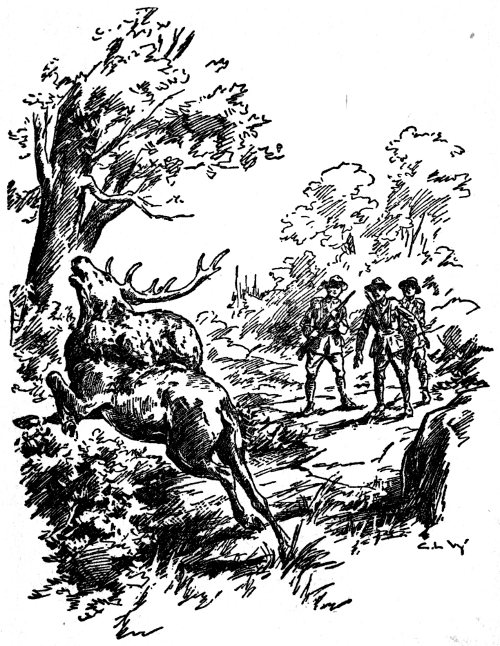
There was a crashing sound heard close by,
a swishing of the undergrowth, and then a
bounding object flashed into view, which took
on the shape of a two-year-old buck, leaping
frantically over logs and bushes, as though possessed.
Upon his neck and shoulders the boys
glimpsed a strange, mysterious gray hunch!
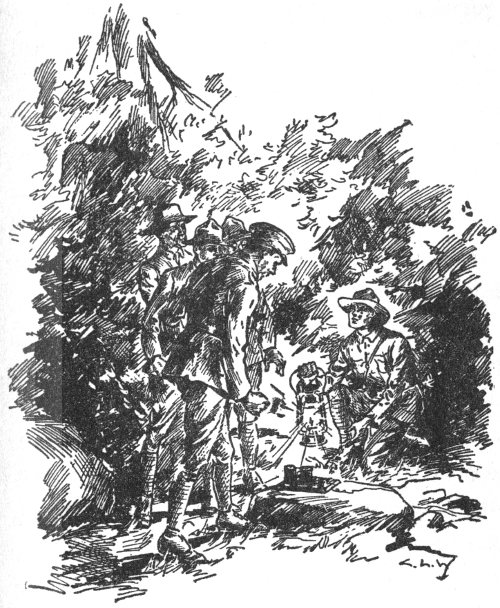
Upon his shoulders the boys glimpsed a strange, mysterious gray hunch.
19
CHAPTER II RUMBLINGS OF COMING TROUBLE
“Oh! Did you see that hump on his back,
Rob? What could it have been?” gasped
Tubby, gripping the sleeve of the other’s khaki
coat in his excitement.
“Why, Tubby, don’t you know that was the
pirate of the northern woods?” cried the equally
aroused Andy, who had also been stupefied
while the little drama was being enacted, and
only recovered the use of his hands, and realized
that he was carrying a gun, when the leaping
buck had completely vanished from view.
“Do you mean a filibuster?” asked the stout
boy incredulously.
“Well, yes; you might call a panther by that
name,” laughed Rob.
20
“A panther!” echoed Tubby, thrilled more
than ever. “Was that what the bunch across
the poor deer’s shoulders was, Rob? Oh, to
think we didn’t get a chance to use a gun and
save the noble buck!”
“It all happened too fast for me,” admitted
Andy dejectedly. “Besides, I don’t believe any
of us could have hit that crouching beast and
not harmed the deer.”
“No, that’s right, Andy,” said Rob convincingly.
“After all, we only chanced to see one
of the woods tragedies that are taking place
right along. Panthers must have meat to live
on, and deer are their legitimate prey. That’s
why there’s never a close season on the gray
buccaneers, nor on wildcats and wolves.”
21
Tubby did not express any timidity in words,
but it might have been noticed how he somehow
managed to keep a bit closer to his chums
after that. If there were such savage “varmints”
at large in the country along the International
Boundary, Tubby did not think it wise
to take any unnecessary chances; not that he
would have admitted being afraid, of course;
but then, as he always said, he offered a shining
mark, because a discriminating beast was sure
to pick out a plump morsel when foraging for
a dinner, and consequently lucky Andy would
get off scot-free.
They continued to walk on in a clump, and
chatting as they advanced, though Rob kept his
eyes and senses constantly on the alert for signs
that would tell him what he wished to know.
“I’ve heard a lot about the Maine woods, and
how all sorts of people manage to get a fair
living from them, winter or summer,” Tubby
was saying later on. “Rob, you know something
of such things, because you’ve been up
here before. How about it?”
“It’s just as you say,” Rob replied. “Thousands
on thousands of men find ways to wring
a living from Nature’s storehouse up here in
the great pine forests. I’ve met some of them
personally, and asked questions. I’ve been told
all about the others, and what interesting stunts
they do.”
22
“Tell us a little about them, please, Rob?”
urged Tubby.
“Well,” began the scout leader, always willing
to oblige his chums when it was within his
power to accommodate, “first of all there are
the thousands of guides, both natives and
Indians, who in summer take parties along the
waterways of Maine in canoes, fishing for trout,
bass, or salmon in the countless streams and
lakes; and in the fall serve the hunters in their
camps, when they are after deer and moose.
They go to make up quite a little army in
themselves, and their wages amount to many
hundreds of thousands of dollars per annum.
Next in order and importance, I expect, is the
gum-hunter.”
“Well, I declare, what is a gum-hunter, anyway,
Rob?” demanded the listening Tubby. “I’ve
heard of a gumshoe man; but do hunters go
shod that way in the Maine woods?”
That allowed Andy, better posted, to have
another little explosion,
23
“Oh, dear innocent, trusting soul, you’ll be
the death of me yet!” he gasped, between his
fits of laughter. “For pity’s sake, Rob, tell him
quickly what a gum-hunter is, or he’ll surely
burst with curiosity.”
“You must know, Tubby,” said Rob, himself
smiling broadly, “that spruce gum is used in
immense quantities, not only in the manufacture
of chewing gum but for several other purposes.
“It is found here in the pine woods of Maine
by expert searchers, who at a certain season of
the year go forth and gather their harvest.
They probably make good wages at their work,
too, or there would not be so many of them
keeping at it year after year. Some other time
I’ll go further into details, and tell you how
they find the deposits of gum. Some of them
even gash trees, and come back in due season
to garner the crystal profits that have exuded
from the wounds. But the gum-hunter is only
one of many chaps who earn a living in these
Maine forests. There is the hoop-hole man
you’re apt to run across in any section where
it happens there’s a second-growth crop of ash
saplings.”
24
“What does he do, Rob?” asked Tubby.
“He gathers the saplings, and occupies his
evenings in camp by splitting and assorting and
fastening them in bundles. These are later
taken away in bulk. They are intended as
hoops for barrels, nail-kegs, and such objects.
The hoop man does a cracking big business in
season, let me tell you.
“Then there’s the man who gets out the poles
themselves to be used for various purposes; the
fellow who hunts for certain crooked woods calculated
to make good boats’ knees; the sassafras
hunter; the ginseng and other root man, who
knows where to pick up a little fortune in discovering
patches of wild weeds that possess a
marketable value when the roots are dug and
properly cured; the herb gatherer; and last but
far from least the bee man, who goes about
looking for hives of wild bees in hollow tree-tops,
so he can gather hundreds of pounds of
honey.”
25
Tubby looked helplessly around him.
“Well, well,” he was heard to say, “you never
would believe fortunes could be dug out of such
forlorn-looking woods as these. It’s simply
wonderful what some men can pick up, when
others are as blind as bats in the daytime. I’m
going to keep my eyes open. We might run
across a diamond field.”
“Well, you may mean that as a joke,” said
Rob, “but rare gems have been found around
here, which brings up another calling that some
men have followed. That is searching all the
streams for mussels, because some pretty valuable
fresh-water pearls have been discovered,
they say, in Maine bivalves.”
26
“It beats all creation how many sources of
revenue a smart man can unearth, if only he
keeps his wits about him,” remarked Andy, who,
apparently, was hearing this last bit of information
for the first time. “If this terrible war
continues much longer there’s likely to be another
lot of professionals working industriously
up here in the woods of Maine. They’ll be the
friends of the Central Empires, who want to
give Old England and her Colonies a backhanded
blow by cutting off the supply of munitions
and supplies that keeps on flowing toward
the coast day after day.”
“Oh, why can’t the nations of the Old World
keep the peace like it’s been kept for a hundred
years between Uncle Sam and his big northern
neighbor?” sighed the tender-hearted Tubby
sincerely. “Here’s a boundary of over three
thousand miles, and not a single fort to mark
the dividing line; whereas over across the
water, look at the enormous fortresses France
and Belgium and Germany have maintained,
though none of the Belgians’ stood the awful
pounding of those enormous guns brought up
by the Kaiser’s troops.”
27
“There’s a good reason for that, Tubby,” explained
Rob. “Americans and Canadians speak
the same tongue, and as a whole have the same
aspirations. They understand each other, you
see. It’s different over in Europe, where different
nations hate like poison. We don’t seem
to meet with the same measure of success down
along our Mexican border, because those greasers
never can understand our motives, for we
think along entirely opposite lines.”
“When are we going to have a great World
Peace, and war be abolished?” begged Tubby,
almost piteously.
“Search me!” said Andy. “Because I don’t
believe such a thing ever will be, as long as
human nature is like it is; though of course I’d
be glad to see it brought about. If the nations
of the world could only form some sort of
practical union, like that of the States now, and
so were bound to keep the peace, it might be
done. Happy the man who has a hand in such
a vast undertaking. If the chance came to me
to handle the steering wheel of such a glorious
job, why, I’d feel as lofty as—as that hawk
soaring right now away up there in the blue
heavens!”
Tubby mechanically followed the extended
finger of the speaker, and then uttered a sudden
startled cry.
28
“Hawk!” he ejaculated derisively. “That
shows your ignorance, Andy. Hawk, do you
say? Why, bless your simple and confiding nature,
don’t you know that object away up near
the fleecy white clouds, and heading due north
at this minute, is nothing more or less than an
aeroplane? Rob, am I right?”
Rob was himself staring upward, and he
hastened to reply:
“That’s just what it is, Tubby. After seeing
so many of those mosquitoes of the upper air
currents soaring above the hostile armies across
the big pond, you are able to tell one the minute
you glimpse it. Yes, that’s an aeroplane, as
certain as that we are standing here gaping up
at it. I want you to notice that it’s heading
directly so as to cross the International Boundary
line.”
“What does that mean, Rob?” questioned
Andy curiously, meanwhile continuing to crane
his neck.
29
“Well, I’m only making a guess,” Rob ventured.
“The chances are that pilot up yonder
may be connected with some vile plot to destroy
railroad property in the Dominion of Canada,
and is now bent on spying out the land
so as to make a chart of the country.”
30
CHAPTER III BY AEROPLANE ACROSS THE BORDER
When the leader of the Eagle Patrol made
this astounding assertion both of his friends
betrayed additional interest. Indeed, it was a
question whether Andy or Tubby, by the rapt
expression on their faces, showed the greater
excitement.
Tubby had one great advantage over his comrade.
He had been abroad with Rob and Merritt
Crawford, and had watched aeroplane pilots,
both of the Allies and the Germans, shooting
like meteors across the skies, bent on their
work of learning what was going on back of
the enemy’s lines so as to give points to those
who handled the monster guns far in the rear,
allowing them to drop their shells exactly
where most wanted.
31
“Well, to think of the nerve of that fellow!”
exclaimed the indignant Andy. “He snaps his
fingers at the proclamation of the President
about all true Americans standing for strict
neutrality. Why, he’s meaning to give those
Canucks the best chance ever to protest and
claim damages from our Government. Isn’t
that a fact, Rob?”
“Just what it is, Andy,” replied the scout
master, watching the course of the small object
so far up in the air that it resembled a giant
bird.
“If they blow up a bridge, and wreck a train
loaded with millions of dollars’ worth of stuff,
and it’s proved that the scoundrels passed over
from our side of the border, Uncle Sam will
have to pay the whole bill?” questioned Tubby,
now becoming aroused in turn.
“No doubt of it, if the proof is forthcoming,”
Rob assured him serenely, since he knew enough
of treaties and international law for that.
32
“Then anything that’s done against Canada
from our side is really a blow aimed at our own
country?” questioned Andy, beginning to show
signs of anger. “Why, if it stands that way,
then those conspirators are just as bad as if
they were trying to knock a big hole in the U.
S. Treasury, from which untold oodles of
money could drop out. They’re breaking the
neutrality laws smack. I’d like to let ’em know
just what I think of such sneaks. There ought
to be some way to detect and punish such backhanded
knockers.”
“Oh, there are plenty of ways!” asserted Rob.
“The law is stern enough, if you only can catch
them in the act. There’s the rub. They take
all sorts of precautions to hide their identity.
Who could recognize that chap up a mile or so
from the earth? How does any one know that
he’s meaning to drop lower presently, so as to
take a lot of pictures of the railroad where it
passes over a bridge or trestle?”
“Is that the way it’s done?” ejaculated the
deeply interested Andy, who was more or less
ignorant of how air pilots make themselves so
useful in war times.
33
“Watch him!” snapped Rob, and all eyes were
again focussed on the far distant object moving
across the heavens, and passing some fleecy
fragment of a floating white cloud.
“As sure as anything he’s dropping on a
regular toboggan slant!” cried Andy, thrilled
by the sight.
“Huh!” remarked the wise Tubby, with the
pride of superior knowledge, “that’s what they
call volplaning. Sometimes an aviator will shoot
down for a mile like a streak of lightning, and
just when you think he must be smashed
against the ground he’ll suddenly stop, just like
a descending eagle does, and sail away as nice
as you please on a lower level.”
“Which is exactly what that spy is doing
right now!” exclaimed Andy. “I guess he is
down far enough for him to see all he wants
to, and also snap off some pictures. But, Rob,
if there are Canadian troops guarding the
bridge across there why wouldn’t they give him
a volley to let him know he hadn’t any business
on that side of the International Line?”
34
“I expect that’s what they will do any minute
now,” Rob assured him. “We may not hear
the sound of the guns over here; miles lie between;
but we ought to be able to tell by the
actions of the aviator. If the lead commences
to sing about his ears, he’s likely to mount
again; he’ll be afraid of having his gasolene
tank pierced by one of them, or be struck himself.”
“When we were on the other side, Rob,” interjected
Tubby, “you know we always said
petrol instead of gasolene; but they both mean
the same thing. There, look, will you; he’s
started up again, as sure as anything, making
spirals, as they generally do when ascending in
a big hurry.”
As Tubby declared, the man in the aeroplane
had suddenly changed his location and was now
ascending as fast as he could. Something had
undoubtedly caused him to do this. Rob said
he wished he had thought to fetch a pair of
binoculars along with him, for then they might
see spurts of smoke on the ground, and possibly
even discover the bridge itself.
35
“But then who would ever dream we’d want
glasses for such a purpose?” Tubby observed.
“Goodness knows we’re lugging enough load as
it is. He is turning around now, Rob, and
heading this way again. Do you think he accomplished
his purpose, and is now bent on getting
out of range of those bullets?”
“Very likely,” the other replied, “though his
danger was more imaginary than real. To
strike a moving aeroplane at that height with
an ordinary military rifle would be next door to
an accident. Haven’t we seen air pilots take all
sorts of daring chances, with shrapnel bursting
all around them?”
The three scouts watched until the mysterious
machine had vanished toward the south.
They could hear the sound of the motor as it
passed high overhead, though at a considerably
lower level than when going the other way.
36
Once more then they started off, though Tubby
had great difficulty in “getting a move on
him,” as he called it; for that load on his back
seemed to make him feel like Sinbad the Sailor
when the Old Man of the Sea refused to dismount
from his shoulders, after being assisted
along the way, demanding that he be carried
still farther.
The afternoon was now beginning to wane
very fast. Already the westering sun had sunk
far down in the heavens, and was heading for
the horizon. While their conversation had been
mostly upon the entrancing topic of that strict
neutrality which had been enjoined on all citizens
of the United States while the World War
was in progress across the sea, at the same
time Tubby’s thoughts would frequently stray
to his own present troubles.
“It doesn’t look much like we would run
across that old logging camp to-day, where
Uncle George was going to make his first stay,
does it, Rob?” he was heard to ask for possibly
the sixth time.
And as he had patiently done on every other occasion
the scout leader answered him pleasantly.
37
“I’m sorry to say there’s little chance of that
happening, Tubby, much as all of us would like
it. According to my rough chart, we must be
getting in the neighborhood of that camp,
though, and, if lucky, we might even run across
your uncle to-morrow. Certainly, if we hear
any shooting near by we’ll give a shout, and
try to find out who’s who. That’s the best I
can say, Tubby.”
“Thank you, Rob, very much,” said the fat
boy sweetly. “I know well enough that if it
depended on you we’d arrive in camp inside of
half an hour. Then, having accomplished my
mission up here, we could all give ourselves up
to a delightful ten days of knocking around,
and doing some hunting with his guides. That
means we’ll soon have to call a halt ourselves
and camp?”
Rob had to laugh at the vein of pleading he
could detect in Tubby’s voice when he made
that apparently innocent remark.
“I’m looking around for a good site, Tubby,”
he announced, and at that the moon face of the
stout member of the patrol fairly beamed with
pleasure.
38
It was not more than ten minutes afterward
when Rob stopped short.
“Here’s where we spend the night, fellows,”
he told them.
“A bully good place,” assented Andy, casting
a look of appreciation around at the trees, with
several openings that allowed them to see the
sky, and gave a promise of all the fresh air
they would want.
“Yes, and I hear a brook gurgling along near
by!” declared Tubby;—“the main reason why
you picked out this place, Rob. The water left
in my canteen is getting pretty stale, so I’ll be
mighty glad to get a decent cool drink of sweet
water.”
39
He hastily slipped out of the broad bands of
his pack, and scurried over in the direction
whence that pleasing drip of water was heard.
The others saw him stop and then lie flat on
his paunch, for with Tubby it was not so easy
to get his mouth down to a low level, owing to
his peculiar formation; usually his heels had to
be higher than his head, just as you would tilt
a barrel up to make the rim come in contact
with the ground, all owing to that curve of the
staves.
As they carried no tent, for that was utterly
out of the question, it would be necessary for
the trio of scouts to make some apology for a
shelter calculated to keep the dew or the frost
from chilling their bodies, as they slept in the
open.
But, indeed, this was only a delight to these
lads, accustomed as all of them were to roughing
it. Many a time in the past had they constructed
a brush shanty that, in an emergency,
might even shed rain to some extent, and would
surely afford them shelter from the chilly night
air.
All of them got busy immediately, fetching
branches and every manner of material that
would be needed in the task. While Rob himself
took over the job of building the shack, he
had Andy cutting wood for a fire, and Tubby
dragging further supplies of fuel toward the
spot, so that altogether it made quite an animated
picture, with everybody working like
beavers.
40
Before the evening was fully upon them,
things began to take on quite a homelike appearance.
The shanty was completed, being
rudely built, with a decided slant toward the
back, and an open front. Some sportsmen’s
tents are made on the same pattern, the idea
being to have the fire so placed as to cause the
sloping roof to reflect the heat that comes in
through the open front.
Then came the always delightful job of cooking
supper. No boy was ever known to object
to lending a hand when this task is broached.
Tubby, being something of a chef by this time,
due to a grim determination to excel in one
branch, even if he could never equal Rob in
woodcraft knowledge, or other fellows in their
several fads, had taken it upon himself to carry
out the arrangements.
41
His depression had fled. The other boys
were so full of optimism that it seemed to fill
the air, even as that tempting smell of coffee,
with fried onions, potatoes and bacon as accessories
did. A more despondent chap than
Tubby must have yielded to the general feeling
of satisfaction.
Witness them, therefore, a little later on,
spread out close to the fire, each with his legs
crossed under him tailor-fashion, and bent on
stowing away the heaping pannikin of hot food
that had been served out as his share of the
supper; while the big tin cups were brimming
full of fragrant coffee that, as Andy said, “went
straight to the spot every time.”
The first edge of their ferocious appetites appeased,
the boys did not hurry, but took their
time in eating. It was that delightful hour of
the early evening in the pine woods when all
Nature seems to be hushed, and the heart of
the camper rejoices in his surroundings, which
he joyously compares with the unhappy lot of
those mortals who are compelled to remain
amidst the skyscrapers of the city, chained to
their desks, while the camper owns the whole
world.
42
CHAPTER IV AN INVASION OF THE CAMP
“Rob,” remarked Andy, later on, “why would
those plotters choose Maine as the field for
their dastardly attempts to strike at the Canadian
Government? I should think they would
have a bigger chance for succeeding in their
undertaking, say away up in the Northwest,
where the border isn’t watched as closely as
along here.”
“That’s easy to answer,” replied the scout
master. “In the first place you must remember
that as all these supplies gathered through the
Great Northwest granary approach the coast,
where they are to be shipped abroad, they concentrate.
It’s like the spokes of a wheel, and
this eastern stretch of country can be likened
to the hub. Get that, Andy?”
43
“I certainly do, Rob. This applies, I suppose,
to some extent with regard to the soldiers,
and the munitions, and all that; they are
gathered here and there, and as the many rivulets
draw closer to the coast the stream grows
larger all the while. Sure, that stands to reason,
and I was silly not to think of it myself.”
“Another thing that counts heavily,” added
Rob sagely, “is the fact that out in the Northwest
that you mention the transcontinental railroad
doesn’t come anywhere as near the border
as it does close to the Maine line. So, you see,
an expedition crossing over here would have
only a short distance to go before they reached
the tracks they meant to destroy.”
“Yes,” said Tubby, who had been listening
eagerly, “and perhaps there’s a bridge here that,
if blown up, would about paralyze the stream of
material that’s flowing steadily down toward
the coast day after day. I reckon it’s to stop
that tide of munitions and supplies, as much as
the soldiers themselves, that these fellows are
scheming to do.”
44
“There’s another far-off whistle of a train,”
said Andy, perking his head up in a listening
attitude. “They certainly come along quite frequently,
and that goes to tell what a big business
is being done by the railroad these days.
I understand thousands of horses are being
shipped from the ranches up on those big
prairies of the Canadian Northwest, for they
last only a short time in war, and the supply is
beginning to fall short. Already I’ve read how
the rival armies are making great powerful
tractor engines take the place of animals in
dragging heavy guns to the front.”
“Supposing that air pilot did succeed in getting
all the information needed,” Tubby went
on to say, “as well as some pretty smart pictures
of the ground around the bridge, how
soon would those plotters start to work, do you
reckon, Rob? Surely not this very night?”
45
“Well, hardly, Tubby,” came the reassuring
answer, “though we can’t say what need of
haste there might be. If the aviator did snap
off some pictures, the film would have to be developed,
and prints made, which takes time.
No, at the earliest I should say to-morrow night
would be picked out for the attempt.”
“Oh, well, the guards are on duty, and are
looking out for anything of that kind,” said
Andy carelessly. “The visit from that aeroplane
will put them on their mettle.”
“Unless,” Rob ventured thoughtfully, “they
considered that the pilot was merely some venturesome
American who had taken chances in
crossing the boundary air, and found himself
over Canada. It might be their shots were
only sent to warn him he had better clear out,
and to mind his own business.”
“Whee! In that case they might be caught
napping,” said Tubby, with a vein of anxiety
in his voice. “Rob, would it be any business of
ours to warn the Canadians guarding the trestle
or bridge, if we had the chance?”
46
“It would be our patriotic duty, if we really
knew that mischief was brooding,” the scout
master told him sternly. “Stop and think for
a minute, and you’ll see it in that way too.
First of all, as true scouts, we would have to
consider that these men, no matter how much
they loved the land of their birth across the
sea, are either citizens of the United States, or
even if Germans, are enjoying the hospitality of
Uncle Sam. To creep across the line so as to
strike at their foe would be to abuse that hospitality.
Yes, it would be the duty of any honest,
patriotic American citizen to give warning,
if he absolutely knew that such a scheme was
afoot.”
“Do you mean to carry the news to some
town in Maine, from where it could be wired
to Washington, so that soldiers might be sent
up here to frustrate the evil designs of these
schemers?” asked Tubby, who at times delighted
in framing his questions in exceedingly
weighty language.
Rob Blake reflectively rubbed his chin as he
considered this query.
47
“I’m afraid that would consume far too much
time, Tubby,” he finally replied. “Before those
troops could be rushed here from the nearest
army post the mischief, such as it was, would
have been carried through. No; if I learned
positively that those German sympathizers
meant to invade Canada, something the same
way as the Fenians did a long time ago, I’d
consider it my bounden duty to cross the line
myself and try and warn the guards at the
bridge.”
“That’s the ticket, Rob!” cried the delighted
Andy, who himself believed in “hitting the nail
on the head.” Tubby, a bit slower to grasp
possibilities, bent closer, the better to hear what
was said.
Much more was spoken of along these lines, but
the reader has already learned what the boys,
as young American patriots, were bent on doing
should the occasion arise, and hence it is not
necessary to repeat all that passed between
them.
48
Of course they also talked of other things,
returning to this fascinating theme from time
to time. Often Tubby stared in the direction
of the North Star, in company with the Great
Bear or Dipper constellation; and at these times
his round, rosy face registered an expression of
awe. Tubby might have been gifted with a
sense of second sight, and dimly may have seen
possible complications they were fated soon to
meet.
As the evening grew, all of them felt an inclination
to turn in. They had covered many
miles, and not over level ground, since the
morning, and with those heavy packs on their
backs it had proved to be quite a tiresome
journey.
Tubby, in particular, was yawning terrifically,
nor did he take the trouble to put his
hand over his extended jaws. Often Andy
would pretend to shudder, and warn him to be
more careful, or both of his chums would fall
into the huge opening.
Tubby would make no reply; he was too
sleepy to enter into any argument. He may
have had an object in his repeated yawning,
knowing how contagious it is, and that presently
he was bound to start both the others
along similar lines.
49
Presently Rob was seen to copy his example.
Andy followed suit.
“Guess we might as well turn in,” said the
latter, with a grin, as he caught the eye of
Tubby on him. “Tubby here will surely fall
to pieces unless he gets some sleep.”
“Huh!” grunted Tubby scornfully. “Now
that you’ve begun, too, Andy, and Rob gives
like signs, we’ll be making it unanimous. What
about the fire, though? Do we let that cheery
blaze die out during the night?”
“No need of that,” said Rob immediately.
“It promises to be pretty chilly, and our blankets
aren’t any too thick at that; so I plan to
get up once in a while and throw an armful of
wood on the fire. If I don’t oversleep I think
I can keep the thing going up to morning.
Andy, if you chance to wake up any time, and
find that the fire has got down to red ashes,
you might crawl out and take a turn. Plenty
of fuel handy, you know.”
50
“I’ll try and remember, Rob,” promised the
other, “though I must say I do sleep as sound
as a top. If you depended on me to attend to
the fire the chances are it would expire long
before dawn. But I may wake up once or
twice, and I’ll do my duty, Rob, only too gladly.
Pile in, Tubby. Your blanket is over there on
the left of the entrance, and we’d have a nice
time of it letting you crawl over us.”
Rob did not follow immediately, for he was
busying himself at the fire. They were careful
to take their belongings into the brush shanty
with them, except certain things that could just
as well hang high from a limb of the tree.
There was no sign of rain or snow, so that
they did not worry on that score.
Finally Rob came crawling inside the shelter.
He fancied that one or both of his chums might
already have dropped asleep, and did not mean
to do anything to disturb them. Yes, he could
hear Tubby’s heavy breathing, which announced
that the stout boy had drifted across the border
of slumberland and was perhaps already dreaming
of Hampton folks, or some past scenes in
his ambitious career as a scout.
51
“He’s off, Rob,” Andy remarked in a low
voice. “Gee! but Tubby can go to sleep the
easiest of any one I ever knew. Honest, now,
I believe he could take a nap while walking
along, if only some fellows kept him from tumbling
over. All he has to do is to shut his
eyes, take half a dozen long breaths, and then
he’s clear gone.”
“Well, don’t talk any more now, Andy.
We’ll both try to imitate his sensible example,”
cautioned the other, as he started to creep
under his blanket, having removed his shoes
and coat beforehand, although he wisely kept
them handy in case a sudden necessity should
arise.
So the time passed. Rob did wake up some
hours afterward, and creeping out replenished
the fire. As he did so he took note of the fact
that once again there faintly came to his ears
the long-drawn whistle of an engine; and he
fancied that it meant to notify those who
guarded the bridge of the approach of a fresh
train loaded with valuable army stores, or
troops bound for the war trenches over in
Northern France.
52
Again Rob snuggled down under his blanket,
feeling grateful for the comforts that a generous
fortune had supplied him with. He was
not long in going to sleep.
Happily no one was nervous in that camp.
He, too, soon lost consciousness, and possibly
slept for several hours, for when next he awoke
the fire had once more died down to red embers.
This time, however, the awakening was along
entirely different lines. It was caused by the
whole end of their brush shanty falling down
with a crash, as though some heavy object had
been hurled against it. At the same time the
startled trio of scouts, sitting hastily up amidst
the wreckage of their late shelter, saw some
huge lumbering object scatter the glowing embers
of the smouldering fire in every direction
as it dashed madly through the camp.
53
Tubby was stricken dumb with amazement.
Possibly he had been indulging in some extravagant
dream in which the giant Jabberwock
that sported through “Alice in Wonderland”
was creating great excitement. He stared at
the vanishing bulky animal as though he could
hardly believe his eyes. Andy apparently had
not lost control of his vocal organs, to judge
by the shout he let out.
54
CHAPTER V COMFORTING TUBBY
“Hey! What does this mean, knocking our
house to flinders that way? Hold up, you, and
tell us what you’re aiming at. A nice old farm
bull you are, to be treating strangers so rough!
Say, look at the dead leaves catching on fire,
will you, boys!”
“Get busy, everybody!” called out Rob, already
commencing to pull his shoes on as fast
as he could, so that he might creep out from
the wreckage of the brush shanty and prevent
a forest fire from starting.
55
Andy followed suit. Tubby, not having been
wise enough to keep his footwear close to his
hand, had some difficulty in finding his shoes.
Consequently when he did finally emerge, looking
like a small edition of an elephant down on
its knees, he found that the others had succeeded
in gathering the scattered firebrands together
again, and that some fresh pine was already
flaming up, so dispelling the darkness.
Indeed, the growing warmth of the resurrected
fire did not feel disagreeable in the least,
for the night air was exceedingly chilly.
“Great Jupiter! Was that really a Jabberwock?”
demanded Tubby, when he joined the
other pair by the fire, holding out his chubby
hands to the warmth as if the sensation felt
very good.
“It was a bull moose,” replied Rob, without a
moment’s hesitation.
“But what ailed the critter,” demanded Andy,
“to make such a savage attack on our brush
shanty, and dash through the half-dead fire like
he did? That’s what I’d like to know. Rob, does
a bull moose do such things always?”
56
“I’m sure I can’t say,” replied the other.
“They are stupid creatures, I’ve always heard,
and apt to do all sorts of queer stunts. It may
be one of the animals could be taken with a
mad streak, just as I’ve read a rhinoceros will
do, charging down on a hunter’s camp, and
smashing straight through the white tent as if
he felt he had a special grievance against it.
All I know is, that was an old bull moose, for I
saw his big clumsy horns.”
Tubby shook his head, not yet convinced, and
mumbled:
“I never saw a Jabberwock. I’m not sure
there is any such strange beast in the world,
but that didn’t resemble what I thought a moose
was like.”
“You’ll have to prove it to him, Rob,” ventured
Andy, “for when Tubby doubts he is like
a wagon stuck in the mud: it takes a mighty
heave to pry him loose.”
Thereupon Rob leaned forward and taking
up a blazing brand that would serve admirably
as a torch, he walked around until he found
what he was looking for.
“Come here, both of you, and take a look at
this track,” he told them.
57
“Huh! Looks like the spoor of a farmyard
cow, only bigger. The cleft in the hoof is
there, all right; so if a moose really did make
that track, as you say, Rob, then they must belong
to the same family of the cloven hoofs.”
“Here’s another bit of evidence, you see,”
continued Rob, bent on rubbing it in while
about the matter. “In passing under this tree
the animal must have scraped his back pretty
hard. Here’s a wad of dun-colored hair clinging
to this branch. That proves it to be a
moose, Tubby.”
“What if the old rascal should take a sudden
notion to make another savage attack on our
camp?” suggested Andy. “Hadn’t we better
get ready to give him a warm reception, Rob?
The law is up on moose and deer now, I believe.
I’d like to drop that old sinner in his
tracks. I’m going to get my gun.”
58
“No harm in being ready, Andy, though
there’s small chance of his returning,” Rob replied.
He, too, crept over to where his rifle lay,
and secured the weapon. “His fury expended
itself in that mad rush, I reckon. He would
never dare attack us while the fire is jumping
up.”
Nevertheless, the trio sat there for some time
on guard. Andy, with the plea for neutrality
still before his mind, and recent events down
along the Mexican border, as read in the daily
papers, occurring to him, called it “watchful
waiting.”
“But what are we going to do for a shelter?”
bleated Tubby finally, as if once more finding
the temptation to sleep overpowering him.
“Oh, we’ll have to do without, and make the
fire take the place of a brush covering,” remarked
Andy superciliously, as became an old
and hardened hunter. “Why, many times I’ve
wrapped myself in a blanket, and with my feet
to the blaze slept like a rock! I wonder what
time it is now?”
While Andy was feeling around for his
nickel watch, Rob shot a quick look overhead,
to note the position of certain of the planets,
which would give him the points he wanted to
know.
59
“Close to three, I should say,” he hazarded,
and presently Andy, on consulting his dollar
timepiece, uttered an exclamation of wonder.
“Why, Rob, you’re a regular wizard!” he
broke out with. “It’s that hour exactly. If
you had eyes that could see into my pocket like
the wonderful Roentgen rays, you couldn’t have
hit it closer. I guess you know every star up
there, and just where they ought to be at certain
times.”
“It’s easy enough to get the time whenever you
can see certain stars,” explained the scout leader
modestly, “though you wouldn’t hit it so exactly
very often as I did then. But as there are some
three and a half hours before dawn comes we
might as well soak in a little more of that good
sleep.”
He showed Tubby how to arrange his blanket,
and even tucked him in carefully, with his head
away from the fire.
60
“You’re a mighty good fellow, Rob,” muttered
Tubby sleepily, and they heard no more from
him until hours had expired and morning was at
hand.
There was no further alarm. The singular old
bull moose must have wandered into other pastures
after that mad break. They neither saw
nor heard him again. It was just as well for the
same Mr. Moose that he decided not to repeat
his escapade, since he might not have gotten off
so cleverly the next time, with those scouts on
the alert, and their weapons handy for immediate
service.
With the coming of morning the three boys
awoke, and quickly prepared breakfast. Rob did
not mean to go very far on that day. He believed
that according to his chart and the verbal information
he had received, they were in the immediate
vicinity of the deserted logging camp
near the border. He intended to circle around
a bit, looking for signs that would lead them
to it. All the while they could also keep on the
alert for any rifle-shot that would indicate the
presence of hunters in the neighborhood.
61
“There’s that railway whistle again,” remarked
Andy, pausing while in the act of turning
a flapjack, in the making of which he professed
to be singularly adroit, so that he seldom
lost a chance to mix up a mess for breakfast when
the others would allow him.
“Guess the trains must have been passing all
through the night, even if I didn’t hear any,”
confessed Tubby frankly.
“Do you know, fellows,” asked Andy, since
confession seemed to rule the hour, “the first
thought that flashed through my head when we
were so suddenly aroused in the night by all that
row, was that the bridge had been dynamited by
the German sympathizers, and the guards shot
up sky-high with it. Of course, I quickly realized
my mistake as soon as I glimpsed that pesky
old moose lighting out, with the red embers of
our fire scattered among all the dead leaves, and
a dozen little blazes starting up like fun.”
“I wonder has any forest fire ever started in
that same way?” ventured Tubby.
62
“If you mean through a crazy bull moose ramming
through a bed of hot ashes,” Andy told
him, “I don’t believe it ever did. For all we
know no moose ever carried out such a queer
prank before last night; even if such a thing
happened, why the hunters would put the fire out,
just as we did.”
“I guess Uncle George would have been tickled
to see a big moose at close quarters like that,”
said Tubby. “He’s shot one a year for a long
while past. He stops at that, because he says
they’re getting thinned out up here in Maine, and
even over in Canada, too.”
Breakfast over, the boys loitered around
for a while. None of them seemed particularly
anxious to be on the move, Andy feeling indifferent,
Rob because he knew they were not going far
that day, and Tubby through an aversion to once
more shouldering that heavy pack. In truth, the
only gleam of light that came to Tubby he found
in the fact that each day they were bound to diminish
their supply of food, and thus the burden
would grow constantly lighter.
Finally Rob said they had better be making a
start.
63
“Understand, boys,” he told them, with a smile,
“we needn’t try for a record to-day. The fact
is, I have reason to believe that old deserted logging
camp must be somewhere around this very
spot. So, instead of striking away toward the
west, we’ll put in our time searching for signs
to lead us to it. At any minute we may run
across something like a trail, or a grown-up tote-road,
along which we can make our way until we
strike the log buildings where Uncle George said
he meant to make his first stop.”
“Oh! thank you for saying that, Rob,” Tubby
burst out with, as his face radiated his happy
state of mind. “For myself I wouldn’t mind if
we just stuck it out here for a whole week, and
let Uncle George find us. But then that wouldn’t
be doing the right by my father, so we’ll have
to keep on hunting.”
“I don’t mean to get much further away from
the boundary,” continued Rob, “for what we saw
yesterday bothers me. There’s certainly some
desperate scheme brooding; that’s as plain as
anything to me.”
64
“Just to think,” said Tubby, looking around
him with a trace of timidity on his ruddy face
and in his round eyes, “we may be close to a nest
of terrible schemers who mean to do something
frightfully wicked, and get poor old Uncle Sam
in a hole with the Canadian authorities. Rob,
supposing this job is pulled off, and those Canadians
feel mighty bitter over the breach of neutrality,
do you think they’d march right down
to Washington and demand satisfaction? I heard
you say they had raised a force of three hundred
thousand and more drilled men, and that beats
our regular army.”
“I guess there’s small chance of such a thing
happening, Tubby,” laughed Andy. “You can let
your poor timid soul rest easy. In the first place
nearly all the three hundred thousand men have
already been sent across the ocean to fight the
Germans in the French war trenches, or else they
are drilling in England. Then again our cousins
across the border are far too sensible.”
65
“Don’t worry about that a minute,” he was
told. “What we must keep in mind is that our
patriotism may be called on to prevent these men
from breaking our friendly relations with our
neighbor, that have stood the test of time so
well. If only we could find your Uncle George,
Tubby, we’d put it up to him what ought to be
done.”
“But even if we don’t run across him,” ventured
Tubby bravely, “I guess we’re capable as
scouts of taking such a job in hand of our own
accord; yes, and carrying it through to a successful
culmination.”
“Hear! hear!” said Andy, who liked to listen
to Tubby when the latter showed signs of going
into one of his periodical spasms of “spread-eagleism”
as the thin scout was wont to call these
flights of oratory.
So the morning passed away, and while they
had not covered a great extent of territory by
noon, at least the boys had kept up a persistent
search for signs that would tell of the presence
near by of the abandoned logging camp.
66
CHAPTER VI THE LOGGING CAMP
It was along toward the middle of the day
when Rob announced welcome news. He called
a halt, and as the other pair stood at attention
the scout master turned on Tubby with a look
that thrilled the stout chum exceedingly.
“What is it, Rob?” he gasped, the perspiration
streaming down his fat cheeks in little rivulets,
for the day had grown a bit warm after that
chilly night. “I know, you’ve run across signs
at last?”
“Speak up, Rob, and give us a hint, please,”
urged the hardly less impatient Andy.
67
“I wanted to see if you fellows were using your
eyes, first,” explained Rob; “but Tubby seemed
to be searching his inward soul for something he
had lost; and, well, I imagine Andy here was
figuring on what he wanted for his next meal,
because neither one of you at this minute has
thought it worth while to take a good look down
at your feet. Right now you’re standing on the
sign!”
They began to cast their eyes earthward. Andy
almost immediately burst out with:
“Whee! an old long-disused tote-road, as the
lumbermen call the track where the logs are
dragged to the rivers, to be later on put behind
a boom, and wait for the regular spring rise!
Am I correct, Rob?”
“Straight as a die, Andy; this is a tote-road,”
replied Rob.
“But what good is that going to do us, I’d like
to know?” ventured Tubby, groping as usual for
an explanation. “We don’t want to go to any
river, that I know of. What we’re itching to
find is the logging camp.”
68
“This track is going to bring us to it, sooner
or later,” asserted Rob, with conviction in his
tones. “I can give a pretty good guess which
way the logs were taken along here, from the
signs that are left on the trees and the bushes.
Anybody with half a mind could tell that much.
Very well, we must follow the track back, and
keep watch for another road showing where the
horses were daily taken to their sheds at the
camp. I imagine it’s going to be a simple enough
solution to the puzzle, boys.”
Andy was delighted. Tubby, having been convinced
that the leader knew what he was talking
about, managed to enthuse. Truth to tell, Tubby
was yearning for the delightful minute to arrive
when he might toss down that heavy pack of his
for good and all, since they expected to go out
of the pine woods much lighter than they came in.
They determined to sit down and eat a bite of
lunch. After that they would again take up
their task, the rainbow of promise glowing in the
sky ahead of them.
“Have we gone a great distance away from
the border, do you think, Rob?” Andy was asking,
while they devoured such food as could be
prepared quickly over a small fire.
69
“Well, that’s something I can’t exactly say yes
or no to,” came the answer. “I don’t know
where the dividing line comes. According to my
reckoning we ought to be about as close as we
were last night. In fact, I should say we are
now exactly opposite the long bridge over on the
Canadian side of the border.”
“But how could that be, Rob, when we’ve been
doing considerable walking since breaking camp
this morning?” demanded Tubby incredulously,
but more as a means for increasing his stock of
information than because he entertained the least
doubt concerning the statement made.
“Our tramping hasn’t covered over half a mile
in a direct line, because we went over a zigzag
course,” replied the leader. “If you remember,
whenever we heard a whistle for the bridge, it
came from the west, showing that the structure
lay farther that way.”
“Sure, you’re on the job when you say that,
Rob!” exclaimed Andy, who had been an interested
listener. “Only twenty minutes ago we all
heard a rumbling sound, and decided it was made
by a long freight train passing over the trestle
leading to the bridge. It came from a point exactly
opposite to us. You wouldn’t want any
better proof than that, Tubby.”
70
So they chatted, and ate, and passed half an
hour. Then Rob said it would be well if they
once more went forth. That tote-road was an
alluring object to Rob; he wanted to prove his
theory a true one.
Once more they began to “meander,” as Tubby
called it, through the woods, which had begun to
thin out considerably, since most of the better
trees had been cut down years back, and in places
the ground was almost impassable with the
wreckage of dead branches. Fortunately no fire
had ever run through this region to complete the
devastation begun by the axes of the lumbermen.
It could not have been more than half an hour
later when Rob announced that he had discovered
where the horses were in the habit of leaving
the tote-road and following a well-defined
trail through the brush and scant trees.
“Keep a lookout for the camp, fellows!” he
told them, whereat Tubby began to elevate his
head and sniff the air with vehemence.
71
“I thought I caught a whiff of pine-smoke,”
he said, “but I must have been mistaken. Still,
as the air is in our faces, it wouldn’t be strange
if we did get our first indication of the presence
of the lumber camp through our well developed
sense of smell, rather than by reason of our eyesight.”
“Wrong again, Tubby,” chuckled Andy. “Eyes
have it this time; there’s your camp ahead of us.
Look over the top of that clump of brush, you’ll
see the flat roof of a long log shanty, which must
be the bunk-house of the lumber jacks in the days
when they spent a winter here chopping.”
Even Tubby agreed with Andy after he had
shaded his eyes with his hand and taken a square
look. The thought that they were finally at the
end of their search for Uncle George was very
pleasing, and Tubby laughed as though a tremendous
load had already been taken from his
shoulders.
“Why, it wasn’t such a great task after all,”
he remarked, as though he had never once
dreamed of being despondent.
72
“Wait,” cautioned Rob. “Don’t count your
chickens before they are hatched, Tubby. It’s
poor policy to be too sanguine.”
“But Rob, didn’t you just say that was the
camp?” pleaded the other.
“No doubt about it, Tubby. But possibly the
person we’re wanting to interview may not be in
the place,” reminded the scout master.
“What makes you say that, Rob?”
“Oh! I’ve got a sort of suspicion that way,”
responded Rob. “In the first place we haven’t
heard a single gunshot since arriving in the
vicinity of this place yesterday, and that alone
looks queer. Then we can see the roof of the
bunk-house, with the mud and slat chimney in
plain sight; it’s after the noon hour, too, and the
chances are there’d be more or less cooking going
on if the place were occupied, but so far as
I can make out not the faintest trace of smoke
is flowing from that homely chimney.”
Tubby, staring hard again, saw the truth of
these assertions. He heaved a heavy sigh and
shook his head dismally.
73
“Tough luck, I should call it, if Uncle George
has never been here at all, and ours is going to
be a regular wild-goose chase. Whichever way
can we turn, Rob?”
“There you go jumping at conclusions, hand
over fist, Tubby,” said Andy quickly. “Rob
doesn’t mean that at all. Why, stop and think
how your uncle was so very particular to mention
that communications of importance sent to
this camp would get to him in due time. He’s
handling some big business, and couldn’t afford
to drop out of the world entirely, even for two
weeks. If he’s left here be sure we’ll find something
to tell us where to look for him.”
“Come along and let’s see,” urged Tubby,
“they say the proof of the pudding lies in the
eating. Inside of five minutes or so we ought
to know the worst, or the best. I’ll try and stand
the shock, fellows.”
74
Once more they advanced. They could not always
keep in a direct line on account of the obstacles
that beset their course, so that Tubby’s
estimate of the time required to reach the deserted
logging camp proved erroneous; but by
the end of ten minutes the little party drew up
before the door of the long cabin which they understood
had once sheltered a score of those
rough wielders of the ax known as lumber jacks.
Some of the other rude buildings constituting
the “camp” were in various stages of decay and
in tumble-down ruin, but the bunk-house seemed
to have been more substantially built, for it
looked as though intact.
Before they arrived all of the boys had made
a discovery that increased their haste to reach
the door. There was some sort of paper fastened
to it, and Rob had a pretty good idea as to
what it would turn out to be.
“Uncle George has gone away from here, and
left directions where to look for him,” announced
Andy promptly, showing that he, too, had made
a guess concerning the nature of that notice on
the door.
“Shucks!” Tubby was heard to grunt, at the
same time giving his burden an impatient flirt, as
though almost in a humor to rebel against another
long siege of packing it over miles and miles
of dreary pineland.
75
But a surprise, and a pleasing one at that,
awaited them all as they found themselves able
to decipher the writing on the paper.
It proved to be a business sheet, with Uncle
George’s printed address up in the left-hand corner.
He himself had written the message in a
bold hand, which any one capable of reading at
all might easily make out; and this was what the
trio of scouts read:
NOTICE.
“We have gone over to the Tucker Pond
to try again for the big moose that for two
past seasons has managed to fool me. This
year I hope to bag him. He is a rare giant
in size. Make yourselves at home. The
latch string is always out. We expect to be
back in a few days at the most. The door is
only barred on the outside. Enter, and wait,
and make merry.
(Signed)“George Luther Hopkins.”
76
When Tubby read that delightful news he fell
to laughing until he shook like a bowlful of jelly.
It evidently made him very happy, and he did not
hesitate to show it to his two faithful comrades.
Indeed, all of them had smiles on their faces, for
it would be much more satisfactory to loaf
around this spot, possibly taking toll of the partridges,
and perhaps even a wandering deer, than
to continue their search for an elusive party,
whose movements might partake of the nature of
a will-o’-the-wisp.
“I’m going to make a sign reading ‘Alabama,’
and stick it above the door, the first thing,” announced
Tubby, with a grateful heart. “It means
‘here we rest.’ If ever three fellows deserved a
spell of recuperation we certainly are those
fellows.”
77
“How generous of Uncle George,” said Andy,
“to say the latch string is always out! Then, too,
he calls attention to the fact that the door is only
held shut by a bar on the outside, instead of
within. All we have to do, fellows, is to drop
our packs here. I’ll remove that bar, and swing
the door wide open, after which we’ll step in and
take possession.”
He proceeded to follow out this nice little program,—at
least he got as far as dropping his
pack and removing the bar; but hardly had he
started to open the door than Andy gave a sudden
whoop, and slammed it shut again with astonishing
celerity. Tubby and Rob stared at
him as though they thought he had seen a genuine
ghost.
78
CHAPTER VII AN UNWELCOME INTRUDER
“Oh! what did you see inside the cabin, Andy?”
gasped Tubby, beginning to look alarmed, and
shrinking back a little, because he did not happen
to be carrying one of the two guns in the party.
“Wow! Talk to me about your Jabberwock!”
ejaculated Andy, making his face assume an
awed expression that added to Tubby’s state of
dismay. “He’s in there!”
“But how could a big bull moose get inside a
cabin, when the door’s shut, and fastened with a
bar?” questioned the amazed and incredulous fat
scout.
79
“It isn’t any moose,” scoffed Andy, and, turning
to Rob, he went on: “I tell you, the biggest
bobcat I ever set eyes on is in there, and has been
having a high old time scratching around among
the provisions left by Uncle George and his party.
Oh, his yellow eyes looked like balls of phosphorus
in the half gloom. I thought he was going
to jump for me, so I slammed the door shut,
and set the bar again.”
“A wildcat, do you say?” observed Rob, looking
decidedly interested. “Well, one thing sure,
Uncle George never meant that generous invitation
for this destructive creature. As he couldn’t
very well read the notice, or lift that heavy bar,
it stands to reason the cat found some other way
of entering the bunk-house.”
“How about the chimney, Rob?” asked Andy,
as quick as a flash.
“Now I wouldn’t be much surprised if that
turned out to be his route,” mused the scout
leader. “They have a wonderful sense of smell,
you know, and this fellow soon learned that there
were things good to eat inside the cabin. Finding
the place deserted, so far as his two-footed
enemies were concerned, he must have prowled
all around, and finally mounted to the roof. Then
the opening in the chimney drew his attention,
and getting bolder as time passed, he finally
dropped down.”
80
Tubby, who had been listening with rapt attention,
now broke out again.
“He must be a mighty bold cat to do that, I
should say, fellows. Goodness knows how much
damage he’s done to Uncle George’s precious
stores. Oh! doesn’t it seem like a shame to have
a miserable pussycat spoiling the stuff you’ve
gone and nearly broken your back to pack away
up here? But will we have to pitch a camp in
one of those other smaller buildings, and let the
bobcat hold the fort in the comfortable bunkhouse,
with its jolly cooking fireplace?”
Thereupon Andy snorted in disdain.
“I’d like to see myself doing that cowardly
thing, Tubby!” he exclaimed. “Possession may
be nine points of the law, but in this case there’s
something bigger than the law, and that’s self-preservation.
That beast is going to pay for his
meddling, if I know what’s what. Rob, how’d
we better go at the job?”
81
“Just as you said a while back, Andy,” the
scout master told him, “the hand of every man
is always raised against such varmints in the
woods as panthers and bobcats and weasels and
such animals as destroy heaps of game, both in
the fur and in the feather. If I could have shot
that panther without harming the deer I’d have
been only too pleased to do it; but the whole thing
happened too rapidly for us. As to just what our
plan of campaign now ought to be, that’s worth
considering.”
They had deposited their bundles on the
ground and stepped back, while both Andy and
Rob held their guns ready for business. Tubby
watching saw that the former continued to keep
his eyes fastened on the chimney of the low
bunk-house all the while he talked; and from that
he drew conclusions.
“You’re thinking, I expect, Rob,” Tubby ventured
to say, “that what goes up in the air must
come down again; and that as the cat dropped
into the wide-throated chimney he’s just got to
climb up again, sooner or later. Am I right,
Rob?”
82
“A good guess, Tubby, believe me,” chuckled
Andy. “What we want to do now is to respectfully
but firmly influence that unwelcome guest
to get busy, and vamoose the ranch in a hurry.
Say, I’m ready to give him the warmest kind of a
reception as soon as he shows the tip of his whiskered
nose above the top of the chimney.”
“Here, Tubby, lend me a hand,” said Rob, “and
we’ll try to coax Mr. Cat to vacate his present
quarters. Andy, I’ll lay my gun down alongside
you here, and if yours isn’t enough to finish the
rogue, snatch up mine in a hurry.”
Andy agreed to that, and so the other two
walked forward again to the front of the long
log building, where the door was situated. Tubby
was curious to know how his companion expected
to work that “influence” he spoke of, and cause
the ferocious intruder to depart as he came. He
awaited the outcome with considerable interest.
“First,” said Rob, as though he already had
his mind settled, “we’ll pick up a few handfuls of
these chips and twigs that are so plentiful.”
83
“Whee! but burning the old cabin down to get
rid of a cat that stays inside would be what
they’d call heroic treatment, wouldn’t it, Rob?”
“I’m not doing anything as severe as that,
Tubby,” said the other. “We’re going to try the
smoke cure. All animals are in deadly fear of
fire, and smoke will cause even a horse to become
fairly wild. We can make our little fire close
to the door, and the breeze which happens to be
just right, will carry some of the smoke under
it, for notice that wide crack there. When the
cat sniffs that odor you’ll see how fast he scrambles
up that chimney again.”
It all looked very simple to Tubby now; so
those Spanish courtiers who had been declaring
that discovering America was no great task after
Columbus had shown them how to stand an egg
on an end, doubtless sneered and said it was
easy enough.
The little heap of trash was ignited, and just
as Rob had said, it began to emit a pungent
smoke that was driven against and under the
door by the breeze.
84
“Keep ready, Andy!” Rob called out. “I
thought I heard a scratching sound just then!”
Tubby ran back so as to be able to see the
crown of the low chimney. He was only in time,
and no more, for even as he managed to glimpse
the apex of the slab-and-hard-mud vent something
suddenly came into view. As Tubby stared
with round eyes he saw a monstrous wildcat
crouching there, looking this way and that, as
if tempted to give battle to its human enemies,
by whom it had been dispossessed from the scene
of its royal feast.
Then there came a loud crash. Andy had
fired his gun. Tubby shivered as he saw the big
feline give a wild leap upward and then come
struggling down the slight slope of the roof,
clawing furiously, and uttering screams of expiring
fury.
85
Andy was ready to send in a second shot if it
chanced to be needed, but this proved not to be
the case, for the struggles of the stricken beast
quickly ended. The three boys hurried forward,
and stood over the victim of Andy’s clever marksmanship.
The cat was one of the largest Rob
had ever run across, and even in death looked
so terrible that Tubby had an odd shiver run
through his system as he stared in mingled awe
and curiosity down at the creature.
“Too bad in one way that the poor old thing
couldn’t finish his feast in peace,” Tubby was
saying, “but then I suppose it’s the chances of
war. There’s always a state of open war between
these bobcats and all men who walk in the
woods.”
“Well, I should say yes!” cried Andy, patting
himself proudly on the chest. “I’ll always call
this one of the best day’s jobs I ever did. Think
of the pretty partridges, the innocent squirrels,
the bounding jack-rabbits and such things, that
I’ve saved the lives of with that one grand shot.
If this beast lived three years longer it’d surprise
you, Tubby, to count up the immense
amount of game that it’d devour in that time. I
never spare a cat under any circumstances.”
“Do you think it was all alone in the cabin?”
asked the timid one.
86
“We’ll soon find out,” Andy told him, as he
saw to it that his gun was in condition again for
immediate use, and then started toward the
closed door.
Cautiously this was opened a trifle, and one by
one the boys peered through the crevice; all
agreed that there was nothing stirring, and so
eventually they made bold to pass inside.
It was discovered that the uninvited guest had
made free with some of the stores of the party,
but after all, the damage did not amount to a
great deal, possibly owing to the coming of Rob
and his two chums on the scene shortly after the
cat started chewing at the half of a ham it had
dragged down from a rafter.
The boys quickly removed all signs of feline
presence. Andy declared that he intended skinning
his prize, for the pelt if properly cured
would make quite an attractive mat for his den
at home. It would be pleasant of a winter evening,
when resting in his easy chair, to gaze down
upon the trophy, and once again picture that stirring
scene up there in Maine, under the whispering
pines, hemlocks and birches.
87
They adjusted themselves to the new conditions
with that free and easy spirit so natural
in most boys. It was next in order to pick out
the bunks they meant to occupy while in the logging
camp; for there were signs to tell them
which had been already chosen by Uncle George
and his two guides; and of course, no one thought
to settle upon any of these particular sleeping-places.
They soon had a fire burning, and the interior
looked quite cheerful. Sitting there Tubby could
easily picture what a stirring scene it must have
been in those times long gone by when a dozen,
perhaps even a score, of muscular lumber jacks
lounged about that same dormitory and living
room, waiting for the cook’s call to supper.
Later on Tubby came up to Rob while the
other was arranging some of the contents of his
pack, “scrambled” more or less, as he called it,
by being carried for several days on his back,
and thrown about “every which-way.”
88
“Look here, Rob,” the fat scout said, “I happened
to run across Uncle George’s fresh log of
the trip. He always keeps one, and I’ve even
had the pleasure of reading about some exciting
adventures he’s met with in former years. So
that’s my only excuse for glancing at what he’s
jotted down here. The last entry is where he
made up his mind to go over to the Tucker Pond
to try again for that giant moose. And by the
way, Rob, I was wondering whether our excited
visitor of last night could be this big chap Uncle
George is so wild to get?”
“Now that might be so,” admitted the scout
leader, “though the thought hadn’t occurred to
me before. He certainly was a buster of a beast,
though he went off so fast none of us more than
got a glimpse of his size. Anything of unusual
importance in the beginning of your uncle’s log,
Tubby?”
“Oh, he got a deer on the opening day of the
season, and we’ll probably find some of the venison
around, if we look again sharply. Something
did happen it seems, something that gave
my uncle considerable unhappiness, too. He lost
one of his two guides.”
89
“What! did the man die here?” ejaculated the
astounded Rob.
“Oh! my stars! no, Rob, not quite so bad as
that,” Tubby hastened to add. “He had to discharge
the man because of something he’d done.
Uncle doesn’t say what it was, but he was both
indignant and pained; because he thought a heap
of Zeb Crooks, who had been with him many
seasons. The man was stubborn, too, and
wouldn’t ask Uncle George to forgive him, or it
might have all been patched up. So he sent him
flying, and started off to Tucker’s Pond with his
other guide, a Penobscot Indian named Sebattis.”
“Well, that’s interesting, Tubby,” remarked
Rob. “It doesn’t mean anything to us, though
I can understand how sorry your uncle must have
been to part with a man he used to consider faithful.
So it goes, and lots of things happen that
are disagreeable. I suppose he’ll have just as
good a time with the one guide to wait on him
as when there were a pair.”
90
Apparently Uncle George’s troubles did not
bother Rob to any extent; but there were things
weighing on his mind though, during that afternoon,
and these had a connection with the flight
of that man in the aeroplane, over across the
Canadian boundary line.
91
CHAPTER VIII TUBBY HAS AN ADVENTURE
Tubby was particularly interested in looking
around. He had heard so much about these
hunting camps of his sport-loving relative that
now he had the chance to see for himself he kept
prowling about. It was Tubby who presently discovered
a haunch of fresh venison. Andy immediately
announced that the keen-nosed wildcat
was not in the same class with the stout chum.
“Say, we can have a mess of real venison for
our camp supper to-night,” added the delighted
Tubby. “Haven’t we a warrant for taking liberties
in that Notice, where Uncle George invites
the pilgrim to enter, wait, and make merry?
How can any one be merry without a feast? I’ll
take all the responsibility on my shoulders, boys,
so make up your minds the main dish to-night
will be deer meat.”
92
Later in the afternoon Tubby wandered outside
to look around.
“Don’t go too far away and get lost, Tubby!”
called out Rob, who himself was busily engaged.
“Oh, I don’t mean to more than stretch my
legs,” came the reply. “Here’s a bucket, and
there must be a spring somewhere handy. I
think I’d like a drink of fresh water. I might
as well fetch some back with me. Yes, now I
can see a beaten path leading from the door in
this direction. Rob, I won’t be gone long.”
“All right, Tubby,” Andy called out in turn.
“If you don’t turn up inside of half an hour
we’ll send out a relief corps to look for you. Be
sure to fetch a supply of that spring water back
with you. I’m getting a bit dry myself.”
93
So Tubby walked off. He was feeling in the
best of spirits. He believed his troubles were
mostly in the past, and the immediate future
looked as rosy as the sky at dawn. In another
day or two Uncle George would surely turn up,
when the little operation of having that paper
signed could be carried out. Then for a week
of unalloyed happiness, roving the pine woods,
feasting on royal game, and enjoying the society
of the world-wide sportsman at evening
time, when sitting in front of a cheery blaze inside
that bunk-house the boys would be entertained
with wonderful stories of the amazing
scenes Uncle George had run across during his
long and adventurous career.
Tubby had no difficulty in following that beaten
path. In going to and from the spring the
guides had made such a plain track that even a
worse greenhorn than Tubby might have kept
right. In fact, to stray would have been unpardonable
sin in the eyes of a scout.
94
It proved to be much longer than he had expected.
Tubby fancied that there was another
water place closer to the camp, though Uncle
George for some reason of his own preferred
this spring. The path turned this way and that,
passing around high barriers of lopped-off
branches, now dead, and beginning to decay as
time passed. Tubby could not but shudder as he
contemplated the effect of a stray lighted match
thrown into one of these heaps of dead stuff,
that would prove as so much tinder. He hoped
they would not have the ill luck to witness a
forest fire.
Finally he came to the spring. It was a fine
one, too, clear and bubbling. Tubby lay as flat
as he could, and managed after considerable exertion
to get a satisfying drink of that cold
water.
“My, but that is good!” he told himself, after
he had once more resumed an upright position.
“I don’t wonder at them coming all this distance
to get a supply of water. Now to fill my bucket,
and trot back over the trail; and by the same
token it won’t be just as easy a job as coming
out was. But then the boys will thank me for
my trouble, and that’s quite enough.”
95
As Tubby started off, carrying the pail of
water, he suddenly bethought himself once again
of that tremendous bobcat Andy had killed. It
occurred to Tubby that he had been informed
such creatures were always to be found in pairs.
What if the mate to the defunct cat should bar
his way, and attack him, recognizing in him one
of the party that had been the means of making
her a feline widow?
Tubby did not like the idea at all. He cast numerous
nervous looks about him, as he hastened
his steps a little. As a rule he swept the lower
branches of the trees with those keen glances,
for if the bobcat were lying in wait to waylay
him it would select some such roost for its hiding
place.
Then all at once Tubby plainly heard a sound
behind him, that was exactly like the swift patter
of feet in the dead leaves and pine needles. He
whirled around and immediately experienced one
of the greatest shocks of his whole life!
In and out of the aisles of the forest a moving
object came pattering along. Tubby saw that it
was about knee high and of a singular dun color.
To his eyes it looked terribly fierce!
96
“Oh, murder! It must be a savage wolf, come
across from Canada!” was what he told himself,
remembering something he had heard a man say
while they were waiting at a little wayside station
in Maine, about such beasts of prey having
been unusually plentiful up in Canada in the
preceding spring, and bolder than ever known
before.
Tubby wanted to drop his water pail and run
like mad. He also would have liked to give a
series of shouts, not that he was frightened, of
course, but to sort of alarm the animal and
cause him to turn tail; but his tongue seemed
to be sticking to the roof of his mouth in the
queerest way ever, and which for the life of
him he could not understand.
But while he still held on to the bucket Tubby
did manage to get his legs in motion once more;
he was far from being paralyzed. The animal
kept advancing and stopping by turns. Tubby
thought the wolf was laying a plan to surround
him, when the beast trotted to one side or the
other. Yes, and the cunning of the animal
to wag his tail that way, and act as though
pleased to see him! Tubby thought of that ancient
fairy story about Little Red Riding Hood,
and how she met a wolf on the way to her grandmother’s
home. They always were tricky creatures,
no matter in what country found; but
Tubby was on his guard.
97
By now at least he had managed to regain his
voice, and when the wolf trotted closer than he
thought was safe he would make violent gestures
with his arms, and try to shoo him away. Apparently
the beast did not know just how to
catch Tubby napping, for he continued to trot
along, forcing himself to look as amiable, Tubby
saw, as he possibly could, although not deceiving
the boy in the least.
“You can’t fool me with your making out to
want to be friendly, you miserable old scamp!”
he chattered, after he had actually put down the
now only half filled bucket, the better to throw
up both arms, and pretend to be picking up
stones, all of which hostile actions caused the
obstinate creature to dart away a short distance
although quickly coming on again. “Get
out, I tell you! Oh, why didn’t I think to get
the loan of Rob’s gun! What if he tumbles me
down in spite of all my fighting like mad! But,
thank goodness, there’s the cabin, and maybe I
can make it yet!”
98
He did in the end, and burst upon the other
pair like a thunderbolt, so that both boys scrambled
to their feet, and Rob exclaimed:
“What ails you, Tubby? Have you seen
that big bull moose again—and did he attack
you?”
“Oh, Rob! Andy! The wolf! The wolf!”
stammered Tubby, now completely out of breath;
but he had said quite enough, for the two boys
snatched up their firearms and darted out of
the cabin.
Tubby waited, fully expecting to hear shots,
and perhaps wild yelping. Instead he soon
caught the sound of whistling, and then he
heard the boys laughing heartily. While Tubby
stared and waited they came back into the
bunk-house. The panting fat boy was startled
to see trotting alongside, leaping up again and
again, his terrible “wolf”!
99
“W-w-what’s all this mean, fellows?” he
stammered in bewilderment, at the same time
dimly comprehending how his fears had magnified
the evil.
“Only that your wolf turns out to be a poor
dog that’s probably got lost in the woods and
was trying to make friends with you,” laughed
Rob.
Tubby quickly recovered, and joined in the
laugh. The joke was on him. He no longer
declined to make up with the four-footed
stranger. His heart was tender, and he repented
having called the wretched beast so
many hard names. Tubby was really the first
to discover that the dog acted as though almost
famished, sniffing around, and looking longingly
up toward the hams that hung from the
rafter.
“Oh, you poor fellow!” said Tubby. “I bet
you’re as hungry as can be. Haven’t had a single
bite for a whole day? I guess I know what
that means. I’ll fix you out in a jiffy, see if I
don’t; Uncle George will say I’m doing the decent
thing by you, too. Here, Wolf, for I’m
going to call you that just for a joke, watch me
get you a hunk of the poorest part of that
haunch of venison.”
100
Tubby was as good as his word, too. The
stray dog had reason to rejoice over the freak
of fortune that had sent him in the way of
these new friends. Indeed, he gave promise of
turning out to be quite a welcome addition to
the party, for all of the scouts were fond of
pet animals that could show affection. Wolf
duly licked Tubby’s plump hand after being
fed, as his only way of displaying dog gratitude.
So the long afternoon wasted away. As evening
approached the boys gave up all hope of
seeing Uncle George that day. But then none
of them worried, for things had turned out
splendidly so far, and they could find reason to
hope for the return of the party within forty-eight
hours at most.
Tubby was as good as his word, too, and cut
off quite a bountiful supply of that nice fresh
venison, which he cooked with some strips of
bacon; for all of them knew that this was the
only proper way in which such meat should be
used, since it was too dry to be attractive otherwise.
101
They pronounced the supper “gilt-edged,”
which in boyish language means the acme of
perfection. As every one, including even
“Wolf,” whose appetite seemed boundless,
proved to be exceedingly hungry, the repast was
a royal feast. Then they sat around the fire,
chatting and telling stories. Tubby even started
up one of their school songs, and being
joined by the other pair, the low rafters of
that bunk-house resounded with the glorious refrain.
In days past sounds far less innocent,
ribald language and loud oaths, may have been
heard within those walls, for as a rule the
sturdy lumber jacks are the roughest kind of
men, as hard as some of the knots they strike
with their axes.
102
An hour or so later the boys settled down
for a good sleep. Wolf had been let out for a
run, and did not come back again, so Rob said
he must be feeling so refreshed after his feed
that he wanted to take a turn around, possibly
in hopes of finding his lost home; or again it
might be he was desirous of running a deer,
for Wolf was a guide’s dog, they had determined.
When they all retired the dog had not shown
up again. Andy said he was an ungrateful cur,
deserting his friends in that fashion; but Tubby
stood up manfully for the dog, declaring that
it was only right he should want to find his
own people.
The fire had been allowed to die down, and
Rob meant to let it go out. To shut the glow
from their eyes he had made use of a rude
screen doubtless intended for this very purpose
by Uncle George.
An hour, perhaps several, passed away. Then
Rob felt some one clawing at his arm, after
which a low whisper sounded close to his ear.
It was Andy, and he had something to communicate
that was quite enough to cause a thrill
to shoot through the heart of the aroused scout
master.
103
“Listen, Rob, and keep very still,” said Andy
softly. “There’s some one outside the door
trying to get in. I heard him try the latch and
give a push; and I think he’s gone to prowling
around, trying each of the wooden shutters
over the windows in turn.”
104
CHAPTER IX THE MAN OUTSIDE
“Sure you weren’t dreaming, Andy?” whispered
Rob, in turn, as, having listened for a
brief time, he failed to catch any unusual
sound.
“Not a bit of it,” the other assured him. “I
sat up and made certain of it before crawling
out of my bunk. I tell you there is somebody
outside there, and he’s doing his best to get in,
too.”
The night wind was sighing through the
pinetops, Rob noticed. Could Andy’s imagination,
excited by some dream, have conceived the
idea that a would-be intruder was “fiddling” at
the door, and endeavoring to find ingress? Rob
was still undecided, but at the same time he
considered it the part of wisdom to get out of
his bunk and slip his feet into a pair of warm
moccasins he always carried with him.
105
It was almost dark inside the long bunk
cabin. The fire had died down, and even if
there were still smouldering embers present the
wooden screen hid them from sight.
Rob now became aware of the fact that
Andy clutched something in his hands. The
touch of cold metal told him it was a gun. This
would indicate that the other fully believed
what he asserted, and that some strange man
was even then about to force an entrance into
the cabin, possibly under the belief that no one
was occupying the building at the time.
“There, did you hear that?” came again
from the aroused Andy. “He’s trying one of
the window shutters. Rob, I remember that
several of them are kind of loose. When he
strikes one of those he can get it open easily
enough, and then what’s to hinder him pushing
in the sash?”
“Well, there is something moving around out
there, I do believe,” muttered Rob.
“Oh, I wonder if it could be Wolf come back!”
said an awed voice close to them.
106
“Hello! Are you there, Tubby?” questioned
Rob cautiously, for neither of them had noticed
that they were crouching close to the bunk
selected by the third member of the party.
Tubby, chancing to awaken, must have heard
them whispering.
“Yes, but could it be the dog, do you think,
Rob?” asked the fat scout eagerly.
“That’s silly talk, Tubby,” Andy told him, so
softly that his voice would not have carried any
distance, and might never have been distinguished
from that crooning night breeze that
rustled the hemlocks and passed gently through
the pinetops.
“Dogs couldn’t reach up and shake a shutter
that stood five feet from the ground. It’s a
man, that’s what; and we’d better figure on how
we’re going to give him the surprise of his life,
if he gets inside here.”
“Wait till I get my little hand electric
torch,” said Rob, who often carried one of these
useful articles about with him; indeed, any fellow
who has handled such a neat little contraption
in an emergency knows that they are worth
their weight in silver every time.
107
The one Rob had was very diminutive; in
fact, a “vest-pocket edition,” it was called; but
upon pressing the button quite a strong ray
would be thrown forward. He kept it handy
when sleeping in the open.
“Tubby, get out of your bunk, and be ready
to lend a hand,” ordered Rob. The one addressed
hastened to do as he was told.
“Tell me what I’m to do, Rob,” he pleaded.
“Bring both your heads closer this way,” continued
the leader. “Now, this is the scheme:
Tubby, you creep over to the fire, and when
you hear me call out throw that wooden screen
down, and then as quick as you can get a
handful of the fine tinder on the fire, so as to
set up a blaze. Understand?”
Tubby said he did, and accordingly Rob went
on further:
108
“Andy and myself will try to find out which
window the man is going to creep through, and
we’ll form a reception committee. When I
turn on the light, you, Andy, be sure to cover
him with your gun, ready to shoot if he attacks
us. Get that, do you?”
On his part Andy assured the chief that he
understood perfectly.
“Well, then,” concluded Rob, “all I want to
say is that after Tubby sees the fire begin to
pick up he is to dart over and get my gun here,
with which he, too, will proceed to cover the
intruder. That’s all. Now get busy, boys.
Andy, come with me, and be careful not to
strike your gun against anything so as to alarm
him. Tubby, head over to the fireplace, and be
ready to act!”
It was intensely exciting, Tubby thought, as
he managed to cross to the end of the long
bunk-house, where the yawning fireplace stood—the
same gaping aperture down which that bobcat
had dropped, and up which he had also
climbed with such fatal alacrity later on, when
dispossessed by reason of the acrid smoke fumigation.
109
Reaching the place assigned to him, Tubby
felt of the wooden screen. He found that it
would only require a smart push to send it flat,
after which he could turn his attention to
snatching up some of the fine dry tinder which
had been arranged in a little pile close by; and
as Tubby had paid more attention to the cooking
than any one else, he ought to know to a dot
where to find this “fire-starter.”
Meanwhile, Rob and Andy had started to
creep along close to the side of the log cabin
wall. Rob was heading directly toward the spot
where he had distinctly heard the last suspicious
sound. If the prowler without had found that
shutter fast he would just as likely as not examine
the next one, and keep trying until he
ran upon a damaged wooden cover which the
winds had banged back and forth until it could
no longer do full duty.
110
Yes, there was some one shaking the next
shutter which had been used to keep the drifting
snow out when the loggers were in camp
during the long winter months. As the two
boys crept closer they could hear a grumbling
sound, just such as might proceed from a disappointed
man who was being continually baffled
in his efforts to force an entrance.
Rob had been thinking as he moved, and
several possibilities had in turn taken possession
of his active mind. Could this be Uncle
George himself, come back to the abandoned
logging camp, and who upon finding the door
barred from within, was now trying to gain an
entrance? At first Rob rather favored this
idea, but he quickly realized how slender a hold
it had in the way of plausible facts.
In the first place the sportsman would hardly
come back minus his Indian guide, unless Sebattis,
too, had proven false, and had to be
sent flying like Zeb Crooks. Then, again, if he
suspected that some passing hunters were occupying
the bunk-house, having accepted the invitation
to enter and make themselves at home,
why should not Uncle George call out and ask
them to open the door to him? No, there was
something much more suggestive and suspicious
about this event than the return of the
mighty Nimrod. This unknown party did not
suspect that the cabin was occupied; he meant
to get in, perhaps to make free with the property
left there by Uncle George.
111
In a word, Rob was more than half convinced
already that he knew who the man outside,
fumbling with the various wooden shutters,
must be—no other than that same Zeb Crooks,
who possibly had come sneaking back, knowing
the intention of his former employer to leave
the camp unprotected for a few days—come
back to rob the place of anything valuable that
he could find and sequester.
Rob did not bother trying to communicate
this to Andy, for there was no need, and it
would hardly have been politic, with the man
outside so close to them. He was now at the
next window, and Rob believed that the crisis
was at hand, for the man gave a satisfied grunt
as though things were finally working to suit
his purposes.
112
So he nudged Andy, as if to warn him to be
on the alert, though truth to tell there was little
need of this, for the other scout was fully
aroused every second of the time, with his gun
clutched in nervous hands ready to do his duty
when the call came.
Yes, the window was being shoved back now,
and the man still muttered to himself. One
thing sure, he never dreamed that the cabin had
occupants, though how the door came to be
fastened on the inside must have puzzled him
somewhat.
The eyes of the boys had become so used to
the semi-darkness that they were able to fairly
make out the window, once the shutter had been
drawn back. They could also see some sort of
movement there. Having given the swinging
sash a push that sent it inward, the man was
now thrusting his head and shoulders through
the small opening.
113
Rob knew the difficulties attending such an
awkward entrance. He felt almost certain that
the party, even if not clumsy in his movements,
would likely tumble to the puncheon floor when
he finally gave the last push. That was the
very moment Rob figured on springing his surprise.
The man would be caught unawares,
and least able to defend himself or spring at
them.
When he heard a scuffling sound, and saw
the window no longer obstructed by a dark
form, Rob knew the crisis was upon them.
114
CHAPTER X NEATLY DONE
As the scout master suddenly pressed the button
of his little hand torch and threw the expanding
ray of light straight ahead, he called
out in a loud voice:
“Go to it, Tubby, Andy!”
There was a loud crash. Tubby had obediently
thrown the wooden fire screen over to
the floor, and was trying to snatch up some of
the fine tinder that would burst into a brilliant
flame almost as soon as it reached the still hot
embers on the hearth.
Andy, too, was equal to the emergency, and
had his gun leveled directly at the figure of the
sprawling man. There was a grim suggestiveness
about the way in which all these things
worked that must have staggered any one thus
taken completely by surprise.
115
“Lie just where you are, unless you want to
get hurt!” cried Rob, in an authoritative voice.
“If you make any attempt to get up, or show
fight, you’ll have to take the consequences, and
they’ll not be pleasant, either. Understand that,
Zeb Crooks?”
“Oh, that’s who it is, eh?” burst from Andy.
Tubby too must have seen a sudden light,
though he was really a busy boy and did not
bother to express his astonishment; for no sooner
had he seen those fine bits of dry resinous
wood begin to flash up than, remembering his
instructions, he waddled across the floor, much
after the fashion of a fat duck, and, securing
Rob’s gun, hastened to join the group near by.
Already the resuscitated fire had begun to
illuminate the interior of the bunk-house. The
glow disclosed a most singular scene, and one
the boys would often remember with a smile.
The big man on the floor was staring at the
trio of lads with a strange mixture of emotions
depicted on his swarthy and bearded face. Evidently
he was sorely puzzled to account for
their presence there, when he had firmly believed
the building to be wholly without occupants.
He may have struck a match and read
the “Notice” which the boys had not removed
from the outside of the door.
116
“Who might the lot of you be?” he asked,
still squatted there as he had fallen after forcing
his entrance, with his rifle alongside, though
he dared make no move toward regaining possession
of the weapon with those two guns
wavering back and forth so close to his face.
Rob bent over and quietly secured possession
of the repeating rifle. The action showed him
to be a diplomat of the first water, for in so
doing he cut the claws of the wild beast they
had trapped.
“We’ll talk with you after we’ve made sure
you’re not going to give us any trouble, Zeb.
Tubby, step over and fetch the piece of rope
that’s hanging from the peg yonder.”
Tubby obeyed with alacrity—for him. Rob,
taking the gun from his hands, gave another
order.
117
“My friend, please accommodate us by rolling
over on your face, and holding both your
hands behind you. We mean to tie them there,
wrist to wrist. It’ll do no good for you to
grumble, because it’s just got to be done.”
The intruder was a strong and bronzed fellow,
who might easily have held two of the
scouts out from him could he have gotten his
hands on them; but then a boy in possession of
a gun is as much to be respected as though he
measured up to the full stature of manhood,
and evidently the fellow appreciated this fact.
Still he did look disgusted as he proceeded
with rather ill grace to do as Rob had ordered.
It was almost comical to see his huge figure
sprawled out there on the floor, with fat Tubby
seated on his legs, and endeavoring to do a neat
job with the rope-end. Rob was watching to
make sure that there was no bungling; he did
not believe in poor workmanship.
118
“Cross his hands so, Tubby, with the wrists
together,” he directed. “Now begin to wrap
the rope around—draw it fairly tight. We
don’t want him getting loose on us, you understand.
When Uncle George comes back from
the Tucker Pond he’ll know what he wants to
do with a thief!”
There was a loud growl from the man whose
face rested sideways against the floor.
“Hold on, thar, kid,” he said savagely, “you
don’t want to be so free applying such langwidge
as that, ’ca’se it cuts to the bone. I
may have been a fool to turn on Mr. Hopkins,
and act stubborn-like, but I’m no thief! Mebbe
onct in a while in times gone by I’ve shot deer
out o’ season, and busted the game laws, but I
never in my life did take anything as belonged
to anybody else, never, so help me.”
Rob did not say anything until Tubby had
finally completed his job, puffing over it as
though the effort required every atom of breath
he could command.
“Now, Tubby, help me get him over here,
where he can rest against the wall,” Rob said.
“I know it’s going to be mighty uncomfortable
for him, fastened up this way, but nobody’s to
blame but himself.”
119
“Huh, guess that’s correct, younker!” grunted
the man. “I sartin sure did make a fool o’
myself, and I oughtn’t to grumble if I have to
pay up for it. But I’m plumb up against it
now, seems like.”
“Then you are Zeb Crooks?” asked Rob.
“Yep, that’s who I am,” came the unhesitating
reply.
“Mr. Hopkins, who is the uncle of this boy
here, discharged you only a day or two ago,
didn’t he?” continued the scout master, watching
the play of emotions on the swarthy face
of the Maine guide and trying to read what
lay back of them.
“Waal, we had a little misunderstanding, you
might say, and I was sorter set in my way.
Mr. Hopkins, he seen there wouldn’t be no
sense o’ us tryin’ to pull together, so he up and
paid me a hull month’s wages and told me my
room was a heap sight more agreeable to him
than my company. I was that mad I jest up
and cleared out o’ the camp, and started across
kentry toward my home, which is away back
nigh Moosehead Lake.”
120
“But it seems you changed your mind some,
and turned back,” remarked Rob drily.
“Jest what I did, younker,” admitted Zeb
contritely.
“You had a reason in doing that, of course?”
continued the boy.
“Well, I guess so!” chuckled Andy scornfully,
as though he considered that a superfluous
question when they had caught the discharged
guide creeping into the bunk-house and evidently
meaning to purloin the best of the stores left
there by the hunting party.
“Keep still, Andy,” Rob hastily snapped, for
he knew the other did not look as deeply into
things as he ought, but often judged them in a
superficial way.
Zeb glared at Andy as though he could give
a pretty good guess what the other had in mind.
The guide did not feel as kindly toward Rob’s
thin companion as might be the case with regard
to the scout leader himself.
121
“My reason was jest this,” he said firmly:
“the more I got to thinkin’ about how good Mr.
Hopkins had been to me and my fambly for the
ten years he’s been hiring me as his head guide
up here, an’ over in Canada, why, the more I
felt ashamed o’ what I’d said an’ done. The
stubborn feelin’ died away, an’ I was plumb
sorry. I jest stopped short on the way to Wallace,
an’ camped, so I could think it over some.
An’ there I stayed two days, a-wrestlin’ with
the nasty streak that had got aholt o’ me. Then
I guess I come to my senses, for I made up my
mind I’d tramp back here and eat humble pie.
Once I’d got to that point, nothin’ couldn’t hold
me in, an’ so I kim along. When I struck a
match an’ read that ’ere notice on the door, I
figgered that Mr. Hopkins ought to be back in
a day or so, an’ that I made up my mind I’d
wait here for him. Then I couldn’t understand
why the door was fast, but I remembered thar
was a loose shutter, an’—well, I kim in.”
Rob wondered whether the guide were telling
the truth. He more than half believed that it
was a straight story, for the man looked penitent
enough, and was surely humiliating himself
to thus acknowledge his faults before boys
who were strangers to him.
122
“Huh! Do you believe that yarn, Rob?”
asked Andy, who it may as well be admitted
was rather skeptical by nature, and apt to think
the worst of any one whom he suspected not
to be on the level.
“I don’t know what to think,” said Rob
hastily. “It may be just as Zeb tells us, but
he will admit himself that his actions looked
mighty suspicious, and also agree that we are
perfectly justified in keeping him tied up until
Tubby’s uncle comes. Safety first is often a
good motto for scouts to follow.”
123
“Oh, that’s all right, boys!” sang out the big
guide, as cheerfully as a man who faced a long
and tiresome period of captivity might be expected
to appear. “’Course you couldn’t expect
to take my simple word for it. None o’ you
knows me. Mr. Hopkins, he’s slept alongside
o’ me for ten years. I ain’t afraid o’ what he’ll
say when he comes back from Tucker Pond.
Do jest as you think best. I’m goin’ to take
my medicine—and grin. I deserve the worst
that could happen to me, arter treatin’ my best
friend like I done.”
Rob liked the way in which he said this; it
drew him closer to the man than anything else
could have done. When any one has been foolish,
and committed an indiscretion, repentance
and frank admission of the wrong are after all
the best signs of a return to reason.
“We’ll make you as comfortable as we can
for the night, Zeb,” he told the guide. “In the
morning we’ll see what we can do about it.”
“Jest as you say, sir; I guess I kin stand it.
So you youngsters are Boy Scouts, be you? I
got a nephew down at Waterville as belongs to
the organization. When I was thar I thought
his troop a right smart bunch o’ kids. The
stunts I showed ’em about things connected
with the woods pleased the boys a heap. If I
had a son, he’d have to jine the scouts, or I’d
know the reason why, ’cause I believes in the
things they stand for, every time, but my kids
is all three gals.”
124
“Well, he knows how to soft-soap, all right,”
muttered Andy, still suspicious.
Rob had a pretty firm conviction that Zeb
Crooks belied his name, and that he was as
straight as a die. Still, it would hardly do to
be too hasty in freeing him; they had better
wait until morning at least, when all of them
had cooled down and the matter might be properly
debated and settled, majority ruling as it
generally did in such matters. Rob felt pretty
certain that he would have the backing of gentle-hearted
Tubby, in case he wished to remove
Zeb’s bonds.
Rob said nothing further, though he undoubtedly
did a heap of thinking. With the
assistance of his comrades he managed to get
Zeb into one of the lower bunks. The man
said he was fairly comfortable, and would
doubtless manage to get some sleep, though his
position was awkward, and of course his hands
would feel “dead” from lack of circulation.
125
“I sure hopes you’ll decide in the mornin’ to
believe me, boys, and undo these here cords,”
he remarked, with unction, as they turned to
leave him.
“Perhaps we may; wait and see,” Rob told
him.
Andy shook his head and looked unhappy.
Plainly he could not get it off his mind that
the guide was what his name signified; and
even though he had served Uncle George for
ten years, doubtless he had been deceiving the
good man all the time, only he had not been
found out until now. Andy meant to “keep one
eye open” during the remainder of the night,
as he privately informed Tubby, thereupon causing
that worthy further uneasiness.
They had thought to throw more fuel on the
fire before climbing back into their bunks, so
that the room would be lighted more or less
during the rest of the night. If Andy chose to
remain on guard, he was welcome to do so for
all the others cared.
126
Tubby himself could not immediately get to
sleep, for a wonder. Truth to tell, he was busy
trying to figure out whether Zeb Crooks was
a clever rascal or a blunt, honest backwoods
guide, whose main faults possibly might lie in
the possession of an easily aroused temper and
a stubborn will.
Once or twice Tubby lifted himself on one
elbow and stared hard toward the bunk where
they had stowed the prisoner. He wondered if
Andy could know better than Rob, and whether
the big rough man right then might be working
his hands free. Suppose Zeb should get loose,
would he be tempted to turn the tables on them?
Tubby tried to imagine how it would feel to
have his wrists triced up like the legs of a fowl
bound for the market. He did not believe he
would fancy the sensation over well; and perhaps
he should feel grateful to Andy because
that worthy had promised to keep watch.
Then Tubby leaned forward and listened
more carefully. Some one was sleeping soundly,
that was sure, and the heavy breathing certainly
came from the next bunk, where that
alert guardian of their safety, Andy, had taken
up his lodging. Tubby gave a scornful snort.
127
“Huh, a nice sentry he’d make, if our lives
depended on his keeping awake! Guess I might
as well drop off myself. If Zeb gets free while
we sleep, and skips out, why, it’s just as well.”
After that all was still in the bunk-house.
Even the man whose hands were so painfully
fastened together must have made the best of a
bad bargain and managed to get a certain
amount of sleep; from which fact it would appear
that Zeb’s mind was perfectly at ease, now
that he had decided to do the right thing.
The night passed away, and dawn came at
length. It was about this time that all of them
were awakened by certain noises without. At
first they fancied that the hunting party must
have returned and were beating at the door demanding
admittance.
128
Then suddenly Tubby was observed “making
a bee-line” for the door as fast as he could go.
As Rob and Andy tumbled from their bunks
they saw him fumbling with the bar, which he
dropped before either of the others could call
out. With that Tubby flung the door open,
and in frisked an active object that seemed to
want to fairly devour the stout chum. Tubby
was crying:
“It’s Wolf come back to us again, don’t you
see? Good boy, you didn’t mean to desert your
new friends, did you? Hey! Keep down there,
and don’t eat me alive, please.”
129
CHAPTER XI ZEB MAKES GOOD
Since they had been aroused, and the dawn
was at hand, there was no use of going back
to their blankets again. So the boys finished
their simple dressing, and washed up outside
the door. Tubby declared the air was as cold
as the Arctic regions and it must surely be
some degrees below freezing, two assertions
that hardly bore out each other.
Zeb Crooks was gotten out of his bunk. Rob
had made up his mind to release the other. He
now believed the story the repentant guide had
so frankly told them, and thought it would be
too humiliating for Zeb to be found tied up by
a trio of boys, when his employer returned.
130
But Rob took his time about carrying this
out, though he had already obtained the backing
of Tubby in the scheme. While the latter
was preparing breakfast, and Andy had stepped
out, gun in hand, for a little walk around, in
hopes of seeing something in the line of game
on which he could prove his skill as a marksman,
the scout leader walked over to where the
big guide sat with his back against the wall.
“You still say, do you, Zeb,” he commenced,
“that you meant to stay in the cabin here until
Mr. Hopkins came back, and then ask him to
overlook your foolishness?”
“I sartin did, youngster,” affirmed the other
vehemently, and then adding, “Thar was times
when I got plumb skeered, because I hated to
think of meetin’ that look in my boss’s eyes. I
even considered whether I had ought to stay
and take his money agin, arter I’d been so
mean. I tried to write a leetle note I was calculatin’
to leave here, in case my nerve give out
and I slipped away agin.”
“A note do you say?” demanded Rob quickly.
“Did you keep it, Zeb?”
131
“Shore I did, sir. It’s right here in my
pocket, tho’ mebbe arter all I’d a-stayed the
thing out, and then I needn’t use it. But I
didn’t know, I wasn’t right sartin I could stand
for it.”
Rob leaned over, and after fumbling around
for a short time managed to find the well-thumbed
paper. Evidently Zeb’s education lay
mostly in an extensive knowledge of woodcraft
and the habits of wild animals, for he could
not have spent much time learning to spell, or
in applying the ordinary rules of grammar.
Rob might have smiled at the primitive product
of the big guide’s untrained hand only for the
fact that somehow his eyes were strangely
blinded while he read.
“Mister hopkins, der sur, I ben the bigest
fule livin’ i gess to ack like i done with the
best frend i ever had, and sur i wanted to
tell you this but i dident hay the nerve to
stay. i em agoin hum an wen i look in
the cleer eyes of my gal Ruth as was named
after yur own ded wife i feel like kickin myself,
but i shore do hope yo kin forgiv Zeb
Crooks and mebbe next year hire me agin.
I had my leson, sur, thats rite, an never agin
siz i. An i hopes yo git that big bull moose
this time thats awl.
Zeb Crooks.”
132
Rob folded that soiled sheet of paper, torn
from a memorandum book. He meant to keep
it, and on the sly show it to Mr. Hopkins, who
could appreciate the manly nature that had
thus conquered in the battle with an evil spirit.
Andy would not appreciate such a message, for
he must suspect that it was only intended to
blind the eyes of a trusting person and conceal
the man’s real intentions. Yes, Tubby
might see it, some time or other. Rob intended
to keep it always.
“Well, Zeb,” he went on to say cheerfully, to
hide the emotion he felt, “we’ve concluded to
set you free. You can stay around until they
get back from the Tucker Pond, when there’ll
be a chance to fix matters up with Mr. Hopkins.”
133
“I’m shore plumb pleased to hear that, younker,”
declared the guide, grinning. “It ain’t
none too pleasant to be tied up, and
some humiliatin’, seein’ as how you are only
boys. The sorest thing o’ all would have been
to let him see me this way.”
“That’s going to be all right, Zeb,” said Rob,
much impressed with the justice of this remark.
“I’ll see to it that none of us tell him we made
you a prisoner. We believe what you’ve been
telling us. In fact, I thought you were straight
from the beginning, but that note clinched it
for me.”
He soon had the rope unfastened. Tubby,
looking over from the fire, nodded his head in
appreciation. Andy, coming in shortly afterward,
failed to make any disagreeable remark,
from which it might be judged that he
had begun to think better of his former opinion
with regard to Zeb’s honesty.
134
The guide acted as though nothing out of the
way had happened. He assisted Tubby in getting
breakfast, just as he was in the habit of
doing for his employer. Indeed, Zeb seemed to
improve upon acquaintance, and Rob felt certain
he had not made a mistake in tempering
justice with mercy.
They had a merry time of it at breakfast.
The boys were light-hearted by nature, and
Zeb seemed to be growing to like them very
much. He asked many questions in connection
with their past experiences. They had
any quantity of incidents to relate, some of
which caused the Maine guide to open his
eyes wide; for the accounts Tubby and Rob
gave of what wonderful things they had seen
when with the fighting armies in Belgium and
France were enough to thrill any one to the
core.
Later on that morning Andy started forth
again, bent on picking up some game. He
was advised by Rob to be careful and not get
lost, an injunction which he promised to heed.
135
Rob had been more or less anxious during
the night. He could not get it out of his
mind that the man who piloted that aeroplane
had been spying out the land on the other
side of the border for some dark purpose.
Rob had half fancied he heard a distant
heavy sound that might be caused by an explosion,
though on second thought he decided
that he was wrong.
Two nights had passed without anything
of this sort happening. He wished Mr. Hopkins
would get back to the camp so he could
consult with so experienced a man as Tubby’s
uncle must be, and decide what their duty
should be.
Andy did not come back until after the
others had started to eat lunch. When they
saw the number of plump partridges he carried
they congratulated him on his good luck.
Rob had anticipated something of this sort,
having heard a number of shots in rapid succession,
so suspecting that the hunter had
struck game.
136
“But, shucks!” Andy went on to say in a
disgusted tone, “I’m almost ashamed to tell
you how easy they came to me. Why, after
I’d flushed the covey they went and alighted
in a tree with wide-spreading branches. There
half a dozen of the silly birds perched on a
lower limb, and I picked off one as nice as
you please. Still, to my surprise, the rest didn’t
fly away, but just sat there, craning their
necks to look down and see what their companion
was doing all that kicking and fluttering
on the ground for. Guess the gumps
thought it was a new sort of partridge cake-walk.
Anyway I nailed the second one, then
a third and a fourth, and, why, would you
believe me, I actually got the fifth when the
last bird flew away. It was too easy a job;
like taking candy from the baby. Don’t call
me a hunter, I feel more like a butcher right
now.”
“But, Andy, they’re nice and fat,” cooed
Tubby, running his hand admiringly down the
speckled breast of one bird. “I’m figuring on
rigging up a dandy spit so we can cook it in
front of the fire. I’ve tasted chickens cooked
that way at a restaurant in the city, and my!
but they were delicious.”
137
“They did use a spit ages and ages ago,”
laughed Rob, “which goes to show that after
all our forefathers knew a good thing or two
that hasn’t been improved upon in all these
centuries. Here’s hoping you have the best
of luck, Tubby. If you need any help, call on
me.”
Tubby did put in most of the afternoon on
that job. Zeb took it upon himself to attend
to the fowls, which he dressed most carefully.
Tubby was more than glad that the little company
had received an addition, for if there
was one thing he disliked doing it was cleaning
birds or fish.
138
Along in the late afternoon he had the right
kind of a fire for his purpose. With all the
birds fastened on his home-made spits, which
could be revolved with a clock-like motion,
Tubby set to work to prove himself a master
chef. Indeed, as the work went on, and the
revolving birds began to take on a brown hue
the odors that permeated every part of the long
bunk-house were enough to set any ordinary
hungry boy half crazy. Andy was seen to hurriedly
take his departure, after finding out
from Tubby that supper would not be ready for
at least half an hour; it looked as though he
for one could not stand it to “be so near, and
yet so far.”
When Tubby grew tired or overheated he
would give the willing Zeb a chance to make
himself “useful as well as ornamental,” as
Tubby jokingly remarked. He and the big
Maine guide were the best of friends. It
looked as though Zeb would have a pretty good
advocate with the uncle in case any were needed
to straighten out his affairs with Mr. Hopkins.
Finally the summons was beaten on a skillet,
always welcome to those who have been hanging
around, and suffering cruel tortures because
the minutes seem to drag with leaden
feet. Every one pronounced Tubby’s enterprise
a most wonderful success. Partridges
may have tasted fine before, when cooked in
one of those hunters’ earthen bake-ovens that
resemble a fireless cooker so much; but in that
case they would have simply been as though
steamed, and lacked all that brown crispness.
139
Still no sign of the party from the Tucker
Pond. They must surely come back by another
day, Rob thought, with a feeling akin to uneasiness;
for once more he dreaded what a
night might bring forth, his thoughts being
again carried across the line into the country
whose sons were in the trenches over in Belgium
and the North of France.
So Rob felt that his mind would be much
relieved if only another day saw Mr. Hopkins,
in order that he might shift the burden to older
shoulders. Somehow it seemed to the anxious
scout master as though some sort of responsibility
had been placed upon them because they
chanced to see that airman making his reconnoissance
two days before.
140
The night was now upon them. Little did
any of those three boys suspect what thrilling
events were destined to take place in their
lives and how their patriotism would be tested
before another daybreak came. They sat
around as usual, and made merry. Tubby
played with the dog, for Wolf had not offered
to run away again. It was concluded that he
must have given up all hope of ever finding his
former home; or else felt quite contented to
remain with his new masters, who fed him so
abundantly.
It was getting well along toward nine o’clock,
and some of them had even commenced to
show signs of being drowsy, for it must be
remembered that they had not been allowed to
enjoy a full night’s sleep on the preceding
night.
Andy said he would step outside and see
what the signs promised in the heaven for the
next day. He pretended to be quite a weather
prophet. He had hardly closed the door behind
him, it seemed to Tubby, than they heard
him coming hastily back again. He seemed
excited, too, a fact that caused Tubby to
struggle to his feet, though the others were already
ahead of him.
141
“I wish you would all come out here and
listen,” said Andy. “I may be mistaken, and,
perhaps, after all, it’s only some freak of the
breeze whining through a hole in the cabin
wall; but, honest to goodness, it struck me
that it was some one calling in the distance, and
calling for help, too.”
142
CHAPTER XII A SCOUT’S FIRST DUTY
“My stars! what’s going to happen next, I
wonder!” Tubby said half to himself, as they
all made a rush for the outside, Andy leading
the way, as became the first discoverer.
“Now, keep real quiet and listen!” cautioned
Andy, after they had reached the open air.
Their hearts beat doubly fast, and knocked
tumultuously against their prison walls. The
boys fairly held their breath, such was their
eagerness to hear, and learn whether Andy
could have been mistaken.
143
A whole anxious minute crept past. To
Tubby it seemed an eternity, for he was trying
to do without breathing at all, a rather rash
experiment for any one, and especially for a
stout fellow of his build. Something came
floating on the gentle night wind.
“There, didn’t you all hear it?” cried Andy
exultantly.
“We certainly did,” said Rob instantly.
“Sounded a little like one of those winnowing
whoop owls to me,” ventured Tubby, but
he was immediately squelched by the first discoverer.
“Owl nothing! Whoever heard an owl call
out ‘Help! Oh! Help!’?”
“I felt pretty sure it was that,” replied the
scout master. Turning to the experienced
Maine woodsman he added: “How about that,
Zeb, owl or a human cry for assistance?”
“I guess as how it wa’n’t anything that carried
feathers as called, sir,” Zeb quickly
answered. His backing Andy up made Tubby
display further signs of uncommon excitement.
144
“Somebody is in serious trouble, boys,” burst
from Tubby’s lips almost impulsively. “We’ve
got to start out and help him, no matter who
he is, or what’s happened to him. That’s scout
logic, I take it—save me first, and scold me
afterwards, as the boy said when he was drowning
and a man on the bank began——”
“The rest will keep, Tubby,” said Rob.
“You’ll have to stay here, and keep the fire
going for us. Three ought to be enough for
the job. Get the guns, Andy and Zeb. I’ll take
that lantern belonging to Mr. Hopkins. We
may need some light in the woods. Be quick
about it, everybody. There, he’s calling again.
Perhaps I’d better answer him.”
Rob sent out a loud hallo that could easily
have been heard half a mile away at any time.
Without waiting to find out whether the unknown
made any reply, he shot into the bunkhouse
and started to apply a match to the
ready lantern which had been discovered during
the day hanging from a peg behind some
extra garments.
145
Tubby did not look very happy. True, he
would be saved from quite a tramp, and that
counted for something. He was not at all
tired, and would, had he been given the chance,
much prefer accompanying his mates. Still,
Tubby was a good scout, and had long ago
learned the value of unquestioning obedience
to authority. Rob was above him in rank as
the leader of the Eagle Patrol, as well as acting
scout master of the Hampton Troop, and
what he said in such a decisive manner must
go.
So Tubby determined that he would build
the fire, and have everything warm and comfortable
against the return of his chums. He
could shut and bar the door; yet, and—Rob evidently
did not mean to take his gun along
with him (thinking two would be quite enough),
so there would be that to depend on, if any
danger threatened.
146
It took the trio but a part of a minute to get
ready, so eager were they to be on the move.
They hurried out of the door. Tubby watched
them depart, standing in the open doorway.
How weird the lantern did look bobbing along
at the side of Rob. Tubby wondered what sort
of discovery they would make. If some one
was in trouble, could it be his uncle who, on
attempting to return to the logging camp alone,
had fallen and broken a limb? Or, on the
other hand, had some woodsman cut himself
severely with his ax, and weak from loss of
blood, fallen on the road to the camp, able
only to weakly call for help?
No matter what it turned out the very thought
of some one being in need of help thrilled honest
Tubby, who would have “walked his legs
off,” as he often declared, to render assistance.
Further the bobbing lantern went. The murmur
of his chums’ voices, too, died away in the
distance. Suddenly he could no longer glimpse
the light, and all was dark and mysterious beyond.
Then only did Tubby deign to go in
and close the door after him, being careful
to make use of the handy bar that nested in
the sockets on either side.
147
He built up a roaring fire, because somehow,
the cheery crackle of the devouring flames felt
like company to him. They had an abundant
supply of good firewood, some of which Tubby
had himself gathered from around the former
lumber camp.
Tubby picked up Rob’s gun and sat looking
into the fire, doubtless seeing all sorts of queer
pictures there, as boys sometimes will. Evidently
his thoughts were on other things, for
after a while he approached the exit, unfastened
the bar, and opening the door a little stood
there listening, oh! so eagerly.
That was a real owl crooning to his mate
now in the big hemlock over the way, although
at first Tubby thought it might be the same
sound they had heard before. He wondered
whether they had been “fooled,” and if it
would turn out to be a fool’s errand that took
his chums and Big Zeb forth on that mercy
trip.
Tubby had to chuckle, proudly remembering
that it had been himself who had suggested
“owl,” though Andy instantly made fun of him
for so doing. The joke would be on Andy then,
should it eventually turn out that way.
148
Hearing no further sound from those who
had gone away, nor a repetition of the supposed
cry for help, Tubby reluctantly closed
the door, put the bar in place, and taking his
seat again before the fire, resumed his vigil.
Meanwhile the three were making their way
through the woods. The darkness was not intense,
and possibly they could have gotten along
quite well without the lantern. Nevertheless,
none of them was sorry for having it; more
than one stumble was spared them on account
of it.
They had noted well the quarter from which
the faint cries had come, and were now heading
in that direction. All was still around
them, save for the rustle of scurrying little
feet in the dried pine needles, as perhaps a fox
on the prowl for his supper slipped out of the
way; or possibly it may have been a mink,
for there was some sort of stream close by,
which emptied into the river down which the
logs had been sent when the big spring drive
was on.
149
“We’re heading right, don’t you think,
Zeb?” asked Rob presently, being desirous of
confirming his own opinion, and knowing that
the experienced guide and woodsman could be
depended on to be accurate.
“Straight as a die, younker,” the man told
him, and then added: “I’m a heap s’prised to
see how you boys kerry on. ’Tain’t every lad
from the towns that could pick out a sound
like you done, and then direct that way. I
guess thar must be a heap o’ sense in this here
scout business, an’ I gotter take off my hat to
it, that’s a fack.”
Words like that give a scout a warm feeling
in the region of his heart. Appreciation is always
welcome when genuine; to be complimented
by an expert like Big Zeb, the man
who had served Uncle George for ten years as
guide and handy man in camp, was thrice pleasant.
Still, both Rob and Andy were used to
hearing people say nice things, and it never
brought on a case of “swelled head” with such
sensible fellows.
A short time later on Rob spoke again.
150
“I tried to take into consideration the fact
that the wind wasn’t altogether favorable, and
also that the chap called as if he might be
hoarse from weakness or excitement. So I
figured that he couldn’t be more than a quarter
of a mile off at the time. How did you make
out, Andy?”
“Oh! I thought he was further than that,
say two-thirds of a mile as the crow flies; but
I didn’t count on his being exhausted, as you
say, Rob.”
“If you asked me, younkers,” said Zeb, “I’d
fix it atween the two o’ you. I should say we’d
a’ready gone nearly a quarter o’ a mile from
camp. But we ain’t heard nary a sign o’ him
yet. S’pose we let out a call, and tried fur a
raise?”
“A good idea, Zeb,” admitted the scout master.
Raising his voice he called out: “Hello!
there, where are you?”
Almost immediately they heard a half-stifled
cry that seemed to be full of partly suppressed
joy.
151
“This way, over here to your left, man! Oh!
please hurry up. I’m in a sair bad fix, and
there’s an awfu’ need o’ haste!”
The words thrilled them once more. Now
they were sure that it was no imaginary summons
that had lured them from the warm fire;
someone was there in the depths of the pine
woods, unable to help himself, strange as that
might seem.
“Rob, that sounded more like a boy’s voice
than a man’s heavy tones,” suggested Andy.
“Just what I was thinking,” said the observing
scout master. “Do you know there seemed
a little odd twist in his way of speaking that
made me think of Scotch Jock back in Hampton.
Whoever this chap turns out to be, mark
my words, he’s got Scotch blood in his
veins.”
“There he calls out again, you notice,” exclaimed
Andy presently, “and we’re heading
right, it seems. I reckon he sees the light of
our lantern, though we can’t yet get the first
glimpse of him.”
152
“But we will very soon now,” Rob assured
him. “The last hail was close by.”
They were consumed with both curiosity and
eagerness to be of assistance. Neither of them
could more than guess at what they were going
to see; and it may be admitted that not even
wise Zeb came anyway near to hitting the
mark.
He may have figured that some one had fallen
and injured his leg or ankle; or another sort
of accident—a tree falling on him; being cut
through by a misstroke of a keen-edged ax;
or having his gun go off, when drawing it
muzzle forward through some dense brush—as
greenhorns often do at peril of their lives; but
if they guessed for an hour they would not
have dreamed of the remarkable sight that met
their gaze.
“There, I think I can just manage to see
him, Rob—over by that clump of birches that
have sprung up where a mother tree was cut
down years ago. Lift your lantern a bit and
look.”
153
Rob hastened to comply, and immediately
remarked:
“Yes, I do see something dark on the ground.
It moves. See, that must be his arm waving
to us! We’ll be with you, my friend, in a
jiffy now. It’s all right. We’ll soon have you
in camp, safe and sound, whatever has happened
to you!”
Rob was saying this out of the kindness of
his heart. He realized that undoubtedly the
other must have been in both physical and
mental distress, or he would never have cried
out as he had.
A minute later and they had drawn near
enough for the strange truth to break upon
them; and certainly it made both Andy and Rob
stare as though they could hardly believe their
eyes.
154
CHAPTER XIII A THRILLING DISCOVERY
The light of Rob’s lantern showed them a
boy of about their own age. He was half on
his knees, and seemed to be caught in some
way so that he could not get away.
The light of Rob’s lantern showed them a boy of
about their own age.
“Why, he’s got his leg in a trap, don’t you
see, Rob?” gasped Andy, filled with horror at
the very idea, for it seemed to portend the
most serious consequences.
“It does look like an old rusty bear trap!”
Rob admitted as they hurried on; Zeb instantly
corroborated what he said by exclaiming:
“Jest what she are, an’ no mistake. Jingo!
I sartin sure hopes as how the boy ain’t bad
hurted. I’ve seen men that was lamed fur
life arter being ketched by the jaws o’ a bar
trap. But this un seems old like, and mebbe
the springs are weak.”
All the same the unlucky victim of the trap
had apparently not been able to free himself.
155
“I’m right glad ye’ve come!” called out the
boy, showing a wonderful amount of nerve. “I
shouted till I could hardly call above a whisper,
and I was nearly crazy with fear that I’d have
to stay here till mornin’, when I heard you
answer.
“Hurry, please, and get this old thing off
me. Ye see I couldn’t reach the second spring
nohow, try as hard as I might. It hurt something
fierce whenever I twisted around that
way.”
They were all bending down now. The first
thing Rob noticed with a great feeling of relief,
when he brought his lantern close to the
prisoner of the rusty old bear trap, was that
there were no signs of blood. This gave him
fresh hope that the misfortune might not turn
out to be quite so serious as he had at first
anticipated; and also it proved that Zeb, a
trapper of long experience himself, had hit the
nail on the head when he said that the trap
looked as if it might be old, and the springs
weak in their action.
156
Apparently it had enough power to snap
shut and hold fairly firm. Could the boy
have borne heavily on both springs, he might
have succeeded in effecting his release in the
beginning.
Zeb immediately put his weight on the obstreperous
spring. Andy pried back the unwilling
jaws; whereupon Rob was able to take
out the boy’s leg from the trap.
The boy rubbed his hand tenderly up and
down his leg at the point where it had been
seized. He gritted his teeth, and winced a
little, but quickly exclaimed as if in deepest
gratitude:
“Hurts some, but the bone wasn’t broken,
and I’m unco’ lucky. What’s a black and blue
bruise anyway? I can stand it, ye ken.”
With Rob’s help he managed to get on his
feet, after which he immediately began to limp
around, muttering to himself as he went, as
though controlled by a mixture of emotions—thankfulness
that it was no worse, gratitude
because of the coming of these rescuers, and
chagrin at having been caught in such a ridiculous
situation.
157
Zeb meanwhile was examining the trap with
the eye of an expert.
“Jest about worn out,” he was saying, “an’
she never’d hev held a bar in the wide world.
Now, I wonder who put that no-good thing
thar—no trapper as knowed his business, I’d
say. Looks more like a kid’s work than anything
else.”
“Yes, it was a boy,” explained the late victim,
“and the funny part of it all is that I
should have happened on to the trap my cousin
Archie told me he’d kept set for a month, over
near the old logging camp.”
“Archie was the lad’s name, was it?” demanded
Zeb quickly. “I remember that Cameron,
the guide I used to pull with, and who
came up this way last summer to settle, had a
lad by that name.”
158
“Well, Archie Cameron is my full cousin,”
explained the stranger. “I’m Donald McGuffey,
ye ken, and I live over the line in a Canadian
village. I’d been visitin’ my relatives, and
was on my way back home when this happened.
Now I’m lame, and perhaps I can
never get there in time to save them.”
“What’s that?” asked Rob suspiciously.
“Are your folks in any danger? Did you get
word that they were sick? Tell us what you
mean, Donald, and if we can be of any further
assistance to you we stand ready to do all we
can, for we’re scouts, you know, and it’s our
duty to hold out a helping hand every time.”
“Oh! but that’s fine of you!” cried the Canadian
boy, shaking with emotion, which, of
course, none of the others could as yet begin
to understand. “Why, I’m a scout, too, though
now I haven’t got my uniform on. But, oh! I
wonder if you would dare take it upon yourselves
as comrades to stand by me through this
terrible thing?”
159
“Terrible thing, what, Donald?” almost
shouted the aroused Andy. “Speak up and let’s
know what it’s all about. Why should we hesitate
about helping you out? Who’s going to
hurt us for sticking to a comrade that’s in
distress?”
“Those awful men—they would be furious
if they knew any one meant to interfere. Yes,
they would even do muckle mair than tie ye
up. I believe, in my bones, they are that
wrapped up in their diabolical scheme they’d
murder anyone who tried to break it up!”
“Speak plainer, Donald,” snapped Rob. “We
are wasting precious time while you throw out
hints in that way. Tell us everything!”
The Canadian boy stopped limping around.
He seemed to straighten up his figure, and they
could now see that he was a tall and spare lad,
as wiry as they make them over in the country
beyond the border.
“It’s just this, ye ken,” he said earnestly.
“They mean to blow up the bridge this verra
nicht, in time to trap the regular munition
freight that goes over at two in the mornin’!”
160
Rob and Andy exchanged horrified looks.
Their worst fears were confirmed. Only for
their having seen the evolutions of that spying
aeroplane that crossed the line and hovered
above the railroad embankment near where
the trestle leading to the bridge lay, they
might have been at a loss to comprehend what
these startling words meant. But that much
was very plain to them; in fact, as we have
seen, Rob at least had been confident that the
terrible plot had only been delayed, and not
given up.
How had this Canadian boy learned of the
truth? Plainly there was more for him to
explain, though Rob could now understand the
fearful mental suffering he must have endured,
as well as the physical pain, on finding himself
detained in that astounding fashion, when he
was undoubtedly hastening as fast as he could
go to carry his news to those guarding the
threatened railroad.
161
“Come, tell us as quick as you can how you
learned this, Donald,” said Rob. “Two days
ago we saw an aeroplane cross over, and we
guessed then that perhaps the pilot was spying
out the land, for there has been some talk of
plotters here in the States in sympathy with
Germany, who were trying to blow up munition
plants in Canada, or doing something just
as dreadful.”
“Aweel, they’ve settled on destroying the
long bridge across which so many loaded trains
pass every twenty-four hours,” said the other
hurriedly, and with bated breath, owing to his
increasing excitement. “I happened to overhear
them talking while on my way to the river,
after saying good-bye to my cousin, who was
sick abed. I knew they were up to something,
for I saw that they had a small German flag,
which each one of them kissed as they sat
around the fire. So I crept close up and
listened, oh! with my heart nearly in my mouth.
I soon learned that they were sure enough
enemies of my country, and that they meant
to strike a blow against the Allies before another
morning, that for weeks and weeks
would paralyze all traffic flowin’ to the sea by
this railway line.”
162
“It was a brave act in your crawling up
and listening,” said the admiring Andy, as
he laid a hand on the arm of the Canadian
lad. “And make up your mind we’re going to
stand by you through thick and thin, Donald.
Scouts should help each other, and that, you
know, means just what it says.”
“Go on and tell us the rest, please!” urged
Rob.
“Why, after I had learned what they were
scheming to do,” continued the other promptly,
greatly pleased at hearing those generous
words spoken by impetuous Andy, “I knew
I must get alang, if I wanted to be ahead o’
the gillies. Ye ken I remembered hearing my
cousin say he believed a Yankee sportsman and
his guides would be over at the old logging
camp; and sae I changed me course a bit,
meanin’ to drap in and see if they would nae
helpit me carry the news across the line. Then,
bad luck to it all, I had to deliberately step into
the auld bear trap my cousin Archie had tawld
me that he put out here a wheen o’ time
back.”
163
“It was doubly unfortunate,” said Rob, his
voice full of sympathy.
“It made me verra mad, I assure ye,” confessed
Donald frankly. “Try as I would I
could nae get me leg free, nor could I yet reach
the spring to bear down on the same. I stood
the pain the best I was able whenever I reached
out, but it was a’ no gude. And only for the
luck o’ ye hearing my shouts there I must ha’
remained till the day came, and then it would
ha’ been far too late. But now I hae telled
ye a’ I must be on me way again, no matter
how I hae to limp it.”
“Hold on, Donald, not so fast,” said Rob.
“We are going with you!”
“Across the border, do you mean, Rob?” exclaimed
Andy gleefully, for being of an adventurous
spirit, nothing could have pleased him
more than this.
164
“There seems to be no other way to foil those
desperate conspirators. The Canadian authorities
are none too friendly to us right now on account
of numerous things that have happened
and which they lay to German sympathizers
crossing over secretly from our side. Yes, we
must try to help our fellow scout do his duty to
his country, which he loves just as much as we
do our own native land.”
“Oh, it makes my heart fairly jump to hear ye
say that! It’s braw lads ye air, baith o’ ye, and
I’ll never forget it, never! My leg hurts, but I
think it will get better after I use it a while. No
matter how it pains me, I shall go on and on,
even if I have to crawl and drag it after me, for
I must carry the news to the guards. I would
gie ten years o’ life if only there was a way to
flash it across the border to them richt now.”
“First we must go back to the cabin,” said
Rob.
“Is it necessary, then?” asked Donald anxiously,
as though fairly wild to be on his way.
165
“Yes, because there are several reasons,” he
was told. “We have a chum there who would
never forgive us if we started on such a glorious
expedition and left him behind. Then again,
I have some salve that, rubbed on your leg, would
do a lot of good and relieve the pain considerably.
So let’s start.”
Donald may have had a good Scotch will of
his own, but as he too was a scout, he had also
learned to yield to those in authority. He seemed
to guess intuitively that Rob must be a leader,
perhaps from his positive way of saying things
and possibly from Andy’s deferring to his
opinion.
They were soon hurrying along, Donald suppressing
any groan as he continued to limp more
or less.
“I hae not tauld ye all,” he was saying. “I
learned from what I heard them say while I hid
in the bushes that they expected to set a mine
under the trestle and connect it with a battery by
a long wire. Then from a distance they could
destroy the bridge just when the heavy freight
train was passing over. Ye can understand
what I suffered when I tell ye that my fayther is
an engineer in the employ of that same railway
and that he pulls the munition freight this verra
nicht!”
166
CHAPTER XIV ROB MAKES UP HIS MIND
“Whew, but that’s doubly tough, I should
say!” ejaculated Andy, when he heard this astounding
declaration on the part of the boy
whose cause they were about to champion.
Rob, too, was deeply concerned.
“Then it’s easy to understand why you were
so wild to get there in time to stop this horrible
act,” he told Donald. “It might be bad enough
for the wretches to do something to cripple the
railway services, so as to stop the flow of munitions;
but it means a whole lot more to it when
it’s your own father whose life is placed in
danger.”
“Yes, and a fayther like mine, in the bargain,”
said Donald, so proudly that it was plain to be
seen that the engineer was not without honor
and love in his own family.
167
“If you hadn’t thought that you possibly could
get help here at the old logging camp,” said Rob,
“and cut across this way to see if the hunting
party was still there, I suppose you’d have taken
a different route?”
“Oh, ay,” promptly answered the other.
“In that case you wouldn’t have found yourself
caught in that trap?” asked the leader of the
Eagle Patrol, as the quartette hastened toward
camp.
“I couldnae well be ketched in the auld bear
trap set by me cousin Archie if it was half a
mile awa’ I ran, ye ken,” Donald asserted
naïvely.
“Well, we will be at the camp in a few minutes
now,” Rob went on to say, thinking to further
encourage the poor chap, whom he knew to
be suffering more mentally than he was physically.
“Once we make it, we needn’t be detained
very long. I’m going to depend a whole lot on
you to take us across the boundary by the shortest
route possible.”
168
“Ye can wager your last bawbee that I’m capable
o’ doin’ it,” came the reply, in such a tone
of positive conviction that if Rob had been entertaining
any doubts on that score they were
quickly put to rest.
“If you need any extra pilotin’,” spoke up Big
Zeb, “count on this chicken to do his best to kerry
ye through.”
“Then you mean to keep with us, do you,
Zeb?” asked the scout master.
“I sartin do; that is, if ye want me along,” the
guide replied. “I’m an American born, and
p’raps haven’t had as much friendly feelin’ for
the Canucks ’cross the line as I might in times
past, but, sir, when I hears how they are volunteerin’
by the tens of thousands an’ goin’ away
’cross the ocean to fight ’ginst the Kaiser, I begins
to change my idees consarnin’ that brood.
Now I thinks they air all to the good, an’ I takes
off my hat to them. Yes, an’ arter hearin’ what
meanness this ’ere batch o’ schemers is up to, I’d
walk all the way to Labrador to upset their ugly
game; that’s me, Zeb Crooks, Maine woods
guide.”
169
“I’m glad to hear you say that, Zeb,” said Rob
heartily. “If you’d seen the terrible sights we
did in Belgium and northern France, you’d feel
that there was need for sympathy for those who
are risking their lives to crush all military spirit
and prevent a world war like this from ever happening
again as long as men people the earth.
That’s what’s taking these Canadian boys away
from their homes, nearly four hundred thousand
of them. It isn’t alone that the empire they belong
to is in danger, but the whole world is on
fire, and the conflagration must be quenched.
They believe it can be done only in one way,
which is by winning this war. Of course, the
Germans and their allies say it’s just the opposite
and that they are fighting for their very existence.
Well, there’s the camp!”
They could just glimpse delicate lances of light
which managed to escape through the cracks or
chinks between the logs that had not been fully
filled afresh when the hunting party took possession
of the bunk-house.
170
A minute afterward Andy was pounding at
the door, but there was little necessity for this
summons, because the listening scout within had
heard the murmur of their voices and was already
fumbling with the bar. So the friendly
door was quickly flung wide open, and Donald
found himself ushered into a warm and hospitable
interior.
He and Tubby stared at each other, and with
reason. Donald on his part may have thought
that never before had he run across so fat a
youth as Tubby Hopkins, who seemed to be fairly
bursting his khaki clothes with plumpness. On
his part, Tubby was naturally consumed with
a burning curiosity concerning this young
stranger—who he could be; what had happened
to make him have such a perceptible limp; and,
above all, why were Rob and Andy seeming to
be in such a stupendous hurry?
171
“Sit right down here, Donald,” said the scout
master, indicating a rude bark chair close to the
cheery blaze, “and I’ll look up that magical salve.
I know where I put it away in my pack. I give
you my word you’ll find it just the thing to soothe
that bruised leg of yours. Andy, tell Tubby
what’s happened, and about our plan of campaign
for invading Canada this very night.”
“W-w-what?” gasped the other, his face the
picture of both amazement and consternation.
“Oh, that’s nothing, Tubby!” remarked Andy
airily. “Now don’t go to suspecting that we’re
meaning to do anything that’s wrong. Just the
other way, for the boot’s on the other foot, since
this is going to be an errand of mercy and meant
to keep Uncle Sam from being accused of a
grave breach of neutrality by the folks up in
Ottawa.”
“For pity’s sake, what do you mean, Andy?”
cried poor bewildered Tubby. “Please be good
and explain it all in a jiffy. I’ll certainly burst
if you don’t, I’m that keyed up now.”
172
“I believe you will, sure enough, for I can hear
the hoops of the tub creaking under the strain
right now,” chuckled the other; and then making
a fresh start, he went on to say: “This is our
jolly chum, Tubby Hopkins, Donald. We call
him our Friar Tuck when we play at Robin Hood
of the Greenwood Forest, you know. It is his
uncle who has been hunting here and making his
headquarters in this old logging camp, though
just now he’s up at the Tucker Pond trying for
the big bull moose. Donald McGuffey, Tubby,
a Canadian boy who belongs to the scouts in his
town across the line and who’s been visiting a
cousin on our side.”
Rob came hurrying up bearing a small zinc
box such as salve is often kept in. He was down
on his knees without asking questions and assisting
the injured lad to roll up his trousers leg to
the knee. It seemed that Donald had a wise and
careful mother, for he was wearing, in addition
to the corduroy trousers, a pair of extra thick
drawers.
“You’re lucky, Donald,” Rob told the other,
“for these corduroys would serve as a mighty
good buffer; and, besides, you’ve had a pad in
the other garment. Bad as your leg may be
bruised, it would have been a whole lot worse
only for these shields.”
173
By this time he had bared the lower part of
Donald’s limb. The boy had his teeth clenched
tightly together, as though necessarily there was
more or less acute pain connected with this business;
but it could not make him even wince, such
was his astonishing grit. Andy surveyed him
with renewed admiration, for if there was one
thing that he liked to see it was this quality in a
fellow. Andy himself was in the habit of also
setting his teeth grimly when in pain and suppressing
all groans.
As for Tubby, he stared as though he half believed
he might be asleep and dreaming all this.
He saw a dark black-and-blue bruise on the white
skin of the boy’s leg, halfway up to the knee.
Doubtless there was another just like it on the
opposite side. Tubby knew it must hurt like anything.
He also wondered greatly what could
have given such strange bruises. Then Rob,
speaking, excited his curiosity still further.
174
“You see,” said the scout master, as he started
to gently rub some of the soothing salve on the
leg of the Canadian boy, “if the springs of that
trap had been new and vigorous instead of rusted
out and weak, they might have broken the bone
here. As it was, they just gripped you and held
tight enough to keep you from breaking away,
seeing that you couldn’t possibly manage to get
around so as to press down one of the springs.”
“Trap!” ejaculated Tubby. “Oh, why don’t
you hurry up and explain it all to me, Andy
Bowles? Rob, you tell me, won’t you? What
sort of a trap was this poor fellow caught in?”
“It was an old bear trap, you see, that his own
cousin had set a while ago, thinking to make use
of it, as he had seen the tracks of a big black
bear over this way,” Andy hastened to say.
“Donald was hurrying along through the woods,
never thinking about anything of this kind, when
all at once he found himself caught. He’s been
held fast there for more than an hour, calling
out for help as loudly as he could. He was in a
desperate hurry to get across the line, because
by accident he overheard some rascals scheming
to blow up the railway bridge this very night.”
“Great thunder!” was all Tubby could gasp,
but the look on his face spoke volumes.
175
“That’s pretty lively stuff, of course, Tubby,”
continued Andy, with the skill of a diplomat, “but
the worst is yet to come; for, do you know,
Donald’s father is an engineer in the employ of
the Canadian railway, and it happens that he
pulls the munition train this very night, that
these fiends are planning to destroy along with
the bridge!”
Tubby was fairly holding his breath as he
drank in all these amazing details. His round
face began to grow furiously red with a riot of
emotions that made his heart beat twice as fast
as was its wont. Then, as if he dimly suspected
that Andy, given to practical jokes, might be
taking advantage of his confiding nature, Tubby
turned toward the scout master and implored
him to corroborate the story.
“Oh, is it all true, Rob?” he asked tremulously.
“Would Andy be so mean as to deceive a
trusting comrade in khaki? Please tell me,
Rob!”
176
“Every word is just as he tells you, Tubby,”
said the other, still engaged in gently, but more
vigorously than before, rubbing the discolored
leg of the boy; and, singularly enough, it did not
seem to hurt quite as much as at first, from
which Donald must be inclined to believe there
was considerable virtue in that “magical compound”
as a pain remover and a balm in time of
trouble.
“And are we going to stand by him, Rob, and
try to break up the dastardly game of those criminal
plotters?” continued Tubby.
“You give them a pretty hard name,” laughed
Rob. “I reckon they’d deny anything of that
sort indignantly, saying anything is fair in war
time. All the same, we believe they deserve to
be called scoundrels. Yes, we mean to stand
back of Donald, if that’s what you mean, Tubby.
We settled all that on the way here.”
“Going over into Canada, and warn the bridge
guards, you mean, Rob?”
“Nothing more or less,” he was informed
steadily. “Our only fear is that we may not get
there in time to save the bridge.”
177
“’Course we’re all in this, Rob?” asked Tubby.
“You wouldn’t dream of asking me to stay behind,
when anything of this sort was being
pulled off? I’ve never balked when ordered to
obey by a superior officer, but in such a case as
this—well, you wouldn’t treat me so mean as
that, I just know it, Rob.”
“Make yourself easy on that score,” said Rob,
wishing to relieve the strain of suspense under
which he knew only too well Tubby was laboring.
“We’re all going, all but Wolf here, and we’ll
leave him behind to guard the cabin, with plenty
of grub to keep him alive for a week. I hope
that satisfies you, Tubby.”
“Thank you, Rob; I’m more than glad to hear
you say that. I never would have gotten over
it if I’d been left in the lurch when this glorious
stunt was being pulled off. I promise you that
I’ll keep up with the procession. Surely I can
walk as fast as poor injured Donald here, who
has such a game leg. Yes, I’m satisfied.”
178
CHAPTER XV ON DUTY BENT
About this time Rob ceased rubbing in the
salve.
“There,” he told Donald, as he helped the
other draw down his trouser leg once more, “I’ve
done all I can for the present. I’ll take the salve
along, and let you have another application later
on, if you want me to; or it may be your good
mother at home will have something just as fine.”
Tubby had been impressed with the grit of the
boy who had shown such a commendable spirit.
He understood what Donald meant when he said
he was bound to go along, no matter if he had to
hobble, or even crawl a part of the way. Tubby
thought that if this was a fair sample of the
valiant fellows whom “Our Lady of the Snows,”
as Canada is often called, had sent across the
sea, they would surely “do their bit” for the
cause they believed was just.
179
“Oh, Rob, we forgot one thing!” suddenly exclaimed
Tubby.
“What’s that?” demanded Andy.
“Why, my uncle, you know, boys, will be coming
back, perhaps before we return, and he won’t
know what to make of seeing our things here
without a word of explanation.”
“I’ve thought of that,” said the scout leader
promptly, nor was Tubby much surprised; it
seemed as though Rob never forgot anything.
“Sit down and write a few lines in a hurry,
Tubby, while the rest of us finish what few preparations
are still necessary. For one thing, I’m
going to fill the lantern again, because the tank
is pretty low and I’ve found a gallon of oil
handy.”
“But what shall I tell him?” asked the other,
as he dropped upon a seat near the rude table
on which were paper and pencil.
180
“Just say what’s fetched us up here, and that
you’re going to leave the paper he’s to sign. Then
he can see that it gets back safe, in case anything
should happen to keep us from returning
here.”
Tubby winced when he heard those words,
they seemed so suggestive of some unknown peril
threatening them. He kept on asking questions.
“I’d better say something about where we’ve
gone, and why, hadn’t I, Rob?”
“Yes, just as little as you can; and now get
busy. We’ll be ready to leave here in less than
thirty shakes of a lamb’s tail.”
So Tubby started in. He may never have
taken the prize for rapidity in penmanship and
composition at school, for he was slow in everything
he undertook, save eating. Spurred on by
necessity which knows no law, he wrote hurriedly,
telling in as few words as he could the “gist”
of what was required. If any of the teachers in
Hampton High could have watched Tubby as he
sat there, with his tongue-tip between his teeth
and a look of grim determination on his ruddy
countenance, and witnessed how his pencil glided
rapidly across the paper, they would have certainly
believed the world was coming to an end,
or at least that wonders never ceased, for Tubby
could no longer be called “as slow as molasses in
winter” or possessed of the characteristics of
the creeping snail.
181
“There, that’s done!” said the writer finally,
with a sigh of relief. “I’ve made a bully good
job of it, too, Rob—saying just enough without
any superfluous language. I hope Uncle George
doesn’t destroy this message. I think it’s a real
gem, and as good as anything I ever did. I’d
like to preserve it.”
“Well, we’re about ready,” said Rob quickly.
“Andy’s got a snack of food to take along, so we
may be prepared for emergencies.”
“Oh, I hope now you don’t dream that we’ll
get lost and wander all around in a dense Canadian
bush for days!” exclaimed the alarmed
Tubby.
182
“Not at all, with two such clever guides
along,” Rob told him. “You know preparedness
is one of the cardinal virtues of every true scout.
I never knew the time when some fellows would
refuse to take a bite, especially after some hours
of rough tramping.”
They also saw to it that plenty of food was
placed where the dog could secure it, for it was
utterly out of the question for them to think of
letting the animal accompany them. He might,
by some inadvertent act, betray them at a time
when it would mean unnecessary risk and
trouble.
Tubby had placed the valuable paper and his
explanatory missive on the table, so arranging
them that they would catch the eye of his uncle
as soon as the sportsman entered the bunk-house.
Wolf had been fastened with a piece of rope, for
it was not necessary that he should have the freedom
of the place. Tubby was too tender-hearted
to neglect a single thing in connection with the
dog’s comfort while they were absent. Accordingly,
he had placed a bucket full of water within
easy reach of the dog.
183
“Good-bye, old chap!” he told Wolf, and received
a friendly bark in return. “We’ll see you
later, perhaps in the morning. Make yourself at
home, and, above all things, be sure not to gorge
too much. It’s a bad thing to make a pig of
yourself about eating, Wolf. I’ve known a human
to come back for a fourth helping, when he
could hardly breathe, and he was thin in the bargain,
like you. So farewell, old Wolf, and take
things easy while we’re gone.”
At another time Andy might have flared up
because of this direct allusion to his particular
failing, and declared that he “was not the only
pebble on the beach” when it came to “stuffing,”
but there was so much of a more thrilling nature
to occupy his mind that he let it go by, just as
water might run off a duck’s back.
They passed outside, and the door was
fastened with the bar. Wolf barked several
times, and there was a note of wonder in his dog
language, as though he could not at all understand
what it meant. Then Tubby heard plain
sounds from within that told him his warning
had fallen on deaf ears, for Wolf was already
starting in to have a glorious feast, after which
he would probably lie down contentedly and indulge
in a sound sleep; nor would he mind being
left alone as long as the food supply held out—he
was only a dog, you see, with a dog’s nature.
184
“Good-bye, old shack!” said Tubby, who
seemed to have a streak of sentiment in his
make-up, considerably more so than either of his
mates. “We’ve certainly enjoyed you as long
as we were here, and hope to see you again soon.
Ta-ta!”
“Oh, let up on all that talk, Tubby!” complained
Andy. “I really believe you love to hear
yourself speak. If there’s anything worth while
to say, it isn’t so bad. Better save your wind,
because you’ll need it unless all the signs fail.”
185
Tubby, knowing that these were really words
of wisdom, managed to “bottle up” as he was directed.
Indeed, once they had commenced to
thread the mazes of the forest he found that he
had all he could do to follow the lead of the lame
boy who served as guide to the expedition. All
sorts of obstacles lay in the way, and it seemed
as though most of these took especial delight in
getting under Tubby’s feet. He had to dodge
snags, climb over logs, brush through bushes that
plucked his campaign hat from his head and
scratched his face, slide down into miniature gullies,
and then painfully climb up the opposite
side; and all these various “ups and downs” kept
repeating themselves over and over again.
But Tubby was “dead game.” He had entreated
to be allowed to accompany this expedition
across the line, and no matter what happened,
his chums would never hear a complaint
from his lips, not if he died in the endeavor to
“keep up with the procession.”
Shame alone would have kept Tubby from
showing any sign of weakness. He knew Donald
must be suffering agonies from that sorely
injured leg of his, for Tubby watched him limp
at times when he forgot himself and half drag
that limb after him. Well, it would be disgusting,
according to Tubby’s notion, for a well and
hearty fellow of his build to let a game little Canadian
chap, with a bruised leg in the bargain,
leave him in the lurch.
186
So they moved on, Rob had lighted the refilled
lantern, believing that while there was no
danger of their being discovered it was wise to
have it burning, for the illumination, while scant
in its way, might prove a time-saver. This allowed
them to see what obstacles lay in their
path, for which Tubby was very thankful; it undoubtedly
saved him many a stumble, and possibly
not a few bruises.
Big Zeb followed behind Rob, who was second,
and Andy came between the woods guide
and Tubby. In this order they were strung out
along the zigzag path which, thin as it was
through less frequent use in these days since the
loggers had gone, could evidently be easily discovered
by the sharp vision of the young Canadian
scout.
This grouping also allowed Rob to hold occasional
communication with Donald or Zeb, as
the inclination or the necessity arose. After they
had been going for some time Rob thought it
well to find out whether Zeb agreed with the
course along which the engineer’s son was leading
them.
187
“I don’t suppose, Zeb,” he said softly, “that
you chance to know of any shorter way for
crossing the International Boundary?”
“No, I don’t know,” admitted the big guide.
“He’s goin’ as straight as the flight o’ an arrow
for the line. I knows this here path. Many
a time have I gone along it, with Mr. Hopkins,
who wasn’t mindin’ much which side o’ the line
he got his moose on, so long as nobody bothered
him. An’ some o’ the border patrols could be
fixed to wink at that sort o’ thing; because the
moose, ye see, passed from one side to the other
right along. Yes, we’re gettin’ tha, younker, as
neat as ye please. Donald sure knows what
he’s adoin’.”
This was comforting news for Rob. It also
pleased the others. When there is much need
for accuracy two heads are often better than
one, especially when in full accord.
Tubby figuratively “shook hands with himself”
when he heard this, for it served to allay
his last lingering suspicion that Rob feared they
might get lost in the wilderness.
188
Although the fact has not been thus far mentioned,
it can be taken for granted that the
party left none of their firearms behind them at
the logging camp when they started forth upon
this dangerous mission. They did not know positively
that any occasion would arise when the
possession of these weapons would save them a
world of trouble. Since they were about to
compete with desperate plotters, who would naturally
be armed, every one believed it was good
policy to be ready to defend themselves in an
emergency. As Rob said, “when you’re in Rome
you’ve got to do as the Romans do.”
“How far from the logging camp would you
say the border lies, Donald?” asked Rob, after
more time had passed.
“Not more than two full miles alang this
path,” came the answer.
“Right, to the dot!” commented Zeb.
“But surely we’ve come nearly that far by
now,” Tubby up and said from the rear, as he
ducked under some bushes that developed a
fondness for scratching his face.
189
“We are nearly there,” asserted the guide,
and then Andy hastily exclaimed:
“Listen, boys! that sounds like the rumble of
a train right now in the near distance!”
“Oh! horrors!” gasped Tubby. “Can it be
that we’re too late, after all?”
190
CHAPTER XVI THE STONE CAIRN ON THE BORDER
“Naw, naw, ye’re baith wrang!” hastily exclaimed
Donald, as soon as he could “get a word
in edgewise.”
“But that certainly was a train we heard,”
affirmed Andy stoutly, adding: “There goes a
whistle! Don’t you hear it, Donald?”
“Oh, ay, but ye ken it was not my fayther’s
hand at the throttle of the engine. That train
is the regular passenger goin’ west. It is much
too airly for the freight carrying munitions and
stores, and bound east.”
“Well, I’m glad to hear you say so,” Andy
was quick to admit.
“I can breathe easy again,” muttered Tubby,
who had received quite a severe shock.
191
The sound of the train grew louder. They
could even tell when it struck out on the trestle
that served as an approach for the long and
costly bridge. Naturally it thrilled them to remember
that the unworthy plot of those who
would strike a cowardly blow at the enemy of
their native country by abusing the neutrality
of the land that gave them friendly shelter—and
protected them in the bargain—that this
plan was laid to destroy that splendid piece of
mechanical engineering, and, perhaps, engulf
many human beings in the wreckage.
“Everything seems to be right—so far,” observed
Andy, as they once again started to
hurry along the dimly seen trail.
“We ought to be in time,” Donald told them
over his shoulder, “accordin’ to what I heard
them say. It’s hopin’ and prayin’ I am that
I can hold out to the end. If the worst does
come, why here’s a braw chap who could tak ye
to the bridge. A’ ye hae to do is to tell them
that Donald, the engineer’s lad, sent ye with the
warnin’. They’ll know what to do the nicht.
But I’ll manage somehow to get there, by hook
or by crook.”
192
“You certainly will, if being game counts for
anything, Donald, old fellow,” Andy assured
him. “I never ran across a scout with more
grit than you’re showing right now. Why,
nearly any boy, with such a badly bruised leg,
would be glad to let some one else do the running
for him, satisfied to get the glory himself.”
“But do ye not understand, I could nae do
anything less, because it is my ain fayther whose
life is in danger?” the other said, apparently
thinking that he was doing nothing so very
wonderful—nothing more than any boy ought
to do for the parent he loved.
The train was going away from them now,
and by degrees they heard the sound of its
passage less distinctly, until presently the rumble
became very faint indeed, and then died away
completely, though the falling of the night wind
may have had considerable to do with this.
193
Rob, being a scout who always paid attention
to even the smallest details, when on duty or
off, for it had become second-nature with him,
noticed that they were just about exactly opposite
the place where, from the deep rumble, it
seemed the western trestle and approach must
lie. This he also knew was the end of the
bridge they were heading for, since to reach the
other terminus it would first of all be necessary
to cross the river, which they were not prepared
to do.
Besides, it was absolutely certain that the
conspirators would also approach the object
they planned to destroy from this side; and consequently
Rob meant to extinguish the lantern,
once he learned they were across the line.
“I can see something queer, like a pile of
stones, ahead there,” announced Andy, who
had particularly keen eyesight, and chanced to
be looking forward at the time, instead of minding
his steps.
“It is the cairn that marks the boundary,”
said the Canadian boy simply.
194
A minute later and they had approached so
close that all of them could easily see the object,
which turned out to be a heaped-up pile of
rocks, and on top was a broad stone slab, with
some markings on it. Looking closer at the
“monument” the boys read the words: “Boundary
Line,” and underneath this “United States.”
On the other side they discovered the word
“Canada” below the same descriptive text.
“Well,” said Tubby, as they paused for a
minute before crossing over, “just to think that
I can sit here on this rock-pile, with one foot
over in a foreign country and the other in our
own home land. It seems queer!”
“Huh!” grunted Andy, always ready for a sly
fling at good-natured Tubby, “take care then
that you don’t have to sit on a stone-pile day
after day, and wearing a striped suit. Please
don’t get the habit, Tubby.”
“I won’t, I promise you,” retorted the other,
“for it might be catching, like the measles, and
you’d be a fit subject for contagion, Andy.”
“Start on, Donald,” said Rob, as he deliberately
blew out the lantern, which he proceeded
to carefully deposit at the base of the little
pyramid of rocks, where they could get it again
when on their way back to camp.
195
Evidently Rob did not believe there would be
any further necessity for carrying a lantern.
Besides, it was more or less of an encumbrance,
since he had his rifle to handle in the bargain.
Tubby did not wholly like this. It would
probably mean more frequent stumbles for him,
and also knocks and scratches; but he did not
remonstrate, knowing well that Rob was the
best judge of what was right and proper.
So they all crossed the border, and found
themselves treading the soil of Canada, for the
first time in the lives of the three Boy Scouts of
Hampton Troop.
“Why, it doesn’t seem one whit different,”
said Tubby, in evident surprise, “and only for
that sign on the slab of rock I’d never dream
that I’d stepped over from Uncle Sam’s world,
and was treading foreign soil.”
196
Andy was heard to snort as though highly
amused, but he resisted the temptation to take a
fling at the “unsophisticated farmer,” as he
sometimes called simple-minded Tubby. As
though there would be any perceptible difference
in the soil and trees and rocks, because an imaginary
line divided the continent between two
entirely different nations!
Tubby sometimes knew better than he made
out, and perhaps Andy was wise not to pursue
the subject any further; he had been “stung”
before, when attempting to take advantage of a
“break” on the part of amiable Tubby.
“After this,” Rob was telling them, “be careful
not to talk so loud. We don’t know which
trail those men may take in passing across the
border; but if they heard us speaking they
would become suspicious at once. You must
know that the very desperate character of their
work would make them think everybody’s hand
was raised against them; and the chances are
they’d feel inclined to pounce on us, and at least
make us prisoners.”
“Oh, that must never be!” said Donald, with
deep feeling. “If they kept us fra warnin’ the
bridge guards, ye ken, the whole thing wud be
in the soup.”
197
After that they all fell silent, and the forward
progress was carried out as so many
ghostly specters in a country churchyard might
stalk about at the hour of twelve, if, indeed,
such visitors from the other world ever do visit
this one.
For one thing the path actually seemed to be
growing easier now, Tubby thought. At least
he did not meet with so many obstacles to his
progress, and could thank his lucky stars on this
account. He really believed every square inch
of his stout limbs below his knees must by now
show signs of having come in rough contact
with stumps, logs, rocks and all other manner
of things. Indeed, Tubby had already made up
his mind to apply in person to Rob for a portion
of that healing salve, when a fitting opportunity
arrived and their mission had been carried
through successfully.
198
All of them listened anxiously as they went
along. If a bird or a squirrel moved amidst
the pine needles or the branches of a neighboring
tree the sound, faint though it might be,
gave them a corresponding thrill, because their
nerves were all on edge, so to speak. Had a
deer, lying in a thicket, suddenly bounded away
with a crash of the undergrowth, Tubby feared
he would faint, it was apt to give him such a
terrible shock.
But there was no such alarm, and they were
making steady progress all the while. Rob, as a
rule, mapped out his plan of campaign beforehand,
and he would have done so in this particular
case also, only he considered that the
honor of giving the warning should belong to
Donald. The devoted Canadian boy had made
a gallant attempt to carry the news of his terrible
discovery to those in charge of the bridge’s
safety; he had suffered all manner of pain and
hardship in the effort, and it seemed only fair
that he should reap most of the reward.
199
Besides, Donald knew the lay of the land in
the vicinity of the bridge. Without his assistance
as pilot to the expedition they might have
strayed from the path and lost so much valuable
time that even though they eventually arrived
it would be only in time to hear the stunning
report that would tell them the bridge was
destroyed, and that the trainload of munitions
had gone down into the gulf, a twisted mass of
wreckage.
Tubby had conceived a new and somewhat
alarming thought, and he wished that Rob had
not placed that embargo on speech, for he
wanted to ask a question very much. As it was,
he had to take it out in looking anxiously upward
every time they happened to be in an open
bit of ground, where one could glimpse the clear
heavens overhead, by straining the muscles of
his neck terribly.
The fact of the matter was, Tubby had remembered
about the aeroplane which all of them
had so earnestly watched on that other day,
when it sped across the line, descending low
enough for the pilot to snap off a series of pictures
of the ground below, together with the
long railway bridge, and then once more scuttled
away, heading for the American side of the
border. He wondered whether those who meant
to undertake the destruction of the bridge
would come again in an aerial craft, and try to
drop bombs upon the bridge at the moment the
freight from the west was approaching the
trestle.
200
Now, this was not so ridiculous as it might
appear to some readers who may not know that
Tubby, together with Rob and Merritt Crawford,
had been abroad on the battlefields of
Belgium and Northern France, where it was
even then, in the early stages of the war, a common
occurrence for aviators to soar over supply
depots, railway stations, and various other central
points, to try and blow them up by bombs
they let fall from a great height. Why, Tubby
could remember having looked upon a church
used as an observation tower that had been
successfully bombed in that way by a daring
Teuton aviator.
201
He took a little more comfort, however,
when presently he remembered that Donald had
heard the plotters going over the details of
their plans, and that according to all that was
then said, they very evidently meant to use dynamite,
planted under the trestle, and fired by
means of a long copper insulated wire and a
battery.
Plodding on, the little party began to ascend
what seemed to be a gradual rise of ground.
This would indicate that they were drawing
near the railway line, for it was on a high
bank at this place, a necessity caused by the
fact of having to cross the river close by.
Tubby wondered what the next half-hour was
fated to bring forth. He hoped they were
going to meet with the success their efforts deserved,
and that the miserable scheme might
be nipped in the bud. Tired as the stout youth
certainly must be, he was yet buoyed up by the
excitement that had him in its clutches; and
though the threatened bridge had been twice as
far distant Tubby stood ready to keep going
until he dropped from sheer exhaustion.
But the time was coming when the dull monotony
of that advance was fated to be abruptly
broken, and in a way calculated to give them a
fresh thrill.
202
CHAPTER XVII LYNX LAW
Donald had asked anxiously several times
how the night was going. As a scout he might
possibly have been able to tell this fairly well by
the position of the heavenly bodies, particularly
the planets; for every scout is supposed to include
this woodsman’s trick in his education
before he can call himself fit to wander at will
in an unknown wilderness. But then Donald
was hardly in a condition to depend on himself,
and so he several times whispered to Rob:
“Is it gitting alang toward eleven, wud ye
mind tellin’ me?”
203
It was still far from that, but evidently the
particular hour Donald mentioned was wearing
upon his mind, and he took counsel from his
fears. Rob concluded that the long and heavily-laden
munition freight was due at the bridge
about eleven. And at the steady progress they
were making he felt pretty certain they would
be in ample time to give warning, unless something
cropped up to detain them, which Rob
fervently hoped would not be the case.
Tubby was still clinging to the rear, but
doing nobly—for him. Even Andy felt a tinge
of justifiable pride in the work of the stout chum,
because he knew what a handicap Tubby always
labored under when energy and sustained
effort had to be looked to in order to pull one
through. It meant a whole lot more for Tubby
to accomplish this swift tramp than to any one of
the other fellows, injured Donald alone excepted.
If he puffed and wheezed occasionally that
was no more than might be expected. Every
time Andy glanced over his shoulder on missing
these familiar sounds, a faint fear oppressing
him that the other had fallen out of
line, he discovered the stout chum in motion
not far back of his heels.
204
“Bully for Tubby; he’s all right!” Andy was
saying to himself, for really he had a deep and
abiding affection for the good-natured one,
even though addicted to “rubbing it in” occasionally,
when an evil spirit moved him to play
practical jokes.
Then it happened!
Donald came to a sudden halt, and uttered
a low but disgusted grunt.
“What’s the matter; lost the trail?” whispered
Rob, for that was the first and most natural explanation
that appealed to him.
“We’re in hard luck, I ken!” muttered the
pilot of the expedition.
“In what way?” demanded Rob.
“It’s a muckle sair job, wi’ that awfu’ creature
barrin’ the way. If ye look, Rab, ye can
see his yellow eyes gleamin’ up yonder in the
tree. The beastie is crouchin’ on a lower limb,
and right o’er the trail. He will nae let us pass
by, I fear me.”
205
All of them heard what Donald said, and
every pair of eyes was immediately turned toward
the place just ahead that he indicated.
Sure enough something glowed in the semi-darkness,
something that seemed like twin spots
of phosphorus, about eight feet or so from the
ground, and in conjunction with the lower limb
of the big, bushy hemlock.
Even Tubby knew that only the orbs of the
feline or cat species could display such glaring
eyes in the night-time.
“Wow! a bobcat!” exclaimed Andy, fussing
with his gun, though Rob instantly laid a detaining
hand on his arm and hastily remarked:
“None of that sort of work, Andy, on your
life, remember! It would ruin the whole business
with us! It’s a dangerous job to try to
shoot a cat when you can only see the glare of
its eyes. Donald, what do you say?”
“First then, it is no common cat, but a big
lynx, a fearsome creature for any man to
tackle,” returned the young Canadian with complete
assurance that told he knew what he was
speaking about.
206
“Worse and worse!” grunted Andy, feeling a
trifle disappointed because Rob had laid down
the law, for he aspired to some day kill such a
fighting monster as a full-grown Canada lynx,
and it was too bad that circumstances over which
he had no control were now fated to keep him
from carrying out that somewhat ambitious desire.
Rob had been fumbling about his person, and
suddenly there shot out a small but intense ray
of light. The scout master had thought to
fetch along with him that exceedingly useful
little hand electric torch, and was now putting
the same to good service.
Tubby stood on his tiptoes in order to see
better, for he chanced to be just behind Andy,
who somehow did not think to step aside. What
he beheld gave him a further quiver along the
region of his spine, as Tubby afterward admitted
“just as if some malicious joker had suddenly
emptied a bucketful of icy water down
his back.”
207
There was no mistake about it. Crouching
upon the limb of the hemlock they could see
the beast, much larger than any wildcat they
had ever met in all their travels, and plainly
marked with odd-looking tasselated ears, and
the hairy growth so like whiskers, that distinguish
the true Canadian lynx.
The cat did not like that piercing glow from
Rob’s dazzling light as was evidenced by a low
fierce growling sound. Tubby had often heard
the pet tomcat at home make that same noise
when holding a captured sparrow between his
teeth, and threatened by a rival and envious
feline desirous of taking the prize away from
the possessor.
At the same time the lynx showed no disposition
to retreat, while they would not dare venture
along the trail, because in so doing they
must pass directly under its “roost,” as Andy
called it.
Besides, Rob was not without caution, though
on occasion he could be just as dashing as the
next one. There was always a time when discretion
might be deemed the better part of
valor; and such an occasion now confronted
them, Rob thought.
208
Donald, poor fellow, was figuratively speaking
on “needles and pins,” what with his impatience
to get on, and his knowledge of the
dauntless habits of the animal that now disputed
their right to that trail.
“There’s only one thing we can do,” said
Rob decisively, for he was a great believer in
“taking the bull by the horns,” or cutting the
Gordian knot when it could not be untied, just
as Alexander the Great is said to have done
on occasion. “We must turn aside, and go
around the brute. Let him stay in the tree
where he is, if that’s his game. All we want
is to get along, and lose no more time than is
necessary.”
Andy was heard to give a sigh. How he did
hate to “knuckle down” to a miserable old lynx
that considered them trespassers on his domain,
and perhaps knew they were just invading
Yankee boys who had crossed the line despite
the law that forbade trespass on the part of
foreigners.
“A gude idea, Rab!” exclaimed Donald, overjoyed.
“Mair strength to yer elbow, man. And
let us gang awa’ without anny more bother.”
209
“Oh, well, all right,” grumbled Andy, in a
disgusted tone. “It’s hard lines, let me tell you.”
Tubby was not saying anything, but he did
a heap of staring. He noticed that as they left
the trail and began to make a half circle so as
to pass around the big hemlock containing that
audacious lynx, Rob continued to play his electric
torch so that its glow fell upon the crouching
beast. There was a double object in this,
for not only could they keep watch over the animal,
and feel assured it had not left that limb
to follow them; but at the same time the lynx
would have to remain under the mystic spell of
the glowing orb that dazzled it.
Andy kept his gun in readiness, for he was
determined that should the beast make any attempt
at attacking them he could not be bound
by any order which would prevent him from
shooting. But there was no occasion for violence.
The lynx twisted its head around so as
to follow their passage, but when last seen it
had not even changed its position on the limb.
As Tubby told himself half humorously it “just
seemed bent on seeing a disreputable rabble well
off the premises,” when it could once more take
up the necessary duty of securing a dinner.
210
Tubby was also concerned in casting his eyes
about him in momentary expectation of discovering
another pair of glowing eyes amidst the
tangle of branches above; for he remembered
that most cats hunt in couples, often surrounding
their game. He was looking for the mate
of the lynx in the hemlock, looking, but at the
same time fervently praying that it would
only be conspicuous by reason of its absence,
for Tubby was not at all fond of any sort of
cats, domestic or wild.
All of them breathed sighs of satisfaction
when they could no longer see any sign of the
ferocious four-footed hunter of the trail. Rob
had now extinguished his light, for he did not
wish to needlessly exhaust the little battery; it
had already proven worth its price, and was
likely to come in handy on still further occasions
in the near future.
211
“Not much danger of his following after us,
I suppose, Donald?” Rob asked softly. He felt
that the Canadian boy must be much better acquainted
with the characteristics of such a
native animal than he could boast of being.
“Na, I dinna think so. The beastie is satisfied
to see us go around and leave him in possession.
He is nae lookin’ after the likes o’ us
just noo. But I hae another trouble facin’
me.”
“You mean finding the trail again, don’t you,
Donald?” asked Rob.
“Just so,” came the reply. “I know the general
direction we must be goin’ till we reach
the railway, but it wud be so much better if we
were able to continue alang the path.”
“We turned off to the right,” said the observing
scout master, “and so it is bound to lie over
on our left. You could tell when you struck it,
I suppose, Donald?”
“Oh! ay, if on’y I could see,” the pilot assured
him.
212
“Well, we’ll soon fix that part of it easy
enough,” remarked Rob, and once more he had
recourse to his invaluable vest pocket edition of
a hand torch.
He and Donald walked side by side, using
their eyes to the best advantage as they slowly
advanced. Rob, being a clever woodsman,
could pick out a trail that had been frequently
used by passing human beings and animals,
even though he may never have previously set
eyes on the spot himself. As for Donald, surely
he ought to be able to equal the cousin scout
from over the border, for he was quite at home
in these Canadian woods.
Andy, not being able to assist, was well contented
to follow after those in the lead, and
let them shoulder all the responsibility. Andy
had a little weakness in this direction, which
sometimes cropped up; and many boys are apt
to think it a good thing when they can get
some one else to assume all the care, while on
their part they go “scot free.”
213
Tubby was beginning to worry. He fancied
they might have “rough sledding” ahead of
them. Why, this even began to look a little as
though they were getting lost; at any rate, the
trail was lost, which amounted to nearly the
same thing. So Tubby was feeling that queer
sensation again in the region of his heart,
which had begun to pump doubly fast. Tubby’s
naturally timorous nature had never been fully
conquered, and there were plenty of occasions
when it gave him much trouble. He
feared lest he might be disgraced in the eyes
of his chums by appearing a coward, something
he sincerely detested.
Several precious minutes passed. In vain did
Tubby listen to hear either of the trail hunters
declare that their efforts had met with success.
“Yes, I guess after all we must be lost!” the
stout scout began to admit to himself forlornly;
and, indeed, it looked rather serious.
214
CHAPTER XVIII THE TRAIL TO THE TRESTLE
“It’s certainly queer where that trail can be,”
Rob himself was saying. On hearing this
Tubby’s heart took on an additional flutter, for
he seemed to think things must be pretty serious
when experienced Rob, who seldom allowed himself
to show the least sign of discouragement,
should speak in this strain.
“We hae already come twicet as far as I
thought wud be necessary,” admitted Donald,
“and naething yet o’ the pesky thing.”
“I’m dead sure we haven’t passed over it,”
added the scout master. “While one pair of
eyes might have failed two could hardly have
been deceived. There’s only one explanation
that I can think of.”
215
“Oh! what’s that, Rob?” hastily asked Tubby,
making a great effort to keep that miserable
tremor from affecting his voice, though he felt
that he just had to say something.
“The trail must have taken a sudden bend
just about that big hemlock,” Rob explained.
“You’ve been over it so many times, Donald, I
should think you might remember whether it
does.”
“It’s verra curious,” spoke up Donald reflectively,
“but I gie ye my word I was thinkin’
the same thing this minute. I am beginning to
believe that it does the thing, ye ken. If that
be so, then a’ we hae to do is to keep on goin’
till we fetch up once mair on the trail.”
“Well, let’s make an agreement,” said Rob.
“We’ll keep along for five minutes, and if
nothing shows up it would be better for us to
abandon all hope of running across the path.
Then we will have to shape our course as best
we may, with both you and Zeb here to figure
things out. There’s no doubt about our hitting
the railway embankment somehow.”
216
“It is unco’ kind o’ ye to say that, Rab!” declared
the Canadian lad, who blessed the lucky
chance that had raised up such devoted and
loyal friends as these cousins from over the
border, when he was more in need of help than
ever before in all his young life.
“Why not call on Zeb here to give his opinion,
Rob?” mentioned Andy, having a sudden
bright thought. It occurred to him that a veteran
woodsman’s advice ought to be particularly
valuable under such conditions as now
confronted them.
“How foolish o’ us not to hae thought o’ that
before,” said Donald contritely.
“Better late than never,” muttered Andy.
Rob, turning upon the big guide, hastened
to say: “Zeb, you understand how it is, and
why we haven’t bothered mentioning this before.
Donald was supposed to know more
about this region than any one else; but now
he is up a stump, and perhaps you could help
us out. So please tell us, if you know about
this part of the country, and particularly this
trail we’ve been following.”
217
“Wall, I sartin do have reason for rememberin’
that same big hemlock the cat was
squattin’ in,” he said. Apparently the rough
Maine woods guide was not cherishing any resentment
because he had not been considered
in the matter.
“It was under that tree Mr. Hopkins he
shot the best moose bull he ever got. That
was three winters ago. We was follerin’ this
path, when he broke cover and went down all
in a heap at the fust shot. Say, but Mr. Hopkins
he was some proud o’ that shot, fur it took
right behind the shoulder, and tumbled the big
bull over inside o’ twenty yards.”
“Try and remember, Zeb, about the trail; forget
all those other things. Did it make a twist
and a turn somewhere about that hemlock?”
asked Rob.
“It sartinly did, sir,” the guide assured him.
“I remember it because we had occasion to look
fur water, an’ hearin’ a stream nigh by I went
on to scout for it. Yes, the path made a quick
bend at the hemlock. It took up the old direction
arter a bit.”
218
“That settles it,” remarked Rob, fully satisfied.
“We go on further, and I expect we’ll soon
run across our trail.”
“Good enough,” grunted Andy. “Nothing
like corroborative evidence. Donald thought he
was right, and now we know he was, as sure
as shooting.”
“That’ll do, Andy,” cautioned Rob, who feared
they were all doing more talking than discretion
allowed. Who could say what hostile ears
might not be within hearing distance, hidden
by that semi-darkness surrounding them on
every side?
They started on. Hardly had two minutes
passed, fraught with untold anxiety to at least
one of the party, Tubby, when Donald was
heard to give a low exclamation. This time
there was a note of joy and not dismay permeating
the cry.
“Have you struck it, Donald?” whispered
Andy, close behind the others.
219
“Faith, an’ I hae done that, laddie,” bubbled
the Scotch-Canadian boy, so filled with delight
that he could hardly refrain from shaking hands
with each of his companions.
Rob saw that it was even so, for his quick
and practiced eye told him the trail lay before
them, as seen in the glow of the hand torch.
“We’ll have to douse the glim from now on,”
he announced. “Much as I’d prefer to keep up
its use, for we could go faster, it might be seen
by someone, and bring us more trouble than
we’d care to face.”
He shut off the light. It looked doubly
gloomy to Tubby, once they had to depend
wholly on the dim glow of the stars above, for
bright as these heavenly bodies may appear,
they afford but a poor substitute for a torch,
backed by a little electric battery with its illumination
focussed at one point.
“I hope we don’t lose it again,” ventured
Tubby, who had sighed with relief at the luck
that came their way. He had come very near
saying, “I hope we don’t get lost again,” but
caught himself in the nick of time.
220
“There is verra little danger o’ that, I assure
ye,” Donald told him, as once more he started
bravely forth.
Thus far Donald had managed to keep going,
though Rob could not help noticing that the effort
was beginning to tell upon him seriously.
That limp of his cropped up more frequently
than at first; indeed, if the boy took his mind
off the subject for a brief space of time he was
sure to fall into stumbling along. Rob hoped
he would be able to hold out to the end. At the
same time he had made up his mind he and
Andy, and Zeb, perhaps, would finish the mission
of warning the guards, even though it became
necessary to leave Donald behind, with
Tubby to keep him company. He had never
undertaken a task that appealed more to him
than this stand for neutrality. There was something
strangely fascinating about it, something
uplifting, that appealed to Rob strongly. He
felt that he was doing his full duty as a patriotic
citizen of the great United States, in thus
attempting to foil the miserable and pernicious
schemes of those plotters who, if only they could
accomplish their plan for injuring the Allies,
did not care how much they embroiled Uncle
Sam with his northern neighbor and the world
at war.
221
“I saw something then that looked a whole
lot like the flash of a match,” suddenly muttered
the quick-seeing Andy.
“It was a match,” admitted Rob. “I saw it,
too. From the fact that it seemed to be higher
up than we are I take it the man who struck it
must have been a guard on the railway embankment,
in which case it is only a short distance
from us now.”
“But why would he want to strike a match,
please?” asked Tubby, pushing his head close
up to the others in his burning desire to learn
facts and theories.
“Oh, perhaps just to light his pipe,” returned
Rob, whispering, of course. “Fact is that must
have been just what he was doing. I saw the
light flare up several times, and that would
mean so many puffs. These Canadians, like the
British, are great hands for a pipe, you know.”
222
“Let us be awa’ then,” urged Donald feverishly.
“Tell me, please, Rab, is it yet near the
hour o’ eleven?”
He could hardly have exhibited more eagerness
had he heard the far distant rumble that
would announce the coming of his father’s
train. Ere this the poor boy was in a real
fever, brought on by his emotions, as well as
the nature of his recent severe exposure and
physical suffering.
Rob understood all this and could sympathize
with Donald. At the same time he also knew
they were now about to approach the real
danger that overhung the adventure. Undoubtedly
those desperate men must be near by
at work, intent on carrying out their monstrous
scheme that would entail so much loss of property
and life. So, in trying to communicate
with the guards of the trestle and the adjacent
bridge, they would have to run the gantlet of
discovery at the hands of the dynamiters.
223
“Plenty of time yet, Donald,” Rob said in
the ear of the eager one. “Many a fine plan has
been spoiled by too great haste. We’ll carry it
through to a successful finish. This won’t be
the first time the scouts of the Eagle Patrol
have been put on their mettle. Donald, they
have always won out. Wait and see.”
“Rob,” ventured Andy, in his most muffled
tones, “I just know you’ve got a bully good plan
up your sleeve right now. Tell us what it is,
won’t you?”
“Get your heads close together, then,” cautioned
the scout master.
When they had done this he went on:
“Donald, you ought to know all about this
trestle here, since you’ve been around it many
a time. Am I right?”
“I thought I had tawld ye I did before,
Rab.”
“All right. Then try to decide, if you can,
just where these men would be most apt to lay
their mine. You can figure that out, can’t you,
Donald?”
224
The other stopped to think it over carefully,
for he was beginning to grasp the tremendous
idea that had taken hold upon the intrepid scout
master.
“Ay, there is one place above a’ ithers they
wud select. I gie ye my word on it, Rab. The
mair I think o’ it the stronger that appeals to
me. An’ if the mine were exploded underneath
the trestle it wud do jist as much damage as
though the bridge itsel’ were toppled down.
An’ the train,—my soul, what an awfu’ fall
there would be!”
Small wonder if the boy shivered as he said
this. It must be remembered his one thought
lay in the fact that the engineer whose hand
would be on the throttle of that ill-fated locomotive
was his own dearly beloved father.
“All right, then, Donald, we want you to lead
us as straight to that particular spot as you can
in this darkness. When we strike the trestle
we will all start to getting down on our hands
and knees, and feeling for something in the
way of a trailing copper insulated wire.”
Andy gave a little snort of delight as he
grasped the idea.
225
“Fine, Rob!” he whispered. “You mean to
cut the connections, don’t you? When they
press down the button of their old battery, expecting
to fire the hidden mine, why, nothing
will follow! It’s a sure enough bully scheme.”
Tubby felt like hugging himself, or Rob, or
some one, he hardly cared who, for just as always
happened, Rob was proving himself to be
master of circumstances. Oh! he had seen Rob
carry out so many schemes built on this order
that Tubby knew success was bound to come
to them again.
“Come awa’ then,” urged Donald, and Rob
only added:
“No whispering after this, unless you put
your lips directly up to my ear.”
So they crept cautiously forward, and inside
of three minutes Tubby began to see the trestle
work looming up between himself and the sky.
They had apparently reached the crisis in their
fateful affair.
226
CHAPTER XIX THE HUNT FOR THE WIRE
While it was thus possible to make out the
faint tracery of the high trestle and its attendant
bridge, objects were not so very plain after
all; and even youthful eyes had to undergo considerable
of a strain in order to succeed at all.
Remembering what Rob had said with regard
to their object in searching for the wire that
would in all likelihood run between the hidden
mine and the lurking place of the plotters, every
one was excessively vigilant. It might happen
that with great luck they would be able to discover
this connecting link in the start. Such a
piece of good fortune would simplify matters
wonderfully, for they understood just what the
intentions of the scout master were.
227
In a nutshell, then, to make the facts plain to
the reader in the start, they anticipated severing
connections so that when the fatal moment
arrived and the lawless breakers of neutrality
sought to consummate their act, they would not
meet with any sort of success, for with the
conductor of the electric current broken the
mine could not be exploded.
They had not gone very far, always approaching
closer to the embankment near by the commencement
of the trestle, when Rob stopped
short. Every one had the customary thrill; indeed,
that would hardly apply because one of
these little spasms seemed to follow so close
upon the heels of another that they were in an
almost constant state of apprehension.
Rob must have made some sort of discovery
or he would not have called a halt in this
fashion. Donald was at his side now, and had
also come to a pause, so the others brushed up
against them, making a compact clump as they
crouched there, and strained all their faculties.
228
Now, the three members of the old Eagle
Patrol had been together so much, and passed
through so many adventures in common, that
long since they had agreed on a system of signals
whereby they could communicate without
any outsider being aware of what was going
on. Thus a faint twitter, resembling a sleepy
bird protesting at being pushed on its perch,
would indicate that something had been seen
that ought to be taken into consideration. A
low grunt, after the manner of a hedgehog
hunting for succulent roots, meant that retreat
would be in order, though to be undertaken
with the utmost circumspection.
There were a number of other ways in which
the scouts could communicate without anyone
being the wiser. Rob’s warning indicated that
he had made a discovery, which they, too, would
be able to hit upon if they used their ears to the
best advantage.
Ah! now it came stealing up to them. Even
Tubby knew that it was not the grumble of a
burrowing animal, but the low mutter of a
hoarse, excited voice. It came but faintly at
best, and certainly would never reach the hearing
of any one located several times as far
away as the crouching boys and Zeb were at
the time.
229
Accustomed to practicing such things as the
scouts were, they had no difficulty at all in picking
out the exact spot from which this hoarse
whisper came. Even Tubby could do that, for
he was far from a tenderfoot, having been in
harness quite as long as his two mates.
This tell-tale whisper informed them where
the men whom they had set out to balk, were
hiding. Yes, it was far enough away from the
railway embankment to allow them to escape
any possible evil results when the climax arrived
and the mine was sprung, and yet sufficiently
close to let them see the train as it
swung down upon the high trestle, perhaps
slowing up for the passage of the bridge.
230
Rob made a mental calculation as quick as a
flash. He was thus enabled to get his bearings,
and could figure out just about how that wire
was likely to run. Thus it was possible, by
making a little half-circuit, for them to cut
across the line midway between the two ends,
or perhaps still closer to the trestle. This
would increase their own peril in case events
moved more swiftly than they had been calculating.
Even more than at any previous time the utmost
secrecy was necessary. Tubby felt that
he was placed on his mettle. A stumble now
would excite suspicion, and that, in turn, might
influence the wary schemers, fearful of being
caught. Rather than have their evil plans
balked they would naturally prefer to explode
the mine even before the train arrived.
Rob may have considered Tubby’s customary
clumsiness, and made provision to take as little
chance as possible. That would be the natural
conclusion to be drawn from the fact that he
now sank still lower, until on his hands and
knees, and in this ungainly but practical position
they were all creeping along.
231
Tubby heard that low grumble of a fretful,
impatient voice no longer. Perhaps the incautious
member of the invading party had been
suppressed by a fierce shove. Tubby wondered
if their presence in the vicinity could have been
discovered, or even suspected. He was preparing
his nerves against a sudden terrific roar, as
the valuable railway property came crashing
down. He also fervently hoped that none of
the heavy timbers would carry over to where
they were creeping along.
Tubby was not feeling over-happy, but nothing
would have induced the boy to forego the
excitement. Perhaps, his nature being slow,
Tubby might hold back longer than such impetuous
fellows as Andy and some of the other
Eagles. Once he enlisted in an undertaking he
could not be easily “frozen out.”
Rob had evidently gone as far in a line parallel
with the trestle as he intended. He commenced
to gradually swing around. He was
bent on making that half-circuit, so as to cross
the direct line of communication between the
hiding place of the plotters and the railway.
232
They faced the west from this point on. That
fact might seem of little moment, and yet it
proved its value, for only because their faces
were turned in that direction did they make a
sudden discovery.
Something far distant was creeping up the
heavens. It looked like a faint line of fire, and
only for the fact that it mounted higher and
higher instead of descending, Tubby would have
believed it to be one of those erratic shooting
stars or meteors, such as he had, like all boys,
frequently watched darting athwart a summer
sky at night-time.
But this was something quite different. Tubby
guessed its nature even while the fiery finger
still crept upward toward its zenith. It was a
sky-rocket. Some patriotic Canadian was celebrating,
for some cause or other, though Tubby
did not happen to remember whether this was
King George’s birthday, or the anniversary of
the late lamented Edward’s natal day. Possibly
good news had been received from across
the sea. The stanch Canadian soldiers in the
war trenches might have once more covered
themselves with glory, and—then Tubby felt as
though a frozen hand had come in contact with
his heart, such was the mighty shiver that ran
through his system. He had suddenly conceived
another and more significant fact.
233
Why should that not be a signal rocket? He
remembered that when abroad with his two
chums, and visiting the French in the trenches,
they had seen such fiery tracery against the
night heavens, and understood that some commander
was giving his orders; or else a spy
far back of the enemy’s lines was trying to communicate
some important information he had
picked up.
That altered the complexion of everything,
Tubby thought. These desperate men must
realize what a tremendous, as well as dangerous,
job they had undertaken; and consequently
they would try to cover every possibility, so
there might be no fluke or miscarriage of their
plans.
234
Yes, they undoubtedly had some trusty confederate
waiting at a certain station on the railway,
miles to the west, whose duty it was to
signal them the fact that the million-dollar
munition train had just left that point, and
could be expected at the bridge within a certain
time, which information would allow them to
have everything prepared for the grand spectacular
event.
They had neglected nothing, apparently, except
taking into consideration the fact that a
few members of the Eagle Patrol of Boy Scouts
chanced to be up in that particular section of
country at the time and, as so frequently happened,
were bound to get mixed up in any excitement
that came along, often to their own
honor and glory.
There, the rocket had burst, and yet so
quickly had Tubby grasped the situation, being
considerably worked up at the time, that he had
arrived at a conclusion before this took place.
He plainly saw the fiery stars scatter, and
imagined he could even detect the faint boom of
the rocket’s bursting in midair, though Tubby
would never affirm this fact positively.
235
Now they were moving on again, as before,
every fellow feeling as he went, and hoping to
be the lucky one whose itching fingers might
come in contact with the wire. How this was
to be severed when found, Tubby did not know,
but he was willing to leave all that to Rob.
Why, so well prepared did the scout master
usually go that Tubby more than half believed
he must be carrying with him a little pair of
wire-cutters—at least he had a hazy remembrance
of having once seen a minute sample of
such a useful tool among Rob’s traps. Even
though this did not turn out to be so, trust him
for making a good use of his knife, with its
largest blade in condition to do the ripping and
sawing of the small insulated copper wire; why,
Tubby himself had many a time bent and
twisted such a delicate strand, yes, and parted
it, without any sort of tool, when he was fixing
the electric doorbell at home, or making
and arranging a bell connection so that his
mother could summon the servant from the
kitchen by pressing her toe upon a button concealed
under the rug and table of the dining-room.
236
How beautiful this blind confidence on the
part of Tubby! It is ever a delight to have a
chum upon whom you can always fully depend
when the storm clouds gather and danger
presses around! Rob had ever been such a
stanch rock to his comrades in times past.
They had reason to throw their troubles on his
shoulders without scruple.
Perhaps only two or three minutes had gone
by since first they discovered that the enemy
was concealed near by, yet the time seemed
much longer than that to the anxious hearts of
the wire searchers. Donald was listening with
all his might. He dreaded lest he catch the
sound of an approaching train while their important
errand was still unfinished; and thinking
thus he burned with undiminished zeal as
he went groping amidst the small weeds that
covered the ground over which they were crawling.
237
Indeed, Donald was not alone in his ambition
to accomplish something, for Rob and Andy
themselves would have called it the happiest
event of their lives could they have made the
discovery for which every one yearned.
By now they had reached a point far enough
away from the danger zone to permit with
safety of a hurried consultation between Rob
and Donald, provided it was carried on with
the utmost discretion, each in turn placing his
lips close to the ear of the other. Rob had
ceased creeping. At first those behind hoped
he had found what they were looking for, but
in this they were soon undeceived, for they saw
him putting his head against that of the Canadian
boy and could just manage to catch a breath of
the sibilant whispered conference that began.
It was at this very moment that a slant of
the light breeze brought the rumble of the oncoming
heavy freight train to their ears. To
the imaginative Tubby it seemed as though it
must proceed from a spot only a mile or so
distant. With that elusive wire still unfound
the prospect did not look very encouraging,
Tubby was bound to admit, though still trying
to bolster up his courage.
238
CHAPTER XX THE MUNITION TRAIN’S APPROACH
“Do ye not hear it comin’, Rab?” Donald
asked in the other’s ear. “Something must be
done, or it will be too late!”
“We will find the wire, Donald,” the scout
master assured him.
“Oh! ay, but will it be in time?” begged the
other.
Rob understood what doubts and fears were
racking that faithful heart. He also had a plan
whereby Donald might make assurance doubly
certain. The time had apparently arrived when
a division of their forces would appear to be
the best policy.
239
“Listen, Donald,” said Rob, still in that low
whisper that even the other fellows could not
catch, though they tried very hard to do so,
“you must climb the bank, and, perhaps, find
one of the guards. Failing that, you can run
back along the track so as to warn your father
of the danger. You know how to do that, and
here is my little torch you might use, also some
matches, my red bandanna to put over the light
as a danger signal, and a part of a newspaper.
Do you get my meaning clearly, Donald?”
“Oh! ay,” said the eager boy, as he clutched
all that Rob was thrusting into his hand. “Shall
I go the noo, Rab?”
“Yes, be off with you,” came the command.
“Be careful how you stand up when you reach
the top of the embankment. The enemy are
hiding down here, and would outline you
against the sky. Crawl all you can, Donald.
Good-bye, and good luck go with you. Meanwhile,
depend on us to find that wire!”
A fervent clasp of the hand. Donald crept
hastily away, heading so as to reach the bank
at the terminus of the trestle; for, of course, he
could not hope to climb the latter itself.
240
Andy was able to partly guess what mission
Rob had given into the keeping of the young
Canadian. Possibly Andy would have liked
being sent forth on such an exciting errand
himself, but then he recognized the fact that
Donald really had a superior claim to such a
task. He was at home on his native heath, and
could better make the Canadian guards understand,
if he had the good luck to come upon
any of those in whose care the bridge had been
placed by the authorities. Then, again, it was
his father whose life was in danger. Another
thing satisfied Andy that Rob knew what was
best in selecting Donald for action—being
brought up in a railroading family he was apt
to be much better acquainted with the ways by
which signals are given calculated to stop trains.
Yes, Donald was the proper one to be chosen,
Andy concluded, and, as usual, Rob had wisely
placed “a round peg in a round hole.”
241
After their force had been diminished, the
rest of the party continued their hunt for the
hidden wire. Rob knew just about how it would
be staked down as close to the earth as possible,
by means of metal staples, or wickets like those
used in the game of croquet, only much more
diminutive. This would be done in order to
prevent any passer-by from catching his foot in
the wire, and thus bringing about an astonishing
discovery that would break up all the plans
of the plotters.
So Rob was feeling very carefully. He did
not mean to miss anything while engaging in
the search. He was also positive that they
ought to run across the wire at any second.
But once more the breeze brought the sound
of the approaching train more plainly to their
ears. It was coming fast, they understood. In
imagination Tubby could see the glare of the
headlight in the west, though a second look convinced
him he was probably mistaken, and that
it was only one of the largest planets about setting
below the horizon. After that he breathed
freely again.
242
If Donald were only successful in meeting one
of the guards, and could explain matters in a
great hurry, a man might be sent down the
track to wave a red lantern and thus stop the
oncoming train. Failing in that, Donald must
do the best he could with what Rob had provided
for the purpose.
But even though this were done, the costly
and invaluable bridge would not be saved unless
that necessary wire were quickly discovered.
Rob himself was beginning to feel a little worried
over the matter. He thought they should
have come upon it before then, unless his calculations
were all awry. At the same time this did
not mean he was ready to quit and call the game
off, for that was hardly his way of doing things.
They took more desperate chances with every
foot that they drew nearer the threatened
trestle, for it was impossible to say how far
some of the timbers might be hurled when the
explosion came, if it eventually did. That would
depend altogether on the amount and concentrated
energy of the explosive used; those men
undoubtedly meant to do the most damage they
could while about it.
243
Rob, in the start, could easily have covered
three times as much ground as he did, and also
discovered what he was looking for, had he
dared use that wonderful little torch of his,
which he had given to Donald. But this would
have been utterly out of the question. It must
have excited the suspicions of the concealed invaders,
and caused them to hasten the culmination
of their plans; or even, failing that, the attention
of the armed guards above must have
been attracted to the spot; and they were under
orders to send a volley first at any moving object,
and investigate afterward.
Foot by foot they continued to thoroughly
comb every bit of territory over which they
crept. If Rob failed to happen on the wire possibly
Andy, or Zeb, or even Tubby might be the
lucky one. They knew enough to understand
that such a discovery was to be instantly communicated
to the leader, so that he might start
trying to sever communications.
244
Rob managed to cast frequent glances up toward
the spot where he knew the solid ground
was banked by a concrete wall, and the heavy
beams of the trestle began. He wondered
whether Donald would be as careful as he had
cautioned him about showing himself, or if the
boy, in his eagerness to save his father, would
betray his presence by standing upright when
on the embankment. So Rob was kept in a
nervous state. Once he felt sure he heard a
small stone rolling down the bank, possibly dislodged
by the foot of the climber. He hoped
that its descent had not been noticed by those
men waiting in the clump of bushes toward the
south; or that a vigilant member of the bridge
guard would not come hurrying to the spot,
ready to blaze away down the slope.
Andy had advanced a little after Donald’s departure.
He was now almost alongside his
chum and leader, ready to receive any necessary
communication that Rob would think fit to
pass along. Apparently the other saw no necessity
for any exchange of opinions. He said not
a word as he went on, foot by foot, feeling the
dead grass, and the weeds that grew in profusion
along the lower level close to the river’s
verge, always hoping that the next movement
would bring success.
245
It was Andy clutching his coat that caused
Rob to look sideways, for the chum chanced to
be on his left. This caused him to see what
evidently Andy had reference to. Another
rocket was swiftly climbing upward into the
heavens; he could follow its yellow flight by the
line of fire that trailed behind.
Even as he looked it described a beautiful
turn and started earthward again, only to suddenly
burst and discharge a swarm of writhing
serpents that went wriggling this way and that
until they disappeared from view.
Plainly, then, a second confederate of the plotters,
on duty at another station still closer to
the bridge, was endeavoring to let them know
the doomed munition train was passing there,
and was on its way eastward. The change
from stars to serpents was significant in the
eyes of Rob. But after all what did it matter,
when they already knew that much? The sound
of the heavy train reached them continuously,
now rising higher, and anon falling to a lower
pitch, but constantly in evidence.
246
The lay of the land compelled a closer approach
to the embankment as they advanced,
though Rob would much rather have kept a fair
distance away, taking as little chance of danger
as he consistently could. He did not yet give
up hope of succeeding in his mission. At any
second they were likely to discover what they
sought.
Rob had it all planned out, how to cut the
wire and balk the game those sneaking plotters
had arranged. Perhaps he even gripped his
wire-cutters in his hand, or at least knew where
he could clutch them instantly when needed.
It was at this interesting time Rob felt certain
he saw a dim object roll over the top of
the embankment, much as a dog might do on
occasion. Unless one were intently observing
the particular spot where this took place the
scout master did not believe Donald’s action
would be noticed.
247
The Canadian lad had gained the goal of his
hopes, and if the spirit moved him he was in a
position to hurry along the up-track, so as to
meet the train. Rob wished he would do this.
He was sorry now he had not embodied this in
his orders to Donald, instead of leaving it to
his discretion. If he started to look for one of
the bridge guards he was apt to waste valuable
time. He also ran a great risk of being fired
upon before being able to explain who he was,
and tell about the amazing thing that had
brought him there in the darkness of night.
Still, Rob rather fancied that this would be
Donald’s plan. The great affection he bore
for his father would overcome all his scruples
while he climbed the bank. Rob had actually
left it all to his discretion, and love would bias
him along the line of least resistance. Yes, Rob
believed more and more now that this was what
Donald would conclude to be his duty. It gave
the scout leader considerable satisfaction to
think so.
248
After the danger was past, with the munition
train halted before it reached the beginning
of the trestle and the mine prevented
from being discharged by the wire being cut in
two—that would be time enough to explain
things to the guard, running toward the stalled
engine to find out what had happened to cause
the sudden stop.
If all worked well, victory would be in their
grasp pretty soon now; but, oh, Tubby found
himself oppressed with a dreadful fear that
there might come a hitch in the beautiful program,
which would mean a disastrous end to all
their hopes.
Was there a wire at all, he asked himself?
Could it be possible for those clever German
sympathizers to make use of some cunning
method for discharging the mine by means of
wireless? All sorts of wonderful things were
cropping up every day Over There where nations
were engaged in the death grapple. Who
could say what might not be accomplished?
Tubby remembered reading how a Yankee had
proved that he could control a torpedo spinning
through the water by electrical appliances similar
to wireless, so that he could send it to the
right or to the left as he willed and cause it to
hunt after an object a mile or more distant,
just as a magnet is attracted toward the North
Star by some mysterious unseen power. Tubby
was in a condition to believe anything, no matter
how amazing.
249
Then the fat scout noted that once more Rob—yes,
and Andy, too—had stopped short. They
appeared to be examining something on the
ground, and Tubby’s heart commenced to thump
like mad as he speculated upon what this meant.
Was it the wire they had been so industriously
hunting all this while? Oh, he would willingly
give all he possessed in the way of boyish
treasures, could he only be assured of this and
know that Rob had severed the same.
Tubby heaved a sigh of genuine relief. He
had heard a low chirp, peculiar in itself and
yet not at all calculated to arouse any suspicion.
It was the most welcome sound that
could have reached the hearing of the anxious,
nerve-racked Tubby. By it he became aware
that success had indeed rewarded their patient
efforts. The copper wire was located at last!
250
CHAPTER XXI CUTTING THE BATTERY CONNECTIONS
That was what had happened. Rob turned
out to be the lucky one. Andy might have run
upon the wire a couple of seconds later, for his
hand was at the time groping near that of his
chum.
The wire was held down close to the ground
by frequent metal wickets, as Rob had figured
might be the case, for that would have been
his own method of concealing the wire, and
could be easily accomplished by a second man
who crept after the one allowing the wire to
free itself from the big spool he carried.
Rob was not bothering himself about these
details now. To get that wire cut in twain
before the man handling the battery at the other
end sent the electric current along that would
discharge the mine—that was his one endeavor.
251
Tubby knew he was working to accomplish
this end. He watched what was going on so
close by, though Rob and Andy could only be
seen indistinctly; but Tubby was able to easily
supply through a lively imagination whatever
was lacking.
Tubby turned his head and looked toward
the span. In imagination he could see it give
a sudden, terrible heave and go flying in many
fragments toward the sky!
Just when it was beginning to get unbearable,
so that Tubby was almost forced to shout out,
the suspense ended. He knew from the chuckle
that Andy could not for the life of him suppress,
that the wire had yielded to the force Rob
was applying, and no longer ran in a connected
line from mine to battery!
252
As long as he lived Tubby would surely
never, never forget the spasm of glorious feeling
that shot through his whole mind and body
when he realized this stupendous fact. When
one has been straining might and main to accomplish
a given thing, and at the last gasp
victory comes into his hand, that is the time he
feels like a world conqueror and would not
change places with any king living. Tubby
passed through this experience, even though his
may not have been the hand to wield those
magical little pliers with which the wire had
been severed. However, the honor and glory
was great enough to go all around, and every
fellow who had anything to do with the deed
ought to share in the result.
Rob, having cut the wire, hastened to wind
one end about the nearest stout bush he could
reach, choosing the base, so as to have it afford
effectual resistance.
This was that portion of the broken wire
which had connection with the battery; the
other end he cared nothing about, since the
mine had been rendered harmless. It was just
as well that the plotters did not know in too big
a hurry how their cunning scheme had been
nipped in the bud. Time enough for that when
the fellow finally pressed his battery key into
service, only to find to his utter amazement
and disgust that no roaring response followed
his action.
253
“Well,” Tubby gloatingly told himself, “perhaps
those chaps would be a surprised lot when
they found out what a mess they had made of
it, not only missing the destruction of the million-dollar
munition train, but failing to even
blow up the bridge itself as intended. There’s
many a slip between the cup and the lip, they
say. I guess it was a bad hour for your
schemes, my boys, when Rob Blake put his foot
in this affair. As usual, it promises to wind up
in fresh glory for the Eagles.”
Tubby was not the only one who breathed
more freely after the wire was cut. Rob and
Andy, possibly also Zeb, felt like chuckling as
the culminating stroke was given that put it
out of the power of the men hidden in the
bushes to carry out their dark designs.
254
Rob suddenly became more ambitious. Why
be satisfied with half a job, when still more
could be accomplished? What was to hinder
them from getting help from the guards who
watched over the railway property at this particular
point—soldiers in uniform, undoubtedly—and
trying to effect the capture of the unseen
miscreants who had dishonored the hospitality
afforded by Uncle Sam?
Rob had hardly given this thought any attention
up to now, but once it gripped him he allowed
it to have full sway. But nothing could
be done until the train either stopped short or
else proceeded across the bridge. He believed
the former was certain to be the case, for Donald,
not being sure the danger was abated,
would never let his father speed past and enter
upon the danger zone.
“She’s coming fast now,” breathed Andy in
the other’s ear. “There, that whistle must be
meant as a signal to those at the bridge. All
trains do that before getting too close, so the
engineer can be given a right-of-way signal.”
255
Rob somehow did not try to stop Andy from
saying this. In fact, he was not feeling one
half so solicitous over the risk of being heard
by the plotters, as before he had rendered their
cause hopeless. About this time he noticed that
there was a strange grinding noise in connection
with the rumble of the near-by train. He
understood from this that brakes were being
hurriedly applied.
They could now see the glare of the headlight.
Apparently the train had shot out from
some cut where the banks up to that moment
had concealed its presence.
This would indicate, Rob believed, that some
one must have signalled to the man in the cab
to pull up; in such troublous times the engineer
had to quickly obey such a summons, especially
when approaching this bridge, which was
known to be the most dangerous point along
the entire line, since it was so vulnerable to an
attack from raiders.
256
Rob could also easily believe that Donald
himself was responsible for the waving of the
red light that spelled danger. He must have
made up his mind while climbing the bank that
he could afford to take no chances, and that
saving the train, as well as his father, was his
most pressing duty.
Well, no one could blame the boy, for in so
doing he only obeyed the dictates of his loyal
heart. As has been already stated, Rob would
have told him to carry out this very thing if it
had occurred to him forcibly at the time they
parted company.
The quartette crouching on the low ground
not a great way from the trestle now heard
loud voices. The guards were running forward,
some of them, to find out the reason of
the train stopping as it did when they had given
no signal. Possibly it might be some clever
trick of an enemy lurking near by, to draw
them away from the bridge, so that damage of
some sort could be attempted; and hence being
cautious as well as brave they divided their
force, a portion remaining spread along the
structure in order to shoot down any loiterer
who could not answer their challenge properly.
257
“Rob, why don’t we make a move?” pleaded
Andy, unable to check his customary impatience.
“Hold your horses,” the scout master told
him. “We ought to wait until Donald has had
a fair chance to explain. Then the soldiers can
learn about our being down here and will not
fire on us if we commence to climb the bank.
Only for that, they might let loose; and it’s a
mighty poor time to apologize to a fellow after
he’s dead. Tubby?”
“Yes, Rob, what is it?” came softly from
near by.
“What are you doing?”
“Why, don’t you know, Rob, I’ve just been
holding my finger on the pulse of those men
who have made such a bad mess of their brilliant
plan; and, honest to goodness, Rob, I believe
they know by this time that they’ve been
hoodwinked, kerflummixed, and also knocked
silly.”
“But how do you know all that, Tubby?”
gasped the astonished Andy.
258
“Oh, I’ve been feeling the wire, you see. It
gave several of the most vicious pulls ever, just
like the chap at the battery end couldn’t understand
why no explosion came along when he
pressed the button and turned on the juice, so
to speak. It is to laugh, fellows. This looks
like a second Waterloo, only it’s the German
neutrality-breakers who are up against it this
time, instead of the heroic French.”
Now, both of the others considered that this
was quite a clever piece of strategy, and particularly
for a boy like Tubby, whose wits would
so often go wool-gathering, instead of netting
prompt returns. Indeed, Andy felt chagrined
to think that it had never once occurred to him
to try this scheme. Tubby had scored heavily,
for once. He was evidently quite proud of his
success, too, for they could hear an occasional
queer chuckle emanating from the place where
he had squatted down like an enormous toad,
ready to stay or go, as Rob decided.
259
The running guards were drawing near the
stalled engine which continued to pant and
throb as locomotives do when under a full head
of steam and standing still on the rails. The
soldiers would be quickly put in possession of
the main facts by Donald, who would be
vouched for by his father.
Rob turned and looked in the direction
where, as he fully believed, the unknown invaders
from the other side of the boundary line
had been recently secreted. He wondered what
they were doing, now that they realized how
their game was up, and that unless they succeeded
in taking themselves off in a hurry they
might yet be made victims of the rifles of the
Canadian bridge guards.
By this time Donald must have told the astounded
guards enough of the story to cause
them to refrain from using their ready guns
when dark figures were seen coming up the
bank. Yes, there was Donald calling out to
them, saying the coast was clear and that it
was all right for his four friends to come up
so as to corroborate his amazing story.
260
CHAPTER XXII LIKE OLD TIMES FOR THE SCOUTS
“There, that settles it. Donald wants us to
show up,” Tubby broke out with, rejoiced in
the opportunity to discontinue his long silence.
“Are we going, Rob?” demanded Andy, even
more impatient.
“Come along, everybody!” decided the scout
master.
With that they arose to their feet, the distressing
period of crouching and trying to hide
themselves being at an end. They could all
take deep breaths and begin to experience some
of the joy that comes with the advent of victory
after a hard-fought battle.
261
Rob led the way, and they quickly arrived at
the foot of the steep embankment which
marked the joining of the railway with the beginning
of the trestle. Up this they started
bravely. Tubby began to have his own troubles
immediately, for, as might be expected, the
soil started to crumble more or less under his
feet. Tubby was unusually awkward about getting
a footing.
Several times he started to slide back, and
only recovered himself with difficulty. Then
came an occasion when he failed to secure a
grip, and as his weight caused the earth and
stones to crumble more and more under him
Tubby commenced rolling down the slope like
a barrel, clawing at a wild rate to the right and
to the left.
He undoubtedly would have gone all of the
route and brought up where he began his climb,
much the worse for his experience, but for Zeb.
The big Maine guide chanced to be below the
rest, and was thus able to reach out and seize
upon the revolving Tubby. By bracing himself,
Zeb also managed to bring the other to a
full stop. Tubby was in luck, as usually happened.
He once again started upward, as if he
were the famous youth in the poem whose motto,
when climbing the snow-clad heights, was
“Excelsior”; only Tubby did not expect to meet
with the other’s sad fate.
262
In this fashion, assisted by the man of the
woods, Tubby was enabled to finally gain the
top of the embankment. Rob and Andy had
already advanced to join the little group of excited
men hurrying toward the spot.
There was Donald in the lead, with a sturdy
man in overalls at his side, whose arm was
proudly thrown across the boy’s shoulders; for
Robert McGuffey realized that his boy had covered
the family name with honor by his action.
Then came the conductor of the train, a man
in uniform, who carried a lighted lantern, together
with a number of soldiers armed with
guns. Every one of them seemed eager and
full of enthusiasm, for the war no longer lay
thousands of miles off, with an ocean rolling
between—it had actually come to their very
doors.
263
One man, who Rob could see was an officer,
he thought a lieutenant at least, immediately
bustled up and faced him. He leaned
forward and looked earnestly into the face of
the scout, whose khaki uniform must have interested
him.
“This boy who turns out to be the engineer’s
son,” he hurriedly said, “tells us you and your
comrades are American lads and that you have
crossed the boundary to give warning that a
vile plot was on foot to dynamite the bridge.
Is this the truth, or a fairy story?”
“Yes, it is what brings us here, sir,” replied
Rob simply. “Most of the credit for discovering
the truth belongs to Donald McGuffey.”
“No, no; for where would I have been only
for your finding me caught in the auld bear
trap?” cried the other energetically. “Besides,
I never could hae reached here alone, in time
to save the bridge. If there be any honor,
every one o’ ye shares in the same.”
“This sounds very fine,” said the officer, who
could hardly bring himself to believe that it was
the truth. “What proof have you to back your
story up?”
264
Impulsive Andy could contain himself no
longer. He was more than a little indignant
that their word should be even doubted.
“Rob, show them, won’t you? Seeing is believing
every time, and we’ve got all the proof
any one would want, a dozen times over.”
“Yes, show him, Rob, please do!” urged
Tubby, also beginning to feel a righteous indignation.
“If you will come with us, sir,” Rob told the
officer, “you can see enough to convince you we
have told nothing but the truth.”
“Lead on, and we will follow,” the other commanded;
and then, turning, he added something
in low tones to a couple of his men, who immediately
closed in on either side of the boys
and Zeb.
But Rob only smiled. He could easily afford
to laugh, knowing as he did what was in store
for the Doubting Thomas of a Canadian officer,
who, fearful of being made the victim of
a joke, would not believe without positive evidence.
265
Accordingly down the bank they all plunged,
while the engine continued to fret near by, as
though repenting of having been stopped short.
Possibly Tubby would have excelled all the rest
in making that descent, for he had already
commenced to slide, and in another moment
must have taken a header, only for the strong
arm of Zeb, the Maine guide, having hovered
near in the rôle of protector and defender.
Once at the bottom, Rob, taking in his bearings,
led the way directly to the spot where,
with his comrades, he had been lately crouching.
The first thing he did on arriving was to
take the lighted lantern from the hand of the
train conductor and hold it close to the ground.
“There is the copper insulated wire that ran
from the battery to the planted mine,” he explained.
The officer, bending forward, looked it over.
His doubts began to vanish, for surely this
seemed like stern business.
“Who cut this wire?” he demanded sharply.
“I did, sir,” replied Rob modestly.
266
“What was your object in doing it?” continued
the soldier, eyeing the scout with kindling
interest.
“We knew that the first thing to be done was
to prevent those conspirators from using their
battery to discharge the mine,” explained Rob,
“and that if only we could come upon the connections
and sever them they would have their
teeth drawn. But it was only at the last minute
we managed to find the concealed wire; for
as you can see, sir, they had it pinned close to
the ground with these metal staples.”
He pulled one of the crooked bits of stout
wire up as he spoke and showed them how
craftily it worked. Everybody pushed forward
to see. The conductor of the million-dollar
freight knew he was losing valuable time and
would have to run additionally fast if he ever
hoped to make it up; but the story of the scout
interested him deeply, and, besides, it had a direct
bearing on the safety of himself and crew,
so he felt justified in lingering.
267
“Now,” continued Rob, “none of us has as
yet set eyes on any mine. We only believe one
has been planted under the trestle here. It
would be the right thing for us to follow up
this broken wire and see for ourselves how
true this theory is. Shall we start, sir?”
“Without a second’s delay!” snapped the
aroused lieutenant. “There may yet be sufficient
time to pursue the rascals and bring them
to justice for this attempted outrage. And believe
me, boy, we will make them pay dearly
for their fun, if only we can lay hands on the
cowardly curs!”
Still holding the lantern, and followed by the
group, Rob was already tracing the course of
the pinned-down copper wire. As he had the
conductor’s light, of course that worthy had to
keep trotting at his heels, which was sufficient
excuse for further delay on his part.
They speedily came to the high trestle, and
passed under the heavy beams and timbers of
which it was constructed. Then there were exclamations
that ran the whole gamut of wonder
and horror, when the end of the wire showed
them a small box that contained enough explosives
to wreck the entire structure, for it had
been artfully placed so as to do the utmost damage
possible.
268
“Lift up that box and handle it carefully,
two of you men,” ordered the officer. “Soak
it in the river, and stand guard over it until
relieved. We will want it as evidence when
handing in a report of this mad adventure.”
Hardly waiting to see that they started to
carry out his instructions, he turned once more
upon Rob. Now there was only admiration in
the officer’s manner of speaking to the boy.
“We apparently owe a great deal to the efficiency
of you and your brave scout comrades,
my lad,” said the now convinced lieutenant.
“Perhaps you could add still further to the debt
by showing us where those scoundrels were in
hiding, waiting to fire the mine. I confess an
overpowering desire to follow them, and save
them the trouble of recrossing the boundary
line.”
269
“Nothing easier, sir,” calmly replied Rob.
“All we have to do is to follow the other half
of the broken wire and it will lead us to their
nest.”
“Well, I should say so!” chuckled Andy,
wondering why the officer had not hit upon this
very simple method instantly; but then, Andy
reflected, the poor fellow had in his youth never
had the chance of becoming a scout and learning
the art of using his wits to look for the
cause of things, as well as cultivating the habit
of observation.
Back they hurried in an eager bunch to the
spot where Rob had severed the connecting link
with his little combination pliers and wire-cutter.
Here the other line was taken up. It
led them toward the identical spot where the
boys had previously decided the plotting invaders
were hidden. This proved to be a clump of
dense bushes, affording an excellent refuge
secure from discovery, although it was near
enough to the railway embankment to allow
observation.
270
“You see, here’s the battery,” laughed Rob,
making good use of the lantern again, and
everybody gasped as they saw what he was
pointing at.
Everybody gasped as they saw what he was pointing at.
Apparently, when the men in hiding had
failed to fire the mine and realized that their
terrible plot had “missed connections” in some
strange way, they must have been suddenly
overwhelmed with a panic, for they had fled in
such haste that no attempt had been made to
carry off their belongings, and so the fine little
battery was abandoned to its fate.
There was no longer the shadow of a doubt
in the mind of the wary lieutenant. He forgot
that he had mistrusted these boys in the beginning,
and suspected that they were trying to
gain some glory, without any real basis for their
wonderful story. All this Rob understood when
the other impulsively grasped and squeezed his
hand, at the same time exclaiming:
“I am proud to meet you, my brave young
chap. I only regret that you are not a Canadian
like Donald here. You have done us a
tremendous favor by your energy and your
Yankee smartness. I am going to ask you to
help us still further. If only we could capture
those villains, it would complete this wonderful
night’s work. Will you accompany me with
several of my men, while we try and cut them
off before they can recross the line and find
refuge in the States?”
271
“Oh, Rob!” cried Andy; and that was all he
said, but there was a world of entreaty in those
two words.
The scout master, whose indignation had
been fully aroused because of that late near-tragedy,
in which his country would have been
undoubtedly involved, did not take ten seconds
to make up his mind.
“Yes, we’ll gladly coöperate with you to try
and round them up, sir; three of us at least
will go with you, and the sooner we start the
better chances we’ll have for success.”
272
CHAPTER XXIII IN SWIFT PURSUIT
Tubby grunted.
He immediately understood that Rob did not
mean to include him in the party that was to
try and cut the invaders off before they could
recross the boundary line. Really, Tubby did
not know whether to be glad or sorry. To be
sure, he always wanted to have a hand in
everything patriotic that was going on, which
might reflect credit on the scout uniform; and
in one way he would have dearly delighted in
being present, should those unknown plotters
be brought to book. But then it promised to
prove an arduous undertaking, since all possible
haste must be made; and this would necessitate
driving through the brush with utter
disregard as to who was tagging along at the
rear of the procession, a place Tubby occupied
about ten times out of ten.
273
Well, to be philosophical, Tubby concluded to
calmly abide by whatever decision Rob arrived
at. As scout leader he ought to know what was
best for all concerned, and really it would be
much more comfortable sitting there with the
bridge guards and chatting, rather than butting
up against unseen trees and getting “the map
of Ireland” scratched on his face by a score
of thorny bushes.
The train conductor could not think of accompanying
them, though he generously told
Rob to keep the lantern; this trifling sacrifice
was the least thing he could do to show his
deep gratitude, for it looked as though his life
might have paid the penalty, only for the valor
of these three scouts and Donald.
The engineer had to return with him, too, and
there was an affectionate parting between Mr.
McGuffey and his boy; for, despite his lame leg,
Donald—that stubborn Scotch blood showing
again—had concluded that he, too, wanted to
be in the chase.
274
So Rob, Andy, Zeb and Donald, together with
the lieutenant and two of his men, started off
in hot haste. Too many precious minutes had
already been taken up with this hunt for the
hidden mine; the panic-stricken fugitives by
now must be well on their way toward the border,
and unless the pursuers were smart they
would never overtake them in time.
One thing was in their favor: The men
from the other side could not be very well acquainted
with the locality. They had been able
to reach the vicinity of the trestle and the
bridge which they had doomed for destruction
by making use of the map drawn and the aerial
photographs taken by the pilot of the aeroplane,
that had hovered over the railway embankment
on that occasion witnessed by the scouts; but
now that this near-panic had gripped them,
there was a chance of becoming twisted in their
bearings and losing their way.
275
Tubby went back to the bridge, and, making
friends with several young fellows, he quickly
won a way to their regard by his chummy manner.
Tubby never lacked for friends because
his warm heart quickly aroused a feeling of
reciprocation. He was soon seated, with a number
of deeply interested fellows in uniform,
telling of the amazing things he, Rob and Merritt
Crawford had seen—yes, and been engaged
in also—when across the water in the
fighting zones of Belgium and France. As
none of these sturdy sons of Canada had as
yet crossed, and they were all deeply interested
in everything connected with the ferocious warfare
going on over the sea, it can be readily
understood that Tubby soon lost his humorous
aspect in their eyes, induced by his rotund figure,
and became a genuine hero.
Meanwhile the train had once more started,
crossing the bridge in safety, thanks to the
work of Rob and his chums. It was soon
miles away from the danger point, heading
toward the blue sea, to have its million-dollar
cargo stowed in the holds of various steamers
bound for the direction of the fighting fronts.
276
Since Rob had elected to accompany the
hunting party, it must be our duty to keep
track of the doings of this detachment. Donald
and Zeb were called upon once more to exercise
their judgment with regard to reaching
the border by the shortest possible route. This
would be the very path over which they had
come; and in a short time Rob, upon using the
lantern, decided that the fugitives had made
use of another route, for there was no sign of
tracks heading south. He could easily pick out
their own footprints, especially those plain ones
made by Tubby; but in no instance were they
superseded by fresher tracks.
This did not discourage them in the least. In
fact, Donald declared he felt sure he knew how
the fugitives would go, as there was only a
choice between two trails, unless they lost themselves
and wandered aimlessly to and fro.
Somewhere close to the border he declared it
would be possible for them to make a swift
turn and cut across to the other trail, upon
hearing which the officer displayed considerable
satisfaction.
277
“That sounds well to me, Donald,” he told
the engineer’s son. “Put us where we can lie
in ambush and surprise those fiends, and you
will be doing your country the greatest possible
service. I would willingly give five years of
my own life for an opportunity to take those
rascals and show the curs who plot to ruin our
cause what it means to invade Canada from a
friendly country.”
Rob, in a measure, could feel for the officer.
His own indignation had kept growing the more
he considered what the probable result of an
explosion must have been, with that train on
the trestle at the time. Yes, while scouts were
not supposed to take sides with either party in
the great war being waged—and Rob had
shown on several notable occasions that he had
a warm feeling for the German people, much
as he hated the methods by means of which
their leaders were conducting the campaign of
frightfulness—at the same time he considered
that these plotters had by their action placed
themselves outside the pale of scout law. Rob
looked upon them not as heroes daring deadly
perils for the sake of their beloved Fatherland,
but in the light of cowardly schemers who
would creep up and do a terrible crime without
taking any great risk themselves.
278
As haste was the chief object now, everything
else had to give way to this one thing.
It was entirely different from their former advance
along this trail—when they did not know
what dangers lurked about them and were compelled
to move along in the semi-darkness, almost
groping their way at times. Now with
that lantern showing them all obstacles they
made rapid progress. Besides, it almost seemed
to Rob as though he were familiar with the
route.
Then again a little later Rob came around to
look at things in still another light. He was
not inclined to be bloodthirsty, as a rule, and
since the great plot had failed, perhaps it might
be just as well if the men escaped. They could
spread the disastrous story among their kind in
the States, and thus discourage any renewal of
similar activities.
279
They were making good time. Even Donald,
limping along, managed to keep his proud
position as leader of the expedition. The
praise that had come his way of late, from his
own father as well as others, had acted like a
bracing tonic upon his entire system, and encouraged
him to make further drafts upon his
physical strength.
Andy, leaving all the labor of following the
path to those in the lead, devoted himself to
keeping a wary eye upon the surrounding forest.
He cherished a faint hope that possibly
the fugitives, having become lost, might think
to go into camp; and if they were incautious
enough to start a fire Andy wanted to be the
one to spy it out first.
Nothing happened up to the time when they
glimpsed that rocky cairn which marks the dividing
line between Canada and the United
States.
280
“Here is the border, sir,” said Donald to the
lieutenant, “and ye ken the ither trail lies yonder
toward the east. If so be we gang awa’
ower that way it is probable that we may run
across the wretches.”
“Then let us start without any more delay,
Donald,” decided the officer.
“Do you think, Donald,” ventured Rob, “that
you can take us there without the use of this
lantern? If we keep on as we are going, I’m
afraid they will glimpse the light and give us
the slip. How about it, Donald?”
“Oh, ay, it will nae be so verra hard, I
ween,” instantly replied the confident young
Canadian, as the scout master anticipated he
would. So the light was “doused,” and they
continued their forward movement with only
the stars to afford any illumination.
They turned abruptly to the left, and headed
into the east. Donald assured them that about
this point the other trail did not lie more than
two-thirds of a mile away; and he felt pretty
positive they would be able to make it before
the fugitives, stumbling along in the half-darkness,
could get there.
281
At first they found it rather difficult walking,
for their eyes had become accustomed to
the assistance given by the train conductor’s
splendid lantern, and there were more or less
frequent collisions with trees and stumps and
unseen rocks. But by degrees this difficulty
was removed, and the accidents became less
numerous.
Andy was once more feeling that prickly
sensation commencing to chase along his spine,
such as approaching excitement always engendered.
Andy was not thinking along the same
lines as Rob. He really yearned to see the rascals
pay the penalty. Andy would not have
been at all concerned could he see them fall into
the hands of the military authorities of Canada,
even knowing that in times of war they
must be taken before a court-martial and in all
probability would be condemned to be summarily
shot by a firing squad.
282
Once again Andy was using his eyes in the
endeavor to make some sort of pleasing discovery.
He wanted to shine more in the limelight;
thus far circumstances had not been kind
to him, for he had not been permitted to take a
leading part in anything that had occurred;
and Andy was ambitious.
They had been moving on for some time
without anything happening, when he suddenly
had a distinct thrill. What could that faint
glow mean that he had just discovered ahead?
It was true that it lay somewhat to the right,
and Andy imagined this might mean American
territory instead of that belonging to Canada;
but then who would know the difference, and if
the prisoners were carried back to the railway
there would never be any proof that they had
been taken on foreign soil.
Andy had a brief struggle in his mind over
this, and then he decided that under the circumstances
it would be easily justifiable; at any
rate, far be it from him to venture to call the
circumstance to the attention of the officer in
charge of the pursuit. If the lieutenant chose
to take it upon himself to consider that they
were still north of the line, why, so it must go
on the records.
283
Having salved his conscience in this rather
elastic fashion, which was quite wrong in a
scout, though Andy would not allow himself to
believe it, the boy concluded to direct the attention
of his companions to the glow as soon as
he detected it again.
This happened a minute or so later, and
Andy, having figured out his course, hastened
to remark eagerly:
“Rob, look over there to the right, will you?
That must mean a camp fire is burning back
of some mound or clump of thick brush,
wouldn’t you think?”
Every one looked. It was evidently the consensus
of opinion, to judge from the various
remarks that arose, that Andy was correct.
Undoubtedly a small fire was burning in that
quarter, and what more likely than that the
fugitives, believing themselves safe across the
border, had decided to halt and repair such
damages as they may have suffered during their
mad flight through the dark woods?
284
CHAPTER XXIV THOSE WHO SAT BY THE FIRE
“They must have made better time than we
gave them credit for,” Andy went on to say,
in his conclusive fashion, as though there could
be no doubt about the matter. “But,” he continued,
with a queer chuckle, “after all, they’ve
been silly enough to stop short and go into
camp. Now’s our chance to give ’em the greatest
surprise going.”
Apparently Andy had convinced himself that
the fire was on the Canadian side of the line.
Since it was more or less of a mythical division,
how were they to know the exact point of
separation? Besides, those scheming men, who
never once regarded the sacrifice of human life
as worth weighing in the balance, when trying
to strike at Great Britain in such a cowardly
way, deserved little, if any, consideration.
285
If any doubt existed in Rob’s mind regarding
the situation he said nothing about it. With
that lieutenant present Rob felt in no way responsible
for affairs. He, too, was under orders
now, and the success or failure of the plan
of campaign rested wholly on the young officer’s
shoulders.
“We will try to surprise them,” remarked the
other; “and no time should be lost in going
about it. If you three boys will keep alongside
me as we advance, we can arrange a plan, for
I shall certainly be glad of your efficient help.”
Rob thought that was nicely put. It looked
as though the military defender of the bridge
had indeed radically altered the first opinion he
entertained in connection with the scouts. Well,
Rob Blake was the last fellow in the wide
world to bear any animosity toward another on
account of first impressions, which he knew
only too well were often wrong.
286
Accordingly they made a start, but a warning
was also issued begging every one to be
extra careful how he stumbled, lest the unwonted
sound reach the ears of those by the
fire, and as they would naturally be suspicious
of every unusual noise, the consequences might
be disastrous to their success.
When he came to discuss the merits of the
situation with the lieutenant, and in turn was
told what the other meant to do, Rob conceived
a growing admiration for the young fellow.
He really believed the other must have a most
capable head on his shoulders; and it was also
apparent to observing Rob that he showed positive
signs of considerable military genius. In
private life he may only have been a bank clerk
in Montreal, or a Government employee in Ottawa;
but after being called out in defense of
his country he had plainly taken it upon himself
to sink all else in the one overpowering fact
that he was now a soldier, and must give up his
whole mind to studying military tactics.
287
He really laid out quite a neat little plan of
attack, whereby Zeb and the two soldiers could
creep around to the other side of the fire so as
to cut off any possible escape on the part of the
fugitives brought to bay. Rob understood why
the Maine guide had been selected in this manner;
apparently the officer felt that Zeb would
know just how to lead the two privates, so that
they might manage to get around on the longer
route without creating an alarm. He may himself
have had experience with woods guides,
and appreciated their accomplishments.
So Zeb and the two men went off. The
others were to loiter a bit in order to give them
a chance to cover the extra ground. A simple
code of signals had also been arranged between
the two parties, so that they could communicate
with one another. In this fashion the officer
had taken it upon himself to be in a position
to order a general advance on both sides,
when he thought the proper moment had come.
288
Rob heard all this, and his admiration increased.
He was pleased to serve under such
a smart head. Some upstarts, vested with a
brief authority by the circumstance of war,
would have strutted, and posed, and tried to
show how consequential they could be; but this
chap was of the right sort. Rob was willing to
wager that he must come from good stock, and
that some of his immediate ancestors had won
their spurs on the field of Waterloo, or some
place where British soldiers fought stubbornly
and with bulldog courage against great odds.
As they advanced the fire began to be seen
more frequently, though the undulating nature
of the intervening ground often caused it to
remain concealed for a brief stretch of time.
Andy and Rob, as well as Donald, were greatly
interested in what they were about to see. They
had had these plotters in their minds so much
of late that naturally a most intense curiosity
had been aroused concerning their identity.
Andy had invested them with almost supernatural
powers and attributes. If all the
thoughts that flitted through his active mind
could be condensed into a concrete whole, those
by the fire were apt to assume gigantic proportions
indeed, and prove pretty dangerous customers
for even half a dozen armed aggressors
to attack.
289
But when Andy showed a disposition to hurry
on faster than prudence would dictate, he
was gently but firmly repressed by the lieutenant,
a fact Rob noted with satisfaction.
They did not speak any more than was absolutely
necessary, and then only in the softest
of whispers. It was no time for comparing
opinions, even Andy understood that much;
consequently he was compelled to hold all his
communications with himself.
Then there came the time when they began
to detect moving figures about the fire, and this
increased their interest. They could manage to
make out just two men, one inclined to be tall,
and as swarthy as an Indian, the other rather
portly, though also of a generous size.
Well, so far as that went the boys had
guessed before then that the number of those
actually engaged in the work of trying to dynamite
the railway span would turn out to be
two, though they might have confederates scattered
around the country, instructed to send
them signals, it might be, or advise of any suspicious
fact going to tell that the authorities
were extra vigilant, as if having been warned
that special danger menaced the bridge.
290
The closer they drew the more violently did
Andy’s heart pump. His excitement kept on
growing by leaps and bounds. This, then, was
to be the culmination of the remarkable adventure
that had come to them so unsolicited during
their visit to the woods of northern Maine.
He wondered whether these two men were going
to resist arrest, even when outnumbered
three to one. That they were desperate characters
went without saying, and they must know
what their fate was likely to be, once the military
authorities of Canada had them in their
hands.
291
So Andy fingered his gun, and made up his
mind how far he would be justified in using it
under the conditions. As a scout, he had no
business to seek glory such as a soldier would
seek to attain; and yet there may be occasions
when even a peace-loving scout, bound by the
vows of his order, must display loyalty and
courage, and be ready to defend the weak
against a bully. He should also, Andy felt confident,
be prompt to stand up for the laws of
neutrality, and consider it his bounden duty to
aid the authorities of a neighboring community
to stop any bold raid that threatened to
disrupt the peace.
Yes, it must be admitted that impulsive Andy
was about ready to make stern use of his gun,
if the occasion demanded such a necessity. He
could aim so as to only wound the fellow at
whom he fired; that was the extent his activity
in the affair ought to reach, Andy decided,
though for that matter, if the conspirators were
bound to be set up before a firing squad anyhow
they would be no worse off if they paid
the full debt now.
292
The lieutenant interrupted his reflections,
grim as they were becoming, nor was Andy
sorry for it. Drawing their heads close together,
the officer gave his last orders in the
ears of his three followers. He had decided
that they would stand a far better chance of
advancing close in, without the risk of discovery,
if they veered a little to the left, and then
continued to creep up.
Rob saw that the scheme was a good one,
for in that quarter lay a fringe of bushes that
seemed dense enough to effectually conceal their
movements. Once behind this barrier, they
would feel more free to move as they pleased.
It seemed that these accommodating bushes
kept right on until only fifty feet away from
the fire itself.
Really nothing better could have been devised.
If he had had the management of the scheme
in his own hands, Rob did not see how he
could have improved upon the lieutenant’s plan
of action.
293
By now it was probable that Zeb and the
two privates were nearing their post, having
crept around the camp as ordered. In good
time the signals arranged for could be exchanged,
to make sure that all was ready; then
the command to rise up and advance would be
next in order—after that it depended on the
state of desperation that would assail the fugitives
whether any fighting must ensue, or the
capture be carried out without bloodshed.
As the quartette of creepers drew near the
terminus of the bush fringe they grew more
and more cautious. By now they had reached
a point so close to the fire that they plainly
heard some one give vent to a laugh. This
would seemingly indicate that while the plotters
might be a desperate lot, at the same time
their recent escapade had not entirely demoralized
them. Andy felt a strange sensation creeping
over him. He knew it could not be fear,
because Andy always boasted that he had never
experienced such a silly thing in all his life;
and certainly there was no occasion for it now;
indeed, the boot was on the other foot, and it
should be these two trapped rascals who hovered
near a condition of collapse after their
recent narrow escape, and with peril still overshadowing
them.
294
When Andy first peered out between the
bushes he anticipated seeing a pair of desperadoes
who, by their fierce appearance, would
have shamed all the villains depicted on the
screen at the movies. He had quite a shock
when he discovered that nothing of the sort
greeted his vision. In fact, had Andy happened
on this camp by accident, knowing nothing
about the bold raid across the border, he
would never have suspected that two such
dreadful villains could masquerade under such
ordinary exteriors.
One of the men was tall and dark, with
straight black hair, and a certain dignified way
of doing his menial duties, for he was actually
washing up a few tin dishes at the time—no,
Andy corrected himself, for a second look told
him these were of aluminum ware, the most expensive
outfit any camper can purchase, and
much preferable to any other on account of extreme
lightness.
295
Well, at any rate, those terrible German sympathizers
knew a good thing when they saw it,
Andy decided. They had come prepared to
stay out in the woods for days, if need be, until
they received word, perhaps by aeroplane messenger,
that an unusually heavy shipment of
munitions had started east, and would arrive at
a certain night in the neighborhood of the
threatened bridge. Oh, it was very easy for
clever Andy to figure all this out, and he secretly
admired the way in which the two men
had arranged things. They had prepared this
camp beforehand, meaning to fly to its shelter
after accomplishing the destruction of both
bridge and train.
As to the second man, he puzzled Andy the
most. The dark-faced member of the pair
looked capable of any sort of crime, but that
other chap certainly must be out of his element
when engaging in such a dastardly act;
for he laughed heartily and looked most genial
as he sat there with his hands locked about his
knees and watched the other handling the camp
cooking outfit.
296
CHAPTER XXV BAD LUCK, AND GOOD
Andy looked again and rubbed his eyes. It
was certainly the most astonishing thing he
could remember running across in all his experience,
and only went to prove how deceptive
appearances may be at times. But it gave him
a shock to think that such a nice-looking old
party, with a ring to his laugh, could underneath
the outer veneer be such a desperate
schemer as to want to blow up bridges and
destroy trains and all such horrible things, just
because he happened to have some German
ancestors.
297
Really, Andy had already made up his mind
that if he felt absolutely compelled to use his
weapon at all he would confine his attentions
to that swarthy chap, and leave the merry individual
to others; for he felt positive that if he
did anything to injure that jovial party he
would never forgive himself. Which, under
the circumstances, was exceedingly thoughtful
and kind of Andy; and doubtless, if ever he
ventured to confess as to what his magnanimous
thoughts had been, he would find that
his resolution was much appreciated.
Possibly Rob, too, was staring wonderingly
at the occupants of that camp close to the border;
for he must have been as much surprised
as his chum at the unexpected mild appearance
of the two desperadoes. Before he could find
a chance to give vent to his feelings something
came to pass that prevented their exchanging
opinions.
Andy tugged at Rob’s sleeve and whispered
in an awed tone:
“Look there, will you, Rob; Zeb’s got rattled,
and he’s bound to break up the whole bully
scheme!”
298
They suddenly saw the lanky Maine guide
standing up beyond the camp. He did not appear
to care whether he was seen or not, judging
from the boldness of his actions. It grew
worse instead of better, for even while they
looked what should Zeb do but start directly
toward the fire!
At first Andy thought the other meant to
attack the pair seated there, without waiting
for any signal, which might be a piece of boldness
on his part, but would also be disobeying
the orders of the lieutenant. Then Andy had
reason to stare some more and change his mind,
for to his utter amazement Zeb trailed his rifle
under his arm, when by rights a careful man
would certainly have held it in such a position
that it would be ready for quick work in case
of necessity.
Would wonders never cease? Andy asked himself,
as he continued to crouch there. First,
there was the astonishing appearance of the
chief villain, and now here was Zeb acting as
though he had actually lost his head and meant
to commit suicide.
299
Straight along came the woods guide. He
looked solemn enough; indeed, Andy even
thought Zeb had the appearance of a man who
was up for sentence before a judge, and meant
to throw himself on the mercy of the court.
Then Andy discovered that the dark-faced
conspirator had discovered the coming of Zeb,
which would indicate that he possessed pretty
keen hearing. But how was this, that he did
not instantly fly to where those two guns rested
against the trunk of the pine near by and
prepare to give the intruder a hot reception?
Andy saw that he must have said something
to the larger man, for the other quickly looked
toward Zeb. Neither did he show any sign of
sudden and overwhelming alarm. Indeed, he
even smiled broadly, and looked pleased, which
about completed Andy’s confusion. The mystery
was really too deep for him, though when
he heard Rob chuckling close by, he began to
fancy that the scout master was able to read
between the lines better than he had been.
300
It grew even more mysterious when Andy
saw Zeb, their friend Zeb, actually hold out his
hand and take the extended digits of the solemn-looking
dark-faced man, whose straight
figure and black hair made the boy suspect that
he might well have some Indian blood in his
veins.
Now Zeb was facing the large man, who still
sat there and listened to what the Maine
woodsman might be saying. When he, too,
finally reached up his hand and Zeb eagerly
pounced upon it, all at once the wonderful truth
broke in upon the bewildered Andy just as a
flash of lightning might dart from the clouds
to the earth during a storm.
Why, these were not desperate conspirators
they had discovered, at all. Their work had
been for nothing, save that it was good practice
for scouts to be given a chance to show what
they could do in the way of creeping up on a
suspected enemy’s camp. That man with the
bronzed skin was Sebattis, the Penobscot guide,
and the jovial party, to be sure, he could be no
other than Tubby’s Uncle George!
It was a pretty severe shock to Andy when
this burst upon him so suddenly.
301
“Well, what d’ye think of that, Rob?” he
gasped. “After all, we’ve run across Uncle
George and his other guide; and Zeb’s in his
good graces again. Well, we’re certainly in
hard luck one way, and in good another. I’m
sorry for you, lieutenant, but we’ve struck the
wrong party. We know this gentleman, who
is a rich sportsman. If you look sharp you
will see a moose head over there, which shows
that, after all, Uncle George managed to get
the big bull. Good for him!”
The soldier was keenly disappointed to learn
that their fine plans had been wasted; but as
Rob expected, he was made of the right kind of
stuff and could take things as they came, the
bitter with the sweet.
“We’re certainly stumped, boys,” was what
the officer remarked, with a short laugh, such
as spoke of chagrin, “if, as you say, this party
is one of your friends; he certainly doesn’t look
much like a desperado, I must confess. I was
trying hard to picture him in such a fiendish
raid, but couldn’t manage it, any way I figured.
But let’s step up and meet the gentleman. I
imagine we stand no chance whatever now of
being able to cut off the flight of those cowardly
curs.”
302
The three boys were only too glad to avail
themselves of the opportunity. Of course, Rob’s
and Andy’s first thought was of Tubby, and
how delighted the fat chum would be to learn
they had run across his relative. They would
have something of importance to tell Uncle
George, too.
By now the big sportsman was on his feet,
for he saw strangers advancing toward his
camp fire from two different directions; and,
being a hospitable soul, Uncle George’s first
thought was to welcome them to the genial
blaze, in true sportsman style.
He looked keenly at the two boys in khaki.
“Hello!” he remarked with a chuckle. “I’ve
got a nephew who’s proud to be wearing that
khaki cloth, and on his account I’m glad to see
you.”
303
“How d’ye do, Uncle George?” Andy coolly
remarked, as he shook hands, and it was almost
comical to see the gentleman stare at him as he
hastened to say:
“Well, you seem to know my name, all right,
my boy, which strikes me as rather singular.
How do you explain that?”
“Oh, Tubby has talked so much about you
that we’re all calling you Uncle George, sir, begging
your pardon for being so familiar,” explained
audacious Andy, with one of his widest
grins.
“‘Tubby’!” exclaimed the gentleman. “Why,
you must mean my nephew, Robert Hopkins.
I remember that his chums do call him by some
such outlandish name. You know him, then,
which indicates that I was mistaken when I
placed you as Canadian Boy Scouts. I reckon
you must live in Hampton, down on Long
Island?”
304
“Just what we do, sir,” Rob took occasion to
remark. “I’m Rob Blake, and this is Andy
Bowles, both members of the same Eagle Patrol
that Tubby belongs to. You will be still
more surprised, I take it, sir, when you learn
that your nephew is not over a mile or so away
from this spot right now.”
“You amaze me, my boy. Whatever brought
him away up here in the wilderness? Please
explain the mystery, Rob.”
“I can do that in a few sentences, Mr. Hopkins,”
said the scout leader; and with that he
told about the paper that it was so necessary
for Uncle George to sign before a certain date;
and how school being dismissed for two weeks,
Tubby and his chums had been dispatched up
into Maine to find the sportsman.
This satisfied the gentleman, but there were
other mysteries waiting to be explained. He
wondered how the boys had met the Canadian
soldiers, and why they should all be creeping
up on his little camp in such a stealthy
fashion.
So Rob thought it just as well to tell him
about the amazing things that had happened.
Swiftly Rob brought the story down to where
the patriotic chums, together with Zeb and
Donald, had succeeded in severing the necessary
wire, and thus prevented the awful plot
from being carried out.
305
All of this must have been highly entertaining
to Uncle George, to judge from the smile
on his face, and the many chuckles in which he
indulged from time to time. When Rob finished
the account the sportsman shook hands
all around again and then freed his mind.
“It was excellently carried out, boys, most
wonderfully executed, in fact, and I’m certain
this gentleman feels under heavy obligations to
you all. Donald never would have managed to
get over in time to give warning, only for you.
Consequently the saving of the bridge, and the
munition train as well, lies at your door. I’m
also proud of the fact that you are loyal Americans,
and that you considered it your bounden
duty to stand up for patriotism as you did.
Robert will be dearer to me than ever after
this, for he seems to be a boy after my own
heart.”
Then he turned to the lieutenant again, and
went on to say in his cordial way:
306
“I hope this will only be another cause for
cementing the friendship of the two great English-speaking
races. We have thousands of our
boys Over There in the French war trenches,
and in the aviation corps, as well as with the
Red Cross, doing their bit for humanity and
the great cause of a peace that will bless the
whole civilized world for ages, and I honestly
believe that before long our country will be
your ally in this struggle. Now, sir, before you
think of starting back to your duty allow me
to offer you a cup of hot coffee, and anything
in the way of refreshment my larder affords.”
The officer was anxious to return with as little
delay as possible, for he felt that he had a
weighty responsibility resting on his shoulders;
but it was hard to resist that smile and those
winning ways; so he agreed to linger for, say,
half an hour longer. Rob said he, Andy and
Donald also would return with him when he
went, for they wished to rejoin their chum.
307
Andy was soon seen examining the monster
moose head with its broad horns, and on observing
his action the gentleman sportsman
called out:
“I’ve been after that fellow for several seasons
now, my boy, and this year we looked for
him over at the Tucker Pond; but he led us
quite a chase, and we only potted him here this
afternoon, while swinging around on the way
back to the logging camp.”
“Well,” remarked Andy, laughing, “we
weren’t even looking for him, but he paid us a
visit, all the same, we’ve got reason to believe,”
and then he related how their brush shanty had
been partly demolished by the rush of a giant
moose, which account amused Uncle George
greatly.
308
CHAPTER XXVI EVERYBODY SATISFIED — Footnotes
Taken in all, they spent quite a pleasant half
hour with Uncle George. Somehow his coffee,
brewed there in the camp where his moose
trophy lay, seemed to taste like nectar to all
concerned.
It turned out, by the way, that the affair was
kept quiet as much as possible, for strategic
reasons. Perhaps the authorities up in Ottawa
believed that to draw a veil of secrecy over the
matter would be apt to deter others from attempting
similar desperate exploits, where broad
publicity might encourage them for the sake of
the notoriety it would bring.
309
Later on the boys, together with the lieutenant
and his two men, started for the bridge.
Zeb, having been once more reinstated in the
good graces of his employer—who had heard
all about his return, from Rob in secret—remained
in camp, and seemed overjoyed at having
his old berth back again. He did not say
much to Rob and Andy, being a man of few
words, but the way in which he squeezed their
hands spoke volumes. Zeb had certainly come
to think highly of the scouts in the short time
he knew them.
They had no trouble in covering the distance
separating them from the railway embankment.
They saw nothing of those whom they had
hoped to come upon. The fugitives must have
managed to get across the line in some fashion.
Tubby was pleased when he heard the signal
that told him the other Eagles were close at
hand. His astonishment and delight can be
easily imagined upon their telling him how they
had met his Uncle George and drank coffee at
his camp fire. The latter was to stay there in
the morning until the boys joined him, when
the entire party would start afresh, heading for
the logging camp.
310
The lieutenant made his young guests as
comfortable as the limited conditions allowed.
He really felt under heavy obligations toward
the trio of scouts from across the line, and
would never forget them, he promised.
When morning came they concluded to make
an early start, for Uncle George had hinted
that he would like to have them join him at
breakfast. So good-bye’s were said, and Donald
McGuffey looked quite downcast at parting
from the three splendid fellows whom he had
come to like exceedingly well during the course
of their short acquaintance; for boys get on
familiar terms ten times as quickly as men
ever do.
Donald had only one burning regret, which
was that his years would not permit him enlisting
in one of the battalions forming to go
across the seas.
“I’m big for my age,” were his last words,
as he wrung the hand of Andy like a pump
handle, “and if this war only keeps up twa
mair years, ye ken, I’ll more’n likely be allowed
to enlist, so as to have a whack at the beasts
beyond the seas.”
311
While the scouts may not have felt exactly
the same as Donald did, for naturally he was
prejudiced by his birth and surroundings, still
they gave him credit for valor, as they had seen
him put to the test and come through with flying
colors. But at the same time they sincerely
hoped the terrible carnage would be long over
before the Scotch-Canadian boy, who came of
a race of fighters, arrived at an age when he
might be accepted as a recruit.
They reached the camp of the moose in time
to join Uncle George at breakfast, which meal
had been postponed a little on account of their
expected arrival. Tubby was as happy a chap
as any one could well see when he shook hands
with his uncle, and was then and there
embraced by the veteran sportsman. Tubby
actually reddened with confusion, but no one
could resist the cheery laugh of Uncle George,
and this action on his part told how his chubby
nephew had risen in his regard.
312
As the gentleman was very wealthy, and had
no children of his own, sly Andy later on told
Tubby he ought to consider himself a very lucky
fellow indeed; which insidious remark caused
honest Tubby to indignantly say he never had
the faintest thought of getting in the good
graces of his uncle for any pecuniary benefit
that might accrue to him.
After a jolly breakfast they started for the
logging camp. Uncle George kept Tubby and
Andy busy relating many interesting things
that had happened to the scouts, not only on
this momentous occasion but under other conditions.
“It strikes me,” was the opinion Uncle George
advanced later on, when he had listened with
tremendous interest to accounts of their different
visits, “that fortune has picked you boys
as her especial favorites. You have been given
the most wonderful opportunities for doing
things! Yes, and while you are all so modest
about boasting of your achievements I can read
between the lines and understand why success so
often perches on your banner. It is partly because
you deserve it; but in the main I’m inclined
to believe the principal factor in your success
comes from the fact that in Rob Blake here you
have an ideal leader, who knows his business
from alpha to omega, the beginning and the end
of scoutcraft!”
313
At that splendid endorsement Rob turned
fiery red, and tried to disclaim any greater
share of the credit than each one of his chums
was fairly entitled to; but both Andy and
Tubby vociferously negatived this assertion and
assured shrewd Uncle George that he had “hit
the nail squarely on the head.”
What a glorious week the boys did pass in
that lumber camp! The days seemed far too
short to encompass all the “stunts” they had
planned by the light of the preceding night’s
jolly fire, where it was their habit to sit around
and listen to Uncle George relate some of the
peculiar adventures in his long and adventurous
life. In turn, they would tell him further incidents
connected with their doings as scouts.
314
How they did hate to say good-bye when it
became necessary to break away from that hallowed
spot, which would always remain green
in their memories since some of the happiest
days of their lives were spent there! But that
important paper had to be taken back in due
time, Uncle George having gone over to the
nearest town on the border to sign the same in
the presence of a justice and notary. Besides,
most cruel thought of all, school would commence
the following week, if the epidemic had
been gotten under control, and they could not
be excused from their classes simply because
the hunting was fine up in Maine.
Of course, in such stirring times those wide-awake
scouts of Hampton were more than
likely to see further happenings come their
way; and should any of these be worthy of
placing before the reader, be sure that pleasing
duty will not long be withheld. Until such time
arrives this must suffice.
THE END.
[1]See “Boy Scouts Under Sealed Orders” and “Boy
Scouts for Preparedness.”
Transcriber’s Notes
Copyright notice provided as in the original printed text—this e-text is public domain in the country of publication.
Silently corrected palpable typos.
Moved illustrations closer to the corresponding text.