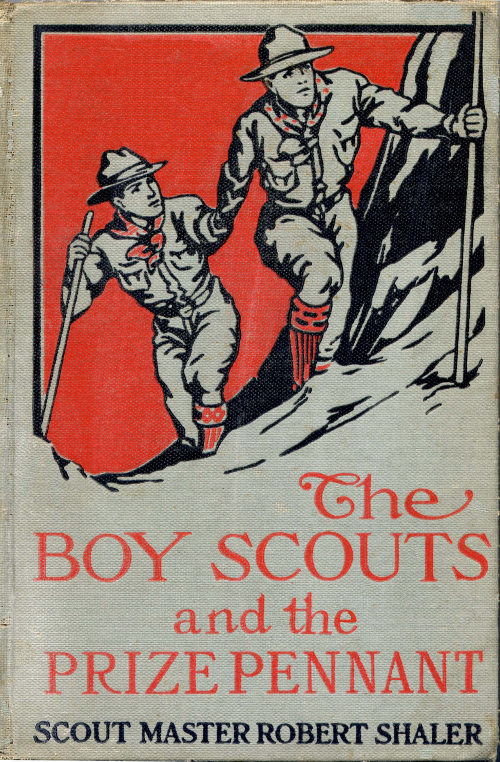
AUTHOR OF “THE BOY SCOUTS OF THE SIGNAL CORPS,” “THE BOY
SCOUTS OF PIONEER CAMP,” “THE BOY SCOUTS OF THE
GEOLOGICAL SURVEY,” “THE BOY SCOUTS OF
THE LIFE SAVING CREW,” ETC., ETC.
“Wasn’t that the far-away hoot of an owl
just then, Mr. Scout Master?”
“I wonder if it could be one of those tenderfoot
recruits that expect to make up the new
Owl patrol of our troop? How about that,
Hugh?”
“As you’ve put it up to me straight, Billy,
I’ll tell you what I think. It’s out of the question
for one of those greenhorns to be away
up here in the woods; and it was too deep and
heavy to be the call of even a big Virginia
horned owl. If you fellows will take the trouble
to look up through the treetops you’ll notice
that there’s a lot of queer flying clouds
racing overhead right now.”
6
“Whew! do you mean it’s going to storm,
Hugh?” demanded the boy who had answered
to the name of Billy. He seemed to be a good-natured,
easy-going lad, though just now his
face bore an expression of sudden concern.
“I’m sure that was the distant growl of
thunder we heard,” came the answer from
Hugh Hardin, an athletic fellow who had long
been the leader of the Wolf patrol. Very
lately, on the resignation of the assistant scout
master of the troop, Hugh had been elected
to that office, receiving a certificate from Boy
Scout Headquarters in New York City that
fully qualified him to serve in place of the real
chief should the latter be unable to accompany
the troop.
7
There were just four of the lads up in the
woods, where they had come to spy out the
chances for gathering a bountiful nut crop
later on in the fall. Incidentally they practiced
certain maneuvers that had to do with scout
lore and knowledge of woodcraft.
Besides Hugh and Billy Worth, there were
Bud Morgan and Arthur Cameron, the latter
of whom had made rapid progress to the grade
of a second-class scout, with aspirations for
even better things.
All of these boys belonged to the Wolf patrol,
the doings of which have been told in the
various stories preceding this volume. And
though they were by this time pretty well
versed in a knowledge of the great outdoors,
the fact that a storm was sweeping toward
them, with not a single house within a radius of
several miles, was enough to create considerable
consternation among them.
“We ought to do something right away,
hadn’t we, Hugh?” demanded Arthur, possibly
a trifle more inclined to be timid than any of
his mates.
8
“If we only had plenty of time,” spoke up
confident Billy, “we might make a lean-to out
of branches that would shed rain. I’ve helped
do it before, and we didn’t get wet, so you could
notice. But listen to that growl, will you? No
time for us to cut brush and branches, because
before we got her half done the old rain would
be howling down on top of us. Let’s cut and
run for it, fellows!”
“That’s all right, but run where?” demanded
Hugh. “It would be silly for us to think we
could make as fast time as the storm.”
“Whoop! I’ve guessed a way out of the
trouble!” ejaculated Arthur, beginning to show
signs of sudden excitement.
“Then, for goodness sake, tell us what it is,”
urged Bud, as a third peal of thunder broke in
upon their hearing, considerably louder than
either that had gone before.
9
“There, look at that whopping big oak tree,
fellows! Don’t you see that it’s hollow to the
core?” declared Arthur, pointing as he spoke.
“Why, chances are the whole kitting lot of us
could squeeze inside; and if the storm comes
from the direction of that thunder, not a drop
of rain would beat in on us. Well, why don’t
somebody say what you think of my bully
scheme?”
“How about that, Hugh?” asked Billy, as if
in doubt. “Seems to me I’ve been given to understand
that a big tree isn’t the best place
to get under when a thunder and lightning
storm is buzzing around. Hope I’m mistaken,
though, because that idea seems to be our best
hold just now.”
“Well, Hugh doesn’t think so, you notice,”
suggested Bud, who had been watching the
face of the acting scout master all the while,
as well as the gathering gloom that preceded
the passage of the heavy black clouds would
permit.
10
“It would be the very last thing we ought to
do, boys,” remarked Hugh, with resolution
marking his whole manner. “Of course, that
tree might never be struck, for it’s stood
through heaps and heaps of other storms; but
all the same the risk is there. Many a foolish
man has been killed just by doing something
like that. No, we’ve either got to take our
ducking and stand for it, or else find some
other place under shelter.”
“But just where could we go, Hugh?”
Arthur questioned uneasily, as all of them saw
a vivid flash of lightning shoot across the heavens
where a small clearing permitted a view.
It was soon followed by a detonating crash
that seemed to make the very ground tremble
underfoot.
“A barn would be just as bad as a tree,
wouldn’t it, Hugh?” asked Bud, who, it appeared,
knew something about such things.
11
“Every whit as bad,” the other told him;
“but hurry and come along after me, fellows.
I’ve got a little scheme that it may pay to try
and work. All depends on how long that rain
pleases to hold off. Given five minutes, and I
reckon we might make shelter. This way,
everybody, and take care you don’t get your
feet caught in some root or vine that will
throw you!”
Somehow all of the other scouts seemed to
have the utmost confidence in their young
leader. Hugh had been tested many a time,
and seldom failed his chums when a sudden
necessity like the present arose.
They went stumbling along through the
woods, with Arthur bringing up the rear, as
he did not seem to be quite as expert at this
sort of thing as the balance of the scouts.
Evidently Hugh was taking them on the back
trail, because presently Billy recognized a fine
white birch that he had marked down when
passing, meaning to come back one of these
days and strip that splendid mottled bark from
its trunk, for some purpose he had in mind.
12
This fact told him that Hugh must have noticed
some feature of the landscape, as he was
always keeping his eyes about him, that offered
a bare chance of safety from the storm
that was chasing after them so swiftly.
“It’ll have to bob up mighty quick, then,”
Billy was saying to himself, as he felt the first
drop of rain splash against his neck, “for we
are going to get it like cats and dogs right
away. Hello! where’s Arthur?”
The thunder had been rolling just before,
but ceased in time for Hugh to hear this last
startled exclamation from Billy. He instantly
stopped short in his tracks, and the three scouts
came together in a bunch.
“Arthur! Whooee!” shouted Billy.
A rather faint voice answered him from
back on the trail.
13
“Here I am; got caught by the ankle, and
had all the breath knocked out of me! Go
along, and leave me to look out for myself, fellows!”
“Not much we will,” said Hugh, as he immediately
started back again on the run. “We
Wolves stick together, come what will. Sink
or swim, we never desert a comrade, do we,
boys?”
“I guess not,” added Billy, and then quailed
as a fierce flash dazzled his eyes; “but this settles
it for our dry suits. We’re up against it,
all right, boys!”
They quickly reached the place where their
unlucky chum was sitting up, trying to work
his foot loose from the grip of the vine that
had caught him fast. Perhaps Arthur would
have succeeded in doing this in due time; but
he was out of breath now, and trembling so
with excitement that he did not seem able to
go at the job the right way.
14
After taking one look, Hugh gave the imprisoned
foot a backward wrench and it came
free.
“Hurrah for you, Hugh!” gasped the relieved
scout, as he scrambled to his feet; “but
you oughtn’t to have come back. I was to
blame, and stood ready to take my medicine.”
“Scouts always stand by each other,” said
Billy, who now proceeded to occupy a place in
the rear, so as to keep an eye on the one who
seemed prone to do what he had been warned
against.
Either the way was freer of obstacles from
that point on, or else Arthur had had his lesson
and watched his steps more carefully; at any
rate, he managed to keep up with those ahead
of him, and did not again come to grief.
Two minutes later, and Hugh turned
abruptly to the right.
15
“Here she comes, fellows!” cried Billy, as he
heard an ominous rushing sound some little
distance in the rear, which he knew must be
made by the descending rain.
“And here’s where we score a mark in our
favor in the contest for the prize banner!”
Hugh added. “Don’t you see where the rocks
crop up on this little rise? I noticed several
ledges standing out that ought to shelter us
from most of the rain, unless the storm shifts
and comes back again. Now, each fellow find
a place to crawl under the rock!”
Encouraged by these words, the other three
scouts hurried forward. Hugh generously
pointed out the first refuge, and told Arthur
and Bud to get under shelter as fast as they
could manage it.
“How about you and Billy?” cried Arthur,
unwilling to profit in this way from the scout
master’s discovery.
“Move along in here; a scout’s first duty is
to obey orders!” Hugh called back over his
shoulder as he hurried on.
16
It was beginning to rain in earnest, and that
rushing sound told that within half a minute
they might expect to be fairly overwhelmed by
the deluge that was coming with that mighty
wind and terrific bombardment of thunder.
Talking was no longer possible. One could
not have heard distinctly even if a speaker’s
lips were pressed against one’s ear. Hugh understood
this, and so he clutched Billy’s arm,
dragging him toward a spot where he had discovered
another shelf of rock, when that last
brilliant flash lighted up their surroundings.
They were not a second too soon; for even as
the two boys scrambled hastily under the
friendly shelter, down came the rain with such
a rush that it seemed as if a cloud must have
burst.
Crouching there in the semi-gloom, the two
boys looked out on such a spectacle as doubtless
neither of them had ever seen before.
17
It did not seem to be a mere summer storm,
but very much after the type of a cyclone, such
as sweeps irresistibly over sections of the country
at times, tearing up great trees by the roots,
and carrying off everything that happens to be
in its narrow path.
Right before their eyes they saw several
trees crash down. All around them the forest
bent far over before the howling wind. By
pressing back as far as they were able, the boys
managed to keep beyond the reach of the downpour.
Had it caught them napping, it would
have soaked them to the skin “in three shakes
of a wolf’s tail,” as Billy confidently remarked
in his chum’s ear, during a brief interval when
the awful clamor eased up a little.
18
CHAPTER II. THE LESSON OF THE RIVEN OAK.
The minutes dragged slowly along. For
some time it seemed as though there was going
to be no let-up to the sudden storm; and already
Billy was worrying over how they would
get home without a soaking. But Hugh had
noticed that it was less dark and gloomy than
before, and he drew his own conclusions from
this fact. Besides, the crashes of thunder certainly
came from further away now, and that
was convincing as well as encouraging to the
young leader of the Wolf patrol.
“Do we have to stay here all night, or take
our dose walking home, Hugh?” asked Billy,
who apparently had failed to notice all these
favorable signs.
19
“Oh! hardly as bad as that,” came the confident
answer. “You can see that the worst
is past by the way the clouds lighten; and that
last thunder clap was surely a mile away, for I
counted half a dozen seconds between the flash
and the beginning of the crash. Let’s be satisfied
with the way we’ve managed to cheat the
rain and kept our jackets fairly dry. I believe
in letting well enough alone.”
Billy began to notice the various indications,
since his attention had been called to them by
his more observing companion; and he quickly
found reason to agree with Hugh that they
would soon see the last of the rain.
“Jiminy! if it came down as heavy as this
near home,” he said humorously, for Billy
could joke, no matter what the conditions were,
“we’ll need a boat to paddle along the pike.
And say, think of little Pioneer Lake, will you?
Won’t it be over the dam and rushing down
like a mill race, though?”
20
The boys could now exchange remarks, because
the thunder had rolled further away, although
occasionally a terrific crash near at
hand startled Billy, who liked to thrust his
head out from under his shelter, just as a tortoise
might from his shell, only to jerk it back
again when a dazzling flash was instantly succeeded
by a stunning bang.
“Whew! that was the worst knock of all
we’ve had!” he ejaculated the next moment,
shivering so that Hugh could feel his form
tremble.
“You have to watch out in a bad storm for
those same after-claps,” the other informed
him. “They nearly always come, and do a heap
of damage. There’s something in the air that
draws the lightning back again to repeat. And
chances are that bolt shattered a tree into
splinters, because I’m sure I heard the sound
of falling limbs and branches.”
21
“Oh! Hugh, don’t you think it came right
from the quarter where that big hollow oak
stood which Arthur wanted all of us to use as
a shelter from the storm?” Billy asked, considerable
awe in his voice.
“I was thinking that myself,” replied the
other soberly; “and when we go on, we’ll find
out. If it should happen that way, the sight
of it would be the greatest object lesson ever
to Arthur; yes, to all of us.”
“I should say yes,” muttered Billy, as in imagination
he pictured that lofty oak lying in
ruins; “and I guess you did us all a great favor,
Hugh, when you refused to let any scout find
shelter under its branches, even if they did
look mighty tempting.”
22
That one grand crash seemed to mark the
winding up of the furious storm; for the rain
stopped altogether, and gradually the surrounding
woods became lighter. Still, no scout
ventured to crawl forth, such was the spirit
of obedience which had been fostered in the
Wolf patrol in times past, when all manner
of strange adventures had been the portion of
the eight boys constituting it. Until the leader
gave the signal, they must remain where they
were; although one and all of them secretly
confessed to being heartily tired of crouching
in that strained attitude.
When Arthur and Bud heard the peculiar
howl of the wolf—“How-oo-ooo”—softly repeated
three times, they knew that this was the
signal for release; and accordingly both boys
came crawling out from their place of concealment,
stretching their cramped limbs with
more or less animation and gratitude.
“Let me tell you it’s few scouts who would
have noticed these rocky shelves in the formation
of the hill,” Billy told the others impressively,
“and then have remembered them just
when a hiding-place from the storm was needed!
When we report this adventure to the
committee in charge of that banner, I hope
they’ll agree that our patrol deserves a good
big ten-point mark placed on record, for doing
the right thing at the right time.”
23
“And let me tell you, the other patrol leaders’ll
be warm under the collar when they
hear about it, especially Alec Sands,” Bud went
on to say reflectively. “Time was when he
just hated Hugh here like everything. Then
for a while Alec turned right around, so that
he seemed to be as good a friend as Hugh had
in the whole troop; but I’ve taken notice lately
that Alec’s showing signs of his old trouble.
You know he’s a spoiled darling at home and
thinks everything ought to come his way. He’s
straining every nerve to count points, and says
he’s got that fine banner as good as won. Huh!
like fun he has! Wait till the Wolf patrol is
heard from!”
24
“That’s the way to talk, Bud,” commented
Billy; “it gives us all a nice warm feeling. I
only wish we could manage to get a photograph
of these shelter caves that came in so handy.
Nothing like being able to show the proof,
when you’re going to make a report to the committee.”
“Well, you’ll have to come back here on a
clear day, then,” said Hugh; “because there
isn’t half enough light now to take them, and
we haven’t any flashlight apparatus along. If
all of you are ready, let’s be making tracks
toward home.”
Billy noticed that the leader took great pains
to walk along the same trail they had used in
advancing, and he could give a pretty fair
guess why this should be so.
That was characteristic of Billy; he often
acted as though sleepy; but, once he was
aroused, he could make as good use of his eyes
and ears as the next fellow. Just then he
fancied that Hugh expected to spring a considerable
surprise on his chums before they
had gone many rods.
25
“Looks as if we would be pretty wet, after
all, the way the drops come down from the
trees,” Arthur remarked, as he started to draw
the collar of his coat up about his neck. “But
then, none of us are made of salt, are we,
boys?”
“Well, I should say not,” declared Bud, “after
all we’ve been through since the Wolf
patrol was first started, and Lieutenant Denmead
consented to serve as our Scout Master.
And he’s worked wonders for the lot of us,
everybody says. Some of the boys in the troop
have improved five hundred per cent. since
they joined the scouts. They’ve learned that
a fellow can get heaps and heaps of fun out of
life without playing mean tricks or being cruel
to birds and animals.”
“Hear! hear!” exclaimed Billy, softly clapping
his hands in applause.
26
“If to-morrow is fine, I hope the whole bunch
will come up here again,” urged Arthur at this
point. “We surely must get photographs of
those queer rocky shelters, to show the judges
when we put in our claim for ten points. Hugh,
will you come, for one?”
“I certainly will, Arthur, and hope both the
other fellows will be along, for they ought to
be in the pictures.”
“Oh! there’s only going to be one, you know,
Hugh; unless we happen to strike a bevy of
young partridges with their mother. I’ve got
a quail sitting on her nest, but always wanted
a group picture of the partridge family.”
“Well, we’ll have to order up one for you,
then, Arthur,” chuckled Bud.
Just then Arthur, not looking very closely
where he stepped, stumbled over something
that lay in the trail.
27
“Look here, fellows, what does this mean?”
he exclaimed, stooping to pick up the object.
“A splinter of wood torn from a tree, and as
fresh as anything! Why, I wonder if the
lightning could have done that? Look around,
fellows, and—oh! just see what happened to
that tree! Why, the whole ground’s covered
with the wreckage! What a terrible thing a
bolt of lightning is, isn’t it, Hugh?”
“One of the most fearful things known,”
Hugh replied; “but look again, Arthur, and tell
me if you think you ever saw this same tree
before!”
Billy fairly held his breath as he waited to
hear what the other’s reply would be, for he
had already seen that which told him the truth.
“Why, you don’t expect me to have a speaking
acquaintance with every tree in the woods,
do you, Hugh?” remarked Arthur. And then,
seeing that the other was really in earnest, he
looked again, and more closely, after which he
continued: “Well, now that you mention it,
seems to me there is something familiar about
that riven stump. My stars! Hugh, it’s the
big oak with the hollow trunk!”
28
There was a vein of awe in the boy’s voice
when he said this, and his eyes were staring
as hard as could be at the telltale evidence
before him.
“And, Arthur, it doesn’t look quite so cozy
in that hollow as when you wanted us to hide
there from the storm, does it?” Hugh asked
him.
The boy turned a white face toward the patrol
leader, and there actually were tears in
his eyes as he said slowly:
“Just to think what would have happened
to the bunch of us boys if everybody else had
been as foolish as I was! It scares me just
to look at the awful smash that bolt made of
the big oak. And that shows how valuable it
is to know what is safe and what isn’t. Hugh,
after this I’m going in for woodcraft and
everything connected with it. I’ve been fiddling
too much with this camera business, perhaps.”
29
“Oh, I wouldn’t say that, Arthur,” the patrol
leader rejoined. “Photography happens
to be your hobby, just as geology and surveying
are Bud’s. You’ve made some cracking
good pictures, too, since you put your mind on
it. I’m sure that when you turn in the ones
you expect to show of flashlight views of wild
animals, taken in their native haunts, the series
will bring quite a few points to the Wolf patrol
for that prize banner.”
“I hope so,” said Arthur, “but that does not
change my resolution about woodcraft. You
must have guessed it was this tree that the last
bolt struck, Hugh. I can see now why you
kept following our back tracks so closely, even
when there was a better trail at hand. You
wanted to show me this sight, so it could be an
object lesson. Well, let me tell you all I’ll
never forget it as long as I live; and some fine
day p’r’aps I can keep other foolish boys from
getting under a big tree when a storm is coming
up.”
30
“I was just thinking of something, Hugh,”
remarked Billy, who had indeed been looking
unusually serious for him while this conversation
was going on.
“Well, give us the benefit of your wisdom,
then, Billy Wolf,” Bud entreated.
“Here’s where we’ve got a fighting chance
to pull down the biggest wad of points you
ever heard of. Wasn’t it two hundred and
fifty that was to go to the patrol containing a
scout who had been instrumental in saving a
human life since the contest started? Well,
what’s the matter with our claiming a thousand?
Hasn’t our leader saved all our lives
by his judgment in this hollow tree business?
How about that, Hugh? Think we’d stand
any show of getting our claim admitted by the
committee?”
31
“Well, that’s too fine a question for me to
settle offhand,” the other replied with a laugh;
“but I rather think it meant saving a life at
the risk of one’s own; and you know that it
was only my knowledge of these things that
counted in this case. Still, Arthur must take
a picture of this tree to-morrow, and we can
put in a claim for points in woodcraft. It will
be a good thing for every scout in the troop to
hear about; and when they see what happened
to the big oak with the fine hollow in its trunk,
they’ll never allow themselves to be tempted
to crawl into such a trap when lightning is in
the air.”
As the four boys hurried on Bud remarked
drily: “A little common sense went a long way
this time.”
32
CHAPTER III. SCOUT LAW.
No doubt in four families that same evening,
while the good people of the house gathered
about the board, there was considerable interest
taken in certain versions of that day’s
adventures. More than one mother’s cheeks
grew pale as she learned how close her boy
had been to a sudden death, while the father
nodded his head and remarked in this wise:
“Now, I shouldn’t be surprised if Boy Scout
training did amount to considerable, after all.
That was a simple thing to know, but it proved
to be mighty practical in application. Beware
of trees and barns during a thunder storm.
I’m glad you showed such good sense, son.”
33
The account given in Hugh Hardin’s home
was much more modest than in any of the
others. He shared the credit for discovering
the wonderful shelves of rocks and the determination
not to stay under the tree, so that
any one listening might have received the impression
that all four lads had simultaneously
settled upon those important points. Hugh
used the word “we” constantly, and it was not
until later, when his folks met with the parents
of the other boys, that they learned just
where all the thoughtfulness lay.
The following day dawned as “fine as silk,”
as Arthur gleefully told Hugh over the ’phone,
when asking what would be the best time for
them to start out on their second trip to the
woods.
“This is just the dandiest day for taking
pictures that ever could be, Hugh,” he went
on to say. “The air is as clear as a bell, and
you know that counts for a heap. My book
of instructions says that’s why they get such
fine views out in California, where the atmosphere
is extremely rarefied.”
34
“Whew! does it say all that?” laughed Hugh.
“Then I don’t wonder you’re anxious to take
advantage of a day like this. That storm has
cleared the air in a great way, for a fact.”
“Well, if they’d had it as severe here as we
did up there in the woods,” continued Arthur,
“it would have been tough on church steeples
and such. I believe there wouldn’t have been
one left in town. But only a few trees were
blown down, and one house struck.”
“Where was that?” asked Hugh. “I hadn’t
heard about any such thing.”
“Luckiest thing ever,” said Arthur; “it happened
to be that old deserted building that was
called Sutton’s Folly. Lightning set it afire,
and in the storm the Excelsior Company
couldn’t get out there to do their little business;
so it burned to the ground, some people
say. Others speak of the ruins standing, and
looking queer. I’m bound out that way right
now to try for a picture. How about the time
we start up into the woods, Hugh? Would
one o’clock do?”
35
“Make it one, and if either of the other boys
can’t get off I’ll let you know, Arthur,” the
other informed him.
“That goes, then, and meet at the church as
before. By the way, Mr. Assistant Scout
Master, although it’s only seven o’clock, you’ll
be interested to know that I’m wearing my
badge right-side up already. Haven’t missed
connections now for twelve days; but it never
came so early in the morning before.”
“Good for you, Arthur; how did it happen?”
asked Hugh, always interested in anything
that had to do with the application of
scout principles. “Help the hired girl up with
a bucket of coal, or run an errand for the
folks?”
36
“Well, I did go on an errand before breakfast,
but as that is a part of my regular home
duties I never count it as worth while mentioning.
I’d be pretty small to change my
badge on that account. It was this way,
Hugh. I have to go for milk, you see, because
we get our supply now from old Mrs. Grady.
She keeps just one cow, and it helps her out
to sell all she can spare; but she’s so crippled
with the rheumatics that she can’t walk much
and people have to come to her. Are you listening,
Hugh?”
“Sure I am; go right along, Arthur, but cut
the story short. I think I’m wanted about now
to carry a message downtown for my mother.
What happened?”
“Why, it isn’t much to tell. You know the
Sprawl family that live in the old shack down
near the blacksmith shop? The man is a
cobbler when he cares to work at all, and there
are about forty-eleven youngsters flocking
around the door all the time, barefooted and
dirty.”
37
“Yes, I’ve often carried them things from
our house,” Hugh assured him.
“Well, I came on one of the little Sprawl
girls a-cryin’ on the road and searching in the
grass. She carried an old battered pitcher in
her hand, and when I asked her what was the
matter she said she had been sent for five
cents’ worth of milk and had lost the money.
You ought to have seen how her face lighted up
through the tears and the dirt when I drew
out a nickel and gave it to her! Guess that
entitled me to turn my badge, even if it wasn’t
much, didn’t it, Chief?”
“I should say it did, and you’ll get a heap
more satisfaction out of remembering the look
on that little girl’s face than you’d ever have
had from spending your nickel for a glass of
soda water. But I’ll have to break away, Arthur.
Look for us at one, alongside the church.
I have a few stunts for us to practice while up
there among the cliffs of the mountainside.
So-long!”
38
When Hugh had attended to his errand
downtown, he walked around to the sporting-goods
store, in the window of which was exposed
the handsome silk banner which had been
offered by a leading gentleman of the town as
a prize to the patrol winning the highest number
of points in the competition that had been
arranged by the efficient Scout Master.
There was hardly a time throughout each
day that one or more lads did not have their
noses pressed against the glass of that window,
while they indulged in all manner of talk and
speculations concerning the possible destination
of that beautiful prize.
39
Doubtless many unique, and perhaps even
remarkable, expedients would be resorted to
by the energetic and ambitious members of the
Hawk, the Otter, the Fox and the Wolf patrols
of the Boy Scout Troop, in order to sum
up the largest number of points in the contest.
And when the time came to read off the
list of things accomplished and to award the
prize to the lucky patrol, there would be surprises
all along the line.
Two boys were standing at the window as
Hugh approached: Billy Worth and Bud Morgan.
They turned toward Hugh with something
like a mixture of indignation and amusement
written upon their faces; and Billy immediately
fired the first shot, as usual, for he
was ready with his speech, if sometimes hesitating
when it came to quick action.
“What do you think, Hugh? Alec Sands
and Sam Winter of the Otters were just here,
and you should have heard them talk! It was
‘our’ banner, and ‘how proud we’ll be when we
march with that waving over the Otters’! I
tell you, I was mad enough at first to eat my
hat; and then Bud whispered that they were
doing it just to get my goat, so I cooled down
and added to the merriment by asking all sorts
of questions about just how they felt so dead
sure of winning.”
40
“Yes,” added Bud, “but it didn’t work,
Billy. Alec was too sly to give his secret away.
He only put on that wise look of his, winked
his eye, and said: ‘You Wolves just wait and
hear something drop. You’re going to get the
biggest surprise of your lives before long. And
let me tell you right here, we’ve got that banner
cinched!’ And then they walked away,
chuckling and looking back at us as though
they might be having lots of fun.”
“Well, chances are they were, if you fellows
let them see you were worried any by their
big claims,” Hugh declared.
“What do you think about it, Hugh?” asked
Billy. “Have they found out some way to add
a lot of tallies to their string,—an easy way,
and yet one that would come inside the restrictions
set by the committee? If that’s so,
then the rest of the patrols might only be wasting
their time trying.”
41
“Don’t you believe that,” the other instantly
told him. “No matter if they are beaten in
the race, there’s no discounting the good the
patrols will get out of the effort they make to
roll up a strong count. Lots of things are
bound to be attempted that would never have
been thought of only for this keen competition.
In my opinion, this is going to be the best thing
that ever happened for the troop. And the
whole town has got the fever by now, so that
even men and women are interested. When
the time comes for counting the tallies and telling
how each bunch was won, there won’t be
standing room in the biggest hall in town for
the crowd that’ll want to be there.”
“Then you think Alec might have been boasting,
just to rub it into us, knowing all the time
we’d tell you about it?” remarked Billy.
42
“We all know that Alec is as smart as a
steel trap,” said Hugh thoughtfully. “Now,
it’s just barely possible that the Otters haven’t
any wonderful run of luck at all, and that he’s
adopted this scheme, thinking he may discourage
the rest of us. You know, if some boys
once get the notion in their heads that they’re
beaten long before the end of the race, they’re
apt to throw up the sponge and quit. He may
think that we are that kind.”
Billy snorted with disdain as he said hastily,
“Huh! guess Alec isn’t much on reading
character, then, if he thinks Hugh Hardin
would get weak-kneed for a little thing like
that. And every one of the Wolves are made
of the stuff that fights harder than ever when
they see that they’re up against a tough job.
But anyway, you’ve made me feel better, Hugh.
Someway I always do seem to look at things
in a different light when you are around.”
43
“How are you fellows fixed for meeting
Arthur and myself at one o’clock to-day?” the
other calmly asked, though it must have given
him a flash of pleasure to hear Billy’s remark.
“Does that mean we’re going for another
hike to-day?” asked Bud. “I’m on deck, you
may be sure; only I hope we won’t run across
another storm like that one yesterday. It was
the worst I ever struck.”
“No danger of that, with this fine bracing
air and that cloudless sky,” Hugh replied. “Arthur
is wild to get pictures of those places
where we met our adventure yesterday; and I
have a few tests connected with cliff climbing
that I’d like to put through while up there in
that rough country. Can you go, Billy?”
“Count on my being there at one, prompt,
Chief,” came the immediate reply. “You
know I’m never half so happy as when out in
the woods. We might have another lesson in
that Injun picture writing while we’re at it,
Hugh. Never thought I could be so wrapped
up in anything as that study’s turned out for
me.”
44
“If we have time we will,” said Hugh. “By
the way, I notice that neither of you scouts
have turned your badges yet for to-day. Arthur
was telling me over the ’phone of a nice
little stunt he’d pulled off that let him make
the change; and while he’s out a drink of soda
water, he’s in a whole bushel of good feeling in
his heart. No, I won’t tell you how it was;
you must ask him that. And I’ve got to be
off now, as my folks will be wanting what I
came downtown after. Better get busy, Billy,
and you too, Bud. The sooner it’s done, the
quicker your mind will be free for the whole
day.”
45
“Oh! I’ve got that all down fine,” laughed
Billy. “All this week I’ve agreed to help our
old gardener weed his onion bed, working half
an hour a day, because he gets such a stiff back
bending over, you know. And I’ll move along
home to do my stunt right away.”
“And as for me,” added Bud, “I think I
know how I can surprise my mother by doing
a number of things to lighten her work this
morning. You’ll see me wearing this old badge
right-side up when I get to the church at one!”
It was odd how many opportunities came to
these scouts, alertly watching for chances, to
live up to that law of their organization that
required a daily good deed. And, regarding
their acts in the light of duty, they reported
them to one another quite without boastfulness.
Each scout felt it a reflection upon himself
if he were long seen wearing his badge
upside-down, the position in which he was
obliged to place it at the beginning of the day.
And as his own judgment decided when he
might conscientiously reverse the badge, he
was careful to merit the privilege.
46
CHAPTER IV. GETTING CONVINCING PROOF.
“Here’s where we’ll have to leave the wheels,
fellows, and climb the rest of the way,” said
Hugh, at about two o’clock that same afternoon.
The four members of the Wolf patrol had
concluded that they could save themselves considerable
time by making use of their bicycles;
it had been Bud’s suggestion, and being duly
O.K.’d by the leader, the order went forth to
come to the place of meeting prepared for a
run along the good road that would take them
pretty nearly three-fourths of the way to where
they had planned to go.
So, dismounting, they looked for a convenient
hiding-place, where the wheels might be
considered safe until they came that way again,
homeward bound.
47
Arthur carried his dearly loved camera,
with which he had become very expert of late;
and, as has been said before, the really fine
pictures he was turning out proved that he had
a natural bent in that direction worth cultivating.
He was forever trying new experiments,
and, with the assistance of Hugh, had
already managed to obtain quite a few clever
photographs of wild animals, such as could be
found in that neighborhood. Indeed, they had
several times arranged a sort of trap, so that
a mink or muskrat in starting to carry off the
bait, actually took its own picture by setting
off a flashlight cartridge.
As the four boys started up the steep road,
talking vigorously about the happenings of the
previous day, it was noticed that Hugh was
carrying a coil of rope over his shoulder. He
had brought it along fastened to the handle-bars
of his wheel, and, remembering what he
had said about practicing cliff-climbing, Billy
and Bud could readily guess what this might
be for.
48
As for Arthur, he seemed so engrossed with
what he expected to do in taking a number of
views calculated to back up their story about
the storm, that he paid no attention to anything
else. That was the trouble with Arthur;
once he got interested in any particular line of
work, he threw his whole energies into it, perhaps
to the neglect of other equally important
matters.
They were soon climbing the trail that led
to the scene of their previous adventure. Billy
seemed unusually wideawake on this afternoon,
and full of animation. His eyes were on the
alert all the time, and if there was a squirrel
that leaped from one tree to another in making
for its hole, a rabbit that suddenly flashed out
of sight among the bushes, or a red-headed
woodpecker hammering at some rotten treetop,
Billy was the one to discover it first of all.
49
Several times Arthur manifested a disposition
to stop and take pictures. There were
trees that had been blown down which seemed
to offer an inviting field, and might have made
good views; but Hugh advised that he “hold
his horses” awhile.
“You can take plenty of pictures of fallen
trees whenever you feel like it,” the patrol
leader told the artist; “and just now you ought
to make every film count for the Wolf patrol.
Perhaps you may want to snap off several shots
at the wreck of the big hollow oak; and then
there are the rocks that made us such a fine
shelter. They ought to show up just right in
this afternoon sun, for they face the west.”
“I do believe you even thought of that when
you agreed to the time for this hike, Hugh,”
Arthur returned thoughtfully. “It seems to
me you just look away ahead pretty much all
the time, and figure things out long before
they happen.”
50
“Oh! hardly all that,” laughed Hugh; “and
in this case you’re away off, because it never
occurred to me until I spoke. But besides those
pictures, there may be some other things turn
up before we get back that will be worth while
snapping. I’ve got a few stunts figured out,
you know, that will give you a chance to do
some quick work, if you want to finish out a
film.”
“We must be getting close to where that old
tree went to smash when the lightning struck
it, Hugh,” remarked Bud.
“There she is, right ahead there!” cried
Billy, before the leader could answer. “And
say, boys, let me tell you the wreck looks just
as fierce as it did yesterday. I’ve been wondering
whether we mightn’t have magnified
things a little, seeing we were so worked up
over the escape; but just look at the way the
limbs are scattered around! It’s going to be
a hard thing for you to get a proper focus on
all that stuff, Art, and us grouped in the bargain.”
51
But the experienced photographer had already
cast a quick look around, and seemed
fully confident that he could manage nicely.
“Plenty of sunlight at this early hour,” he
remarked first of all; “but by three o’clock the
shadows of those other trees would have bothered
me. And now, you fellows stand just by
that little open place, where you won’t be in
the line of the riven stump. The hole must
show that I wanted you to crawl into before
the storm broke. After I get you well focussed,
I expect to join you. I’ve got an extra
long rubber tube, you notice, connected with
my rapid drop-shutter; so when we’re all
fixed, I’ll press the bulb, and the thing’s done.”
He was very particular how he placed them
all, and after he had viewed the scene from
under his light-proof cloth, he came back several
times to make alterations.
52
Finally, even the particular artist seemed to
be satisfied.
“Nobody move a hand or foot, or more than
breathe, till I come back and join you,” he told
them, as he hurried to his camera which he had
mounted on its tripod. “That’s going to be a
Jim Dandy view, I’m giving it to you straight,
fellows; and above all, the hole shows up fine.
You see, that’s what will gain us points in this
game, if anything will, and the committee must
be able to tell that the oak tree struck by lightning
was hollow, so that they can know how
close a call we had. Steady there, Billy Worth;
don’t act so frisky. We don’t want to spoil
this picture, let me tell you; and I’m going to
take a second snap, to make doubly sure of it.”
When the official photographer of the Wolf
patrol had rejoined his three waiting chums,
he stooped to secure possession of the bulb that
completed the long thin line of rubber tubing.
53
“Now, look natural, everybody!” he remarked.
“I’m going to press her. All ready?
Here she goes! There, that counts for one
snapshot! Now wait here where you are till
I turn another exposure, and we’ll make a second
picture.”
This was soon accomplished, and Arthur declared
that he would have excellent results to
show for all their work.
“You’ve got to print a copy for each one of
us, too,” remarked Billy seriously. “I’m going
to have an enlargement made, which I can
frame and hang over the desk in my den at
home. Every time I look up at it I’ll remember
what it means, and feel thankful that I joined
the scouts and that Hugh was along with us!
It gives me a cold shiver to think what might
have happened if the other three of us had
been by ourselves. Neither Bud nor myself
would have known enough to put up any objection
when you made your bid for shelter, Arthur.”
54
“Oh! forget that, can’t you?” pleaded Bud.
“Let’s move on, fellows, and find something
more cheerful to look at than heaps of kindling
wood, great splinters, and broken branches
every-which-way.”
“Do we start for the bully rocks now,
Hugh?” asked Billy, when the artist had gathered
his traps together and seemed ready to
continue the tramp.
“That’s the next thing on the program; and
after we’ve taken what views we want there,
why, I’ll show you what I want to try out. It
struck me yesterday as we were looking for
new nut trees up here, and I saw how fine the
cliffs stood up in several places.”
“P’r’aps, Hugh,” chuckled Billy, “you might
be aiming to give the Excelsior fire-fighters a
few object lessons on how to save people from
ten-story tenement buildings; but as we haven’t
anything taller than three stories in our town,
I don’t see just how they’ll profit by it.”
55
“Of course I wasn’t thinking of the fire
company when I laid out these plans,” the
patrol leader said; “but this rope-climbing business
is like a good many other things scouts
learn: they don’t ever expect to have to depend
on such a thing to save either their own
life, or that of another person; but if the time
ever does come, it’s handy to know how.”
“You’re right there, Hugh,” admitted Billy;
“it’s just like a man insuring his house against
fire. I don’t reckon anybody ever believes his
house is going to burn down; but he only wants
to have his mind easy.”
“Well, lots of the stunts scouts learn are just
so much insurance, as you might say,” Hugh
declared. “And the more a boy stocks up with
this stuff, the better he’s equipped for life.
That’s where it counts big, I’m telling you.”
“And there is where we tucked ourselves
away from the cloud-burst!” announced Billy,
being the first to glimpse the queer rocky formations
in the shape of shelves, that jutted out
for six feet or so from the face of the hill.
56
Again Arthur “got busy” and made his arrangements.
Hugh seldom offered any suggestion,
for he saw that the other was better
qualified to manage this thing than any of the
rest. Once more they posed while the proper
focus was being secured; and then Arthur injected
himself into the group, gave the customary
warning, and finally pressed the magic
bulb that completed the circuit.
Since so much depended on getting a sure-shot
of the queer shelter which Hugh had discovered,
Arthur repeated the attempt once
more; in case one exposure should have some
mishap come to it, he could turn to the other.
He had learned that in all important cases,
where extra value is placed on a picture, it is
a good thing to make doubly sure; because it
is often utterly impossible to secure the same
conditions twice, and a valuable opportunity
may be lost.
57
After this, Hugh assumed charge of things.
He was really anxious to try out several ideas
of his own connected with cliff climbing, which
had been one of the features of past contests
in which the scouts had indulged to a limited
degree. Now he believed he had hit on a
series of experiments that would not only prove
fascinating sport, but give them all considerable
training in rope-climbing, as well as a
knowledge of how Alpine guides manage to
keep from falling when mounting dizzy
heights.
Twenty minutes after taking the last picture,
the four scouts were climbing the rugged
mountainside. Far above them they could see
the bare ridges of a higher peak, where many
of their earlier outings had been conducted in
the days when the troop was still young.
58
They were chattering like a flock of magpies,
when Billy suddenly gave a cry of excitement.
As before, those quick eyes of his had been
roving to the right, to the left and straight
ahead, always discovering new things.
“Oh! what in Sam Hill is that thing over
yonder coming straight this way?” he yelled,
clutching Hugh by the arm. “If I’d been reading
‘Baron Munchausen’ or ‘Sinbad the Sailor,’
I’d think it was a giant roc flying toward
us; but it seems more like a battered old balloon
dropping down to the ground.”
“It is a balloon,” said Hugh, after looking
intently; “and I believe I can see a man in the
swinging basket, waving his arms to us, as
though he might have lost all control and
wanted us to help save him!”
The other scouts were of the same mind
when they had looked closer. It gave them a
thrill to realize that all of a sudden, out of the
clear sky, an opportunity had arisen whereby
they might be of use to one in great peril.
59
CHAPTER V. THE WRECKED BALLOON.
“It’s sinking right along, isn’t it, Hugh?”
exclaimed Bud in an awed tone, as he kept his
eyes fastened on the strange object that had
so unexpectedly dawned upon their vision.
As it happened that the trees grew sparsely
in that quarter, they were able to watch the
approach of the sky traveler in his disabled
balloon. All of the boys took it for granted
that he must have ascended at some fair
ground, and met with an accident that had
prevented a return to earth under normal conditions.
“There’s no question about that,” the patrol
leader replied to Bud’s question; “and now
it is easy to see that there is a man in that
wobbling basket.”
60
“Yes, and as you said, he’s making motions
to us to do something,” added Arthur, as he
hurriedly opened his camera and prepared to
take a snapshot of the balloon.
“What can we do to help him, Hugh?”
Billy demanded, apparently ready to dash forward
at headlong speed if only the order came
from the patrol leader.
“Nothing just now, the way things stand,”
came the reply. “He is coming as straight
toward us as if we had a line and were pulling
him. Wait till the balloon gets here, and if
there happens to be a trailing rope, we’ll grab
hold of that, and wind it around a stump or a
rock to anchor the old runaway.”
“That sounds sensible, Hugh,” admitted
Billy, always ready to agree with the leader.
61
“Look at the thing swing up and down, will
you?” cried Bud. “Boys, it will be a lucky
thing for the professor if he gets out of that
scrape with his life. As for me, you’d have
to ring the bell lots of times before I’d go up
a mile high in one of those flimsy silk bags.
Wow! did you see how close it came to that
tall tree right then? That would have done
the business, I reckon. And there are lots
more of the same kind ahead of him yet.”
“Do you see a trailing rope, boys?” asked
Hugh. “Sometimes they let one down and
have a weight on it for a drag anchor. Seems
to me I can glimpse something of the kind now
and then.”
“You’re right, Hugh, it’s there!” ejaculated
Arthur, who had already snapped off one view
of the advancing balloon.
“Everybody get ready to lay hold and fight
like everything to check the runaway,” Billy
remarked, squaring himself for action in a
way he had, just as if he expected to enter a
contest of skill and endurance with a prize at
stake.
“Isn’t she rising again?” shrilled the excited
Bud anxiously.
62
“Course not, Bud,” Billy told him; “you’re
just imagining things again! Hugh, give us a
tip if there’s any chance of the old balloon
slipping past to one side!”
“Spread out a little, fellows, like a fan;
that’s all we need do,” the patrol leader directed.
“It looks to me as if we were in the
direct line of her flight, and if the wind doesn’t
change or a sudden flaw strike in, why, inside
of two minutes we’ll either have grabbed that
rope or missed connections.”
“Oh! don’t let us make a foozle of it like
that!” exclaimed Arthur, who sometimes
played golf with an uncle who was very fond
of the sport.
He had not dropped his camera, for he meant
to take another snapshot when the oncoming
balloon had reached a certain large tree that
he had selected and for which he had set his
focus.
63
It was this same tree that Hugh was observing
with more or less concern. He feared that
should there prove to be only a little slant of
wind that way, it might catch the drifting
balloon and bring about a terrible catastrophe.
As it was, the escape must be a narrow one,
for the balloon was heading so as barely to
pass the obstruction. And just then, to Hugh’s
dismay, he actually felt a puff of air on his
right cheek! Up to that moment, the breeze
had been coming directly from a quarter in
front; but this variation would seem to indicate
that a “flaw” could be expected. In mountainous
regions there is never any reliance to
be placed on the wind, which may seem to
blow from half a dozen points of the compass
in as many minutes, owing, of course,
to the gullies and defiles and cliffs that obstruct
a free passage.
“Hugh, she’s veering!” shouted Bud.
“And starting to head straight for that other
big tree there, too!” yelped Billy, in turn.
64
If any one could have seen those boys at
that moment, he would surely have realized
what an intense interest they were taking in
the advance of the drifting balloon and its ill-fated
aeronaut. Every face had lost its color,
and every eye was bright with excitement.
Now the body of the tree in question was
almost in line with the spot where the boys
were standing, and were the balloon so lucky
as to clear this obstacle, it might pass close
enough for these agile lads to race over and
make a try for the dangling drag rope.
Hugh himself began to believe it was going
to prove otherwise; and that after safely passing
through all sorts of other perils, the man
who had been a sky pilot was fated to be
thrown out of his basket by a collision with
that miserable tall and bushy tree that blocked
the way.
65
Still, none of them dared make a start, until
they saw what would happen. They could do
nothing to prevent a collision; and should there
be none, they wanted to remain where they
were, so as to be ready for the rescue act that
they had quickly planned.
Already the drifting balloon was close to
the tree, and seemed to be setting toward it
more and more, just as though there might be
a great magnet attracting it; or, as Billy later
on described it, “It was like a silly moth plunging
straight for a lighted candle that was sure
to singe its wings.”
Just as the collision actually came, all of the
boys seemed to hold their very breath with
awe. Arthur, however, having that instinct
for securing all manner of strange pictures,
mechanically raised his camera and prepared
to take another snapshot view at the most critical
second.
66
They could all plainly hear the dreadful
scraping sound as the balloon dragged through
the treetop. The silken covering must have
been badly torn in its passage, for the rush
of escaping gas came to the ears of the scouts,
and they could see how quickly the immense
bag began to collapse after it had dragged
away from the tree.
“Come on, boys; we’ve got to get there in a
big hurry!” exclaimed Hugh, as he started running
with might and main, the others trooping
after him. Arthur, of course, brought up the
rear, since he had been compelled to snatch up
certain parts of his photographic outfit from
the ground where he had dropped them.
The balloon was rapidly falling to the
ground, the basket being more or less enveloped
in the voluminous folds of the immense
silk bag.
67
Indeed, before the boys could reach the spot,
the whole fabric had collapsed and grounded
there, coming down with such force that it
would seem as though the unfortunate pilot
must either have been killed outright or at
least suffered serious injuries.
In the latter case, perhaps the scouts might
find themselves called upon to show “first aid
to the injured.” Indeed, on a number of other
occasions they had proved themselves apt
pupils in the art; and it would be a lucky thing
for the balloonist, should he be badly hurt,
that fortune had allowed him to fall into the
hands of trained boys. Ignorant countrymen
would let him bleed to death, simply through a
lack of knowledge of the essential things that
should be promptly done.
Hugh led the van, with Billy a close second,
while Bud kept pretty close at the latter’s heels.
And in this manner they arrived at the place
where the remains of the wrecked balloon lay
in a great pile.
68
“Get busy, everybody!” called the patrol
leader excitedly. “He might be smothered if
he lay under that stuff long, with its smell of
gas!”
“Whew! isn’t it rank, though?” gasped
Billy, as he tugged away at the folds of the
heavy silk gas envelope, and fell several times
while struggling to lift more than his share of
the burden.
Then Bud arrived to lend his assistance; and
the way those three boys struggled to turn
the entire mass over was worth seeing. Arthur
was struck with the possibilities for a new
picture as he saw them fighting with the remnants
of the once great balloon; and obedient
to his instinct, he halted and busied himself
getting the proper focus.
The “click” of his camera told Hugh what
had happened; but just then he made a discovery
that put both Arthur and his propensity
for securing “worth-while” pictures out of
his mind.
69
As he feverishly worked alongside the other
two scouts, Hugh had expected at any second
to uncover the white face of the aeronaut, lying
there where he might have fainted at receiving
such hard treatment. And the patrol
leader had kept his jaws set very tight, so that
he might be prepared for any pitiful sight.
His surprise had rapidly grown as they had
neared the end of the pile of crumpled silk, and
without discovering the first sign of a human
being.
“Why, Hugh, he isn’t here, after all!” cried
Billy, in what must be confessed was a relieved
tone of voice, as though he, too, might have
been dreading what they might presently uncover.
“We all of us got fooled, that’s what!” added
Bud, trying to laugh, though the effort sounded
a bit hysterical.
“What’s all that?” demanded Arthur, who
had arrived just in time to hear this last remark.
70
“Why, there wasn’t any man in the basket
after all, don’t you see?” Billy explained, indicating
how they had carefully gone over the
entire pile of wreckage, even overturning the
basket, as though it might have hidden something.
“That’s where you’re mistaken, then, because
I saw him as plain as anything,” the newcomer
asserted, and Arthur could be pretty stubborn
when he wished.
“All right, then, get busy and find him, if
you can,” Bud told him. “We throw up the
job, don’t we, fellows? Hello! what’s Hugh
going to do now?” Their attention being
called to the leader by this remark from Bud,
the others saw that Hugh had hurried back
and up the rise a little.
Presently he stopped, and seemed to be looking
earnestly toward the crest of the big tree,
about where the basket of the runaway balloon
had crashed through when that flaw came in
the wind.
71
The other scouts stared hard, as they began
to comprehend what this act on the part of
their leader might mean; and presently they
were thrilled to hear Hugh call out:
“Boys, there was a man in the basket, and
he’s caught fast in the tree near the very top!
Yes, and he lies there as if he might be dead,
or else had swooned away!”
72
CHAPTER VI. ENGINEERING IN A TREETOP.
What the patrol leader had called out, as
he hurriedly returned to them, gave the other
three scouts a great surprise. They stepped
back a few paces and strained their eyes in the
effort to locate the object mentioned by Hugh.
It is always much easier to see and do things
when some other person has first marked out
the way. Columbus had an experience along
those lines, you will remember, after he returned
from discovering America. The jealous
Spanish courtiers and sea commanders
sneeringly declared that his task had been very
simple, as all he had had to do was just to
“keep on steering straight westward”!
73
So it was that when Hugh had found out
the truth and imparted the information to the
rest of the boys, Billy and Arthur quickly discovered,
also, the unlucky aeronaut.
“Show me, won’t you?” begged Bud, who
appeared unable to locate the exact spot in his
excitement. So they bent their heads close
together, allowing him to get the range of
their extended fingers.
“There he is,” said Billy, “just where that
last fair-sized branch shoots out toward the
left. Look hard, and you’ll be sure to see
something caught in the crotch. That’s the
man, Bud. And believe me, it must have been
a whopper of a jar when he struck there, after
being dragged by that runaway balloon.”
“I wonder if he is dead?” said Arthur in
an awed half whisper.
“Don’t you believe it,” Billy declared.
“But he might be, Billy,” added Bud, taking
sides with Arthur, “because, as you just said,
he must have been slammed into that crotch
terribly hard.”
74
“But you never saw anybody that was dead
move his arm, did you?” demanded the positive
Billy.
At that the others showed signs of surrender.
“Course not,” remarked Bud; “and if you
saw him do that, he must be alive. What do
you think, Hugh?”
“I’m not so sure as Billy,” returned the patrol
leader, “but I thought I saw his arm move
once. That might have been only when it
slipped down from some position. But I’m
going to find out right away, boys.”
“Hugh’s going to climb the tree,” suggested
Bud quickly, taking it for granted that this
was what the other meant when he made his
last remark.
“But whether the poor fellow’s alive or not,
how are we going to get him down from away
up there?” asked Arthur.
“Leave that to Hugh,” said Billy wisely.
75
The first thing Hugh did was to glance hastily
around him, as though looking for something
he expected to need.
“Oh! it’s that long rope he brought with
him to use in the cliff-climbing experiments!”
exclaimed Arthur, as he saw the other bend
down and secure the article in question, which
he must have dropped when he arrived under
the tree where the wandering balloon had met
its final Waterloo.
Billy looked relieved. His faith, then, had
not been misplaced, for Hugh now had means
in his possession for lowering the unfortunate
aeronaut. Just how the boy would go about
it, of course Billy did not exactly know; but
he smiled, and took a new interest in the
matter.
“Somebody cut away that rope from the
basket,” Hugh directed first of all.
76
“You mean the one that was trailing down?”
asked Bud, as he immediately produced his
pocket knife, the blades of which he always
kept in prime condition.
“Yes, be quick, Bud. I’m going to knot it
to my rope, if it seems stout enough,” the
leader told him. “That ought to give me a
long enough line to double from the ground up
to that place.”
“Oh! I see how you mean to do it, Hugh!”
observed Billy, wagging his head as though understanding
Hugh’s solution for the puzzle.
Already Bud had cut the trailer rope just
where it was fastened to the overturned basket.
As he did so, he could not fail to notice
that a number of seemingly valuable instruments,
such as are used by aeronauts in their
daring voyages among the clouds, were scattered
about, and that a little box lay near them.
“Here it is, Hugh!” he remarked, coming up
on the run with the line coiled on his left arm,
where he had hurriedly placed it while on the
move.
77
“Stretch it out, while I make a safe knot,
one of the best we had to learn before we could
be tenderfeet,” Hugh told him.
Bud hastened to cast the coils down, while
Billy picked up one end and ran off with it.
While the leader was undoubtedly in something
of a hurry, he did not mean in the least
to neglect his duty; and never was a knot made
more amply secure than the one that united
those two ropes. Hugh tested it to his heart’s
content, and then appeared satisfied that it
would easily bear all the weight that must be
placed upon it when they started to lower the
aeronaut.
“Next thing is to examine the rope from the
balloon, to make sure it’s all right,” Hugh
said; “I know mine is up to standard, because
before I came out to-day I tested it with a
weight three times as heavy as Billy here, and
that’s going some, let me tell you.”
78
He quickly ran over the rope, looking for
defects and straining at each portion. In this
way possibly precious seconds passed; but it
was Hugh’s policy that “haste often makes
waste.” He agreed with the backwoods Congressman,
Davy Crockett, that it was always
better to be sure he was right before going
ahead.
“All right, is she, Hugh?” asked Bud eagerly,
as the other reached the end of the second
rope.
“Yes,” came the reply; “and now I want you
fellows to keep hold of this end down here.
You understand what I expect to do, don’t
you?”
“I reckon it’s to pass the rope over a limb
above the man, and then fasten it snug and
tight to his body the best way you can,” replied
Billy.
“Then we are to haul in the slack, till we
get a tight rope,” added Arthur, taking up the
thread of the explanation.
79
And finally Bud broke in with his share,
“And after you manage to get him started
out of the crotch, which we’ll help by pulling
on the rope, why, all we have to do is to lower
away, you keeping him free from other
branches till we get him safe down.”
“That’s the ticket,” announced Hugh; “and
I’m off!”
Most boys are good climbers, and Hugh was
especially at home in a tree. He could do all
sorts of agile tricks, using some convenient
limb as his trapeze, when he felt in the humor
for exercising. But just now he was out for
business, and once the boys had boosted him
up to the first limb, in order to hasten his
progress, he had but one object in view, which
was to reach the spot where the man who had
been torn from the basket of the balloon was
caught and held fast.
80
The others stood below, in as good positions
as they could find, where they might watch his
progress. It was hardly a minute after his
start before Billy announced that he had arrived
close to the dark spot that told of the
unlucky aeronaut’s presence.
“Hurrah! he’s up to the place, boys!” he announced
joyously; and then, elevating his voice
until you would have thought he was trying
to address some one on a distant mountain peak
instead of a chum just sixty feet away, he
roared out: “Say, how is it, Hugh? Can you
make it with the rope?”
There was a brief silence, and they understood
that the comrade aloft was investigating
to ascertain just the best way to manage.
Billy guessed what might be the trouble, for
at that distance from the ground the branches
must be rather small, and Hugh was finding
some difficulty in selecting one that could be
depended on to bear a good weight, above the
burden to be lowered.
81
Waiting for a signal from above, the three
scouts bunched together down on the ground.
Billy and Bud had taken possession of the rope,
but Arthur did not seem to object. Perhaps
he realized that there was only room for two
to retain a firm hold, and as both fellows were
stout and strong, they could manage better
alone. Besides, Arthur had a little scheme of
his own which he wanted very much to put
through; and he was patiently waiting his opportunity.
“Ready down there?” called the boy in the
treetop.
“Yes. Tell us what to do first, Hugh!” answered
Billy promptly.
“Strain on the rope, gently, you know, at
first. We’ve got to raise him a foot or so
before I can swing him out of the crotch.
Start away hauling, boys!” came down from
above in distinct tones.
82
So Billy and Bud took in what small amount
of slack there was, and, when the rope became
taut, they started to pull. The resistance was
considerable; but then, Hugh was up there engineering
the job and they had the utmost confidence
in his ability to run things.
“Stop! That’s enough!” sounded suddenly.
“Now wait a second till I get things free. Start
lowering very slowly, remember, and no slipping!
Go on! That’s the way, boys! A little
more, now! Careful, you’re going a bit too
fast! Easy! Easy now!”
So encouraging and admonishing, Hugh
kept along with the descending burden. This
was necessary because the branches were
thick, and there was always a possibility of
things getting clogged.
83
Now they could plainly see the man held in
the folds of rope. He seemed to dangle there
just as Hugh had caught him in the loop, and
it was utterly impossible to tell whether he
were alive or dead. The boys experienced a
strange feeling at the very thought of lowering
a body out of a treetop; surely such a happening
could never before have come the way of
any Boy Scout.
Both Billy and Bud stuck to their duty manfully,
however, despite their intense anxiety.
They had been given their share in the rescue
work by the patrol leader, and both were firmly
resolved that no accident should happen
through any fault on their part.
84
CHAPTER VII. “FIRST AID TO THE INJURED.”
“Oh! that is going to be a regular dandy picture,
I tell you, fellows!” Arthur burst out
suddenly, while the others were “resting on
their oars” for a brief interval. Hugh was
clambering down from one limb to another, in
order to keep in touch with the descending
weight.
“Say, if he hasn’t gone and snapped the
whole business, just as we stand!” ejaculated
Bud, apparently disgusted that Arthur could
bother with such a minor thing when matters
of so serious a nature gripped their attention.
85
“Why shouldn’t I?” demanded the official
photographer warmly. “Why, the sun fell full
on the poor fellow’s swinging form, and I could
see Hugh’s face as plain as print; while you
two were in the finest pose ever. You just
wait and see how it turns out!—Besides, don’t
we want something to show how Hugh engineered
this job so finely? Suppose Alec
tries to say that it was all made up: You
watch me give him a shock when I hold up a
print of this splendid rescue work! Oh, I’m
not so green as you’d think. I sometimes look
ahead a little.”
But the boys were not paying any further
attention to Arthur. Hugh had given a signal
to commence lowering once more, and the
two, who had braced their feet against a convenient
root so as to secure a better foundation,
let the rope slip softly through their
hands, already burning from having felt the
contact so long.
86
Things had apparently arrived at the last
stage, for there was the patrol leader crouching
on the lower limb, so that he could drop to
the ground and receive the oncoming body of
the unfortunate aeronaut. As Hugh jumped
he gave the word to those at the rope, who
continued to lower away carefully, with the
air of veterans who knew their business from
beginning to end.
A click announced that Arthur could not resist
the fascinating prospect of still another
picture to add to the value of those he had
already secured. All that would be needed
now, to make it a complete story, was a photograph
of the aeronaut himself at the end,
signed with his autograph!
When finally their task was completed, Billy
and Bud found that they did not have more
than a yard of rope left, showing that Hugh’s
calculations had been pretty close.
Hugh was already bending over the figure
of the aeronaut, releasing the tightened loop
of the rope, which had been cruelly pressing
in around his chest under his arms.
87
The man seemed to be of middle age and
medium stature. His thin face was perfectly
colorless just then, and it gave the boys a
creepy feeling to look at it, so ghastly did it
appear.
“How about him, Hugh?” asked Arthur,
who had by this time joined the little group
around the patrol leader and the wrecked air
pilot.
“He’s alive, all right, for I can feel him
breathing,” came the welcome response; “but
I’m afraid that one arm is broken and badly
bruised. You see, he was caught by that
crotch up above,—yet perhaps, after all, it
served him a good turn, boys.”
“Wow! I should say, yes,” muttered Billy,
glancing up as though mentally figuring with
what terrific force the man must have struck
the hard ground had he dropped the additional
sixty feet.
“Better even a fractured arm than a broken
neck, I’d say!” ventured Bud sagely.
88
Meanwhile, in order to make sure of the
extent of the man’s injuries, Hugh was trying
to get his heavy jacket off. The aeronaut had
undoubtedly found no chance to exchange this
for anything lighter while rapidly descending
from the colder upper regions of space, after
his accident in the first place.
Billy hastened to help the patrol leader, and
between them they managed to remove the coat,
which was so thick in texture that it must have
protected the poor fellow’s arm more or less
when so violently caught by the crotch in the
tree.
After that, Hugh began to open his shirt
sleeve. He already knew that it was going to
prove a bad job, for this was saturated with
fresh blood. The sight made Bud set his teeth
together and draw a long breath; while even
Billy made a grimace, as though he did not
particularly fancy his work, though sticking
bravely to it.
89
Arthur was of course busying himself as
usual, fussing with that eternal camera again;
and had any of the other three been paying the
least attention to him, they must surely have
heard that suggestive “click” that told he had
secured yet another picture of the wounded
man and his attendants.
When he had torn back the discolored sleeve
of the man’s shirt, Hugh made a quick, gentle
examination, while the others watched all he
did with deepest interest. As every scout is
supposed to learn more or less in connection
with field surgery, especially how to manage
a broken or sprained limb so as to give relief
until a regular doctor can take charge, Billy
and Bud understood just what their comrade
was trying to do when they saw him fearlessly
working at the dangling arm, the very sight of
which gave them a cold chill.
90
He seemed to have managed to get the fractured
bones somewhat in place, for his next
movement was to pull out a small package
from an inner pocket of his khaki coat, and
quickly remove the wrapping paper and rubber
band that protected it.
With a wisdom that would have done credit
to an older head, Hugh had carried a roll of
broad, surgical, bandage tape along with him
when starting out on the trip. Probably he
had had it along on the preceding day also,
though there had been no call for its services.
His experience and training had led him to “be
prepared” for any accident that might happen
to his comrades as they tramped and climbed
in the woods.
“Give me a helping hand, Billy, won’t you?”
asked the patrol leader.
“Sure thing,” muttered the other, steeling
himself for the effort and trying to look as
though he enjoyed the experience.
“I’d like to wash all this blood off, if I could,
only there’s no water handy,” remarked Hugh,
regretfully.
91
“There’s that brook we crossed, where I
stopped to get a drink,” suggested Arthur. “I
could run all the way and back, filling my hat
full.”
After a slight hesitation, Hugh shook his
head in the negative.
“It would take too long, Arthur,” he said.
“The sooner I get this arm bandaged up and
a splint made to keep it in place, the better;
because I’ve seen signs that tell me the gentleman
is going to come out of his faint pretty
soon. Take hold here, Billy, and do what I
tell you. We can pull pretty tight on the tape
and it will hold the fractured bones about the
way I fixed them.”
All the while he was talking, Hugh had been
winding the broad linen tape around the injured
arm as neatly as any surgeon would do,
and possibly as well, for his whole heart was
in his work. And the more the bandage covered
the arm, the better it looked in the eyes
of the three chums who were watching his
labor with considerable pride and approval.
92
Had the Scout Master been present, he must
have smiled with satisfaction to see how his
constant endeavors to teach these lads the
necessity of being prepared for an emergency
were thus bearing ripe fruit, and of excellent
quality into the bargain. But then, perhaps
he would yet be given the chance to examine
the work of Hugh’s hands and to hear the
story of the rescue from the boys’ lips.
When the patrol leader had said that the
aeronaut was recovering his senses, he had
told the exact condition of affairs. They could
detect a fluttering of his eyelids now and then;
and presently his lips moved whimsically, as
though the muscles were first of all beginning
to work.
93
“He opened his eyes then, sure he did,
Hugh!” whispered Bud suddenly, just when
the other was securing the end of the tape with
several stout safety pins that were also discovered
deep in one of his pockets.
“That’s good news!” replied Hugh; but he
did not take his attention from his work for a
single second; he wished to have the job completed
before leaving it.
He had fastened the last safety pin, and
was patting the arm softly as if congratulating
himself on having done at least a decent
job, when, on turning toward the aeronaut’s
face, he saw that the other’s eyes were now
wide open. The man was staring at the boys
gathered around him, evidently still half dazed
and unable to grasp what it all meant.
“You had an accident in your balloon, sir,
and were caught in the top of this tree,” Hugh
told him, thinking that the best way to start
his brain to working in its proper fashion.
94
“Oh! now I recollect!” the man cried faintly,
as though beginning to clutch at the solution
of the mystery. “I was trying to signal
to some soldiers to take hold of the rope. Then
that tree caught the basket. I was suddenly
torn out, and that is the last thing I remember.
But how did you get me down here, my boys?”
“We happened to have a long rope, to be
used in cliff climbing,” explained the patrol
leader; “for we’re Boy Scouts out for practice,
you see, sir. By adding your rope to ours
we had plenty to lower you over a limb, all of
sixty feet. I’ve bandaged your broken arm the
best I could, and we’ll get you to town some
way or other, sir, you may rest easy on that.”
The aeronaut was about to make some sort
of reply, as he started to raise himself with
Hugh’s assistance and the use of his well arm,
when suddenly Arthur was heard to give a cry
of consternation.
“Oh! looky at what’s happening to his things
over there by the balloon, Hugh!” he shrieked.
And as the other scouts turned their heads,
they saw a sight that made them rub their
eyes and wonder if they might not be dreaming.
95
CHAPTER VIII. THE VALUE OF STRATEGY.
No wonder that the four scouts were staring
with all their might. Surely it was enough
to make any one believe he had the nightmare
to see two figures in strangely striped clothes,
very like the barred sides of the zebra in the
circus, feverishly picking up the articles that
had been scattered around when the basket of
the balloon struck the ground.
“Gee whiz! what is it?” gasped Billy, as motionless
as a marble statue in his surprise.
“The clothes—just like I saw on the convicts,
when I was visiting my aunt over in the
next county!” Bud said faintly; but his words
gave them all a distinct clue, and they realized
that it was not a bad dream, after all.
“That’s what they are, escaped convicts!”
declared Hugh, emphatically.
96
“But they’re hooking all the professor’s
things, Hugh!” Billy found voice to add. “Are
we going to stand for that?”
“Not for a minute!” responded the leader
quickly. “Hunt a club, each one of you!” he
ordered. “Arthur, drop that camera, and lend
a hand. We may have to fight for it yet,
there’s no telling.”
Apparently Arthur had added another triumph
to his already swelling list of wonderful
pictures, if that happy grin on his face
went for anything. But all the same, he did
carefully lay his precious camera down close
beside the wounded man, and then look around
for a suitable stick that would come under
the name of club.
97
When Hugh had seen that all of them had
managed to find some sort of a weapon, he
gave the word to move forward. The two
queer figures in the faded striped garments
were still bending this way and that, apparently
so eager not to miss a single object of
value from the overturned balloon basket that
they were paying little attention to what was
passing close by.
No doubt they had sized the situation up
before showing themselves, and figured that
all they had to contend with were a badly hurt
aeronaut and a pack of half-grown lads, who
would not dare come to hand-grips with so
desperate a pair as themselves.
“Surround them, boys!” Hugh said the last
thing. “Billy, you and Bud take to the right,
and we’ll hold the left flank. If you have to
hit, do it with a vim, remember!”
Of course the two men would never have
lingered as long as they did had they suspected
that they were in any danger; but the
greed for gain was strong upon them; and no
doubt they believed they might be able to sell
those instruments somewhere and somehow,
so as to get money with which to buy clothes
that would conceal the fact that they were
escaped jailbirds.
98
On this account, then, the boys were actually
able to form a square about them before
either of the men noticed what was happening.
The wounded aeronaut was trying the
best he could to get upon his feet, though what
he could do to help, in his present weakened
condition, was a mystery.
One of the criminals, catching sight of Billy
with his big bludgeon, gave the alarm. Their
arms were filled with all sorts of things, for it
seemed a sin to neglect a golden opportunity
that had come down to them, as it were, from
the sky. And while they looked ready to clear
out, at the same time they declined to throw
down as much as a pair of field glasses.
99
Every boy started to circulate his club with
as fierce an air as he could muster. Perhaps
this was done as a method of alarming the
convicts, and showing them what they must
expect if rash enough to come too near, or if
they neglected to fling away what they were
carrying off. Then again it may have been
that the scouts were getting their muscles into
full play; just as a heavy home-run hitter likes
to swing two bats around before stepping up
to the rubber.
“Drop all that stuff, do you hear?” demanded
Hugh as savagely as possible.
“Aw! clear out with you!” snarled one of
the men. He was shorter than his companion,
and had a gorilla-like face that just then looked
to Arthur as though he could gnaw a file, it was
so lined with a scowl.
“Yes, clear the track, kids, if you don’t want
to get hurted bad!” added the other, who was
not so hard looking a specimen.
100
Perhaps they expected that this would be
enough. If so they were doomed to disappointment,
because not a boy moved from his
tracks. The men hardly knew which way to
turn, for whether they faced west, east, north
or south there was a whizzing stick cutting all
sorts of wonderful figures in the air, and seeming
to promise pretty tough treatment, should
they try to rush the possessor.
Hugh was wise enough to realize that, given
a little time, the two desperate men would
manage to outwit himself and comrades. They
might have to take a few savage blows, but
then no doubt they were quite used to such
trifling methods of punishment, after having
been in the penitentiary for some time. A
furious rush would carry the boys off their
feet, and before they could be stopped, doubtless
the convicts would be stretching their legs
at a tremendous pace, making their escape.
101
Hugh had a sudden inspiration. He fancied
that if there was one thing these bad men
had reason to be afraid of it was recapture;
because, should that happen, they must expect
severe punishment at the hands of the wardens,
to whom they had given so much trouble.
Why not make out that they, the scouts, were
in league with those same officials in blue,
whose brass buttons would set the hearts of
their former charges in a flutter of fear? He
decided it was an idea worth trying.
“Hold them where they are, boys, till the
wardens can get here!” the patrol leader called
out just as loud as he could; and then, to the
astonishment of his comrades, Hugh began to
make violent gestures in a certain direction
that might mean only one thing, and this, that
some persons unseen were being urged to
hurry.
That gave the men the first scare they had
felt. Up to then, they had considered that
they only had to deal with a pack of school-boys,
dressed in khaki and campaign hats and
leggings, to imitate the National Guard. Now
it really began to look as though these Boy
Scouts might have come up to this part of the
country to help the wardens find the missing
convicts; because in these latter days patrols
are being found useful in many fields of endeavor.
102
All the same, they did hate to drop any of
that plunder, which might mean so much to
them later on if they found a chance to dispose
of it. Hugh’s clever stratagem had certainly
given them a fright; but it might have
failed of its purpose, for the men who wore
the striped suits were preparing to hurl themselves
against the surrounding line, had not
a new actor appeared on the scene.
This was the wounded aeronaut. Weak as
he appeared to be, he looked very determined
just at that moment. No doubt he did not
much fancy seeing a pair of jailbirds run off
with all his aerial possessions.
103
But what astonished Hugh most of all was
the fact that the professor, as they had somehow
come to call the man who had fallen from
aloft, held something in his uninjured right
hand which he must have extracted from an
inner pocket. It did not make much of a showing,
but the sun glinted from the blued steel
of a short barrel that could only belong to an
automatic, quick-firing weapon.
A daring aeronaut who takes his life in his
hand and never knows where he may alight, no
doubt learns to put himself in a position so
that he can defend himself against possible
dangers. And while the boys had been holding
up the two thieves, he was, with more or
less agony, no doubt, extracting this little “persuader”
from its hiding-place and advancing
toward the scene of action.
104
Here was something well calculated to awe
the two convicts. They might feel more or
less contempt for a few boys, even if armed
with wicked-looking cudgels of various shapes
and patterns; but the owner of the property
they were trying to carry off was another matter,
especially when backed up with a dangerous
up-to-date weapon of which they, if anybody,
should know the value.
“Drop everything you’ve picked up there
and clear out, before I open fire on you!” was
what the nervy professor told them. And if
his voice lacked power on account of what he
had recently passed through, surely the fire
flashing from his eyes must have told the two
miserable men that he was accustomed to having
his words obeyed.
Hugh thought he saw a chance to put in a
clinching argument just then.
105
“And be quick about it, too, if you hope to
get out of sight before the wardens come up,”
he urged, just as though his boyish heart had
begun to pity the condition of the hunted
wretches. He was looking again and again in
the same direction, so that Arthur, yes, and
both of the other scouts, actually began to
wonder if this was, after all, only a clever
piece of acting on his part, or if he really
glimpsed several husky fellows in the uniform
of prison guards coming on the run.
The men saw that their little game was up.
Circumstances had turned out unfavorable to
their plan for securing all that valuable
plunder, and surely to remain at liberty was
the most desirable thing they could now hope
for.
First one man flung down something he
held, half angrily.
“Easy there!” cried the aeronaut, who was
covering them all the while. “Don’t you try
to smash what the fall of the balloon spared,
or I’ll hold you here prisoners and hand you
over to the wardens when they come up. Put
the rest down gently; do you hear me?”
106
They hastened to drop everything they held;
and then, fearful lest he might be tempted to
carry out his terrible threat, they started on
the full run,—“scooted like scared rabbits,”
Billy said later. A quick “click” announced
that Arthur had scored again with his camera,
hastily secured while the runners were yet in
full sight.
107
CHAPTER IX. OUT FOR A RECORD.
“Talk to me about luck, I’m having the
greatest string of successes you ever heard
of!” the enthusiastic photographer laughingly
declared, as he saw the others staring hard
at him.
“Well, of all the nerve I ever struck, Arthur,”
said Billy solemnly, “you certainly take
the cake! Why, you’ve got the artistic fever
so bad that I believe if a big bear was chasing
after us all, you’d want to stop and ask him
to look pleasant while you snapped him off.
There’s getting to be no limit to your——”
108
“Just hold on there, Billy,” broke in Hugh.
“I think this time Arthur deserves the thanks
of the whole Wolf patrol for his stick-at-it-tiveness,
as Walter Osborne always calls stubbornness.
Think of what a heap of satisfaction
it’s going to be to all of us, when we look
over some of these thrillers he’s snatched with
that snapshot box of his! Leave Arthur alone.
While we’re all making history, he’s going to
be the one to keep it fresh in our hearts and
eyes. We’re proud of him.”
“And I’m wondering, if these pictures turn
out anything like the originals,” remarked Bud,
“what Don Miller of the Foxes will say. You
know he’s been going in strong of late along
the same lines as our chum here; and they do
say he shows more or less talent about taking
queer things. But my stars! he never could
even dream of such re-markable stunts as
have been crowding in on us of late, commencing
with that storm yesterday!”
109
“Well, Blake Merton has done some good
work for the Hawks, too, they tell me,” Arthur
admitted, for he was a modest boy and
always willing to give a friend credit when it
was due. “I know that he’s been staying nights
up on his uncle’s farm, just to be able to use
a flashlight on the animals in that swamp. I
own up that the idea of the thing came to me
through him. Blake is all wool and a yard
wide; nothing small about him. He said, ‘No
matter who wins out, let’s get the greatest lot
of queer pictures together that ever were.’”
“And I reckon we will,” declared Billy positively,
“as long as you’re able to toddle around
with us Wolves, Arthur.”
“I’m wondering what next we’ll run across,”
remarked Bud reflectively, as they watched
Hugh assisting the wounded aeronaut to
gather his scattered traps together. “According
to my mind it only needs a runaway horse,
with a lovely child to be rescued, or a mad dog
scare in town, with our Hugh getting in the
limelight as the hero who stands in the breach
and knocks the beast on the head with a baseball
bat, to complete the whole schedule.”
110
“Oh! that would be too old-fashioned these
days,” said Arthur, as he patted his beloved
camera in its leather case, which he had slung
by a strap over his shoulder. “To be up-to-date
a rescue would have to be where, mounted
on a motorcycle, you pursue a runaway car,
and jump into it just before it reaches the
crossing at the railroad, where a limited express
is coming tearing along. I saw one like
that at the movies the other night, and it glued
me to my seat with both hands holding on to
the rests at the sides, until it was over. I don’t
believe I could even breathe for excitement.”
“Or else you’d have to chase an unmanageable
aeroplane mounted on another sky flier
and in some way bring it to a stop, just like
the mounted police hold up runaway riding
horses in Central Park,” Billy added, for he
could be depended on to match one story with
another every time.
111
“But here comes Hugh with the professor,”
said Bud just then. “I reckon he has picked
up all he wants to tote away with him. However
do you think we’ll get to town with him,
boys? He must feel pretty weak after what
he went through, and his arm must pain him,
too. We may have to make a litter and carry
him.”
“Well, for one thing, let me tell you he’s got
a heap of grit,” said Billy softly, for he did
not want the others to hear what he was saying
as they came up. “You bet every man that
goes up in the clouds has got to be full to the
brim of nerve. If we let him rest every little
while, you’ll see that he’ll make the riffle, all
correct. I’ve sized him up already.”
Hugh and the aeronaut now came up.
112
“I want to shake hands with each one of you
boys,” the gentleman began promptly, “and
tell you how much I feel indebted to you all for
what you’ve done for me this day. Only for
your gallant work, the chances are ten to one
I would have lost my life in this hazardous
pleasure sailing of mine.”
He went from one to the other, and from
the vigorous way he squeezed each hand that
was extended to him frankly, it seemed that
he must still have considerable stored-up energy
left in him.
“Oh! that wasn’t so much, Professor,” Billy
said in return. “We’re scouts, you see, and it
is one of the rules of the organization never
to refuse to put out a helping hand to any one
in trouble. I guess it is getting to be a disease
with some of us, because we’re on the lookout
most of the time for a chance to do something
that’ll satisfy a sort of craving to be useful.
So if you feel that thanks are due, sir, the
whole troop ought to share ’em.”
113
“The whole troop wasn’t on hand this time
to climb trees and lower a poor chap who had
a broken arm and would have fallen sixty feet
if he worked loose from that crotch,” the gentleman
remarked with kindling eyes, as though
this modesty on the part of the khaki-clad
boys aroused his admiration more than ever.
“And if no one had happened to see me meet
with my accident, I’m afraid I’d have remained
in that treetop until the end came.”
“When you feel like walking, sir,” Hugh
told him, “we’ll set out for town. I know of
a fine spring of cold water only half a mile
away, and you’ll be refreshed after you get a
good drink of that.”
“Let me sit here about ten minutes, Hugh,”
said the gentleman, and his mention of the
young leader’s name showed that he had already
asked questions and learned who they
all were; “then I think I’ll be equal to the task
of starting. Meanwhile, I’ll tell you who I
am, and what I was aiming to do with my balloon
when I met with a crowning disaster. I
also want to hear all about your patrol, and
why you came up here on this particular day,
when it was fated you should be of such vital
assistance to me.”
114
This suited the boys, for they had a natural
curiosity to learn something about the ambitions
of a daring aeronaut. Accordingly,
they found as comfortable seats as they could,
after fixing for Mr. Perkins, as he gave his
name, a seat of hemlock browse that was hastily
pulled from a neighboring tree.
“In the first place,” said the gentleman,
“I’m not a professional aeronaut. That is, I
never have made a flight for money, because
I have not felt the necessity. But my fancy
for such things has been gradually growing
into a craze, and possibly my name is among
a few who have worked hard to advance the
sport of balloon ascents. I’ve taken part in
numerous long distance races, and held the
record for several years. Yes, they call me
Professor, though I hardly deserve the title.”
115
“I should say you do, if any one could, sir,”
observed Hugh, admiringly.
“On this present unfortunate occasion, I
have been quietly trying to pass entirely across
the continent, from the shore of the Pacific
to the Atlantic, by a series of dashes. I’d
hardly like to tell you how many failures I
made of it, and what a series of thrilling, hair-breadth
escapes I had, before I was finally
able to cross over the Sierra Nevada and the
Rocky Mountains; but I finally managed to
do it, and the rest of my journey was like a
tame picnic until now, just when I expected to
make the coast and was wrecked near port.”
“That was a shame!” burst out Billy impulsively.
116
“Oh! not at all,” laughed the gentleman,
partly to hide the pain he suffered as he
chanced to move his broken arm a little too
abruptly. “We men who pit ourselves against
the forces of Nature, learn to take the good
with the bad and call it all a day’s work. I’ve
really accomplished what I set out to perform,
because only for a change of wind I’d have
dropped down on the coast before this hour.
You’ll not hear me complain. And now tell
me something about yourselves and your Wolf
patrol. If the other four members are anything
like the ones I’ve come to know, it must
be what a friend of mine would call a hummer.”
The boys were already quite won by the
genial aeronaut, who, suffering as he was,
could show such a deep interest in their affairs.
117
In the chatter that followed, he learned a
great deal about what had happened to the
members of the troop since the first patrol was
organized. And of course, among other things,
he was told of the wonderful prize pennant
and the adventures of the preceding day, when
Hugh’s thoughtfulness had in all probability
saved their lives.
The aeronaut was plainly aroused by the
vivid description given of their feelings at discovering
that hollow oak lying there, shattered
by the bolt of lightning.
“I have not appreciated what a helpful thing
this scout movement could be until now,” he
exclaimed. “If it continues to spread as fast
as it seems to be doing now, I can see where
the coming American young man will be many
times over better fitted and equipped for the
battle of life than those that are in the field
to-day, fighting for a living. But it is too bad
if my coming causes you boys to go back to
town without trying out those cliff-climbing
stunts that Hugh had in mind. If you set me
on the trail, I’ve no doubt I could follow it,
somehow, till I got to the road; and then some
farmer would give me a lift.”
118
This raised an immediate storm of protest,
which made evident that the boys did not believe
in doing things halfway.
“We couldn’t think of it, Mr. Perkins,” said
Hugh resolutely. “You’ve been badly hurt,
and we would never forgive ourselves if anything
happened to you. Make up your mind
that we’re going to see you safely into the doctor’s
office, where that arm can have the right
kind of attention.”
“Permit me to say, however, my dear boy,
that from the way it feels and from the appearance
of the splint and the neat bandage
you’ve put around it, it would have been hard
for any surgeon to improve on the work under
such crude conditions as those up here in the
woods.”
119
“So say we all of us, Mr. Perkins!” burst
out Billy. “We think our assistant scout
master is about right when it comes to first
aid to the injured. If you could have seen how
he brought one of the boys to, when we all
believed he was surely a goner, after being
under water so long, you’d understand our
feelings. I guess we were ready to stop the
artificial pumping to induce respiration, but
Hugh ordered us to keep on and on. He
would not give up hope. And the boy is alive
and kicking, as big as ever to-day. They sent
Hugh a medal from Scout Headquarters down
in little old New York.”
“He ought to be proud of that medal,” said
the gentleman, with considerable feeling. “And
you can depend on it that every one of you will
be wearing a similar one before long. I happen
to know several of the head men who are
deeply interested in this scout movement, and
I shall see them personally. You have aroused
my interest, and I’m feeling inclined to give up
the dangerous sport of ballooning for something
that will benefit my fellow men more, and
this Boy Scout movement strikes me as just
what would fill the bill.”
120
“That makes us feel happier than ever, sir,”
said Hugh. “If we have made a new friend
for the movement by what we happened to do
to-day we shouldn’t ask any better reward.”
“Just leave that to me, Hugh, that is my
affair,” said the gentleman, as he made a movement
with his well arm to signify that he desired
assistance in gaining his feet. “Now I’m
feeling rested, and perhaps we had better be
making a start. We can do our talking as we
move along. I’m hankering after a drink from
that cold spring you were telling me about,
too.”
121
CHAPTER X. A BIG COUNT FOR THE WOLF PATROL.
They were soon on the way back, though of
course the boys had to walk rather slowly, on
account of the weak condition of the aeronaut.
“I’ll send some one later to gather up what
is left of my faithful balloon,” he told them;
“because, though I fancy I’ll never go up again,
it must always have pleasant associations for
me.”
Hugh, leading the rest, followed the trail
closely. Still, he used those eyes of his to wonderful
advantage and seemed to see everything
that moved around them on the ground, in the
air high above, or among the branches of the
trees. No chipmunk sprang for its hole at the
base of a stump, no squirrel flew like a red or
gray streak of light to the opposite side of a
tree-trunk, no thrush whirred through a
thicket, but that Hugh knew all about it. He
had long studied the small birds and animals of
these woods, and was well acquainted with
their habits and haunts.
122
After a while they arrived at the cold spring,
and when Mr. Perkins had been given a drink
of water in a coiled leaf made into a cornucopia
cup, he pronounced it “nectar fit for the gods.”
The boys considered that it suited them all
right, though they would never have thought of
describing it that way.
“And let me tell you, son,” said the gentleman
to Billy, when the latter had for the fourth
time leaned far down and filled the green cup
for him to empty, “this clear cold water that
bubbles up out of the pure white sand is a thousand
times more healthful for us all than anything
brewed or distilled by human hands, I
care not what it may be. Yes, and although
I’ve drunk water from a thousand wells, often
in African deserts where it meant life itself,
none ever tasted sweeter than this does to me
now, taken from a primitive cup made out of a
big leaf.”
123
He lay back to rest a while, and Hugh
thought it well not to hurry him. They had
another stretch of nearly a mile before the
road could be reached, where in case of necessity
they could find some farmer who would be
willing, for a consideration, to hitch up and
carry the gentleman, and, perhaps, Hugh himself,
the balance of the way to town.
And as he thus took his ease in the shade of
the forest trees, Mr. Perkins presently became
interested in watching a little thing that happened.
Having just learned how scouts are
ever on the watch for ways to do a good turn,
either to man or beast or even smaller living
creatures, he was beginning to study boy nature
as it had never before occurred to him
to do, with most pleasant results.
124
Bud had apparently discovered something
that interested him, for he lay on his stomach,
boy fashion, with his head held up by his hands
and both elbows planted on the ground.
Hugh had also observed his attitude, for
presently he called out:
“What have you struck there, Bud, that
makes you forget you’ve got three good chums
close at hand? I’ve asked you a question several
times, and you have never so much as
given me an answer.”
“Oh! excuse me, Chief,” replied Bud, without
even turning his head or changing his attitude
the least bit; “you see, I’ve been watching
about as game an exhibition of pluck and
determination as you’d ever expect to find anywhere;
and when I am stuck fast on anything
like that, I’m next door to deaf.”
“What might it be?” asked Arthur, busy
with his camera strap, which he was shortening
to rid it of a worn place.
125
Mr. Perkins knew, for he chanced to be close
enough to discover what it was at which Bud
was gaping with eager eyes.
“Why, you see,” remarked the other scout,
just as if it might be the most natural thing
in the world for him to show such an interest
in small things about him, “it is one of those big
black ants. He has a pack about three times
as large as himself, which he wants to carry
up a sand hill about six inches high that leads
to his home, I guess. And I’ve counted eleven
times now that he has made a balk of it.”
“Whee! that’s going some,” admitted Billy,
showing a certain amount of interest. “And
he doesn’t like to give up, does he, Bud? He
is like some fellows I know.”
126
“Give up? Why, that ant never will quit trying!”
was the enthusiastic reply. “Every time
he misses connections, and then ant and pack
roll down to the very bottom again. But he
holds on like grim death to his prize, which, I
take it, must be the biggest dinner he ever tried
to tote home, and he’s some proud of it.”
“What else does he do?” asked Hugh, smiling
at the gentleman, who had looked toward
him and nodded.
“Why, he lets go and runs around the pack
to see what’s the matter,” continued Bud.
“Then he just grabs hold once more and starts
up the old track. Mebbe he’s been doing that
same thing all morning. Blamed if I can stand
it to go away and never know that he did get
up in the end! Here, you poor, game little
runt, I’m just going to lift both you and the
prize pack to the top of the heap, hanged if I’m
not!”
And picking up a strong leaf, he proceeded
to do as he said, after which he gave a satisfied
chuckle and muttered:
127
“Run out of sight like you was scared, did
you? But I guess you’ll come back after your
prize, and it’ll please you to find that it’s up
on top. But you deserve all you got, that’s
right; and I’m glad to help you.”
Mr. Perkins drew in a long breath. There
was a look on his face that expressed volumes
as he watched Bud getting ready to shoulder
some of his traps. No doubt this trifling exhibition
of the interest a boy could take in the
small things around him, and the sympathy
that game little ant’s actions had aroused in
one who was naturally as heedless as most
boys, determined the gentleman more than ever
to investigate the movement that could cause
such a happy condition of mind.
They were soon on the move again. If Mr.
Perkins felt pain or weakness, he managed
skillfully to conceal the fact from his young
friends, for he kept up a running fire of talk
all the while they were tramping along the
trail.
128
Hugh guessed that he must be suffering, and
as if incidentally, he would every little while
mention the fact that they were getting closer
to the road. Finally he pointed out the place
where they would strike it, and added:
“There is a farm just a little way below, sir,—near
where we left our wheels this afternoon,—and
I know Mr. Appleby pretty well.
If he is at home, we’ll be able to get him to
drive you to town, all right.”
“I think I’m getting along marvelously,
Hugh,” the wounded man replied, “though a
cup of warm coffee right now would brace me
up very much. It always acts as a stimulant
with me, you know, as I use nothing stronger,
and that only in moderation.”
“I’m sorry, then, we didn’t happen to have
any,” Hugh told him; “but Mrs. Appleby will
be only too glad to brew you a pot.”
“If you had happened in on our troop when
we were camping,” Bud asserted proudly, “you
would say we knew how to make the best coffee
ever.”
129
“Well, here’s the road just ahead,” said
Hugh; “and we may be lucky enough to have
some one overtake us with a rig.”
“There’s one coming from town,” declared
sharp-eyed Billy; “but that’s the wrong direction.
Why, what’s this? Do my eyes deceive
me, or is it our brave police force coming in
that rig? I see blue coats and shiny brass
buttons!”
“No, they’re strangers to me,” Hugh told
him after a look. “I wonder if they can have
anything to do with those two men in stripes?”
“Ginger! you’re right!” ejaculated Billy.
“Why, these parties must be wardens from the
penitentiary, out looking for the escaped convicts.
Say, what ought we to do about it,
Hugh? Would it be fair to tell on the poor
wretches?”
Hugh considered a brief time, and then remarked:
130
“If they ask us questions, we will be bound
to answer, and so tell them that we have seen
their men. And from the style of those two
fellows, I rather think the good people around
here will be better off if they’re shut up again.
That short one looked as if he wouldn’t mind
smashing open a country bank.”
“He was hungry enough looking, seemed to
me,” Bud broke in, “to burglarize a hen-roost
or a smokehouse first. The bluecoats are slowing
up, so I guess they mean to ask us square
up and down if we know anything about
stripes.”
In another minute they were halting alongside
the vehicle which contained two athletic-looking
men with strong faces, who were apparently
well fitted for dealing with desperate
characters.
131
“Howdy, boys, and you, sir!” said one of the
officials. “Now, I don’t suppose you’ve seen
anything of a precious pair of escaped convicts
around this section of country? We’ve traced
’em this far, and we’ve got a hound in the back
of the rig here that can run a trail, if only he
gets a start; but we want to find their tracks
first.”
“Why yes, we can tell you where they were
about an hour or so back,” said Hugh; and then
as rapidly as he could he narrated how the two
rascals had tried to steal the valuable instruments
of the wrecked aeronaut they had been
rescuing.
“I noticed, too, that one of the men had lost
his cap, and you’ll find it lying there under a
tree,” Hugh finished. “That will do for your
hound to sniff, so as to get the scent he needs.
And I hope you’ll cage the fellows again, because
they look like hard cases.”
The men asked a few more questions, and
then proceeded to tie their horse to a tree back
a little from the road. Hugh was tempted to
ask the loan of the rig, with a promise that it
would be returned in an hour. But as the
farmhouse was now only a short distance away
and as Mr. Perkins needed some sort of stimulant
to sustain him through the remainder of
the trip, he concluded that he had better not.
132
The last they saw of those officers, they were
hurrying along the trail that would take them
past the spring, and up to the spot where the
stranded balloon told the tale of the wreck and
rescue.
Five minutes later the little party arrived at
Farmer Appleby’s place. He was in the field,
but the good woman of the house sent a child
out to call him, meanwhile starting to brew a
pot of strong coffee and setting a table, after
the generous way of farmers’ wives.
Mr. Appleby immediately consented to hitch
up his team and take the injured man into
town, nor would he hear of being paid for
such a little service.
133
The boys managed to eat more or less of the
good things put before them, while first one
and then another of the party told the story of
the balloonist’s rescue. And then, as Mr. Perkins
declared himself feeling fit to make the
last run of the journey to a doctor, the scouts
went back for the hidden wheels,—all but
Hugh, who sat up on the driver’s seat with the
wounded aeronaut between himself and Mr.
Appleby.
At Hugh’s request the farmer promised to
keep the secret of the rescue, for the leader,
having reasons of his own, did not want it
known just yet.
In due time they arrived at the doctor’s
place, where they had to wait half an hour until
he came back from his afternoon round. When
he arrived and unwound the bandage from the
wounded man’s arm and examined what Hugh
had done, listening the while to what Mr. Perkins
was telling him of his adventure, the doctor
turned to Hugh and said to him, with a
sparkle in his eyes:
“Let me tell you, my boy, you’ll make the
mistake of your life if you choose any other
profession than that of surgeon. You’ve got
a great future there.”
134
CHAPTER XI. THE FIELD TESTS.
On the day of the field tests between the selected
members of each patrol among the
scouts, there was a large attendance of friends
to witness the fun. While every boy and girl
in town seemed to have come out to the baseball
green, there were also many grown-ups on
hand, curious to see what the scouts would do
in their ambition to win certain “points.”
Mr. Perkins, the aeronaut, still lingered in
town. That his arm was in a sling did not prevent
his taking the liveliest kind of interest in
the outcome of the prize banner contest. He
had made certain that his rescue was known in
influential circles, and was quite satisfied that
Hugh and his fellows of the Wolf patrol were
sure to win the prize, notwithstanding the field
tests yet to be tried.
135
Besides, his interest had been so thoroughly
aroused that he was more determined than ever
to devote time and attention to scout matters.
And with this resolution, where could he find
a better field to learn facts than right among
those lads with whom he had become acquainted
in such a remarkable fashion?
The committee, consisting of several of the
ministers and others who had the best interests
of the boys at heart, was early on hand to make
final arrangements in conjunction with Hugh.
It happened, unfortunately, that the regular
Scout Master had been called away from town
on important business. Hugh had to act in his
stead, which made it rather hard for him, as he
had his share in the various contests as well.
The program of events covered about all the
activities of scouts in general, as practiced in
the open.
136
There were competitions in tent-raising and
taking down, with points for rapidity and general
cleverness in carrying through this important
feature of camping.
Then came the equally interesting water-boiling
tests, where the contestants were each
supplied with just the same number of good
matches, three, in fact, apiece, and at a given
signal were supposed to hasten to some point
near at hand, where dead wood could be secured
under the trees, start a fire, and have a
pint of cold water brought to a boil ahead of
all the others.
That was a very exciting scene, with nervous
boys hurrying to the brook, filling their little
stewpans, and getting back to make a fire, without
being allowed a shred of paper for a
starter.
One managed to knock over his supply of
water and had to go all the way back to replenish
it; and then the feeble little blaze he
had coaxed to burn had fluttered out, calling
for new exertions and more anxiety.
137
Another used up his supply of matches, and
then had to sit there watching some of the rest
getting right along with their work.
When the victory in this contest came to the
Wolf boys, it must have been a popular decision,
to judge from the cheers that rang out.
There were athletic rivalries, too, more in
the way of running than any other thing, because
that savored of the old time Indian life,
and after all many of the pursuits encouraged
by the scout movement hinge on just those
things primitive man must have occupied himself
with doing, long years ago, when only the
red race occupied this broad land.
The signaling tests were very fine, and excited
much comment among all who witnessed
them. Some of the boys showed a remarkable
skill in transmitting messages that had been arranged
by the committee, and which were, of
course, utterly unknown to any of the contestants
until given, a new one every time, to each patrol.
138
It was a close race in this affair. Bud Morgan
had once worked with a surveying party,
and Blake Merton was a good second to him
in relaying; but Sam Winter of the Otters
proved himself a marvel for speed and accuracy,
and in the end gained the victory for
Alec Sands and his fellows.
When it came to camp cookery, there were
some queer things done that must have greatly
amused the many girls present. They crowded
around the amateur cooks and seemed to be
enjoying it very much, if their merry peals of
laughter stood for anything. And yet, after
all, the flapjacks that took the prize were pretty
fair pancakes, not very heavy, and just suited
to a hungry boy’s appetite—when out in camp,
not at home.
139
Other contests there were, lots of them, and
one of the most comical was the human fish
game. They had to have plenty of water for
this, because a good strong swimmer of a rival
patrol was always chosen to play the part of
the fish, the end of the line being made fast
around his chest.
The game, of course, was for the one who
held the stout rod to tire the swimmer out
through superior tactics, until he could reel
him to a certain point, from which the other
would do all he could to escape.
Well were the Otters named, it seemed, for
they certainly carried off more than their share
of the water games. Alec Sands appeared to
be very well pleased with the way things were
turning out. He went around from time to
time with a broad grin on his face, and had a
knowing wink for all of his friends whenever
he chanced to meet them. It was as much as
saying that the whole affair was a walkover
for the Otters, who were far superior to any
other patrol in the troop.
140
Whenever Hugh had to exercise his authority
as acting scout master, Alec’s face took on
a sneering look. Billy observed this several
times, and he was fully convinced that the
smart leader of the Otter patrol had once more
allowed the spirit of envy to eat into his heart.
“He’s sore because we elected Hugh to fill
the place of the assistant scout master instead
of him,” he told Bud, as they prepared for the
tracking game, in which they felt sure the Wolf
boys would come out ahead, thanks to the
knowledge Hugh had along these lines.
“I wouldn’t be much surprised if what you
say turns out to be so, Billy,” was the other’s
reply; “and it’s a burning shame, too, because
he’s a really clever scout, only for that failing.”
Billy heaved a sigh.
141
“It seems as though we all have a failing of
some kind,” he lamented. “They say that with
me it’s a propensity to eat too much,—that’s
the word my father uses to explain it,—so I
reckon that is my weak spot; but let me tell you
privately, Bud, I’m not straining myself trying
to reform.”
“But how do you think we’re going to come
out of these contests?” asked Bud. “The Otters
had a regular cinch on points this afternoon.
They’ve certainly worked hard enough,
and I give them credit for all they’ve done.”
“Oh! we’ll just walk away with the tracking
contests, and that will help boost our count
some,” Billy confidently told him. “Besides,
what’s the use of worrying over things and losing
your appetite?”
“It’s a pity they didn’t have an eating contest,
Billy,” laughed Bud. “We all know who
can lead the troop there.”
“Those flapjacks did smell mighty good to
me, Bud; and I had a couple on the sly!”
142
“There’s Hugh calling to us, so come along,
Billy. The trackers are getting busy with
their work, I guess.”
Although this part of the competition was of
the deepest interest to the scouts themselves
and to many of the men present, the girls cared
little for it. They did not seem to be able to understand
what could be so intensely exciting
about a few “scratches” on the ground, a clip of
fur, and other similar things. Then the full
story followed of how a rabbit had ventured
out, been chased by some enemy, as was evidenced
by its way of running and dodging, and
finally met with a sudden end, marked by blood
spots and fur again. And after all others had
given the puzzle up in despair, it was Hugh
who proved to the committee what sort of
enemy it had actually been, through whom
poor bunny had come to his untimely end:
143
A hungry owl, he said, had been foraging
for his supper, and in the darkness the unlucky
rabbit had been readily discovered by the yellow
eyes of the big bird. Then had begun that
chase. Hugh easily showed the committee
where he had found a mark of the bird’s wing-tips
in the soft mud at the time it made an unsuccessful
swoop down with the intention of
securing its prey with its curved claws.
He also gave them a feather he had picked
up near where the tragedy had happened,
which a number of the other scouts admitted
had certainly fallen from the plumage of a
Virginia horned owl, such as usually hunts at
night time for its food and destroys many
pests like field mice.
By degrees the series of contests simmered
down until finally the end came. The vigilant
committee had kept accurate tally, and after
summing up, it was formally announced that
the Otters had come out ahead by a score of
points.
144
Of course there was a tremendous amount of
cheering by the adherents of that lively bunch
of fellows, headed by Alec Sands. Don Miller
and his Foxes, as well generous Walter Osborne
with the Hawk boys, swung their hats
and joined in the racket, because after all it
was a family affair. And people said that
Hugh Hardin, with the members of the Wolf
patrol, which had given the Otters the hardest
rub of all, certainly cheered as loud as anybody
could, as they congratulated the winners
of the open air contests.
“But this doesn’t mean that that banner is
already yours, remember, Alec,” warned Billy
Worth, as he came upon the excited leader of
the Otters, moving up and down and starting
new salvos of cheering, which was of course
sweet music in his ears. “To-night comes the
gathering at the hall, where in the presence of
all the scouts, and as many outsiders as can
crowd in, the head of the committee will announce
what things the several patrols have
been doing these weeks past to merit points, according
to the schedule laid out.”
145
“Yes,” added “Spike” Welling, one of the
Foxes, “and Blake Merton has promised to
sing several of his best songs between the readings,
so as to sort of break up the monotony.”
“Which is about the only prime thing the
poor Hawks will show up in this trip,” remarked
Cooper Fennimore, his chum; “but I hear
they’ve determined to wake up and do better
next time. Better bottle up some of that enthusiasm,
Alec, till you hear what the returns
to-night tell. Then if you win you’ll have
breath to shout; and if you get left at the stake,
you’ll be glad you didn’t count your chickens
before they were hatched.”
146
“Oh! I’m not worrying about that,” came the
quick answer from the confident Alec. “We’ve
got it all cut and dried long ago. Wait till you
hear how we picked up points by fives and tens
here and there, doing lots of wonderful things
that count. You’ll be willing to give me credit
for being a good general; and perhaps you’ll
wish a certain election had gone differently.”
Spike and Cooper, getting the wink from
Billy, and seeing how Alec frowned as he followed
Hugh’s form around, seemed to understand
how the matter lay. They knew Alec’s
failing of old, and saw that envy was again
torturing him.
147
“One thing has been settled,” observed Billy
just then. “You know that there’s a chance
for eight scouts to be allowed to accompany the
members of the Naval Reserve aboard the vessel
that the U. S. Government puts at their disposal
for practice week after next. And one
of the rewards given by the committee is that
the highest individual marks, two to each patrol,
are going to entitle those lucky fellows to
the great honor of going to sea with our Coast
Guard. If I strike that prize I’ll be the happiest
boy in seven counties, you hear me mention
it; but I’ve got little hope myself even before
the individual records are made up.”
Alec walked away with his head held high in
the air, looking very important; but all the
same he cast many uneasy glances in the direction
of his rival leader.
148
CHAPTER XII. VICTORY WELL WON.
As early as seven o’clock that evening there
was a decided movement toward the big town
hall, where all the important gatherings were
held, although it was generally known that the
doors would not be opened until half an hour
later. It was guessed that there would be a
crush, and consequently word had been quietly
circulated among the families connected with
the scouts, so that most of them might come
early and get seats.
As this was a meeting of particular interest
to boys, as many would be admitted as could be
accommodated. Others might be expected to
climb to the outside of the windows and perch
there like so many monkeys, eager to hear and
see what wonderful things were done.
149
Like magic the hall began to fill after the
doors had once been opened, and by a quarter
to eight chairs were being placed cautiously
along the aisles. There had really been no such
excitement in town since it was falsely reported
that the big-top circus tent had collapsed, and
the wild animals were loose; and that had been
a night of storm and anxiety few persons
would ever forget.
Places had been reserved on the stage back
of the committee of leading citizens for the entire
membership of the Boy Scout Troop; and
when they came marching down the aisle, two
and two, in their neat khaki uniforms, with the
glorious Stars and Stripes at the head and a
bugler and drummer following, the entire assemblage
broke out into a roar of applause that
must have been very gratifying to the hearts
of those lads.
150
Besides the members in uniform, there were
a number of other fellows who were the latest
additions, forming the new Owl patrol. None
of them had as yet received his suit, and therefore
could not quite feel the same sensation of
importance that entered into the hearts of the
older members, whose exploits were already
very well known throughout the town.
As each patrol was grouped under its totem
flag, this brought Billy, Bud and Arthur close
together, an arrangement that was very satisfactory
to the first named, as he could turn
from one to the other of his chums and whisper.
Billy would have been an unhappy boy if
compelled to remain mute for any great length
of time.
151
When the meeting was opened in the customary
way, it was a most impressive sight as
seen from the stage. And the first speaker, in
telling a few reasons why this magnificent
movement had been started by public spirited
men, called attention to this fact. Anything
that could create such widespread interest as
the scout movement, and was for the upbuilding
of boys in the best sense, should have the
unqualified backing of every thinking man and
woman in the whole United States, he declared.
Such cheering following this statement, that
the speaker had to wait a full minute before he
could proceed.
The next to address that fine audience was a
leading citizen whose heart and soul had always
been with the rising generation, so that
he had taken part in many movements that
were calculated to benefit the coming men of
the country.
He assured those who were eagerly listening
to all he said that never yet had anything been
started that gave one-tenth the promise of
glorious success this Boy Scout organization
did. Then he went on fully to explain the duties
of those who belonged, what they vowed to do
when they took the oath, and what splendid results
had already been recorded.
152
“I hope that the time is near at hand,” he
continued, “when every boy in all these United
States may, upon arriving at the proper age, be
given the chance to enlist in a Boy Scout patrol.
Through means of its privileges he will be
trained to know, to discover, and to live in a
new and glorious realm of Nature, a life of
well-directed freedom.”
There was a flutter throughout the big hall
when the next speaker arose, for every boy
knew that the Judge had been selected for the
principal event of the occasion. He began by
telling of the healthful competition that had
been arranged between the four patrols by the
prize offer of the beautiful banner which the
audience could see in plain sight upon the stage.
153
This had been contributed by a generous citizen
who wished his name to remain unknown.
It bore an inscription in letters of gold, with a
blank space to be filled in later with the name
of the successful patrol. Then he told just how
the committee had wrestled with the matter
and finally arranged a schedule to show what
points were to be awarded for each of scores
of things successfully accomplished to the satisfaction
of the governing board.
The field competition had already been carried
to a splendid finish, and those who had
watched the busy scouts had been ten times
repaid for their attendance. After announcing
the results that had been awarded the several
patrols on the strength of their showing,
he expected to take up the many claims settled
by the committee. These would be shown in
“points” upon the large blackboard by his assistant,
as he called them off, and in some cases
he would enter into explanations that might be
found more or less interesting.
154
Every scout drew a long breath. He knew
that at last the final score was about to be settled.
Even Alec had a serious look on his face
as he sat there at the head of the Otters. Boasting
was all very well, but since no one might
wholly know what the rival patrols had been
doing during these weeks of endeavor in order
to gain merit points, it was impossible to predict
successfully the result until the last name
had been called.
As it happened, the speaker took up the Fox
patrol first of all. They had not succeeded in
doing a great deal, though there were several
ripples of applause over certain accounts that
showed how the boys had occasionally awakened
to their opportunities, and had a brief
spell of working like beavers. They had relapsed
frequently, however, Don Miller not being
fully qualified to keep the enthusiasm at
boiling pitch.
155
Next came the Hawks, who made a little better
showing, though truth to tell it was pretty
much the labor of the leader, Walter Osborne,
that counted; and then the speaker called attention
to the fact that they were being pleasantly
entertained between speeches with camp songs
by a member of this patrol, Blake Merton.
As he mentioned that next on the list came
the Otters, there was tremendous applause;
and while the hand-clapping was going on, with
Alec smiling and the rest of the patrol trying
to look unconscious of their extreme popularity,
Billy leaned over and said in Bud’s ear:
“Don’t you see he’s climbing up step by step,
Bud? First the lowly Foxes, then the more
wideawake Hawks; after them the hustling Otters;
and after that, the deluge,—which means
the Wolf patrol. He’s saving the best till the
last, I tell you!”
Whereupon Bud took heart of grace and
breathed freely once more, for he had almost
felt as though that wild applause foretold the
end, with Alec and his seven Otters carrying
off the banner.
156
The list of wonderful things those eight boys
had managed to accomplish certainly interested
the audience, to judge from the frequent clapping
of hands when incident after incident was
narrated, as proven and accepted by the committee.
It was early apparent that Alec had
closely studied the possibilities offered by the
program set forth by those in charge of the
competition, and devoted the whole energies of
himself and comrades to doing only those
things that offered the best results in points.
It seemed as though the narrator would
never get through telling what they had carried
out. Billy fidgeted in his seat, and every time
a new exploit was described he would feverishly
count up the points in that long string
seen upon the elevated blackboard, holding
tight to his chair and struggling between hope
and fear.
157
Finally the last of the doings of that gallant
band of Otters had been told, and it was to be
noted that it had taken place only that afternoon,
showing how brimful of determination
to excel Alec and his chums had been.
Then came the last patrol on the list. Every
one knew how there had been constant rivalry
between the Otters and the Wolves, although
usually carried on in the friendly way scout
competitions should be. They also knew what
a clever leader Hugh Hardin had proven himself
in times past, for the town had cheered the
boy’s name on more than a few occasions.
It was also pretty generally understood that
Alec had felt terribly hurt when, at the choice
of a new assistant scout master from among
the thirty-two boys constituting the troop at
the time, he had received just seven votes, and
these his own faithful Otters. This would in
a measure account for his feverish desire to
win out in this contest, and carry off the prize
banner. It would in some sense show that the
boys had made a terrible blunder when they
had failed to put him in the position of assistant
scout master.
158
As the committeeman told of the numerous
ingenious ways in which the boys of the Wolf
patrol had won their points, there were just as
many bursts of applause as before. And when
after a time the gentleman announced that he
was all through except a single mention, a hush
fell on the audience, for most of those present
had counted up, and knew that the Otters were
still seventy points in the lead.
Then a call was made for Professor Perkins,
who, with the air of a man accustomed to addressing
audiences, mounted the platform. He
began by telling who he was, and what he had
attempted to accomplish. Then, amidst a great
silence, he gave a thrilling account of his accident;
how he had signaled to a party of boys
in the khaki he had now come to love; how he
was thrown out of the basket of the balloon
and held fast in the treetop; how the lads had
rescued him; how Hugh had set his broken
arm, and after that, with the help of his chums,
saved his valuable effects from the escaped convicts.
159
“But for their prompt aid,” he said finally,
“there is not the least doubt in my mind that
I should have lost my life. There were many
photographs taken which go to prove every
step in this wonderful rescue; and the committee,
I am pleased to say, unanimously agree
that these gallant members of the Wolf patrol,
under the guidance of their leader, Hugh Hardin,
saved a human life at peril to themselves,
and are therefore awarded the highest number
of points possible under this agreement. So
that I have the pleasure of adding two hundred
and fifty honor marks to the score of the Wolf
patrol; and the beautiful banner will——”
160
The deafening applause, that made the rafters
of that big town hall quiver, drowned
whatever else the gentleman meant to say; but
while the tumult was still going on, the banner
was placed in the hands of the happy leader
of the Wolf patrol; and after that, there was
no getting the meeting under control again.
So ended the exciting competition for the
lead among the four patrols of the troop.
There were heart burnings, of course, for boys
can feel bitter disappointment as well as any
one; but as scouts, they were bound to banish
all envy and try to rejoice with the fortunate
ones.
That other and even more exciting times lay
ahead for some of the scouts may be incidentally
mentioned here. We can also assure
those readers who have become interested in
the doings of Hugh, Billy, Alec and the rest,
that they may find their further adventures related
in the next book of this series, entitled:
“The Boy Scouts of the Naval Reserve.”
THE END.
Transcriber’s Notes
Copyright notice provided as in the original—this e-text is public domain in the country of publication.
Silently corrected palpable typos (including once exchanging the order of two entire lines); left non-standard spellings and dialect unchanged.
In the text versions, delimited italics text in _underscores_ (the HTML version reproduces the font form of the printed book.)