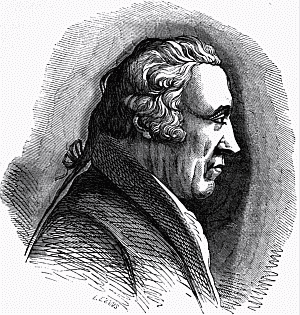
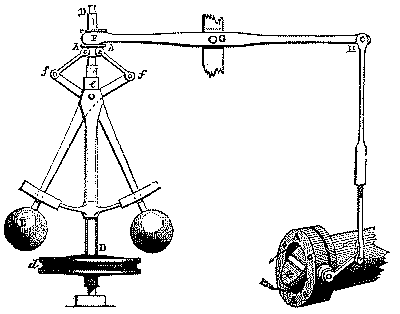
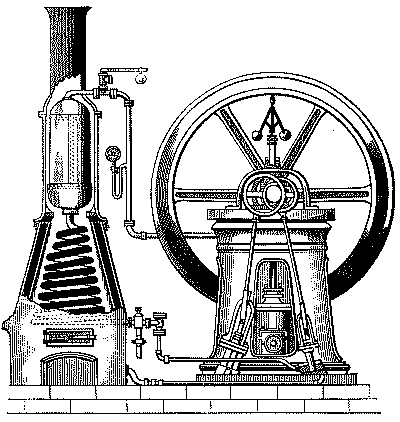
James Watt.
Throughout the greater number of the preceding chapters it will be
evident that the active properties of matter may be summed up under one
general head, and may be considered as varieties of attraction—such as
the attraction of gravitation, cohesive attraction, adhesive attraction,
attraction of composition (or chemical attraction), electrical
attraction, magnetical attraction.
The absolute or autocratic system does not, however, prevail in the
works of nature; and she seems ever anxious, whilst imparting great and
peculiar powers to certain agents, to create other forces which may
control and balance them. Thus, for instance, the great force of
cohesive attraction is an ever-present power discernible, as has been
shown, in solids and liquids; but if this agent were allowed to run
riot in its full strength and intensity, it would tyrannically hold in
subjection all liquid matter, and every drop of water which is at
present kept in the liquid state, would succumb to its iron rule, and
retain the solid state of ice. Hence, therefore, the wise creation of an
antagonistic force—viz., heat; which is not provided in any niggardly
manner, but is liberally bestowed upon the globe from that
all-sufficient and enormous source, the sun. And it is by the softening
and liquifying influence of his rays that the greater proportion of the
water on the surface of the globe is maintained in the fluid condition,
and is enabled to resist the power of cohesion, that would otherwise
turn it all, as it were, to stone.
Cohesion, electricity, and magnetism fully embody the notion of powers
of attraction, or a drawing together; whilst heat stands almost alone
in nature as the type of repulsion, or a driving back.
Mechanically, repulsion is demonstrated by the rebound of a ball from
the ground; the parts which touch the earth are for the moment
compressed, and it is the subsequent repulsion between the particles in
those parts which causes them to expand again and throw off the ball.
The development of heat is produced from various causes, which may be
regarded as at least four in number. Thus, it was shown by Sir Humphrey
Davy, that even when two lumps of ice are rubbed together, sufficient
heat is obtained to melt the two surfaces which are in contact with each
other. Friction is therefore an important source of heat, and one of the
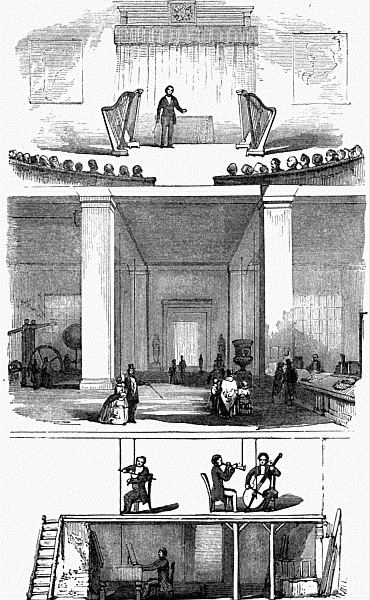
most interesting machines at the Paris Exposition consisted of an
apparatus by which many gallons of water were kept in the boiling state
by means of the heat obtained from the friction of two copper discs
against each other. The machine attracted a good deal of attention on
its own merits, and especially because it supplied boiling water for the
preparation of chocolate, which the public was duly informed was boiled
by the heat rubbed out of the otherwise cold discs of copper. When
cannon made on the old system are bored with a drill, it is necessary
that the latter should be kept quite cool with a constant supply of
water, or else the hard steel might become red-hot, and would then lose
its temper, and be no longer capable of performing its duty.
Count Rumford endeavoured to ascertain how much heat was actually
generated by friction. When a blunt steel bore, three inches and a half
in diameter, was driven against the bottom of a brass cannon seven
inches and a half in diameter, with a pressure which was equal to the
weight of ten thousand pounds, and made to revolve thirty-two times in a
minute, in forty-one minutes 837 grains of dust were produced, and the
heat generated was sufficient to raise 113 pounds of the metal 70°
Fahrenheit—a quantity of heat which is capable of melting six pounds
and a half of ice, or of raising five pounds of water from the freezing
to the boiling point. When the experiment was repeated under water, two
gallons and a half of water, at 60° Fah., were made to boil in two hours
and a half.
Chemical affinity has been so often alluded to in these pages, that it
may be sufficient to mention only one good instance of its almost
magical power in evoking heat. When a bit of the metal sodium is placed
on the tip of a knife, and thrust into some warm quicksilver, or if a
pellet of sodium and a few globules of mercury are placed on a hot plate
just taken from the oven, and then gently squeezed together, a vivid
production of heat and light is apparent; and when the mixture of the
two metals is cold, it will be found that the quicksilver has lost its
fluidity, and a solid amalgam of sodium and mercury is obtained, which
gradually, by exposure to the air, returns to the liquid state, the
mercury being set free, whilst the sodium is oxidized, and forms soda.
Just as an ordinary alloy of copper and gold used by jewellers would
lose its colour and brilliancy by the oxidation of the copper; and when
the rusty, dirty film is removed by rubbing and polishing, the surface
is again brilliant, and remains so until another film of the exposed
copper is attacked: in like manner the sodium is attacked and changed by
the oxygen of the air, whilst the mercury being unaffected retains its
brilliancy, and at the same time regains its fluidity. The evolution of
heat in the above case indicates that a chemical union has taken place
between the two metals.
Examples of the production of heat by electricity and magnetism have
been abundantly shown in the chapters on these subjects; and one of the
best illustrations of this fact has been shown on the occasion of the
opening of the telegraphic communication between France and England by
means of the submarine cable, when cannon were fired alternately at both
ends of the conducting cable by means of electricity, and the event thus
inaugurated in both countries.
That heat is a product of living animal organization is shown, as it
were, visibly by the marvellous phenomena that proceed in our own
bodies. People do not very often trouble themselves to ask where the
heat comes from, or even to think that this invisible power must be
maintained in the body, and that slow combustion, or, as Liebig terms
it, eremacausis, must continually go on inside our frail mortal
tenements; and more than this, that we cannot afford to waste our heat.
If the body is deprived of heat faster than it can be generated, death
must inevitably occur; and a very melancholy instance of this remarkable
mode of death has lately occurred in Switzerland to a Russian gentleman.
Such another instance of a man being slowly frozen to death within sight
and sound of other beings, through whose veins the blood was flowing at
its accustomed temperature (about 90º Fahr.), it would be difficult to
find, and it stands forth, therefore, as a marked example and
illustration of the statement already made, that living animal organisms
are truly a source of heat, which is as essential to the well-being of
the body as meat, drink, and air.
Heat is of two kinds, and may be either apparent to our senses, and
therefore called sensible heat; or it may be entirely concealed,
although present in solids, liquids, and gases, and is then termed
insensible or latent heat.
The first effect of this force is a demonstration of its repulsive
agency, and the dilatation or expansion of the three forms of matter
whilst under the influence of heat, admits of very simple illustrations.
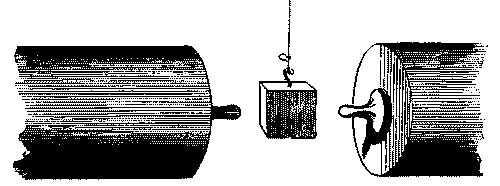
The expansion of a solid substance, as, for instance, a metal, on the
application of heat, is apparent by fitting a solid brass cylinder into
a proper metal gauge, which is accurately filed so as to admit the
former when perfectly cold. If the brass rod is then heated, either by
plunging it into boiling water or by the application of the flame of a
spirit lamp, its particles are separated from each other; they now
occupy a larger space, and expansion is the result, and this is clearly
proved by the application of the gauge, which is no longer capable of
receiving it. (Fig. 343.) When, however, the latter is cooled, the
opposite result occurs, the particles of brass return to their old
position, and contraction takes place; hence it is stated that "Bodies
expand by heat and contract by cold;" and it is proper to state here
that the term "cold" is of a negative character, and simply means the
absence of heat.
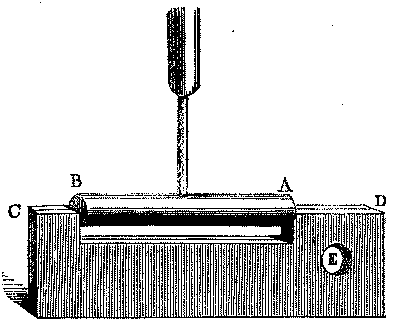 Fig. 343.
a b. Cylinder of brass. c d. Iron gauge,
admitting a b longitudinally, and also in the hole e when cold, but
excluding a b when the latter is heated and expanded.
Solid bodies do not expand equally on the application of the same amount
of heat; thus, a bar of glass one inch square and one thousand inches
long would only expand one inch whilst heated from the freezing to the
boiling point of water. A bar of iron one inch square and eight hundred
inches long would expand one inch in length, through the same degrees of
heat; and a bar of lead one inch square and three hundred and fifty
inches long would also dilate one inch in length. Hence,
| Lead expands in volume | 1/350th. |
| Iron | 1/800th. |
| Glass | 1/1000th. |
The unequal expansion of the metals is well illustrated by an experiment
devised by Dr. Tyndal, the respected Professor of Natural Philosophy in
the Royal Institution of Great Britain, and is arranged as follows:—A
long bar of brass and another of iron are supported on the edges of two
pieces of wood placed at an angle, and resting against the sides of a
mahogany framework. The metallic bars only touch one end of the frame,
and are in metallic communication with a piece of brass inserted there,
and forming part of a conducting chain connected with a voltaic battery;
when heat is applied to both bars they expand unequally; the brass bar
dilates first, and filling up the minute space left between the two ends
of the frame, touches another brass plate and instantly completes the
voltaic circuit, when a coil of platinum wire becomes ignited, showing
the fact of expansion; and secondly, the difference in the power of
dilatation possessed by each is clearly shown by removing the two
angular supports of wood, when the iron falls away, whilst the brass
remains and still completes the voltaic circuit. (Fig. 344.)
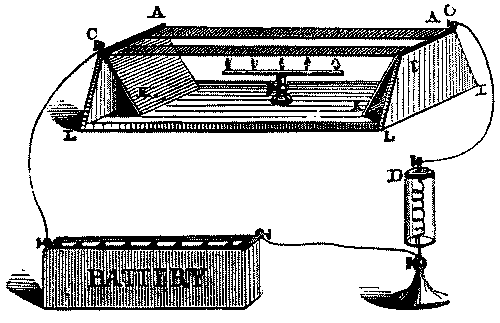 Fig. 344.
a a. The brass bar which has expanded by the
heat from the gas jet b, and making the contact between the brass plates
in connexion with the binding screws c c, the voltaic circuit is
completed, and a coil of platinum wire in the glass tube d, is
immediately ignited. The iron bar at e e has not expanded sufficiently,
which is shown afterwards by removing the angular wooden supports k k,
when the iron falls off, and the brass remains on the two ledges of the
mahogany framework l l l.
The force exerted by the expansion of solids is enormous, and reminds us
again of the amazing power of all the imponderable agents; and it is
truly wonderful to notice how the entry of a certain amount of heat into
and between the particles of metals, or other solids, endues them with a
mechanical force which is almost irresistible, and is capable of working
much harm. Kussné made an experiment with an iron sphere, which he
heated from a temperature of 32° Fahr. to 212° Fahr., and he found that
the expansion of the ball exerted a force equal to 4000
atmospheres—i.e. 4000 × 15—on every square inch of surface, or a
pressure equal to thirty millions of pounds; the entry of only 180° of
heat into the iron sphere produced this remarkable result, just as
Faraday has calculated that a single drop of water contains a sufficient
quantity of electricity to produce a result equal to the most powerful
flash of lightning, provided the electricity of quantity in the drop of
water is converted into electricity of high tension or intensity.
The practical applications of this well-known property of solids with
respect to heat are very numerous; thus, the iron bullet-moulds are
always made a little larger than the requisite size, in order to allow
for the expansion of the hot liquid lead, and the contraction of the
cold metal. The tires of wheels and the hoops of casks are usually
placed on whilst hot, in order that the subsequent contraction may bind
the spokes and fellies, or the staves, closely together. If an
allowance was not made for the expansion and contraction of the iron
rails on the permanent ways of railroads, the regularity of the level
would be constantly destroyed, and the position of the rails, chairs,
and sleepers would be most seriously deranged; indeed it is calculated
that the railway bars between London and Manchester are five hundred
feet longer in the summer than in the winter.
The walls of the Cathedral of Armagh, as also those of the Conservatoire
des Art et Métiers, were brought back to a nearly perpendicular
position, by the insertion (through the opposite walls) of great bars of
iron, which being alternately heated, expanded, and screwed up tight,
then cooled and contracted, gradually corrected the bulging out of the
walls or main supports of these buildings. The principle of these famous
practical experiments is neatly illustrated by means of an iron
framework with a bar of iron placed through both its uprights, and
screwed tight when hot; on cooling, contraction occurs, which is shown
by a simple index. (Fig. 345.)
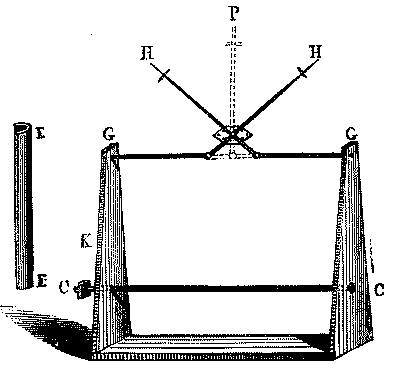 Fig. 345.
The iron frame, with c c, wrought-iron bar
heated by putting on the semicircular piece of iron e e, which is first
made red-hot, and as the heat is communicated to the wrought iron rod c
c, it is screwed up tight by the nut k. g g. The index attached to the
iron frame screwed up when hot; the arms come together at p, and
separate further to h h as the contraction takes place by cooling the
bar c d.
It has often been remarked that there is no rule without an exception,
and this applies in a particular instance to the law that "bodies expand
by heat and contract by cold"—viz., in the case of Rose's fusible
metal, which consists of
| Two parts | by weight of | bismuth, |
| One part | " | lead, |
| One part | " | tin. |
To make the alloy properly, the lead is first melted in an iron ladle,
and to this are added first the tin, and secondly the bismuth; the whole
is then well stirred with a wooden rod, and cast into the shape of a
bar.
When placed in the pyrometer and heated, the bar expands progressively
till it reaches a temperature of 111° Fahr.; it then begins to
contract, and is rapidly shortened, until it arrives at 156° Fahr.,
when it attains a maximum density, and occupies no more space than it
would do at the freezing-point of water. The bar, after passing 156°,
again expands, and finally melts at about 201°, which is 11° below the
boiling-point of water. Fusible metal is sometimes made into teaspoons,
which soften and melt down when stirred in a cup of hot tea or basin of
soup, to the great surprise and bewilderment of the victim of the
practical joke.
Unequal expansion is familiarly demonstrated with a bit of toasted
bread, which curls up in consequence of the surface exposed to the fire
contracting more rapidly than the other; and the same fact is
illustrated with compound flat and thin bars of iron and brass, which
are fixed and rivetted together; when heated, the compound bar curves,
because the iron does not expand so rapidly as the brass, and of course
forms the interior of the curve, whilst the brass is on the exterior.
The experiment with the compound bar is made more conclusive and
interesting by arranging it with a voltaic battery and platinum lamp.
One of the wires from the battery is connected with the extremity of the
compound bar, and as long as it remains cold, no curve or arch is
produced, but when heat is applied, the bar curves upwards, and touching
the other wire of the battery, the circuit is completed, and the
platinum lamp is immediately ignited. (Fig. 346.)
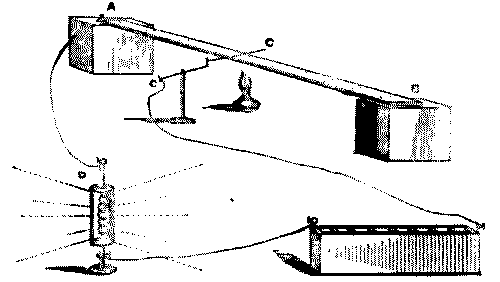 Fig. 346.
a b. Compound bar resting on two blocks of
wood. The end a is connected with one of the wires from the battery. The
circuit is completed and the platinum lamp d ignited directly the bar
curves upwards by the heat of the spirit lamp, and touches the wire c
C connected with the opposite pole of the battery.
The expansion and contraction of liquids by heat and cold is also
another elementary truth which admits of ample illustration, and indeed
introduces us to that most useful instrument called the thermometer.
If a flask is fitted with a cork through which a long glass tube, open
at both ends, is passed, and then carefully filled with water coloured
with a little solution of indigo, so that when the cork and tube are
placed in the neck, all the air is excluded, a rough thermometer is thus
constructed, which, if placed in boiling water, quickly indicates the
increased temperature by the rising or expansion of the coloured water
inside the flask. (Fig. 347.)
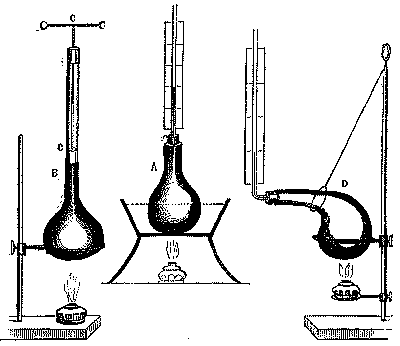 Fig. 347.
Expansion of liquids shown at a by the coloured
water rising in the tube from the flask, which is quite full of liquid,
and heated by boiling water. b. The expansion of the water heated by the
spirit-lamp is shown by the rising of the piston and rod c c. d
represents a retort filled up like a to show the expansion of a liquid
by heat.
The thermometer embraces precisely the same principle as that already
described in Fig. 347, with this difference only, that the tube is of a
much finer bore, and the liquid employed, whether alcohol or mercury, is
boiled and hermetically sealed in the tube, so that the air is entirely
excluded. To make a thermometer, a tube with a capillary bore is
selected of the proper length; it is then dipped into a glass containing
mercury, so that the tube is filled to the length of half an inch with
that metal. The half-inch is carefully measured on a scale, and the
place the mercury fills in the tube marked with a scratching diamond;
the mercury is then shaken half an inch higher, and again marked, and
this proceeding is continued until the whole tube is divided into half
inches. The object of doing this is to correct any inequalities in the
diameter of the bore of the glass tube, because if wider at one part
than another, the spaces filled with the mercury are not equal; as the
bore is usually conical, the careful measurement of the tube with the
half inch of mercury in the first place gives the operator at once a
view of the interior of his tube, and enables him to graduate it
correctly afterwards. (Fig. 348.)
 Fig. 348.
a b. Magnified view of the bore of one of the
thermometer tubes which are made by rapidly drawing out a hollow mass of
hot glass whilst soft and ductile, consequently the bore must be
conical, and larger at one end than the other.
The next step is to heat one extremity by the lamp and blowpipe, and
whilst hot, to blow out a ball upon it; if this operation were performed
with the mouth, moisture from the breath would deposit inside the fine
bore of the glass tube, and injure the perfection of the thermometer
afterwards. In order to prevent any deposit of water, the bulb is blown
out, whilst red-hot, with the air from a small caoutchouc bag fitted on
to the other extremity of the tube. The operator now marks off the
intended length of his thermometer, and above that point the tube is
again softened with the flame and blowpipe, and a second bulb blown out.
(Fig. 349 a.)
 Fig. 349a.
a.—No. 1. First bulb. The intended length of
the thermometer is shown at the little cross.—No. 2 is the second bulb
placed above the cross.
The open end of the tube is now placed under the surface of some pure,
clean, dry quicksilver, and heat being applied to the upper bulb, the
air expands and escapes through the mercury, and as the tube cools a
vacuum is produced, into which the mercury passes. By this simple
method, the mercury is easily forced into the tube, as otherwise it
would be impossible to pour the quicksilver into the capillary bore of
the intended thermometer. (Fig. 349 b.)
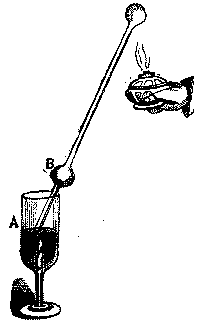 Fig. 349b
b. Heating and expanding the air in the top
bulb, so that when cool the mercury in the glass A, may rise into the
tube and fill the bulb b.
The tube is now taken from the glass containing the mercury, and simply
inverted; but in consequence of the very narrow diameter of the bore the
air will not pass out of the first bulb until heat is applied, when the
air expands, and the mercury, first stationary in the second bulb, will
now displace the air, and fall into the first bulb when the tube is
again cool.
The ball, No. 1 (Fig. 349 a), is now full of mercury, and there is
also some left in No. 2; in the next place, the tube is supported by a
wire, and held over a charcoal fire, when it is heated throughout its
entire length, and the mercury being boiled expels the whole of the
air, so that there is nothing inside the bulbs and capillary bore but
mercury and its vapour. (No. 1, Fig. 350.) The open end of the intended
thermometer is now temporarily closed with sealing-wax, and the whole
allowed again to cool with the sealed end uppermost, so that the ball
No. 2, Fig. 350, and the tube above it, are quite filled with
quicksilver.
After cooling, the tube is placed at an angle with the sealed end
uppermost, and, guided by experience, the operator heats the lower bulb
so as to expand enough mercury into the upper one to leave space for the
future expansion and contraction of the mercury in the tube, which has
now to be hermetically sealed. This is done by dexterously heating the
tube at the cross whilst the mercury in the first bulb is still
expanded; and by drawing it out rapidly with the help of the heat
obtained from the lamp and blowpipe, the second bulb is separated from
the first at the little cross (b, No. 3, Fig. 350), and the thermometer
tube at last properly filled with quicksilver, and hermetically closed.
(No. 4, Fig. 350.)
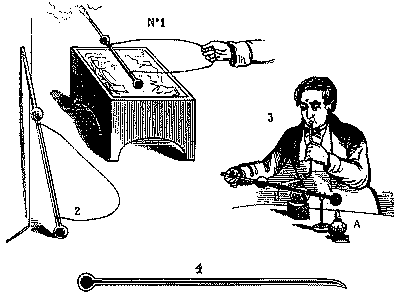 Fig. 350.
No. 1. Boiling quicksilver in the tube with
two bulbs.—No. 2. Tube cooled, with the sealed end uppermost.—No. 3.
Mercury in first bulb expanded by lamp a, and at the proper moment
hermetically sealed by the flame urged by the blowpipe at b. The upper
bulb and tube to the cross being drawn away and separated.—No. 4.
Thermometer tube containing the requisite quantity of mercury,
hermetically sealed, and now ready for graduation.
In order to procure a fixed starting-point, the thermometer tube is
placed in ice, with a scale attached; the temperature of ice never
varies, it is always at 32 degrees. When, therefore, the mercury has
sunk to the lowest point it can do by exposure to this degree of cold,
the place is marked off in the scale, and represents that position in
the graduated scale where the freezing point of water is indicated.
The tube is placed in the next place in a vessel of boiling water, care
being taken that the whole tube is subject to the heat of the water and
the steam issuing from it, and when the mercury has risen to the highest
position attainable by the heat of boiling water, another graduation is
made which indicates 212 degrees—viz., the boiling point of water. This
graduation should be made when the barometer stands at 30 inches,
because the boiling point of water varies according to the weight of the
superincumbent air pressing upon it.
Between the graduation of the freezing and the boiling point of water
the space is divided into 180 parts, which added to 32 make up the
boiling point of water to 212 degrees, being the graduation of
Fahrenheit, who was an instrument-maker of Hamburg. Why he divided the
space between the freezing and boiling point of water nobody appears to
know, unless he took a half circle of 180 degrees as the best division
of space. If the thermometer contains air the mercury divides itself
frequently into two or three slender threads, each separated from the
other in the capillary bore, and thus the instrument is rendered useless
until the threads again coalesce. If the thermometer has been well made,
and is quite free from air, it may be tied to a string and swung
violently round, when the centrifugal force drives the slender threads
of mercury to their common source—viz., the bulb containing the
quicksilver, and the whole is again united. The string must be attached,
of course, to the top of the thermometer scale.
When travelling on the Continent it is sometimes desirable to be able to
read the thermometers which are graduated in a different manner to that
of Fahrenheit. In France the Centigrade scale is preferred, and in many
parts of Germany Reaumur's graduation. The difference of the graduation
is seen at a glance.
| In the | Centigrade | the freezing point is | 0, | the boiling point | 100°. |
| " | Reaumur | " | 0, | " | 80°. |
| " | Fahrenheit | " | 32°, | " | 212°. |
The number of degrees, therefore, between boiling and freezing is 100 in
the Centigrade, 80 in Reaumur, and (212-32, that is) 180 in Fahrenheit.
If, then, the letters C, R, F, be taken to denote the number of
degrees from the freezing point at which the mercury stands in the
Centigrade, Reaumur, and Fahrenheit thermometers, we have the following
proportions:—
(1.) 100: 80 :: C: R, whence C = 5/4 of R, or R = 4/5 of C.
(2.) 180:100 :: F: C, whence F = 9/5 of C, or C = 5/9 of F.
(3.) 180: 80 :: F: R, whence F = 9/4 of R, or R = 4/9 of F.
The following examples will show how to apply these formulæ:—
(1).—Suppose the Reaumur stands at 28°, at what height does the
Centigrade stand? We have C = 5/4 of R (in this case), 5/4 of 28 = 35:
that is, the Centigrade stands at 35°.
(2).—Suppose Fahrenheit to stand at 41°, what will Reaumur stand at? R
= 4/9 of (41-32) (that is, the number above freezing in Fahr.) = 4/9 of
9 = 4. Reaumur stands at 4.
(3).—Suppose Fahrenheit stands at 23°, what will the Centigrade stand
at? C = 5/9 of F = 5/9 of (32-23) = 5/9 of 9 = 5 below freezing (or-5).
(4).—If Fahrenheit stands at 4 below 0, what will Reaumur indicate? R =
4/9 of F = 4/9 of (32 + 4) = 4/9 of 36 = 16 below 0 (or-16).
The only liquid which has the exceptional property of expanding by cold
is water, and it will be seen presently that this curious anomaly is of
the greatest importance in the economy of nature.
If a box containing a mixture of ice and salt is placed round the top of
a long cylindrical glass containing water at a temperature of 60° Fahr.,
the intense cold of the freezing mixture, which is zero—that is to say,
32° below the freezing point of water—very soon reduces the temperature
of the water contained in the glass, and as it becomes colder it
contracts, is rendered heavier, and sinks to the bottom of the vessel,
and its place is taken by other and warmer water. This circulation
commencing downwards, proceeds till the water has attained a temperature
of about 40° Fahr., when the maximum density is obtained and the
circulation stops, because after sinking below 40° the cold water
becomes lighter, and continues to be so until it freezes, and of course,
being of a less specific gravity than the warmer water, it floats (like
oil on water) upon its surface; so that a small thermometer placed at
the bottom of the jar indicates only 40° Fahr., whilst the solid ice
enveloping the other or second thermometer placed at the top may be as
low as 29°, or even lower, according to the quantity of ice and salt
used in the box surrounding the top of the glass. (Fig. 351.)
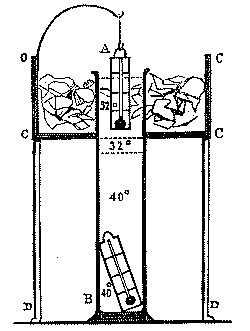 Fig. 351.
a b. Long cylindrical glass containing water
and two thermometers; the one at the bottom shows a temperature of 40°;
the other at the top 32°, or even lower, c c c c. Section of box
containing the ice and salt, and standing on four legs, two of which are
shown at d d.
The importance of this curious anomaly cannot be overrated. If water did
not possess this rare property, all the seas, rivers, canals, lakes,
&c., would gradually become impassable from the presence of enormous
blocks of ice formed during the winter. The whole bulk of water
contained in them would have to sink below 32° before it could solidify
provided water increased in density or continued to contract by cold.
Having once solidified, the warmth of the rays from a summer's sun would
certainly melt a great deal of the ice, but not the whole, and winter
would come again before the solid masses had disappeared. The ocean
could not be navigated in safety even near our own shores, in
consequence of the vast icebergs that would be formed, and float about
and jostle each other even in the British Channel.
The earth has been wonderfully prepared for God's highest work—Man, and
in nothing is this supreme wisdom more apparent than in the fact that
water offers the only known exception to the law "that bodies expand by
heat and contract by cold."
The expansion of gases by heat and contraction by cold take place in
obedience to a law to which there is no exception, except in degree. It
was discovered in 1801 by M. Gay Lussac, of Paris, and also about the
same period by the famous English philosopher who established the atomic
theory—viz., by Dr. Dalton. Since these experiments and calculations
Rudberg, Magnus, and Regnault have made other researches, and their
successive experiments give the following results:—
| Vols. of air. | | | | Volumes. |
| Dalton, Gay Lussac | 1000 | heated from | 32° | to 212° | became 1375 |
| Rudberg | 1000 | " | " | " | 1365 |
| Magnus, Regnault | 1000 | " | " | " | 1366.5 |
As a natural result, air at 32° Fahr, expands 1/491 part of its volume
for every degree of heat on the scale of Fahrenheit; and a volume of air
which measures 491 cubic inches at 32° will measure 492 at 33°, 493 at
34°, and so on. The exception is only in degree, and Magnus and Regnault
discovered by their searching experiments that the gases easily
liquified are more expansible by heat than air and those gases (such as
oxygen, hydrogen, and nitrogen) which have never been liquified.
The expansion of air is easily shown by placing the open end of a tube
with a large bulb blown at the other extremity, under the surface of a
little coloured water; on the application of heat the air expands and
escapes, and its place is taken, when cool, by the coloured liquid. Such
an arrangement represents the first thermometer constructed by Sanctorio
about a.d. 1600, which might certainly answer for rough purposes, but as
the ascent and descent of the fluid depend on the bulk of air contained
in the bulb, and as this is affected by every change of the height of
the barometer, no satisfactory indication of an increase or decrease of
temperature could be obtained with it, although the instrument itself is
interesting in an historical point of view, and in a modified form as
an air thermometer has been employed by Sir John Leslie, under the name
of the "Differential Thermometer," in his refined and delicate
experiments with heat.
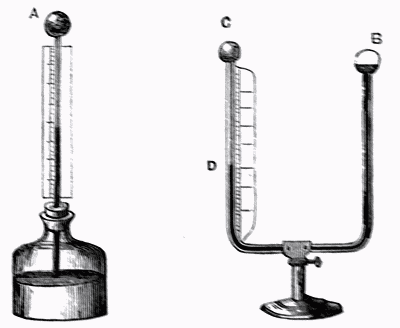 Fig. 352
a. Sanctorio's original air thermometer; the
expansion and contraction of the air in the bulb indicate the rise or
fall of the temperature. The cork is merely a support, and is not fitted
into the bottle air-tight. b c. The differential thermometer. When both
bulbs are subjected to a uniform temperature, no movement of the fluid
shown at d occurs; but if the bulb b is put into any place warmer than
the position of the bulb c, then the air expands in b, and drives the
coloured liquid, which consists of carmine dissolved in oil of vitriol,
up the scale attached to the stem of the bulb c.
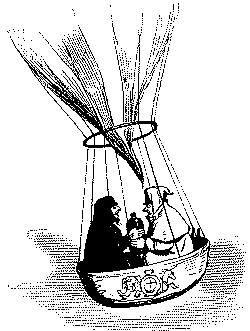
Fire balloons are a good example of the expansion of gases, and the
levity of the air thus increases in bulk was taken advantage of by
Montgolfier in the construction of his famous balloon, which, with a
cage containing various animals, ascended, in the presence of the King
and royal family of France, at Versailles; and in spite of huge rents in
two places, it rose to a height of 1440 feet, and after remaining in the
air for eight minutes, fell to the ground at the distance of 10,200 feet
from the place whence it started, without injury to the animals. When it
is considered that a volume of air heated from 32° to 491° is doubled,
and tripled when heated to 982°, it will at once be understood how great
must be the ascending power of such balloons, provided the air within
them is kept sufficiently hot.
That gallant aëronaut, Pilate de Rozier, offered himself to be the first
aërial navigator; and having joined Montgolfier, they made three
successful ascents and descents with a large oval-shaped balloon,
forty-eight feet in diameter, and seventy-four feet high. On the fourth
occasion he ascended to a height of 262 feet, but in the descent a gust
of wind having blown the machine over some large trees of an adjoining
garden, the situation of the brave aëronaut was extremely dangerous, and
if he had not possessed the strongest presence of mind, and at once
given the balloon a greater ascending power, by rapidly supplying his
stove with some straw and chipped wood, he might on this occasion have
met with that untimely end which subsequently, in another rash
aëronautic adventure, befell this brave but foolhardy Frenchman.
On descending again, he once more, and without the slightest fear,
raised himself to a considerable height by feeding his fire with chopped
straw. Some time after he ascended, in company with M. Giroud de
Vilette, to the height of 330 feet, hovering over Paris at least nine
minutes, in sight of all the inhabitants, and the machine keeping all
the while perfectly steady.
The danger in using this method of inflating the balloon arises from the
possibility of generating gas, which escaping unburnt into the body of
the balloon, may accumulate and blow up, or burn afterwards.
Fire balloons, as usually made, are very dangerous toys, and may
sometimes prove rather costly to the person who may send them off, in
consequence of their being blown by the wind on a hay or corn rick, or
other combustible substances. The safest mode of using fire balloons is
to fill them with hot air from a lighted gas stove (Wessel's, for
instance); the balloons may then be used in large rooms, or out in the
air, without fear of doing any harm to neighbouring property, as of
course the stove and the fire remain behind, and will fill any number of
air balloons. (Fig. 353.)
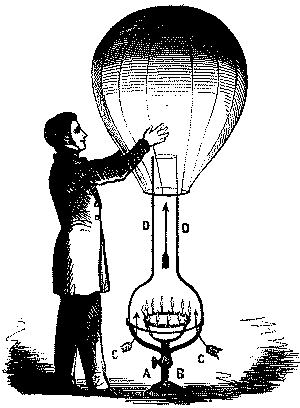 Fig. 353.
a b. Wessel's gas stove, with ring of gas jets
lighted inside; the air rushes in the direction of the arrows, c c, and
escaping at the top of the chimney, d d, soon fills the air or fire
balloon, which is usually made of paper.
After all the fuss made about the novelty of the American hot-air
engine, it is somewhat amusing to look back to the records of civil
engineering, and in the "Transactions of the Institution of Civil
Engineers," to read Mr. James Stirling's account of his improved air
engine, in which the great expansion of air mentioned at p. 365 has been
successfully applied. The engine was constructed about the year 1843,
and the principle, discovered thirty years before by Mr. R. Stirling,
will be comprehended by reference to the cut. (Fig. 354.)
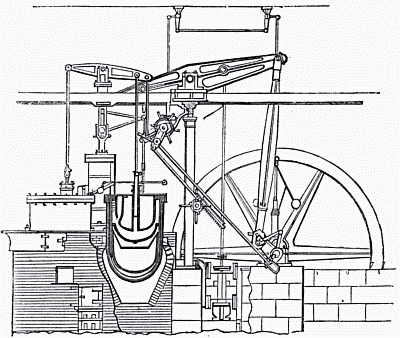 Fig. 354.
Stirling's air engine.
Two strong air-tight vessels are connected with the opposite ends of a
cylinder, in which a piston works in the usual manner. About four-fifths
of the interior space in these vessels is occupied by two similar
air-tight vessels or plungers, which are suspended to the opposite
extremities of a beam, and capable of being alternately moved up and
down to the extent of the remaining fifth. By the motion of these
interior vessels, which are filled with non-conducting substances, the
air to be operated upon is moved from one end of the exterior vessel to
the other, and as one end is kept at a high temperature, and the other
as cold as possible, when the air is brought to the hot end it becomes
heated, and has its pressure increased; and when it is brought to the
cold end, its heat and pressure are diminished. Now, as the interior
vessels necessarily move in opposite directions, it follows that the
pressure of the enclosed air in the one vessel is increased, while that
of the other is diminished. A difference of pressure is thus produced
upon the opposite sides of the piston, which is thereby made to move
from the one end of the cylinder to the other, and by continually
reversing the motion of the suspended bodies or plungers, the greater
pressure is successively thrown upon a different side, and a
reciprocating motion of the piston is kept up. The piston is connected
with a fly-wheel in any of the usual modes; and the plungers, by whose
motion the air is heated and cooled, are moved in the same manner, and
nearly at the same relative time, with the valves of a steam engine.
The pressure is greatly increased and made more economical by using
somewhat highly-compressed air, which is at first introduced, and is
afterwards maintained, by the continued action of an air-pump. The pump
is also employed in filling a separate magazine with compressed air,
from which the engine can be at once charged to the working pressure.
Mr. Stirling's chief improvement consists in saving all or nearly all
the heat of the expanded air after it has done its work, by passing it
from the hot to the cold end of the air vessel through a multitude of
narrow passages, whose temperature is at the beginning of the tubes
nearly as great as that of the hot air, but gradually declines till it
becomes nearly as low as the coldest part of the air vessel. The heat is
therefore retained by these passages, so that when the mechanism is
reversed, the cold air returns again through these hot pipes, and is
thus made nearly hot enough by the time it reaches the heating vessel to
do its work. Thus, instead of being obliged to supply at every stroke of
the engine as much heat as would be sufficient to raise the air from its
lowest to its highest temperature, it is necessary to furnish only as
much as will heat it the same number of degrees by which the hottest
part of the air vessel exceeds the hottest part of the intermediate
passages. This portion of the engine may be called the economical
process, and represents the foundation of all the success to which it
has attained in producing power with a small expenditure of fuel. No
boiler being required, of course the danger of explosions is much
lessened. The higher the pressure under which the engine was worked the
greater was the effect produced. A small engine on this principle was
worked to a pressure of 360 pounds on the square inch; and perhaps the
best popular notion of the novelty in the arrangement is that suggested
by Mr. George Lowe, who compared the economical part of the machine to a
"Jeffrey's Respirator" used by consumptive patients. The heat from the
air expired being retained by the laminæ, and again used when cold air
is inspired or drawn into the lungs. Mr. Stirling states that the
consumption of fuel as compared to the steam engine which the air engine
had replaced was as 6 to 26; the same amount of work being now performed
by about six cwt. of coals which had formerly required about twenty-six
cwt., though he ought to have stated that the steam engine removed was
not of the best construction, nor had the boiler any close covering.
(Fig. 354.)
This property of heat with reference to matter, and the consideration of
the curious manner in which it creeps, as it were, through solid
substances, brings the thoughtful mind at once to the bold question of
What is heat? Is it to be regarded as something real or material? or
must it be considered only as a property or state of matter? These
questions are not to be solved easily, and they demand a considerable
amount of experiment and reasoning even to appreciate their meaning.
If a red-hot ball is placed in the focus of a concave metallic speculum,
it gives out certain emanations that are quite invisible, but which are
reflected from the surface of the mirror in the same manner as visible
rays of light, and may be collected in the focus of another and second
concave speculum, when they can be concentrated on to a bit of
phosphorus, and will cause the combustion of that substance. If the air
from a pair of bellows is blown forcibly across the rays of heat as they
are being concentrated upon the phosphorus, the rays are not moved from
their course, they are no more blown away than a sunbeam darting through
an aperture in a cloud on a stormy, windy day. The heat has, therefore
nothing to do with the air, and is wholly independent of that medium in
its passage from one mirror to the other. Such an experiment as that
described would at once suggest the idea that heat is a matter sui
generis, a component part of all bodies, and given off from
incandescent matter, the sun, &c., and that it may be propagated through
space much in the same manner as light. (Fig. 355.) The mechanism may be
very much like the corpuscular movement of light as defined by Sir Isaac
Newton, and already explained in another portion of this book. Hence it
has been supposed that heat is propagated through the air, water, and
solid substances by a direct emission of material particles from the
heat-giving agent, and that these molecules of heat force their way
into, or along, or through them, according to circumstances.
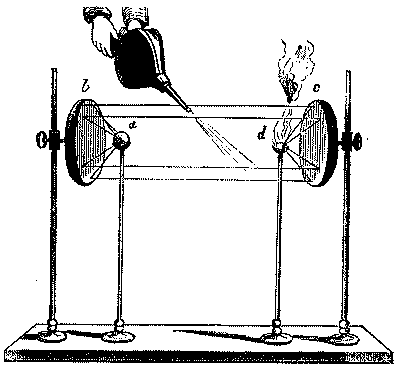 Fig. 355.
Heat reflected by mirror, but not blown away by
air from bellows.
Certain bodies are almost transparent to heat rays, such as air, whilst
others take an intermedial position, and only stop a certain quantity of
the heat molecules, such as rock crystals, mirror glass, and alum. A
third class of bodies absorbs the heat plentifully, such as charcoal,
black cloth, &c.; and a fourth, when polished and placed at the proper
angle, reflects or throws off the heat, as in the case of polished
mirrors. The transparency or opacity of substances (so far as light is
concerned) does not affect the transmission of heat. Light of every
colour and from all sources is equally transmitted by all transparent
bodies in the liquid or solid form, but this is not the case with heat.
The rays of heat emitted by the sun and other luminous bodies have
properties quite different to the rays of light with which they are
accompanied. From these statements it will be evident that the material
theory of heat is surrounded with difficulties and anomalies that
cannot be reconciled the one with the other, or neatly adapted, fitted
in, and dovetailed with all the puzzling phenomena that arise. Our
knowledge of the theory of heat has been greatly assisted by the
researches of Melloni, who has demonstrated that different species of
rays of heat are given off by the same body at different temperatures,
which may be distinctly sifted and separated from each other. Long
before the experiments of Melloni philosophers had endeavoured to weigh
heat; trains of the most delicate levers were exposed, without effect,
to the action of heat rays; and all attempts, experimental as well as
theoretical, to define heat by the material theory, are imperfect,
crude, and unsatisfactory. We are perforce obliged to adopt another
theory, and the one that obtains the greatest favour, as offering the
best definition of heat, is the dynamical theory, which is more or
less analogous to the undulatory theory of light. At pages 262, 328,
335, this theory has been partly explained, and in speaking of it again,
great care must be taken not to confuse the undulations of heat with
those of light. The sun and the stars swim in a molecular medium, and
39,180 vibrations or waves must occur in one inch to produce the
sensation of red light, and 57,490 undulations in the space of one inch
to produce a violet light. As vibrations of the ethereal molecules
affect the eye, so there may be other nerves in our bodies which are
peculiarly sensitive to the waves of heat. It requires eight vibrations
of the air to occur in a second to produce an audible sound; whilst if
the vibrations of the air amount to 25,000 per second they cannot be
appreciated by the human ear, although it is possible to conceive that
the ears of certain animals may be so susceptible of rapid vibrations
that they may be able, for certain wise purposes of the Creator, to
appreciate sounds which are inaudible to human ears.
Melloni exhibited a spectrum to a number of persons, and found that
there was more light apparent to some eyes than to others. Lubeck put a
scarlet cloth on a donkey, and found that the two were frequently
confounded together by the eyes of many spectators. These facts indicate
that there may be vibrations of molecules that produce the sensation of
heat, but which do not affect the nerves that are sensitive to the
action of light waves, and vice versâ; and it is also probable that all
these different undulations, some affording heat and some light, may be
generated and propagated through space, as from the sun; or through
shorter distances, as from burning lamps and fires, without in any way
interfering with or impeding each other's progress.
The dynamical theory seems to offer the best idea of the transmission
of heat which is carried, conducted, or propagated through solids with
variable rapidity, either by the vibration of the constituent molecules
of the body itself, or by the undulation of a rare subtle fluid which
pervades them. If a copper and iron wire of the same length and diameter
are bound together and heated at the point of union, the waves of heat
travel faster through the copper than the iron, and the former is said
to be the best conductor of heat; and the fact itself is demonstrated by
placing a bit of phosphorus at the end of each metallic wire, and it
will be found by experiment that the combustible substance melts first
and takes fire on the copper, and that a considerable interval of time
elapses before the phosphorus ignites on the iron.
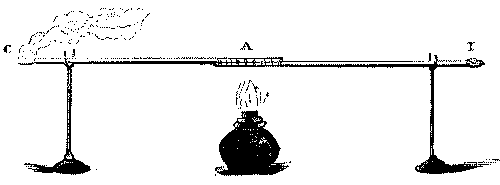 Fig. 356.
c. Copper wire bound at a to i, an iron wire.
After the heat of the lamp has been applied for about five minutes the
heat travels to c first, and ignites the bit of phosphorus placed there.
After some time has elapsed the phosphorus at i also ignites.
The same fact is exhibited in a most striking manner by inserting a
series of rods of equal lengths and thicknesses in the side of a
rectangular box, allowing them to pass across the interior to the
opposite side. The rods are composed of wood, porcelain, glass, lead,
iron, zinc, copper, and silver, and have attached to each of their
extremities, by wax or tallow, a clay marble. When the water placed in
the box is made to boil, the heat passes along the different rods, and
melting the wax or tallow, allows the marble to drop off. Consequently
the first marble would drop from the silver rod, the next from the
copper, the third from the iron, the fourth from the zinc, the fifth
from the lead, whilst the porcelain, glass, and wooden rods would hardly
conduct (in several hours) sufficient heat to melt the wax or tallow,
and discharge the marbles.
Conduction of Metals.
| Gold | 1000 |
| Silver | 973 |
| Copper | 898.2 |
| Iron | 374.3 |
| Zinc | 363 |
| Lead | 179.6 |
The experiment is made more striking if the marbles are allowed to fall
on a lever connected with the detent of a clock alarum, which rings
every time a marble falls from one of the rods. (Fig. 357.)
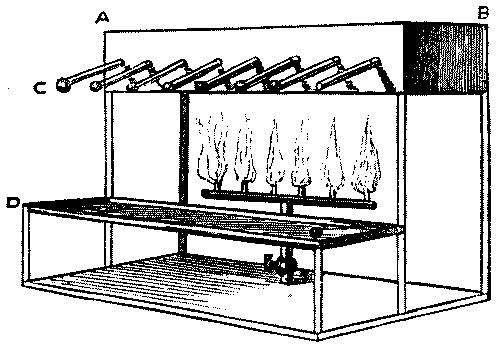 Fig. 357.
a b. Trough containing boiling water, heated by
gas jets below. c. The eight rods and marbles attached, one of which has
fallen. d. The tray to receive the marbles.
During a cold frosty day, if the hand is placed in contact with various
substances, some appear to be colder than others, although all may be
precisely the same temperature; this circumstance is due to their
conducting power: and a piece of slate seems colder than a bit of chalk,
because the former is a much better conductor than the latter, and
carries away the heat from the body with greater rapidity, and diffuses
it through its own substance.
The gradual passage of heat along a bar of iron as compared with one of
copper, is well illustrated by supporting the ends of the two bars on
the top of the chimney of an argand lamp, whilst the other extremities
are held in a horizontal position by little blocks of wood. If marbles
are attached by wax to the under side, they fall off as the heat travels
along the metallic bars, and more rapidly from the copper than the iron,
because the former is a better conductor of heat than the latter. (Fig.
358.)
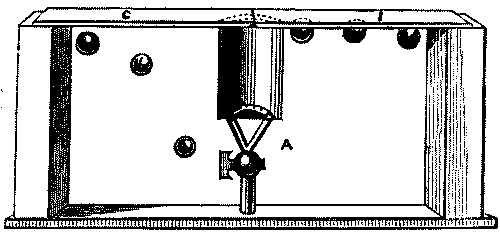 Fig. 358.
a. Section of an argand gas lamp, with a copper
chimney supporting the ends of the bars of copper and iron marked c and
i. The balls have fallen from c, the copper bar.
From the experiments of Mayer, of Erlangen ("Ann. de Ch.," xxx.), it
would appear that the conducting powers of different woods are to a
certain extent to be regarded as in the inverse proportion to their
specific gravities—i.e., the greater the density of the wood the less
conducting power, and the contrary.
If a cylindrical bar or thick tube of brass, six inches long, and about
two inches in diameter, is attached to a wooden cylinder of the same
size, the conducting powers of the two substances are well displayed by
first straining a sheet of white paper over the brass, and then holding
it in the flame of a spirit lamp. The heat being conducted rapidly away
by the metal will not scorch the paper, until the whole arrives at a
uniform high temperature; whereas the paper is rapidly burnt when
strained over the wooden cylinder, because the heat of the flame of the
lamp is concentrated upon one point, and is not diffused through the
mass of the wood. (Fig. 359.)
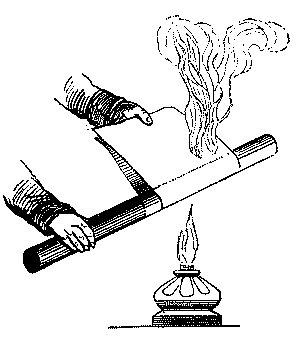 Fig. 359.
Cylinder, half brass and half wood. The paper
strained over the wood is taking fire. The other extremity, shaded, is
the brass portion.
In the course of the highly philosophical experiments of Sir H. Davy,
which led him gradually to the discovery of the construction of the
safety lamp, he connected together, by a copper tube of a small bore,
two vessels, each containing an explosive mixture composed of fire damp
and air. When the mixture was fired in one vessel he found that the
flame did not appear to be able to travel, as it were, across the
bridge—viz., the copper tube—and communicate with the other magazine,
because it was deprived of its heat whilst passing through the tube, and
was no longer flame, but simply gaseous matter at too low a temperature
to effect the inflammation of the mixture in the second box.
A mass of cold metal may be suddenly applied to a small flame, such as
that of a night light, and depriving it rapidly of heat (like the case
of the unfortunate Russian described at page 354), it is almost
immediately extinguished (fig. 360), not by the mere exclusion of the
oxygen of the air, but on account of the withdrawal of the heat
necessary for the maintenance of the combustion.
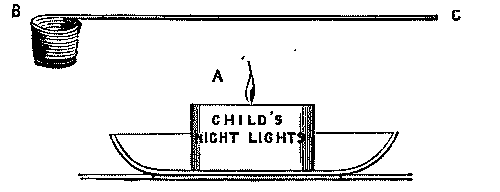 Fig. 360.
a. Small flame from night light. b C. Large
mass of cold copper wire open at both ends to place over flame, and by
conduction of the heat to extinguish it.
Sir H. Davy first thought of making his safety lamp with small tubes,
which would supply fresh air, and carry off the burnt or foul air, at
the same time they were to be so narrow that no flame could pass out of
his lamp to communicate with an outer explosive atmosphere; and in
speaking of his lamp with tubes he says:—"I soon discovered that a few
apertures, even of very small diameter, were not safe unless their
sides were very deep; that a single tube of one-twenty-eighth of an
inch in diameter, and two inches long, suffered the explosion to pass
through it; and that a great number of small tubes, or of apertures,
stopped explosion, even when the depths of their sides was only equal to
their diameters. And at last I arrived at the conclusion that a
metallic tissue, however thin and fine, of which the apertures filled
more space than the cooling surface, so as to be permeable to air and
light, offered a perfect barrier to explosion, from the force being
divided between, and the heat communicated to an immense number of
surfaces. I made several attempts to construct safety lamps which
should give light in all explosive mixtures of fire damp, and after
complicated combinations, I at length arrived at one evidently the most
simple, that of surrounding the light entirely by wire gauze, and
making the same tissue feed the flame with air and emit light."
If a number of square metallic tubes of a fine bore are placed upright
side by side, and a section cut off horizontally, it would represent the
wire gauze which possesses such marvellous powers of sifting away the
heat from a flame, so that it is destroyed in its attempted passage
through the metallic meshes; and of this fact a number of proofs may be
adduced.
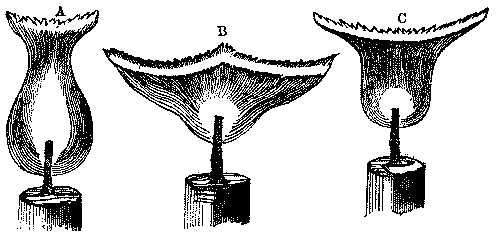
A gas jet delivering coal gas may be placed under a sheet of wire gauze,
the gas permeates the gauze, and may be set on fire at the upper side,
but the flame is cut off from the mouth of the jet by the cooling action
of the wire gauze. The same experiment reversed, by holding the gauze
over the gas burning from the jet, shows still more decidedly that flame
will not pass through the metallic tissue. (Fig. 361.)
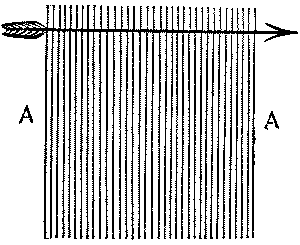 Fig. 361.
a a. A number of square tubes placed upright.
The arrow shows the direction of the section to obtain a figure like
wire gauze.
Sir H. Davy again says: "Though all the specimens of fire damp which I
had examined consisted of carburetted hydrogen mixed with different
small proportions of carbonic acid and common air, yet some phenomena I
observed in the combustion of a blower induced me to believe that
small quantities of olefiant gas may be sometimes evolved in coal mines
with the carburetted hydrogen. I therefore resolved to make all lamps
safe to the test of the gas produced by the distillation of coal,
which, when it has not been exposed to water, always contains olefiant
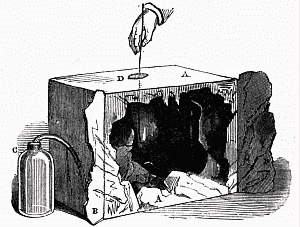
gas. I placed my lighted lamps in a large glass receiver through which
there was a current of atmospherical air, and by means of a gasometer
filled with coal gas, I made the current of air which passed into the
lamp more or less explosive, and caused it to change rapidly or slowly
at pleasure, so as to produce all possible varieties of inflammable and
explosive mixtures, and I found that iron gauze wire composed of wires
from one-fortieth to one-sixtieth of an inch in diameter, and containing
twenty-eight wires or seven hundred and eighty-four apertures to the
inch, was safe under all circumstances in atmospheres of this kind;
and I consequently adopted this material in guarding lamps for the coal
mines, when in January, 1816, they were immediately adopted, and have
long been in general use."
The remarkable conducting power of wire gauze is further shown by
placing some lumps of camphor on a piece of this material, and when the
heat of a spirit-lamp is applied on the under side of the gauze, the
camphor volatilizes, and as the vapour is remarkably heavy, it falls
through the meshes of the gauze, and takes fire; but the most curious
and further illustration of the conducting power of the wire meshes is
shown in the fact that the fire does not communicate through the thin
film of gauze to the lumps of camphor placed upon it.
The camphor may be ignited by applying flame to the upper side of the
gauze, showing that, although this substance is so exceedingly
combustible, it will not take fire even if placed at no greater distance
from flame than the thickness of the wire gauze, provided the latter
material is interposed between it and the flame.
A square box made of wire gauze, with a hole at the bottom to admit a
candle or spirit-lamp, may have a considerable jet of coal gas forced
upon it from the outside, or a large jug of ether vapour poured upon it;
and although the box may be full of flame, arising from the combustion
of the gas or ether, the fire does not come out of the wire box or
communicate with the jet or the ether vapour as it is poured from the
jug. (Fig. 362.)
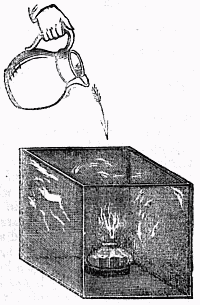 Fig. 362.
A box made of wire gauze, with a hole in the
bottom to admit a spirit lamp lighted. A hot jug full of the vapour of
ether may be poured on to the flame, but it only burns inside the box,
and does not communicate with that in the jug.
Sir Humphrey Davy's safety lamp consists of a common oil-lamp, f, with
a wire through the cistern for the purpose of raising or depressing the
cotton wick without unscrewing the wire gauze; b is the male screw
fitting the screw attached to the cylinder of wire gauze, which is made
double at the top. The entire lamp is shown at a, whilst the platinum
coil which Sir H. Davy recommends should be wound round the wick is
shown at h. The small cage of platinum consists of wire of
one-seventieth to one-eightieth of an inch in thickness, fastened to the
wire for raising or depressing the cotton wick, and should the lamp be
extinguished in an explosive mixture, the little coil of platinum begins
to glow, and will afford sufficient light to guide the miner to a safe
part of the mine. With respect to this platinum coil, Sir H. Davy gives
a careful charge, and says:—"The greatest care must be taken that no
filament or wire of platinum protrudes on the exterior of the lamp, for
this would fire externally an explosive mixture."
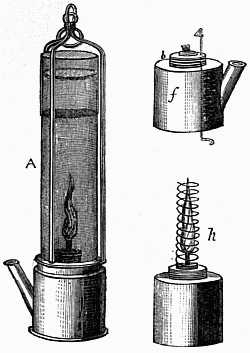 Fig. 363.
Sir Humphrey Davy's safety lamp.
Since the invention of the Davy lamp, a great number of modifications
have been brought forward, some of which for a short time have occupied
the public attention, but whether from increased cost or a sort of
inertia that arrests improvement, it is certain that the lamp originally
devised by Sir Humphrey Davy is still the favourite. It was perhaps
unfortunate that the lamp was called the safety lamp, because it is
not so under every circumstance that may arise, unless it happens to be
in the hands of persons who have taken the trouble to study it and
understand how to correct the faults. The lamp might have escaped the
incessant attacks that have been made upon its just merits, if the name
had simply been that of its illustrious inventor—"a Davy lamp." No one
could carp at that, whilst "safety" was held to mean perfect immunity
from every possible and probable danger that might arise in the
coal-pits. The lamps are now usually placed under the charge of one man,
who trims them and ascertains that the wire gauze is in perfect order;
this latter is usually locked upon the lamp, and as it is a penal
offence, and punishable by a heavy fine and imprisonment, to remove the
wire gauze from safety lamps in dangerous parts of the mine, of course
the miners are being gradually brought to a sense of the obligations
they owe themselves and their brother-miners, and the rash, ignorant,
and foolhardy offences of breaking open safety lamps for more
illumination, or to light pipes, are becoming much less frequent than
formerly. One of the most ingenious "detector lamps" is that of Mr.
Symons, of Birmingham. (Fig. 364.) It consisted of the old-fashioned
Davy, but inside the rim of the wire gauze is placed a small
extinguisher and spring, which does not move so long as the gauze is
screwed on to the lamp, but directly the gauze is unscrewed, the
reversed movement releases the detent, and the extinguisher falls upon
the light. In spite of the manifest ingenuity of this lamp, it is not
adopted, because it costs a trifle more than the ordinary "Davy." To
show the remarkable perfection of the wire gauze principle, some
turpentine may be poured upon a lighted safety lamp, when a great smoke
is produced by the evaporation of the spirit, but no flame passes
through to the outside, although the turpentine burns inside the lamp.
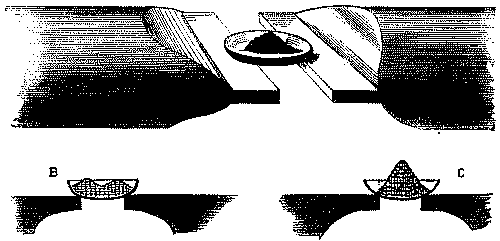
If some coarse gunpowder is laid upon two thicknesses of fine wire
gauze, it may be heated from below with the flame of the spirit lamp,
and the sulphur will gradually volatilize without setting fire to the
mass of powder. To show the security of the Davy lamp, it may be lighted
and hung in a large box with glass sides, open at the top, and a jet of
coal gas supplied at the bottom; as this rises and diffuses in the air,
the mixture becomes explosive, and the fact is at once evident by the
alteration in the appearance of the flame of the lamp, which enlarges,
flickers, and frequently goes out, in consequence of the suddenness with
which the explosion of the mixture takes place inside the lamp,
producing a concussion that extinguishes the flame. In this case the
utility of the platinum coil is very apparent, and it continues to glow
with a red heat until the explosive character of the air in the box is
changed.
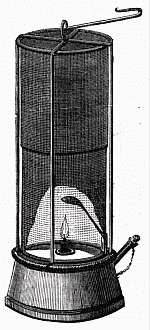 Fig. 364.
Symons' self-extinguishing Davy lamp.
If a large washhand-basin is first warmed by some boiling water, which
is then poured away, and a drachm of ether thrown in, a
highly-combustible atmosphere is obtained, and when a lighted Davy lamp
is placed into the basin so prepared, the flame inside the lamp
immediately enlarges and flickers, but is not extinguished, and does not
communicate to the combustible vapour outside. The contrast between the
safety lamp and an unprotected flame is very striking; if a lighted
taper is thrust into the basin, the ether catches fire, and burns with a
very large flame. The solid conductors of heat, which are said to enjoy
this property in the highest degree, are the metals, marble, stone,
slate, and other dense and compact solid substances; whilst the
opposite quality of being non-conductors, or nearly so, is possessed by
fur, wood, silk, cotton, wool, eider and swansdown, paper, sand,
charcoal, and every substance which is of a light or porous nature. The
practical application of this knowledge is very apparent in the affairs
of every-day life. Thus we rise in the morning, and immediately after
the necessary ablutions, if it is winter time, proceed to encase the
body in non-conductors, such as flannel and wool. When we sit down to
the breakfast table to make tea, we may notice the contrivances for
preventing the handle of the top of the urn, or that of the teapot, from
becoming too hot for the fingers, by the interposition of ivory or wood.
If asked to place water in the teapot from the kettle, we instinctively
seek for the well-worn kettle-holder made of Berlin wool, and therefore
a bad conductor. As we cut our meat or fish at the same meal, we may
shiver with cold, but our fingers are not quite frozen by contact with
the steel knives, as we hold them by ivory handles; and we are agreeably
reminded that some metals are good conductors of heat, by the pleasant
warmth of the silver teaspoons, as we stir our tea or coffee.
Even the polish of the well-rubbed mahogany is protected from the heat
of the dishes by non-conducting mats, and plates are handed about, if
"nice and hot," with a carefully-wrapped non-conducting linen napkin.
Supposing we prefer a bit of fresh-made toast, the fork is provided with
a non-conducting handle; and should we peep out of window some wintry
morn whilst the baker delivers his early work in the shape of hot rolls,
we notice they come out of nicely-wrapped flannel or baize, which being
a bad conductor is employed to retain their heat. We read, occasionally,
in the military intelligence, statements respecting some
newly-constructed shells which are to burst and scatter melted iron
(!!); and of course the idea of the interposition of a good
non-conductor of heat between the bursting charge and the molten metal
must be realized in their construction.
The central heat of our globe is a reality that cannot be disputed,
and after digging beyond a depth of twenty feet the thermometer
gradually rises at the rate of one degree of Fahrenheit's scale for
every fifteen yards. The bad conducting power of the crust of the earth
must, therefore, be apparent, as it is easy, knowing the diameter of our
globe, to calculate that the increase of heat downwards amounts to 116°
for each mile, consequently at a depth of thirty and a half miles below
the surface, there will be a temperature most likely equal to 3500°, or
a heat that might easily melt cast-iron, and would help to account for
the earthquakes and eruptions of volcanoes, which still remind us by
their terrible warnings, that we live only on the bad conducting upper
crust of a globe, the inside of which is still, perhaps, in a liquid and
molten state. Monsieur Fourier has demonstrated the non-conducting power
of this shell by calculating that, supposing the globe was wholly
composed of cast-iron, the central heat would require myriads of years
to be transmitted to the surface from a depth of 150 miles; and by
inverting the process of reasoning, we may come to the conclusion that
the internal heat must be excessive, because it is confined and shut
out from those influences that would carry off and weaken the intensity.
There are no two words, says Tyndal, with which we are more familiar
than matter and force. The system of the universe embraces two
things, an object acted upon, and an agent by which it is acted
upon; the object we call matter and the agent we call force. Matter, in
certain respects, may be regarded as the vehicle of force; thus, the
luminiferous ether is the vehicle or medium by which the pulsations of
the sun are transmitted to our organs of vision. Or, to take a plainer
case, if we set a number of billiard balls in a row, and impart a shock
to one end of the series in the direction of its length, we know what
will take place; the last ball will fly away, the intervening balls
having served for the transmission of the shock from one end of the
series to the other. Or we might refer to the conduction of heat. If,
for example, it be required to transmit heat from the fire to a point at
some distance from the fire, this may be effected by means of a
conducting body—by a poker, for instance; thrusting one end of a poker
into the fire, it becomes heated, the heat makes its way through the
mass, and finally manifests itself at the other end. Let us endeavour to
get a distinct idea of what we here call heat; let us first picture it
to ourselves as an agent apart from the mass of the conductor, making
its way among the particles of the latter, jumping from atom to atom,
and thus converting them into a kind of stepping stones to assist its
progress. It is a probable conclusion, even had we not a single
experiment to support it, that the mode of transmission must, in some
measure, depend upon the manner in which those little molecular stepping
stones are arranged. But we must not confine ourselves to the molecular
theory of heat. Assuming the hypothesis, which is now gaining ground,
that heat, instead of being an agent apart from ordinary matter,
consists in a motion of the material particles; the conclusion is
equally probable that the transmission of the motion must be influenced
by the manner in which the particles are arranged. Does experimental
science furnish us with any corroboration of this inference? It does.
More than twenty years ago MM. De la Rive and De Candolle proved that
heat is transmitted through wood with a velocity almost twice as great
along the fibre as across it. This result has been recently expanded,
and it has been proved that this substance possesses three axes of
calorific conduction; the first and greatest axis being parallel to the
fibre; the second axis perpendicular to the fibre and to the ligneous
layers; while the third axis, which marks the direction in which the
greatest resistance is offered to the passage of the heat, is
perpendicular to the fibre and parallel to the layers.
If many solids are bad conductors of heat, they are at all events
greatly surpassed by fluids, and especially by water. The conduction of
heat by that fluid is almost imperceptible, so much so, that it has even
been questioned whether liquids do really conduct heat downwards at all.
It has, however, been found that liquid mercury will conduct heat
downwards, and therefore by analogy it may be assumed that other liquids
must possess a conducting power, although it may be exceedingly
limited.
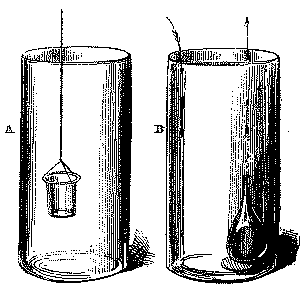
In order to prove that water is an exceeding bad conductor of heat, a
tube with a large glass bulb blown at one end is partly filled with
tincture of litmus, until it will just sink below the surface of water
placed in a tall cylindrical or open jar. If a copper basin, containing
burning ether, is now floated on the top of the water, so as to leave
about a quarter of an inch between the top of the air thermometer—viz.,
the bulb containing the coloured liquid—and the bottom of the copper
pan, it will be noticed that whilst the water surrounding the latter
almost boils, not the slightest effect arising from the conduction of
heat can be perceived in a downward direction. After the ether has burnt
out of the copper vessel, it may be removed, and the boiling water
stirred down and around the air thermometer, when the air within it
expands, drives out the colouring liquid, and the bulb becoming
specifically lighter, rises to the top of the containing glass. (Fig.
365.)
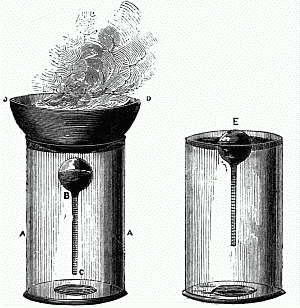 Fig. 365.
a a. Cylindrical glass full of water. b. The
glass air thermometer containing the coloured liquid just standing
upright, the mouth of the tube at c being open. d d is the copper basin
containing the burning ether. e shows how the glass bulb and tube rise
after the upper basin is removed, and the hot water comes in contact
with and expands the air, making the thermometer light, and causing it
to rise.
Again, if the tube of an air thermometer is placed through a cork in the
neck of a gas jar, inverted and standing on a ring stand, and the jar
is then filled with water, and boiled at the top with a red-hot iron
heater, the heat does not pass downwards and affect the thermometer. By
introducing a syphon the water surrounding the thermometer at the bottom
of the jar may be drawn off, until the hot water is within a fraction of
an inch of the air thermometer, and still no heat is conducted, and the
liquid in the latter remains stationary. (Fig. 366.)
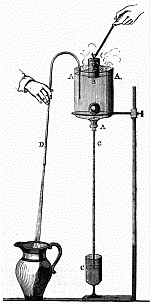 Fig. 366.
a a a. Inverted gas jar supported by the ring
stand. b. The red-hot urn heater. c c. The air thermometer, with the
coloured liquid stationary at c. d. The syphon for drawing off the cold
water, and bringing the hot down close to the bulb of c c.
The diffusion of heat through water does not take place like that of
solids, but is effected by the motion of the particles of the water.
When heat is applied to the bottom of a vessel containing water, such as
an inverted glass shade, the first effect is to expand the layer of
water which is first affected by the heat; this expanded layer being
specifically lighter than the cold water above, it rises to the upper
part of the glass shade, and its place is immediately taken by other,
colder and heavier, water, which in like manner moves upwards, and is
again succeeded by a fresh portion. Now, the first and succeeding
strata of water all carry off so much heat, and thus by the convective
or carrying power of the water the heat is diffused finally in the most
perfect manner through the whole bulk of fluid; and indeed, the movement
itself of the particles of water may easily be watched by putting a
little paper pulp at the bottom of the inverted glass shade containing
the water. (Fig. 367.)
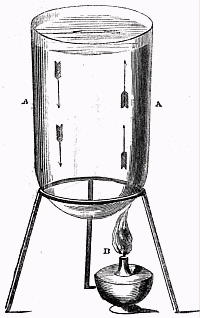 Fig. 367.
a. a. Inverted glass shade containing water and
some paper pulp. b. Burning spirit lamp placed under one side of the
glass; the pulp shows the rising of the heated water and the sinking of
the cold, in the direction indicated by the arrows.
This bad conducting power is not merely confined to water, but is
likewise apparent with oil and other fluids, and if some water is frozen
at the bottom of a long test-tube by means of a freezing mixture, oil
may then be poured upon it, and some alcohol above the latter. If the
flame of a spirit-lamp is now applied to the alcohol at the top of the
tube it may be entirely boiled away, and no heat will travel down the
oil and communicate with the ice, and even after the alcohol has been
evaporated away the tube can be filled up with water; this may also be
boiled, and whilst demonstrating the bad conducting power of the oil,
the curious anomaly is observed of a vessel or tube containing ice at
the bottom and boiling water at the top, and further showing the wisdom
of the Supreme Creator in preventing the freezing of the water of lakes,
rivers, and seas, by the exceptional law of the expansion of water by
cold. It is evident from what has been stated that liquids acquire and
lose their heat by means of those currents and movements of the
particles of water which have already been partly explained. Whatever
interferes with this movement must prevent the passage of heat, and
consequently thick viscous liquids are always difficult to boil, and in
consequence of their motion being impeded they rise to too high a
temperature and are burnt. This fact is remarkably apparent in the
manufacture of nice white lump sugar; as the syrup is evaporated it
becomes very thick, and if boiled over a fire might frequently be burnt,
but it is boiled by the heat of steam, and under a vacuum produced by an
air-pump, and thus the sugar-boiler is enabled to avert all danger from
burning.
It is, then, by a continual and perpetual motion, involving circulation
of the particles, that heat travels through water; and the fact already
described is still further elucidated by one of Professor Griffith's
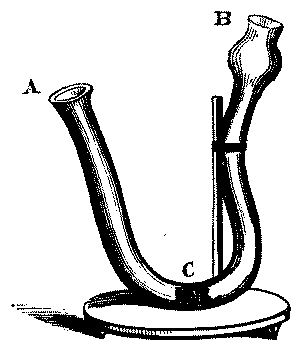
simple but telling experiments. A glass tube, about three feet in length
and half an inch in diameter, is bent as at A (Fig. 368), and then being
filled with water, is suspended by a string attached to any convenient
support inside a copper dish containing water, so that the straight end
is at the top of the water, and the curved end at the bottom. Just
before it is used some ink or other colouring matter is poured into the
copper pan of water; and it should not be added till the moment the
experiment is to begin, as any rise of temperature in the room promotes
circulation, and interferes with the colourlessness of the water in the
tube, which is compared with the inky fluid in the basin. Directly heat
is applied the hot water rises to the top of the copper vessel, and
thence gradually up the tube; and this movement is rendered visible by
the hot coloured liquid matter creeping slowly up the tube, and
displacing the colourless water, which falls gradually into the copper
pan. (Fig. 368.)
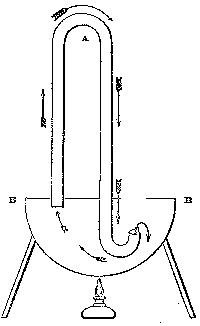 Fig. 368.
a. The bent glass tube full of water. b b. The
copper pan containing coloured water. The arrows show the circulation of
the water.
The principle of the circulation of the particles of water being once
understood, it is easy to comprehend how it is applied to the heating of
buildings by what is called the "Hot Water Apparatus." A coil of pipe is
enclosed in a proper furnace, and the bottom end communicates with a
pipe coming from a second tube or set of coils, placed above it in
another apartment, whilst the top of the latter coil communicates with
the top pipe of the first coil. When the fire is lighted, the
circulation through the first coil of pipe commences, and is
communicated to the second, and from that back again to the first; so
that the "hot water system" involves an endless chain of pipes of
water, provided with proper safety valves to allow for the escape of any
expanded air or steam; and serious accidents have occurred in
consequence of persons neglecting to look after the perfection of this
safety valve. The fearful accident which occurred to the hot water
casing around one of the funnels of the Great Eastern offers a painful
but memorable example of the heating of water, and of the dangers that
must arise if the pipe, casing, or other vessel which contains it, is
not provided with an escape or safety valve, which must always be in
good working order.
Mr. Jacob Perkins, in 1824, made his name remarkable for experiments
with the circulation of water through tubes, and his account of the
invention and improvement of the "Steam Gun," in which the improvement
consists chiefly in the circulation of water through coils of pipe, is
so important that we give it verbatim, with a drawing of the steam gun;
and the author is enabled to vouch for the accuracy of the statements
made in the description of the apparatus, as he purchased one of the
improved steam guns, and exhibited it at the Polytechnic Institution,
where it discharged three hundred bullets per minute.
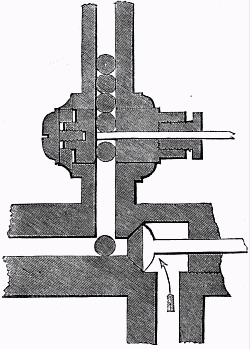 Fig. 369.
The charging tube and gun-barrel of steam gun.
"The expansive power of steam has often been proposed as a substitute
for gunpowder, for discharging balls and other projectiles; the great
danger, however, which was formerly thought to be inseparably connected
with the generation and use of steam, at so extraordinary a pressure as
appeared necessary to produce an effect approximating to that of
gunpowder, prevented scientific men from testing the power of this new
agent by experiment. It was also apparent that the apparatus which was
ordinarily used for generating steam for steam-engines was wholly
inadequate to sustain the necessary pressure, and that one of a totally
different character must be contrived before steam could be sufficiently
confined to come into competition with its powerful rival.
"In the year 1824, Mr. Jacob Perkins succeeded in constructing a
generator of such form and strength, as allowed him to carry on his
experiments with highly elastic steam without danger, although subjected
to a pressure of 100 atmospheres. The principle of its safety consisted
in subdividing the vessel containing the water and steam into chambers
or compartments, so small, that the bursting of one of them was
perfectly harmless in its effects, and only served as an outlet, or
safety valve, to relieve the rest.
"Although Mr. Perkins' generator was originally intended for working
steam engines (it having long been evident to him that highly elastic
steam used expansively would be attended with considerable economy), the
idea occurred to him, in the course of his experiments, that he had
already solved the problem of safely generating steam of sufficient
power for the purposes of steam gunnery; and that the steam which
daily worked his engine possessed an elastic force quite adequate to the
projection of musket balls. He therefore caused a gun to be immediately
constructed, and connected by a pipe to the generator, the first trial
of which fully realized his most sanguine anticipations. Its
performance, indeed, was so extraordinary and unexpected, that it gave
rise to a paradox, which was difficult of explanation—viz., that
steam, at a pressure of only forty atmospheres, produced an effect
equal to gunpowder; whereas it was known that the combustion of
gunpowder was attended with a pressure of from 500 to 1000 atmospheres.
"Mr. Perkins gives the following explanation of this apparent
discrepancy, by referring to the small effect produced by fulminating
powder, compared to gunpowder, although many times more powerful; he
supposes that the action of fulminating powder, however intense, does
not continue sufficiently long to impart to the ball its full power. The
explosion of gunpowder, although not so powerful at the instant of
ignition, is nevertheless, in the aggregate, productive of greater
effect than that of fulminating powder, because the subsequent
expansion continues in action upon the ball (but with decreasing
effect), until it has left the barrel. The action of steam differs from
either of these agents, inasmuch as it continues in full force until
the ball has left the barrel; and to this is assigned the cause of its
superiority.
"In the year 1826, Mr. Perkins had so perfected the mechanism of the gun
and generator that, at an exhibition and trial of its power, in the
presence of the Duke of Wellington and other distinguished officers of
the Ordnance Department, balls of an ounce weight were propelled, at the
distance of thirty-five yards, through an iron plate one-fourth of an
inch in thickness; also, through eleven hard planks, one inch in
thickness, placed at distances of an inch from each other. Continuous
showers of balls were also projected with such rapidity, that when the
barrel of the gun was slowly swept round in a horizontal direction, a
plank, twelve feet in length, was so completely perforated, that the
line of holes nearly resembled a groove cut from one of its ends to the
other.
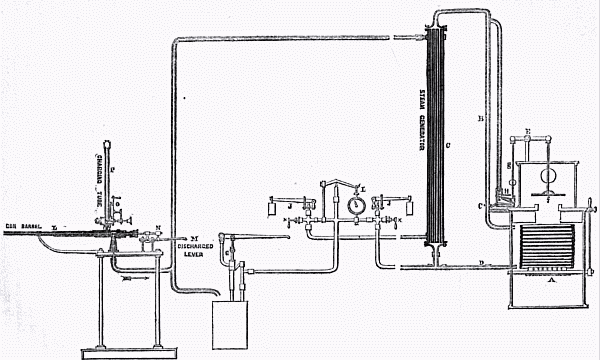 Fig. 370.
Perkins's steam gun.
"a is an iron furnace, containing a continuous coil of iron tubing, 80
feet in length, 1 inch of external and 5/8th inch of internal diameter,
within which the fire is made; the upper end of this tube, b, called the
flow-pipe, is extended any required distance to the top of the
generator.
"The furnace is provided with a very ingenious heat governor or
regulator, by which the intensity of the fire is always proportionate
to the temperature which it may be requisite to maintain in the tubes.
"h is an iron box, containing a series of levers, b b b; c, a nut
screwed upon the flow-pipe, and in contact with the short arm of the
lowest of the levers. e. A lever, from one end of which is suspended the
damper f, and from the other end the rod g, which rests upon the
long arm of the highest of the levers, b b b. When the apparatus has
arrived at the required temperature, the nut c is screwed down until
it bears upon the lever. Any farther increase of temperature will expand
or lengthen the flow-pipe, and depress the short arm of the lever, which
is in contact with the nut. The combined and multiplied action of the
levers will then elevate the rod g, and the damper f will descend to
check the draught. When the fire slackens, and the apparatus cools, the
action of the levers will be reversed, and the damper will open. The
space through which the damper moves, compared with the nut c, is as
200 to 1.
"c is the generator, composed of a strong iron tube, 3 inches diameter
and 6 feet in length, within which are eight smaller tubes, having their
ends welded to the ends of the larger tube. These small tubes
communicate at the top with the flow-pipe b, and at the bottom with
the return-pipe d, which is continued to the bottom of the
furnace-coil of tubing. The circulation in the tubes is occasioned by
the difference in the specific gravities of the water composing the
ascending and descending currents; the portion contained in the
flow-pipe and fire coil becoming expanded by the heat, ascends by its
superior levity; while that contained in the small tubes of the
generator, having given off its heat, acquires increased density, and
descends through the return-pipe d to the bottom of the furnace-coil, to
take the place of the ascending current. When the hot-water current has
arrived at a temperature of 212° and upwards, cold water is injected
into the generator, and becomes converted into steam by its contact with
the small tubes; the rapidity of evaporation and the pressure of the
steam depending, of course, upon the temperature of the hot-water
current, which at 500° will cause a pressure within the tubes of 50
atmospheres, or 750 lbs. upon the square inch. The whole apparatus is
proved to be capable of sustaining a pressure of 200 atmospheres, or
3000 lbs. upon the square inch.
"g. A force pump for injecting water into the generator.
"i. The indicator for exhibiting the pressure of the steam in the
generator, and of the water in the boiler; it may be connected with
either by means of the valves attached to the levers.
"j. Valve to regulate the pressure of water.
"j l. Valve to regulate the pressure of steam.
"k. The steam pipe.
"l. The gun.
"m. The discharging lever acting upon the valve n.
"o. The discharging cock, by a simple adjustment in which balls are
transferred from the charging tube p to the gun barrel, singly or in a
continuous shower.]
"As the perfection and introduction of the steam gun was not a field for
private enterprise, and the British Government having declined to
institute experiments at its own expense, Mr. Perkins was reluctantly
compelled to leave the project, and to engage in others of a more
lucrative, although, perhaps, of a less important nature. He did not
suspend his operations, however, until he had constructed for the French
Government a piece of artillery which discharged balls weighing five
pounds at the rate of sixty per minute.
"The gun and generator exhibited at the Polytechnic Institution during
the time that Mr. Pepper was the Resident Director were the production
of Mr. A. M. Perkins, of London, who has invented an entirely new
method of generating steam, which has been successfully applied to
steam engines, and is at once so simple, safe, and economical, as to
leave little doubt that, with its aid, the steam gun will ere long rank
amongst the first instruments of warfare.
"The gun, except in a few minor mechanical details, does not differ from
that originally constructed by Mr. Jacob Perkins.
"The novelty which distinguishes the generator from all others, consists
in the manner of conveying the heat from the fire to the water, without
exposing the generator to the action of the fire. This is accomplished
by means of the circulation, in iron tubes, of a current of hot water,
which is entirely separate from, and independent of, that to be
evaporated in the generator.
"The following are the principal advantages which this generator
possesses over all others: Freedom from all wear or deterioration
consequent upon exposure to the fire, an important quality in a
generator that is to be subjected to great pressure, inasmuch as its
original strength remains unimpaired; no accident can arise from want
of water in the generator, and the precautions indispensably requisite
when a generator is in contact with the fire are quite unnecessary, as
the water may be drawn off with impunity without producing the least
injurious effect, and the grossest neglect is followed by no worse
consequences than an inefficient supply of steam; an explosion of the
generator is impossible, as the temperature of the furnace-coil always
exceeds that of any other part of the apparatus, and consequently, being
the weakest part, is invariably the first to yield when the pressure is
carried beyond the strength of the pipes; economy of fuel is also
obtained, with a small amount of fire surface. The circulation of the
water has likewise the effect of preserving the fire-coil from the decay
to which boilers are liable; many such coils, which have been in
constant use for eight years, being apparently as good as when first
erected.
"The whole apparatus is exceedingly simple, and will be readily
understood by reference to the accompanying diagram. (Fig. 370.)
"The steam has often been raised to a pressure of 700 lbs. on the square
inch, but one-third of that pressure is sufficient to completely
flatten the balls when discharged against an iron target one hundred
feet distant from the gun; and a pressure of 400 lbs. per square inch,
at the same distance, shivers the ball to atoms, with the production
in a dark room of a visible flash of light. Steam guns are generally
mounted upon a ball and socket joint, which allows the barrel to move
freely in every direction."
The conduction of heat through gases is also very slow when heat is
applied to the upper part of any stratum of air. Heat appears to be
diffused through air only by the circulation and rising of the heated
and lighter strata, and the sinking of the colder currents which take
their places; hence the danger of sitting in a room under an open
skylight. A current of cold air may descend upon the head of the
individual, whilst the warmer air takes some other opening to escape
from. No doubt the movement of heated volumes of air is subject to
definite laws, which apply themselves under every case, but are rather
difficult to grasp when the subject of ventilation is concerned. The
philosophical ventilator is often dreadfully teased by the inversion of
all that he had planned, or the total failure of his apparatus. No
specific mode of ventilation can be found to suit all rooms and
buildings; they are like the patients of a physician who cannot be cured
by one medicine only, but must have a treatment adapted properly to each
case. If the fires, candles, gas, or oil-lamps, doors, windows, and
chimneys, were always under the control of the scientific ventilator,
his task would be very simple, but it is well understood that a
ventilating system which answers well if certain doors communicating
with lobbies are closed, fails directly they are accidentally opened.
The watchful care of the ventilator must begin with the lowest area
door, and in his calculations he must study the effect of every other
door or window that may be opened, so that if a scientific man
undertakes to ventilate a house, he must have a well-drawn plan hung up
in the hall, and it must be clearly understood by the inmates that any
interference with that plan will prejudice the whole.
There are a few common principles which will guide in ventilation, and
these are, first, the rise of hot and the fall of cold air; second, that
if an aperture is provided at the top of a room for the escape of hot
air, an equally large aperture must be left for the entry of cold air;
third, the aperture for the escape of hot air must be adapted in size to
the number of persons likely to enter the room, and the number of gas or
other lights burning in it. During the daytime, moderate apertures for
the exit and entrance of air may suffice, but these must be largely
increased at night, when the room is filled with people and lighted up.
Expanding and contracting openings are therefore desirable, and they are
to be regulated by rules stated on the plan of the ventilating system
(already alluded to as being hung up in the hall) of the house which has
submitted itself to a perfect system of ventilation, and no hall-keeper,
footman, or butler should be allowed to remain in his post unless he
undertakes to comprehend the system and work it properly by the written
rules.
Dr. Angus Smith, in a very able paper "On the Air of Towns," says—"One
of the conditions of health, and a most important, if not the most
important of all, is to be found in the state of the atmosphere. As to
the effect on the inhabitants, the question becomes exceedingly
complicated; but the Registrar-General's returns are an unanswerable
reply as to the results of the lethal influences of the district. Few
people seem clearly to picture to themselves the meaning of a decimal
plan in the percentage of death, and few clearly see that there are
districts of England where the deaths at least in some years, and when
no recognised epidemic occurs, are three times greater than in others.
When we hear of the annual deaths in some districts being 3.4 per cent.,
and in the whole of England 2.2, it is simply that 34 die instead of 22,
whilst even that is too slightly stated, as the whole of England would
show a lower death-rate if the towns were not used to swell it."
This quotation is given here to remind our readers of the important
question of a supply of pure air as well as pure water and pure food;
and if the agricultural labourer, with all his exposure to variable
weather, can take the first place in the scale of mortality, and outlive
the members of all other trades and professions, it is evident that the
importance of pure air is not overrated.
Every effort ought, therefore, to be made in large schools, hospitals,
and barracks, to enforce a rigid system of supply of fresh air, and a
sewage or removal of the impure; and in the use of a certain test
employed by Dr. Smith for the detection of organic matter in the air a
number of approximations were obtained, which clearly demonstrated that
1 grain of organic matter was detected in 72,000 cubic inches of air in
a room, and the same quantity in 8000 cubic inches taken from a
crowded railway carriage.
To show the rising of heated air, a long glass tube, about
three-quarters of an inch in diameter, may be provided and held over the
flame of a spirit lamp at an angle of sixty degrees. As the tube warms,
the heated air rushes past the flame with great rapidity, and pulls it
out or elongates it so much, that the sharp point of the spirit-flame
will frequently be seen at the end of a tube ten feet six inches in
length. The flame is, as it were, the sign-post that indicates the path
or direction of the air. (Fig. 371.)
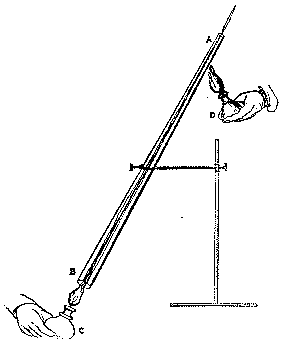 Fig. 371.
a b. The glass tube. c. The spirit lamp, with a
very large wick; if a little ether is mixed with the spirit in the lamp
it increases the length of the flame. d. The effect of the ascension of
air, increased by warming the top of the tube with the lamp d.
Upon the like principle, heated air may be dragged down the short arm of
a syphon, provided the other arm is sufficiently long to impart a strong
directive tendency to the upward current, and this mode of setting air
in motion has been frequently proposed in numerous schemes for
ventilation. In order to prove the fact that an inverted syphon will act
in this manner, an iron pipe of three inches diameter and six feet long
may be bent round during the construction into the form of a syphon, so
that the short length is about one foot long, and the long length the
remaining four feet, allowing one foot for the bend. If the interior of
the long arm is first warmed by burning in it a little spirits of wine
from a piece of cotton or tow wetted with the latter (which can be
easily done by dropping in such a wetted piece into the bend of tube, so
that it is just under the opening of the long part of the tube), the air
is soon set in motion up the long pipe, and as it must be supplied with
fresh volumes of air to take the place of that which rises, and as the
only entrance for the fresh air can be down the short arm of the
syphon, the circulation soon commences, and it proceeds as long as the
upper arm is kept sufficiently warm. If a flame is held over the mouth
of the short arm, it is immediately dragged downward, whilst, if held at
the mouth of the long pipe, the motion of the air is seen by the
assistance of the flame to be in the contrary direction. (Fig. 372.)
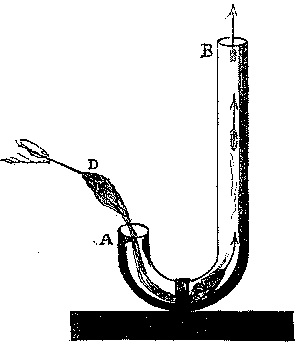 Fig. 372.
a b. Inverted sheet iron syphon. At c is seen
the piece of tow moistened with alcohol, which, being set on fire, warms
the tube b. d. A lighted torch of coloured spirit, the flame of which is
dragged down the tube at a by the descending current, and is impelled
upwards by the ascending current b.
This plan of ventilation was proposed to be used in rooms in connexion
with the chimney and chimney-piece, and in order to give it an
ornamental appearance, the chimney-piece was supplied with two
ornamental hollow columns, the ends of which were open at the
mantel-shelf, and the tubes or columns were continued under the
hearthstone, proceeding up the back of the grate and entering the
chimney, in which there would be a constant current of heated air, and
it was expected that
the syphon arrangement would keep a current of air always in motion, and
thus help to ventilate the room. (Fig. 373.) This plan, however, does
not appear to have been adopted, and wisely so, because half the time
the syphon arrangement might invert itself, and vomit smoky air out of
the chimney into the room; indeed it is surprising what odd and
contradictory freaks are performed by currents of air. The author
remembers a case where two rooms on the same floor, the one a
dining-room and the other a drawing-room, were always exhibiting the
most absurd phenomena of smoke. If the fire in one room was lit, then
the other, in a few moments, began to smell exactly like the inside of a
gas manufactory, and was, of course, more or less filled with smoke,
whilst the room in which the fire was actually burning remained quite
free from this annoyance. The smoke appeared to issue from the wainscot
or moulding which runs round at the bottom of the wall, and was at first
thought to be an escape from the chimney of the kitchen beneath, the
inside of which was duly examined and thoroughly stopped with cement in
every place likely to afford a channel to the smoke, and the crevice
whence the smoke issued was also filled in neatly with cement. But it
was all in vain; the smoke then made its way out from another part of
the cornice, and at last the rooms exhibited a beautiful reciprocating
action. If the drawing-room fire was lighted the dining-room was full of
smoke, and if the latter was lighted the former had the agreeable
visitation. At last the backs of the two grates were examined, and in
each was discovered a hole about one inch in diameter; and it was also
found that the spaces at the back of the stoves had not been filled in
properly, and, indeed, communicated with the hollow space behind the
cornice. When, therefore, the fire was lighted, and coals heaped on just
above the hole, the gas and smoke distilled through the orifice and
travelled on, where it found the most convenient exit; and the fact is
sadly at variance (apparently) with theory, because it might be
considered that cold air would rush towards a fire, and that the draught
ought to have been from the cornice to the chimney instead of vice
versâ. The fact seems to be that the coal in all grates is, in the act
of burning, distilling and giving off inflammable gas; when the coal
was, therefore, heaped above the orifice, and was, possibly, caked hard
at the top, the gas distilling from it escaped more easily from the
little orifice than elsewhere, and chance determined that the channel or
delivery pipe should be in the direction of the drawing-room when the
fire was burning in the dining-room, and in the contrary direction when
the fire was lighted in the latter chamber. The nuisance was stopped by
plugging the holes at the back of the grate with clay, and putting a
sheet of iron over the orifice.
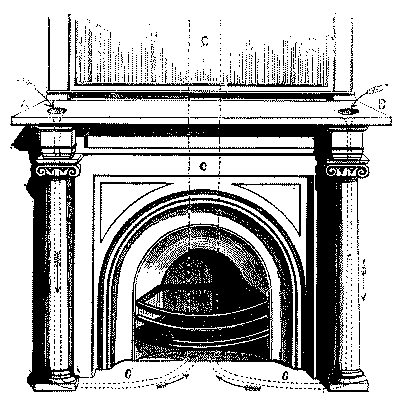 Fig. 373.
a b. Chimney-piece supported on two hollow
ornamental pillars corresponding with the short arm of a syphon. c c c.
The dotted line showing the pipes leading from each pillar under the
hearth, and terminating in a long pipe passing into the chimney. The
arrows show the path of the air descending from the chimney-piece and
ascending in the chimney.
Before Dr. Faraday was appointed as a scientific counsellor to assist
the deliberations of the Trinity Board in connexion with lighthouses,
all the lamps were burnt in the lanterns with the smallest and most
imperfect arrangement for carrying off the heated air and products of
combustion; as a natural consequence, and particularly on cold nights,
the windows of the lantern of the lighthouse were covered with ice
derived from the condensation of the water produced by the combustion of
the hydrogen of the oil, whilst the carbon generated such quantities of
carbonic acid that the light-keepers were unable to stay in the lantern,
and if obliged to visit the latter (whilst looking to improving the
light of any single lamp that might be burning dimly), they were almost
overpowered with the excess of carbonic acid, and stated, in their
evidence, that it produced headache and sickness, and a tendency to
insensibility. Faraday immediately established a system of ventilation;
and by attaching a copper tube to the top of each lamp-chimney, and
centering them all in one large funnel passing to the top of the
lighthouse, the whole of the water which previously condensed on the
glass windows and impeded the light, besides injuring the brass and
copper fittings, was carried off, as also the poisonous carbonic acid
gas; and thus, as Dr. Faraday expressed himself, a complete system of
sewage was applied to the lamps of the lighthouses.
If any one of the numerous stories of ships saved by the Eddystone
Lighthouse could demonstrate more than another the value of this beacon
in mid ocean, it must be the graphic account in the Times of the
gallant conduct of the British Admiral with his fleet whilst breasting
the frightful storm of October, 1859, and endeavouring to reach Plymouth
Sound:—
"It was on Saturday, the 22nd October, that the Hero, the Trafalgar,
the Algiers, and the Aboukir, accompanied by the Mersey, the
Emerald, and the Melpomene, put to sea from Queenstown. Up to the
afternoon of Monday the squadron met with no remarkable adventure, but
about that time, just after the crews had been exercised at gunnery
practice, heavy storms of hail and sleet began to set in. Still there
was no immediate indication of the tempest at hand, and at sunset
topsails were double-reefed and courses reefed for the night, with no
particular character about the wind, except that of extreme variability.
As the morning broke on Tuesday—the day of the storm—the Land's-end
was sighted, and the rain and the wind continued to increase. About nine
a.m. the advent of the gale was no longer doubtful; topgallantyards were
sent on deck and topgallantmasts struck, and the signal was given from
the flagship, 'Form two columns; form line of battle; Admiral will
endeavour to go to Plymouth.' To Plymouth, accordingly, the course of
the fleet was shaped, but so terrifically had the wind increased that it
became very questionable whether the sternmost ships of the line could
possibly succeed in entering the Sound. Upon this the Admiral determined
to wear the fleet together, stand off, and face the storm, a manœuvre
which, under circumstances of great difficulty, was most gallantly
executed. The ships were close upon the Eddystone Lighthouse, round
which they 'darted like dolphins' under the tremendous pressure of the
gale, the Trafalgar stopping in the midst of the storm to pick up a
man who had fallen overboard. The whole squadron now stood off the land,
the Mersey and Melpomene furling their sails, and the former vessel
steaming along 'like an ocean giant.' Still the gale increased till
about three p.m., when there occurred that remarkable phenomenon by
which these rotatory tempests are characterized. The fleet had got into
the very centre of the storm, the 'eye' of the tornado, and, though the
sea towered up and broke in tremendous billows all around, the wind
suddenly ceased and the sun shone. When, however, the signal had been
given and obeyed for setting sail again, the ships soon encountered the
gale once more—not, as before, from the S.E., but the N.W.—and in
greater force than ever. It was now a perfect hurricane; and for three
hours the whole fury of the tempest was poured upon the squadron. When
it began, at length, to abate a little, the four line-of-battle ships
and one of the frigates were still in company, and all doing well. The
Mersey and the Emerald had steamed into Plymouth, but the five
remaining vessels kept in open order throughout that terrible night,
wore in succession by night signal at about one a.m., made the land at
daylight, formed line of battle, came grandly up Channel under sail at
the rate of eleven knots an hour, steamed into Portland, and 'took up
their anchorage without the loss of a sail, a spar, or a ropeyarn.'"
After making the important improvement in the ventilation of
lighthouses, many letters were addressed to the learned philosopher
by numerous light-keepers, one of which in plain but striking
language related that "the enemy (alluding to the water and carbonic
acid) was now driven out."
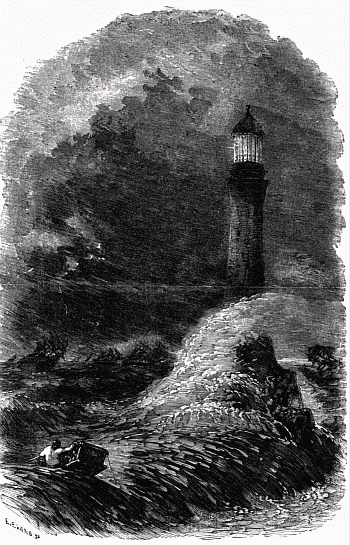
The British fleet rounding Eddystone Lighthouse during the great storm of October, 1859.
The ingenious invention alluded to was succeeded by another and equally
simple but philosophical arrangement, which Dr. Faraday presented to his
brother, and it was duly patented. It consisted of an arrangement for
ventilating gas burners, and it must be obvious that a necessity exists
for such ventilation, because every cubic foot of coal gas when burnt
produces a little more than a cubic foot of carbonic acid. A pound
weight of ordinary coal gas contains about 3/10ths of its weight of
hydrogen, which when burnt produces two pounds and 7/10ths of a pound of
water. A pound of ordinary coal gas also contains about 7/10ths of its
weight of charcoal, which produces when burnt rather more than two and a
half pounds of carbonic acid gas—viz., 2.56. In order to burn this
quantity of gas nineteen cubic feet and 3/10ths of a foot of atmospheric
air, containing 4.26 cubic feet of oxygen, are required.
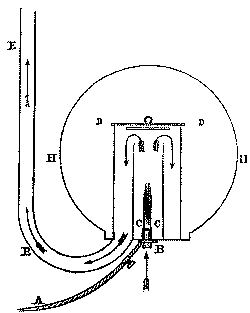 Fig. 374.
a b. Gas pipe and argand burner; the air
enters, as usual, up the centre of the argand. c c. The first glass
chimney open at the top. d d. The second glass chimney closed at the
top, with a disc of double talc, and fitting over c c, and leaving a
space between the two glasses, down which the air passes, and into the
ventilating tube, e e. h h. The ground-glass globe closed at the top,
and surrounding the whole.[I]
It is not therefore surprising that as common coal gas is sometimes
purified carelessly, and contains a minute trace of sulphuretted
hydrogen, with some bisulphide of carbon vapour, that it should produce
the most prejudicial effects in badly ventilated rooms, and especially
in some of those perched up glass boxes in large places of business,
where clerks are obliged to sit for many consecutive hours, lighted by
gas, and breathing their own breath and the products of combustion from
the gas light, thereby rendering themselves liable to diseases of the
lungs, and also to very troublesome throat attacks, when leaving their
close glass boxes, and passing into the cold night air. The dangerous
product of the combustion of ordinary coal gas is sulphurous acid—viz.,
the same gas as that generated when a sulphur match is burnt; and if it
will attack the bindings of books, and damage furniture, goods in shops,
curtains, &c., in consequence of the large quantity of water with which
it is accompanied, how much more is it not likely to injure the delicate
organism of the breathing apparatus of the lungs? Dr. Faraday's lamp is
therefore a great boon, but, like a great many other clever things, it
must be adapted to the currents of air and draught from the room; and
means must be taken to prevent the draught becoming too powerful in
Faraday's lamp, or else the illuminating power is destroyed by the
thorough combustion of the carbon of the coal gas, and the heat
generated is so intense that the glasses soon crack, and of course
become useless. The lamp will answer very well if (as has been already
stated) the draught in the ventilating pipe is not too great.
The system already explained and illustrated is likewise carried out on
a much larger scale in the ventilation of coal pits, where a shaft is
usually sunk into the ground for the admission of air, which, after
circulating through the intricate windings and mazes of the coal pit
workings, escapes at last from another shaft, at the bottom of which is
placed a powerful furnace, and this is kept burning night and day, so
that the movement of the air is maintained in one direction—viz., from
the outer air down the shaft called the downcast, thence to the
galleries, where the coal hewers are working, to the second shaft, near
which the furnace is placed, and up this latter the air travels; the
shaft, pit, or funnel being very appropriately termed the upcast.
Should the furnace at the bottom of the upcast be neglected, the
ventilation may be just balanced, or set slightly towards the downcast;
under these circumstances the carbonic acid from the fire will begin to
circulate in the galleries, and poison those who are not aware of its
presence and take the proper means to escape. Such accidents, amongst
the host of others that occur in a coal pit, have actually been
recorded; and the firemen, whose duty it might be to attend to the
proper burning of the furnace, have had to pay the penalty of death for
their own carelessness in falling asleep and neglecting to maintain the
ventilation of the mine in one direction. (Fig. 375.)
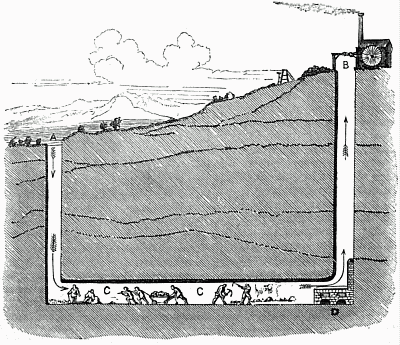 Fig. 375.
Section showing the two air-shafts. a. The
downcast. b. The upcast. c c. One of the working galleries in connexion
with the upcast and downcast. d. The furnace at the bottom of the
upcast. In this sketch one gallery only has been shown, to prevent
confusion and to show the principle.
These details are amply sufficient to demonstrate the manner in which
heat is diffused through air, whilst the rarefication of the air by heat
suggests the cause of those frightful storms of wind that rush from
other and colder parts of the surface of the globe, to supply the void
produced by the cooling and contraction of the enormous volumes of
gaseous matter.
When rays of heat are emitted from incandescent matter, they are not
necessarily visible, nay, they are generally invisible, and not
accompanied with a manifestation of light, and pass with great velocity
through a void or vacuum, also through air and certain other bodies.
From what has been stated respecting the manner in which air, by
continually moving, and by convection, carries off heat, it might be
thought that no proof existed that invisible rays of heat are really
thrown off from a ball filled with boiling water. But this question is
set at rest by the fact, that such a ball will cool rapidly when
suspended by a string inside the receiver of an air pump from which the
atmospheric air has been removed, so that no conduction of the particles
of air could possibly remove the heat.
In the year 1786, Colonel Sir B. Thompson examined the relative
conducting powers of air and a Torricellian vacuum—the latter being
used because, as the experimenter stated, it was impossible to obtain a
perfect vacuum, on account of the moist vapour which exhaled from the
wet leather and the oil used in the machine, for at that time carefully
ground brass plates were not used in air-pumps, but plates only, with
a circular piece of wet leather upon them. In a paper which Colonel Sir
B. Thompson read before the Royal Society, he stated that "It appears
that the Torricellian vacuum, which affords so ready a passage to the
electric fluid, so far from being a good conductor of heat, is a much
worse one than common air, which of itself is reckoned among the worst;
for when the bulb of the thermometer was surrounded with air, and the
instrument was plunged into boiling water, the mercury rose from 18° to
27° in forty-five seconds; but in the former experiment, when it was
surrounded by a Torricellian vacuum, it required to remain in the
boiling water one minute thirty seconds to acquire that degree of heat.
In the vacuum it required five minutes to rise to 48°-2/10ths; but in
air it rose to that height in two minutes forty seconds; and the
proportion of the times in the other observation was nearly the same.
"It appears, from other experiments, that the conducting power of air to
that of the Torricellian vacuum, under the circumstances described, is
as 1000 to 702 nearly, for the quantities of heat communicated being
equal, the intensity of the communication is as the times inversely. By
others it appears that the conducting power of air is to that of the
Torricellian vacuum as 1000 to 603."
It is therefore very interesting to discover that the attention of
experimentalists was early directed to the fact that heat was
independent of the air, and passed either as waves of heat or molecules
of heat through space. The velocity with which heat moves through a
vacuum is very great, and in an experiment performed by M. Pictet, no
perceptible interval took place between the time at which caloric
quitted a heated body and its reception by a thermometer at a distance
of sixty-nine feet. It appears also, from the experiments of the same
philosopher, to be thrown off or radiated in every direction, and not to
be diverted (as shown at p. 369) by any strong current of air passing it
transversely. Sir Humphrey Davy ignited the charcoal points connected
with a battery in a vacuum, taking care to place the charcoal points at
the top of the jar, and a concave mirror, with a delicate thermometer in
its focus, at the bottom of the vessel placed upon the air-pump plate.
The effect of radiation was ascertained first when the receiver was
full of air, and next when it was exhausted to 1/120th (i.e., 199
parts pumped out, leaving only one part of air in the receiver). In the
latter case, the effect of radiation was found to be three times greater
than in an atmosphere of the common density. The greater rise of the
thermometer in vacuo than in air is to be ascribed to the conducting
power of the latter; for this conducting power, by reducing the
temperature of the heated body, has a constant tendency to diminish the
activity of radiation, which is always proportional to the excess of the
temperature of the heated body above that of the surrounding medium.
(Fig. 376.)
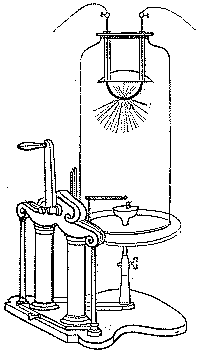 Fig. 376.
The air-pump and receiver, containing at a the
electric light in the focus of a concave mirror, and at b a delicate
thermometer, also in the focus of a concave mirror.
Count Rumford's experiments with a Torricellian vacuum gives the
proportion of five in vacuo to three in air for the quantities of heat
lost by radiation, and by conduction or diffusion. It is not, perhaps,
departing very far from the truth, if it be stated that one half of the
heat lost by a heated body escapes by radiation, and that the rest is
carried off by the convective power of currents of air.
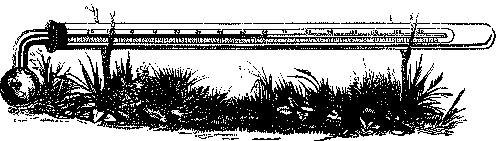 Fig. 377.
Negretti and Zambra's terrestrial radiation
thermometer. The bulb of this instrument is transparent, and the
divisions engraved on its glass stem. In use it is placed with its bulb
fully exposed to the sky, resting on grass, with its stem supported by
little forks of wood, and protected from the wind.
If the process of radiation was not constantly proceeding, it can easily
be imagined that the temperature of our globe would become so elevated
by the regular accession of heat from the sun's rays, that the
vegetation would be parched up and destroyed, and consequently all
animals and the human race must become extinct. The best time to notice
the radiation of heat from the earth is at night and after a hot
summer's day. If the sky is clear, it will be noticed (with the help of
a thermometer,) that the ground is several degrees colder than the air a
few feet above it. (Fig. 377.) It is this reduced temperature that
causes the deposition of dew, and produces the earth-cloud which so
nearly resembles a sheet of water as to have been occasionally mistaken
for an inundation, the occurrence of the previous night. Mr. Luke Howard
has called this cloud, which is the lowest form of these draperies of
the sky, "The Stratus," or evening mist; but when permanent, and
increased to a depth so as to rise above our heads, it is then called
the morning fog, so peculiarly agreeable in London when incorporated
with the black smoke, making a fine reddish-yellow ochreous mist. By
placing a thermometer, standing at the ordinary temperature of the air,
cased with a good radiating material, such as filaments of cotton, in
the focus of a concave mirror, and by turning this arrangement towards a
clear sky in the evening, it will be noticed that the temperature falls
several degrees. Good radiators of heat are black and scratched
surfaces, filaments of cotton, grass, twigs, boughs, and certain leaves,
especially those with a rough surface.
Bad radiators of heat are bright and polished metallic surfaces, white
woollen cloth or flannel, hard and dense substances, such as a gravel
path and stone, or those leaves which have a polished surface, such as
the common laurel. It is the frozen dew and mist which produce the
beautiful effect of hoar-frost and icicles on the trees and bushes, the
primary cause being the radiation of heat from the various objects on
the surface of the earth, as well as from the latter itself. When the
wind is high, dew does not deposit, as it is necessary that the air
should be calm, in order to receive the cooling impression of the cold
earth, and to deposit the moisture, which it holds in solution as
invisible steam. When the wind blows, it mixes all parts of the air
together, and prevents that difference of temperature which causes the
deposit of dew. Hence the evening mist will be more generally observed
in the bosom of a valley surrounded by hills and screened from the winds
that may blow from either quarter. The continual presence of moisture in
the air is well shown by the condensation of water on the outside of a
glass of cold spring water, or especially on the outside of a jug
containing iced water. The invisible steam is always ready to bathe the
tender plants with dew, which would otherwise perish and be burnt up
during a hot summer, if they did not radiate heat at night, and thus
condense water upon themselves. The presence of watery vapour in the air
becomes therefore a matter of great importance, and hence the
construction of hygrometers or measurers of the moisture in the air.
Regnault's condenser hygrometer consists of a tube made of silver, very
thin, and perfectly polished; the tube is larger at one end than the
other, the large part being 1.8 in depth by 8.10 in diameter. This is
fitted tightly to a brass stand, with a telescopic arrangement for
adjusting when making an observation. The tube has a small lateral
tubulure, to which is attached an India-rubber tube with ivory
mouthpiece; this tubulure enters at right angles near the top, and
traverses it to the bottom of largest part. A delicate thermometer is
inserted in through a cork, or India-rubber washer, at the open end of
the tube, the bulb of which descends to the centre of its largest part.
A thermometer is attached for taking the temperature of the air; also a
bottle for containing ether.
To use the condenser hygrometer, a sufficient quantity of sulphuric
ether is poured into the silver tube to cover the thermometer bulb. On
allowing air to pass bubble by bubble through the ether, by breathing in
the tube, an uniform temperature will be obtained; if the ether
continues to be agitated by breathing briskly through the tube, a rapid
reduction of temperature will be the result. At the moment the ether is
cooled down to the dew-point temperature, the external surface of that
portion of the silver tube containing the ether will become covered
with a coating of moisture, and the degree shown by the thermometer at
that instant will be the temperature of the dew-point.
The most simple form of the hygrometer was formerly a very favourite
indicator of the state of the weather, and usually consisted of the
figure of a monk with his hood, which is attached to a bit of catgut;
this covering of paper, painted to represent the hood, falls over the
head on the approach of damp weather, and inclines well back during the
period that the air is dry or contains less moisture; and simple as it
is, this hygrometer, in conjunction with the reading of the barometer,
may assist Paterfamilias in deciding the fate of a pet bonnet or
velvet mantle, which is or is not to be worn on a doubtful day. (Fig.
378.)
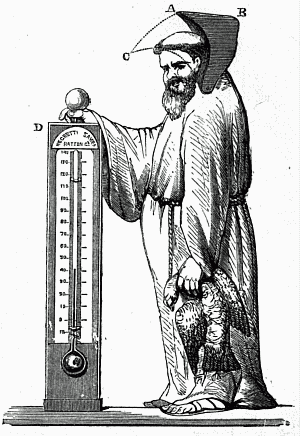 Fig. 378.
The monk hygroscope, in which the hood, a b,
covers the head to dotted line c in wet weather, and takes various
intermediate positions, being quite back and on the shoulders in dry
states of the air. A thermometer, d, is usually attached.
A decision on the possible changes of the weather requires considerable
experience, and it has been said that one of the most celebrated
marshals of France owed his invariable success in military combinations
and attacks to his attention to the signs of the weather, as indicated
by the state of the air during the phases of the moon. Inexperienced
persons (and by that we mean young persons) may, however, take a certain
position in the rank of "weather prophets" by consulting the
weathercock, the barometer, and the hygrometer, before committing
themselves to an opinion, if asked to say what the weather will be.
The dry and wet bulb hygrometer (as represented in the next engraving)
consists of two parallel thermometers, as nearly identical as possible,
mounted on a wooden bracket, one marked dry, the other wet. The bulb
of the wet thermometer is covered with thin muslin, round the neck of
which is twisted a conducting thread of lamp-wick, or common
darning-cotton; this passes into a vessel of water, placed at such a
distance as to allow a length of conducting thread of about three
inches; the cup or glass is placed on one side, and a little beneath, so
that the water within may not affect the reading of the dry bulb
thermometer. In observing, the eye should be placed on a level with the
top of the mercury in the tube, and the observer should refrain from
breathing whilst taking an observation. The temperature of the air and
of evaporation is given by the readings of the two thermometers, from
which can be calculated the dew-point, tables being furnished for that
purpose with the instrument. (Fig. 379.)
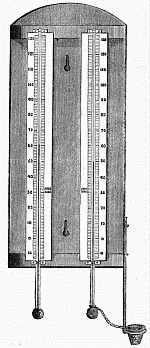 Fig. 379.
The dry and wet bulb hygrometer.
The colour of the sky at particular times affords the most excellent
guidance to doubting members of pic-nic or other out-of-door parties.
Not only does a rosy sunset presage fine weather, and a ruddy sunrise
bad weather, but there are other tints which speak with equal clearness
and accuracy. A bright yellow sky in the evening indicates wind; a pale
yellow, wet; a neutral grey colour constitutes a favourable sign in the
evening, an unfavourable one in the morning. The clouds, again, are full
of meaning in themselves. If their forms are soft, undefined, and
feathery, the weather will be fine; if their edges are hard, sharp, and
defined, it will be foul. Generally speaking, any deep, unusual hues
betoken wind or rain, while the more quiet and delicate tints bespeak
fine weather.
The principle of radiation of heat is employed by the Indian natives in
the neighbourhood of Calcutta for the purpose of obtaining small
quantities of ice. In that climate, the thermometer during the coldest
nights does not indicate a lower temperature than about 40° Fahr. The
sky, however, is perfectly cloudless, and as heat radiates with great
rapidity from the surface of the ground, the Indian natives ingeniously
place very shallow earthenware pans on straw, which is a bad conductor
of heat, and hence insulates the pans from communication with the
parched earth. In a few hours, the water in the pans is covered with a
thin sheet of ice, and there can be no doubt of its production by an
absolute loss of heat by radiation, because the plan does not succeed on
a windy night, and succeeds best even when the pans are sunk in trenches
dug in the earth. A windy night prevents that difference of temperature
between one portion of the surface of the earth and another, which is so
essential to a steady and uniform loss of heat, as it must be evident
that the continual mixture of warmer portions of air with that which is
colder would tend to prevent the desired lowness of temperature being
attained.
The manner in which heat is observed to be radiated has suggested
another theory to the fertile brain of philosophical observers, and it
has been supposed that the conduction of heat may be nothing more than a
radiation from one particle of matter to another, as through a bar of
copper, in which the particles, though packed closely together, are not
supposed to be in actual contact, so that it is possible to conceive
each separate atom of copper receiving and radiating its heat to the
neighbouring particle, and so on throughout the length and breadth of
the metal. By this theory the radiation of heat through a vacuum is
brought into close connexion with that of the radiation of heat through
the air and other solid and liquid bodies.
Some of the most interesting phenomena of heat are those discovered by
Leslie, who has proved in a very satisfactory manner that the rapidity
with which a body cools, depends (like the reflection of light) more on
the condition of the surface than on the nature of the material of which
the surface is composed. With a globular and bright tin vessel it was
observed that water of a certain heat contained in it, required 156
minutes to cool; but when the latter vessel was covered with a thin
coating of lamp-black and size, the water fell to the same degree as
that noticed in the first experiment in the space of eighty-one minutes.
By very careful observations made with a differential air thermometer,
Leslie determined that the power of radiating heat in various substances
was as follows:—
| Lamp-black | 100 |
| Writing paper | 98 |
| Sealing wax | 95 |
| Crown glass | 90 |
| Plumbago | 75 |
| Tarnished lead | 45 |
| Clean lead | 19 |
| Iron, polished | 15 |
| Tin plate, gold, silver, copper | 12 |
As in the reflection of light, it was noticed that a piece of charcoal
covered with gold leaf, partook of the nature of the precious metal so
far as its power of throwing off or scattering the rays of light was
concerned, so a piece of glass covered with gold-leaf appears to possess
the same power of radiating heat as that of any brilliant metal.
Radiant heat, like light, can be propagated through a great variety of
substances, but is stopped by the larger number; and it can be
reflected, refracted, polarized, absorbed, or it may undergo a secondary
radiation.
The intensity of radiant heat follows the same law as that of light, and
decreases as the square of the distance from its source. The same law
that governs the reflection of light, also prevails with that of heat;
and it may be found by experiment that the angle of incidence is equal
to the angle of reflection, so that the heat is disposed of in the same
manner as light when it falls upon bright polished planes, convex and
concave surfaces; hence the use of bright tin meat screens and Dutch
ovens, and of all those simple pieces of culinary furniture which are
employed in the kitchen for the purpose of arresting the cold currents
of air that set towards burning matter, as also to reflect the heat upon
whatever viands may be cooking before the fire. A bright silver teapot
retains its heat better than a dirty one, and the fact is determined
very readily by pouring boiling water into two teapots, the one being
made of bright tin and the other of black japanned tin. A thermometer
inserted into each vessel will soon show that the latter radiates, and
therefore loses its heat quicker than the former; the relative radiating
powers of bright and blackened tin being as 15 to 100. Pipes for the
conveyance of hot water or steam should be kept bright, if possible,
although this trouble is avoided usually by packing them in bad
conductors of heat, whilst the polish of the cylinder of a steam-engine
is of great importance as a means of economizing heat.
When the finger is approached within an inch or so of a red-hot ball,
the heat radiated from the latter is so intense that it cannot be held
there for more than a few seconds. If, however, the finger is coated
with gold leaf it may be kept near the iron ball for some considerable
time, because the radiant heat is reflected from the surface of the
gold. If the word heat is written upon a sheet of paper and the letters
afterwards gilt, the whole of the white surface is rapidly toasted and
scorched when held before a fire, whilst the surface of the paper under
the gold leaf remains perfectly white, which can be ascertained by
turning the paper round and observing the other side. A sheet of paper
gilt inside and turned round as a cone, being left open at both ends,
may be employed as a reflecting surface; and if a bit of phosphorus,
placed on paper, is held, say at two feet from a red-hot ball of about
two inches diameter, the radial heat from the latter has not sufficient
intensity at that distance to set it on fire quickly; if, however, the
cone of gilt paper is used between the two, and the phosphorus brought
into the focus of the rays of radial heat, it very quickly takes fire.
(Fig. 380.)
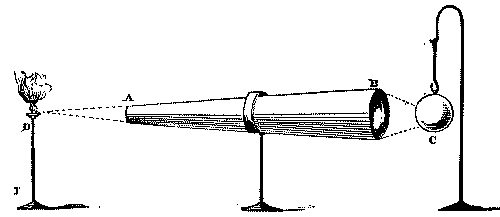 Fig. 380.
a b. The cone of paper, gilt inside. c. The
red-hot ball. d. Stand with wood supporting a slice of phosphorus, which
is brought into the focus of the rays of heat reflected through the
cone.
Dr. Bache has determined by experiments that the radiation of heat from
a body is not affected by colour, so that in winter all coloured clothes
are alike in that respect, and radiate heat without any appreciable
difference. The power of absorbing heat, however, is greatly dependent
on colour; and as a general rule, good radiators of heat (such as a
black cloth, or indeed any surface covered with lamp-black), are also
excellent absorbents of heat. Dr. Hooke and Dr. Franklin placed pieces
of cloth of similar texture and size on snow, allowing the sun's rays to
fall equally upon them. The dark specimen always absorbed more heat than
the light ones, and the snow beneath them melted to a greater extent
than under the others; and they both remarked that the effect was nearly
in proportion to the depth of the shade, as in the following
order:—After black, the maximum absorbent quality was possessed by,
first, blue; second, green; third, purple; fourth, red; fifth, yellow.
The minimum absorbent power was observed to belong to white.
When radiant heat is allowed to pass through glass, the latter substance
is not found to be transparent to heat rays as it is to those of light,
but a considerable proportion of heat is arrested and stopped;
consequently glass fire-screens are to be found in the mansions of the
wealthy, because they obstruct the heat but do not exclude the cheerful
light and blaze of the fireside.
Melloni's researches on the nature of the rays of heat, and also on the
media which affect them, would demand and merit a chapter to themselves;
want of space, however, obliges us to omit the consideration of
thermo-electricity, and the refined and beautiful experiments of
Melloni, whose labours are a model for the imitation of all original
seekers after truth.