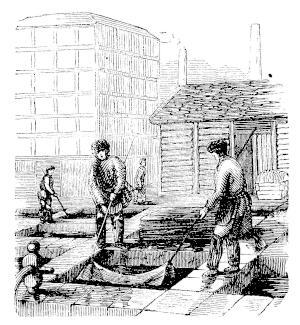
THE BRICKMAKER.
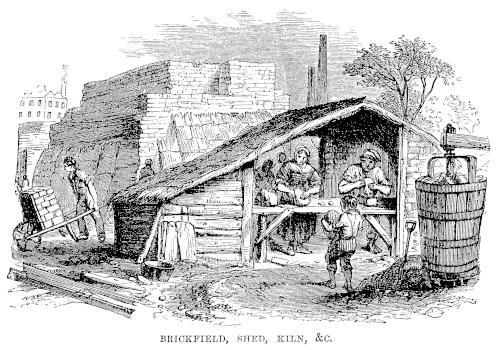
BRICKFIELD, SHED, KILN, &C.
It would be very difficult, and perhaps impossible, to
discover at what time in the history of the world the art
of brickmaking was first practised. In the earliest records of
the human race the making of bricks is mentioned; this
was part of the labour imposed upon the children of Israel,
when they were in captivity in Egypt, and bricks of
excellent quality are found in some of the most ancient
buildings, the remains of which have been discovered.
Though uncivilized nations, and even some which had made
great progress in civilization, but lived in very warm or
exceedingly cold climates, frequently built dwellings of
wood, of wattles or strips of trees and branches covered
with clay and lime, and of rough stone and earth; and
though whole tribes lived and still live under tents, or in
mere log huts and wigwams, or lodges made of the skins
of animals, the manufacture of bricks formed of clay, and
either burnt with fire or dried in the sun, is amongst the
oldest of all known trades. In our own day it has arrived
at such perfection and the varieties of bricks and tiles are
so great in order to provide for the great diversity in buildings,
that it is one of the most important branches of
English industry.
We learn from the Bible that burnt bricks were used in
building the Tower of Babel, and from early historians, as
well as from recent discoveries, we know that they were also
made for the walls of Babylon. The bricks of the ancient
Egyptians were made of clay tempered with water and
mixed with chopped straw, and afterwards dried in the sun,
and the labour of the Israelites was made more severe by
their being compelled to find straw for themselves. In
Rome both burnt or kiln-dried bricks and those dried in
the sun were employed, and though at a later date the art
of brickmaking seems to have fallen into disuse, it was
revived again in Italy after some hundreds of years. The
trade seems to have been brought to England by the Romans,
and many of the most ancient buildings in this country
are made of very fine brickwork, though, till the reign of
Elizabeth, only large mansions were so built, the common
houses being formed of frame-works of timber filled in with
coarse plaster supported by laths of wood.
There are few more interesting sights than a brick-field
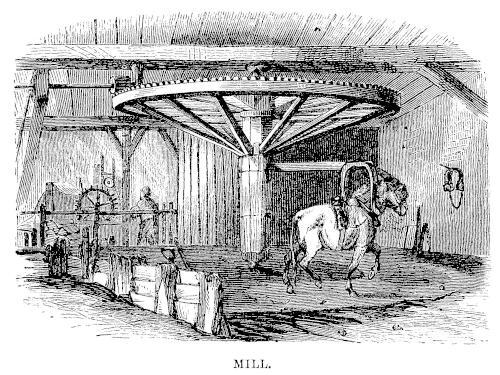
in full work with its great sheds, its horses going slowly
round and round in the mills, grinding the clay which has
been dug out of the deep pits; its great stacks covered with
hurdles and screens made of reeds and its immense kilns,
so cleverly and evenly built, where the smoke rises lazily
from the dull fires by which the drying or burning is
completed.
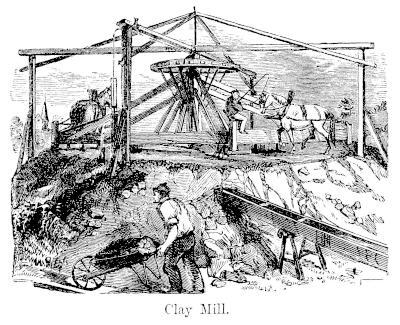
Clay Mill.
The methods of brickmaking differ considerably in
various parts of England, but that which we most commonly
see in practice near London will very well represent them
all, and it is this which will now be described. The earth
used for making bricks is found after digging till the
labourers reach the loamy soil lying just above that blue
clay which is known as London clay; and this earth is
known as strong clay, mild clay, and malm, and this earth
requires preparation by mixing with them chalk and the
dust of burnt ashes from the dust bins. These burnt ashes
the brickmakers call “breeze.”
The chalk mill and the clay mill are placed close together
on large mounds, high enough to allow the “malm” (which
is a mixture of chalk and clay ground to a thin paste) to
run down to the brick earth. The chalk mill is a round
trough where the chalk is ground by heavy wheels fitted
with spikes on their tires or hoops, and turned by one or two
horses. The trough is supplied with water from a pump,
and the chalk, as it is ground, runs off by a wooden gutter
into the clay mill, where it is again stirred and ground till
it mixes with the clay; the mixture then runs through a
grating and through other gutters to the brick earth, which
has been placed in heaps to receive it.
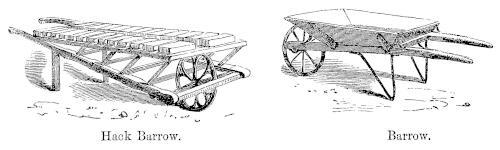
Hack Barrow. Barrow.
When the earth is mixed in this way, it becomes brick-clay,
and is taken in barrows up a sloping board, to the pug
mill. The pug mill is a great tub, the top of which is
larger than the bottom, and in the centre of it there revolves
an upright iron shaft fitted with knives. These knives cut
and break the clay as it passes through the mill, and they
also force it downwards till it reaches the bottom, where it
passes through a hole on to a machine called the Cuckhold,
which is a sort of table containing a trough where the clay
is cut into lumps ready for the moulder.
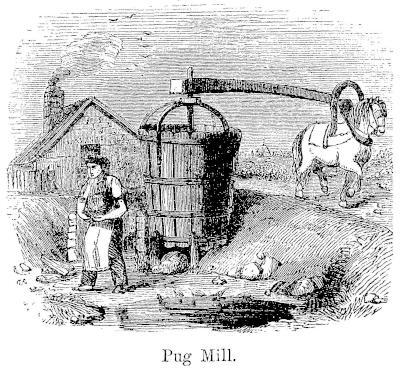
Pug Mill.
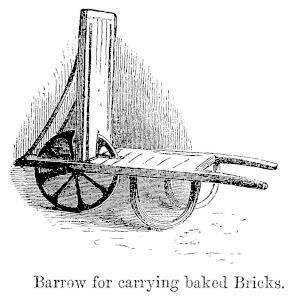
Barrow for carrying baked Bricks.
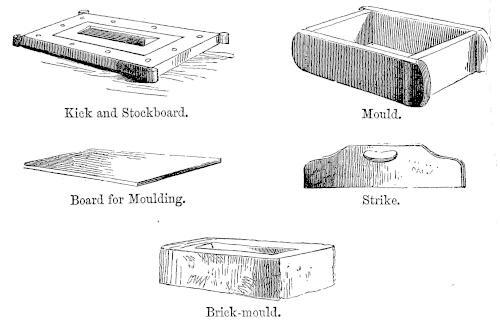
Kick and Stockboard. Mould. Board for Moulding.
Strike. Brick-mould.
The moulder who shapes the clay into bricks uses
moulding sand,—a peculiar sort of sand brought from the
bed of the river, and spread out in the sun, where it is
turned over and over till it is quite dry. It prevents the
clay from shrinking, gives a harder surface to the bricks,
and prevents them from sticking to the mould, or to each
other; it also gives the London bricks their grey colour.
The moulder stands at the moulding stool, which has a rim
at each end to keep the moulding sand from falling off,
and has a stockboard, which forms the bottom of the
brick-mould, and a page, or two iron rods nailed at each end
to wooden rails, used to slide the raw bricks from the moulder
to the place from which the “taking-off boy” takes them to
place on the “hack barrow,” by which they are carried
away. The moulder is served with the lumps of clay by
the “clot moulder.” The “brick-mould” is a kind of box
without top or bottom, and the moulder dashes the tempered
clay into the mould with sufficient force to make the clay
completely fill it; after which the superfluous clay is removed
from the surface of the mould with the strike. The
brick is then turned out on to a pallet or board, on which
it is wheeled by the boy to the “hack ground,” where the
bricks are built up to dry in low walls called “hacks.” The
brick moulds are made of brass or iron, and often of wood.
Sometimes the bricks are dried on a floor under a shed, but
often in the open air, where they are covered with straw,
reed-flats, or canvas and tarpauline screens, to protect them
from wet, frost, or excessive heat. The bricks are afterwards
burnt either in “clamps” or in “kilns.” In clamp burning
the bricks are built up close together, and the bottom ones
only are heated with burning breeze or cinders, the heat
spreading to those at the top. A kiln is a sort of large
chamber in which the bricks are loosely stacked with spaces
between them for the heat to pass through, and they are
baked by fires placed either in arched furnaces under the
floors of the kiln, or in fire holes made in the side walls.
The kilns are built of various shapes, and one of the
principal arts in the trade of the Brickmaker is to construct
them that the heat may be properly distributed, and the
bricks equally and thoroughly baked.
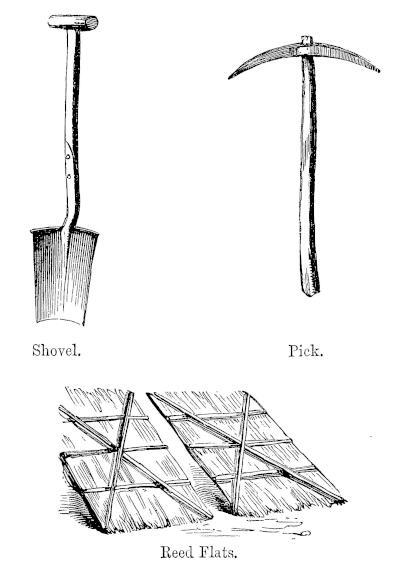
Shovel. Pick. Reed Flats.
THE MASON.
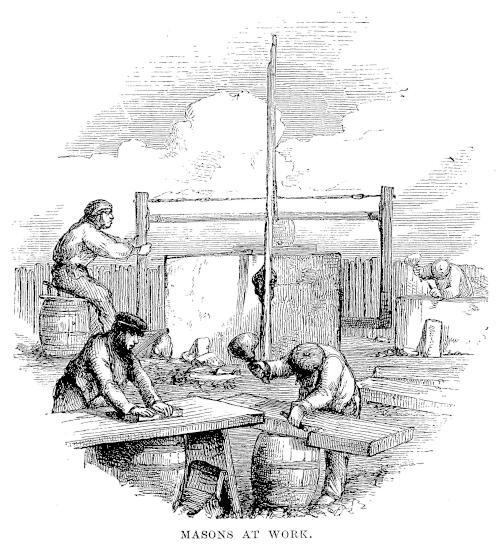
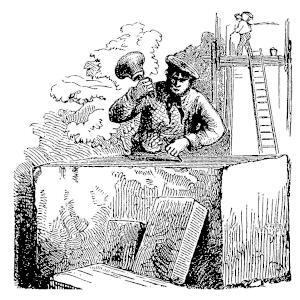
MASONS AT WORK.
Having already given a description of the way in which
bricks are made, we come to the work of the Mason, whose
duty it is to prepare the stone work used in building and
for other purposes. In the mason’s trade great skill is
required, as well as some hard manual labour, since he has
to cut the stones for arches, windows, columns, cornices, and
porches, into various shapes; and to fit the separate pieces
with perfect accuracy, that the Builder or the Architect may
be able at once to set them in their proper places. The
business of the monumental mason, who erects pedestals for
statues, tombs, and ornamental structures in parks and
gardens, is generally distinct from that of the builder or
architectural mason, although many of the same tools are
used in both trades.
The stone used by the mason is of various kinds, and is
brought from different parts of the world; but our own
country contains stone of nearly every sort which can be
well employed in ordinary building. Granite comes principally
from Scotland, though a smaller quantity is brought
from Ireland; red and white sandstone is plentiful in
Yorkshire, Lancashire, and Derbyshire, as well as in Scotland
and Ireland; a sort of slate stone is found in Wales; and
the most common building stone, which is called limestone,
or free-stone, is brought from several counties in England,
where it is constantly worked. The stone is generally
found under the surface of the earth, and the places from
which it is dug are called quarries; the business of
quarrying being to extract from the ground, or from the
sides of rocks, large masses of stone or marble.
When these lie directly under the ground, the earth at
the top is removed, and the stone is afterwards separated
into blocks and lifted out by machinery; but it is sometimes
necessary to mine for the stone by making galleries underground,
and leaving pillars to support the earth above
them. In large quarries, the earth at top is first removed,
and the first layer of stone, which is generally of a common
sort, is broken or blasted with gunpowder, and afterwards
taken away. The lower layers of stone are then divided
by wedges driven into them, until they split in the required
direction; the blocks are afterwards made of a regular
square, by a tool called a kevel, pointed at one end and flat at
the other, and are then lifted by cranes on to low waggons,
upon which they are drawn away. It is the business of the
mason to work these stones, which are to be used in building,
into their required shape; but before the mason receives
them the stone cutter hews and cuts the large blocks
roughly into the form in which they are wanted; and when
the block is to form top of a doorway, part of a cornice, or
any other portion of a building where ornament is necessary,
the carver executes these ornaments, and cuts the stone into
a pattern of fruit, flowers, or figures.
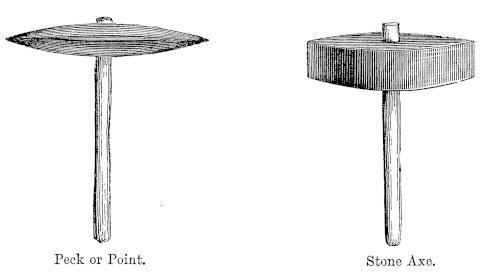
Peck or Point. Stone Axe.
When the stone is valuable it is sent from the quarry to
the mason’s yard, or to the building where it is to be used
in large blocks, and there cut into slabs or thin pieces
called “scantlings,” of the required size, with a stone
mason’s saw (see large cut). This saw differs from those
used in other trades because it has no teeth. It is a long
thin plate of steel slightly jagged on the bottom edge, and
fixed in a frame; and being drawn backwards and forwards
in a horizontal position, cuts the stone by its own weight.
To make this the easier, a heap of sharp sand is placed on a
sloping board over the stone, and water trickling upon it
from a barrel washes it into the cut made by the saw. In
large establishments the sawing of the stone is often effected
by steam machinery. Some of the freestones are so soft as
easily to be cut with a toothed saw, worked backwards and
forwards by two persons. The tools used by the mason are
the peck or point for chipping the surface of the stone, the
stone axe for breaking the irregular portions from the block,
the iron mallet and beetle, for breaking pieces from the edge
of the slab or driving in wedges.
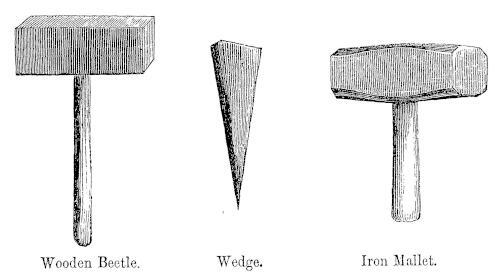
Wooden Beetle. Wedge. Iron Mallet.
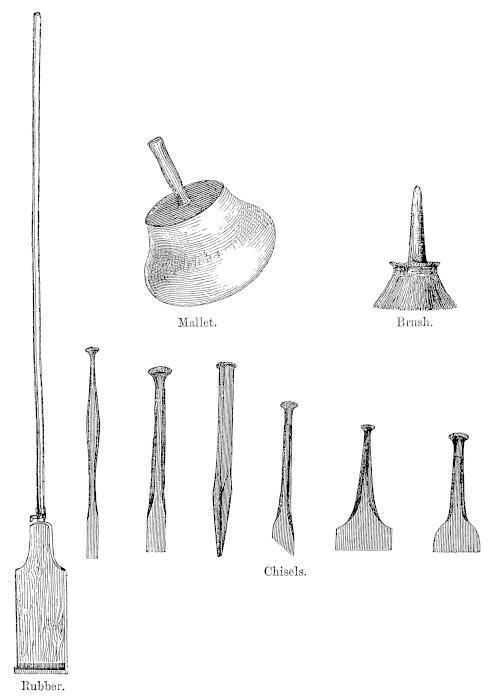
Rubber. Mallet. Brush. Chisels.
The tools used for cutting stone are the mallet and
chisels of various sizes. The mason’s mallet differs from
that used by other workmen, being of a sort of half pear
shape, and with a short handle only just long
enough to allow it to be firmly grasped in the hand.
The rubber is used for smoothing the surface of
the stone, after it has been worked by the tools;
sand and water are placed on the stone, and the
rubber is pushed backwards and forwards for the
purpose of grinding the face of the slab to a smooth
surface; another block of stone is sometimes applied
to the same purpose. In London the tools used to work the
faces of the stone are—the point, a very small chisel only
about a quarter of an inch broad at the cutting edge; the
inch tool, which is a broader chisel; the booster, broader
still; and the broad tool, which is three inches and a half
wide: beside these, there are tools of the same kind for
working mouldings and carvings.
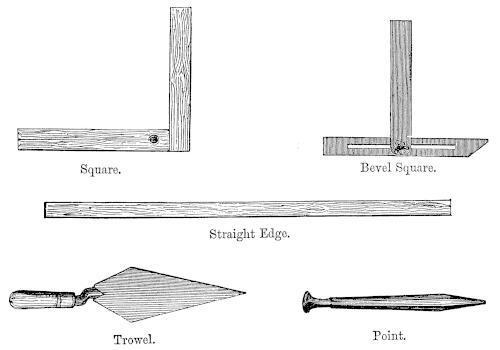
Square. Bevel Square. Straight Edge. Trowel. Point.
Besides these cutting tools, the mason uses a banker or
bench, on which he places his stone for convenience of
working, and straight edges, squares, and bevels, for marking
the shapes into which the blocks are to be cut, and seeing
that his edges and surfaces are even by trying them as the
work proceeds.
The bevel square is a square the stock, or lower part, of
which is moveable, so that it may be set to any angle or
level as required. Sometimes a pattern called a templet is
used for cutting a block to any particular shape, and when
the work is moulded, the templet is called a mould.
Moulds are commonly made of sheet zinc, carefully cut to
the profile of the mouldings with shears and files.
It often happens that the mason has not only to prepare
the stone, but to set it in its place in the building, and this
is properly part of his work. He then uses the trowel, for
applying the composition for cementing the stones together;
lines and pins to show whether his edges are straight and
square, the square and level for a similar purpose; and
various rules for adjusting the stone faces of upright
walls.
THE BRICKLAYER.
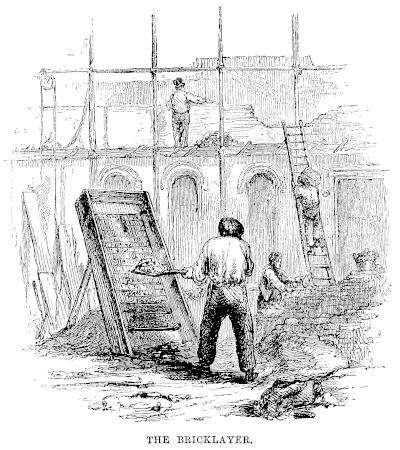
THE BRICKLAYER.
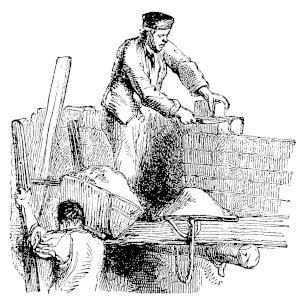
The Bricklayer has so much to do with the erection of
buildings that the Master Bricklayer is generally a Builder;
that is, he understands not only brickwork and the building
of walls, but also the other trades necessary for completing
a house, and can superintend the Mason’s, Carpenters’, and
Plumbers’ work.
Of course, the first consideration in building a house is
the preparation of the foundations, which are formed in
various ways, according to the nature of the soil on which
they are laid; unless the ground itself is firm enough to
receive the walls, sometimes thick layers of concrete (a sort
of mortar) is used, sometimes layers of planking are put
down, or even cross beams of timber, and in some cases,
where the earth is very loose and damp, timber piles are
driven into it on which to lay the foundation. The
foundation once laid, the vaults or cellars are built either in
the ordinary way, or in a series of arches of various forms;
then follow the abutments, the wing-walls, the main-walls,
with iron “Bressumers” for supporting those parts of the
walls which are above large openings like great doors or
shop fronts. The partitions, or interior walls, may be either
solid brick or stone, or may be constructed entirely of timber,
or they may be frames of timber filled in with masonry
or brickwork. Then come the floors, the roofs and roof-coverings,
and finally the ceilings and the doors and
windows. The materials used in building are principally
timber, stone, slate, bricks, tiles, mortar, lime, cement, iron,
glass, lead, zinc, colours and varnishes. Those with which
the working bricklayer has most to do are bricks, slates,
tiles, stonework, cement, and mortar, for these are principally
used in making walls and roofs, which is the greater
part of his trade. The stone and slate come from the
quarries, and we have already seen how bricks are made.
Mortar is made in the following way.
1st. The soft chalky stone known as limestone, is calcined
or burnt, by exposure to strong heat in a lime kiln; the
heat drives off a gas which is contained in it (called carbonic
acid gas), and leaves it in a state in which it is known as
quick-lime.
2d. The quick-lime is “slaked,” by pouring water upon
it, when it swells and becomes very hot, afterwards falling
into a fine powder.
3d. This powder is mixed into a rather stiff paste, more
water is added, and when a certain quantity of sand is
added becomes mortar, and may be used for cementing
bricks together.
Concrete is made by mixing gravel, sand, and ground
unslaked lime together with water; it is used for foundations,
and filling in apertures requiring strength and
firmness.
Iron is used by the builder in two different states, as cast
iron and wrought iron; the girders for supporting roofs
and walls are mostly cast in moulds (see Iron Founder),
though both these and other parts of the ironwork used in
building, are frequently of iron wrought by hand.
Lead is used by the mason for securing and coating the
iron clamps which hold the blocks of stone together; it is
also used in the plumbers’ work of a house (see Plumber).
Zinc is used in the manufacture of gutters, pipes, and
portions of roofs.
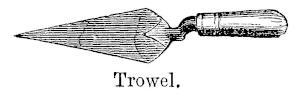
Trowel.
The excavator having dug out the space where the
foundation of the house is to be laid, the work of the
bricklayer begins, and his tools are the trowel, to take
up and spread the mortar, and cut bricks by a sharp
blow to the requisite length; then there are the brick
axe or hammer, for shaping the bricks to a level; the
tin saw for making an incision on bricks to be cut with the
axe; the rubbing stone on which to rub the bricks smooth
in the parts where they have been cut, and the mortar rake
and shovel, for mixing the mortar and cement.
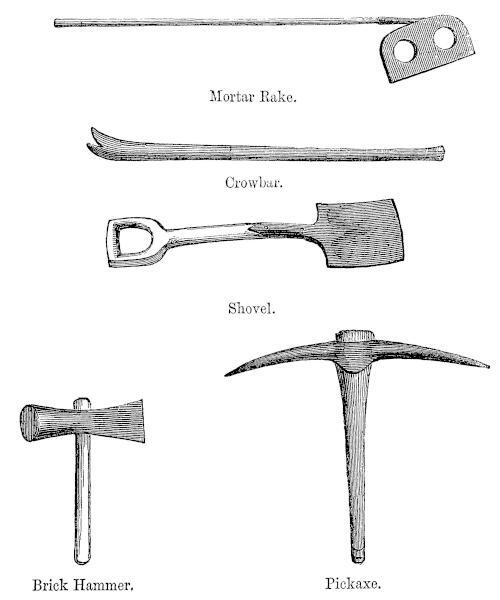
Mortar Rake. Crowbar. Shovel. Brick Hammer. Pickaxe.
The crowbar and pick-axe are the tools used for demolishing
old brickwork or clearing out rubbish; the sieve (see
large cut) for sifting the lime of which the mortar is made,
and the rammer for hardening the ground to render the
foundation firm. The raker is used for raking out the mortar
from the joints of old brickwork which requires re-pointing,
or the joints refilled with mortar.
To “set out” the work, which means to measure the
spaces, and to keep the lines, curves, and angles, straight and
true, the bricklayer uses the square, the level, the plumb-rule;
the square shows whether the proper angle has been
preserved; the plumb-rule is an upright rule, with a string
at one end, to which is attached a leaden ball. If the work
is straight on its perpendicular lines, and the plumb-rule
be applied to it, this leaden ball will hang exactly in the
centre, and swing through a hole in the rule, while, if the
work be crooked, it will swing to one side. The level is a
rule on the same principle, but for testing horizontal lines,
such as a cornice on the top of a wall. The good bricklayer
will frequently test his work by these tools, and will also use
a line stretched to two pins, to guide him as he builds up
his courses of bricks.
The bricks and mortar are supplied to him by a labourer,
who carries them in a hod. The labourer also makes the
mortar, and builds up and takes down the scaffolding (see
large cut). The scaffolding, or that frame of poles and
planks erected in front of the building as it is in progress,
is constructed of standards, ledgers, and putlogs.
The standards are poles made of fir trees, from forty to
fifty feet long, and six or seven inches thick at the butt
ends, which are firmly fixed in the ground. When one pole
is not long enough, two are lashed together, the rope lashings
being tightened by wedges driven in between the coils in
a peculiar way. The ledgers are horizontal poles placed
parallel to the walls and lashed to the standards; these
support the putlogs, or cross pieces, which are about six feet
long, one end of them resting in the wall, the other on the
ledgers. On these putlogs are fastened the scaffold boards,
which are stout boards with pieces of iron hoop placed
round the ends, to keep them from splitting.
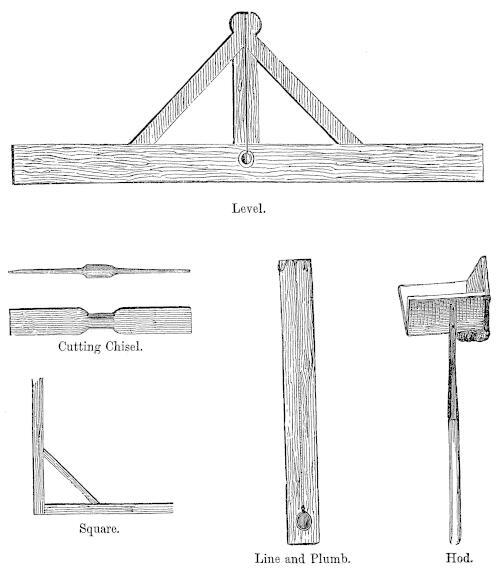
Level. Cutting Chisel. Square. Line and Plumb. Hod.
A bricklayer and his labourer will lay about a thousand
bricks, or two cubic yards of brickwork, in a day.
The tools used for tiling, or placing the tiles on a roof,
are the lathing hammer, the iron lathing staff to clinch the
nails, the trowel, which is longer and narrower than that
used for brickwork, the bosse, for holding mortar and tiles,
with an iron hook to hang it to the laths or to a ladder,
and the striker a piece of lath about ten inches long for
clearing off the superfluous mortar at the feet of the
tiles.
THE PLASTERER AND WHITEWASHER.
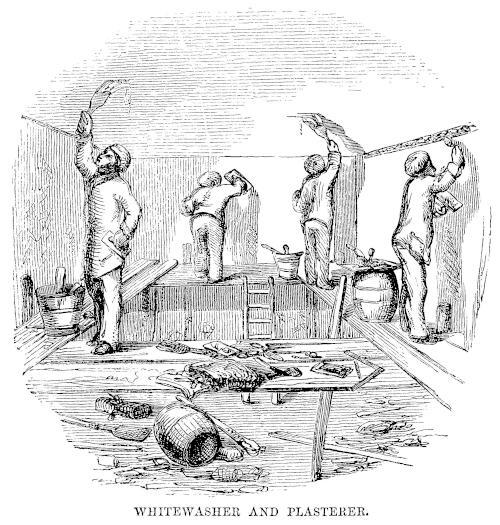
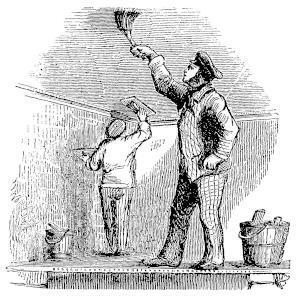
WHITEWASHER AND PLASTERER.
When the walls, or what is called the carcase of the house,
have been built, the roof made, the inner walls and partitions
set up, and the joists and woodwork of the floors laid
down, the work of the Plasterer begins. He covers the
brickwork and bare timbers of walls, ceilings, and partitions
with plaster, to prepare them for painting or papering: he
also forms the cornices for ceilings, and the mouldings and
decorations, which are usually made in plaster or cement.
The materials which the Plasterer uses for these purposes
are:—1st. Coarse stuff, or a paste made with lime, much in the
same way as common mortar, and afterwards mixed with
hair, which is obtained from the tanner’s yard, after it has
been removed from the skins, which are there made into
leather. This hair is raked together, and mixed with the
mortar, with the hair hook, and a sort of three pronged
rake called the drag.
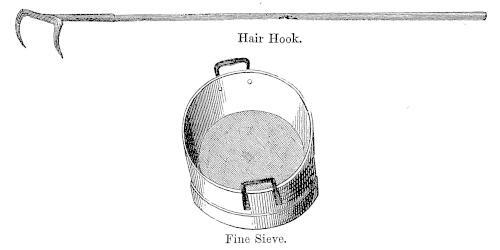
Hair Hook. Fine Sieve.
2d. Fine stuff is made from pure lime, slaked with a
small quantity of water, after which enough water is added
to bring it to a state in which it resembles cream; it is
then left to settle, the superfluous water is poured off, and
the mixture is left in a tub, till still more of the water has
evaporated, and it is thick enough to use. This stuff is often
used for ceilings, and then a small quantity of white hair is
mixed with it, to help to make it firmer and more binding.
For these finer kinds of plaster it is necessary to use the fine
sieve, in order to sift the lime and other ingredients, that
only the portion which has been reduced to powder may be
retained.
3d. Stucco, which is made by mixing fine stuff with
cleaned-washed sand. Stucco is used for house fronts, or
other finishing work, which is intended to be painted.
4th. Gauged stuff is used for forming cornices, which run
round a ceiling, and for mouldings; it is made by mixing
fine stuff with plaster of Paris, which is a fine white powder
easily made into a paste, and drying very quickly.
These are only the ordinary materials used by the
Plasterer for his work, but there are a great number of
cements, which are also applied in the course of his trade;
such as Roman and Portland cements, and mixtures made
and sold for special purposes of decoration, and the manufacture
of ornaments.
These ornaments, such as centre pieces for ceilings, flowers
drooping from cornices, bosses or groups on walls, &c. are
first modelled in clay, and are afterwards cast in plaster of
Paris, placed in moulds made of wax or plaster. In this
trade, as in that of the picture frame maker, ornaments are
frequently made of papier maché, or the pulp of paper
(literally smashed paper), which is a very light, hard, and
durable substance for the purpose. The moulds for cornices
are made of sheet copper, and are fixed in a wooden
frame.
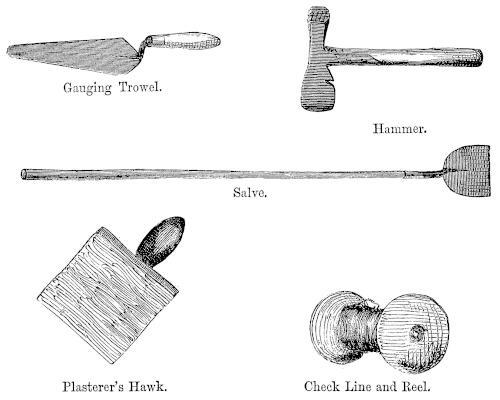
Gauging Trowel. Hammer. Salve. Plasterer’s Hawk. Check Line and Reel.
The various tools used by the Plasterer are shown in the
engravings, and the manner in which some of them are
used may be seen by the large cut at the commencement
of this description of the Plasterer’s trade. The peculiar
hammer, with one edge like an axe, is used for breaking
down old plaster, and clearing away the mortar from walls
and ceilings previous to plastering them afresh; the hawk
is a flat board with a handle in the centre, used for holding
the plaster or cement, which is being laid on with the
trowel. The gauging trowel is the long narrow trowel, used
for taking up the fine stuff for cornices and mouldings;
these trowels are of various lengths, from three to seven
inches. The salve is a sort of small spade, on which the
plasterer’s boy lifts the mortar or cement, and places it on
the hawk, which the workman holds in his hand; as the
salve has a long handle, the plaster can be conveyed to the
hawk even when the man is at work on a ladder. The
square is similar to that used by the bricklayer, and shows
that the corners of the work are straight and even; the
compasses are used for measuring distances; the check line
for marking out the spaces of the work to be done, and the
joint rules for measuring the parts where different portions
of the work come together, either at the corners, or in
making the mouldings. The set square is also used, for
showing that the surface or the line of the work is straight
and even.
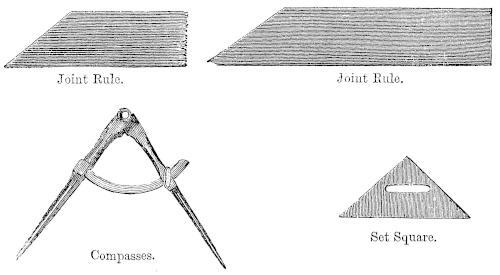
Joint Rule. Joint Rule. Compasses. Set Square.
When the Plasterer has to cover a ceiling or a partition,
he commences by lathing. This is nailing laths over the
whole space which is to receive the plaster. Laths are long
narrow strips of either oak or fir wood, of various thicknesses;
the thicker being used for ceilings, where they have
to bear a greater strain than in upright walls.
The next operation is pricking up, or placing the first
coat of coarse stuff upon the laths; this is called
pricking up, because when the plaster is laid, its
whole surface is pricked and scratched with the end
of a lath, that it may be rough enough for the next
coat. The laying on of this second coat of plaster is
called floating, and is performed in the following way.
The surface is surrounded with narrow strips of plastering,
called screeds, held fast by lines of nails, and
these are made perfectly level, by means of the plumb
rule (see Builder’s tools), and the use of the hand float.
The spaces within these lines of plaster work are then
filled with coarse stuff, till the whole forms a flat surface,
which is made perfectly level, or “floated” with
the floating rule. Other screeds are then formed and
filled up in the same way, until the whole ceiling, or
wall, forms one flat surface. The operations are the
same for ceilings and walls, except that the plumb rule
is used for adjusting the level of walls, and the level
for that of ceilings.
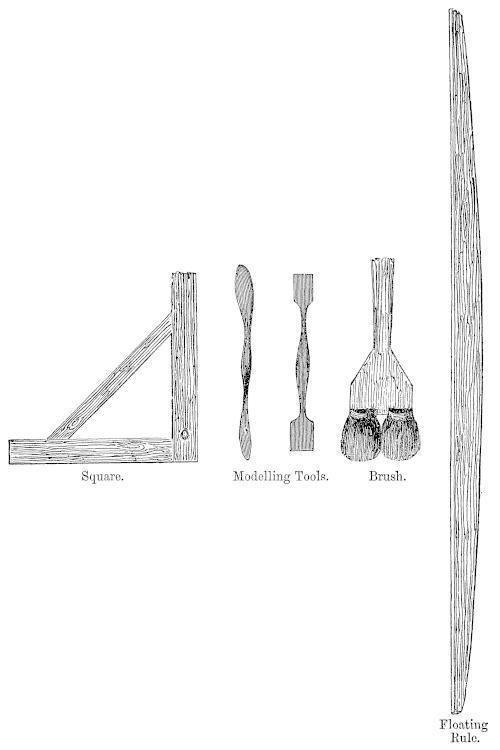
Square. Modelling Tools. Brush. Floating Rule.
After the work has been brought to an even surface with
the floating rule, the Plasterer goes over it again with the
hand float, using a little soft stuff to make good any deficiencies.
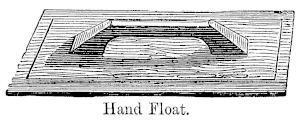
Hand Float.
When the floating is about half dry, the setting or finishing
coat of fine stuff is laid on, and is first wetted with a
brush, and then worked over with a smoothing tool until
a fine surface is obtained.
Stucco is laid on with the largest trowel, and worked over
with the hand float—being at the same time sprinkled with
water—until it becomes hard and solid; after which it is
rubbed over with a dry brush. The water has the effect
of hardening the face of the stucco; which, after several
sprinklings and trowellings, becomes very hard, and as
smooth as glass.
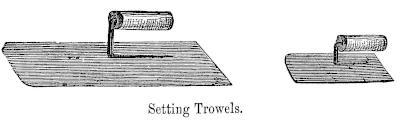
Setting Trowels.
The commonest kind of Plasterer’s work is laying on one
coat of stuff: when this is done on brickwork it is called
rendering, and when on laths it is called laying. When
there is a second coat it is called render set, or lath-lay
and set: and when it is three-coat work it is called render,
float, and set, or, lath-lay, float, and set; this is done in
ceilings and partitions with fine stuff mixed with hair; or,
when the walls are to be papered, with fine stuff and sand.
Rough stucco is used for finishing staircases and passages
in imitation of stone. It is mixed with a great deal of
coarse sand, and is not smoothed, the hand float being
covered with a piece of felt, so that when it is applied to
the stucco the grit of the sand sticks to it and is drawn
to the surface, giving the plaster the appearance of rough
stone.
Rough casting is used for outside walls, and is done by
throwing a layer of gravel, mixed with lime and water,
over the second coat of plaster while it is quite wet. In
some counties of England, and especially near Nottingham,
the plasterers use reeds instead of laths; and even floors
are often made by laying down a quantity of coarse stuff
upon a foundation of reeds.
These floors are almost as hard as stone, and possess the
good quality of being almost always fireproof.
THE CARPENTER.
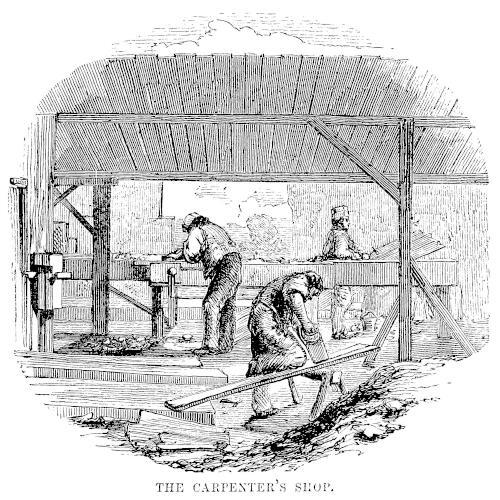
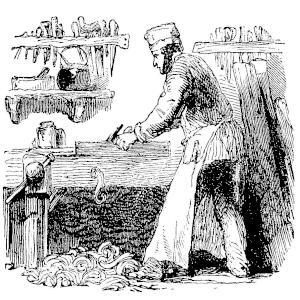
THE CARPENTER’S SHOP.
An account of the tools and implements used for working
in wood would scarcely be complete without some remarks
upon wood itself, and you can have no better information
on this subject than that which has been written by a
gentleman[1] who is thoroughly acquainted with the different
kinds of timber, and with all the materials used in building.
If we examine a transverse section of the stem of a tree,
we perceive it to consist of three distinct parts; the bark,
the wood, and the pith. The wood appears disposed in rings
round the pith, the outer rings being softer, and containing
more sap, than those immediately round the pith, which
form what is called the heart-wood.
These rings are also traversed by rays extending from
the centre of the stem to the bark, called medullary rays.
The whole structure of a tree consists of minute vessels
and cells, the former conveying the sap through the wood
in its ascent, and through the bark to the leaves in its
descent; and the latter performing the functions of secretion
and nutrition during the life of the tree. The solid
parts of a tree consist almost entirely of the fibrous parts
composing the sides of the vessels and cells.
By numerous experiments it has been ascertained that
the sap begins to ascend in the spring of the year, through
the minute vessels in the wood, and descends through the
bark to the leaves, and, after passing through them, is
deposited in an altered state between the bark and the last
year’s wood, forming a new layer of bark and sap-wood,
the old bark being pushed forward.
As the annual layers increase in number, the sap-wood
ceases to perform its original functions; the fluid parts are
evaporated or absorbed by the new wood, and, the sides of
the vessels being pressed together by the growth of the
latter, the sap-wood becomes heart-wood or perfect wood,
and until this change takes place it is unfit for the purposes
of the builder.
The vessels in each layer of wood are largest on the side
nearest the centre of the stem, and smallest at the outside.
This arises from the first being formed in the spring, when
vegetation is most active. The oblong cells which surround
the vessels are filled with fluids in the early growth; but,
as the tree increases in size, these become evaporated and
absorbed; and the cells become partly filled with depositions
of woody matter and indurated secretions, depending
on the nature of the soil, and affecting the
quality of the timber. Thus Honduras mahogany is full
of black specks, while the Spanish is full of minute white
particles, giving the wood the appearance of having been
rubbed over with chalk.
The best time for felling trees is either in mid-winter,
when the sap has ceased to flow, or in midsummer, when
the sap is temporarily expended in the production of
leaves. An excellent plan is, to bark the timber in the
spring and fell it in winter, by which means the sap-wood
is dried up and hardened; but as the bark of most trees
is valueless, the oak tree (whose bark is used in tanning)
is almost the only one that will pay for being thus
treated.
The seasoning of timber consists in the extraction or
evaporation of the fluid parts, which are liable to decomposition
on the cessation of the growth of the tree. This
is usually effected by steeping the green timber in water, to
dilute and wash out the sap as much as possible, and then
drying it thoroughly by exposure to the air in an airy situation.
The time required to season timber thoroughly in
this manner will of course much depend on the sizes of the
pieces to be seasoned; but for general purposes of carpentry,
two years is the least that can be allowed, and, in seasoning
timber for the use of the Joiner, a much longer time
is usually required.
Properly seasoned timber, placed in a dry situation with
a free circulation of air round it, is very durable, and has
been known to last for several hundred years without
apparent deterioration. This is not, however, the case when
exposed to moisture, which is always more or less prejudicial
to its durability.
When timber is constantly under water, the action of the
water dissolves a portion of its substance, which is made
apparent by its becoming covered with a coat of slime. If
it be exposed to alternations of dryness and moisture, as in
the case of piles in tidal waters, the dissolved parts being
continually removed by evaporation and the action of the
water, new surfaces are exposed, and the wood rapidly
decays.
Where timber is exposed to heat and moisture, the albumen
or gelatinous matter in the sap-wood speedily putrefies
and decomposes, causing what is called rot. The rot in
timber is commonly divided into two kinds, the wet and the
dry, but the chief difference between them is, that where
the timber is exposed to the air, the gaseous products are
freely evaporated; whilst, in a confined situation, they combine
in a new form, viz. the dry-rot fungus, which, deriving
its nourishment from the decaying timber, often grows to
a length of many feet, spreading in every direction, and
insinuating its delicate fibres even through the joints of
brick walls.
In addition to the sources of decay above mentioned,
timber placed in sea water is very liable to be completely
destroyed by the perforations of the worm, unless protected
by copper sheathing, the expense of which causes it to be
seldom used for this purpose.
In modern houses the labours of the Builder, the Mason,
and the Plasterer, would be of little use unless they were
accompanied by that of the Carpenter, since a very large
proportion of every building consists of the woodwork of
which its interior structure is greatly composed.
As it is one of the most useful, so the Carpenter’s may
be considered the most ancient of trades, for nearly all
other handicrafts require the preparation or manufacture of
the materials, but the Carpenter originally found his materials
in the forest, and at once set to work to construct
various articles from the trunks and stems of the trees best
suited for the purpose. We can only imagine one trade
older than that of the Carpenter, and that is the Tool
Maker, and as the earliest tools, or at all events some
portion of them, were probably made of hard wood, the
Tool Maker may in some sense be said to have been a
Carpenter also.
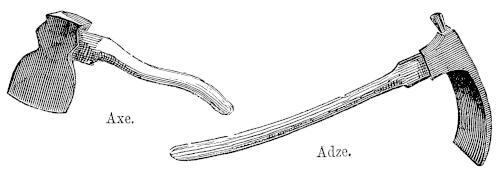
Axe. Adze.
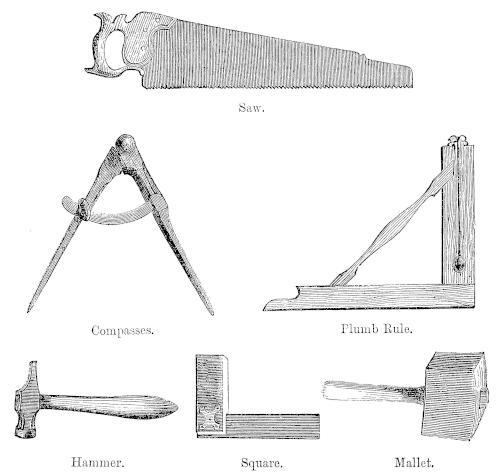
Saw. Compasses. Plumb Rule. Hammer. Square. Mallet.
Strictly speaking, the business of the Carpenter is only
with the larger portions of buildings and the rough timber
frameworks which support them, and his principal tools are
the axe and the adze, for chopping and roughly smoothing
timbers; the saw, for sawing beams and planks; the chisel,
for making mortis holes for joining beams together, and for
cutting and paring wood; the chalk line, a line rubbed
with chalk, and used to make a straight line upon a board
or beam, to mark the direction in which it is to be sawn;
the plumb rule, already described amongst the Builder’s
tools; the level; the square; the compasses; all of which
have been described in previous trades; the hammer; the
mallet, and various sorts of nails. The other tools represented
in the engravings belong more properly to the
Joiner, but as the trades of the Carpenter and the Joiner
are almost always united, we will speak of all the tools
as belonging to one business. Carpenter’s work, then,
consists of the framing roofs, partitions, and floors, in
making the various joints used in beams, ties, rafters, and
joists for supporting floors, and the proper way of supporting
buildings by posts and girders. The Carpenter
requires to be strong and active, that he may properly
handle the heavy timbers on which he has to work; he
should have a knowledge of the science of mechanics, that
he may be able to provide for the strains and thrusts to
which the different parts of his work are exposed, and
supply the proper means of resisting them; and he should
also be able to understand how to make what are called
“working drawings,” that he may “set out,” or properly
draw a plan of the work he has to do, from the designs of
the Architect.
The Carpenter being concerned with the portions of a
building which are made of timber, you will be better able
to understand his trade by a short description of what these
are; and we will then speak a little of the Joiner, whose
trade is generally confounded with that of the Carpenter.
First: Partitions, or inner divisions of a building, may be
either of brick, stone, or wood; and, in the latter case, they
are generally “framed,” or supported in a more solid framework,
which should form a portion of the main building,
that is, of the outer wall; and should be quite independent
of the floors, which should not support, but be supported by
them.
Second: Flooring is formed by joists or strong beams of
timber reaching from wall to wall, where they rest upon
other beams, called wall plates, which are built into the
walls themselves. The floor boards are nailed over the
upper edges of the joists, and the lower edges receive the
laths and plaster, which form the ceilings of the rooms
beneath. Large buildings are sometimes fitted with double
framed floors, with two sets of joists, and building joists
resting on girders; and in superior houses, the wall plates
are often supported by “corbels,” or, portions of the timber
projecting from the inside of the wall, which prevents the
necessity of opening the wall to admit the ends of the
joists.
Third: Roofing consists of the roof covering, which is
laid upon rafters or slender beams, which are supported by
stronger horizontal beams called purlins; and these, again,
rest on upright trusses, or strong frames of timber, placed
on the walls at regular distances from each other. Upon
the strength and firmness of these trusses, and the skill of
the carpenter’s work, depends the entire safety of the roof.
Large roofs are supported by cross beams, called collars,
or tie beams; and they are further strengthened by an upright
pillar in the centre, called a King post, from which
slanting beams, called “struts,” support the rafters.
We have now only spoken of common roofs, but there
are many roofs of open timber-work in churches and other
public buildings, which are wonderful specimens of the skill
of the Carpenter and the Joiner. One of these, perhaps the
grandest as well as the most ancient, is that of Westminster
Hall; but there is one also in the Great Hall, at Hampton
Court Palace; and others may be seen in Churches and
Halls in various parts of England.
The Joiner, as his name implies, frames and joins together
the wooden finishings and decorations of buildings, such as
floors, staircases, skirtings, door and window frames, sashes,
or, the sliding parts of windows that contain the glass,
shutters, doors, chimney-pieces, &c. This work requires
much greater nicety and finish than that of the Carpenter,
and is brought to a smooth surface with the plane wherever
it is likely to be seen, while the carpenter’s work is left rough
as it comes from the saw.
The principal cutting tools used by the Joiner are, saws,
planes, and chisels.
The saws are of various sizes, and are called rippers, half
rippers, hand saws, and panel saws, according to their shape,
and the number of teeth to each inch.
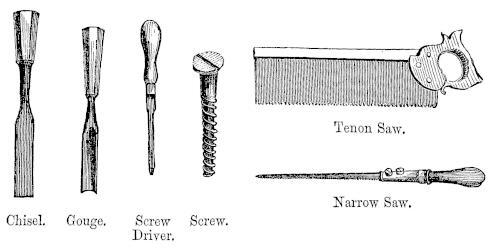
Chisel. Gouge. Screw Driver. Screw. Tenon Saw. Narrow Saw.
The tenon saw is used for cutting tenons, or flat slices
from the ends of beams, that other beams cut in the same
way may rest upon them and yet leave a flat surface. The
thick back of the tenon saw keeps the blade from “buckling,”
or twisting; as it would be very likely to do while
sawing in a horizontal direction.
The dove-tail saw is similar to the tenon saw, but smaller,
and with a brass back instead of an iron one. It is used
for dove-tailing, or cutting notches in a board or beam, into
which projections in another board or beam are fitted, in
order that the two may be held together, as we see the sides
of a box are fitted to the back and front. Then there is the
compass saw, for circular work, and the keyhole, or narrow
saw, for cutting out holes.
The planes are used for bringing the edges and sides of
beams, boards, or other wooden fitting, to a perfectly smooth
surface: the first of these, used upon the rough wood, is
called the jack plane; another is called the trying or trueing
plane; and a third, the smoothing plane.
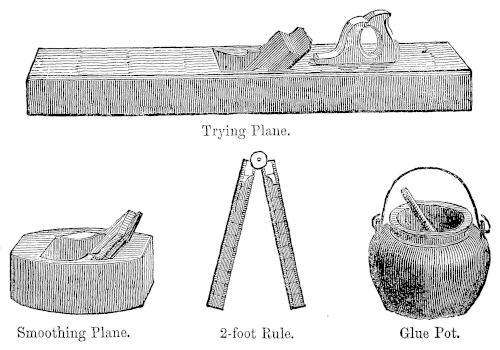
Trying Plane. Smoothing Plane. 2-foot Rule. Glue Pot.
The plane, as you will see, is a solid piece of hard smooth
wood, with a hole in the centre containing the cutting tool,
or, as it is called, the plane iron, which is firmly fixed with
a wedge, so that its sharp cutting edge only slightly projects
at the bottom.
The wood which is to be smoothed is fixed on the joiner’s
bench by means of a screwed board, called a shooting board,
and, by means of the handle at the top, the plane is made
to slide swiftly along its surface, so that the edge of the tool
cuts off a thin shaving.
There are various sorts of planes besides these, used for
cutting various parts of the work, but they are most of them
of similar construction.
Chisels are either for paring the wood, and are used with
the hand; or are intended to cut into the thickness of the
wood, and are then struck with a large wooden hammer,
called the mallet. The gouge is a curved chisel, used for
cutting mouldings or making round edges.
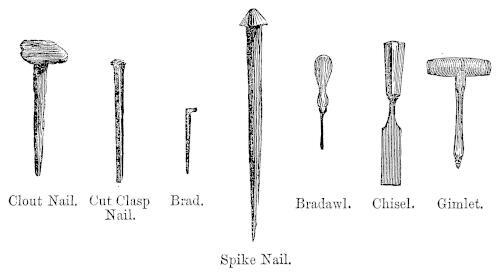
Clout Nail. Cut Clasp Nail. Brad. Spike Nail. Bradawl. Chisel. Gimlet.
The boring tools are the bradawl, the gimlet, and the
stock and bit.
The bradawl is a small sharp wire fixed in a handle, and
used for making holes to receive large nails, which, if driven
in at once by the hammer, would split the wood. Nails are
of various kinds, the difference in which may be seen in the
engraving. The best kinds of nails are made from thin bar
iron, pointed, cut off to the proper length, and the head
formed by stamping.
The gimlet is a hollow blade with a screw at the end, and
fixed to a cross handle. It is used for boring a larger and
rougher hole than the bradawl, for receiving screws, which
are screwed into their place by the screw driver, a sort of
chisel, the edge or point of which enters the notch in the
head of the screw, so that the workman may turn it round.
The bit is a tool not unlike a large bradawl, which fits
into a stock or handle. The bits are of various sizes, and
are used for boring large holes.
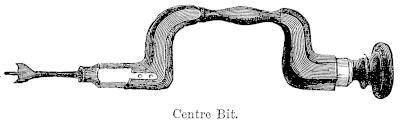
Centre Bit.
The brace and bit, or centre bit, is a tool with a centre
and two sharp points, one on each side; it is placed in a
bow-shaped stock with a round loose end. This loose end
the workman holds firmly, while he places the point of the
tool against the wood required to be bored; he then turns
the bow briskly round, and the two points revolving rapidly,
cut out a circular piece.
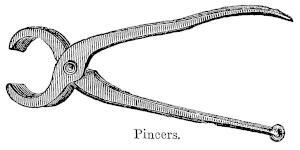
The pincers are used for removing nails from wood, and
it is easy to see how they are applied. There are some
other tools which belong to the trade of the Joiner, but they
are used less frequently, and a description of them will be
given when we have to say something of the trade of the
Cabinet Maker, whose work resembles the finer part of that
which the Joiner does at his own workshop.
The bench (see large cut) is the great table of thick
planks supported on a timber frame, at which the Joiner
works; it is furnished with a “side-board” perforated with
holes to receive a pin, against which one end of the wood
on which he is operating rests, the other being firmly fixed
in the bench screw.
Pincers.
THE HOUSE PAINTER AND GLAZIER.
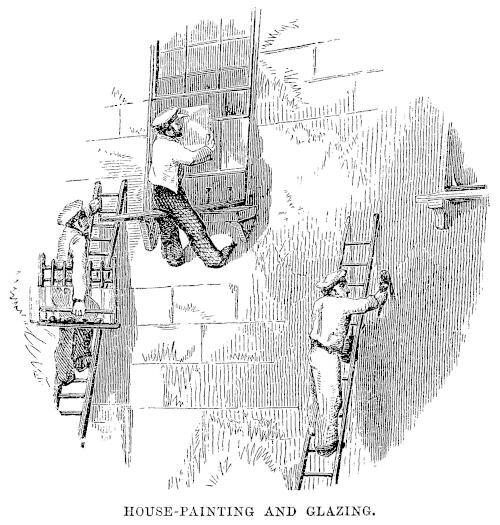
HOUSE-PAINTING AND GLAZING.
Although we have spoken of the trade of the Plumber
separately, and have placed the Painter and Glazier together,
it generally happens that the three trades are carried on by
the same persons, and you will often have noticed “Plumber,
Painter, and Glazier” over the fronts of shops, where leaden
pipes and taps, casements, and squares of coloured glass,
and specimens of “graining,” or imitations of various woods
in painting, are placed for show in the windows, to represent
the different businesses carried on.
It is the duty of the House Painter to cover with his
colours such portions of the Joiner’s, Smith’s, or Plasterer’s
work as require to be protected from the action of the air,
which would cause them to rust or decay. He has also to
choose the colours which will be best suited for decorating
walls and cornices, and generally to apply the proper
shades for all the ornaments of the house, and this part of
the business, which is called “decorative painting,” requires
a great degree of skill and taste in the workman, who may
properly be called an artist.
The materials used by the Painter are principally white
lead, linseed oil, spirits of turpentine, “dryers,” and putty.
White lead, which forms the basis of almost all the colours
used in house painting, is prepared by exposing strips of
lead to the action of acid; but the Painter buys it ready
made, in the form of small cakes, or lumps. This white
lead is used in all the under coats of paint, and generally
makes the body of most of the colours which are afterwards
applied. Unfortunately, while it is in the half-fluid
state, when it is used by Painters, it is very poisonous and
unwholesome, and many workmen suffer severely in their
health from its use; but it will be found that this is often
caused by their own carelessness in working, and by the
want of personal cleanliness. The Painter should not only
thoroughly wash his hands before every meal, but as soon
as his work is done should entirely change his clothes, and
wash hands and face thoroughly, or even take a bath.
Beside this, he should wear, over his working clothes, a
coarse linen frock or blouse, which will protect him from
the spots of paint, and may be frequently washed.
Linseed oil and spirits of turpentine are used for mixing
and thinning the colours; linseed oil is obtained from the
seeds of the flax plant, which are heated, beaten, and pressed
by machinery, until the greater part of the oil is extracted;
the seeds crushed into cakes are then used as food for cattle.
Nut oil, or the oil pressed from various kinds of nuts, such
as walnuts, hazel and beech nuts, is also frequently used
for mixing colours where they are likely to be exposed to
the weather, but linseed oil is cheaper and is most generally
adapted to the purpose.
Oil of turpentine, which the Painter calls “turps,” is the
oil obtained by distilling crude turpentine; and is used by
the House Painter to make his colours work more smoothly
and freely in the brush, to cause them to dry more quickly,
and to take away that shiny unpleasant glare that would
otherwise be seen on the surface of paint mixed with
linseed oil alone.
It is necessary, too, to take some means to make the
linseed oil dry more rapidly than it would in its raw
state; or the paint would remain moist and greasy upon
the walls for a very long time. For this purpose the oil
is boiled, and is then known as “boiled oil,” this is bought
ready prepared, the Painter having by him preparations
of lead or vitriol, called “dryers,” which he mixes with
his colours, after they are made, in order to increase the
rapidity with which they set upon the places where they
are applied.
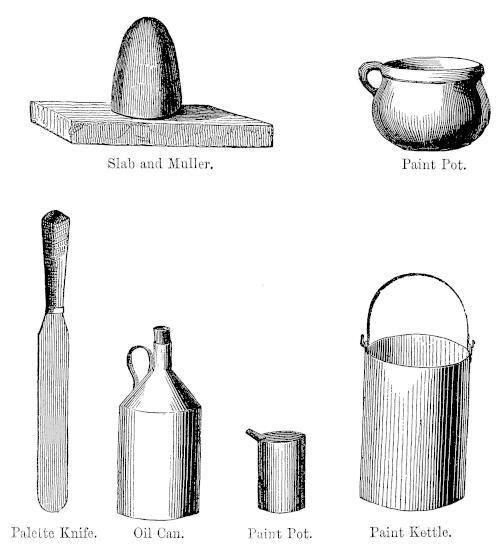
The Painter has only a few tools, and these are very
simple; they consist principally of the grinding stone, or
slab and muller, for grinding his colours; earthen pots for
holding the paints; cans for oil and turps; a few tin pots,
or open cans and kettles, for colour to be applied to outside
places or walls where he has to work on ladders; a palette
knife, for spreading the white lead on the stone, or removing
the paint to the palette, for fine work, or to the paint pot;
and brushes of different sizes.
Slab and Muller. Paint Pot. Palette Knife. Oil Can. Paint Pot. Paint Kettle.
The various colours, which are mostly made from earths
and minerals, are purchased by the Painter in powder or
small dry lumps, and have to be brought to a fine state, and
made quite free from grit, before they can be used.
The slab, or grindstone, is generally of marble or porphyry,
and must have a perfectly smooth surface; and the
muller is a large oval or egg-shaped pebble, with one end
broken off, and the surface made as smooth as that of the
slab. A small quantity of the colour which requires grinding
is placed on the stone, and moistened with a little oil; and
the muller is then worked over it, by a circular movement,
until it is gradually driven to the edge of the stone. The
colour is then removed by the spatula, or palette knife, and
placed in the paint pot.
Paint Brushes.
In this state, however, the colour is too thick to use, and
of course requires to be thinned by adding the oil until it
is sufficiently fluid.
In painting woodwork, the first business is called “knotting,”
that is, removing the turpentine from the knots, which
would otherwise ooze and spoil the paint. They are first
covered with fresh slaked lime, which dries up and burns
out the turpentine; this is afterwards scraped off, and the
knots painted with a mixture of red and white lead mixed
with glue size, and afterwards with white lead and linseed
oil. When dry, they must be rubbed smooth with a piece
of pumice stone. The next operation is to put on the
“priming,” which is the first coat of paint, composed of
red and white lead and linseed oil. The nail-holes, and
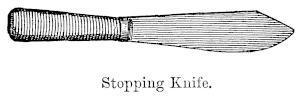
other imperfections, are then stopped up with putty (a
mixture of linseed oil and whiting, made into a paste),
applied with the stopping knife; and then the other coats
of paint are laid on; three coats being generally considered
sufficient; and the last being of the required colour.
Stopping Knife.
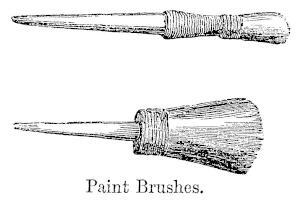
The brushes used by the Painter, are either round or flat,
the latter being used in varnishing or graining; they are
made of hog’s bristles. The smaller kinds of brushes are
called tools or fitches, and are used for small surfaces, such
as ornaments and mouldings round panels, when the colour
is generally taken from a palette—a round slab of wood,
with a hole through which the thumb of the left hand
passes in order to hold it. The brushes must never be
allowed to get dry, but when not in use must be kept in
water: it is always best to keep a brush for each colour.
Another part of the Painter’s business which requires more
skill, is graining and marbling; or the imitation in colours
of the marks and grains of various kinds of wood, and the
veins and spots in marbles. This is of course a part of the
trade which requires a knowledge of the thing to be imitated,
and great care and taste in doing it well.
Graining is generally done with “distemper colour,” that
is a kind of paint in which whiting and size are used instead
of white lead and oil, for the basis of the colour; but the
colours depend on the sort of grain to be imitated, and they
are applied in various ways and with different sorts of
brushes, some of the colour being occasionally removed
with a piece of wash leather, in order to give the appearance
of the light marks seen in the “heart” of the wood.
The appearance of the “grain” of the wood is effected by
the graining comb, a comb with short thick straight teeth,
which is drawn along the paint in a wavy line.
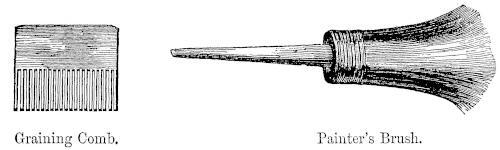
Graining Comb. Painter’s Brush.
Marbles are imitated in oil if it is outside work and
exposed to the weather, but for inside work distemper
colour is frequently used.
Occasionally walls are coloured in distemper, and it then
frequently happens that a pattern or some ornamental
design is painted in the centres of the panels, or round
the mouldings. This is a part of the Painter’s trade which
requires much skill, and a knowledge of artistic drawing
and design.
Varnishing is an operation requiring great care to perform
it properly, since it is necessary not only to choose the right
kind of varnish, but also to apply it to the surface of the
paint with a light but firm hand. Varnishes are made of
gums or resins melted, spirits of wine, oil of turpentine, or
strong white drying oil. The hard varnishes dry rapidly,
and are made of the harder kinds of gums, such as copal,
mastic, &c., and the soft of Canada balsam, elemi, turpentine,
&c. The most useful for the House Painter are those
of copal, linseed oil, and turpentine.
The brushes used in varnishing are generally flat, so as
to enable the workman to lay an even surface on the work.
Varnishes are usually kept in wide-mouthed bottles; from
which they are poured into little tin pans with a false
bottom above the real bottom, the space between the two
being filled with sand. The use of this is that when the
pan is placed over the fire, the sand becomes heated, and
the varnish is kept a long time from becoming chilled.
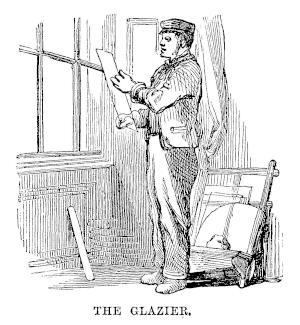
THE GLAZIER.
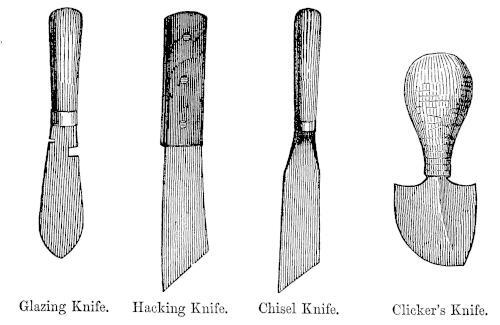
Glazing Knife. Hacking Knife. Chisel Knife. Clicker’s Knife.
The trade of the Glazier, though now very important,
was unknown in this country till the eleventh century, and
even long afterwards the use of glass for windows was
extremely rare; pieces of horn, and oiled paper, supplying
its place in almost every building except palaces and
churches. As we have here to do with the Glazier, and not
with the manufacturer of glass, we need say little about the
method of making the materials used; so that it will
suffice to know that the “crown glass,” mostly sold for
windows of houses, is composed principally of white sand,
pearlash, and saltpetre. This glass the Glazier purchases in
sheets of a circular form, each of which is called a table,
since the mode in which it is made renders such a shape
necessary; and the first thing he has to learn, is how to cut
out square pieces of the proper size without wasting much
of the round edge. The glass when cut is fixed either into
lead work or sashes; the former of these is the oldest
description of glazing; and in the common kind the leaden
frames are soldered together, so as to form squares or
diamonds; the sides of the grooves in which the glass is
placed being soft enough to bend back to receive the panes,
and then bend back again to hold them firmly. In wooden
sashes, such as are now commonly used, the space or frame
for each pane of glass is “rebated,” that is, it has outside
a small groove all round to receive the pane, and a ledge
against which it rests. In this “rebate” each square of
glass is placed, and then firmly bedded and fastened
smoothly with a rim of putty filling up the groove.
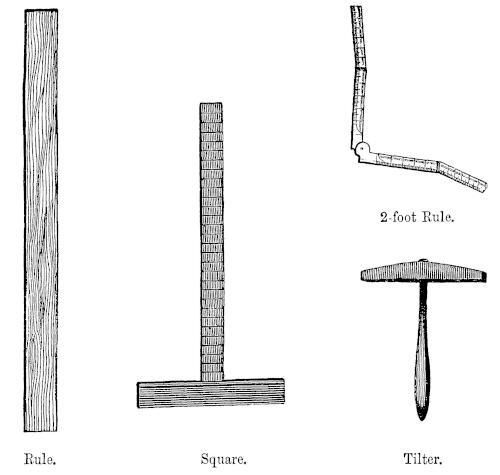
Rule. Square. 2-foot Rule. Tilter.
The Glazier uses a hacking knife for cutting out old
putty from broken squares; and the stopping knife, or
glazing knife, for laying and smoothing the putty.
For setting glass into lead work, the setting knife, or
chisel knife, and the broad-bladed knife is used.
As much of the Glazier’s work is done outside the house,
he is sometimes compelled to use a board which is fastened
with screws, and projects from the window so that he may
sit astride on the outside. No one should ever attempt
this where the sash can be easily taken out and the work
done inside.
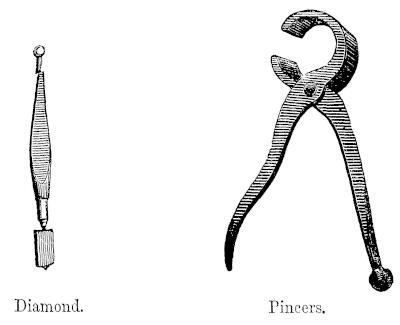
Diamond. Pincers.
The rest of the Glazier’s tools are a square, and a straight
edge rule for cutting against, a two-foot rule, and compasses
for measuring; pincers for breaking off the edges of
glass that have been partially cut through; and the diamond,
which is used for cutting, and is his principal tool. This
is made of a small unpolished diamond fixed in lead, and
fastened to a handle of hard wood.
THE PLUMBER.
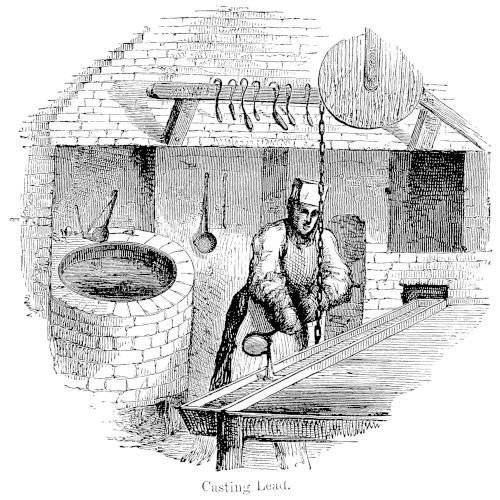
Casting Lead.
In trades connected with building, the work of the Plumber
is of so much importance that it must come next to that of
the Bricklayer, and the Carpenter. At one time the Plumber
(who takes his name from the Latin word for lead[2]) was
principally employed in making leaden roofs of churches
or large public buildings and in forming casements for
windows; window frames being then made of strips of
lead soldered or riveted together and holding the little
diamond-shaped panes of glass between their edges. In
those days all the water used in the house was carried from
the well or from the conduit in the main street, or was
brought in casks set upon wheels from the nearest running
stream: while rain-water for washing was collected in tubs
or vats as it ran off the roofs. Not much more than a
century ago the poets wrote of the misery of the streets
of London on a wet night, when there were no waste pipes
to carry off the rain from the overcharged gutters on the
tiles, and nobody could venture out of doors without being
half drowned by the sudden discharge of a shower bath
from some overhanging gable. Then, as there was no
proper system of pipes for carrying off the wet, there was
very little drainage except by means of open gutters, and
the bye-ways, as well as some of the principal thoroughfares
and large houses, were extremely unhealthy.
We are not quite perfect even yet in these respects, and
there are still neighbourhoods in London where a few
Plumbers might be able to make vast improvements; but
we are a great deal better off than our great grandfathers
were. The Plumbers do not make quite so many leaden
casements as they made in the olden time, but they are
well employed in constructing roofs; carrying water into
houses by means of leaden pipes; making cisterns to contain
a good supply of it, and providing other pipes and
gutters for conveying all the dirty water and drainage into
the sewers that are under the roadway, where it runs quite
away from the streets, and (in London at least) goes into
the sea from near the mouth of the Thames at Erith.
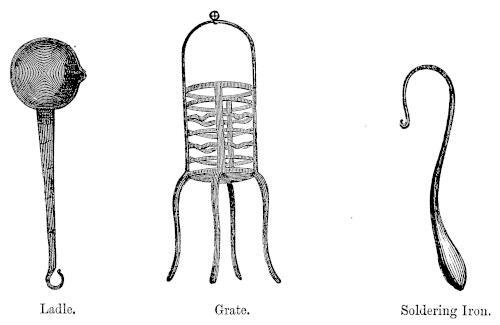
Ladle. Grate. Soldering Iron.
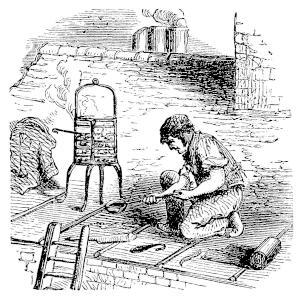
Now as the Plumber has to do a great deal of his work
in roofs and other places where he is liable to fall, he should
be clear-headed, and able to go up a ladder or look over a
ledge at a height from the ground without being afraid, and
this is all the more necessary because he has to handle tools,
and sometimes to pour melted solder out of a hot iron ladle
while he is at his work on these places. For the purpose of
melting the solder he has to carry his fire grate and melting
pot with him to some place near where he is at work, since
unless the solder can be used rapidly it cools, and will not
make a sound joint. The rest of the Plumber’s tools are the
pouring stick for applying the melted solder in the places
where it is required, the soldering iron which is made red-hot,
and passed over the soldered joints to smooth them and
make them all firm and sound; the chisel, shave hooks,
drawing knife, and chipping knife, for cutting the lead and
scraping it on the surface, or at the edges that are to be
fastened together; the hammers and mallets for beating the
lead into shape and flattening the ridges, the bossing mallet
and dresser for bringing the sheet of lead to a proper shape,
and forming it over the ridge of a roof, the chased wedge,
the screw-driver, the dunring and the turnpin for various uses
in making roofs, laying down leaden pipes and fixing taps,
and the sucker hook used in repairing or fixing pumps when
the part of the pump called the sucker requires to be
rectified.
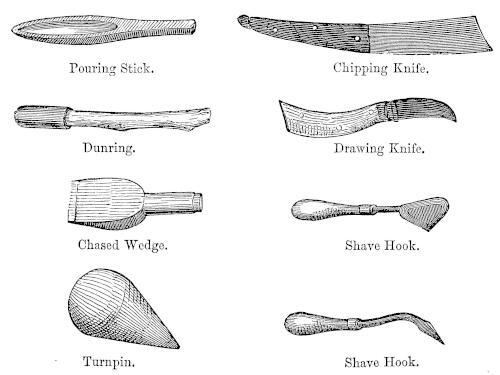
Pouring Stick. Chipping Knife. Dunring. Drawing Knife.
Chased Wedge. Shave Hook. Turnpin. Shave Hook.
There are other tools beside these, such as planes for
making the surface of the lead smooth and even, gouges and
centre-bits for circular openings in the lead to receive nails
or clamps, measuring rules and compasses, and pads of
carpet or cloth to hold under a pipe when it is being
soldered, that the solder may be pressed round the joint
before it cools, and without its dropping on the ground.
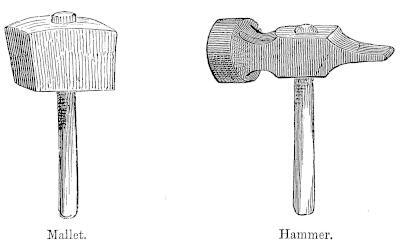
Mallet. Hammer.
Plumbers now buy their sheet lead as well as their leaden
pipe at the warehouses, but those in a large way of business
formerly cast the lead themselves. For this purpose
they used a casting table, which is a great wooden bench
about six yards long and two yards wide, made of smooth
planks, and with a raised wooden frame round the edge. On
this table the Plumber spreads a layer of finely-sifted sand,
which was made level by a strike—a flat piece of wood
with two handles—drawn from end to end of the table;
after this the surface was made still more smooth by a planer,
which was a flat plate of copper fastened to a handle.
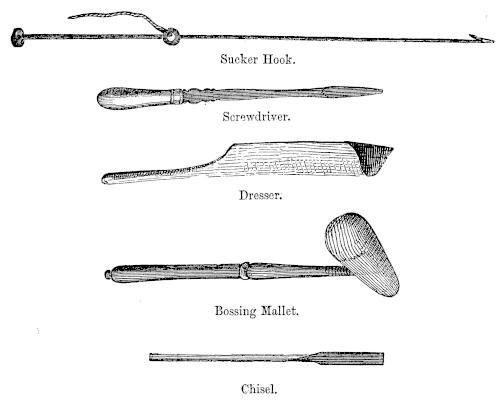
Sucker Hook. Screwdriver. Dresser. Bossing Mallet. Chisel.
A trough called the pan ran along the whole length of
the table, and into this the melted lead was poured from the
melting pot. There were two ways of making the sheet
lead: one of them was to tilt the trough up, and pour out
the lead on to the table, two men immediately passing a
wooden strike over it so as to spread it evenly over the
whole surface. In this case the thickness of the sheet of
lead depended on the distance between the edge of the
“strike” and the surface of the sand. Another way was to
have a narrow opening all along the bottom of the trough,
the trough itself moving from end to end of the table as
the lead flowed out. When this method was used the thickness
of the sheet depended on the size of the opening, and the
rapidity with which the trough was moved along the table.
Neither of these methods are now used, the lead being
rolled into sheets by machinery.
Water-pipes are made by lead being cast in moulds with
a steel rod passing through their middles, according to the
size required. The lead is poured into the space between
the rod and the mould. After it is cool the rod is drawn
out by machinery, and the mould which is made in halves
is opened and the pipe taken out. The pipe is then much
thicker and shorter than is required for use, but it is afterwards
drawn between powerful iron rollers with grooves cut
in their surfaces, an iron rod being again placed inside it.
As these grooves gradually decrease in size, and the pipe is
drawn through several, it is very considerably lengthened,
and at the same time diminished, in thickness, by the time
the operation is finished. Another method of making lead
pipes is by the use of the forcing pump, which pumps the
melted metal out of the boiler into a mould containing a
“mandril,” or pipe of the required size. Pipes made in
this way do not require to be rolled.
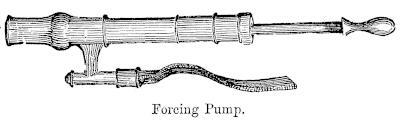
Forcing Pump.
The work which the Plumber is called upon to do on the
roofs of houses requires experience before it can be properly
performed. The foundation of the roof which is to be
covered with lead is made either of boards or plaster, so
that the surface may be even, and if it be of boards they
must be thick and well seasoned to prevent their warping.
The foundation slopes a little in order to carry off the rain
towards one end. When the roof is so large that it needs
two widths of lead, there are three ways of joining the
edges of the lead together: one is by fastening to the roof
long slips of wood (flat at bottom and round at top) at the
places where the lead will be joined. Over these strips the
edge of the first sheet of lead is folded and hammered
down quite close, then the edge of the second sheet is
folded and hammered over that, so that water cannot get
between them. This is called “rolling.”
Another method is to bring the two edges up just as
though they were to be sewn together, then to fold them
tightly one over the other, and hammer them down: this is
called “overlapping,” but it is not so good as rolling for
keeping out the rain.
The third way is to solder the edges together: the solder,
which is in constant use by the Plumber, being a metal
made by mixing lead and tin together. These two metals
when mixed adhere very strongly to the lead that they are
meant to join, and the surface to which they are applied is
made hot enough to unite with the solder by means of the
soldering iron, while very often a little resin, borax, or
tallow is placed on the surface of the lead to cause it to
combine more rapidly with the molten metal.
Besides the fixing of roofs the Plumber makes leaden
cisterns, fixes rain-water gutters, and waste pipes, and
arranges taps and drains; and in some of these operations
he will use zinc instead of lead. Not the least important
part of his business, however, is the construction and
arrangement of pumps, and for this purpose it is necessary
that he should study mechanics, and those branches of
science which refer to the properties of water, and to the
laws which govern the air and other fluids. He is always
the best workman who goes to his business with a knowledge
of the natural laws and scientific facts connected
with it, and a very little study will save a world of
blundering; during which the ignorant man will remain a
labourer, because it takes him half a lifetime to learn his
business.
THE GASFITTER.
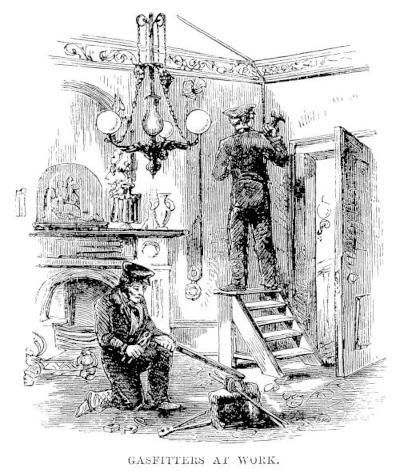
GASFITTERS AT WORK.
As there are now few large houses which are not lighted
by gas, the trade of the Gasfitter is one of considerable
importance; and though the materials used are generally
bought ready made from the Brassfounders, the glass-works,
the Ironfounders, or the lead warehouse, considerable skill
is required, as well as some taste in properly adapting the
chandeliers and burners, and skilfully adjusting the tubes
and pipes so that they may easily be repaired, or any escape
of gas quickly detected. The various tools used by the
Gasfitter are simple enough, but careful practice is necessary
for their proper use; and, as any flaw or imperfection in the
work may lead to very dangerous consequences, all the
operations should be thoroughly tested, and every joint and
fitting in the various parts made sound and strong.
Before the gas is taken into a house, or as it is called in
the trade “laid on” in the house, it is of course necessary
to obtain the permission of the Company to whom the
works where the gas is made belong, and to agree to pay
for the quantity that is burnt, which is charged by the
thousand cubic feet, and varies in price according to the
cost of the coal from which it is made, and the difficulty of
conveying this coal to the works.
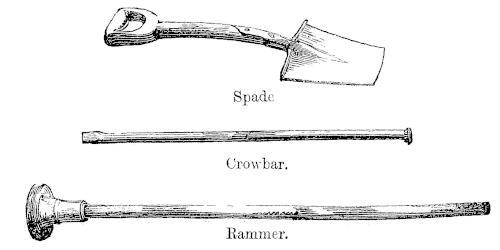
Spade. Crowbar. Rammer.
The first operation is to take up the roadway in front of
the house, in order to connect the pipe which is to convey
the gas to the meter with that which conducts it from the
works to the different streets of the neighbourhood. For
this purpose the spade and crowbar are necessary, while
sometimes the pickaxe also has to be used; and the rammer
serves to beat the earth down more closely after the pipe
is laid.
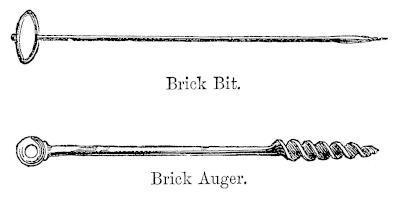
Brick Bit. Brick Auger.
The pipe which is joined to the larger pipe, or main, is
generally of iron, and is made with a screw and socket, that
it may not be easily displaced by the pressure of the
roadway or footpath, and this, passing into the basement of
the house, supplies the gas to the meter. The meter is a
mechanical contrivance, which is so constructed that the
quantity of gas passing through it is registered by a plate
something like a clock face, with a hand to point to the
figures which represent the number of cubic feet consumed.
There are different kinds of meters, and the construction of
them varies very considerably, but they all answer this
purpose: so that when the inspector visits the house once a
quarter he may directly see what quantity is to be charged
for. The pipe leading from the meter is fitted with a strong
tap, by turning which, all the gas may be shut off from the
tubes that convey it to the different burners in the house,
and from this pipe the smaller pipes (made of a sort of
solder or of lead) are taken to the various rooms. In order
to carry the tubes through a wall, it is necessary to use the
brick bit and the brick auger for boring a hole to receive
it, while to support it against a wall or along the top of a
ceiling the Gasfitter uses wall hooks, the hammer and
the tongs for holding and bending the pipe to its proper
direction. In kitchens and basement rooms the pipe is
generally carried from the meter up the wall and along the
ceiling to the place where the burner is to be fixed: but
in upper rooms the pipe is taken up the house wall, and
carried under the flooring of the room above to the centre
of the middle joist, where a hole is bored quite through the
ceiling of the room below. For this purpose the twisted
auger is generally used; and for the preliminary work of
taking up the floor and cutting a groove in the joist to
receive the pipe, that it may not be injured by the pressure
of the boards above, the saw and the hammer are required.
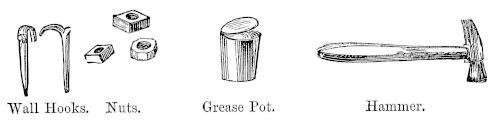
Wall Hooks. Nuts. Grease Pot. Hammer.
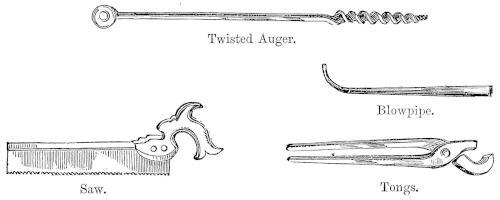
Twisted Auger. Saw. Blowpipe. Tongs.

Waxed Rushes. Rasp.
Of course one length of pipe is not sufficient to go to
any great distance, and a joint has frequently to be made,
the solder used for this purpose being so easily melted and
so readily combining with the pipe itself, which is of almost
the same material, that the flame from prepared tow blown
to an intense heat by the blow pipe is sufficient for the
purpose. The rasp is used for filing the surface at the ends
of the pipes where they are to be joined, and the waxed
rushes to try the joints in order to see that there is no
escape of gas through some small hole. When the pipes
are all laid and brought to their proper positions the fittings
are fixed. Those which descend from the centres of ceilings
are generally called chandeliers, and consist of a tube of
metal fastened to the gas pipe, the end of which coming
through the ceiling is furnished with an iron screw to fit
the end of the tube. This tube is placed within a larger
tube, from the bottom of which a still smaller one passes
within the first. The gas therefore descends the tube from
the ceiling, and enters the smallest tube, which communicates
with the burners that spring from the largest. The larger
tube is intended to receive water, in which the end of the
first tube rests, so that the gas is prevented from escaping,
while by a nice adjustment of weights running over pulleys
attached to the larger, the burners can be raised or lowered,
as one tube slides within the other (see large cut). The
taps are placed at the burners to turn on or turn off the
gas as it is required, and in order to fix and screw these, as
well as to fasten joints in the fittings by means of screw
nuts, the pliers and the wrench are used.
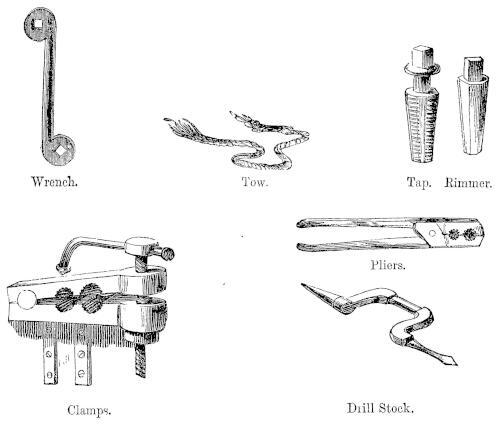
Wrench. Tow. Tap. Rimmer. Clamps. Pliers. Drill Stock.
The clamps are a sort of vice with grooved holes, for
holding the taps and metal joints firmly while they are
filed or otherwise prepared; the drill stock is used for
boring small pipes in order to make a branch to some other
direction, and the drill brace is intended for boring the
main pipes, under which the large hooks are placed while a
stock and bit attached to the upper screw makes the hole;
the ordinary braces are fitted to a ratchet or cog wheel at
one end, and are also used for making incisions by being
worked backwards and forwards.
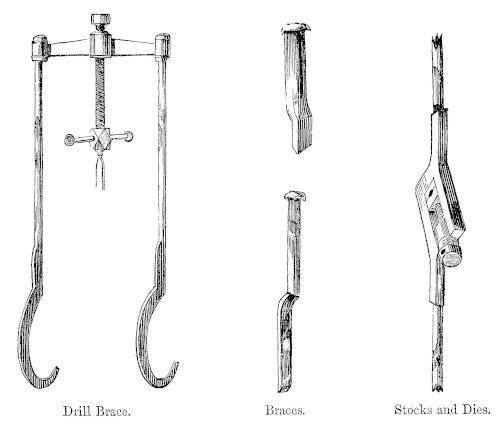
Drill Brace. Braces. Stocks and Dies.
The several kinds of burners are pierced or cut in such a
way as to make the flame from the gas of different shapes,
such as fish tail, cock spur, star, or argand, the names of
which tell pretty well in what shape they appear. Small
rooms are sometimes fitted with “telescopes” instead of
chandeliers, the telescope being one tube sliding within
another, and the space carefully filled with a properly
adjusted cork or some other flexible and impervious substance.
Bedrooms, and apartments where light is required
at the walls or chimney pieces, are furnished with brackets,
which either simply project from the wall, or are made with
an arm moving on a ball and socket joint. The manufacture
of the various portions of the apparatus used in gas
fitting will be mostly found described under the trade of
the Brassfounder.
MANUFACTURE OF GAS.
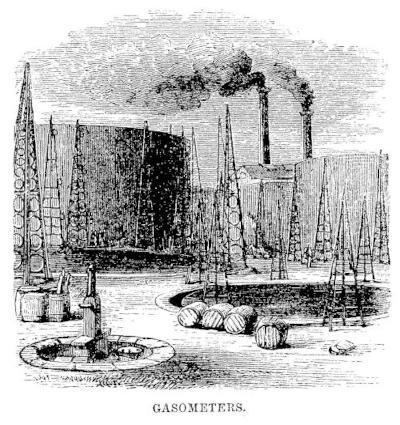
GASOMETERS.
Very few of the readers of this book will remember the
appearance presented by London streets before the introduction
of gas; when all the thoroughfares were darker
than even the commonest streets are now, and the only
light emanated either from the shop windows or from dim
oil lamps, which the rain or the wind would frequently put
out, even when they did not burn out of themselves for
want of being trimmed and replenished. A century ago
these oil lamps were quite insufficient to light even the
main streets, and people who walked out at night generally
hired a “link boy” to light them as they went, with a
great flambeau of hemp and pitch, which smoked and smelt
insufferably. The nobility and gentlefolks who rode in
carriages were also attended by footmen with flambeaux of
a better sort, and outside the doors of some of the oldest
houses in London there may still be seen the great iron
extinguishers attached to the railings, where the torch-bearers
put out their lights till it was time to escort their
masters and mistresses home. The poet Gay, who wrote
the celebrated fables, describes the link boys, and gives
them rather a bad character for so often being connected
with the bands of thieves and footpads which infested
London streets, and robbed people with impunity in the
dark. He says:—
“Though thou art tempted by the link man’s call,
Yet trust him not along the lonely wall;
In the midway he’ll quench the flaming brand,
And share the booty with the pilfering band.
Still keep the public streets, where oily rays,
Shot from the crystal lamp, o’erspread thy ways.”
Long before this, however, the inflammable nature of the
vapour which streamed from burning coal had been observed
by scientific men, and it was thought by many people that
some method might be invented for making this gas useful
for the purpose of lighting streets or houses. It had also
been observed that the air suddenly escaping from the
shafts of coal mines was often highly inflammable, and
some experiments were made in the distillation of coal as
early as 1726. In 1765 Lord Lonsdale proposed to the
magistrates of Whitehaven to convey the gas from the
neighbouring mines through pipes for lighting the town.
A number of eminent men afterwards made experiments
with gas, but no decided practical result followed until a
Mr. Murdock, of Cornwall, began to manufacture gas for
lighting his house and offices at Redruth. In 1798 the same
gentleman used gas for lighting the Soho Foundry, where four
years afterwards a public exhibition of the new invention
was made by means of an illumination to celebrate the
proclamation of peace.
In 1803 a gentleman named Winsor first publicly showed
at the Lyceum Theatre, in London, a system of illumination
by gas, which was the commencement of our present
method of lighting our streets and houses; and after great
difficulties and various experiments, a company was formed
for the purpose of carrying out the undertaking of superseding
the old oil lamps and making use of the new
invention. The premises of the company and their factory
were situated in Pall Mall, where the Carlton Club now
stands, and the lights first appeared from the corner of
St. James’s Street to the Haymarket, while several jets
were placed in front of Carlton House, the residence of the
Prince Regent, afterwards George the Fourth.
By slow degrees, and by the assistance of Mr. Clegg, an
eminent engineer, the manufacture of gas improved, and in
1814, when the allied sovereigns visited this country, and a
general illumination was ordered, a magnificent pagoda in
St. James’s Park was erected for the exhibition of the new
light. The following year Guildhall was fitted with gas
burners; and, although it had been predicted that the new
invention would ruin the navy by superseding the use of
the oil brought by the whalers, and though some people
declared that it was only a scheme for blowing up London,
the success of these experiments led to its rapid adoption
in most of the large towns of Europe.
It will now be necessary to say something of coal, of
which more than 400,000 tons are used every year for the
manufacture of gas in London alone.
The name coal was originally given to any substance
used for fuel, and the use of mineral coal, or, as it was
formerly termed, sea-coal, from the fact of its being
brought by sea, has not prevailed for longer than 200
years. Coal is found in this country in extensive deposits
called coal-fields, the most important of which are:—1.
Those of the great northern district, including the coal-fields
north of the river Trent. 2. Those of the central
district, including the Leicester, Warwick, Stafford, and
Shropshire coal-fields. 3. Those of the western districts
in North Wales, South Wales, and Gloucester. The coal
occurs in a number of layers, or beds, termed seams,
and these are separated from each other by layers of slatey
clay, called shale, and coarse, hard sandstone, known as
grit.
The seams of coal are mostly comparatively thin, but
varying from a few inches to six or eight feet in thickness,
and underneath the layers is usually found a bed of mountain
limestone extending beyond the coal-field, and rising
to the surface of the ground around it.
The first process for finding coal is to bore with iron
tools a perpendicular hole in the ground; then if coal is
discovered, a shaft, or pit, from ten to fifteen feet in
diameter, is sunk, and lined with brick, cast iron, or wood,
to prevent the admission of water and the falling in of the
sides. When the shaft reaches a seam of coal, passages are
made, twelve to fourteen feet wide, and varying in height
with the coal; from these proceed smaller ones, which
are again crossed by large ones, enormous blocks of coal
being left to support the earth above. As the mine
becomes larger, a second shaft is sunk at some distance
from the first, in order that air may be supplied to the mine,
and that the gas that escapes from the coal may be carried
away. A current of air is caused by burning a large fire
in one shaft, and the draught is directed to the part of the
mine where it is required, by doors, which close up some of
the passages and leave others open.
There are several varieties of coal found in this country.
The most important are: the common, or bituminous coal,
which soils the fingers on handling; the cannel, or candle
coal, which burns with a bright flame, but does not
soil; the anthracite, or culm coal, which burns without
flame, does not form cinder when half consumed, and is
most useful for furnaces, in consequence of its intense heat
and the absence of smoke. Although often classed amongst
the minerals, coal is evidently of vegetable origin; many
sorts of it being distinctly fibrous, and showing the grain of
the wood from which it is composed. Upon examination
with the microscope, coal shows vegetable remains; and
these are frequently so perfect that they prove its formation
from such plants as ferns and fir-trees, of a kind somewhat
different from those which now exist.
The value of coal depends entirely upon its inflammable
and combustible properties. It is used as the source of
artificial warmth in our dwellings, and our manufactures
are mainly dependent on it. Without coal there would
scarcely be any working in iron, copper, lead, or other
metals, as in populous countries the supply of wood is
soon exhausted. Our potteries and our glass works are
also carried on by its use, and the power of steam which
moves all our great engines and machines is dependent on
coal for its existence.
Great Britain produces more than one-half the coal that
is consumed in the world, and about 180,000 persons are
employed in obtaining it in our collieries.
The first process in the manufacture of gas is to subject
the coal to a great heat, by which it is carbonised, or burnt
until only the cinder, or coke, remains after the gas has
flown off. This is done by placing the coal in retorts of
fire-clay or iron, which are previously heated. These
retorts, which occupy a building called the retort house,
having been charged with coal, are perfectly closed, and
the door luted, or stopped, with a sort of cement, so that
the gas can only escape up the ascension pipe, the coke
being left in the retort.
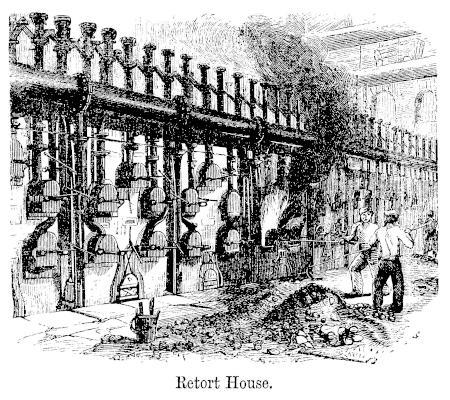
Retort House.
The gas from the coal then passes through the ascension
pipe by what is called the dip pipe, into a main, a large
horizontal tube extending along the length of the furnaces.
This main is about half filled with water or tar, in which
the ends of the dip pipes are immersed, so that as the gas
runs in, it ascends through the liquid into the space above,
but cannot flow back again into the dip pipes. In this
way it is all collected in the upper part of the main pipe,
and is ready for purification.
Where double retorts are used, each end is worked with
at least three stokers, and an extra man for preparing the
lids of the mouth-pieces. Others are required for extinguishing
the coke, wheeling the coal into the retort house,
clinkering furnaces, and attending to fires. Three stokers,
assisted by a man to extinguish the coke, will perform all
the work of taking off the lids, raking out the coke, extinguishing
and wheeling it away from a bench of seven
retorts, in twelve or thirteen minutes; they will then put
the proper charge for each retort in the scoop, deliver its
contents, and be ready for charging another bench in a
further space of seven minutes, while a fourth workman
will in the meantime have put on the lids, so that the
whole work of discharging and charging the seven retorts
will occupy barely twenty minutes.
This extreme dexterity is of course only acquired by
long practice, and it must be admitted the labour is very
severe; but this is moderated by the time the men have
for repose between the charges. The first process in discharging
or drawing is for one or two of the men to
relieve the screws of the mouth-pieces of the retorts about
to be discharged, by giving three or four rapid turns;
another man instantly gives a knock to each of the cross
bars to disengage them from the ears of the lid, and at the
same time strikes the lid a blow with a piece of iron or
hammer, in order to break the luting, and a light is immediately
applied to prevent explosion, which would be likely
to crack the retort if of clay. For want of this precaution,
many lamentable accidents have happened through the gas
exploding when combined with atmospheric air. The men
then lift off the cross bar and screw of each retort, placing
them on the ground, and then each seizes hold of a lid in
both hands, lifting it by the projecting ears, and placing
it aside to cool, ready for luting for another charge.
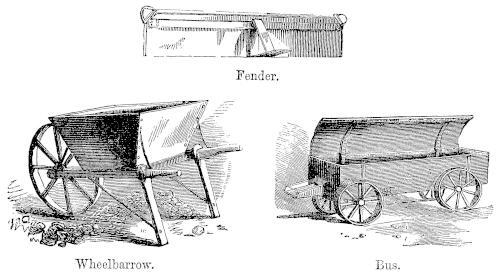
Fender. Wheelbarrow. Bus.
Three of the stokers then take up their iron rakes, which
are simply rods of ¾-inch iron, about 12 feet long, having
a handle at one end; the other end being turned at right
angles is flat, about 6 inches long, 2 inches wide, and
½-inch thick. These are inserted in the retort, and the
red-hot coke drawn to the mouth, whence it drops into the
coke vault, where there is a man ready to extinguish by
throwing water on it; or when there is no vault the coke
drops into iron barrows placed ready to receive it, and
wheeled rapidly away when the charge is withdrawn. If
the coke were not immediately extinguished it would
smoulder, and the surface become covered with earthy ash,
and detract from its appearance and value.
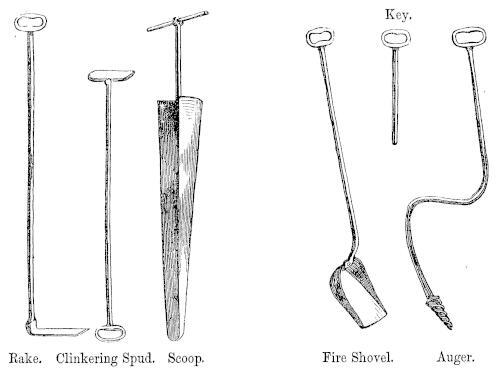
Rake. Clinkering Spud. Scoop. Fire Shovel. Key. Auger.
Formerly, in charging retorts, the operation being comparatively
very protracted, there was a considerable loss of
gas, in addition to the time and extra fatigue to the men.
In order to remedy these inconveniences, a method has
been contrived for depositing the whole charge in the
retort at once; for this purpose an iron scoop is used, this
being a semi-cylinder of sheet iron, from 8 to 10 feet long
and 10 or 12 inches diameter, with a cross handle at the
end to assist in lifting and turning it round to empty the
coals in the retort.
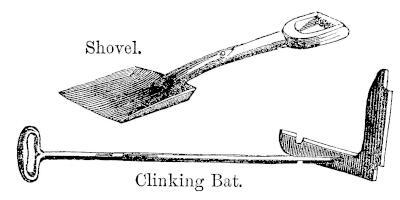
Shovel. Clinking Bat.
The charge of coal is placed in the scoop while it rests on
the ground, having a bent rod underneath for the purpose
of lifting it: one man takes hold of the cross handle, and
two others lift the other end by the bent rod, and introduce
it into the mouth of the retort. The scoop with its contents
is then pushed forward to the further end, turned completely
over, and immediately withdrawn, leaving the coal in the
retort, which is raked into a layer of uniform thickness,
when the lid, previously luted and ready, is placed in its
position and screwed up as quickly as possible. The operation
of charging a retort with the scoop does not occupy
more than thirty or forty seconds, so that very little escape
of gas can take place. The shovel is used for lifting the
coal to the scoop, the clinking bat for breaking or removing
the coke in the vault, the spud for a similar purpose.
The gas in the hydraulic main is of course very impure,
having undergone no alteration since it came from the coal
in the retort. It contains a quantity of tar and ammoniacal
liquor in vapour, and these have to be separated from it
and this can be effected by what is called condensation, the
instrument used being known as a condenser. There are
two or three forms of condensers in use, but a common one,
which is represented in the engraving, is called the horizontal
condenser, and is a rectangular box or chest formed
of cast iron plates, put together with flanges, and perfectly
tight joints. Its interior is provided with a series of iron
trays, containing each about two inches in depth of water,
and so arranged that the gas, entering at the bottom of the
chest, passes in succession over the surface of the water in
each tray, and traversing the whole length of trough ten or
twelve times, passes off at the upper side. In the mean
time a continuous stream of water enters at the top, and in
its descent absorbs a portion of the ammonia, at the same
time cooling and condensing the vapours in combination
with the gas.
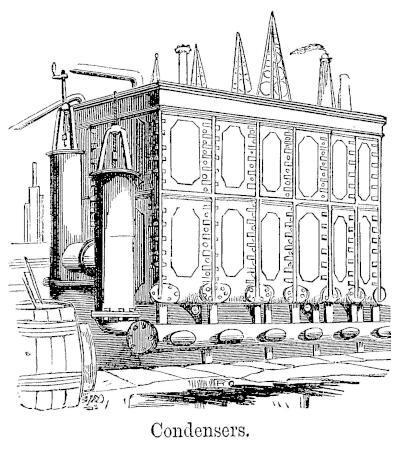
Condensers.
Horizontal condensers are sometimes composed of a series
of pipes placed in a horizontal position, and immersed in
water.
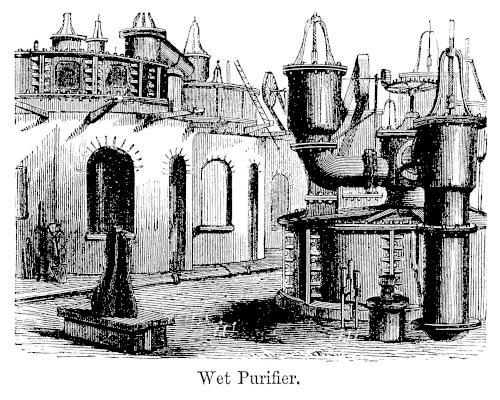
Wet Purifier.
The other form of condenser, which is very generally
employed, consists of a series of vertical pipes, connected
in pairs by semicircular bends at top, and attached to a
cast-iron box or chest at bottom. This chest has a series
of divisions, the ends of which are sealed by liquid placed
therein, so that the gas in its passage has to pass through
the whole series of pipes. The pipes by their contact with
the atmosphere radiate the heat acquired from the gas in its
passage, and it being in consequence cooled, deposits the
vapours as liquid in the form of tar, and water saturated
with ammonia, generally called ammoniacal liquor. This
condenser is sometimes used with an application of cold
water on its exterior, in order to increase the cooling effect.
The other part of the purification is by a chemical process,
in which a solution of lime is used to remove other impurities
in the gas. This is called wet lime purification,
or when the lime is only slackened (or moistened) it is
called dry lime purification, and the process takes the
sulphuretted hydrogen, the carbonic acid, and other matters
from the gas before it is stored for use.
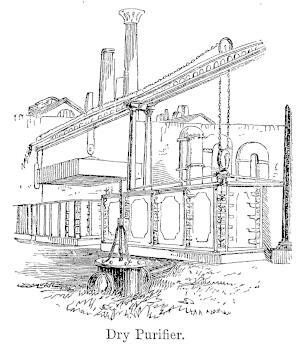
Dry Purifier.
The wet lime purifier consists of a cast-iron cylinder
entirely closed at top and bottom, except where the inlet
and outlet pipes join it, and where an opening is required
for charging it with lime-water, which same opening is also
used for drawing off the charge. To the inside of the cover
of this outer cylinder is bolted an inlet cylinder usually
made of wrought-iron plate. This inlet cylinder is open at
the lower part, and reaches to within a foot from the bottom
of the outer cylinder, but has bolted to its lower flange a
wide ring or dash plate of sheet iron, the outer diameter
being only 8 or 9 inches less than that of the outer cylinder,
so that a space of about 4 or 5 inches is left between the
outside of the ring and the interior of the large cylinder.
The gas passes down through the inlet cylinder, and by
its pressure forces its way up through the fluid lime, the
surface of which is 8 or 9 inches above the dash plate.
The wet lime purifiers are variously worked; when four
are used, two vessels are employed at one time, and when
the lime in the first is incapable of absorbing the impurity,
that purifier is put out of action, and the second and third
are worked, and so on in succession.
When quick lime is slackened, reduced to powder, and
slightly moistened with water, chemically this is called the
hydrate of lime, and is often employed to absorb the sulphuretted
hydrogen and carbonic acid from the gas. The
process is termed dry lime purification.
Dry lime purifiers are generally rectangular cast-iron
vessels, varying from 3 feet to 30 feet square, and from 3
feet to 4 feet 6 inches deep. Sometimes in small works
they are made circular; this, however, is not very frequent,
and is done for convenience or economy in construction.
Each purifier contains a series of perforated shelves, trays,
or sieves, supported by suitable bearers of wrought or cast
iron, the ends of which are attached to “snuggs” cast on
the purifier. In large apparatus there are also pillars placed
at intermediate distances to carry the weight of the sieves
and purifying material.
The upper part of the purifier is surrounded by a cistern
or reservoir of from 6 inches to 24 inches deep, and from 3
inches to 6 inches wide, which is often cast with the purifier,
and forms part of it, or at other times is attached thereto by
bolts and cement, and is for the purpose of containing water
to seal the cover. The cover of the purifier is of boiler
plate or cast iron, the latter being preferable on account of
its durability; but the increased weight is an impediment
to its adoption. The rim or border of the cover is rather
deeper than the cistern into which it is placed, and is
effectually sealed by the water, so preventing the gas
escaping from that point.
Often the purifier is divided into two compartments, so
that the gas ascends through a set of sieves on the one side,
and descends through another set on the other side, answering
the purpose of two sets of apparatus. In all establishments,
however small they may be, two distinct purifiers at
least are necessary, to enable the impure lime to be removed
from the one whilst the gas is being purified by the other.
The next subject for consideration is that of the gasholders,
or vessels in which the gas is stored ready for
delivery into the mains, which distribute it throughout the
districts to be lighted. These vessels were originally termed
gasometers, which name is sometimes even now applied to
them; but as they have nothing whatever to do with the
measurement of gas, but are mere vessels of capacity or
stores, the simple name of gasholder is more expressive and
appropriate.
The gasholder is composed of two distinct parts, one
of which contains water, and is called the tank, the other
is the vessel which contains the gas, being really the
gasholder. On the Continent the former is very generally
termed the “cistern,” and the latter the “bell.”
The tank is a large cylindrical vessel, constructed usually,
for the sake of economy, of brickwork or masonry,
but when the ground is marshy, or when water exists
abundantly a short distance below the surface of the earth,
which would prevent the construction in masonry at a
moderate price, these tanks are made in cast-iron, and,
indeed, in small works, are often of wrought iron. In the
interior of the tank there are two vertical pipes for the
admission and egress of the gas, called the inlet and outlet
pipes; the former being in direct communication with the
manufacturing apparatus, the latter with the mains which
convey the gas to the town. These pipes rise a few inches
above the level of the top of the tank, so that the water
cannot overflow into them. A series of columns, generally
of cast-iron, but sometimes of wood, or brick piers, are
placed at equal distances around the tank for the purpose
of guiding the holder.
The holder is a cylindrical vessel closed at the top, which
is termed the roof, and open at the bottom, made of sheet
iron, varying in thickness according to the dimensions of
the apparatus, the smaller sizes being constructed of thin
material in order to avoid an excess of pressure, whilst
those of very large dimensions are made of stout plates for
the purpose of obtaining sufficient pressure to expel the gas
to the burners. The holder is somewhat less in diameter,
but of the same depth as the tank in which it is placed,
sometimes being partially suspended by chains which pass
over grooved pulleys and counter-balance weights, but more
frequently only guided by rollers attached around its lower
and upper edges, which work against suitable guides in the
tank and on the columns in such a manner as to permit the
holder to ascend and descend in the tank with the greatest
freedom.
The action of the gasholder is very simple. The tank
being filled with water, and the holder immersed therein
ready for use, there is a space between the surface of the
water and the roof of the holder; the gas enters by the
inlet pipe into this space, and with the force it acquires in
being expelled from the coal, pressing on the surface of the
water and underneath the roof, and over the whole area of
both, causes the holder to rise. Thus, by its own force or
pressure, the gas provides room for itself, and in proportion
to the quantity entering so does the holder rise out of the
water. For instance, a holder having 100 feet area, or
about 11 feet 4 inches diameter, in rising 10 feet will
receive 1,000 cubic feet of gas, and in descending, the same
quantity would be expelled.
Gasholders, though often suspended, are never entirely
counter-balanced, having always sufficient weight to give
the necessary pressure for forcing the gas through the mains
and smaller pipes to the burners, all through the neighbourhood
which is supplied from it. The gasholder should be
so constructed that, when it is full or at its greatest height,
its lower edge will be so far under water as to prevent the
gas from escaping.
The water in the tank serves three purposes; it is the
means of resistance for the gas to lift the holder, it prevents
the gas escaping or mixing with the atmosphere; and it is
the means of expelling or forcing out the gas as the holder
descends.
THE IRONFOUNDER.
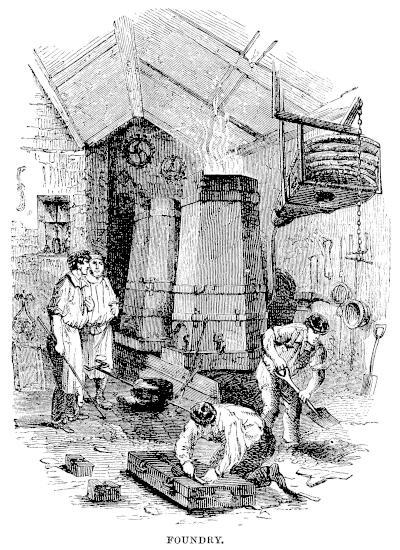
FOUNDRY.
Having already described the various operations of the
trades employed in building and fitting a house, we will
say something of the manufacture of those cast iron
columns, girders, gratings, balconies, pipes, gutters, air
traps, coal plates, stoves, and other articles which are so
necessary to the Builder before his work can be completed.
All these, as well as a great variety of other goods made
in black or bronze iron, such as gates, bridges, pieces of
furniture (like umbrella stands), iron taps, and even pots
and frying pans, are made at the Iron Foundry.
Iron is a metal of a bluish gray colour; but in its pure
state it looks almost white when polished, and has a
brilliant lustre, while when it is broken the broken portion
looks dull and fibrous. It is the hardest of all the malleable
and ductile metals, and the most tenacious of all
metals, an iron wire of ⅟₃₆th of an inch in diameter bearing
a weight of 60 pounds.
In the pure state it requires the strongest heat of what
is called a wind furnace to melt it.
Iron may be called the most precious of all metals; it is
certainly the most beneficial to man, and its uses are
innumerable; indeed, there is not a branch of human
industry that could well afford to dispense with its aid and
services; nearly all the tools, implements, instruments, and
engines used by man are wholly or partly made of it, and
we could better afford to give up all the other metals than
to part with this, which is the most useful.
Iron is used in two different states, as cast iron and
wrought iron, the differences between them depending on
the proportion of carbon combined with the metal, cast iron
containing the most and wrought iron the least.
For the production of wrought iron in the ordinary way,
two distinct sets of processes are required; first the extraction
of the metal from the “ore” that is brought up
from the mine, which metal is cast iron; and secondly the
conversion of this cast iron into malleable or bar iron, by
remelting, puddling, and forging. Bar iron is turned into
steel by placing it in contact with charcoal in a peculiar
kind of furnace.
When the ore is taken from the mine it is first burnt or
calcined, and then removed to a blast furnace to be smelted.
These blast furnaces are generally built of brick, and look
like small towers. The ore is mixed with limestone, which
causes it to melt more easily, and the fire is lighted with
pit coal or coke. The melted metal sinks to the bottom of
the furnace in consequence of its weight, while the limestone
and dross float on the top, and are allowed to run off when
they cool into a mass of what is called “slag.”
The melted metal is run off from the bottom of the
furnace, either into moulds for some sort of castings, or into
a large furrow made in a bed of sand. This large furrow
has several smaller furrows on each side of it, and has
received the name of the “sow;” the smaller furrows being
called “pigs;”—and the iron when it is formed in this
shape to be afterwards made malleable is called “pig
iron.”
The pig iron is taken to other and smaller furnaces called
puddling furnaces, the bottoms of which are lined with
clay mixed with the slag just mentioned, and forming a
substance which the puddlers call “bull-dog,” though it
would be difficult to discover why it received that name.
About four hundred weight of the pigs is placed in the
furnace, and as it melts the puddler stands at the furnace
mouth with a long iron rod bent at the end, and stirs it
about, until it comes to resemble several great balls of iron
paste. These balls are removed, and fall into iron trucks
pushed along a small railway by boys, who wheel them at
once to the “shingling hammer,” an immensely powerful
hammer worked by steam, and this beats the iron into
small square bars called “blooms.”
The blooms are next carried to the rolling mill, which
is a pair of great rollers cut into grooves of various sizes,
and between these grooves the bars are squeezed, as the
rollers turn round, until they become much longer and
narrower, when they are known as “forged bars.”
Some of the rolling mills, however, are plain cylinders
without grooves, and when a slab of white-hot iron is
placed between these it comes out from the pressure in a
great broad sheet of metal.
These operations require great bodily strength as well
as considerable skill on the part of the workmen, who are
obliged to seize the heated metal with long tongs, and to
catch it in the same way as it comes out from the mill.
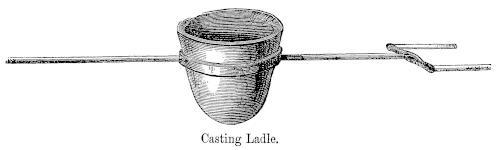
Casting Ladle.
The iron which is intended for castings is melted in a
“cupola furnace,” so called on account of the dome-like
shape in which it is built, which has something to do with
the more perfect heating of the metal. When the iron is
completely melted so that it will run freely, the lower
portion of the furnace is opened, and the white-hot stream
is received in the casting ladle, or, where it has to be
carried for some distance, and the casting is large, in great
iron pails carried in a sort of frame by two men. From
the casting ladle it is at once poured into the mould.
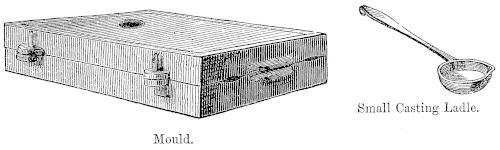
Mould. Small Casting Ladle.
The mould is a sort of iron box filled with a peculiar sort
of sand, into which a wooden pattern of the intended casting
is pressed, and the sand firmly rammed down and made
solid. There are, in fact, two boxes of sand, each of which
is impressed with one half of the thickness of the required
casting, so that when they are brought together, and firmly
fastened with the pins, as shown in the picture, the patterns
which have been taken out have left a half of the impression
in each box, each corresponding exactly to the other.
A hole in the box receives the melted metal, for which a
channel has been left in the sand, that it may freely run
into the hollows left by the pattern, and completely fill
them; then, when it has sufficiently cooled, the casting is
removed, and when the rough edges have been removed,
and the irregularities trimmed off, it is ready for use, and
may be fitted to its other parts, which have perhaps been
separately cast, as in the case of garden seats, fenders, chandeliers,
umbrella stands, or ornamental girders and columns.
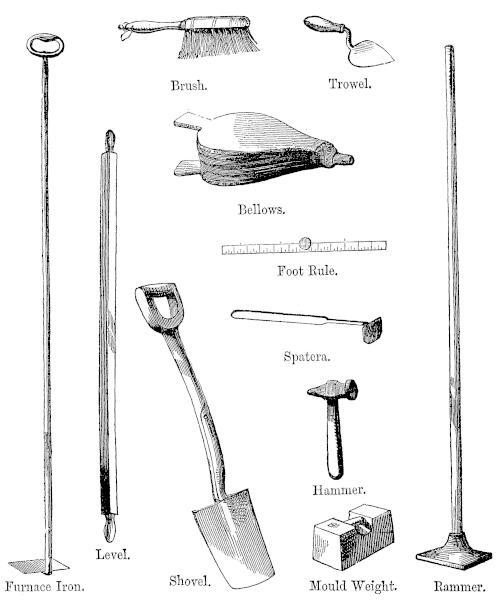
Furnace Iron. Brush. Trowel. Bellows. Foot Rule.
Level. Shovel. Spatera. Hammer. Mould Weight. Rammer.
We have only described solid castings, but as ornamental
iron work is generally made hollow, this has to be cast in
rather a different way, though the only difference is that
what are called “cores” are used. These cores are in fact
solid metal patterns made a little smaller than the hollow
left by the real pattern, and allowed to remain in the mould.
The melted iron then flows between the surface of the core
and the surface of the mould, and the casting is hollow, so
that when the core is removed the metal is only the thickness
of the space left between the two surfaces. You will
see what is meant by placing a small teacup inside a larger
one, and then pouring water between them.
The tools used by the Ironfounder are not very numerous:
the casting ladles and mould have already been
mentioned; the uses of the shovel and the mould weight,
the rammer, and the furnace iron need no description.
The designers, and pattern makers, and the mould maker
have the most important duties, and the latter will have to
use a small trowel and a spatera for arranging his sand and
loam, a level that it may be perfectly true, and a brush
and a pair of bellows for removing any particles of grit
from the surface of the channels where the pattern has been
impressed.
Almost all irons are improved by admixture with others,
and, therefore, when superior castings are required they
should not be run direct from the smelting furnace, but the
metal should be remelted in a cupola furnace, which gives
the opportunity of suiting the quality of the iron to its intended
use. Thus, for delicate ornamental work, a soft and
very fluid iron will be required, whilst for girders and
castings exposed to cross strain the metal will require to be
harder and more tenacious. For bed-plates and castings
which have merely to sustain a compressing force, the chief
point to be attended to is the hardness of the metal.
Castings should be allowed to remain in the sand until
cool, as the quality of the metal is greatly injured by the
rapid and irregular cooling which takes place from exposure
to air if removed from the moulds in a red hot state, which
is sometimes done in small foundries to economise room.
THE BLACKSMITH.
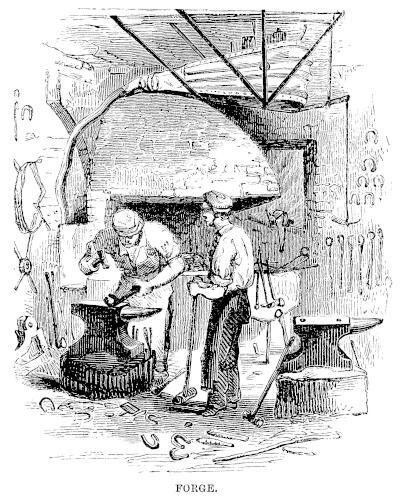
FORGE.
In the building and fitting of the house a large portion of
the iron work will have to be furnished by the Smith, and
as we have already given some description of iron founding,
it will be necessary to say something about the Blacksmith,
or the worker in iron or black metal, whose business is
different from that of the whitesmith, which has to do
more particularly with white or yellow metal.
The way in which malleable iron, that is, iron fit for the
hammer, is produced has been mentioned in connexion
with the trade of the iron founder, who in fact supplies the
Blacksmith with the raw material. It is not very easy to
tell you much about the way in which the Blacksmith
makes the great variety of articles which his trade furnishes,
for there is no business the success of which depends
more upon personal skill. As the trade of the Smith, or at
all events the worker in metal, is one of the most ancient,
and existed in times when there were few tools,—as, in
fact, it is the Smith who has to make tools,—so at the
present day, he has to depend chiefly on his own ability in
the use of the hammer and a few other simple instruments
to fashion the articles that come out of his workshop.
It is he who supplies the various articles of wrought iron
work used in a building; as pileshoes, straps, screw bolts,
dog-irons, chimney-bars, gratings, and wrought-iron railings
and balustrades for staircases. Wrought iron was formerly
much used for many purposes for which cast iron is now
generally employed; the improvements made in casting
during the present century having caused a great alteration
in this respect. It is not only for building purposes that
the Blacksmith is employed, however, since there is scarcely
anything constructed of iron in which his aid is not required,
from important portions of machinery to the rough
horse-shoes which have to be finished and fitted by the
farrier. In the forge, where the great bellows suspended to
the ceiling make the furnace roar, and the sparks fly, the
clinking of hammers is heard all day long.
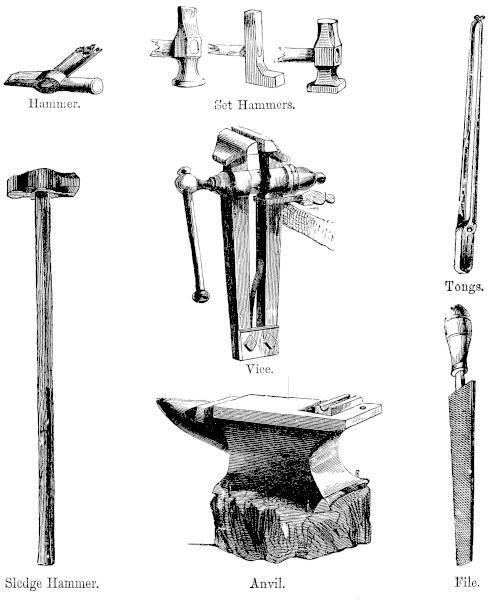
Hammer. Sledge Hammer. Set Hammers. Vice. Anvil. Tongs. File.
The anvil, on which the iron is beaten into shape, the
bench, fitted with a vice for holding such portions of the
work as require the file, the tongs, with which the red hot
metal is held, the sledge hammer, and the set hammers, are
the principal tools.
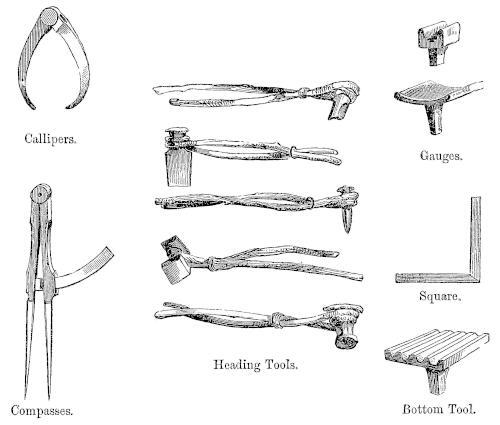
Callipers. Compasses. Heading Tools. Gauges. Square. Bottom Tool.
The sledge hammer is used for beating the metal until
it is tempered and easily formed into shape, and it is in the
tempering of the metal by beating that the great skill of the
Smith is often displayed. The set hammers are used for
setting out the work, and have heads of different shapes,
according to the form which the metal is required to
assume. The various gauges are placed upon the anvil for
the similar purpose of shaping the work, and the callipers,
compasses, and square, measuring and adjusting it. The
heading tools consist of cutting, punching, and stamping
instruments, and are probably so called, because they are
furnished with heads to receive the blows of the heavy
hammer, by which they are forced into the hot metal on
the anvil.
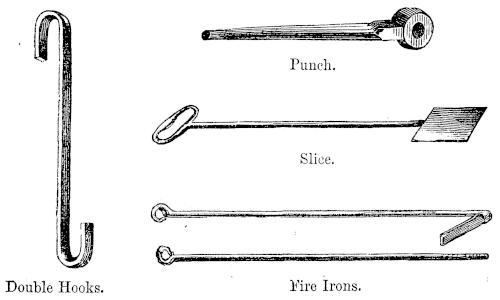
Double Hooks. Punch. Slice. Fire Irons.
These heading tools are held, not by handles of their
own, which would break off with the concussion of the
hammer, but by a sort of withe of birch, or some other tree
fastened loosely round them at their heads, and bound by a
ring to keep them from parting. The punch is used in
making bolts or rivets, the slice and fire irons for arranging
the fuel in the furnace, and removing small articles after
they are heated, the double hooks for removing or suspending
bars, and for some other purposes.
THE BRASSFOUNDER.
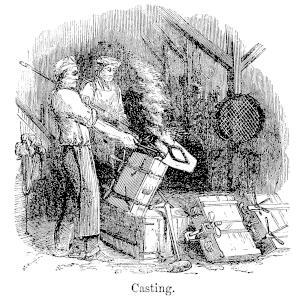
Casting.
Next to iron, perhaps brass is the metal chiefly employed
in the manufacture of articles of daily use, and the trade
of the Brassfounder is therefore of very great importance,
especially in connexion with the small metal fittings, such
as catches, locks, bolts, hooks, screws, and other objects used
in completing and furnishing the house.
Brass is not a pure metal, but is what is called an alloy,
that is, a mixture of various metals. It is composed of
copper and zinc in such proportions as may be necessary to
obtain various degrees of hardness and colour, according to
the use for which the compound is to be employed. The
best proportions for common brass are about two parts of
copper to one part of zinc. Formerly brass was made by
heating copper with calamine (which is the ore of zinc) and
charcoal, but it is now formed from melting the two metals
together. It is then cast into plates, which are either broken
up for recasting into any required form, or rolled into sheets.
Common brass is very malleable, is more easily melted than
copper, and may be cast into any form. It will take a very
high polish, does not rust or tarnish by exposure to the air,
and, although it is durable in wear, is sufficiently soft to
yield readily to the file and other tools used by the workmen.
These properties make it useful for a great variety of
purposes where steel or iron could not be so well employed.
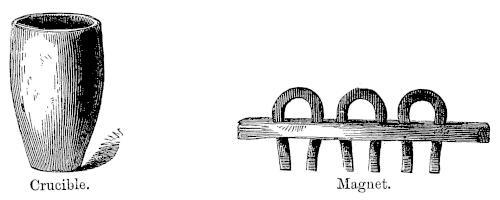
Crucible. Magnet.
The smelting or mixing houses where the brass is made
are fitted with air furnaces, and in some of the best workshops
the crucibles or melting pots are made of plumbago
or pure blacklead, which, although it is more expensive, is
much more durable than the Stourbridge clay, of which the
commoner crucibles are formed.
A very fine quality of brass for best castings consists of
three parts of best selected copper, and two of spelter, with
some best scrap brass and a little tin; while a second
quality is formed of two parts of ordinary copper and one
part of spelter, melted into ingots with a proportion of scrap
brass and brass filings. Before the latter are used the iron
filings are separated from them by a magnet, or by a series
of magnets fastened to a revolving chain frame.
The sheet brass is procured from the mills where it is
rolled, and the brass wire is also supplied from the special
manufactories where it is drawn ready for use.
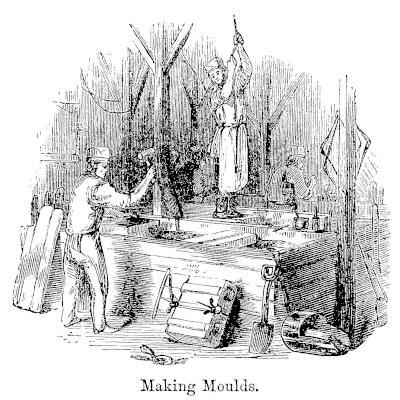
Making Moulds.
The method of making moulds for casting iron has already
been mentioned, and those employed by the Brassfounder
are quite similar, the tools used by the mould maker being
the trowel, mallet, rule, and sand hook, the shovel for removing
the sand, the brush for sweeping the surface, the
bellows for blowing off the dust, and the compasses for
measuring accurately.
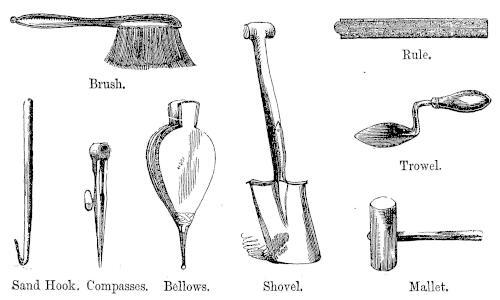
Brush. Sand Hook. Compasses. Bellows. Shovel. Rule. Trowel. Mallet.
The principal materials for making foundry moulds for
brass castings are fine sand and loam mixed in various proportions,
according to the nature of the work. New sand is
used for fine castings, old sand for ordinary work. The
requisite external support is given by a couple of shallow
rectangular iron frames without tops or bottoms, called
flasks or casting boxes.
The two halves constituting a casting box carry ears
corresponding exactly with one another, one set pierced
with holes, the other furnished with points entering truly
into these holes, and which may be made fast in them by
cross-pins or wedges. One of the flasks is laid face downward
on a board longer and wider than it, and is then
rammed full of moulding sand; the surface is struck off level
with a straight metal bar or scraper, a little loose sand is
sprinkled upon it, and another board of proper size placed
over it and rubbed down close. The two boards and the
flask contained between them are turned over and the top
board is taken off; the clean surface of moist sand now
exposed is dusted over with perfectly dry fine parting sand,
or very fine red brickdust. The patterns or models are now
properly arranged on the surface of the same, the cylindrical
or thick parts being partly sunk in the latter, and care
being also taken to leave sufficient space between the several
patterns to prevent one part breaking into the other, and
also passages or ingates, by which to pour in the metal and
allow the air to escape. The patterns are arranged on both
sides a central passage or runner, technically called a ridge,
from which again small lateral passages are made, leading
into every section of the mould. The general surface is
then properly arranged with the aid of small trowels, and
a little fine parting sand or brickdust is shaken over it.
When this has been accomplished, the upper part of the
flask is fitted to the lower by the pins, and then also
rammed full of mould sand. The fine dry parting sand or
brickdust serves to prevent the two halves from sticking
together. A board is now placed on the top of the upper
half, and struck smartly in different places with a mallet,
after which the upper half and its board are lifted up very
gently and quite level, and then turned over, so that the
upper half rests inverted on its board. The models are
next removed, and channels scooped out from the cavities
left by them to the hollows or pouring holes (ingates) at
the end of the flask. Solid cores of sand or metal are
adjusted in the proper places when the article is required
to be cast hollow (brass cocks, for instance), and also iron
rails intended to have brass heads cast on them, or such
other articles of iron as are required to be solidly united
with the brass. The faces of both halves are now finally
dusted with waste flour or meal dust; the two halves are
then replaced upon each other, and the box is fixed together
by screw clamps. The moulds for fine castings (articles
with ornamental surfaces, as screens, sconces, bell-levers,
&c.) are faced with various fine substances, such as charcoal,
loamstone, rottenstone, &c. that they may retain a sharp
impression; after which they are most carefully dried.
For ordinary work it is generally considered better that
the sand should retain a little moisture, though great care
must be taken in this respect, to guard against the danger
of explosion.
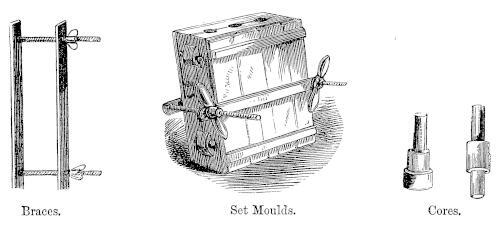
Braces. Set Moulds. Cores.
The mould then is a square frame, mostly of iron, filled
with peculiar dark red sand, which is pressed into a firm
mass, in which the patterns of the casting are imbedded
and their perfect shape impressed. The casters work at a
large trough filled with the sand, and the workshop, with
its forge, has some resemblance to a bakehouse where black
bread is being kneaded into loaves. The first mould is
made for what is called the “odd side” of the pattern—that
is to say (in solid castings), the lower, or inferior side—and
this serves as a sort of pattern to which the moulder
refers in fine castings. The pattern being lifted off or out
as soon as the sand-mould is sufficiently solid, the whole
surface, in which the chasing of the pattern is clearly
defined, is dusted with bean-floor or pounded “pot” first,
and afterwards with loam, sand, charcoal, or coal-dust.
This has the effect of making a smooth surface, and
effectually filling the interstices in the sand, so as to
prevent any raggedness in the casting. Each mould, or
rather the two sides of the mould, are then placed near
the surface and slightly baked, a channel having been made
in the edge of each for conducting the melted metal to the
pattern. The two sides are then placed together and held
firmly by their pins and sockets, and the mould is ready for
the casting. The “pots,” or crucibles of greyish clay, which
turn red by the action of the fire, are in the furnaces like
so many tall flower-pots. The dirty yellowish brass ingots,
made on the premises at a large mixing furnace, having
been first placed across the tops of the pots, that they may
expand before being melted, are about twenty minutes
afterwards reduced to a molten mass, above which hovers a
light sea-green flame mingled with streaks of brilliant colour,
like the water from a dyehouse; meanwhile the moulds
have been placed in a slanting position, with the opening
in the side upwards, against a bank of sand or brickwork,
and everything is prepared for pouring. A man, who should
be strong in the wrist, stands on the furnace, which has the
openings at the top, like a French cooking-stove, and taking
off the brick covers from the square aperture, whence rushes
out a tongue of green flame, lifts out the pot with a pair of
tongs, and after the dross is removed by the skimmer or
grunter, hands it to the pourer, who fills each mould in
succession. The fumes which rise from the midst of the
coloured fire are peculiar and penetrating, and the zinc
eliminated from the molten brass falls in a metallic snowstorm,
its flaky particles adhering to everything with which
they come in contact, while the resistance of the sand to
the metal causes a series of reports like muffled pistol-shots.
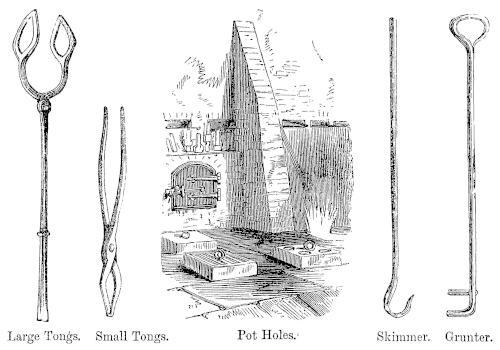
Large Tongs. Small Tongs. Pot Holes. Skimmer. Grunter.
The brass cocks and plugs used in gas-fittings are all cast
in one central stem, like cherries on a stick, their hollow
forms being secured by means of cores made of hardened
sand placed in the shape impressed in the mould. These
are broken off the central stem with a pair of pincers
immediately after casting.
The ornamental “vases” and larger ornaments which
form the body of ordinary gas chandeliers and lamps are
formed out of thin metal by a process called “stamping
out,” the plates of metal being placed on a hollow die, upon
which a heavy hammer, or rather weight, is brought down,
being released from a latch and worked by the foot. The
depth of the casting would make so heavy a blow necessary
that there would be danger of splitting the metal, an
accident which is prevented by the introduction of a leaden
shape and a layer of clay, which is decreased after each
blow of the hammer until the proper depth is gradually
secured without injury.
The process called “reversing” is an operation which
secures a hollow casting, the inner or hollow side being
called the “reverse.” For this purpose a mould is made
from one in wax, and the impression in the mould hardened,
so that another model can be taken from it. This enables
the moulder to secure a core which fits the impression in
the mould, as one cup would stand inside another; and
between the mould containing the sunk pattern and that
with the projecting core there are placed strips of black
clay, to secure sufficient thickness of metal, by not allowing
the hollow to be too accurately filled. The pattern when
cast is “laid out” on a hollow hemisphere of iron filled with
pitch, and the irregularities of the casting removed by
hand tools, files, rasps, and knives. In the case of figures,
such as cupids, &c. forming ornaments for candelabra, the
various limbs have often to be modelled in separate “cores,”
which are afterwards baked hard, and put together like a
puzzle-map, imbedded in the sand of the mould previous
to casting. This requires great skill to effect successfully,
and an experienced “reverser” is a man of mark in the
factory.
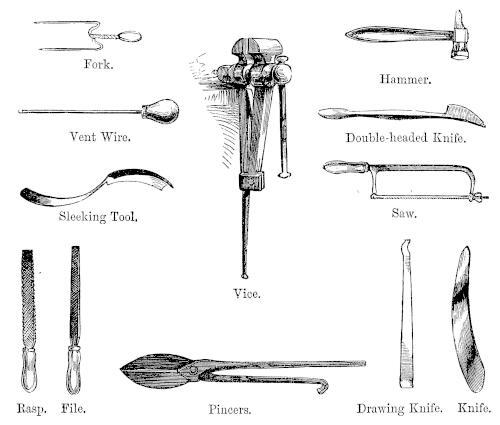
Fork. Vent Wire. Sleeking Tool. Rasp. File. Vice.
Pincers. Hammer. Double-headed Knife. Saw. Drawing Knife. Knife.
The completed castings are now removed to the chasing-room,
where we may watch the gradual process of beautifying
to which they are subjected, and the sharpening of the ornamental
details by means of tool and graver, in a similar
way to the first rough “laying-out,” which removes the
irregularities of the pattern. The arms and branches which
form a part of the gas chandelier work, as well as many of
the scroll-work ornaments, are cast in halves, which are
taken to the soldering-room, where a workman, seated at a
forge-like furnace, heats them in the burning embers, and
applies to the edges the solder, with which is mingled a
flux of borax and water to secure its melting. The heat is
increased by a blowpipe, which is in reality a double or
jacketed tube, the inner one supplying gas, and the outer
being connected with a large pair of bellows, and mixing
atmospheric air with the lighted gas at the point of combustion.
The pickling room is a large shed-like place filled with
tubs, troughs, and earthen pans. Into one of these, containing
diluted aqua-fortis, the metal is plunged for the
purpose of removing the scale produced on the surface by
the action of the fire; from this it is dipped in a stronger
solution, to undergo the process called “fizzing,” and its
final baptism in pure acid restores the beautiful primrose
colour which properly belongs to it. It is still dull, however,
and goes to be “scratched,” an operation effected by
means of a revolving wire-brush, turned by a wheel and
treadle, and kept continually wet with water.
The ornamental processes have next to be considered,
and these are many. Previous to burnishing, the work is
dipped in argot or tartar (the lees of wine-casks steeped in
water), so that it may be subject to a strong antioxyde.
The burnishing itself produces those bright veins and
ornamental surfaces so often seen in brass work, and is
effected by fixing the work in a vice, and rubbing the parts
of the pattern which are to be brightened with a steel tool
having a smooth bevel edge. After being treated with ox-gall,
bean flour, and acid, to remove any still adhering grease,
the work is dried, by being first dipped in hot water and
afterwards buried in a pan of warm sawdust. Then there
is lacquering, both black and white, a simple process enough,
since the lacquer is laid on with a brush, and the work
dried on a warm plate. Much of the work of the Brassfounder,
as far as regards these latter operations, is of course
effected by machinery, but the casting itself is entirely completed
by the skill of the workmen.
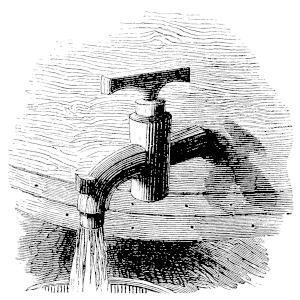
THE GILDER.
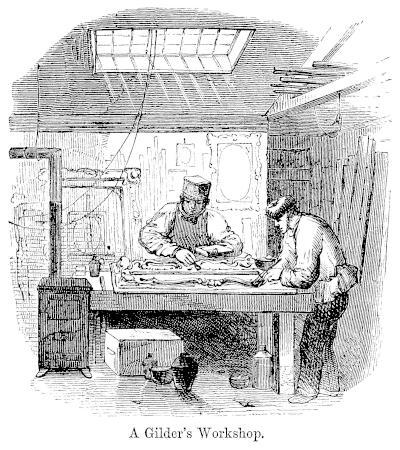
A Gilder’s Workshop.
When once the house is built and the work of bricklayer,
carpenter, plumber, painter, glazier, and mason is finished,
it is necessary to set about those decorations which accompany
the furnishing; and one of the first of the trades
needed for this purpose is that of the Gilder, who has to do
not only with cornices, mouldings and other ornaments, but
also with the frames of pictures and looking-glasses that
adorn the walls and chimney-pieces.
These frames, however, have first to be made by the
joiner, and then receive the work of the carver, or the ornament
maker. The joiner does little more than put the
plain groundwork of the frame together; but the duty of
the carver is of a very artistic description; and to be a good
carver in wood requires an education and a taste very nearly
equal to that of the sculptor, with whom the artists in wood
formerly held a high rank.
Most of the ornaments now used for frames, however,
are less expensive than those formerly produced by the
carver who added a fresh value to the painting or the
looking-glass by exercising his skill upon the costly settings
in which they appeared. Composition ornaments are now
in general demand for all but the most expensive frames,
and as this composition—which is formed of glue, water,
linseed oil, resin, and whiting—is pressed into moulds when
it is of about the consistence of dough, it is evident that
the mould maker has partially taken the carver’s place.
A new substance, however, has to a great extent superseded
the old composition, and this is papier-mâché, or the pulp
of paper (literally, mashed or beaten paper), which, from
its lightness, its greater strength and durability, and the
thinness to which ornaments made of it can be reduced, is
preferable for all large decorations.
Whatever may be the size or pattern of the frame, however,
we will suppose that the ornament maker received it
from the joiner, who puts it together after it has been
covered with coatings of hot size and whiting; the size
being made from parchment cuttings or kid leather parings
boiled to a sort of jelly. The nail or screw holes are then
filled up with putty by the help of the putty knife, and the
surface of the frame smoothed with pieces of pumice stone.
The ornament maker next fixes on the decorations and hands
it to the Gilder, whose first business is to wash the ornaments
carefully in order to remove any oil that may have remained
on their surface from the inside of the cast.
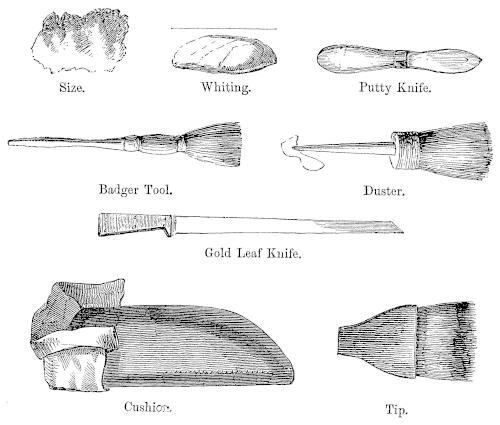
Size. Whiting. Putty Knife. Badger Tool. Duster.
Gold Leaf Knife. Cushion. Tip.
The principal tools required by the Gilder are, first: the
cushion, which is a flat board covered with several layers
of woollen or flannel and afterwards with a piece of
leather, which is stretched tightly over it and nailed down
to the edges, thus forming a firm but soft and elastic bed.
A rim of parchment carried round one end of the cushion
serves to hold the gold leaf. Second: a gold leaf knife—which
is a straight smooth-edged instrument, not very
sharp, but carefully pointed at the end. Third: the tip—a
tool generally made of two pieces of card or very thin
board glued together and holding between them a row of
camel’s hairs. It is also necessary to have a badger tool
and a duster; the first for removing the loose edges and
flying scraps of gold leaf, after the gilding is completed,
and the latter for brushing away dust from the frame.
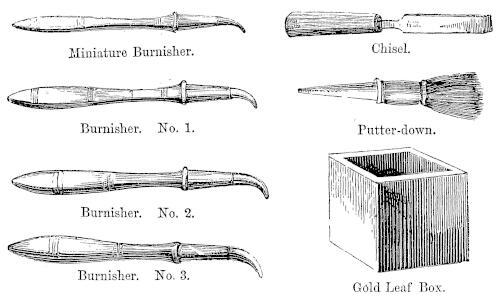
Miniature Burnisher. Burnisher. No. 1. Burnisher. No. 2.
Burnisher. No. 3. Chisel. Putter-down. Gold Leaf Box.
The burnishers are pieces of smooth stone (flint or agate)
set in handles, and are used for rubbing some parts of the
gold, when it is set on the frame, until it attains a brilliant
polish and smoothness of surface: the bright gold portions
of a frame being known as burnish, and the dull parts or
“dead gold” as matt.
A chisel and knife are necessary for removing any inequalities
or overflowings of size from the edge of the
frame; the feather duster is used to dust the new gilding
before it is sent home; the size pot is the vessel in which
the size is melted, and the pan receives it before it is laid
on. The putter-down is a large soft brush used for
pressing down the gold into the ornaments, and removing
the ragged edges of the gold-leaf from those parts of the
frame where it is most difficult to place it smoothly.
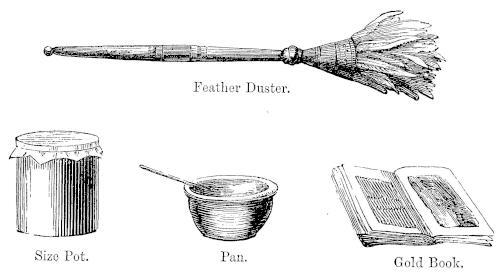
Feather Duster. Size Pot. Pan. Gold Book.
The gold box is of course a receptacle for the gold leaf,
and as the leaf is sent from the gold beaters in sheets placed
between leaves of paper sewn together like a volume, this is
naturally called the gold book.
Having received his frame, then, the Gilder first gives it
two or three coatings of “thin white,” which is the name by
which the size and whiting is known in the trade. If any
part of the frame is to be burnished, it afterwards receives
a coat or two of rather thicker size.
When these are dry, strong warm size is laid on with a
brush; this is called clear cole, and produces a smooth glossy
surface, which prevents the oil gold size from sinking
through. Oil gold size is the next coating given to the
frame, and it is made of ochre and boiled linseed oil,
ground up together into a smooth creamy liquid, which is
thinned with more boiled linseed oil, and put on very carefully
with a soft brush. In a few hours, after the oil gold
size is put on, it is sufficiently dry to receive the gold leaf;
the surface being then slightly sticky, so that it will hold it
firmly and without its own surface being disturbed.
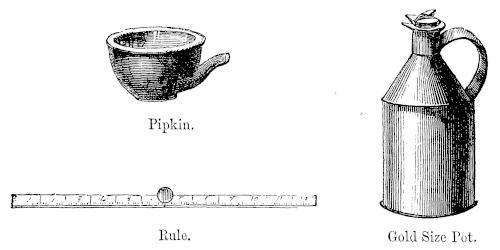
Pipkin. Rule. Gold Size Pot.
The Gilder now commences the most important part of
his work by taking the cushion on his left hand, with his
thumb through a loop which is attached to the bottom of
the leather; between the fingers of the same hand he places
the tools that he will have to use,—namely, the tip, the gold
knife, and the camel-hair pencil. He then takes a gold
book and carefully blows out a leaf at a time on to the
cushion, until he has eight or ten leaves all heaped together
within the rim of parchment which holds them from flying
away. This is a very delicate operation, since if he should
blow too hard the leaves would be carried all over the room.
He next separates one of the leaves from the rest with his
knife, and without cutting or tearing it lays it down
smoothly upon the front part of the cushion, partly by
a gentle use of the knife itself, and partly by skilfully
blowing upon it. Then taking the tip in his right-hand
he carefully presses it on the leaf, to which it adheres, and
by this means transfers it to that part of the frame where
he is at work. Where the ornaments are very deep, the
same part is gilt three or four times over, and the gold is
sometimes pressed in with a wad of cotton.

Skewing Brush. Small Pencil.
After the whole surface is carefully skewed, or gone over
with the brush which removes the ragged edges and still
further presses the gold into the ornaments, the frame is
well dusted with another soft brush, and then sized with
clear size, after which the work is complete.
Supposing however that any part of the frame is to be of
burnished gilt, the clear cole and the oil gold size must not
be suffered to touch that portion,—burnish gold size, a substance
made of grease, clay, black lead, red chalk, and
bullock’s blood, is used instead of the oil gold size. Several
coats of this are laid on the part to be burnished, each being
allowed to dry, and perfectly smoothed, before the other is
applied. The surface is then washed with a sponge and
clean water, another coating of gold size is laid on, the
gold leaf is applied, and the burnishing tools used to
impart the required lustre.
THE CABINET MAKER AND UPHOLSTERER.
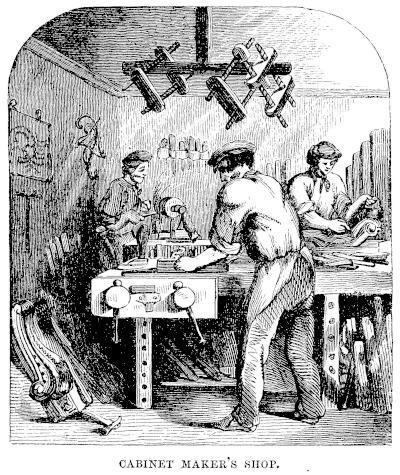
CABINET MAKER’S SHOP.
The trades of the Carpenter and the Joiner having been
considered, we may now turn to that of the Cabinet Maker,
who, though he makes the furniture of the house, and
seldom has anything to do with building or fitting the
house itself, uses many of the same tools as the joiner.
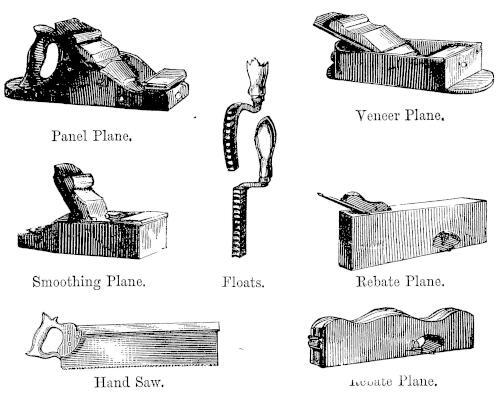
Panel Plane. Veneer Plane. Smoothing Plane. Floats.
Rebate Plane. Hand Saw. Rebate Plane.
As the Cabinet Maker mostly works in more costly
woods, and the operations of his trade have to be performed
with greater nicety, his implements are generally
of rather a better sort; while he has to fashion the articles
in which he deals in so many different shapes that some
of his tools, such as planes and gouges, are constructed
especially for him, like the panel plane, used as its name
implies in smoothing and forming the edges of panels for
wardrobes, chiffoniers, and other pieces of furniture before
they are placed in their frames, and the veneer plane,
intended for putting on veneers, or the thin slabs of costly
wood with which more common woods are frequently
covered. The smoothing plane and the rebate plane, as
well as the hand saw, the tenon saw, the gimlet, and the
rule and square, have already been mentioned in connexion
with the joiner’s business.
Then there are moulding planes, with their blades shaped
hollow so that they will cut a strip of wood into a rounded
form, or shaped round so as to cut a hollow groove.
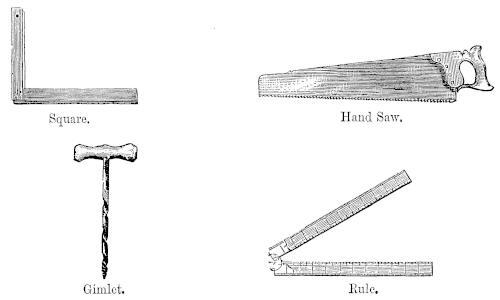
Square. Hand Saw. Gimlet. Rule.
Sometimes boards are joined at the edges by a process
called match boarding: a groove being made along the
edge of one board while the edge of another is cut with a
tongue along the middle to fit accurately into the groove.
For this purpose a pair of match planes are used, one of
which makes the groove and the other the tongue exactly
of the proper size to fit perfectly. This kind of joint is
used for common doors, which it is not worth while to frame
together in panels. The boards after being matched are
nailed close together to strong cross-pieces.
The operations of mortising and dovetailing have been
described in the description of joiner’s work. The various
fittings and joints used in making chairs, couches, tables,
cabinets, side-boards, and other furniture are adaptations of
the same kind, or differ only according to the shape and
position of the various parts. In ornamental cabinet work
the separate parts, such as pillars, legs, arms, and other pieces,
are often supplied by the turner and the wood carver, who
sometimes carry out their designs under the direction of the
Cabinet Maker.
Mahogany and many other of the harder woods are
difficult to work, as the grain does not all run the same
way, so that in planing them the wood is likely to split or
chip where it should be shaved off smoothly. To remedy
this inconvenience, the Cabinet Maker’s planes are furnished
with double irons, that is, an iron with a flat dull edge is
screwed on to the face of the cutting iron, so as to prevent
the shavings chipping against the grain. The more cross-grained
the wood is the closer the workman brings down
the dull iron towards the edge of the sharp one, and his
shavings are consequently finer.
The veneering plane is about the same size as the
smoothing plane, but the iron instead of having a smooth
edge is toothed like a fine saw, so that, instead of taking off
shavings, it makes scratches all along the grain of the wood.
This is applied to the veneer as well as to the wood to
which the veneer is to be glued, so that the glue may easily
hold the two rough surfaces together.
Tool Chest.
Previous to the veneer being put on, the work is well
warmed before a fire, and the glue brush worked freely
over both the veneer and wood to which it is to be applied.
When the veneer is put on, it is rubbed backward and
forward, at the same time being pressed down with the
hands until it sticks in the right place. There are often
lumps here and there where there is too much glue, and
these are remedied by the veneering hammer, the head of
which is made of wood furnished with a strip of iron plate.
This strip is laid flat on the veneer, and the head of the
hammer pressed with the hand while it is worked about by
the handle, pressing out the glue as it moves towards the
edge. When a piece of furniture is too large to be covered
with one veneer, these thin slabs of wood are laid on in
several pieces, the edges being first planed quite straight
and made to meet with the greatest accuracy. The whole
surface is afterwards worked with the toothing plane, and
then scraped with a flat square piece of steel, which takes
off a wonderfully fine thin shaving and leaves the surface
perfectly smooth. It is afterwards finished with sandpaper.
It is then French polished with a liquid composed mostly
of rectified spirits of wine, gum, shellac, gum seed lac, and
Venice turpentine, the furniture being previously well oiled
that it may better receive this sort of varnish.
Clamps are a sort of screw vice for holding the various
parts of the work. The bow saw is a small fine blade of
steel notched like a saw, and fixed to a short handle,
from which a wooden or metal bow extends to the other
end of the blade. The bow keeps the saw from buckling
or breaking, and the tool is used for small work, like the
fretwork in front of pianos, where a corner has to be turned
and the piece sawn out. The screws seen in the larger
picture hanging above the Cabinet Maker’s bench are used
for holding pieces together after being glued, or on other
occasions.
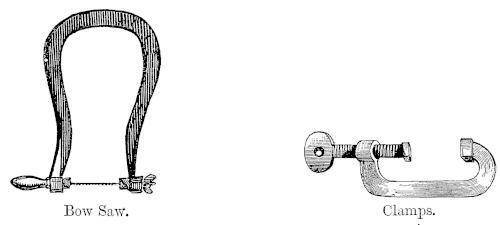
Bow Saw. Clamps.
It is supposed that there are about 50,000 workers in
wood in London, and 350,000 in all England. About
160,000 timber trees of average size are required to make
the furniture for the new houses built every year in England
and Wales. In cabinet making there are many departments,
such as the chair maker, the bedstead maker, the
carver, the general manufacturer of tables, drawers, side-boards,
wardrobes, &c. and the fancy Cabinet Maker, who
uses costly woods and makes workboxes, desks, dressing-cases,
and similar articles.
A good set of Cabinet Maker’s tools is worth from £30
to £40.
The Upholsterer, whose trade is generally joined to that
of the master Cabinet Maker, does what is called the “soft
work,” that is, he undertakes the curtains, hangings, cushions,
carpets, beds, and the stuffing of the seats of chairs. For
these operations he requires but few tools.
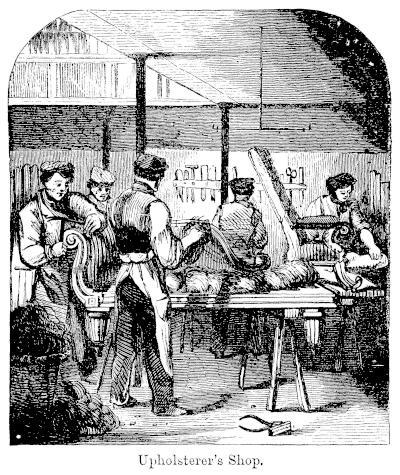
Upholsterer’s Shop.
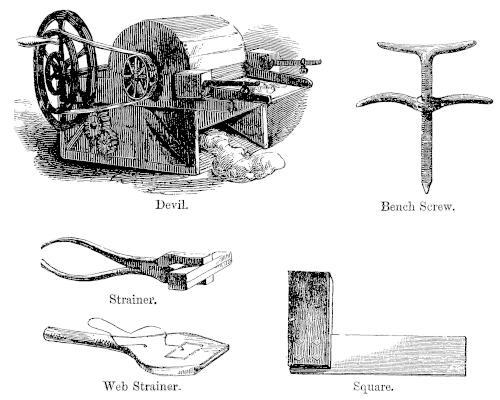
Devil. Strainer. Web Strainer. Bench Screw. Square.
The devil is the ugly and very absurd name given to a
machine consisting of a box, inside which a spiked wheel
turns; the use of this implement is to separate and tear
to pieces such woven substances as, when reduced to
shreds, serve for the stuffing of furniture, as also to soften
and make finer hemp or tow for the same purpose, when
horsehair, which is the best and most expensive material, is
not used. Cocoa-nut fibre is now sometimes applied for
this purpose; and in the commonest furniture hay is
frequently placed as a foundation, with a small quantity of
horsehair on the top. The bench screw is a kind of vice
which will hold a very thick substance, like the seat of a
chair or sofa, without injuring the woodwork; the web
strainer is used for stretching strong cross-pieces of webbing
across the bottom of the seats of chairs or couches, to
make a firm foundation for the stuffing to rest upon, and
with the ordinary strainer to bring the canvas cover that
confines the stuffing tightly and firmly to its place, an
operation which requires great care, especially when metal
springs are placed beneath the horsehair to make the seat
more elastic. The Upholsterer’s hammer is of such a shape
that it will drive a small nail deeply down in a space when
it is hidden by the damask or leather covering of the
furniture. The punches are for a similar purpose; while the
needle and the regulator are used in stuffing the seats and
properly adjusting the hair or other material.
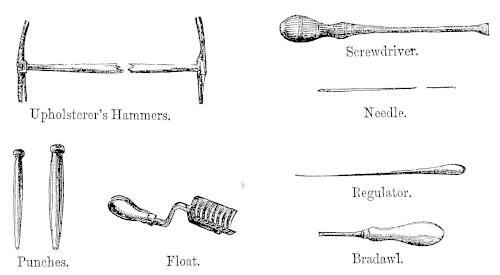
Upholsterer’s Hammers. Punches. Float. Screwdriver.
Needle. Regulator. Bradawl.
FLOOR-CLOTH MANUFACTURER.
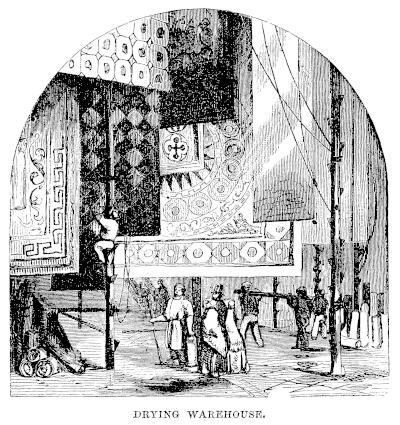
DRYING WAREHOUSE.
The trade of manufacturing floor-cloth may be said to be
connected with the furnishing of the house, since this very
useful covering for the floors of halls and passages is now
in almost universal use. Floor-cloth is generally made in
large factories built for the purpose, since considerable space
is required, not only for preparing, painting, and putting
the pattern upon the cloth, but also for drying it when it is
finished, the great lengths in which it is made rendering it
necessary to hang it from a great height, in order that it
may dry without the paint being damaged (see drying
warehouse). The smell of the paint and other substances
also makes it desirable to have the factory well ventilated,
and situated at some distance from dwelling-houses.
The cloth is made partly of hemp and partly of flax, the
former being the cheaper of the two, but the latter being
fitted to retain the oil and paint on the surface without
allowing it so easily to sink or soak through. In order to
avoid the necessity for seams or joinings in the cloth, looms
are constructed expressly for weaving canvas of the greatest
width likely to be required. When the pieces of cloth are
taken to the floor-cloth factories, they are generally either
100 yards long and 6 yards wide, 108 yards long and
7 yards wide, or 113 yards long and 8 yards wide. The
flax and hemp are spun and the canvas woven principally
in Scotland, in the town of Dundee.

Shears. Cutting Knife.
The canvas is cut into pieces (see cutting knife and
shears), varying from 60 to 100 feet long, and each of
these pieces is stretched over a frame in a vertical position,
most factories having a large number of such frames, some
often 100 feet long by 18 or 20 feet high, and others of
smaller dimensions. A wash of melted size is applied by
means of a brush to each surface; and while this is wet the
surface is well rubbed with a flat piece of pumice stone, by
which the little irregularities of the canvas are worn down,
and a foundation is laid for the oil and colour afterwards to
be applied.
The preparation of japanned cottons, which are used for
table covers, or what is known as “oil-cloth,” is very
similar.
The paint employed for floor-cloth consists of the same
mineral colours as that used in house painting, and is
mixed with linseed oil in the same way; but it is very
much thicker and stiffer in consistence, and has very little
turpentine added to it. The canvas receives several coatings
on the back as well as on the front, and is well dried and
smoothed at intervals.
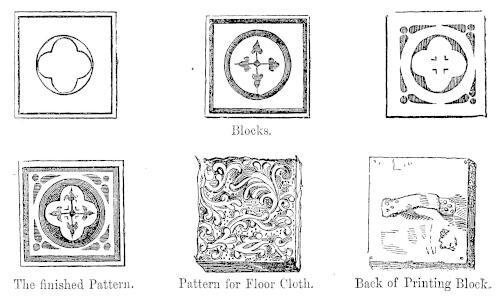
Blocks. The finished Pattern. Pattern for Floor Cloth.
Back of Printing Block.
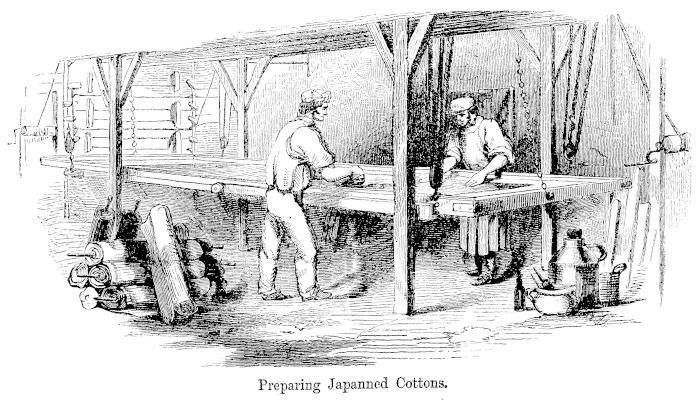
Preparing Japanned Cottons.
The pattern is placed on by means of wooden blocks, on
the first of which the rudiments, or ground work, of the
design is cut, and on the rest other portions of the pattern,
so that, as they are covered
with paint and applied to
the cloth by the workman,
the pattern is gradually
printed, and appears in the
different colours which are
successively applied to each
block.
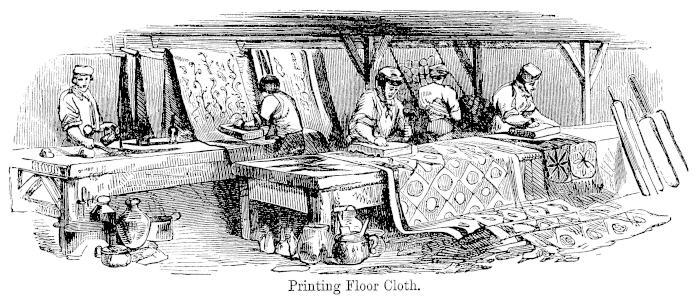
Printing Floor Cloth.
The blocks are made of
pear-tree wood on one side
and of deal on the other, the
pear-tree wood being more
easily engraved with the
pattern.
The blocks (which we
will suppose to be four for
one pattern—red, yellow,
blue, and green) being
ready, and the prepared
canvas spread out on a flat
table, the printing commences.
The paint (say red) is
applied with a brush to the
surface of a pad or cushion
formed of flannel covered
with floor cloth; the block
held by a handle at the back
is placed face downwards
on this cushion, and the
layer of paint thus obtained
on the surface of the block
is printed on the canvas by pressing the block smartly down
upon the surface of the latter. A second impression is
made in the same way, by the side of and close to the first,
until the whole surface of the canvas is printed over with
the pattern of this first block, which is generally about 15
inches square. Then the second block is applied, and adds
a little more to the pattern in another colour; the third
follows, adding still more; and then the fourth, which
completes the printing.
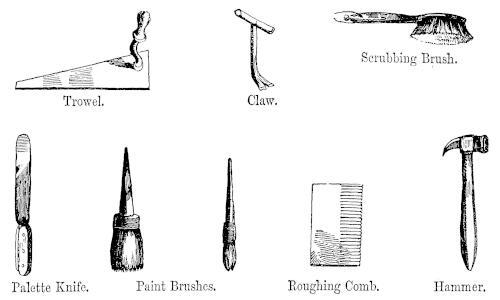
Trowel. Claw. Scrubbing Brush. Palette Knife.
Paint Brushes. Roughing Comb. Hammer.
The trowel and palette knife spreading and mixing
the paint, the roughing comb for patterns where the grain
of wood is imitated, and the pots, cans, and jars, for the
colours, are the principal tools besides those already described.
THE PAPER STAINER.
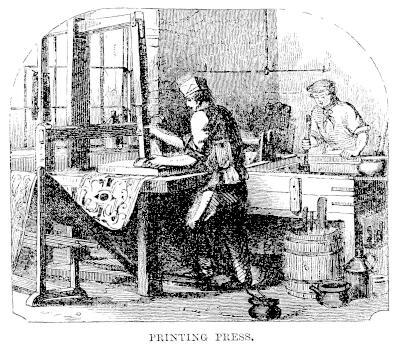
PRINTING PRESS.
The trade of the Paper Stainer has grown to be one of
considerable importance, and this is not to be wondered at
when we consider how much the art of paper staining has
increased the means of decorating our houses, by hanging
the walls with elegant patterns printed in beautiful colours,
instead of leaving them of one dull uniform hue, or a bare
surface of wood and plaster.
In old times the walls of rooms were either of panelled
wood, sometimes carved and polished, or were hung with
tapestry made with the needle, or with woven silk, cotton,
or linen, but the former was extremely costly, and the
latter neither cleanly nor healthy. The trade of the Paper
Stainer has to a great extent superseded both, and the
interior walls of houses are now seldom formed entirely of
wood, since they are intended to be covered with various
qualities of paper hangings.
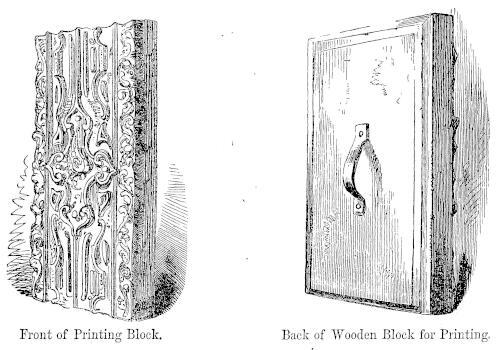
Front of Printing Block. Back of Wooden Block for Printing.
The mode of printing or painting a pattern on large
sheets of paper has now been in use for nearly two hundred
years, although, of course, improved methods are at present
employed.
There are three modes of producing the pattern on paper
hangings. 1st. Wooden blocks are carved with the outlines
of the figures only in relief; with these the paper is printed,
and the pattern is afterwards finished by hand painting
with a pencil. This mode is slow and too expensive for
ordinary use. 2dly. A sheet of leather, tin, or copper, is
cut with holes in the required pattern, and a brush dipped
in colour is worked over the sheet after it is laid upon the
paper, so that the paint goes through the holes, and leaves
the pattern in colour. This is called stencilling, and is
only employed for very common hangings. The third process
consists of carving a wood block for each of the colours
used in the pattern, and printing the paper by almost
exactly the same method as that employed for printing
floor-cloth, an operation which has already been described.
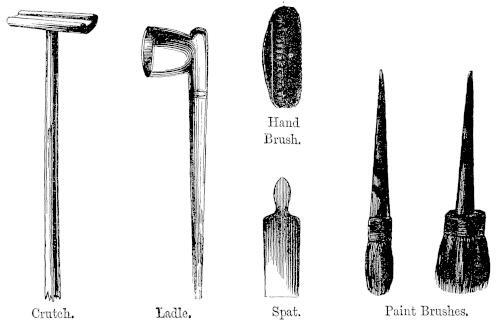
Crutch. Ladle. Hand Brush. Spat. Paint Brushes.
The paper is printed in pieces twelve yards long. A piece
is laid out on a long bench and the ground colour applied,
consisting of whiting tinted with some sort of pigment and
liquefied with melted size. This is laid on with large
brushes. When the paper is dry it is ready to receive the
print at the printing press, where the blocks are pressed
upon it by a sort of weighted arm which comes down from
above the centre of the bench. There must generally be as
many blocks as there are colours in the pattern.
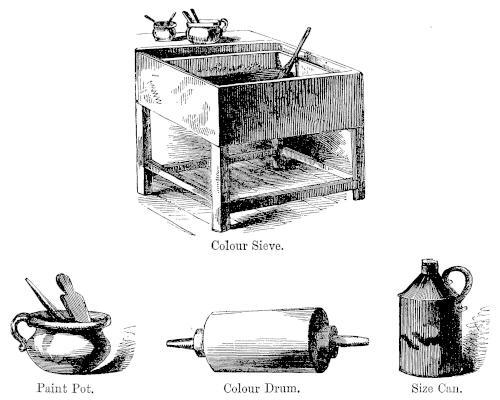
Colour Sieve. Paint Pot. Colour Drum. Size Can.
Some paper hangings have a glossy or satin ground. To
produce this a ground of satin white, properly tinted, is laid
on; this ground is then rubbed with powdered French
chalk, and worked with a brush till a gloss is produced.
Sometimes these papers are passed between heated rollers
which have been engraved with a sort of pattern, and this
produces a pattern without any additional colour, like that
of figured or watered silk.
Flock papers are those in which part of the pattern
resembles cloth. To produce this the pattern is printed,
not in paint, but in size, and then the paper being passed
through the flock drum, the flock (which is composed of
fragments of woollen cloth) adheres to the pattern.
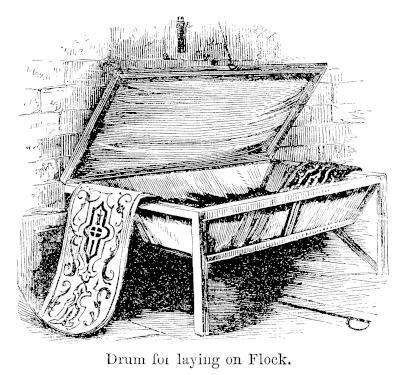
Drum for laying on Flock.
Striped hangings are sometimes produced by the paper
being quickly passed on a roller beneath a trough, the colour
in which flows through a number of parallel slits in the
bottom; and occasionally various coloured stripes are obtained
by dividing the trough into cells, with one cell and
one slit for each colour. Some papers, in order to bear
washing or cleaning, are printed with colours mixed with
oil or varnish instead of size.
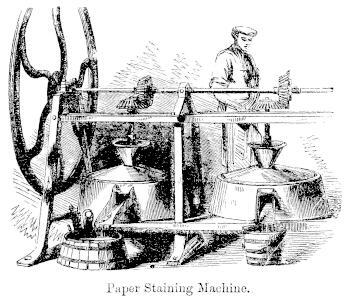
Paper Staining Machine.
THE CALICO PRINTER.
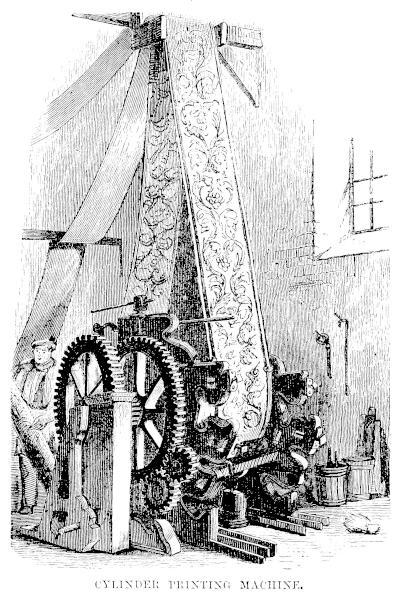
CYLINDER PRINTING MACHINE.
The trade of the Calico Printer may be said to be one of
the most important in this country, since we export such
immense quantities of cotton prints to our various colonies,
as well as to other countries in the world, that this business
forms a very considerable part of British commerce.
Calicoes, muslins, &c. intended for printing must first have
the fibres removed from their surface by the operation of
the singeing machine; which consists of a half-cylinder of
iron or copper laid horizontally, and kept at a bright heat
by a range of gas-flames or a furnace; over this half-cylinder
the length of cloth is drawn with a steady motion
till the down or fibre is singed off.
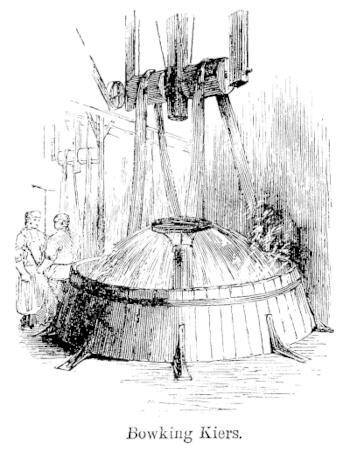
Bowking Kiers.
The next process is that of bleaching, because the whiter
the cotton cloth becomes, the more light it will reflect from
the surface, and the more brilliant the colour of the dyes
will appear.
The principal chemical substance used for bleaching
cotton is chloride of lime, which is known as bleaching
powder; but there are several processes employed in its
application, as well as various methods which are adopted
by different manufacturers to increase its effects by mechanical
contrivances, the application of heat, or otherwise.
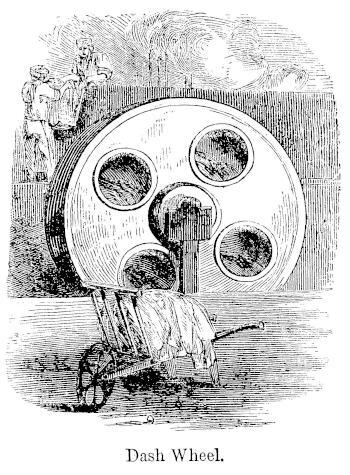
Dash Wheel.
The first operation of bleaching, however, and that which
immediately follows singeing, is boiling the cloth in an
alkaline bath consisting of a solution of soda. For this purpose
a bowking apparatus is used. This machine (see cut) is,
in fact, a large cauldron, with a flat false bottom to protect
the cloth from being scorched by the fire beneath. Through
the centre of this false bottom a vertical pipe rises from
near the real bottom to a height above the top of the
cauldron, and carries a conical cap like an umbrella above
its open end at top. When the liquid in the cauldron
begins to boil thoroughly the steam forces a constant stream
of liquid up the pipe, which stream is scattered by forcing
against the umbrella-shaped cap, and so falls with some
force back on to the cotton in the cauldron. When this
process has continued long enough, the liquor is allowed to
cool, and the cotton is taken to be rinsed at the dash wheel,
where it is subjected to the free action of water, or to a
rinsing machine, so constructed that the web travels on
rollers, and is thoroughly washed during its course.
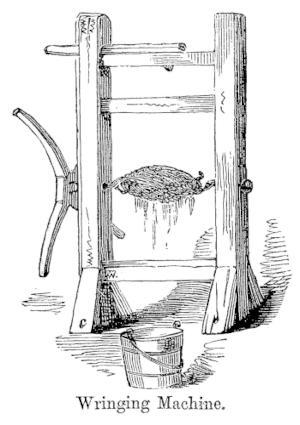
Wringing Machine.
The simplest and earliest method of imprinting figures
upon calico is by means of a wooden block, upon the face
of which the design is cut in relief, as in an ordinary wood-cut.
The block is of sycamore, holly, or pear-tree wood, or
more commonly of deal, faced with one of these woods.
The block varies in size from nine to twelve inches long,
and from four to seven inches broad, and it is furnished
on the back with a strong handle. When the design is
complicated, and a very distinct impression is required, the
figure is sometimes formed by the insertion of narrow slips
of flattened copper wire, the space between being filled
with felt.
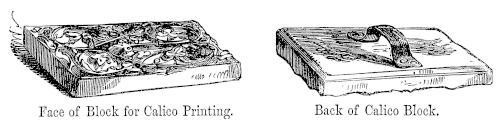
Face of Block for Calico Printing. Back of Calico Block.
The printing block, which is worked by hand, is charged
with colour by pressing it gently upon a piece of superfine
woollen cloth called the sieve, stretched tightly over a
wooden drum, which floats in a tub full of size or thick
varnish to give it elasticity, so that every part of the
raised device may acquire a sufficient coating of colour.
The sieve is kept uniformly covered with the colouring
matter by a boy or girl called the tearer, who takes up
with a brush a small quantity of the colour contained in a
small pot, and distributes it uniformly over the surface;
for if this were not done, the block would take up the
colour unequally.
The printing shop is a long well-lighted apartment, the
air of which is kept warm for the purpose of drying the
cloth as it is printed; to insure which it is passed over
hanging rollers, so as to expose a large surface to the air.
The printing table, which is about six feet long, is made of
some well seasoned hard wood, such as mahogany, or of
marble, or flag-stone, the object being to present a perfectly
flat hard surface. This table is covered with a blanket,
upon which the calico is extended, and the block, being
charged with colour, is applied to its surface, a blow being
given with a wooden mallet to transfer the impression fully
to the cloth. It is necessary, of course, to join the different
parts of the design with precision, and in doing so the
printer is guided by small pins at the corners of the block.
Thus, by repeated applications of the block to the woollen
cloth and to the calico alternately, the whole length of
calico is printed.
Drying Room.
By this method, a single block prints only one colour, so
that, if the design contain three or more colours, three or
more blocks will be required, all of equal size, the raised
parts in each corresponding with the depressed parts in all
the others; in order, therefore, to print a piece of cloth
twenty-eight yards long, and thirty inches broad, with three
blocks, each measuring nine inches by five, no less than 672
applications of each, or 2,016 applications of the three
blocks, are necessary. Thus it will be seen that printing by
hand is a tedious operation, requiring more diligence than
skill.
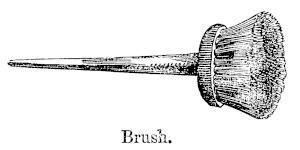
Brush.
When the design, however, consists of straight parallel
stripes of different colours, they may be applied by one
block at a single impression. For this purpose the colours
are contained in as many small tin troughs as there are
colours to be printed. These troughs are arranged in a
line, and a small portion of each colour is transferred from
them to the woollen cloth by a kind of wire-brush. The
colour is distributed evenly in stripes over the surface of
the sieve by a wooden roller covered with woollen cloth.
For the rainbow style, as a peculiar pattern is called, the
colours are blended into one another at their edges by a
brush or rubber.
An important improvement has been made in the construction
of hand-blocks, by the application of a stereotype
plate as the printing surface. A small mould is produced
from a model of the pattern, and the stereotype copies are
then made by pouring mixed metal into it. A number of
the stereotype plates are then formed into a printing block,
by being arranged in a stout piece of wood.
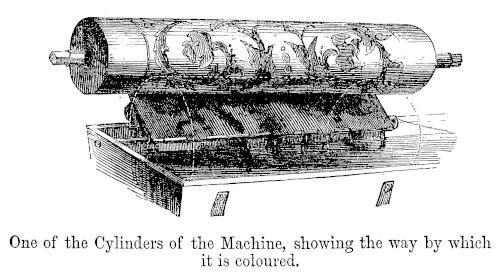
One of the Cylinders of the Machine, showing the way by which
it is coloured.
The greatest mechanical improvement in the art of
calico printing was the invention of the cylinder or roller
printing at the end of the last century. This style of
printing has been generally adopted in Lancashire, and is
the cause of the success of the English over the continental
printers. One cylinder machine, attended by one man to
regulate the rollers, is capable of printing as many pieces
as one hundred men and one hundred girls could print with
hand blocks in the same time. A mile length of calico can
be printed off with four different colours in a single hour.
This cylinder machine consists of a hollow cylinder or
roller of copper, about three feet long and three or four
inches in diameter, the pattern on which has been produced
by the pressure of a mill, on which the design has been
originally stamped by the pressure of a hard steel roller
which has been engraved.
The copper cylinders are mounted on a strong iron shaft
with a toothed wheel at its end, in order to put it in train
with the rotatory printing machine for one, two, or more
colours. On a roller at the upper part of this apparatus
are wound the calico webs stitched together, the end of
which is brought between the engraved copper cylinder and
a large centre roller covered with blankets, against which
it is made to bear with a regular pressure.
The engraved cylinder turns on the top of another
cylinder covered with woollen cloth, which revolves at the
same time as the former, while its under part dips in an
oblong trough containing the dyeing matter, which is of a
pasty consistence. The engraved cylinder is in this way
supplied with plenty of printing colour, and is cleared from
the superfluity by the thin edge of a blade made of bronze,
called the doctor, which is applied to it as it turns, and
gently scrapes the surface. After this the cylinder acts
upon the calico, which receives the impression of the
pattern in colour, and rolls onward at a great rate of
speed.
There are various kinds of colours or dye stuffs used in
calico printing, some of which impart fast colours by themselves,
and others which require the web to be first prepared
in order that they may become fixed.
In almost all the modes of calico printing the processes
are very numerous to ensure the beauty and permanence of
the colours. In what is called the steam colour printing, the
agency of steam is applied to aid in fixing the colours to
the cloth. The cloth is first steeped in a mordant or fixing
liquor, then printed by the cylinder in various colours,
called steam colours. It is then hung up to dry, and is
afterwards exposed to the action of steam by means of
various apparatus, which are adapted to the particular effect
intended, to be produced in fixing the dye.
The designs for calico printing are very expensive, and
such a constant succession of new patterns are demanded,
that some of the Lancashire printers expend several thousands
a year on designing and engraving alone.
THE TINMAN.
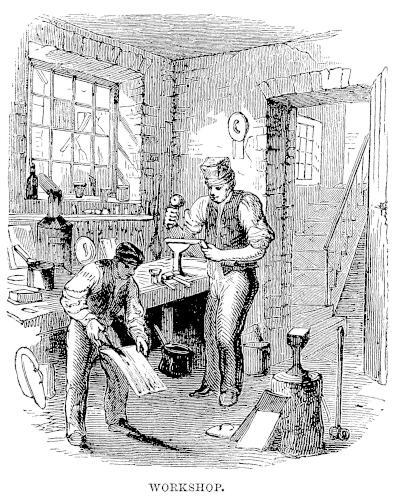
WORKSHOP.
Tin is never found existing in an uncombined or native
state. Tin ore occurs most abundantly in Cornwall and
Devon, the mines of these counties having been celebrated
for this metal from very ancient times. The district in
Cornwall where tin mines are most abundant is termed the
“Stannaries.” The Prince of Wales for the time being derives
a large income from the mines, and is termed Lord Warden
of the Stannaries. The word “Stannaries” is derived from
the Latin stannum, tin. The amount of tin ore annually
obtained from the Cornwall and Devon mines amounts to
11,000 tons, which, at the average value of £63 per ton, is
worth £693,000. This ore yields about 7,000 tons of the
metal, having an average value of £119 per ton. About
four-fifths of all the tin raised in the world is produced in
these mines. The ore is a heavy, hard, brittle, and usually
dark brown mineral, which occurs chiefly in granular masses
of various sizes. These grains are obtained in mines, where
they occur in veins mixed with other minerals, and also
from the beds of streams, where they have been washed
out of the soil by the action of running water. In the
former case they are termed tin stone; in the latter
stream-tin.
Tin is obtained from the ore by first breaking up the
latter, whilst a current of water flows over it and carries off
the impurities, which are lighter, and therefore more readily
borne away than the heavier tin ore. After being thus
freed from the admixture of other minerals, the ore is
usually roasted or burned, to drive off any traces of sulphur
it may contain; it is afterwards heated to redness with
blind coal or culm, and a small portion of lime, when the
melted metal separates from the dross, and runs into cavities
prepared for its reception. It is afterwards refined by being
remelted, and other impurities separated, which either sink or
float on the surface. The purest metal is yielded by the ore
called stream-tin, which is smelted with charcoal instead of
coal. If a block of tin thus obtained is heated slightly, and
then allowed to fall from a height, it separates into a number
of prisms which adhere together in pyramidal masses. In
this state it is termed grain-tin. Tin is a silvery-white
metal possessed of a high degree of metallic lustre. It is
sufficiently soft to be cut with a knife, and may be readily
bent, when it gives out a peculiar crackling noise; if repeatedly
bent and straightened, it becomes hot from the
friction of its particles with one another, and ultimately
breaks. It is inelastic and moderately ductile, but very
malleable, the thickness of tin-foil being about one thousandth
part of an inch. It has but little tenacity, a wire of one-tenth
of an inch in diameter not being able to support a
heavier weight than 49 lbs.
Tin is the most easily melted of all the common metals,
and it possesses the valuable property of not rusting when
exposed at ordinary temperatures to the conjoined action of
air and water, or even to weak vegetable acids. Tin, in a
pure state, is seldom employed; but in combination with
other metals it is a substance of great value. Its most
important uses depend on its power of resisting the action
of air and moisture; it is therefore largely employed for
protecting the surfaces of copper and iron, that rust so
readily.
Tin plate, or more properly tinned plate, which is so
largely employed in the manufacture of saucepans, coffee-pots,
tea-kettles, &c. by the tinman is not, as its ordinary
name seems to imply, made of tin, but is formed of the
best sheet iron, rolled out to the required thickness, and
coated on each side with a layer of tin. Copper vessels
ought to be invariably tinned inside, to prevent the rusting
of the copper by the action of acids. Tinfoil is largely
employed for the purpose of preserving moist articles from
becoming dry, and is used instead of paper for enclosing
fancy soap, chocolate, and other substances of a similar
nature. It is also extensively used in the manufacture of
looking-glasses, and is sometimes placed behind paper-hangings
to exclude the damp of the walls. The most
important alloys into the composition of which tin enters
are bronze, pewter, bell-metal, and solder. Tin dissolved
in acids is largely employed by dyers in fixing or rendering
permanent various colours used in dyeing. The preparation
termed putty powder is a rust of tin, obtained by exposing
the melted metal to the air; it is employed in polishing
metals and other articles.
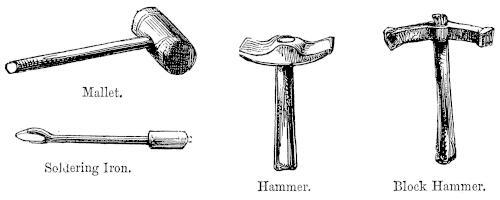
Mallet. Soldering Iron. Hammer. Block Hammer.
The tinning of the inner surfaces of cooking utensils and
other vessels of capacity is effected by scouring the surface
until it is perfectly bright and clean; then heating the
vessel, pouring in some melted tin and rolling it about, and
rubbing the tin all over the surface with a piece of cloth or
a handful of tow; powdered rosin is used to prevent the
formation of oxide. Bridle bits, stirrups, and many other
small articles, are tinned by immersing them in fluid tin.
Tin-plate working, or the forming sheets of tinned iron
into a variety of useful vessels and utensils, is carried on
by means of bench and hand shears, mallets, and hammers,
steel heads and wooden blocks, soldering irons and swages.
In the formation of a vessel, the first operation is to cut the
plate to the proper size and form with shears, and, when the
dimensions of the article require it, to join them together,
which is done either by simply laying the edge of one plate
over that of the other, and then soldering them together,
or by folding the edges together with laps and then soldering
them. Similar joints are required when gores or other
pieces are to be inserted, and also at the junction by which
a cylinder is closed in. The usual method of forming laps,
bends, or folds, for this or other purposes, is to lay the plate
over the edge of the bench and to bend it by repeated
strokes with a hammer; but a machine is sometimes used
for this purpose.
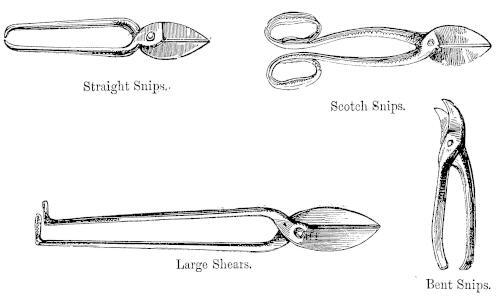
Straight Snips. Scotch Snips. Large Shears. Bent Snips.
After a tin vessel has been rounded upon a block or
mandril by striking it with a wooden mallet, and the seams
finished, all its exterior edges are strengthened by bending a
thick iron wire into the proper form, applying it to what
would otherwise be the raw edges of the metal, and dexterously
folding them over it with a hammer.
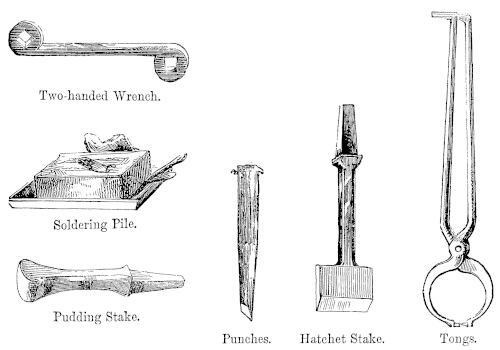
Two-handed Wrench. Soldering Pile. Pudding
Stake. Punches. Hatchet Stake. Tongs.
A superior kind of tin ware, commonly known as block
tin ware, is carefully finished by beating or planishing with
a polished steel hammer upon a metal stake. The process
of swaging is resorted to as a ready means of producing
grooved or ridged borders, or other embossed ornaments.
This process consists in striking the metal between two
steel dies or swages, the faces of which bear the desired
pattern, and are made counterparts of each other. Many
ornamental articles are produced by embossing or stamping
tin plate, in the same manner as other metallic sheets, with
a fly-press or other machinery. Cheap coffin-plates are
manufactured at Birmingham in this way; and these and
similar articles are sometimes lacquered, painted, or japanned.
Tin forms the principal ingredients in various kinds of
pewter and other white-metal alloys, which are manufactured
into domestic utensils by casting, stamping, and
other processes.
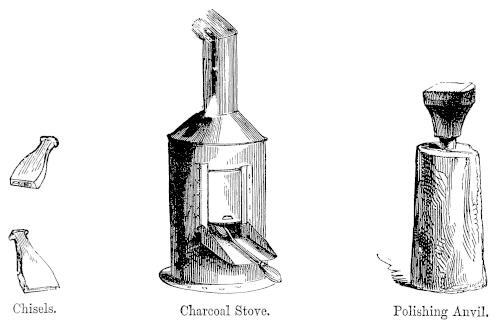
Chisels. Charcoal Stove. Polishing Anvil.
Britannia metal is a mixture of tin, antimony, copper,
and brass, which is melted, cast into slabs, and rolled into
sheets. The principal use of this metal is for candlesticks,
teapots, coffee-biggins, and other vessels for containing
liquids. The feet of candlesticks, the bodies of teapots,
and other articles containing embossed work, are stamped
between dies; while articles of a more globular shape are
stamped in two or more pieces, and afterwards soldered
together. The sheet metal has a ductility which enables
it to be bent into various curved forms by pressure on a
model or core: this process is called spinning.
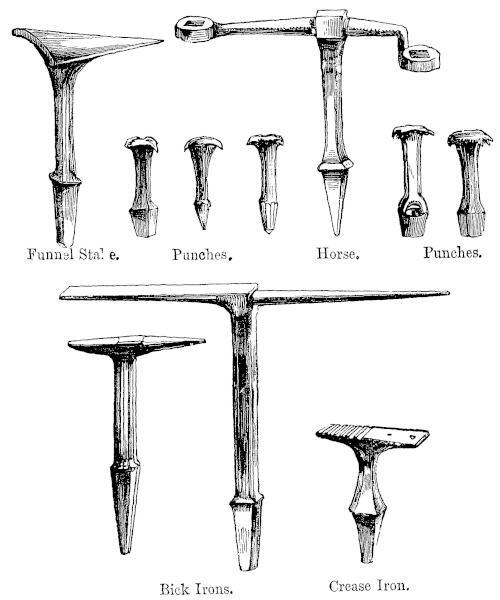
Funnel Stake. Punches. Horse. Punches. Bick Irons. Crease Iron.
Many small vessels, spoons, and other articles, are cast in
an alloy somewhat harder than that which is rolled into
sheets. Most of the tools employed by the Tinman are the
irons, stakes, and bickers, on which the tin is hammered
into proper shape, with shears for cutting, the punches for
piercing holes, and the soldering iron and charcoal stove
for making joints.
THE FARRIER.
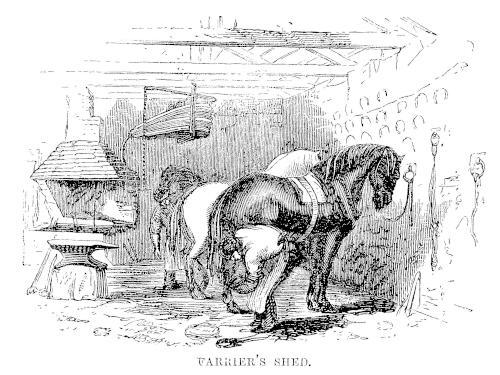
FARRIER’S SHED.
When we remember how usefully horses are employed for
our advantage, how generously and willingly they work,
and how docile and obedient they are when properly
treated, we shall begin to see that the trade of the
Farrier is one which should be studied very carefully,
and that nobody should follow the business who has not
become tolerably skilful. The Farrier who shoes the horses,
is very often consulted when those animals are ill, so that
he should have some knowledge of simple remedies in
cases when the veterinary surgeon lives at a distance, or is
out of the way. Especially the Farrier should thoroughly
understand the construction of the horse’s hoof, which, hard
and simple as it may look, is very delicate, and is composed
of several important parts.
One thing should never be forgotten in shoeing a horse,—first
that, although the hoof is a hard horny covering, it has
an inside portion which is very tender and liable to be hurt;
and secondly, that the hoof itself expands as the weight of
the horse presses upon it.
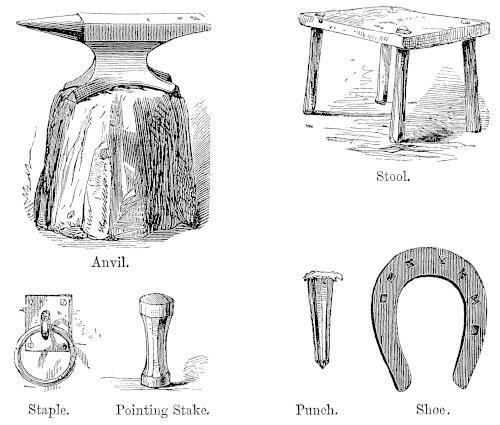
Anvil. Stool. Staple. Pointing Stake. Punch. Shoe.
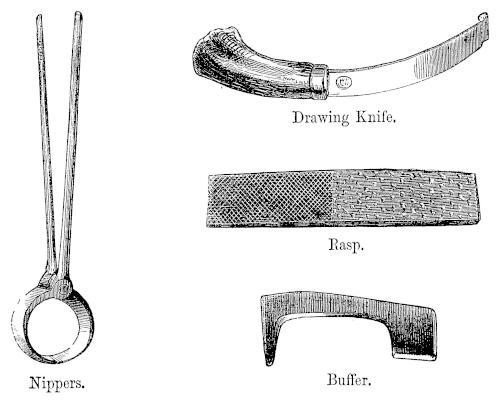
Nippers. Drawing Knife. Rasp. Buffer.
The Farrier’s shed is fitted with a forge, or furnace where
the iron is heated, and in which the fire is blown to
great heat by the huge bellows fastened above it; it also
contains an anvil, on which the horseshoes are made or
shaped, a stool on which the Farrier sometimes sits to
examine a horse’s hoof, and staples and rings, to which the
horses’ heads are fastened by halters during the process of
shoeing. When a horse is taken to be shod, the Farrier
should begin by taking off one of the old shoes. He first
raises the clenches with a tool called the buffer and if the
shoe does not then come off easily, loosens some of the
nails with the punch, till it can be gently removed. When
the shoe is off he rasps the edge of the hoof all round, and
with the nippers or pincers takes out any stubs that may be
left in the hoof. He then pares the hard portions of the
foot, and this is an operation which requires great care and
skill as well as a good deal of practice in the use of the
drawing knife. The Farrier must always remember the state
of the roads when he is paring the horse’s feet, for if the
roads are dry and stony he must take off very little of the
horn, or the foot will be bruised.
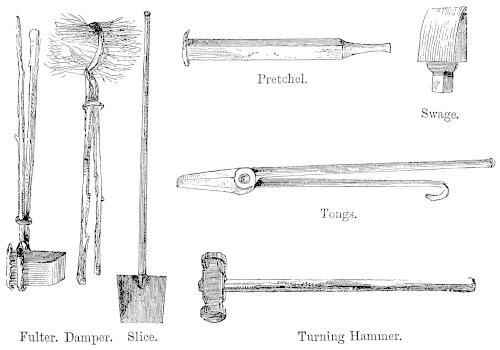
Fulter. Damper. Slice. Pretchel. Swage. Tongs. Turning Hammer.
The horseshoes are frequently purchased by the Farrier
of the Blacksmith who makes them, but some Farriers are
also Smiths, and both make and fit the horseshoes. In
either case the Farrier keeps a stock of rough shoes which
he alters at the time that they are wanted, so that they may
fit the horse, and one of the first things to be done is to
make the groove all round the shoe, and drill the holes in it
for the nails. This groove, in which the heads of the nails
sink, is called the “fuller,” and the tool with which it is
made is also called the “fuller,” or “fulter.” Having cut off
the ends or heels of the shoe, made the fuller, and opened the
nail holes, the Farrier next makes what is called the “clip,”
which means turning up the toe of the shoe, to prevent its
being forced back on the hoof. In these parts of his work
he has probably used the chisel, turning hammer, swage and
pretchel, while for the work at the forge he has had to
employ the poker, the tongs for holding the shoe on the
anvil, the slice for taking small things from the fire, and the
damper, which is a wisp of wet straw held by wooden
tongs for lessening the heat of the shoe during hammering.
He next begins to fit the shoe, the horse being tied up to
the staple in the wall of the shed. The fitting of the shoe
is an operation requiring the greatest care and attention, and
the good Farrier will spare no pains to do his work perfectly,
as many a valuable horse has been ruined by an ill-fitting
shoe. When the shoe is fitted it is “filed up,” by which all
roughness is removed from the edges of the nail holes, and
the sharp edges of the shoe itself are taken off.
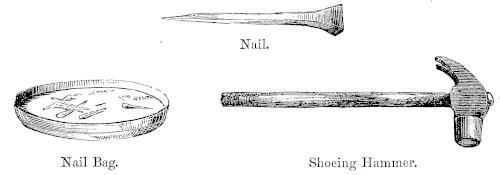
Nail. Nail Bag. Shoeing Hammer.
The Farrier generally makes his own nails since they are
of a peculiar shape, and the heads should completely fill the
nail holes, that they may not allow the shoe to shift on the
horse’s hoof. They are made from long rods of iron called
nail rods, and when finished are spread about the smithy to
cool, because when they are allowed to cool gradually they
become harder, and less liable to break.
If the nails are of a proper shape, the holes straight
through the shoe, and the shoe fits the foot, very little skill
is required to nail it on, and clench the ends of the nails to
the hoof. Before the shoe is nailed on, however, it is usual,
when the horse has tender feet, to cover the sole of the foot
with leather, gutta-percha, or felt made waterproof, “felt”
being made of woollen cloth torn to shreds which are then
pressed together and formed into sheets. In any case the
Farrier is expected to “stop the foot,” that is, to fill the
hollow and tender portion of the foot within the shoe, with
tow or oakum dipped in tar.
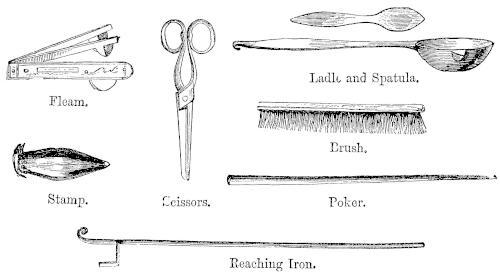
Fleam. Stamp. Scissors. Ladle and Spatula.
Brush. Poker. Reaching Iron.
The shoe is now nailed on, and a good Farrier will often
be able to secure it with only five nails.
The hind shoes are of course different in shape to those
which are placed on the fore feet, and it is generally
necessary to use seven nails to fix them on to the hoofs,
since the hind foot expands less than the fore, and there is
more drag upon it when the horse is in motion, so that the
shoe is more easily shifted.
The time at which a horse’s shoes want removing depends
on several causes. If a horse wear out his shoes in less than
a month they had better not be removed, but whether the
shoes are worn or not the horse’s hoofs should be looked to
by the Farrier, every three or four weeks, as the hoofs
sometimes outgrow the shoes, and the shoes require
refitting.
From what has been said about the Farrier’s business it
will be seen that it is a most important one, but besides the
knowledge and experience required for the more mechanical
part of his work, he should also know something of the
diseases and ailments of horses, and be able to apply the
proper remedies.
It is true that this part of the business belongs properly
to the veterinary surgeon, but the Farrier should at all events
understand what is proper to be done in any ordinary
disorder or in cases of emergency. He will of course know
how to use the fleam when the animals require bleeding, as
they frequently do. This instrument is a sort of knife, the
sharp part of which is the small spade-shaped pieces at the
ends of the blades. The ladle for melting the ingredients
of ointment, for sprains or swellings, and the spatula for
mixing it, or for spreading and mixing the drugs for boluses
or the large pills frequently given to horses, are some of the
instruments used in this part of the Farrier’s business.
THE NEEDLE MAKER.
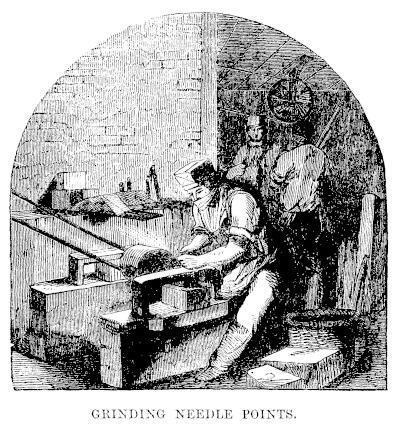
GRINDING NEEDLE POINTS.
There is perhaps no implement of greater importance than
that smallest of all tools, the needle, and in all civilized
countries the number of needles consumed is so great, and
such an enormous supply is required for the sewing of the
clothes of mankind, that the manufacture is one of the
most remarkable in this country, whence by far the greater
part of the whole supply is derived.
It will only be proper in this place for the author to
acknowledge his obligations to Mr. W. B. Tegetmeier, whose
most useful little work on “Common Objects” affords brief
and reliable information on this as well as on many other
interesting subjects.
The material from which needles are made is soft steel
wire of the requisite degree of fineness. This is obtained
from the manufacturer in large coils, each containing
sufficient wire to form several thousand needles. These
coils are first cut up into pieces of the length required to
make two needles, usually about three inches, large shears
being used, capable of cutting a coil of one hundred wires.
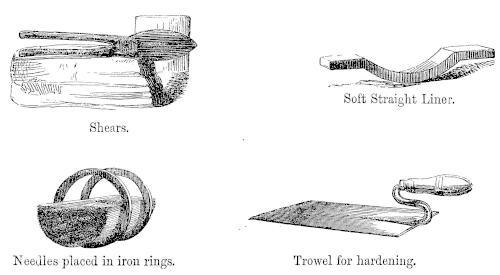
Shears. Needles placed in iron rings. Soft Straight
Liner. Trowel for hardening.
Five or six thousands of these lengths are made into a
bundle kept together by a ring of steel at each end. They
are then heated to redness in a furnace, and afterwards laid
upon a flat iron plate, and rubbed backwards and forwards
with a steel bar until each wire is perfectly straight.
The next stage is to grind a point at each end of the
wire. This is done by the aid of grindstones about
eighteen inches in diameter and four inches thick; they
are made to revolve so rapidly that they are liable to fly
into pieces, and are therefore partially enclosed in iron
plates to avoid injury to the grinder, should such an accident
occur. The grinder takes from fifty to sixty wires
between the thumb and forefinger of his right hand; and
as he presses them against the stone, he causes all the wires
to roll round, and thus each is ground to a point. So expert
do the grinders become by practice, that they point a handful
of these wires, usually about sixty, in half a minute, or
about seven thousand in an hour. During the grinding
every wire gives out a stream of sparks, and these together
form a bright glare of light.
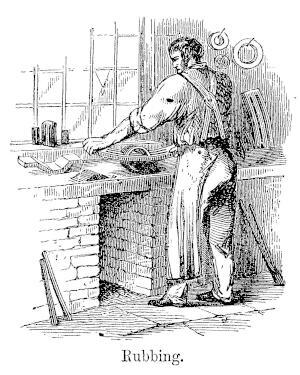
Rubbing.
Pointing these wires is the most unhealthy part of the
manufacture; the fine dust is carried into the lungs of the
workmen, and destroys them in a few years, very few living
beyond the age of forty. Wet grindstones cannot be used,
as the points of the needles would be rapidly rusted.
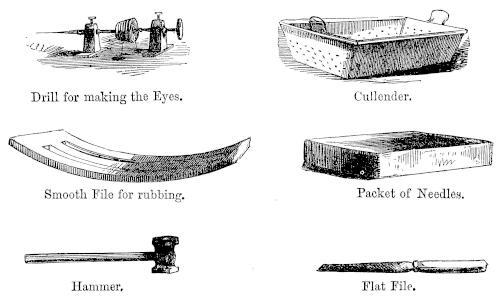
Drill for making the Eyes. Smooth File for rubbing.
Hammer. Cullender. Packet of Needles. Flat File.
The wires thus pointed at each end are stamped by a
heavy hammer, raised by a lever moved by the workman’s
foot. The under surface of this hammer is so formed, that
when it falls on the wire midway between the two ends it
stamps on one side the gutters, or grooves, in which the eye
is afterwards made; and the anvil on which the wire rests
when the hammer strikes it forms the two grooves on the
opposite side. This stamping also makes a slight depression
or pit on each side at the spot intended for the eye. The
wires are then passed to a boy, who takes a number of them in
his left hand, whilst with his right he works a press, moving
two hard steel points or piercers. These come down upon
the wire as it is placed beneath them, and pierce the eyes
for the two needles. Each wire now resembles two rough
unpolished needles united together by their heads; and as
it would require much trouble to divide them separately
into two needles, a number are threaded upon two very thin
wires, and are separated by filing and bending.
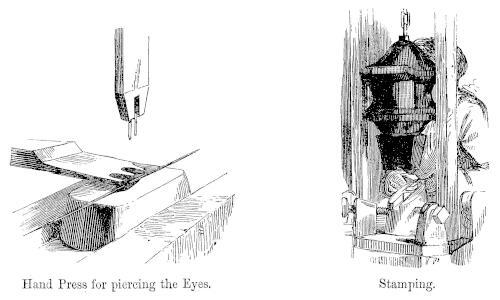
Hand Press for piercing the Eyes. Stamping.
Any needles which may have been bent in the several
processes are straightened by rolling under a steel bar, and
are hardened by heating in a furnace, and suddenly cooled
in cold water or oil. After hardening they are tempered
by being slightly heated, and if any are bent during
hardening, they are straightened by being hammered on
anvils with small hammers; finally, the whole are polished
by laying twenty or thirty thousand side by side upon a
piece of thick canvas, smearing them with oil and emery,
rolling up the canvas, and rubbing them under a press for
several hours or even days.
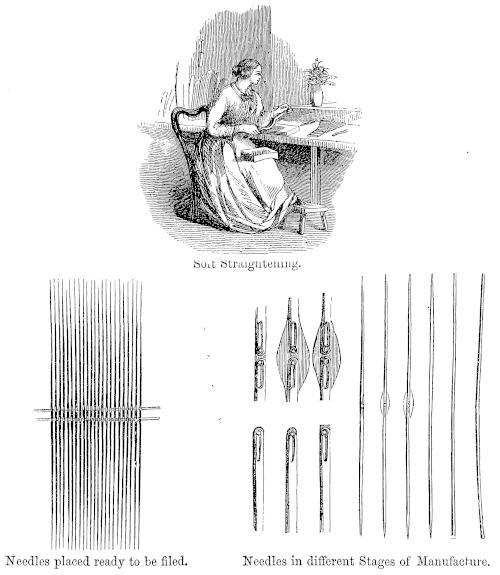
Soft Straightening. Needles placed ready to be
filed. Needles in different Stages of Manufacture.
Drilled-eyed needles undergo another operation—a fine
drill is made to revolve rapidly in the eye of each, to take
off the rough edge and to prevent their cutting the thread
when used; finally, the points are finished on a revolving
stone, and polished on a wheel covered with leather, and
enclosed in a paper for sale.
Simple as the construction of a needle may appear, it
has to pass through the hands of 120 workmen, from the
time it leaves the iron mine until the manufacture is completed.
The chief seat of the needle manufacture in this country
is Redditch, in Worcestershire, where upwards of seventy
millions are made weekly. English needles are far superior
to those of foreign manufacture.
THE CUTLER AND FILE-CUTTER.
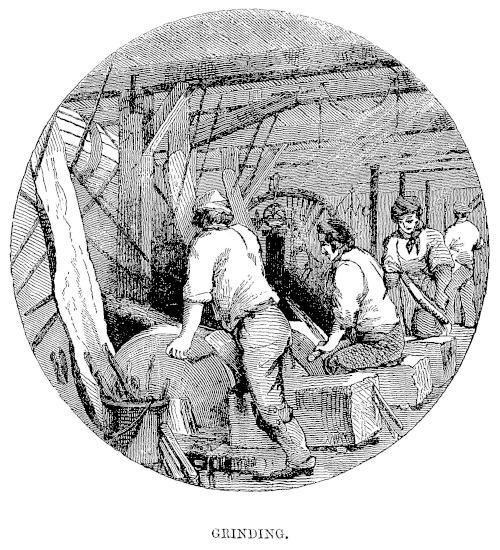
GRINDING.
Amongst all the trades that occupy the attention of mankind,
that of the Cutler, which also includes the tool maker,
is certainly one of the most essential, since without tools no
other manufactures could be carried on. Cutting instruments
of various kinds have been in use from the earliest
ages, if for no other purposes, for cutting food, slaughtering
animals, and making war upon each other. In ancient
times, as well as amongst some barbarous tribes at the present
day, these implements were frequently made of
shells, edged flints, or hardened wood, fashioned into sharp
weapons; at a late period, cutting as well as warlike
instruments were formed of brass or bronze; but at the
present time, in all civilized nations they are formed exclusively
of steel or iron.
Steel is formed from the purest bar iron—that which
comes from the Swedish mines being preferred. This is
buried in powdered charcoal and heated to whiteness for
several days, without exposure to the air; during this time
the metal becomes much harder, whiter in colour, crystalline
in texture, and blistered on the surface. The blistered steel
so produced is prepared for use, either by binding several
bars together and hammering them into one, or by melting
them in earthenware pots, called crucibles, and pouring the
melted metal into moulds of the size required. In the
latter state it is called cast steel.
Cutlery is generally understood to comprise all kinds of
knives, razors, lancets, and edge tools, including scythes,
saws, scissors, shears, spades, and many others; and the
manufacture of forks, files, and some other instruments not
possessing cutting edges, is frequently included in the
business. It will be impossible to give a detailed description
of how all these are made, so only two or three must
be selected. In a Cutler’s factory knife blades are forged
from steel bars in a number of small rooms, each containing
a fireplace or hearth, a trough to hold water, and another
trough for coke, which is specially prepared for this kind of
work; there are also an anvil, hammers, and some other
tools.
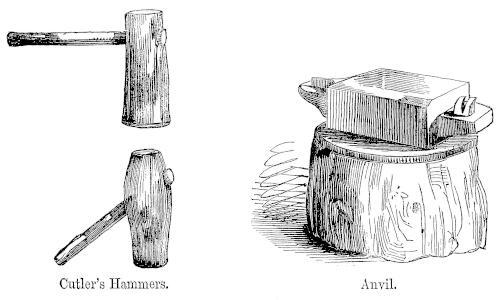
Cutler’s Hammers. Anvil.
Two persons are engaged in each room, one being called
the maker or forger, the other the striker. The forger
buries the end of the steel bar in the fire to the extent
required; and to determine when it should be removed
requires some judgment, since if it be overheated or “burnt,”
it will be quite unfit for cutting purposes. On the other
hand, it must be sufficiently heated to acquire the proper
degree of softness for the operation of shaping the blade
from it. When the end of the bar has been properly heated
it is brought to the anvil, where it is fashioned by the
striker into the required shape by means of a few blows of
the hammer. This roughly shaped blade is then cut off
from the end of the bar, which is again heated for forming
the next shape, and so on to the end.
The cutting part of the blade thus rudely formed is next
welded to a piece of iron, which forms the bolster, or
shoulder, that is, the part that rises round the handle of
the knife. To make the shoulder of the size and shape
required, and to give it neatness and finish, it is introduced
into a die by the side of the anvil, and a swage (see Blacksmith)
placed upon it, to which a few smart blows in the
proper direction are given by the striker.
Shoulder-iron.
The die and swage are called prints by the workpeople.
Besides the bolster, the part which fastens into the handle,
technically termed the tang, is also shaped from the piece of
iron welded on to the cutting part of the blade. After the
bolster and tang have been properly finished, the blade is
heated again, and then well hammered on the anvil. This
operation, which is termed smithing, requires particular
care and attention. It is intended to consolidate the steel,
and to render it brighter. The next process the blade has
to undergo is that of marking. This is done with a broad
punch made of the very best and hardest steel, and having
the name and corporate or trade mark of the firm carved
on the bottom end or point. The blade is heated to a dull
red (worm-red, as it is termed by the workmen), and the
mark cut in on one side of the blade with the punch by a
single blow of the hammer. Now comes the most important
process of all, viz. the hardening and tempering of
the blades. Upon the effectual performance of these operations
depends the practical value of the articles. The
Sheffield workmen have justly and deservedly acquired
the very highest reputation for peculiar skill in this
most difficult department of the cutlery business. The
hardening of the blade is effected by heating it to bright
redness, then plunging it perpendicularly into cold water,
which operation renders it extremely hard, but at the same
time very brittle, which is an inconvenience, of course,
requiring to be remedied. This is done by the process of
tempering. To this end, the hardened blades are first
rubbed with finely powdered sand, to remove scales, &c.
from the surface; they are then placed on an oblong tray
made of steel, and on this exposed to the fire until they
acquire a bright blue tint. The workman judges of the
proper degree of tempering entirely by the colour, and the
utmost attention is bestowed upon this point to ensure the
most perfect unanimity in this respect. The hardened and
tempered blades are then submitted to the manager’s inspection,
who applies various tests to them, and rejects any
that may turn out imperfect in any one point.
The blades that have been examined and passed by the
manager are next taken to the grinding mill, or, as it is
technically termed, the wheel. Each separate shop in the
building in which the grinders work is called a hull. The
grinding is done on stones of various qualities and sizes,
according to the kind of articles to be ground. The rough
grit stones come mostly from Wickersley, near Rotherham;
the finer and smoother grained stones, and the so-called
whitning stones, come mostly from the more immediate
neighbourhood of Sheffield. The blades of table-knives are
ground on wet stones, the grinding stone being suspended,
for that purpose, in an iron trough filled with water to a
sufficient height to make the surface of the fluid just touch
the face of the stone. The grinding stones, as well as the
glazers and polishers, are turned by machinery worked by
steam power. A flat stick is used by the grinder to keep the
blade pressed to the surface of the stone. The ground blades
are then glazed, which simply means that a higher degree of
lustre and smoothness is given them by grinding on a tool
termed a glazer. This consists of a wheel made of a number
of pieces of wood, put together in such a manner that the
edge or face always presents the end way of the wood,
which is done to preserve the circular shape by preventing
contraction of the parts. The grinding face of the wheel is
covered with so-called emery cake, which consists of a
composition of beeswax, tallow, and emery. The glazing
wheels have a diameter of four feet. The tang of the
blade is stuck into a temporary handle to facilitate the
operation.
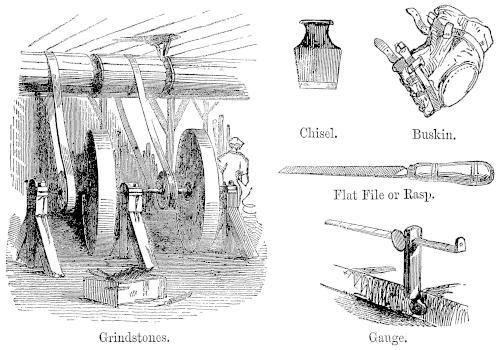
Grindstones. Chisel. Buskin. Flat File or Rasp. Gauge.
The last process to which the blades of table-knives are
subjected in the grinding mill is that of polishing; this is
done on circular pieces of wood covered with buff leather,
with a coat of finer emery (flour emery) composition upon
it, which are made to revolve with much less velocity than
the grinding stones and the glazers. The ground blades
are again taken to the manager, who applies several very
severe tests to them, to try their temper and edge.
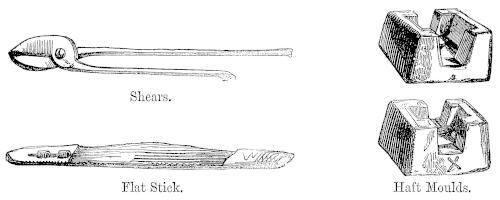
Shears. Flat Stick. Haft Moulds.
Knife-handles are made of horn, ivory, ebony, silver,
German silver, mother of pearl, &c. Two sorts of ivory are
principally used, the Egyptian and the African; the latter
is the more beautiful and transparent of the two, the
Egyptian looking more like horn. The tusks are sawn in
appropriate lengths, which are then cut by a small circular
saw into handles of the required size. The handles are
properly filed, and occasionally also carved or fluted in
different patterns. A variety of files are used for these
purposes, such as flat files, threading files, hollow files, half
round files, &c. The handle is then bored to receive the
tang. The bolster of the blade having been properly filed,
the tang is inserted into the bore, and fixed in by cement
in the usual way. It is afterwards farther secured by a
German silver pin passing through the handle and tang.
The silver and German silver handles are stamped in
dies. The mother of pearl handles are carved or fluted in
different patterns.
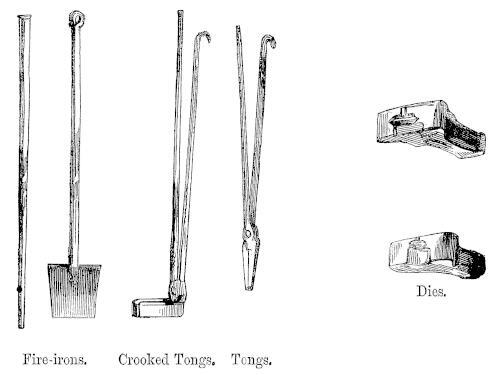
Fire-irons. Crooked Tongs. Tongs. Dies.
The knives thus finished by the hafter are now taken
once more to the manager, to undergo a final examination
preparatory to their removal to the warehouse.
The forging of razors is performed by a foreman and
striker in the same manner as in making the blades of
table-knives. The bars or rods as they come from the tilt
and rolling mill are about half an inch broad, and no
thicker than is sufficient for the back of the razor. The
anvil on which the razor-blades are forged is rounded at the
sides; by dexterously working the blade on the rounded
edge of the anvil, a concave surface is given to the sides,
and the edge part thus made thinner, which saves the
grinder a deal of labour. The blade having been cut off
the bar, the tang is formed by drawing out the steel. The
blade is then properly hardened and tempered. The last
and most important process which the razor-blade has to
undergo is that of grinding.
The difference in the prices of blades, make all of them
of the same material, is owing entirely to the circumstance
that stones of much smaller diameter are used for grinding
the higher priced blades, and much more time and labour
are given to the operation than is the case with the cheaper
sorts.
In making a fork, the end of a steel bar is first made
red-hot; it is hammered so as to give a rough approximation
to the shape of the shank or tang; it is again heated,
and a blow from a die or stamp gives the proper contour;
the prongs are cut out by a powerful blow from a stamp of
peculiar form, and the fork is finally annealed, hardened,
ground, and polished. It is this process of fork grinding
which has so often been made a subject for comment; the
fork is ground dry upon a stone wheel, and the particles of
steel and grit are constantly entering the lungs of the
workmen, thereby ruining the health and shortening the
duration of life.
Many contrivances have been devised for obviating this
evil, but the fork-grinders have not seconded these efforts
so zealously as might have been expected.
In making pen and pocket-knives, a slender rod of steel
is heated at the end, hammered to the form of a blade, and
carried through many subsequent processes. But the putting
together of these hinged knives requires more time than the
making of the blades, and affords a curious example of
minute detail. When the pieces of bone, ivory, pearl,
tortoise-shell, horn, or other substances, which are to form
the outer surface of the handle, are roughly cut to shape;
when the blade has been forged and ground, and when the
steel for the spring is procured, the whole are placed in the
hand of a workman, who proceeds to build up a clasp-knife
from the little fragments placed at his disposal. So many
are the details to be attended to, that a common two-bladed
knife has to pass through his hands seventy or eighty times
before it is finished.
A file, as every one knows, is a steel instrument, having
flat or curved surfaces so notched or serrated as to produce
a series of fine teeth or cutting edges, which are employed
for the abrasion of metal, ivory, wood, &c.
Steel for making files being required to be of unusual
hardness, is more highly converted than for other purposes,
and is sometimes said to be double converted. Small files
are mostly made of cast steel. The very large files called
smiths’ rubbers are generally forged immediately from the
converted bars. Smaller files are forged from bars which
are wrought to the required form and size by the action of
tilt-hammers, either from blistered bars or from ingots of
cast steel. These bars are cut into pieces suitable for
making one file each, which are heated in a forge-fire, and
then wrought to the required shape on an anvil by two
men, one of whom superintends the work while the other
acts as general assistant.
The next operation upon the blanks which are to be converted
into files is that of softening or lightening, to
render the steel capable of being cut with the toothing
instruments. This is effected by a gradual heating and a
gradual cooling. The surface is then rendered smooth,
either by filing or grinding.
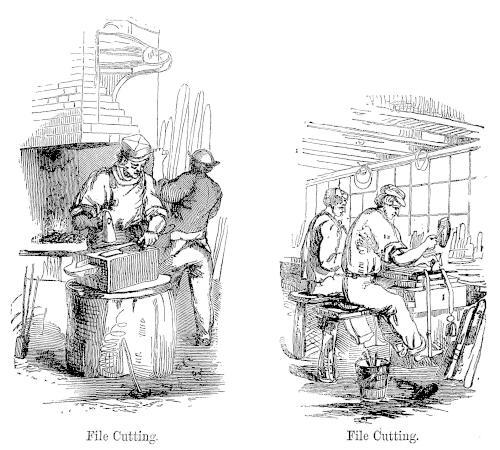
File Cutting. File Cutting.
The cutting of the teeth is usually performed by workmen
sitting astride upon a board or saddle-shaped seat in front
of a bench, upon which is fixed a kind of small anvil.
Laying the blank file across the anvil, the Cutler secures it
from moving by a strap which passes over each end and
under his feet, like the stirrup of the shoemaker. He then
takes in his left hand a very carefully ground chisel made
of the best steel, and in his right a peculiarly shaped
hammer. If the file be flat, or have one or more flat
surfaces, the operator places the steel chisel upon it at a
particular angle or inclination, and with one blow of the
hammer cuts an indentation or furrow completely across its
face from side to side, and then moves the chisel to the
requisite positions for making similar and parallel cuts. If
it be a half round file, as a straight-edged chisel is used, a
number of small cuts are necessary to extend across the file
from edge to edge. So minute are these cuts in some kinds
of files, that in one specimen about ten inches long, flat on
one side and round on the other, there are more than 20,000
cuts, each made with a separate blow from the hammer, and
the cutting tool being shifted after each blow. The range
of manufactures afford few more striking examples of the
peculiar manual skill acquired by long practice.
Several highly ingenious machines have been contrived
for superseding the tedious operation of file cutting by
hand; but suited as the process may appear to be for the
use of machinery, it has been found to present such great
difficulties, that we believe no file-cutting engine has been
brought successfully or extensively into operation. One very
serious difficulty arises from the fact that, if one part of the
file be either a little softer than the adjacent parts, or a little
narrower, so as to present less resistance to the blow of the
hammer, a machine would, owing to the perfect uniformity
of its stroke, make a deeper cut there than elsewhere.
After the files have been cut, the steel is brought to a state
of great hardness; this is effected in various ways, according
to the purpose to which the file is to be applied; they are
generally coated with a sort of temporary varnish, then
heated in a stove, and then suddenly quenched. After
hardening, the files are scoured, washed, dried, and tested.
It will be seen that the tools employed by the Cutler are
few, and consist mostly of the hammers, moulds, dies, anvils,
grinding stones, and others already mentioned.
COTTON MANUFACTURER.
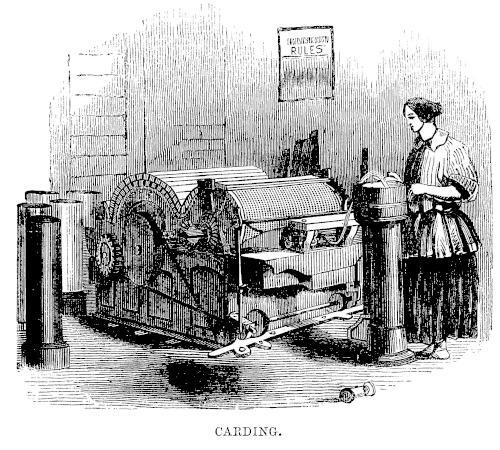
CARDING.
The extremely valuable substance, called Cotton, which is
now raised in such abundance as to furnish the cheapest
and most extensively-used clothing, is produced in the seed
vessels of the cotton plant, of which there are many varieties;
some are herbaceous annual plants, growing from eighteen
to twenty-four inches high; others, shrubs about the size of
our currant bushes, and of from two to ten years’ duration;
whilst a third kind attain the growth of small trees, with
a height of from twelve to twenty feet.
The leaves of the cotton plant are of a bright dark green
colour, deeply divided into five lobes; the flowers are large
and showy, of a bright sulphur or lemon colour, and closely
resemble in appearance and botanical structure those of the
single hollyhock; each flower is succeeded by a triangular
three-celled seed vessel, which attains the size of a small
walnut, and when ripe bursts open from the swelling of the
cotton contained in the three cells; the seeds, which are
rather larger than those of grapes, are inclosed in the cotton
wool, which adheres very firmly to them. One variety of
cotton, cultivated in China, and some parts of America, has
a yellow tint; this tint it preserves when woven into the
fabric called “nankeen.”
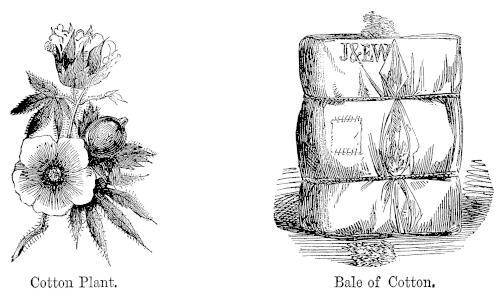
Cotton Plant. Bale of Cotton.
The cotton plant is largely cultivated in India, China,
United States, West Indies, on the shores of the Mediterranean,
and, in short, in almost all the warmer parts of the
world; it flourishes readily in soils too poor for the growth
of grain, and other crops, and succeeds perfectly well in dry
seasons.
The cotton, when perfectly ripe, is gathered by women
and children, the seeds and wool being picked out of the
pod; it is dried in the sun, and is then ready for the
removal of the seeds. In India this operation is performed
by means of two parallel rollers, which are fixed in a frame
at a small distance apart, so that when they are turned
round the cotton is drawn through whilst the seeds, which
from their size are unable to pass, are torn off and separated.
With this simple machine a man can separate the seeds
from about fifty pounds of cotton in a day.
In America a still more rapid process is adopted: the
cotton is placed in a box, one side of which is formed of
stout parallel wires, placed about one-eighth of an inch
apart; by the side of this box is a roller, carrying a number
of circular saws with curved teeth, which project through
the wires into the box. On the roller being made to
revolve, the teeth of the saws drag the cotton through the
wires, the seeds remaining behind; after being thus separated,
the cotton is powerfully compressed into bags, and
is ready for transport to this and other manufacturing
countries.
The cotton is seldom unpacked until it arrives at the
mill, the purchases being all managed by samples. When
it is unpacked, the first thing to be done is the sorting, and
in this much care and skill are required; for the different
bags furnish different qualities of cotton, and it is necessary
to produce yarn of uniform quality at the cheapest rate.
In order, therefore, to equalize the different qualities, the
contents of all the bags are mixed together in the following
manner. A space being cleared and marked out on the
floor, the cotton contained in the first bag is scattered over
this space, so as exactly to cover it; the contents of the
second bag are in like manner spread over the first, and the
cotton in all the other bags is disposed in a similar manner;
men and boys tread down the heap, which is called a bing
or bunker, until at length it rises up in shape and dimensions
very much like a haystack. Whenever a supply of
cotton is taken from the bing it is torn down with a rake
from top to bottom, by which means it is evident the
contents of the different bags are collected together in a
mass of uniform quality and colour. In mixing different
qualities of cotton it is usual to bring together such only as
have a similar length of staple. A portion of the waste
cotton of the mill is also mixed in the bing, for making the
lower qualities of yarn. For higher numbers, as well as for
warps, a finer quality of cotton must be selected; and thus
it will be seen that the formation of a bing is an important
operation, the quality of the goods produced depending
upon it.
In this state the cotton contains sand, dirt, and other
impurities, and the fibres are matted together by the pressure
they were subjected to in packing. To open the fibres
and get rid of the sand, &c. the cotton is put into a machine
called a willow. This consists of a box or case, containing
a conical wooden beam, studded over with iron spikes; this
beam is made to turn round five or six hundred times a
minute. The cotton, as it is torn down from the bing, is
put in at one end of the machine, where it is caught by the
spikes, tossed about with great violence, and gradually
driven forward to the other end. The sand and other
impurities fall out of the machine through an open grating
at the bottom; the dust and lighter matter pass off through
a series of wire openings, and the cleaned cotton is sent
down a shoot into the room below.
If the cotton is of fine quality it is beaten, or batted,
with hazel or holly twigs. For this purpose, it is spread on
a frame, the upper part of which is made of cords and is
quite elastic. A woman, with a rod about three or four feet
long in each hand, beats the cotton with great violence,
and so entirely separates the fibre. Any loose impurities
which remain fall out between the cords; seeds and fragments
of seed-pods, which adhere to the cotton somewhat
firmly, are picked out by hand. By this method the cotton
is thoroughly opened, and made quite clean, without injuring
the staple.
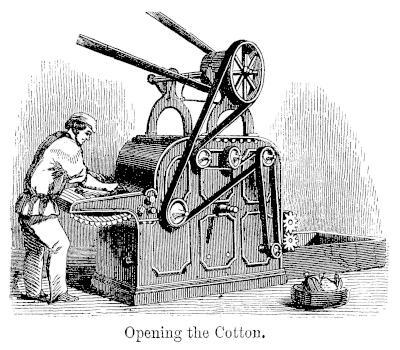
Opening the Cotton.
The coarser qualities are passed at once from the willow
to the scutching or blowing machine, which does the work
of batting, only in a more violent manner, and is therefore
not adapted for fine qualities; but in coarser spinning is in
general use, to prepare the cotton for the carding engine.
The cotton, which is still in a confused and tangled state,
has now to be carded, upon the regularity and perfection of
which process depends much of the success of spinning,
and also the durability and beauty of the stuff to be woven.
A cotton card is a sort of brush, containing wires instead of
bristles. The cards are made of bands or fillets of leather,
or are formed of alternate layers of cotton, linen, and india-rubber
pierced with numerous holes, in which are fixed bent
pieces of iron wire, called dents or teeth.
The fibres of the cotton are not yet sufficiently level to
be twisted into yarn; and it often happens that the teeth
of the card lay hold of a fibre by the middle and thus
double it together, in which state it is unfit for spinning.
The cardings are therefore doubled and drawn out by a
machine called a drawing frame, the principle of which
depends upon different pairs of rollers revolving with
different degrees of rapidity. If, however, the riband, as it
leaves the carding-engine, were simply extended in length by
drawing it out, it would be liable to tear across, or to be of
a different thickness at different parts of its length. To
prevent the tearing and to equalize the thickness, a number
of cardings are joined together and drawn out to a length
equal to the sum of the length of all the separate cardings.
The effect produced is the same as taking a piece of
cotton wool between the finger and thumb and drawing it
out many times, laying the drawn filaments over each
other, before each drawing. If the cotton be then examined
it will be found that all the fibres are parallel and
of equal length. This effect is accomplished very perfectly
in the drawing frame, which consists of a number of rollers
arranged in what are called heads, each head consisting of
three pairs of rollers, of which the second pair moves with
greater speed than the first, and the third moves quicker
than the second.
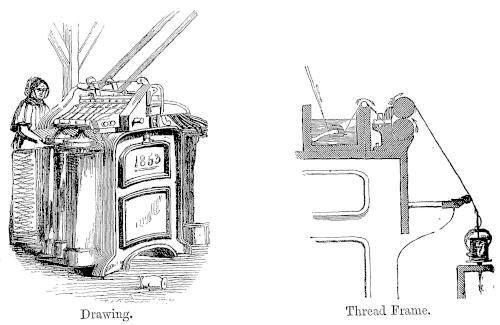
Drawing. Thread Frame.
By the process of doubling and drawing, the cotton is
formed into a loose porous cord, the fibres of which are
arranged side by side. This cord is still too thick for yarn,
but it cannot be reduced in size by drawing merely, for if
this were attempted it would break; a slight twist is therefore
given, which by condensing the fibres allows the
drawing to proceed. This is the commencement of the
spinning process (which is, in fact, little more than a combination
of drawing and twisting) and is called roving.
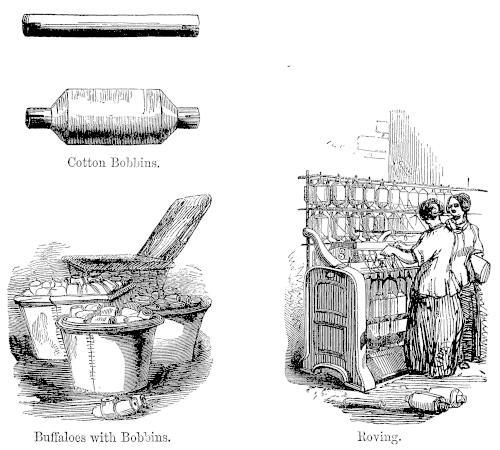
Cotton Bobbins. Buffaloes with Bobbins. Roving.
The bobbin-and-fly frame is an exceedingly complicated
machine, although the objects to be accomplished by it are
sufficiently simple; namely, to give the roving a slight
twist, and then to wind it on the bobbin. The first is
easily done by the revolutions of the spindle; the second
is more difficult. It is scarcely necessary to explain that
the bobbins now under notice differ in no way from the
reels in common use, except in being of very large size.
The spindle which holds the bobbin is a round steel rod,
driven by a small cog-wheel, fastened on the lower part of
the spindle. The bobbin is slid upon the spindle, and the
small bed or platform on which it rests is made to revolve
by another series of small wheels. The spindle has two
arms, called the fly or flyer. This fly is fixed on the top
of the spindle in such a way that it can be taken off in an
instant, for the purpose of putting on or taking off the
bobbin. One arm of the fly is hollow, the other solid, and
all this serves to balance the machinery. One machine
contains from thirty to a hundred and twenty spindles,
which, for economy of space, are placed in two rows, each
spindle in the back row standing opposite the space left
between two spindles of the front row. The action of the
machine is this:—The sliver having been drawn by the
rollers, is twisted by the rapid revolutions of the spindle
into a soft cord or roving; this enters a hole in the top of
the spindle, and passes down the hollow arm of the fly; it
is then twisted round a steel finger, which winds it on the
bobbin with a certain pressure.
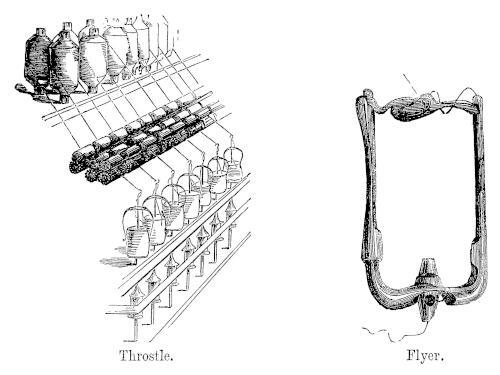
Throstle. Flyer.
The throstle machine is usually made double, a row of
bobbins, spindles, &c. occupying each side of the frame.
The bobbins filled with rovings from the bobbin-and-fly
frame, are mounted at the upper part of the frame in two
ranges. The roving from each bobbin passes through three
pairs of drawing rollers, where it is stretched out to the
requisite fineness. On quitting the last pair of rollers, each
thread is guided by a little ring or a notch of smooth glass,
let into the frame, towards the spindles, which revolve with
great rapidity, producing by the motion of their flyers
through the air a low musical hum, which is supposed to
have given the name of throstle to this machine. The
roving, which may now be called yarn, passing through an
eyelet formed at the end of one of the arms of the flyer,
proceeds at once to other bobbins.
The yarn is wound upon the bobbins by a curious contrivance.
The bobbin fits very loosely upon the spindle,
and rests on its end upon a kind of platform. The bobbin
is not connected with the spindle, except by the thread of
yarn, which has to be wound; therefore, as soon as the
flyer is set spinning, the thread drags the bobbin after it,
and makes it follow the motion of the spindle and fly; but
the weight of the bobbin, and its friction on the platform,
which is promoted by covering the end with coarse cloth,
causes it to hang back, and thus the double purpose is
served, of keeping the thread stretched and winding it on
the bobbin much more slowly than the flyer revolves. The
yarn is equally distributed on the bobbin by a slow up-and-down
movement of the platform.
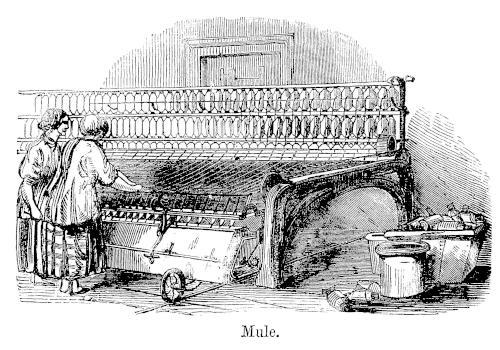
Mule.
These effects are the same as were produced by the
bobbin and fly-frame, but in the throstle they are attained
by simpler means. In the former machine a distinct movement
caused the bobbin to revolve quicker than the spindle.
In the throstle the bobbin is made to revolve by the pull of
the yarn, which is now sufficiently strong for the purpose;
but the roving in the bobbin-and-fly frame would not bear
the strain. The throstle is not often employed for very
fine spinning, because fine yarn would not bear the drag of
the bobbin; but in mule-spinning the yarn is wound at
once upon the spindles without any strain. In the mule
the rolling is first drawn by the usual system of rollers, and
then stretched by a moveable carriage. The effect of first
drawing and then stretching is to make the yarn finer and
more uniform, as will be explained presently. The spinning
mule is the most interesting and impressive spectacle in a
large cotton mill—on account of its vast extent, the great
quantity of work performed by it, and the wonderful complication
and ingenuity of its parts.
The spinning-mule consists of two principal portions:
the first, which is fixed, contains the bobbins of rovings and
the drawing rollers; the second is a sort of carriage, moving
upon an iron railroad, and capable of being drawn out to a
distance of about five feet from the fixed frame. This
carriage carries the spindles, the number of which is half
that of the bobbins of rovings. Motion is given to the
spindles by means of vertical drums, round which are
passed slender cords, communicating with the spindles.
There is one drum to every twenty-four spindles.
The carriage being run up to the point from which it
starts in spinning, the spindles are near to the roller-beam;
the rollers now begin to turn, and to give out yarn, which
is immediately twisted by the revolution of the spindles;
the carriage then moves away from the roller-beam, somewhat
quicker than the threads are delivered, so that they
receive a certain amount of stretching, which gives value
to this machine. The beneficial effect is produced in this
way,—when the thread leaves the rollers, it is thicker in
some parts than in others, and those thicker parts not being
so much twisted as the thinner ones are softer, and yield to
the stretching power of the mule, so that the twist is
equalised throughout, and the yarn becomes more uniform.
When the carriage has completed a stretch, or is drawn out
from about fifty-four to sixty-four inches from the roller-beam,
the drawing rollers cease to give out yarn, but the
spindles continue to whirl until the threads are properly
twisted. In spinning the finer yarns, the carriage sometimes
makes what is called a second stretch, during which
the spindles are made to revolve much more rapidly than
before. The drawing, stretching, and twisting, of a length
of thread being thus completed, the mule disengages itself
from the parts of the machinery by which it has hitherto
been driven, and the spinner then pushes the carriage with
his knee back to the roller-beam, turning at the same time
with his right hand a fly wheel, which gives motion to the
spindles. At the same time a copping wire, as it is called,
is pressed upon the threads by the spinners’ left hand, and
they are thus made to traverse the whole length of the
spindle, upon which they are then wound or built in a
conical form, which is called a cop. These cops are used
for placing in the shuttle in weaving, and form the weft or
short cross threads of the cloth.
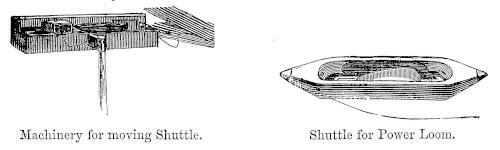
Machinery for moving Shuttle. Shuttle for Power Loom.
The yarn is now disposed of in various ways, according
to the use for which it is intended; but it is often found
convenient to make it up into hanks. When the yarn is
completed it is usually sent to the doubling and twisting
mill, for the purpose of being converted into what is now
properly called thread. Although we are accustomed to
apply the word thread to a thin narrow line of any fibrous
material, the manufacturer limits the term to that compound
cord produced by doubling or twisting two or more single
lines. The single line he calls yarn, two or more single
lines, laid parallel and twisted together, he calls thread;
and of this there are many varieties, such as bobbin-net-lace-thread,
stocking-thread, sewing-thread, &c.
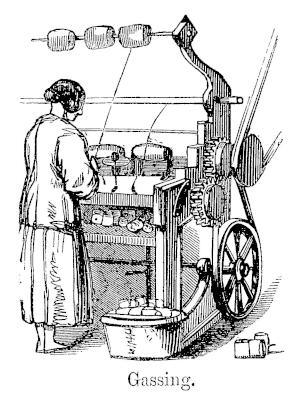
Gassing.
In fine spinning, the yarn, when doubled, is for some
purposes singed or gassed, in order to get rid of the loose
fibres, and to make it more level and compact. The process
of singeing yarn strikes a stranger as being more
remarkable than anything else in the mill. In a long room
in the upper part of the mill, or in a shed attached to it,
are several tables, lighted up with a large number of jets of
flame, about twelve inches apart, producing a singular but
pleasing effect. Above each flame is a little hood or
chimney. On entering this room the smell of burnt cotton
is immediately perceived, and on approaching the table, one
is surprised to see a fine delicate thread crossing each
flame in two or three directions, and apparently at rest;
but on following the course of this thread, it is found to
proceed from one bobbin, which is rapidly spinning round,
and to pass through the flame to another bobbin, which is
also in rapid motion. It is then seen that the thread is
also moving at a rapid rate, by which means alone does it
escape being consumed. The thread is led over pulleys, so
as to pass two or three times through the flame, which
singes off the loose fibres, converting them into a reddish
powder or dust, which, if blown about and inhaled, would
do great injury to the lungs; this is why the gassing-room
is in a remote or retired part of the building, to prevent the
air being disturbed by the bustle of the heavier parts.
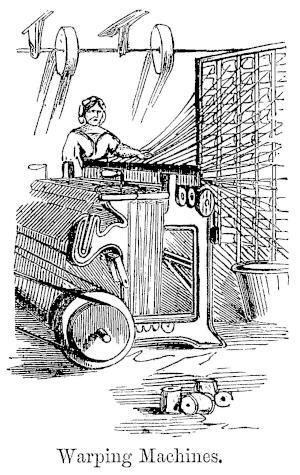
Warping Machines.
When cotton is intended to be woven into a fabric, such
as calico, &c. the first operation consists in laying the requisite
number of threads together to form the width of
the cloth; this is called warping. Supposing there to be
1,000 threads in the width of a piece of cloth, then the
yarn, wound on the bobbins as it leaves the hands of the
spinner, must be so unwound and laid out as to form 1,000
lengths, constituting, when laid parallel, the warp of the
intended cloth. The ancient method was to draw out the
warp from the bobbins at full length on an open field (and
this is still practised in India and China), but the warping-frame
is now employed, in which the threads are arranged,
by means of a frame turning on an upright centre. When
the warp is arranged round this machine, the warper takes
it off and winds it on a stick into a ball, preparatory to the
process of beaming or winding it on the beam of the loom.
The threads in this latter process are wound as evenly as
possible on the beam; a separator, ravel, or comb being
used to lay them parallel, and to spread them out to about
the intended width of the cloth. Arrangements are then
made for drawing or attaching the warp-threads individually
to certain mechanism of the loom. In this process all the
threads are attached to stays fixed to two frames, called
treadles, in such a manner that all the alternate threads
(1st, 3d, 5th,) can be drawn up or down by one heddle, and
all the rest (2d, 4th, 6th, &c.) by the other.
There are three movements attending every thread of
weft which the weaver throws across the warp. In the
first place he presses down one of the two treadles, by
which one of the two heddles is depressed, thereby forming
a kind of opening called the shed. Into this shed, at the
second movement, he throws the shuttle, containing the
weft-thread, with sufficient force to drive it across the
whole web. Then at the third movement he grasps the
batten, which is a kind of frame, carrying at its lower edge
a comb-like piece, having as many teeth as there are threads
in the warp, and with this he drives up the thread of weft
close to those previously thrown. One thread of weft is
thus completed, and the weaver proceeds to throw another
in a similar way, but in a reverse order, that is, by depressing
the left treadle instead of the right, and by throwing
the shuttle from left to right, instead of from right to left.
In the commonest mode of weaving the shuttle is thrown
by both hands alternately; but, about a century ago, John
Kay invented the fly-shuttle, in which a string and handle
are so placed that the weaver can work the shuttle both
ways with one hand.
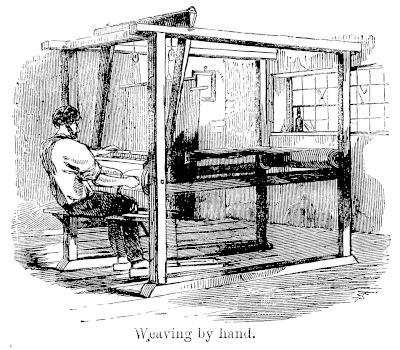
Weaving by hand.
In 1678 M. de Gennes invented a rude kind of weaving-machine,
intended to increase the power of the common
loom; and other looms were invented, which were to be
worked by a winch, by water power, or by some contrivance
more expeditious than common hand-weaving; but a greater
step in advance was made by the invention of Dr. Cartwright’s
power-loom in 1785. One cause which delayed
the adoption of power-looms was the necessity for stopping
the machine frequently, in order to dress the warp with
paste or size as it unrolled from the beam, which operation
required a person to be employed for each loom, so that
there was no saving of expense. But the successive inventions
of Radcliffe, Horrocks, Marsland, Roberts, and others,
have since brought the dressing-machine and the power-loom
to a high state of efficiency.
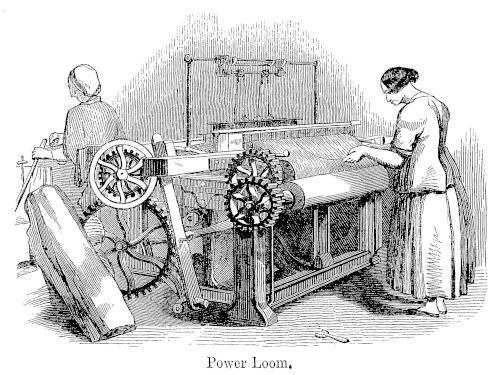
Power Loom.
Taking a piece of calico as the representative of plain
fabrics generally, the mode of proceeding in power-loom
factories may be shortly sketched as follows. The warping-frame
is so arranged as to be worked by steam-power, and
to bring the yarns into a parallel layer, which is transferred
to the dressing-machine. This latter is a large piece of
mechanism, in which the threads dip into paste on their
way to the warp-beam: undergoing a process of brushing
after the dipping. After this dressing the drawing and
mounting for the loom are attended to. When the warp is
properly arranged in the loom, steam-power does all the
rest; it forms the shed or division of the warp into two
parts, it throws the shuttle, it drives up the weft with the
batten, it unwinds the warp from the warp-roller, and winds
the woven material on the cloth-roller.
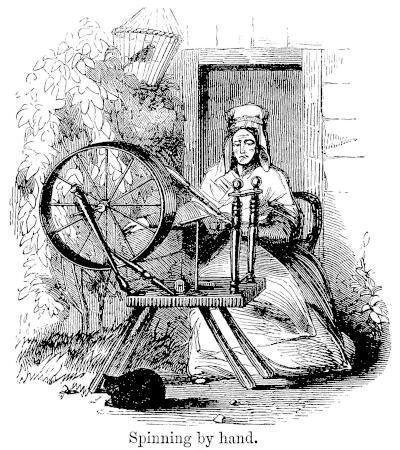
Spinning by hand.
THE TAILOR.
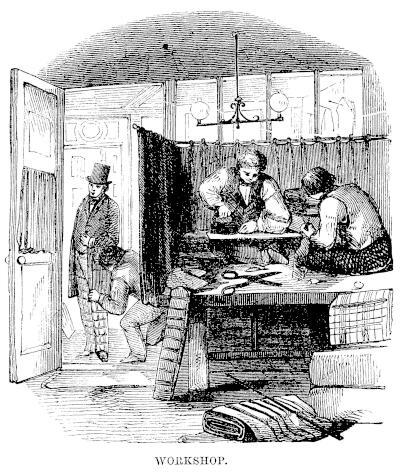
WORKSHOP.
It would perhaps be too much to say that the more
civilized a nation becomes, the greater is the attention
bestowed upon dress; since it has happened that in countries
not very far removed from barbarism, vast importance has
been given to external display, and robes and trappings
have been used to cover the savagery which had only just
learned to delight in the pomp and magnificence of costly
ornaments. It is certain, however, that in all civilized
nations dress is more than mere clothing, and has a significance
beyond the mere utility of protecting the body from
cold or heat, and adding to our physical comfort. It is an
old saying that some people may be clothed, but that they
are never dressed; and the meaning of this is, that dress is
frequently an expression of character, and will even make
known the disposition of the wearer. In the same way a
change of fashion is often an indication of an alteration in
the manners and way of living of a whole nation.
It is the business of the Tailor, then, not only to make
garments, but to study the prevailing fashion, and, indeed,
to advise what alterations or slight differences in the cut
and colour of clothes will be best suited to different people,
since on the way in which our clothes are made our personal
appearance will very greatly depend, and personal appearance
is of no little importance, since there are few people
who are not strongly influenced by it.
The trade of the Tailor is one of which very little can be
said in the way of explanation, since it mainly consists in
cutting out cloth to the shapes necessary to be applied to
each other in order to make the various garments; and as
this cannot be described without numerous diagrams, and
even with them could not easily be understood, we must
be satisfied to quote the instructions of a practical Tailor on
the subject of sewing.[3]
And, first as to the different sorts of stitches, which are:—the
basting-stitch, the back and fore-stitch, the back-stitch,
the side-stitch, and the fore-stitch; also the back
pricking-stitch, the fore pricking-stitch, the serging-stitch,
the cross-stitch, and the button-hole-stitch; besides which
there is a distinct kind of stitch for hemming, filling, stotting,
rantering, fine-drawing, prick-drawing, over-casting,
and also for making what are called covered buttons.
The basting-stitch is a long and slight stitch, intended to
be merely temporary, or to fasten together some of the
inner and concealed parts of the garment. It is commonly
used to keep the work in its proper position while being
sewed.
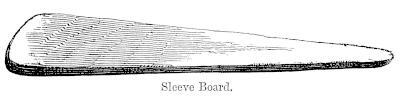
Sleeve Board.
The back and fore-stitch is made, as the name implies,
by the union of back stitching and fore stitching; in this
stitch the needle is first put through the cloth, and turned
up in as short a space as is possible, so as to make a neat
and strong stitch when completed; it is then put through
the cloth again in the same place as at first, and again
turned up, taking care that it passes through the cloth as
nearly as possible within the same space as before. This
being done, the first back-stitch is completed. The second
stitch is made by passing the needle forward upon the
surface of the cloth, but without taking hold of it, over a
space equal to the length of the first stitch; the needle is
again put through the cloth, turned up, and brought back
to the place where it was last put through, so as to form
another back-stitch; which is followed by another putting
of the needle forward, or, in plainer terms, another fore-stitch,
and so on in the same order, until the seam is
finished. This kind of stitch is used for sewing linings,
pockets, flannel garments, and other thin fabrics. There is
no need to say much respecting the back-stitch, as this
may be understood from what is said above respecting the
first stitch in back and fore-stitching. This stitch is used
for seams where strength is required; it is also used for
ornament instead of the side-stitch, but in this case it must
be very neatly and regularly made.
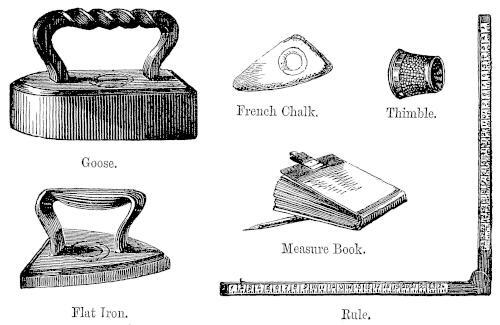
Goose. Flat Iron. French Chalk. Thimble. Measure Book. Rule.
The side-stitch is used for the edges of garments, to keep
them from rolling over, or from being drawn out of shape.
It is always intended for ornament as well as use, and
requires a very quick eye and a careful hand to do it well.
In this stitch the needle is put through the cloth a little
above or below the place from which it came out in the
former stitch, but it must be at a very little distance from
this place, or the sewing-silk will be visible on the surface
of the cloth, which is a great blemish, and yet it must be
far enough away from where it came out to prevent its
breaking through, in which case the stitch is lost both as
to use and ornament. Care must also be taken that the
stitches are at regular distances from each other, and that
the whole of them are placed at the same distance from
the edge of the cloth. In the fore-stitch, as has been
already hinted, the needle, when drawn out from the seam,
is always put forward, so that an equal quantity of thread,
or a stitch of the same length, is visible on each side of the
cloth.
Serge-stitching is done by passing the needle through the
cloth from the under to the upper piece, throwing the
thread over the edges of the cloth, so as to keep them
closely together. It is also used to join selvages together,
as also to prevent taking up more space for seams than can
be spared, when the pieces are barely large enough for the
required purpose. It is not, however, much used by tailors,
except when no great degree of strength is required.
The cross-stitch is formed by two parallel rows of stitches,
so placed as that the stitch in the upper row is opposite to
the vacant space in the lower one, the thread passing from
one stitch to the other in diagonal lines. It is used for
keeping open the seams of such garments as require
washing, and also for securing the edges from ravelling
out in such fabrics as are too loosely made to allow of
their edges being fastened down by the filling-stitch.
In the button-hole-stitch the needle is first put through
the cloth from the inner to the outer surface, and before it
is drawn out the twist is passed round the point of the
needle, and kept in that position till the needle be drawn
out to the full length of the twist; this forms a kind of
loop, called by Tailors the “purl,” at the top or edge of the
opening, and when regularly made is both ornamental and
useful. To increase the strength of this stitch, and also to
aid in making it true or exact, a “bar” is formed on each
side of the opening before the hole is begun to be worked.
This “bar,” as it is called, is made by passing the needle
from one end of the opening to the other (twice or three
times), so that there is a layer, if it may be so called, of
twist stretching along its whole length (and on each side)
upon which the whole is worked, the workman taking care
to keep the “bar” as near to the edge of the opening as
possible, without allowing it to come over, in which case the
button-hole would be neither strong nor neat.
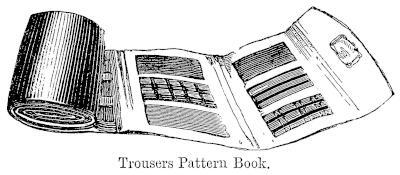
Trousers Pattern Book.
The filling stitch is similar to that used in hemming; the
chief difference being in the direction given to the needle.
In hemming, its point is directed outwards, or from the
workman, but in filling it is directed inwards, or towards
him, and in each should be a little, but only a little, slanted,
in order to give the sewing a neat appearance. This stitch
is used for sewing on facings, and when made with neatness,
and without showing itself much on the outer side of the
cloth, is considered to be ornamental, as well as useful.
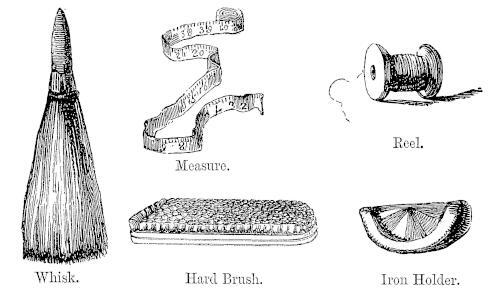
Whisk. Measure. Hard Brush. Reel. Iron Holder.
Stotting (pronounced stoating) is the stitch used for
joining pieces of cloth so neatly that the join shall be
but little visible, and yet so strongly as to prevent the
pieces from being easily parted. In this kind of seam the
pieces of cloth are not laid the one upon the other, as in
back-stitching, but are placed side by side, the edges being
carefully fitted, so as to prevent any irregularity or roughness
in the work. They are then sewn together by passing
the needle half through the thickness of the cloth. Care
must be taken to keep the stitches as near to each edge of
the cloth as can be done without incurring the danger of
its breaking through. The needle is put in on the nearest
edge of the two, and must not be slanted in the direction
given to it, but put as straight forward as possible. The
stitch should be drawn close enough home to prevent the
silk thread from showing itself on the right side of the
cloth, but yet not so close as to draw the edges into a
ridge. If the join be as neatly made as it may be, it will,
when properly pressed, be barely perceptible. This stitch
is used for joining the pieces of cloth of which facings,
collar-linings, and other fillings-up of the inner sides of
garments, are made, and also in other cases to prevent the
taking up too much of the cloth by making a back-stitched
seam.
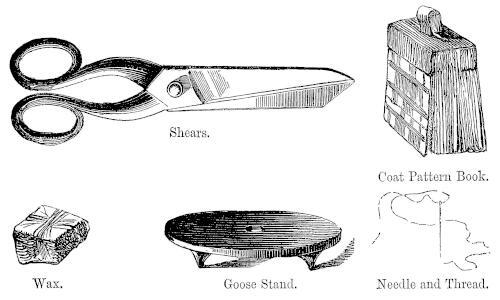
Shears. Coat Pattern Book. Wax. Goose Stand. Needle and Thread.
Rantering, like stotting, is intended to conceal a join in
the cloth. Here, however, it is requisite to make a strong
as well as a neat joining; and therefore a seam is first
sewn with a fore-stitch, and then the rantering-stitch is
worked upon or over this seam. It should be worked with
a very fine silk thread, or with twist that has had one of
the strands taken out. The needle should be both long and
slender, and must be passed forwards and backwards over
the seam, so as to catch hold of its two sides, and draw
them closely together. But in doing this care must be
taken not to take a deep hold of the cloth: the nap or wool
is all that should be taken hold of, and this must be done
with a light hand, while the stitches must be placed close to
each other, so that the seam may be well covered with
wool; when this is done, the seam has to be “rubbed up,”
that is to say, it must be held between the fore-finger and
thumb of each hand, these being placed upon the fore-stitching,
and its two edges brought as closely together as
possible. The rantering must then be slightly carded or
scratched backwards and forwards with the point of a
needle, in order to bring the wool out again where it has
been drawn in with the stitch; the seam is then ready for
pressing, and, if this operation be properly performed, will
be as much concealed as may be necessary; while it will be
much stronger than if it had been merely back-stitched.
In fine-drawing, the stitch is formed in the same manner
as in rantering, but there is a difference in the way of
placing the pieces that are to be joined, i.e. if they be
separate pieces, for this stitch is mostly used to close up
places that have been accidentally cut, or torn; the two
edges of the place requiring to be fine-drawn are first
trimmed by cutting away the loose threads or ends of the
cloth which may be upon them; they are then placed and
kept in as level or flat a position as is possible, either with
the fingers, or by fastening them to a piece of stiff paper.
The needle should be both very small and long, and the
thread used, whether it be of silk or twist, should be very
slender. Greater care is here necessary than in rantering,
to avoid taking a deep hold of the cloth; the needle should
be passed forwards and backwards, over the opening, and the
thread should be drawn no closer or tighter than is quite
needful in order to hide it in the wool. The stitches must
be placed as near to each other as is possible, so as to
prevent the edges of the cloth from being visible between
them; if it be needful to make a strong as well as a neat
joining, the fine-drawing should be repeated on the under
side of the cloth, but here it will not be needful to put the
stitches so close together. When the fine-drawing is done
it must be pressed, but with as light a hand and in as short
a time as is practicable, otherwise the sewing, however
neatly done, will be visible, and so far as it is so, the design
of the fine-drawing stitch will not be answered.
The stitch called prick-drawing is now but seldom used,
yet it may be proper to notice it briefly. When this stitch
is intended to be employed, the edges of the cloth are first
stotted together, after which the needle is passed backwards
and forwards in diagonal lines, under the stotting, so as to
make the join more strong and durable than it can be made
by merely stotting the pieces together.
This stitch is used where the cloth is very thick, or hard
and unyielding, and, consequently, where the stotting-stitch
would quickly give way without this support. It is also
better than a back-stitch seam for cloths of this description,
inasmuch as it can be made to lie more flat, and thus to be
more neat in its appearance, than a common seam.
Overcasting is used merely to secure the edges of thin
and loose fabrics from “ravelling out.” In using it, the
edges of the cloth, whether it be woollen, linen, or cotton,
are first trimmed clear of the loose threads; the needle is
then passed through the cloth in a forward direction, at
about the distance of one-eighth part of an inch from the
edge of the cloth, and when drawn out it is carried (from
the left to the right, and not, as in other stitches, from the
right to the left) about a quarter of an inch; it is then
again put through, and on being drawn out it is made to
pass over the thread leading from the preceding stitch, so as
to form a kind of loop on the edge; which loop secures the
edge from becoming too much frayed, or ravelled.
All the tools that the apprentice or even the journeyman
requires may be bought for a few shillings. A yard of
linen for a lap-cloth; two pairs of scissors, one pair moderately
large, for common use, and the other small, for button-holes;
a thimble; a small piece of bees-wax; and threepennyworth
of needles, are all that he will have occasion to
buy so long as he is not a master, or a journeyman working
at home, when he must procure a sleeve-board and an iron.
The more expensive part of even these few implements, viz.
the scissors, will, with tolerable care, last for a number of
years with only the trifling expense of being occasionally
sharpened by the cutler.
All the implements used by the Tailor are so well known
as to need no particular description; the sleeve-board is
used to place in the sleeve of a coat while the seams are
pressed with the heated iron or the goose. In the measure
book the dimensions are written when measurement of a
customer is made, and the French chalk marks the direction
in which the cloth is cut to the pattern of the various
shapes, which are afterwards sewn together to make complete
garments.
THE TANNER.
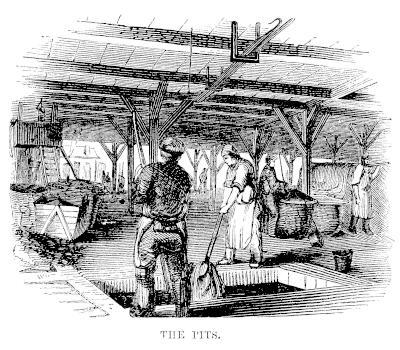
THE PITS.
Leather is a substance universally used amongst civilized
and very generally amongst barbarous nations; it is made
from the skins of animals, which are tanned, or prepared
with some substance, having the power of converting the
perishable skin, that decays readily when wet or moist, into
a lasting and comparatively imperishable leather.
The preparation of skins by tanning or other similar
processes has been practised from the earliest times; and
although it has engaged the attention of several scientific
men, and has been the subject of many curious experiments,
it has received less alteration from recent improvements in
chemical science than many other manufacturing processes.
Several plans, which have been suggested with a view to
expediting the process, which on the old system is a very
tedious one, have been found to injure the quality of the
leather, and have therefore been wholly or partially abandoned;
and others, which appear to be more successful,
are as yet adopted by a few manufacturers only.
The larger and heavier skins operated upon by the Tanner,
as those of bulls, buffaloes, oxen, and cows, are technically
distinguished as hides, while the name skins is applied to
those of smaller animals, as calves, sheep, and goats. The
process necessary to convert hides into the thick hard leather
used for the soles of boots and shoes, and for similar purposes
will first be noticed. The hides are brought to the
Tanner either in a fresh state, when from animals recently
slaughtered, or, when imported from other countries,
dried or salted, and sometimes both, for the sake of preserving
them from decomposition. In the former case the
horns are removed, and the hide is scraped to cleanse it
from any small portions of flesh or fatty matter that may
adhere to the inner skin; but in the latter it is necessary
to soften the hides, and bring them as nearly as possible
to the fresh state, by steeping them in water, and repeated
rubbing or beating. After this the hair is removed, sometimes
by steeping the hides for several days in a solution of
lime and water, which has the effect of loosening the hair
and epidermis, or outer skin; and sometimes by suspending
them in a close chamber called a smoke-house, heated a
little above the ordinary temperature of the atmosphere by
means of a smouldering fire, in which case the epidermis is
loosened by a very slight putrefaction. In either case, when
the hair and epidermis, or cuticle, are sufficiently loosened,
they are removed by scraping with a curved knife, the hide
being laid upon a convex bench or beam.
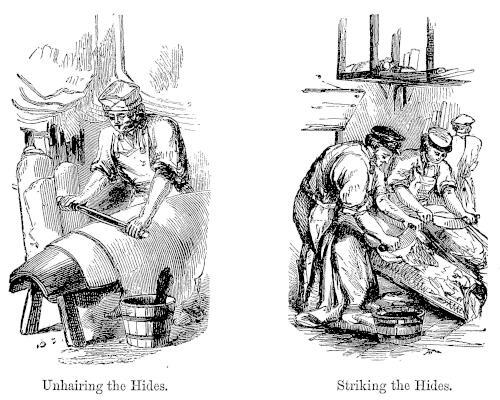
Unhairing the Hides. Striking the Hides.
The hides are prepared for the actual tanning, or immersion
in a solution of bark, by steeping them for a few days
in a pit containing a sour solution of rye or barley flour, or
in a very weak menstruum, consisting of one part of sulphuric
acid mixed with from five hundred to a thousand
parts of water. By this process, which is called “raising,”
the pores of the hides are distended and rendered more
susceptible of the action of the tan.
Oak-bark is the substance most commonly used to supply
the astringent principle, and it is crushed or ground to
powder in a bark-mill. In the old method of tanning,
which is not yet entirely abandoned, the hides and powdered
bark were laid in alternate layers in the tan pit, which was
then filled with water to the brim. After some months the
pit was emptied, and refilled with fresh bark and water; and
this process was repeated whenever the strength of the bark
was exhausted. In this way, the time required for impregnating
the hides varied, according to their thickness and
other circumstances, from one to four years. The process
has been greatly expedited by the improvement, introduced
in consequence of the experiments of M. Seguin, a French
chemist, of tanning with concentrated solutions of bark,
formed by passing water through a mass of powdered bark,
until, by successive filtrations, it is completely deprived of
its soluble tanning principle.
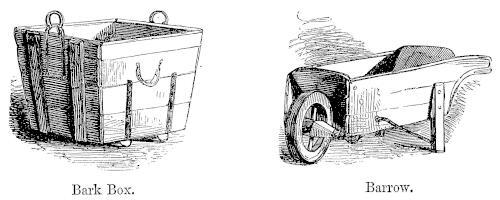
Bark Box. Barrow.
The variations of practice among different Tanners extend
to the substance used as an astringent, as well as to the
manner of applying it. Ground oak-bark, which was
formerly the only material in common use, and is still the
most general, produces good leather of a light fawn colour.
Valonia, of which considerable quantities are imported for
the use of Tanners, produces leather of great solidity and
weight, the colour of which is inclined to grey, and which
is more impervious to water than that made with oak-bark.
Valonia consists of the acorns of the Quercus Ægilops, and
is brought from the Levant and the Morea. Catechu, or
terra japonica, the extract of the Acacia Catechu, produces
leather of a dark reddish fawn colour, which is light, spongy,
and very pervious to water.
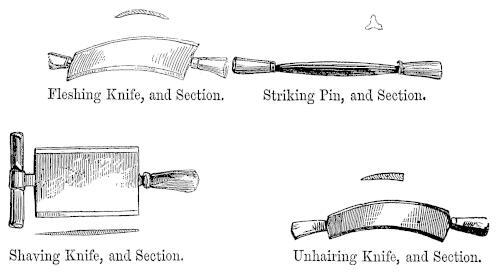
Fleshing Knife, and Section. Shaving Knife, and Section.
Striking Pin, and Section. Unhairing Knife, and Section.
When the process is complete, the hides are hung up in a
shed and allowed to dry slowly; and while they are drying
they are compressed by beating, or rubbing, or by passing
them between rollers, to give them firmness and density.
A yellow deposit is now found upon the surface of the
leather, to which the name of “bloom” or “pitching” is
technically given.
We have hitherto alluded chiefly to the preparation of
the thick hides used for sole leather, among which several
varieties may be found, each distinguished by a different
technical name, by which its thickness, quality, or mode of
preparation is known; but the thinnest and weakest hides,
as well as the skins of calves and other animals, are also
prepared for use as upper leathers, in which case it is
necessary to reduce their thickness by shaving or paring
them down upon the flesh or inner side, before they are
subjected to the action of the tanning infusions. Such
hides or skins also require, after leaving the hands of the
Tanner, to be rubbed, softened, and dressed by the currier,
in order to bring them to the necessary degree of flexibility
and smoothness. The currier also has recourse to shaving
or paring with a peculiarly formed knife, to bring the skin
to the requisite tenuity; and it is his office to blacken the
surface, which, for common shoe leather, is done on the
flesh side, although for some purposes leather is blackened
on the outer or grain side. Horse-hides, which are comparatively
weak and thin, are sometimes dressed in the
latter way, under the name of Cordovan hides, from the
circumstance of such leather having been formerly made at
Cordova, in Spain. Calf-skins supply the quality of leather
most generally preferred for the upper part of boots and
shoes.
Of the thin skins prepared for ornamental purposes, many
are tanned with a substance called sumach, prepared from a
plant of the same name. The tanning is performed by
sewing up each skin into the form of a bag, with the grain
or hair side outwards, and nearly filling it with a strong
solution of sumach in water. The bag is then fully distended
by blowing into it, and the aperture is tied up;
after which it is thrown into a large shallow vessel filled
with hot water containing a little sumach. The distended
bags float in this vessel, and are occasionally moved about
with a wooden instrument until the solution which they
contain has thoroughly penetrated their substance. Owing
to the thinness of the skins and the heat to which they are
exposed, this operation is performed in a few hours. The
process is expedited by taking the bags out of the solution,
and piling them upon a perforated bench or rack at the side
of the tub, so that their own weight may force the confined
liquid through the pores.
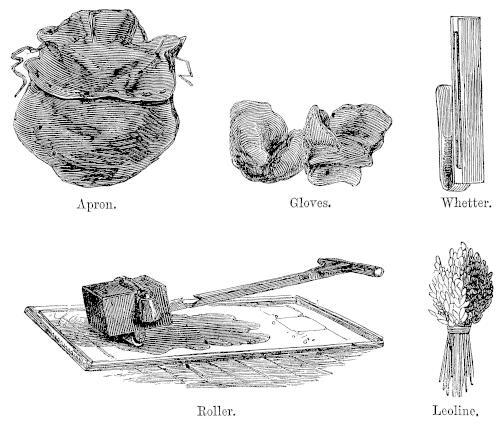
Apron. Gloves. Whetter. Roller. Leoline.
When the tanning is completed, the bags are opened to
remove the sediment of the sumach; the skins are washed,
rubbed on a board, and dried; after which they are ready
for dyeing and finishing with a ridged instrument, which
imparts to the surface that peculiar grain by which morocco
leather is distinguished. An inferior kind of leather, known
as “imitation morocco,” is prepared in a similar manner
from sheepskins.
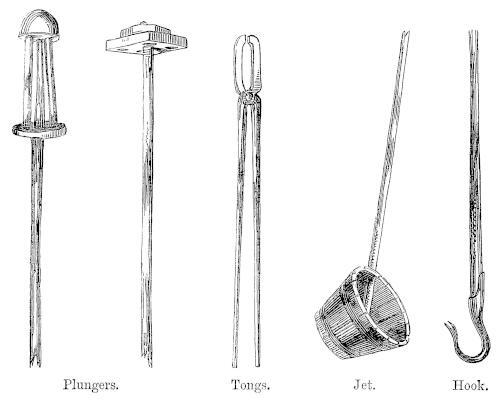
Plungers. Tongs. Jet. Hook.
“Tawing” is the name applied to the process by which the
skins of lambs and kids are converted into soft leather by
the action of alum. Of this kind of leather gloves are
usually made.
The jet and plungers used for immersing the hides in
the tan, the tongs and hook for removing them, and the
other implements, are easily understood as applied to the
various processes here mentioned.
THE SHOEMAKER.
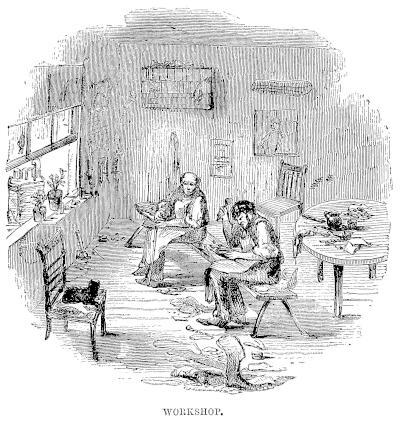
WORKSHOP.
The trade of the Shoemaker naturally follows that of the
tanner, since leather is the material principally employed
in making coverings for the feet; the tough hides of animals
being used for the same purpose in countries where the art
of tanning is either unknown or not practised. Scarcely
any handicraft employment engages the attention of so
many persons in this country as boot and shoe making.
From the fashionable bootmaker to the poor cobbler, who
crouches in a stall under a house in some narrow street, is a
wide interval, and this interval is filled up by numerous
grades. At Northampton boots and shoes are made on a
very large scale for the London markets; they include
chiefly the cheap varieties, but at some of the recent exhibitions
of manufactures the Northampton bootmakers have
exhibited specimens of workmanship which are considered to
be quite equal to those of London or Paris. At Edenbridge,
in Kent, and at other places, the strong coarse “hob-nailed”
shoes are made, which are so much worn by waggoners and
others.
The London makers import from Paris very large quantities
of boot fronts, which, when combined with other
parts of English manufacture, constitute many of the
“French boots” which now glisten in the windows. Notwithstanding
the large number of persons employed in
these avocations in England, and the abundant supply of
leather, there is still a considerable import of boots and
shoes from abroad, chiefly France.
In the old statutes a Shoemaker is called a cordwainer,
apparently a corruption of the French cordonnier, which
means a worker of Cordova leather. The companies of Shoemakers
in our ancient towns were incorporated under this
name; and where some of these companies now exist, they
are known by the same name. As a legal term, cordwainer
is still used.
The trade, as now followed in London and other principal
places, is subdivided into about twenty branches. The
following may be set down as the chief: the shoeman,
or maker of the sole part of the shoe; the bootman,
or maker of the sole part of the boot; and the boot closer,
or joiner together of the leg, vamp, &c. The labour of
these is especially directed to what is called the men’s line;
whilst others make the ladies’ shoes or boots. There are
many women, too, who get a livelihood by closing the shoe,
while others again follow the various sorts of binding.
The mechanical processes, after marking and cutting out
the leather, consist chiefly in various kinds of strong needlework,
such as the lasting or tacking of the upper leather to
the in-sole, the sewing in of the welt, the stitching to this
welt of the out or top sole, the building and sewing down
of the heel, and the sewing or closing of boot legs. The
boot closer is the most skilful of the persons employed, and
receives the highest wages.
The materials with which the Shoemaker works are generally
called the grindery,—they are so called at least through
England and Scotland, though in Dublin it is called finding.
“The cause of this technicality,” says Mr. James Devlin,
in his most interesting description of the trade of the
Shoemaker in the Industrial Library, “is now, I believe,
scarcely known to any one in the trade. The relation to
whom I was apprenticed, a man of a very active and inquisitive
turn of mind, told me its history, which it may be
worth while here to relate.
“Formerly, before hemp, flax, wax, hairs, or any description
of tools, were sold, as now, in shops set apart to this
particular business, the shoemaker, not using the peculiar
sort of stone rubber or the emery composition which he now
uses to sharpen his knives upon, was in the habit occasionally
of taking his knives to be ground (as the French
shoemaker does at the present day) to some of the common
knife-grinders of the neighbourhood. The knife-grinder
having thus the Shoemaker for a regular customer, began in
time to add to his usual business that of selling hemp, &c.;
hence his little shop being termed the grindery, every thing
he sold became known under this name, and is still continued.”
The tools of the Shoemaker are in their collective form
denominated his kit. Anciently, and in the old songs of
the trade, they were called “St. Hugh’s bones,” from a now
almost forgotten, though somewhat pleasant tradition. In
Stow, and in Randle Holme’s “Academie of Armorie,” 1688,
we find this term; as, also, in the still older romance of
“Crispin and Crispianus;” and in two plays, “The Shoemaker
is a Gentleman,” and the “Shoemaker’s Holiday,”
of the beginning of the seventeenth century.
The kit of the Shoemaker is, however, no longer now, as
formerly, made up of “bones”—saint or infidel, human or
brute,—but principally of good and kindly steel; purchased
ready-made at the grinder’s, or the grindery establishments
before spoken of, and kept afterwards (in this country, at
least, and in America) in repair and proper order by the
ingenuity and care of the workman himself; though in
France, and generally on the continent, much of this is
done by another person, to whom such occupation is the
sole means of livelihood.
Under the general term kit is comprehended the pincers,
nippers, hammer, the various descriptions of awls, of
setting irons, and many other articles.
It has often been a matter for great surprise that the
Shoemaker should sit in such a cramped and unhealthy
position at his work, crouched over his clamps as he holds
the leather in them between his knees while engaged in
sewing, or over the block, which he holds fast to his thigh
with the stirrup that passes underneath his foot.
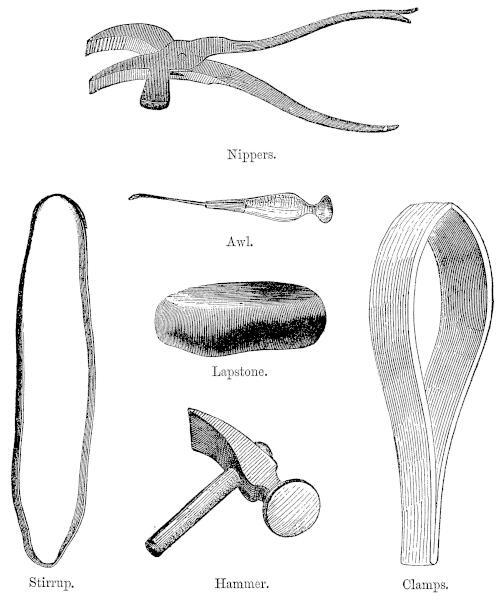
Nippers. Awl. Stirrup. Lapstone. Hammer. Clamps.
Many inventions and improvements have been made for
enabling the Shoemaker to stand during a great part of his
time, and some of these seem well adapted to supersede the
old position, but at present they have been only partially
adopted.
The Shoemaker’s thread being tipped with bristles, no
needle is required for sewing; but the thread itself is passed
through the hole made with the awl. Quickly goes in the
awl, and as quickly is out again, but not before the hair
from the fingers of the left hand has found the passage,
without being at all directed by the sight, but literally in
the dark; and hence the term blind stabbing, the right
hand hair immediately following in the opposite course, the
closed thumb and fore-finger of either hand nipping at the
moment the hairs from these different directions, and drawing
the same as instantly out, at once completing the stitch.
A proficient closer, or closer’s boy—for here, in general,
the boy is even more expert than the man—will in the
space of half an hour stab the four side rows and the two
back rows of the counter of a boot, each inch of stitching
taking about twenty stitches, and the entire work averaging
about fifteen inches, three hundred stitches being thus put
in in thirty minutes, or fifty every five minutes, each stitch
requiring in itself six distinct operations—the skill of sight
or distance, the putting in of the awl, and again its withdrawal,
the putting in the left-hand hair, and again of the
right, and lastly, the careful though rapid drawing, or
rather twitching, out of the thread itself.
The closer needs little kit: a slip of board to fit or
prepare the work upon; a pair of clamps; a block; a knife;
about three awls, two differently-sized closing awls, and one
stabbing awl; two seam-sets, or it may be three—one for
the stabbed sides; a stirrup; a case of needles (short blunts),
and a thimble.
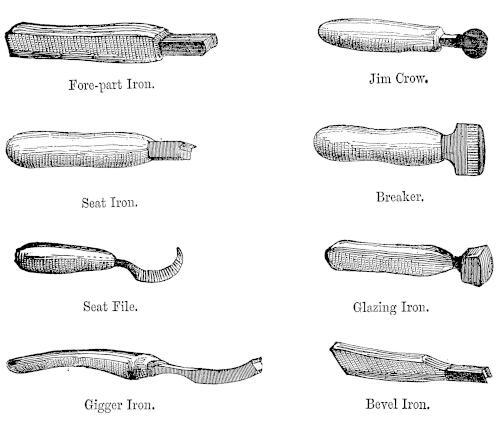
Fore-part Iron. Seat Iron. Seat File. Gigger Iron.
Jim Crow. Breaker. Glazing Iron. Bevel Iron.
The lining in all shoes, at least, but those of the very
strongest kind, is entirely the work of the woman, being
done with the needle, and elegantly it often is done. After
the lining, the upper has to be set; a matter soon effected;
the flat-seam-set, or, if stabbed, the stabbing-side-set, being
heated at a candle (though this is not necessary, and might
from the danger of the practice be well dispensed with)
and a little dissolved gum being rubbed on the seam, the
set is immediately to be somewhat forcibly and briskly
pressed along the line of stitching, which thus takes an
almost instant polish, and being also hardened, the upper
becomes ready for shop; that is, to be sent to the maker,
or shoeman, to finish by putting in the welt, soles, and other
parts of the shoe; the “stitching” being effected with a
square awl.
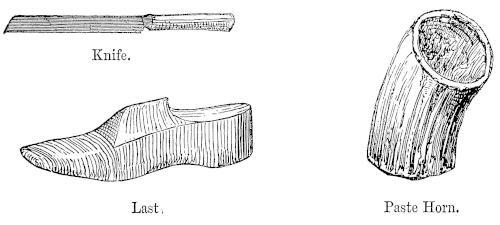
Knife. Last. Paste Horn.
The number of tools used by the Boot and Shoemaker
who combines all the branches of the trade is very great,
although few of them are remarkably expensive, except
some of the patent metal or hardwood lasts, on which the
shoes or boots are placed. The lapstone on which the
leather is hammered after being damped; and the various
kinds of irons used for rubbing, paring, or shaping the soles
and other parts of the shoe, are the principal implements,
beside the awls, knives, hammers, and rasp.
The glazing iron is used for burnishing the heel of the
boot or shoe; the paste horn for containing the paste used
in the inside lining of the shoe or boot; the irons for
setting up the leather beside the stitching, and the Jim-crow,
which is a small toothed wheel running in a handle
for the same purpose. The long stick is used for “sleeking,”
or smoothing and softening the upper part of the boot or
shoe, after it has been made and placed on the block, in
order to take out any wrinkles that may remain.
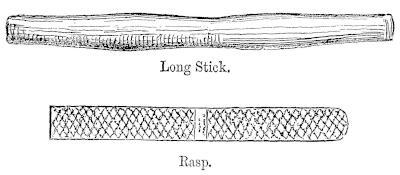
Long Stick. Rasp.
It would be impossible to give any clear description of
all the operations of the trade of the Shoemaker in the
space devoted here to this particular business, and even
were it attempted, no very clear idea could be conveyed of
the various portions of his work; since, like the tailor, he
has first to cut out the leather to the proper shape for
making the various parts, which have afterwards to be put
together. Indeed, beyond mentioning the uses of the
various tools, most of which are simple enough, little can
be said to explain the operation of the Shoemaker that would
not require actual inspection of the different processes;
although many of them may be understood by looking at a
shoe, after having observed the accompanying pictures and
having read what has been said about the tools employed.
THE SADDLER AND HARNESS MAKER.
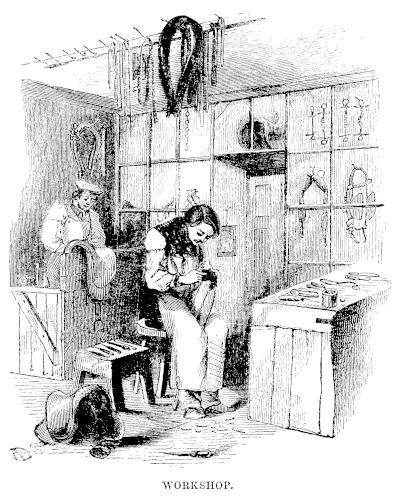
WORKSHOP.
The manufacture of saddles and harness for horses is one
requiring very considerable skill and no little patience,
since on the ability of the Saddler depends not only the
health and comfort of the horse, but the safety of the rider.
The beauty and finish of the harness and its appurtenances
are so essential to the proper appearance presented by the
whole equipage, that a very great deal of attention is now
given even to the smallest details, such as buckles, mounts
and ornamental sewing on straps and traces.
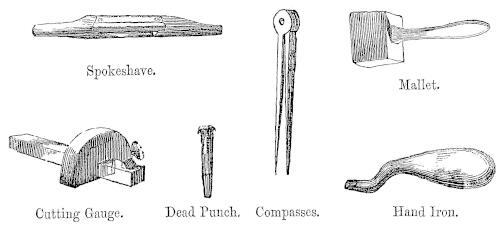
Spokeshave. Cutting Gauge. Dead Punch. Compasses.
Mallet. Hand Iron.
The operations in the trade of the Saddler are so similar
to those of the shoemaker, as far as the stitching and
cutting of leather are concerned, that they require very little
description. The most difficult part of his business is the
skilful making of saddles. To fit the pigskin over the iron
shape, and skilfully to arrange the padding, is often a very
troublesome task, where a horse requires some peculiarity
of make before he can be well fitted; and to ensure a perfect
smoothness and finish a skilful use of the hand iron and
the spokeshave is necessary. Similar care has to be taken
in forming the collars to which the harness is attached; and
indeed no part of the Saddler’s work can be carelessly
performed without serious risk either to the horse or its
owner.
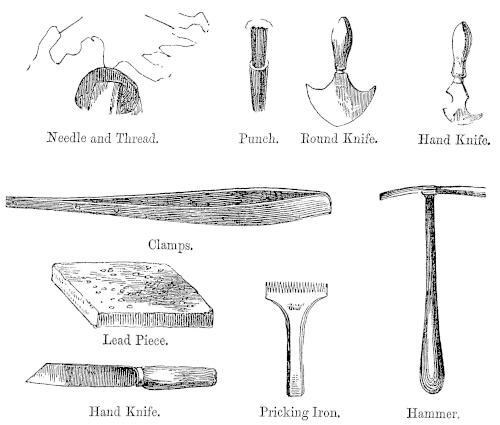
Needle and Thread. Clamps. Lead Piece. Hand Knife.
Punch. Round Knife. Pricking Iron. Hand Knife. Hammer.
As a great part of the Saddlers’ work consists of sewing,
he uses the clamps to hold the leather between his knees, in
the same way as they are used by the shoemaker; but although
he employs the sewing awl for drilling holes, or, at all
events, the pricking iron, the sewing is done with needles
and strongly waxed thread. The various kinds of knives
are used for cutting and paring the leather; the cutting
gauge and compasses for regulating the cutting, the hammer
for driving the small nails used in the work, and the mallet
for striking the pricking iron or punches. The punch is
used for making the holes in the straps to receive the
tongue of the buckle, and is therefore a hollow tube with a
sharp cutting edge, so that it will cut out a little round
piece of the leather. The dead punch is made solid, and
is not intended for cutting. The leather, when it has to be
cut with the punch, is placed on the lead piece, a small
square block of lead, which being soft allows a slight
yielding of the leather, and at the same time does not
blunt the edge of the punch when it has passed through
the hole.
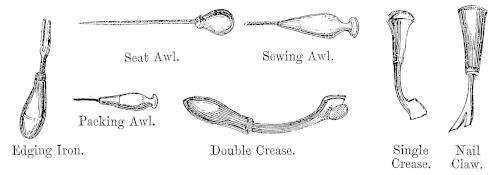
Edging Iron. Seat Awl. Packing Awl. Sewing Awl.
Double Crease. Single Crease. Nail Claw.
The seat awl and packing awl are used in the padding and
making of saddles and collars; the nail claw for removing
nails by which the leather has been fastened down.
The various kinds of creases are for the purpose of making
channels in the leather along the edges which have to be
sewn, so that the stitches are sunk below the surface, and
the thread will not so easily wear out. The edging iron is
for a similar purpose. In common saddlery some of the
comparatively unimportant straps, or the smaller gear, are
not sewn at the edges, and indeed do not require it, although
a great deal of the Saddler’s sewing is for ornamental purposes.
In order to make the whole look uniform, however,
these straps are not left plain, but are creased at the edges,
and the channels thus made are marked with the pricking
iron, to give them the appearance of having been stitched.
The Saddler is better off than the shoemaker, inasmuch as he
generally sits to work at a bench, and need not occupy such
a constrained and unhealthy position.
Some account has already been given of the preparation
of leather, but it will be desirable here to mention other
sorts, some of which particularly belong to the business of
harness making.
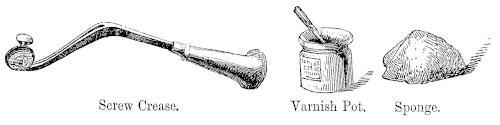
Screw Crease. Varnish Pot. Sponge.
Sheep-skins, when simply tanned, are employed for inferior
bookbinding, for leathering bellows, and for various
other purposes for which a cheap leather is required. All
the whit-leather, as it is termed, which is used for whip-lashes,
bags, aprons, &c. is of sheep-skin; as are also the
cheaper kinds of wash-leather, of which gloves, under-waistcoats,
and other articles of dress, are made. Mock, or
imitation morocco, and most of the other coloured and dyed
leathers used for women’s and children’s shoes, carriage-linings,
and the covering of stools, chairs, sofas, writing-tables,
&c. are also made of sheep-skin.
Lamb-skins are mostly dressed white or coloured for
gloves; and those of goats and kids supply the best
qualities of light leather, the former being the material of
the best morocco, while kid leather affords the finest
material for gloves and ladies’ shoes. Leather from goat-skins,
ornamented and sometimes gilt, was formerly used as
a hanging or covering for walls.
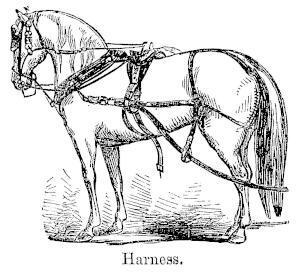
Harness.
Deer and antelope skins, dressed in oil, are used chiefly
for riding breeches. Horse-hides, which, considering their
size, are thin, are tanned and curried, and are used by the
Harness Maker, especially for collars, and occasionally,
when pared thin, for the upper leathers of ladies’ walking
shoes. Dog-skins are thick and rough, and make excellent
leather. Seal-skins produce a leather similar but inferior to
that supplied by dog-skins; and hog-skins afford a thin but
dense leather, which is used mostly for covering the seats of
saddles.
Currying is the general name given to the various
operations of dressing leather after the tanning is completed,
by which the requisite smoothness, lustre, colour,
and suppleness, are imparted. The processes of the Currier
are various. The first is styled “dipping” the leather. It
consists in moistening with water, and beating upon a
trellis-work of wooden spars with a mallet or mace. After
this beating, by which the stiffness of the hide or skin is
destroyed, it is laid over an inclined board, and scraped and
cleaned, and, wherever it is too thick, pared or shaved down
on the flesh side by the careful application of various two-handled
knives, and then thrown again into water, and
well scoured by rubbing the grain or hair side with pumice-stone,
or with a piece of slatey grit, by which means the
bloom, a whitish matter which is found upon the surface in
tanning, is removed.
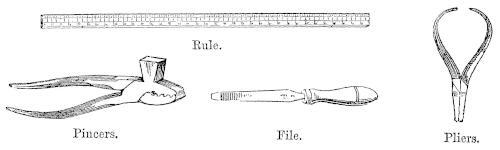
Rule. Pincers. File. Pliers.
The leather is then rubbed with the pommel, a rectangular
piece of hard wood, about twelve inches long by five broad,
grooved on the under surface, and fastened to the hand.
The Currier uses several of these instruments, with grooves
of various degrees of fineness, and also, for some purposes,
pommels of cork, which are not grooved at all. The object
of this rubbing is to give grain and pliancy to the leather.
The leather is then scraped with tools applied nearly perpendicular
to its surface, and worked forcibly with both
hands, to reduce such parts as may yet be left too thick,
to a uniform substance. After this it is dressed with the
round knife, a singular instrument which pares off the
coarser fleshy parts of the skin. In addition to these
operations, the Currier uses occasionally polishers of smooth
wood or glass, for rubbing the surface of the leather; and
when the leather is intended for the use of the shoemaker,
he applies to it some kind of greasy composition called
dubbing or stuffing.
Leather is occasionally dressed “black on the grain,” or
having the grain side instead of the flesh coloured. The
currying operations in such a case are similar to those
above described, but the finishing processes are rather
different. The leather is rubbed with a grit-stone, to
remove any wrinkles and smooth down the coarse grain.
The grain is finally raised by repeatedly rubbing over the
surface, in different directions, with the pommel or graining
board.
Japanned leather of various kinds is used in coach
making, harness making, and for various other purposes.
Patent leather is covered with a coat of elastic japan,
which gives a surface like polished glass, impermeable
to water; and hides prepared in a more perfectly elastic
mode of japanning, which will permit folding without
cracking the surface, are called enamelled leather. Such
leather has the japan annealed, something in the same
mode as glass; the hides are laid between blankets, and
subjected to the heat of an oven at a peculiar temperature
during several hours.
THE HATTER.
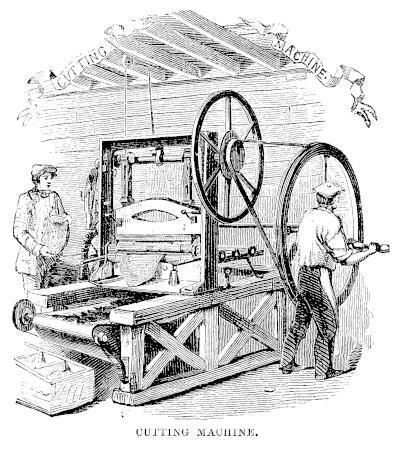
CUTTING MACHINE.
The trade of the Hatter is confined to a few countries of
Europe; but, as the fashion of hats is at present mostly
restricted, both here and in most parts of the Continent, to
those black stiff cylindrical coverings of silk which custom
has ordained we shall wear, greatly to our own discomfort,
and at a great expense, the business is of considerable
importance, and the making of hats has grown into a
large branch of industry. Before the introduction of that
kind of silk which bears a long pile, like velvet, and is
known as plush, beaver was the material principally used
for hat making; but beaver hats are much more expensive,
though they are now seldom made of the skin or fur of the
beaver, which has grown remarkably scarce, in consequence
of the land which the animals formerly occupied having
become inhabited.
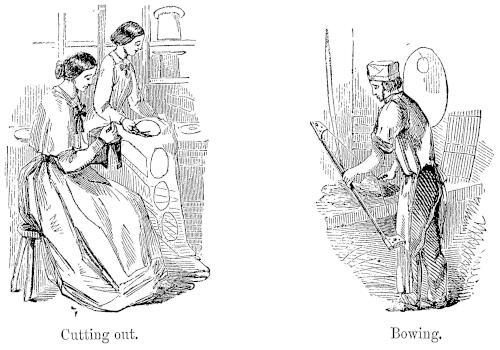
Cutting out. Bowing.
Beaver hats of the finest quality are made with lamb’s
wool and the fur of English rabbits. To form the body of
the hat, the wool and rabbit’s fur are separately bowed by
bringing a set of strings attached to a bow in contact with
a heap of the material, and then striking the strings, so as
to cause violent vibrations, and thus separate the filaments.
The two substances are next bowed together until they are
intimately mixed; after which the mass is spread evenly,
covered with an oil-cloth, and pressed to the state of an
imperfectly tangled felt. The next process is to cover the
felt with a triangular piece of damp brown paper, and
then to fold it in a damp cloth, and work it well with
the hand, pressing and bending, rolling and unrolling it,
until the interlacing or felting is much more perfect, and
the mass is compact. The felt thus prepared is next taken
to the wide brim of a boiler charged with hot water and
beer grounds, and a small quantity of sulphuric acid; it is
well rubbed and rolled until it no longer contracts. The
felt is next stiffened with shellac, a solution of which is
applied by means of a brush to both sides of the felt;
after which it is heated in a stove, and by this means the
whole substance becomes duly impregnated with the resin;
this renders the hat nearly waterproof.
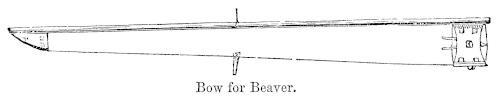
Bow for Beaver.
To form the nap of a hat, one half or three-fourths of an
ounce of beaver, and some other less costly fur, are bowed
together and imperfectly felted in the manner already described,
and shaped the same as the body to which it is to
be applied; that body is then softened by immersing it in
the boiler, when the nap is applied and worked as in felting,
until the required union is effected between the two bodies.
The felt thus covered is brought to the proper shape by
working it on a wooden block, and is then dyed black.
The hat is softened by steam, the crown is strengthened by
placing in it a disc of scaleboard, and linen is pasted over
this.
The nap is raised and a uniform direction given to its
fibres by means of warm irons and hair brushes. The last
processes are lining and binding, when the hat is ready to
be worn. In the low-priced hats of the present day, commoner
wool and fur, and smaller quantities of each, are
used.
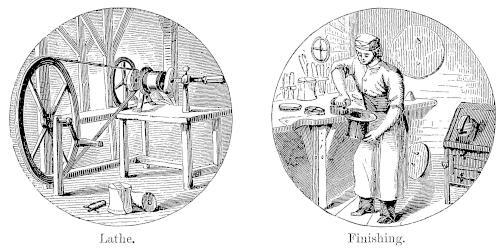
Lathe. Finishing.
Silk hats consist of a cover or exterior part made of silk
plush, which is laid upon a foundation of chip, stiffened
linen, or some other light material, previously blocked into
shape. The so-called velvet and satin hats deserve those
titles only so far as the plush resemble those materials.
The plush is mostly woven in the north of England. Paris
hats are for the most part made in England, the silk plush
being imported from France.
Rounding Card, No. 1. Rounding Card, No. 2. Finishing
Iron. Brow-piece. Blistering Iron. Card. Polishing Block. Multer. Brush.
The various tools employed are mostly used for shaping
the different parts of the hat. The cutting machine, for
dividing and preparing the felt and other materials; the
block, on which the body of the hat is formed previous to
its being placed in the lathe, where it is made perfectly
round; the brow-piece, for shaping the hat where it fits
the head; the card, a sort of wire brush for scratching up
or carding the fibre of the silk or beaver after the hat is
made; the rounding cards, for pressing and completing the
hat near the brim; the curler, for turning up and shaping
the brim; the multer, finishing iron, and blistering iron,
are used for shaping and smoothing; the polishing block
holds the hat while it receives the final process of brushing
and smoothing with a pad of velvet called the veleure.
Curler. Block. Veleure.
THE MILLER.
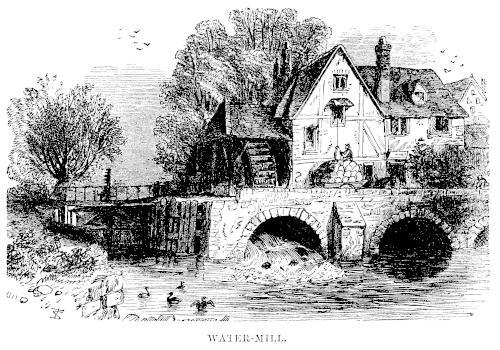
WATER-MILL.
There is scarcely a boy to be found who, when he has been
into the country and seen the wheel of the old water mill
going round, or the fans of the windmill slowly revolving
in the air, has not thought that it would be pleasant to
follow the business of a Miller.
Millers are proverbially jolly fellows, and their houses and
the mills themselves are generally very picturesque, and
stand in pleasant country places; then, again, what wonderful
fat perch and chub and pike can be caught in the weir or
the mill stream, and what a quiet sleepy occupation it must
be to lie on the grass or in some great room in the mill,
watching the fans, or listening to the summer breeze
wafting through the sails!
If anybody should think, however, that the Miller’s life is
a lazy one he had better alter his opinion; for, unless he
wishes to starve amidst plenty, the Miller must be up
betimes, and, besides working himself, keeping a good look-out
amongst his men, lest both he and his customers should
suffer by their negligence.
The mortar would seem to be the earliest machine used
for the purpose of bruising or reducing grain to a powder,
or into a state fit for the making of bread. By means of
the handle the pestle would with tolerable facility be
driven round the mortar, and the grain reduced to a powder,
as is done with certain drugs by the pestle of the apothecary
of the present day.
In process of time, shafts were added to these machines;
and in the opinion of Beckmann, the oldest cattle mills
resembled those described in Sonnerat’s Voyage to the East
Indies, in which the pestle of a mortar, fastened to a stake
driven into the earth, is affixed to a shaft, to which two
oxen are yoked. These oxen are driven by a man, while
another is employed in dropping the grain into the mortar
and placing it under the pestle.
We have good reason for knowing that the Romans, for
a long time, used no other instrument than the pestle and
mortar.
Pounding continued in use among the Romans so late as
after the era of Vespasian. This fact clearly proves that
the Romans were many ages behind the Eastern world in
the arts of civilization, for grinding of corn into flour was
practised, we know, in the times of the patriarchs, and was
probably the invention of the antediluvian world.
The subject-Britons universally adopted the Roman
name, but applied it, as we their successors apply it at
present, only to the Roman mill; still distinguishing their
own original mill as we distinguish it, by its own original
denomination of a quern. A Roman or water mill was
probably erected at every stationary town in the kingdom,
and it is quite certain that one was erected at Mancunium
(Manchester), serving equally the purposes of the town and
the uses of the garrison. One alone would be sufficient, as
the use of hand-mills was at that time very common in
both, many such having been found about the site of the
station particularly, and the use of them generally having
being retained among us very nearly to the present period.
Such mills it would be particularly necessary to have in the
station, that the garrison might be prudently provided
against a siege.
The ancient Asiatic hand-mill consists of two flat round
stones, about twenty inches or two feet in diameter, kept
rolling one on the other by means of a stick, which does
the office of a handle. The corn falls down on the undermost
stone, through a hole in the middle of the uppermost,
which by its circular motion spreads it on the undermost,
where it is bruised and reduced to flour; this flour,
working out at the rim of the millstones, lights on a board
set on purpose to receive it. The bread made of it is
said to be better tasted than that made by either wind or
water mills: these hand-mills cost only a few shillings
of English money.
This description of mill is frequently alluded to in the
Scriptures, and it was the practice for the women to grind
corn every morning by means of hand-mills; and in the
East, or at least in many parts of it, it continues to be the
practice to this day.
Water wheels, as far as the figure and construction are
concerned, may be reduced to three kinds, and they are
usually known by the names—overshot wheel, balance
wheel, breast wheel, and undershot wheel.
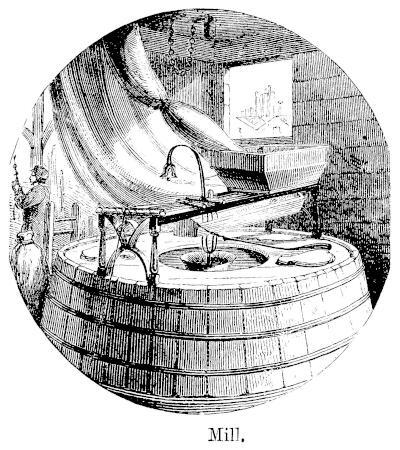
Mill.
In an overshot wheel, the water is conducted over the
top of the wheel, and acts first by its momentum or mere
movement, or motion, and then by its weight—the weight
being its principal power in impelling the wheel round, the
mere movement or motion of the water producing in this
case little effect. The water is received into buckets placed
all around the circle of the wheel. It first strikes the
wheel at the top, and filling the first bucket, by its momentum
or moving power, and more particularly by its
weight, it sets the wheel in motion, and consequently makes
that side heavier; and as fresh buckets rise to receive the
water, while those below have emptied themselves, a constant
tendency to motion is created, and rotation is produced.
In a balance wheel, the water strikes the wheel not at
the top, but always more or less above its centre, or axle.
This wheel differs in no respect from the overshot wheel in
its construction. It is employed where there is not a
sufficient fall for an overshot wheel, which requires less
water in consequence of its commanding a much greater
leverage.
In an undershot wheel the water acts only by its momentum,
or moving power. The circumference of the
wheel, instead of being supplied with buckets, as in the
overshot, and breast or balance wheels, is furnished with
floats, or float boards, as they are called, and, being exposed
to the action of a running stream, generally, if not always,
increased in rapidity by making an artificial fall, is thus
driven round, and in flour-mills its force is communicated
by cog-wheels to the stones employed in reducing corn to
meal.
In a breast wheel, the water has no previous fall, and
therefore does not strike the floats at the bottom of the
wheels, as in the undershot wheel, with an increased velocity.
The breast wheel is therefore fixed in what is called a race,
formed of stone or brick work, agreeing with the curvature
of the wheel, and being thus let on from its own level, acts
both by its weight and momentum, or movement. This
wheel is unlike the undershot wheel, being close boarded
round its circumference, like an overshot or balance wheel,
the undershot wheel being always open; in short, it is a
sort of bucket wheel; the buckets, however, being constructed
differently from those of the overshot and balance
wheels.
A tide-mill, as the name imports, is worked by the
ebbing and flowing of the tide. Of these mills there are
various kinds; first, those in which the water wheel turns
one way when the tide is rising, and the other when it is
falling; secondly, those in which the wheel turns the same
way whether it is rising or falling; thirdly, those in which
the wheel itself rises or falls as the tide flows or ebbs; and
fourthly, those in which the axle of the water wheel is so
fixed, that it shall neither rise nor fall; the rotary motion
being still given to the wheel, whether it be partially or
wholly immersed in the water.
All the machines for grinding corn and seeds are mills,
whatever may be their particular application. One very
common form is that of an iron machine, supported on four
legs, having a winch handle on one side, a fly wheel on
another, a hopper at the top, and a crushing apparatus in
the centre. The grain or seed is put into the hopper, the
winch handle is turned, the grain becomes crushed to
powder, and falls out at the bottom of the apparatus.
Sometimes the mill is made chiefly of wood, but with iron
wheel and crushing apparatus. One kind of wheat mill, in
addition to the usual mill apparatus, has a chest which acts
as a flour-dressing machine. Some mills are adapted for
crushing beans rather than seeds.
The crushing apparatus in mills is of two kinds, either
one stone working round in contact with another, or two
metallic surfaces, between which the substance is forced,
but between which it cannot pass except in a fine state.
The millstones employed in grinding corn require to be
made of a peculiar kind of stone. The greater proportion
of our millstones are procured from a particular spot in
Western Germany. At about ten miles from Coblentz is a
small town called Andernach, the chief trade of which is
in millstones, procured from the neighbouring quarries of
Nieder Mendig. There are several quarries, averaging
about fifty feet in depth, each quarry shaped like an
inverted cone, down the sides of which the quarrymen
descend by a spiral path. The quarrymen have to cut
away through a superincumbent layer of soft porous stone,
till they come to a layer of hard, blackish, heavy stone,
regularly porous, and yielding sparks when struck with
iron. This is the millstone, and requires good and well-prepared
tools to work it; it is supposed to be a compact
lava from some extinct volcano; and as there are fissures
or gaps at intervals, these facilitate the separation of the
stone into blocks suitable for millstones. All round the
bottom of the conical cavities, the stone has been excavated
in galleries or horizontal passages. The stones are brought
to shape by means of hammers and chisels. A deep socket
is cut through the middle of such stones as are intended
for runners, or upper stones. The furrows on the surfaces
of the stones are produced by means of a double-edged
hammer, about 14 lbs. weight.
Windmills are of two kinds; in one the wind is made to
act upon vanes or sails, generally four, which are disposed
so as to revolve by that action in a plane which is nearly
vertical; and in the other, the axis of revolution being
precisely vertical, any point on the surface of a vane
revolves in a horizontal plane. The former is called a
vertical windmill, and the latter a horizontal windmill.
The building for a vertical windmill is generally a wall
of timber or brickwork, in the form of a frustrum of a
cone, and terminated above by a wooden dome, which is
capable of revolving horizontally upon it. A ring of wood,
forming the lower part of the dome, rests upon a ring of
the same material at the top of the wall, and the surfaces
in contact being made very smooth, the dome may easily
be turned round upon the wall; and is prevented from
sliding off by a rim which projects from it, and descends
over the interior circumference of the lower ring. The
dome in turning carries with it the windsails and their
axle; and thus the wind sails may be adjusted to agree with
the direction of the wind, or the plane in which the radii of
the sails turn may be made perpendicular to that direction.
The revolution is sometimes accomplished by the force of a
man applied to a winch near the ground, but in general the
wind itself is made to turn the dome or the mill by means
of a set of small vanes, which are situated at the extremity
of a long horizontal arm projecting from the dome, in a
plane passing through the vertical shaft of the mill, and on
the side opposite to the great sails.
A horizontal windmill is a great cylindrical frame of
timber, which is made to revolve about an upright centre,
and its convex surface is formed of boards attached in vertical
positions to the upper and lower parts of the frame. The
whole is enclosed in a fixed cylinder having the same
upright centre as the other; this consists of a revolving
screen or a number of boards, which are so disposed that
in whatever direction the wind may blow, it may enter
between them on one side only of a vertical plane, passing
through the axis, and thus give motion to the interior
cylinder. The effective power of the vertical windmill is,
however, so much greater than that of the horizontal windmill,
that the latter is now seldom constructed.
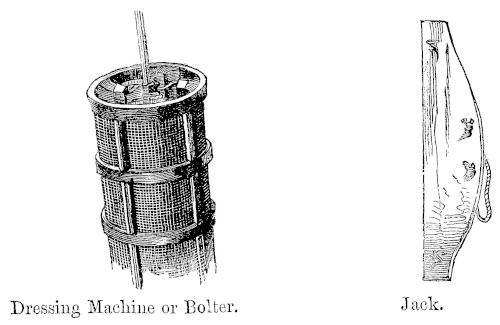
Dressing Machine or Bolter. Jack.
The dressing machine consists of a hollow cylinder, or
frame, covered with wire cloth of different degrees of fineness,
the finest being at the elevated, or upper end of the
cylinder, which is inclined in the same way as the bolting
mill. Within the cylinder, which may be made of pieces
of wood rendered circular, and, like the ribs of an animal,
placed at certain distances from each other, a reel is placed
with its axle in the centre of the cylinder, which is fixed, or
stationary. To the rails of this reel are attached hair brushes,
which, when made to revolve, or turn round, brush against
the interior cloth wire surface of the cylinder. The machine
is provided with a shoe or jigger, very similar to that of the
millstones, to cause a regular supply of flour or meal in the
same state in which it came from the millstones through a
spout from the floor above, to which it is elevated by the
sack tackle, or elevator, after being ground. The meal by
this means being gradually let, or fed into the cylinder, is,
by the motion of the brushes of the reel, sifted or rubbed
through the cloth wire with which the cylinder is covered.
The finest of the flour will go through the upper end, where
the finest wire cloth is placed; the next finest through
the next division of the wire cloth, which is coarser, the
middlings through the following division, the pollard, or
sharps, through the last, and the bran, not being able to get
through the wire cloth at all, on account of its coarseness,
is thrown out at the end of the cylinder. The cylinder is
enclosed in a large and close box, to prevent the waste of
flour by its going off in dust. This box is divided into
several compartments, or partitions, by means of moveable
boards. Some millers have more partitions than others,
and indeed they all vary the number to suit the nature or
sort of flour which they are manufacturing. In a dressing
machine of three divisions, the flour deposited in the first is
called household, or seconds, that in the second middlings,
and in the third pollard, which is not flour, but a fine
description of bran.
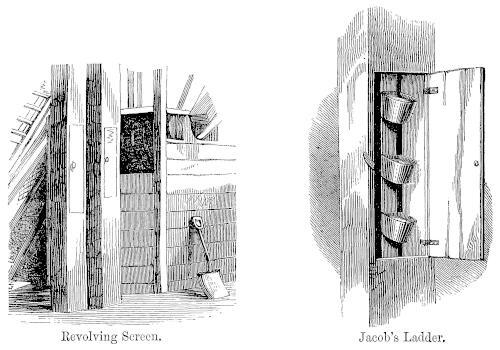
Revolving Screen. Jacob’s Ladder.
When wheat arrives at a mill to be ground the sacks are
received in the lower part of the mill, and hoisted by
means of the sack tackle to the upper storeys, generally the
uppermost. The mode of this operation is as follows, and
it is performed with little bodily labour. The rope or chain
of the sack tackle is firmly fastened round the mouth of the
sack by the man below, who by means of a rope attached
to a lever throws the tackle into gear. The sack then
immediately ascends, without any further aid from the
man, through the different trap doors, till it has arrived at
the place of its destination. There another man is ready
to receive it, who, as soon as he has landed it by pulling it
on one side, throws the tackle out of gear, and returns the
rope or chain to the man below. The wheat is then shot
into a garner or bin, and thus the same process goes on till
the whole load or cargo is safely deposited in the bin or
garner. The wheat remains there till it is wanted to be
ground, when, by means of a spout, it is conveyed to the
hoppers below, and from thence runs in between the stones.
In its progress to the stones, it may, or may not, be subjected
to a cleansing process. The wheat being reduced to
a flour, escapes through an aperture of the floor into a
spout, by which it is conveyed to the trough. It is then
either put into sacks, and drawn up again into one of the
higher storeys, and deposited in bins over the dressing
machines, or this is effected by a machine called an elevator,
which performs the operation without the assistance of
manual labour. In this bin the flour should be left till, at
any rate, it is perfectly cold, but is will be all the better if
it remain for three or four weeks, provided it be occasionally
turned. From this bin it is passed, by means of a spout,
to the hopper of the bolting mill or dressing machine, by
which it is separated from the bran or pollard, and is then
fit for use.
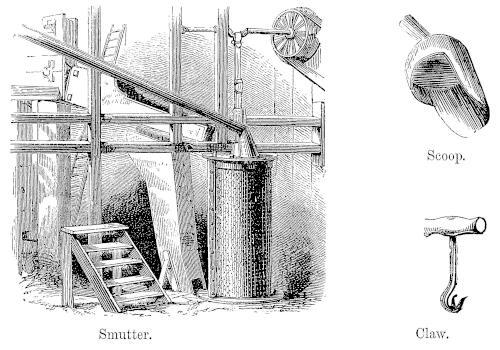
Smutter. Scoop. Claw.
The screening machine consists of a roller-shaped sieve,
so divided, that the corn which is placed at one end passes
over a large surface of wire as the sieve revolves, and this
operation removes from it external impurities, such as sand
and dirt. When it arrives at the end of the screw the
wheat falls into a hopper, by which it is conveyed by
spouts into small hoppers, placed over one side of each pair
of millstones. From these hoppers there are spouts placed
in nearly a horizontal line, which spouts conduct the corn
from the hoppers to the eye of the millstone. They are
attached to the hopper, so as to admit of a horizontal
motion, which is effected by a projecting part of the axle
or spindle of the stone, called a damsel. It is shaped like
a cross, so that, by the revolution of the millstone, it keeps
tapping the end of the spout, and gives a rapid vibratory
motion to it, which causes a regular supply of corn to enter
the eye of the stone; by the action of the stones the corn is
reduced to flour, which passes, by means of spouts, into
the troughs on the ground floor.
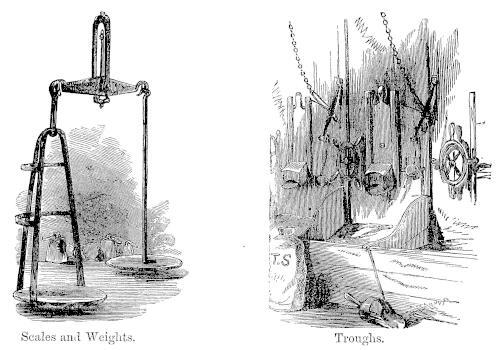
Scales and Weights. Troughs.
The troughs in which the flour is kept; the scoop and
scales for weighing small quantities; the claw for moving
and the steelyard for weighing sacks, are the other principal
objects seen in a mill. Jacob’s ladder is the name
given to a revolving band fitted with a number of leathern
cups. These revolve with the band through the flour and
serve to carry it up a shaft from one floor to another.
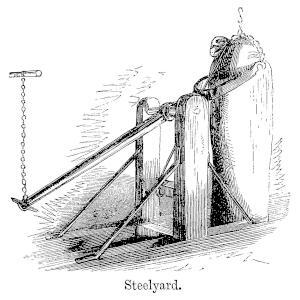
Steelyard.
THE BAKER.
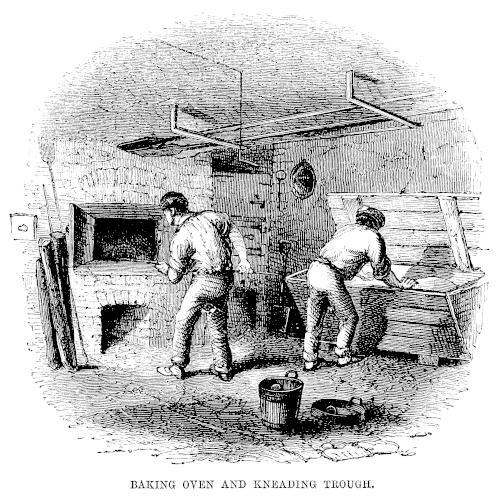
BAKING OVEN AND KNEADING TROUGH.
Of all the trades that are carried on in large towns there
is none more important than that of the Baker. In some
parts of the country, where people make their own bread at
home, or at all events have all the materials for making it,
and know how to mix the different ingredients, it is of less
consequence; but only imagine what would be our dismay
in London, if we got up some morning and heard that all the
bakers had agreed not to send in the rolls for breakfast,
and that we must be satisfied to live upon puddings and
vegetables until they set to work again to make bread.
And yet, in the early part of their history, several nations
of which we read at school had no knowledge of the trade
of a Baker. Until they discovered the art of making proper
bread, and somebody showed them the use of an oven, the
Romans made their meal into a sort of porridge, or knew
no better than to mix it into flat cakes, which they cooked
on hot stones or in the wood ashes of their fires. The
Anglo-Saxons were a little better off, for they mixed leaven
with their dough, to make the cakes lighter and better; but
you will remember—by the story of King Alfred, who when
he was in disguise and going to watch the Danish camp,
was left in the neatherd’s hut to watch the cooking of the
cakes—that they were baked in the embers of burnt wood
upon the hearth.
In many parts of Europe they still use a sort of cake-bread
or rolls instead of loaves; and in some parts of northern
Germany and Russia the bread of the peasants is nearly
black, and is so coarse and sour that few English people
could eat it, especially as it is kept till it grows quite hard,
and sometimes has to be cut with a saw.
The Eastern nations understood the use of ovens, however,
and the Jews especially were very good Bakers, as were
probably the Egyptians, for we read of Pharaoh’s Baker,
whose dream Joseph interpreted. The trade of baking was
held in very high esteem amongst the nations of antiquity,
and included not only the making of bread, but of those
cakes and sweetmeats of which all Oriental people, and
some European people too, are so fond. By reading the
history of the Jews and the Egyptians we learn that
fermented or leavened bread was in common use amongst
them, at a very early period of their history, so that the
pulse-eating people, or the people of Europe who could only
eat grain made into porridge, or simply cooked, were for a
long time behind the Orientals in this respect. It was not
till 600 years after the establishment of the Roman state
that a public bakery was opened in Rome itself, and before
this time, which was about 167 years before the birth of
Christ, all the baking and bread making was done, amongst
the rest of the family cooking, in the kitchens of private
houses.
When the public bakeries were established, however,
those who followed the trade were held in great respect,
and a code of laws was made to regulate the manner in
which their business should be conducted. The same
importance was given to the trade in England, when Bakers
first set up business in the large towns, and people began to
buy their loaves instead of making them at home. The
early statutes and laws place Bakers above mere handicraftsmen,
and ranked them with gentlemen, and very
severe punishments were inflicted on fraudulent Bakers, who
neglected to mark their loaves so that “wheaten” bread
might be distinguished from “household;” the same laws
condemned that Baker to the pillory who gave short weight,
even by so much as the fraction of an ounce, and the bakehouses
were placed under the control of the magistrates.
There are many people who think that some such
stringent laws might be usefully employed now, and there
can be no doubt that the Baker has too many opportunities
of adulterating his bread, or sending short weight: the first
seriously injuring the health, and the second the pockets, of
his customers. One of the worst features of the Baker’s
trade in our time, however, is the dirty condition of the
bakehouses and places where bread is made, the filthy
habits which such places give rise to, and the very long hours
during which journeymen Bakers are at work. All these
matters have lately been made the subject of inquiry, and
it may be hoped that they will be greatly improved.
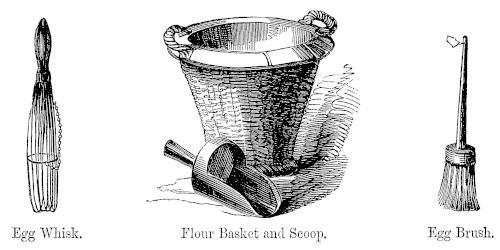
Egg Whisk. Flour Basket and Scoop. Egg Brush.
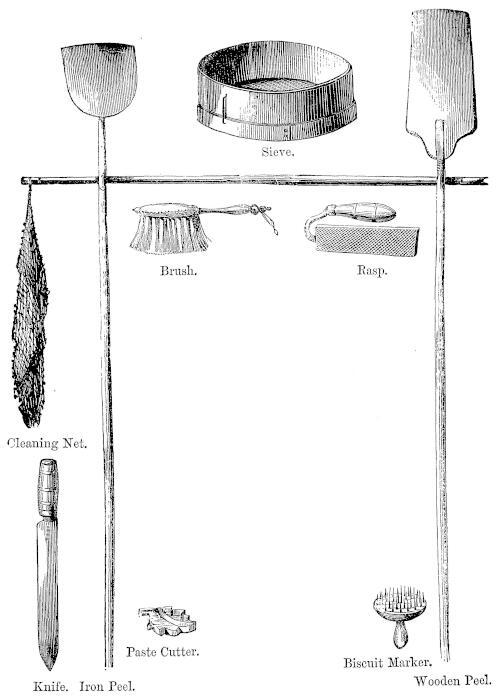
Sieve. Brush. Rasp. Cleaning Net. Paste Cutter. Biscuit
Marker. Knife. Iron Peel. Wooden Peel.
The tools that are used in most bakeries are, beside the
oven, where the bread is baked, and the kneading trough, in
which the dough is mixed: a seasoning tub for mixing
other ingredients to be mingled with the dough, a wire sieve
for sifting the flour, and a seasoning sieve made of tin
pierced with small holes; a flour basket lined with tin, and
a flour scoop, a pail, a bowl, a salt-bin, which should be
near the oven, a yeast tub, a dough knife, scales and weights
for weighing the dough before it is moulded into a loaf, a
scraper for removing the dough from the trough and the
board where the loaves are shaped, wooden and iron peels, a
sort of shovels with long handles,
for placing the bread in the oven
or removing loaves, dishes and
cakes, after they are baked, a rasp,
like a coarse broad file with a bent
handle, for rasping off any portion
of burnt crust; a dusting brush
for sweeping away refuse of flour
or dust from the boards where the
loaves are made or placed after
baking, an egg whisk for beating
eggs used in pastry, and an egg
brush for putting a glazing of egg
on the outside of buns or cakes,
differently shaped tins or moulds for rolls or other articles
of fancy bakery, coarse squares of baize or flannel for
covering the dough or the newly-made bread, and a
scuttle, swabber, or cleaning net, made of a quantity of
rough netting fastened on the end of a pole, and which,
after being wetted, is used for the final removal of all dirt
from the oven just before “setting the batch,” or placing
the loaves for baking. Beside these there are in most
bakehouses set ups, or oblong pieces of beech wood, to be
placed in the oven for the purpose of keeping the loaves in
their places.

Tin for French Rolls. Tin for Sponge Cakes.
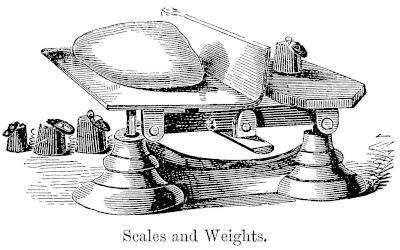
Scales and Weights.
It would be impossible to give instructions here how to
make the various sorts of bread, but the ordinary kind sold
by London Bakers is made much in the following way:—
Suppose that the Baker desires to make up a sack of flour;
he empties it into the kneading trough, and then proceeds
to sift it, in order to make it lie more lightly and to break
up any lumps.
He then takes from eight to ten pounds of potatoes and
boils them, without removing the skins, afterwards mashing
them in the seasoning tub, with about half the quantity of
flour, and adding a couple of pails of water. To this
mixture he pours about two quarts of yeast, made from the
liquor of boiled hops, malt, and patent yeast already made
and sold for the purpose. This is the leaven, which makes
the difference between bread and meal-cake, or the English
loaf and the Australian “damper,” which is made only of
flour and water, and baked at a bush fire; the yeast or
leaven is, in fact, meal in its early state of decomposition.
This mixture then is left in the seasoning tub, covered
with a sack for several hours, and allowed to ferment. Then
the Baker separates about a quarter of the flour in the
trough by means of a board, and piles it up at one end
apart from the larger quantity, and it is upon this that he
pours the contents of the seasoning tub, taking care that it
passes through a sieve placed on a couple of sticks across
the trough.
This portion upon which the liquor has been poured
is called the sponge, and he proceeds to “set it” by
thoroughly mixing, and finally giving it a dust of flour at
the top, after which it is kept for five or six hours, or until
it has twice “risen,” or puffed out by means of the fermenting
liquor within it.
Just as it has risen a second time, and air bubbles are
breaking through it to the surface, about three more pailfuls
of water are poured upon it, and in this water about three
pounds of salt have been dissolved; this is well mixed with
the sponge, and then, the board being removed, the sponge
and the rest of the flour is worked into one mass. It is
this kneading and breaking up the sponge which is the hard
labour of the Baker, and that it is hard labour may be
known from the fact that he works nearly naked, and that,
as he lifts and pummels the tenacious mass, he heaves great
sighs and groans like those with which paviors ram down
the stones in the roads. In many of the best bakehouses
now a machine is used, which supersedes this manual
labour; the mass of dough being placed in a cylinder,
within which an axle fitted with bent blades, or arms of
iron, revolves, passing through and through the dough as it
moves from end to end.
By another system (that of Dr. Dauglish) the use of
yeast is dispensed with, and the bread, made by machinery,
is leavened by carbonic acid gas, which is forced into the
cylinder after the atmospheric air is pumped out, and
so goes through the dough and produces the results of
fermentation.
The dough having been thoroughly mixed in the trough,
is left for an hour or two to “prove,” and then, after being
sprinkled with flour to prevent its sticking, is thrown out
upon a board, or the lid of the next trough, and cut into
pieces which are weighed, and afterwards moulded into
loaves. The moulding is only learnt by practice. The piece
of dough is cut in half and shaped according to the kind of
loaf required, one piece forming the top of the loaf, being
laid in a hollow of that which is to be the bottom, and the
joint made by a skilful turn of the knuckles. The loaves
are placed in the oven by means of the peel, and are packed
at the back and sides as closely as possible, the cottage
bread only being separate, that it may be crusted all
round. The batch takes about two hours to bake. Biscuits
are now mostly made by machinery, which in large establishments
turns them out ready for the oven; but when they
are wholly or partially made by hand, the dough is prepared
and afterwards moulded into shapes, and each shape pricked
with the docker, before being placed in the oven.
Cornfield.
THE SUGAR REFINER.
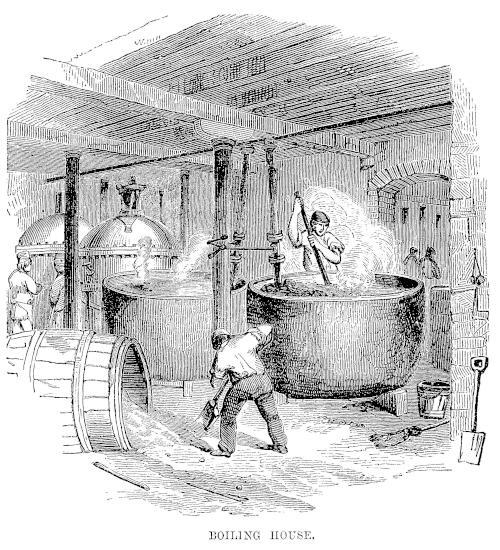
BOILING HOUSE.
Although sugar was known from very early times, it was
used only in medicine, and was supposed to be a sort of
honey found upon canes in India and Arabia. It is frequently
mentioned by the very early writers. The culture
of the canes seems to have been confined to the islands
of the Indian Archipelago, and the kingdoms of Bengal,
Siam, &c. The traffic in sugar was so lucrative that the
Indians concealed the mode of preparing it, stating to the
merchants of Ormus, who imported it with gums and spices,
that it was extracted from a reed, whereupon many unsuccessful
attempts were made to find it in the reed-like
plants of Arabia. In 1250 the great discoverer, Marco
Polo, visited the country of the sugar cane, and the merchants
afterwards sent to the place of its growth, instead of
buying it at Ormus. For a long period the use of sugar in
England was confined to medicines, or to preparing choice
dishes at feasts; and this continued till 1580, when it was
brought from Brazil to Portugal, and thence to our country.
Cultivators distinguish three great varieties of canes—the
Creole, the Batavian, and the Otaheite. The Creole cane is
indigenous to India, and was transplanted thence to Sicily,
the Canary Isles, the Antilles, South America, and to the
West Indies. It has dark green leaves, and a thin but very
knotty stem. The Batavian or striped cane, which has a
dense foliage, and is covered with purpled stripes, is a native
of Java, where it is chiefly cultivated for the manufacture
of rum; it is also met with in some parts of the New World
and the West Indies. The Otaheite variety grows most
luxuriantly, is the most juicy, and yields the largest product.
It is cultivated chiefly in the West Indies and South
America; it ripens in ten months, and is hardier than the
other varieties.
The sugar cane, being originally a bog-plant requires a
moist, nutritive soil, and a hot tropical or sub-tropical
climate. It is propagated by slips or pieces of the stem,
with buds on them, and about two feet long. It arrives at
maturity in twelve or sixteen months, according to the
temperature; the leaves fall off towards the following
season, and the stem acquires a straw-yellow colour. The
cane is cut by some planters before the flowering season, but
it is more usual to cut it some weeks after. The plantations
are so arranged that the various divisions of the fields may
ripen in succession. The land should be supplied with
manure rich in nitrogen, but not containing much saline
matter. After the harvest the roots strike again, and produce
a fresh crop of canes; but in about six years they
require to be removed.
The time for cutting the canes varies with the soil and
season, and the different varieties of cane. In a state of
maturity the canes are from six feet to fifteen feet in length,
and from one and a half inch to two inches in diameter.
The usual signs of maturity are a dry, smooth, brittle skin,
a heavy cane, a grey pith, and sweet and glutinous juice.
Canes should be cut in dry weather, or the juice will be
found diluted with an excess of water. When cut they are
tied up in bundles, and conveyed to the crushing mill,
particular attention being paid that the supply should not
exceed the demand, otherwise the cut canes would ferment
and spoil.
The sugar cane grows from pieces or slips of itself, containing
germs, and these develop rootlets at the joints, which
draw sustenance to the young shoot as it increases. In the
course of time the buds in the radicle, or root-joints of the
first cane, throw out roots, and form a radicle for a second
stem; and in this way, under favourable circumstances,
several canes are produced from the parent stock for a
period of about six years, and sometimes for several more.
They, however, diminish every year in length of joint and
circumference, and are inferior in appearance to the original
plant; but they yield richer juice, and produce finer sugar.
Filtering Bag.
The sugar exists in the cells of the cane in a state of
solution, and is extracted therefrom by pressure. With this,
as with other branches of industry, science has of late years
stepped in, and has greatly facilitated the process of extraction
and manufacture. It may be as well to give here
a summary of the processes employed in the preparation
of raw sugar: The canes are passed through the mill, and
the juice thus extracted from them runs from the mill into
a tank, whence it is pumped to cisterns for supplying the
clarifiers, heated by steam, where it is purified. From thence
it is run into bag filters, by which the mechanical impurities
are removed. It is then run into charcoal filters to remove
the colouring matter of the juice. The filtered juice is then
run off into tanks and is drawn thence by vacuum into the
vacuum pan, where it is granulated, and from whence it is
finally discharged for packing. When the steam clarifiers
are not employed the cane juice is run into a series of pans
or teaches over open fires. This apparatus is also known
as a “battery,” and forms another method of purification.
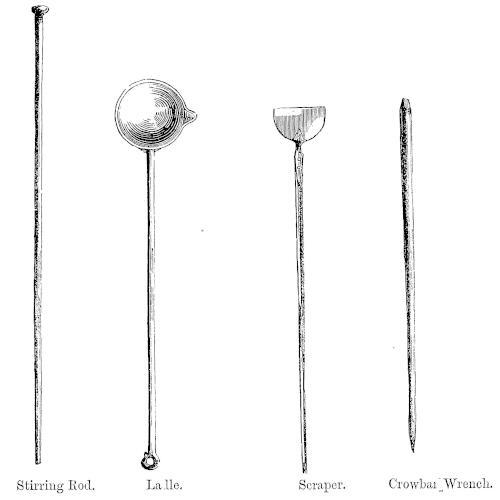
Stirring Rod. Ladle. Scraper. Crowbar Wrench.
The original crushing apparatus of India was a kind of
squeezing mortar, made out of the hollow trunk of a tamarind
tree, and worked by a yoke of oxen, the pestle or
stamper being a strong beam eighteen feet long, and rounded
at the bottom so as to squeeze or crush the canes in the
mortar. Mills similar to those used for crushing oil seeds
were used—as were also several other forms of apparatus—before
rollers were introduced. Stone and iron rollers
were first used, with the axes in a vertical position, but the
horizontal was soon found to be the more convenient and
economical. The importance of a systematic mechanical
arrangement appears to have awakened attention during the
reign of Charles the Second, for in 1663, Lord Willoughby
and Lawrence Hyde (second son of Edward, Earl of Clarendon,
High Chancellor of England) associated themselves
with one David de Marcato, an inventor, and obtained a
patent for twenty-one years for making and framing sugar
mills. In 1691, John Tizack patented an engine for milling
sugar canes, &c.; but in this, as in the previous case, it is
not specified how the mill should be made. Later on in
1721, William Harding, a smith, of London, who had been
many years in Jamaica, and was skilled in the manufacture
of sugar mills, having observed their imperfections, how
that they were chiefly made with large wooden cogs cased
with iron, endeavoured while abroad to improve their construction,
but failed for want of competent workmen. On
his return to London he made models of sugar mills which
were approved by the Royal Society. These mills were
fitted with cast iron rollers and cog wheel gearing, and were
worked by water power; from description they appear to
be the type of mills of the present day. Some forty-five
years later, Yonge and Barclay, ironfounders, of Allhallowslane,
City, applied friction wheels to sugar mills. In 1773,
John Fleming, a mill carpenter, proposed an arrangement
of windmill sails which turned a vertical timber shaft shod
with iron, and which gave motion to two hard wooden rollers,
between which the cane was guided and squeezed. In 1807,
H. C. Newman, of St. Christopher, West Indies, designed
a mill to be worked by horse power. He used cog and
crown wheels to give motion to three upright rollers, and
the arrangement was considered one which greatly augmented
the power and execution of this class of machinery.
In 1821, John Collinge, of Lambeth, improved cast iron
sugar mills by casting the rollers on wrought iron shafts,
instead of keying them on, as previously done. In 1840,
James Robinson patented improvements in sugar mills,
which consisted in using four rollers, one large one and three
smaller ones beneath, placed horizontally, and gearing by
cogs into each other. Up to that time three rollers only
appear to have been used. He also proposed to use six
rollers, which are fed from an endless band passing over the
rollers. He cast the rollers and shafts in one piece, cored
out to admit steam to facilitate the extraction of the juice
from the cane during crushing. He also proposed to tin
the interior of vacuum pans, &c. Various other arrangements
have been patented, but it is unnecessary here to
enumerate, much less to describe, them. The foregoing
examples give an idea of the progress of the subject during
nearly two hundred years. The last ten years have seen
rapid strides made in improving the make of mills, and the
general arrangement of sugar works.
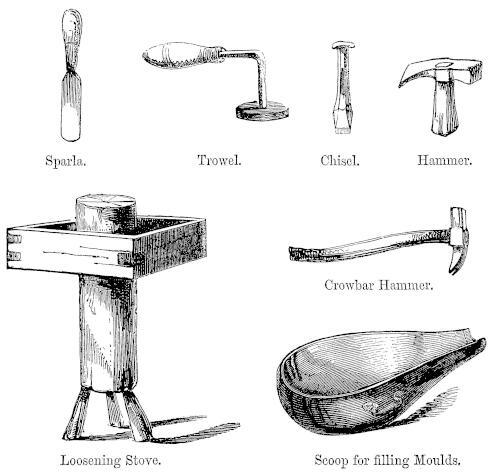
Sparla. Trowel. Chisel. Hammer. Loosening Stove. Crowbar Hammer. Scoop for filling Moulds.
Cane juice, as expressed by the mill, is an opaque, slightly
viscid fluid, of a dull grey, olive, or olive green colour, and
of a sweet balmy taste. The juice is so exceedingly fermentable
that, in the climate of the West Indies, it would
often run into the acetous fermentation in twenty minutes
after leaving the mill, if the process of clarifying were not
immediately commenced.
The processes followed in the West Indies for separating
the sugar from the juice are as follows: The juice is conducted
by channels from the mill to large flat-bottomed
clarifiers, which contain from three hundred to a thousand
gallons each. When the clarifier is filled with juice, a
little slaked lime is added to it; and when the liquor in
the clarifier becomes hot by a fire underneath, the solid
portions of the cane juice coagulate, and are thrown up in
the form of scum. The clarified juice, which is bright, clear,
and of a yellow wine colour, is transferred to the largest of
a series of evaporating coppers or pans, three or more in
number, in which it is reduced in bulk by boiling; it is
transferred from one pan to another, and heated until the
sugar is brought to the state of a soft mass of crystals imbedded
in molasses—a thick, viscid, and uncrystallizable
fluid. The soft concrete sugar is removed from the coolers
into a range of casks, in which the molasses gradually
drains from the crystalline portion, percolating through
spongy plantain stalks placed in a hole at the bottom of
each cask, which act as so many drains to convey the liquid
to a large cistern beneath. With sugar of average quality,
three or four weeks is sufficient for this purpose. The liquid
portion constitutes molasses, which is employed to make
rum. The crystallized portion is packed in hogsheads for
shipment as raw, brown, or muscovado sugar; and in this
state it is commonly exported from our West Indian
colonies.
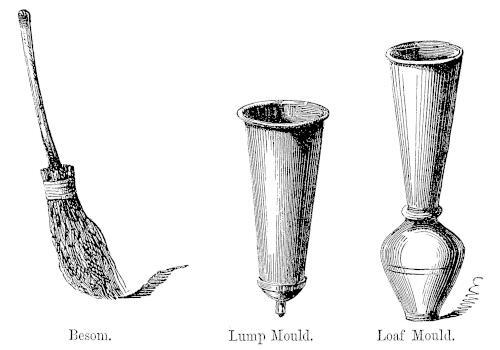
Besom. Lump Mould. Loaf Mould.
The refining of sugar is mainly a bleaching process, conducted
on a large scale in England. There are two varieties
produced by this bleaching, viz. clayed and loaf sugar. For
clayed sugar, the sugar is removed from the coolers into
conical earthen moulds called formes, each of which has a
small hole at the apex. These holes being stopped up,
the forms are placed apex downwards in other earthen
vessels. The syrup, after being stirred round, is left for
from fifteen to twenty hours to crystallize. The plugs are
then withdrawn, to let out the uncrystallized syrup; and
the base of the crystallized loaf being removed, the forme
is filled up with pulverized white sugar.
This is well pressed down, and then a quantity of clay
mixed with water is placed upon the sugar, the formes
being put into fresh empty pots.
The moisture from the clay, filtering through the sugar,
carries with it a portion of the colouring matter, which is
more soluble than the crystals themselves. By a repetition
of this process, the sugar attains nearly a white colour, and
is then dried and crushed for sale.
But loaf sugar is the kind most usually produced by the
refining processes. The brown sugar is dissolved with hot
water, and then filtered through canvas bags, from which it
exudes as a clear, transparent, though reddish syrup. The
removal of this red tinge is effected by filtering the syrup
through a mass of powdered charcoal, and we have then a
perfectly transparent colourless liquid.
In the evaporation or concentration of the clarified syrup,
which forms the next part of the refining process, the
boiling is effected (under the admirable system introduced
by Mr. Howard) in a vacuum, at a temperature of about
140° Fahrenheit. The sugar pan is a large copper vessel,
with arrangements for extracting the air, admitting the
syrup, admitting steam pipes, and draining off the sugar
when concentrated. In using the pan a quantity of syrup
is admitted, and an air pump is set to work to extract all
the air from the pan, in order that the contents may boil at
a low temperature. The evaporation proceeds, and when
completed the evaporated syrup flows out of the pan
through a pipe into an open vessel beneath, called the
granulating vessel, around which steam circulates, and within
which the syrup is brought to a partially crystallized state.
From the granulators the syrup or sugar is transferred into
moulds of a conical form, which were formerly made of
coarse pottery, but are now usually of iron. In these moulds
the sugar whitens and crystallizes, the remaining uncrystallized
syrup flowing out at an opening at the bottom of the
moulds. This syrup is reboiled with raw sugar, so as to
yield an inferior quality of sugar; and, when all the crystallizable
matter has been extracted from it, the remainder is
sold as treacle. The loaves of sugar, after a few finishing
processes, are ready for sale.
THE DYER AND SCOURER.
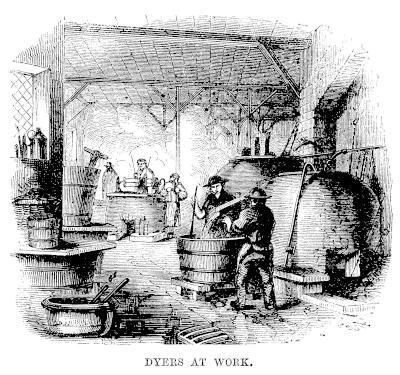
DYERS AT WORK.
The trade of the Dyer may be placed amongst the most
ancient of the arts, and the tools that are used in it are so
few that they need scarcely any description, since almost
all the apparatus required are the various coppers, vats, and
other vessels used for boiling the fabrics to be dyed, and
immersing them completely in the liquors which have been
prepared from the dye stuffs, the proper use of which is
the principal secret in the business. With regard to the
scouring or cleaning of fabrics, whether made into garments
or not, the operation consists in applying detergents, or
substances like soap and turpentine, for removing grease
and dirt, or other liquids which have a detergent property
but will not injure the colours; the use of these, with a
sponge and a hard brush, is nearly all that is required; the
garment sent to be cleaned being stretched on a frame and
dried, either in the dyer’s drying room, or in some open
situation, where they are least likely to be soiled or spotted.
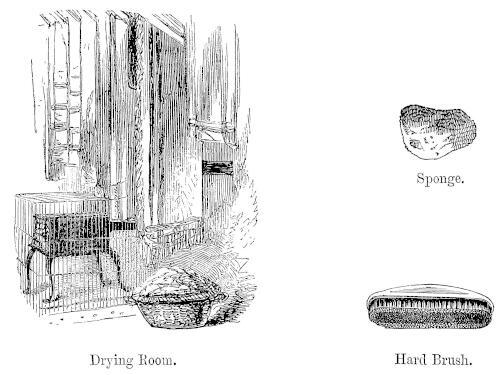
Drying Room. Sponge. Hard Brush.
The art of dyeing was practised to a very great extent
by the ancient Egyptians, Phœnicians, Greeks, and Romans;
and the island of Tyre was, in very early times, celebrated
for a purple dye which was, perhaps from its costliness,
used for colouring the robes of kings and emperors, from
which practice purple became the imperial colour.
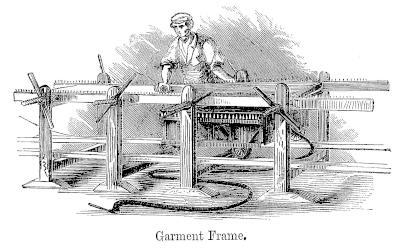
Garment Frame.
The art of modern dyeing very greatly consists in the
proper use of what are called mordants, that is, substances
which, although they do not of themselves produce colour,
so act upon the dyes as to cause them to give an intenser
hue to the fabric, and also serve to make the colour permanent.
The modern dyers have obtained several dye
drugs unknown to the ancients, such as cochineal, quercitron,
Brazil and logwood, arnotts, and indigo, which was
only known to the Romans as a paint; but the vast
superiority of our dyes must be principally ascribed to the
employment of alum and solution of tin mixed with other
substances as mordants, which give depth, durability, and
lustre to the colours. Another improvement in dyeing is
the application of metallic compounds, such as Prussian
blue, chrome yellow, and manganese brown, to textile or
woven fabrics.
Our readers will see from what has been said of mordants
how what are called fast colours are obtained, fast colours
meaning colours which will not be affected even by the
liquor of the dye bath. Another very necessary subject of
information in relation to dyeing is the fact that different
substances, such as silk and wool, will not be equally affected
by the dye in which they are placed, since the particles
contained in the composition of these substances have different
degrees of what is called affinity, that is, they combine
in a greater or less degree with the component matter of
the dye stuff.
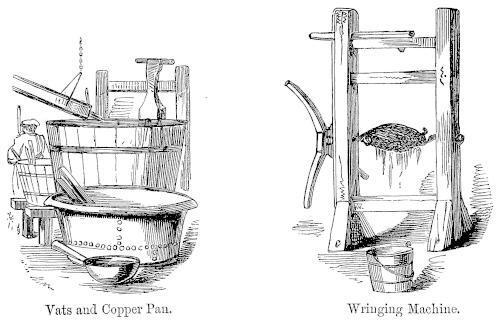
Vats and Copper Pan. Wringing Machine.
We have already said something of the preparation of
cotton. The operations to which silk and wool are subjected
before being dyed are intended to separate superfluous substances
from the animal fibre, and to make that fibre more
easily unite with the colouring particles.
Silk is scoured by means of being boiled in water and
soap, whereby the animal varnish is removed from the
surface; if intended to be very white, it is bleached by
humid sulphurous acid. Wool is first washed in running
water to separate its coarse impurities, and is then freed
from the greasy animal matter secreted from the skin of the
sheep by means of ammoniacal liquor, soap and water, or
a solution of soda. It is finally bleached by the fumes of
burning sulphur, or by aqueous sulphuric acid.
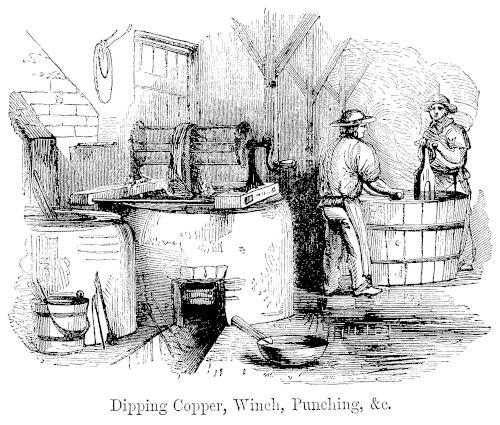
Dipping Copper, Winch, Punching, &c.
What are called tinctorial colours, as distinguished from
mordants, are either simple or compound. The simple are
black, brown or dun, blue, yellow, and red; the compounds
are grey, purple, green, orange, and others.
Gall nuts, pyrolignite of iron, logwood, copperas, and verdigris,
are the chief materials for producing black. Walnuts,
sumach, madder, cochineal, cudbear, acetate of iron, catechu,
Brazil wood, arnotts, are all employed in producing brown.
Indigo, Prussian blue, and woad for blue. Fustic, Persian
berries, quercitron, turmeric, and weld for yellow. Cudbear,
Brazil wood, cochineal, kermes, lac, logwood, madder, safflower,
for red; and various compounds for purple, green,
orange, &c.
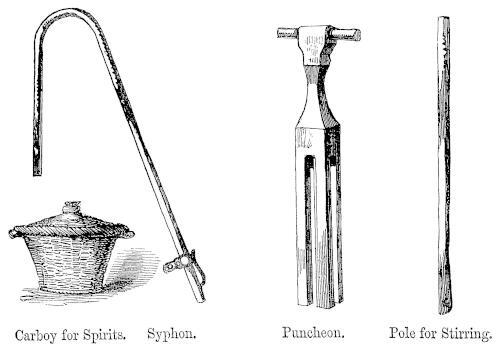
Carboy for Spirits. Syphon. Puncheon. Pole for Stirring.
The dye materials imported from foreign countries are
principally cochineal, fustic, gum arabic, gum senegal, gum
animi, gum copal, gum tragacanth, indigo, lac dye, shellac,
logwood, madder, smalts, valonia, yellow berries, and zaffre.
The tools shown in the engravings explain themselves, and,
as has been already said, principally consist of the various
coppers and vats, the syphons or tubes by which liquor will
flow from one vessel to another, and the puncheons, for
stirring and thoroughly immersing the articles in the dye
stuff.
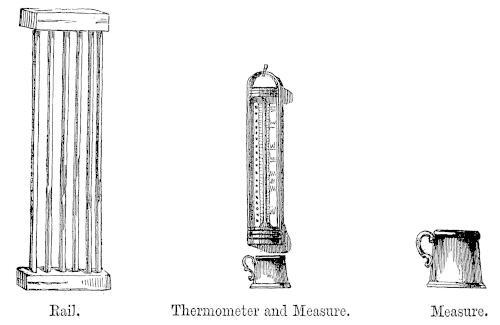
Rail. Thermometer and Measure. Measure.
THE COPPERSMITH.
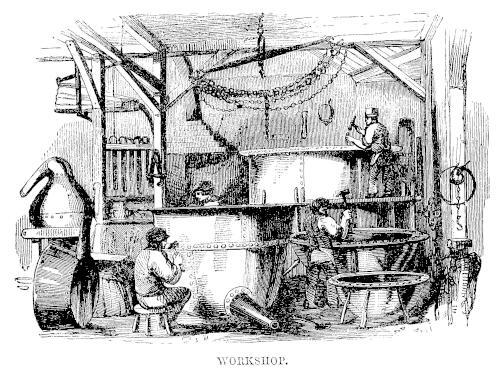
WORKSHOP.
The very great variety of purposes for which the metal
called copper is used, renders it one of the most valuable
productions of this country, and several very important
manufactures would be incomplete without it, since it is
the principal material of which many large vessels are
formed, and is also largely employed as an alloy for other
metals. Although the metal is sometimes found in a pure
or native state, its most abundant ore is that known as
copper pyrites, of which there are many kinds. The most
common yellow copper ore is a very abundant mineral,
found in large quantities in Cornwall, Devon, and the Isle
of Anglesea, and is a compound of about equal parts of
copper, iron, and sulphur. The mines of Devon and Cornwall
yield more than three-fourths of the copper obtained in
England, or about 190,000 tons of ore in a year, the value
of which is above a million sterling. The amount of copper
annually obtained in the United Kingdom is about 15,000
tons, worth more than a million and a half of money.
About the same quantity is imported into this country
from Chili and Cuba, and a very valuable copper ore is also
found at the Burra Burra mines in Australia.
The copper ores of Cornwall and other parts of the
country are generally shipped to Swansea, where coal is
abundant, in order to be separated from the metal. For
this purpose the ore is heated to redness, or roasted in an
open furnace, in order to burn away the sulphur, and the
fumes given out by this process are most pernicious. The
ore is afterwards melted several times to separate the other
impurities, which, when fused, float like scum on the surface
of the liquid metal, and are then easily removed.
Copper has a peculiar reddish colour, and will bear a
brilliant polish; its smell and taste are both disagreeable.
It is one of the most malleable of metals, and can be so
readily worked by the hammer that it is beaten out into
thin leaves, which, under the name of “Dutch metal,” are
employed in ornamenting toys, &c. in imitation of gilding.
It is also so ductile that it can be drawn out into finer
wires than any ordinary metal, except gold, silver, and iron,
and its tenacity is so great that a wire one-tenth of an inch
in diameter will bear a weight of 175 lbs. This wire is
very flexible, and not very elastic, but when rolled into
sheets copper is one of the most elastic, and when struck
one of the most vibratory and loud sounding metals.
If taken into the animal system all preparations of copper
are violent poisons; and, as this metal is directly acted upon
by vinegar and other acids, it should not be employed for
making vessels used in cooking or preparing food.
The easy malleability of copper allows it to be rolled
into thin sheets, which can easily be hammered into any
form that may be desired, and it is this operation which
belongs to the trade of the Coppersmith.
Sheet copper is employed in covering the bottoms of
ships, to protect them from the attacks of marine animals;
it is also used for coins, which are punched out of the sheet
of metal and stamped with dies, and for plates on which
pictures are engraved; the metal being soft enough to
yield to the tool of the engraver, but yet sufficiently hard
to resist the pressure necessary to print the picture.
As an ingredient in alloys copper is most valuable, especially
in bell metal, which is composed of three parts of
copper and one part of tin; in bronze, which is nine-tenths
copper and one-tenth tin; and in German silver, argentine,
nickel silver, and other alloys used for making forks, spoons,
dishes, &c. which are composed of copper, zinc, and nickel.
These are very beautiful alloys, closely resembling silver;
but the copper they contain is liable to be partially dissolved
by any long exposure to the action of acids.
Copper is used in small quantities as an alloy for gold
and silver both in coinage and in plate, to give the requisite
degree of hardness. Gold used for coins, or what is called
standard gold, is formed of eleven parts of pure gold and one
part of copper. Being a better conductor of electricity
than any other metal, it is largely employed in the formation
of telegraphic wires; and, as it is not hard enough to strike
fire with flint or grit, it is used in gunpowder mills and
magazines instead of iron.
The processes of casting and rolling copper into sheets
are so much like those already described in the manufacture
of iron that they need not be repeated, but the trade of the
Coppersmith is distinct from those of the workers in other
metals, though they mostly consist in forming the sheet
copper into various shapes and utensils by means of hammers,
of which the smoothing hammer, the set hammer,
and the riveting hammer, explain their own uses by their
names.
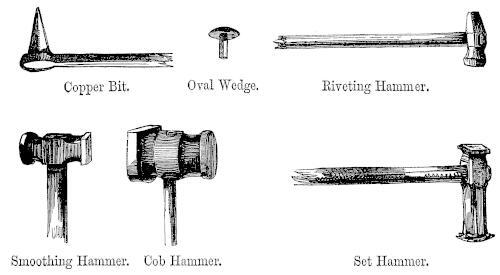
Copper Bit. Oval Wedge. Riveting Hammer. Smoothing
Hammer. Cob Hammer. Set Hammer.
In manufacturing the large vessels with circular bottoms
which are so frequently made of copper, the metal is first
cast in a shape resembling a round spectacle glass, that is
to say, a flat cake, thick in the middle and gradually
diminishing in thickness towards the edge. It is then
subjected to the powerful blows of a tilt hammer, the beating
being principally confined to the centre. The effect of this
is not only to reduce the thickness of the copper, but to
cause the disc to turn up at the edges and assume the form
of a hollow dish.
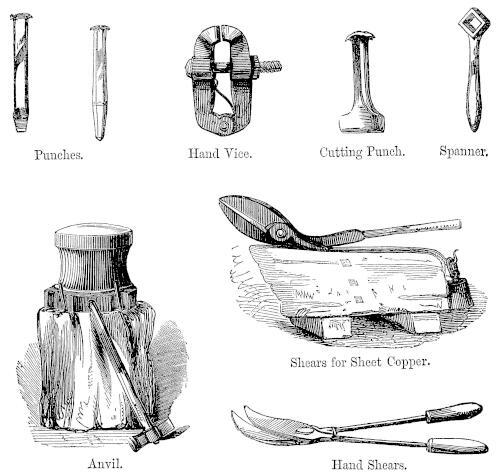
Punches. Hand Vice. Cutting Punch. Spanner. Anvil.
Shears for Sheet Copper. Hand Shears.
Another operation of the Coppersmith is called planishing,
or hammering the metal until it becomes more dense, firm,
and tough; any one who looks at the surface of a large
copper vessel will see the marks of the hammer by which
it has been planished.
It is by the combined operation of casting, rolling,
hammering, and planishing, as well as by the processes of
fastening, either with rivets or with solder, that nearly all
copper articles are made.
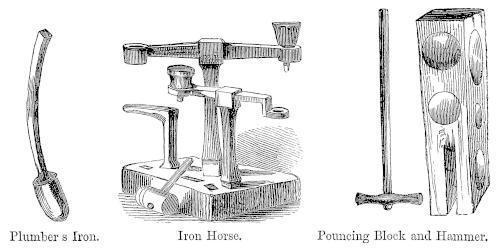
Plumber’s Iron. Iron Horse. Pouncing Block and Hammer.
Of the tools used by the Coppersmith, beside those
already mentioned, the principal are punches for cutting
or piercing holes, shears for cutting the sheets of metal, the
spanner for turning heads of screws or nuts, the anvil, the
blocks and horses for receiving the work in such a position
as to operate on any part where the hammer or the punch
is required, and the iron for soldering. There are five
different modes of forming copper piping out of sheet
metal; in the first the edges of the sheet, which is curved
round a mandril, are made to meet without overlapping,
and are joined with hard solder; in the second they overlap
and are united by soft solder; in the third they overlap
and are secured by rivets; in the fourth the edges are
folded one over the other, and are made close and firm by
hammering; and in the fifth both edges of the pipe are
turned back and covered with a strip of sheet metal, the
two edges of which are turned in and hammered down.
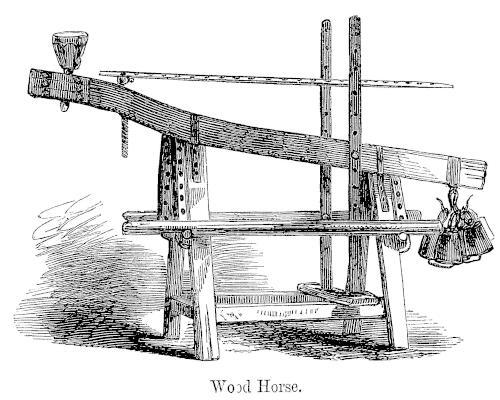
Wood Horse.
THE GUN MANUFACTURER.
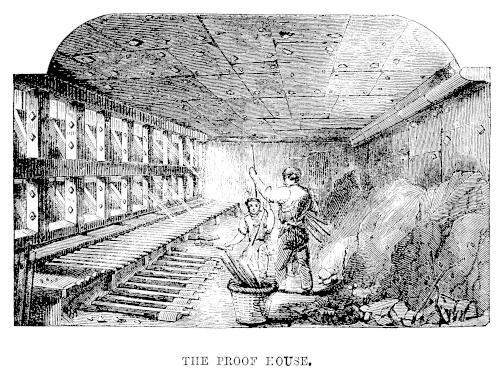
THE PROOF HOUSE.
By guns, only muskets, rifles, and fowling-pieces are here
meant, since the manufacture of cannons, to which the
term guns is now commonly applied, is an entirely different
business to that of making what are called “small arms;”
the latter including, in fact, swords, pistols, bayonets, muskets,
rifles, and some other implements of war. There are
so many varieties of fire arms, and they are sold at prices
varying so greatly, that it would be almost impossible to
give any detailed description of each kind of piece. The
finely-finished rifle or sporting gun, fitted with the last
improvements, breech-loading or otherwise, and finished
with marvellous perfection and accuracy, is worth four times
as many pounds as the common muskets, made for exportation
to Africa for the use of the natives, are worth shillings.
We may, therefore, describe some of the ordinary processes
of the gunmaker’s trade, and the various improvements
will then be better understood when the reader has an
opportunity of seeing finished guns, in which such improvements
may be pointed out to him.
The barrels of guns are either plain or twisted; twisted
barrels are made of long and very narrow strips of iron,
one of which, being moderately heated to increase
pliancy, is wrapped spirally round a cylindrical mandril in
such a way as to form a tube, which may be slipped off the
mandril at pleasure. As the rods are not usually made of
sufficient length for one to form a barrel, several are usually
joined end to end, those which form the breech being
thicker than those at the muzzle end. By heating and
hammering these pieces are welded into a continuous and
very strong and tough tube.
Partially worn iron, called “scrap iron,” is best for these
purposes. The twisted barrels which are known as “wire
twist” are formed of narrow rods of iron and steel forged
together, and then rolled out to the proper thinness.
Damascus barrels are composed of similar metal, but the
rods are twisted on their own centres until the fibres which
they contain have from twelve to fourteen turns in an inch
by which the rods are doubled in thickness and proportionately
reduced in length. Two such rods are welded together
side by side, their respective twists being reversed. There
are many modes of making twisted barrels, but these are
the most common.
After being welded, the barrels are carefully examined,
and, if needful, straightened by a few blows of the hammer.
They are then bored in a machine with an angular plug of
tempered steel, which is caused to revolve rapidly within
the barrel, while a stream of water is directed upon the
outside to check the heat caused by the tremendous friction.
The outside is brought to a smooth surface either by
grinding on a large grindstone, or turning in a lathe. The
breech end of the barrel is bored with a screw-thread, to
receive the breech plug, which closes it at that end.
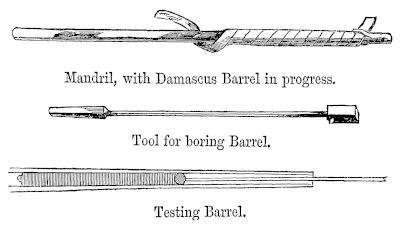
Mandril, with Damascus Barrel in progress. Tool for
boring Barrel. Testing Barrel.
The barrels are then proved by being fired at the proof-house,
a large building where they are loaded with a charge
five times as great as they will have to bear when in use.
A great number of barrels are fired at once by laying them
upon a strong framework of wood with their touch-holes
downwards, and connected with a train of gunpowder which
is ignited outside the building. A heap of sand is piled
inside the building, opposite the muzzles of the barrels to
receive the bullets. Those which bear this test without
injury are marked as perfect.
Guns used in field sports are often made with two barrels
fixed side by side upon one stock. The barrels are made
separately, and each with one flat side, that they may lie
close together. They are secured together by ribs running
between them from end to end.
The wooden stock upon which the barrel is fixed is
generally made of walnut-tree wood. It is first shaped, and
afterwards shod with brass or steel; the trigger guard and
other fittings are let into the wood, and every part is
furnished with the proper screws and fastenings.
With regard to the manufacture of rifles and other small
arms in general, the author of the present work some time
ago wrote a description of a visit to the factory at Birmingham
known as the Toledo Works, and it may be useful
to give an extract from that account of what he saw there.
The steel from which the swords are made is supplied
in long pieces somewhat tapering at the ends, and having
a square portion in the middle, which, being cut through,
leaves material for two blades, the bisection of the square
leaving a shoulder at one end to receive the iron
“tang” by which the blade is afterwards fixed into the
handle. The manufacture of these blades is almost entirely
effected by the forgers, who hammer them into the required
shape upon the anvil, a mould running down the centre of
which secures the hollow which in swords extends for about
two-thirds of the length from hilt to point. In a little
street of smithies the musical clink is being sounded by a
score of stalwart arms, either forging the rough steel into
form, or hammering the formed blade into perfect shape
and symmetry, an operation which requires it to be kept at
a certain heat, lest the embryo blade should be injured in
the process. Once perfected as to proportion, the hardening
commences, and the blade is thrust backwards and forwards
into the furnace until it has acquired a proper and uniform
heat, at which point it is removed and instantly plunged
into cold water. This process, which has obviously suggested
the Turkish bath, renders it hard indeed, but at the
same time so extremely brittle that we whisperingly suggest
the propriety of contracting to supply our enemies with
weapons, and neglecting to carry them beyond that particular
stage of preparation, when they may be snapped
with the fingers. Carefully supported, however, the blade
is again subjected to the fiery ordeal until it attains a slaty
blue colour, and a beautiful and elastic temper, which has
been partially secured by the previous hammering. By the
process of forging it has become about six inches longer
than the pristine steel shape, and by the tempering it has
attained a springy strength which enables it to be bent in
a curve sufficient to bring the hand five inches nearer to the
point than when the blade is straight.
Many of the best bayonets are forged in the same way
as the sword-blades, and, as in almost every manufacturing
process, human intelligence has an unmistakable
advantage over mere mechanical force, these possess some
superior qualities. The greater number of bayonets, however,
are made from a square bar of drawn steel, five inches
and a half long by nine-sixteenths square. This bar is
passed between a series of about sixteen pairs of rollers,
which are worked by steam power, and so grooved as gradually
to mould the blade to the required shape. Sixteen
times the short steel bar undergoes the merciless pressure of
a progressively-increased power, until its length is increased
from five and a half to twenty-six inches, when some
portion is cut off from the point to leave it the regulation
length.
The matchets, which are made from bevel-edged steel,
passed twice through the rollers, are cut into the requisite
shape by means of powerful shears.
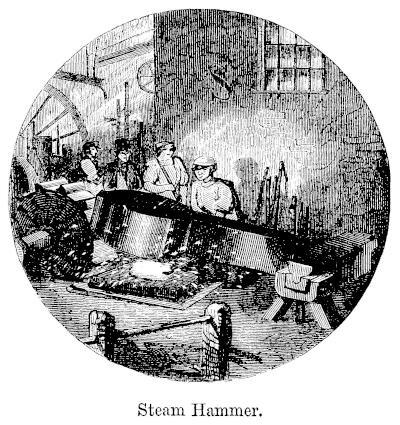
Steam Hammer.
These operations are conducted in a large shed, where
the rollers stand like awful combinations of infernal machines
and patent mangles; where a boding and vengeful tilt-hammer,
worked by steam, is tended by a man, who sits
like a calm fate beside its crushing bulk, and supplies it
with fresh victims; where the awful boom seems to shatter
the very atmosphere, and deafness reigns triumphant. In
obedience to a signal, however, the monster is suddenly
stopped, and we are enabled to hear that the great two-pot
furnace on our left is used for making the steel from those
long laths of bevel-edged iron stacked against the wall;
that the furnace is constructed with wide flues on each side
and under the bottom, while the fire-grate occupies the
centre between the two pots; that the pots themselves are
some four feet deep, and two feet and a half wide, are airtight,
contain layers of charcoal and iron covered with loam
sand, will remain seven days and nights in the furnace,
until their contents are white hot, and that at the end of
that time the iron will have been converted into steel of a
slaty-blue colour. The inexorable hammer resuming its
work at this point, we follow the bayonet to its completion,
and once more visit the forges, to witness the “shutting on”
or welding the blade to a piece of iron, which ultimately
forms the socket by which the bayonet itself is fixed on
to the barrel of the rifle or musket.
There is yet another operation before the blades are taken
to the finishing shop, one of the most important, too, since
it is no other than grinding, a process which secures an
exact and uniform thickness and increases their elasticity.
We are standing at the open end of a long, vast, and
gloomy shed-like building, supported by iron pillars. On
each side through the entire length a series of enormous
grindstones spin round amidst sand and water, and the
mud from both. Seated astride the bodies of wooden
horses, whose heads seem to have been transformed into
these wheels, the grinders seize upon the blades, and each
fearless rider rising in his stirrups, or, what looks much
the same, standing tiptoe till he no longer touches his
saddle, throws himself forward, and presses the sword,
matchet, or bayonet on the wheel, at the same time
guiding it deftly with its left hand, till its whole surface has
been smoothly ground.
Along the whole line of whirling stones fly the lurid red
sparks, and the grinders, with squared elbows, seem to curb
the struggling and impetuous wheels.
After polishing, which is completed by wooden wheels
bearing a coating of leather covered with emery, the swords
and matchets go to receive handles, and the bayonets locking
rings. The handles of swords are made of walnut-wood
covered with the skin of the dogfish, while the hilt and
guard are formed from a plain flat sheet of steel, in shape
not unlike one side of a pair of bellows.
The solid socket of the bayonet is hammered into form,
and afterwards stamped into shape with the rim complete,
from which process it is conveyed to a shop where it is
drilled by steam power. It then only remains to secure a
smooth surface, by means of a revolving barrel, containing
an instrument with a number of flanged blades, against
which the socket of the bayonet is pressed. It is not a
little remarkable to see the solid steel pared and shaved like
wax, and no less wonderful to notice the simple machinery
by which it is accomplished. The locking rings are stamped
out by a lever and die, pierced by a punch, and afterwards
“bored,” “faced,” and their shapes secured by a triple
circular saw, worked by a lathe.
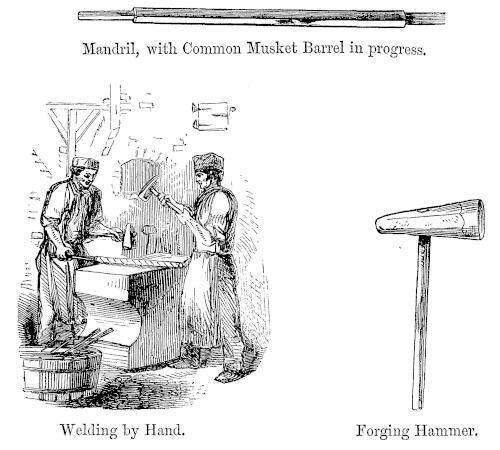
Mandril, with Common Musket Barrel in progress.
Welding by Hand. Forging Hammer.
The most important manufacture in the Toledo Works,
however, is assuredly rifles, and, with the intention of
following it through its principal processes, we return to
the vicinity of the still inveterate hammer, where we are
shown a rudimentary barrel in the shape of a slab of best
wrought iron, twelve inches long, and weighing nine pounds
and a quarter. This uninviting slab is heated in a furnace,
and roughly bent into the tubular shape by means of our
enemy the tilt-hammer, after which it is once more placed
in a furnace of an enormously high temperature, with a
small trap-opening. When sufficiently heated, the short
rudimentary tube is taken out on a long round iron rod,
fitted with a hand-guard, and looking like a huge burlesque
rapier. This rod approximates to the size of the intended
bore of the barrel, and is inserted, with the rough tube upon
it, between two steam rollers, each of which is furnished
with a series of corresponding grooves or cuts. The barrel,
which is taken up at one end by a rod, is placed between the
first pair of grooves, and, as the rollers revolve, is drawn
out at the other side, a long, hollow, welded tube. This
much more graceful and better formed tube is then consigned
to another rod of smaller diameter, and to a corresponding
pair of grooves; until, after the eighth repetition
of the same process, the barrel has attained its proper
dimensions. The next operation, which is called “lumping,”
consists of welding a piece of wrought iron on to the breech
end of the barrel, for the purpose of forming the percussion-lump,
and is succeeded by “rough-boring.” This is
accomplished by a long, sharp-ended bit, which, being
placed in the end of the barrel, revolves at the rate of,
perhaps, a thousand turns a minute by means of a pulley
and fly-wheel, while the barrel is pushed on by a lever, and
kept cool by means of water thrown upon its surface.
The “setting” of the barrel is next effected by means of
hammer and anvil, the setting meaning simply rectifying
any bend which it may have received during the previous
operation. We are not a little interested in the setting,
since the first intimation of it on entering the shop is the
sudden discovery of a number of workmen gazing resolutely
at an opposite window, through what look like attenuated
telescopes. They are engaged, however, in one of the processes
which require the greatest experience, as each of
them is expected to detect the most trifling bias in the
barrel. The “spilling-up,” or cutting the inside of the barrel
to the proper bore, is similar to the rough-boring, except
that only one edge of the bit is allowed to operate, the
others being sheathed by a half cylinder of wood, called a
spill; this ensures a smooth surface, and prepares for the
“fine-boring,” which is six times repeated, the final surface
being insured by keeping one edge of the bit perfectly
smooth, by which means the particles of steel drop in a fine
and almost soft powder.
The outside of the barrel is next turned in a long lathe,
which not only reduces the roughness, but, by a beautiful
arrangement of cutting tools, gives it the required substance
or “pattern,” for a light or heavy rifle.
The grinding of the barrels is effected by means of
stones, larger than those used for the sword blades, but in a
similar manner, and is preliminary to “filing,” which carries
the barrel to the shop, where it is prepared for the lock.
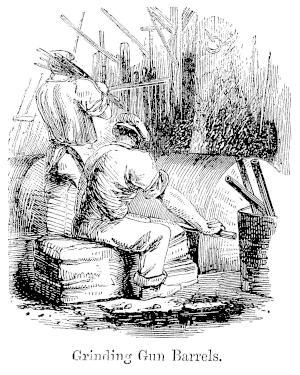
Grinding Gun Barrels.
These preparations consist of “chambering,” or making
the chamber which holds the pin; “breeching,” or cutting
the worm intended for the breech-pin, that helps to hold
the barrel to the stock by means of a breech-nail; cutting
out the little slice into which the “sight” is to be dovetailed;
machining the lump; filing the tail-pin, and making the
square lump the proper shape for receiving the lock and
stock.
We are not a little surprised to learn that every part of
the lock is finished by hand, the cock being cut with a die
worked by a heavy weight, and the smaller pieces being
wrought with forge, hammer, and file.
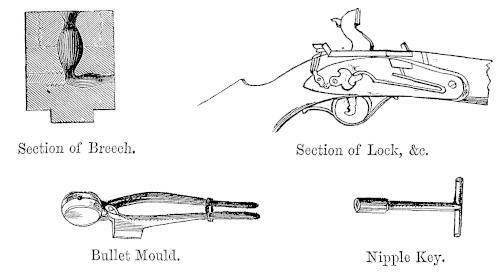
Section of Breech. Section of Lock, &c. Bullet
Mould. Nipple Key.
The great art in lock-making is to obtain a perfect
spring, and those properly tempered are so elastic that,
although when fitted in the lock, the two sides are so close
as almost to touch, they will, when released, spread to two
inches below the edge of the lock-plate. The lock and
barrel are now ready for the stock, which awaits them in
another shop, where it has been sawn out of walnut wood,
and finished by carpenters’ tools. The barrel let into its
groove, and the lock properly in its place, the stock is more
perfectly shaped and rounded before “screwing together,” or
the addition of the different parts of the “furniture,” heel-plate,
trigger-plate and guard, trigger, nose-cap, rod, and
bayonet.
We are now told that the rifle is “finished,” by which,
understanding completion, we are not quite prepared to
learn that it is to be taken to pieces.
We suddenly remember, however, that it is not yet a
rifle at all, inasmuch as it has not been rifled. Everything
is made perfect before this delicate operation is attempted,
in order that no injury may be sustained by the barrel
when the complete rifle is again put together. The process
of rifling is similar to that of boring, except that a spiral
cutter is substituted for the bit. Previous to the reunion
of the barrel, the whole work is polished, and the stock
stained and finished ready for completion.
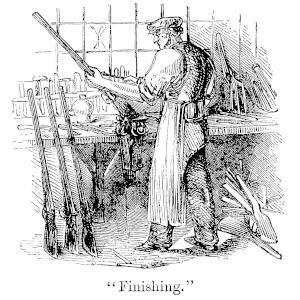
“Finishing.”
The pistol barrels undergo the same processes as that of
the rifle, except that, after being drilled, they are planed,
by machines which carry them along a sort of bed under
tools that cut them perfectly smooth, and accurately shape
the octagonal barrels. These chisels move by means of
screws over the entire surface as it is drawn backwards and
forwards on the slide.
The revolver chambers are drilled out of solid iron, by
a drilling machine or lathe, with a centrebit and an eccentric
motion, which causes each barrel of the chamber-nest to
become the centre in succession; while, by means of a slide,
the motion can be made to suit either a large or small
chamber. The recesses communicating with the lock and
trigger are cut by reversing the chamber in the eccentric
“chuck,” and using a different cutting-tool, while another
alteration effects the drilling of the nipple holes.
THE END
R. CLAY, SON, AND TAYLOR, PRINTERS, BREAD STREET