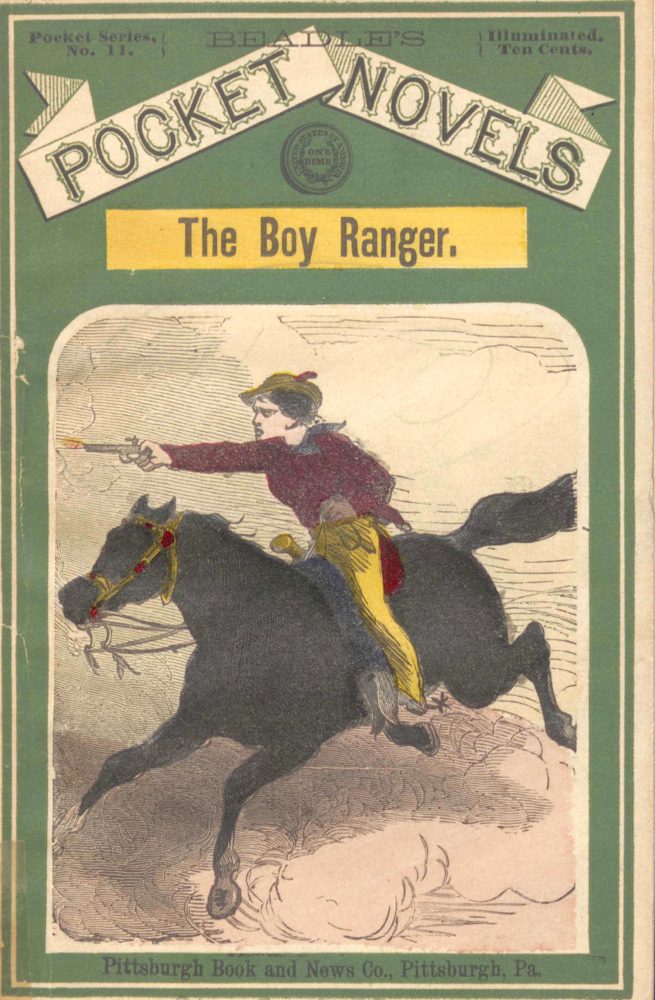
Old Tumult felt none the better of his ferry-boat adventure.
In fact, he felt quite sore, but the consciousness of
having defeated the enemy, proved a radical mental relief,
and repaid him, in one sense of the word, for the bruises he
had received.
Hunger was the next enemy with which they had to contend,
for the want of fire. Game was around them in abundance,
but they had no way of cooking it. Continuing on,
however, they were so fortunate as to come across the remnants
of a deserted camp-fire. This was at once replenished
with fuel, and soon a savory slice of venison was roasting before
it.
After a hearty meal, they continued on toward the Indian
village. They proceeded quite leisurely, for their late adventures
had nearly exhausted them; besides there was no need
of haste, as they had plenty of time to reach the Devil’s Staircase
before night.
As they moved along, Town. became silent and thoughtful,
and Old Tumult wary and cautious. The latter finally noted
a curious expression upon his companion’s face, and asked:
“What is it, Town.?”
“What is what?’ queried Town., apparently perplexed.
“That makes yer face twitch so.”
Town. laughed, as the color came to his face. The fact of
it was, he was thinking of the pretty Madge Taft, but to evade
a direct answer, he said:
“Well, I was just thinking—thinking whether I had better
reveal the suspicion that has arisen in my mind lately.”
“Certainly; tell it, by all means,” exclaimed Tumult.
Town. stepped nearer the scout and said:
“I solemnly believe that Rollo is a traitor—that he knew
of the savages being concealed in the ferry-boat.”
The old scout at once grew restless; he looked at Town.—shifted
his rifle to the other shoulder, and said:
“What makes ye think so, Town.?”
“His actions during the fight on the boat—he never lifted
a hand to help us, but directly I caught him assisting on board
the boat, the savage that you knocked overboard.”
“Didn’t he ’pologize when ye ketched him?”
“He plead excitement.”
“Ugh—humph!” ejaculated Old Tumult; “wal, Town., as
to that lad bein’ a traitor, we think alike; and thar’s sumthin’
else that I’ve diskivered ’bout him, and what s’prises me is
that you haven’t see’d it yerself.”
“What is it?” asked Town.; “all questions are fair.”
“You’d shoot me, Town., if I’d tell you.”
Town. was surprised by this blunt remark.
“I will give my word as security for your life,” he
said.
“Then I’ll tell it. Rollo, the Ranger—” he began, but
broke abruptly off in consequence of the angry crack of a
rifle, and the “whizz” of a bullet in close proximity to his
head.
“’Tarnal furies!” he exclaimed, as his keen eyes swept the
surrounding forest for the enemy that had fired the shot;
“what a bad shot that war. Come, lad, tramp quick—tramp
lively!”
The old scout quickened his steps and lengthened his
strides, until Town. was scarcely able to keep pace with
him.
The young settler wondered why he beat so hasty a retreat
in the face of a single foe as the shot proved. To him
it looked as though the indomitable courage of the old scout
was deserting him. However, Old Tumult seemed to have
read his thoughts, and said:
“I don’t fight Ingins like every ole hunter generally does,
Town.—”
“No, I see you run from them sometimes.”
“Thar’s logic in it, too, lad; now you see if we’d ’a’ stopped
and went to huntin’ fur the red that fired the shot, he’d ’a’
shot us down. By runnin’ he’ll think we’re scart, and out
he’ll dive from his nest and take arter us. Then ’s the time
to turn and let him have it; I think the ijee ’s not to be
sneezed at.”
And so thought Town., as the scout whirled suddenly
around, threw his rifle to his face, and fired. Simultaneous
with the crack of the gun, a savage death-cry rung out through
the forest aisles—thus proving how effectual was the old
scout’s plan of drawing an enemy from ambush.
The two now continued their course without further
molestation.
Cautiously skirting the Indian village, they reached the
Devil’s Staircase two miles beyond, where they had agreed to
meet the ranger.
The Devil’s Staircase was an almost perpendicular declivity,
leading down a narrow defile into a low plain or valley. The
forest around it was of dense growth, and in broad daylight
its shadows lay thick as the gloom of summer twilight.
When this point was reached, it lacked two hours of night,
and as the scout and Town. could do nothing until then, they
concluded to conceal themselves, and await its cover before
making any further move.
A retreat, flanked upon three sides by jutting rocks, was
selected by the two men, who at once threw themselves in an
attitude of repose. As an enemy could approach them only
in front, it required no extra vigilance to guard their position,
and they made themselves quite at ease.
After discussing the incidental topics of their situation and
future prospects, Town. said:
“Then you believe the Boy Ranger is in league with the
Indians, eh, Tumult?”
“Ya-as, with the Arapahoes. They’re mean enuff to league
with Satan. I tell ye, lad, arter all there ’s more honor in the
Sioux tribe, than enny other on this terrestial ball.”
“None of them are to be trusted far,” said Town.
“That depends upon circumstances. The Sioux won’t consort
with every white cut-throat that seeks their protection from
the laws of the States.”
“I will frankly admit that there is more honor and manhood
in a Sioux Indian than a white renegade like Dick Sherwood.
But I can not imagine why one so young, handsome
and intellectual as Rollo is, should be a traitor to his own
people—and such a secret traitor, too.”
“Ay, lad,” cried the scout, “thar’s many a deep, dark mystery
that the world ’ll never know enny thing ’bout.”
“Then, hereafter we can keep an eye upon Rollo’s movements,
and see if our suspicions of him are correct.”
“That’s true, boy; but unless he comes afore night it’ll be
too late, or I’m no judge.”
“What do you mean, Tumult?”
“This: if the ranger comes here arter dark, it will be with
a troop o’ Arapahoes at his heels, to capture us.”
“I can not understand your reason for thinking so.”
“I’ll tell ye, lad, thar’s some devilish plot coming to a crisis,
and Dick Sherwood and Rollo are at the bottom of it all.”
“Well, where’s your proof?”
“That fust attempt to kidnap Miss Bryant; the meetin’ affair
at Wildwood lake; the kapter of the two gals; the affair
at Two Islands, and the ferry-boat surprise, are all the proof
that I want,” said Old Tumult; “and, furthermore, our carcasses
is mixed up in it some way ’r other; and now mind,
unless we look sharp, that ’ere boy ’ll play the deuce with us
to-night.”
“You really surprise me, Tumult.”
“And I could surprise ye more if I’d tell o’ the diskivery
that I’ve made.”
“Why not tell it?”
The scout was silent. Town. repeated the question.
“You’d feel more like shootin’ me than thankin’ me fur
the infurmation,” returned Old Tumult.
Town. laughed, though his mind was perplexed.
“Howsumever,” continued the old scout, “I might as well
tell it, fur you’re bound to know it sooner or later. The fact
is, this mornin’ I diskivered that Rollo, the ranger, and—”
Here he broke abruptly off, for a shadow fell across his
vision. He seized his rifle and sprung to his feet, and found
himself confronted by a tall, powerful Sioux Indian, whom he
at once recognized as Mahaska, chief of the Sioux tribe!
Tumult at once placed himself in an attitude
of defense, but a sign from the chief put at rest all fears of an
encounter. He showed that his presence there was fraught with peace
and friendship, although Old Tumult had always known him as an
enemy.
Our friends recognized the chief’s token of friendship by
dropping their rifles and folding their arms over their breasts.
“Good!” ejaculated the chief; “the great Tumult and his
friend know that Mahaska comes with friendship in his
breast.”
“You bet, chief,” returned the scout, extending his large,
bony hand; “it’s hard to mistake that jolly twinkle in yer
eye—it means, no skulps wanted.”
“The great Tumult is wise. His tongue is straight. His
arm is strong. His eyes are keen. His aim is deadly, but
Mahaska knows he will not strike a friend.”
“You’re right there, great chief,” returned the scout, determined
to pay an equal amount of compliments; “I know yer
a brave chief, a splendid feller, a brillunt scholar, a good jedge
of whisky, and a brick o’ a boy in general.”
The chief reared himself proudly. Although he did not
fully understand the English of the scout’s complimentary
remarks, he took it all as something very fine.
“The great Tumult and Mahaska,” the chief began, “are
friends now. Mahaska was concealed in the brush there,
when the white men come here to talk. He heard them
speak well of the Sioux, and bad of the Arapaho and his
white ally. The words of the great scout were words of
wisdom and truth, and they have sunk deep into the breast
of Mahaska. He will never forget them, and here offers
to smoke the pipe of peace with the great Tumult and his
friend.”
“That’s business, chief,” replied Tumult, with a sly wink
at Town.; “bring on your pipe o’ peace, and a ‘bottle o’
friendship,’ if ye’ve got it. I promise that my people will
never harm the Sioux, if the Sioux will keep on his side
o’ the creek, and furever bury the hatchet o’ discord and
enmity.”
“Mahaska pledges the friendship of his people.”
“Then my people will not harm the Sioux. They seek
the good will o’ all. But they are brave and will give blow
fur blow. When the Sioux attacks, the white will defend.”
As the scout concluded, Mahaska gave utterance to a low,
peculiar chirrup, when there was heard a dull fluttering like
many wings, and the next instant fully three score Indian
warriors burst from the forest shadows and gathered around
our friends and their chief.
A chill of distrust passed over our friends at sight of the
painted and plumed warriors, but they allowed no look to
betray their inward emotion to the red-skins.
Mahaska made a brief speech to his warriors and informed
them that they were about to smoke the pipe of peace with
the whites.
This bit of news was received with a savage yell that
jarred very discordantly upon the tympanum of our friends.
Old Tumult nudged Town. and grinned “broadly.”
A circle was now formed. Mahaska drew from a greasy
tobacco-pouch a large, dirty calumet which he loaded and lit.
He then took a few whiffs, and handed it to Old Tumult,
who, in a turn, “drew” very lightly on the obnoxious “seal
of peace.”
In a few minutes the pipe had “swung around the circle,”
and was lodged in its greasy receptacle, and peace between
the whites and Sioux was declared.
However, Old Tumult knew the Indian’s nature too well
to put implicit confidence in him, and he would not have
been surprised had they broken their promise of peace ere
the obnoxious taste of the “pipe of peace,” was out of his
mouth.
The warriors now gathered around Old Tumult and gazed
upon him with no little curiosity, for in days past, he had
been a constant terror to them, and had ornamented his girdle
with the scalps of many of their friends.
After having discussed various
topics incidental to the treaty, Mahaska asked:
“Mahaska”—he always spoke of himself in the third person—“heard
the great Tumult say that the young white
ranger was in league with the Arapaho. He spoke the
truth. The ranger is the friend of the Arapaho—the enemy
of the Sioux and the pale-face.”
“How does Mahaska know?” questioned the scout.
“His scouts have been in the heart of the Arapaho village.
They saw the ranger there, and heard him talking
with the white prophet. When the Boy Ranger comes here
to meet the great Tumult and his friend, when the sun goes
down, let them beware, for he will bring many warriors with
him whose hearts burn for their blood.”
His own ideas of Rollo’s treachery at once convinced
Tumult that there was more truth than fiction in the chief’s
warning.
“We’ll be on the watch for the young rascal,” said the
scout, “when he comes to-night.”
“Can the great scout be on the watch for the many warriors
that will follow him like shadows?”
“Not if more’n six comes at a time,” replied Tumult.
“Then Mahaska and his warriors will hide in the forest,
and if the Arapahoes come with the ranger, the Sioux will
slay them, for many of my young warriors have promised
to go back to their village with Arapaho scalps.”
The old scout saw at once what the chief was driving at, and
he could do no better than to accept his proffered aid, or protection
against the treachery of Rollo.
The Sioux seemed highly elated by his acceptance of their
proffered friendship, and as night drew on, they began to
secrete themselves in the woods surrounding the point of
rendezvous.
Old Tumult and Town., for the first time, had the opportunity
of seeing a party of savages ambushing themselves for
an unsuspecting enemy.
Half crouching, they glided here and there like so many
shadows, their eyes flashing with an evil, cunning light.
They burrowed themselves beneath the old leaves and grass
like moles; they pressed themselves into holes and crevices
where it seemed a serpent could not hide. In five minutes’
time, Old Tumult and Town. stood alone in the solitude
of the great forest. It seemed almost impossible that
they stood within a circle of three score blood-thirsty savages.
Night came on apace. There was a moon, but it would
not be up till two hours after dark.
Our friends seated themselves in the path leading to the
head of the Devil’s Staircase. They started when the sound
of horse’s hoofs told them that some one was approaching
from the east.
It was the ranger beyond a doubt.
Suddenly the tramp of the hoofs ceased, and a voice called
out:
“Hallo, Tumult!”
“Ay, Rollo; so you’ve come,” responded the old scout.
They arose from their seat and approached the ranger, of
whom they could catch a faint outline in the darkness.
The clear, frank voice of the ranger at once produced in
the minds of the friends conflicting ideas. It seemed utterly
impossible for one so young, and apparently kind-hearted, to
be a traitor to his own race. He had done many kind acts
for the settlers in warning them of coming danger of late.
Yet, despite all this, Tumult and Town. had seen sufficient of
his actions in the ferry-boat affair to raise grave doubts, at
least; however, they tried to believe that it all came of the
impulse and indiscretion of youth.
“Any news from the captives, Rollo?” asked Town., as he
neared the ranger.
“Nothing,” the ranger responded; “of course they are in
the Indian village, and the question is, how are we to get at
them.”
“The only course I see is to fight our way in and release
them, then fight our way out again, if we kin git ’em no other
way,” said Old Tumult.
“Ten to one we would all be killed,” said Town.
“Well, we can try it,” said Rollo; “faint heart ne’er won
fair lady, Town.”
Town. was a little touched by this remark, which was
slightly tainted with sarcasm; however, he forced back the
retort that came to his lips, and made no reply.
There was a momentary silence, during which the ranger
toyed with the coiled horn at the pommel of his saddle.
Suddenly they were aroused by the sharp bark of a wolf
that echoed through the valley below them.
“How human-like is that cry,” said Rollo, “and how it
echoes through the valley.”
“Yes, I’m thinking there is more human than wolf about
the cry,” said Town.
At this juncture, the jingle of the ranger’s horn drew our
friends’ attention toward him. There was just light enough
to see him place the instrument to his lips.
“Don’t you,” cried Old Tumult, but the sound of his voice
was drowned in the blast of the horn.
“Ho, you young, traitorous villain!” roared the old scout,
and he leaped toward the ranger, but the latter whirled his
horse’s head and dashed away.
Then there was hurrying of many feet, the flitting of many
dark forms—followed by the blood-chilling war-whoop of
two score and ten Arapaho warriors, as they closed in upon
our friends.
Where was Mahaska and his warriors, now? Ah! where indeed?