Frank awoke a little before daylight, feeling considerably better. The
nausea and dizziness had gone, and the sloop seemed to be lying almost
still, which was a relief to him. Then he noticed by the light of a lamp
that his companions' places were empty, and presently he heard them
talking in the well. Crawling out through the narrow doorway, he stood
up shivering in the coldness of the dawn.
There were dim black trees and shadowy rocks close in front of him, with
a white wash about the latter, for a smooth swell worked in around a
point from open water. He could hear the rumble of the surf upon the
reefs, and though he could scarcely feel a breath of wind upon his face
the wailing of the black pines suggested that it was blowing still. He
could smell the clean resinous scent of them and it seemed to him that
they were singing wild, barbaric songs. Afterward, when he knew them
better, he learned that the pines and their kin, the cedars and balsams
and redwoods, are never silent altogether. Even when their fragrance
steals out heavy and sweet as honey under the fierce sunshine of a
windless day, one can hear faint elfin whisperings high up among their
somber spires. Then he saw that Jake was standing on the side deck,
apparently gazing at the white surf about the end of the point.
"No," he mused, "she wouldn't face it. The breeze hasn't fallen any, and
the sea'll be steeper. Guess you'd better leave me here, and take the
Indian trail."
Harry agreed with this.
"We'll get off as soon as we've had breakfast; and, as I did the cooking
yesterday, it's your turn this morning. There's still a little fire in
the stove."
Jake disappeared into the cabin, and presently came out again and was
filling his pipe when Harry sprang up suddenly on the deck.
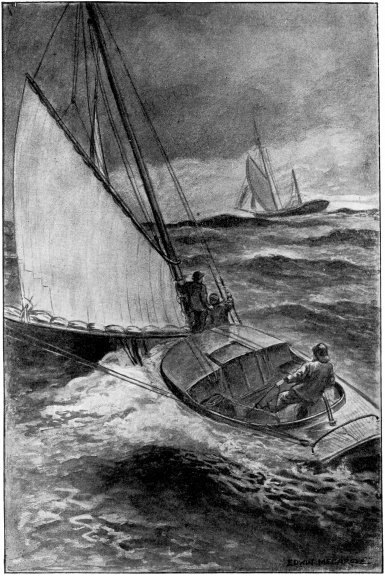
"Hello!" he cried. "There's a schooner yonder!"
It was growing a little clearer and Frank, turning around, saw a tall
black spire of canvas cutting against the sky. He made out a frothy
whiteness beneath it where the swell broke on the vessel's bows, and the
sight of her singularly stirred his imagination. She had appeared so
suddenly, probably from behind the point, and she looked ghostly in the
uncertain light. She ran in under her headsails and boom-foresail with
her mainmast bare, rising higher and growing clearer all the while. By
and by there was a splash, and a voice broke through the wailing of the
trees.
"Three fathom," it said. "You can luff her in a little."
Harry seemed about to hail her, but Jake gripped his arm, and they all
stood silent while the schooner crept up abreast of them. The little
sloop, lying with the shadowy land close behind her, had evidently not
been seen. Then the vessel commenced to fade again, and in a few minutes
she had vanished altogether.
"It looks as if there might have been some truth in old Sandberg's
tale," Harry remarked thoughtfully. "It's kind of curious that halibut
fisherman from Bannington's said he saw her too."
"He said she'd a white stripe round her. Sandberg allowed it was green,"
objected Jake.
"That wouldn't prove anything. They could soon paint the stripe another
color."
"What would they want to do it for?"
"What does a schooner want running in here? There's no freight to be
picked up nearer than Port Townsend."
"That," said Jake dryly, "is just what I don't know. What's more, I
don't want to. She might have run in for bark for cooking, or maybe for
water."
Harry laughed. "If she has come down from Seattle they'd get plenty
cordwood or, if they wanted it, stove coal there, and I guess a skipper
wouldn't waste a fair wind like this one to save two or three dollars.
The thing's mighty curious. That vessel's been seen twice, anyway, and
nobody seems to know where she comes from or where she goes."
"Well," Jake observed stolidly, "she doesn't belong to you or me, and if
you want your breakfast it should be ready."
They crawled into the cabin, and when they had made a meal Jake sculled
the sloop in near enough to the steep beach for them to jump. Then he
flung a small packet after them.
"It's the most I can spare you, as I mayn't get a slant round the reefs
until to-morrow," he said. "Anyway, it will do you two meals, and you
ought to fetch the ranch by sundown. You want to head right up the
valley until you strike a big log that lies across the river. When you
get over, cross the neck of the ridge where it's lowest. You'll see the
clearing from the top of it."
Harry said this was plain enough and moved away across the shingle,
Frank following him cautiously when they reached the fringe of driftwood
which divided beach from bush. Whitened logs and barked branches were
scattered about in tangled confusion where the water had left them, and
it was with difficulty that the lads scrambled over the barrier. Then
Frank stopped breathless, with one leg wet to the knee and a rent in his
trousers.
"It's pretty rough going, if this is an average sample," he panted.
"You'll find it a good deal worse before we reach the ranch," Harry
answered with a laugh.
He strode forward, and Frank looked around with wonder when they plunged
into the bush, for he had never seen a wood of that kind except in
pictures of the giant Californian Sequoia. There are, of course, pines
in the eastern states, but they seemed pigmies by comparison with these
tremendous conifers which were already tall and stately when Columbus
sailed from Spain. They ran up far above the boy in huge cylindrical
columns before they flung out their first great branches, which met and
crossed like the ribs of high-vaulted arches, holding up a roof of dusky
greenery. Beneath, there was a dim shadow, and a tangle of such
luxuriant vegetation as is seen, excepting in the tropics, probably only
upon the warm, damp Pacific Slope.
There was another difference which struck Frank. The eastern woods that
he had seen were clear of wreckage, for lumber and fuel are valuable
there, and the ax had kept them clean, but this forest was strewn with
huge logs and branches, some of which evidently had fallen years ago.
Thickets of all kinds had sprung up between, and these were filled with
tufts of unrolling fern which Harry told him would grow six or eight
feet high. Through the midst of it all there twisted a narrow path which
Frank remembered Jake had mentioned as the Indian trail.
"Have you Indians here?" he asked.
"Oh, yes," said Harry, "we have a few Siwashes, though there are more of
them up in Canada. They seem fond of Indians there."
"Are they quiet?"
Harry chuckled. "You don't want to get them mixed with the redskins of
the plains, though I suppose where they're not wiped out they're pretty
quiet too. These fellows are a different breed. Most of them are
sailors and fishermen, and they dress much the same as you and I do.
They come up these rivers now and then after the salmon, and they made
this trail. You can tell that by the looks of it."
"How?"
"It goes in and out, and where there's an obstacle it winds around.
That's the difference between a white man's and an Indian's nature. The
Siwash strikes a big fir log, and he walks around it, if he has to keep
on doing it for months. It doesn't seem to worry him that he's wasting a
minute or two every time. Then the white man comes along and gets to
work with his ax. He goes right straight through. It's born in him."
Frank had made a sign of understanding. He knew something of the history
of the old great nations as well as that of his own country, and he
remembered another dominant race that ages ago blazed its trails from
Rome across all Europe and far into Asia. It was characteristic of those
men that, turning aside for no obstacle, they went straight, and long
after their power had perished their roads remained, running, as the
crow flies, through morasses and over mountains and rivers. His own
people had done much the same, whittling west with the axes through the
eastern woods, and then pushing on with their wagons across the lonely
plains, until they drove the steel track through the snow-clad Rockies
and over the Sierras. They died in shoals on the journey, but it was the
march of a nation, and always more came on, the lumberman after the
trapper, the track-grader on the cowboy's heels, with ranches and farms
and factories growing up along the line. Now they had reached the
Pacific, and Frank wondered vaguely whether that would be the limit, or
where they were going then. It was, however, a question that seemed too
big for him.
"This country's rough on one's clothes," he said ruefully, looking down
at a second tear in his trousers.
Harry laughed. He was dressed in old duck overalls, long boots, and a
battered gray hat.
"That's a fact. What you want to wear is leather. There were two sports
from back East came out to hunt last fall, and they had their things
made of some patent cloth warranted to turn water and resist any thorns.
Jake went along to cook for them." He paused with a chuckle and added,
"They were wearing their blankets because they hadn't any clothes left
when he brought them back."
They went on for an hour or so until they came out upon the bank of a
frothing river which roared among the rocks in a shallow cañon. There
was no way of reaching the water, had they desired it, and, as Harry had
predicted, the trail they followed grew rapidly worse. In places it
wound perilously along narrow ledges beneath a dripping wall of rock, in
others it led over banks of stones which had slipped down from the
heights above. The boys made very slow progress until noon, when they
stopped for a meal from the package Jake had thrown them. While they ate
it Frank looked down again at his boots, which were already badly
ripped.
"They were new just before I left Winnipeg," he said. "In some ways the
people in Europe are ahead of us. There are one or two countries where
they make their shoes of wood."
Harry was too busy to make an answer, and when he had finished eating he
carefully tied up the packet, which was now considerably smaller, before
he turned to his companion.
"We'd better be hitting the trail," he said. "Unless we can make the
ranch by sundown, we'll get mighty little supper."
They pushed on for a couple of hours, still floundering and stumbling
among the rocks. Harry stopped for a moment where the bush was thinner
and pointed to a big gap in a ridge of hillside three or four miles
away.
"That's the neck," he said. "The log we cross the river on is somewhere
abreast of it. We surely can't have passed the thing."
They went on a little farther, but there was no sign of the log.
Presently Harry stopped again with an exclamation, catching a glimpse of
a great branchless fir which rose out of a welter of foam in the bottom
of the cañon.
"There she is," he exclaimed, "jammed in where we certainly can't get
down to her. It will be difficult to go straight this time, but we'll
have to try."
Frank drew a pace or two nearer the edge of the cañon, and felt a creepy
shiver run through him as he looked down. The rock he stood upon arched
out a little over the shadowy hollow, through the bottom of which the
wild waters seethed and clamored. He supposed that he stood at least
sixty feet above them. The rock on the opposite side also projected, so
that the rift was wider at the bottom than at the top. In one place,
however, the crest of it had broken away and plunged into the gulf,
leaving a short slope down which stones and soil had slid. Its lower
edge lay about twelve feet beneath him, though the distance would have
been rather less if it could have been measured horizontally.
"How are we to get across?" he asked hesitatingly.
"Jump," said Harry curtly. "Can't you do it?"
"No," Frank answered with some reluctance.
"Scared?" asked Harry, looking at him curiously.
"I am, but it's not that altogether."
"You didn't seem to want sand when you jumped into the boat."
Frank stood silent a moment or two with a flush on his face. Had he been
forced to make the choice a year earlier, he probably would have jumped
and chanced it from shame of appearing afraid or of owning his
inferiority to another, but he had learned a little sense since then.
"It was different then," he explained. "I was scared—badly scared—but
I felt I could do the thing if I forced myself to it. Now I'm almost
certain that I can't."
"Yes," owned Harry, thoughtfully, "that's quite right. One hasn't much
use for the fellow whose great idea is to keep himself from getting
hurt, but when a thing's too big for you it's best to own it." He
dismissed the subject with a wave of his hand. "The question is how
we're going to get across, and my notion is that we'd better head right
up into the bush. The river will be getting smaller, and it forks
somewhere. Each branch will probably be only half the size, and I guess
the cañon can't go on very far."
It occurred to Frank that considering the nature of the country it would
be singularly inconvenient if the cañon went on for another league or
two, particularly as they had only a handful of provisions left, but he
followed his companion, and they stumbled and floundered forward all the
afternoon. There was now no trail to follow, and where they were not
forced to scramble over slippery rock, fallen trees and thorny brakes
barred their way. Still, there was nothing to indicate that the cañon
was dying out, and where they could have reached the water it either
foamed furiously between rocky ledges or spun round in horrible black
eddies on the verge of a wild, yeasty turmoil. They looked at these
spots and abandoned any thought of swimming.
Evening came at length, and they sat down beneath a big cedar where the
roar of the river rang about them in deep pulsations. A chilly wind was
wailing in the tops of the pines, and trails of white mist commenced to
drift in and out among their trunks, which showed through it
spectrally. Harry gazed about him with a rueful grin on his face.
"If I'd an ax, one or two matches, and a couple of blankets, I'd make
you quite snug. Then with a few groceries, a kettle, and a spider, we'd
have all any one could reasonably want."
"You haven't got them," Frank commented. "Wouldn't it save time if you
wished for a furnished house?"
"I'd 'most as soon have an ax. Then I could make a shelter that would,
anyway, keep us comfortable enough, and when I'd cut you a good layer of
spruce twigs you wouldn't want a better bed. If I'd a rifle I might get
a blue grouse for supper. Still"—and he laughed—"as you say, we
haven't got them, and we couldn't do any cooking without matches.
Curious, isn't it, what a lot of things you want, and that in most cases
you have to get another fellow to make them?"
Frank agreed with this, but he had never realized the truth of it as he
did just then. It was clear that the man who made all he wanted must
live as the Indians or grosser savages did, and that it was only the
division of employments that provided one with the comforts of
civilization. Every man, it seemed, lived by the toil of another, for
while on the Pacific Slope they turned the forests into dressed lumber
and raised fruit and wheat, the clothes they wore, and their saws and
plows and axes, came from the East. One could clear a ranch on Puget
Sound only because a host of other men puddled liquid iron or pounded
white-hot steel in the forges of, for instance, Pennsylvania. Frank
would very much have liked to provide his companion with the fruit of
somebody else's labor in the shape of a few matches, which would have
made a cheerful fire possible.
In the meanwhile Harry had opened the packet and divided its contents
equally.
"There's not enough to keep any over," he observed. "We have got to make
the ranch to-morrow."
They ate the little that was left them, and then set to work to search
for a young spruce from which they might obtain a few branches, but they
failed to find one small enough even to climb. Coming back they lay down
among the cedar sprays, which seemed rather wet, and it was some time
before Frank could go to sleep. He was still hungry, and the roar of the
river and the strangeness of his surroundings had a peculiar effect on
him. The mist, which was getting thicker, rested clammily on his face,
and crawled in denser wreaths among the black trunks which stood out
here and there from the encircling gloom. Drops of moisture began to
fall upon him from the branches, and once or twice he cautiously moved
an elbow until it touched his companion. It was consoling to feel that
he was not alone.
At length, however, he fell asleep, and awaking in the gray light of
dawn staggered to his feet when Harry called him, feeling very
miserable. He was chilled to the bone. His shoulders ached, his knees
ached, and one hip-joint ached worse than all, while his energy and
courage seemed to have melted out of him. As a matter of fact, nobody
unused to it feels very animated on getting up before sunrise from a bed
on the damp ground.
"As we have to reach home to-night, we may as well get a move on,"
announced Harry. "It's about four o'clock now, and it won't be dark
until after eight."
The prospect of a sixteen hours' march with nothing to eat all the while
did not appeal to Frank. It was the first time in his life that he had
felt downright hungry, and this fast had made him the more sensitive to
an unpleasant pain in his left side.
"If you're not sure about the way, wouldn't it be better if we went
back to Jake?" he suggested. "It seems a pity we didn't think of it
earlier."
"I did," Harry answered smilingly. "The trouble is that Jake would clear
out the minute the wind dropped a little or shifted enough to let him
get round the head. Besides, he'd have mighty little to eat if he were
still lying behind the point when we got there. When your letter reached
us we'd hardly time to run down to Bannington's to meet the steamer, so
I just grabbed what I could find, and we sailed in a few minutes."
Frank said nothing further, and they pushed on doggedly into the shadowy
bush. It was wrapped in a thick white mist, and every brake they smashed
through dripped with moisture. Except for the clamor of the river,
everything was wonderfully still—so still, indeed, that the heavy
silence was beginning to pall upon Frank, who suddenly turned to his
companion.
"Isn't there anything alive besides ourselves in this bush?" he asked.
"That," replied Harry, "is more than I can tell you. We have bears, and
a few timber wolves, besides two kinds of deer and several kinds of
grouse, and some of them are quite often about, but there are belts of
bush where for some reason you can't find one."
They went on again, following up the river for an hour or two. In the
meanwhile the mist melted, and Frank could see the endless ranks of
mighty trees stretch away before him until they merged into a blurred
columnar mass. At last the cañon, which was growing shallower, forked
off into two branches, and they followed one branch until a broken rocky
slope led them down to the water. It was a dull greenish color and
foamed furiously past them among great stones. There was no means of
ascertaining how deep it was and the boys looked at each other dubiously
for a moment or two. Then Harry made a little gesture.
"We have to get across," he said.
Frank, without waiting for his resolution to fail him, plunged in on the
instant, and a couple of steps took him well above his knees. The water
seemed icy cold. As a matter of fact, it was mostly melted snow, and the
drainage from the glaciers had given it the curious green color. The
gravel commenced to slide away beneath Frank's feet, and by the time the
foam was swirling round his waist he was gasping and struggling
savagely. There was a big, eddying pool not far away and, though he
could swim a little, he had no desire to be swept into it. A moment or
two later he was driven against a rock with a violence that shook all
the breath out of him. He clung to it desperately until Harry came
floundering by and held out his hand. They made a yard or two together
and then Harry slipped suddenly, jerking Frank off his feet as he rolled
over in the flood. Frank went down overhead and as he felt himself being
swept along toward the eddy he exerted all his energy in a struggle to
regain his footing. He clutched at a rock, but the swirling waters only
carried him past. Half dazed and breathless he was flung against another
rock. This time, with a great effort, he managed to hold on, and when he
stood up, gasping, he found that the water now reached only to his
knees. In another minute he and Harry were safe on dry land.
Half an hour later they crossed the other creek, and soon afterward
Frank sat down limply in the warm sunlight, which at last came filtering
between the thinner trees.
"I must have a rest," he gasped.
"There's just this trouble," Harry pointed out. "If you rest any time
you won't want to get up again."
"If I go on now I'll drop in another few hundred yards," declared Frank.
It was probably no more than the truth. He had been clever at athletics
and open air games, but, as it happened, he had been able to learn them
easily. Besides, he had been indulged by his mother and had been rather
a favorite at school, and as one result of it he fell short of the
hardihood usually acquired by the boy who has everything against him.
After all, an hour's exercise in a gymnasium or an hour and a half spent
over a game amidst applause and excitement is a very different thing
from the strain of unrelaxing effort that must be made all day when
there is nobody to cheer. He did not want to rest, but his worn-out body
rebelled and mastered him.
"Aren't—you—played out?" he stammered weakly.
"Oh, yes," replied Harry with a grin. "Still, in this country you're
quite often dead played out and have to go on again."
"But if you can't?"
"Then," said Harry dryly, "you have to keep on trying until you're able
to."
It struck Frank that this might be painful and his heart sank. After a
while he tried another question:
"Don't people get lost in the bush every now and then?"
"Why, yes," was the answer. "There was a man strayed off from a picnic
just outside one of the cities not long ago and they didn't find him
until a month or two afterward. He was lying dead not a mile from a
graded road."
Frank shivered inwardly at this.
"Still, I suppose you generally have something to guide you—the moss on
the north side of the trees? I've heard that people who don't know about
it walk around in rings."
"I must have gone pretty straight the only time I was lost," laughed
Harry; "and it's mighty hard to find moss in some parts of the bush. In
others it's all around the trees. I'd rather have a big peak as a guide.
You have heard about people walking round, but I wonder whether you have
heard that when they're badly scared they'll walk right across a trail
without seeing it?"
"Is that a fact?" Frank asked in astonishment.
"Sure!" said Harry. "A lost man will sometimes walk across a logging
road without the slightest idea that he's doing it. Anyway, I know where
the homestead lies. It's only a question of holding out until we reach
it."
Frank was sincerely pleased to hear this, and by and by he rose with an
effort and they went on again.