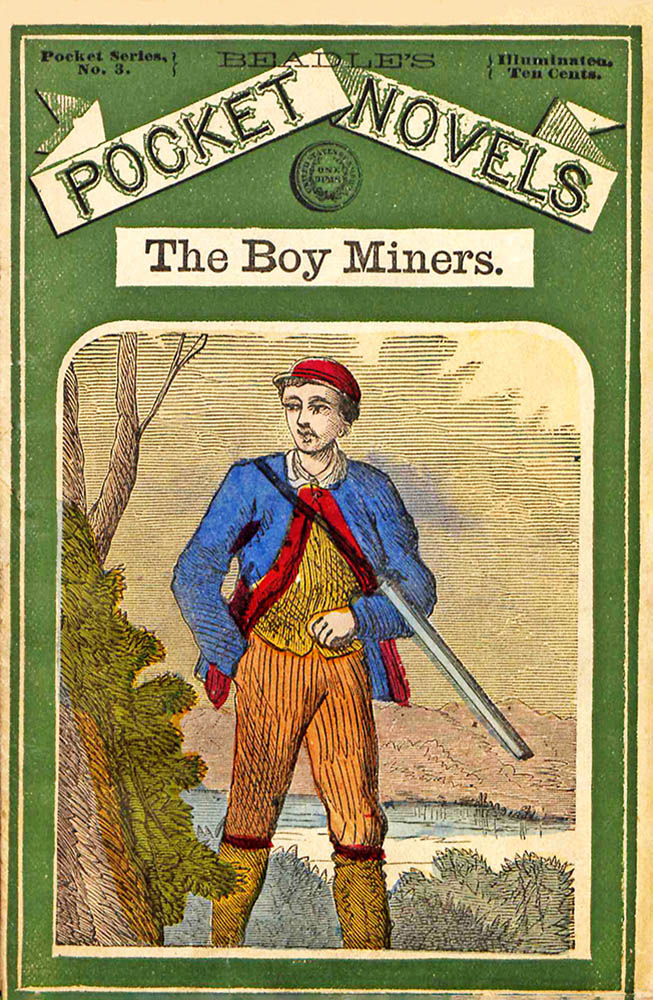
Young Edwin Inwood leaped down from the small tree
in which he had been perched for the last half hour, and
ran swiftly toward the brook where his elder brother,
George, and a large negro named Jim Tubbs, were waiting,
ever and anon raising their heads, and looking towards
the boy who was acting as sentinel, several hundred yards
away, as if they were expecting some such an alarm as
this.
“Quick! they’ll soon be here!” he added in his terrible
excitement.
“How many are there?” inquired George, catching up
his shovel at the same time with his rifle.
“I shouldn’t wonder if there were twenty. I’m sure I
saw a dozen, any way.”
“More likely dar’s a tousand!” angrily exclaimed Jim,
gathering his implements together, preparatory to making
a move. “Dis yer’s a nonsince—jest as we gits in among
de gold, dem Injins has to ’gin dar tricks.”
“Hurry, Jim,” admonished the young man, beginning to
grow nervous. “It won’t do to be caught here.”
“Dey hain’t cotched dis pusson yit, an’ if dey undertooks
it, somebody’ll git hurt. I can swing dat pick kind o’
loose when I makes up my mind to do so. I’s ready—now
whar does ye pitch to?”
“Into the cane, of course.”
George Inwood, loaded down with his gun and implements,
hurried up the channel of the brook, for several hundred
feet, and then, making a sudden plunge to the right,
disappeared as abruptly as if the earth had opened and swallowed
him. The next moment, his brother Edwin, a lad
some fifteen years of age—whisked after him, and then Jim
came lumbering along, somewhat after the manner of an ox,
when goaded off his usual plodding walk.
“Dis yer’s graceful!” he muttered, not deigning to
look behind him to see whether the envious aborigines were
visible, “I never did like to trot, s’pecially when an Ingin
was drivin’ me, an’ only does it to please de boys.”
“Come, Jim, move faster!” called the voice of George
Inwood from some subterranean point.
“Yas, yas, I’s dar!”——
Further exclamation was cut short, for at this instant the
indignant African was seized by the ankle with such force,
that he fell prostrate upon his back, and, despite his struggles
and threats of dire punishment, was quickly drawn out
of sight and hearing.
This was scarcely done, when a dozen Mohave Indians
swarmed over the ridge of rocks and trees which bounded
the northern part of the stream, and scattered here and there
in quest of the gold hunters, whom they had been watching
from a distance nearly all the afternoon. Each of them was
armed with a gun, several displayed tomahawks and knives
at their girdles, while the majority had large, beautifully
woven and ornamented blankets thrown over their shoulders.
Running hither and thither, their sharp black eyes darting
in every direction, they could not be long without discovering
traces of the interlopers. A sort of halloo, something
like the yelp of a large dog, when a cow flings him
over the fence, told that one of the dusky scamps were on
the trail. Immediately the whole pack darted up the channel,
and the next moment, had halted before the mouth of
a cave, the entrance being of sufficient width to admit the
passage of an ordinary sized man; but just now a large
boulder prevented their ingress.
Certain that the gold hunters were immured here, and
were within their power, the Mohaves indulged in a hop,
skip, and dance around the cave, flinging their arms aloft,
and shouting continually in their wild, outlandish tongue.
When their clamor had somewhat subsided, a gruff voice
from within the cave was heard.
“Hullo! dar I say! Hullo! I say! Can’t yese keep yer
clacks still a minnit when a gemman wishes to speak?”
The singular source and sound of the human voice had
the desired effect, and instant silence fell upon all.
“Am dar any ob yous dat spoke English? If dar am,
please to signify it by sayin’ so, an’ if dar ain’t, also signify
dat by obsarvin’ de same sign.”
Jim waited several minutes for a reply, but, receiving
none, he became more indignant, and was about to burst
out in a tirade against them, when George Inwood ventured
to suggest that, as in all probability they could not speak
the English language, as a matter of course, they were deprived
of the ability of saying so.
“But dey orter to know ’nough to say no—any fool know
dat,” persisted the African.
“But how can they understand what you say?”
“Clar—didn’t tink ob dat. What am we to do?”
“Defend ourselves—that is all that is left us.”
“I’ll go take a look at dem,” said Jim, beginning to creep
along the passage toward the mouth of the cave.
“I insist that you be more careful in your dealings with
them. You ought to know what a treacherous and untrustworthy
set of people they are.”
Jim promised caution, as he always did in such matters,
and Inwood kept close to him to see that he fulfilled his
pledge. Reaching the mouth of the cave, the African gave
a sneeze to proclaim his presence, emitted with such explosive
vigor, that the Mohaves gathered around, startled as
though the ground beneath them had suddenly reddened
with heat. They recoiled a few steps, and then waited with
some anxiety for the next demonstration.
Jim Tubbs had a voice, composed half-in-half of those
tones which are heard when a huge saw is being filed, and that
which is made by the rumbling of the distant thunder. The judicious
mixture made from these, it may safely be said, was terrific
and rather trying to a sensitive man’s nerves; and, as he was
in rather an indignant mood on the present occasion, when he
called to the Mohaves, it was more forcibly than politely.
“What does yer want?”
When a person has reason to believe that the one whom he is
addressing has difficulty in understanding his words, he seems
to think the trouble can be overcome by increasing the loudness
of his tone. Jim repeated his question each time with greater
force, until the last demand partook more of the nature of a
screech than anything else.
By this time, the aborigines had obtained a good view of the
black face, cautiously presenting itself at the opening made by
the partial withdrawing of the stone, and one of them, laying
down his gun and knife, as an earnest of his pacific intention, deliberately
advanced to the entrance of the cave, and reached out
his hand.
“Take it, Jim,” whispered Inwood, “he means that as an offering
of good will.”
“I hope yer am well,” remarked Jim, as he thrust his immense
digits through the opening. “I is purty well, an’ so am all ob
us—gorry nation! what am yer at?”
The Mohave had suddenly seized the hand of the negro in both his
own with tremendous force, and was now pulling with such astonishing
power as slowly to drag the unsuspicious African forward.
“I tell ye let go!” shouted the latter, “it won’t do! Wal,
if ye wants to pull wid dis chile, why pull, an’ see who am de
best feller!”
Inwood, in his apprehension for the safety of the negro, seized
his leg, and endeavored with his utmost strength to stay his forcible
departure,
observing which, the gentleman in dispute turned
his head:
“Nebber mind, George, nebber mind if dem darkeys
[Transcriber’s Note: Several lines of text are missing from the
original here due to a printer’s error]
Jim was six feet three inches in height, and along his
limbs was deposited an enormous quantity of muscle almost
as hard as the bone itself; he was not quick, but he was a
man of prodigious strength, and when he chose to exert it,
there were few living men who could withstand it. If
there could ever be a suitable occasion to exert it, that occasion
was the present.
And Jim did call it into play. Closing his great fingers
around the hand of the Mohave, he held it as firmly as if it
were thrust into the jaws of a Numidian lion, and then
bracing his feet against the sides of the cavern, he said:
“Now, my ’spectable friend, you pull an’ I’ll pull.”
At the first contraction of that muscular arm, the Mohave
was drawn a foot forward; and, in dreadful alarm, he
uttered a cry which brought several of his companions to
his relief, and they, seizing him by his lower limbs, pulled
as determinedly in the opposite direction.
“If yer gets dis feller back agin, I tinks he’ll be about a
foot taller,” muttered Jim, as he gave another hitch with
the hapless aborigine, which jerked not only him forward,
but those who were clinging fast to his extremities. They,
in turn, united in a “long pull, a strong pull, and a pull altogether,”
with no effect, except to give the subject under
debate a terrific strain.
“Yeave ho! here ye go!”
And with amazing power, Jim Tubbs drew the Mohave
clear into the cave, beyond all reach from his companions.
CHAPTER II.
“Now you keep still, or I’ll come de gold tuch ober
you!” admonished Jim, as he hurried the captured Mohave
to the rear portion of the cave, and delivered him in charge
of George Inwood and his brother.
“What do you mean by the gold trick?” inquired the
latter, as he caught up his gun, and placed himself in an
attitude to command the movements of the captured Indian.
“Why I mean dat—hullo!”
Jim turned and darted up the passage, in which he had
detected a suspicious noise. He was not a moment too
soon. The red men, furious at the abduction of one of
their number before their eyes, had united to force away the
stone, and, at the instant the negro returned, one of them
had shoved his body half through the opening.
“Out ob dar!” shouted Jim, as, with uplifted pick, he
made straight at the intruder. The latter, fully panic-stricken,
turned about and whisked out of the cave much
more rapidly than he entered, his moccasins twinkling in
the air, as if the same means had been employed to extract
him, that had been used to draw his venturesome companion
in.
The ludicrous appearance of the Mohave, as he scrambled
out among his friends, exceedingly pleased the ponderous
African, who laughed loudly and heartily.
“Didn’t fancy de way I swung dat pick round! I was
kinder loose wid it, an’ if I’d let it drap on him, it would’ve
made him dance.”
It looked very much as if our friends, in capturing the
Mohave, had, to use a common expression, secured an “elephant.”
What to do with him, was the all-important
question, now that he was in their power. Being without
any warlike implements, he was comparatively harmless,
and, as there was no escape for him, except through the
passage by which he had entered, it was hardly to be supposed
that, so long as he was unmolested, he would indulge
in any performances likely to bring down the wrath of his
captors upon him.
Withdrawing to the opposite side of the cave, (which
was not more than a dozen feet in diameter) he stood silent
and sullen, while Edwin Inwood, with his loaded and
cocked rifle, watched him with the vigilance of a cat.
George Inwood, feeling that nothing was to be apprehended
from the present shape of affairs within their subterranean
home, passed up the narrow entrance to where Jim was, in
order to learn how matters stood there.
At the moment of reaching his sable friend, the discharge
of a gun was heard, and Jim hastily retreated on his hands
and knees a few feet.
“Are you hit?” inquired Inwood in some alarm.
“Yes, but dey didn’t hurt me; dey hit me on de head!”
“Can they not force back the stone?”
“Not if we can git close up behind it.”
The negro spoke the truth; for, when immediately in the
rear of the immense boulder, they could hold it against the
combined efforts of any number of men on the outside, and,
at the same time, keep themselves invisible, while, by remaining
in their present position, they ran every risk of being
struck. Consequently, no time was lost in creeping
into the proper place, where, for the time being, they felt
themselves masters of the situation.
Having successfully staved off all danger for the present,
the question naturally arose, how was this matter to end?
The gold hunters were walled up in a cave, with plenty of
arms and ammunition, little food and no water. The Mohaves,
if they chose so to do, could keep them there until
they perished from thirst or starvation.
Edwin Inwood soon grew tired of standing in his constrained
position, and he cautiously set down his gun,
within immediate reach, and then sinking down upon one
knee, resumed the work which had been so peremptorily
checked by the entrance of the captured Mohave. A large
stone, weighing over a dozen pounds, was held firmly in
position, while he employed both hands in drilling a hole
into the center. This, as all know, is quite a tedious operation,
and, although he had the usual tools of the blaster
of rocks, he made slow progress. Still, he was animated
by that great spur to exertion, necessity, and he applied
himself to his task without intermission.
While his brother and the gigantic African were parleying
and debating upon their situation, he succeeded in reaching
the depth desired, and then carefully removing the debris,
he thoroughly cleaned the cavity, as does the skillful
dentist when preparing our molar for the golden filling.
Into this hollow, the lower portion of which he had managed
to give a globular shape, he poured several handfuls
of Dupont’s best, a piece of fuse all the while standing upright,
while the jetty particles arranged themselves around
it. Dust and sand were then carefully dropped in, until
they reached the surface of the stone, when it assumed the
appearance of a solid, honest fragment of rock, with the
odd-looking fuse sprouting from its side.
“There!” exclaimed the boy, with a sigh, “it is done,
and I think it will answer very well.”
As he looked up, he saw the Mohave still standing silent
and sullen, but with his dark eyes fixed upon the young artisan
with a curious expression, as though a dim idea of
the meaning of all this was gradually filtrating through his
brain.
“What do you think of it?” asked the youngster, holding
up the block of stone, with a smile at his own success,
and at the whim which prompted the query. If the questioned
had any idea of the meaning of the question, he did
not choose to manifest it, but maintained the same stolid
silence as before.
“I don’t suppose it will suit you very well; at any rate
your friends will be more astonished than pleased with it.”
The boy called his brother, who immediately made his
appearance. It took but a few moments to explain
his
scheme, which pleased the young man.
“It can do no harm to us to try it,” he said, as he picked
it up and carried it to Jim. The latter listened to the explanation
a moment, and his great eyes rolled with delight
at the scheme.
“Fus’ rate, fus’ rate, almost as good as de gold trick.”
“It is as good a time as any to try it, isn’t it?”
“I s’pose so—you kin see dey’re purty thick out dere.”
Inwood produced a match and set fire to the fuse. It
burned quite rapidly, like the string of a Chinese cracker.
“Throw it out as quick as it reaches the sand!” called
Edwin from the cave.
“Golly, it’s dar now!” exclaimed Jim, springing up, and
preparing to toss it out among the Mohaves gathered outside.
Unfortunately, his elbow struck the side of the entrance,
and the bombshell dropped at his feet. Believing
it about to explode, the negro ran back in dismay, when
Inwood, with remarkable coolness, drew the huge boulder
a little to one side, and, catching up the stone, swung it
through the opening. Before the Mohaves could understand
the intent of this, the terrible object burst into a
thousand fragments, and with wild whoops of terror, the
red men scattered in every direction, as though they themselves
were a portion of an immense bombshell which had
exploded.
The success of Edwin’s scheme, and delight of our friends
were complete.
“Anybody killed?” asked Jim, and his companion peered
cautiously around the edge of the boulder.
“I suppose not; but they have been hit and frightened
almost out of their senses, and that will do as much good
as though it had slain half a dozen of them. I don’t believe
they will come back again.”
“Dunno ’bout dat; dey’re a queer set ob darkeys, am
de Injins.”
“I don’t think, from what I have heard, that these Mohaves
are the bravest tribe of Indians in California, and
they are too much afraid of us to make much trouble so
long as we remain in the cave. And that reminds me of
our prisoner—what are we to do with him?”
“Kill him,” was the decided response.
“No; that will never do; we cannot murder him.”
“Let me come de gold trick ober him.”
“I haven’t learned what that is.”
“Jes’ come back where he am, an’ I’ll soon larn you.”
Inwood was apprehensive that the “gold trick,” so often
referred to by his sable friend, meant something cruel, and
he concluded it safer to restrain him.
“Never mind about it now, Jim; I have a plan of my
own.”
“What’s dat?”
“Let him go.”
“You don’t mean dat?”
“Yes, I do; although he is our enemy, and although
his own people are barbarians, who are none too good to
put us to the worst kind of torture, if they had us in their
power; yet, we are Christians, and cannot do such a
thing.”
“Dunno but what you are right; fetch out de feller.”
“Besides,” added Inwood, as he moved away, “it may
change their feelings toward us. They know we have one
of their number in our power, and, if we let him go unharmed,
they will have less reason to look upon us as their
enemies—this one at least will regard us as a friend.”
The decision made, it was carried out without delay.
The Mohave was led from the cave, carefully along the passage
toward the opening. He evidently believed he was
being conducted to his doom; he was as sullen and stoical
as his race generally are at such times. Jim had rolled the
boulder back, so as to afford him free egress, and Inwood,
first taking him by the arm, motioned for him to retire.
The aborigine did not comprehend his meaning, when his
captor turned his face toward the opening, and gave him a
gentle shove. This was a hint which could not be misunderstood,
and he darted out in a twinkling, and disappeared.
“Now, I will take a look and see whether there are any
of them left,” said Inwood, as he stealthily followed the liberated
Mohave.
By this time it was growing dark, but objects for a considerable
distance were quite distinct, and George Inwood
made a thorough reconnoisance of the bed of the brook for
several hundred yards up and down. At the end of a half
hour, he returned with the pleasing word that the Mohaves
had taken their departure.
CHAPTER III.
Having given this episode in the history of the gold hunters,
it is necessary to take a look at events which came to
pass a few months previous.
One bleak day in the winter of 1857-8, a young man
was walking slowly down Broadway, humming a lively tune
in a mournful voice, and doing his utmost to keep up his
spirits, which, just then, were at their lowest ebb. In the
nature of things, the poor fellow could not be otherwise.
While in the senior class in college, preparing for the ministry,
and succeeding most brilliantly, he was summoned
home to New York, just in time to receive his father’s dying
blessing; his mother having fallen asleep several years
before, he was thus left an orphan, with a younger brother
to provide for. As his father had been a leading merchant
in the great metropolis, there seemed to be little difficulty
in this, and he assumed the control of affairs at once.
But the mutterings of that financial storm were already
heard in the sky, and it soon burst over the land, toppling
old, established houses, like so many ninepins, and carrying
woe and desolation to many a hearthstone. George
Inwood placed his shoulder to the wheel, and toiled manfully;
but, where so many thousands of experienced merchants
were swept away by the current, it would have been
almost a miracle, had he been able to resist the whelming
tide. Finding it useless, he threw up his arms, and went
down with the multitude. When everything was gone, he
found that he still owed his creditors many thousand dollars.
And so he hummed the lively air in his mournful voice,
as he dreamily walked down Broadway, and asked himself
what was to be done. He was poverty-stricken, with his
younger brother depending upon him, and the big African,
Jim Tubbs, who had always lived in the family from his
childhood, with no means of support.
Naturally, a hundred schemes presented themselves, as
they always will to a young man, when thrown upon his
own resources. He might serve as a clerk—that is if anybody
wanted him, which was by no means likely; he might
teach, if any school was in want of such a teacher as himself,
which was equally improbable. He might do any
thing, if the opportunity were given him; but, during these
“hard times,” he soon learned that the worst possible
place for a man out of employment, is in a large city. When
he was turned away again and again, his heart failed him,
and as he hummed his lively air in his mournful voice, he
came to a conclusion which he ought to have made a considerable
time before.
“I must leave New York; I shall soon starve here.”
When he reached his lodgings, where his brother Edwin
was staying, and where Jim managed to earn his own
board, by doing odd jobs around the house, he called the
two together, and proposed the oft-repeated question:
“Where shall we go?”
“Let’s go to Quito,” said Edwin, who had just been
studying his geography, “they always have spring weather
there, and plenty to eat, and so they have in several other
places in South America.”
“It is hardly the place for us, however.”
“I tells you whar to go,” said Jim.
“Where is that?”
“I’s been tinking about it for free weeks, an’ made all de
’quiries possible, an’ found out it’s jest de place for us, an’
dat’s Californy. Dere’s a man stayin’ at this house now—his
name is Swill—no, Mills, an’ he’s jest got back from
Californy, an’, golly! you orter hear him tell ’bout de country!
It’s awful splendid,” added Jim, in his enthusiasm.
“It will be quite an undertaking to go to California, and
we’ll take a day or two to think about it,” said Inwood,
feeling at the same time that the Golden Gate was the door
through which he should pass to comfort and wealth. In
the evening, he walked out alone to think over the matter.
It being nearly ten years since that flood-tide of navigation
had set in toward California from every part of the
world, the charm, in a great measure, was now broken, and
those who went there, did so, very frequently, for other
purposes than to dig gold. Yet, Inwood concluded that
if he went, it should be for the purpose of extracting the
yellow metal from the rocks and earth. He was twenty-five
years of age, his heart was set upon being a Christian
minister, and he felt that if he ever intended to become one,
even with the help which his church extended to indigent
men, he had no time to plod up the hill of fortune.
But right here arose the troublesome question, how was
California to be reached? He had but little over a hundred
dollars, barely sufficient to pay his own passage, without
taking into account the necessity of carrying at least Jim
with him, and the outfit which was indispensable.
But again, kind Providence smiled upon his project.
After announcing his willingness to go to California, if he
possessed the means, Jim Tubbs suddenly disappeared,
and was gone for a couple of days. When he came back
again, he was very important, and seemed as well becomes
a man who carries a mighty secret in his breast.
“Doesn’t make no difference where I’ve been,” he said
rather savagely, in response to the inquiries of the slip-shod,
bulky landlady. “I’s been on bis’ness—dat’s whar I’ve
been—on very ’portant bis’ness. Yas, ma’am.”
The tubby landlady lowered her head, as does a cow
when about to charge, that her spectacles might slip down
far enough on her pug nose to allow her to look over them.
Then she stared at Jim a moment in mute amazement.
“A black man off on bis’ness—never heard of such a
thing,” and she, lifting her skirts rather gingerly, retreated
from the apartment, leaving Jim alone with the two Inwoods
at the tea-table. The two latter knew that the African
had some news to tell and they forebore to question
him, choosing to wait until he was ready to unbosom, which
was just what he didn’t want them to do. He waited and
waited for them to inquire of him, until he could wait no
longer.
“Gorry’ation! why don’t you ax me?” he finally demanded
in high dudgeon.
“Ask you what?” mildly inquired George, who saw that
the secret was coming.
“Why, what I’ve got to say.”
“How did I know you had anything to say?”
“’Caus you did know it—dat’s de reason. I’s been an’
seen Captain Romaine—mighty glad to see me. ‘How are
you, Jim?—how’s all de folks?—how’s George an’ Ned getting
’long? Why don’t dey come down an’ see me?’ Couldn’t
do much, stuffed one so full, I liked to cracked open from
my chin down to my heels.”
“That’s very pleasant, but had you your important business
with him?”
“’Course I had—very ’portant, but you don’t seem to
care much about it, so I won’t take the trouble to tell you.”
If the curiosity of Inwood had not been already aroused,
he would have left the African alone, knowing that he
would burst, if compelled to hold his secret a half hour
longer. So he asked him:
“What was it, Jim? don’t keep us waiting.”
“Wal, the way ob it, you see, was dis way: Arter the
Captain had axed about my healfh, free, four times, I tells
him what had happened, an’ how we wanted to go to Californy.
‘Is dat so?’ he axed me, in a great flurry; ‘how
lucky dat are. Old Mr. Inwood was allers a good friend ob
mine, an’ I’m mighty glad I can do sumfin’ for his children.
I’s Captain ob dis steamer, Jim,’ said he, ‘an’ we’re going
to sail on Saturday. Tell George, an’ Ned, an’ yourself to
git ready an’ sail wid me. I’ll land you on de Isthmus,
(don’t know whar dat am) an’ give you a ticket cl’ar to San
Francisco’—dat’s what he said, George—cl’ar he did.”
This was as pleasant as unexpected to George and Edwin,
who expressed their delight to each other, and commended
the shrewdness of Jim Tubbs.
“How came you to think of the Captain?” inquired the
younger.
“Wal, you see I’ve know’d him for a dozen years.
When dat steamer used to run to New Orleans, ole Mr.
Inwood got him de place ob Captain on it, an’ before dat,
when Captain Romaine’s wife died, an’ he was too poor to
bury her, ole Mr. Inwood done it all for him. Den gitten
him de place ob Captain right arter dat—why, I tell you it
was almost more dan de man could stand, an’ he’s mighty
glad to do anything he can for his children.”
“I’ll go down and see him to-morrow.”
“Yas, dat’s what he said he wanted you to do—you go
right off, for he wants to see you mighty bad.”
“He sails on Saturday, and to-day is Thursday. We
must get ready to-morrow. Well, we can do that easily
enough, as we are not going to take a fortune with us to
California, and a few hours are enough to get our baggage
together.”
“Dar’s plenty ob room on dat steamer. I tell you, she’s
a whisker, an’ she can take a big lot ob people. De Captain
showed me frough ebery part ob it, an’ it war a sight to
see. I told him I shouldn’t go, ’less he’d let me work my
passage. He kinder laughed, an’ said if I was so anxious
to make myself useful, he’d find some little jobs for me to
do somewhere ’bout de boat.”
The next morning, George and Edwin Inwood went down
to the wharf, and made a call upon Captain Romaine, who
commanded the California steamer, “Golden Gate.” The
large hearted captain was glad to see them, shook them
both cordially by the hand, and, having learned how matters
stood, from the loquacious Jim Tubbs, he soon put his
friends at ease. They agreed to take passage with him on
the following day, and then bade him good morning. As
they were stepping off the plank, the captain touched the
shoulder of George, and motioned him aside.
“These are dreadful times, and I know it has gone hard
with you. A man who is going to California, as you are,
needs quite a pile to equip him. Now, my boy, if you
need anything, I hope you will do me the kindness to say
so; for nothing would give me greater pleasure than to do
a favor for the son of the best friend I ever had.”
Inwood thanked him, but assured him that he needed
nothing. He felt that he could not receive any more favors
at the hand of one who had already done so much.
On the following day, when the Golden Gate turned her
head down the Atlantic, and steamed swiftly toward her
distant destination, she carried with her the brothers Inwood,
and the colossal African, Jim Tubbs.
CHAPTER IV.
There was a strong attraction which drew George Inwood
toward the golden sands of California, to which we
have not even hinted thus far; but it is high time it received
notice.
Several years before, when the young student had just
entered college, he was descending the Hudson in the ill-fated
Henry Clay. On board, he formed the acquaintance
of the most engaging young lady he had ever met. Intellectual,
vivacious and accomplished, he felt strengthened
mentally and morally when he left her presence—a condition
far different from that in which one is sure to vacate
the society of nine-tenths of the fashionable women of the
present time.
A mutual interest sprang up between the two, and everything
was progressing delightfully toward a tenderer state
of feeling, when that well-remembered calamity burst upon
the doomed steamer. In the confusion and tumult, Inwood,
who was an excellent swimmer, became the means of saving
Miss Marian Underwood and her father from death by
drowning.
There can be but little doubt of the result of all this, had
matters been left to take their natural course, but Inwood
had just entered college, and the next tidings that reached
him relating to the Underwoods was, that the father, who
was quite wealthy, had removed to California, and settled
quite a distance to the south of San Francisco. After deliberating
a long time upon the matter, he addressed a respectful
but friendly letter to Marian, and then anxiously
awaited the reply; but it never came, and, concluding that
her hand was pre-engaged, he did not repeat the experiment,
and did his best to forget her.
Absorbed in his studies and preparations for his sacred
calling, he succeeded, not in forgetting her, but in preventing
her occupying his thoughts so prominently, although
this would have been impossible, had he known that the
letter so carefully written had never reached its intended
destination, and that the fair Miss Underwood often wondered
and as often sighed that he did not seem to deem her
worth the trouble of a letter.
But now that Inwood’s attention was drawn toward California,
the image of this lady constantly rose before him,
and he found himself speculating, at all times of day, regarding
her. The great question was, whether there was
“room” for him in her thoughts—that is, the room which
he wished—that which should exclude everything else. He
resolved to find out her residence, and make her a call—his
subsequent course regarding her to be determined by the
reception he received, and her manner toward him.
The voyage to Aspinwall was without incident worthy
of mention, as was the trip across the isthmus on the new
railroad, which had been finished a little over three years.
The journey was an unceasing delight to Edwin, who was
just of that age when everything seen and heard make
such a weird impression upon the mind. The broad, surging
Atlantic, the vessels which skimmed like sea-gulls along
the horizon’s edge, the glimpse of the tropical islands, the
majesty of the storm, the exuberant vegetation of the isthmus;
these, and hundreds of other sights, made up a continual
banquet for him upon which the eye could feast and
never become sated.
Captain Romaine presented each of them with through
tickets to San Francisco, so as to be sure of their reaching
their destination without further expense.
They waited several days at Panama for the steamer
which was to carry them the rest of the way, and when
they went on board, found themselves greatly crowded for
room, and obliged to undergo much privation in the way
of food; but they were as able to bear it as were the rest
of the passengers, and were none the worse, when, on a
bright morning in early spring, they landed in San Francisco.
The first step was to secure temporary lodgings, which
was done without difficulty, and then, while Jim sat on the
low porch in front of their “hotel,” and smoked his pipe,
George and Edwin wandered over the new city. The curiosity
of both was, perhaps, equal, and the day passed
rapidly away in gazing at this wonderful giant which sprang
so suddenly into full grown manhood.
By making careful inquiries, George learned that Mr. Underwood
was settled to the south some fifty or sixty miles,
and was one of the wealthiest land-owners and stock-raisers
in that section—which was anything but pleasant information
to Inwood, who would have much preferred to hear
that they were in destitute circumstances—in order that he
might call upon them, and feel himself upon something like
equal terms. The information, indeed, seemed to make our
young friend reconsider his decision of calling upon the
Underwoods until he returned from the mines laden with
wealth, when he could have no hesitation in doing so.
Perhaps, if he passed within the immediate vicinity of
Underwood’s ranche, as some of the people termed it, he
might seek occasion to get a glimpse or peep at Marian—but
nothing in the world should induce him to do more.
George Inwood had about a hundred dollars—not enough
to procure him the outfit he needed. He had brought three
rifles, three revolvers, and some cooking utensils with him;
but he still needed digging and mining implements, cloth
for tents—to say nothing of a horse apiece, and one or two
mules to carry their luggage.
As a matter of course, it was out of the question to think
of procuring these; and, as the best that could be done
under the circumstances, he bought a rickety old mule,
capable of carrying all that could be piled upon his back,
and going like a clock when wound up, without retarding
or increasing his speed, and disposed to walk straight over
a precipice, if it happened to be in his way, unless he was
gradually shied off by Jim Tubbs placing his shoulder
against his, and forcing him to swerve from his course.
“Dat are beast’ll carry all we’ve got to carry, ’cept ourselves,
an’ if thar’s only room for us to get on, he’d carry
us too,” remarked the negro, when everything was ready,
and they were about to start.
“Yes; he will answer for our luggage.”
“And must we walk?” inquired Edwin in dismay.
“I do not see how it is to be prevented,” replied his
brother, as cheerfully as he could speak.
“Why don’t you buy free hosses?” inquired Jim.
“For the reason that I have not the funds to do it with.
I haven’t enough money left to buy the poorest animal, in
the shape of a horse, that walks the streets of San Francisco.”
“If you hain’t, mebbe somebody else has.”
“What do you mean?” inquired Inwood, in perplexity.
Ah! wasn’t that a moment of triumph for Jim Tubbs?
How cool and deliberate he tried to be, as he shoved his
great hand away down in his pantaloons pocket, until it
looked as if he were fumbling at his shoe string, and finally
fished up a huge leathern purse, so corpulent that it had
very much the appearance of that humble kitchen edible
known as the dough-nut.
“Dar!” he said, as he flung it carelessly toward the
amazed George Inwood, “mebbe dar ain’t nofin’ in dat!
Mebbe dat’s all counterfeit; mebbe Mr. Tubbs hain’t been
sabin’ up his money dese five years! ’Spose you look at
dat—p’raps dar may be sumfin’ or other in dar.”
Jim leaned back against the column of the porch, cocked
his old wool hat on one side of his head, shoved both hands
down into his pockets, carelessly swung one foot around
the ankle of the other, so that it was supported on the toe,
and then, smoking his little black pipe, looked at Inwood,
as he opened the purse and counted out the yellow gold
pieces one after the other, until he had finished.
“How much do you make?” asked Jim, in the same
style that he would have inquired the time of day.
“Four hundred and seventy dollars. Is this all yours,
Jim?” inquired Inwood, hardly comprehending the pleasant
truth.
“Shouldn’t wonder now if I had sumfin’ to say ’bout
it.”
The three withdrew to a more private place, where the
money was again counted, and it was found to amount to
the sum mentioned. Jim explained how he had been engaged
in saving for the last five years, as he had an idea
that there would come some “’casion” like this. He was
shrewd enough to keep its existence a profound secret until
the crisis in their affairs, well knowing that Inwood would
have considered that moment of necessity as at hand long
before.
And so the three horses were purchased, and a number
of articles which they needed, and, leaving San Francisco,
they took a southeast direction toward San Jose and continuing
on in the same course, struck a pass in the Coast
Range near the 37th parallel.
By this time, they were far beyond the limits of civilization,
and traveling in a wild, savage country, where they
occasionally met emigrants and miners, but more frequently
encountered red men and wild beasts.
California then, as now, was rapidly filling up, but among
the mountains were thousands of miles where the foot of
white men had never trod, and where, beyond question,
the auriferous particles lay in glittering masses, only waiting
for the spade of the miner, or the rock-splitting powder
of the blaster.
Before reaching the regions of the mountains, Inwood
made careful inquiries, and learned that the residence of
the Underwoods lay but a small distance from San Jose,
and that, by a slight deviation from his course, he could
take it in his path. He did so, neither his brother nor the
astute African entertaining the slightest suspicions of the
true object which drew him thither.
They caught sight of the large Mexican-looking building,
with its low roof, broad wings and extensive outbuildings,
its vast droves of cattle and sheep, which were scattered
here and there over an area of many miles; all these signs
of the thrift and wealth of the owner, and it was with
strange emotions that Inwood halted on a small eminence
a short distance away, and gazed down upon the pleasant
scene.
He saw no signs of life about the house. Here and there
were to be seen one or two men passing hither and thither,
over the hills or among the cattle, but the house itself was
as still as death, and the thought once occurred to his mind
that, perhaps, the proprietor lay cold and inanimate within
those shaded rooms, or, perhaps, Marian herself was
stretched in the robes of the tomb.
Jim proposed that they should honor the proprietor of
this estate by spending the evening with him, but Inwood
objected, and they encamped in an adjoining piece of wood.
When everything had been made ready for the night, and
the full moon had risen, Inwood left his companions, and
sauntered toward the house, his heart throbbing tumultuously
with its varied emotions.
As he walked slowly by, he caught the faint notes of the
guitar, and heard a low, sweet voice humming a familiar
song. He looked in the direction whence it came, and,
through the interlacing vines, could faintly detect the form
and outline of Marian Underwood. He knew it was her—he
recognized the voice, and twice he paused and was about
to enter the gate; but he checked himself by a painful effort
of the will, and, loitering as long as he dared in the vicinity,
he turned on his heel and wandered back.
“When I return, I will call!” was the comforting conclusion
he gave himself.
In a few days, by patient traveling and perseverance,
they reached the eastern slope of the Coast Range, and
found themselves in the San Joaquin Valley, where they
intended to prosecute their search for gold. Carrying out
their purpose of getting into a region where there was little
danger of being disturbed by any of their own race, they
followed the slope to the southward, keeping among the
mountains, and guarding every movement.
They “prospected” a long time, and suffered at first for
want of food, but they soon overcame this difficulty, and
prosecuted their search for gold with greater vigor than
ever. They had poor fortune for awhile, but they pushed
resolutely forward, and finally came upon a small mountain
stream, which contained an abundance of the shining particles
among its sands.
Here they would have pitched their tent, had they not
accidentally discovered a remarkable cave, which answered
their purpose so well, that they carried everything within,
and at once made it their quarters. Their horses were
tethered in a dense grove further down the stream, where
they were visited once a day to see that all was well.
They had been here but a few days, when they discovered
signs of Indians, and Edwin was put on watch, while
the others busied themselves in “making hay while the
sun shone.” The young sentinel had been there but a
short time, when he descried the troublesome visitors approaching
along the slope; and what then and there took
place our good readers have already learned.
CHAPTER V.
The cave which afforded such an opportune retreat to
Jim Tubbs and the Inwoods, was one of these natural formations
which are occasionally found, and which have more
the appearance of being the handiwork of some skillful architect
than of nature.
A narrow passage, sufficient to admit an ordinary sized
man, extended about thirty feet, when it opened into a
broad chamber, which was lighted by several thin rents in
the rocks overhead, they being so massive as to exclude all
hope of ingress from that direction. The only disadvantage
connected with this subterranean dwelling was, that
during rainy weather, it required extreme care to prevent
its being flooded. Occasionally, they were driven out in
this manner; but there being a lower portion of the mountain
close at hand, the water thus gathered, almost as
speedily filtrated through the rocks into the outlet.
When George Inwood made his reconnoisance, after the
departure of the Mohave Indians, he was confident of finding
some of them dead, or desperately wounded; but, to
his surprise, he discovered neither. He was rather pleased
at this; for he had never slain a human being, and his
teaching and tastes were utterly opposed to it. He more
than expected that, ere he saw San Francisco again, he
would be compelled to slay some of the troublesome aborigines
in self-defense, but, until absolutely compelled so to
do, he had resolved to abstain from it altogether.
“De next thing, I s’pose, am whedder dem hosses are
wisible or inwisible. I ’clines to tink dey’re inwisible,” remarked
Jim, when informed that the red men had taken their
final departure.
“They have been undisturbed,” replied Inwood. “I took
a look at them before I came in.”
“Bless de good Lord for dat; I hopes dey will let dem
animals be; for if dey tucks ’em away, we’ll hab a mighty
hard road to trabbel to get back agin—carrying dem big
piles ob gold.”
“Ah, Jim, we haven’t got that gold yet——”
“But ain’t we getting it, eh? I s’pose I didn’t get a
pocketful dis berry arternoon, did I?” he demanded indignantly.
“We have comparatively a small quantity, and there’s
no telling when that will give out.”
“I tink it’s gibbin’ out all de time, an’ if it only keeps
on gibbin’ out long ’nough, we’ll soon get all we want.”
“I hope we may, but I very much doubt it; and come
to think, I believe we have nothing for supper. How is
that?”
“You’re right—not ’nough to feed a ’skeeter.”
“You ought to have done some fishing for us, Edwin.”
“I would, if you hadn’t put me in the tree, and set me
to watching for the Indians.”
“Dat is so,” assented Jim, quite emphatically, “couldn’t
watch a fish at de same time. We’ll have to go widout
supper, an’ den make up when we get de chance agin; dat’s
de way I ginerally fixes it. I can go a week widout eatin’
anything, but I tells you Jim Tubbs ’gins to feel holler, an’
he makes meat fly when he git de chance.”
“We can then wait until morning.”
By this time, it was completely dark in the cave. The
three conversed together awhile longer, and then Jim, having
finished his pipe, arose and said:
“I tinks I takes a look at de hosses.”
“You had better remain where you are. They are all
right, and you may get yourself into trouble.”
“Ain’t afeerd; who can git me into trouble? Jus’ let me
try de gold trick on ’em, an’ dey’ll be glad ’nough to cl’ar
de track.”
“You haven’t told us what that gold trick is.”
“You’ll hab to wait now till I come back,” said Jim, as
he knocked the ashes from his pipe, “takes some time to
’xplainify de science ob dat movement.”
With which information, he made his way to the mouth
of the cavern, accompanied by George Inwood, who gave
him a parting admonition.
“Be very careful, for some of these dogs may be loitering
around, and waiting for the chance to cut you off.”
“I’ll be keerful, ob course; look out for yourselves, an’
don’t let anybody in till you knows who he am. Some ob
dem darkeys may try dere tricks on you, an’ you can’t be
too keerful.”
“You needn’t be afraid of my getting careless; you’re
the one who needs the most advice.”
“O, I always keeps dark,” laughed the African, with
which profound witticism, he turned the corner of the cave
and disappeared. Inwood waited awhile at the opening of
the passage, listening and watching, but only the murmur
of the brook caught his ear, and he could see nothing but
the dark wall of bank which shut out his view beyond, and
above these, in the clear sky, floated the full moon. The
hour and the surroundings were impressive, and he remained
a long time in a kneeling position, lifting up his
heart in silent communion with the only One who then saw
and heard him.
When he returned, he found his younger brother somewhat
apprehensive at his continued absence.
“If the Indians should come down upon us when we are
separated,” said Edwin, “I don’t think we would get off as
well as we did to-day.”
“No; if we hadn’t this cave to retreat to, we should
have seen trouble. As it is, I am a little anxious about
Jim.”
“He is careless, but he has been very fortunate. I never
saw anything so strange as that which happened to him
when we were coming through the mountains. Don’t you
think that was strange, George?”
“Very Providential, indeed, although I did not see it
myself.”
“I did; he was only a little ways ahead of us, riding
along on his horse, when those two Indians sprang out
from behind the trees, not more than twenty yards off,
aimed both their guns straight at him, fired, and then run
away.”
“And never harmed him?”
“Never touched him; he said he heard both bullets
whistle past his ears.”
“It was very singular, but not unaccountable. His color
and his size are such as to startle these superstitious people,
and, no doubt, when these two aimed at him, their
nerves were very unsteady, and to this alone their failure is
to be attributed.”
“Then he has been in danger several times since we have
been here, and was scratched a little this afternoon—so he
told me—but he hasn’t been really hurt.”
“He is great help to us. I don’t know what we could
do without him. He can do more work in a day than I can
in a week, and he has got to be a good shot, too. We
must arrange that, however, so that you can do the hunting
for food, while we do the hunting for gold.”
“I am ready to begin at any time, and have wondered
why you haven’t set me at work before,” said Edwin, with
great animation, at the prospect of a day’s ramble through
the woods.
“It is with some misgiving, as it is, that I consent to
this step. Remember you are very young, Edwin, and
there is a great deal of danger for an old hunter in this part
of the country.”
“Not if he is careful, and you know I would be careful. I
shall always keep a sharp look out for grizzly bears.”
“They are dangerous enough, but not so dangerous as
the red men.”
“But don’t you think they are easily scared?”
“That may all be, and yet, it isn’t to be supposed that
they would be much frightened at the sight of a youngster
tramping through the woods with a gun on his shoulder.”
“I will not wander off beyond call.”
“You must remember that; for if you get lost, I don’t
know how you would ever find your way back again.”
“I should follow up the stream.”
“But do you suppose this is the only stream in the
mountains? There are hundreds of such, and you would be
a great deal more likely to get upon the wrong than upon
the right one. I mention these facts, because I wish to impress
upon you the great necessity of being careful. Boys
are very seldom inclined to be thoughtful, and you are no
exception to the general rule.”
Edwin repeated his resolve to take good heed of what he
did, and appealed to his record since coming into California
in support of his actions.
“Yes; I am glad to say that you have, but I sometimes
tremble to think of what we have done.”
“You ain’t sorry, George?”
“No; but I am frightened almost. Just to think that
we are entirely cut off from the civilized world, and it is
known to these Indians that we are here.”
“But they can’t harm us.”
“Suppose they took it into their heads to root us out,
what is to hinder them? They could soon starve us to
terms, and then do as they pleased with us.”
“You seem gloomy to-night, brother.”
“No; I do not mean to be so—I wish you to understand
truly our situation.”
“I am sure I do—but isn’t Jim gone a long time?”
“Hark!”
Faintly through the still night air came the far-off exclamation:
“Hold on dar! hold on dar! or I’ll come de gold trick
ober you!”
CHAPTER VI.
When Jim Tubbs issued from his subterranean domicile,
he was rather too strongly inclined to act upon the report
of Inwood, that is, it had been affirmed that there was no
visible danger; he believed there was none, and, accordingly,
he started straight for the tethering ground of the
horses and mule, to make sure that they had suffered no
disturbance from the marauding Mohaves.
“Dat are place whar we put ’em, is de place dat I selected,
an’ dar’s no danger ob dere being troubled while
dey stay dar,” he muttered, as he walked rapidly along, occasionally
pausing to make sure that no one was following
him.
“I always understood hosses,” he added, as he approached
the vicinity of the dense undergrowth. “Dar
ain’t many——”
He paused with unutterable emotion as he drew the
bushes aside, and there, where they should have been, he
saw them not! For a moment he was completely stupefied,
and stood like one who, from the tangled web of a
dream, endeavors to form the skein of coherent thought.
But he speedily recovered himself, and was sharp enough
to comprehend that the animals must have been abstracted
very recently, and were within the possibility of recovery.
With a muttering exclamation of impatience, he dashed
headlong through the bushes into the open space beyond,
and stared around. Being at the base of the mountains,
he was also on the edge of a broad valley, and the bright
moonlight gave him quite an extended view over the broken,
rocky country.
It required but one sharp glance of the African to discover,
about a quarter of a mile distant, the three horses
and one mule, making their way among the boulders and
patches of broken land, with all the deliberation with which
they would have answered the call to work. Jim paused
long enough to see that no one was driving them, when,
uttering the exclamation which has been given at the close
of the last chapter, he started on a full run after them.
With his usual thoughtlessness, he had come out without
his gun, and he was now running at his utmost speed,
entirely regardless of his personal danger from the hubbub
he was creating, and from withdrawing so far from his base
of operations. There was something so singular in the
spectacle of these four animals leisurely trotting off over the
country, that he ought to have hesitated and attempted to
explain the matter before venturing after them in this open,
boisterous manner.
It was observable, too, that, immediately after Jim gave
the terrific outcry referred to, the slow trot of the animals
increased to quite a brisk gait, a thing so unusual on the
part of the mule, as to cause no little wonder upon the part
of the pursuer.
“Beats all natur’!” he exclaimed, as he struck his foot
against a stone, and was almost thrown forward upon his
hands and knees. “Fust time I ebber seed dat ole mule
raise a trot; split two, free rocks ober his head, smashed
all de limbs off a big tree ober his back, but no use, couldn’t
get him off a walk, an’ dere he goes now swingin’ ’long like
a feller on stilts. Beats all natur’!”
It was indeed so curious, that he paused to take a look
at them. Just at that moment they were ascending a small
swell; and, as they came in relief against the blue sky beyond,
they were as plainly visible as at noon day. It was
clear that none of them had a rider upon his back, nor was
any one following, except him who was trying so valiantly
to recapture them. What then was the explanation of this
singular movement?
Jim, who had suddenly resumed his running, as suddenly
paused, for he had discovered something.
“Wal, dere! if dat don’t beat eberything! dar’s an Ingin
right in among dem hosses, or else dat switch-tailed
mare has got six legs—one or t’oder!”
It would have required a good pair of eyes to notice this
curious fact, had not the mare referred to at that moment
fallen somewhat in the rear, when the singular addition to
her means of locomotion made the usually large eyes of the
African considerably larger.
The fact was apparent that a red man was among the
quadrupeds, and inciting them to their rapid gait by some
outlandish means which seems to come natural to the aborigines,
and which, up to this time, had escaped the attention
of the pursuer.
Immediately upon this discovery, Jim broke into a fiercer
gait than ever after the fugitives, shouting in his tremendous
style—
“Drop dat hoss, I tell you! drop that hoss, or I’ll make
you!”
Inasmuch as it was hardly possible for the marauder to
hold up one of the equine specimens, if he choose to tumble,
it was not exactly clear how he was to obey this command.
On the contrary, the animals, including the mule,
(which, having once got up a loping trot, didn’t exactly
comprehend how to stop it,) increased their speed, and the
indescribable whirring howl with which he accomplished it,
reached the ears of the exasperated pursuer.
“O, if I only had a gun!” he muttered, as he jogged
along, “wouldn’t I pepper dem legs for him!”
At this juncture, the ground assumed a rougher character,
and the animals were compelled to deviate to the left
to pass a canon, where the waters raged with such fury,
that the shrewd Mohave did not attempt to force them into
it. Observing this, Jim took the hypotenuse of the triangle,
and went sailing down the course in magnificent style,
gaining so rapidly, that he gave utterance to a joyous
shout.
“Cl’ar de track! or I’ll run ober you! I’s comin’!”
This startling intelligence did not have the effect expected
and the copper-colored gentleman evidently concluded that
all was not lost, for he still maintained his position between
the two horses, and, just then, striking a fording place, he
tumbled them turbulently in, and, scrambling up the opposite
side, renewed the flight in the same admirable fashion.
“Dat ’ere beats all natur’!” he exclaimed in absolute
amazement, as he witnessed the exploit. “Whoeber
dreamed dare was so much go in dat mule?”
The chase by this time had become interesting; but, if
the Mohave had displayed some natural smartness in stampeding
the animals, he now found himself at fault so far as
regarded the mule; for this character, as he rattled down
the canon with a noise like the charge of cavalry, lost his
unnatural gait, and, finding himself back into his natural
one, it was impossible to change it under a furlong, seeing
which, the charging body dashed forward with such a burst
of speed, that the Mohave and his body-guard were compelled
to leave him behind. Five minutes later, Jim vaulted
like an avalanche upon the saw-like back of the mule.
“Now, ole fellow,” said he, addressing the beast most
affectionately, “show ’em what you can do.”
But the mule didn’t seem anxious to obey; for, although
his enthusiastic rider thumped his sides with his huge heels
until he nearly bounced off, the beast subsided into a moderate
walk, as if he didn’t exactly comprehend the meaning
of all this uproar upon his back, and all efforts to change his
gait was useless. A man in a great hurry has very little patience,
and it took but a little while for Jim’s to exhaust
itself.
“You want de gold trick comed on you—dat’s what you
do, an’ you jes’ wait till I get you home.”
Sliding off the serrated animal, he left him alone, and resumed
the chase with greater vigor than ever. The few
minutes’ halt which he had made, were precious moments
to the Mohave, who, still keeping his body invisible, had
improved them to the utmost; but the roughness of the
ground was against him, and the African gained rapidly.
“Ye’d better drop dem hosses while you got de chance!”
he shouted, as he came sweeping down with great velocity.
A few minutes later, he observed a diminution in the speed
of the horses, and finally they walked, and then stood
still.
“You oughter s’rendered sooner, den I might been
’sposed to show you some mercy; but I don’t know—hullo!
where be you?”
He might well ask the question, for, as he came in among
the horses, there was nothing to be seen of the aborigine—he
had taken the occasion quietly to slip away, when he
found himself compelled to relinquish his prize.
Jim stared all around, but could see nothing of him he
sought, and concluded, under the circumstances, it was best
to make his way back as speedily as possible.
“I tinks I’ve run ’nough to ’arn a ride,” he reflected, as
he put himself astride the back of his own horse, and
turned his head homeward; “an’, as dat darkey ain’t anywhere’s
about, I won’t wait for him.”
When the nature of the ground would permit, he put
the horses on a good swinging gallop, and, in a short time,
encountered the mule walking leisurely toward him. Before
this obstinate animal could be induced to take the right
direction, Jim was obliged to get off his horse, and press
his shoulder against that of the mule, until he had described
a half circle, when he came round right, and was left to go
without any other direction.
The rider exercised himself awhile in endeavoring to get
him off his walk, but he speedily gave that over as useless,
and rode ahead, well aware that so long as he kept a linear
direction, the long-eared animal would eventually come up
with him.
It was not long before he struck the canon, but at a
point where it looked unsafe to cross. Believing himself
above the place he had forded, he turned down its bank in
quest of it; but, after going fully a mile, discovered his
mistake, and was about turning back, when he caught a
glimpse of a broad sheet of water, and suspected at once
that here was a lake into which the stream flowed. As the
roaring, compressed canon must end here, he kept steadily
on, and soon halted at the view of a scene so beautiful and
enchanting, that his untutored mind was filled with admiration.
The canon suddenly spread out into a broad rapid stream,
which flowed into a lake of about a half mile in diameter.
Under the bright moonlight, it had the appearance of “liquid
silver”—an expression by no means original, but so
literally truthful, that we can use no other—and in the still
summer night there was not a ripple upon its surface. In
the center rose a small island, so abruptly, that, covered as
it was with vegetation, it had the appearance of a bouquet,
and would have reminded a traveler of the famous Lakes of
Killarney.
Jim noticed that the opposite shore was rocky and
fringed with trees, and the lake appeared to stand on the
edge of a large wood.
“Dat ’ere is nice!” was his reflection, as, from the back
of his horse, he looked out upon the fairy-like scene. “What
a good place dat would be for George to build a house. I
tink we could run a bridge ’cross to de land, or hab a ferryboat
to run atween it an’ de shore.”
“Hullo! dere goes sombody,” he added, as he saw a
canoe put out from the shore to his right, and head toward
the island. The full moon had now sunk toward the horizon,
so that the shadow of the trees and island were thrown
far out upon the lake; and, as the single Indian who impelled
the canoe, issued from the broad band of darkness
which lay along the shore, every motion of his dusky, muscular
arms was plainly seen. He managed his oar with
such skill, that his body never seemed to incline a hair’s
breadth to the right or left. The flash of the paddle seemed
born of the paddle itself, as he held the point in the water,
instead of coming from his hand, as the tail of a fish is sometimes
seen to move in the water, when its body remains
motionless. The canoe sped forward without the least
sound, but instead of halting at the island, Jim observed
that it passed behind it, and immediately disappeared.
The African now drove his horses into the water, and
crossed without difficulty. As he came out, he halted a
moment to take a last view of the little gem which rose
from the lake. The first glance nearly frightened him out
of his wits; for, on the nearest point, he saw a thin, waving,
arrowy point of light rise to the height of five or six
feet, and then vibrate back and forth, as though held by a
hand which oscillated from right to left.
While he sat amazed, a second flame, precisely similar,
arose from another point of the island, and then another,
and another, until fully half a dozen were visible, every
one issuing from that portion of the island which touched
the edge of the water. It was indeed a small representation
of what Magellan, the great circumnavigator, saw in
1520, when he sailed by Terra del Fuego.
“I tinks it’s ’bout time Mr. Tubbs left dese parts,” chattered
Jim, as, with a shiver of horror, he started his horses
homeward.
CHAPTER VII.
Jim had gone but a short distance, when, still fascinated
by his great terror, he reined up his horses and looked
back at the moonlit lake and the little island in its center.
Could he believe his eyes? Yes; it was moving. He saw
it slowly float toward the wood, until, unable to control his
excessive fear, he once more gave the rein to his animal,
and did not pause until he was far beyond sight of the lake
and its Enchanted Island.
The negro rode a considerable distance, when, as objects
around him began to wear a singular look, he drew his animals
down to a walk, and, on the edge of a rocky grove of
small trees, came to a dead halt.
“Dis yere looks strange! I disremember dese trees; Ise
afeerd Mr. Tubbs is off de track, an’ how is he gwine to git
on agin, am de question.”
The country through which he was journeying, was a
broad valley, interspersed with streams and canons, trees
and open spaces, and huge boulders piled promiscuously
here and there, and in some places so thickly strewn as to
become almost impassable. There were acres where one
could gallop as free as upon the beaten road, and then, for
the same distance, it was the utmost that a horseman could
do to pick his way along.
In the hurried manner in which Jim had made headway
across the desolate tract, it was not to be supposed that he
entertained a very vivid recollection of the landmarks; but
he had quite a memory of places, and after he had rested
his animal for a few moments, he became certain that he
was lost. Under these circumstances, his only resource
was to fall back on general principles, and take the course
which he believed would eventually lead him to the neighborhood
of the cave.
By carefully studying the position of the moon, he believed
he was going too much to the south, and, turning to the
right, he followed this course at a slow walk, watching carefully
for some landmarks which could be recognized. Discovering
none, and it being well on toward midnight, he
checked his horses, with the intention of waiting until morning.
Jim was pretty tired, and, tying the horses together, he
lay down on the ground beside a rock, and in a few moments
was asleep. He was undisturbed until daylight,
when he was awakened in a manner which brought a howl
of terror from him.
Some crushing weight descended upon his foot, and,
starting up, he gazed about him for the cause. It proved
nothing less than the baggage mule so frequently referred
to, which, in journeying straight forward in the path which
he had been started upon, had thus come directly upon the
sleeping African.
“What!” he shouted, placing himself directly in front
of the animal, and checking him in the same manner that a
wall of rock would have done. “Dat ’ere is queer!” he
laughed, “dat I put myself right afore you. Shouldn’t
wonder now if you was on de right track; leastways we’ll
try you.”
The mule was fired up, and, as it moved on again, the
negro followed on the back of his own horse. To his great
surprise and gratification, he had gone but a short distance
when he caught sight of a small clump of trees which he
recognized as a point passed by him shortly after he had
started in pursuit of the Mohave and his prey.
He was highly pleased at this, and pressing on until he
had reached the grove, became convinced that he was on
the right track, and would rejoin his friends in the course
of an hour. Beyond this spot all was familiar, and he advanced
without hesitation or misgiving. Reaching the point
where their animals had been tethered, he drove them in
among the trees, and, first securing them, started out in
quest of his friends.
Jim had walked but a few yards, when it suddenly occurred
to him, as he recalled the previous night’s experience,
that there might be danger in advancing so openly to
the cave. It was a very easy matter for a party of aborigines
to conceal themselves along the banks, and rush upon
and secure him before he could help himself.
It struck him, too, as he approached the cave, that an
unnatural stillness reigned around it. The sun was now
up, and it was high time that his friends were bestirring
themselves. A vague fear took possession of the African,
as he halted some rods away, and looked furtively about
him. Everything was so quiet—nothing moving except the
stream, and that made scarcely a ripple as it glided over its
sandy bed.
Jim was standing in this apprehensive state when a
slight noise in the rear startled him. Turning his alarmed
gaze, he expected to behold a whole troop of painted red
men about to swoop down upon him; but, in the place of
that, recognized the smiling face of young Edwin Inwood.
“Bress me, but you scart dis chile dat time!” said Jim,
his teeth fairly chattering at the remembrance of his shock.
“I threw a stone to let you know I was near; I didn’t
mean to frighten you.”
“It wasn’t de stone dat scart me, it was de thought dat
I tink it was sumfin’ else. Whar’s George?”
“Inside the cave.”
“Had breakfast?”
“No; we were just going to prepare it. Here he
comes!”
At this moment, George Inwood made his appearance
above ground, and he greeted the negro with great gladness.
The latter soon gave an account of his pursuit and
capture of the horses, and his safe return with them.
“You have done very well, Jim, especially when we remember
that you had no gun with you. There are few
men who would have dared to do so, even when fully
armed.”
“But, dat ain’t all,” added the colored man, as he heaved
a great sigh, “I seen de most awfulest ting you ever heard
tell on.”
In answer to their anxious inquiry, he gave what has already
been given by us, winding up with the declaration:
“An’ when I looked back de last time, what do you
’spose I seen? Why, I seen dat island rise up, flap its
wings, an’ fly away!”
“There, Jim, that’s a little too much,” laughed the elder
Inwood.
“When it flapped its wings, didn’t it also crow?” asked
Edwin, whose interest in the narrative was turned into
equally intense amusement at this culmination.
“You folks can laugh,” retorted Jim, indignantly, “but
wait till you see what I did, an’ de shivers will run all ober
you.”
“It may be possible that it was a mirage,” said George,
somewhat impressed by the earnest manner of his sable
friend.
“A mirage by moonlight?” inquired Edwin.
“Such things have been heard of, I believe, although
very rarely.”
“What’s a mirage?” demanded Jim.
By great perseverance, George succeeded in giving Jim
a sort of an idea of what he meant, although, in all probability,
he would have regarded the mirage itself equally
mysterious and wonderful as the bodily exit of a bona fide
island before his eyes.
“All I got to say is, you jes’ go an’ see it, an’ den you’ll
stop laughing at dem as what undertakes to explanify it to
you.”
“Perhaps we shall have the opportunity, as I have concluded
to leave these quarters.”
“What fur?”
“In the first place, our safety demands it. The Indians
have found out we are here, and they will hover about and
watch us, until some time they will pounce down upon us
before we know it.”
“What ob dat? Didn’t they do it last ebening?”
“Yes; and Providentially we were able to drive them off;
but you can see that if a hundred of them should come
down here, they could keep us in the cave until we died of
thirst or starvation, or were compelled to surrender, and
our end in each case would be the same.”
“But we hadn’t orter leave de gold jus’ as we ’gin to
find it.”
“We shall leave a very small quantity of it behind.
The supply has about run out. You remember that we
had a small lot yesterday. The reason was that we had
gathered about all there was, and so you see there is nothing
to keep us here, while we have every inducement to
draw us away.”
As this was undoubtedly the case, there was no gainsaying
the argument of Inwood, and it was decided to move
their quarters without further delay. Breakfast was prepared,
during which Edwin took his station and kept a
sharp watch for straggling Indians. None were discovered,
and he descended and joined them in the morning meal.
Their baggage was piled on the mule, the five tiny sacks
which contained the yellow dust, were taken in charge by
George, and while it was yet early in the day, they took up
the line of march.
Very appropriately, Jim led the way, he riding his nag
with all the dignity of a conqueror at the head of his army.
Inwood was not so particularly anxious to see the Enchanted
Island, as he was to make sure that no Mohaves
were following or watching them. The most vigilant scrutiny
failed to detect any of the dreaded creatures, and our
friends finally ventured to believe that with due prudence
they could reach a place of safety.
It was past noon, when Jim, who was riding a short distance
in advance, ascended a small elevation, and then suddenly
made a signal for his companions to hurry alongside
of him. The next moment the three were side by side.
“Dere!” said Jim, pointing off to the east, “is de lake
an’ de island.”
The beautiful, circular sheet of water lay a half mile away,
and right in the center was an island about fifty feet in
length, and half that distance in breadth. It was covered
with young trees and dense vegetation, and in the bright
sunlight had a cool, fresh appearance, which made it still
more pleasant than when viewed under the witching rays
of the moon.
George Inwood produced a small spy-glass from his
pocket, and scanned it long and narrowly. There was
something about this little island, aside from the marvellous
stories related of it by Jim, which awakened his curiosity.
While apparently still and devoid of life, he saw
signs which convinced him that more than one person was
upon it.
In among the leaves he could detect a fluttering, tremulous
motion, and around the edge of the island were ripples
which must have been caused by human hands, as the surface
of the lake in every other portion was as smooth as a
mirror. He thought he heard once or twice a plashing
sound, which came either from the island itself, or from directly
behind it. He decided to say nothing of his suspicions
until he had learned more of it, what certainly wore a
singular look, to say the least.
He was on the point of lowering his glass, when a slight
movement among the bushes on the eastern shore of the
lake caught his eye, and he immediately directed his gaze
toward that point.
The naked vision would have discovered nothing, but by
the aid of the lens he discovered a man standing on the very
edge of the wood, and scrutinizing the party. At first
glance, he took him to be an Indian, but a continued examination
satisfied Inwood that the stranger was a white man,
dressed and painted as a red man. What gave this impression
was the fact that his outfit was not complete, being
deficient about his head. This, instead of being bare,
with the long, wiry black hair stained and ornamented with
eagle feathers, (as is the custom of the Mohaves and
Apaches) was surmounted by a slouched hat which entirely
concealed the short hair.
The painted white man gazed long and intently upon the
party, from which fact Inwood judged that he was displeased
at their appearance and anxious to keep himself invisible.
This, united with the curious facts noted regarding
the appearance of the island, furnished food for speculation,
and Inwood lowered his glass and placed it away
with the conviction that there was some mystery connected
with this lake and the tiny island resting in the center,
which, perhaps, it might be well for him to attempt to
fathom.
“What you tink ob him?” inquired Jim, much wondering
at the continued silence of Inwood.
“It is the finest scene I have ever looked upon. Nothing
could be more beautiful than the lake, and the island, and
the green shores which surround, and the white mountain
peaks away in the distance.”
“Wait till you see it fly away—den I guess you tink it
beautifuller yet.”
“I am afraid I shall have to wait a good while,” said
Inwood.
“Shall we go on?” inquired Edwin.
“I rather like the appearance of the country around here,
and I think we are as likely to find gold as in any other
place. We will hunt up some good spot, take up our
quarters, and go to prospecting. The best plan, I think, is
for us to turn square around and start back again.”
“What dat for?”
Edwin, too, looked an inquiry, but George said he had a
good reason, and accordingly it was done.
CHAPTER VIII.
The party turned about as if to retrace their steps; but
the moment they had descended the hill, so as to be out of
sight of the Enchanted Island, Inwood dismounted, and said
to his friends:
“Now, you walk the horses as slowly as you can, and
when you get beyond that grove of trees, wait for me, but
don’t halt until you are there.”
Jim and Edwin looked wonderingly at him, but he waved
them impatiently away, and trailing his rifle, ran rapidly
around the brow of the hill from which he had taken his
view of the lake, and, gaining a position where he could still
see it, he screened himself from observation, and carefully
awaited the confirmation of his suspicions.
He had been here about twenty minutes, when he observed
an agitation in the bushes between the hill and the
lake, and the next minute the head and shoulders of a man
rose to view. One glance identified him as the individual
whom he had surveyed through his telescope, and it is
hardly necessary to say that our young friend watched his
motions with intense interest.
Looking cautiously about him, as if to satisfy himself that
he was unobserved, the stranger soon came fully to view,
and commenced ascending the hill with a silent, cautious
step. Reaching a point almost to the summit, he sank
down on his hands and knees, and looked over. Watching
the horsemen, who, by this time, were a third of a mile
distant, for a few moments, he laid his rifle across a mound
of earth, and took a long, deliberate sight.
Inwood felt very uncomfortable as he watched this operation,
and he was on the point of bringing his own gun to
his shoulder to prevent this murder, when the piece was
discharged, and, glancing at his friends, he saw that they
were not disturbed enough to cause them to look around.
“Try it again!” muttered Inwood, “that is rather too
long a range for a gun like yours.”
The man, after the failure of his piece, took an upright
position, and watched the horsemen with an intensity of
gaze which showed that for some reason or other, he had a
deep interest in their movements. Finally they rode behind
the grove referred to, and the man, with a great sigh
and some muttered words, turned on his heel and descended
the hill.
“That man, for some reason or other, doesn’t wish any
visitors in these parts,” was the reflection of Inwood, “and
he has a special objection to white men. There is some
connection between what I have seen and that island out in
the lake.”
Having learned all that he deemed it safe to learn, he
carefully made his way out of his hiding place, and soon after
rejoined his friends behind the grove. Jim had had
some difficulty in controlling the actions of the mule, but
he had succeeded at last in bringing him to a stop by shying
him against the trunk of a tree, as he swung round his
circle.
“Dat’s de way to put de brakes on,” said Jim, “no danger
ob de wheels slippin’—fotched him up chock!”
“I suppose you didn’t understand what I meant,” remarked
George, as he resumed his horse, “but I discovered
a man watching us, and I wanted to watch him a little.”
“Did you see him?”
“Yes; but I took good care that he didn’t see me. You
heard a gun fired shortly after you left. That was done by
him, and he took deliberate aim at you, but the distance
proved too great.”
As might be expected, this announcement created quite a
sensation.
“He is a white man,” added George, “although he is disguised
as an Indian. Why he should do so, I cannot understand,
but I suspect he does not want any one to know
that there are white men in this vicinity. It might draw
others here, to which he appears to have a strong objection.”
“It has sumfin’ to do wid dat ’ere island!” asserted
Jim.
“I believe you are correct.”
“An’ dere is spooks about, so’ de best ting we can do is
to trabble. I—I—I—don’t tink the air around here ’grees
wid me.”
“We must find a suitable place and settle down here for
a few months, or, at any rate, until I understand the mystery
about this Enchanted Island.”
“Jus’ as you says; I don’t care about Ingins, for I can
come de gold trick ober dem, but I don’t like spooks.”
“Can’t you serve them the same way?”
“No; dey won’t hold still; dey is always oneasy, an’
den I’s afeered ob ’em.”
“They have never harmed any one as yet.”
“But dey will carry you off—dat’s what dey will do.”
“Do you think we are going to find any gold?” inquired
Edwin.
“We may and we may not; the chances are equally
good in almost any place in this section.”
“I suppose there is plenty of hunting?”
“Yes; and we will let you range the woods. Jim may
look for gold, while I keep my eye on this island. I think
we shall all find enough to interest us.”
“I’s no ’bjection, so long as I don’t have to hunt spooks,”
replied the negro.
“It seems to me,” continued George, pointing to the
south, “that off yonder must be a good place for our camping
ground. Suppose we make a search there?”
“Dat’s good,” said Jim, with a pleased countenance,
“don’t you see dat de mule has got his head turned dat
way. Jus’ wait a minute.”
The animal was shoved a little to one side, so as to go
clear of the tree, when he instantly started off on his long,
loping walk, while the rest followed.
The point indicated by George Inwood was a mile away,
and when they reached it, they found themselves on the
border of a large wood, with an undergrowth of almost impenetrable
density. A small stream of clear cold water
gushed silently forth; and, following up the pebbly bed of
this for several yards, they made an abrupt turn to the
right, when they fixed upon their camping ground. A
small space was cleared off, and their tent erected, when
they made search for a grazing ground for their horses.
This was found without much difficulty, and, by the middle
of the afternoon, they were fairly settled in their new quarters.
They had enough provisions to give them a meal, when
they all lay down to rest and chat over matters.
“To-morrow, Edwin, you start on your hunt,” said
George, “and, as we are in a totally new country, you must
use extra caution.”
“What shall I bring you?” asked the young hunter, “a
grizzly bear or an antelope?”
“I prefers an antelope,” replied Jim, “an’ if you comes
across a grizzly b’ar, you’d better take my advice an’ give
him a wide berfh.”
“Yes; fire your gun only when it is necessary; don’t
be tempted aside by any wish for sport, or any ambition to
become a great hunter.”
Edwin had received this advice so often that he did not
see the necessity of its being repeated. He could only repeat
his intention to be prudent and careful, as he had been
at all times.
“As we have several hours of daylight before us,” continued
Inwood, “suppose we make a reconnoisance of the
lake?”
“Dat ’ere will suit me,” replied Jim, “I want you to
see dat island fly away. I know you won’t b’lieve it till
you see it.”
“That I certainly shall not; you will go with us, Edwin?”
“I would rather take a ramble in another direction, if
you are willing.”
“Certainly; try and be in before dusk. Come, Jim, if
you are ready.”
They stepped into the brook, and, walking on the hard,
pebbly bed, soon emerged into the open, rocky country,
about a mile distant from the lake.
“Now, Jim,” said Inwood, “we must be particularly
cautious. There are other white men in this neighborhood,
and I am sure if they knew we were here, they would as
lief kill us as not, to get us out of the way.”
“’Spose so; but den what would we do all dat time?”
was the surly demand of the African. “While dey was doing
dat, we’d have de chance to try de gold trick. I would
just as lieb see dem as not—a little lieber, I tink.”
“I would not; if we can get along without trouble, it is
our duty to do so, and I particularly request you to be cautious
in your movements. The man that I watched has already
fired his gun at us, and if he can steal up within a
hundred feet, it isn’t likely he’ll make such a miss as he
did awhile ago.”
“Hang ’em! what do dey wish to shoot us for?”
“That’s the question which I wish to settle.”
“An’ what does he want to make hisself look like one
ob dem darkeys for, ’stead ob being ’spectable?”
“It is all curious, Jim, but I have hopes that we may
penetrate the mystery before long.”
All this time the two men were carefully making their
way toward the lake, both of them constantly gazing about
them to discover any signs of danger. Inwood saw nothing,
and was about to congratulate himself upon the secrecy
which had attended their entrance into this strange section,
when Jim suddenly started.
“Dere he is! look dere!”
“Where?”
He pointed a little to the right of the lake; but, as Inwood
followed the direction of his finger, he saw nothing,
and so he said.
“He jest now dropped down—right dere—let’s foller him
up,” exclaimed the negro, dashing straight at the spot,
while Inwood speedily followed him, hardly certain whether
he was acting prudently or not in doing so.
All the time they kept their eyes fixed upon the point,
and the nature of the ground being such that the stranger
could not escape without being seen, they were confident
of either catching or identifying him. Jim made good progress
despite his ungainly manner of traveling,
and, in a few minutes, he came upon the place, which consisted of a
small rock raised about a foot above the surface. Dashing
forward, he made a spring over it, his immense feet coming
down simultaneously and tremendously.
“Dere, I got you! hold still now, for you is fast!”
But he wasn’t, no one was there.
CHAPTER IX.
Inwood laughed at the look of his sable friend, as he
gazed about him, as if he did not understand the meaning
of all this.
“Where is your man?” he asked.
“Gracious! I don’t know; wonder if I didn’t mash him
down into de ground,” he said, stepping to one side and reviewing
the huge footprints which he had made in the sod.
“He ain’t dere! wonder where he went?”
“I suspect he hasn’t been there at all. You must have
been mistaken, Jim. Are there any other footprints?”
After strict search they failed to find any, and Inwood
was satisfied of Jim’s mistake, although the latter was loth
to admit it.
“Now,” said Inwood, “I am going to find out all I can
about matters and things. If you choose you can go home,
or you can remain here.”
“If it’s all de same to you, I tinks I’ll retire,” said Jim,
displaying considerable eagerness to get out of the immediate
neighborhood. Inwood watched him until he disappeared
from view as he went crouching among the rocks
and hills back to his hiding place.
It was now near nightfall, and our young friend deemed
it best to make himself invisible until he could reconnoitre
with safety in the darkness. In this wild, rocky country,
it was easy to find a secure hiding place, and this he did,
first satisfying himself that he was not watched in his manœuvres.
Night finally descended upon mountain and lake, and
when it was fully dark, Inwood crept cautiously forth, and
approached the edge of the water. The moon did not rise
until late, and he was sure that if any sentinel was on guard,
he had not detected his approach. He had come upon the
lake at a point several hundred yards removed from the point
where the canon debouched into it, and he sat down for a
few moments to meditate upon the best thing to do.
As he sat and listened, he was sure he heard a faint rippling
out upon the lake near the point where he could just
make out the dark outlines of the island looming up in the
distance; but the gloom prevented his discovering anything
more. Behind and around him was darkness, and in that
solemn moment, George Inwood (naturally devout and
thoughtful) lifted up his heart to the great Being above the
stars, and sat for a time in blissful communion, such as the
men of the world can never know.
He felt that this was a strange undertaking upon which
he was about to venture, and, with the simplicity of a
child, he asked that he might do that only which was right,
and that he and those with him might be protected to the
end.
He concluded, after fully deliberating upon the matter,
to remove his clothing, and swim out to the island. By
this means he could examine it silently and thoroughly,
and with more safety than if he remained on shore waiting
for a suitable opportunity.
His clothing was rolled into a bundle, and placed in a
niche among the rocks, after which he took his bearings to
make sure of no difficulty in recovering them. This done,
he waded carefully out, immediately rushing above his
head into the chilly waters. The first shock over, the lake
felt cool and pleasant, and he struck out slowly and easily
toward the island.
As he neared the place which had created such wonder,
he slowed his strokes, until he barely moved through the
water, while he kept his eyes and ears open. Nothing
suspicious rewarded his vigilance, and he was on the point
of advancing more rapidly, when he detected the outlines
of a man standing on the very edge of the island nearest
him.
Inwood was so close that at first he was sure he had
been discovered; but, as the stranger gave no evidence of
suspecting anything, he slowly backed water, and gradually
worked his way round to the opposite side. Here he dallied
awhile, until seeing nothing alarming, he began making
his way in.
But again, at this very juncture, he caught the glimmer
of a light, heard the suppressed murmur of a voice, followed
by a gentle plashing. The next moment he made
the startling discovery that, while he was not approaching
the island, it was approaching him. An indescribable thrill
ran through him, and he understood the feeling which Jim
had expressed; but his own sense forbade any faltering,
and he concluded to wait for the “mountain to come to Mohamet.”
A moment later he touched the edge of the island, and
then learned that instead of earth, his hands were resting
against logs, and that they extended several feet below the
surface.
“I have learned one thing,” was the reflection of Inwood,
“this Enchanted Island rests upon logs, and isn’t much more
than a skilfully covered raft.”
But the question still remained, as to what it all meant.
What earthly reason could there be for a floating island in
the midst of a lonely lake? There was some object beyond
all question, and he resolved, if possible, to ascertain it for
himself.
As he floated along with the island, he heard the grating
of poles upon the bottom of the lake, and it was therefore
easy to comprehend the means of locomotion. Shortly after
he detected shadowy forms passing to and fro, as they
busied themselves in shoving the craft along. The phantom
like appearance of things was increased by the silence
with which these men worked. As yet, he had not heard
a whisper exchanged between them.
Inwood right speedily appreciated the delicately dangerous
position in which he was placed. One of the raftmen,
as he drove his pole down into the water, just missed driving
it into his crown, but he was an excellent swimmer,
and he relied upon his skill in the perilous feature which
this adventure was putting on.
“The old thing moves rather heavy!” finally remarked
one of the men, in a gruff voice.
“Yes,” was the response, “it acts as if the logs were becoming
water-soaked. I’ve noticed for the last day or two
that it seems to have sunk a few inches.”
“I s’pose maybe it’s carrying a pretty good load.”
This remark seemed to contain some hidden meaning
which pleased the fancy of the others, for they all indulged
in a quiet laugh.
These words, as a matter of course, were overheard by
Inwood, who was puzzled more and more to understand
their meaning; but the men did not seem to take up a train
of remarks calculated to enlighten him. They plied the
unwieldy craft
for a few minutes longer in silence, and then,
as one paused to rest a moment, he spoke in this manner
to him who was standing nearest:
“Too bad that a parcel should come down on us at this
time.”
“Yes; and I’m afraid they’re going to stay.”
“We gave the darkey a good enough fright to keep him
away, but that man doesn’t look as if he could be frightened
by any such thing.”
“There’s a youngster, too, I noticed to-day, when I fired
at them.”
“Very likely they’ll get far enough away not to trouble
us any more. It looked to me as though the darkey had
brought them back to take a look at the lake and island,
seeing which, they were satisfied and went back.”
“I hope so, for it’s too bad——”
At this juncture, the man thrust his pole into the water,
and applied his strength to it, as a consequence of which,
his words came so mutilated through his closed teeth as to
be unintelligible to the intensely interested person on the
other side.
All at once, Inwood felt his feet touch the bottom, and,
turning his head, saw that they were within a hundred
yards of the shore. Whether they intended anchoring a
short distance from the land, or to lie against it, was unknown
to him, although he surmised the latter, as the depth
remained the same, and they still used their poles with the
same
resolve as at first.
If Inwood was right in his conjectures on this point, he
saw that he must evacuate his position to escape being
jammed between it and the rock.
Moving carefully along the edge of the raft, he made his
way around the end, when he became aware of another
fact which could not fail to give him uneasiness. The moon
was rising, and as soon as it came above the wood or mountain,
could scarcely fail to reveal him; but, as a few moments
later they would be along the shore, he conjectured
that if the worst came to worst, he could dart into the
wood and take his chances of escape.
Shortly after, the Enchanted Island lightly touched the
shore, and immediately, to the delight of Inwood, the three
men whom he had noticed, sprang off and disappeared with
rather a remarkable abruptness—so singular indeed that he
believed they intended to return, and he therefore maintained
his position until this point was settled.
Fifteen or twenty minutes passing away, and bringing
no sight nor sound of them, he hesitated a moment, and
then concluded to clamber upon the island and satisfy himself,
so far as possible, regarding it. Still a vague sense or
danger restrained him. It did not seem improbable that a
sentinel was stationed upon this curious piece of workmanship,
although if such were the case, he took particular
good care to keep quiet and unobserved.
To satisfy himself, Inwood, with his hands drew himself
twice entirely around the island. This gave him an accurate
idea of its size, and showed him that its base was wood.
He saw nothing suspicious, although a dozen men could
have been effectually concealed in the dense shrubbery.
Suddenly a whim took possession of him to dive beneath
it, and examine its construction as he passed along. This
plan offered the least danger, and the breadth of the island
was such that he could do it with little or no difficulty.
Sinking softly downward until he reached the lowest
point, he struck rapidly out, and had taken but one stroke
beneath the surface, when he came abruptly upward, and
as he threw his hands above, felt nothing but the water.
The next moment, to his unbounded surprise, he found
that he was in the center of the island, which enclosed him
on every side. In fact, it was a floating circle, the middle
portion being open and full of water.
George felt around until he placed his hand upon a support,
when he came to the conclusion that he had advanced
another step in the solution of this mystery, but the step
had taken him into as blank darkness as had the first move
he made.
Here was proof that the Enchanted Island, as he had
named it from his first impression, was the careful work of
human hands, although why it ever should have been made
was totally unexplainable. In the midst of his meditation
on this point, he was not a little startled to observe, by
the increasing light of the moon, the figure of a man, undoubtedly
a sentinel, who, by the nodding of his head, was
either half or wholly asleep.
Which was a very fortunate thing for Mr. Inwood, otherwise
he could not have failed of discovering himself to him.
Sheltered by the shade of the shrubbery, he made as hasty
examination as possible of the contour of this interior basin,
but could discover nothing more than that it was oblong in
shape, and quite even around its edges.
It was while engaged in this survey that the man arose
and looked down into the water, as if he saw something suspicious.
“There’s something there!” he muttered in an audible
voice, “and I’ve heard it more than once. It’s a queer
fish, I think.”
The queer fish, at this juncture, deemed it prudent to
sink down and retreat to the outer surface of the lake,
which place he reached just in time to see his man standing
along shore with a huge pole, as if watching for him to rise.
Fortunately, he was so close to the shore, as to be in
shadow, and, feeling his way along, he speedily reached
land, where he waited until his friend’s attention was called
in another direction, when he crawled out, somewhat weakened
by his long habitation in the water.
But the object of his reconnoisance, so far as possible,
was obtained, and he set out on his return. He experienced
some difficulty in recovering his clothing, but succeeded
at last, and started rapidly homeward. He was not
a little alarmed upon reaching the place to find that neither
Jim nor Edwin was there.
CHAPTER X.
Young Edwin Inwood had been deprived so long of his
hunt, that he determined to improve his time to the utmost.
He took a direction exactly opposite to the one pursued by
his brother, and soon found himself in the midst of the
wood which contained their new home, where it was open
and easily traveled.
It was his wish to secure an antelope, which were quite
abundant in this section, although almost entirely unknown
a little further south, and he walked very carefully, well
aware of the acuteness of their hearing. A quarter of a
mile or so brought him to a broad, wild ravine, and, looking
down this, the first object that met his eye was a group
of Mohave Indians seated around a camp-fire. Three sat
smoking, and two were engaged in dressing a fine plump
antelope, and preparing it for their supper.
They were fully a hundred feet below where the boy
stood, and several hundred yards distant. He watched
them for some time with interest. Each had around his
person or near him, one of those brilliant and wonderfully
woven blankets, which have made the Indians of the distant
southwest known all over the country. They were painted
and daubed up like a lot of children’s
toys, their coarse black hair hanging loosely over their shoulders, while its
usual stiffness was intensified by the rainbow-hued stuff
smeared among it. It makes a fellow look hideously comical
to see his face of all colors, and there was something in
the outlandish look of these Mohaves which would have
brought a grim smile to the countenance of him who had
scarcely ever laughed.
They never once raised their heads, although Edwin scrutinized
them so closely that he was sure they were a portion
of the party which had attacked them at the cave, and
he recognized the very individual who was so handsomely
vanquished in his attempt to shake hands with Jim Tubbs.
This being the case, he entertained much less fear of them
than he would, had they been strangers.
But, recollecting that he had come out for the purpose
of obtaining food, he turned away and wandered off in another
direction. While he was asking himself whether it
would be prudent to fire his gun in their vicinity or not, a
fine plump young antelope rushed by him with the speed
of the wind. Quick as thought his gun was over his shoulder,
and, with a frenzied leap, the beautiful creature dropped,
and, after a few frantic struggles, lay dead.
Edwin hurried up to him, and, drawing his knife, commenced
dressing it and securing the choicest portions for
their supper. Absorbed thus in his work, he forgot entirely
the proximity of the aborigines. He had about completed
his work, when, with lightning-like suddenness, a reflection
of his peril came over him, and he rose erect and
glanced about him.
Providentially his first look was directed toward the
proper point, and he saw at quite a distance two Indians,
standing perfectly motionless, and watching him seemingly
with great interest. The moment he raised his head they
darted each behind a tree, evidently not through fear, but
with a far different object.
Edwin was a boy with an intelligence and perception beyond
his years, and he immediately saw his danger, and
looked furtively around to learn the best direction in which
to retreat. His first thought was to run straight from the
red men and, observing that the wood was thicker and
more broken, he did not hesitate, but started off at once.
Casting one glance over his shoulder, he observed the
two aborigines after him, although neither of them gave utterance
to the “yell,” which, with the proverbial “ugh,”
seems to be about the only language which ever emerges
from the lips of the North American Indian, if the authority
of story writers is to be taken.
In a race of this kind, we could not dare risk our reputation
in saying that the little fellow was anything like a
match for his lithe pursuers. He hadn’t been in training as
long as they, and it was impossible that the cowardly Mohaves
should not gain upon him with sad certainty.
All of which he expected, and he therefore turned all his
energies toward finding some place in which he could conceal
himself. Bounding over and among the rough and
rugged rocks, he turned at right angles to the course he had
been following, darted a few rods ahead, and then, to his
dismay, found himself on the banks of a small, rapid
stream.
But there was no time for hesitation. He ran along the
shore a little way, and then rapidly climbed a small tree,
dragging his rifle as best he could after him. Here he
crouched among the branches, and, panting and trembling,
awaited the result.
As yet, he had not heard a sound, but he did not dare
hope that his pursuers were off the scent. He had read
certain wonderful tales of the miraculous prowess of the
“red men of the woods,” and had every reason to believe
that they were perfect bloodhounds in such matters.
Nor was he mistaken; for he had not been in his elevated
position five minutes, when, through the interstices of
the leaves, he saw one of them walking along the edge of
the stream, carefully examining the ground, occasionally
pausing and looking about him, and now and then making
a curious, gyrating motion with his hand over his head,
which the boy did not understand, but which we suspect
was a signal for his companion.
It would have been the easiest thing in the world for
Edwin Inwood to load his gun, and shoot the Mohave who
was stealing so cautiously upon him; but he hesitated. It
is no light thing to take a human life, even if it belong to an
Indian, and he did not wish to commit such a deed, unless
his own self preservation demanded it. Whether it did or
not was the question which the boy considered, and upon
which he was hardly able to decide.
Suppose he did slay the red man, his companion remained,
against whom he could do nothing, and who would be sure
to visit a cruel punishment upon him. No; he decided that
the time had not yet come for him to do such a thing.
In the meantime, the Mohave was close at hand. Not
once did he raise his head, but walked slowly along, examining
the ground, and looking across the stream as though
he expected to see the fugitive. The heart of the latter
gave a throb as he saw him pass beyond the tree which
contained himself; but the temporary hope thus awakened
was speedily dispelled by observing the red man suddenly
halt, look around him as though he failed, for the moment,
exactly to comprehend things, and then he raised his head
and saw the youngster cowering among the branches.
The Mohave surveyed him quietly a moment, and then
motioned for him to descend. The boy could not refuse, as
he was entirely in his power, and he obeyed without delay.
The captor looked into his face with a curious expression,
but still uttered no exclamation or word. Finally, he took
him by the arm, led him a short distance down the stream
of the brook, and then motioned for him to fall behind and
follow.
On the whole, this struck Edwin as rather a curious proceeding.
The Mohave had not deprived him of his gun, and
did not even take the trouble to examine whether it was
loaded or not, nor did he once look over his shoulder to see
whether he was followed by the captive. It was a strong
temptation to the latter to dart aside, and make another effort
to get away, but he could hardly bring his mind to the
“sticking point.”
As a matter of course, Edwin had strong hope of getting
out of this difficulty, and he therefore paid strict attention
to the route which they followed, so as not to be lost, when
the opportunity should come to him. The Mohave literally
took the “back track,” going over his own footsteps,
and turning off from the stream at precisely the point where
the boy first struck it.
As yet there was nothing seen of the other Indian, and
the boy was wondering where he could have taken himself,
when he made his appearance as suddenly as if he had risen
from the very ground. He seemed to entertain the same
constitutional objection to talking as did his predecessor,
for not a word was exchanged between them. One walked
in the front and the other in the rear of the boy, so that,
for the present, he gave over all thoughts of taking abrupt
leave of them.
The party passed directly by the remains of the antelope
slain by Edwin, and so on until they reached the gorge
where he had first descried the Mohaves as they were seated
around the camp-fire. This led the boy to think that they
were a part of those who had besieged
them in the cave.
Whether this was a matter for congratulation or fear was
more than he could determine, although it gave him hope
that the captured Mohave might be among them, who he
was sure would not forget the magnanimity shown him
when he was at the mercy of those whom he sought to injure.
Nightfall was close at hand, and the party made their
preparations for remaining on the old camping-ground of
their former friends. They had a portion of the antelope
with them, and offered a piece to Edwin, who accepted it
more for the sake of pleasing them, than on account of any
hunger he felt. After this, they seated themselves upon
the ground, and motioned for him to do the same. Their
pipes were then produced, and then began the longest and
dreariest evening of Edwin Inwood’s life.
He lay on the ground, looking up at the stars, communing
with the Great Being who dwelt beyond them, wondering
what George and Jim thought of his prolonged absence,
and speculating as to what the morrow would bring forth.
Hour after hour wore away, and it was near midnight, when
his ear detected a faint, regular jarring of the ground, and,
raising his head, he saw through the gloom a party of men
close at hand.
CHAPTER XI.
“I doesn’t care ’tic’larly ’bout gittin’ ’quainted wid any
spooks,” muttered Jim Tubbs, after bidding good-bye to
George Inwood, as the latter started on his reconnoisance
of the Enchanted Island.
“Dat ’ere George was always a fearsome boy eber since
he was a little codger, dat used to ride de hosses at home
in ole New York—nebber could make him b’lebe any stories
about ghosts, an’ hobblegoblins, an’ spooks. Beats all
natur’ how queer some folks be; I don’t care much for darkeys,
whedder dey be red or black, while he does; but
when spooks is around, I ’fers to be ’scused, while he
don’t.”
Thus did the African commune with himself, as he made
his way carefully from the lake and its phantom-like island.
Not until he was far from it, did he pause, look around,
and ask himself what was the best thing for him to do.
“I has de ’pinion dat when I ’grated to dese parts, I
come arter gold, an’ dat’s what I’m going to hunt for at
present. I sometimes tinks I orter be de ’prietor ob dis
’stablishment, as I ’wested de most money. Howsumeber,
Mr. Tubbs, we’ll ’scuse de ’scussion ob dat question to some
subsequent ’casion.”
Without suspecting it, the African took almost precisely
the same direction as that followed by Edwin Inwood. As
he was looking for gold, he went along the margin of a
small stream, and began examining its banks and current
for some signs of auriferous deposit.
“Dey say you’re the most aptest to find gold near de
water, ’less you find it somewhere else—so I’ll take a peep.
O!——”
Jim stopped, absolutely thunderstruck, for there in the
water before him he saw a large piece of yellow metal,
whose nature he divined at a glance. Plunging forward
the next instant, he seized it in his hand, and held it up,
and turned it over. It was a piece of pure gold, nearly the
size of a hen’s egg. It lay imbedded in the sand, only a
small portion displaying itself.
The dusky fellow could scarcely restrain his delight.
He turned it over and over again, and danced about, and
laughed, and almost cried. Finally he sobered down.
“Dat’s de best fish I ebber catched an’ I’ve fished a
good deal. Shouldn’t wonder if dere’s some more ob ’em
’bout.”
There was some reason, if not much truth, in this conclusion,
and he fell to work with might and main. The
stream was about a dozen feet in breadth, some eighteen or
twenty inches in depth, with a clear current, and a hard,
sandy bottom. As he had not his tools with him, he laid
his rifle on the bank, and procured a heavy stick with
which he raked the sand hither and thither in his search.
A few minutes’ search revealed another piece considerably
smaller than the first, but large enough to fill Jim’s
heart with joy.
“Talk about spooks!” he exclaimed contemptuously,
“dat ’ere lump ob yaller stuff is more interesting dan all de
spooks on de lake or in de wood. I tinks I’ll settle here
for de present.”
He plied his rude rake with unabated vigor, but nothing
more rewarded his labor. He gradually worked his way
up the channel, so intent on his labor as not to observe or
care for aught that took place around him.
This persevering toil undoubtedly would have continued
until darkness, had it not been checked in a most sudden
and alarming manner. Jim’s head was bent down, as he
grovelled in the dust, when a peculiar, whirring noise caught
his ear, and he looked up just in time to see a dark, circling
ring descending over him, and, ere he could dodge,
the loop of the lasso dropped to his elbows, and was drawn
taut with the quickness of lightning.
The huge fellow comprehended his predicament in an instant,
and exerted his giant strength to the utmost to free
himself.
“Dat ’ere will nebber do! My gracious, dey’ll got all
my gold!”
So great was his strength, that, in all probability, he
would have broken the rope which enclosed his arms; but,
in the midst of his furious struggles, a second lasso, from
nearly an opposite point, shot up in the air, and, in spite
of the attempt he made to dodge it, came down with unerring
certainty, and helped imprison his arms.
“Dat ’ere is a little too lubbin’,” muttered Jim, toiling
like a giant in his bonds, but, finding himself unable to accomplish
anything in this manner, he resorted to different
tactics.
“I can pull, if I can’t break.”
With which, he made a furious plunge up the bank,
thereby entailing a rather ludicrous occurrence. The Mohave
who had hurled the second lasso, simply held it in his
hand, he and his companion instantly dropping out of sight
the moment they threw their ropes. The sudden and tremendous
strain upon the rope found him totally unprepared,
and he came scrambling headlong out of the bushes
and over the bank before he could recover himself, observing
which, Jim made a dash at him; but, as the first red man
had secured his around the point of a projecting rock, the
doughty fellow was brought up with a round turn, and the
other made all haste to rectify the mistake which he had
committed.
“Lucky for you I couldn’t cotch you! If I’d got one ob
dem feet ob mine on you, I’d have mashed you.”
At this juncture the red men revealed themselves, three
of them rising to their feet, and all motioning to their captive
to come ashore. This command he obeyed, all the
time puzzling his wits to see whether there was not some
means by which he could extricate himself. The third Indian
placed his loop over his arms, and they then mounted
their horses, fastening the ropes to the saddle, and taking
good care to keep their sable prey at a respectable distance.
Poor Jim Tubbs was now fairly secured. The three
ropes, which encased him like a child, were woven of a peculiar
thread, which made their tenacity almost equal to
that of strands of iron. The Mohaves were perfect adepts
at this kind of business, and, coming upon the African unawares,
they had effected his capture with rare skill.
“Dey’ve got me dis time, sure,” he reflected, as he
walked along between their horses, “an’ de ’portant question
is, what am dey gwine to do wid me, an’ when dey
gwine to do it, an’ how dey gwine to do it, an’ how it’s
gwine to ’gree wid me when dey come to do it.”
He walked along a short distance in silence, but his
thoughts were busy.
“I remember dat dat gentleman in New York dat put
up at my boarding house, said de Ingins sometimes roasted
de prisoners what dey took. Gracious! I hope dey don’t
s’pose to do dat wid me.”
He scanned the face of each one for a few moments, and
concluded:
“Dey don’t look very awful in de face; don’t b’leeve
dey’ll roast me. Oh! jus’ hear dem gold pieces clink in
my pocket. Wonder if I can’t bribe ’em wid one ob ’em to
let me off. But den dey don’t know what gold am worth;
dey’d jus’ as lieb hab my jack-knife, an’ I’d jus’ as lieb hab
it, too; so I tinks I’ll let it stay in my pocket fur de present.
Mighty glad dey didn’t tink ’bout my ole gun in de
grass, for I can go back an’ get it myself arter a while.”
That “after awhile” was the “to-morrow” of the unrepentant—a
period about which one might reasonably entertain
a few grains of doubt. Jim was philosopher enough,
seeing that there was no help under the circumstances to
take things as a matter of course. He walked along quietly
and peacefully, the Mohaves being sharp enough to keep an
unremitting watch upon his every movement.
Just as night was setting in, they halted near a pile of
rocks, where one of their number collected sticks, and
speedily started a fire. In this portion of California during
the summer season, it is generally very warm and oppressive,
but the last few days had been remarkably cool,
and a fire was by no means unwelcome. The cramped
position of his limbs made him chilly, and he came as near
to the blaze as they would permit. No food was prepared,
nor did the fellow care for any.
An hour or two after dark, and while the Mohaves were
pulling at their pipes, and Jim was half asleep on the
ground, he heard a footstep, and, raising his head, saw near
him the identical Indian with whom he had shaken hands
so emphatically. The African’s complexion was such as to
make him easily recognizable, and the start and glance of
the red man told plainly that there was no misunderstanding
upon his part.
“How do you do?” inquired Jim, with a nod of his
head. “If you’ll untie my arms, I’ll shake hands with you
again.”
The Indian seemed pleased in his way at meeting the
man who had vanquished him so nicely. He offered no
rudeness to the captive but came nearer, and, seating himself
upon the ground, smoked his pipe.
This was extremely gratifying to the sable individual,
for it was proof positive that the Mohave had not forgotten
the kindness which he had received, and that he was well
disposed toward the unfortunate African.
“How lucky dat he doesn’t know I wanted to come de
gold trick ober him—don’t b’lebe he’d tink so much ob me.
Tank you, I guess I’ll smoke.”
He inclined his head forward, and the pipe stem was inserted
between his teeth, and he puffed at him in a style
which showed that there was no pretended enjoyment on
his part.
“Dat ’ere tastes good, I can tell you,” he said, with an
expression on his shiny face of genuine pleasure. “I’s
much obliged to you, an’ you needn’t be ’fraid ob ’fending
me if you want to offer it to me to-morrer agin.”
The Mohave knowing nothing at all of English, and Jim
Tubbs understanding not the first syllable of Mohave, it is
not to be supposed that they got along very well in conversation.
Jim tried increasing the loudness of his voice, but
that did not seem to help matters, and their communication
therefore took the character of signs, the African’s words
being thrown in by way of embellishment.
After he had smoked awhile, he turned his back so that
the Mohave might see how his arms were bound, and then
said:
“Jus’ cut dem, won’t you? I’ll be much obliged.”
The Indian unquestionably understood the request, but
he was not satisfied as to the propriety of granting it. He
looked at his companions, exchanged a few words, when
they came up and debated the matter.
“I won’t run away—I’ll promise you dat—feller treats
me kind, I’ll do de same wid him—gib you my word ob
honor.”
They seemed disposed to grant his desire, but before doing
so, began a search to assure themselves that he had not
any weapons of offense about him. Jim sat motionless,
except when he assisted them as much as possible, never
once thinking of the gold until he heard the two pieces jingle
together in his pocket. Instantly he started up in terror.
“I hain’t got noffin dere—dat am sartin’—no use ob
feelin’ dat pocket.”
But a coppery-hued hand was already inserted, and the
next instant it drew out the two yellow pieces.
“Dem ain’t mine,” added Jim, and then, unwilling to
tell an untruth, he added, “dey ain’t, sartin—’cause I’ve
got to divide wid de rest.”
They were passed back and forth, the Indians seeming to
care very little about them. When they reached the hands
of the hand-shaking Mohave, he turned them over several
times, and then replaced them in the pocket of the rightful
owner.
“Gracious! but you’re a good feller,” exclaimed Jim,
“if it wan’t fur de boys, I b’lebe I’d settle down among you,
an’ take you fur my bruvver chief, if you’ll only let my
arms loose, you needn’t be afreed dat I’ll swing ’em round
careless.”
The obliging Mohaves, at this point removed the lassoes
from his limbs, and left his body entirely unrestrained—a
proceeding like the former, the result of the magnanimity
showed the Indian, when he expected no mercy.
“I ’gin to tink George is right,” mused Jim, “he always
told me to be kind to ebery one, no matter if he was your
enemy. If I had come de gold trick ober dis feller, he
wouldn’t have been half so cleber. Gracious! he wouldn’t
have been at all.”
The prisoner was now almost entirely at ease, and had
given over all fear of his own personal safety. He argued
that they would not be so lenient and considerate, if they
intended any ultimate harm, and he endeavored to content
himself as well as he could until the morrow, which he
hoped would see him set at liberty.
As the night wore on, none of the party seemed to be
sensible of its somniferous tendency. The Mohaves remained
wide awake, and Jim had had too many things in
his mind to feel drowsy. The former kept consulting together,
and finally, when it was quite late, they all arose,
and with the prisoner between them, started off.
A half hour later, they came upon the party which held
Edwin Inwood.
CHAPTER XII.
It was a painful surprise both to Edwin Inwood and
Jim Tubbs when they met each other in captivity. They
conversed together, and acquainted themselves with their
mutual history after their separation during the day.
“Poor George will be anxious enough about us,” said
the boy. “I feel worse on his account than I do on my
own.”
“What’s de matter wid him?” asked the negro, not exactly
comprehending the force of this remark.
“Nothing, so far as I know; but what will he think
when he comes back and finds nothing of us?”
“Tink we ain’t dere, I s’pose.”
“I don’t believe these people intend us any harm. They
have treated us both so kindly that they will let us go to-morrow.”
“Hope so.”
“I see among these who came with you, the same one
that we had in the cave the other day.”
“Yes; me an’ him are great friends,” replied Jim, with
an important air. “I kinder tink he always had a notion
of me.”
They chatted together until toward morning, when, becoming
sleepy, both lay down upon the ground, and slept
until daylight. The African race is proverbial for its
drowsy proclivities, and it required some hard shaking upon
the part of Edwin before he could arouse his companion.
But once awake, he was thoroughly so, and he arose to his
feet.
The Mohaves had the camp-fire burning, and a number
of birds, which resembled quails, cooking, while they had
collected quite a quantity of mesquite beans, very numerous
more south in California, and occasionally encountered
further north. These furnished an abundant and nourishing
breakfast, much needed by our friends.
Daylight brought another surprise in the shape of a third
prisoner—a large, stalwart looking man, dressed in the
garb of an Indian—in fact, no other personage than he who
had guarded the lake and the Enchanted Island so zealously.
He was sullen and obstinate, and his hands had
been tied behind him for the purpose of security. He
scowled at his fellow prisoners, as he was brought up, and
undoubtedly hated them as thoroughly as he did his captors.
On the other hand, the Mohaves were particularly vindictive
toward the man, and, from his appearance, had been
subjecting him to suffering and torture for their own amusement.
Only two held him, and they must certainly have
secured him by strategy, as he was almost as muscular as
Jim, and would have been an ugly customer in a hand-to-hand
struggle.
“They’ve got quite a lot of us,” he remarked, addressing
Inwood.
“Yes; dar am tree ob us.”
The stranger paid no heed to the negro, but spoke directly
to Inwood.
“I s’pose you know what tribe these belong to?” he continued.
Edwin made answer that he did not.
“They are Mohaves—a villainous set of dogs. I consider
’em as bad as the Apaches, and you know they are as
ugly as ugly can be.”
“They have treated us kindly.”
“Yes,” replied the stranger, with a contemptuous expression,
“you will find out. You remember the Oatman
family that were massacred, except a boy and two girls, in
’49, in crossing the plains?”
“Yes; I saw the son in New York, and one of the sisters,
with her chin all tattooed with India ink, which they
said the Indians did when they had her with them.”
“Do you know what tribe murdered them?”
“I heard, but I have forgotten.”
“It was these same Mohaves, and there
ain’t a more villainous set of dogs this side of the Mississippi. You may
make up your mind, as I have, that you’ll never see that
sun go down again.”
This was uttered coolly, but with such an air of conviction
as to its truth, as to send a chill to the hearts of the
hearers.
“Bress de Lord! you don’t mean dat?” asked Jim,
fairly quaking with terror. The stranger turned toward
him, and said:
“There’s no chance for you, for I never seen an Indian
that didn’t hate a nigger, and I’m with ’em there myself.
If I could say the word, I wouldn’t get you out of this scrape,
for you’ve no business in these parts.”
“Bress your heart! nobody has axed you to say a word;
I’d rather hab de ill will ob such a miserable lookin’ darkey
as you dan your lub, an’ if you doesn’t like it, all I’ve got
to say is, dat I’m at your sarvice, an’ you can help yourself.”
The stranger glared at Jim like a wild beast, but as his
own hands were tied, and those of the African’s were not,
he was unable to help himself.
“O, you needn’t look so lubbin’ at me!” said Jim, “I
ain’t afeerd ob you; I’ll try an’ coax ’em to ontie your
hands, an’ den we’ll hug each other, if you want to.”
The stranger’s feelings were inexpressible, and in his supreme
contempt, he turned his back upon the negro, and
addressed himself directly to Edwin.
“My name is Gaylor, and I’ve been out in these parts
about a year, with a lot of others. We’ve had to dodge
and fight the Indians all the time, and they know me well
enough I reckon, and there ain’t any great amount of love
atween us. I’ve played some purty smart tricks upon ’em,
but they got ahead of me at last. I was so tired last night
that I lay down to sleep, and when I woke up, a couple of
’em had me fast, sure, and—well, you see I’m here with
you.”
Inwood gave the particulars of their own misfortune, and
then inquired:
“What have you been doing here?”
Gaylor hesitated a moment, showed some confusion, but
quickly rallying himself, replied:
“The same as yourself, I suppose; we have been looking
for gold.”
“You must have found something, or you would not
have remained so long.”
“Well, yes, we have had tolerable luck—putty good I
may say toward the last—but what good is it going to do
me?”
“Not much, I am afraid, nor us either; but you had a
number of friends with you, will they not attempt your rescue?”
Gaylor shook his head.
“No use of looking there; they’ll be sure I’ve been
rubbed out, and won’t take the trouble to hunt me up.”
“How many are there?”
“Three beside myself. They think enough of me, too,
and, if they thought there was a chance, they would be here
in a jiffy; but what’s the use? They even don’t know that
I’ve been run off with, but likely enough imagine that I
have gone off on a hunt, and they won’t look for me back
under a week.”
All three prisoners were seated on the ground close together,
the Mohaves allowing them opportunity to converse
without molestation, although several scowled at Gaylor,
as if unwilling to grant this small boon.
“I see you are dressed as an Indian,” remarked Edwin,
in an inquiring voice to Gaylor, who smiled for a moment,
and did not reply. Finally, he looked down at his leggins
and stained skin, as if their appearance were a new thing to
him.
“Well, I don’t see as there is any harm in telling you.
This is the style of dress we have all adopted. You see
we’ve got particular reasons for not wishing any white men
to know we are here, and it was my plan to get ourselves
up in this rig, so that if anybody should see us, they would
think they was looking at Mohave Indians.”
Edwin forebore to ask the reason for all this, for it was
impertinent, but he concluded that Gaylor and his three
companions were criminals fleeing from justice.
“I shouldn’t tink such a rapscallion as you would want
folks to know dat you was white—don’t blame you fur
paintin’ ob yourself,” remarked Jim Tubbs, who was an
attentive listener to the conversation.
“See here,” said Gaylor, fairly white with passion, “I’ve
had enough of you! I’d like to—I’d like to see these dogs
burn you. I hate you!”
“All right,” replied Jim, and was about uttering some
more badinage,
when Edwin requested him to keep still.
Before the conversation could be resumed, the Mohave
who was brought so prominently into notice at the beginning
of our narrative, walked up to Jim and Edwin and
motioned to them to stand up. They did so, the boy still
holding his gun. He then led them about a rod away,
halted, pointed to the northward, placed his left hand on the
back of Edwin, and gave him a gentle shove, and then did
the same with Jim.
“Golly, dat means trabbel, an’ here’s de gemman what’s
goin’ to frow himself out all kinder loose like!” exclaimed
the delighted African, as he straightway began what may
be termed “tall walking.”
“Hallo!” he exclaimed, abruptly halting after a few
steps, “I forgot to tank you. Much obliged. Good-bye.”
Edwin expressed his thanks as well as he could by pantomime
and hurried after his sable friend.
The Golden Rule! Golden, indeed, and the true measure
by which to mark our steps to Heaven. Here were
two lives saved by the one “little deed of kindness.”
They walked rapidly some distance, and then Edwin
placed his slight hand upon the colossal shoulder of the negro.
“Well, what be it?” demanded Jim, looking down in
his pale face.
“I’m afraid they are going to kill Gaylor.”
“I hope so——”
“O, Jim, don’t talk that way.”
“I dunno as I hope so, but I don’t care; he’s an ugly
darkey, an’ orter have de gold trick come ober him.”
“I don’t feel right in going off and leaving him this way,
and it isn’t right.”
“Well, what you goin’ do?” asked the African, betraying
some uneasiness.
“We must go back, and try and get them to let him
off.”
“Dey won’t do dat.”
“How do you know they won’t?”
“I don’t tink so.”
“We can try.”
“I’ll wait here while you go.”
The boy ran back, and in a few moments reached the
camp. Gaylor was standing with his back toward him and
did not notice his approach. The Mohaves were all standing
near him, and in their looks was great evil. They all
turned inquiringly toward Edwin, who walked rapidly up
to the prisoner, then dropped on his knees, made a supplicating
motion, and then, placing his arm within his, started
off. A half dozen Indians sprang forward to prevent it.
He dropped on his knees again, and, with tears in his eyes
besought his release. He could not be misunderstood, but
his answer was scowls, and one who was quite angry, drew
his knife; but before he could do harm, our first acquaintance
sprang forward and, leading him quite forcibly a few
steps, pointed earnestly in the direction whence he came.
“You understand that,” said Gaylor, speaking for the
first time, “it’s no use; I’m much obliged to you for your
good will, but these dogs don’t like me, and you’re only
fooling away your time to bother with ’em.”
Edwin’s heart was overflowing, and, unable to speak, he
broke into a rapid run, and speedily reached the spot where
the trembling Jim was awaiting him.
“I couldn’t do anything, Jim,” he faltered.
“Sorry—’cause dey’ll be kind ob heavy on him.”
“Jim, you must go try them.”
“Oh! I can’t! I can’t!”
“But you must.”
“What’s de use?”
“That Indian that was in the cave thinks a great deal of
you. Go and plead with him.”
“But dat ’ere Gaylor said he hated me.”
“What if he did; if you can save his life, don’t you
wish to do it?”
Jim was greatly agitated, and rubbed a tear from his
eye.
“You’re right Ned; dar’s sumfin’ in me dat tells me I
ought to do it, an’ by de help ob God I will!”
“Be quick then, for there is no time to lose.”
The negro needed no urging, for he was prompted
by the most powerful of motives—Conscience, the “still small
voice,” which, if listened to, guides us all aright.
When he reached the camp, matters were about the same
as Inwood had left them.
“Mr. Gaylor,” said Jim, speaking abruptly, “I’ve come
to see if I can sabe you.”
The man turned around and looked at him silently for a
moment, as if unable to comprehend what he meant. Then
he slowly shook his head from side to side.
“No use; you’d better go back.”
“I’m goin’ to coax these fellers, an’ if dey won’t do it,
we’ll pitch in an’ fight.”
The Mohaves stood in a sort of irregular circle, their expression
forbidding enough. Jim walked straight up to his
first acquaintance, and, leading him to where Gaylor stood,
pointed at him, and motioned toward Inwood, whose great
anxiety had brought him within sight and hearing. The
Indian shook his head, and looked around at his companions
in a manner that showed he had no particular objections,
if they would give their consent.
Jim repeated his request, and he again swayed his head,
but he was solicited more vehemently than before, whereupon
the savage withdrew, and began an earnest conference
with his friends. The consultation was long, earnest
and stormy—but the end was victory. The Indian was a
man of authority—Gaylor was loosed from his bonds, and
he and Jim walked away side by side, and, rejoining Edwin
Inwood, all three took their departure.
“We do not make our thoughts; they grow in us,
Like grain in wood; the growth is of the skies,
Which are of nature; nature is of God.
The world is full of glorious likenesses.”
CHAPTER XIII.
The three walked silently forward for a considerable distance,
when Gaylor paused, and, stepping in front, so as to
face the two, he spoke as a man speaks when in earnest.
“See here Jim and Ned, as I believe you call each other,
I’ve got a few words to say to you. I’m a pretty bad man,
but when one does me a kindness, I’m like an Indian, and
don’t forget it. I want to thank you Ned, again, for what
you tried to do. This here darkey has been the means of
saving my life, when I’d given up. I spoke mean to him
awhile ago, I want to ask his pardon for that, and give him
my thanks.”
“Gorry, don’t say nuffin’ ’bout it,” said Jim, drawing
his huge hand across his eyes, “’tain’t worth spoken ’bout.
It’s all right.”
“I’m glad to hear it. When you hear me speak again
as I did of a black man awhile ago, it will be when I hain’t
got any senses left. But see here, I’ve got something I’m
going to do for you. You have another man with you,
haven’t you? One who is the leader.”
“Yes; my brother George.”
“Take me to him.”
“Hold on,” interrupted Jim, “I’d like to get dat gun
ob mine. I know where I left it up among de grass ’long
de creek where dey lassoed me.”
“Lead on then.”
The three deviated from their course, and soon afterward
reached the stream, where Jim had found his gold, and the
Mohaves had found him. A short search discovered his
gun, and they started homeward. The distance was considerable,
and it was fully an hour before they reached the
wood, where George Inwood was overjoyed to see them.
A few minutes’ talk made everything plain to him.
“You see, George Gaylor ain’t the man to give a friend
the go by,” said that personage himself. “And I’ll prove
to you that I mean what I say. I s’pose you’re in these
parts looking for gold?”
“That is what has drawn us hither,” replied George,
with a smile.
“Have you found much?”
“Not a great deal; we have had middling good fortune.”
“I s’pose maybe now I hain’t got noffin’,” said Jim, as
he drew his two nuggets from his pocket, and displayed
them to the wondering gaze of his friends.
“You seem to be made of gold,” said George; “you
know how you put your hand in your pocket, and brought
it out, when we bought our horses; but where did you obtain
it?”
“Maybe I was digging it out ob de sand when de Ingins
slung dere ropes ober my neck—maybe I didn’t got it
dere.”
“Is there any more?”
“Don’t tink dere is.”
“Whether there is or not, don’t matter,” said Gaylor,
“I’ll show you more gold to-day than you ever seen before,
and all that you will ever care about seeing.”
All looked at him with a look which said they failed to
take in his meaning.
“Just come with me—you will see it is no humbug.”
And the whole party started toward the Enchanted Island,
Gaylor himself leading the way.
At first sight, George Inwood recognized Gaylor as the
man whom he had viewed through the telescope, and who
had fired his gun at their friends. He did not deem it best,
however, to refer to these circumstances, as he placed full
faith in the honesty of the man’s intentions.
Reaching the lake, he searched awhile along the shore
for a canoe. He had great difficulty in finding it, but succeeded
at last, and then, asking his friends to await his return,
he paddled rapidly across the lake, and, landing on
the shore, entered the thick wood. He was undoubtedly
with his companions, and remained away a good while.
While they were watching for his return, Jim exclaimed in
great excitement:
“See dar! look at de island! I’s agwine to leabe when
spooks comes about.”
The island, which at first sight was lying along shore,
could now be seen slowly approaching the center of the
lake, and at the same moment, the form of Gaylor was distinguished,
as he plied his pole. This seemed to convince
Jim that there was nothing supernatural about it, and he
consented to remain.
Reaching a point near the middle, the mass of shrubbery
came to a stand still, and Gaylor then put off in his canoe.
“Jump in,” said he, as it lightly touched the shingle,
“it will hold you all. I’ll show you something which you
have never seen.”
They stepped carefully into the small canoe, and it sank
to its gunwales with the unusual weight. But Gaylor managed
it skilfully, and a few minutes later they all stepped
upon the Enchanted Island.
“Now, let me tell you a little story,” said their friend.
“Some months ago a party of five of us came down through
these parts looking for gold. Reaching this lake we started
across it in a boat, and near the middle discovered several
yellow nuggets lying on the bottom. I dove down and
brought them up, and found them to be gold. We soon
found there was any quantity lying around loose, and, of
course, we determined to get all we could. But while we
had come upon a fortune, there were several bad things in
the way of bringing it up. The country was full of Indians,
and there were white men wandering over the country. If
any of them should get news of our windfall, it would be all
over with us. So, after thinking over it, we hit upon a
plan. We made a frame-work of logs, and then covered it
over with green sod, pebbles and trees, so as to make it look
just like an island. Then we sometimes kindled fires, so
as to scare any one who saw it. This we floated right over
the spot where we saw the gold, and began bringing it up.
We had to dive for it after we had managed to loosen a portion
with our poles. We had so much trouble in getting
it, that one of our men started to San Francisco for tools to
answer our purpose. But we never heard of him again,
and we suppose the Mohaves got track of him. Howsumever,
we worked away, and the amount of it is, we have all
made an independent fortune, and there is enough left for
you. We used to float this ashore at night, as we had a
good hiding place there. I have started my party north to
San Francisco, and I expect to join them in half an hour.
No one knows this secret but you. You can work here as
long as you please. You seem to have the good will of the
Mohaves, but look out for white men. Be very careful to
let no one see you at work. Now, if you will only take me
ashore, I will leave you alone.”
George Inwood paddled their friend to land, where they
bid farewell to each other, and he returned to the Enchanted
Island, and began work.
Gaylor had not deceived him. They saw large quantities
of gold shining on the bottom of the lake. George observed
that it lay directly in the path of the canon, which
has been referred to as emptying into the lake. This made
it seem as if it had been washed down by the current, whose
tremendous velocity was sufficient to hurl boulders of a
ton’s weight down its channel as if driven by a columbiad.
It is not often that a fortune can be picked up from the
bottom of a lake, and, even when the inviting auriferous
nuggets and the glittering sand lay before their eyes, it was
found no easy task to bring it up to the surface. But what
will man not do for gold? A bountiful harvest awaited
them, and they toiled and labored as they never had done
before.
Jim was the great machine for procuring the precious
yellow particles. Neither George nor Edwin could remain
under water long enough to secure much; but the African
took to it as if he was amphibious, and rather preferred it
to the hard, dry earth, and pure mountain air. His great
rolling eyes, first located the rich mineral, and, poising
himself for an instant, down he went like an arrow until he
touched bottom, where he clawed around with a vigor and
persistency which were sure to show substantial results.
“When I gits down dar,” said Jim, as he sat on the
edge of the Enchanted Island resting himself, “I jes’ opens
my eyes, an’ I can see as well as you can. The water
looks kinder yeller, but de gold looks yellerer, an’ so I’m
sure to see it.”
The negro always plunged in head first.
“Cause you see if I happen to strike de rocks, it’ll be
my head, an’ den dar’s no danger ob gittin’ hurt.”
This was his philosophy.
Our friends had unmistakeably found a prize, and it only
remained for them to work it up. As Edwin was of comparatively
little use, he occasionally roamed in the woods in
search of game. He was careful not to stray far away, as
there really was no necessity for doing so, and even if he
failed in obtaining his food in this manner, the lake offered
a good supply of fish, which were always at their disposal.
When the first night came, an inventory of their receipts
was taken, and George Inwood was sure that they were
several thousand dollars richer than at morning, and so expressed
himself to his friends.
“Rather better earnings than we have yet made,” he remarked,
with some degree of complaisance, as the three sat
in the cool of the evening, chatting and discussing the matter.
“Yes, I think we ought to be satisfied with that,” replied
Edwin.
“I isn’t,” was the sententious observation of Jim, as he
quaffed his black clay pipe.
“And why not?” inquired George.
“’Cause I ain’t, dat’s de reason. In de fust place, dat
ain’t ’nough gold, an’ in de next place, it’s too little, an’
den we orter git more. Wait till I gits to work to-morrer,
an’ I’ll show you sumfin. Dar’s a sort ob gineral looseness
dat I hab to git frough me, afore I can do what I orter.”
“Well, I shall be satisfied if you only do as well as you
have to-day.”
“I must do better to-morrer, an’ I’s goin’ to.”
There was a fear—a continued apprehension, which made
our friends quite uneasy—that is, that some prowling band
of hunters or miners might discover their secret. If such a
dreaded contingency should occur it would make a fearful
time. Unrestrained by any fear of the law, and prompted
by the great prompter of the majority of human actions,
such a company would hesitate at no crime to secure the
booty.
George Inwood’s experience had taught him the value
of money in this world’s affairs, and he was resolutely determined
to resist to the bitter end any encroachments upon
their rights. There are some things more valuable than
gold, but they are few, and it cannot be wondered that a
man should feel some reluctance at parting with it.
Jim verified the boast that he made; for on the morrow
he began work so soon as it was bright, and toiled with
scarcely any intermission until nightfall, his net proceeds
fully doubling those of the day before. Inwood, by this
time, had managed to arrange a contrivance with the poles
which materially assisted him. One of these being sharp-pointed,
he was enabled to wrench off goodly-sized nuggets,
while with another arrangement, he was able to grapple
and bring them to the surface. Still a third had a pan
fastened to the end, by means of which he scooped up a
large mass of sand, all flecked with gleaming points, and
abounding with riches.
Edwin Inwood’s principal occupation, aside from attending
to the animals, was to wander through the surrounding
woods on the lookout for white men, who, as will be easily
understood, were more dreaded than anything else. On
one occasion, he discovered a party of five miners encamped
within a mile. He instantly made all haste back, and acquainted
his friends with the startling fact.
Labor was suspended at once, the gold carefully concealed,
and all three set themselves on the watch. The
miners were prospecting, and were ignorant of the Enchanted
Island and its history. They lingered for several
days in the vicinity, and then, to the great relief of the Inwoods
and Jim, they took their departure.
Week after week passed away, and still the little party
toiled as unceasingly as ever; but when a month had come
and gone, they saw that the supply was giving out. Still,
as all of us would have done under the circumstances, they
kept to work as long as there was anything like a reward to
be obtained for their labor.
But the end finally came, and they stopped work, and
took an account of stock. As nearly as George Inwood
could calculate, they were the owners of something less
than a hundred thousand dollars—all of it in gold coin.
They certainly had reason to be satisfied with this, and all
were, with the exception of Jim, who, of course, growled
about it, and proposed that they should hunt up some more
“Enchanted Islands” before going home; but then, had
another proposed the same thing, he would have vehemently
opposed it.
All the gold they could conveniently carry was distributed
about their persons, and the rest was concealed among
the saddles on the backs of their animals. The old mule
was not honored with a particle, but carried the luggage and
personal baggage.
All being ready the little party turned their faces toward
San Francisco, and on a bright summer morning started
homeward.
CHAPTER XIV.
One hundred thousand dollars in gold in one sense is a
comfortable sum, and yet, in another, it is the very reverse.
A man who finds himself in possession of that amount, and
attempts to carry it, will find that it weighs several hundred
pounds, and is rather awkward to manage. If he tumbles
a portion of the nuggets into his pantaloons pockets,
their excessive weight is almost sure to send them through
the bottom down into his boots, where they are certain to
feel still more uncomfortable. If he slings the auriferous
luggage over his shoulder, the burden is too great to be carried
for any time; if the money is placed upon the strong
back of a mule, there is the haunting terror of its being lost
or stolen during some unguarded moment.
Perhaps the best thing that any of our readers can do
with their hundred thousand dollars, is to put it in a strong
safe, or in a good solvent bank, where it can be drawn out
piecemeal and devoted to charitable objects; but it will be
seen at once that neither of these plans were practicable
for our friends while their cargo was in transitu for San
Francisco, and when we say that they all felt uneasy, we
but feebly express their feelings.
“I tell you if it was know’d what a load we’s takin’
frough de mountains, dere’d be some fo’ks dat would rather
like to git ’quainted wid us,” remarked Jim, as they toiled
laboriously through the wild country.
“Yes; we may meet with strangers, and if so, we must
be very careful that they don’t suspect we have so much
gold with us.”
“Yes; I’s been tinkin’ dat I orter caution you an’ Ned
’bout keepin’ a close mouf when strangers am ’bout.”
“You needn’t be afraid of me,” replied Edwin. “If any
one reveals it, I am sure it will be you.”
The third night after leaving the Enchanted Island, they
encamped in a rocky gorge, close by a small running stream,
where immense precipitous walls rose on either hand, and
at mid-day a twilight gloom rested upon the ground and
stream. Fine, tender green grass was growing in profusion;
and, picketing the animals within ear-shot, the gold
was removed with the saddles, and placed close to the
camp-fire, where it could always be seen by every member
of the party. They had a fine plump bird shot during the
latter part of the afternoon, which Jim took in hand, and
soon had sputtering and broiling over a small, brisk fire—“doing”
it with a skill which would have tempted the appetite
of the most fastidious epicure.
By the time this was disposed of, it was entirely dark, and
the three gathered more closely about the fire, for there was
a chilliness in the air which made its warmth pleasant and
grateful. Jim found solace in his inevitable pipe, while
the brothers chatted as usual. George lay with his head
upon the saddles containing the gold, Edwin sat near him,
while Jim was upon the opposite side the fire, half sitting
and half reclining in his listlessness.
“Am dat a soft piller?” he asked of the older brother.
“I can’t say that it is,” was the reply, “but it would be
pretty hard work to sleep with my head on anything else,
so long as I know we had the gold with us.”
“I s’pose when folks have a big lot of gold they’re apt
to think a good deal about. I never yet hefted dat ’ere pile.
Jes’ luf me heft it.”
The African passed over to where the three saddles lay,
and Inwood removed his head, picked them up and held
them suspended for a few moments.
“I tell you gold am purty heavy——”
The next instant, the whole pile dropped from his hand,
the nuggets giving forth an unmistakeable chink, for there
before all stood a stranger, his appearance as sudden and
unexpected as if he had risen from the very earth!
There was several bad things regarding the advent of this
man. In the first place, he came at a moment when it was
certain he had discovered that a large quantity of gold was
in the possession of the little party. The words of the negro,
and his sudden dropping of the riches, made it impossible
that it should be otherwise.
And again, the stranger had an evil look. He was in
the costume of a hunter, but his scowling features, keen
eyes, low forehead, flat nose, and cunning expression, were
those of an outlaw from society—one whom it was exceedingly
perilous to encounter, where the arm of the law was
powerless to protect or to strike terror.
“Good evening, friends,” was the salutation, before the
party had time to recover from their surprise and indignation.
“Good evening,” returned Inwood, who could not be
rude, even when under such great provocation.
“Like to know what you want?” demanded Jim, as he
seated himself upon the saddles, and defiantly looked at the
new-comer.
“Me?” grinned the other, as he also seated himself as
coolly as if he were an invited guest, “I can’t say that I
want anything in particular. Happened to catch sight of
your fire a little while ago, and I came down to see who
you might be. Rather like your appearance.”
“We’re a company journeying alone,” said George Inwood,
“and, wishing you good speed, you will let us say
that we prefer to remain alone, and therefore ask you to
pass on.”
This was rather a palpable hint, but there seemed no disposition
upon the part of the stranger to act upon it. He
sat still a few moments, and then also produced a pipe,
which he lit with an ember from the fire.
“My name is Muffins,” said he, “and, as I told you a
few minutes ago, I’m a hunter in this neighborhood. It
isn’t often that I see a white man, and when I do, I must
stick to him and enjoy his society all I can. So, of course,
I couldn’t think of leaving you just yet.”
It occurred to George Inwood that he had not only been
discourteous, but had overdone matters altogether in manifesting
such a prompt anxiety to get rid of Muffins, and he
now attempted an impossible thing, namely, to undo his
mistake.
“Are you alone?” he inquired.
“Yes, sir; nobody goes with me. I live alone in these
woods, except when I meet a friend, as I have met you to-night;
but I never stay with them long, so you needn’t be
anxious regarding me, ’cause I’ll leave you as soon as it is
daylight.”
This was intended to be reassuring, but it was anything
but that, and made Inwood more uneasy than ever. His
great fear was that there were others close at hand, and the
darkness, gloom and solitude gave opportunity for treachery.
He did not see how he could rid himself of his dangerous
visitor; but Jim now spoke up:
“See here, Mr. Buffin, I wants to ax you a question.”
“I am at your service, sir.”
“Did you ’serbe me when I dropped dese saddles?”
“I noticed that you let something fall as I came up, but
I didn’t pay any attention. It was no concern of mine, you
know.”
“You didn’t tink—dat is, you don’t tink dere be any
gold about dat?”
“Course not; why should I think so?”
“All right, Mr. Buffer, I doesn’t want you to tink so—jes’
’member dat if you please.”
George Inwood was greatly irritated, but there was such
an air of simplicity about what Jim said, that it was impossible
not to be amused. When the African received the reply
of Mr. Muffin, he seemed satisfied, and seated himself
upon the saddles.
George saw that their visitor understood the precise condition
of affairs, and there was no further use of attempting
concealment.
“I s’pose you’re miners?” remarked Mr. Muffin, by way
of initiating the conversation.
“Yes; we have spent several months among the mountains,
part the time hunting and part the time mining.”
“What luck?”
“Quite good I may say; we have toiled long and hard,
and have made pretty good wages—so much, that we have
concluded to return home.”
“Live in California?”
“No; our home is in the Empire State, where I hope we
shall shortly be.”
“Going to San Francisco?”
Inwood answered in the affirmative, and then concluded
that it was about time he asked a few questions.
“Where are your friends?”
But Mr. Muffin was too sharp to be taken off his guard,
and, with a meaning smile upon his evil countenance, he
said:
“The nearest I’ve got, I believe, are a couple of brothers
in Sacramento City.”
“You hunt alone, do you?”
“I have done so for nigh onto five years—not quite that,
howsumever.”
“That is a singular way of managing one’s affairs. A
man isn’t apt to act in that manner unless he has a strong
motive for doing so.”
“What might be a chap’s motives?” demanded the other,
removing his pipe and glaring upon the speaker with an
ugly look.
“Sometimes a man has a natural taste for solitude, but
it more generally happens that he leaves society for society’s
own good.”
“Do you mean to ’sinuate that that’s what I’ve done?”
“I don’t insinuate anything, because I know nothing
about you; but I strongly suspect that you are some scamp
who dare not return to the society of your people on account
of the crimes you have committed against them.”
Mr. Muffin looked very angry, and Jim had strong hopes
that he would say or attempt something bad, for he was
eager to lay his hands upon him; but their visitor evidently
concluded it unsafe to let his angry passions rise
just then, and so he held his peace, and smoked his pipe
harder than ever.
“When a man addresses me as I have addressed you,”
said Inwood, “I quietly leave his company, and have nothing
more to do with him.”
“Dat so,” added Jim, beginning to lose all patience at
the impudence of their visitor. “If you know what’s best
for yourself you’ll cl’ar out.”
Mr. Muffin smoked in silence a few moments longer, and
then rose to his feet. Glaring first at Inwood, and then at
Jim, he shook his fist at each, and said:
“I’ll go, but you’ll hear from me before long. You
haven’t seen the last of me.”
And the next moment he strode off in the darkness.
The miners waited until they were sure of being alone,
when George said:
“I am sorry we saw anything of that man—he has had
his eyes on our gold, and has made up his mind to have
it.”
“Yes; I’m sorry you told him about it,” gravely remarked
Jim.
“I think you were the first to give him the hint.”
“How dat?” inquired the African, with profound amazement.
“He saw you drop the saddles, and heard you speak
about them containing gold.”
“I know dat, but he told me he didn’t tink dere war any
gold here, while you tole him dat we had had purty good
luck, an’ had got ’siderable.”
“However, there is no need of disputing about it, Jim;
he has made up his mind to rob us of that gold, if he has
to cut our throats to do it, and the question with us is, how
are we to prevent it.”
“The camp-fire has burned down pretty low,” said Inwood,
“let’s pick up our traps and change our quarters.”
“No doubt he is watching us.”
“What if he is? It is so dark that we can give him the
slip.”
The suggestion of the boy’s seemed to be the best under
the circumstances, and the two concluded to act upon
it at once. Jim quietly stole down the bank of the stream,
slipped the lariat pegs by which the animals were held, and
then led them about a half mile down the rocky bed of the
brook, several times stumbling and bruising himself. Finally
he reached a spot which felt right, where he tethered
them, and returned to the brothers, who were rather impatiently
awaiting him.
“I’s found a place,” said he, “you needn’t tumble down
more nor a dozen times in gitten’ dere.”
The gold was burdensome, but they distributed it among
themselves, the African taking about nine-tenths, and
George very nearly all that remained. They then began
picking their way down the stream, being guided almost
entirely by the sense of touch. The negro’s remarkable
memory of places was found to assist them a great deal.
George kept so close to him that he could touch him at any
moment with his outstretched arms, while Edwin did touch
his brother continually to make sure that he was not losing
him. They stumbled quite often, and bruised themselves
considerably, but not enough to affect their progress to any
degree, and at the end of something over an hour, Jim suddenly
came to a stand still, with the whispered exclamation:
“Here we is!”
The brothers strained their eyes, but in vain; for the
darkness was too great for them to perceive anything. The
faint neigh of a horse, however, told them that Jim was not
mistaken.
“Here we stays till mornin’,” said the latter, “an’ if
Mr. Buffalo finds us, he’ll have to have purty sharp eyes.”
“I think we are safe, unless we have been followed. Be
careful and speak in low tones, and say only the words that
are necessary. Have you got your blankets and everything
with you?”
Edwin replied in the affirmative, but the negro burst into
a low, hearty laugh.
“What do you s’pose I’ve done?” he asked.
Of course neither could answer his question.
“I’ve gone an’ left my gun up dere by de camp-fire.”
“Never mind, let it go,” said George, “we cannot be a
great ways from home, and we can get along without it.”
“No, sah; can’t do widout dat; s’pose Mr. Bufton
brings down a party ob men to-morrer mornin’, where’ll
you be den?”
There was reason in this question, and George added:
“We may need it, but you run a great risk in going
back. They may be there, and you must take great care
that you are not seen.”
“Yah, yah, won’t see much ob me—dark a colored man
as I am, on such a dark night, ain’t apt to be generally visible,
an’ what dey can see ob me, dey’re welcome to see.”
But Jim promised extra caution, and started on the back
track. The trouble was that he was in a great hurry; for,
by this time, the night was well advanced, and he was desirous
of securing his usual allowance of sleep. It was not
such a difficult matter for him to make his way, as he had
become pretty well acquainted with the ground, and the
rippling brook was an infallible guide, if he were dubious
for a single moment.
It seemed a long time before he came upon the dull embers
of the fire, which were smouldering so low as to be
hardly visible at any distance; but fortunately, Jim discovered
it while several rods distant.
At this instant, he recalled that he had promised his
young friend to be careful, and he therefore hesitated and
took a survey as well as he could under the circumstances.
Nothing was seen to arouse suspicion, and he was about to
advance, when the embers assumed a glow so sudden and
bright as to startle and alarm him.
Stepping back, he watched it intently, and, a moment
later, saw a shadowy form pass in front of it, and then two
others, although neither of them was heard to speak a
word.
“So you’re dere, be you?” muttered Jim, as he sank
down to the earth to watch his opportunity; “but you don’t
find us, an’ don’t see noffin’ ob de gold.”
Prudence would have dictated to the negro to withdraw
from the presence of such danger; but he placed too great
a value upon his rifle to allow it to leave his hands in this
unquestioned manner. He remembered while they were
busy making their preparations, that he had laid it down to
one side; where, as yet, Mr. Muffin and his friends had seen
nothing of it.
Jim was several yards from the brook, where he could
hear any words spoken. By-and-bye one of the men seemed
to become very impatient, and, with a profane expletive,
said:
“What’s the use? They’ve given you the slip, and we
might as well go back again.”
“Where’ve they gone?” asked another.
“A pretty question to ask! I s’pose you think we can
see ’em a dozen miles off on such a bright moonlight night
as this.”
This remark was greeted with derisive laughter by the
others, and the one propounding the question, no doubt
was greatly discomfited thereby. But, at this point, Jim
began to grow apprehensive about his rifle and commenced
crawling toward the spot where he had left it upon the
ground.
The African’s complexion was greatly in his favor, and
united with the extreme darkness of the night, secured his
safety so long as he kept out of the light of the fire. Unfortunately
this had been rekindled by one of the strangers,
so that the attempt was attended with considerable risk.
Still Jim crept stealthily forward, and was already groping
over the ground in search of his weapon, when it was
suddenly snatched from the earth, and a voice called out:
“Helloa! here’s a gun anyhow. They left in such a
hurry that they forgot to take that with ’em, and I
guess——”
The speaker was suddenly prostrated by a powerful blow,
and the weapon violently wrenched from his grasp.
“Quick! there’s one of ’em!” was the lusty cry of the
man, as he staggered to his feet. The others were bewildered
by the unexpected assault, but they attempted a pursuit,
rushing off blindly in the darkness in a direction almost
opposite the right one.
“Yaw! yaw!” chuckled Jim, as he stumbled and hurried
down the bed of the stream. “Won’t have to run fur
to git away from the likes ob you.”
A half hour later, the anxious brothers were relieved by
the appearance of Jim among them, when he gleefully recounted
his adventure, quite jubilant at his success.
“Won’t they follow you?” inquired Edwin.
“Dey undertook dat, but dey went de wrong way.”
“But they may now go the right one.”
“How dey know dat?”
“We are not sure that they have any suspicion of the
truth,” said George, “but they would naturally suspect
that they had followed the course of the brook.”
“Let ’em foller,” was the reply of the African, “an’ if
dey do so, dey might tumble ober us widout seeing us.”
“Do you know how many there are?”
“Seed tree ob ’em, an’ I tink dey was more around.”
“I don’t fear that so much, as that they may encamp
near us, and make an attack in the morning.”
“We must move off as soon as it is daylight,” said Edwin,
“and get all the start we can before they discover us.”
Edwin and Jim finally lay down in their blankets and
went to sleep, while George maintained watch. He was
too nervous and troubled to feel any desire for slumber,
and too anxious to get out of this dangerous neighborhood
to allow any advantage to escape him.
More than once, through the lonely hours of the night
he was sure he heard whisperings and footsteps, and as
often he raised the hammer of his rifle, and endeavored to
pierce the Cimmerian gloom. The faint neigh of one of
the animals sent a thrill of apprehension through him, and
he was certain the outlaws were among them, but nothing
further was heard, and, at the first streak of light, he
aroused his friends, and told them they must start at once.
Their preparations required but a few moments, when
they resumed their march. They found that the face of
the country materially changed as they advanced, and they
made much more rapid progress than they had dared to
hope.
They were constantly looking back, and once Jim’s keen
eyes were positive that he detected a number of men on a
distant eminence, evidently watching them; but nothing
more was seen of their enemies, and when they encamped
at night, they were confident that none but the All-seeing
Eye observed them.
CHAPTER XV.
It was toward the close of a warm summer day, that our
friends drew rein in a grove within sight of the residence
of Mr. Underwood, in precisely the same spot that they had
encamped a number of weeks before.
George Inwood was rather shabby in his appearance, but
he determined to call upon Marian, and have a chat with
her before he returned East. He washed himself in a running
brook, combed out his hair and whiskers, brushed his
clothes, and, having made himself as presentable as possible
under the circumstances, he told his friends that perhaps
he would not return until late in the evening, and
that they were by no means to wait for him.
There was a faint moon, as he came up the path made by
the passage of many animals, and he could discover no human
beings near the house. He missed the voice of Marian,
but he knew she was there, and that in a few moments
more he would be sitting face to face with her.
Walking forward, he stepped upon the long, low porch
which ran along the entire front of the house, and, seeing
no bell near, or knocker upon the open door, he rapped it
smartly with his knuckles, and then stepped back and endeavored
to feel cool and unconcerned.
In a moment a servant appeared, and he said:
“Is Miss Underwood in?”
“¿Pregunta V. par alguno?”
Not understanding Spanish, Inwood stood for a moment
embarrassed and silent.
“¿Acerca de quien quiere V. informarse? A quien
bresca V.?” said the female, quite excitedly.
Seeing little probability of coming to an understanding,
Inwood repeated the words “Miss Marian Underwood,”
and then walked into a low broad hall. The servant immediately
opened a door on his right, and the young man
walked into a broad, well-furnished room. Taking his seat
on a sofa, which he knew had been brought from the East,
he awaited the coming of whomsoever chose to answer his
summons.
He had waited scarcely a minute, when a light step
caught his ear, and, looking up, Marian stood before him.
He saw at once she did not recognize him in the dim light,
and he concluded not to undeceive her for a moment. Rising,
and bowing profoundly, he lowered his voice and
asked:
“Have I the honor to address Miss Marian Underwood?”
“Yes, sir,” was the reply, as she still remained standing.
“I am from the East; Mr. Inwood desires you to receive
his kindest wishes.”
“Ah! you are acquainted with him?” she said, with
great vivacity, exceedingly inspiring to the listener, as she
seated herself in front of him. “When did you leave New
York?”
“Several months ago; I am on my return now.”
“Is he well?”
“Never better.”
“I am glad to hear it, indeed, as father will be.”
“His father died last autumn—Inwood was compelled to
leave college, as he found himself penniless.”
“Is it possible? May I ask what he is doing now?”
“Nothing at all.”
“I wondered that he never wrote to us.”
“I remember very well seeing him put a letter in the
office,
addressed to you.”
“Indeed, I never received it; he must have thought
it strange that I never answered it.”
“However, he went to California.”
She gave a start.
“And never inquired after us?”
“Yes; he sought your home out with great difficulty,
and, Miss Marian Underwood, he sits talking with you this
minute.”
There was a start, and a slight scream, but no fainting.
Sensible ladies don’t faint at such times. The light of the
lamp was made instantly brighter, and Marian, all trembling
and excitement, was seated beside George, looking
earnestly in his face.
“Can it be possible?” she asked, half smiling and half
weeping, “I am really glad to see you.”
“And I am to see you.”
But it is becoming delicate ground, and we will retire.
Our friends remained several days at Mr. Underwood’s,
during which, Jim explained that his famous “gold trick”
consisted in looking upon an opponent as a gold mine, and
using his pick accordingly, and George, having received the
strongest confirmation of the true, womanly love of Marian
for himself, he revealed to her the wonderful success
which he had met among the mountains, with the Enchanted
Island, and he assured her of his intention to complete
his preparatory course, and enter his chosen field—the
sacred ministry.
When they parted, they were betrothed, and their future
was painted in the roseate colors of hope and youth.
A few days later, as the steamer El Dorado steamed
through the Golden Gate, down the great Pacific, she carried
among her motley passengers the three who have occupied
so prominent a part in these pages. The trip to
New York was made safely and pleasantly, and without any
incident worthy of record.
Edwin, as a matter of course, resumed his studies, and
Jim Tubbs settled down with his old mother, whom he had
left behind, and who had sustained herself during his absence
by weak tea, a strong pipe, and tremendous washing
and ironing.
George carried out his intentions in every respect; the
debts due his creditors, with interest, were paid to the last
cent; and he and his wife are located in the Pacific Slope
in the noble young State of California, engaged heart and
hand in their great Master’s work.
THE END.
DIME POCKET NOVELS.
PUBLISHED SEMI-MONTHLY, AT TEN CENTS EACH.
1—Hawkeye Harry. By Oll Coomes.
2—Dead Shot. By Albert W. Aiken.
3—The Boy Miners. By Edward S. Ellis.
4—Blue Dick. By Capt. Mayne Reid.
5—Nat Wolfe. By Mrs. M. V. Victor.
6—The White Tracker. Edward S. Ellis.
7—The Outlaw’s Wife. Mrs. Ann S. Stephens.
8—The Tall Trapper. By Albert W. Aiken.
9—Lightning Jo. By Capt. Adams.
10—The Island Pirate. By Capt. Mayne Reid.
11—The Boy Ranger. By Oll Coomes.
12—Bess, the Trapper. By E. S. Ellis.
13—The French Spy. By W. J. Hamilton.
14—Long Shot. By Capt. Comstock.
15—The Gunmaker. By James L. Bowen.
16—Red Hand. By A. G. Piper.
17—Ben, the Trapper. By Lewis W. Carson.
18—Wild Haven. By Oll Coomes.
19—The Specter Chief. By Seelin Robins.
20—The B’ar-Killer. By Capt. Comstock.
21—Wild Nat. By Wm. R. Eyster.
22—Indian Jo. By Lewis W. Carson.
23—Old Kent, the Ranger. Edward S. Ellis.
24—The One-Eyed Trapper. Capt. Comstock.
25—Godbold, the Spy. By N. C. Iron.
26—The Black Ship. By John S. Warner.
27—Single Eye. By Warren St. John.
28—Indian Jim. By Edward S. Ellis.
29—The Scout. By Warren St. John.
30—Eagle Eye. By W. J. Hamilton.
31—The Mystic Canoe. By Edward S. Ellis.
32—The Golden Harpoon. By R. Starbuck.
33—The Scalp King. By Lieut. Ned Hunter.
34—Old Lute. By E. W. Archer.
35—Rainbolt Ranger. By Oll Coomes.
36—The Boy Pioneer. By Edward S. Ellis.
37—Carson, the Guide. By J. H. Randolph.
38—The Heart Eater. By Harry Hazard.
39—Wetzel, the Scout. By Boynton Belknap.
40—The Huge Hunter. By Ed. S. Ellis.
41—Wild Nat, the Trapper. Paul Prescott.
42—Lynx-cap. By Paul Bibbs.
43—The White Outlaw. By Harry Hazard.
44—The Dog Trailer. By Frederick Dewey.
45—The Elk King. By Capt. Chas. Howard.
46—Adrian, the Pilot. By Col. P. Ingraham.
47—The Man-hunter. By Maro O. Rolfe.
48—The Phantom Tracker. By F. Dewey.
49—Moccasin Bill. By Paul Bibbs.
50—The Wolf Queen. By Charles Howard.
51—Tom Hawk, the Trailer.
52—The Mad Chief. By Chas. Howard.
53—The Black Wolf. By Edwin E. Ewing.
54—Arkansas Jack. By Harry Hazard.
55—Blackbeard. By Paul Bibbs.
56—The River Rifles. By Billex Muller.
57—Hunter Ham. By J. Edgar Biff.
58—Cloudwood. By J. M. Merrill.
59—The Texas Hawks. By Jos. E. Badger, Jr.
60—Merciless Mat. By Capt. Chas. Howard.
61—Mad Anthony’s Scouts. By E. Rodman.
62—The Luckless Trapper. Wm. R. Eyster.
63—The Florida Scout. Jos. E. Badger, Jr.
64—The Inland Trapper. Chas. Howard.
65—Wolf-Cap. By Capt. Chas. Howard.
66—Rattling Dick. By Harry Hazard.
67—Sharp-Eye. By Major Max Martine.
68—Iron-Hand. By Frederick Forest.
69—The Yellow Hunter. By Chas. Howard.
70—The Phantom Rider. By Maro O. Rolfe.
71—Delaware Tom. By Harry Hazard.
72—Silver Rifle. By Capt. Chas. Howard.
73—The Skeleton Scout. Maj. L. W. Carson.
74—Little Rifle. By Capt. “Bruin” Adams.
75—The Wood Witch. By Edwin Emerson.
76—Old Ruff, the Trapper. “Bruin” Adams.
77—The Scarlet Shoulder. Harry Hazard.
78—The Border Rifleman. L. W. Carson.
79—Outlaw Jack. By Harry Hazard.
80—Tiger-Tail, the Seminole. R. Ringwood.
81—Death-Dealer. By Arthur L. Meserve.
82—Kenton, the Ranger. By Chas. Howard.
83—The Specter Horseman. Frank Dewey.
84—The Three Trappers. Seelin Robbins.
85—Kaleolah. By T. Benton Shields, U. S. N.
86—The Hunter Hercules. Harry St. George.
87—Phil Hunter. By Capt. Chas. Howard.
88—The Indian Scout. By Harry Hazard.
89—The Girl Avenger. By Chas. Howard.
90—The Red Hermitess. By Paul Bibbs.
91—Star-Face, the Slayer.
92—The Antelope Boy. By Geo. L. Aiken.
93—The Phantom Hunter. By E. Emerson.
94—Tom Pintle, the Pilot. By M. Klapp.
95—The Red Wizard. By Ned Hunter.
96—The Rival Trappers. By L. W. Carson.
97—The Squaw Spy. By Capt. Chas. Howard.
98—Dusky Dick. By Jos. E. Badger, Jr.
99—Colonel Crockett. By Chas. E. Lasalle.
100—Old Bear Paw. By Major Max Martine.
101—Redlaw. By Jos. E. Badger, Jr.
102—Wild Rube. By W. J. Hamilton.
103—The Indian Hunters. By J. L. Bowen.
104—Scarred Eagle. By Andrew Dearborn.
105—Nick Doyle. By P. Hamilton Myers.
106—The Indian Spy. By Jos. E. Badger, Jr.
107—Job Dean. By Ingoldsby North.
108—The Wood King. By Jos. E. Badger, Jr.
109—The Scalped Hunter. By Harry Hazard.
110—Nick, the Scout. By W. J. Hamilton.
111—The Texas Tiger. By Edward Willett.
112—The Crossed Knives. By Hamilton.
113—Tiger-Heart, the Tracker. By Howard.
114—The Masked Avenger. By Ingraham.
115—The Pearl Pirates. By Starbuck.
116—Black Panther. By Jos. E. Badger. Jr.
117—Abdiel, the Avenger. By Ed. Willett.
118—Cato, the Creeper. By Fred. Dewey.
119—Two-Handed Mat. By Jos. E. Badger.
120—Mad Trail Hunter. By Harry Hazard.
121—Black Dick. By Frederick Whittaker.
122—Kit Bird. By W. J. Hamilton.
123—The Specter Riders. By Geo. Gleason.
124—Giant Pete. By W. J. Hamilton.
125—The Girl Captain. By Jos. E. Badger.
126—Yankee Eph. By J. R. Worcester.
127—Silverspur. By Edward Willett.
128—Squatter Dick. By Jos. E. Badger.
129—The Child Spy. By George Gleason.
130—Mink Coat. By Jos. E. Badger.
131—Red Plume. By J. Stanley Henderson.
132—Clyde, the Trailer. By Maro O. Rolfe.
133—The Lost Cache. J. Stanley Henderson.
134—The Cannibal Chief. Paul J. Prescott.
135—Karaibo. By J. Stanley Henderson.
136—Scarlet Moccasin. By Paul Bibbs.
137—Kidnapped. By J. Stanley Henderson.
138—Maid of the Mountain. By Hamilton.
139—The Scioto Scouts. By Ed. Willett.
140—The Border Renegade. By Badger.
141—The Mute Chief. By C. D. Clark.
142—Boone, the Hunter. By Whittaker.
143—Mountain Kate. By Jos. E. Badger Jr.
144—The Red Scalper. By W. J. Hamilton.
145—The Lone Chief. By Jos. E. Badger, Jr.
146—The Silver Bugle. Lieut. Col. Hazleton.
147—Chinga, the Cheyenne. By Edward S. Ellis. Ready
148—The Tangled Trail. By Major Max Martine. Ready
149—The Unseen Hand. By J. Stanley Henderson. Ready
150—The Lone Indian. By Capt. Chas. Howard. Ready
151—The Branded Brave. By Paul Bibbs. Ready
152—Billy Bowlegs, the Seminole Chief. Ready April 20th.
153—The Valley Scout. By Seelin Robins. Ready May 4.
154—Red Jacket, the Huron. By Paul Bibbs. Ready May 18th.
BEADLE AND ADAMS, Publishers, 98 William Street, New York.
TRANSCRIBER’S NOTES
The Table of Contents has been created by the transcriber.
The original spelling of “reconnoisance” has been retained wherever
it occurs in the text.
Obvious typographical errors and punctuation errors have been
corrected after careful comparison with other occurrences within the
text and consultation of external sources.
On page 16, “skillfu” has been changed to “skillful”: “as does the
skillful dentist” and “his his” has been changed to “his”: “a few
moments to explain his scheme”
On page 27, “Marion” has been changed to “Marian” for consistency:
“get a glimpse or peep at Marian”
On page 28, “be” has been changed to “he”: “‘Dar!’ he said, as he
flung it”
On page 42, “boquet” has been changed to “bouquet”: “it had the
appearance of a bouquet”
On page 60, “some” has been changed to “same”: “with the same resolve
as at first”
On page 63, “childrens’” has been changed to “children’s”: “daubed up
like a lot of children’s toys”
On page 66, “beseiged” has been changed to “besieged”: “who had
besieged them in the cave”
On page 75, “tatooed” has been changed to “tattooed”: “her chin all
tattooed with India ink” and “their” has been changed to “there”:
“there ain’t a more villainous set of dogs”
On page 77, “bandinage” has been changed to “badinage”: “was about
uttering some more badinage”
On page 79, “promted” has been changed to “prompted”: “for he was
prompted by the most powerful”