Slowly but surely the great rattlesnake came closer to where
Pawnee Brown stood motionless in the darkness of the cavern.
The reptile had been enraged by the shot the great scout fired,
and now meant to strike, and that fatally.
Listening with ears strained to their utmost, the boomer heard
the form of the snake slide from rock to rock of the uneven
flooring.
The rattler was all of ten feet long and as thick around as a
good-sized fence rail.
One square strike from those poisonous fangs and Pawnee Brown's
hours would be numbered.
Yet the scout did not intend to give up his life just now. He
still held his pistol, four chambers of which were loaded.
"If only I had a light," he thought.
Retreat was out of the question. A single sound and the
rattlesnake would have been upon him like a flash.
It was only the darkness and the utter silence that made the
reptile cautious.
Suddenly the scout heard a scraping on the rocks less than three
feet in front of him.
The time for action had come; another moment and the rattler
would be wound around his legs.
Crack! crack! Two reports rang out in quick succession and by
the flash of the first shot Pawnee Brown located those glittering
eyes.
The second shot went true to its mark, and the rattler dropped
back with a hole through its ugly head.
The long, whip like body slashed hither and thither, and the
scout had to do some lively sprinting to keep from getting a tangle
and a squeeze.
As he hopped about he struck a match, picked up the lantern,
shook the little oil remaining into the wick and lit it. Another
shot finished the snake and the body curled up into a snarl and a
quiver, to bother him no more.
It was then that Pawnee Brown paused, drew a deep breath and
wiped the cold perspiration from his brow.
"By gosh! I've killed fifty rattlers in my time, but never one
in this fashion," he murmured. "Wonder if there are any more
around?"
He knew that these snakes often travel in pairs, and as he went
on his way he kept his eyes wide open for another attack.
But none came, and now something else claimed his attention.
The cavern was coming to an end. The side walls closed in to
less than three feet, and the flooring sloped up so that he had to
crouch down and finally go forward on his hands and knees.
The lantern now went out for good, every drop of oil being
exhausted.
At this juncture many a man would have halted and turned back to
where he had come from, but such was not Pawnee Brown's
intention.
"I'll see the thing through," he muttered. "I'd like to know how
far I am from the surface of the ground."
A dozen yards further and the cavern become so small that
additional progress was impossible.
He placed his hand above him and encountered nothing but dirt,
with here and there a small stone.
With care he began to dig away at the dirt with his knife. Less
than a foot of the cavern ceiling had thus been dug away when the
point of the knife brought down a small stream of water.
Feeling certain he was now close to the surface, he continued to
work with renewed vigor.
"At last!"
The scout was right. The knife had found the outer air, and a
dim, uncertain light struck down upon the hero of the plains.
It did not take long to enlarge the opening sufficiently to
admit the passage of Pawnee Brown's body.
He leaped out among a number of bushes and stretched
himself.
Having brushed the dirt from his wet clothing, he "located
himself," as he put it, and started up a hill to the entrance to
the Devil's Chimney.
He was on the side opposite to that from which he had descended,
and, in order to get over, had to make a wide detour through some
brush and small timber.
This accomplished, he hurried to where he had left Bonnie Bird
tethered.
As the reader knows, the beautiful mare was gone, and had been
for some time.
"I suppose that young Arbuckle took her," he mused. "But, if so,
why doesn't he come back here with her?"
There being no help for it, the scout set off for the camp of
the boomers on foot.
He was just entering the temporary settlement when he came face
to face with Jack Rasco, another of the boomers.
"Pawnee!" shouted the boomer, "You air jess the man I want ter
see. Hev ye sot eyes on airy o' the Arbuckles?"
"I'm looking for Dick Arbuckle now," answered the scout. "Isn't
he in the camp? I thought he came here with my mare?"
"He ain't nowhar. Rosy Delaney says he went off with Pumpkin to
look for his dad, who had disappeared——"
"Then he didn't come back? What can have become of him and
Bonnie Bird?" Pawnee Brown's face grew full of concern. "Something
is wrong around here, Jack," he continued, and told the boomer of
what had happened up at the Devil's Chimney. "First it's the
father, and now it's the son and my mare. I must investigate
this."
"I'm with yer, Pawnee—with yer to the end. Yer know
thet."
"Yes, Jack; you are one of the few men I know I can trust in
everything. But two of us are not enough. If harm has befallen the
Arbuckles it is the duty of the whole camp—or, at least,
every man in it—to try to sift matters to the bottom."
"Right ye air, Pawnee. I'll raise a hullabaloo and rouse 'em
up."
Jack Rasco was as good as his word. Going from wagon to wagon,
he shook the sleepers and explained matters. In less than a quarter
of an hour a dozen stalwart boomers were in the saddle, while Jack
Rasco brought forth an extra horse of his own for Brown's use.
"Has anybody seen the dunce?" questioned the scout.
No one had since he had gone off with Dick to look for the
so-called ghost.
"We will divide up into parties of two," said Pawnee Brown, and
this was done, and soon he and Jack Rasco were bounding over the
trail leading toward the Indian Territory, while others were
setting off in the direction of Arkansas City and elsewhere.
"Something curious about them air Arbuckles," observed Rasco as
they flew along side by side. "Mortimer Arbuckle said as how he was
coming hyer fer his health, but kick me ef I kin see it."
"I think myself the man has an axe to grind," responded the
leader of the boomers. "You know he came West to see about some
land."
"Oh, I know thet. But thar's somethin' else, sure ez shootin' ez
shootin', Pawnee. It kinder runs in my noddle thet he is a'lookin'
fer somebuddy."
"Who?"
"Ah, thar's where ye hev got me. But I'll tell ye something. One
night when the boy wuz over ter Arkansas City the old man war
sleeping in the wagon, an' he got a nightmare. He clenched his
fists an' begun ter moan an' groan. 'Don't say I did it, Bolange,'
he moans. 'Don't say that—it's an awful crime! Don't put the
blood on my head!' an' a lot more like thet, till my blood most run
cold an' I shook him ter make him wake up. Now, don't thet look
like he had something on his mind?"
"It certainly does, and yet the man is not quite right in his
upper story, although I wouldn't tell the son that, Rasco. But what
was the name he mentioned?"
"Bolange, or Volange, or something like thet. It seems ter me he
hollered out Louis onct, too."
A sudden light shone in the great scout's eyes. He gripped his
companion by the arm.
"Try to think, Jack. Did Arbuckle speak the name of
Vorlange—Louis Vorlange?"
"By gosh! Pawnee, you hev struck it—Vorlange, ez plain ez
day. Do yer know the man?"
"Do I know him?" Pawnee Brown drew a long breath. "Jack, I
believe I once told you about my schoolboy days at Wellington and
elsewhere before I left home to take up a life on the cattle
trails?"
"Yes, Pawnee. From all accounts you wuz cut out for a
schoolmaster, instead of a leader of us boomers."
"I was a professor once at the Indian Industrial school at
Pawnee Agency. That is where I got to be called Pawnee Brown, and
where the Pawnees became so friendly that they made me their white
chief. But I aspired to something more than teaching and more than
cow punching in those boyhood days at Wellington; I wanted to have
a try at entrance to West Point and follow in the footsteps of
Grant and Custer, and fellows of that sort."
"Ye deserved it, I'll bet, Pawnee."
"I worked hard for it, and at last I got a chance to compete at
the examination. Among the other boys who competed was Louis
Vorlange. He had been the bully of our school, and more than once
we had fought, and twice I had sent him to bed with a head that was
nearly broken. He hated me accordingly, and swore I should not win
the prize I coveted."
"Did he try, too?"
"Yes, but he was outclassed from the start, for, although he was
sly and shrewd, book learning was too much for him. The examination
came off, and I got left, through Vorlange, who stole my papers and
changed many of my answers. I didn't learn of this until it was too
late. My chance of going to West Point fell through. There was
nothing to do but to thrash Vorlange, and the day before I left
home I gave him a licking that I'll wager he'll remember to the day
of his death. As it was, he tried to shoot me, but I collared the
pistol, and for that dastardly attack knocked two of his teeth down
his throat."
"Served him right, Pawnee. But I don't see whar—"
"Hold on a minute, Jack. I said Vorlange didn't go to West
Point; but he was strong with the politicians, and as soon as he
was old enough he got a position under the government, and now I
understand he is somewhere around the Indian Territory acting as a
spy for the land department."
"By gosh! I see. An' ye think Mortimer Arbuckle knows this same
chap?"
"It would look so. If I can read faces, the old man is innocent
of wrong-doing, and if that is so and there is the secret of a
crime between him and Louis Vorlange you can wager Vorlange is the
guilty party."
"Pawnee, you hev a head on yer shoulders fit fer a judge, hang
me ef ye ain't," burst out Jack Rasco admiringly. "I wish yer would
talk to Arbuckle the next time he turns up. Mebbe yer kin lift a
weight off o' his shoulders. The poor old fellow—creation!
wot's that?"
Jack Rasco stopped short and pulled up his horse. A wild,
unearthly scream rent the air, rising and falling on the wind of
the night. The scream was followed by a burst of laughter which was
truly demoniacal.
Pawnee Brown pulled his horse up on his haunches. What was this
new mystery which confronted him?
Again the cry rang out; but now the scout recognized it and a
faint smile shone upon his face.
"It's the dunce," he exclaimed. "Pumpkin! Pumpkin! Come
here!"
A moment of silence followed and he called again. Then from the
brush which grew among the rocks emerged the form of the
half-witted boy.
"Pumpkin, where is Dick Arbuckle?" questioned Pawnee Brown,
leaping to the ground and catching the lad by his arm.
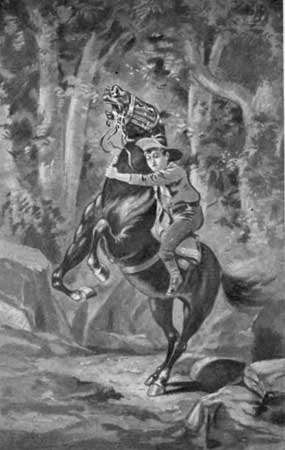
"Lemme go! I didn't hurt him!" screamed Pumpkin. "He went that
way—like the wind—on a bay horse which was running
away. Oh, he's killed, I know he is!"
"You are sure of this?"
"Hope to die if it ain't so. Poor Dick! He'll be pitched off and
smashed up like his father was smashed up. Hurry, and maybe you can
catch him."
"I believe the dunce speaks the truth," broke in Jack Rasco.
"How long ago was this?"
"Not more'n an hour. Hurry up if you want to save him," and with
a yell such as he had uttered before, Pumpkin disappeared.
Pawnee Brown and Rasco wasted no more time. Whipping up their
steeds, they set off on a rapid gallop in the direction the runaway
horse had pursued.