That night the watches at the steering appliance
were divided into four. Mr. Dancer who,
with the exception of a few brief snatches of
sleep, had been at the controls of the White
Shark almost continuously since the voyage had
started, went to his cabin right after supper.
Then came Tom’s watch, lasting from eight till
midnight. Jack’s followed, from midnight till
4 A. M., and Silas Hardtack’s from that hour till
8 A. M., when Mr. Dancer insisted that he would
be able to resume control.
This arrangement put at least one person who
understood the engines in the engine room constantly.
Mr. Chadwick watched while Jack
steered, sleeping from time to time; for it will be
recalled that the engines were controllable from
the steering compartment, so that actually all the
engineer was compelled to do was to “stand by”
for signals and see that the motors were properly
lubricated and kept in order.
At eight o’clock, when the signal sounded for
every one to turn out, Mr. Dancer emerged from
his cabin, looking, as Tom put it, “as fresh as a
daisy.” Each in turn took a salt water shower
in the bathroom, while the appetizing aroma of
Jupe’s bacon and coffee and hot biscuits filled the
main cabin.
Through the night the submarine had been run
at a distance of fifty feet below the surface of the
water, so as to avoid all risk of striking floating
objects or passing vessels. At such a depth the
craft was safe from the risk of contact with the
keels of even the largest ships.
It had seemed odd to the boys as they stood
their “tricks” at the wheel to think, as they alternately
eyed the compass and the observation
tube, that above them vessels might be passing
“on their lawful occasions,” wholly unconscious
of the “man-fish” cruising below them in the
quiet depths.
One thing, too, the boys noticed was the immense
amount of fish attracted by the glare from
the observation searchlights. Through the green,
pellucid water, illuminated by the bright light
from the observation tube, it at times appeared as
if they were gazing into a show tank in some vast
aquarium. Like most boys, Jack and Tom had
both read “Twenty Thousand Leagues Under the
Sea,” but even that fascinating history of life in
deep waters had failed to give them any idea of
the immense amount of life that goes on in the
submarine depths.
Of course, at the speed the White Shark kept
up—for time was imperative—it was impossible
to see much more of the fish than their fleeting
forms, like flocks of birds seen from a train window.
But even this was interesting. You may
be inclined to ask how the White Shark was kept
on her course without danger in the depths.
The answer is that she was guided just like
any other ship in the dark night, by her compass.
Before turning the watch over to the next man,
each occupant of the steering chair gave him the
direction in which Silas Hardtack, the ship’s
navigator, had ordered the prow to be kept. The
course was due south, and this made it doubly
easy to keep the White Shark on her true line of
progress.
As to depth, the chart showed ample water
everywhere, even should the White Shark traverse
the underwaters at a depth of two hundred
feet. But there was nothing to be gained by doing
this, as, at such great depths, pressure and
friction would be so increased as to seriously impede
the submarine craft’s progress, and haste
was a necessity.
After this digression concerning the night, we
will follow the boys up to the deck after breakfast,
for at dawn the White Shark had been
driven to the surface and the ventilators opened.
While the air was not foul, still it was a relief to
open everything that could be opened, and set in
motion fans that drew the stale air out of the interior
of the craft.
As soon as their morning meal had been dispatched,
both boys hastened on deck. The sea
was still and calm, the air cool and clear and the
sky cloudless.
They were in the gulf stream, and the water
was of an intense blue. At the sides where the
Archimedian screws were biting steadily into the
water, it had a hue of the most transparent turquoise.
Great patches of yellow gulf-weed
floated everywhere, and as the White Shark
nosed through these, flying fish flew from them
in whole coveys.
It seemed as if the boys could not tire of
watching these strange fish, which, of course, do
not “fly” at all in the true sense, but skim the
water, supported by their broad fins.
“Hullo!”
“Hullo, yourself, Tom; what’s up?”
“Look yonder there, Jack. Don’t you see some
object?”
“I do, floating off to the eastward.”
“What can it be?”
“Don’t know. Looks as if it might be a boat.”
“I’ll get the glasses. We’ll soon see.”
Tom dived below and reappeared with the
binoculars. A short scrutiny convinced them that
their eyes had not played them false. The object
on the horizon was a boat, a small craft like a
rowing skiff—at least, that was as well as they
could make out.
“Shall I tell Mr. Dancer?”
The question came from Tom.
“Yes; do so at once. It may be some shipwrecked
sailor adrift. At any rate, we ought to
look into it.”
Both Mr. Dancer and Mr. Chadwick agreed
with this. For the second time in forty-eight
hours the White Shark was diverted from her
course, and headed toward the drifting object.
As they drew closer it became evident enough,
however, that the boat was empty, or at least if
it had an occupant that he was past sitting up.
“May be some poor fellow overcome by the
heat and thirst,” suggested Mr. Dancer. “We’d
better take a closer look.”
Accordingly, the White Shark was run right
up alongside the drifting boat. As they drew
near, all hands held their breaths. They did not
know upon what tragedy of the ocean they might
be going to stumble. But the boat—a small white
one, like a ship’s dinghy—was empty. Nor did it
bear any evidence of having been occupied recently.
Above the stern seat was a name board, “Mary
Gloster, Liverpool.” Except for a coil of rope
and some fishing lines, there was nothing to show
where the boat came from or what she had been
last used for. The fishing lines gave a clew, however.
“Somebody’s been fishing and got adrift and
been picked up by a passing vessel which did not
bother to load on the dinghy,” said Mr. Chadwick.
“That looks reasonable,” agreed Mr. Dancer.
“At any rate, we’ve done all we can do and time
is precious.”
“Can’t we tow it?” asked Tom. “It’s a dandy
little boat, and it seems a shame to leave it behind.”
“It does; but how can a submarine tow a boat
except to Davy Jones’ locker?” laughed Mr.
Chadwick quizzically.
“Well, hold this rope till I get into it and examine
it for more clews,” said Tom, who loved a
mystery and scented one here.
“Very well, Master Tom, Jack can make the
boat fast to the rail, but when the engines start
you’ll have to come on board.”
Tom nodded and jumped into the boat which
was bumping alongside. He threw the line in its
bow to Jack, who made it fast around the submarine’s
deck rail.
“Go ahead, old Sherlock Holmes,” he grinned,
“get a clew.”
“All right. I might find a bag of gold,” retorted
Tom.
“Yes; and you might find a bag of cookies, but
you won’t.”
Back and forth flew the raillery, but Tom patiently
dug around the floor of the drifting boat,
in which, to make it more odd, were a pair of
oars.
“I guess it’s just a mystery of the sea,” he said
at length, “and wow! this sun’s hot. I’ll come on
board and get a drink of water. I’m dying of
thirst.”
“Well, your enthusiasm soon petered out,”
scoffed Jack.
“Wish we could go fishing, though. That’s a
dandy boat for that. Wouldn’t you like to?”
“Like to what?”
“Go fishing, of course,” responded Tom.
Mr. Dancer’s head appeared above the hatchway.
“Go fishing, eh? Well, you can if you like.
Something’s wrong with the reverse gear. It
may take some time to find the trouble and
fix it.”
“Do you want help?” asked Tom, hoping the
answer would be in the negative.
“No, thank you. You boys go on and see if
you can’t catch a mess of nice fresh red snapper
for dinner. It will make a pleasant change.”
Tom flew below to get some stale meat from
Jupe for bait, and broad shady hats for himself
and Jack.
He was radiant when he reappeared.
“Hurray, Jack, we’ll have a regular picnic.
See, I got Jupe to fix us up a lunch, and here’s a
jug of water. We might get thirsty.”
“Don’t go too far,” warned Mr. Chadwick,
who had come on deck to see the fishing expedition
off.
“No danger of that. We’ll be within call.
Blow the whistle if you want us.”
Jack referred to the compressed air whistle
within the hatch. Its tone was loud and carried
far, and it was designed to be used when the
White Shark was going through crowded waters
on the surface.
“All right, three blasts will be the signal that
we are ready.”
“All right, dad. Good-bye!”
“Good-bye. Careful now.”
“Oh, sure we will; it’s like a lake this morning.”
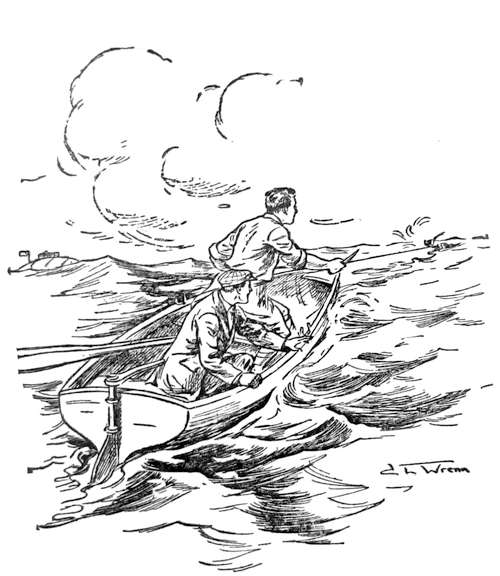
With Jack at the oars the boys rowed around
a bit and dropped their lines over from time to
time with fair success.
“I guess we’ve not got the right kind of bait,
Tom,” declared Jack at length; “they don’t seem
to be biting right.”
“Well, let’s pull around a bit and then try our
luck again.”
“All right. You do the pulling, though. It’s
too warm for one chap to do all the work.”
“Rowing’s my middle name; give me the oars.”
“Here they are. Don’t fall overboard in
changing seats. I fancy I saw a shark’s fin
cruising round here.”
“Now I’ll show you how to row.”
Tom bent to the oars and pulled with a will.
The small boat cut over the water merrily.
After a while Tom paused. They looked about
them.
“My, Tom, we’re a long way from the White
Shark,” exclaimed Jack.
“Well, didn’t I tell you I was a strong rower?
I must have pulled your lazy anatomy a good four
miles.”
“Well, let’s try fishing. If they signal us we
can hear it from here.”
“Oh, sure. Come on; bet you I get the first
fish.”
“Bet you a doughnut you don’t. Ah, see
there!”
Tom drew aboard a fine red snapper. It lay
flapping in the bottom of the boat, its bright
golden scales glinting, while the boys gazed at it
admiringly.
And all the time a danger they never dreamed
of was sweeping down on them like a thief in the
night, silent and unseen.