“The impudent scoundrel! Just look at
this, mamma. I should like to see
him at it,” exclaimed Sydney Lawson in great
wrath, as he handed his mother a very dirty note
which a shepherd had brought home. On coarse,
crumpled grocer’s paper these words were written
in pencil: “Master sidney i Want your Mare
the chesnit with the white starr soe You Send
her to 3 Mile flat first thing Tomorrer Or i Shall
Have to cum an Fetch Her.—Warrigal.”
2
“Sam says,” Sydney went on in rising rage,
“that the fellow had the cheek to give it him just
down by the slip-panels. He rode up to Sam and
Paddy Fury as coolly as if he was coming up
to spend the night at the house. If the great
hulking fellows had a mite of pluck, they’d have
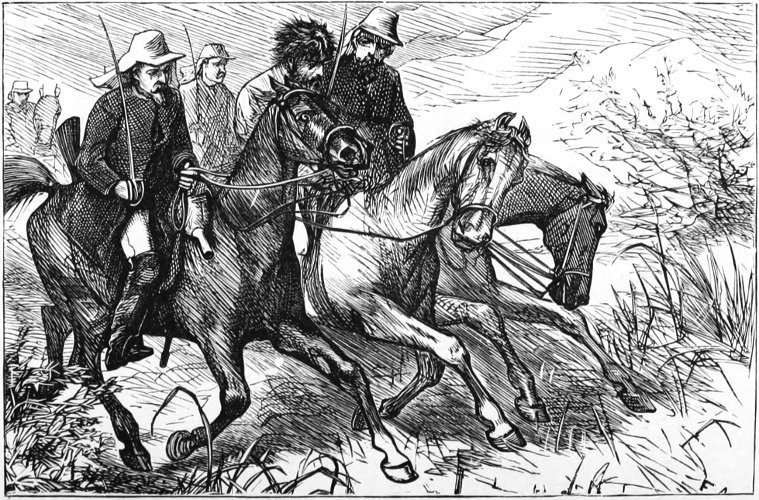
knocked him off his horse, instead of taking
orders from a chap like that. Paddy is fond
enough of bragging about his foightin’ when
there’s nobody to fight. But they’re like all
the people about here; three parts of them
funk the bushrangers, and the rest are in league
with them. He may well call himself Warrigal,
the sneaking dingo! He wouldn’t have been
game to talk about sticking us up, if he hadn’t
known father was away. Send him my Venus!
Mr. Warrigal must have gone cranky.”
3
Sydney Lawson, who made this indignant
speech at the tea-table of the Wonga-Wonga
station (and almost made the hot potato-cake
jump off the table with the thumps he gave it),
was a tall, slim lad of fourteen. He and his
mother had been left in charge of the station,
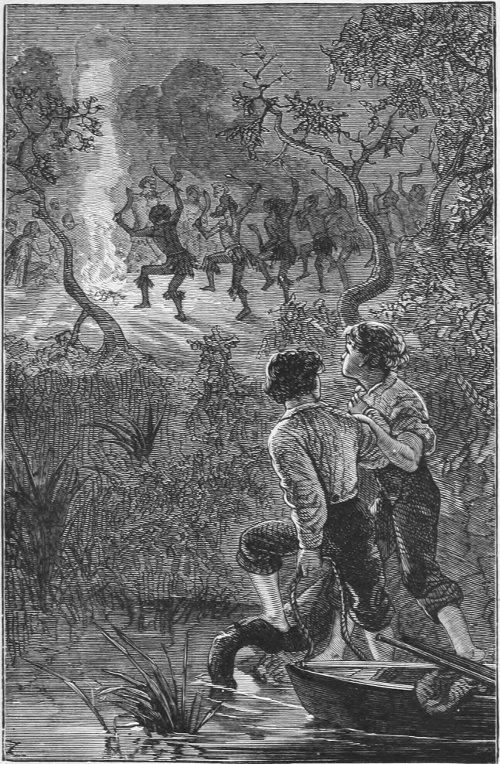
whilst his father took a mob of cattle overland
to Port Phillip. Sydney was very proud of
having the key of the store, counting in the
sheep, peppering mangled calves with strychnine
to poison the native dogs that had mangled them,
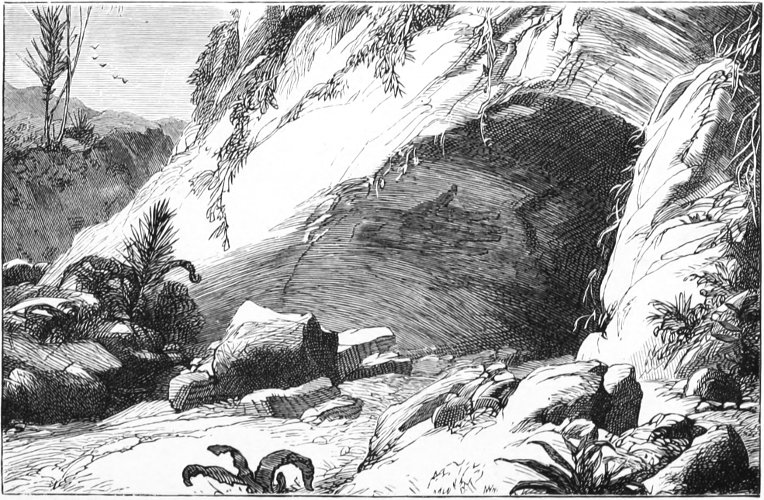
and riding about all day cracking his stock-whip,
heading back store-bullocks that seemed inclined
to make a rush at him, looking after the men,
and when meat was wanted, driving the beast
into the stock-yard himself, and shooting it with
his own gun. Sydney thought himself a man
now, and was very angry that Warrigal should
think he could be frightened “like a baby.”
4
This Warrigal was a bushranger, who, with
one or two mates, wandered about in that part
of New South Wales, doing pretty much as he
liked. They stopped the mail, “bailed up” dray-men
and horsemen on the road by the two and
three dozen together; “stuck up” solitary stores,
and publics, and stations, and once had been
saucy enough to stick up a whole township. The
police couldn’t get hold of them. Some people
said that the troopers were too lazy, and some
that they were too cowardly. The truth was
that the troopers did not know the bush like the
bushrangers, and could not help themselves, as
they could, to fresh horses when the ones they
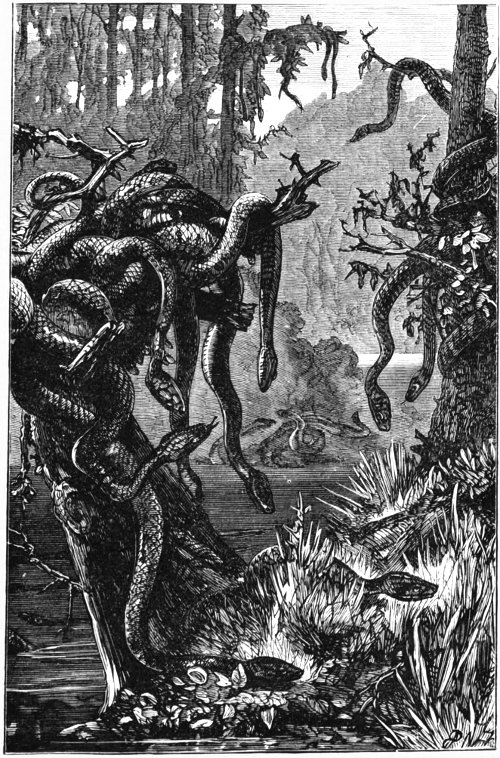
were riding were knocked up; and, besides, the
bushrangers had “bush telegraphs”—spies who
let them know where it was safe to rob, and did
all they could to put the troopers on false scents.
The note that Sydney had received caused a
good deal of excitement at the Wonga-Wonga
tea-table. Miss Smith, who helped Mrs. Lawson
in the house, and taught Sydney’s sisters and
his brother Harry, had not long come out from
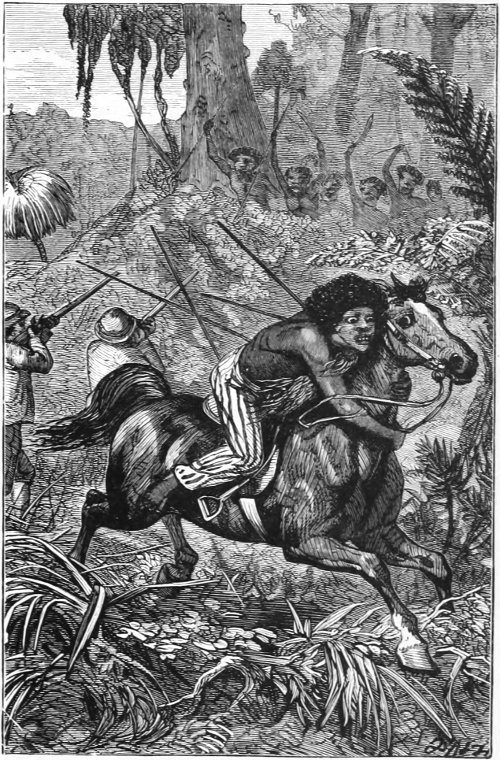
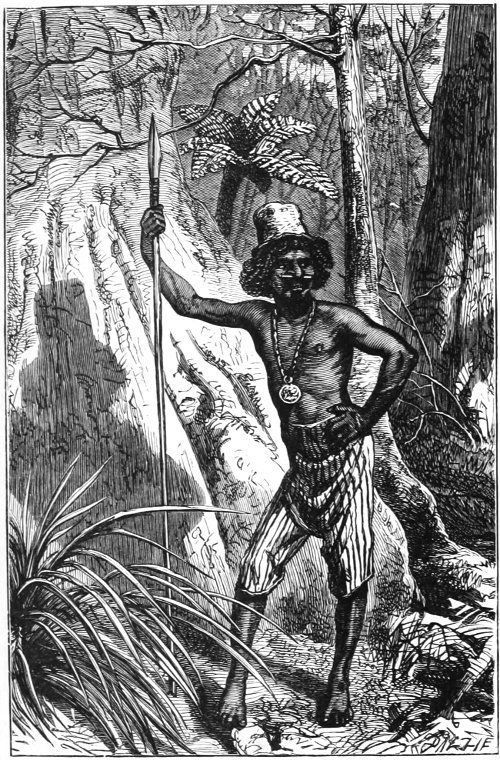
London, and was in a great fright.
“Oh, pray send him the horse, Master Sydney,”
she cried, “or we shall all be murdered in our
beds. You’ve got so many horses, one can’t
make any difference.”
All the little Lawsons instantly turned on
Miss Smith, though she was their governess.
5
“I thought you English people were so brave,”
said satirical Miss Gertrude: “you make yourselves
out to be in your history-books.”
But Sydney, though Miss Smith had talked as
if Venus was just like any common horse, was
very fond of Miss Smith. She was pretty, and
only five years older than himself. Besides, he
was acting master of the house, and a little gentleman
to boot. So he said,
“Be quiet, children; you ought to be ashamed
of yourselves. Miss Smith isn’t used to the colony.—Don’t
be alarmed, Miss Smith. I will see that
you come to no harm.”
And then he began to talk to his mother about
what they had better do. Just because he was a
manly little fellow, he was not ashamed to take
his mother’s advice.
6
Now Mrs. Lawson was as little disposed as
Sydney to let Mr. Warrigal do as he liked. She
knew that her husband would have run the risk
of being “stuck up,” if he had been at home,
rather than have obeyed the bushranger’s orders,
and that he would be very pleased if they could
manage to defy the rascal. Still, it was a serious
matter to provoke Messrs. Warrigal and Co. to
pay the house a visit. She felt sure that Sydney
would fight, and she meant to fire at the robbers
herself if they came; but would she and Sydney
be able to stand against three armed men? Not
a shepherd or stockman or horsebreaker about
the place was to be depended upon; and Ki Li,
the Chinaman cook, though a very good kind of
fellow, would certainly go to bed in his hut if the
robbers came by day, and stay in bed if the
robbers came by night. John Jones, the “new
chum” ploughman, whose wife was Mrs. Lawson’s
servant, slept in the house, and he was too
honest to band with the bushrangers in any way;
“but then, he’s such a sheep, you know, mamma,”
said Sydney.
7
There was time to send word to the police at
Jerry’s Town; but who was to go? Any of the
men, except Ki Li and John Jones, would be as
likely as not to go to Warrigal’s camping-place
instead of to the Jerry’s Town police-barracks;
and Ki Li would be afraid to go out in the dark,
and John Jones would be afraid to ride anything
but one of the plough horses, and that only at
an amble. It wouldn’t do for Sydney to leave
the place, since he was the only male effective
on it; so what was to be done? But little Harry
had heard his mother and brother talking, and,
as soon as he made out their difficulty, he looked
up and said,
“Why, mamma, I can go. Syd, lend me your
stock-whip, and let me have Guardsman.”
8
Neither mother nor brother had any fear about
Harry’s horsemanship (up-country Australian
boys can ride when they are not much bigger
than monkeys), but they scarcely liked to turn
the little fellow out for a long ride by night.
However, he knew the way well enough. Three-Mile
Flat didn’t lie in his road, and if he didn’t
fall in with any of the Warrigal gang, nobody
would harm him; and, finally, there was no one
else to go to Jerry’s Town who would or could
go in time.
So Sydney went to the stable and slipped the
bridle on Venus, and rode her down to the flat
by the creek, to drive up Guardsman. And then
he put the saddle and bridle on Guardsman and
brought him round to the garden-gate, where
Harry stood flicking about Sydney’s stock-whip
very impatiently, whilst his mamma kissed him
and tied a comforter round his neck. Sydney
gave Harry a leg up, and cantered with him to
the slip-panels, to take them down for him.
9
As soon as he was through, Harry shouted
“Good night,” and gave Guardsman his head,
and was off like a little wild boy. After one or
two failures, that made his face tingle, he managed
to crack Sydney’s stock-whip almost as
cleverly as Sydney could have done. It rang
through the still moonlight bush, and when
Sydney lost sight of him, Harry, tired of the
monotony of flat riding, was steering Guardsman
stem on for a grey log that glistened like frosted
silver in the moonshine.
When Sydney had stabled Venus again, and—an
unusual precaution—turned the key in the
rusty padlock, and when he had given a look
about the outbuildings, it was time for him to
go in to supper and family prayers. He read
the chapter, and Mrs. Lawson read the prayers.
She was a brave woman, but, with her little girls
about her, and her little boy away, she couldn’t
keep her voice from trembling a little when she
said, “Lighten our darkness, we beseech Thee, O
Lord; and by Thy great mercy defend us from all
perils and dangers of this night.”
10
Then the girls kissed their mother and their
brother, and said “Good night;” and Miss Smith
kissed Mrs. Lawson, and said “Good night,” and
said “Good night” to Sydney without kissing him
(though he looked as if he would have liked her
to); and John Jones and his wife said “Good
night, ma’am,” “Good night, sir,” just as if
Sydney had been a grown-up master, and went
to bed to snore like pigs, though they were
dreadfully afraid of bushrangers. Sydney went
into his mother’s bed-room, and looked at the
blunderbuss that stood by the bed-head (Mrs.
Lawson had selected the blunderbuss as her
weapon, because she thought she “must be sure
to hit with that big thing”), and he showed
her once more how to pull the trigger. Then he
bade her “Good night,” and went through the
house, snacking the windows and fastening the
shutters, though that was as unusual at Wonga-Wonga
as locking the stable-door. And then
he went along the verandah to his own little
room at one end, where he locked himself in,
and drew the charge of his gun and loaded it
again, and looked at the chambers of his revolver,
and put the caps on, and laid it down on
a chair ready to his hand. When his preparations
were completed, he said his prayers, and tumbled
into bed with his clothes on, and slept like a top.
11
Harry wasn’t expected home until next day.
He had been told to sleep at the “Macquarie
Arms,” in Jerry’s Town, when he had left his
message at the barracks, and come home at his
leisure in the morning. About four miles from
Wonga-Wonga, the dreariest part of the road
to Jerry’s Town—begins a two miles’ stretch of
dismal scrub. Harry put his heels into Guardsman’s
sides to make him go even faster than he
was going when they went into the scrub, and
was pleased to hear a horse’s hoofs coming towards
him from the other end. He thought it
was a neighbour riding home to the next station;
but it was Warrigal. As soon as Harry pulled
up Guardsman to chat for a minute, Warrigal
laid hold of the bridle and pulled Harry on to
the saddle before him.
12
“Let’s see, you’re one of the Wonga-Wonga
kids, ain’t you?” said the robber. “And where
are you off to at this time of night? Oh! oh!
to fetch the traps, I guess; but I’ll stop that
little game.”
Just then Harry gave a coo-ey! He couldn’t
give a very loud one, for he was lying like a sack
on the robber’s horse; but it made Warrigal
very savage. He put the cold muzzle of a pistol
against Harry’s face, and said,
“You screech again, youngster, and you won’t
do it no more.”
And then Warrigal took Harry and the horses
into the scrub, and gagged Harry with a bit of
iron he took out of his pocket, and bailed him
up to a crooked old honeysuckle tree, with a long
piece of rope he carried in his saddle-bags.
“Don’t frighten yourself; I’ll tell your Mar
where you are, and you’ll be back by breakfast,”
said Warrigal, as he got on Guardsman, driving
his own tired horse before him.
13
It wasn’t pleasant for a little boy to be tied
tight to an ugly old tree in that lonely place,
and to hear the curlews wailing just as the bushrangers
call to one another, and the laughing
jackasses hooting before daylight, as if they were
making fun of him. But what vexed brave little
Harry most was that he hadn’t been able to get
to the police.
14
Next morning, just as day was breaking, Warrigal
and his two mates, with crape masks on,
rode up to Wonga-Wonga. I don’t know which
were the bigger cowards, those three great fellows
going to bully a lady and a boy, or the half-dozen
and more of great fellows about the place
who they knew would let them do it. They made
as little noise as they could, but the dogs began
to bark, and woke Sydney. When he woke, however,
Warrigal had got his little window open,
and was covering him with his pistol. Sydney
put out his hand for his revolver, and though
Warrigal shouted, “Throw up your hands, boy,
or I’ll shoot you through the head,” he jumped
out of bed and fired. He missed Warrigal,
and Warrigal missed him, but Warrigal’s bullet
knocked Sydney’s revolver out of his hand, and
one of Warrigal’s mates made a butt at the bedroom
door and smashed it, and he and Warrigal
(were they not heroes?) rushed into the room, and
threw Sydney down on the bed, and pinioned his
arms with a sheet. The other bushranger was
watching the horses. By this time the whole
station was aroused. The men peeped out of
their huts, half frightened and half amused; not
one of them came near the house. John Jones
and his wife piled their boxes against their room-door,
and then crept under the bed. Miss Smith
went into hysterics, and Gertrude and her sisters
couldn’t help looking as white as their night-dresses,
though they tried hard to show Miss
Smith how much braver native girls were than
English, even if they did not know so much
French, and Use of the Globes, and Mangnall’s
Questions. Mrs. Lawson had fired off her blunderbuss,
but it had only broken two panes of
the parlour-window, and riddled the verandah-posts;
so Wonga-Wonga was at the bushrangers’
mercy.
15
They ransacked the house, and took possession
of any little plate and jewellery and other
portable property they could find. When the
robbers had packed up what they called the
“swag,” and put it on one of their horses, they
pulled Ki Li out of bed, and made him light a
fire, and cook some chops, and boil some tea.
(In the Australian bush the hot water isn’t
poured on the tea, but the leaves are boiled in
the pot.) Then they marched Mrs. Lawson, and
Miss Smith, and Sydney, and his sisters, and
Mr. and Mrs. Jones, and Ki Li, into the keeping-room,
and sat down to breakfast, with pistols in
their belts, and pistols laid, like knives and forks,
on the table. The bushrangers tried to be funny,
and pressed Mrs. Lawson and the other ladies
to make themselves at home and take a good
meal. One of the robbers was going to kiss
Miss Smith, but Sydney, pinioned as he was,
ran at him, and butted him like a ram. He was
going to strike Sydney, but Gertrude ran between
them, calling out, “Oh, you great coward!”
and Warrigal felt ashamed, and told the man to
sit down.
16
“We call him Politeful Bill,” Warrigal remarked
in apology; “but he ain’t much used
to ladies’ serciety.”
When breakfast was over, Warrigal asked
Sydney where the mare was.
“Find her yourself,” said Sydney.
“Well, there won’t be much trouble about
that,” answered Warrigal. “She’s in the stable,
I know, and you’ve locked her in, for I tried the
door. I suppose you’re too game to give up
the key, my young fighting-cock? You’re game
and no mistake, Master Cornstalk, and I’m a
native, too.”
“More shame for you,” said Sydney.
17
“That be blowed,” went on Warrigal; “and
since you’re so sarcy, Master Sydney, you shall
come and see me take your mare. You might
as well ha’ sent her instead of sending for the
traps, and then I shouldn’t ha’ got the bay horse
too”—and he pointed to Guardsman hung up
on the verandah.
There was no time to ask what had become of
Harry. Warrigal hurried Sydney by the collar to
the stable, whilst the other men mounted their
horses, and unhooked Guardsman to be ready for
their captain. Warrigal blew off the padlock with
his pistol, but Venus was fractious, and wouldn’t
let him put on her halter. Whilst he was dodging
about in the stable with her, Sydney heard
hoofs in the distance. Nearer and nearer came
the tan-ta-ta-tan-ta-ta-tan-ta-ta. Four bluecoats
galloped up to the slip-panels—three troopers
and a sergeant; the sergeant with Harry on his
saddlebow. In a second Harry was down, and
in three seconds the slip-panels were down too.
Up the rocky rise came the troopers as if they
were riding a steeple-chase. The waiting bushrangers
saw the morning sun gleaming on their
carbines as the police dashed between the aloes
and the prickly pears, and, letting Guardsman
go, were off like a shot. Sydney banged to the
stable-door, and, setting his back against it,
shouted for help. His mother and Gertrude, and
even John Jones, as the police were close at hand,
rushed to his aid; and up galloped the troopers.
Instead of bagging Venus, Warrigal was bagged
himself. He fired a bullet or two through the
door, and talked very big about not being taken
alive; but he thought better of it, and in an hour’s
time he was jogging off to Jerry’s Town with
handcuffs on and his legs tied under his horse’s
belly.
“WARRIGAL WAS BAGGED HIMSELF.”
18
If Warrigal had not bailed up little Harry,
most likely he would not have been taken; for
when Harry had got to Jerry’s Town, he would
have found all the troopers away except one. In
the scrub, however, Harry heard the sergeant and
his men returning from a wild-goose chase they
had been sent on by the bush telegraphs, and
managing at last to spit the gag out of his mouth,
he had given a great co-oo-oo-oo-oo-ey!
19
After that night Miss Smith always called
Sydney Mr. Sydney, and Sydney let Harry ride
Venus as often as he liked.
20
II. UP A SUNNY CREEK.
Soon after his adventures with Warrigal,
Harry Lawson had a tutor to teach him instead
of Miss Smith, and when Harry was twelve,
his cousin, Donald M‘Intyre, who was about his
own age, came to live at Wonga-Wonga to share
the tutor’s instructions. Harry considered this a
very jolly arrangement. Like most Australian
boys, he was a very quick little fellow, but he
was inclined to be rather lazy over his lessons;
and Donald helped him in his Latin and French
exercises, and made his sums come right for
him, and yet was just as ready for a spree out of
school as Harry was. Donald, too, had been born
in the colony, and so the two boys got on famously
together.
21
One Christmas the tutor had gone down to
spend his holidays in Sydney, and Harry and
Donald could do just as they liked. The papers
were full of some traces of Leichhardt, the brave
Australian explorer, that had recently been discovered,
and the boys, of course, had read “Robinson
Crusoe” also; and so they resolved to set
out on a secret exploring expedition. They determined
to go by water, because that would be
both more like Robinson Crusoe, and more of a
change for them. They were very fond of riding,
but still they were as used to riding as English
boys are to playing at “foot it,” and they had
been only once or twice in the “cot” which a
North of Ireland man, who had come to the
station as a bush carpenter, had finished the
week before, that the station people might be
able to cross the creek in time of flood, when
no horse could swim it or ford it.
22
One broiling December day—there is no frost
or snow, you know, in Australia at Christmas-time—Harry
and Donald slipped down to the
cot directly after breakfast. They had a gun
with them, and caps, and powder, and shot, and
colonial matches in brown paper boxes, and some
tea, and sugar, and flour, and three parts of a
huge damper (that’s a great flat round cake of
bread without any yeast in it), and a box of
sardines and a can of preserved salmon, that
Sydney had given them out of the store, and
some salt, and two pannikins, and a Jack Shea
(that’s a great pot) to boil their tea in, and a
blanket to cover them by night, and to hoist now
and then as a sail by day. The cot had no mast,
but they meant to use one of the oars for that,
and they had cut a tea-tree pole to serve for a
yard.
23
They were going up the creek, not down. They
knew that the creek ran into the Kakadua at
Jerry’s Town that way, and, of course, as explorers,
they wanted to go where they had not
been before. So they shipped their stores, and
untied the painter—it was twisted round an old
gum tree on the creek-side—and pushed off from
the bank, and began to try to pull up stream.
But they could not row nearly so well as they
could ride, and at first they made the cot spin
round like a cockchafer on a pin. They were
sharp little fellows, however, and soon got under
way, only catching crabs when they tried to
feather.
24
By the time they got abreast of Three-Mile
Flat, though, their arms ached; and Harry
stopped pulling, as he made out, to tell Donald
again about Warrigal, and Donald stopped pulling,
as he made out, to listen to Harry, although
he knew the story by heart. Then they gave a
spurt, and then they stopped pulling again, and
hoisted their blanket on one oar, and tried to
steer with the other; but it was a long time
before they could manage this properly. The
sail was for ever flapping against the mast—taken
aback, as the sailors say—or else the cot
was poking her nose into the tea-tree scrub on
one side of the creek or the other, as if she
wanted to get out of the hot sunlight into the
moist shade. Still, it would have been very
pleasant, if there had not been quite so many
mosquitoes; but they hummed over the water
in restless clouds like fountain-spray. However
there were native vines, with grapes like yellow
currants, twining round the lanky tea trees and
lacing them together; and the bell-birds kept
on dropping down into the scrub, and flying up
into the gum trees, and calling ting-ting, ting-ting.
It sounded like a dinner-bell, and the boys
determined to take an early dinner. They ate up
almost all their damper, and all their sardines,
and picked their dessert off the wild vines.
25
On they went again; but they had not gone
far before they came to what is called in Australia
a “chain of ponds.” The creek had partly dried
up, and they had to pull and push the cot from
one pond to another. This was hard work, and
not very pleasant work either, for the sand-flies
got into the corners of their eyes as if they wanted
to give them the blight, and the leeches crawled
up their trousers and turned their white socks red
with blood. Their heads throbbed so that they
could hardly bear to hear the locusts—thousands
of them—clattering on the trees like iron-ship wrights
hammering, and they felt quite angry
when the long-tailed, brown coach-whip bird flew
by, making a noise just like a slavedriver cracking
his lash. At last, however, they got into clear
water again—clear except for the grey snags and
sawyers—and paddled lazily along; listening to
the twittering wood-swallows as they dipped
their blue wings into the water, and the great,
black, sharp-winged swifts screaming for joy as
they tacked high overhead. Harry and Donald
could not help wishing that the cot (which they
had christened the Endeavour, in honour of Captain
Cook) would dart along of herself like the
swifts.
26
It had taken such a time to get her through
the chain of ponds, that evening was coming on.
Great flocks of cockatoos were circling round their
roosting-trees like English rooks, and parrots and
lories—their fine green, and red, and blue, and
yellow feathers beginning to look very dull and
ragged, because moulting-time was near—were
taking their evening bath in the shallow water
by the banks, splashing it over their heads and
wings, and chattering as if they were saying, “Isn’t
this prime fun?” Presently the cockatoos lighted
on the dark trees, and made them look as if a
hundred or two of ladies’ pocket-handkerchiefs
had been hung out to dry on them, and then the
boys thought it was time to find a roosting-place
themselves. They pushed the cot into a little
bay in the bank, and fastened her to an old black
stump, and then they scooped a hole in the ground
for a fireplace, and gathered sticks, and lighted
a fire. But when they were going to cook their
supper, they found that they had lost their flour,
and that their sugar-bag had got so wet that
there was only a little sweet mud left in it. But
that did not matter nearly so much as the loss of
the flour. They boiled their tea, and sweetened
it with the mud, and after a good deal of trouble
they got the salmon-tin open. Harry, who was
very hungry, was for finishing the salmon and
what was left of the damper; but Donald said,
27
“No; we must go on allowance now—we’ll
keep half for to-morrow’s breakfast, because,
perhaps, we shan’t be able to shoot anything
to-night—that’s how explorers manage.”
When supper was over, the moon had risen,
and the boys went down with their gun to the
creek to see if they could shoot a duck. The dark
water was plated in patches with ribbed and
circling silver, and, just in the middle of one
of the patches, up came a black something like a
bottle.
28
“Hush! it’s a water-mole,” whispered Harry;
but before he could point his gun at it the queer
duck-billed thing had gone under again. The
boys found no ducks, and did not go very far to
look for them. They were tired, and had had
their supper, and were sure of a breakfast. So
they soon went back to their fire, piled more
sticks on it, and then, snuggling under their
blanket, fell asleep. They said their prayers before
they fell asleep beneath the bright moon
and stars, and, as they said them, they thought
for the first time that they had not done quite
right in leaving Wonga-Wonga without letting
any one there know that they were going.
29
When they woke in the morning, the sun was
up, and the glossy magpies were hopping about
the logs, and everything looked cheerful. The
boys took a dip in the creek, and boiled their
tea, and had their breakfast, and then away they
went again in high spirits, although now they
had no food except what they might shoot or
catch. The kingfishers in their blue coats and
yellow waistcoats were darting backwards and
forwards over the water, and the fussy little
sedge-warblers were dodging about the reeds,
and twittering a little bit of every bird’s song
they could think of; but they weren’t worth
powder and shot. By noon—they could tell the
time pretty well by the sun—both Harry and
Donald felt very hungry, for they had had a very
early breakfast. They began to wish that they
had saved some of the salmon for their dinner;
but just then the Endeavour was gliding between
banks that had no tree or scrub, but only tufts
of dry coarse grass on them, and Donald saw a
bandicoot run out of one of the tufts. Up went
the gun to his shoulder, and in a second Mr.
Bandicoot had rolled over dead upon his back.
A bandicoot is a very big brown kind of rat—nicer
to eat than any rabbit. The boys soon
made a fire, and baked the bandicoot in the
ashes, in his skin; and they relished him ten
times more than the preserved salmon. Rat, and
tea without sugar or milk, may not seem a very
inviting bill of fare, but you know the Delectus
says that hunger is the best sauce, and, besides,
baked bandicoot anybody might like.
30
Harry and Donald had some more shooting
that day. About a mile from the place where
they had taken their dinner they found a break
in the creek-bank, filled up with tall rusty bulrushes.
They got out of the cot, and pushed their
way through the rushes, looking out very carefully
for snakes, and sometimes sinking into the
slush below the baked upper earth, just as if their
feet had gone through a pie-crust, and on the other
side they found a lagoon full of water-fowl. Then
they forced the Endeavour through the rushes—she
made a great black steaming furrow in the
yellow ground—and launched her down the dry
border of the lagoon, and pulled about in her,
popping away in turns, and fancying themselves
in Fairy Land. There were two or three black
swans cruising proudly backwards and forwards,
and fleets of piebald geese, and grey geese, and
sooty ducks, and silvery ducks, and chestnut
ducks with emerald necks, and musk ducks with
double chins, and all their bodies under water.
It was very funny to see their heads and necks
moving about, as if they had lost their bodies
and were looking for them. There were coots,
too, on the banks of the lagoon, and purple
herons and white herons holding up one leg as
if they were trying how long they could do it for
a wager; and ibises with untidy tufts of feathers
on their breasts, that looked like costermongers’
dirty cravats dangling out of their waistcoats,
and native companions, great light blue cranes
lifting their long legs out of the mud, and trumpeting
“Look out!” to one another, when the
Endeavour was coming their way. There were
beautiful water-lilies on the lagoon, also, with
broad round leaves like shields of malachite, and
great blossoms of alabaster, and blue and rose-coloured
china. The boys, however, were too
busy with the water-fowl to look at the water-flowers.
They kept on popping away until the
moon had been up for some time, and the bitterns
were booming in the swamps all round, and
the nankeen cranes were stalking about, nodding
their white crest-plumes like Life Guardsmen,
and croaking, “Now we’ll make a night of it.”
32
When Harry and Donald left off shooting,
they found that they had fired away all their
powder and shot except two charges, and that
they had got three little ducks. They made a
very merry supper off one, baking it on the lagoon
bank, as they had baked the bandicoot, and then
they went to sleep by their fire. Early in the
morning, just as the laughing jackass was hooting
before daybreak, Donald woke. The moon had
gone down, and so had the fire, and Donald,
though it was summer, felt very chilly.
33
He got up to stamp his feet and stir up the
fire. What do you think he saw? An iguana—that’s
a great lean lizard—sneaking off with the
two ducks that were to serve for breakfast and
dinner. Donald flung a hot log at him, but it
only made the lizard run the faster. Plenty of
red sparks were scattered about, but the two
ducklings were not dropped.
“Hech, weel,” said Donald (he had picked up
a little Scotch from his father). “it’s nae guid
greetin’ ower spilt milk;” and he lay down again
and slept like a top, until Harry woke him, asking
him what ever could have become of the
ducks? They had to breakfast on tea alone
that morning. They tried to shoot a duck, but
they had made the birds wild, and they were
very anxious not to waste their precious powder,
and so they did not succeed.
When they had hauled the cot into the creek
again, they were half inclined to go back to
Wonga-Wonga, but they determined to go on
for one day more.
34
They looked about eagerly for something to
shoot, but everything except insects seemed to
have vanished from the creek. On both sides
there were stony ridges with scarcely a blade of
grass on them. One landrail ran along the bank,
calling out “ship, ship,” as if it was hailing the
Endeavour, but Donald missed it when he fired at
it. Harry took the gun then, and said he would
try to shoot a fish. He saw something black
wriggling about in the water, which he thought
was an eel, and he fired and hit it; but it was a
snake, and it bit itself before it died; so they
were obliged to leave it in the water, instead of
cooking it on shore and getting a dinner as white
and delicate as a roast chicken.
Still, however, the boys determined not to
turn back until next day; and late in the afternoon
they got more fish than they could eat.
They came upon a black fellow’s “fish-trap”—a
kind of little mud hut, thatched with dry grass—and
out of it they scooped up a score or two of
black fish, and what they call trout in Australia.
They were not very tasty, but the boys enjoyed
the little fellows greatly when they had grilled
them, though they had no soy.
35
When they had finished their dinner, they
rowed on to find the black fellows’ camp, which
they knew could not be very far off. The moon
had come up again, however, before they reached
it. The creek, fringed with shea-oaks with dark
long leaves like lanky tassels, wriggled about
there like a snake. Long before the boys got to
the camp, they heard the measured tramp of
feet and fierce shouts, and when they got there
they saw ever so many black fellows, streaked
with ochre, dancing and brandishing their boomerangs
and waddies, whilst the “gins” (that’s the
women) in their ’possum cloaks and blankets,
squatted on the ground beating time.
36
Harry and
Donald were not a bit afraid of black fellows.
They were generally very friendly in those parts,
and often came to Wonga-Wonga. But it happened
that the black fellows were in a very
savage mood. They had been doing a little
sheep-stealing, and an overseer had fired at them,
and killed one of them; and so they had made
up their minds to kill the first white fellow they
came across, in revenge. As soon as they saw
the cot, they rushed down to the creek, shouting
out, “Wah! wah! wah!” and they pulled the
boys on shore, and burnt the cot on the great
fire they had lighted to keep the “debil debil”
away. Then they jabbered for a long time, disputing
which of the boys they should kill; and
Harry and Donald, brave little fellows though
they were, most heartily wished themselves back
at Wonga-Wonga.
“THE BLACK FELLOWS WERE IN A VERY SAVAGE MOOD.”
37
All of a sudden, however, a black fellow held
up his finger, and then a dozen of them put their
ears to the ground. It was horses’ hoofs they
heard in the distance. Then they jabbered again,
and all the blacks ran into the scrub, leaving the
boys, but carrying off their gun. In a few minutes
up galloped Mr. Lawson, and Sydney, and a
stockman. The boys had been hunted far and
wide, but it was only that day that the cot had
been missed, and so a clue found to their whereabouts.
Mr. Lawson, having heard that the up-creek
blacks were “in a scot,” and fearing that
the youngsters might fall into their hands, had
then started with his little party in pursuit. Of
course, he could not help feeling very angry with
the young truants, but there was no time to tell
them so then. Boomerangs and spears began to
whiz out of the scrub, and there was no good in
three men stopping to fight with a hundred whom
they could not see. So Mr. Lawson pulled Donald
on to his horse, and the stockman pulled Harry,
and off they galloped; whilst Sydney brought
up the rear, firing his revolver right and left into
the scrub as he rode away.
38
III. THE CAVE OF THE RED HAND.
Harry and Donald were not frightened
out of their love for exploring by their
adventure up the creek. The next expedition
they went on, however, was by land. They had
heard a good deal of the Cave of the Red Hand
in the Bulla Bulla Mountains, about ten miles
from Wonga-Wonga; and one Saturday afternoon,
directly after dinner, they started in search
of the cave—Harry on his own horse Cornstalk,
and Donald on his own mare Flora M‘Ivor.
They knew that they had to steer for a very
tall blasted gum tree that stood on the top of a
ridge, and that when they had “rose the ridge,”
as Australians say, they would find the mouth
of the cave somewhere near at hand on the other
side of the gully.
39
When they got down into the gully they dismounted,
and hobbled their horses where there
was a little feed; and then they began to look
about them. It was some time before they
found the cave’s mouth, but, whilst they were
looking for it, they saw what neither of them
had ever seen alive before, though they were
Australian-born; and that was one of the shy
birds after which the mountains were named.
They got a full view of the dingy cock-pheasant,
as he stood between two clumps of scrub, with
his beautiful tail up like a lyre without strings.
“Bulla, bulla, bulla, bulla,” he was gurgling like
a brook; but, as soon as he saw the boys, he was
off like a shot.
40
“Here it is!” at last shouted Harry, and when
Donald ran up, he found his cousin standing outside
a very gloomy-looking opening in the hillside,
with a moustache and whiskers of almost
black brushwood about the gaping mouth. On
the rocky wall at the entrance, a red hand with
outstretched fingers pointed inwards; and when
the boys had lighted their lantern and groped
their way into the cave, they found more red
hands on the walls, and white hands too—some
pointing forwards and some backwards, some up
and some down.
“ON THE ROCKY WALL A RED HAND.”
“Don’t they look queer, Donald?” said Harry;
“just as if they were murderers and people getting
murdered poking their hands out of the stone.
I wonder who did them, and what they mean.”
41
“Why, the black fellows don’t know,” answered
Donald. “They say the old people did them, but
they don’t know who the old people were. I
expect a flood drowned them. Do you know
the story the black fellows tell about the Flood?
They say that somewhere or other in Australia
the black fellows’ father lies asleep on the ground,
with his head resting on his arm; and that he
woke up ever so long ago, and that then all the
country was flooded; and that when he wakes
next, he will eat up all the black fellows. They
say he is a giant—taller than that blue gum on
the ridge. The old fellow puts them into a great
funk. Up at our place I went out one day with
a black fellow after honey. He caught a native
bee, and stuck a bit of down on it, and chased it
till it lighted on a tree, and then he climbed up
with his tomahawk, and tapped till he found
where the nest was. He cut out the combs and
the bee-bread before you could say ‘Jack Robinson;’
but he took precious care to leave some
of the honey for the old giant. If he’s asleep,
though, I don’t see what good it would do him.”
“They’re a queer lot, the black fellows,” philosophically
remarked Harry; “but they’re a long
sight better than new chums—they were born
in the colony just like us. A black fellow can
ride like a native, but those Englishmen look so
scared when a horse begins to buck.”
42
Just then, however, it was Harry’s turn to
look scared, for a great grey owl, with round
eyes that gleamed like polished guineas, brushed
against his face, and directly afterwards two or
three flying foxes floated by, looking in the dark
very much like dirty cherubim off a tombstone.
Donald laughed to see how the owl and the
great bats made Harry jump, when he had been
talking so big the minute before. Presently they
walked into a cloud of great dusky moths that
came fluttering about the lantern like butterflies’
ghosts, and then they saw stalactites hanging
down like sheets and chandeliers, and fruit and
flowers, and plucked geese, and organ-pipes, and
joining on to the stalagmites on the floor, and
making columns and cloisters and great hour-glasses.
Some of the stalactites rang in tune
when they rapped them, like harmonicons. It
would have been a very jolly place to wander
about in, if the water had not dropped off the
roof down the napes of their necks, and if they
had not been obliged to look out so sharp to
keep from tumbling down little precipices, or
into the streams they could hear running, and
the ponds they could sometimes see shining
through the darkness.
43
They had scrambled down three or four of the
little precipices (the cave’s floor was like a great
rough flight of stairs) when they stopped to look
at a pillar that was just like a huge candle with
a “winding-sheet.”
“Why, there’s a red hand up there,” said
Harry, pointing to the winding-sheet.
Donald could not see it, and so Harry put the
lantern on to the end of a long stick he carried,
and held it up to what he said was the hand.
But still Donald could not see one.
“You must be blind, then,” said Harry impatiently;
“there, don’t you see now?” and he
pushed the lantern against the stalactite.
44
Down the lantern dropped, rolled over for a
few feet, and disappeared. The boys joined
hands, and groped with the stick after the lantern;
but presently the end of the stick ran on
without anything to stop it, and if they had not
pulled themselves up very quick, they would
have fallen down the deepest drop they had
come to yet. At the bottom was a light, dancing
about like a will-o’-the-wisp. The lantern had
tumbled into one of the black subterranean
streams, and soon, either the water put the
candle out, or else the lantern was carried underground.
At any rate, Donald and Harry
were left quite in the dark.
“We must keep on lighting matches,” said
Donald; “or, perhaps, we could make torches
out of this stick-it seems dry. Where are the
matches?—You had them.”
45
But when Harry felt in his pocket, the matchbox
was gone. He felt in all his pockets, and
Donald felt in all his pockets, but not a single
match could they find. Then, at first, they did
feel very much afraid, and I think you would
have been afraid, too, however plucky you may
be. The cave was pitch-dark where they had
got to. They could hear water dripping and
dashing and running all round about them—some
of it a long way down. When they moved,
they were forced to tap about with the stick like
a blind man, and to slide their feet along the
ground at a snail’s pace, for fear of suddenly
tumbling down some deep pit or into a well-like
water-hole. And if they could find their way
back to the great steps they had come down, it
would be very hard to find the proper places to
ascend, and to scramble up them in the dark.
It had not been easy scrambling down them, even
with a lantern. No wonder Donald and Harry
felt frightened. But funking, they knew, would
do no good. If they sat down scared in a corner,
there they would have to starve, most likely; for
no one at Wonga-Wonga knew that they had
started for the cave.
46
“Let’s say our prayers,” said Donald (it was
Harry told me); and when they had said them,
they gripped hold tight of one another’s hands,
and set out.
At first they went quite wrong. After stumbling
about for nearly half an hour, they had got
again to the top of the precipice the lantern had
tumbled down, instead of to the foot of the first
one they had to climb up; but then they felt
their way along by the wall of the cave, until
they came at last to the bottom of the drop they
wanted. They could not always keep by the
wall. Every now and then their guiding-stick
went splash into water. Sometimes, too, they
ran full butt against rocks that knocked sparks
out of their eyes, and made their noses bleed,
and tore their clothes into ragged ribbons; and
Donald lost one of his shoes, and Harry both
of his, in some mud, as sticky as birdlime, that
they floundered into. But, at last, as I have said,
they came to the foot of the first great step they
had to mount. They felt about with their stick,
but for a long time they could find no foot or
hand-hold. And when they did come by-and-bye
to jutting big stones, they were no good, because
a waterfall was tumbling down them. The stream
it made below was not very broad, but it ran so
fast that the boys could not pole how deep it
was; and so they had to be very careful in crossing
it, and they would not have been able to cross
it at all, if it had not been for a great stone in
the middle that the stick tapped against. As it
was, Harry (who was more slapdash in his ways
than Donald) went into the water up to his waist
before he got to the other side.
47
When they had
crossed, they seemed at first as far off from the
cave’s mouth as ever; but, after ten minutes’
groping about, they got into a zigzag crack in
the great step, through which, with more tearing
of clothes and bruising of shins, they managed
to wriggle up to the sloping platform above.
They had learnt wisdom from experience, and
did not try to strike right across it. Perhaps
you have tried to walk right across a common
in a fog, and have come out not far from the
place you started from: well, Donald and Harry
had discovered that making short cuts in the
pitch-dark Cave of the Red Hand was like that,
and so they tapped along the edge of the step
until they came to the cave’s wall once more,
and then followed that—running up against
rocks, and floundering into mud and water as
before—until they got to the foot of the next
step. When they had climbed a good way up
the last step they had to mount, they met with
a great disappointment. There were no more
stones sticking out for them to take hold of.
They swished the stick backwards and forwards
like a scythe, but it went over the rock just as
if it had been a brick wall.
48
So they had to go back and try again, and it
was so long before they found a mounting-place,
that they began to lose heart, and fear that, after
all, they would have to die in the cave, with nothing
but the pointing red hand at the entrance
to show where they were. But at last their heads
rose above the edge of the great step, and there,
far away, the moonlight was pouring in at the
cave’s mouth, and making silver gauze of the
mist just inside. Close by them the cave still
looked very gloomy; but oh, how jolly they felt!
When the owls and the flying foxes brushed
against Harry now, he could have shaken hands—or
wings—with them, they seemed so much
like old friends welcoming him back to life.
49
It did not take the boys long to get out of
the cave when they had the moonlight to guide
them, and they did not stop long to look at the
inwards-pointing red hand, at which they had
looked so curiously when they were going to
follow its direction. Then the faded red fingers
seemed burnt up by the blazing sunlight; now
they pointed dim beneath the dewy moonlight.
When the boys thought of the dismal darkness
the hand pointed to, they hurried by it as if it
had power to push them back into the gloom.
In spite of their hobbles, Cornstalk and Flora
M‘Ivor had strayed a long way, and it was early
Sunday morning before they and their riders got
back to Wonga-Wonga.
50
The bleeding, battered,
tattered boys were so full of their adventure that
they were quite angry to find every one there
sound asleep. They went to bed without waking
even the dogs, and heard next day at breakfast
that, as they had been seen riding in the direction
of the next station, it had been thought that
they had been kept there to spend the night.
They felt doubly fortunate then in having got
out of the Cave of the Red Hand, for no one,
plainly enough, would have dreamt of looking
for them in it.
51
IV. ABOUT SNAKES.
There were plenty of things in the Wonga-Wonga
garden, but they were not
arranged very tidily. It was hard to say where
the beds ended, and the paths began; and near
the bottom fence there was a patch that was
exceedingly slovenly. In the midst of loquat
trees and peach trees, and ninety-days’ corn, and
sweet potatoes, and golden-blossomed pumpkin
vines, there was a coarse grass-plat, almost as
big as a little paddock. A clump of prickly pear
grew in it, and one great aloe, with names cut
on some of its pointed leaves, and the ends of
others hacked off as if they were sword-bayonets
broken in receiving a charge of cavalry. And
yet the grass-plat looked cosy too—shut in with
fruit and flowers and vegetables and green corn,
or blossoming corn, or brown corn hanging down
great heavy cobs, like truncheons with brass-headed
nails driven close together into them,
and with the hot Australian sunshine pouring
down on the long dry tangled grass. Bees
buzzed about over it, and butterflies, with white
drops on their black velvet wings, found out its
flowers, and the pumpkins, squashes, cucumbers,
vegetable marrows, and rock and water-melons
were fond of crawling into the hay-like grass, to
bulge out and ripen into gold and bloomy green,
and speckled green and yellow. The guinea-fowl
and turkeys were very fond of laying their
eggs in the grass-plat too; and in late spring
and summer, and early autumn, snakes were very
fond of it also. Up-country people in Australia
get careless about snakes, as colliers in England
get careless about fire-damp and choke-damp—just
because they may be killed by them
any day.
53
One day Mrs. Lawson put on her
sun-bonnet, with a curtain that came half-way
down her back, and went to the grass-plat to
look for eggs, and Harry went with her. All of
a sudden she started up with a great black snake
coiled round her arm. Though Harry was a
slapdash little fellow, he could be cool enough
sometimes. The instant he saw what was the
matter he darted at the snake before it could
bite, just like a snake when it springs, as stiff
and as straight as an arrow, and caught it round
the throat so tightly with both hands, that it
could not put its horrid fangs either into them
or into his mother’s arm. Mrs. Lawson didn’t
shriek, but stood quite still (though her face was
very white, both for Harry’s sake and her own),
so that the snake might not get a chance to
wriggle free: it was lashing about with its nasty
tail, and swelling out as if it wanted to burst
itself. Harry knew that Sydney was taking an
after-breakfast pipe on the verandah, and shouted
as loudly as the throttling he was giving the
snake would let him:
54
“Syd, there’s a beastly snake on mamma!
I’ve grabbed him.”
All the Lawsons could put this and that together;
so, before he rushed to the rescue, Sydney
dashed into the keeping-room for the carving-knife.
He was not long about it.
“Hold on like grim death,” he said to Harry,
when he ran down; and then he sliced through
the snake just under Harry’s fingers. The head
part gave such a jump that, after all, the horrid
fangs nearly went into Mrs. Lawson’s arm, but
Harry managed to keep hold of the slippery
thing until he could fling it ever so far off;
whilst the headless part untwined from his
mother’s arm, and writhed about on the ground
in a very uncanny fashion. When the head had
been smashed with a stone, and kicked up to a
great red boil of an ant-hill, and the tail dragged
after it, for the ants to pick the bones, both parts
still kept twitching every now and then.
55
“Snakes can’t die outright, you know, until
after sundown.” said Harry.
“Confound the beast! He’s made me break
my pipe,” said Sydney.
But though they talked in that cool way,
they had both hugged their mother like boa-constrictors
when she was safe from the black
snake; and when she gave over kissing Harry
for a minute, Sydney had clapped him on the
back, and said that he was proud to have a
game little fellow like that for a brother. Harry
scarcely knew whether he was more pleased by
the kissing or the clapping—although he did not
quite relish being called a little fellow.
56
Black snakes, and all kinds of snakes, swarmed
about Wonga-Wonga in warm weather. In cold
weather—such cold weather, that is, as they have
in Australia—the snakes lie up in holes. They
are not very brisk when they first come out in
spring. They seem to be rubbing their eyes, so
to speak, after their long sleep; but perhaps they
are most dangerous then, because they are more
likely to let you tread on them, instead of getting
out of your way, as they are generally glad
enough to do.
57
One bright spring morning in September
(seasons are turned topsy-turvy, you know, in
Australia), Donald had gone down with John
Jones’s little boy to pull up some night lines
that Harry and Donald had set in the creek,
Harry was too lazy to turn out that morning,
so Donald had got little Johnny Jones to go
with him. Johnny had no shoes or stockings
on, and as he ran to pull one of the lines up, he
set his bare foot on a sluggish snake, coiled up
like a lady’s back-hair, in a hollow of a black log
he was clambering over. Up came the flat head
and bit Johnny’s great toe, and off the snake
wriggled. Poor little Johnny was dreadfully
scared, but Donald made him sit down on the
log, and tied one of the fishing lines so tightly
round the toe that it almost cut to the bone.
Then Donald went down on his knees, and
sucked the poison out as well as he could, and
spat it out on the ground. What with the bite,
and the fright, and the tight string, Johnny
could not manage to walk. So Donald took
him up on his back like a sack, and trotted off
to the house with him, and told Mr. Lawson
about him. Mr. Lawson at once cut out the
bitten part with a sharp pen-knife, and blazed
some gunpowder in the hollow, and, except that
he had to limp a little for a day or two, Johnny
came to no harm. But if it had not been for
Donald, very likely his leg would have swelled
up, and he would have grown sleepy, and perhaps
died, long before the doctor could have
been fetched from Jerry’s Town; and when the
doctor had come, perhaps he would not have
been able to do any good. If “Old Cranky” or
any of the black fellows had been on the station,
they might have cured Johnny perhaps.
58
Old Cranky was a half-crazy, transported
poacher, whom the squatters paid to wander
about their runs, killing dingoes. Though he
was half-crazy, he was sharp enough in doing
that; and he was a snake-tamer too. He used
to carry little ones about in his cabbage-tree hat,
and trouser-pockets, and the bosom of his blue
blouse, and pull out a bundle of them every now
and then like a pocket-handkerchief. He left the
fangs in them, and they sometimes bit him, but
he had found out something that always cured
him at any rate; and the blacks have got something
of the same kind.
59
Some people say that
when a stump-lizard has been bitten in a fight
with a snake, it eats the leaves of a little herb
that prevents the poison from taking effect, and
that the blacks and snake-charmers have found
out what the herb is. The stump-lizard is a
thick spotted brown and blue thing that is very
fond of killing snakes; though it is so lazy
generally, that when it thinks you want to hurt
it, it won’t take the trouble to run away, but
only turns round and makes ugly faces at you.
To be sure it can give you a nasty bite if you
do lay hold of it. The big-headed laughing jackass
is very fond, too, of stabbing snakes and
breaking their backs with its strong beak. It
seems to enjoy the jobbing job, as if it thought
that it was only serving them out fairly for eating
birds and birds’ eggs. One day Donald shot
a snake that was climbing up a tree to a bird’s-nest;
and another day he and Harry came upon
one that was mesmerizing a lot of little diamond
sparrows. Half of it was coiled up like a corkscrew,
and the rest went backwards and forwards,
like a boat’s tiller when no one has got hold of
it; and the little birds kept on coming nearer
and nearer, as if they were being drawn into its
open mouth. When Harry shied a stick and
frightened them away, the snake looked round
at him quite savagely before it rustled off.
60
There were plenty of snakes, as I have said,
about Wonga-Wonga. Great black-backed and
yellow-backed fellows crawled into the huts
sometimes when the men were away, and coiled
themselves up in the boots and blankets; and
little lithe mud-brown whip-snakes used to pop
out their wicked-looking little heads between the
planks of the wool-shed, and the house verandah,
and the weather-boards of the barn, and then
pop in again before a gun could be pointed at
them. Whilst the snakes were about, too, it was
a hazardous thing to pull a log out of the wood-heap.
You might have fancied that Harry and
Donald saw enough snakes to keep them from
wanting to hear about any more, but Old Cranky’s
snake stories fascinated them as the snakes fascinate
the little birds. He told them about the
death-adder, with its feet like a lizard’s, and its
sting like a wasp’s, besides the venomous fangs
in its thick head; and of the huge boas that he
had seen “ever so far up country,” joining the
trees together with great cat’s cradles. There is
a stumpy snake in Australia that is, perhaps,
particularly dangerous, because it lies still to be
trodden on; and there is, also, a small python;
and out of these men like Old Cranky have
made up their death-adders and their big boas.
When the boys asked him to let them get a peep
at these hideous creatures, he always put them
off with the excuse that there were none for
miles thereabouts; but he did show them something
in the snake line that they did not forget
in a hurry.
61
From wandering about the country so much
alone, and not being afraid of snakes, Old Cranky
knew of places that even the blacks did not know
of. It was for one of these that he, and the boys,
and his gingerbread kangaroo-bitch, and a shaggy
old mongrel, with an ear and a half and a quarter
of a tail, that could find game like a pointer and
bring it in like a retriever, started one summer’s
day. The old man made a great mystery of what
he was going to show the boys. Except that
he took them by short cuts that they were not
familiar with, they saw nothing remarkable until
they came to the brim of a deep little basin, with
a big water-hole fringed with thick scrub at the
bottom. They had not gone many steps down
the side before Lag—that was the mongrel’s
name—lifted up his fore-foot.
62
“What’s the dog pointing at?” asked Harry.
“Quail, I suppose?” said Donald.
“No, it ain’t quail,” Old Cranky answered with
a grin. “Can’t ye smell ’em? Well, ye’ll see ’em
soon. Keep close ahind me. Don’t ye tread but
jest where I goes.”
63
They did see them soon. It was snakes the
old man meant. He had brought them to what
he called the Snakes’ Corrobboree. There they
were in scores: snakes with backs like Spanish
leather, and snakes with backs like a gaudy-patterned
carpet; snakes with white china bellies
and with striped china bellies; snakes with verdigrised-copper
bellies, and with scoured-copper
bellies; snakes of all colours and all sizes, up
to seven feet or so; snakes wriggling like eels
through the water, and floating on it like straight
sticks; snakes undulating through the scrub;
snakes basking on dry ground, curled up like
coils of rope, or littered about like black cravats
untidily thrown down upon the floor; snakes
twined round tree-poles like variegated creepers,
and snakes dangling their heads from grey
branches like waving clusters of poisonous fruit.
“THE SNAKES CORROBBOREE.”
“I’ll go bail ye niver see the like of that
afore,” said Old Cranky. “Ain’t it a pretty
sight? I niver showed it to nobody afore. I
likes to come an’ watch ’em by myself. Me an’
the dog, that is. Lag likes it ’most as well as
me. Fan, there, is afeard. She stayed outside,
ye see.”
64
The boys felt almost as afraid of Lag and
Old Cranky as they were of the snakes when
they heard of such peculiar tastes. Heartily
glad were they when they joined the kangaroo-bitch
outside the horrible basin, and they felt
relieved, too, when they reached a track they
knew, and the crazy old snake-charmer slouched
off on his way to the next station with his dogs
behind him.
Tired as they were with their long walk when
they got back to Wonga-Wonga, Harry and
Donald did not have “pleasant dreams and sweet
repose” that night. They both of them dreamt
of the Snakes’ Corrobboree; and, I scarcely need
say, they never took the trouble to find their
way to it again.
65
V. LOST MAGGIE.
Black fellows and old bushmen—and
young bushmen too, for the matter
of that—cannot make out how it is that “new
chums” lose themselves in Australia. They can
tell which way to go by the place of the sun,
and the dip of the country, and all kinds of little
things that new comers would not understand
even if they noticed them; and so they laugh at
new comers for getting lost. But for all their
bumptious talk, people of “colonial experience”
sometimes get lost in the bush, and are never
heard of again, like ships that have gone down
at sea without any surviving eye, except God’s,
to see them sink.
66
Sad stories are told about these poor lost
people. Sometimes they disappear for ever, like
rain-drops swallowed by the ocean; sometimes
they are found wandering about mad; sometimes
they are found starved to death; sometimes
just dying. Sometimes a heap of picked
and bleached bones is found, with nothing to tell
the name of the person whose flesh has been
torn or has rotted off them. Sometimes the
name, and one or two sprawling, half-unintelligible
words have been feebly scratched on the
pannikin that rusts hard by.
You may fancy, then, how dreadfully frightened
a mother in the bush is when her little
child is missing. But, though some of the little
strays are never recovered, a great many of them
are wonderfully protected, and come upon at
last. It is about a little girl that was lost in the
bush that I am going to tell you.
67
One morning I had ridden over to Wonga-Wonga,
and was having lunch with Mr. Lawson
and Sydney, when Mrs. Jones rushed into the
room, crying as if her heart would break.
“Oh, master,” she sobbed out, “I can’t find
my Maggie; an’ I’ve been seekin’ her an hour
an’ more. Oh! it was you who persuaded Jones
to come when you was over at home, an’ if you
don’t find my Maggie, I shall do myself or some
on ye a mischief, I feel sure I shall. Oh, oh, oh!
my ’ead feels fit to burst!”
Mr. Lawson quieted the poor screaming woman,
and, when he found that little Maggie was really
lost, he had horses run up, and every man and
boy about the station started in search of Mrs.
Jones’s lost lamb.
68
Little Maggie was a flaxen-haired, blue-eyed,
laughing, lisping little pet; but if she had been
a crosspatch everybody would have looked for
her just as carefully. Harry and Donald bounced
out of the weather-board cottage that was used
for a school-room, like pellets from a popgun,
when they heard the news; and after them the
tutor rushed to horse, though he wasn’t much of
a rider. John Jones was fetched up from the
paddock where he was ploughing, and when he
heard that little Maggie was lost, he made a rush
at a young horse that had only had the tacklings
on once or twice, and would have got on it too,
somehow, though he had been thrown over its
head the next second, if the horsebreaker had
not laid hold of him, and given him a leg up on
to a horse fitter for his riding.
In the course of the day the news spread to
the stations round about, and before nightfall the
whole countryside was up hunting for poor little
Maggie. The shepherds left their dogs to look
after their flocks, if they had dogs, and their
flocks to look after themselves if they hadn’t
dogs, to scour the bush.
69
Mrs. Lawson and her girls searched all round
the head station as if they were looking for a
pin. Even Miss Smith mastered her dread of
the bush, and went quite a quarter of a mile
away from the house, all by herself, as she afterwards
related proudly, even into places where
she couldn’t see the house, and where she was
dreadfully afraid that a bushranger would carry
her off, or a snake would bite her, or the little
imported bull would run at his timorous countrywoman.
As for poor Mrs. Jones, she kept on
rushing out into the bush, determined to walk on
until she dropped, and then rushing back, before
she had walked a mile, to hear whether little
Maggie, or any tidings of little Maggie, had been
brought home.
70
Some of those who had been hunting for the
little girl gave up the hunt at the end of the first
day; some went on hunting with fire-sticks
during the night, and then went back to their
work next morning very cross because nothing
had come of their kindness, and also because—pity
often makes people cross—they couldn’t help
thinking of the poor father and mother, and of
how they would feel if their little ones had “gone
a-missing.” Others camped out when the sun
had gone down on one day’s unsuccessful search,
that they might be fresh to renew their search
on the morrow. Harry and Donald were two of
these. They had thoroughly fagged themselves
out, poking here and poking there, and then
riding, as if for a wager, to some place where
one or other of them had fancied they might,
perhaps, find some traces of poor little Maggie.
They were too tired even to be hungry when
they got off their horses, as the stars were coming
out. They almost fell asleep as they took the
saddles off their horses, and were soon snoring
between the saddle-flaps they used for pillows.
When the boys woke next morning they were
as hungry as fox-hunters, but what were they
to do for a breakfast? Donald saw a grass tree,
and remembered what he had seen the black
fellows do with grass trees on his father’s station,
which was farther up the country than Wonga-Wonga.
71
“It looks as if it would come up easy,” said
Donald; “let’s loosen the earth round it a bit
though. Now then, Harry, lay hold, and pull
with a will, as old Tom the sailor says.”
The two boys laid hold of the queer crooked
stump, and pulled with such a will that presently
flat they tumbled on their backs, with the grass
tree between them. The root was rotten, and
swarmed with fat grubs. They made a black
fellow’s breakfast off these, and then they saddled
their horses, and off they rode again.
72
They had not gone far before they came upon
King Dick-a-Dick, admiring himself at a water-hole.
He was in full dress, and he seemed very
proud of it, as he made a looking-glass of the
water, and then tossed up his head again. His
Majesty’s crown was a battered white hat, and he
wore a pair of light-striped knee-breeches—that
was all his dress. He had had the hat and the
breeches given him at some of the stations near,
and the settlers about there had given him a
brass chain too, and a brass plate engraved—
“H.M. Dick-a-Dick,
King of the ’Possum Tribe,”
“H.M. DICK-A-DICK, KING OF THE POSSUM TRIBE.”
73
with a ’possum engraved underneath. The ’possum
was the crest, so to speak, of King Dick-a-Dick’s
tribe. Now this was the tribe from which
Harry and Donald had had such a narrow escape,
and, therefore, they felt rather nervous
when they saw King Dick-a-Dick standing by
the water-hole with his spear in his hand. But
his Majesty was anxious to conciliate. He was
fond of tobacco and flour, and he and his people
had run short of both since they had been on
bad terms with the whites. So, as soon as he saw
the boys rein in, he stuck his spear, point downwards,
into the ground, and beckoned to them
to come on, grinning as if the top of his head
was coming off. That was his way of giving “a
winning smile.” When he learnt what the boys’
business was, he chuckled greatly at the thought
of white fellows trying to find any one in the
bush without black trackers, and then proposed
that he and the boys should share the credit of
finding the little girl. He made sure that he
could find her. The direction in which she had
left the station was known, so Dick-a-Dick took
the boys back to within about a mile and a half
of home, and then began to beat about. He
went down on his hands and knees, and put his
nose to the ground like a dog. Presently he
stopped at an ant-hill, peered about for a minute,
and then jumped up, and cut a caper. The boys
couldn’t make it out, but he had discovered the
mark of a tiny little bare heel in a dent on the
ant-hill. When he had once found Maggie’s
track, he scarcely ever lost it. On he went,
walking with his nose almost as low as his toes.
He found out little stones that had been moved,
and grass-blades that had been scarcely brushed
by poor little Maggie’s bare feet. He found out
too the blood that had come from a scratch in
one of them, got by scrambling over a splintery
log.
74
“Dat where piccaninny lubra stop to drink,”
said Dick-a-Dick, pointing to a “crab-hole”—the
hole made by a bullock’s hoof—on whose
side he could see the print of a chubby little
brow. “Missy proud now, pick waratah,” said
Dick-a-Dick soon afterwards, as he gathered up
the still crimson leaves of the flower which the
little girl had bruised and thrown down. “Now
Missy ’fraid o’ debil-debil,” said Dick-a-Dick by-and-bye,
when he came to a place in which the
tracks, invisible to the boys’ eyes, were so bewilderingly
visible to him on all sides that he did
not know at first which to follow. He soon
found the right one, however, and led the boys
to a place in which he said the little girl must
have slept.
75
So they kept up the search until, after travelling
for hours in a circuitous zigzag, they came
upon poor little Maggie, not four miles from
home, but on the opposite side of the station to
that from which she had started, coiled up in a
black, jagged, charred tree-stump, with bright-eyed,
basking little lizards watching her. Of
course, the lizards vanished as Dick-a-Dick and
the boys drew near, but his sharp eyes had seen
something peculiar in their bright ones. Poor
little Maggie was sound asleep; her fat little
face, and neck, and arms, and legs, were sadly
scratched. In a scratched, podgy little hand she
held a posy of withered wild flowers.
76
When she woke and saw Dick-a-Dick, trying
to look specially amiable, grinning down upon
her, she shrieked out, “Mammy!” But when
she saw the boys, she jumped up and ran to
them, and hid her face between them, and clung
to them with two little leech-like arms. They
tried to explain to her that if it had not been
for her “nas’y b’ack man” she might never have
seen her “Mammy” again; and Dick-a-Dick
grinned his broadest grin to propitiate her; but
it was no use. She screamed whenever her eyes
fell upon Dick-a-Dick. And yet, according to
her own pretty little prattle, she had not been
“much f’ightened in the thoods.” She had seen
“nas’y b’ack ’igglin’ thin’s,” but “the kin’ yady”—whoever
that might be—“thoodn’t ’et ’em bite
me.”
Harry took Maggie on his horse, and cantered
on in front, and Donald and Dick-a-Dick cantered
behind on Flora M‘Ivor.
What a reception they had when they got to the
station, for they were getting anxious there about
the boys as well as the little! The head-station
shepherds had come in with their sheep,
and a good many of the people who had been
searching for a couple of days had gathered at
the station quite dispirited at their lack of luck.
They all gave a great cheer when Cornstalk and
the mare laid down their ears, and brought up
their four riders at a steeple-chase gallop.
77
When Mrs. Jones had almost squeezed the
breath out of poor little Maggie, she tried to
garotte Harry and Donald, and then hugged
Dick-a-Dick; and John Jones seemed inclined
to hug all three of them, too, when he had done
his best to press the little life his wife had left
in her out of little Maggie; and then Mrs. Jones
went into hysterics, and John Jones ran indoors
and hid his face in the bed-clothes, and blubbered
for a quarter of an hour; and everybody
thought the better of him because he blubbered.
Just wasn’t there a supper at Wonga-Wonga
that night! And didn’t Dick-a-Dick tuck into
it? And didn’t Harry and Donald, between
them, eat nearly half as much as he did?
78
VI. AN AUSTRALIAN DROUGHT.
“What a set of crawlers you are in
Jerry’s Town, Mr. Howe!” said Harry
Lawson to me, one frizzlingly hot day. I was
staying in Jerry’s Town then, and Harry had
ridden in to meet the mail, and take back the
Wonga-Wonga newspapers and letters. “I
shouldn’t like,” Harry went on, “to live in a
town. I should feel choked with such a lot of
houses about me. Father talks about England
sometimes, but I’m sure he likes the colony
twenty times better. Houses everywhere, and
all the little bush you’ve got left cut up into
paddocks! I wouldn’t live in England if you
paid me for it. You brag about your horses,
but they can’t run against ours, when they do
come out. I wonder they live out the voyage,
from the way I’ve heard you coddle them.
Look at our horses—they don’t want corn and
cloths, just as if they were babies. You can ride
them for a hundred miles, and turn them out to
grass all in a sweat, and yet they’re as fresh as
paint for another hundred miles next day—aren’t
you, Cornstalk?” said Harry, proudly
patting the damp neck of his favourite steed.
79
Harry was always very fond of “cracking up
the colony,” but he was especially inclined to do
so that forenoon, having had his temper somewhat
irritated (although he protested that he was as cool
as a water-melon) by the hot wind that had been
blowing for three days. I have been in glassworks,
and close by the mouths of blast-furnaces,
but the heat of an Australian hot wind is worse
than theirs. The perspiration it brings out does
not cool, and the warm beads are licked up the
instant they ooze out upon the forehead and the
cheeks. If a vitrifying brick could feel, it would
sympathize with a “new chum” in an Australian
hot wind. When the “southerly buster” comes
after the hot wind, rushing with the chill still on
from the South Pole, I have seen people ripping
open their shirts to let the cold breeze blow right
round them. The hot wind, too, makes the eyes
smart and itch dreadfully.
80
When Harry was
talking to me that day—shamming that he did
not feel the heat in the least—a good many
people in Jerry’s Town had got “the blight.”
Their eyes were bunged up just as if they had
been fighting, though they did keep on dabbing
rags dipped in alum-water up to them. And
then, as if the blight was not bad enough, flies
got into the corners of the eyes, and sucked
away with their thirsty probosces. I have heard
of a Frenchman who committed suicide because,
as he left a letter to say, he was “so bothered
by the flies that life was not worth keeping at
such a price.” I think that foolish man must
have been an Australian immigrant. The flies
at the time I am telling you about were really a
dreadful nuisance in Jerry’s Town. They buzzed
about one’s head like swarming bees, they covered
one’s back like a shirt of mail, at mealtimes
they made the chops and steaks look as
black as if they had been smothered in magnified
peppercorns. It was hot then. The mercury
stood at a good bit over 100° in the shade:
it was almost impossible to find out what it stood
at in the sun without getting a sunstroke. At
every corner poor dogs were lying with their
tongues out askew, panting like high-pressure
steamboats just about to blow up.
81
For some time we had seen a few dark clouds
on the hilly horizon, and heard the low rumble
of distant thunder. Oh, how we hoped that the
storm would work up our way, and drench us;
but for months not a drop of rain had fallen in
our parts. Even in Jerry’s Town we began to
feel anxious about our water-supply; both the
creek and the Kakadua had sunk so low—the
creek had become a mere straggling chain of
very shallow ponds—and so many bullocks, and
sheep, and horses had been driven in, or had
found their way, from long distances round, to
drink up what water there was to be had.
82
The tall emu, with its hairy rusty-black feathers,
is a shy bird, and, though Jerry’s Town
was a very quiet little place, an emu had not
been seen within a dozen miles of it for years;
but during that long drought the emus stalked
right through Macquarie Street in Jerry’s Town
to get to the water. Some of them were shot;
one of them was so very thirsty that it let itself
be knocked on the head like a “booby,” through
its anxiety to crook its long neck into the creek;
but the poor birds were not nearly so fat as they
generally are. They were half-starved as well as
parched with thirst. Very little oil (emu oil is a
Bush all-heal) was got out of them when they
were put into the pot. I dare say you have
often growled over wet English weather—especially
when it put off a picnic or a cricket match—but,
you see, people in Australia are not as
ready as you are to say,
83
“Rain, rain, go away,
And come again some other day.”
Sunlight is a very beautiful thing, but when it
threatens to kill one it does not seem so beautiful.
When Harry made the polite speech to me I
quoted at starting, I was lounging, smoking, in a
rocking-chair on a verandah, and could not help
feeling that I must look very much like “a
crawler” to the upright little fellow who looked
down on me from the top of Cornstalk, with his
leather letter-bag strapped across his grass-cloth
jumper. He had ridden ever so many miles
through the hot wind, and was going to ride back
ever so many miles through it, and yet he gave
himself the unconcerned airs of a young salamander.
84
“My word! you are a lazy lot,” he proceeded
presently. “Nobody here seems to be doing
anything but smoking and nobblerizing. There’s
a whole mob of fellows shouting for spiders and
stone fences at the ‘Macquarie Arms,’ and the
‘Royal,’ and the ‘General Bourke,’ and when I
came by the police-barracks I saw the sergeant
and all the constables with their coats off under
the fig tree in the yard—half of them asleep, and
the other half smoking. What do you think that
lazy old pig Reynolds was doing? I had to take
a message to him from father about some Court
House business, and when I got to his place I
couldn’t make anybody hear. So I went in and
poked about till I got down into that little cellar
of his where he keeps his beer, and there was old
Reynolds, with all his clothes off, on the bricks,
and his Chinaman pitching water on him out of
a bucket. He’s a nice fellow to be Clerk of Petty
Sessions! If Englishmen can’t stand our climate,
they oughtn’t to come to it, and then expect
us to pay them wages for shirking their work.
85
“There’s old Biggs, the postmaster. He’s been
long enough in the colony, you’d think, to get
used to it—he might almost have been one of the
First Fleeters—and yet he kept me waiting ever
so long for my letters. He was ‘so overcome
with the heat,’ poor man! in lifting the mail-bag
out of the cart, that he had to go and nobblerize
at the ‘Royal’ before he felt equal to opening it.
I declare little Marston, the mail guard, is the
only fellow I have seen in Jerry’s Town to-day
with a mite of go in him—though he is an Englishman.
But then they say he used to be a
lieutenant in the army. Look there, Mr. Howe:
your English officers, that you think such heavy
swells at home, are glad to get us to employ
them as mail guards, and milkmen, and things
like that. I wonder how little Marston likes
carrying a carbine and lugging about the letter-bags.”
86
The heat, although he professed not to care a
pin for it, had so plainly affected Harry’s temper
that I invited him to get off his horse and finish
his abuse of things English in the shade of the
verandah. At first he loftily declined to dismount,
but he did get down, and stayed chatting
with me so long that I could see he did not
quite relish the thought of his hot ride home.
Harry’s was not cooling conversation. Marston
had told him of dozens of teamsters that the
mail had passed on the road “stuck up” round
dry water-holes and fast-drying fords, with three-fourths
of their bullocks dead, and the others
so weakened that they could only get upon their
knees when they tried to rise from the ground.
Harry had had a chat, too, with a bullock-driver
who had managed to struggle on into Jerry’s
Town that morning.
87
“He looked just like a black fellow,” said
Harry, “with the dust and the heat; and he
says that up the country on M’Grath’s Plains
there is not a drop of water to be got for fifty
miles any way, and the sun and the bush-fires
have burnt every bit of grass right down to the
roots. The country looks as black as if it was
covered with cinders, he says, and there are
cracks a foot wide in the ground.”
88
Things were not much better at Wonga-Wonga,
Harry informed me. Most of the water-holes
were dried up, and bulls and bullocks, cows and
calves, sheep and lambs, brood-mares and foals,
were lying rotting round them, with crows and
carrion hawks feasting on their carcases, or else
half buried in the sticky mud at the bottom
which the sun was baking as hard as brick. The
sheep that were left alive were lying panting
under the trees, too languid even to bleat; and
the bullocks were standing crowded together in
what had once been swamps and chains of
ponds, bellowing dolefully, or lashing off the
flies in silent despair. Mr. Lawson, and Sydney,
and the overseer were riding about in search of
grass and water, so that they might not “lose
all the beasts,” and everything in the garden
and cultivation-paddocks was shrivelled up into
tinder and touchwood. That morning, as Harry
rode in, he had seen parrots and lories gasping
like fishes out of water on the grey branches,
and falling dead, as if they had been shot by
the sunbeams, when they tried to fly across the
open. When Harry galloped homewards at last
through the blazing light and the fiery air, it
seemed strange that he did not drop to the
ground like the parrots.
89
We had had bush-fires in our neighbourhood
for some time, but that night the bush seemed
to be alight for miles all round Jerry’s Town;
and next day, although the flames were not so
plain (until the sun had gone down again), grey
and black smoke dimmed even the blazing sun,
and rolled in stifling clouds into the little town.
When everything is dried up as things get dried
up in an Australian drought, a lucifer match, or
the ashes of a pipe, carelessly thrown down, may
set square miles of forest on fire; an old pannikin
or an empty bottle may act as a burning-glass,
and do the same; and sometimes, for the sake
of the luxuriant young grass that will spring up
where old withered grass has been burnt, when
the rains come, settlers selfishly set fire to it, if
the wind is not blowing towards their homesteads,
reckless of the loss of life and property
they may cause—it is impossible to say how far
beyond. That night and day (as I guessed at the
time, and as I learnt afterwards) were a dreadful
night and day for my Wonga-Wonga friends.
Mr. Lawson, and Sydney, and the tutor, and the
boys, and a good many of the men too, sat up
all night. The women and girls went to bed, but
they couldn’t go to sleep, the air was so stiflingly
close and smoky, and it was so startling when
they looked out of their bed-room windows to
see the flames leaping redder and redder out of
the brooding and rolling smoke-clouds. The
moon was up, but her light—made bloody by
the lurid atmosphere through which it seemed to
have to force its way—only gave a still more uncanny
look to the landscape.
90
Poor Miss Smith was half wild with fear, and
Mrs. Lawson and her girls, although they did
not show their fear so much, were really more
frightened at heart, perhaps, because they understood
better what their fate would be if from
one quarter or another a roaring bush-fire rushed
down right upon them. Not much breakfast was
eaten at Wonga-Wonga next morning: haggard,
pale faces looked anxiously across the table at
one another.
91
Thicker and thicker the smoke rolled in; the
heat every moment grew hotter. The head-station
sheep were still in their hurdles, gasping
for breath. What was the good of sending them
out into the burning bush, even if the shepherds
would have gone with them? The men stood
about watching the fires, and wondering what
was to become of them. They would have made
a rush for Jerry’s Town, and Mr. Lawson would
have sent all his womenfolk thither too, but the
bush was on fire between the station and the
township. Harry and Donald, of course, were
scared like other people, but—boys are such
queer little animals—in the midst of their fright
they could not help feeling pleased that they
would have no school that day, and so they half
enjoyed the general consternation.
92
The hot wind was blowing directly from the
north, driving the roaring, crackling flames and
the suffocating smoke before it. If it had kept
in that quarter, the house, and huts, and outbuildings
at Wonga-Wonga would have been in
great danger, since the broad road of destruction
which the fierce fire was eating through the bush
would have passed within a furlong or two of the
house, and that and its belongings might easily
have been gobbled up with a side-lick or two of
the bush-fire’s forked tongues. But when the
wind veered about half a point towards the northwest,
the Wonga-Wonga people thought it was
all up with them. The rushing fire was now steering
straight at them like an inevitable express
train. The blinding, throat-tickling, lung-clogging
smoke-clouds rolled in denser and denser.
In spite of the sunlight, the grey clouds spat out
pink, and russet, and golden flame plainer and
plainer. Flocks of wild cockatoos flew wildly
screaming overhead, making the already scared
tame cockatoo grovel like a reptile as they flew
by. Singed kangaroos and wallabies bounded
over the garden fence. Dingoes, looking more
cowardly than ever, but cowed into tameness,
put their tails between their legs and slunk into
the barn. Snakes wriggled along half roasted.
Mobs of horses and cattle went by like a whirlwind
and an earthquake in a mad stampede.
Poor stupid sheep, their small brains quite
addled by terror, ran hither and thither purposelessly,
stood stock-still to let the flames catch
them, or plunged right into the flames. It was
an awful time; but so long as the merest chance
of life remains, it is the best policy, and our duty
to Him who gave us our lives, to do our best to
save them, if they can be saved without disgrace.
“THE RUSHING FIRE WAS NOW STEERING STRAIGHT AT THEM.”
93
Mr. Lawson and Sydney spirited up the men,
most of whom were “astonied” like the sheep.
They thought that a doom was coming down on
them which it was hopeless to fight against, and
so were inclined to hang down their arms helplessly.
To the astonishment of all, John Jones—the
“sheep,” as his fellows were fond of calling
him—behaved more pluckily than any of the
other men. Besides his own life, he had his wife’s
and his children’s to battle for; he was conscientiously
devoted to his master’s interests; and
moreover, he seemed pleased at getting a chance
of proving that, though he couldn’t sit a buck-jumper,
he could play the man better than those
who jeered at his clumsy, timid horsemanship,
when he and they had to confront a common
peril on equal terms.
94
On roared and rushed the fire. Where there
was scrub the earth seemed to be belching smoke.
In the bush the giant boles of the gum trees
stood up, grimly showing through their winding-sheets
of smoke, and holding flags of flame in
their gaunt arms. If any water had been left
in the creek, the inhabitants of Wonga-Wonga
would have plunged into it, even if they had run
the risk of drowning in it. But there was not
enough water left in the creek to wet the sole of
the foot. On and on, with a roar and a crackle
like that of huge crunched bones, as the trees
toppled over into the under-smoke, came the fire
from the north-west; and in the opposite direction,
and on both sides, the bush was also on fire.
95
Mrs. Laws on gathered her girls, and Miss
Smith, and Mrs. Jones and her little ones, and
the other woman servant, about her in the keeping-room,
and there, in a voice clear, though it
trembled, she prayed, in the midst of a chorus of
wails and sobs, for resignation, and preparation
for the apparently certain fate, and yet for help
to her husband and her boys and the men, who
had mustered to give the inhabitants of Wonga-Wonga
their last chance. In the line of the on-rushing
fire there was a dried-up maize-paddock,
which, if it once fairly caught, would bring the
fire right down upon the station buildings. If
that could be kept unburnt, the fire might just
possibly pass them by.
96
Harry and Donald, I heard afterwards from
Mr. Lawson, were just as brave as Sydney (and
that was a good deal for Mr. Lawson to say,
since he was very proud of Sydney) in this “beating-out”
business. Fence-rails had hardly been
torn down for weapons to fight against the fire,
before the sapless crop caught. Men and boys
(Mr. Lawson, Sydney, Harry, Donald, the tutor,
and John Jones, in the van) rushed at the flames,
mowing right and left, and striking down, like
Highlanders with their broadswords. Donald had
Highland blood in him, and wielded his timber
claymore so courageously, and yet so coolly, that
those who saw him felt half inclined to cheer him,
in the very face of the quickly crackling flames
that were changing, as if by magic, the withered
maize into red ashes. Harry was as courageous
as Donald, but he was not as cool. He would
have been smothered in the smoke into which
he had heedlessly plunged, if Sydney had not
dashed in to bring him out. Tall men as well as
Harry were struck down by the heat of the fire
and the heat of the sun combined. John Jones
got a sunstroke that knocked him down as a
butcher knocks down an ox. The horsebreaker
took hold of poor John’s head, and the tutor took
hold of poor John’s legs, and between them they
dragged him off the blazing heap of maize-stalks
on which he had fallen face downwards. Mr.
Lawson, who had a great respect for honest John,
rushed up then, and stopped beating-out for a
minute or two, to carry him as far as possible out
of harm’s way—if any place at such a time could
be called out of harm’s way. Then Mr. Lawson
rushed back again, slashing away and giving the
“seventh cut” with his wooden broadsword, as if
he wanted to make up for lost time, and after him,
up to the thickest of the fire, dashed Sydney, and
Donald, and Harry, still giddy from the smoke he
had swallowed.
97
The men, too, fought the flames
with almost desperate daring, but, in spite of what
any one could do, they gained on the paddock.
More than half of it had been consumed when
the wind slanted to the N.E. farther and more
suddenly than it had veered to the N.W. The
fire went by the head-station buildings, gobbling
up an outlying hut or two, and many a rod of
fencing; but the house and most of the huts, the
barn, store, wool-shed, &c., were only blistered.
98
Mr. Lawson, nevertheless, was a good deal poorer
at night than he had been when the morning
dawned through the ominous banks and wreaths
of smoke; but when he gathered all his people
together in the evening to return thanks to the
good God for their great deliverance, he felt
happier, perhaps, than he had ever felt before in
his life. The house verandah was the place of
common worship. The air was still stiflingly
close, and poor little “salamander” Harry fainted
as he leaned his scorched face against one of the
half-charred verandah-posts. Sydney carried him
to bed, and heroic Harry had to submit to the
indignity—fortunately without being conscious
of it—of being “tucked in” and kissed, not only
by “dear mamma and the girls”—theirs he
would have considered, perhaps, rather over-fussy,
but still legitimate attentions—but also
by Miss Smith and Mrs. Jones.
99
VII. AN AUSTRALIAN FLOOD.
A few days after the great bush-fire I told
you about in my last chapter, Harry and
Donald came to spend a week or two with a
friend of Mr. Lawson’s who lived just outside
Jerry’s Town. The hut that was used for school-room
at Wonga-Wonga had come to grief in the
fire, not a bit of it being left standing, except
the blackened brick chimney. The tutor was laid
up, owing to his unwonted exertions at the fire,
and it was thought that a little change would do
the boys no harm. Accordingly, their saddle-bags
were bulged out with changes of raiment
(“creases” are not thought so much of in the
Bush as they would be by Belgravian swells),
and Harry and Donald cantered into Jerry’s
Town on Cornstalk and Flora M‘Ivor.
100
The first week they were in the township the
weather was as hot as ever. Although the doors
and windows were all wide open, we gasped for
breath at church; and though the clergyman’s
surplice looked cool, his face was so red that you
could not help fancying that he wanted to pray
and preach in unbuttoned shirt-sleeves. If he
had been obliged to wear a thick black gown, I
think he would have been suffocated. But when
the boys’ second Sunday in Jerry’s Town came,
a good bit of Jerry’s Town was under water,
Jerry’s Flats were an inland sea, and some of
the worshippers who had hung up their horses
on the churchyard rails the Sunday before had
had to take refuge in the township with scarcely
a shirt or a gown that they could call their own.
101
On the Wednesday night after that first Sunday
we had gone to bed as late as we could in
Jerry’s Town, outside the bed-clothes, and with
as little covering of any kind as was practicable.
After tossing and tumbling about, and getting
up every now and then to light pipes to “cool
ourselves,” and drive away the humming, bloodthirsty
mosquitoes, we had at last fallen asleep
at the fag end of the “small hours” of Thursday
morning. When we awoke, with a chill on, the
rain was coming down as if it did not like its own
business, but wanted to get it over, and let sunlight
reign and roast once more. It had knocked
off shingles, and was pouring into rooms in gallons.
Imagine a shower-bath without a perforated
bottom—the whole of the mysteriously upheld
water coming down bodily the instant the string
is touched—and then, if you imagine also that
the shower-bath is constantly refilled for a week
or so, and that you are obliged to stand under it
all the time, you will get some faint notion of the
suddenness and force of Australian rain. More
“annual inches” of rain, I have read, fall in sunny
Australia than in soppy Ireland, and therefore,
when the Australians have learnt—perhaps from
the Chinamen, whom they tried hard to keep out
of their country, but to whom they are grudgingly
grateful now for “summer cabbage,” &c.,
that they could not get from any British-blooded
market-gardener—when they have learnt, I say,
to wisely manage and husband their bountiful
water supply, by damming rivers, and draining
what would otherwise be flooded country into
reservoirs, Australia will become, in many a part
where it is now barren, one of the most fertile
lands that the sun shines on. With such a reserve
fund of water to use up, the hot Australian sunbeams
will be a boon instead of a bane. In my
time, however (and, according to the Sydney
Morning Herald and the Melbourne Argus, things
are not very different now), up-country Australia
periodically suffered from a fast from water or a
feast of it—the feast, in some respects, being even
worse than the fast.
103
We were glad at first to hear, and see, and
smell, and feel the rain, but when it steadily
poured on we began to feel alarmed. Part of
Jerry’s Town stood on a little rise, but more
than half of it was nearly on a level with Jerry’s
Flats; and those, according to black fellows’
tradition, had once been the bottom of a lake.
There was good reason, therefore, to feel anxious
when the rain kept coming down in an almost
unbroken mass, and we could tell, from the rapid
way in which the Kakadua and the creek rose,
that up the country, too, the rain was falling in
the same wholesale fashion. The people who
lived in the huts on the Flats, and who had
pitched their farmhouses along the river-banks
for the sake of the rich alluvial soil, had still more
reason to be anxious. By Thursday night there
were great sheets of water, constantly getting
closer to one another, out upon the Flats; the
ferry-punt at the mouth of the creek had been
swept away; and the muddy flood was washing
up into the town. Mark Tapley would have found
it hard work to be jolly on that Thursday night,
if he had been in Jerry’s Town. The flooded-out
people from the lower part of the township and
the outlying huts came crowding up, like half-drowned
rats, to shelter in the church or the
Court House, the police-barracks or the inns, or
wherever else they could find refuge; and the
waters came after them at a rate that made it
doubtful whether they had not merely postponed
their doom. Dim lights twinkling far off over the
waste of dimly-seen waters were only comforting
for a minute. How long—you thought the next
minute—will they be able to go on burning? In
spite of the rush of the down-pouring rain, the
wail of the wind, and the roar of the ever-rising
flood, we heard every now and then the crack of
an alarm gun, and fancied at any rate that we
heard a wild “cooey” for help or a wilder woman’s
scream.
105
Just as dawn broke on Friday the new bridge
across the Kakadua went with a crash. (The flood
had risen as high as the flooring, and eddied across
it, the night before.) The swollen river dashed the
big trees it had pulled up like radishes against
the bridge like battering-rams. The middle of
the roadway caved in; down dropped the arches
above the roadway, taking suicidal “headers;”
on rushed the heavily-laden river; and in a few
minutes a momentary glimpse of a truncated
bankside pile was all that was to be seen of the
fine bridge which “the hon. member for the Kakadua”
had made the Colonial Treasurer pay
for in his “Budget.” The remembrance that they
had not paid for it themselves comforted the
Jerry’s Towners a little when the bridge was
whirled away, but it had scarcely ceased to be
visible before they began to denounce the Government
for squandering the “people’s money”
on scamped work like that, and the hon. member
for Kakadua sank as rapidly in the opinion of
his Jerry’s Town constituents as the Kakadua
rose before their eyes. He was a “duffer,” after
all, they said, and only shammed to look after
the “estimates.”
106
But that was no time to go into politics.
More than half of Jerry’s Town was under water;
and Jerry’s Flats were a huge lake, with here
and there a clump of trees, or a single tree-top,
a chimney, a roof, a yard or two of fencing, or a
tiny island of higher ground, showing above the
troubled water. Dead horses, bullocks, sheep,
pigs, poultry, and bush beasts and birds, little
trees, big trees, rafts of branches and brushwood,
great mats of withered grass and weeds, rushes
and reeds, large clods of red earth, harness, furniture,
bark roofs, slab and weather-board sides
and fronts of huts and houses, verandah-posts,
stray stacks, and wrecks of all kind, were everywhere
tossing and jostling; but in the current of
the river they were hurried on in such a grinding
bumping mass that, even if the water had not
run so rapidly, it would have been a most perilous
task to pull a boat across the stream. A boat or
two did manage to cross it, however, thanks to
bold clever steering, although they were whisked
along like chips for a mile or so before they could
get out of the current. Every boat left unswamped
in Jerry’s Town was out soon after
daybreak on that Friday morning. The police-boat
got away first, and it was queer to see it
steering between the roofs that alone marked out
the lower end of George Street, pulling right
over the pound at the bottom of Pitt Street, and
then giving a spurt into the open water across
the drowned butcher’s paddock. All the boats
had adventures that, I think, would interest you
but, of course, you guess that Harry and Donald
formed part of a rescue party, and therefore I
will tell you their adventures, as I heard them,
partly from the boys, and partly from the men
they went with.
108
Harry and Donald had begun to despair of
getting afloat, because, of course, when crews
were made up, stronger arms than boys’ were
picked, and the boats had no room for outward-bound
passengers, every inch of room being
needed for the poor people they were going to
rescue. But the Doctor had a ramshackle old
four-oared tub, in which he sometimes pottered
about in the creek by himself. It was rowing
under difficulties, for the Doctor found it hard
work to lug the heavy old literal “torpid” along,
and every now and then he had to stop pulling,
and set to work at baling. For some reason,
however, the Doctor was very proud of his tub;
and, the instant the creek began to rise, he had
her hauled up his garden, which sloped down
to the creek, and laid up in ordinary in his verandah.
There she was lying when the boys came upon
two men, who were looking at her somewhat
disconsolately. One was the landlord of the
“General Bourke,” and the other was the Jerry’s
Town shoemaker.
109
“I doubt if she’d float, Tommy,” said the
landlord; “and besides, she hain’t got ne’er a
rudder.”
“Oh, we could stuff summat in here and there,”
answered the shoemaker, “an’ we could steer her
better with a oar, an’ some little cove will be
game to bale.”
Harry and Donald at once offered their services,
but just then the Doctor came out.
“I’m willing to risk the boat,” he said, “but
I must pull stroke.”
“No, Doctor, you must stay ashore,” replied
the landlord with a grin. “There’s plenty as
can pull a oar your fashion, but you’re the only
one than can do doctor’s work. An’ it ain’t so
much about risking the boat, as risking the lives
of them as goes in her. Hows’ever, one o’ these
young coves from Wonga-Wonga will do to bale,
an’ then we only want two to pull and another to
steer—that’s three; an’ surely there must be
three men besides yourself, Doctor, in Jerry’s
Town game enough to jine us, though it ain’t
much better than a sieve.”
110
But such was the reputation of the Doctor’s
tub that the three were not forthcoming. Harry
and Donald, however, were more eager than ever
to embark.
“Do you know anything about a boat, boys?”
asked Boniface solemnly, as if he was putting a
question out of the Catechism.
“I should think we did,” answered Harry, “a
precious sight more than a good many of your
Jerry’s Town loafers; we’ve got a boat of our
own at Wonga-Wonga.”
“Ay, but can you do anything in her?”
“We can pull her, and steer her, and sail her,”
answered Harry, proudly; “I’m not bad in a
boat, and Donald is better.”
Boniface scratched his head for a minute in
perplexity, and then said,
111
“Tommy and me will risk it, Doctor. We’ll
cobble her up a bit, an’ one on ’em can bale, an’
t’other try his hand at steerin’, an’ p’r’aps, at a
pinch, both on ’em can pull a bit. Lawson ain’t
a bad sort. He won’t mind us takin’ his boys,
will he, Tommy? Anyhow, I don’t like to see
anything that calls itself a boat a-doin’ nothing,
an’ them poor critturs squealin’ out yonder—good
customers o’ mine some on ’em is, ain’t
they, Tommy? So you come along, young gentlemen,
if you’re willin’, an’ we’ll bring you back
as sound as a roach, if you’ll be sure to mind
what I tell ye.”
112
The boys were sharp enough to see that
“Dutch courage” had something to do with
the landlord’s heroism, and with Tommy’s too;
but they could see also that the men could tell
well enough what they were about; so, as soon
as the boat had been hastily caulked with an
old hat or two, and dragged and pushed down
the few yards that then separated her from the
water, off the four started. In spite of all they
could do, however, their craft floundered about
in a very tublike fashion, and was nearly wrecked
at starting against a hut flooded up to the bark
eaves. The water eddied round this hut, and
banged the boat up against it, and then, as soon
as she was got off again, she ran foul of a floating
Chinese hog, so swollen that it looked like a little
hippopotamus; and next she was caught in a float
of driftwood, and she had to run the gauntlet
between all kinds of snags and sawyers. But at
last she got away into more open water, and all
four pulled with a will over the muddy, scummy
waves towards a roof on which they fancied they
could see some people clustered. It was the roof
of a little farmhouse, and when the boat’s crew
reached it, they found the farmer clinging to the
chimney, and waving his shirt as a signal of distress
(he had cooeyed! until he had cracked his
voice and was almost black in the face). His
wife was crouching at his feet, doing her best to
shelter her youngest girl against the still heavy
rain, and the other poor little children were huddled
on the roof-ridge, like a row of draggle-tailed
roosting fowls. It was hard work to get
the boat alongside without staving her in, and
still harder to get all the family on board without
capsizing her; but all at length were safely embarked,
and then the farmer said:
“THEY FOUND THE FARMER CLINGING TO THE CHIMNEY.”
113
“There’s a poor thing out yonder with a kid—can’t
we take her?” He pointed to a woman
in her night-dress, up to her shoulders in water,
on the top of an old honeysuckle, and holding
her baby above the flood in her poor aching
arms. But there was no room in the boat.
“We must come for her next trip,” said Boniface.
“The tree will be gone before then,” cried
Donald; “we’ll stay on the roof here—won’t
we, Harry?—and then you can come back for
us when you’ve got the rest ashore.”
114
“No, that won’t do, will it, Tommy?” said the
landlord; but the boys were quite positive, and
said it was a currish thing to leave the woman
there, and that they would make a fuss about it,
if the boat didn’t go for her. Then the farmer
said that, if anybody ought to stay, he supposed
he ought to; but he didn’t seem very willing to
stay, and his wife cried, and said that he ought to
think of his children, if he didn’t care for her;
and the boys settled matters by scrambling on
to the roof.
“It warn’t my doin’s, mind,” growled Boniface,
as the boat pulled off for the honeysuckle. The
poor woman and her baby were saved, and only
just in time. A few minutes after they were taken
off, the tree flung up its roots as a diving duck
flings up its feet. It was weary, dreary work for
the boys to cling to the chimney, watching the
boat pulling for the town, and waiting for it to
come back for them. After all, it was not the
landlord and the shoemaker who rescued them.
Boniface and Tommy had worked off their
“Dutch courage” in the first trip, and, besides,
the Doctor’s tub would certainly have foundered
if she had tried to make another. But the police-sergeant
had heard the story, and he had helped
to capture Warrigal in his private-trooper days,
and had a great respect for Harry.
115
“We’ll go first for that game young Trojan,”
he said to his men; and the farmer volunteered to
take one policeman’s place in the boat, that there
might be no mistake about the house. Harry’s
heart, and Donald’s too, gave a great leap of joy
when they saw the police-boat steering as straight
as it could for them, over the brown waters,
through the grey rain. But, pleased as they were
at getting on board the boat, they could think of
others. They told the sergeant that they thought
they had seen a fire and some people far away
on a bit of dry ground.
“I’m out of my reckoning, now,” said Harry;
“but Donald thinks it must be the top of Macpherson’s
Hill, on the Cornwallis Road; anyhow,
Macpherson’s inn has gone.”
116
“Give way, lads,” cried the sergeant; and he
steered the long police-boat towards the spot his
young passengers had pointed out. It was a long
hard pull, and the boat took up other passengers
before she got to the end of it. She took off a
man from a shea-oak, and a woman and two
children he had lashed to branches higher up.
The man had been made quite stupid by the
terrible time he had had. It was as much as two
policemen could do to drag him off the branch
to which he clung, and then he tumbled into the
boat like a sack of sand. When the poor scratching,
screaming woman was got into it, she had
to be tied again, because she had gone mad.
About half a mile farther on, the boat came to a
hut flooded up to the eaves; and “Whisht!” cried
Donald (as if the rain and wind and chopping
waves would mind him), “there’s a body in there.”
117
Nobody else had heard anything to show it,
but the sergeant steered the boat alongside the
roof, and then they all heard thumps against it,
and muffled shouts of “Holy murther! Hooroo!
Bad luck to ye!” They pulled the sheets of
sodden bark off, and pulled out an old Irish
shepherd, who had been bumping up against the
rafters, astride upon a box, with a rum-bottle in
his fist, like the publican’s Bacchus on his barrel.
The water shoaled as the boat neared the top
of Macpherson’s Hill. On the sloppy ground a
score or two of men, women, and children had
congregated and had managed to light a fire.
They had two or three pannikins and some
bottles and quart pots amongst them, and were
drinking and handing one another tea and grog
in a strange, stupefiedly tranquil fashion. There
were snakes on the little island also, but they
were too scared to bite; and drenched native
cats, and quail, and bush-rats, and swamp-parrots,
and bandicoots, and diamond-sparrows, and
lizards, and spiders, and scorpions, and green
and yellow frogs, and centipedes, and praying
Mantises, were muddled up in a very miserable
“happy family.”
118
As soon as the people on the little island saw
that the boat grounded within a couple of yards
of its brink, they woke up from their trance, and
rushed into the water, clamorously demanding
that either themselves, or somebody they cared
for more than they did for themselves, should be
carried off first. The sergeant had to make his
men back water, and threaten to carry nobody,
before he could quiet the poor bewildered creatures,
made drunk by sudden hope. Then they,
together with the Irish shepherd, were carried
over by instalments to a point of undrowned
land nearer than what remained above water of
Jerry’s Town (Harry and Donald meanwhile
staying on the island, and tucking into the tea
and stale damper given them, for they were as
hungry and thirsty as hunters). Then the boat
at last came back, and carried them to Jerry’s
Town, with the man and woman, and two scared
shivering little children that had been taken off
the shea-oak.
119
The rain did not cease until the following
Thursday, and although, when it did cease, the
flood went down almost as rapidly as it had risen,
a fearful amount of damage had been done on
and about Jerry’s Flats. Several lives had been
lost. Scores of acres had been washed away
bodily, or smothered in white sand. Houses,
huts, sheds, fences, had utterly vanished. The
flooded buildings that had stood out the flood
looked like sewers when the waters went down.
A good many of the “cockatoo settlers” were
temporarily ruined, and had to petition the
Government, through the hon. member for the
Kakadua, for seed-corn; living, and re-making
some kind of a home meanwhile, on the alms
they got from the relief committees. But on the
other hand, some of the river-side farms were
made richer than ever by the shiploads of fat
soil that had been left on them, and it was like
magic to see how rapidly the bush, that had
been as dry as a calcined bone a few days before,
became green again when the sun shone out once
more.
120
“A nice climate yours is, isn’t it?” I said to
Harry, when we were talking over our flood
adventures.
“Look at the country now,” he retorted, triumphantly.
“You couldn’t beat that in slow old
England, where it’s always dribbling. It does
rain here when it does rain, and then it’s over.”
“Hech, lad! we should be nane the waur o’ a
little mair equal division,” commentated the more
cautiously patriotic Donald, who talked mongrel
Scotch when he became philosophical. “It wasna
sae gey fine when we grippit the lum out yonder.”
121
VIII. A BUSH GRAVE.
One day Harry and Donald had been sent
a good way from home to drive in a
small mob of cattle, to swell the large one which
Mr. Lawson was mustering at Wonga-Wonga for
another overland trip to Port Phillip. The shortest
cut to where they expected to find the cattle
was over a high ridge—so high that on the crest
there were very few trees, and those very little
ones, sheltering in hollows like sentries in their
boxes. In winter snow lies on the ridge, but it was
not winter then, and the boys and their horses
both thought the air deliciously cool, and the
short grass and tiny Alpine herbs deliciously
green, when they had scrambled up the rugged
mountain-track, and stood panting on the top.
A great ocean of dark wood, with here and there
a shoal-like patch of flat or clearing, spread on
all sides beneath them. Of course, the cattle were
not to be driven home that way, but to be headed
round a spur of the ridge that ran into the plain
at its foot seven or eight miles off. An easy gully
there ran through the range of hills. As the boys
went down the ridge, however, they saw a mob of
cattle, wild cattle, some turned, and some born so.
The “Rooshians” stood stock-still for a minute,
looking at the intruders with red angry eyes, as
if they meditated a charge; but the boys cracked
their stockwhips, and then off went the Rooshians,
shaking the ground as they thundered along.
The boys saw a little mob of wild horses, too—descended
from stray tame ones, like the American
mustangs. Only one of these, a mare, seemed
ever to have been even nominally tame. There
was just a trace of a brand on her off flank; but
the rest apparently had never had their skins
scarred by a branding-iron, or their hoofs singed
or cramped with a shoe. There were three or
four mares in the mob, and a stallion, and a score
or so of foals of different sizes. They were all as
plump as plums, and yet they galloped off like the
wind, with their long tails sweeping the ground,
and their great curly manes tossing like waves
about their necks and eyes.
124
A little farther down the boys came to a hollow
full of kangaroo-grass, and a mob of mouse-coloured,
deer-eyed kangaroo were camped in
it. Some were nibbling the spiky brown grass,
with their fore feet folded under them like hill
sheep. Some were patting one another, and
tumbling one another over like kittens. Others
were watching in a ring two “old men” that
were fighting. One of the boxers was a nearly
grey “old man,” with a regular Roman nose;
the other was darker and younger, but nearly as
tall, and so he did not intend to let old Roman-nose
cock over him any more. The old does were
looking on as if they hoped their contemporary
would win, but the darkie seemed the favourite
of the young “flying does.” The two bucks
stood up to each other, and hit out at each other,
and tried to get each other’s head “into chancery”
in prize-ring style; but sometimes they jabbered
at each other, just like two Whitechapel vixens,
and they gave nasty kicks at each other’s bellies,
too, with their sharp-clawed hind feet. They
were so taken up with their fight that they let
the boys watch it for nearly five minutes. When
they found out, however, that they were being
watched, they parted sulkily, and hopped off to
“have it out” somewhere else, as fighting schoolboys
slope when they see a master coming, or
fighting street-boys when they see a policeman.
After them hopped the rest of the mob, and
Harry and Donald gave chase to one of the does.
She had come back to pick up her “Joey.” The
little fellow jumped into her pouch head foremost
like a harlequin, and then up came his bright
eyes and cocked ears above the edge of the
pocket, and away Mrs. Kangaroo went with her
baby. She tried hard to carry him off safe, but
the boys had got an advantage over her at starting,
and threatened to head her off from the rest
of the mob. Into her apron-pocket went Mrs.
Kangaroo’s fore paw, and out came poor little
Master Kangaroo. The mother was safe then,
but it would have been easy to capture the fat,
half-stunned baby. The boys, however, did not
wish to encumber themselves with a pet, and,
besides, they could not help pitying both the
baby and his mamma. So they turned their
horses’ heads, and presently, when they looked
back, they saw the doe watching them, and then
bounding to pick up once more the Joey she had
“dinged.”
126
By-and-bye the boys came to the head of a
fern-tree gully, and plunged into its moist, warm,
dim, luxuriant jungle, overshadowed by gigantic
trees. Even what they call the “dwarf” tea tree
ran up there to more than one hundred feet.
They rode under blackwood trees, twenty feet
round at the ground, and without a branch on
the straight bole for eighty feet, beech trees
two hundred feet high, and gum trees with tops
twice as high as theirs. Huge creepers draped
and interlaced those monsters. Some of the fern
trees were more than fifty feet high, and above
the feathery fans of the little ferns great stag-horns
spread their antlers, and nest-ferns drooped
their six-foot fronds. There were fragrant sassafras
trees, too, in the gully, and the gigantic lily
pierced the jungle with its long spear-shaft.
127
As the boys were forcing their way through
it on their horses, with many a scratch and damp
smack in the face from the swinging boughs, they
came suddenly upon a little square of broken-down,
almost smothered fencing. Inside there was
more jungle, but a rough wooden cross showed
them that they were looking at a bush grave.
Initials and a date had been rudely carved upon
the cross, but an A and 8 were all that could be
made out of them. The boys had never heard of
any one buried there, and it made them very
serious at first to find a forgotten grave in that
lonely place. They got off their horses, and took
off their hats, and stood looking at the grave for
some minutes in silence. Then they mounted
again, and rode on, feeling, until they got out of
the gully, as if they had been at a funeral. They
had other things to think about when they rode
into the sunshine again. They had the cattle to
look up, and a camping-place to pick, because
they were not going back to Wonga-Wonga until
next day. But when they sat by their fire in the
evening, with the weird night-wind moaning in
the bush and sighing through the scrub around
them, their thoughts went back to the bush grave.
“A ROUGH WOODEN CROSS SHOWED THEM A BUSH GRAVE.”
“We may die some day like that, Donald,”
said Harry, “without a soul to know where we’re
buried. It seems dreary somehow, don’t it?”
128
“Somebody maun hae kenned where that puir
fellow was buried,” answered logical Donald, “because
he couldna hae buried himsel’, and put that
cross up, and cut his name on’t.”
“Ah, perhaps the other fellow murdered him,”
cried Harry. “And yet he’d hardly have put
the cross up, if he had. No, I expect there were
two of them out going to take up new country,
just as you and me may be out some day, and
one of ’em died. It must have been dreary work
for the other chap then, and perhaps he died all
by himself, and nobody knows what became of
him.”
129
When the boys got back to Wonga-Wonga
with their cattle, they made inquiries about the
grave in the fern-tree gully, but no one else on
the station had either seen it or heard of it before.
Old Cranky, the men said, was the only one likely
to know anything about it. The old man happened
to come to Wonga-Wonga three days afterwards,
and Harry at once began to question him
about the grave. At first Old Cranky seemed
not to understand what he was being asked—then
a half-sly, half-frightened look came into his
face, and he said that he knew every foot of the
Bush for many a mile anywhere thereabouts, and
he was sure there wasn’t a grave in it. Then he
said he had never been in that gully; and then
he said, Oh yes, he had, and there was a grave in
it years back—he remembered now—why, it was
an old mate of his—they had been lagged together
and had cut away together, because the
cove was such a Tartar, and Squinny had knocked
up, and it was he who had buried him there,
and put up a cross to keep the devil off. He
remembered it now as if it had all happened
yesterday.
“And is it up yet?” the old man went on. “My
word! a A and a 8? Oh, the A was for Andrew—that
was Squinny’s name—Andrew Wilson.
Didn’t you see ne’er a W? I mind the knife
slipped, an’ I cut my finger makin’ it. 8? Let’s
see—it was 18, summut 8, or was it 17? when I
buried Squinny.”
130
And then Old Cranky burst out laughing, and
said that he had been gammoning Harry all
through—he knew nought about the grave, and
didn’t believe there was one. Harry had been
spinning him a yarn, and so he had spun Harry
one to be quits.
All this was very queer, but Old Cranky was
so very queer that Harry didn’t think much of it,
coming from him. But when Harry told Donald
about it, Donald looked very suspicious, and said,
“Anyhow, when we’ve a chance, we’ll go and
see whether there is a W on the cross. Where is
Old Cranky?”
“I left him yarning away in the horsebreaker’s
hut,” answered Harry; but when the boys strolled
down there, they found that Old Cranky had left
the station without coming up as usual to the
house. Two days afterwards he came back, and
as soon as he saw Harry he called out,
131
“There, I knowed I was right. I’ve been all
through yon gully, and there’s no more a grave
in it than there is in the back o’ your hand. You
goo an’ look again—I’ll goo with you, if ye like.”
But when the boys did go back to the gully, it
was without Old Cranky. They were not exactly
afraid of him, but still they preferred the old
snake-charmer’s room to his company in such a
place. They thought they could ride almost
straight to the grave, but from top to bottom,
and from side to side, they rode through and
through the gully without finding again the
broken fence and crumbling cross.
“We couldn’t have been dreaming, Donald,
could we?” asked Harry.
“Nay, lad,” answered Donald, “but we shouldna
hae let that auld scoon’rel get the start of us.
We’ll not see him at Wonga-Wonga again, in a
hurry, I’m thinkin’.”
132
But Old Cranky did turn up again there in a
few weeks’ time, and chuckled greatly when he
heard of the boys’ unsuccessful hunt. That was
his last visit to Wonga-Wonga. A short time
afterwards he was found dead in the Bush, with
his dogs standing over him, and his tame snakes
wriggling about him. He had died of old age
merely, and was buried in the Bush in which he
had spent the greater part of his life. Old Cranky
had been the “oldest inhabitant” in that part of
the colony; and when he was gone, people began
to rake up old stories of the old convict times in
which he had figured. One day a settler, to whose
father Old Cranky had been assigned, was dining
at Wonga-Wonga, and telling us what he remembered
of the old lag.
“Had your father one Wilson?” asked Donald.
“Well, really, he had so many, and it’s so long
ago, that I can’t remember,” said the gentleman.
“Was your father a Tartar?” was Donald’s
next very rude question.
133
“I dare say he was,” the son answered laughingly,
“and he had need to be with such a set of
scamps as he had to manage. If you hadn’t kept
your eye on them, and let them feel the weight
of your hand now and then, they’d have been on
you like caged tigers when they see the tamer’s
turning funky.”
“If you can’t remember a Wilson, can you
remember a body that went by the name of
Squinny?” persisted Donald, like a barrister;
“and did he take to the Bush because he couldna
stand the floggings he got?”
“Squinny! You’re right. I do remember a
man of that name. No, he didn’t take to the
Bush. He was drowned crossing a creek—at least,
that’s what the fellow that was out with him
said. By-the-bye, it was this very Old Cranky.
But what do you know about him—what makes
you ask?”
134
Then the boys told what they had seen and
heard, and afterwards hadn’t seen. Everybody
at table, of course, came to the conclusion that
Wilson had met with foul play in the gully from
Old Cranky, and then been buried there by him
in the way he had described.
“If you could find the grave,” said the settler,
“I’ll be bound you’d find a cracked skull in it;
but of course the old rascal cleared away all
tracks of the fence and the rest of it, when Harry
put him up to what he’d seen. Besides, what
would be the good of finding out anything? You
can’t hang the old villain now, and, if he was
alive, you’d have hard work to bring the thing
home to him. The little I remember, and what
he told the boys, is about all the evidence you’d
have, and really I don’t remember much, and the
old scoundrel was always cranky. Besides, candidly,
I don’t see that it would do much good to
scrag one villain for knocking another on the
head all those years ago. The fellow would have
been dead by this time somehow, and perhaps
Old Cranky did society a good turn in finishing
him off when he did. What do you think, Mr.
Howe? I think, for my part, that a good many
fellows that could be very well spared have been
settled in that way in the colony; just as the
ants, they say, eat up the rats and the cockroaches.
The curious thing is, that Old Cranky
should have taken so much trouble to bury the
man decently, with the name and date, and all
the rest of it, and then forgotten all about it.
But he was always a comical coon, was Old
Cranky. A native wouldn’t have done a silly
thing like that, Mr. Howe. We’re up to time of
day; ain’t we, Harry?”
135
“Anyhow, we’re a deal better than the English,
though I didn’t know you called yourself a
native,” answered Harry. “We shouldn’t have any
scamps in the colony if it wasn’t for the lot they
sent us out from home; though, after all, the old
hands are twice the men the new chums are that
come nowadays. A set of stuck-up milksops!
They don’t know anything, and they can’t do
anything, and yet they talk as if they’d done the
colony a great honour in coming to it, to be
always growling at it because they ain’t ’cute
enough to get on here.”
136
Harry and Donald did not make their appearance
at the Wonga-Wonga dinner-table next
day. They had started early in the morning for
the fern-tree gully, with a pick and a spade, determined
to make one more effort to discover the
grave and unravel its mystery.
For a long time their hunt was as fruitless as
before, but at last Harry cried out,
“I’m almost certain it was somewhere here!
Don’t you remember there was a blue gum close
by, with a hole that looked like a black fellow
grinning, half-way up? There’s the tree—or else
it’s the image of it, and I never saw two trees
exactly alike before.”
Donald got off his horse, and poked about in
the scrub for some time. Presently he said,
“Ye’re richt.” He had been trying the ground
with the handle of the pick, and it had run into
seven loosely filled-up, hard-sided and hard-bottomed
holes, arranged like this:
137
“Don’t ye see?” said Donald, pointing out the
outside ones; “there’s where the posts stood, and
this inside one is where the cross stood. The
auld villain didn’t dig up the bones, though, if
there are any bones, for the earth hasn’t been
stirred anywhere else.”
The boys set to work with a will, and about
five feet below the surface they came to a rusty-yellow
crumbling skeleton. There was nothing
in the look of the bones from which the boys, at
any rate, could tell how their owner had met his
death. But they dug up also what turned out to
have been a white bone-handled pocket knife,
when they had washed off the earth that encrusted
it. The blades were almost eaten up by
rust; the handle was the colour of bad teeth, and
the rivets fell out, and it dropped asunder as the
boys handled it; but on one of the sides was cut—“Andrew
Wilson.”
138
The boys put back the bones, and filled in the
earth again, and knocked up a rude fence once
more round the grave. The sun went down as
they were finishing their task, and before they
got out of the gully the huge funguses at the
foot of the shadowy trees were gleaming like
lucifer-matches in the dark, and the curlews were
wailing most dolefully. Both boys were very
glad to ride out where there was nothing between
them and the clear starry sky.
“I wouldn’t camp in there for a thousand
pounds,” said Harry, looking back at the deep
wooded gorge; and even Donald confessed that
the place seemed “nae canny.”
139
IX. THE OLD CONVICT TIMES.
The settler who remembered Old Cranky’s
antecedents was Mr. Walter Daventry, son
of a deceased Captain Daventry, who had moved
up into the Kakadua district from the sea-coast,
where he had first made himself a home. If I
tell you something about Mr. Walter’s boyhood,
you will get a notion of Australia in the old convict
times. This Captain Daventry was a military
settler. When Mrs. Daventry, and her son Walter,
and her maid Phœbe, went out from England
to join the captain on his grant, both mistress
and maid thought they were never to know what
comfort was again—that they were going, so to
speak, to the world’s back-yard, in which all kinds
of dirty rubbish were shot. Walter would have
preferred India or Canada; people teased him
so when they learnt that he was going to “Botany
Bay”—asking him when he was sentenced
to transportation—how many years he had got—and
a good many more such silly questions,
which they thought a great deal wittier than
Walter did. Still, any change was acceptable
that would take him away from the dull little
Norfolk town that never seemed thoroughly
awake, and its dark, long, low-pitched grammar-school,
in which two masters, in cap and gown,
nodded over their far-apart desks, and pretended
to teach Walter and another small boy, and tried
to fancy that they were preparing a lanky hobbydehoy
for the University. Masters, hobbydehoy,
and small boy all half-envied Walter, in a drowsy
kind of way, when one morning he burst into
that gloomy old school-room to say good bye.
An hour afterwards he was rattling out of the
dreamy little town along the Ipswich road, en
route for London. The coachman was making
his leaders and the off-wheeler canter, the guard
was tootle-tooing on his horn; the townspeople
stood at their doors and the inn gates, sleepily
watching the coach that had come from great
Norwich and was going to still greater London,
and sleepily waving their hands to proud Walter,
who had begged for an outside place, instead of
being shut up in the stuffy inside with Mamma
and Phoebe and an old gentleman, who wore a
bandana under his fur travelling-cap, and got out
for refreshment at every inn at which the coach
stopped to change horses, munching ham sandwiches
and drinking cold brandy and water
almost without intermission when the coach was
in motion. Walter had a much pleasanter companion
in the coachman, behind whom he sat,
and who told him stories about the gentlemen’s
seats they passed, and gave him the biographies
of all the horses, and even let him hold the reins
sometimes, when Mr. Jehu got down at a roadside
house to deliver a parcel or drink a glass of
ale. Walter enjoyed the first part of the journey
exceedingly, but he was very tired and sleepy
before it was over.
142
As the coach swung through Mile End turnpike,
the coachman woke him up with a back
thrust of the butt-end of his whip, and said,
“Now, then, squire, you can reckon yourself
in London.”
Walter just opened his heavy eyes, and then
shut them again—not thinking much of the Great
City, if that was London. By the time the coach
got to its inn, he was so sound asleep again that
a waiter had to carry him up to bed. The ride
from Norfolk to London, however, was flying on
eagles’ wings compared with the voyage from
London to Sydney. In those days the magnificent
steamers and sailing clippers that now arrive
almost daily at or from Australia had not been
dreamt of. At long intervals clumsy old tubs of
ships and barques sailed for the far-off southern
land, pottered about for months at sea, and at
last turned up at the Antipodes, seemingly more
through good luck than good management. The
barque in which our party sailed was named the
Atalanta. Walter had often read through the
proper names at the end of his Latin dictionary,
and was greatly amused by the barque’s flying
name when he found how she crawled. She had
to put in at Plymouth, Lisbon, Bona Vista, Rio,
and the Cape. She was just half a year and half
a month in getting from the Nore to Port Jackson
Heads.
144
Once inside the Heads, however, even Mrs.
Daventry and Phœbe picked up a little spirit,
and Walter was in ecstasies. Both sky and water
were so brightly blue, the islands sprinkled on
the water looked so pretty, and, though the trees
seemed almost as black as ink to English eyes,
the rocky, wooded shores, sweeping down to the
little coves and bays, beached with white sand
that shone like silver under the glowing sun, had
a fairyland-like look. Sydney then had not the
fine buildings it boasts of now, but the town was
so much more civilized in appearance than Mrs.
Daventry and Phœbe expected, and the little
country houses, that even then had begun to dot
the south side of the harbour, were such darling
little nests, that both mistress and maid fell in
love with Sydney. Captain Daventry came on
board as the Atalanta let go her anchor in Sydney
Cove. He was very brown, and he had a long
curly beard. He was dressed more lightly than
he would have been at home, but still he was
dressed, and like a gentleman. A horrid load
was lifted from Mrs. Daventry’s mind, since she
had half given in to Phœbe’s belief that Master
would only wear a bit of ’possum or kangaroo
skin about his loins, and that he would carry a
spear instead of a walking-stick. As for Walter,
he was very proud of the brown manly-looking
Papa whom he had not seen since he was almost
a baby.
145
“Oh, Walter,” cried Mrs. Daventry to her husband,
when the kissing was over, “I hope your
farm is close by. I used to think that they sent
the convicts out here because it was a hideously
ugly hole, but this is a love of a place.”
“It’s nicer to look at than to live in,” the captain
answered. “What with convicts and emancipists,
you’d soon be sick of living in Sydney.
No, my grant is some miles up-country. There’s
a nasty swarm of ticket-of-leavers round it, but,
of course, you’ll have nothing to do with them.
And then there are some good fellows of our sort
within reach—some of them married, too. What
a time you’ve been! I was down two months
ago looking out for you. It’s quite by chance
I’m down now. However, there’ll be room on
the dray for your luggage, if you haven’t brought
out a ship-load, and we’ll start home to-morrow,
if one night will be rest enough for you. I’ve
been buying some horses, and you and Walter
can ride two of them, and help me to drive the
rest. You’ll be better off than you were before
you married me, old lady. You had only one
horse then, but I can give you your pick out of
a dozen or two now. Of course Walter has
learnt to stick on a horse somehow, though you
couldn’t keep a pony for him? The girl will
have to learn to ride, too, if she wants to get
about up-country. In the meantime she can go
up on the dray. The bullock-driver is an assigned
servant, but he’s as true as steel, and that’s more
than I can say for some of the beggars I’ve got.”
146
But when the loaded dray was brought to the
inn door next morning, with a chair on it for
Phœbe, she had learnt that assigned servant
meant convict, and refused at first to take her
seat. She wasn’t going to have her throat cut
with her eyes open, she screamed. The bullock-driver,
Long Steve, was a good-tempered fellow,
and did his best to calm her.
147
“Why, law bless ye, miss,” he said, “I’ve got
an old ’ooman an’ half a dozen kids. What call
have I got to do any harm to a pretty gal like
you?”
But flattery was thrown away on Phœbe. She
entreated her mistress not to leave her to the
tender mercies of that wicked-looking man, and
made such a fuss that at last her master was
obliged to say,
“Well, look here, Phœbe. If you don’t go in
the dray, you must either stay in Sydney, or
walk, or ride one of the horses. Take your
choice—which shall it be?”
148
Phœbe mounted the dray then, and though it
was night when she reached her journey’s end,
she was on quite good terms with Long Steve
when he helped her off the dray. She had been
talking to him for hours, half condescendingly,
half propitiatingly, thinking all the time what
a capital adventure it would be to relate in her
first letter home. In that letter Phœbe made
out that Long Steve had committed half a dozen
murders, whereas the honest fellow had never
committed one. A great many terrible scamps
were sent out to Australia in the old convict
times, but, mixed up with them, there were men
who were far better fellows than many of the
people left at home.
Late in the afternoon the Captain and his
party reached his farm. “Oh, what a first-rate
broad!” Walter, fresh from Norfolk, exclaimed,
when the riders had mounted the top of the
shore-hills, and were looking down on the lagoon
which the farm fringed—a lagoon with thickly-wooded
banks, cleared here and there, a little
stream running into it at one end, and at the
other a sandy bar over which the sea was breaking.
149
Mrs. Daventry was delighted at first with her
new home. A pretty flower-garden sloped down
to the lagoon, and the verandah of the snug
one-storey house of brick and weather-board
was smothered in passion-flower. The Captain
had furnished the house as comfortably as he
could for his wife, and altogether it seemed a
much smarter, livelier place than the dark old
house in the dull, grass-grown side-street of the
little Norfolk town where she had been economizing
whilst her husband was first doing military
duty, and afterwards building this snug nest
in New South Wales. There was no need, apparently,
to economize now. Beef and mutton
were the commonest of things at Daventry Hall.
Cream, butter, eggs, honey, pigs, poultry, fish and
game were all to be got, to almost any extent,
upon the premises. Besides English vegetables,
there were pumpkins and sweet potatoes in the
kitchen garden. There was a nice vineyard,
which Walter mistook at first for a field of currant-bushes;
and in the orchard there were raspberries
and strawberries and mulberries, pears
and pomegranates, figs and plums and loquats,
oranges and lemons, peaches, apricots and nectarines,
and gigantic rock and water melons.
Walter thought of the scanty pennyworths of
sour apples that he used to get in Norfolk, and
for a week or two devastated the orchard and
the vineyard like a ’possum or a flying-fox. As
soon as it was known that Mrs. Daventry had
arrived, the Captain’s friends and their wives
rode over to Daventry Hall, and then there was
a round of dinners at the friends’ houses, and
then the Captain gave dinners in return, and both
Mrs. Daventry and Phœbe were delighted with
the gaiety. But when things settled into everyday
course, and, as often happened, Captain Daventry
was away from home for hours together,
they both began to fall back into their old dread
of Australia. Mrs. Daventry had been proud at
first of having so many servants inside and outside
the house, but it was not pleasant to remember
that all except Phœbe were convicts.
Captain Daventry was a strict, but then not a
severe master, and so he got on pretty well with
his assigned servants, but in all their faces—except
Long Steve’s and his wife’s—there was a
shallow, time-serving look, however cringingly
civil they might be, that was not assuring.
151
Walter did not trouble himself about such
things. He made friends after a fashion with the
men, and rode about with his father to look after
the horses, and cattle, and sheep; the maize-paddock
and the potato fields; the clearers, the fencers,
and the sawyers. His father soon let him
go about by himself, and then he was a proud
and happy boy. He could scarcely believe
that only a year ago he was stumbling through
the irregular and defective verbs in that gloomy
old Norfolk school-room. Walter could leap logs
now far better than he could conjugate Fio or
Inquam then. Of course, his father or his mother
gave him lessons every now and then, but that
was not like regular school, you know. Long
Steve had taught him to crack a stock-whip,
and Long Steve’s wife had plaited him a cabbage-tree
hat (in those days the lagoon was
studded with cabbage-tree palms), and Walter
used to gallop through the bush like a Wild
Huntsman on his own three-parts blood chestnut
Dragon-fly. Sometimes he went out on foot with
his little gun, and after a bit he managed to shoot
wallabies and kangaroo-rats, and quail and snipe,
and bronze-wings, and parrots and cockatoos to
make pies of. Sometimes, too, he took his gun
out with him in the boat, and shot wild duck, and
now and then a black swan, on the lagoon. In
the lagoon and the little river, moreover, he
caught eels and schnappers, and guard-fish, and
so-called bream, and mullet and trout, and delicious
oysters. The Captain was very proud of
the way in which his little boy took to the colony,
but Mrs. Daventry was very anxious because he
was out so much alone.
153
One day, when the Captain and Walter rode
home, they found Mrs. Daventry and Phœbe
almost dead with alarm. A party of blacks had
taken possession of the front verandah, on which
they were jabbering and gesticulating—rubbing
their sides and poking their fingers down their
throats. Poor Mrs. Daventry and her servant
thought that these were signs that the blacks
wanted to eat them, and therefore were ready to
faint from fear. The Captain soon bundled the
black fellows off the verandah, but he made it a
point of policy to be kind to them, and so he
ordered the cook to supply them with tea and
damper and mutton chops. They ate and drank
until even they could eat and drink no more, and
then remarking, with great self-satisfaction, that
they had “budgeree big belly,” they drowsily
tramped into the bush, and lay down in the sun
to sleep off their surfeit.
154
The black fellows were not grateful to the
Captain for his kindness. Unfortunately, they
had tasted his potatoes, and thought them so
nice that they twice saved him the trouble of
digging up his crop, and once even scooped out
and baked his seed-potatoes. The Captain did
not want to make enemies of the darkies, but he
was obliged after that to give up supplying them
with chops and damper, except when they had
fairly earned them by working for them.
Far worse thieves than the black fellows, however,
persistently preyed on Daventry Hall.
155
All the assigned servants, except Long Steve
and his wife, were habitual thieves. They did not
get any wages for their work, and so they thought
themselves free to help themselves to their
master’s property. So many pounds of salt or
fresh meat and flour, so much coarse brown sugar
and inferior tea, and a little tobacco, were the
rations served out to each man every week; but
there was good living in the men’s huts for all
that. China pigs, ducks, turkeys, &c., mysteriously
disappeared. The men made out that they
had wandered into the bush, and been devoured
by bush beasts and birds, or else starved to death;
but if Captain Daventry had gone to the huts a
little more frequently, instead of trusting, as he
did, to his overseer, the savoury scent that often
issued from them would have told him what had
become of his poultry, &c. Walter noticed the
savoury steam one evening, but the overseer said
that he had shot some wild ducks, and given
them to the men. The overseer was a convict—a
smooth-faced, smooth-tongued rascal. He was
trusted to weigh out the rations, and the men
used to carry a good deal besides their rations
out of the store. The house servants, too, whenever
they had a good opportunity, would appropriate
unguarded valuables. They had no difficulty
in disposing of them, since all the assigned
servants, except Long Steve and his wife, were
in league with the ticket-of-leave farmers round
about. Most of these ticket-of-leavers were a
thieving, drunken lot. Some of them would
reconvey their Government grants for a keg of
rum. As for conveyance of another kind—Pistol’s—they
did not rob one another, but gentlemen-settlers
they considered fair game. Captain
Daventry’s bullocks found their way into the
ticket-of-leavers’ beef-casks. They stole his best
horses; they clapped their brands on his best
colts, fillies, and calves; they pastured their own
horses and cattle on his grant; through the villany
of his overseer and convict shepherds, they robbed
him of his sheep wholesale. They had even the
impudence to steal Dragon-fly!
156
“Why, Daventry,” said one of the Captain’s
friends one day, “what made you sell that capital
chestnut your little fellow used to ride? He
fetched a good price, though, I believe.”
“I didn’t sell him,” answered the Captain,
moodily; “he was stolen. A nice lot of neighbours
we’ve got; however, I think I’ve scared
’em for one while.”
157
When Dragon-fly was first missing, the overseer
had comforted Walter by telling him that his
horse could only have strayed a little way into
the bush, and was sure to turn up soon. Mounted
on another nag, Walter rode about for days in
search of his favourite, but never saw him more.
Walter found out something, however. He was
riding home very dispiritedly one evening, when
he noticed Black Poley—as one of his father’s
shepherds who lived at an out-station was nicknamed,
from the resemblance his head bore to a
hornless bullock’s—mounting the rise on the right
of the gully in which Walter was riding. Walter
could not understand what Poley was doing there
at that time of night, and having been made suspicious
by the loss of his horse, he pressed after
Poley as quietly as he could. By the time he
topped the ridge it was nearly dark, but he could
make out Poley going down the other side of
the ridge, and another man coming up to meet
him. Walter was a brave little fellow. He tied
his horse to a tree, and, slipping down the ridge,
got within earshot of the two men, who were
sitting, smoking and talking, on a fallen tree-trunk.
158
“Well, Poley, how many can you let me have
this time?”
Poley gave a gruff laugh, and answered with an
oath: “—— if I don’t try it on with three score!
The cove is so jolly green, it’s my belief he’ll
never miss ’em. I began with twos an’ threes,
an’ now I have worked it up to a score, and I’ve
al’ays got over the cove somehow. What does
sich as him know about sheep an’ farmin’? —— if
I don’t try four score—good yows, too; so you
must stand something handsome.”
“To-morrow morning then, at the old place—Sal’s
Pannikin.”
“All right! I’ll work round there about an
hour after sunrise.”
159
Then something was said about the overseer;
but what, Walter could not make out. Not waiting
to hear any more, he crept back to his horse,
mounted, galloped home, and told his father what
he had heard. At first the captain was going to
consult with the overseer; but one or two little
things recently had rather shaken his confidence
in the overseer, and so he sent for Long Steve
instead. Long Steve knew Sal’s Pannikin well.
It was a lonely hollow in an unoccupied part of
the bush, and was called Sal’s because on its
brink a Mrs. Sarah Mullins had once kept a most
disreputable sly drinking-house. Strange goings
on had taken place there. At last the landlady
had been brutally murdered in her own house,
and after that it was allowed to go to ruin, and
had the reputation of being haunted.
“What was the other man like, Master Walter?”
asked Long Steve.
Walter could only say that he talked very
much as if he had a hot potato in his mouth.
“Oh, that’s little Dick Green, at the head of
the lagoon,” cried Long Steve, half disappointed
at not having found a worthier foeman. “It’s
hard, Cap’en, if you an’ me can’t nab little Dick
Green an’ the Poley.”
160
“Would you like to go, Walter?” said the
Captain. “I think it’s only fair that you should
see the fun.”
Of course Walter wanted to go. So it was
arranged that Steve should have tea and chops
ready, and three horses saddled, at his hut (which
stood apart from the other men’s), and call his
master and Walter at half-past two next morning.
The Captain thought it advisable to start
thus early, in case the sheep-stealers should have
changed their minds after Walter left them, and
agreed to meet at an earlier hour for safety’s
sake.
Walter greatly enjoyed his early breakfast by
the wood fire in Long Steve’s hut, and the silent
ride through the bush—all three armed. But
when they had put up their horses in Sal’s ruined
stables, and were crouching in Sal’s roofless
parlour, on the cracked hearthstone of which a
frog was croaking dolefully, the adventure did
not seem quite so jolly to Walter.
161
But presently, while it was still quite dark, a
light came dancing down the other side of the
hollow. Long Steve sallied out to reconnoitre.
When he came back he said,
“Yes, it’s little Dick, sure enough, busy finishing
off his brush-hurdles. He’ll soon ha’ done,
and then you and me, Cap’en, had better creep
down to the fold whilst it’s yet dark. Master
Walter can stay here with the horses, and bring
’em down when we cooey. Oh, yes, Cap’en, he’ll
be safe enough. Neither Dick nor the Poley
would set a foot in here if you’d give them a
thousand pounds.”
In spite of this assurance, Walter wearied of
his lonely vigil.
162
At length the eastern sky brightened, the
laughing-jackasses hooted out their hideously
hilarious morning chorus, and the sun came up,
bronzing the scrub and the tree-tops. Walter
could see Dick quite plainly now. He was lying
on the ground smoking his pipe. Then came
another weary watch, but at last up started little
Dick and went to meet Black Poley, who was
coming down to the Pannikin with the stolen
sheep. They were all driven into the fold, and
the two thieves were quietly talking together,
when, as it seemed to Walter, from beneath their
very feet the Captain and Long Steve jumped
up like Jacks-in-the-box. The Captain felled
Black Poley as if he had been indeed a bullock.
Long Steve laid little Dick on his back as if he
had been a child of four years old. By the time
Walter had obeyed the cooey and galloped down
with the horses, both thieves had their arms
strongly bound behind them with green hide.
With strips of the same they were fastened to
the Captain’s and Long Steve’s stirrups, and then
driving the ewes before them, the three thief-takers
set out for home. As Long Steve had
expected, they found the rest of the flock on the
other side of the ridge that sloped down into
Sal’s Pannikin.
163
The overseer turned as white as a sheet when
his master rode up to Daventry Hall with his
sheep and his prisoners, but neither Dick nor the
Poley peached.
Black Poley was sentenced to an awful flogging
before he was sent back to Sydney, and little
Dick got ten years in a chain-gang. The Captain
thought now that his property would be safe for
a while, but he was utterly mistaken. He had
only weeded out two scoundrels, whose places
were almost instantly supplied by two at least as
bad; he had managed to focus the hatred of the
district on himself, and, moreover, just then
Hook-handed Bill and his gang came on circuit,
so to speak, to the country round the lagoon.
They had made their last habitat rather too hot
to hold them, and with secure hiding-places in
the range of shore-hills, they promised themselves
some rich raids on the gentlemen-settlers who
were dotted here and there around the lagoon.
164
Hook-handed Bill was a bushranger, without
any of the redeeming qualities which a certain
set of story-tellers are so fond of giving to robbers.
He was a greedy, savage brute. Physically he
was a left handed-giant, who owed his sobriquet
to the fact that he had lost his right hand, and
supplied its place with a sharp hook. Horrid
tales were told of what that hook had done;
“ripping up” was Hook-handed Bill’s favourite
mode of murder. Burning alive in a bullock’s
hide stood next in his estimation. It was said,
too, that he was in the habit of waylaying bullock-drivers
on their way down to Sydney with
their masters’ wool, of shamming to be on the
best of terms with them, and then murdering
them wholesale in their sleep, afterwards disposing
of the wool through the agency of some of
his ticket-of-leave friends.
165
Such a villain, with half a dozen followers only
not quite so bad as himself, was no pleasant bush
neighbour. Some of the gentlemen-settlers sent
their wives and children into Sydney. All rode
about armed by day, and at night had their most
valuable cattle driven into the stockyards, and
their favourite horses into the stables, whilst their
houses were turned into little forts. In spite of
all precautions, the bushrangers committed the
most impudent robberies, and though some of
the gentlemen-settlers assisted the policemen in
hunting the robbers, no capture was made.
One afternoon, when Walter was in a lonely
part of his father’s grant, a huge, shaggy-bearded,
roughly-clad fellow sprang from behind a clump
of trees, and seized him by the collar. The stranger’s
right arm had no hand, but brandished a
sharp hook, and Walter thought that his last
hour was come. He was awfully frightened, but
he tried not to seem so.
“Let me say my prayers first,” said Walter.
Hook-handed Bill gave a grin which was even
more hideous than his habitual frown, as he answered,
166
“Time enough, youngster. I ain’t a-goin’ to
kill you afore night. I want you to take a message
to your —— father. He’s a deal too cocky for
my taste, is the Captain, flogging his men, and
lagging his neighbours, and now he’s been boasting
that he’ll take me dead or alive. Will he?
We’ll soon see who’s master. I’ll show him how
much I care for his blowing. You take him Hook-handed
Bill’s compliments, and tell him that I
give him fair warning that I mean to pay him a
visit to-night, and to half-flog the life out of him
and his sneak of a bullock-driver, and then to
string ’em both up—an’ you, too, you —— young
spy!—an’ to carry off the womenfolk he’s brought
from —— Old England to look down on their
betters. There! you be off, youngster!”
At first the Captain was inclined to treat the
bushranger’s threat as mere bravado.
167
“However,” he added, “if the rascal does
choose to come, he could not have consulted my
convenience better. The police are coming over
to-night, Walter, my boy. We meant to have
given the bushrangers a hunt to-morrow morning,
but if they like to save us the trouble, so
much the better. Don’t say anything to your
mamma, but go and call Long Steve.”
The bullock-driver was firmly convinced that
Hook-handed Bill would keep his word, and
advised his master to begin his preparations at
once, in case the bushrangers should hear from
some of their scouts of the intended police visit,
and resolve to rush the house before the arrival
of the constables. Accordingly guns, pistols, ammunition,
a sword, a cutlass, and a bayonet were
got in readiness by the Captain—not that he
really believed that there would be any use for
them that night. The kitchen clock struck seven—eight—nine,
and still the constables did not
come. A little after nine the convict house-servants
went away to their huts, and Long
Steve carefully bolted the doors after them.
Mrs. Daventry and Phœbe were persuaded to
go to bed. The garrison of three sat in silence—the
Captain expecting every moment to hear
the police ride up; Long Steve and Walter,
on the other hand, dreading the arrival of the
bushrangers. About ten a party of men were
heard galloping up.
168
“There they are!” cried the Captain, and
before Long Steve could stop him, he had
opened the front door and run down to the
garden-gate. “Why, what a time you’ve been,
Saunders,” the Captain shouted to the supposed
police-sergeant.
“Have we?” growled back a gruff voice. “Well,
we’ll try to make up for lost time, you ——!”
169
Discovering his mistake, the captain fired his
pistol at the speaker, and rushed back to the
house. A hailstorm of lead soon rattled on the
weatherboards, and Mrs. Daventry and Phœbe
got up and rushed about like maniacs. The
women’s screams were not calculated to improve
the Captain and Long Steve’s aim, and though
they had the advantage of cover, and Walter to
load for them, and of the moon which came up
presently, seven to two are heavy odds. (The
overseer and assigned servants said next morning
that they had been sound asleep—one, indeed,
had heard a little firing, but thought that it was
the Captain out duck-shooting!) I am afraid
that the besiegers would have been the victors,
had not a party of the Captain’s friends suddenly
made their appearance. They had been dining
together about ten miles off, and a drunken convict
had let out in their hearing the intended
attack on Daventry Hall. They had instantly
rushed to horse, and galloped the ten miles at
racing speed. The bushrangers turned tail when
the new-comers poured a volley into them. Five
of the scoundrels, altogether, had been hit, but
only one was taken. When the prisoner was escorted
to the nearest police-barracks next day,
the reason of the constables’ non-appearance at
Daventry Hall the night before was discovered.
170
The escort were very much astonished to find
no one at the barrack gates, or in the barrack-yard.
They were still more astonished to find
the sergeant and his men lashed down on the
mess-room floor—all gagged, pinioned, and fettered.
Hook-handed Bill had been fully aware of the
Captain’s arrangements with the police, and had
taken them by surprise in their lonely barracks
before he dispatched his insolent message by
Walter.
171
Although the bushranger had been beaten off,
he and his ticket-of-leave allies continued to
harass Captain Daventry. They did it to such
an extent—cruelly hamstringing and mutilating
cattle and horses when they did not choose to
take the trouble to steal them—that Captain
Daventry soon found that he was losing money
fast. Being a soldier, however, he thought it would
be disgraceful to give in to such “a lot of vermin,”
but Mrs. Daventry declared that she could not
live any longer in constant fear of her own
life and her husband’s. The Captain could face
bushrangers, but he could not stand hysterics.
The Kakadua was then “outside”—as the colonists
used to call unsettled districts—but Mrs.
Daventry was willing to go thither when she
found that bushrangers did not think it worth
their while to visit the district. The Captain
took up some good land on both banks of the
river, and there—soured by his experiences—he
became the Tartar his son owned that he had
been.
172
X. PIONEERING.
When Sydney Lawson left home to take
up new country for himself, there happened
to be no tutor at Wonga-Wonga, and so
Harry and Donald were allowed to go with the
young squatter, both to keep them out of mischief
and to enlarge their “colonial experience.”
Besides, they would be of as much use as, at
least, a man and a half. The boys were away for
months, but they never grew tired of their long
holiday, although they often had to work hard
enough in it. It was the thought that they were
doing real man’s work, and yet holiday-making
at the same time, that made the holiday so jolly.
173
Just after sunrise one calm bright morning,
the little expedition started—Sydney, Harry,
Donald, and King Dick-a-Dick’s heir-apparent,
“Prince Chummy,” on horseback, and in charge
of a small mob of horses and another of cattle,
and two old hands in charge of the bullock-dray
that carried the baggage, stores, tools, nails,
horseshoes, arms, ammunition, &c. “Jawing
Jim” and “Handsome Bob” were the sobriquets
by which these two old hands were known—both
given on the lucus a non lucendo principle, since
Jim scarcely ever opened his mouth, and Bob
was nearly as black, and not nearly so good-looking,
as Prince Chummy. Jim was a Staffordshire
man, and Bob was a Cockney. They were
both good bushmen, but they had both been sent
out for burglary, and therefore they may seem to
have been strange guards for the commissariat-waggon,
though the spirit-cask had another cask
outside it as a precaution against furtive tapping.
But for one thing, they were pretty well under
the eye of the rest of the party; and for another,
each watched the other like duplicated Japanese
officials. There was a long-standing rivalry between
them. Each sneered at the other’s home
exploits. When Jem did open his lips to any one
except his bullocks, it was generally to launch
some sarcasm at Bob, but in a tongue-fight he
was rarely a match for the ugly Londoner,
whose lonely bush life had not cured him of his
Cockney glibness.
174
All the Wonga-Wonga-ites mustered to see
the little party off—Mr. Lawson riding with it
for a mile or two. There was a little confusion
at starting. A young imported bull strolled up,
angrily snuffing and pawing, as if jealous of the
superior size of the bullocks; and just as they
had begun to obey Jim’s very strong language
and oft-cracked long whip, the little bull took a
mean advantage, made a mad flank charge on the
middle yoke, and threw the whole line into disorder.
Thereupon Bob, who had made himself
comfortable on the flour-sacks in the dray, began
to chaff his comrade, in his own elegant style, on
his clumsiness.
175
“Call yourself a bullock-driver?” Bob was saying,
when an old shoe that Mrs. Jones had thrown
after Harry hit Bob in the face.
He was going to abuse Mrs. Jones then, but
Jim growled out,
“Doan’t get inta a scoat, lahd! It hit thee
wheer tha ken’t be hoort,” and Handsome Bob
had to subside into his flour-sack couch again,
silenced for once.
With much cracking of whips, trampling of
hoofs, clanking of chains, jingling of tin pots,
grinding of wheels, and creaking of pole and
yokes, the expedition at last fairly got under
way. We watched it go down the rise, across
the flat, and through the slip-panels that led
into the bush beyond; and then, when we could
see nothing but the dust above the tree-tops,
Mrs. Lawson and Mrs. M‘Intyre, who was visiting
at Wonga-Wonga, went into their bed-rooms—perhaps
to pray for their boys’ safety.
176
I saw them start, but can only relate their adventures
from what I heard of them when the
boys came back.
The settled country through which they passed
would have seemed wild enough to most English
people, accustomed to hedged-in little fields,
fitting like patches in a patchwork quilt, with
roads and lanes curving between them, and railways
running over them in the most rural places.
In this “settled country” there were miles without
a fence, and our pioneers generally camped
out at night; although, when they came to a public,
or an “accommodation-house,” with a paddock,
about sundown, they would have a night
between sheets for a change, and when they
chanced to halt near a head-station at nightfall,
they could make sure of hearty hospitality, although
not always of a bed. As they went on,
the country seemed wilder and wilder to their
eyes, although perhaps we should not have seen
much difference.
177
When I went out to New South Wales, I expected,
from what I had read in guide-books, to
see capital convict-made roads running through
the colony everywhere. What I found was a
tolerable bit of road reaching as far as Parramatta
(not twenty miles from Sydney), but beyond
that there was nothing that we should call
a road in England. Deep ruts running right
across the road; grey logs that the mail-cart
used to bump over, and black jagged tree-stumps
that it used to graze against; the smoothest bits
of road like a ploughed field; unbridged creeks;
“corduroy” causeways of tree-trunks across
swampy places;—that is what I remember of
Australian up-country roads in dry weather; and
in wet weather they were chains of ponds, with
marsh that swallowed you to the ankle, and bog
that gobbled you above the knee, intervening;
and bogged blue-bloused dray-drivers sitting
here and there on the tops of their loads of
wool-bales, smoking in sullen resignation, like
mariners in the tops of gradually-sinking wrecks.
178
At last, however, our pioneers came to the end
of even such roads as these, and had to trust
to rare cattle-paths, the sun, the compass, and
“gumption” for guidance. They had reached
the march-land on which the white man, who has
grown nearly as wild, meets the black man who
has not been tamed, and shoots him or poisons
him with strychnine-damper for spearing his
flocks and herds, and sometimes gets speared
by him in return. On the last run our pioneers
crossed they met a stockman who was herding
cattle with pistols in his holsters and a carbine
in his hand. A strange wild-looking fellow was
this stockman. He wore a rain-blackened, sun-bronzed,
cabbage-tree hat, with a jetty, greasy
cutty pipe stuck into the discoloured band; a
faded, stained, white-seamed red shirt, buckled
round him with a chapped brown belt; and tattered
moleskin trousers falling in vandyked fringes
over rusty gaping boots. One of his stirrup-leathers
was made of knotted green hide. His
face was just the colour of his hat—the little of
it that could be seen peeping through a foot or
two of coarse black hair like a guardsman’s bearskin.
He had lived so long by himself that,
when he first began to talk to the new-comers,
he stammered like a bashful girl. He soon recovered
his tongue, however, and the first thing
he asked for was tobacco. They were smoking
tea on that station, owing to the long time the
drays that were bringing them fresh stores had
been delayed upon the road. When Sydney
gave the man a fig or two of colonial tobacco,
and another of glossy Barrett’s twist, he pounced
upon them as if he could scarcely believe his
eyes. The American negrohead he put away
jealously in his trousers-pocket for special occasions,
and then began to slice and rub up the
dull-green saltpetery colonial tobacco, as if he
was famishing for want of a “proper smoke.”
As it spluttered in his pipe he told the strangers
some strange tales about the blacks. They had
sighted them several times before this; but, as
the blacks had always bounded off like so many
kangaroos as soon as they were sighted, our pioneers
had begun to think that they would not
have much to fear from them.
180
“Don’t you believe it,” said the stockman.
“They’ll be on ye when you’re least lookin’ for
’em, the sneaking divils!”
This is one of the stories he told about the
blacks, and from it you will see that white men
can be quite as bloodthirsty in those wild parts:
“When we come up here, two er the chaps
that the cove hired was brothers. I niver seen
brothers so fond er each other as them two young
fellers was. Strappin’ young fellers, though they
was new to this kind er work. They’d been
knockin’ about, an’ was glad to git anythin’ to
do, I guess. Wal, one day Tom—that was the
youngest—was down by the creek yonder, lookin’
arter a duck, or summat er that. Me an’ Fred—that
was the eldest—was up on the rise beyont,
lookin’ arter the bullocks. All of a suddent we
heerd a cooey.
181
“‘That’s Tom,’ says Fred. I didn’t want him
to tell me. It worn’t a bit like a black feller’s.
“‘He’s come to grief,’ says I, for it sounded
like that, an’ down we galloped to the creek full
pelt. Jist as we got into the scrub we heard
another cooey, an’ presently another, fainter an’
fainter like. Wal, we hunted about, an’ onder a
grass tree we found poor Tom with a spear stickin’
into him.
“‘Mother—poor old gal!’ he says, when we
come up to him, an’ Fred was kneelin’ by his side.
I guess he was the old gal’s pet, and Fred had
promised to look arter him when they come out,
or summut er that. Anyhow Fred looked like
a very divil.
182
“‘Which way?’ says he, lookin’ about an’
cockin’ his gun. ‘Who was it, Tom?’ says he,
with his face as white as ashes.
“Poor Tom had jist breath enough left to say
‘Black Swan,’ an’ then the blood bubbled out er
his mouth, an’ he was dead, an’ his brother a-blubberin’
over him like a gal over her sweetheart. I
let him blubber for a bit to ease hisself, but he
was ser long about it that I gives him a nudge
with my foot. ‘Come,’ says I, ‘Fred, git up—that
ain’t no good,’ says I.
“‘No,’ says he, jumpin’ up, ‘that ain’t no good—but
you hear me, Tom!’ An’ then he clinched
his fist like the playactors, an’ swore that, if he
iver cotched Black Swan, he’d cut him in two
with a cross-cut saw.
“‘Sarve him right,’ says I, ‘but there ain’t
much chance er that.’
183
“Black Swan was a black divil we’d called so
’cos of his gallus long neck. Wal, we cotched
Tom’s horse, and Fred took the corpse back on
it to the station, and buried his brother close
ahind our hut. I can’t say I relished that azactly,
nor the way Fred ’ud go an’ sit by the grave arter
sundown, mumblin’ to hisself as if he was silly.
He’d been a jolly chap afore that—not half as
jolly as Tom, though. The hut was like a dead
place when he was gone. All that Fred seemed
to care about was to get a pop at the blacks.
Wal, one day when we’d had a scrimmage with
’em, Fred hit Black Swan in the knee. He was
a-hoppin’ off, boohooin’ like a babby, a one leg,
but Fred was down on him in no time. I ’spected
he’d blow his brains out right off, an’ have done
wi’ him. But Fred knocked him down with the
butt-end er his gun, an’ tied his hands an’ feet,
an’ lugged him back to our hut, an’ kicked him
into the skillion ahind.
“‘What are you going to do with that poor
divil, Fred?’ says I, when we was havin’ our
smoke arter supper.
“‘Niver you mind,’ says he.
184
“Wal, it worn’t no business o’ mine, an’ so I
turned in. Next mornin’ the black was gone, an’
Fred didn’t show. Then I guessed what was up,
an’ told the cove. Him and me rode down to
the place where poor Tom was skewered, an’
there, right afore the grass tree, was the black,
lashed atween two planks, an’ sliced through as
neat as you’d cut a sangwidch. Fred niver showed
arter that, an’ I worn’t sorry to be rid er his company,
though, arter all, it were on’y a black feller.”
Prince Chummy was far less affected by this
horrid story than Harry and Donald were. There
is not much love lost between black fellows of
different tribes; the tribes are not united by any
feeling of common patriotism; but native Australian
lads have the same kind of liking for the
blacks that a young squire has for his peasant
foster-brother.
“The cowardly English cur!” cried Harry, indignantly.
“If they’d fought fair with spears
and womeras, the Englishman would precious
soon have cut his lucky.”
185
But before he left his brother’s station, Harry
had learnt to think somewhat more harshly of
the blacks.
When Sydney’s party had left that last run,
and crossed a wide stretch of dry scrub country,
they struck a creek shaded by red gum-trees,
and ran it down until they came to what was, for
Australia, a fine river. Fig trees and pines—all
kinds of trees—laced together with creepers and
wild vine, grew thick along the river’s banks.
They were pink and purple and crimson and
yellow with wild flowers, and big white water-lilies
with huge green leaves almost paved the
water inshore. There were wild fowl, too, in the
river; and scores upon scores of pigeons, bronzewings,
and green and purple wompoos, were
feasting on the wild figs and cherries, and making
them patter down like rain. Besides a host of
little birds, there were snowy cockatoos and
flashing parrots and lories galore, and sometimes
a paddymelon was seen.
186
“Just won’t we blaze away, Donald!” cried
Harry, in ecstasy.
But what pleased Sydney more was the grassy,
light-timbered land, that stretched like a wild
park for miles on both sides of the river. He
determined to seek no farther, and as soon as he
had pitched his camp, he was in the saddle again,
and off to mark out his run. He scored the bark
of a tree from which he started with his initials,
and then rode a dozen miles or more, and slashed
another tree with his tomahawk. In that free-and-easy
fashion he took possession of all the
land between the trees for ten miles on both
sides of the river. Then he galloped into camp
again, and scribbled off a rough description of
the district he had taken up for the Crown Lands
Office, using the dray for his writing-desk. With
this specification Prince Chummy was sent back
upon their tracks to the nearest post-office. It
was by no means certain that Prince Chummy
would return, although he did seem so fond of
his young master, since black fellows are very
fickle; but he could best be spared from the
station when hard work had to be done—that
being an occupation not at all to a black fellow’s
taste. He might safely be trusted to post the
letter, since Sydney had made him believe that
it would come back to tell of him if he didn’t.
187
Whilst he was away Sydney and Jim and Bob
set to work at timber-felling and splitting, whilst
Harry and Donald in turns mounted guard over
the stores or looked after the cattle. Before
Prince Chummy got back, a store had been run
up, and a hut for Sydney and the boys, and another
for the men, and the stockyard was nearly
finished. Masters and men fared very much
alike. In neither hut was there any superfluous
furniture. The bedsteads were bullocks’ hides
stretched on posts driven into the ground. All
this time not a black had been seen at Pigeon
Park, as Sydney had christened his station. They
came often enough afterwards, as you will read
in my next chapter; but in this I have only room
to tell how they first made their appearance
there.
188
One evening the cattle and horses had been
driven into a grassy horseshoe peninsula made
by the winding river, not far from the huts.
Sydney and the men had knocked off work, and
were sitting, smoking, on their verandahs, and
the boys were out with their guns. Presently
Harry cried out,
“Hark! I can hear a horse galloping yonder.
Perhaps it’s Chummy come back. Let’s go and
meet him.”
189
When Donald put his ear down to the ground,
he heard the hoofs quite plainly, and agreed to
go. As a rule, young Australians think it is necessary
to ride when they set out anywhither of
set purpose. They will take the trouble of running
a horse up from a flat almost a mile off in
order to ride a mile. But if the boys had gone
back then for their horses, the chances were that
the horseman, whoever it was, would get to the
station almost as soon as they did; so they trotted
off on foot. In a few minutes the rider topped
a rise, and though the setting sunlight bathed
him in bright blood, they could make out that it
was Chummy. He reined in as he drew near the
boys in a place in which there was a belt of scrub
on both sides. He was grinning, and shouting
back greetings to his young friends, when from
the scrub on both sides whizzed a flight of spears.
Poor Chummy, bristled like a porcupine, fell forward
on his horse’s neck, clutching the mane with
the rigid grasp of death, and the fear-maddened
horse, which had been wounded in the neck itself,
rushed past the boys like a whirlwind. Out
of the scrub darted a score or two of darkies,
dancing and jabbering, “Wah! wah! wah!” like
angry apes, and advancing on the boys with
brandished spears and wildly-waved boomerangs
and waddies.
190
“I did feel funky then, and no mistake, Mr.
Howe,” Harry afterwards told me; “but, you
see, if we’d shown the white feather then, it
would have been all up with us. So we turned
round and stared at the blacks.
“‘We must pepper them,’ I said to Donald.
“‘Ay, lad; but ane at a time, and then load
whilst the ither is firin’,’ says Donald.
“He’s a cool customer, is Donald, with his
t’anes and t’ithers. We hadn’t much time to
talk, for I saw one of the beggars just going to
let drive at us, so I up with my gun and let drive
at him. I was loaded with duck-shot, and though
it scattered, I must have spoilt his beauty, for
the blood came streaming down his face. It was
queer to see how scared the big beggars were—over
six foot some of ’em were. They couldn’t
have been much used to powder. They all of
them stopped short when they saw the blood, as
if they’d all been shot.
191
“‘Don’t wait for me,’ I said to Donald, when
I was going to load again; but, though he gave
’em both his barrels pretty quick when he saw
how things were, he only marked ’em behind.
They’d all turned, and before you could say
‘Jack Robinson’ they’d vanished in the scrub.
Syd and the men weren’t long in rushing up, I
promise you; but there was nothing left for them
to do. Poor old Chummy was as dead as a doornail
by that time. We buried him before we went
to bed, with some of the spear-heads still sticking
in him. We couldn’t have got ’em out without tearing
him all to bits. I suppose the beggars had
got it into their heads that he’d brought us, and
so wanted to finish him off first. It’s strange
the down black fellows have on black fellows.
Poor old Chummy! And yet, after all, if you
think of it, you can’t blame the beggars. I can’t
see what right we whites have to this country.
If you were to get up at night and see a fellow
helping himself to your swag, you’d do your best,
I guess, to shoot him if he wouldn’t bundle out.
And that’s how the blacks must feel when they
see us taking up their country. It sounds soft,
and yet I can’t help half wishing sometimes that
they were as ’cute and as plucky as the Maories.
They won’t stand nonsense, for all your English
red-coats; though the soldiers and settlers between
them might eat up every Maori, if they
could only catch ’em and kill ’em. There’s enough
of ’em to do it.”
193
XI. PIGEON PARK.
After that first brush, the blacks still for
a time kept clear of the station buildings,
but, now here, now there, they were always giving
unpleasant proofs of their presence on the run.
It was, in fact, the best bit of their hunting-ground,
and therefore it is not astonishing that
they considered the whites, instead of themselves,
to be the trespassers. The black fellows speared
the cattle and horses, and tried hard to kill the
men and boys too. They had to look about
them “with all their eyes” when they were riding
past any cover.
194
Once Handsome Bob was missing for a couple
of days. When he was found he was almost dead;
for the blacks had knocked him off his horse with
a boomerang, gashed him with their tomahawks,
prodded at him with their spears till his flesh was
like a perforated card, and then tied him to a tree
which ants had connected with their hill by a little
sunken path like a miniature railway-cutting. The
ants and the flies had made an awful object of
poor Bob’s patchwork of wounds; and though he
did at last most marvellously “recover,” as it is
called, he was half silly ever afterwards. Jawing
Jim was kinder to him than you would have expected
whilst he lay helpless in the hut, and
Sydney and the boys, of course, looked in, and
did what they could for him. But for hours he
had to be left alone, with the chance that the
blacks would swoop down upon him and finish
their work. When he did get about again, although
half silly in other things, he had a strange,
fierce knack of surprising black fellows, and potting
them from behind a tree as if they had been
so many wild ducks.
195
Long before Handsome Bob was up again, his
mates had been forced, as they thought, to be
almost equally savage. Whenever they saw a
black, they tried to kill him, as “naturally” as
one tries to kill a snake or a wasp or any vermin.
It is not pleasant to have to write about such
things, but I must if I am to tell the whole truth
about Australia. Sydney soon got quite envenomed
against the blacks, whom he had robbed
of their hunting-ground, because they were killing
off his cattle; and not long afterwards Harry and
Donald fully sympathized with him. Not one of
the three felt the slightest scruple in shooting
down a black, and then cutting off his head and
hanging it in terrorem on a tree, as a gamekeeper
nails a hawk against his gable. There is a terrible
amount of the tiger in human nature. When
blood has once been tasted, so to speak, in savage
earnest, “civilization” peels off like nose-skin
in the tropics, and “Christian” men, and
even boys, are ready—eager—to shed blood like
water. They are not eager to talk about what
they have done when they get back from the
Bush amongst their mothers, sisters, wives, and
sweethearts; but then, they think white mothers,
&c., are so different from black gins and their
offspring—and when the white women hear of
what the black fellows have done or tried to do
to their darlings, they are very apt to frame excuses
for the white atrocities which they dimly
guess at when they kneel beside their beds at
night to give God thanks for their darlings’ return
to districts in which it is possible to go to
a “real church” and “regular services” every
Sunday. Jawing Jim wanted to “polish the
blacks off” like dingoes, by setting baits of poisoned
food about the run; but at poison Sydney
drew the line, and the boys, who were half startled
by the kindliness with which they had taken to
their killing work, could not help feeling relieved
at finding that the line was to be drawn anywhere.
197
“No, Jim,” said Sydney. “Fighting’s all fair.
If we didn’t shoot down the blacks when we came
across ’em, they’d precious soon spear us. But
it’s sneaking to poison the beggars, when they
haven’t a chance of hitting back.”
“Boot ye poiason the warrigals, Mester Sydney,
an’ ah kent see as there’s mooch to choose
atween the two soarts o’ warmin.”
“P’r’aps there isn’t,” answered Sydney. “But
anyhow there’s something of a man, so far as look
goes, in a black fellow; and so we’ll fight fair.
I’ll have no strychnine used—do you understand,
Jim?”
“Ah oonerstaun’,” growled Jim, “boot thee
doosn’t. Pooder or poiason—wha-at’s the oadds?”
198
After a good many brushes in the scrub, the
black fellows grew more used to fire-arms, and
ventured down one night upon the station buildings.
Fortunately it was moonlight, and Donald,
who chanced to be awake and looking out of the
window, could plainly distinguish the invaders
as they crept out of a patch of scrub about a
couple of hundred yards off, and came crouching
towards the huts with their noses almost touching
the moonlit grass.
“Sydney! Harry!” he shouted, “here come
the blacks!” and snatching up his gun, he deliberately
levelled it, and let fly at the foremost black
fellow.
When the blacks found that they were discovered,
they sprang up erect, streaked and
spotted with white and red clay, daubed on in
stripes, and hideous faces, brandishing their
spears, waving about their boomerangs and waddies,
knocking their bark shields together, and
advancing rapidly in a wild tramping dance to a
horrible chorus of “Wah! wah! wah!”
199
But Donald’s shot had aroused all the white
folk. Handsome Bob was strong enough to fire
a gun then, and rushing to his window, he was
the first to follow suit to Donald. Five marksmen
were soon popping away incessantly. A
shower of missiles whizzed through the moonlit
air, and hurtled against the slab sides and bark
roofs of the huts; but several of the blacks were
down on the ground, and more had been slightly
hit. Leaving their dead and badly wounded, the
blacks turned and fled in disorder, and the five
whites, who had defeated more than a hundred
savages, sallied from their cover flushed with victory,
and commenced an incautious pursuit. In
their contempt for their enemy, they straggled
from one another, and whilst they were thus
giving chase, a tall black suddenly sprang from
behind a tree, stunned Harry with a blow of his
waddy, and carried him off.
200
When Harry came to himself, he was lying in
a black fellows’ encampment. It was broad daylight.
The wounded warriors were crouching
here and there, with earth instead of ointment
stuffed into their wounds. The unhurt warriors,
for the twentieth time, were bragging about their
prowess. The gins had already celebrated it in
a song, which they sang as they dragged a water-hole
for fish, with a mat rather than net of twisted
grass, and as they squatted on the ground inside
and outside the gunyahs—conical huts of bark
and wild vine—that were scattered about and
clustered together under the weeping acacias.
Grey, glistening bark canoes were lazily rubbing
their sides together on a large lagoon hard by.
“Tamed” dingoes slouched at their masters’
heels, or snuffed about the gunyahs, gaunt as
starved wolves. One woman was suckling alternately
her own piccaninny and a puppy dingo!
Two or three of the gins were guarding some
opossums that were being cooked under a round
layer of stones, on the top of which the kitchen
fire was kindled. (Sometimes, instead of using
this oven arrangement, the blacks bury their
game, unskinned, in the hot ashes). The men
had nothing on but a strip of kangaroo-skin
round their loins, but the women wore kangaroo
and ’possum rugs.
201
When Harry came to himself, he ached all
over, and felt so stiff, that, although he was not
bound, he could not rise from the ground. He
fell sometimes on his face, and sometimes on his
back, when he attempted to get on his feet.
Some black boys who were standing near jeered
at him when they saw this, and pricked him with
their spears, at the same time mimicking his
motions, like so many monkeys. But an old
black, who was sitting with his back to the tree
under which Harry was lying, left off nursing his
knees for a minute, waved the young rascals off,
and beckoned to a party of old gins to come
near. These old ladies felt Harry all over, and
when they found that no bones were broken, they
took off his clothes, and began to dig their skinny
black fists into him as if they were kneading
bread. Then they dipped him in a water-hole,
and, after he had lain down to dry, they trotted
him about till all his aches and pains were gone,
and he was able to eat a hunch of baked ’possum
with relish—strong as it did taste of peppermint—even
though he could not help seeing that
he was being attended to in this careful way
simply that he might give his captors more sport
afterwards, when they began to torture him. But
one of the old women who had kneaded Harry
had noticed a mole on his back which was very
much like one that a dead son of hers had on his
back, and so the old woman had come to the
conclusion that her dead son had “jumped up
white-fellow,” as the blacks phrase it, in Harry.
The other members of the tribe opposed this
view, and there was a hot argument about it, in
which, although it lasted for an hour, the name
of the dead son was not once mentioned—the
Australian blacks carefully abstaining from naming
their dead. At the end of this controversy
Harry was placed on a little mound, and a shield
was given him; three of the adroitest spear-throwers
being stationed at some distance opposite
to him. The first threw, aiming at Harry’s
stomach, but Harry, more by good luck than
good management, caught the spear in the
shield.
203
“It is the son of Kaludie,” shouted the old gin
who claimed him as her son.
“Kaludie is blind,” shouted the others: “the
son of Kaludie, when he played with the spears,
waved like the wild vine; the white boy stands
stiff as the tea-pole.”
The second thrower hurled his spear, and that,
too, quivered in the shield, instead of piercing
the heart at which it had been hurled.
“It is the son of Kaludie,” shouted the old
gin again.
Harry’s marvellous luck still continued. He
caught the third spear also, which was aimed at
his head.
204
“It is the son of Kaludie,” for the third time
shouted the old gin, running to throw her arms
around Harry, and at the same time gashing her
cheeks with a stone.
“Kaludie has eyes,” shouted the others, at last
convinced. “The white fellow is slow as a koala,
but this white boy is quick as a wink.”
After this, although he was strictly watched, a
great deal was made of Harry. He was taken
hunting and fishing with the tribe, and was helped
more plentifully than the other boys to the wallaby,
snake, parrot, iguana, yam, figs, honey, grubs,
or whatever else happened to be going for food.
This made the black lads jealous of him, and one
of them asked, “Was not the son of Kaludie a
kipper?” and then pointed to Harry’s mouth, out
of which, of course, no tooth had been knocked,
black-fellow fashion, at the “kipper” age. This
discovery brought on another long argument, and
it was at last decided that the son of Kaludie
must be made a kipper over again next full moon.
Accordingly poor Harry was obliged to submit
to have a front tooth knocked out. That was
rather unpleasant; but if Donald had been with
him, he would have enjoyed the hunting and
fishing. He learnt to hurl the spear and fling
the boomerang almost like a black fellow. But
just as he was getting a little reconciled to his
captivity in the open air, something occurred
which made him long more than ever to get back
to his own people. In a fight with another tribe,
several of his captors were slain. The corpses
were brought back and roasted, peeled like potatoes,
and eaten by their own comrades. When
the bones had been picked, they were put into
baskets of native grass, sent about to be howled
over, then brought back to their families’ gunyahs
to be kept for a time in memoriam, and at last
hung on the branches or dropped into the hollows
of trees, on which the emblem of the tribe,
a waratah, was carved. A plump arm was thrust
into Harry’s hands, as a special treat. When he
flung it down, and rushed away from the horrid
banquet, even Kaludie became half sceptical as
to whether he could indeed be her son. For days
afterwards he could not touch flesh food of any
kind, and the natives’ suspicions might have
been seriously aroused, had not their attention
been diverted from him by a mysterious illness
which struck down young and old in their camp.
In vain were dead men’s skins brought out for
the invalids to be laid on. In vain did adventurous
warriors waylay the members of other
tribes, in order to secure their kidneys to make
ointment for the sufferers. In vain did the old
gins rinse their mouths and spit beside the sick,
invoking curses on the sorcerer who had caused
them to writhe in agony. It was manifest, the
blacks said, that the sorcerer came and went as
he pleased, underground, to the camp, and that
he must be slain before its peace could be restored.
Handsome Bob was the sorcerer credited
with its calamity.
207
One day a boasting young black bounded into
the camp, and, striking an attitude, began to
chant (of course in black fellow’s lingo):
“I have slain—whom have I slain? Is it the
white wizard that burrowed like the wombat?
Is it he whom we caught and fastened to the
tree? Is it the white wizard with the face like
the flying fox? Yes, it is the white wizard that
lies slain under the wattle—slain by the spear of
me, the brave Jooragong.”
Then the excited gins took up the song—
“Jooragong is young, but he has slain him
who slew the blacks—the white wizard who burrowed
like the wombat—the white wizard with
the face like the flying fox. Jooragong is young,
but he is braver than the old men. We will all
be the gins of Jooragong.”
And then there would have been a great corroborree,
had not a sceptical old warrior said,
208
“Jooragong is brave in his own mouth. Why
did Jooragong leave the scalp of the white wizard
under the wattle? Let us go and look on
the face of the flying fox. Let us be sure that
the white wizard will no more burrow like the
wombat.”
Jooragong looked very much like a trapped
dingo, but he could not refuse the old man’s
challenge. A party of the blacks started under
his guidance to make sure of the death of
the white wizard, and the son of Kaludie went
with them. At last Jooragong stopped and
said,
“The white wizard lies dead under that tree,”
pointing to one in the distance; but when they
came to the tree, there was no corpse there.
“He is gone—he is a wizard,” said Jooragong.
“Let Jooragong show me the white wizard’s
tracks,” answered the old warrior.
“He burrows like the wombat,” said Jooragong.
209
“Then Jooragong, who is young, but braver
than the old men, has not speared the wombat,”
sneered the old man. “We will go back, and
the gins shall sing of Jooragong—‘Jooragong is
young. Jooragong is brave. His enemies are
dried up before him like water. We look for the
enemies whom he hath speared, but we find them
not. When dead they still fear Jooragong, who
is braver than the old men.’”
The son of Kaludie, however, did not go back
to camp. Jooragong had led the party of
searchers within sight of the station buildings,
and Harry determined to make a bolt for them,
if he died for it. He found it easier work than
he had expected to get away. The rest of the
blacks were so busy jabbering jibes at Jooragong
that Harry was not noticed when he lagged behind,
and in a few minutes he was able to slip
behind a tree, and thence make a slant for the
station. When he had once ventured to begin
to run, he kept on running as if he was racing
Death. He tumbled to the ground dead-beat,
but panting like a steam-engine just about to
blow up, when he had almost reached the huts.
Donald ran out, and then looked half inclined
to run away again.
210
“Harry,” he said, “are ye sure it’s yoursel’, of
your wraith? Hech, man, ye’re a sicht for sair
een,” Donald went on, with the tears gushing up
into his own generally hard-looking grey eyes,
like water oozing from a rock. “We thocht ye’d
been deid, an’ buried inside the blacks this long
while.”
211
After Harry’s escape the blacks again made
very audacious descents on the station buildings.
For one thing, they wanted to recapture the son
of Kaludie; for another, they wanted to kill the
white wizard, who, instead of having been speared
by Jooragong, had made the braggart dodge from
tree to tree before his gun. For a third thing
the black fellows had a great relish for the white
fellows’ stores, to which every now and then they
found a scrambling chance of helping themselves.
More fighting took place, and every now and then
a black was shot. Still the blacks came down
upon the homestead. As it was impossible to
guess when they would come, the place could
not be efficiently guarded unless the whole of
the little garrison always stayed at home—and
in that case how was the work of the station to
be done?
“Ah tell thee whet ’tis, Mester Sydney,” said
Jawing Jim (who up in the bush had almost begun
to merit his sobriquet); “if tha wan’t poiason
the warmin, tha moost skeer ’em. Me an’ Boab’ll
do it for thee. Boab ain’t mooch fit for nawthing
else nowa, poor lahd!”
212
This was the stratagem the men contrived:
They cut off the head of a dead black fellow, and
put it into a full flour-cask, the top of which was
left open. Then leaving the store door unlocked,
and the flour-cask just behind it, all the pioneers
left the buildings; the boys, however, returning
by a roundabout route, and “planting” in some
scrub not far off to witness what might happen.
They had to wait some time, but at last the
blacks made their appearance. Even their keen
eyes detecting no trace of the presence of any
whites, they soon swarmed up boldly to the store.
Jooragong, bravest of the brave when there was
nothing to be feared, rolled out the cask that
stood so conveniently near and open, and began
to scoop out the flour with both hands. But presently
they brought up his countryman’s head.
The other blacks raised a wild howl and fled, but
Jooragong stood stock-still, gaping, with eyes
starting from his head at his hideous handful.
The firing of the boys’ guns broke the spell. Off
Jooragong bounded also, dropping the floury head
out of his floury hands back into the cask; and
so long as Harry and Donald stayed at Pigeon
Park, the blacks never again ventured within
gunshot of the store.
“THE BLACKS RAISED A WILD HOWL AND FLED.”
213
XII. A GOLD RUSH.
Soon after Harry and Donald returned to
Wonga-Wonga, the station was excited
by the news that gold had been found about
seventy miles to the north of Jerry’s Town. At
first the news was partially pooh-poohed at
Wonga-Wonga.
“We’ve heard of storekeepers’ rushes before
now, haven’t we?” Mr. Lawson said to the
men, who were getting unsettled by the tidings.
“Those fellows would make out that there was
gold in the moon, if people could get there to
buy their damaged goods; and nicely they’d
clap it on for carriage.”
214
It soon became certain, however, that something
more than the mere “colour of gold” had
been found at Jim Crow Creek. Three parts of
the population of Jerry’s Town started for the
new diggings, and yet the town was busier than
ever, such a stream of people poured through it.
Nearly every township between Jerry’s Town and
Sydney contributed its quota, and amongst those
who came from Sydney were a good many who
had sailed thither from Melbourne. Perhaps
they had been doing very well on the Victoria
diggings, but diggers have almost always a belief
that they could do better somewhere else than
where they are; and so, when they hear of new
diggings, off they flock to them, like starlings
from England in autumn.
215
Wonga-Wonga and the other stations near
Jerry’s Plains soon became very short-handed.
Shepherds and stockmen sloped wholesale for the
Creek, sometimes helping themselves to their
masters’ horses to get there. To make the best
of a bad job, Mr. Lawson resolved to avail
himself of the market for meat that had suddenly
been created at Jim Crow Creek; and,
accordingly, he and the boys started thither with
some of the sheep and cattle that had been left
with scarcely any one to look after them.
As they rode into Jerry’s Town, they passed a
mob of Chinamen, in baggy blue breeches, who
were preparing to encamp by the roadside. Most
of them still wore their tails, coiled up like snakes,
or dangling down like eels. The Jerry’s Town
youngsters were pelting the Chinamen, and taking
sly pulls at the dangling tails, whenever they
got the chance, meanwhile shouting “Chow-chow”
and singing in chorus—
“Here he was, and there he goes,
Chinaman with the monkey nose.”
216
As the Chinamen laid down the bamboos they
had carried on their shoulders, with bundles hanging
from them like milk-pails from a yoke, and
gathered sticks to boil their rice, their almond
eyes glanced very evilly from under their beehive
hats at the young outside barbarians. I am sorry
to say that is not only the young barbarians who
behave very brutally to Chinamen in Australia.
All the way from Jerry’s Town to Jim Crow
Creek the road, that used to look even more
solitary than Highgate Archway Road looks
during the greater part of the year, was every
here and there almost as crowded as Highgate
Archway Road during the time of Barnet Fair.
Men on horseback, with saddle-bags and pistols
peeping from their holsters, were ambling and
cantering along, singly and in couples, and in
threes and fours. Moleskin-trousered pedestrians,
who had “humped the swag,” were toiling along,
footsore and perspiring, their red or blue shirts
rolled up and laid upon the top of their heavy
loads. Greenhorn-looking young fellows, fresh
from the counter or the desk, were sitting down,
dead beat. Tarpaulined drays ground along in
a long line, monotonously jingling the pots and
pannikins slung beneath.
“MEN ON HORSEBACK, WITH SADDLE-BAGS AND PISTOLS.”
217
Here and there a dray
had broken down, and the driver was fussing
about as angry as a wasp, or smoking in sulky
idleness, because he could not get any one to stop
to help him right his cargo. Every public was
crammed with rowdy-looking, bronzed, bearded
fellows, shouting for nobblers, spiders, and stone-fences.
The free commons which every traveller
in Australia used to look upon as a right rather
than a favour, had ceased to be supplied by either
house or hut. If any passenger wanted food or
drink, he had to pay for them, and pay smartly
too. Some of the parties taking their meals
along the road were faring jollily, but some of
the pedestrians who limped past them cast enviously
hungry glances on their commissariat.
To say nothing of brandy, bitter beer, sardines,
and potted salmon, they were speculating anxiously
as to how much longer they could make
sure of tea and damper.
218
Jim Crow Creek was reached at last. A week
or two before, it had been so quiet that the shy
water-moles would come up and bask for the half-hour
together on the surface of its gravy-soup-coloured
water. There was nothing to startle
them except the sudden scream of a flock of
parrots flashing across, or the lazy rustle of the
long, inky, lanky-tassel-like leaves which the
grey-boled trees upon the banks dipped into
the smooth stream. But now for two or three
miles upon both banks there was bustle. The
trees had been cut down, the banks scarped
and honeycombed, and dotted with big boil-like
heaps of dusty earth. The tortured creek, here
dammed, there almost drained, and yonder flowing
in a new channel, seemed to be as puzzled as
to its identity as the old lady who had her petticoats
cut all round about. Steam sent up quick,
angry white puffs; windlasses went round and
round at the top of yawning wells of dirt; the
grinding, rattling dash of shovels into soil, the ticking
click of picks on stone resounded everywhere.
Cradles rocked; hip-booted men, who looked as
if they had not washed either face or hands for
a twelvemonth, swished their precious mud round
and round in washing-pans. Scattered along the
sloping sides of the creek, and jostlingly jumbled
on the flat it once crept round, so sleepily quiet,
were all kinds of extemporized stores and dwellings:
a house or two of corrugated iron; more
hastily knocked-up ones of slabs; canvas-walled
houses, roofed with asphalte-felt; round tents,
square tents, polygonal tents, and mere bark
gunyahs. Some had their owners’ names roughly
painted on the canvas. Outside one tent hung a
brass plate inscribed with “Mr. So-and-So, Photographer.”
Keen-looking gold-buyers stood at
the doors of their wooden “offices.” A commissioner,
swellish in gold lace, cantered superciliously
through the bustling throngs. Policemen
lounged about, striving to look unconscious of the
“Joey!” which the miners found time to shout
after them in scorn. Hanging about the sly grog-shop
tents, there were men who might have been
thought to have more time for such amusement,
since smoking and nobblerizing was all that they
seemed to have to do; but these gentry appeared
by no means eager to attract the attention of the
police. The gold-buyers looked anxious when
the rascals’ furtively-ferocious eyes chanced to
fall their way, and they were not the kind of man
that a solitary digger would have liked to see
peeping into his tent at night, or loitering before
him in the bush. Everybody at Jim Crow Creek
had guns or pistols of some kind, and took care
to let his neighbours know that he was armed by
firing off his weapons before he turned in, and
then ostentatiously reloading them after the gun-powdery
good night.
221
Before Mr. Lawson and the boys reached the
“township,” as the Jim Crow Flat was already
called, their sheep and cattle were bought up by
a butcher who was waiting on the road. They
bought their chops of him for their evening meal,
and when they found what he charged for them,
Mr. Lawson was not quite so satisfied with his
cattle bargain as he had been when he made it.
After tea, the boys strolled out to look about
them, and presently came to a large tent, with
the American colours flying above it. There was
a crowd at the entrance, and it was as much as
two money-takers could do to make sure that
they did take the admission-money from all the
boisterous fellows who were rolling in. Amongst
them were a few women, with faces like brown
leather, who were still more boisterous.
“Let’s go in, Donald,” said Harry. “It must
be those Ethiopian chaps that passed us on the
road in the American waggon.”
222
The boys struggled in at last, and then wished,
but in vain, that they could struggle out. They
were jammed in a steaming, smoking, rum-scented
mass of miners, good-tempered enough in the
main, but apparently of opinion that the proper
place for a man’s elbows was in his neighbour’s
ribs, and for his feet upon his neighbour’s toes.
Not more than half had seats, and sometimes
they swayed about so, that it seemed certain the
bulging tent must fall. They joined most discordantly
in all the choruses, and when especially
pleased, pitched coppers, and sixpences, and shillings
on the stage. They threw other things that
were not so pleasant. One wag threw a potato,
which hit Bones upon the nose just when he was
propounding a conundrum to Tambourine; and
Mr. Bones, in spite of his fun, being a very irascible
little serenader, leaped down amongst his
audience, and made frantic efforts to get at his
assailant. There was very nearly a battle-royal
between house and performers, and Mr. Bones
was pulled up at last by his brethren, with his
woolly wig half off his head, his long-tailed coat
split from waist to collar, and his huge shirt-collar
and cravat in a sadly crumpled condition. Whilst
the scrimmage lasted, Donald had noticed a
broad-shouldered mulatto, in red shirt and ear-rings,
who had kept on plunging backwards and
forwards in the crowd, apparently bent on increasing
the confusion.
223
“Hae ye got anything in your pockets, Harry?”
said Donald, when comparative calm had been
restored. “Just spot yon body in the red shirt.
He tried my pockets more than once. I suppose
he thocht I’d bring a bundle of notes in here.
I’m nae sae daft.”
It was nearly midnight when the “entertainment”
concluded, and it was Sunday morning
before all the entertained got into the open air
again. As the reeking crowd struggled out, the
mulatto recommenced his plunging manœuvres.
When the boys got out, they saw him hurrying
in the moonlight down an alley between two little
rows of tents.
224
“He’s a nice young man for a small music
party,” said Harry, looking after him; “and
there seems to be plenty of his sort. Come along,
Donald; we’ve a good step to go, and I should
feel so spoony if I got bailed up by those fellows;
though it isn’t much, is it, they could ease us of?”
Mr. Lawson had pitched his tent on the other
side of the “township,” some little way down the
Jerry’s Town road, in a place where there were
no other tents near.
When the boys had crossed the flat, and were
ascending the steep rough bush track dignified
with the name of Jerry’s Town Road, they were
not exactly pleased to see a man who looked very
much like the mulatto, and two other men, slip
out of the bush, and seat themselves on a log
and a stump by the roadside.
“It don’t seem game to turn out of the road
for those fellows, does it, Donald?” said Harry.
“But I’ll go bail they’re up to no good, and
they’re hulking big beggars, and I’ll be bound
they’ve barkers, and we haven’t.”
225
“I dinna think they’re planting for us,” answered
Donald; “but, as like as not, they’d gie
us a knock on the head if we went up to them;
an’ what’s the use o’ gettin’ a knock on the head
for nae guid, if ye can avoid it?”
“I should uncommonly like to know what
they’re scheming,” said Harry, as the boys turned
aside into the bush. “They’re jabbering fast
enough about something. Let’s creep up behind
and listen. P’r’aps it’s the governor they’ve a
down on.”
This is what the boys heard when they had
crept like cats to a listening-place:
“It’s a squatter fellow that sold some bullocks
to Wilcox the butcher,” said one of the mulatto’s
companions. “He’s camped out yonder by himself.”
“Well, but,” objected the mulatto, “Wilcox
would pay him in orders, and what’s the good of
them?”
226
“Ah, but I heard him ask Wilcox for some in
cash or notes, if he had it. The fellow said he’d
got cleaned out on the road up, and must have
some money to take him back. So Wilcox gave
him some; I can’t say how much it was, but
any’s worth finding. Besides, he’s a gold ticker—a
real handsome one, as big as a frying-pan.
And then there’s the three horses, and first-chop
colonial saddles.”
“Is there anybody with him, then?”
“Two young ’uns came with him, but they’ve
gone down into the town, an’ if they’ve come
back, it don’t matter much. I fancy he’s turned
in now. I’ve been watching him this good while,
till I come down to hunt up you and Bill.”
“Well, let’s be off then,” said the mulatto;
and the three began to run. The boys tried to
make a short cut for the tent, but lost ground
instead. When they reached the tent Mr. Lawson
was on his back, half-throttling, however, the
mulatto who knelt upon him, whilst the other
two scoundrels were giving him savage blows
and kicks.
“Put—a—ball—in—to—him,” gasped the
mulatto.
227
Before a pistol could be pointed, however, the
two boys had leaped on the two men, and by the
suddenness of the onslaught toppled them over,
tumbling at the same time themselves. For a
minute a confused heap of trunks and limbs
heaved and wriggled on the floor; but Mr. Lawson
rolled himself out, and, getting uppermost in
turn, brought down his huge Northumbrian fist
with a tremendous thud upon the mulatto’s face.
As soon as the other two men could scramble to
their feet, they took to their heels. The boys
had got hold of their pistols by that time, and
Mr. Lawson was reaching out his hand for his
revolver. Three bullets whistled after the two
runaways, but neither was hit. Meantime the
mulatto, save for his stertorous breathing, lay
like a log upon the ground.
“Get your horse, Harry, and ride in for the
police,” said Mr. Lawson. “We’d best tie the
scoundrel first, though.”
228
Harry and Donald went to catch the hobbled
horse; Mr. Lawson turned to refasten an up-pulled
tent-peg, and to get a cord, and when he
turned round again, the mulatto was gone.
“The rascal was only shamming,” said Mr.
Lawson, feeling rather silly, when the boys returned.
“I turned my back for a second, and he
wriggled off like a snake. Now, boys, turn in,
and I’ll keep watch till the sun comes up. If I
hadn’t been in such a hurry to get a snooze, I
shouldn’t have been laid on my back by those
mean curs. I must have been sleeping like a top
when they pounced in upon me. I’ve to thank
you, boys, and let us all thank God.”
229
Mr. Lawson and the boys stayed over the
Sunday at Jim Crow Creek, but it was a strange
Sunday. The miners knocked off work, but they
economized the Sabbath hours in fighting out
the week’s quarrels, which they could not spare
time to settle on week-days. The only “service”
was one conducted by a tall, gauntly-sinewy
Cornish miner, who shouted at the top of his
voice, and worked himself into a pale perspiration
as he flung about his long limbs as if they
were galvanized. A few of his hearers looked
pleased to be reminded anyhow of what the day
was. A few more looked ashamed because they
were ashamed to look pleased too. But most
grinned, and then passed on to find more exciting
amusements.
“Faix, it’s the crathur’s way o’ divartin’ himself,”
said the police-sergeant, who had stopped
for a few minutes to hear his own creed anathematized;
“and a mighty queer kind o’ divarsion
it is, to my thinkin’.”
The sergeant, when spoken to about the
attempted robbery, instantly recognized the
mulatto.
230
“It’s that thief o’ the worruld, Baltimor-r-e
Ben. That’s who it is entirely. They call him
Baltimor-r-e Ben becase he came from Mel-bour-r-ne.
He’ll lie dar-ruk for a bit afthur this,
but we’ll have him, sir-r; an’ if we won’t, the
digger bhoys will string him up if they catch
him. An’ was it the young gintlemen settled the
other bla’guards? More power to their elbows!
You should have kicked him on the shins, sir-r.
A neegur’s head’s as harrud to crack as an Irishman’s.”
At Wonga-Wonga, as well as by the Jim
Crow Creek police-sergeant, Harry and Donald
were considered great heroes, when their exploits
were told there. If Mrs. Lawson had had her
way, however, neither her husband nor the boys
would ever have gone to Jim Crow Creek again.
Once more, nevertheless, they drove stock over
thither. And then, suddenly, the place was deserted
by all except a few Chinese fossickers,
who mysteriously made a living out of claims
which Europeans had thrown up as not worth a
speck. The tide of diggers rolled back to Sydney,
cursing the storekeepers as they went. Some
waves of the tide crept rather than rolled, and
some of the tide never got back. There was
misery, sickness, starvation, at Jim Crow Creek
and along the road; but sundry storekeepers had
balanced their ledgers greatly to their satisfaction.
231
“Those miners ought to be ’cute enough by
this time to take care of themselves,” said Harry,
when he was talking over the matter; “but still
it does seem an infested shame that they should
be done so. I wish Hargreaves had never come
back from California. I don’t see what gold has
done for the colony, except spoilt the runs and
run up shepherds’ wages.”
“Ah, that is how you Boys in the Bush talk,”
said Miss Smith, who had recently returned from
Sydney.
“Miss Smith,” replied Harry, majestically, “I
no longer consider myself a Boy in the Bush.”
THE END.
Transcriber’s Notes
Copyright notice provided as in the original—this e-text is public domain in the country of publication.
In the text versions, delimited italics text in _underscores_ (the HTML version reproduces the font form of the printed book.)
Silently corrected palpable typos; left non-standard spellings and dialect unchanged.