The flat-boat came alongside within the hour.
On it was a big object covered with soiled canvas
and tied ’round and ’round with cords like a
package from the grocer. Beside it stood Moit,
motionless until the barge made fast and Ned
Britton—who at my request had ordered the
windlass made ready—had the tackle lowered to
hoist it aboard.
Then the inventor directed his men in a clear-headed,
composed way that made the task easy
enough. The big bundle appeared not so heavy
as it looked, and swung up without much strain
on the tackle.
34
I found a place for it just abaft the forecastle,
where it would not interfere with the sailors in
working the ship. In a brief space of time Duncan
Moit had screwed hooks in the planking and
lashed his bulky contrivance so firmly to the deck
that no ordinary pitch or roll of the ship could
possibly affect its security.
Then he carried his trunk and several packages
to his cabin, which I had assigned him next
my own, and after that I lost sight of him in
the responsible duties of our preparations to hoist
anchor.
Luncheon was served while we waited for the
tide, but there was as yet no sign of Uncle Naboth.
I really did not know whether to expect
him or not. He might have changed his mind,
I reflected; for unless it was a business matter my
uncle and partner was wont to be extremely erratic
in his decisions. And he had no business
at all to join me on this voyage except, as he had
said, that he was tired of the land and wished
to relieve his restlessness by a smell of salt water.
He was no sailor at all, nor even a navigator;
but he had sailed so many years as supercargo
and trader that he was seldom contented for long
on land, and like myself he dreaded the long wait
until Spring when our beautiful new craft would
be ready for her maiden trip.
35
So for a time I thought it probable that he
would come alongside; and then I thought it
probable he would not. If he ran across Captain
Steele, my father was liable to discourage him
from making so long and so useless a voyage
when no profit was to be had from it. My case
was different, for I was a boy still full of a youthful
energy and enthusiasm that needed a safety-valve.
Moreover, I was pardonably proud of my
new position, being for the first time the captain
of a ship in name and authority, although I was
forced to acknowledge to myself that Ned Britton
was the real captain and that without him I would
be very helpless indeed.
Two o’clock came, and then three o’clock; but
there was no evidence of Uncle Naboth.
I gave a sigh of regret and unfeigned disappointment
then, and nodded to Ned to weigh anchor,
for the tide was beginning to turn.
My new men worked cheerily and with a will,
and soon the anchor was apeak, our mainsail set
and we were standing out to sea on our doubtful
attempt to round the Horn and reach the blue
waters of the Pacific.
36
We had left the bay and were standing well
out from the coast, when I happened to glance
over the rail and notice a small launch coming
toward us from the harbor at full speed. They
were unable to signal from that distance, but I
brought a powerful glass and soon made out the
form of Uncle Naboth standing upright in the
middle of the little craft and gracefully waving a
red handkerchief.
I had Ned luff and lay to, laughing to think
how nearly the little uncle had missed us, and before
long the launch covered the distance between
us and came alongside.
Uncle Naboth was gorgeous in appearance.
He was dressed in a vividly checked suit and wore
a tourist cap perched jauntily atop his iron-gray
locks. His shirt bosom was wonderfully pleated,
his shoes of shiney patent-leather, and he wore
yellow kid gloves that wrinkled dreadfully.
Moreover—the greatest wonder of all, to me—my
uncle was smoking a big, fat cigar instead of
his accustomed corn-cob pipe, and he had a kodak
slung over one shoulder and a marine-glass over
the other.
37
First of all my uncle sent his traps up the
side. Then he began a long but calm argument
with the crew of the launch, who were greatly
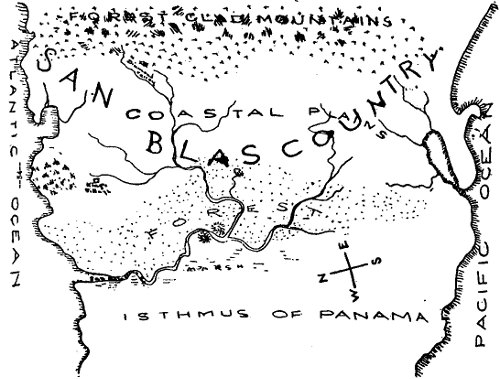
excited, and this might have continued indefinitely
had not Ned become impatient and yelled
a warning that he was about to tack. At this
Uncle Naboth thrust some money in the hand of
the skipper and leisurely ascended the ladder
while a chorus of curses and threats fell upon
his unheeding ears.
“Nearly missed you, Sam, didn’t I?” he said,
nodding cheerfully as the sails filled and we
headed into the breeze again. “Close shave, but
no alum or bay-rum.”
“What made you late, Uncle?”
“Had to do a lot to git my outfit ready,” he
said, puffing his cigar, smoothing out his gloves
and at the same time casting a critical eye over
the deck. “First time in my life, nevvy, that I’ve
went to sea on a pleasure-trip. No business to
look after, no worry, no figgerin’. Jest sailin’
away o’er the deep blue sea with a jolly crew is
the life for me. Eh, Sam?”
38
“Right you are, Uncle. You’re just a passenger,
and a mighty welcome one. I’m glad you
caught us.”
“Stern chase, but not a long one. What do
you s’pose, Sam? I had to pay them pirates in
that half-grown steamboat thirty dollars to get
me aboard.”
“Thirty dollars!”
“Dreadful, wasn’t it? And then they wanted
sixty. Took me for a tourist gent ’cause I looked
the part. But I was bound to come, an’ they was
onto my anxiousness, so it might be expected as
they’d soak me good an’ plenty. Where’d you
say you was bound for, Sam?”
“Down the coast, around the Horn, and up
the Pacific to San Pedro.”
“Sounds interestin’.”
His bright little eye had been observant.
“What’s aboard, my lad?”
“Steel beams for some new buildings in Los
Angeles.”
“Loaded rather heavy, ain’t she?”
“Too heavy, Uncle.”
39
“H-m-m. Not any too tight, either, I take
it. Hull old an’ rotten; plenty o’ paint to cover
up the worm-holes.”
“Exactly, sir.”
“Will you make it, Sam?”
“Can’t say, Uncle Naboth. But I’ll try.”
“Cargo insured?”
“No; that’s the worst of it. The owners insure
themselves, because the tub won’t pass at
Lloyd’s. If we sink it’s a big loss. So we
mustn’t sink.”
“Iron won’t float, nevvy.”
“I’m going to hug the coast, mostly. If trouble
comes I’ll beach her. You may be in for a
long cruise, Uncle.”
He nodded quite pleasantly.
“That’s all right. I take it we’ll manage to
get home by Spring, an’ that’s time enough fer
us both. But I can see she ain’t a race-hoss, Sam,
my boy.”
Indeed, the ship was not behaving at all to suit
me. With a favorable breeze and an easy sea
the miserable old hulk was sailing more like a
water-logged raft than a modern merchantman.
40
Her sails and cordage were new and beautiful,
and her paint spick and span; but I noticed
my sailors wagging their heads with disappointment
as the Gladys H. labored through the water.
Uncle Naboth chuckled to himself and glanced
at me as if he thought it all a good joke, and I
the only victim. But I pretended to pay no attention
to him. Being, as he expressed it, a “loafin’
land-lubber,” I installed him in the last of the
roomy cabins aft, all of which opened into the
officers’ mess-room. Ned Britton had the cabin
opposite mine, and Mr. Perkins the one opposite
to that occupied by Duncan Moit. For my part,
I was pleased enough to have such good company
on a voyage that promised to be unusually
tedious.
Moit had kept well out of our way until everything
was snug and ship-shape, and then he came
on deck and stood where he could keep a tender
eye on his precious machine. I introduced him
to Uncle Naboth and the two “passengers” shook
hands cordially and were soon conversing together
in a friendly manner.
41
I had decided to take my sailors into my confidence
in the very beginning, so I called all hands
together and made them a brief speech.
“My lads,” said I, “we need not look forward
to a very good voyage, for you have doubtless
discovered already that the Gladys H. is not a
greyhound. To be honest with you, she’s old
and leaky, and none too safe. But she’s got a
valuable cargo aboard, that must be safe delivered
if we can manage it, and we are all of us
well paid to do our duty by the owners. My instructions
are to hug the land and make a harbor
if bad weather comes. At the worst we can run
the ship on the shingle and save the cargo in that
way—for the cargo is worth a dozen such tubs.
It’s a somewhat risky undertaking, I know, and if
any of you don’t like your berths I’ll put you
ashore at the first likely place and you can go
home again. But if you are willing to stick to
me, I’ll take as good care of you as I can, and
your money is sure because the Interocean Forwarding
Company is back of us and good for
every penny. What do you say, my lads?”
42
They were a good-natured lot, and appreciated
my frankness. After a little conference together
the boatswain declared they were all content
to see the venture to the end and do the best
they could under the circumstances. So a mutual
understanding was established from the beginning,
and before the end came I had cause to
be proud of every man aboard.
The weather was warm and pleasant, and as
I sat with our passengers and Ned on the deck
in the afternoon Uncle Naboth got his eye on
the overgrown grocery package and said to Moit:
“What sort of an automobile have you got?”
The man had been dreaming, but he gave a
start and his eyes lighted with sudden interest.
The abstracted mood disappeared.
“It is one of my own invention, sir,” he replied.
“What do you call it?”
“The Moit Convertible Automobile.”
“Heh? Convertible?”
“Yes, sir.”
“I guess,” said Uncle Naboth, “I’m up agin
it. ‘Convertible’ is a word I don’t jest catch the
meaning of. Latin’s a little rusty, you know;
so long since I went to school.”
43
“It means,” said Moit, seriously, “that the
machine is equally adapted to land and water.”
My uncle stared a little, then looked away and
began to whistle softly. Ned Britton sighed and
walked to the rail as if to observe our motion.
For my part, I had before entertained a suspicion
that the poor fellow was not quite right in his
mind, so I was not surprised. But he appeared
gentlemanly enough, and was quite in earnest;
so, fearing he might notice the rather pointed
conduct of my uncle and Ned, I made haste to
remark with fitting gravity:
“That is a very desirable combination, Mr.
Moit, and a great improvement on the ordinary
auto.”
“Oh, there is nothing ordinary about the machine,
in any way,” he responded, quickly. “Indeed,
it is so different from all the other motor
vehicles in use that it cannot properly be
termed an automobile. Some time I intend to
provide an appropriate name for my invention,
but until now the machine itself has occupied my
every thought.”
“To be sure,” I said, rather vaguely.
44
“Most automobiles,” began my uncle, lying
back in his chair and giving me a preliminary
wink, “is only built to go on land, an’ balks
whenever they gets near a repair shop. I was
tellin’ a feller the other day in New York, who
was becalmed in the middle of the street, that if
he’d only put a sail on his wagon and wait for a
stiff breeze, he could tell all the repair men to go
to thunder!”
“But this has nothing to do with Mr. Moit’s
invention,” I said, trying not to smile. “Mr.
Moit’s automobile is different.”
“As how?” asked my uncle.
Mr. Moit himself undertook to reply.
“In the first place,” said he, his big eyes looking
straight through me with an absorbed expression,
as if I were invisible, “I do not use the
ordinary fuel for locomotion. Gasoline is expensive
and dangerous, and needs constant replenishing.
Electricity is unreliable, and its storage
very bulky. Both these forces are crude and unsatisfactory.
My first thought was to obtain a
motive power that could be relied upon at all
times, that was inexpensive and always available.
I found it in compressed air.”
45
“Oh!” ejaculated Uncle Naboth.
I am sure he knew less about automobiles
than I did, for I owned a small machine at home
and had driven it some while on shore. But Mr.
Perkins prided himself on being familiar with all
modern inventions, and what he did not know
from personal experience he was apt to imagine
he knew.
“Compressed air,” he observed, oracularly,
“is what blows the sails of a ship.”
The inventor turned on him a look of wonder.
“This seems to me like a clever idea,” I
hastened to say. “But I can’t see exactly, sir,
how you manage to use compressed air for such
a purpose.”
“I have a storage tank,” Moit answered,
“which is constantly replenished by the pumps
as fast as the air is exhausted, which of course
only occurs while the machine is in action.”
“But you need something to start the engines,”
I suggested. “Do you use gasoline for
that purpose?”
46
“No, sir. I have a glycerine explosive which
is so condensed that an atom is all that is required
to prime the engines. In a little chamber
that contains about a pint I can carry enough
explosive to last me for a year. And wherever
there is air I have power that is perpetual.”
“That’s great!” cried Uncle Naboth, with an
enthusiasm so plainly assumed that Ned and I
had much ado to keep from laughing outright.
“In other ways,” continued Duncan Moit, “I
have made marked improvements upon the ordinary
motor car. Will you allow me, gentlemen,
to show you my machine, and to explain it
to you?”
We were glad enough of this diversion, even
Ned Britton, who could not have run a sewing-machine,
being curious to examine our crazy passenger’s
invention.
Moit at once began to untie the cords and remove
the soiled canvas, which consisted of parts
of worn-out sails stitched clumsily together. But
when this uninviting cover was withdrawn we
saw with astonishment a machine of such beauty,
completeness and exquisite workmanship that our
exclamations of delight were alike spontaneous
and genuine.
47
Moit might be mad, but as a mechanic he was
superb, if this was indeed a creation of his own
hands.
An automobile? Well, it had four massive
wheels with broad rubber tires, a steering gear
(of which only the wheel was visible) and a body
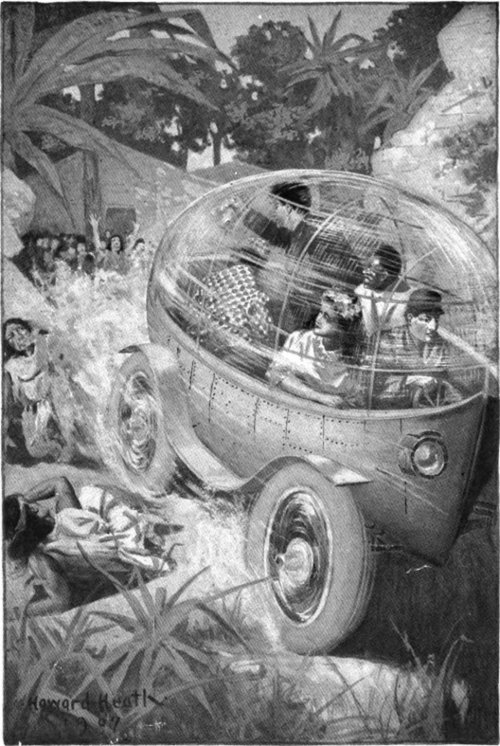
for the passengers to ride in; but otherwise the
world-pervading auto-fiend would not have recognized
the thing.
It seemed to be all of metal—a curious metal
of a dull silver hue—not painted or polished in
any place, but so finely constructed that every
joint and fitting appeared perfect. It was graceful
of design, too, although the body was shaped
like the hull of a boat, with the wheels so placed
that the structure was somewhat more elevated
from the ground than ordinarily. This body was
about a foot in thickness, having an inner and
outer surface composed of beautifully rivetted
plates of the strange metal.
48
Moit explained that part of this space was
used for vacuum chambers, which were kept exhausted
by the pumps when required and made
the machine wonderfully light. Also, within
what corresponded with the gunwale of a boat,
were concealed the parts of the adjustable top,
which, when raised into position and hooked together,
formed a dome-shaped cover for the entire
body. These parts were almost entirely of
glass, in which a fine wire netting had been imbedded,
so that while the riders could see clearly
on all sides, any breakage of the glass was unlikely
to occur. In any event it could only crack,
as the netting would still hold the broken pieces
in place.
The engines were in a front chamber of the
body. There were four of them, each no bigger
than a gallon jug; but Moit assured us they were
capable of developing twenty-five horse-power
each, or a total of one hundred horse-power,
owing to the wonderful efficiency of the compressed
air. All the other machinery was similarly
condensed in size and so placed that the
operator could reach instantly any part of it.
49
The entrance was at either side or at the back,
as one preferred, but the seats were arranged in
a circle around the body, with the exception of
the driver’s chair. So roomy was the car that
from six to eight passengers could be carried with
comfort, or even more in case of emergency.
All of these things were more easily understood
by observation than I can hope to explain
them with the pen. Perhaps I have omitted to
describe them to you as clearly as I should; but
I must plead in extenuation a lack of mechanical
knowledge. That you will all ride in similar cars
some day I have no doubt, and then you will understand
all the details that I, a plain sailor, have
been forced to ignore because of my ignorance
of mechanics.
“But,” said Uncle Naboth, whose eyes were
fairly bulging with amazement, “I don’t yet see
what drives the blamed thing through water.”
Moit smiled for almost the first time since I
had known him, and the smile was one of triumphant
pride.
50
He entered the automobile, touched some buttons,
and with a whirring sound a dozen little
scoop-shaped flanges sprang from the rim of each
wheel. There was no need for farther explanation.
We could see at once that in water the
four wheels now became paddle-wheels, and their
rapid revolution would no doubt drive the machine
at a swift pace.
The paddles were cleverly shaped, being made
of the same metal employed everywhere in the
construction of this astonishing invention, and
they stood at just the right angle to obtain the utmost
power of propulsion.
“Aluminum?” questioned Mr. Perkins, pointing
to the metal.
“No, sir. This is perhaps my most wonderful
discovery, and you will pardon me if I say it
is a secret which I am unwilling at this time to
divulge. But I may tell you that I have found
an alloy that is unequalled in the known world
for strength, durability and lightness. It weighs
a little more than pure aluminum, but has a thousand
times its tensile strength. You may test
one of these blades, which seem to the eye to be
quite delicate and fragile.”
51
Uncle Naboth leaned over and gingerly tested
one of the wheel blades with his thumb and finger.
Then he exerted more strength. Finally
he put his heel upon it and tried to bend it with
the weight of his body. It resisted all efforts
with amazing success.
And now the inventor pushed some other buttons,
or keys, and the metal blades all receded
and became once more a part of the rims of the
wheels.
“When we get to San Pedro, gentlemen,”
said he, “it will give me pleasure to take you for
a ride in my machine, both on land and water.
Then you will be sure to appreciate its perfection
more fully.”
He began to replace the canvas cover, apologizing
as much to his beloved machine as to us
for its shabbiness.
“All of my money was consumed by the machine
itself,” he explained, “and I was forced to
use this cloth to make a cover, which is needed
only to protect my invention from prying eyes.
The metal will never rust nor corrode.”
“Is this material, this alloy, easy to work?” I
asked.
He shook his head.
52
“It is very difficult,” he returned. “Steel
crumbles against it with discouraging readiness,
so that my tools were all of the same metal, annealed
and hardened. Even these had to be constantly
replaced. You must not imagine, sir,
that I obtained all of this perfection at the first
trial. I have been years experimenting.”
“So I imagine, Mr. Moit.”
“By a fortunate coincidence,” he went on,
dreamily, “my money, which I had inherited from
my father, lasted me until all the work was complete.
I had thought of nothing but my machine,
and having at last finished it and made
thorough tests to assure myself that it was as
nearly perfect as human skill can make it, I
awoke to find myself bankrupt and in debt. By
selling my tools, my workshop, and everything
else I possessed except the machine itself, I managed
to pay my indebtedness and have two hundred
dollars left. This was not enough to get
myself and my car shipped to California by rail;
so I was at my wits’ end until you, sir,” turning
to me, “kindly came to my rescue.”
53
During the pause that followed he finished
covering up his machine, and then Uncle Naboth
asked, bluntly:
“If you are sure the blamed thing will work,
why didn’t you run it overland to California?
That has been done more’n once, I’m told, and
as you use compressed air the expense wouldn’t
be a circumstance.”
That had occurred to me too, and I awaited
the man’s reply with much curiosity.
“Sir,” he answered, “you must not forget that
I have devoted years to this work—years of secret
and constant toil—and that my whole heart
is involved in the success of my perfected machine.
But you can readily understand that I
have not dared to patent it, or any of its parts,
until all was complete; for an imperfect patent
not only fails to protect one, but in this case it
would give other designers of automobiles the
ideas I had originated. A patent is never a safeguard
if it can be improved or stolen. As I have
said, when at last my work was finished I had no
money with which to obtain patents, of which no
less than nineteen are required to protect me.”
54
“And have you, at this time, no patents at
all?” I asked, surprised at such neglect.
He shook his head.
“Not one. There, gentlemen, stands one of
the most important mechanical inventions the
world has ever known, and its inventor has no
protection whatever—as yet. If I attempted to
run the machine overland to the Pacific coast,
a dozen automobile experts would see it and
promptly steal my ideas. Such a risk was too
great to run. I must manage to reach my rich
and selfish uncle, prove to him how wonderful
my invention is, offer him a half interest in it, and
so procure the money to protect it and to establish
a manufactory. Do you understand now why
I have acted in so puzzling a way—puzzling, at
least, to one not aware of my dilemma?”
“It is quite clear to me,” I replied, beginning
to think my passenger was not mad, after all.
“But have you not been foolish to confide all
this to us?”
He smiled pleasantly, and the smile made his
face really attractive.
55
“I am not especially stupid, believe me,” said
he, “and I am a fair judge of human nature.
You will pardon me if I say that not a man on
this ship is at all dangerous to me.”
“How is that?” I asked, slightly discomfitted.
“No man among you is competent to steal my
invention,” he asserted, coolly, “even if you were
disposed to do so, which I doubt. It would require
a dishonest person who is a mechanical expert,
and while there are many such between
Chelsea and California, I am sure there is none
on this ship who would wrong me, even if he
possessed the power. I feel entirely secure, gentlemen,
in your company.”
This was diplomatic, at least, for we were
naturally pleased at the tribute to our good faith,
even if inclined to resent the disparagement of
our mechanical genius. However, we regarded
Duncan Moit in a more friendly light and with
vastly increased respect from that time forth.
It was growing dark by this time, and presently
Nux announced that dinner was served.
So we repaired to the mess cabin, and while testing
Bryonia’s superb talents as a cook beguiled
the hour by canvassing the future possibilities of
the Moit Convertible Automobile.
56
CHAPTER IV WE COME TO GRIEF
Fortune seemed to favor the voyage of the
Gladys H. All the way to Hatteras the weather
was delightful and the breeze fresh and constant.
There was not a moment when the sails were not
bulging to some extent and in spite of the old
ship’s labored motion we made excellent time.
However, I followed my instructions, keeping
well in toward the coast, and so crept steadily
down to Key West.
Here an important proposition confronted us:
whether to enter the Gulf of Mexico and follow
its great circle near to the shore—a method that
would require weeks—or run across to Cuba
and then attempt the passage of the Caribbean by
the short cut to Colon or Porto Bella. We had
canvassed this alternative before I left harbor;
but Mr. Harlan had maintained that I must decide
the question for myself, being guided by the
actions of the bark and the condition of the
weather.
57
Both these requirements seemed favorable for
the short cut. The ship had behaved so far much
better than I had expected, and the good weather
seemed likely to hold for some time longer.
So after a conference with Ned Britton—for
Uncle Naboth refused to “mix up in the business”
or even to offer an opinion—I decided to
take the chances and follow the shortest route.
After reaching Colon I would keep close to land
way down to the Horn.
So we stood out to sea, made Cuba easily,
and skirted its western point to the Isles de Pinos.
Still the skies were clear and the breeze favorable,
and with good courage we headed south in
a bee-line for Colon.
58
And now we were in the Caribbean, that famous
sea whose very name breathes romance.
It recalls to us the earliest explorers, the gold
seekers and buccaneers, the fact that scarce an
inch of its rippling surface is unable to boast some
tragedy or adventure in the days of the Spanish
Main, when ships of all nations thronged the
waters of the West Indies.
For three whole days luck was our bedfellow;
then, as Uncle Naboth drily remarked, it “went a
fishin’” and left us to take care of ourselves.
With gentle sighs our hitherto faithful breeze
deserted us and our sails flapped idly for a time
and then lay still, while the ship floated upon a
sheet of brilliant blue glass, the tropic sun beat
fiercely down upon us, and all signs of life and
animation came to an end.
No sailor is partial to calms. A gale he
fights with a sense of elation and a resolve to
conquer; a favoring breeze he considers his right;
but a glassy sea and listless, drooping sails are
his especial horror. Nevertheless, he is accustomed
to endure this tedium and has learned by
long experience how best to enliven such depressing
periods.
Our men found they possessed a violinist—not
an unskilled fiddler by any means—and to
his accompanying strains they sang and danced
like so many happy children.
59
Uncle Naboth and Ned Britton played endless
games of penocle under the deck awning and I
brought out my favorite books and stretched myself
in a reclining chair to enjoy them.
Duncan Moit paced deliberately up and down
for the first two days, engrossed in his own musings;
then he decided to go over his machine and
give it a careful examination. He removed the
cover, started his engines, and let them perform
for the amusement of the amazed sailors, who
formed a curious but respectful group around
him.
Finally they cleared a space on the deck and
Moit removed the guy-ropes that anchored his
invention and ran his auto slowly up and down,
to the undisguised delight of the men. He
would allow six or eight to enter the car and ride—sixteen
feet forward, around the mainmast,
and sixteen feet back again—and it was laughable
to watch the gravity of their faces as they held
fast to the edge, bravely resolving to endure the
dangers of this wonderful mode of locomotion.
Not one had ever ridden in an automobile before,
and although Moit merely allowed it to crawl
over its confined course, the ride was a strange
and fascinating experience to them.
60
I must allow that the performances of this
clever machine astonished me. The inventor was
able to start it from his seat, by means of a
simple lever, and it was always under perfect control.
The engines worked so noiselessly that you
had to put your ear close in order to hear them at
all, and the perfection of the workmanship could
not fail to arouse my intense admiration.
“If this new metal is so durable as you claim,”
I said to Moit, “the machine ought to last for
many years.”
“My claim is that it is practically indestructible,”
he answered, in a tone of conviction.
“But you have still the tire problem,” I remarked.
“A puncture will put you out of business
as quickly as it would any other machine.”
“A puncture!” he exclaimed. “Why, these
tires cannot puncture, sir.”
“Why not?”
“They are not inflated.”
“What then?”
61
“It is another of my inventions, Mr. Steele.
Inside each casing is a mass of sponge-rubber, of
a peculiarly resilient and vigorous character. And
within the casing itself is embedded a net of steel
wire, which will not allow the vulcanized rubber
to be cut to any depth. The result is an excellent
tire that cannot be punctured and has great
permanency.”
“You do not seem to have overlooked any important
point,” I observed, admiringly.
“Ah, that is the one thing that now occupies
my mind,” he responded, quickly. “That is why
I have been testing the machine today, even in
the limited way that is alone possible. I am
haunted by the constant fear that I have over-looked
some important point, which another
might discover.”
“And have you found such a thing?”
“No; to all appearances the device is perfect.
But who can tell what may yet develop?”
“Not I,” with a smile; “you have discounted
my mechanical skill already. To my mind the
invention seems in every way admirable, Mr.
Moit.”
62
For nine days we lay becalmed, with cloudless
skies above and a tranquil sea around us.
During the day we rested drowsily in the oppressive
heat, but the nights were always cooler
and myriads of brilliant stars made it nearly as
light as day. Ned had taken in every yard of
canvas except a square sail which he rigged forward,
and he took the added precaution to lash
every movable thing firmly to its place.
“After this, we’ve got to expect ugly
weather,” he announced; and as he knew the
Caribbean well this preparation somewhat dismayed
me. I began to wish we had entered the
Gulf of Mexico and made the roundabout trip;
but it was too late for regrets now, and we must
make the best of our present outlook.
Personally I descended into the hold and examined
with care the seams, finding that the
calking had held securely so far and that we were
as right and tight as when we had first sailed.
But even this assurance was not especially encouraging,
for we had met with no weather that
a canoe might not have lived through without
shipping more than a few drops of sea.
63
The ninth day was insufferably hot, and the
evening brought no relief. Ned Britton’s face
looked grave and worried, and I overheard him
advising Duncan Moit to add several more anchor
ropes to those that secured his machine.
We awaited the change in the weather anxiously
enough, and toward midnight the stars
began to be blotted out until shortly a black pall
overhung the ship. The air seemed vibrant and
full of an electric feel that drew heavily upon
one’s nerves; but so far there had been no breath
of wind.
At last, when it seemed we could wait no
longer, a distant murmur was heard, drawing
ever nearer and louder until its roar smote our
ears like a discharge of artillery. The ship began
to roll restlessly, and then the gale and the
waves broke upon us at the same instant and with
full force.
64
Heavily weighted and lazy as the bark was,
she failed to rise to the first big wave, which
washed over her with such resistless power that
it would have swept every living soul away had
we not clung desperately to the rigging. It
seemed to me that I was immersed in a wild,
seething flood for several minutes; but they must
have been seconds, instead, for presently the
water was gone and the wind endeavoring to tear
me from my hold.
The square sail held, by good luck, and the
ship began to stagger onward, bowing her head
deep and submitting to constant floods that
washed her from end to end. There was not
much that could be done to ease her, and the
fervid excitement of those first hours kept us all
looking after our personal safety. Along we
went, scudding before the gale, which maintained
its intensity unabated and fortunately drove us
along the very course we had mapped out.
The morning relieved the gloom, but did not
lessen the force of the storm. The waves were
rolling pretty high, and all faces were serious or
fearful, according to the disposition of their owners.
In our old Saracen, or even the Flipper, I
would not have minded the blow or the sea, but
here was a craft of a different sort, and I did not
know how she might stand such dreadful
weather.
65
I got Ned into the cabin, where we stood like
a couple of drenched rats and discussed the situation.
On deck our voices could not be heard.
“Are the small boats ready to launch?” I
asked.
“All ready, sir; but I doubt if they’d live
long,” he replied. “However, this ’ere old hulk
seems to be doin’ pretty decent. She lies low,
bein’ so heavy loaded, an’ lets the waves break
over her. That saves her a good deal of strain,
Sam. If she don’t spring a-leak an’ the cargo
holds steady, we’ll get through all right.”
“Tried the pumps?”
“Yes; only bilge, so far.”
“Very good. How long will the gale last?”
“Days, perhaps, in these waters. There’s
no rule to go by, as I knows of. It’ll just blow
till it blows itself out.”
He went on deck again, keeping an eye always
on the ship and trying to carry just enough canvas
to hold her steady.
66
Duncan Moit and Uncle Naboth kept to the
cabin and were equally unconcerned. The latter
was an old voyager and realized that it was best
to be philosophical; the former had never been at
sea before and had no idea of our danger.
On the third morning of this wild and persistent
tempest the boatswain came to where Ned
and I clung to the rigging and said:
“She’s leaking, sir.”
“Badly?”
“Pretty bad, sir.”
“Get the pumps manned, Ned,” said I; “I’ll
go below and investigate.”
I crawled into the hold through the forecastle
cubby, as we dared not remove the hatches. I
took along a sailor to carry the lantern, and we
were not long in making the discovery that the
Gladys H. was leaking like a sieve. Several of
the seams that Mr. Harlan had caused to be
calked so carefully had reopened and the water
was spurting through in a dozen streams.
67
I got back to my cabin and made a careful
examination of the chart. According to my
calculations we could not be far from the coast
of Panama. If I was right, another six hours
would bring us to the shore; but I was not sure
of my reckoning since that fearful gale had struck
us. So the question whether or no the ship could
live six hours longer worried me considerably, for
the pumps were of limited capacity and the water
was gaining on us every minute.
I told Uncle Naboth our difficulty, and Duncan
Moit, who stood by, listened to my story with
lively interest.
“Will you try to beach her, Sam?” enquired
my uncle, with his usual calmness.
“Of course, sir, if we manage to float long
enough to reach the land. That is the best I can
hope for now. By good luck the coast of Panama
is low and marshy, and if we can drive the tub
aground there the cargo may be saved to the owners.”
“Ain’t much of a country to land in, Sam;
is it?”
“Not a very lovely place, Uncle, I’m told.”
“It’s where they’re diggin’ the canal, ain’t
it?”
“I believe so.”
68
“Well, we may get a chance to see the ditch.
This ’ere travellin’ is full of surprises, Mr. Moit.
I never thought to ’a’ brung a guide book o’
Panama, or we could tell exactly where they
make the hats.”
The inventor appeared ill at ease. I could
understand the man’s disappointment and anxiety
well enough. To beach his beloved machine
on a semi-barbarous, tropical shore was
not what he had anticipated, and I had time to
feel sorry for him while thinking upon my own
troubles.
He followed me on deck, presently, and I saw
him take a good look at the sea and shake his
head despondently. The Convertible Automobile
might work in ordinary water, but it was not intended
for such mammoth waves as these.
Then he watched the men at the pumps. They
worked with a will, but in that cheerless way
peculiar to sailors when they are forced to undertake
this desperate duty. The ocean was pushing
in and they were trying to keep it out; and
such a pitiful struggle usually results in favor of
the ocean.
69
Suddenly Moit conceived a brilliant idea. He
asked for a length of hose, and when it was
brought he threw off the covering of his machine
and succeeded in attaching the hose to his engines.
The other end we dropped into the hold, and
presently, despite the lurching and plunging of
the ship, the engines started and a stream the full
size of the hose was sucked up and sent flowing
into the scruppers. It really did better work than
the ship’s pumps, and I am now positive that this
clever arrangement was all that enabled us to
float until we made the coast.
In the afternoon, while the gale seemed to redouble
its force, we sighted land—low, murky
and uninteresting, but nevertheless land—and
made directly for it.
Darkness came upon us swiftly, but we held
our course, still pumping for dear life and awaiting
with tense nerves the moment of impact.
What this shore, of which we had caught a
glimpse, might be like I did not know, more than
that it was reported low and sandy at the ocean’s
edge and marshy in the interior. There were a
few rocky islands at the south of the isthmus,
and there might be rocks or breakers at any
point, for all we knew. If the ship struck one
of these we were surely doomed.
70
On and on we flew, with blackness all round
us, until on a sudden the bow raised and our
speed slackened so abruptly that we were all
thrown prostrate upon the deck. The mainmast
snapped and fell with a deafening crash, and
slowly the ship rolled to starboard until the deck
stood at a sharp angle, and trembled a few brief
moments, and then lay still.
The voyage of the Gladys H. was at an end.
71
CHAPTER V MAKING THE BEST OF IT
“Are you there, Sam?”
“Yes, Ned.”
“Safe and sound?”
“I think so.”
Overhead the wind still whistled, but more
moderately; around me I could hear the men
stirring, with an occasional groan. We had
come from the tempest-tossed seas into a place of
comparative quiet, which just now was darker
than the pocket of Erebus.
I found the after cabin and slid down the
steps, which inclined sidewise. Inside, however,
the hanging lamps had withstood the shock and
still cast a dim light over the room. I found
Uncle Naboth reclining upon a bench with his
feet braced against the table, while he puffed away
complacently at one of his enormous cigars.
72
“Stopped at a way station, Sam?” he enquired.
“So it appears, Uncle.”
“Any damage?”
“Can’t tell, yet. Were you hurt?”
He exhibited a great lump on his forehead,
but smiled sweetly.
“You should ’a’ seen me dive under the table,
Sam. It were a reg’lar circus, with me the chief
acrobat. Where are we?”
“I’m going to find out.”
I unhooked both the lanterns and started up
the companion-way with them. Rather than remain
in the dark Uncle brought himself and his
cigar after me.
I gave Ned one of the lights and we began to
look about us. Duncan Moit lay unconscious beside
his machine, the engines of which were still
running smoothly. I threw back the lever and
stopped them, and then a couple of seamen carried
the inventor into the cabin. Black Nux had
lighted another lantern, and with my uncle’s assistance
undertook to do what he could to restore
the injured man.
73
Ned and I slid aft and found the stern still
washed by a succession of waves that dashed over
it. Walking the deck was difficult because the
ship listed from stem to stern and from port to
starboard. Her bow was high and dry on a
sand-bar—or such I imagined it to be—but it was
only after I had swung a lantern up a halyard
of the foremast, so that its dim rays would illumine
the largest possible area, that I discovered
we had plunged straight into a deep inlet
of the coast. On one side of us appeared to
be a rank growth of tangled shrubs or underbrush;
on the other was the outline of a forest.
Ahead was clear water, but its shallow depth had
prevented our proceeding farther inland.
Either the gale had lessened perceptibly or we
did not feel it so keenly in our sheltered position.
An examination of the men showed that one of
them had broken an arm and several others were
badly bruised; but there were no serious casualties.
74
The ship was now without any motion whatever,
being fast on the bottom of the inlet. The
breakers that curled over the stern did her no
damage, and these seemed to be gradually lessening
in force.
Ned sent his tired men to their bunks and
with the assistance of Bryonia, who was almost as
skillful in surgery as in cooking, prepared to set
the broken arm and attend to those who were the
most bruised.
I went to the cabin again, and found that
Uncle Naboth and Nux had been successful in restoring
Duncan Moit, who was sitting up and
looking around him with a dazed expression. I
saw he was not much hurt, the fall having merely
stunned him for the time being.
“The machine—the machine!” he was muttering,
anxiously.
“It’s all right, sir,” I assured him. “I shut
down the engines, and she seems to have weathered
the shock in good shape.”
He seemed relieved by this report, and passed
his hand across his brow as if to clear his brain.
“Where are we?” was his next query.
75
“No one knows, sir. But we are landed high
and dry, and I’m almost sure it is some part of
the coast of Panama. To-morrow morning we
can determine our location more accurately. But
now, Mr. Moit, I recommend that you tumble into
your bunk and get all the rest you can before daybreak.”
The strain of the last few days had been severe
upon all of us, and now that the demand for work
or vigilance was removed we found that our
strength had been overtaxed. I left Ned to set
a watch, and sought my own bed, on which I
stretched myself to fall asleep in half a minute.
“Wake up, Mars’ Sam,” said Nux, shaking
me. “Breakfas’ ready, seh.”
I rubbed my eyes and sat up. The sun was
streaming through the cabin window, which was
on the port side. Around me was a peculiar
silence which contrasted strongly with the turmoil
that had so long buffeted my ears. The
gale had passed on and left us to count the
mischief it had caused.
“What time is it, Nux?”
“Eight o’clock, Mars’ Sam.”
76
I sprang up, now fully conscious of the night’s
tragedy, which sleep had for a time driven from
my mind. Nux stood with my basin and towel
and his calmness encouraged me to bathe before
I went on deck.
In the mess-cabin I found that the table legs
had been propped up with boxes to hold it level,
and that a hot breakfast had been prepared and
was now steaming on the table. Around the
board were gathered Ned Britton, Uncle Naboth
and Duncan Moit, all busily engaged in eating.
They greeted me cheerfully and bade me sit down
and join them.
“How is everything, Ned?” I enquired, anxiously.
“Bad as can be, an’ right as a trivet, Sam,”
he replied. “The Gladys H.’ll never float again.
Her bottom’s all smashed in, an’ she’s fast in
the mud till she goes to pieces an’ makes kindlin’-wood
for the Injuns.”
“Then the cargo is safe, for the present?”
77
“To be sure. It can’t get lost, ’cause it’s a
chunk o’ steel, and the ship’s planks’ll hold it in
place for a long time. It’ll get good and soaked,
but I’ve noticed it’s all painted to keep it from
rustin’. This ain’t San Pedro, whatever else it
is, and the voyage has miscarried a bit; but them
beams is a good deal better off here than at the
bottom o’ the sea, so I take it we’ve done the best
we could by the owners.”
I sat down and took the coffee Nux poured
for me.
“How about the crew?” I asked. “Are the
men all right?”
“No body hurt but Dick Lombard, and his
arm’ll mend nicely.”
“Have you any idea where we are, Ned?”
“Stuck in a river, somewhere. Wild country
all around us, but I guess we can find a way out.
Lots o’ provisions and a good climate. We may
say as we’re in luck, Sam.”
I shook my head dismally. It did not appear
to me that luck had especially favored us. To
be sure, we might have gone to the bottom of the
Caribbean in the gale; but it struck me we had
landed the cargo in an awkward place for the
owners as well as for ourselves. Mr. Harlan
would have done better had he not taken the long
chance of our making the voyage to San Pedro
successfully.
78
“Well, I cannot see that we have failed in our
duty, in any way,” I remarked, as cheerfully as I
could, “so we may as well make the best of it.”
“This bein’ a tourist, an’ travellin’ fer pleasure,”
said Uncle Naboth, “is more fun than a
kickin’ mule. Sam’s got to worry, ’cause he’s
paid fer it; but we passengers can look on an’
enjoy ourselves. Eh, Mr. Moit?”
“It is a serious situation for me,” replied the
inventor. “Think of it, gentlemen! The most
wonderful piece of mechanism the world has yet
known is stranded in a wilderness, far from
civilization.”
“That is your own fault,” remarked Ned,
bluntly.
“Not that, sir; it is fate.”
“The machine is all right,” said I. “You
will have no trouble to save it.”
79
“As for that, I must, of course, make the best
of the adverse circumstances that have overtaken
me,” he replied, with more composure than I had
expected. “It is not my nature to be easily discouraged,
else I could never have accomplished
what I have in the perfection of any inventions.
My greatest regret, at this moment, is that the
world will be deprived, for a longer period than
I had intended, of the benefits of my Convertible
Automobile.”
“Having never known its excellent qualities,
sir, the world can wait,” asserted Uncle Naboth,
philosophically. I have noticed one can be quite
philosophical over another’s difficulties.
Having hurried through my breakfast, which
our faithful Bryonia had prepared most excellently
in spite of the fact that his galley was at
an angle of nearly forty-five degrees, I went on
deck to obtain for the first time a clear view of
our surroundings.
The tide had changed and the wind fallen.
We lay in the center of a placid river—high and
dry, as Ned had said—with the current gently
rippling against our bow. Not more than ten
yards to the right was a low, marshy bank
covered with scrub underbrush of a tropical character.
On our left, however, and some fifty
yards distant, lay a well defined bank marking the
edge of the stately forest which I had observed
the night before. The woodland gradually
sloped upward from the river, and above it, far
to the south, a formidable range of mountains
was visible.
80
Between us and this left bank the water
seemed a fair depth, but it was quite shallow on
our right. It seemed wonderful that any gale
could have sent so big a ship so far up the river;
but I remembered that the billows had followed
us in, and doubtless their power alone had urged
us forward.
Here we were, anyway, and here the Gladys
H. must remain until demolished by time, tide or
human endeavor.
For the rest, the air was warm and pleasant,
with a blue sky overhead. Aside from the loss
that would follow the salvage of the valuable
cargo we had good reason to thank Providence
for our fortunate escape from death.
I felt that I had done as much to promote the
interests of the owners as any man could do; but
the conditions had been adverse, and the responsibility
was now theirs, and not mine.
81
The gravest part of the situation, so far as I
was personally concerned, was to get my men into
some civilized port where they could find an opportunity
to get home again. Also I must notify
Mr. Harlan, by cable, and that as soon as possible,
of the location and condition of his cargo. The
loss of the ship I knew would matter little to him,
as he had asserted this several times.
And now to solve the problem of our location.
I had reason to believe that we had not varied to
any great extent from the course my chart had
indicated. Somewhere, either up or down the
coast, was Colon, the Atlantic terminal of the
Panama canal, and to reach that place ought not
to be especially difficult, because our small boats
were in fairly good condition.
The river made a bend just ahead of us, and
my first thought was to get out a boat and explore
the stream for a way. We might find some village,
I imagined, or at least some evidence of
human habitation.
So I ordered the gig lowered and took with
me four men, besides Duncan Moit, who wanted
to go along and begged the privilege. The current
was languid and easy to breast, so we made
excellent progress.
82
Bend after bend we made, for the stream was
as crooked as a ram’s horn; but always the forest
towered on the one hand and the low, marshy
flats prevailed upon the other.
Rowing close to the shore, under the shadow
of the trees, we could hear the stealthy sound of
wild beasts in the wilderness, and once we espied
a sleek jaguar lying flat upon the bank to
drink. But no sign of man or civilization of any
sort did we encounter. Even the woodman’s axe
was nowhere in evidence.
We hugged the forest for several miles, finding
the river easily navigable for small steamers.
Then we decided to return, and followed the edge
of the opposite marsh, which was much less inviting
and less liable to be inhabited than the other
shore.
We were scarcely a mile from the ship when
Moit suddenly exclaimed:
“Isn’t that a canoe?”
“Where?” I asked.
He pointed to a small inlet, and I could see
plainly a craft that looked like an Indian dugout
lying among the reeds.
83
“Let us get it and see what it looks like,” said
I, hailing with some satisfaction this first evidence
of human handicraft.
At the word my men rowed in, and the sailor
in the bow, as he grasped the gunwale of the
canoe, uttered a startled cry.
“What is it?” I asked.
Without reply he drew the canoe alongside
our boat, and we could all see the form of a man
lying flat upon his face on the rough bottom.
84
CHAPTER VI THE DEAD MAN’S STORY
“Turn him over, Tom,” said I, softly, and
the sailor clambered into the canoe and obeyed—rather
gingerly, though, for no one likes to
touch a dead man.
The bearded face and staring eyes that confronted
us were those of one of our own race, a
white man who had been shot through the heart
with an arrow that still projected from the
wound. His clothing was threadbare and hung
almost in rags, while his feet were protected by
rude sandals of bark laced with thongs of some
vegetable fibre. He was neither a Mexican nor
a Spaniard, but I judged him a North American
of German descent, if his physiognomy could be
trusted.
85
The man had not long been dead, that was
quite evident, and the arrow that had pierced his
heart must have killed him instantly. I pulled out
the weapon and found it of skillful construction,—a
head of hammered bronze fastened to a shaft
most delicately shaped and of a wood that resembled
yew. It differed materially from any
Indian arrow I had ever before seen.
The mystery of this man’s life and death
seemed impenetrable, and I ordered the canoe attached
to our stern and towed it in our wake
down to the ship.
A sailor’s burial ground is the sea; so I decided
to sew the corpse in sacking, weight it
heavily, and sink it in the deepest water of the
river.
Before doing this one of the men searched the
pockets of the tattered clothing and drew out a
small book that looked like a diary, a pocketknife,
several bits of lead-pencil and a roll of thin
bark tied with wisps of the same material.
86
These things I took charge of, and then
watched the obsequies. These were quickly performed,
Ned reading a short prayer from his
Bible by way of ceremony while all our company
stood with bared heads. Then the men rowed
the body out to the deepest part of the river, and
as I watched them from the deck I noticed they
were thrown into a state of sudden excitement
and heard cries of anger and alarm. Lifting my
glass into position I discovered the cause of this.
The boat was surrounded by sharks, their dark
heads and white bellies alternating as they slowly
swam round and round, attracted by the scent of
prey. I yelled to the men to bring the body back,
but they were too excited to hear me and the
next instant had dumped the weighted sack overboard
and begun to row back to the wreck at
racing speed.
It was just as well, however. I am quite sure
the poor fellow reached bottom before a shark
could seize him, and once on the bottom they
would be unable to either see him or grasp him in
their jaws.
Seated on the deck with the others and shaded
from the sun by a heavy awning, I glanced at the
diary and found that the murdered man had not
made a daily record, but had written upon the
pages a sort of narrative, which seemed likely to
prove interesting. So I asked Duncan Moit to
read it aloud, which he did. I have it beside me
now, and copy the following word for word as it
was first read to us that day in the tropics with the
wilderness all around us.
87
“My name is Maurice Kleppisch,” it began,
“by profession an engineer and mining expert residing
at Denver, Colorado, at those times when
I am at home.
“Nine years ago I was sent to the Republic
of Colombia to examine a mine, and while there
I joined myself to a party that was formed to
visit the San Blas Country, at the south of
Panama, and trade with the Indians who are
the masters of a vast territory there. I am no
trader, but my object was to take advantage of
this opportunity to investigate the mining possibilities
of the wild and unknown region of San
Blas, thinking that should I fall in with traces of
gold my fortune would be made.
88
“But, when we arrived at the border, the arrogant
Indians would not allow us to enter their
country at all, commanding us, with imperious
scorn, to stand at a respectful distance and display
our wares. The traders obeyed without
demur, but I was angry and vengeful, and for
a time considered my journey a failure. The
Indians, however, exchanged their cocoanuts and
sheep-skins—with such other things as their land
produced—with great willingness and absolute
honesty and fairness, and the traders learned that
their given word was held inviolate.
“Nursing my disappointment at being excluded
from this mysterious country, I stood sullenly
watching the bartering when my attention was
aroused by an object that made my heart bound
with excitement. It was an immense rough
diamond, set in the bronze shaft of a spear borne
by Nalig-Nad, the king of the San Blas and the
most stalwart, dignified and intelligent Indian I
have ever seen.
89
“I will here explain that the strange race
known as the San Blas Indians of Southern
Panama is none other than that historic remnant
of the Aztec nation which, when Mexico was
conquered by the Spaniard, fled through morass
and mountains, across plains and rivers, until they
came to this then unknown wilderness. Here
they located and established a new nation which
they call Techla. Their territory stretches south
of the natural depression of the isthmus from
the Atlantic to the Pacific, and contains vast
stretches of forests and coastal plains, which they
have ever jealously guarded from intrusion. No
more did they build beautiful cities and golden
temples, for gold they had learned to abhor because
the lust for it had brought the white demons
upon them in Mexico. The white skinned races
were cordially detested as the destroyers of their
former nation. By them the Techlas had been
driven from the abode bequeathed them by their
ancestors.
“The creed of the new nation, therefore, contained
two prime articles of faith: Never to mine
or trade or employ gold in any form for use or
ornament; to hate and oppose every white man
that came near them.
90
“The San Blas people are not truly Indians,
as we regard the West Indian and Central American
tribes, but are well formed, intelligent and
fierce. Their skin is of copper-colored hue and
they have a characteristic dress that is peculiar to
their nation. They have an established government
centering in the king, humane and just laws
for the guidance of their tribes, and many racial
characteristics. It is said the weaker Aztecs remained
in Mexico as slaves of the Spaniards,
while the nobles and the most stalwart and
powerful individuals, realizing their inability to
oppose the usurpers but scorning to become their
vassals, fled southward in the manner I have described.
“However true this may be, I found the San
Blas—a name given them by the early Spaniards
but never acknowledged by themselves—to be
well worthy of admiration in all ways except their
persistent hatred of the whites. They gave our
party cocoanuts and cereals, tortoise-shells, skins
of wild beasts that were most skillfully dressed,
and a soft quality of lamb’s wool, in exchange for
knives, glass beads, compasses, colored crayons,
mirrors and other inexpensive trinkets.
“When I got my eye upon the king’s mammoth
diamond I was so amazed that I trembled
with eagerness. The gem must have weighed
fully five hundred carats, and being intent to obtain
it for myself I offered my silver watch, a
fountain pen, my comb and brushes and a quantity
of buttons in exchange for the diamond.
91
“My very anxiety was the cause of my undoing.
My reckless offers aroused the king’s suspicions,
and when my comrades also saw the
diamond they became as anxious as I was, and
offered so much for a bit of stone which the king
had never considered of any value, that he questioned
us closely and learned that the white men
esteem these gems even more than they do gold.
“Then the king drew himself up proudly and
spoke to his men in their own native dialect, with
which we are unfamiliar. Several of the Indians
brought to their ruler specimens of the same
stones—rough diamonds ranging from the size of
a pea upward. These they had doubtless gathered
and kept because they were pretty, but Nalig-Nad
took them all in his hand and, having pried
his own splendid stone from its setting in the
spearshaft, he advanced to the edge of the river
and cast them all into its depths.
92
“‘I have told my men,’ said he, ‘never to
gather these pebbles again; nor will we ever trade
them to the white men. I class them with the
gold, for we are determined not to own anything
which will arouse the mad desires of your people.’
“A few of the San Blas, including their king,
speak the English language; more of them speak
in the Spanish tongue; but their own language,
as I have said, is distinct from the dialects of the
other Indian tribes and the white men have no
opportunity to learn it.
“We were greatly disappointed by the loss of
the gems, and when we returned to our camp
we talked the matter over and concluded that
there must be many diamonds lying exposed upon
the surface of the ground in some part of the
San Blas territory. Else the Indians would not
have been enabled to pick up such choice and
extraordinarily large specimens as we had seen.
“I did not like to go away without making an
attempt to locate these diamond fields, and seven
of the party, adventurous as myself, determined
to join in braving the anger of the stern Nalig-Nad.
So at night we stole through the north
forest and by morning had come to the edge of the
fertile plains whereon the San Blas mostly dwell.
93
“Their country may be divided into three sections:
First, the North Forest, bordering on the
Panama marshes and the wilderness. Second, a
high and broad sweep of coastal plains, formed by
eroded drift from the mountains. This section
is well watered by numerous streams and the soil
is extremely rich and fertile. To the east, by the
Atlantic coast, are the cocoanut groves, but most
of this fruit is grown upon several islands lying
off the coast in the Atlantic. The third division
lies south of the plains and consists of a magnificent
primeval forest which covers thickly all the
slope of the mountains. The climate, especially
that of the uplands, is temperate and delightful,
and it has been stated that these powerful Indians
control the most desirable bit of land in the Western
Hemisphere.
“It was in the plain that we determined to
search for the diamond fields, and as the Indians
had arbitrarily forbidden white men to enter their
domain, we stained our faces and arms and chests
with walnut juice, and dressed ourselves in imitation
of the San Blas people as nearly as we were
able. And thus we prowled around for several
days, until in a rich valley covered with alluvial
deposit I picked up one of the coveted ‘pebbles,’
and to our great delight we knew that we had
stumbled upon the right place.
94
“An hour later we were surrounded by a band
of the San Blas and made prisoners. We relied
upon our disguises to protect us, but when they
had examined us closely the Indians stripped off
our clothing and discovered our white skins.
We knew, then, our fate was sealed.
“These people allow negroes to enter their
country, and even employ some of them to labor
upon their farms. Other Indian tribes of the
mountains, who are all hostile to the whites, are
permitted to pass through the San Blas territory,
and sometimes these mountaineers have with them
white slaves, who are treated cruelly and obliged
to bear their burdens. But these whites who are
the slaves of Indians are the only ones ever tolerated
in the country, and a band like our own,
entering by stealth to secure treasure, might expect
no mercy at the hands of the San Blas.
95
“Being taken before Nalig-Nad at his own
village, he condemned us all to death but one, who
was to be sent back to Colombia to tell the fate
of those who dared defy the laws of the San Blas.
We cast lots, and I drew the fortunate number.
My comrades, two of whom were young men of
position and wealth in Bogota, were ruthlessly
murdered, and I was then escorted to the border
and set free.
“I reported the matter to the Colombian authorities,
and a company of soldiers was promptly
sent by the President to punish the impudent Indians
and teach them not to molest the whites in
the future. After a long period of waiting a
single soldier, who had his ears cut off and was
otherwise horribly mutilated, arrived at Bogota to
tell of the total extinction of all his fellows and to
report that King Nalig-Nad had promised to treat
in the same manner any who dared to interfere
with his authority. The government decided to
let these fierce Indians alone. There were other
troubles, nearer home, that needed attention.
“I returned to Denver, but could not get this
rich diamond field out of my head. I was a poor
man, yet I knew where I might obtain countless
treasure—if I dared but make the attempt.
96
“Finally I decided that I might be able to accomplish
alone what a band of white men could
never succeed in doing, and having formulated my
plans I sailed to Colon and prepared to enter once
more the country of the San Blas.
“My idea was admirably simple. The Indians
feel so secure that they seldom prowl by
night, and in their climate the stars and moon are
so brilliant that they illuminate the country almost
as well as does the sun by day. By
stealthily avoiding all habitations and villages, I
had a fair chance to escape observation, and the
valley I sought was in an uninhabited part of the
plains.
“I took a canoe and a package of provisions,
and began my journey by entering the San
Maladrino river at the Atlantic mouth. I followed
this until the river passed between two
high hills, which may be seen in the crude map
I have drawn for the benefit of others, should I
lose my life in this desperate adventure.
97
ISTHMUS OF PANAMA MAP
98
“A stream of which I do not know the name
enters the San Maladrino just beyond the hills
mentioned, and leads to the southward. It passes
through the first forest and is broad and deep.
Hiding in the forest the first day, I cautiously
paddled my canoe up this stream the next night
and passed a portion of the plain until I reached
a smaller tributary entering from the left. This
tributary flows through the most fertile and most
thickly inhabited portion of the Indian lands. At
the first junction I turned to the right and paddled
along until I could go no further by boat.
So, secreting my canoe in some bushes, I walked
during the following night to the valley which we
had before visited, and which lies in the uplands
near to the edge of the great mountain forest.
This tangled woodland favored me, for in it I hid
securely by day, while at night I searched for diamonds
in my valley.
“I found many stones, and some of extraordinary
size and beauty, but was greatly retarded
in my discoveries by the dimness of the light.
The forest shaded the valley part of the time, and
only for a brief two hours each night was the light
of the moon directly upon the slight depression
where I labored.
99
“And now I have been three weeks hidden in
the heart of the San Blas district, and no one has
observed me as yet. I have secured almost three
quarts of superb diamonds—a fortune so enormous
that I am considering a speedy return to
civilization. Meantime, I have employed some of
my leisure moments in writing this history in my
book.”
100
CHAPTER VII THE FOLLY OF THE WISE
No one had interrupted Duncan Moit as he
read clearly and slowly the above interesting
story, but as he paused at the close of the last
paragraph I have recorded we gave some sighs
of wonder and admiration and looked at one another
curiously to see what impression the “history”
was making.
“Go on!” cried Uncle Naboth, eagerly.
“That can’t be all.”
“No,” answered the inventor, “it is not all.
But it seems to cover the period of the first writing.
The other entries are more hurried and
more carelessly inscribed.”
“Is the map he mentions there?” I asked.
“Yes. It is badly drawn, for an engineer,
but sufficiently clear, I imagine, to enable one to
follow it with ease.”
“Then read on, please.”
101
He obeyed at once.
“Last night, as I approached the forest after
my work in the valley, I saw a man’s face peering
at me from between the trees. The moon shone
on it clearly. It was an Indian’s face, but in an
instant it had disappeared. Greatly startled, I
searched the forest with care, but could find no
trace of the spy. I may have been deceived, however.
Perhaps my nerves are getting unstrung.”
Moit turned a leaf.
“Again I have seen a man’s face,” he read.
“This time it was in the center of the valley,
among a clump of low bushes. I ran to the
forest in a state of excitement; then reproached
myself for my folly and came back; but I could
find nothing.”
“These are all different entries,” remarked the
reader, turning another page. “I will read them
as they appear.”
102
“I am confident,” proceeded the writer, “that
I have been discovered at last by the San Blas.
They have spies all around me, by day as well as
by night, but to my surprise they have not yet molested
me in any way. I have determined to get
away at once—this very night—but as I may be
seized, and perhaps murdered, I shall not take
more than a part of my treasure with me. This
valley of diamonds is far richer than any field
ever discovered in South Africa, and if I am able
to escape I shall secure assistance and come here
again in spite of the San Blas. So I will leave
the greater part of my treasure where it has been
hidden, and take only such stones as I can comfortably
carry in my pockets. I must write a description
of where the diamonds are secreted, for
if I am killed and any white man comes upon this
book, I bequeathe to him my wealth, provided he
is brave enough to take it from the country of the
San Blas. Here is my injunction: When you
have reached the valley I have marked upon the
map, you will find near its center a boulder of
deep red granite, bare and solitary, the upper portion
bearing an arm-like projection or spike that
points directly toward the forest. Follow this
line of direction and you will come upon a gigantic
mahogany tree standing just at the edge
of the forest, which is really a jungle at this
point. Back of the mahogany is a large dead
stump, surrounded by moss. Lift the moss at the
right of the stump and you will come upon a cavity
in which I have secreted my hoard of diamonds.
You will have no trouble in recognizing
the valley, on account of the remarkable boulder
of rock, and the rest is easy.... I have
reached the stream and found my canoe safe; but
I must keep hidden among the bushes until another
night. I do not think I have been followed,
but I cannot be sure. The strange inaction of the
San Blas astonishes me and makes me uneasy.
103
* * * * * * * *
“The worst has happened, and it is not so very
bad, after all. They seized me last evening and
took away my diamonds, which they cast into the
river with absolute disdain of their value. But
then they at once released me, and went away and
left me to myself. Fortunately I had hidden ten
fine stones in a roll of bark, and these they failed
to discover. I am sorry to have lost the others,
but these few specimens will prove the truth of
my story when I get home. The adventure
shows my wisdom in leaving the bulk of the
treasure secreted in the forest.... There
is no use in hiding myself now, for my presence is
well known. Why I should have been spared,
when every other white intruder has been killed,
I cannot explain. But they seem to have made
an exception in my favor, and I am jubilant and
fearful at the same time. Somehow, I cannot
help imagining that these dreadful Indians are
playing with me, as a cat does with a mouse. But
I shall go boldly forward, and trust to luck to escape.”
104
“Is that all?” I asked, as Duncan Moit paused
and closed the book.
“It is all.”
“But the rest of the poor fellow’s story is as
clear as if he had written it,” I commented, musingly.
“The Indians waited until he had reached
the last boundary of their territory, and then put
an arrow into his heart. Where he fell they left
him, trusting the canoe would float down the
stream and warn other whites not to venture too
near.”
“Do you think that story is true?” enquired
Uncle Naboth, with some asperity.
“Why not, Uncle?”
105
“It sounds fishy, to my notion.”
I drew the roll of bark we had taken from the
pocket of the dead man and cut with my knife the
thongs which bound it together. After removing
the outer wrappers I found ten crystal pebbles in
the center, which I handed around so that all
could examine them with care. Only Uncle Naboth
had seen rough diamonds before, but the
grunts of the shrewd old trader told me at once
that he recognized the value of these stones.
However, I looked up the acid test in one of
my books in the stateroom, and was able to apply
it in a satisfactory manner. We managed to
crumble a portion of one stone and with the dust
thus secured Duncan polished a small surface on
another. They were diamonds, sure enough,
very white in color and seemingly perfect specimens.
And all the while we were thus occupied the
four of us were silently thinking. Each one,
moreover, took the book and read with care the
story for himself. The map was crude enough,
but I stared at it so intently that every pencil mark
was indelibly impressed upon my brain.
106
At dinner we were an unsociable party. Afterward
we assembled on the deck. Uncle Naboth
smoked his pipe instead of the big cigar,
but said nothing. Ned put his face between his
hands and resting his elbows upon his knees
stared fixedly at the deck in meditative silence.
Duncan Moit hung over the rail and gazed at the
river as it murmured by.
I looked at my comrades and smiled at their
absorption. This longing for treasure and sudden
wealth is natural enough, and few men are
able to escape it. I knew very well that all of us
were pondering on a way to get at the diamonds
Maurice Kleppisch had left secreted in the forest
of San Blas. I may as well acknowledge that I
was fully as covetous as the others, but a hearty
fear of those strange Indians did much to lessen
my desire to visit them.
107
The evening passed with scarcely a remark,
and when we went to bed we were still thinking.
Not of the wrecked ship, though, or how we
should save the cargo and get ourselves into some
civilized port. The reading of the dead man’s
narrative had turned our thoughts entirely from
our own mischance and inoculated us with a
feverish desire to plunge into the same adventurous
channels that had resulted so fatally in his
own case.
At breakfast Uncle Naboth suddenly abandoned
all pretense of reserve.
“This is the San Maladrino river,” he asserted.
We all nodded, our faces serious and attentive.
“Of course,” said I. “He returned the same
way he entered the San Blas country, and we
found him floating on this very stream.”
No one cared to discuss a proposition so very
evident, and having hurriedly finished the meal we
assembled on deck to resume the conversation.
“Gentlemen,” said Moit, “you have all arrived
at some conclusion, I am sure. Let us exchange
ideas, and discuss their various merits.”
I asked Ned Britton to speak first.
108
“Well,” said he, “it wouldn’t be right or
proper for us to leave them two or three quarts
o’ diamon’s to rust under that stump. I notice
the book says these Injuns don’t have firearms;
but we’ve got a plenty, so I perpose as we march
in, pepper ’em good if they show fight, an’ then
march out agin with the di’monds. I believe if
we put up a good front there’s enough of us to do
the job.”
“Especially as a company of carefully drilled
soldiers got wiped off the earth,” I remarked
somewhat sarcastically.
“Colombian sodgers don’t count,” said Ned.
“Our men is the right stuff ’cause they’re all
Americans.”
“I confess that I do not like the looks of this
arrow,” said Moit, handling cautiously the bronze
tipped weapon we had drawn from the dead man’s
breast. “It is evident they can shoot straight, and
there may be thousands of the San Blas to fight,
for all we know. I think that open warfare
would result in our total extinction.”
“If by that you mean we’d be punched full o’
holes, I quite agree with you,” observed Uncle
Naboth. “Diplomacy’s the thing; diplomacy an’
caution. You can ketch more flies with sugar
’n’ you can with vinegar.”
“Haven’t you a suggestion, Uncle?” I asked.
109
During several voyages in the company of
Naboth Perkins I had learned to have great respect
for his shrewdness and judgment, and for
that reason I now awaited his reply with genuine
interest.
He relighted his pipe, gave two or three energetic
puffs, and then began:
“This fellow, you’ll notice, tells us a good deal
about the San Blas Indians, an’ what he says is all
worth careful considerin’. They ain’t like common
savages, but have their laws an’ live up to
’em. In one place he says niggers is used by
them for slaves, and that white slaves of Injuns
that is friendly to ’em, an’ not to the whites, is let
alone whenever they’re in their country. Gentlemen—an’
Sam, too—that’s my keynote. It tells
us plain what to do, an’ how to do it!”
He looked at us triumphantly, but I was too
stupid to see the point of this argument.
“I’m afraid I don’t understand, Uncle,” I
said.
110
“Well, you’re wrong, Sam. It’s a thing you
can’t help now, but you’re likely to outgrow it.
Hey there, Nux!” he called. “Get Bry an’ both
o’ you come here.”
I started, beginning to see what he meant;
but I said nothing until the two Sulus stood before
us. Bryonia was tall and slender, and very
powerful. Nux was shorter and stouter, but
equally strong of muscle. Their faces were intelligent
and expressive and their poise exhibited
a native dignity. Two more faithful followers
no man ever had than this pair of South Sea Indians,
and I regarded them more as brothers than
servants, for I owed my life to their bravery and
care.
“Gentlemen,” announced Uncle Naboth,
“these boys is Indians, and mighty good Indians,
too. They’re goin’ to take us four white folks
into the San Blas country as their slaves. They’ll
be finely welcomed, for they’ll pound an’ kick us
all around, and we’ll be meek as Moses till we git
our fists on them di’monds. It’s jest as easy as
rollin’ off a log, an’ a heap more fun.”
I admit the suggestion filled me with admiration,
and I saw Duncan Moit’s face brighten as
soon as he heard it.
111
“That’s it, sir!” he exclaimed. “That is just
the idea I was looking for, to connect with my
own. By putting the two together I believe we
shall succeed without a doubt.”
“What is your idea, then?” I asked.
“To travel in my convertible automobile.”
“What! Through a wilderness?”
“Along the streams as far as the water will
allow, and then over the level plains. The machine
will run in any farming country, for you
must remember that it does not sink into soft
ground as ordinary heavy automobiles do. Indeed,
by turning the pumps into the vacuum
chambers and exhausting them, I can render the
car so light that it will almost skim over a
marsh.”
“But what’s the use of travellin’ that way?”
asked Uncle Naboth.
“We gain safety, in case of attack; speed, if
we are forced to fly; comfort, by carrying our
hotel always with us, and, above all, I rely upon
the invention to awe the simple Indians and make
them look upon us as superior creatures. The
machine is here and in working order; it would
be folly, when it offers so many advantages, not
to use it.”
112
“Very good,” said I, approvingly, for I could
see the force of his arguments.
“The only thing that worried me,” continued
Moit, “was the fact that our being white would
arouse the enmity of the San Blas, in spite of the
wonders we can show them. But if Nux and
Bryonia pose as the masters, and we are merely
their slaves to run and care for their magic
travelling machine, then we need have no special
fear.”
“Magic travellin’ machine is good!” cried my
uncle. “You’ve hit the nail on the head, Mr.
Moit, as sure as fate!”
The inventor smiled, as if pleased with the
compliment.
“If I can get a share of those diamonds,” said
he, “I will be independent of my rich uncle in
Los Angeles, and will have the means to secure
my patents, erect my own factory, and manufacture
the machines myself. It is something to
work for, is it not?”
113
I had been carefully examining the proposition,
and now said:
“There seems to be a serious flaw in your arrangement,
Uncle.”
“What’s that, Sam?”
“It isn’t reasonable that four white men
should be slaves to two black ones. Such a
combination would excite the suspicions of the
Indians at once, if they are really as clever as
they are reported to be. Take your own case,
for example, Uncle Naboth. You couldn’t look
like a slave for a single minute.”
Indeed, Mr. Perkins’ stout little body, his
cheery face and shrewd eyes, and the general air
of prosperity and contentment that radiated from
his benign personality, were a clear refutation of
any suggestion of slavery or even dependence.
Even Ned smiled at the idea, and Duncan Moit
shook his head with a sigh.
“Mr. Perkins can’t go,” he said.
Uncle Naboth looked disappointed, and then
puffed his pipe angrily.
114
“You fellers don’t allow for my actin’,” he
growled. “I’m as good a play actor as ever
travelled with a show.”
“That may be, Uncle; but you don’t look the
part, and unfortunately you can’t disguise yourself,”
I said. “But I want it clearly understood
that whoever goes on this adventure, we are all
to have an equal share in the spoils. For the
opportunity belongs to us all alike, and all would
be glad to go and do their full share.”
“I am willing to agree to that,” said Moit.
“Then I propose that you and I alone accompany
Bry and Nux on the expedition,” I continued.
“Two of us are as good as a dozen, for
we cannot fight our way, in any event.”
“What about me?” asked Britton, anxiously.
115
“I want you to take a crew in the long boat
and try to make Colon, by feeling your way north
along the coast. From there you can report by
wire our mishap to Mr. Harlan, and get his instructions
what to do. Uncle Naboth must in
the meantime take charge of the wrecked ship
and the remaining men. This country isn’t very
big, you know; so we all ought to be able to
meet again in a few days, when we can decide
upon our future movements.”
And so the matter was finally arranged, and
it was decided that Ned and his crew in the long
boat and our party in our “magic travelling
machine” would leave the wreck the next morning
and proceed in opposite directions upon our
respective missions.
116
CHAPTER VIII THE SAN BLAS COUNTRY
We had an early breakfast and then Ned
Britton bade us good-bye and started obediently
to descend the river and explore along the coast.
He was loth to abandon the more dangerous and
fascinating quest for the diamonds, but being
loyal to the core he knew how to obey orders
without grumbling.
As soon as he was away we began preparations
for our own departure. The first thing
was to arrange for launching the convertible
automobile, which Moit had been examining very
carefully ever since daybreak. He reported that
it had sustained no damage whatever from the
storm or the shock of grounding and was in
perfect condition. So all we had to do was to
remove the guy ropes, let it slide down the
slanting deck to the bulwarks—over which we
lifted it with a crane attached to the mizzenmast—and
then let the machine descend gently until
it rested on the bosom of the river.
117
I was still so skeptical concerning some of
Moit’s absurd claims that it would not have surprised
me to see the huge car sink like a stone;
but instead of that it rode the water like a duck,
the wheels half submerged, the rail high above
the water-line.
We now filled the ample lockers beneath the
seats with provisions, put in a cask of fresh water
in case the river water proved unpalatable, and
took along such trinkets as we could gather together
for trading purposes. We each carried a
brace of revolvers, Moit and I (being slaves)
concealing ours, while Nux and Bry carried
theirs openly.
Finally we dressed for the excursion. The
gay checked suit and tourist cap of Uncle Naboth
we gave to Nux, and although they hung rather
loosely he presented a most startling appearance
in them. He swung a brass watch chain of
gigantic size across his vest front and Uncle gave
him a few of the big cigars to smoke when he
wanted to “show off.”
118
Bry wore a white duck suit belonging to
Duncan Moit, and to my astonishment looked as
aristocratic as any Eastern potentate on his first
visit to London. These Sulus were by no means
bad looking men, if one could forget their color,
and they took great delight in the transformations
we thrust upon them.
As for Moit and myself, we hunted among
the sailors’ cast-off togs for the most disreputable
“land clothes” we could find, and those we selected
were ragged and dirty enough, in all
conscience. I wore a run-down shoe upon one
foot and a red leather slipper on the other, and
when I had rumpled my hair and soiled my face
and hands I am sure I was as disgraceful in appearance
as any ragged urchin you ever came
across.
I was not wholly satisfied with Duncan, however.
In spite of his apparel there was so
thoughtful a look in his big gray eyes and so
well-bred and composed an expression on his
finely molded features that he could not look a
servant’s part as fully as I did and the best I
could hope was that the San Blas people would
consider him an unfortunate gentleman in hard
luck.
119
There was much laughter and amusement
among the men we left behind on the wreck,
when they beheld our queer appearance. Uncle
Naboth chuckled until he coughed, and coughed
until he choked, badly frightening those who
were unaware that this startling exhibition was
usual with him whenever he reached that climax
of joy which he called being “desp’ritly pleased.”
I bade him an affectionate farewell, and then
we four got into the “auto-boat.” Moit sprung
the paddles from the rims of the wheels and
started the engines, and a minute later we were
waving our hands to those on the wreck and
gliding at a good rate of progress up the river.
The bulky machine did not draw so much
water as one would imagine, owing to its broad
displacement and the lightness of the material
employed in its construction. We found the current
gentle, and made such good time that at
eleven o’clock we passed between the two hills
indicated on Maurice Kleppisch’s map, a copy of
which I had brought with us.
120
The current was swifter here because the
mounds narrowed the river considerably; but
Moit gave the engines a little more speed and we
went through without abating our rate of progress.
Just beyond the hills we saw a group of Indians
standing beneath the trees on the left bank
and regarding us earnestly but calmly. Perhaps
they had seen small steamers and thought
our craft belonged to that class, for they exhibited
neither fear nor surprise, merely turning their
grave faces toward us and remaining otherwise
motionless and silent as we glided by.
I whispered to Bryonia and Nux to stand up
and bow a greeting, which they proceeded to do
with amusing and exaggerated dignity; and then
I told Nux to box my ears, which he did so
promptly and in so lusty a manner that they
rang for several minutes afterward.
121
I had explained to my blacks at great length
our reasons for undertaking this queer adventure,
and what we expected them to do to carry out
the farce and assist us in securing the treasure.
I had even read to them the dead man’s diary,
from beginning to end, so that they would know
as much about the San Blas as we did. They
were, as I have said, both clever and resourceful,
besides being devoted to me personally; so that
I felt justified in relying to a great extent upon
their judgment in case of emergency.
Should I need to give them any secret instructions,
I could do so in their own language,
which they had taught me during the tedium of
several long voyages, and which I prided myself
upon speaking fairly well. It was the language
of their own island of Tayakoo, for these were
not properly Sulus but natives belonging to a
distinct tribe of South Sea Islanders which owed
allegiance to no other ruler than their own.
Being aware that the king, and some others,
of the San Blas knew English and Spanish, I
could rely upon this almost unknown dialect to
cover any secret instructions I wished to convey
to my blacks.
122
Nux and Bry were not linguists, however,
and knew but a few Spanish words besides the
imperfect English and their native tongue; but
we arranged that they were to command me to
interpret in Spanish whenever it was necessary.
Duncan Moit, unfortunately, knew nothing but
English.
The tributary that entered the river from the
left side was a farther distance beyond the hills
than the map seemed to indicate; but we came
to it presently and began slowly to ascend it in
a southerly direction, although it made many
twists and turns. We found it easily navigable,
with dense forests on either side, and several
times we found we were observed by silent groups
of Indians on the bank, to all of whom Nux and
Bry bowed greetings with tremendous condescension
and mock courtesy. The bows were
never returned, however, and the Indians stood
like statues until we had passed by.
“There is no way of avoiding these people,”
said Moit, “so I think our best policy will be to
go directly to the king’s village, which I see
marked upon the map, and make friends with
him. Bryonia can explain our presence by saying
he merely wishes to examine the San Blas
country, and when once we have established
friendly relations with these natives we can visit
several different parts of their territory, to throw
them off their guard, and finally reach the valley
for which we are bound and secure the diamonds
at our leisure.”
123
“That seems to me a capital plan,” I agreed,
and we decided then and there to follow it as
closely as circumstances would allow.
After an hour’s cruise through the forest we
came to the coastal plains, finding this a remarkably
fertile country with fields under fine
cultivation. As soon as we discovered a low
bank on our left we turned the machine toward
the shore, and when the wheels touched bottom
they climbed the bank easily and we quickly
found ourselves upon dry land.
More Indians were observing us, and as we
left the water and glided over the land I detected
a look of amazement upon their faces that
all their reserve could not control. Indeed, I
was myself filled with wonder at the marvelous
performances of Duncan Moit’s invention, so that
small blame attaches to the San Blas if their
stoicism could not master their astonishment.
124
We crossed the plain until we came upon a
pretty stream, which we took to be the one indicated
upon the map, and from there followed
its course eastward, making excellent time over
the level meadows. We saw a few huts scattered
along the way, and several herds of cattle and
sheep, but no horses. The sheep seemed few to
supply the wool for which these Indians were
famous, but I imagined we would find larger
flocks in the uplands.
It was about five o’clock in the afternoon when
we sighted a considerable village, which at once
we determined must be the place we sought.
Bowling along at an increased pace we soon
reached the town, but to our surprise we found
our way barred by solid files of Indians, all standing
with their arrows ready notched in their
bowstrings.
Moit stopped the engines and we came to a
halt. Hitherto we had been allowed to go where
we pleased since entering this strange land, but
it seemed that our license was now at an end.
Bry stood up in his seat, made a bow, and
said in a loud voice:
125
“Any speak Englis’?—America—United
States?”
In an instant we were surrounded by the
stern-visaged natives, while one of them, a tall,
powerful fellow and evidently a chief, stepped
close to the machine and answered in a quiet
voice:
“I the English speak.”
“Very good,” said Bry. “I am great chief
of Tayakoo. My name is Honorable Bryonia.
Here is my brother, also great chief of Tayakoo—he
name Senator Nux. We come to visit the
chiefs and great king of the San Blas. Then,
say to me, oh, Chief, are we welcome? Are we
all brothers?”
I thought this was a very good introduction.
But the chief glanced at me and at Moit, frowning
darkly, and asked:
“Who the white men? What bring them
here?”
“You speak about our slaves? Bah! Have
my brothers of San Blas, then, no slaves to do
their work?”
The chief considered a moment.
126
“Where you get white slaves?” he questioned,
suspiciously.
“Stan’ up, Dunc!” said Bry, giving the inventor
a vicious kick that made him howl.
“Where we get you, heh?”
He kicked him again, quite unnecessarily, I
thought, and Moit stood up with a red and
angry face and growled:
“Stop that, you fool!”
At this rebellion Nux promptly fetched him
a blow behind the knees that sent him tumbling
backward upon his seat, and when I laughed—for
I could not help it—I got another ear-splitter
that made me hold my head and be glad
to keep silent. Moit evidently saw the force of
our blacks’ arguments, for he recovered his wits
in time to avoid further blows.
The exhibition had one good effect, anyway;
it lulled any suspicions of the chief that the
Honorable Bryonia and Senator Nux might not
be the masters in our little party. Although
Duncan Moit and I constantly encountered looks
of bitter hatred, our men were thereafter treated
with ample respect and consideration.
127
“You welcome,” said the chief. “I, Ogo—Capitan
Ogo—green chief. You come to my
house.”
He turned and marched away, and Moit
started the machine and made it crawl after him.
The other natives followed in a grave procession,
and so we entered the village and passed
up its clean looking streets between rows of
simple but comfortable huts to the further end
where we halted at the domicile of the “green
chief.”
128
CHAPTER IX FACING THE ENEMY
“Capitan” Ogo made an impressive bow in
the direction of his mud mansion and then another
bow to Nux and Bry.
“Come,” he said.
They accepted the invitation and climbed out
of the machine.
“Don’t be long, Nux,” I remarked, in the
Tayakoo dialect.
Instantly the chief swung around on his
heel.
“What does this mean?” he cried, speaking
the same language. “Do you receive orders
from your white slaves?”
I stared at him open mouthed, but to my intense
admiration neither Nux nor Bryonia
exhibited the least surprise.
129
“Orders?” asked Bry, quietly. “Do you
blame us that the whites are fools, and speak
like fools? My brother has surely more wisdom
than that. If you knew the white dogs, you
would believe that their tongues are like the
tongues of parrots.”
“I know them,” answered Ogo, grimly. Then
he asked, abruptly:
“Where did you learn the language of my
people—the ancient speech of the Techlas?”
“It is my own language, the speech of my
people of Tayakoo, whose chief I am.”
They looked upon each other with evident
curiosity, and I examined the two Indians, as
they stood side by side, and wondered at their
similar characteristics. Bryonia might easily be
mistaken for a brother of the San Blas chief, so
far as appearances went, and although Nux was
of a different build there were many duplicates
of him in the silent crowd surrounding us.
“Where is Tayakoo?” asked Ogo.
“Far to the south, in the Pacific ocean.”
“What is the history of your people?”
“I do not know.”
“Are there many of you?”
“But a few, inhabiting a small island.”
130
The chief seemed thoughtful. Then he
turned again.
“Come!” he commanded; and they followed
him into his house.
Duncan Moit was clearly puzzled by this
conversation, carried on in a language unknown
to him.
“What is it all about, Sam?” he enquired, in a
low voice.
“The Sulus and the San Blas speak the same
language,” I replied.
“Anything wrong?”
“No; our chances are better than ever, I
guess.”
Fifty pair of eyes were staring at us
curiously; so we decided not to converse further
at present. We stared in turn at the natives,
who seemed not to object in the least.
Without question the San Blas were the best
looking Indians I have ever seen. They resembled
somewhat the best of the North American tribes,
but among them was a larger proportion of intelligence
and shrewdness. Their faces were
frank and honest, their eyes large and expressive,
and they moved in a self-possessed and staid manner
that indicated confidence in their own powers
and contempt for all enemies.
131
Their costumes were exceedingly interesting.
Men and women alike wore simple robes of finely
woven wool that were shaped somewhat like
Greek tunics. The arms of the men were bare;
the women had short flowing sleeves; and this
was the only perceptible difference in the garb of
the two sexes, except that most of the men wore
sandals of bark, while the women and children
were bare-footed.
The tunic was their sole garment, and reached
only to the knees, being belted at the waist. The
women, I afterward learned, wove the cloth
in their houses, as one of their daily occupations,
and the body of the tunic was always white, with
colored stripes worked in at the neck and around
the bottom.
132
These colors, which must have been vegetable
dyes, were very brilliant in hue, including purple,
orange, red, blue and yellow. Black was never
used at all, and green was the color reserved for
the nobles and the king. I noticed that the chief,
Ogo, had a narrow band of green on his robe,
which explained his proudly proclaiming himself
a “green” or royal chief. The bands of green
we found varied in width according to the prominence
of their wearers.
One can easily imagine that the appearance of
an automobile in this country, isolated as it was
from all modern civilization, would be likely to
inspire the natives with awe and wonder, if not
with actual terror. Yet these queer people
seemed merely curious, and tried to repress even
their curiosity as much as possible. They knew
nothing at all of mechanics, existing in the same
simple fashion that their ancestors had done
centuries before, plowing their land with sharpened
sticks and using arrows and spears as their
only weapons except for the long bronze knives
that were so roughly fashioned as to be well-nigh
ridiculous. The only way I can explain the
stolid demeanor of these Indians is through their
characteristic fearlessness and repression, which
enabled them to accept any wonderful thing without
displaying emotion.
133
But they were interested, nevertheless. Their
eyes roved everywhere about the machine and
only we, the accursed whites, were disregarded.
After a half hour or so Nux and Bryonia
came out of the house, accompanied by the chief.
They had broken bread together and tasted a
native liquor, so that they might now depend
upon the friendship of their host unless he found
that they had deceived him. This was a long
stride in the right direction. But when they had
asked to see the king they were told that his
residence was several miles to the eastward, and
that in the morning Ogo would escort them to
the royal dwelling and introduce them to the
mighty Nalig-Nad.
Meantime Nux and Bry were given plain instructions
not to leave this village, and when
they were invited to sleep in the chief’s house
they were able to decline by asserting that they
always lived in their magic travelling machine.
This excuse had been prearranged by us, for we
deemed it best not to separate or to leave the
machine while we were in the enemy’s country.
134
As soon as the blacks had re-entered the machine
they commanded me, in abusive language,
to prepare supper. Duncan at once got out our
table, which was a folding contrivance he had
arranged to set up in the center of the car,
and then I got the alcohol stove from its locker
and proceeded to light it.
While I made coffee and set the table with
the food we had brought, Nux and Bry lolled
on their seats and divided the admiring glances
of the surrounding villagers with the (to them)
novel preparations I was making for the repast.
Then the Sulus sat at the table and I waited
upon them with comical deference, Moit being
unable to force himself to take part in the farce.
Afterward we ate our own suppers and I for
one relished it more than I usually did. In my
boyish fashion I regarded it all as a great lark,
and enjoyed the humor of the situation.
As it was growing dark I now lighted our
lamps while the inventor drew the sections of
the glass dome into place and fastened them together.
135
We could still be observed by those without,
for although the top was provided with curtains
we did not draw them. But now we were able
to converse without being overheard, and Nux
and Bry, appearing to be talking with each other,
related all that had transpired in the chief’s house,
while we commented upon it and our good fortune
up to the present time.
“After we have visited the king, and made
friends with him, we shall be able to go wherever
we please,” I prophesied; “and then it won’t
take us long to get the diamonds and make tracks
back to the wreck again.”
To this all were agreed. Then Duncan remarked,
musingly:
“It is strange you two Indian nations, so far
removed, speak the same language.”
“True ’nough, Mars’ Moit,” replied Bry.
“But I ’spect our folks come from de same country
dese San Blas did, an’ dat ’counts fo’ it.”
“This fact ought to help us with them,”
said I.
“Sure t’ing, Mars’ Sam,” Nux responded.
“Dey knows now we just as good as dey is—an’
we know we’s better.”
136
As we were tired with our day’s excursion
we soon removed the table and spread our blankets
upon the roomy floor of the car. Then,
with a courtesy we had not anticipated, the crowd
of observers melted silently away, and by the
time we were ready to put out the lights and
draw the curtains we were alone in the village
street, where not a sound broke the stillness.
137
CHAPTER X NALIG-NAD
We slept nicely in our rather confined quarters,
and at daybreak Bryonia arose and prepared
breakfast while the curtains were still
drawn. But as soon as he and Nux had cleared
away the things we let down the top and appeared
in our open car again, to find that the
chief had waited so long outside that he was
inclined to be in a bad humor.
The rabble did not come near to us this
morning, however. Perhaps the chief thought
their intent observation undignified, and had
ordered them to keep away. But behind Ogo
stood ten tall warriors who had been selected as
our escort, or body-guard.
138
When we signified we were ready for the
journey these formed a line of march—three in
front, three behind, and two on either side. All
were armed with stout spears, and each bore a
bow and a quiver of bronze-tipped arrows, as
well as a knife stuck into his girdle. When we
started the chief brought up the rear of the procession,
so that he could keep an eye on us.
Duncan Moit resented the necessity of running
his machine at a slow pace, but when he
started it at an ordinary walk he soon found that
the Indians were accustomed to swing along at a
much swifter rate. So he gradually increased
our speed, and it was comical to see the solemn
visaged warriors trying to keep up with us without
running.
Finally, however, they broke into an easy
trot, which they maintained for a long time without
seeming to tire. I made Moit slow down
after a while, for I did not wish to provoke the
San Blas at present, and thought it wiser to show
them some slight consideration.
139
The plains we were now crossing were remarkably
rich and fertile, and we passed many
farms where men were cultivating the soil by
dragging sharpened sticks over the surface. In
other places were fields of grain ready for the
harvest, and Nux questioned the chief and
learned that the climate was so uniform the year
around that several crops could be grown in
rapid succession. They used no beasts of burden,
but performed all the labor with their own muscles,
which in a measure accounted for their
powerful racial physique. There were no roads
leading from one place to another; merely paths
over the meadows to indicate the lines of travel.
The houses were formed partly of logs and
partly of clay baked in the sun. They were
simple and somewhat rude in construction, but
appeared to be quite clean and comfortable. So
far we had seen little evidence of luxury or refinement.
It was nearly noon when we approached a
circular enclosure which proved to be a stockade
of clay held together with brushwood until the
sun had hardened it to brick. There was an
arched opening in this wall, and Moit obeyed a
signal from Ogo and headed toward it.
140
Entering the enclosure we found a large,
rambling dwelling in the center and a row of
smaller houses circling the inner side of the wall.
A large space was thus left around the central
building, which we naturally concluded to be
the king’s palace.
The doorways and windows (the latter being
unglazed apertures) of the smaller huts were
filled with attentive faces of women and children,
but not a sound broke the silence to which these
natives seemed to be trained. Except on extraordinary
occasions the San Blas did not chatter;
they only spoke when they were required to say
something of meaning.
The chief directed us to halt before a small
door of the palace.
“Get out,” he commanded, in the native
tongue, “and follow me to the presence of our
ruler, the mighty Nalig-Nad.”
Bryonia and Nux at once obeyed, but the
chief motioned to us to come also. We hesitated,
and Bry said:
“One of our slaves must remain in the machine,
to care for it. The other may accompany
us.”
“Both must come!” returned the chief,
sternly.
141
“What! do you give me orders—do you command
the Honorable Bryonia, King of Tayakoo?”
demanded our black, drawing himself up
proudly and frowning upon Ogo.
“The king shall decide,” returned the chief.
“Come!”
I followed them in and Duncan remained
with the machine. We passed through a hallway
and came upon a central courtyard, built in
the Spanish style. Here, upon a rude bench, sat
an old warrior with a deeply lined face and long
locks sprinkled with gray. His eyes were large
and black and so piercing in their gaze that they
seemed to probe one through and through, yet
the expression of the man’s countenance was just
now gentle and unassuming.
He had neither the stern nor the fierce look
we had remarked in so many of the San Blas, but
one might well hesitate to deceive the owner of
that square chin and eagle-like glance.
The king wore a white robe with seven broad
stripes of green woven into its texture, and on
his knees were seated two children, a curly-headed
little maid of about ten years and a calm
faced boy of five. His surroundings were exceedingly
simple, and the only others present were
a group of warriors squatting in a far corner.
142
“Well, you are here at last,” said Nalig-Nad,
looking at us over the heads of the children as
we ranged ourselves before him and bowed with
proper deference. “Which is your leader?”
“My friend, the Senator Nux, and I, the
Honorable Bryonia, are alike kings and rulers in
our own country,” was the reply. “But my
friend is modest, and at his request I will speak
for us both.”
“Good!” ejaculated Nalig-Nad. “Sit down,
my brothers; kings must not stand in my presence.”
They sat upon a bench, and Nux, thinking
this the right time to be impressive, got out a
big cigar and lighted it, having offered another to
the king, who promptly refused it.
“Why are you here to honor me with your
presence?” was the next question, quietly put.
143
“In our magic travelling machine we are
making a trip around the world,” began Bryonia,
in a bombastic tone. They were speaking in the
native dialect, which I clearly understood; and I
must say that my men expressed themselves much
better in that than they did in English.
The king took a bit of green chalk from his
pocket and made a mark upon the bench beside
him.
“Where did you get your white slaves?” he
enquired.
“They were shipwrecked upon the island
which we rule, and we made them our slaves,”
said Bry.
The king made a second chalk mark.
“And where did you get the magic machine
for travelling upon both land and water?” It
was evident he had been well informed of our
movements.
“It was made for us by a wizard of our island,”
said Bry.
“What island?”
“Tayakoo.”
A third chalk mark.
“Does it belong to you?”
“Yes.”
Another mark.
144
“And now,” said the king, looking at them
curiously, “tell me what request you have to
make.”
“A request?”
“Yes; you asked to see the King of the San
Blas. Then you wish something. I am the
King.”
Bryonia hesitated.
“We wish to see all things,” said he, slowly,
“and so we crave permission to visit the different
parts of your country, that we may observe
what it is like.”
“Just as a matter of curiosity?”
“Of course, my brother.”
A chalk mark.
“Do you love gold?” asked the king,
abruptly.
“No, we do not care for gold.”
“Not at all?”
“Not in the least.”
The chalk mark again.
“Nor the white pebbles?” looking at them
shrewdly.
“We care for no pebbles at all, white or
black,” asserted Bry, beginning to grow uneasy.
145
The king made another mark, and then
slowly counted them.
“Seven lies!” he announced, shaking his head
gravely. “My brother is not honest with me.
Otherwise there would be no lies.”
Nux put the wrong end of the cigar in his
mouth, and begun to splutter and make faces.
Bryonia looked at the king, stern and indignant.
“Do you judge us by the whites?” he cried.
“No; I have found that the whites are quick
to acknowledge their love of gold.”
“If you were in my country,” said Bry,
proudly, “I would not insult my brother king.”
“What would you do if I lied to you?” asked
Nalig-Nad, quickly.
“You would not lie,” declared Bry. “Kings
do not lie to each other—unless they are white.”
I wanted to yell “bravo!” the retort was so
cleverly put. The king seemed pleased, and became
thoughtful, stroking the little boy’s hair
gently while the girl rested her pretty head
against his broad bosom.
146
“The Techlas have reason to hate the whites,”
he said, with a keen glance at me. “They drove
us from our old home, because they wanted to
rob us of our gold, which we loved only because
it was beautiful. They were cruel and unjust,
and lied to us, and had no faith nor honesty. So
we fled; but we swore to hate them forever, and
to be cruel and unjust to them, in turn, whenever
they fell into our hands.”
“I do not blame your people,” declared Bry,
stoutly.
“Tell me, then, why do you of Tayakoo hate
them, and make them your slaves?”
“Why?”
“Yes; had you gold?”
“No.”
“Nor white pebbles?”
“No.”
“Then why do you hate them?”
147
“Because they are dangerous and wicked.
They come in ships to our island and try to make
us slaves. We fight them and drive them away,
but they take some of my people and lash them
with whips, and make them work like beasts.
Also some of the whites we capture—such as
these we now have with us—and then we love
to force them to do our bidding. Never has
there been friendship between the white men and
the men of Tayakoo.”
He spoke very earnestly, and I knew he was
telling the truth, in the main, for I had heard the
same thing before. It was only because Uncle
Naboth had saved the lives of these two blacks
and been kind to them that they came to love
us and to abandon the fierce hatred for the whites
that had been a part of their training from youth
up.
“I will buy your white slaves,” said the king,
coolly, “and then you may go where you will in
my kingdom.”
“We will not part with them. They must
work for us and make our machine go.”
“If it is magic, it does not need slaves to
make it go,” observed the king, with a smile.
“Would you deprive your brother kings of
their only followers?”
“I will give you as many negroes as you require,
in place of them.”
“We cannot spare them. These white dogs
know our ways, and serve us well.”
148
“Then I will take but one, and leave you the
other.”
Bry shook his head.
“Whatever else we possess, except our wonderful
travelling machine, we will freely give
to our brother,” said he. “But even Nalig-Nad
has no right to demand our slaves, and we shall
keep them.”
The king seemed disappointed. After a
moment’s pause,
“Think of it,” he said; “and meantime make
my home your home. We will talk of these
matters again.”
He waved his hand in dismissal and turned
to caress the children.
Ogo the chief said, sternly: “Come!” but
Bry stood still.
“Have we the king’s permission to visit his
dominions in our machine, while we are his
guests?” he asked.
“Not yet,” replied Nalig-Nad, with the first
touch of impatience he had shown; “we will talk
again before you leave my village.”
149
“That does not sound friendly,” retorted
Bryonia, frowning.
“Have you done anything to forfeit my
friendship?” enquired the king, turning a swift
glance upon the speaker. “Be content. Only
in the king’s village should the brothers and
guests of the king remain in peace and comfort.
My people shall be your servants, and you may
command them as you will; but you must not go
outside the wall.”
We did not like this, and stood a moment
silent.
150
“Seems to me, King Honorable Bryonia,”
said Nux, speaking for the first time during the
interview and addressing his friend point blank,
as if the king’s presence was immaterial; “seems
to me this new brother, King Nalig-Nad, is not
a bad fellow. I like him because he is kind to
little children, and I am sorry for him because he
is not better informed. But what can you expect,
when he stays in this one-horse place and
knows nothing of the great world that bows at
our feet? If he dares oppose your will, remember
how poor and ignorant he is, and forgive
him. I know what you are thinking, great
King Honorable Bryonia, but I beg you not to
destroy Nalig-Nad yet, or to explode his people
with the terrible power you possess. Let us be
patient. Permit this king to live on, for a short
time, anyway. What a shame to ruin this happy
home! Be patient, my mighty brother, and soon
this foolish Nalig-Nad will have wisdom, and
willingly grant all that you desire.”
Having delivered himself of this speech, Nux
puffed his cigar again and looked at the king with
a face expressive of great sympathy and concern.
Both Bry and I were fairly astounded. We
had not expected Nux to take part in the discussion,
and the pleading tone he had adopted
was as good a bit of acting as Bryonia had yet
exhibited. It impressed the king even more than
Bryonia’s dignified assurances, although at first
I trembled at the folly of threatening so clever
and powerful a man as Nalig-Nad. After all,
he was merely a savage, and more liable to suspect
us of unknown powers than of unsupported
audacity.
151
We soon discovered that Nux had grasped the
situation more clearly than we had. The ruler
of the San Blas was used to trickery and cunning
and had trained himself to search for hidden
reasons in all his dealings with outsiders. The
suggestion that the owners of the strange travelling
machine, who had so boldly invaded his
country, had the intention and power of “exploding”
himself and all his people struck him
as more reasonable than anything he had yet
heard. He was visibly worried, and looked half
fearfully at the stern and impassive countenance
of the tall South Sea Islander who stood before
him.
“We will break bread,” he said, with quick
decision. “Send away your slave, my brothers,
and come with me.”
“Go,” said Bry, turning to me. “And go
you, also, Chief Ogo,” he added, imperatively;
“we would be alone with the king.”
152
The chief looked uneasily toward Nalig-Nad,
who had set the children down and allowed them
to run into the house. Noting the look, the king
bowed his head to affirm Bry’s command. He
might with reason fear his strange guests, but he
was no coward.
I left the courtyard, followed by Ogo, and returned
to where the automobile was standing.
153
CHAPTER XI PRINCESS ILALAH
Leaning over the side of the machine, her
chin resting upon her hands at the edge of the
car, was the most beautiful girl I had ever seen.
Her form was tall and slender, her features
exquisitely regular in contour and her eyes deep
brown and soft as velvet. Her fleecy white tunic
was without color save a broad band of green
that formed a zigzag pattern around its edge, and
in her dark hair was twined a wreath of white
blossoms with delicate green leaves.
I noticed that her skin was almost white in
the sunshine, the bronze hue being so soft as to
be scarcely observable. She had not the same
expression of sadness that seemed an inherited
characteristic of her people, but gazed upward
with a faint smile that showed her dainty white
teeth, full at the face of Duncan Moit. When I
appeared upon the scene the inventor was sitting
on the side of the car opposite the girl and returning
her frank regard with a look of wonder
and admiration.
154
A little back stood a silent group of young
women, whose demeanor indicated that they were
the girl’s attendants. Their eyes, I noticed,
roved over the strange machine with eager
curiosity.
Chief Ogo uttered an exclamation of impatience
and strode quickly forward.
“This is no place for you, my Princess!” he
said, addressing the girl. “You must retire at
once to your rooms.”
She turned her head without altering her
position and said in a calm, sweet tone:
“Does my lord Ogo command Ilalah, then?”
“When the king is not present it is my duty
to guard his women,” he returned, brusquely.
With a contemptuous shrug as her only reply
she looked toward Duncan again, and as if continuing
a conversation already begun, she said to
him in soft but awkward English:
“And shall it fly like a bird, too?”
155
“It can almost fly, but not quite, miss,” he
answered.
“But it swims like a fish?”
“Yes, miss.”
“And runs like a deer?”
“Exactly, miss.”
“It would be to please me if it did that,” she
remarked, very gently.
Duncan was puzzled for a moment; then his
face brightened, and he said eagerly:
“If you will get in, I will take you to ride—you
and three of your women.”
She did not hesitate at all, but turned and
called three of the young women by name, who
came at once to her side.
Ogo the chief, who could not follow very well
the English words, was scowling fiercely, but had
kept at a respectful distance since the girl had
repulsed him. Enjoying his discomfiture, I
promptly opened the door of the car and motioned
the princess to enter. She ascended the
steps lightly and I pushed her attendants after
her, for I scented a lark and wanted to prevent
Ogo from interfering.
156
I could see he was uncertain how to act, and
the other bystanders were equally undecided. But
no sooner had I jumped in after the women than
Moit threw over the lever and started the engines,
so promptly that the machine leaped forward
with a bound.
We circled the king’s palace three times, while
the dainty princess clung to the back of her seat
and laughed delightedly and her women huddled
together in abject terror. Every inhabitant
flocked to the doors and windows to see us, nor
could the natives control their amazement at our
rapid flight.
Then Duncan headed for the arched opening
in the wall, and ignoring Ogo’s wild shout to
halt darted through and out upon the plains. The
chief instantly notched an arrow, but the princess
sprang to her feet and faced him from the rear
of the car, so that he dared not shoot for fear
of wounding her.
157
Another moment and we were out of range;
and now Duncan, inspired by a natural desire to
show his fair passenger what his invention could
do, increased the speed until the wind whistled
past our ears and our eyes were not quick
enough to note the objects we passed.
I own that, being myself a sailor, I was a
little frightened at this terrific dash; but Ilalah
laughed gleefully and cast a slim brown arm
around Duncan’s neck to steady herself as she
gazed straight ahead and enjoyed to the full the
excitement of the wild ride.
There was no real danger, however. The
meadows were as smooth as any highway, and
in an incredibly short period of time we were almost
out of sight of the village.
The thought now came to me that it would
not be wise for us to offend Nalig-Nad by carrying
our prank too far, so I called to Duncan to
return. Rather reluctantly, I imagined, he described
a great circle and headed at last for the
village, never abating his speed, however, until
we had flown through the arch and narrowly escaped
knocking over a dozen or so of the throng
assembled in the enclosure.
158
Around the king’s palace we again sped, so
as not to slacken our pace too abruptly, and then
the inventor brought his wonderful machine to a
halt in almost the same spot from whence we
had started.
We now observed Nalig-Nad standing at the
entrance to his dwelling with Nux and Bryonia
on either side of him. Now that he stood upright
I saw that he towered far above all his
people, and was moreover straight as a gun-barrel.
As soon as we halted I opened the door and
assisted the frightened attendants to reach the
ground. Duncan, however, sprang out and gave
his hand to Ilalah, who needed no such support.
Her cheeks glowed pink through their rich tinting,
her eyes sparkled brightly and there could
be no question of her delight in her recent novel
experience.
As soon as her feet touched the ground she
ran to the king and seized his arm affectionately,
crying aloud in her native tongue:
“Oh, my father, it is a miracle! The white
man’s wagon is alive, and more fleet than an
arrow.”
159
“It is not the white man’s wagon,” said Bry,
quickly. “It is our wagon—the wagon of kings—and
the white man is a slave, whose duty it is
to make it go.”
“A slave? Oh, I am sorry!” said Ilalah, with
disappointment.
“Why?” asked her father, putting an arm
around her.
“Because the white man is beautiful as a
spirit, and he is good and kind,” answered the
princess.
I glanced at the unconscious Duncan and
nearly laughed outright. That the thin-faced,
stooping, dreamy-eyed inventor could by any stretch
of the imagination be called beautiful was
as strange as it was amusing. But the girl was
doubtless in earnest, and being so rarely beautiful
herself she ought to be a judge.
The king was plainly annoyed at this frank
praise of a hated white. He presented his
daughter, with much ceremony, to Nux and
Bryonia, and she touched their foreheads lightly
with her finger-tips, and then her own brow, in
token of friendship.
160
“Will your Majesty take a ride in our magic
travelling machine?” asked Bry, with proud condescension.
“Not now,” said the king, drawing back
thoughtfully.
Presently he walked close to the machine and
eyed every part of it with great intentness. But
it was clear the thing puzzled him, as well it
might, and he shook his grizzled head as if he
despaired of solving the problem.
Then he escorted the blacks around his village,
showing them the various huts and storehouses
for fruits and grain; and while they were
thus occupied the princess came nearer and leaned
again upon the side of the car, Moit and I being
seated within it.
“If you are slaves,” she said, in a low voice,
“I will befriend you. Do not fear, but call on
Ilalah if you meet trouble or enemies threaten
you.”
“Thank you, sweet Princess,” replied Duncan.
“We may be slaves at present, but soon we shall
be free. We fear no danger.”
161
She nodded, brightly, as if the answer reassured
her, and walked away to enter the palace,
her train of attendants following at a respectful
distance.
Ogo and his villagers stood several paces
away, silent and motionless. When the king returned
with his “noble” guests he noticed the
chief and at once dismissed him, telling him to
return to his village and be vigilant until the
visitors had departed from their dominions.
Ogo promptly departed, but not without a
final glance of hatred at the inventor and me.
Then the king, with many expressions of friendship,
retired into his palace, and Bry and Nux
were again permitted to join us.
“Let us put up the top,” said I, “so that we
may talk without being overheard.”
We drew up the sections of the glass dome
and fastened them in place, while the natives
looked on with renewed curiosity. Then, quite
alone although we could see anything that happened
around us, we sat at our ease and canvassed
the situation.
162
“If you fellows had been with us,” said Moit,
“I would have run away with the princess and
held her as hostage to secure our safe return to
the ship.”
“Would you have let her go then?” I enquired,
mischievously.
He did not deign to reply.
“We could not abandon Bry and Nux,
though,” I continued, more seriously, “so there
is nothing to regret.”
Bry seemed very thoughtful.
“We in bad box, Mars’ Sam,” he said in his
broken English, which contrasted so strongly
with the ease with which he expressed himself in
his own tongue; “dat king is old fox, sure ’nough,
an’ won’t let us go ’way from here to get de
di’monds.”
“He seemed to treat you and Nux very politely,
I thought.”
“All seem, Mars’ Sam; no be.”
“But isn’t he friendly? Didn’t he break
bread with you?”
“Dat don’t ’mount to nuffin, seh. If a friend
lie to him, he frien’ship is broke.”
“Well, Bry; what then?”
“He know I lie to him.”
163
“What makes you think so?”
“He make de chalk mark.”
“But how could he know you were lying?”
“His people see our wreck ship, when we not
see dem. Dey see from de trees me cook de
breakfas’ an’ Nux wait on de white folks. Dey
see Mars’ Dunc put de machine in de ribber, an’
we-all ride away on it. Ev’yt’ing de king know
befo’ we come an’ lie to him. He know we fin’
de body in de canoe, an’ bury dead man in ribber.
He know dead man wanted di’monds, so he kill
him. He think we want di’monds, too; so he
kill us if he can.”
This was indeed a gloomy prophecy. I had
no doubt my man had put the exact truth clearly
before us. Our folly in imagining we could so
easily deceive these clever Indians was all too
evident.
164
“I noticed that Nalig-Nad seemed suspicious
and unbelieving,” I remarked, after a period of
silence during which we sat staring despondently
into one another’s faces. “He was telling himself
all the time, perhaps, that we were fools, and
he had us in his power. Only once was he at all
disturbed, and that was when Nux threatened to
‘explode’ him and his people. He is not quite
sure that we cannot do that.”
“Nor am I,” said Duncan Moit, musingly.
“But they must know about fire-arms, and
Maurice Kleppisch wrote in his book that they
despised them,” I observed.
“Fire-arms do not explode people. I did not
refer to them,” Moit returned. “But, tell me:
if these natives are aware of our imposture, what
is the use of keeping up the game? Let us get
hold of the girl, make a dash for the diamonds,
and then escape the best way we can.”
“The girl!” I exclaimed, as if surprised; “why
should you want the girl when, as you say, we
defy the natives and no hostage will be required?”
Moit looked confused.
“She knows the country,” he said, after a
moment, “and would make a good guide.” Then
he glanced up at me and added, more honestly:
“She’s very nice and pretty, Sam.”
165
“She’s a darling, old man; I agree with you
there. But it strikes me that to capture the princess
and run away with her would be to stir
up no end of a rumpus. We cannot run the machine
through the tangled forests, so the only way
to get back is by the river—the same way we
came. The king could assemble a thousand warriors
to oppose us, and the chances are he’d win
out.”
“Well, what shall we do?” he asked; “fight it
out?”
“Of course.”
“Got to fight, anyhow,” remarked Nux, philosophically.
“And we may as well keep up the fable of
our being slaves to Nux and Bry,” I added.
“They may know a good deal by observation,
but the chances are they have guessed at a lot; so
as long as we pretend to be two black kings and
two white slaves they haven’t any good excuse
for attacking us.”
166
During the afternoon several chiefs arrived
at the village, coming in one by one as if from
different parts of the country. All had more or
less green in their robes, and they were a lot of
remarkably shrewd and imposing looking fellows.
We decided that they had been summoned
by the king to a conference concerning us, for
after pausing in the enclosure to take accurate
note of our appearance and study the queer machine
in which we were seated, they passed on
into the royal dwelling.
Toward evening we prepared our supper,
while many of the inhabitants came to watch us
through our glass case. Presently some one
rapped softly upon the glass, and going to the
place I saw a woman standing there and holding
out a basket made of rushes. I opened a window
near and took in the basket.
“Ilalah sends it to the big white slave,” said
the woman, in her native dialect.
“The big white slave thanks Ilalah and sends
her his love in return,” I answered, laughing.
But she nodded and turned away with a serious
countenance, as if the message was no more than
she had expected.
I handed the basket to Duncan and gave him
the message of the princess. His face lighted up
and he blushed like a school-boy, but made no
comment.
167
In the basket were some fresh eggs and a
roasted fowl that resembled a pheasant in size
and flavor. We cooked the eggs over our alcohol
stove and blessed the girl for her thoughtfulness,
for her contribution was a grateful addition to
our tinned foods.
As darkness came on we lighted our lamps
and drew our curtains and after a little further
discussion as to our future actions we lay down
upon our blankets and prepared to pass a second
peaceful night in the heart of the enemy’s
country.
It must have been about midnight when I was
awakened by a strange crackling sound. For a
moment I lay still, wondering what it could be;
then I sprang up and opened one of the little
windows.
Dense smoke was rising all around the automobile,
and thrusting out my head I saw a mass
of flames underneath us. I drew back quickly,
my eyes smarting from the smoke, and closed
the orifice.
The interior of the car was now dimly illumined
by a dull red glow. Moit was sitting up
when I reached out to touch him.
168
“What is it?” he asked sleepily.
“They have built a great bonfire underneath
us,” I answered. “Will it be likely to do any
damage?”
He shook his head.
“All the harm it could possibly do would be
to melt the rubber of the tires, and as they are
vulcanized I do not believe any open fire would
be powerful enough,” he said. “But it may get
rather close and warm for us to sleep, so we will
move on a bit.”
He reached for the lever and the machine
started and slowly moved over the blazing logs,
bouncing us around somewhat but creating no
other discomfort. By raising the curtain in front
Duncan could see when we were at a safe distance
from the fire, so he stopped about twenty
yards away and we prepared to lie down again.
“Some one ought to stand watch,” said the
inventor; “for if we are sound asleep while they
are wide awake they may get into more dangerous
mischief than building bonfires.”
169
We cheerfully agreed to so necessary a precaution,
and I was glad to find myself selected
for the first watch, because by that time I had
become as wakeful as an owl. When the others
returned to their blankets I settled myself comfortably
on a seat and listened intently for the
slightest sound that might indicate danger.
Presently I heard another crackling, from
which it appeared that our unseen foes had
dragged the blazing logs toward us and were
making another effort to burn our stout metal car.
So I aroused Duncan, and this time we moved
around to the other side of the enclosure, halting
close to a wing of the king’s house. For while
the car itself could not burn, a good bed of coals
under us would convert it into a frying-pan, and
we had no mind to sizzle and brown for the entertainment
of the San Blas.
Perhaps it was a fear of setting the royal palace
on fire that deterred our enemies from annoying
us further; for after this second move we
were not molested and my comrades were allowed
to finish their sleep in comfort.
170
CHAPTER XII WAR IS DECLARED
Next morning we made an unpleasant discovery.
When we brought the automobile around to
the front of the house again we found that during
the night the natives had bricked up the entrance
arch to a height of some four feet above
the ground, using blocks of baked clay cemented
together with some preparation that we were not
familiar with.
This action was intended to imprison the
automobile within the wall and prevent our running
out on another excursion, as we had the day
before.
At first sight it appeared that the device was
successful. A small hut had been torn down to
provide the material, and the blocks were thick
and hard as rock.
171
Duncan frowned as he looked at the barrier,
and remarked:
“Then it is to be war.”
“I knew that last night,” said I, “when they
tried to smoke us out or burn us up.”
“Let us give them a good volley from our
revolvers,” he suggested, angrily.
“Don’ do dat, seh,” said Bry, earnestly.
“Wait first till dey shoot arrows. We make
b’lieve we frien’s as long as we can. It gives us
time to think what we do.”
“Evidently,” said I, “the council of chiefs has
advised the king to make short work of us. We
have probably been condemned already, and all
that now holds them in check is their uncertainty
of the best way to vanquish us.”
“They are a little awed by our wonderful
powers, I am sure,” declared Moit.
“Quite probable,” I replied. “Is there any
way to get over that wall, Duncan?”
He did not answer at once, but looked reflectively
at the archway.
172
“We can leave this place tomorrow morning,”
said he, finally; “but I do not see how we can
accomplish the feat before then. Do you imagine
we can hold the natives at bay another day?”
“We can try,” I said as cheerfully as I could.
But the prospect was not an enticing one,
and I began to bitterly regret our folly in ever
entering a place wherein we could be so easily
imprisoned.
“If we get out,” said Nux, “then we mus’
fight our way all time. If we bold an’ quick, we
get away all right.”
Nux didn’t speak often, but his judgment was
pretty good.
“I want those diamonds,” I said; “and I’m
going to have them. If we go back empty-handed
we have made a failure of the expedition.”
“To let a lot of ignorant natives triumph over
the greatest invention of the century is absurd—it’s
fairly criminal!” added Moit. “I’m not
afraid to tackle the whole San Blas nation in this
car.”
“Too bad you didn’t make it a man-o’-war,”
said I, with a laugh. “If we had a gattling gun
aboard we’d have everything our own way.”
173
We raised the curtains, and while Bry openly
got the breakfast ready I took careful note of
our surroundings.
Some twenty warriors, armed with spears, and
bows, were in sight, lounging in doorways or
leaning silently against the various buildings.
They were watching us closely, no doubt; but
there was no open attempt to attack us as yet.
After a brief conference we decided not to put
down the top again, as the San Blas might take a
notion to shoot at any time, and their arrows,
while they might not penetrate the netted glass of
the dome, might mow us down quickly if we
were exposed to them.
But I did not like to acknowledge that we
were afraid, either; so I let down the steps and
opened the rear door, and Bry and Nux and myself
all descended to the ground and grouped ourselves
carelessly near the car, leaving Moit alone
in the machine.
174
As soon as we appeared the natives began to
come nearer, in a curious observant crowd.
Then one who was doubtless a chief came forward
and said that the King Nalig-Nad desired
his brother kings to attend him at once in his
palace.
“In our country,” answered Bry, gravely, “it
is the custom when kings meet to honor each
other in turn. Yesterday we waited upon Nalig-Nad;
today he must wait upon us.”
“But he is the great King of the Techlas!”
protested the other, as if amazed that the command
could be disregarded.
“And we are the mighty Kings of Tayakoo,
which numbers more people than the leaves of
the forest,” replied Bry, drawing himself up
proudly and frowning upon the other. “Take
your master our answer, slave!”
The fellow obeyed; but the king was in no
hurry to come.
His daughter arrived, though, fresh and beautiful
as a rose in bloom, and the natives made
way for her as she pressed through the group.
“A greeting to my friends!” she said in English,
and peered into the car in search of Duncan
Moit.
“Enter, Princess,” said I, holding open the
door.
175
She accepted the invitation frankly, and Duncan
took her hand and pressed it to his lips as an
old time courtier would have done. She was
very sweet and lovely, this Indian maiden, and I
did not blame the inventor for worshipping her
as he evidently did.
“You cannot today with me run away,” she
said, laughing and pointing a slender finger at
the barricade.
“You are wrong, Ilalah,” answered Moit,
smiling into her fair face. “When I wish to go
the walls cannot stop me. But we would like
to stay another day in your village.”
She became serious at this. Thinking someone
in the crowd might understand the English
language as well as she did, I motioned to Nux
and Bry to enter the car, and I followed them and
closed the door.
176
“Listen, then,” she said, seeming to be glad
of the seclusion. “The king, who is my father,
is angry because you have told lies to him. There
was a council of the chiefs last night. The white
men are to be captured and shot with arrows.
The magic machine that is a bird and a fish
will be destroyed, and the two black kings may
then go free because they speak in our tongue,
and are therefore brothers.”
“That is pleasant news,” said Duncan.
“When will they do this?”
“To-day, if they can. I was with them at
the council. I told them that I loved you, and
would make you the mate of the Princess Ilalah.
But to that my father would not agree. He says
you must die.”
Duncan took her hand and kissed it again,
very gratefully and with a look of joy and animation
upon his face that fairly transformed
it.
“Did not this make you afraid?” I asked the
girl, surprised that she seemed to accept her
lover’s cruel fate so lightly.
“Oh, no,” she replied. “For the white Chief
I love is greater than the San Blas. He will
save himself and fly, and I will go with him.”
“Will you?” cried Duncan, earnestly.
“And why not?” she asked, frankly. “Will
the doe leave the stag she has chosen? Could
I be happy or content without my white chief?”
177
“Here is a case of love at first sight, with a
vengeance!” I said, greatly amused at the girl’s
bold declaration. But Moit frowned upon me
angrily and his eyes flashed.
“Shut up, you pig!” he growled, and suddenly
I felt ashamed of myself for not better appreciating
the maiden’s brave honesty.
“Is there no way, Ilalah, to make your father
wait until to-morrow morning?” he asked, turning
again toward the girl.
“Why should he wait?” she returned.
“I have summoned mighty powers to my assistance,”
declared Moit, after a moment’s
thought, “and it would please me to await their
arrival. It will make me stronger; but I am
not afraid if your people begin the war at any
time.”
“And to-morrow morning?”
“Then, at daybreak, you must come to me,
and we will go away and leave your people.”
“That is good,” she said, joyfully. “I will
try to make my father wait, and to-morrow I
will give up my power to go with my white
chief.”
178
“What is your power, Ilalah?” asked Duncan,
puzzled by the expression.
“After my father, I am the ruler of
the Techlas, which you call the San Blas. When
the king dies, I am queen, with power of life and
death over my people. But the king my father
hates white men, who may not live if they enter
his kingdom, so I must go with my mate to
another country where the king does not hate
him, or to his own country, where he will rule.”
This willing abdication of a throne for the
sake of a man whom she had known only for a
day aroused my wonder. But I could not fail
to admire the girl’s courage, and indeed to rule
the San Blas was no great privilege, in my estimation.
“If your father makes war to-day,” said
Duncan, “fly here to me at once. Then, if I escape,
we will never more be separated.”
She promised readily to do this, and leaving
the car rejoined her women and moved away to
enter the palace.
179
I noticed that while she had abandoned all—her
life, her prejudices and her kingdom—for
her white lover, Duncan Moit had promised nothing
in return except that they would not be separated.
The thought made me sorry for the
poor maid; but it was none of my affair.
Bye and bye the king came out, followed by
his chief men and counsellors, in an imposing
group.
As he approached, Bry and Nux again descended
from the car and stood by the steps, and
I followed and took up a position just behind
them. Duncan, as before, remained inside.
We were all prepared to act quickly in an emergency,
but our plan was to secure a truce in
some way until another morning. I could not
understand why Moit desired the delay so
earnestly, but was willing to assist him to obtain
it.
The king was plainly annoyed at the refusal
of the black kings to come into his dwelling.
His face still wore its calm expression but
his eyes snapped ominously.
180
“My brothers,” said he, “we do not like
your white slaves. Years ago the whites
wronged the Techlas most cruelly, and the law
of our nation is to put all white people to death
who enter our country. I am sorry to take away
your property, but the slaves must die.”
“My brother,” answered Bry, “see how
much more we love you than you love us. We
could kill you in a flash, even where you stand.
We could destroy your village and all your people.
If we so desired, there would be no more a
nation of Techlas on the face of the earth. But
we let you live, because we have called you our
friend. To break that friendship would be to
destroy yourselves. I beg you will not again
ask us to give up our slaves to your cruel and unjust
vengeance.”
It did me much good to watch Nalig-Nad’s
face. He did not like to risk defying the unknown
power of the strangers, but if his own
authority was thus ignored he would hereafter
be a king only in name. Some of his chiefs
were glancing at one another significantly,
while others were clearly uneasy at our domineering
attitude.
181
I stood with my hands in the pockets of my
jacket and a grin of amusement on my face when
the king’s roving eyes suddenly observed me. I
suppose his forbearance could not withstand the
white boy’s audacity, for he raised his hand and
at the signal a coil of rope shot through the air
and a loop settled over my body and clutched me
firmly around the chest.
Instantly I was jerked from my feet and
dragged into the group of warriors, all of whom,
as if the action had been preconcerted, sprang
forward with their spears levelled threateningly
at Nux and Bry.
182
CHAPTER XIII WE LOOK INTO DANGER’S EYES
The capture was so sudden that it took me a
moment to collect my wits. Although bruised
and bumped to some extent I had not been much
hurt, and even before I was jerked to my feet I
cried aloud to my men:
“Get into the car and watch out! Don’t
mind me. Take care of yourselves.”
They obeyed promptly, but none too soon;
for scarcely had they closed the door when a
shower of arrows rattled against the dome. All
subterfuge and arbitration was now at an end;
they had at last “shot the arrow” and we might
expect in the future nothing but implacable
hatred.
183
My captors—two stalwart chiefs—having
raised me to my feet now held me firmly secured
by means of the thong lasso which still
encircled my body. The coils pinioned my elbows
so closely to my sides that I could not even
withdraw my hands from the pockets of my
jacket.
They had begun to hurry me toward the
king’s house when a roar of dismay broke from
the group we had just left. I turned half
around and saw that the automobile had made a
short circle and was plunging straight at the
king and his warriors. Some were wise enough
to scatter from its path, but the more dignified
hesitated and were bowled over like a company
of wooden soldiers and tossed in every direction.
The lightness of the machine prevented many
serious casualties, however, and while Duncan
chased them here and there, managing the huge
automobile with consummate skill, the warriors
gathered up the stunned and maimed and, dodging
the onslaught as nimbly as they could, fled
into the palace and houses where the terrible
monster could not follow them.
184
Forgetting for the moment my own unenviable
plight, I laughed heartily at the exhibition
until the two chiefs pushed me roughly toward a
doorway and so along the narrow hall and into
the big courtyard.
Here the chiefs began to gather, muttering
angrily at their recent discomfiture and casting
upon me glances of such malignity that they had
the effect of sobering me effectually.
The king came limping in and dropped upon
his bench with a brow like a thundercloud. He
had not been much injured, but his royal dignity
had suffered a severe blow.
While one man held the loose end of my lasso
and guarded me, the others all ranged themselves
back of the king, who said, with what appeared
to me to be unseemly haste:
“What shall be the fate of the white
stranger?”
“Death!” they cried, in a fierce chorus.
“And at once,” added Nalig-Nad. He
glanced around him. “To you, Tetch-Tsa, I
allow the privilege.”
185
A stout young fellow with considerable of the
royal green in his robe stepped forward with a
grim smile and drew his long knife. As I
looked at him I clutched with my fingers the
handles of the two self-cocking revolvers that
were fortunately in my jacket pockets, and which
I had been secretly holding when the coil of the
lasso settled over me. I was not able to move
my arms because of the thong that pressed them
against my body, but I pointed the barrel of the
right hand weapon as accurately as I could
toward my proposed executioner. When he was
but a few paces off I blazed away at him.
At the first shot he paused, as if astonished;
at the second he threw up his arms and tumbled
over.
Instantly I whirled and fired at the man behind,
and my position was so awkward and my
aim so uncertain that I emptied the chambers of
the revolver in quick succession to make sure
one bullet would take effect.
He staggered back and released the thong,
and even while I loosed the slip-noose I ran toward
the hall and made my best speed for the
door.
186
The thong tripped me as it dropped to my
feet and I fell just in time to escape a spear that
was hurled after me. Another, as I jumped up,
slipped past my right ear, and a third slashed
my hip. But I fled for dear life and in a jiffy
was free of the house and heading across the
enclosure toward the automobile.
They saw me coming and opened the door
for me to tumble in. A spear crashed into the
netted glass just as the door swung into place
again, hurled with such force that its point stuck
half way into the car and taught us we were not
so secure within the dome as we had imagined.
But now I lay panting upon the floor while Bryonia
emptied a couple of revolvers into the crowd
of my pursuers and brought them to an abrupt
halt.
“Getting a little warm,” remarked Duncan
Moit, calmly. “I’m not sure, Sam, whether we
can stick out the day or not.”
“Glad you escape, Mars’ Sam!” said Nux,
bending over me. “Bad hurt?”
“I guess not,” I answered, still breathing
hard.
187
The black unfastened my clothing, which was
saturated with blood just over the left hip. The
spear had cut an angry looking gash in the flesh
as a passing reminder of what it might do if better
aimed, but fortunately the wound was not
deep and on account of its location would cause
me little trouble beyond a slight stiffness. Nux
began to dress it as well as he could by tearing up
a shirt for bandages and applying plenty of sticking
plaster from the supply we had brought with
us. I thought he made a very good job of it,
being somewhat skilled in the treatment of flesh
wounds myself.
I could imagine how furious the San Blas
would be at my escape. They did not venture
out into the open space after these two repulses,
but hung around the doorways in an alert and
vigilant way, being very sure that we could not
get out of the enclosure and would be unable to
defy them for any length of time.
Duncan rather expected the princess to appear,
as she had promised in case of open warfare;
but either she did not consider the emergency
had yet arisen or she had been prevented
from acting as she wished.
“I won’t go without her, though,” he muttered,
decidedly.
188
“Tell me,” said I, “what is your object in
wanting to wait until to-morrow before escaping
from here? I can’t see that another day
will bring any better condition to our captivity,
and it’s a settled fact that we can’t get the machine
out of this enclosure, in any event.”
“Perhaps I ought to explain,” he began, and
then paused for a long time, as if absorbed in
deep thought.
“Take your time, Duncan,” I remarked,
impatiently.
He did not notice the sarcasm, but my voice
aroused him and he said:
“Perhaps you remember that I once told you
I used a glycerine explosive of my own invention
to prime the engines of this automobile. In starting,
a tiny drop is fed into the cylinders to procure
the air compression which furnishes the
motive power.”
“I remember; go ahead.”
189
“The feeding chamber is supplied with
enough of this explosive to run the machine a
year or more,” he continued; “but when I made
it, in my own laboratory, the apparatus required
was so complicated and expensive that I decided
to manufacture an extra supply, to use in
other machines which I intended to build
later.”
“I see.”
“This reserve supply, in a powerfully concentrated
form, I now have with me.”
“Oh! Isn’t it dangerous, old man?” I asked,
glancing around uneasily.
“Properly applied it might blow all Panama
to atoms,” he returned vaguely. “But it cannot
be accidentally exploded while it remains in the
place I have provided for it.”
“Where is that?”
He reached down and removed a square trap
in the floor of the car. Leaning over, I discovered
a small cylindrical jar, having the capacity of
about a quart, which was suspended at one side
of the driving shaft. The straps that held it in
place allowing it to swing in any direction with
the movement of the machine, but any sudden
jar was impossible.
“Is it like nitro-glycerine?” I asked, eyeing
the cylinder with an involuntary shudder.
190
“Not at all,” replied the inventor, calmly closing
the trap again. “It is a much more powerful
explosive, in its concentrated form, but may
be diluted to any strength desired. The mechanism
I have invented for its application renders
it perfectly harmless when exploded in atomic
quantities in the engines, although ordinary concussion
would, as in the case of nitro-glycerine,
explode the condensed contents of the extra
cylinder.”
“I think I now comprehend your idea,” said I.
“Yes, it is very simple. Under cover of darkness
I propose to bore a hole in that barrier and
fill it with my explosive. In the morning I will
blow up the wall and in the excitement that follows
run the machine through the gap and escape.”
“Very good!” I exclaimed, joyfully. “Then
all we need do is to keep these Indians at bay until
we have an opportunity to do the job.”
“Otherwise,” said he, musingly, “I would
have to throw some of the explosive at the wall,
and that attempt might prove as dangerous for
us as are the fierce San Blas themselves.”
191
The Indians seemed for some time unwilling
to resume the attack. It was the middle of the
afternoon before the king sent a messenger from
his council chamber to say that all friendship had
now ceased and we must consider ourselves completely
in his power. If the Senator Nux and the
Honorable Bryonia would leave the village alone
and on foot, Nalig-Nad would guarantee their
safe conduct to the border, and thus they would
be permitted to escape. The white men and
their devil-machine were alike doomed, and could
in no way survive the vengeance of the Techlas.
And, unless Nux and Bry abandoned us at once,
they must perish with us.
This proposition enabled us to gain the desired
respite. Bryonia pretended to consult with
Nux and then answered the messenger that they
would decide the matter at daybreak the following
morning. At that time the final answer of
the two kings would be given to Nalig-Nad, and
they intimated that they might possibly decide to
abandon the miserable whites and save their own
skins.
192
Whether this proposition was satisfactory or
not to the king and his council did not appear;
but the San Blas evidently decided to wait, for
they did not molest us again that day.
As night approached we were somewhat
worried lest they should resume the attempts to
burn us; but they must have been satisfied of the
impossibility of such a proceeding. No bonfires
were lighted, which suited our plans admirably.
The moon, however, was brilliant during the
first part of the night, and by its rays we could
see that watchers were maintained in several
places, so we were unable to do more than restrain
our impatience as best we might. Moit
raised the trap and carefully removed the cylinder
that contained the explosive from its suspended
position, placing it on the seat beside
him. The very sight of the thing filled me with
terror, and both Nux and Bry moved as far away
from it as possible—as if that would do any good
if it went off. But the inventor had handled it
so often that he did not fear it as we did, and
taking an empty glass bottle that was about as big
around as your little finger he unscrewed the cap
of the cylinder and calmly filled the bottle from
its contents.
193
I watched him as if entranced, and thought
the liquid resembled castor oil in color and consistency.
When the bottle was filled Duncan
corked it and put it in his inside pocket, afterward
replacing the cylinder and strapping it into
place.
And now he rummaged in his box of tools and
took out a brace and a long bit that was about a
half inch in diameter. He also picked out a piece
of red chalk and placed that too in his pocket.
We were all ready, now, but had to wait, although
the strain began to tell upon our nerves.
Finally the moon passed behind the king’s
house and sank so low that the building cast a
black shadow over the enclosure, throwing both
the automobile and the barricaded archway into
intense darkness.
“In an hour more day will break,” whispered
Duncan in an anxious voice. “We must
work quickly now, or we are lost.”
194
He started the machine moving so slowly
that it merely crept toward the wall. The watchers
had doubtless retired, for we heard no sound
of movement in the sleeping village.
When we had approached quite near to the
barricade Moit softly opened the rear door, left
the car, and crawled on hands and knees to the
wall. We showed no light at all, and from the
automobile I lost sight of our friend altogether.
But presently I could hear the faint sound of
the augur as it ground its way into the clay wall.
Duncan started at about the middle of the barricade,
but bored his hole slanting downward,
so that the explosive would run into the cavity
without danger of escaping. It did not take him
more than a few minutes to complete his task, and
before long he was back in the car again, holding
the empty bottle before our faces with a smile of
satisfaction.
And now the machine crept inch by inch back
to its former position, and we were ready for the
day to break.
195
CHAPTER XIV WE ASTONISH OUR FOES
Slowly the sun arose, and as its first rays
lighted the cloudless sky Ilalah came gliding
from the palace and sprang lightly up the steps
that Duncan had let down in order to receive
her. Once she was in the car we all breathed
easier, and the inventor especially showed his content
and exultation.
“Now let them come!” he cried; and each of
us felt that the sooner the suspense was over the
better we would like it.
King Nalig-Nad gave us plenty of time,
though, and we had breakfast while we waited,
the princess accepting her share with gracious
enjoyment of a meal quite novel in her experience.
She was so unaffected and so charming in
her manner that already we began to consider
her one of us.
196
At last the king and his chiefs emerged, and
we could see by their stern faces that a climax in
our adventure had arrived.
Moit was ready for them. He backed the
machine around until it was facing the barricade
and as far removed from it as the enclosure
would allow. He had made Ilalah crouch low on
the floor of the car, so that her people would not
discover her presence.
A spokesman advanced from the group of
warriors and demanded Bryonia’s promised answer.
I opened a side window and said, boldly and
in a loud voice, that we had played with the San
Blas people long enough.
“You annoy us with your foolish demands,”
I added, “and we cannot bother to remain with
you longer. Had you been friendly, we would
have favored you; but you are silly children, and
so we leave you.”
197
As I finished speaking Duncan opened the
window in front of his steering wheel and aimed
a shot from his revolver at the red chalk mark
on the barricade that marked the location of the
explosive. There was no result, so he fired
again, and still again.
The natives, at first furious at my insults, now
paused to wonder what the big white slave was
shooting at, and I saw that the inventor’s nervousness
or lack of marksmanship was likely soon
to plunge us into a deal of trouble. Leaping to
his side I pushed him away and took careful aim
with my own revolver.
A crash that seemed to rend the very air followed.
The machine was hurled backward
against the king’s palace, from which a rain of
mud bricks and bits of wood rattled down upon
us, while all the open space of the enclosure was
filled with falling debris.
Shrieks of terror and pain followed, while
we, who had all been dumped in a heap on the
floor of the car, scrambled up and took note of
what had happened. The wall had vanished, and
only a ragged depression in the earth remained
to mark the place where the barricade had lately
stood.
198
None of us was injured, fortunately, and as
soon as Duncan had assured himself that Ilalah
was alive and unhurt he sprang to the lever and
the machine bounded forward and skimmed light
as a feather over the littered ground.
I tried to look out and wave an adieu to King
Nalig-Nad; but we were off like a shot across
the meadows and all I could see was a mass of
excited natives rushing here and there in wild
confusion.
After fifteen minutes of this terrific speed
Moit moderated our pace, for we were miles from
the village and pursuit was impossible.
“Where now?” he asked, his voice seeming to
indicate that he cared not a rap, since we had
managed to escape with the beautiful princess.
“It will be well for us to find that valley of
diamonds as soon as possible,” said I, “and secure
our plunder before the king can raise the
alarm and head us off.”
“All right; where is it?” he demanded.
I produced the map and pointed out the location
of the valley, which appeared to lie in a
fork of the river, far to the south.
199
“We are now somewhere to the east of the
king’s village,” I observed. “The hilly ground
ahead of us rises to small mountains between here
and the sea; but if we turn south there is open
country clear through to the forest-clad mountain
range, and when we reach the forest we can follow
its edge until we come to the diamond valley.”
“That is clear enough,” replied Moit, looking
over my shoulder.
So we turned south, and presently came to
a stream with such steep banks that we could
not cross it. The map had not prepared us for
this, so we kept to the eastward, endeavoring to
find a crossing, until we reached a marsh, and
found our wheels sinking into a soft and
treacherous bog.
We backed out just in time to avoid serious
trouble, and had to go north again, skirting the
marsh slowly and with care until we were once
more in the hills we had recently left.
This was decidedly annoying, and we appealed
to Ilalah.
“Is there not a path from here to the mountains?”
I asked.
200
“Oh, yes;” she said; “there must be many
paths.”
“Do you know them?”
“Not to go to them from here. Often I and
my women cross to the great forest from our
village; but we seldom come here at all.”
“I don’t blame you,” growled Moit. “This
part of your country isn’t worth photographing.
What shall we do now, Sam?”
“I don’t like to go back,” said I, studying
the map with a suspicion that its maker had
never been in this section at all. “But we might
try these hills. If we could find a path over
them it might lead us around the marsh, and then
we would be all right.”
“How do you know? There may be more
marshes,” he suggested.
“It may be. This is all guess work, it
seems—map and all. But if we reached the
ocean we could run along the beach at low tide,
and make good time.”
“It is certainly worth a trial,” he said; “and
if we fail we cannot be any worse off than we are
at present.”
201
I doubted that the automobile would be much
of a hill-climber, because until then I had a
notion that the heaviest machines, with the most
power to move their weight, could climb the
easiest. But a few minutes removed that erratic
idea from my mind. We skimmed up the slopes
as lightly as an ibex, and went down them much
more safely than a heavy machine under the
strain of brakes could do. And so, winding
around this hill and over that, we kept on at an
easy pace until the breath of salt air could be
felt and we knew we were close to the sea.
But now the hills became rocky and more
difficult. One good sized mound stood right in
our way, and after a close inspection of it through
our telescope (for Moit seemed to have forgotten
nothing in fitting up his automobile) we saw a
broad ledge running around its right side which
promised a way through to the coast.
By now it was after midday, for much time
had been consumed in seeking a path through
this wild and unknown country. So we halted
for luncheon, and as we ate I said to Ilalah:
202
“How did you learn to speak such fine English,
Princess, when your people have always
hated the whites and tried to drive them from
your dominions?”
“The king my father,” she answered, “is very
wise. From his captives he has learned that
half of the people of the world speak English.
So he thought it would be best for some of the
Techlas to speak English too. One day our
watchers brought to the king a man and a
woman, who were of the English but could speak
a little Spanish too. My father promised them
life if they would teach us to speak the English
tongue. So the man taught the king and his
noble chiefs each day in the courtyard of the
palace, while the woman taught the foreign
tongue to me and my favorite attendants in our
own rooms. It was a long task and a hard one,
but after many moons some of us could speak
and understand the English well enough.”
“Did you also learn to read?” Duncan asked.
203
“No. My father says written words are lies,
for when you read the signs you cannot read the
speaker’s eyes and know that he speaks truth.
The Techlas do not love the sign language, and
will not have it.”
“That is foolish,” I said. “If you cannot
read, you cannot know what is going on in the
world.”
“And that is what we do not wish to know,”
she answered, smiling. “My people say that to
hear of other people is to make unhappiness. We
live only our own lives; so why should we care
what happens in other lives in other countries?”
It struck me there was some sense in that,
if their own lives were sufficient to content them.
“What became of the white man and woman
who taught you?” asked Duncan.
“After we had learned to speak their tongue
my father killed them,” she answered simply.
“Then he, too, lied,” I said.
“Not so. He promised them life if they would
teach us, and they lived. But he could not
promise them life for all time, because all life
is uncertain.”
“So he killed them?”
204
“Yes; having no longer need for them. They
were white, and the Techlas hate all white
people.”
“Because of their color?”
“Because they once robbed our people and
drove them from their homes.”
“Listen, Ilalah,” said Duncan, earnestly; “the
white race that wronged your people was the
Spanish race; but there are many whites that
are not Spaniards—any more than are all Indians
Techlas. So you have no reason to hate
us, who are not Spanish and have never wronged
you.”
“I do not hate you,” she answered, taking his
hand and pressing it fondly. “I love you.”
“But your people do.”
She grew serious.
“If I should come to rule my people,” was the
slow answer, “I would command them to hate
and to kill only the Spaniards. But I will never
rule them, because I shall go with you to your
own country, where you are the king, and help
you to rule your subjects.”
205
I laughed at the idea, although the sentiment
was so pretty. Duncan frowned at me. He did
not tell the Indian maid that he was merely a
bankrupt inventor, with no subjects and no wealth
aside from the possession of his really wonderful
machine. Why should he?
We now moved on again, following the natural
ledge of rock that wound around the hill. The
precipice beside it grew deeper and more dangerous
as we advanced, and the ledge narrowed until
often there was barely room for the machine
to pass around a projection. Also the ledge
sometimes inclined toward the chasm at an
awkward angle that forced us to crawl cautiously
along and rely upon the rubber tires to keep us
from slipping off the rock entirely.
Not knowing from one moment to another
what the windings of the ledge were about to disclose,
it is obvious that our journey was as interesting
as it was exciting. But we kept moving
with dogged perseverance until, with the end almost
in sight, we were brought to an abrupt halt
by the total disappearance of the ledge itself.
206
With a precipice in front and one at our
right, while a steep wall of rock towered at our
left, we had no trouble to decide that we must go
back by the same nerve-racking path we had
come. This was the more embarrassing that we
had no room to turn around, and it was no easy
task to back the machine over the dangerous
places.
Duncan made us all get out and walk. The
way he steered the machine along its crab-like
course filled me with wonder and admiration, and
I am sure Ilalah considered him little less than a
god.
We had dropped the dome top to bring the
weight closer to the ground, and if the automobile
chanced to slip over the edge Duncan
would have a good show to leap out and save
himself. Yet so dear was the machine to its
inventor that I feel positive that Moit, at any
time before Ilalah had enslaved him with her
sweet face, would have gone to his death in it
without hesitation rather than live to see it demolished.
But the pretty Indian princess now
possessed his heart as the automobile had possessed
his brain, and with such a divided allegiance
I looked to see him jump in case anything
went wrong. But nothing did, and so the
occasion to test the strength of his affection for
the girl or the machine did not transpire. Knowing
so accurately the capabilities of his marvelous
invention, he was able to guide it safely until
we reached once more the base of the hill and
came upon level ground.
207
Then we all breathed again, and entering the
car held a council to discuss our future actions.
“Isn’t the Atlantic coast inhabited by your
people?” I asked Ilalah.
“Only in the northern part, where the cocoanut
groves are,” she answered.
Then, as we questioned her, she told us some
interesting things about her people. Off the
coast were several islands, also inhabited by the
San Blas Tribes, the chiefs of which all paid
tribute to Nalig-Nad. These tribes hated the
whites even more venomously than did the dwellers
on the mainland, although they traded constantly
with many ships that came to them for
their cocoanuts, which are considered the finest
grown in all the world.
208
She said these ships were from many countries,
but their crews were never permitted to
sleep a night upon the shore and merely landed
to make their trades with the natives. The San
Blas people built great pyramids of cocoanuts
close to the landing places, and when a ship arrived
the natives retired and allowed the traders
to come ashore and examine and count the supply
of cocoanuts. When they had estimated the
worth of the offering thus made them by the
Indians they placed beside the pyramids such
articles as they were willing to exchange, including
beads, clothing, tools and liquors. Then
they all retired to their ship and allowed the Indians
to advance and look over the goods. If
they were satisfied it was a fair exchange they
took the plunder away and permitted the traders
to load the cocoanuts upon their vessel; but if the
San Blas considered the offer too little, they left
the goods untouched and again retired. Then
the traders must add more, until the natives were
content, before they undertook to remove a single
cocoanut.
209
No other form of communication ever took
place between these two inimical races, and the
San Blas island tribes were so rich in cocoanut
groves and so shrewd in trading, that they were
the most prosperous subjects the king could
boast.
Smaller groves were also on the mainland,
south of the marsh country, and traders reached
that district by entering a bay and the mouths
of one or two rivers. But all trading was there
conducted in the same manner as upon the islands,
and it was only in the north, where we
had entered, that the whites came occasionally to
trade for skins, tortoise-shell and grains from the
farm lands, and with these parties Nalig-Nad
personally conducted the trading and was thus
able to jealously guard his border from invasion.
I would like to say, at this point in my digression
from my story, that many travellers
who have had no personal experience with the
San Blas Indians have been induced by the unreliable
gossip of the traders to write preposterous
tales concerning the manners and customs of these
interesting natives. As a rule such descriptions
are very misleading, and I am quite positive no
white men before our visit to the Techlas have
ever had the same opportunities to observe their
country and their customs as we had.
210
So much time had been lost in our futile
journeying and in discussing our plans with the
princess, that the sun was now low in the
horizon. It was discouraging to reflect that in
all that long day we had accomplished nothing at
all since our escape from the village.
To endeavor to cross an unknown country at
night would be folly; so there was nothing to do
but find a convenient place to camp until morning.
“Our safest plan,” I counselled, “is to return
to the river the way we came, and paddle upstream
as far as possible. Then we can take to
the bank and still follow the stream to the valley
of diamonds. Our departed friend, the German,
was not a success as a map-maker; but we
know that he followed the river in the way I
propose, so that part of the country is probably
depicted on the map with a fair degree of accuracy.”
“This plan will oblige us to pass the villages
again,” objected Moit, “and that will mean a
fight.”
211
“Not necessarily. The country is level there,
and we can dash by at full speed, before they
know we are coming.”
It really seemed the only practical thing to do;
so we decided to get as near to the king’s village
as possible without danger of being observed, and
then wait until daylight to regain the river.
I kept watch through the telescope as we
bowled along over the smooth meadows; and
when, just at dusk, I sighted the distant enclosure,
we came to a halt.
While Nux and Bry cooked us a good supper
the rest of us got out of the car and strolled to
the brook to stretch our limbs. I felt that “three
was a crowd” and let Duncan and Ilalah walk by
themselves. They wandered so far and were so
deeply occupied by their own interesting conversation
that when the meal was ready I jumped
into the machine and ran it over to where they
were sitting side by side on the bank of the brook.
212
It was easy enough to do, for I had watched
Moit very carefully; but the inventor was not at
all pleased with what he called my “infernal
meddling,” and told me to keep my hands off his
property thereafter.
When darkness came on and it was time to
sleep I proposed rigging up a little room in the
front of the car for Ilalah by suspending blankets
from the dome to the floor. In this way the
princess would have all the seclusion of a private
apartment. But Duncan protested that he had
no intention of sleeping while we were in so
dangerous a position, and Ilalah very promptly
decided to sit up with him and keep him company.
So there was no need for the rest of us to do
more than lie down and go to sleep, an undertaking
which we accomplished with much satisfaction.
213
CHAPTER XV WE SEARCH FOR THE VALLEY
At the first sign of light we were off, making
to the north until we had nearly reached the edge
of the wood and then following its curves over
the plains toward the west.
In this way we managed to gain a considerable
distance northward from the villages, and although
we passed some scattered houses and a
few groups of farmers who were early in the
fields, there was no attempt made to interfere
with our progress.
But when we came to the bank of the main
river—making the same point where we had
first landed—we found a different condition of affairs
confronting us. Fully a hundred warriors
were gathered on the bank, armed and prepared
to receive us. I saw them through our telescope
before they could see us, and we halted at
once for a conference.
214
Nalig-Nad had evidently conceived the notion
that in order to leave his country we would be
forced to pass down the river at this point, and
therefore it was here that he had determined to
assemble his forces in order to stop us. He was
right in his conclusion that we needed the waterway
to carry us to our ship, but he was wrong
in thinking that we were ready to escape.
The approach to the river was somewhat confined,
because the forest was on one side of us
and the high-banked stream entered the river on
the other side, narrowing the plain whereon we
could travel to rather a small space. It would be
impossible to proceed without coming into contact
with the band of natives ahead of us.
These warriors seemed intent on watching the
river, for they had no idea that we had altered
our course and would come up behind them. Indeed,
we afterward learned that there was a good
path around the base of the hills to the eastward,
and had we not been so ignorant of the country
we need not have turned back at all. But here
we were, confronting a grave emergency, and it
puzzled us for a time to know what to do.
215
Duncan solved the difficulty in his own peculiar
way.
“Isn’t that a house over there?” he asked,
pointing to a roof that showed above a small
hollow.
“It is sure to be,” I answered, and the princess,
who was quite at home in this section, said
we were right.
Without more ado Duncan ran the machine
over to the house, passing a man who stood in a
field staring at us. As we drew up at the door of
the primitive hut and Moit leaped out of the car,
a woman sprang away like a startled deer carrying
a child in her arms and screaming lustily, although
Ilalah called to her not to be afraid.
Duncan entered the house and quickly returned
bearing a bow and a sheaf of arrows in
a leathern quiver. His face wore a smile of
satisfaction, but as he rejoined us and started the
car again I said to him:
“Do you imagine we can shoot better with
that outfit than with our revolvers?”
“Yes; one shot will be worth a volley from
a regiment,” he returned.
216
I own I was puzzled, but he graciously allowed
me to run the car, although at a moderate
speed, so that I had little chance to observe his
immediate actions. I heard him lift the trap in
the door, though, and then, after a period of
silence, he touched my arm and told me to stop.
We could now observe with the naked eye
the group of Indians on the river bank.
“Who can make the best shot with this contrivance?”
asked Moit.
I turned around and understood his plan at
once. To one of the arrows he had firmly tied
the slender glass bottle, and I could see that it
had again been filled with the dreadful explosive.
“I shoot,” said Nux, nodding his head
gravely.
Both of the blacks shot splendidly with the
bow, I remembered, for it was their native
weapon. But Nux was the best marksman of
the two.
Duncan handed the arrow and the bow to him
and opened a side window.
217
“When we get a hundred yards away from
the river,” said he, “shoot the arrow among the
San Blas; but try, if you can, to strike one of
those trees growing by the bank. Can you shoot
so far, and shoot straight?”
Nux nodded confidently, but held the arrow
with great caution and was evidently afraid of it.
The machine started again and rolled over the
thick turf at a great rate of speed, heading directly
toward the river. Soon one of the Indians
discovered us, and gave a cry that turned
every face in our direction.
“Now!” shouted Moit, without slackening
speed.
Nux drew the bow and the arrow sped swiftly
on its mission. The aim was good, but the bottle
so weighted the shaft that I feared for a moment
it would miss the mark. It flew over the heads
of the group, in a graceful curve, and struck a
root at the very base of the tree.
The explosion was instantaneous. The tree
itself flew skyward and the air was filled with
earth, wood and Indians. I do not know how
many of the San Blas suffered in this catastrophe,
but those who were left were thrown into such
dire confusion that they fled in all directions and
many leaped into the river in an endeavor to
escape.
218
Meantime the machine never abated its speed
for an instant, although the ears of all on board
were ringing with the shock. We knew that we
must take advantage of our opportunity and the
confusion of our foes, so on we drove until we
reached the low, shelving bank, and the next
moment plunged unhesitatingly into the water.
Duncan sprung the paddles on the rims and
turned the wheel to guide our course up stream.
Before the Indians could recover we were a good
distance away and had turned the first bend so
that we were hidden from their view.
“Get out the revolvers and stand ready,” said
Moit. “They will probably follow, and we cannot
tell how long the water will be of a sufficient
depth to float us.”
219
But the San Blas decided not to give chase.
They had ample evidence, by this time, that we
were dangerous enemies, and since we had chosen
to proceed still farther into their territory instead
of trying to leave it, they would have plenty
of time to reorganize their forces and determine
on the best method to oppose us.
We found the stream navigable for several
miles. Then we reached the uplands, and the
water began tumbling amongst rocky boulders in
a way that made farther progress dangerous. So
we took to the land, gaining the left bank with
ease and then rolling along in a southerly direction.
And now we had occasion to blame the map-maker
again, for instead of the single fork in the
stream which he had depicted we found a dozen
branches leading down from the mountains and
forming a regular network on this part of the
plain. Several we forded, losing more and more
our sense of location, until finally we came to a
high embankment that barred our way and were
forced to follow its course up to the forest, which
we reached about the middle of the afternoon.
220
The grandeur of this immense woodland, as
we approached its border, both awed and amazed
us. The wood we had passed at the north was
nothing more than a grove of trees when compared
with the grand primeval forest that covered
the mountain as far as the eye could reach.
We hardly knew whether to turn to the east
or west from this point, and so we asked Ilalah
if she had any idea in which direction lay the
valley where the “white pebbles” were found.
She had none at all. The law forbidding the
Techlas to gather these pebbles was passed by
the king her father years ago, when she was but
a child. No one had ever mentioned in her
hearing where they had been found.
Fairly bewildered as to our whereabouts, by
this time, we turned to the left and, easily fording
now the shallow streams we encountered,
visited several valleys without having a notion
whether any of them was the one we sought, or
not.
Finally I said to the princess:
“The place we seek has a great rock of red
granite stone in the center, and a part of the
rock points like an arm directly at the forest.”
“Oh, yes!” she exclaimed; “that place I remember
well, for I have visited it often as a girl.”
Here was cheering news, indeed.
221
“Is it near here?” asked Duncan.
“It is far to the right,” she answered, after
some thought. “We should not have come in
this direction at all.”
Blaming ourselves for our stupidity in not
questioning the girl about this land-mark before,
we turned the machine again and began to double
on our tracks.
“This means spending another night in the
wilderness,” said Moit; but he spoke with unusual
cheerfulness, and I reflected that as long as Ilalah
was by his side our inventor was not likely to
complain of the length of this trip.
“But there seem to be no Indians in this neighborhood
to annoy us,” I observed. “Do you
know, Duncan, I believe that your invention of
the glycerine explosive is almost as important
as the machine itself?”
222
“Oh, it has helped us nicely in two emergencies,
so far,” he answered soberly; “but I hope
we shall not be called upon to use it again. It
is so powerful that it frightens me. Every time
I handle it I place all of us in as much danger
as I do our enemies, for a premature explosion
is not unlikely to happen. Especially is this
true in so hot a climate as the one we are now
travelling in. The can that contains the glyceroid
was quite warm when I filled that bottle to-day,
and this condition adds to its tendency to explode.”
It made me a little uneasy to hear this.
“Doesn’t it require a jar to set it off?” I
asked.
“Almost always. And there is less chance of
a jar to the can if we leave it alone.”
We finally reached the place where we had
first arrived at the forest, and fording the stream,
which was shallow as it came from the wood, continued
our search to the westward. The country
was very beautiful around here, and when I asked
Ilalah why it was not more thickly settled she
said that the forest was full of terrible beasts
and serpents, which attacked men fearlessly and
destroyed them. So few cared to live in the
neighborhood.
223
We were not afraid, though, with the protection
of the car, and when the princess recognized,
just at dark, a familiar landmark, and assured
us the valley we sought was not far distant,
we decided to make our camp where we were
and await the morning to complete our quest.
The temperature cooled rapidly in the shade
of the forest, and we were now in the uplands,
too, where the day was never as sultry as on the
lower plains; so we thoroughly enjoyed the
evening.
Ilalah sang sweetly some of her native songs,
and Nux and Bry favored us with a duet that
they had learned in their own far away island
home. So we were merry enough until bedtime,
and then, the Sulus being appointed to keep
watch, the rest of us turned in and slept fairly
well until morning, despite the sound of an occasional
wild beast prowling around our glass-covered
retreat.
224
CHAPTER XVI THE ARROW-MAKER
We were up and stirring early, and after a
good breakfast and a draught of cool water from
a sparkling brook near by, we started again in
search of the valley of diamonds.
An hour’s swift run brought us to the slight
depression in which stood the great block of red
granite we had so eagerly sought. There was no
mistaking it, as the German had said; curiously
enough, it was the only granite boulder we had
seen in this country.
A long, horizontal spike of rock near the
apex pointed unerringly into the near-by forest,
and I dismounted and walked from the boulder
slowly in the direction indicated by the guide.
225
Sure enough, on reaching the forest I found
myself confronting a gigantic mahogany tree,
standing a little in advance of its fellows; so
with a shout of joy I beckoned to my comrades
and waited for them to join me. Duncan ran
the automobile close up to the edge of the wood,
and then stopped the engines and closed the door
of the dome so that we could all take part in the
discovery of the diamonds.
Entering the forest, which was quite open
and clear at this one spot, we had no difficulty
in finding the dead stump, and then I fell upon
my knees and began to remove the thick moss
that clung to the ground all around the stump.
I was scarcely more excited than the others—if
I may except the princess, to whom treasure
had no meaning. Moit, Nux and Bry were all
bending over me, while in the background the
Indian maiden watched us with a plaintive smile.
To her this anxiety to secure a collection of pebbles
was not quite comprehensible.
At first the moss resisted my efforts. Then,
as I moved farther around, a great patch of the
growth suddenly gave way to my grasp and
disclosed a large cavity between two prongs of
the stump.
I leaned over to look. Then I thrust in my
arm to make sure.
226
The cavity was empty.
“Try somewhere else!” cried Moit, hoarsely.
He had risked a good deal for the gems which
were to enable him to become famous and
wealthy, and this disappointment was sufficient to
fill his heart with despair, had he not found another
treasure in Ilalah which might somewhat
mitigate this baffling failure.
I worked all around the stump, digging up the
moss with my knife and finger-nails; but in
every other place the ground was solid. There
was but this one vacant cavity, and when at last
we knew the truth we stared at each other in
absolute dejection.
“He must have put them there, though,” I
said, hopelessly. “The trouble is that someone
else has taken them away.”
“Oh, yes; I did it,” said a strange voice at
our side.
227
I turned and found a tiny Indian standing
near us. At first I thought it was a child, but
looking more closely perceived the lines of age
on his thin face and streaks of gray in his hair.
Yet so small was his stature that he was no
taller than my breast.
He wore the ordinary San Blas tunic, striped
with purple and yellow, a narrow band of green
showing between the two plebeian colors. When
first we saw him he had assumed a dignified pose
and with folded arms was looking upon us with a
calm and thoughtful countenance.
“Greetings, Tcharn!” exclaimed the princess,
in a pleased and kindly tone.
The dwarf, or liliputian, or whatever he might
be, advanced to her with marked but somewhat
timid respect and touched the fingers of his right
hand to the fair brow she bent toward him. Then
he retreated a pace and laid his hand upon his
heart.
“My Princess is welcome to my forest,” he
said in his native tongue.
“Is it near here, then, that you live, my
Tcharn?” she enquired.
“Very near, my Princess.”
228
“But tell us,” I cried, unable to control myself
longer, “did you find many of the white
pebbles in this cavity, and did you take them all
away?”
“Yes,” he answered readily, with a nod of his
small head; “I found them and I took them
away, and they were many.”
“But why did you take them?” asked the
girl, who, without knowing the value to us of
the stones, was able to sympathize with us in
our bitter disappointment.
Tcharn was thoughtful. He sat upon the
stump and for a moment studied the various faces
turned toward him.
“Some time ago,” said he, “a white man came
to this valley, which our laws forbid the whites
to enter. Perhaps he did not know that I rule
the forest which is my home—that I am the
Master Workman of the Techla nation. Why
should he know that? But the white beast was
well aware that his race is by us hated and detested”—here
he cast a sinister glance at Duncan
and myself—“and barred from our domain. He
sneaked in like a jackal, hiding himself by day
while by night he prowled around upon all fours,
gathering from off the ground the pebbles which
our master the king has forbidden any man to see
or to touch.
229
“Day after day I watched the white man at his
unlawful toil. I sent tidings to Nalig-Nad, the
king, who laughed at the cowardly intruder, and
bade me continue to watch and to notify him if
the beast tried to escape.
“Finally he saw my face among the trees, and
it frightened him. He prepared to run away,
and buried all the pebbles he had found under
the moss beside this stump. Then he slunk from
the valley and I let him go; for the king had
been notified and would look after him.”
This relation proved to us the honesty of the
German’s story. We knew well the rest of the
tragic tale, and were just then more deeply interested
in the loss of the diamonds.
“Why did you dig up the pebbles, when the
commands of your king forbade you to touch
them?” I asked, in a bitter tone.
The little Indian gave me a scornful look
and said to Ilalah:
“Must I answer the white child, my Princess?”
230
“It will please me to have you do so,” she
answered. “I must tell you, Tcharn, that these
white people are my friends. Those who love
me will also befriend them, and treat them
kindly.”
For a time the dwarf stood motionless, frowning
and staring stolidly upon the ground. Then
he looked up and said:
“Does Nalig-Nad also love these whites?”
“He hates them, and seeks their destruction,”
Ilalah replied.
The dwarf smiled.
“Then they will be destroyed,” he prophesied.
“Not so, my Tcharn,” replied the princess,
gently. “The power of these white chieftains is
greater than the power of Nalig-Nad.”
Tcharn grew thoughtful again.
“I saw them approach in a moving house, that
seemed alive and yet was not,” he remarked.
“That is but one proof of their might,” said
she.
“And is my Princess now opposed to her
father the King?”
“Yes, Tcharn, in this one thing.”
231
“Then,” said he, “I will stand by your side,
for my blood is the blood of your dead mother,
and not the blood of Nalig-Nad.”
“But the pebbles!” I cried, impatiently. “Tell
us what you have done with them.”
He turned his sombre eyes in my direction.
“I carried the pebbles to my own dwelling,”
he returned. “They are beautiful, and when the
sun kisses them they borrow its light and glow
like fireflies at dusk. I love the pebbles; so I
took them, and they are mine.”
This was exasperating to a degree.
“You had no right to do that,” I protested.
“Your king has forbidden you to gather the
pebbles.”
“I did not gather them; I but took them from
the place where the white jackal had placed
them.”
“The king will punish you for keeping them!”
232
“The king? Ah, the king will not know.
And we are opposed to the king just now, the
Princess Ilalah and myself,” with a queer smile.
“But you are strangers, and therefore you do not
know that in my forest even Nalig-Nad dare not
molest the Master Workman.”
The last words were spoken confidently, and
his prompt defiance of the king pleased me.
“Who is this man, Ilalah?” asked Duncan.
“Tcharn is my mother’s cousin,” she replied,
with frankness, “and in my mother’s veins flowed
the most royal blood of our great ancestors. For
this reason Tcharn is a person of consequence
among my people. He is called the Arrow-Maker,
and forges all the arrow-heads that the
Techlas use. No one else is allowed to work in
metals, which Tcharn brings from the mountains.
In this forest—I do not know exactly where—is
his secret work-shop and his dwelling place.
Only one thing is forbidden him, under penalty
of torture and death: to gather or use the loathsome
gold which was at one time the curse of the
Techlas. In all else Tcharn is master of the forest,
and the people honor and avoid him.”
An important individual, truly, and one who
doubtless realized his own importance. Since he
had secured the diamonds and loved their beauty
it would be difficult to wrest them from him.
233
While the princess had spoken the little Techla
had been regarding her with an uneasy look.
“I see trouble in Ilalah’s path,” he now remarked
gravely.
“Am I not the princess?” she asked, proudly.
“You are the princess, and one day you will
succeed your father as ruler of the Techlas—if
you live. If you do not live, Nalig-Nad’s children
by another mother will succeed him. Will
you live, Ilalah—you who defy the traditional
hatred of your race for the cursed white people?”
Ilalah flushed a little, but not with fear. She
wanted Tcharn to understand her, though, and
began to tell him how the white people had for
many ages dominated the world beyond the seas,
where they had many distinct nations that warred
with each other. Some of the white nations were
strong, and just, and wise; others were strong,
but wicked and unjust. It was one of these latter
nations, she explained, whose people were known
as Spaniards, that had invaded the country of her
forefathers and robbed and oppressed them;
therefore the Techlas, knowing no better, had
hated all of the white nations instead of that especial
one that had wronged them.
234
“These friends,” she added, pointing to us,
“have never injured us, nor have their people,
who have themselves warred with the Spaniards,
our old and hated enemies. Why then, should
I condemn and hate the innocent?”
The dwarf listened carefully to this explanation,
and without answering her appeal he said,
in a doubtful tone:
“The chiefs who rule the islands and the coast,
all of whom trade with the whites, have told me
they are all alike. They are never satisfied, but
always want something that belongs to others.”
I laughed at his shrewd observation, for that
was our case, just then. We wanted the diamonds.
“Will you not permit us to see the beautiful
pebbles?” I asked.
Tcharn hesitated.
“Will you let me see your moving house?” he
demanded.
235
I nearly yelled with delight. I had been
searching my brain for some way to win this
strange personage to our side, and he promptly
put himself in our hands by acknowledging his
curiosity concerning our machine. But this
proved his intelligence, too, and betrayed his mechanical
instinct, so that it increased our respect
for him.
“We will explain to you our moving house,
which is the most wonderful thing ever made by
the hands of man,” I answered, seriously, “and we
will also take you to ride in it, that you may
know how and why it moves. But in return you
must take us to your dwelling and show us the
pebbles.”
I was rather surprised that he consented readily.
“It is a bargain,” said he, quietly, and Ilalah
whispered that his word might be depended upon.
So we all walked out of the forest to where
we had left the car, which Tcharn first examined
from the outside with minute intentness.
236
“Here is a man who might steal my patents,
if he lived in our world,” remarked the inventor,
with a smile. But as there was no danger to be
apprehended Moit took pains to explain to the
dwarf how the machine would float and move in
the water as well as travel upon the land, and
then he took the little Indian inside and showed
him all the complicated mechanism and the arrangements
for promoting the comfort and convenience
of the passengers.
Tcharn listened with absorbed interest, and if
he failed to comprehend some of the technical
terms—which is very probable, as I was obliged
to translate most of the description and there were
no words in the native language to express mechanical
terms—he allowed neither word nor look
to indicate the fact.
Afterward Moit started the car and gave the
arrow-maker an impressive ride around the valley,
gradually increasing the speed until we very
nearly flew over the ground.
When, at last, we came to a halt at the forest’s
edge, it was evident we had won the dwarf completely.
His face was full of animation and delight,
and he proceeded to touch each of our foreheads,
and then his own heart, to indicate that we
were henceforth friends.
237
“We will ride into the forest,” he said. “I
will show you the way.”
It suited us very well to hide the machine
among the trees, for we might expect the natives
to search for us and give us further annoyance.
But we failed to understand how the big machine
might be guided into the tangled forest.
Tcharn, however, knew intimately every tree
and shrub. He directed Moit to a place where
we passed between two giant mahoganies, after
which a sharp turn disclosed an avenue which led
in devious windings quite a distance into the
wood. Sometimes we barely grazed a tree-trunk
on either side, or tore away a mass of clinging
vines or dodged, by a hair’s breadth, a jagged
stump; and, after all, our journey was not a great
way from the edge of the forest and we were
soon compelled to halt for lack of a roadway.
“The rest of the distance we will walk,” announced
the dwarf. “Follow me, if you will.”
238
I shall never forget the impressiveness of this
magnificent forest. The world and its glaring
sunlight were shut out. Around our feet was a
rank growth of matted vines, delicate ferns and
splendid mosses. We stood in shadow-land, a
kingdom of mystery and silence. The foliage
was of such dainty tracery that only in the deep
seas can its equal be found, and wonderful butterflies
winged their way between the tender plants,
looking like dim ghosts of their gorgeous fellows
in the outer world. Here was a vast colonnade,
the straight, slender, gray tree-trunks supporting
a massive roof of green whose outer branches
alone greeted the sun. Festooned from the upright
columns were tangled draperies of climbing
vines which here rested in deep shadow and there
glowed with a stray beam of brilliant sunshine
that slyly crept through the roof. And ever, as
we pressed on, new beauties and transformations
were disclosed in the forest’s mysterious depths,
until the conviction that here must be the favorite
retreat of elfins and fays was dreamily impressed
upon our awed minds.
239
But almost before we were aware of it we
came to a clearing, a circular place in the wood
where great trees shot their branches into the sky
and struggled to bridge the intervening space
with their foliage. The vain attempt left a patch
of clear sky visible, although the entire enclosure
was more than half roofed with leaves.
Instead of mosses and vines, a grassy sward
carpeted the place, and now we came upon visible
evidence that we had reached the abode of the little
arrow-maker.
On one side was a rude forge, built of clay,
and supporting a bellows. In a basket beside the
forge were hundreds of arrow-points most cleverly
fashioned of bronze, while heaps of fagots
and bars of metal showed that the dwarf’s daily
occupation was seldom neglected.
The tools strewn about interested me greatly,
for many were evidently of American or European
make; but Tcharn explained this by saying
that his people often traded their cocoanuts and
skins for tools and cutlery, and at these times he
was allowed to select from the store such things
as he required.
“But where do you live?” asked Moit; “and
where are the pebbles?”
“Come,” said the arrow-maker, briefly, and
led us across the glade and through a little avenue
where there was a well trodden path.
240
A moment later a mass of interwoven boughs
covered with vines confronted us, and stooping
our heads we passed through a low archway into
wonderland.
241
CHAPTER XVII A WOODLAND WONDERLAND
What we saw was a circular chamber formed
of tree-trunks at the sides and roofed with masses
of green leaves. The central trees had been
cleared away by some means, for a large mahogany
stump was used for a table and its beautifully
polished surface proclaimed that it had
been a live tree when sawed through. Also there
were several seats formed from stumps in various
parts of the room, and one or two benches and a
couch had been manufactured very cleverly from
polished mahogany wood.
But these were by no means the chief wonder
of the place. The walls were thickly covered with
climbing vines, which reached in graceful festoons
to the overhanging central boughs; but these were
all the creation of man rather than of nature,
for they were formed from virgin gold.
242
Also the ornaments scattered about the place,
the mountings of the furniture, swinging lamps
and tabourettes, all were of gold, and never have
I beheld the equal of their exquisite workmanship
or unique designing. The tracery of every
leaf of the golden bower imitated accurately nature
itself, the veins and stems being so perfect as
to cause one to marvel. Not only had a vast
amount of pure gold been used in this work, but
years must have been consumed in its execution.
“Oh, Tcharn!” cried Ilalah, in a shocked
tone, as soon as she had recovered from the wonder
of her first look; “you have broken the law!”
“It is true,” answered the arrow-maker,
calmly.
“Why did you do it?” she asked.
243
“The yellow metal is very beautiful,” said he,
looking upon the golden bower with loving eyes;
“and it is soft, and easy to work into many pretty
forms. Years ago, when I began to gather the
metal for my arrows and spears, I found in our
mountains much of the forbidden gold, and it
cried out to me to take it and love it, and I could
not resist. So I brought it here, where no white
man could ever see it and where not even your
father was likely to come and charge me with my
crime. My princess, you and your friends are
the first to know my secret, and it is safe in your
care because you are yourself breaking the law
and defying the king.”
“In what way?” asked Ilalah.
“In seeking the pebbles that are denied our
people, and in befriending the whites who have
been condemned by us for centuries.”
She was silent for a moment. Then she said,
bravely:
“Tcharn, such laws are unjust. I will break
them because they are my father’s laws and not
my own. When I come to rule my people I will
make other laws that are more reasonable—and
then I will forgive you for your gold-work.”
“Oh, Ilalah!” exclaimed Moit; “how can you
rule these Indians when you have promised to
come with me, and be my queen?”
She drew her hand across her eyes as if bewildered,
and then smiled sweetly into her lover’s
face.
244
“How easy it is to forget,” she said, “when
one has always been accustomed to a certain life.
I will go with you, and I will never rule my people.”
“You are wrong, my princess,” declared the
dwarf, eagerly. “What to you is the white man’s
land? You will rule us indeed, and that in a
brief space of time!”
“No, my friend,” she said, “the house that
moves will carry me away with my white chief,
and in a new land I will help him to rule his own
people.”
The arrow-maker looked at her with a
dreamy, prophetic expression upon his wizened
features.
“Man knows little,” said he, “but the Serpent
of Wisdom knows much. In my forest the serpent
dwells, and it has told me secrets of the
days to come. Soon you will be the Queen of the
Techlas, and the White Chief will be but your
slave. I see you ruling wisely and with justice,
as you have promised, but still upholding the traditions
of your race. You will never leave the
San Blas country, my Ilalah.”
She laughed, brightly.
“Are you then a seer, my cousin?” she asked.
245
The dwarf started, as if suddenly awakened,
and his eyes lost their speculative gaze.
“Sometimes the vision comes to me,” he said;
“how or why I know not. But always I see
truly.”
Duncan Moit did not understand this dialogue,
which had been conducted in the native tongue.
He had been examining, with the appreciation of
a skilled workman, the beautiful creations of the
Indian goldsmith. But now our uneasy looks and
the significant glances of Nux and Bryonia attracted
his attention, and he turned to ask an explanation.
The princess evaded the subject, saying
lightly that the dwarf had been trying to excuse
himself for breaking the law and employing the
forbidden gold in his decorations. I turned to
Tcharn and again demanded:
“Show us the pebbles.”
246
At once he drew a basket woven of rushes
from beneath a bench and turned out its contents
on the top of the great table. A heap of stones
was disclosed, the appearance of which at first disappointed
me. They were of many shapes and
sizes and had surfaces resembling ground glass.
In the semi gloom of the bower and amid the shining
gold tracery of its ornamentation the “pebbles”
seemed uninteresting enough.
But Moit pounced upon the treasure with exclamations
of wonder, examining them eagerly.
Either the German or the arrow-maker had
chipped some of them in places, and then the
clear, sparkling brilliancy of the diamonds was
fully demonstrated.
“They are magnificent!” cried the inventor.
“I have never seen gems so pure in color or of
such remarkable size and perfect form.”
I compared them mentally with the stones I
had found in the roll of bark taken from the dead
man’s pocket, and decided that these were indeed
in no way inferior.
The dwarf opened a golden cabinet and
brought us three more diamonds. These had
been cut into facets and polished, and were amazingly
brilliant. I am sure Tcharn had never seen
the usual method of diamond-cutting, and perhaps
knew nothing of the esteem in which civilized
nations held these superb pebbles of pure carbon;
so it is remarkable that he had intuitively found
the only means of exhibiting the full beauty of
the stones.
247
“Will you give me these, my cousin?” asked
the princess.
For answer he swept them all into the basket
and placed it in her hands. She turned and with
a pleased smile gave the treasure to Moit.
“At last,” said I, with a sigh of relief, “we
have accomplished the object of our adventure.”
“At last,” said Duncan, “I have enough
money to patent my inventions and to give the
machine to the world in all its perfection!”
“But we mus’ get out o’ here, Mars’ Sam,”
observed Bry, gravely.
“That is true,” I replied. “And I hope now
that we have no further reason for staying that
we shall have little difficulty in passing the lines
of our enemies.”
We confided to the arrow-maker a portion of
our adventures, and told him how Nalig-Nad had
seemed determined to destroy us. When the relation
was finished I asked:
248
“Will you advise us how we can best regain
our ship without meeting the king’s warriors?”
He considered the matter with great earnestness.
Then he enquired:
“Will your machine run safely in the waters
of the ocean?”
I repeated the question to Moit.
“Yes,” he answered, “if the water is not too
rough.”
“Then it will be best for you to go east until
you come to the coast of the Atlantic,” said
Tcharn. “The tribes of the south-east will not
oppose you if the Princess Ilalah and I are with
you. When you get to the ocean you may travel
in the water to your river, and so reach your
ship.”
This advice was so good that we at once
adopted the suggestion.
The arrow-maker now clapped his hands, and
to our surprise three tall natives entered the
bower and bowed to him. He ordered them to
bring refreshments, and they at once turned and
disappeared.
“Who are these men?” I asked.
249
“They are my assistants, who help me to
forge the arrows and the spears,” he replied.
“The king always allows me three men, and
their tongues are cut out so that they cannot tell
to others the secrets of my art.”
That explained why he was able to devote so
much time to the execution of his gold-work.
The servants shortly returned bearing golden
dishes of exquisite shapes, on the polished surfaces
of which familiar scenes in the lives of the
San Blas were cleverly engraved.
We were given fresh milk, a kind of hominy
boiled and spiced, slices of cold mutton and several
sorts of fruits, including cocoanut meats.
Sitting around the splendid table, which would
have conferred distinction upon a king’s palace,
we made a hasty but satisfying meal and then
prepared to return to the automobile.
I think the little arrow-maker was as eager to
ride in the wonderful machine as to guide us on
our way; but we were very glad to have him
with us, and he sat quietly absorbed by the side
of Duncan Moit and watched the inventor direct
the course of his automobile over the difficult
pathway between the trees.
250
We reached level ground without accident and
then, turning to the left, increased our speed and
travelled rapidly over the now familiar plains in
the direction of the sea.
We followed the edge of the forest as well as
we could, for here in the uplands the numerous
streams were less difficult to cross; but soon after
we had passed beyond the point of our first excursion
in this direction we came upon a good
sized river sweeping out from the wood, which
Tcharn told us flowed into the Atlantic further
toward the north. There were dangerous rapids
in it, however, so we decided it would be safer to
continue on to the coast than to trust ourselves
to this treacherous current.
And now we soon began to pass the cocoanut
groves, while groups of natives paused to stare at
us wonderingly. But we made no halt, for the
plains were smooth and easy to travel upon and
the less we had to do with the natives the better
we were off.
251
A mile inland from the ocean the dwarf told
us were many villages. We decided to rush past
these quickly to avoid being stopped, and Tcharn
agreed that it would be wise. Explanations
would be sure to delay us, even if these tribes had
not already been warned by messengers from Nalig-Nad
to capture us if we came their way. So
when we reached the villages we shot by them like
a flash, and the sensation we created was laughable.
Men, women and children—even the dogs—rushed
from the path of the dreadful flying monster
in a panic of fear, and we heard their screams
and wild cries long after the houses had been left
far behind. These tribes may be just as brave
as the ones farther north, but their natures are
not so stolid and self-possessed.
The ocean came into view suddenly, and we found
the banks so high above the beach that we
were obliged to turn north until we reached a
small river, the water of which was deep enough
to float us out to sea.
252
Here we bade farewell, with much regret, to
our arrow-maker, and Duncan generously presented
him with such wrenches and other tools
as could be spared from his outfit. These presents
gave the dwarf much delight, and for my
part I was so grateful for his assistance that I
gave him my silver watch, and showed him how
to tell the time of day by following the movements
of its hands. He understood it very
quickly and I knew that he would obtain much
pleasure from its possession.
It was little enough, indeed, for the transfer
of the diamonds, which were worth a fortune;
but the gems were valueless to him, even had he
been able to own them without the risk of forfeiting
his life.
We left the arrow-maker earnestly watching
us from the bank as we paddled swiftly down the
stream; but soon our attention was directed to
other matters and we forgot him.
When we reached the ocean we headed out
boldly, but the long waves rolled pretty high for
us, we soon found. It was not at all a rough sea,
yet Moit was forced to acknowledge that his invention
was not intended for ocean travel. After
we had tossed about for a time we went
ashore, finding to our joy that the beach was
broad and sandy, and the tide was out.
253
This was the best luck that could possibly have
happened to us, and we sped along the sands at a
fine rate of speed, resolved to make the most of
our opportunities.
Just before we reached the northern forest,
however, we found that king Nalig-Nad had been
thoughtful enough to anticipate the possibility of
our coming this way and had sent a large force
to oppose us. They were crowded thickly upon
the beach and we were given the choice of meeting
them or driving into the ocean again.
I rather favored the latter course, but Duncan’s
face was set and stern, and I saw that he
was intent on running them down.
He increased our rate of speed until we were
fairly flying, and a moment more we bumped into
the solid ranks of the Indians and sent them tumbling
in every direction—not so much on account
of the machine’s weight as its velocity.
Those who were not knocked over made haste
to get out of our way, and in a few seconds they
were all behind us and we could slacken our terrible
pace with safety.
254
We had passed the mouths of several streams
on our way, and circled some remarkably broad
and pretty bays, so now we began to look for the
river in which our wrecked ship was stranded.
One broad inlet we paddled up for a way, but it
led straight into the wood; so we backed out
again, and the next time were more successful;
for soon we were able to discern the Gladys H.
lying on her side, and knew we were near our
journey’s end.
Ilalah told us that small ships sometimes came
to this river to trade with her people for skins
and tortoise-shell; but none had been there for
several months.
At first I thought that our wreck was entirely
deserted, but after a time Uncle Naboth’s pudgy
form appeared at the stern, waving his red handkerchief
in frantic greeting; a moment later our
sailors flocked to his side, and then a lusty cheer
of welcome saluted our grateful ears.
255
CHAPTER XVIII THE PRINCESS DISAPPEARS
We were given a joyful welcome by our comrades
aboard the wreck, you may be sure. Ned
was there, a smile mantling his rugged face as the
auto came alongside and he assisted us to make
fast and mount to the slanting deck of the ship.
Uncle Naboth’s eyes were big and staring as
our dainty Indian princess came aboard; but I
could see that he was pleased with her beauty and
modest demeanor.
No questions were asked us until we were all
comfortably stowed on deck and the automobile
had been hoisted over the side by the willing sailors
and set in its old position. They were glad
enough to see us safely returned without bothering
us with questioning; but I knew of their
eagerness to hear of our adventures and so took
an early opportunity to remark:
256
“Well, Uncle Naboth and Ned, we’ve got the
diamonds.”
“Sure?”
“Sure enough.”
I brought the basket and allowed them to inspect
the treasure, which they did with wonder
and a sort of awe, for they had little to say.
“How much is the bunch worth?” asked my
uncle, trying to be indifferent.
“Why, we are all quite ignorant of their
value,” I replied; “but Moit and I both think we
have secured a snug fortune for each one of us
four who are interested in the division. We
couldn’t have done anything at all without the
automobile, though, so I am going to give Duncan
a part of my share.”
“I won’t take it,” declared Moit. “We made
a fair and square bargain, to share alike, and I
mean to live up to it.”
257
“But you need the money more than we do,”
I protested, “for you’ve got to build a factory to
manufacture your machines and also to make a
home for Ilalah. She is a prize we don’t share
in, but we’d like to contribute to her happiness,
so I shall suggest to Ned and Uncle Naboth that
you take a half of all the diamonds and we will
divide the other half.”
“Agreed!” cried my uncle and Ned, both together,
and although Duncan objected in a
rather pig-headed way I declared that we had
fully made up our minds and he had nothing to
say about the matter.
Then we told our story, rather briefly at first,
for it would take some time to give our friends all
the details of our adventures. Uncle was very
proud of the way Bryonia and Nux had behaved,
and told them so in his outspoken fashion. The
honest fellows could have desired no higher reward.
After this Ned told me of his trip. On reaching
the ocean he had rigged a mast and sail on the
long boat and before a brisk breeze had soon
reached Manzanillo Bay and arrived at Colon
harbor within a half day.
Colon is a primitive town built upon a low
coral island, but being the Atlantic terminal of
the great canal it possessed an office of the Central
and South American Telegraph Company,
so that Ned was able to send a cable message by
way of Galveston to Mr. Harlan.
258
He got an answer the next day, saying that
the Carmenia, one of the Company’s ships, was
due at Cristobal in a few days, and further instructions
as to the disposition of the wrecked
cargo would be cabled me on her arrival. Cristobal
was a port adjoining Colon, and I remembered
to have heard that the Carmenia was soon
to come home from the Pacific with a light cargo;
so I judged it would be Mr. Harlan’s intention
to have her take our structural steel on board and
carry it on to San Pedro.
All we could do now was to wait, and instead
of waiting in unhealthy Colon Ned wisely decided
to return to the wreck and report to me.
They had begun to worry over us and to fear
the Indians had murdered us, so it was a great
relief to them when we came back safe and successful
from our perilous adventure.
259
Uncle Naboth admired Ilalah more and more
as he came to know her, and he told Duncan
with great seriousness that she was worth more
than all the diamonds in the world, to which
absurd proposition the inventor gravely agreed.
But indeed we were all fond of the charming
girl and vied with one another to do her honor.
Even stolid Ned Britton rowed across to the
marshes in the afternoon and returned with a
gorgeous bouquet of wild flowers to place in the
Indian maid’s cabin—formerly his own cabin,
but gladly resigned for her use.
Ilalah accepted all the attentions showered
upon her with simple, unaffected delight, and confided
to us that she had altered entirely her old
judgment of the whites and now liked them very
much.
“They must be my people, after this,” she said,
with a sad smile, “because I have left the Techlas
forever.”
At dinner Bryonia outdid himself as a chef
and provided for the menu every delicacy the
ship afforded. Ilalah ate little, but enjoyed the
strange foods and unusual cooking. After dinner
we sat on the deck in the splendid moonlight
and recited at length our adventures, until the
hour grew late.
260
When I went to bed I carried the diamonds to
my locker, putting them carefully away where no
one could get at them until we left the wreck and
the time came to make the division. The ship
was very safe for the present. Until another severe
gale occurred to bring the waves up the river
there was no danger of her going to pieces, as she
held firmly to her mud bank, weighted on her
open planks with the great mass of steel in the
hold. Her bottom was like a crate, but her upper
works seemed as firm and substantial as ever.
Ilalah’s cabin was on the starboard side, but
in spite of the ship’s listing her window was four
or five feet above the surface of the river. She
bade us a sweet good-night in her pretty broken
English, and an hour later everyone on board was
enjoying peaceful slumbers and I, for my part,
was dreaming of the fortune we had so unexpectedly
secured.
Suddenly a cry aroused me. I sat up and
listened but could hear no further sound. Absolute
silence reigned throughout the ship. Yet the
cry still rang in my ears, and the recollection of
it unnerved me.
261
While I hesitated a knock came to my door,
and I got up and lighted a candle.
Moit was standing outside in the saloon.
His face was white but as undecided in expression
as my own.
“Did you hear anything, Sam?” he asked.
“Yes.”
“Was it a cry for help?”
“That, or a woman’s scream, Duncan.”
“Come with me,” he said, and I followed him
to the door of Ilalah’s cabin.
Two or three loud knockings failed to arouse
any response. I turned the handle, found the
door unlocked, and threw it open.
The room was empty.
I turned my flickering candle in every direction,
lighting up the smallest cranny, as if the
girl could be hidden in a rat-hole. The window
stood wide open, and the cool night breeze came
through it.
I turned toward Duncan, who stood in the
middle of the room staring at the floor. As my
gaze followed his I saw several of the blue beads
Ilalah had worn scattered over the carpet.
262
“It is Nalig-Nad,” he muttered. “The San
Blas have stolen my princess!”
“What’s up, boys?” asked Uncle Naboth.
He was standing in the doorway clad in a suit of
pajamas that were striped like a convict’s, only in
more gorgeous colors.
“The Indians have stolen Ilalah and carried
her away,” I answered.
I am afraid Uncle Naboth swore. He is a
mild mannered old gentleman, but having taken a
strong liking for the beautiful girl he perhaps
could find no other way, on the impulse of the moment,
to express his feelings.
“Well,” he remarked, after we had looked
blankly into one another’s faces for a time, “we
must get her back again, that’s all.”
“Of course, sir,” agreed Duncan, rousing himself.
“We will go at once.”
“What time is it?” I asked.
“Three o’clock,” answered my uncle,
promptly.
263
“Then let us wait until morning,” I advised.
“The Indians already have a good start of us and
there would be no chance to overtake them before
they regain the king’s village. We must be cautious
and lay our plans carefully if we hope to
succeed.”
“Perhaps you are right,” returned Duncan,
wearily. “But I swear to you, Sam, that I will
find Ilalah and bring her back with me, or perish
in the attempt.”
I smiled at his theatric manner, but Uncle
Naboth said seriously:
“I don’t blame you a bit, sir. That girl is
worth a heap o’ trouble, and you can count on
me to help you to the last gasp.”
“Well, well,” said I, impatiently, “let us get
dressed and go on deck to talk it over.” I well
knew there would be no more sleep for us that
night, and although I was not in love with the
lost princess I was as eager to effect her rescue as
Moit himself.
“But I must warn you, gentlemen,” I continued,
“that you have to deal with the wiliest and
fiercest savage in existence, and if we venture into
his dominions again the chances of our ever coming
out alive are mighty slim.”
264
“All right, Sam,” retorted Uncle Naboth,
cheerfully; “we’ve got to take those chances, my
lad, so what’s the use of grumbling?”
“If you’re afraid, Sam—” began Moit, stiffly.
“Oh, get out!” was my peevish reply. “I
may be afraid, and small wonder if I am; but you
know very well I’ll go with you. So get your
togs on, both of you, and I’ll meet you on deck.”
265
CHAPTER XIX WE ATTEMPT A RESCUE
The entire ship’s company was aroused by this
time, and it amused me to find that every man
jack, down to the commonest sailor, was tremendously
indignant and most properly incensed because
Nalig-Nad had dared to steal his own
daughter—the successor to his throne—from the
white men with whom she had fled.
Ned Britton’s plan was to arm our entire company
“to the teeth” and march in solid ranks
through the forest until we came to the king’s village,
which he figured lay about opposite the point
where our ship had stranded. Once at the village
we could surprise the place, capture Ilalah, and
bear her in triumph back to the wreck.
266
There were several objections to Ned’s optimistic
plan. In the first place we did not know
the forest, and the Indians did. They could hide
behind the trees and pick us off with their arrows
before we could use our fire-arms; or they might
ambush us, and annihilate our band. Moreover,
we were not sure Ilalah had been taken directly to
the king’s village. They might have hidden her
somewhere else.
“It’s another case of automobile, Mr. Moit,”
declared Uncle Naboth. “If we’re a-goin’ to get
that girl you’ll have to use the convertible, as
sure as fate.”
“There is no doubt of that,” returned the inventor,
promptly. “I have determined to start as
soon as it is daylight.”
“What is your idea, Duncan?” I asked.
“Simply to enter the country of the Techlas,
show them a bold and fearless front, find out
where the princess is, and then rescue her in some
way. I’m afraid they will treat her badly, because
she defied them and ran away with me.”
“But she is to be their next ruler, after Nalig-Nad
is dead,” said I.
“Yes, if she outlives him. But the king has
two other children, and he may prefer one of
them to rule.”
267
“That’s a fact,” I answered. “I’ve seen them.
And Nalig-Nad must have been furious at Ilalah
for favoring the hated whites.”
“There is no time to lose,” continued Duncan,
nervously. “We must start as soon as possible
and make our plans on the way. Who will go
with me?”
Everyone wanted to go, of course; but finally
it was settled that Uncle Naboth and I, with Nux
and Bryonia, should accompany Duncan Moit in
the automobile. If we did not return within
twenty-four hours then Ned Britton was to land
his sailors and march quickly through the forest
to our rescue. This arrangement was the best
we could think of, and when I frankly told the
men that this hazardous duty would not be forced
upon them, since the adventure was wholly outside
their province as seamen, they one and all
declared they would “see us through” or die in
the attempt.
Only Dick Lombard, whose arm had been
broken, and an old sailor with a bruised knee
were to be left behind, that they might care for
the ship in our absence.
268
“No one can steal the cargo, anyhow; it’s too
heavy,” I remarked; “and if the Indians manage
to do us up entirely Mr. Harlan will still be
able to get his steel beams. So we need not
worry over the ship.”
It was a desperate enterprise, and we knew it;
but so strong was our admiration for the Princess
of the Techlas that we did not hesitate to attempt
in her behalf all that brave men might be capable
of.
At the first break of day we got the automobile
over the side and safely launched it. There
was not a moment’s unnecessary delay, and as
Duncan was now familiar with the river channel
we were soon paddling at our best speed up the
river.
By the time the red rays of the rising sun
gleamed over the water we had passed the two
hillocks and reached the southern tributary that
led into the land of the Techlas.
We saw no Indians in the forest this time.
Either it was too early for them to be abroad or
they had assembled inland for some purpose.
The forest was deserted.
269
Our progress was, of course, much slower
than on land. I think the automobile paddled
about eight miles an hour in still water, but as we
now had to stem a current we made less time than
that. But distances are not great in Panama,
where the isthmus has a breadth of only some
fifty miles, so that we were not long in passing
the northern forest and coming to the coastal
plains.
We left the river at the same spot as before,
where the bank was low and shelving; for in talking
over our plans we had decided to make directly
for Nalig-Nad’s own village. It was reasonable
to suppose that Ilalah had been first taken
there, it being the nearest point to the ship from
whence they had stolen her. The king might intend
to hide her, presently, even if he permitted
his rebellious daughter to live; but we judged that
he would not expect us to give chase so soon.
That we would dare venture into his dominions
a second time the astute monarch would hesitate
to believe.
270
We relied much upon the promptness with
which we had acted, and although we were forced
to travel by a roundabout route we ought, with
good luck, to reach the king’s village by the middle
of the forenoon.
Once on the broad and level plains Moit allowed
his machine to do its best. We knew there
were no obstructions in the way, so we made a
wonderful dash across the country.
No effort was made by the San Blas to oppose
us or interfere with our progress. We observed
no warriors at all, and the few farmers we
passed scarcely paused in their labors long enough
to stare at us.
When we came to Ogo’s village, however, we
saw by means of the glass that the place was
swarming with Indians, who were as busy and
excited as bees in a hive. This puzzled us, and
made us fear the princess might be in this place
instead of the village farther on. But we decided
to stick to our first programme, so we circled
around the town to the north and continued on
our way.
Much faster than we had covered the distance
before we now fled over the plain, and soon the
enclosure became visible and our journey was
almost over.
271
A great jagged section of the wall had been
blown up by the explosion, wrecking some of the
huts at the same time; but as we drew nearer we
discovered that Nalig-Nad had caused a big ditch
to be dug, in the form of a half moon, reaching
from one end of the broken wall to the other.
This ditch was evidently made on our account,
and as it circled outward into the plain it prevented
most effectually our entering the enclosure
with the automobile.
We smiled at so childish an attempt to bar
us from the village, but it informed us plainly
that the king had anticipated our return and
feared us, which knowledge served to encourage
us very much.
We halted the machine outside the ditch, a
hundred yards or so from the wall, and then proceeded
to take careful observation of the condition
of affairs at the village.
272
Our arrival had created no apparent excitement.
There were no crowds to be seen and the
few natives, men or women, who stalked across
the space that was visible within the wall, going
from one building to another, merely turned their
faces toward us for a moment and then continued
on their way. A woman sat at one side of the
gap milking a goat; another near her was hanging
some newly washed tunics on the edge of the
broken wall to dry in the sun; but neither of these
gave us more than a glance or allowed us to interrupt
their occupation.
This apathy was mystifying. Surely we had
created enough excitement at the time we left the
king’s village to ensure a degree of interest in
our return. If the savages imagined their puny
ditch any protection they were likely to find themselves
much mistaken.
Presently we saw something that aroused us
to action. Ilalah appeared, crossing the enclosure
from one of the side huts to the king’s palace.
Her hands were bound firmly behind her back
and her eyes were covered with a thick scarf
which effectually blindfolded her. She was led
and pushed along by two sour visaged old women,
who showed their princess scant courtesy.
273
Moit swore roundly under his breath and I
myself was filled with indignation at the poor
girl’s condition; at the same time we were gratified
to know we had found her by coming
promptly to the right place.
“Now,” said Duncan, grimly, “we know what
to do.”
“What is it?” I enquired.
“They will bring her out again, sooner or
later,” he answered, “and then we must make
a dash, seize her, regain the automobile, and fly
back to the ship.”
“Easy enough!” ejaculated Uncle Naboth, admiringly.
The women had finished milking and hanging
out their clothes. Just now the courtyard seemed
deserted.
“This is our chance,” cried Moit. “Follow
me, all of you except Mr. Perkins. He must
stay to guard the machine and to wave us a signal
when Ilalah appears. We will creep up to
the broken wall and hide behind it until the princess
comes back. Then we will make a rush all
together and capture her before the Indians know
what we are about. Are you all armed?”
We were, and ready.
274
Duncan leaped from the car and we followed
him. Then, bounding across the narrow ditch,
we ran silently but quickly to a position behind
the wall, where those inside could not see us.
There we crouched, panting, to await Uncle Naboth’s
signal.
275
CHAPTER XX OUTWITTED
The silence of death seemed to reign in the
little village. All life had for the moment ceased,
and gradually this extraordinary fact impressed
me ominously.
“Where are all the people?” I whispered to
Moit.
“I can’t imagine,” he answered.
“Guess dey in de co’te-yard of de palace,”
said Bry, who with Nux stood just beside us.
“Princess bein’ judged; ev’body lookin’ on.”
That seemed plausible; and it was a condition
especially favorable to our plans; so we waited
with suppressed excitement, our eager eyes upon
the automobile, until suddenly we saw Uncle Naboth
spring to his feet and wave his red handkerchief.
276
At the signal we four rose as one man and
dashed through the gap into the enclosure, each
with a revolver held fast in either hand.
As I bounded over the loose rubbish something
suddenly caught me and threw me violently
to the ground, where I rolled over once or twice
and then found myself flat upon my back with a
gigantic Indian pressing his knee against my
chest.
I heard a roar from Moit and answering
shouts from our two blacks, and turning my head
saw them struggling with a band of natives who
surrounded them on every side.
Indeed, our conquest was effected much sooner
than I can describe the event on paper, and within
a few moments all four of us stood before our
captors disarmed and securely bound.
I own I was greatly humiliated by the clever
deception practiced upon us by Nalig-Nad. The
wily king had foreseen our arrival and using
Ilalah as a bait had ambushed us so neatly that
we had no chance to fight or to resist our capture.
The victory was his, and it was complete.
277
Stay; there was Uncle Naboth yet to be reckoned
with. I could see him still standing in the
car glaring with amazement at the scene enacted
within the enclosure.
The Indians saw him, too, and with wild and
triumphant yells a score of them rushed out and
made for the car. But my uncle was warned and
had calmly laid a number of revolvers upon the
seat beside him.
With a weapon in either hand the old gentleman
blazed away at the Techlas as soon as they
approached, doing such deadly execution that the
natives were thrown into confusion and held back,
uncertain what to do.
Having emptied one brace of revolvers Mr.
Perkins hurled them at the heads of his assailants
and picked up another pair. I wondered that the
San Blas did not shoot him down with arrows, or
impale him on a spear, for the top was down and
he was unprotected from such missiles; but doubtless
they had been instructed to capture him alive
and had not been prepared for such a vigorous resistance.
278
Presently an Indian who had made his way
around to the opposite side put his hand on the
rail and leaped lightly into the car; but my uncle
turned in a flash and seized the fellow at the
waist in his powerful arms. Lifting the astonished
Techla high in the air Uncle Naboth flung
him bodily into the furious crowd before him,
tumbling a number of his foes to the ground with
this living catapult.
But such magnificent strength and courage
was without avail. Before uncle could seize his
revolvers again a dozen warriors had leaped into
the car beside him and grasped him so firmly that
further struggles were useless. The little man
collapsed immediately and was dragged out and
brought to where we had been watching him in
wonder and admiration.
“Good for you, Uncle!” I cried. “If we
could have managed to put up such a fight it
might have been a different story.”
He smiled at us cheerily.
“Hain’t had so much fun, my lads, since
Polly had the measles,” he panted; “but it couldn’t
last, o’ course, ’cause I’m all out o’ trainin’.”
279
And now that all our party had been captured,
transforming powerful enemies into helpless victims,
King Nalig-Nad appeared before us with a
calm countenance and ordered us taken to one of
the huts, there to remain in confinement to await
his pleasure concerning our disposal.
“Who’s this feller?” asked Uncle Naboth,
looking hard at the king.
“It is Nalig-Nad,” I replied, rather depressed
by our hard luck.
“Why, hello, Naddie, old boy—glad to meet
you!” said Mr. Perkins, advancing as far as his
captors would let him and holding out one of his
broad, fat hands.
The king regarded him silently. It was the
first time he had had an opportunity to inspect
this addition to our former party. But he paid
no attention to the outstretched hand.
“Know your daughter well,” continued Uncle
Naboth, unabashed at the marked coolness with
which his friendly advances were met; “she’s a
fine gal, Nalig; oughter be proud o’ her, old
chap!”
280
With this he began to chuckle and poked the
king jovially in his royal ribs, causing the stern
visaged monarch to jump backward with a cry of
mingled indignation and rage. This so pleased
my uncle that his chuckle increased to a cough,
which set him choking until he was purple in the
face.
The king watched this exhibition with amazement;
but when his prisoner recovered with startling
abruptness and wiped the tears of merriment
from his eyes, the barbarian gave a disdainful
grunt and walked away to his palace. He was
followed by his band of attendant chiefs, whom I
recognized as his former counsellors.
I looked around for Ilalah, but she had disappeared
the moment we rushed into the enclosure,
having doubtless been dragged away by her
attendants as soon as she had served the purpose
of luring us into the trap.
We were now taken to one of the huts built
against the wall and thrust through a doorway
with scant ceremony. It was merely a one-roomed
affair with thick walls and no furniture
but a clay bench at the back. The only aperture
was the doorway. Several stout warriors, well
armed and alert, ranged themselves before this
opening as a guard.
281
We were not bound, for having lost all our
weapons, including even our pocket-knives, we
were considered very helpless.
“I don’t like the looks of this thing,” I remarked,
when we had seated ourselves quite soberly
in a row on the mud bench.
“Bad box, sure ’nough, Mars’ Sam,” said
Bryonia, with a sigh.
“I hope they won’t touch the machine,” observed
Moit, nervously. “I don’t mind what they
do to me if they let the automobile alone.”
“That’s rubbish,” said I in a petulant tone;
“they couldn’t run it to save their necks. Don’t
worry, old man.”
“I s’pose we won’t have much use for an automerbeel
in the course of a jiffy or two,” added
my uncle, cheerfully.
“Oh, I depend a good deal upon Ned and his
men,” I replied. “He will be sure to come to
our rescue early to-morrow morning.”
“Too late, den, Mars’ Sam,” muttered Nux.
“Dat wicked king ain’t goin’ let us lib long, I
’spect.”
282
“Then why did he put us here?” I demanded.
“If he intended to kill us quickly he’d have murdered
us on the spot.”
“There was nothing to prevent his doing that,
most certainly,” said Moit, eagerly adopting the
suggestion.
This aspect of the affair was really encouraging.
So elastic is hope in the breasts of doomed
men that we poor creatures sat there for an hour
or more and tried to comfort ourselves with the
thought that a chance for escape might yet arise.
It was pitiful, now that I look back upon it; but
at the moment the outlook did not appear to us
especially gloomy.
I do not believe that any regret for having
followed the Indian girl and tried to rescue her
entered into the mind of any one of the party.
Ilalah had stood by us and it was our duty to
stand by her, even had not Moit been so infatuated
by her beauty that he could not be contented
without her.
283
Being a boy and less stolid than my elders, I
caught myself wondering if I should ever behold
the handsome ship my father was building, and
sighed at the thought that I might never stand
upon its deck after all the ambitious plans we had
laid for the future. There was a little comfort in
the thought that all the diamonds were safe in
the locker of the wreck and that Ned would look
after them and carry my share as well as Uncle
Naboth’s to my father. But we were likely to
pay a good price for the treasure we had wrested
from the San Blas.
Midday arrived and passed. Food was
brought to our guard but none was given to us.
We were not especially hungry, but this neglect
was ominous. It meant that we had either not
long to live or our foes intended to starve us.
We tried to believe that the latter was the correct
solution of the problem.
Soon after noon, however, all uncertainty vanished.
Our guards entered, commanded by one
of the chiefs, and said we were to be taken to
judgment. They prepared us for the ordeal by
tying our hands behind our backs with thongs,
so securely that there was no way to slip the
bonds. Then they fastened us together in a
string by an original method.
284
A coil of dressed skin was brought and an
Indian held one end while another made a slip-noose
and threw it over Duncan’s head. A second
slip-noose was placed around Bryonia’s neck,
a third around that of Uncle Naboth, a fourth
around Nux and the fifth around my own neck.
There was still enough of the coil remaining for
a second guard to hold—and there we were. If
any one of us attempted to run, or even to struggle,
he would only tighten his noose, and perhaps
those of the others, and risk a choking.
It wasn’t a bad method of keeping us orderly
and meek, and we were not at all pleased with
the arrangement, I assure you.
When we had been thus secured the chief—who,
by the way, was a “green chief”—ordered
us sternly to march; and so, like a gang of
chained convicts, we tramped from the gloomy
hut and passed out into the courtyard.
285
CHAPTER XXI THE SACRIFICE
The elaborate preparations made for our
“judgment” were certainly flattering; but we
were in no mood to appreciate the mocking attentions
of the San Blas.
The open space of the enclosure in front of
the palace was filled with a crowd of silent Indians,
so many being present that we knew they
must have gathered from all parts of the territory.
Our guards led us through the close ranks
of these spectators to a clear place near the center,
where King Nalig-Nad sat upon a bench
with a score of his favorite green chiefs ranged
just behind him. At the sides of this interesting
group several women, all of whom had green
in their tunics, squatted upon the ground. At
the king’s feet were the same pretty boy and girl
I had seen on my first presentation to the potentate.
286
But this was not all. In the open space at
the right of the king stood Ilalah between two
stout guards. The girl’s hands were bound behind
her back as ours were, but she was no longer
blindfolded. Her proud and beautiful face wore
a smile as we were ranged opposite her, and she
called aloud in English in a clear voice:
“Have fortitude, my White Chief. In death
as in life Ilalah is your own.”
A murmur of reproach came from those of
the San Blas who understood her speech. The
king looked at his daughter with a dark frown
mantling his expressive features.
“And I belong to Ilalah,” replied Duncan
Moit, composedly, as he smiled back at his sweetheart.
287
Indeed, I was proud of the courage of all my
comrades on this trying occasion. Bryonia and
Nux were dignified and seemingly indifferent,
Uncle Naboth smiling and interested in each phase
of the dramatic scene, and the inventor as cool
in appearance as if this gathering of the nation
was intended to do him honor. I do not know
how I myself bore the ordeal, but I remember
that my heart beat so fast and loud that I was
greatly annoyed for fear someone would discover
its rebellious action and think me afraid. Perhaps
I really was afraid; but I was greatly excited,
too, for it occurred to me that I was facing
the sunshine and breathing the soft southern air
for almost the last time in my life. I was sorry
for myself because I was so young and had so
much to live for.
Ilalah, it seemed, was to be judged first because
her rank was higher than that of the strangers.
The king himself accused her, and when he
began to speak his voice was composed and his
tones low and argumentative. But as he proceeded
his speech grew passionate and fierce,
though he tried to impress upon his people the
idea that it was his duty that obliged him to condemn
Ilalah to punishment. However that plea
might impress the Techlas it did not deceive us in
the least. It was father against daughter, but
perhaps the king’s hatred of the whites had turned
him against his first born, or else he preferred
that the pretty girl nestling at his feet should
succeed him.
288
“Lords and chiefs of the Techlas,” he said,
speaking in his native language, “the Princess
Ilalah has broken our laws and outraged the
traditions that have been respected in our nation
for centuries. We have always hated the white
race, and with justice. We have forbidden them
to enter our dominions and refused to show them
mercy if they fell into our hands. But this girl,
whose birth and station are so high that she is
entitled to succeed me as ruler of the Techlas,
has violated our most sacred sentiments. She
has favored and protected a band of white invaders;
she has dared to love their chief, who
has lied to us and tricked us; she has even forgotten
her maidenly dignify and run away with
him, preferring him to her own people. It is the
law that I, her father, cannot judge or condemn
her, although it is my privilege to condemn all
others. Therefore I place her fate in the hands
of my noble chiefs. Tell me, what shall be the
fate of the false Techla? What shall be Ilalah’s
punishment?”
289
The chiefs seemed undecided and half frightened
at the responsibility thus thrust upon them.
They turned and consulted one another in whispers,
casting uncertain looks at the princess, who
smiled back at them without a trace of fear upon
her sweet face.
Standing close beside Ilalah I now discovered
our old friend Tcharn, the goldsmith and arrow-maker,
whose eager face showed his emotion
at the peril of his friend. His dark eyes roved
anxiously from the girl to her judges, and it was
plain to see that he was fearful of her condemnation.
I myself tried to read the decision of the
chiefs from their faces, and decided that while
Ilalah was doubtless a great favorite with them
all, they could find no excuse for her conduct.
Their conference lasted so long that the king
grew impatient, and his animosity became more
and more apparent as he glowered menacingly
upon the girl and then glanced appealingly at
her judges, who tried to avoid his eyes.
290
Finally, however, the conference came to an
end.
A tall, lean chief whose gray hairs and the
prominence of the green stripes in his tunic evidently
entitled him to be the spokesman, stepped
forward and bowed low before the king.
“Mighty Ruler of the Techlas,” he said, “we
have weighed well the strange conduct of the
Princess Ilalah and desire to ask her a question.”
“The speech of the accused may not be considered,”
said the king, gruffly.
“It affects not her condemnation, but rather
her punishment,” returned the other.
“Then proceed.”
“Princess,” continued the old man, speaking
in a kindly tone as he addressed the young girl,
“if in our mercy we spare your life will you
promise to forsake your white chief and yield
him and his followers to our vengeance?”
“No!” she answered, proudly.
Her questioner sighed and turned to his fellows,
who nodded to him gravely.
291
“Then,” said he, again turning to the king,
“we find that the conduct of the Princess Ilalah
merits punishment, and the punishment is death!”
The king smiled triumphantly and cast a look
around the assemblage. Not a man or woman
returned his smile. They stood steadfast as
rocks, and only the little arrow-maker gave way
to his grief by bowing his head in his hands and
sobbing most pitifully.
“We also find,” continued the grave chieftain,
breaking the painful pause, “that the law
forbids any Techla to lift a hand against one
of the royal blood; and especially is that person
immune who is next in succession to the throne.”
This statement caused a thrill that could not
be repressed to pass through the crowd. The
natives looked on one another curiously, but satisfaction
lurked in their dark eyes.
I began to like these people. In themselves
they were not especially disposed to evil, but their
fiendish king had dictated their thoughts and
actions for so long that they were virtually the
slaves of his whims.
“Therefore,” said the chief, speaking in a firm
voice, “who will execute our decree of death upon
the royal princess?”
292
“I will!” cried Nalig-Nad, springing to his
feet “The king is bound by no law save his own
will. The girl is condemned to death, and die
she shall!”
With a lightning gesture he caught up his bow
and notched an arrow.
I looked toward Ilalah. Her face was pallid
and set but she did not flinch for an instant. One
fleeting glance she gave into Duncan’s face and
then turned her eyes steadily upon her fierce and
enraged sire.
The king did not hesitate. He drew the bowstring
to his chin, took rapid aim, and loosed the
deadly shaft.
A cry burst from the assemblage, and even
while it rang in my ears I saw Tcharn leap into
the air before the princess, receive the arrow in
his own breast, and then fall writhing in agony
upon the ground.
293
CHAPTER XXII THE THRUST OF A SPEAR
Instantly there was tumult all about us.
The crowd broke and surged toward the central
point in the tragedy, forcing us who were in
front to struggle on the crest of the wave. Their
reserve vanished and each man cried to his neighbor
in eager tones and allowed the mad excitement
of the moment full sway.
Some one cut Ilalah’s bonds and the girl sank
to the ground to support the head of the little
arrow-maker upon her breast, pressing back his
thin locks and tenderly kissing him upon the forehead.
But he knew nothing of this grateful kindness.
His eyes were set and glazed, for the arrow
had lodged in his heart.
294
A tug at my thong threatened to strangle me,
for Moit had bounded forward to kneel beside
Ilalah and try to assist her in spite of his own
helpless condition. Then some semblance of order
was restored and our guards pushed us back
and eased the thong which was fast throttling
me.
From the murmured words of the natives I
gathered that Tcharn had atoned by his sacrifice
for all the guilt charged against the princess,
as the law declared that when the death penalty
was imposed another could die instead of the
condemned and so set him free.
For this reason the king was raging like a
wild beast and threatening those who expressed
sympathy for the girl who had so miraculously
escaped his brutal vengeance.
“But the whites, at least, shall die—and the
black men who are with them!” he shouted aloud,
casting at us such glances of hatred and ferocity
that we knew our fate was sealed.
They had carried poor Tcharn away and the
princess had risen to her feet and now stood
bravely confronting her father.
295
“It is folly to talk of injuring these strangers,”
she answered him, boldly. “I alone know their
wonderful powers and that they are able to crush
us all if we dare attempt to harm them.”
The king let out a disdainful roar, but Ilalah’s
words impressed many in the crowd and caused
the Techlas to murmur again.
“What can they do?” asked Nalig-Nad, derisively.
“They are but human and they are in
our power.”
“They have their magic chariot,” she said,
“which you all know can deal death and destruction
to their foes.”
“Magic!” retorted the king, laughing boisterously;
“do you call that poor, man-made contrivance
magic?”
All eyes turned toward the opening, where
a hundred yards beyond the broken wall poor
Moit’s automobile was standing motionless as we
had left it.
Most of those present had witnessed the machine’s
marvelous performances, and in nearly
every face now lurked an expression of awe or
apprehension. Nalig-Nad saw the look, and it
aroused him to fury.
296
“Come!” he cried, “I will prove that the white
men have no magic.”
Seizing a heavy, bronze-tipped spear from an
attendant he ran from the enclosure and made
directly for the automobile, followed by a crowd
of his most devoted adherents. The others, with
us, remained to watch curiously what he
would do.
I saw Moit’s face pale and his lips tremble;
but he stood firm and steadfast while the king
rushed upon his beloved machine and with a powerful
stroke drove the spear clean through the
plates of sheathing which protected the body.
I own I was amazed at such a display of
strength, but a more athletic savage than Nalig-Nad
I have never beheld. When the jagged rent
was torn in the side of the automobile the crowd
that surrounded it danced gleefully and jeered at
the helpless child of our poor inventor’s brain
as if it were alive and could feel their scorn.
Again Nalig-Nad seized a spear and hurled
it at the side of the machine, piercing once more
the light but stout metal. A third went crashing
into the automobile, and then—
297
And then it seemed as though the world had
suddenly come to an end.
I was dashed so forcibly against the huge
body of my guard that where he fell upon the
hard earth his head was crushed in like an eggshell.
But I did not know this until I came to
my senses and heard the sounds of moaning all
around me and saw the ground covered with the
forms of the stricken natives.
A knife severed my bonds and set me free,
and I staggered to my feet to find Ilalah and Duncan
Moit supporting me until I could recover
sufficiently to stand alone.
Nux and Bryonia, all unhurt, were busy restoring
the bruised and bewildered Techlas to
consciousness, while Uncle Naboth sat upon the
king’s bench, his clothing torn to tatters, and
wiped away with his red handkerchief the blood
that trickled from a cut in his head.
298
I looked around wonderingly, trying to
imagine what had happened, and saw a piece of
dull silver metal driven edgewise into the front
of the palace, where it was wedged firmly into
the hard clay. That gave me a hint, and I looked
out upon the plain where the automobile had
stood and found that it had disappeared. So
had Nalig-Nad and the crowd of furious natives
that had surrounded him as he plunged his spear
into the heart of Duncan Moit’s great invention.
Then I remembered the can of glycerine explosive
and knew the whole terrible story in an
instant. The spear-point had made Ilalah Queen
of the Techlas. It had also deprived her lover
of the perfect fruit of years of inspired thought
and faithful toil.
299
CHAPTER XXIII THE DESERTER
While the village slowly recovered from the
effects of this dreadful calamity and the uninjured
were caring for their less fortunate brethren,
our party was ushered into a comfortable
apartment of the palace and given food and drink
and such comforts as the place afforded.
We saw nothing of Ilalah at the time, for
with those chiefs left to her she was doing her
best to relieve the misery of the stricken village.
Moit was with her, alert and active, keeping
constantly by her side and eagerly assisting her
in the work of mercy. This I learned afterward.
Just then I imagined him frantic with grief and
despair, and I found myself regretting the destruction
of his great invention even more than
the loss of life caused by the explosive. The
dead were unimportant savages; the machine
that had perished with them was the most splendid
achievement; I firmly believe, that any man
in any era of civilization has ever been able to
boast.
300
But when toward evening Duncan Moit came
to us with Ilalah, I was astonished at his placid
stoicism. Grieved he certainly was, but his face
expressed resolve and thoughtfulness more than
despair.
“I’m awfully sorry, old man,” I said, laying
a sympathetic hand upon his shoulder. “I know
how long and tedious the time will seem until
you are able to construct another machine as perfect
as the one you have lost.”
He shuddered a little at my words but replied
gently:
“Sam, I shall never build another machine.
That dream is over.”
“Over!” I cried, astonished. “What do you
mean? Will you abandon all your ambitions—the
certain fortune that awaits you—the applause
and admiration of your fellow men?”
“What do they all amount to?” he asked.
“Yes; I abandon them. I’m going to live with
Ilalah.”
301
“Here?”
“Here; in the half savage and almost unknown
land of the Techlas. The result of years
of labor has been wiped out of existence in a
flash, and I have not the courage to begin all over
again. I have no patterns of the machine and
the drawings and specifications all were destroyed
with it. I could never build another that would
equal it in perfection. But why should I attempt
it? I do not need an automobile here. I do not
need fortune, or fame, or anything but love; and
this Ilalah has given me freely.”
“Do I understand you to mean that you will
always remain in this forsaken country?”
“That is my intention,” he said. “I shall
help my wife to rule her people and in her companionship
be happy in a simple, natural way.”
We argued with him long and earnestly,
while Ilalah sat beside him silent and smiling
but very sure that we could not prevail over his
sudden but preposterous resolution.
302
They found a few scraps of what they believed
to have once been Nalig-Nad, and that
night the remains were consumed with fire, accompanied
by many impressive ceremonies.
Other funeral pyres burned also, both in the enclosure
and on the plain beyond; for the most
malignant of the green chiefs had followed the
king to assist him in destroying the automobile
and had therefore shared his fate.
Bright and early next morning Ned Britton
appeared at the edge of the forest leading his
band of seamen to our rescue. We advanced
eagerly to meet him and told him the news of
the king’s destruction and of our altered standing
with the new ruler of the San Blas. Ned
had heard and felt the explosion even on the
wreck, but thought that it must have been an
earthquake.
The newcomers were not regarded with much
favor by the Indians, yet I thought that we all
assisted greatly to lend dignity to the day’s ceremonies,
which included the formal acknowledgment
of Ilalah as ruler and lawgiver of the nation
and her subsequent marriage—a most primitive
rite—to the inventor, Duncan Moit. Ilalah’s
husband was next adopted as a Techla, and then
the excitement seemed to subside and the population
settled down to business again.
303
However, there was no denying the fact that
the natives resented our presence among them
and were ill at ease while we remained in the
village. So I told “King Duncan,” as Uncle
Naboth insisted upon jocosely calling him, that we
would make haste to return to our ship.
He offered no objection to our going, but
stated simply that it would be our wisest course.
Then he hesitated a moment, as if embarrassed,
and added:
“You must never come back, you know. The
Techlas will live their own lives in their own
way, and hereafter I am to be one of them and
shall forget everything that exists outside our
borders. We permit you to go freely now, as a
return for your kindness to our queen; but should
you be daring enough to return at any time I
warn you that you will be received as enemies,
and opposed to the death.”
“Will you become another Nalig-Nad, then?”
I asked, indignant at the traitorous words.
304
“In the future, as in the past, the demoralizing
influences of the whites and their false civilization
will be excluded from the dominions of
the San Blas,” he answered, coolly. “My wife
will rule as her fathers did, in spite of the fact
that one white man has been admitted into the
community. You have been my friends, but
when you leave me now you must forget our
friendship, as I am resolved to do. Should you
invade the country of the Techlas again, you do
so at your peril.”
This assertion, coming from one whom I had
trusted and regarded as a faithful comrade, filled
me with consternation not unmixed with resentment.
But the man had always been peculiar
and I tried to make allowances for his erratic
nature.
“Tell me, then,” I said, after a moment’s
thought; “how about dividing those diamonds?”
“They are yours. I have no use for such
things now,” he added, a touch of sadness in his
voice. “You are welcome to whatever share was
due me—on one condition.”
“What is that, Duncan?”
305
“That you will tell no one where you found
them and will promise never to return here for
more.”
I hesitated, and Uncle Naboth looked sorely
disappointed.
“It is my intention,” continued Moit, firmly,
“to support the traditions of the Techlas. They
must own nothing that will arouse the cupidity
of the outside world, for only in this way will
they be able to control their own territory. I am
glad the audacious Tcharn is dead, and I will
destroy all his pretty goldsmith work within the
next few days. Also I shall have the valley of
diamonds thoroughly searched and all the white
pebbles cast into the sea. Therefore no temptation
will exist for you or your fellows to come
here again. Our laws will be rigidly maintained,
and any strangers, white or black, who defy them
will be severely punished.”
306
Yes, I had always suspected a streak of madness
in Moit. Perhaps the destruction of his
marvelous invention had served to unbalance a
mind already insecurely seated. Anyway, I
could see that he was in deadly earnest and that
any argument would be useless. My companions,
also, noted a strange glitter in his eyes that
warned them he would not lift a finger to save
their lives if they again ventured to invade the
country ruled by Queen Ilalah.
So, with regret, we submitted to the inevitable.
We bade Duncan Moit and his beautiful bride
farewell and marched away through the forest
till we came to the banks of the river, where the
wreck lay in plain sight. A strong escort of
silent natives watched us until we were all on
board, and then they melted away and disappeared
like ghosts.
I have never seen the inventor since, or
stepped a foot upon the land of the Techlas.
307