It was a bitter evening in late December. Up and down
the East River tugs nosed their way through
the winter twilight’s gloom, shouldering aside as they
snorted along big drifting cakes of ice.
At her pier, a short distance below the Brooklyn
Bridge, the steamer Aztec, of the Central American
Trading Company’s line had just blown a long, ear-piercing
blast—the signal that in half-an-hour she
would cast off her lines. In the shrill summons there
was a note of impatience; as if the ship was herself
as eager as her fortunate passengers to be off for the
regions of sunshine and out of the misery of the New
York winter.
The Aztec had been due to sail at noon that day,
as the Blue Peter floating at her mainmast head had
signified. Here it was, however, a good hour since
the towering mass of skyscrapers on the opposite side
of the river had blossomed, as if by magic, into
a jewel-spangled mountain of light and her steam
winches were still clanking and the ’longshore men,
under the direction of the screech of the boss stevedore’s
whistle, as hard at work as ever. No wonder
her passengers fretted at the delay.
Not the least eager among them to see the ship’s
restraining lines cast off were Frank and Harry
Chester, known to the public, through the somewhat
hysterical pæans of the Daily Press and the rather
more dignified, but not less enthusiastic articles
of the technical and scientific reviews, as the Boy
Aviators. It was an hour since they had bade their
mother and an enthusiastic delegation of boy and girl
friends good-bye.
Side by side the youths paced the deck muffled in
huge overcoats and surveying anxiously, as from
time to time they approached the forward end of the
promenade deck, a lofty pile of boxes that contained
the various sections of their aeroplane the Golden
Eagle which had made the sensation of the year in
aviation circles.
Ever since the Golden Eagle, a biplane of novel construction,
had carried off from all competitors the
$10,000 prize for a sustained flight offered by J.
Henry Gage, the millionaire aeronaut at the White
Plains Aerodrome, the boys had become as well-known
figures in New York life as any of the air prize contestants
during the Hudson-Fulton Exhibition. Frank, the
eldest, was sixteen. A well-grown, clean-lived-looking
boy with clear blue eyes and a fearless expression.
His brother, a year younger, was as wholesome appearing
and almost as tall, but he had a more rollicking
cast in his face than his graver brother Frank, whose
equal he was, however, in skill, coolness and daring
in the trying environment of the treacherous currents
of the upper air.
With the exception of a brief interval for lunch
the two boys had amused themselves since noon by
watching the, to them novel, scene of frantic activity
on the wharf. The ships of the Central American
Trading Co. had a reputation for getting away on
time and the delay had grated on everybody’s nerves
from the Aztec’s captain’s to the old wharfinger’s; in
the case of the latter indeed, he had attempted to chastise,
a short time before, an adventurous newsboy who
had ventured on the pier to sell his afternoon
papers. Frank had intervened for the ragged little
scarecrow and the boys had purchased several copies
of his wares. They had a startling interest for the
boys which they had not suspected. In huge type it
was announced in all, that the long threatened revolution
in Nicaragua had at last broken out with a
vengeance, and seemed likely to run like wildfire from
one end of the turbulent republic to the other. Troops
were in the field on both sides—so the despatch said—and
the insurgents were loudly boasting of their determination
to march on and capture Managua, the
capital, and overthrow the government of President
Zelaya. Practically every town in the country had
been well posted with the manifesto of the reactionaries,
and had taken the move as being one in the right
direction.
In the news that the revolution, the storm clouds
of which had long been ominously rumbling had actually
broken out, the boys had an intense and vital
interest. Their father’s banana plantation, one of the
largest and best known in Central America, lay inland
about twenty miles from Greytown, a seacoast town,
on the San Juan River. The boys were on their way
there after a long and trying season of flights and
adulation to rest up and continue, in the quiet they had
hoped to find there, a series of experiments in aviation
which had already made them among the most
famous graduates the Agassiz High School on Washington
Heights had turned out in its years of existence.
Already in their flights at White Plains, and
later during the Hudson-Fulton celebration, the boys
had earned, and earned well, laurels that many an
older experimenter in aviation might have worn with
content, but they were intent on yet further distinction.
Already they had given several trials to a
wireless telegraph appliance for attachment to aeroplanes
and the Golden Eagle in some private flights
had had this apparatus in use. The results had been
encouraging in the extreme. With the use of a
greater lifting surface the boys felt that they would
be justified in adding to the weight the aeroplane
could lift and that this weight would be in form of
additional power batteries for the wireless outfit both
had agreed. In the boxes piled on the foredeck they
had indeed a supply of balloon silk, canvas, wire,
spruce stretchers and aluminum frames which they intended
to put into use as soon as they should reach
Nicaragua in the furtherance of their experiments.
The conquest of the air both in aviation and communication
was the lofty goal the boys had set themselves.
“The revolution has really started at last, old boy—hurray!”
shouted Harry, throwing his arm in boyish
enthusiasm about his staid brother Frank, as both
boys eagerly assimilated the news.
“I say, Frank,” he continued eagerly, “it’s always
been our contention that an aeroplane capable of invariable
command by its operator would be of immense
value in warfare. What a chance to prove it! Three
cheers for the Golden Eagle.” In his excitement
Harry pulled his soft cap from his head and waved it
enthusiastically.
Frank, however, seemed to view the situation more
gravely than his light-hearted brother. As has been
said, Frank, while but little older in point of years
possessed a temperament diametrically opposed to
the mercurial nature of his younger brother. He
weighed things, and indeed in the construction of the
Golden Eagle, while Harry had suggested all the brilliant
imaginative points, it had been the solid practical
Frank who had really figured out the abstruse details
of the wonder-ship’s structure.
Despite this difference of temperament—in fact
Harry often said, “If Frank wasn’t so clever and I
wasn’t so optimistic we’d never have got anywhere,”—in
spite of this contrast between the two there was a
deep undercurrent of brotherly love and both possessed
to the highest degree the manly courage and grit which
had tided them over many a discouraging moment.
Nor in the full tide of their success, when people
turned on the street to point them out, were either of
the boys at all above recognizing their old playfellows
and schoolmates as has been known to be the case, it
is said, with other successful boys—and men.
“I don’t know, Harry,” replied Frank at length
to his brother’s enthusiastic reception of the news of
the rebellion, “there are two sides to every question.”
“Yes, but Frank, think,” protested Harry, “we
shall have a chance to see a real skirmish if only they
keep at it long enough. Confound it though,” he
added with an expression of keen regret, “the paper
says it’s another ‘comic opera revolution.’”
“I wouldn’t be too sure of that, Harry,” replied
Frank, seriously. “When father was north last he
told us, if you recollect, that a Central American revolution
was not by any means a picnic. In the battle in
which the United States of Colombia drove the Venezuelans
from their territory, for instance, there were
ten thousand dead left on the field.”
Frank halted under one of the wire-screened lights
screwed into the bulkhead beside which they had been
pacing to let the light of the incandescent stream
brighter upon his paper. He scanned the page with
rapid eye and suddenly looked up with an exclamation
that made Harry cry:
“What’s the trouble, Frank?”
“Well, it looks as if on the day we are sailing for
Nicaragua that that country is monopolizing the news
to the exclusion of the important fact that ‘The Boy
Aviators’”—he broke off with a laugh.
“Hear! hear,” exclaimed Harry, striking a pose.
“—I say,” continued Frank, “that it seems as we
haven’t a look in any more. The country for which
we are bound has the floor. Listen—”
Holding the paper high beneath the light, Frank
read the following item which under a great wood-type
scare-head occupied most of the front page space
not given over to the announcement of the revolution.
NICARAGUAN MYSTERIOUSLY STRANGLED.
ROBBERY NOT MOTIVE; BUT
ROOM IN HOTEL IS RANSACKED BY
HIS SLAYERS.
Dr. Ramon Moneague, of city of Rivas, is Done
To Death in M—— Hotel on West 14th
Street.
POLICE HAVE NO CLUES. BUT LOOK FOR
TWO-FINGERED MAN.
Coroner says Man of Great Strength did
the Deed.
“Almost as big a head as they gave us when we
won the prize,” laughed Harry. “Newspaper head I
mean.”
“I wish you’d be serious, Harry,” said Frank,
though he couldn’t help smiling at his brother’s high
flow of spirits. “This is really very interesting.
Listen:”
“The body of a man about forty-five or possibly
fifty years old was discovered this afternoon in an
upper floor bedroom of the M—— Hotel on West
Fourteenth Street. A brief scrutiny established that
the man, who had registered at the hotel a few hours
before as Dr. Ramon Moneague of Rivas, Nicaragua,
had been strangled to death with exceptional
brutality. He had been dead only about an hour
when the body was discovered by a chambermaid
who found the door unlocked.
“Whatever may have been the object of the murder
it was not robbery, as, although the dead man’s
trunk and suit-case had been ransacked and money lay
scattered about the room, his watch and valuable
diamond pin and rings had not been disturbed.
“Whoever strangled Dr. Moneague to death he
was no weakling. Both Coroners, Physician Schenck
and the detectives who swarmed on the scene are
agreed upon this. The marks of the murderer’s
fingers are clearly impressed upon both sides of the
dead man’s throat.
“Perhaps the most remarkable feature of the case,
and one which may lead to the slayer’s speedy detection,
is the fact that his right hand had only two fingers.
The police and the coroner’s physician and the
coroner himself came to this conclusion after a brief
examination of the marks on the throat. On the left
side of the larynx where the murderer’s right hand
must have pressed the breath out of the Nicaraguan
there is a hiatus between the mark made by the thumb
and first finger of the right hand, indicating clearly to
the minds of the authorities that the man who killed
Dr. Moneague is minus the middle and index fingers
of his right hand.
“Every available detective at headquarters and
from the different precincts have been put upon the
case and every employee of the hotel connected with
it even in the remotest way examined closely. No
result has developed to date however. The clerk of
the hotel admits that he was chatting with a friend
most of the morning and after he had assigned Dr.
Moneague to a room, and it might have been possible
for a stranger to slip in and up the stairs without his
noticing it.”
“There,” concluded Frank, throwing the paper
into a scupper, “how’s that for a ringtailed roarer
of a sensation?”
“It seems queer——” began Harry, but the sudden
deafening roar of the Aztec’s whistle cut him short.
His words were drowned in the racket. It was her
farewell blast this time. As the sound died away,
echoing in a ringing note on the skyscrapers opposite,
the boys felt a sudden trembling beneath their feet.
Far down in the engine-room the force was tuning
her up for her long run which would begin in a few
minutes now. Already a couple of tugs that had been
hanging alongside since noon had wakened up and
now made fast lines thrown from the Aztec’s lofty
counter to their towing bitts. It was their job to
pull her stern first out into the stream where the
current of the ebb-tide would swing her head to the
south.
“All clear there for’ard?” it was the bearded
muffled-up skipper bellowing through a megaphone
from the bridge, where the equally swaddled pilot
stood beside him.
“We’re off at last, Frank old boy,” said Harry
jubilantly as what seemed a silence compared to the
racket of hoisting in the last of the cargo fell over
the wharf.
Anything Frank might have had to reply was cut
short by a hoarse echo of the skippers hail, it came
from the bow.
“All go—o—ne for’ard, sir.”
The officer in charge of casting off the bow lines
waved his hand and a quartermaster at the stern wigwagged
to the tugs to go as far as they liked.
“All go—o—ne aft,” suddenly came another roar
from that quarter as the tug’s screws began to churn
up the water. The hawsers tightened and the Aztec
began to glide slowly backward into the stream.
At that moment from far down the wharf, there
came a loud hail.
“Stop the ship—twenty dollars if I make the ship.”
A loud yell of derision was the reply from several
steerage passengers clustered in the bow of the Aztec.
“Hold on, there,” suddenly roared the same vigilant
old wharfinger who had earlier in the day shown
such a respect for discipline that he had shooed the
newsboy off the wharf, “hold on there.”
The boys heard coming up the wharf the staccato
rattle of a taxicab running at top speed.
The two sailors in charge of the gangplank were
at that moment casting it loose and lowering it to the
wharf. They hesitated as they heard the frantic
cries of the old wharfinger.
“Let go, there. Do you want to carry something
away,” yelled the second officer, as he saw the gangplank
under the impetus of the ship being crushed
against the stanchions of the wharf.
The taxicab dashed up abreast of the landward end
of the imperilled gangway. Out of it shot a man
whom the boys, in the blue-white glare of the arc-lights
on the pier, noticed wore a short, black beard
cropped Van Dyke fashion, and whose form was enveloped
in a heavy fur overcoat with a deep astrachan
collar.
“Five dollars a piece to you fellows if I make the
ship,” he shouted to the men holding the gangplank
in place. Already the wood was beginning to crumple
as the moving ship jammed it against the edge of the
stanchion.
The stranger made a wild leap as he spoke, was up
the runway in two bounds, it seemed, and clutched
the lower rail of the main deck bulwarks just as the
two men holding the crackling gangway up, dropped
it in fear of the wrath of their superior officer. The
man in the fur coat dived down in his pocket and fished
out a yellow-backed ten-dollar bill.
“Divide it,” he said in a slightly foreign accent.
Suddenly he whirled round on his heel. The old
wharfinger was bellowing from the wharf that the
man in the fur coat would have to wireless his address
and his baggage would be forwarded. There were
several pieces of it on the taxi. A steamer trunk, two
suit-cases and a big Saratoga. These, however, seemed
to give the new addition to the Aztec ship’s company
no concern.
“My bag. My black bag,” he fairly shrieked,
running forward along the deck to a spot opposite
where the wharfinger and the taxi-cabby stood.
“My black bag. Throw me my black bag,” he
repeated.
With trembling fingers he managed to get out a
bill from his wallet. He wrapped it round a magazine
he carried with a rubber-band which had confined his
bill roll.
“This is yours,” he shouted, holding the bill-wrapped
magazine high, so that the taxi-cabby could
see it. “Throw me the black bag.”
The taxi-cabby, like most of his kind, was not
averse to making a tip.
He dived swiftly into his cab and emerged with
a small black grip, not much bigger than a lady’s
satchel, bound at the corners with silver. It was a
time for quick action. By this time the sharp cutwater
of the Aztec’s bow was at the end of the wharf.
In another moment she cleared it. The tide caught
her and majestically she swung round into midstream,
while the tugs lugged her stern inshore.
The chauffeur poised himself on the stringpiece at
the extreme outer end of the wharf.
“Chuck me the money first,” he shouted at the
gesticulating figure on the Aztec, “I might miss your
blooming boat.”
The magazine whizzed through the air and landed
almost at his feet, carrying with it the bill. The
taxi-cabby, satisfied that all was ship-shape, bent his
back for a second like a baseball pitcher.
“I used to twirl ’em,” he said to the wharfinger,
as with a supreme effort, he impelled the black bag
from his hand. There was a good thirty feet of water
between the end of the wharf and the Aztec by this
time, but the taxi-cabby’s old time training availed
him. It was a square throw. The stranger with a
strange guttural cry of relief caught his precious
black bag and tucked it hurriedly into the voluminous
inner pocket of his fur coat.
“He must have diamonds in it at least,” exclaimed
Harry, with a laugh. Both boys, with the rest of the
passengers, had been watching the scene with interest,
as well they might. As for the man in the fur coat his
interested scrutiny was directed with an almost fierce
intensity to the pile of blue oblong cases on the fore
deck, all neatly labeled in big white letters:
HANDLE WITH CARE.
AIRSHIP “GOLDEN EAGLE.”
F. and H. CHESTER, GREYTOWN, Nicaragua.
The man in the fur coat seemed fascinated by the
boxes and the lettering on them. From his expression,
as a great bunch light placed on the foredeck
for the convenience of the men readjusting the hastily
laden cargo, fell upon him, one would have said he
was startled. Had anyone been near enough or interested
enough they might also have seen his lips
move.
“Well, he wants to know our bag of tricks again
when he sees them,” remarked Harry, as the boys
with a keen appetite, and no dread of sea sickness to
come, turned to obey the dinner-gong.
With frequent hoarse blasts of her strong-lunged
siren the belated Aztec passed down the bay through
the narrows and into the Ambrose Channel. A short
time after the cabin passengers had concluded their
dinner the pilot took his leave. From his dancing
cockleshell of a dory alongside he hoarsely shouted
up to the bridge far above him:
“Good-bye, good luck.”
Then he was rowed off into the darkness to toss
about till the steam pilot-boat New York should
happen along and pick him up with her searchlight.
“Good-bye, old New York!” cried both boys,
seized with a common instinct and a most unmanly
catch at their throats at the same instant. From
the chart house above them eight bells rang out.
Already the Aztec was beginning to lift with the long
Atlantic swell. The Boy Aviators’ voyage toward the
unknown had begun.
CHAPTER II.
THE STORM-CLOUDS GATHER.
Señor Don Alfredo Chester, as the boy aviators’
father was known in Nicaragua, sat in a grass
chair on the cool patio of his dazzlingly whitewashed
hacienda on his plantation of La Merced. He thoughtfully
smoked a long black cigar of native tobacco as
he reclined. The lazy smoke from his weed curled
languidly up toward the sparkling sapphire sky of the
Nicaraguan dry season, which had just begun; but
the thoughts of Planter Chester did not follow the
writhing column.
Nor had he in fact any eye for the scene that
stretched for miles about him, although it was one of
perfect tropic beauty and luxuriance. Refreshed by
the long rainy season which here endures from April
to December everything glittered with a fresh, crisp
green that contrasted delightfully with the occasional
jeweled radiance of some gorgeously-plumaged bird
flashing across a shaft of sunlight like a radiant
streak of lightning. These brilliant apparitions vanished
in the darker shades of the luxuriant growth
like very spirits of the jungle.
The dense tangle of rank greenery that surrounded
the plantation, like a conservatory run wild, held,
however, far more dangerous inhabitants than these
gaudy birds. In its depths lurked the cruel but beautiful
ocelots—prettiest and most treacherous of the cat
family. Jaguars of huge size,—and magnificently
spotted,—hung in its tree limbs, on the lookout for
monkeys, fat wild hogs, or an occasional philosophic
tapir. And here too in the huge trees, whose branches
afforded homes for a host of multi-colored orchids
lurked the deadly coral snake with its vivid checkerings
of red and black and the red and yellow blood snake,
the bite of either of which is as instantaneously fatal as
a bullet through the heart.
From where the hacienda stood—high on the side
of a steep hill on whose flanks waved everywhere the
graceful broad fronds of the banana—could be obtained
a distant glimpse of the Caribbean, flashing a
deep sapphire as it hurled its huge swells thundering
shoreward. It was on this occasional gleaming
glimpse far down the San Juan valley that Señor
Chester’s gaze was fixed as he thoughtfully enjoyed
his cigar.
It was easy to see from even a casual glance at
Mr. Chester’s strong face that his boys had inherited
from him in undiminished measure the keen intellectuality
that showed there, as well as the vigorous
nervous frame and general impression of mental and
physical power that the man gave out. It was on
these boys of his that his mind was fixed at that moment.
They were then by his calculations about a day
away from Greytown, although as the Aztec made
usually a good many ports of call on her way down
the coast it was only a rough guess at her whereabouts.
As he sat on his patio that afternoon Mr. Chester
would have given all he possessed to have had it
in his power at that minute to have been able to
keep his boys in New York, but it was too late for that
now.
When it was arranged that they were going to visit
him to display to his proud eyes the Golden Eagle
that had made them famous, neither he, nor any other
of the American planters, dreamed that the revolution
was so near. So much talk had preceded it that it
seemed hard to realize that it was really on and that
life and property were in real danger. Some of the
editors who write so blithely of comic opera revolutions,
should visit Central America during one of
them. They would sustain a change of heart.
In common with his brother planters he was
heartily in sympathy with the reactionaries, although
of course he could not honorably take an active part
in the revolution as the United States and Nicaragua
were nominally at peace. At Washington, however,
the trend of affairs was even then being watched
more closely than they guessed.
If the revolution succeeded it meant fair treatment
and equitable taxes for the American planters and
business men of the republic, if it failed—well, as he
had expressed it a few days before at a sort of informal
meeting of half-a-dozen influential planters—“We
might as well shut up shop.”
Another piece of disquieting news which had come
to him by cable from New York, and which had set
the reactionaries and their secret friends in a frenzy,
was the announcement of the murder of Dr. Moneague.
As his mind reverted to this subject there
was a sound of wheels on the steep drive leading up
the hill to the house, and an old-fashioned chariot
hung on C. springs, driven by an aged negro, in livery
as old as himself, it seemed, drove up with a great
flourish.
Señor Chester sprang to his feet hat in hand as it
came to a halt, for beside the dignified looking old
Spaniard, who occupied one side of its luxuriously-cushioned
seat, there sat a young woman of the most
dazzling type of the famous Castilian beauty.
“Can usta usted, Señor Chester,” exclaimed the old
man, with a courteous bow full of old-fashioned grace,
as the proprietor of La Merced ranch, hat in hand after
the Spanish custom, approached the carriage. “We
are going down to Restigue and dropped in here by the
way to see if you are still alive, it is so long since you
have favored us with a visit. Not since this glorious
strike for liberty was made, in fact.”
“When do you expect those wonderful boys of
yours?” he went on, “whose doings, you see, even
we have heard of in this out-of-the-way corner of the
earth.”
“Indeed, Señor Chester,” said the young woman at
the yellow old Don’s side, “you must bring them to
see us the very minute they arrive. My husband—Don
Ramon—” she sighed.
“Brave Don Ramon,” supplemented her father,
“a man in the field fighting at the head of his troops
for his country is to be envied. The name of General
Pachecho was not unknown when I was younger,
but now—” he broke off with a quizzical smile full
of the pathos of the involuntary inactivity of age.
“When Don Ramon returns triumphant from the
field he can do better than merely discuss his favorite
subject of aviation with my boys,” proudly remarked
Señor Chester, “he can see the Golden Eagle itself.
Let us hope that he will introduce it into the new army
of the hoped for republic of Estrada.”
“Viva Estrada!” cried the girl, and her aged
father; caught with common enthusiasm at the name
of Zelaya’s foe.
“I only wish, though,” said Señor Chester, with a
half sigh, “that the country was more settled. For
us it is all right. But, you see, their mother——”
“Ah, the heart of a woman, it bleeds for her sons,
is it not so?” cried Señora Ruiz, in her emotional
Spanish manner.
“But, Señor Chester, never fear,” she continued.
“My husband will not let the troops of
Zelaya drive Estrada’s forces as far to the east as
this.”
“But this is the hot-bed of the revolutionary movement.
Zelaya has declared he will lay it waste,” objected
the planter.
“While Don Ramon Ruiz leads the reactionary
troops,” proudly retorted the woman with feverish enthusiasm,
“Zelaya will never reach Restigue or La
Merced or the Rancho del Pachecho.”
“Where the torch is laid, who can tell how far the
fire will run?” remarked the Don, with true Spanish
love of a proverb.
“Oh, don’t let’s think of such things!” suddenly
exclaimed Señora Ruiz, “we revolutionists will be in
Managua in a month. Oh, that Zelaya—bah. He is a
terrible man. I met him at a ball at Managua a year
ago. When he took my hand I shivered as if I had
touched a toad or a centipede. He looked at me in a
way that made me tremble.”
Both his visitors declined Señor Chester’s courteous
invitation to enter the dark sala and partake of a cup
of the native chocolate as prepared by his mocho, or
man servant.
“It grows late, Señor,” said the old Spaniard,
“like my life the sun is declining. Oh, that I should
have lived to have heard of the death of brave
Moneague! You know of it?”
A nod from Chester assured him. He went on:
“When he went to New York alone to collect
revolutionary funds, I told them it was foolish, but
I was old, and there were many who would not listen.
Peste! how foolhardy to give him the parchment with
the mystic plans on it. The secret of the lost mines of
King Quetzalcoatl are worth more than one man’s
life and have indeed cost many.”
“Do you mean that Dr. Moneague had the plans
of the mines with him when he was killed?” quickly
asked Señor Chester. “I always thought the mines
were a native fable.”
“The young think many things that are not so,”
was the old Don’s reply. “No, my son, Dr. Moneague
did not have the plans of the mines themselves but he
had what was as good, he had the bit of parchment on
which—in the lost symbols of the Toltecs—the secret
of the long lost paths by which the precious metals
were brought to the coast was inscribed. He spent
his life at this work of deciphering the hieroglyphics
of that mysterious race, and he solved them; but, brave
man, he was willing to yield up the secret of his
life work if for it he could get money enough to save
his country. You knew that his visit to New York
was to see if he could not induce one of your American
millionaires to give us funds?”
“I guessed it,” was the brief reply. “But why, if
he knew the secret of the mines, did he not go there
himself?”
“He went there once; but you who have lived long
in this country know that, under Zelaya’s cruel rule
he would have been worse than foolhardy to have
brought out any of the miraculous wealth stored
there. If Zelaya had heard of it he would have wrung
the secret from him by torturing his children before
his eyes.”
Shaking with excitement the old patriot gave a
querulous order to the aged coachman to drive on, and
waved his thin yellow hand in farewell. Señor Chester
stood long watching the dust of his visitor’s carriage as
it rose from the banana-fringed road that zig-zagged
down the mountain side. At last he turned away and
entering the house emerged a few minutes later with
a light poncho thrown over his shoulders.
The chill of the breeze that sets seaward in the
tropics at twilight had already sprung up and in the
jungle the myriad screaming, booming, chirping voices
of the jungle night had begun to awaken.
Chester made his way slowly to a small, whitewashed
structure a short distance removed from the
main hacienda. As he swung open the door and
struck a light a strange scene presented itself—doubly
strange when considered as an adjunct of a banana
planter’s residence. On shelves and racks extending
round the room were test tubes and retorts full and
empty. The floor was a litter of scribbled calculations,
carboys of acid, broken bottles, straw and in one corner
stood an annealing forge. Here Señor Chester
amused himself. He had formerly been a mining engineer
and was as fond of scientific experimentation
as were his sons.
Stepping to a rack he took from it a tube filled with
an opaque liquid. He stepped to the doorway to hold
it up to the fading light in order to ascertain what
changes had taken place in its contents since the
morning.
He almost dropped it, iron-nerved man as he was,
as a piercing shriek from the barracks inhabited by
the plantation workers rent the evening hush of the
plantation.
The noise grew louder and louder. It seemed that
a hundred voices took up the cry. It grew nearer and
as it did so resolved itself into its component parts of
women’s shrill cries and the deep gruff exclamations
of men much worked up.
Suddenly a man burst out of the dense banana
growth that grew almost up to Señor Chester’s
laboratory. He was a wild and terrifying figure. His
broad brimmed straw hat was bloodied and through
the crown a bullet had torn its way. A black ribbon,
on which was roughly chalked “Viva Estrada!” hung
in a grotesque loop at the side of his face.
His clothes, a queer attempt at regimentals consisting
of white duck trousers and an old band-master’s
coat, hung in ribbons revealing his limbs, scratched
and torn by his flight through the jungle. He had
no rifle, but carried an old machete with which he had
hacked his way home through the dense bush paths.
The master of La Merced recognized him at once
as Juan Batista, a ne’er-do-weel stable hand, who had
deserted his wife and three children two weeks before
for the patriotic purpose of joining Estrada’s army,
and incidentally enriching himself by loot. He had
attached himself to General Ruiz’s division.
“Well, Juan! Speak up! What is it?” demanded
his master sharply. Juan groveled in the dust. He
mumbled in Spanish and a queer jargon of his own;
thought by him to be correct English.
“Get back there!” shouted Señor Chester to the
crowd of wailing women and scared natives from the
quarters that pressed around. They fell back obediently.
“What is all this, Blakely?” asked Chester impatiently,
as Jimmie Blakely, the young English overseer,
strolled up as unruffled as if he had been playing
tennis.
“Scat!” said Jimmie waving his arm at the crowd
and then, adjusting his eyeglass, he remarked:
“It seems that Estrada’s chaps have had a jolly
good licking.”
“What!” exclaimed the planter, “this is serious.
Speak up, Juan, at once. Where is General Ruiz?”
It was with a sinking heart that Chester heard the
answer as the thought what the news would mean to
the radiant beauty he had been talking with but a short
time before, flashed across his mind.
“Muerto! muerto!” wailed the prostrate Juan,
“dead! dead!”
At this, although they didn’t understand it, the
women set up a great howl of terror.
“Oh Zelaya is coming! He will kill us and eat our
babies! Oh master save us—don’t let Zelaya’s men
eat our babies.”
The men blubbered and cried as much as the
women, but from a different and more selfish reason.
“Oh, they will kill us too and spoil all our land.
The land we have grown with so much care,” they bemoaned
in piercing tones, “moreover, we shall be
forced to join the army and be killed in battle.”
“Blakely, for heaven’s sake take that bit of glass
out of your eye, and get this howling mob out of
here!” besought Chester desperately. “If you don’t
I’ll kill some of them myself. Here you, get up,” he
exclaimed bestowing a most unmerciful kick on the
still prostrate Juan. “Oh, for a few Americans—or
Englishmen,” he added, out of deference to Blakely.
“Couldn’t do a thing with them without the eyeglass,
Mr. Chester,” drawled the imperturbable
Blakely, “they think it’s witchcraft. Don’t twig how
the dickens I keep it in.”
“All right, all right, meet me here at the house and
we must hold a council of war, as soon as you’ve got
them herded safe in the barracks,” impatiently said
Chester, turning on his heel.
“Now come on, you gibbering idiots,” shouted the
consolatory Briton at his band of weeping men and
women, “come on now—get out of here, or I’ll eat
your blooming babies myself—my word I will,” and
the amiable Jimmie put on such a terrifying expression
that his charges fled before him too terrified to
make any more noise.
Out of sight of the governor, however, the Hon.
Jimmie’s careless manner dropped.
“Well, this is a jolly go and no mistake;” he muttered,
giving the groveling Juan a kick, where it would
do the most good, “well, Jimmie—my boy—you’ve
always been looking for a bit of row and it looks as if
you’d jolly well put your foot in it this time—eh,
what?”
While all this transpired on the ranchero El Merced,
the Aztec with our heroes on board surprised
everybody in Greytown, and no one more than her
captain, by arriving there ahead of time. Just about
the time that the Hon. Jimmie was herding his weeping
charges to the barracks, her mud-hook rattled
down and she swung at anchor off the first really
tropical town on which the Boy Aviators’ eyes had
ever rested.
CHAPTER III.
BILLY BARNES OF THE PLANET.
Before sun up the next day there was a busy scene
of bustling activity at the plantation of La Merced.
The bustle extended from the hacienda to the barracks,—the
news of the arrival of the Aztec having
been brought to the estancia the night before by a
native runner.
Old Matula, Señor Chester’s personal mocho had
been down at the stables since the time that the stars
began to fade urging the men, whose duty it was to
look after the horses, to greater activity in saddling
up the mounts, which his master, Jimmie Blakely, and
their cortege needed in their ride to the coast to meet
the boys.
The native plantation hands, as volatile as most of
their race had forgotten the events of the preceding
night in their child-like excitement at the idea of the
arrival of The Big Man Bird, as they called the
Golden Eagle; this being their conception of the craft
gained after numerous consultations of Señor Chester.
Even Juan was strutting around the quarters and
posing as a wounded hero, to the great admiration of
his wife and the other women who entirely forgot
that the night before he had appeared anything but a
man of arms, and that his wife had subsisted mainly
on the Señor Chester’s charity, since his desertion of
her to become a patriot.
Jimmie Blakely and Señor Chester had sat far into
the night talking over the situation, and it had struck
midnight before they arrived at the conclusion that
it would be inflicting a needless shock to inform
Señora Ruiz of Juan’s report of her husband’s death
until some sort of confirmation had been obtained.
Fate, however, took the painful task out of their
hands. The gossipy servants who had heard Jose’s
lamentations lost no time in conveying the news to the
estancia of Señor Pachecho. Señora Ruiz received
the report of her husband’s death bravely enough while
the servants were in the room, but after they had left
she fell in a swoon and speedily became so ill that the
old doctor at Restigue had to be routed out of bed
and driven at post haste in a rickety volante to Don
Pachecho’s home.
After a hasty snack—a la Espagnole—the real
breakfast in the tropics not being taken till eleven
o’clock or so—the master of La Merced and Blakely
mounted their horses and set out at top speed for
Greytown.
“I’ve got my own ideas of welcoming the boys to
Nicaragua,” confided Mr. Chester to his overseer as
they put spurs to their mounts, “I ordered a bonga to
be in readiness for us as soon as the Aztec arrived. I
guess a trip through the surf in one of those will
astonish them, eh?”
“I should jolly well think so,” replied the Hon.
Jimmie, screwing his monocule more firmly in his eye.
The young Britisher was immaculate in khaki riding
breeches, long gray coat and yellow puttees. The
admired and feared eyeglass, to which he owed so
much of his power over the natives, was gleaming
firmly from his face, nor did the rapid pace at which
the rough-gaited horses were urged over the road,
affect its equilibrium. To save time Mr. Chester had
elected to take a trail instead of the main road. By
doing this they cut off at least ten miles of the distance.
It was a wild looking cavalcade that galloped
along through clouds of dust over the none too sure
footing of the rock-strewn trail. Behind Mr. Chester
and Jimmie rode old Matula and the redoubtable
Jose. The latter proudly wore about his classic brow
a white bandage—in token of his being a hero and
wounded. Both Jose and Matula led after them extra
ponies for the use of the boys in the ride back to La
Merced.
Bringing up the rear was a particular friend of Jimmie’s
mounted on a razor-backed, single-footing mule
that somehow managed to get over the ground as fast
as the other animals and without any apparent exertion.
Jose’s friend was a peculiarly villainous-looking
old Nicaraguan Indian, who eked out a scanty
living at rubber cutting—that is, slashing the rubber
trees for their milk and carting the product in wooden
pails to the coast.
He had arrived at the ranchero a few days before
and not finding Jose there, the patriot being at the
front, had just hung around after the easy fashion of
the country to wait for him. The clothes of this old
scarecrow, who by the way answered to the name of
Omalu, consisted of coffee bags all glued over with
the relics of countless tappings of the rubber tree. As
he bestrode his mule his legs stuck out from his gunny
bag costume like the drumsticks of a newly-trussed
fowl.
Both Mr. Chester and Jimmie were armed. The
former carried, besides his navy pattern Colt, a cavalry
carbine slung in a holster alongside his right knee.
Jimmie had strapped to a brand new cartridge belt an
automatic revolver of the latest pattern. In addition
to these weapons Jose and Matula carried their
machetes, without which a native of any Central
American country will in no wise travel, and old
Omalu regarded, with a grin of pride on his creased
face, his ancient Birmingham matchlock—commonly
known as a gas-pipe gun.
As the cavalcade clattered into the dusty palm-fringed
port of Greytown, with its adobe walls and
staring galvanized iron roofs, the first launch from the
Aztec was just landing passengers at the end of the
new, raw pine wharf recently built by the steamship
company. Before this all landings had been made
through the surf, as Mr. Chester intended to land the
boys.
The owner of La Merced and his party halted to
watch the group of new arrivals making its way down
the pier. Among the first to put his foot ashore was
the black-bearded man who had such a narrow escape
of missing the steamer in New York.
He looked very different now, however, except for
his heavy face and suspicious quick glances. He wore
spotless white ducks, of which he had purchased a supply
a few days before, at the first tropic port of call
the Aztec made. On his head was a huge Panama hat
of the finest weave. In his hand he still gripped the
black leather bag that he had caused such a fuss about
in New York. It looked very incongruous in contrast
to his fresh South American attire.
“General Rogero!” exclaimed Mr. Chester, as the
black-bearded man came abreast of the little party.
Hearing the name the person addressed looked up
quickly.
“Ah, Señor Chester,” he exclaimed, displaying a
glistening row of teeth beneath his heavy moustache,
“how strange that you should be the first person I
should meet after my little voyage to your delightful
country. How goes it at the Rancho Merced?” He
seemed purposely to avoid the important events that
were transpiring.
Mr. Chester assured him that rarely before had the
season promised better. The rains had ceased early
and the crops looked as if they would be exceptionally
heavy.
While they talked a barefooted messenger from the
telegraph office in the iron railroad station slouched
up to them.
“For you, General,” he said, saluting as he handed
the bearded man a pink envelope.
With a swift “pardon” Rogero ripped open the
envelope the messenger had handed him. From the
time it took him to read it it was of greater length
than the ordinary wire and he raised his eyebrows and
exclaimed several times as he perused it.
When at length he looked up from it his face had
lost the almost smug expression it had worn before.
In its place there had come a manner of contemptuous
command very thinly veiled by a sort of sardonic
politeness.
“As you probably know,” he said, “and as this
telegram informs me, the insurgent forces under the
renegade Estrada were beaten back two days ago at
El Rondero,” he looked insolently from under his
heavy lids at the American planter to observe the
effects of his words upon him.
For all the effect it had on Mr. Chester however,
the words might as well have been directed at a graven
image.
“Well?” he said, taking up the thinly disguised
challenge flung at him by Rogero.
“Well,” sneered Rogero, “I simply thought it
might be of interest to you to tell you that you are
regarded at Managua as renegado. I may also inform
you that to-day at sunrise the two captured
Americans suspected of being connected with the revolutionaries
were shot down like——”
Whatever General Rogero might have been going
to add he stopped short as Mr. Chester bent his angry
gaze on him.
“What!” exclaimed the latter, “shot down without
a trial—without an opportunity to explain. Zelaya
will suffer for this.”
“That remains to be seen,” sneered Rogero, selecting
a cigarette from a silver case and lighting it with
calm deliberation. “What I have to say to you is in
the nature of a warning, Señor. ‘Verbum sapiente,’
you know.”
“I can dispense with your advice, Señor,” cut in
Mr. Chester.
“At present perhaps—but we may meet later and
under different circumstances. Remember, Señor,
that General Rogero of President Zelaya’s army
shows no mercy to those who choose to ally themselves
with dogs of rebels. Whether they are American citizens—or
British,” he added with a look of scorn at
Jimmie, “it makes no difference. A bullet at sunrise
answers all questions.—Adios Señores.”
He raised his hat with an abrupt gesture, and with
a sharp “Venga,” to an obsequious orderly from the
barracks, who had just arrived with a horse for him,
the general swung himself into the saddle and rode
off to the Hotel Gran Central de Greytown.
As the general cantered off in a scattering cloud of
dust, a youth who had landed from the launch at the
same time, stepped up to Mr. Chester and his companion.
He looked as if he might have walked off the
vaudeville stage. Over one shoulder was slung a
camera, from the other depended a canteen. A formidable
revolver was strapped at his waist, and a
pith helmet with a brilliant green cumer-bund sat low
on his reddish hair. While the general had been uttering
his sinister threats this figure had been busy taking
snapshots of everything from the gallinazos or carrion
buzzards that sat in long rows along the ridges
of the galvanized roofs to the old women under huge
umbrellas, who dispensed evil-looking red and yellow
candy from rickety stands.
“I beg your pardon,” he said, placing his hand on
the pommel of Mr. Chester’s saddle. “Would you
mind telling me who that gentleman is with whom you
have just been speaking?”
As he raised his face he disclosed a plump, amiable
countenance ornamented by a pair of huge round
spectacles.
“I know this is unusual,” he hurried on apologetically,
“but I’m Barnes—Billy Barnes of the New
York Planet,—correspondent, you know.”
“Well, Mr. Barnes, if you are a correspondent
you will have a lot of opportunities to meet General
Rogero before this little trouble is over,” replied Mr.
Chester, in an amused tone.
The effect of this reply on Mr. Barnes of the Planet,
was extraordinary. He blew his cheeks out like a
frog and executed a sort of double shuffle. He gazed
at Mr. Chester in a portentous way for a few seconds
and then sputtering out:—“You say that’s General
Rogero?” then, with the cryptic words:
“Joseph Rosenstein, diamond salesman, eh?—oh
Lord, what a story!” he dashed off in the direction
the general’s horse had vanished.
“That young man is either insane or the sun has
gone to his head,” commented Mr. Chester, as both
he and Jimmie watched young Mr. Barnes’s fat little
legs going like pistons bearing him toward the Hotel
Gran Central.
“He’s a jolly queer sort of a cove,” was the amiable
Jimmie’s comment, “a bit balmy in the crumpet,
I should say.”
Any explanation of the meaning of “Balmy in the
crumpet” on Jimmie’s part, was cut short by a native
who ran from midway down the wharf and approaching
Mr. Chester, rapidly muttered a few words of
corrupt Spanish.
“He says the bonga is ready,” said Mr. Chester,
turning to Jimmie—“come on. Remember I haven’t
seen my boys for a year or more.”
They hurried down the wharf leaving Matula,
Jose and old Omalu behind to watch the horses.
Alongside the pier, riding the heavy swells like a
duck, lay a peculiar type of boat about thirty feet long,
called by the Nicaraguans, a bonga. It was carved
out of a solid log of mahogany and painted a bright
glaring red inside and out. They clambered down
into it by a ladder formed of twisted jungle creepers
and a few minutes later were skimming the smooth
green swells that lay between them and the Aztec.
CHAPTER IV.
THE TWO-FINGERED MAN.
The bonga, urged along by her two peaked sails,
ran alongside the Aztec, a quarter of an hour later.
The boys were leaning over the rail looking very natty
in neat, white duck suits and Panama hats, and the
meeting after Mr. Chester and Blakely had clambered
aboard up a hastily thrown Jacob’s Ladder, can be
better imagined than described.
The first greetings over and the boys having
been introduced to Blakely, the conversation naturally
turned to the Golden Eagle. Led by Frank and
Harry, Mr. Chester and the overseer proceeded to the
fore deck where the crew of the Aztec assigned to that
duty were making fast a sling to hoist the first of the
blue boxes over into the lighter that lay alongside the
steamer.
“You see,” explained Frank to his interested
listeners, “that we have taken good care to cage our
Golden Eagle securely. I suppose, father, that you
would like to hear a few details of its construction.
Well, then, ladies and gentlemen,”—adopting a grandiloquent
showman’s manner—“the Golden Eagle is a
biplane machine—that is to say, that she has a double
set of planes one above the other. They have a spread
of fifty-six feet by six and are covered with balloon
silk of a special quality lacquered over with several
coats of a specially prepared fire and water composition.
“She can lift a weight of two hundred pounds in
addition to the three passengers she is capable of carrying.
I believe that we will be able before long to stay
up in the air for a sustained flight of two hundred
miles or more. Already we have made a flight of a
hundred and fifty miles and with the new twin propellers
that we have adjusted I think we can make the
longer distance easily.
“Our engine is fifty horsepower of what is known
as the opposed type and every bit of it made in an
American shop. It ‘turns up’ twelve hundred revolutions
a minute. We rarely run it that speed, however.
The gasolene and the water for cooling the cylinder
jackets are suspended in tanks under the deck-house.
A pump circulates the water through the cylinder
jackets and into a condenser where it is cooled off and
is ready to be forced through the cylinders again. The
lubricating oil is fed also by a force system which is
much more reliable than the gravity method particularly
in an air-ship where there is a tendency to pitch
about a lot in the upper air currents.
“The frames upon which the covering of the planes
is stretched are formed of an alloy of aluminum and
bronze which makes an exceptionally light and strong
material for the purpose. We put a few ideas of our
own into the Golden Eagle when we built her, among
them being an improved bird-like tail which makes her
handle very readily even in heavy weather.
“And—Oh, yes, I almost forgot the wireless plant.
That is really the most unique feature of our craft.
We carry our aerials, as the long receiving wires are
called, stretched across the whole length of the upper
plane and the receiving and sending apparatus is right
handy to the operator’s right hand. We have a double
steering wheel fitted tandem, so that anyone sitting behind
the operator can handle the rudder while he is
busy at the wireless.
“In the pilot-house, as we call it, but it is really
more a sort of cockpit in the deck-house, are fitted
small watertight mahogany boxes which contain our
navigating instruments and we have a brass binnacle
boxing in a spirit compass which is lighted at night by
the current from a miniature dynamo which also supplies
power for a small but powerful searchlight.
“Then there is the ration basket. It weighs but
fifty pounds full, but it carries enough provisions for
three persons for five days. In it also are three pairs
of thin blankets made of a very light but warm weave
of material and a water-filter. It contains, too, some
medicines and bandages and lotions in case we have a
smash-up. So you see,” concluded Frank with a
laugh, “we have a pretty complete sort of a craft.”
After good-byes had been said to the Aztec’s captain
and a few of their fellow-passengers who still remained
on board, and the last of the dozen cases containing
the Golden Eagle had been lowered into the
lighter, the little party descended the Jacob’s Ladder
and took their places in the bonga. While they had
been on board one of the brown-skinned fishermen
who manned her had rigged up a sort of awning
astern with a spare sail, and this gave the voyagers a
welcome bit of shade. With a cheer from the boys
her crew shoved off and the bonga heeling to the
breeze headed for the palm-fringed shore.
“About time they put about and ran up to the
wharf, isn’t it?” asked Harry as the bonga scudded
along so close to the shore that the roar of the heavy
surf as the big waves broke on the yellow beach could
be distinctly heard.
“Here’s where you are going to get a new experience,”
laughed Mr. Chester, “I want to see whether
such bold air sailors as you boys can stand shooting
the surf without being scared.”
“You don’t mean to say that we are going to land
on the beach?” gasped Harry.
“That’s just what I do,” cheerfully replied his
father. “In a few minutes you’ll see something that
will show you that all the wonders of the world aren’t
monopolized by New York.”
The men in the bonga were lowering the sails as he
spoke and when they had them tied in gaskets each
took an oar while the captain ran to the stern with a
long sweep.
The men rowed slowly toward the shore till they
were almost hurled bow on into the tumbling surf.
Suddenly, at a cry from the man in the stern, they
stopped work with their oars and the bonga tossed up
and down on the racing crests of the big waves while
they “backwatered.”
All at once the man with the steering oar, who had
been watching for a large wave to come rolling along,
gave a loud command. The rowers fell furiously to
work. The boys felt the bonga lifted up and up on
the crest of the big combers and a second later they
were swept forward, it seemed at a rate of sixty miles
an hour. The surf broke all about the bonga, but she
hardly shipped a drop.
As the long narrow craft raced into the boiling
smother of white foam her crew leaped out in water
almost up to their necks and fairly rushed the craft up
the beach before the next roller came crashing in.
“Well, that beats shooting the chutes, for taking
your breath away,” remarked Harry as the party
strolled along under a palm-bordered avenue on their
way to the hotel where they were to lunch. The dripping
crew of the bonga followed them carrying the
boys’ smart, new baggage on their heads.
The Hotel Grand Central was a long building with
a red-tiled roof and the invariable patio in the center
off which the room opened. The boys were delighted
with the place. In the middle of the patio, in a grove
of tropical plants, a cool fountain plashed and several
gaudy macaws were clambering about in the branches
of the glistening greenery. The hot dusty street outside
with its glaring sun and blazing iron roofs seemed
miles away.
As they were about to turn into the sala, in which
their meal was to be served, a man bustled out and
almost collided with them. It was General Rogero.
“Ah, Señor, we seem fated to encounter each other
to-day,” he exclaimed with a flash of irritation as his
eyes met Mr. Chester’s.
The next moment he had started back with a quick:
“peste!” as his dark gaze fell on the boys.
“Why!” exclaimed Harry, “that’s the fellow who
came down on the ship. The man who said he was a
diamond salesman and that he had a lot of stones in
that black bag! Do you know him, father?”
“Know him?” repeated Mr. Chester in a puzzled
tone as Rogero whisked scowling out of sight into an
adjoining room.
“He was a mysterious sort of cuss,” chimed in
Frank, “kept to himself all the way down and had his
meals in his cabin.”
“Perhaps he had a good reason to,” smiled Mr.
Chester; “your diamond salesman is General Rogero
of the president’s army.”
As he spoke and the two boys fairly gasped in
astonishment at this sudden revelation of the true character
of the man with the black bag, Billy Barnes
came hurrying up.
“Hello, my fellow-passengers,” he exclaimed
heartily; “hello, Frank! hello, Harry!”—it was characteristic
of Mr. Barnes, that although he had met the
boys for the first time on the steamer he was calling
them by their first names the second day out—“as I
hinted to your father an hour or so ago, I’ve run into
the biggest story of my career.”
“You rushed off in such a hurry that I could hardly
call it even a hint,” smiled Mr. Chester.
“You’ll get jolly well laid up, Mr. Barnes, if you
go rushing about like that in this climate—what?”
put in Blakely.
“I beg your pardon, sir, really,” burst out the impulsive
Billy contritely, addressing Mr. Chester, “but
you know when a newspaper man gets on the track of
a good story he sometimes forgets his manners. But
you will be interested in my morning’s work.”
“Here’s what I’m digging on and if it isn’t a
snorter of a story never let me see New York again.”
“Well, what is it, Billy?” asked Harry, “come on,
never mind the fireworks—let’s have it.”
“Just this;” proudly announced the reporter, “General
Rogero has only two fingers on his right hand.”
“Yes?” from the boys in puzzled tones.
“Well, what of it?” from Mr. Chester.
Billy was evidently artist enough to keep his listeners
in suspense for he went on with great deliberation.
“You remember that when he was ‘a diamond
salesman,’ on board the Aztec that we hardly ever saw
him?—well, there was a reason, as the advertising
men say. What was that reason? you ask me. Just
this; that he didn’t want any one to get wise that he
was minus three of his precious digits.
“Why for?—Because the man who killed Dr.
Moneague in New York, was shy on his hands in the
same way—now do you see!” triumphantly demanded
the reporter.
“If our amiable friend Rogero isn’t the same man
who murdered Moneague in New York I’ll eat my
camera, films and all,” he concluded.
“It doesn’t seem to me that you have any proof on
which you can base such a serious accusation,” said
Mr. Chester. “Rogero is a desperate man and an unscrupulous
one, but I do not believe that even he would
deliberately commit such a crime.”
“Don’t you, sir?” contradicted Billy, “well, I do.
From what I’ve observed of him, he’d stop at nothing
if he had an end to gain. The thing in this case
though is, what was his motive for killing Dr.
Moneague, except that Moneague, so the police discovered,
was an agent of the revolutionists down
here?”
Like a flash the recollection of what Don Pachecho
had told him about the bit of parchment on which was
traced the secret of the lost Toltec mines crossed Mr.
Chester’s mind. He hurriedly gave his interested
auditors an outline of what he knew about the clue
to the treasure trove.
“Rogero’s the man then for twenty dollars!” excitedly
cried Billy. “He had the thing in that black
bag he guarded so carefully. If I only could get hold
of it we’d have his neck in the halter in a brace of
shakes. I’ve a good mind to try. The first thing I’m
going to do, though, is to flash a bit of message to
New York—to No. 300 Mulberry Street—and tell my
old friend Detective Lieutenant Connolly that I think
a run down here would result in his turning up something
interesting. Anyhow——,” the reporter was
continuing, when he was cut short by the sound of a
shot from outside and a loud cry of pain. The startled
party hurried through the sala and out into the street.
“A shot means a story;” remarked Billy to his
camera as he adjusted it ready for action while he
hurried along after the others.
CHAPTER V.
ROGERO IS CHECKMATED.
In front of the hotel an excited crowd was
clustered about a man who lay in the dust. He was
evidently badly wounded if not dead. Near by, a sneer
on his evil face, stood Rogero, his still smoking pistol
in his hand. As Mr. Chester and the boys hurried up
he turned to them and exclaimed:
“You see, Señor, that it is not safe to be a revolutionist
in these days.”
“Why it’s poor Juan!” cried Mr. Chester as he bent
over the man who had been shot. “Good God, he’s
dead!” he exclaimed a second later after a brief examination
of the prostrate figure.
“Yes; one of your servants I believe,” remarked
Rogero carelessly, “the dog was pointed out to me as
being a runaway from Estrada’s army and, when I
called him to me to give him a little wholesome advice,
he started to run off so I was compelled in the interests
of discipline to shoot him.”
There was no more emotion in his voice than if he
had been speaking of some ordinary event of life.
“This is a coward’s trick!” exclaimed Mr. Chester
angrily, “this man was my servant and any complaint
you had against him you should have referred to me.”
Rogero lightly flicked some ash off the cigarette he
was smoking.
“I should be more temperate in my language,
Señor, if I were you,” he said.
“I am an American citizen, sir,” replied Mr.
Chester; “the flag of my country floats over that consulate.”
He pointed to a neat, verandered building a
few blocks away. “I shall see that you are made to
answer for this wanton crime.”
“I am afraid that you will have to defer such action
for the present,” sneered Rogero, as a file of
ragged Nicaraguan soldiers came running from the
barracks and, after saluting him respectfully, fell in
behind him with fixed bayonets.
“This city is under martial law and I should advise
you to be circumspect in your behavior. A suspected
insurgent sympathizer is on dangerous ground in these
days.”
“By the way,” he went on viciously, “I am afraid
that I shall have to interdict the orders you have given
to have that celebrated air-ship,”—there was a bitter
irony in his tones that made the boys clinch their fists,
“conveyed to your hacienda. I am of the opinion that
air-ships in the hands of revolutionists sympathizers
come under the head of contraband of war and I intend
to have this particular one destroyed.”
The effect on Harry and Frank of these words was
magical. The elder brother sprang angrily forward
although his father and Blakely tried to hold him
back.
“You mean you would dare to destroy the property
of non-combatant American citizens?” he demanded,
his blood aboil.
“I don’t talk to boys,” was Rogero’s contemptuous
reply.
“Well, you’ll have to talk to us,” angrily chimed in
Harry coming forward, “if you put a finger on the
Golden Eagle, or harm her in any way you will find
that the United States’ government resents any insult
or injury to her citizens in a way that you will remember.”
So excited were the boys at the dastardly threat
of Rogero, and so thunderstruck were their father
and Blakely at the man’s brutal arrogance that none
of them had noticed Billy Barnes who had been standing
behind the party. Now he stepped up, with his
camera, bellows pulled out and ready for action.
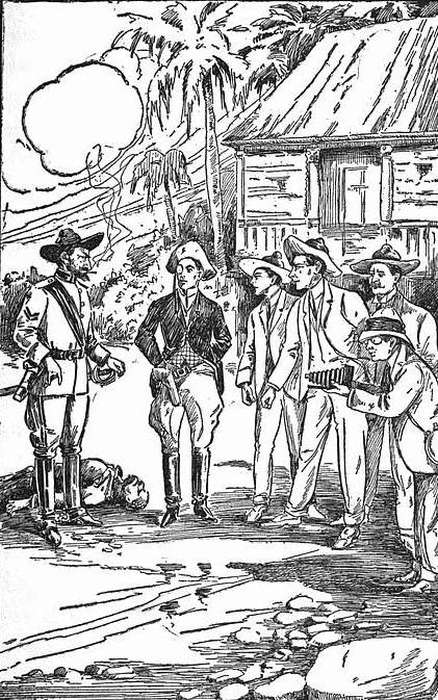
Rogero was standing defiantly, his hand on his sword-hilt.
For the first time the boys saw his right hand.
There were two fingers missing!
“Just hold that pose for a second, General,” exclaimed
Billy, his finger on the button of his machine.
Rogero turned with a snarl as the button clicked and
his image was irrevocably fixed on the film.
“It will be a beautiful picture,” remarked Billy
amiably. “You see the light was very good and the
lamentable fact that you are shy two fingers will be
clearly shown, I hope, in the print I intend to make
at the earliest opportunity.”
“You dog of a newspaper spy,” snarled Rogero,
his face a pasty yellow and fear in his eyes, “I know
you. You are a sneaking reporter. We don’t like
such renegades as you in my country. We have a way
of dealing with them, however, that usually causes
them to cease from troubling us.”
He raised his hand to his throat and gave an unpleasant
sort of an imitation of the “garrotte” which
is the instrument of execution in most Latin-American
countries.
“JUST HOLD THAT POSE A SECOND, GENERAL.”
“And we in the States have also got a way of dealing
with men like you,” said Billy meaningly. “Now,”
he went on in a low voice, stepping close to Rogero,
“if you harm that aeroplane in any way I’ll forward
the picture, I just took to Detective Connolly of the
New York Central Office, and I think he can have a
very interesting time with it tracing your movements
in New York before the murder of Dr. Moneague!”
If he had been struck full in the face the effect on
Rogero could not have been more magical. He opened
his dried lips as if to speak, but no sound came. In
his eyes there was a hunted look.
“I’ll have you——,” he began when he at last found
his voice.
“You’ll have nothing,” replied Billy cheerfully,
“because you don’t dare. Now, then; tell these boys
they can have their aeroplane unharmed. Write them
an order—here’s my pad and a fountain pen—don’t
forget to give them back.”
Rogero snarled like a cornered tiger, but he took the
pen and scrawled a passport in Spanish on Billy’s pad.
“Take your wonderful flying machine then, and I
only hope you break your necks,” he muttered. With
an evil look at Billy which did not at all seem to worry
that amiable young gentleman who merely winked
knowingly in reply, he turned on his heel and strode
off followed by his soldiers.
“By Jove, you American pressmen have a high-handed
way of doing things, I must say,” remarked
Blakely. The boys, too, were much delighted and
amused and congratulated Billy warmly on his successful
bit of strategy. Mr. Chester, however, by no
means took the matter so lightly. After he had given
orders that the body of the unfortunate Juan be properly
cared for and sent back to La Merced for burial,
he turned to young Barnes.
“My boy,” he said, “we are not in America now,
and in the present state of the country Rogero can be
a very dangerous man.”
“He ought to be shot,” indignantly cried Harry.
“Or hanged,” put in Frank.
“Both,” concluded Billy, with conviction.
“Perhaps,” said Mr. Chester, as he headed the little
group into the hotel once more, “but in Nicaragua
the law of might prevails and that man means mischief.”
As he uttered the last words in a grave tone there
came a rattle of hoofs far down the street, and the
next minute a horseman flashed by the hotel in a cloud
of yellow dust. He spurred his horse desperately up
to the barracks and, as he drew rein, Mr. Chester
and the boys saw Rogero come out on the balcony and
the messenger standing in his stirrups, hand him an
envelope.
“News from the front,” commented Mr. Chester.
Rogero disappeared for a few minutes and when he
came out again he handed the messenger another
envelope, evidently containing a reply to the despatch
he had just received. The man wheeled his horse
almost on its haunches and spurred down the street
again.
“What is it?” shouted Mr. Chester in Spanish to
him as he dashed by the hotel riding as if his life
depended on speed.
“Another great victory,” he shouted reining his
sweating horse in for an imperceptible fragment of
time.
As the clatter of his horse’s hoofs died away in the
direction of the mountains there was a great commotion
in the barracks. Bugles sounded and men ran
about with horses, arms and bundles, in the confusion
that characterizes improperly-disciplined troops.
After about half an hour of this frenzied preparation
the troops, some two hundred in number, with Rogero
and his dark-skinned staff officers at their head with
the blue and white “colors”; fell awkwardly in line
and to the music of a crazy band with battered, dirty
instruments began their march to the front.
Their way led by the hotel where the boys stood
gazing with amusement and some pity at their first
sight of a Central American army on the march.
Some of the troopers were not much bigger than the
newsboys they had left behind in the New York that
now seemed so far away. These little fellows tottered
along under the weight of haversacks and heavy
Remington rifles, keeping step as best they could with
their elders. Several of the soldiers carried gamecocks
under their arms and others had guitars and
mandolins slung over their shoulders; one man even
carried a bird in a wooden cage.
Rogero’s face bore a deep scowl as he rode by surrounded
by his excited staff officers. His eyes were
downcast but he raised them as he passed the little
group in front of the Grand Central. There was a
sinister gleam in them like that in the leaden orbs of a
venomous serpent.
“Adios, señors,” he sneered, leaning back in his
saddle, “we shall meet again and I shall have the
pleasure, I hope, of introducing some of you to our
Nicaraguan prisons.”
CHAPTER VI.
FRANK TO THE RESCUE.
Wagons for the transportation of the packing
cases containing the Golden Eagle, and for the boys’
baggage had been secured by old Matula earlier in
the day and when the Chester party arrived at the
wharf, late in the afternoon, he had made such an impression
on the native workers by his imperious commands
and promises of extra money from the Señor
Chester for fast work, that they found everything in
readiness for the journey back to the plantation. The
boys were delighted with their ponies, spirited little
animals as quick as cats on their feet and able to travel
over the rough mountain roads like goats.
The wagon was drawn by a team of bullocks hitched
to the pole by a heavy yoke of wood, with the rough
marks of the axe still upon it.
“Well, we really are in a foreign country at last,”
exclaimed Harry as his eyes fell on the primitive-looking
wagon and its queer motive power.
In spite of old Matula’s by turns imploring, threatening
and wheedling persuasions it was almost dark when
the expedition was ready to make a start for the plantation.
There was a full moon, however, and the
moonlight of the tropics in the dry season is a very
different thing to the pallid illumination of the northern
Luna. As the Chester party, headed by the boys
on their ponies, wound through the streets of Greytown
and began the long steady climb to La Merced,
a radiance like electric light flooded the way and
showed them every twig and leaf as clearly as if it had
been day. Everywhere, too, the darker shadows were
spangled with brilliant fireflies.
They reached the plantation about midnight and
found that the servants had made everything ready for
their reception. The boys were delighted with the
picturesque reception the hands gave them. Every
man, woman and child had a torch and the sight of
these flickering about in the moonlight long before
they reached their destination resembled a convention
of huge lightning-bugs.
Inside the main sala there was a tempting meal in
the native style laid out. There was huge grapefruit
and custard apples, a fruit filled with real custard,
crisp bread-fruit roasted to a turn, fragrant frijoles,
the national dish of the Latin-American from Mexico
to Patagonia, and several kinds of meat and salted fish
all cooked in the best style of old Matula’s wife, who
waited on them.
“Well, this beats Delmonico’s,” remarked Billy,
who at Mr. Chester’s hearty invitation had made one
of the party. “I always had an idea that you people
down here lived like savages,” he laughed, “but here
you are with a layout that you couldn’t beat anywhere
from New York to the coast.”
Billy’s simple-hearted admiration of everything he
had encountered on the estancia caused Mr. Chester
much amusement. Billy proved his appreciation of
everything by sampling all the dishes in turn including
a dish of red peppers that caused his temporary
retirement in agony.
“Jimminy crickets, I felt as if I had a three alarm
fire in my department of the interior,” was the way he
explained his feelings after he had swallowed a gallon
of water, more or less, to alleviate his sufferings.
After their exciting day the boys slept like tops, although
their dreams were a wild rehash of the novel
experiences they had gone through. Frank dreamed
that Rogero in an airship fashioned like a bonga was
pursuing them through space and that although they
speeded up the Golden Eagle to her fastest flight, the
evil-faced Nicaraguan gained on them rapidly. He
had just run the prow of his queer air-craft into the
Golden Eagle’s stern and Frank felt himself falling,
falling down into a huge sort of lake of boiling
surf when he awoke to find it was broad daylight,
and the cheerful daily routine of the plantation going
busily on as if the events of the day before had been
as unreal as his dream. Springing out of bed, Frank
aroused Harry. The younger boy had just about
rubbed the sleep out of his eyes when their father
came into the room.
“Come on boys,” he said, “and I’ll show you how
we take our morning bath down here.”
The boys slipped on bath-robes and thrust their feet
into slippers. When they were ready Mr. Chester led
them out to a small building with latticed sides a short
distance from the house. Inside was a cement-lined
pool about twenty feet in length by fifteen in width
with a depth that varied from five feet at one end to
seven at the other. It was full of sparkling water
that ran into it from a mountain stream on one side,
and was piped back into the bed of the brook, again
after it had flowed through Mr. Chester’s unique bathroom.
With a loud whoop Harry was just about to jump
into the inviting looking bathing-place when Mr.
Chester stopped him.
“Look before you leap, Harry,” he cautioned,
“every once in a while a tarantula or a snake or a
nice fat scorpion takes a fancy to a bath, and tumbles
in here and they are not pleasant companions at close
range.”
An investigation showed, however, that there were
none of the unpleasant intruders Mr. Chester had mentioned
in the bath that morning, at least, and the two
boys swam about to their hearts’ content, and after
dressing came in for breakfast as delightful as their
meal of the previous night in its novelty and variety.
Breakfast despatched of course the first thing to do
was to superintend the unpacking of the Golden Eagle.
The bullock cart had been taken down to a cleared
spot not far removed from the barracks of the
laborers, and a squad of brown-skinned men were already
at work when Frank and Harry strolled down
there setting up a sort of shelter, thatched with palm
leaves under which the boys might work without being
in danger of sunstroke.
Everybody on the plantation found some excuse to
pass by the shelter that morning while the boys, and
three or four envied laborers unpacked the Golden
Eagle, and began to put the sections in place. A
feature of the ship of which the boys were very proud
was the ease with which, by a system of keyed joints,
their beautiful sky-ranger could be taken apart or put
together again very quickly. Under Frank and
Harry’s coaching even the Nicaraguan laborers, none
of the brightest of humankind, got along very fast, and
by the time the second breakfast, as it is called, was
ready the frames for the planes were in place and the
trough-like cockpit or passenger car ready in position
to have the piano wire strands of immense tensile
strength that connected it to the steel stanchions of
the planes screwed into place with delicate turnbuckles
made especially for the Golden Eagle.
After lunch the work went on apace. The balloon-silk
coverings of the planes were fitted with tiny brass
ringed holes through which they were threaded on to
the frames by fine wire. This was a tedious business
and Frank and Harry did it themselves, not caring to
trust so delicate an operation, and one which required
so much patient care, to the good-natured, easy-going
Nicaraguans, who would have been as likely as not
to have scamped the job and left several holes unthreaded.
As the whole pressure of the weight of the
car and its occupants, fuel and lubricants was to be
borne by these planes it can readily be seen why the
boys placed so much importance on doing a good
thorough job.
It took till sunset to complete this task and the boys
were tired enough not to be sorry that their work was
done when the big bell that called the laborers in from
the banana groves began to clang.
In the work on the Golden Eagle the boys had been
very materially aided by Billy Barnes, who photographed
the craft from every possible and impossible
point of view and insisted on Frank snapping a picture
of him sitting at the steering wheel.
“It’s as near as I’ll ever get to steering her, I guess,”
he explained, “I haven’t got the head for these things
that you chaps have.”
It was Billy Barnes, too, who reported that evening
in great excitement that while he was walking along
the porch he had seen a big spotted cat “loafing
around.”
“That wasn’t a cat,” laughed Mr. Chester, “that
was an ocelot and if you think you can qualify as a
Nimrod we will go out after supper and try and get a
shot at it. They are bad things to have around the
place—not that they are really dangerous, but they steal
chickens and the men are scared of them and spend
most of the day looking out for what Billy calls a ‘big
cat,’ instead of doing their work.”
“I don’t know what or who Nimrod is,” replied
the good-natured reporter, “but I sure would like to
get a shot at that ossy—what do you call it?”
After supper the hunting party put on stout boots,
coming well above their knees, in case of lurking
snakes, and armed with rifles started out after the
ocelot. Frank and Harry were both pretty good shots,
having had a good deal of experience at their father’s
camp in the Adirondacks in the days before he became
a planter. Billy Barnes had never had a rifle in his
hand before, but he didn’t say so. He opined that to
shoot all you had to do was to look steadily at the object
aimed at and then, pull the trigger.
“I think we’d better try for him over by Bread-Fruit
Spring, sir,” said the young overseer as the
party, as quietly as possible, sallied out.
“A good suggestion, Blakely,” replied Mr.
Chester.
“Do they eat bread-fruit?” inquired Billy.
“No, but they drink water, Mr. Barnes,” replied
Mr. Chester; “now, don’t let’s have any talking or we
shall have our night’s work for nothing.”
Following Mr. Chester’s directions the party spread
out in a fan-shape, as they neared the spring, and it
was agreed that they should gradually draw in the
ends of this “fan” as they neared the spot where
they expected to find the ocelot. If any one got lost
they were to shout or fire their rifle.
In pursuance of this plan the party carefully tiptoed
along, stopping every now and again to listen
carefully. Billy Barnes was far out to the left of the
rest of the party and as they got deeper into the
mysterious shadows of the tropical forest his heart began
to beat a little faster than usual. The moon
shone down through the immense tree-tops in a few
patches, but outside of these circles of light-illuminated
spots the jungle was as black as an unlighted cathedral.
Every time a creeper brushed against his face, Billy
remembered all he had ever read of huge snakes that
hung in trees and crushed people to death with their
terrible constricting folds. Then, too, occasionally a
sleeping monkey, disturbed by a bad dream or some
preying night animal, would start off through the
branches with a screech that sounded horribly human.
Not for the world would Billy have let the boys or
their father know that he was filled with a great longing
for human company, but he devoutly wished he
was back at the comfortable hacienda.
“A nice finish for the Planet’s special correspondent,”
he mused. “William Barnes, Crushed to Death
by a Boa Constrictor”—b-r-r-r—“that would look
well in a head, wouldn’t it?”
Suddenly, as Billy emerged from a dark shadow
cast by a huge tree with immense buttress-like roots,
the space between any one of which would have served
as a barn for a horse and buggy, he saw in the patch of
white moonlight right ahead of him a sight that made
his scalp tighten and his blood run chill.
Crouching over the body of a deer and tearing at
it with low, snarling growls, was a thing that looked
something like Billy’s “big cat,” but was much too
large to have ever been mistaken for that peaceful domestic
animal. The creature was too engrossed with
its meal to pay much attention to the badly-scared boy,
and if he had retained his presence of mind he might
even have tiptoed off unnoticed, but at that moment the
luckless Billy was impelled to sneeze.
As his loud “Ah, c-h-o-o!” sounded the animal
lifted its head angrily. In the moonlight Billy could
see its white, gleaming teeth and cruel eyes. It looked
about, as if puzzled, for a few seconds, but suddenly
its green eyes lighted on the petrified Billy, who was
too scared even to run.
Instantly it crouched down on its belly and began
lashing the ground with its tail. Its upper lip was
pulled back in a snarling grin that disclosed its saber-like
teeth and dripping fangs.
“It’s all off,” groaned poor Billy. He raised his
rifle to his shoulder in a desperate sort of hope that
it might scare the thing away.
“If I only hadn’t been ashamed to ask how the thing
worked,” thought Billy.
As the thought flashed across his mind the animal
with a loud, screaming snarl sprang directly at the
trembling reporter. More from instinct than anything
else he pulled the trigger and a loud report followed.
It was a heavy sporting rifle that Billy carried and the
unexpected recoil, which, not knowing anything about
firearms, he had not prepared for, threw him off his
balance. This saved his life for the minute, for as he
reeled the huge creature he had disturbed at its forest
meal shot past him so close that he could feel its warm
breath against his cheek.
Foiled of its prey for the moment the maddened
animal switched round with the agility of its kind and
crouched for a fresh spring.
“Gee, now I know how a mouse feels,” gasped poor
Billy to himself, as the huge creature prepared for
what Billy felt was to be its death-spring.
With an agility born of desperation the youth made
a wild leap for a hanging tendril of one of the giant
creepers that festooned a tree near by. He caught it
and began climbing with a skill he never knew before
he possessed. He was beginning to think that he could
at least reach a branch of the tree where he would be
out of his savage opponent’s reach, when something
happened that threw him into a cold sweat.
He felt the creeper begin to sag. It was breaking
under his weight. In vain he tried to brace himself
against the tree trunk. His knees slipped and slid
and he could get no foothold.
Suddenly, without any warning, the creeper snapped.
With a wild shriek of real terror Billy was hurled to
the ground. His last conscious thought was of his old
home up in New York State and of who would tell
his mother of his fate.
Then like a man in a dream he saw a flash of fire
so near at hand that it almost scorched his face. He
heard a loud report and a snarling growl of pain and
felt something warm and heavy fall with a crushing
weight on top of him. Then everything went black.
When he came to he found himself in the center of
an excited group. Everybody was shaking Frank’s
hand and congratulating him, and the boy, looking very
embarrassed, was trying to head off the tide of compliments.
“Oh, you’re all right, then,” exclaimed Harry as
Billy opened his eyes on the group in the moonlight.
“W-w-what happened?” gasped Billy, “didn’t that
critter get me?”
“No, thanks to Frank,” exclaimed Harry impulsively;
“you owe him your life, Billy. He heard your
first shot and hurried to your aid and just in time.
The critter didn’t get as you call it—didn’t get you,
but Frank got the critter.”
“As pretty a shot as I ever saw,” remarked Mr.
Chester.
“Oh, pshaw,” said Frank, “I couldn’t help hitting
him, he looked as big as an elephant; and besides, if
I hadn’t got him he’d have got me.”
“What the dickens was the thing?” inquired
Billy, “a lion or tiger?”
“No, but something quite as dangerous—a jaguar,”
replied Mr. Chester, “and as big a specimen as I have
ever seen.”
He stirred the magnificently spotted hide of the
dead wild beast with his foot as he spoke.
“Frank!” exclaimed Billy, with tears springing to
his eyes and real emotion in his voice, “you saved my
life to-night.” Frank put up a protesting hand.
“No, I will say it,” impulsively burst out Billy.
“I owe you my life and by jimminy crickets,” wringing
Frank’s hand like a pump-handle, with a hearty
grip, “I’ll never forget it. Maybe some day I can do
something to repay you, and when that time comes
count on Billy Barnes.”
How soon the boys were to be in dire need of that
help, neither they nor Billy Barnes dreamed as discussing
Billy’s narrow escape and Frank’s brave shot
they made their way back to the house.
CHAPTER VII.
FEATHERING THE GOLDEN EAGLE.
Bright and early the next day the work of completing
the erection of the Golden Eagle went on.
The lower planes were covered and threaded on to the
frames with the same care as the covering of the
upper set had been accomplished.
The long bird-like balancing tail was then put in
place and the tiller lines—of bronze rope—threaded
through guiding pulleys to its planes which were
designed to raise or lower the course of the ship when
in the air. The lateral steering was accomplished
by means of double vertical rudders of the thinnest
bronze obtainable, strengthened by a triangular frame
of aluminum, and were controlled by a clever device of
Frank’s from the same wheel that adjusted the horizontal
planes.
Then came the pleasant work of fitting up the car.
There was a box for Frank’s binoculars and separate
compartments for each of the instruments used in
determining height and speed. Then the thermometer
had to be screwed in place and the automobile
clock adjusted where the steersman could see it. The
food basket was then stocked, for Frank did not believe
in doing things by halves and he was determined
that when they quit work that night that everything
about the ship should be in ship-shape fashion and
ready for flight at a moment’s notice.
In the food basket, besides the blankets and medicines
already mentioned and some folding knives and
forks, the boys packed:
Four pounds of beans, a small box of hardtack,
a plentiful supply of soup and meat tablets as used
by the German army and which contain a supply of
nutriment far in excess of their bulk, five pounds of
bacon, the same quantity of ham, tins of salt, pepper
and seasoning, a can of butter for special occasions
and two cans of condensed milk, and five packages of
self-raising flour.
“There doesn’t look to be enough there to feed a
flock of canary birds,” remarked Billy, as he watched
the stowing of the grub.
“That’s because you don’t know the exact science
of modern rations,” replied Frank, “experiments in
Germany have proved that the condensed soups and
meat essences we have in that are alone capable of
sustaining life for a long period, the other things are
luxuries.”
“Well, me for porterhouse steaks and food you
can get your teeth into,” replied Billy. “Count me
out on this tabloid table-d’hôte idea.”
“It’s easy to see you were never cut out for an
aeronaut,” laughed Harry, “here, lay hold of this
bar and make yourself useful.”
The body of the car was raised on screw-jacks,
when the work of attaching it to the planes had been
completed, and the food basket carefully slung underneath,
where it was readily getatable through a small
hinged hatch in the floor of the pilot’s cockpit.
Then came the work of attaching to the bottom of the
frame, and to the tail, the wheels and spring braces
which were devised to make a descent in the airship as
easy as alighting from a taxicab. The wheels were
also to aid in starting the craft.
Frank and Harry had come to the conclusion long
before they finished building the Golden Eagle that
they did not want to have to cart around a runway
with them to give the ship start when they wished to
make a flight, as is the case with the Wright Brothers’
machines. Their air craft was equipped with pneumatic
tired-wheels like those of a bicycle, only several
times as strong, in order to give her a good running
start when her twin propellers were started.
When they wished the Golden Eagle to soar aloft
from the ground, all that was necessary to do with
this equipment was to throw in a clutch geared to the
rear pair of wheels and the Golden Eagle, like a great
bird with her wings spread, began to glide over the
ground, and in a few seconds the pressure of the air
under her curved planes gave her the necessary lift
and she shot up like a hawk, or her namesake, leaving
the eyrie.
The forward pair of wheels were movable, castor-fashion,
so that when the ship struck the ground they
were free to head in any direction in which the ship
might take the earth. The rear wheels were attached
to the body of the aeroplane in the same manner,
except that they had a device connected with them
which made it possible to lock them when the operator
wished to throw in the clutch that started the engine
up. The forward wheels also had a detachable steering
appliance connected with them so that in starting
the machine it could be steered in any direction the
operator desired, like an automobile.
Besides these wheels the forepart of the Golden
Eagle possessed a pair of inclined planes moving on
an axis. To the outer ends of these planes were attached
powerful springs. The action of these planes
when the forward end of the ship struck the ground
on them was of course made free from jar by the
spring attachment which acted as a sort of buffer.
The wheeled arm attached to the bird-like tail astern
was geared in a similar fashion and was designed to
support this important part of the aeroplane and
protect it from damage when the Golden Eagle
settled.
Frank eagerly explained the uses and action of all
the devices to his father and Jimmie Blakely, the
latter of whom had neglected his work shamefully
since the Golden Eagle had been roosting under its
palm-thatched shed. How the ship got its name was
at once apparent as soon as the boys had completed
covering its wings. The balloon silk they used was of
a rich orange hue and indeed the ship looked like
nothing so much as a great golden bird.
The last task the boys had to tackle was the delicate
one of placing the engine and its condenser in position
and connecting it to the gasolene, water and
lubricating tanks. Then there was the job of putting
in the ignition apparatus and wiring it up to the spark
plugs of the motor. Frank and Harry used the jump-spark
system as being both simpler and easier to
repair in time of trouble than the make and break
method. The spark for starting was obtained from
batteries, but when under way the Golden Eagle’s
engine was “sparked” by a magneto. Both boys
always carried a supply of extra spark plugs in case
of the carbonization of the ones already in the cylinders
and they had had very little trouble indeed with
this important part of their engine, one which gives
more bother usually than any other part of the motor.
The spark plugs were hooded with waterproof caps
as a precaution against short-circuiting by rain or
dampness.
The twin propellers of the Chester boys’ craft,
four-bladed ones of bronze, framed and covered
with specially prepared and varnished fabric. These
frames were internally braced by specially tested steel
wire and had shown themselves in every way capable
of standing the terrific strain that 1200 revolutions
a minute put on them. The shafts connecting them
with the engine were of the best Tobin bronze, a non-corrosive
material and one of the most suitable metals
for the construction of propeller shafts.
It took Frank and Harry the best part of another
day to adjust the engine to its bed and true up all
its connecting parts with spirit-level and plumb-line.
This work they had to do alone as it required expert
knowledge of the most exhaustive kind.
At last, however, everything was adjusted and
screwed in place in a way to satisfy even the critical
Frank, who went over every joint and fastening with
an eye that spied out immediately the slightest weakness.
When everything was announced to be complete
at last, a holiday was declared on the estancia
and all hands gathered round the palm-thatched shed
to watch Frank and Harry tune up the Golden Eagle’s
engine.
Frank’s eyes fairly shone as he stepped lightly into
the car and opened the valve that sent a flow of life-giving
gasolene along a brass tube to the carbureters.
Before he did this, however, the hands had been
busy for an hour filling coffee bags with earth and
heavy stones and piling them down on all sides of the
Golden Eagle. Stout stakes were also driven into
the ground and the craft securely roped to them in
such a way that she could not free herself when her
propellers began to whiz round.
“Now, then, hold tight, everybody!” shouted
Frank, as he “tickled” the carbureter, and Harry
threw in the switch. The Boy Aviator gave the flywheel
a light twist back against the compression—there
was a loud “bang,” that made the women
shriek and the next minute the engine of the Golden
Eagle was purring away as contentedly as if it had
never been separated from the craft of which it was
the heart and packed up for its long voyage.
But the natives,—where were they? With the exception
of one tubby little fellow who was sprawling
on the ground and who scrambled to his feet and
made off at top speed as soon as possible, there was
not one to be seen of all the crowd that had clustered
round the Golden Eagle but a few minutes before.
They had not heeded Frank’s warning cry,—somewhat
naturally, not understanding it,—and when the
huge propellers began to whirl round, creating a
regular whirlwind in which hats were snatched from
heads, and dresses blown every which way, they had,
with one concerted howl of “Witchcraft,” fled to
their quarters, where only a great deal of persuasion
induced them to leave.
By supper time that night, the boys were delighted
to think that their beautiful craft was ready to soar
again. Everything in fact was ready for an immediate
flight. The sand-bags were removed, the ropes
untied from the stakes, and the batteries carefully
seen to. It was with light hearts that the boys hurried
to the house for their evening meal. As for Billy,
he danced a sort of what he was pleased to call a
“Pean of Triumph,” round the ship. The performance
of the engine and the general trim and trig appearance
of the Chester boys’ flyer had aroused him
to such a height of admiration and enthusiasm that
he declared himself quite willing to take a trip in it
himself—which was “going some” for Billy.
CHAPTER VIII.
BILLY BARNES TAKES THE WARPATH.
The next day Frank and Harry busied themselves
in their father’s laboratory during most of the morning.
They had been delighted to find such a completely
equipped repository of chemicals as it proved
to be, and their admiration of their father’s researches
was only equalled by their natural surprise at finding
such a workshop on a Nicaraguan plantation.
“I always knew you were a great dab at chemistry,
father,” remarked Harry, “but I never dreamed that
you had a regular Institute of Scientific Research on
tap.”
“By the way,” asked Frank, who had been busy
taking stock of the various chemicals, “have you any
picric acid here, father?”
“I believe I have, my boy,” replied Mr. Chester,
“but that’s dangerous stuff to fool with. You know
it’s a high explosive.”
“Perfectly,” rejoined Frank, “and it’s for that
very reason I want it.”
“I confess I don’t understand you,” was his
father’s reply.
“It’s simply this,” replied Frank, with a smile at
his bewilderment, “it has become a by no means uncommon
practice, though of course most of the better
class clubs have made rules against it, to mix picric
acid with gasolene in racing motor boats and air
crafts. It is usually very injurious to the engine,
however, and I don’t suppose any one would want to
use it except in an emergency.”
“What do you want it for, then?” asked his father
in surprise.
“Well, I believe in always looking ahead, for very
often it’s the unexpected that happens,” rejoined
Frank. “Our engine now can turn up 1200 revolutions
a minute. I believe that with the use of picric
acid in the gasolene we could give her as much additional
power as 1500 revolutions a minute.”
“Well?” inquired his father expectantly.
“That being so,” went on Frank, “the Golden
Eagle would have just that much more lifting power,
the stability of an airship depending upon the speed
at which she travels through the atmosphere. So you
see,” he concluded with a smile, “that some day we
might want to carry an extra passenger and in that
case a gallon of picric acid would come in mighty
handy.”
After a little more argument Frank won his point,
and that night the boys stored aboard the Golden Eagle—after
first carefully seeing that it was not in a
position where it was likely to prove dangerous—a
stone carboy of the explosive acid. They had hardly
completed the work when the sound of wheels was
heard on the drive, and when they reentered the house
they found that Don Pachecho and his beautiful
daughter were the visitors.
Señora Ruiz showed plain evidences of her suffering
over the news of her husband’s death. The boys,
who had heard of the disastrous battle from their
father, avoided all reference of course to the revolution,
but it was Don Pachecho himself who brought
the subject up.
“Have you heard the latest news of the revolution.
Señor?” he asked, after the introductions were over,
and Billy had whispered to Harry what a fine photograph
of “an old Spanish don” Mr. Chester’s neighbor
would make.
Mr. Chester shook his head. Indeed, since a couple
of days before the man who carried messages and
letters between the hacienda and Greytown, had
reported that Zelaya’s forces had cut the telegraph
wires and taken complete charge of the cables, the
party at the plantation had heard nothing of the
movements of either the insurgents or the troops of
the government.
“I learned from a party of rubber-cutters who
passed the plantation to-day,” went on Don Pachecho,
“that Estrada’s troops have suffered a further defeat
and that Zelaya’s men, under General Rogero, crazed
with their victories are burning and destroying property
and committing all sorts of outrages everywhere.”
“Where was this last defeat?” asked Mr. Chester,
seriously.
“It cannot have been more than fifty miles from
here,” continued Don Pachecho, “that is what makes
it so ominous. It means,” he went on, his voice
rising, “that if Estrada cannot hold them in check
that the government troops will drive him back on
Greytown within a few hours and then you know
what will happen,” he shrugged his shoulders.
“Yes, we can hardly expect much mercy from
Rogero,” commented Mr. Chester. He then described
to Don Pachecho what had taken place in Greytown
the day that he had met the boys and Billy Barnes.
Billy himself also conveyed his suspicions of Rogero
as the murderer of Dr. Moneague.
The old don was greatly agitated at this news.
“Ah, the inhuman scoundrel!” he cried, raising
his wrinkled hands above his head, “it was without
doubt he that killed Moneague. And he now holds
the secret of the lost mines. With his power over
Zelaya and the wealth that is now at his disposal, he
can speedily become powerful enough to ruin us all.
I am an old man, Señors, but I do not think that of
all the men I have ever seen, that I have met one
who was this man’s equal in the resources of evil.
Woe betide the man who falls into his clutches.”
Billy had been listening to this conversation with
great attention and he now struck in with:
“What do you suppose he has done with the plan
of the lost mines, sir?”
Don Pachecho shrugged his shoulders.
“Señor Barnes, there is only one thing that he can
do with it, and that is to keep it always about him.
I do not suppose it has been off his immediate person
since he killed poor Moneague.”
Billy sat lost in thought for a while. Then he
raised his head.
“I suppose if he lost it he’d cut up at a great rate,”
he said, “at any rate, he’d give more attention to
getting it back than to keep on licking the revolutionists.”
“Undoubtedly.”
“Hum,” said Billy, in a way he had when he had
arrived at any important conclusion.
In the moonlight the party walked down to where
the Golden Eagle lay under her extemporized garage,
or rather aerodrome. Even Señora Ruiz forgot for a
second her deep sorrow as she gazed at the beautiful
creation, its graceful wings shimmered and silvered
by the brilliant moonlight.
“Oh, Señors,” she cried, “you built this wonderful
fly thing all yourselves?”
When their father had replied for the blushing
Frank and Harry in the affirmative, the Spanish
woman clasped her hands impulsively.
“But you are—oh, pardon me—but you are so
young—chico, is it not so?”
“I take it that ‘chico’ is Spanish for ‘kids,’” remarked
the irrepressible Billy sotto voce to Harry.
What the latter might have replied to this, however,
was cut short by a startling thing that occurred at
that moment.
Frank who had been bending over the engine had
given a loud exclamation.
“Harry—father—Billy, come here quick!” he
exclaimed excitedly.
They ran toward him.
“Look here,” cried the boy, pointing to the engine,
“some one has been tampering with the carbureter.
They knew we could not replace it here without weeks
of delay.”
“And by jimminy crickets!” cried Billy, who had
been examining the engine on his own hook, “they
must have been scared away just as we came down.
See here,” went on the reporter, “they left in such a
hurry that one of them forgot his hat and the sweatband
is still warm and damp. Whoever monkeyed
with this engine took off his hat to do it and he
couldn’t have been at work very long for the hat’s
still warm and besides, see here, he has only given the
carbureter a few turns.”
Mr. Chester took the hat that the excited Billy
thrust at him and regarded it with some attention. It
was a greasy battered affair, but it was trimmed with a
new black ribbon on which was sewn in red thread
the words “Viva Zelaya.”
“Not difficult to trace some of our old friend
Rogero’s work here,” he said. “He evidently means
to keep his threat to prevent your flying.”
“We shall have to do sentry duty here for the rest
of the night, Harry,” said Frank in a determined
voice.
“You bet we will,” agreed his younger brother; an
injury to their ship affected these boys far more than
any hurt they themselves might sustain.
Rifles were secured from the house, also blankets,
and the boys made up a regular camp-fire round
which they sat long after Don Pachecho and his
bereaved daughter had driven off and the lights in the
house had been extinguished.
“I tell you what, Frank,” said Harry, “we have
simply got to take a hand in this thing now. You
know that if that fellow Rogero ever gets as far as
this what he means to do to this plantation.”
“I know,” rejoined his brother, “he would take
delight in ruining what father has built up and then
blaming it on his troops and the worst of it is we
would never be able to get any redress.”
Both boys were silent for several minutes, thinking
things over.
“What’s the matter with taking a little spin in the
Golden Eagle to-morrow and finding out just where
he is, then we can shape our plans accordingly,” suddenly
broke out Harry.
“Yes, but look here, Harry,” replied the conservative
Frank, “you know that we are supposed to be
non-combatants.”
“Oh, hang being non-combatants!” rejoined
Harry, “we are not going to sit here and see our
father’s plantation destroyed by this ruffian, are we?
and you know too,” he went on, “that the amiable
cuss promised to give us a chance to see the inside of
a prison if he could lay his hands on us.”
“You are right there, Harry,” agreed Frank, looking
up, “if the revolutionists are driven back any
closer we shall have to take up arms to protect ourselves.
It has never been the way of Americans to
let any one walk all over them without registering a
kick.”
“You bet ours is going to be an emphatic one, too,”
enthusiastically cried Harry; “give me your hand,
old chap—shake. It’s a go?”
“Yes,” replied Frank slowly, “it’s a go.”
“Hurrah,” shouted Harry, sitting up with his
blanket up to his chin, “we’ll give you the spin of
your life to-morrow, old Golden Eagle.”
It had been agreed that Frank was to take the first
watch, and so while the elder brother sat rifle in hand,
guarding the aeroplane in which they were destined
to have such strange adventures in the immediate
future, Harry slumbered the sleep of the just.
“I’ve only been asleep five minutes,” he protested
when Frank woke him to do his “trick” on guard.
“You’ve had a three-hour nap,” laughed Frank,
“and snored loud enough to have brought the whole
of Zelaya’s army on us if they’d been around.”
Whoever the man was who had tried to disable the
Golden Eagle, he did not put in any further appearance
that night, nor did anything happen to vary the
monotony of the night-watch. As soon as it was daylight
the boys raced for the bath, plunged in, and
after a refreshing swim made for the house.
They made for Billy’s room intending to drag that
sleep-loving young person out and duck him head over
heels into the bath at the deep end.
To their amazement the room was empty. The bed
had not been slept in. Moreover, Billy’s camera and
canteen were missing.
Pinned to the bedclothes was the following characteristic
note, the effect of which on the boys may be
imagined.
“Dear Frank and Harry.
“I have gone to get the plans that Rogero stole
from Moneague. It will make a bully picture to go
with my story when he is pinched. It is about up to
me to do something. Regards to your father. Please
apologize to him for my unceremonious departure for
the warpath. Good luck to you, and I wish myself
the same. So long.
Billy Barnes.”
Frank gave a long whistle as he read this document.
“Well, of all the——,” began Harry, and stopped.
Words failed to express his feelings.
“This settles it,” said Frank suddenly with decision,
“we’ve got to get after Rogero, now.”
“You mean that Billy——,” began Harry.
“I mean that we’re not going to let Billy get shot
for a bit of pottery,” cut in Frank.
“The Golden Eagle will sail at nine o’clock,” he
added. “Come on, Harry—we’ve just time for a
bit of breakfast, and then for the air.”
CHAPTER IX.
THE MIDNIGHT BELL.
It required considerable persuasion on the part of
Frank and Harry to induce Mr. Chester to allow them
to undertake a trip which, to say the least, was hazardous.
After a long talk, however, it was agreed that
the boys were to be allowed to go providing that if
they did not return within the next three days they
were to use every effort to notify their father of their
whereabouts.
All opposition being overcome, the boys, after a
hearty meal, made a change into light woolen shirts,
khaki trousers and rubber-soled canvas shoes. Soft
felt hats of the army type completed their attire, and
when they had each buckled on a belt to which were
strapped magazine revolvers and slung field-glasses
and water-padded canteens over their shoulders they
were practically ready for their bold dash.
Frank at once made a hasty survey of the ground
surrounding the palm-thatched aerodrome and decided
that with a little clearing the Golden Eagle could be
started without any difficulty if no wind got up. A
force of men was at once put to work with machetes
and long before noon a “runway” of five hundred
yards leading downhill had been cleared,—Frank
calculating that this would be sufficient to allow the
aeroplane to lift and clear the taller banana bushes.
The gasolene for the sixty-gallon tank had been
shipped from Greytown at the time that Frank and
Harry tuned up the Golden Eagle’s engine, and besides
filling the tank to its capacity they loaded their craft
up with several five-gallon cans for a reserve supply.
A stock of the best cylinder oil and grease for the
“screw-up” grease cups that lubricated the crank
shafts completed the engine outfit.
The boys calculated on using a pint per horsepower
an hour of fuel when the Golden Eagle’s engine was
running at its greatest number of revolutions per
minute. As they did not intend to turn up more
than 800 revolutions—or R.P.M., as aviators call it—they
calculated on a considerable saving of fuel unless
some emergency arose.
While the runway was being cleared, several of the
native workmen had been at work, under the boys’
direction, hauling away the ballast sacks with which
the Golden Eagle had been weighed down at the
time of her engine test. Harry had also produced a
brand-new ensign which he ran up on halyards rigged
to a stern stanchion, while his brother and father
gave three hearty cheers for the fluttering Stars and
Stripes.
The last thing the boys did before their final farewells
was to tuck a map of the country over which
they were to travel in a corner pocket of the pilot-house,
and also load up a waterproof silk tent and an
axe, shovel and pick.
“It’s always as well to be prepared for everything,”
Frank remarked when his father questioned him
about the utility of these last articles. “We don’t
know but we may have to dig for water or—or anything
in fact in which these tools will come in mighty
handy.”
Mr. Chester nodded admiringly at his son’s foresight.
“That’s right, my boy,” he assented, “be ready
for everything and you can’t go far wrong.”
“Now,” declared Frank, after the boys had gone
over every stay-wire, stanchion and brace on the
machine, and the engine had been carefully wiped
and the brass parts polished, “the Chester expedition
is ready to get underway!”
Harry hopped nimbly into the pilot-house and took
up his seat at the rear of the chassis. His job was
that of engineer. Captain Frank followed him a
second later and with his hand on the guide wheel
to which the controls were connected gave a comprehensive
look over the aeroplane.
“What would the Junior Aero boys do if they
could see us now?” Harry hailed from his seat, looking
up from his adjusting of the grease cups.
“What wouldn’t any of them give to be going
along?” responded Frank.
It had been arranged that the Golden Eagle was to
be headed toward the northwest where, like a blue
cloud, the Cordillera range loomed against the sky.
Somewhere over in that little known part of the country
Rogero and his men were marching toward the
coast and—the thought thrilled in both the boys’
minds, though neither spoke of it—it was over there,
too, somewhere in those dim blue mountains, that the
lost mines of the Toltecs lay and the little known relics
of that ancient civilization.
There was a final handshake between the boys and
their father and a shouted good-bye to Jimmie
Blakely.
“All right astern, Harry?” hailed Frank.
“Ay, ay, sir,” responded his brother.
Harry threw in the switch, having opened the valve
that connected the engine with the gasolene tank a
few minutes before. At the same instant Frank
started the engine. There was an involuntary cheer
from the hands who had clustered around the machine
but at a respectful distance, recollecting their disconcerting
experience at the time that Frank tested the
engine.
With her fifty horsepower whirring round her
propellers at eight hundred revolutions a minute, the
Golden Eagle began to move. Faster and faster she
glided over the ground till after a run of about two
hundred yards her forward end lifted and she shot
upward into the air as Frank’s trained hand had
directed the upward gliding planes. The engine was
going at its work with a will and the rhythmical purr,
so sweet to the ear of the operator of an aeroplane,
showed that there wasn’t going to be any balk out of
it on this trip.
The watchers below saw the Golden Eagle, like a
great yellow bird, leave the ground for the upper air
in absolute silence. It was such an impressive sight
that even the usually voluble natives failed to make
any demonstration. At a height of about two hundred
feet Frank pulled the control tiller hard over
and the Golden Eagle swung round slightly on an
almost even keel from the eastward course she was
on and headed away to the northwest. The last the
group at La Merced saw of her she was a dull bronze
speck against the brilliant blue sky, heading steadily
for the mountains at a height of about six hundred
feet.
It had been arranged between the boys that they
should keep going till dusk and then alight in some
suitable place and make camp for the night. That
they were running great and grave risks they well
knew, but neither of them was of the caliber that
talks much of such things and so as they forged steadily
for the hills with the exhaust throbbing as evenly as
a healthy pulse, their conversation was mainly about
the course they should adopt to save Billy Barnes if
he had actually fallen into Rogero’s hands.
That there would have to be quick action neither
boy doubted. Rogero was not the man to stop at
half measures, and that Billy would be shot or tortured
after a drumhead court-martial; or, perhaps, with
even not that attempt at legal formality, was practically
certain.
As he sat at the wheel, Frank, from time to time,
called Harry to take his place at the duplicate tiller
wheel while he with the field glasses swept the earth
below for any sign of any camp. The portion of
Nicaragua over which the Golden Eagle was soaring
is very sparsely inhabited. With the exception of an
occasional river bank camp of wandering rubber-cutters,
there is little human life.
“What are we making, should you judge, Frank?”
asked Harry, when they had been underway about an
hour with only the monotonous dull-green jungle,
like a leafy carpet beneath them.
“Easily twenty,” replied Frank, “throttled down
as we are.”
“Has it occurred to you that we are going to find
some difficulty in securing a suitable landing-place?”
“I’ve been thinking of that,” replied the elder boy,
“it is of course impossible to make a landing anywhere
here, and I can’t for the life of me, see any
break in the jungle in the direction we are headed.”
“No,” replied Harry, eagerly, “but have you
noticed those hills? As we get nearer to them I can
see through the glasses that there seem to be rocky
plateaus on their upper ridges that would just about
suit us for a settling-down place.”
“What do you propose then?” asked Frank.
“I was thinking that it would be a good idea to
speed up a bit so as to reach the mountains by dark
and make camp there till we can scout about a little
and get Rogero’s bearings.”
“That’s a good idea,” replied Frank, “I’ve been
thinking anyway that we would do Billy more harm
than good if Rogero knew that we were flying to his
rescue. Our best plan is to pitch our tent there in the
hills on one of the plateaus and work from that point
as our headquarters. There’s the question of gasolene,
too, we don’t want to run out of that and the
less needless flying we do the better say I.”
“How far do you suppose those hills are from us
now?” asked Harry.
Frank consulted his map.
“Not more than fifty miles at the outside. We can
make them easily by sundown if we speed her up,”
he announced. As he spoke he increased the velocity
of the engine till it was running almost at its
revolution capacity. Under the increased impetus the
Golden Eagle drove forward a good ten miles an
hour faster.
As the hills grew nearer both boys eagerly focussed
their glasses on them. At a distance the range had
not looked to be a very considerable mountain formation,
but on a closer approach the boys were astonished
to see that they were a formidable chain of
hills, slashed and cut into every direction by deep
canyons, between which there were several broad
plateaus almost entirely unwooded. In other places
giant trees clothed the hills almost to their summits.
“One of those bare plateaus will make an ideal
landing-place,” said Frank, as the Golden Eagle
swung steadily forward toward her decided destination.
“The big trees will screen us from the view of
anyone except an airship scout and I don’t think that
there will be much likelihood of our encountering one
of those.”
It was twilight when Frank swung the starboard
rudder over and the Golden Eagle began to describe
swooping circles above a plateau about five hundred
feet up on the mountain-side. It was a ticklish job
to land, but under Frank’s skilful manipulation of the
planes and rudders the boys’ ship settled down as
gently as a tired bird toward the smooth surface of
the plateau. As she struck the ground in a little cloud
of dust, but without the slightest jar, Harry threw
in the brake clutch that controlled the settling wheels
and after sliding about twenty feet, the Golden Eagle
came to a stop in the wildest part of the Cordilleras
of Nicaragua. With a cheer both boys jumped out
and excitedly assured each other that their adventures
had really begun at last.
There was but little time that night to survey their
landing-place. By the time the sun dropped, however,
they had accomplished such good work that the tent
was up, the portable cots erected and Harry had a
fire lighted; while Frank had announced with a shout
of triumph that he had found a little runnel of water
oozing from the mountain-side which by a little enlargement
with the pick and shovel soon formed a
pool of clear, cold water.
It was with light hearts that the boys fell to on a
supper of fried bacon, coffee and bread. There was
not time to cook a more elaborate menu that night,
but both declared enthusiastically that what they did
have tasted to them as good as a banquet. Supper
over and a lantern lighted in the tent it was arranged
that Frank should take the first watch, lasting till midnight,
and that he should then awake Harry who
would do sentry duty till dawn. Till they learned if
they had any undesirable neighbors this was agreed
to be the prudent course.
After Harry turned in Frank looked over his rifle
and revolver and took up a position by the camp-fire.
He employed the early part of the night with pencil
and pad, figuring out some aeronautical problems, but
as it grew near to his hour to be relieved he grew
so sleepy that he got up and paced about to fight off
his drowsiness. He had made perhaps a dozen turns
up and down in front of the tent when something
happened that caused even the usually hard-headed
boy to start violently and feel a queer sort of chill
down his spine.
It was the tolling of a bell!
The hour, the loneliness of the spot all combined
to augment Frank’s startled amazement at the sound.
He could hardly believe his ears. With a beating
heart he strained his attention to locate the sound. It
seemed to come from a spot further up the mountain-side.
Whoever the bell-ringer was he paid no attention
to time or rhythm. The bell would toll loud and
sharp for a few minutes and then its clangor would
die down and almost cease. Then without any apparent
reason it would start up again furiously.
Hurriedly Frank awoke his younger brother.
“What on earth do you suppose it is? Spooks?”
demanded the startled Harry.
“I don’t know, but it’s something human, and I
mean to find out before we leave this place,” declared
Frank, doggedly.
CHAPTER X.
THE ONE-EYED QUESAL.
Seen in the bright light of the early tropic day the
plateau upon which the Golden Eagle had settled was
certainly an ideal spot for a boy’s camp. It was in
form a rough circle about a quarter of a mile in circumference.
To the west the mountain-side shot up
in a rugged cliff. To the east a deep canyon cut down
to the valley below, clothed heavily with huge Manacca
palms, plane and rosewood trees, here and there interspersed
by a lordly mahogany grove. Huge ferns
as big as rose-bushes in America shot up out of the rich
dark soil, and from the tops of many of the trees
whose names were unknown to the boys trailed magnificent
orchids and lianas and parasitic plants of
many varieties.
From below it would have been quite impossible to
have sighted the camp and the mountain above was so
rugged and precipitous that any attack or observation
from that quarter would have been most improbable.
As soon as it was light Harry, with the collapsable
canvas bucket went to Frank’s spring and got a
supply of water. This done he set about getting
breakfast. In the meantime Frank had been skirmishing
about for fruit, and by the time the fragrant
odor of Harry’s steaming coffee-pot had diffused itself
about the camp the elder boy returned triumphantly
with an armful of bananas and dark-green
bread-fruit. Harry selected two of the largest of these
last and cutting them open set them on the hot coals to
roast.
“Why, where on earth did you learn tropical
cookery?” demanded Frank as he watched Harry
deftly turning the appetizing looking slices.
“I watched the natives down at La Merced,”
replied Harry, “you see I figured that when you are
in Rome do as the Romans do, and that as the jungle
is good enough to provide us with ready-grown
loaves we ought to return the compliment by knowing
how to cook them.”
Naturally enough the boys’ conversation fell on the
mysterious bell-ringing of the night before.
“I can hardly believe that I didn’t dream it,” remarked
Frank.
“But I heard it too,” rejoined Harry, “and there
is no question that it was a bell and a good, loud-toned
one at that.”
“Well, what a bell-ringer, let alone a bell, can
be doing round here is inexplicable,” said Frank.
“I took a good look around before breakfast while I
was out getting the fruit and I can see no sign of
any habitation or settlement that might account for
it.”
“You don’t think it possible that it could be a
trick to scare us?” asked Harry.
Frank laughed.
“I considered that too,” he replied, “I hardly think
that it could be that. Anyhow it will take a good
deal more than that to frighten us away. Seriously
though I would like to solve the mystery.”
“Maybe the monkeys hold prayer-meetings,”
laughed Harry.
“What’s the matter with forming the Chester Exploration
Expedition and taking a climb up the mountain
after breakfast,” he broke out suddenly.
“You’re on,” rejoined Frank, “I think it will be
perfectly safe to leave camp for a while anyhow and
we may make some important discoveries.”
Accordingly an hour later the boys were making
their first plunge into the practically unknown fastnesses
of the Cordilleras of Nicaragua. Each carried
a canteen full of water, a supply of roasted bread-fruit
and several soup tablets besides matches in waterproof
boxes and their revolvers and rifles. Of course a pair
of field-glasses, and the axe also formed a part of
their traveling equipment.
With all this paraphernalia it was hard work clambering
up the rugged mountain-side more particularly
as when their course required them to plunge into
the jungle, they found their way impeded by huge
snake-like creepers that hung from the trees and
crawled over the ground in every direction. They
had been climbing steadily for about an hour
when Harry uttered an exclamation of delightful
surprise.
“Look, Frank,” he cried, pointing to a magnificent
bird that flashed through the jungle ahead of them.
Both boys gazed admiringly at the marvelous splendor
of its plumage. It was about the size of an eagle
and its back was covered with a shimmering glossy
mantle, so to speak, of emerald green. Its waistcoat
was of a deep rich carmine and its long curved beak a
bright yellow.
“Why,” cried Frank as, with a harsh unmusical
cry, the bird vanished, “that’s a quesal.”
“A quesal?” demanded Harry much mystified.
“Yes, I was reading about them in that book on
Nicaragua I got to read on our voyage down here,”
rejoined Frank.
“They were the sacred birds of the ancient Toltecs
who decorated their temples and religious houses
with pictures of them,” he went on. “To lay hands
on them meant death to the sacrilegious person so
doing and the priests used to have great colonies of
them in the groves round their temples.”
“You are as good as an encyclopedia, Frank,”
laughed Harry, “I’d like to get a shot at one of them,
Toltecs or no Toltecs. Or better still to have one
alive. Just think what they’d say at home if we
brought one back in a cage.”
Frank smiled.
“I’m afraid, Harry,” he said, “that even if we did
catch one we could do nothing like you propose with
it. A peculiarity of the quesal is that it will not live
in captivity. Not even an hour it is said. The human
touch kills them immediately.”
The boys steadily pushed forward, although as the
sun climbed higher the heat of the dense tropical forest
that covered the mountain-side at the point they
had now reached became most oppressive. Suddenly
there was a loud grunting sound from a few feet
ahead and a herd of small brown animals dashed
away. Not before Harry, however, had got his rifle
to his shoulder and brought one of them down with a
skilful shot.
“A wild pig,” he announced triumphantly, turning
over the animal he had brought down with his foot.
Compared to a domestic porker the wild swine didn’t
look much bigger than rabbits, but the boys hailed the
one Harry had shot as a welcome addition to their
larder.
“If we only had some apple sauce,” sighed the
epicurean Harry.
“Why don’t you wish for mustard?” laughed
Frank.
Harry’s pig weighed about thirty-five pounds, and
so he carried it without much effort over his shoulder
till they reached a clear space on the mountain-side,
where they could cache it and easily find it on their
way down.
“Now, if only no ocelots or jaguars come around
we’ll have roast pork for supper to-night,” he remarked
as he laid down his burden.
“I’ll show you how to fix that,” said Frank. With
a few blows of his axe he lopped off some low
branches from a near-by tree, and placed them in a
circle round the carcass.
“That’s a dodge, Blakely told me about,” he announced
when he had finished. “Any animal thief
that happens along wouldn’t touch that pig now for
the world. They see the branches and figure out that
it is some kind of a trap.”
From time to time as the boys mounted higher, they
stopped and carefully turned their glasses on the valley
below. Somewhere in its apparently uninhabited
sweep they knew that Rogero and his army and Estrada’s
troops were maneuvering, but nothing that
they could see gave them any inkling as to the exact
whereabouts of the troops.
“We shall have to make a scouting trip in the
Golden Eagle,” said Frank with determination, as
after they had scoured the valley for the twentieth
time, they admitted that it was hardly worth the
trouble.
“Yes,” agreed Harry eagerly, “and the sooner the
better.”
They stopped for lunch shortly after noon, without
having made any progress in discovering anything
about the mysterious bell or who its ringer could have
been. Although Frank’s pedometer showed that they
had covered several miles, they had not even come
across the semblance of a footpath or any other indication
that they were not the first human beings to
explore the mountain-side. Lunch despatched they
agreed to proceed as far as a battlemented cliff that
shot sheer up ahead of them for two hundred feet or
more, cutting off any view of the mountain-top, and
then turn back. If they had found nothing by that
time to throw any light on the bell-ringer or the instrument
on which he performed, they decided that it
would be waste of time to keep on.
At the foot of the cliff its beetling height was even
more impressive than when seen at a distance. It shot
up, naked of tree or bush, like a huge wall. There
was not foothold for even a mountain goat on its
smooth gleaming surface.
“Well,” said Frank, as the boys gazed up to where
its summit seemed to touch the blue sky, “here is
where we stop short. Not even a fly could get up
that.”
As he spoke, Harry who had been poking at the
smooth surface of the obstruction with the axe, gave
a sharp exclamation.
“Did you say that the quesal was the sacred bird
of the Toltecs?” he demanded in a tone of suppressed
excitement.
“Yes,” replied Frank. “Why?”
“Why?” repeated Harry, “just look up there and
tell me what you make of that?”
He pointed to some half-obliterated markings on
the surface of the cliff about thirty feet above where
the boys stood. There was no doubt about it—the
markings, though dimmed by time and in places almost
obliterated altogether, unquestionably formed a
rude exaggerated outline of the bird they had seen
that morning.
“Well, what do you think of it, Frank?” demanded
Harry impatiently, after his elder brother had gazed
at the spot for some time.
“Simply this,” replied Frank calmly, though his
heart beat faster, “that we are very near some sort of
Toltec temple, or ruin or even the lost mines themselves!”
CHAPTER XI.
BILLY BARNES IS TRAPPED.
Billy Barnes, impulsive as the dash he had made
seemed, had not taken the step without duly balancing
the dangers and difficulties that would attend it.
True, he had come to his decision with what appeared
to be careless haste, but the truth was that he was a
young man who was by training quick to arrive at
conclusions and just as speedy to execute them. He
knew perfectly well that if he had talked over his
meditated course with the boys, that they would have
vetoed his undertaking, and since the adventure of the
jaguar, in which he felt he had not shown up to very
good advantage, he was eager to distinguish himself
in some way.
Moreover, he was urged forward by his newspaper
pride, which counseled him to attempt, at any rate, to
accomplish what would be the biggest “scoop” of
years and make a story that would be talked about for
many days, even by the short memoried denizens of
Park Row. So Billy plunged forward into the jungle
with a light heart. He knew nothing whatever of
woodcraft, but that fact did not daunt him in the
least. He was well provided with money, and so felt
no particular apprehension that he would starve, or
suffer any serious discomforts. He figured on reaching
Rogero’s camp in at least two days’ time. What
action he would take after he arrived there he had decided
to leave according to the way things shaped
themselves.
The first day of his journey nothing of note occurred.
At Amagana, a village on the San Juan
river, he had hired a horse, a decrepit, antiquated
animal with plenty of “fine points,” its owner
averred,—“you could hang your hat on some of
them,” remarked Billy to himself. The steed, however,
came up to his simple requirements and his owner
assured him that there wasn’t a kick in the beast.
The young reporter also stocked up his food bags
with such portable provender as he could obtain and
struck out in the direction in which the last reports
had placed Rogero’s forces.
He made camp the first night out with a number of
wild-looking Nicaraguans from the interior on their
way to the coast with a shaggy herd of small cattle.
They were in a big hurry, as either Rogero or Estrada
would undoubtedly have levied on their cattle if they
had encountered them. From them Billy learned that
they had heard heavy firing the day before at a place
about twenty-five miles from where they were then
encamped, and by signs and such English as he could
command the leader of the herders indicated to Billy
that by following up the river he would undoubtedly
get within the line of the government troops which
were following its course on their way to Greytown.
Bright and early the next morning Billy saddled his
disreputable-looking steed, amid much merriment from
the graziers, and jogged off along a trail that led
through the jungle along the river bank. He rode
hard all that day and at nightfall was rewarded for
his progress by a number of uniformed men suddenly
appearing from the jungle at his horse’s head
and pointing their rifles at him.
“Americano—me Americano!” shouted Billy in all
the Spanish he knew, “take me to General Rogero.”
All that the soldiers of Zelaya could make of this
speech was Billy’s explanation of his nationality and
the name of their General. One man, who seemed to
be their leader, motioned to Billy to dismount, and
then briefly ordered one of the privates to take charge
of the reporter’s horse. This done, the man who had
given the order signed to Billy to follow him and
struck off into a path that wound in a direction away
from the river bank.
Now, Billy had as stout a heart as most of his
craft, and he had been in tight places before,—most
reporters have,—but to say that it did not beat a little
faster as he stepped out after his guide, would not be
true. It was a bold bit of bluff that he had decided
on—a plan that if it made good, would result in the
complete discomfiture of Rogero—but, on the other
hand, there was more than a chance that it might fail,
in which case, as Billy fully realized, he would find
himself in a mighty tight place.
He had an unpleasant consciousness also that the
soldiers, one of whom was leading his horse, had
closed in about him so that even if he had changed his
mind at the eleventh hour and decided not to risk putting
his head in the lion’s mouth, escape was now impossible.
“You’re in this thing for fair now,” he remarked
to himself, “so go through with it with a good front.”
After about half-an-hour of threading the winding
path they emerged suddenly on a sloping hillside bare
of trees, and here was camped Rogero’s army. Billy
had seen the Greytown contingent on the day that
they marched away from the coast, and the men that
he saw scattered about the camp now engaged in cooking
the evening meal, gambling or strumming guitars
differed in nowise, except in degrees of raggedness,
from the soldiers he and the boys had been so
amused at.
His arrival in camp seemed to create a lot of curiosity
and excitement, but his guide paid no attention to
the men who thronged about, pouring in questions
upon him, but marched Billy up to a tent over which
floated the blue and white standard of Nicaragua.
There were angry voices inside the tent as he approached;
one of which he recognized as that of
Rogero.
A ragged orderly paced up and down in front of
the tent-flap, which was open to admit the cool air
of the evening, and after Billy’s guide had rapidly
jabbered a few words to him, he abruptly marched
into the tent and in a moment emerged and beckoned
to them to enter. A second later Billy Barnes stood
face to face with Rogero and a little dark-skinned
Nicaraguan officer. Outwardly he was calm enough
and bowed to the commander of the Zelayan forces
with all the Chesterfieldian grace at his command. Inwardly,
however, his heart beat fast and thick for he
realized that the time to make good his bluff had at
last arrived.
Rogero’s face, as his eyes fell on Billy, was a study.
He had been rolling a cigarette when the reporter was
ushered in, but he set down his tobacco and papers
while he palpably allowed the situation slowly to dawn
on him, and stared at Billy as if he had been some
strange wild beast or natural curiosity.
“You seem to have a strange liking for putting
yourself in dangerous places, Mr. Barnes,” he said at
last, then turning to the little officer:
“Leave us alone,” he continued sharply in Spanish,
“and,” he added, “if the thing is seen anywhere near
the camp, fire on it with the machine-guns.”
Naturally Billy didn’t understand this, but the
reader may be informed that the general’s remark referred
to “a strange thing” that some of the scouts
reported having seen in the distant sky the preceding
day. Of course it was the Golden Eagle on her way
to the mountains. This Rogero had been shrewd
enough to guess, but that of the ship’s destination he
had no knowledge, goes without saying. The failure
of the spy that he had sent to La Merced to disable
the craft, had, however, been reported to him and had
not tended to put him in an amiable frame of mind.
He realized fully that if he attempted to damage Mr.
Chester’s property or that of any of his friends, that
the Golden Eagle would be able, in the hands of her
young navigators, to work terrible reprisals upon his
army.
“How did you come here and what do you want?”
demanded Rogero the next minute. “If you are anxious
to be shot, I shall be glad to accommodate you,”
he went on with an amiable smile.
“No, I don’t think I’m quite ready to follow your
pleasant suggestion yet,” retorted the reporter, “and
I think that my country would make it pretty hot for
you if you carried it out. I came here to talk business,”
he went on.
“What business can you have to discuss with me?”
demanded Rogero sharply.
“Just this,” answered Billy, whose nerve was fast
returning. “As you know I have a picture of yours
which I don’t think you would like to see put to the
use for which I snapped it. Now, it’s not a professional
thing of me to do, but I want to help out my
friends as much as possible. I will destroy the negative,
and refrain from notifying the New York
police of my suspicions of you, on one condition.”
“And what is that?” demanded the Nicaraguan
general, his face growing black as thunder and tapping
impatiently with his riding-boot on the dirt floor of
the tent.
“Well, you might call it a double-barreled condition,
as a matter of fact,” replied Billy easily; “it’s
simply this,—I want you to give a written pledge not
to injure, or permit any of your army to injure, any
portion of Mr. Chester’s or Don Pachecho’s estates
or to destroy any property owned by Americans——”
“In time of war more or less injury is unavoidable,”
parried Rogero.
“Not in your case,” replied Billy; “you see you
have been advertised by your loving friends—as the
wash-powder folks say—and your views on American
property-holders are pretty well known. I don’t
think you’d have a chance to wreak your spite on
them.”
“Well, get on to your other condition—what is
it?” growled Rogero.
“Just this,” responded Billy sweetly, “Frank and
Harry Chester are good friends of mine. I haven’t
known them very long, but Frank saved my life the
other night.”
“Another grudge I owe him,” intercepted Rogero.
“Quite likely,” went on the unruffled Billy, “but
I’d like to do something for them. Now, if I give
you this picture will you agree to take a fourth share
with the Chester boys and myself in certain mines
that you know of—you see I am on to a good many
of your secrets.”
“What mines?” demanded Rogero evasively, “I
know of no mines.”
“Well, they haven’t been worked very much recently,
and that’s a fact,” rejoined Billy; “but I
rather think that you have a bit of parchment in your
possession which contains the clue to them, and if they
are as rich as the legend has it, then you should be
quite willing to take a fourth share, particularly as
you are getting back a picture and saving yourself a
trip to the States that might have an unpleasant termination.”
Rogero sat silent, as if in deep thought, for a few
minutes and then, suddenly throwing off his disagreeable
manner, he said quite amiably:
“There is a good deal of reason in what you say.”
“Ah,” cried the delighted Billy, “I thought that
you’d see the good sense of it.”
The general gave a peculiar smile. It was almost
dark in the tent, but Billy could see his companion’s
teeth gleam in their setting of black beard and mustache.
“If you will excuse me while I order some lights
we will talk more of this,” he said slowly, like a man
who has come to a sudden decision.
“Certainly,” politely replied the reporter, who was
feeling so elated over his success that the danger of
his situation had completely slipped his mind. Rogero
stepped briskly out of the tent into the darkness. He
had only been gone a few minutes, when from the
darkness, which falls rapidly after sundown in the
tropics, the startled reporter heard the loud scream of
an animal in pain. He sprang to his feet and made
for the tent door.
He ran almost into Rogero’s arms as he reached
the entrance.
“What was that awful cry?” he asked anxiously.
“I rather think it was some of my men cutting
your horse’s throat,” was the calm response. “You
see they haven’t had much fresh meat lately.”
A hot flame of anger swept over Billy. The wanton
cruelty of the deed enraged him. He raised his
voice in an indignant protest when Rogero held up
his hand.
“You are exciting yourself unnecessarily, Señor,”
he protested; “you will not need the horse any more.”
“What—what do you mean——?” demanded Billy
angrily.
“Because I like your company so much that I am
going to keep you with me for a time;” replied
Rogero with a laugh.
Hardly realizing what he did, Billy made a dash for
the sneering figure that stood mocking him. Rogero
stepped nimbly to one side before the reporter’s furious
onslaught and the next minute Billy felt a crashing
blow descend on the back of his head. The sky
seemed to be filled suddenly with shooting stars that
roared and crackled. There was a bright flash of
light before the young reporter’s eyes and everything
grew black.
CHAPTER XII.
THE AVIATOR BOYS’ BOLD DASH.
In their excitement at their discovery of the figure
of the quesal the boys lingered till late in the afternoon
at the foot of the cliff scanning it from every possible
point of view in an effort to ascertain if there were not
some hidden opening in it or at least some precipitous
trail leading to its summit. Their scrutiny was a failure
so far as any discovery of the kind was concerned,
and somewhat disheartened at the impossibility of solving
the significance of the quesal they started back for
camp.
It was after dark when they reached it having come
the last part of their way with the greatest difficulty
owing to the failing light. Frank’s skill as a navigator
however availed them and with the help of his pocket
compass which he wore attached to his watch-chain,
they finally made camp. Harry had over his shoulder
his pig and after the lantern had been lit in the tent
and the fire started the younger boy took out his skinning
knife and started to dissect his prize.
As butchers the boys were not a success but they
managed nevertheless to cut off some very appetizing
chops and when these were placed on the tin cover that
Harry rigged over the fire and greased with some of
the pork fat the boys made a very good meal indeed.
Their supper concluded they sat round the fire and
discussed the adventures of the day.
They threshed the mystery of the figure of the quesal
over and over in all its bearings but without arriving
at any conclusion. It seemed to be a hopeless mystery
why the bird had been put on the cliff-face.
“There must have been some purpose in it,” muttered
Frank, for the twentieth time. “Men wouldn’t
place the figure of the sacred bird on a cliff without intending
to convey some meaning by it.”
“They may have just decided that the cliff needed
decorating and put it there for ornament,” weakly suggested
Harry.
“Not likely,” replied the elder boy. “No, Harry
that quesal was put there for some good reason. It
was meant to point out”—he stopped suddenly and
then jumped to his feet with a wild whoop that made
the jungle round about ring.
“By jove I’ve got it,” he cried exultingly.
“Got what,” questioned Harry, “hydrophobia or
St. Vitus’s dance?”
“No,” roared Frank, “I’ve got it. The quesal—the
secret it points to.”
“Well, go ahead. What have you made of it?
Don’t keep me in suspense while you caper about like
a Salome dancer,” shouted Harry.
“Its bill was pointing down, wasn’t it?” demanded
Frank.
“Yes; but what has that to do?”—began Harry.
“It has everything to do with it,” exclaimed Frank.
“It would be impossible for there to be an opening in
the cliff face itself, wouldn’t it?”
“You are right. I guess we about settled that,”
was the reply.
“Well, I may be wrong,” went on Frank, more
seriously, “but I don’t think I am. My idea is that
if we dig a bit at the foot of the cliff, about under the
quesal’s beak, we shall find something interesting.”
“Buried treasure, hurray!” shouted Harry.
“More likely to be buried pottery,” laughed Frank.
“I don’t take much stock in these buried treasure
stories; but at any rate, even if we only find an old
mule’s bones, it would be worth investigating.”
“No, I am afraid that we shall have to postpone that
job,” rejoined Frank seriously, “we had another object
when we started on this trip. The Chester expedition
is out to get hold of Billy Barnes and yank
him out of the peck of trouble we both know he’s
walked into.”
“You are right, Frank, as usual,” cried Harry
abashed, “I simply forgot for a moment.”
His eyes swept over the edge of the plateau and
rested on the dark sea of jungle which lay stretched apparently
into infinity beneath them.
“By jove,” he cried suddenly, “look there!” The
lad pointed eastward excitedly. As Frank’s eyes followed
the direction of his finger he saw something that
made him get into the tent and out again with field
glasses in two jumps. Harry’s sharp eyes had spied
out half-a-dozen tiny points of fire ranged in a circle
so far off that they seemed little more than bright pinpoints
on the black curtain of night.
With night glass in hand Frank gazed long at the
tiny glowing sparks. At last he handed the glasses to
Harry with the remark:
“They are camp-fires all right but whether Rogero’s
or Estrada’s we have no means of knowing at this distance.”
Harry confirmed Frank’s opinion after a long period
of careful gazing.
“They must be a big distance from here,” he commented,
“even with the glass they seem hardly more
than blurs.”
“If they are Rogero’s camp-fires,” went on Frank
without replying to Harry’s last remark, “it’s ten
chances to one that Billy Barnes is there now. The
only question is how we are to get to his aid without
being ourselves discovered. They have machine guns
undoubtedly, and if we were to be seen in daylight
hovering about the camp it would be easy for them to
bring us down and worst of all we should not have
done any good.”
“That is true,” agreed Harry, “but what do you
propose to do about it?”
“Go at night,” answered the practical Frank.
“At night?” repeated Harry in an amazed tone.
“Yes,—and to-night at that,” quietly went on
Frank. “We couldn’t have a better object to aim for
than those camp-fires and we shall be able to do a
little scouting and be back here before daylight. I
don’t want Rogero if that is his camp to discover our
hiding-place.”
“How do you propose, even at night, to get near
enough to the camp to do any good without being discovered?”
asked Harry.
“My plan is this,” replied Frank, while his younger
brother listened with rapt attention, “you will drop
me from the Golden Eagle by the rope ladder when
we near the camp. I will make my way there and see
what I can find out. When I want you to pick me up
I will flash my electric pocket-lamp twice and you who
have been on the lookout, must sail slowly over me so
that I can catch the end of the ladder.
“Of course the success of the plan depends upon if
we can find an open space to swoop down on,” he went
on. “I infer though from the fact that we can see
the camp-fires at this distance that there must be a
cleared space there.”
Harry had been silent while Frank outlined his
scheme. As his brother ceased talking he shook his
head determinedly.
“Do you think I’m going to stand for you taking
all that risk even supposing you could do it,” he burst
out. “Where do I come in? It isn’t fair.”
“When we left New York who did we decide was
to be captain of the Golden Eagle?” asked Frank
quietly.
“Why, you, of course,” rejoined Harry, “but we
didn’t say anything about your assuming all the perils.
If you are going to risk your life I want to run an
equal amount of danger—you can’t go into this thing
alone.”
“You will be running risk more than you imagine,”
replied Frank, “you will have to run with the engine
muffled down to a dangerously slow pace. There
is a chance too of our coming to grief altogether in
making a landing but we are in this thing now and
we must see it through. If Billy Barnes is in that
camp we are going to get him out of it no matter
what may happen.”
“Well, of course you are captain and I have to obey
orders,” said Harry, “if you finally do get in a tight
place, though I shall try and take the ground even at
the risk of wrecking the machine. If there’s going to
be any fighting, we’ll be side by side.”
“That’s just the very thing I hope won’t happen,”
was Frank’s reply. “I want to get Billy out of there
with as little fuss as possible, if he’s there at all. I’ve
got a plan that I think will be successful.”
“What is that?” asked Harry eagerly.
“Wait and see how it works,” laughed Frank, “and
now come on we’ll turn in till midnight for we shall
need all our wits and energy about us to-night.”
Both boys had formed the habit of waking at any
hour they desired almost to the minute; a habit which
some people possess naturally and others can acquire
by practice. It was only a few minutes past twelve
then by Frank’s watch that they both awoke and strapping
on their revolvers hurried over to the Golden
Eagle.
“We’ll have to lighten her of everything not absolutely
necessary,” declared Frank, “you see I hope we
shall have an extra passenger to bring back with us
and it won’t do to risk her buoyancy by overloading.”
The provision basket was unstrapped, in accordance
with the lightning plan, and everything not absolutely
necessary to the operation of the craft cast remorselessly
away. The sides and seats of the pilot house
were removable and it didn’t take long for the boys to
unclamp these and store them in the tent. After about
an hour and a half’s work the Golden Eagle was
pronounced by her young owners to be ready for
flight.
“I don’t like to chance it but we’ve got to have a
light,” said Frank as he switched on the searchlight,
so that he could see where to drive the Golden Eagle
on the “take-off.”
“I hardly suppose though,” he went on, “that it will
be noticed away up here. We can shut it off as soon
as we get underway.”
The rays of the light showed the young aviators
that they would not have very much room for a running
start unless the engine was driven at capacity.
Even then the boys decided that in order to run no
chances it would be necessary to back up to the extreme
edge of the jungle that bordered the cleared plateau on
its western edge. Accordingly Frank threw in the
clutch that operated the bicycle wheels and as soon as
he pulled over the reverse lever the Golden Eagle ran
backward to the desired point as easily as an automobile
is backed in a crowded street.
A great flock of shrieking parrots arose from the
surrounding tree-tops with cries of alarm as the brilliant
white rays of the searchlight cut through the
night. They settled back again, however, after a few
scared revolutions about the strange, glowing-eyed
monster that they saw beneath them.
As Harry gave the “all-ready” signal, Frank
started the engine, which fell to work as usual without
a hitch. The Golden Eagle dashed forward as he
threw in the first, second and third speeds in rapid succession
and with her twin-propellors revolving at 1,200
revolutions a minute, rose in a graceful, upward curve
just clearing the tree-tops under Frank’s trained
manipulation.
As she shot forward and upward, heading as
straight as an arrow for the twinkling pinpoints—the
objective of the midnight trip—both boys gave a
sudden startled cry of “Hark!”
Ringing till the whole mountain resounded with
the clangor of his wild tocsin, the bell-ringer was at
work again!
CHAPTER XIII.
FRANK TAKES A DESPERATE CHANCE.
So utterly unexpected was the mysterious sound
that even the steady-nerved Frank lost his wits for a
moment and the Golden Eagle gave a dangerous swoop
downward as he pulled the wrong plane-control in his
agitation. In a second, however, he had righted his
error and she soared on again on a level keel doing better
than thirty miles an hour under the steady driving
of her powerful engine.
Driving an aeroplane at night is a strange sensation.
Neither of the boys was new to it entirely, having
made night flights up the Hudson from New York
to Poughkeepsie when they were experimenting with
their ship and wished to keep its performances secret
as far as possible.
It is a very different thing, however, to driving along
the air above lit-up towns and a boat-thronged river
to be soaring through the blackness above a dense tropical
forest whose only inhabitants are wild beasts and
venomous snakes and, more dangerous than either,
tribes of wandering Indians who would be likely to
show small mercy to the young aviators if they fell
into their hands. Both boys were filled with a sense
of isolation and loneliness as the Golden Eagle bore
them through the dark silence toward the distant camp-fires.
Moreover both were thinking of the moment of
parting that was to come when they had arrived near
enough to the camp for Frank to put his bold plan into
execution. Both the young aviators realized that a
more dangerous undertaking could not well be imagined
but it was not at the danger they flinched but the
idea that this might be the last voyage they would
ever make together.
The fires grew brighter and brighter as the Golden
Eagle rushing through the upper air at express speed
drew nearer to them. Frank called Harry to the wheel
and busied himself with the rope-ladder. It was about
thirty feet in length and formed of the best manila
hemp rope with tough lignum vitae rounds. The tops
of the ladder were roughened so as to afford a better
hand and foot grip.
Frank’s first step in making his preparations was to
hook the two leather loops at one end of the ladder
securely into two hooks screwed into the edge of the
trap-door in the floor of the pilot-house for the purpose.
He then folded it so that the second he was
ready to descend he could throw it out and it would
fall in a straight line without snarling. He then
opened the trap and, lying flat on his stomach carefully
scanned through the night-glasses the character
of the country over which they were racing along.
Before he did this he gave a sharp order to Harry.
“Put out the light.”
There was a snap of the switch and the Golden
Eagle’s bright eye grew black.
“Slow down the engine! Muffle her way down!”
was the next command, “we don’t want to have to
open her up, with the consequent noise, till we have
to.”
As Harry obeyed, the sharp rattle of the exhaust,
which had made the whole craft quiver under the
strain of the hard-driven engine stopped and became
a gentle purr hardly audible.
“That’s better,” commented Frank.
“How does she head for the fires now?” was his
next question.
“South-by-a-quarter east,” replied Harry, switching
on the binnacle light for a second and squinting at the
compass.
“Bear up two points to the east,” ordered Captain
Frank.
Harry obeyed and the Golden Eagle slid away from
her straight course for the lights,—leaving them off
on her starboard side.
“Just circle round a few times,” commanded Frank
as they grew nearer and nearer, “the moon ought to
be up shortly and then we can get some light on the
subject.”
“It will make us a target for them if they see us,”
he went on, “but that can’t be helped. We must trust
to luck and their bad aim.”
As Frank had prophesied the moon shoved the edge
of her rim above the low hills that surrounded the
encampment a short time later. From his lookout
place on the floor of the car Frank could see far below
him the silvery radiance that flooded the tree-tops
getting stronger and stronger. It showed him too, to
his great delight, that there was a big space of ground,
covered with what seemed to be short scrub, near to the
camp, but separated from it by a dense grove of trees.
It looked as if it would be feasible to swoop down to
the earth at this spot close enough for the daring boy
to drop to the ground from the end of the swinging
rope ladder.
“Raise her a hundred feet or so,” said Frank, as
soon as he had completed his survey. “Steer her right
over the camp,” he ordered a second later.
“What?” demanded Harry; not sure that he had
heard aright.
“Steer her over the camp,” repeated Frank, “It’s
taking a long chance,—but I’ve got to know the lay of
the ground.”
If Frank ordered a thing done Harry was accustomed
to obey him without a word; so he put the
Golden Eagle about and pulling the raising plane levers
shot the craft up, till Frank cried.
“She’ll do at that.”
As the Golden Eagle swept high in the air over the
sleeping camp Frank noticed with exultation by the
flag seen in the light of the bivouac fires it was indeed
Zelaya’s camp. He also observed that they kept a very
poor watch. Several men, evidently supposed to be
doing sentry duty were asleep round the blaze of one
of the outer fires, and only in front of a small tent detached
from a group of several that Frank assumed to
be those of the officers, was there a guard patrolling.
This fellow walked up and down unceasingly with his
rifle over his shoulder and from time to time pulled
open the tent-flap and peered in.
“He’s guarding a prisoner,” thought Frank, noticing
these actions, and, he added to himself, “if the
prisoner isn’t Billy I shall be much surprised.”
His survey of the camp completed, Frank had a
pretty good mental photograph of it fixed in his mind.
The next step in the rescue of Billy Barnes was to be
the most dangerous; except the actual dash for freedom.
“Now keep cool Harry,” wound up Frank, after
the boys had selected the spot on which the Golden
Eagle was to be brought near enough to the ground
in a low curve for Frank to swing himself off onto
terra-firma.
“All right Frank,” replied the boy, as he manipulated
the needful levers for the downward swoop. He
did not trust himself to say more. The next minute
he felt Frank’s firm grip on his shoulder.
“Don’t take your hand off the wheel,” remonstrated
Frank, as Harry prepared to grip his brother’s hand
in farewell. “Good-bye old fellow and good luck to
us all three.”
A few seconds sufficed to throw down the ladder and
Frank slid down it to its lowest rung with the agility
of a cat. He hung there on the plunging contrivance
while the Golden Eagle swept downward like a pouncing
hawk. Suddenly there was a jerk and Frank felt
the end of the ladder hit the ground. The Golden
Eagle’s impetus had almost ceased at this lowest point
of her swoop and Frank, as he let go with a whispered
prayer, could feel the vibration, even where he hung
as Harry, opened the engine up for the ascent,—without
which the Golden Eagle would have been dashed to
pieces.
Frank landed in a pile of low bushes which broke his
fall and saved him from possible serious injury. Harry
in performing the ticklish evolution had been unable
to check the speed of the air-craft sufficiently to avoid
giving Frank a severe tumble when he dropped off, as
Frank learned later the Golden Eagle had, in fact,
very nearly refused to answer her helm.
As soon as he collected his senses Frank ducked
down behind the clump into which he had fallen and
lay very still. He wanted to ascertain if the solitary
sentry had noticed anything unusual. Apparently he
had not, for the relieved boy could catch the sound of
his regular footfalls as he paced to and fro in front
of the tent in which, Frank was pretty certain, Billy
lay a prisoner.
Reassured, Frank crept cautiously through the brush
up to the edge of the grove of trees already mentioned
as separating the camp from the bit of open ground
on which he had landed. The solitary tent stood on the
opposite edge of this clump and Frank’s plan was to
creep up near to it under cover of the dark shadow cast
by the grove, before he made his presence known to the
occupant.
He threw a glance up from time to time as he made
his way carefully over the ground. Far above him
the Golden Eagle was soaring, and Frank knew that
the boy at her helm was at that moment wondering
with all his might how their daring adventure was to
turn out. Frank noted with satisfaction that the
Golden Eagle was not nearly as conspicuous as he had
imagined she would have been. In fact if he hadn’t
known that she was up there, he concluded that he
would have had to search the sky for some time before
he made her out.
It took him what seemed to be an interminable
length of time to reach the edge of the clump of trees
and wriggle his way up to the back of the tent, but at
last he accomplished it, and lay behind the rear flap of
the shelter with nothing to shield him from the eye of
the sentry but a patch of deep shadow cast by the trees
behind him.
Slowly Frank extended an arm and cautiously
raised the edge of the flap. He was running a terrible
risk he knew. It was, after all, pure assumption on
his part that Billy was in there at all. It might as
well be Rogero’s tent. This thought made Frank
pause for a minute but he determined to go ahead as
he had planned. If the worst came to the worst he
had his pistol and he could make a dash for the open
and trust to Harry’s being able to pick him up before
they were riddled with bullets by the machine guns
that he could see packed in another part of the
camp.
With fast beating heart he waited till the solitary
sentry had reached the farthest point of his patrol.
Then he raised the flap a few inches and whispered:
“Billy, are you there? It’s me—Frank.”
The answer that came back almost made him forget
the terrible risk he ran and cry out aloud with
joy.
“What’s left of me;” came back a whispered rejoinder
in Billy’s well-known tones, “I’d got a hunch
you’d come.”
CHAPTER XIV.
SAVED BY AN AEROPLANE.
The sentry paced by the tent as these greetings were
exchanged, and both boys held their breath as he hesitated
in front of it but, to their unspeakable relief, he
passed on.
“You’ll have to cut me loose,” murmured Billy, as
the sentry’s retreating footsteps informed them that
he had got a safe distance away, “I’m tied hand and
foot and my head feels as if it had a hole in it like
the crater of a volcano.”
In a flash, as Billy spoke, Frank conceived a daring
plan. He would wait till the next time the sentry
passed and then slip bodily into the tent under the
rear flap. As a matter of fact the most risky part of
this business would be the actual creeping in. Once
inside there was not much chance of discovery unless
the sentry should take it into his head to come right
inside—a thing which Frank thought was not likely to
happen. His brief inspection of the room when he
first lifted the flap had shown him that the unfortunate
Billy lay on a cot. It would be, then, an easy matter
to slip under this in case the sentry took it into his
head to lift the front flap periodically,—as Frank
had seen him do from the Golden Eagle.
Waiting till the man had once more passed and was
swinging down to the end of his post Frank wriggled
under the tent-flap and into it.
“You seem to take a personal delight in risking
your life to save mine,” whispered Billy with a pitiful
attempt at humor as Frank whipped out his knife and
stood waiting till the sentry should have passed again,
before cutting the ropes that were bound round the
unfortunate reporter’s feet and hands so tightly as to
cut into the flesh.
As a measure of precaution Frank crawled under
the cot as the man’s footsteps drew near once more and
it was a lucky thing that he did so for this time the
vigilant sentry pulled aside the front flap and peered
around the dim place. He saw nothing unusual, however,
and dropped it again with a grunt and fell to pacing
up and down.
“Now, Billy, we’ve got no time to lose,” snapped
out Frank, slipping from under the bed. With a swift
slash he released the reporter’s hands. A second later
the ropes about his feet fell to the floor cut through.
“If he peeks in this time we are goners,” whispered
Frank as the heavy, regular tread drew near once
more; but the man passed by and as his footsteps died
away the reunited boys clasped hands warmly.
“You can tell me all that has happened when we get
away from here,” whispered Frank, cutting short the
narrative of his adventures the irrepressible Billy had
plunged into, “we’ve got all our work cut for us now.”
“What are we going to do?” asked Billy helplessly,
“I’m so stiff from those ropes that I can hardly
run and when they knocked me down they gave me this
bump that doesn’t make my head feel any too good.”
“Rub your joints, to get the circulation going
again,” was Frank’s rejoinder. “You’ll soon feel all
right.”
“Yes, but then what are we going to do?” repeated
Billy, “We can’t get off through the forest. They’ll
discover that I’ve gone in a short time and Rogero will
send his whole army through the woods to find us. It
would never do for him to lose me now, you see. I
know too much.”
“We are going to get away by aeroplane,” was the
startling answer. “Once we get up aloft, I don’t
think that even Rogero can get us.” Billy used as
he had recently become to the boys’ resourcefulness
gasped out:
“What?” in such an amazed tone that, grave as
was their position, Frank couldn’t help laughing.
“That’s the idea,” rejoined Frank, then hastily he
sketched out to Billy their plan. He also pointed out
to him the absolute necessity of keeping a cool head
when the crucial moment came.
“There will be no second chance,” he warned impressively,
“even to bring the Golden Eagle so near
to the earth once, is a desperate measure. If we
don’t make the ladder on the first jump it’s goodnight,
remember.”
To Billy’s credit, be it said, that he listened to
Frank’s amazing proposal without batting an eyelid.
Indeed, he had come to have such faith in the younger
boy’s ingenuity and ability that he would willingly
have jumped over a precipice if Frank had told him
it would be all right. All he said was then:
“Count on me, Frank, if this thing gets ‘pied’ it
won’t be my fault.”
“Or ours either, I can promise you that,” returned
Frank earnestly.
“Now,” he went on, to Billy, who had been vigorously
chafing his numbed ankles all this time, varying
the performance by rubbing his wrists alternately; “if
you’ve got some of the stiffness out the sooner we are
on the move the better.”
“All right, Frank,” bravely whispered Billy. “It
feels like every step I took somebody was jabbing a
knife into me,” he went on in a rueful tone, “but I
guess I can do my part of this job.”
“Bully for you,” whispered Frank in reply. “Now
then,” as the sentry’s footsteps died away, “it’s now
or never.”
As he spoke he slipped under the tent-flap closely
followed by Billy who, plucky as he was, couldn’t
suppress a slight groan at the pain his wounded head
and rope-grazed joints gave him as he moved.
A second later both boys were in the dark shadows
of the clump of trees and in comparative safety. That
is they were safe till the sentry looked in the tent again
and discovered that his prisoner had vanished, a fact
they both fully realized.
“We’ll have to sacrifice caution to speed,” counseled
Frank, gliding swiftly along with wonderful
speed and making very little noise. Poor Billy with
his hurts and stiffness did not make such good progress.
“Come on, Billy,” whispered Frank grabbing him
by the arm, and half dragging him along, “it won’t
be long now.”
“I don’t think I can last much longer, Frank,”
groaned Billy. “You’d better get out and leave me
here. I don’t suppose they’ll dare to do anything much
to me.”
“They won’t, eh?” returned Frank, “well you
don’t know as much of these people as I do. No,
Billy, we’ll stand or fall together. Come on, buck up,
and in a few minutes we’ll be safe in the good old
Golden Eagle.”
Frank’s words and his bold determined manner had
the effect he intended. Billy put on a stiff upper lip
and a few minutes later they emerged into the moonlight
at the edge of the clearing. Frank fumbled in
the bosom of his shirt for the signal light as they
cautiously crept across the brilliantly moonlit patch
in which Frank and Billy both felt that they must be as
conspicuous objects as a pair of bull elephants.
When he found the tiny flash-light with which he
was to give the signal to Harry in the Golden Eagle,
that both boys could now see hovering above them,
Frank pressed the button twice. Harry, scanning the
ground below him anxiously, saw the tiny flashes instantly
and with a feeling of relief, that, so far, the
enterprise was going well. The boy set the downward
planes of the Golden Eagle and muffled down the engine
for the peril-filled descent.
Crouching in the brush Frank and Billy, one of them
at least with a queer, sinking sensation at the pit of his
stomach—watched the great aeroplane swoop down
on them like a bird of prey. It was small wonder that
they felt apprehensive. What they had to do was to
grasp the end of a swinging rope-ladder as, for but
the fraction of a minute, it brushed by them—yet
neither of them dared entertain the thought of missing
it. To do so would have been to unnerve them when
they most needed every ounce of presence of mind and
cool calculation they could muster.
“Now!” cried Frank suddenly as the air-craft’s
black shadow enveloped them.
Bracing every muscle till they were tense as steel
springs Frank made a leap for the lashing end of the
ladder as it tore by him at what seemed to be terrific
speed. It was about three feet above the earth. As
he jumped and caught it, bracing his foot on the lowest
rung, he felt the aeroplane sag down with the sudden
weight.
“Open up!” he yelled to Harry, fearing that if she
sagged any more the Golden Eagle might lose her
equilibrium altogether. At the same instant he realized
that Billy was making a desperate effort to haul
himself onto the ladder also. The reporter had caught
it all right but his fingers,—weakened under the tightness
of his recent bonds—refused to grip it firmly.
Already he had let go with one hand and was gazing
with a piteous white face up at Frank.
As the welcome roar of the powerful engine came to
his ears and Frank felt the good ship respond nobly to
its impetus the youthful aviator reached down and
seized the reporter just as Billy’s grasp was about to
relax altogether. He managed with a desperate effort
to haul him up till Billy’s foot rested on the lower
round.
“You’ll have to let me drop, Frank, I can’t hold on
any longer,” he gasped.
“Put your leg through the lower round,” commanded
Frank sharply. With a last effort, that almost
cost him his place on the ladder, the reporter
obeyed the order and found that he had at least a
chance of holding on with his leg hooked firmly over
in this position.
At this moment,—and as the Golden Eagle gave
a sickening leap upward that made Billy’s head swim
and would undoubtedly have been the last of the reporter
but for the firm grip Frank had of his arm—a
shot flashed out from the camp. Instantly there was
a turmoil in the place that reached the boys’ ears even
above the roar of the laboring engine’s exhaust.
Lights could be seen moving rapidly about below,
and shouted commands rang sharply out on the night.
With the additional weight she was carrying, at an
angle to which she was not accustomed,—and for
which she had not been designed,—the Golden Eagle
behaved erratically. Despite Harry’s most skilful
handling and jockeying she refused to rise at her
usual rapid pace. In fact she seemed as sluggish as a
snail and yawed and lurched in a manner that swung
Frank and the reporter about as if they had been
suspended at the end of a pendulum.
In this urgent crisis the men in the camp perceived
the unaccustomed sight of the struggling aeroplane
and, shouting in Spanish, made a dash through the
grove of trees into the open space above which the
Boy Aviators’ craft was struggling bravely to attain
the upper air.
Frank, as if in a dream, saw from his perilous perch
a dozen rifles leveled at them and, in the glare of a
kerosene torch, perceived Rogero hurrying about giving
orders and striking men with the flat of his sword
in his fury at losing his prisoner.
It seemed as if it was all over when suddenly from
the car above them Harry’s clear voice rang out.
“Stand clear; or I’ll throw the bomb!”
The effect of his words was instantaneous. The
boys, clinging to the swaying ladder, saw the soldiers
dash back as if terror-stricken and Rogero himself—crazed
with fury—seemed to have ordered the men not
to fire for they dropped their rifles.
Like a flash Frank saw his opportunity. If they
could reach the top of the ladder the lurching aeroplane
would answer her helm.
“Climb, Billy. Climb! It’s your last chance!”
he cried. “Climb with every drop of strength in your
body!—Quick Harry—the picric acid!”
“CLIMB, BILLY. CLIMB! IT’S YOUR LAST CHANCE.”
As though galvanized into a last spurt of life by
Frank’s emphatic words, Billy’s tired muscles came
into play and slowly, with what difficulty he never
knew, for to this day the young reporter says he
doesn’t know how he did it—he managed to follow
Frank up the ladder. As they did so Harry emptied
the acid into the gasolene tank and urged by the
tremendous impetus this gave her engines, the ship
began to rise.
As they climbed desperately higher, the Golden
Eagle gradually regained her equilibrium and began
to respond to her riding planes as Harry frantically
manipulated them. Frank crawled after what seemed
an hour through the trap in the pilot-house floor. Instantly
stretching himself out—he reached down to
Billy. He seized the reporter by the wrists and fairly
lifted him into safety beside him.
Of this brave struggle, however, Billy knew nothing;
for as he was pulled through the trap his overwrought
nerves gave way and, as the Golden Eagle shot into
safety at thirty miles an hour, the young reporter lay in
a dead faint on her pilot-house floor.
“Bravely done, Harry,” cried Frank, grasping his
younger brother’s hand in a firm grip which you may
be sure was heartily returned.
“That’s all right. All’s well that ends well”—replied
Harry,—with a grin, “it was just a bit of bluff,
Frank, but it worked.”
“What did you do?” demanded Frank.
For reply Harry pointed to the brightly-polished
cylinder of the searchlight that, detached from its
socket lay on the floor.
“You heard me call, ‘Lookout for the bomb!’ or
words to that effect?” he inquired.
“Yes,” replied Frank, puzzled, “but those fellows
don’t understand English.”
“Well, they understood what it meant when they
saw me raise that searchlight over my head as if I was
going to chuck it down and blow them all to Kingdom
Come,” replied Harry, cheerfully.
CHAPTER XV.
THE BOYS DISCOVER THE TOLTEC’S “SESAME.”
They arrived at camp as day was breaking and
found everything just as they had left it. The first
thing to be done was to get out the medicine chest and
bandage Billy’s wounded head after antiseptics had
been applied to it. It was only a flesh wound but the
weapon,—most probably the butt-end of a rifle,—with
which he had been struck, had inflicted a glancing cut
that was painful. After a hasty breakfast the boys
turned in and slept like tops till late afternoon.
The remainder of the day was spent in describing to
the astonished Billy, who soon recovered his usual
cheerful attitude toward life, the queer incident of the
bell-ringer and the carved quesal on what the boys had
already termed Treasure Cliff.
“Yes, but,” objected Billy, “any one might have
amused themselves by carving it there,—cave-dwellers
or something,—of course,”—he hurried on—“I don’t
know much about these things, but it looks to me like
a waste of time to go digging round there on a chance.”
“I guess you don’t know much about it, Billy,”
smiled Frank, “the quesal was a sacred symbol of the
Toltec priests and it would have been as much as an
ordinary citizen’s life was worth to have carried it
or drawn it anywhere, at any time.”
“That’s so,” agreed Billy, “as you say, Frank, I
don’t know much about these things. I’m better at
digging up stories than treasure. What do you propose
to do?”
“Well,” said Frank, “my idea was this. We will
overhaul an outfit to-night, and to-morrow morning
we will start out for the foot of the cliff. We will
mark out a space there extending in a semi-circle of
which the center will be a point directly below the
quesal’s beak and see what we can turn up. We three
should be able to do a good bit of earth turning in a
day, and if we find nothing we can take a fly back to
La Merced. We are due there to-morrow night anyway,
and if we don’t show up father will be worried.”
“A bully program,” cried Billy.
“With a bully lot of hard work involved,” retorted
Frank.
Before they turned in that night the boys had selected
the outfit they would take. Frank and Harry,
of course, carried their pocket electric torches, rifles,
revolvers and canteens. The blankets and such provisions
as they thought it necessary to take along
were done up in neat rolls. Billy was nominated the
axe-man of the party, and Frank and Harry took the
spade and the pick. Altogether when they set out as
soon as it was light enough to see they were a formidable-looking
party of pioneers.
They arrived at the foot of the cliff without adventure
and set to work clearing away the dense undergrowth
which matted the ground at the foot of the
rocky wall. Frank had first driven a peg into the
ground at a point as nearly in a plumb line with the
down pointing beak of the quesal as he could strike.
He attached to this a bit of cord about fifteen feet in
length and with this improvised compass marked out
a semi-circle in which to carry on operations.
The boys’ watches indicated noon by the time they
had the brush cleared and three very tired but excited
lads sat down to a hasty lunch. They knew that the
preliminary work had now been done and if they were
on the eve of any important discovery that the afternoon’s
work would probably decide it.
Lunch disposed of they set to work with a will on
breaking up the ground. In this the axe and the pick
wielded by Billy and Frank came in useful. They
pulverized the ground—which in some places was as
tough as hard-pan—so that it was easy for Harry to
follow along with the shovel and spade up great clods
of it. The hands of all three were soon covered with
blisters and Billy, who had not yet fully recovered
from his trying experiences, was fain, before the work
had progressed very far, to throw down his axe with
the confession:
“Boys, I’m all in.”
He was directed to sit in the shade and watch the
work which he did in a rather shamefaced way although
he had endured the struggle against exhaustion
pluckily enough while his strength held out.
Frank’s semi-circle had been pretty well dug over
by the time that the great clouds of nesting parrots
from the feeding-grounds in the valley began to circle
with harsh cries above the trees on the mountain-side
which formed their dormitory. Harry threw down his
shovel with a cry of disgust.
“Hadn’t we better call it a day, Frank,” he said,
“we have dug up enough earth for a subway excavation
and haven’t discovered a clue. I guess that quesal
of yours was put up there for a joke—it looks like
it’s been one on us all right.”
But Frank was not discouraged so easily.
“Half-an-hour more and then we quit,” he agreed,
“but let’s give it one more try.”
“On that condition all right,” replied Harry, “but
I’m a union man, when it comes to this sort of a job.
Eight hours is enough for me, thank you.”
For perhaps twenty minutes more the boys dug in
silence when suddenly Frank uttered a sharp exclamation.
His pick had struck something that gave out a ringing
sound!
When he announced the news in a voice choked by
excitement there was no more lethargy on Harry’s
part—even Billy forgot his aching head and sore
hands and went to work with a will. In fifteen minutes
or so they had uncovered a large flat stone with a
ring of some kind of dull metal imbedded in the center.
With a loud cheer all three boys, their fatigue entirely
forgotten, joined hands and executed a wild sort of
war-dance round their excavation, which was perhaps
three feet or so deep.
When they had danced their enthusiasm out the
practical Frank somewhat dashed the hopes of the
others, after carefully examining the stone, by saying
quietly:
“It looks good, boys; but we’ve got to raise it.”
Here was indeed a poser. They all three tugged at
the ring till their already sore hands were almost raw
but not even a tremor ran through the stone which
was about four feet long by three wide.
“We have no means of telling how thick it is,”
said Frank, in a discouraged tone, “it may weigh ten
tons for all we know.”
“We might dynamite it,” suggested Billy.
“Yes, and advertise our find to the whole country,”
retorted Harry.
“I wonder what’s under it,” surmised Billy.
“Lemons perhaps,” mischievously laughed Harry.
While the other two were talking the energetic
Frank had been at work. Jumping into the hole he
had carefully scraped round the edge of the stone like
a man trying to get a waxed cork out of a bottle.
The edges of the stone fitted so closely to the live-rock
surrounding it, however, that his hope of finding
a crack, in which they could put a lever and pry up
the rock, was blasted. There seemed to be no way
of solving the puzzling problem. All the treasures of
Golconda might have been concealed under the mighty
rock and the boys would have no more chance of getting
at them than if they had been securely locked in
the center of the earth.
It was not Frank’s nature to give anything up without
a struggle to solve it, however, and he suggested
one more try.
“Maybe it is balanced in some way,” he suggested.
“A good idea,” commented Harry. “What’s the
matter with our all getting on one side of it and jumping
together when one of us says, ‘Go.’”
“We might try it,” said Frank dubiously, “but I’m
skeptical that we will obtain any results.”
“We’ll get a lot of exercise anyhow,” chimed in
Billy.
“As if we hadn’t had enough to-day,” indignantly
cried Harry.
Laughing—despite their anxiety—at the ridiculous
sight they must present the three boys placed their
arms on each other’s shoulders and solemnly pranced
up and down on the rock first at one end and then at
the other. Then they tried jumping on its sides. The
great boulder didn’t even quiver. It was as solid
under their feet as the face of the cliff itself.
“Looks like we’ll have to give it up,” said Frank
at last in a disgusted tone.
“Yes, I don’t see what else we can try,” Harry
agreed, “whoever stowed that rock away meant that
no one but himself should ever get it up again.”
“He must have been a hopeful young party if he
ever figured on doing it by his lonesome,” commented
Billy, “unless he was some sort of a giant.”
“Maybe he had some magic words he chanted over
it like:
“Eeny, meeny, minney mo,” suggested Harry, solemnly
chanting the mystic rhyme, as if he half expected
to see the rock swing back in response.
“Yes—or open sesame,—like in the Arabian
Nights,” scornfully remarked Billy. “Come on, let’s
quit it. It will be dark before we get back to camp
if we don’t hurry.”
“We certainly have had a fine day’s work for nothing.
Just to think that we’ve got to pack all this stuff
back to camp with us after all instead of using it to
explore the Toltec Caves of Treasure Cliff,” cried
Harry, speaking the last words in a highly melodramatic
tone.
“You’re a fine old fraud,” he yelled at the unmoved
quesal,—looking down from the cliff, with its sunken
eye, as it had gazed for almost uncounted centuries.
“If I could get up there I’d fix you so as you wouldn’t
fool anyone else. I’ll just take a chuck at you for
luck anyway. That old unwinking orb of yours irritates
me.”
As he spoke the lad stooped down and selected a
large flat stone and flung it full at the carved figure
with the down-pointing beak.
“Bang in the eye;” he shouted, “give me a walking-stick,
Mr. Showman, I”—
Whatever he was going to say was cut short by a
wild shout from Frank.
“Good lord!” he yelled, “Look there!”
Billy and Frank followed his finger as he stood
pointing on the edge of the excavation.
Slowly; as if some invisible hand was pushing it up
on delicately-adjusted hinges—the big rock was swinging
open from its sleep of the ages!
As it yawned wider and wider the first steps of a
rough flight of stairs,—apparently cut out of the living
rock,—were disclosed. From the aperture, as it
gaped wider, rushed out a breath of air so fetid and
poisonous that the boys grew sick and faint under its
baleful odor.
CHAPTER XVI.
THE FIGURE ON THE CLIFF.
The boys held a hasty consultation as soon as they
had retreated a safe distance from the reeking fumes
of the Toltec excavation. Till the foul air of the
place, probably stagnant for many hundred years, had
been given a chance to pour out, it would have been
folly to have wasted time on an attempt to descend
into the black hole that the swinging back of the huge
rock had revealed. There seemed to be little doubt,
after the mystery had been discussed again and again,
that Harry’s lucky shot had released some spring hidden
in the quesal’s eye and caused the boulder to
open. It seemed incredible;—but there was no other
explanation, and it was decided to defer all discussion
of the matter till a thorough examination could
be made of the interior of the cavern they had stumbled
upon for the hidden mechanism.
In the meantime a hasty camp was pitched, although
there was little thought of sleep in the minds of any
of the boys and after supper had been despatched they
sat up long, with eyes that refused to grow drowsy,
talking over what they were likely to find on their
exploration trip, which they had agreed to undertake
as soon as it grew light enough to make a start—always
providing that the foul air of the place
had cleared sufficiently to make such a thing feasible.
At Frank’s suggestion watches were finally set, the
night being divided into three sections. Harry volunteered
for the first, Frank for the second and Billy
agreed to tackle the last. He was given the opportunity
to select a short period of watching as both
boys realized, although he indignantly disclaimed it,
that he must be still feeling some effects of exhaustion
from his wound.
Harry kept up a fire, for although it was not chilly
the boys knew that once in a while a jaguar, bolder
than his fellows, had been known to attack rubber-cutters,
and they were by no means inclined to have
the success of their expedition marred by anything
approaching a tragedy. Having nothing better to do
the lad amused himself by singing in a not particularly
melodious way. Harry knew more about aeroplanes
than he did of music and the tone effects he
produced were something weird.
He had just attained a particularly high note and
was congratulating himself—as is the way of people
who have accomplished something they didn’t think
they could do—when a sound that had startled both
Frank and himself before, suddenly brought his satisfaction
to an abrupt period.
It was the mysterious bell again!
It was pealing with the same frenzied, timeless
clamor that it had manifested on the two previous
occasions they had heard it, but it sounded somehow
much nearer than it had from the camp on the plateau.
“Ahoy there!” shouted Harry; determined if there
was a human agency at work to get some sort of reply,
“ahoy!”
There was only the echo of his voice coming hollowly
back from the face of the cliff for an answer.
His shouts, however, awoke Frank and Billy.
“Whatever is the matter, Harry?” demanded
Frank.
“It’s the bell again,” replied Harry in awestruck
tones.
Before Frank could frame an answer or Billy could
speak, the furious pealing broke out anew.
“Why, it’s close at hand—somewhere!” exclaimed
Frank, after he had listened attentively, his head on
one side, for several seconds.
“Sounds as if it might come from the cliff itself;”
said Billy; who was feeling rather nonplussed as the
metallic clashing continued without interruption, but
in the same furious aimless way already familiar to
the boys.
“That’s right, Billy,” agreed Frank, “if I’ve got
any ear for location of sound it is coming from the
cliff.”
“How can it come from there!” protested Harry,
as the bell ceased as suddenly as it had begun, “I’m
sure we looked carefully enough over that wall of
rock, and there’s nothing even resembling an opening
in it—even supposing,” he added “that anyone would
be crazy enough to climb up there—which they
couldn’t do anyhow—and ring a bell.”
“Perhaps it’s some kind of a bird or animal,” suggested
Billy, eager to find some satisfying solution of
the uncanny sound.
“Yes, a chimes-bird or a bell-rabbit,” scornfully
snorted Harry, “no, we’ll have to do better than
that.”
“There’s no doubt it’s a sure-enough bell,” decided
Frank.
“And a good loud one, too,” replied Harry. “I
never heard a clearer or better one even on a church.”
“But who in thunder can be ringing it?” resumed
Frank.
“There we are, back at the beginning of the question
again,” rejoined Harry disgustedly.
“You can’t convince me that it hasn’t got something
to do with the cave,” exclaimed Frank. “Possibly
with the very door we uncovered to-day.”
“I suppose the man who rings it marches in prompt
at midnight every night—when we had to dig up the
ground with pick-axes before we could get it loose
enough to shovel—try again, Frank;” laughed Harry.
“Mightn’t it be monkeys?” was Billy’s contribution.
“Where would they get the bell?” demanded
Frank.
“Hum; that’s so,” replied Billy, abashed at the
dashing to earth of the theory he had so hopefully
advanced.
“If he’d start up again,” said Frank suddenly,
“we could get a line on just where the sound is
coming from and then when it gets light examine
every foot in that direction.”
Both his listeners agreed that this would be a good
idea. But if the bell-ringer had heard them and
maliciously made up his mind not to grant their wish
he could not have remained more silent.
“Perhaps if you’ll sing again, Harry,” remarked
Frank, unkindly, after the younger boy had related
for the dozenth time how the bell-ringing of that
particular night had started; “he will get mad and
start pulling the rope once more.”
Overlooking the deliberate insult, in his desire to
find out if the bell-ringer would not oblige, Harry
lustily started an old high-school song. But though
he sang till his throat cracked, and his listeners’ ears
ached, he disturbed nothing but an old white owl that
flew from some hiding-place on the face of the cliff,
and flapped solemnly round the boys’ camp,—its great
yellow eyes gleaming wickedly.
“R-r-r-r-r,” shivered Billy, as the silent bird wheeled
by them so close they could almost have touched it, and
suddenly let out an ear-splitting screech that made
all the boys jump in spite of themselves. “I hope that
it isn’t some spirit, or something, of the old Toltecs
that has been ringing the bell to keep us away from
their cave. I don’t mind anything I can hit with a
firearm but I haven’t much fancy for going into a
haunted cave.”
“The only ‘hants’ you’ll find in there will be bats
and a few relatives of our white-feathered friend that
just disturbed you—I hope you are not going to sport
any plumage of his color,” laughed Frank.
“Come, Frank, that isn’t fair,” protested Billy, indignantly,
“and I saw you jump yourself when that
old owl let out that holler.”
“I didn’t mean it seriously,” laughed Frank, good-naturedly,
seeing that he had really hurt Billy’s feelings,
“but you don’t, for a moment suppose that there
is anything in whatever those steps may lead down to
but dust and darkness and bad air, do you?”
“I don’t, eh?” retorted Billy angrily, “well, what
do you think I dug till I nearly dropped dead for—my
health?”
“I suppose you are figuring on running into a
treasure trove as soon as we get in there,” grinned
Harry. “If they took as much care to hide their
valuables as they did to lock the front door we’ll be
a long time, and have a lot of hard work before us,—before
we discover the Toltecs’s secret.”
“Pshaw,” replied Billy magnanimously, “what
do you suppose I care for the hard work? Anyhow
I wasn’t serious with you fellows. There might be
all the treasure the Toltecs ever saw,—and Captain
Kidd and Sir Henry Morgan thrown in, concealed in
that cave, or whatever it is at the bottom of that
passage, but I’ve no right to even a share of it—I’m
far too deeply in the debt of you fellows for anything
like that.”
“No, Frank; no, Harry; it isn’t the money I care
about at all—though I don’t deny I can always use all
I get my hands on. That’s not the point, however,
this is your discovery, not mine, and I’m going to
help you out on it all I can. I don’t want a penny,
but if we really find any buried treasure the very idea
of it will be all I want in the way of a big sensation.”
“Nonsense, Billy,” rejoined Frank, touched at the
reporter’s earnestness. “We are in this thing as
partners. We all share the dangers, we’ll each take
an equal share of the reward, always supposing there
is any.”
“Of course we will, Billy,” put in warm-hearted
Harry, “and when we get back to America you’ll be
able to buy the Planet and fire your managing editor.”
“I don’t know of anything I’d like better,” replied
Billy in all seriousness, while the boys shouted with
laughter at his grave face, “although,” he added,
“I do owe him a debt of gratitude for sending me
down here.”
“I don’t see what you’ve done for the paper, Billy,
however,” returned Frank.
“The wires are all tied up, aren’t they?” replied
the business-like Billy, “what could I get through?
As a matter-of-fact I’m getting more good material,
sticking round with you fellows, than I could collect
in a year by myself.”
Further conversation was cut short at this point
by a sudden cry from Harry, who had been sitting
with his knees clasped gazing up at the dark sky, which
was dissected as though by a knife-blade by the black
wall of the cliff-summit where it cut across it.
“What is it, Harry?” demanded Frank.
“Well, there’s something very funny about that
cliff, that’s all,—or else I’ve got optical delusions,”
rejoined the youth in an earnest tone.
“Yes,” said his hearers breathlessly, for Harry’s
startled face was sufficient evidence that he had seen
something surprising.
“You can believe me or not, as you like,” returned
Harry, “but a few seconds ago, as you and Billy
were talking, I’ll swear I saw a man’s figure outlined
against the sky at the top of the cliff.”
CHAPTER XVII.
THE TOLTEC’S STAIR.
Viewed in the cheerful light of the next morning
the uncanny happenings of the night did not have
nearly so serious a complexion. In fact both Frank
and Billy were sorely tempted to laugh at Harry, and
the latter himself was also inclined to think that he
might have been mistaken about the figure on the
cliff. He even went so far as to admit, under a severe
fire of cross-examination that it might,—mind you he
only said it might—have been a monkey.
“He must have been a monkey if he was up where
you say you saw him, Harry,” remarked Billy, deftly
transferring a slice of sizzling hot bacon from the
smoking tin roaster above the camp-fire onto a plate
formed of a round of pilot bread, for this conversation
took place at breakfast.
Immediately the meal was concluded the boys, of
course, made a rush for the hole. It still smelled
musty and fusty, but the overpowering gaseous fumes
of the preceding evening seemed to have vanished.
Frank was not going to run any risks, however, and
under his direction the two other boys set about collecting
a huge pile of dried brush which was shoved
down into the hole with long branches and then a lot
of blazing tinder thrown in on top of it. To the boys’
delight the stuff blazed up fiercely and with no indication
that the air was too full of gas for combustion to
take place; which was a certain sign that it was
healthy to breathe.
Accordingly there was soon plenty of bustling preparation
about the camp while the boys got in readiness
for the decisive plunge into the unknown. There
were canteens to be filled at a spring that gushed from
the cliff not far away, firearms to be examined and
pockets searched to make sure that matches in their
waterproof boxes had not been forgotten. Last of
all, when everything was ready, Frank with an air of
triumph produced half-a-dozen tallow candles.
“Well, you are a wonder,” cried Billy. “Whatever
made you think of fetching those along?”
“What made the cat stay out of the wet, Master
Barnes?” replied Frank merrily, “Forethought. Of
course we have our electric torches,” he added, “but
the candles will shed a more diffused light.”
Arrived with their baggage at the edge of the hole
there was an excited contest between Harry and
Billy as to who should enter first. Frank decided the
matter by going himself. With a lighted candle held
above his head he carefully descended the first of the
steps and warned the boys behind him to be cautious,
as they had no means of knowing what sort of a
pitfall they might encounter at any moment. For
the first few feet of course they had the light of day
to guide them; and never had it seemed so sweet
to them as when, after they had descended about
twenty feet or so, they were plunged into pitchy darkness.
With Frank’s candle shedding a yellow glare about
them they descended fearlessly after him down what
seemed to be an interminable staircase. They had so
far followed a straight course down with a slight incline
which led inward beneath the face of the cliff.
The steps were cut deep and wide and, except for the
damp slime with which they were covered, the lads
had no difficulty in following them or in maintaining
a foothold.
“Can’t we light our candles, too, Frank, and have
a little more light?” asked Harry suddenly after the
little train had descended in silence for some minutes.
“We’ve got all the light we want,” responded the
young leader, “and besides, we can’t afford to waste
illumination. We may need it badly before we get
through.”
As they got lower the walls of the stairway, as wide
as the opening itself where they had entered, began to
close in until the boys’ elbows were rubbing against
the walls on either side of them.
“This would be an awkward place to get caught
in by anything coming the other way,” remarked
Frank, “we couldn’t even turn round.”
His mouth had hardly framed the words when he
uttered a sudden shout of “Lookout!”
The next minute the boys felt a great billow of
wind coming toward them and a queer rushing sound
as of a great river flowing between rocks. Frank’s
candle was blown out instantly and they were enveloped
in total darkness.
Frank and Harry felt their faces beaten against by
countless leathern wings and Billy was fairly knocked
over by the onslaught,—which had scared him not a
little. It was all over as quickly as it had begun
almost.
“Jimminy crickets, what on earth was that?” demanded
Billy, picking himself up.
“Bats,” laughed Frank, “no wonder they were in
a hurry to get out. They must have been imprisoned
in here since last that stone swung into place.”
“I hope they’ve all taken their walking, or
rather flying papers,” commented Billy, sputtering
and coughing as were the other boys from the terrific
dust the creatures had fanned up with their
wings, “anything more like that would get on my
nerves.”
Frank soon had his candle relit and they resumed
their descent. The stairway did not continue very
much further, however. When they had reached a
point which Frank estimated must have been back
underground about half a mile from the face of the
cliff their feet suddenly encountered a hard level floor.
It was a welcome change from the monotonous downhill
march.
“We have a few tons of mountain on top of us
now,” remarked Harry, who had also taken careful
note of the direction the stairway followed.
“Yes,” agreed Frank, who had verified his guess
of the direction in which they had been proceeding
by his compass. “Just think of the work those fellows—or
rather their slaves—accomplished when they
dug this tunnel through solid rock without powder or
dynamite, so far as we know.”
“It must have been well traveled,” exclaimed
Harry, “look here.” He called his brother’s attention
to the narrow walls of the stairway by which they
had descended. They were grooved on each side, at
a height of about three and a half feet, with a smooth,
worn, shallow sort of trench.
“What did that, do you suppose?” asked Billy.
“Slaves’ elbows, no doubt,” replied Frank, “the
thousands of people who must have used this passage
in the dead centuries could easily have worn away the
walls in that manner. Just as,” he continued, “in
old cathedrals you will find the altar steps worn by the
knees of the countless worshipers who have knelt
there.”
“Maybe they were bringing out treasure,” hazarded
Billy.
“That’s entirely likely,” replied Frank, “in such
a case their burdens would naturally have expanded
their arms till they rubbed these grooves in the walls
with the passage of time.”
The little party had come to a halt during this conversation,
but now Frank turned to the others.
“We can take our choice,” he said, “of going on
or of returning to the surface and getting together
a more complete equipment.”
The unanimous vote was for keeping on, at least
for a time, and the Chester Expedition under its young
leader took up the march again. Now, however, the
walls of the level passage along which they were proceeding
seemed to have broadened out and they could
walk three abreast without difficulty instead of proceeding
Indian file as hitherto. The air of the passage
too seemed purer than that of the staircase, and
Frank even thought at times he could detect a cool
draught, coming from some unknown outlet possibly.
It was, however, insufferably hot; with the close,
ardent heat of a coal mine.
The passage began to take a gentle gradient upward
after they had proceeded along it for about
half an hour, and as they pushed on the air grew
noticeably fresher. When Harry held up his candle
they could see that the roof of the passage was dripping
with huge stalactites of a whity color that glistened
as the flame fell on them. On either side too
they could perceive the wet gleam of the walls. They
were still in a confined place.
They pushed ahead in this manner for perhaps
fifteen minutes more when suddenly Frank stopped
short.
“Don’t come a step further,” he cried sharply.
The other boys poured out their questions.
“Hark!” was the only reply vouchsafed by Frank.
As he spoke he poked at the floor of the cave with
the tip of his shoe and dislodged a stone. He gave it a
kick forward and the boys, with tingling scalps and a
cold shudder down their spines, heard it plunge down—down
into unknown depths till the sound died out
in a tiny tinkle, and all was silent as a tomb again.
“Phew!” gasped Harry, “that was a narrow escape,
how did you detect it, Frank?”
“I came pretty near not discovering it in time,”
laughed the young leader, who now that the danger
was over was busy holding his candle at every angle
to see what their surroundings might be, “as luck
would have it, however, my foot dislodged a small
pebble just as I was about to step over into what
would have been eternity. I heard it drop down just
as you fellows heard the larger one. I guess we’ll
have to thank that little bit of stone for saving the
life of one of us at any rate.”
“Let’s light up and see where we are?” suggested
Harry, after the boys, fascinated by the mystery of
the vanishing sound, had hurled dozens of rocks into
the depths.
“I hate to squander the candles, but I suppose we’ll
have to,” replied Frank. “This one of mine doesn’t
come near lighting up the place.”
A simultaneous gasp came from the boys as, with
all three candles lighted, they peered over into the
black gulf that yawned at their feet. It was a huge
fissure, possibly twelve feet across, and of unknown
depth. It reached clear from wall to wall of the
passage, which at this point had broadened out into
what Harry called “a regular Council Chamber.” As
if to verify his words the light of the boys’ combined
candles revealed that the walls were carved with
countless figures of quesals and other hieroglyphics
intended apparently to typify the ceremony of the
sacrifice. Dust and time, however, had done their
work, and in many places the figures were chipped
away altogether where the rock had flaked off.
At the further side of the chasm they could make
out a spot of darker black against the inky surface
of the rock which Frank rightly took to be the mouth
of a continuation of the tunnel.
“Look here, boys” he cried in excitement, pointing
across the abyss at the darker shading that marked the
mouth of the entrance of the extension of the passage
they had already traversed. “Do you know what
that means?”
“Well, I suppose it’s another tunnel, but what good
does that do us,” grumbled Harry; “unless we can
jump this little ditch ahead of us?”
“Not for me,” put in Billy.
“You don’t suppose, do you,” demanded Frank,
“that the people who took all the trouble to build
this outlet from the mines or temples or whatever is
at the end of our trip, would have left this chasm
impassable? What would have been the sense of
it?”
“That’s so,” rejoined Harry, “but how are we
going to find it—if there is some way of getting
over?”
“Look for it,” rejoined Frank quietly and, suiting
the action to the word, he approached the other side
of the passage. After a brief search he uttered a
cry of triumph.
“I’ve got it, boys,” he exclaimed, “come here.”
To his wondering young companions he exhibited
the lower links of a heavy chain of some sort of metal
which was not iron and to which even Frank could not
give a name.
“We’re as good as across,” he exclaimed.
“Well, how does that solve the problem?” demanded
Billy.
“How, my bright young reporter,” cried Frank,
“did you ever, when you were at school, swing over a
ditch on a rope?”
“Lots of times,” replied Billy wonderingly;
“but——”
“That’s what we are going to do here—that is, if
the chain is not too weak from age to bear us,” replied
Frank.
“Do you really mean that?” demanded Harry.
“I certainly do,” rejoined Frank.
“Listen!” suddenly cried Billy, “did you fellows
hear something?”
They all three paused and listened intently.
From far down in the dark pit that gaped at their
feet there came a sound that seemed like a long
drawn-out sigh.
CHAPTER XVIII.
THE RAVINE OF THE WHITE SNAKES.
The sound was not repeated; but, perhaps it was
because the long spell in the darkness had got on
their nerves, or possibly there was some sort of uncanny
influence in the air of the long deserted place;
but on at least two of the party, namely Harry and
Billy, the chasm had a most depressing effect. Not
so with Frank. Difficulties only increased his determination
to conquer them.
“Come,” said the boy leader briskly, “if we are
going to jump out of our skins and get nervous at
every noise we hear we won’t get very far with our
exploration. Probably there is a subterranean stream
at the bottom of that pit. I have often read of underground
rivers.”
“It’s funny we didn’t hear the stones splash then,”
objected Billy; but to himself.
The chain, which was very heavy and solid, was
looped to the wall by a hook, as if the last person
who had used it had carefully adjusted it in place
before leaving.
“Now for a test,” cried Frank, detaching it and
dragging it back a few feet from the edge of the
chasm. Under his direction all three boys seized
hold of it and pulled and tugged with all their might.
Their united efforts and weights had no effect on it.
The chain was as solid as the day it was put there by
a forgotten race centuries before.
“I will go first,” announced Frank, when the boys
had completed their test of the chain and there seemed
no reason to doubt it was perfectly capable of bearing
their united weight.
There was some protest from Harry at the idea of
his brother risking his life in making the first practical
test of the chain. Frank however ridiculed his fears.
“There’s absolutely no danger,” he exclaimed, “if
there were I would be the last person on earth to tackle
it needlessly. We have come this far and I simply
won’t give the search up just now for a little swing
across a space which, if we didn’t know how deep it
was, would seem like a joke. Besides, think of the
thousands that must have used this chain bridge safely
in the dead ages.”
His arguments carried weight and finally Harry
and Billy consented to let him be the first to cross.
Billy claimed the right to come last as he was the
lightest.
Frank extinguished his candle after admonishing
the boys to hold theirs high so that he would be able
to see to make a fair landing on the further side. This
done he gripped the chain firmly, ran back a few steps
and then, with his foot in the lower link, swung easily
across the chasm and alighted on the other side with
as little effort as a man swinging on a trapeze.
“Easy as falling off a log!” he cried from the
ledge opposite on which he now stood. “Come on,
Harry, it’s your turn.”
Harry made the swing as successfully as had his
brother and the chain was now swung back to Billy.
The reporter was frankly nervous and a repetition of
the long sigh that they heard from the chasm some
minutes before didn’t tend to make him less so.
“It sounds like something or somebody waking up
from a long sleep,” he shuddered.
The young reporter could not have described the
sound better if he had cast about for a definition of
the emanation from the ravine for an hour. That was
exactly what the noise did sound like. The first sigh
of somebody, “or something,” as Billy said, stretching
himself as his eyes open after a long deep slumber.
“Come on, Billy, don’t be all night,” shouted
Frank, as the young reporter hesitated and fumbled
with the chain that Harry had swung back to him.
“Well, I suppose I’ve got to do it sometime, and
it might as well be now,” decided Billy suddenly,
making up his mind like a boy about to plunge into
his cold tub on a winter morning. As he spoke he
gave the necessary run back to gain impetus and
started on the swing.
Frank and Harry, standing on the opposite ledge,
ready to catch him as he landed, heard the boy
scream in mortal terror as he shot over the center of
the black gulf.
“Frank! Harry! Save me!” he shrieked.
At the same moment before the boys’ horrified eyes
a long, wicked white head, with sightless slits for eyes,
shot up out of the black mouth of the pit and darted
at Billy.
“FRANK! HARRY! SAVE ME,” SHRIEKED BILLY.
As it did so Frank’s revolver spat out its whole
magazine of ten high-powered cartridges. Harry,
his arms about Billy, who would otherwise certainly
have toppled back into the abyss in his terror, saw
the wicked wedge-shaped head vanish instantly as the
bullets hummed about it like a loosened hive of bees.
There came upward from the noisome pit a sound
of dry scraping, something like the rustle of silk on
some rough surface, and the boys’ nostrils were filled
with an indescribable odor, something like musk, that
was familiar to at least two of them.
“Snakes,” cried Frank and Harry simultaneously.
“A snake,” corrected Frank, shuddering at the
recollection of the loathsome white head and the dry
scraping sound that had followed its disappearance,
“a giant snake that has lain torpid here for who
knows how long.”
“But a white snake,” objected Harry. As for
Billy, he was not yet sufficiently recovered from his
terror to say anything but leaned ashy and sickened
against the rock wall.
“Most probably a boa constrictor or an anaconda,”
replied Frank, “that from its long years of life in the
dark has lost its pigmentary attributes. A plant, you
know, kept in the dark will become white and animals
that have been discovered in other caves have also
been albinos. This snake, as I figure it out, is one of
the descendants of a possibly vast number kept here
by the Toltecs to guard their mines from would-be
invaders. I can think of no other solution, unless
it had something to do with their mystical
religion.”
“A mighty good thing you were so handy with
your revolver,” cried Harry, “eh, Billy?”
“Don’t,” remonstrated the young reporter in a
shaken voice, “I can feel the awful sensation yet. I
could almost feel its cold coils about me.”
Far down in the pit there came again that scraping
sound, like silk drawn over a rough surface. This
time all the boys exchanged glances of horror and
antipathy.
“Bah!” exclaimed Frank, “think of the horror
of falling into that pit into possibly a mass of those
creatures.”
“I have it,” cried Harry suddenly, “they must—supposing
there are several of them—have been lying
torpid. I suppose it was our shower of stones, Frank,
that aroused them.”
“I think that is entirely likely,” replied Frank,
“but, say, boys, look at this,” he held his candle up to
a mass of carvings on the wall. They represented
men in the grasp of serpents with birds’ heads and
other unfortunates having their lives trampled out by
huge quesals. One row of drawings like an Egyptian
frieze actually showed a man, presumably, from the
fact that he wore only a loin cloth, a slave, being
dragged from a chain, which was evidently the one by
which they had just crossed, by a huge serpent.
Gazing upon the sacrifice was a group of bearded
men in tall cone-shaped hats.
“Priests,” said Frank, “but see here, boys,” he
pointed excitedly to a row of dancing quesals below
the hieroglyphics they had just examined. The boys
gazed and their eyes grew round.
The single eye of each of the ridiculously solemn
birds, who were shown in profile, each with one leg
drawn up in exactly the same manner as if they were
executing a solemn dance of some kind, was formed
of a blazing red stone. In the gleaming glow of the
boys’ candles they flashed fire like the orb of the living
bird.
“Rubies,” cried Harry.
“I certainly believe that they are,” replied Frank,
taking out his pocket axe and hacking at the rock
surrounding one of the blazing crimson stones.
“Why, they must be worth $5,000 a piece,” gasped
Billy.
“Say $10,000 and you’ll be nearer the truth,”
replied Frank, as his efforts with the axe met success
and one of the fiery, beaming stones dropped into his
hand, “feel the weight of it.”
There were ten of the dancing quesals, and the
ruby in the eyes of each was of exactly the same size.
One by one the boys prised them out and then gazed
wonderingly at them.
“Why, that’s $100,000,” gasped Harry.
“Estimated,” laughed Frank.
“Suppose they turn out to be only glass,” put in
the skeptical Billy, on whom Frank’s conservative
manner had had its effect.
For reply the boy leader of the little train that had
unveiled what turned out afterward to be the portal
to the Toltec mines gave one of the stones a hard
crack with the blunt side of his hatchet head.
“Not much glass about that, I should say,” he
laughed as he held it up and showed that its surface
was as unmarred by the blow as if it had been a
diamond.
The boys were busy congratulating themselves on
their finds and poking about the mouth of the new tunnel
that opened its blackness before them that till now
they had given no attention to one most important
thing—how were they going to get back?
The question was propounded by Frank who was
badly worried over the problem. The first flush of the
excitement of estimating the value of their discovery
and speculating on what lay before them had quite
obliterated for the time the consideration of this important
matter. It was then with a serious voice that
he turned to his young followers and asked:
“How about getting back?”
The idea of the serpent fresh in their minds the
notion of recrossing the chasm on the swinging-chain
appealed to none of the boys; but, as it did not seem
probable there was any other means of exit—at least
that they were likely to discover—it was self-evident
that they would be compelled to take the desperate
chance or starve to death in the blackness of the
Toltec caves.
The solution of the problem came with a sharp
shock to all of them.
There was no way of getting back!
The chain by which they had swung across dangled
idly above the middle of the chasm.
In his excitement at dragging Billy from the coils
of the huge white snake Harry had forgotten to secure
it on the ledge.
Their escape was cut off.
They had to keep on now, or die miserably where
they stood.
CHAPTER XIX.
THE BOYS ARE TRAPPED.
The numbing sense that comes with an overwhelming
disaster tied the tongues of all three boys in this
crisis. They stood stupidly gazing at the chain which
formed their only hope of escape. It dangled tantalizingly
just out of reach, even if it would not have
meant death in the white snakes’ coils to have attempted
to reach it.
White-faced and despairing, they stood there in
their tracks for several minutes. Was this to be the
end? Were they to die here in these unknown underground
passageways? It was a situation to turn to ice-water
the blood of the strongest, most determined
man. No wonder that in the face of this greatest
crisis of their lives the three boys were stricken
tongue-tied with horror and apprehension.
It was Frank who spoke at last. His voice assumed
a desperate cheerfulness he was in reality far from
feeling.
“Come on, boys,” he cried, “cheer up. While
there’s life there’s hope. As we can’t turn back now
the only thing for us to do is to push on as long as
we have strength to do so.”
“I suppose so,” miserably replied Harry, “I
wish to goodness I’d never thrown that rock at
the quesal’s eye,” he added in a sort of comic
despair.
Under Frank’s confident manner, however, their
spirits rallied a little and, extinguishing all the
candles but one,—that carried by Frank,—they
pushed on after him down the new tunnel that lay in
front of them. To their surprise this took a heavy
upward slant, and then abruptly doubled back toward
the direction they had already traversed. This fact
kindled a spark of hope in Frank’s heart which he did
not dare to communicate to the other boys, however,
for fear of having later to dash the newly awakened
hopes.
It seemed reasonable to suppose that if the passage
led upward it would at least be likely to bring them
out into daylight and fresh air, and these two things
meant much to the boys, who were as much exhausted
by the bad atmosphere and depressing surroundings
of the darkness as by fatigue and the terrible
shock they had just undergone.
So Frank, with a stouter heart, plodded steadily
along up the path which still rose steeply in front of
them. He looked at his compass and found that they
were now traveling almost due east or in an exactly
opposite direction to that they had taken when they entered
the tunnel. A wild idea flashed across Frank’s
mind at this discovery that served to further cheer
him. Might it not be possible that the path led
straight through the mountain? He looked at his
watch. It was not yet twelve. They had then been
traveling about six hours. Of the exact speed of
their progress of course he could make no estimate,
but he judged that they had made on an average a
little over a mile and a half an hour, allowing for
delays. It was possible, too, that the passage had
taken windings and deviations which in the darkness
they had not perceived.
Suddenly something occurred that brightened the
lagging spirits of even Harry and Billy. All three
of the boys felt distinctly a cool refreshing draught
of air. At first none of them dared to speak of it,
for the same reason that Frank had not wanted to
express his theory that they were bound through the
mountain; but, after a few minutes, the first refreshing
draught became a strong steady breeze.
“Hurray,” broke from the throats of all three, a
poor cracked cheer it was from their exhausted frames—but
it was a cheer; and after that they pressed on
with more vigor and cheerfulness. Another ten
minutes’ march and a soft greenish light began to
flood the tunnel. Still further on it grew light enough
to extinguish the candles. Their hearts beating with
the hope of speedy escape from the horrors of the
underground passage, the little band pressed briskly
forward.
Their spirits were due to receive an abrupt check,
however. As they pushed hurriedly on the passage
made an abrupt turn and they saw at once from
whence the light that had gladdened their hearts had
proceeded. It streamed down from the opening of
an abandoned shaft that led up about thirty feet to a
round top fringed with hanging creepers and tropical
growth. The circular top of the shaft revealed to the
boys’ eyes a round strip of blue sky.
And that was the bitter end of their high hopes of
escape from the tunnel.
With fresh despair lying heavy on them the boys
examined the walls of the shaft to see if there were
not some steps cut there or mounting rounds driven
by those who must once have used it, but in whatever
manner the ancient Toltecs got in and out of their
passage from whatever sort of territory lay at the
top of the shaft, they had left no trace of it. The
walls were as smooth as a sheet of paper.
“Well,” exclaimed Frank, after the examination
was concluded, “we have been in some tight places;
but I don’t think we were ever in a neater fix than this
seems to be.”
“There’s one chance,” cried Harry, “and only
one—it’s just possible that there may be people, civilized
people——”
“Or Indians,” put in Billy, “what difference does
it make who or what they are——”
“As I was about to say,” went on Harry, not
noticing the half hysterical interruption of the overwrought
boy, “it’s just possible that if there is anyone
in the neighborhood of the top of this shaft that
we might be able to attract their attention by
shouting.”
“A good idea, Harry,” replied Frank. It was
at once put into execution. The boys shouted at the
pitch of their tired voices for a good hour and then
desisted from sheer inability to produce another
sound. There was no result. Once a bird hopped
onto a creeper at the mouth of the shaft and peeped
inquisitively down, but that was the only fruit of
their efforts. The boys looked blankly at each other.
They were three as brave lads as ever stood together
facing hardship and adventure, but who shall blame
Billy Barnes if tears did well up in his eyes and
topple over, and trickle down his cheeks as, his head
in his hands, he sank despairingly on the rock floor at
the bottom of the shaft?
The bright blue sky above, the cheerful green of the
waving creepers and plants that fringed the mouth
of their prison all combined to make their disappointment
harder to bear. Each boy felt that if death was
to come it would be easier almost to face it in the dark
tunnel they had left behind them than here, almost
within grasp of life and all they held most dear.
“We’d better take an inventory,” remarked the
practical Frank at length, “and see just how long we
can last out. When we reach the end we’ve got one
desperate chance——”
His listeners looked up from their despairing attitudes
inquiringly.
“We can retrace our steps and try to leap the
chasm.”
“A twelve foot jump at least,” exclaimed Harry.
“You’ve done better than that at home many
times,” rejoined Frank bravely, “and so have I, and
so has Billy, I’ll bet.”
“It’s one thing to do a broad jump at school on
the flat ground and another to try it over a chasm
full of white serpents,” moaned Harry.
The inventory taken, the boys found that they had
the following articles on which to sustain life till
they were rescued or till death claimed them—the
latter seeming the inevitable contingency.
Three canteens of water—minus about a pint each
drunk on the journey.
Four packages each of soup tablets and erbe wurst.
A pocketful apiece of pilot bread.
And that was all. To make matters worse the
soup tablets needed water to make them edible and although
the boys had an aluminum saucepan with them
they realized that in a pinch it is more easy to subsist
without food than without water. Their supply of
water—the chief consideration—was lamentably small
for the situation.
“Maybe we could eat the tablets dry and let them
dissolve in our mouths,” suggested Billy, “I’m so
ravenously hungry that I’ve got to eat something.”
The idea was hailed as a good one and the boys
made a meal at about 2.30 that afternoon off dry soup
tablets—two apiece—and one-half round each of
their precious pilot bread.
“Tastes like soap more than soup to me,” remarked
Billy with a wry face, and then suddenly stopped short,
the boy had forgotten for a moment that the “soap”
might stand between them and starvation. But the
soapy qualities of the tablets were not their worst
property. The enterprising manufacturers who made
them had seasoned them liberally with salt and
pepper, also presumably in compressed form, with the
result that half an hour after their meal had concluded
the boys were seized with furious pangs of
thirst.
They held out as long as they could, knowing the
importance of husbanding their water supply, but at
last their sufferings became so unbearable that Billy
seized his canteen with the remark:
“If I am to die I’m not going to deny myself a
drink of water;” and drained a quarter of its contents
at one gulp almost. Frank and Harry both possessed
plenty of self-control, but the sight of Billy’s assuagement
of his thirst was more than they could bear,
and simultaneously each of them seized his canteen
and throwing back his head let the grateful stream
trickle down their parched throats.
“I could hear it sizzle,” exclaimed Harry, putting
his canteen aside with a sigh of satisfaction.
That night the boys bravely fought off all temptation
to touch any more of their precious water, but
when the sun got up and the parching heat of the day
penetrated even into the shaft they could bear it no
longer. They took their canteens and drank and when
they set them down from their lips they contained
only a few drops each. As for food they still had
some left, but they scarcely dared to eat it fearing to
increase the maddening torture of thirst. As the day
wore on they sat round the bottom of the shaft in a
sort of hopeless apathy.
Their tongues were swollen till they could hardly
speak, their eyes were caked with dust and red-rimmed,
their lips blackened and parched by their
sufferings. They were indeed a different looking
group to the trim Chester Exploration Expedition that
had set out so light-heartedly the day before. From
time to time they fell into a sleep of sheer exhaustion
from which they awakened unrefreshed. Strange visions
of cool flashing brooks, green orchards and crystal
lakes shot through their minds. The first stages of
the delirium that precedes death by hunger and thirst
were upon them and they realized it. Long before
night came and the coolness relieved their sufferings
to a slight extent they had emptied the last drops of
water in their canteens. They had even resorted to
the expedient of staggering back along the tunnel, to
where the walls began to grow damp, and licking
off the grateful moisture with their tongues. Infinitesimal
as the relief was, still it furnished some
alleviation of their sufferings.
At daybreak the next day, Harry and Billy were
comatose. They lay with their eyes closed at the
bottom of the shaft uncaring of their fate. This is the
merciful anodyne that nature sometimes brings to
those she dooms to die in the cruelest way imaginable.
Frank alone held out against the deadly torpor
he felt creeping over him.
“While there’s life there’s hope,” he kept whispering
through his cracked lips, but he knew that in his
heart hope had died and there was nothing to wait
for but death.
An idea suddenly struck him. Perhaps some day,
long after they were dead, somebody would stumble on
them. He would leave a record of their names and
how they met their fate. Feverishly, with half palsied
hands, he searched through his pockets for a pencil and
a scrap of paper. He drew out a handful of odds and
ends from his pocket, and sorted through them for a
stub of pencil. As he did so his waterproof matchbox
fell from the collection and rolled slowly to his
feet. He gazed at it stupidly. The idea flashed into
his mind, that they would give a lot of fire now for
water and here was the means of fire so carefully protected
against the element that would give them life.
He laughed mirthlessly, but suddenly staggered to his
feet, a last hope animating him—
“Fire!”
Across the boy’s reeling brain there shot an idea, as
he stared at the matchbox.
If a column of smoke were seen from the shaft
mouth it might bring aid. What a fool he was not to
have thought of that before. Hastily he tore his shirt
into strips and with his blackened, blood-stained hands
scraped together some litter that had fallen from the
brush above into the shaft.
With trembling hands he lighted it. It caught and
blazed brightly up, too brightly in fact. Frank saw
that there would have to be more smoke, if his beacon
was to be visible. He crawled over to where Harry
and Billy lay and ripped their shirts from their backs.
The two boys looked at him stupidly, but neither
spoke—they were too far gone for that.
As Frank piled the heavy material he had acquired
on the blaze, a column of thick blue smoke rolled
heavenward out of the shaft mouth. It was their last
chance. Nerved by this new kindled hope, Frank gazed
at the fire with his rapidly, dimming eyes till it died
out into a pile of gray ashes.
Would there be an answer?
How long he sat there Frank never knew. It was
long after the ashes had grown cold, however. With
a last flicker of consciousness he looked at his watch.
Four o’clock. What were they doing at home in New
York, what were they thinking at the hacienda? he
wondered vaguely.
It was hard to die like this, with the blue sky so
near. He gazed up at the shaft mouth as if to take a
last farewell of the outer world.
The next minute the exhausted boy leaped to his
feet and instantly fell back swooning with a loud cry
of joy. Their signal had been seen.
Peering over the top of the shaft, was a wild, brown
face fringed with long matted hair and beard, but the
eyes were kindly and Frank had read their message of
rescue.
CHAPTER XX.
THE LONE CASTAWAY.
When Frank opened his eyes he found himself
lying on a rough sort of couch, spread with coarse net
over clean blankets, in a place that he at first thought
was the rocky chamber at the bottom of the shaft.
Square windows, cut in the walls, however, through
which strips of bright blue sky were visible, and a large
sort of altar in the corner on which something that
gave forth an appetizing odor, was cooking in an
earthen pot, soon disillusionized him. It was a rough
dwelling, but after what they had endured, the recollection
of the details of which was still dim in the boy
leader’s mind, it seemed like a taste of paradise. Outside
he could hear the voices of Harry and Billy and
another that was not familiar to him.
Throwing off the blanket that had been thrown over
him, the boy,—still so weak that his knees seemed to
have developed strange sort of hinges and his head
reeled,—felt his way along by the rough walls of the
dwelling to the door. Harry and Billy, already recovered
from their experience, were seated outside the
place, which Frank now saw, was dug out in the face
of a steep cliff, on a bench also cut out of a kind of
soft sandstone. The boys jumped up with a loud
“Whoop,” when they saw Frank, and throwing their
arms round him, escorted him to the bench and
dragged him down by their sides.
“This is our rescuer, Frank;” announced Harry
gratefully, indicating a thick-set, sinewy man, burned
almost to the color of the cliffs round about by exposure.
Frank recognized the hair-fringed face,—almost
monkey-like,—with its kindly eyes as the same
that he had seen peering over the edge of the shaft as
he had looked up, as he thought to take a good-bye to
life. The figure of the man who had saved their lives
was no less remarkable than his face. He wore rough
rawhide sandals and his clothes were shaggy garments,
apparently contrived from deerskins. His hat was an
ingenious plaited arrangement of manacca palm leaves.
Frank gazed about him in amazement at the place
in which he found himself after the first words of
gratitude had been exchanged. It was a cliff-rimmed
basin possibly two miles in circumference thickly
wooded toward one end, but in the portion in which
they were seated, bare and sterile as the Treasure Cliff.
The steep walls, however, were pierced with numerous
openings, some square and some oblong. The honeycomb
of ancient cliff dwellings was joined by steep
flights of wide steps cut out of the living rock.
After Frank had eaten a good portion of broth out
of the earthen pot, he was prepared to hear the story
of their rescue and the no less remarkable narrative of
their savior. It appeared that late in the afternoon before
that man in the deerskin garments had seen
Frank’s smoke signal curling up from the mouth of
the shaft, which lay about half-a-mile away. He had
at once hastened over and gazed down at the first
white face he had seen in two long years.
At first he was so startled that he could not believe
that the lads lying apparently dead at the bottom of
the tunnel were human beings as, for a reason which
will be given later, he believed that the other end of the
tunnel was impossible of entrance or exit. After the
first few minutes of stunned surprise, however, he
realized that they were real boys and in sore need of
help.
He hastened at once to the burrow that he had
selected as his dwelling and secured a long rawhide
rope for which he had never imagined he would have
any use again. Fastening this to a bush near the top
of the shaft, he had hastily secured a bowl of water
and some food and after letting these articles down
carefully, one at a time, he had lowered himself.
After the first application of water to their parched
lips the boys recovered their senses and strength
rapidly—that is, all but Frank, who for a time they
feared was past recovery. Their rescuer, after the
boys were sufficiently recovered to be able to stand up
and eat some of the stewed, dried deer’s flesh and
roasted bread-fruit he had lowered into the shaft, then
clambered up on his rawhide rope. The next to reach
the surface was Billy with the aid of the man above
pulling with all his muscular might.
The rope was then lowered again to Harry who attached
it beneath Frank’s armpits, padding it where it
came in contact with his body, with their soft felt hats.
Harry then clambered up and then all three laid on to
the rope and hoisted the senseless Frank to the surface.
“How long ago was this?” asked Frank, who had
no idea what day it might be.
“Two days,” was Harry’s astonishing reply.
It was then the turn of the man who had come to
their aid in the nick of time to tell his story. His
name was Ben Stubbs, and before he became a castaway
under as strange circumstances as ever befell a
man, he had been a sailor before the mast. He had
quit the sea when on the west coast of Guatemala to
become a mahogany hunter. From this he had drifted
into prospecting for gold in Central America, and about
two years before, while sojourning with a band of
wandering Nicaragua Indians, had cured the cacique
of the tribe of a deadly fever. In return they had confided
to him the secret of a legendary basin, high in
the mountains worked at one time, so they told it, “by
old, old people who were here long before us, when the
land was young,” meaning, as Ben realized, the
Toltecs.
They offered to escort him to the place up a hidden
trail and the ex-seaman, after consulting with a couple
of friends in Corinto—as adventurous characters as
himself—decided that they would at least test for themselves
the truth of this marvelous legend. They
traveled several days’ journey from the western coast
and at last had reached a deep ravine in the heart of a
rugged chain of mountains. Their path had lain up a
trail apparently once well worn, but at the time they
traversed it so ruined by time that it was hard for the
burros, on which they carried their mining implements
and camp equipment, to maintain a footing.
The ravine was crossed by a rough bridge formed
of the trunk of a single huge tree. The white men got
across it in safety, the Indians bidding them farewell
at that point, saying that the land beyond was haunted
by “spirits of the men that came before them,” and
that they could go no further. Beyond the ravine a
sheer cliff shot up, but the Indians told the adventurers
that by making a day’s march to the north they
would find an opening in it. The trail they then followed
began at the end of the bridge and was so narrow
that at times it was necessary to blindfold even the
surefooted mountain burros. On one side lay the huge
ravine, on the other the steep cliff. They found the
opening, or rather bore, in the cliff exactly as the
Indians had told them, and after traversing a short
passage had entered the cup-like valley in which the
boys and their rescuer now were.
“That was two years ago, shipmates,” sighed Ben
Stubbs, “and it seems like fifty. We thought we
would all be millionaires afore long. Poor Jack
Hudgins, Bill Stowe and me. Well, mates, we found
it all as the Injuns had tole us—the shafts an’ all; but
we hadn’t got no way of gittin’ down ’em. Howsomever
that didn’t worry us none as we found enough bar
gold stored up in them houses on the cliff above to
make us all rich. We loaded it on our burros after
a week’s work, and got all ready for the start back.
“That night there come a bit of an earthquake. Not
much as you might say for these lands—just a little
tremor—we was so used to ’em we paid no ’tention to
’em. The next day was bright and fair and we hit
the trail for the timber bridge and riches and the land
of the free. Of course, we meant to cache the gold
some place and take it out by degrees as they don’t
like Yankees to take any money out of these countries,
an’ if they’d caught us they’d have taken the gold an’
jailed us. But it wasn’t ter be. We gets to the end
of the trail where the bridge ought to be an’ there
weren’t none! The earthquake had dislodged it.
“I guess, then we all went a little mad. There we
were trapped. We had to drive the burros off the
cliff. There was no room to turn them. Every day
for months we used to walk down that trail to where
it broke off, an’ there was a drop plumb clear down to
nothing as you might say, and holler and holler just
like we was all locoed, and I guess we were. You see
we figured that maybe them Injuns would come back;
but they never did. Well, shipmates, first poor Jack
sickened and died; the thought of his wife and kiddies
in ’Frisco, as ’ud never know what had become of him,
drove him inter a sort of consumption, I guess. Then
Bill Stowe got bit by a rattler as he was on his way to
the big bell on the top of the east cliff. You see——”
“The big bell,” exclaimed all the boys, recollecting
the mysterious clangor.
“Yes,” replied the castaway, “it’s on the top of the
cliff, yander,” he pointed to the east, “I guess the old
timers put it there. We’d go up there and watch
sometimes out over the valley, an’ when we’d see the
camp-fires of rubber men or mahogany hunters or
travelers, we’d jus’ naturally ring it to beat thunder.
Only the other night I seen a fire down there and I
rung and then at last I looked over, but it didn’t do no
good——”
“Why, Ben,” shouted the boys, “that was our fire
you saw.”
“Your fire,” repeated Ben, thunderstruck.
“Yes, you scared us almost to death,” went on
Frank, “we couldn’t make out what it was.”
“Thought it was a monkey,” put in Billy.
“Well, I guess I’m more monkey than man at that,”
sighed Ben Stubbs, “living the way I’ve done, trapping
and stalking my food and clothes from the animals
in the wood yonder—but, tell me, how did you
fellows ever get up here if that was your camp I
seen?”
Rapidly they told him of their discovery of the tunnel
and it was the ex-sailor’s turn to sit back and look
astonished.
“But how did you cross that ’ere hole in the
ground?” he demanded, “Long ago, when me and my
mates was first stranded on this ’ere island, as you
might call it, we tried to get out that way—yes, an’ we
tried other tunnels, too, but we couldn’t find no way
of doin’ it. If we’d known about the sarpints, I’ll bet
you we wouldn’t have tried.”
Frank told him about the chain and about the impossibility
of reaching it.
The sailor’s rugged, bearded face took on an interested
air.
“You say you left it dangling thar?” he demanded.
“That’s about it,” replied Frank. “We could
reach it with a long hook or branch, but how are we to
overcome the difficulty of the white serpents? It means
death to try to get across that chasm, now that they
have been aroused from their long sleep.”
To the boys’ amazement Ben Stubbs winked sententiously.
He said not a word, but rising to his feet, led
the boys up the cliff to a small cave. In it were several
kegs.
“Read that,” commanded the ex-sailor pointing to
the stenciled lettering on them. Bending down the
boys read:
DYNAMITE—(GIANT POWDER)—KEEP
AWAY FROM FIRE OR BOILERS
m’f’d by
THE VULCAN EXPLOSIVE COMPANY OF
S. F.
“I guess if we set off a keg of that stuff in that thar
hole it won’t be ’xactly healthy for them thar sarpints,
eh?” questioned the castaway.
“The very thing,” excitedly cried Frank, who had
begun to fear that in being rescued by Ben Stubbs,
they had only got into another trap. The next minute,
however, his hope dropped down to zero once
more.
“What about the battery and the fuse wires and the
fulminate of mercury caps,” he cried, “we can’t set a
charge off without them.”
“We could do without ’em, I reckon——,” began
Ben.
“You mean throw a stick of dynamite down in
there,” cried Frank, “why, man, it would kill the
serpents all right, but it would kill the man who threw
it.”
“——but we don’t have to,” calmly continued the
castaway, “’cause we three was practical miners as
came up here, two years ago, and we brought ’em
with us.”
CHAPTER XXI.
DYNAMITING TO FREEDOM.
Ben Stubb’s welcome solution of the problem of
how to escape from the valley, came as a great relief
to the boys. As he had related the narrative of his
years of solitude up there, their hearts had sunk as the
realization, that they too might be doomed to the same
fate, had invaded them. With the discovery that the
prospector had dynamite and the needful apparatus for
setting off a blast without injury to the man who fired
it, however, their future had assumed a bright tinge,
and when they went to bed that night in the rough cave
that had been the outcast’s home for such a long time,
their dreams of the morrow were pleasant and hopeful.
Both the Chester boys had been deeply worried at
the idea of the anxiety their unexplained absence must
be causing their father, and Frank bitterly blamed himself
for having decided to go forward with the exploration
of the tunnel before he had notified his father
of their discovery.
They were up betimes and set about the ticklish
business of transporting the keg of dynamite to the
Serpent Chasm, where it was to be put to such effective
use. It was decided that for the purpose for
which they required it only a small quantity would be
necessary—in fact none of them wanted to run the
risk of widening the chasm by placing too heavy a
charge. Ben, who was experienced in the use of explosives,
figured—the force of dynamite being downward—that
if the blast was fired at a depth of roughly
two hundred feet down the chasm, that there would be
no danger of damaging the upper edges of the abyss
so as to render them impossible or to dislodge the chain
on which they depended to make their way to freedom.
Before the final preparations to evacuate the valley
were set about, however, Ben took steps to hide the
bar gold away carefully, with the aid of the boys, who,
the warm-hearted sailor insisted, were to receive a
share of it as soon as they could make up an expedition
to the valley, and return to carry the precious
metal out to civilization.
The castaway, too, had another important mission
to perform. Beneath that little grove of palms,
at the wooded end of the valley already mentioned,
there were two rough graves over which Ben had
erected two headstones bearing simply his dead comrades’
names and the date of their deaths, carved
by his knife. Alone the man who had shared their
loneliness went to the spot where the dead prospectors
slept their last sleep, and knelt bareheaded over
the rough mounds. When he turned to the cave he
was more serious than the boys had ever seen him
during their brief friendship and he did not speak
till everything was declared ready and it was
time to lower the keg of high explosive into the
shaft.
With the rawhide lariat with which he had rescued
them, the keg was carefully belayed into the hole and
then one by one the adventurers slid down it. It was
with moist eyes the boys looked about them, as they
once more trod what, but for Ben Stubbs’ timely intervention,
would have been their tomb. One by one
they wrung his hand warmly.
“That’s all right, shipmates,” Ben kept repeating,
much embarrassed, “’twarn’t nothing at all—nothing
at all—I’d have liked—” he added, with a touch of
wistfulness in his voice—“for my poor dead mates to
have been here, too, this day.”
As they started down the passage under such different
auspices to those under which they had made their
way up it, Frank suddenly stopped and with his knife
cut off about six inches of the trailing rawhide rope.
He sliced this length up again into four pieces, kept
one himself and handed one to each of his three companions.
Long afterward they were to remember
those souvenirs and treasure them as among their
choicest possessions.
Frank had contrived a sort of sling, out of blankets,
in which the heavy keg of powder was slung. Through
the loop that this formed a long branch with a hooked
end was thrust. This was to grapple the chain with,
after the explosion from which they hoped so much
had taken place. It was a short time later that they
reached a spot about half-a-mile from the White Serpents’
Chasm, and here the keg was left after Ben had
selected a couple of long brownish sticks from it.
These he tipped with fulminate of mercury caps, which
were later in their turn to be attached to the five hundred
feet of sparking wires of the battery.
At this moment Frank recollected something that
sent a thrill of disappointment through him.
“How old is your battery?” he asked anxiously of
Ben.
“All of five years,” responded the prospector,
“why?”
“Because I’m afraid it’s too old to be any good,”
was the reply that sent a shock of bitter disappointment
through them all.
Anxiously they watched while Frank made a test.
His fear was only too true. No encouraging blue
spark responded, when the detonating key was pressed
down. In the first feeling of dumb despair nobody
found words. Billy was the first to speak:
“Hold on there,” he cried, “you fellows have got
electric light torches in your pockets?”
“By Jove,” cried Frank happily, “what a dumb
idiot I am—thank you, Billy. I never thought of
that.”
To the boys’ delight the batteries from their torches,
which luckily they had had made of extra power and
efficiency, answered perfectly. When they were
connected up to the wires a good “fat” spark was
shown.
“That’s a massive brain of yours, Billy,” complimented
Frank.
“Oh, pshaw, Frank; you’d have thought of it later,”
protested the reporter, delighted nevertheless at having
gained the young leader’s approbation.
“Now then,” said Ben, when all was declared ready,
“this thing is one man’s job. Old man dynamite
don’t like a crowd around when he celebrates. You
boys stay back here.”
In view, however, of the danger of an attack by the
aroused serpents he consented finally to allow Frank
to accompany him down the tunnel to the chasm. The
two companions,—the seasoned, toughened man and
the brave boy,—set forth on their dangerous mission
in silence. It was no time for talking. All their plans
were agreed upon. Ben was to lower the sticks of
dynamite, cautiously over the brink of the serpent-filled
abyss and Frank, with his rifle ready for emergencies,
was to stand behind him ready to drop any of
their scaly enemies that might protest against the invasion
of their long undisputed kingdom.
A creepy feeling came over Frank as their candles
showed them that they were hard upon the chasm.
The hour of the experiment upon which so much hung
was at hand. Ben without the quiver of an eyelid,
held up a hand to enjoin absolute silence and crept on
his belly to the edge of the pit. So far everything had
gone well. There was not a sign, but the peculiar odor
of musk that filled the air, that they were on any more
dangerous task than the placing of an ordinary placer
mine blast. Frank, as he watched Ben proceed to
work, realized the purpose of a long bit of heavy board
the prospector had brought with him.
Ben stuck one end of the board, which was about
six feet long, out about two feet beyond the edge of
the pit brink, having previously rigged the wires into
a notch he had cut in its outer end. Frank saw
at once that this was to obviate any danger of the
giant powder striking the edge of the chasm as
it was lowered and causing a premature explosion,
which would certainly have cost them their
lives.
All went well till Ben had lowered possibly sixty
feet of wire and then there came a loud angry hiss,
which soon grew into a sound of furious reptilian rage
that reverberated in the narrow tunnel, like waves
breaking on a beach. As Frank heard, with a chill of
horror, this indisputable evidence that at that very
moment the dynamite was brushing the soft scaly
backs of a nest of huge white serpents, his blood ran
cold.
Suddenly, Ben straightened himself up with a shout.
“All set!” he roared, and, leaping to his feet,
started running like a jack rabbit back down the tunnel
toward the battery-box. As if his cry had been a
signal, an enormous white head, with the same sightless
eyes that had distinguished the serpent Billy escaped
from, arose from the edge of the pit with an
angry hiss. In its snow-white head, its red tongue
darted in and out like a flash of livid flame.
“Run Frank! Run for your life!” shouted Ben, as
the loathsome monster hurled itself out of the pit and
started after him. Hardly knowing what he did,
Frank fired point-blank at the creature in a perfect
spasm of disgust and fear. He saw it writhe in great
convulsions and as if in a nightmare, witnessed the awful
spectacle of two of its enraged brethren wriggle toward
him at lightning speed over the edge of the pit.
He turned to run but stumbled. As he fell he felt himself
picked up by Ben Stubbs and fairly dragged over
the ground up the tunnel to where the battery stood.
He saw Ben bend over the box and shout back into the
tunnel to where the others were: “Lie flat everybody!”
Mechanically, Frank lay still and mechanically he
heard the quick snap as Ben closed the circuit.
The next moment there was a roar that seemed to
be the tearing out of the bowels of the earth. The tunnel
became filled with choking fumes and Frank knew
no more till he found himself crawling back with bleeding
and cut hands and face to where the others lay,
also stunned from the terrific concussion of the explosion
in the small space in which it occurred.
Dazed and staggering the boys still managed to regain
their wits in a few minutes, and made their way
down the tunnel to where Ben Stubbs had set his battery-box.
To their inexpressible relief they found the
hardy outcast sitting up with a cheerful grin on his
countenance, dabbing away at a wound on his forehead.
“Kind ’er like settin’ in a gun-barrel, when someone
pulls the trigger, eh, boys?” he remarked cheerfully,
“but I guess we set off our little Fourth of
July celebration just in time.”
It was even as Ben said. When they had sufficiently
recovered from their daze to proceed, they discovered
the bodies of the three serpents—the one Frank had
shot and the two others—torn almost to rags by the
force of the concussion.
“There ain’t much sarpint life left in that hole now,
I’m thinking,” remarked Ben, leading the way to the
edge of the chasm. The blue smoke of the explosion
still curled up from it; but when they threw down some
rocks by way of experiment, no answering hiss came
back. Modern dynamite had wiped out the Toltecs’
watch-dogs.
CHAPTER XXII.
IN AN AEROPLANE IN AN ELECTRIC STORM.
The boys were for pressing on at once but the
deliberate Ben Stubbs insisted on a stop being made
to “overhaul ship,” as he put it, meaning to tend to
the injuries they had all received from the hail of flying
rocks driven like small shot by the blast. Had it not
been for the prospector’s shouted warning to “lie flat”
they would undoubtedly have fared worse. As it
was a few cuts, that looked alarming but really didn’t
amount to much, constituted the worst of their injuries.
Lighting his pipe Ben sat down by the battery-box
and took what he called a “comft’ble smoke,” of palm-bark
tobacco of his own manufacture, before he would
stir a foot. After that he consented to press forward
and, carrying the long stick brought for the purpose of
reaching the chain, the little party started on the last
stage of their journey. Grappling it with the long
stick Frank brought the chain to the side on which
they stood without the slightest difficulty.
“So that’s the cable you crossed on,” commented
Ben, “an’ to think that it was hanging there all these
two years and I never knowed it.”
“I wonder you never thought of making a bridge,
Ben?” commented Harry.
“Wall, now,” drawled Ben sarcastically, “I might
have done that, mightn’t I, ’ef I could have carried a
big enough stick of timber down here.”
“I didn’t think of that,” replied the abashed Harry,
while the other boys laughed.
“Ah, there’s a lot of things that younkers don’t
think of,” responded Ben sagely; “now when I was
aboard the old Dolphin, bound roun’ the Horn for
China——”
“Never mind that now, Ben,” broke in Frank impatiently,
“let’s get back to camp. I’m simply dying
for a good feed and a sight of the Golden Eagle.”
The mention of the aeroplane was an impetus to
everybody—the boys because it meant getting back to
La Merced and relieving the anxiety of the people
there; Billy because with a reporter’s instinct he grew
restless when kept out of touch with the world no matter
what exciting adventures he might have passed
through, and Ben Stubbs out of pardonable curiosity
to see what he called a “full-rigged air-ship.”
One by one the adventurers swung across the chasm
which had been so nearly the cause of their death in
the tunnel, and when Ben Stubbs, who came last,
handed the end of the chain to Frank, the leader of
the party hung it upon the hook where it had rested
so many years with a peculiar feeling that neither he
nor any other man would ever use it again.
An hour later they emerged into the bright sunlight
through the Rocking Stone gate as they had dubbed it.
The boys made a careful examination of its hidden
mechanism as they passed out, but the Toltec mechanics
who had put the hidden springs that connected
it with the quesal’s eye had done their work well,
and the young adventurers were no wiser after their
examination than they had been before it.
The Treasure Cliff camp was just as they had left
it and it seemed curious to gaze on their familiar surroundings
and find them unchanged after such a strenuous
period of hardship and adventure as they had encountered.
Without losing time they at once started
down the mountain-side for the Golden Eagle camp.
Here also, things were unchanged and the boys, after
a careful scrutiny of their prize craft, announced her
fit for a voyage at any time.
It was decided, after a hasty consultation, that they
would start for La Merced that night as soon as it
was dark. Ben Stubbs and Billy were to be left to
guard the camp. Billy remarking:
“I’ll be glad to get a rest. If we are asleep when
you come back, tell the maid to wake us.”
“And to think that a few nights ago I was a watching
yer camp-fire and ringing the bell and—now—here
I am!” remarked Ben wonderingly.
The afternoon was spent in examining the rubies
and talking over experiences. Frank, too, drew a
rough map of the mines, so that when it became feasible
to return to and ransack them of the treasure the
process would be simplified. While the boys employed
themselves in this way, Ben Stubbs borrowed a rifle
and strode off into the jungle. He returned shortly
before dark with a young wild pig and several brace
of wood pigeons. He prepared these with a skill that
bespoke his long experience at shifting for himself
and when he announced that supper was ready by
pounding on the bottom of a saucepan with a spoon,
the boys were ready to fall to and eat the meal of their
lives.
They were just concluding the meal when there
was a low, far off rumble—like that of an approaching
thunder storm. It was deeper, however, and longer
sustained.
“There’s a storm coming,” exclaimed Frank and
Harry simultaneously.
Ben Stubbs gravely set down his coffee and shook
his head.
“Worse’n that, I’m afraid. Sounds to me like
the first symptoms of what the greasers call ‘terremoto.’”
“What’s that?” demanded Billy.
“Why, that’s an airthquake,” replied Ben, “and
every once in a while when they do come, they raise
par’ticlar dickens. Ef you two young fellers is thinking
of making a trip in that thar sky-jammer of yours
to-night, you’d better get a move on with your start,”
he went on, addressing Frank and Harry, “fer when
thar comes an airthquake thar comes an almighty big
wind right on its heels.”
The boys exchanged looks of concern. It was most
important—nay urgent—that they should get to La
Merced that night, or at any rate by morning, and set
their father’s mind at rest concerning their safety. A
sudden wind storm would mean that the Golden Eagle
would have to make such a struggle for life as she
never had before.
“We’ll have to chance it,” decided Frank finally,
“after all it must be some distance off and we must get
to La Merced to-night. If we don’t, we may be delayed
several days and in that event we won’t know
what might happen. We don’t want mother in New
York to hear that we are lost;” he added gravely.
This consideration wiped out at once whatever hesitancy
they might have felt.
The preparations for launching the Golden Eagle
were simple. Judging that he could not improve on
the “backing-up” method he had adopted the last time
they sailed from the plateau camp, on the memorable
occasion of Billy’s rescue, Frank adopted the same
tactics with the result that they secured a perfect start,
and shot into the darkness with the gracefulness and
velocity of a homing pigeon.
It was pitchy dark and in the air there was a hot
sulphurous feeling. Not a breath of wind stirred, and
if one had lit a candle its flame would have gone
straight up without a flicker. Before sunset a heavy
bank of lurid-rimmed clouds had loomed up in the
southwest.
“Something is coming,” said Frank as with one
eye on the map and the other on the compass in the
lighted binnacle, he steered the Golden Eagle steadily
through the ominous blackness.
“Well, we’ve got to keep on now,” replied Harry,
“we can’t turn back very well and make a landing on
the plateau in such darkness as this.”
As he spoke a long tongue of livid blue lightning
flickered across the sky to the north. It lit up every
wire and stay on the Golden Eagle, as if she had been
enveloped in the glow of a blue calcium light. In an
instant the illumination died out and it grew as black
as ever, or rather the darkness seemed all the more
impenetrable to the navigators of the Golden Eagle,
by reason of the brilliant illumination that had just
shattered it.
As they tore along, the engine chugging steadily in
a whining purr like the steady voice of a big dynamo,
the flashes grew more and more frequent.
“Looks as if we are in for it,” remarked Frank.
At the same instant a few heavy drops of rain pattered
down on the covering of the planes and then
stopped as suddenly as they commenced.
“How far do you figure we are from La Merced,
now?” asked Harry after a long silence in which the
lightning had kept the aeroplane illuminated in an almost
constant blaze of lambent flame.
“Not more than twenty miles,” returned Frank,
“we must make it before this hits us or——”
He did not mention the alternative. There was no
need to. Both boys knew that anything more risky
than handling an aeroplane in a gale of wind could not
be imagined.
More and more frequent grew the lightning flashes
and they were now accompanied by terrific peals of
thunder, that seemed to shake every rib and stanchion
of the aeroplane.
“It’s an electric storm and a bad one, too,” exclaimed
Frank, as a hissing bolt of lightning tore
across the sky as it seemed only a few feet from the
laboring aeroplane and struck the earth with a terrific
report. Save for the first few warm drops there
had been no rain and both boys were inwardly thankful
for this. They believed the Golden Eagle could
force her way through a rain storm, but they did not
want to try. For an aeroplane, rain is almost as unfavorable
an element as wind.
So filled with electricity was the air that occasionally
after a particularly vivid flash, the metal portions
of the Golden Eagle were outlined in living
fire. This added a new terror to the boys’ position.
What if the engine short-circuited?
Almost as the thought flashed across their minds
the Golden Eagle seemed to become suddenly enveloped
in a perfect sheet of fire. The boys could hear
the hiss of the live electricity as it ran along her stay
wires and stanchions. Blinded and half stunned, they
realized as the glare crashed out that it must have
short-circuited something.
With a great sigh of relief, however, Frank realized
that the engine was still running sweet and true. He
glanced at the binnacle.
Ah, that was it!
The dynamo had been short-circuited and they had
no means of illuminating the compass. True they had
matches, but it would be impossible to steer the Golden
Eagle’s course true by that means. The accident was
serious.
Hurriedly Frank communicated his discovery to
Harry. The younger brother whistled.
“What on earth are we going to do, Frank?” he
gasped out.
“Keep right on till we drop. It’s all we can do,”
was the stern rejoinder, “we can’t pick up La Merced,
without a binnacle light.”
CHAPTER XXIII.
SAVED BY WIRELESS.
Frank was right. To keep on was all they could
do. Without even a star to guide them and a wind
fast springing up, surrounded by a display of electricity,
that viewed from a place of safety would have
been magnificent, but situated as they were was a terrible
menace, they had no alternative.
The boy captain of the Golden Eagle stuck bravely
to his wheel and time and again when the vessel gave
a sickening “duck,” he righted her in the nick of time
with a skilful adjustment of his planes and compensating
balances. Neither boy spoke—indeed, in the
roar of the elements that now surrounded them, it
would have been difficult to hear. Crash followed
crash so swiftly that like the lightning display it seemed
all blended into one long horrible glare and uproar.
Still, mercifully, it had not rained.
Harry crawled forward after a time from his seat
by the engine and shouted in Frank’s ear:
“Where are we now?”
“Driving due east, I should judge.”
“Have you any hope that we can make a landing?”
Frank shook his head.
“Not in this.”
“Then there is only one thing to be done?”
“Yes.”
“Keep on driving her?”
“That’s the idea.”
“Good Lord!” thought Harry, “if the gasolene
would hold out we’d land in Europe.”
The above conversation was not carried on in consecutive
order as reported. The exigencies of guiding
the craft, and the noise of the storm, made that
an impossibility. Fragmentary sentences were all the
boys could exchange, but they understood one another
so well that with them a word meant as much as a
whole sentence.
On and on drove the plunging craft and still the accident
both boys had feared—the short circuiting of
the engine—had not occurred. Could it be that they
were going to weather it after all? Wild as the
thought appeared, it put new heart into them.
“Do you know where we are?” asked Harry, clinging
to the forward rail of the pilot-house.
“Not the slightest idea,” was the reply, “but I
should say we cannot be far from the sea.”
The sea! The realization of this new peril sent a
chill of terror through both boys. Once blown out to
sea and they would stand not a chance of rescue.
“Hadn’t we better chance it and drop where we
are?” asked Harry at length.
Frank shook a negative response.
“It would mean certain death—we should be dashed
to pieces,” he said; “if we keep on we’ve got a fighting
chance.”
As they were urged along before the storm Harry
opened the trap in the pilot-house floor and peered
through. By the blue illumination of the constant
lightning display, he could see that they were still driving
over the tree-tops. They were then still over solid
land.
There was not a light to be seen, however, and
wherever they were, they had been driven out of the
civilized part of Nicaragua it seemed. The boys’
hearts sank as they gazed at the character of the
country over which they were racing along. As
Frank had said, there was not a chance for them to
land there. They might ride the storm out if they
kept on going—that was all they could do.
Once Frank entertained a desperate thought of
heading the ship about, but as he put the helm over
she gave such a frightful yaw that both boys thought
the minute was their last. The Golden Eagle plunged
down in a sickening swerve till it seemed that she could
never right herself. Frantically Frank, although he
could hardly keep his feet on the inclined pilot-house
floor, which was pitched over at an angle of forty-five
degrees, fought to bring her back on an even keel
with one hand, while he clung to the pilot-house rail
with the other.
After what had seemed an eternity of suspense the
craft answered her helm and regulating planes and
regained her balance. The scare the boys had received,
though, prevented them from trying any more
experiments. Thoroughly exhausted Frank at last
relinquished the wheel to Harry, at the latter’s earnest
solicitation. As the boys changed places the ship,
none too steady under the conditions, gave a lurch to
port that threw Frank from his feet and sent him
crashing against the left-hand rail of the pilot-house.
The force of the impact of his body snapped off the
stanchions that supported the canvas screening round
the pilot-box and he would have shot over the
edge into countless feet of space if Harry had not
grasped him and hauled him back to safety. Frank
thanked him with a look. It was no time for
words.
“Hark,” suddenly cried Frank, as there came a
lull in the storm, “what is that?”
Below them both boys could hear a long, booming
sound.
“It’s the surf breaking on the beach!” groaned
Frank, “only Providence can save us now.”
How much longer they drove on above the sea,
they had no means of reckoning, even if they had
cared to. Their only hope was in daylight when
there was a chance that some ship might see them and
pick them up. Harry sat grimly at the wheel, keeping
the creaking ship dead before the wind, which had
now increased.
“It’s not much use,” he shouted to Frank, who
lay on the pilot-house floor so as to keep the center of
equilibrium as low as possible, “but we might as well
stick to it as long as the engine does.”
Frank nodded and shouted back his favorite
“While there’s life there’s hope.”
Suddenly, while an unusually prolonged and vivid
flash enveloped the Golden Eagle and showed a wild
sea leaping hungrily below her, Harry gave a loud
shout:
“Frank, Frank,” he yelled, “look there!”
He pointed a little to the north of the direction
the Golden Eagle was taking, or rather being driven,
which, though the boys did not know it, was due
east.
The elder brother raised his head above the pilot-house
railing but the flash that illumined the
object that caused Harry’s exclamation had died
out.
“It was a steamer and she’ll pass right below us,”
roared Harry.
“How can we attract their attention,” shouted
back Frank.
“There’s one chance in a thousand and we’ll take
it,” was the response of the youth at the wheel.
“Send out a wireless call.”
Frank leaped to the sending apparatus of the
Golden Eagle’s wireless plant. To his delirious
delight it was working perfectly despite the ship’s
buffeting.
Even as he stripped off the cover, and lowered
the ground rope which was interwoven with strands of
phosphor bronze wire, though, he realized what a long
chance it was they were taking. The steamer was
nearer by this time. They could in fact see her lights
below them; but she seemed a small craft, as well
as they in their frenzied excitement at the sudden
vision of hope that flamed up in them, could make
out. It was unlikely she carried wireless. But, as
Harry had said, it was one chance in a thousand.
With a fervent prayer that it might be that ten
hundredth chance, Frank sent the spark flashing and
leaping across the crackling gap.
Dot—dot—dot! Dot—dot! Dot—dot—dot!
It was the universal signal of desperate need that
his trembling fingers spelled out: S. O. S.![1]
If there were a ship fitted with wireless within the
radius of their call she would come to their assistance,
but both boys realized that that help would be too late
to do them any good. Their one chance lay in
securing the immediate attention of the craft below
them.
“Fire your revolver, Harry!” shouted Frank,
bending above the flaring sender spark.
The younger boy drew his magazine gun from his
belt and fired all ten bullets it contained in a string
of reports.
There came a blinding glare of lightning. In its
radiance the boys, high in the air, could see below
them the scene on the steamer as if in the light of
day. The men on the steamer had evidently also
seen them or heard the reports of Harry’s revolver,
or what was more likely, received the wireless flash.
Men were running about her decks and on the bridge
the boys could see some one, evidently in command,
issuing orders to several sailors who were casting
loose a boat.
Their inspection was cut short. As the next flash
revealed to them a boat being lowered over the side
of the vessel and men pointing up at them, something
parted with a loud crack.
It was one of the rudder wires that had carried
away and a more serious accident at that moment
could not have well befallen them. The Golden Eagle
without her rudder controls heeled over drunkenly
till, with a loud crashing sound, her engine was ripped
clean out of her by its own weight.
The next minute the boys felt themselves dropping
through what seemed endless space down to the roaring
sea.
Even as they fell Frank realized that the parting
of the engine from its bed had been a piece of good
luck for them for relieved of that weight, there was a
chance of the aeroplane floating by her own buoyancy
till the boat could pick them up. All this shot
through his mind in a second, and almost as it occurred
to him he felt the aeroplane hit the water with
a mighty thump. The next moment Frank felt the
water close above his head and began fighting desperately
to regain the surface.
Fortunately both he and Harry were skilled swimmers
and as much at home in the water as Newfoundland
dogs. As Frank at last found himself
safe, clinging to the top of the half-submerged aeroplane,
he anxiously looked about him for Harry.
What he feared was that Harry might have got entangled
in the stay wires or tiller ropes as the Golden
Eagle fell into the sea.
To Frank’s unspeakable relief, however, at this
juncture, he heard his name called right behind him,
and a second later he had fished Harry out of the
sea and hauled him up beside him on to the gradually
sinking wreck of the Golden Eagle. They both joined
in a lusty shout to attract the attention of the men in
the boat they had seen lowered just before their dizzy
fall.
Their shouts were hardly needed, however, for,
from the bridge of the vessel, there shot out a long
finger of radiance from the searchlight which, after
sweeping about a few times, fell full on the boys.
Drenched as they were they could not forbear waving
their hands and giving a cheer as its light fell full on
them.
Fifteen minutes later the Boy Aviators were on
board the insurgent gunboat General Estrada and
safe.
1. S. O. S. is now the wireless distress call. C. Q. D., the former
tocsin having being used by too many would-be humorous amateurs
to make its continuance advisable.—Author’s note.
CHAPTER XXIV.
UNLOADING AN ARMY.
After what they had passed through the previous
night the boys, as may be imagined, did not awaken
till late next day, to find the sun streaming through the
porthole of their cabin and the ship rolling in a heavy
beam-end sort of a way that showed them at once that
they were at anchor. Hurriedly dressing they hastened
on deck and found themselves on board what was
evidently a converted yacht, to judge by her brass and
mahogany fittings. Several machine guns, though, and
the presence forward of hundreds of ragged soldiers
gambling and chicken-fighting, showed them that they
were not on board any pleasure craft, but one that was
equipped strictly for business—and the grim business
of war at that.
They had hardly poked their heads out of the companion
before a dapper little man in a brass-buttoned
sea uniform hastened up to them. This personage
introduced himself as Captain Hans Scheffel, of the
vessel and a former commander of a German passenger
boat. In a few words he informed the boys that
the craft was one of the yachts purchased by the revolutionists
for conversion into gunboats and that she
was at that moment anchored a few miles south of
Bluefields, where it was the present plan that the revolutionaries
should be put ashore and commence a
march to the Rama River, and possibly across it, to
gain the main body, as somewhere in the Rama country
Rogero and his troops were supposed to be encamped.
The boys were much relieved to learn that the vessel
on which they found themselves was not, as they had
at first feared, one of the government’s craft. They
well knew that the government of Nicaragua was no
friend to Americans and that, in their case especially,
Rogero’s enmity would make it risky,—if not actually
perilous,—for them to fall into the hands of Zelayan
troops.
After the first introductions and explanations of the
stout little German and the profuse thanks of the boys
for their rescue, he led them below to breakfast
in what had been the elaborately decorated saloon of
the American millionaire who formerly owned the gunboat.
All the “gilt and gingerbread,” however, had
been stripped from her when she was converted into a
fighting-craft, and now she was as plain as a barge in
her interior fittings.
The loss of their Golden Eagle had been a severe
blow to the boys and they were not feeling in any too
cheerful a mood as Captain Scheffel ushered them into
the room and motioned to a table on which was spread
an ample breakfast served by black stewards. They
were just sitting down to it with healthy young appetites,
that even regret over the loss of their ship
could not dull, when one of the doors opening off the
saloon opened and a tall, black-mustached young
man of unmistakably South American descent entered.
He wore a uniform and a sword and walked with
an air of assurance that made it apparent that he was
a dignitary of some sort, and that this was the case was
at once evidenced when the Captain, with a bow and
flourish, introduced to the boys:
“Señor General Ruiz, in command of this section
of General Estrada’s army.”
The name made both boys start.
“General Ruiz,” exclaimed Frank, “surely not
General Ruiz—Mr. Chester’s neighbor?”
“The same;” replied the young man, with a laugh
at the boy’s frank astonishment, “and you?”
“We are Frank and Harry Chester,” began Frank.
“Ah, I might have seen the family likeness,” interrupted
the soldier with a smile, “forgive me for my
inattention.”
“But we believed that you were dead!” exclaimed
Harry. “Jose, our father’s servant, brought the news
the day before we arrived in Nicaragua.”
Ruiz raised his hands with an exclamation of grief.
“My poor wife,” he exclaimed, “it must have been
a sad blow to her. However, in a few days now I
trust that we shall be on familiar soil and I shall be
able to atone to her for her worry and grief.”
“Familiar soil—” repeated Frank, delightedly; for
this could only mean one thing.
“Yes,” replied the general, “we are to join the
main force somewhere along the coast south of here
and march toward La Merced. I understand that—and
I am sorry to convey the news to you—that
Rogero has announced that he is going to make it his
headquarters.”
“His headquarters;” repeated both boys, gritting
their teeth, “he would not dare.”
“Rogero would dare anything,” replied General
Ruiz. “If I had not made my escape after the battle
in which Jose believed me shot, I should not be here
now, but a victim of Rogero’s drumhead court-martial.
As it was, I had a narrow shave. Fortunately,
however, for me, one of my guards was a
former servant of my family, and a small bribe, combined
with his loyalty to the Ruiz clan, sufficed to
make him forget his charge for awhile. I made my
way north and then sent messengers to General Estrada,
who ordered me to take charge of the northern
division which was encamped at Mazucla, fifty miles
north of here and bring it down the coast on this gunboat.”
General Ruiz concluded his narrative with a few
words of sympathy to the boys for the loss of their
Golden Eagle which, he said, he had always hoped to
see, having heard such reports of it from Mr. Chester,
but supposed that would now be impossible.
“Not at all,” replied Frank bravely, “if you will
come to New York six months from now you will see
the Golden Eagle II, a finer, stancher craft even than
the one that lies at the bottom of the Caribbean.”
Under General Ruiz’s direction the work of disembarking
was gone about immediately the meal was
concluded. There were five hundred men to be got
ashore and runners despatched to learn the whereabouts
of Estrada’s force with which Ruiz had orders
to combine, besides a camp site to be found, all of
which demanded expedition.
Frank and Harry watched with much eager amusement
and interest the work of getting the troops
ashore. Not many of the men could swim and all of
them, like most Spanish-Americans, had a hearty dislike
of cold water. When every once in a while one of
them happened to miss his footing, in boarding the
shore-boats, there would go up a cry that made even
the restful blue land-crabs in the mangroves ashore
scuttle for shelter.
There were no lighters to be obtained at this point
of the coast of course and so the army was landed in
the ship’s lifeboats—a tedious process. The boys
could not help thinking what a contrast the noisy, confused
scene offered to the orderly evolutions of American
troops. All about the boats, as they were rowed
ashore,—landed gunwale-deep with their chattering,
ragged occupants,—there cruised ominously the black,
three-cornered fins of the man-eating sharks that
abound along this coast. Occasionally one of these
monsters would actually cruise right up alongside
one of the boats. At such times the hubbub became
louder than ever and with a great shouting and
waving of their broad-brimmed Panamas the soldiers
would endeavor to drive the menacing monsters away.
One of the last boats to leave the vessel’s side was
loaded until the waves almost lapped over her gunwales
and it looked to the boys as if she could never
reach the shore in safety. It only needed the least
little ripple of a sea to send a wave toppling into her
that would swamp her in a wink and spill her crew out
into the water and among the sharks. Perhaps the
sharks noticed this too for they clustered round till
the water was almost black with their wicked torpedo-like
evolutions.
“It’s a good thing there’s a smooth sea;” remarked
Frank, as, with his brother, General Ruiz and the
fussy little captain, he stood on the gunboat’s bridge.
“Ya;” replied the latter, “if der sea was smood
not dere would food for der fishes be by sundown. I
regollect vunce yen I vas ad Ceylon dot——”
The worthy captain’s reminiscences, however, got
no further. They were cut short by a cry from the
heavily-laden boat which by now was several yards
distant. Two of the men aboard were struggling
desperately, having clinched after a wordy war that
had started when she left the vessel’s side. The boys
and their companions could hear the cries of protest of
the crew who manned the oars:
“Sit down or you’ll have us over.”
Their warning came too late, however. The unexpected
disturbance to her equilibrium had careened the
overloaded boat till she was canted over to a fatal
angle and the water rushed into her. With loud
shouts and cries of fear her crew, and the soldiers
aboard her, clung desperately to her gunwales but the
sheer weight of them pulled her down and the boys
could see with horrified eyes the black fins begin to
rush in on the doomed men.
There was a boat that had just returned from the
shore lying at the foot of the gunboat’s gangway and
Frank, followed by Harry and General Ruiz, leaped
into this and ordered the crew to “give way.” The
men pulled like demons, at the sight of their comrades’
distress, and in a few seconds were in the thick of the
battle. Already several of the poor fellows had been
seized by sharks and the water about the capsized boat
was crimsoned. The ravenous monsters, however,
far from being glutted, were rushing in from all directions
and their triangular fins shot about in the water
for a space of several yards surrounding the doomed
boat.
The boys and General Ruiz worked like Trojans
hauling in such survivors as they could reach, and in
a short time all but those the sharks had taken
toll of were aboard. It was then determined to right
the other boat and put some of the survivors into her
and set them ashore. General Ruiz leaped into her to
bale her out but as he did so his foot slipped and, with
a desperate grab at the bulwark to save himself, he
shot over the side into the water already red with the
blood of his followers.
A cry of horror burst from the throats of the onlookers
as they saw this accident. It seemed that their
general was doomed to certain death. He came to the
surface, however, in a moment and struck out bravely;
but behind him came rushing through the water the
fin of a huge shark. An agonized shout for help broke
from the general’s lips as he realized his peril. He had
faced death in battle a score of times but to die like
this appalled him.
“Save me!” he shouted.
“Fire, Frank, fire!” shouted Harry, wild with excitement,
for his elder brother with pale face and lips—but
with a hand as steady as a rock—was already
standing in the stern sheets of the boat with his revolver
leveled.
“Steady on,” rejoined Frank, in a tense tone. “I
don’t want to run any chance of the bullet deflecting.”
In the meantime the rowers had sat paralyzed at the
dreadful drama being enacted under their eyes and
made no effort to save the unfortunate General Ruiz.
Desperately the general swam for the boat. He saw
Frank standing upright in the stern and realized that
the boy was waiting till he could get a fair shot at the
monster. Suddenly the swimmer gave a cry, his hands
shot above his head and he seemed to be literally
dragged out of view.
At the same instant Frank’s revolver opened fire.
One after another the ten shots poured out and before
two had been fired the men, with a cheer, saw a
huge white-bellied body, armed with a terrible triple
row of saw-like teeth, rear itself out of the seas as if
in agony and then flop back with a mighty writhing
that beat the water into waves and threatened to swamp
the boat.
And General Ruiz?
A few seconds after Frank’s first shot had left the
automatic revolver the swimmer was alongside the
boat and being hauled inboard by a score of hands.
His first action was to take Frank’s hand and grasp it
with a pressure that showed him to be possessed of a
muscularity rare in Latin-Americans.
“We Spaniards do not forget;” he said, after he
had uttered a few warm words of gratitude to the boy
who had saved his life.
“Oh,” laughed Frank, “it’s tit for tat. Didn’t you
save us last night?”
General Ruiz looked grave.
“Laugh if you will, Señor,” he said, “you Americans
take things more lightly than we do; but perhaps
some day the time will come when I shall be able to
render you service, and you will see that my words
were not spoken in jest.”
That was all, but there was a ring of sincerity in his
voice that left no doubt in his hearers’ minds that he
meant what he said and, while both boys hoped that
no contingency would ever arise in which they would
be in such dire need of General Ruiz’s aid, at the same
time they felt that if it ever did they had a friend to
count on.
CHAPTER XXV.
LEAGUED WITH INSURGENTS.
Some six hours after the work of debarkation had
commenced it—in spite of the obstacles—was finished
and the task of setting up camp was begun. By nightfall
General Ruiz had installed his forces on an upland
about half-a-mile back from the seacoast as the
night-air among the coast-hugging mangrove swamps
is very poisonous and a great breeder of fevers. He
had, the boys found, quite a respectable equipment,
consisting—besides his actual force, all of whom were
armed with rifles of more or less use and modern type—of
two doctors, both of whom held commissions as
captains; a field telegraph outfit and four telegraphers;
two machine-firing guns and three mule guns, besides
some heavier field-guns of a less up-to-date pattern.
Altogether, except for the dilapidated state of his men,
General Ruiz was fairly well provided with the implements
of modern warfare.
Ruiz himself, and his staff officers, had their tents
pitched apart from the main camp and one of the latter
insisted on giving up his sleeping quarters to the
boys, much against their wills; but he was so insistent
that they seemed more likely to offend him by refusal
than by accepting his offer, so that night found them
snugly ensconced in a comfortable tent equipped with
two neat cots, covered with gray army-blankets, and
hung with mosquito netting to keep out the myriad
insect pests of the tropics.
Long after the supper had been despatched in the
general’s tent and good-nights said, the boys talked
over the situation. It was a novel one. Through the
open flap of their tent they could see the ragged sentries
pacing up and down, and, further out in the bush,
came the cry of the outposts as from time to time
they hailed one another. The men all slept huddled
up together under ragged blankets and sacking on the
ground at the opposite side of the camp, as the boys
could see by their camp-fire glow, round which some
of the men were still sitting up and talking.
“We should strike out for La Merced at once;” decided
Frank, after the subject of their present situation
had been talked over for an hour.
“I agree with you,” replied Harry, “but how are
we going to do it? For all we know we might run
plump into Rogero’s forces and then we should be in
a peck of trouble. No, my advice is to stay with the
army a few days, they are marching in our direction
anyhow, and then strike off for La Merced when we
get within a reasonable distance of it.”
“And poor Billy and Ben Stubbs, what will they
think has become of us?” went on Frank.
“They will stay at Plateau Camp for a day or two
anyhow,” rejoined Harry, “and at the end of that
time they will have to come down into the valley, for
their provisions will have given out.”
“That will be pretty nearly as safe for them as
walking into a lion’s mouth,” objected Frank. “The
country below there must be alive with government
troops and they are sure to encounter them.”
“There is nothing we can do till we get back to
La Merced, that is certain,” rejoined the philosophical
Harry. “It’s no use crossing bridges till we come to
them. If the army marches to-morrow we should be
at home by the morning of the day after at the latest.”
With this reflection the boys turned in and slept
like tops for two hours or so. Their awakening was
a startling one. The whole air seemed filled with
shouts and yells and there was a scattering sound of
shots coming from somewhere in the interior of the
jungle.
“It’s a night attack!” shouted Frank, springing up
and hastily throwing on his clothes. “Come on,
Harry!”
Both boys rushed out of their tent just as General
Ruiz came to the door.
“We have been attacked,” he said, “it looks like
treachery somewhere. I don’t know how many of
them there are; but, so far, we have them in hand.”
“You mean we have beaten them off?” asked Frank.
Ruiz shook his head.
“I am too old a soldier to believe that Rogero
would attack me with a handful,” he said. “No, boys,
this attack was made by an advance guard to draw our
fire and ascertain just how large a force we really
have. The real attack will come in a few minutes.”
He was buckling on his sword as he spoke and
thrusting his navy revolver into a holster. This completed
he held out his hand.
“I must say good-bye, now,” he said briskly, “but
only for a short time I hope. It is poor hospitality to
rush you into the troubles of the revolutionists, but it
cannot be helped.”
With a stiff salute he turned and began issuing
rapid orders to his staff, who rushed over as they got
them to where the demoralized troops were struggling
confusedly for their banked rifles. In a short time
something like order had been restored and a corps
of men sent out with machetes to clear paths into the
high ground where the guns were to be planted.
“He means to plant some guns above there,”
pointed Frank, “so as to command the valley when
the real attack comes.”
At this moment one of the officers hurried up.
“You had better get to shelter, young gentlemen,”
he said, “the trouble will begin in a few minutes and
I expect it will be a hot engagement when it starts.”
Frank and Harry shook their heads. To the two
high-spirited boys, facing their first taste of real warfare,
to be ordered into shelter did not appeal at
all.
“Can’t we do something to make ourselves useful?”
asked Frank, as a company of men at a silent
“double-quick” swung by into the jungle, where the
scattering fire that had awakened them had died out.
“If the señors really mean that, I will see the general;”
courteously replied the officer, hurrying off.
“We have never smelled powder before,” exclaimed
Harry, “and we don’t mean to be sent back
to the commissariat when we have a chance to see
some real fighting; eh, Frank?”
“Not much,” replied Frank, “of course, I suppose,
as American citizens and neutral parties, etc., we ought
to sit back with our hands folded; but when I think
of the threats Rogero made to father I’d like to get
a crack at some of those fellows myself.”
“I’m with you, Frank, old fellow,” cried Harry
warmly. “Come on, let’s get on our revolvers and
see if the general has anything for two peaceful non-combatants
who want to fight.”
As they came out of the tent with their revolvers
strapped on and also a rifle each—which they took
the liberty of selecting from a rack of arms left in the
tent by the officer who had vacated it for them—they
felt that they were on the eve of a really exciting
experience.
They had walked only a few steps when a figure,
that they soon made out to be General Ruiz himself,
stepped up to them.
“Captain Alvarez tells me,” he said, “that you
young men are pining for action and do not care to
sit on the idlers’ bench while we are fighting. Now I
have a mission for you.”
“Yes,” chorused Frank and Harry delighted.
“But it is a dangerous one and will require a lot
of skill and care to bring it to a successful conclusion.”
The boys begged him to tell them what it was.
They assured him that they would not fail in anything
he might entrust to them.
“Simply this;” replied General Ruiz, looking them
straight in the eyes, “there is a lot of ammunition
aboard the ship that I meant to bring ashore to-morrow
morning, but it is now imperative, with the turn affairs
have taken, that we have it here before many hours.
I have not a man in the ranks I dare trust on such a
mission and I cannot spare any of my officers. Will
you do it?”
Of course the boys said they would. To tell the
truth they were rather disappointed. Bringing ammunition
ashore was rather more prosaic work than
they had bargained for; but still, having promised to
be of what aid they could, they could not go back on
their words.
“You take one of the boats on the beach,” went on
the General—and the boys noticed that he was now the
officer addressing his subordinates and not the courteous
friend—“and row off to the gunboat. Captain
Scheffel will give you the keys to the magazine and
you are to bring off as much at a time as you think
wise. I wish to remind you, however, that we need
the extra ammunition in a hurry.”
“Now,” he continued, in a less official tone, “I
shall be answerable to your father for you and I
don’t want you to run any unnecessary risks.”
“I don’t see what risks we can run, except from
sharks, rowing powder and ammunition ashore in a
ship’s lifeboat,” Frank could not forbear saying.
General Ruiz was quick to catch his tone.
“A good soldier’s first duty is to obey,” he said,
“no matter how much he may dislike the duty he is
assigned to.”
The boys felt the reproof and remained silent.
“And don’t despise this errand because you don’t
happen to think there’s any glory in it,” the general
went on, “there is danger in it,—a good deal more
danger than I feel that I have a right to ask you to
run,—but, after all,” he concluded, “you are just as
safe there as in the camp.”
The next minute he had gone and the boys started
down the trail cut by the machete men, by which the
army had advanced from the beach. They knew
where the boats were drawn up, under the roots of a
giant mangrove, but in the darkness they had some
difficulty in finding the exact spot. At last, however,
they discovered one of the small craft and Harry
leaned over to untie the painter. It was pitchy dark
and the man who had knotted the boat’s painter was
not a scientific tier of knots.
“Bother it;” exclaimed Harry, fumbling with the
knot, “we shan’t get away till daylight at this rate.”
“Here, have some light on the subject,” struck in
Frank lighting a match. With the aid of the illumination.
It didn’t take Harry long to cast loose and
tumble into the boat. Frank, who had been leaning
over him as he fumbled with the rope, straightened up
and prepared to follow him. The stump of the match
was still in his fingers and shed a yellow glow about
them. Suddenly, Frank uttered a sharp exclamation.
The next minute the match burned his fingers and died
out.
“That was funny;” he exclaimed as he took his
seat in the boat and both boys gave way with the oars.
“What was funny?” demanded Harry.
“Oh, nothing;” replied Frank, almost shamefacedly,
“I suppose it was fancy—must have been in
fact. But as that match died out I am almost certain
I saw a face part the creepers and peer at me out of
the mangroves.”
“Who could it have been?” asked Harry.
“I have no idea,” rejoined Frank, “that’s why I
put it all down to imagination.”
Both boys ran the boat alongside the gunboat’s
gangway a few minutes later.
A sharp “Who goes?” spoken with a marked
German accent, showed that good watch was kept
aboard the ship. As soon as the boys had announced
their identity satisfactorily and been allowed on board,
the sentry hurried to arouse Captain Scheffel, who, although
he was in pajamas and his eyes heavy with
sleep, showed truly Teutonic unconcern in the presence
of his midnight awakening.
“Der keys for der magazine—hein?” he remarked
placidly. “All right, I get dem for you in a minud.”
He shuffled off to his cabin, the boys hardly keeping
from laughing at the queer aspect he presented. In a
few minutes he was back with a bunch of keys.
“Dis is him,” he said, selecting a Yale key, “and,
boys, vun vurd—no schmoking in der magazine—hein?”
“We don’t smoke at all, captain,” replied Frank
with a laugh, “and if we did we wouldn’t take our
first lesson in a magazine.”
“Vell, schmokin’ is goot and magazine is goot bud
dey don’d mix, ain’d it?” commented the German
skipper sententiously as he shuffled back to his bunk.
He was simply the hired navigator of the gunboat
and, so long as the boys didn’t blow his ship up, he
had no further interest in their movements.
The boys had carried perhaps their fiftieth case of
rifle shells to the deck and piled them there, preparatory
to taking them ashore, when their attention was
attracted by evidence that the coming fight that Ruiz
had prophesied was already on. From where they
stood they could catch the flashes of the machine-guns
on the hill and hear distinctly the rattle of rifles which
accompanied their steady cough.
“Come on, Frank,” said Harry, as the sounds
were borne to their ears; “we’ve no time to loaf now.
They may need this stuff urgently this minute. Come
on; we’ll take what we’ve got here and get ashore
with it.”
Several of the sailors who had come from below on
the news that there was fighting going on ashore gave
them a hand to load the cases in the boat and it was
not very long before they were ready to cast off.
They rowed landward almost in silence watching
between strokes the phosphorescent gleams where the
fins of the man-eaters cut about the water on all
sides.
“They’d find our cargo pretty indigestible;”
laughed Frank, as one monster, whose form showed
flaming green in the depths alongside, dashed by with
hungry, gaping jaws and dived beneath the boat after
darting a glance at the boys out of his little pig-like
eyes.
They had marked the location of the landing-place
by a tall ceiba tree, which formed an excellent landmark,
before they left shore; so that they had no
trouble in picking up the spot in the mangroves where
the boats lay snugly hidden. As their boat’s nose
grated in amongst the twisted roots, Frank sprang
quickly out and made fast the painter and then Harry
began the work of handing the ammunition ashore.
“Ruiz will have to send down some men to carry
this stuff up into camp,” remarked Harry, puffing
under his exertions, which, as each case weighed about
fifty pounds, were not inconsiderable.
“And here they come, now;” rejoined Frank, as
there was a trampling in the mangroves at the back
of them. Both boys looked up to greet the newcomers
and tell them how to lay hold of the boxes, when a
startling thing happened.
The new arrivals came forward steadily and halted
in a line, and, as if moved by clockwork, a dozen rifles
went up to as many shoulders, covering the boys,
whose hands dropped to their sides in sheer amazement
at this unexpected turn of affairs.
Instinctively Frank and Harry reached for their
revolvers, as soon as they recovered their senses.
“The señors will not move if they value their
lives;” said a voice in excellent English, which proceeded
from an officer; evidently in charge of the
force of men which had surprised them.
“What?” gasped the boys angrily.
“Because,” went on the soft-voiced officer, not
noticing their indignant exclamation, “I shall then be
under the painful necessity of shooting down the two
Señors Chester without the formality of a court-martial.”
CHAPTER XXVI.
THE FLOWER OF FLAME.
Ben Stubbs and Billy had stood straining their
eyes after the Golden Eagle, when the air-craft flew
from Plateau Camp, for as long as they could detect
against the dark sky, the darker shadow of its outline;
then they turned to the camp-fire and Ben Stubbs,
whistling loudly, almost defiantly, set about the task
of getting supper. Both occupants of the camp felt
singularly disinclined for talk and it was not until
after supper was finished and Ben’s pipe fairly going,
that either uttered more than a few perfunctory words.
By that time the storm, into which the Golden
Eagle had soared on what proved a fatal voyage,
was upon them. It came with the same sharp puff of
wind and far-off flash of lightning that had first
alarmed the boys.
“I’m going to double-lash that tent,” remarked Ben
Stubbs, briefly, after he had washed the tin plates.
“This is goin’ to be a hummer and no mistake.”
As for Billy the apprehension he felt would not put
itself into words. As the storm increased, though, and
he helped Ben Stubbs to what the old sailor called
“double-gasket” the waterproof tent, his heart sank.
“If the boys could not make a landing?—What
then?” It was an unbearable thought and, as often
as it came to him, and, try as he would the young
reporter could not dispossess himself of it—there
came with it a premonition of disaster. Though Ben
didn’t mention it the same thought was chasing itself
through his mind. At last he could contain himself
no longer and remarked:
“Now, mate, all’s snugged down and ship-shape
and I reckon we’d better turn in and get what sleep
we can,” he looked at the alarm-clock that hung on
the tent pole.
“Eight bells,” he said, “I wonder how it’s going
with them boys?” That was all, but the note of
anxiety in his voice showed that the hardened old salt
was as badly worried about what was transpiring on
the Golden Eagle as Billy himself.
“I guess they will be all right, don’t you, Ben?”
anxiously asked Billy, quite willing to catch at even a
straw of hope.
For answer Ben pulled the tent flap aside and
looked out into the black night.
“Wall,” he replied slowly, after he had cast his eye
up at the sky, which was ribboned with blue, serpent-like
streaks of lightning,—“wall, I’ve seen dirtier
nights; but not many. I don’t know much about air
wessels;” he went on deliberately, “but my opinion,
Mister Barnes, is that this ain’t no kind of weather to
be navigating on sea or land.”
Not a word more could Billy get out of him and
he could find no comfort in what the old tar had
said.
It was snug enough in the tent, with the lamp hung
to the ridge-pole and Ben’s pipe going, but outside the
storm was evidently waxing in fury. As the thunder
crashed and roared its echo was flung against the
steep cliff—on the summit of which lay the Toltec
treasure valley—with the noise of a battery of heavy
guns. It was deafening and to Billy, who had never
before experienced a tropic thunderstorm, it was terrifying.
He said nothing, however, but sat nursing
his knee on the edge of his cot while outside the uproar
grew every minute more angry and menacing.
As for Ben Stubbs his conduct was singular. He
sat, pipe in mouth, with his head on one side, as
though listening intently for something—for what
Billy had no idea—and as Ben didn’t seem in a talkative
mood he didn’t ask him.
Suddenly there came a lull in the storm and the old
sailor ran to the flap of the tent. Outside he threw
himself on the ground, holding one ear close to it. He
was up in a second and back in the tent.
Billy looked at him wonderingly. The grizzled
veteran of the sea and mountain looked worried.
“What’s the matter, Ben?” demanded Billy, struck
by the singular aspect of Ben’s countenance.
“Matter?” replied the sailor, “matter enough.
This is only a Dutchman’s hurricane to what’s in the
wind. Listen! Do you hear that?”
He held up a finger to command attention.
Billy listened and to his ears there was borne, in a
lull of the storm, a sound like the far-off whining of
thousands of tortured animals. It was like nothing he
had ever heard before.
Suddenly he jumped to his feet with an alarmed yell.
“There’s something under my cot!” he cried.
“It’s shaking it!” he shouted the next minute.
“There ain’t nothing under yer cot but the solid
earth, mate,” replied the sailor gravely, “and it’s that
what you feels a’ shaking. It’s the terremoto and it’s
going to be a bad ’un.”
“The terremoto?”
“Yes; the earthquake,” was Ben’s reply.
“Now, mate,” went on Ben Stubbs gravely, “the
main thing ter do in er case like this, is ter keep yer
head. Keep cool and we’ll come out all right.”
As he spoke there came a violent convulsion that almost
threw Billy off his feet,—at the same moment a
terrific puff of wind ripped out the tent pegs in spite
of all Ben’s “double-gasketing” and the two occupants
of it were struggling in its folds, while beneath
them the earth shook and above the sky seemed to
open and pour out a dreadful flood of living fire.
To Billy it seemed that his last hour had come. To
make matters worse the oil had spilled out of the lamp
as the tent collapsed and caught fire. The reporter,
struggling desperately for release, realized this and
shouted aloud,—not from any good he thought it
might do, but from mere instinct. He could actually—or
so it seemed to him—feel the flames at his legs
when suddenly something ripped open the canvas that
enveloped his head, and he felt the blessed air.
It was Ben Stubbs’ knife that had saved him.
“Close call that, mate,” commented the imperturbable
Ben, as if he had just warned his companion not
to step in front of a street-car, or something like that.
There was no time to answer. There came a deafening
crash of thunder and another violent shaking
of the earth. In the light of the blazing tent, which
lit up the scene like a bonfire, they could see great
trees crashing down and the forms of terrified wild
animals rushing through them in a wild hope of escaping
the fury of the earthquake and the storm. None
of the fleeing wild beasts seemed to have the slightest
fear of the men or even to notice them. Terror of the
aroused forces of nature had overcome all their aversion
to their human enemies.
“It’s a shame ter see all that good game going to
waste,” was Ben’s only comment on the terrific scene
that was taking place about them.
Billy looked at him in surprise. Was this man made
of steel or iron? He seemed as impassive as either.
From his companion’s calm demeanor Billy caught renewed
courage and thought to himself, with a sort of
desperate pride:
“Well if he can stand it I can.”
“How long is this likely to last?” Billy asked
in a trembling voice of Ben, as the earth fairly heaved
under the convulsions that now seemed to be rending
its very crust.
“No telling, mate;” shouted Ben, with his mouth
at Billy’s ear, “it may last an hour or a day—or not
more’n five minutes more. Holy Moses——!”
The abrupt exclamation was called forth by an extraordinary
sight.
From the Treasure Cliff, as the boys had christened
it—there suddenly shot upward a tall pillar of flame,
which died down again as abruptly. A sulphurous
reek filled the air at the same moment.
Ben seized Billy by the arm with a grip that pained.
“Come on; run for your life—” he shouted—“the
whole blame mountain’s going.”
“Where are we to go?” gasped Billy, who shrank
from the idea of the forest; where trees were crashing
down every minute.
“Come on, I tell you, don’t stop to ax questions,”
shouted Ben plainly excited, and Billy knew,—even
in the turmoil in which his feelings then were,—that
the peril must be serious indeed that would excite the
cool-headed ex-prospector.
“That’s only the beginning,” shouted Ben as they
ran, “if we stay here ten minutes longer our lives
won’t be worth an old chew of terbacey.”
As he spoke he fairly dragged Billy along with him.
Their way lay down the steep hill, and they stumbled
and slipped, and fell down and scrambled up again like
men fleeing from a remorseless enemy.
To Billy it all seemed like a hideous dream. Suddenly
the whole scene was illumined by a fresh out-gush
of flame from the summit of the treasure cliff.
The amazing pillar of fire shot straight up for a
height of fully fifty feet and blossomed out, whitely,
as its summit into the resemblance of a huge fiery
chrysanthemum. Even in his terror Billy could not
help admiring, awestricken, the awful, majestic beauty
of the sight. It was plain enough now to him what
had happened,—the earthquake had opened up some
hidden seam in the mountain, possibly that bottomless
pit of the White Snakes and this pillar of fire was
gushing upward from the bowels of the earth.
Ben, far from being struck with the overpowering
majesty of the spectacle, seemed to regard it merely as
a fresh cause for apprehension. By this time they
were stumbling along through the forest; but the
brilliant light of the volcanic flame behind them, made
their way as light as day. Right across their way lay
a huge fallen tree with a trunk fully forty feet in
diameter. Ben uttered a cry of joy as he saw it.
“Quick, Billy, in under it!” he exclaimed, at the
same time dragging the reporter to the ground and
fairly pushing him under the massive trunk, as if he
were afraid Billy would not obey quickly enough.
There was a low growl as he did so and a spotted
form slunk away. It was a jaguar that had sought
the same shelter as themselves; but such was the
savage beast’s terror that it made no attempt to attack
them and merely crouched, with its ears back and lashing
tail, gazing at them from the other end of the
trunk. After a few minutes it slunk off into the
brightly illuminated jungle and they lost sight of it.
“That’s a wise beast,” remarked Ben, “purty near
as wise as we are. Nothing like getting a roof over
your head when there’s trouble of the kind that’s
a comin’ around.”
As he spoke there was a tiny patter on the leaves
all about them.
“Rain!” exclaimed Billy with some glee, recollecting
the old New England idea that when rain breaks
the worst of a thunderstorm is over.
“Rain,” scornfully snorted Ben, “it’s the kind of
rain you couldn’t keep off with an umbrella, son.”
Billy looked at him puzzled.
“It’s what you might call a rocky rain,” explained
Ben. “Hark!”
The light patter that Billy had heard rapidly
increased to a rattling sound as if some giant were
throwing gravel over the jungle. In a few minutes
huge stones began to fall all about them and the
blazing mountain to emit a roar like a thousand blast
furnaces.
“Now do you see why we got under this tree?”
demanded Ben, as the stones, thrown up from the
mouth of the blazing pit, fell all about them, but, of
course, did not harm them in their snug shelter.
Billy merely nodded, he was past speaking; but,
with all his own alarm, and that was not a little, his
mind still reverted to the boys. Could they ride out
this awful night in safety?
How long they lay there, crouching low and listening
to the terrible stony downpour about them Billy
never knew, but it seemed a veritable eternity. From
time to time wild beasts would creep under the same
shelter with them without taking any more notice of
the two men than if they had been of their own kind.
This in itself—so unnatural was it—added to Billy’s
alarm.
Suddenly, however, Ben uttered an exclamation.
“Don’t it appear to you, Billy, that she’s dying down
at the top?” he asked, pointing to the great flowering
pillar of flame. Billy looked, and for several minutes
they both gazed at the volcanic blast furnace in silence.
Then they uttered a glad cry.
There was no doubt about it,—the flame was dying
down.
The incessant rain of stones too had ceased and the
storm had resolved itself into frequent flashes and low
growls of distant thunder. Billy gave a whoop of
joy.
“Don’t holler till yer out of the wood, mate,”
admonished Ben, “and we ain’t out of this yet, by a
long shot.”
“But the worst is over, isn’t it?” asked Billy.
“Sure, the worst of the storm is; but we’ve got to
get some place out of here, and there are two things
we don’t want to run into,—one is Rogero’s army and
the other is Injuns.”
“That’s so,” assented Billy, “have you any plan?”
“Wall,” drawled Ben, “the source of the San Juan
River ought to be right around to the south of here
some place, and I figure that by traveling in that direction
we are bound to hit it,—if nothing hits us in the
meantime. Then we can get a canoe somehow, and
drift down to Greytown.”
“You’re the doctor,” remarked Billy, whose cheerfulness
was fast returning.
A few hours later a dawn,—as soft and bright as if
the events they had passed through had been a nightmare,—broke
over the valley at their feet. It was
hard for Billy to realize that the hours of horror they
had gone through had been real;—but the huge stones
that lay all about and the uprooted and lightning
blasted trees that strewed the jungle gave but too vivid
evidence that it all had been real. Suddenly a thought
struck him.
The pillar of fire. It issued from the treasure cliff,
and,—as nearly as he could judge,—from a spot right
above the White Serpent’s Abyss! He turned to Ben
with an anxious look on his face.
“Ben,” he said, “do you think that the passage is
blocked?”
“What passage?” asked the practical Ben, who was
looking over his revolver to make sure that it was in
working order.
“Why the passage—the passage to the Toltec
mines.”
Ben whistled.
“Son,” he replied, “there ain’t no more chance of
that there passage being there to-day than there is that
this yer gun wouldn’t blow my brains out if I pointed
it at my head and pulled the trigger.”
This was bad news; as Billy knew that the boys had
meant to come back with a properly equipped expedition
and make a thorough investigation of the Toltec
Valley. He recollected too Ben Stubbs’ bar gold that
was cached there.
“Why, Ben, you’ve lost a fortune if that’s true,” he
exclaimed petulantly, “and you don’t seem to worry
over it? You’ve lost your bar gold.”
“Hev I,” rejoined Ben in a quiet voice that made
Billy’s cheeks crimson, “well, youngster, I’ve got
my life and I’m thankful for one mercy at a
time.”
After that there was no more talk from Billy of the
lost treasure.
They struck out to the South at once and about noon,
after passing through terrible evidences of the ravages
of the storm, and the earthquake, reached the banks of
a muddy stream that reeked of malaria and disease.
Ben, after a brief period of reconnoitering, announced
that it was the San Juan River in his opinion, and that
anyhow whatever watercourse it was it would bring
them to the coast. Luck was with them for, after an
hour or so of casting about, they found a rough
native canoe drawn up on the bank. Not far from it,
crushed beneath a mighty tree that had fallen in the
earthquake, lay the figure of the Indian to whom it
had belonged.
“Poor fellow,” said Stubbs, “I guess he’s beyond
minding if we do borrow his property.”
A few minutes later they were on board the rough
dug-out, which Ben handled as skilfully as a canoe,
and on their way to the coast. Not before, however,
Ben had cut two sticks of wood from a low growing
umbrella tree, with his ever handy knife, and, lashing
them together with a bit of creeper, formed a rude
cross,—which he placed in the ground at the dead
Indian’s head.
“Now that’s all ship-shape;” he exclaimed as after
viewing his handiwork with satisfaction he stepped
cautiously into the cranky native craft and shoved off
into the rapid current.
CHAPTER XXVII.
PRISONERS OF WAR.
As Frank and Harry found themselves confronted
with the row of leveled rifles the officer who had
addressed them placed a small silver whistle to his
lips and blew twice. At the signal a score of men
came rushing out of the mangroves, all armed and as
villainous looking as the men who had first surprised
the boys. The officer gave them a brief order in
Spanish, the purport of which the boys did not
get.
They were not long to be left in doubt as to its
significance however. Two of the men advanced with
a rope and motioned to the boys to place their hands
together in front of them. The boys’ reply was
emphatic and startling. Frank’s fist shot out, at
almost the same moment as Harry’s, and in a second
both the Nicaraguan worthies were lying flat on the
ground, wondering what had struck them. Far from
irritating the officer and his men the boys’ act seemed
to amuse them. They shouted with laughter as their
injured countrymen picked themselves up and slunk
away with black looks at the boys. They muttered
something as they went.
“They are saying, señors,” said the polite young
officer, “that they hope to form part of the firing squad
at your execution.”
In spite of themselves both boys gave a gasp of
horror.
“Ah, I see I have shocked you,” went on their
persecutor, “is it possible that you did not know that
Rogero has been particularly anxious to find you, ever
since you so cleverly rescued your young journalistic
friend. In fact I expect to get a very handsome reward
for your capture. I can assure you that when our
scouts reported two American boys in league with the
insurgent troops that I lost no time in taking steps to
make sure your capture. I must thank you for the
charming manner in which you have walked into my
trap. What is it you Americans say ‘Will you walk
into my parlor, said the spider to the fly?’—ah, yes,
that is it. Well, Señors Fly, you see I have you trapped
and you might as well submit gracefully to capture.”
Like a flash both boys realized the serious position
they were in. “In league with insurgents” their
sneering captor had said. It would be a difficult
matter to prove that they were not and, as non-combatants,
of course, they had no business to be on active
service for either army. Both boys knew Rogero too
well to expect any mercy from him. Brave as they
were their hearts sank but only for a moment.
“Come on, Frank, let’s make a dash for it,” exclaimed
Harry. “They can only shoot us.”
Frank put out a detaining hand.
“It would be of no use Harry,” he said, “we are
in their power and had better submit. We will find
a way out yet,—never fear.”
The boys had carried on this conversation in
snatches. This seemed to irritate their captor.
“Do you intend to submit to being bound or shall
I have to order my men to club you down,” he
demanded.
The cold brutality of his tone struck into both the
boys like a lash across the face.
“We will be bound, if you think that is necessary,”
replied Frank contemptuously.
“Yes, I do,” replied the officer, “you see you are
very slippery customers and we don’t want you to fly
away, señors flies;” and he laughed at his abominable
joke in a way that made both boys long to hammer him
into insensibility.
Two men—not the two the boys had knocked down,
these could not be persuaded to go near them regarding
them as “diabolos,”—quickly bound their wrists with
green hide thongs and then, at a sharp command from
the officer, the men marched off through the jungle.
Frank and Harry well guarded by a dozen men with
fixed bayonets marched in the middle. No wonder
their spirits fell to zero.
There was not a chance of escape.
Rapidly the boys’ brains reviewed the situation.
Resourceful as they were they could see no way out of
their dilemma. They were fairly trapped. Again and
again they bitterly blamed their recklessness in taking
any part in the revolutionist’s cause, for the fact that
they had been caught red handed in the very act of
transferring ammunition from the ship to the shore,
would be exactly the circumstance Rogero would seize
upon to order their execution. They both realized
that. Had it not been for that they could have demanded
to see their consul and probably Rogero would
not have dared to refuse their request—as it was, however,
they were to all intents and purposes revolutionists
and their fate at Rogero’s hands they could
anticipate all too clearly.
At dawn they were on the march once more, after
a brief encampment at about midnight. From this
hurry they gathered that the force that had attacked
Ruiz was not the main branch of the army but a
marauding force sent out by Rogero. They did not
question that they were on their way to the latter’s
headquarters. What would become of them there they
had already guessed. They had little time to act if
they were to formulate a plan of escape,—but it seemed
maddeningly impossible to frame any scheme, that
would hold water when it was conned over.
All day they marched through the steaming jungle.
Sometimes they forded chocolate-colored sluggish
streams and waded through vile morasses,—where
huge alligators slipped from rotting logs into the slimy
waters,—or blue herons stood in solemn rows, like an
army of ghostly soldiers,—seen among the trees. Then
again they issued onto savannahs, on which the sun beat
down with a heat that seemed to penetrate the skull.
All about them the boys could not help noticing the
ravages of the earthquake. Once at an early stage of
the march they had asked one of their guards what had
uprooted so many trees and caused such widespread
damage:
“Terremoto,” he replied with a grunt.
At the word Ben Stubbs and Billy flashed across
their minds and the night, that seemed now so long
ago, on which they had set out from Plateau Camp.
As they passed through villages and noticed the havoc
all about,—the masses of ruins and the wretched
families huddled upon them, picking over the debris
for their buried possessions, Frank’s mind reverted to
the Treasure Cliff.
How much was left of the passage, after what had
evidently been a terrific upheaval of the land. As he
thought of this, and communicated his fears that it was
completely blocked to Harry, his hand abstractedly—or
perhaps through some association of thought—slipped
into his pocket and his fingers encountered the rubies
they had wrenched from the sculptured quesals beside
the gulf of the White Serpents.
If the worst came to the worst he determined to get
them to his father somehow and ask him to give Billy
Barnes his share. He did not mention his resolution
to Harry for the younger boy was deeply depressed
and Frank did not want to add to his troubles by
obtruding on his mind any of his fears of what their
destiny was to be.
All day they marched on; the half-fed looking
soldiers seeming as tireless as mountain mules. With
the boys the situation was far different; they were not
used to forced marches under a tropic sun, and their
legs felt like so many pounds of lead long before late
afternoon found them advancing over a broad savannah,
at the further side of which they could make out
a row of palm trees, and gray-iron roofs beyond them,
that somehow looked strangely familiar. Before they
had gone many yards further they realized why the
place seemed as if they had seen it before. The young
officer, who had diverted himself over their capture
to such a degree, had strode at the head of the column
while they were on the march. Now however he fell
back and pointed at the scene in front of them with his
sword.
“Greytown,” he said.
“We are to camp there?” asked Frank.
The officer replied with a short laugh.
“No; we shall stay there for some time—particularly
some of us,” he added with a sneering emphasis, and
looking hard at the boys. “General Rogero took possession
of the town two days ago,” he added.
This was serious news indeed to the boys whose
only hope now lay in an attack by revolutionists which,
while it might not do them any good would at least
divert attention from their case for several days during
which some opportunity to escape or communicate with
their friends might present itself. But with Greytown,—a
strong strategic point,—in the hands of Rogero
and the government forces the outlook was black
indeed.
A short time later they entered the town and
marched up the well remembered main street, by the
hotel where Rogero had shot down poor Jose and into
the dusty barracks, from whence they had seen the
troops issue, as it seemed to them years before. With
their guard pressing closely about them they were about
to pass under the gate when a strange thing happened.
A bearded man was pressing through the crowd that
had surrounded the barracks to see the soldiers and
their prisoners march in. Of all that ragged crowd he
was the raggedest; but if Frank and Harry had seen an
angel they could not have welcomed the sight more
than they did the vision of that tattered, bearded man,—for,
under the dust and dirt that covered his face,
and his wild gestures,—which seemed to redouble as
soon as their eyes met,—the boys had recognized Ben
Stubbs!
How he had got there they had of course not the
remotest idea nor did they know that his errand in
town was to buy food for Billy who was played out by
the long trip down the San Juan. It was enough for
them that he was there near at hand—the first friend
they had seen since they left Plateau Camp. Ben on
his part seemed equally rejoiced to see them as, it will
be remembered, that neither of the two members of
the party, left behind at Plateau Camp, had any idea
of whether the boys had ridden out the storm in safety
or not.
But Ben was typically cautious. With the cunning
of an old adventurer he realized that the present was
no time to claim acquaintance. Frank and Harry
were about to give vent to a loud exclamation when he
silenced them by putting a long, brown finger to his
lips. The next minute Ben Stubbs was the most active
and the loudest of all the crowd, who tried to curry
favor with the government troops by reviling the
Americans at the top of their voices. To hear Ben
Stubbs talk—of course in Spanish—which he spoke like
a native, to see his gestures of hatred and contempt
a bystander would have thought that the boys had no
worse enemy in the world than this scarecrow tatterdemalion
whom the crowd jeered at as “loco”
(crazy).
It took some time, in the confusion of arrival at the
barracks, to get the troops assigned to their quarters
in an orderly manner and, during this interval, Frank
and Harry, their faces burning with indignation, had
to stand, surrounded by their armed guards, in the
center of the court and listen to the imprecations of the
crowd against Americans, most of which they fortunately
could not understand—or they might have been
tempted to risk their lives in one dash at the contemptible
ruffians who from a safe distance baited
them.
While this was going on Ben Stubbs had disappeared
and the boys were at a loss to understand and a little
angry at his non-appearance. They were not left long
to puzzle over it, however, for, after about ten minutes’
wait in the barrack-yard, the crazy figure came dancing
in once more amid the shouts of laughter of the
disreputable mob that thronged the open space, and
came straight up to where Frank and Harry stood
guarded by the soldiers. He had in his hand a roll of
Spanish bread and, amid the jeers of the crowd he held
it high above his head.
“Maybe the Americans are hungry?” he shouted,
“perhaps they want bread. Here is some for the
procos (pigs) may it poison them and all such
perros (dogs).”
With that he hurled the roll at them and the boys,—divining
that some meaning lay behind all this rigmarole,—signed
to one of the soldiers to pick it up
and indicated that they were ravenously hungry, as
indeed they were, not having been given anything to
eat since early morning. The soldier sullenly thrust
the roll into Frank’s pocket and a few minutes later the
boys were pushed into a noisome cell and an iron door
clanged to. As the key rasped in the lock they felt
that it was like the closing of the world’s doors on
them and that they were extremely unlikely ever to see
another sunset—unless a miracle intervened.
One thing, however, had been done for which they
were thankful before the cell door was shut. The
thongs that bound their wrists had been cut. This
was an unspeakable relief as the green hide of which
they were formed had contracted during the day and
they had actually cut into the flesh,—causing excruciating
agony.
As soon as their guard had paced away from the
cell-door Frank eagerly brought the roll out of his
pocket. He broke it open, after first carefully examining
it for any signs of writing, and then uttered a cry
of delight. Imbedded in the soggy crumb of the roll
was a neatly folded bit of paper. With trembling
hands Frank opened the screed and, with Harry looking
over his shoulder, read as follows:
“Deer buoys:
Noe tyme 2 rite mutch wil say bili & mee is cum
down thee rivver in a canoo. Thank heving u air save
an soun. Now don u wurri ship matz bili and mee
wil see noe harm cums to u. benn Stubbs A. B. (able
seeman.)”
It was with difficulty the boys kept back their tears
as they read this ill-spelled but true-hearted document.
As they sank into a troubled sleep on the bare benches
of their cell that night both boys felt that they had a
friend at work for them who would die himself rather
than not use every effort in his power to help them
escape from what seemed to be a helplessly locked
steel-trap.
CHAPTER XXVIII.
FACING DEATH.
The boys were roughly awakened the next morning,—at
what hour they could not judge but estimated
that it must be early by the pale light—and a jug of
water and a dark brown mess of badly cooked beans,
in an earthenware pot, shoved through their bars by
the same ill favored guard who had been on duty the
night before. Unpalatable as the stuff looked they
nevertheless fell on it hungrily, being actually half-starved
and seriously weakened by their march of the
day before. The momentary exultation caused by the
receipt of Ben Stubbs’ letter had evaporated when they
awakened and both felt that their prospects were
gloomy indeed.
After breakfast they were left in their cell for some
time,—the monotony being enlivened by an incident
that struck a chill to the already flagging spirits of
both boys. The interruption began with a ruffle of
drums and then a bugle call. After this there
intervened a march and then all was silent for possibly
fifteen minutes. Then there boomed out the solemn
tolling of a bell and a few seconds later the boys
heard, with horrified ears, a sharp command—and
then the rattle of a volley. Of course they could see
nothing of this,—a blank wall facing their cells and
shutting out all view of the barrack-yard,—but from
what they heard they could conjure up the ghastly
details of the execution as vividly as if they had been
present.
It was not long after this, while they were busy with
their gloomy thoughts, that a petty officer of some
kind, at the head of a file of men came to their cell.
The door was thrown open and the boys were handcuffed,—in
spite of their protests against the ignominy.
With a soldier on either side of them they were then
marched across the barrack ground where a depressing
sight met their eyes.
A number of soldiers were carrying an oblong box
draped in black across the quadrangle. Behind them
followed two weeping women and a bent old man.
Two children, wide-eyed at what it all meant,—formed
the rest of the sad little party. Both boys realized at
once with a keen start of repulsion that they were
witnessing the last act of the drama whose action they
had heard in their cell.
They were marched across the quadrangle, their escort
paying no more attention to the sad scene than if
it had been an every day occurrence, and up a flight of
steep, bare stairs into a long, low room,—down the
center of which ran a long table. The table was
covered with cheap oilcloth and was littered with pens
and paper.
Half-a-dozen men, who were officers to judge by
their uniforms, sat at either side of it and at the head
was a man whom the boys recognized at once as
General Rogero.
His evil eyes gleamed with a sinister glint as they
fell on the two boys.
“So,—here we have the young revolutionists,—gentlemen,”
he said, turning to the other officers,
who all regarded the boys with curiosity but with no
more compassion than if they had been gazing at the
tortured victims of a bull fight.
Rogero leaned back. He was evidently in no
hurry to shorten his triumph. He seemed fairly to
gloat over his two prisoners. Frank and Harry returned
his gaze fearlessly and after a while the leader
of the Nicaraguan forces dropped his basilisk eyes
with a shamed and embarrassed expression. The next
moment he made up for his temporary lapse by striking
the table with his fist and informing the boys that
they were before a court-martial.
“By what right do you bring us here?” demanded
Frank.
“By the right that we offer every man to get a
chance for his life,” was the startling reply.
“What have we done that puts us within the pale
of military law?” again demanded the elder of the
brothers.
“I presumed you were intelligent enough to know
that citizens of a neutral power, interfering in another
government’s suppression of sedition, place themselves
beyond the protection of their own country,” rejoined
Rogero.
“We have not interfered in any quarrel you may
have with your unfortunate dependents,” was Frank’s
reply, “we are American citizens and I demand the
right; if we are to be tried at all,—of a hearing before
a civil court.”
Rogero smiled his evil smile once more.
“My dear young man,” he remarked casually, “in
the present unsettled state of the country we have no
civil courts. The army is the law and the law is vested
in the army.”
The other officers chorused their assent. The boys
looked desperately about them. No,—there was
no means of escape. The windows were guarded
and at each door stood a sentry, stiffly at attention.
Rogero instantly divined the purpose of their anxious
looks.
“No, Señors, there is no escape,” he sneered, “you
see, with two such resourceful young men as you have
proved to be, we are taking no chances,—as you say
in your country. I am much too anxious to keep you
here to think of allowing you to slip through my
fingers, as did young Barnes—by your cursed tricks,”
he ended furiously, the passion that underlay his
suave exterior glaring suddenly on his face.
The next minute he was the same sneering, smiling
snake they had always known him.
“But we are wasting time, gentlemen,” he said. “I
find there are three charges on the indictment against
these unfortunate and imprudent young men, First:—that
they conspired with revolutionists against the
peace of the Nicaraguan republic; Second:—that they
illegally removed a military prisoner from the lines
of the Government’s army, and, Third:—that they
assisted the revolutionists in their landing on the
coast, both actively and by furnishing them with contraband-of-war.
The last clause, gentlemen of the
court, refers to the possession by these young Americanos
of a so-called air-ship, which their father—a
well-known conspirer against the Government,—induced
them to bring to this country so that it might be
used against us on behalf of the revolutionists.”
“That’s a lie,” burst out Frank.
“Save your breath, Señor,” sneered Rogero, with a
threatening glance, “you may not have much more
left of it.”
“The father of these boys,” continued Rogero, “like
all other Americanos in this country, has objected to
the taxes that our noble president Zelaya, has wisely
put on all articles they export or bring in and
naturally therefore is in sympathy with any revolutionary
movement. I do not know, gentlemen, what
your verdict will be; but, for myself, I must vote for
their immediate execution as a solemn duty to my
country.”
The boys’ cheeks blanched in spite of themselves.
This man then actually meant to put them to death.
“Courage, Harry;” whispered Frank, and he added
his slogan of “while there’s life there’s hope!”
“There is one alternative,” went on Rogero, “and
that is this,—that these young men at once agree to
sign a document assigning to the government of
Nicaragua all their father’s property and forward it to
him for his signature by a messenger I have waiting.
If Señor Chester the elder will pay this ransom these
foolish boys may go free, otherwise—” he gave an
expressive gesture the meaning of which was only too
plain to need translating into words.
There was a hurried consultation, of what was
called, by a ludicrous travesty, the “court-martial,”
and then the members reconvened. One of them arose
and, addressing Rogero who had assumed his seat at
the head of the long table, said:
“What you have proposed is agreeable to the other
members of this court-martial, General.”
“Then your verdict, gentlemen, is?” demanded
Rogero.
“Death by shooting,” was the reply that sent an
involuntary shudder through the boys.
Rogero smiled his evil smile again—twice as menacing
in his triumph. “You, however, agree to offering
them my alternative,” asked Rogero anxiously,
“La Merced is a rich plantation and so is that of Don
Pachecho adjoining it; which I don’t doubt we can
easily acquire when we have established headquarters
at La Merced.”
“Of course we agree to your alternative, General,”
replied the other officer, “as to what you say about
Don Pachecho’s estancia, however, we can doubtless
assimilate that with little difficulty. General Ruiz, his
son-in-law, is dead——”
“And he left a remarkably pretty widow,” put in
Rogero, “really I am in quite a hurry to establish
headquarters near such a charming neighbor.”
“I was going to say,” resumed the other, “that as
General Ruiz is dead we can naturally claim his property
for the government as that of a revolutionist.”
This cool proposal met with great applause, induced,
in a large measure, by the fact that each officer saw
in his mind’s eye himself being awarded the property.
Rogero, more comprehensive, had already mentally
claimed it all for himself.
“You have heard the alternative, prisoners?”
snapped Rogero, who had now quite dropped his mask
of sardonic politeness, “What do you say?”
“I say that if we are to die we will die as American
boys should, and accept no such disgraceful terms,”
proudly replied Frank.
“And I, that we should be as bad sons as we
would be unworthy citizens if we even considered your
dastardly proposal,” exclaimed Harry.
“Very well, you have signed your own death warrants,”
bitterly replied Rogero. “In a few days we
shall have captured La Merced in any event, and I
shall have much pleasure in informing your father of
how his two promising youngsters died.”
It was well for Rogero at that moment that the
boys’ hands were manacled. It was perhaps as well
for every one in the room that they could not strike a
blow. For to such a pitch of fury had the sneering
words of the dark-skinned man before them aroused
them that had they been free it would have cost him
dear.
“For the last time I ask you?” demanded Rogero,
“will you accede to my proposal?”
“For the last time no—not if it was to save our
lives ten times over,” replied Frank.
Rogero moved over to a window that overlooked the
quadrangle of the barracks.
“I shall have an excellent view of your deaths from
this window,” he remarked, “and I assure you that
nothing I have seen for a long time will give me more
pleasure.”
“Not even your murder of Dr. Moneague in New
York,”—quietly retorted Frank.
The effect the boy’s remark on Rogero was electric.
His brown face seemed to turn a sickly green.
“You American dog—for that, if I could inflict a
thousand deaths upon you, you should die them all, one
by one,” he fairly shouted.
“Take them away,” he bawled to the soldiers, who
stood staring open-mouthed at the sight of his maniacal
fury. “Take them away and shoot them down,
before I run them through with my sword.”
Frank smiled with a bitter contempt. If he had
ever felt any doubt as to Rogero’s guilt he was convinced
of it now. He was beyond a question the
murderer of Dr. Moneague. His own fury and consternation
at Frank’s quiet remark had convinced the
boy. As the boys were led out Rogero stood at the
window. They could see that he was shaking and
muttering to himself as if in terror. At that moment
a huge bat, that had been hanging to one of the rafters
of the room, which was unceiled, flopped heavily down
and nearly struck him in the face. Rogero reeled
back with what was almost a scream of horror.
“Vampiro,” the boys heard the soldiers say, showing
almost as much horror as had Rogero at the sudden
apparition of the animal,—which had now flopped
heavily off again into some other recess. They did
not know then that in most Central American countries
the vampire is regarded as an evil spirit and carries the
menace of death on its leathern wings, as well as its
reputation as a blood-sucker.
CHAPTER XXIX.
FRIENDS IN NEED.
The boys touched each other’s manacled hands,—to
effect a handclasp was impossible,—as they passed
down the stairway. Now that it seemed all over they
felt strangely calm. They were determined, at all
events, to show no sign of flinching when the crucial
moment came. Till that time they both determined to
keep up stout hearts.
“Ben Stubbs and Billy won’t fail us if its humanly
possible to get help,” said Frank.
“But how are they to storm a whole garrison,”
demanded Harry despairingly. His contention did
indeed seem unanswerable and, till the boys and their
guards had reached the center of the courtyard, no
more words were exchanged. A command to halt was
abruptly given by the officer in charge and the boys
were led over toward the blank wall,—on the other
side of which lay the cells, one of which they had
occupied the preceding night.
The men who had led them there then shackled
their ankles and produced two long bandages of cloth.
The boys saw at once that these were intended to
blindfold them with. Both gave a shudder of repulsion.
Their signs of objection were noticed by the officer
who, rightly interpreting them, ordered the men not to
tie the bandages on. Apparently he thought that at
such a moment an exact compliance with regulations
didn’t matter.
At the last moment Frank suddenly thought of the
jewels in his pocket. There was only one thing to do
and that was to trust to the honor of the officer in
charge of the firing squad. He had not a bad face and
even seemed disposed to be friendly to what small extent
he could. Frank, with his head, beckoned to him.
He hurried up.
“Can you speak English?” asked Frank.
“A little;” replied the officer.
“At least you can understand what I am going to
say,” replied Frank “you consider a dying promise
a solemn one.”
The officer nodded his head.
“I have something to send to my father after I am
dead and I am going to entrust you with the commission,”
went on Frank, “will you promise to carry it
out faithfully?”
With another vigorous nod of his head the Nicaraguan
assented.
“It is your promise?”
“It is.”
“And you will keep it, as a man of honor and an
officer?”
“Assuredly, Señor.”
“Then feel in my right-hand pocket and take out
what you find there,” said Frank.
The officer plunged in his hand and drew it out
with almost a cry of amazement when he saw the
magnificent rubies that lay flashing their crimson fire
in his brown palm.
“You see why I exacted such a solemn pledge from
you,” said Frank, “such rubies as these might tempt
any man to break his word.”
“But I am a Spaniard, sir,” proudly replied the
young officer drawing himself to his full height.
Frank saw that he could trust him.
“You will deliver these to Señor Chester at La
Merced,” he said, “and tell him that two are to be the
portion of Señor Barnes, you understand,—one you
will keep for your trouble.”
The officer replied that he comprehended his commission
perfectly.
“And—and,” Frank hesitated; do what he could
his eyes would fill with tears as he felt that he was
making what would be his last request; “tell my
father that we died like Americans and to break it to
our mother as gently as he can. I think that is all—and
thank you.”
The young officer seized the boys’ manacled hands
and pressed them impulsively.
“Ever after this shall I respect Americans, Señor.
Forgive me for what I have to do,—it is my duty.
Your commission I swear to execute.”
With a sharp click of his heels he turned to the
firing squad and stood at attention with his sword at
his shoulder at one end of the line of twelve men.
The boys, standing side by side, heard the first command
ring sharply out.
“Ready,—present!”
“Aim!”
“Good-bye, Harry,” whispered Frank.
“Good-bye, old fellow,” rejoined his brother. Each
was glad to notice that there was not even a tremor in
the other’s voice.
“Fi——”
The command was never finished.
The firing squad, had their fingers on their triggers
when,—with a crash that caused them to drop their
weapons in sheer amazement,—a shell ripped through
the roof of the garrison trial room from which Rogero
stood sombrely watching them. It exploded the next
moment with a force that showered the boys with
splinters and debris and killed several of the firing
squad outright.
“FI——!” THE COMMAND WAS NEVER FINISHED.
All thought of the execution was forgotten in the
mad panic into which the garrison was immediately
thrown. Men rushed about and officers shouted commands,—the
very suddenness of the attack seemed to
have paralyzed the whole barracks. In the midst of
the uproar and turmoil Rogero,—his face ablaze with
hate and rage,—rushed into the courtyard. He had
been unhurt in the damage the shell had done to the
roof as it ripped through and was mad with fury. He
struck right and left with the flat of his sword at the
fleeing men and then, with a bellow of fury, made at
Frank and Harry who, helpless and half-stunned by
the explosion of the shell, had reeled back against the
wall.
“Yankee pigs! You escaped the firing squad but
I’ll run you through if it’s the last act I perform on
earth;” he yelled, rushing at them with his drawn
blade. The next minute it was struck out of his hand
and he himself knocked sprawling by a blow on the
point of the chin.
“That’s the ticket for soup,” the boys heard a well-known
voice cry out, as their enemy measured his
length; “and if you want any more, my fine rooster,
we’ve got it on tap.”
“Ben Stubbs!” they cried out gleefully.
“Yes, and not forgetting one Billy Barnes of New
York;” joyously shouted the young reporter, racing
up to them, covered with dust, but yelling like a
Comanche, “as soon as you’ve got that hardware off
you we’ll have a talk-fest—I want to interview you, for
the Planet.”
“What on earth has happened?” gasped the boys
who only a few seconds before had made up their
minds to die—and were still dazed at the amazing
turn events had taken—
“Happened?” shouted Stubbs. “Well, shipmates,
in a way of speaking about forty things has happened
at once,—like they does in a four-ring circus. You
twist yer head off looking fer ’em. In the first place me
and Billy stole two mules, got up to La Merced right
after I wrote that letter and told the folks of your
plight,—and, here they come right now with the American
consul.”
He pointed to the barrack gate where, pushing
through the demoralized crowd of scared soldiers, came
the well-known figure of Mr. Chester, followed by the
stalwart Blakely, and Mr. Olivares the American
Consul.
“Yes, but that shell,” demanded the boys, “which
saved our lives.”
“Oh, that was our friend on the revolutionary gunboat
at a little target practice I imagine,” grinned Billy
Barnes. “I see it touched the spot,” he went on gazing
about at the havoc and confusion.
And then further explanations were interrupted for
a time while the boys and their father embraced and
exchanged such greetings as may be imagined. It had
been an anxious time for Mr. Chester and his lined face
showed it.
“But thank heaven, it’s all over now, boys,” he exclaimed,
“the United States has taken a hand in the
mess.”
“What?” cried both the boys.
“Yes,” chimed in Mr. Olivares, “the Yankee and
the Dixie, cruisers arrived off the town this morning
with Rear Admiral Kimball and Lieutenant Commander
Symington on board. They have orders from
Washington to see that peace is at once restored even
if Zelaya has to abdicate,—which he probably will
in favor of Madriz,” he added—and after-events
proved him correct.
“And on top o’ that,” exclaimed Ben Stubbs, unable
to keep quiet any longer, “our friend Ruiz gave the
government the licking of their young lives at Bluefields
yesterday and steamed down here on his gunboat
just in time to fire that shell and throw a scare into
the spiggtys at the very physicky moment,”—Ben
meant psychological moment.
“Does his wife know that General Ruiz is safe?”
asked Harry eagerly, after the boys had related how
they became leagued with the insurgents.
“Yes,” replied Mr. Chester, “the news was brought
by a runner who managed to get through Rogero’s
lines two days ago. Poor woman, she swooned when
she heard the news; but now she is perfectly recovered
and will be here with Don Pachecho to meet him
shortly.”
All this time Billy Barnes had been mysteriously
missing. Suddenly, however, he reappeared, accompanied
by two staunch sergeants-of-marines from the
Dixie, leading between them a crumpled, despicable
figure that even the boys, who had good cause to
remember him, had some difficulty in recognizing as
that of General Rogero. If it had been another man
his condition would have been pitiful. As it was, nobody
felt much sympathy for him.
“Well, we got him;” exclaimed Billy triumphantly,
“caught him sneaking into the hotel. Now, Mr.
Consul, I want to turn this man over to your custody
as the murderer of Dr. Moneague, who is wanted for
that crime by the New York police. I’ll just leave him
here till I telegraph to my friend Detective Connelly
and file the story for my paper—it will be a crackerjack.”
He hurried off, leaving Rogero between his two
guards,—facing a group from none of which he had
any right to look for mercy. His army had evacuated
Greytown in a hurry on the arrival of the American
cruisers, as no one of the officers wanted to put himself
in the position of taking up arms against the American
government. Rogero was therefore alone,—and
guarding the town that he had entered in triumph not
so very long before, lay a revolutionary gunboat and
two trim Yankee cruisers.
“Well,” he said bitterly, “you have me cornered but
it’s not my fault that I didn’t finish off those cubs there
before you did.” He indicated Frank and Harry.
The boys turned away. It was not in their nature to
exult over a fallen enemy.
“I know there is one possession of mine which you
intend to have if you can succeed in fixing this trumped
up charge of murder on me and that is this—” he
went on as he drew out a bit of parchment from an
inner pocket. “I’ll foil you,—thus,” he exclaimed
suddenly and tore the plan of the Toltec treasure trail
into a thousand atoms.
“Werry pretty I must say,” spoke up Ben Stubbs,
“but a waste of time, ship-mate,—that hole into the
treasure cave is filled up by the airthquake and the only
way to get at the mines will be in another airship.”
Rogero’s face was a study.
“What, you forestalled me there, too?” he muttered
savagely.
“Well I reckon these boys did that,” cheerfully
replied Ben, “and thereby saved me from a maroon’s
grave.”
Rogero’s rage was frantic when he learned this. He
snapped his teeth with impotent fury as he was led
off to a cell to await the arrival of extradition
papers from New York. It might as well be said here
that he never reached there. A few hours after he
was placed in the cell he,—through some attendant who
was faithful to his wishes to the last, or whom, as was
more probable, he had bribed,—obtained a phial of
poison. When next his cell was visited by the guard
the tempestuous general of the Zelayan forces was
finished with his earthly battles and had been dead
some time.
The boys’ irons were struck off as soon as a blacksmith
could be found in the panic-stricken city, and that
evening they sat in the places of honor at a gay banquet
given to the officers of the two cruisers by Mr. Chester
and the American Consul, at the hotel where their
adventures in Nicaragua had begun. While the
festivities were at their height a servant hastened in
and whispered to Frank that a man wanted to see him
outside.
In the hall Frank found a ragged-looking fellow
awaiting him who held in his hand a skin-bag.
“You are the Señor Chester?” he asked.
“Yes,” replied Frank.
“Don Alejo he tell me give you dees,” said the
figure and abruptly vanished. Inside the bag lay all
the ten rubies and with them a short note.
“You see that a Spaniard can keep his word as well
as an American his courage,—I do not need the
ruby you offered me,” was all it said.
On his return to the banquet room Frank was compelled
to tell in detail all their adventures to the
intense interest of the officers and of Admiral Kimball.
A buzz of admiration went round the table from time
to time as he modestly related their perils and mishaps.
Early the next day Admiral Kimball sent for the
boys on board the Dixie just as Frank and Harry
were congratulating General and Mrs. Ruiz on their
happy reunion and thanking the former for his speedy
voyage down the coast to their rescue.
“I have been much impressed with your courage
and adroitness,” said the admiral, when they were
closeted with him in his private cabin, “and I believe
you are just the boys the government want for a
particularly perilous and dangerous mission,—will you
undertake it?”
The boys eagerly pressed him for details, which he
gave, while their eyes shone at the opportunities he
unfolded to them for fresh adventures and feats in a
newer, greater aeroplane than even the Golden Eagle.
What the Government’s special air-ship assignment
was and how the boys,—despite hardships and danger,—carried
it through to a successful conclusion will be
told in the next volume of this series:—THE BOY
AVIATORS ON SECRET SERVICE; OR, WORKING
WITH WIRELESS.
THE END.
BOY AVIATORS’ SERIES
By Captain Wilbur Lawton
Absolutely Modern Stories for Boys
Cloth Bound Price, 50c per volume
The Boy Aviators in Nicaragua
Or, Leagued With Insurgents
The launching of this Twentieth Century series marks
the inauguration of a new era in boys’ books—the
“wonders of modern science” epoch. Frank and Harry
Chester, the BOY AVIATORS, are the heroes of this exciting,
red-blooded tale of adventure by air and land in
the turbulent Central American republic. The two
brothers with their $10,000 prize aeroplane, the GOLDEN
EAGLE, rescue a chum from death in the clutches of the
Nicaraguans, discover a lost treasure valley of the ancient
Toltec race, and in so doing almost lose their own
lives in the Abyss of the White Serpents, and have many
other exciting experiences, including being blown far
out to sea in their air-skimmer in a tropical storm. It
would be unfair to divulge the part that wireless plays
in rescuing them from their predicament. In a brand
new field of fiction for boys the Chester brothers and
their aeroplane seem destined to fill a top-notch place.
These books are technically correct, wholesomely thrilling
and geared up to third speed.
Sold by Booksellers Everywhere
HURST & CO. Publishers NEW YORK
BOY AVIATORS’ SERIES
By Captain Wilbur Lawton
Absolutely Modern Stories for Boys
Cloth Bound Price, 50c per volume
The Boy Aviators on Secret Service
Or, Working With Wireless
In this live-wire narrative of peril and adventure,
laid in the Everglades of Florida, the spunky Chester
Boys and their interesting chums, including Ben Stubbs,
the maroon, encounter exciting experiences on Uncle
Sam’s service in a novel field. One must read this
vivid, enthralling story of incident, hardship and pluck
to get an idea of the almost limitless possibilities of
the two greatest inventions of modern times—the aeroplane
and wireless telegraphy. While gripping and
holding the reader’s breathless attention from the opening
words to the finish, this swift-moving story is at
the same time instructive and uplifting. As those
readers who have already made friends with Frank and
Harry Chester and their “bunch” know, there are few
difficulties, no matter how insurmountable they may
seem at first blush, that these up-to-date gritty youths
cannot overcome with flying colors. A clean-cut, real
boys’ book of high voltage.
Sold by Booksellers Everywhere
HURST & CO. Publishers NEW YORK
BOY AVIATORS’ SERIES
By Captain Wilbur Lawton
Absolutely Modern Stories for Boys
Cloth Bound Price, 50c per volume
The Boy Aviators in Africa
Or, An Aerial Ivory Trail
In this absorbing book we meet, on a continent made
famous by the American explorer Stanley, and ex-President
Roosevelt, our old friends, the Chester Boys and
their stalwart chums. In Africa—the Dark Continent—the
author follows in exciting detail his young heroes,
their voyage in the first aeroplane to fly above the mysterious
forests and unexplored ranges of the mystic land.
In this book, too, for the first time, we entertain Luther
Barr, the old New York millionaire, who proved later
such an implacable enemy of the boys. The story of his
defeated schemes, of the astonishing things the boys discovered
in the Mountains of the Moon, of the pathetic
fate of George Desmond, the emulator of Stanley, the
adventure of the Flying Men and the discovery of the
Arabian Ivory cache,—this is not the place to speak. It
would be spoiling the zest of an exciting tale to reveal
the outcome of all these episodes here. It may be said,
however, without “giving away” any of the thrilling
chapters of this narrative, that Captain Wilbur Lawton,
the author, is in it in his best vein, and from his personal
experiences in Africa has been able to supply a striking
background for the adventures of his young heroes. As
one newspaper says of this book: “Here is adventure in
good measure, pressed down and running over.”
Sold by Booksellers Everywhere
HURST & CO. Publishers NEW YORK
BOY AVIATORS’ SERIES
By Captain Wilbur Lawton
Absolutely Modern Stories for Boys
Cloth Bound Price, 50c per volume
The Boy Aviators Treasure Quest
Or, The Golden Galleon
Everybody is a boy once more when it comes to the
question of hidden treasure. In this book, Captain Lawton
has set forth a hunt for gold that is concealed neither
under the sea nor beneath the earth, but is well hidden
for all that. A garrulous old sailor, who holds the key
to the mystery of the Golden Galleon, plays a large
part in the development of the plot of this fascinating
narrative of treasure hunting in the region of the Gulf
Stream and the Sargasso Sea. An aeroplane fitted with efficient
pontoons—enabling her to skim the water successfully—has
long been a dream of aviators. The Chester
Boys seem to have solved the problem. The Sargasso,
that strange drifting ocean within an ocean, holding ships
of a dozen nations and a score of ages, in its relentless
grip, has been the subject of many books of adventure
and mystery, but in none has the secret of the ever
shifting mass of treacherous currents been penetrated as
it has in the BOY AVIATORS’ TREASURE QUEST.
Luther Barr, whom it seemed the boys had shaken off,
is still on their trail, in this absorbing book and with a
dirigible balloon, essays to beat them out in their search
for the Golden Galleon. Every boy, every man—and
woman and girl—who has ever felt the stirring summons
of adventure in their souls, had better get hold of this
book. Once obtained, it will be read and re-read till
it falls to rags.
Sold by Booksellers Everywhere
HURST & CO. Publishers NEW YORK
BOY AVIATORS’ SERIES
By Captain Wilbur Lawton
Absolutely Modern Stories for Boys
Cloth Bound Price, 50c per volume
The Boy Aviators in Record Flight
Or, The Rival Aeroplane
The Chester Boys in new field of endeavor—an attempt
to capture a newspaper prize for a trans-continental flight.
By the time these lines are read, exactly such an offer
will have been spread broadcast by one of the foremost
newspapers of the country. In the Golden Eagle, the
boys, accompanied by a trail-blazing party in an automobile,
make the dash. But they are not alone in their
aspirations. Their rivals for the rich prize at stake try
in every way that they can to circumvent the lads and
gain the valuable trophy and monetary award. In this
they stop short at nothing, and it takes all the wits and
resources of the Boy Aviators to defeat their devices.
Among the adventures encountered in their cross-country
flight, the boys fall in with a band of rollicking cow-boys—who
momentarily threaten serious trouble—are attacked
by Indians, strike the most remarkable town of the
desert—the “dry” town of “Gow Wells,” encounter a
sandstorm which blows them into strange lands far to the
south of their course, and meet with several amusing
mishaps beside. A thoroughly readable book. The sort
to take out behind the barn on the sunny side of the haystack,
and, with a pocketful of juicy apples and your heels
kicking the air, pass happy hours with Captain Lawton’s
young heroes.
Sold by Booksellers Everywhere
HURST & CO. Publishers NEW YORK
BOY AVIATORS’ SERIES
By Captain Wilbur Lawton
Absolutely Modern Stories for Boys
Cloth Bound Price, 50c per volume
The Boy Aviators Polar Dash
Or, Facing Death in the Antarctic
If you were to hear that two boys, accompanying a South
Polar expedition in charge of the aeronautic department,
were to penetrate the Antarctic regions—hitherto only
attained by a few daring explorers—you would feel interested,
wouldn’t you? Well, in Captain Lawton’s latest
book, concerning his Boy Aviators, you can not only read
absorbing adventure in the regions south of the eightieth
parallel, but absorb much useful information as well.
Captain Lawton introduces—besides the original characters
of the heroes—a new creation in the person of Professor
Simeon Sandburr, a patient seeker for polar insects.
The professor’s adventures in his quest are the
cause of much merriment, and lead once or twice to
serious predicaments. In a volume so packed with incident
and peril from cover to cover—relieved with laughable
mishaps to the professor—it is difficult to single out any
one feature; still, a recent reader of it wrote the publishers
an enthusiastic letter the other day, saying: “The
episodes above the Great Barrier are thrilling, the attack
of the condors in Patagonia made me hold my breath,
the—but what’s the use? The Polar Dash, to my mind,
is an even more entrancing book than Captain Lawton’s
previous efforts, and that’s saying a good deal. The aviation
features and their technical correctness are by no
means the least attractive features of this up-to-date
creditable volume.”
Sold by Booksellers Everywhere
HURST & CO. Publishers NEW YORK
OAKDALE ACADEMY SERIES
Stories of Modern School Sports
By MORGAN SCOTT.
Cloth Bound. Illustrated. Price, 60c. per vol., postpaid
BEN STONE AT OAKDALE.
Under peculiarly trying circumstances
Ben Stone wins his way at
Oakdale Academy, and at the
same time enlists our sympathy,
interest and respect. Through the
enmity of Bern Hayden, the loyalty
of Roger Eliot and the clever work
of the “Sleuth,” Ben is falsely accused,
championed and vindicated.
BOYS OF OAKDALE ACADEMY.
“One thing I will claim, and that
is that all Grants fight open and
square and there never was a sneak among them.” It was
Rodney Grant, of Texas, who made the claim to his friend,
Ben Stone, and this story shows how he proved the truth
of this statement in the face of apparent evidence to the
contrary.
RIVAL PITCHERS OF OAKDALE.
Baseball is the main theme of this interesting narrative,
and that means not only clear and clever descriptions of
thrilling games, but an intimate acquaintance with the
members of the teams who played them. The Oakdale
Boys were ambitious and loyal, and some were even disgruntled
and jealous, but earnest, persistent work won out.
OAKDALE BOYS IN CAMP.
The typical vacation is the one that means much freedom,
little restriction, and immediate contact with “all outdoors.”
These conditions prevailed in the summer camp of
the Oakdale Boys and made it a scene of lively interest.
THE GREAT OAKDALE MYSTERY.
The “Sleuth” scents a mystery! He “follows his nose.”
The plot thickens! He makes deductions. There are
surprises for the reader—and for the “Sleuth,” as well.
NEW BOYS AT OAKDALE.
A new element creeps into Oakdale with another year’s
registration of students. The old and the new standards
of conduct in and out of school meet, battle, and cause
sweeping changes in the lives of several of the boys.
Any volume sent postpaid upon receipt of price.
HURST & COMPANY — Publishers — NEW YORK
BOY INVENTORS SERIES
Stories of Skill and Ingenuity
By RICHARD BONNER
Cloth Bound. Illustrated. Price, 50c. per vol., postpaid
THE BOY INVENTORS’ WIRELESS TELEGRAPH.
Blest with natural curiosity,—sometimes
called the instinct of investigation,—favored
with golden
opportunity, and gifted with creative
ability, the Boy Inventors
meet emergencies and contrive
mechanical wonders that interest
and convince the reader because
they always “work” when put to
the test.
THE BOY INVENTORS’ VANISHING GUN.
A thought, a belief, an experiment; discouragement,
hope, effort and final success—this is the history of many
an invention; a history in which excitement, competition,
danger, despair and persistence figure. This merely suggests
the circumstances which draw the daring Boy Inventors
into strange experiences and startling adventures,
and which demonstrate the practical use of their vanishing
gun.
THE BOY INVENTORS’ DIVING TORPEDO BOAT.
As in the previous stories of the Boy Inventors, new
and interesting triumphs of mechanism are produced
which become immediately valuable, and the stage for
their proving and testing is again the water. On the
surface and below it, the boys have jolly, contagious fun,
and the story of their serious, purposeful inventions
challenge the reader’s deepest attention.
Any volume sent postpaid upon receipt of price.
HURST & COMPANY — Publishers — NEW YORK
Transcriber’s Notes:
Minor spelling, punctuation and typographic errors were corrected silently,
except as noted below. Hyphenated words have been retained as
they appear in the original text.
On the frontmatter page enumerating the Boy Aviators books, the count
listed ("Six Titles") is left as is, even though seven books are listed in the
subsequent text.
Note that some archaic spellings have been retained, even though they
might be typographical errors; for example, "whity", "propellor", "collapsable",
"disillusionized", "stancher", "monocule".
Inconsistent spellings of "airship" versus "air-ship" have been left
as is, due to the frequency of both spellings. Inconsistent use of
hyphenation in less frequently used words have been corrected
to the form used most often.
Inconsistent usage of "anyone" versus "any one" has been left as is,
due to the frequency of both spellings.
On the illustration after page 168, the caption has been changed
slightly, to match the quote in the preceding paragraph.
On page 263, the error in Morse code (for the letter "O") has been left as is.
On page 317, "fit" was changed to "fix", as "fit" seemed like a
typographical error. The original text is "I don’t think we
were ever in a neater fit than this".