During the short time that they had been in
the city Ben Stubbs and his two young companions
had done wonders in the way of collecting
equipment for the purpose of rifling the treasure
which it was expected lay in the submerged hulk
of the Belle of New Orleans. A diving suit with
pumping apparatus of the latest type, blocks and
tackles and hand spikes were among the things
laid in stock. Ben had also invested in a new
device, a submarine searchlight. The choice of
this last was warmly approved by Dr. Perkins.
“I was wondering how it would be possible
to find one’s way about the sunken ship without
some such article,” he said approvingly, and old
Ben’s rugged face glowed with satisfaction.
“Trust an old timer, sir, for remembering
those things,” he said.
276
“Indeed, nobody could have selected a more
complete outfit,” rejoined Dr. Perkins.
The inventory of the goods was taken the next
morning, and hiring a boat the stuff was transported
to Algiers, where the Sea Eagle had been
looked after over night by a couple of darkies.
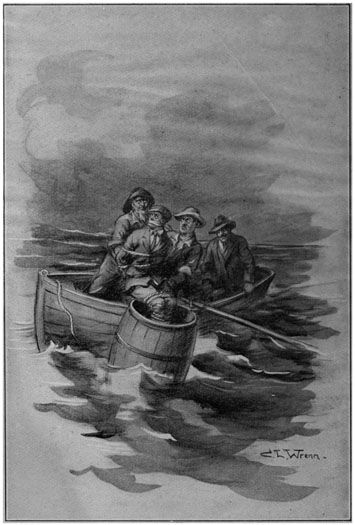
As they crossed the river in a hired boat they
noticed how swiftly the current ran and how discolored
it was. The negro who rowed them commented
on it, too.
“Dey be po’ful big flood befo’ long, genelmen,”
he opined, “an’ when ole man Mississip’ git up
on his hind lags ain’t nuffin’ kin stop him. Dem
lebees dey go jes lak so much straw er hay.”
“All the more reason for our making haste,”
said Dr. Perkins, addressing the others; “it would
be hard fortune indeed if Ben were to be robbed
of his fortune by a flood.”
The shed which had sheltered the Sea Eagle
overnight was close to the water’s edge so that
the goods were soon transported on board. All
was found to be in good shape, and the two darkies,
277
who had watched the air craft overnight, received
an extra gratuity for their pains. The
adventurers had been particular not to give out
any details of their flight, and it was expected
that they would stay in New Orleans for some
days before proceeding, so that no curious crowd,
only a few negroes and stragglers, were on hand
to see them start.
Dr. Perkins had an excellent chart of the river,
showing distinctly the location of Black Bayou,
which lay back from the river amidst a maze of
other wriggly creeks and water courses. The
Belle of New Orleans had been on her way to a
“far back” plantation to pick up cotton, when she
blew up, which accounted for the wreck being
submerged in such an out of the way place.
As they flew along the river, but far above it,
they could see human beings, busy as ants, working
along the levees, strengthening them against
the dreaded floods which already had devastated
whole sections of country in Ohio and farther up
the mighty stream. At length the course of the
278
Sea Eagle was changed till she was flying over a
perfect maze of water courses and bayous, winding
in and out of a dense forest. From above, it
looked like a lace work of water overlying a piece
of dark green plush.
But the map showed a landmark for Black
Bayou. Harry’s plan was marked “Ruined plantation
house and sugar mill.” Frank was the
first to spy out this important “bearing.” The
Sea Eagle was at that time not very far up, and
the gaunt walls and desolate overgrown buildings
of the once prosperous place could be seen clearly.
“Giant cypress with three forks,” was the next
marking, and, sure enough, on a little patch of
an island, not far from the ruined plantation,
they presently saw a gaunt dead tree answering
this description.
“Bayous and bullfrogs! We’re getting hot
now!” cried Pudge excitedly. “Ben, I believe
that that rascal was telling the truth after all.”
“I’m inclined to think so, too, Master Pudge,”
rejoined Ben; “and look—look there—that must
279
be the Catfish Island marked on the plan. See,
it’s just the shape of one of them critters.”
“So it is, Ben,” cried Frank, peering down.
“Goodness, this is exciting, though. Just think,
in a short time we shall know if our flight for a
fortune is——”
“A fizzle or not,” interrupted the slangy
Pudge.
“Right off Catfish Island two points to the
north,” read out Harry.
Dr. Perkins glanced at the compass and
slightly altered the direction of the Sea Eagle;
then he allowed the great craft to drop gently to
rest on the waters of Black Bayou.
Harry referred to the plan again.
“North a hundred yards to the Lone Pine
Island.”
“There it is,” cried Frank, indicating a small
spot of land on which a dead pine reared its bare
trunk.
Hardly had he spoken when a canoe shot round
a bend in a small bayou just ahead of them, and
280
a wild-looking man, who had been paddling it,
checked his frail craft. His unkempt whiskers
covered him almost to his waist, and his clothes
were ragged to a degree. But none of them
thought of this as the swamp dweller so unexpectedly
came into view.
“Is this the Black Bayou?” they cried almost
in chorus.
The other nodded and stared wildly and half
in alarm at the strange-looking craft that confronted
him.
“Oui! Thees Black Bayou,” he rejoined in
soft, broken accents; “what you want, eh?”
“Did you ever hear tell of the Belle of New
Orleans?” asked Ben, in a voice that shook with
suppressed excitement.
To his astonishment the Acadian—for the
weird figure in the boat was one of those strange
dwellers of the cypress swamps—burst into a
loud laugh.
“Oh ho! Oh ho!” he cackled; “what you want
281
wid zee Belle of New Orleans, eh? What you
want weez her?”
Ben hesitated, and before he could reply the
other burst into another weird cackling laugh,
and held up a small object.
“You want zee pearl, zee gold, hey? Zey all
gone! See, I have one. Zee men who come here
two day ago give it me for help zem. Adieu!”
Before anybody on the Sea Eagle could utter
a word the fellow gave a deft stroke of his paddle
and his canoe shot off into the trackless paths of
the swamps.
“Well, what under the sun!” burst out Frank,
while Pudge weakly ejaculated:
“Centipedes and spongecakes!”
“It’s all clear enough,” exclaimed Ben bitterly.
“Those ruffians got ahead of us. That ’Cadian
took them to the scene of the wreck and they’ve
rifled it.”
“That was undoubtedly a black pearl he held
up,” said Dr. Perkins in a faint voice. “I suppose
they gave him that for guiding them here.”
282
The sudden shriek of a high-crested kingfisher
made them look up suddenly. The bird
was darting from tree to tree on an island at a
little distance. Suddenly something that lay at
the foot of a tree caught Ben’s sharp eyes.
“What’s that? That glittering thing yonder?”
he exclaimed, pointing.
“Easy enough to see,” said Dr. Perkins, starting
up the Sea Eagle for the little island.
“It’s a diving helmet!” cried Frank as they
drew closer to the object, “just look, the rascals
must have left it there after they got the treasure
out of the sunken wreck. I guess they
thought that as they were so rich they need not
bother with it.”
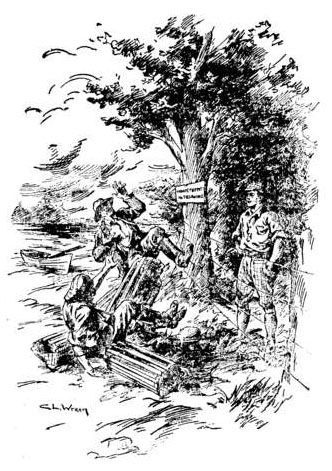
They landed on the island as disconsolate and
downcast a band of treasure hunters as ever set
foot on the site of a treasure trove. Abundant
evidences of a camp were all about them. The
ashes of a fire, and scraps of food and paper.
One of these caught Frank’s attention. It was
a fragment of newspaper, and what had challenged
283
Frank’s notice was that a band of red ink
had been drawn around some printing on it.
Frank read the marked portion with a somewhat
vague curiosity. For the moment he did not
realize what an important clew he had stumbled
upon. Then it rushed upon him with full force.
Ben and the others were on the shore of the
island pointing down into the muddy waters of
the bayou.
The earth was trampled in the vicinity, and
showed plainly that the miscreants who had
stolen the treasure had carried on their operations
from that point of the bank.
“Down thar somewhar’ lies the wreck of the
Belle of New Orleans,” said Ben, shaking his
head dolefully, and pointing into the black current;
“but it ain’t going to do us no good, mates.
It ain’t going to do us no good; them sea skunks
has got ahead of us for fair.”
It was at this point that Frank’s shout interrupted
them.
“What is it?” cried Dr. Perkins.
284
“This paper. Come here. I think it’s a clew
to where they have gone.”
They crowded about him while Frank read out
from the marked paper.
“‘The new South American Commerce Company’s
steamer Buenos Aires sails to-morrow for
the latter port. She is a fast, capable craft and
will make a direct run to the Argentine. The
inauguration of this service is a distinct addition
to the commercial importance of New Orleans
and establishes new trade relations with South
America.’”
“Very pretty,” said Ben; “but what does it
prove?”
“Yes, I don’t see much of a clew in that,” put
in Harry.
But Frank raised his hand to command silence.
“Listen a minute,” he said. “Of course, I may
be altogether wrong, but it seems to me that the
reason this paragraph is marked is because those
fellows meant to sail on this very boat.”
285
Ben brought his hand down on his knee with a
resounding whack.
“By hookey, lad!” he roared; “that’s reason.
That’s solid sense and reason.”
“What is the date of that paper?” asked Dr.
Perkins.
“Luckily the paragraph was torn off from the
top of the page,” said Frank, “and the date of
the issue is legible. It is dated yesterday.”
“Then the Buenos Aires sailed this morning?”
“Yes; that’s the way it looks.”
“And while we are wasting time here she is
heading down the river for the open sea,”
groaned Harry.
“Can’t we wireless to New Orleans and find
out?” asked Pudge.
“That’s a mighty good idea, Pudge,” said his
father, “but the set we have on the Sea Eagle
wouldn’t carry as far as that.”
“Then let’s get on board again and fly back as
quickly as possible. We are only wasting time
here,” said Frank.
286
His suggestion was quickly acted upon, and
the voyagers reëmbarked. They were a very
different party from the pleasantly excited expedition
that had set out that morning so full of
hope and enterprise. Frank alone kept up his
spirits. He sat constantly at the wireless as they
winged their way back to New Orleans, incessantly
trying to get into communication.
At last he caught the operator of the Harbor
Master’s office. Instantly he flashed his
query:
“Did Buenos Aires sail this a. m.?”
“Yes. Ship sailed early to-day.”
“Where will she be now?”
“About off Fort Jackson, near the mouth of
the river,” came the reply. “She has wireless,
but it is out of order, so that I can’t tell you exactly
where she is right now.”
“Thanks!” flashed Frank and disconnected.
He quickly communicated his tidings, and immediately
a hasty, excited consultation followed.
The result of it was that Dr. Perkins decided to
287
ground the Sea Eagle in Algiers. This done, Ben
would swear out a warrant before the most available
justice, and then, if they could find a deputy
nervy enough to make the trip, he was to be taken
on board the Sea Eagle and the Buenos Aires
overtaken before she got beyond the jurisdiction
of the State.
But after landing in Algiers these plans were
changed. It was decided instead to swear out a
federal warrant, as there was grave danger of
the ship getting out of the State’s power before
they could overtake her. On the extraordinary
circumstances being related to him, the U. S.
Commissioner at New Orleans readily granted
the warrant for the arrest of all three of the
rascals. It now remained only to find a Deputy
U. S. Marshal courageous enough to make the
trip through the air.
The only one available seemed a bit doubtful.
“A trip in an aëroplane!” he said. “I’ve never
taken such a journey and I’m scared of the
288
blessed things. You see, I’ve got a wife and
family, and——”
“Don’t be afraid. There’s really no danger,
and we’ll be over water most of the way,” urged
Dr. Perkins.
The deputy seemed to come to a sudden conclusion.
His eyes snapped and his lips tightened.
“All right, I’ll go with you!” he suddenly cried.
“Wait till I ’phone the missus and I’m your man.
Those rascals played you a mean trick, and I’d
like to see you win out.”
The hearts of the adventurers gave a bound
of hope. There was a chance of seeing justice
come into its own, after all.
The Buenos Aires, a fine ship of five thousand
or more tons, dropped rapidly down the river.
She had few cabin passengers, and of these only
three were on deck. The remainder were in their
cabins putting their belongings to rights.
These three men were the elder Daniels, his
289
loutish son and Duval. But they all wore smart
new clothes, and Duval had shaved off his mustache.
As for the two Daniels, it is an example
of what clothes can do to say that they looked
more like prosperous, rather countryfied commission
dealers than rugged fishermen from Maine.
“Let’s have a look at them pearls again,” Daniels
was saying, after he had given a cautious
glance about him to make sure they were not
observed.
Duval reached into his pocket and drew out a
canvas bag. From it he poured out a number of
black, lustrous objects, catching them in a cupped
hand.
“Twenty of the beauties,” he exclaimed;
“twenty black pearls—the rarest gems that come
out of the ocean.”
“What are they worth again?” asked the elder
Daniels, licking his lips anticipatively.
“Thirty thousand dollars at the least.”
“Jiminy! Hold me, some one!” sputtered Zeb.
“And that, counting the gold dust in the cabin,
290
makes a fortune of close upon seventy-five thousand
dollars we got out of that old hulk, don’t
it?”
“That’s right,” answered Duval; “you fellows
did a good day’s work for yourselves when you
knocked me on the head in that hut.”
“Waal, I should say so. Let’s go below and
look at that gold again. I kin hardly keep my
fingers frum touching it. We’re rich, boys, we’re
rich!”
The three worthies disappeared below after
Duval had carefully replaced the black pearls in
their bag. It was some hours later when they
came up again and the ship was passing the Port
Ead’s light.
“We’re safe now,” exclaimed Duval in a low
tone; “even if they do discover the trick we’ve
put up on em, they could never catch us now. In
another two hours we’ll be out on the gulf and by
to-morrow we’ll be out of reach of any one in
Yankeeland.”
291
“Hulloo, what’s up astern?” asked Zeb suddenly.
“What are they all pointing at?”
“Pointing at? What do you mean?” demanded
Duval, suspicious as are most guilty consciences
of anything unusual.
“Something in the sky. Hark! They are
shouting!”
“Something in the sky!”
Duval’s face went white. His knees shook.
By a flash of guilty intuition he had guessed what
that something was, even if the next minute a
shout had not split the air.
“An aëroplane! It’s an aëroplane!”
Duval’s knees quivered under him. He trembled
like a man with the palsy. Old Daniels came
up to him hastily.
“Duval, they’ve sighted one of them airyoplanes—you
don’t think——”
“No, I don’t think. I know,” choked out Duval,
“they are after us. Hark!”
From the distance came the sound of shots
high up in the air. In reply to the signal—for
292
such it was—the Buenos Aires’ whistle emitted
three long, mournful toots. Her engines began
to slow down. As Duval felt the steamer’s speed
check he dashed below to his cabin. As for Daniels,
he stood rooted to the spot, his lips moving,
but no speech coming from them. Zeb was nowhere
to be seen.
Up on the Buenos Aires’ lofty flying bridge
her officers, in the meantime, had been almost
equally excited. They had seen the aëroplane
some time before; but as nowadays such craft
are a fairly common sight, they had not paid
overmuch attention to it. It was not till the
unusual size of the craft was revealed that they
scrutinized it closely.
Then, as the big winged man-bird swung above
the steamer’s masts, had come the quick six pistol
shots. An imperative signal, rightly interpreted
“Stop!”
The whistle had replied and the vessel’s way
been checked as the jangling signals sounded in
293
the engine-room, and “Slow down” flashed up
on the telegraph.
“What do you want?” hailed the captain
through a megaphone, as the Sea Eagle—for of
course our readers have guessed the identity of
the craft of the air—swung above him.
“We want to board you with a United States
warrant!” came the startling reply from midair.
“A warrant! For some of my passengers?”
“Yes; for three men whom we have reason to
believe booked passage as Daniel Maine and son
and another one who calls himself Francis Le
Blanc.”
“I have three such men on board and recognize
the authority of the United States. How will
you board me?”
“We’ll come alongside.”
The captain looked as if he didn’t understand
how this was going to be done, but gave orders
to stop the ship, drop anchor and lower the gangway.
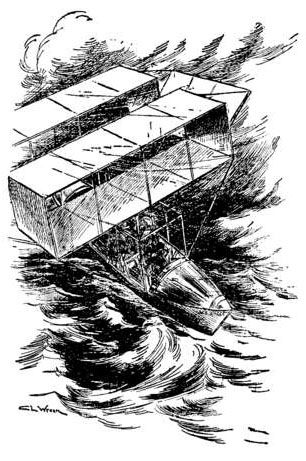
This was done, and the Sea Eagle dropped
to the water alongside with perfect precision. In
294
the meantime, the wildest excitement reigned on
board. Rumors flew thick and fast as to the errand
of the men from the air.
Lest it should be wondered how Dr. Perkins
and his companions knew the names under which
the three rascals had sailed, we had better clear
this matter up. Before embarking in the Sea
Eagle in pursuit of the Buenos Aires, a passenger
list had been obtained from the offices of the
steamship company. It will be recalled that
Francis Le Blanc was the alias, or false name,
which Duval had used when in the employ of
Mr. Sterrett on the yacht Wanderer. This gave
them a clew, and when they came across the
names Daniel Maine and son, booked for an adjoining
cabin, there remained small doubt that
those names concealed the two Daniels.
The Sea Eagle was soon made fast, and Marshal
Howell, followed by Dr. Perkins and the two
Boy Aviators, sprang up the gangway. The
others they had been compelled to leave behind,
295
as, with the three prisoners to carry back, the
Sea Eagle would have been overcrowded.
As they reached the top of the gangway Captain
Stow and his officers advanced to meet them.
“To what am I indebted for the honor of this
visit?” asked the seaman.
The marshal showed his authority and his warrant.
“We don’t wish to detain you longer than necessary,
captain,” he said, “so will you have us
shown to their cabins?”
The captain himself led the way below, and
conducted them down a corridor to the stern of
the ship. As they reached the end of the passage
a door was thrust suddenly open and a bullet
whizzed past Frank’s head. At the same instant
Zeb’s figure appeared in the doorway.
But before he could fire another shot the marshal
had wrested the pistol from him and burst
into the cabin. Frank was close behind him. At
a port hole was Duval; he had something in his
hand and was just about to hurl it out of the
296
port hole, when Frank, in one bound, was at his
side and had his arm captive. With a snarl like
a wounded wild beast Duval turned on him, whipping
out a knife as he did so. But before any
harm could be done, Dr. Perkins seized and disarmed
him.
It was speedily found that the bag which
Frank had saved was the one containing the
black pearls which Duval, in his extremity, had
determined to throw away rather than let any
one else gain their possession. The Marshal
slipped the handcuffs on Zeb and Duval, who
submitted sullenly to arrest. It was not till then
that their thoughts turned to the elder Daniels.
He was not in his cabin, and search of the ship
failed to reveal him. The mystery was soon to
be explained, however.
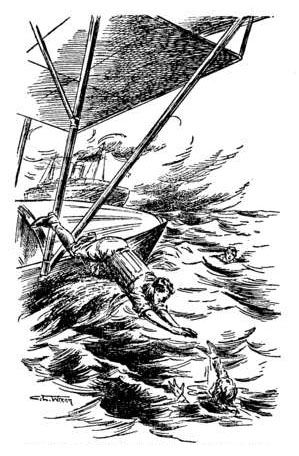
A boat with a colored oarsman had been lying
alongside the steamer waiting to take off the
pilot. In the confusion old Daniels had opened
the bag of gold dust, selected a packet, and, dropping
into the boat, told the negro to row him
297
ashore to secure help for the officers. The negro
naturally supposed that he was acting under
proper instructions, and put the old fisherman
ashore. He was never heard of again.
Zeb and Duval sullenly refused to utter a
word, but ultimately, after their return to New
Orleans, Frank had an interview with Duval in
his prison cell, in which he made a clean breast of
everything. From Bayhaven they had hastened
south by fast trains, stopping on the way to buy
diving dress. The Acadian whom the boys had
encountered in the swamps had guided them to
the scene of the wreck, receiving one black pearl
as his reward.
Of the voyage back from the Buenos Aires
with the two prisoners not much can be said. It
was made at a good rate of speed, and both
Duval and Zeb were docile. Indeed, there was
no use in their being otherwise. On account of
his youth and the pleadings of Dr. Perkins and
the boys, Zeb got a light sentence in a reformatory
institution, and it is hoped that he will prove
298
a far better character when he gets out. Duval
was more severely dealt with, but even he got off
more lightly than he deserved, thanks to the
clemency of the people he had wronged.
And so ends the story of the Boy Aviators’
Flight for a Fortune in the most wonderful aëroplane
constructed up to date. But no doubt, in
the rapid march of events, even the Sea Eagle
will soon be surpassed. Already, while this book
goes to press, plans are being made by no less
than four separate aviators to dare the terrors of
a transatlantic passage. Whether they will succeed
or not is in the lap of the future, but the
author is certain that some day flights across
“The Pond” at seventy or eighty miles an hour
will be so common as to attract but small attention.
Some of my readers doubtless wish to know
how Ben disposed of his fortune. Well, part of
it he wisely invested in real estate, and the rest
he is thinking of putting into the company Dr.
Perkins has formed to manufacture Sea Eagles.
299
Mr. Sterrett is a member of the company, and so
are the Boy Aviators. Naturally Ben’s keen wish
to have them share some of his good fortune was
refused, for, as we know, the Boy Aviators’ adventures
in the past had netted them a good
share of this world’s goods. Billy Barnes is publicity
agent at a good salary for the Sea Eagle
Company, Ltd., and the work just suits his
tastes. As for Pudge, he is as hard a worker as
anybody at the plant on Brig Island, learning
the business “from the bottom up.”
And so, wishing them well in their future undertakings,
we will here take leave for the present
of our friends, until we hear of them again
in the next volume, entitled “The Boy Aviators
with the Air Raiders.”
BOY AVIATORS’ SERIES
By Captain Wilbur Lawton
Absolutely Modern Stories for Boys
Cloth Bound, Price, 50c per volume
The Boy Aviators in Nicaragua
Or, Leagued With Insurgents
The launching of this Twentieth Century series marks
the inauguration of a new era in boys’ books—the
“wonders of modern science” epoch. Frank and Harry
Chester, the Boy Aviators, are the heroes of this exciting,
red-blooded tale of adventure by air and land in
the turbulent Central American republic. The two
brothers with their $10,000 prize aeroplane, the Golden
Eagle, rescue a chum from death in the clutches of the
Nicaraguans, discover a lost treasure valley of the ancient
Toltec race, and in so doing almost lose their own
lives in the Abyss of the White Serpents, and have many
other exciting experiences, including being blown far
out to sea in their air-skimmer in a tropical storm. It
would be unfair to divulge the part that wireless plays
in rescuing them from their predicament. In a brand
new field of fiction for boys the Chester brothers and
their aeroplane seem destined to fill a top-notch place.
These books are technically correct, wholesomely thrilling
and geared up to third speed.
Sold by Booksellers Everywhere
HURST & CO.—Publishers—NEW YORK
BOY AVIATORS’ SERIES
By Captain Wilbur Lawton
Absolutely Modern Stories for Boys
Cloth Bound, Price, 50c per volume
THE BOY AVIATORS ON SECRET SERVICE
Or, Working With Wireless
In this live-wire narrative of peril and adventure,
laid in the Everglades of Florida, the
spunky Chester Boys and their interesting
chums, including Ben Stubbs, the maroon,
encounter exciting experiences on Uncle Sam’s
service in a novel field. One must read this
vivid, enthralling story of incident, hardship
and pluck to get an idea of the almost limitless
possibilities of the two greatest inventions
of modern times—the aeroplane and wireless
telegraphy. While gripping and holding the
reader’s breathless attention from the opening
words to the finish, this swift-moving story is
at the same time instructive and uplifting. As
those readers who have already made friends
with Frank and Harry Chester and their
“bunch” know, there are few difficulties, no
matter how insurmountable they may seem at
first blush, that these up-to-date gritty youths
cannot overcome with flying colors. A clean-cut,
real boys’ book of high voltage.
Sold by Booksellers Everywhere
HURST & CO.—Publishers—NEW YORK
BOY AVIATORS’ SERIES
By Captain Wilbur Lawton
Absolutely Modern Stories for Boys
Cloth Bound, Price, 50c per volume
THE BOY AVIATORS IN AFRICA
Or, An Aerial Ivory Trail
In this absorbing book we meet, on a Continent made
famous by the American explorer Stanley, and ex-President
Roosevelt, our old friends, the Chester Boys and
their stalwart chums. In Africa—the Dark Continent—the
author follows in exciting detail his young heroes,
their voyage in the first aeroplane to fly above the mysterious
forests and unexplored ranges of the mystic land.
In this book, too, for the first time, we entertain Luther
Barr, the old New York millionaire, who proved later
such an implacable enemy of the boys. The story of his
defeated schemes, of the astonishing things the boys discovered
in the Mountains of the Moon, of the pathetic
fate of George Desmond, the emulator of Stanley, the
adventure of the Flying Men and the discovery of the
Arabian Ivory cache,—this is not the place to speak. It
would be spoiling the zest of an exciting tale to reveal
the outcome of all these episodes here. It may be said,
however, without “giving away” any of the thrilling
chapters of this narrative, that Captain Wilbur Lawton,
the author, is in it in his best vein, and from his personal
experiences in Africa has been able to supply a striking
background for the adventures of his young heroes. As
one newspaper says of this book: “Here is adventure in
good measure, pressed down and running over.”
Sold by Booksellers Everywhere
HURST & CO.—Publishers—NEW YORK
BOY AVIATORS’ SERIES
By Captain Wilbur Lawton
Absolutely Modern Stories for Boys
Cloth Bound, Price, 50c per volume
THE BOY AVIATORS TREASURE QUEST
Or, The Golden Galleon
Everybody is a boy once more when it comes to the
question of hidden treasure. In this book, Captain Lawton
has set forth a hunt for gold that is concealed neither
under the sea nor beneath the earth, but is well hidden
for all that. A garrulous old sailor, who holds the key
to the mystery of the Golden Galleon, plays a large
part in the development of the plot of this fascinating
narrative of treasure hunting in the region of the Gulf
Stream and the Sargasso Sea. An aeroplane fitted with efficient
pontoons—enabling her to skim the water successfully—has
long been a dream of aviators. The Chester
Boys seem to have solved the problem. The Sargasso
that strange drifting ocean within an ocean, holding ships
of a dozen nations and a score of ages, in its relentless
grip, has been the subject of many books of adventure
and mystery, but in none has the secret of the ever
shifting mass of treacherous currents been penetrated as
it has in the BOY AVIATORS TREASURE QUEST.
Luther Barr, whom it seemed the boys had shaken off,
is still on their trail, in this absorbing book and with a
dirigible balloon, essays to beat them out in their search
for the Golden Galleon. Every boy, every man—and
woman and girl—who has ever felt the stirring summons
of adventure in their souls, had better get hold of this
book. Once obtained, it will be read and re-read till
it falls to rags.
Sold by Booksellers Everywhere
HURST & CO.—Publishers—NEW YORK
BOY AVIATORS’ SERIES
By Captain Wilbur Lawton
Absolutely Modern Stories for Boys
Cloth Bound, Price, 50c per volume
THE BOY AVIATORS IN RECORD FLIGHT
Or, The Rival Aeroplane
The Chester Boys in new field of endeavor—an attempt
to capture a newspaper prize for a trans-continental flight.
By the time these lines are read, exactly such an offer
will have been spread broadcast by one of the foremost
newspapers of the country. In the Golden Eagle, the
boys, accompanied by a trail-blazing party in an automobile,
make the dash. But they are not alone in their
aspirations. Their rivals for the rich prize at stake try
in every way that they can to circumvent the lads and
gain the valuable trophy and monetary award. In this
they stop short at nothing, and it takes all the wits and
resources of the Boy Aviators to defeat their devices.
Among the adventures encountered in their cross-country
flight, the boys fall in with a band of rollicking cowboys—who
momentarily threaten serious trouble—are attacked
by Indians, strike the most remarkable town of the
desert—the “dry” town of “Gow Wells,” encounter a
sandstorm which blows them into strange lands far to the
south of their course, and meet with several amusing
mishaps beside. A thoroughly readable book. The sort
to take out behind the barn on the sunny side of the haystack,
and, with a pocketful of juicy apples and your heels
kicking the air, pass happy hours with Captain Lawton’s
young heroes.
Sold by Booksellers Everywhere
HURST & CO.—Publishers—NEW YORK
BOY AVIATORS’ SERIES
By Captain Wilbur Lawton
Absolutely Modern Stories for Boys
Cloth Bound, Price, 50c per volume
THE BOY AVIATORS POLAR DASH
Or, Facing Death in the Antarctic
If you were to hear that two boys, accompanying a South
Polar expedition in charge of the aeronautic department,
were to penetrate the Antarctic regions—hitherto only
attained by a few daring explorers—you would feel interested,
wouldn’t you? Well, in Captain Lawton’s latest
book, concerning his Boy Aviators, you can not only read
absorbing adventure in the regions south of the eightieth
parallel, but absorb much useful information as well.
Captain Lawton introduces—besides the original characters
of the heroes—a new creation in the person of Professor
Simeon Sandburr, a patient seeker for polar insects.
The professor’s adventures in his quest are the
cause of much merriment, and lead once or twice to
serious predicaments. In a volume so packed with incident
and peril from cover to cover—relieved with laughable
mishaps to the professor—it is difficult to single out any
one feature; still, a recent reader of it wrote the publishers
an enthusiastic letter the other day, saying: “The
episodes above the Great Barrier are thrilling, the attack
of the condors in Patagonia made me hold my breath,
the—but what’s the use? The Polar Dash, to my mind,
is an even more entrancing book than Captain Lawton’s
previous efforts, and that’s saying a good deal. The aviation
features and their technical correctness are by no
means the least attractive features of this up-to-date
creditable volume.”
Sold by Booksellers Everywhere
HURST & CO.—Publishers—NEW YORK
BOY INVENTORS SERIES
Stories of Skill and Ingenuity
By RICHARD BONNER
Cloth Bound. Illustrated. Price, 50c. per vol., postpaid
THE BOY INVENTORS’ WIRELESS TELEGRAPH.
Blest with natural curiosity,—sometimes
called the instinct of investigation,—favored
with golden
opportunity, and gifted with creative
ability, the Boy Inventors
meet emergencies and contrive
mechanical wonders that interest
and convince the reader because
they always “work” when put to
the test.
THE BOY INVENTORS’ VANISHING GUN.
A thought, a belief, an experiment; discouragement,
hope, effort and final success—this is the history of many
an invention; a history in which excitement, competition,
danger, despair and persistence figure. This merely suggests
the circumstances which draw the daring Boy Inventors
into strange experiences and startling adventures,
and which demonstrate the practical use of their vanishing
gun.
THE BOY INVENTORS’ DIVING TORPEDO BOAT.
As in the previous stories of the Boy Inventors, new
and interesting triumphs of mechanism are produced
which become immediately valuable, and the stage for
their proving and testing is again the water. On the
surface and below it, the boys have jolly, contagious fun,
and the story of their serious, purposeful inventions
challenge the reader’s deepest attention.
Any volume sent postpaid upon receipt of price.
HURST & COMPANY—Publishers—NEW YORK
BORDER BOYS SERIES
Mexican and Canadian Frontier Series
By FREMONT B. DEERING.
Cloth Bound. Illustrated. Price, 50c. per vol., postpaid
THE BORDER BOYS ON THE TRAIL.
What it meant to make an enemy
of Black Ramon De Barios—that is
the problem that Jack Merrill and
his friends, including Coyote Pete,
face in this exciting tale.
THE BORDER BOYS ACROSS THE FRONTIER.
Read of the Haunted Mesa and its
mysteries, of the Subterranean River
and its strange uses, of the value of
gasolene and steam “in running the gauntlet,” and you will
feel that not even the ancient splendors of the Old World
can furnish a better setting for romantic action than the
Border of the New.
THE BORDER BOYS WITH THE MEXICAN RANGERS.
As every day is making history—faster, it is said, than
ever before—so books that keep pace with the changes
are full of rapid action and accurate facts. This book
deals with lively times on the Mexican border.
THE BORDER BOYS WITH THE TEXAS RANGERS.
The Border Boys have already had much excitement
and adventure in their lives, but all this has served to
prepare them for the experiences related in this volume.
They are stronger, braver and more resourceful than ever,
and the exigencies of their life in connection with the
Texas Rangers demand all their trained ability.
Any volume sent postpaid upon receipt of price.
HURST & COMPANY—Publishers—NEW YORK
BUNGALOW BOYS SERIES
LIVE STORIES OF OUTDOOR LIFE
By DEXTER J. FORRESTER.
Cloth Bound. Illustrated. Price, 50c. per vol., postpaid
THE BUNGALOW BOYS.
How the Bungalow Boys received
their title and how they retained the
right to it in spite of much opposition
makes a lively narrative for lively boys.
THE BUNGALOW BOYS MAROONED IN THE TROPICS.
A real treasure hunt of the most
thrilling kind, with a sunken Spanish
galleon as its object, makes a
subject of intense interest at any
time, but add to that a band of desperate men, a dark plot
and a devil fish, and you have the combination that brings
strange adventures into the lives of the Bungalow Boys.
THE BUNGALOW BOYS IN THE GREAT NORTH WEST.
The clever assistance of a young detective saves the boys
from the clutches of Chinese smugglers, of whose nefarious
trade they know too much. How the Professor’s invention relieves
a critical situation is also an exciting incident of this book.
THE BUNGALOW BOYS ON THE GREAT LAKES.
The Bungalow Boys start out for a quiet cruise on the
Great Lakes and a visit to an island. A storm and a band
of wreckers interfere with the serenity of their trip, and a
submarine adds zest and adventure to it.
Any volume sent postpaid upon receipt of price.
HURST & COMPANY—Publishers—NEW YORK
DREADNOUGHT BOYS SERIES
Tales of the New Navy
By CAPT. WILBUR LAWTON
Author of “BOY AVIATORS SERIES.”
Cloth Bound. Illustrated. Price, 50c. per vol., postpaid
THE DREADNOUGHT BOYS ON BATTLE PRACTICE.
Especially interesting and timely
is this book which introduces the
reader with its heroes, Ned and Herc,
to the great ships of modern warfare
and to the intimate life and surprising
adventures of Uncle Sam’s sailors.
THE DREADNOUGHT BOYS ABOARD A DESTROYER.
In this story real dangers threaten
and the boys’ patriotism is tested in
a peculiar international tangle. The scene is laid on the
South American coast.
THE DREADNOUGHT BOYS ON A SUBMARINE.
To the inventive genius—trade-school boy or mechanic—this
story has special charm, perhaps, but to every reader its
mystery and clever action are fascinating.
THE DREADNOUGHT BOYS ON AERO SERVICE.
Among the volunteers accepted for Aero Service are Ned
and Herc. Their perilous adventures are not confined to the
air, however, although they make daring and notable flights
in the name of the Government; nor are they always able
to fly beyond the reach of their old “enemies,” who are also
airmen.
Any volume sent postpaid upon receipt of price.
HURST & COMPANY—Publishers—NEW YORK
FRANK ARMSTRONG SERIES
Twentieth Century Athletic Stories
By MATHEW M. COLTON.
Cloth Bound. Illustrated. Price, 60c. per vol., postpaid
FRANK ARMSTRONG’S VACATION.
How Frank’s summer experience
with his boy friends make
him into a sturdy young athlete
through swimming, boating, and
baseball contests, and a tramp
through the Everglades, is the
subject of this splendid story.
FRANK ARMSTRONG AT QUEENS.
We find among the jolly boys
at Queen’s School, Frank, the student-athlete, Jimmy, the
baseball enthusiast, and Lewis, the unconsciously-funny
youth who furnishes comedy for every page that bears
his name. Fall and winter sports between intensely rival
school teams are expertly described.
FRANK ARMSTRONG’S SECOND TERM.
The gymnasium, the track and the field make the background
for the stirring events of this volume, in which
David, Jimmy, Lewis, the “Wee One” and the “Codfish”
figure, while Frank “saves the day.”
FRANK ARMSTRONG, DROP KICKER.
With the same persistent determination that won him
success in swimming, running and baseball playing, Frank
Armstrong acquired the art of “drop kicking,” and the
Queen’s football team profits thereby.
Any volume sent postpaid upon receipt of price.
HURST & COMPANY—Publishers—NEW YORK
MOTOR RANGERS SERIES
HIGH SPEED MOTOR STORIES
By MARVIN WEST.
Cloth Bound. Illustrated. Price, 50c. per vol., postpaid
THE MOTOR RANGERS’ LOST MINE.
This is an absorbing story of the
continuous adventures of a motor
car in the hands of Nat Trevor and
his friends. It does seemingly impossible
“stunts,” and yet everything
happens “in the nick of time.”
THE MOTOR RANGERS THROUGH THE SIERRAS.
Enemies in ambush, the peril of
fire, and the guarding of treasure
make exciting times for the Motor
Rangers—yet there is a strong flavor of fun and freedom,
with a typical Western mountaineer for spice.
THE MOTOR RANGERS ON BLUE WATER; or, The Secret of the Derelict.
The strange adventures of the sturdy craft “Nomad” and
the stranger experiences of the Rangers themselves with
Morello’s schooner and a mysterious derelict form the basis
of this well-spun yarn of the sea.
THE MOTOR RANGERS’ CLOUD CRUISER.
From the “Nomad” to the “Discoverer,” from the sea to
the sky, the scene changes in which the Motor Rangers figure.
They have experiences “that never were on land or sea,”
in heat and cold and storm, over mountain peak and lost
city, with savages and reptiles; their ship of the air is attacked
by huge birds of the air; they survive explosion and
earthquake; they even live to tell the tale!
Any volume sent postpaid upon receipt of price.
HURST & COMPANY—Publishers—NEW YORK
GIRL AVIATORS SERIES
Clean Aviation Stories
By MARGARET BURNHAM.
Cloth Bound. Illustrated. Price, 50c. per vol., postpaid
THE GIRL AVIATORS AND THE PHANTOM AIRSHIP.
Roy Prescott was fortunate in
having a sister so clever and devoted
to him and his interests that
they could share work and play
with mutual pleasure and to mutual
advantage. This proved especially
true in relation to the manufacture
and manipulation of their aeroplane,
and Peggy won well deserved
fame for her skill and good
sense as an aviator. There were
many stumbling-blocks in their terrestrial path but they
soared above them all to ultimate success.
THE GIRL AVIATORS ON GOLDEN WINGS.
That there is a peculiar fascination about aviation that
wins and holds girl enthusiasts as well as boys is proved
by this tale. On golden wings the girl aviators rose for
many an exciting flight, and met strange and unexpected
experiences.
THE GIRL AVIATORS’ SKY CRUISE.
To most girls a coaching or yachting trip is an adventure.
How much more perilous an adventure a “sky
cruise” might be is suggested by the title and proved by
the story itself.
THE GIRL AVIATORS’ MOTOR BUTTERFLY.
The delicacy of flight suggested by the word “butterfly,”
the mechanical power implied by “motor,” the ability to,
control assured in the title “aviator,” all combined with
the personality and enthusiasm of girls themselves, make
this story one for any girl or other reader “to go crazy
over.”
Any volume sent postpaid upon receipt of price.
HURST & COMPANY—Publishers—NEW YORK
MOTOR MAIDS SERIES
Wholesome Stories of Adventure
By KATHERINE STOKES.
Cloth Bound. Illustrated. Price, 50c. per vol., postpaid
THE MOTOR MAIDS’ SCHOOL DAYS.
Billie Campbell was just the type
of a straightforward, athletic girl
to be successful as a practical
Motor Maid. She took her car, as
she did her class-mates, to her
heart, and many a grand good time
did they have all together. The
road over which she ran her
red machine had many an unexpected
turning,—now it led her
into peculiar danger; now into contact
with strange travelers; and again into experiences
by fire and water. But, best of all, “The Comet” never
failed its brave girl owner.
THE MOTOR MAIDS BY PALM AND PINE.
Wherever the Motor Maids went there were lively times,
for these were companionable girls who looked upon the
world as a vastly interesting place full of unique adventures—and
so, of course, they found them.
THE MOTOR MAIDS ACROSS THE CONTINENT.
It is always interesting to travel, and it is wonderfully
entertaining to see old scenes through fresh eyes. It is
that privilege, therefore, that makes it worth while to join
the Motor Maids in their first ’cross-country run.
THE MOTOR MAIDS BY ROSE, SHAMROCK AND HEATHER.
South and West had the Motor Maids motored, nor
could their education by travel have been more wisely
begun. But now a speaking acquaintance with their own
country enriched their anticipation of an introduction to
the British Isles. How they made their polite American
bow and how they were received on the other side is a
tale of interest and inspiration.
Any volume sent postpaid upon receipt of price.
HURST & COMPANY—Publishers—NEW YORK