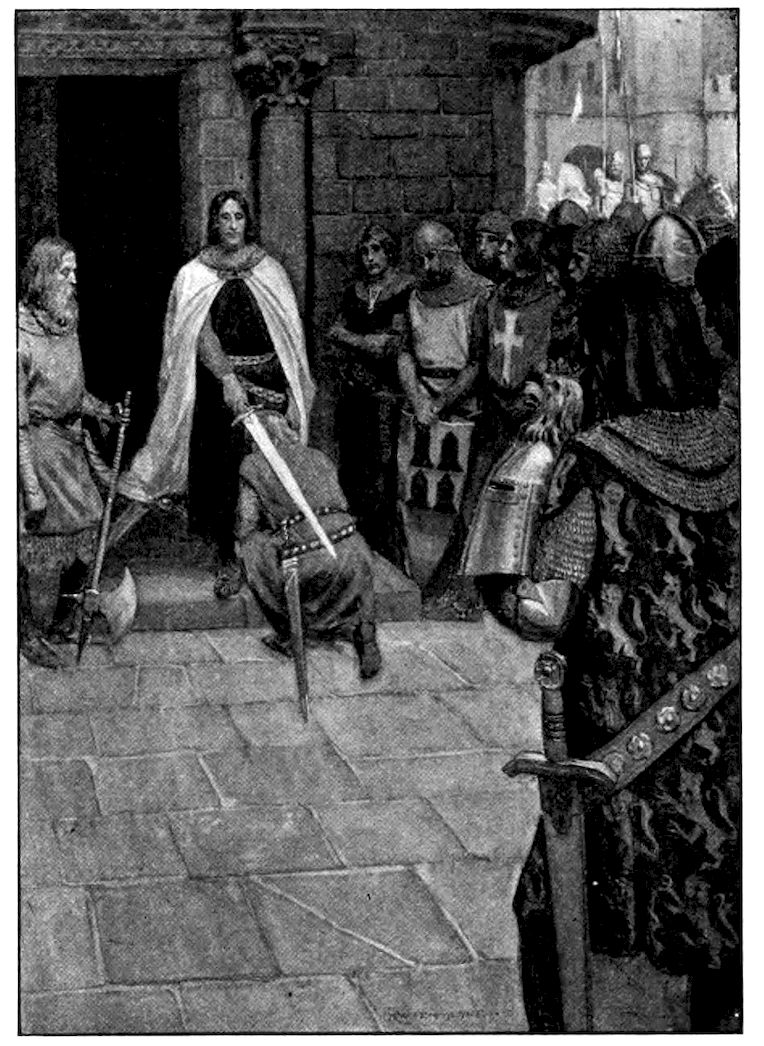
CHAPTER I WHAT THE CHILDREN SAW FROM THE PLAYGROUND ON THE PLATEAU
3
One sunny forenoon in the month of
May, something over six hundred
years ago, some children were playing
under the oak-trees that grew in little
companies here and there in a pleasant
meadow on a high plateau. This meadow
was part of a great table-land overlooking
a wide stretch of country. It was hedged
along the west with white-thorn, setting
it off from the tillage on the other side,
and on the east it dipped to the bank of a
little stream fringed with willows and low
4bushes. The south side descended in a
steep cliff, and up and down its slope the
huts of a little village seemed to climb
along the stony path that led to the plateau.
Farther away lines of dark forest
stretched off out of sight, in solid walls
that looked almost black over against the
bright green of meadow and field and the
rich brown of the tilled land. On all
sides were mountains, covered with trees
or crowned with snow, from which, when
the sun went down, the wind blew chill.
Beyond the stream a highway climbed
the valley, and the children could see,
from their playground, the place where it
issued from the edge of the wood. They
could not follow its windings very far
beyond the plateau, however, for it soon
bent off to the left and wound up a narrow
pass among the hills.
Toward the north, and far overhead,
rose the grim walls and towers of the
great castle that watched the pass and
sheltered the little village on the cliffside.
5Those were rude, stern times, and
the people in the village were often glad
of the protection which the castle gave
from attacks by stranger invaders; but
they paid for their security, from time to
time, when the defenders themselves sallied
forth upon the hamlet and took toll
from its flocks and herds.
It was “the evil time when there was
no emperor” in Germany. Of real rule
there was none in the land, but every man
held his life in his own charge. Knights
sworn to deeds of mercy and bravery, returning
from the holy war which waged
to uphold Christ’s name at Jerusalem,
were undone by the lawlessness of the
times, and, forgetful of all knightly vows,
turned robbers and foes where they should
have been warders and helpers. The
lesser nobles and landholders were become
freebooters and plunderers, while
the common people, pillaged and oppressed
by these, had few rights and less freedom,
as must always be the case with peoples
6or with single souls where there is no
strong law, fended and loved by those
whom it is meant to help.
The children under the oak-trees played
at knights and robbers. Neighboring the
meadow was the common pasture, where
tethered goats and sheep, and large, slow
cattle, stood them as great flocks and
caravans to sally out upon and harry.
Now and again a party would break forth
from one clump of trees to raid their
playmates in a pretended village within
another. Of storming castles, or of real
knights’ play, they knew naught; for they
were of the common people, poor working-folk
sunk to a state but little above thraldom,
and heard, in the guarded talk of
their elders, stories only of the robber
knights’ dark acts, never of deeds daring
and true, such as belong to unspotted
knighthood.
As the whole company lay in make-believe
ambush among the shrubbery near
the edge of the plateau, Ludovic, the oldest
7boy, suddenly called to them to look
where, from the forest, a figure on horseback
was coming out upon the highway.
“See,” Ludovic cried. “Yonder comes
a sightly knight. Look, Hansei, at his
shining armor and his glittering lance.”
“He is none of hereabout,” nodded
Hansei, flashing his wide blue eyes upon
the gleaming figure. “My lord’s men-at-arms
are none so shining fair. Whence
may he be, Ludovic?”
“How should I know?” asked Ludovic,
testily, with the older boy’s vexation when
a youngster asks him that which he cannot
answer.
“Small chance he bringeth good,” added
he, “wherever he be from; but, in any
case, let us lie here until he passes.”
“He weareth a long, ruddy beard,”
said keen-eyed Gretel, as a slight bend in
the road brought the knight full-facing
the group. “Oh, Ludovic,” she suddenly
cried, “what if it should be Barbarossa,
come to help the land again?”
8“Barbarossa!” exclaimed Ludovic,
scornfully. “Old woman’s yarn! Mark
ye, Gretel, Barbarossa will never wake
from his sleep. He has forgotten the land.
My father says God has forgotten it in his
heaven, and how shall Barbarossa remember
it, sleeping in his stone chamber? No;
it is the truth: he will never come.”
“It is no long beard,” said Hansei, who
had been watching eagerly. “’Tis something
that he bears before him at his saddle-peak.”
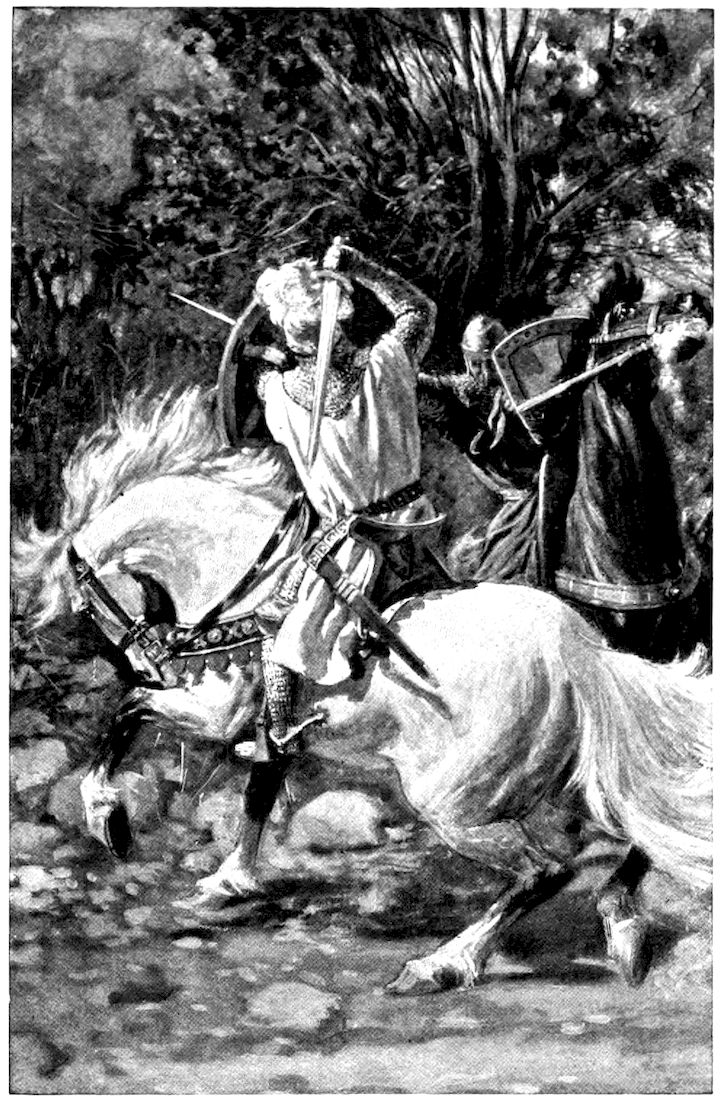
This was indeed true. The shining
stranger, as the children could now
plainly see, held in front of him, on the
saddle-peak, a good-sized burden, though
what it was the young watchers could
not, for the distance, make out. Nevertheless
they could see that it was no
common burden; nor, in truth, was it any
common figure that rode along the highway.
He was still some distance off, but
already the children began to hear the
ring of the great horse’s iron hoofs on
9the stones of the road, and the jangle of
metal about the rider when sword and
armor clashed out their music to the time
of trotting hoofs. As they watched and
harkened, their delight and wonder ever
growing, they suddenly caught, when
the knight had now drawn much closer,
the tuneful winding of a horn.
“THE SHINING STRANGER HELD IN FRONT OF HIM A GOOD-SIZED BURDEN.”
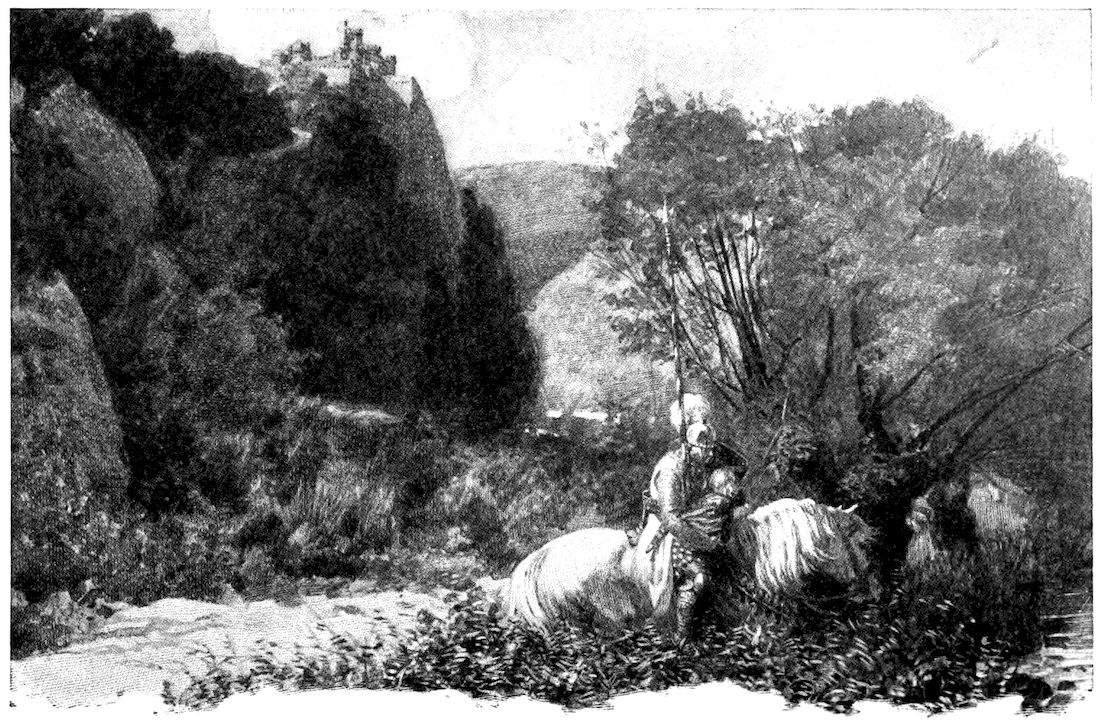
11The rider on the highway heard the
sound as well; but, to the children’s
amaze, instead of pricking forward the
faster, like a knight of hot courage, he
drew rein and turned half-way about, as
minded to seek shelter among the willows
growing along-stream. There was no
shelter there, however, for man or horse,
and on the other hand the narrowing
valley shut the road in, with no footing
up the wooded bluff. When the knight
saw all this, he rode close into the thicket,
and leaning from his saddle, dropped,
with wondrous gentleness, his burden
among the osiers.
12“’Tis some treasure,” murmured Ludovic.
“He fears the robber knights
may get it.”
By now there showed, coming down
the pass, another knight. But the second
comer was no such goodly figure as the
one below. His armor, instead of gleaming
in the sunlight, was tarnished and
stained. His helmet was black and unplumed,
and upon his shield appeared the
white cross of a Crusader. Nevertheless,
albeit of no glistening splendor, he was
of right knightly mien, and the horse
he bestrode was a fine creature, whose
springy step seemed to scorn the road
he trod.
“’Tis a knight from the castle,” the
children said, and Hansei added: “Mighty
Herr Banf, by his white cross. Now there
will be fighting.”
Down below, where the road widened
a bit, winding with a bend of the stream,
the shining stranger sat his horse, waiting,
lance at rest, to see what the black knight
13would do. The moment the latter espied
him he left the matter in no doubt, but
couched his lance and bore hard along
the road, as minded to make an end of
the stranger; whereupon the latter urged
forward his own steed, and the two came
together with a huge rush, so that the
crash of armor against armor rang out
fierce and clear up the pass, and both
spears were shattered in the onset.
Then the two knights fought with their
swords, dealing such blows as seemed to
the children watching enough to fell
forest trees. They wheeled their horses
and dashed at each other again and again,
until the air was filled with the din of
fighting, and the young watchers were
spellbound at the sight.
The shining stranger was a knight of
valor, despite the unwillingness he first
showed. He laid on stoutly with his
blade, so that more than once his foe
reeled in saddle; but the black knight
came back each time with greater fury,
14while the stranger and his horse were
plainly weary.
Especially was this true of the horse.
Eagerly he wheeled and sprang forward
to each fresh charge; but each time he
dashed on more heavily, and more than
once he stumbled, so that his rider missed
a blow, and was like to have come to the
ground through the empty swing of his
sword.
At last the Crusader came on with
mighty force, whereupon his foe charged
again to meet him; but the weary horse
stumbled, caught himself, staggered forward
a pace or two, and came first to his
knees, then shoulder down, upon the
rough stones of the road. The shining
knight pitched forward over his head, and
lay quite still in the highway, while the
Crusader reined in beside him with threatening
blade, and shouted to him to cry
“quits.” But the stranger neither moved
nor spoke; so the other lighted down from
his horse and bent over him to see his face.
15
“PUTTING HORN TO LIP, HE BLEW FOUR GREAT BLASTS.”
17When he had done this he drew back,
and putting horn to lip, blew four great
blasts, which he repeated again and again,
waiting after each to listen.
Presently an answering horn sounded
in the distance, and a little later a party
of mounted men came dashing down the
road from the castle. These clustered
about the fallen knight, and when one
who seemed to be their leader, and whom
the children knew for Baron Everhardt
himself, saw the stranger’s face, he turned
to the victor and for very joy smote him
between the iron-clad shoulders—from
which the children thought that the newcomer
could have been no friend of their
baron.
Then the men stooped and by main
force lifted the limp figure, in its jangling
armor, and set it astride the great horse
that stood stupidly by, as wondering
what had befallen his master. The latter
made no move, but lay forward on the
good steed’s neck, and so they made him
18fast; after doing which, the whole party
turned their faces upward and rode along
toward the castle.
Not until the last sound died away up
the pass did the children come out from
their maze and great awe. They drew
back from the edge of the cliff and looked
wonderingly at one another, for it seemed
to them as if years must have gone by
since they had begun their play on the
plateau. At last Ludovic spoke.
“The treasure is still among the osiers,”
he said. “When night falls, Hansei, thou
and I will slip down across the stream and
find it. There may be great riches there.
But no word about it, for if they knew it
at the castle we should lose our pains.”
Solemnly little Hansei agreed to Ludovic’s
plan, and the children left the
plateau, climbing down the rocky goat-paths
to their homes along the cliff.
CHAPTER II HOW KARL THE ARMORER TOOK THE SHINING KNIGHT’S TREASURE FROM AMONG THE OSIERS
19
The children had scarcely gone from
the plateau when there came down
the defile from the castle a figure unlike,
in manner and attire, any that had but
shortly before gone that road.
This was a tall, broad-shouldered man,
clad in leather that was worn and creased,
showing much hard wear. Over his left
shoulder he carried two great swords in
their scabbards, and his right hand
gripped a long, stout staff, the iron point
of which now and then rang out against
the stone of the road as he thrust his great
arm forward in rhythm with the huge
20stride of his long, leather-clad legs. The
face beneath his hood was brown and
weather-beaten, of long and thoughtful
mold, but turned from overmuch sternness
by the steady, kindly gleam of his
gray eyes, pent in under great brows that
met midway of his forehead, almost hiding
the eyes from sight.
Had the children still been upon the
plateau they would have known the figure
for Karl of the forge in the forest below
the village. He had been, as was often
his errand, to the castle, this time with a
breast-let that he had wrought for the
baron, and was returning with the very
sword wherewith the Herr Banf had made
end of the shining knight, and with that
blade also which had been the stranger’s
own, to make good all hurts to their tempered
edges and fit them for further service
in battle.
He swung along the descending road
until he came over against the place by
the clump of osiers, where the children
21had seen the knight drop his burden.
There he suddenly stopped, and leaned
to listen. He thought that he heard a
faint cry from the green tangle, so he
waited a little space, to learn if it would
sound again. Sure enough, it came a
second time—a feeble, piteous moan,
as of some young creature in distress
and spent with long wailing.
“Now that is a pity,” thought Karl.
“Some wee lamb has slipped off the cliff
and fallen into the stream.”
He looked doubtfully at his burden,
wondering what time it might take him
to go to the rescue; but the little cry
came again, so piteously that his soft
heart would not let him wait longer. So,
leaving the swords behind a boulder, he
plunged in among the osiers; but he had
gone but a step or two when he started
back in dismay, for he had nearly trodden
upon a yellow-haired babe who sat among
the willows, looking up at him with great
blue eyes in which the tears yet stood.
22Terror was in every line of the small face,
but the baby made no further sound. He
only looked earnestly up at the bearded,
black-browed face bent over him, until he
met the armorer’s eyes. Then he reached
up his arms, and Karl stooped and raised
him to his broad chest.
“Now what foul work is here, do you
suppose?” he muttered to himself. “This
is no chick from the village, nor from the
castle either, I’ll be bound, or there’d
have been hue and cry ere this.”
He pressed back the little face that had
been buried against his neck, and surveyed
it sharply. “What is thy name,
little one?” he demanded at last.
At sound of the armorer’s voice the
child again looked at him, and seemed
not to understand the question until Karl
had several times repeated it, saying the
words slowly and plainly, when at last
the baby said, with a touch of impatience:
“Wulf! Wulf!” adding plaintively:
“Wulf hungry!”
23Then he broke down and sobbed tiredly
on Karl’s big shoulder, so that the armorer
was fain to hush him softly, comforting
him with wonderful gentleness, while he
drew from his own wallet a bit of coarse
bread and gave it to the little fellow.
The latter ate it with a sharp appetite,
and afterward drank a deep draught
from the leather cup which Karl filled
from the stream. As he was drinking,
a sound was heard as of some one
passing on the road, whereupon the boy
became suddenly still, looking at Karl in
a way that made the armorer understand
that for some reason it had been taught
him that unknown sounds were a signal
for silence.
“Ay?” thought Karl. “That’s naught
like a baby. He’s been with hunted men,
to learn that trick!”
When the child had eaten and drunk
all he would, he settled down again in
Karl’s arms, asking no questions—if, indeed,
he could talk enough to do so, a
24matter of which the armorer doubted, for
the little chap was but three or four years
old at most. He seemed, however, well
wonted to strangers, and to being carried
from place to place; for he took it kindly
when Karl settled him against his shoulder,
throwing over him a sort of short
cloak of travel-stained red stuff, in which
he had been wrapped as he lay among the
osiers, and stepped out upon the road.
He first made sure that no one was in
sight; then, regaining the swords, he
walked hurriedly forward, minded to leave
the highway as soon as he reached a little
footpath he knew that led through the
forest to his forge.
Good fortune favored him, and he
gained the footpath without meeting any
one; so that ere long the two were passing
through the deep, friendly wood, the
baby fast asleep in Karl’s arms, one small
arm half encircling the armorer’s big neck,
the other little fist clenched in the meshes
of his grizzled beard. Karl stepped softly
25as any woman, lest his charge awaken and
take fresh fright at the gloomy way before
them, and at the tall, dark trees,
whose branches met over the travelers’
heads.
Thus they fared, until at last they
reached the forge, and the hut where the
armorer dwelt alone. The way through
the wood had been long, and the afternoon
was well-nigh spent when Karl laid
little Wulf upon a heap of skins just beyond
the great chimney, and set himself
to prepare food for himself and his charge.
CHAPTER III HOW WULF FARED AT KARL THE ARMORER’S HUT
26
Big Karl the armorer was busy at his
forge, next morning, long before his
wee guest awakened from the deep sleep
of childhood, which he slept upon a pile
of pelts in a corner of the smithy. Working
with deft lightness of hand at a small,
long anvil close beside the forge, Karl
had tempered and hammered the broken
point of Herr Banf’s sword until the stout
blade was again ready for yeoman service,
and then he turned to the stranger
knight’s blade, which was broken somewhat
about the hilt and guard.
It was a good weapon, and as Karl
traced his finger thoughtfully down its
27length he turned it toward the open door,
that the early sunlight might catch it.
Then he suddenly gave a start, and hastily
carried the sword out into the full
daylight, where he stared it over closely
from hilt to point, turning it this way and
that, with knit brows and a look of deep
sorrow on his browned visage. After
that he strode into the smithy, and went
over to where the boy lay, still fast asleep.
Turning him over upon the pelts, he
studied the little face as sharply as he
had done the sword, noting the broad
white brow, the delicate round of the
cheek, and the set of the chin, firm despite
its baby curves; and as he did so a great
sternness came over the face of the
armorer.
“There’s some awful work here,” he
said at last to himself. “Heaven be
praised I came upon the little one!
Would that I might have had a look at
the face of that big knight.”
Still musing, he turned and went to a
28cleverly hid cupboard in the wall beside
the great chimney. Opening this, he disclosed
an array of blades of many sorts
and shapes, and from among these he
took one that in general appearance
seemed the fellow of the stranger’s
weapon, save that it had, to all look, seen
but scant service in warfare.
Karl compared the two, and then set
to a strange task. Hanging the service-battered
sword naked within the cupboard,
he took the new blade and began to ill-treat
it upon his anvil—battering the
hilt, taking a bit of metal from the guard,
and putting nicks into the edge, only to
beat and grind them very carefully out
again. He took a bottle of acid from a
shelf and spilled a few drops where blade
met hilt, wiping it off again when it had
somewhat stained and roughened the steel.
This roughness he afterward smoothed
away, and worked at the sword until he
had it in fair semblance of a hardly used
tool put in good order by a skilful smith.
29This done he sheathed it in the scabbard
which the stranger had worn, and which
was a fair sheath, wrought with gold ornaments
cunningly devised. Karl looked
at it with longing.
“I’d like well to save it for ye, youngster,”
he said; “but ’tis a fair risk as it
stands. Let Herr Ritter Banf alone for
having spied the gold o’ this sheath; it
must e’en go back to him.” He laid the
sheathed weapon away in a chest with
Herr Banf’s own until such time as he
should make his next trip to the castle.
He had hardly done when, turning, he
beheld the child watching him from the
pile of skins, looking at the strange scene
about him, but keeping quiet, though the
tender lips quivered and the look in the
blue eyes filled Karl with pity.
“There’s naught to fear, little one,”
he said with gruff kindness, lifting the
boy from the pile. “I make sure you’re
hungry by now, and here’s the remedy
for that—and for fear, too, of your sort.”
30And from out the coals of the forge he
drew a pannikin, where it had been keeping
warm some porridge.
Very gently he proceeded to give it to
the child, with some rich goat’s milk to
help it along. In truth, however, it needed
not that to give the boy an appetite. He
had eaten nothing the night before, seeming
starved for sleep, but now he ate in a
half-famished way that touched Karl’s
heart.
“In sooth, now,” the latter said, watching
him, “thou’st roughed it, little one,
and much I marvel what it all may mean.
But one thing sure, this is no time to be
asking about the farings of any of thy
breed, so thou shalt e’en bide here with
old Karl till these evil days lighten, or
Barbarossa comes to help the land—if
it be not past helping. It’ll be hard
fare for thee, my sweet, but there’s no
doing other. The castle yonder were
worse for thee than the forge, here, with
Karl.”
31“Karl?” The child spoke with the
fearless ease of one wonted, even thus
early, to question strangers, and to be
answered by them.
“Ay, Karl,” replied the armorer.
“Karl, who will be father and mother to
thee till such time as God sends thee to
thine own again.”
“Good Karl,” said the baby, when the
man ceased speaking, and he reached out
his hands to the armorer. The latter
lifted him and carried him to the forge
door.
“Thou’rt a sturdy rascal,” he said,
nodding approval of the firm, well-knit
little figure. “Sit thou there and finish
the porridge.”
The little fellow sat in the wide door
of the smithy and ate his coarse food with
a relish good to see. It was a rough
place into which he had tumbled—how
rough he was too young to realize; but
much worse, even of outward things,
might have fallen to his share, as, indeed,
32we shall see ere we have finished with
young Wulf.
Deep within the heart of each one of
us, no matter how old, there lives a child.
All our strength, all that the years bring
us of gain or good, help us not at all if
these do not serve to fend this child from
harm, and to keep it good. Big Karl at
his forge knew naught of books, and to
him, in those evil days, had come much
knowledge of the cruelty and wickedness
of evil men. Nevertheless, safe within
his strong nature dwelt the child-soul,
unhurt by all these. It looked from his
honest blue eyes, and put tenderness into
the strength of his great hands when he
touched the other child, and this child-soul
was to be the boy’s playmate through
the years of childhood. A wholesome
playmate it was, keeping Wulf company
cleanly-wise, and no harm came to him,
but rather good.
33
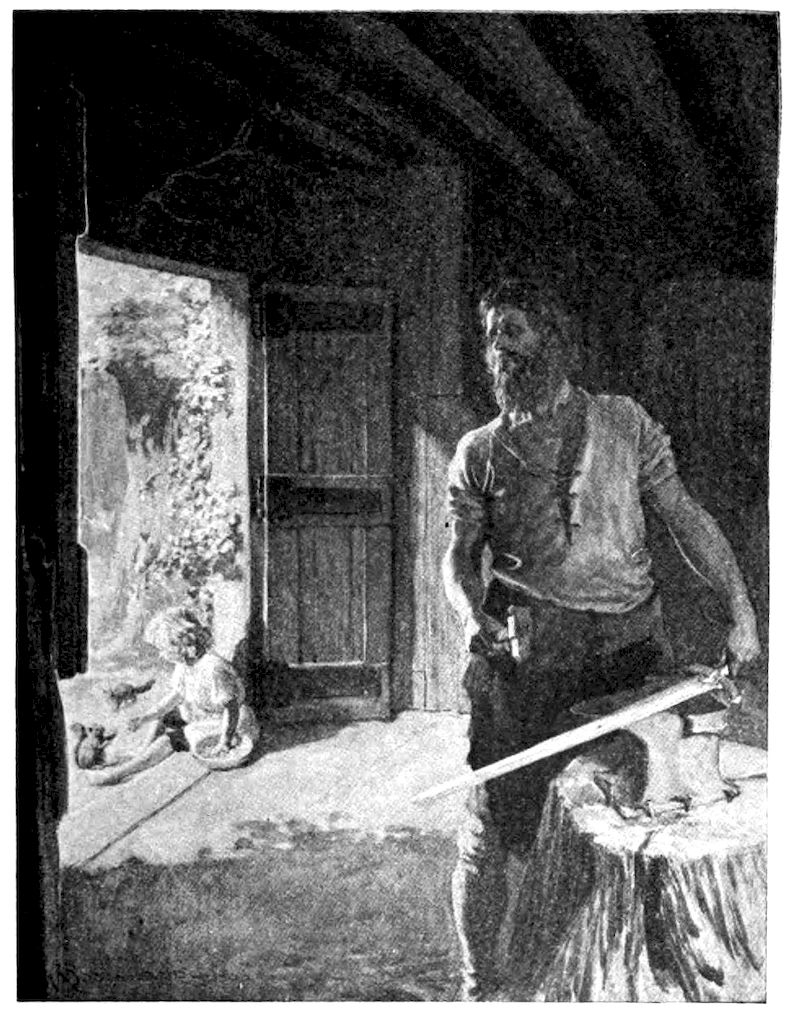
“THE FOREST’S SMALL WILD LIFE CONSTANTLY CAME IN AT THE OPEN DOOR.”
Then, beside the ministering care of
the gentle, manly big armorer, little
35Wulf had through those years the
teaching and companionship of the great
forest. It grew close up about the shop,
so that its small wild life constantly came
in at the open door, or invited the youngster
forth to play. Rabbits and squirrels
peeped in at him; birds wandered in and
built their nests in dark corners; and one
winter a vixen fox took shelter with
them, remaining until spring, and grew so
tame that she would eat bread from Wulf’s
hand.
The great trees were his constant companions
and friends, but one mighty oak
that grew close beside the door, and sent
out its huge arms completely over the
shop, became, next to Karl, his chosen comrade.
Whenever the armorer had to go
to village or castle, Wulf used to take
shelter in this tree; not so much from fear,—for
even in those evil days the armorer’s
grandson, as he grew to be regarded by
those who came about the forge, was
too insignificant to be molested,—but because
36of his love for the great tree. As
he became older he was able to climb
higher and higher among its black arms,
until at last he made him a nest in the
very crown of the wood giant.
Every tree, throughout its life, stores
up within its heart light and heat from
the sun. It does this so well, because it
is its appointed task in nature, that the
very life and love that the sun stands for
to us become a part of its being, knit up
within its woody fiber. When we burn
this wood in our stoves or our fireplaces,
the warmth and blaze that are thrown out
are just this sunshine which the tree has
caught in its heart from the time it was a
tiny seedling till the ax was laid at its
root. So when we sit by the coal fire and
enjoy its genial radiance, we are really
warming ourselves by some of the same
sunlight and warmth that sifted down
through the leaves of great forest trees,
perhaps thousands of years ago.
Of course little Wulf did not know all
37this as we know it, but doubtless he knew
much else that we do not know at all; at
all events, he knew the sunshine of his
own time and his own forest, and into
his sound young heart there crept, as
the years went by, somewhat of the
strength and the sunshine-storing quality
of his forest comrade, until, long before
he became a man, those who knew him
grew to feel that here was a strong,
warm heart of human sunshine, ready to
be useful and comforting wherever use
and comfort were needed.
At first faint memories haunted him;
but as the years passed he learned to
think of them as a part of one of Karl’s
stories—one that he always meant to ask
him to tell again, sometime. The years
slipped away, however, and his childish
impressions grew fainter and fainter, until
at last they had quite faded into the far
past.
But all this came about years after,
and could not possibly have been foreseen
38by Karl the armorer as he stood at
his forge and thought sadly on his own
inability to do all that needed doing for
the little one so suddenly and so strangely
thrust upon his care.
CHAPTER IV OF HOW WULF FIRST WENT TO THE CASTLE, AND WHAT BEFELL
39
For a matter of nine or ten years
Wulf dwelt with Karl at the forge,
and knew no other manner of finding than
if he had been indeed the armorer’s own
grandson, as he was known to those who
took the trouble to wonder, Karl himself
never dissenting to the idea. He was
now a well grown lad of perhaps fourteen
years, not tall, but sturdy, strong of thigh
and arm, good to look at, with a ruddy
color, fair hair, and steady eyes that met
the gaze fearlessly.
Karl had taught him to fence and
thrust, and much of sword-play, in which
the armorer was skilled, and while his
40play at these was that of a lad, the boy
could fairly hold his own with cudgel and
quarter-staff, and more than once had
surprised Karl by a clever feint or twist
or a stout blow, when, as was their wont
on summer evenings, the two wrestled or
sparred together on the short green grass
under the great oak-tree. Also, Wulf
was beginning to be of use at the forge,
and great was his joy when, after repeated
attempts, he at last made for himself a
knife of excellent temper and an edge
which even Karl found good. Thereafter
this knife was his belt companion in all
his woodland journeys.
He was happy, going about his work
with the big armorer, or wandering up
and down the forest, or, of long winter
evenings, sitting beside the forge fire
watching Karl, who used to sit, knife in
hand, deftly carving a long-handled
wooden spoon, or a bowl. The women
in the village were always glad to trade
for these with fresh eggs, or a pat of
41butter, or a young fowl; for the armorer
had as clever a knack with his knife as
with his hammer. On these evenings he
used to fill the boy’s spirit with joy by
tales of knightly craft, and of the brave
gentlemen who, in years past, had ridden
to the holy wars, and of deeds of
gentleness and courage done by brave
knights for country and king and the
truth. Then it was that young Wulf
felt his heart glow within him, and he
longed for the time when he too might
fare out to fight for the good, and to free
the land from the evil that wasted field
and meadow and ground down the people
until no man dared hold up his head or
meet, level-eyed, the gaze of his fellow.
It happened, at last, on a day when
Karl was making ready to go to the castle
with a corselet which he had mended for
the baron himself, that the armorer met
with an accident that changed Wulf’s
whole life. Karl was doing a bit of tinkering
on the smaller anvil by the forge,
42when one support of the iron gave way,
and it fell, crushing the great toe of one
foot so that the stout fellow fairly rocked
with the pain, while Wulf made haste to
prepare a poultice of wormwood for the
hurt member.
Despite all their skill, however, the toe
continued to swell and to stiffen, until it
was plain that all thought of Karl’s
climbing the mountain that day, or for
many days to come, must be put aside.
“There’s no help for it, lad,” he said
at last, as he sat on the big chest scowling
blackly at his foot in its rough swathings.
“It’s well on toward noon now,
and the baron will pay me my wage on
my own head if his corselet be not to
hand to-day; for he rides to-morrow, with
a company from the castle, on an errand
beyond. Thou’lt need to take the castle
road, boy, and speedily, if thou’rt to be
back by night.”
Nothing could have pleased Wulf more
than such an errand; for although he
43often went with Karl on other matters
about the country, and had even gone
with him as far as the Convent of St.
Ursula on the other side of the forest, the
armorer, despite his entreaties, had never
allowed him to go along when his way
lay toward the Swartzburg. This had
puzzled the boy greatly, for Karl steadfastly
refused him any reason why it
should be. In truth Karl could hardly
have given reason even to himself for his
action. His unwillingness to take Wulf
to the castle was, however, really grounded
upon a fear of what as yet unknown
thing might happen.
The boy made all haste, therefore, to
get ready for the journey, lest Karl should
repent of his plan. It was but the shortest
of quarter-hours, in fact, before—his
midday meal in a wallet at his belt, the
armorer’s iron-shot staff in his hand, and
the corselet slung over his shoulder—he
was passing through the wood toward
the road to the Swartzburg.
44Walking with the easy swing of one
well wonted to the exercise, it was not so
very long ere he had cleared the forest
and was stepping up the rough stone road
that climbed the mountain pass to the
castle. He crossed the stream at a point
very near the clump of willows below the
plateau where, years before, the children
had watched the shining knight’s encounter
with Herr Banf. Other children
played on the plateau, as the little ones
had done that fair morning, but Wulf
hastened on, mindful only of the new adventure
that lay before him.
Up and up the stony way he trudged
stoutly, until it became at last the merest
bridle-path, descending to the open moat
across which the bridge was thrown. On
a tower above he descried the sentry, and
below, beyond the bridge, the great gates
into the castle garth stood open.
Doubting somewhat as to what he ought
to do, he crossed the bridge and passed
through the gloomy opening that pierced
45the thick wall. Once inside, he stood
looking about him curiously, forgetful, in
his wonder and delight at the scene, that
Karl had told him to ask for Gotta Brent,
Baron Everhardt’s man-at-arms, and to
deliver the corselet to him. This, by now,
he had slipped from his shoulder and held
with his arm thrust through its length,
his fingers grasping its lower edge.
He was still without the inner wall of
the castle, in a sort of courtyard of great
size, the outer bailey of the stronghold.
Beyond where he stood he could see a
second wall with big gates similar to the
one through which he had just passed.
Before these gates in the outer court two
young men were fencing, while a third
stood beside them, acting as a sort of
umpire or judge of fence. The contestants
were very equally matched, and Wulf
watched them with keenest enjoyment.
He had fenced with Karl, and once or
twice a knight, while waiting at the forge,
had deigned to pass the time in crossing
46blades with the boy, always to the latter’s
discomfiture; but he had never before
stood by while two skilled men were at
sword-play, and the sight held him
spellbound.
Thanks to Karl, he was familiar with
the mysteries of quart and tierce and
all the rest, and followed with knowing
delight each clever feint and thrust, made
with the grace and precision of good
fence. He could watch forever, it seemed
to him; but as he stood thus, following
the beautiful play, out through the gate
of the inner bailey came three children—a
girl a year or two younger than he,
and two boys about his own age.
He gave them but the briefest glance,
for just at that moment the players began
a new set-to, and claimed his attention.
In a little bit, however, he felt a sharp
buffet at side of the head, and, turning,
saw that one of the boys had thrown the
rind of a melon so as to strike him on the
cheek. As Wulf looked around, both
47the boys were laughing; but the little girl
stood somewhat off from them, her eyes
flashing and her cheeks aglow as with
anger. She said no word, but looked
with great scorn upon her companions.
“Well, tinker,” called the boy who
had thrown the melon-rind, “mind thy
manners before the lady! Have off thy
cap or thou’lt get this,” and he grasped
the other half-rind of melon, which the
second boy held.
“Nay, Conradt!” the little maid cried,
staying his hand. “The lad is a stranger,
and come upon an errand; do we treat
such folk thus?”
Wulf’s cap was by now in his hand,
and, with crimson cheeks, he made a shy
salutation to the little girl, who returned
it courteously, while the boys still laughed.
“What dost thou next, tinker?” the
one whom she had called Conradt said,
strutting forward. “Faith, thy manners
sorely need mending. What dost to
me?”
48“Fight you,” said Wulf, quick as a
flash, and then drew back, abashed; for,
as the boy came forward, he saw that he
bore a great hump upon his twisted back,
while one of his shoulders was higher
than the other.
The deformed boy saw the motion, and
his face grew dark with rage and hate.
“Thou’lt fight me?” he screamed,
springing forward. “Ay, that thou
shalt, and rue it after, tinker’s varlet
that thou art!” And with his hand he
smote Wulf upon the mouth, whereupon
he dropped the corselet and clenched his
fists, but could lay no blow on the pitiful
creature before him. Seeing this, the
other, half crazed with anger, drew a
short sword which he wore, and made at
Wulf, who raised the armorer’s staff
which he still held and struck the little
blade to the ground.
By now the two fencers and their umpire
were drawn near to see the trouble,
and one of them picked up the sword.
49“Come, cockerel,” he said, restoring it
to him, “put up thy spur and let be.
Now, lad, what is the trouble?” and he
turned sharp upon Wulf.
“’Tis the armorer’s cub,” he said to
his companions as he made him out.
“By the rood, lad, canst not come on a
small errand for thy master without
brawling in this fashion in the castle yard?
Go do thy message and get about home,
and bid thy master teach thee what is due
thy betters ere he sends thee hither again.”
“Yon lad struck me,” Wulf said
stoutly. “I’ve spoken no word till
now.”
“Truly, Herr Werner,” put in the little
girl, earnestly, “it is as he says. Conradt
has e’en gone far out of his way to
show the boy an ill will, though he has
done naught.”
At this Herr Werner looked again
upon Conradt. “So, cockerel,” he said.
“Didst not get wisdom from the last
pickle I pulled thee out of?”
50“Why does the fellow hang about
here, then?” demanded Conradt, sulkily.
“Let him go to the stables, as he should,
and leave his matter there.”
“I was to see Gotta Brent,” Wulf said,
ignoring Conradt and speaking to the
young knight.
“See him ye shall,” was the reply. But
anything further that Herr Werner might
have said was cut short by the sound of
a great hue and cry of men, and a groom
ran through the gate shouting:
“Back! Back for your lives! The
foul fiend himself is loose here!”
At his heels came half a dozen men,
with stable forks and poles, and two
others who were hanging with all their
weight upon the bridle-reins of a great
horse that was doing his best to throw
off their hold, rearing and plunging furiously,
and now and again lashing out
with his iron-shod hoofs.
There was a hurrying to shelter of the
group about Wulf, who stood alone now,
51staring at the horse. The latter finally
struck one of the grooms, so that the
fellow lay where he rolled, at one side of
the court, and then began a battle royal
between horse and men.
One after another, and all together, the
men tried to lay hold upon the dangling
rein, only to be bitten, or struck, or tossed
aside, as the case might be, until at last
the huge beast stood free, in the middle
of the court, while the grooms and stable-hangers
made all haste to get out of the
way, some limping, others rubbing heads
or shoulders, and one nursing a badly
bitten arm.
“Tinker,” called the knight from behind
an abutment of the wall, “art clean
daft? Get away, before he makes a meal
off thee! Gad! ’twill take an arrow
to save him now; and for that any man’s
life would be forfeit to Herr Banf.”
There was a scream from the little girl;
for the horse had spied Wulf, and came
edging toward him, looking wild enough,
52with ears laid back and teeth showing, as
minded to make an end to the boy, as,
doubtless, he was. For the life of him
Wulf could not have told why he was not
afraid as he stood there alone, and with
no weapon save the armorer’s staff, which
he had not time to raise ere the beast was
upon him.
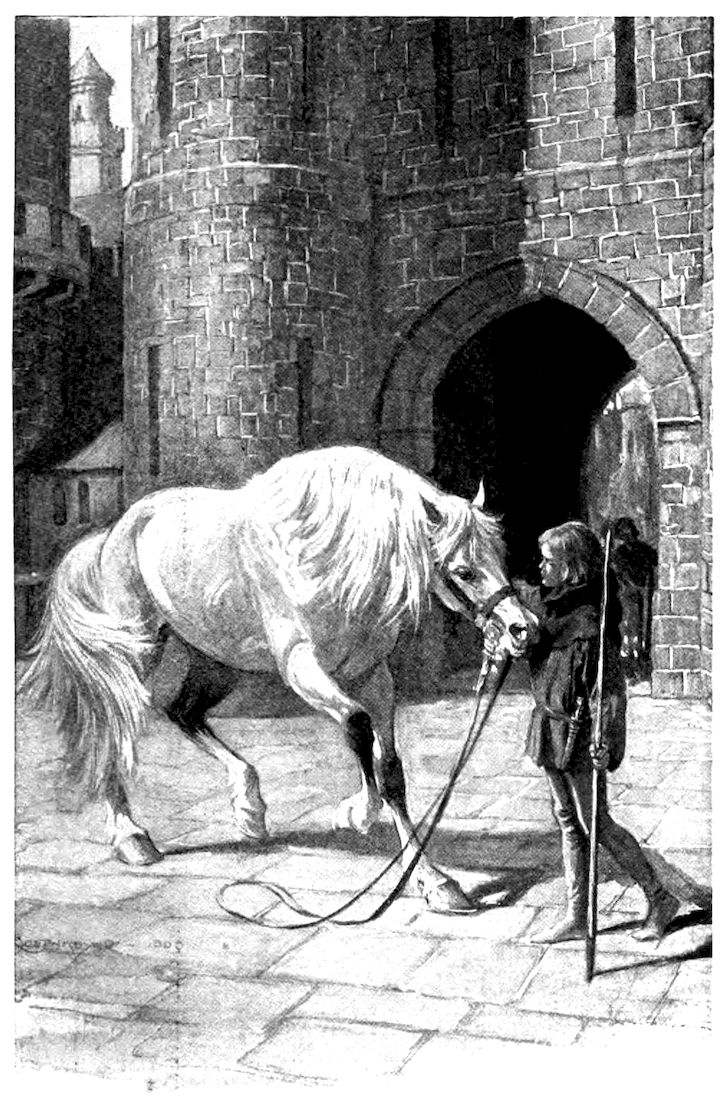
Then were all who looked on amazed
at what they saw, for close beside Wulf
the horse stopped and began smelling the
boy. Then he took to trembling in all
his legs, and arched his neck and thrust
his big head against Wulf’s breast, until,
half dazed, the boy raised a hand and
began patting the broad neck and stroking
the mane of the charger.
“By the rood,” cried one of the grooms,
“the tinker hath the horseman’s word,
and no mistake! The old imp knows it.”
53
“THE BOY BEGAN PATTING THE BROAD NECK OF THE CHARGER.”
“See if thou canst take the halter,
boy,” called Herr Werner; and laying a
hand upon the rein, Wulf stepped back a
pace, whereupon the horse pressed close
55to him and whinnied eagerly, as if fearful
that Wulf would leave him. He
smelled him over again, thrusting his muzzle
now into Wulf’s hands, now against
his face, and putting up his nose to take
the boy’s breath, as horses do with those
they love.
“By my forefathers!” cried Herr Werner.
“Could Herr Banf see him now—aha!”
He paused; for, hurrying into the courtyard,
followed by still another frightened
groom, came a knight who, seeing Wulf
and the horse, stood as if rooted in his
tracks. Softly now the charger stepped
about the boy, nickering under his breath,
so low that his nostrils hardly stirred;
and at last he brought his knees to the
pave, stooping meekly, as one who loved
a service he would do, and thus waited.
An instant Wulf stood dazed. Then
he passed his hand across his forehead;
for a strange, troubled notion, as of some
forgotten dream, passed through his brain.
56At last, obeying some impelling instinct,
that yet seemed to him like a memory, he
laid a hand upon the horse’s withers and
sprang to his back.
Up, then, rose the noble creature, and
stepped about the courtyard, tossing his
head and gently champing the bit, as a
horse will when he is pleased.
“Ride him to the stables, boy, and I
will have word with thee there,” cried the
older knight, who had come out last; and
pressing the rein, though still wondering
to himself how he knew what to do, Wulf
turned the steed through the inner gate,
to the bailey, and letting him have his
head, was carried proudly to the stables,
whence the throng of grooms and stable-boys
had come rushing. They came to
the group of outbuildings and offices that
made up the stables, followed by all the
men, Herr Banf in the lead, and the place,
which had been quite deserted, was immediately
thronged, attendants from the castle
itself coming on a run, as news spread
57of the wonderful thing that was happening.
Once within the stable-yard, the horse
stood quiet to let Wulf dismount; but not
even Herr Banf himself would he let lay
a hand upon him, though he stood meek
as a sheep while the boy, instructed by
the knight, did off the bridle and fastened
on the halter; then he led his charge into
a stall that one of the lads pointed out to
him, and made him fast before the manger.
When this was done the horse gave a rub
of his head against Wulf, and then turned
to eating his fodder, quietly, as though he
never had done otherwise.
Then Herr Banf took to questioning
Wulf sharply; but the boy could tell him
but little. Indeed, some instinct warned
him against speaking even of the faint
thoughts stirring within him. He was
full of anxiety to get away to Karl and
tell him of this wonderful new experience,
and he could say naught to the knight,
save that he was Karl the armorer’s
58grandson, that he had never had the care
of horses, and in his life had backed but
few, chiefly those of the men-at-arms who
rode with their masters to the forge when
Karl’s skill was needed. He was troubled,
too, about Karl’s hurt, of which he
told Herr Banf, and begged to be let to
hasten back to the smithy.
“Go, then,” said Herr Banf, at last,
“and I will see thy grandsire to-morrow;
thou’rt too promising a varlet to be left
to grow up an armorer. We need thy
kind elsewhere.”
So, when he had given the nearly forgotten
corselet to Gotta Brent, Wulf fared
down the rocky way to the forge, where
he told Karl all that had chanced to him
that day.
“Let that remain with thee alone, boy,”
the armorer said, when the boy had told
him of the strange memories that teemed
in his brain. “These are no times to talk
of such matters an thou ’dst keep a head
on thy shoulders. Thou’rt of my own
59raising, Wulf; but more than that I cannot
tell thee, for I do not know.” And
there the lad was forced to let the matter
rest.
“It is all one with my dreams,” he said
to himself, as he sought his bed of skins.
“Mayhap other dreams will make it
clearer.”
But no dreams troubled his healthy
boy’s sleep that night, nor woke he until
the morning sun streamed full in his
upturned face.
CHAPTER V HOW WULF WENT TO THE SWARTZBURG, AND OF HIS BEGINNING THERE
60
It was maybe a week after Wulf’s visit
to the Swartzburg that Herr Banf
rode through the forest to the smithy.
He was mounted upon the great stallion
that had been so wild that day, and as
he drew rein before the shop the horse
gave a shrill neigh, for he smelled Wulf.
Karl’s foot was by so far recovered that he
was able to limp about the forge, and he
and the boy were busy mending a wrought
hauberk of fine chain mail which the lady
superior of St. Ursula had sent to them
that morning.
“A fair day, friend Karl,” the knight
called out as he sat his horse under the
61big oak-tree. “Here am I come for that
youngster of thine. He is too useful a
scamp to be let spend his days tinkering
here. Haply he has told ye how this big
Siegfried of mine took to him. I’ faith,
not a groom at the castle can handle the
horse!”
“Ay?” said Karl, and he said no more,
but stood with hands folded upon the top
of his hammer and looked steadily at
Herr Banf. Wulf, meanwhile, had dropped
the tongs that he held, and run out to the
horse, who now stood nuzzling his neck
and face in great delight.
“By th’ rood,” cried Herr Banf, “’tis
plain love at first sight! Came another
so near Siegfried’s teeth, and I’d look to
see him eaten. I must have the boy,
Karl!”
Now, that great horse was none other
than the one which the shining knight
had bestrode on the day of his meeting
with Herr Banf. The Crusader had taken
the beast for his own charger, and a rare
62war-horse he was, but getting on in years
by now, and turning wild at times, after
the manner of his kind. Not a groom or
stable-lad about the castle but had reason
to know his temper; so that, because of
their fear of him, the horse often lacked
for care.
When Herr Banf had said that Wulf
must come with him, Karl stood silent for
a moment, watching the lad at Siegfried’s
head; then, turning to the knight, he said:
“In truth, they seem fast friends.
Well, it shall be as the boy shall choose.”
“For what he says I will undertake,”
the knight said, laughing. “Wilt come
to the castle, lad?”
Wulf looked from the horse to Karl
and back again. ’Twere easy to see
where his desire lay.
“Shall I be able to see Grandsire Karl
now and then?” he asked.
“As often as need be,” said Herr Banf.
“What shall I say?” Wulf turned to
Karl.
63“What thou wilt,” the armorer nodded.
“We have talked o’ that.”
So had they, and Wulf’s question was
but the last wavering of the boy’s heart,
loath to leave all it had yet known. In
another moment his will regained its
strength, and the matter ended in his taking
again the climbing road up the Swartzburg
pass, this time with a hand clinging
to Herr Banf’s stirrup-leather, while the
great horse stepped gently, keeping pace
with the boy’s stride.
“Where didst learn to bewitch a horse,
lad?” the knight asked as they journeyed.
“What is thy ‘horseman’s word’?”
“I have none,” was the reply. “The
horse seemed to know me, and I him. I
cannot tell how or other.”
“By my forefathers, but beasts be
hard to understand as men! What was’t
thou didst, by the way, to the little crooked
cock at the castle?”
“Him they call Conradt, Herr Knight?
I did naught.”
64“Well, he means to fight thee for it.”
“Nay,” replied Wulf, “that he’ll
not.”
“How is that?”
“It would not be becoming for me to
fight him.”
“So,” Herr Banf said grimly. “Thou’st
a good idea of what is due thy betters.”
“It is not that,” explained Wulf, simply.
“I am the better of us two; a whole
man goes not against a weakling.”
The knight looked keenly down at the
lad, noting as he had not done before the
easy movement of his body as he stepped
lightly along, more like a soldier than like
a peasant. He was alert and trim, with
shapely shoulders and the head carried
well up.
“A queer armorer’s lad, this,” thought
Herr Banf, in some wonder. But by
now they were before the castle watch-tower,
and in a moment more, still with
one hand at the knight’s stirrup, Wulf
again entered at the castle gate. There,
65in the outer bailey, Herr Banf lighted
down, and bade Wulf take Siegfried to
the stables for the night.
A crowd of grooms were about the
gates of the stable-yard as the boy came
up, for the word had spread that the
tinker had returned to take charge of the
big horse, and dark looks were bent upon
the newcomer.
“Shall I do with him as before?” Wulf
asked of one of the loungers.
“That thou ’lt find out for thyself,”
was the surly answer, whereupon the
other fellows laughed jeeringly.
Nothing daunted, Wulf proceeded to
do off Siegfried’s harness, amid the rude
comments of the grooms, and by dint of
using all his wit he managed to get the
horse haltered and in stall.
Then he climbed to the loft and threw
down some hay into the manger, as Karl
had been mindful to tell him how, after
which he found a measure and started in
quest of the corn-house. The boys followed
66at his heels, helping none, but getting
great sport out of his hunt.
He found the place at last, and climbed
the steps, still pursued by the jeering
grooms. Heeding them naught, he walked
along the corn-house floor, peering into
the different bins, wondering from which
to take the horse’s feed. At last he came
to one about half full, and this he deemed
to be the one he sought; so he sprang
upon the edge and leaned forward to fill
his measure.
No sooner had he done so than he felt
himself pushed from behind, and over he
shot, head foremost, into the grain. Turning
about in the yielding stuff, he rose to
his feet just in time to be struck full in
the forehead by the heavy lid of the bin;
for the cowardly varlets slammed it down
upon him and ran off to the horse-barn.
Not one of them turned back, and for
any effort of theirs it might have gone
hard with Wulf; for he lay stunned and
helpless, slowly smothering in the tight
67bin. Nor did he know when the lid was
suddenly thrown back and a stern, wrathful
man leaned over the edge to lift him
out into the air. Then the man took him
over his shoulder as if he had been a sack
of meal, and carried him down the corn-house
steps.
Into the horse-barn he bore him, and
laid him upon the floor. The stable-boys
were still there, and then the newcomer
proceeded to score as one in authority,
as indeed he was; for this was the master
of the horse himself who now bent over
Wulf, chafing his hands and doing what
he could to bring him back to life; and
so well did he work that ere long the boy
sat up and looked about him until he
presently remembered what was toward.
“Siegfried has not had his corn,” he
said faintly; but the master of horse
bade him be quiet.
“Thou, Hansei,” he said to the youngest
of the boys who stood about, “get
the measure and give the stallion his feed;
68and mind how thou goest about him. As
for ye others, get to work for a set of
black imps as ye are; and be thankful
that ye hang not, every rapscallion of ye,
for this foul trick.”
Picking up a billet of oak from where
it lay on the floor, he hurled it among the
group, who scattered, dodging this way
and that, as every boy went to his own
neglected task.
As for Wulf, he lay upon the barn
floor and watched Hansei care for Siegfried,
who was quiet enough now that the
armorer’s lad was with him. The lad
Hansei was the same who had played
with the others on the plateau on that
day when the shining knight rode up the
pass. Well was it for our boy that the
honest young peasant took a liking to
him, and was minded to stand his friend,
for he had else scarce found comfort at
the castle.
It was Hansei who at supper-time
took him into the great hall where the
69household and its hangers-on gathered
for meals, and got for him a trencher
and food; though little cared Wulf for
eating on that first night when all was
new and strange to him.
The hall was very large, and Wulf,
looking up toward its lofty roof, could
not see its timbers for the deep shadows
there. At either end was a great fireplace,
but the one at the upper end was
the larger and finer. Near it, on a platform
raised above the earthen floor,
Baron Everhardt sat at board, with the
knights of his train. Below them were
the men-at-arms and lower officers of the
castle; and seated upon benches about the
walls were the fighting-men and general
hangers-on of the place.
These sat not at board, but helped themselves
to the food that was passed about
among them after the tables were served,
and ate, some from their hands, others
from wooden trenchers which they had
secured. Wulf and Hansei were among
70the lowliest of the lot, and the stable-boys
did not sit down at all, but took their
supper standing, leaning against the wall
just inside the door and farthest from the
hearth, and they were among the last
served.
But, as we have seen, Wulf cared little,
that night, for food or drink, though his
new friend pressed him to eat. He was
sore-hearted and weary, what with the
strangeness and the hardness of it all.
Soon the great tankards began to pass
from hand to hand; and the men drank
long and deep, while jests and mighty
laughter filled all the place, until only
Wulf’s sturdy boy’s pride kept him from
stealing out, through the darkness, back
to Karl at the forge.
Presently, however, he began to notice
faces among the company at the upper
end of the hall. Two or three ladies
were present, having come in by another
door when the meal was well over, and
these were sitting with the baron and
71Herr Banf. One of the ladies, Hansei
told him, was the baron’s lady, and with
her, Wulf noticed, was the little girl
whom he had seen at the time of his first
visit to the castle.
“Who is she?” he asked.
“A ward of our baron’s,” Hansei answered,
“and she is the Fräulein Elise von
Hofenhoer. They say she is to be married,
in good time, to young Conradt; and
that be a sorry weird for any maiden.”
“Conradt?”
“Yea; the crooked stick yonder, the
baron’s precious nephew.”
Following Hansei’s glance, Wulf descried
the hunchback boy of his adventure
seated at board, drinking from a
great mug of ale. With him was the
other boy, who, Hansei told him, was
Waldemar Guelder, and some kin to Herr
Banf, in whose charge he was, to be
trained as a knight.
“He’s not such a bad one,” the stable-boy
said, “an it were not for Master
72Conradt, who would drag down the best
that had to do with him.”
Thus, one by one, Hansei pointed out
knights and followers, squires and men,
until in Wulf’s tired brain all was a jumble
of names and faces that he knew not.
Glad indeed was he when at last his companion
nodded to him, and slipping out
from the hall, they made their way to the
horse-barn, where, up under the rafters of
a great hay-filled loft, the pair made their
beds in the fragrant grasses, and slept
soundly until the stamping of horses below
them, and the sunlight streaming into
their faces through an open loft door,
awakened them.
CHAPTER VI HOW CONRADT PLOTTED MISCHIEF, AND HOW WULF WON A FRIEND
73
It was perhaps a matter of six weeks
after Wulf’s coming to the Swartzburg
that he sat, one day, in a wing of
the stables, cleaning and shining Herr
Banf’s horse-gear. He was alone at the
time, for all of the younger boys and
hangers-on of the place were gone about
the matter of a rat-catching trial between
two rival dogs whose bragging owners
had matched them; and of the others, most
had ridden with the baron on a freebooting
errand against a body of merchants
known to be traveling that way with rich
loads of goods and much money. Only
Herr Werner, of all the knights, was at
the castle.
74Save for Hansei, who stood by him
stoutly, Wulf had as yet made no friends
among his fellow-workers, but full well
had he shown himself able to take his
own part; so that his bravery and prowess,
and his heartiness to help whenever
a lift or a hand was needed, had already
won him a place and fair treatment among
them. Moreover, his quick wit and craft
with Siegfried, the terror of the stables,
made the master of horse his powerful
friend. And, again, Wulf was already
growing well used to the ways of the
place, so that it was with a right cheerful
and contented mind that he sat, that day,
scouring away upon a rusty stirrup-iron.
Presently it seemed to him that he
heard a little noise from over by the
stables, and peering along under the arch
of the great saddle before him, he saw a
puzzling thing. Crossing the stable floor
with wary tread and watchful mien, as
minded to do some deed privily, and fearful
to be seen, was Conradt.
75“Now what may he be bent upon?”
Wulf asked of his own thought. “No
good, I’ll lay wager!” And he sat very
still, watching every movement of the
little crooked fellow.
Down the long row of stalls went the
hunchback, until he reached the large
loose box where stood Siegfried. The
stallion saw him, and laid back his ears,
but made no further sign of noting the
newcomer. Indeed, since Wulf had been
his tender the old horse had grown much
more governable, and for a month or
more had given no trouble.
Conradt’s face, however, as he drew
nigh the stall, was of aspect so hateful
and wicked that Wulf stilly, but with all
speed, left his place and crept nearer,
keeping in shelter behind the great racks
of harness, to learn what might be toward.
As he did so he was filled with amaze and
wrath to see the hunchback, sword in
hand, reach over the low wall of the stall
and thrust at Siegfried. The horse shied
76over and avoided the blade, though, from
the plunge he made, Wulf deemed that
he had felt the point.
While the watcher stood dumfounded,
wondering what the thing might mean,
Conradt sneaked around to the other side,
plainly minded to try that wickedness
again, whereupon Wulf sprang forward,
snatching up, on his way, a flail that lay
to his hand, flung down by one of the
men from the threshing-floor.
“Have done with yon!” he called as he
ran; and forgetting, in his wrath, both the
rank and the weakness of the misdoer, he
shrieked: “What is’t wouldst do? Out
with it, ere I husk thy soul from its shell
with this!” and he raised the flail.
Taken unaware though he was, Conradt,
who was rare skilful at fence, guarded
on the instant, and by a clever twist of
his blade cut clean in twain the leather
hinge that held together the two halves
of the flail. ’Twas a master stroke
whereat, angry as he was, Wulf wondered,
77nor could he withhold a swordsman’s
delight in the blow, albeit the sword’s
wielder was plain proven a ruffian.
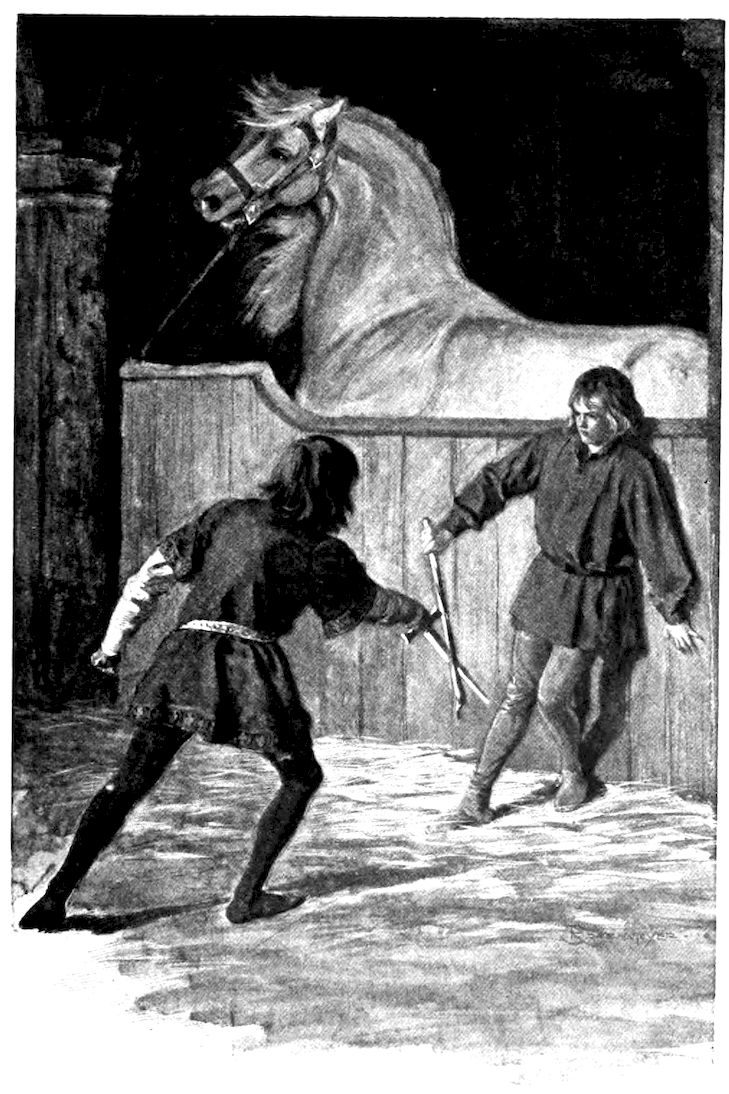
“WULF COULD NAUGHT BUT FEND AND PARRY WITH HIS STICK.”
79He had small time to think, however,
for by now Conradt let at him full drive,
and he was sore put to it to fend himself
from the onslaught, having no other
weapon than the handle of the flail.
Evil was in the hunchback’s eyes as
he pressed up against his foe, and evil
lay at his heart as well, as Wulf was not
slow to be aware. The latter could
naught but fend and parry with his stick;
but this he did with coolness and skill, as
he stood back to wall against the stall,
watching every move of that malignant
wight with whom he fought.
Up, down, in, out, thrust, parry, return!
The sounds filled the barn. Wulf
was the taller and equally skilled, but
Conradt’s weapon gave him an advantage
that, but for the blindness of his hatred,
had soon won his way for him. But soon
he was fair weary with fury, and Wulf
80began to think that he would soon make
end of the trouble, when he felt a sharp
prick, and something warm and wet began
to trickle down his right arm, filling
his hand. Conradt saw the stain and
gave a joyful grunt.
“One for thee, tinker,” he gasped, his
breath nigh spent. “I’ll let a little more
of thy mongrel blood ere I quit.”
“An thou dost,” cried Wulf, stung to
a fury he seldom felt, “save a drop for
thyself. A little that’s honest would not
come amiss i’ the black stream in thy
veins.” And he guarded again as Conradt
came on.
This the latter did with a rush, at which
Wulf sprang aside, and ere his foe could
whirl he came at him askance, catching
his sword-hand just across the back of
the wrist with the tip of his stick, so that
for an instant Conradt’s arm dropped, and
the point of his blade touched the floor.
’Twas a trick in which Wulf felt little
pride, though fair enough, and he did not
81follow up the advantage, knowing he had
his enemy beaten for the time.
The hunchback stood glaring at Wulf,
but ere he could move to attack again a
voice cried: “Well done, tinker. An ye
had a blade our cockerel had crowed
smaller, and I had missed a rare bit of
sport.”
On this both boys turned, for they knew
that voice; and Herr Werner came forward,
not laughing now, as mostly he
was, but with a sterner look on his
youthful face than even Conradt had
ever seen.
“Now, then, how is this?” he demanded
of Wulf. “What is this brawl
about?”
The boy met Werner’s eyes frankly.
“He had best tell,” he said, nodding
toward Conradt.
“Suppose, then, thou dost”; and Herr
Werner looked at the hunchback, who,
his eyes going down before the knight’s,
lied, as was his wont.
82“He came at me with the flail, and,”
he added, unable to withhold bragging,
“I clipped it for him.”
“And what hadst done to make him
come at thee?”
“I did but look at the horses, and stood
to play with old Siegfried, here. ’Tis
become so that my uncle the baron himself
may yet look to be called to account
by this tinker’s upstart.”
The stern lines about Herr Werner’s
mouth grew deeper.
“Heed thou this, Conradt,” he said,
with great earnestness. “Yonder was I,
by the pillar, and saw this whole matter.
What didst plan ill to the stallion for?”
“The truth is, not to have him hereabout,”
muttered Conradt, his face dark
with fear and anger. “These be my
uncle’s stables, and this great beast hath
had tooth or hoof toll from every one
about the place.”
“True, i’ the main,” Herr Werner said
scornfully. “Is this why the baron hath
83made thee master of the horse? Shall I
tell him with what zeal thou followest
thy duties?”
Conradt’s face was fair distorted now;
fear of his uncle’s wrath was the one
thing that kept the wickedness of his evil
nature in any sort of check, and well he
knew how bitter would be his taste of
that wrath should this thing come to the
baron’s ears. So, too, knew Herr Werner,
and, in less manner, Wulf; for his keen
wit had taught him much during his six
weeks’ service at the castle.
“What shall I say to the baron of
this?” demanded Herr Werner again, as
he towered above them.
“I care not,” muttered Conradt, falsely;
but Wulf said:
“Need aught be said, Herr Werner?
I hold naught against him, save for Siegfried’s
sake,”—with a loving glance over
at the great horse,—“and ’tis not likely
he’ll be at this mischief again.”
“What say, thou fine fellow?” asked
84the young knight of Conradt; but the
latter said no word.
“Bah!” cried Herr Werner, at last.
“Why, the tinker lad is a truer man than
thou on every showing; get hence, that I
waste on thee no more of the time should
go to his wound,” he added; for Wulf,
in moving his arm, had suddenly flinched
and his face was pale. In another moment
Herr Werner had the hurt member in
hand, and as he was, like most men of that
rude time, somewhat skilled in caring for
wounds, he had soon bandaged this one,
which was of no great extent, but more
painful than serious, and was quickly eased.
Meanwhile Conradt had moved off,
leaving the two alone. Though it would
never be set to his credit, his malice had
wrought a good work; for in that hour
our Wulf got himself a strong and true
friend in the young knight, who was fair
won by the sterling stuff that showed in
the lad.
“He hath more of knightliness in him
85here in the stables,” thought he, as he
left Wulf, “than Conradt will ever know
as lord of the castle; and, by my forefathers,
he shall have what chance may
be mine to give him!”
And that vow Herr Werner never
forgot.
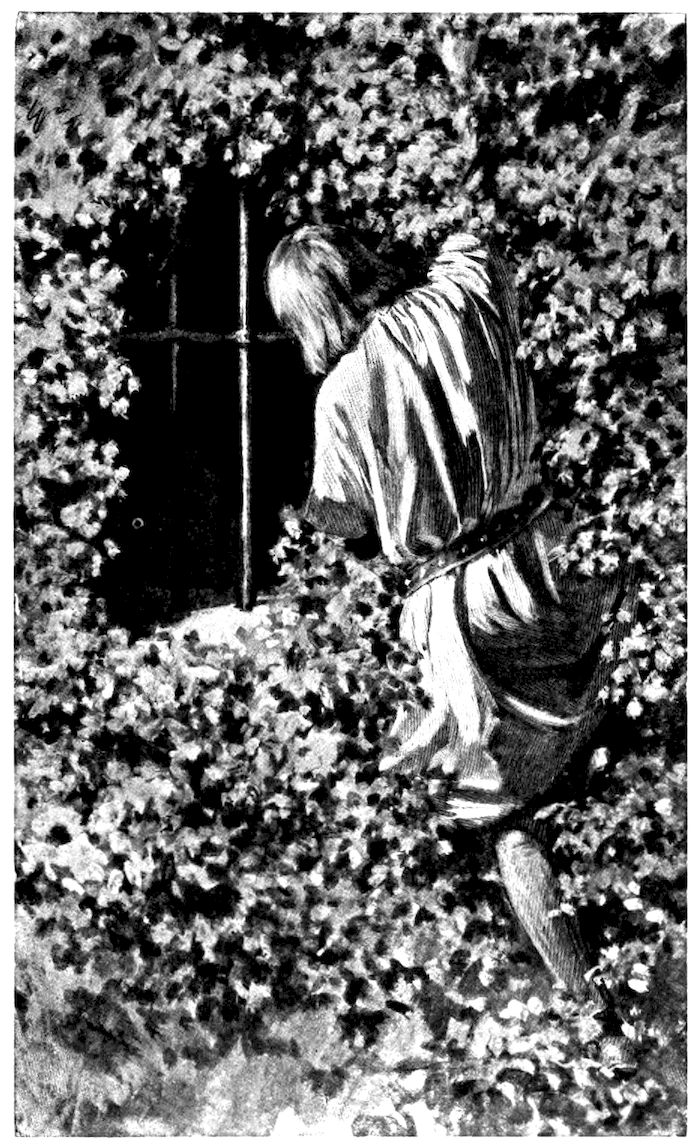
CHAPTER VII HOW WULF CLIMBED THE IVY TOWER, AND WHAT HE SAW AT THE BARRED WINDOW
86
Good as his word had Herr Werner
been in finding Wulf the chance to
show that other stuff dwelt in him than
might go to the making of a mere stable-lad.
For the next three years he was
under the young knight’s helping protection,
and, thanks to the latter’s good
offices in part, but in the end, as must
always be the case, with boy or man,
thanks to his own efforts, he made so
good use of his chance that his tinker
origin was haply overlooked, if not forgotten,
by those left behind him as he
mounted height by height of the castle’s
life.
87Not that these forgave him his rise.
Those small, mean souls had sought the
hurt of the boy, but, when all was said
and done, ’twas hard to hold hatred of
such a nature as his. The training of old
Karl and of the forest had done its work
well with him, and he was still the simple,
sunny-hearted Wulf of the forge, ever
ready to help, forgiving even where
forgiveness was unsought, and keeping
still, amid all the foulness and wickedness
of that dark time and in that evil place,
the clean, wholesome child nature that
had dwelt in the baby among the osiers.
He was by now a sturdy, broad-chested
young fellow, getting well on to manhood,
noted for his strength, and for his
skill in all the games and feats of prowess
and endurance that were a part of the
training of boys in those days. Already
had he ridden with Herr Werner in battle,
and though no real armiger, by reason of
his lowly birth, yet was he, in the disorder
of the times, unchallenged as the knight’s
88chosen attendant and buckler-bearer on
the lawless raids on which the baron led
his train. Indeed, the baron himself had
more than once taken note of the youth,
and had on two occasions made him his
messenger on errands both perilous and
nice, calling for wit as well as bravery.
Only Conradt hated him still—Conradt,
with the sorry, twisted soul that held to
hatred as surely as Wulf held to love.
He was a year or two older than Wulf,
and was already a candidate for knighthood;
for, despite his crooked body, he
was skilled, beyond many who rode in
his uncle’s following, in all play at arms.
There was no better swordsman even
among the younger knights, and among
the bowmen he had already a name.
Despite all this, however, the baron’s
nephew was held in light esteem, even
among that train of robbers and bandits—for
naught better were they, in truth, despite
their knighthood and their gentlehood.
They lived by foray and pillage,
89and petty warfare with other bands like
themselves, and in many a village were
dark stories whispered of their wild raids.
Yet none of these would hold fellowship
with Conradt, albeit they dared not
openly flout the baron’s nephew. Nevertheless,
he had gathered to himself a
manner of following from the villages
and countryside about the Swartzburg:
criminals and refugees, for the most part,
men who had suffered for their misdeeds
at the hands of such law as was in the
land; fellows whom no other leader would
own, but who gladly fell in under a headship
as bad as they. These ranged the
forest wide and far, and from their evil
raids was no poor man free nor helpless
woman safe.
Well knew the baron, overlord of all
that district, of the doings of his doughty
nephew; but for reasons of his own he
saw fit to wink at them, save when some
worse infamy than common was brought
to his notice in such fashion that he could
90not pass it by. He were a brave man,
however, who could dare the baron’s
wrath so far as to complain lightly to him
of Conradt, so the fellow went for the
most part scot-free of his misdeeds, save
so far as he might feel the scorn and
shunning of his equals.
It was on a bright autumn afternoon
that a company of the boys and younger
men of the Swartzburg were trying feats
of strength, and of athletic skill, before
the castle, in the inner bailey. From a
little balcony overlooking the terrace the
ladies of the household looked down upon
the sports, to which their presence gave
more than ordinary zest. Among the
ladies was Elise, now grown a fair maiden
of some fifteen years. Well was she
known to be meant by the baron for the
bride of his nephew; but this knowledge
among the youths of the place did not
hinder many a quick glance from wandering
her way, and already had more than
one young squire chosen her as the lady
91of his worship, for whose sake he pledged
himself, as the manner of the time was, to
deeds of bravery and high virtue.
The contestants in the courtyard had
been wrestling and racing; there had
been tilts with the spear, and bouts with
the fists, and some sword-play, when at last
one of the number challenged his fellows
to a climbing trial of the hardest sort.
Just where the massive square bulk of
the keep raised its grim stories, a great
buttress thrust boldly out from the castle,
running up beside the wall of the tower
for a considerable distance. The two
were just enough apart to be firmly
touched, on either side, by a man who
might stand between them, and it was a
mighty test of courage and strength for
a man to climb up between them, even a
few yards, by hand and foot pressure
only. It was a great feat to perform
among the more ambitious knights and
squires about the castle.
The challenger on this afternoon was
92young Waldemar Guelder, Herr Banf’s
ward, now grown a stalwart squire; and he
raised himself, by sheer strength of grip
and pressure of foot and open hand against
the rough stones, up and up, until he
reached the point, some thirty feet above
ground, where the buttress bent in to the
main wall again, and gave no further support
to the climber, who was fain to come
down by the same way as he went up.
Shouts of “Well done! Well done!”
greeted Waldemar’s deed when he reached
the ground, panting, but flushed with
pride, and looked up toward the balcony,
whence came a clapping of fair hands and
waving of white kerchiefs in token that
his prowess had been noted.
Then one after another made trial of
the feat; but none, not even Conradt,
who was accounted among the skilfulest
climbers, was able to reach the mark set
by young Guelder, until, last of all, for
he had given place time after time to his
eagerer fellows, Wulf’s turn came.
93He too glanced up at the balcony as he
began the ascent, and Elise, meeting his
glance, smiled down upon him. These two
were good friends, in a frank fashion little
common in that time, when the merest
youths deemed it their duty to throw a
tinge of sentimentality into their relation
with all maids.
Conradt noted their glances, and glowered
at Wulf as the latter prepared to
climb. No sneer of his had ever moved
Elise to treat “the tinker” with scorn.
Indeed, Conradt sometimes fancied that
her friendship for Wulf was in despite of
him and of the mastership he often tried
to assert over her. That, however, was
impossible to an honest nature like Elise.
She was Wulf’s friend because of her
hearty trust in him and liking for him,
and so she leaned forward now, eager to
see what he might do toward meeting
Waldemar’s feat.
Steadily Wulf set hands and feet to
the stones, and braced himself for the
94work. Reach by reach he raised himself
higher, higher, until it was plain to all
that he would find it no task to climb
where the champion had done.
“He’ll win to it!” cried one and then
another of the watchers, and Waldemar
himself shouted out encouragement to the
climber when once he seemed to falter.
At last came a cry from Hansei: “He has
it! Hurrah!” and a general shout went
up. From the balcony, too, came the
sound of applause as Wulf reached the
top of the buttress.
“In truth, our tinker hath mounted in
the world,” sneered Conradt from the
terrace. “Well, there’s naught more
certain than that he’ll come down again.”
Wulf heard the words, as Conradt
meant he should, and caught, as well, the
laugh that rose from some of the lower
fellows. Then a murmur of surprise
went through the company.
The walls of the keep were overgrown
with ivy, so that only here and there a
95mere shadow showed where a staircase
window pierced the stones. In the recess
where the young men were wont to climb
the vines were torn down, but above the
buttress, over both keep and castle, the
great branches grew and clung, reaching
clean to the top of the tower; and Wulf,
unable to go farther between the walls,
was now pulling himself up along the
twisted ivy growth that covered the face
of the tower.
On he went, minded to reach the top
and scale the battlement. It was no such
great feat, the lower wall once passed,
but none of the watchers below had ever
thought to try it, so were they surprised
into the more admiration, while in the
balcony was real fear for the adventurous
climber.
He reached the top in safety, however,
and passing along the parapet just below
the battlement, turned a corner and was
lost to their sight.
On the farther side of the keep he
96found, as he had deemed likely, that the
ivy gave him safe and easy support to the
ground, so lowering himself to the vines
again, he began the descent.
He had gone but a little way when,
feeling with his feet for a lower hold, he
found none directly under him, but was
forced to reach out toward the side to get
it, from which he judged that he must be
opposite a window, and lowering himself
farther, he came upon two upright iron
bars set in a narrow casement nearly
overgrown with ivy. Behind the bars all
seemed dark; but as Wulf’s eyes became
wonted to the dimness, he became aware,
first of a shadowy something that seemed
to move, then of a face gaunt, white, and
drawn, with great, unreasoning eyes that
stared blankly into his own.
97
“LOWERING HIMSELF FARTHER, HE CAME UPON A NARROW CASEMENT NEARLY OVERGROWN WITH IVY.”
He felt his heart hammering at his ribs
as he stared back. The piteous, vacant
eyes seemed to draw his very soul, and a
choking feeling came in his throat. For
a full moment the two pairs of eyes gazed
99at each other, until Wulf felt as if his
heart would break for sheer pity; then
the white face behind the bars faded back
into the darkness, and Wulf was ware
once more of the world without, the yellow
autumnal sunshine, and the green
ivy with its black ropes of twisted stems,
that were all that kept him from dashing
to death on the stones of the courtyard
below.
So shaken was he by what he had seen
that he could scarcely hold by his hands
while he reached for foothold. Little by
little, however, he gathered strength, and
came to himself again, until by the time
he reached the ground he was once more
able to face his fellows, who gathered
about, full of praise for his feat.
But little cared our Wulf for their acclaim
when, glancing up toward the balcony,
he caught the wave of a white hand.
His heart nearly leaped from his throat, a
second later, as he saw a little gleam of
color, and was aware that the hand held
100a bit of bright ribband which presently
fluttered over the edge of the balcony and
down toward the terrace.
It never touched earth. There was a
rush toward it by all the young men,
each eager to grasp the token; but Wulf,
with a leap that carried his outstretched
hand high above the others, laid hold
upon the prize and bore it quickly from
out the press.
“’Tis mine! Yield it!” screamed
Conradt, rushing after him.
“Nay; that must thou prove,” laughed
Wulf, and winning easily away from the
hunchback, he ran through the inner
bailey to his own quarters, whence, being
busy about some matters of Herr Werner’s,
he came forth not until nightfall.
At that time Conradt did not see him;
for the baron had summoned his nephew
to him about a matter of which we shall
hear more.
CHAPTER VIII HOW BARON EVERHARDT WAS OUTLAWED, AND HOW WULF HEARD OF THE BABY IN THE OSIERS
101
One bright morning, not long after
Wulf had climbed the ivy tower,
there came to the Swartzburg a herald
bearing a message whereat Baron Everhardt
laughed long and loud. So also
laughed the youngerlings of the place,
when the thing came to be noised among
them; albeit two or three, and in especial
Wulf and Hansei, who was now head
groom, laughed not, but were sore
troubled.
The baron had been declared an outlaw.
For an emperor now ruled in Germany,
and good folk had begun to dare hope
102that the evil days might be drawing to a
close. The new emperor was none other
than Rudolf of Hapsburg, he who had
been count of that name, and since coming
to the throne he had bent his whole
mind and strength to the task of bringing
peace and good days to the land, and
order and law within reach of the unhappy
common folk whose lives were
now passed in hardship and fear.
To this end the Emperor Rudolf had
early sent to summon all of the barons
and the lesser nobles of the land to come
to his help against the rebel counts Ulric
and Eberhard of Würtemberg, who had
joined with King Ottakar of Bohemia to
defy the new ruler. The head of the
Swartzburg had been summoned, with
the others, but, filled with contempt for
“the poor Swiss count,” as he dubbed the
emperor, had defied him, and tore up the
summons before the eyes of the herald
who brought it.
Nevertheless, in spite of the refusal of
103nearly all the nobles to aid their emperor,
the latter had, with his own men, gone
against the two rebel counts and their
kingly ally, and had beaten their armies
and brought them to sue for peace. Now
he was turning his attention to the larger
task of putting fear of the law and of
rightful authority into the hearts of the
robber nobles.
Of these a goodly number were already
declared outlaws, and now the
baron’s turn had come. Moreover, one
of the men of the Swartzburg, who had
ridden beyond the mountains on a matter
for the Herr Banf, had ridden back with
word that the emperor, with a strong
army, was already out against the outlawed
strongholds, and meant soon to
call at the Swartzburg.
“And a warm welcome shall we give
this new emperor of ours,” boasted Conradt,
on the castle terrace. “Emperor,
forsooth! By the rood! Count Rudolf
will have need of all his Swiss rabble if
104he would bring the Swartzburg’s men to
knee before him!”
A chorus of assent greeted this speech.
For once his hearers listened respectfully
to the baron’s nephew. Right eager
were all the young men for the fray that
was threatening; and so great was their
contempt for the emperor that they could
see for it but one outcome.
“But that his Austrians were in revolt
and his army divided,” declared one,
“King Ottakar had never yielded to the
Swiss. He of Hapsburg will find it a
harder matter to yoke the German barons.”
And all his hearers nodded assent to the
bragging speech.
What Baron Everhardt, at council with
his knights, thought of the outlook, not
even Conradt, among those on the terrace,
rightly knew; but a few hours later, by
orders sent out through the stewards and
the masters of arms and horse, the routine
of the castle was being put upon a war footing,
to the joy of the eager young men.
105All were busy, each at his own line of
duty, in the work of preparation for battle,
and, to Wulf’s delight, it fell to his lot to
fare down the valley to the forge on an errand
for Herr Werner, whose man he was.
It was a matter of some weeks since
Wulf had seen Karl, and glad was he
now to be going to him; for in his own
mind he was sore perplexed in this matter
of the new emperor’s proclamation of the
baron, and he longed for the armorer’s
wise and honest thought about it all.
“Thou hast seen this emperor of ours?”
he said, as he sat curled, after his childish
wont, in the doorway of the smithy,
whence he could look, at will, within at
the forge, or without adown a long green
aisle of the forest.
“Ay,” said Karl, proudly; “his own
man-at-arms was I, as thou knowest, and
that was on the holy war. Served him have
I, and gripped his hand—the hand of an
honest man and a sore needed one in this
land to-day.”
106“Dost think he can master the barons?”
the boy asked, and Karl looked troubled.
“These be ill times for thought, boy,”
he said, “and worse for speech; but the
emperor is ruler in the land, and if he
bring not order into our midst, then in
truth are the scoffers wise, and God hath
forgotten us up in heaven.”
“Would I were of his train!” Wulf
said quickly, and silence fell between
them, during which the boy sat gazing,
with troubled eyes, adown between the
black trunks of the great trees. Karl,
watching him, gathered rightly that he
was worried as to his duty.
“An he be in truth the emperor by
will of the people, and not alone of him
at Rome,” Wulf added at last, “then
are all true men who love Germany
bound to come to his banner.”
“Ay.” Karl thrust the iron he was
welding deep into the glowing coals of
the forge.
“But I am of the Swartzburg’s men;
107and how may I be an honest one and
fail at this moment when every blade is
needed?”
“’Tis hard,” Karl said, “and that only
thine own heart can teach thee.” He
brought his hammer down upon the glowing
iron till it sent out a shower of sparks.
“No man may show another what honest
action may be; but perhaps thou’rt nearer
being the emperor’s man than the baron’s,
were the truth known. An I guess rightly,
’twere ill faring if one of thy line raised
blade against Rudolf of Hapsburg.”
The armorer muttered this half in his
beard, nor looked at Wulf as he spoke.
“Nay, Karl,” the boy cried sharply;
“make me no more riddles, but speak out
plainly, man to man. What is this that
thou hast ever held from me? What
meanst thou by any line of mine?”
“Alas!” said the armorer, sadly.
“Naught know I, in truth, and there’s
the heartbreak. ’Tis a chain of which
some links are missing, and ill work is it
108to make that blade fitten again. Would
to God I did know, that I might speak of
a surety that which my heart is settled
upon. But this that I do know shalt thou
hear to-day.” And coming over by the
doorway, Karl took seat upon the great
chest near by, and fell to telling Wulf
of that which we already know—of his
trip to the Swartzburg a dozen years before,
and how he had taken him from the
osiers.
“Never saw I that knight, nor naught
dared I ever ask of him; but slain was he
by Herr Banf, and was no noise ever
made of who he was. Only this I know:
that the sword Herr Banf gave me to put
in order had been that stranger’s, and
none other was it than one forged by
these own hands for Count Wulfstanger
of Hartsburg when he rode with Count
Rudolf to Prussia, and he was our emperor’s
heart’s friend. Three swords made
I at that time, alike in temper and fashion;
and one was for Count Wulfstanger, one
109was his who is now emperor, and one I
kept and brought with me to this place—”
Karl halted just here, but Wulf was too
taken with the tale to note that.
“But thou knowest not that aught had
I to do with that stranger knight,” he
urged, longing for Karl’s answer.
“That do I not. But, lad, thou’rt fair
like my Lord Bernard, as his own son
might be; and tell me, how camest thou
in the osiers just at that time? Oh, I
have worn thin my poor wits over this
thing. But naught have I been able to
learn or guess. I did what I might, and
if ever thou comest to thine own, and
thine own be what I think—ah, boy,
thou’rt fit for it!” And the old armorer’s
face shone with loving pride as his eyes
took in the figure in the doorway.
“I can bear arms and sit a horse and
hold mine honor clean,” said Wulf, simply.
“But oh, Karl, fain would I know
the rights of this matter.”
He sighed, his thoughts going back to
110the castle, and to the memory of a fair
small hand fluttering a ribband down over
the heads of a rabble of scrambling youths.
Truly the tinker’s lad, if such he was,
was looking high.
“I wish that I might see that sword,”
he said at last.
“That thou mayest.”
The armorer arose from his seat on the
chest, and turned toward the cupboard;
but just then there showed, riding out
from the forest and up to the door of the
forge, two or three riders whom Wulf
knew to be from Conradt’s mongrel band
of thieves and cutthroats.
They had with them a matter of work
that, he quickly saw, would keep Karl
busy for an hour or two; so, mindful of
his errand and of the need to get back to
the Swartzburg, where so great things
were toward, he arose from the doorway.
What of loyalty and duty his mind
might fix upon at last, he knew not yet;
but the thought of one who in the trouble
111to come might be in danger drew him like
a magnet. So, bidding Karl good-by, he
went his way.
His mind was full of confused thoughts
as he fared through the forest, and how
long he had been walking he knew not
when suddenly he heard a whistling
twang, and an arrow speeding close past
his head lodged in a tree not a foot from
him.
Turning quick as flash, his eye caught
sight of a fleeing figure beyond the nearest
trees, and without an instant’s halt
Wulf sped after the runner.
He was fleet of foot, and not many
moments was it ere he was up with his
cowardly foe, and catching him by the
shoulder with one strong hand, he whirled
the fellow about and stood face to face
with Conradt.
The hunchback had thrown away his
bow and arrows the better to run, and
now put hand to sword; but ere he could
draw, Wulf put forth one long leg and
112tripped him up, so that he lay upon his
back on the turf, glaring up at Wulf,
whose face glowed with unwonted anger
and whose sword’s point was at the
breast of the prostrate ill-doer.
“Thou again?” he asked, when he had
looked Conradt well over. “And what
wouldst have this time? What thou’rt
likely to get is a quick shriving,” he added.
There was no reply.
“What wast after?” Wulf persisted.
“Thy life,” was the defiant answer.
“To let thy tinker blood out—and to
get the ribband ye stole.”
“Softly,” the other said. “That were
an ugly word an any one heard it. My
life thou’rt not likely to get; as for the
ribband, ’tis as much mine as the other,
and I am minded to keep both.”
Conradt’s only reply was a muttered
curse; but his eyes rolled shiftily, glancing
askance adown the woods, as seeking
help.
“If thou’rt looking for thy cutthroats,”
113Wulf said, “they’re back at the forge,
and likely to stay there an hour or so yet.
Meantime, my pretty fellow,” he asked
wrathfully, “what shall I do to thee?”
A look of sullen despair crept over the
hunchback’s face.
“Thou’lt do what is in thee,” he snarled
at last—“as I did with thee.”
Wulf raised his sword; but looking
down upon the fellow who would have
slain him, he saw his ill-shapen body and
distorted face, and noted the lurking fear
in his restless eyes, and because it was in
him to be pitiful and generous, his heart
stirred with compassion, and he could not
smite the creature lying there. Slowly
his hands fell until the point of his sword
rested upon the ground; then he spurned
the figure lightly with his toe.
“Get thee up and be off,” he said.
“An thou bidest long here, it may not go
so well with thee, after all.”
Rolling over upon his face, Conradt
sprang to his feet and slunk away, curlike,
114into the forest. His life had been
spared, but the beast that dwelt within
his bad heart was not tamed. He had
been given another chance, such as the
strong may give the weak, whether the
weakness be of body or of soul, so the
strong yet ward his own strength; but this
he was too base to know, but deemed that
fear had held Wulf’s hand; so that he
was not helped at all by the mercy that
had spared him.
As for Wulf, he gave the meeting
scant thought as he went on his way.
The weightier matters that pressed upon
his brain kept mind and heart engaged
while he journeyed; but his duty seemed
no clearer to him when he had reached
the castle than it had done at the forge
with Karl.
CHAPTER IX OF THE ILL NEWS THAT THE BARON BROKE TO HIS MAIDEN WARD, AND OF HOW SHE TOOK THAT SAME
115
Baron Everhardt sat beside
a table in the great hall of the castle,
scowling blackly at a pile of weighty-seeming
papers that lay before him. The
baron could himself neither read nor write,
but Father Franz, his confessor and penman,
had been with him all forenoon, and
together they had gone over the parchments,
one by one, and the warrior noble
had, to all seeming, found enough to keep
his mind busy with them since; for he
still sat as Father Franz had left him,
fingering the huge sheets and staring at
the big black-letter text that told him
naught.
116The parchments were none other than
the deeds in the matters of the estate of
the baron’s ward, Fräulein Elise von
Hofenhoer, regarding which estate the
emperor had sent word that he should
demand accounting after he had wrought
order at the Swartzburg. The baron’s
face was not good to see when he recalled
the words of the emperor’s message.
“By the rood!” he muttered, bringing
a clenched fist down on the table. “The
poor Swiss count were wiser to busy himself
with setting his own soul in order
against coming to the Swartzburg.”
He sprang from his chair and paced
the floor wrathfully, when there entered
to him his ward, whom he had sent to
summon.
A stately slip of maidenhood was Elise:
tall and fair, with fearless eyes of dark
blue. She seemed older than her few
years, and as she stood within the hall
even the dark visage of the baron lightened
at sight of her, and the growl of
117his deep voice softened in answering her
greeting.
“Sit ye down yonder,” he said, nodding
toward a great Flemish chair of
oak over beyond the table.
Obediently Elise sank into its carven
depths; but the baron paced the floor yet
a while longer, while she waited for him
to speak.
At last he came back to the table, and
seated himself before it.
“There be many gruesome things in
these hard days, Fräulein,” he said, “and
things that may easily work ill for a maid.”
A startled look came into Elise’s eyes,
but naught said she, though the dread in
her heart warned her what the baron’s
words might portend.
“Thou knowest,” her guardian went
on, “that thy father left thee in my care.
Our good Hofenhoer! May he be at
greater peace than we are like to know
for many a long year!”
There was an oily smoothness in the
118baron’s tone that did not ease the fear in
Elise’s heart. Never had she known him
to speak of her father, whom she could
not remember, and, indeed, never before
had he spoken to her at such length; for
the baron was more at home in the saddle,
or at tilt and foray, than with the women
of his household. But he grew bland as
any lawyer as he went on, with a gesture
toward the parchments:
“These be all the matters of what
property thy father left, though little
enough of it have I been able to save for
thee, what with the wickedness of the
times; and now this greedy thief of a
robber count who calls himself Emperor
of Germany, forsooth, seems minded to
take even that little—and thee into the
bargain, belike—an we find not a way to
hinder him.”
“Take me?” Elise said in some amaze,
as the baron seemed waiting her word.
“Ay. The fellow hath proclaimed me
outlaw, though, for that matter, do I as
119easily proclaim him interloper. So, doubtless,
’tis even.” And the baron smiled
grimly.
“But that is by the way,” he added,
his bland air coming back. “I’ve sent
for thee on a weightier matter, Fräulein,
for war and evil are all around us. I am
none so young as once I was, and no man
knows what may hap when this Swiss
comes hunting the nobles of the land as
he might chase wild dogs. ’Tis plain
thou must have a younger protector, and”—here
the baron gave a snicker as he
looked at Elise—“all maids be alike in
this, I trow, that to none is a husband
amiss. Is’t not so?”
Elise was by now turned white as death,
and her slim fingers gripped hard on the
chair-arms.
“What meanst thou, sir?” she asked
faintly.
The baron’s uneasy blandness slipped
away before his readier frown, yet still
he smiled in set fashion.
120“Said I not,” he cried, with clownish
attempt at lightness, “that all maids are
alike? Well knowest thou my meaning;
yet wouldst thou question and hedge,
like all the others. Canst be ready for
thy marriage by the day after to-morrow?
We must needs have thee a sheltered wife
ere the Swiss hawk pounce upon thee and
leave thee plucked. Moreover, thy groom
waxes impatient these days.”
“And who is he?” Elise almost whispered,
with lips made stiff by dread.
“Who, indeed,” snarled the baron,
losing his scant self-mastery, “but my
nephew, to whom, as well thou knowest,
thou hast been betrothed since thou wert
a child?”
The maiden sprang wildly to her feet,
then cowered back in her chair and hid
her face in her hands.
“Conradt? Oh, never, never!” she
moaned.
“Come, come,” her guardian said, not
unkindly. “Conradt is no beauty, I
121grant. God hath dealt hardly with him
in a way that might well win him a
maiden’s pity,” he added, with a sham
piousness that made Elise shiver. “Thou
must have a husband’s protection,” the
baron went on. “Naught else will avail
in these times. And ’twas thy father’s
will.”
“Nay; I believe not that,” Elise cried,
looking straight at him with flashing eyes.
“Ne’er knew I my father, but ’twere
not in any father’s heart, my lord, to will
so dreadful a thing for his daughter.
Not so will I dishonor that brave nobleman’s
memory as to believe that this was
his will for me!”
The baron sprang up, dashing the
parchments aside.
“Heed thy words, girl!” he roared.
“Thy father’s will or not thy father’s
will, thou’lt wed my nephew on to-morrow’s
morrow!”
“Nay; that will I not!” The fair
face was lifted and the small hands
122clasped each other in their slender
strength.
The baron laughed softly in his beard,
a laugh not pleasant to hear.
“In sooth,” he said, “’tis a tilt of
precious web, the ‘will not’ of a maid,
but naught so good a wedding garment
as that thou’lt need to find ’tween now
and then.”
Elise came a step nearer, with a gesture
of pleading.
“My lord,” she said, with earnest dignity,
“ye cannot mean it! I am a poor,
helpless maiden, with nor father nor
brother to fend for me. Never can ye
mean to do me this wrong.”
“’Tis needful, girl,” the baron said,
keeping his eyes lowered; “this is no time
for thee to be unwed. Thou must have
a legal protector other than I. Only a
husband can hold thy property from the
emperor’s greed—and perhaps save thee
from eviler straits.”
“Nay; who cares for the wretched
123stuff?” cried she, impatiently. “Ah, my
lord, let it go! Take it, all of it, an ye
will, and let me enter a convent—rather
than this.”
But for this the baron had no mind.
Already had he turned his ward’s property
to his own use, and her marriage
with Conradt was planned but that he
might hide his theft from the knowledge
of others. Well knew he how stern an
accounting of his guardianship Mother
Church would demand, did Elise enter
her shelter; but he only said:
“Thou art not of age. Thou canst not
take so grave a step. The law will not
let thee consent.”
“Then how may I consent to this
other?”
“To this I consent for thee, minx. Let
that suffice, and go about thy preparations.”
“I cannot! I cannot! Oh, Herr Baron,
dost thou not fear God? As he lives, I
will never do this thing!”
Then the baron gripped her by the arm.
124“Now, miss,” he said, his face close to
hers, “enough of folly. Yet am I master
at the Swartzburg, and two days of grace
have I granted thee; but a word more,
and Father Franz shall make thee a bride
this night an thy thieving cur of a bridegroom
show his face in the castle. See,
now; naught canst thou gain by thy
stubborn unreason. I can have patience
with a maid’s whims, but an thou triest
me too greatly, it will go hard but that I
shall find a way to break thy stubborn
will. But what thinkest thou to do to
hinder my will?”
She was weeping silently, the great
tears welling up unchecked and falling
from her cheeks to the floor; but she answered
proudly enough:
“I can yet die, sir.”
He released her arm and flung her from
him.
“That were not a bad notion,” he
sneered, “once the priest hath mumbled
the words that make thee Conradt’s wife.
125But now get yonder and prepare thy
bridal robes”; and he strode away.
“THEN THE BARON GRIPPED HER BY THE ARM.”
127Elise turned and fled from that place,
scarce noting whither she went. Not
back to the women’s chambers; she
could not face the baroness and her ladies
until she had faced this monstrous trouble
alone.
Out she sped, then, to the castle garden,
fleeing, poor hunted fawn that she was,
to the one spot of refuge she knew—the
sheltering shade of a drooping elm, at
whose foot welled up a little stream that,
husbanded and led by careful gardening,
wandered through the pleasance to water
my lady’s rose-garden beyond. There
had ever been her favorite dreaming-place,
and thither brought she this great
woe wherewith she must wrestle. But
ere she could cast herself down upon the
welcoming moss at the roots of the tree,
a figure started up from within the
shadow of the great black trunk and
came toward her.
128She started back with a startled cry,
wondering, even then, that aught could
cause her trouble or dismay beyond what
was already hers. In the next instant,
however, she recognized Wulf. He was
passing through the garden and had been
minded to turn aside for a moment to sit
beneath the elm where he knew the fair
lily of the castle had her favorite nook.
Sweet it seemed to him, in the stress of
that troubled time, to linger there and let
softer thoughts than those of war and of
perplexing duties come in at will; but he
was even then departing when he was
aware of Elise coming toward him.
Then he saw her face, all distraught
with pain and sorrow, and wrath filled
him.
“What is it?” he cried. “Who hath
harmed thee? ’Twere an ill faring for
him an I come nigh him!”
“Wulf, Wulf!” moaned Elise, as soon
as she knew him. “Surely Mary Mother
herself hath sent thee to help me!” And
129standing there under the sheltering tree,
she told him, as best she might for shame
and woe and the maidenly wrath that
were hers, the terrible doom fallen upon
her.
And Wulf’s face grew stern and white
as he listened, and there fell off from it
the boyish look of ease and light-heartedness
that is the right of youth, and the
look of a man came there, to stay until
his death.
Now and again, as Elise spoke, his hand
sought the dagger at his belt, and his
breath came thick from beneath his teeth;
but no words wasted he in wrath, for his
wit was working fast on the matter before
them, which was the finding of a way of
escape for the maiden.
“There is but one way for it,” he said
at last, “and that must be this very night,
for this business of the emperor’s coming
makes every moment beyond the present
one a thing of doubt. It cannot be before
midnight, though, that I may help thee;
130for till then I guard the postern gate, and
I may not leave that which is intrusted
me. But after that do thou make shift
to come to me here, and, God helping us,
thou’lt be from here ere daybreak.”
“But whither can I go?” Elise cried,
shrinking in terror from the bold step.
“How may a maiden wander forth into the
night?”
“That is a simple matter,” said Wulf.
“Where, indeed, but to the Convent of
St. Ursula beyond the wood? Thou’lt
be safe there, for the lady superior is
blood kin to the emperor, and already is
the place under protection of his men.
An he think to seek thee there, even our
wild baron would pause before going
against those walls.”
“’Tis a fair chance,” said Elise, at last,
“but an ’twere still worse, ’twere better
worth trying, even to death, than to live
to-morrow’s morrow and what ’twill
bring”; and a shudder shook her till she
sobbed with grief.
131The time was too short even for much
planning, while many things remained to
be done; so Elise, ere long, sought her
own little nest in the castle wing, there
to make ready for flight, while Wulf took
pains to show himself as usual about the
tasks wherewith he was wont to fill his
hours.
CHAPTER X HOW WULF TOOK ELISE FROM THE SWARTZBURG
132
It was a little past midnight, and the
air was black and soft as velvet when
two figures crept across the inner bailey
and gained the outer court of the castle.
Not easy was the journey for them, but
feeling by hand and foot along the pave
and the walls, Wulf led, his fingers never
leaving the masonry, while Elise crept
after him, holding fast by his sleeve.
One by one Wulf counted the buttresses
of the wall, until one more would, he
knew, bring them to the postern gate.
“Gotta Brent’s son followed me on
watch here,” he whispered to Elise. “He
is a sleepy fellow, and will not have got
well settled to the tramp yet.”
133“Thou’lt not harm him, Wulf?” she
breathed back anxiously. “Ne’er again
could I be happy if any hurt came to an
innocent person through me.”
“Nay; let thy heart be easy,” replied
Wulf. “I will but fix him in easy position
for the good long sleep he loves.
He were no fellow to be put on watch in
time of danger.”
Just then the clank of metal came to
their ears, and they knew that the sentinel
was drawing near on his beat.
Close back they pressed into the deep
shadow of the bastion, while Elise put
both hands over her heart in an instinct
to muffle its wild beating. It seemed to
her straining ears to sound above the
shuffle of coming steps and the rattle of
the watchman’s armor and weapons.
Almost beside them, lantern in hand,
the watch paused; but his body was between
them and his light, and its rays did
not shine into the bastion. After a moment
he raised the staff which he carried
134and struck a sharp blow against the
stones.
The sudden sound wrung from Elise a
little outcry, which she checked on her
very lips, as it were; but the sentry must
have caught somewhat of it, for he bent
toward them, and Wulf braced himself to
spring upon him, when of a sudden a call
rang out from the sentinel on the watch-tower,
far adown the wall.
“One hour past midnight, and all’s
well,” it said; and the watchman beside
them took it up, bellowing forth the words
until they sounded fair awful coming out
of the darkness. From elsewhere—Wulf
judged it to be the castle keep—the watch-cry
sounded again, and ere it had clean
died away Wulf gave a forward spring,
catching the sentinel just as he was turning
to walk adown his beat.
In a flash the fellow had received a blow
from his own staff that quieted him. Then,
dashing out the lantern, Wulf, as best he
could in the darkness, thrust a soft leathern
135gag into the man’s mouth, making
it fast by cords at the back of his head.
Then he bound him, hand and foot, and,
taking from the fellow’s girdle the key
of the postern, he grasped Elise’s hand,
and together they made out to open the
gate and creep forth.
Between them and liberty there yet lay
the ditch; but well Wulf knew where,
at the foot of the steps leading from
the postern, the warden’s boat was tied,
and, with every sense sharpened by the
dangers about them, he managed to get
Elise into the small craft. By now a few
stars shone through the darkness, lighting
them, feebly enough, to the other side,
and presently the pair had clambered
again ahead.
“Now for it!” whispered Wulf. “Gird
thy skirts well, for an we win away now,
’twill be by foot-fleetness.”
Bravely Elise obeyed him, and taking
her hand again, Wulf led off at a long,
low run, none too hard for her prowess,
136yet getting well over the ground. Thus
they began descending the defile. It
was cruel work for a tender maid, but
Elise was of such stuff as in years
gone had made her ancestors the warrior
comrades of kings; she neither moaned
nor flinched, but kept steady pace at
Wulf’s side.
Thus they fared for a matter of two or
three miles, and had gotten well away
down the pass when they caught, on the
still night air, an alarum of horns that
would be from the castle. Plainly something
was astir, and that, most likely, the
discovery that some one had come or
gone by the postern gate.
“The boat will soon tell them which
’tis,” said Wulf, “and they’ll be after
us just now.”
They quickened pace, and, reckless of
danger on the rough foothold, sped flockmeal
down the stony road, Wulf with an
arm about the maiden’s waist, that he
might lift her along over the roughest
137places, she with a hand on his shoulder,
hastening stoutly beside him.
By now they were beyond the steepest
of the way, and near to where the stream
that kept it company toward the valley
widened over the plain for a matter of
some miles by length, but of no great
width, in a sedgy, grass-tufted morass,
with here and there clumps of wild bog-willow
and tall reeds.
The noise of pursuit sounded loud and
terrible behind them, and they could
almost tell the different voices of the
men. Then, without warning, over the
crest of the mountains towering up on
one side rose the late moon, full and lambent,
flooding the whole scene with light.
“Quick! quick!” cried Wulf; and
fair lifting his companion, he swung
down the rocks that edged the cliff, sliding,
slipping, scrambling, still holding
her safe, until with a spring they gained
the shelter of the willows.
There they lay breathless for a moment,
138while above them a party of horsemen
swept by in full cry.
“They will soon be back,” said Wulf,
“for well will they guess that naught
human can have won very far ahead of
them. We must e’en pick our way over
yonder, Elise.”
“We can never!” gasped the girl,
almost in despair.
“That were a long day,” answered
Wulf, easily. “I wot not if any other
man from the castle can do it, but well
know I how it can be done, and come
aland in the thick of the wood.”
Stooping, he lifted Elise in his strong
arms, and resting her light weight on
shoulder and chest, went easily forward,
now stepping upon a reedy islet of green,
just showing in the moonlight, now plunging
almost waist-deep in water below
which, other trips had taught him, was
foothold, but never stopping until he
drew near the other side. Then, sore
wearied, he raised Elise, that she might
139lay hold on some overhanging boughs
and swing herself up among them, after
which Wulf crawled ashore and lay panting,
while Elise bent over him, calling
him softly by name, and taking blame to
herself for all his weariness.
He did but wait to get his breath, however;
then, as they heard the hue and cry
of the returning horsemen, he started up
again. By the noise they could tell that
another party had come down the pass
and joined the first, but they did not
linger to listen to them, but, freshened
by their short rest, plunged into the
forest.
Well was it for them that Wulf knew,
as some men to-day know their home
cities, the wayless depths of that wood.
Open were they to him as a tilled field
to the plowman, and with the sureness
of a hiving bee he led Elise through the
great tree-aisles. Here and there where
boughs were thinner the moon’s rays
sifted in, and served now to lighten, now
140merely to deepen the shadow; but for the
most part it was fair dark, until, after
long travel, as they came to a little bit of
open where ancient forest fire had cleared
the trees, they saw that the moonlight had
given place to the first gray tint of dawn.
On they went for yet another hour, and
now it was clear daylight when, sounding
through the woods, came again the noise
of horsemen. Evidently the baron’s men
had skirted the stream and struck through
the forest. For all the fugitives knew,
they might show before them any moment
now.
“Wulf,” cried Elise, “do thou leave
me here. I can go no farther, but go
thou on. I will stay to meet them. They
dare not kill me,—would they might!—but
if I stay and go back with them to
the castle, thou canst escape, and thy
death will not be at my charge.”
“Hush!” Wulf answered, almost
roughly. “Dost think I will do thy bidding
in this? But here is no place to
141hide. We must get on, an we may,
where the bush is thicker. So hearten
thyself for one more trial.”
His arm once more on her waist, they
ran on—she sobbing with weariness and
fear for him—through the forest.
But nearer and nearer, louder and more
clear, came the noise of their pursuers,
and still more feebly ran the tired pair,
stumbling over fallen boughs and matted
tangles of dead leaves.
“Wulf! I am like to die of weariness,”
gasped Elise, at last. “Go on alone,
I beg thee.”
“Hark!” Wulf interrupted, with a
quick gesture. “What is that?”
They were at the edge of another open,
which they were minded to skirt, fearful
to cross it and risk discovery; but beyond
it came the sound of still another body of
horsemen, crashing through the forest.
“Belike the party have divided,” Wulf
whispered, “the better to find us.” But,
even as he spoke, a squire rode from the
142brash into the open, bearing a banner that
Wulf had never before seen. He shrank
back into the thicket, keeping tight hold
of Elise’s hand; but the newcomer had
evidently ridden out by mistake from the
body of his fellows, and retired again by
the way he came. They could hear him
going on through the brush.
“They are not Swartzburg riders,”
Wulf said, and then a mighty din arose
among the trees. The woods rang on all
sides with the cries of fighting-men and
the clashing of weapons, and in another
moment Wulf made out clearly the battle-cry
of Baron Everhardt’s men. But
above it and all the din of fighting, there
rose another cry: “For God and the
emperor!” so that he knew that a party
of Rudolf’s men, if not his whole army,
had fallen in with the pursuers, and his
hot young blood stirred with longing to
be in the fray.
Then he bethought him of the matter
at hand.
143“Now! now, Elise! this is our chance!
We must be off! One more dash and
we shall be where any band of horsemen
will have much ado to follow, and well
on our way to the convent.”
He pressed to her lips an opened bottle
filled with goat’s milk, urging her to
drink, and when she had done so she
looked up at him with fresh courage in
her eyes.
“I am ready,” she said, rising. He
stopped the bottle and secured it at his
belt, and again they went on, dashing forward,
unmindful of any noise they might
make when all the wood was so full of
direful sound. The new hope that had
come to Elise gave her fresh strength, so
that it seemed to her as if she had but
just begun to run.
In this fashion they traveled on until
at last Wulf halted in the deepest depth
of the great forest.
“We shall be safe to rest here,” he
said, still speaking softly, “while we
144break our fast.” And there, beneath the
dark old trees that seemed to bend and
gather over them to hide and to comfort,
they sank down, scarce able to move or
speak.
CHAPTER XI WHAT THE FUGITIVES FURTHER SAW IN THE FOREST, AND HOW THEY CAME TO ST. URSULA AND MET THE EMPEROR
145
At last Wulf bestirred himself, turning
to his companion.
“Art resting?” he asked. “That
were a sharp tug to do again, winded as
we are; but, please God, naught further
will misadventure us. We may abide
here until we are minded to go on. Or,
stay; I know the very place!”
He pressed forward stilly, leading the
weary girl, until, bending aside some
hanging boughs, he suddenly started back,
signing her to be quiet.
Before them was a little open glade,
set round with young beech-trees, that
showed lightly against the darker growths.
146Within the nearly round inclosure grew
a great walnut-tree, a little to one side;
thorn and brier pressed back against the
beeches all around, and the glade was
thinly carpeted with sparse grass of delicate
green, growing somewhat feebly in
the deep leaf-mold.
There was no need for Wulf to enjoin
silence upon Elise, once she had peeped
within the glade. Leaning against the
trunk of the walnut-tree, sword in hand,
stood Conradt, while gathered about him
were a number of men who, by their
dress and arms, might have been knights—though
greatly did their faces belie the
knightly order.
They had evidently been feasting, for
the disorder of a hearty meal lay about
them on the leaves and grass, and the
men were lounging as men are wont to
do after feeding. Beside two of them,
as they lay at ease, were bows, and Wulf
marveled to note that these were ready
strung.
147“What foolishness is here,” he thought
as he watched, “to keep a resting bow
strung, such fashion?”
The two watchers kept very still, for
the gathering had an ill look, while as for
Wulf, he heartily wished that Elise were
well gotten away from the dangerous
neighborhood. What the maiden’s own
feelings were, he could judge from the
hard grip she kept upon his left hand—so
hard that he well-nigh flinched with the
pain. Nevertheless, her face showed no
fear; only, as she looked upon Conradt,
it wore a set resoluteness, making Wulf
feel sure that whatever came she would
not faint nor fall to crying, but what wit
and might were hers would be to the
fore.
All at once most of the men sprang up
and bent forward as listening, each man
by gesture silencing his fellows; then
was Wulf mazed to note the look of that
gathering.
The two bowmen stood staring straight
148before them, making no motion toward
their weapons until Conradt and another
took them up and put them in the fellows’
hands, when the boy saw that those
archers were stone-blind. More than
that, the man who helped Conradt fix
their bows had but a short stump of a
left forearm.
This stump he thrust through the arm-strap
of a shield which he snatched from
the ground, and drawing his sword, hurried
across the glade, the archers following,
holding by his jerkin.
While all this was going forward the
two watchers became aware of the sound
of a bell through the trees. It was plain
that this was the sound which had roused
the men. These still remained within the
glade, but pressed forward toward the
opening, ready to sally out upon whoever
might pass.
“This be far from the road for merchants,”
Wulf thought. “Mayhap some
caravan has lost its way. That bell
149would be on the leading animal, which
looks, an I’m not a blunderer, as ’twere
likely to be too large a company for our
Conradt’s sorry crew.”
Then he and Elise exchanged looks,
for the sound was plainly coming toward
the glade, as though the animal bearing
the bell were traversing some woodland
path.
The monstrous group before them also
noted this, and Conradt, plucking the
blind archers by their sleeves, led them
back a little space, nearer to where Wulf
and Elise were hidden. Here he stationed
them, and setting their bows at aim toward
a slight opening among the bushes on the
other side, he went back to the walnut-tree.
“He fancies the travelers, if there be
any, will come in at yon place,” said
Wulf to himself; “but ’tis my belief that
’tis naught, after all, but an estrayed bell-heifer
wandering through the woods.”
Then a man’s voice sounded above the
150noise of the bell. They could not make
out its utterance, but something in the
hoarse, droning cry chilled the listeners’
hearts. The men within the glade looked
at one another in awe.
“Mother of heaven! What may it
be?” Elise whispered with white lips to
Wulf.
He shook his head, not knowing, when
in the opening at the yonder side of the
glade a figure showed—a tall, gaunt figure
of a man, indeed, but looking rather
like some wild thing of the forest.
He was clad for the most part in the
skins of beasts with the hair left on, and
about his loins was knotted a rope from
which hung the iron bell whose clangor
had held their attention so long.
“’Tis Bell-Hutten,” whispered Wulf
to Elise. “I might have guessed as much,
but in truth ne’er saw I him before.”
By now most of the group within the
glade knew the man, for the whole countryside
knew his history. He was a
151harmless half-wit who, in years agone,
had been as bright and forward as any
man until one evil day when he had
been hired by a company of merchants to
set them through the forest, for such was
the business he followed. This he had
undertaken, riding the bell-horse at the
head of the company; but the caravan had
been set upon by robber knights, who
spoiled the merchants of their goods. In
the affair Hutten, the guide, had been
wounded in the head, so that his wits
were hurt; and since that day he had
wandered in the forest, no man’s man,
living such ways as he might, but ever
thinking himself estrayed from that company
which he led, and seeking it, that
he might guide the merchants through the
woods.
It was talked among the forest folk
and in the villages of the district that
the guide had really been faithless and
had led his charge into the ambush which
those knights had made, and for this
152reason many feared and shunned the
man, even while they pitied him with the
rough pity of the time. As to the truth
of this harsh belief, however, no man
knew, but many, when they heard his bell,
which he had taken from the horse he had
ridden that day, turned aside and went
their ways, crossing themselves and praying
to be delivered from the black sin of
falseness to friends.
The stranger was plainly taken aback
at the sight of the unfriendly-looking
men in the open. He had been wailing
forth a miserere as he walked, but the
words were hushed upon his lips as he
stood in his tracks for an instant and then
turned to flee.
But the one-armed man did a woeful
thing, whereat even Conradt cried out in
dismay. Plucking from his belt a short
dagger, he hurled it, with a curse upon
him for giving them such a fright, after
the retreating figure. The dagger struck
the half-wit in the back, whereupon he
153gave a great cry and staggered forward
out of sight, while the dastard stood half
appalled at his own wickedness.
Then all the robbers turned away from
the doer of that foul deed, even the blind
men refusing to be led away by him, as
was evidently their wont, choosing instead
to follow Conradt and the others out into
the forest. Left thus to himself, the outcast
struck into the woods alone, and soon
not a sound could be heard of any of that
company.
For a time Wulf and Elise dared not
stir, but sat looking at each other with
blanched faces, and lips still parted in
horror. Then Wulf found tongue.
“We must get from here,” he whispered
hoarsely, wiping away the cold
sweat that stood in great drops on his
forehead. “Ay, but ’twas a fearsome
sight. I wonder thou didst not faint nor
scream, Elise. In truth, thou’rt stern
stuff for such a slip of a maiden.”
But Elise could only shake her head.
154“Take me away,” she moaned at last.
“I can bear no more!”
First, however, Wulf drew from his
wallet some bread and cheese, and opened
again the bottle of goat’s milk.
“’Tis fair like to be butter,” he said,
“what with all our running and jouncing
it, but do thou try to eat and drink
now; ’twill hearten us after this awful
thing.”
The milk was still sweet, and being
young, wholesome creatures, the two
made out to take the food and drink they
needed, and were afterward able to go
on their way, warily but steadily, through
the woods. Nevertheless, it was close
upon nightfall when the convent walls
showed gray before them where the woods
had been cleared away.
All was bustle and confusion there.
The close was full of armed men, and
about the stables and courtyards were
many great war-horses, while grooms and
men-at-arms ran to and fro on divers
155errands, or busied themselves about the
horses and their gear. Altogether the
scene was one of such liveliness as Wulf
had never dreamed the convent could
take on.
At the little barred window of the
cloister gate where he knocked with
Elise, a lay sister was in waiting, who
told them the reason of all this business.
The new emperor, with his train, was the
convent’s guest. That night he would
bide there, awaiting the coming of the
bulk of his army, wherewith, later, he
meant to attack the Swartzburg. The
sister admitted our travelers, and took
Elise straight to the mother superior,
leaving Wulf to find the way, which well
he knew, to the kitchen.
The emperor and the mother superior
were together in the latter’s little reception-room
when Elise was brought before
them, trembling and shy, as a maiden
might well be in the presence of royalty
and of churchly dignity; but the mother
156superior, though she had never seen the
little maid, called her by name, the lay
sister having made it known, and turned
with her to the emperor.
“This, Sire,” she said, “is the child of
your old friend Von Hofenhoer, and
sometime ward of our baron, who, I fear,
is ill prepared to make accounting of his
stewardship. But why she is here I know
not yet, save that Sister Stanislaus tells
me that she was brought here a refugee
from the castle by the grandson of old
Karl of the forge—he of whom you
were asking but now.”
The emperor was a tall, lean man, with
eagle-like visage, clean-shaven and stern.
His long, straight hair fell down on either
side of his gaunt face, and his eyes were
bright and keen. He was plainly, almost
meanly dressed. Nevertheless, he was of
right kingly aspect, and, moreover, despite
his stern looks, he smiled kindly
as he placed a hand on Elise’s bowed
head.
157“Thy father was my good comrade,
child,” he said, “and sorry am I to see
his daughter in such a plight; but thou
shalt tell us about it presently, and we
shall see what is to be done.”
The lay sister returned, bearing some
wine and a plate of biscuits; and seating
her in an arm-chair, the mother superior
bade Elise partake of these, which she
did gladly. When she had finished, the
two dignitaries, who were own cousins
and old friends, drew from her, little by
little, the story of her flight from the
castle, and of her reasons therefor.
As the emperor listened he paced up
and down the little stone-floored room,
now frowning sternly, now softening a
bit as he looked upon the fair young
maiden, so spent with fear and hardship.
“This is bad work, Mother Ursula,” he
said at last, “and well is it that we have
come to clean out the jackal’s nest. But
this boy Wulf whom she speaks of—he
would be here yet. Him I would see—and
158our good old Karl; would he were
here now!”
So Wulf was summoned before the
great emperor, and came with swift-beating
heart. Brought face to face with Rudolf,
he fell upon one knee, cap in hand,
and waited the monarch’s will.
When the latter spoke it was with great
kindliness; for well was he pleased with
the goodly-looking youth.
“Thou mayst rise,” he said, when he
had glanced keenly over the kneeling
figure. “And so thou’rt my old friend
Karl’s grandson. If there’s aught in
blood, thou shouldst be an honest man
and a brave; for truer nor braver man
ever lived, and well knows Rudolf of
Hapsburg that.”
A thousand thoughts and impulses
surged through Wulf’s brain while the
emperor spoke, but the moment seemed
none for speech other than that with
which he finally contented himself, saying
simply:
159“He brought me up, Sire.”
“And that is thy good fortune,” cried
the emperor. “But tell me when I may
have speech of my friend, for there is a
matter hath brought me hither that needeth
his help, though I knew not that he were
even alive until the mother superior here
told me of his presence hereabout. Well
knew she how Rudolf loved his ancient
man-at-arms.”
“An he knew what was afoot,” Wulf
said respectfully, “he were here now to
honor the emperor. Readily could I
take him a message, your Majesty,” he
added.
“That were well done,” began Rudolf;
but Mother Ursula interrupted.
“Nay,” she said, “the baron’s men belike
are even now scouring the country
for the boy. ’Twere the price of his life
to send him forth again—at least, till the
Swartzburg is taken.”
“True enough,” said the emperor. “In
faith, my longing in this matter hath made
160me forgetful. Well, I must e’en seek
another messenger.”
“If I might go, Sire,” Wulf persisted,
with manly modesty that still further won
Rudolf’s straightforward heart, “no messenger
could go so quickly as I—by ways
I know that are quite safe. I can fare
back now, and be there by daylight.”
“By the rood, no!” cried the emperor.
“Thou shalt rest some hours ere we think
further of this. There’s none too much
such timber as thou in the land, that we
should be in haste to fell it. Get thee
now to refreshment and rest, and if we
need thee thou shalt know it.”
Thus dismissed, Wulf was fain to be
content with retiring, and despite his
anxiety to serve the emperor, who had
won the boy’s whole loyal heart, right
glad was he, after a hearty supper, to go
to bed. So, when he was shown, at last,
into the traveler’s dormitory, he threw
himself down upon the hard cot spread
for him, and fell at once into a deep sleep.
CHAPTER XII HOW WULF TOOK THE EMPEROR’S MESSAGE TO KARL OF THE FORGE
161
It still wanted an hour of daybreak
when the convent porter bent over the
pallet where Wulf lay and shook the boy
into wakefulness.
“Thou’rt to get up, lad,” he said, with
gruff kindness. “Eat this and make
thyself ready to go an errand. When
thou’rt ready, go to the lady superior in
her audience-room.”
He put some bread and meat and a tankard
of beer upon the floor, and left Wulf
to awaken more fully and make such
preparation as he had need of.
162Mother Ursula and the emperor were
still talking when Wulf, having knocked
at the door of the little reception-room,
answered the former’s call to enter. To
all appearance neither had taken any rest
since Wulf had last seen them, and so
eagerly was the emperor talking that
neither paid any heed to the boy as he
stood waiting their pleasure.
“He was known to have ridden hither,”
Rudolf was saying, “and to have brought
the boy. He was minded to leave him
with you, my lady, against his going
again to Jerusalem; but no word ever
came from either. But gladly would I
lay down the crown that is proving over-burdensome
to my poor head, to set eyes
upon the face of either.”
The emperor paced the floor sadly, his
stern, homely face drawn by emotion.
“He would have sought out Karl, had
he known,” Rudolf went on. “I must
see the man. Ah, here is the boy!”
He turned, seeing the boy, who advanced
and did knee-service.
163“So,” the emperor said, “we are going
to use thy stout legs, boy. Make thou
their best speed to thy grandsire, and tell
him that Count Rudolf rides to the
Swartzburg and would have him at hand.
Canst do that?”
“Ay, Sire.”
“But stay,” said Rudolf; “haply he
has grown too feeble for bearing arms?”
Wulf flushed with indignation for stalwart
Karl.
“Nay,” he said stoutly; “he will
carry what weapon thou wilt, and enter
the castle close behind thee.”
“Sh!” cried Mother Ursula, shocked
at the boy’s speech. “Thou’rt speaking
to the emperor, lad!”
Rudolf laughed. “Let the boy alone,”
he said. “One may speak freely to whom
he will of a man like Karl.” Whereupon
Mother Ursula hurried to cross herself
piously.
“Now hasten,” the emperor said
kindly, “and God be with thee!” And
Wulf went forth.
164As he passed through the refectory the
porter handed him some food, which he
put into his wallet, and filling his leathern
water-bottle at the fountain in the convent
yard, he fastened it to his belt, and swung
out on his journey.
By now had come dawn, and the birds
were beginning their earliest twitter
among the trees. Later, squirrels and
other small deer began to move about,
and to chatter among the boughs and in
the fallen leaves. The forest was full of
pleasant sights and sounds, and the early
morning breeze brought sweet, woodsy
smells to his eager nostrils.
By and by a red fox stole across an
open with a plump hare flung back over
his shoulder, and Wulf gave challenge
for sheer joy of life and of the morning.
Reynard paused long enough to give
him a slant glance out of one wise eye,
then trotted on. Long pencils of early
sunlight began to write cheery greetings
on the mossy earth and on the tree-trunks.
165The witchery of the hour was upon everything,
and Wulf felt boundlessly happy
as he stepped along. All his thoughts
were vague and sweet—of Elise safe at
the convent, doubtless still sleeping; of
the emperor’s gracious kindness; of Karl’s
joy at the message he was bringing. Even
the sorry medley of half-knowledge about
his own name and state had no power to
make him unhappy this morning.
Not but that he longed to know the
truth. He had never been ashamed to
think of himself as Karl’s grandson; but
the bare idea of something other than
that set his blood tingling, and caused
such wild hopes to leap within him that,
but for the need to walk warily on this
errand so fraught with danger, he could
have shouted and sung for joy.
He went on steadily, stopping but once,
in the middle of the forenoon, to eat a bit
of bread and to refill his water-bottle at
a clear, pure stream which he crossed.
As he drew near to the neighborhood
166of the glade he was minded to turn aside
for a look at the scene of yesterday’s
strange adventure, when he thought he
heard a low groan beyond him in the
forest. He stood to listen, and presently
caught the sound again—the moaning of
some creature in mortal pain.
He crept forward warily. As he came
nearer to the moaning he became certain
that the hurt creature was a man, and he
tried to hear whether there might be
others with him. No sound reached him,
however, save that faint groaning; so at
last he parted the drooping branches of
an elm-tree, and saw a piteous sight.
There upon the grass, face downward,
lay Bell-Hutten, his body rocking softly
from side to side as in great agony. His
garment of skins was torn from his shoulders,
and Wulf noted a torn wound, the
blood now dried about it, where the robber’s
dagger had struck the day before.
As the boy watched, filled with dole,
167he saw the poor creature reach back a
hand toward an empty water-bottle that
lay on the grass. His left hand was
stretched forward, the fingers clutching
vaguely among the grass and leaves.
Wulf’s whole nature, as he stood there,
ached with horror and pity—horror of
the unhappy being upon whom the curse
of God and man seemed to have fallen so
heavily.
“’Tis a pitiful thing,” he thought,
“and urgent as this business of our emperor’s
is, I cannot go on and leave the
man thus.”
“Brother,” he called softly, not to
startle the sufferer, “what dost want?”
“Water! water! For mercy’s sake!”
“Canst manage this?” and loosening
his leathern bottle, Wulf handed it to the
half-wit.
The poor fever-parched hands grasped
it eagerly, drew the stopper, and the man
drank.
168There was a more human note in the
voice that prayed blessing on the boy.
“Hast any food?” Wulf asked.
The unkempt head was shaken, and
hastily emptying his wallet, Wulf bent
over the man, with the bread and meat
which the good sisters had put up for him.
“Bide here until morning,” he said,
“and I will bring thee more. I must
hasten now. I am not on my own business.”
He was turning away when he saw
growing at his feet masses of the pungent,
healing wormwood, and a new
thought struck him. Hastily gathering
a handful of the tenderest leaves, he filled
his mouth and began chewing them with
his strong young teeth. It was bitter
work, and, in spite of himself, his face
twisted grimly as he rolled the wry cud
on his tongue; but he stuck to the task
till he had a big poultice of the wholesome
stuff spread on a broad dock-leaf.
Then, first bathing away the hardened
169blood with a little water from the flask,
he clapped the poultice deftly upon the
sore and angry wound. After that he
was forced to go on with all speed; but
there was a note of hearty good cheer in
his voice as he bade his patient good-morrow.
So he fared on his way, sore shaken in
his healthy young nerves, but gathering
strength with every onward stride, his
own aching arms and legs fair eased as
he thought of the comfort his poultice
must be bringing to the outcast’s hurt
shoulder.
Traveling thus, bent now only upon his
errand, he never saw the stealthy shadow
that, mile after mile, kept pace with him
beyond the thicket, dodging when he
paused, moving when he moved, until,
satisfied as to where he was going, the
evil thing hurried back over the way to
keep tryst with a master as evil, and to
carry the welcome news that the tinker
had gone alone back to the forge, where
170quick work might surprise and catch
him.
It was the middle of the afternoon when
he reached the forge and found Karl, who
stared at sight of him.
“I’d dreamed thou wast safe away,
boy,” he said, shaking him lovingly by the
broad shoulders. “What madness is this?
The baron’s men have been here for thee,
and thy life is naught worth if they find
thee. Why art so foolhardy, son?”
“Count Rudolf is at St. Ursula’s, and
sends for thee,” Wulf said, laughing at
his fears.
Karl turned on the instant, and seized
a great sword that lay on the anvil.
“Sayst so? And thou hast seen the
count—I mean the emperor? How looked
he? What said he? And he remembered
old Karl? Ah! his was ever a true
heart.” The rough face was alight with
loving, excited pride.
“Give me a bite to eat, and we’ll fare
back together,” Wulf said; but Karl became
anxious again.
171“Nay,” he said. “Thou’st escaped
the baron’s wolves this time, but by now
they swarm the woods. Moreover, thou
art tired out. Bide thee in hiding here.
They will never dream that thou art simple
enough to come aback to the forge
after this time. Here is thy best refuge
now. Rest, then, and by to-morrow the
emperor’s men will have harried them all
back to the castle to defend the place.”
To Wulf this word seemed wise, and
fain was he to rest, being footsore and
weary; so he busied himself with helping
Karl make ready. No armorer’s staff
did the stout fellow take now, but a
strong, shapely bow, from off the smithy
wall. He tried it over his knee as he
fitted cord to it, smiling grimly the while.
Of arrows he took a goodly number, and
girt himself with a short two-edged
sword. His fierce joy imparted itself to
Wulf, who watched him.
At last Karl went to the cupboard beside
the forge, and opening it, lifted out
the shining knight’s sword.
172“This be the blade I have told ye of,
lad,” he said—“the very one; for I gave
Herr Banf mine own, that had never seen
battle, and kept this one for thee.”
He ran his thumb along the keen edge.
“Mayhap thou’st no claim on earth to
it,” he said, “yet no man hath showed a
better, and thou’lt give it play for the
emperor, whose service owns it; so take
it. But, lad, lad,” he cried, “an ye love
God and this poor lost land, remember
’twas a brave and a true man first carried
that sword ’gainst foe.”
“Ay, ay, Karl, I will remember,” said
Wulf, solemnly, taking the sword in hand.
Karl had fitted it with a plain, strong scabbard,
and it was ready for stout and worthy
deeds. A thrill went through the boy as he
girt it to him, and there beside the forge,
silently, within his own mind, he vowed
that blade to knightly and true service.
Then Karl bade him good-by and
stepped forth through the woods, to do
the emperor’s bidding.
CHAPTER XIII HOW WORD OF HIS DANGER CAME TO WULF AT THE FORGE
173
Once Karl was gone, Wulf set to
work to cook some food for himself
over the forge fire, and when he had
eaten he barred the smithy door of heavy
bolted planks, and threw himself down
upon the armorer’s pallet to seek the rest
he so much needed.
Meantime, through the dim, leafy
reaches of the forest a man dragged himself
painfully, now catching at the great
tree-boles that he might not fall, now
staggering forward in a vain attempt to
run, then dropping on all fours to creep
forward, never halting altogether, but
ever, in some way or other, pressing onward
174hour after hour, and so making
headway. He had muffled his telltale
bell, and his face was set in deadly determination
to the gaining of some great
end. So the half-wit fared through the
forest that night on an errand of human
love, and no beast crossed his path to
hinder, nor bewraying twig or bough
crackled under his feet to warn any foe
of his coming.
How long Wulf had slept he knew not,
but his slumber at last became fitful and
uneasy, and presently he was ware of
some noise at the great door of the smithy.
From the rays of moonlight that stole in
through the chinks, he knew that the
night must be well-nigh spent, but he
was yet heavy with sleep and could not
rightly get awake on the moment.
He sprang up at last, however, sword
in hand, and waited to hear further. If
this were a foe it were none of any great
strength to stand thus, making no clamor,
but calling softly.
175“Open! Open!” a voice outside cried
in a hoarse, imploring whisper. “In the
name of Heaven, make haste to open! No
foe is here, but only one weak man who
comes to warn ye of danger. ’Tis poor
Bell-Hutten, who means no harm to him
who saved him in the forest. Open!
Open!”
Softly, then, Wulf drew out the great
forged bolt that held it, and keeping the
steel weapon-wise in his right hand, threw
open the door.
“What wouldst have? Art hungry?”
“Nay; speak not of my wants, but tell
me—art named Wulf, and do men call
thee the tinker?”
“Some men do; but they be no friends
of mine.”
“That I warrant; but death is at thy
heels; an thou get not from here he will
be quickly at thy throat.”
“What is toward?” asked Wulf, making
ready to step forth.
“Nay, that I know not, save that ’tis
176harm to thee. Yonder I lay where ye
left me, when there came two skulkers in
the bushes, and one told the other how he
had followed one whom, from their talk, I
deemed to be thee, and how thou hadst
come on to the smithy here. Yet, though
they were twain, durst they not come for
thee, but went their way to get help at
the Swartzburg; whereupon I came away
hither, by such snail’s pace as I might;
but sore I feared lest they might be here
before me. Now get thou away, and
quickly!”
“I thank thee, friend,” said Wulf,
“and straight will I.”
Bell-Hutten made a quick gesture.
“Alas!” he groaned. “’Tis too late.
They be upon thee now!”
Sure enough; all too plainly, through
the trees, could be heard the sound of
horsemen coming up rapidly, albeit with
some caution.
“Canst not hide?” gasped Bell-Hutten.
177
“WITH THE HEAD OF HIS BATTLE-AX HE STRUCK IT A BLOW THAT SENT IT INWARD.”
“Ay, and well. Get thee to the bush!”
179And closing the door behind him, Wulf
sprang to the great oak, his friend and
shelter in childhood and boyhood, now his
haven in deadly peril. Easily he swung
himself up, higher and higher, until he
was safe among the thick foliage of the
broad, spreading top. So huge were the
branches, even here, that a man might
stand beneath and look up at the very one
where Wulf lay, yet never dream that
aught were hidden there.
The baron himself was of the party
who rode up around the smithy just as
Wulf was settled in his place. Straight
to the door he drove his horse, and with
the head of his battle-ax struck it a blow
that sent it inward on its hinges.
One or two men bearing torches sprang
into the house, and the single room became
suddenly alight, but no one showed
there. Hastily they ransacked the place,
while the baron sat his horse and roared
forth his orders, sending one man here,
another yonder, to be at the thicket and
180scour all the places. One even came
under the great tree and held up his
torch, throwing the light high aloft, but
seeing naught of Wulf.
Then the baron laughed savagely.
“This is thy chase, nephew Conradt,”
he jeered. “Said I not he would never be
here? The armorer’s whelp is a hanging
rogue fast enough, but no fool to blunder
hither, once he were safe away with the
girl.”
“Peradventure,” began Conradt, but
just then came in two spearmen, driving
the outcast before them, staggering as he
walked.
“This we found in the thicket and
haled out,” they began; but Conradt and
some of the others shrank back hastily,
for in the dim light the poor half-wit was
a terrible sight. But the baron showed
no fear.
“Hast seen any man hid hereabout?”
he asked. “We seek a gallows escape,
by name Wulf.”
181The sorry creature only stared vacantly,
and then sank to the ground.
“Answer me!” roared the baron. “Dost
know him we seek? What art doing
here thyself?”
There was no reply.
“Let me make him speak,” Conradt
cried, bold now amid that company; and
with drawn sword he came forward.
“So thou’lt not give tongue?” he
screamed. “By the rood, I do believe
thou knowest where the tinker hath hidden.
Out with it, then, ere I split that
devil’s head of thine!”
His blade gleamed in the moonlight,
and the wretched outcast on the ground
raised a beseeching hand. But that blow
was never to fall. Instead, as from
heaven itself, came a flying shaft, deadly
and sure, that struck Conradt’s sword-arm,
and snapped it as it had been a dead
twig.
It was flung by Wulf, who, forgetting
his own danger in wrath to see that helpless
182man so beset, had hurled, from his
hiding-place, the great bolt of forged
steel, which, in his haste, he had not cast
aside ere climbing the tree. He looked,
after that, to see them all rush toward
him; but, instead, even the baron was
smitten with fear, and deemed, as did his
men, that the wrath of God had fallen
upon them all for Conradt’s sin in raising
blade against him whom Heaven had
already marked with vengeance. Most
of the soldiers fled upon the instant; but
one of his own men helped the hunchback
to saddle, and mounting behind to hold
him up, they joined the company that
raced, flockmeal, away from the place, so
that soon not one remained, nor any sound
from them came back upon the wind.
Nevertheless, Wulf deemed it best not
to venture down, but lay along a great
bough of the oak-tree, and at last fell
into a doze that lasted until daylight.
Even then, when he would have descended,
his quick ears caught the sound of passers
183no great distance off; so he kept his hiding-place
hour after hour, until at last,
when the sun shining upon the tree-tops
told him that the noon was close at hand,
all seemed so still that he swung himself
down—stiffly, for he was cramped and
sore—and gained the ground.
Then was his heart sorrowful, to see,
among the bushes that crept up to the
edge of the open, the outcast lying still
and stark upon his face.
Wulf ran forward, and bending over
him, called him by name, but he never
stirred nor answered; nevertheless, as
Wulf raised the man’s head the closed
eyes opened for an instant, though the
lids at once fell again.
Hastily gathering the worn figure in
his arms, Wulf bore it into the smithy and
laid it on Karl’s bed. Then he busied
himself with blowing up the fire in the
forge and warmed some goat’s milk which,
little by little, he succeeded in forcing between
the white lips. He chafed the limp
184hands and wrapped warmly the cold body,
until by and by a stronger flutter of life
came in the faint heart-beats, and the
man’s breathing was more noticeable.
Wulf worked desperately, for his sorrow
was great at the thought of what the
outcast had gone through for him.
“An I had dreamt he was there,” he
said to himself in self-reproach, “I had
never bided there in the tree. A sinner
he may have been, and a black traitor, as
men do say, but he had that in him of
gratitude which God will not forget!”
Between times, as he worked over the
sufferer, he began gathering up certain
weapons and other matters on which he
knew that Karl set value, and these he
hid within the cupboard beside the chimney.
Busied thus, it was far in the afternoon
when, as he was giving his patient
another sip of warm milk, the latter suddenly
opened his eyes and gazed at Wulf
with a calm look of understanding and
peace. This, however, quickly turned to
185anxiety and alarm as he began to remember
what had gone before. His wandering
reason was for the moment present
and clear.
“Thou here?” he gasped. “Go; leave
me here! They are after thee—they
will find thee!”
“An they do,” Wulf said quietly,
“they will find me in that place where is
most claim upon me.”
At that moment he caught the sound
of approaching men. Indeed, even the
dulled ears of the sick man had long since
been ware of it, and the noise was what
had roused him; but Wulf’s attention had
been all on his tasks, and he had no warning
until from all the openings about the
clearing appeared horsemen and foot-soldiers,
while from beyond came the
noise of horses and armor and of men’s
voices.
Springing to the door, Wulf stood at
bay, sword in hand, meaning to sell his
life dearly rather than be taken or give
186up his charge, when a voice that he knew
was raised, and Karl the armorer shouted:
“Nay, lad; an thou’rt a loyal German,
give thine emperor better homage than
that!” And through all his weariness and
daze Wulf made out to come forward
and kneel at the emperor’s stirrup.
They were friends, not foes, who had
come this time.
CHAPTER XIV OF THE GREAT BATTLE THAT WAS FOUGHT, AND OF HOW WULF SAVED THE DAY
187
Now were Wulf’s anxieties well over;
for this great company of riders and
foot-soldiers was none other than the
main part of the Emperor Rudolf’s army,
that had ridden on that day from St.
Ursula’s wood; for the emperor’s will
was that to-morrow should see the attack
begun on the Swartzburg.
They were still an hour’s march from
the place set for resting that night, where
would gather to them a smaller body that
had come by another way, minded to meet
with a company of riders from the castle,
known to be hereabout. So, when he
188had spoken kindly to young Wulf, for
whose sake, indeed, the troop had made
their way lie past the forge, Rudolf of
Hapsburg bade the boy fall in with the
men, and the whole company again went
forward, the sick man borne upon a hastily
made litter by four of the foot-soldiers.
Getting for himself a good bow and
arrow from the smithy, Wulf fell in with
the ranks of footmen, and then was he
amazed to find that his right-hand neighbor
was Hansei from the Swartzburg.
Right pleased was he at the discovery,
though well he wondered what it might
mean, and he made haste to ask Hansei
about the matter. Then did he hear how,
two days before, a company of knights
and others from the castle, riding in chase
of Elise and himself, had fallen in with an
outriding party of Rudolf’s men, and there
had been fighting.
“Ay,” said Wulf, remembering, “and
there at hand were we when that fighting
began.”
189“Glad am I that we knew it not,”
Hansei cried. “For the most part of the
emperor’s men were slain or taken prisoner,
and few escaped to carry word to the convent;
but with them ran I: for I had small
stomach to fight ’gainst the lawful rulers of
this land, and thou a hunted man beside.”
Then did Hansei ask Wulf of his faring
in the woods, whereupon Wulf, as they
marched, told him all the story, and how
the outcast had come to warn him, and of
how the poor fellow had been like to die
there by the smithy, and how he had cared
for him. But Hansei was filled with
dread at that part of the tale, for he
feared for Wulf that he had given shelter
to the traitor, as he believed Bell-Hutten
to be.
“Nay; but he is a fellow-man who
risked his life for me,” Wulf said.
“But a black sinner was he, curst of
God and men,” Hansei answered. “And
what says the priest o’ Sundays? Is’t not
that we should hate evil?”
190“To hate evil, surely,” said Wulf,
soberly; “yet not to forget, as we are
men, where evil touches good; for this
does it, at one point and another, even as
never a bane groweth, here in the forest,
but its unbane lives near neighbor to it.
And it were foolishness, Hansei, if nothing
more, to let the thought that he was a
sinner hinder our helping a fellow in need.”
“Better foolishness than sin,” muttered
Hansei, turning a bit sullen at the
reproof.
“’Tis not so certain,” replied Wulf.
“For between sin and foolishness there
lies this difference: that God forgiveth
our sins an we repent; but our foolishness
is like to get i’ the grain of us at
last, and naught kills it then but that we
die ourselves.”
So talking, the two kept pace with the
marching company, until, by nightfall,
they came up with the other party, and
camp was made, well on the road toward
the Swartzburg.
191No fires were built; for Rudolf of
Hapsburg was minded, if possible, to
come close before the castle gates ere
those within were aware; but every man
cared for his own needs as best he might,
and before long the whole host was sleeping,
save for the watchers.
It was nigh upon daybreak when a wild
alarum went through the camp, so that
every man sprang to his feet and grasped
his weapon as he ran forward in the darkness
to learn what the matter was. The
cries of men, the clashing of weapons and
armor, the shrill screams of wounded
horses, came up on every side, while so
dark was it that for a little time the
emperor’s soldiers scarce knew friend
from foe as they pressed on, half dazed.
Soon, however, they made shift to form
their array in some sort of order, and
there in the forest began a mighty
battle.
For the baron, filled with vanity and
wrath, and made foolhardy by the easy
192victory his men had won over Rudolf’s
soldiers two days before, had planned
this night attack, knowing, through Conradt’s
spies, where the emperor’s army
were lying, and deeming that it would be
a light matter to set upon that force in
the darkness, and destroy it, man and
horse.
But Baron Everhardt had believed that
that smaller body which the spies had
seen and brought him word of was the
main army, and so the men of the Swartzburg
had all unthinkingly walked into a
trap where they had been minded to set
one.
Sharp and grim now the fighting went
on, sword meeting sword, pike striking
spear, as knight met knight or common
soldier alike in the confusion. Above
all the din rang out the battle-cries of the
two parties, the Swartzburg men ever
meeting the royal war-cry, “God and the
emperor!” with their own ringing watchword,
“The Swartzburg and liberty!”
193until the whole wood seemed filled with
the sound.
In the midst of the fray went Rudolf
of Hapsburg, with his great two-handed
sword, cleaning a way for those behind
him. No armor wore he, save a light
shirt of chain mail, and no shield save his
helmet; but beside him fought Karl the
armorer, with a huge battle-ax, so that
Wulf, catching glimpse of him in the
press at day-dawn, felt a great joy fill his
heart at sight of that good soldier.
Not long could he look, however, for
he and Hansei were in the thick of it, well
to the fore, where Rudolf’s banner-bearer
had his place. In the close quarters
there was no work for the bowmen, so
Wulf fought with the sword that Karl
had given him the day before, and a
goodly blade he found it; while Hansei
wielded a great pike that he had wrested
from one of the baron’s men, and laid
about him lustily wherever a foe showed.
So the hours passed, and many men
194were slain on either side, when it began
to be felt by the emperor’s soldiers that
the Swartzburg men were slowly falling
back toward the defile to gain the castle.
“An they do that,” Hansei gasped, as
he met Wulf again, “a long and weary
siege will be ours; for thou well knowest
the Swartzburg’s strength, and well hath
the baron made ready.”
Then to Wulf came a right warcraftly
notion, which he told to Hansei, whereupon
the two set to gather to them some
score or more of the young men, and
these fell back toward the edge of the
battle, until they were out of the press
and hastening through the wood, as Wulf
knew how to lead them.
They came at last to the morass, not
far from where he and Elise had crossed
that night when they fled from the castle.
“There is never a crossing there!”
Hansei cried, aghast, when he saw the
place; but Wulf laughed.
“Crossing there is,” he said lightly,
195“so that ye all follow me softly, stepping
where I step. Mind ye do that, for beyond
the willows and the pool yonder is
quicksand, and that means death, for no
footing is there for any helper.”
Thus warned, the young men looked at
one another uneasily; but none fell back;
so, unseen by the foe, and noting well
each step that Wulf made, they followed
him until at last they won clear across
that treacherous morass, and came safe
aland again among the osiers, well up the
pass toward the Swartzburg. Here they
rested, getting their wind, and jesting in
high glee, as hot-hearted young fellows
do, over the sport that was to follow.
More than an hour they waited there,
and by and by the sound of battle began
swelling up the defile. The baron’s men
were in retreat, but fighting stoutly, as
they fell back, pressed close by the foe.
Already had the baron wound his horn
loud and long, and cheerily was it answered
from the watch-tower with a blast
196which told that the keepers there were in
readiness, and that open gates and safe
shelter awaited the retreating men—when
out at their backs sprang Wulf and his
fellows, and fell upon them right and left.
Then wild confusion was on all. Those
attacked at the rear pressed forward upon
their comrades, who knew not what had
happened, and drove them back again to
meet the swords and pikes of those lusty
young men who made the most of the
foes’ surprise, and cut down many a seasoned
warrior ere he could well learn
how he was attacked.
Then the baron sounded his horn again,
and out from the castle came all of the
Swartzburg’s reserve to the rescue, and
Wulf and his little band were in turn beset,
and like to be destroyed, had not Rudolf
himself, riding his great war-horse,
and followed close by Karl, cut a way
through the Swartzburg ranks to their aid.
By now the fighting was man to man,
pell-mell, all up the pass, and so confused
was that mass of battling soldiery that
197friend and foe of the Swartzburg pressed
together across the draw and in through
the castle gates, fighting as fight a pack
of wolves when one is down.
Then, above all the din, sounded Herr
Banf’s voice, calling the men of the
Swartzburg to the baron, and there against
the wall of the outer bailey made they
their last stand. Well had Baron Everhardt
fought among his men, but at last
a well hurled spear thrown from one of
the emperor’s soldiers pierced his helm
and entered his brain, as he was rallying
his friends, and there he fell.
Quickly Herr Banf and Herr Werner
took him up and bore him within the inner
bailey, while without the fighting went
on. But the castle’s men fought halfheartedly
now; for their leader was
gone, and well knew they that they were
battling against their lawful emperor.
So ere long all resistance fell away, and
the emperor and his men poured, unhindered,
into the courtyard.
The Swartzburg was taken.
CHAPTER XV HOW THE SHINING KNIGHT’S TREASURE WAS BROUGHT TO LIGHT
198
It was high noon when the last of the
knights of the Swartzburg laid down
his arms at the feet of the emperor and
swore fealty to him. Of the castle’s
company Herr Banf was missing; for
he had ridden forth, in the confusion that
followed the entrance of Rudolf’s men,
to make his way through the woods and
thence out from that land, minded rather
to live an outlaw than to bend knee to
the foe of his well loved friend.
A wise ruler as well as a brave soldier
was Rudolf of Hapsburg, and well knew
he how to win as well as to conquer.
So, when all the knights had taken oath,
199to each was returned his arms, and him
the emperor greeted as friend.
Within the castle hall the dead master
lay at rest, and beside him watched the
baroness, a pale, broken-spirited lady,
whose life had been one long season of
fear of her liege lord, and who now felt
as little sorrow as hope. Her the emperor
had already visited, to pay her
respect and to assure her of protection,
and now, with the two or three women of
that stern and wild household of men-folk,
she waited what might come.
Meanwhile, through castle and stables
and offices the emperor’s appointed searchers
went, taking note of all things; but
Rudolf of Hapsburg sat in the courtyard,
in sight of his men, who were by now
making shift to prepare themselves a
meal; for the greater number had not
tasted food that day.
To Wulf the whole changed scene
seemed like a dream, so familiar the
place, yet so strange—as one in sleep
200finds some place that he knows well puzzle
him by some unwonted aspect. He
stood watching the soldiers feeding here
and there about the bailey, when there
came two squires from the keep, leading
between them a bent and piteous
figure.
It was a man who cowered and blinked
and sought to cover his dazzled eyes from
the unwonted light of day. Him the soldiers
brought before the emperor, and on
the moment Wulf knew that face to be
the one which he had seen at the barred
window of the keep on the day when he
had climbed the tower.
“What is this?” demanded Rudolf, as
he looked the woeful figure up and down.
Scarce bore it likeness to a man, so unkempt
and terrible was its aspect, so
drawn and wan the face, wherein no light
of reason showed.
“We know not, your Majesty,” one of
the squires replied; “but we found him
in a cell high up in the keep, chained by
201the ankle to a stone bench, and I broke
the fetter with a sledge.”
By now the nobles and knights of Rudolf’s
army were gathered about; but
none spoke, for pity. Then the emperor
caused all the knights of the Swartzburg
to be summoned, and he questioned them
close, but not one of them knew who the
man might be, or why he was a prisoner
at the Swartzburg. Indeed, of all the company,
only one or two knew that such a prisoner
had been held in the keep. Of the two
men who might have told his name, one
lay dead in the great hall, and one was
riding from the Swartzburg, an outlaw.
But the emperor was troubled. A
haunting something in that seemingly
empty face drew his very heartstrings,
and fain would he have known the man’s
name. Then suddenly through the press
of knights and nobles rushed Karl the
armorer, and clasped the woeful figure in
his arms, while he trembled and sobbed
with wrath and sorrow.
202“Oh, my lord!” he cried, bringing the
man closer before Rudolf. “Look upon
this! Knowest thou not who ’tis?”
The emperor had grown very white,
and he passed one hand over his eyes.
“Nay,” he said; “it is never—it cannot
be—”
“Oh, my lord! my lord!” sobbed the
armorer, his great chest heaving and the
tears streaming down from his unashamed
eyes. “It is the count—Count Bernard
himself, thine old comrade, whom thou
and I didst love. Look upon him!”
So white now was the emperor that his
face was like death; but it was set in
fierce wrath, too, as, little by little, he
began to see that Karl might be right.
He bent forward and laid a hand on the
man’s shoulder.
“Bernard, friend Bernard!” he called
loudly, that the dulled senses might take
in his words. “Bernard, dost know me?”
Slowly the other looked up; a dim light
seemed to gather in his eyes.
“Ay, Rudolf,” he whispered hoarsely;
203then the light went out, and he shrank
back again.
“There is a tale I would have told your
Majesty,” Karl said, recovering himself,
“an the herald had not come just as he
did on the night before last”; and then,
seeing Wulf in the throng, he called him
to come forward.
Wondering, the boy obeyed, while,
with a hand on his arm, Karl told the
emperor all that he had been able to tell
Wulf that day at the forge—of the battle
between the knights, of how he had
thereafter found the stranger child in the
osiers, and how he had kept the blade
which Herr Banf had won.
“Now know I of surety,” he said at
last, “that that knight was Count Bernard
von Wulfstanger; but who this boy may
be I can only guess.”
Now a voice spoke from amid the
throng. Hansei, who had been edging
nearer and nearer, could keep silence no
longer.
“That would be the ‘shining knight’s’
204treasure! Well I remember it, your
Majesty!” he cried.
“What meanest thou?” demanded
Rudolf; and there before them all Hansei
told what the children saw from the playground
on the plateau that day so many
years agone.
The emperor’s face grew thoughtful as
he looked at Wulf from under lowered
brows.
“Ay,” he said at last; “’tis like to
be true. Count Bernard rode this way with
the babe, meaning to leave him with our
cousin at St. Ursula; for his mother was
dead, and he was off to the Holy Land.
He must have missed the convent road
and got on the wrong way. Thou art
strongly like him in looks, lad.”
His voice was shaking, but Wulf noted
it not; for he had drawn near to Karl, who
was bending over the wan prisoner. The
boy’s heart was nearly broken with pity.
Was this his father, this doleful figure
now resting against Karl, wholly unable
205to support itself? Gently Wulf pressed
the armorer back and took the slight
weight in his strong young arms. “’Tis
mine to do, an ye all speak truth,” he
said.
Few were the dry eyes in that company
as Wulf circled the frail body to him
and the weary head rested itself quietly
against his breast.
“See that he is cared for,” the emperor
said at last, and from the throng came
the noblest of those knights to carry the
count into the castle. Wulf would have
gone with them, but Rudolf called him
back.
“Stand forth,” he said, pointing to a
spot just before him, and Wulf obeyed.
“Thou’st fought well to-day, boy,”
Rudolf went on. “But for thy ready wit,
that led thy fellows by a way to fall upon
the foe from behind, this castle had been
long in the winning, and our work by
that much hindered. Thou hast proven
thy gentle blood by the knightly deed
206thou didst by the young maid, now our
own ward, and sure are we that thou’rt
the son of our loved comrade Count Bernard
von Wulfstanger. Kneel down.”
Then, as Wulf knelt, fair dazed by the
surging of his own blood in his ears, the
emperor laid drawn sword across his
bowed shoulders.
“Rise, Herr Wulf von Wulfstanger,”
he said.
The young knight, trembling like any
timid maid, got to his feet again, though
how he could not have told.
“He’ll need thy nursing a bit, Karl,”
Rudolf of Hapsburg said, an amused
smile playing about his grim mouth; and
our Wulf never knew that the old armorer
more carried than led him away to quiet
and rest.
207
“THE EMPEROR LAID DRAWN SWORD ACROSS HIS BOWED SHOULDERS.”
Not all in a day was order restored at the
Swartzburg; for many and woeful had
been the deeds of the high-handed robber
who had so long ruled within those grim
209walls. They came to light little by little
under the searching of the emperor’s
wardens; and when the parchments relating
to the Swartzburg properties came
to be examined, it was found that not
the baron, nor Conradt, his heir-at-law,
had all along been owner of the castle,
but young Elise von Hofenhoer, whose
guardian the treacherous noble had been.
There were other outlying lands, as well,
from which the baron had long collected
the revenues, and it was to keep his hold
on that which he had so evilly gotten
that he would have married Elise to Conradt,
his nephew and ready tool.
The emperor himself now became
guardian to the maiden, who, happy in
the safe shelter of St. Ursula, was to remain
there until such time as a husband
might claim the right to fend for her and
hers, if need should come.
And now our Wulf of the forge and
the forest abode in the hall of his fathers
as Count Wulf von Wulfstanger, and made
210bright that wronged one’s days. Rudolf
of Hapsburg had long been in charge of
the estates of the lost nobleman, and a
straight accounting made the honest soldier-emperor
to Wulf, as his heir, of all
that he had held in trust.
With old Karl for helper and adviser,
Wulf, all doubt and mystery cleared,
ruled his great domain. Later he brought
home his fair bride from St. Ursula, given
into his keeping by the emperor himself,
and thereafter, the story tells, Baron Wulf
and his lady lived long a life of usefulness
and good deeds; whereby those hard times
were made easier for many, and the sunshine,
gathered through the years, made
warmth and light for others, as must
always be in this world, when any life is
lived for the sake of usefulness and helpfulness.
TRANSCRIBER’S NOTES
Silently corrected obvious typographical errors and variations in spelling.
Retained archaic, non-standard, and uncertain spellings as printed.