Just before dawn, the mournful sound of a
conch shell, blown by the capacious lunged
Jerry, aroused Bob, Tom and Mac, and
the camp boys tumbled out just in time to give
a welcome to the Three Sisters pushing the
spray aside and headed for the cove.
When the schooner’s freight had been
“toted” ashore, a rousing fire was made to limber
up the stiffened cruisers, and then, the dew
still sparkling on the waxen palmetto scrub, all
hands turned in to prepare breakfast. This
over, and it was yet hardly full sun up, hasty
preparations were made for the first day’s program—an
excursion out on the gulf for deep
sea fish—tarpon, if luck ran with them.
Hal alone remained behind. With a box of
food and a pot of cold coffee, the remainder of
the party was off for the home of the grande
écaille, or the silver king of all game fishes.
As a result of their recent good fortune, each
boy had new and special tackle, split bamboo
rods about eight feet long, with large multiplying
click reels that would hold two hundred
yards of stout linen line. For a half hour before
starting, Jerry had been busy catching
mullet with a hand line, and his efforts gave the
fishermen a bucket of bait.
Sailing southward to the “wash” between
Greater Anclote and its Keys, Captain Joe
headed for the outer Keys. Just beyond these,
in anchorage, the sails were dropped, and, the
Three Sisters sleepily riding the gentle gulf
swell, the eager fishermen began operations.
Baiting their hooks with mullets, Mac on one
side of the boat and Tom on the other, the
young sportsmen cast their bait as far out as
possible, let it sink to the bottom, and then began
the long wait.
“I reckon they bite accordin’ to their size,”
remarked Bob, after a quarter of an hour’s unfruitful
interval.
“Never you mind,” retorted Tom. “Real
Tarpon fishermen wait a week sometimes.”
“An’ then don’t get nothin’,” added Mac.
“I could get a bucket of perch up on Lake
Michigan in this time,” yawned Bob.
The two fishermen sneered in disdain.
“Just you wait,” exclaimed Tom. “If we do
have any luck, this old boat’ll be the busiest
place you evah saw fo’ a few hours.”
“A few hours?” shouted Bob. “And we’ve
got to sit here suckin’ our thumbs all that time?
Not on your life. I’ll take a snooze.”
Jerry followed his example. Twice, while
the two idle boys slept, curled up in the vacant
cockpit with a loose sail stretched to ward off
the sun, Captain Joe hoisted anchor, and, with
the jib, changed the position of the schooner
searching for a possible school. Suddenly,
about eleven o’clock, Tom had a strike.
For an instant, he was in doubt. Then the
unmistakable leap, with its shower of silvery
spray, left no question. As his line disappeared
and Tom’s reel began to hum, there was
swift action on deck. Captain Joe sprang to
the main sail and yelled for Jerry. Mac reeled
in his line with speed and then tumbled aft to
the wheel.
In the excitement, Bob and Jerry appeared.
All sail was made, and the chase of the silver
king was on.
“Haul in on him—haul in,” shouted Bob.
“Go suck your thumb,” said Tom.
“Shoot him,” yelled Bob. “He’ll jump off
the hook. Lemme help.”
“Go on, finish your snooze,” laughed Tom.
“Keep away. This is my fish.”
“They’re bitin’, Mac,” continued Bob, growing
more and more excited. “Where’s your
pole? Lemme have it? I can get one, I’ll
bet.”
Mac, laughing, explained that the etiquette of
tarpon fishing demanded that when a fish is
hooked, boats and other fishermen near by shall
up anchor and keep out of the way. Bob,
charged with excitement, forgot all about
“sucking his thumb” or snoozing. As Captain
Joe and Mac manoeuvred the boat in pursuit of
the darting, struggling fish, and Jerry stood
near the perspiring Tom with a gaff handy, Bob
hung over the rail or ran back and forth, eager
to assist and finding nothing to do. It was Tom’s
first “silver scale,” but all his angling skill on
Perdido waters led up to this supreme combat.
Despite his thumb stall, the sizzling wet line
soon wore through the skin of his thumb, but
he gave no heed. At one point, after a moment’s
quiet, the desperate fish made a sudden
dash and leap. Tom’s reel went off like an explosion.
The handle caught the boy’s thumb
with a glancing blow, and, like a knife, snipped
the skin off his knuckle.
Instantly, the blood welled out over his hand,
mixed with the salt water running down his
bared arm and then reddened his shirt.
Bob sprang forward with his handkerchief.
“Keep away from me,” shouted Tom.
“This is my fish, and I’m goin’ to land him.”
“Yo’ all’s bleedin’ to def,” panted Jerry.
Mac and Captain Joe smiled. They knew that
only death itself could come between a real tarpon
fisher and his prize.
“Keep those kids off me, Mac,” savagely exclaimed
Tom. “Put ’em in the hold.”
At a quarter to one o’clock, the battle was
over. The sails were dropped again, and Captain
Joe, not Jerry, sank the gaff into the conquered
fish. As Tom’s rod and reel dropped on
the deck and the exhausted boy fell backwards,
four willing pairs of arms pulled his victim into
the boat. It was six feet, seven inches long,
and weighed one hundred and fifty-three
pounds.
A shot in the spinal column, and the monster
fish was dead. With its last flop, the panting
Tom crawled to its side and pulled off one of its
largest and most brilliant scales.
“Help yourselves, boys,” he said, his face
aglow with the pride of conquest. “Get a few
souvenirs, and then throw him overboard.”
“Not much,” protested Mac. “That fish is
goin’ in to Tarpon Springs to be weighed and
registered. He’s a record fish.”
“Throw him overboard?” almost shrieked
Bob. “What do you mean? Aren’t we goin’
to keep him?”
“Why keep him?” laughed Tom. “He ain’t
fit to eat. Take a couple of scales. That’s all
you can do with a tarpon, except to lick him.”
But Mac’s proposal was carried out. The
schooner was headed shoreward. The chase
had carried the boat five or six miles seaward,
and the Keys were just in sight.
Hal, in the camp, had a long day of it.
Awake by midday, he immediately began the
work assigned him in carrying out the brilliant
idea conceived by Bob the evening before, one
of the reasons he had remained ashore. Securing
a piece of light colored wrapping paper,
he charred the edges of it until it was about a
foot square. Then, after prolonged search, he
found a red pasteboard box which he soaked in
water until he had some carmine fluid. With
this and a stick, he laboriously inscribed something
on the charred sheet.
This done, he took a small wooden box,
placed a lemon in it, and then carried the box
to Oak Tree Point. Here, he stepped off a certain
number of paces in line with the trees and
digging a hole in the sand about three feet deep,
deposited in it the box and the lemon.
It was six o’clock when the Three Sisters
reached the cove again. The tale of the battle
with the tarpon came first, and then the evening
meal. It was well after eight o’clock when
Bob, lighting a candle, asked Jerry to follow
him into the tent.
“Jerry,” began Bob, solemnly, “I suppose
you know the time’s up.”
“Yo’ mean dat ole colored pirate’s papah?”
asked Jerry, nervously.
“I certainly do,” said Bob positively. “But
I know you didn’t find it. Jerry, you lied to
me. You told me you wrote what the Black
Pirate said on regular paper. You didn’t!”
“No, sah. Ah tole de truff. It was reg’lah
papah—writin’ papah.”
“And you lost it?”
“Mistah Bob, Ah been sarchin’ ever’whar.
Ah cain’t fin’ hide nur hair o’ dat writin’.”
“We’ll take you over to the mainland in the
morning and leave you,” said Bob decisively.
“You’ll have to get home the best way you can—walk,
I reckon.”
Jerry’s mouth curved, and he began to whimper.
“That is,” went on Bob, “unless you confess
you were telling a story.”
“No, sah, Mistah Bob, no sah. Dat ole colored
pirate he shore ’peared to me prezackly
like I tole you. Ah ain’t tell no lie.”
“Well,” announced Bob, “we won’t believe it
unless you show the paper. Off you go in the
morning—no airship for you, and no more
camp.”
Jerry’s whimper turned into a sob. But at
that moment, Tom and Hal, who had been listening,
rushed into the tent.
“What’s this mean?” began Hal holding out
the charred paper. “Here’s a paper with
something on it in blood.” Jerry’s sobs
stopped short, and his eyes began to grow big.
“Captain Joe says he found it under Jerry’s
blanket in the schooner.” The colored boy’s
eyes popped open until the whites looked like
little moons.
“Ah ain’t—” he began, but Bob stopped him
and grasped the red smeared sheet. “Jerry,”
he exclaimed in an alarmed voice, “is this
yours? Why it’s signed ‘Black Pirate’. Is
this the paper you had?”
“Ah—” he began, and then stopped open
mouthed.
The three boys crowded over the mysterious
looking sheet, and appeared to be puzzling out
its contents.
“That’s what it is all right,” commented
Tom in a low voice.
“Certainly tells all about it,” added Hal.
“But that isn’t ‘reg’lar paper’,” said Bob.
“Mebbe—” began Jerry, making a bold
front.
“Maybe what?” snapped Bob.
“Mebbe,” said Jerry with dry lips, “mebbe
dat ole sword man done change dat papah on
me. What’s de writin’ writ dar? Dat papah
ain’t familiar to me, but Ah knows what de
writin’ was.”
Bob handed the trembling colored boy the
blood written sheet, and held the candle aloft.
Jerry, his hands shaking and his lips trembling,
managed to read:
“Anclote Key. Oak Tree Point. Fifty
paces in line of trees east. Treasure. Dig,
alone, at midnight.
“Black Pirate.”
As Jerry finished, he looked up and began to
blubber. With him, it was any port in a storm.
Never in his life had he acknowledged to telling
a lie. With a gulp and clearing his throat, he
said:
“Dar’s a hoodoo on dat papah, but dem’s
de words prezackly ’at Ah done took down.
Yas, sah, Mistah Bob, dat’s what he said.”
“I guess he must be tellin’ the truth boys,”
announced Bob at once. “There’s something
strange here, but I reckon Jerry’s all right.
Jerry, I apologize for thinkin’ you were telling
a lie.”
“Oh, dat’s all right, Mistah Bob. We all
gwine make mistakes. Ah cain’t hardly blame
yo’ all. But Ah reckon yo’ done belieb me
now.”
“We certainly do,” said Hal. “But I wish I
had your luck.”
“Mah luck?” repeated Jerry, puzzled.
“Yes,” added Mac. “A chance at the treasure
you are going to find at midnight.”
“Treasuah? Me? Midnight?” cried the
colored boy, in sudden alarm.
“Certainly,” exclaimed Bob, in apparent
surprise. “You don’t mean you aren’t goin’ to
dig it up?”
“All alone?” wailed Jerry, who, like all colored
folks when they seek buried treasure, preferred
to be fortified with rabbit’s feet, dried
frog skins or the powdered bones of an owl.
“Ah done gib yo’ all a chanst to go wif me.”
“It reads ‘alone’,” explained Bob, with a
straight face. “You ain’t scared, are you?”
“Who? Me scairt? Ah ain’t scairt, but Ah
reckon dey is ’nuff gold fo’ all of us.”
“We wouldn’t think of it,” explained Hal.
“This is a message to you from your relative.
If he can change that paper, he could strike us
dead. I wouldn’t go near it.”
Jerry shifted his feet nervously. “Mebbe
dat ole pirate lyin’ to me,” he ventured, with
new nervousness.
“Well, you can’t lose,” argued Bob. “If you
do as he says and don’t find anything, that’s
his fault—not yours. Anyway, you’ve convinced
us that you’re tellin’ the truth.”
“Yas, sah,” spoke up Jerry, with sudden determination
to carry his bluff to the end.
“Whar’s de shubble?”
After three hours of tedious waiting, in
which time Jerry’s companions sat about the
flickering campfire and discussed grewsome and
ghastly tales of bewitched pirate gold, the boys
announced the hour of the search. The colored
boy, trembling and speechless, was given the
lantern and dispatched on his quest.
No sooner had he taken the path along the
west shore of the island than the three jokers,
carrying a white sheet, a freshly loaded revolver
and Captain Joe’s conch shell, lit out with
racehorse speed along the east beach for the
ridge slope opposite the big oaks. Captain Joe
followed in the rear, but even he was concealed
behind the rise of ground when the faltering
Jerry could be made out gingerly approaching
the little wave swept inlet at the foot of the
oaks.
“Don’t spoil everything now by making a
noise until he finds it,” suggested Tom. “And
then give him time to see what he has. Then I
guess we’ll cure him of pirates and treasure
and lying.”
Then something happened. By the time the
colored boy reached the trees, he had forgotten
how his own fabrication had started the search.
The paper in his pocket began to have a real
significance, and, when he arrived at the scene
of his search, his simple reason deserted him.
He was on an actual, real quest for buried
pirate gold. The Black Pirate had suddenly
become real.
Jerry’s plan of action had been suggested by
the boys. To get his fifty paces in line with
the two trees, he stationed his lantern behind
the trees and then, his shovel held like a weapon,
he was seen to emerge from the shadows
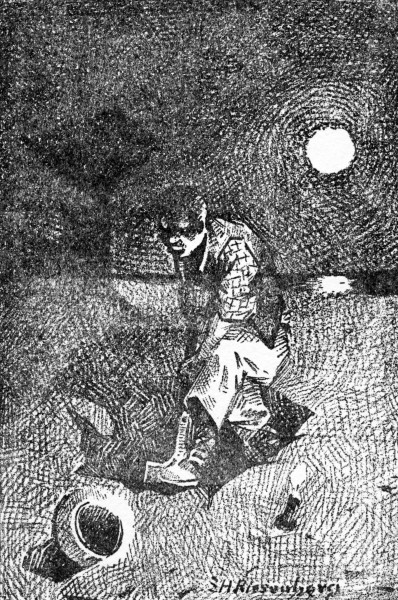
of the oaks. In the full moonlight, he was coming
forward, with long, precise strides, glancing
backwards from time to time to see that he
kept the lantern out of his line of vision, by
which he knew that his progress was straight
to the east. He had advanced but a dozen or so
full strides when Hal whispered excitedly:
“He’s steppin’ twice as far as I did. He’ll
pass the box!”
What was to be done? Nothing—unless the
boys revealed their presence.
“If he misses it, we’ll send him out again,”
whispered Tom.
“Let him dig awhile, anyway,” suggested
Bob, in a low voice. “Then we’ll give him a
scare, if part of the joke is on us.”
“I should say not,” hastily added Hal.
“He’s got to find that lemon, or—”
But he had to stop. The long-strided Jerry
was too close for further talking.
“Fo’ty-eight, fo’ty-nine, fifty,” the intent
Jerry called. As he finished, he thrust his
shovel into the sand, and the boys could see him
fumbling in his pockets. In a moment, he produced
and lit a candle. Sticking it in the sand,
he carefully expectorated on his hands, and the
first shovelful of sand flew over his head.
Tom, shaking with laughter, glued his mouth
to Bob’s ear and whispered: “Why not let him
have it now? He ain’t goin’ to find the box.”
“Let him get up a perspiration,” whispered
Bob. “It’ll do him good.”
In all his life, the shiftless Jerry had probably
never done as energetic work as followed in
the next five minutes. The loose sand seemed
to fly through the air as if coming from a spout.
The colored boy was soon knee deep in a hole,
mumbling a negro chant. Then his knees disappeared.
“It’s a shame,” said Hal, in the faintest
whisper, as he crawled in between the other
boys, who were rolling on the sand, holding
their hands over their mouths.
“Ssh!” came almost inaudibly from the prostrate
Captain Joe.
Three heads popped above the ridge. Jerry
was almost out of sight in his excavation. As
the boys held their laughter, the form of the
treasure seeker suddenly hurled his shovel from
the hole. Then the active Jerry sprang out,
caught up his candle and rolled into the excavation
again.
“Somethin’ doin’,” remarked Captain Joe, in
a little bolder voice, as Bob, Tom and Hal
eagerly rose to their knees.
“He’s tired,” exclaimed Bob, in an excited
whisper. “Get ready.”
Quickly drawing his revolver, Tom caught up
his sheet and Hal thrust the conch shell to his
lips. As the pandemonium rang out, and Tom
sprang up with his ghostly sheet, Jerry rolled
out of the hole. A piercing cry of alarm rose
from the colored boy, and with one wild look
behind, he fled toward the beach. Again a pistol
shot rang out, and Hal sounded a wail on the
conch. “I’m Black Pirate’s ghost,” yelled
Tom, starting forward.
“Let him go,” shouted Bob, laughing, “he’s
got enough.”
“He got something,” broke in Captain Joe.
“He fine something.”
“Got something?” repeated Bob.
“He got something he found,” added Captain
Joe. “Ain’t no lemon, neither,” he concluded,
dryly.
There was a moment’s silence, and then Hal,
lowering his conch shell, said in a peculiar
voice:
“Do you reckon we’ve been horned?”
They had.