PENTANDRIA MONOGYNIA. Five Chives. One Pointal.
GENERIC CHARACTER.
Calyx. Perianthium pentaphyllum, acuminatum; foliolis
ovato-lanceolatis.
Corolla monopetala, infundibuliformis; tubus clavatus; limbus
magnus, quinquepartitus; laciniis obliquis, obtusis, latere altero
magis gibbis; os tubi quinquangulare, quinquedentatum,
stellato-connivens.
Stamina. Filamenta quinque, subulata, in medio tubi. Antheræ
erectæ, conniventes.
Pistillum. Germen subrotundum. Stylus filiformis, brevis. Stigma
capitatum, bilobum.
Pericarpium. Drupa maxima, subrotunda, carnosa, a latere sulco
longitudinali excavata, punctisque duobus.
Semen. Nux bilocularis, quadrivalvis, retusa.
Empalement. Cup five leaved, tapering to a point; leaflets between
egg- and lance-shaped.
Blossom one petal, funnel-shaped; tube club-shaped; border large,
five divisions; segments oblique, obtuse, thicker edged on one
side; mouth of the tube five-angled, five toothed, approaching
together in the form of a star.
Chives. Five threads, awl-shaped, in the middle of the tube. Tips
upright, and approaching.
Pointal. Seed-bud roundish. Shaft thread-shaped, and short. Summit
headed, two-lobed.
Seed-vessel. A large pulpy fruit, nearly round, fleshy, hollowed on
the side by a longitudinal furrow, and with two punctures.
Seed. Nut two cells, four valves, and bluntly dented at the end.
SPECIFIC CHARACTER.
Cerbera foliis lanceolatis, utrinque attenuatis, undulatis; cymis
ramosis, divaricatis, axillaribus.
Cerbera with lance-shaped leaves tapered to both ends, and waved;
tufts of flowers branching into various directions, and growing
from the foot-stalks of the leaves close to the stem.
REFERENCE TO THE PLATE.
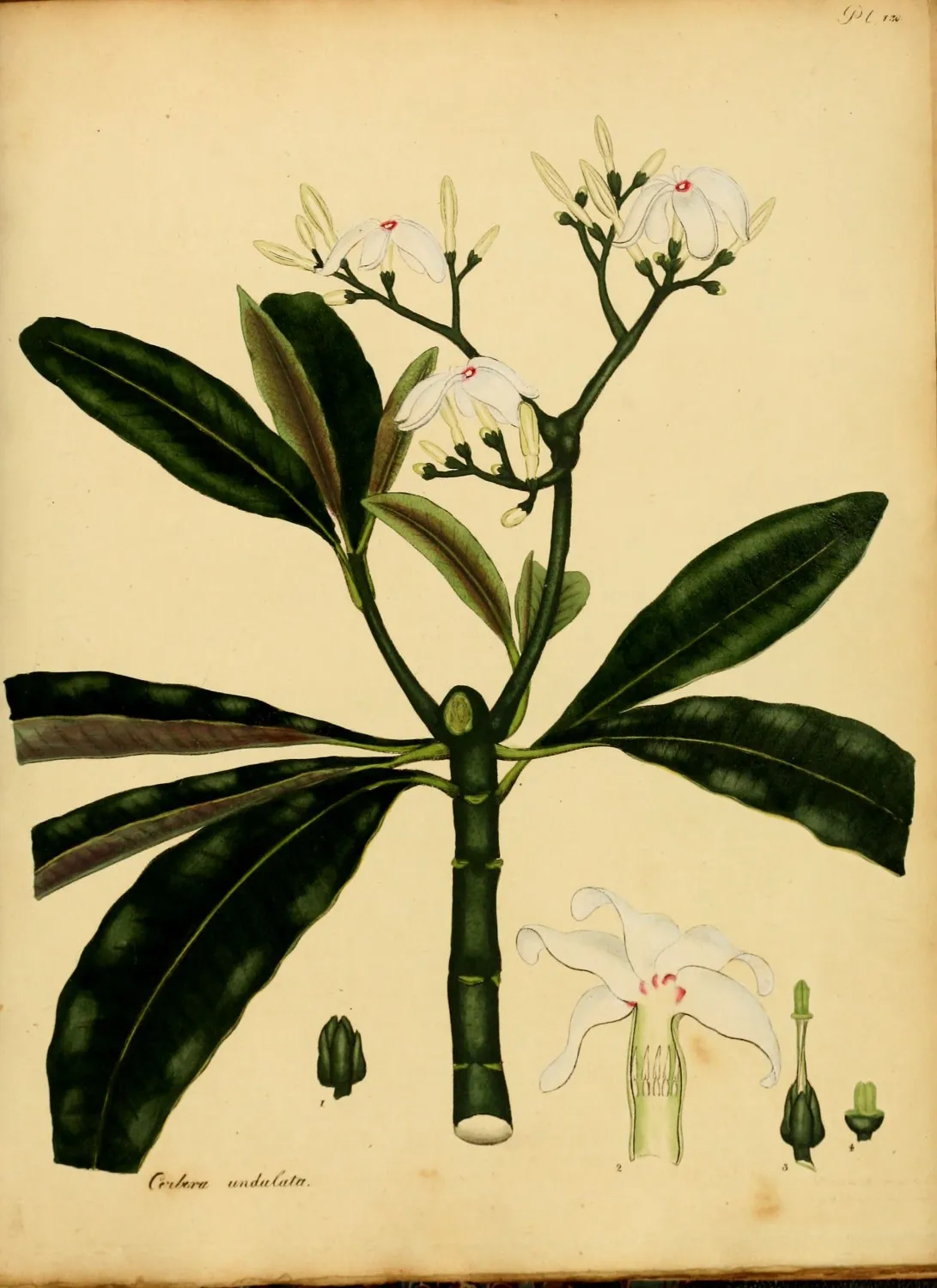
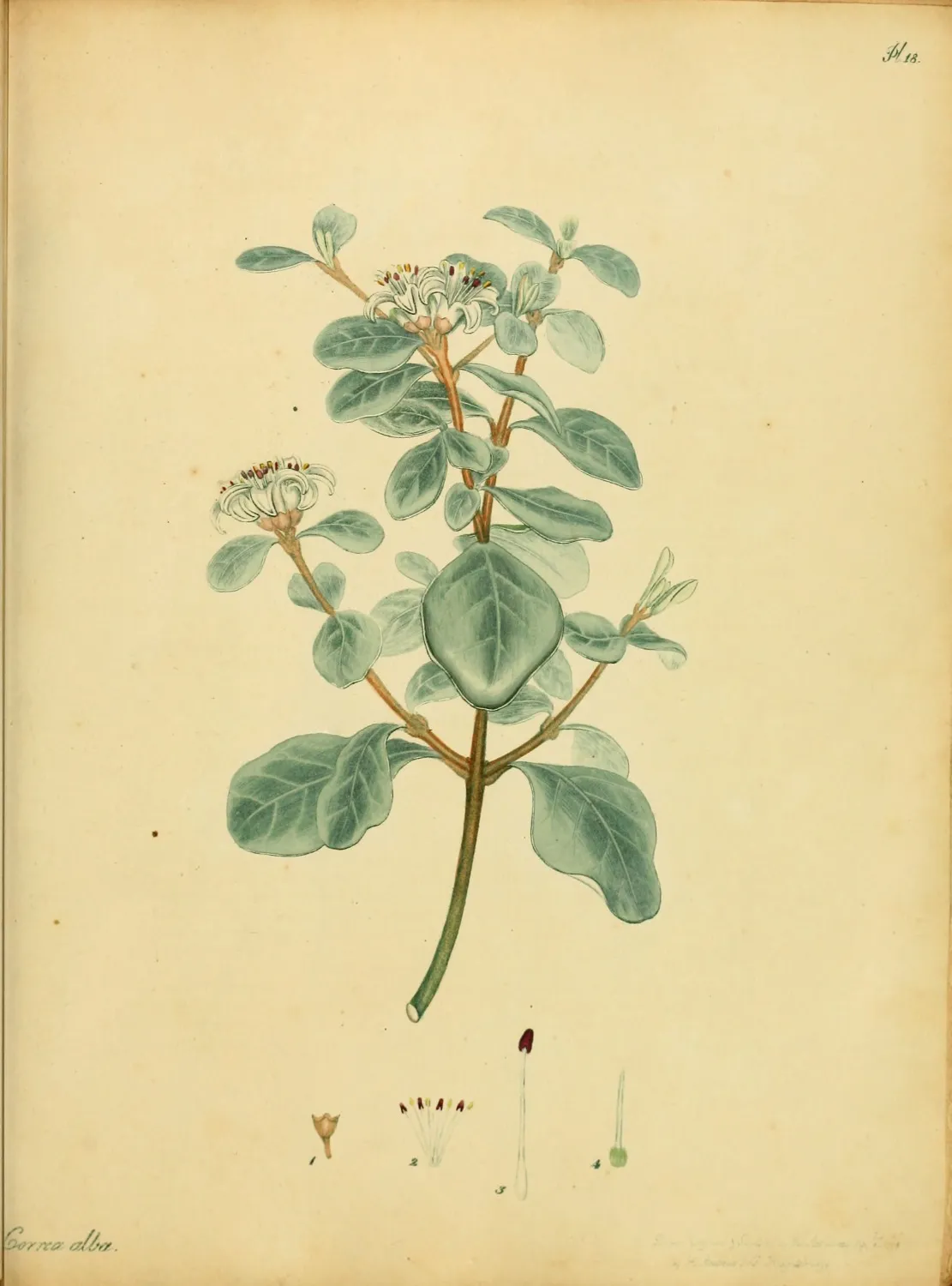
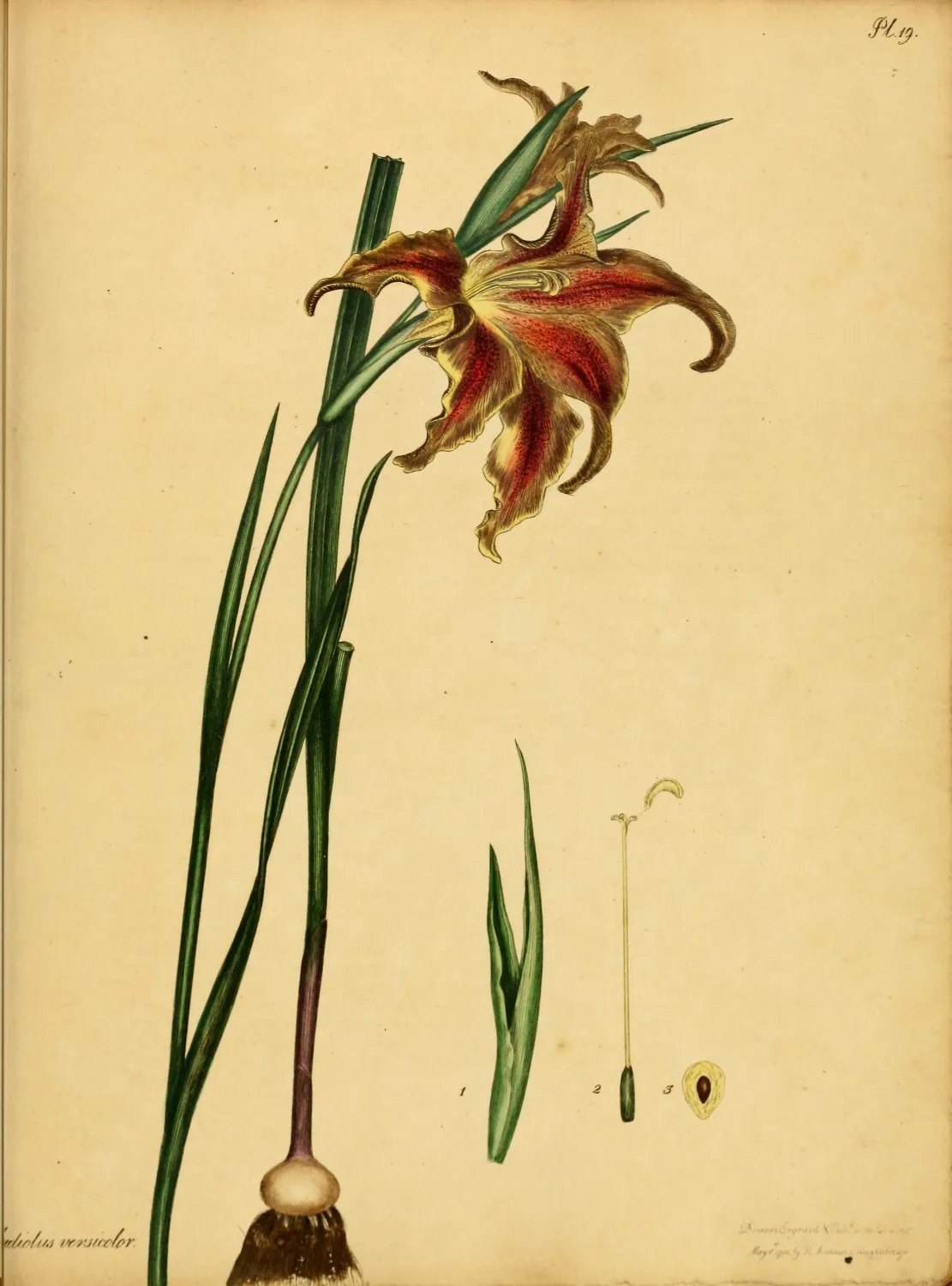
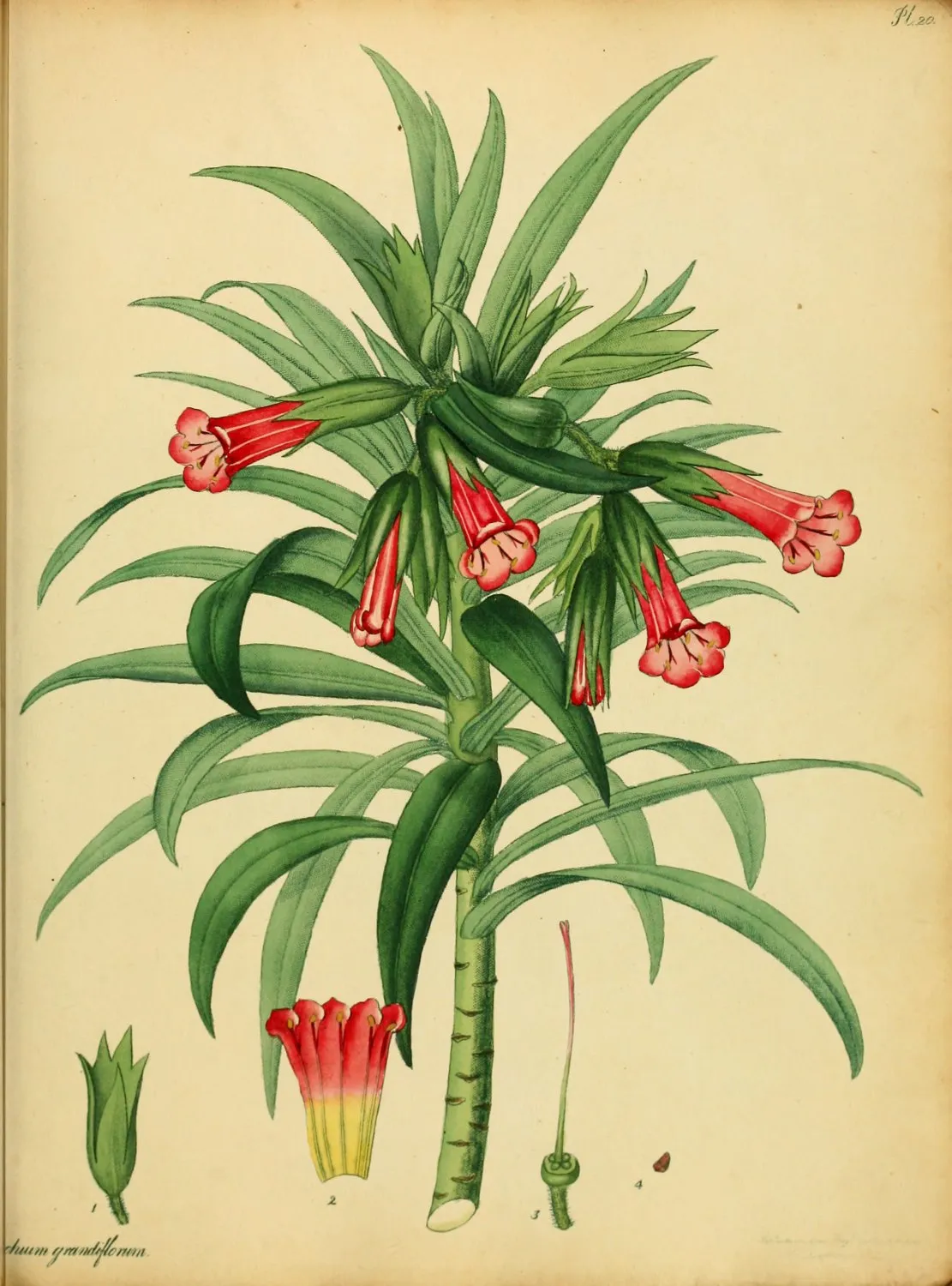
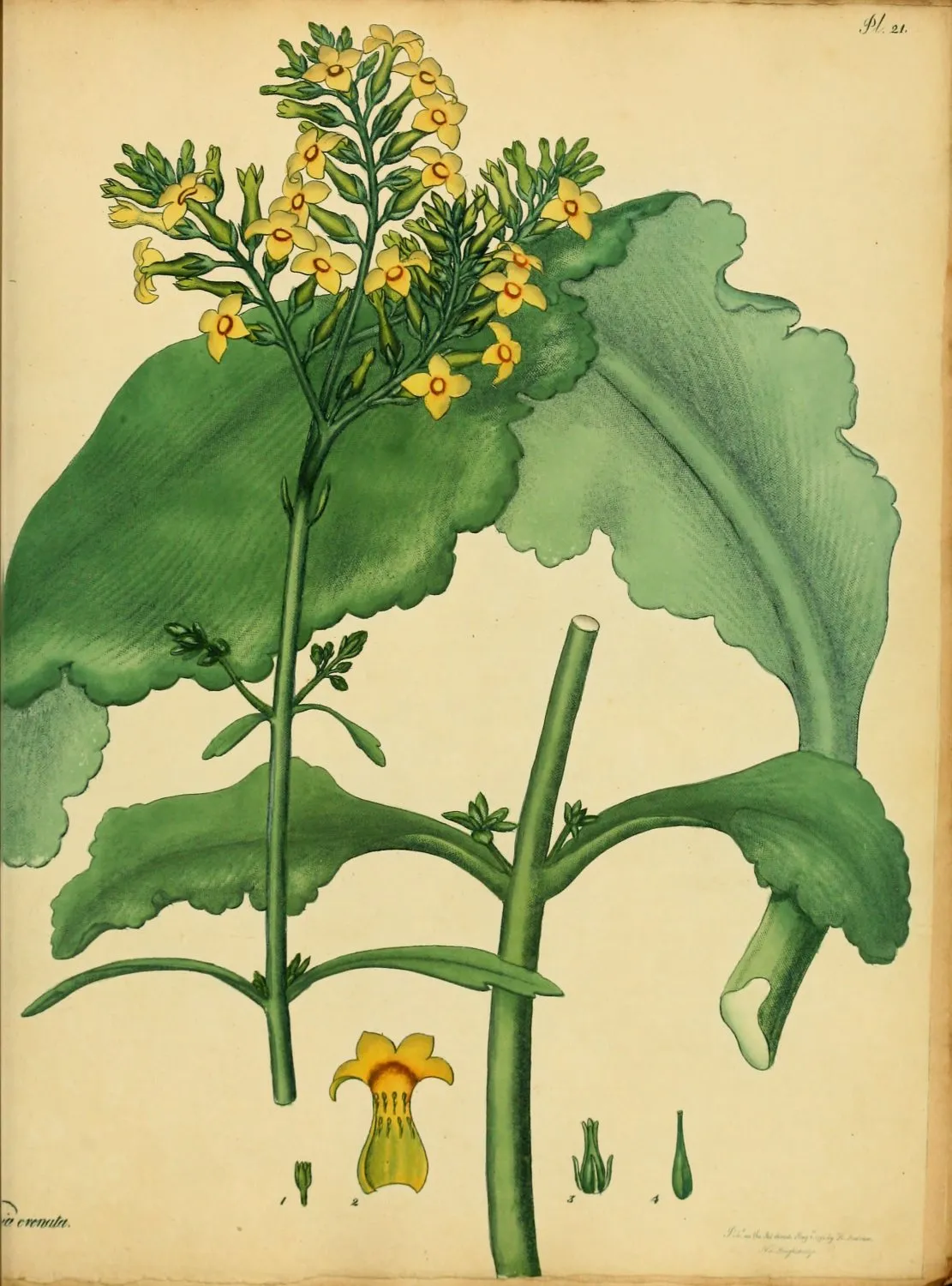
1. The Empalement, magnified.
2. The Blossom cut open, with the Chives as they stand in the tube, magnified.
3. The Empalement, with the pointal after the blossom has fallen off, magnified.
4. The Seed-bud, magnified.
This conspicuously handsome plant was introduced by W. Forsyth, Esq. to
the Chelsea Gardens in the year 1782, from the island of Bourbon, now
the Isle de la Revolution, near the coast of Madagascar, in the Indian
Ocean. It grows to a very considerable height, perfectly straight, and
polished in the stem, something like the Bamboo Cane, from which
appearance, till it flowered, it had gone by the name of the fishing rod
plant. It must be kept in the bark-bed of the hothouse in rich mould,
and should be removed from its pot but seldom, the roots being extremely
tender and brittle. The propagation is slow and difficult, as well from
the great tendency the part has to rot, where cut, as from the
unfrequency of its throwing out any side shoots from the stem. Our
drawing was made in July this year, at the Hammersmith nursery; though
we understand it flowered in the extensive collection of the Right Hon.
the Earl of Tankerville at Walton-upon-Thames, some years since.
Having followed Willdenow, rather than Jacquin, in the Generic name of
this plant, our reason is, each species which has hitherto been thrown
to this Genus, since its first formation, might well make a distinct
one; if every generic or even essential, character, was to be critically
attended to. The fruit forming the principal essential character, a
specimen of which we have seen, containing two large seeds like C.
Manghas, determined us in our adoption.
The descriptions and figures of the two plants, given by Professor
Jacquin in his Icon. rar. 2, and Collect. 4, under the genus Ochrosia,
are, we conceive, only different specimens of our plant; and are both,
as well as Dryander’s critique on Gmelin (see Linn. Trans. Vol. II. p.
227) defective; neither of them having seen but dried specimens,
without the fruit; as in this natural order of plants, the flowers being
mostly fleshy, many of the principal characters are destroyed in the
process of drying; and of course, in such case, must lead to error.
Jacquin’s character of maculata, quoted by Willdenow as a specific
title, though he has rejected the Generic, we suppose, must have been
taken from the small blotches on the lower, and which sometimes pervade
the upper surface of the leaves, but found only when in the last state
of decay, or when artificially dried to preserve them; as by the
pressure necessarily employed to that end, the waved, and most
ostensible character of the living plant, is done away. As to the C.
parviflora of Forster being the same, as either, the Ochrosia borbonica
or O. maculata of Jacquin, we must beg leave to dissent from the severe
criticiser of Gmelin; upon whose authority, nevertheless, Willdenow has
been led to exclude, even as a synonim, the O. borbonica of Prof.
Jacquin, which perhaps, if it were not for the increasing of Genera,
ought to be the name of the plant.
PLATE 130