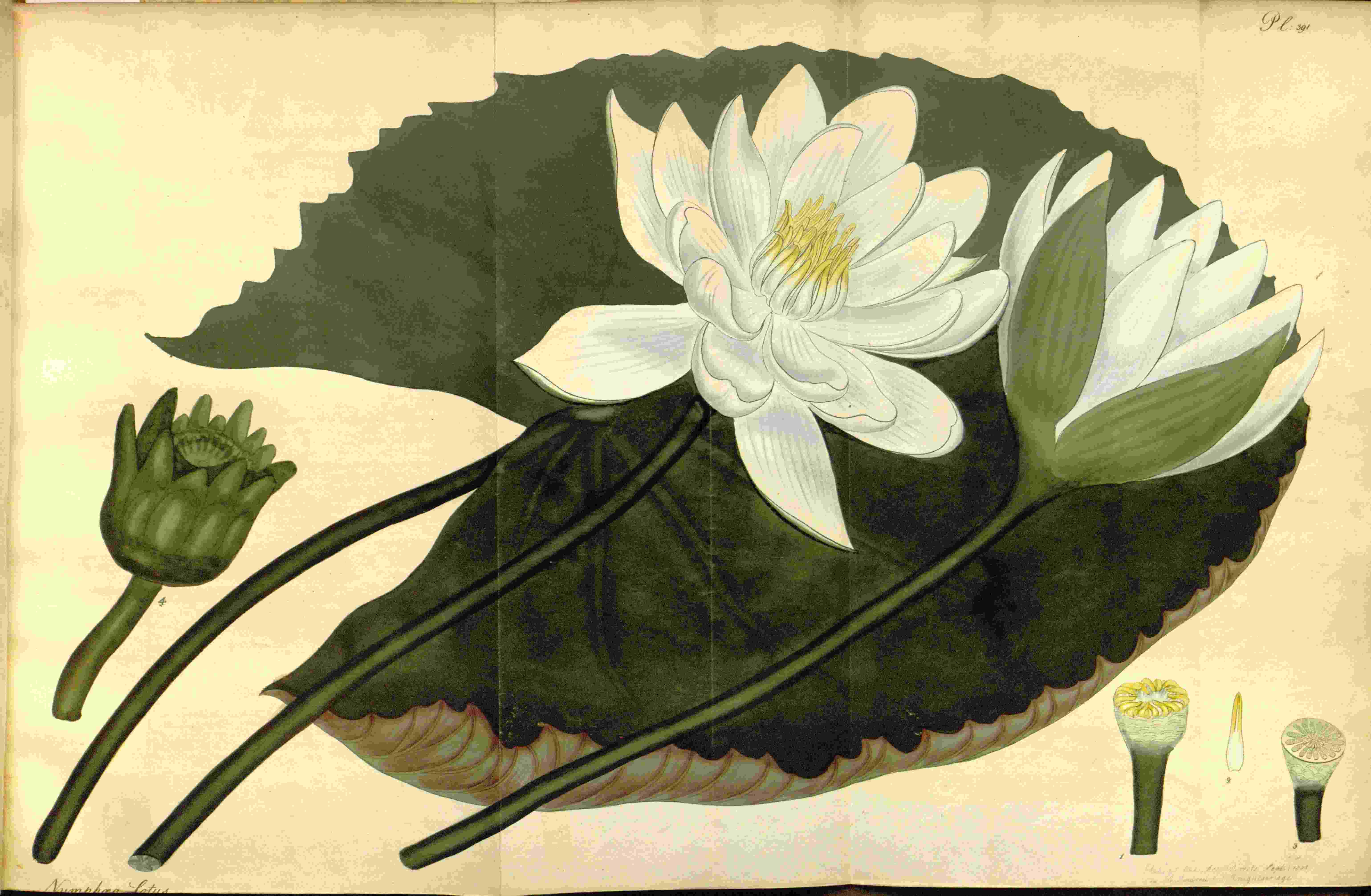
NYMPHÆA LOTUS.
The Ægyptian Lotus.
CLASS XIII. ORDER I.
POLYANDRIA MONOGYNIA. Many Chives. One Pointal.
ESSENTIAL GENERIC CHARACTER.
Corolla polypetala. Calyx 4-s. 5-phyllus.
Bacca multilocularis, loculis polyspermis.
Blossom many-petaled. Empalement 4-or
5-leaved. Berry many-celled, with many
seeds in each cell.
SPECIFIC CHARACTER, &C.
Nymphæa, foliis cordatis dentatis glaberrimis
lobis approximatis, calyce tetraphyllo.
Willd. Sp. Pl. 2. 1153.
Nymphæa, with heart-shaped dentated very
smooth leaves, with the lobes approximated,
and a four-leaved empalement.
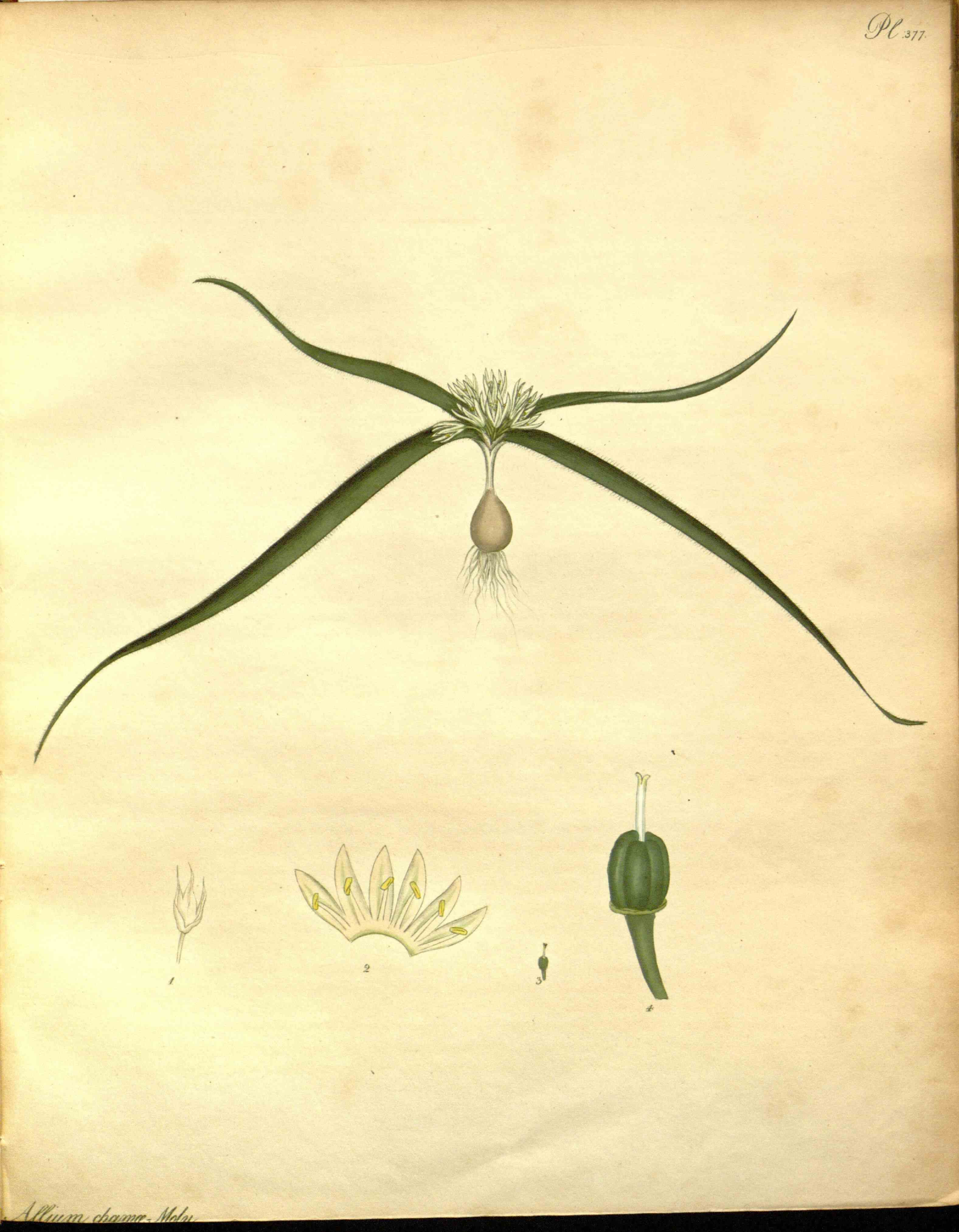
REFERENCE TO THE PLATE.
1. The seed-bud and pointal.
2. A chive.
3. A transverse section of the seed-bud. 4. A capsule.
There can be no doubt, but that the plant here figured is the true “Nymphæa Lotus” of Linnæus,
and that it is the plant mentioned by Pliny in Nat. Hist. lib. 13. cap. 17. and lib. 22. cap. 21. He
there makes mention of a plant which is found at the ebbing of the Nile, the fruit of which resembles
a poppy, and the seed of the size of millet: this exactly answers to the “Nymphæa” before us, and
does not at all apply to the “Nelumbium,” the kernels of which are of the size of nuts or thereabouts:
he also remarks that the heads are dried by the natives, and that the seed is beat and broken and made
into bread.—Herodotus also mentions that the Egyptians baked the seed into bread, and ate of the roots,
or rather tubercles, which resembled an apple and had an agreeable flavour. Vide Euterpe 92—Melpomene
177.
Sonnini, in his Voyages, mentions the Lotus as being most abundant in Egypt, and having white
flowers; and I apprehend the red one to be nothing but a variety of this.
When we know that the Egyptians worship the Nile, as the Indians do the Ganges, we cannot
wonder that a plant so beautiful, and so abundant in that river, should also become an object of adoration;
and we find it continually though roughly engraved on their idols.—Indeed Pierius, in his Hieroglyphics,
mentions that the Egyptians worshipped the Lotus as the type of the rising Sun.—It is always
found on the statues of Osiris, the Egyptian Apollo; it is also to be seen on the medals struck in Egypt
by the Romans, and especially during the reign of Adrian, who held it in such veneration, that the medals
which that Emperor caused to be struck in Egypt, in honour of his favourite Antinoüs, uniformly
represent the latter with the Lotus on his head; whence the expression “Antinoëan crown.”—Various
animals in the Hieroglyphics appear to have it, as the hawk, the lion, and the ram. It is to be seen on
most of, though not all, their deities; as Jupiter Ammon, Iris, Serapis, Orus, Canopus, and most
particularly on Harpocrates, who is often figured sitting in the midst of it.—See Cuper’s Harpocrates,
passim. The Lotus symbolizes Plenty on many of the medals of Egypt and Sicily, probably from being
so great an article of food among the inhabitants, and from its generally appearing at the reflux of the
Nile, when the banks were again open to the various uses they might be put to. Whether or not the
Lotus here figured, which I think I have sufficiently proved to be the true Egyptian one, is the same
which grows in the Ganges, and is in such high veneration throughout the continent of India, China,
and Japan, can only be proved by a comparison of the two together: certain however it is, that a plant
of great similarity to it, if not quite the same, is to be found on most of their idols also; and as the
Ganges is worshipped so may the Lotus be, with which it abounds. It expands in the dusk of the
evening, and closes about ten in the morning.
To the Right Honourable the Marquis of Blandford we are indebted for the description of this very
interesting plant, accompanied by a fine living specimen from his splendid collection at White Knights
near Reading, Berks.