CLASS XIII. ORDER VII.
POLYANDRIA POLYGYNIA. Many Stamens with many Styles or Stigmas.
GENERIC CHARACTER.
Calyx superus, persistens, 4 phyllus. Petala 30-40,
oblongo-lanceolata, persistentia. Stamina 60-70,
incurva; antheræ subovatæ. Styli nulli. Stigmata:
sulculi decem in apice cyathiformi germinis,
ad umbonem centralem decurrentes; inconspicui.
Germen 10-loculare, supra cyathiforme atque ex
columellâ centrali protrusâ umbonatum, margine
10-dentatum. Septa duplicia. Semina loculis in
singulis 2, dissepimentis prope parietem alterne affixa,
obovata. Fructus: bacca subovata, calyce
persistente coronata, spinosissima, 10-20-sperma.
Semina matura non vidi.
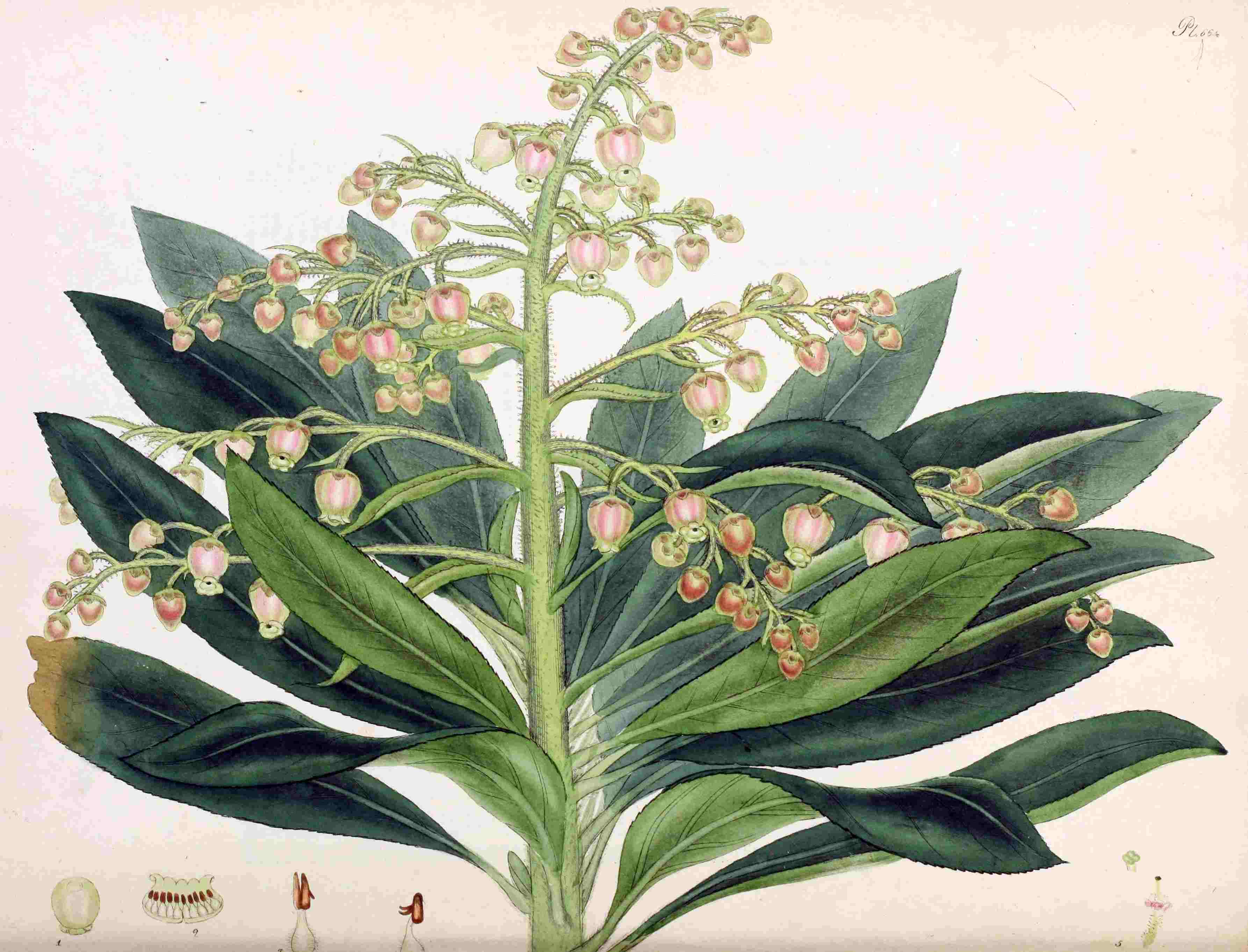
Anneslea spinosa. Roxburgh.
Calyx above, persistent, 4 leaved. Petals 30 to 40, oblong-lanced,
persistent. Stamens 60 to 70, incurved;
anthers nearly ovate. Styles none. Stigmas: ten
inconspicuous channels in the cup-shaped top of the
germen, running down towards the central knob.
Germen 10-celled, cup shaped above, with the central
column rising like a knob in the middle; the
margin 10-toothed. Partitions double. Seeds two
in each cell, affixed to the partitions near the outer
angle one on each side, inversely ovate. Fruit: a
berry nearly ovate, crowned with the persistent
calyx, exceeding thorny, 10-to 20-seeded. We have
not seen the ripe seeds.
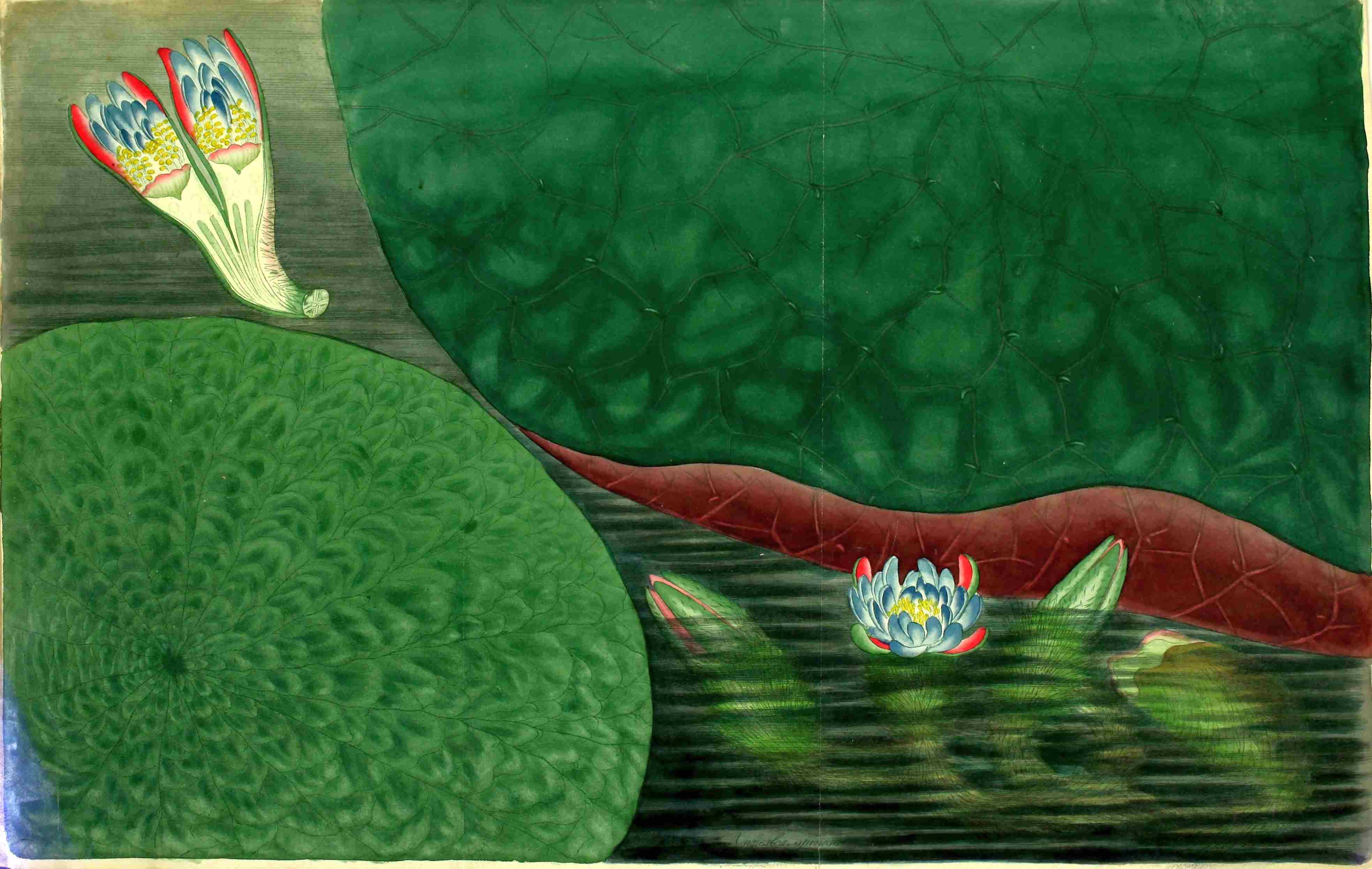
REFERENCE TO THE PLATE.
Seeds of this wonderful water plant, originally a native of China, were sent preserved in sugar from Calcutta by Dr.
Roxburgh, in 1809, to the Most Honourable the Marquis of Blandford, in whose magnificent Aquarium at White Knights
it now raises its numerous heads bristling with spines, unrolls its immense leaves, and flourishes in all its grandeur.
In vain we review the plants of its natural order for any analogy to its thorny exterior; the Nymphs and Naiads,
Nymphæeæ and Naiades, are not more conspicuous for their elegance and beauty than for their mildness; Anneslea,
like the panther, seems to unite the extremes of ferocity and beauty. The leaves are nearly orbicular, but sometimes
a little extended upon one side with a corresponding notch on the side opposite, the largest being from six to eight
feet in circumference; green on their upper surface, and reticulated with purplish branching veins, with a sharp
curved thorn at each of their principal ramifications; their under side purple, thinly scattered over with a very fine
brown pubescence, and reticulated with high raised, cellular, transparent, brown, branched veins, bearing innoxious
thorns of the same form as those of the upper surface at their principal divisions. The compartments between the
veins are irregular hexagons, pentagons, and rhomboids, which are again intersected by other minute veins nearly in
the same manner. The leaf-stalks are centrally affixed, nearly round, very porous, and bristled with soft spines
almost to where they rise from the root. The spines are hollow, of the most simple structure, and appear to be
formed by a continuance of the cellular tissue of the plant protruded. See Mirbel’s Anatomie Vegetale, fig. 24. It is
only where they stand out of water, as upon the fruit and upper surface of the leaves, that they become indurated
and really formidable. Very different is the nature and structure of the thorns in the genus Rosa, where they are
proper secreting vessels or abortions of such, indurated; and may be gradually traced in the R. damascena, muscosa,
ferox, rubiginosa, and many others, from the almost imperceptible hair supporting viscous matter, down to the horny
lacerating thorn. In the Geranium echinatum, on the contrary, and some Monsoniæ, the spines are mere indurated
persistent stipules, and in the Astragali indurated petioles; while in Prunus, Cratægus, Ononis and Genista, the ends
of the branches indurate into thorns, and a plant of Ononis spinosa deprived of its verdure and dried, would appear
to be only one branched thorn. Thorns are also formed from indurated bracts, abortions of roots, leaves, branches,
peduncles, flowers, petioles and supernumerary stipules as in the terrible Gleditschia, horrid with huge bunches of
three-forked thorns from the very trunk of the tree. All these and other similar parts of plants, their real nature and
use often overlooked, are in their aged and indurated state thrown together by Linnæus under the denomination of
“Arma, (or Armour,) to prevent animals from injuring the plants.” Camels, however, and asses and goats, are observed
to be particularly fond of thorny plants; and even quicks only escape being browsed by the cattle, by becoming
woody or growing out of their reach.
The story of the Anneslea’s flowering under water may have probably arisen from the very short time the blossoms
remain above; as, like those of the Nymphæa, they only rise to expand, and again gradually sink to ripen their
seeds after the globules of fertilizing pollen have burst from their parent cells, phœnix like, to perish in renovating their
race; and by adding circle to circle served to prolong the immoveable and immeasurable chain. That it certainly
flowers above water, we can assert from our own observation; but we were informed at White Knights (where our
drawing was taken last September) that it had flowered there below; which might have been owing to its artificial
treatment, (We have seen the Nymphæa rubra flowering at the very bottom of the water in the same Aquarium.) and
cannot be its natural state, unless we can bring ourselves to believe that nature has endowed it with the power of
propagating itself in both elements.
We hope yet to see its magnificent foliage mantling our ponds. Have we not already taught the Thea—the Camillia—the
Ta kio—the Moutan—the Yu lan, to resist our winters! Our water is not less temperate than our sky. The
name Anneslea was given by Dr. Roxburgh, in honour of the Right Hon. George Annesley, Viscount of Valentia,
who discovered the plant growing in the Gagra River in Oude, and also about Chittagong, when on his travels in India.
The fruit abundantly distinguishes the genus from the Euryale of Mr. Salisbury.