Class and Order.
Pentandria Monogynia.
Generic Character.
Cor. campanulata. Stamina receptaculo inserta. Caps. 2-5 locularis
polysperma.
Specific Character and Synonyms.
AZALEA pontica foliis nitidis lanceolatis, utrinque glabris,
racemis terminalibus. Linn. Sp. Pl. App. p. 1669.
Pall. Fl. Ross. t. 69. p. 51.
CHAMÆRHODENDROS Pontica maxima Mespili folio
flore luteo. Tourn. Cor. Hist. Rei. Herb. 42. Act.
Paris 1704. p. 348. Buxb. Cent. 5. p. 36. t. 69.
N
o433.
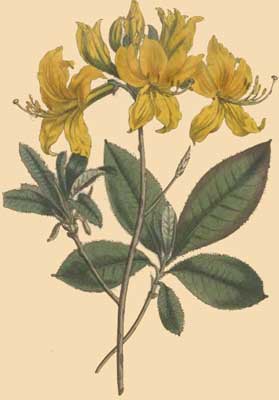
Descr. Shrub from two to three feet or more in height, the
thickest part of the stem not exceeding the size of the little
finger, covered with a smooth brown bark, irregularly branched;
Flowers appearing before the leaves are fully expanded, and
produced in umbels at the extremities of the branches, from
eight to twelve or more in an umbel, of a fine yellow colour
and agreeable fragrance; each blossom is about the size of that
of the horse-chestnut, and as some of them are produced much
earlier than others, the plant of course continues a considerable
time in bloom, standing on short peduncles; Calyx very
short, viscous, and irregularly divided, most commonly into
five ovato-lanceolate segments; Corolla, tube cylindrical, viscous,
grooved, brim divided into five segments, undulated and
somewhat wrinkled, ovate, pointed, three turning upwards,
two downwards, of the three uppermost segments the middle
one more intensely yellow than the others and inclining to
orange, with which it is sometimes spotted; Stamina usually
five, yellow, projecting beyond the corolla, and turning upwards
near their extremities; Antheræ orange-coloured; Pollen
whitish and thready; Germen somewhat conical, evidently
hairy, and somewhat angular; Style yellowish, filiform, projecting
beyond the stamina, and turning upwards; Stigma
forming a round green head.
The figure and description here given were taken from a plant which
flowered by means of artificial heat, in the spring of 1798, at Mr.
Watson's, Nurseryman, Islington, and which had been introduced
the same year, by Mr. Anthony Hove, of Warsaw.
As an hardy ornamental shrub, it bids fair to prove an acquisition truly
valuable, its flowers produced in the months of June and July, being
highly ornamental as well as fragrant.
We have the best authority for regarding this plant as the Chamærhodendros
Pontica of Tournefort, it agrees with his own specimens
in Sir Joseph Banks's Herbarium, it accords also with his description,
and figures, more especially of those flowers which are of their
natural size; nor have we any doubts of its being the Azalea Pontica of
Prof. Pallas, figured in the Flor. Rossica, since it corresponds generally
with his description, though not in all points with his figure, which
bears evident marks of inaccuracy, the stigma, for instance, is represented
as trifid.
Tournefort found this plant on the eastern side of the Black Sea,
Mr. Hove on the north side near Oczakow, and elsewhere; Professor
Pallas on Mount Caucasus.
As yet there has been no opportunity of ascertaining the best means of
propagating this new denizen, but there is every reason to suppose that
it will succeed with the treatment bestowed on the other Azalea's.
Prof. Pallas relates that the honey of bees frequenting the flowers
of this plant is supposed to be narcotic, and that goats, kine, and
sheep on eating its leaves have been poisoned thereby.
By permission and with the approbation of Mr. Anthony Hove,
the following extracts from his journal are here inserted.
"June 9, 1796, found a few of this species of Azalea on the river
Dnieper in swampy ground, four feet high, beginning to blow,
called here the stupifying shrub, and considered by some as highly
efficacious in curing the venereal disease.
"June 20, found this species on the river Dniester, on the estate of
Count Stanislaus Sczesny Potocki, about sixteen English
miles from the town of Mohilow, in peat earth, from four to twenty
feet high; regarded by the common people as intoxicating, and
used in the cure of various diseases.
"July 4, near Oczakow, found thousands of these plants fully
blown, in a marsh, every spring-tide overflown by the sea; found
there also, a Tartarian farmer, who lived entirely by the profits
arising from the honey which the bees extracted from the flowers
of this plant, sold to Constantinople and other parts of Turkey for
medicinal uses.
"July 15, arrived at Trebizond, found a valley about ten English
miles from the sea covered with these plants."
On cultivation, Mr. Hove relates that he found the Azalea's from
Trebizond much more tender than those from the borders of the
Dnieper and the Dniester, and was therefore inclined to regard them
as strong varieties if not distinct species.
The leaves, when fully expanded, are in size and figure like those
on the plate, hairy on both sides, and terminating in a very remarkable
blunt mucro or point, which has not been noticed either by those who
have described or figured the plant as it deserves, for it appears to
form a very strong character.


