Mesembryanthemum Viridiflorum. Green-Flowered Fig-Marigold.
Class and Order.
Icosandria Pentagynia.
Generic Character.
Cal. 5-fidus. Petala numerosa linearia. Caps. carnosa
infera polysperma.
MESEMBRYANTHEMUM viridiflorum foliis semicylindraceis
papuloso-pilosis, calycibus quinquefidis hirsutis. Ait. Kew.
v. 2. p. 196. Haworth Mesemb. p. 199. Syst. Nat. ed. Gmel.
p. 848.
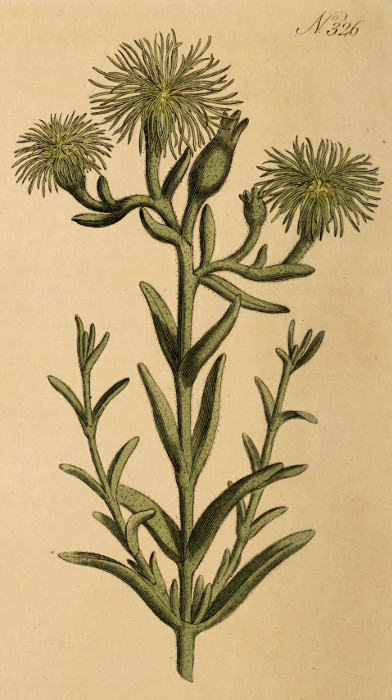
No. 326
Of the seventy species of Mesembryanthemum described in the Hortus
Kewensis, this is the only one with green flowers.
Mr. Masson introduced it from the Cape in 1774.
The flowers are not only remarkable for their colour, but the extreme
fineness of the florets; they begin to come forth in July, and continue
to be produced till the end of September; the plant is easily increased
by cuttings, is of ready growth, and blows freely.
In Mr. Haworth's Observations on the Genus Mesembryanthemum,
lately published, there is a very ample description of it, to which
we refer such of our readers as wish for more minute information
respecting it.
Chrysanthemum Indicum. Indian Chrysanthemum.
Class and Order.
Syngenesia Polygamia Superflua.
Generic Character.
Recept. nudum. Pappus marginatus. Cal. hemisphæricus,
imbricatus: squamis marginalibus membranaceis.
Specific Character and Synonyms.
CHRYSANTHEMUM indicum foliis simplicibus ovatis sinuatis
angulatis serratis acutis. Linn. Syst. Vegetab. ed. 14. Murr.
p. 773. Spec. Pl. 1253. Thunb. Jap. p. 320.
TSJETTI-PU. Rheed. Mal. t. 44.
MATRICARIA sinensis. Rumph. Amb. p. 259. t. 91.
MATRICARIA japonica maxima flore roseo sive suave rubente
pleno elegantissimo. Breyn. Prod. p. 66?
KIK, KIKF, vel KIKKU. Kœmpf. Amæn. Ex. p. 875.
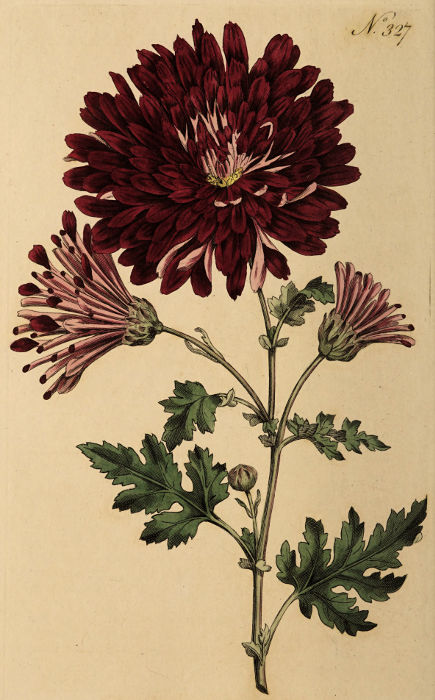
No. 327
We rejoice in the opportunity afforded us, of presenting our readers
with the coloured engraving of a plant recently introduced to this
country, which, as an ornamental one, promises to become an acquisition
highly valuable.
This magnificent species of Chrysanthemum, which we have hitherto
seen only in the collection of Mr. Colvill, Nurseryman,
King's-Road, Chelsea, began to flower with him early in November last,
1795; and as there were many buds on the plant, at that time, yet
unopened, it appeared as if it would continue to flower during the
early part of the winter at least.
It is a plant of strong growth; the stem rising to the height of two
or three feet, somewhat woody, much branched, beset with numerous
leaves, having some resemblance to those of Mugwort, of a greyish hue;
the flowers, on being smelt to, discover an agreeable fragrance, they
are produced on the summits of the branches in a loose sort of cluster
(those which terminate the main stem, grow to the size of a large
carnation) of a dark purple colour; they are, it is to be observed,
double, or rather between semidouble and double; the florets of the
radius at first perfectly tubular or quilled, as they advance split
gradually downward on the inside, their outside is of a greyish tint,
which being visible in most of the florets, especially the younger
ones, gives them a particoloured appearance; these florets do not
so completely occupy the receptacle but that room is left for a few
others in the centre, of a different form, and yellow colour, which,
on examination, appear to have their parts perfect, as indeed do those
of the radius; the receptacle is beset with membranous paleæ or chaffy
scales, a circumstance which would lead us to consider this plant
rather as an Anthemis than a Chrysanthemum, of which it has the
calyx, with the foliage of Mugwort.
New as this plant is to us, it appears to have been cultivated in China
for ages: Linnæus, who describes it in his Species Plantar.
refers us to a figure in the Hortus Malabaricus; this figure, and
the description accompanying it, agree generally with our plant, but
the flowers are more double, much smaller, less clustered, and do not
correspond in point of colour, yet there can be no doubt but our plant
is a variety of the same; it is there described as growing in sandy
situations, and having green petals.
Rumphius, in his highly interesting work, the Herbarium
Amboinense is much more minute in his information; he observes, that
these plants were originally brought from China, where they flower in
May and June; that there are two sorts principally cultivated in India,
the white and yellow-flowered, and a third sort, differing only in the
colour of its flowers which are red (the variety, as we suppose, here
figured) began to be known among them at Amboyna; the flowers there do
not expand well, owing to their being produced at the rainy season, and
they decay without producing any seed.
He tells us further, that it is cultivated chiefly for pleasure;
that the natives and the Dutch plant it only in the borders of their
gardens, in which it does not succeed so well as in pots; and that,
if it remains more than two years in the same spot, it degenerates,
becomes less woody, and often wholly perishes; that the Chinese, by
whom it is held in high estimation, pay great attention to its culture;
they set it in pots and jars, and place it before the windows of their
apartments, and that it is not unusual for them when they invite their
friends to an entertainment to decorate their tables with it; on
those occasions, he that produces the largest flower, is considered
as conferring the greatest honour on his guests; besides these three
varieties already mentioned, they have a fourth, which is more rare,
whose flowers are of a greenish ash colour (is not this the var.
figured in the Hort. Malab.?) all these varieties growing in separate
pots, they place in certain quarters which they particularly wish
to decorate, and the effect they produce is highly pleasing: in the
cultivation of this plant they spare no pains, the shorter it is and
the larger its flowers, the more it is esteemed; to make it dwarfish,
and at the same time productive of flowers, they check its growth;
for, if suffered to grow rude, it assumes a wild nature, and produces
little but leaves when it is coming into flower, of the three blossoms
which usually terminate each branch, they pluck off two, and thus the
remaining flower grows larger; by this, and other management, they
cause the flowers to grow to the breadth of one's hand: he enumerates
still a fifth sort with white flowers, which is extremely rare, and
smaller than the others, called Tsehuy say si, that is the drunken
woman; its flowers morning and evening flag, and hang down as if
debilitated by intoxication, in the middle of the day they become
erect, and follow the course of the sun; but this (most probably a
distinct species) is not exported from China. Finally, he remarks, that
the Chinese and Malays are so attached to these flowers, that they even
decorate their hair with them.
Thunberg, in his Flora Japonica, enumerates it among the
natives of that country, and describes it as growing spontaneously
in Papenberg, near Nagasaki, and elsewhere, observing, that it is
cultivated for the extreme beauty of its flowers in gardens and houses
throughout the whole empire of Japan, and that the flowers vary
infinitely in point of colour, size, and plenitude. Kæmpfer's
account of it in his Amæn. Exot. is very similar.
This Chrysanthemum appears to be a hardy greenhouse plant, and it is
highly probable that, like the Camellia and Aucuba, it will bear
the cold of our mild winters without injury.
As it flowers so late, there is but little prospect of its producing
seeds with us, but it may be increased by cuttings, and parting of the
roots.