The United States of North America are classed into four groups of
States, each group having a distinguishing name. First, New England;
second, the Middle States; third, the Western; fourth, the Southern
States. This division arises from local distinctions, which exist
in the character and pursuits of the inhabitants, or is founded on
physical causes.
New England includes the six States lying east from Hudson river
and Lake Champlain. This general name was given to this part of the
country by the first settlers, or, as they are generally called, ‘the
pilgrim fathers,’ who left England, their native country, and landed at
Plymouth, in December, 1620, in order that they might enjoy religious
freedom. This section of the United States is distinguished for the
industry of its inhabitants, and for being the most populous part of
the Union. Great attention is paid to agriculture and commerce.
The features of New England are mountainous; and the soil is various,
producing in abundance, grass, grain, and a variety of fruits. Its
climate is salubrious.
There is probably no place in the world where education is so widely
spread through all classes of the people; there being schools in each
town, supported at public expense.
Is an uneven and mountainous State. Its soil is peculiarly adapted
to the growth of timber, and for pasturage of cattle. The climate is
healthy, although the cold is severe during the winter months. This
State has an extensive sea-coast, indented with many good harbors, and
commerce is actively pursued by those who reside near the ocean. The
exports are timber and fish. Portland is the largest city, and has
heretofore been the capital; but Augusta has recently been selected for
the metropolis of the State.
The climate of this State is similar to that of Maine. The land is
mountainous and fertile. Agriculture is the chief occupation of the
inhabitants. There is but little facility for commerce, as the State
has only sixteen miles of sea-coast. The harbor at Portsmouth is one of
the best on the continent, and contains one of the United States’ naval
stations. The capital of this State is Concord, which is a place of
considerable trade, having a communication with Boston harbor by means
of Middlesex canal.
Derives its name from the range of the Green Mountains which runs
through the State. These mountains give rise to many rivers which
contribute to the fertility of the soil. The State being entirely
inland, the attention of the inhabitants is directed to agriculture and
manufactures. Mines of iron, copper, and lead, and quarries of marble,
are found in this State. Montpelier, the capital, is a flourishing town.
Is the oldest State in New England, and is distinguished as having
been the first mover in the struggle for American Independence. It is
the first, except New York, in commerce, wealth, and manufactures. It
is the second commercial State in the Union. The state of society is
enlightened, and the advantages of education are universally enjoyed.
The land is uneven and hilly, and in the western part, mountainous. The
soil is fertile, except in the southeastern part, where it is sandy.
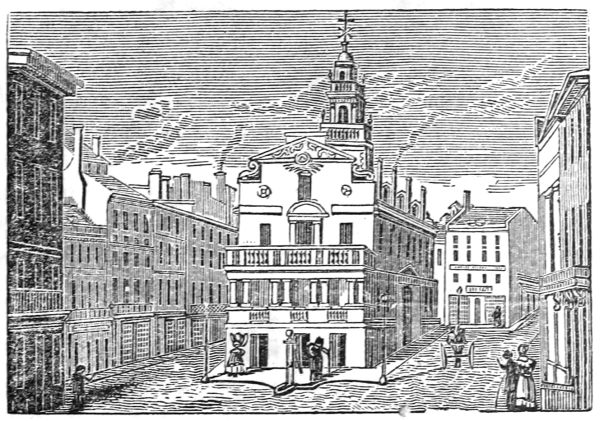
CITY HALL, BOSTON.
Boston is the capital, and being the largest city in New England,
may properly be considered the metropolis of this whole section of
country. It is built upon a peninsula at the head of Massachusetts bay,
and has a most excellent harbor, capable of accommodating more than
five hundred vessels, while the entrance is so narrow that only two
ships can sail in, abreast. The wharfs are constructed with a degree
of expense and neatness far exceeding those of any other city in the
United States. The harbor is defended by forts, and contains one of
the United States’ naval stations. Boston has communication with the
surrounding country by means of seven bridges, all built of wood, with
the exception of the Western Avenue, which is built of stone and earth.
This city is noted for its literature, and for its many handsome public
and private buildings, among which may be named the State House, Quincy
Market, Tremont House, Masonic Temple, &c. The cut above gives a view
of the City Hall, which contains the Rooms of the Mayor, Aldermen,
and Council, Post Office, and City Treasurer and Clerk’s Offices.
This building was formerly the State House. In this venerated edifice
the first legislative acts on the American revolution were debated
and acted upon. This continued to be the capitol until the year 1800,
when the present State House was built. This city is also celebrated
as containing Faneuil Hall, ‘the cradle of liberty,’ where the first
popular assemblies were held, to discuss the question of Independence.
Salem, the next town in size, is considered the wealthiest town in the
United States.
Charlestown, is noted in the annals of the Revolution, as being the
place where the battle of Bunker Hill was fought.
Possesses a mild climate and fertile soil which is under a high state
of cultivation. Manufactures of cotton, woollen, linen, iron, wood, and
tin, are carried on with great activity and ingenuity in this State.
General habits of sobriety and industry are the characteristics of the
inhabitants, who are generally well educated, much attention being paid
to schools. Connecticut and Massachusetts have furnished more emigrants
to the western states than any other section of the Republic.
The General Assembly of statesmen, meets alternately at New Haven
and Hartford, on which account both may be considered capitals. Yale
College at New Haven, is one of the most flourishing seminaries in the
Union.
Is the smallest State in the Republic; its soil is moderately fertile,
and the climate salubrious and healthy. It has a greater amount of
manufactures in proportion to its population than any other State. Its
commerce is considerable. This State takes its name from an island in
Narraganset bay. On this island is situated Newport, which has one of
the best harbors in the United States.
Rhode Island was founded by Roger Williams, a celebrated advocate for
religious liberty. This State has no written constitution, being still
governed under the charter of the English king, Charles II, in virtue
of which, the people annually elect a Governor, Senate, and House of
Representatives. These constitute the General Assembly, which meets
four times a year. Providence being the largest city may be considered
the capital, although the Assembly meets alternately at Providence,
South Kingston, East Greenwich, and Bristol. Brown University is in Providence.
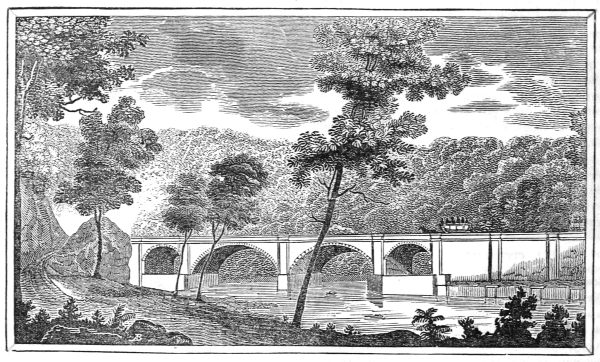
THE PATTERSON VIADUCT.
The Middle States are so called from their relative situation. The
distinguishing characteristic of this section of country is the
extensive system of internal improvement by means of canals and
railroads, by which the prosperity of those States is much promoted.
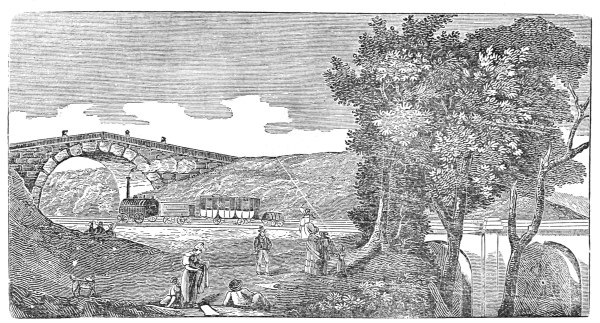
Railroads are laid down on the most level routes between the places to
be connected. They are formed by rails of iron laid on a foundation of
stone or wood. The wheels of the carriages are made to run upon these
rails, which being smooth offer little resistance, and make it easy
for a small force to move an immense weight. All the hills which occur
in the route of these roads are levelled and the valleys filled up.
Railroads pass over rivers by means of bridges, or, as they are more
generally called in these States, viaducts. The Baltimore and Ohio
railroad passes over a river, about seven miles from the city, by means of one
of these, called the Patterson viaduct, a view of which is given in the cut.
The climate of the Middle States embraces almost all the varieties that
are found on the face of the earth; and, with the exception of the
northern part of the State of New York, the soil is more fertile than
that of New England. Wheat is produced in great abundance, and forms
the chief object of agriculture.
Ranks first in the United States for commerce, wealth, and population,
and is one of the most extensive in point of territory. The land is
uneven, and in some parts mountainous. The soil is moderately fertile,
and well adapted to agriculture and grazing.
A prominent feature of this State is the great number of lakes in
its interior, which, being connected together by rivers, facilitate
the transportation of produce from place to place. These natural
advantages, together with large rivers and grand canals, have raised
New York to the elevated rank she now holds, and made the city of New
York the first emporium of commerce in the Union.
The Falls of Niagara, between Lakes Erie and Ontario, are partly in
this State. This is the largest cataract in the world, and is a place
of great interest to the thousands of its visiters. The fall here is
one hundred and fifty feet.
Long Island is a part of this State. It is one hundred and sixty miles
long, and from two to fifteen broad, and is well cultivated. The
principal town on this island is Brooklyn, where there is one of the
United States naval stations.
Albany is the capital of New York. It is
a flourishing city on the Hudson river, situated at the point where
it is joined by the Western and Champlain canals, which circumstances
contribute to make it a place of considerable trade. Its inhabitants
are principally descendants from the Dutch, who first settled the state.
The city New York is situated on
Manhattan island, at the mouth of the Hudson river; and from its
commodious bay and other natural advantages for commerce, seems
destined to rival all the commercial cities in the world. This city
contains many elegant buildings, and beautiful parks. Its population
embraces some of almost every nation on the earth, who congregate here
in pursuit of wealth. New York city extends over three miles along
its harbor, thus affording ample accommodation to almost innumerable vessels.
Ballston and Saratoga springs, are the most celebrated mineral springs
in the United States, and are much visited, during the summer months,
on account of the medicinal qualities of the waters.
The soil of New Jersey is not generally so fertile as that of the
states which have been named, being sandy along the sea-coast, and
hilly in the interior. Although this state has an extensive sea-coast
yet, as there are few very commodious harbors, to vie with that of
New York on the one side and of Philadelphia on the other, it has but
little commerce:—These cities import almost all the foreign articles
and dispose of most of the manufactures and produce of this state.
The farmers raise many cattle, and much fruit, particularly apples,
from which immense quantities of cider are annually made:—for this
article this state is particularly celebrated.
Iron ore is abundant—copper, lead, coal, and freestone are found in
considerable quantities. Manufactures of iron, cotton, and leather, are
carried on to a considerable amount.
Trenton is the capital of the state. It is situated on the Delaware
river, and is on the great route of travel between New York and
Philadelphia. It is celebrated as the scene of one of the most
brilliant battles fought by the Americans during the revolution.
Princeton is also noted for a battle.
Newark contains more inhabitants than any other town in the state, its
population being about 11,000.
William Penn, a benevolent English gentleman, brought out with him, in
the year 1681, a great number of Quakers, and first settled this state,
under a grant from King Charles II. After his name the State is called,
Pennsylvania. This State exhibits a great variety of soil and climate.
The soil is suited to the growth of grain, and husbandry is said to be
better understood in Pennsylvania than in any other State. Hemp and
peaches are cultivated. Wine is made in small quantities, and commerce
flourishes to a great extent.
This State abounds in coal, which forms an article of commerce with
most of the cities of the United States. It is obtained in immense
quantities in the neighborhood of Pittsburg, and from the Schuylkill
and Lehigh mines.
Pennsylvania has engaged more extensively in internal improvements than
any other State.
Harrisburg, the capital, is pleasantly situated on the Susquehanna
River, and contains an elegant State House.
Philadelphia is the most regularly laid out and well built city in the
Union. The streets generally intersect each other at right angles, and
the principal ones are 100 feet wide. The inhabitants are extensively
engaged in manufactures. The commerce of this place is large, and
according to the amount of its exports is the third commercial city in
the Republic.
In this city are many literary, scientific, and benevolent
institutions, and numerous elegant public buildings, among which are
the Bank of the United States, the Almshouse, Mint of the United
States, and many elegant churches. The population of the city is
80,458; and of the suburbs, 87,353; total, 167,811.
With the exception of Rhode Island, this state is the smallest in the
Union; it is also the least populous state. Its soil is moderately
fertile, and produces a great variety of grasses, and an abundance of
wheat. Flour is the principal article of manufacture and export. A
considerable quantity of lumber is also exported.
The Chesapeake and Delaware canal intersects this state, and forms an
easy and expeditious communication between Philadelphia and Baltimore.
Dover is the capital. It contains a handsome state house.
This is the most irregularly shaped of all the American states. Here
the system of husbandry peculiar to the Southern States generally
commences, it being the first in our progress southward where tobacco
is produced. Wheat, hemp, and flax, are considerably cultivated.
The first settlers of this State were natives of Sweden, and many of
their posterity may still be found who are like their forefathers,
healthy, cheerful, industrious, and hospitable.
This State ranks high in a commercial view. Its commercial city is
Baltimore, where there is an excellent harbor, capable of containing
a great number of vessels. Its inhabitants are celebrated for
hospitality, a spirit of enterprise, and polished manners. It contains
many elegant public structures, viz. the Washington and Battle
Monuments, the Exchange, the Museum, and Hospital. Much attention is
paid to education. Population 80,625.
Annapolis is the capital. It is situated 28 miles southeast from
Baltimore, and is a flourishing place, containing a handsome state
house in its centre, towards which the streets run.
The principal manufacture of this State is flour, which is made in such
quantities as to form the chief article of export. Tobacco, lumber,
iron, glass, and whiskey, are also exported.
Between Maryland and Virginia, lies the Federal District of Columbia,
comprising a square of ten miles. This district which was given by
these States to the United States, lies on both sides of the river
Potomack, 120 miles from its mouth, and is under the immediate
jurisdiction of the National Congress, which assembles annually at
Washington, for the purpose of legislation. Washington is situated near
the centre of the district, and is laid out in such manner, that the
principal buildings, as the Capitol, President’s house, &c. command a
full view of the city, and at the same time can be seen from every part
of it. Georgetown and Alexandria are also within the district.
The Western States have all sprung into existence within the period of
the last fifteen years, and their growth has been unparalleled, both in
the increase of population and wealth.
Probably no district of country on earth, possesses so great a
proportion of soil capable of yielding the necessaries and luxuries
of life, in so great abundance. The seasons are regularly divided
into spring, summer, autumn, and winter, and the climate is generally
healthful. Furs, minerals, cotton, indigo, tobacco, hemp, wheat, and
every description of grain and fruit common in the New England States,
flourish here.
Prairies are common in this section of the country, on which immense
herds of buffaloes are often seen grazing.
The remote situation of these states from the ocean, has retarded their
growth as a commercial country; but the introduction of steam-boats,
canals, and railways, is fast overcoming the difficulty, and some of
the western towns are already very large, and are rapidly increasing.
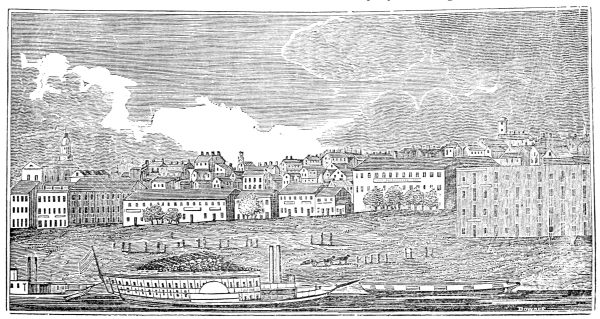
CINCINNATI.
Takes its name, and derives its greatest facilities for commerce, from
the noble Ohio river. This State was admitted to the Union in the
year 1802, since which time its growth has been rapid; in 1820 its
population was 581,434; and increased in ten years to 937,679.
Although there are no mountains in this State, yet it is diversified
with hills, valleys, and plains, and watered by many fine rivers,
navigable for boats. The soil and climate are excellent, and the state
presents great facilities for agriculture. The land in its natural
state is thickly covered with forests, and the trees attain an immense
size.
The population is composed of emigrants from the other states, the
greater proportion of which are from New England. The inhabitants are
noted for their industrious habits, and enterprising spirit.
Cincinnati (a view of which is given above,) is the largest town in the
State, and with propriety may be considered the commercial capital of
the Western States. It is rapidly increasing in refinement, business,
and population. The number of inhabitants, as given in the returns to
congress in the year 1830, is stated at 24,831; but another census
taken a few months later in the same year states that it is 26,515.
Being advantageously situated on the Ohio river, it seems destined to
become a great city, and may in progress of time rival the older cities
of the Middle and the Eastern States.
Columbus, the capital, is a flourishing place.
Much attention is paid in this State to education. There are many
colleges and academies, and schools are general throughout the State.
Internal improvements are gaining the attention of the people.
Mounds of earth are found in many places, the origin of which cannot be
ascertained. These mounds appear to be forts, and are supposed to have
been built by people who lived in this country before the present race
of Indians.
This state is nearly similar to Ohio in its climate, soil, productions,
and inhabitants. The northern part of the State is level, the southern
part broken and hilly, and there is much timber land.
The largest town in the State is Vincennes. At this place most of the
trade of the State centres.
The soil of this State is exceedingly rich, and is divided into forest
and prairie lands; and when under cultivation produces in the greatest
abundance, the necessaries and luxuries of life. Grapes are common to
the country, and are abundant. Great quantities of wine might be easily
manufactured. Foreign vines have been cultivated with success. Maize,
wheat, oats, barley, buckwheat, potatoes, rye, tobacco, cotton, hemp,
and flax, peaches, plums, and garden vegetables, and indeed almost all
the productions of the Eastern and Middle States, can be cultivated to
advantage here.
The United States salt works on the Saline river produce annually
200,000 bushels of salt. Coal, iron ore, copper, and lead are found here.
Takes its name from the river which runs through the State. It contains
less woodland than Illinois, but its soil and climate are similar.
Numerous mines of lead are now worked, which yield immense quantities.
Iron ore is found in great abundance, and it is probable that enough of
these two minerals may be obtained from this State to supply the whole
United States.
Jefferson city, the capital, is at present a small place, but is
increasing. St. Louis is the largest town, and is the depot for the
trade of the northwestern territories.
Is one of the most healthful and beautiful States in the Union. The
greater proportion of its land is arable and productive. The failure of
water of most of the rivers of this State during the summer months is
a great obstacle to its prosperity. The Ohio and Mississippi rivers,
however, form an easy communication with the sea. The productions
are wheat, tobacco, maize, rye, and to a small extent, cotton. The
inhabitants consist of the descendants of emigrants from the other
States, and many from Europe. They are brave, frank, and hospitable.
Lexington is the largest town in the State, and has a population of
6,104. Frankfort, the capital, is situated on the Kentucky river, about
60 miles from its mouth, and is a flourishing place.
The description of Kentucky may be also applied to this State,
except that it is intersected by two noble rivers, the Tennessee and
Cumberland, which are rarely frozen, and afford a great extent of boat
navigation. Vegetation commences about six weeks earlier in this State
than in New Hampshire, and continues about six weeks longer.
Nashville, the capital, is the largest town in the State. In this place
is Cumberland College.
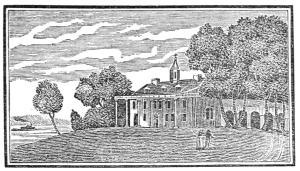
Mount Vernon. Seat of General Washington.
That part of the Southern States near the Atlantic ocean and the gulf
of Mexico is low and sandy. The greater portion of this section of
the country is barren, except the parts near the rivers, which are
exceedingly fertile. After proceeding towards the interior about 75 or
100 miles, the country becomes mountainous and productive.
Tobacco, cotton, rice and sugar are the staple productions. The owners
of the lands where these articles are cultivated are called planters,
and the labor of the plantations is performed by slaves.
The climate of this part of the United States is various. In Virginia
and Maryland the heat of summer is not extreme, and a small quantity of
snow only, falls during the winter. In the most southwardly States snow
is exceedingly rare in winter, and the heat is intense in the summer
months.
The commerce and manufactures of these States are very limited, and to
agriculture, almost the whole attention of the inhabitants is directed.
Their tobacco, cotton, and all their exports are sent out in ships
owned in the Northern States. The reason for this probably is, that the
cultivation of the staple productions is more profitable than commerce.
The inhabitants of the Southern States, residing on large plantations,
are so much separated from one another, that it is impossible to carry
into effect a system of education so extensive as that of the Northern
States, and of course the people generally, are not so well informed.
The higher classes are, however, well educated.
Is the oldest State in the Union, having been first settled in the year
1607, and is celebrated as being the birth-place of General George
Washington, the brightest model of a great and good man and patriot, of
which the world can boast.
The cut on this page presents a view of his residence, situated on the
Potomack river, nine miles below Alexandria, where he spent his time,
when not actively engaged in the service of his country.
This State includes a surface larger than that of England. The soil
of the Eastern coast is sandy and the climate unhealthy; while the
interior parts are fertile and healthy, and inhabited by a race of men,
very vigorous and exceedingly tall. The Virginians are hospitable, and
are noted for cherishing their talented statesmen.
In amount of commerce Virginia, though first in size, ranks only as the
eighth State. Wheat, corn, and tobacco are the most important articles
of export.
Richmond, the capital, is situated at the falls on St. James river. It
is a handsome city.
Norfolk, on Elizabeth river, is the chief commercial town of the State.
Closely resembles Virginia in climate, soil and character of its
inhabitants. The Carolinians in the lower country, are mostly planters,
and in the upper country, farmers. The coast of North Carolina abounds
in sand banks and islands, which render navigation dangerous, and its
commerce is conducted at the seaports of the neighboring States.
The towns of this State are small, Newbern, with a population of 4000,
being the largest.
Exhibits the characteristics peculiar to the Southern States, in a
greater degree than any other. The planters of this State are the most
wealthy of their class, and require a greater number of slaves to
cultivate their fertile and extensive plantations. In this State only
does the number of slaves exceed the white population. According to the
last census, more than one half of the inhabitants are slaves.
Cotton is the great staple of this state. It is of three kinds.
Sea Island cotton, which grows on the islands and in the low
country;—Upland cotton, which is cultivated in the mountainous
interior country;—and the Nankin cotton, which retains its peculiar
color as long as it can be worn. Of these the Sea Island is the most
esteemed. Rice is extensively cultivated on the shores of the rivers
and bays. Limes, oranges, lemons, figs, &c. are produced.
The commerce of South Carolina exceeds that of all the other Southern
States except Louisiana, the leading articles of export being cotton
and rice, to which may be added pitch, tar, timber, turpentine, indigo
and tobacco.
These States nearly resemble each other, and have the same productions
with the other Southern States; and in addition, the sugar cane is
extensively cultivated. Louisiana is the most commercial of the
Southern States, having at New Orleans an excellent harbor, and many
other natural advantages.
New Orleans is the commercial capital of that richest country in the
world, through which the Mississippi and its tributaries flow. This
city is unhealthy during the warm season, but enjoys a most excellent
situation for commerce and trade. The introduction of steam boats
has contributed greatly to the growth of New Orleans, by affording
an expeditious mode of communicating with its back country. Its
inhabitants are a mixed race of French, Americans, Spaniards, and Germans.
The Territory of Florida has a great similarity to the Southern
States generally. It is well stocked with timber, and furnishes a great
quantity for ship building. Its climate and soil are well adapted to
the growth of sugar cane, coffee, cotton and rice.
Arkansas Territory is in the eastern part flat and swampy—in the
western uneven—and in the middle pleasant and healthful.
The North West Territory has been but little explored; it is chiefly
in possession of the Indians. Green Bay and Prairie du Chien are the
chief settlements. Lead mines are found here.
Michigan Territory. The climate is severe, and the winter lasts from
the middle of November to March. The face of the country is level,
and the productions are wheat, maize, oats, barley and potatoes. The
Southern part only is, at present, settled. Detroit the capital has a
large fur trade.
Missouri Territory is an immense tract of land, stretching from the
States and Territories bordering on the western side of the Mississippi
river to the Rocky Mountains; almost the whole of it is in possession
of the Indians, the United States having only two military posts, one
at Council Bluffs, and one on St. Peter’s River. This tract is valuable
to Americans on account of the numerous wild animals found, from which
furs are obtained.
Oregon Territory extends from the Rocky
Mountains to the Pacific Ocean. This great region is also chiefly in
possession of the Indians, although there is an American settlement on
the Columbia river, called Astoria. Exertions are now making to induce
people to emigrate from the States to this part of our country, which
is said to be a healthy and fertile region, and to offer superior
advantages for commerce and manufactures.
[Click anywhere on chart for high resolution image.]
NOTE. Besides the above-mentioned Canals, there
are others in progress, or on the point of commencement, in the United
States, amounting, probably, to 1500 miles.
RAIL-ROADS.
| Miles. |
| Baltimore and Ohio, |
340 |
| Charleston and Hamburg, S. C. |
135 |
| Columbia and Philadelphia, Pa. |
81½ |
| Portsmouth and Roanoke, Va. & N. C. |
80 |
| Baltimore & Susquehannah, Md. |
76 |
| Cattskill and Canajoharie, N. Y. |
70 |
| Lexington and Ohio river, Ky. |
66 |
| Camden and Amboy, N. J. |
61 |
| Petersburg and Roanoke, Va. |
60 |
| Harrisburg & Chambersburg, Pa. |
48 |
| Boston and Worcester, Mass. |
43½ |
| Boston and Providence, Mass. |
43 |
| Alleghany Portage, Pa. |
37 |
| Baltimore and Washington, |
33 |
| Ithaca and Oswego, N. Y. |
29 |
| Philadelphia and Trenton, Pa. & N. J. |
26¾ |
| Detroit and Pontiac, Mich. Ter. |
25 |
| Boston and Lowell, Mass. |
25 |
| Little Schuylkill, Pa. |
23 |
| Saratoga and Schenectady, N. Y. |
20 |
| Philadelphia & Norristown, Pa. |
19 |
| Newcastle and Frenchtown, Del. & Md. |
16½ |
| Albany and Schenectady, N. Y. |
16 |
| Lakens Valley, Pa. |
16 |
| Lackawaxen, Pa. |
16 |
| Patterson and Hudson, N. J. |
16 |
| Manchester, Va. |
13 |
| Schuylkill, Pa. |
13 |
| Altamaha and Brunswick, Geo. |
12 |
| Schuylkill Valley, Pa. |
10 |
| do. do. Laterals, |
13 |
| West Branch, Pa. |
15 |
| do. do. Laterals, |
5 |
| Mount Carbon, Pa. |
9 |
| do. do. Laterals, |
4 |
| Mauch Chunk, Pa. |
9 |
| do. do. Laterals, |
4½ |
| Pinegrove, |
5 |
| Louisiana, |
4 |
| Lake Ponchartrain, La. |
4½ |
| Mile Creek, Pa. |
4 |
| do. do. Laterals, |
3 |
| Quincy, Mass. |
4 |
| Providence and Stonington, R. I. & Ct. |
47 |
| Boston and Salem, Mass. |
14 |
| |
NOTE. Many others are in progress in
various Sections of the United States.
STATISTICAL AND POLITICAL CHART.
The following Chart, combining much general
information, is intended more for reference than for study; yet the
instructer will propose such questions as may be thought useful;
especially in relation to the state in which the learner may reside.
| |
| STATES. |
Total
Population |
Number
of
Slaves. |
Seats of
Government,
with Population. |
[3]
Electors of
President and
Vice Pres. of the
United States, chosen
in state by |
| Maine, |
399,462 |
none |
Augusta, |
3,980 |
Districts |
| New Hampshire, |
269,533 |
none |
Concord, |
3,727 |
Gen. Ticket |
| Vermont, |
280,679 |
none |
Montpelier, |
1,193 |
Do. |
| Massachusetts, |
610,014 |
none |
Boston, |
61,392 |
Do. |
| Connecticut, |
297,711 |
23 |
New Haven, |
10,180 |
Do. |
| Hartford, |
7,076 |
| Rhode Island, |
97,210 |
14 |
Providence, |
16,832 |
Do. |
| Newport, |
8,010 |
| S. Kingston, |
3,663 |
| E. Greenwich, |
1,591 |
| Bristol, |
3,054 |
| New York, |
1,913,508 |
46 |
Albany, |
24,238 |
Do. |
| New Jersey, |
320,779 |
2,446 |
Trenton, |
3,925 |
Do. |
| Pennsylvania, |
1,347,672 |
386 |
Harrisburg, |
4,311 |
Do. |
| Delaware, |
76,739 |
3,305 |
Dover,* |
1,200 |
Legislature |
| Maryland, |
446,913 |
102,878 |
Annapolis, |
2,623 |
Districts. |
| Ohio, |
937,679 |
none |
Columbus, |
2,437 |
Gen. Ticket |
| Indiana, |
341,582 |
none |
Indianopolis,* |
1,200 |
Do. |
| Illinois, |
157,575 |
746 |
Vandalia,* |
600 |
Do. |
| Missouri, |
140,074 |
24,990 |
Jefferson,* |
500 |
Do. |
| Kentucky, |
688,844 |
165,350 |
Frankfort, |
1,680 |
Do. |
| Tennessee, |
684,822 |
142,382 |
Nashville, |
5,566 |
Legislature |
| Virginia, |
1,211,272 |
469,724 |
Richmond, |
16,060 |
Gen. Ticket |
| North Carolina, |
738,470 |
246,462 |
Raleigh, |
1,700 |
Do. |
| South Carolina, |
581,458 |
315,665 |
Columbia, |
3,310 |
Legislature |
| Georgia, |
516,567 |
217,470 |
Milledgeville, |
1,599 |
Gen. Ticket |
| Alabama, |
308,997 |
117,294 |
Tuscaloosa, |
1,600 |
Do. |
| Mississippi, |
136,806 |
65,659 |
Jackson,* |
1,000 |
Do. |
| Louisiana, |
215,575 |
109,631 |
New Orleans, |
46,310 |
Legislature |
| Dis. of Columbia, |
39,858 |
6,050 |
Washington, |
18,827 |
|
| Florida Territ’y,[4] |
34,723 |
15,510 |
Tallahassee,* |
1,000 |
|
| Michigan do. |
31,260 |
27 |
Detroit, |
2,222 |
|
| Arkansas do. |
30,383 |
4,578 |
Little Rock,* |
600 |
|
| Total, |
12,856,165 |
2,010,436 |
|
| |
The population is given according to the census
of 1830, except those towns marked *, which were not particularized in
the returns. The population of these is therefore taken from other late
authorities.
| |
| STATES. |
Governors. |
[5]
Senators. |
[6]
Representatives. |
Chosen
by the |
Years. |
Salary. |
No. |
Years. |
No. |
Years. |
| Maine, |
People |
1 |
1,500 |
20 |
1 |
153 |
1 |
| New Hampshire, |
do. |
1 |
1,200 |
12 |
1 |
229 |
1 |
| Vermont, |
do. |
1 |
750 |
|
|
230 |
1 |
| Massachusetts, |
do. |
1 |
3,666 ⅔ |
40 |
1 |
481 |
1 |
| Connecticut, |
do. |
1 |
1,100 |
21 |
1 |
208 |
1 |
| Rhode Island, |
do. |
1 |
400 |
10 |
1 |
72 |
½ |
| New York, |
do. |
2 |
4,000 |
32 |
4 |
128 |
1 |
| New Jersey, |
Legis. |
1 |
2,000 |
14 |
1 |
50 |
1 |
| Pennsylvania, |
People |
3 |
4,000 |
33 |
4 |
100 |
1 |
| Delaware, |
do. |
3 |
1,333 ⅓ |
9 |
3 |
21 |
1 |
| Maryland, |
Legis. |
1 |
3,500 |
15 |
5 |
80 |
1 |
| Ohio, |
People |
2 |
1,200 |
36 |
2 |
72 |
1 |
| Indiana, |
do. |
3 |
1,000 |
23 |
3 |
63 |
1 |
| Illinois, |
do. |
4 |
1,000 |
|
4 |
|
2 |
| Missouri, |
do. |
4 |
1,500 |
18 |
4 |
49 |
2 |
| Kentucky, |
do. |
4 |
2,000 |
38 |
4 |
100 |
1 |
| Tennessee, |
do. |
2 |
2,000 |
20 |
2 |
60 |
2 |
| Virginia, |
Legis. |
3 |
3,333 ⅓ |
32 |
4 |
134 |
1 |
| North Carolina, |
do. |
1 |
2,000 |
64 |
1 |
134 |
1 |
| South Carolina, |
do. |
2 |
3,900 |
45 |
4 |
124 |
2 |
| Georgia, |
People |
2 |
3,000 |
78 |
1 |
142 |
1 |
| Alabama, |
do. |
2 |
2,000 |
22 |
3 |
72 |
1 |
| Mississippi, |
do. |
2 |
2,500 |
11 |
3 |
36 |
1 |
| Louisiana, |
do. |
4 |
7,500 |
17 |
4 |
50 |
2 |
| |
| |
| STATES. |
Time of holding Elections
of State Officers. |
Time of Meeting of the
State Legislatures. |
| Maine, |
2d Monday in Sept. |
1st Wednesday in January. |
| New Hampshire, |
2d Tues. in March. |
1st Wednesday in June. |
| Vermont, |
1st Tues. in Sept. |
2d Thursday in October. |
| Massachusetts, |
2d Mond. in Nov. |
1st Wednesday in January. |
| Connecticut, |
1st Mond. in April. |
1st Wed. May, alternately |
| |
at Hart. and New Haven. |
| Rhode Island, |
Governor and |
1st Wed. May; and in June. |
| Senators in April. |
| Representatives in |
Last Wed. Oct. and in Jan. |
| April and Aug. |
| New York, |
October or Nov. |
1st Tuesday in January. |
| New Jersey, |
2d Tues. in Oct. |
4th Tuesday in October. |
| Pennsylvania, |
2d Tues. in Oct. |
1st Tuesday in December. |
| Delaware, |
1st Tues. in Oct. |
1st Tues. in Oct. |
| Maryland, |
1st Monday in Oct. |
Last Monday in December. |
| Ohio, |
2d Tuesday in Oct. |
1st Monday in December. |
| Indiana, |
1st Mond. in Aug. |
1st Monday in December. |
| Illinois, |
1st Mond. in Aug. |
1st Mon. Dec. every 2d yr. |
| Missouri, |
1st Mond. in Aug. |
1st Mon. Nov. every 2d yr. |
| Kentucky, |
1st Mond. in Aug. |
1st Monday in November. |
| Tennessee, |
1st Thurs. in Aug. |
3d Mon. Sept. every 2d yr. |
| Virginia, |
In month of April. |
1st Monday in December. |
| North Carolina, |
Generally in Aug. |
2d Monday in November. |
| South Carolina, |
2d Mond. in Oct. |
4th Monday in November. |
| Georgia, |
1st Mond. in Oct. |
1st Monday in November. |
| Alabama, |
1st Mond. in Aug. |
4th Monday in October. |
| Mississippi, |
1st Mond. in Aug. |
1st Monday in November. |
| Louisiana, |
1st Mond. in July. |
1st Monday in January. |
| |
[Click anywhere on map for high resolution image.]
Published by Robert S. Davis Boston. H. Morse Sc.