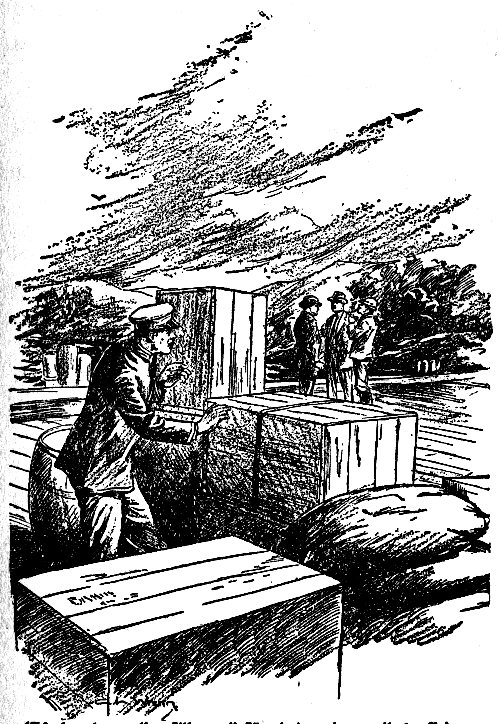
“Somebody with a lantern is coming this way!”
exclaimed the boy.
Advancing through the darkness was a single
bright disc of light. It was swinging violently,
as if whoever was carrying it was walking fast.
“Quick, get in here behind this hut,” ordered
the chief inspector.
“Why not arrest them now?” asked Ralph.
“’Twould never do. We want to get the diamonds
and other stones. You can depend upon
it, that if we were premature they would find
some way to destroy that evidence.”
From their place of hiding the party watched
the approach of the men with the lantern.
304
There were four of them. Two were recognized
as Malvin and La Rue. Another, a big,
beefy man with a flaring red face and a pair of
huge black moustaches, was identified by the inspectors
as Rawson; and the fourth was a slight,
delicate-looking little fellow, undersized and narrow-chested.
“Slim Shiner,” whispered the chief inspector,
“the cleverest gem smuggler at large! It was he
who secured the gems in Europe and saw to it
that they reached the gang over here safely.
Then Malvin and the rest disposed of them across
the line. Malvin was of invaluable use to the
gang, for he worked from your father’s boat,
which, of course, was not once suspected till we
learned of the Artful Dodger being seen off Dexter
Island.”
“Well, everything’s cleaned out,” La Rue was
saying, “and now for a clear getaway. A lucky
thing that the water was shallow when I jumped
from that blamed River Swallow, or I wouldn’t
have been along to-night.”
305
“No, nor the gems, neither,” growled Rawson.
“We think a heap more of them than we do of
your bones, La Rue.”
“That’s right,” chuckled Slim. “A good thing
for you you managed to get them away from that
kid while he was asleep, La Rue, or you wouldn’t
have dared face the gang again.”
“Well, I guess not,” laughed Malvin. “But
our troubles are over now, boys. We’ll move on
to the Great Lakes and try our luck there. That
gang of young whelps on the River Swallow
broke up our game here, all right, bad luck to
them.”
“We’ll take care of them later on, never fear,”
snarled La Rue. “I’ve a score to settle myself
with that Stetson brat. Ha! ha! that was a good
joke, though, having his old man clapped in jail
in Montreal. That was your trick, Slim.”
“Oh, these Canadian officials are such softies
they’ll believe anything you tell ’em,” modestly
declared Slim. “A telegram to the chief at Montreal
was enough to turn the deal.”
306
“It was a good one, all right,” snorted Rawson.
“Well, let’s get aboard. We’ve got lots of gasoline.
What’s our first stop, Rawson?” asked
La Rue.
“Buffalo,” was the gruff rejoinder; “and you
fellows want to lie low, too. I’ll bet there’s a hue
and cry out after us right now.”
“You bet there is, and closer than you think,”
exclaimed Ralph to himself.
The men climbed aboard. Rawson bent over
the engine, and the next instant the craft began
to move across the placid pool.
“Run hard now and cut ’em off,” cried the inspector.
“Run as you never ran before for the
small boat.”
At top speed they raced over the cliff path and
launched the tender just as the Artful Dodger,
a mystery no longer, emerged from the cliff face.
“Start the engine at top speed,” ordered Inspector
Jennings. “No use for concealment
now.”
307
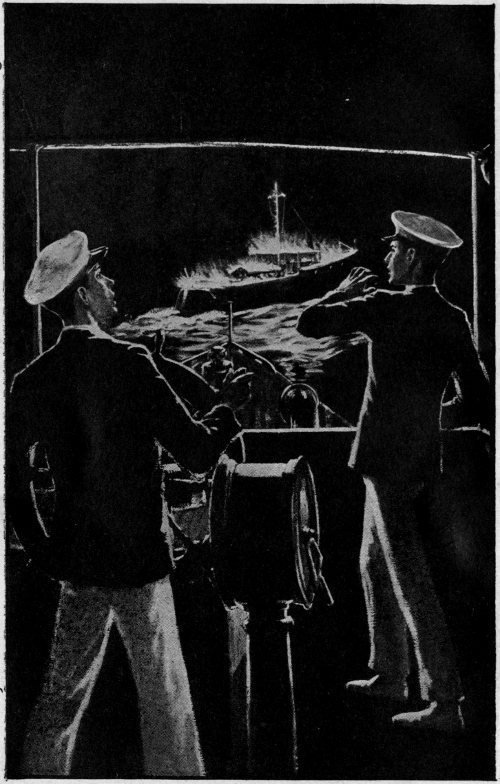
Percy Simmons spun the wheel. The tender
shot forward, headed so as to intercept the Artful
Dodger as she came out of the cove.
At that instant those on board the smugglers’
craft saw the swift little tender cutting across to
head her off. They dashed ahead at full speed.
“What’s their game now?” demanded Ralph
excitedly.
“Heading for the Canadian line,” was the chief
inspector’s brief response. “Give her more speed,
boy, she mustn’t slip through our fingers now.”
“I’ll burn up the engines,” declared Percy.
“Never mind that,” shot out Ralph; “burn up
the boat, but we’ve got to get them!”
The fever of the chase was in his veins. He
felt as if his life depended on catching the other
craft. The tender was now on a course which
must bring her across the craft’s bows. As they
drew near, the chief inspector stood up.
A revolver was in his hand. His two aides
drew close to him with grim, determined looks.
308
“Stop that boat!” hailed the chief inspector, in
round, ringing tones.
There was no reply.
“Heave to, or I’ll send a shot into you!” he
cried threateningly.
“Who in blazes are you?” came back a shout
from the other craft.
“Inspectors of the United States Customs Service!”
came the sharp response. “Heave to!”
“Go to the dickens! You can’t bluff us! We’re
for the Canadian line!” came back a taunting
shout.
Bang! A shot whizzed across the bows of the
fleeing motor boat.
“The next will come closer,” warned the inspector.
There was a hurried consultation on board the
other craft. Angry voices arose. It was plain
that some were counseling surrender, others
flight. In the midst of it all came Malvin’s voice.
“All right. We give up and be hanged to you.”
309
The tender ranged alongside the other craft.
The engines of the latter had been stopped; she
lay motionless on the water. But the inspectors
were alert for a trap. Perhaps the men on the
Artful Dodger had one ready, but the sight of the
armed officials caused them to undergo a change
of mind.
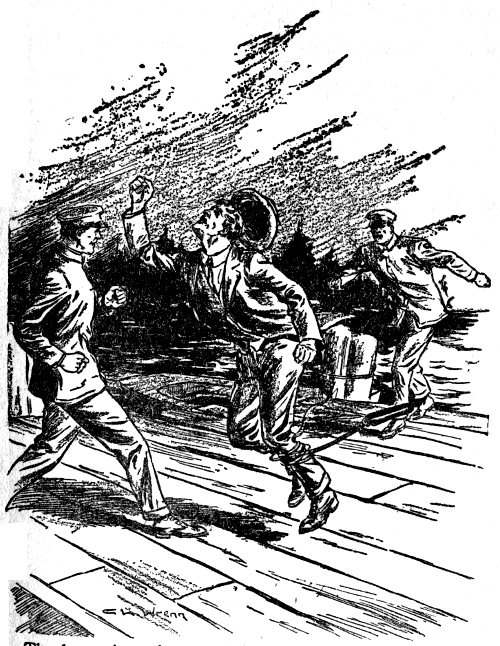
Just as they ranged alongside, there came a
snarl of rage from Malvin as his eyes lighted on
Ralph. Beside himself with fury, he sprang at
the lad with the ferocity of a tiger.
“Confound you!” he roared. “You are to
blame for all this!”
Ralph caught the fellow by the wrist as Malvin
aimed a vicious blow at him with an oar. The
next instant there was a splash and Malvin was
overboard. There was not much fight left in him
when they fished him out.
310
In the meantime La Rue had been detected in
the act of attempting to conceal a leather wallet.
The chief inspector wrenched it from him, and it
was found to contain the gems all intact.
Rawson submitted to arrest more quietly than
had been expected, as did the redoubtable Slim.
On the way to the River Swallow, with the Artful
Dodger in tow, Malvin admitted having stolen
the old man’s boat while he and Ralph were at
breakfast, and said that it could be found on
Windmill Island.
“Now, if I only had my boy back, I should be
happy,” sighed the old man, as he heard of the
safety of his beloved skiff.
“You’d better tell him, La Rue,” said Malvin,
to his sullen comrade.
“Well, if you want to know,” said La Rue,
after a pause, “your precious grandson is in the
Mercy Hospital in Cardinal.”
“In the hospital?” gasped the old man. “Jimmie?”
311
“Yes. Those brats on their River Swallow can
tell you how he came there. As for me, all I
know about the little whelp is that he was blown
ashore on the island one night in a storm. He
sought shelter in the windmill tower and overheard
us while we were discussing our plans. It
did not suit our policy to let him go and blab all
he knew to the outside world, so we kept him
there until that explosion resulted in Stetson and
the other pups taking him away.”
“Oh, thank heaven, Jimmie is found!” exclaimed
the old man.
“I guess you won’t enjoy each other’s company
long,” sneered Rawson. “The kid’s going to die.”
But Jimmie didn’t die. In fact he soon recovered,
and is now in the employ of Mr. Stetson.
The railroad king arrived home from Montreal
in time to see the rascals who had placed him in
such an embarrassing dilemma in Montreal, arraigned
in the police court at Piquetville and held
for the United States authorities. All received
terms in the Federal prison and took their sentences
according to their dispositions. Hansen
was never heard of again, and as he was only a
pawn in the great gem smuggling game, he was
not sought after.
312
Mr. Stetson received a handsome apology from
the Canadian government for its embarrassing
mistake. He has had it framed, and it hangs in
his library, where he shows it to visitors as a
great joke. Naturally, this leads to a recital of
the part that Ralph and his chums played in
breaking up the gem smuggling gang on the Canadian
line.
Old man Whey is happy on his island, and Mr.
Stetson has seen to it that he has everything he
desires. Windmill Island was purchased by a
wealthy New Yorker not long after the events
we have described, and turned into a handsome
summer home. The old tower, the scene of so
many lawless scenes, is now a lighthouse, and thus
good has come out of evil.
313
The Border Boys have once more proved their
right to the title by the stirring times in which
they participated along the Canadian frontier.
It is not likely that they will ever forget a single
detail of their experiences on the mighty St. Lawrence.
Harry no longer believes in the supernatural.
That night when the gang met its fate
laid the “ghost” of superstition for once and all
in his mind.
And now, having brought our tale to a conclusion,
we will bid God-speed to the Border
Boys. Wishing them well in all they may undertake
in the future, and a happy issue to all the
adventures which such enterprising young spirits
are likely to encounter, we will bring this latest
volume of their experiences to a close.
THE END.