Speaking only of quality of materials and workmanship,
a book may be bound just as well in a simple cover as in an
ornate one. Fine binding does not require adornment. It
does require the services of a man of high skill and matching
integrity, whose handiwork will inevitably display the quiet
beauties of intrinsic quality.
But in the hands of men who possess the spark of creative
artistry, bookbinding can be more than pure craft work.
Although the binder’s decorative tools are forever prefixed,
each to reproduce its own set and simple pattern, they are
infinitely flexible in the ways they can be combined. It is
not the tool that makes a binding beautiful or ugly, but
the hand that holds the tool—and even more the mind and
eye that guide the hand. The history of bookbinding is
studded with the names of men who were true artists in
leather. For them the most rewarding commission a customer
could give was a simple order to dress some work of
lasting worth in a binding of appropriate beauty.
In the Middle Ages all books were rare and valuable.
Each volume was entirely lettered by hand and its pages
were customarily “illuminated” with elaborately drawn
initial letters and gilded marginal decorations. The binding
of such a book was likely to be as painstakingly ornate as
were its pages, and a few bindings were quite valuable in
themselves. Before full leather covers became standard,
the boards of some manuscript volumes—especially for a
church altar or a royal library—might even be encased in
beaten gold or silver and encrusted with enamel and semiprecious
stones.
The invention of printing from type, as everyone knows,
had extremely far-reaching consequences on the spread of
public education and enlightenment. It had also some
effects that were not so desirable. In the didactic phrase
of the Encyclopedia Britannica, “Printing brought small
books, cheap books, ugly books.”
6
Now it cannot be denied that most books today are
smaller than the great manuscript tomes of the monastic
scholars. They are cheaper, too. But it would be wrong
to say that all books bound since Johann Gutenberg’s day
have been ugly. To be sure, introduction of the printing
press increased the flow of work to the bindery. But if the
binder could no longer lavish time and care on every volume,
he could still devote high artistry to an occasional book,
steady craftsmanship to all.
Innumerable examples from the hands of many binders
since the fifteenth century attest that the cover of a printed
book can be as beautiful as that of a manuscript book.
The names of Nicholas Eve, Clovis Eve, “Le Gascon”
(otherwise unknown), and Geoffrey Tory of sixteenth-century
France, and Padeloup and Le Monnier in the
eighteenth century, deserve mention. In England bindings
are not as easily identified with their binders, but the names
of Thomas Berthelet, royal binder to Henry VIII, and
above all Samuel Mearne, binder to Charles II, stand out.
Roger Payne was England’s most distinguished binder in
the eighteenth century.
Before the fifteenth century, European binders usually
had worked ornamentation into leather “in blind,” that is,
without gold leaf. The technique of applying gold seems
to have been perfected by Islamic leatherworkers of Mediterranean
Africa, and brought from Morocco to Europe via
Spain and Italy. Sixteenth-century French binders carried
this kind of adornment to a peak of intricate tooling and
lavish gilding. Their English counterparts, while they
imitated the French, tended to favor simpler designs and
less gold leaf. In the late seventeenth century and continuing
through the eighteenth, straight lines rather than
curves became characteristic of English work.
For example, the broken lines of the “cottage” style
credited to Samuel Mearne resembled an outlined roof and
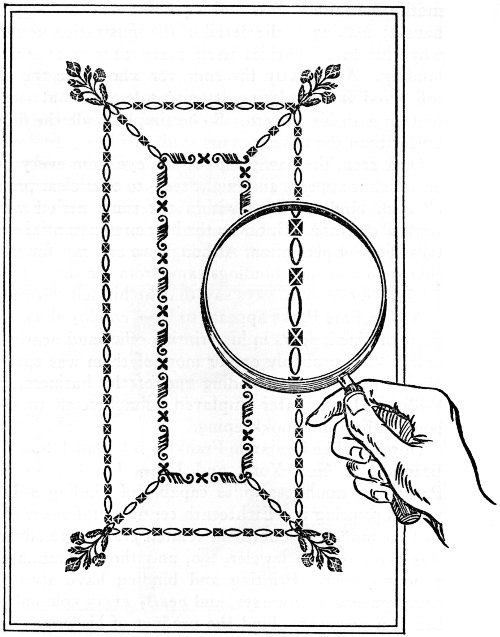
walls. Later the “Cambridge” style became popular in
England. It consisted of a vertical panel of thin lines
7
(fillets) on the sides of the book, with flower or leaf ornaments
(fleurons) at the corners and perhaps in the center,
and a narrow lace border around the boards. The example
illustrated indicates that colonial binders continued to
favor the Cambridge design until well into the eighteenth
century.
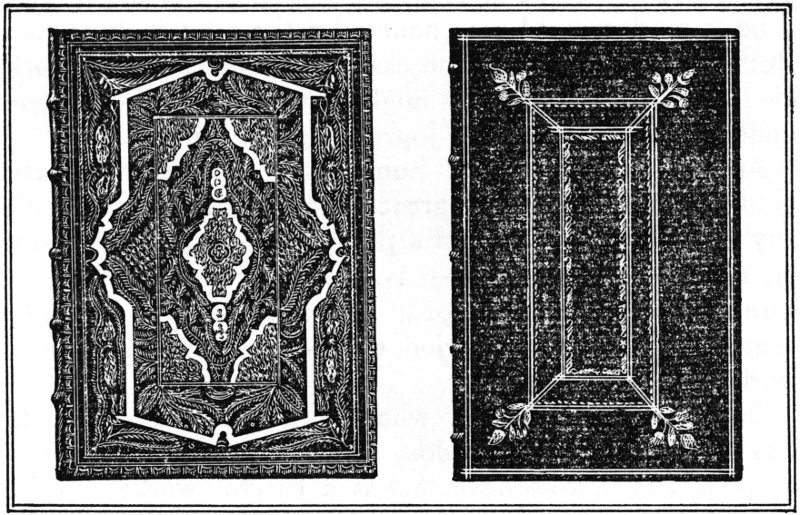
Left, “cottage” style decoration on a 1674 Bible, bound in the shop of Samuel
Mearne of London. Right, “Cambridge” style binding on a copy of Muscipula
printed in 1728 by William Parks in Annapolis and bound by him.
Around 1760 a Dutch binder developed a method of
treating leather with acid to give it a marbled appearance,
and other binders lost no time in prying the secret away
from him. First among binders in England to learn the
technique was an émigré German, John Baumgarten, who
made the most of his advantage. As Thomas Jefferson
wrote to Robert Skipwith in 1771, books “bound by Bumgarden
in fine Marbled bindings” cost 50 per cent more
than in plain bindings.
In addition to national styles and local designs that
developed at various times and places, certain binders
perfected individual patterns of their own. In some cases
8
these were so unique as to be almost certain evidence that
a book so decorated was bound by the man in question.
But not always. As in the case of Samuel Mearne, work
identified with the master might actually have been done
under his instruction by a journeyman in his shop.
Among the very large number of eighteenth-century
bindings that survive, the great difficulty is to identify with
any certainty the binder of a particular volume. In many
instances—perhaps most—it is impossible to be absolutely
sure on this point. Except in France, binders of the eighteenth
century, or any period, who signed or labeled their
work were relatively rare.
One English craftsman who did identify his products
was Roger Payne of London. An eccentric and a heavy
drinker, Payne was nevertheless a careful worker and a
creative artist in the bindery. His books are beautifully
adorned with patterns built up with small tools that he
designed and cut himself. In many of the books he bound,
Payne included a detailed account of his work. The
following statement, copied in part from a Bible now owned
by Princeton University, is a good example:
Letter’d in ye most exact manner, exceeding rich small
Tool Gilt Back of a new pattern studded in Compartments.
The outside finished in the Richest & most
elegant Taste Richer, & more exact than any Book
that I ever Bound. The insides finished in a new
design exceeding elegant. Bound in the very best
manner sew’d with silk on strong and neat Bands.
The Back lined with Russia Leather under the Blue
morrocco. Cover very strong & neat Boards....