THE BOOK OF VAGABONDS AND BEGGARS. — PREFACE. — CONTENTS. — INTRODUCTION. — LIBER VAGATORUM — MARTIN LUTHER — ENGLISH BOOKS ON VAGABONDS — ANCIENT CUSTOMS OF ENGLISH BEGGARS — GERMAN ORIGIN OF TRICS PRACTISED BY ENGLISH VAGABONDS — OLD GERMAN CANT WORDS — THE BOOK OF VAGABONDS AND BEGGARS WITH A PREFACE BY MARTIN LUTHER — MARTIN LUTHER’S PREFACE. — ¶ Part the First of this little Book .


THE

WITH A VOCABULARY OF THEIR LANGUAGE.
EDITED BY
MARTIN LUTHER
IN THE YEAR 1528.
NOW FIRST TRANSLATED INTO ENGLISH, WITH
INTRODUCTION AND NOTES,
BY
JOHN CAMDEN HOTTEN.
LONDON:
JOHN CAMDEN HOTTEN, PICCADILLY.
1860.
 S
a picture of the manners and customs of the
Vagabond population of Central Europe before
the Reformation, I think this little book, the
earliest of its kind, will be found interesting. The fact of
Luther writing a Preface and editing it gives it at once
some degree of importance, and excites the curiosity of the
student.
S
a picture of the manners and customs of the
Vagabond population of Central Europe before
the Reformation, I think this little book, the
earliest of its kind, will be found interesting. The fact of
Luther writing a Preface and editing it gives it at once
some degree of importance, and excites the curiosity of the
student.
In this country the Liber Vagatorum is almost unknown, and in Germany only a few scholars and antiquaries are acquainted with the book.
In translating it I have endeavoured as much as possible to preserve the spirit and peculiarities of the original. Some may object to the style as being too antique; but this garb I thought preserved a small portion of the original quaintness, and was best suited to the period when it was written.
For several explanations of old German words, and other hints, I am indebted to a long notice of the Liber Vagatorum, which occurs in the “Wiemarisches Jahrbuch,” 10te, Band, 1856,—the only article of any moment that I know to have been written on the little book.
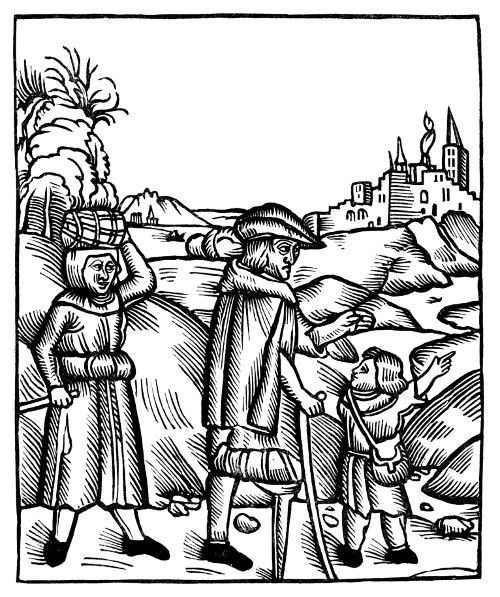
With respect to the facsimile woodcut, as it was too large to occupy a place on the title, as in the original (of 4to. size), it is here given as a frontispiece.
Perhaps some apology is required for the occasional use of plain-spoken, not to say coarse words. I can only urge, in justification of their adoption, that the nature of the subject would not admit of their being softened,—unless indeed at the expense of the narrative. As it is, I have sent forth this edition in very much more refined language than the great Reformer thought necessary when issuing the old German version.
J. C. H.
Piccadilly,
June 1, 1860.

| Page | |
 REFACE | v ix |
Liber Vagatorum.—Various editions.—Gengenbach’s metrical version; Gödecke’s claim for the priority of this refuted | xv |
Martin Luther.—Occupied in the work of the Reformation.—Writes several popular pieces.—Edits the Liber Vagatorum | xix |
English Books on Vagabonds.—Harman’s Caveat for commen Cvrsetors.—The Fraternitye of Vacabondes.—Greene, Decker, and Shakespeare | xxiv |
Ancient Customs of English Beggars.—Licences with Seals.—Seals now disused.—Wandering Students or Vagabond Scholars | xxviii |
German Origin of tricks practised by English Vagabonds.—Masters [Pg viii]of the Black-Art.—Fawney Riggers.—Card-Sharpers.—Begging-Letter-Writers.—Shabby-Genteels.—Mechanics out of employ.—Shivering Jemmies.—Maimers of Children.—Borrowers of Children.—Simulated Fits.—Quack Doctors.—Treasure-Seekers.—Travelling Tinkers | xxxi |
Old German Cant Words | xxxvi |
| LIBER VAGATORUM | 1 |
| Luther’s Preface | 3 |
| Part I.—The several Orders of Vagabonds | 7 |
| Part II.—Notabilia relating to Beggars | 43 |
| Part III.—Vocabulary of Cant Words | 49 |
 AGABONDS and Beggars are ancient
blots in the history of the world. Idleness,
I suppose, existed before civilization
began, but feigned distress must
certainly have been practised soon after.
AGABONDS and Beggars are ancient
blots in the history of the world. Idleness,
I suppose, existed before civilization
began, but feigned distress must
certainly have been practised soon after.
In the records of the Middle Ages enactments for the suppression and ordering of vagrancy continually occur. In this country, as we shall see directly, laws for its abolishment were passed at a very early date.
The begging system of the Friars, perhaps more than any other cause, contributed to swell the ranks of vagabonds. These religious mendicants, who had long been increasing in number and dissoluteness, gave to beggars sundry lessons in hypocrisy, and taught them, in their tales of fictitious distress, how to blend the troubles of the soul with the infirmities of the body. Numerous systems of religious imposture were soon contrived, and mendicants of a hundred orders swarmed through the land. Things were at their worst, or rather both friars and vagabonds were in their palmiest days, towards the latter part of the fifteenth century, just before the suppression of the Religious Houses commenced, and immediately before the first symptoms of the Reformation showed themselves,—that great movement which was so soon to sweep one of the two pests away for ever.
In Schreiber’s account of the Bettler-industrie (begging practices) of Germany in the year 1475, he thus speaks of this golden age for mendicants.1 His theory, as to the origin of the complicated system of mendicity, is, perhaps, more fanciful than true, but his account is nevertheless very interesting, and well worth extracting from.
“The beggars of Germany rejoiced in their Golden Age; it extended throughout nearly two centuries, from the invasions of the Turks until after the conclusion of the Swedish war (1450 to 1650). During this long period it was frequently the case that begging was practised less from necessity than for pleasure;—indeed, it was pursued like a regular calling. For poetry had estranged herself from the Nobility; knights no longer went out on adventures to seek giants and dragons, or to liberate the Holy Tomb; she had likewise become more and more alien to the Citizen, since he considered it unwise to brood over verses and rhymes, when he was called upon to calculate his profits in hard coin. Even the ‘Sons of the Muses,’ the Scholars, had become more prosaic, since there was so much to learn and so many universities to visit, and the masters could no longer wander from one country to another with thousands of pupils.
“Then poetry (as everything in human life gradually descends) began to ally herself with beggars and vagrants. That which formerly had been misfortune and misery became soon a sort of free art, which only retained the mask of misery in order to pursue its course more safely and undisturbed. Mendicity became a distinct institution, was divided into various branches, and was provided with a language of its own. Doubtless, besides the frequent wars, it was the Gipsies—appearing in Germany, at the beginning of the fifteenth century, in larger swarms than ever—who contributed greatly to this state of things. They formed entire tribes of wanderers, as free as the birds in the air, now dispersing themselves, now reuniting, resting whereever forests or moors pleased, or stupidity and superstition allured them, possessing nothing, but appropriating to themselves the property of everybody, by stratagem or rude force.
“In what manner and to what extent such beggary had grown up and branched off towards the close of the fifteenth century, what artifices and even what language these beggars used to employ, is shown us in Johann Knebel’s Chronicles, the MSS. of which are preserved in the Library of the City and University of Bâle.”
These MSS. are very curious. They contain the proceedings of the Trials at Basle,2 in Switzerland, in 1475, when a great number of vagabonds, strollers, blind men, and mendicants of all orders, were arrested and examined. Johann Knebel was the chaplain of the cathedral there, and wrote them down at the time. From the reports of these trials it is believed the Liber Vagatorum was compiled; and it is also conjectured that, from the same rich source, Sebastian Brant, who just at that period had established himself at the University of Basle, where he remained until 1500, drew the vivid description of beggars and begging, to be found in his Ship of Fools.3
Knebel gives a long list of the different orders of beggars, and the names they were known by amongst themselves. This account is similar to, only not so spirited as that given in the Liber Vagatorum. The tricks and impostures are very nearly the same, together with the cant terms for the various tribes of mendicants. Knebel, speaking of the manner in which the tricks of these rogues were first found out, says:—“At those times a great number of knaves went about the country begging and annoying people. Of these several were caught, and they told how they and their fellow-knaves were known, and when and how they used to meet, what they were called, and they told also several of their cant words.”
HE Liber Vagatorum, or The Book of Vagabonds,
was probably written shortly after
1509, that year being mentioned in the
work; it is the earliest book on beggars and their
secret language of which we have any record,—preceding
by half a century any similar work issued in
this country.
Nothing is known of the author other than that it was written by one who styled himself a “Reverend Magister, nomine expertus in truffis,”—which proficiency in roguery, as Luther remarks, “the little book very well proves, even though he had not given himself such a name.”
None of the early impressions bears a date, but the first edition is known to have been printed at Augsburg, about the year 1512-14, by Erhart Öglin, or Ocellus.4 It is a small quarto, consisting of 12 leaves.
The title:—

is printed in red. The title-page of this, as of most of the early editions, is embellished with a woodcut,—a facsimile of which is given in this translation. The picture, representing a beggar and his family, explains itself. At the foot of the title is printed, in black:—Getrucht zu Augspurg durch Erhart Öglin. The little book was frequently reprinted without any other variations than printers’ blunders (one edition having an error in the first word, Lieber Vagatorum) until 1528, when Luther edited an edition,5 supplying a preface, and correcting some of the passages. In 1529 another edition, with Luther’s preface, appeared at Wittemberg,6 and from this, comparing it occasionally with the first Pg xviiedition by Ocellus, the present English version has been made. Nearly all the editions contain the same matter; nor do those issued under Luther’s authority furnish us with additional information. With regard to the Vocabulary, however, I have made, in a few instances, slight variations, as given in two editions of the Liber Vagatorum, preserved in the Library at Munich. Wherever there was a marked divergence in style I have adopted that as my text which seemed to be the most characteristic for the fifteenth and the commencement of the sixteenth centuries, and which is mostly to be found in the better class MSS. and works of that period.
I should state, however, before proceeding further, that a metrical version of the Liber Vagatorum, in 838 verses, appeared about 1517-18, written by Pamphilus Gengenbach, including a vocabulary of the beggars’ cant. Although Karl Gödecke, in his work, Ein Beitrag zur Deutschen Literatur Geschichte der Reformations zeit (Hannover, Carl Rümpler, 1855), has stated that Gengenbach’s poetical version preceded the smaller prose account, it is impossible, upon examining the two publications, to agree with him on this point. Gengenbach’s book certainly did not appear till after 1517, and the direct copies from the Liber Vagatorum, in matter and manner, are too frequent to admit for one moment of the supposition of their being accidental. The cant terms, too, are incorrectly given, and altogether the work bears the appearance of hasty and piratical compilation. It never met with that popularity which the author anticipated, and probably never crossed the frontiers of Switzerland.
The latest prose edition of the Liber Vagatorum was issued towards the close of the seventeenth century. The title ran:—Expertus in truffis. Of False Beggars and their knaveries. A pretty little book, made more than a century and a half since, together with a Vocabulary of some old cant words that occur therein, newly edited. Anno 1668 (12o. pp. 160).
HAT Luther should have written a Preface
to so undignified a little work as The
Book of Vagabonds seems remarkable. At
this period (1528-9) he was in the midst of his labours,
surrounded with difficulties and cares, and
with every moment of his time fully occupied. The
Protest of Spires had just been signed by the first
Protestants. Melancthon, in great affliction at the
turbulent state of affairs, was running from city to
city; and all Germany was alarmed to hear that the
dreaded Turks were preparing to make battle before
Vienna. Yet, the centre of all this agitation, engaged
in directing and assisting his followers, Luther found
time to write several popular pieces, and kept, we are
told, the book-hawkers of Augsburg and Spires busy
in supplying them to the people. These Christian
pamphlets, D’Aubigné informs us, were eagerly
sought for and passed through numberless editions.
It was not the peasants and townspeople only who
read them, but nobles and princes. Luther intendedPg xx
that they should be popular. He knew better than
any man of his time how to captivate the reader and
fix his attention. His little books were short, easy
to read, full of homely sayings and current phrases,
and ornamented with curious engravings. They
were generally written, too, in Latin and German,
to suit both the educated and the unlettered. One
was entitled, The Papacy with its Members painted
and described by Dr. Luther. In it figured the
Pope, the cardinal, and all the religious orders.
Under the picture of one of the orders were these
lines:—
“Not one of these orders,” said Luther to the reader, “thinks either of faith or charity. This one wears the tonsure, the other a hood, this a cloak, that a robe. One is white, another black, a third gray, and a fourth blue. Here is one holding a looking-glass, there one with a pair of scissors. Each has his playthings.... Ah! these are the palmer-worms, the locusts, the canker-worms, and the caterpillars which, as Joel saith, have eaten up all the earth.”7
In this style Luther addressed his readers—scourging the Pope, his cardinals, and all their emissaries. But another class of “locusts” besides these appeared to him to require sweeping away,—these were the beggars and vagabonds who imitated the Mendicant Friars in wandering up and down the country, with lying tales of distress, either of mind or body. As he says in his Preface, explaining the reason of his connection with the book, “I thought it a good thing that such a work should not only be published, but that it should become known everywhere, in order that men can see and understand how mightily the devil rules in this world; and I have also thought how such a book may help mankind to be wise, and on the look out for him, viz. the devil.”
Luther further adds—not forgetting, in passing, to give a blow to Papacy—“Princes, lords, counsellors of state, and everybody should be prudent, and cautious in dealing with beggars, and learn that, whereas people will not give and help honest paupers and needy neighbours, as ordained by God, they give, by the persuasion of the devil, and contrary to God’s judgment, ten times as much to vagabonds and desperate rogues,—in like manner as we have hitherto done to monasteries, cloisters, churches, chapels, and Mendicant Friars, forsaking all the time the truly poor.”
This was Luther’s object in affixing his name to the little book. He saw that the Friars, Beggars, and Jews were eating up his country, and he thought that a graphic account of the various orders of vagrants, together with a list of their secret or cant words, issued under the authority of his name, would put people on their guard, and help to suppress the wretched system.
Luther’s statement as to his own experience with these rogues is very naïve—“I have myself of late years,” he remarks, “been cheated and slandered by such tramps and liars more than I care to confess.”
Both priests and beggars regarded him with a peculiar aversion, and many were the nicknames and vulgar terms applied to him. The slang language of the day, therefore, was not unknown to Luther.
At page 204 of Williams’ Lectures on Ecclesiastical History, 4to. (apparently privately printed for the use of the students of St. Begh’s College,) is the following foot-note:—
Of the violence with which Luther’s enemies attacked his character, and strove to render his name and memory odious to the people, we have an example in the following production of a French Jesuit, Andreas Frusius, printed at Cologne, 1582:—
Elogium Martini Lutheri, ex ipsius Nomine et Cognomine.
Depinget et dignis te nemo coloribus unquam;
Nomen ego ut potero sic celebrabo tuum.
Magnicrepus
Ambitiosus
Ridiculus
Tabificus
Impius
Nyctocorax
Ventosus
Schismaticus
Lascivus
Ventripotens
Tartareus
Heresiarcha
Erro
Retrogradus
Vesanus
SacrilegusMendax
Atrox
Rhetor
Tumidus
Inconstans
Nebulo
Vanus
Stolidus
Leno
Vultur
Torris
Horrendus
Execrandus
Reprobus
Varius
SatanasMorofus
Astutus
Rabiosus
Tenebrosus
Impostor
Nugator
Vilis
Seductor
Larvatus
Vinosus
Tempestas
Hypocrita
Effrons
Resupinus
Veterator
SentinaMorio
Apostata
Rabula
Transfuga
Iniquus
Noxa
Vulpecula
Simia
Latro
Vappa
Tarbo
Hydra
Effronis
Rana
Vipera
SophistaMonstrum
Agaso
Raptor
Turpis
Ineptus
Nefandus
Vecors
Scurra
Lanista
Voluptas
Tyrannus
Hermaphroditus
Eriunis
Rebellis
Virus
Scelestu
Each column is an acrostic of the name Martinvs Luthervs, making 80 scurrilous epithets.
 MUST now say something about the little
books on vagabonds which appeared in
this country fifty years after the Liber Vagatorum
had become popular in Germany. The first
and principal of these was edited by Thomas Harman,
a gentleman who lived in the days of Queen
Elizabeth, and who appears to have spent a considerable
portion of his time in ascertaining the artifices
and manœuvres of rogues and beggars. From a close
comparison of his work with the Liber Vagatorum, I
have little hesitation in saying that he obtained the
idea and general arrangement, together with a good
deal of the matter, from the German work edited by
Luther. The title of Harman’s book is:—A
Caueat for Cvrsetors vulgarely Called Vagabones, set
forth for the vtilitie and profit of his naturell countrey.
MUST now say something about the little
books on vagabonds which appeared in
this country fifty years after the Liber Vagatorum
had become popular in Germany. The first
and principal of these was edited by Thomas Harman,
a gentleman who lived in the days of Queen
Elizabeth, and who appears to have spent a considerable
portion of his time in ascertaining the artifices
and manœuvres of rogues and beggars. From a close
comparison of his work with the Liber Vagatorum, I
have little hesitation in saying that he obtained the
idea and general arrangement, together with a good
deal of the matter, from the German work edited by
Luther. The title of Harman’s book is:—A
Caueat for Cvrsetors vulgarely Called Vagabones, set
forth for the vtilitie and profit of his naturell countrey.
This first appeared in 1566. It was very popular, and soon ran through four editions, the last being “augmented and enlarged by the first author thereof, with the tale of the second taking of the counterfeit Crank, and the true report of his behaviour and punishment, most marvellous to the hearer or reader thereof.”
The dates of the four editions are—
| William Gryffith | 1566 |
| Wilib.lliamib. | 1567 |
| . . . . . . . . | 1567 |
| Henry Middleton | 1573 |
The printer of the third edition is not known. The book is dedicated, somewhat inconsistently, considering the nature of the subject, to Elizabeth, Countess of Shrewsbury. It gives, like the Liber Vagatorum, short but graphic descriptions of the different kinds of beggars, and concludes with a cant dictionary.
The next work on this subject which appeared in England was published nine years later:—
The Fraternitye of Vacabondes, with a Description of the crafty Company of Cousoners and Shifters; whereunto also is adioyned the XXV Orders of Knaues, other wise called a Quartern of Knaues. Confirmed for ever by Cocke Lorell. (London by John Awdeley, 4to. 1575.)8
Some have conjectured that it was an original compilation by Audley, the printer; but this little book, perhaps more than Harman’s, shows traces of the German work. The “XXV Orders of Knaues” is nearly the number described in the Liber Vagatorum, and the tricks, and description of beggars’ dresses in both are very similar. There are the rogues with patched cloaks, who begged with their wives and “doxies;” those with forged licenses and letters, who pretended to collect for hospitals; those afflicted with the falling sickness, a numerous number; some without tongues, carrying letters, pretending they have been signed and sealed by the authorities of the towns from whence they came; others, “freshe-water mariners,” with tales of a dreadful shipwreck, and many more, all described in similar words, whether in the pages of the Liber Vagatorum, Harman, or Audley. It is reasonable to suppose, therefore, that the German account, being in the hands of the people abroad half a century before anything of the kind was issued here, copies must have found their way to England, and that from these the other two were in a great measure derived.
I might remark that other accounts of English vagabonds were published soon after this. The subject had become popular, and a demand for books of the kind was the result. Harrison, who wrote the Description of England, prefixed to Holinshed’s Chronicle (1577), describes the different orders of beggars. Greene, about 1592, wrote several works, based mainly on old Harman’s book; and Decker, twenty years later, provided a similar batch, giving an account of the vagabonds and loose characters of his day.
Shakespeare, too, and other dramatists of the period, introduced beggars and mendicants into their plays in company with the Gipsies, with whom, in a great measure, in this country they were allied.
MONGST those passages which refer to
the customs and tricks of beggars, in the
Liber Vagatorum, there are few which
receive illustration by a reference to the early laws
and statutes of this country.
The licenses, or “letters with seals,” so frequently alluded to, and which were granted to deserving poor people by the civil authorities, are mentioned as customary in this country in the Act for the ordering of Vagrants, passed in the reign of Henry VIII. (1531). It appears that the parish officers were compelled by this statute to make inquiry into the condition of the poor, and to ascertain who were really impotent and who were impostors. To a person actually in want liberty was given to beg within a certain district, “and further,” says the Act, “there shall be delivered to every such person a letter containing the name of that person, witnessing that he is authorized to beg, and the limits within which he is appointed to beg, the same letter to be sealed with the seal of the hundred, rape, wapentake, city, or borough, and subscribed with the name of one of the said justices or officers aforesaid.”
I need scarcely remark that a seal in those days, when but few public functionaries could write, was looked upon as the badge of authority and genuineness, and that as the art of writing became more general autograph signatures supplanted seals. An English vagabond in the time of Elizabeth, when speaking of his passport, called it his JARKE, or JARKEMAN, viz. his sealed paper. His descendant of the present century would term it his LINES, viz. his written paper. The cant term JARKE is almost obsolete, but the powerful magic of a big seal is still remembered and made use of by the tribe of cadgers. When a number of them at the present day wait upon a farmer with a fictitious paper, authorizing them to collect subscriptions for the sufferers in some dreadful colliery accident, the document, covered with apparently genuine signatures, is generally garnished with a huge seal.
In Germany it was the custom (alluded to at page 34) for the priests or clerks to read these licenses to beg from the pulpit, that the congregation might know which of the poor people who waited at their doors were worthy of alms. Sometimes, as in the case of the Dützbetterin, or false “lying-in-woman,” an anecdote of whom is told here, the priests were deceived by counterfeit documents.
At page 17 reference is made to the wandering students who used to trudge over the country and sojourn for a time at any school charitable enough to take them in. These, in their journeys, often fell in with rogues and tramps, and sometimes joined them in their vagabond calling, in which case they obtained for themselves the title of Kammesierers, or “Learned Beggars.” Now these same vagabond scholars were to be met with in this country in the time of Henry VIII,—and in Ireland, I believe, so late as the last century. Examining again the Act for Vagrants, 1531, we find that it was usual and customary for poor scholars from Oxford and Cambridge to tramp from county to county. The statute provided them with a document, signed by the commissary, chancellor, or vice-chancellor, which acted as their passport. When found without this license they were treated as vagrants, and whipped accordingly.
T is remarkable that many of the tricks
and manœuvres to obtain money from the
unthinking but benevolent people of Luther’s
time should have been practised in this country
at an early date, and that they should still be found
amongst the arts to deceive thoughtless persons
adopted by rogues and tramps at the present day.
The stroller, or “Master of the Black Art,” described
at page 19, is yet occasionally heard of in
our rural districts. The simple farmer believes him
to be weather and cattle wise, and should his crops
be backward, or his cow “Spot,” not “let down
her milk,” with her accustomed readiness, he crosses
the fellow’s hand with a piece of silver, in order that
things may be righted.
The Wiltners, or finders of pretended silver fingers, noticed at page 45, are now-a-days represented by the “Fawney Riggers,” or droppers of counterfeit gold rings,—described in Mayhew’s London Labour, and other works treating of the ways of vagabonds.
“Card-Sharpers,” or Joners, mentioned at page 47, are, unfortunately for the pockets of the simple, still to be met with on public race-courses and at fairs.
The over-Sönzen-goers, or pretended distressed gentry, who went about “neatly dressed,” with false letters, would seem to have been the original of our modern “Begging-Letter-Writers.”
Those half-famished looking impostors, with clean aprons, or carefully brushed threadbare coats, who stand on the curbs of our public thoroughfares, and beg with a few sticks of sealing-wax in their hands, were known in Luther’s time as Goose-shearers. As the reader will have experienced only too frequently, they have, when pretending to be mechanics out of employ, a particularly unpleasant practice of following people, and detailing, in half-despairing, half-threatening sentences, the state of their pockets and their appetites. It appears they did the same thing more than three centuries ago.
Another class, known amongst London street-folk as “Shivering-Jemmies,”—fellows who expose themselves, half-naked, on a cold day, to excite pity and procure alms—were known in Luther’s time as Schwanfelders,—only in those days, people being not quite so modest as now, they stripped themselves entirely naked before commencing to shiver at the church-doors.
Those wretches, who are occasionally brought before the police magistrates, accused of maiming children, on purpose that they may the better excite pity and obtain money, are, unfortunately, not peculiar to our civilized age. These fellows committed like cruelties centuries ago.
Borrowers of children, too,—those pretended fathers of numerous and starving families of urchins, now often heard howling in the streets on a wet day, the children being arranged right and left according to height,—existed in the olden time,—only then the loan was but for All Souls’, or other Feast Day, when the people were in a good humour.
The trick of placing soap in the mouth to produce froth, and falling down before passers-by as though in a fit, common enough in London streets a few years ago, is also described as one of the old manœuvres of beggars.9
Travelling quack-doctors, against whom Luther cautions his readers, were common in this country up to the beginning of the present century.10 And it is not long ago since the credulous countrymen in our rural districts, were cheated by fellows—“wise-men” they preferred being termed—who pretended to divine dreams, and say under which tree or wall the hidden treasure, so plainly seen by Hodge in his sleep carefully deposited in a crock, was to be found. This pleasant idea of a pot full of gold, being buried near everybody, seems to have possessed people in all ages. In Luther’s time the nobility and clergy appear to have been sadly troubled with it, and it is very amusing to learn that so simple in this respect were the latter, that after they had given “gold and silver” to the cunning treasure-seeker, this worthy would insist upon their offering up masses in order that the digging might be attended with success!
And lastly, the travelling tinkers,—who appear to have had no better name for honesty in the fifteenth century than they have now,—“going about breaking holes in people’s kettles to give work to a multitude of others,” says the little book.
 ITH regard to the Rothwelsch Sprache, or
cant language used by these vagrants, it
appears, like nearly all similar systems of
speech, to be founded on allegory. Many of the
terms, as in the case of the ancient cant of this country,
appear to be compound corruptions,—two or
more words, in ordinary use, twisted and pronounced
in such a way as to hide their original meaning.
As Luther states, in his preface, the Hebrew appears
to be a principal element. Occasionally a term
from a neighbouring country, or from a dead language
may be observed, but not frequently. As
they occur in the original I have retained those cant
words which are to be found here and there in the
text. Perhaps it would have rendered a perusal lessPg xxxvii
tedious had they been placed as foot-notes; but I
preferred to adhere to the form in which Luther was
content the little book should go forth to the world.
The simple form of these secret terms has generally
been given, there being no established rule for their
inflection. In a few instances I found myself unable
to give English equivalents to the cant words
in the Vocabulary, so was compelled to leave them
unexplained, but with the old German meanings
(not easy to be unravelled) attached.
ITH regard to the Rothwelsch Sprache, or
cant language used by these vagrants, it
appears, like nearly all similar systems of
speech, to be founded on allegory. Many of the
terms, as in the case of the ancient cant of this country,
appear to be compound corruptions,—two or
more words, in ordinary use, twisted and pronounced
in such a way as to hide their original meaning.
As Luther states, in his preface, the Hebrew appears
to be a principal element. Occasionally a term
from a neighbouring country, or from a dead language
may be observed, but not frequently. As
they occur in the original I have retained those cant
words which are to be found here and there in the
text. Perhaps it would have rendered a perusal lessPg xxxvii
tedious had they been placed as foot-notes; but I
preferred to adhere to the form in which Luther was
content the little book should go forth to the world.
The simple form of these secret terms has generally
been given, there being no established rule for their
inflection. In a few instances I found myself unable
to give English equivalents to the cant words
in the Vocabulary, so was compelled to leave them
unexplained, but with the old German meanings
(not easy to be unravelled) attached.
John Camden Hotten.
Piccadilly, June, 1860.


Printed at Wittemberg in the year
M.D.XXIX.
 HIS little book about the knaveries of beggars
was first printed by one who called
himself Expertus in Truffis, that is, a
fellow right expert in roguery,—which
the little work very well proves, even though he had
not given himself such a name.
HIS little book about the knaveries of beggars
was first printed by one who called
himself Expertus in Truffis, that is, a
fellow right expert in roguery,—which
the little work very well proves, even though he had
not given himself such a name.
But I have thought it a good thing that such a book should not only be printed, but that it should become known everywhere, in order that men may see and understand how mightily the devil rules in this world; and I have also thought how such a book may help mankind to be wise, and on the look out for him, viz. the devil. Truly, such Beggars’ Cant has come from the Jews, for many Hebrew words occur in the Vocabulary, as any one who understands that language may perceive.
But the right understanding and true meaning of the book is, after all, this, viz. that princes, lords, counsellors of state, and everybody should be prudent, and cautious in dealing with beggars, and learn that, whereas people will not give and help honest paupers and needy neighbours, as ordained by God, they give, by the persuasion of the devil, and contrary to God’s judgment, ten times as much to Vagabonds and desperate rogues,—in like manner as we have hitherto done to monasteries, cloisters, churches, chapels, and mendicant friars, forsaking all the time the truly poor.
For this reason every town and village should know their own paupers, as written down in the Register, and assist them. But as to outlandish and strange beggars they ought not to be borne with, unless they have proper letters and certificates; for all the great rogueries mentioned in this book are done by these. If each town would only keep an eye upon their paupers, such knaveries would soon be at an end. I have myself of late years been cheated and befooled by such tramps and liars more than I wish to confess. Therefore, whosoever hears these words let him be warned, and do good to his neighbour in all Christian charity, according to the teaching of the commandment.
SO HELP US GOD! 

THE BOOK OF VAGABONDS AND BEGGARS.

 ERE follows a pretty little book, called
Liber Vagatorum, written by a high
and worthy master, nomine Expertus in
Truffis, to the praise and glory of
God, sibi in refrigerium et solacium, for all persons’
instruction and benefit, and for the correction and
conversion of those that practise such knaveries as
are shown hereafter; which little book is divided
into three parts. Part the first shows the several
methods by which mendicants and tramps get theirPg 8
livelihood; and is subdivided into XX chapters, et
paulo plus,—for there are XX ways, et ultra,
whereby men are cheated and fooled. Part the
second gives some notabilia which refer to the
means of livelihood afore mentioned. The third
part presents a Vocabulary of their language or
gibberish, commonly called Red Welsh, or Beggar-lingo.
ERE follows a pretty little book, called
Liber Vagatorum, written by a high
and worthy master, nomine Expertus in
Truffis, to the praise and glory of
God, sibi in refrigerium et solacium, for all persons’
instruction and benefit, and for the correction and
conversion of those that practise such knaveries as
are shown hereafter; which little book is divided
into three parts. Part the first shows the several
methods by which mendicants and tramps get theirPg 8
livelihood; and is subdivided into XX chapters, et
paulo plus,—for there are XX ways, et ultra,
whereby men are cheated and fooled. Part the
second gives some notabilia which refer to the
means of livelihood afore mentioned. The third
part presents a Vocabulary of their language or
gibberish, commonly called Red Welsh, or Beggar-lingo.





























