There was, in days of yore and in ages and times long gone
before, a puissant King among the Kings of China, the crown of
crowned heads, who ruled over many men of war and vassals with
wisdom and justice, might and majesty; equitable to his Ryots,
liberal to his lieges and dearly beloved by the hearts of his subjects.
He was wealthy as he was powerful, but he had grown
old without being blessed with a son, and this caused him sore
affliction. He could only brood over the cutting off of his seed
and the oblivion that would bury his name and the passing of
his realm into the stranger’s hands. So he secluded himself
in his palace, never going in and out or rising and taking rest
till the lieges lost all tidings of him and were sore perplexed
and began to talk about their King. Some said, “He’s dead”;
others said, “No, he’s not but all resolved to find a ruler who
could reign over them and carry out the customs of government.”
At last, utterly despairing of male issue, he sought the intercession
of the Prophet (whom Allah bless and keep!) with the Most
High and implored Him, by the glory of His Prophets and
Saints and Martyrs and others of the Faithful who were acceptable
to Heaven that he would grant him a son, to be the coolth
of his eyes and heir to the kingdom after him. Then he rose
forthright and, withdrawing to his sitting-saloon, sent for his wife
123who was the daughter of his uncle. Now this Queen was of surpassing
beauty and loveliness, the fairest of all his wives and the
dearest to him as she was the nearest: and to boot a woman
of excellent wit and passing judgement. She found the King
dejected and sorrowful, tearful-eyed and heavy-hearted; so she
kissed ground between his hands and said, “O King, may my life
ransom thy life! may Time never prove thy foe, nor the shifts of
Fortune prevail over thee; may Allah grant thee every joy and
ward off from thee all annoy! How is it I see thee brooding over
thy case and tormented by the displeasures of memory?” He
replied, “Thou wottest well that I am a man now shotten in years,
who hath never been blessed with a son, a sight to cool his eyes;
so I know that my kingdom shall pass away to the stranger in
blood and my name and memory will be blotted out amongst
men. ‘Tis this causeth me to grieve with excessive grief.” “Allah
do away with thy sorrows,” quoth she: “long ere this day a
thought struck me; and yearning for issue arose in my heart
even as in thine. One night I dreamed a dream and a voice
said to me:—The King thy husband pineth for progeny: if a
daughter be vouchsafed to him, she will be the ruin of his
realm; if a son, the youth will undergo much trouble and
annoy but he will pass through it without loss of life. Such a
son can be conceived by thee and thee only and the time of
thy conception is when the moon conjoineth with Gemini! I
woke from my dream, but after what I heard that voice declare
I refrained from breeding and would not consent to bear children.”
“There is no help for it but that I have a son, Inshallah,—God
willing!” cried the King. Thereupon she soothed and
consoled him till he forgot his sorrows and went forth amongst
the lieges and sat, as of wont, upon his throne of estate. All
rejoiced to see him once more and especially the Lords of his
realm. Now when the conjunction of the moon and Gemini took
place, the King knew his wife carnally and, by order of Allah
Almighty she became pregnant. Presently she announced the
glad tidings to her husband and led her usual life until her nine
months of pregnancy were completed and she bare a male child
whose face was as the rondure of the moon on its fourteenth
night. The lieges of the realm congratulated one another thereanent
and the King commanded an assembly of his Olema and
philosophers, astrologers and horoscopists, whom he thus addressed,
“I desire you to forecast the fortune of my son and
124to determine his ascendant[154] and whatever is shown by his
nativity.” They replied “‘Tis well, in Allah’s name, let us do
so!” and cast his nativity with all diligence. After ascertaining
his ascendant, they pronounced judgement in these words, “We
see his lot favourable and his life viable and durable; save that
a danger awaiteth his youth.” The father was sorely concerned
at this saying, when they added “But, O King, he shall escape
from it nor shall aught of injury accrue to him!” Hereupon the
King cast aside all cark and care and robed the wizards and
dismissed them with splendid honoraria; and he resigned himself
to the will of Heaven and acknowledged that the decrees of
Destiny may not be countervailed. He committed his boy to
wet nurses and dry nurses, handmaids and eunuchs, leaving
him to grow and fill out in the Harim till he reached the
age of seven. Then he addressed letters to his Viceroys and
Governors in every clime and by their means gathered together
Olema and philosophers and doctors of law and religion, from
all countries, to a number of three hundred and three score. He
held an especial assembly for them and, when all were in presence,
he bade them draw near him and be at their ease while he sent for
the food-trays and all ate their sufficiency. And when the banquet
ended and the wizards had taken seats in their several degrees,
the King asked them, “Wot ye wherefore I have gathered ye together?”;
whereto all answered, “We wot not, O King!” He continued,
“It is my wish that you select from amongst you fifty men,
and from these fifty ten, and from these ten one, that he may teach
my son omnem rem scibilem; for whenas I see the youth perfect
in all science, I will share my dignity with the Prince and make
him partner with me in my possessions.” “Know, O King,” they
replied, “that among us none is more learned or more excellent
than Al-Sindibad,[155] hight the Sage, who woneth in thy capital
125under thy protection. If such be thy design, summon him and
bid him do thy will.” The King acted upon their advice and the
Sage, standing in the presence, expressed his loyal sentiments with
his salutation, whereupon his Sovereign bade him draw nigh and
thus raised his rank, saying, “I would have thee to know, O Sage,
that I summoned this assembly of the learned and bade them
choose me out a man to teach my son all knowledge; when they
selected thee without dissenting thought or voice. If, then, thou
feel capable of what they claimed for thee, come thou to the task
and understand that a man’s son and heir is the very fruit of his
vitals and core of his heart and liver. My desire of thee is thine
instruction of him; and to happy issue Allah guideth!” The
King then sent for his son and committed him to Al-Sindibad
conditioning the Sage to finish his education in three years. He
did accordingly but, at the end of that time, the young Prince
had learned nothing, his mind being wholly occupied with play
and disport; and when summoned and examined by his sire,
behold, his knowledge was as nil. Thereupon the King turned
his attention to the learned once more and bade them elect a tutor
for his youth; so they asked, “And what hath his governor, Al-Sindibad,
been doing?” and when the King answered, “He hath
taught my son naught;” the Olema and philosophers and high
officers summoned the instructor and said to him, “O Sage,
what prevented thee from teaching the King’s son during this
length of days?” “O wise men,” he replied, “the Prince’s
mind is wholly occupied with disport and play; yet, an the
King will make with me three conditions and keep to them,
I will teach him in seven months what he would not learn
(nor indeed could any other lesson him) within seven years.” “I
hearken to thee,” quoth the King, “and I submit myself to thy
conditions;” and quoth Al-Sindibad, “Hear from me, Sire, and
bear in mind these three sayings, whereof the first is:—Do not to
others what thou wouldest not they do unto thee;[156] and second:—Do
naught hastily without consulting the experienced; and
thirdly:—Where thou hast power show pity.[157] In teaching this
126lad I require no more of thee but to accept these three dictes and
adhere thereto.” Cried the King, “Bear ye witness against me,
O all ye here assembled, that I stand firm by these conditions!”;
and caused a procès verbal to be drawn up with his personal
security and the testimony of his courtiers. Thereupon the Sage,
taking the Prince’s hand, led him to his place, and the King sent
them all requisites of provaunt and kitchen-batteries, carpets and
other furniture. Moreover the tutor bade build a house whose
walls he lined with the whitest stucco painted over with ceruse,[158]
and, lastly, he delineated thereon all the objects concerning which
he proposed to lecture his pupil. When the place was duly furnished,
he took the lad’s hand and installed him in the apartment
which was amply furnished with belly-timber; and, after stablishing
him therein, went forth and fastened the door with seven
padlocks. Nor did he visit the Prince save every third day when
he lessoned him on the knowledge to be extracted from the
wall-pictures and renewed his provision of meat and drink, after
which he left him again to solitude. So whenever the youth was
straitened in breast by the tedium and ennui of loneliness, he
applied himself diligently to his object-lessons and mastered all
the deductions therefrom. His governor seeing this turned his
mind into other channel and taught him the inner meanings of the
external objects; and in a little time the pupil mastered every
requisite. Then the Sage took him from the house and taught him
cavalarice and Jeríd play and archery. When the pupil had
thoroughly mastered these arts, the tutor sent to the King informing
him that the Prince was perfect and complete in all things
required to figure favourably amongst his peers. Hereat the King
rejoiced; and, summoning his Wazirs and Lords of estate to be
present at the examination, commanded the Sage to send his son
into the presence. Thereupon Al-Sindibad consulted his pupil’s
horoscope and found it barred by an inauspicious conjunction
which would last seven days; so, in sore affright for the youth’s
life, he said, “Look into thy nativity-scheme.” The Prince did so
and, recognising the potent, feared for himself and presently asked
the Sage, saying, “What dost thou bid me do?” “I bid thee,”
he answered, “remain silent and speak not a word during this
127se’nnight; even though thy sire slay thee with scourging. An thou
pass safely through this period, thou shalt win to high rank and
succeed to thy sire’s reign; but an things go otherwise then the
behest is with Allah from the beginning to the end thereof.”
Quoth the pupil, “Thou art in fault, O preceptor, and thou hast
shown undue haste in sending that message to the King before
looking into my horoscope. Hadst thou delayed till the week had
passed all had been well.” Quoth the tutor, “O my son, what was
to be was; and the sole defaulter therein was my delight in thy
scholarship. But now be firm in thy resolve; rely upon Allah
Almighty and determine not to utter a single word.” Thereupon
the Prince fared for the presence and was met by the Wazirs who
led him to his father. The King accosted him and addressed him
but he answered not; and sought speech of him but he spake not.
Whereupon the courtiers were astounded and the monarch, sore
concerned for his son, summoned Al-Sindibad. But the tutor so
hid himself that none could hit upon his trace nor gain tidings of
him; and folk said, “He was ashamed to appear before the King’s
majesty and the courtiers.” Under these conditions the Sovereign
heard some of those present saying, “Send the lad to the Serraglio
where he will talk with the women and soon set aside this bashfulness;”
and, approving their counsel, gave orders accordingly. So
the Prince was led into the palace, which was compassed about by
a running stream whose banks were planted with all manner of
fruit-trees and sweet-smelling flowers. Moreover, in this palace
were forty chambers and in every chamber ten slave-girls, each
skilled in some instrument of music, so that whenever one of them
played, the palace danced to her melodious strains. Here the
Prince passed one night; but, on the following morning, the King’s
favourite concubine happened to cast eyes upon his beauty and
loveliness, his symmetrical stature, his brilliancy and his perfect
grace, and love gat hold of her heart and she was ravished with
his charms.[159] So she went up to him and threw herself upon him,
128but he made her no response; whereupon, being dazed by his
beauty, she cried out to him and required him of himself and
importuned him; then she again threw herself upon him and
clasped him to her bosom kissing him and saying, “O King’s son,
grant me thy favours and I will set thee in thy father’s stead; I
will give him to drink of poison, so he may die and thou shalt
enjoy his realm and wealth.” When the Prince heard these words,
he was sore enraged against her and said to her by signs, “O
accursed one, so it please Almighty Allah, I will assuredly requite
thee this thy deed, whenas I can speak; for I will go forth to my
father and will tell him, and he shall kill thee.” So signing, he
arose in rage, and went out from her chamber; whereat she feared
for herself. Thereupon she buffeted her face and rent her raiment
and tare her hair and bared her head, then went in to the King
and cast herself at his feet, weeping and wailing. When he saw
her in this plight, he was sore concerned and asked her, “What
aileth thee, O damsel? How is it with thy lord, my son? Is he not
well?”; and she answered, “O King, this thy son, whom thy
courtiers avouch to be dumb, required me of myself and I repelled
him, whereupon he did with me as thou seest and would have slain
me; so I fled from him, nor will I ever return to him, nor to the
palace again, no, never again!” When the King heard this, he
was wroth with exceeding wrath and, calling his seven Wazirs,
bade them put the Prince to death. However, they said one to
other, “If we do the King’s Commandment, he will surely repent
of having ordered his son’s death, for he is passing dear to him
and this child came not to him save after despair; and he will
round upon us and blame us, saying:—Why did ye not contrive to
dissuade me from slaying him?” So they took counsel together,
to turn him from his purpose, and the chief Wazir said, “I will
warrant you from the King’s mischief this day.” Then he went
in to the presence and prostrating himself craved leave to speak.
The King gave him permission, and he said, “O King, though
thou hadst a thousand sons, yet were it no light matter to thee
to put one of them to death, on the report of a woman, be she
true or be she false; and belike this is a lie and a trick of her
against thy son; for indeed, O King, I have heard tell great plenty
of stories of the malice, the craft and perfidy of women.” Quoth
the King, “Tell me somewhat of that which hath come to thy
knowledge thereof.” And the Wazir answered, saying:—Yes,
there hath reached me, O King, a tale entituled
129
There was once a King of the Kings, a potent man and a proud,
who was devoted to the love of women and one day being in the
privacy of his palace, he espied a beautiful woman on the terrace-roof
of her house and could not contain himself from falling
consumedly in love with her.[161] He asked his folk to whom the
house and the damsel belonged and they said, “This is the dwelling
of the Wazir such an one and she is his wife.” So he called
the Minister in question and despatched him on an errand to a
distant part of the kingdom, where he was to collect information
and to return; but, as soon as he obeyed and was gone, the King
contrived by a trick to gain access to his house and his spouse.
When the Wazir’s wife saw him, she knew him and springing up,
kissed his hands and feet and welcomed him. Then she stood
afar off, busying herself in his service, and said to him, “O our
lord, what is the cause of thy gracious coming? Such an honour
is not for the like of me.” Quoth he, “The cause of it is that love
of thee and desire thee-wards have moved me to this.” Whereupon
she kissed ground before him a second time and said, “By
Allah, O our lord, indeed I am not worthy to be the handmaid
of one of the King’s servants; whence then have I the great good
fortune to be in such high honour and favour with thee?” Then
the King put out his hand to her intending to enjoy her person,
when she said, “This thing shall not escape us; but take patience,
O my King, and abide with thy handmaid all this day, that she
may make ready for thee somewhat to eat and drink.” So the
130King sat down on his Minister’s couch and she went in haste and
brought him a book wherein he might read, whilst she made ready
the food. He took the book and, beginning to read, found therein
moral instances and exhortations, such as restrained him from
adultery and broke his courage to commit sin and crime. After
awhile, she returned and set before him some ninety dishes of
different kinds and colours, and he ate a mouthful of each and
found that, while the number was many, the taste of them was
one. At this, he marvelled with exceeding marvel and said to
her, “O damsel, I see these meats to be manifold and various, but
the taste of them is simple and the same.” “Allah prosper the
King!” replied she, “this is a parable I have set for thee, that
thou mayst be admonished thereby.” He asked, “And what is
its meaning?”; and she answered, “Allah amend the case of our
lord the King!; in thy palace are ninety concubines of various
colours, but their taste is one.”[162] When the King heard this, he
was ashamed and rising hastily, went out, without offering her any
affront and returned to his palace; but, in his haste and confusion,
he forgot his signet-ring and left it under the cushion where he
had been sitting and albeit he remembered it he was ashamed to
send for it. Now hardly had he reached home when the Wazir
returned and, presenting himself before the King, kissed the ground
and made his report to him of the State of the province in question.
131Then he repaired to his own house and sat down on his couch and
chancing to put his hand under the cushion, behold, he found the
King’s seal-ring. So he knew it and taking the matter to heart,
held aloof in great grief from his wife for a whole year, not going
in unto her nor even speaking to her, whilst she knew not the
reason of his anger.——And Shahrazad perceived the dawn of
day and ceased saying her permitted say.
Now when it was the Five Hundred and Seventy-ninth Night,
She said, It hath reached me, O auspicious King, that the Wazir
held aloof from his wife, whilst she knew not the cause of his
wrath. At last, being weary of the longsome neglect, she sent for
her sire and told him the case; whereupon quoth he, “I will
complain of him to the King, at some time when he is in the
presence.” So, one day, he went in to the King and, finding the
Wazir and the Kazi of the army before him,[163] complained thus
saying, “Almighty Allah amend the King’s case! I had a fair
flower-garden, which I planted with mine own hand and thereon
spent my substance till it bare fruit; and its fruitage was ripe for
plucking, when I gave it to this thy Wazir, who ate of it what
seemed good to him, then deserted it and watered it not, so that
its bloom wilted and withered and its sheen departed and its state
changed.” Then said the Wazir, “O my King, this man saith
sooth. I did indeed care for and guard the garden and kept it in
good condition and ate thereof, till one day I went thither and I
saw the trail of the lion there, wherefore I feared for my life and
withdrew from the garden.” The King understood him that the
trail of the lion meant his own seal-ring, which he had forgotten
in the woman’s house; so he said, “Return, O Wazir, to thy
flower-garden and fear nothing, for the lion came not near it. It
hath reached me that he went thither; but, by the honour of my
fathers and forefathers, he offered it no hurt.” “Hearkening and
obedience,” answered the Minister and, returning home sent for
his wife and made his peace with her and thenceforth put faith
in her chastity. This I tell thee, O King (continued the Wazir),
for no other purpose save to let thee know how great is their craft
132and how precipitancy bequeatheth repentance.[164] And I have also
heard the following
Once upon a time there dwelt in Egypt a confectioner who had a
wife famed for beauty and loveliness; and a parrot which, as
occasion required, did the office of watchman and guard, bell and
spy, and flapped her wings did she but hear a fly buzzing about
the sugar. This parrot caused abundant trouble to the wife,
always telling her husband what took place in his absence. Now
one evening, before going out to visit certain friends, the confectioner
gave the bird strict injunctions to watch all night and
bade his wife make all fast, as he should not return until morning.
Hardly had he left the door than the woman went for her old
lover, who returned with her and they passed the night together
in mirth and merriment, while the parrot observed all. Betimes
in the morning the lover fared forth and the husband, returning,
was informed by the parrot of what had taken place; whereupon he
hastened to his wife’s room and beat her with a painful beating. She
thought in herself, “Who could have informed against me?” and she
asked a woman that was in her confidence whether it was she.
The woman protested by the worlds visible and invisible that
she had not betrayed her mistress; but informed her that on the
morning of his return home, the husband had stood some time
before the cage listening to the parrot’s talk. When the wife heard
this, she resolved to contrive the destruction of the bird. Some
days after, the husband was again invited to the house of a friend
133where he was to pass the night; and, before departing, he enjoined
the parrot with the same injunctions as before; wherefore his
heart was free from care, for he had his spy at home. The wife
and her confidante then planned how they might destroy the
credit of the parrot with the master. For this purpose they resolved
to counterfeit a storm; and this they did by placing over
the parrot’s head a hand-mill (which the lover worked by pouring
water upon a piece of hide), by waving a fan and by suddenly
uncovering a candle hid under a dish. Thus did they raise such
a tempest of rain and lightning, that the parrot was drenched and
half-drowned in a deluge. Now rolled the thunder, then flashed
the lightning; that from the noise of the hand-mill, this from the
reflection of the candle; when thought the parrot to herself, “In
very sooth the Flood hath come on, such an one as belike Noah
himself never witnessed.” So saying she buried her head under
her wing, a prey to terror. The husband, on his return, hastened
to the parrot to ask what had happened during his absence; and
the bird answered that she found it impossible to describe the
deluge and tempest of the last night; and that years would be
required to explain the uproar of the hurricane and storm. When
the shopkeeper heard the parrot talk of last night’s deluge, he
said: “Surely, O bird, thou art gone clean daft! Where was
there, even in a dream, rain or lightning last night? Thou hast
utterly ruined my house and ancient family. My wife is the most
virtuous woman of the age and all thine accusations of her are
lies.” So in his wrath he dashed the cage upon the ground, tore
off the parrot’s head, and threw it from the window. Presently
his friend, coming to call upon him, saw the parrot in this condition
with head torn off, and without wings or plumage. Being
informed of the circumstances he suspected some trick on the part
of the woman, and said to the husband, “When your wife leaves
home to go to the Hammam-bath, compel her confidante to disclose
the secret.” So as soon as his wife went out, the husband
entered his Harim and insisted on the woman telling him the
truth. She recounted the whole story and the husband now
bitterly repented having killed the parrot, of whose innocence he
had proof. This I tell thee, O King (continued the Wazir), that
thou mayst know how great are the craft and malice of women
and that to act in haste leadeth to repent at leisure. So the King
turned from slaying his son: but, next day, the favourite came in
to him and, kissing the ground before him, said, “O King, why
134dost thou delay to do me justice? Indeed, the Kings have heard
that thou commandest a thing and thy Wazir countermandeth it.
Now the obedience of Kings is in the fulfilment of their commandments,
and every one knows thy justice and equity: so do
thou justice for me on the Prince. I also have heard tell a tale
concerning
There was once a man which was a fuller, and he used every
day to go forth to the Tigris-bank a-cleaning clothes; and his
son was wont to go with him that he might swim whilst his
father was fulling, nor was he forbidden from this. One day, as
the boy was swimming,[165] he was taken with cramp in the forearms
and sank, whereupon the fuller plunged into the water and caught
hold of him; but the boy clung about him and pulled him down
and so father and son were both drowned. Thus it is with thee,
O King. Except thou prevent thy son and do me justice on him,
I fear lest both of you sink together, thou and he.”——And Shahrazad
perceived the dawn of day and ceased to say her permitted
say.
Now when it was the Five Hundred and Eightieth Night,
She said, It hath reached me, O auspicious King, that when the
favourite had told her tale of the Fuller and his son, she ended
with, “I fear lest both of you sink together, thou and he. Moreover,”
continued she, “for an instance of the malice of men, I
have heard tell a tale concerning
135
A certain man loved a beautiful and lovely woman, a model of
charms and grace, married to a man whom she loved and who
loved her. Moreover, she was virtuous and chaste, like unto me,
and her rake of a lover found no way to her; so when his patience
was at an end, he devised a device to win his will. Now the
husband had a young man, whom he had brought up in his house
and who was in high trust with him as his steward. So the rake
addressed himself to the youth and ceased not insinuating himself
into his favour by presents and fair words and deeds, till he became
more obedient to him than the hand to the mouth and did
whatever he ordered him. One day, he said to him, “Harkye,
such an one; wilt thou not bring me into the family dwelling-place
some time when the lady is gone out?” “Yes,” answered the
young steward; so, when his master was at the shop and his
mistress gone forth to the Hammam, he took his friend by the
hand and, bringing him into the house, showed him the sitting-rooms
and all that was therein. Now the lover was determined
to play a trick upon the woman; so he took the white of an egg
which he had brought with him in a vessel, and spilt it on the
merchant’s bedding, unseen by the young man; after which he
returned thanks and leaving the house went his way. In an hour
or so the merchant came home; and, going to the bed to rest
himself, found thereon something wet so he took it up in his
hand and looked at it and deemed it man’s seed; whereat he
stared at the young man with eyes of wrath, and asked him,
“Where is thy mistress?”; and he answered, “She is gone forth
to the Hammam and will return forthright after she has made her
ablutions.”[166] When the man heard this, his suspicion concerning
the semen was confirmed; and he waxed furious and said, “Go at
once and bring her back.” The steward accordingly fetched her
and when she came before her husband, the jealous man sprang
upon her and beat her a grievous beating; then, binding her arms
behind her, offered to cut her throat with a knife; but she cried
out to the neighbours, who came to her, and she said to them,
“This my man hath beaten me unjustly and without cause and is
136minded to kill me, though I know not what is mine offence.” So
they rose up and asked him, “Why hast thou dealt thus by her?”
And he answered, “She is divorced.” Quoth they, “Thou hast
no right to maltreat her; either divorce her or use her kindly, for
we know her prudence and purity and chastity. Indeed, she hath
been our neighbour this long time and we wot no evil of her.”
Quoth he, “When I came home, I found on my bed seed like
human sperm, and I know not the meaning of this.” Upon this
a little boy, one of those present, came forward and said, “Show it
to me, nuncle mine!” When he saw it, he smelt it and, calling
for fire and a frying-pan, he took the white of egg and cooked it so
that it became solid. Then he ate of it and made the husband and
the others taste of it, and they were certified that it was white of
egg. So the husband was convinced that he had sinned against
his wife’s innocence, she being clear of all offence, and the neighbours
made peace between them after the divorce, and he prayed
her pardon and presented her with an hundred gold pieces. And
so the wicked lover’s cunning trick came to naught. And know,
O King, that this is an instance of the malice of men and their
perfidy. When the King heard this, he bade his son be slain; but
on the next day the second Wazir came forward for intercession
and kissed ground in prostration. Whereupon the King said,
“Raise thy head: prostration must be made to Allah only.”[167] So
the Minister rose from before him and said, “O King, hasten not
to slay thy son, for he was not granted to his mother by the
Almighty but after despair, nor didst thou expect such good
luck; and we hope that he will live to become a guerdon to
thy reign and a guardian of thy good. Wherefore, have patience,
O King; belike he will offer a fit excuse; and, if thou make
haste to slay him, thou wilt surely repent, even as the merchant-wight
repented.” Asked the King, “And how was it with the
merchant, O Wazir?”; and the Wazir answered:—O King, I have
heard a tale of
137
There was once a merchant, who was a niggard and miserly in
his eating and drinking. One day, he went on a journey to a certain
town and as he walked in the market-streets, behold, he met
an old trot with two scones of bread which looked sound and fair.
He asked her, “Are these for sale?”; and she answered, “Yes!”
So he beat her down and bought them at the lowest price and
took them home to his lodging, where he ate them that day.
When morning morrowed, he returned to the same place and,
finding the old woman there with other two scones, bought these
also; and thus he ceased not during twenty-five days’ space when
the old wife disappeared. He made enquiry for her, but could
hear no tidings of her, till, one day as he was walking about the
high streets, he chanced upon her: so he accosted her and, after
the usual salutation and with much praise and politeness, asked
why she had disappeared from the market and ceased to supply
the two cakes of bread? Hearing this, at first she evaded giving
him a reply; but he conjured her to tell him her case; so she
said, “Hear my excuse, O my lord, which is that I was attending
upon a man who had a corroding ulcer on his spine, and his doctor
bade us knead flour with butter into a plaster and lay it on the
place of pain, where it abode all night. In the morning, I used to
take that flour and turn it into dough and make it into two scones,
which I cooked and sold to thee or to another; but presently the
man died and I was cut off from making cakes.”[168] When the
merchant heard this, he repented whenas repentance availed him
naught, saying, “Verily, we are Allah’s and verily unto Him we
are returning! There is no Majesty and there is no Might save
in Him, the Glorious, the Great!”——And Shahrazad perceived
the dawn of day and ceased saying her permitted say.
Now when it was the Five Hundred and Eighty-first Night,
She said, It hath reached me, O auspicious King, that when the
old trot told the merchant the provenance of the scones, he cried,
138“There is no Majesty and there is no Might save in Allah, the
Glorious, the Great!” And he repeated the saying of the Most
High, “Whatever evil falleth to thee it is from thyself;”[169] and
vomited till he fell sick and repented whenas repentance availed
him naught. Moreover, O King (continued the second Wazir),
I have heard tell, of the malice of women, a tale of
Once upon a time there was a man, who was sword-bearer to one
of the Kings, and he loved a damsel of the common sort. One
day, he sent his page to her with a message, as of wont between
them, and the lad sat down with her and toyed with her. She
inclined to him and pressed him to her breast and groped him and
kissed him whereupon he sought carnal connection of her and
she consented; but, as the two were thus, lo! the youth’s master
knocked at the door. So she pushed the page through a trapdoor
into an underground chamber there and opened the door to
his lord, who entered hending sword in hand and sat down upon
her bed. Then she came up to him and sported and toyed with
him, kissing him and pressing him to her bosom, and he took her
and lay with her. Presently, her husband knocked at the door
and the gallant asked her, “Who is that?”; whereto she answered,
“My husband.” Quoth he, “How shall I do?” Quoth she,
“Draw thy sword and stand in the vestibule and abuse me and
revile me; and when my husband comes in to thee, do thou go
forth and wend thy ways.” He did as she bade him; and, when
the husband entered, he saw the King’s sword-bearer standing with
naked brand in hand, abusing and threatening his wife; but, when
the lover saw him, he was ashamed and sheathing his scymitar,
went forth the house. Said the man to his wife, “What means
this?”; and she replied, “O man, how blessed is the hour of thy
coming! Thou hast saved a True Believer from slaughter, and it
happed after this fashion. I was on the house-terrace, spinning,[170]
139when behold, there came up to me a youth, distracted and panting
for fear of death, fleeing from yonder man, who followed upon him
as hard as he could with his drawn sword. The young man fell
down before me, and kissed my hands and feet, saying, “O Protector,
of thy mercy, save me from him who would slay me
wrongously!” So I hid him in that underground chamber of
ours and presently in came yonder man to me, naked brand in
hand, demanding the youth. But I denied him to him, whereupon
he fell to abusing and threatening me as thou sawest. And
praised be Allah who sent thee to me, for I was distraught and
had none to deliver me!” “Well hast thou done, O woman!”
answered the husband. “Thy reward is with Allah the Almighty,
and may He abundantly requite thy good deed!” Then he went
to the trap door and called to the page, saying, “Come forth and
fear not; no harm shall befal thee.” So he came out, trembling
for fear, and the husband said, “Be of good cheer: none shall
hurt thee;” condoling with him on what had befallen him; whilst
the page called down blessings on his head. Then they both went
forth, nor was that Cornuto nor was the page aware of that which
the woman had contrived. “This, then, O King,” said the Wazir,
“is one of the tricks of women; so beware lest thou rely upon their
words.” The King was persuaded and turned from putting his
son to death; but, on the third day, the favourite came in to him
and, kissing the ground before him, cried, “O King, do me justice
on thy son and be not turned from thy purpose by thy Ministers’
prate, for there is no good in wicked Wazirs, and be not as the
King of Baghdad, who relied on the word of a certain wicked
counsellor of his.” Quoth he, “And how was that?” Quoth she:—There
hath been told me, O auspicious and well-advised King, a
tale of
A certain King had a son, whom he loved and favoured with
exceeding favour, over all his other children; and this son said to
him one day, “O my father, I have a mind to fare a-coursing and
140a-hunting.” So the King bade furnish him and commanded one of
his Wazirs to bear him company and do all the service he needed
during his trip. The Minister accordingly took everything that
was necessary for the journey and they set out with a retinue of
eunuchs and officers and pages, and rode on, sporting as they
went, till they came to a green and well-grassed champaign
abounding in pasture and water and game. Here the Prince
turned to the Minister and told him that the place pleased him
and he purposed to halt there. So they set down in that site and
they loosed the falcons and lynxes and dogs and caught great
plenty of game, whereat they rejoiced and abode there some days,
in all joyance of life and its delight. Then the King’s son gave
the signal for departure; but, as they went along, a beautiful
gazelle, as if the sun rose shining from between her horns, that
had strayed from her mate, sprang up before the Prince, whereupon
his soul longed to make prize of her and he coveted her. So
he said to the Wazir, “I have a mind to follow that gazelle;” and
the Minister replied, “Do what seemeth good to thee.” Thereupon
the Prince rode single-handed after the gazelle, till he lost
sight of his companions, and chased her all that day till dusk,
when she took refuge in a bit of rocky ground[172] and darkness
closed in upon him. Then he would have turned back, but knew
not the way; whereat he was sore concerned and said, “There is
no Majesty and there is no Might save in Allah, the Glorious, the
Great!” He sat his mare all night till morning dawned, in quest
of relief, but found none; and, when the day appeared, he fared
on at hazard fearful, famished, thirsty, and knowing not whither
to wend till it was noon and the sun beat down upon him with
burning heat. By that time he came in sight of a great city, with
massive base and lofty bulwarks; but it was ruined and desolate,
nor was there any live thing therein save owl and raven. As he
stood among the buildings, marvelling at their ordinance, lo! his
eyes fell on a damsel, young, beautiful and lovely, sitting under
one of the city walls wailing and weeping copious tears. So he
drew nigh to her and asked, “Who art thou and who brought thee
141hither?” She answered, “I am called Bint al-Tamímah, daughter
of Al-Tiyákh, King of the Gray Country. I went out one day to
obey a call of nature,[173] when an Ifrit of the Jinn snatched me up
and soared with me between heaven and earth; but as he flew
there fell on him a shooting-star in the form of a flame of fire and
burned him, and I dropped here, where these three days I have
hungered and thirsted; but when I saw thee I longed for life.”——And
Shahrazad perceived the dawn of day and ceased to
say her permitted say.
Now when it was the Five Hundred and Eighty-second Night,
She said, It hath reached me, O auspicious King, that the Prince,
when addressed by the daughter of King Al-Tiyakh who said to
him, “When I saw thee I longed for life,” was smitten with ruth
and grief for her and took her up on his courser’s crupper, saying,
“Be of good cheer and keep thine eyes cool and clear; for, if
Allah (extolled and exalted be He!) restore me to my people and
family, I will send thee back to thine own folk.” Then he rode
on, praying for deliverance, and presently the damsel said to him,
“O King’s son, set me down, that I may do an occasion under
this wall.” So he drew bridle and she alighted. He waited for
her a long while as she hid herself behind the wall; and she came
forth, with the foulest of favours; which when he saw, his hair
stood on end and he quaked for fear of her and he turned deadly
pale. Then she sprang up on his steed, behind him, wearing the
most loathly of aspects, and presently she said to him, “O King’s
son, what ails thee that I see thee troubled and thy favour
changed?” “I have bethought me of somewhat that troubles
me.” “Seek aid against it of thy father’s troops and his braves.”
“He whom I fear careth naught for troops, neither can braves
affright him.” “Aid thyself against him with thy father’s monies
and treasures.” “He whom I fear will not be satisfied with
wealth.” “Ye hold that ye have in Heaven a God who seeth
and is not seen and is Omnipotent and Omniscient.” “Yes, we
have none but Him.” “Then pray thou to Him; haply He will
deliver thee from me thine enemy!” So the King’s son raised
his eyes to heaven and began to pray with his whole heart, saying,
142“O my God, I implore Thy succour against that which troubleth
me.” Then he pointed to her with his hand, and she fell to the
ground, burnt black as charred coal. Therewith he thanked Allah
and praised Him and ceased not to fare forwards; and the
Almighty (extolled and exalted be He!) of His grace made the
way easy to him and guided him into the right road, so that he
reached his own land and came upon his father’s capital, after he
had despaired of life. Now all this befel by the contrivance of
the Wazir, who travelled with him, to the end that he might cause
him to perish on the way; but Almighty Allah succoured him.
“And this” (said the damsel) “have I told thee, O King, that
thou mayst know that wicked Wazirs deal not honestly by nor
counsel with sincere intent their Kings; wherefore be thou wise
and ware of them in this matter.” The King gave ear to her
speech and bade put his son to death; but the third Wazir came
in and said to his brother Ministers, “I will warrant you from the
King’s mischief this day,” and, going in to him, kissed the ground
between his hands and said, “O King, I am thy true counsellor
and solicitous for thee and for thine estate, and indeed I rede thee
the best of rede; it is that thou hasten not to slay thy son, the
coolth of thine eyes and the fruit of thy vitals. Haply his sin is
but a slight slip, which this damsel hath made great to thee; and
indeed I have heard tell that the people of two villages once
destroyed one another, because of a drop of honey.” Asked the
King, “How was that?”; and the Wazir answered, saying:—Know,
O King, that I have heard this story anent
A certain hunter used to chase wild beasts in wold, and one day
he came upon a grotto in the mountains, where he found a hollow
full of bees’ honey. So he took somewhat thereof in a water-skin
he had with him and, throwing it over his shoulder, carried it to
143the city, followed by a hunting dog which was dear to him. He
stopped at the shop of an oilman and offered him the honey for
sale and he bought it. Then he emptied it out of the skin, that
he might see it, and in the act a drop fell to the ground, whereupon
the flies flocked to it and a bird swooped down upon the
flies. Now the oilman had a cat, which sprang upon the bird,
and the huntsman’s dog, seeing the cat, sprang upon it and slew
it; whereupon the oilman sprang upon the dog and slew it, and
the huntsman in turn sprang upon the oilman and slew him. Now
the oilman was of one village and the huntsman of another; and
when the people of the two places heard what had passed, they
took up arms and weapons and rose one on other in wrath and the
two lines met; nor did the sword leave to play amongst them, till
there died of them much people, none knoweth their number save
Almighty Allah. And amongst other stories of the malice of
women (continued the Wazir) I have heard tell, O King, one
concerning
A man once gave his wife a dirham to buy rice; so she took it
and went to the rice-seller, who gave her the rice and began to
jest with her and ogle her, for she was dowered with beauty and
loveliness, saying, “Rice is not good but with sugar which if thou
wilt have, come in with me for an hour.” So, saying, “Give me
sugar,” she went in with him into his shop and he won his will of
her and said to his slave, “Weigh her out a dirham’s worth of
sugar.” But he made the slave a privy sign, and the boy, taking
the napkin, in which was the rice, emptied it out and put in earth
and dust in its stead, and for the sugar set stones, after which he
again knotted up the napkin and left it by her. His object, in
doing this, was that she should come to him a second time; so,
when she went forth of the shop, he gave her the napkin and she
took it, thinking to have in it rice and sugar, and ganged her gait;
but when she returned home and, setting it before her husband,
went for a cooking-pot, he found in it earth and stones. So, as
144soon as she came back bringing the pot, he said to her, “Did I
tell thee I had aught to build, that thou bringest me earth and
stones?” When she saw this, she knew that the rice-seller’s slave
had tricked her; so she said to her husband, “O man, in my
trouble of mind for what hath befallen me, I went to fetch the
sieve and brought the cooking-pot.” “What hath troubled thee?”
asked he; and she answered, “O husband, I dropped the dirham
thou gavest me in the market-street and was ashamed to search
for it before the folk; yet I grudged to lose the silver, so I
gathered up the earth from the place where it fell and brought it
away, thinking to sift it at home. Wherefore I went to fetch the
sieve, but brought the cooking-pot instead.” Then she fetched
the sieve and gave it to her husband, saying, “Do thou sift it; for
thine eyes are sharper than mine.” Accordingly he sat, sifting the
clay, till his face and beard were covered with dust; and he discovered
not her trick, neither knew what had befallen her. “This
then, O King,” said the Wazir, “is an instance of the malice of
women, and consider the saying of Allah Almighty:—Surely the
cunning of you (women) is great![176] And again:—Indeed, the
malice of Satan is weak in comparison with the malice of
women.”[177] The King gave ear to his Wazir’s speech and was
persuaded thereby and was satisfied by what he cited to him of
the signs of Allah[178]; and the lights of good counsel arose and
shone in the firmament of his understanding and he turned from
his purpose of slaying his son. But on the fourth day, the favourite
came in to him weeping and wailing and, kissing the
ground before him, said, “O auspicious King, and lord of good
rede, I have made plainly manifest to thee my grievance and thou
hast dealt unjustly by me and hast forborne to avenge me on him
who hath wronged me, because he is thy son and the darling of
thy heart; but Allah (extolled and exalted be He!) will presently
succour me against him, even as He succoured the King’s son
against his father’s Wazir.” “And how was that?” asked the
King; and she answered:—I have heard tell, O King, a tale of
145
There was once in times gone by a King who had one son and
none other; and, when the Prince grew up to man’s estate, he
contracted him in marriage to another King’s daughter. Now the
damsel was a model of beauty and grace and her uncle’s son had
sought her in wedlock of her sire, but she would none of him. So,
when he knew that she was to be married to another, envy and
jealousy gat hold of him and he bethought himself and sent a
noble present to the Wazir of the bridegroom’s father and much
treasure, desiring him to use craft for slaying the Prince or contrive
to make him leave his intent of espousing the girl and
adding, “O Wazir, indeed jealousy moveth me to this for she is
my cousin.”[180] The Wazir accepted the present and sent an answer,
saying, “Be of good cheer and of eyes cool and clear, for I will
do all that thou wishest.” Presently, the bride’s father wrote to
the Prince, bidding him to his capital, that he might go in to his
daughter; whereupon the King his father gave him leave to wend
his way thither, sending with him the bribed Wazir and a thousand
horse, besides presents and litters, tents and pavilions. The
Minister set out with the Prince, plotting the while in his heart
to do him a mischief; and when they came into the desert, he
called to mind a certain spring of running water in the mountains
there, called Al-Zahrá,[181] whereof whosoever drank from a man
became a woman. So he called a halt of the troops near the
fountain and presently mounting steed again, said to the Prince,
“Hast thou a mind to go with me and look upon a spring of
water near hand?” The Prince mounted, knowing not what
should befal him in the future,[182] and they rode on, unattended by
146any, and without stopping till they came to the spring. The
Prince being thirsty said to the Wazir, “O Minister, I am suffering
from drouth,” and the other answered, “Get thee down and drink
of this spring!” So he alighted and washed his hands and
drank, when behold, he straightway became a woman. As soon
as he knew what had befallen him, he cried out and wept till he
fainted away, and the Wazir came up to him as if to learn what
had befallen him and cried, “What aileth thee?” So he told
him what had happened, and the Minister feigned to condole with
him and weep for his affliction, saying, “Allah Almighty be thy
refuge in thine affliction! How came this calamity upon thee
and this great misfortune to betide thee, and we carrying thee
with joy and gladness, that thou mightest go in to the King’s
daughter? Verily, now I know not whether we shall go to her or
not; but the rede[183] is thine. What dost thou command me to
do?” Quoth the Prince, “Go back to my sire and tell him what
hath betided me, for I will not stir hence till this matter be
removed from me or I die in my regret.” So he wrote a letter to
his father, telling him what had happened, and the Wazir took it
and set out on his return to the city, leaving what troops he had
with the Prince and inwardly exulting for the success of his plot.
As soon as he reached the King’s capital, he went in to him and,
telling him what had passed, delivered the letter. The King
mourned for his son with sore mourning and sent for the wise
men and masters of esoteric science, that they might discover and
explain to him this thing which had befallen his son, but none
could give him an answer. Then the Wazir wrote to the lady’s
cousin, conveying to him the glad news of the Prince’s misfortune,
and he when he read the letter rejoiced with great joy and thought
to marry the Princess and answered the Minister sending him
rich presents and great store of treasure and thanking him exceedingly.
Meanwhile, the Prince abode by the stream three
days and three nights, eating not nor drinking and committing
himself, in his strait, unto Allah (extolled and exalted be He!)
who disappointeth not whoso relieth on him. On the fourth
night, lo! there came to him a cavalier on a bright-bay steed[184]
147with a crown on his head, as he were of the sons of the Kings,
and said to him, “Who brought thee hither, O youth?” The
Prince told him his mishap, how he was wending to his wedding,
and how the Wazir had led him to a spring whereof he drank
and incurred what had occurred; and as he spoke his speech was
broken by tears. Having heard him the horseman pitied his case
and said, “It was thy father’s Wazir who cast thee into this
strait, for no man alive save he knoweth of this spring;” presently
adding, “Mount thee behind me and come with me to my
dwelling, for thou art my guest this night.” “Acquaint me who
thou art ere I fare with thee,” quoth the Prince; and quoth the
other, “I am a King’s son of the Jinn, as thou a King’s son
of mankind; so be of good cheer and keep thine eyes clear of
tear, for I will surely do away thy cark and care; and this is a
slight thing unto me.” So the Prince mounted him behind the
stranger, and they rode on, leaving the troops, from the first of
the day till midnight, when the King’s son of the Jinn asked the
Prince, “Knowest thou how many days’ march we have covered
in this time?” “Not I.” “We have come a full year’s journey
for a diligent horseman.” The Prince marvelled at this and said,
“How shall I do to return to my people?” “That is not thine
affair, but my business. As soon as thou art quit of thy complaint,
thou shalt return to thy people in less than the twinkling
of an eye; for that is an easy matter to me.” When the Prince
heard these words he was ready to fly for excess of joy; it
seemed to him as he were in the imbroglio of a dream and he
exclaimed, “Glory be to Him who can restore the unhappy to
happiness!”——And Shahrazad perceived the dawn of day and
ceased saying her permitted say.
Now when it was the Five Hundred and Eighty-third Night,
She said, It hath reached me, O auspicious King, that the Prince
of the Jinn said to the Prince of mankind, “When thou art quit of
thy complaint, thou shalt return to thy folk in less than the
twinkling of an eye;” and the King’s son rejoiced. They fared
on all that night till the morning morrowed when lo! they found
themselves in a green and smiling country, full of trees spireing
and birds quiring and garths fruit-growing and palaces high-showing
and waters a-flowing and odoriferous flowers a-blowing.
148Here the King’s son of the Jinn alighted from his steed and,
bidding the Prince do the like, took him by the hand and carried
him into one of the palaces, where he found a great King and
puissant Sultan; and abode with him all that day eating and
drinking, till nightfall. Then the King’s son of the Jinn mounted
his courser and taking the Prince up behind him, fared on swiftly
through the murks and glooms until morning, when lo, they
found themselves in a dark land and a desert, full of black rocks
and stones, as it were a piece of Hell; and the Prince asked the
Jinni, “What is the name of this land?” Answered the other,
“It is called the Black Country, and belongs to one of the Kings
of the Jinn, by name Zu’l Janáhayn, against whom none of the
other Kings may prevail, neither may any enter his dominions
save by his permit; so tarry thou here, whilst I go ask leave.” So
saying, he went away and, returning after awhile, they fared on
again, till they ended at a spring of water welling forth of a black
rock, and the King’s son of the Jinn said to the King’s son of
men, “Alight!” He dismounted and the other cried, “Drink of
this water!” So he drank of the spring without stay or delay;
and, no sooner had he done so than, by grace of Allah, he became
a man as before. At this he joyed with exceeding joy and asked
the Jinni, “O my brother, how is this spring called?” Answered
the other, “It is called the Women’s Spring, for that no woman
drinketh thereof but she becometh a man: wherefore do thou praise
Allah the Most High and thank Him for thy restoration and
mount.” So the Prince prostrated himself in gratitude to the
Almighty, after which he mounted again and they fared on diligently
all that day, till they returned to the Jinni’s home, where
the Prince passed the night in all solace of life. They spent the
next day in eating and drinking till nightfall, when the King’s son
of the Jinn asked the Prince, “Hast thou a mind to return to thy
people this very night?” “Yes,” he answered; “for indeed I
long for them.” Then the Jinni called one of his father’s slaves,
Rájiz[185] hight, and said to him, “Take this young man mounted on
thy shoulders, and let not the day dawn ere he be with his father-in-law
and his wife.” Replied the slave. “Hearkening and obedience,
and with love and gladness, and upon my head and eyes!”
then, withdrawing awhile, re-appeared in the form of an Ifrit.
149When the Prince saw this, he lost his senses for affright, but the
Jinni said to him, “Fear not; no harm shall befal thee. Mount
thy horse and leap him on to the Ifrit’s shoulders.” “Nay,”
answered he, “I will leave my horse with thee and bestride his
shoulders myself.” So he bestrode the Ifrit’s shoulders and,
when the Jinni cried, “Close thine eyes, O my lord, and be not a
craven!” he strengthened his heart and shut his eyes. Thereupon
the Ifrit rose with him into the air and ceased not to fly between
sky and earth, whilst the Prince was unconscious, nor was the
last third of the night come before he lighted down with him
on the terrace-roof of his father-in-law’s palace. Then said the
Ifrit, “Dismount and open thine eyes; for this is the palace
of thy father-in-law and his daughter.” So he came down
and the Ifrit flew away and left him on the roof of the palace.
When the day broke and the Prince recovered from his troubles,
he descended into the palace and as his father-in-law caught
sight of him, he came to meet him and marvelled to see him
descend from the roof of the palace, saying, “We see folk enter
by the doors; but thou comest from the skies.” Quoth the
Prince, “Whatso Allah (may He be extolled and exalted!) willeth
that cometh to pass.” And he told him all that had befallen him,
from first to last, whereat the King marvelled and rejoiced in
his safety; and, as soon, as the sun rose, bade his Wazir make
ready splendid bride-feasts. So did he and they held the marriage
festival: after which the Prince, went in unto his bride and abode
with her two months, then departed with her for his father’s capital.
As for the damsel’s cousin, he died forthright of envy and jealousy.
When the Prince and his bride drew near his father’s city, the
King came out to meet them with his troops and Wazirs, and so
Allah (blessed and exalted be He!) enabled the Prince to prevail
against his bride’s cousin and his father’s Minister. “And I pray
the Almighty” (added the damsel) “to aid thee against thy Wazirs,
O King, and I beseech thee to do me justice on thy son!” When
the King heard this, he bade put his son to death;——And Shahrazad
perceived the dawn of day and ceased to say her permitted say.
Now when it was the Five Hundred and Eighty-fourth Night,
She said, It hath reached me, O auspicious King, that when the
favourite had told her tale to the King she said, “I beseech thee
150to do me justice by putting thy son to death.” Now this was the
fourth day, so the fourth Wazir entered and, kissing the ground
before him, said, “Allah stablish and protect the King! O
King, be deliberate in doing this thou art resolved upon, for the
wise man doth naught till he hath considered the issue thereof,
and the proverb saith:—Whoso looketh not to his actions’ end,
hath not the world to friend; and whoso acteth without consideration,
there befalleth him what befel the Hammam-keeper with his
wife.” “And what betided him?” asked the King. And the
Wazir answered:—I have heard tell, O King, a tale of the
There was once a bath-keeper, to whom resorted the notables of
the folk and head men, and one day there came in to him a handsome
youth of the sons of Wazirs who was fat and bulky of body.
So he stood to serve him and when the young man put off his
clothes,[187] he saw not his yard, for that it was hidden between his
thighs, by reason of the excess of his fat, and there appeared
thereof but what was like unto a filbert.[188] At this the bath-keeper
fell a-lamenting and smiting hand upon hand, which when the
youth saw, he said to him, “What ails thee, O bath-keeper, to
lament thus?” And he answered, saying, “O my lord, my lamentation
is for thee, because thou art in sore straits, for all thy fair
fortune and goodliness and exceeding comeliness, seeing thou hast
naught wherewithal to do and receive delight, like unto other men.”
Quoth the youth, “Thou sayst sooth, but thou mindest me of somewhat
I had forgotten.” “What is that?” asked the bath-keeper,
and the youth answered, “Take this gold piece and fetch me a
pretty woman, that I may prove my nature on her.” So he took
the money and betaking himself to his wife, said to her, “O
151woman, there is come to me in the bath a young man of the sons
of the Wazirs, as he were the moon on the fullest night; but he
hath no prickle like other men, for that which he hath is but some
small matter like unto a filbert. I lamented over his youth and he
gave me this dinar and asked me to fetch him a woman on whom
he might approve himself. Now thou art worthier of the money
than another, and from this no harm shall betide us, for I will protect
thee. So do thou sit with him awhile and laugh at him and
take this dinar from him.” So the good wife took the dinar and
rising, adorned herself and donned the richest of her raiment.
Now she was the fairest woman of her time. Then she went out
with her husband and he carried her in to the Wazir’s son in a
privy place. When she came in to him, she looked at him and
finding him a handsome youth, fair of favour as he were the moon
at full, was confounded at his beauty and loveliness; and on like
wise his heart and wit were amazed at the first sight of her and
the sweetness of her smile. So he rose forthright and locking
the door, took the damsel in his arms and pressed her to his
bosom and they embraced, whereupon the young man’s yard
swelled and rose on end, as it were that of a jackass, and he
rode upon her breast and futtered her, whilst she sobbed and
sighed and writhed and wriggled under him. Now the bath-keeper
was standing behind the door, awaiting what should
betide between them, and he began to call her saying, “O Umm
Abdillah, enough! Come out, for the day is long upon thy
sucking child.” Quoth the youth, “Go forth to thy boy and
come back;” but quoth she, “If I go forth from thee, my soul
will depart my body; as regards the child, so I must either leave
him to die of weeping or let him be reared an orphan, without a
mother.” So she ceased not to abide with him till he had done
his desire of her ten times running, while her husband stood at
the door, calling her and crying out and weeping and imploring
succour. But none came to aid him and he ceased not to do
thus, saying, “I will slay myself!”; till at last, finding no way
of access to his wife, and being distraught with rage and jealousy,
to hear sighing and murmuring and breathing hard under the
young man, he went up to the top of the bath and, casting himself
down therefrom, died. “Moreover, O King” (continued the
Wazir), “there hath reached me another story of the malice of
women.” “What is that?” asked the King, and the Wazir
said:—Know, O King, that it is anent
152
There was once a woman who had no equal in her day for
beauty and loveliness and grace and perfection; and a certain
lewd youth and an obscene setting eyes on her, fell in love with
her and loved her with exceeding passion, but she was chaste and
inclined not to adultery. It chanced one day that her husband
went on a journey to a certain town, whereupon the young man fell
to sending to her many times a day; but she made him no reply
At last, he resorted to an old woman, who dwelt hard by, and
after saluting her he sat down and complained to her of his sufferings
for love of the woman and his longing to enjoy her. Quoth
she, “I will warrant thee this; no harm shall befal thee, for I will
surely bring thee to thy desire, Inshallah,—an it please Allah the
Most High!” At these words he gave her a dinar and went his
way. When the morning morrowed she appeared before the
woman and, renewing an old acquaintance with her, fell to visiting
her daily, eating the undertime with her and the evening
meal and carrying away food for her children. Moreover, she
used to sport and jest with her, till the wife became corrupted[189]
and could not endure an hour without her company. Now she
was wont, when she left the lady’s house, to take bread and fat
wherewith she mixed a little pepper and to feed a bitch, that was
in that quarter; and thus she did day by day, till the bitch
became fond of her and followed her wherever she went. One
day she took a cake of dough and, putting therein an overdose of
pepper, gave it to the bitch to eat, whereupon the beast’s eyes
began to shed tears, for the heat of the pepper, and she followed
the old woman, weeping. When the lady saw this, she was
amazed and asked the ancient, “O my mother, what ails this
bitch to weep?” Answered she, “Learn, O my heart’s love, that
hers is a strange story. Know that she was once a close friend of
mine, a lovely and accomplished young lady, a model of comeliness
153and perfect grace. A young Nazarene of the quarter fell
in love with her and his passion and pining increased on him,
till he took to his pillow, and he sent to her times manifold,
begging her to have compassion on him and show him mercy,
but she refused, albeit I gave her good counsel, saying:—O my
daughter, have pity on him and be kind and consent to all he
wisheth. She gave no heed to my advice, until, the young
man’s patience failing him, he complained at last to one of his
friends, who cast an enchantment on her and changed her human
shape into canine form. When she saw what transformation had
befallen her and that there was none to pity her case save myself,
she came to my house and began to fawn on me and buss my
hands and feet and whine and shed tears, till I recognised her
and said to her:—How often did I not warn thee?; but my
advice profited thee naught.”——And Shahrazad perceived the
dawn of day and ceased saying her permitted say.
Now when it was the Five Hundred and Eighty-fifth Night,
She said, It hath reached me, O auspicious King, that the old
trot related to the young lady the tale of the bitch and recounted
the case in her cunning and deceit, with the view to gain her
consent and said to her, “When the enchanted beast came to me
and wept I reminded her:—How often did I not warn thee?; but
my advice profited thee naught. However, O my daughter, seeing
her misery, I had compassion on her case and kept her by me;
and as often as she bethinketh herself of her former estate, she
weepeth thus, in pity for herself.” When the lady heard this, she
was taken with great alarm and said, “O my mother, by Allah,
thou affrightest me with this thy story.” “Why so?” asked the old
woman. Answered the lady, “Because a certain handsome young
man fell in love with me and hath sent many times to me, but
hitherto I have repelled him; and now I fear lest there befal me
the like of what befel this bitch.” “O my daughter,” rejoined the
old woman, “look thou to what I counsel thee and beware of
crossing me, for I am in great fear for thee. If thou know not
his abiding-place, describe his semblance to me, that I may fetch
him to thee, and let not any one’s heart be angered against
thee.” So the lady described him to her, and she showed not to
know him and said, “When I go out, I will ask after him.” But
154when she left the lady, she went straight to the young man and
said to him, “Be of good cheer, for I have played with the girl’s
wits; so to-morrow at noon wait thou at the head of the street,
till I come and carry thee to her house, where thou shalt take
thine ease with her the rest of the day and all night long.” At
this the young man rejoiced with exceeding joy and gave her two
dinars, saying, “When I have won my wish of her, I will give thee
ten gold pieces.” Then she returned to the lady and said to her,
“I have seen him and spoken with him on this matter. I found
him exceeding wroth with thee and minded to do thee a harm,
but I plied him with fair words till he agreed to come to-morrow
at the time of the call to noon-prayer.” When the lady heard
this she rejoiced exceedingly and said, “O my mother, if he keep
his promise, I will give thee ten dinars.” Quoth the old woman,
“Look to his coming from none but from me.” When the next
morn morrowed she said to the lady, “Make ready the early meal
and forget not the wine and adorn thyself and don thy richest
dress and decoration, whilst I go and fetch him to thee.” So she
clad herself in her finest finery and prepared food, whilst the old
woman went out to look for the young man, who came not. So
she went around searching for him, but could come by no news of
him, and she said to herself, “What is to be done? Shall the
food and drink she hath gotten ready be wasted and I lose the
gold pieces she promised me? Indeed, I will not allow my cunning
contrivance to come to naught, but will look her out another man
and carry him to her.” So she walked about the highways till
her eyes fell on a pretty fellow, young and distinguished-looking,
to whom the folk bowed and who bore in his face the traces of
travel. She went up to him and saluting him, asked, “Hast thou
a mind to meat and drink and a girl adorned and ready?”
Answered he, “Where is this to be had?” “At home, in my
house,” rejoined she and carrying him to his own house, knocked
at the door. The lady opened to them and ran in again, to make
an end of her dressing and perfuming; whilst the wicked old
woman brought the man, who was the husband and house-master,
into the saloon and made him sit down congratulating herself on
her cunning contrivance. Presently in walked the lady, who no
sooner set eyes on her husband sitting by the old trot than she
knew him and guessed how the case stood; nevertheless, she was
not taken aback and without stay or delay bethought her of a
device to hoodwink him. So she pulled off her outer boot and
155cried at her husband, “Is this how thou keepest the contract
between us? How canst thou betray me and deal thus with me?
Know that, when I heard of thy coming, I sent this old woman
to try thee and she hath made thee fall into that against which I
warned thee: so now I am certified of thine affair and that thou
hast broken faith with me. I thought thee chaste and pure till I
saw thee, with my own eyes, in this old woman’s company and
knew that thou didst frequent loose baggages.” So saying, she
fell to beating him with her slipper about the head, and crying
out, “Divorce me! Divorce me!”; whilst he excused himself and
swore to her, by Allah the Most High, that he had never in his
life been untrue to her nor had done aught of that whereof she
suspected him. But she stinted not to weep and scream and bash
him, crying out and saying, “Come to my help, O Moslems!”;
till he laid hold of her mouth with his hand and she bit it.
Moreover, he humbled himself to her and kissed her hands and
feet, whilst she would not be appeased and continued to cuff
him. At last, she winked at the old woman to come and hold
her hand from him. So she came up to her and kissed her hands
and feet, till she made peace between them and they sat down
together; whereupon the husband began to kiss her hands, saying,
“Allah Almighty requite thee with all good, for that thou hast
delivered me from her!” And the old woman marvelled at the
wife’s cunning and ready wit. “This, then, O King” (said the
Wazir) “is one of many instances of the craft and malice and
perfidy of women.” When the King heard this story, he was
persuaded by it and turned from his purpose to slay his son;——And
Shahrazad perceived the dawn of day and ceased to say her
permitted say.
Now when it was the Five Hundred and Eighty-sixth Night,
She said, it hath reached me, O auspicious King, that when the
fourth Wazir had told his tale, the King turned from his purpose
to slay his son; but, on the fifth day, the damsel came in to him
hending a bowl of poison in hand, calling on Heaven for help and
buffeting her cheeks and face, and said to him, “O King, either
thou shalt do me justice and avenge me on thy son, or I will
drink up this poison-cup and die, and the sin of my blood shall
be on thy head at the Day of Doom. These thy Ministers accuse
156me of malice and perfidy, but there be none in the world more
perfidious than men. Hast thou not heard the story of the
Goldsmith and the Cashmere[190] singing-girl?” “What befel the
twain, O damsel?” asked the King; and she answered, saying:—There
hath come to my knowledge, O august King, a
tale of
THERE lived once, in a city of Persia a goldsmith who delighted
in women and in drinking wine. One day, being in the house of
one of his intimates, he saw painted on the wall the figure of a
lutanist, a beautiful damsel, beholder never beheld a fairer or a
more pleasant. He looked at the picture again and again,
marvelling at its beauty, and fell so desperately in love with it,
that he sickened for passion and came near to die. It chanced
that one of his friends came to visit him and sitting down by his
side, asked how he did and what ailed him, whereto the goldsmith
answered, “O my brother, that which ails me is love, and it befel
on this wise. I saw the figure of a woman painted on the house-wall
of my brother such an one and became enamoured of it.”
Hereupon the other fell to blaming him and said, “This was of
thy lack of wit; how couldst thou fall in love with a painted
figure on a wall, that can neither harm nor profit, that seeth not
neither heareth, that neither taketh nor withholdeth.” Said the
sick man, “He who painted yonder picture never could have
limned it save after the likeness of some beautiful woman.”
“Haply,” rejoined his friend, “he painted it from imagination.”
“In any case,” replied the goldsmith, “Here am I dying for love
of the picture, and if there live the original thereof in the world,
I pray Allah Most High to protect my life till I see her.” When
those who were present went out, they asked for the painter of the
157picture and, finding that he had travelled to another town, wrote
him a letter, complaining of their comrade’s case and enquiring
whether he had drawn the figure of his own inventive talents or
copied it from a living model; to which he replied, “I painted it
after a certain singing-girl belonging to one of the Wazirs in
the city of Cashmere in the land of Hind.” When the goldsmith
heard this, he left Persia for Cashmere-city, where he arrived after
much travail. He tarried awhile there till one day he went and
clapped up an acquaintance with a certain of the citizens who was
a druggist, a fellow of a sharp wit, keen, crafty; and, being one
eventide in company with him, asked him of their King and his
polity; to which the other answered, saying, “Well, our King is
just and righteous in his governance, equitable to his lieges and
beneficent to his commons and abhorreth nothing in the world
save sorcerers; but, whenever a sorcerer or sorceress falls into his
hands, he casteth them into a pit without the city and there leaveth
them in hunger to die.” Then he questioned him of the King’s
Wazirs, and the druggist told him of each Minister, his fashion
and condition, till the talk came round to the singing-girl and he
told him, “She belongeth to such a Wazir.” The goldsmith took
note of the Minister’s abiding place and waited some days, till he
had devised a device to his desire; and one night of rain and
thunder and stormy winds, he provided himself with thieves’
tackle and repaired to the house of the Wazir who owned the
damsel. Here he hanged a rope-ladder with grappling-irons to
the battlements and climbed up to the terrace-roof of the palace.
Thence he descended to the inner court and, making his way into
the Harim, found all the slave-girls lying asleep, each on her own
couch; and amongst them reclining on a couch of alabaster and
covered with a coverlet of cloth of gold a damsel, as she were the
moon rising on a fourteenth night. At her head stood a candle
of ambergris, and at her feet another, each in a candlestick of
glittering gold, her brilliancy dimming them both; and under her
pillow lay a casket of silver, wherein were her jewels. He raised
the coverlet and drawing near her, considered her straitly, and
behold, it was the lutanist whom he desired and of whom he was
come in quest. So he took out a knife and wounded her in the
back parts, a palpable outer wound, whereupon she awoke in
terror; but, when she saw him, she was afraid to cry out, thinking
he came to steal her goods. So she said to him, “Take the box
and what is therein, but slay me not, for I am in thy protection
158and under thy safeguard[191] and my death will profit thee nothing.”
Accordingly, he took the box and went away.——And Shahrazad
perceived the dawn of day and ceased saying her permitted
say.
Now when it was the Five Hundred and Eighty-seventh Night,
She said, It hath reached me, O auspicious King, that when
the goldsmith had entered the Wazir’s palace he wounded the
damsel slightly in the back parts and, taking the box which
contained her jewels, wended his way. And when morning
morrowed he donned clothes after the fashion of men of learning
and doctors of the law and, taking the jewel-case went in therewith
to the King of the city, before whom he kissed the ground
and said to him, “O King, I am a devout man; withal a loyal
well-wisher to thee and come hither a pilgrim to thy court from
the land of Khorasan, attracted by the report of thy just governance
and righteous dealing with thy subjects and minded to be
under thy standard. I reached this city at the last of the day
and finding the gate locked and barred, threw me down to sleep
without the walls; but, as I lay betwixt sleep and wake, behold, I
saw four women come up; one riding on a broom-stick, another
on a wine-jar, a third on an oven-peel and a fourth on a black
bitch,[192] and I knew that they were witches making for thy city.
One of them came up to me and kicked me with her foot and
beat me with a fox’s tail she had in her hand, hurting me
grievously, whereat I was wroth and smote her with a knife I had
with me, wounding her in the back parts, as she turned to flee
from me. When she felt the wound, she fled before me and in
her flight let drop this casket, which I picked up and opening,
found these costly jewels therein. So do thou take it, for I have
no need thereof, being a wanderer in the mountains,[193] who hath
rejected the world from my heart and renounced it and all that is
in it, seeking only the face of Allah the Most High.” Then he
set the casket before the King and fared forth. The King opened
the box and emptying out all the trinkets it contained, fell to
159turning them over with his hand, till he chanced upon a necklace
whereof he had made gift to the Wazir to whom the girl belonged.
Seeing this, he called the Minister in question and said to him,
“This is the necklace I gave thee?” He knew it at first sight
and answered, “It is; and I gave it to a singing girl of mine.”
Quoth the King, “Fetch that girl to me forthwith.” So he fetched
her to him, and he said, “Uncover her back parts and see if there
be a wound therein or no.” The Wazir accordingly bared her
backside and finding a knife-wound there, said, “Yes, O my lord,
there is a wound.” Then said the King, “This is the witch of
whom the devotee told me, and there can be no doubt of it,” and
bade cast her into the witches’ well. So they carried her thither
at once. As soon as it was night and the goldsmith knew that
his plot had succeeded, he repaired to the pit, taking with him a
purse of a thousand dinars, and, entering into converse with the
warder, sat talking with him till a third part of the night was
passed, when he broached the matter to him, saying, “Know, O
my brother, that this girl is innocent of that they lay to her charge
and that it was I brought this calamity upon her.” Then he told
him the whole story, first and last, adding, “Take, O my brother,
this purse of a thousand dinars and give me the damsel, that I
may carry her to my own land, for these gold pieces will profit
thee more than keeping her in prison; moreover Allah will requite
thee for us, and we too will both offer up prayers for thy prosperity
and safety.” When the warder heard this story, he marvelled with
exceeding marvel at that device and its success; then taking the
money, he delivered the girl to the goldsmith, conditioning that
he should not abide one hour with her in the city. Thereupon the
goldsmith took the girl and fared on with her, without ceasing,
till he reached his own country and so he won his wish. “See,
then, O King” (said the damsel), “the malice of men and their
wiles. Now thy Wazirs hinder thee from doing me justice on
thy son; but to-morrow we shall stand, both thou and I, before
the Just Judge, and He shall do me justice on thee, O King.”
When the King heard this, he commanded to put his son to
death; but the fifth Wazir came in to him and kissing the ground
before him, said, “O mighty King, delay and hasten not to slay
thy son: speed will oftentimes repentance breed; and I fear for
thee lest thou repent, even as did the man who never laughed for
the rest of his days.” “And how was that, O Wazir?” asked the
King. Quoth he:—I have heard tell, O King, this tale concerning
160
There was once a man who was rich in lands and houses and
monies and goods, eunuchs and slaves, and he died and went to
the mercy of Allah the Most High; leaving a young son, who,
when he grew up, gave himself to feasting and carousing and
hearing music and singing and the loud laughter of parasites;
and he wasted his substance in gifts and prodigality till he had
squandered all the money his father left him——And Shahrazad
perceived the dawn of day and ceased to say her permitted say.
Now when it was the Five Hundred and Eighty-eighth Night,
She said, It hath reached me, O auspicious King, that the young
man, when he had squandered all the money his father had left
him and naught thereof remained to him, betook himself to selling
his slaves and handmaids, lands and houses and spent the proceeds
on like wise, till he was reduced to beggary and must needs labour
for his living. He abode thus a year’s space, at the end of which
time he was sitting one day under a wall, awaiting who should hire
him when behold, there came up to him an old man of comely
aspect and apparel and saluted him. The young man asked, “O
uncle, hast thou known me aforetime?” and the other answered,
“Not so, O my son, I know thee not at all, at all; but I see the
trace of gentle breeding on thee despite thy present case.” “O
uncle,” rejoined the poor man, “needs must Fate and Fortune be
accomplished; but, O uncle, O bright of blee, hast thou any occasion
wherein thou wouldst employ me?” Said the other, “I
wish, O my son, to employ thee in a slight matter.” “What is
it?” quoth the young man, and quoth the stranger, “We are
eleven old men in one house, but we have none to serve us; so
an thou wilt stay and take service with us, thou shalt have food
and clothing to thy heart’s content, besides what cometh to thee
of coin and other good; and haply Allah will restore thee thy
fortune by our means.” Replied the youth, “Hearkening and
obedience!” “But I have a condition to impose on thee.” “What
is that?” “O my Son, it is that thou keep our secret in what thou
161seest us do, and if thou see us weep, that thou question us not of
the cause of our weeping.” “It is well, O uncle;” “Come with
me, O my son, with the blessing of Allah Almighty.” So he
followed him to the bath, where the old man caused cleanse his
body of the crusted dirt, after which he sent one to fetch a handsome
garment of linen and clad him therein. Then he carried
him to his company which was in his domicile and the youth
found a house lofty and spacious and strongly builded, wherein
were sitting-chambers facing one another; and saloons, in each
one a fountain of water, with the birds warbling over it, and
windows on every side, giving upon a fair garden within the
house. The old man brought him into one of the parlours, which
was variegated with many-coloured marbles, the ceiling thereof
being decorated with ultramarine and glowing gold; and the floor
bespread with silken carpets. Here he found ten Shayks in
mourning apparel, seated one opposite other, weeping and wailing.
He marvelled at their case and purposed to ask the reason, when
he remembered the condition and held his peace. Then he who
had brought him delivered to him a chest containing thirty thousand
dinars and said to him, “O my son, spend freely from this
chest what is fitting for our entertainment and thine own; and be
thou faithful and remember that wherewith I charged thee.” “I
hear and I obey,” answered he and served them days and nights,
till one of them died, whereupon his fellows washed him and
shrouded him and buried him in a garden behind the house,[194] nor
did death cease to take them, one after other, till there remained
but the Shaykh who had hired the youth for service. Then the
two men, old and young, dwelt together in that house alone for
years and years, nor was there with them a third save Allah the
Most High, till the elder fell sick; and when the younger despaired
of his life, he went up to him and condoling with him, said, “O
nuncle mine, I have waited upon you twelve years and have not
failed of my duties a single hour, but have been loyal and faithful
to you and served you with my might and main.” “Yes, O my
son,” answered the old man, “thou hast served us well until all my
comrades are gone to the mercy of Allah (to whom belong honour
and glory!) and needs must I die also.” “O my lord,” said the
other, “thou art in danger of death and I would fain have thee
162acquaint me with the cause of your weeping and wailing and of
your unceasing mourning and lamentation and regrets.” “O my
son,” answered the old man, “it concerns thee not to know this,
so importune me not of what I may not do: for I have vowed to
Almighty Allah that I would acquaint none of His creatures with
this, lest he be afflicted with what befel me and my comrades. If,
then, thou desire to be delivered from that into which we fell, look
thou open not yonder door”[195] and pointed to a certain part of the
house; “but, if thou have a mind to suffer what we have suffered,
then open it and thou shalt learn the cause of that thou hast seen
us do; and whenas thou knowest it, thou shalt repent what time
repentance will avail thee not.”——And Shahrazad perceived the
dawn of day and ceased saying her permitted say.
Now when it was the Five Hundred and Eighty-ninth Night,
She said, It hath reached me, O auspicious King, that the surviving
Shaykh of the ten said to the youth, “Beware how thou
open yonder door or thou shalt repent what time repentance will
avail thee not.” Then his sickness grew on him and he accomplished
his term and departed life to the presence of his Lord;
and the young man washed him with his own hands and shrouded
him and buried him by the side of his comrades; after which he
abode alone in the place and took possession of whatsoever was
therein. Withal he was uneasy and troubled concerning the case
of the old men, till, one day, as he sat pondering the words of his
dead master and his injunction not to open the door, he suddenly
bethought himself to go and look for it. So he rose up and
repaired to the part whither the dead man had pointed and sought
till, in a dark unfrequented corner, he found a little door, over
which the spider had spun her webs and which was fastened with
four padlocks of steel. Seeing this he recalled the old man’s
warning and restrained himself and went away; and he held aloof
from it seven days, whilst all the time his heart prompted him to
open it. On the eighth day his curiosity got the better of him and
he said, “Come what will, needs must I open the door and see
what will happen to me therefrom. Nothing can avert what is
fated and fore-ordained of Allah the Most High; nor doth aught
163befal but by His will.” So saying, he rose and broke the padlocks
and opening the door saw a narrow passage, which he followed for
some three hours when lo! he came out on the shore of a vast
ocean[196] and fared on along the beach, marvelling at this main,
whereof he had no knowledge and turning right and left. Presently,
a great eagle swooped down upon him from the lift and seizing
him in its talons, flew away with him betwixt heaven and earth,
till it came to an island in the midst of the sea, where it cast him
down and flew away. The youth was dazed and knew not whither
he should wend, but after a few days as he sat pondering his case,
he caught sight of the sails of a ship in the middlemost of the
main, as it were a star in the sky; and his heart clave to it, so
haply his deliverance might be therein. He continued gazing at
the ship, until it drew nigh, when he saw that it was a foyst builded
all of ivory and ebony, inlaid with glistening gold made fast by
nails of steel, with oars of sandal and lign-aloes. In it were ten
damsels, high-bosomed maids, as they were moons; and when
they saw him, they came ashore to him and kissed his hands, saying,
“Thou art the King, the Bridegroom!” Then there accosted
him a young lady, as she were the sun shining in sky serene
bearing in hand a silken napkin, wherein were a royal robe and a
crown of gold set with all manner rubies and pearls. She threw
the robe over him and set the crown upon his head, after which the
damsels bore him on their arms to the foyst, where he found all
kinds of silken carpets and hangings of various colours. Then
they spread the sails and stretched out into mid-ocean. Quoth the
young man:—Indeed, when they put to sea with me, meseemed it
was a dream and I knew not whither they were wending with
me. Presently, we drew near to land, and I saw the shore full of
troops none knoweth their number save Allah (extolled and
exalted be He!) and all were magnificently arrayed and clad in
complete steel. As soon as the vessel had made fast to the land,
they brought me five marked[197] horses of noble breeds, housed and
164saddled with gold, inlaid with all manner pearls and high-priced
bezel stones. I chose out one of them and mounted it, whilst they
led the four others before me. Then they raised the banners and
the standards over my head, whilst the troops ranged themselves
right and left, and we set out, with drums beating and cymbals
clashing, and rode on; whilst I debated in myself whether I were
in sleep or on wake; and we never ceased faring, I believing not in
that my estate, but taking all this for the imbroglio of a dream,
till we drew near to the green mead, full of palaces and gardens
and trees and streams and blooms and birds chanting the praises
of Allah the One, the Victorious. Hereupon, behold, an army
sallied out from amid the palaces and gardens, as it were the
torrent when it poureth down,[198] and the host overflowed the mead.
These troops halted at a little distance from me and presently
there rode forth from amongst them a King, preceded by some of
his chief officers on foot. When he came up to the young man
(saith the tale-teller) he dismounted also, and the two saluted each
other after the goodliest fashion. Then said the King, “Come
with us, for thou art my guest.” So they took horse again and
rode on stirrup touching stirrup in great and stately procession,
conversing as they went, till they came to the royal palace, where
they alighted together.——And Shahrazad perceived the dawn of
day and ceased to say her permitted say.
Now when it was the Five Hundred and Ninetieth Night,
She said, It hath reached me, O auspicious King, that the two rode
together in stately procession till they entered the palace, when the
King taking the young man by the hand, led him into a domed
room followed by his suite, and making him sit down on a throne
of gold, seated himself beside him. Then he unbound the swathe
from his lower face; and behold, the King was a young lady, like
the splendid sun shining in the sheeny sky, perfect in beauty and
loveliness, brilliancy and grace, arrogance[199] and all perfection. The
youth looked upon this singular blessing and embodied boon and
165was lost in wonder at her charms and comeliness and seemlihead
and at the splendour and affluence he saw about him, when she said
“Know, O King, that I am the Queen of this land and that all the
troops thou hast seen, whether horse or foot, are women, there is
no man amongst them; for in this our state the men delve and sow
and ear and occupy themselves with the tillage of the earth and
the building of towns and other mechanical crafts and useful arts,
whilst the women govern and fill the great offices of state and bear
arms.” At this the youth marvelled with exceeding marvel and,
as they were in discourse, behold, in came the Wazir who was
a tall gray-haired old woman of venerable semblance and majestic
aspect, and it was told him that this was the Minister. Quoth the
Queen to her, “Bring us the Kazi and witnesses.” So she went
out to do this, and the Queen, turning to him, conversed with him
in friendly fashion, and enforced herself to reassure his awe of her
and do away his shame with speech blander than the zephyr,
saying, “Art thou content to be to me baron and I to thee feme?”
Thereupon he arose and would have kissed ground between her
hands, but she forbade him and he replied, saying, “O my lady, I
am the least of thy slaves who serve thee.” “Seest thou all these
servants and soldiers and riches and hoards and treasures?” asked
she, and he answered, “Yes!” Quoth she, “All these are at thy
commandment to dispose of them and give and bestow as seemeth
good to thee.” Then she pointed to a closed door and said,
“All these things are at thy disposal, save yonder door; that
shalt thou not open, and if thou open it thou shalt repent when
repentance will avail thee naught. So beware! and again I say,
beware!” Hardly had she made an end of speaking when the
Waziress entered followed by the Kazi and witnesses, all old
women, with their hair streaming over their shoulders and of
reverend and majestic presence; and the Queen bade them
draw up the contract of marriage between herself and the young
man. Accordingly, they performed the marriage-ceremony and
the Queen made a great bride-feast, to which she bade all the
troops; and after they had eaten and drunken, he went in unto
his bride and found her a maid virginal. So he did away her
hymen, and abode with her seven years in all joyance and solace
and delight of life, till, one day of the days, he bethought himself
of the forbidden door and said in himself, “Except there were
therein treasures greater and grander than any I have seen, she
had not forbidden me therefrom.” So he rose and opened the
166door, when, lo! behind it was the very bird which had brought
him from the sea-shore to the island, and it said to him, “No
welcome to a face that shall never prosper!” When he saw it
and heard what it said, he fled from it; but it followed him and
seizing him in its talons, flew with him an hour’s journey betwixt
heaven and earth, till it set him down in the place whence it had
first carried him off and flew away. When he came to his senses,
he remembered his late estate, great, grand and glorious, and the
troops which rode before him and his lordly rule and all the
honour and fair fortune he had lost and fell to weeping and
wailing.[200] He abode two months on the sea-shore, where the
bird had set him down, hoping yet to return to his wife, till, as
he sat one night wakeful, mourning and musing, behold, he heard
one speaking, albeit he saw no one, and saying, “How great were
the delights! Alas, far from thee is the return of that which is
past!” When he heard this, he redoubled in his regrets and
despaired of recovering his wife and his fair estate that was; so
he returned, weary and broken-hearted, to the house where he had
dwelt with the old men and knew that they had fared even as he
and that this was the cause of their shedding tears and lamenting
their lot; wherefore he ever after held them excused. Then, being
overcome with chagrin and concern, he took to his chamber and
gave himself up to mourning and lamentation; and he ceased not
crying and complaining and left eating and drinking and pleasant
scents and merriment; nor did he laugh once till the day of his
death, when they buried him beside the Shaykhs. “See, then, O
King,” continued the Wazir “what cometh of precipitance; verily,
it is unpraiseworthy and bequeatheth repentance; and in this I
give thee true advice and loyal counsel.” When the King heard
this story, he turned from slaying his son;——And Shahrazad
perceived the dawn of day and ceased saying her permitted say.
Now when it was the Five Hundred and Ninety-first Night,
She said, It hath reached me, O auspicious King, that when the
King heard this story he turned from slaying his son; but, on the
sixth day, the favourite came in to him hending a naked knife in
hand, and said to him, “Know, O my lord, that except thou
167hearken to my complaint and protect thy right and thine honour
against these thy Ministers, who are banded together against me,
to do me wrong, I will kill myself with this knife, and my blood
will testify against thee on the Day of Doom. Indeed, they pretend
that women are full of tricks and malice and perfidy; and
they design thereby to defeat me of my due and hinder the
King from doing me justice; but, behold, I will prove to thee
that men are more perfidious than women by the story of a
King among the Kings and how he gained access to the wife
of a certain merchant.” “And what passed between them?”
asked the King, and she answered:—I have heard tell, O august
King, a tale of
A certain merchant, who was addicted to jealousy, had a wife
that was a model of beauty and loveliness; and of the excess of
his fear and jealousy of her, he would not abide with her in any
town, but built her a pavilion without the city, apart from all other
buildings. And he raised its height and strengthened its doors and
provided them with curious locks; and when he had occasion to go
into the city, he locked the doors and hung the keys about his
neck.[201] One day, when the merchant was abroad, the King’s son
of that city came forth, to take his pleasure and solace in the open
country without the walls, and seeing the solitary pavilion, stood
still to examine it for a long while. At last he caught sight of a
charming lady looking and leaning out of one of the windows,[202] and
being smitten with amazement at her grace and charms, cast about
for a means of getting to her, but could find none. So he called up
one of his pages, who brought him ink-case[203] and paper and wrote
her a letter, setting forth his condition for love of her. Then he set
168it on the pile-point of an arrow and shot it at the pavilion, and it
fell in the garden, where the lady was then walking with her
maidens. She said to one of the girls, “Hasten and bring me yon
letter,” for she could read writing;[204] and, when she had read it and
understood what he said in it of his love and passion, yearning and
longing, she wrote him a merciful reply, to the effect that she was
smitten with a yet fiercer desire for him; and then threw the letter
down to him from one of the windows of the pavilion. When he
saw her, he picked up the reply and after reading it, came under
the window and said to her, “Let me down a thread, that I may
send thee this key; which do thou take and keep by thee.” So
she let down a thread and he tied the key to it.[205] Then he went
away and repairing to one of his father’s Wazirs, complained to
him of his passion for the lady and that he could not live without
her; and the Minister said, “And how dost thou bid me contrive?”
Quoth the Prince, “I would have thee set me in a chest[206] and commit
it to the merchant, feigning to him that it is thine and desiring
him to keep it for thee in his country-house some days, that I may
have my will of her; then do thou demand it back from him.”
The Wazir answered, “With love and gladness.” So the Prince
returned to his palace and fixing the padlock, the key whereof he
had given the lady, on a chest he had by him, entered therein.
Then the Wazir locked it upon him and setting it on a mule,
carried it to the pavilion of the merchant, who, seeing the Minister,
came forth to him and kissed his hands, saying, “Belike our lord the
Wazir hath some need or business which we may have the pleasure
and honour of accomplishing for him?” Quoth the Minister, “I
would have thee set this chest in the safest and best place within
thy house and keep it till I seek it of thee.” So the merchant
made the porters carry it inside and set it down in one of his store-closets,
after which he went out on business. As soon as he was
169gone, his wife arose and went up to the chest and unlocked it with
the key the King’s son had given her, whereupon there came forth
a youth like the moon. When she saw him, she donned her richest
raiment and carried him to her sitting-saloon, where they abode
seven days, eating and drinking and making merry: and as often
as her husband came home, she put the Prince back into the chest
and locked it upon him. One day the King asked for his son and
the Wazir hurried off to the merchant’s place of business and
sought of him the chest.——And Shahrazad perceived the dawn
of day and ceased to say her permitted say.
Now when it was the Five Hundred and Ninety-second Night,
She said, It hath reached me, O auspicious King, that when
the Wazir reached the merchant’s counting-house he asked for the
box. The man accordingly repaired in haste to his pavilion, contrary
to his custom and knocked at the door. When his wife was
ware of him, she hurried the Prince back into the chest, but, in her
confusion, forgot to lock it. The merchant bade the porters take
it up and carry it to his house in the town. So they took up the
box by the lid, whereupon it flew open and lo! the Prince was
lying within. When the merchant saw him and knew him for the
King’s son, he went out to the Wazir and said to him, “Go in,
thou, and take the King’s son; for none of us may lay hands on
him.” So the Minister went in and taking the Prince, went away
with him. As soon as they were gone, the merchant put away his
wife and swore that he would never marry again. And, continued
the damsel, I have heard tell, also, O King, a tale of
A certain man of rank once entered the slave-market and saw
a page being cried for sale; so he bought him and carrying him
home, said to his wife, “Take good care of him.” The lad abode
170there for a while till, one day, the man said to his wife, “Go forth
to-morrow to the garden and take thy solace therein and amuse
thyself and enjoy thyself.” And she replied, “With love and gladness!”
Now when the page heard this, he made ready in secret
meat and drink and fruits and dessert, and sallied forth with them
privily that night to the garden, where he laid the meat under one
tree, the wine under another and the fruit and conserves under a
third, in the way his mistress must pass. When morning morrowed
the husband bade him accompany the lady to that garden
carrying with him all the provisions required for the day; so she
took horse and riding thither with him, dismounted and entered.
Presently, as they were walking about, a crow croaked,[208] and the
page said, “Thou sayst sooth;” whereupon his mistress asked
him, “Dost thou know what the crow said?” and he answered,
“Yes, O my lady, he said, Under yonder tree is meat; go and eat
it.” So she said, “I see thou really dost understand them;” then
she went up to the tree and, finding a dish of meat ready dressed,
was assured that the youth told the truth and marvelled with exceeding
marvel. They ate of the meat and walked about awhile,
taking their pleasure in the garden, till the crow croaked a second
time, and the page again replied, “Thou sayst sooth.” “What
said he?” quoth the lady, and quoth the page, “O my lady, he
saith that under such a tree are a gugglet of water flavoured with
musk and a pitcher of old wine.” So she went up with him to the
tree and, finding the wine and water there, redoubled in wonderment
and the page was magnified in her eyes. They sat down and
drank, then arose and walked in another part of the garden. Presently
the crow croaked again and the page said, “Thou sayst sooth.”
Said the lady, “What saith he now?” and the page replied, “He
saith that under yonder tree are fruits, fresh and dried.” So they
went thither and found all as he said and sat down and ate. Then
they walked about again till the crow croaked a fourth time,
whereupon the page took up a stone and threw it at him. Quoth
she, “What said he, that thou shouldst stone him?” “O my
lady,” answered he, “he said what I cannot tell thee.” “Say on,”
171rejoined she, “and be not abashed in my presence, for there is
naught between me and thee.” But he ceased not to say, “No,”
and she to press him to speak, till at last she conjured him to tell
her, and he answered, “The crow said to me:—Do with thy lady
even as doth her husband.” When she heard his words she
laughed till she fell backward and said, “This is a light matter,
and I may not gainsay thee therein.” So saying, she went up to
a tree and, spreading the carpet under it, lay down, and called to
him to come and do her need, when, lo! her husband, who had
followed them unawares and saw this, called out to the page,
saying, “Harkye, boy! What ails thy mistress to lie there, weeping?”
Answered the page, “O my lord, she fell off the tree and
was killed;[209] and none but Allah (be He extolled and exalted!)
restored her to thee. Wherefore she lay down awhile to recover
herself by rest.” When the lady saw her husband standing by her
head, she rose and made a show of weakness and pain, saying,
“O my back! O my sides! Come to my help, O my friends! I
shall never survive this.” So her husband was deceived and said
to the page, “Fetch thy mistress’s horse and set her thereon.”
Then he carried her home, the boy holding one stirrup and the man
the other and saying, “Allah vouchsafe thee ease and recovery!”
“These then, O King,” (said the damsel) “are some instances of
the craft of men and their perfidy; wherefore let not thy Wazirs
turn thee from succouring me and doing me justice.” Then she
wept, and when the King saw her weeping (for she was the dearest
to him of all his slave-girls) he once more commanded to put his
son to death; but the sixth Minister entered and kissing ground
before him, said, “May the Almighty advance the King! Verily
I am a loyal counsellor to thee, in that I counsel thee to deal
deliberately in the matter of thy son;”——And Shahrazad perceived
the dawn of day and ceased saying her permitted say.
Now when it was the Five Hundred and Ninety-third Night,
She said, It hath reached me, O auspicious King, that the sixth
Wazir said, “O King, deal deliberately in the matter of thy son;
for falsehood is as smoke and fact is built on base which shall not
be broken; yea, and the light of sooth dispelleth the night of
172untruth. Know that the perfidy of women is great, even as saith
Allah the Most High in His Holy Book, “Verily, the malice of
you is great.”[210] And indeed a tale hath reached me that a certain
woman befooled the Chiefs of the State on such wise as never did
any before her.” Asked the King, “And how was that?” And
the Wazir answered:—I have heard tell a tale, O King, as follows
concerning
A woman of the daughters of the merchants was married to a man
who was a great traveller. It chanced once that he set out for a
far country and was absent so long that his wife, for pure ennui,
fell in love with a handsome young man of the sons of the merchants,
and they loved each other with exceeding love. One day,
the youth quarrelled with another man, who lodged a complaint
against him with the Chief of Police, and he cast him into prison.
When the news came to the merchant’s wife his mistress, she well-nigh
173lost her wits; then she arose and donning her richest clothes
repaired to the house of the Chief of Police. She saluted him
and presented a written petition to this purport:—“He thou hast
clapped in jail is my brother, such and such, who fell out with
such an one; and those who testified against him bore false
witness. He hath been wrongfully imprisoned, and I have none
other to come in to me nor to provide for my support; therefore
I beseech thee of thy grace to release him.” When the magistrate
had read the paper, he cast his eyes on her and fell in love with
her forthright; so he said to her, “Go into the house, till I bring
him before me; then I will send for thee and thou shalt take him.”
“O my lord,” replied she, “I have none to protect me save Almighty
Allah!: I am a stranger and may not enter any man’s
abode.” Quoth the Wali, “I will not let him go, except thou
come to my home and I take my will of thee.” Rejoined she,
“If it must be so, thou must needs come to my lodging and sit
and sleep the siesta and rest the whole day there.” “And where
is thy abode?” asked he; and she answered, “In such a place,”
and appointed him for such a time. Then she went out from him,
leaving his heart taken with love of her, and she repaired to the
Kazi of the city, to whom she said, “O our lord the Kazi!” He
exclaimed, “Yes!” and she continued, “Look into my case, and
thy reward be with Allah the Most High!” Quoth he, “Who
hath wronged thee?” and quoth she, “O my lord, I have a brother
and I have none but that one, and it is on his account that I come
to thee; because the Wali hath imprisoned him for a criminal and
men have borne false witness against him that he is a wrong-doer;
and I beseech thee to intercede for him with the Chief of Police.”
When the Kazi looked on her, he fell in love with her forthright
and said to her, “Enter the house and rest awhile with my handmaids
whilst I send to the Wali to release thy brother. If I knew
the money-fine which is upon him, I would pay it out of my own
purse, so I may have my desire of thee, for thou pleasest me with
thy sweet speech.” Quoth she, “If thou, O my lord, do thus, we
must not blame others.” Quoth he, “An thou wilt not come in,
wend thy ways.” Then said she, “An thou wilt have it so, O our
lord, it will be privier and better in my place than in thine, for
here are slave-girls and eunuchs and goers-in and comers-out, and
indeed I am a woman who wotteth naught of this fashion; but
need compelleth.” Asked the Kazi, “And where is thy house?”;
and she answered, “In such a place,” and appointed him for the
174same day and time as the Chief of Police. Then she went out
from him to the Wazir, to whom she preferred her petition for the
release from prison of her brother who was absolutely necessary to
her: but he also required her of herself, saying, “Suffer me to
have my will of thee and I will set thy brother free.” Quoth she,
“An thou wilt have it so, be it in my house, for there it will be
privier both for me and for thee. It is not far distant and thou
knowest that which behoveth us women of cleanliness and adornment.”
Asked he, “Where is thy house?” “In such a place,”
answered she and appointed him for the same time as the two
others. Then she went out from him to the King of the city and
told him her story and sought of him her brother’s release. “Who
imprisoned him?” enquired he; and she replied, “‘Twas thy
Chief of Police.” When the King heard her speech, it transpierced
his heart with the arrows of love and he bade her enter the palace
with him, that he might send to the Kazi and release her brother.
Quoth she, “O King, this thing is easy to thee, whether I will or
nill; and if the King will indeed have this of me, it is of my good
fortune; but, if he come to my house, he will do me the more
honour by setting step therein, even as saith the poet:—
O my friends, have ye seen or have ye heard ✿ Of his visit whose virtues I hold so high?”
Quoth the King, “We will not cross thee in this.” So she
appointed him for the same time as the three others, and told
him where her house was.——And Shahrazad perceived the dawn
of day and ceased to say her permitted say.
Now when it was the Five Hundred and Ninety-fourth Night,
She said, It hath reached me, O auspicious King, that the woman
told the King where her house was and appointed him for the
same time as the Wali, the Kazi and the Wazir. Then she left
him and betaking herself to a man which was a carpenter, said to
him, “I would have thee make me a cabinet with four compartments
one above other, each with its door for locking up. Let
me know thy hire and I will give it thee.” Replied he, “My
price will be four dinars; but, O noble lady and well-protected, if
thou wilt vouchsafe me thy favours, I will ask nothing of thee.”
175Rejoined she, “An there be no help but that thou have it so, then
make thou five compartments with their padlocks;” and she
appointed him to bring it exactly on the day required. Said he,
“It is well; sit down, O my lady, and I will make it for thee
forthright, and after I will come to thee at my leisure.” So she
sat down by him, whilst he fell to work on the cabinet, and when
he had made an end of it she chose to see it at once carried home
and set up in the sitting-chamber. Then she took four gowns
and carried them to the dyer, who dyed them each of a different
colour; after which she applied herself to making ready meat and
drink; fruits, flowers and perfumes. Now when the appointed
trysting day came, she donned her costliest dress and adorned
herself and scented herself, then spread the sitting-room with
various kinds of rich carpets and sat down to await who should
come. And behold, the Kazi was the first to appear, devancing
the rest, and when she saw him, she rose to her feet and kissed
the ground before him; then, taking him by the hand, made him
sit down by her on the couch and lay with him and fell to jesting
and toying with him. By and by, he would have her do his
desire, but she said, “O my lord, doff thy clothes and turband and
assume this yellow cassock and this head-kerchief,[212] whilst I bring
thee meat and drink; and after thou shalt win thy will.” So
saying, she took his clothes and turband and clad him in the
cassock and the kerchief; but hardly had she done this, when lo!
there came a knocking at the door. Asked he, “Who is that
rapping at the door?” and she answered, “My husband.” Quoth
the Kazi, “What is to be done, and where shall I go?” Quoth
she, “Fear nothing, I will hide thee in this cabinet;” and he,
“Do as seemeth good to thee.” So she took him by the hand
and pushing him into the lowest compartment, locked the door
upon him. Then she went to the house-door, where she found
the Wali; so she bussed ground before him and taking his hand
brought him into the saloon, where she made him sit down and
said to him, “O my lord, this house is thy house; this place is thy
place, and I am thy handmaid: thou shalt pass all this day with
176me; wherefore do thou doff thy clothes and don this red gown,
for it is a sleeping gown.” So she took away his clothes and
made him assume the red gown and set on his head an old
patched rag she had by her; after which she sat by him on the
divan and she sported with him while he toyed with her awhile,
till he put out his hand to her. Whereupon she said to him, “O
our lord, this day is thy day and none shall share in it with thee;
but first, of thy favour and benevolence, write me an order for my
brother’s release from gaol that my heart may be at ease.”
Quoth he, “Hearkening and obedience: on my head and eyes be
it!”; and wrote a letter to his treasurer, saying:—“As soon as
this communication shall reach thee, do thou set such an one free,
without stay or delay; neither answer the bearer a word.” Then
he sealed it and she took it from him, after which she began
to toy again with him on the divan when, behold, some one
knocked at the door. He asked, “Who is that?” and she
answered, “My husband.” “What shall I do?” said he, and she,
“Enter this cabinet, till I send him away and return to thee.” So
she clapped him into the second compartment from the bottom
and padlocked the door on him; and meanwhile the Kazi heard
all they said. Then she went to the house-door and opened it,
whereupon lo! the Wazir entered. She bussed the ground before
him and received him with all honour and worship, saying, “O
my lord, thou exaltest us by thy coming to our house; Allah never
deprive us of the light of thy countenance!” Then she seated
him on the divan and said to him, “O my lord, doff thy heavy
dress and turband and don these lighter vestments.” So he put
off his clothes and turband and she clad him in a blue cassock and
a tall red bonnet, and said to him, “Erst thy garb was that of the
Wazirate; so leave it to its own time and don this light gown,
which is better fitted for carousing and making merry and sleep.”
Thereupon she began to play with him and he with her, and he
would have done his desire of her; but she put him off, saying,
“O my lord, this shall not fail us.” As they were talking there
came a knocking at the door, and the Wazir asked her, “Who is
that?”: to which she answered, “My husband.” Quoth he,
“What is to be done?” Quoth she, “Enter this cabinet, till I get
rid of him and come back to thee and fear thou nothing.” So she
put him in the third compartment and locked the door on him,
after which she went out and opened the house-door when lo and
behold! in came the King. As soon as she saw him she kissed
177ground before him, and taking him by the hand, led him into the
saloon and seated him on the divan at the upper end. Then said
she to him, “Verily, O King, thou dost us high honour, and if we
brought thee to gift the world and all that therein is, it would not
be worth a single one of thy steps us-wards.”——And Shahrazad
perceived the dawn of day and ceased saying her permitted say.
Now when it was the Five Hundred and Ninety-fifth Night,
She said, It hath reached me, O auspicious King, that when the
King entered the lady’s house she said to him, “Had we brought
thee to gift the world and all which is therein, it would not be
worth a single one of thy steps us-wards.” And when he had
taken his seat upon the divan she said, “Give me leave to speak
one word.” “Say what thou wilt,” answered he, and she said,
“O my lord, take thine ease and doff thy dress and turband.”
Now his clothes were worth a thousand dinars; and when he put
them off she clad him in a patched gown, worth at the very most
ten dirhams, and fell to talking and jesting with him; all this
while the folk in the cabinet hearing everything that passed, but
not daring to say a word. Presently, the King put his hand to
her neck and sought to do his desire of her; when she said,
“This thing shall not fail us, but I had first promised myself to
entertain thee in this sitting-chamber, and I have that which shall
content thee.” Now as they were speaking, some one knocked at
the door and he asked her, “Who is that?” “My husband,”
answered she, and he, “Make him go away of his own good will,
or I will fare forth to him and send him away perforce.” Replied
she, “Nay, O my lord, have patience till I send him away by my
skilful contrivance.” “And I, how shall I do?” enquired the
King; whereupon she took him by the hand and making him
enter the fourth compartment of the cabinet, locked it upon him.
Then she went out and opened the house door when behold, the
carpenter entered and saluted her. Quoth she, “What manner
of thing is this cabinet thou hast made me?” “What aileth it,
O my lady?” asked he, and she answered, “The top compartment
is too strait.” Rejoined he, “Not so;” and she, “Go in thyself
and see; it is not wide enough for thee.” Quoth he, “It is wide
enough for four,” and entered the fifth compartment, whereupon
178she locked the door on him. Then she took the letter of the Chief
of Police and carried it to the treasurer who, having read and
understood it, kissed it and delivered her lover to her. She told
him all she had done and he said, “And how shall we act now?”
She answered, “We will remove hence to another city, for after
this work there is no tarrying for us here.” So the twain packed
up what goods they had and, loading them on camels, set out
forthright for another city. Meanwhile, the five abode each in his
compartment of the cabinet without eating or drinking three whole
days, during which time they held their water until at last the
carpenter could retain his no longer; so he staled on the King’s
head, and the King urined on the Wazir’s head, and the Wazir
piddled on the Wali and the Wali pissed on the head of the Kazi;
whereupon the Judge cried out and said, “What nastiness[213] is this?
Doth not what strait we are in suffice us, but you must make
water upon us?” The Chief of Police recognised the Kazi’s voice
and answered, saying aloud, “Allah increase thy reward, O Kazi!”
And when the Kazi heard him, he knew him for the Wali. Then
the Chief of Police lifted up his voice and said, “What means this
nastiness?” and the Wazir answered, saying, “Allah increase thy
reward, O Wali!” whereupon he knew him to be the Minister.
Then the Wazir lifted up his voice and said, “What means this
nastiness?” But when the King heard and recognised his
Minister’s voice, he held his peace and concealed his affair.
Then said the Wazir, “May God damn[214] this woman for her
dealing with us! She hath brought hither all the Chief Officers of
the state, except the King.” Quoth the King, “Hold your peace,
for I was the first to fall into the toils of this lewd strumpet.”
Whereat cried the carpenter, “And I, what have I done? I made
her a cabinet for four gold pieces, and when I came to seek my
hire, she tricked me into entering this compartment and locked
the door on me.” And they fell to talking with one another,
diverting the King and doing away his chagrin. Presently the
179neighbours came up to the house and, seeing it deserted, said one
to other, “But yesterday our neighbour, the wife of such an one,
was in it; but now no sound is to be heard therein nor is soul to
be seen. Let us break open the doors and see how the case
stands, lest it come to the ears of the Wali or the King and we be
cast into prison and regret not doing this thing before.” So they
broke open the doors and entered the saloon, where they saw
a large wooden cabinet and heard men within groaning for
hunger and thirst. Then said one of them, “Is there a Jinni in
this cabinet?” and his fellow, “Let us heap fuel about it and burn
it with fire.” When the Kazi heard this, he bawled out to them,
“Do it not!”——And Shahrazad perceived the dawn of day and
ceased to say her permitted say.
Now when it was the Five Hundred and Ninety-sixth Night,
She said, It hath reached me, O auspicious King, that when the
neighbours proposed to heap fuel about the cabinet and to burn it
the Kazi bawled out to them, “Do it not!” And they said
to one another, “Verily the Jinn make believe to be mortals and
speak with men’s voices.” Thereupon the Kazi repeated somewhat
of the Sublime Koran and said to the neighbours, “Draw
near to the cabinet wherein we are.” So they drew near, and he
said, “I am so and so the Kazi, and ye are such an one and such
an one, and we are here a company.” Quoth the neighbours.
“Who brought you here?” And he told them the whole case
from beginning to end. Then they fetched a carpenter, who
opened the five doors and let out Kazi, Wazir, Wali, King and
carpenter in their queer disguises; and each, when he saw how the
others were accoutred, fell a-laughing at them. Now she had
taken away all their clothes; so every one of them sent to his
people for fresh clothes and put them on and went out, covering
himself therewith from the sight of the folk. Consider, therefore,
O our lord the King (said the Wazir), what a trick this woman
played off upon the folk! And I have heard tell also a tale of
180
A certain man had longed all his life to look upon the Night of
Power,[216] and one night it befel that he gazed at the sky and saw
the angels, and Heaven’s gates thrown open; and he beheld all
things prostrating themselves before their Lord, each in its several
stead. So he said to his wife, “Harkye, such an one, verily Allah
hath shown me the Night of Power, and it hath been proclaimed
to me, from the invisible world, that three prayers will be granted
unto me; so I consult thee for counsel as to what shall I ask.”
Quoth she, “O man, the perfection of man and his delight is in his
prickle; therefore do thou pray Allah to greaten thy yard and
magnify it.” So he lifted up his hands to heaven and said, “O
181Allah, greaten my yard and magnify it.” Hardly had he spoken
when his tool became as big as a column and he could neither
sit nor stand nor move about nor even stir from his stead; and
when he would have carnally known his wife, she fled before him
from place to place. So he said to her, “O accursed woman,
what is to be done? This is thy list, by reason of thy lust.”
She replied, “No, by Allah, I did not ask for this length and
huge bulk, for which the gate of a street were too strait. Pray
Heaven to make it less.” So he raised his eyes to Heaven and
said, “O Allah, rid me of this thing and deliver me therefrom.”
And immediately his prickle disappeared altogether and he
became clean smooth. When his wife saw this, she said, “I have
no occasion for thee, now thou are become pegless as a eunuch,
shaven and shorn;” and he answered her, saying, “All this comes
of thine ill-omened counsel and thine imbecile judgment. I had
three prayers accepted of Allah, wherewith I might have gotten
me my good, both in this world and in the next, and now two
wishes are gone in pure waste, by thy lewd will, and there
remaineth but one.” Quoth she, “Pray Allah the Most High to
restore thee thy yard as it was.” So he prayed to his Lord and his
prickle was restored to its first estate. Thus the man lost his three
wishes by the ill counsel and lack of wit in the woman; “And
this, O King” (said the Wazir), “have I told thee, that thou
mightest be certified of the thoughtlessness of women and their
inconsequence and silliness and see what cometh of hearkening
to their counsel. Wherefore be not persuaded by them to slay
thy son, thy heart’s core, who shall cause thy remembrance
to survive thee.” The King gave ear to his Minister’s words
and forebore to put his son to death; but, on the seventh day,
the damsel came in, shrieking, and after lighting a great fire
in the King’s presence, made as she would cast herself therein;
whereupon they laid hands on her and brought her before him.
He asked her, “Why hast thou done this?” and she answered,
“Except thou do me justice on thy son, I will cast myself into
this very fire and accuse thee of this on the Day of Resurrection,
for I am aweary of my life, and before coming into thy presence
I wrote my last will and testament and gave alms of my goods
and resolved upon death. And thou wilt repent with all repentance,
even as did the King of having punished the pious woman
who kept the Hammam.” Quoth the King, “How was that?”
and quoth she:—I have heard tell, O King, this tale concerning
182
There was once a devotee, a recluse, a woman who had devoted
herself to religion. Now she used to resort to a certain King’s
palace,[217] whose dwellers were blessed by her presence and she was
held of them in high honour. One day she entered that palace
according to her custom and sat down beside the King’s wife.
Presently the Queen gave her a necklace, worth a thousand
dinars, saying, “Keep this for me, O woman, whilst I go to the
Hammam.” So she entered the bath, which was in the palace,
and the pious woman remaining in the place where the Queen
was and awaiting her return laid the necklace on the prayer-carpet
and stood up to pray. As she was thus engaged, there
came a magpie[218] which snatched up the necklace, while she went
out to obey a call of nature and carrying it off, hid it inside a
crevice in a corner of the palace-walls. When the Queen came
out of the bath, she sought the necklace of the recluse, who also
searched for it, but found it not nor could light on any trace of
it; so she said to the King’s wife, “By Allah, O my daughter,
none hath been with me. When thou gavest me the necklace,
I laid it on the prayer-carpet, and I know not if one of the
servants saw it and took it without my heed, whilst I was engaged
in prayer. Almighty Allah only knoweth what is come of it!”
When the King heard what had happened, he bade his Queen
put the bath-woman to the question by fire and grievous blows,——And
Shahrazad perceived the dawn of day and ceased saying
her permitted say.
183
Now when it was the Five Hundred and Ninety-seventh Night,
She said, It hath reached me, O auspicious King, that when the
King bade his Queen question the bath-woman with fire and
grievous blows, they tortured her with all manner tortures, but
could not bring her to confess or to accuse any. Then he commanded
to cast her into prison and manacle and fetter her; and
they did as he bade. One day, after this, as the King sat in the
inner court of his palace, with the Queen by his side and water
flowing around him, he saw the pie fly into a crevice in a corner
of the wall and pull out the necklace, whereupon he cried out to
a damsel who was with him, and she caught the bird and took
the necklace from it. By this the King knew that the pious
bath-woman had been wronged and repented of that he had done
with her. So he sent for her to the presence and fell to kissing
her head and with many tears sought pardon of her. Moreover, he
commanded much treasure to be given to her, but she refused
and would none of it. However, she forgave him and went away,
swearing never again to enter any one’s house. So she betook
herself to wandering in the mountains and valleys and worshipped
God until she died, and Almighty Allah have mercy upon her!
And for an instance of the malice of the male sex (continued the
damsel), I have heard, O King, tell this tale of
A pair of pigeons once stored up wheat and barley in their nest
during the winter, and when the summer came, the grain shrivelled
and became less; so the male pigeon said to his wife, “Thou
hast eaten of this grain.” Replied she, “No, by Allah, I have
never touched it!” But he believed not her words and beat her
with his wings and pecked her with his bill, till he killed her.
When the cold season returned, the corn swelled out and became
as before, whereupon he knew that he had slain his wife wrongously
184and wickedly, and he repented whenas repentance availed
him naught. Then he lay down by her side, mourning over her
and weeping for grief, and left meat and drink, till he fell sick
and died. “But” (added the damsel), “I know a story of the
malice of men more extraordinary than either of these.” Quoth
the King, “Let us hear what thou hast to tell;” and quoth she:—I
have heard tell, O King, this
There was once a King’s daughter, who had no equal in her
time for beauty and loveliness and symmetrical stature and grace,
brilliancy, amorous lace and the art of ravishing the wits of the
masculine race and her name was Al-Datmá. She used to boast,
“Indeed there is none like me in this age.” Nor was there one
more accomplished than she in horsemanship and martial exercises
and all that behoveth a cavalier. So all the Kings’ sons sought
her to wife; but she would take none of them, saying, “No man
shall marry me except he overcome me at lunge of lance and
stroke of sword in fair field and patent plain. If any can do this,
I will willingly wed him; but, if I overcome him, I will take his
horse and clothes and arms and write with fire upon his forehead:—This
is the freed man of Al-Datma.” Now the sons of the
Kings flocked to her from every quarter far and near, and she
overcame them and put them to shame, stripping them of their
arms and branding them with fire. Presently the son of a King
of the Kings of the Persians, by name Behram ibn Tájí, heard
of her and journeyed from afar to her father’s court, bringing
with him men and horses and great store of wealth and royal
treasures. When he drew near the city, he sent her parent a
rich present and the King came out to meet him and honoured
him with the utmost honour. Then the King’s son sent a message
to him by his Wazir, demanding his daughter’s hand in marriage;
but the King answered, saying, “O my son, as regards my daughter
Al-Datma, I have no power over her, for she hath sworn by her
soul to marry none except he overcome her in the listed field.”
Quoth the Prince, “I journeyed hither from my father’s court with
no other object but this; I came here to woo and for thine
185alliance to sue;” quoth the King, “Thou shalt meet her to-morrow.”
So next day he sent to bid his daughter who, making
ready for battle, donned her harness of war, and the folk, hearing
of the coming joust, flocked from all sides to the field. Presently
the Princess rode into the lists, armed cap-à-pie and belted and
with vizor down, and the Persian King’s son came out single-handed
to meet her, equipped at all points after the fairest of
fashions. Then they drove at each other and fought a great while,
wheeling and falsing, advancing and retreating, till the Princess,
finding in him such courage and cavalarice as she had seen in
none else, began to fear for herself lest he put her to shame
before the bystanders and knew that he would assuredly overcome
her. So she resolved to trick him and, raising her vizor, lo!
her face appeared more brilliant than the full moon, which when
he saw, he was confounded by her beauty and his strength failed
and his spirit faltered. When she perceived this, she fell upon
him at unawares in his moment of weakness, and tare him from
his saddle, and he became in her hands as he were a sparrow in
the clutches of an eagle, knowing not what was done with him
for amazement and confusion. So she took his steed and clothes
and armour and, branding him with fire, let him wend his ways.
When he recovered from his stupor, he abode several days without
meat or drink or sleep for despite and love of the girl which had
taken hold upon his heart. Then he sent a letter by certain of
his slaves to his father, advising him that he could not return home
till he had won his will of the Princess or died for want of her.
When his sire got the letter, he was sore concerned for his son
and would have succoured him by sending troops and soldiers;
but his Wazirs dissuaded him from this and exhorted him to
patience; so he committed his affair to Almighty Allah. Meanwhile,
the Prince cast about for a means of coming to his desire;
and presently, disguising himself as a decrepit old man, with a
white beard over his own black beard repaired to a garden of the
Princess wherein she used to walk most of her days. Here he
sought out the gardener and said to him, “I am a stranger from
a far country and from my youth upwards I have been a gardener,
and in the grafting of trees and the culture of fruits and flowers
and care of the vine none is more skilled than I.” When the
gardener heard this, he rejoiced in him with exceeding joy and
carried him into the garden, where he commended him to his
underlings, and the Prince betook himself to the service of the
186garden and the tending of the trees and the bettering of their
fruits and improving the Persian water-wheels and disposing the
irrigation-channels. One day, as he was thus employed, lo! he
saw some slaves enter the garden, leading mules laden with carpets
and vessels, and asked them the meaning of this, to which they
answered, “The Princess is minded to take her pleasure.” When
he heard these words he hastened to his lodging and, fetching
some of the jewels and ornaments he had brought with him from
home, sat down in the garden and spread somewhat of them out
before him, shaking and making a show of extreme old age——And
Shahrazad perceived the dawn of day and ceased to say her
permitted say.
Now when it was the Five Hundred and Ninety-eighth Night,
She said, It hath reached me, O auspicious King, that the son of
the Persian King, after disguising himself as an old man shotten in
years and taking a seat in the garden, spread out somewhat of the
jewels and ornaments before him and made a show of shaking and
trembling as if for decrepitude and the weakness of extreme senility.
After an hour or so a company of damsels and eunuchs entered
with the Princess in their midst, as she were the moon among the
stars, and dispersed about the garden, plucking the fruits and
diverting themselves. Presently they espied a man sitting under
one of the trees; and, making towards him (who was the Prince),
found him a very old man, whose hands and feet trembled for
decrepitude, and before him store of precious jewels and royal
ornaments. So they marvelled at his case and asked him what
he did there with the jewels; when he answered, “With these
trinkets I would fain buy me to wife one of you.” They laughed
together at him and said, “If one of us marry thee, what wilt
thou do with her?” Said he, “I will give her one kiss and
divorce her.” Then quoth the Princess, “I give thee this damsel
to wife.” So he rose and coming up to her, leaning on a staff
and shivering and staggering, kissed her and gave her the jewels
and ornaments; whereat she rejoiced and they, laughing at
him, went their way. Next day, they came again to the garden,
and finding him seated in the same place, with more jewels
and ornaments than before spread in front of him, asked him,
“O Shaykh, what wilt thou do with this jewellery?”; and he
187answered, saying, “I wish therewith to take one of you to wife
even as yesterday.” So the Princess said, “I marry thee to this
damsel;” and he came up to her and kissed her and gave her
the jewels, and they all went their ways. But, seeing such generosity
to her handmaids, the Princess said in herself, “I have more
right to all these fine things than these baggages, and no harm
can betide me.” So when morning morrowed she went down
from her chamber singly into the garden, in the habit of one of
her damsels, and presenting herself privily before the Prince, said
to him, “O Shaykh, the King’s daughter hath sent me to thee,
that thou mayst marry me.” He looked at her and knew her; so
he answered, “With love and gladness,” and gave her jewels and
ornaments of the finest and costliest. Then he rose to kiss her,
and she off her guard and fearing nothing but, when he came up
to her, he suddenly laid hold of her with a strong hand and
instantly throwing her down, on the ground abated her maidenhead.[220]
Then he pulled the beard from his face and said to her,
“Dost thou not know me?” Asked she, “Who art thou?” and
he answered, “I am Behram, the King’s son of Persia, who have
changed my favour and am become a stranger to my people and
estate for thy sake and have lavished my treasures for thy love.”
So she rose from under him in silence and answered not his
address nor spake a word of reply to him, being dazed for what
had befallen her and seeing nothing better than to be silent, for
fear of shame; and she bethought herself and said, “If I kill
myself it will be useless and if I do him die, his death will profit
me naught;” and presently added, “Nothing will serve me but
that I elope with him to his own country.” Then she gathered
together her monies and treasures and sent to him, acquainting
him therewith, to the intent that he also might equip himself with
his wealth and needs; and they agreed upon a night on which to
depart. So, at the appointed time, they mounted race-horses and
set out under cover of the gloom, nor did morning morrow till
they had traversed a great distance; and they ceased not faring
forwards till they drew near his father’s capital in the land of the
Persians. When the King heard of his son’s coming, he rode out
to meet him with his troops and rejoiced in him with exceeding
188joy. Then, after a few days, he sent the Princess’s father a
splendid present, and a letter to the effect that his daughter was
with him and demanding her wedding equipage. Al-Datma’s
father came out to meet the messengers with the greatest gladness
(for that he had deemed his daughter lost and had grieved
sore for her loss): after which he made bride-feasts and, summoning
the Kazi and the witnesses, let draw up the marriage-contract
between his daughter and the Prince of Persia. He invested the
envoys with robes of honour, then he made ready her equipage
and despatched it to her; and Prince Behram abode with her till
death sundered their union. See therefore, O King (continued the
favourite), the malice of men in their dealing with women. As
for me, I will not go back from my due till I die. So the King
once more commanded to put his son to death; but the seventh
Wazir came in to him and kissing the ground before him, said, “O
King, have patience with me whilst I speak these words of good
counsel to thee; how many patient and slow-moving men unto
their hope attain, and how many who are precipitate fall into
shameful state! Now I have seen how this damsel hath profligately
excited the King by lies to horrible and unnatural cruelties;
but I his Mameluke, whom he hath overwhelmed with his favours
and bounties, do proffer him true and loyal rede; for that I, O
King, know of the malice of women that which none knoweth
save myself; and in particular there hath reached me, on this
subject, the story of the old woman and the son of the merchant
with its warning instances.” Asked the King, “And what fell out
between them, O Wazir?” and the seventh Wazir answered:—I
have heard tell, O King, the tale of
A wealthy merchant had a son who was very dear to him and
who said to him one day, “O my father, I have a boon to beg of
thee.” Quoth the merchant, “O my son, what is it, that I may
give it thee and bring thee to thy desire, though it were the light
of mine eyes.” Quoth the youth, “Give me money, that I may
189journey with the merchants to the city of Baghdad and see its
sights and sail on the Tigris and look upon the palace of the
Caliphs[222]; for the sons of the merchants have described these
things to me and I long to see them for myself.” Said the
father, “O my child, O my little son, how can I endure to part
from thee?” But the youth replied, “I have said my say and
there is no help for it but I journey to Baghdad with thy consent
or e’en without it: such a longing for its sight hath fallen upon
me as can only be assuaged by the going thither.”——And Shahrazad
perceived the dawn of day and ceased saying her permitted
say.
Now when it was the Five Hundred and Ninety-ninth Night,
She said, It hath reached me, O auspicious King, that the merchant’s
son said to his sire, “There is no help for it but that I
journey to Baghdad.” Now when the father saw that there was no
help for it, he provided his son with goods to the value of thirty
thousand gold pieces and sent him with certain merchants in
whom he trusted, committing him to their charge. Then he took
leave of the youth, who journeyed with his friends the merchants
till they reached Baghdad, the House of Peace, where he entered
the market and hired him a house, so handsome and delectable
and spacious and elegant that on seeing it he well-nigh lost his
wits for admiration; for therein were pavilions facing one another,
with floors of coloured marbles and ceilings inlaid with gold and
lapis lazuli, and its gardens were full of warbling birds. So he
asked the door-keeper[223] what was its monthly rent, and he replied,
“Ten dinars.” Quoth the young man, “Speakest thou soothly or
dost thou but jest with me?”. Quoth the porter, “By Allah, I
190speak naught but the truth, for none who taketh up his abode in
this house lodgeth in it more than a week[224] or two.” “And how
is that?” quoth the youth; and quoth the porter, “O my son,
whoso dwelleth in this house cometh not forth of it, except sick
or dead, wherefore it is known amongst all the folk of Baghdad,
so that none offereth to inhabit it, and thus cometh it that its rent
is fallen so low.” Hearing this the young merchant marvelled with
exceeding marvel and said, “Needs must there be some reason for
this sickening and perishing.” However after considering awhile
and seeking refuge with Allah from Satan the Stoned, he rented
the house and took up his abode there. Then he put away apprehension
from his thought and busied himself with selling and
buying; and some days passed by without any such ill case
befalling him in the house, as the door-keeper had mentioned.
One day as he sat upon the bench before his door, there came
up a grizzled crone, as she were a snake speckled white and
black, calling aloud on the name of Allah, magnifying Him
inordinately and, at the same time, putting away the stones
and other obstacles from the path.[225] Seeing the youth sitting
there, she looked at him and marvelled at his case; whereupon
quoth he to her, “O woman, dost thou know me or
am I like any thou knowest?” When she heard him speak,
she toddled up to him and saluting him with the salam, asked,
“How long hast thou dwelt in this house?” Answered he,
“Two months, O my mother;” and she said, “It was hereat I
marvelled; for I, O my son, know thee not, neither dost thou
know me, nor yet art thou like unto any one I know; but I marvelled
for that none other than thou hath taken up his abode in
191this house but hath gone forth from it, dead or dying, saving thee
alone. Doubtless, O my son, thou hast perilled thy young years;
but I suppose thou hast not gone up to the upper story neither
looked out from the belvedere there.” So saying, she went her
way and he fell a-pondering her words and said to himself, “I
have not gone up to the top of the house; nor did I know that
there was a belvedere there.” Then he arose forthright and going
in, searched the by-ways of the house till he espied, in a wall-corner
among the trees, a narrow door between whose posts[226] the
spider had woven her webs, and said in himself, “Haply the
spider hath not webbed over the door, but because death and
doom is within.” However, he heartened himself with the saying
of God the Most High, “Say, nothing shall befal us but what
Allah hath written for us;”[227] and opening the door, ascended a
narrow flight of stairs, till he came to the terrace-roof, where he
found a belvedere, in which he sat down to rest and solace himself
with the view. Presently, he caught sight of a fine house and a
well-cared for hard by, surmounted by a lofty belvedere, overlooking
the whole of Baghdad, in which sat a damsel fair as a
Houri. Her beauty took possession of his whole heart and made
away with his reason, bequeathing to him the pains and patience
of Job and the grief and weeping of Jacob. And as he looked at
her and considered her curiously, an object to enamour an ascetic
and make a devotee lovesick, fire was lighted in his vitals and he
cried, “Folk say that whoso taketh up his abode in this house
dieth or sickeneth. An this be so, yon damsel is assuredly the
cause. Would Heaven I knew how I shall win free of this affair,
for my wits are clean gone!” Then he descended from the terrace,
pondering his case, and sat down in the house, but being
unable to rest, he went out and took his seat at the door, absorbed
in melancholy thought when, behold, up came the old woman
afoot, praising and magnifying Allah as she went. When he saw
her, he rose and accosting her with a courteous salam and wishes
for her life being prolonged said to her, “O my mother, I was
healthy and hearty till thou madest mention to me of the door
leading to the belvedere; so I opened it and ascending to the top
192of the house, saw thence what stole away my senses; and now
methinks I am a lost man, and I know no physician for me but
thyself.” When she heard this, she laughed and said, “No harm
shall befal thee Inshallah—so Allah please!” Whereupon he
rose and went into the house and coming back with an hundred
dinars in his sleeve, said to her, “Take this, O my mother, and
deal with me the dealing of lords with slaves and succour me
quickly for, if I die, a claim for my blood will meet thee on the
Day of Doom.” Answered she, “With love and gladness; but,
O my son, I expect thou lend me thine aid in some small matter,
whereby hangs the winning of thy wish.” Quoth he, “What
wouldst thou have me do, O my mother?” Quoth she, “Go to
the silk-market and enquire for the shop of Abú al-Fath bin
Kaydám. Sit thee down on his counter and salute him and say
to him, “Give me the face-veil[228] thou hast by thee orfrayed with
gold:” for he hath none handsomer in his shop. Then buy it of
him, O my son, at his own price however high and keep it till I
come to thee to-morrow, Allah Almighty willing.” So saying,
she went away and he passed the night upon live coals of the
Ghazá[229]-wood. Next morning he took a thousand ducats in his
pocket and repairing to the silk-market, sought out the shop of
Abu al-Fath to whom he was directed by one of the merchants.
He found him a man of dignified aspect, surrounded by pages,
eunuchs and attendants; for he was a merchant of great wealth
and consideration befriended by the Caliph; and of the blessings
which Allah the Most High had bestowed upon him was the
damsel who had ravished the young man’s heart. She was his
wife and had not her match for beauty, nor was her like to be
found with any of the sons of the Kings. The young man
saluted him and Abu al-Fath returned his salam and bade him
be seated. So he sat down by him and said to him, “O merchant,
I wish to look at such a face-veil.” Accordingly he bade
193his slave bring him a bundle of silk from the inner shop and
opening it, brought out a number of veils, whose beauty amazed
the youth. Among them was the veil he sought; so he bought
it for fifty gold pieces and bore it home well pleased.——And
Shahrazad perceived the dawn of day and ceased to say her
permitted say.
Now when it was the Six Hundredth Night,
She said, It hath reached me, O auspicious King, that the youth
after buying the veil of the merchant bore it home; but hardly
had he reached the house when lo! up came the old woman. He
rose to her and gave her his purchase when she bade him bring a
live coal, with which she burnt one of the corners of the veil, then
folded it up as before and, repairing to Abu al-Fath’s house,
knocked at the door. Asked the damsel, “Who is there?”; and
she answered, “I, such an one.” Now the damsel knew her for a
friend of her mother so, when she heard her voice, she came out
and opening the door to her, said, “What brought thee here, O
my mother? My mamma hath left me and gone to her own
house.” Replied the old woman, “O my daughter, I know thy
mother is not with thee, for I have been with her in her home, and
I come not to thee, but because I fear to pass the hour of prayer;
wherefore I desire to make my Wuzu-ablution with thee, for I
know thou art clean and thy house pure.”[230] The damsel admitted
the old trot who saluted her and called down blessings upon her.
Then she took the ewer and went into the wash-house, where she
made her ablutions and prayed in a place there. Presently, she
came out again and said to the damsel, “O my daughter, I suspect
thy handmaidens have been in yonder place and defiled it; so do
thou show me another place where I may pray, for the prayer I
have prayed I account null and void.” Thereupon the damsel
took her by the hand and said to her, “O my mother, come and
pray on my carpet, where my husband sits.” So she stood there
and prayed and worshipped, bowed and prostrated; and presently,
194she took the damsel unawares and made shift to slip the veil
under the cushion, unseen of her. Then she blessed her and went
her ways. Now as the day was closing Abu al-Fath came home
and sat down upon the carpet, whilst his wife brought him food
and he ate of it his sufficiency and washed his hands; after which
he leant back upon the cushion. Presently, he caught sight of a
corner of the veil protruding from under the cushion; so he pulled
it out and considered it straitly, when, knowing it for that he had
sold to the young man, he at once suspected his wife of unchastity.
Thereupon he called her and said, “Whence hadst thou this veil?”
And she swore an oath to him, saying, “None hath come to me
but thou.” The merchant was silent for fear of scandal, and said
to himself, “If I open up this chapter, I shall be put to shame
before all Baghdad;” for he was one of the intimates of the Caliph
and so he could do nothing save hold his peace. So he asked no
questions, but said to his wife, whose name was Mahzíyah, “It
hath reached me that thy mother lieth ill of heart-ache[231] and all
the women are with her, weeping over her; wherefore I order thee
to go to her.” Accordingly, she repaired to her mother’s house
and found her in the best of health; and she asked her daughter,
“What brings thee here at this hour?” So she told her what her
husband had said and sat with her awhile; when behold, up came
porters, who brought her clothes from her husband’s house, and
transporting all her paraphernalia and what not else belonged to
her of goods and vessels, deposited them in her mother’s lodging.
When the mother saw this, she said to her daughter, “Tell me
what hath passed between thee and thy husband, to bring about
this.” But she swore to her that she knew not the cause thereof
and that there had befallen nothing between them to call for this
conduct. Quoth her mother, “Needs must there be a cause for
this.” And she answered, saying, “I know of none, and after this,
with Almighty Allah be it to make provision!” Whereupon her
mother fell a-weeping and lamented her daughter’s separation
from the like of this man, by reason of his sufficiency and fortune
and the greatness of his rank and dignity. On this wise things
abode some days, after which the curst, ill-omened old woman,
whose name was Miryam the Koranist,[232] paid a visit to Mahziyah
195in her mother’s house and saluted her cordially, saying, “What ails
thee, O my daughter, O my darling? Indeed, thou hast troubled
my mind.” Then she went in to her mother and said to her, “O
my sister, what is this business about thy daughter and her husband?
It hath reached me that he hath divorced her! What
hath she done to call for this?” Quoth the mother, “Belike her
husband will return to her by the blessed influence of thy prayers,
O Háfizah; so do thou pray for her, O my sister, for thou art a
day-faster and a night-prayer.” Then the three fell to talking
together and the old woman said to the damsel, “O my daughter,
grieve not for, if Allah please, I will make peace between thee and
thy husband before many days.” Then she left them and going
to the young merchant, said to him, “Get ready a handsome
entertainment for us, for I will bring her to thee this very night.”
So he sprang up and went forth and provided all that was fitting
of meat and drink and so forth, then sat down to await the twain;
whilst the old woman returned to the girl’s mother and said to her,
“O my sister, we have a splendid bride-feast to-night; so let thy
daughter go with me, that she may divert herself and make merry
with us and throw off her cark and care, and forget the ruin of her
home. I will bring her back to thee even as I took her away.”
The mother dressed her daughter in her finest dress and costliest
jewels and accompanied her to the door, where she commended
her to the old woman’s charge, saying, “‘Ware lest thou let any of
Almighty Allah’s creatures look upon her, for thou knowest her
husband’s rank with the Caliph; and do not tarry, but bring her
back to me as soon as possible.” The old woman carried the girl
to the young man’s house which she entered, thinking it the place
where the wedding was to be held: but as soon as she came into
the sitting-saloon——And Shahrazad perceived the dawn of day
and ceased saying her permitted say.
196
Now when it was the Six Hundred and First Night,
She said, It hath reached me, O auspicious King, that as soon as
the damsel entered the sitting-saloon, the youth sprang up to her
and flung his arms round her neck and kissed her hands and feet.
She was confounded at his loveliness, as well as at the beauty of
the place and the profusion of meat and drink, flowers and perfumes
that she saw therein, and deemed all was a dream. When
the old woman saw her amazement, she said to her, “The name of
Allah be upon thee, O my daughter! Fear not; I am here sitting
with thee and will not leave thee for a moment. Thou art worthy
of him and he is worthy of thee.” So the damsel sat down shamefast
and in great confusion; but the young man jested and toyed
with her and entertained her with laughable stories and loving
verses, till her breast broadened and she became at her ease.
Then she ate and drank and growing warm with wine, took the
lute and sang these couplets:-
My friend who went hath returned once more; ✿ Oh, the welcome light that such beauty shows!
And but for the fear of those arrowy eyes, ✿ From his lovely cheek I had culled the rose.
And when the youth saw that she to his beauty did incline he
waxt drunken without wine and his life was a light matter to him
compared with his love.[233] Presently the old woman went out and
left them alone together to enjoy their loves till the next morning,
when she went into them and gave them both good morrow[234] and
asked the damsel, “How hast thou passed the night, O my lady?”
Answered the girl, “Right well, thanks to thy adroitness and the
excellence of thy going-between[235].” Then said the old woman,
“Up, let us go back to thy mother.” At these words the young
man pulled out an hundred sequins and gave them to her, saying,
“Take this and leave her with me to-night.” So she left them
197and repaired to the girl’s mother, to whom quoth she, “Thy
daughter saluteth thee, and the bride’s mother hath sworn her to
abide with her this night.” Replied the mother, “O my sister,
bear her my salam, and, if it please and amuse the girl, there is no
harm in her staying the night; so let her do this and divert herself
and come back to me at her leisure, for all I fear for her is chagrin
on account of an angry husband.” The old woman ceased not to
make excuse after excuse to the girl’s mother and to put off cheat
upon cheat upon her, till Mahziyah had tarried seven days with
the young man, of whom she took an hundred dinars each day for
herself; while he enjoyed all the solace of life and coition. But
at the end of this time, the girl’s mother said to her, “Bring
my daughter back to me forthright; for I am uneasy about her,
because she hath been so long absent, and I misdoubt me of
this.” So the old woman went out saying, “Woe to thee! shall
such words be spoken to the like of me? and, going to the young
man’s house, took the girl by the hand and carried her away
(leaving him lying asleep on his bed, for he was drunken with
wine) to her mother.” She received her with pleasure and gladness
and seeing her in redoubled beauty and brilliancy rejoiced in
her with exceeding joy, saying, “O my daughter, my heart was
troubled about thee and in my uneasiness I offended against this
my sister the Koranist with a speech that wounded her.” Replied
Mahziyah, “Rise and kiss her hands and feet, for she hath been
to me as a servant in my hour of need, and if thou do it not thou
art no mamma of mine, nor am I thy girl.” So the mother went
up at once to the old woman and made her peace with her.
Meanwhile, the young man recovered from his drunkenness and
missed the damsel, but congratulated himself on having enjoyed
his desire. Presently Miryam the old Koranist came in to him
and saluted him, saying, “What thinkest thou of my feat?”
Quoth he, “Excellently well conceived and contrived of thee was
that same.” Then quoth she, “Come, let us mend what we have
marred and restore this girl to her husband, for we have been the
cause of their separation and it is unrighteous.” Asked he, “How
shall I do?” and she answered, “Go to Abu al-Fath’s shop and
salute him and sit down by him, till thou seest me pass by, when
do thou rise in haste and catch hold of my dress and abuse me
and threaten me, demanding of me the veil. And do thou say to
the merchant:—Thou knowest, O my lord, the face-veil I bought
of thee for fifty dinars? It so chanced that my handmaid put it
198on and burnt a corner of it by accident; so she gave it to this old
woman, who took it, promising to get it fine-drawn[236] and return it,
and went away, nor have I seen her from that day to this.” “With
joy and good will,” replied the young man, and rising forthright,
walked to the shop of the silk merchant, with whom he sat awhile
till behold, the old woman passed telling her beads on a rosary she
held in hand; whereupon he sprang up and laying hold of her
dress began to abuse and rail at her, whilst she answered him with
fair words, saying, “Indeed, my son, thou art excusable.” So the
people of the bazar flocked round the two, saying, “What is the
matter?” and he replied, “O folk, I bought of this merchant a
veil for fifty dinars and gave it to my slave-girl, who wore it awhile,
then sat down to fumigate it with perfume. Presently a spark flew
out of the censer and, lighting on the edge of the veil, burnt a
hole in it. So we committed it to this pestilent old woman, that
she might give it to who should fine-draw it and return it to us;
but from that time we have never set eyes on her again till this
day.” Answered the old woman, “This young man speaks sooth.
I had the veil from him, but I took it with me into one of the
houses where I am wont to visit and forgot it there, nor do I know
where I left it; and, being a poor woman, I feared its owner and
dared not face him.” Now the girl’s husband was listening to all
they said,——And Shahrazad perceived the dawn of day and
ceased to say her permitted say.
Now when it was the Six Hundred and Second Night,
She said, It hath reached me, O auspicious King, that when the
young man seized the old woman and spoke to her of the veil as
she had primed him, the girl’s husband was listening to all they
said, from beginning to end, and when he heard the tale which the
crafty old woman had contrived with the young man, he rose to
his feet and said, “Allah Almighty! I crave pardon of the Omnipotent
One for my sins and for what my heart suspected!” And
he praised the Lord who had discovered to him the truth. Then
he accosted the old woman and said to her, “Dost thou use to visit
199us?”[237] Replied she, “O my son, I visit you and other than you,
for the sake of alms; but from that day to this, none hath given
me news of the veil.” Asked the merchant, “Hast thou enquired
at my house?” and she answered, “O my lord, I did indeed go to
thy house and ask; but they told me that the person of the house[238]
had been divorced by the merchant; so I went away and asked no
farther; nor have I enquired of anybody else until this day.”
Hereupon the merchant turned to the young man and said. “Let
the old woman go her way; for the veil is with me.” So saying
he brought it out from the shop and gave it to the fine-drawer
before all present. Then he betook himself to his wife and, giving
her somewhat of money, took her to himself again, after making
abundance of excuses to her and asking pardon of Allah, because
he knew not what the old woman had done. (Said the Wazir),
This then, O King, is an instance of the malice of women and for
another to the same purport, I have heard tell the following tale
anent
A certain King’s son was once walking alone for his pleasure,
when he came to a green meadow, abounding in trees laden with
fruit and birds singing on the boughs, and a river running athwart
it. The place pleased him; so he sat down there and taking out
some dried fruits he had brought with him, began to eat, when lo!
he espied a great smoke rising up to heaven and, taking fright,
he climbed up into a tree and hid himself among the branches.
Thence he saw an Ifrit rise out of the midst of the stream bearing
on his head a chest of marble, secured by a padlock. He set down
the chest on the meadow-sward and opened it and there came forth
a damsel of mortal race like the sun shining in the sheeny sky.
After seating her he solaced himself by gazing on her awhile, then
laid his head in her lap and fell asleep, whereupon she lifted up
his head and laying it on the chest, rose and walked about. Presently,
200she chanced to raise her eyes to the tree wherein was the
Prince, and seeing him, signed to him to come down. He refused,
but she swore to him, saying, “Except thou come down and do as
I bid thee, I will wake the Ifrit and point thee out to him, when
he will straightway kill thee.” The King’s son fearing she would do
as she said, came down, whereupon she kissed his hands and feet and
besought him to do her need. To this he consented and, when he
had satisfied her wants, she said to him, “Give me this seal-ring
I see on thy finger.” So he gave her his signet and she set it in
a silken kerchief she had with her, wherein were more than fourscore
others. When the Prince saw this, he asked her, “What dost
thou with all these rings?” and she answered, “In very sooth
this Ifrit carried me off from my father’s palace and shut me in
this box, which he beareth about on his head wherever he goeth,
with the keys about him; and he hardly leaveth me one moment
alone of the excess of his jealousy over me, and hindereth me
from what I desire. When I saw this, I swore that I would deny
my last favours to no man whatsoever, and these rings thou seest
are after the tale of the men who have had me; for after coition I
took from each a seal-ring and laid it in this kerchief.” Then she
added, “And now go thy ways, that I may look for another than
thyself, for the Ifrit will not awake yet awhile.” Hardly crediting
what he had heard, the Prince returned to his father’s palace, but
the King knew naught of the damsel’s malice (for she feared not
this and took no count thereof), and seeing that his son had lost
his ring, he bade put him to death.[240] Then he rose from his place
and entered his palace; but his Wazirs came in to him and prevailed
with him to abandon his purpose. The same night, the
King sent for all of them and thanked them for having dissuaded
him from slaying his son; and the Prince also thanked them, saying,
“It was well done of you to counsel my father to let me live
and Inshallah! I will soon requite you abundantly.” Then he
related to them how he had lost the ring, and they offered up
prayers for his long life and advancement and withdrew. “See
then, O King,” (said the Wazir), “the malice of women and what
they do unto men.” The King hearkened to the Minister’s counsel
and again countermanded his order to slay his son. Next
morning, it being the eighth day, as the King sat in his audience-chamber
in the midst of his Grandees and Emirs and Wazirs and
201Olema, the Prince entered, with his hand in that of his governor,
Al-Sindibad, and praised his father and his Ministers and lords
and divines in the most eloquent words and thanked them for
having saved his life; so that all who were present wondered at
his eloquence and fluency of speech. His father rejoiced in him
with exceeding, all-surpassing joy, and calling him to him, kissed
him between the eyes. Then he called his preceptor, Al-Sindibad,
and asked him why his son had kept silence these seven days, to
which he replied, “O our lord, the truth is, it was I who enjoined
him to this, in my fear for him of death: I knew this from the day
of his birth; and, when I took his nativity, I found it written in the
stars that, if he should speak during this period, he would surely
die; but now the danger is over, by the King’s fortune.” At this
the King was glad and said to his Wazirs, “If I had killed my
son, would the fault have fallen on me or the damsel or on the
preceptor, Al-Sindibad?” But all present refrained from replying,
and Al-Sindibad said to the Prince, “Answer thou, O my son.”——And
Shahrazad perceived the dawn of day and ceased saying her
permitted say.
Now when it was the Six Hundred and Third Night,
She said, It hath reached me, O auspicious King, that when
Al-Sindibad said, “Answer thou, O my son,” the Prince replied,
“I have heard tell that a merchant at whose house certain
guests once alighted sent his slave-girl to the market to buy a
jar of clotted milk.[241] So she bought it and set out on her return
home; but on the way there passed over her a kite, holding
and squeezing a serpent in its claws, and a drop of the serpent’s
venom fell into the milk-jar, unknown of the girl. So, when she
202came back, the merchant took the milk from her and drank of it,
he and his guests; but hardly had it settled in their stomachs
when they all died.[242] Now consider, O King, whose was the fault
in this matter?” Thereupon some present said, “It was the fault
of the company who drank the milk without examining it.” And
other some, “That of the girl, who left the jar without cover.”
But Al-Sindibad asked the Prince, “What sayest thou, O my
son?” Answered he, “I say that the folk err; it was neither the
fault of the damsel nor of the company, for their appointed hour
was come, their divinely-decreed provision was exhausted and
Allah had fore-ordained them to die thus.”[243] When the courtiers
heard this, they marvelled greatly and lifted up their voices,
blessing the King’s son, and saying, “O our lord, thou hast made
a reply sans peur, and thou art the sagest man of thine age sans
reproche.” “Indeed, I am no sage,” answered the Prince; “the
blind Shaykh and the son of three years and the son of five years
were wiser than I.” Said the bystanders, “O youth, tell us the
stories of these three who were wiser than thou art, O youth.”
Answered he:—With all my heart. I have heard tell this tale
concerning
There once lived an exceeding rich merchant, who was a great
traveller and who visited all manner of places. One day, being
minded to journey to a certain city, he asked those who came
thence, saying, “What kind of goods brought most profit there?”
and they answered, “Chanders-wood; for it selleth at a high
203price.” So he laid out all his money in sandal and set out for
that city; and arriving there at close of day, behold, he met an
old woman driving her sheep. Quoth she to him, “Who art
thou, O man?” and quoth he, “I am a stranger, a merchant.”
“Beware of the townsfolk,” said she, “for they are cheats, rascals,
robbers who love nothing more than imposing on the foreigner
that they may get the better of him and devour his substance.
Indeed I give thee good counsel.” Then she left him and on the
morrow there met him one of the citizens who saluted him and
asked him, “O my lord, whence comest thou?” Answered the
merchant, “From such a place.” “And what merchandise hast
thou brought with thee?” enquired the other; and replied he,
“Chanders-wood, for it is high of price with you.” Quoth the
townsman, “He blundered who told thee that; for we burn
nothing under our cooking-pots save sandal-wood, whose worth
with us is but that of fuel.” When the merchant heard this he
sighed and repented and stood balanced between belief and
unbelief. Then he alighted at one of the khans of the city,
and, when it was night, he saw a merchant make fire of chanders-wood
under his cooking-pot. Now this was the man who
had spoken with him and this proceeding was a trick of his.
When the townsman saw the merchant looking at him, he asked,
“Wilt thou sell me thy sandal-wood for a measure[245] of whatever
thy soul shall desire?” “I sell it to thee,” answered the merchant;
and the buyer transported all the wood to his own house
and stored it up there; whilst the seller purposed to take an
equal quantity of gold for it. Next morning the merchant, who
was a blue-eyed man, went out to walk in the city but, as he
went along, one of the townsfolk, who was blue-eyed and one-eyed
to boot, caught hold of him, saying, “Thou art he who stole
my eye and I will never let thee go.”[246] The merchant denied
this, saying, “I never stole it: the thing is impossible.” Whereupon
the folk collected round them and besought the one-eyed
man to grant him till the morrow, that he might give him the
204price of his eye. So the merchant procured one to be surety for
him, and they let him go. Now his sandal had been rent in the
struggle with the one-eyed man; so he stopped at a cobbler’s stall
and gave it to him, saying, “Mend it and thou shalt have of me
what shall content thee.” Then he went on, till he came to some
people sitting at play of forfeits and sat down with them, to divert
his cark and care. They invited him to play with them and he
did so; but they practised on him and overcoming him, offered
him his choice,[247] either to drink up the sea or disburse all the money
he had. “Have patience with me till to-morrow,” said he, and
they granted him the delay he sought; whereupon he went away,
sore concerned for what had betided him and knowing not how
he should do, and sat down in a solitary place heart-heavy, care-full,
thought-opprest. And behold, the old woman passed by and
seeing him thus, said to him, “Peradventure the townsfolk have
gotten the better of thee, for I see thee troubled at that which hath
befallen thee: recount to me what aileth thee.” So he told her
all that had passed from first to last, and she said, “As for him
who diddled thee in the matter of the chanders-wood, thou must
know that with us it is worth ten gold pieces a pound. But I will
give thee a rede, whereby I trust thou shalt deliver thyself; and
it is this. Go to such and such a gate whereby lives a blind
Shaykh, a cripple, who is knowing, wise as a wizard and experienced;
and all resort to him and ask him what they require,
when he counsels them what will be for their advantage; for he
is versed in craft[248] and magic and trickery. Now he is a sharper
and the sharpers resort to him by night; therefore, I repeat, go
thou to his lodging and hide thyself from thine adversaries, so
thou mayst hear what they say, unseen of them; for he telleth
them which party got the better and which got the worse; and
haply thou shalt learn from them some plan which may avail to
deliver thee from them.”——And Shahrazad perceived the dawn
of day and ceased to say her permitted say.
205
Now when it was the Six Hundred and Fourth Night,
She said, It hath reached me, O auspicious King, that the old
woman said to the merchant, “Go this night to that expert who
is frequented by the townsfolk and hide thine identity: haply
shalt thou hear from him some plea which shall deliver thee from
thine adversaries.” So he went to the place she mentioned and
hid himself albeit he took seat near the blind man. Before long,
up came the Shaykh’s company who were wont to choose him
for their judge: they saluted the oldster and one another and sat
down round him, whereupon the merchant recognised his four
adversaries. The Chief set somewhat of food before them and
they ate; then each began to tell what had befallen him during
his day, and amongst the rest came forward he of the chanders-wood
and told the Shaykh how he had bought of one man sandal
below its price, and had agreed to pay for it a Sá’a or measure of
whatever the seller should desire.[249] Quoth the old man, “Thine
opponent hath the better of thee.” Asked the other, “How can
that be?”; and the Shaykh answered, “What if he say, I will take
the measure full of gold or silver, wilt thou give it to him?”
“Yes,” replied the other, “I will give it to him and still be the
gainer.” And the Shaykh answered, “And if he say, I will take
the measure full of fleas,[250] half male and half female, what wilt
thou do?” So the sharper knew that he was worsted. Then
came forward the one-eyed man and said, “O Shaykh, I met
to-day a blue-eyed man, a stranger to the town; so I picked a
quarrel with him and caught hold of him, saying:—‘Twas thou
robbedst me of my eye; nor did I let him go, till some became
surety for him that he should return to me to-morrow and satisfy
me for my eye.” Quoth the oldster, “If he will he may have
206the better of thee and thou the worse.” “How so?” asked the
sharper; and the Chief said, “He may say to thee, Pluck out
thine eye, and I will pluck out one of mine; then we will weigh
them both, and if thine eye be of the same weight as mine, thou
sayest sooth in what thou avouchest. So wilt thou owe him the
legal price of his eye and be stone blind, whilst he will still see
with his other eye.” So the sharper knew that the merchant
might baffle him with such plea. Then came the cobbler; and
said, “O Shaykh, a man brought me his sandal-shoe to-day,
saying, Mend this; and I asked him, What wage wilt thou give
me?; when he answered, Thou shalt have of me what will content
thee. Now nothing will content me but all the wealth he hath.”
Quoth the oldster, “An he will, he may take his sandal from thee
and give thee nothing.” “How so?” quoth the cobbler, and
quoth the Shaykh, “He has but to say to thee, The Sultan’s
enemies are put to the rout; his foes are waxed weak and his
children and helpers are multiplied. Art thou content or no?
If thou say, I am content,[251] he will take his sandal and go away;
and if thou say, I am not content, he will take his sandal and beat
thee therewith over the face and neck.” So the cobbler owned
himself worsted. Then came forward the gamester and said, “O
Shaykh, I played at forfeits with a man to-day and beat him and
quoth I to him:—If thou drink the sea I will give thee all my
wealth; and if not I will take all that is thine.” Replied the
Chief, “An he will he may worst thee.” “How so?” asked the
sharper, and the Shaykh answered, “He hath but to say, Hold
for me the mouth of the sea in thine hand and give it me and
I will drink it. But thou wilt not be able to do this; so he will
baffle thee with this plea.” When the merchant heard this, he
knew how it behoved him to deal with his adversaries. Then
the sharpers left the Shaykh and the merchant returned to his
lodging. Now when morning morrowed, the gamester came to
him and summoned him to drink the sea; so he said to him,
“Hold for me its mouth and I will drink it up.” Whereupon
he confessed himself beaten and redeemed his forfeit by paying
207an hundred gold pieces. Then came the cobbler and sought of
him what should content him. Quoth the merchant, “Our lord
the Sultan hath overcome his foes and hath destroyed his enemies
and his children are multiplied. Art thou content or no?” “I
am content,” replied the cobbler and, giving up the shoe[252] without
wage, went away. Next came the one-eyed man and demanded
the legal price of his eye. Said the merchant, “Pluck out thine
eye, and I will pluck out mine: then we will weigh them, and
if they are equal in weight, I will acknowledge thy truth, and
pay thee the price of thine eye; but, if they differ, thou liest
and I will sue thee for the price of mine eye.” Quoth the one-eyed
man, “Grant me time;” but the merchant answered, saying,
“I am a stranger and grant time to none, nor will I part from thee
till thou pay.” So the sharper ransomed his eye by paying him
an hundred ducats and went away. Last of all came the buyer
of the chanders-wood and said, “Take the price of thy ware.”
Asked the merchant, “What wilt thou give me?”; and the other
answered, “We agreed for a Sá’a-measure of whatever thou
shouldst desire; so, if thou wilt, take it full of gold and silver.”
“Not I,” rejoined the merchant, “Not I! nothing shall serve me
but I must have it full of fleas, half male and half female.” Said
the Sharper, “I can do nothing of the kind;” and, confessing himself
beaten, returned him his sandal-wood and redeemed himself
from him with an hundred sequins, to be off his bargain. Then
the merchant sold the chanders-wood at his own price and, quitting
that city of sharpers, returned to his own land.——And Shahrazad
perceived the dawn of day and ceased saying her permitted say.
Now when it was the Six Hundred and Fifth Night,
She said, It hath reached me, O auspicious King, that when the
merchant had sold his chanders-wood and had taken the money
he quitted that city and returned to his own land. Then the
Prince continued, “But this is not more wondrous than the tale of
the three-year-old child.” “What may that be?” asked the King,
and the Prince answered:—I have heard tell this tale of
208
Know, O King that a certain profligate man, who was addicted to
the sex, once heard of a beautiful and lovely woman who dwelt in
a city other than his own. So he journeyed thither, taking with
him a present, and wrote her a note, setting forth all that he
suffered of love-longing and desire for her and how his passion for
her had driven him to forsake his native land and come to her
and he ended by praying for an assignation. She gave him leave
to visit her and, as he entered her abode, she stood up and received
him with all honour and worship, kissing his hands and entertaining
him with the best entertainment of meat and drink. Now
she had a little son, but three years old, whom she left and busied
herself in cooking rice.[253] Presently the man said to her, “Come, let
us go and lie together;” but she replied, “My son is sitting looking
at us.” Quoth the man, “He is a little child, understanding not
neither knowing how to speak.” Quoth the woman, “Thou wouldst
not say thus, an thou knew his intelligence.” When the boy saw
that the rice was done, he wept with bitter weeping and his mother
said to him, “What gars thee weep, O my son?” “Ladle me out
some rice,” answered he, “and put clarified butter in it.” So she
ladled him out somewhat of rice and put butter therein; and the
child ate a little, then began to weep again. Quoth she, “What
ails thee now, O my son?”; and quoth he, “O mother mine, I
want some sugar with my rice.” At this said the man, who was an-angered,
“Thou art none other than a curst child.” “Curst thyself,
by Allah,” answered the boy, “seeing thou weariest thyself
and journeyest from city to city, in quest of adultery. As for me,
I wept because I had somewhat in my eye, and my tears brought
it ought; and now I have eaten rice with butter and sugar and
am content; so which is the curst of us twain?” The man was
confounded at this rebuke from a little child and forthright grace
entered him and he was reclaimed. Wherefore he laid not a
finger on the woman, but went out from her and returned to his
209own country, where he lived a contrite life till he died. As for
the story of the five-year-old child (continued the Prince), I have
heard tell, O King, the following anent
Four merchants once owned in common a thousand gold pieces;
so they laid them mingled together in one purse and set out to
buy merchandise therewith. They happened as they wended their
way on a beautiful garden; so they left the purse with a woman
who had care of the garden, saying to her, “Mind thee, thou shalt
not give it back save when all four of us in person demand it of
thee.” She agreed to this and they entered and strolled awhile
about the garden-walks and ate and drank and made merry, after
which one of them said to the others, “I have with me scented
fuller’s-earth; come, let us wash our heads therewith in this
running water.” Quoth another, “We lack a comb;” and a
third, “Let us ask the keeper; belike she hath a comb.” Thereupon
one of them arose and accosting the care-taker, said to her,
“Give me the purse.” Said she, “Not until ye be all present or
thy fellows bid me give it thee.” Then he called to his companions
(who could see him but not hear him) saying, “She will
not give it me;” and they said to her, “Give it him,” thinking he
meant the comb. So she gave him the purse and he took it and
made off as fast as he could. When the three others were weary
of waiting, they went to the keeper and asked her, “Why wilt
thou not give him the comb?” Answered she, “He demanded
naught of me save the purse, and I gave not that same but with
your consent, and he went his way with it.” When they heard
her words they buffeted their faces and, laying hands upon her,
said, “We authorized thee only to give him the comb;” and she
rejoined, “He named not a comb to me.” Then they seized her
and haled her before the Kazi, to whom they related their claim
and he condemned her to make good the purse and bound over
sundry of her debtors to answer for her.——And Shahrazad
perceived the dawn of day and ceased to say her permitted
say.
210
Now when it was the Six Hundred and Sixth Night,
She said, It hath reached me, O auspicious King, that the Kazi
condemned the care-taker to make good the purse and bound over
sundry of her debtors to answer for her. So she went forth,
confounded and knowing not her way out of the difficulty. Presently
she met a five-year-old boy who, seeing her troubled, said
to her, “What ails thee, O my mother?” But she gave him no
answer, contemning him because of his tender age, and he
repeated his question a second time and a third time till, at
last, she told him all that had passed,[254] not forgetting the condition
that she was to keep the purse until all four had demanded
it of her. Said the boy, “Give me a dirham to buy sweetmeats
withal and I will tell thee how thou mayst acquit thyself.”
So she gave him a silver and said to him, “What hast thou to
say?” Quoth he, “Return to the Kazi, and say to him, It was
agreed between myself and them that I should not give them the
purse, except all four of them were present. Let them all four
come and I will give them the purse, as was agreed.” So she
went back to the Kazi and said to him as the boy had counselled;
and he asked the merchants, “Was it thus agreed between you
and this woman?”; and they answered, “Yes.” Quoth the Kazi,
“Then bring me your comrade and take the purse.” So they
went in quest of their fellow, whilst the keeper came off scot-free
and went her way without let or hindrance. And Allah is
Omniscient![255] When the King and his Wazir and those present
211in the assembly heard the Prince’s words they said to his father,
“O our lord the King, in very sooth thy son is the most accomplished
man of his time;” and they called down blessings upon
the King and the Prince. Then the King strained his son to his
bosom and kissed him between the eyes and questioned him of
what had passed between the favourite and himself; and the
Prince sware to him, by Almighty Allah and by His Holy
Prophet that it was she who had required him of love which he
refused, adding, “Moreover, she promised me that she would give
thee poison to drink and kill thee, so should the kingship be
mine; whereupon I waxed wroth and signed to her:—O accursed
One, whenas I can speak I will requite thee! So she
feared me and did what she did.” The King believed his words
and sending for the favourite said to those present, “How shall we
put this damsel to death?” Some counselled him to cut out her
tongue and other some to burn it with fire; but, when she came
before the King, she said to him, “My case with thee is like unto
naught save the tale of the fox and the folk.” “How so?” asked
he; and she said:—I have heard, O King, tell a
A fox once made his way into a city by the wall and, entering a
currier’s storehouse, played havoc with all therein and spoiled the
212skins for the owner. One day, the currier set a trap for him and
taking him, beat him with the hides, till he fell down senseless,
whereupon the man deeming him to be dead, cast him out into
the road by the city-gate. Presently, an old woman who was
walking by, seeing the fox said, “This is a fox whose eye, hung
about a child’s neck, is salutary against weeping.” So she pluckt
out his right eye and went away. Then passed a boy, who said,
“What does this tail on this fox?”; and cut off his brush. After
a while, up came a man and saying, “This is a fox whose gall
cleareth away film and dimness from the eyes, if they be anointed
therewith like kohl,” took out his knife to slit up the fox’s paunch.
But Reynard said in himself, “We bore with the plucking out of
the eye and the cutting off of the tail; but, as for the slitting of
the paunch, there is no putting up with that!” So saying, he
sprang up and made off through the gate of the city, hardly
believing in his escape. Quoth the King, “I excuse her, and in
my son’s hands be her doom. If he will, let him torture her, and
if he will, let him kill her.” Quoth the Prince, “Pardon is better
than vengeance and mercy is of the quality of the noble;” and
the King repeated, “‘Tis for thee to decide, O my son.” So the
Prince set her free, saying, “Depart from our neighbourhood and
Allah pardon what is past!” Therewith the King rose from his
throne of estate and seating his son thereon, crowned him with his
crown and bade the Grandees of his realm swear fealty and commanded
them do homage to him. And he said, “O folk, indeed,
I am stricken in years and desire to withdraw apart and devote
myself only to the service of my Lord; and I call you to witness
that I divest myself of the kingly dignity, even as I have divested
myself of my crown and set it on my son’s head.” So the troops
and officers swore fealty to the Prince, and his father gave himself
up to the worship of his Lord nor stinted from this, whilst his son
abode in his kingship, doing justice and righteousness; and his
power was magnified and his sultanate strengthened and he abode
in all delight and solace of life, till there came to him the Certainty.
JUDAR [257] AND HIS BRETHREN.
213
There was once a man and a merchant named Omar and he had
for issue three sons, the eldest called Sálim, the youngest Júdar,
and the cadet Salím. He reared them all till they came to man’s
estate, but the youngest he loved more than his brothers, who,
seeing this, waxed jealous of Judar and hated him. Now when
their father, who was a man shotten in years, saw that his two
eldest sons hated their brother, he feared lest after his death
trouble should befal him from them. So he assembled a company
of his kinsfolk, together with divers men of learning and
property-distributors of the Kazi’s court, and bidding bring all his
monies and cloth, said to them, “O folk, divide ye this money and
stuff into four portions according to the law.” They did so, and
he gave one part to each of his sons and kept the fourth himself,
saying, “This was my good and I have divided it among them in
my lifetime; and this that I have kept shall be for my wife, their
mother, wherewithal to provide for her subsistence whenas she
shall be a widow.”——And Shahrazad perceived the dawn of day
and ceased saying her permitted say.
Now when it was the Six Hundred and Seventh Night,
She said, It hath reached me, O auspicious King, that when the
merchant had divided his money and stuff into four portions, he
said, “This share shall be for my wife, their mother, wherewithal
to provide for her subsistence whenas she shall be a widow.” A
little while after this he died, and neither of the two elder brothers
was content with his share,[258] but sought more of Judar, saying, “Our
father’s wealth is in thy hands.” So he appealed to the judges;
and the Moslems who had been present at the partition came and
bore witness of that which they knew, wherefore the judge forbade
214them from one another; but Judar and his brothers wasted much
money in bribes to him. After this, the twain left him awhile;
presently, however, they began again to plot against him and he
appealed a second time to the magistrate, who once more decided
in his favour; but all three lost much money which went to the
judges. Nevertheless Sálim and Salím forbore not to seek his
hurt and to carry the case from court to court,[259] he and they losing
till they had given all their good for food to the oppressors and
they became poor, all three. Then the two elder brothers went to
their mother and flouted her and beat her, and seizing her money
drave her away. So she betook herself to her son Judar and told
him how his brothers had dealt with her and fell to cursing the
twain. Said he, “O my mother, do not curse them, for Allah will
requite each of them according to his deed.” But, O mother mine,
see, I am become poor, and so are my brethren, for strife occasioneth
loss ruin-rife, and we have striven amain, and fought, I and
they, before the judges, and it hath profited us naught: nay, we
have wasted all our father left us and are disgraced among the folk
by reason of our testimony one against other. Shall I then contend
with them anew on thine account and shall we appeal to the
judges? This may not be! Rather do thou take up thine abode
with me, and the scone I eat I will share with thee. Do thou pray
for me and Allah will give me the means of thine alimony. Leave
them to receive of the Almighty the recompense of their deed,
and console thyself with the saying of the poet who said:—
If a fool oppress thee bear patiently; ✿ And from Time expect thy revenge to see:
Shun tyranny; for if mount oppressed ✿ A mount, ‘twould be shattered by tyranny.
And he soothed and comforted her till she consented and took up
her dwelling with him. Then he gat him a net and went a-fishing
every day in the river or the banks about Bulák and old Cairo or
some other place in which there was water; and one day he would
earn ten coppers,[260] another twenty and another thirty, which he
215spent upon his mother and himself, and they ate well and drank
well. But, as for his brothers, they plied no craft and neither sold
nor bought; misery and ruin and overwhelming calamity entered
their houses and they wasted that which they had taken from their
mother and became of the wretched naked beggars. So at times
they would come to their mother, humbling themselves before
her exceedingly and complaining to her of hunger; and she (a
mother’s heart being pitiful) would give them some mouldy, sour-smelling
bread or, if there were any meat cooked the day before,
she would say to them, “Eat it quick and go ere your brother
come; for ‘twould be grievous to him and he would harden his
heart against me, and ye would disgrace me with him.” So they
would eat in haste and go. One day among days they came in to
their mother, and she set cooked meat and bread before them. As
they were eating, behold, in came their brother Judar, at whose
sight the parent was put to shame and confusion, fearing lest he
should be wroth with her; and she bowed her face earthwards
abashed before her son. But he smiled in their faces, saying,
“Welcome, O my brothers! A blessed day![261] How comes it
that ye visit me this blessed day?” Then he embraced them both
and entreated them lovingly, saying to them, “I thought not that
ye would have left me desolate by your absence nor that ye would
have forborne to come and visit me and your mother.” Said they,
“By Allah, O our brother, we longed sore for thee and naught
withheld us but abashment because of what befel between us and
thee; but indeed we have repented much. ‘Twas Satan’s doing,
the curse of Allah the Most High be upon him! And now we
have no blessing but thyself and our mother.”——And Shahrazad
perceived the dawn of day and ceased to say her permitted say.
Now when it was the Six Hundred and Eighth Night,
She said, It hath reached me, O auspicious King, that when Judar
entered his place and saw his brothers, he welcomed them both,
saying, “And I have no blessing but you twain.” And his mother
exclaimed, “Allah whiten thy face, and increase thy prosperity, for
thou art the most generous of us all, O my son!” Then he said
“Welcome to you both! Abide with me; for the Lord is bountiful
216and good aboundeth with me.” So he made peace with them,
and they supped and nighted with him; and next morning, after
they had broken their fast, Judar shouldered his net and went out,
trusting in The Opener[262] whilst the two others also went forth and
were absent till midday, when they returned and their mother set
the noon-meal before them. At nightfall Judar came home, bearing
meat and greens, and they abode on this wise a month’s space,
Judar catching fish and selling it and spending their price on his
mother and his brothers, and these eating and frolicking till, one
day, it chanced he went down to the river-bank and throwing his
net, brought it up empty. He cast it a second time, but again it
came up empty and he said in himself, “No fish in this place!”
So he removed to another and threw the net there, but without
avail. And he ceased not to remove from place to place till nightfall,
but caught not a single sprat[263] and said to himself, “Wonderful!
Hath the fish fled the river or what?” Then he shouldered the
net and made for home, chagrined, concerned, feeling for his mother
and brothers and knowing not how he should feed them that
night. Presently, he came to a baker’s oven and saw the folk
crowding for bread, with silver in their hands, whilst the baker
took no note of them. So he stood there sighing, and the baker
said to him, “Welcome to thee, O Judar! Dost thou want bread?”
But he was silent and the baker continued, “An thou have no
dirhams, take thy sufficiency and thou shalt get credit.” So Judar
said, “Give me ten coppers’ worth of bread and take this net in
pledge.” Rejoined the baker, “Nay, my poor fellow, the net is
thy gate of earning thy livelihood, and if I take it from thee, I
shall close up against thee the door of thy subsistence. Take thee
ten Nusfs’ worth of bread and take these other ten, and to-morrow
bring me fish for the twenty.” “On my head and eyes be it!”
quoth Judar and took the bread and money saying, “To-morrow
the Lord will dispel the trouble of my case and will provide me
the means of acquittance.” Then he bought meat and vegetables
and carried them home to his mother, who cooked them and they
supped and went to bed. Next morning he arose at daybreak
and took the net, and his mother said to him, “Sit down and
217break thy fast.” But he said, “Do thou and my brothers breakfast,”
and went down to the river about Bulak where he ceased
not to cast once, twice, thrice; and to shift about all day, without
aught falling to him, till the hour of mid-afternoon prayer, when
he shouldered his net and went away sore dejected. His way led
him perforce by the booth of the baker who, when he saw him,
counted out to him the loaves and the money, saying, “Come,
take it and go; an it be not to-day, ‘twill be to-morrow.” Judar
would have excused himself, but the baker said to him, “Go!
There needeth no excuse; an thou had netted aught, it would be
with thee; so seeing thee empty-handed, I knew thou hadst
gotten naught; and if to-morrow thou have no better luck, come
and take bread and be not abashed, for I will give thee credit.”
So Judar took the bread and money and went home. On the
third day also he sallied forth and fished from tank to tank until
the time of afternoon-prayer, but caught nothing; so he went to
the baker and took the bread and silver as usual. On this wise
he did seven days running, till he became disheartened and said
in himself, “To-day I go to the Lake Kárún.”[264] So he went thither
and was about to cast his net, when there came up to him unawares
a Maghrabí, a Moor, clad in splendid attire and riding a she-mule
with a pair of gold-embroidered saddle-bags on her back and all
her trappings also orfrayed. The Moor alighted and said to him,
“Peace be upon thee, O Judar, O son of Omar!” “And on thee
likewise be peace, O my lord the pilgrim!” replied the fisherman.
Quoth the Maghrabi, “O Judar, I have need of thee and, given
thou obey me, thou shalt get great good and shalt be my companion
and manage my affairs for me.” Quoth Judar, “O my
lord, tell me what is in thy mind and I will obey thee, without
demur.” Said the Moor, “Repeat the Fatihah, the Opening
Chapter of the Koran.”[265] So he recited it with him and the Moor
bringing out a silken cord, said to Judar, “Pinion my elbows
behind me with this cord, as fast as fast can be, and cast me into
the lake; then wait a little while; and, if thou see me put forth
my hands above the water, raising them high ere my body show,
218cast thy net over me and drag me out in haste; but if thou see
me come up feet foremost, then know that I am dead; in which
case do thou leave me and take the mule and saddle-bags and
carry them to the merchants’ bazar, where thou wilt find a Jew
by name Shamáyah. Give him the mule and he will give thee an
hundred dinars, which do thou take and go thy ways and keep the
matter secret with all secrecy.” So Judar tied his arms tightly
behind his back and he kept saying, “Tie tighter.” Then said he,
“Push me till I fall into the lake:” so he pushed him in and he
sank. Judar stood waiting some time till, behold, the Moor’s feet
appeared above the water, whereupon he knew that he was dead.
So he left him and drove the mule to the bazar, where seated on a
stool at the door of his storehouse he saw the Jew who spying the
mule, cried, “In very sooth the man hath perished,” adding, “and
naught undid him but covetise.” Then he took the mule from
Judar and gave him an hundred dinars, charging him to keep the
matter secret. So Judar went and bought what bread he needed,
saying to the baker, “Take this gold piece!”; and the man
summed up what was due to him and said, “I still owe thee two
days’ bread”——And Shahrazad perceived the dawn of day and
ceased saying her permitted say.
Now when it was the Six Hundred and Ninth Night,
She continued, It hath reached me, O auspicious King, that Judar,
when the baker after summing up what was due to him said, “I
still owe thee two days’ bread,” replied, “Good,” and went on to
the butcher, to whom he gave a gold piece and took meat, saying,
“Keep the rest of the dinar on account.” Then he bought vegetables
and going home, found his brothers importuning their mother
for victual, whilst she cried, “Have patience till your brother come
home, for I have naught.” So he went in to them and said, “Take
and eat;” and they fell on the food like cannibals. Then he gave
his mother the rest of his gold saying, “If my brothers come to
thee, give them wherewithal to buy food and eat in my absence.”
He slept well that night and next morning he took his net and
going down to Lake Karun stood there and was about to cast his
net, when behold, there came up to him a second Maghribi, riding
on a she-mule more handsomely accoutred than he of the day
before and having with him a pair of saddle-bags of which each
219pocket contained a casket. “Peace be with thee, O Judar!” said
the Moor: “And with thee be peace, O my lord, the pilgrim!”
replied Judar. Asked the Moor, “Did there come to thee yesterday
a Moor riding on a mule like this of mine?” Hereat Judar
was alarmed and answered, “I saw none,” fearing lest the other
say, “Whither went he?” and if he replied, “He was drowned in
the lake,” that haply he should charge him with having drowned
him; wherefore he could not but deny. Rejoined the Moor,
“Harkye, O unhappy![266] this was my brother, who is gone before
me.” Judar persisted, “I know naught of him.” Then the Moor
enquired, “Didst thou not bind his arms behind him and throw
him into the lake, and did he not say to thee:—If my hands appear
above the water first, cast thy net over me and drag me out in
haste; but, if my feet show first, know that I am dead and carry
the mule to the Jew Shamayah, who shall give thee an hundred
dinars.” Quoth Judar, “Since thou knowest all this why and
wherefore dost thou question me?”; and quoth the Moor, “I
would have thee do with me as thou didst with my brother.”
Then he gave him a silken cord, saying, “Bind my hands behind
me and throw me in, and if I fare as did my brother, take the
mule to the Jew and he will give thee other hundred dinars.”
Said Judar, “Come on;” so he came and he bound him and
pushed him into the lake, where he sank. Then Judar sat watching
and after awhile, his feet appeared above the water and the
fisher said, “He is dead and damned! Inshallah, may Maghribis
come to me every day, and I will pinion them and push them in
and they shall die; and I will content me with an hundred dinars
for each dead man.” Then he took the mule to the Jew, who
seeing him asked, “The other is dead?” Answered Judar, “May
thy head live!”; and the Jew said, “This is the reward of the
covetous!” Then he took the mule and gave Judar an hundred
dinars, with which he returned to his mother. “O my son,” said
she, “whence hast thou this?” So he told her, and she said, “Go
not again to Lake Karun, indeed I fear for thee from the Moors.”
Said he, “O my mother, I do but cast them in by their own wish,
and what am I to do? This craft bringeth me an hundred dinars
a day and I return speedily; wherefore, by Allah, I will not leave
220going to Lake Karun, till the trace of the Magháribah[267] is cut off
and not one of them is left.” So, on the morrow which was the
third day, he went down to the lake and stood there, till there
came up a third Moor, riding on a mule with saddle-bags and still
more richly accoutred than the first two, who said to him, “Peace
be with thee, O Judar, O son of Omar!” And the fisherman
saying in himself, “How comes it that they all know me?”
returned his salute. Asked the Maghribi, “Have any Moors
passed by here?” “Two,” answered Judar. “Whither went
they?” enquired the Moor, and Judar replied, “I pinioned their
hands behind them and cast them into the lake, where they were
drowned, and the same fate is in store for thee.” The Moor
laughed and rejoined, saying, “O unhappy! every life hath its
term appointed.” Then he alighted and gave the fisherman the
silken cord, saying, “Do with me, O Judar, as thou didst with
them.” Said Judar, “Put thy hands behind thy back, that I may
pinion thee, for I am in haste, and time flies.” So he put his
hands behind him and Judar tied him up and cast him in. Then
he waited awhile; presently the Moor thrust both hands forth of
the water and called out to him, saying, “Ho, good fellow, cast
out thy net!” So Judar threw the net over him and drew him
ashore, and lo! in each hand he held a fish as red as coral. Quoth
the Moor, “Bring me the two caskets that are in the saddle-bags.”
So Judar brought them and opened them to him, and he laid in
each casket a fish and shut them up. Then he pressed Judar to
his bosom and kissed him on the right cheek and the left, saying,
“Allah save thee from all stress! By the Almighty, hadst thou
not cast the net over me and pulled me out, I should have kept
hold of these two fishes till I sank and was drowned, for I could
not get ashore of myself.” Quoth Judar, “O my lord the pilgrim,
Allah upon thee, tell me the true history of the two drowned men
and the truth anent these two fishes and the Jew.”——And Shahrazad
perceived the dawn of day and ceased to say her permitted
say.
221
Now when it was the Six Hundred and Tenth Night,
She continued, It hath reached me, O auspicious King, that when
Judar asked the Maghribi, saying, “Prithee tell me first of the
drowned men,” the Maghribi answered:—Know, O Judar, that
these drowned men were my two brothers, by name Abd al-Salám
and Abd al-Ahad. My own name is Abd al-Samad, and the Jew
also is our brother; his name is Abd al-Rahím and he is no Jew,
but a true believer of the Maliki school. Our father, whose name
was Abd al-Wadúd,[268] taught us magic and the art of solving
mysteries and bringing hoards to light, and we applied ourselves
thereto, till we compelled the Ifrits and Marids of the Jinn to do
us service. By-and-by, our sire died and left us much wealth, and
we divided amongst us his treasures and talismans, till we came to
the books, when we fell out over a volume called “The Fables
of the Ancients,” whose like is not in the world, nor can its price
be paid of any, nor is its value to be evened with gold and jewels;
for in it are particulars of all the hidden hoards of the earth and
the solution of every secret. Our father was wont to make use of
this book, of which we had some small matter by heart, and each
of us desired to possess it, that he might acquaint himself with
what was therein. Now when we fell out there was in our company
an old man by name Cohen Al-Abtan,[269] who had reared our
sire and taught him divination and gramarye, and he said to us,
“Bring me the book.” So we gave it him and he continued:—Ye
are my son’s sons, and it may not be that I should wrong any of
you. So whoso is minded to have the volume, let him address
himself to achieve the treasure of Al-Shamardal[270] and bring me the
celestial planisphere and the Kohl-phial and the seal-ring and the
sword. For the ring hath a Marid that serveth it called Al-Ra’ad
al-Kásif;[271] and whoso hath possession thereof, neither King nor
Sultan may prevail against him; and if he will, he may therewith
make himself master of the earth, in all the length and breadth
thereof. As for the brand, if its bearer draw it and brandish it
222against an army, the army will be put to the rout; and if he say the
while, “Slay yonder host,” there will come forth of that sword
lightning and fire, that will kill the whole many. As for the
planisphere, its possessor hath only to turn its face toward any
country, east or west, with whose sight he hath a mind to solace
himself, and therein he will see that country and its people, as they
were between his hands and he sitting in his place; and if he be
wroth with a city and have a mind to burn it, he hath but to face
the planisphere towards the sun’s disc, saying, “Let such a city be
burnt,” and that city will be consumed with fire. As for the Kohl-phial,
whoso pencilleth his eyes therefrom, he shall espy all the
treasures of the earth. And I make this condition with you which
is that whoso faileth to hit upon the hoards shall forfeit his right;
and that none save he who shall achieve the treasure and bring
me the four precious things which be therein shall have any claim
to take this book. So we all agreed to this condition, and he
continued, “O my sons, know that the treasure of Al-Shamardal
is under the commandment of the sons of the Red King, and your
father told me that he had himself essayed to open the treasure,
but could not; for the sons of the Red King fled from him into
the land of Egypt and took refuge in a lake there, called Lake
Karun, whither he pursued them, but could not prevail over them,
by reason of their stealing into that lake, which was guarded by a
spell.”——And Shahrazad perceived the dawn of day and ceased
saying her permitted say.
Now when it was the Six Hundred and Eleventh Night,
She said, It hath reached me, O auspicious King, that when the
Cohen Al-Abtan had told the youths this much, he continued his
tale as follows, “So your father returned empty-handed and
unable to win to his wish; and after failing he complained to me
of his ill-success, whereupon I drew him an astrological figure
and found that the treasure could be achieved only by means of a
young fisherman of Cairo, hight Judar bin Omar, the place of
foregathering with whom was at Lake Karun, for that he should
be the means of capturing the sons of the Red King and that the
charm would not be dissolved, save if he should bind the hands of
the treasure-seeker behind him and cast him into the lake, there to do
battle with the sons of the Red King. And he whose lot it was to
223succeed would lay hands upon them; but, if it were not destined
to him he should perish and his feet appear above water. As
for him who was successful, his hands would show first, whereupon
it behoved that Judar should cast the net over him and draw him
ashore.” Now quoth my brothers Abd al-Salam and Abd al-Ahad,
“We will wend and make trial, although we perish;” and
quoth I, “And I also will go;” but my brother Abd al-Rahím (he
whom thou sawest in the habit of a Jew) said, “I have no mind to
this.” Thereupon we agreed with him that he should repair to
Cairo in the disguise of a Jewish merchant, so that, if one of us
perished in the lake, he might take his mule and saddle-bags and
give the bearer an hundred dinars. The first that came to thee
the sons of the Red King slew, and so did they with my second
brother; but against me they could not prevail and I laid hands on
them. Cried Judar, “And where is thy catch?” Asked the
Moor, “Didst thou not see me shut them in the caskets?” “Those
were fishes,” said Judar. “Nay,” answered the Maghribi, “they
are Ifrits in the guise of fish. But, O Judar,” continued he, “thou
must know that the treasure can be opened only by thy means: so
say, wilt thou do my bidding and go with me to the city Fez and
Mequinez[272] where we will open the treasure?; and after I will give
thee what thou wilt and thou shalt ever be my brother in the bond
of Allah and return to thy family with a joyful heart.” Said
Judar, “O my lord the pilgrim, I have on my neck a mother and
two brothers,”——And Shahrazad perceived the dawn of day and
ceased to say her permitted say.
Now when it was the Six Hundred and Twelfth Night,
She continued, It hath reached me, O auspicious King, that Judar
said to the Maghribi, “I have on my neck a mother and two
brothers, whose provider I am; and if I go with thee, who shall
give them bread to eat?” Replied the Moor, “This is an idle
excuse! if it be but a matter of expenditure, I will give thee a
224thousand ducats for thy mother, wherewith she may provide herself
till thou come back: and indeed thou shalt return before the
end of four months.” So when Judar heard mention of the
thousand dinars, he said, “Here with them, O Pilgrim, and I am
thy man;” and the Moor, pulling out the money, gave it to him,
whereupon he carried it to his mother and told her what had
passed between them, saying, “Take these thousand dinars and
expend of them upon thyself and my brothers, whilst I journey to
Marocco with the Moor, for I shall be absent four months, and
great good will betide me; so bless me, O my mother!” Answered
she, “O my son, thou desolatest me and I fear for thee.”
“O my mother,” rejoined he, “no harm can befal him who is in
Allah’s keeping, and the Maghribi is a man of worth;” and he went
on to praise his condition to her. Quoth she, “Allah incline his
heart to thee! Go with him, O my son; peradventure, he will
give thee somewhat.” So he took leave of his mother and rejoined
the Moor Abd al-Samad, who asked him, “Hast thou consulted
thy mother?” “Yes,” answered Judar; “and she blessed me.”
“Then mount behind me,” said the Maghribi. So Judar mounted
the mule’s crupper and they rode on from noon till the time of
mid-afternoon prayer, when the fisherman was an-hungered; but
seeing no victual with the Moor, said to him, “O my lord the
pilgrim, belike thou hast forgotten to bring us aught to eat by the
way?” Asked the Moor, “Art thou hungry?” and Judar answered,
“Yes.” So Abd al-Samad alighted and made Judar alight
and take down the saddle-bags[273]; then he said to him, “What wilt
thou have, O my brother?” “Anything.” “Allah upon thee,
tell me what thou hast a mind to.” “Bread and cheese.” “O
my poor fellow! bread and cheese besit thee not; wish for something
good.” “Just now everything is good to me.” “Dost thou
like nice browned chicken?” “Yes!” “Dost thou like rice and
honey?” “Yes!” And the Moor went on to ask him if he liked
this dish and that dish till he had named four-and-twenty kinds of
meats; and Judar thought to himself, “He must be daft! Where
are all these dainties to come from, seeing he hath neither cook
nor kitchen? But I’ll say to him, ‘Tis enough!” So he cried,
“That will do: thou makest me long for all these meats, and I
see nothing.” Quoth the Moor, “Thou art welcome, O Judar!”
and, putting his hand into the saddle-bags, pulled out a golden
225dish containing two hot browned chickens. Then he thrust his
hand a second time and drew out a golden dish, full of kabobs[274];
nor did he stint taking out dishes from saddle-bags, till he had
brought forth the whole of the four-and-twenty kinds he had
named, whilst Judar looked on. Then said the Moor, “Fall to,
poor fellow!”, and Judar said to him, “O my lord, thou carriest in
yonder saddle-bags kitchen and kitcheners!” The Moor laughed
and replied, “These are magical saddle-bags and have a servant,
who would bring us a thousand dishes an hour, if we called for
them,” Quoth Judar, “By Allah, a meat thing in saddle-bags!”
Then they ate their fill and threw away what was left; after which
the Moor replaced the empty dishes in the saddle-bags and putting
in his hand, drew out an ewer. They drank and making the
Wuzu-ablution, prayed the mid-afternoon prayer; after which Abd
al-Samad replaced the ewer and the two caskets in the saddle-bags
and throwing them over the mule’s back, mounted and cried,
“Up with thee and let us be off,” presently adding, “O Judar,
knowest thou how far we have come since we left Cairo?” “Not
I, by Allah,” replied he, and Abd al-Samad, “We have come a
whole month’s journey.” Asked Judar, “And how is that?”; and
the Moor answered, “Know, O Judar, that this mule under us is a
Marid of the Jinn who every day performeth a year’s journey;
but, for thy sake, she hath gone an easier pace.” Then they set
out again and fared on westwards till nightfall, when they halted
and the Maghribi brought out supper from the saddle-bags, and in
like manner, in the morning, he took forth wherewithal to break
their fast. So they rode on four days, journeying till midnight
and then alighting and sleeping until morning, when they fared on
again; and all that Judar had a mind to, he sought of the Moor,
who brought it out of the saddle-bags. On the fifth day, they
arrived at Fez and Mequinez and entered the city, where all who
met the Maghribi saluted him and kissed his hands; and he continued
riding through the streets, till he came to a certain door,
at which he knocked, whereupon it opened and out came a girl
226like the moon, to whom said he, “O my daughter, O Rahmah,[275]
open us the upper chamber.” “On my head and eyes, O my
papa!” replied she and went in, swaying her hips to and fro with
a graceful and swimming gait like a thirsting gazelle, movements
that ravished Judar’s reason, and he said, “This is none other than
a King’s daughter.” So she opened the upper chamber, and the
Moor, taking the saddle-bags from the mule’s back, said, “Go, and
God bless thee!” when lo! the earth clove asunder and swallowing
the mule, closed up again as before. And Judar said, “O
Protector! praised be Allah, who hath kept us in safety on her
back!” Quoth the Maghribi, “Marvel not, O Judar. I told thee
that the mule was an Ifrit; but come with us into the upper chamber.”
So they went up into it, and Judar was amazed at the profusion
of rich furniture and pendants of gold and silver and jewels
and other rare and precious things which he saw there. As soon
as they were seated, the Moor bade Rahmah bring him a certain
bundle[276] and opening it, drew out a dress worth a thousand dinars,
which he gave to Judar, saying, “Don this dress, O Judar, and
welcome to thee!” So Judar put it on and became a fair ensample
of the Kings of the West. Then the Maghribi laid the
saddle-bags before him, and, putting in his hand, pulled out dish
after dish, till they had before them a tray of forty kinds of meat,
when he said to Judar, “Come near, O my master! eat and excuse
us”——And Shahrazad perceived the dawn of day and ceased
saying her permitted say.
Now when it was the Six Hundred and Thirteenth Night,
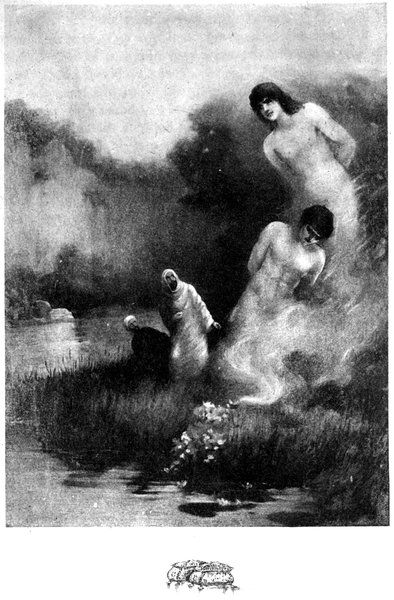
She continued, It hath reached me, O auspicious King, that the
Maghribi having served up in the pavilion a tray of forty kinds
of meat, said to Judar, “Come near, O my master, and excuse us
for that we know not what meats thou desirest; but tell us what
thou hast a mind to, and we will set it before thee without delay.”
Replied Judar, “By Allah, O my lord the pilgrim, I love all kinds
of meat and unlove none; so ask me not of aught, but bring all
227that cometh to thy thought, for save eating to do I have nought.”
After this he tarried twenty days with the Moor, who clad him in new
clothes every day, and all this time they ate from the saddle-bags;
for the Maghribi bought neither meat nor bread nor aught else, nor
cooked, but brought everything out of the bags, even to various
sorts of fruit. On the twenty-first day, he said, “O Judar, up
with thee; this is the day appointed for opening the hoard of Al-Shamardal.”
So he rose and they went afoot[277] without the city,
where they found two slaves, each holding a she-mule. The Moor
mounted one beast and Judar the other, and they ceased not riding
till noon, when they came to a stream of running water, on whose
banks Abd al-Samad alighted saying, “Dismount, O Judar!”
Then he signed with his hand to the slaves and said, “To it!”
So they took the mules and going each his own way, were absent
awhile, after which they returned, one bearing a tent, which he
pitched, and the other carpets, which he spread in the tent and
laid mattresses, pillows and cushions there-around. Then one of
them brought the caskets containing the two fishes; and another
fetched the saddle-bags; whereupon the Maghribi arose and said,
“Come, O Judar!” So Judar followed him into the tent and sat
down beside him; and he brought out dishes of meat from the
saddle-bags and they ate the undurn meal. Then the Moor took
the two caskets and conjured over them both, whereupon there
came from within voices that said, “Adsumus, at thy service, O
diviner of the world! Have mercy upon us!” and called aloud for
aid. But he ceased not to repeat conjurations and they to call for
help, till the two caskets flew in sunder, the fragments flying about,
and there came forth two men, with pinioned hands saying,
“Quarter, O diviner of the world! What wilt thou with us?”
Quoth he, “My will is to burn you both with fire, except ye make
a covenant with me, to open to me the treasure of Al-Shamardal.”
Quoth they, “We promise this to thee, and we will open the treasure
to thee, so thou produce to us Judar bin Omar, the fisherman,
for the hoard may not be opened but by his means, nor can any
enter therein save Judar.” Cried the Maghribi, “Him of whom
ye speak, I have brought, and he is here, listening to you and
228looking at you.” Thereupon they covenanted with him to open
the treasure to him, and he released them. Then he brought out
a hollow wand and tablets of red carnelian which he laid on the
rod; and after this he took a chafing-dish and setting charcoal
thereon, blew one breath into it and it kindled forthwith. Presently
he brought incense and said, “O Judar, I am now about to
begin the necessary conjurations and fumigations, and when I
have once begun, I may not speak, or the charm will be naught;
so I will teach thee first what thou must do to win thy wish.”
“Teach me,” quoth Judar. “Know,” quoth the Moor, “that when
I have recited the spell and thrown on the incense, the water will
dry up from the river’s bed and discover to thee a golden door,
the bigness of the city-gate, with two rings of metal thereon;
whereupon do thou go down to the door and knock a light knock
and wait awhile; then knock a second time a knock louder than
the first and wait another while; after which give three knocks in
rapid succession, and thou wilt hear a voice ask:—Who knocketh
at the door of the treasure, unknowing how to solve the secrets?
Do thou answer:—I am Judar the fisherman son of Omar: and
the door will open and there will come forth a figure with a brand
in hand who will say to thee: If thou be that man, stretch forth
thy neck, that I may strike off thy head. Then do thou stretch
forth thy neck and fear not; for, when he lifts his hand and smites
thee with the sword, he will fall down before thee, and in a little
thou wilt see him a body sans soul; and the stroke shall not hurt
thee nor shall any harm befal thee; but, if thou gainsay him, he
will slay thee. When thou hast undone his enchantment by obedience,
enter and go on till thou see another door, at which do
thou knock, and there will come forth to thee a horseman riding
a mare with a lance on his shoulder and say to thee:—What
bringeth thee hither, where none may enter ne man ne Jinni?
And he will shake his lance at thee. Bare thy breast to him
and he will smite thee and fall down forthright and thou shalt
see him a body without a soul; but if thou cross him he will
kill thee. Then go on to the third door, whence there will come
forth to thee a man with a bow and arrows in his hand and take
aim at thee. Bare thy breast to him and he will shoot at thee and
fall down before thee, a body without a soul; but if thou oppose
him, he will kill thee. Then go on to the fourth door”——And
Shahrazad perceived the dawn of day and ceased to say her permitted
say.
229
Now when it was the Six Hundred and Fourteenth Night,
She continued, It hath reached me, O auspicious King, that the
Maghribi said to Judar, “Go on to the fourth door and knock and it
shall be opened to thee, when there will come forth to thee a lion
huge of bulk which will rush upon thee, opening his mouth and
showing he hath a mind to devour thee. Have no fear of him,
neither flee from him: but when he cometh to thee, give him thy
hand and he will bite at it and fall down straightway, nor shall
aught of hurt betide thee. Then enter the fifth door, where thou
shalt find a black slave, who will say to thee, Who art thou? Say, I
am Judar! and he will answer, If thou be that man, open the sixth
door. Then do thou go up to the door and say, O Isa, tell Musa
to open the door; whereupon the door will fly open and thou
wilt see two dragons, one on the left hand and another on the
right, which will open their mouths and fly at thee, both at once.
Do thou put forth to them both hands and they will bite each a
hand and fall down dead; but an thou resist them, they will slay
thee. Then go on to the seventh door and knock, whereupon there
will come forth to thee thy mother and say:—Welcome, O my
son! Come, that I may greet thee! But do thou reply, Hold off
from me and doff thy dress. And she will make answer:—O
my son, I am thy mother and I have a claim upon thee for
suckling thee and for rearing thee: how then wouldst thou strip
me naked? Then do thou say, Except thou put off thy clothes,
I will kill thee! and look to thy right where thou wilt see a sword
hanging up. Take it and draw it upon her, saying, Strip! whereupon
she will wheedle thee and humble herself to thee; but have
thou no ruth on her nor be beguiled, and as often as she putteth
off aught, say to her, off with the lave; nor do thou cease to
threaten her with death, till she doff all that is upon her and fall
down, whereupon the enchantment will be dissolved and the
charms undone, and thou wilt be safe as to thy life. Then enter
the hall of the treasure, where thou wilt see the gold lying in
heaps; but pay no heed to aught thereof, but look to a closet
at the upper end of the hall, where thou wilt see a curtain
drawn. Draw back the curtain and thou wilt descry the enchanter,
Al-Shamardal, lying upon a couch of gold, with something
at his head round and shining like the moon, which is the
230celestial planisphere. He is baldrick’d with the sword[278]; on his
finger is the ring and about his neck hangs a chain, to which
hangs the Kohl-phial. Bring me the four talismans, and beware
lest thou forget aught of that which I have told thee, or thou wilt
repent and there will be fear for thee.” And he repeated his
directions a second and a third and a fourth time, till Judar said,
“I have them by heart: but who may face all these enchantments
that thou namest and endure against these mighty terrors?”
Replied the Moor, “O Judar, fear not, for they are semblances
without life;” and he went on to hearten him, till he said, “I put
my trust in Allah.” Then Abd al-Samad threw perfumes on the
chafing-dish, and addressed himself to reciting conjurations for a
time when, behold, the water disappeared and uncovered the river-bed
and discovered the door of the treasure, whereupon Judar
went down to the door and knocked. Therewith he heard a voice
saying, “Who knocketh at the door of the treasure, unknowing
how to solve the secrets?” Quoth he, “I am Judar son of Omar;”
whereupon the door opened and there came forth a figure with a
drawn sword, who said to him, “Stretch forth thy neck.” So he
stretched forth his neck and the species smote him and fell down,
lifeless. Then he went on to the second door and did the like, nor
did he cease to do thus, till he had undone the enchantments of the
first six doors and came to the seventh door, whence there issued
forth to him his mother, saying, “I salute thee, O my son!” He
asked, “What art thou?”, and she answered, “O my son, I am thy
mother who bare thee nine months and suckled thee and reared
thee.” Quoth he, “Put off thy clothes.” Quoth she, “Thou art
my son, how wouldst thou strip me naked?” But he said “Strip,
or I will strike off thy head with this sword;” and he stretched
out his hand to the brand and drew it upon her saying, “Except
thou strip, I will slay thee.” Then the strife became long
between them and as often as he redoubled on her his threats, she
put off somewhat of her clothes and he said to her, “Doff the rest,”
231with many menaces; while she removed each article slowly and
kept saying, “O my son, thou hast disappointed my fosterage of
thee,” till she had nothing left but her petticoat-trousers. Then
said she, “O my son, is thy heart stone? Wilt thou dishonour me
by discovering my shame? Indeed, this is unlawful, O my son!”
And he answered, “Thou sayest sooth; put not off thy trousers.”
At once, as he uttered these words, she cried out, “He hath made
default; beat him!” Whereupon there fell upon him blows like
rain-drops and the servants of the treasure flocked to him and
dealt him a tunding which he forgot not in all his days; after
which they thrust him forth and threw him down without the
treasure and the hoard-doors closed of themselves, whilst the
waters of the river returned to their bed.——And Shahrazad perceived
the dawn of day and ceased saying her permitted say.
Now when it was the Six Hundred and Fifteenth Night,
She said, It hath reached me, O auspicious King, that when the
servants of the treasure beat Judar and cast him out and the hoard-doors
closed of themselves, whilst the river-waters returned to their
bed, Abd al-Samad the Maghribi took Judar up in haste and
repeated conjurations over him, till he came to his senses but still
dazed as with drink, when he asked him, “What hast thou done, O
wretch?” Answered Judar, “O my brother, I undid all the
opposing enchantments, till I came to my mother and there befel
between her and myself a long contention. But I made her doff
her clothes, O my brother, till but her trousers remained upon her
and she said to me, Do not dishonour me; for to discover one’s
shame is forbidden. So I left her her trousers out of pity, and
behold, she cried out and said, He hath made default; beat him!
Whereupon there came out upon me folk, whence I know not, and
tunding me with a belabouring which was a Sister of Death, thrust
me forth; nor do I know what befel me after this.” Quoth the
Moor, “Did I not warn thee not to swerve from my directions?
Verily, thou hast injured me and hast injured thyself: for if thou
hadst made her take off her petticoat-trousers, we had won to our
wish; but now thou must abide with me till this day next year.”
Then he cried out to the two slaves, who struck the tent forthright
and loaded it on the beasts; then they were absent awhile and
presently returned with the two mules; and the twain mounted
232and rode back to the city of Fez, where Judar tarried with the
Maghribi, eating well and drinking well and donning a grand dress
every day, till the year was ended and the anniversary day
dawned. Then the Moor said to him, “Come with me, for this
is the appointed day.” And Judar said, “‘Tis well.” So the
Maghribi carried him without the city, where they found the two
slaves with the mules, and rode on till they reached the river.
Here the slaves pitched the tent and furnished it; and the Moor
brought forth the tray of food and they ate the morning meal;
after which Abd al-Samad brought out the wand and the tablets
as before and, kindling the fire in the chafing-dish, made ready the
incense. Then said he, “O Judar, I wish to renew my charge to
thee.” “O my lord the pilgrim,” replied he, “if I have forgotten
the bastinado, I have forgotten the injunctions.”[279] Asked the Moor,
“Dost thou indeed remember them?” and he answered, “Yes.”
Quoth the Moor, “Keep thy wits, and think not that the woman
is thy very mother; nay, she is but an enchantment in her semblance,
whose purpose is to find thee defaulting. Thou camest off
alive the first time; but, an thou trip this time, they will slay thee.”
Quoth Judar, “If I slip this time, I deserve to be burnt of them.”
Then Abd al-Samad cast the perfumes into the fire and recited the
conjurations, till the river dried up; whereupon Judar descended
and knocked. The door opened and he entered and undid the
several enchantments, till he came to the seventh door and the
semblance of his mother appeared before him, saying, “Welcome,[280]
O my son!” But he said to her, “How am I thy son, O accursed?
Strip!” And she began to wheedle him and put off garment
after garment, till only her trousers remained; and he said to her,
“Strip, O accursed!” So she put off her trousers and became
a body without a soul. Then he entered the hall of the treasures,
where he saw gold lying in heaps, but paid no heed to it and
passed on to the closet at the upper end, where he saw the
enchanter Al-Shamardal lying on a couch of gold, baldrick’d with
the sword, with the ring on his finger, the Kohl-phial on his
breast and the celestial planisphere hanging over his head. So
he loosed the sword and taking the ring, the Kohl-phial and the
planisphere, went forth, when behold, a band of music sounded
233for him and the servants of the treasure cried out, saying, “Mayest
thou be assained with that thou hast gained, O Judar!” Nor did
the music leave sounding, till he came forth of the treasure to the
Maghribi, who gave up his conjurations and fumigations and rose
up and embraced him and saluted him. Then Judar made over
to him the four hoarded talismans, and he took them and cried
out to the slaves, who carried away the tent and brought the
mules. So they mounted and returned to Fez-city, where the
Moor fetched the saddle-bags and brought forth dish after dish
of meat, till the tray was full, and said, “O my brother, O Judar,
eat!” So he ate till he was satisfied, when the Moor emptied
what remained of the meats and other dishes and returned the
empty platters to the saddle-bags. Then quoth he, “O Judar,
thou hast left home and native land on our account and thou
hast accomplished our dearest desire; wherefore thou hast a right
to require a reward of us. Ask, therefore, what thou wilt, it is
Almighty Allah who giveth unto thee by our means.[281] Ask thy
will and be not ashamed, for thou art deserving.” “O my lord,”
quoth Judar, “I ask first of Allah the Most High and then of
thee, that thou give me yonder saddle-bags.” So the Maghribi
called for them and gave them to him, saying, “Take them, for
they are thy due; and, if thou hadst asked of me aught else
instead, I had given it to thee. Eat from them, thou and thy
family; but, my poor fellow, these will not profit thee, save by
way of provaunt, and thou hast wearied thyself with us and we
promised to send thee home rejoicing. So we will join to these
other saddle-bags, full of gold and gems, and forward thee back
to thy native land, where thou shalt become a gentleman and a
merchant and clothe thyself and thy family; nor shalt thou want
ready money for thine expenditure. And know that the manner
234of using our gift is on this wise. Put thy hand therein and say:—O
servant of these saddle-bags, I conjure thee by the virtue of the
Mighty Names which have power over thee, bring me such a dish!
And he will bring thee whatsoever thou askest, though thou
shouldst call for a thousand different dishes a day.” So saying,
he filled him a second pair of saddle-bags half with gold and half
with gems and precious stones; and, sending for a slave and a
mule, said to him, “Mount this mule, and the slave shall go before
thee and show thee the way, till thou come to the door of thy
house, where do thou take the two pair of saddle-bags and give
him the mule, that he may bring it back. But admit none into
thy secret; and so we commend thee to Allah!” “May the
Almighty increase thy good!” replied Judar and, laying the two
pairs of saddle-bags on the mule’s back, mounted and set forth.
The slave went on before him and the mule followed him all that
day and night, and on the morrow he entered Cairo by the Gate
of Victory,[282] where he saw his mother seated, saying, “Alms, for
the love of Allah!” At this sight he well-nigh lost his wits and
alighting, threw himself upon her: and when she saw him she
wept. Then he mounted her on the mule and walked by her
stirrup,[283] till they came to the house, where he set her down and,
taking the saddle-bags, left the she-mule to the slave, who led her
away and returned with her to his master, for that both slave and
mule were devils. As for Judar, it was grievous to him that his
mother should beg; so, when they were in the house, he asked
her, “O my mother, are my brothers well?”; and she answered,
“They are both well.” Quoth he, “Why dost thou beg by the
wayside?” Quoth she, “Because I am hungry, O my son,” and
he, “Before I went away, I gave thee an hundred dinars one day,
the like the next and a thousand on the day of my departure.”
“O my son, they cheated me and took the money from me,
saying:—We will buy goods with it. Then they drove me away,
and I fell to begging by the wayside, for stress of hunger.” “O
my mother, no harm shall befal thee, now I am come; so have
no concern, for these saddle-bags are full of gold and gems, and
235good aboundeth with me.” “Verily, thou art blessed, O my son!
Allah accept of thee and increase thee of His bounties! Go,
O my son, fetch us some victual, for I slept not last night for
excess of hunger, having gone to bed supperless.” “Welcome to
thee, O my mother! Call for what thou wilt to eat, and I will
set it before thee this moment; for I have no occasion to buy
from the market, nor need I any to cook.” “O my son, I see
naught with thee.” “I have with me in these saddle-bags all
manner of meats.” “O my son, whatever is ready will serve to
stay hunger.” “True, when there is no choice, men are content
with the smallest thing; but where there is plenty, they like to
eat what is good: and I have abundance; so call for what thou
hast a mind to.” “O my son, give me some hot bread and a slice
of cheese.” “O my mother, this befitteth not thy condition.”
“Then give me to eat of that which befitteth my case, for thou
knowest it.” “O my mother,” rejoined he, “what suit thine
estate are browned meat and roast chicken and peppered rice and
it becometh thy rank to eat of sausages and stuffed cucumbers
and stuffed lamb and stuffed ribs of mutton and vermicelli with
broken almonds and nuts and honey and sugar and fritters and
almond cakes.” But she thought he was laughing at her and
making mock of her; so she said to him, “Yauh! Yauh![284] what
is come to thee? Dost thou dream or art thou daft?” Asked
he, “Why deemest thou that I am mad?” and she answered,
“Because thou namest to me all manner rich dishes. Who can
avail unto their price, and who knoweth how to dress them?”
Quoth he, “By my life! thou shalt eat of all that I have named
to thee, and that at once;” and quoth she, “I see nothing;” and
he, “Bring me the saddle-bags.” So she fetched them and feeling
them, found them empty. However, she laid them before him
and he thrust in his hand and pulled out dish after dish, till he
had set before her all he had named. Whereupon asked she, “O
my son, the saddle-bags are small and moreover they were empty;
yet hast thou taken thereout all these dishes. Where then were
they all?”; and he answered, “O my mother, know that these
236saddle-bags, which the Moor gave me, are enchanted and they
have a servant whom, if one desire aught, he hath but to adjure
by the Names which command him, saying, “O servant of these
saddle-bags, bring me such a dish! and he will bring it.”” Quoth
his mother, “And may I put out my hand and ask of him?”
Quoth he, “Do so.” So she stretched out her hand and said,
“O servant of the saddle-bags, by the virtue of the Names which
command thee, bring me stuffed ribs.” Then she thrust in her
hand and found a dish containing delicate stuffed ribs of lamb.
So she took it out, and called for bread and what else she had a
mind to: after which Judar said to her, “O my mother, when thou
hast made an end of eating, empty what is left of the food into
dishes other than these, and restore the empty platters to the
saddle-bags carefully.” So she arose and laid them up in a safe
place. “And look, O mother mine, that thou keep this secret,”
added he; “and whenever thou hast a mind to aught, take it
forth of the saddle-bags and give alms and feed my brothers,
whether I be present or absent.” Then he fell to eating with her
and behold, while they were thus occupied, in came his two
brothers, whom a son of the quarter[285] had apprised of his return,
saying, “Your brother is come back, riding on a she-mule, with a
slave before him, and wearing a dress that hath not its like.” So
they said to each other, “Would to Heaven we had not evilly
entreated our mother! There is no hope but that she will surely
tell him how we did by her, and then, oh our disgrace with him!”
But one of the twain said, “Our mother is soft-hearted, and if she
tell him, our brother is yet tenderer over us than she; and, given
we excuse ourselves to him, he will accept our excuse.” So they
went in to him and he rose to them and saluting them with the
friendliest salutation, bade them sit down and eat. So they ate
till they were satisfied, for they were weak with hunger; after
which Judar said to them, “O my brothers, take what is left and
distribute it to the poor and needy.” “O brother,” replied they,
“let us keep it to sup withal.” But he answered, “When suppertime
cometh, ye shall have more than this.” So they took the
rest of the victual and going out, gave it to every poor man who
passed by them, saying, “Take and eat,” till nothing was left.
Then they brought back the dishes and Judar said to his mother,
237“Put them in the saddle-bags.”——And Shahrazad perceived the
dawn of day and ceased to say her permitted say.
Now when it was the Six Hundred and Sixteenth Night,
She continued, It hath reached me, O auspicious King, that Judar,
when his brethren had finished their under-meal, said to his
mother, “Put back the platters in the saddle-bags.” And when
it was eventide, he entered the saloon and took forth of the saddle-bags
a table of forty dishes; after which he went up to the upper
room and, sitting down between his brothers, said to his mother,
“Bring the supper.”[286] So she went down to the saloon and, finding
there the dishes ready, laid the tray and brought up the forty
dishes, one after other. Then they ate the evening meal, and
when they had done, Judar said to his brothers, “Take and feed
the poor and needy.” So they took what was left and gave alms
thereof, and presently he brought forth to them sweetmeats,
whereof they ate, and what was left he bade them give to the
neighbours. On the morrow, they brake their fast after the same
fashion, and thus they fared ten days, at the end of which time
quoth Sálim to Salím, “How cometh it that our brother setteth
before us a banquet in the morning, a banquet at noon, and a
banquet at sundown, besides sweetmeats late at night, and all that
is left he giveth to the poor? Verily, this is the fashion of Sultans.
Yet we never see him buy aught, and he hath neither kitchener
nor kitchen, nor doth he light a fire. Whence hath he this great
plenty? Hast thou not a mind to discover the cause of all
this?” Quoth Salím, “By Allah, I know not: but knowest thou
any who will tell us the truth of the case?” Quoth Sálim,
“None will tell us save our mother.” So they laid a plot and
repairing to their mother one day, in their brother’s absence, said
to her, “O our mother, we are hungry.” Replied she, “Rejoice,
for ye shall presently be satisfied;” and going into the saloon,
sought of the servant of the saddle-bags hot meats, which she took
out and set before her sons. “O our mother,” cried they, “this
meat is hot; yet hast thou not cooked, neither kindled a fire.”
238Quoth she, “It cometh from the saddle-bags;” and quoth they,
“What manner of thing be these saddle-bags?” She answered,
“They are enchanted; and the required is produced by the
charm:” she then told her sons their virtue, enjoining them to
secrecy. Said they, “The secret shall be kept, O our mother,
but teach us the manner of this.” So she taught them the fashion
thereof and they fell to putting their hands into the saddle-bags
and taking forth whatever they had a mind to. But Judar knew
naught of this. Then quoth Sálim privily to Salím, “O my
brother, how long shall we abide with Judar servant-wise and eat
of his alms? Shall we not contrive to get the saddle-bags from
him and make off with them?” “And how shall we make shift
to do this?” “We will sell him to the galleys.” “How shall
we do that?” “We two will go to the Raís, the Chief Captain of
the Sea of Suez and bid him to an entertainment, with two of his
company. What I say to Judar do thou confirm, and at the
end of the night I will show thee what I will do.” So they
agreed upon the sale of their brother and going to the Captain’s
quarters said to him, “O Rais, we have come to thee on an
errand that will please thee.” “Good,” answered he; and they
continued, “We two are brethren, and we have a third brother,
a lewd fellow and good-for-nothing. When our father died, he
left us some money, which we shared amongst us, and he took
his part of the inheritance and wasted it in frowardness and
debauchery, till he was reduced to poverty, when he came upon
us and cited us before the magistrates, avouching that we had
taken his good and that of his father, and we disputed the matter
before the judges and lost the money. Then he waited awhile
and attacked us a second time, until he brought us to beggary;
nor will he desist from us, and we are utterly weary of him;
wherefore we would have thee buy him of us.” Quoth the
Captain, “Can ye cast about with him and bring him to me
here? If so, I will pack him off to sea forthright.” Quoth they
“We cannot manage to bring him here; but be thou our guest
this night and bring with thee two of thy men, not one more; and
when he is asleep, we will aid one another to fall upon him, we
five, and seize and gag him. Then shalt thou carry him forth the
house, under cover of the night, and after do thou with him as
thou wilt.” Rejoined the Captain, “With all my heart! Will ye
sell him for forty dinars?” and they, “Yes, come after nightfall to
239such a street, by such a mosque, and thou shalt find one of us
awaiting thee.” And he replied, “Now be off.” Then they
repaired to Judar and waited awhile, after which Sálim went up
to him and kissed his hand. Quoth Judar, “What ails thee, O
my brother?” And he made answer, saying, “Know that I have
a friend, who hath many a time bidden me to his house in thine
absence and hath ever hospitably entreated me, and I owe him a
thousand kindnesses, as my brother here wotteth. I met him to-day
and he invited me to his house, but I said to him:—I cannot
leave my brother Judar. Quoth he, Bring him with thee; and
quoth I:—He will not consent to that; but if ye will be my
guests, thou and thy brothers[287] * * * * * (for his brothers were
sitting with him); and I invited them thinking that they would
refuse. But he accepted my invitation for all of them, saying,
Look for me at the gate of the little mosque,[288] and I will come to
thee, I and my brothers. And now I fear they will come and am
ashamed before thee. So wilt thou hearten my heart and entertain
them this night, for thy good is abundant, O my brother?
Or if thou consent not, give me leave to take them into the neighbours’
houses.” Replied Judar, “Why shouldst thou carry them
into the neighbours’ houses? Is our house then so strait or have
we not wherewith to give them supper? Shame on thee to
consult me! Thou hast but to call for what thou needest and
have rich viands and sweetmeats and to spare. Whenever thou
bringest home folk in my absence, ask thy mother, and she will
set before thee victual more than enough. Go and fetch them;
blessings have descended upon us through such guests.” So
Sálim kissed his hand and going forth, sat at the gate of the
little mosque till after sundown, when the Captain and his men
came up to him, and he carried them to the house. When Judar
saw them he bade them welcome and seated them and made
friends of them, knowing not what the future had in store for
him at their hands. Then he called to his mother for supper,
and she fell to taking dishes out of the saddle-bags, whilst
he said, “Bring such and such meats,” till she had set forty
different dishes before them. They ate their sufficiency and the
tray was taken away, the sailors thinking the while that this liberal
240entertainment came from Sálim. When a third part of the night
was past, Judar set sweetmeats before them and Sálim served
them, whilst his two brothers sat with the guests, till they sought
to sleep. Accordingly Judar lay down and the others with him,
who waited till he was asleep, when they fell upon him together
and gagging and pinioning him, before he was awake, carried him
forth of the house,[289] under cover of the night,——And Shahrazad
perceived the dawn of day and ceased saying her permitted say.
Now when it was the Six Hundred and Seventeenth Night,
She said, It hath reached me, O auspicious King, that they seized
Judar and carrying him forth of the house under cover of the
night, at once packed him off to Suez, where they shackled him
and set him to work as a galley-slave; and he ceased not to serve
thus in silence a whole year.[290] So far concerning Judar; but as
for his brothers, they went in next morning to his mother and said
to her, “O our mother, our brother Judar is not awake.” Said
she, “Do ye wake him.” Asked they, “Where lieth he?” and
she answered, “With the guests.” They rejoined, “Haply he
went away with them whilst we slept, O mother. It would seem
that he had tasted of strangerhood and yearned to get at hidden
hoards; for we heard him at talk with the Moors, and they said to
him, We will take thee with us and open the treasure to thee.”
She enquired, “Hath he then been in company with Moors?;”
and they replied, saying, “Were they not our guests yesternight?”
And she, “Most like he hath gone with them, but
Allah will direct him on the right way; for there is a blessing
upon him and he will surely come back with great good.” But
she wept, for it was grievous to her to be parted from her son.
Then said they to her, “O accursed woman, dost thou love Judar
with all this love, whilst as for us, whether we be absent or present,
thou neither joyest in us nor sorrowest for us? Are we not thy
sons, even as Judar is thy son?” She said, “Ye are indeed my
sons: but ye are reprobates who deserve no favour of me, for since
241your father’s death I have never seen any good in you; whilst as
for Judar, I have had abundant good of him and he hath heartened
my heart and entreated me with honour; wherefore it behoveth
me to weep for him, because of his kindness to me and to you.”
When they heard this, they abused her and beat her; after which
they sought for the saddle-bags, till they found the two pairs
and took the enchanted one and all the gold from one pouch
and jewels from the other of the unenchanted, saying, “This was
our father’s good.” Said their mother, “Not so, by Allah!; it
belongeth to your brother Judar, who brought it from the land of
the Magharibah.” Said they, “Thou liest, it was our father’s
property; and we will dispose of it, as we please.” Then they
divided the gold and jewels between them; but a brabble arose
between them concerning the enchanted saddle-bags, Sálim saying,
“I will have them;” and Salím, saying, “I will take them;” and
they came to high words. Then said she, “O my sons, ye have
divided the gold and the jewels, but this may not be divided, nor
can its value be made up in money; and if it be cut in twain, its
spell will be voided; so leave it with me and I will give you to
eat from it at all times and be content to take a morsel with you.
If ye allow me aught to clothe me, ‘twill be of your bounty, and
each of you shall traffic with the folk for himself. Ye are my
sons and I am your mother; wherefore let us abide as we are,
lest your brother come back and we be disgraced.” But they
accepted not her words and passed the night, wrangling with each
other. Now it chanced that a Janissary[291] of the King’s guards was
a guest in the house adjoining Judar’s and heard them through the
open window. So he looked out and listening, heard all the angry
words that passed between them and saw the division of the spoil.
Next morning he presented himself before the King of Egypt,
whose name was Shams al-Daulah,[292] and told him all he had heard,
whereupon he sent for Judar’s brothers and put them to the question,
till they confessed; and he took the two pairs of saddle-bags
from them and clapped them in prison, appointing a sufficient
242daily allowance to their mother. Now as regards Judar, he abode
a whole year in service at Suez, till one day, being in a ship bound
on a voyage over the sea, a wind arose against them and cast the
vessel upon a rock projecting from a mountain, where she broke
up and all on board were drowned and none gat ashore save
Judar. As soon as he landed he fared on inland, till he reached
an encampment of Badawi, who questioned him of his case, and
he told them he had been a sailor.[293] Now there was in camp a
merchant, a native of Jiddah, who took pity on him and said to
him, “Wilt thou take service with me, O Egyptian, and I will
clothe thee and carry thee with me to Jiddah?” So Judar took
service with him and companied him to Jiddah, where he showed
him much favour. After awhile, his master the merchant set out
on a pilgrimage to Meccah, taking Judar with him, and when they
reached the city, the Cairene repaired to the Haram temple, to
circumambulate the Ka’abah. As he was making the prescribed
circuits,[294] he suddenly saw his friend Abd al-Samad the Moor doing
the like;——And Shahrazad perceived the dawn of day and
ceased to say her permitted say.
Now when it was the Six Hundred and Eighteenth Night,
She said, It hath reached me, O auspicious King, that Judar, as he
was making the circuits, suddenly saw his friend Abd al-Samad
also circumambulating; and when the Maghribi caught sight of
him, he saluted him and asked him of his state; whereupon Judar
wept and told him all that had befallen him. So the Moor carried
him to his lodging and entreated him with honour, clothing him in
a dress of which the like was not, and saying to him, “Thou hast
seen the end of thine ills, O Judar.” Then he drew out for him a
geomantic figure, which showed what had befallen Sálim and
Salím and said to Judar, “Such and such things have befallen thy
brothers and they are now in the King of Egypt’s prison; but
thou art right welcome to abide with me and accomplish thine
243ordinances of pilgrimage and all shall be well.” Replied Judar,
“O my lord, let me go and take leave of the merchant with whom
I am and after I will come back to thee.” “Dost thou owe
money?” asked the Moor, and he answered, “No.” Said Abd
al-Samad, “Go thou and take leave of him and come back forthright,
for bread hath claims of its own from the ingenuous.” So
Judar returned to the merchant and farewelled him, saying, “I
have fallen in with my brother.”[295] “Go bring him here,” said the
merchant, “and we will make him an entertainment.” But Judar
answered, saying, “He hath no need of that; for he is a man of
wealth and hath many servants.” Then the merchant gave Judar
twenty dinars, saying, “Acquit me of responsibility”;[296] and he
bade him adieu and went forth from him. Presently, he saw a
poor man, so he gave him the twenty ducats and returned to the
Moor, with whom he abode till they had accomplished the pilgrimage-rites
when Abd al-Samad gave him the seal-ring, that he
had taken from the treasure of Al-Shamardal, saying, “This ring
will win thee thy wish, for it enchanteth and hath a servant, by
name Al-Ra’ad al-Kásif; so whatever thou hast a mind to of the
wants of this world; rub this ring and its servant will appear and
do all thou biddest him.” Then he rubbed the ring before him,
whereupon the Jinni appeared, saying, “Adsum, O my lord! Ask
what thou wilt and it shall be given thee. Hast thou a mind to
people a ruined city or ruin a populous one? to slay a king or to
rout a host?” “O Ra’ad,” said Abd al-Samad, “this is become
thy lord; do thou serve him faithfully.” Then he dismissed him
and said to Judar, “Rub the ring and the servant will appear;
and do thou command him to do whatever thou desirest, for he
will not gainsay thee. Now go to thine own country and take
care of the ring, for by means of it thou wilt baffle thine enemies;
and be not ignorant of its puissance.” “O my lord,” quoth Judar,
“with thy leave, I will set out homewards.” Quoth the Maghribi,
“Summon the Jinni and mount upon his back; and if thou say to
him:—Bring me to my native city this very day, he will not
disobey thy commandment.” So he took leave of Moor Abd al-Samad
and rubbed the ring, whereupon Al-Ra’ad presented himself,
244saying, “Adsum; ask and it shall be given to thee.” Said
Judar, “Carry me to Cairo this day;” and he replied, “Thy will
be done;” and, taking him on his back, flew with him from noon
till midnight, when he set him down in the courtyard of his
mother’s house and disappeared. Judar went in to his mother,
who rose weeping, and greeted him fondly, and told him how the
King had beaten his brothers and cast them into gaol and taken
the two pairs of saddle-bags; which when he heard, it was no
light matter to him and he said to her, “Grieve not for the past;
I will show thee what I can do and bring my brothers hither forthright.”
So he rubbed the ring, whereupon its servant appeared,
saying, “Here am I! Ask and thou shalt have.” Quoth Judar,
“I bid thee bring me my two brothers from the prison of the
King.” So the Jinni sank into the earth and came not up but in
the midst of the gaol where Sálim and Salím lay in piteous plight
and sore sorrow for the plagues of prison,[297] so that they wished for
death, and one of them said to the other, “By Allah, O my brother,
affliction is longsome upon us! How long shall we abide in this
prison? Death would be relief.” As he spoke, behold, the earth
clove in sunder and out came Al-Ra’ad, who took both up and
plunged with them into the earth. They swooned away for excess
of fear, and when they recovered, they found themselves in their
mother’s house and saw Judar seated by her side. Quoth he, “I
salute you, O my brothers! you have cheered me by your presence.”
And they bowed their heads and burst into tears. Then
said he, “Weep not, for it was Satan and covetise that led you to
do thus. How could you sell me? But I comfort myself with the
thought of Joseph, whose brothers did with him even more than
ye did with me, because they cast him into the pit.”——And
Shahrazad perceived the dawn of day and ceased saying her
permitted say.
245
Now when it was the Six Hundred and Nineteenth Night,
She continued, It hath reached me, O auspicious King, that Judar
said to his brothers, “How could you do with me thus?” But
repent unto Allah and crave pardon of Him, and He will forgive
you both, for He is the Most Forgiving, the Merciful. As for me,
I pardon you and welcome you: no harm shall befal you. Then
he comforted them and set their hearts at ease and related to them
all he had suffered, till he fell in with Shaykh Abd al-Samad, and
told them also of the seal-ring. They replied, “O our brother,
forgive us this time; and, if we return to our old ways, do with us
as thou wilt.” Quoth he, “No harm shall befal you; but tell me
what the King did with you.” Quoth they, “He beat us and
threatened us with death and took the two pairs of saddle-bags
from us.” “Will he not care?”[298] said Judar, and rubbed the ring,
whereupon Al-Ra’ad appeared. When his brothers saw him, they
were affrighted and thought Judar would bid him slay them; so
they fled to their mother, crying, “O our mother, we throw ourselves
on thy generosity; do thou intercede for us, O our mother!”
And she said to them, “O my sons, fear nothing!” Then said
Judar to the servant, “I command thee to bring me all that is in
the King’s treasury of goods and such; let nothing remain and
fetch the two pairs of saddle-bags he took from my brothers.” “I
hear and I obey,” replied Al-Ra’ad; and, disappearing straightway
gathered together all he found in the treasury and returned
with the two pairs of saddle-bags and the deposits therein and laid
them before Judar, saying, “O my lord, I have left nothing in the
treasury.” Judar gave the treasure to his mother bidding her keep
it and laying the enchanted saddle-bags before him, said to the
Jinni, “I command thee to build me this night a lofty palace and
overlay it with liquid gold and furnish it with magnificent furniture:
and let not the day dawn, ere thou be quit of the whole
work.” Replied he, “Thy bidding shall be obeyed;” and sank
into the earth. Then Judar brought forth food and they ate and
took their ease and lay down to sleep. Meanwhile, Al-Ra’ad
summoned his attendant Jinn and bade them build the palace. So
some of them fell to hewing stones and some to building, whilst
others plastered and painted and furnished; nor did the day dawn
246ere the ordinance of the palace was complete; whereupon Al-Ra’ad
came to Judar and said to him, “O my lord, the palace is finished
and in best order, an it please thee to come and look on it.” So
Judar went forth with his mother and brothers and saw a palace,
whose like there was not in the whole world; and it confounded all
minds with the goodliness of its ordinance. Judar was delighted
with it while he was passing along the highway and withal it had
cost him nothing. Then he asked his mother, “Say me, wilt thou
take up thine abode in this palace?” and she answered, “I will, O
my son,” and called down blessings upon him. Then he rubbed
the ring and bade the Jinni fetch him forty handsome white handmaids
and forty black damsels and as many Mamelukes and negro
slaves. “Thy will be done,” answered Al-Ra’ad and betaking
himself, with forty of his attendant Genii to Hind and Sind and
Persia, snatched up every beautiful girl and boy they saw, till they
had made up the required number. Moreover, he sent other fourscore,
who fetched comely black girls, and forty others brought
male chattels and carried them all to Judar’s house, which they
filled. Then he showed them to Judar, who was pleased with
them and said, “Bring for each a dress of the finest.” “Ready!”
replied the servant. Then quoth he, “Bring a dress for my mother
and another for myself, and also for my brothers.” So the Jinni
fetched all that was needed and clad the female slaves, saying to
them, “This is your mistress: kiss her hands and cross her not, but
serve her, white and black.” The Mamelukes also dressed themselves
and kissed Judar’s hands; and he and his brothers arrayed
themselves in the robes the Jinni had brought them and Judar
became like unto a King and his brothers as Wazirs. Now his
house was spacious; so he lodged Sálim and his slave-girls in one
part thereof and Salím and his slave-girls in another, whilst he and
his mother took up their abode in the new palace; and each in his
own place was like a Sultan. So far concerning them; but as
regards the King’s Treasurer, thinking to take something from the
treasury, he went in and found it altogether empty, even as saith
the poet:—
‘Twas as a hive of bees that greatly thrived; ✿ But, when the bee-swarm fled, ‘twas clean unhived.
[299]
247So he gave a great cry and fell down in a fit. When he came to
himself, he left the door open and going in to King Shams
al-Daulah, said to him, “O Commander of the Faithful,[300] I have
to inform thee that the treasury hath become empty during the
night.” Quoth the King, “What hast thou done with my monies
which were therein?” Quoth he, “By Allah, I have not done
aught with them nor know I what is come of them! I visited the
place yesterday and saw it full; but to-day when I went in, I found
it clean empty, albeit the doors were locked, the walls were unpierced[301]
and the bolts[302] are unbroken; nor hath a thief entered
it.” Asked the King, “Are the two pairs of saddle-bags gone?”
“Yes,” replied the Treasurer; whereupon the King’s reason flew
from his head——And Shahrazad perceived the dawn of day and
ceased to say her permitted say.
Now when it was the Six Hundred and Twentieth Night,
She said, It hath reached me, O auspicious King, that when the
Treasurer informed the King that all in the treasury had been
plundered, including the two pairs of saddle-bags, the King’s
reason flew from his head and he rose to his feet, saying, “Go
thou before me.” Then he followed the Treasurer to the treasury
and he found nothing there, whereat he was wroth with him; and
he said to them, “O soldiers! know that my treasury hath been
plundered during the night, and I know not who did this deed
and dared thus to outrage me, without fear of me.” Said they,
“How so?”; and he replied, “Ask the Treasurer.” So they questioned
him, and he answered, saying, “Yesterday I visited the
treasury and it was full, but this morning when I entered it I
found it empty, though the walls were unpierced and the doors
unbroken.” They all marvelled at this and could make the King
248no answer, when in came the Janissary, who had denounced Sálim
and Salím, and said to Shams al-Daulah, “O King of the age, all
this night I have not slept for that which I saw.” And the King
asked, “And what didst thou see?” “Know, O King of the age,”
answered the Kawwás, “that all night long I have been amusing
myself with watching builders at work; and, when it was day, I
saw a palace ready edified, whose like is not in the world. So I
asked about it and was told that Judar had come back with great
wealth and Mamelukes and slaves and that he had freed his two
brothers from prison, and built this palace, wherein he is as a
Sultan.” Quoth the King, “Go, look in the prison.” So they
went thither and not finding Sálim and Salím, returned and told
the King, who said, “It is plain now who be the thief; he who
took Sálim and Salím out of prison it is who hath stolen my
monies.” Quoth the Wazir, “O my lord, and who is he?”; and
quoth the King, “Their brother Judar, and he hath taken the two
pairs of saddle-bags; but, O Wazir, do thou send him an Emir
with fifty men to seal up his goods and lay hands on him and his
brothers and bring them to me, that I may hang them.” And
he was sore enraged and said, “Ho, off with the Emir at once,
and fetch them, that I may put them to death.” But the Wazir
said to him, “Be thou merciful, for Allah is merciful and hasteth
not to punish His servants, whenas they sin against Him. Moreover,
he who can build a palace in a single night, as these say,
none in the world can vie with him; and verily I fear lest the
Emir fall into difficulty for Judar. Have patience, therefore,
whilst I devise for thee some device of getting at the truth of
the case, and so shalt thou win thy wish, O King of the age.”
Quoth the King, “Counsel me how I shall do, O Wazir.” And
the Minister said, “Send him an Emir with an invitation; and I
will make much of him for thee and make a show of love for him
and ask him of his estate; after which we will see. If we find
him stout of heart, we will use sleight with him, and if weak of
will, then do thou seize him and do with him thy desire.” The
King agreed to this and despatched one of his Emirs, Othman
hight, to go and invite Judar and say to him, “The King biddeth
thee to a banquet;” and the King said to him, “Return not,
except with him.” Now this Othman was a fool, proud and
conceited; so he went forth upon his errand, and when he came
to the gate of Judar’s palace, he saw before the door an eunuch
seated upon a chair of gold, who at his approach rose not, but
249sat as if none came near, though there were with the Emir fifty
footmen. Now this eunuch was none other than Al-Ra’ad al-Kasif,
the servant of the ring, whom Judar had commanded to
put on the guise of an eunuch and sit at the palace-gate. So
the Emir rode up to him and asked him, “O slave, where is
thy lord?”; whereto he answered, “In the palace;” but he
stirred not from his leaning posture; whereupon the Emir
Othman waxed wroth and said to him, “O pestilent slave, art
thou not ashamed, when I speak to thee, to answer me, sprawling
at thy length, like a gallows-bird?” Replied the eunuch,
“Off and multiply not words.” Hardly had Othman heard
this, when he was filled with rage and drawing his mace[303] would
have smitten the eunuch, knowing not that he was a devil;
but Al-Ra’ad leapt upon him and taking the mace from him,
dealt him four blows with it. Now when the fifty men saw
their lord beaten, it was grievous to them; so they drew their
swords and ran to slay the slave; but he said, “Do ye draw
on us, O dogs?” and rose at them with the mace, and every
one whom he smote, he broke his bones and drowned him in
his blood. So they fell back before him and fled, whilst he
followed them, beating them, till he had driven them far from
the palace-gate; after which he returned and sat down on his
chair at the door, caring for none.——And Shahrazad perceived
the dawn of day and ceased saying her permitted say.
Now when it was the Six Hundred and Twenty-first Night,
She said, It hath reached me, O auspicious King, that the eunuch
having put to flight the Emir Othman, the King’s Officer, and his
men, till they were driven far from Judar’s gate, returned and sat
down on his chair at the door, caring for none. But as for the
Emir and his company, they returned, discomfited and tunded, to
King Shams al-Daulah, and Othman said, “O King of the age,
when I came to the palace gate, I espied an eunuch seated there
250in a chair of gold and he was passing proud for, when he saw me
approach, he stretched himself at full length albeit he had been
sitting in his chair and entreated me contumeliously, neither offered
to rise to me. So I began to speak to him and he answered without
stirring, whereat wrath gat hold of me and I drew the mace upon
him, thinking to smite him. But he snatched it from me and beat
me and my men therewith and overthrew us. So we fled from
before him and could not prevail against, him.” At this, the King
was wroth and said, “Let an hundred men go down to him.”
Accordingly, the hundred men went down to attack him; but he
arose and fell upon them with the mace and ceased not smiting
them till he had put them to the rout; when he regained his chair;
upon which they returned to the King and told him what had
passed, saying, “O King of the age, he beat us and we fled for
fear of him.” Then the King sent two hundred men against him,
but these also he put to the rout, and Shams Al-Daulah said to
his Minister, “I charge thee, O Wazir, take five hundred men
and bring this eunuch in haste, and with him his master Judar and
his brothers.” Replied the Wazir, “O King of the age, I need no
soldiers, but will go down to him alone and unarmed.” “Go,”
quoth the King, “and do as thou seest suitable.” So the Wazir
laid down his arms and donning a white habit,[304] took a rosary in
his hand and set out afoot alone and unattended. When he came
to Judar’s gate, he saw the slave sitting there; So he went up to
him and seating himself by his side courteously, said to him,
“Peace be with thee!”; whereto he replied, “And on thee be
peace, O mortal! What wilt thou?” When the Wazir heard him
say “O mortal,” he knew him to be of the Jinn and quaked for
fear; then he asked him, “O my lord, tell me, is thy master Judar
here?” Answered the eunuch, “Yes, he is in the palace.” Quoth
the Minister, “O my lord, go thou to him and say to him:—King
Shams Al-Daulah saluteth thee and biddeth thee honour his
251dwelling with thy presence and eat of a banquet he hath made for
thee.” Quoth the eunuch, “Tarry thou here, whilst I consult
him.” So the Wazir stood in a respectful attitude, whilst the
Marid went up to the palace and said to Judar, “Know, O my
lord, that the King sent to thee an Emir and fifty men, and I beat
them and drove them away. Then he sent an hundred men and I
beat them also; then two hundred, and these also I put to the
rout. And now he hath sent thee his Wazir unarmed, bidding
thee visit him and eat of his banquet. What sayst thou?” Said
Judar, “Go, bring the Wazir hither.” So the Marid went down
and said to him, “O Wazir, come speak with my lord.” “On my
head be it,” replied he and going in to Judar, found him seated, in
greater state than the King, upon a carpet, whose like the King
could not spread, and was dazed and amazed at the goodliness of
the palace and its decoration and appointments, which made him
seem as he were a beggar in comparison. So he kissed the ground
before Judar and called down blessings on him; and Judar said to
him, “What is thy business, O Wazir?” Replied he, “O my lord,
thy friend King Shams Al-Daulah saluteth thee with the salam
and longeth to look upon thy face; wherefore he hath made thee
an entertainment. So say, wilt thou heal his heart and eat of his
banquet?” Quoth Judar, “If he be indeed my friend, salute him
and bid him come to me.” “On my head be it,” quoth the Minister.
Then Judar bringing out the ring rubbed it and bade the
Jinni fetch him a dress of the best, which he gave to the Wazir,
saying, “Don this dress and go tell the King what I say.” So the
Wazir donned the dress, the like whereof he had never donned,
and returning to the King told him what had passed and praised
the palace and that which was therein, saying, “Judar biddeth
thee to him.” So the King called out, “Up, ye men; mount your
horses and bring me my steed, that we may go to Judar!” Then
he and his suite rode off for the Cairene palace. Meanwhile Judar
summoned the Marid and said to him, “It is my will that thou
bring me some of the Ifrits at thy command in the guise of guards
and station them in the open square before the palace, that the
King may see them and be awed by them; so shall his heart
tremble and he shall know that my power and majesty be greater
than his.” Thereupon Al-Ra’ad brought him two hundred Ifrits
of great stature and strength, in the guise of guards, magnificently
armed and equipped, and when the King came and saw these tall
burly fellows his heart feared them. Then he entered the palace,
252and found Judar sitting in such state as nor King nor Sultan could
even. So he saluted him and made his obeisance to him; yet
Judar rose not to him nor did him honour nor said “Be seated,”
but left him standing,——And Shahrazad perceived the dawn of
day and ceased to say her permitted say.
Now when it was the Six Hundred and Twenty-second Night,
She said, It hath reached me, O auspicious King, that when the
King entered, Judar rose not to him, nor did him honour nor even
said “Be seated!”; but left him standing,[305] so that fear entered
into him and he could neither sit nor go away and said to himself,
“If he feared me, he would not leave me thus unheeded; peradventure
he will do me a mischief, because of that which I did with
his brothers.” Then said Judar, “O King of the age, it beseemeth
not the like of thee to wrong the folk and take away their
good.” Replied the King, “O my lord, deign excuse me, for greed
impelled me to this and fate was thereby fulfilled; and, were there
no offending, there would be no forgiving.” And he went on to
excuse himself for the past and pray to him for pardon and indulgence
till he recited amongst other things this poetry:—
O thou of generous seed and true nobility, ✿ Reproach me not for that which came from me to thee:
We pardon thee if thou have wrought us any wrong ✿ And if I wrought the wrong I pray thee pardon me!
And he ceased not to humble himself before him, till he said,
“Allah pardon thee!” and bade him be seated. So he sat down
and Judar invested him with garments of pardon and immunity
and ordered his brothers spread the table. When they had eaten,
he clad the whole of the King’s company in robes of honour and
gave them largesse; after which he bade the King depart. So he
went forth and thereafter came every day to visit Judar and held
not his Divan save in his house: wherefore friendship and familiarity
waxed great between them, and they abode thus awhile,
till one day the King, being alone with his Minister, said to him,
253“O Wazir, I fear lest Judar slay me and take the kingdom away
from me.” Replied the Wazir, “O King of the age, as for his
taking the kingdom from thee, have no fear of that, for Judar’s
present estate is greater than that of the King, and to take the
kingdom would be a lowering of his dignity; but, if thou fear that
he kill thee, thou hast a daughter: give her to him to wife and
thou and he will be of one condition.” Quoth the King, “O
Wazir, be thou intermediary between us and him”; and quoth the
Minister, “Do thou invite him to an entertainment and pass the
night with him in one of thy saloons. Then bid thy daughter
don her richest dress and ornaments and pass by the door of the
saloon. When he seeth her, he will assuredly fall in love with
her, and when we know this, I will turn to him and tell him that
she is thy daughter and engage him in converse and lead him on,
so that thou shalt seem to know nothing of the matter, till he ask
her of thee to wife. When thou has married him to the Princess,
thou and he will be as one thing and thou wilt be safe from him;
and if he die, thou wilt inherit all he hath, both great and small.”
Replied the King, “Thou sayst sooth, O my Wazir,” and made
a banquet and invited thereto Judar who came to the Sultan’s
palace and they sat in the saloon in great good cheer till the end
of the day. Now the King had commanded his wife to array the
maiden in her richest raiment and ornaments and carry her by the
door of the saloon. She did as he told her, and when Judar saw
the Princess, who had not her match for beauty and grace, he looked
fixedly at her and said, “Ah!”; and his limbs were loosened; for
love and longing and passion and pine were sore upon him; desire
and transport gat hold upon him and he turned pale. Quoth the
Wazir, “May no harm befal thee, O my lord! Why do I see thee
change colour and in suffering?” Asked Judar, “O Wazir, whose
daughter is this damsel? Verily she hath enthralled me and
ravished my reason.” Replied the Wazir, “She is the daughter
of thy friend the King; and if she please thee, I will speak to him
that he marry thee to her.” Quoth Judar, “Do so, O Wazir, and
as I live, I will bestow on thee what thou wilt and will give the
King whatsoever he shall ask to her dowry; and we will become
friends and kinsfolk.” Quoth the Minister, “It shall go hard but
thy desire be accomplished.” Then he turned to the King and
said in his ear, “O King of the age, thy friend Judar seeketh
alliance with thee and will have me ask of thee for him the hand
of thy daughter, the Princess Asiyah; so disappoint me not, but
254accept my intercession, and what dowry soever thou askest he
will give thee.” Said the King, “The dowry I have already
received, and as for the girl, she is his handmaid; I give her to
him to wife and he will do me honour by accepting her.”——And
Shahrazad perceived the dawn of day and ceased saying her
permitted say.
Now when it was the Six Hundred and Twenty-third Night,
She said, It hath reached me, O auspicious King, that when the
Wazir whispered the King, “Judar seeketh alliance with thee by
taking thy daughter to wife,” the other replied, “The dowry I have
already received, and the girl is his handmaid; he will do me honour
by accepting her.” So they spent the rest of that night together
and on the morrow the King held a court, to which he summoned
great and small, together with the Shaykh al-Islam.[306] Then Judar
demanded the Princess in marriage and the King said, “The dowry
I have received.” Thereupon they drew up the marriage-contract
and Judar sent for the saddle-bags containing the jewels and gave
them to the King as settlement upon his daughter. The drums
beat and the pipes sounded and they held high festival, whilst
Judar went in unto the girl. Thenceforward he and the King were
as one flesh and they abode thus for many days, till Shams al-Daulah
died; whereupon the troops proclaimed Judar Sultan,
and he refused; but they importuned him, till he consented
and they made him King in his father-in-law’s stead. Then he
bade build a cathedral-mosque over the late King’s tomb in the
Bundukániyah[307] quarter and endowed it. Now the quarter of
Judar’s house was called Yamániyah; but, when he became Sultan
he built therein a congregational mosque and other buildings,
wherefore the quarter was named after him and was called the
Judariyah[308] quarter. Moreover, he made his brother Sálim his
255Wazir of the right and his brother Salím his Wazir of the left
hand; and thus they abode a year and no more; for, at the end
of that time, Sálim said to Salím, “O my brother, how long is
this state to last? Shall we pass our whole lives in slavery to
our brother Judar? We shall never enjoy luck or lordship whilst
he lives,” adding, “so how shall we do to kill him and take the
ring and the saddle-bags?” Replied Salím, “Thou art craftier
than I; do thou device, whereby we may kill him.” “If I effect
this,” asked Sálim, “wilt thou agree that I be Sultan and keep
the ring and that thou be my right-hand Wazir and have the
saddle-bags?” Salím answered, “I consent to this;” and they
agreed to slay Judar their brother for love of the world and of dominion.
So they laid a snare for Judar and said to him, “O our
brother, verily we have a mind to glory in thee and would fain
have thee enter our houses and eat of our entertainment and
solace our hearts.” Replied Judar, “So be it, in whose house
shall the banquet be?” “In mine,” said Sálim “and after thou
hast eaten of my victual, thou shalt be the guest of my brother.”
Said Judar, “‘Tis well,” and went with him to his house, where
he set before him poisoned food, of which when he had eaten, his
flesh rotted from his bones and he died.[309] Then Sálim came up to
him and would have drawn the ring from his finger, but it resisted
him; so he cut off the finger with a knife. Then he rubbed the
ring and the Marid presented himself, saying, “Adsum! Ask what
thou wilt.” Quoth Sálim, “Take my brother Salím and put him
to death and carry forth the two bodies, the poisoned and the
slaughtered, and cast them down before the troops.” So the
Mahrid took Salím and slew him; then, carrying the two corpses
forth, he cast them down before the chief officers of the army,
256who were sitting at table in the parlour of the house. When
they saw Judar and Salím slain, they raised their hands from the
food and fear gat hold of them and they said to the Marid, “Who
hath dealt thus with the Sultan and the Wazir?” Replied the
Jinni, “Their brother Sálim.” And behold, Sálim came up to
them and said, “O soldiers, eat and make merry, for Judar is
dead and I have taken to me the seal-ring, whereof the Marid
before you is the servant; and I bade him slay my brother Salím
lest he dispute the kingdom with me, for he was a traitor and I
feared lest he should betray me. So now I am become Sultan
over you; will ye accept of me? If not, I will rub the ring and
bid the Marid slay you all, great and small.”——And Shahrazad
perceived the dawn of day and ceased to say her permitted say.
Now when it was the Six Hundred and Twenty-fourth Night,
She continued, It hath reached me, O auspicious King, that when
Sálim said to the officers, “Will ye accept me as your Sultan,
otherwise I will rub the ring and the Marid shall slay you all, great
and small?”; they replied, “We accept thee to King and Sultan.”
Then he bade bury his brothers and summoned the Divan; and
some of the folk followed the funeral, whilst others forewent him
in state procession to the audience-hall of the palace, where he
sat down on the throne and they did homage to him as King;
after which he said, “It is my will to marry my brother Judar’s
wife.” Quoth they, “Wait till the days of widowhood are accomplished.”[310]
Quoth he, “I know not days of widowhood nor
aught else. As my head liveth, I needs must go in unto her this
very night.” So they drew up the marriage-contract and sent to
tell the Princess Asiyah, who replied, “Bid him enter.” Accordingly,
he went in to her and she received him with a show of joy
and welcome; but by and by she gave him poison in water and
made an end of him. Then she took the ring and broke it, that
none might possess it thenceforward, and tore up the saddle-bags;
after which she sent to the Shaykh al-Islam and other
great Officers of state, telling them what had passed and saying
to them, “Choose you out a King to rule over you.” And this is
257all that hath come down to us of the Story of Judar and his
Brethren.[311] But I have also heard, O King, a tale called the
HISTORY OF GHARIB AND HIS BROTHER AJIB. [312]
There was once in olden time a King of might, Kundamir hight,
who had been a brave and doughty man of war, a Kahramán,[313] in
his day, but was grown passing old and decrepit. Now it pleased
Allah to vouchsafe him, in his extreme senility, a son, whom he
named Ajíb[314]—the Wonderful—because of his beauty and loveliness;
so he committed the babe to the midwives and wet-nurses
and handmaids and serving-women, and they reared him till he
was full seven years old, when his father gave him in charge to a
divine of his own folk and faith. The priest taught him the laws
and tenets of their Misbelief and instructed him in philosophy
and all manner of other knowledge, and it needed but three full-told
years ere he was proficient therein and his spirit waxed resolute
and his judgment mature; and he became learned, eloquent
and philosophic[315]; consorting with the wise and disputing with the
258doctors of the law. When his father saw this of him, it pleased
him and he taught him to back the steed and stab with spear and
smite with sword, till he grew to be an accomplished cavalier,
versed in all martial exercises; and, by the end of his twentieth
year, he surpassed in all things all the folk of his day. But his
skill in weapons made him grow up a stubborn tyrant and a devil
arrogant, using to ride forth a-hunting and a-chasing amongst a
thousand horsemen and to make raids and razzias upon the neighbouring
knights, cutting off caravans and carrying away the
daughters of Kings and nobles; wherefore many brought complaints
against him to his father, who cried out to five of his slaves
and when they came said, “Seize this dog!” So they seized
Prince Ajib and, pinioning his hands behind him, beat him by his
father’s command till he lost his senses; after which the King
imprisoned him in a chamber so dark one might not know heaven
from earth or length from breadth; and there he abode two days
and a night. Then the Emirs went in to the King and, kissing
the ground between his hands, interceded with him for the Prince,
and he released him. So Ajib bore with his father for ten days,
at the end of which he went in to him as he slept by night and
smote his neck. When the day rose, he mounted the throne of
his sire’s estate and bade his men arm themselves cap-à-pie in
steel and stand with drawn swords in front of him and on his right
hand and on his left. By and by, the Emirs and Captains entered
and finding their King slain and his son Ajib seated on the throne
were confounded in mind and knew not what to do. But Ajib
said to them, “O folk, verily ye see what your King hath gained.
Whoso obeyeth me, I will honour him, and whoso gainsayeth me,
I will do with him that which I did with my sire.” When they
heard these words they feared lest he do them a mischief; so they
replied, “Thou art our King and the son of our King;” and kissed
ground before him; whereupon he thanked them and rejoiced in
them. Then he bade bring forth money and apparel and clad
them in sumptuous robes of honour and showered largesse upon
them, wherefore they all loved him and obeyed him. In like
manner he honoured the governors of the Provinces and the
Shaykhs of the Badawin, both tributary and independent, so that
the whole kingdom submitted to him and the folk obeyed him and
he reigned and bade and forbade in peace and quiet for a time of
five months. One night, however, he dreamed a dream as he lay
259slumbering; whereupon he awoke trembling, nor did sleep visit
him again till the morning. As soon as it was dawn he mounted
his throne and his officers stood before him, right and left. Then
he called the oneiromants and the astrologers and said to them,
“Expound to me my dream!” “What was the dream?” asked
they; and he answered, “As I slept last night, I saw my father
standing before me, with his yard uncovered, and there came forth
of it a thing the bigness of a bee, which grew till it became as a
mighty lion, with claws like hangers. As I lay wondering at this
lo! it ran upon me and smiting me with its claws, rent my belly
in sunder; whereupon I awoke startled and trembling. So expound
ye to me the meaning of this dream.” The interpreters
looked one at other; and, after considering, said, “O mighty King,
this dream pointeth to one born of thy sire, between whom and
thee shall befal strife and enmity, wherein he shall get the better
of thee: so be on thy guard against him, by reason of this thy
vision.” When Ajib heard their words, he said, “I have no
brother whom I should fear; so this your speech is mere lying.”
They replied, “We tell thee naught save what we know;” but he
was an-angered with them and bastinadoed them. Then he rose and,
going in to the paternal palace, examined his father’s concubines
and found one of them seven months gone with child; whereupon
he gave an order to two of his slaves, saying, “Take this damsel,
ye twain, and carry her to the sea-shore and drown her.” So they
took her forthright and, going to the sea-shore, designed to drown
her, when they looked at her and seeing her to be of singular
beauty and loveliness said to each other, “Why should we drown
this damsel? Let us rather carry her to the forest and live with
her there in rare love-liasse.” Then they took her and fared on
with her days and nights till they had borne her afar off and
had brought her to a bushy forest, abounding in fruit-trees and
streams, where they both thought at the same time to win their
will of her; but each said, “I will have her first.” So they fell out
one with the other concerning this, and while so doing a company
of blackamoors came down upon them, and they drew their swords
and both sides fell to laying on load. The mellay waxed hot
with cut and thrust; and the two slaves fought their best; but the
blacks slew them both in less than the twinkling of an eye. So
the damsel abode alone and wandered about the forest, eating of
its fruits and drinking of its founts, till in due time she gave birth
260to a boy, brown but clean-limbed and comely, whom she named
Gharíb, the Stranger, by reason of her strangerhood. Then she
cut his navel-string and wrapping him in some of her own clothes,
gave him to suck, harrowed at heart, and with vitals sorrowing for
the estate she had lost and its honour and solace.——And Shahrazad
perceived the dawn of day and ceased saying her permitted
say.
Now when it was the Six Hundred and Twenty-fifth Night,
She said, It hath reached me, O auspicious King, that the damsel
abode in the bush harrowed at heart and a-sorrowed; but she
suckled her babe albeit she was full of grief and fear for her loneliness.
Now behold, one day, there came horsemen and footmen
into the forest with hawks and hounds and horses laden with
partridges and cranes and wild geese and divers and other waterfowl;
and young ostriches and hares and gazelles and wild oxen
and lynxes and wolves and lions.[316] Presently, these Arabs entered
the thicket and came upon the damsel, sitting with her child on
her breast a-suckling him: so they drew near and asked her, “Say
art thou a mortal or a Jinniyah?” Answered she, “I am a mortal,
O Chiefs of the Arabs.” Thereupon they told their Emir, whose
name was Mardás, Prince of the Banú Kahtán,[317] and who had come
forth that day to hunt with five hundred of his cousins and the
nobles of his tribe, and who in the course of the chase had happened
upon her. He bade them bring her before him, which they
did and she related to him her past from first to last, whereat he
marvelled. Then he cried to his kinsmen and escort to continue
the chase, after which they took her and returned to their encampment,
where the Emir appointed her a separate dwelling-place and
five damsels to serve her; and he loved her with exceeding love
261and went in to her and lay with her. She conceived by him
straightway, and, when her months were accomplished, she bare a
man child and named him Sahím al-Layl.[318] He grew up with his
brother Gharib among the nurses and throve and waxed upon the
lap of the Emir Mardas who, in due time committed the two boys
to a Fakih for instruction in the things of their faith; after which
he gave them in charge to valiant knights of the Arabs, for training
them to smite with sword and lunge with lance and shoot with
shaft; so by the time they reached the age of fifteen, they knew
all they needed and surpassed each and every brave of their tribe;
for Gharib would undertake a thousand horse and Sahim al-Layl
no fewer. Now Mardas had many enemies, and the men of his
tribe were the bravest of all the Arabs, being doughty cavaliers,
none might warm himself at their fire.[319] In his neighbourhood was
an Emir of the Arabs, Hassán bin Sábit hight, who was his intimate
friend; and he took to wife a noble lady of his tribe and
bade all his friends to the wedding, amongst them Mardas lord of
the Banu Kahtan, who accepted his invitation and set forth with
three hundred riders of his tribe, leaving other four hundred to
guard the women. Hassan met him with honour and seated him
in the highest stead. Then came all the cavaliers to the bridal
and he made them bride-feasts and held high festival by reason of
the marriage, after which the Arabs departed to their dwelling-places.
When Mardas came in sight of his camp, he saw slain men
lying about and birds hovering over them right and left; and his
heart sank within him at the sight. Then he entered the camp
and was met by Gharib, clad in complete suit of ring-mail, who
gave him joy of his safe return. Quoth Mardas, “What meaneth
this case, O Gharib?”; and quoth Gharib, “Al-Hamal bin Májid
attacked us with five hundred horsemen of his tribe.” Now the
reason of this was that the Emir Mardas had a daughter called
Mahdíyah, seer never saw fairer than she, and Al-Hamal, lord of
262the Banu Nabhán,[320] heard of her charms; whereupon he took
horse with five hundred of his men and rode to Mardas to demand
her hand; but he was not accepted and was sent away disappointed.[321]
So he awaited till Mardas was absent on his visit to
Hassan, when he mounted with his champions and, falling upon
the camp of the Banu Kahtan, slew a number of their knights
and the rest fled to the mountains. Now Gharib and his brother
had ridden forth a-hunting and chasing with an hundred horse
and returned not till midday, when they found that Al-Hamal
had seized the camp and all therein and had carried off the
maidens, among whom was Mahdiyah, driving her away with
the captives. When Gharib saw this, he lost his wits for rage
and cried out to Sahim, saying, “O my brother, O son of an
accursed dam,[322] they have plundered our camp and carried off our
women and children! Up and at the enemy, that we may deliver
the captives!” So Gharib and Sahim and their hundred horse
rushed upon the foe, and Gharib’s wrath redoubled, and he reaped
a harvest of heads slain, giving the champions death-cup to drain,
till he won to Al-Hamal and saw Mahdiyah among the captives.
Then he drave at the lord of the Banu Nabhan braves; with his
lance lunged him and from his destrier hurled him; nor was the
time of mid-afternoon prayer come before he had slain the most
part of the foe and put to rout the rest and rescued the captives;
whereupon he returned to the camp in triumph, bearing the head
of Al-Hamal on the point of his lance and improvising these
couplets:—
I am he who is known on the day of fight, ✿ And the Jinn of earth at my shade take fright:
And a sword have I when my right hand wields, ✿ Death hastens from left on mankind to alight;
263I have eke a lance and who look thereon ✿ See a crescent-head of the liveliest light.
[323]
And Gharib I’m hight of my tribe the brave ✿ And if few my men I feel naught affright.
Hardly had Gharib made an end of these verses when up came
Mardas who, seeing the slain and the vultures, was sore troubled
and with fluttering heart asked the cause. The youth, after due
greetings, related all that had befallen the tribe in his step-sire’s
absence. So Mardas thanked him and said, “Thou hast well
requited our fosterage-pains in rearing thee, O Gharib!”; then he
alighted and entered his pavilion, and the men stood about him,
all the tribe praising Gharib and saying, “O our Emir, but for
Gharib, not one of the tribe had been saved!” And Mardas
again thanked him.——And Shahrazad perceived the dawn of
day and ceased to say her permitted say.
Now when it was the Six Hundred and Twenty-sixth Night,
She said, It hath reached me, O auspicious King, that Mardas,
hearing the tribesmen’s praises of Gharib, again thanked him for
his derring-do. But the youth, when he had delivered Mahdiyah
from Al-Hamal whom he slew, was smitten by the shaft of her
glances and fell into the nets of her allurements, wherefore his
heart could not forget her and he became drowned in love and
longing and the sweets of sleep forsook him and he had no joy of
drink or meat. He would spur his horse up to the mountain tops,
where he would spend the day in composing verses and return at
nightfall; and indeed manifest upon him were the signs of
affection and distraction. He discovered his secret to one of
his companions and it became noised abroad in the camp, till it
reached the ears of Mardas, who thundered and lightened and
264rose up and sat down and snarked and snorted and reviled the
sun and the moon, saying, “This is the reward of him who
reareth the sons of adultery! But except I kill Gharib, I shall
be put to shame.”[324] Then he consulted one of the wise men of
his tribe and after telling his secret took counsel with him of
killing the youth. Quoth the elder, “O Emir, ‘twas but yesterday
that he freed thy daughter from captivity. If there be no
help for it but thou must slay him, let it be by the hand of another
than thyself, so none of the folk may misdoubt of thee.” Quoth
Mardas, “Advise me how I may do him die, for I look to none
but to thee for his death.” “O Emir,” answered the other, “wait
till he go forth to hunt and chase, when do thou take an hundred
horse and lie in wait for him in some cave till he pass; then fall
upon him unawares and cut him in pieces, so shalt thou be quit of
his reproach.” Said Mardas, “This should serve me well;” and
chose out an hundred and fifty of his furious knights and Amalekites[325]
whom he lessoned to his will. Then he watched Gharib till
one day, he went forth to hunt and rode far away amongst the
dells and hills; whereupon Mardas followed him with his men, ill-omened
wights, and lay in wait for him by the way against he
should return from the chase that they might sally forth and slay
him. But as they lay in ambush among the trees behold, there fell
upon them five hundred true Amalekites, who slew sixty of them
and made fourscore and ten prisoners and trussed up Mardas with
his arms behind his back. Now the reason of this was that when
Gharib put Al-Hamal and his men to the sword, the rest fled and
265ceased not flying till they reached their lord’s brother and told
him what had happened, whereat his Doom-day rose and he
gathered together his Amalekites and choosing out five hundred
cavaliers, each fifty ells high,[326] set out with them in quest of blood-revengement
for his brother. By the way he fell in with Mardas
and his companions and there happened between them what happened;
after which he bade his men alight and rest, saying, “O
folk, the idols have given us an easy blood-wreak; so guard ye
Mardas and his tribesmen, till I carry them away and do them
die with the foulest of deaths.” When Mardas saw himself a
prisoner, he repented of what he had done and said, “This is the
reward of rebelling against the Lord!” Then the enemy passed
the night rejoicing in their victory, whilst Mardas and his men
despaired of life and made sure of doom. So far concerning
them; but as regards Sahim al-Layl, who had been wounded in
the fight with Al-Hamal, he went in to his sister Mahdiyah, and
she rose to him and kissed his hands, saying, “May thy two hands
ne’er wither nor thine enemies have occasion to be blither! But
for thee and Gharib, we had not escaped captivity among our foes.
Know, however, O my brother, that thy father hath ridden forth
with an hundred and fifty horse, purposing to slaughter Gharib;
and thou wottest it would be sore loss and foul wrong to slay him,
for that it was he who saved your shame and rescued your good.”
When Sahim heard this, the light in his sight became night, he
donned his battle-harness; and, mounting steed, rode for the place
where Gharib was a-hunting. He presently came up with him and
found that he had taken great plenty of game; so he accosted him
and saluted him and said, “O my brother, why didst thou go forth
without telling me?” Replied Gharib, “By Allah, naught hindered
me but that I saw thee wounded and thought to give thee
rest.” Then said Sahim, “O my brother, beware of my sire!” and
told him how Mardas was abroad with an hundred and fifty men,
seeking to slay him. Quoth Gharib, “Allah shall cause his treason
to cut his own throat.” Then the brothers set out camp-wards, but
night overtook them by the way and they rode on in the darkness,
till they drew near the Wady wherein the enemy lay and heard the
neighing of steeds in the gloom; whereupon said Sahim, “O my
brother, my father and his men are ambushed in yonder valley;
266let us flee from it.” But Gharib dismounted and throwing his
bridle to his brother, said to him, “Stay in this stead till I come
back to thee.” Then he went on till he drew in sight of the folk,
when he saw that they were not of his tribe and heard them
naming Mardas and saying, “We will not slay him, save in his
own land.” Wherefore he knew that nuncle Mardas was their
prisoner, and said, “By the life of Mahdiyah, I will not depart
hence till I have delivered her father, that she may not be
troubled!” Then he sought and ceased not seeking till he hit
upon Mardas and found him bound with cords; so he sat down
by his side and said to him, “Heaven deliver thee, O uncle,
from these bonds and this shame!” When Mardas saw Gharib
his reason fled, and he said to him, “O my son, I am under thy
protection: so deliver me in right of my fosterage of thee!”
Quoth Gharib, “If I deliver thee, wilt thou give me Mahdiyah?”
Quoth the Emir, “O my son, by whatso I hold sacred, she is
thine to all time!” So he loosed him, saying, “Make for the
horses, for thy son Sahim is there:” and Mardas crept along like
a snake till he came to his son, who rejoiced in him and congratulated
him on his escape. Meanwhile, Gharib unbound one after
another of the prisoners, till he had freed the whole ninety and
they were all far from the foe. Then he sent them their weapons
and war-horses, saying to them, “Mount ye and scatter yourselves
round about the enemy and cry out, Ho, sons of Kahtan! And
when they awake, do ye remove from them and encircle them in a
thin ring.”[327] So he waited till the last and third watch of the
night, when he cried out, “Ho, sons of Kahtan!” and his men
answered in like guise, crying, “Ho, sons of Kahtan,” as with one
voice; and the mountains echoed their slogan, so that it seemed to
the raiders as though the whole tribe of Banu Kahtan were assailing
them; wherefore they all snatched up their arms and fell upon
one another——And Shahrazad perceived the dawn of day and
ceased saying her permitted say.
Now when it was the Six Hundred and Twenty-seventh Night,
She said, It hath reached me, O auspicious King, that when the
raiders[328] awoke from sleep and heard Gharib and his men crying
267out, “Ho, sons of Kahtan!”; they imagined that the whole tribe
was assailing them; wherefore they snatched up their arms and
fell one upon other with mighty slaughter. Gharib and his men
held aloof, and they fought one another till daybreak, when
Gharib and Mardas and their ninety warriors came down upon
them and killed some of them and put the rest to flight. Then
the Banu Kahtan took the horses of the fugitives and the weapons
of the slain and returned to their tribal camp, whilst Mardas could
hardly credit his deliverance from the foe. When they reached
the encampment, the stay-at-home folk all came forth to meet
them and rejoiced in their safe return. Then they alighted and
betook them to their tents; and all the youths of the tribe flocked
to Gharib’s stead and great and small saluted him and did him
honour. But when Mardas saw this and the youths encircling his
stepson he waxed more jealous of Gharib than before and said
to his kinsfolk, “Verily, hatred of Gharib groweth on my heart, and
what irketh me most is that I see these flocking about him! And
to-morrow he will demand Mahdiyah of me.” Quoth his confidant,
“O Emir, ask of him somewhat he cannot avail to do.” This
pleased Mardas who passed a pleasant night and on the morrow,
as he sat on his stuffed carpet, with the Arabs about him, Gharib
entered, followed by his men and surrounded by the youth of the
tribe, and kissed the ground before Mardas who, making a show of
joy, rose to do him honour and seated him beside himself. Then
said Gharib, “O uncle, thou madest me a promise; do thou fulfil
it.” Replied the Emir, “O my son, she is thine to all time; but
thou lackest wealth.” Quoth Gharib, “O uncle, ask of me what
thou wilt, and I will fall upon the Emirs of the Arabs in their
houses and on the Kings in their towns and bring thee fee[329] enough
to fence the land from East to West.” “O my son,” quoth
268Mardas, “I have sworn by all the Idols that I would not give
Mahdiyah save to him who should take my blood-wite of mine
enemy and do away my reproach.” “O uncle,” said Gharib, “tell
me with which of the Kings thou hast a feud, that I may go to him
and break his throne upon his pate.” “O my son,” replied Mardas,
“I once had a son, a champion of champions, and he went forth
one day to chase and hunt with an hundred horse. They fared on
from valley to valley, till they had wandered far away amongst the
mountains and came to the Wady of Blossoms and the Castle of
Hám bin Shays bin Shaddád bin Khalad. Now in this place,
O my son, dwelleth a black giant, seventy cubits high, who fights
with trees from their roots uptorn; and when my son reached his
Wady, the tyrant sallied out upon him and his men and slew them
all, save three braves, who escaped and brought me the news. So
I assembled my champions and fared forth to fight the giant, but
could not prevail against him; wherefore I was baulked of my
revenge and swore that I would not give my daughter in marriage
save to him who should avenge me of my son.” Said Gharib,
“O uncle, I will go to this Amalekite and take the wreak of thy
son on him with the help of Almighty Allah.” And Mardas,
answered, saying, “O Gharib, if thou get the victory over him,
thou wilt gain of him such booty of wealth and treasures as fires
may not devour.” Cried Gharib, “Swear to me before witnesses
thou wilt give me her to wife, so that with heart at ease I may go
forth to find my fortune.” Accordingly, Mardas swore this to
him and took the elders of the tribe to witness; whereupon Gharib
fared forth, rejoicing in the attainment of his hopes, and went in to
his mother, to whom he related what had passed. “O my son,”
said she, “know that Mardas hateth thee and doth but send thee
to this mountain, to bereave me of thee; then take me with thee
and let us depart the tents of this tyrant.” But he answered, “O
my mother, I will not depart hence till I win my wish and foil my
foe.” Thereupon he slept till morning arose with its sheen and
shone, and hardly had he mounted his charger when his friends,
the young men, came up to him; two hundred stalwart knights
armed cap-à-pie and cried out to him, saying, “Take us with thee;
we will help thee and company thee by the way.” And he rejoiced
in them and cried, “Allah requite you for us with good!” adding,
“Come, my friends, let us go.” So they set out and fared on the
first day and the second day till evening, when they halted at the
269foot of a towering mount and baited their horses. As for Gharib,
he left the rest and walked on into that mountain, till he came to a
cave whence issued a light. He entered and found, at the higher
facing end of the cave a Shaykh, three hundred and forty years
old, whose eyebrows overhung his eyes and whose moustachios hid
his mouth. Gharib at this sight was filled with awe and veneration,
and the hermit said to him, “Methinks thou art of the idolaters, O
my son, stone-worshipping[330] in the stead of the All-powerful King,
the Creator of Night and Day and of the sphere rolling on her
way.” When Gharib heard his words, his side muscles quivered
and he said, “O Shaykh, where is this Lord of whom thou speakest,
that I may worship him and take my fill of his sight?” Replied
the Shaykh, “O my son, this is the Supreme Lord, upon whom
none may look in this world. He seeth and is not seen. He is
the Most High of aspect and is present everywhere in His works.
He it is who maketh all the made and ordereth time to vade and
fade; He is the Creator of men and Jinn and sendeth the Prophets
to guide His creatures into the way of right. Whoso obeyeth Him,
He bringeth into Heaven, and whoso gainsayeth Him, He casteth
into Hell.” Asked Gharib, “And how, O uncle, saith whoso
worshippeth this puissant Lord who over all hath power?” “O
my son,” answered the Shaykh, “I am of the tribe of Ad, which
were transgressors in the land and believed not in Allah. So He
sent unto them a Prophet named Húd, but they called him liar and
he destroyed them by means of a deadly wind; but I believed together
with some of my tribe, and we were saved from destruction.[331]
Moreover, I was present with the tribe of Thamúd and saw what
befel them with their Prophet Sálih. After Salih, the Almighty
270sent a prophet, called Abraham the Friend,[332] to Nimrod son of
Canaan, and there befel what befel between them. Then my companions
died in the Saving Faith and I continued in this cave to
serve Allah the Most High, who provideth my daily bread without
my taking thought.” Quoth Gharib, “O uncle, what shall I say,
that I may become of the troop of this mighty Lord?” “Say,”
replied the old man:—“There is no god but the God and
Abraham is the Friend of God.” So Gharib embraced the Faith
of Submission[333] with heart and tongue and the Shaykh said to
him, “May the sweetness of belief and devotion be stablished in
thy heart!” Then he taught him somewhat of the biblical
ordinances and scriptures of Al-Islam and said to him, “What is
thy name?”; and he replied, “My name is Gharib.” Asked the
old man, “Whither art thou bound, O Gharib?” So he told him
all his history, till he came to the mention of the Ghúl of the
Mountain whom he sought,——And Shahrazad perceived the
dawn of day and ceased to say her permitted say.
Now when it was the Six Hundred and Twenty-eighth Night,
She said, It hath reached me, O auspicious King, that when
Gharib became a Moslem and told the Shaykh his past, from first
to last, till he came to the mention of the Mountain-Ghul whom
he sought, the old man asked him, “O Gharib, art thou mad that
thou goest forth against the Ghul of the Mountain single
handed?” and he answered, “O my lord, I have with me two
hundred horse.” “O Gharib,” rejoined the hermit, “hadst thou
ten thousand riders yet shouldest thou not prevail against him,
for his name is The-Ghul-who-eateth-men-we-pray-Allah-for-safety,
and he is of the children of Ham. His father’s name was Hindi,
who peopled Hind and named it, and he left this son after him,
whom he called Sa’adan the Ghul. Now the same was, O my son,
271even in his sire’s lifetime, a cruel tyrant and a rebellious devil and
had no other food than flesh of the sons of Adam. His father
when about to die forbade him from this, but he would not be
forbidden and he redoubled in his frowardness, till Hindi banished
him and drove him forth the Land of Hind, after battles and sore
travail. Then he came to this country and fortifying himself
herein, established his home in this place, whence he is wont to
sally forth and cut the road of all that come and go, presently
returning to the valley he haunteth. Moreover, he hath begotten
five sons, warlike warlocks, each one of whom will do battle with
a thousand braves, and he hath flocked the valley with his booty
of treasure and goods besides horses and camels and cattle and
sheep. Wherefore I fear for thee from him; so do thou implore
Almighty Allah to further thee against him by the Tahlíl, the
formula of Unity, and when thou drivest at the Infidels, cry:—God
is most Great! for, saying, There is no god but the God confoundeth
those who misbelieve.” Then the Shaykh gave him a steel mace,
an hundred pounds in weight, with ten rings which clashed like
thunder whenas the wielder brandished it, and a sword forged of
a thunderbolt,[334] three ells long and three spans broad, wherewith if
one smote a rock, the stroke would cleave it in sunder. Moreover
he gave him a hauberk and target and a book and said to him,
“Return to thy tribe and expound unto them Al-Islam.” So Gharib
left him, rejoicing in his new Faith, and fared till he found his
companions, who met him with salams, saying, “What made thee
tarry thus?” Whereupon he related to them that which had
befallen him and expounded to them Al-Islam, and they all
islamised. Early next morning, Gharib mounted and rode to
the hermit to farewell him, after which he set out to return to
his camp when behold, on his way, there met him a horseman
cap-à-pie armed so that only his eyes appeared, who made at him,
272saying, “Doff what is on thee, O scum[335] of the Arabs; or I will
do thee die!” Therewith Gharib drave at him and there befel
between them a battle such as would make a new-born child turn
grey and melt the flinty rock with its sore affray; but presently the
Badawi did off his face-veil, and lo! it was Gharib’s half-brother
Sahim al-Layl. Now the cause of his coming thither was that
when Gharib set out in quest of the Mountain-Ghul, Sahim was
absent and on his return, not seeing his brother, he went in to his
mother, whom he found weeping. He asked the reason of her
tears and she told him what had happened of his brother’s journey,
whereupon, without allowing himself aught of rest, he donned his
war-gear and mounting rode after Gharib, till he overtook him and
there befel between them what befel. When, therefore, Sahim
discovered his face, Gharib knew him and saluted him, saying,
“What moved thee to do this?” Quoth Sahim, “I had a mind
to measure myself with thee in the field and make trial of my
lustihood in cut and thrust.” Then they rode together and on the
way Gharib expounded Al-Islam to Sahim, who embraced the
Faith; nor did they cease riding till they were hard upon the
valley. Meanwhile, the Mountain-Ghul espied the dust of their
horses’ feet and said to his sons, “O my sons, mount and fetch me
yonder loot.” So the five took horse and made for the party.
When Gharib saw the five Amalekites approaching, he plied
shovel-iron upon his steed’s flank and cried out, saying, “Who
are ye, and what is your race and what do ye require?” Whereupon
Falhún bin Sa’adan, the eldest of the five, came out and
said, “Dismount ye and bind one another[336] and we will drive you
to our father, that he may roast various of you and boil various,
for it is long since he has tasted the flesh of Adam-son.” When
Gharib heard these words he drove at Falhun, shaking his mace,
so that the rings rang like the roaring thunder and the giant was
confounded. Then he smote him a light blow with the mace
between the shoulders, and he fell to the ground like a tall-trunked
palm-tree; whereupon Sahim and some of his men fell upon him
and pinioned him; then, putting a rope about his neck, they haled
273him along like a cow. Now when his brothers saw him a prisoner,
they charged home upon Gharib, who took three[337] of them captive
and the fifth fled back to his sire, who said to him, “What is
behind thee and where are the brothers of thee?” Quoth he,
“Verily, a beardless youth, forty cubits high, hath taken them
prisoner.” Quoth Sa’adan, “May the sun pour no blessing on
you!” and, going down from his hold, tore up a huge tree, with
which he went in quest of Gharib and his folk; and he was on
foot, for that no horse might carry him, because of the bigness
of his body. His son followed him and the twain went on till
they came up with Gharib and his company, when the Ghul fell
upon them, without word said, and slew five men with his club.
Then he made at Sahim and struck at him with his tree, but
Sahim avoided the blow and it fell harmless; whereat Sa’adan
was wroth and throwing down the weapon, sprang upon Sahim
and caught him in his pounces as the sparrow-hawk catcheth up
the sparrow. Now when Gharib saw his brother in the Ghul’s
clutches, he cried out, saying, “Allaho Akbar—God is most Great!
Oh the favour of Abraham the Friend, the Muhammad,[338] the
Blessed One (whom Allah keep and assain!)”——And Shahrazad
perceived the dawn of day and ceased saying her permitted say.
Now when it was the Six Hundred and Twenty-ninth Night,
She continued, It hath reached me, O auspicious King, that when
Gharib saw his brother in the clutches of the Ghul, he cried out, saying
“Oh the favour of Ibrahim, the Friend, the Blessed one (whom
Allah keep and assain!)”; and drave his charger at Sa’adan, shaking
his mace, till the rings loud rang. Then he cried out again,
“God is most Great!” and smote the Ghul on the flat of the ribs with
his mace, whereupon he fell to the ground, insensible, and loosed
his grip on Sahim; nor did he come to himself ere he was pinioned
and shackled. When his son saw this, he turned and fled; but
Gharib drove steed after him and smiting him with his mace
between the shoulders, threw him from his horse. So they bound
274him with his father and brethren and haltering them with ropes,
haled them all six along like baggage-camels, till they reached
the Ghul’s castle, which they found full of goods and treasures and
things of price; and there they also came upon twelve hundred
Ajamis, men of Persia, bound and shackled. Gharib sat down on
Sa’adan’s chair, which had aforetime belonged to Sásá[339] bin Shays
bin Shaddad bin Ad causing Sahim to stand on his right and his
companions on his either hand, and sending for the Ghul of the
Mountain, said to him, “How findest thou thyself, O accursed?”
Replied Sa’adan, “O my lord, in the sorriest of plights for abasement
and mortification; my sons and I, we are bound with ropes
like camels.” Quoth Gharib, “It is my will that you enter my
faith, the faith Al-Islam hight, and acknowledge the Unity of the
All-knowing King whose All-might created Light and Night and
every thing,—there is no God but He, the Requiting King!—and
confess the mission and prophethood of Abraham the Friend (on
whom be peace!).” So the Ghul and his sons made the required
profession after the goodliest fashion, and Gharib bade loose their
bonds; whereupon Sa’adan wept and would have kissed his feet,
he and his sons: but Gharib forbade them and they stood with
the rest who stood before him. Then said Gharib, “Harkye,
Sa’adan!”; and he replied, “At thy service, O my lord!” Quoth
Gharib, “What are these captives?” “O my lord,” quoth the
Ghul, “these are my game from the land of the Persians and are
not the only ones.” Asked Gharib, “And who is with them?”;
and Sa’adan answered, “O my lord, there is with them the
Princess Fakhr Táj, daughter of King Sabúr of Persia,[340] and an
hundred damsels like moons.” When Gharib heard this, he
275marvelled and said, “O Emir, how came ye by these?”
Replied Sa’adan, “I went forth one night with my sons and
five of my slaves in quest of booty, but finding no spoil in our
way, we dispersed over wilds and wolds and fared on, hoping
we might happen on somewhat of prey and not return empty-handed,
till we found ourselves in the land of the Persians.
Presently, we espied a dust-cloud and sent on to reconnoitre one
of our slaves, who was absent a while and presently returned and
said:—O my lord, this is the Princess Fakhr Taj, daughter of
Sabur, King of the Persians, Turcomans and Medes; and she is
on a journey, attended by two thousand horse. Quoth I, Thou
hast gladdened us with good news! We could have no finer loot
than this. Then I and my sons fell upon the Persians and slew
of them three hundred men and took the Princess and twelve
hundred cavaliers prisoners, together with all that was with her of
treasure and riches and brought them to this our castle.” Quoth
Gharib, “Hast thou offered any violence to the Princess Fakhr
Taj?” Quoth Sa’adan, “Not I, as thy head liveth and by the
virtue of the Faith I have but now embraced!” Gharib replied,
“It was well done of thee, O Sa’adan, for her father is King of the
world and doubtless he will despatch troops in quest of her and
lay waste the dwellings of those who took her. And whoso
looketh not to issue and end hath not Fate to friend. But where
is the damsel?” Said Sa’adan, “I have set apart a pavilion for
her and her damsels;” and said Gharib, “Show me her lodging,”
whereto Sa’adan rejoined, “Hearkening and obedience!” So he
carried him to the pavilion, and there he found the Princess
mournful and cast down, weeping for her former condition of
dignity and delight. When Gharib saw her, he thought the moon
was near him and magnified Allah, the All-hearing, the All-seeing.
The Princess also looked at him and saw him a princely cavalier,
with valour shining from between his eyes and testifying for him
and not against him; so she rose and kissed his hands, then fell
at his feet, saying, “O hero of the age, I am under thy protection;
guard me from this Ghul, for I fear lest he do away my maidenhead
and after devour me. So take me to serve thine handmaidens.”
Quoth Gharib, “Thou art safe and thou shalt be
restored to thy father and the seat of thy worship.” Whereupon
she prayed that he might live long and have advancement in rank
and honour. Then he bade unbind the Persians and, turning to
the Princess, said to her, “What brought thee forth of thy palace
276to the wilds and wastes, so that the highway-robbers made prize
of thee?” She replied, “O my lord, my father and all the people
of his realm, Turks and Daylamites, are Magians, fire worshipping,
and not the All-powerful King. Now in our country is a
monastery called the Monastery of the Fire, whither every year
the daughters of the Magians and worshippers of the Fire resort
at the time of their festival and abide there a month, after
which they return to their houses. So I and my damsels set out,
as of wont, attended by two thousand horse, whom my father
sent with me to guard me; but by the way this Ghul came out
against us and slew some of us and, taking the rest captive,
imprisoned us in this hold. This, then, is what befel me, O valiant
champion, whom Allah guard against the shifts of Time!” And
Gharib said, “Fear not; for I will bring thee to thy palace and the
seat of thy honours.” Wherefore she blessed him and kissed his
hands and feet. Then he went out from her, after having commanded
to treat her with respect, and slept till morning, when he
made the Wuzu-ablution and prayed a two-bow prayer, after the
rite of our father Abraham the Friend (on whom be peace!), whilst
the Ghul and his sons and Gharib’s company all did the like after
him. Then he turned to the Ghul and said to him, “O Sa’adan,
wilt thou not show me the Wady of Blossoms?”[341] “I will, O my
lord,” answered he. So Gharib and his company and Princess
Fakhr Taj and her maidens all rose and went forth, whilst Sa’adan
commanded his slaves and slave-girls to slaughter and cook and
make ready the morning-meal and bring it to them among the
trees. For the Giant had an hundred and fifty handmaids and
a thousand chattels to pasture his camels and oxen and sheep.
When they came to the valley, they found it beautiful exceedingly
and passing all degree; and birds on tree sang joyously and the
mocking-nightingale trilled out her melody, and the cushat
filled with her moan the mansions made by the Deity,——And
Shahrazad perceived the dawn of day and ceased to say her permitted
say.
277
Now when it was the Six Hundred and Thirtieth Night,
She said, It hath reached me, O auspicious King, that when Gharib
and his merry men and the Giant and his tribe reached the Wady
of Blossoms they found birds flying free; the cushat filling with her
moan the mansions made by the Deity, the bulbul singing as if
‘twere human harmony and the merle whom to describe tongue
faileth utterly; the turtle, whose plaining maddens men for love-ecstasy
and the ringdove and the popinjay answering her with
fluency. There also were trees laden with all manner of fruitery,
of each two kinds,[342] the pomegranate, sweet and sour upon branches
growing luxuriantly, the almond-apricot,[343] the camphor-apricot[344] and
the almond Khorasan hight; the plum, with whose branches the
boughs of the myrobalan were entwined tight; the orange, as it
were a cresset flaming light, the shaddock weighed down with
heavy freight; the lemon, that cures lack of appetite, the citron
against jaundice of sovereign might, and the date, red and yellow-bright,
the especial handiwork of Allah the Most High. Of the
like of this place saith the enamoured poet:—
When its birds in the lake make melody, ✿ The lorn lover yearneth its sight to see:
‘Tis as Eden breathing a fragrant breeze, ✿ With its shade and fruits and rills flowing free.
Gharib marvelled at the beauty of that Wady and bade them set
up there the pavilion of Fakhr Taj the Chosroite; so they pitched
it among the trees and spread it with rich tapestries. Then he sat
down and the slaves brought food and they ate their sufficiency;
after which quoth Gharib, “Harkye, Sa’adan!”: and quoth he,
“At thy service, O my lord.” “Hast thou aught of wine?” asked
278Gharib, and Sa’adan answered, “Yes, I have a cistern full of old
wine.” Said Gharib, “Bring us some of it.” So Sa’adan sent ten
slaves, who returned with great plenty of wine, and they ate and
drank and were mirthful and merry. And Gharib bethought him
of Mahdiyah and improvised these couplets:—
I mind our union days when ye were nigh, ✿ And flames my heart with love’s consuming lowe.
By Allah, ne’er of will I quitted you: ✿ But shifts of Time from you compelled me go:
Peace and fair luck and greetings thousand-fold ✿ To you, from exiled lover’s pining woe.
They abode eating and drinking and taking their pleasure in the
valley for three days, after which they returned to the castle. Then
Gharib called Sahim and said to him, “Take an hundred horse and
go to thy father and mother and thy tribe, the Banu Kahtan, and
bring them all to this place, here to pass the rest of their days,
whilst I carry the Princess of Persia back to her father. As for
thee, O Sa’adan, tarry thou here with thy sons, till I return to
thee.” Asked Sa’adan, “And why wilt thou not carry me with
thee to the land of the Persians?”; and Gharib answered, “Because
thou stolest away King Sabur’s daughter and if his eye fall on thee,
he will eat thy flesh and drink thy blood.” When the Ghul heard
this, he laughed a loud laugh, as it were the pealing thunder, and
said, “O my lord, by the life of thy head, if the Persians and
Medes united against me, I would make them quaff the cup of
annihilation.” Quoth Gharib, “‘Tis as thou sayest;[345] but tarry
thou here in fort till I return to thee;” and quoth the Ghul, “I
hear and I obey.” Then Sahim departed with his comrades of the
Banu Kahtan for the dwelling-places of their tribe, and Gharib set
out with Princess Fakhr Taj and her company, intending for the
cities of Sabur, King of the Persians. Thus far concerning them;
but as regards King Sabur, he abode awaiting his daughter’s return
from the Monastery of the Fire, and when the appointed time passed
by and she came not, flames raged in his heart. Now he had forty
Wazirs, whereof the oldest, wisest and chiefest was hight Daydán: so
he said to him, “O Minister, verily my daughter delayeth her return
and I have no news of her though the appointed time is past; so
do thou send a courier to the Monastery of the Fire to learn what
279is come of her.” “Hearkening and obedience,” replied Daydan;
and, summoning the chief of the couriers, said to him, “Wend
thou forthright to the Monastery.” So he lost no time and when
he reached it, he asked the monks of the King’s daughter, but they
said, “We have not seen her this year.” So the courier returned
to the city of Isbánír[346] and told the Wazir, who went in to the
King and acquainted him with the message. Now when Sabur
heard this, he cast his crown on the ground, tore his beard and
fell down in a trance. They sprinkled water upon him, and
presently he came to himself, tearful-eyed and heavy-hearted,
and repeated the words of the poet:—
When I far-parted patience call and tears, ✿ Tears came to call but Patience never hears:
What, then, if Fortune parted us so far? ✿ Fortune and Perfidy are peers and feres!
Then he called ten of his captains and bade them mount with a
thousand horse and ride in different directions, in quest of his
daughter. So they mounted forthright and departed each with
his thousand; whilst Fakhr Taj’s mother clad herself and her
women in black and strewed ashes on her head and sat weeping
and lamenting. Such was their case;——And Shahrazad perceived
the dawn of day and ceased saying her permitted say.
Now when it was the Six Hundred and Thirty-first Night,
She said, It hath reached me, O auspicious King, that King Sabur
sent his troops in quest of his daughter, whose mother clad herself
and her women in black. Such was their case; but as regards
the strange adventures of Gharib and the Princess, they journeyed
on ten days, and on the eleventh day, appeared a dust-cloud which
rose to the confines of the sky; whereupon Gharib called the
Emir of the Persians and said to him, “Go learn the cause thereof.”
“I hear and obey,” replied he and drave his charger, till he came
under the cloud of dust, where he saw folk and enquired of them.
280Quoth one of them, “We are of the Banu Hattál and are questing
for plunder; our Emir is Samsám bin Al-Jiráh and we are five
thousand horse.” The Persians returned in haste and told their
saying to Gharib, who cried out to his men of the Banu Kahtan
and to the Persians, saying, “Don your arms!” They did as
he bade them and presently up came the Arabs who were shouting,
“A plunder! a plunder!” Quoth Gharib, “Allah confound
you, O dogs of Arabs!” Then he loosed his horse and drove
at them with the career of a right valiant knight, shouting, “Allaho
Akbar! Ho for the faith of Abraham the Friend, on whom be
peace!” And there befel between them great fight and sore
fray and the sword went round in sway and there was much said
and say; nor did they leave fighting till fled the day and gloom
came, when they drew from one another away. Then Gharib
numbered his tribesmen and found that five of the Banu Kahtan
had fallen and three-and-seventy of the Persians; but of the
Banu Hattal they had slain more than five hundred horse. As
for Samsam, he alighted and sought nor meat nor sleep, but said,
“In all my life I never saw such a fighter as this youth! Anon he
fighteth with the sword and anon with the mace; but, to-morrow
I will go forth on champion wise and defy him to combat of twain
in battle plain where edge and point are fain and I will cut off
these Arabs.” Now, when Gharib returned to his camp, the Princess
Fakhr Taj met him, weeping and affrighted for the terror of that
which had befallen, and kissed his foot in the stirrup, saying,
“May thy hands never wither nor thy foes be blither, O champion
of the age! Alhamdolillah—Praise to God—who hath saved thee
alive this day! Verily, I am in fear for thee from yonder Arabs.”
When Gharib heard this, he smiled in her face and heartened and
comforted her, saying, “Fear not, O Princess! Did the enemy fill
this wild and wold yet would I scatter them, by the might of
Allah Almighty.” She thanked him and prayed that he might
be given the victory over his foes; after which she returned to her
women and Gharib went to his tent, where he cleansed himself
of the blood of the Infidels, and they lay on guard through the
night. Next morning, the two hosts mounted and sought the plain
where cut and thrust ruled sovereign. The first to prick into the
open was Gharib, who drave his charger till he was near the Infidels
and cried out, “Who is for jousting with me? Let no sluggard
or weakling come out to me!” Whereupon there rushed forth
a giant Amalekite of the lineage of the tribe of Ad, armed with an
281iron flail twenty pounds in weight, and drove at Gharib, saying,
“O scum of the Arabs, take what cometh to thee and learn the
glad tidings that thy last hour is at hand!” So saying, he aimed
a blow at Gharib, but he avoided it and the flail sank a cubit into
the ground. Now the Badawi was bent double with the blow; so
Gharib smote him with his mace and clove his forehead in sunder;
and he fell down dead and Allah hurried his soul to Hell-fire.
Then Gharib charged and wheeled and called for champions; so
there came out to him a second and a third and a fourth and so
on, till ten had come forth to him and he slew them all. When
the Infidels saw his form of fight and his swashing blows they
hung back and forebore to fare forth to him, whereupon Samsam
looked at them and said, “Allah never bless you! I will go forth
to him.” So he donned his battle-gear and driving his charger
into mid-field where he fronted the foe and cried out to Gharib,
saying, “Fie on thee, O dog of the Arabs! hath thy strength
waxed so great that thou shouldst defy me in the open field and
slaughter my men?” And Gharib replied, “Up and take blood-revenge
for the slaughter of thy braves!” So Samsam ran at
Gharib who awaited him with broadened breast and heart
enheartened, and they smote each at other with maces, till the two
hosts marvelled and every eye was fixed on them. Then they
wheeled about in the field and struck at each other two strokes;
but Gharib avoided Samsam’s stroke which wreak had wroke and
dealt him a buffet that beat in his breastbone and cast him to the
ground—stone dead. Thereupon all his host ran at Gharib as one
man, and he ran at them, crying, “God is most Great! Help and
Victory for us and shame and defeat for those who misbelieve
the faith of Abraham the Friend, on whom be peace!”——And
Shahrazad perceived the dawn of day and ceased to say her
permitted say.
Now when it was the Six Hundred and Thirty-second Night,
She said, It hath reached me, O auspicious King, that when Samsam’s
tribesmen rushed upon Gharib as one man, he ran at them
crying, “God is most Great! Help and Victory for us and shame
and defeat for the Miscreant!” Now when the Infidels heard
the name of the All-powerful King, the One, the All-conquering,
whom the sight comprehendeth not, but He comprehendeth
282the sight,[347] they looked at one another and said, “What is this
say that maketh our side-muscles tremble and weakeneth our
resolution and causeth the life to fail in us? Never in our lives
heard we aught goodlier than this saying!” adding, “Let us leave
fighting, that we may ask its meaning.” So they held their hands
from the battle and dismounted; and their elders assembled and
held counsel together, seeking to go to Gharib and saying, “Let
ten of us repair to him!” So they chose out ten of their best,
who set out for Gharib’s tents. Now he and his people had
alighted and returned to their camp, marvelling at the withdrawal
of the Infidels from the fight. But, presently, lo and behold! the
ten came up and seeking speech of Gharib, kissed the earth before
him and wished him glory and lasting life. Quoth he to them,
“What made you leave fighting?”; and quoth they, “O, my lord,
thou didst affright us with the words thou shoutest out at us.”
Then asked Gharib, “What calamity do ye worship?”; and they
answered, “We worship Wadd and Suwá’a and Yaghús,[348] lords of
the tribe of Noah”; and Gharib, “We serve none but Allah
Almighty, Maker of all things and Provider of all livings. He
it is who created the heavens and the earth and stablished the
mountains, who made water to well from the stones and the trees
to grow and feedeth wild beasts in wold; for He is Allah, the
One, the All-powerful Lord.” When they heard this, their
bosoms broadened to the words of Unity-faith, and they said,
“Verily, this be a Lord high and great, compassionating and
283compassionate!”; adding, “And what shall we say, to become of
the Moslems, of those which submit themselves to Him?” Quoth
Gharib, “Say:—There is no god but the God and Abraham is the
Friend of God.” So the ten made veracious profession of the
veritable religion and Gharib said to them, “An the sweet savour
of Al-Islam be indeed stablished in your hearts, fare ye to your
tribe and expound the faith to them; and if they profess, they
shall be saved, but if they refuse we will burn them with fire.”
So the ten elders returned and expounded Al-Islam to their
people and set forth to them the path of truth and creed, and they
embraced the Faith of Submission with heart and tongue. Then
they repaired on foot to Gharib’s tent and kissing ground between
his hands wished him honour and high rank, saying, “O our lord,
we are become thy slaves; so command us what thou wilt, for we
are to thee audient and obedient and we will never depart from
thee, since Allah hath guided us into the right way at thy hands.”
Replied he, “Allah abundantly requite you! Return to your
dwellings and march forth with your good and your children and
forego me to the Wady of Blossoms and the castle of Sásá bin
Shays,[349] whilst I carry the Princess Fakhr Taj, daughter of Sabur,
King of the Persians, back to her father and return to you.”
“Hearkening and obedience,” said they and straightway returned
to their encampment, rejoicing in Al-Islam, and expounded the
True Faith to their wives and children, who became Believers.
Then they struck their tents and set forth, with their good and
cattle, for the Wady of Blossoms. When they came in sight of
the castle of Shays, Sa’adan and his sons sallied forth to them,
but Gharib had charged them, saying, “If the Ghul of the Mountain
come out to you and offer to attack you, do ye call upon
the name of Allah the All-creator, and he will leave his hostile
intent and receive you hospitably.” So when he would have
fallen upon them they called aloud upon the name of Almighty
Allah and straightway he received them kindly and asked them
of their case. They told him all that had passed between
Gharib and themselves, whereupon he rejoiced in them and
284lodged them with him and loaded them with favours. Such was
their case; but as regards Gharib, he and his, escorting the
Princess fared on five days’ journey towards the City of Isbanir,
and on the sixth day they saw a dust-cloud. So Gharib sent one
of the Persians to learn the meaning of this and he went and
returned, swiftlier than bird in flight, saying, “O my lord, these
be a thousand horse of our comrades, whom the King hath sent
in quest of his daughter Fakhr Taj.” When Gharib heard this, he
commanded his company to halt and pitch the tents. So they
halted and waited till the new comers reached them, when they
went to meet them and told Túmán, their captain, that the Princess
was with them; whereupon he went in to Gharib and kissing
the ground before him, enquired for her. Gharib sent him to
her pavilion, and he entered and kissed her hands and feet and
acquainted her with what had befallen her father and mother.
She told him in return all that had betided her and how Gharib
had delivered her from the Ghul of the Mountain,——And
Shahrazad perceived the dawn of day and ceased saying her
permitted say.
Now when it was the Six Hundred and Thirty-third Night,
She said, It hath reached me, O auspicious King, that when the
King’s daughter, Fakhr Taj, had told Tuman all that had befallen
her from the Mountain-Ghul, and how he had imprisoned her and
would have devoured her but for Gharib, adding, “And indeed, it
behoveth my sire to give him the half of his reign,” Tuman arose
and returned to Gharib and kissed his hands and feet and thanked
him for his good dealing, saying, “With thy leave, O my lord, I
will return to Isbanir City and deliver to our King the good news
of his daughter’s approach.” “Go,” replied Gharib, “and take of
him the gift of glad tidings.” So Tuman returned with all diligence
to Isbanir, the Cities, and entering the palace, kissed ground
before the King, who said to him, “What is there of new, O bringer
of good news?” Quoth Tuman, “I will not speak thee, till thou
give me the gift of glad tidings.” Quoth the King, “Tell me thy
glad tidings and I will content thee.” So Tuman said, “O King,
I bring thee joyful intelligence of the return of Princess Fakhr
Taj.” When Sabur heard his daughter’s name, he fell down
fainting and they sprinkled rose-water on him, till he recovered
285and cried to Tuman, “Draw near to me and tell me all the good
which hath befallen her.” So he came forward and acquainted him
with all that had betided the Princess; and Sabur beat hand upon
hand, saying, “Unhappy thou, O Fakhr Taj!”[350] And he bade
give Tuman ten thousand gold pieces and conferred on him the
government of Isfáhán City and its dependencies. Then he cried
out to his Emirs, saying, “Mount, all of you, and fare we forth to
meet the Princess Fakhr Taj!”; and the Chief Eunuch went in to
the Queen-mother and told her and all the Harim the good news,
whereat she rejoiced and gave him a robe of honour and a thousand
dinars. Moreover, the people of the city heard of this and
decorated the market streets and houses. Then the King and
Tuman took horse and rode till they had sight of Gharib, when
Sabur footed it and made some steps towards Gharib, who also
dismounted and advanced to meet him; and they embraced and
saluted each other, and Sabur bent over Gharib’s hand and kissed
it and thanked him for his favours.[351] They pitched their pavilions
in face of each other and Sabur went in to his daughter, who rose
and embracing him told him, all that had befallen her and how
Gharib had rescued her from the clutches of the Ghul of the
Mountain. Quoth the King, “By thy life, O Princess of fair ones,
I will overwhelm him with gifts!”; and quoth she, “O my papa,
make him thy son-in-law, that he may be to thee a force against
thy foes, for he is passing valiant.” Her father replied, “O my
daughter, knowst thou not that King Khirad Sháh seeketh thee in
marriage and that he hath cast the brocade[352] and hath given an
hundred thousand dinars in settlement, and he is King of Shiraz
and its dependencies and is lord of empire and horsemen and
footmen?” But when the Princess heard these words she said, “O
my papa! I desire not that whereof thou speakest, and if thou
constrain me to that I have no mind to, I will slay myself.” So
Sabur left her and went in to Gharib, who rose to him; and they
sat awhile together; but the King could not take his fill of looking
upon him; and he said in his mind, “By Allah, my daughter is
286excusable if she love this Badawi!” Then he called for food and
they ate and passed the night together. On the morrow, they took
horse and rode till they arrived at the City of Isbanir and entered,
stirrup to stirrup, and it was for them a great day. Fakhr Taj
repaired to her palace and the abiding-place of her rank, where her
mother and her women received her with cries of joy and loud
lullilooings. As for King Sabur, he sat down on his throne and
seated Gharib on his right hand, whilst the Princes and Chamberlains,
the Emirs, Wazirs and Nabobs stood on either hand and gave
him joy of the recovery of his daughter. Said Sabur, “Whoso
loveth me let him bestow a robe of honour on Gharib,” and there
fell dresses of honour on him like drops of rain. Then Gharib
abode the King’s guest ten days, when he would have departed,
but Sabur clad him in an honourable robe and swore him by his
faith that he should not march for a whole month. Quoth Gharib,
“O King, I am plighted to one of the girls of the Arabs and I
desire to go in to her.” Quoth the King, “Whether is the fairer,
thy betrothed or Fakhr Taj?” “O King of the age,” replied Gharib,
“what is the slave beside the lord?” And Sabur said, “Fakhr
Taj is become thy handmaid, for that thou didst rescue her from
the pounces of the Ghul, and she shall have none other husband
than thyself.” Thereupon Gharib rose and kissed ground, saying,
“O King of the age, thou art a sovereign and I am but a poor
man, and belike thou wilt ask a heavy dowry.” Replied the King,
“O my son, know that Khirad Shah, lord of Shiráz and dependencies
thereof, seeketh her in marriage and hath appointed an
hundred thousand dinars to her dower; but I have chosen thee
before all men, that I may make thee the sword of my kingship
and my shield against vengeance.”[353] Then he turned to his Chief
Officers and said to them, “Bear witness[354] against me, O Lords of
mine Empire, that I marry my daughter Fakhr Taj to my son
Gharib.”——And Shahrazad perceived the dawn of day and
ceased to say her permitted say.
Now when it was the Six Hundred and Thirty-fourth Night
She continued, It hath reached me, O auspicious King, that
Sabur, King of Ajam-land said to his Chief Officers, “Bear ye
287witness against me that I marry my daughter, Fakhr Taj, to my
son Gharib!” With that he joined palms[355] with him and she
became his wife. Then said Gharib, “Appoint me a dower and
I will bring it to thee, for I have in the Castle of Sasa wealth
and treasures beyond count.” Replied Sabur, “O my son, I want
of thee neither treasure nor wealth and I will take nothing for her
dower save the head of Jamrkán King of Dasht and the city of
Ahwáz.[356]” Quoth Gharib, “O King of the age, I will fetch my
folk forthright and go to thy foe and spoil his realm.” Quoth
Sabur, “Allah requite thee with good!” and dismissed the lords
and commons, thinking, “If Gharib go forth against Jamrkan, he
will never more return.” When morning morrowed the King
mounted with Gharib and bidding all his troops take horse rode
forth to the plain, where he said to his men, “Do ye tilt with
spears and gladden my heart.” So the champions of Persia-land
played one against other, and Gharib said, “O King of the age,
I have a mind to tilt with the horsemen of Ajam-land, but on one
condition.” Asked the King, “What is that?”; and answered
Gharib, “It is that I shall don a light tunic and take a headless
lance, with a pennon dipped in saffron, whilst the Persian champions
sally forth and tilt against me with sharp spears. If any
conquer me, I will render myself to him: but, if I conquer him
I will mark him on the breast and he shall leave the plain.”
Then the King cried to the commander of the troops to bring
forward the champions of the Persians; so he chose out from
amongst the Princes one thousand two hundred of his stoutest
champions, and the King said to them, in the Persian tongue,
“Whoso slayeth this Badawi may ask of me what he will.” So
they strove with one another for precedence and charged down
upon Gharib and truth was distinguished from falsehood and jest
from earnest. Quoth Gharib, “I put my trust in Allah, the God of
Abraham the Friend, the Deity who hath power over all and from
whom naught is hidden, the One, the Almighty, whom the sight
comprehendeth not!” Then an Amalekite-like giant of the Persian
champions rushed out to him, but Gharib let him not stand long
288before him ere he marked him and covered his breast with saffron,
and as he turned away, he smote him on the nape with the shaft
of his lance, and he fell to the ground and his pages bore him
from the lists.[357] Then a second champion came forth against him
and he overcame him and marked him on the breast; and thus
did he with a third and a fourth and a fifth; and there came out
against him champion after champion till he had overcome them
all and marked them on the breast; for Almighty Allah gave him
the victory over them and they fared forth vanquisht from the
plain. Then the servants set food and strong wine before them
and they ate and drank, till Gharib’s wits were dazed by the
drink. By and by, he went out to obey a call of Nature and
would have returned, but lost his way and entered the palace
of Fakhr Taj. When she saw him, her reason fled and she cried
out to her women saying, “Go forth from me to your own places!”
So they withdrew and she rose and kissed Gharib’s hand, saying,
“Welcome to my lord, who delivered me from the Ghul! Indeed
I am thine handmaid for ever and ever.” Then she drew him to
her bed and embraced him, whereupon desire was hot upon him
and he broke her seal and lay with her till the morning. Meanwhile
the King thought that he had departed; but on the morrow
he went in to him and Sabur rose to him and made him sit by his
side. Then entered the tributary kings and kissing the ground
stood ranged in rows on the right and left and fell to talking of
Gharib’s valour and saying, “Extolled be He who gave him such
prowess albeit he is so young in years!” As they were thus
engaged, behold all espied from the palace-windows the dust of
horse approaching and the King cried out to his scouts, saying,
“Woe to you! Go and bring me news of yonder dust!” So a
cavalier took horse and riding off, returned after a while, and said,
“O King, we found under that dust an hundred horse belonging to
an Emir hight Sahim al-Layl.” Gharib hearing these words, cried
out, “O my lord, this is my brother, whom I had sent on an errand,
and I will go forth to meet him.” So saying, he mounted, with
his hundred men of the Banu Kahtan and a thousand Persians,
and rode to meet his brother in great state, but greatness belongeth
to God alone.[358] When the two came up with each other, they
289dismounted and embraced, and Gharib said to Sahim, “O my
brother, hast thou brought our tribe to the Castle of Sasa and the
Wady of Blossoms?” “O my brother,” replied Sahim, “when the
perfidious dog Mardas heard that thou hadst made thee master
of the stronghold belonging to the Mountain-Ghul, he was sore
chagrined and said:—Except I march hence, Gharib will come
and carry off my daughter Mahdiyah without dower. So he took
his daughter and his goods and set out with his tribe for the land
of Irak, where he entered the city of Cufa and put himself under
the protection of King Ajib, seeking to give him his daughter to
wife.” When Gharib heard his brother’s story, he well-nigh gave
up the ghost for rage and said, “By the virtue of the faith of Al-Islam,
the faith of Abraham the Friend, and by the Supreme
Lord, I will assuredly go to the land of Irak and fierce war upon
it I will set on foot.” Then they returned to the city and going
in to the King, kissed ground before him. He rose to Gharib and
saluted Sahim; after which the elder brother told him what had
happened and he put ten captains at his commandment, under
each one’s hand ten thousand horse of the doughtiest of the Arabs
and the Ajams, who equipped themselves and were ready to depart
in three days. Then Gharib set out and journeyed till he reached
the Castle of Sasa whence the Ghul and his sons came forth to
meet him and dismounting, kissed his feet in the stirrups. He
told them all that had passed and the giant said, “O my lord, do
thou abide in this thy castle, whilst I with my sons and servants
repair to Irak and lay waste the city Al-Rusták[359] and bring to
thy hand all its defenders bound in straitest bond.” But Gharib
thanked him and said, “O Sa’adan, we will all go.” So he made
him ready and the whole body set out for Irak, leaving a thousand
horse to guard the Castle. Thus far concerning them; but as
regards Mardas, he arrived with his tribe in the land of Irak
bringing with him a handsome present and fared for Cufa-city
which he entered. Then, he presented himself before Ajib and
kissed ground between his hands and, after wishing him what is
290wished to kings, said, “O my lord, I come to place myself under
thy protection.”——And Shahrazad perceived the dawn of day
and ceased saying her permitted say.
Now when it was the Six Hundred and Thirty-fifth Night,
She said, It hath reached me, O auspicious King that Mardas,
coming into the presence of Ajib, said to him, “I come to place
myself under thy protection!” Quoth Ajib, “Tell me who hath
wronged thee, that I may protect thee against him, though it were
Sabur, King of the Persians and Turcomans and Daylamites.”
Quoth Mardas, “O King of the Age, he who hath wronged me
is none other than a youth whom I reared in my bosom. I found
him in his mother’s lap in a certain valley and took her to wife.
She brought me a son, whom I named Sahim al-Layl, and her
own son, Gharib hight, grew up on my knees and became a
blasting thunderbolt and a lasting calamity,[360] for he smote Al-Hamal,[361]
Prince of the Banu Nabhan, and slew footmen and threw
horsemen. Now I have a daughter, who befitteth thee alone, and
he sought her of me; so I required of him the head of the Ghul of
the Mountain, wherefore he went to him and, after engaging him
in singular combat, made the master his man and took the Castle
of Sasa bin Shays bin Shaddad bin Ad, wherein are the treasures
of the ancients and the hoards of the moderns. Moreover, I hear
that, become a Moslem, he goeth about, summoning the folk to
his faith. He is now gone to bear the Princess of Persia, whom
he delivered from the Ghul, back to her father, King Sabur, and
will not return but with the treasures of the Persians.” When
Ajib heard the story of Mardas he changed colour to yellow and
was in ill case and made sure of his own destruction; then he
said, “O Mardas, is the youth’s mother with thee or with him?”;
and Mardas replied, “She is with me in my tents.” Quoth Ajib,
“What is her name?”; quoth Mardas, “Her name is Nusrah.”
“‘Tis very she,” rejoined Ajib and sent for her to the presence.
Now when she came before him, he looked on her and knew her
and asked her, “O accursed, where are the two slaves I sent
291with thee?”; and she answered, “They slew each other on my
account;” whereupon Ajib bared his blade and smote her and
cut her in twain. Then they dragged her away and cast her out;
but trouble and suspicion entered Ajib’s heart and he cried, “O
Mardas, give me thy daughter to wife.” He rejoined, “She is
one of thine handmaids: I give her to thee to wife, and I am
thy slave.” Said Ajib, “I desire to look upon this son of an
adulteress, Gharib, that I may destroy him and cause him taste
all manner of torments.” Then he bade give Mardas, to his
daughter’s dowry, thirty thousand dinars and an hundred pieces
of silk brocaded and fringed with gold and an hundred pieces of
silk-bordered stuffs and kerchiefs and golden collars. So he
went forth with this mighty fine dowry and set himself to equip
Mahdiyah in all diligence. Such was their case; but as regards
Gharib, he fared on till he came to Al-Jazírah, which is the first
town of Al-Irak[362] and is a walled and fortified city and he hard by
it called a halt. When the townsfolk saw his army encamped
before it, they bolted the gates and manned the walls, then went
to the King of the city, who was called Al-Dámigh, the Brainer,
for that he used to brain the champions in the open field of fight,
and told him what was come upon them. So he looked forth
from the battlements of the palace and seeing a conquering host,
all of them Persians; encamped before the city, said to the citizens,
“O folk, what do yonder Ajams want?”; and they replied, “We
know not.” Now Al-Damigh had among his officers a man called
Saba’ al-Kifár, the Desert-lion, keen of wit and penetrating as he
were a flame of fire; so he called him and said to him, “Go to
this stranger host and find out who they be and what they want
and return quickly.” Accordingly, he sped like the wind to the
Persian tents, where a company of Arabs rose up and met him
saying, “Who art thou and what dost thou require?” He
replied, “I am a messenger and an envoy from the lord of the
city to your chief.” So they took him and carried him through
the lines of tents, pavilions and standards, till they came to
Gharib’s Shahmiyánah and told him of the mission. He bade
them bring him in and they did so, whereupon he kissed ground
before Gharib and wished him honour and length of days. Quoth
292Gharib, “What is thine errand?” and quoth Saba’ al-Kifar, “I am
an envoy from the lord of the city of Al-Jazirah, Al-Damigh,
brother of King Kundamir, lord of the city of Cufa and the land
of Irak.” When Gharib heard his father’s name, the tears railed
from his eyes in rills and he looked at the messenger and said,
“What is thy name?”; and he replied, “My name is Saba’ al-Kifar.”
Said Gharib, “Return to thy lord and tell him that the
commander of this host is called Gharib, son of Kundamir, King
of Cufa, whom his son Ajib slew, and he is come to take blood-revenge
for his sire on Ajib the perfidious hound.” So Saba’ al-Kifar
returned to the city and in great joy kissed the ground,
when Al-Damigh said, “What is going on there, O Saba’ al-Kifar?”
He replied, “O my master, the leader of yon host is thy nephew,
thy brother’s son,” and told him all. The King deemed himself
in a dream and asked the messenger, “O Saba’ al-Kifar, is this
thou tellest me true?” and the Desert-lion answered, “As thy
head liveth, it is sooth!” Then Al-Damigh bade his chief
officers take horse forthright and all rode out to the camp,
whence Gharib came forth and met him and they embraced
and saluted each other; after which Gharib carried him to his
tents and they sat down on beds of estate. Al-Damigh rejoiced
in Gharib, his brother’s son, and presently turning to him, said,
“I also have yearned to take blood-revenge for thy father, but
could not avail against the dog thy brother; for that his troops
are many and my troops are few.” Replied Gharib, “O uncle,
here am I come to avenge my sire and blot out our shame and
rid the realm of Ajib.” Said Al-Damigh, “O son of my brother,
thou hast two blood-wreaks to take, that of thy father and that
of thy mother.” Asked Gharib, “And what aileth my mother?”
and Al-Damigh answered, “Thy brother Ajib hath slain her.”——And
Shahrazad perceived the dawn of day and ceased to
say her permitted say.
Now when it was the Six Hundred and Thirty-sixth Night,
She said, It hath reached me, O auspicious King, that when
Gharib heard these words of his uncle Al-Damigh, “Verily thy
brother Ajib hath slain her!”, he asked what was the cause
thereof and was told of all that had happened, especially how
Mardas had married his daughter to Ajib who was about to go
293into her. Thereupon Gharib’s reason fled from his head and
he swooned away and was nigh upon death. No sooner did
he come to himself than he cried out to the troops, saying,
“To horse!” But Al-Damigh said to him, “O son of my
brother, wait till I make ready mine affairs and mount among
my men and fare with thee at thy stirrup.” Replied Gharib,
“I have no patience to wait; do thou equip thy troops and join
me at Cufa.” Thereupon Gharib mounted with his troops and
rode, till he came to the town of Babel,[363] whose folk took fright
at him. Now there was in this town a King called Jamak,
under whose hand were twenty thousand horsemen, and there
gathered themselves together to him from the villages other
fifty thousand horse, who pitched their tents facing the city.
Then Gharib wrote a letter and sent it to King Jamak by a
messenger, who came up to the city-gate and cried out, saying,
“I am an envoy;” whereupon the Warder of the Gate went in
and told Jamak, who said, “Bring him to me.” So he led in
the messenger, who kissing the ground before the King, gave
him the letter, and Jamak opened it and read its contents as
follows: “Praise be to Allah, Lord of the Three Worlds, Lord
of all things, who giveth to all creatures their daily bread and
who over all things is Omnipotent! These from Gharib, son of
King Kundamir, lord of Irak and Cufa, to Jamak. Immediately
this letter reacheth thee, let not thy reply be other than to
break thine idols and confess the unity of the All-knowing
King, Creator of light and darkness, Creator of all things, the
All-powerful; and except thou do as I bid thee, I will make
this day the blackest of thy days. Peace be on those who
follow in the way of Salvation, fearing the issues of fornication,
and obey the hest of the Most High King, Lord of this world
and the next, Him who saith to a thing:—Be; and it becometh!”
Now when Jamak read this letter, his eyes paled and
his colour failed and he cried out to the messenger, “Go to thy
lord and say to him:—To-morrow, at daybreak there shall be
fight and conflict and it shall appear who is the conquering
hero.” So he returned and told Gharib, who bade his men
make ready for battle, whilst Jamak commanded his tents to
294be pitched in face of Gharib’s camp; and his troops poured
forth like the surging sea and passed the night with intention
of slaughter. As soon as dawned the day, the two hosts
mounted and drew up in battle-array and beat their drums
amain and drave their steeds of swiftest strain; and they filled
the whole earthly plain; and the champions to come out were
fain. Now the first who sallied forth a-championing to the
field was the Ghul of the Mountain, bearing on shoulder a
terrible tree, and he cried out between the two hosts, saying,
“I am Sa’adan the Ghul! Who is for fighting, who is for
jousting? Let no sluggard come forth to me nor weakling.”
And he called out to his sons, saying, “Woe to you! Bring me
fuel and fire, for I am an-hungered.” So they cried upon their
slaves who brought firewood and kindled a fire in the heart of
the plain. Then there came out to him a man of the Kafirs,
an Amalekite of the unbelieving Amalekites, bearing on his
shoulder a mace like the mast of a ship, and drove at Sa’adan
the Ghul, saying, “Woe to thee, O Sa’adan!” When the giant
heard this, he waxed furious beyond measure and raising his
tree-club, aimed at the Infidel a blow, that hummed through the
air. The Amalekite met the stroke with his mace, but the tree
beat down his guard and descending with its own weight,
together with the weight of the mace upon his head, beat in
his brain-pan, and he fell like a long-stemmed palm-tree.
Thereupon Sa’adan cried to his slaves, saying, “Take this fatted
calf and roast him quickly.” So they hastened to skin the
Infidel and roasted him and brought him to the Ghul, who ate
his flesh and crunched his bones.[364] Now when the Kafirs saw
how Sa’adan did with their fellow, their hair and pile stood on
end; their skins quaked, their colour changed, their hearts died
within them and they said to one another, “Whoso goeth out
against this Ghul, he eateth him and cracketh his bones and
causeth him to lack the zephyr-wind of the world.” Wherefore
they held their hands, quailing for fear of the Ghul and his sons
295and turned to fly, making for the town; but Gharib cried out
to his troops, saying, “Up and after the runaways!” So the
Persians and the Arabs drave after the King of Babel and his
host and caused sword to smite them, till they slew of them
twenty thousand or more. Then the fugitives crowded together
in the city-gate and they killed of them much people; and
they could not avail to shut the gate. So the Arabs and the
Persians entered with them, fighting, and Sa’adan, snatching
a mace from one of the slain, wielded it in the enemy’s face
and gained the city race-course. Thence he fought his way
through the foe and broke into the King’s palace, where he
met with Jamak and so smote him with the mace, that he
toppled senseless to the ground. Then he fell upon those who
were in the palace and pounded them into pieces, till all that
were left cried out, “Quarter! Quarter!” and Sa’adan said to
them, “Pinion your King.”——And Shahrazad saw the dawn
of day and ceased saying her permitted say.