CONTINUATION OF THE TALE OF KING OMAR BIN AL-NU'UMAN AND HIS SONS SHARRKAN AND ZAU AL-MAKAN. — THE TALE OF THE HASHISH EATER. — THE TALE OF HAMMAD THE BADAWI;
1
Now when it was the Hundred and Twenty-fifth Night,
Shahrazad continued, It hath reached me, O auspicious King, that
Aziz pursued to Taj al-Muluk:—Then I entered the flower-garden
and made for the pavilion, where I found the daughter of Dalilah,
the Wily One, sitting with head on knee and hand to cheek. Her
colour was changed and her eyes were sunken; but, when she saw
me, she exclaimed, "Praised be Allah for thy safety!" And she
was minded to rise but fell down for joy. I was abashed before
her and hung my head; presently, however, I went up to her and
kissed her and asked, "How knewest thou that I should come to
thee this very night?" She answered, "I knew it not! By Allah,
this whole year past I have not tasted the taste of sleep, but have
watched through every night, expecting thee; and such hath been
my case since the day thou wentest out from me and I gave thee
the new suit of clothes, and thou promisedst me to go to the
Hammam and to come back! So I sat awaiting thee that night and
a second night and a third night; but thou camest not till after
so great delay, and I ever expecting thy coming; for this is lovers'
way. And now I would have thee tell me what hath been the
cause of thine absence from me the past year long?" So I told
her. And when she knew that I was married, her colour waxed
yellow, and I added, "I have come to thee this night but I must
leave thee before day." Quoth she, "Doth it not suffice her that
she tricked thee into marrying her and kept thee prisoner with her
a whole year, but she must also make thee swear by the oath of
divorce, that thou wilt return to her on the same night before
morning, and not allow thee to divert thyself with thy mother or
me, nor suffer thee to pass one night with either of us, away from
her? How then must it be with one from whom thou hast been
absent a full year, and I knew thee before she did? But Allah
have mercy on thy cousin Azizah, for there befel her what never
befel any and she bore what none other ever bore and she died by
thy ill-usage; yet 'twas she who protected thee against me. Indeed,
I thought thou didst love me, so I let thee take thine own way;
else had I not suffered thee to go safe in a sound skin, when I had
it in my power to clap thee in jail and even to slay thee." Then
she wept with sore weeping and waxed wroth and shuddered in
2my face with skin bristling[1] and looked at me with furious eyes.
When I saw her in this case I was terrified at her and my side-muscles
trembled and quivered, for she was like a dreadful she-Ghul,
an ogress in ire, and I like a bean over the fire. Then said
she, "Thou art of no use to me, now thou art married and hast a
child; nor art thou any longer fit for my company; I care only
for bachelors and not for married men:[2] these profit us nothing.
Thou hast sold me for yonder stinking armful; but, by Allah, I
will make the whore's heart ache for thee, and thou shalt not live
either for me or for her!" Then she cried a loud cry and, ere I
could think, up came the slave-girls and threw me on the ground;
and when I was helpless under their hands she rose and, taking a
knife, said, "I will cut thy throat as they slaughter he-goats; and
that will be less than thy desert, for thy doings to me and the
daughter of thy uncle before me. When I looked to my life and
found myself at the mercy of her slave-women, with my cheeks
dust-soiled, and saw her sharpen the knife, I made sure of death"——And
Shahrazad perceived the dawn of day and ceased to say
her permitted say.
Now when it was the Hundred and Twenty-sixth Night,
She said, It hath reached me, O auspicious King, that the Wazir
Dandan thus continued his tale to Zau al-Makan:—Then quoth
the youth Aziz to Taj al-Muluk, Now when I found my life at the
mercy of her slave-women with my cheeks dust-soiled, and I saw
her sharpen the knife, I made sure of death and cried out to her
for mercy. But she only redoubled in ferocity and ordered the
slave-girls to pinion my hands behind me, which they did; and,
throwing me on my back, she seated herself on my middle and
held down my head. Then two of them came up and squatted
on my shin-bones, whilst other two grasped my hands and arms;
and she summoned a third pair and bade them beat me. So they
beat me till I fainted and my voice failed. When I revived, I said
to myself, "'Twere easier and better for me to have my gullet slit
than to be beaten on this wise!" And I remembered the words
of my cousin, and how she used to say to me, "Allah, keep thee
3from her mischief!"; and I shrieked and wept till my voice
failed and I remained without power to breathe or to move. Then
she again whetted the knife and said to the slave-girls, "Uncover
him." Upon this the Lord inspired me to repeat to her the two
phrases my cousin had taught me, and had bequeathed to me, and
I said, "O my lady, dost thou not know that Faith is fair, Unfaith
is foul?" When she heard this, she cried out and said, "Allah pity
thee, Azizah, and give thee Paradise in exchange for thy wasted
youth! By Allah, of a truth she served thee in her lifetime and
after her death, and now she hath saved thee alive out of my
hands with these two saws. Nevertheless, I cannot by any means
leave thee thus, but needs must I set my mark on thee, to spite
yonder brazen-faced piece, who hath kept thee from me." Thereupon
she called out to the slave-women and bade them bind my
feet with cords and then said to them, "Take seat on him!" They
did her bidding, upon which she arose and fetched a pan of copper
and hung it over the brazier and poured into it oil of sesame, in
which she fried cheese.[3] Then she came up to me (and I still
insensible) and, unfastening my bag-trousers, tied a cord round my
testicles and, giving it to two of her women, bade them hawl at
it. They did so, and I swooned away and was for excess of pain
in a world other than this. Then she came with a razor of steel
and cut off my member masculine,[4] so that I remained like a
woman: after which she seared the wound with the boiling oil
and rubbed it with a powder, and I the while unconscious. Now
when I came to myself, the blood had stopped; so she bade the
slave-girls unbind me and made me drink a cup of wine. Then
said she to me, "Go now to her whom thou hast married and who
grudged me a single night, and the mercy of Allah be on thy
cousin Azizah, who saved thy life and never told her secret love!
Indeed, haddest thou not repeated those words to me, I had surely
slit thy weasand. Go forth this instant to whom thou wilt, for I
4needed naught of thee save what I have just cut off; and now I
have no part in thee, nor have I any further want of thee or care
for thee. So begone about thy business and rub thy head[5] and
implore mercy for the daughter of thine uncle!" Thereupon she
kicked me with her foot and I rose, hardly able to walk; and I
went, little by little, till I came to the door of our house. I saw it
was open, so I threw myself within it and fell down in a fainting-fit;
whereupon my wife came out and lifting me up, carried me
into the saloon and assured herself that I had become like a
woman. Then I fell into a sleep and a deep sleep; and when I
awoke, I found myself thrown down at the garden gate,——And
Shahrazad perceived the dawn of day and ceased to say her permitted
say.
Now when it was the Hundred and Twenty-seventh Night,
She said, It hath reached me, O auspicious King, that the Wazir
Dandan pursued to King Zau al-Makan, The youth Aziz thus
continued his story to Taj al-Muluk:—When I awoke and found
myself thrown down at the garden-gate, I rose, groaning for pain
and misery, and made my way to our home and entering, I came
upon my mother weeping for me, and saying, "Would I knew, O
my son, in what land art thou!" So I drew near and threw
myself upon her, and when she looked at me and felt me, she
knew that I was ill; for my face was coloured black and tan.
Then I thought of my cousin and all the kind offices she had
been wont to do me, and I learned when too late that she had
truly loved me; so I wept for her and my mother wept also.
Presently she said to me, "O my son, thy sire is dead." At this
my fury against Fate redoubled, and I cried till I fell into a fit.
When I came to myself, I looked at the place where my cousin
Azizah had been used to sit and shed tears anew, till I all but
fainted once more for excess of weeping; and I ceased not to cry
and sob and wail till midnight, when my mother said to me, "Thy
father hath been dead these ten days." "I shall never think of
any one but my cousin Azizah," replied I; "and indeed I deserve
all that hath befallen me, for that I neglected her who loved me
with love so dear." Asked she, "What hath befallen thee?" So
5I told her all that had happened and she wept awhile, then she
rose and set some matter of meat and drink before me. I ate a
little and drank, after which I repeated my story to her, and told
her the whole occurrence; whereupon she exclaimed, "Praised be
Allah, that she did but this to thee and forbore to slaughter
thee!" Then she nursed me and medicined me till I regained
my health; and, when my recovery was complete, she said to me,
"O my son, I will now bring out to thee that which thy cousin
committed to me in trust for thee; for it is thine. She swore me
not to give it thee, till I should see thee recalling her to mind and
weeping over her and thy connection severed from other than
herself; and now I know that these conditions are fulfilled in
thee." So she arose, and opening a chest, took out this piece of
linen, with the figures of gazelles worked thereon, which I had
given to Azizah in time past; and taking it I found written
therein these couplets:—
Lady of beauty, say, who taught thee hard and harsh design, ✿ To slay with longing Love's excess this hapless lover thine?
An thou fain disremember me beyond our parting day, ✿ Allah will know, that thee and thee my memory never shall tyne.
Thou blamest me with bitter speech yet sweetest 'tis to me; ✿ Wilt generous be and deign one day to show of love a sign?
I had not reckoned Love contained so much of pine and pain; ✿ And soul distress until I came for thee to pain and pine;
Never my heart knew weariness, until that eve I fell ✿ In love wi' thee, and prostrate fell before those glancing eyne!
My very foes have mercy on my case and moan therefor; ✿ But thou, O heart of Indian steel, all mercy dost decline.
No, never will I be consoled, by Allah, an I die, ✿ Nor yet forget the love of thee though life in ruins lie!
When I read these couplets, I wept with sore weeping and buffeted
my face; then I unfolded the scroll, and there fell from it another
paper. I opened it and behold, I found written therein, "Know, O
son of my uncle, that I acquit thee of my blood and I beseech
Allah to make accord between thee and her whom thou lovest;
but if aught befal thee through the daughter of Dalilah the Wily,
return thou not to her neither resort to any other woman and
patiently bear thine affliction, for were not thy fated life-tide a
long life, thou hadst perished long ago; but praised be Allah who
hath appointed my death-day before thine! My peace be upon
thee; preserve this cloth with the gazelles herein figured and let
it not leave thee, for it was my companion when thou was absent
6from me;"——And Shahrazad perceived the dawn of day and
ceased saying her permitted say.
Now when it was the Hundred and Twenty-eighth Night,
She said, It hath reached me, O auspicious King, that the Wazir
Dandan pursued to King Zau al-Makan, And the youth Aziz
continued to Taj al-Muluk:—So I read what my cousin had written
and the charge to me which was, "Preserve this cloth with the
gazelles and let it not leave thee, for it was my companion when
thou wast absent from me and, Allah upon thee! if thou chance to
fall in with her who worked these gazelles, hold aloof from her and
do not let her approach thee nor marry her; and if thou happen
not on her and find no way to her, look thou consort not with any
of her sex. Know that she who wrought these gazelles worketh
every year a gazelle-cloth and despatcheth it to far countries, that
her report and the beauty of her broidery, which none in the world
can match, may be bruited abroad. As for thy beloved, the
daughter of Dalilah the Wily, this cloth came to her hand, and she
used to ensnare folk with it, showing it to them and saying, I have
a sister who wrought this. But she lied in so saying, Allah rend
her veil! This is my parting counsel; and I have not charged
thee with this charge, but because I know[6] that after my death the
world will be straitened on thee and, haply, by reason of this, thou
wilt leave thy native land and wander in foreign parts, and hearing
of her who wrought these figures, thou mayest be minded to foregather
with her. Then wilt thou remember me, when the memory
shall not avail thee; nor wilt thou know my worth till after my
death. And, lastly, learn that she who wrought the gazelles is
the daughter of the King of the Camphor Islands and a lady of
the noblest." Now when I had read that scroll and understood
what was written therein, I fell again to weeping, and my mother
wept because I wept, and I ceased not to gaze upon it and to shed
tears till nightfall. I abode in this condition a whole year, at the
end of which the merchants, with whom I am in this cafilah,
prepared to set out from my native town; and my mother counselled
me to equip myself and journey with them, so haply I might
be consoled and my sorrow be dispelled, saying, "Take comfort
and put away from thee this mourning and travel for a year or two
7or three, till the caravan return, when perhaps thy breast may be
broadened and thy heart heartened." And she ceased not to
persuade me with endearing words, till I provided myself with
merchandise and set out with the caravan. But all the time of
my wayfaring, my tears have never dried; no, never! and at every
halting place where we halt, I open this piece of linen and look on
these gazelles and call to mind my cousin Azizah and weep for
her as thou hast seen; for indeed she loved me with dearest love
and died, oppressed by my unlove. I did her nought but ill and
she did me nought but good. When these merchants return from
their journey, I shall return with them, by which time I shall have
been absent a whole year: yet hath my sorrow waxed greater and
my grief and affliction were but increased by my visit to the Islands
of Camphor and the Castle of Crystal. Now these islands are
seven in number and are ruled by a King, by name Shahriman,[7]
who hath a daughter called Dunyá;[8] and I was told that it was
she who wrought these gazelles and that this piece in my possession
was of her embroidery. When I knew this, my yearning redoubled
and I burnt with the slow fire of pining and was drowned in the
sea of sad thought; and I wept over myself for that I was become
even as a woman, without manly tool like other men, and there
was no help for it. From the day of my quitting the Camphor
Islands, I have been tearful-eyed and heavy-hearted, and such
hath been my case for a long while and I know not whether it
will be given me to return to my native land and die beside my
mother or not; for I am sick from eating too much of the world.
Thereupon the young merchant wept and groaned and complained
and gazed upon the gazelles; whilst the tears rolled down his
cheeks in streams and he repeated these two couplets:—
"Joy needs shall come," a prattler 'gan to prattle: ✿ "Needs cease thy blame!" I was commoved to rattle:
"In time," quoth he: quoth I "'Tis marvellous! ✿ Who shall ensure my life, O cold of tattle!"
[9]
8And he repeated also these:—
Well Allah weets that since our severance-day ✿ I've wept till forced to ask of tears a loan:
"Patience! (the blamer cries): thou'lt have her yet!" ✿ Quoth I, "O blamer where may patience wone?"
Then said he, "This, O King! is my tale: hast thou ever heard
one stranger?" So Taj al-Muluk marvelled with great marvel at
the young merchant's story, and fire darted into his entrails on
hearing the name of the Lady Dunya and her loveliness. ——And
Shahrazad perceived the dawn of day and ceased to say her
permitted say.
Now when it was the Hundred and Twenty-ninth Night,
She said, It hath reached me, O auspicious King, that the Wazir
Dandan continued to Zau al-Makan:—Now when Taj al-Muluk
heard the story of the young merchant, he marvelled with great
marvel and fire darted into his entrails on hearing the name of the
Lady Dunya who, as he knew, had embroidered the gazelles; and
his love and longing hourly grew, so he said to the youth, "By
Allah, that hath befallen thee whose like never befel any save
thyself, but thou hast a life-term appointed, which thou must
fulfil; and now I would fain ask of thee a question." Quoth
Aziz, "And what is it?" Quoth he, "Wilt thou tell me how thou
sawest the young lady who wrought these gazelles?" Then he,
"O my lord, I got me access to her by a sleight and it was this.
When I entered her city with the caravan, I went forth and
wandered about the garths till I came to a flower-garden
abounding in trees, whose keeper was a venerable old man, a
Shaykh stricken in years. I addressed him, saying, O ancient
sir, whose may be this garden? and he replied, It belongs to the
King's daughter, the Lady Dunya. We are now beneath her
palace and, when she is minded to amuse herself, she openeth the
private wicket and walketh in the garden and smelleth the fragrance
of the flowers. So I said to him, Favour me by allowing
me to sit in this garden till she come; haply I may enjoy a sight of
her as she passeth. The Shaykh answered, There can be no harm
in that. Thereupon I gave him a dirham or so and said to him,
Buy us something to eat. He took the money gladly and opened
the door and, entering himself, admitted me into the garden, where
9we strolled and ceased not strolling till we reached a pleasant
spot in which he bade me sit down and await his going and
his returning. Then he brought me somewhat of fruit and,
leaving me, disappeared for an hour; but after a while he returned
to me bringing a roasted lamb, of which we ate till we had eaten
enough, my heart yearning the while for a sight of the lady.
Presently, as we sat, the postern opened and the keeper said to
me, Rise and hide thee. I did so; and behold, a black eunuch
put his head out through the garden-wicket and asked, O Shaykh,
is there any one with thee? No, answered he; and the eunuch
said, Shut the garden gate. So the keeper shut the gate, and lo!
the Lady Dunya came in by the private door. When I saw her,
methought the moon had risen above the horizon and was shining;
so I looked at her a full hour and longed for her as one athirst
longeth for water. After a while she withdrew and shut the
door; whereupon I left the garden and sought my lodging, knowing
that I could not get at her and that I was no man for her, more
especially as I was become like a woman, having no manly tool:
moreover she was a King's daughter and I but a merchant man;
so how could I have access to the like of her or—to any other
woman? Accordingly, when these my companions made ready
for the road, I also made preparation and set out with them,
and we journeyed towards this city till we arrived at the place
where we met with thee. Thou askest me and I have
answered; and these are my adventures and peace be with
thee!" Now when Taj al-Muluk heard that account, fires
raged in his bosom and his heart and thought were occupied
with love for the Lady Dunya; and passion and longing
were sore upon him. Then he arose and mounted horse and,
taking Aziz with him, returned to his father's capital, where he
settled him in a separate house and supplied him with all he
needed in the way of meat and drink and dress. Then he left
him and returned to his palace, with the tears trickling down his
cheeks, for hearing oftentimes standeth in stead of seeing and
knowing.[10] And he ceased not to be in this state till his father
came in to him and finding him wan-faced, lean of limb and
tearful-eyed, knew that something had occurred to chagrin him
and said, "O my son, acquaint me with thy case and tell me
what hath befallen thee, that thy colour is changed and thy body
10is wasted." So he told him all that had passed and what tale he
had heard of Aziz and the account of the Princess Dunya; and
how he had fallen in love of her on hearsay, without having set
eyes on her. Quoth his sire, "O my son, she is the daughter of a
King whose land is far from ours: so put away this thought and
go in to thy mother's palace"——And Shahrazad perceived the
dawn of day and ceased saying her permitted say.
Now when it was the Hundred and Thirtieth Night,
She said, It hath reached me, O auspicious King, that the Wazir
Dandan continued to Zau al-Makan:—And the father of Taj al-Muluk
spake to him on this wise, "O my son, her father is a
King whose land is far from ours: so put away this thought and
go into thy mother's palace where are five hundred maidens like
moons, and whichsoever of them pleaseth thee, take her; or else
we will seek for thee in marriage some one of the King's daughters,
fairer than the Lady Dunya." Answered Taj al-Muluk, "O my
father, I desire none other, for she it is who wrought the gazelles
which I saw, and there is no help but that I have her; else I will
flee into the wold and the waste and I will slay myself for her
sake." Then said his father, "Have patience with me, till I send
to her sire and demand her in marriage, and win thee thy wish as
I did for myself with thy mother. Haply Allah will bring thee to
thy desire; and, if her parent will not consent, I will make his
kingdom quake under him with an army, whose rear shall be with
me whilst its van shall be upon him." Then he sent for the youth
Aziz and asked him, "O my son, tell me dost thou know the way
to the Camphor Islands?" He answered "Yes"; and the King
said, "I desire of thee that thou fare with my Wazir thither."
Replied Aziz, "I hear and I obey, O King of the Age!"; whereupon
the King summoned his Minister and said to him, "Devise
me some device, whereby my son's affair may be rightly managed,
and fare thou forth to the Camphor Islands and demand of their
King his daughter in marriage for my son, Taj al-Muluk." The
Wazir replied, "Hearkening and obedience." Then Taj al-Muluk
returned to his dwelling-place and his love and longing redoubled
and the delay seemed endless to him; and when the night darkened
around him, he wept and sighed and complained and repeated this
poetry:—
11Dark falls the night: my tears unaided rail ✿ And fiercest flames of love my heart assail:
Ask thou the nights of me, and they shall tell ✿ An I find aught to do but weep and wail:
Night-long awake, I watch the stars what while ✿ Pour down my cheeks the tears like dropping hail:
And lone and lorn I'm grown with none to aid; ✿ For kith and kin the love-lost lover fail.
And when he had ended his reciting he swooned away and did not
recover his senses till the morning, at which time there came to
him one of his father's eunuchs and, standing at his head, summoned
him to the King's presence. So he went with him and his
father, seeing that his pallor had increased, exhorted him to
patience and promised him union with her he loved. Then he
equipped Aziz and the Wazir and supplied them with presents;
and they set out and fared on day and night till they drew near
the Isles of Camphor, where they halted on the banks of a stream,
and the Minister despatched a messenger to acquaint the King of
his arrival. The messenger hurried forwards and had not been
gone more than an hour, before they saw the King's Chamberlains
and Emirs advancing towards them, to meet them at a parasang's
distance from the city and escort them into the royal presence.
They laid their gifts before the King and became his guests for
three days. And on the fourth day the Wazir rose and going in
to the King, stood between his hands and acquainted him with the
object which induced his visit; whereat he was perplexed for an
answer inasmuch as his daughter misliked men and disliked
marriage. So he bowed his head groundwards awhile, then raised
it and calling one of his eunuchs, said to him, "Go to thy mistress,
the Lady Dunya, and repeat to her what thou hast heard and the
purport of this Wazir's coming." So the eunuch went forth and
returning after a time, said to the King, "O King of the Age,
when I went in to the Lady Dunya and told her what I had heard,
she was wroth with exceeding wrath and rose at me with a staff
designing to break my head; so I fled from her, and she said to
me:—If my Father force me to wed him, whomsoever I wed I will
slay." Then said her sire to the Wazir and Aziz, "Ye have heard,
and now ye know all! So let your King wot of it and give him
my salutations and say that my daughter misliketh men and disliketh
marriage."——And Shahrazad perceived the dawn of day
and ceased to say her permitted say.
12
Now when it was the Hundred and Thirty-first Night,
She said, It hath reached me, O auspicious King, that King
Shahriman thus addressed the Wazir and Aziz, "Salute your King
from me and inform him of what ye have heard, namely that my
daughter misliketh marriage." So they turned away unsuccessful
and ceased not faring on till they rejoined the King and told him
what had passed; whereupon he commanded the chief officers to
summon the troops and get them ready for marching and campaigning.
But the Wazir said to him, "O my liege Lord, do not
thus: the King is not at fault because, when his daughter learnt
our business, she sent a message saying, If my father force me to
wed, whomsoever I wed I will slay and myself after him. So the
refusal cometh from her." When the King heard his Minister's
words he feared for Taj al-Muluk and said, "Verily if I make war
on the King of the Camphor Islands and carry off his daughter,
she will kill herself and it will avail me naught." Then he told
his son how the case stood, who hearing it said, "O my father, I
cannot live without her; so I will go to her and contrive to get at
her, even though I die in the attempt, and this only will I do and
nothing else." Asked his father, "How wilt thou go to her?"
and he answered, "I will go in the guise of a merchant."[11] Then
said the King, "If thou need must go and there is no help for it,
take with thee the Wazir and Aziz." Then he brought out money
from his treasuries and made ready for his son merchandise to the
value of an hundred thousand dinars. The two had settled upon
this action; and when the dark hours came Taj al-Muluk and Aziz
went to Aziz's lodgings and there passed that night, and the Prince
was heart-smitten, taking no pleasure in food or in sleep; for
melancholy was heavy upon him and he was agitated with longing
for his beloved. So he besought the Creator that he would vouchsafe
to unite him with her and he wept and groaned and wailed
and began versifying:—
Union, this severance ended, shall I see some day? ✿ Then shall my tears this love-lorn lot of me portray.
While night all care forgets I only minded thee, ✿ And thou didst gar me wake while all forgetful lay.
13And when his improvising came to an end, he wept with sore
weeping and Aziz wept with him, for that he remembered his
cousin; and they both ceased not to shed tears till morning
dawned, whereupon Taj al-Muluk rose and went to farewell his
mother, in travelling dress. She asked him of his case and he
repeated the story to her; so she gave him fifty thousand gold
pieces and bade him adieu; and, as he fared forth, she put up
prayers for his safety and for his union with his lover and his
friends. Then he betook himself to his father and asked his leave
to depart. The King granted him permission and, presenting him
with other fifty thousand dinars, bade set up a tent for him
without the city and they pitched a pavilion wherein the travellers
abode two days. Then all set out on their journey. Now Taj
al-Muluk delighted in the company of Aziz and said to him, "O
my brother, henceforth I can never part from thee." Replied Aziz,
"And I am of like mind and fain would I die under thy feet: but,
O my brother, my heart is concerned for my mother." "When we
shall have won our wish," said the Prince, "there will be naught
save what is well!" Now the Wazir continued charging Taj al-Muluk
to be patient, whilst Aziz entertained him every evening
with talk and recited poetry to him and diverted him with histories
and anecdotes. And so they fared on diligently night and day for
two whole months, till the way became tedious to Taj al-Muluk
and the fire of desire redoubled on him; and he broke out:—
The road is longsome; grow my grief and need, ✿ While on my breast love-fires for ever feed:
Goal of my hopes, sole object of my wish! ✿ By him who moulded man from drop o' seed,
I bear such loads of longing for thy love, ✿ Dearest, as weight of al-Shumm Mounts exceed:
O 'Lady of my World,'
[12] Love does me die; ✿ No breath of life is left for life to plead;
But for the union-hope that lends me strength, ✿ My weary limbs were weak this way to speed.
When he had finished his verses, he wept (and Aziz wept with
him) from a wounded heart, till the Minister was moved to pity by
their tears and said, "O my lord, be of good cheer and keep thine
eyes clear of tears; there will be naught save what is well!"
Quoth Taj al-Muluk, "O Wazir, indeed I am weary of the length
14of the way. Tell me how far we are yet distant from the city."
Quoth Aziz, "But a little way remaineth to us." Then they continued
their journey, cutting across river-vales and plains, wolds
and stony wastes, till one night, as Taj al-Muluk was sleeping, he
dreamt that his beloved was with him and that he embraced her
and pressed her to his bosom; and he awoke quivering, shivering
with pain, delirious with emotion, and improvised these verses:—
Dear friend, my tears aye flow these cheeks adown, ✿ With longsome pain and pine, my sorrow's crown:
I plain like keening woman child bereft, ✿ And as night falls like widow-dove I groan:
An blow the breeze from land where thou dost wone, ✿ I find o'er sunburnt earth sweet coolness blown.
Peace be wi' thee, my love, while zephyr breathes, ✿ And cushat flies and turtle makes her moan.
And when he had ended his versifying, the Wazir came to him and
said, "Rejoice; this is a good sign: so be of good cheer and keep
thine eyes cool and clear, for thou shalt surely compass thy desire."
And Aziz also came to him and exhorted him to patience and
applied himself to divert him, talking with him and telling him
tales. So they pressed on, marching day and night, other two
months, till there appeared to them one day at sunrise some white
thing in the distance and Taj al-Muluk said to Aziz, "What is
yonder whiteness?" He replied, "O my lord! yonder is the
Castle of Crystal and that is the city thou seekest." At this the
Prince rejoiced, and they ceased not faring forwards till they drew
near the city and, as they approached it, Taj al-Muluk joyed with
exceeding joy, and his care ceased from him. They entered in
trader guise, the King's son being habited as a merchant of importance;
and repaired to a great Khan, known as the Merchants'
Lodging. Quoth Taj al-Muluk to Aziz, "Is this the resort of the
merchants?"; and quoth he, "Yes; 'tis the Khan wherein I lodged
before." So they alighted there and making their baggage-camels
kneel, unloaded them and stored their goods in the warehouses.[13]
They abode four days for rest; when the Wazir advised that they
should hire a large house. To this they assented and they found
them a spacious house, fitted up for festivities, where they took up
15their abode, and the Wazir and Aziz studied to devise some device
for Taj al-Muluk, who remained in a state of perplexity, knowing
not what to do. Now the Minister could think of nothing but that
he should set up as a merchant on 'Change and in the market of
fine stuffs; so he turned to the Prince and his companion and said
to them, "Know ye that if we tarry here on this wise, assuredly
we shall not win our wish nor attain our aim; but a something
occurred to me whereby (if Allah please!) we shall find our advantage."
Replied Taj al-Muluk and Aziz, "Do what seemeth good
to thee, indeed there is a blessing on the grey-beard; more specially
on those who, like thyself, are conversant with the conduct of affairs:
so tell us what occurreth to thy mind." Rejoined the Wazir, "It is
my counsel that we hire thee a shop in the stuff-bazar, where thou
mayst sit to sell and buy. Every one, great and small, hath need
of silken stuffs and other cloths; so if thou patiently abide in thy
shop, thine affairs will prosper, Inshallah! more by token as thou
art comely of aspect. Make, however, Aziz thy factor and set him
within the shop, to hand thee the pieces of cloth and stuffs." When
Taj al-Muluk heard these words, he said, "This rede is right and a
right pleasant recking." So he took out a handsome suit of merchant's
weed, and, putting it on, set out for the bazar, followed by
his servants, to one of whom he had given a thousand dinars,
wherewith to fit up the shop. They ceased not walking till they
came to the stuff-market, and when the merchants saw Taj al-Muluk's
beauty and grace, they were confounded and went about
saying, "Of a truth Rizwán[14] hath opened the gates of Paradise
and left them unguarded, so that this youth of passing comeliness
hath come forth." And others, "Peradventure this is one of the
angels." Now when they went in among the traders they asked
for the shop of the Overseer of the market and the merchants
directed them thereto. So they delayed not to repair thither and
to salute him, and he and those who were with him rose to them
and seated them and made much of them, because of the Wazir,
whom they saw to be a man in years and of reverend aspect; and
viewing the youths Aziz and Taj al-Muluk in his company, they
said to one another, "Doubtless our Shaykh is the father of these
two youths." Then quoth the Wazir, "Who among you is the Overseer
16of the market?" "This is he," replied they; and behold,
he came forward and the Wazir observed him narrowly and saw
him to be an old man of grave and dignified carriage, with eunuchs
and servants and black slaves. The Syndic greeted them with
the greeting of friends and was lavish in his attentions to them:
then he seated them by his side and asked them, "Have ye any
business which we[15] may have the happiness of transacting?" The
Minister answered, "Yes; I am an old man, stricken in years, and
have with me these two youths, with whom I have travelled through
every town and country, entering no great city without tarrying there
a full year, that they might take their pleasure in viewing it and
come to know its citizens. Now I have visited your town intending
to sojourn here for a while; so I want of thee a handsome
shop in the best situation, wherein I may establish them, that they
may traffic and learn to buy and sell and give and take, whilst
they divert themselves with the sight of the place, and become
familiar with the usages of its people." Quoth the Overseer,
"There is no harm in that;" and, looking at the two youths, he
was delighted with them and affected them with a warm affection.
Now he was a great connoisseur of bewitching glances, preferring
the love of boys to that of girls and inclining to the sour rather
than the sweet of love. So he said to himself, "This, indeed, is fine
game. Glory be to Him who created and fashioned them out of vile
water!"[16] and rising, stood before them like a servant to do them
honour. Then he went out and made ready for them a shop
which was in the very midst of the Exchange; nor was there any
larger or better in the bazar, for it was spacious and handsomely
decorated and fitted with shelves of ivory and ebony wood. After
this he delivered the keys to the Wazir, who was dressed as an old
merchant, saying, "Take them, O my lord, and Allah make it a
blessed abiding-place to thy two sons!" The Minister took the
keys and the three returning to the Khan where they had alighted,
bade the servants transport to the shop all their goods and stuffs.——And
Shahrazad perceived the dawn of day and ceased saying
her permitted say.
17
Now when it was the Hundred and Thirty-second Night,
She said, It hath reached me, O auspicious King, that when the
Wazir took the shop keys, he went accompanied by Taj al-Muluk
and Aziz to the Khan, and they bade the servants transport to
the shop all their goods and stuffs and valuables of which they
had great store worth treasures of money. And when all this
was duly done, they went to the shop and ordered their stock in
trade and slept there that night. As soon as morning morrowed
the Wazir took the two young men to the Hammam-bath where
they washed them clean; and they donned rich dresses and scented
themselves with essences and enjoyed themselves to the utmost.
Now each of the youths was passing fair to look upon, and in the
bath they were even as saith the poet:—
Luck to the Rubber, whose deft hand o'erflies ✿ A frame begotten twixt the lymph and light:
[17]He shows the thaumaturgy of his craft, ✿ And gathers musk in form of camphor dight.
[18]
After bathing they left; and, when the Overseer heard that they
had gone to the Hammam, he sat down to await the twain, and
presently they came up to him like two gazelles; their cheeks were
reddened by the bath and their eyes were darker than ever; their
faces shone and they were as two lustrous moons or two branches
fruit-laden. Now when he saw them he rose forthright and said
to them, "O my sons, may your bath profit you alway!"[19] Whereupon
Taj al-Muluk replied, with the sweetest of speech, "Allah be
bountiful to thee, O my father; why didst thou not come with
us and bathe in our company?" Then they both bent over his
right hand and kissed it and walked before him to the shop, to
entreat him honourably and show their respect for him, for that he
was Chief of the Merchants and the market, and he had done
them kindness in giving them the shop. When he saw their hips
18quivering as they moved, desire and longing redoubled on him;
and he puffed and snorted and he devoured them with his eyes,
for he could not contain himself, repeating the while these two
couplets:—
Here the heart reads a chapter of devotion pure; ✿ Nor reads dispute if Heaven in worship partner take:
No wonder 'tis he trembles walking 'neath such weight! ✿ How much of movement that revolving sphere must make.
[20]
Furthermore he said:—
I saw two charmers treading humble earth. ✿ Two I must love an tread they on mine eyes.
When they heard this, they conjured him to enter the bath with
them a second time. He could hardly believe his ears and hastening
thither, went in with them. The Wazir had not yet left the
bath; so when he heard of the Overseer's coming, he came out
and meeting him in the middle of the bath-hall invited him to
enter. He refused, whereupon Taj al-Muluk taking him by the
hand walked on one side and Aziz by the other, and carried him
into a cabinet; and that impure old man submitted to them, whilst
his emotion increased on him. He would have refused, albeit this
was what he desired; but the Minister said to him, "They are thy
sons; let them wash thee and cleanse thee." "Allah preserve
them to thee!" exclaimed the Overseer, "by Allah your coming
and the coming of those with you bring down blessing and good
luck upon our city!" And he repeated these two couplets:—
Thou camest and green grew the hills anew; ✿ And sweetest bloom to the bridegroom threw,
While aloud cried Earth and her earth-borns too ✿ 'Hail and welcome who comest with grace to endue.'
They thanked him for this, and Taj al-Muluk ceased not to wash
him and Aziz to pour water over him and he thought his soul in
Paradise. When they had made an end of his service, he blessed
them and sat by the side of the Wazir, talking but gazing the
while on the youths. Presently, the servants brought them towels,
and they dried themselves and donned their dress. Then they
went out, and the Minister turned to the Syndic and said to him,
19"O my lord! verily the bath is the Paradise[21] of this world."
Replied the Overseer, "Allah vouchsafe to thee such Paradise, and
health to thy sons and guard them from the evil eye! Do ye
remember aught that the eloquent have said in praise of the bath?"
Quoth Taj al-Muluk, "I will repeat for thee a pair of couplets;"
and he recited:—
The life of the bath is the joy of man's life,
[22] ✿ Save that time is short for us there to bide:
A Heaven, where irksome it were to stay; ✿ A Hell, delightful at entering-tide.
When he ended his recital, quoth Aziz, "And I also remember two
couplets in praise of the bath." The Overseer said, "Let me hear
them;" so he repeated the following:—
A house where flowers from stones of granite grow, ✿ Seen at its best when hot with living lowe:
Thou deem'st it Hell but here, forsooth, is Heaven, ✿ And some like suns and moons within it show.
And when he had ended his recital, his verses pleased the Overseer
and he wondered at his words and savoured their grace and
facundity and said to them, "By Allah, ye possess both beauty
and eloquence. But now listen to me, you twain!" And he
began chanting, and recited in song the following verses:—
O joy of Hell and Heaven! whose tormentry ✿ Enquickens frame and soul with lively gree:
I marvel so delightsome house to view, ✿ And most when 'neath it kindled fires I see:
Sojourn of bliss to visitors, withal ✿ Pools on them pour down tears unceasingly.
20Then his eye sight roamed and browsed on the gardens of their
beauty and he repeated these two couplets:—
I went to the house of the keeper-man; ✿ He was out, but others to smile began:
I entered his Heaven
[23] and then his Hell;
[24] ✿ And I said "Bless Málik
[25] and bless Rizwán."
[26]
When they heard these verses they were charmed, and the Overseer
invited them to his house; but they declined and returned to their
own place, to rest from the great heat of the bath. So they took
their ease there and ate and drank and passed that night in perfect
solace and satisfaction, till morning dawned, when they arose from
sleep and making their lesser ablution, prayed the dawn-prayer
and drank the morning draught.[27] As soon as the sun had risen
and the shops and markets opened, they arose and going forth
from their place to the bazar opened their shop, which their
servants had already furnished, after the handsomest fashion, and
had spread with prayer-rugs and silken carpets and had placed on
the divans a pair of mattresses, each worth an hundred dinars. On
every mattress they had disposed a rug of skin fit for a King and
edged with a fringe of gold; and a-middlemost the shop stood
a third seat still richer, even as the place required. Then Taj
al-Muluk sat down on one divan, and Aziz on another, whilst the
Wazir seated himself on that in the centre, and the servants stood
before them. The city people soon heard of them and crowded
about them, so that they sold some of their goods and not a few of
their stuffs; for Taj al-Muluk's beauty and loveliness had become
the talk of the town. Thus they passed a trifle of time, and every
day the people flocked to them and pressed upon them more and
21more, till the Wazir, after exhorting Taj al-Muluk to keep his
secret, commended him to the care of Aziz and went home, that
he might commune with himself alone and cast about for some
contrivance which might profit them. Meanwhile, the two young
men sat talking and Taj al Muluk said to Aziz, "Haply some one
will come from the Lady Dunya." So he ceased not expecting this
chance days and nights, but his heart was troubled and he knew
neither sleep nor rest; for desire had got the mastery of him, and
love and longing were sore upon him, so that he renounced the
solace of sleep and abstained from meat and drink; yet ceased he
not to be like the moon on the night of fullness. Now one day as
he sat in the shop, behold, there came up an ancient woman——And
Shahrazad perceived the dawn of day and ceased to say her
permitted say.
Now when it was the Hundred and Thirty-third Night,
She said, It hath reached me, O auspicious King, that the Wazir
Dandan continued to Zau al-Makan:—Now one day as Taj al-Muluk
sat in his shop, behold, there appeared an ancient woman,
who came up to him followed by two slave girls. She ceased not
advancing till she stood before the shop of Taj al-Muluk and,
observing his symmetry and beauty and loveliness, marvelled at
his charms and sweated in her petticoat trousers, exclaiming,
"Glory to Him who created thee out of vile water, and made
thee a temptation to all beholders!" And she fixed her eyes on
him and said, "This is not a mortal, he is none other than an
angel deserving the highest respect."[28] Then she drew near and
saluted him, whereupon he returned her salute and rose to his feet
to receive her and smiled in her face (all this by a hint from Aziz);
after which he made her sit down by his side and fanned her with
a fan, till she was rested and refreshed. Then she turned to Taj
al-Muluk and said, "O my son! O thou who art perfect in bodily
gifts and spiritual graces; say me, art thou of this country?" He
replied, in voice the sweetest and in tone the pleasantest, "By
Allah, O my mistress, I was never in this land during my life till
this time, nor do I abide here save by way of diversion." Rejoined
22she, "May the Granter grant thee all honour and prosperity! And
what stuffs hast thou brought with thee? Show me something
passing fine; for the beauteous should bring nothing but what is
beautiful." When he heard her words, his heart fluttered and he
knew not their inner meaning; but Aziz made a sign to him and
he replied, "I have everything thou canst desire and especially I
have goods that besit none but Kings and King's daughters; so
tell me what stuff thou wantest and for whom, that I may show
thee what will be fitting for him." This he said, that he might
learn the meaning of her words; and she rejoined, "I want a stuff
fit for the Princess Dunya, daughter of King Shahriman." Now
when the Prince heard the name of his beloved, he joyed with
great joy and said to Aziz, "Give me such a parcel." So Aziz
brought it and opened it before Taj al-Muluk who said to the old
woman, "Select what will suit her; for these goods are to be found
only with me." She chose stuffs worth a thousand dinars and
asked, "How much is this?"; and she ceased not the while to
talk with him and rub what was inside her thighs with the palm of
her hand. Answered Taj al-Muluk, "Shall I haggle with the like
of thee about this paltry price? Praised be Allah who hath acquainted
me with thee!" The old woman rejoined, "Allah's name
be upon thee! I commend thy beautiful face to the protection of
the Lord of the Daybreak.[29] Beautiful face and eloquent speech!
Happy she who lieth in thy bosom and claspeth thy waist in her
arms and enjoyeth thy youth, especially if she be beautiful and
lovely like thyself!" At this, Taj al-Muluk laughed till he fell
on his back and said to himself, "O Thou who fulfillest desires
human by means of pimping old women! They are the true fulfillers
of desires!" Then she asked, "O my son, what is thy
name?" and he answered, "My name is Taj al-Muluk, the Crown
of Kings." Quoth she, "This is indeed a name of Kings and
King's sons and thou art clad in merchant's clothes." Quoth
Aziz, "For the love his parents and family bore him and for the
value they set on him, they named him thus." Replied the old
woman, "Thou sayest sooth, Allah guard you both from the evil
eye and the envious, though hearts be broken by your charms!"
Then she took the stuffs and went her way; but she was amazed
23at his beauty and stature and symmetry, and she ceased not going
till she found the Lady Dunya and said to her, "O my mistress! I
have brought thee some handsome stuffs." Quoth the Princess,
"Show me that same"; and the old woman, "O apple of my eye,
here it is, turn it over and examine it." Now when the Princess
looked at it she was amazed and said, "O my nurse, this is indeed
handsome stuff: I have never seen its like in our city." "O my
lady," replied the old nurse, "he who sold it me is handsomer still.
It would seem as if Rizwan had left the gates of Paradise open in
his carelessness, and as if the youth who sold me this stuff had
come bodily out of Heaven. I would he might sleep this night
with thee and might lie between thy breasts.[30] He hath come to
thy city with these precious stuffs for amusement's sake, and he is
a temptation to all who set eyes on him." The Princess laughed
at her words and said, "Allah afflict thee, O pernicious old hag!
Thou dotest and there is no sense left in thee." Presently, she
resumed, "Give me the stuff that I may look at it anew." So she
gave it her and she took it again and saw that its size was small
and its value great. It pleased her, for she had never in her life
seen its like, and she exclaimed, "By Allah, this is a handsome
stuff!" Answered the old woman, "O my lady, by Allah! if thou
sawest its owner thou wouldst know him for the handsomest man
on the face of the earth." Quoth the Lady Dunya, "Didst thou
ask him if he had any need, that he might tell us and we might
satisfy it?" But the nurse shook her head and said, "The Lord
keep thy sagacity! By Allah, he hath a want, may thy skill not
fail thee. What! is any man free from wants?" Rejoined the
Princess, "Go back to him and salute him and say to him:—Our
land and town are honoured by thy visit and, if thou have any
need, we will fulfil it to thee, on our head and eyes." So the old
woman at once returned to Taj al-Muluk, and when he saw her his
heart jumped for joy and gladness and he rose to his feet before
her and, taking her hand, seated her by his side. As soon as she
was rested, she told him what Princess Dunya had said; and he
on hearing it joyed with exceeding joy; his breast dilated to the
full; gladness entered his heart and he said to himself, "Verily, I
have my need." Then he asked the old woman, "Haply thou wilt
take her a message from me and bring me her answer?"; and she
24answered, "I hear and I obey." So he said to Aziz, "Bring me
ink-case and paper and a brazen pen." And when Aziz brought
him what he sought, he hent the pen in hand and wrote these lines
of poetry:—
I write to thee, O fondest hope! a writ ✿ Of grief that severance on my soul doth lay:
Saith its first line, "Within my heart is lowe!" ✿ Its second, "Love and longing on me prey!"
Its third, "My patience waste is, fades my life!" ✿ Its fourth, "Naught shall my pain and pine allay!"
Its fifth, "When shall mine eyes enjoy thy sight?" ✿ Its sixth, "Say, when shall dawn our meeting-day?"
And, lastly, by way of subscription he wrote these words. "This
letter is from the captive of captivation ✿ prisoned in the hold of
longing expectation ✿ wherefrom is no emancipation ✿ but in
anticipation and intercourse and in unification ✿ after absence and
separation. ✿ For from the severance of friends he loveth so fain ✿
he suffereth love-pangs and pining pain. ✿" Then his tears rushed
out, and he indited these two couplets:—
I write thee, love, the while my tears pour down; ✿ Nor cease they ever pouring thick and fleet:
Yet I despair not of my God, whose grace ✿ Haply some day will grant us twain to meet.
Then he folded the letter[31] and sealed it with his signet-ring and
gave it to the old woman, saying, "Carry it to the Lady Dunya."
Quoth she, "To hear is to obey;" whereupon he gave her a
thousand dinars and said to her, "O my mother! accept this gift
from me as a token of my affection." She took both from him
and blessed him and went her way and never stinted walking till
she went in to the Lady Dunya. Now when the Princess saw her
she said to her, "O my nurse, what is it he asketh of need that
we may fulfil his wish to him?" Replied the old woman, "O my
25lady, he sendeth thee this letter by me, and I know not what is in
it;" and handed it to her. Then the Princess took the letter and
read it; and when she understood it, she exclaimed, "Whence
cometh and whither goeth this merchant man that he durst
address such a letter to me?" And she slapt her face saying,
"Whence are we that we should come to shopkeeping? Awah!
Awah! By the lord, but that I fear Almighty Allah I had slain
him;" and she added, "Yea, I had crucified[32] him over his shop-door!"
Asked the old woman, "What is in this letter to vex
thy heart and move thy wrath on this wise? Doth it contain a
complaint of oppression or demand for the price of the stuff?"
Answered the Princess, "Woe to thee! There is none of this in it,
naught but words of love and endearment. This is all through
thee: otherwise whence should this Satan[33] know me?" Rejoined
the old woman, "O my lady, thou sittest in thy high palace and
none may have access to thee; no, not even the birds of the air.
Allah keep thee, and keep thy youth from blame and reproach!
Thou needest not care for the barking of dogs, for thou art a
Princess, the daughter of a King. Be not wroth with me that I
brought thee this letter, knowing not what was in it; but I opine
that thou send him an answer and threaten him with death and
forbid him this foolish talk; surely he will abstain and not do the
like again." Quoth the Lady Dunya, "I fear that, if I write to
him, he will desire me the more." The old woman returned, "When
he heareth thy threats and promise of punishment, he will desist
from his persistence." She cried, "Here with the ink-case and
paper and brazen pen;" and when they brought them she wrote
these couplets:—
26O thou who for thy wakeful nights wouldst claim my love to boon, ✿ For what of pining thou must feel and tribulation!
Dost thou, fond fool and proud of sprite, seek meeting with the Moon? ✿ Say, did man ever win his wish to take in arms the Moon?
I counsel thee, from soul cast out the wish that dwells therein, ✿ And cut that short which threatens thee with sore risk oversoon:
An to such talk thou dare return, I bid thee to expect ✿ Fro' me such awful penalty as suiteth froward loon:
I swear by Him who moulded man from gout of clotted blood,
[34] ✿ Who lit the Sun to shine by day and lit for night the moon,
An thou return to mention that thou spakest in thy pride, ✿ Upon a cross of tree for boon I'll have thee crucified!
Then she folded the letter and handing it to the old woman said,
"Give him this and say him:—Cease from this talk!" "Hearkening
and obedience" replied she, and taking the letter with joy,
returned to her own house, where she passed the night; and when
morning dawned she betook herself to the shop of Taj al-Muluk
whom she found expecting her. When he saw her, he was ready
to fly[35] for delight, and when she came up to him, he stood to her
on his feet and seated her by his side. Then she brought out the
letter and gave it to him, saying, "Read what is in this;" adding
"When Princess Dunya read thy letter she was angry; but I
coaxed her and jested with her till I made her laugh, and she
had pity on thee and she hath returned thee an answer." He
thanked her for her kindness and bade Aziz give her a thousand
gold pieces: then he perused the letter and understanding it fell
to weeping a weeping so sore that the old woman's heart was
moved to ruth for him, and his tears and complaints were grievous
to her. Presently she asked him, "O my son, what is there in this
letter to make thee weep?" Answered he, "She hath threatened
me with death and crucifixion and she forbiddeth me to write to
her, but if I write not my death were better than my life. So
take thou my answer to her letter and let her work her will."
27Rejoined the old woman, "By the life of thy youth, needs must
I risk my existence for thee, that I may bring thee to thy
desire and help thee to win what thou hast at heart!" And
Taj al-Muluk said, "Whatever thou dost, I will requite thee for
it and do thou weigh it in the scales of thy judgement, for thou
art experienced in managing matters, and skilled in reading the
chapters of the book of intrigue: all hard matters to thee are
easy doings; and Allah can bring about everything." Then
he took a sheet of paper and wrote thereon these improvised
couplets:—
Yestre'en my love with slaughter menaced me, ✿ But sweet were slaughter and Death's foreordainèd:
Yes, Death is sweet for lover doomed to bear ✿ Long life, rejected, injured and constrainèd:
By Allah! deign to visit friendless friend! ✿ Thy thrall am I and like a thrall I'm chainèd:
Mercy, O lady mine, for loving thee! ✿ Who loveth noble soul should be assainèd.
Then he sighed heavy sighs and wept till the old woman wept
also; and presently taking the letter she said to him, "Be of good
cheer and cool eyes and clear; for needs must I bring thee to thy
wish."——And Shahrazad perceived the dawn of day and ceased
saying her permitted say.
Now when it was the Hundred and Thirty-fourth Night,
She said, It hath reached me, O auspicious King, that when Taj
al-Muluk wept the old woman said to him, "Be of good cheer
and cool eyes and clear; for needs must I bring thee to thy wish."
Then she rose and left him on coals of fire; and returned to
Princess Dunya, whom she found still showing on her changed face
rage at Taj al-Muluk's letter. So she gave her his second letter,
whereat her wrath redoubled and she said, "Did I not say he
would desire us the more?" Replied the old woman, "What thing
is this dog that he should aspire to thee?" Quoth the Princess,
"Go back to him and tell him that, if he write me after this, I
will cut off his head." Quoth the nurse, "Write these words in a
letter and I will take it to him that his fear may be the greater."
So she took a sheet of paper and wrote thereon these couplets:—
28Ho thou, who past and bygone risks regardest with uncare! ✿ Thou who to win thy meeting-prize dost overslowly fare!
In pride of spirit thinkest thou to win the star Soha
[36]? ✿ Albe thou may not reach the Moon which shines through upper air?
How darest thou expect to win my favours, hope to clip ✿ Upon a lover's burning breast my lance like shape and rare?
Leave this thy purpose lest my wrath come down on thee some day, ✿ A day of wrath shall hoary turn the partings of thy hair!
Then she folded the letter and gave it to the old woman, who took
it and repaired to Taj al-Muluk. And when he saw her, he rose
to his feet and exclaimed, "May Allah never bereave me of the
blessing of thy coming!" Quoth she, "Take the answer to thy
letter." He took it and reading it, wept with sore weeping and
said, "I long for some one to slay me at this moment and send
me to my rest, for indeed death were easier to me than this my
state!" Then he took ink-case and pen and paper and wrote a
letter containing these two couplets:—
O hope of me! pursue me not with rigour and disdain: ✿ Deign thou to visit lover-wight in love of thee is drowned;
Deem not a life so deeply wronged I longer will endure; ✿ My soul for severance from my friend divorced this frame unsound.
Lastly he folded the letter and handed it to the old woman, saying,
"Be not angry with me, though I have wearied thee to no purpose."
And he bade Aziz give her other thousand ducats, saying,
"O my mother, needs must this letter result in perfect union or
utter severance." Replied she, "O my son, by Allah, I desire
nought but thy weal; and it is my object that she be thine, for
indeed thou art the shining moon, and she the rising sun.[37] If I
29do not bring you together, there is no profit in my existence; and
I have lived my life till I have reached the age of ninety years in
the practice of wile and intrigue; so how should I fail to unite
two lovers, though in defiance of right and law?" Then she took
leave of him having comforted his heart, and ceased not walking
till she went in to the Lady Dunya. Now she had hidden the
letter in her hair: so when she sat down by the Princess she
rubbed her head and said, "O my lady, maybe thou wilt untwist
my hair-knot, for it is a time since I went to the Hammam." The
King's daughter bared her arms to the elbows and, letting down
the old woman's locks, began to loose the knot of back hair;
when out dropped the letter and the Lady Dunya seeing it, asked,
"What is this paper?" Quoth the nurse, "As I sat in the merchant's
shop, this paper must have stuck to me: give it to me that
I may return it to him; possibly it containeth some account
whereof he hath need." But the Princess opened it and read it
and, when she understood it, she cried out, "This is one of thy
manifold tricks, and hadst thou not reared me, I would lay violent
hands on thee this moment! Verily Allah hath afflicted me with
this merchant: but all that hath befallen me with him is on thy
head. I know not from what country this one can have come:
no man but he would venture to affront me thus, and I fear lest
this my case get abroad, more by token as it concerneth one who
is neither of my kin nor of my peers." Rejoined the old woman,
"None would dare speak of this for fear of thy wrath and for awe
of thy sire; so there can be no harm in sending him an answer."
Quoth the Princess, "O my nurse, verily this one is a perfect
Satan! How durst he use such language to me and not dread the
Sultan's rage. Indeed, I am perplexed about his case: if I order
him to be put to death, it were unjust; and if I leave him alive his
boldness will increase." Quoth the old woman, "Come, write him
a letter; it may be he will desist in dread." So she called for
paper and ink-case and pen and wrote these couplets:—
Thy folly drives thee on though long I chid, ✿ Writing in verse: how long shall I forbid?
For all forbiddal thou persistest more, ✿ And my sole grace it is to keep it hid;
Then hide thy love nor ever dare reveal; ✿ For an thou speak, of thee I'll soon be rid;
If to thy silly speech thou turn anew, ✿ Ravens shall croak for thee the wold amid:
30And Death shall come and beat thee down ere long, ✿ Put out of sight and bury 'neath an earthen lid:
Thy folk, fond fool! thou'lt leave for thee to mourn, ✿ And through their lives to sorrow all forlorn.
Then she folded the letter and committed it to the old woman,
who took it and returning to Taj al-Muluk, gave it to him. When
he read it, he knew that the Princess was hard-hearted and that he
should not win access to her; so he complained of his case to the
Wazir and besought his counsel. Quoth the Minister, "Know
thou that naught will profit thee save that thou write to her and
invoke the retribution of Heaven upon her." And quoth the
Prince, "O my brother, O Aziz, do thou write to her as if my
tongue spake, according to thy knowledge." So Aziz took a paper
and wrote these couplets:—
By the Five Shayks,
[38] O Lord, I pray deliver me; ✿ Let her for whom I suffer bear like misery:
Thou knowest how I fry in flaming lowe of love, ✿ While she I love hath naught of ruth or clemency:
How long shall I, despite my pain, her feelings spare? ✿ How long shall she wreak tyranny o'er weakling me?
In pains of never-ceasing death I ever grieve: ✿ O Lord, deign aid; none other helping hand I see.
How fain would I forget her and forget her love! ✿ But how forget when Love garred Patience death to dree?
O thou who hinderest Love to 'joy fair meeting-tide ✿ Say! art thou safe from Time and Fortune's jealousy?
Art thou not glad and blest with happy life, while I ✿ From folk and country for thy love am doomèd flee?
Then Aziz folded the letter and gave it to Taj al-Muluk, who read
it and was pleased with it. So he handed it to the old woman,
who took it and went in with it to Princess Dunya. But when she
read it and mastered the meaning thereof, she was enraged with
great rage and said, "All that hath befallen me cometh by means
of this ill-omened old woman!" Then she cried out to the damsels
and eunuchs, saying, "Seize this old hag, this accursed trickstress
and beat her with your slippers!" So they came down upon her
till she swooned away; and, when she came to herself, the Princess
said to her, "By the Lord! O wicked old woman, did I not fear
Almighty Allah, I would slay thee." Then quoth she to them,
31"Beat her again" and they did so till she fainted a second time,
whereupon she bade them drag her forth and throw her outside the
palace-door. So they dragged her along on her face and threw her
down before the gate; but as soon as she revived she got up from
the ground and, walking and sitting by turns, made her way home.
There she passed the night till morning, when she arose and went
to Taj al-Muluk and told them all that had occurred. He was
distressed at this grievous news and said, "O my mother, hard
indeed to us is that which hath befallen thee, but all things are
according to fate and man's lot." Replied she, "Be of good cheer
and keep thine eyes cool and clear, for I will not give over striving
till I have brought thee and her together, and made thee enjoy this
wanton who hath burnt my skin with beating." Asked the Prince,
"Tell me what caused her to hate men;" and the old woman
answered, "It arose from what she saw in a dream." "And what
was this dream?" "'Twas this: one night, as she lay asleep, she
saw a fowler spread his net upon the ground and scatter wheat
grain round it. Then he sat down hard by, and not a bird in the
neighbourhood but flocked to his toils. Amongst the rest she
beheld a pair of pigeons, male and female; and, whilst she was
watching the net, behold, the male bird's foot caught in the meshes
and he began to struggle; whereupon all the other birds took
fright and flew away. But presently his mate came back and
hovered over him, then alighted on the toils unobserved by the
fowler, and fell to pecking with her beak and pulling at the mesh
in which the male bird's foot was tangled, till she released the toes
and they flew away together. Then the fowler came up, mended his
net and seated himself afar off. After an hour or so the birds flew
back and the female pigeon was caught in the net; whereupon all the
other birds took fright and scurried away; and the male pigeon
fled with the rest and did not return to his mate, but the fowler
came up and took the female pigeon and cut her throat. The
Princess awoke, troubled by her dream, and said:—All males
are like this pigeon, worthless creatures: and men in general lack
grace and goodness to women." When the old woman had ended
her story, the Prince said to her, "O my mother, I desire to have
one look at her, though it be my death; so do thou contrive me
some contrivance for seeing her." She replied, "Know then that
she hath under her palace windows a garden wherein she taketh
her pleasure; and thither she resorteth once in every month by the
private door. After ten days, the time of her thus going forth to
32divert herself will arrive; so when she is about to visit the garden,
I will come and tell thee, that thou mayst go thither and meet her.
And look thou leave not the garden, for haply, an she see thy
beauty and loveliness, her heart will be taken with love of thee,
and love is the most potent means of union." He said, "I hear and
obey;" whereupon he and Aziz arose and left the shop and, taking
the old woman with them, showed her the place where they
lodged. Then said Taj al-Muluk to Aziz, "O my brother,
I have no need of the shop now, having fulfilled my purpose
of it; so I give it to thee with all that is in it; for that thou
hast come abroad with me and hast left thy native land for my
sake." Aziz accepted his gift and then they sat conversing,
while the Prince questioned him of the strange adventures
which had befallen him, and his companion acquainted him
with the particulars thereof. Presently, they went to the Wazir
and, reporting to him Taj al-Muluk's purpose, asked him, "What
is to be done?" "Let us go to the garden," answered he.
So each and every donned richest clothes and went forth, followed
by three white slaves to the garden, which they found thick with
thickets and railing its rills. When they saw the keeper sitting at
the gate, they saluted him with the Salam and he returned their
salute. Then the Wazir gave him an hundred gold pieces, saying,
"Prithee, take this small sum and fetch us somewhat to eat; for
we are strangers and I have with me these two lads whom I wish
to divert."[39] The Gardener took the sequins and said to them,
"Enter and amuse yourselves in the garden, for it is all yours; and
sit down till I bring you what food you require." So he went to
the market while the Wazir and Taj al-Muluk and Aziz entered
the garden. And shortly after leaving for the bazar the Gardener
returned with a roasted lamb and cotton-white bread, which he
placed before them, and they ate and drank; thereupon he served
up sweetmeats, and they ate of them, and washed their hands and
sat talking. Presently the Wazir said to the garth-keeper, "Tell
me about this garden: is it thine or dost thou rent it?" The
Shaykh replied, "It doth not belong to me, but to our King's
daughter, the Princess Dunya." "What be thy monthly wages?"
asked the Wazir and he answered, "One dinar and no more." Then
the Minister looked round about the garden and, seeing in its midst
33a pavilion tall and grand but old and disused, said to the keeper,
"O elder, I am minded to do here a good work, by which thou shalt
remember me." Replied the other, "O my lord, what is the good
work thou wouldest do?" "Take these three hundred dinars,"
rejoined the Wazir. When the Keeper heard speak of the gold,
he said, "O my lord, whatso thou wilt, do!" So the Wazir gave
him the monies, saying, "Inshallah, we will make a good work in
this place!" Then they left him and returned to their lodging,
where they passed the night; and when it was the next day, the
Minister sent for a plasterer and a painter and a skilful goldsmith
and, furnishing them with all the tools they wanted, carried them
to the garden, where he bade them whitewash the walls of the
pavilion and decorate it with various kinds of paintings. Moreover
he sent for gold and lapis lazuli[40] and said to the painter, "Figure
me on the wall, at the upper end of this hall, a man-fowler with
his nets spread and birds falling into them and a female pigeon
entangled in the meshes by her bill." And when the painter had
finished his picture on one side, the Wazir said, "Figure me on the
other side a similar figure and represent the she-pigeon alone in the
snare and the fowler seizing her and setting the knife to her neck;
and draw on the third side-wall, a great raptor clutching the male
pigeon, her mate, and digging talons into him." The artist did his
bidding, and when he and the others had finished the designs, they
received their hire and went away. Then the Wazir and his companions
took leave of the Gardener and returned to their place,
where they sat down to converse. And Taj al-Muluk said to Aziz,
"O my brother, recite me some verses: perchance it may broaden
my breast and dispel my dolours and quench the fire flaming
in my heart." So Aziz chanted with sweet modulation these
couplets:—
Whate'er they say of grief to lovers came, ✿ I, weakling I, can single-handed claim:
An seek thou watering-spot,
[41] my streaming eyes ✿ Pour floods that thirst would quench howe'er it flame:
Or wouldest view what ruin Love has wrought ✿ With ruthless hands, then see this wasted frame.
34And his eyes ran over with tears and he repeated these couplets
also:-
Who loves not swan-neck and gazelle-like eyes, ✿ Yet claims to know Life's joys, I say he lies:
In Love is mystery, none avail to learn ✿ Save he who loveth in pure loving wise.
Allah my heart ne'er lighten of this love, ✿ Nor rob the wakefulness these eyelids prize.
Then he changed the mode of song and sang these couplets:—
Ibn Síná
[42] in his Canon doth opine ✿ Lovers' best cure is found in merry song:
In meeting lover of a like degree, ✿ Dessert in garden, wine-draughts long and strong:
I chose another who of thee might cure ✿ While Force and Fortune aided well and long;
But ah! I learnt Love's mortal ill, wherein ✿ Ibn Sina's recipe is fond and wrong.
After hearing them to the end, Taj al-Muluk was pleased with his
verses and wondered at his eloquence and the excellence of his
recitation, saying, "Indeed, thou hast done away with somewhat
of my sorrow." Then quoth the Wazir, "Of a truth, there occurred
to those of old what astoundeth those who hear it told." Quoth
the Prince, "If thou canst recall aught of this kind, prithee let
us hear thy subtle lines and keep up the talk." So the Minister
chanted in modulated song these couplets:—
Indeed I deemed thy favours might be bought ✿ By gifts of gold and things that joy the sprite;
And ignorantly thought thee light-o'-love, ✿ When can thy love lay low the highmost might;
Until I saw thee choosing one, that one ✿ Loved with all favour, crowned with all delight:
Then wot I thou by sleight canst ne'er be won ✿ And under wing my head I hid from sight;
And in this nest of passion made my wone, ✿ Wherein I nestle morning, noon and night.
So far concerning them; but as regards the old woman she remained
35shut up from the world in her house, till it befel that the
King's daughter was taken with a desire to divert herself in the
garden. Now she had never been wont so to do save in company
with her nurse; accordingly she sent for her and made friends with
her and soothed her sorrow, saying, "I wish to go forth to the
garden, that I may divert myself with the sight of its trees and
fruits, and broaden my breast with the scent of its flowers." Replied
the old woman, "I hear and obey; but first I would go to my house,
and soon I will be with thee." The Princess rejoined, "Go home,
but be not long absent from me." So the old woman left her and,
repairing to Taj al-Muluk, said to him, "Get thee ready and don thy
richest dress and go to the garden and find out the Gardener and
salute him and then hide thyself therein." "To hear is to obey"
answered he; and she agreed with him upon a signal, after which
she returned to the Lady Dunya. As soon as she was gone, the
Wazir and Aziz rose and robed Taj al-Muluk in a splendid suit of
royal raiment worth five thousand dinars, and girt his middle with
a girdle of gold set with gems and precious metals. Then they
repaired to the garden and found seated at the gate the Keeper
who, as soon as he saw the Prince, sprang to his feet and received
him with all respect and reverence, and opening the gate, said,
"Enter and take thy pleasure in looking at the garden." Now
the Gardener knew not that the King's daughter was to visit the
place that day; but when Taj al-Muluk had been a little while
there, he heard a hubbub and ere he could think, out issued the
eunuchs and damsels by the private wicket. The Gardener seeing
this came up to the Prince, informed him of her approach and said
to him, "O my lord, what is to be done? The Princess Dunya,
the King's daughter, is here." Replied the Prince, "Fear not, no
harm shall befal thee; for I will hide me somewhere about the
garden." So the Keeper exhorted him to the utmost prudence and
went away. Presently the Princess entered the garden with her
damsels and with the old woman, who said to herself, "If these
eunuchs stay with us, we shall not attain our end." So quoth she
to the King's daughter, "O my lady, I have somewhat to tell thee
which shall ease thy heart." Quoth the Princess, "Say what thou
hast to say." "O my lady," rejoined the old woman, "thou hast no
need of these eunuchs at a time like the present; nor wilt thou be
able to divert thyself at thine ease, whilst they are with us; so
send them away;" and the Lady Dunya replied, "Thou speakest
sooth." Accordingly she dismissed them and presently began to
36walk about, whilst Taj al-Muluk looked upon her and fed his eyes
on her beauty and loveliness (but she knew it not); and every time
he gazed at her he fainted by reason of her passing charms.[43] The
old woman drew her on by converse till they reached the pavilion
which the Wazir had bidden be decorated, when the Princess entered
and cast a glance round and perceived the picture of the birds, the
fowler and the pigeon; whereupon she cried, "Exalted be Allah!
This is the very counterfeit presentment of what I saw in my
dream." She continued to gaze at the figures of the birds and the
fowler with his net, admiring the work, and presently she said, "O
my nurse, I have been wont to blame and hate men, but look now
at the fowler how he hath slaughtered the she-bird and set free her
mate; who was minded to return to her and aid her to escape when
the bird of prey met him and tore him to pieces." Now the old
woman feigned ignorance to her and ceased not to occupy her in
converse, till they drew near the place where Taj al-Muluk lay
hidden. Thereupon she signed to him to come out and walk under
the windows of the pavilion; and, as the Lady Dunya stood looking
from the casement, behold, her glance fell that way and she saw
him and noting his beauty of face and form, said to the old woman,
"O my nurse, whence cometh yonder handsome youth?" Replied
the old woman, "I know nothing of him save that I think he must
be some great King's son, for he attaineth comeliness in excess and
extreme loveliness." And the Lady Dunya fell in love with him
to distraction; the spells which bound her were loosed and her
reason was overcome by his beauty and grace; and his fine stature
and proportions strongly excited her desires sexual. So she said,
"O my nurse! this is indeed a handsome youth;" and the old
woman replied, "Thou sayest sooth, O my lady," and signed to
Taj al-Muluk to go home. And though desire and longing
flamed in him and he was distraught for love, yet he went
away and took leave of the Gardener and returned to his place,
obeying the old woman and not daring to cross her. When he
told the Wazir and Aziz that she had signed him to depart, they
exhorted him to patience, saying, "Did not the ancient dame
know that there was an object to be gained by thy departure, she
37had not signalled thee to return home." Such was the case with
Taj al-Muluk, the Wazir and Aziz; but as regards the King's
daughter, the Lady Dunya, desire and passion redoubled upon
her; she was overcome with love and longing and she said to
her nurse, "I know not how I shall manage a meeting with this
youth, but through thee." Exclaimed the old woman, "I take
refuge with Allah from Satan the stoned! Thou who art averse
from men! How cometh it then that thou art thus afflicted with
hope and fear of this young man? Yet, by Allah, none is worthy
of thy youth but he." Quoth the Lady Dunya, "O my nurse,
further my cause and help me to foregather with him, and thou
shalt have of me a thousand dinars and a dress of honour worth
as much more: but if thou aid me not to come at him, I am a dead
woman in very sooth." Replied the ancient dame, "Go to thy
palace and leave me to devise means for bringing you twain
together. I will throw away my life to content you both!" So
the Lady Dunya returned to her palace, and the old woman betook
herself to Taj al-Muluk who, when he saw her, rose to receive her
and entreated her with respect and reverence making her sit by his
side. Then she said, "The trick hath succeeded," and told him all
that had passed between herself and the Princess. He asked her,
"When is our meeting to be?"; and she answered, "To-morrow."
So he gave her a thousand dinars and a dress of like value, and
she took them and stinted not walking till she returned to her
mistress, who said to her, "O my nurse! what news of the beloved?"
Replied she, "I have learnt where he liveth and will
bring him to thee to-morrow." At this the Princess was glad and
gave her a thousand dinars and a dress worth as much more, and
she took them and returned to her own place, where she passed the
night till morning. Then she went to Taj al-Muluk and dressing
him in woman's clothes, said to him, "Follow me and sway
from side to side[44] as thou steppest, and hasten not thy pace nor
take heed of any who speaketh to thee." And after thus charging
him she went out, and the Prince followed her in woman's attire
and she continued to charge and encourage him by the way, that
he might not be afraid; nor ceased they walking till they came to
the Palace-gate. She entered and the Prince after her, and she
38led him on, passing through doors and vestibules, till they had
passed seven doors.[45] As they approached the seventh, she said
to him, "Hearten thy heart and when I call out to thee and
say:—O damsel pass on! do not slacken thy pace, but advance
as if about to run. When thou art in the vestibule, look to thy
left and thou wilt see a saloon with doors: count five doors and
enter the sixth, for therein is thy desire." Asked Taj al-Muluk,
"And whither wilt thou go?"; and she answered, "Nowhere shall
I go except that perhaps I may drop behind thee, and the Chief
Eunuch may detain me to chat with him." She walked on (and
he behind her) till she reached the door where the Chief Eunuch
was stationed and he, seeing Taj al-Muluk with her dressed as a
slave-girl, said to the old woman, "What business hath this girl
with thee?" Replied she, "This is a slave-girl of whom the Lady
Dunya hath heard that she is skilled in different kinds of work and
she hath a mind to buy her." Rejoined the Eunuch, "I know neither
slave-girls nor anyone else; and none shall enter here without my
searching according to the King's commands."——And Shahrazad
perceived the dawn of day and ceased to say her permitted say.
Now when it was the Hundred and Thirty-fifth Night,
She said, It hath reached me, O auspicious King, that the Chamberlain
Eunuch cried to the old woman, "I know neither slave-girl
nor anyone else; and none shall enter here without my searching
him according to the King's commands." Then quoth she, feigning
to be angry, "I thought thee a man of sense and good breeding;
but, if thou be changed, I will let the Princess know of it and tell
her how thou hinderest her slave-girl;" and she cried out to Taj al-Muluk,
saying, "Pass on, O damsel!" So he passed on into the vestibule
as she bade him, whilst the Eunuch was silent and said no more.
The Prince counted five doors and entered the sixth where he found
the Princess Dunya standing and awaiting him. As soon as she saw
him, she knew him and clasped him to her breast, and he clasped
her to his bosom. Presently the old woman came in to them,
having made a pretext to dismiss the Princess's slave-girls for fear
of disgrace; and the Lady Dunya said to her, "Be thou our door-keeper!"
So she and Taj al-Muluk abode alone together and
ceased not kissing and embracing and twining leg with leg till
39dawn.[46] When day drew near, she left him and, shutting the door
upon him, passed into another chamber, where she sat down as
was her wont, whilst her slave-women came in to her, and she
attended to their affairs and conversed with them. Then she said
to them, "Go forth from me now, for I wish to amuse myself in
privacy." So they withdrew and she betook herself to Taj
al-Muluk, and the old woman brought them food, of which they
ate and returned to amorous dalliance till dawn. Then the door
was locked upon him as on the day before; and they ceased not
to do thus for a whole month. This is how it fared with Taj
al-Muluk and the Lady Dunya; but as regards the Wazir and
Aziz when they found that the Prince had gone to the Palace of
the King's daughter and there delayed all the while, they concluded
that he would never return from it and that he was lost for ever;
and Aziz said to the Wazir, "O my father, what shall we do?"
He replied, "O my son, this is a difficult matter, and except we
return to his sire and tell him, he will blame us therefor." So
they made ready at once and forthright set out for the Green
Land and the Country of the Two Columns, and sought Sulayman
Shah's capital. And they traversed the valleys night and day till
they went in to the King, and acquainted him with what had
befallen his son and how from the time he entered the Princess's
Palace they had heard no news of him. At this the King was as
though the Day of Doom had dawned for him and regret was sore
upon him, and he proclaimed a Holy War[47] throughout his realm.
After which he sent forth his host without the town and pitched
tents for them and took up his abode in his pavilion, whilst the
levies came from all parts of the kingdom; for his subjects loved
him by reason of his great justice and beneficence. Then he
marched with an army walling the horizon, and departed in quest
of his son. Thus far concerning them; but as regards Taj
al-Muluk and the Lady Dunya the two remained as they were
half a year's time, whilst every day they redoubled in mutual
affection; and love and longing and passion and desire so pressed
upon Taj al-Muluk, that at last he opened his mind and said to
her, "Know, O beloved of my heart and vitals, that the longer
40I abide with thee, the more love and longing and passion and
desire increase on me, for that I have not yet fulfilled the whole
of my wish." Asked she, "What then wouldst thou have, O light
of my eyes and fruit of my vitals? If thou desire aught beside
kissing and embracing and entwining of legs with legs, do what
pleaseth thee; for, by Allah, no partner hath any part in us."[48]
But he answered: "It is not that I wish: I would fain acquaint thee
with my true story. Know, then, that I am no merchant, nay,
I am a King, the son of a King, and my father's name is the
supreme King Sulayman Shah, who sent his Wazir ambassador to
thy father, to demand thee in marriage for me, but when the news
came to thee thou wouldst not consent." Then he told her his
past from first to last, nor is there any avail in a twice-told tale,
and he added, "And now I wish to return to my father, that he
may send an ambassador to thy sire, to demand thee in
wedlock for me, so we may be at ease." When she heard
these words, she joyed with great joy because it suited with her
own wishes, and they passed the night on this understanding.
But it so befel by the decree of Destiny that sleep overcame them
that night above all nights and they remained till the sun had
risen. Now at this hour, King Shahriman was sitting on his
cushion of estate, with his Emirs and Grandees before him, when
the Syndic of the goldsmiths presented himself between his hands,
carrying a large box. And he advanced and opening it in presence
of the King, brought out therefrom a casket of fine work worth an
hundred thousand dinars, for that which was therein of precious
stones, rubies and emeralds beyond the competence of any sovereign
on earth to procure. When the King saw this, he marvelled at
its beauty; and, turning to the Chief Eunuch (him with whom the
old woman had had to do), said to him, "O Kafur,[49] take this casket
and wend with it to the Princess Dunya." The Castrato took the
casket and repairing to the apartment of the King's daughter
found the door shut and the old woman lying asleep on the
threshold; whereupon said he, "What! sleeping at this hour?"
When the old woman heard the Eunuch's voice she started from
sleep and was terrified and said to him, "Wait till I fetch the key."
41Then she went forth and fled for her life. Such was her case;
but as regards the Epicene he, seeing her alarm, lifted the door
off its hinge-pins,[50] and entering found the Lady Dunya with
her arms round the neck of Taj al-Muluk and both fast asleep.
At this sight he was confounded and was preparing to return to
the King, when the Princess awoke, and seeing him, was terrified
and changed colour and waxed pale, and said to him, "O Kafur,
veil thou what Allah hath veiled!"[51] But he replied, "I cannot
conceal aught from the King"; and, locking the door on them,
returned to Shahriman, who asked him, "Hast thou given the
casket to the Princess?" Answered the Eunuch, "Take the casket,
here it is for I cannot conceal aught from thee. Know that I found
a handsome young man by the side of the Princess and they two
asleep in one bed and in mutual embrace." The King commanded
them to be brought into the presence and said to them, "What
manner of thing is this?" and, being violently enraged, seized a
dagger and was about to strike Taj al-Muluk with it, when the
Lady Dunya threw herself upon him and said to her father, "Slay
me before thou slayest him." The King reviled her and commanded
her to be taken back to her chamber: then he turned to
Taj al-Muluk and said to him, "Woe to thee! Whence art thou?
Who is thy father and what hath emboldened thee to debauch my
daughter?" Replied the Prince, "Know, O King, that if thou
put me to death, thou art a lost man, and thou and all in thy
dominions will repent the deed." Quoth the King, "How so?";
and quoth Taj al-Muluk, "Know that I am the son of King
Sulayman Shah, and ere thou knowest it, he will be upon thee
with his horse and foot." When King Shahriman heard these
words he would have deferred killing Taj al-Muluk and would
rather have put him in prison, till he should look into the truth of
his words; but his Wazir said to him, "O King of the Age, it is
my opinion that thou make haste to slay this gallows-bird who
42dares debauch the daughters of Kings." So the King cried to the
headsman, "Strike off his head; for he is a traitor." Accordingly,
the headsman took him and bound him fast and raised his hand to
the Emirs, signing to consult them, a first and a second signal,
thinking thereby to gain time in this matter;[52] but the King cried
in anger to him, "How long wilt thou consult others? If thou
consult them again I will strike off thine own head." So the
headsman raised his hand till the hair of his armpit showed, and
was about to smite his neck——And Shahrazad perceived the
dawn of day and ceased to say her permitted say.
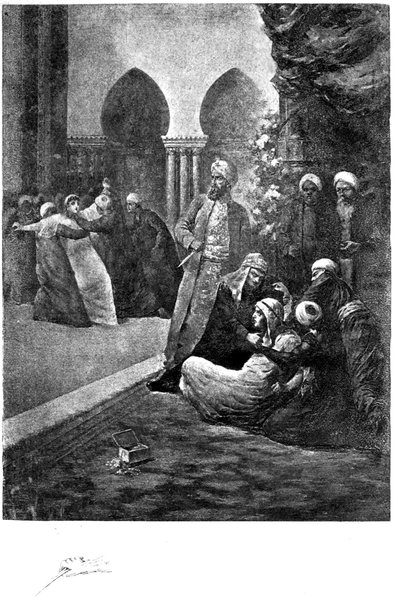
Now when it was the Hundred and Thirty-sixth Night,
She said, It hath reached me, O auspicious King, that the headsman
raised his hand to smite off his head when behold, loud cries
arose and the folk closed their shops; whereupon the King said to
the headsman, "Wait awhile," and despatched one to learn the
news. The messenger fared forth and presently returned and reported,
"I saw an army like the dashing sea with its clashing
surge: and their horses curvetting till earth trembleth with the
tramp; and I know no more of them." When the King heard
this, he was confounded and feared for his realm lest it should be
torn from him; so he turned to his Minister and said, "Have not
any of our army gone forth to meet this army?" But ere he had
done speaking, his Chamberlains entered with messengers from
the King who was approaching, and amongst them the Wazir
who had accompanied Taj al-Muluk. They began by saluting the
King, who rose to receive them and bade them draw near, and
asked the cause of their coming; whereupon the Minister came
forward from amongst them and stood before him and said,
"Know that he who hath come down upon thy realm is no King
like unto the Kings of yore and the Sultans that went before."
"And who is he?" asked Shahriman, and the Wazir answered,
"He is the Lord of justice and loyalty, the bruit of whose magnanimity
the caravans have blazed abroad, the Sultan Sulayman
Shah, Lord of the Green Land and the Two Columns and the
Mountains of Ispahan; he who loveth justice and equity, and
hateth oppression and iniquity. And he saith to thee that his son
43is with thee and in thy city; his son, his heart's very core and the
fruit of his loins, and if he find him in safety, his aim is won and
thou shalt have thanks and praise; but if he have been lost from
thy realm or if aught of evil have befallen him, look thou for ruin
and the wasting of thy reign! for this thy city shall become a wold
wherein the raven shall croak. Thus have I done my errand to
thee and peace be with thee!" Now when King Shahriman heard
from the messenger these words, his heart was troubled and he
feared for his kingdom: so he cried out for his Grandees and
Ministers, Chamberlains and Lieutenants; and, when they appeared,
he said to them, "Woe to you! Go down and search for the
youth." Now the Prince was still under the headsman's hands,
but he was changed by the fright he had undergone. Presently,
the Wazir, chancing to glance around, saw the Prince on the rug
of blood and recognised him; so he arose and threw himself upon
him, and so did the other envoys. Then they proceeded to loose
his bonds and they kissed his hands and feet, whereupon Taj al-Muluk
opened his eyes and, recognising his father's Wazir and
his friend Aziz, fell down a-fainting for excess of delight in them.
When King Shahriman made sure that the coming of this army
was indeed because of this youth, he was confounded and feared
with great fear; so he went up to Taj al-Muluk and, kissing his
head, said to him, "O my son, be not wroth with me, neither
blame the sinner for his sin: but have compassion on my grey
hairs, and waste not my realm." Whereupon Taj al-Muluk drew
near unto him and kissing his hand, replied, "No harm shall come
to thee, for indeed thou art to me as my father; but look that
nought befal my beloved, the Lady Dunya!" Rejoined the
King, "O my lord! fear not for her; naught but joy shall betide
her;" and he went on to excuse himself and made his peace with
Sulayman Shah's Wazir, to whom he promised much money, if
he would conceal from the King what he had seen. Then he bade
his chief Officers take the Prince with them and repair to the
Hammam and clothe him in one of the best of his own suits and
bring him back speedily. So they obeyed his bidding and bore
him to the bath and clad him in the clothes which King Shahriman
had set apart for him, and brought him back to the presence-chamber.
When he entered the King rose to receive him and
made all his Grandees stand in attendance on him. Then Taj al-Muluk
sat down to converse with his father's Wazir and with Aziz,
and he acquainted them with what had befallen him; after which
44they said to him, "During that delay we returned to thy father
and gave him to know that thou didst enter the Palace of the
Princess and didst not return therefrom; and thy case seemed
doubtful to us. But when thy sire heard of this he mustered his
forces; then we came to this land and indeed our coming hath
brought to thee relief in extreme case and to us great joy." Quoth
he, "Good fortune hath attended your every action, first and last."
While this was doing King Shahriman went in to his daughter,
Princess Dunya, and found her wailing and weeping for Taj al-Muluk.
Moreover, she had taken a sword and fixed the hilt in
the ground and had set the point to the middle of her heart
between her breasts; and she bent over the blade saying, "Needs
must I slay myself and not survive my beloved." When her
father entered and saw her in this case, he cried out to her, saying,
"O Princess of kings' daughters, hold thy hand and have ruth on
thy sire and the folk of thy realm!" Then he came up to her and
continued, "Let it not be that an ill thing befal thy father for thy
sake!" And he told her the whole tale that her lover was the son
of King Sulayman Shah and sought her to wife and he added,
"The marriage waiteth only for thy consent," Thereat she smiled
and said, "Did I not tell thee that he was the son of a Sultan?
By Allah, there is no help for it but that I let him crucify thee
on a bit of wood worth two pieces of silver!" Replied the King,
"O my daughter, have mercy on me, so Allah have mercy on
thee!" Rejoined she, "Up with you and make haste and go
bring him to me without delay." Quoth the King, "On my head
and eyes be it!"; and he left her and, going in hastily to Taj al-Muluk,
repeated her words in his ear.[53] So he arose and accompanied
the King to the Princess, and when she caught sight of
her lover, she took hold of him and embraced him in her father's
presence and hung upon him and kissed him, saying, "Thou hast
desolated me by thine absence!" Then she turned to her father
and said, "Sawest thou ever any that could do hurt to the like of
this beautiful being, who is moreover a King, the son of a King,
and of the free-born,[54] guarded against ignoble deeds?" Thereupon
45King Shahriman went out shutting the door on them with
his own hand; and he returned to the Wazir and to the other
envoys of Sulayman Shah and bade them inform their King that
his son was in health and gladness and enjoying all delight of
life with his beloved. So they returned to King Sulayman and
acquainted him with this; whereupon King Shahriman ordered
largesse of money and vivers to the troops of King Sulayman
Shah; and, when they had conveyed all he had commanded, he
bade be brought out an hundred coursers and an hundred dromedaries
and an hundred white slaves and an hundred concubines
and an hundred black slaves and an hundred female slaves;
all of which he forwarded to the King as a present. Then he
took horse, with his Grandees and Chief Officers, and rode out
of the city in the direction of the King's camp. As soon as
Sultan Sulayman Shah knew of his approach, he rose and
advanced many paces to meet him. Now the Wazir and Aziz
had told him all the tidings, whereat he rejoiced and cried,
"Praise be to Allah who hath granted the dearest wish of
my son!" Then King Sulayman took King Shahriman in his
arms and seated him beside himself on the royal couch, where
they conversed awhile and had pleasure in each other's conversation.
Presently food was set before them, and they ate till they
were satisfied; and sweetmeats and dried fruits were brought, and
they enjoyed their dessert. And after a while came to them Taj
al-Muluk, richly dressed and adorned, and when his father saw
him, he stood up and embraced him and kissed him. Then all
who were sitting rose to do him honour; and the two Kings seated
him between them and they sat conversing a while, after which
quoth King Sulayman Shah to King Shahriman, "I desire to have
the marriage-contract between my son and thy daughter drawn up
in the presence of witnesses, that the wedding may be made public,
even as is the custom of Kings." "I hear and I obey," quoth
King Shahriman and thereon summoned the Kazi and the witnesses,
who came and wrote out the marriage-contract between Taj
al-Muluk and the Lady Dunya. Then they gave bakhshish[55] of
money and sweetmeats; and lavished incense and essences; and
indeed it was a day of joy and gladness and all the grandees and
soldiers rejoiced therein. Then King Shahriman proceeded to
dower and equip his daughter; and Taj al-Muluk said to his sire,
46"Of a truth, this young man Aziz is of the generous and hath done
me a notable service, having borne weariness with me; and he
hath travelled with me and hath brought me to my desire. He
ceased never to show sufferance with me and exhort me to patience
till I accomplished my intent; and now he hath abided with us
two whole years, and he cut off from his native land. So now I
purpose to equip him with merchandise, that he may depart hence
with a light heart; for his country is nearhand." Replied his
father, "Right is thy rede;" so they made ready an hundred loads
of the richest stuffs and the most costly, and Taj al-Muluk presented
them with great store of money to Aziz, and farewelled
him, saying, "O my brother and my true friend! take these loads
and accept them from me by way of gift and token of affection,
and go in peace to thine own country." Aziz accepted the presents
and kissing the ground between the hands of the Prince and his
father bade them adieu. Moreover, Taj al-Muluk mounted and
accompanied him three miles on his homeward way as a proof of
amity, after which Aziz conjured him to turn back, saying, "By
Allah, O my master, were it not for my mother, I never would part
from thee! But, good my lord! leave me not without news of
thee." Replied Taj al-Muluk, "So be it!" Then the Prince returned
to the city and Aziz journeyed on till he came to his
native town; and he entered it and ceased not faring till he went
in to his mother and found that she had built him a monument
in the midst of the house and used to visit it continually. When
he entered, he saw her with hair dishevelled and dispread over
the tomb, weeping and repeating these lines:—
Indeed I'm strong to bear whate'er befal; ✿ But weak to bear such parting's dire mischance:
What heart estrangement of the friend can bear? ✿ What strength withstand assault of severance?
Then sobs burst from her breast, and she recited also these
couplets:—
What's this? I pass by tombs, and fondly greet ✿ My friends' last homes, but send they no reply:
For saith each friend, "Reply how can I make ✿ When pledged to clay and pawned to stones I lie?
Earth has consumed my charms and I forget ✿ Thy love, from kith and kin poor banisht I."
While she was thus, behold, Aziz came in to her and when she
47saw him, she fell down, fainting for very joy. He sprinkled water
on her face till she revived and rising, took him in her arms and
strained him to her breast, whilst he in like manner embraced
her. Then he greeted her and she greeted him, and she asked
the reason of his long absence, whereupon he told her all that
had befallen him from first to last and informed her how Taj
al-Muluk had given him an hundred loads of monies and stuffs.
At this she rejoiced, and Aziz abode with his mother in his native
town, weeping for what mishaps had happened to him with the
daughter of Dalilah the Wily One, even her who had castrated[56] him.
Such was the case with Aziz; but as regards Taj al-Muluk he went
in unto his beloved, the Princess Dunya, and abated her maidenhead.
Then King Shahriman proceeded to equip his daughter for
her journey with her husband and father in-law, and bade bring
them provaunt and presents and rarities. So they loaded their
beasts and set forth, whilst King Shahriman escorted them, by way
of farewell, three days' journey on their way, till King Shah Sulayman
conjured him to return. So he took leave of them and turned
back, and Taj al-Muluk and his wife and father fared forwards
night and day, with their troops, till they drew near their capital.
As soon as the news of their coming spread abroad, the folk
decorated for them the city,——And Shahrazad perceived the
dawn of day and ceased saying her permitted say.
Now when it was the Hundred and Thirty-seventh Night,
She said, It hath reached me, O auspicious King, that when Shah
Sulayman drew near his capital, the folk decorated the city for him
and for his son. So they entered in state and the King, sitting on
his throne with his son by his side, gave alms and largesse and
loosed all who were in his jails. Then he held a second bridal for
his son, and the sound of the singing-women and players upon
instruments was never silent for a whole month, and the tirewomen
stinted not to adorn the Lady Dunya and display her in
various dresses; and she tired not of the displaying nor did the
women weary of gazing on her. Then Taj al-Muluk, after having
foregathered awhile with his father and mother, took up his sojourn
with his wife, and they abode in all joyance of life and in fairest fortune,
48till there came to them the Destroyer of all delights.[57] Now
when the Wazir Dandan had ended the tale of Taj al-Muluk and the
Lady Dunya, Zau al-Makan said to him, "Of a truth, it is the like
of thee who lighten the mourner's heart and who deserve to be the
boon-companions of Kings and to guide their policy in the right
way." All this befel and they were still besieging Constantinople,
where they lay four whole years, till they yearned after their native
land; and the troops murmured, being weary of vigil and besieging
and the endurance of fray and foray by night and by day.
Then King Zau al-Makan summoned Rustam and Bahram and
Tarkash, and when they were in presence bespoke them thus,
"Know that we have lain here all these years and we have not won
to our wish; nay, we have but gained increase of care and concern;
for indeed we came, thinking to take our man-bote for King Omar
bin al-Nu'uman and in so doing my brother Sharrkan was slain;
so is our sorrow grown to sorrows twain and our affliction to
afflictions twain. All this came of the old woman Zat al-Dawahi,
for it was she who slew the Sultan in his kingdom and carried off
his wife, the Queen Sophia; nor did this suffice her, but she must
put another cheat on us and cut the throat of my brother Sharrkan:
and indeed I have bound myself and sworn by the solemnest oaths
that there is no help but I take blood-wit from her. What say ye?
Ponder my address and answer me." Then they bowed their heads
and answered, "It is for the Wazir Dandan to opine." So the
Minister came forward and said, "Know O King of the Age! it
booteth us nought to tarry here; and 'tis my counsel that we
strike camp and return to our own country, there to abide for a
certain time and after that we should return for a razzia upon the
worshippers of idols." Replied the King, "This rede is right, for
indeed the folk weary for a sight of their families, and I am another
who is also troubled with yearning after my son Kanmakan and
my brother's daughter Kuzia Fakan, for she is in Damascus and
I know not how is her case." When the troops heard this report,
they rejoiced and blessed the Wazir Dandan. Then the King bade
the crier call the retreat after three days. They fell to preparing
for the march, and, on the fourth day, they beat the big drums and
unfurled the banners and the army set forth, the Wazir Dandan in
the van and the King riding in the mid-battle, with the Grand
49Chamberlain by his side; and all journeyed without ceasing, night
and day, till they reached Baghdad city. The folk rejoiced in their
return, and care and fear ceased from them whilst the stay-at-homes
met the absentees and each Emir betook him to his
own house. As for Zau al-Makan he marched up to the Palace
and went in to his son Kanmakan, who had now reached the
age of seven; and who used to go down to the weapon-plain and
ride. As soon as the King was rested of his journey, he entered
the Hammam with his son, and returning, seated himself on his
sofa of state, whilst the Wazir Dandan took up his station before
him and the Emirs and Lords of the realm presented themselves
and stood in attendance upon him. Then Zau al-Makan called for
his comrade, the Fireman, who had befriended him in his wanderings;
and, when he came into presence, the King rose to do him
honour and seated him by his side. Now he had acquainted the
Wazir with all the kindness and good turns which the Stoker had
done him; and he found that the wight had waxed fat and burly
with rest and good fare, so that his neck was like an elephant's
throat and his face like a dolphin's belly. Moreover, he was grown
dull of wit, for that he had never stirred from his place; so at first
he knew not the King by his aspect. But Zau al-Makan came
up to him smiling in his face, and greeted him after the friendliest
fashion, saying, "How soon hast thou forgotten me?" With this
the Fireman roused himself and, looking steadfastly at Zau al-Makan,
made sure that he knew him; whereupon he sprang hastily
to his feet and exclaimed, "O my friend, who hath made thee
Sultan?" Then Zau al-Makan laughed at him and the Wazir,
coming up to him expounded the whole story to him and said, "In
good sooth he was thy brother and thy friend; and now he is King
of the land and needs must thou get great good of him. So I
charge thee, if he say:—Ask a boon of me, ask not but for some
great thing; for thou art very dear to him." Quoth the Fireman,
"I fear lest, if I ask of him aught, he may not choose to give it or
may not be able to grant it." Quoth the Wazir, "Have no care;
whatsoever thou askest he will give thee." Rejoined the Stoker,
"By Allah, I must at once ask of him a thing that is in my
thought: every night I dream of it and implore Almighty Allah
to vouchsafe it to me." Said the Wazir, "Take heart; by Allah,
if thou ask of him the government of Damascus, in place of his
brother, he would surely give it thee and make thee Governor."
With this the Stoker rose to his feet and Zau al-Makan signed to
50him to sit; but he refused, saying, "Allah forfend! The days are
gone by of my sitting in thy presence." Answered the Sultan,
"Not so, they endure even now. Thou wast in very deed the
cause that I am at present alive and, by Allah, whatever thing
most desired thou requirest of me, I will give that same to thee.
But ask thou first of Allah, and then of me!" He said, "O my
lord, I fear—" "Fear not," quoth the Sultan. He continued, "I
fear to ask aught and that thou shouldst refuse it to me and it is
only—" At this the King laughed and replied, "If thou require
of me the half of my kingdom I would share it with thee: so ask
what thou wilt and leave talking." Repeated the Fireman "I
fear—" "Don't fear," quoth the King. He went on, "I fear lest
I ask a thing and thou be not able to grant it." Upon this the
Sultan waxed wroth and cried, "Ask what thou wilt." Then said
he, "I ask, first of Allah and then of thee, that thou write me
a patent of Syndicate over all the Firemen of the baths in the
Holy City, Jerusalem." The Sultan and all present laughed and
Zau al-Makan said, "Ask something more than this." He replied,
"O my lord, said I not I feared that thou wouldst not choose to
give me what I should ask or that thou be not able to grant it?"
Therewith the Wazir signed him with his foot once and twice and
thrice, and every time he began, "I ask of thee—" Quoth the
Sultan, "Ask and be speedy." So he said, "I ask thee to make
me Chief of the Scavengers in the Holy City of Jerusalem, or in
Damascus town." Then all those who were present fell on their
backs with laughter and the Wazir beat him; whereupon he
turned to the Minister and said to him, "What art thou that thou
shouldest beat me? 'Tis no fault of mine: didst thou not thyself
bid me ask some important thing?" And he added, "Let me go
to my own land." With this, the Sultan knew that he was jesting
and took patience with him awhile; then turned to him and said,
"O my brother, ask of me some important thing, befitting our
dignity." So the Stoker said, "O King of the Age, I ask first of
Allah and then of thee, that thou make me Viceroy of Damascus
in the place of thy brother;" and the King replied, "Allah granteth
thee this." Thereupon the Fireman kissed ground before him
and he bade set him a chair in his rank and vested him with a
viceroy's habit. Then he wrote him a patent and sealed it with
his own seal, and said to the Wazir Dandan, "None shall go with
him but thou; and when thou makest the return journey, do thou
bring with thee my brother's daughter, Kuzia Fakan." "Hearkening
51and obedience," answered the Minister; and, taking the Fireman,
went down with him and made ready for the march. Then
the King appointed for the Stoker servants and suite, and gave
him a new litter and a princely equipage and said to the Emirs,
"Whoso loveth me, let him honour this man and offer him a handsome
present." So each and every of the Emirs brought him his
gift according to his competence; and the King named him Zibl
Khán,[58] and conferred on him the honourable surname of al-Mujáhid.[59]
As soon as the gear was ready, he went up with the
Wazir Dandan to the King, that he might take leave of him and
ask his permission to depart. The King rose to him and embraced
him, and charged him to do justice between his subjects
and bade him make ready for fight against the Infidels
after two years. Then they took leave of each other and the
King,[60] the Fighter for the Faith hight Zibl Khan, having been
again exhorted by Zau al-Makan to deal fairly with his subjects,
set out on his journey, after the Emirs had brought him Mamelukes
and eunuchs, even to five thousand in number, who rode after him.
The Grand Chamberlain also took horse, as did Bahram, captain
of the Daylamites, and Rustam, captain of the Persians, and
Tarkash, captain of the Arabs, who attended to do him service;
and they ceased not riding with him three days' journey by way of
honour. Then, taking their leave of him, they returned to Baghdad
and the Sultan Zibl Khan and the Wazir Dandan fared on, with
their suite and troops, till they drew near Damascus. Now news
was come, upon the wings of birds, to the notables of Damascus,
that King Zau al-Makan had made Sultan over Damascus a
King named Zibl Khan and surnamed Al-Mujahid; so when he
reached the city he found it dressed in his honour and everyone in
the place came out to gaze on him. The new Sultan entered Damascus
in a splendid progress and went up to the citadel, where he
sat down upon his chair of state, whilst the Wazir Dandan stood in
attendance on him, to acquaint him with the ranks of the Emirs
52and their stations. Then the Grandees came in to him and kissed
hands and called down blessings on him. The new King, Zibl
Khan, received them graciously and bestowed on them dresses of
honour and various presents and bounties; after which he opened
the treasuries and gave largesse to the troops, great and small.
Then he governed and did justice and proceeded to equip the
Lady Kuzia Fakan, daughter of King Sharrkan, appointing her a
litter of silken stuff. Moreover he furnished the Wazir Dandan
equally well for the return journey and offered him a gift of coin;
but he refused, saying, "Thou art near the time appointed by the
King, and haply thou wilt have need of money, or after this we
may send to seek of thee funds for the Holy War or what not."
Now when the Wazir was ready to march, Sultan al-Mujahid
mounted to bid the Minister farewell and brought Kuzia Fakan to
him, and made her enter the litter and sent with her ten damsels
to do her service. Thereupon they set forward, whilst King
"Fighter for the Faith" returned to his government that he might
order affairs and get ready his munitions of war, awaiting such
time as King Zau al-Makan should send a requisition to him.
Such was the case with Sultan Zibl Khan, but as regards the Wazir
Dandan, he ceased not faring forward and finishing off the stages,
in company with Kuzia Fakan till they came to Ruhbah[61] after a
month's travel and thence pushed on, till he drew near Baghdad.
Then he sent to announce his arrival to King Zau al-Makan who,
when he heard this, took horse and rode out to meet him. The
Wazir Dandan would have dismounted, but the King conjured
him not to do so and urged his steed till he came up to his side.
Then he questioned him of Zibl Khan hight Al-Mujahid, whereto
the Wazir replied that he was well and that he had brought with
him Kuzia Fakan the daughter of his brother. At this the King
rejoiced and said to Dandan, "Down with thee and rest thee from
the fatigue of the journey for three days, after which come to me
again." Replied the Wazir, "With joy and gratitude," and betook
himself to his own house, whilst the King rode up to his Palace
and went in to his brother's daughter, Kuzia Fakan, a girl of eight
years old. When he saw her, he rejoiced in her and sorrowed for
her sire; then he bade make for her clothes and gave her splendid
jewelry and ornaments, and ordered she be lodged with his son
Kanmakan in one place. So they both grew up the brightest of
53the people of their time and the bravest; but Kuzia Fakan became
a maiden of good sense and understanding and knowledge of the
issues of events, whilst Kanmakan approved him a generous youth
and freehanded, taking no care in the issue of aught. And so
they continued till each of them attained the age of twelve. Now
Kuzia Fakan used to ride a-horseback and fare forth with her
cousin into the open plain and push forward and range at large
with him in the wold; and they both learnt to smite with swords
and spike with spears. But when they had reached the age of
twelve, King Zau al-Makan, having completed his preparations
and provisions and munitions for Holy War, summoned the Wazir
Dandan and said to him, "Know that I have set mind on a
thing, which I will discover to thee, and I want thine opinion
thereon; so do thou with speed return me a reply." Asked the
Wazir, "What is that, O King of the Age?"; and the other
answered, "I am resolved to make my son Kanmakan Sultan
and rejoice in him in my lifetime and do battle before him
till death overtake me. What reckest thou of this?" The
Wazir kissed the ground before the King and replied, "Know, O
King and Sultan mine, Lord of the Age and the time! that which
is in thy mind is indeed good, save that it is now no tide to carry
it out, for two reasons; the first, that thy son Kanmakan is yet of
tender years; and the second, that it often befalleth him who
maketh his son King in his lifetime, to live but a little while
there afterward.[62] And this is my reply." Rejoined the King,
"Know, O Wazir, that we will make the Grand Chamberlain
guardian over him, for he is now one of the family and he married
my sister, so that he is to me as a brother." Quoth the Wazir,
"Do what seemeth good to thee: we have only to obey thine
orders." Then the King sent for the Grand Chamberlain whom
they brought into the presence together with the Lords of the
realm and he said to them, "Ye know that this my son Kanmakan
is the first cavalier of the age, and that he hath no peer in striking
with the sword and lunging with the lance; and now I appoint
him to be Sultan over you and I make the Grand Chamberlain,
his uncle, guardian over him." Replied the Chamberlain, "I am
but a tree which thy bounty hath planted"; and Zau al-Makan
said, "O Chamberlain, verily this my son Kanmakan and my
niece Kuzia Fakan are brothers' children; so I hereby marry her
54to him and I call those present to witness thereof." Then he made
over to his son such treasures as no tongue can describe; and,
going in to his sister, Nuzhat al-Zaman, told her what he had
done, whereat she was a glad woman and said, "Verily the twain
are my children: Allah preserve thee to them and keep thy life
for them many a year!" Replied he, "O my sister, I have accomplished
in this world all my heart desired and I have no fear
for my son! yet it were well thou have an eye on him, and an eye
on his mother." And he charged the Chamberlain and Nuzhat al-Zaman
with the care of his son and niece and wife, and this he
continued to do nights and days till he fell sick and deemed surely
that he was about to drink the cup of death; so he took to his
bed, whilst the Chamberlain busied himself with ordering the folk
and realm. At the end of the year, the King summoned his son
Kanmakan and the Wazir Dandan and said, "O my son, after my
death this Wazir is thy sire; for know that I am about to leave
this house of life transitory for the house of eternity. And indeed
I have fulfilled my will of this world; yet there remaineth in my
heart one regret which may Allah dispel through and by thy
hands." Asked his son, "What regret is that, O my father?"
Answered Zau al-Makan, "O my son, the sole regret of me is that I
die without having avenged thy grandfather, Omar bin al-Nu'uman,
and thine uncle, Sharrkan, on an old woman whom they call Zat
al-Dawahi; but, if Allah grant thee aid, sleep not till thou take
thy wreak on her, and so wipe out the shame we have suffered at
the Infidel's hands; and beware of the old hag's wile and do what
the Wazir Dandan shall advise thee; because he from old time
hath been the pillar of our realm." And his son assented to what
he said. Then the King's eyes ran over with tears and his sickness
redoubled on him; whereupon his brother-in-law, the Chamberlain,
took charge over the country and, being a capable man, he judged
and bade and forbade for the whole of that year; while Zau al-Makan
was occupied with his malady. And his sickness was sore
upon him for four years, during which the Chief Chamberlain sat
in his stead and gave full satisfaction to the commons and the
nobles; and all the country blessed his rule. Such was the case
with Zau al-Makan and the Chamberlain; but as regards the
King's son, he busied himself only with riding and lunging with
lance and shooting with shaft, and thus also did the daughter of
his uncle, Kuzia Fakan; for he and she were wont to fare forth
at the first of the day and return at nightfall, when she would go
55in to her mother, and he would go in to his mother whom he ever
found sitting in tears by the head of his father's couch. Then he
would tend his father all night long till daybreak, when he would
go forth again with his cousin according to their wont. Now Zau
al-Makan's pains and sufferings were longsome upon him and he
wept and began versifying with these couplets:—
Gone is my strength, told is my tale of days ✿ And, lookye! I am left as thou dost see:
In honour's day most honoured wont to be, ✿ And win the race from all my company,
Would Heaven before my death I might behold ✿ My son in seat of empire sit for me;
And rush upon his foes, to take his wreak ✿ With sway of sword and lance lunged gallantly:
In this world and the next I am undone, ✿ Except the Lord vouchsafe me clemency.
When he had ended repeating these verses, he laid his head on his
pillow and closed his eyes and slept. Then saw he in his sleep
one who said to him, "Rejoice, for thy son shall fill the lands with
justest sway; and he shall rule them and him shall the lieges obey."
Then he awoke from his dream gladdened by the good tidings he
had seen, and after a few days, Death smote him, and because of
his dying great grief fell on the people of Baghdad, and simple
and gentle mourned for him. But Time passed over him, as though
he had never been[63] and Kanmakan's estate was changed; for the
people of Baghdad set him aside and put him and his family in
a place apart. Now when his mother saw this, she fell into the
sorriest of plights and said, "There is no help but that I go to
the Grand Chamberlain, and I must hope for the aidance of the
Subtle, the All-Wise!" Then she rose from her place and betook
herself to the house of the Chamberlain who was now become
Sultan, and she found him sitting upon his carpet. So she went
in to his wife, Nuzhat al-Zaman, and wept with sore weeping and
said unto her, "Verily the dead hath no friend! May Allah never
bring you to want as long as your age and the years endure, and
may you cease not to rule justly over rich and poor. Thine ears
have heard and thine eyes have seen all that was ours of kingship
and honour and dignity and wealth and fair fortune of life
and condition; and now Time hath turned upon us, and fate and
56the world have betrayed us and wrought in hostile way with us;
wherefore I come to thee craving thy favours, I from whom favours
were craved: for when a man dieth, women and maidens are brought
to despisal." And she repeated these couplets:—
Suffice thee Death such marvels can enhance, ✿ And severed lives make lasting severance:
Man's days are marvels, and their stations are ✿ But water-pits
[64] of misery and mischance.
Naught wrings my heart save loss of noble friends, ✿ Girt round by rings of hard, harsh circumstance.
When Nuzhat al-Zaman heard these words, she remembered her
brother, Zau al-Makan, and his son Kanmakan, and, making her
draw near to her and showing her honour, she said, "Verily at this
moment, by Allah, I am grown rich and thou art poor; now by the
Lord! we did not cease to seek thee out, but we feared to wound
thy heart lest thou shouldest fancy our gifts to thee an alms-gift.
Withal, whatso weal we now enjoy is from thee and thy husband;
so our house is thy house and our place thy place, and thine is all
our wealth and what goods we have belong to thee." Then she
robed her in sumptuous robes and set apart for her a place in the
Palace adjoining her own; and they abode therein, she and her
son, in all delight of life. And Nuzhat al-Zaman clothed him also
in Kings' raiment and gave to them both especial handmaids for
their service. After a little, she related to her husband the sad
case of the widow of her brother, Zau al-Makan, whereat his
eyes filled with tears and he said, "Wouldest thou see the world
after thee, look thou upon the world after other than thyself.
Then entreat her honourably and enrich her poverty."——And
Shahrazad perceived the dawn of day and ceased to say her
permitted say.
Now when it was the Hundred and Thirty-eighth Night,
She said, It hath reached me, O auspicious King, that when Nuzhat
al-Zaman related to her husband the sad case of the widow of her
brother, Zau al-Makan, the Chamberlain said, "Entreat her honourably
57and enrich her poverty." Thus far concerning Nuzhat al-Zaman
and her consort and the relict of Zau al-Makan; but as
regards Kanmakan and his cousin Kuzia Fakan, they grew up and
flourished till they waxed like unto two fruit-laden boughs or two
shining moons; and they reached the age of fifteen. And she was
indeed the fairest of maids who are modestly veiled, lovely-faced
with smooth cheeks graced, and slender waist on heavy hips
based; and her shape was the shaft's thin line and her lips were
sweeter than old wine and the nectar of her mouth as it were the
fountain Salsabíl[65]; even as saith the poet in these two couplets
describing one like her:—
As though ptisane of wine on her lips honey-dew ✿ Dropt from the ripened grapes her mouth in clusters grew:
And, when her frame thou doublest, and low bends her vine, ✿ Praise her Creator's might no creature ever knew.
Of a truth Allah had united in her every charm: her shape would
shame the branch of waving tree and the rose before her cheeks
craved lenity; and the honey-dew of her lips of wine made jeer,
however old and clear, and she gladdened heart and beholder with
joyous cheer, even as saith of her the poet:—
Goodly of gifts is she, and charm those perfect eyes, ✿ With lashes shaming Kohl and all the fair ones Kohl'd
[66]And from those eyne the glances pierce the lover's heart, ✿ Like sword in Mír al-Muminína Ali's hold.
And (the relator continueth) as for Kanmakan, he became unique
in loveliness and excelling in perfection no less; none could even
him in qualities as in seemliness and the sheen of valour between
his eyes was espied, testifying for him while against him it never
testified. The hardest hearts inclined to his side; his eyelids bore
lashes black as by Kohl; and he was of surpassing worth in body
and soul. And when the down of lips and cheeks began to sprout
bards and poets sang for him far and near:—
Appeared not my excuse till hair had clothed his cheek, ✿ And gloom o'ercrept that side-face (sight to stagger!)
A fawn, when eyes would batten on his charms, ✿ Each glance deals thrust like point of Khanjar-dagger.
58And saith another:—
His lovers' souls have drawn upon his cheek ✿ An ant that perfected its rosy light:
I marvel at such martyrs Lazá-pent ✿ Who yet with greeny robes of Heaven are dight.
[67]
Now it chanced one holiday, that Kuzia Fakan fared forth to make
festival with certain kindred of the court, and she went surrounded
by her handmaids. And indeed beauty encompassed her; the roses
of her cheeks dealt envy to their mole; from out her smiling lips
leven flashed white, gleaming like the chamomile[68]; and Kanmakan
began to turn about her and devour her with his sight, for she was
the moon of resplendent light. Then he took heart and giving his
tongue a start began to improvise:—
When shall the disappointed heart be healed of severance, ✿ And lips of Union smile at ceasing of our hard mischance?
Would Heaven I knew shall come some night, and with it surely bring ✿ Meeting with friend who like myself endureth sufferance.
[69]
When Kuzia Fakan heard these couplets, she showed vexation
and disapproval and, putting on a haughty and angry air, said to
him, "Dost thou name me in thy verse, to shame me amongst
folk? By Allah, if thou turn not from this talk, I will assuredly
complain of thee to the Grand Chamberlain, Sultan of Khorasan
and Baghdad and lord of justice and equity; that disgrace and
punishment may befal thee!" Kanmakan made no reply for
anger but he returned to Baghdad; and Kuzia Fakan also returned
to her palace and complained of her cousin to her mother, who
said to her, "O my daughter, haply he meant thee no harm, and is
he aught but an orphan? Withal, he said nought of reproach to
59thee; so beware thou tell none of this, lest perchance it come to
the Sultan's ears and he cut short his life and blot out his name
and make it even as yesterday, whose memory hath passed away."
However, Kanmakan's love for Kuzia Fakan spread abroad in
Baghdad, so that the women talked of it. Moreover, his breast
became straitened and his patience waned and he knew not what
to do, yet he could not hide his condition from the world. Then
longed he to give vent to the pangs he endured, by reason of the
lowe of separation; but he feared her rebuke and her wrath; so
he began improvising:—
Now is my dread to incur reproaches, which ✿ Disturb her temper and her mind obscure,
Patient I'll bear them; e'en as generous youth ✿ Beareth the burn of brand his case to cure.
[70]
——And Shahrazad perceived the dawn of day and ceased saying
her permitted say.
Now when it was the Hundred and Thirty-ninth Night,
She said, It hath reached me, O auspicious King, that when the
Grand Chamberlain became Sultan they named him King Sásán;
and after he had assumed the throne he governed the people
in righteous way. Now as he was giving audience one day,
Kanmakan's verses came to his knowledge. Thereupon he
repented him of the past and going in to his wife Nuzhat al-Zaman,
said to her, "Verily, to join Halfah-grass and fire,[71] is the
greatest of risks; and man may not be trusted with woman, so
long as eye glanceth and eyelid quivereth. Now thy brother's
son, Kanmakan, is come to man's estate and it behoveth us to
forbid him access to the rooms where anklets tinkle, and it is yet
more needful to forbid thy daughter the company of men, for the
like of her should be kept in the Harim." Replied she, "Thou
sayest sooth, O wise King!" Next day came Kanmakan according
60to his wont; and, going in to his aunt saluted her. She
returned his salutation and said to him, "O my son! I have somewhat
to say to thee which I would fain leave unsaid; yet I must
tell it thee despite my inclination." Quoth he, "Speak;" and
quoth she, "Know then that thy sire the Chamberlain, the father
of Kuzia Fakan, hath heard of the verses thou madest anent her,
and hath ordered that she be kept in the Harim and out of thy
reach; if therefore, O my son, thou want anything from us, I
will send it to thee from behind the door; and thou shalt not
look upon Kuzia Fakan nor shalt thou return hither from this
day forth." When he heard this he arose and withdrew without
speaking a single word; and, betaking himself to his mother,
related what his aunt had said. She observed, "This all cometh
of thine overtalking. Thou knowest that the news of thy passion
for Kuzia Fakan is noised abroad and the tattle hath spread
everywhere how thou eatest their food and thereafter thou courtest
their daughter." Rejoined he, "And who should have her but I?
She is the daughter of my father's brother and I have the best of
rights to her." Retorted his mother, "These are idle words. Be
silent, lest haply thy talk come to King Sasan's ears and it prove
the cause of thy losing her and the reason of thy ruin and increase
of thine affliction. They have not sent us any supper to-night and
we shall die an-hungered; and were we in any land but this, we
were already dead of famine or of shame for begging our bread."
When Kanmakan heard these words from his mother, his regrets
redoubled; his eyes ran over with tears and he complained and
began improvising:—
Minish this blame I ever bear from you: ✿ My heart loves her to whom all love is due:
Ask not from me of patience jot or tittle, ✿ Divorce of Patience by God's House! I rue:
What blamers preach of patience I unheed; ✿ Here am I, love-path firmly to pursue!
Indeed they bar me access to my love; ✿ Here am I, by God's ruth no ill I sue!
Good sooth my bones, whenas they hear thy name, ✿ Quail as birds quailed when Nisus o'er them flew:
[72]Ah! say to them who blame my love that I ✿ Will love that face, fair cousin, till I die.
61And when he had ended his verses he said to his mother, "I have
no longer a place in my aunt's house nor among these people, but
I will go forth from the palace and abide in the corners of the
city." So he and his mother left the court; and, having sought
an abode in the neighbourhood of the poorer sort, there settled;
but she used to go from time to time to King Sasan's palace and
thence take daily bread for herself and her son. As this went on
Kuzia Fakan took her aside one day and said to her, "Alas, O my
naunty, how is it with thy son?" Replied she, "O my daughter,
sooth to say, he is tearful-eyed and heavy-hearted, being fallen
into the net of thy love." And she repeated to her the couplets
he had made; whereupon Kuzia Fakan wept and said, "By
Allah! I rebuked him not for his words, nor for ill-will to him,
but because I feared for him the malice of foes. Indeed my
passion for him is double that he feeleth for me; my tongue may
not describe my yearning for him; and were it not for the extravagant
wilfulness of his words and the wanderings of his wit, my
father had not cut off from him favours that besit, nor had decreed
unto him exclusion and prohibition as fit. However, man's days
bring nought but change, and patience in all case is most becoming;
peradventure He who ordained our severance will vouchsafe us
reunion!" And she began versifying in these two couplets:—
O son of mine uncle! same sorrow I bear, ✿ And suffer the like of thy cark and thy care;
Yet hide I from man what I suffer for pine; ✿ Hide it too, and such secret to man never bare!
When his mother heard this from her, she thanked her and blessed
her: then she left her and acquainted her son with what she had
said; whereupon his desire for her increased and he took heart,
being eased of his despair and the turmoil of his love and care.
And he said, "By Allah, I desire none but her!"; and he began
improvising:—
Leave this blame, I will list to no flout of my foe! ✿ I divulged a secret was told me to keep:
He is lost to my sight for whose union I yearn, ✿ And I watch all the while he can slumber and sleep.
So the days and nights went by whilst Kanmakan lay tossing upon
coals of fire,[73] till he reached the age of seventeen; and his beauty
62had waxt perfect and his wits were at their brightest. One night,
as he lay awake, he communed with himself and said, "Why
should I keep silence till I waste away and see not my lover?
Fault have I none save poverty; so, by Allah, I am resolved to
remove me from this region and wander over the wild and the
wold; for my position in this city is a torture and I have no
friend nor lover therein to comfort me; wherefore I am determined
to distract myself by absence from my native land till I die and
take my rest after this shame and tribulation." And he began
to improvise and recited these couplets:—
Albeit my vitals quiver 'neath this ban; ✿ Before the foe myself I'll ne'er unman!
So pardon me, my vitals are a writ ✿ Whose superscription are my tears that ran:
Heigh-ho! my cousin seemeth Houri-may ✿ Come down to earth by reason of Rizwán:
'Scapes not the dreadful sword-lunge of her look ✿ Who dares the glancing of those eyne to scan:
O'er Allah's wide-spread world I'll roam and roam, ✿ And from such exile win what bread I can:
Yes, o'er broad earth I'll roam and save my soul, ✿ All but her absence bearing like a man:
With gladsome heart I'll haunt the field of fight, ✿ And meet the bravest Brave in battle-van!
So Kanmakan fared forth from the palace barefoot and he walked
in a short-sleeved gown, wearing on his head a skull cap of felt[74]
seven years old and carrying a scone three days stale, and in
the deep glooms of night betook himself to the portal al-Arij of
Baghdad. Here he waited for the gate being opened and when it
was opened, he was the first to pass through it; and he went out
at random and wandered about the wastes night and day. When
the dark hours came, his mother sought him but found him not;
whereupon the world waxt strait upon her for all that it was
great and wide, and she took no delight in aught of weal it supplied.
She looked for him a first day and a second day and a third day
till ten days were past, but no news of him reached her. Then
her breast became contracted and she shrieked and shrilled, saying,
"O my son! O my darling! thou hast revived my regrets. Sufficed
63not what I endured, but thou must depart from my home? After
thee I care not for food nor joy in sleep, and naught but tears and
mourning are left me. O my son, from what land shall I call
thee? And what town hath given thee refuge?" Then her sobs
burst out, and she began repeating these couplets:—
Well learnt we, since you left, our grief and sorrow to sustain, ✿ While bows of severance shot their shafts in many a railing rain:
They left me, after girthing on their selles of corduwayne ✿ To fight the very pangs of death while spanned they sandy plain:
Mysterious through the nightly gloom there came the moan of dove; ✿ A ringdove, and replied I, 'Cease thy plaint, how durst complain?'
If, by my life, her heart, like mine, were full of pain and pine ✿ She had not deckt her neck with ring nor sole with ruddy stain.
[75]Fled is mine own familiar friend, bequeathing me a store ✿ Of parting-pang and absence-ache to suffer evermore.
Then she abstained from food and drink and gave herself up to
excessive tear-shedding and lamentation. Her grief became
public property far and wide and all the people of the town and
country side wept with her and cried, "Where is thine eye, O
Zau al-Makan?" And they bewailed the rigours of Time, saying,
"Would Heaven we knew what hath befallen Kanmakan that he
fled his native town, and chased himself from the place where his
father used to fill all in hungry case and do justice and grace?"
And his mother redoubled her weeping and wailing till the news of
Kanmakan's departure came to King Sasan.——And Shahrazad
perceived the dawn of day and ceased saying her permitted say.
Now when it was the Hundred and Fortieth Night,
She said, It hath reached me, O auspicious King, that came to
King Sasan the tidings of the departure of Kanmakan, through the
Chief Emirs who said to him, "Verily he is the son of our Sovran
and the seed of King Omar bin al-Nu'uman and it hath reached
us that he hath exiled himself from the land." When King Sasan
heard these words, he was wroth with them and ordered one of
them to be hanged by way of silencing him, whereat the fear of
him fell upon the hearts of all the other Grandees and they dared
64not speak one word. Then he called to mind all the kindness
that Zau al-Makan had done him, and how he had charged him
with the care of his son; wherefore he grieved for Kanmakan and
said, "Needs must I have search made for him in all countries."
So he summoned Tarkash and bade him choose an hundred horse
and wend with them in quest of the Prince. Accordingly he went
out and was absent ten days, after which he returned and said, "I
can learn no tidings of him and have hit on no trace of him, nor
can any tell me aught of him." Upon this King Sasan repented
him of that which he had done by the Prince; whilst his mother
abode in unrest continual nor would patience come at her call: and
thus passed over her twenty days in heaviness all. This is how it
fared with these; but as regards Kanmakan, when he left Baghdad,
he went forth perplexed about his case and knowing not whither
he should go: so he fared on alone through the desert for three
days and saw neither footman nor horseman; withal, his sleep fled
and his wakefulness redoubled, for he pined after his people and
his homestead. He ate of the herbs of the earth and drank of its
flowing waters and siesta'd under its trees at hours of noontide
heats, till he turned from that road to another way and, following
it other three days, came on the fourth to a land of green leas, dyed
with the hues of plants and trees and with sloping valley-sides made
to please, abounding with the fruits of the earth. It had drunken
of the cups of the cloud, to the sound of thunders rolling loud and
the song of the turtle-dove gently sough'd, till its hill-slopes were
brightly verdant and its fields were sweetly fragrant. Then
Kanmakan recalled his father's city Baghdad, and for excess of
emotion he broke out into verse:—
I roam, and roaming hope I to return; ✿ Yet of returning see not how or when:
I went for love of one I could not win, ✿ Nor way of 'scaping ills that pressed could ken.
When he ended his recital he wept, but presently he wiped away
his tears and ate of the fruits of the earth enough for his present
need. Then he made the Wuzu-ablution and prayed the ordained
prayers which he had neglected all this time; and he sat resting
in that place through the livelong day. When night came he slept
and ceased not sleeping till midnight, when he awoke and heard a
human voice declaiming these couplets:—
65What's life to me, unless I see the pearly sheen ✿ Of teeth I love, and sight that glorious mien?
Pray for her Bishops who in convents reign, ✿ Vying to bow before that heavenly queen.
And Death is lighter than the loved one's wrath, ✿ Whose phantom haunts me, seen in every scene:
O joy of cup-companions, when they meet, ✿ And loved and lover o'er each other lean!
E'en more in time of spring, the lord of flowers, ✿ When fragrant is the world with bloom and green:
Drainer of vine-juice! up wi' thee, for now ✿ Earth is a Heaven where sweet waters flow.
[76]
When Kanmakan heard these distichs his sorrows surged up; his
tears ran down his cheeks like freshets and flames of fire darted
into his heart. So he rose to see who it was that spake these
words, but saw none for the thickness of the gloom; whereupon
passion increased on him and he was frightened and restlessness
possessed him. He descended from his place to the sole of the
valley and walked along the banks of the stream, till he heard the
same voice sighing heavy sighs and reciting these couplets:—
Tho' 'tis thy wont to hide thy love perforce, ✿ Yet weep on day of parting and divorce!
Twixt me and my dear love were plighted vows; ✿ Pledge of reunion, fonder intercourse:
With joy inspires my heart and deals it rest ✿ Zephyr, whose coolness doth desire enforce.
O Sa'adá,
[77] thinks of me that anklet-wearer? ✿ Or parting broke she troth without remorse?
And say! shall nights foregather us, and we ✿ Of suffered hardships tell in soft discourse?
Quoth she, "Thou'rt daft for us and fey"; quoth I, ✿ "'Sain thee! how many a friend hast turned to corse!"
If taste mine eyes sweet sleep while she's away, ✿ Allah with loss of her these eyne accurse.
O wounds in vitals mine! for cure they lack ✿ Union and dewy lips' sweet theriack.
[78]
66When Kanmakan heard this verse again spoken by the same voice
yet saw no one, he knew that the speaker was a lover like unto
himself, debarred from union with her who loved him; and he said
to himself, "'Twere fitting that this man should lay his head to
my head and become my comrade in this my strangerhood."[79] Then
he hailed the speaker and cried out to him, saying, "O thou who
farest in sombrest night, draw near to me and tell me thy tale;
haply thou shalt find me one who will succour thee in thy sufferings."
And when the owner of the voice heard these words, he
cried out, "O thou that respondest to my complaint and wouldest
hear my history, who art thou amongst the knights? Art thou
human or Jinni? Answer me speedily ere thy death draw near,
for I have wandered in this desert some twenty days and have seen
no one nor heard any voice but thy voice." At these words Kanmakan
said to himself, "This one's case is like my case, for I, even
I, have wandered twenty days, nor during my wayfare have I seen
man or heard voice:" and he added, "I will make him no answer
till day arise." So he was silent, and the voice again called out to
him, saying, "O thou that callest, if thou be of the Jinn fare in
peace and, if thou be man, stay awhile till the day break stark and
the night flee with the dark." The speaker abode in his place and
Kanmakan did likewise and the twain in reciting verses never
failed, and wept tears that railed till the light of day began loom
and the night departed with its gloom. Then Kanmakan looked at
the other and found him to be of the Badawi Arabs, a youth in
the flower of his age; clad in worn clothes and bearing in baldrick
a rusty sword which he kept sheathed, and the signs of love-longing
were apparent on him. He went up to him and accosted him
and saluted him, and the Badawi returned the salute and greeted
him with courteous wishes for his long life, but somewhat despised
him, seeing his tender years and his condition, which was that of a
pauper. So he said to him, "O youth, of what tribe art thou and
to whom art thou kin among the Arabs; and what is thy history
that thou goest by night, after the fashion of knights? Indeed
thou spakest to me in the dark words such as are spoken of none
67but doughty cavaliers and lion-like warriors; and now I hold thy
life in hand. But I have compassion on thee by reason of thy
green years; so I will make thee my companion and thou shalt go
with me, to do me service." When Kanmakan heard him speak
these unseemly words, after showing him such skill in verse, he
knew that he despised him and would presume with him; therefore
he answered him with soft and well-chosen speech, saying, "O
Chief of the Arabs, leave my tenderness of age and tell me why
thou wanderest by night in the desert reciting verses. Thou
talkest, I see, of my serving thee; who then art thou and what
moved thee to talk this wise?" Answered he, "Hark ye, boy! I
am Sabbáh, son of Rammáh bin Humám.[80] My people are of the
Arabs of Syria and I have a cousin, Najmah hight, who to all that
look on her brings delight. And when my father died I was
brought up in the house of his brother, the father of Najmah; but
as soon I grew up and my uncle's daughter became a woman, they
secluded her from me and me from her, seeing that I was poor and
without money in pouch. Then the Chiefs of the Arabs and the
heads of the tribes rebuked her sire, and he was abashed before
them and consented to give me my cousin, but upon condition that
I should bring him as her dower fifty head of horses and fifty
dromedaries which travel ten days[81] without a halt and fifty camels
laden with wheat and a like number laden with barley, together
with ten black slaves and ten handmaids. Thus the weight he set
upon me was beyond my power to bear; for he exacted more than
68the marriage-settlement as by law established. So here am I,
travelling from Syria to Irak, and I have passed twenty days without
seeing other than thyself; yet I mean to go to Baghdad that I
may ascertain what merchant men of wealth and importance start
thence. Then will I fare forth in their track and loot their goods, and
I will slay their escort and drive off their camels with their loads.
But what manner of man art thou?" Replied Kanmakan, "Thy
case is like unto my case, save that my evil is more grievous than
thine ill; for my cousin is a King's daughter and the dowry of which
thou hast spoken would not content her people, nor would they be
satisfied with the like of that from me." Quoth Sabbah, "Surely
thou art a fool or thy wits for excess of passion are gathering wool!
How can thy cousin be a King's daughter? Thou hast no sign of
royal rank on thee, for thou art but a mendicant." Rejoined Kanmakan,
"O Chief of the Arabs, let not this my case seem strange
to thee; for what happened, happened;[82] and if thou desire proof
of me, I am Kanmakan, son of King Zau al-Makan, son of King
Omar bin al-Nu'uman Lord of Baghdad and the realm Khorasan;
and Fortune banned me with her tyrant ban, for my father died
and my Sultanate was taken by King Sasan. So I fled forth from
Baghdad secretly, lest I be seen of any man, and have wandered
twenty days without any but thyself to scan. So now I have discovered
to thee my case, and my story is as thy story and my need
as thy need." When Sabbah heard this, he cried out, "O my joy,
I have attained my desire! I will have no loot this day but thyself;
for since thou art of the seed of Kings and hast come out in
beggar's garb, there is no help but thy people will seek thee; and,
if they find thee in any one's power, they will ransom thee with
monies galore. So show me thy back, O my lad, and walk before
me." Answered Kanmakan, "O brother of the Arabs, act not on
this wise, for my people will not buy me with silver nor with gold,
not even with a copper dirham; and I am a poor man, having with
me neither much nor little; so cease then to be upon this track and
take me to thy comrade. Fare we forth for the land of Irak and
wander over the world, so haply we may win dower and marriage-portion,
and we may seek and enjoy our cousins' kisses and embraces
when we come back." Hearing this, Sabbah waxed angry;
his arrogance and fury redoubled and he said, "Woe to thee!
Dost thou bandy words with me, O vilest of dogs that be? Turn
69thee thy back, or I will come down on thee with clack!" Kanmakan
smiled and answered, "Why should I turn my back for
thee? Is there no justice in thee? Dost thou not fear to bring
blame upon the Arab men by driving a man like myself captive,
in shame and disdain, before thou hast proved him on the plain, to
know if he be a warrior or of cowardly strain?" Upon this Sabbah
laughed and replied, "By Allah, a wonder! Thou art a boy in years
told, but in talk thou art old. These words should come from none
but a champion doughty and bold: what wantest thou of justice?"
Quoth Kanmakan, "If thou wilt have me thy captive, to wend with
thee and serve thee, throw down thine arms and put off thine outer
gear and come on and wrestle with me; and whichever of us throw
his opponent shall have his will of him and make him his boy."
Then Sabbah laughed and said, "I think this waste of breath denoteth
the nearness of thy death." Then he arose and threw down
his weapon and, tucking up his skirt, drew near unto Kanmakan
who also drew near and they gripped each other. But the Badawi
found that the other had the better of him and weighed him down,
as the quintal downweighs the dinar; and he looked at his legs
firmly planted on the ground, and saw that they were as two
minarets[83] strongly based, or two tent-poles in earth encased, or
two mountains which may not be displaced. So he acknowledged
himself to be a failure and repented of having come to wrestle with
him, saying in himself, "Would I had slain him with my weapon!"
Then Kanmakan took hold of him and mastering him, shook him
till the Badawi thought his bowels would burst in his belly, and he
broke out, "Hold thy hand, O boy!" He heeded not his words,
but shook him again and, lifting him from the ground, made with
him towards the stream, that he might throw him therein: whereupon
the Badawi roared out, saying, "O thou valiant man, what
wilt thou do with me?"[84] Quoth he, "I mean to throw thee into
this stream: it will bear to the Tigris. The Tigris will bring thee
to the river Isa and the Isa will carry thee to the Euphrates, and
the Euphrates will land thee in thine own country; so thy tribe
shall see thee and know thy manly cheer and how thy passion be
sincere." Then Sabbah cried aloud and said, "O Champion of the
70desert-lair, do not with me what deed the wicked dare but let
me go, by the life of thy cousin, the jewel of the fair!" Hearing
this, Kanmakan set him on the ground; but when he found himself
at liberty, he ran to his sword and targe and taking them up,
stood plotting in himself treachery and sudden assault on his
adversary.[85] The Prince kenned his intent in his eye and said to
him, "I con what is in thy heart, now thou hast hold of thy sword
and thy targe. Thou hast neither length of hand nor trick of
wrestling, but thou thinkest that, wert thou on thy mare and
couldst wheel about the plain, and ply me with thy skene, I had
long ago been slain. But I will give thee thy requite, so there may
be left in thy heart no despite; now give me the targe and fall on
me with thy whinger; either thou shalt kill me or I shall kill thee."
"Here it is," answered Sabbah and, throwing him the targe, bared
his brand and rushed at him sword in hand; Kanmakan hent the
buckler in his right and began to fend himself with it, whilst
Sabbah struck at him, saying at each stroke, "This is the finishing
blow!" But it fell harmless enow, for Kanmakan took all on his
buckler and it was waste work, though he did not reply lacking the
wherewithal to strike and Sabbah ceased not to smite at him with
his sabre, till his arm was weary. When his opponent saw this, he
rushed upon him and, hugging him in his arms, shook him and
threw him to the ground. Then he turned him over on his face
and pinioned his elbows behind him with the baldrick of his sword,
and began to drag him by the feet and to make for the river.
Thereupon cried Sabbah, "What wilt thou do with me, O youth,
and cavalier of the age and brave of the plain where battles rage?"
Answered he, "Did I not tell thee that it was my intent to send
thee by the river to thy kin and to thy tribe, that thy heart be not
troubled for them nor their hearts be troubled for thee, and lest
thou miss thy cousin's bride-feast!" At this Sabbah shrieked aloud
and wept and screaming said, "Do not thus, O champion of the
71time's braves! Let me go and make me one of thy slaves!" And
he wept and wailed and began reciting these verses:—
I'm estranged fro' my folk and estrangement's long: ✿ Shall I die amid strangers? Ah, would that I kenned!
I die, nor my kinsmen shall know where I'm slain, ✿ Die in exile nor see the dear face of my friend!
Thereupon Kanmakan had compassion on him and said, "Make
with me a covenant true and swear me an oath to be a comrade as
due and to bear me company wheresoever I may go." "'Tis well,"
replied Sabbah and swore accordingly. Then Kanmakan loosed
him and he rose and would have kissed the Prince's hand; but he
forbade him that. Then the Badawi opened his scrip and, taking
out three barley scones, laid them before Kanmakan and they both
sat down on the bank of the stream to eat.[86] When they had done
eating together, they made the lesser ablution and prayed; after
which they sat talking of what had befallen each of them from his
people and from the shifts of Time. Presently said Kanmakan,
"Whither dost thou now intend?" Replied Sabbah, "I purpose
to repair to Baghdad, thy native town, and abide there, until Allah
vouchsafe me the marriage portion." Rejoined the other, "Up
then and to the road! I tarry here." So the Badawi farewelled
him and took the way for Baghdad, whilst Kanmakan remained
behind, saying to himself, "O my soul, with what face shall I return
pauper-poor? Now by Allah, I will not go back empty-handed
and, if the Almighty please, I will assuredly work my deliverance."
Then he went to the stream and made the Wuzu-washing
and when prostrating he laid his brow in the dust and
prayed to the Lord, saying, "O Allah! Thou who sendest down
the dew, and feedest the worm that homes in the stone, I beseech
Thee vouchsafe me my livelihood of Thine Omnipotence and the
Grace of Thy benevolence!" Then he pronounced the salutation
which closes prayer; yet every road appeared closed to him. And
while he sat turning right and left, behold, he espied a horseman
making towards him with bent back and reins slack. He sat upright
and after a time reached the Prince; and the stranger was
at the last gasp and made sure of death, for he was grievously
wounded when he came up; the tears streamed down his cheeks
like water from the mouths of skins, and he said to Kanmakan,
72"O chief of the Arabs, take me to thy friendship as long as I live,
for thou wilt not find my like; and give me a little water though
the drinking of water be harmful to one wounded, especially whilst
the blood is flowing and the life with it. And if I live, I will give
thee what shall heal thy penury and thy poverty: and if I die,
mayst thou be blessed for thy good intent." Now under that horseman
was a stallion, so noble a Rabite[87] the tongue fails to describe
him; and as Kanmakan looked at his legs like marble shafts, he
was seized with a longing and said to himself, "Verily the like of
this stallion[88] is not to be found in our time." Then he helped the
rider to alight and entreated him in friendly guise and gave him a
little water to swallow; after which he waited till he had taken
rest and addressed him, saying, "Who hath dealt thus with thee?"
Quoth the rider, "I will tell thee the truth of the case. I am a
horse-thief and I have busied myself with lifting and snatching
horses all my life, night and day, and my name is Ghassán, the
plague of every stable and stallion. I heard tell of this horse,
that he was in the land of Roum, with King Afridun, where they
had named him Al-Katúl and surnamed him Al-Majnún.[89] So I
journeyed to Constantinople for his sake and watched my opportunity
and whilst I was thus waiting, there came out an old woman,
one highly honoured among the Greeks, and whose word with them
is law, by name Zat al-Dawahi, a past mistress in all manner of
trickery. She had with her this steed and ten slaves, no more, to
attend on her and the horse; and she was bound for Baghdad and
Khorasan, there to seek King Sasan and to sue for peace and
pardon from ban. So I went out in their track, longing to get at
the horse,[90] and ceased not to follow them, but was unable to come
by the stallion, because of the strict guard kept by the slaves, till
they reached this country and I feared lest they enter the city of
Baghdad. As I was casting about to steal the stallion lo! a great
cloud of dust arose on them and walled the horizon. Presently it
73opened and disclosed fifty horsemen, gathered together to waylay
merchants on the highway, and their captain, by name Kahrdásh,
was a lion in daring and dash; a furious lion who layeth knights
flat as carpets in battle-crash."——And Shahrazad perceived the
dawn of day and ceased to say her permitted say.
Now when it was the Hundred and Forty-first Night,
She said, It hath reached me, O auspicious King, that the wounded
rider spake thus to Kanmakan, "Then came out the same Kahrdash,
and fell on the old woman and her men and bore down upon
them bashing them, nor was it long before they bound her and the
ten slaves and bore off their captives and the horse, rejoicing.
When I saw this, I said to myself:—My pains were in vain nor did
I attain my gain. However, I waited to see how the affair would
fare, and when the old woman found herself in bonds, she wept
and said to the captain, Kahrdash:—O thou doughty Champion
and furious Knight, what wilt thou do with an old woman and
slaves, now that thou hast thy will of the horse? And she
beguiled him with soft words and she sware that she would send
him horses and cattle, till he released her and her slaves. Then
he went his way, he and his comrades, and I followed them till
they reached this country; and I watched them, till at last I found
an opportunity of stealing the horse, whereupon I mounted him
and, drawing a whip from my wallet, struck him with it. When
the robbers heard this, they came out on me and surrounded me
on all sides and shot arrows and cast spears at me, whilst I stuck
fast on his back and he fended me with hoofs and forehand,[91] till at
last he bolted out with me from amongst them like unerring shaft
or shooting star. But in the stress and stowre I got sundry grievous
wounds and sore; and, since that time, I have passed on his back
three days without tasting food or sleeping aught, so that my
strength is down brought and the world is become to me as
naught. But thou hast dealt kindly with me and hast shown ruth
on me; and I see thee naked stark and sorrow hath set on thee its
mark, yet are signs of wealth and gentle breeding manifest on
74thee. So tell me, what and whence art thou and whither art thou
bound?" Answered the Prince, "My name is Kanmakan, son of
Zau al-Makan, son of King Omar bin al-Nu'uman. When my
father died and an orphan lot was my fate, a base man seized the
throne and became King over small and great." Then he told
him all his past from first to last; and the horse-thief said to him,
for he pitied him, "By Allah, thou art one of high degree and
exceeding nobility, and thou shalt surely attain estate sublime and
become the first cavalier of thy time. If thou can lift me on
horseback and mount thee behind me and bring me to my own
land, thou shalt have honour in this world and a reward on the
day of band calling to band,[92] for I have no strength left to steady
myself; and if this be my last day, the steed is thine alway; for
thou art worthier of him than any other." Quoth Kanmakan,
"By Allah, if I could carry thee on my shoulders or share my
days with thee, I would do this deed without the steed! For I
am of a breed that loveth to do good and to succour those in
need; and one kindly action in Almighty Allah's honour averteth
seventy calamities from its doer. So make ready to set out and
put thy trust in the Subtle, the All-Wise." And he would have
lifted him on to the horse and fared forward trusting in Allah,
Aider of those who seek aid, but the horse-thief said, "Wait for
me awhile." Then he closed his eyes and opening his hands, said,
"I testify that there is no god but the God, and I testify that
Mohammed is the Apostle of God!" And he added, "O glorious
One, pardon me my mortal sin, for none can pardon mortal sins
save the Immortal!" And he made ready for death and recited
these couplets:—
I have wronged mankind, and have ranged like wind ✿ O'er the world, and in wine-cups my life has past:
I've swum torrent-course to bear off the horse; ✿ And my guiles high places on plain have cast.
Much I've tried to win and o'er much my sin; ✿ And Katul of my winnings is most and last:
I had hoped of this steed to gain wish and need, ✿ But vain was the end of this journey vast.
I have stolen through life, and my death in strife ✿ Was doomed by the Lord who doth all forecast;
And I've toiled these toils to their fatal end ✿ For an orphan, a pauper sans kith or friend!
75And when he had finished his verses he closed his eyes and opened
his mouth; then with a single death-rattling he left this world.
Thereupon Kanmakan rose and dug a grave and laid him in
the dust; after which he went up to the steed and kissed him
and wiped his face and joyed with exceeding joy, saying, "None
hath the fellow of this stallion; no, not even King Sasan." Such
was the case with Kanmakan; but as regards King Sasan, presently
news came to him that the Wazir Dandan had thrown off
his allegiance, and with him half the army who swore that they
would have no King but Kanmakan: and the Minister had bound
the troops by a solemn covenant and had gone with them to the
Islands of India and to Berber-land and to Black-land;[93] where he
had levied armies from far and near, like unto the swollen sea for
fear and none could tell the host's van from its rear. And the
Minister was resolved to make for Baghdad and take the kingdom
in ward and slay every soul who dare retard, having sworn not to
return the sword of war to its sheath, till he had made Kanmakan
King. When this news came to Sasan, he was drowned in the sea
of appal, knowing that the whole state had turned against him,
great and small; and his trouble redoubled and his care became
despair. So he opened his treasuries and distributed his monies
among his officers; and he prayed for Kanmakan's return, that he
might draw his heart to him with fair usage and bounty; and
make him commander of those troops which ceased not being
faithful to him, so might he quench the sparks ere they became a
flame. Now when the news of this reached Kanmakan by the
merchants, he returned in haste to Baghdad on the back of the
aforesaid stallion, and as King Sasan sat perplexed upon his throne
he heard of the coming of Kanmakan; whereupon he despatched
all the troops and head-men of the city to meet him. So all who
were in Baghdad fared forth and met the Prince and escorted him
to the palace and kissed the thresholds, whilst the damsels and the
eunuchs went in to his mother and gave her the fair tidings of his
76return. She came to him and kissed him between the eyes, but he
said to her, "O mother mine, let me go to my uncle King Sasan who
hath overwhelmed me with weal and boon." And while he so did,
all the palace-people and head-men marvelled at the beauty of the
stallion and said, "No King is like unto this man." So Kanmakan
went in to King Sasan and saluted him as he rose to receive him;
and, kissing his hands and feet, offered him the horse as a present.
The King greeted him, saying, "Well come and welcome to my
son Kanmakan! By Allah, the world hath been straitened on me
by reason of thine absence, but praised be Allah for thy safety!"
And Kanmakan called down blessings on him. Then the King
looked at the stallion, Al-Katul hight, and knew him for the very
horse he had seen in such and such a year whilst beleaguering the
Cross-worshippers of Constantinople with Kanmakan's sire, Zau
al-Makan, that time they slew his uncle Sharrkan. So he said to
the Prince, "If thy father could have come by this courser, he
would have bought it with a thousand blood horses: but now let
the honour return to the honourable. We accept the steed and
we give him back to thee as a gift, for to him thou hast more
right than any wight, being knightliest of knights." Then King
Sasan bade bring forth for him dresses of honour and led horses
and appointed to him the chief lodging in the palace, and showed
him the utmost affection and honour, because he feared the
issue of the Wazir Dandan's doings. At this Kanmakan rejoiced
and shame and humiliation ceased from him. Then he went to
his house and, going to his mother, asked, "O my mother, how is
it with the daughter of my uncle?" Answered she, "By Allah,
O my son, my concern for thine absence hath distracted me from
any other, even from thy beloved; especially as she was the cause
of thy strangerhood and thy separation from me." Then he complained
to her of his case, saying, "O my mother, go to her and
speak with her; haply she will vouchsafe me her sight to see and
dispel from me this despondency." Replied his mother, "Idle
desires abase men's necks; so put away from thee this thought
that can only vex; for I will not wend to her nor go in to her
with such message." Now when he heard his mother's words he
told her what said the horse-thief concerning Zat al-Dawahi, how
the old woman was then in their land purposing to make Baghdad,
and added, "It was she who slew my uncle and my grandfather,
and needs must I avenge them with man-bote, that our reproach
77be wiped out." Then he left her and repaired to an old woman,
a wicked, whorish, pernicious beldam by name Sa'adánah and
complained to her of his case and of what he suffered for love of
his cousin Kuzia Fakan and begged her to go to her and win her
favour for him. "I hear and I obey," answered the old hag and
leaving him betook herself to Kuzia Fakan's palace, that she might
intercede with her in his behalf. Then she returned to him and
said, "Of a truth Kuzia Fakan saluteth thee and promiseth to
visit thee this night about midnight."——And Shahrazad perceived
the dawn of day and ceased saying her permitted say.
Now when it was the Hundred and Forty-second Night,
She said, It hath reached me, O auspicious King, that when the
old woman came to Kanmakan and said, "Of a truth the daughter
of thine uncle saluteth thee and she will visit thee this night about
midnight;" he rejoiced and sat down to await the fulfilment of
his cousin's promise. But before the hour of night she came to
him, wrapped in a veil of black silk, and she went in to him and
aroused him from sleep, saying, "How canst thou pretend to love
me, when thou art sleeping heart-free and in complete content?" So
he awoke and said, "By Allah, O desire of my heart, I slept not
but in the hope that thine image might visit my dreams!" Then
she chid him with soft words and began versifying in these
couplets:—
Hadst thou been leal in love's loyalty, ✿ Ne'er haddest suffered sleep to seal those eyne:
O thou who claimest lover-loyalty, ✿ Treading the lover's path of pain and pine!
By Allah, O my cousin, never yet ✿ Did eyes of lover sleep such sleep indign.
Now when he heard his cousin's words, he was abashed before her
and rose and excused himself. Then they embraced and complained
to each other of the anguish of separation; and they ceased
not thus till dawn broke and day dispersed itself over the horizon;
when she rose preparing to depart. Upon this Kanmakan wept
and sighed and began improvising these couplets:—
78O thou who deignest come at sorest syne, ✿ Whose lips those teeth like necklaced pearls enshrine!
I kissed him
[94] thousand times and clipt his waist, ✿ And spent the night with cheek to cheek close li'en,
Till to depart us twain came dawning day, ✿ Like sword-edge drawn from sheath in radiant line.
And when he ended his poetry, Kuzia Fakan took leave of him and
returned to her palace. Now certain of her damsels became aware
of her secret, and one of these slave girls disclosed it to King
Sasan, who went into Kuzia Fakan and, drawing his sabre upon
her, would have slain her: but her mother Nuzhat al-Zaman
entered and said to him, "By Allah, do her no harm, for if thou
hurt her, the report will be noised among the folk and thou shalt
become a reproach amongst the Kings of the age! Know thou
that Kanmakan is no son of adultery, but a man of honour and
nobility, who would not do aught that could shame him, and she
was reared with him. So be not hasty; for verily the report is
spread abroad, among all the palace-people and all the folk of
Baghdad, how the Wazir Dandan hath levied armies from all
countries and is on his way hither to make Kanmakan King."
Quoth Sasan, "By Allah, needs must I cast him into such calamity
that neither earth shall support him nor sky shall shadow him! I
did but speak him fair and show him favour because of my lieges
and my lords, lest they incline to him; but right soon shalt thou
see what shall betide." Then he left her and went out to order the
affairs of the realm. Such, then, was the case with King Sasan;
but as regards Kanmakan, on the next day he came in to his
mother and said, "O my mother! I am resolved to ride forth
a-raiding and a-looting: and I will cut the road of caravans and
lift horses and flocks, negroes and white slaves and, as soon as I
have collected great store and my case is bettered galore, I will
demand my cousin Kuzia Fakan in marriage of my uncle Sasan."
Replied she, "O my son, of a truth the goods of men are not ready
to hand like a scape-camel;[95] for on this side of them are sword-strokes
and lance-lungings and men that eat the wild beast and lay
countries waste and chase lynxes and hunt lions." Quoth he,
"Heaven forefend that I turn back from my resolve, till I have won
to my will!" Then he despatched the old woman to Kuzia Fakan,
79to tell her that he was about to set out in quest of a marriage-settlement
befitting her, saying to the beldam, "Thou needs must pray
her to send me an answer." "I hear and I obey," replied the old
woman and going forth, presently returned with Kuzia Fakan's
reply, which was, "She will come to thee at midnight." So he
abode awake till one half of the night was passed, when restlessness
gat hold on him, and before he was aware she came in to him,
saying, "My life be thy ransom from wakefulness!" and he sprang
up to receive her, exclaiming, "O desire of my heart, my life be
thy redemption from all ills and evils!" Then he acquainted her,
with his intent, and she wept: but he said, "Weep not, O daughter
of my uncle; for I beseech Him who decreed our separation to
vouchsafe us reunion and fair understanding." Then Kanmakan,
having fixed a day for departure, went in to his mother and took
leave of her, after which came he down from his palace and threw
the baldrick of his sword over his shoulder and donned turband and
face-veil; and mounting his horse, Al-Katul, and looking like the
moon at its full, he threaded the streets of Baghdad, till he reached
the city gate. And behold, here he found Sabbah bin Rammah
coming out of town; and his comrade seeing him, ran to his
stirrup and saluted him. He returned his salutation, and Sabbah
asked him, "O my brother, how camest thou by this good steed
and this sword and clothes, whilst I up to present time have gotten
nothing but my sword and target?" Answered Kanmakan, "The
hunter returneth not but with quarry after the measure of his
intention. A little after thy departure, fortune came to me: so
now say, wilt thou go with me and work thine intent in my company
and journey with me in this desert?" Replied Sabbah, "By
the Lord of the Ka'abah, from this time forth I will call thee naught
but 'my lord'!" Then he ran on before the horse, with his sword
hanging from his neck and his budget between his shoulder-blades,
and Kanmakan rode a little behind him; and they plunged into
the desert, for a space of four days, eating of the gazelles and
drinking water of the springs. On the fifth day they drew near
a high hill, at whose foot was a spring-encampment[96] and a deep
80running stream; and the knolls and hollows were filled with
camels and cattle and sheep and horses, and little children played
about the pens and folds. When Kanmakan saw this, he rejoiced
at the sight and his breast was filled with delight; so he addressed
himself to fight, that he might take the camels and the cattle, and
said to Sabbah, "Come, fall with us upon this loot, whose owners
have left it unguarded here, and do we battle for it with near and
far, so haply may fall to our lot of goods some share." Replied
Sabbah, "O my lord, verily they to whom these herds belong be
many in number; and among them are doughty horsemen and
fighting footmen; and if we venture lives in this derring-do we
shall fall into danger great and neither of us will return safe from
this bate; but we shall both be cut off by fate and leave our cousins
desolate." Then Kanmakan laughed and knew that he was a
coward; so he left him and rode down the rise, intent on rapine,
with loud cries and chanting these couplets:—
Oh a valiant race are the sons of Nu'umán, ✿ Braves whose blades shred heads of the foeman-clan!
[97]A tribe who, when tried in the tussle of war, ✿ Taketh prowest stand in the battle-van:
In their tents safe close gaberlunzie's eyne, ✿ Nor his poverty's ugly features scan:
And I for their aidance sue of Him ✿ Who is King of Kings and made soul of man.
Then he rushed upon the she-camels like a he-camel in rut and
drove all before him, sheep and cattle, horses and dromedaries.
Therewith the slaves ran at him with their blades so bright and
their lances so long; and at their head rode a Turkish horseman
who was indeed a stout champion, doughty in fray and in battle
chance and skilled to wield the nut-brown lance and the blade
with bright glance. He drove at Kanmakan, saying, "Woe to
thee! Knewest thou to whom these herds belong thou hadst not
81done this deed. Know that they are the goods of the band
Grecian, the champions of the ocean and the troop Circassian;
and this troop containeth none but valiant wights numbering an
hundred knights, who have cast off the allegiance of every Sultan.
But there hath been stolen from them a noble stallion, and they
have vowed not to return hence without him." Now when
Kanmakan heard these words, he cried out, saying, "O villain,
this I bestride is the steed whereof ye speak and after which ye
seek, and ye would do battle with me for his sake! So come out
against me, all of you at once, and do you dourest for the nonce!"
Then he shouted between the ears of Al-Katul who ran at them
like a Ghul; whereupon Kanmakan let drive at the Turk[98] and
ran him through the body and threw him from his horse and let
out his life; after which he turned upon a second and a third and
a fourth, and also of life bereft them. When the slaves saw this,
they were afraid of him, and he cried out and said to them, "Ho,
sons of whores, drive out the cattle and the stud or I will dye my
spear in your blood." So they untethered the beasts and began to
drive them out; and Sabbah came down to Kanmakan with loud
voicing and hugely rejoicing; when lo! there arose a cloud of dust
and grew till it walled the view, and there appeared under of it
riders an hundred, like lions an-hungered. Upon this Sabbah took
flight, and fled to the hill's topmost height, leaving the assailable
site, and enjoyed sight of the fight, saying, "I am no warrior; but
in sport and jest I delight."[99] Then the hundred cavaliers made
towards Kanmakan and surrounded him on all sides, and one of
them accosted him, saying, "Whither goest thou with this loot?"
Quoth he, "I have made it my prize and am carrying it away;
82and I forbid you from it, or come on to the combat, for know ye
that he who is before you is a terrible lion and an honourable
champion, and a sword that cutteth wherever it turneth!" When
the horseman heard these words, he looked at Kanmakan and
saw that he was a knight like a mane-clad lion in might, whilst
his face was as the full moon rising on its fourteenth night, and
valour shone from between his eyes. Now that horseman was the
captain of the hundred horse, and his name was Kahrdash; and
when he saw in Kanmakan the perfection of cavalarice with surpassing
gifts of comeliness, his beauty reminded him of a beautiful
mistress of his whose name was Fátin.[100] Now she was one of the
fairest of women in face, for Allah had given her charms and grace
and noble qualities of all kinds, such as tongue faileth to explain
and which ravish the hearts of men. Moreover, the cavaliers of the
tribe feared her prowess and all the champions of that land stood
in awe of her high spirit; and she had sworn that she would not
marry nor let any possess her, except he should conquer her in
combat (Kahrdash being one of her suitors); and she said to her
father, "None shall approach me, save he be able to deal me overthrow
in the field and stead of war-thrust and blow. Now when
this news reached Kahrdash, he scorned to fight with a girl,
fearing reproach; and one of his intimates said to him, "Thou
art complete in all conditions of beauty and goodliness; so if
thou contend with her, even though she be stronger than thou,
thou must needs overcome her; for when she seeth thy beauty
and grace, she will be discomfited before thee and yield thee the
victory; for verily women have a need of men e'en as thou heedest
full plain. Nevertheless Kahrdash refused and would not contend
with her, and he ceased not to abstain from her thus, till he met
from Kanmakan that which hath been set down. Now he took
the Prince for his beloved Fatin and was afraid; albeit indeed she
loved him for what she had heard of his beauty and valour; so he
went up to him and said, "Woe to thee,[101] O Fatin! Thou comest
here to show me thy prowess; but now alight from thy steed, that
I may talk with thee, for I have lifted these cattle and have foiled
my friends and waylaid many a brave and man of knightly race,
all for the sake of thy beauty of form and face, which are without
83peer. So marry me now, that Kings' daughters may serve thee
and thou shalt become Queen of these countries." When Kanmakan
heard these words, the fires of wrath flamed up in him and
he cried out, "Woe to thee, O Persian dog! Leave Fatin and thy
trust and mistrust, and come to cut and thrust, for eftsoon thou
shalt lie in the dust;" and so saying, he began to wheel about him
and assail him and feel the way to prevail. But when Kahrdash
observed him closely he knew him for a doughty knight and a
stalwart in fight; and the error of his thought became manifest to
him, whenas he saw the green down on his cheeks dispread like
myrtles springing from the heart of a rose bright-red. And he
feared his onslaught and quoth he to those with him, "Woe to
you! Let one of you charge down upon him and show him the
keen sword and the quivering spear; for know that when many
do battle with one man it is foul shame, even though he be a
kemperly wight and an invincible knight." Upon this, there ran
at Kanmakan a horseman like a lion in fight, mounted on a black
horse with hoofs snow-white and a star on his forehead, the bigness
of a dirham, astounding wit and sight, as he were Abjar, which
was Antar's destrier, even as saith of him the poet:—
The courser chargeth on battling foe, ✿ Mixing heaven on high with the earth down low:
[102]As though the Morning had blazed his brow, ✿ And he rends her vitals as quid pro quo.
He rushed upon Kanmakan, and they wheeled about awhile, giving
blows and taking blows such as confound the sprite and dim the
sight; but Kanmakan was the first to smite the foe a swashing
blow, that rove through turband and iron skull-cap and reached
his head, and he fell from his steed with the fall of a camel when
he rolleth over. Then a second came out to him and offered
battle, and in like guise a third, a fourth and a fifth, and he did
with them all as he had done with the first. Thereupon the rest
at once rushed upon him, for indeed they were roused by rage and
wild with wrath; but it was not long before he had pierced them
all with the point of his spear. When Kahrdash saw these feats of
84arms, he feared death; for he knew that the youth was stoutest of
heart and concluded that he was unique among knights and braves;
and he said to Kanmakan, "I waive my claim to thy blood and I
pardon thee the blood of my comrades: so take what thou wilt of
the cattle and wend thy ways, for thy firmness in fight moveth my
ruth and life is better for thee than death." Replied Kanmakan,
"Thou lackest not of the generosity of the noble! but leave this
talk and run for thy life and reck not of blame nor think to get
back the booty; but take the straight path for thine own safety."
Thereupon Kahrdash waxed exceeding wroth, and rage moved
him to the cause of his death; so he said to Kanmakan, "Woe to
thee, an thou knew who I be, thou wouldst not wield these words
in the open field. I am the lion to bash known as Kahrdash, he
who spoileth great Kings and waylayeth all travellings and seizeth
the merchants' preciousest things. And the steed under thee is
that I am seeking; and I call upon thee to tell me how thou
camest by him and hast him in thy keeping." Replied Kanmakan,
"Know thou that this steed was being carried to my uncle
King Sasan, under the escort of an ancient dame high in rank
attended by ten slaves, when thou fellest upon her and tookest
the horse from her; and I have a debt of blood against this old
woman for the sake of my grandfather King Omar bin al-Nu'uman
and my uncle King Sharrkan." "Woe to thee!" quoth Kahrdash,
"who is thy father, O thou that hast no lawful mother?" Quoth
he, "Know that I am Kanmakan, bin Zau al-Makan, son of Omar
bin al-Nu'uman." But when Kahrdash heard this address he said,
"Thy perfection cannot be denied, nor yet the union in thee of
knightly virtue and seemlihead," and he added, "Fare in peace,
for thy father showed us favour." Rejoined Kanmakan, "By
Allah, I will not deign to honour thee, O wretch I disdain, so far
as to overcome thee in battle-plain!" Upon this the Badawi
waxed wroth and they drove at each other, shouting aloud, whilst
their horses pricked their ears and raised their tails.[103] And they
ceased not clashing together with such a crash that it seemed to
each as if the firmament were split in sunder, and they continued
to strive like two rams which butt, smiting and exchanging with
their spears thrust and cut. Presently Kahrdash foined at
Kanmakan; but he evaded it and rejoined upon him and so
85pierced him through the breast that the spearhead issued from his
back. Then he collected the horses and the plunder, and he cried
out to the slaves, saying, "Up and be driving as hard as ye may!"
Hearing this, down came Sabbah and, accosting Kanmakan, said
to him, "Right well hast thou dight, O Knight of the age! Verily
I prayed Allah for thee and the Lord heard my prayer." Then he
cut off Kahrdash's head and Kanmakan laughed and said, "Woe
to thee, O Sabbah! I thought thee a rider fain of fight." Quoth
the Badawi, "Forget not thy slave in the division of the spoil, so
haply therewith I may marry my cousin Najmah." Answered
Kanmakan, "Thou shalt assuredly share in it, but now keep watch
over the booty and the slaves." Then he set out for his home and
he ceased not journeying night and day till he drew near Baghdad
city, and all the troops heard of Kanmakan, and saw what was
his of loot and cattle and the horse-thief's head on the point of
Sabbah's spear. Also (for he was a noted highwayman) the merchants
knew Kahrdash's head and rejoiced, saying, "Allah hath
rid mankind of him!"; and they marvelled at his being slain and
blessed his slayer. Thereupon all the people of Baghdad came to
Kanmakan, seeking to know what adventures had befallen him,
and he told them what had passed, whereupon all men were taken
with awe of him and the Knights and champions feared him.
Then he drove his spoil under the palace walls; and, planting the
spear-heel, on whose point was Kahrdash's head, over against the
royal gate, gave largesse to the people of Baghdad, distributing
horses and camels, so that all loved him and their hearts inclined
to him. Presently he took Sabbah and lodged him in a spacious
dwelling and gave him a share of the loot; after which he went in
to his mother and told her all that had befallen him in his last
journey. Meanwhile the news of him reached the King, who rose
from his levee and, shutting himself up with his chief officers, said
to them, "Know ye that I desire to reveal to you my secret and
acquaint you with the hidden facts of my case. And further know
that Kanmakan will be the cause of our being uprooted from this
kingdom, our birth-place; for he hath slain Kahrdash, albeit he
had with him the tribes of the Kurds and the Turks, and our affair
with him will end in our destruction, seeing that the most part of
our troops are his kinsmen and ye weet what the Wazir Dandan
hath done; how he disowneth me, after all I have shown him of
favours; and after being faithful he hath turned traitor. Indeed it
hath reached me that he hath levied an army in the provinces and
86hath planned to make Kanmakan Sultan, for that the Sultanate
was his father's and his grandfather's; and assuredly he will slay
me without mercy." Now when the Lords of the Realm heard
from him these words, they replied, "O King, verily his man[104] is
unequal to this, and did we not know him to have been reared by
thee, not one of us would approve of him. And know thou that
we are at thy commandment; if thou desire his death, we will do
him die; and if thou wilt remove him, we will remove him." Now
when King Sasan heard this, he said, "Verily, to slay him were
wise; but needs must ye swear an oath to it." So all sware to slay
Kanmakan without giving him a chance; to the end that, when the
Wazir Dandan should come and hear of his death, his force might
be weakened and he fail of his design. When they had made this
compact and covenant with him, the King honoured them with the
highest honours and presently retired to his own apartments. But
the officers deserted him and the troops refused their service and
would neither mount nor dismount until they should espy what
might befal, for they saw that most of the army was with the
Wazir Dandan. Presently, the news of these things came to
Kuzia Fakan and caused her much concern; so that she sent for
the old woman who was wont to carry messages between her and
her cousin, and when she came, bade her go to him and warn him
of the plot. Whereto he replied, "Bear my salutation to the
daughter of my uncle and say to her:—Verily the earth is of Allah
(to whom belong Might and Majesty!), and He giveth it as
heritage to whomsoever of His servants he willeth. How excellent
is the saying of the sayer:—
Allah holds Kingship! Whoso seeks without Him victory ✿ Shall be cast out, with soul condemned to Hell of low degree:
Had I or any other man a finger-breadth of land, ✿ The rule were changed and men a twain of partner-gods would see."
Then the old woman returned to Kuzia Fakan and told her his
reply and acquainted her that he abode in the city. Meanwhile,
King Sasan awaited his faring forth from Baghdad, that he might
send after him some who would slay him; till it befel one morning
that Kanmakan went out to course and chase, accompanied by
Sabbah, who would not leave him night or day. He caught ten
gazelles and among them one that had tender black eyes and
87turned right and left: so he let her go and Sabbah said to him,
"Why didst thou free this gazelle?" Kanmakan laughed and set
the others free also, saying, "It is only humane to release gazelles
that have young, and this one turned not from side to side, save to
look for her fawns: so I let her go and released the others in her
honour." Quoth Sabbah, "Do thou release me, that I may go to
my people." At this Kanmakan laughed and smote him with the
spear-butt on the breast, and he fell to the ground squirming like
a snake. Whilst they were thus doing, behold, they saw a dust-cloud
spireing high and heard the tramp of horses; and presently
there appeared under it a plump of knights and braves. Now the
cause of their coming was this. Some of his followers had acquainted
King Sasan with Kanmakan's going out to the chase; so
he sent for an Emir of the Daylamites, called Jámi' and twenty of
his horsemen; and gave them money and bade them slay Kanmakan.
So when they drew near the Prince, they charged down
upon him and he met them in mid-charge and killed them all, to
the last man. And behold, King Sasan took horse and riding out
to meet his people, found them all slain, whereat he wondered and
turned back; when lo! the people of the city laid hands on him
and bound him straitly. As for Kanmakan after that adventure,
he left the place behind him and rode onward with Sabbah the
Badawi. And the while he went, lo! he saw a youth sitting at
the door of a house on his road and saluted him. The youth
returned his greeting and, going into the house, brought out two
platters, one full of soured milk and the other of brewis swimming
in clarified butter; and he set the platter before Kanmakan, saying,
"Favour us by eating of our victual." But he refused and quoth
the young man to him, "What aileth thee, O man, that thou wilt
not eat?" Quoth Kanmakan, "I have a vow upon me." The
youth asked, "What is the cause of thy vow?", and Kanmakan
answered, "Know that King Sasan seized upon my kingdom like
a tyrant and an enemy, although it was my father's and my grandfather's
before me; yet he became master of it by force after my
father's death and took no count of me, by reason of my tender
years. So I have bound myself by a vow to eat no man's victual
till I have eased my heart of my foe." Rejoined the youth, "Rejoice,
for Allah hath fulfilled thy vow. Know that he hath been
prisoned in a certain place and methinks he will soon die." Asked
Kanmakan, "In what house is he confined?" "Under yon high
dome," answered the other. The Prince looked and saw the folk
88entering and buffeting Sasan, who was suffering the agonies of the
dying. So he arose and went up to the pavilion and noted what
was therein; after which he returned to his place and, sitting down
to the proferred victual, ate what sufficed him and put the rest in
his wallet. Then he took seat in his own place and ceased not
sitting till it was dark night and the youth, whose guest he was
slept; when he rose and repaired to the pavilion wherein Sasan
was confined. Now about it were dogs guarding it, and one of
them sprang at him; so he took out of his budget a bit of meat
and threw it to him. He ceased not casting flesh to the dogs till
he came to the pavilion and, making his way to where King Sasan
was, laid his hand upon his head; whereupon he said in a loud
voice, "Who art thou?" He replied, "I am Kanmakan whom
thou strivest to kill; but Allah made thee fall into thine evil
device. Did it not suffice thee to take my kingdom and the
kingdom of my father, but thou must purpose to slay me?"[105]
And Sasan swore a false oath that he had not plotted his death
and that the bruit was untrue. So Kanmakan forgave him and
said to him, "Follow me." Quoth he, "I cannot walk a single
step for weakness." Quoth Kanmakan, "If the case be thus we
will get us two horses and ride forth, I and thou, and seek the
open." So he did as he said, and he took horse with Sasan and
rode till daybreak, when they prayed the dawn-prayer and fared
on, and ceased not faring till they came to a garden, where they
sat down and talked. Then Kanmakan rose to Sasan and said,
"Is aught left to set thy heart against me?" "No, by Allah!"
replied Sasan. So they agreed to return to Baghdad and Sabbah
the Badawi said, "I will go before you, to give folk the fair tidings
of your coming." Then he rode on in advance, acquainting women
and men with the good news; so all the people came out to meet
Kanmakan with tabrets and pipes; and Kuzia Fakan also came
out, like the full moon shining in all her splendour of light through
the thick darkness of the night. So Kanmakan met her, and soul
yearned to soul and body longed for body. There was no talk
among the people of the time but of Kanmakan; for the Knights
bore witness of him that he was the most valiant of the folk of
the age and said, "It is not right that other than Kanmakan
89should be our Sultan; but the throne of his grandfather shall
revert to him as it began." Meanwhile Sasan went in to his wife,
Nuzhat al-Zaman, who said to him, "I hear that the folk talk of
nothing but Kanmakan and attribute to him such qualities as
tongue never can." He replied, "Hearing of a man is not like
seeing a man. I have seen him, but have noted in him none of the
attributes of perfection. Not all that is heard is said; but folk
ape one another in extolling and cherishing him, and Allah maketh
his praises to run on the lips of men, so that there incline to him
the hearts of the people of Baghdad and of the Wazir Dandan,
that perfidious and treacherous man; who hath levied troops from
all lands and taketh to himself the right of naming a King of the
country; and who chooseth that it shall be under the hand of an
orphan ruler whose worth is naught." Asked Nuzhat al-Zaman,
"What then is it that thou purposest to do?"; and the King
answered, "I mean to kill him, that the Wazir may be baulked of
his intent and return to his allegiance, seeing nothing for it but my
service." Quoth she, "In good sooth perfidy with strangers is a
foul thing and how much more with kith and kin! The righteous
deed to do would be to marry him to thy daughter Kuzia Fakan
and give heed to what was said of old time:—
An Fate some person 'stablish o'er thy head, ✿ And thou being worthier her choice upbraid,
Yet do him honour due to his estate; ✿ He'll bring thee weal though far or near thou vade:
Nor speak thy thought of him, else shalt thou be ✿ Of those who self degrade from honour's grade:
Many Haríms are lovelier than the Bride; ✿ But Time and Fortune lent the Bride their aid."
When Sasan heard these her words and comprehended what her
verse intended, he rose from her in anger and said, "Were it not
that thy death would bring on me dishonour and disgrace, I would
take off thy head with my blade and make an end of thy breath."
Quoth she, "Why art thou wroth with me? I did but jest with
thee." Then she rose to him and bussed his head and hands,
saying, "Right is thy foresight, and I and thou will cast about for
some means to kill him forthright." When he heard this, he was
glad and said, "Make haste and contrive some deceit to relieve
me of my grieving: for in my sooth the door of device is straitened
upon me!" Replied she, "At once I will devise for thee to do
90away his life." "How so?" asked he; and she answered, "By
means of our female slave the so-called Bákún." Now this Bakun
was past mistress in all kinds of knavery and was one of the most
pestilent of old women, in whose religion to abstain from wickedness
was not lawful; she had brought up Kuzia Fakan and Kanmakan
who had her in so great affection that he used to sleep
at her feet. So when King Sasan heard his wife name her, he
said, "Right is this recking"; and, sending for the old woman,
told her what had passed and bade her cast about to kill Kanmakan,
promising her all good. Replied she, "Thy bidding shall be
obeyed; but I would have thee, O my lord, give me a dagger[106]
which hath been tempered in water of death, that I may despatch
him the speedilier for thee." Quoth Sasan, "And welcome to
thee!"; and gave her a hanger that would devance man's destiny.
Now this slave-woman had heard stories and verses and had
learned by rote great store of strange sayings and anecdotes: so
she took the dagger and went out of the room, considering how
she could compass his doom. Then she repaired to Kanmakan,
who was sitting and awaiting news of tryst with the daughter of
his uncle, Kuzia Fakan; so that night his thought was taken up
with her and the fires of love for her raged in his heart. And while
he was thus, behold, the slave-woman, Bakun, went in to him and
said, "Union time is at hand and the days of disunion are over and
gone." Now when he heard this he asked, "How is it with Kuzia
Fakan?"; and Bakun answered, "Know that her time is wholly
taken up with love of thee." At this he rose and doffing his outer
clothes put them on her and promised her all good. Then said
she, "Know that I mean to pass this night with thee, that I may
tell thee what talk I have heard and console thee with stories of
many passion-distraughts whom love hath made sick." "Nay,"
quoth he, "rather tell me a tale that will gladden my heart and
gar my cares depart." "With joy and good will," answered she;
then she took seat by his side (and that poniard under her dress)
and began to say:—Know thou that the pleasantest thing my ears
ever heard was
91
A certain man loved fair women, and spent his substance on
them, till he became so poor that nothing remained to him; the
world was straitened upon him and he used to go about the
market-streets begging his daily bread. Once upon a time as he
went along, behold, a bit of iron nail pierced his finger and drew
blood; so he sat down and wiping away the blood, bound up his
finger. Then he arose crying out, and fared forwards till he came to
a Hammam and entering took off his clothes, and when he looked
about him he found it clean and empty. So he sat him down by
the fountain-basin, and ceased not pouring water on his head, till
he was tired.——And Shahrazad perceived the dawn of day and
ceased to say her permitted say.
Now when it was the Hundred and Forty-third Night,
She said, It hath reached me, O auspicious King, that the man sat
down by the fountain-basin and ceased not pouring water on his
head till he was tired. Then he went out to the room in which
was the cistern of cold water; and seeing no one there, he found a
quiet corner and taking out a piece of Hashísh,[107] swallowed it.
Presently the fumes mounted to his brain and he rolled over on to
the marble floor. Then the Hashish made him fancy that a great
lord was shampooing him and that two slaves stood at his head, one
bearing a bowl and the other washing gear and all the requisites of
the Hammam. When he saw this, he said in himself, "Meseemeth
these here be mistaken in me; or else they are of the company
of us Hashish-eaters."[108] Then he stretched out his legs and he
imagined that the bathman said to him, "O my master, the time
of thy going up to the Palace draweth near and it is to-day thy
92turn of service." At this he laughed and said to himself, "As
Allah willeth,[109] O Hashish!" Then he sat and said nothing,
whilst the bathman arose and took him by the hand and girt his
middle with a waist-cloth of black silk, after which the two slaves
followed him with the bowls and gear; and they ceased not escorting
him till they brought him into a cabinet, wherein they set
incense and perfumes a-burning. He found the place full of
various kinds of fruits and sweet-scented flowers, and they sliced
him a water-melon and seated him on a stool of ebony, whilst the
bathman stood to wash him and the slaves poured water on him;
after which they rubbed him down well and said, "O our lord,
Sir Wazir, health to thee for ever!" Then they went out and shut
the door on him; and in the vanity of phantasy he arose and removed
the waist-cloth from his middle, and laughed till he well
nigh fainted. He gave not over laughing for some time and at
last quoth he to himself, "What aileth them to address me as if I
were a Minister and style me Master, and Sir? Haply they are
now blundering; but after an hour they will know me and say,
This fellow is a beggar; and take their fill of cuffing me on the
neck." Presently, feeling hot he opened the door, whereupon it
seemed to him that a little white slave and an eunuch came in to
him carrying a parcel. Then the slave opened it and brought out
three kerchiefs of silk, one of which he threw over his head, a
second over his shoulders and a third he tied round his waist.
Moreover, the eunuch gave him a pair of bath-clogs,[110] and he put
them on; after which in came white slaves and eunuchs and supported
him (and he laughing the while) to the outer hall, which he
found hung and spread with magnificent furniture, such as beseemeth
none but kings; and the pages hastened up to him and
seated him on the divan. Then they fell to kneading him till sleep
overcame him; and he dreamt that he had a girl in his arms. So
he kissed her and set her between his thighs; then, sitting to her
as a man sitteth to a woman,[111] he took yard in hand and drew her
93towards him and weighed down upon her, when lo! he heard one
saying to him, "Awake, thou ne'er-do-well! The noon-hour is
come and thou art still asleep." He opened his eyes and found himself
lying on the marge of the cold-water tank, amongst a crowd of
people all laughing at him; for his prickle was at point and the
napkin had slipped from his middle. So he knew that all this
was but a confusion of dreams and an illusion of Hashish and he
was vexed and said to him who had aroused him, "Would thou
hadst waited till I had put it in!" Then said the folk, "Art thou
not ashamed, O Hashish-eater, to be sleeping stark naked with
stiff-standing tool?" And they cuffed him till his neck was red.
Now he was starving, yet forsooth had he savoured the flavour of
pleasure in his dream. When Kanmakan heard the bondwoman's
tale, he laughed till he fell backward and said to Bakun, "O my
nurse, this is indeed a rare story and a delectable; I never heard
the like of this anecdote. Say me! hast more?" "Yes," replied
she, and she ceased not to tell him merry adventures and laughable
absurdities, till sleep overcame him. Then she sat by his head till
the most part of the night was past, when she said to herself, "It
is time to profit by the occasion." So she sprang to her feet and
unsheathed the hanger and rushing up to Kanmakan, was about to
cut his throat when behold, his mother came in upon the twain.
As soon as Bakun saw her, she rose in respect and advanced to
meet her, and fear gat hold of her and she fell a-trembling, as if
94she had the ague. When his mother looked at her she marvelled
to see her thus and aroused her son, who awoke and found her
sitting at his head. Now the cause of her coming was that Kuzia
Fakan overheard the conversation and the concert to kill Kanmakan,
and she said to his mother, "O wife of my uncle, go to thy
son, ere that wicked whore Bakun murther him;" and she told her
what had passed from first to last. So she fared forth at once,
and she thought of naught and stayed not for aught till she went
in to her son at the very moment when Bakun was about to slay
him in his sleep. When he awoke, he said to his mother, "O my
mother, indeed thou comest at a good time, for nurse Bakun
hath been with me this night." Then he turned to Bakun and
asked her, "By my life! knowest thou any story better than those
thou hast told me?" She answered, "And where is what I have
told thee compared with what I will tell thee?; but however better
it be, it must be told at another time." Then she rose to depart,
hardly believing, in her escape albeit he said, "Go in peace!" for
she perceived by her cunning that his mother knew what had occurred.
So she went her way; whereupon his mother said to him,
"O my son, blessed be this night, for that Almighty Allah hath
delivered thee from this accursed woman." "And how so?" enquired
he, and she told him the story from beginning to end.
Quoth he, "O my mother, of a truth the live man findeth no
slayer, and though slain he shall not die; but now it were wiser
that we depart from amongst these enemies and let Allah work
what He will." So, when day dawned he left the city and joined
the Wazir Dandan, and after his departure, certain things befel
between King Sasan and Nuzhat al-Zaman, which compelled her
also to quit the city and join herself to them; and presently they
were met by all the high officers of King Sasan who inclined to
their party. Then they sat in counsel together devising what they
should do, and at last all agreed upon a razzia into the land of
Roum there to take their revenge for the death of King Omar bin
al-Nu'uman and his son Sharrkan. So they set out with this intent
and, after sundry adventures (which it were tedious to tell as
will appear from what follows), they fell into the hands of Rúmzán,
King of the Greeks. Next morning, King Rumzan caused Kanmakan
and the Wazir Dandan and their company to be brought
before him and, when they came, he seated them at his side, and
bade spread the tables of food. So they ate and drank and took
heart of grace, after having made sure of death, when they were
95summoned to the King's presence; and they had said to one
another, "He hath not sent for us but to slay us." And when they
were comforted the King said, "In truth I have had a dream,
which I related to the monks, and they said, 'None can expound
it to thee save the Wazir Dandan.'" Quoth the Minister, "Weal
it was thou didst see in thy dream, O King of the age!" Quoth
the King, "O Wazir, I dreamt that I was in a pit which seemed a
black well where multitudes were tormenting me; and I would
have risen, but when springing up I fell on my feet and could
not get out of that same pit. Then I turned and saw therein a
girdle of gold and I stretched out my hand to take it; but when
I raised it from the ground, I saw it was two girdles. So I girt
my middle with them both and behold, the girdles became one
girdle; and this, O Wazir, is my dream and what I saw when my
sleep was deepest." Said Dandan, "O our Lord the Sultan! know
that this thy dream denoteth thou hast a brother or a brother's
son or an uncle's son or other near kinsman of thy flesh and blood
whom thou knowest not; withal he is of the noblest of you
all." Now when the King heard these words he looked at Kanmakan
and Nuzhat al-Zaman and Kuzia Fakan and the Wazir
Dandan and the rest of the captives and said to himself, "If I
smite these people's necks, their troops will lose heart for the destruction
of their chiefs and I shall be able to return speedily to
my realm, lest the Kingship pass out of my hands." So having
determined upon this he called the Sworder and bade him strike
off Kanmakan's head upon the spot and forthright, when lo! up
came Rumzan's nurse and said to him, "O auspicious King, what
purposest thou?" Quoth he, "I purpose slaughtering these prisoners
who are in my power; and after that I will throw their
heads among their men: then will I fall upon them, I and all my
army in one body, and kill all we can kill and rout the rest: so
will this be the decisive action of the war and I shall return
speedily to my kingdom ere aught of accident befal among my
subjects." When the nurse heard these words, she came up to
him and said in the Frankish tongue, "How canst thou prevail
upon thyself to slay thine own brother's son, and thy sister, and
thy sister's daughter?" When he heard this language, he was
wroth with exceeding wrath and said to her, "O accursed woman,
didst thou not tell me that my mother was murthered and that my
father died by poison? Didst thou not give me a jewel and say
to me:—Of a truth this jewel was thy father's? Why didst thou
96not tell me the truth?" Replied she, "All that I told thee is true,
but my case and thy case are wonderful and my history and thy history
are marvellous. My name is Marjanah and thy mother's name
was Abrizah: and she was gifted with such beauty and loveliness
and valour that proverbs were made of her, and her prowess was renowned
among men of war. And thy father was King Omar bin
al-Nu'uman, Lord of Baghdad and Khorasan, without doubt or
double dealing or denial. He sent his son Sharrkan on a razzia
in company with this very Wazir Dandan; and they did all that
men can. But Sharrkan, thy brother, who had preceded the force,
separated himself from the troops and fell in with thy mother
Queen Abrizah in her palace; and we happened to have sought a
place apart in order to wrestle, she and I and her other damsels.
He came upon us by chance while we were in such case, and
wrestled with thy mother, who overcame him by the power of her
splendid beauty and by her prowess. Then she entertained him
five days in her palace, till the news of this came to her father, by
the old woman Shawahi, surnamed Zat al-Dawahi, whereupon she
embraced Al-Islam at the hands of Sharrkan, and he took her and
carried her by stealth to Baghdad, and with her myself and Rayhánah
and twenty other damsels, all of us having, like her, followed
the True Faith. When we came into the presence of thy Father,
the King Omar bin al-Nu'uman, and he saw thy mother, Queen
Abrizah, he fell in love with her and going in unto her one night,
had connection with her, and she conceived by him and became
with child of thee. Now thy mother had three jewels which she
presented to thy father; and he gave one of them to his daughter,
Nuzhat al-Zaman, another to thy brother, Zau al-Makan, and the
third to thy brother Sharrkan. This last thy mother took from
Sharrkan and kept it for thee. But as the time of her delivery
drew near she yearned after her own people and disclosed to me
her secret; so I went to a black slave called Al-Ghazban; and,
privily telling him our case, bribed him to go with us. Accordingly
the negro took us and fled the city with us, thy mother being near
her time. But as we approached a desert place on the borders
of our own country, the pangs of labour came upon thy mother.
Then the slave proved himself a lustful villain and approaching
her sought of her a shameful thing; whereupon she cried out at
him with a loud cry, and was sore affrighted at him. In the excess
of her fright she gave birth to thee at once, and at that moment
there arose, in the direction of our country, a dust-cloud which
97towered and flew till it walled the view. Thereupon the slave
feared for his life; so he smote Queen Abrizah with his sword and
slew her in his fury; then mounting his horse he went his way.
Soon after his going, the dust lifted and discovered thy grandfather,
King Hardub, Lord of Græcia-land, who, seeing thy mother (and
his daughter) lying slain on the plain, was sorely troubled with a
distress that redoubled, and questioned me of the manner of her
death and the cause of her secretly quitting her father's realm.
So I told him all that had passed, first and last; and this is the
cause of the feud between the people of the land of the Greeks
and the people of the city of Baghdad. Then we bore off thy
murthered mother and buried her; and I took thee and reared
thee, and hung about thy neck the jewel which was with Queen
Abrizah. But, when being grown up thou camest to man's estate,
I dared not acquaint thee with the truth of the matter, lest such
information stir up a war of blood-revenge between you. Moreover,
thy grandfather had enjoined me to secrecy, and I could
not gainsay the commandment of thy mother's father, Hardub,
King of the Greeks. This, then, is the cause of my concealment
and the reason why I forbore to inform thee that thy father was
King Omar bin al-Nu'uman; but when thou camest to the throne,
I told thee what thou knowest; and I durst not reveal to thee the
rest till this moment, O King of the Age! So now I have discovered
to thee my secret and my proof, and I have acquainted
thee with all I know; and thou reckest best what is in thy mind."
Now all the captives had heard the slave-woman Marjanah, nurse
to King Rumzan, speaking as she spake; when Nuzhat al-Zaman,
without stay or delay, cried out, saying, "This King Rumzan is
my brother by my father, King Omar bin al-Nu'uman, and his
mother was Queen Abrizah, daughter of King Hardub, Lord of
the Greeks; and I know this slave-woman Marjanah right well."
With this, trouble and perplexity got hold upon Rumzan and he
caused Nuzhat al-Zaman to be brought up to him forthright.
When he looked upon her, blood yearned to blood and he questioned
her of his history. She told him the tale and her story
tallied with that of Marjanah, his nurse; whereupon the King was
assured that he was, indeed and without a doubt, of the people
of Irak; and that King Omar bin al-Nu'uman was his father.
So without losing time he caused his sister to be unpinioned,
and Nuzhat al-Zaman came up to him and kissed his hands,
whilst her eyes ran over with tears. The King wept also to see
98her weeping, and brotherly love possessed him and his heart
yearned to his brother's son Sultan Kanmakan. So he sprang to
his feet and, taking the sword from the Sworder's hands (whereat
the captives made sure of death), he caused them to be set close to
him and he cut their bonds with the blade and said to his nurse
Marjanah, "Explain the matter to this company, even as thou
hast explained it to me." Replied she, "O King, know that this
Shaykh is the Wazir Dandan and he is the best of witnesses to my
story, seeing that he knoweth the facts of the case." Then she
turned to the captives and repeated the whole story to them on
the spot and forthright, and in presence of the Kings of the
Greeks and the Kings of the Franks; whereupon Queen Nuzhat
al-Zaman and the Wazir Dandan and all who were prisoners with
them confirmed her words. When Marjanah, the bond-woman,
had finished, chancing to look at Sultan Kanmakan she saw on
his neck the third jewel, fellow to the two which were with Queen
Abrizah; and, recognising it, she cried so loud a cry, that the
palace re-echoed it and said to the King, "O my son, Know that
now my certainty is still more assured, for this jewel that is about
the neck of yonder captive is the fellow to that I hung to thy
neck; and, these being the two, this captive is indeed thy brother's
son, Kanmakan." Then the slave-woman Marjanah turned to
Kanmakan and said to him, "Let me see that jewel, O King of
the Age!"; so he took it from his neck and handed it to her.
Then she asked Nuzhat al-Zaman of the third jewel and she
gave it to her; and when the two were in her hand she delivered
them to King Rumzan, and the truth and proof were made
manifest to him; and he was assured that he was indeed Sultan
Kanmakan's uncle and that his father was King Omar bin al-Nu'uman.
So he rose at once and on the spot and, going up to
the Wazir Dandan, threw his arms round his neck; then he
embraced King Kanmakan and the twain cried a loud cry for
excess of joy. The glad news was blazed abroad without delay;
and they beat the tabrets and cymbals, whilst the shawms
sounded and the people held high festival. The armies of Irak
and Syria heard the clamour of rejoicing among the Greeks; so
they mounted to the last man, and King Zibl Khan also took,
horse saying to himself, "Would I knew what can be the cause
of this clamour and rejoicing in the army of the Franks and the
Greeks!" Then the army of Irak dight itself for fight and
advanced into the plain and place of cut and foin. Presently,
99King Rumzan turned him round and saw the army deployed
and in preparing for battle employed, so he asked the cause
thereof and was told the state of the case. Thereupon he bade
his niece and brother's daughter, Kuzia Fakan, return at once
and forthright to the troops of Syria and Irak and acquaint them
with the plight that had betided and how it was come to light
that King Rumzan was uncle to Sultan Kanmakan. She set
out, putting away from her sorrows and troubles and, coming to
King Zibl Khan,[112] saluted him and told him all that had passed
of the good accord, and how King Rumzan had proved to be her
uncle and uncle of Kanmakan. And when she went in to him
she found him tearful-eyed, in fear for the captive Emirs and
Princes; but when he heard what had passed, from first to last,
the Moslem's sadness was abated and they joyed with the more
gladness. Then King Zibl Khan and all his officers and his
retinue took horse and followed Princess Kuzia Fakan till they
reached the pavilion of King Rumzan; and when entering they
found him sitting with his nephew, Sultan Kanmakan. Now
he had taken counsel with the Wazir Dandan concerning King
Zibl Khan and had agreed to commit to his charge the city of
Damascus of Sham and leave him King over it as he before had
been while they themselves entered Irak. Accordingly, they confirmed
him in the vice-royalty of Damascus of Syria, and bade
him set out at once for his government; so he fared forth with
his troops and they rode with him a part of the way to bid him
farewell. Then they returned to their own places whereupon, the
two armies foregathered and gave orders for the march upon
Irak; but the Kings said one to other, "Our hearts will never
be at rest nor our wrath cease to rage till we have taken our
wreak of the old woman Shawahi, surnamed Zat al-Dawahi, and
wiped away our shame and blot upon our honour." Thereupon
King Rumzan and his nephew set out, surrounded by their Nobles
and Grandees; and indeed Kanmakan rejoiced in his uncle, King
Rumzan, and called down blessings on nurse Marjanah who had
made them known to each other. They fared on and ceased not
faring till they drew near their home Baghdad, and when the Chief
Chamberlain, Sasan, heard of their approach, he came out to meet
them and kissed the hand of King Rumzan who bestowed on him
a dress of honour. Then the King of Roum sat down on the
100throne and seated by his side his nephew Sultan Kanmakan, who
said to him, "O my uncle, this Kingdom befitteth none but thee."
Replied Rumzan, "Allah be my refuge and the Lord forbid that
I should supplant thee in thy Kingdom!" Upon this the Wazir
Dandan counselled them to share the throne between the two,
ruling each one day in turn; and with this they were well satisfied.——And
Shahrazad perceived the dawn of day and ceased saying
her permitted say.
Now when it was the Hundred and Forty-fourth Night,
She said, It hath reached me, O auspicious King, that the two
Kings agreed each to rule one day in turn: then made they
feasts and offered sacrifices of clean beasts and held high festival;
and they abode thus awhile, whilst Sultan Kanmakan
spent his nights with his cousin Kuzia Fakan. And after that
period, as the two Kings sat rejoicing in their condition and in
the happy ending of their troubles, behold, they saw a cloud
of dust arise and tower till it walled the world from their eyes.
And out of it came a merchant shrieking and crying aloud for
succour and saying, "O Kings of the Age! how cometh it that
I woned safely in the land of the Infidels and I am plundered
in your realm, though it be the biding place of justice[113] and peace?"
Then King Rumzan went up to him and questioned him of his
case and he replied, "I am a merchant and, like other merchants,
I have been long absent from my native land, travelling
in far countries for some twenty years; and I have a patent of
exemption from the city of Damascus which the Viceroy, King
Sharrkan (who hath found mercy) wrote me, for the cause that I
had made him gift of a slave-girl. Now as I was drawing near
my home, having with me an hundred loads of rarities of Hind,
when I brought them near Baghdad, which be the seat of your
sovereignty and the place of your peace and your justice, out there
came upon me wild Arabs and Kurds[114] in band gathered together
101from every land; and they slew my many and they robbed my
money and this is what they have done me." Then the trader
wept in presence of King Rumzan, saying that he was an old man
and infirm; and he bemoaned himself till the King felt for him
and had compassion on him; and likewise did King Kanmakan
and they swore that they would sally forth upon the thieves. So
they set out amid an hundred horse, each reckoned worth thousands
of men, and the merchant went before them to guide them in the
right way; and they ceased not faring on all that day and the
livelong night till dawn-break, when they came to a valley abounding
in rills and shady with trees. Here they found the foray dispersed
about the valley, having divided that merchant's bales
among them; but there was yet some of the goods left. So the
hundred horsemen fell upon them and surrounded them on all
sides, and King Rumzan shouted his war cry, and thus also did
his nephew Kanmakan, and ere long they made prize of them all,
to the number of near three hundred horsemen, banded together
of the refuse of rascality.[115] They took what they could find of
the merchant's goods and, binding them tightly, brought them to
Baghdad, where King Rumzan and his nephew, King Kanmakan,
sat down together on one throne and, passing the prisoners in
review before them, questioned them of their case and their chiefs.
They said, "We have no chiefs but these three men and it was
they who gathered us together from all corners and countries."
The Kings said to them, "Point out to us your head-men!"; and,
when this was done, they bade lay hands on the leaders and set
their comrades free, after taking from them all the goods in their
possession and restoring them to the merchant, who examined his
stuffs and monies and found that a fourth of his stock was missing.
The Kings engaged to make good the whole of his loss, whereupon
the trader pulled out two letters, one in the handwriting of
102Sharrkan, and the other in that of Nuzhat al-Zaman; for this
was the very merchant who had bought Nuzhat al-Zaman of the
Badawi, when she was a virgin, and had forwarded her to her
brother Sharrkan; and that happened between them which happened.[116]
Hereupon King Kanmakan examined the letters and
recognised the handwriting of his uncle Sharrkan, and, having
heard the history of his aunt, Nuzhat al-Zaman, he went in to
her with the second letter written by her to the merchant who had
lost through her his monies; Kanmakan also told her what had
befallen the trader from first to last. She knew her own handwriting
and, recognising the merchant, despatched to him guest-gifts
and commended him to her brother and nephew, who ordered
him largesse of money and black slaves and pages to wait on him;
besides which Nuzhat al-Zaman sent him an hundred thousand
dirhams in cash and fifty loads of merchandise and presented to
him other rich presents. Then she sent for him and when he
came, she went up to him and saluted him and told him that she
was the daughter of King Omar bin al-Nu'uman and that her
brother was King Rumzan and that King Kanmakan was her
nephew. Thereupon the merchant rejoiced with great joy, and
congratulated her on her safety and on her reunion with her
brother, and kissed her hands thanking her for her bounty; and
said to her, "By Allah! a good deed is not lost upon thee!"
Then she withdrew to her own apartment and the trader sojourned
with them three days, after which he took leave of them and set
out on his return march to the land of Syria. Thereupon the two
Kings sent for the three robber-chiefs who were of the highwaymen,
and questioned them of their case, when one of them came
forward and said, "Know ye that I am a Badawi who am wont to
lie in wait, by the way, to snatch small children[117] and virgin girls
and sell them to merchants; and this I did for many a year until
these latter days, when Satan incited me to join yon two gallows-birds
in gathering together all the riff-raff of the Arabs and other
peoples, that we might plunder merchandise and waylay merchants."
Said the Kings, "Tell us the rarest of the adventures
that have befallen thee in kidnapping children and maidens."
Replied he, "O Kings of the Age, the strangest thing that happened
103to me was that one day, two-and-twenty years ago, I
snatched a girl who belonged to the Holy City; she was gifted
with beauty and comeliness, despite that she was but a servant
and was clad in threadbare clothes, with a piece of camlet-cloth
on her head. So I entrapped her by guile as she came out of the
caravanserai; and at that very hour mounting her on a camel,
made off with her, thinking to carry her to my own people in the
Desert and there set her to pasture the camels and gather their
droppings in the valley. But she wept with so sore a weeping
that after coming down upon her with blows, I took her and
carried her to Damascus city where a merchant saw her with
me and, being astounded at her beauty and marvelling at her
accomplishments, wished to buy her of me and kept on bidding
me more and more for her, till at last I sold her to him for an
hundred thousand dirhams. After selling her I heard her display
prodigious eloquence; and it reached me that the merchant
clothed her in handsome gear and presented her to the Viceroy of
Damascus, who gave him three times the price which he had paid
to me, and this price, by my life! was but little for such a damsel.
This, O Kings of the Age, is the strangest thing that ever befel
me." When the two Kings heard her story they wondered thereat,
but when Nuzhat al-Zaman heard what the Badawi related, the
light became darkness before her face and she cried out and said
to her brother Rumzan, "Sure and sans doubt this is the very
Badawi who kidnapped me in the Holy City Jerusalem!" Then
she told them all that she had endured from him in her strangerhood
of hardship, blows, hunger, humiliation, contempt, adding,
"And now it is lawful for me to slay him." So saying she seized
a sword and made at him to smite him; and behold, he cried
out and said, "O Kings of the Age, suffer her not to slay me,
till I shall have told you the rare adventures that have betided
me." And her nephew Kanmakan said to her, "O my aunt, let
him tell us his tale, and after that do with him as thou wilt." So
she held her hand and the Kings said to him, "Now let us hear
thy history." Quoth he, "O Kings of the Age, if I tell you a
rare tale will ye pardon me?" "Yes," answered they. Then the
Badawi robber-chief began,
104
And he said:—Know ye that a short while ago, I was sore wakeful
one night and thought the morn would never dawn; so, as soon
as it was break of day I rose, without stay or delay; and, slinging
over my shoulder my sword, mounted horse and set my lance in
rest. Then I rode out to sport and hunt and, as I went along, a
company of men accosted me and asked me whither I was bound.
I told them and they said, "We will keep thee company." So we
all fared on together, and, whilst we were faring, lo and behold! up
started an ostrich and we gave her chase, but she escaped our pursuit
and spreading wings ceased not to fly before us (and we following
by sight) till she lost us in a desert wherein there was
neither grass nor water, nor heard we aught therein save hiss of
snake and wail of Jinn and howl of Ghul; and when we reached
that place the ostrich disappeared nor could we tell whether she
had flown up into the sky or into the ground had gone down.
Then we turned our horses' heads and thought to return; but found
that to retrace our steps at that time of burning heat would be
toilsome and dangerous; for the sultry air was grievous to us, so
that we thirsted with sore thirst and our steeds stood still. We
made sure of death; but while we were in this case we suddenly
espied from afar a spacious mead where gazelles were frisking.
Therein was a tent pitched and by the tent side a horse tethered
and a spear was planted with head glittering in the sun.[118] Upon
this our hearts revived after we had despaired, and we turned our
horses' heads towards that tent making for the meadow and the
water which irrigated it; and all my comrades fared for it and I at
their head, and we ceased not faring till we reached the mead.
Then we alighted at the spring and watered our beasts. But I was
seized with a fever of foolish curiosity and went up to the door of
that tent, wherein I saw a young man, without hair on his cheeks,
who fellowed the new moon; and on his right hand was a slender-waisted
maid, as she were a willow-wand. No sooner did I set
eyes on her than love gat hold upon my heart and I saluted the
youth, who returned my greeting. Then said I, "O my brother,
tell me who thou art and what to thee is this damsel sitting by thy
105side?"[119] Thereupon the youth bent his head groundwards awhile,
then raised it and replied, "Tell me first who thou art and what
are these horsemen with thee?" Answered I, "I am Hammad
son of al-Fazári, the renowned knight, who is reckoned among the
Arabs as five hundred horse. We went forth from our place this
morning to sport and chase and were overcome by thirst; so I
came to the door of this tent, thinking haply to get of thee a
draught of water." When he heard these my words, he turned to
the fair maiden and said, "Bring this man water and what food
there is ready." So she arose trailing her skirts, whilst the golden
bangles tinkled on her ankles and her feet stumbled in her long
locks, and she disappeared for a little while. Presently she returned
bearing in her right hand a silver vessel full of cold water and in
her left hand a bowl brimming with milk and dates, together with
some flesh of wild cattle. But I could take of her nor meat nor
drink for the excess of my passion, and I applied to her these two
couplets, saying:—
It was as though the sable dye
[120] upon her palms, ✿ Were raven perching on a swathe of freshest snow;
Thou seest Sun and Moon conjoined in her face, ✿ While Sun fear-dimmed and Moon fright-pallid show.
After I had eaten and drunk I said to the youth, "Know thou, O
Chief of the Arabs, that I have told thee in all truth who and
what I am, and now I would fain have thee do the like by me and
tell me the truth of thy case." Replied the young man, "As for
this damsel she is my sister." Quoth I, "It is my desire that thou
give me her to wife of thy free will: else will I slay thee and take
her by force." Upon this, he bowed his head groundwards awhile,
then he raised his eyes to me and answered, "Thou sayest sooth
in avouching thyself a renowned knight and famed in fight and
verily thou art the lion of the desert; but if ye all attack me
treacherously and slay me in your wrath and take my sister by
force, it will be a stain upon your honour. An you be, as ye aver,
cavaliers who are counted among the Champions and reck not the
106shock of foray and fray, give me a little time to don my armour
and sling on my sword and set lance in rest and mount war-steed.
Then will we go forth into the field of fight, I and you; and, if I
conquer you, I will kill you to the last man; but if you overcome
me and slay me, this damsel, my sister, is yours." Hearing such
words I replied, "This is only just, and we oppose it not." Then I
turned back my horse's head (for my love for the damsel waxed
hotter and hotter) and returned to my companions, to whom I set
forth her beauty and loveliness as also the comeliness of the young
man who was with her, together with his valour and strength of
soul and how he had avouched himself a match for a thousand
horse. Moreover, I described to my company the tent and all the
riches and rarities therein and said to them, "Know ye that this
youth would not have cut himself off from society and have taken
up his abode alone in this place, were he not a man of great
prowess: so I propose that whoso slayeth the younker shall take
his sister." And they said, "This contenteth us." Then my
company armed themselves and mounting, rode to the tent, where
we found that the young man had donned his gear and backed his
steed; but his sister ran up to him (her veil being drenched with
tears), and took hold of his stirrup and cried out, saying, "Alas!"
and, "Woe worth the day!" in her fear for her brother, and recited
these couplets:-
To Allah will I make my moan of travail and of woe; ✿ Maybe Ilàh of Arsh
[121] will smite their faces with affright:
Fain would they slay thee, brother mine, with purpose felon-fell; ✿ Albe no cause of vengeance was, nor fault forewent the fight.
Yet for a rider art thou known to those who back the steed, ✿ And twixt the East and West of knights thou art the prowest knight:
Thy sister's honour thou shalt guard though little might be hers, ✿ For thou'rt her brother and for thee she sueth Allah's might:
Then let not enemy possess my soul nor 'thrall my frame, ✿ And work on me their will and treat thy sister with despight.
I'll ne'er abide, by Allah's truth, in any land or home ✿ Where thou art not, though dight it be with joyance and delight:
For love and yearning after thee myself I fain will slay, ✿ And in the gloomy darksome tomb spread bed upon the clay.
But when her brother heard her verse he wept with sore weeping
107and turned his horse's head towards his sister and made this answer
to her poetry:—
Stand by and see the derring-do which I to-day will show, ✿ When meet we and I deal them blows that rend and cleave and split;
E'en though rush out to seek a bout the lion of the war, ✿ The stoutest hearted brave of all and eke the best in wit;
To him I'll deal without delay a Sa'alabiyan blow,
[122] ✿ And dye my cane-spear's joint in blood by wound of foe bespit:
If all I beat not off from thee, O sister, may this frame ✿ Be slain, and cast my corpse to birds, for so it would befit:
Yes, for thy dearest sake I'll strike my blows with might and main, ✿ And when we're gone shall this event in many a book be writ.
And when he had ended his verse, he said, "O my sister, give ear
to what I shall enjoin on thee"; whereto she replied, "Hearkening
and obedience." Quoth he, "If I fall, let none possess thy
person;" and thereupon she buffeted her face and said, "Allah
forbid, O my brother, that I should see thee laid low and yield
myself to thy foe!" With this the youth put out his hand to her
and withdrew her veil from her face, whereupon it shone forth as
the sun shineth out from the white clouds. Then he kissed her
between the eyes and bade her farewell; after which he turned to
us and said, "Holla, Knights! Come ye as guests or crave ye cuts
and thrusts? If ye come to us as your hosts, rejoice ye in the
guest-rite; and, if ye covet the shining moon, come ye out against
me, knight by knight, into this plain and place of fight." Thereupon
rushed out to him a doughty rider and the young man said
to him, "Tell me thy name and thy father's name, for I am under
an oath not to slay any whose name tallies with mine and whose
father's name is that of my father; and if this be the case with
thee, I will give thee up the maid." Quoth the horseman, "My
name is Bilál;"[123] and the young man answered him, saying:—
108Thou liest when speaking of "benefits," while ✿ Thou comest to front with thine evillest will:
An of prowess thou'rt prow, to my words give ear, ✿ I'm he who makes champions in battle-field reel
With keen blade, like the horn of the cuspèd moon, ✿ So 'ware thrust that shall drill through the durest hill!
Then they charged down, each at each, and the youth thrust his
adversary in the breast so that the lance-head issued from his
back. With this, another came out, and the youth cried:—
Ho thou hound, who art rotten with foulness in grain,
[124] ✿ What high meed is there easy for warrior to gain?
'Tis none save the lion of strain purest pure ✿ Who uncareth for life in the battle-plain!
Nor was it long before the youth left him drowned in his blood
and cried out, "Who will come forth to me?" So a third horseman
rushed out upon the youth and began saying:—
To thee come I forth with my heart a-flame, ✿ And summon my friends and my comrades by name:
When thou slewest the chief of the Arabs this day, ✿ This day thou remainest the pledge of my claim.
Now when the youth heard this he answered him in these words:—
Thou liest, O foulest of Satans that are, ✿ And with leasings calumnious thou comest to war:
This day thou shalt fall by a death-dealing point ✿ Where the lances lunge and the scymitars jar!
Then he so foined him in the breast that the spear-point issued
from his back and he cried out, saying, "Ho! will none come
out?" So a fourth fared forwards and the youth asked him his
name and he answered, "My name is Hilál, the New Moon." And
the youth began repeating:—
Thou hast failed who would sink me in ruin-sea, ✿ Thou who camest in malice with perfidy:
I, whose verses hast heard from the mouth of me, ✿ Will ravish thy soul though unknown to thee.
Then they drave at each other and delivered two cuts, but
the youth's stroke devanced that of the rider his adversary and
109slew him: and thus he went on to kill all who sallied out against
him. Now when I saw my comrades slain, I said to myself, "If I
go down to fight with him, I shall not be able to prevail against
him; and, if I flee, I shall become a byword of shame among the
Arabs." But the youth gave me no time to think, for he ran
at me and dragged me from my saddle and hurled me to the
ground. I fainted at the fall and he raised his sword designing to
cut off my head; but I clung to his skirts, and he lifted me in his
hand as though I were a sparrow. When the maiden saw this, she
rejoiced in her brother's prowess and coming up to him, kissed
him between the eyes. Then he delivered me to her, saying,
"Take him and look to him and entreat him hospitably, for he
is come under our rule." So she took hold of the collar of my
hauberk[125] and led me away by it as one would lead a dog. Then
she did off her brother's coat of mail and clad him in a robe, and
set for him a stool of ivory, on which he sat down; and she said
to him, "Allah whiten thy honour and prevent from thee the
shifts of fortune!" And he answered her with these couplets:—
My sister said, as saw she how I stood ✿ In fight, when sun-rays lit my knightlihood,
"Allah assain thee for a Brave of braves ✿ To whom in vale bow lions howso wood!"
Quoth I, "Go ask the champions of my case, ✿ When feared the Lords of war my warrior-mood!
My name is famed for fortune and for force, ✿ And soared my spirit to such altitude;"
Ho thou, Hammád, a lion hast upstirred, ✿ Shall show thee speedy death like viper-brood!
110Now when I heard his verse, I was perplexed as to my case and,
considering my condition and how I was become a captive, I was
lowered in my own esteem. Then I looked at the damsel, his
sister, and seeing her beauty I said to myself, "'Tis she who caused
all this trouble; and I fell a-marvelling at her loveliness till the
tears streamed from my eyes and I recited these couplets:—
Dear friend! ah leave thy loud reproach and blame; ✿ Such blame but irks me yet may not alarm:
I'm clean distraught for one whom saw I not ✿ Without her winning me by winsome charm:
Yestreen her brother crossed me in her love, ✿ A Brave stout-hearted and right long of arm."
Then the maiden set food before her brother and he bade me eat
with him, whereat I rejoiced and felt assured that I should not be
slain. And when he had ended eating, she brought him a flagon
of pure wine and he applied him to it till the fumes of the drink
mounted to his head and his face flushed red. Then he turned to
me and said, "Woe to thee, O Hammad! dost thou know me
or not?" Replied I, "By thy life, I am rich in naught save
ignorance!" Quoth he "O Hammad, I am 'Abbád bin Tamím
bin Sa'labah and indeed Allah giveth thee thy liberty and leadeth
thee to a happy bride and spareth thee confusion." Then he
drank to my long life and gave me a cup of wine and I drank it
off; and presently he filled me a second and a third and a fourth,
and I drained them all; while he made merry with me and swore
me never to betray him. So I sware to him one thousand five
hundred oaths that I would never deal perfidiously with him at
any time, but that I would be a friend and a helper to him.
Thereupon he bade his sister bring me ten suits of silk; so she
brought them and laid them on my person, and this dress I have
on my body is one of them. Moreover, he made bring one of
the best of his she-dromedaries[126] carrying stuffs and provaunt, he
111bade her also bring a sorrel horse, and when they were brought he
gave the whole of them to me. I abode with them three days,
eating and drinking, and what he gave me of gifts is with me to
this present. At the end of the three days he said to me, "O
Hammad, O my brother, I would sleep awhile and take my rest
and verily I trust my life to thee; but, if thou see horsemen making
hither, fear not, for know that they are of the Banu Sa'labah,
seeking to wage war on me." Then he laid his sword under his
head-pillow and slept; and when he was drowned in slumber Iblis
tempted me to slay him; so I arose in haste, and drawing the
sword from under his head, dealt him a blow that made his head
fall from his body. But his sister knew what I had done, and
rushing out from within the tent, threw herself on his corpse,
rending her raiment and repeating these couplets:—
To kith and kin bear thou sad tidings of our plight; ✿ From doom th' All-wise decreed shall none of men take flight:
Low art thou laid, O brother! strewn upon the stones, ✿ With face that mirrors moon when shining brightest bright!
Good sooth, it is a day accurst, thy slaughter-day ✿ Shivering thy spear that won the day in many a fight!
Now thou be slain no rider shall delight in steed, ✿ Nor man-child shall the breeding woman bring to light.
This morn Hammád uprose and foully murthered thee, ✿ Falsing his oath and troth with foulest perjury.
When she had ended her verse she said to me, "O thou of accursed
forefathers, wherefore didst thou play my brother false and slay him
when he purposed returning thee to thy native land with provisions;
and it was his intent also to marry thee to me at the first of the
month?" Then she drew a sword she had with her, and planting
the hilt in the earth, with the point set to her breast, she bent
over it and threw herself thereon till the blade issued from her
back and she fell to the ground, dead. I mourned for her and
wept and repented when repentance availed me naught. Then I
arose in haste and went to the tent and, taking whatever was light
of load and weighty of worth, went my way; but in my haste and
horror I took no heed of my dead comrades, nor did I bury the
maiden and the youth. And this my tale is still more wondrous
than the story of the serving-girl I kidnapped from the Holy City,
Jerusalem. But when Nuzhat al-Zaman heard these words from
the Badawi, the light was changed in her eyes to night——And
Shahrazad perceived the dawn of day and ceased to say her
permitted say.
112
Now when it was the Hundred and Forty-fifth Night,
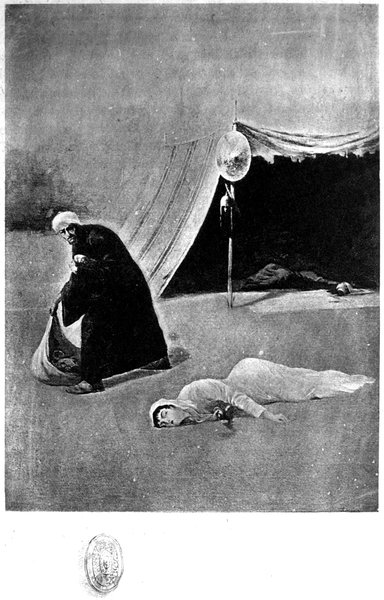
She said, It hath reached me, O auspicious King, that when
Nuzhat al-Zaman heard these words from the Badawi, the light
was changed in her eyes to night, and she rose and drawing the
sword, smote Hammad the Arab between the shoulder-blades
so that the point issued from the apple of his throat.[127] And when
all present asked her, "Why hast thou made haste to slay him;"
she answered, "Praised be Allah who hath granted me in my life-tide
to avenge myself with mine own hand!" And she bade the
slaves drag the body out by the feet and cast it to the dogs.
Thereupon they turned to the two prisoners who remained of the
three; and one of them was a black slave, so they said to him,
"What is thy name, fellow? Tell us the truth of thy case." He
replied, "As for me my name is Al-Ghazbán," and acquainted
them what had passed between himself and Queen Abrizah,
daughter of King Hardub, Lord of Greece, and how he had slain
her and fled. Hardly had the negro made an end of his story,
when King Rumzan struck off his head with his scymitar, saying,
"Praise to Allah who gave me life! I have avenged my mother
with my own hand." Then he repeated to them what his nurse
Marjanah had told him of this same slave whose name was Al-Ghazban;
after which they turned to the third prisoner. Now
this was the very camel-driver[128] whom the people of the Holy
City, Jerusalem, hired to carry Zau al-Makan and lodge him in the
hospital at Damascus of Syria; but he threw him down on the
ashes-midden and went his way. And they said to him, "Acquaint
us with thy case and tell the truth." So he related to them all
that had happened to him with Sultan Zau al-Makan; how he had
been carried from the Holy City, at the time when he was sick,
till they made Damascus and he had been thrown into the hospital;
how also the Jerusalem folk had paid the cameleer money to
transport the stranger to Damascus, and he had taken it and fled
after casting his charge upon the midden by the side of the ash-heap
of the Hammam. But when he ended his words, Sultan
113Kanmakan took his sword forthright and cut off his head, saying,
"Praised be Allah who hath given me life, that I might requite
this traitor what he did with my father, for I have heard this very
story from King Zau al-Makan himself." Then the Kings said
each to other, "It remaineth only for us to wreak our revenge
upon the old woman Shawahi, yclept Zat al-Dawahi, because she
is the prime cause of all these calamities and cast us into adversity
on this wise. Who will deliver her into our hands that we may
avenge ourselves upon her and wipe out our dishonour?" And
King Rumzan said, "Needs must we bring her hither." So without
stay or delay he wrote a letter to his grandmother, the aforesaid
ancient woman, giving her to know therein that he had subdued
the kingdoms of Damascus and Mosul and Irak, and had broken
up the host of the Moslems and captured their princes, adding,
"I desire thee of all urgency to come to me, bringing with thee
Queen Sophia, daughter of King Afridun, and whom thou wilt of
the Nazarene chiefs, but no armies; for the country is quiet and
wholly under our hand." And when she read the letter and
recognised the writing of King Rumzan, she rejoiced with great
joy and forthright equipping herself and Queen Sophia, set out
with their attendants and journeyed, without stopping, till they
drew near Baghdad. Then she fore-sent a messenger to acquaint
the King of her arrival, whereupon quoth Rumzan, "We should
do well to don the habit of the Franks and fare forth to meet the
old woman, to the intent that we may be assured against her
craft and perfidy." Whereto Kanmakan replied, "Hearing is
consenting." So they clad themselves in Frankish clothes and,
when Kuzia Fakan saw them, she exclaimed, "By the truth of
the Lord of Worship, did I not know you, I should take you to
be indeed Franks!" Then they sallied forth with a thousand
horse, King Rumzan riding on before them, to meet the old
woman. As soon as his eyes fell on hers, he dismounted and
walked towards her and she, recognizing him, dismounted also and
embraced him; but he pressed her ribs with his hands, till he well
nigh broke them. Quoth she, "What is this, O my son?" But
before she had done speaking, up came Kanmakan and Dandan;
and the horsemen with them cried out at the women and slaves
and took them all prisoners. Then the two Kings returned to
Baghdad, with their captives, and Rumzan bade them decorate the
city which they did for three days, at the end of which they
brought out the old woman Shawahi, hight Zat al-Dawahi, with a
peaked red turband of palm-leaves on her head, diademed with
asses'-dung and preceded by a herald proclaiming aloud, "This is
the reward of those who presume to lay hands on Kings and the
sons of Kings!" Then they crucified her on one of the gates of
Baghdad; and, when her companions saw what befel her, all
embraced in a body the faith of Al-Islam. As for Kanmakan and
his uncle Rumzan and his aunt Nuzhat al-Zaman and the Wazir
Dandan, they marvelled at the wonderful events that had betided
them and bade the scribes chronicle them in books that those who
came after might read. Then they all abode for the remainder of
their days in the enjoyment of every solace and comfort of life,
till there overtook them the Destroyer of all delights and the
Sunderer of all societies. And this is the whole that hath come
down to us of the dealings of fortune with King Omar bin al-Nu'uman
and his sons Sharrkan and Zau al-Makan and his son's
son Kanmakan and his daughter Nuzhat al-Zaman and her
daughter Kuzia Fakan. Thereupon quoth Shahryar to Shahrazad,
"I desire that thou tell me somewhat about birds;" and hearing
this Dunyazad said to her sister, "I have never seen the Sultan
light at heart all this while till the present night; and his pleasure
garreth me hope that the issue for thee with him may be a happy
issue." Then drowsiness overcame the Sultan, so he slept;[129]——And
Shahrazad perceived the approach of day and ceased saying
her permitted say.
Now when it was the Hundred and Forty-sixth Night,
Shahrazad began to relate, in these words,
TALE of ALI BIN BAKKAR and of SHAMS AL-NAHAR.
162
It hath reached me, O august King, that in days of yore and in
times and ages long gone before, during the Caliphate of Harun
al-Rashid, there was a merchant who named his son Abú al-Hasan[174]
163Ali bin Táhir; and the same was great of goods and grace, while
his son was fair of form and face and held in favour by all folk.
He used to enter the royal palace without asking leave, for all the
Caliph's concubines and slave-girls loved him, and he was wont to
be companion with Al-Rashid in his cups and recite verses to him
and tell him curious tales and witty. Withal he sold and bought
in the merchants' bazar, and there used to sit in his shop a youth
named Ali bin Bakkár, of the sons of the Persian Kings[175] who was formous
of form and symmetrical of shape and perfect of figure, with
cheeks red as roses and joined eyebrows; sweet of speech, laughing-lipped
and delighting in mirth and gaiety. Now it chanced
one day, as the two sat talking and laughing behold, there came up
ten damsels like moons, every one of them complete in beauty and
loveliness, and elegance and grace; and amongst them was a young
lady riding on a she-mule with a saddle of brocade and stirrups of
gold. She wore an outer veil of fine stuff, and her waist was girt
with a girdle of gold-embroidered silk; and she was even as saith
the poet:—
Silky her skin and silk that zonèd waist; ✿ Sweet voice; words not o'er many nor too few:
Two eyes quoth Allah "Be," and they became; ✿ And work like wine on hearts they make to rue:
O love I feel! grow greater every night: ✿ O solace! Doom-day bring our interview.
And when the cortège reached Abu al-Hasan's shop, she alighted
from her mule, and sitting down on the front board,[176] saluted him,
and he returned her salam. When Ali bin Bakkar saw her, she
ravished his understanding and he rose to go away; but she said to
him, "Sit in thy place. We came to thee and thou goest away:
this is not fair!" Replied he, "O my lady, by Allah, I flee from
what I see; for the tongue of the case saith:—
She is a sun which towereth high a-sky; ✿ So ease thy heart with cure by Patience lent:
Thou to her skyey height shalt fail to fly; ✿ Nor she from skyey height can make descent."
When she heard this, she smiled and asked Abu al-Hasan, "What
164is the name of this young man?"; who answered, "He is a
stranger;" and she enquired, "What countryman is he?"; whereto
the merchant replied, "He is a descendant of the Persian Kings;
his name is Ali son of Bakkar and the stranger deserveth honour."
Rejoined she, "When my damsel comes to thee, come thou at once
to us and bring him with thee, that we may entertain him in our
abode, lest he blame us and say:—There is no hospitality in the
people of Baghdad; for niggardliness is the worst fault a man can
have. Thou hearest what I say to thee and, if thou disobey me,
thou wilt incur my displeasure and I will never again visit thee or
salute thee." Quoth Abu al-Hasan, "On my head and my eyes:
Allah preserve me from thy displeasure, fair lady!" Then she rose
and went her way. Such was her case; but as regards Ali bin
Bakkar he remained in a state of bewilderment. Now after an hour
the damsel came to Abu al-Hasan and said to him, "Of a truth my
lady Shams al-Nahár, the favourite of the Commander of the Faithful,
Harun al-Rashid, biddeth thee to her, thee and thy friend, my
lord Ali bin Bakkar." So he rose and, taking Ali with him, followed
the girl to the Caliph's palace, where she carried them into a
chamber and made them sit down. They talked together awhile,
when behold, trays of food were set before them, and they ate and
washed their hands. Then she brought them wine, and they drank
deep and made merry; after which she bade them rise and carried
them into another chamber, vaulted upon four columns, furnished
after the goodliest fashion with various kinds of furniture, and
adorned with decorations as it were one of the pavilions of Paradise.
They were amazed at the rarities they saw; and, as they were
enjoying a review of these marvels, suddenly up came ten slave-girls,
like moons, swaying and swimming in beauty's pride, dazzling
the sight and confounding the sprite; and they ranged themselves
in two ranks as if they were of the black-eyed Brides of Paradise.
And after a while in came other ten damsels, bearing in their
hands lutes and divers instruments of mirth and music; and these,
having saluted the two guests, sat down and fell to tuning their
lute-strings. Then they rose and standing before them, played and
sang and recited verses: and indeed each one of them was a seduction
to the servants of the Lord. Whilst they were thus busied
there entered other ten damsels like unto them, high-bosomed
maids and of an equal age, with black eyes and cheeks like the
rose, joined eyebrows and looks languorous; a very fascination to
every faithful wight and to all who looked upon them a delight;
165clad in various kinds of coloured silks, with ornaments that amazed
man's intelligence. They took up their station at the door, and
there succeeded them yet other ten damsels even fairer than they,
clad in gorgeous array, such as no tongue can say; and they also
stationed themselves by the doorway. Then in came a band of
twenty damsels and amongst them the lady, Shams al-Nahar
hight, as she were the moon among the stars swaying from side to
side, with luring gait and in beauty's pride. And she was veiled
to the middle with the luxuriance of her locks, and clad in a robe
of azure blue and a mantilla of silk embroidered with gold and
gems of price; and her waist was girt with a zone set with various
kinds of precious stones. She ceased not to advance with her
graceful and coquettish swaying, till she came to the couch that
stood at the upper end of the chamber and seated herself thereon.
But when Ali bin Bakkar saw her, he versified with these verses:—
Source of mine evils, truly, she alone 's, ✿ Of long love-longing and my groans and moans;
Near her I find my soul in melting mood, ✿ For love of her and wasting of my bones.
And finishing his poetry he said to Abu al-Hasan, "Hadst thou
dealt more kindly with me thou haddest forewarned me of these
things ere I came hither, that I might have made up my mind and
taken patience to support what hath befallen me." And he wept
and groaned and complained. Replied Abu al-Hasan, "O my
brother, I meant thee naught but good; but I feared to tell thee
this, lest such transport should betide thee as might hinder thee
from foregathering with her, and be a stumbling-block between
thee and her. But be of good cheer and keep thine eyes cool and
clear;[177] for she to thee inclineth and to favour thee designeth."
Asked Ali bin Bakkar, "What is this young lady's name?"
Answered Abu al Hasan, "She is hight Shams al-Nahar, one of
the favourites of the Commander of the Faithful, Harun al-Rashid,
and this is the palace of the Caliphate." Then Shams al-Nahar
sat gazing upon the charms of Ali bin Bakkar and he upon hers, till
both were engrossed with love for each other. Presently she commanded
the damsels, one and all, to be seated, each in her rank
166and place, and all sat on a couch before one of the windows, and
she bade them sing; whereupon one of them took up the lute and
began carolling:—
Give thou my message twice ✿ Bring clear reply in trice!
To thee, O Prince of Beau- ✿ ty
[178] with complaint I rise:
My lord, as heart-blood dear ✿ And Life's most precious prize!
Give me one kiss in gift ✿ Or loan, if thou devise:
And if thou crave for more ✿ Take all that satisfies.
[179]Thou donn'st me sickness-dress ✿ Thee with health's weed I bless.
Her singing charmed Ali bin Bakkar, and he said to her, "Sing
me more of the like of these verses." So she struck the strings
and began to chaunt these lines:—
By stress of parting, O beloved one, ✿ Thou mad'st these eyelids torrent-race to run:
Oh gladness of my sight and dear desire, ✿ Goal of my wishes, my religion!
Pity the youth whose eyne are drowned in tears ✿ Of lover gone distraught and clean undone.
When she had finished her verses, Shams al-Nahar said to another
damsel, "Let us hear something from thee!" So she played a
lively measure and began these couplets:—
His
[180] looks have made me drunken, not his wine; ✿ His grace of gait disgraced sleep to these eyne:
Dazed me no cup, but cop with curly crop; ✿ His gifts overcame me not the gifts of vine:
His winding locks my patience-clue unwound: ✿ His robèd beauties robbed all wits of mine.
When Shams Al-Nahar heard this recital from the damsel, she
sighed heavily and the song pleased her. Then she bade another
damsel sing; so she took the lute and began chanting:—
167Face that with Sol in Heaven lamping vies; ✿ Youth-tide's fair fountain which begins to rise;
Whose curly side-beard writeth writ of love, ✿ And in each curl concealeth mysteries:
Cried Beauty, "When I met this youth I knew ✿ 'Tis Allah's loom such gorgeous robe supplies."
When she had finished her song, Ali bin Bakkar said to the slave-maiden
nearest him, "Sing us somewhat, thou O damsel." So she
took the lute and began singing:—
"Our trysting-time is all too short ✿ For this long coyish coquetry:
How long this 'Nay, Nay!' and 'Wait, wait?' ✿ This is not old nobility!
And now that Time deigns lend delight ✿ Profit of th' opportunity."
When she ended, Ali bin Bakkar followed up her song with flowing
tears; and, as Shams al-Nahar saw him weeping and groaning
and complaining, she burned with love-longing and desire; and
passion and transport consumed her. So she rose from the sofa
and came to the door of the alcove, where Ali met her and they
embraced with arms round the neck, and fell down fainting in the
doorway; whereupon the damsels came to them and carrying
them into the alcove, sprinkled rose-water upon them both. When
they recovered, they found not Abu al-Hasan who had hidden
himself by the side of a couch, and the young lady said, "Where
is Abu al-Hasan?" So he showed himself to her from beside the
couch and she saluted him, saying, "I pray Allah to give me the
means of requiting thee, O kindest of men!" Then she turned
to Ali bin Bakkar and said to him, "O my lord, passion hath not
reached this extreme pass with thee without my feeling the like;
but we have nothing to do save to bear patiently what calamity
hath befallen us." Replied he, "By Allah, O my lady, union with
thee may not content me nor gazing upon thee assuage the fire
thou hast lighted, nor shall leave me the love of thee which hath
mastered my heart but with the leaving of my life." So saying,
he wept and the tears ran down upon his cheeks like thridded
pearls; and when Shams al-Nahar saw him weep, she wept for
his weeping. But Abu al-Hasan exclaimed, "By Allah, I wonder
at your case and am confounded at your condition; of a truth, your
affair is amazing and your chance dazing. What! this weeping
while ye are yet together: then how will it be what time ye are
parted and far separated?" And he continued, "Indeed, this is
no tide for weeping and wailing, but a season for meeting and
168merry-making; rejoice, therefore, and take your pleasure and shed
no more tears!" Then Shams al-Nahar signed to a slave-girl,
who arose and presently returned with handmaids bearing a table,
whose dishes of silver were full of various rich viands. They set
the table before the pair and Shams al-Nahar began to eat[181] and
to place tid-bits in the mouth of Ali bin Bakkar; and they ceased
not so doing till they were satisfied, when the table was removed
and they washed their hands. Then the waiting-women fetched
censers with all manner of incense, aloe-wood and ambergris and
mixed scents; and sprinkling-flasks full of rose-water were also
brought and they were fumigated and perfumed. After this the
slaves set on vessels of graven gold, containing all kinds of sherbets,
besides fruits fresh and dried, that heart can desire and eye delight
in; and lastly one brought a flagon of carnelion full of old wine.
Then Shams al-Nahar chose out ten handmaids to attend on them
and ten singing women; and, dismissing the rest to their apartments,
bade some of those who remained strike the lute. They
did as she bade them and one of them began to sing:—
My soul to him who smiled back my salute, ✿ In breast reviving hopes that were no mo'e:
The hand o' Love my secret brought to light, ✿ And censor's tongues what lies my ribs below:
[182]My tear-drops ever press twixt me and him, ✿ As though my tear-drops showing love would flow.
When she had finished her singing, Shams al-Nahar rose and,
filling a goblet, drank it off, then crowned it again and handed
it to Ali bin Bakkar;——And Shahrazad perceived the dawn of
day and ceased saying her permitted say.
Now when it was the Hundred and Fifty-fourth Night,
She said, It hath reached me, O auspicious King, that Shams
al-Nahar filled a goblet and handed it to Ali bin Bakkar; after
which she bade another damsel sing; and she began singing these
couplets:—
169My tears thus flowing rival with my wine, ✿ Pouring the like of what fills cup to brink:
[183]
By Allah wot I not an run these eyne ✿ Wi' wine, or else it is of tears I drink.
And when she ended her recitation, Ali bin Bakkar drained his
cup and returned it to Shams al-Nahar. She filled it again and
gave it to Abu al-Hasan who tossed it off. Then she took the
lute, saying, "None shall sing over my cup save myself;" so she
screwed up the strings and intoned these verses:—
The tears run down his cheeks in double row, ✿ And in his breast high flameth lover-lowe:
He weeps when near, a-fearing to be far; ✿ And, whether far or near, his tear-drops flow.
And the words of another:—
Our life to thee, O cup-boy Beauty-dight! ✿ From parted hair to calves; from black to white:
Sol beameth from thy hands, and from thy lips ✿ Pleiads, and full Moon through thy collar's night,
[184]Good sooth the cups, which made our heads fly round, ✿ Are those thine eyes pass round to daze the sight:
No wonder lovers hail thee as full moon ✿ Waning to them, for self e'er waxing bright:
Art thou a deity to kill and quicken, ✿ Bidding this fere, forbidding other wight?
Allah from model of thy form made Beau- ✿ ty and the Zephyr scented with thy sprite.
Thou art not of this order of human- ✿ ity but angel lent by Heaven to man.
When Ali bin Bakkar and Abu al-Hasan and those present heard
Shams al-Nahar's song, they were like to fly for joy, and sported
and laughed; but while they were thus enjoying themselves lo!
up came a damsel, trembling for fear and said, "O my lady, the
Commander of the Faithful's eunuchs are at the door, Afíf and
Masrúr and Marján[185] and others whom wot I not." When they
170heard this they were like to die with fright, but Shams al-Nahar
laughed and said, "Have no fear!" Then quoth she to the damsel,
"Keep answering them whilst we remove hence." And she caused
the doors of the alcove to be closed upon Ali and Abu al-Hasan,
and let down the curtains over the entrance (they being still
within); after which she shut the door of the saloon and went out
by the privy wicket into the flower-garden, where she seated herself
on a couch she had there and made one of the damsels knead
her feet.[186] Then she dismissed the rest of her women to their
rooms and bade the portress admit those who were at the door;
whereupon Masrur entered, he and his company of twenty with
drawn swords. And when they saluted her, she asked, "Wherefore
come ye?"; whereto they answered, "The Commander of the
Faithful saluteth thee. Indeed he is desolated for want of thy
sight; he letteth thee know that this be to him a day of joy and
great gladness and he wisheth to seal his day and complete his
pleasure with thy company at this very hour. So say, wilt go to
him or shall he come to thee?" Upon this she rose and, kissing
the earth, replied, "I hear and I obey the commandment of the
Prince of True Believers!" Then she summoned the women
guards of her household and other slave-damsels, who lost no time
in attending upon her and made a show of obeying the Caliph's
orders. And albeit everything about the place was in readiness,
she said to the eunuchs, "Go to the Commander of the Faithful
and tell him that I await him after a little space, that I may make
ready for him a place with carpets and other matters." So they
returned in haste to the Caliph, whilst Shams al-Nahar, doffing her
outer gear, repaired to her lover, Ali bin Bakkar, and drew him to
her bosom and bade him farewell, whereat he wept sore and said,
"O my lady, this leave-taking will cause the ruin of my very self
and the loss of my very soul; but I pray Allah grant me patience
to support the passion wherewith he hath afflicted me!" Replied
she, "By Allah, none shall suffer perdition save I; for thou wilt
fare forth to the bazar and consort with those that shall divert
thee, and thy life will be sound and thy love hidden forsure; but I
shall fall into trouble and tristesse nor find any to console me,
more by token that I have given the Caliph a tryst, wherein haply
great peril shall betide me by reason of my love for thee and my
longing for thee and my grief at being parted from thee. For with
171what tongue shall I sing and with what heart shall I present myself
before the Caliph? and with what speech shall I company the
Commander of the Faithful in his cups? and with what eyes shall
I look upon a place where thou art absent? and with what taste
shall I drink wine of which thou drinkest not?" Quoth Abu al-Hasan,
"Be not troubled but take patience and be not remiss in
entertaining the Commander of the Faithful this night, neither
show him any neglect, but be of good heart." Now at this juncture,
behold, up came a damsel, who said to Shams al-Nahar, "O
my lady, the Caliph's pages are come." So she hastily rose to her
feet and said to the maid, "Take Abu al-Hasan and his friend and
carry them to the upper balcony[187] giving upon the garden and there
leave them till darkness came on; when do thou contrive to carry
them forth." Accordingly the girl led them up to the balcony
and, locking the door upon them both, went her way. As they sat
looking on the garden lo! the Caliph appeared escorted by near
an hundred eunuchs, with drawn swords in hand and girt about
with a score of damsels, as they were moons, all clad in the richest
of raiment and on each one's head was a crown set with jewels and
rubies; while each carried a lighted flambeau. The Caliph walked
in their midst, they encompassing him about on all sides, and
Masrur and Afíf and Wasíf[188] went before him and he bore himself
with a graceful gait. So Shams al-Nahar and her maidens rose to
receive him and, meeting him at the garden-door, kissed ground
between his hands; nor did they cease to go before him till they
brought him to the couch whereon he sat down, whilst all the
waiting-women who were in the garden and the eunuchs stood
before him and there came fair handmaids and concubines holding
in hand lighted candles and perfumes and incense and instruments
of mirth and music. Then the Sovereign bade the singers sit
down, each in her place, and Shams al-Nahar came up and, seating
herself on a stool by the side of the Caliph's couch, began to converse
with him; all this happening whilst Abu al-Hasan and Ali
bin Bakkar looked on and listened, unseen of the King. Presently
the Caliph fell to jesting and toying with Shams al-Nahar and
172both were in the highest spirits, glad and gay, when he bade them
throw open the garden pavilion. So they opened the doors and
windows and lighted the tapers till the place shone in the season
of darkness even as the day. Then the eunuchs removed thither
the wine-service and (quoth Abu al-Hasan) "I saw drinking-vessels
and rarities whose like mine eyes never beheld, vases of
gold and silver and all manner of noble metals and precious stones,
such as no power of description can describe, till indeed it seemed
to me I was dreaming, for excess of amazement at what I saw!"
But as for Ali bin Bakkar, from the moment Shams al-Nahar left
him, he lay strown on the ground for stress of love and desire;
and, when he revived, he fell to gazing upon these things that had
not their like and saying to Abu al-Hasan, "O my brother, I fear
lest the Caliph see us or come to know of our case; but the most
of my fear is for thee. For myself, of a truth I know that I am
about to be lost past recourse, and the cause of my destruction is
naught but love and longing and excess of desire and distraction,
and disunion from my beloved after union with her; but I beseech
Allah to deliver us from this perilous predicament." And they
ceased not to look out of the balcony on the Caliph who was
taking his pleasure, till the banquet was spread before him, when
he turned to one of the damsels and said to her, "O Gharám,[189] let
us hear some of thine enchanting songs." So she took the lute
and tuning it, began singing:—
The longing of a Bedouin maid, whose folks are far away, ✿ Who yearns after the willow of the Hejaz and the bay,
[190]—
Whose tears, when she on travellers lights, might for their water serve ✿ And eke her her passion, with its heat, their bivouc-fire purvey,—
Is not more fierce nor ardent than my longing for my love, ✿ Who deems that I commit a crime in loving him alway.
[191]
Now when Shams al-Nahar heard these verses she slipped off the
stool whereon she sat and fell to the earth fainting and became
insensible to the world around her; upon which the damsels came
and lifted her up. And when Ali Bin Bakkar saw this from the
balcony he also slipped down senseless, and Abu al-Hasan said,
173"Verily Fate hath divided love-desire equally upon you twain!"[192]
As he spoke lo! in came the damsel who had led them up to the
balcony and said to him, "O Abu al-Hasan, arise thou and thy
friend and come down, for of a truth the world hath waxed strait
upon us and I fear lest our case be discovered or the Caliph
become aware of you; unless you descend at once we are dead
ones." Quoth he, "And how shall this youth descend with me
seeing that he hath no strength to rise?" Thereupon the damsel
began sprinkling rose-water on Ali bin Bakkar till he came to his
senses, when Abu al-Hasan lifted him up and the damsel made
him lean upon her. So they went down from the balcony and
walked on awhile till the damsel opened a little iron door, and
made the two friends pass through it, and they came upon a bench
by the Tigris' bank. Thereupon the slave-girl clapped her hands[193]
and there came up a man with a little boat to whom said she,
"Take up these two young men and land them on the opposite
side." So both entered the boat and, as the man rowed off with
them and they left the garden behind them, Ali bin Bakkar looked
back towards the Caliph's palace and the pavilion and the grounds;
and bade them farewell with these two couplets:—
I offered this weak hand as last farewell, ✿ While to heart-burning fire that hand is guided:
O let not this end union! Let not this ✿ Be last provision for long road provided!
Thereupon the damsel said to the boatman, "Make haste with
them both." So he plied his oars deftly (the slave-girl being still
with them);——And Shahrazad perceived the dawning day and
ceased saying her permitted say.
Now when it was the Hundred and Fifty-fifth Night
She said, It hath reached me, O auspicious King, that the boatman
rowed them towards the other bank till they reached it and landed,
whereupon she took leave of them, saying, "It were my wish not
to abandon you, but I can go no farther than this." Then she
174turned back, whilst Ali bin Bakkar lay prostrate on the ground
before Abu al-Hasan and by no manner of means could he rise, till
his friend said to him, "Indeed this place is not sure and I fear
lest we lose our lives in this very spot, by reason of the lewd
fellows who infest it and highwaymen and men of lawlessness."
Upon this Ali bin Bakkar arose and walked a little but could not
continue walking. Now Abu al-Hasan had friends in that quarter;
so he made search for one of them, in whom he trusted, and who
was of his intimates, and knocked at the door. The man came
out quickly and seeing them, bade them welcome and brought
them into his house, where he seated them and talked with them
and asked them whence they came. Quoth Abu al-Hasan, "We
came out but now, being obliged thereto by a person with whom
I had dealings and who hath in his hands dirhams of mine. And
it reached me that he designed to flee into foreign parts with my
monies; so I fared forth to-night in quest of him, taking with
me for company this youth, Ali bin Bakkar; but, when we came
hoping to see the debtor, he hid from us and we could get no sight
of him. Accordingly we turned back, empty-handed without a
doit, but it was irksome to us to return home at this hour of the
night; so weeting not whither to go, we came to thee, well
knowing thy kindness and wonted courtesy." "Ye are welcome
and well come!" answered the host, and studied to do them
honour; so the twain abode with him the rest of their night and
as soon as the daylight dawned, they left him and made their
way back without aught of delay to the city. When they came
to the house of Abu al-Hasan, he conjured his comrade to enter;
so they went in and lying down on the bed, slept awhile. As
soon as they awoke, Abu al-Hasan bade his servants spread the
house with rich carpets, saying in his mind, "Needs must I divert
this youth and distract him from thinking of his affliction, for I
know his case better than another." Then he called for water for
Ali bin Bakkar who, when it was brought, rose up from his bed
and making his ablutions, prayed the obligatory prayers which he
had omitted for the past day and night[194]; after which he sat down
and began to solace himself by talking with his friend. When
Abu al-Hasan saw this, he turned to him and said, "O my lord, it
were fitter for thy case that thou abide with me this night, so thy
175breast may be broadened and the distress of love-longing that is
upon thee be dispelled and thou make merry with us, so haply
the fire of thy heart may thus be quenched." Ali replied, "O my
brother, do what seemeth good to thee; for I may not on any
wise escape from what calamity hath befallen me; so act as
thou wilt." Accordingly, Abu al-Hasan arose and bade his
servants summon some of the choicest of his friends and sent
for singers and musicians who came; and meanwhile he made
ready meat and drink for them; so they sat eating and drinking
and making merry through the rest of the day till nightfall.
Then they lit the candles, and the cups of friendship and good
fellowship went round amongst them and the time passed
pleasantly with them. Presently, a singing-woman took the lute
and began singing:—
I've been shot by Fortune, and shaft of eye ✿ Down struck me and parted from fondest friend:
Time has proved him foe and my patience failed, ✿ Yet I ever expected it thus would end.
When Ali bin Bakkar heard her words, he fell to the earth in a
swoon and ceased not lying in his fainting fit till daybreak; and
Abu al-Hasan despaired of him. But, with the dawning, he came
to himself and sought to go home; nor could his friend hinder
him, for fear of the issue of his affair. So he made his servants
bring a she-mule and, mounting Ali thereon, carried him to his
lodgings, he and one of his men. When he was safe at home;
Abu al-Hasan thanked Allah for his deliverance from that sore
peril and sat awhile with him, comforting him; but Ali could
not contain himself, for the violence of his love and longing.
So Abu al-Hasan rose to take leave of him and return to his
own place.——And Shahrazad perceived the dawn of day and
ceased to say her permitted say.
Now when it was the Hundred and Fifty-sixth Night,
She said, It hath reached me, O auspicious King, that when Abu
al-Hasan rose to take leave of him, Ali son of Bakkar exclaimed,
"O my brother, leave me not without news." "I hear and obey,"
replied the other; and forthwith went away and, repairing to his
shop, opened it and sat there all day, expecting news of Shams
176al-Nahar. But none came. He passed the night in his own house
and, when dawned the day, he walked to Ali bin Bakkar's lodging
and went in and found him thrown on his bed, with his friends
about him and physicians around him prescribing something or
other, and the doctors feeling his pulse. When he saw Abu al-Hasan
enter he smiled, and the visitor, after saluting him, enquired
how he did and sat with him till the folk withdrew, when he said
to him, "What plight is this?" Quoth Ali bin Bakkar, "It was
bruited abroad that I was ill and my comrades heard the report;
and I have no strength to rise and walk so as to give him the lie
who noised abroad my sickness, but continue lying strown here as
thou seest. So my friends came to visit me; say, however, O my
brother, hast thou seen the slave-girl or heard any news of her?"
He replied, "I have not seen her, since the day we parted from her
on Tigris' bank;" and he presently added, "O my brother, beware
thou of scandal and leave this weeping." Rejoined Ali, "O my
brother, indeed, I have no control over myself;" and he sighed
and began reciting:—
She gives her woman's hand a force that fails the hand of me, ✿ And with red dye on wrist she gars my patience fail and flee:
And for her hand she fears so sore what shafts her eyes discharge, ✿ She's fain to clothe and guard her hand with mail-ring panoply:
[195]The leach in ignorance felt my pulse the while to him I cried, ✿ "Sick is my heart, so quit my hand which hath no malady:"
Quoth she to that fair nightly vision favoured me and fled, ✿ "By Allah picture him nor add nor 'bate in least degree!"
Replied the Dream, "I leave him though he die of thirst," I cry, ✿ "Stand off from water-pit and say why this persistency."
Rained tear-pearls her Narcissus-eyes, and rose on cheek belit ✿ She made my sherbet, and the lote with bits of hail she bit.
[196]
And when his recital was ended he said, "O Abu al-Hasan, I am
smitten with an affliction from which I deemed myself in perfect
surety, and there is no greater ease for me than death." Replied
he, "Be patient, haply Allah will heal thee!" Then he went out
from him and repairing to his shop opened it, nor had he sat long,
when suddenly up came the handmaid who saluted him. He
177returned her salam and looking at her, saw that her heart was
palpitating and that she was in sore trouble and showed signs of
great affliction: so he said to her, "Thou art welcome and well come!
How is it with Shams al-Nahar?" She answered, "I will presently
tell thee, but first let me know how doth Ali bin Bakkar." So he told
her all that had passed and how his case stood, whereat she grieved
and sighed and lamented and marvelled at his condition. Then said
she, "My lady's case is still stranger than this; for when you went
away and fared homewards, I turned back, my heart beating hard on
your account and hardly crediting your escape. On entering I found
her lying prostrate in the pavilion, speaking not nor answering any,
whilst the Commander of the Faithful sat by her head not knowing
what ailed her and finding none who could make known to him
aught of her ailment. She ceased not from her swoon till midnight,
when she recovered and the Prince of the Faithful said to
her, What harm hath happened to thee, O Shams al-Nahar, and
what hath befallen thee this night? Now when she heard the
Caliph's words she kissed his feet and said, Allah make me thy
ransom, O Prince of True Believers! Verily a sourness of stomach
lighted a fire in my body, so that I lost my senses for excess of
pain, and I know no more of my condition. Asked the Caliph,
What hast thou eaten to-day?; and she answered, I broke my fast
on something I had never tasted before. Then she feigned to be
recovered and calling for a something of wine, drank it, and begged
the Sovereign to resume his diversion. So he sat down again on
his couch in the pavilion and the sitting was resumed; but when
she saw me, she asked me how you fared. I told her what I had
done with you both and repeated to her the verses which Ali bin
Bakkar had composed at parting-tide, whereat she wept secretly,
but presently held her peace. After awhile, the Commander of
the Faithful ordered a damsel to sing, and she began reciting:—
Life has no sweet for me since forth ye fared; ✿ Would Heaven I wot how fare ye who forsake:
'Twere only fit my tears were tears of blood, ✿ Since you are weeping for mine absence sake.
But when my lady heard this verse she fell back on the sofa in a
swoon,"——And Shahrazad perceived the dawn of day and ceased
saying her permitted say.
178
Now when it was the Hundred and Fifty-seventh Night,
She said, It hath reached me, O auspicious King, that the slave-girl
continued to Abu al-Hasan, "But when my lady heard this verse,
she fell back on the sofa in a swoon, and I seized her hand and
sprinkled rose-water on her face, till she revived, when I said to
her:—O my lady, expose not thyself and all thy palace containeth.
By the life of thy beloved, be thou patient! She replied:—Can
aught befal me worse than death which indeed I seek, for by Allah,
my ease is therein?" Whilst we were thus talking, another damsel
sang these words of the poet:—
Quoth they, "Maybe that Patience lend thee ease!" ✿ Quoth I, "Since fared he where is Patience' place?"
Covenant he made 'twixt me and him, to cut ✿ The cords of Patience at our last embrace!
[197]
And as soon as she had finished her verse Shams al-Nahar swooned
away once more, which when the Caliph saw, he came to her in
haste and commanded the wine to be removed and each damsel to
return to her chamber. He abode with her the rest of the night,
and when dawned the day, he sent for chirurgeons and leaches
and bade them medicine her, knowing not that her sickness
arose from love and longing. "I tarried with her till I deemed
her in a way of recovery, and this is what kept me from thee. I
have now left her with a number of her body-women, who were
greatly concerned for her, when she bade me go to you two and
bring her news of Ali bin Bakkar and return to her with the
tidings." When Abu al-Hasan heard her story, he marvelled and
said, "By Allah, I have acquainted thee with his whole case; so
now return to thy mistress; and salute her for me and diligently
exhort her to have patience and say to her:—Keep thy secret!;
and tell her that I know all her case which is indeed hard and one
which calleth for nice conduct." She thanked him and taking
leave of him, returned to her mistress. So far concerning her;
but as regards Abu al-Hasan, he ceased not to abide in his shop
till the end of the day, when he arose and shut it and locked it and
betaking himself to Ali bin Bakkar's house knocked at the door.
One of the servants came out and admitted him; and when
Ali saw him, he smiled and congratulated himself on his coming,
179saying, "O Abu al-Hasan, thou hast desolated me by thine
absence this day; for indeed my soul is pledged to thee during
the rest of my time." Answered the other, "Leave this talk!
Were thy healing at the price of my hand, I would cut it off ere
thou couldst ask me; and, could I ransom thee with my life, I
had already laid it down for thee. Now this very day, Shams al-Nahar's
handmaid hath been with me and told me that what
hindered her coming ere this was the Caliph's sojourn with her
mistress; and she acquainted me with everything which had
betided her." And he went on to repeat to him all that the girl
had told him of Shams al-Nahar; at which Ali bin Bakkar lamented
sore and wept and said to him, "Allah upon thee, O my brother,
help me in this affliction and teach me what course I shall take.
Moreover, I beg thee of thy grace to abide with me this night,
that I may have the solace of thy society." Abu al-Hasan agreed
to this request, replying that he would readily night there; so they
talked together till eventide darkened, when Ali bin Bakkar
groaned aloud and lamented and wept copious tears, reciting these
couplets:—
Thine image in these eyne, a-lip thy name, ✿ My heart thy home; how couldst thou disappear?
How sore I grieve for life which comes to end, ✿ Nor see I boon of union far or near.
And these the words of another:—
She split my casque of courage with eye-swords that sorely smite; ✿ She pierced my patience' ring-mail with her shape like cane-spear light:
Patched by the musky mole on cheek was to our sight displayed ✿ Camphor set round with ambergris, light dawning through the night.
[198]Her soul was sorrowed and she bit carnelion stone with pearls ✿ Whose unions in a sugred tank ever to lurk unite:
[199]Restless she sighed and smote with palm the snows that clothe her breast, ✿ And left a mark whereon I looked and ne'er beheld such sight.
Pens, fashioned of her coral nails with ambergris for ink, ✿ Five lines on crystal page of breast did cruelly indite:
180O swordsmen armed with trusty steel! I bid you all beware ✿ When she on you bends deadly glance which fascinates the sprite:
And guard thyself, O thou of spear! whenas she draweth near ✿ To tilt with slender quivering shape, likest the nut-brown spear.
And when Ali bin Bakkar ended his verse, he cried out with a
great cry and fell down in a fit. Abu al-Hasan thought that his
soul had fled his body and he ceased not from his swoon till daybreak,
when he came to himself and talked with his friend, who
continued to sit with him till the forenoon. Then he left him and
repaired to his shop; and hardly had he opened it, when lo! the
damsel came and stood by his side. As soon as he saw her, she
made him a sign of salutation which he returned; and she delivered
to him the greeting message of her mistress and asked, "How
doth Ali bin Bakkar?" Answered he, "O handmaid of good, ask
me not of his case nor what he suffereth for excess of love-longing;
he sleepeth not by night neither resteth he by day; wakefulness
wasteth him and care hath conquered him and his condition is a
consternation to his friend." Quoth she, "My lady saluteth thee
and him, and she hath written him a letter, for indeed she is in
worse case than he; and she entrusted the same to me, saying:—Do
not return save with the answer; and do thou obey my bidding.
Here now is the letter, so say, wilt thou wend with me to him that
we may get his reply?" "I hear and obey," answered Abu al-Hasan,
and locking his shop and taking with him the girl he went,
by a way different from that whereby he came, to Ali bin Bakkar's
house, where he left her standing at the door and walked in——And
Shahrazad perceived the dawn of day and ceased to say her
permitted say.
Now when it was the Hundred and Fifty-eighth Night,
She said, It hath reached me, O auspicious King, that Abu al-Hasan
went with the girl to the house of Ali son of Bakkar, where
he left her standing at the door and walked in to his great joy.
And Abu al-Hasan said to him, "The reason of my coming is that
such an one hath sent his handmaid to thee with a letter, containing
his greeting to thee and mentioning therein that the cause of
his not coming to thee was a matter that hath betided him. The
girl standeth even now at the door: shall she have leave to
enter?"; and he signed to him that it was Shams al-Nahar's slave-girl.
Ali understood his signal and answered, "Bring her in,"
181and when he saw her, he shook for joy and signed to her, "How
doth thy lord?; Allah grant him health and healing!" "He is
well," answered she and pulling out the letter gave it to him. He
took it and kissing it, opened and read it; after which he handed
it to Abu al-Hasan, who found these verses written therein:—
This messenger shall give my news to thee; ✿ Patience what while my sight thou canst not see:
A lover leav'st in love's insanity, ✿ Whose eyne abide on wake incessantly:
I suffer patience-pangs in woes that none ✿ Of men can medicine;—such my destiny!
Keep cool thine eyes; ne'er shall my heart forget, ✿ Nor without dream of thee one day shall be.
Look what befel thy wasted frame, and thence ✿ Argue what I am doomed for love to dree!
"And afterwards[200]: Without fingers[201] I have written to thee, and
without tongue I have spoken to thee ✿ to resume my case, I have
an eye wherefrom sleeplessness departeth not ✿ and a heart
whence sorrowful thought stirreth not ✿ It is with me as though
health I had never known ✿ nor in sadness ever ceased to wone ✿
nor spent an hour in pleasant place ✿ but it is as if I were made
up of pine and of the pain of passion and chagrin ✿ Sickness
unceasingly troubleth ✿ and my yearning ever redoubleth ✿ desire
still groweth ✿ and longing in my heart still gloweth ✿ I pray
Allah to hasten our union ✿ and dispel of my mind the confusion
✿ And I would fain thou favour me ✿ with some words of
thine ✿ that I may cheer my heart in pain and repine ✿ Moreover,
I would have thee put on a patience lief, until Allah vouchsafe
relief ✿ And His peace be with thee."[202] When Ali bin Bakkar
had read this letter he said in weak accents and feeble voice,
"With what hand shall I write and with what tongue shall I make
moan and lament? Indeed she addeth sickness to my sickness
and draweth death upon my death!" Then he sat up and taking
182in hand ink-case and paper, wrote the following reply:—"In the
name of Allah, the Compassionating, the Compassionate![203] Thy
letter hath reached me, O my lady, and hath given ease to a sprite
worn out with passion and love-longing, and hath brought healing
to a wounded heart cankered with languishment and sickness; for
indeed I am become even as saith the poet:—
Straitenèd bosom; reveries dispread; ✿ Slumberless eyelids; body wearièd;
Patience cut short; disunion longsomest; ✿ Reason deranged and heart whose life is fled!
And know that complaining is unavailing; but it easeth him
whom love-longing disordereth and separation destroyeth and,
with repeating:—Union, I keep myself comforted and how fine is
the saying of the poet who said:—
Did not in love-plight joys and sorrows meet, ✿ How would the message or the writ be sweet?"
When he had made an end of this letter, he handed it to Abu al-Hasan,
saying, "Read it and give it to the damsel." So he took it
and read it and its words stirred his soul and its meaning wounded
his vitals. Then he committed it to the girl, and when she took it
Ali bin Bakkar said to her, "Salute thy lady for me and acquaint
her with my love and longing and how passion is blended with
my flesh and my bones; and say to her that in very deed I need a
woman who shall snatch me from the sea of destruction and save
me from this dilemma; for of a truth Fortune oppresseth me with
her vicissitudes; and is there any helper to free me from her turpitudes?"
183And he wept and the damsel wept for his weeping.
Then she took leave of him and went forth and Abu al-Hasan
went out with her and farewelled her. So she ganged her gait
and he returned to his shop, which he opened and sat down there,
as was his wont;——And Shahrazad perceived the dawn of day
and ceased saying her permitted say.
Now when it was the Hundred and Fifty-ninth Night,
She said, It hath reached me, O auspicious King, that Abu
al-Hasan farewelled the slave-girl and returned to his shop
which he opened and sat down there according to his custom;
but as he tarried, he found his heart oppressed and his breast
straitened, and he was perplexed about his case. So he ceased
not from melancholy the rest of that day and night, and on the
morrow he betook himself to Ali bin Bakkar, with whom he sat
till the folk withdrew, when he asked him how he did. Ali began
to complain of desire and to descant upon the longing and distraction
which possessed him, and repeated these words of the
poet:—
Men have 'plained of pining before my time, ✿ Live and dead by parting been terrified:
But such feelings as those which my ribs immure ✿ I have never heard of nor ever espied.
And these of another poet:—
I have borne for thy love what never bore ✿ For his fair, Kays the "Daft one"
[204] hight of old:
Yet I chase not the wildlings of wold and wild ✿ Like Kays, for madness is manifold.
184Thereupon quoth Abu al-Hasan, "Never did I see or hear of one
like unto thee in thy love! When thou sufferest all this transport
and sickness and trouble being enamoured of one who returneth
thy passion, how would it be with thee if she whom thou lovest
were contrary and contumelious, and thy case were discovered
through her perfidy?" And Ali the son of Bakkar (says Abu
al-Hasan) was pleased with my words and he relied upon them
and he thanked me for what I had said and done. I had a friend
(continued Abu al-Hasan), to whom I discovered my affair and
that of Ali and who knew that we were intimates; but none other
than he was acquainted with what was betwixt us. He was wont
to come to me and enquire how Ali did and after a little, he began
to ask me about the damsel; but I fenced him off, saying, "She
invited him to her and there was between him and her as much
as can possibly take place, and this is the end of their affair;
but I have devised me a plan and an idea which I would submit
to thee." Asked his friend, "And what is that?" Answered
Abu al-Hasan, "I am a person well known to have much dealing
among men and women, and I fear, O my brother, lest the affair of
these twain come to light and this lead to my death and the
seizure of my goods and the rending of my repute and that of
my family. Wherefore I have resolved to get together my monies
and make ready forthright and repair to the city of Bassorah
and there abide, till I see what cometh of their case, that none
may know of me; for love hath lorded over both and correspondence
passeth between them. At this present their go-between
and confidante is a slave-girl who hath till now kept their counsel,
but I fear lest haply anxiety get the better of her and she discover
their secret to some one and the matter, being bruited
abroad, might bring me to great grief and prove the cause of my
ruin; for I have no excuse to offer my accusers." Rejoined his
friend, "Thou hast acquainted me with a parlous affair, from the
like of which the wise and understanding will shrink with fear.
Allah avert from thee the evil thou dreadest with such dread and
save thee from the consequences thou apprehendest! Assuredly
thy recking is aright." So Abu al-Hasan returned to his place
and began ordering his affairs and preparing for his travel; nor
had three days passed ere he made an end of his business and
fared forth Bassorah-wards. His friend came to visit him three
days after but finding him not, asked of him from the neighbours
who answered, "He set out for Bassorah three days ago, for he had
185dealings with its merchants and he is gone thither to collect
monies from his debtors; but he will soon return." The young
man was confounded at the news and knew not whither to wend;
and he said in his mind, "Would I had not parted from Abu
al-Hasan!" Then he bethought him of some plan whereby
he should gain access to Ali bin Bakkar; so he went to his
lodging, and said to one of his servants, "Ask leave for me
of thy lord that I may go in and salute him." The servant
entered and told his master and presently returning, invited the
man to walk in. So he entered and found Ali bin Bakkar
thrown back on the pillow and saluted him. Ali returned his
greeting and bade him welcome; whereupon the young man
began to excuse himself for having held aloof from him all that
while and added, "O my lord, between Abu al-Hasan and myself
there was close friendship, so that I used to trust him with my
secrets and could not sever myself from him an hour. Now it
so chanced that I was absent three days' space on certain business
with a company of my friends; and, when I came back and
went to him, I found his shop locked up; so I asked the neighbours
about him and they replied:—He is gone to Bassorah.
Now I know he had no surer friend than thou; so, by Allah,
tell me what thou knowest of him." When Ali bin Bakkar heard
this, his colour changed and he was troubled and answered, "I
never heard till this day of his departure and, if the case be as
thou sayest, weariness is come upon me." And he began repeating:—
For joys that are no more I wont to weep, ✿ While friends and lovers stood by me unscattered;
This day when disunited me and them ✿ Fortune, I weep lost loves and friendship shattered.
Then he hung his head groundwards in thought awhile and presently
raising it and looking to one of his servants, said, "Go to
Abu al-Hasan's house and enquire anent him whether he be at home
or journeying abroad. If they say:—He is abroad; ask whither
he be gone." The servant went out and returning after a while
said to his master, "When I asked for Abu al-Hasan, his people
told me that he was gone on a journey to Bassorah; but I saw a
damsel standing at the door who, knowing me by sight, though I
knew her not, said to me:—Art thou not servant to Ali bin
Bakkar? Even so, answered I; and she rejoined:—I bear a
186message for him from one who is the dearest of all folk to him.
So she came with me and she is now standing at the door." Quoth
Ali bin Bakkar, "Bring her in." The servant went out to her and
brought her in, and the man who was with Ali looked at her and
found her pretty. Then she advanced to the son of Bakkar and
saluted him——And Shahrazad perceived the dawn of day and
ceased to say her permitted say.
Now when it was the Hundred and Sixtieth Night,
She said, It hath reached me, O auspicious King, that when the
slave-girl came in to Ali bin Bakkar, she advanced to him and
saluted him and spake with him secretly; and from time to time
during the dialogue he exclaimed with an oath and swore that he
had not talked and tattled of it. Then she took leave of him and
went away. Now Abu al-Hasan's friend was a jeweller,[205] and
when she was gone, he found a place for speech and said to Ali
bin Bakkar, "Doubtless and assuredly the Caliph's household have
some demand upon thee or thou hast dealings therewith?" "Who
told thee of this?" asked Ali; and the jeweller answered, "I know
it by yonder damsel who is Shams al-Nahar's slave-girl; for she
came to me a while since with a note wherein was written that
she wanted a necklace of jewels; and I sent her a costly collar."
But when Ali bin Bakkar heard this, he was greatly troubled, so
that the jeweller feared to see him give up the ghost, yet after a
while he recovered himself and said, "O my brother, I conjure thee
by Allah to tell me truly how thou knowest her." Replied he,
"Do not press this question upon me;" and Ali rejoined, "Indeed,
I will not turn from thee till thou tell me the whole truth." Quoth
the jeweller, "I will tell thee all, on condition that thou distrust
me not, and that my words cause thee no restraint; nor will I
conceal aught from thee by way of secret but will discover to thee
the truth of the affair, provided that thou acquaint me with the
true state of thy case and the cause of thy sickness." Then he
told him all that had passed from first to last between Abu
al-Hasan and himself, adding, "I acted thus only out of friendship
187for thee and of my desire to serve thee;" and assured him that
he would keep his secret and venture life and good in his service.
So Ali in turn told him his story and added, "By Allah, O my
brother, naught moved me to keep my case secret from thee and
from others but my fear lest folk should lift the veils of protection
from certain persons." Rejoined the jeweller, "And I desired not
to foregather with thee but of the great affection I bear thee and
my zeal for thee in every case, and my compassion for the anguish
thy heart endureth from severance. Haply I may be a comforter
to thee in the room of my friend, Abu al-Hasan, during the length
of his absence: so be thou of good cheer and keep thine eyes cool
and clear." Thereupon Ali thanked him and repeated these
couplets:—
"An say I:—Patient I can bear his faring, ✿ My tears and sighings give my say the lie;
How can I hide these tears that course adown ✿ This plain, my cheek, for friend too fain to fly?"
Then he was silent awhile, and presently said to the jeweller
"Knowest thou what secret the girl whispered to me?" Answered
he, "Not I, by Allah, O my lord!" Quoth Ali, "She fancied
that I directed Abu al-Hasan to go to Bassorah and that I had
devised this device to put a stop to our correspondence and consorting.
I swore to her that this was on nowise so; but she would
not credit me and went away to her mistress, persisting in her
injurious suspicions; for she inclined to Abu al-Hasan and gave
ear to his word." Answered the young jeweller, "O my brother,
I understood as much from the girl's manner; but I will win for
thee thy wish, Inshallah!" Rejoined Ali bin Bakkar, "Who can
be with me in this and how wilt thou do with her, when she shies
and flies like a wildling of the wold?" Cried the jeweller "By
Allah, needs must I do my utmost to help thee and contrive to
scrape acquaintance with her without exposure or mischief!"
Then he asked leave to depart and Ali bin Bakkar said, "O my
brother, mind thou keep my counsel;" and he looked at him and
wept. The jeweller bade him good-bye and fared forth——And
Shahrazad perceived the dawn of day and ceased saying her permitted
say.
188
Now when it was the Hundred and Sixty-first Night,
She said, It hath reached me, O auspicious King, that the jeweller
bade him good-bye and fared forth not knowing what he should
do to win for him his wishes; and he ceased not walking, while
over-musing the matter, till he spied a letter lying in the road. He
took it up and looked at its direction and superscription, then read
it and behold, it ran:—"From the least worthy of lovers to the
most worthy of beloveds." So he opened it and found these words
written therein:—
"A messenger from thee came bringing union-hope, ✿ But that he erred somehow with me the thought prevailed;
So I rejoiced not; rather grew my grief still more; ✿ Weeting my messenger of wits and wit had failed.
"But afterwards: Know, O my lord! that I ken not the reason
why our correspondence between thee and me hath been broken
off: but, if the cruelty arise from thy part, I will requite it with
fidelity, and if thy love have departed, I will remain constant to
my love of the parted, for I am with thee even as says the poet:—
Be proud; I'll crouch! Bully; I'll bear! Despise; I'll pray! ✿ Go; I will come! Speak; I will hear! Bid; I'll obey!"
As he was reading lo! up came the slave-girl, looking right and
left, and seeing the paper in the jeweller's hand, said to him, "O
my master, this letter is one I let fall." He made her no answer,
but walked on, and she walked behind him, till he came to his
house, when he entered and she after him, saying, "O my master,
give me back this letter, for it fell from me." Thereupon he turned
to her and said, "O handmaid of good, fear not neither grieve, for
verily Allah the Protector loveth those who protect; but tell me in
truthful way thy case, as I am one who keepeth counsel. I conjure
thee by an oath not to hide from me aught of thy lady's affairs;
for haply Allah shall help me to further her wishes and make easy
by my hand that which is hard." When the slave-girl heard these
words she said, "O my lord, indeed a secret is not lost whereof
thou art the secretist; nor shall any affair come to naught for
which thou strivest. Know that my heart inclineth to thee and
would interest thee with my tidings, but do thou give me the
letter." Then she told him the whole story, adding, "Allah is
189witness to whatso I say." Quoth he, "Thou hast spoken truly, for
I am acquainted with the root of the matter." Then he told her
his tale of Ali bin Bakkar and how he had learned his state of
mind; and related to her all that had passed from first to last,
whereat she rejoiced; and they two agreed that she should take
the letter and carry it to Ali and return and acquaint the jeweller
with all that happened. So he gave her the letter and she took it
and sealed it up as it was before, saying, "My mistress Shams
al-Nahar gave it to me sealed; and when he hath read it and given
me its reply, I will bring it to thee." Then she took leave and
repaired to Ali bin Bakkar, whom she found waiting, and gave him
the letter. He read it and writing a paper by way of reply, gave
it to her; and she carried it to the jeweller, who tore asunder the
seal[206] and read it and found written therein these two couplets:—
"The messenger, who kept our commerce hid, ✿ Hath failed, and showeth wrath without disguise;
[207]Choose one more leal from your many friends ✿ Who, truth approving, disapproves of lies.
"To proceed: Verily, I have not entered upon perfidy ✿ nor have
I abandoned fidelity ✿ I have not used cruelty ✿ neither have I
put off lealty ✿ no covenant hath been broken by me ✿ nor hath
love-tie been severed by me ✿ I have not parted from penitence ✿
nor have I found aught but misery and ruin after severance ✿ I
know nothing of that thou avouchest ✿ nor do I love aught but
that which thou lovest ✿ By Him who knoweth the secret of
hidden things none discover ✿ I have no desire save union with
my lover ✿ and my one business is my passion to conceal ✿ albeit
with sore sickness I ail ✿ This is the exposition of my case and
now all hail!" When the jeweller read this letter and learnt its
190contents he wept with sore weeping, and the slave-girl said to him,
"Leave not this place till I return to thee; for he suspecteth me
of such and such things, in which he is excusable; so it is my
desire to bring about a meeting between thee and my mistress,
Shams al-Nahar, howsoever I may trick you to it. For the present
I left her prostrate, awaiting my return with the reply." Then
she went away and the jeweller passed the night with a troubled
mind. And when day dawned he prayed his dawn-prayer and
sat expecting the girl's coming; and behold, she came in to
him rejoicing with much joy and he asked her, "What news, O
damsel?" She answered, "After leaving thee I went to my mistress
and gave her the letter written by Ali bin Bakkar; and, when
she read it and understood it, she was troubled and confounded;
but I said to her:—O my lady, have no fear of your affair being
frustrated by Abu al-Hasan's disappearance, for I have found one
to take his place, better than he and more of worth and a good
man to keep secrets. Then I told her what was between thyself
and Abu al-Hasan and how thou camest by his confidence and
that of Ali bin Bakkar and how that note was dropped and thou
camest by it; and I also showed her how we arranged matters
betwixt me and thee." The jeweller marvelled with much wonder,
when she resumed, "And now my mistress would hear whatso
thou sayest, that she may be assured by thy speech of the
covenants between thee and him; so get thee ready to go with me
to her forthwith." When the jeweller heard the slave-girl's words,
he saw that the proposed affair was grave and a great peril to
brave, not lightly to be undertaken or suddenly entered upon, and
he said to her, "O my sister, verily, I am of the ordinary and not
like unto Abu al-Hasan; for he being of high rank and of well-known
repute, was wont to frequent the Caliph's household,
because of their need of his merchandise. As for me, he used to
talk with me and I trembled before him the while. So, if thy
mistress would speak with me, our meeting must be in some place
other than the Caliph's palace and far from the abode of the Commander
of the Faithful; for my common sense will not let me
consent to what thou proposest." On this wise he refused to go
with her and she went on to say that she would be surety for his
safety, adding, "Take heart and fear no harm!" and pressed him
to courage till he consented to accompany her; withal, his legs
bent and shivered and his hands quivered and he exclaimed,
"Allah forbid that I should go with thee! Indeed, I have not
191strength to do this thing!" Replied she, "Hearten thy heart, if
it be hard for thee to go to the Caliph's palace and thou canst not
muster up courage to accompany me, I will make her come to
thee; so budge not from thy place till I return to thee with her."
Then the slave-girl went away and was absent for a while, but a
short while, after which she returned to the jeweller and said to
him, "Take thou care that there be with thee none save thyself,
neither man-slave nor girl-slave." Quoth he, "I have but a negress,
who is in years and who waiteth on me."[208] So she arose and locked
the door between his negress and the jeweller and sent his manservants
out of the place; after which she fared forth and presently
returned, followed by a lady who, entering the house, filled it with
the sweet scent of her perfumes. When the jeweller saw her, he
sprang up and set her a couch and a cushion; and she sat down while
he seated himself before her. She abode awhile without speaking
till she had rested herself, when she unveiled her face and it
seemed to the jeweller's fancy as if the sun had risen in his home.
Then she asked her slave-girl, "Is this the man of whom thou
spakest to me?" "Yes," answered she; whereupon the lady
turned to the jeweller and said to him, "How is it with thee?"
Replied he, "Right well! I pray Allah for thy preservation and
that of the Commander of the Faithful." Quoth she, "Thou hast
moved us to come to thee and possess thee with what we hold secret."
Then she questioned him of his household and family; and
he disclosed to her all his circumstance and his condition and said
to her, "I have a house other than this; and I have set it apart
for gathering together my friends and brethren; and there is none
there save the old negress, of whom I spoke to thy handmaid."
She asked him on what wise he came first to know how the affair
began and the matter of Abu al-Hasan and the cause of his wayfaring:
accordingly he told her all he knew and how he had
advised the journey. Thereupon she bewailed the loss of Abu al-Hasan
and said to the jeweller, "Know, O such an one,[209] that
men's souls are active in their lusts and that men are still men;
and that deeds are not done without words nor is end ever reached
192without endeavour. Rest is won only by work"——And Shahrazad
perceived the dawn of day and ceased to say her permitted
say.
Now when it was the Hundred and Sixty-second Night,
She said, It hath reached me, O auspicious King, that Shams al-Nahar
thus addressed the jeweller, "Rest is gained only by work
and success is gendered only by help of the generous. Now I have
acquainted thee with our affair and it is in thy hand to expose us
or to shield us; I say no more, because thy generosity requireth
naught. Thou knowest that this my handmaiden keepeth my
counsel and therefore occupieth high place in my favour; and I
have selected her to transact my affairs of importance. So let
none be worthier in thy sight than she and acquaint her with thine
affair; and be of good cheer, for on her account thou art safe from
all fear, and there is no place shut upon thee but she shall open it
to thee. She shall bring thee my messages to Ali bin Bakkar and
thou shalt be our intermediary." So saying, she rose, scarcely
able to rise, and fared forth, the jeweller faring before her to the
door of her house, after which he returned and sat down again in
his place, having seen of her beauty and heard of her speech what
dazzled him and dazed his wit, and having witnessed of her grace
and courtesy what bewitched his sprite. He sat musing on her
perfections till his mind waxed tranquil, when he called for food
and ate enough to keep soul and body together. Then he changed
his clothes and went out; and, repairing to the house of the youth
Ali bin Bakkar, knocked at the door. The servants hastened to
admit him and walked before him till they had brought him to
their master, whom he found strown upon his bed. Now when he
saw the jeweller, he said to him, "Thou hast tarried long from me,
and that hath heaped care upon my care." Then he dismissed his
servants and bade the doors be shut; after which he said to the
jeweller, "By Allah, O my brother, I have not closed my eyes
since the day I saw thee last; for the slave-girl came to me yesterday
with a sealed letter from her mistress Shams al-Nahar;" and
went on to tell him all that had passed with her, adding, "By the
Lord, I am indeed perplexed concerning mine affair and my
patience faileth me: for Abu al-Hasan was a comforter who
cheered me because he knew the slave-girl." When the jeweller
heard his words, he laughed; and Ali said, "Why dost thou laugh
193at my words, thou on whose coming I congratulated myself and to
whom I looked for provision against the shifts of fortune?" Then
he sighed and wept and repeated these couplets:[210]—
Full many laugh at tears they see me shed ✿ Who had shed tears an bore they what I bore;
None feeleth pity for th' afflicted's woe, ✿ Save one as anxious and in woe galore:
My passion, yearning, sighing, thought, repine ✿ Are for me cornered in my heart's deep core:
He made a home there which he never quits, ✿ Yet rare our meetings, not as heretofore:
No friend to stablish in his place I see; ✿ No intimate but only he and——he.
Now when the jeweller heard these lines and understood their
significance, he wept also and told him all that had passed betwixt
himself and the slave-girl and her mistress since he left him. And
Ali bin Bakkar gave ear to his speech, and at every word he heard
his colour shifted from white to red and his body grew now stronger
and then weaker till the tale came to an end, when he wept and
said, "O my brother, I am a lost man in any case: would mine
end were nigh, that I might be at rest from all this! But I beg
thee, of thy favour, to be my helper and comforter in all my affairs
till Allah fulfil whatso be His will; and I will not gainsay thee
with a single word." Quoth the jeweller, "Nothing will quench
thy fire save union with her whom thou lovest; and the meeting
must be in other than this perilous place. Better it were in a
house of mine where the girl and her mistress met me; which
place she chose for herself, to the intent that ye twain may there
meet and complain each to other of what you have suffered from
the pangs of love." Quoth Ali bin Bakkar, "O good Sir, do as
thou wilt and with Allah be thy reward!; and what thou deemest
is right do it forthright: but be not long in doing it, lest I perish
of this anguish." So I abode with him (said the jeweller) that
night conversing with him till the morning morrowed,——And
Shahrazad perceived the dawn of day and ceased saying her
permitted say.
194
Now when it was the Hundred and Sixty-third Night,
She said, It hath reached me, O auspicious King, that the jeweller
continued:—So I abode with him that night conversing with him
till the morning morrowed, when I prayed the dawn-prayers and,
going out from him, returned to my house. Hardly had I settled
down when the damsel came up and saluted me; and I returned
her salutation and told her what had passed between myself and
Ali bin Bakkar, and she said, "Know that the Caliph hath left us
and there is no one in our place and it is safer for us and better."
Replied I, "Sooth thou sayest; yet is it not like my other house
which is both fitter and surer for us;" and the slave-girl rejoined,
"Be it as thou seest fit. I am now going to my lady and will tell
her what thou sayest and acquaint her with all thou hast mentioned."
So she went away and sought her mistress and laid the
project before her, and presently returned and said to me, "It is
to be as thou sayest: so make us ready the place and expect us."
Then she took out of her breast-pocket a purse of dinars and gave
this message, "My lady saluteth thee and saith to thee:—Take
this and provide therewith what the case requireth." But I swore
that I would accept naught of it; so she took the purse and
returning to her mistress, told her, "He would not receive the
money, but gave it back to me." "No matter," answered Shams
al-Nahar. As soon as the slave-girl was gone (continued the
jeweller), I arose and betook myself to my other house and transported
thither all that was needful, by way of vessels and furniture
and rich carpets; and I did not forget china vases and cups of
glass and gold and silver; and I made ready meat and drink
required for the occasion. When the damsel came and saw what
I had done, it pleased her and she bade me fetch Ali bin Bakkar;
but I said, "None shall bring him save thou." Accordingly she
went to him and brought him back perfectly dressed and looking
his best. I met him and greeted him and then seated him upon a
divan befitting his condition, and set before him sweet-scented
flowers in vases of china and vari-coloured glass.[211] Then I set on
a tray of many-tinted meats such as broaden the breast with their
195sight, and sat talking with him and diverting him, whilst the slave-girl
went away and was absent till after sundown-prayers, when
she returned with Shams al-Nahar, attended by two maids and
none else. Now as soon as she saw Ali bin Bakkar and he saw
her, he rose and embraced her, and she on her side embraced him
and both fell in a fit to the ground. They lay for a whole hour
insensible; then, coming to themselves, they began mutually to
complain of the pains of separation. Thereupon they drew near
to each other and sat talking charmingly, softly, tenderly; after
which they somewhat perfumed themselves and fell to thanking
me for what I had done for them. Quoth I, "Have ye a mind for
food?" "Yes," quoth they. So I set before them a small matter of
food and they ate till they were satisfied and then washed their
hands; after which I led them to another sitting-room and brought
them wine. So they drank and drank deep and inclined to each
other; and presently Shams al-Nahar said to me, "O my master,
complete thy kindness by bringing us a lute or other instrument of
mirth and music that the measure of our joy may be fully filled."
I replied, "On my head and eyes!" and rising brought her a lute,
which she took and tuned; then laying it in her lap she touched
it with a masterly touch, at once exciting to sadness and changing
sorrow to gladness; after which she sang these two couplets:—
My sleeplessness would show I love to bide on wake; ✿ And would my leanness prove that sickness is my make:
And tear-floods course adown the cheeks they only scald; ✿ Would I knew union shall disunion overtake!
Then she went on to sing the choicest and most affecting poesy
to many and various modes, till our senses were bewitched and
the very room danced with excess of delight and surprise at her
sweet singing; and neither thought nor reason was left in us.
When we had sat awhile and the cup had gone round amongst
us, the damsel took the lute and sang to a lively measure these
couplets:—
My love a meeting promised me and kept it faithfully, ✿ One night as many I shall count in number and degree:
O Night of joyance Fate vouchsafed to faithful lovers tway, ✿ Uncaring for the railer loon and all his company!
My lover lay the Night with me and clipt me with his right, ✿ While I with left embraced him, a-faint for ecstasy;
And hugged him to my breast and sucked the sweet wine of his lips, ✿ Full savouring the honey-draught the honey-man sold to me.
196Whilst we were thus drowned in the sea of gladness (continued the
jeweller) behold, there came in to us a little maid trembling and
said, "O my lady, look how you may go away for the folk have
found you out and have surrounded the house; and we know not
the cause of this!" When I heard her words, I arose startled and
lo! in rushed a slave-girl who cried, "Calamity hath come upon
you." At the same moment the door was burst open and there
rushed in upon us ten men masked in kerchiefs with hangers in
their hands and swords by their sides, and as many more behind
them. When I saw this, the world was straitened on me for all its
wideness, and I looked to the door but saw no issue; so I sprang
from the terrace into the house of one of my neighbours and there
hid myself. Thence I found that folk had entered my lodgings
and were making a mighty hubbub; and I concluded that the
Caliph had got wind of us and had sent his Chief of the Watch to
seize us and bring us before him. So I abode confounded and
ceased not remaining in my place, without any possibility of
quitting it till midnight. And presently the house-master arose,
for he had heard me moving, and he feared with exceeding great
fear of me; so he came forth from his room with drawn brand in
hand and made at me, saying, "Who is this in my house?" Quoth
I, "I am thy neighbour the jeweller;" and he knew me and retired.
Then he fetched a light and coming up to me, said, "O my
brother, indeed that which hath befallen thee this night is no light
matter to me." I replied, "O my brother, tell me who was in
my house and entered it breaking in my door; for I fled to thee
not knowing what was to do." He answered, "Of a truth the
robbers who attacked our neighbours yesterday and slew such an
one and took his goods, saw thee on the same day bringing furniture
into this house; so they broke in upon thee and stole thy
goods and slew thy guests." Then we arose (pursued the jeweller),
I and he, and repaired to my house, which we found empty without
a stick remaining in it; so I was confounded at the case and said
to myself, "As for the gear I care naught about its loss, albeit I
borrowed part of the stuff from my friends and it hath come to
grief; yet there is no harm in that, for they know my excuse in
the plunder of my property and the pillage of my place. But as
for Ali bin Bakkar and the Caliph's favourite concubine, I fear lest
their case get bruited abroad and this cause the loss of my life." So
I turned to my neighbour and said to him, "Thou art my brother
and my neighbour and wilt cover my nakedness; what then dost
197thou advise me to do?" The man answered, "What I counsel thee
to do is to keep quiet and wait; for they who entered thy house
and took thy goods have murdered the best men of a party from
the palace of the Caliphate and have killed not a few of the
watchmen: the government officers and guards are now in quest
of them on every road and haply they will hit upon them, whereby
thy wish will come about without effort of thine." The jeweller
hearing these words returned to his other house, that wherein he
dwelt,——And Shahrazad perceived the dawn of day and ceased
to say her permitted say.
Now when it was the Hundred and Sixty-fourth Night,
She said, It hath reached me, O auspicious King, that when
the jeweller heard these words he returned to his other house
wherein he dwelt, and said to himself, "Indeed this that hath
befallen me is what Abu al-Hasan feared and from which he
fled to Bassorah. And now I have fallen into it." Presently
the pillage of his pleasure-house was noised abroad among the
folk, and they came to him from all sides and places, some
exulting in his misfortune and others excusing him and condoling
with his sorrow; whilst he bewailed himself to them
and for grief neither ate meat nor drank drink. And as he
sat, repenting him of what he had done, behold one of his
servants came in to him and said, "There is a person at the
door who asketh for thee; and I know him not." The jeweller
went forth to him and saluted him who was a stranger; and
the man whispered to him, "I have somewhat to say between
our two selves." Thereupon he brought him in and asked him,
"What hast thou to tell me?" Quoth the man, "Come with me
to thine other house;" and the jeweller enquired, "Dost thou then
know my other house?" Replied the other, "I know all about thee
and I know that also whereby Allah will dispel thy dolours." So I
said to myself (continued the jeweller) "I will go with him whither
he will;" and went out and walked on till we came to my second
house; and when the man saw it he said to me, "It is without
door or door-keeper, and we cannot possibly sit in it; so come thou
with me to another place." Then the man continued passing from
stead to stead (and I with him) till night overtook us. Yet I put
no question to him of the matter in hand and we ceased not to
walk on, till we reached the open country. He kept saying, "Follow
198me," and quickened his pace to a trot, whilst I trotted after him
heartening my heart to go on, until we reached the river, where he
took boat with me, and the boatman rowed us over to the other
bank. Then he landed from the boat and I landed after him;
and he took my hand and led me to a street which I had never
entered in all my days, nor do I know in what quarter it was.
Presently the man stopped at the door of a house, and opening it
entered and made me enter with him; after which he locked the
door with an iron padlock,[212] and led me along the vestibule, till he
brought me in the presence of ten men who were as though they
were one and the same man; they being brothers. We saluted
them (continued the jeweller) and they returned our greeting and
bade us be seated; so we sat down. Now I was like to die for
excess of weariness; but they brought me rose-water and sprinkled
it on my face; after which they gave me a sherbet to drink and set
before me food whereof some of them ate with me. Quoth I to
myself, "Were there aught harmful in the food, they would not eat
with me." So I ate, and when we had washed our hands, each of
us returned to his place. Then they asked me, "Dost thou know
us?" and I answered, "No! nor in my life have I ever seen you;
nay, I know not even him who brought me hither." Said they,
"Tell us thy tidings and lie not at all." Replied I, "Know then
that my case is wondrous and my affair marvellous; but wot ye
anything about me?" They rejoined, "Yes! it was we took thy
goods yesternight and carried off thy friend and her who was
singing to him." Quoth I, "Allah let down His veil over you!
Where be my friend and she who was singing to him?" They
pointed with their hands to one side and replied, "Yonder, but, by
Allah, O our brother, the secret of their case is known to none save
to thee, for from the time we brought the twain hither up to this
day, we have not looked upon them nor questioned them of their
condition, seeing them to be persons of rank and dignity. Now
this and this only it was that hindered our killing them: so tell
us the truth of their case and thou shalt be assured of thy safety
and of theirs." When I heard this (continued the jeweller) I
almost died of fright and horror, and I said to them, "Know ye, O
my brethren, that if generosity were lost, it would not be found
save with you; and had I a secret which I feared to reveal, none
but your breasts would conceal it." And I went on exaggerating
199their praises in this fashion, till I saw that frankness and readiness
to speak out would profit me more than concealing facts; so I told
them all that had betided me to the very end of the tale. When
they heard it, they said, "And is this young man Ali Bakkar-son
and this lady Shams al-Nahar?" I replied "Yes." Now this was
grievous to them and they rose and made their excuses to the
two and then they said to me, "Of what we took from thy house
part is spent, but here is what is left of it." So speaking, they
gave me back most of my goods and they engaged to return them
to their places in my house, and to restore me the rest as soon as
they could. My heart was set at ease till they split into two parties,
one with me and the other against me; and we fared forth
from that house and such was my case. But as regards Ali bin
Bakkar and Shams al-Nahar; they were well-nigh dying for excess
of fear, when I went up to them and saluting them, asked, "What
happened to the damsel and the two maids, and where be they
gone?"; and they answered only, "We know nothing of them."
Then we walked on and stinted not till we came to the river-bank
where the barque lay; and we all boarded it, for it was the same
which had brought me over on the day before. The boatman
rowed us to the other side; but hardly had we landed and taken
seat on the bank to rest, when a troop of horse swooped down on
us like eagles and surrounded us on all sides and places, whereupon
the robbers with us sprang up in haste like vultures, and the
boat put back for them and took them in and the boatman pushed
off into mid-stream, leaving us on the river bank, unable to move
or to stand still. Then the chief horseman said to us, "Whence be
ye!"; and we were perplexed for an answer, but I said (continued
the jeweller), "Those ye saw with us are rogues; we know them
not. As for us, we are singers, and they intended taking us to
sing for them, nor could we get free of them, save by subtlety and
soft words; so on this occasion they let us go, their works being
such as you have seen." But they looked at Shams al-Nahar and
Ali bin Bakkar and said to me, "Thou hast not spoken sooth but,
if thy tale be true, tell us who ye are and whence ye are; and what
be your place and in what quarter you dwell." I knew not what
to answer them, but Shams al-Nahar sprang up and approaching
the Captain of the horsemen spoke with him privily, whereupon
he dismounted from his steed and, setting her on horseback,
took the bridle and began to lead his beast. And two of his men
did the like with the youth, Ali bin Bakkar, and it was the same
200with myself. The Commandant of the troop ceased not faring on
with us, till they reached a certain part of the river bank, when he
sang out in some barbarous jargon[213] and there came to us a
number of men with two boats. Then the Captain embarked us
in one of them (and he with us) whilst the rest of his men put off
in the other, and rowed on with us till we arrived at the palace of
the Caliphate where Shams al-Nahar landed. And all the while
we endured the agonies of death for excess of fear, and they ceased
not faring till they came to a place whence there was a way to our
quarter. Here we landed and walked on, escorted by some of the
horsemen, till we came to Ali bin Bakkar's house; and when we
entered it, our escort took leave of us and went their way. We
abode there, unable to stir from the place and not knowing the
difference between morning and evening; and in such case we
continued till the dawn of the next day. And when it was again
nightfall, I came to myself and saw Ali bin Bakkar and the women
and men of his household weeping over him, for he was stretched
out without sense or motion. Some of them came to me and
thoroughly arousing me said, "Tell us what hath befallen our son
and say how came he in this plight?" Replied I, "O folk,
hearken to me"——And Shahrazad perceived the dawn of day
and ceased saying her permitted say.
Now when it was the Hundred and Sixty-fifth Night,
She said, It hath reached me, O auspicious King, that the jeweller
answered them, "O folk, hearken to my words and give me no
trouble and annoyance! but be patient and he will come to and
tell you his tale for himself." And I was hard upon them and
made them afraid of a scandal between me and them, but as we
were thus, behold, Ali bin Bakkar moved on his carpet-bed; whereat
his friends rejoiced and the stranger folk withdrew from him; but
his people forbade me to go away. Then they sprinkled rose-water
on his face and he presently revived and sensed the air; whereupon
they questioned him of his case, and he essayed to answer them
but his tongue could not speak forthright and he signed to them
201to let me go home. So they let me go, and I went forth hardly
crediting my escape and returned to my own house, supported by
two men. When my people saw me thus, they rose up and set to
shrieking and slapping their faces; but I signed to them with my
hand to be silent and they were silent. Then the two men went
their way and I threw myself down on my bed, where I lay the rest
of the night and awoke not till the forenoon, when I found my
people gathered round me and saying, "What calamity befel thee,
and what evil with its mischief did fell thee?" Quoth I, "Bring
me somewhat to drink." So they brought me drink, and I drank of
it what I would and said to them, "What happened, happened."
Thereupon they went away and I made my excuses to my friends,
and asked if any of the goods that had been stolen from my other
house had been returned. They answered, "Yes! some of them
have come back; by token that a man entered and threw them
down within the doorway and we saw him not." So I comforted
myself and abode in my place two days, unable to rise and leave
it; and presently I took courage and went to the bath, for I was
worn out with fatigue and troubled in mind for Ali bin Bakkar
and Shams al-Nahar, because I had no news of them all this time
and could neither get to Ali's house nor, out of fear for my life,
take my rest in mine own. And I repented to Almighty Allah of
what I had done and praised Him for my safety. Presently my
fancy suggested to me to go to such and such a place and see the
folk and solace myself; so I went on foot to the cloth-market and
sat awhile with a friend of mine there. When I rose to go, I saw
a woman standing over against me; so I looked at her, and lo! it
was Shams al-Nahar's slave-girl. When I saw her, the world grew
dark in my eyes and I hurried on. She followed me, but I was
seized with affright and fled from her, and whenever I looked at
her, a trembling came upon me whilst she pursued me, saying,
"Stop, that I may tell thee somewhat!" But I heeded her not
and never ceased walking till I reached a mosque, and she entered
after me. I prayed a two-bow prayer, after which I turned to her
and, sighing, said, "What dost thou want?" She asked me how
I did, and I told her all that had befallen myself and Ali bin
Bakkar and besought her for news of herself. She answered,
"Know that when I saw the robbers break open thy door and
rush in, I was in sore terror, for I doubted not but that they
were the Caliph's officers and would seize me and my mistress and
we should perish forthwith: so we fled over the roofs, I and the
202maids; and, casting ourselves down from a high place, came upon
some people with whom we took refuge; and they received us and
brought us to the palace of the Caliphate, where we arrived in the
sorriest of plights. We concealed our case and abode on coals of
fire till nightfall, when I opened the river-gate and, calling the
boatman who had carried us the night before, said to him:—I
know not what is become of my mistress; so take me in the boat,
that we may go seek her on the river: haply I shall chance on
some news of her. Accordingly he took me into the boat and went
about with me and ceased not wending till midnight, when I spied
a barque making towards the water gate, with one man rowing and
another standing up and a woman lying prostrate between them
twain. And they rowed on till they reached the shore when the
woman landed, and I looked at her, and behold, it was Shams
al-Nahar. Thereupon I got out and joined her, dazed for joy to
see her after having lost all hopes of finding her alive."——And
Shahrazad perceived the dawn of day and ceased saying her
permitted say.
Now when it was the Hundred and Sixty-sixth Night,
She said, It hath reached me, O auspicious King, that the slave-girl
went on telling the jeweller, "I was dazed for joy to see her,
after having lost all hopes of finding her alive. When I came up
to her, she bade me give the man who had brought her thither
a thousand gold pieces; and we carried her in, I and the two
maids, and laid her on her bed; where she passed that night
in a sorely troubled state; and, when morning dawned, I forbade
the women and eunuchs to go in to her, or even to draw near her
for the whole of that day; but on the next she revived and somewhat
recovered and I found her as if she had come out of her
grave. I sprinkled rose-water upon her face and changed her
clothes and washed her hands and feet; nor did I cease to coax
her, till I brought her to eat a little and drink some wine, though
she had no mind to any such matter. As soon as she had
breathed the fresh air and strength began to return to her, I took
to upbraiding her, saying:—O my lady, consider and have pity on
thyself; thou seest what hath betided us: surely, enough and more
than enough of evil hath befallen thee; for indeed thou hast been
nigh upon death. She said:—By Allah, O good damsel, in sooth
203death were easier to me than what hath betided me; for it seemed
as though I should be slain and no power could save me. When
the robbers took us from the jeweller's house they asked me,
Who mayst thou be? and hearing my answer:—I am a singing
girl, they believed me. Then they turned to Ali bin Bakkar and
made enquiries about him:—And who art thou and what is thy
condition?; whereto he replied:—I am of the common kind.
So they took us and carried us along, without our resisting, to
their abode; and we hurried on with them for excess of fear;
but when they had us set down with them in the house, they
looked hard at me and seeing the clothes I wore and my necklaces
and jewellery, believed not my account of myself and said
to me:—Of a truth these necklaces belong to no singing-girl;
so be soothfast and tell us the truth of thy case. I returned
them no answer whatever, saying in my mind:—Now will they
slay me for the sake of my apparel and ornaments; and I spoke
not a word. Then the villains turned to Ali bin Bakkar, asking:—And
thou, who art thou and whence art thou? for thy semblance
seemeth not as that of the common kind. But he was silent and
we ceased not to keep our counsel and to weep, till Allah softened
the rogues' hearts to pity and they said to us:—Who is the owner
of the house wherein ye were? We answered:—Such an one,
the jeweller; whereupon quoth one of them:—I know him right
well and I wot the other house where he liveth and I will engage
to bring him to you this very hour. Then they agreed to set
me in a place by myself and Ali bin Bakkar in a place by
himself, and said to us:—Be at rest ye twain and fear not lest
your secret be divulged; ye are safe from us. Meanwhile their
comrade went away and returned with the jeweller, who made
known to them our case, and we joined company with him; after
which a man of the band fetched a barque, wherein they embarked
us all three and, rowing us over the river, landed us with scant
ceremony on the opposite bank and went their ways. Thereupon
up came a horse-patrol and asked us who we were; so
I spoke with the Captain of the watch and said to him:—I am
Shams al-Nahar, the Caliph's favourite; I had drunken strong
wine and went out to visit certain of my acquaintance of the
wives of the Wazirs, when yonder rogues came upon me and
laid hold of me and brought me to this place; but when they
saw you, they fled as fast as they could. I met these men with
them; so do thou escort me and them to a place of safety and
204I will requite thee as I am well able to do. When the Captain
of the watch heard my speech, he knew me and alighting,
mounted me on his horse; and in like manner did two of his
men with Ali bin Bakkar. So I spoke to her (continued the
handmaid) and blamed her doings, and bade her beware, and
said to her:—O my lady, have some care for thy life! But she
was angered at my words and cried out at me; accordingly I
left her and came forth in quest of thee, but found thee not and
dared not go to the house of Ali bin Bakkar; so stood watching
for thee, that I might ask thee of him and wot how it goes
with him. And I pray thee, of thy favour, to take of me some
money, for thou hast doubtless borrowed from thy friends part
of the gear and as it is lost, it behoveth thee to make it good
with folk." I replied, "To hear is to obey! go on;" and I walked
with her till we drew near my house, when she said to me,
"Wait here till I come back to thee."——And Shahrazad perceived
the dawn of day and ceased to say her permitted say.
Now when it was the Hundred and Sixty-seventh Night,
She said, It hath reached me, O auspicious King, that after the
slave-girl had addressed the jeweller, "Wait here till I come
back to thee!" she went away and presently returned with the
money, which she put (continued the jeweller) into my hand,
saying, "O my master, in what place shall we meet?" Quoth I,
"I will start and go to my house at once and suffer hard things
for thy sake and contrive how thou mayst win access to him, for
such access is difficult at this present." Said she, "Let me know
some spot, where I shall come to thee," and I answered, "In my
other house; I will go thither forthright and have the doors
mended and the place made safe again, and henceforth we will
meet there." Then she took leave of me and went her way, whilst
I carried the money home, and counting it, found it five thousand
dinars. So I gave my people some of it and to all who had lent
me aught I made good their loss, after which I arose and took my
servants and repaired to my other house whence the things had
been stolen; and I brought builders and carpenters and masons
who restored it to its former state. Moreover, I placed my
negress-slave there and forgot the mishaps which had befallen
me. Then I fared forth and repaired to Ali bin Bakkar's house
205and, when I reached it, his slave-servants accosted me, saying,
"Our lord calleth for thee night and day, and hath promised to
free whichever of us bringeth thee to him; so they have been
wandering about in quest of thee everywhere but knew not in what
part to find thee. Our master is by way of recovering strength, but
at times he reviveth and at times he relapseth; and whenever he
reviveth he nameth thee, and saith:—Needs must ye bring him to
me, though but for the twinkling of an eye; and then he sinketh
back into his torpor." Accordingly (continued the jeweller) I
accompanied the slave and went in to Ali bin Bakkar; and, finding
him unable to speak, sat down at his head, whereupon he
opened his eyes and seeing me, wept and said, "Welcome and
well come!" I raised him and making him sit up, strained him
to my bosom, and he said, "Know, O my brother, that, from the
hour I took to my bed, I have not sat up till now: praise to Allah
that I see thee again!" And I ceased not to prop him and support
him until I made him stand on his feet and walk a few steps, after
which I changed his clothes and he drank some wine: but all this
he did for my satisfaction. Then, seeing him somewhat restored,
I told him what had befallen me with the slave-girl (none else
hearing me), and said to him, "Take heart and be of good courage,
I know what thou sufferest." He smiled and I added, "Verily
nothing shall betide thee save what shall rejoice thee and medicine
thee." Thereupon he called for food, which being brought, he
signed to his pages, and they withdrew. Then quoth he to me,
"O my brother, hast thou seen what hath befallen me?"; and he
made excuses to me and asked how I had fared all that while.
I told him everything that had befallen me, from beginning to
end, whereat he wondered and calling his servants, said, "Bring
me such and such things." They brought in fine carpets and
hangings and, besides that, vessels of gold and silver, more than
I had lost, and he gave them all to me; so I sent them to my
house and abode with him that night. When the day began to
yellow, he said to me, "Know thou that as to all things there is an
end, so the end of love is either death or accomplishment of desire.
I am nearer unto death, would I had died ere this befel!; and had
not Allah favoured us, we had been found out and put to shame.
And now I know not what shall deliver me from this my strait,
and were it not that I fear Allah, I would hasten my own death;
for know, O my brother, that I am like bird in cage and that my
life is of a surety perished, choked by the distresses which have
206befallen me; yet hath it a period stablished firm and an appointed
term." And he wept and groaned and began repeating:—
Enough of tears hath shed the lover-wight, ✿ When grief outcast all patience from his sprite:
He hid the secrets which united us, ✿ But now His eye parts what He did unite!
When he had finished his verses, the jeweller said to him, "O my
lord, I now intend returning to my house." He answered, "There
be no harm in that; go and come back to me with news as fast as
possible, for thou seest my case." So I took leave of him (continued
the jeweller) and went home, and hardly had I sat down,
when up came the damsel, choked with long weeping. I asked,
"What is the matter?"; and she answered, "O my lord, know
then that what we feared hath befallen us; for, when I left thee
yesterday and returned to my lady, I found her in a fury with one
of the two maids who were with us the other night, and she ordered
her to be beaten. The girl was frightened and ran away; but, as
she was leaving the house, one of the door-porters and guards of
the gate met her and took her up and would have sent her back
to her mistress. However, she let fall some hints, which were a
disclosure to him; so he cajoled her and led her on to talk, and
she tattled about our case and let him know of all our doings.
This affair came to the ears of the Caliph, who bade remove my
mistress, Shams al-Nahar, and all her gear to the palace of the
Caliphate; and set over her a guard of twenty eunuchs. Since
then to the present hour he hath not visited her nor hath given
her to know the reason of his action, but I suspect this to be the
cause; wherefore I am in fear for my life and am sore troubled, O
my lord, knowing not what I shall do, nor with what contrivance
I shall order my affair and hers; for she hath none by her more
trusted or more trustworthy than myself."——And Shahrazad
perceived the dawn of day and ceased saying her permitted say.
Now when it was the Hundred and Sixty-eighth Night,
She said, It hath reached me, O auspicious King, that the slave-girl
thus addressed the jeweller, "And in very sooth my lady hath
none by her more trusted or more trustworthy in matter of secrecy
than myself. So go thou, O my master, and speed thee without
delay to Ali bin Bakkar; and acquaint him with this, that he may
207be on his guard and ward; and, if the affair be discovered, we will
cast about for some means whereby to save our lives." On this
(continued the jeweller), I was seized with sore trouble and the
world grew dark in my sight for the slave-girl's words; and when
she was about to wend, I said to her, "What reckest thou and what
is to be done?" Quoth she, "My counsel is that thou hasten to
Ali bin Bakkar, if thou be indeed his friend and desire to save
him; thine be it to carry him this news at once without aught of
stay and delay, or regard for far and near; and mine be it to sniff
about for further news." Then she took her leave of me and went
away: so I rose and followed her track and, betaking myself to
Ali bin Bakkar, found him flattering himself with impossible expectations.
When he saw me returning to him so soon, he said,
"I see thou hast come back to me forthwith and only too soon."
I answered, "Patience, and cut short this foolish connection and
shake off the pre-occupation wherein thou art, for there hath befallen
that which may bring about the loss of thy life and good."
Now when he heard this, he was troubled and strongly moved; and
he said to me, "O my brother, tell me what hath happened."
Replied I, "O my lord, know that such and such things have
happened and thou art lost without recourse, if thou abide in this
thy house till the end of the day." At this, he was confounded
and his soul well-nigh departed his body, but he recovered himself
and said to me, "What shall I do, O my brother, and what counsel
hast thou to offer?" Answered I, "My advice is that thou take
what thou canst of thy property and whom of thy slaves thou
trustest, and flee with us to a land other than this, ere this very day
come to an end." And he said, "I hear and I obey." So he rose,
confused and dazed like one in epilepsy, now walking and now
falling, and took what came under his hand. Then he made an
excuse to his household and gave them his last injunctions, after
which he loaded three camels and mounted his beast; and I did
likewise. We went forth privily in disguise and fared on and ceased
not our wayfare the rest of that day and all its night, till nigh upon
morning, when we unloaded and, hobbling our camels, lay down to
sleep. But we were worn with fatigue and we neglected to keep
watch, so that there fell upon us robbers, who stripped us of all we
had and slew our slaves, when these would have beaten them off,
leaving us naked and in the sorriest of plights, after they had taken
our money and lifted our beasts and disappeared. As soon as they
were gone, we arose and walked on till morning dawned, when we
came to a village which we entered, and finding a mosque took
208refuge therein for we were naked. So we sat in a corner all that
day and we passed the next night without meat or drink; and
at daybreak we prayed our dawn-prayer and sat down again.
Presently behold, a man entered and saluting us prayed a two-bow
prayer, after which he turned to us and said, "O folk, are
ye strangers?" We replied, "Yes: the bandits waylaid us and
stripped us naked, and we came to this town but know none here
with whom we may shelter." Quoth he, "What say ye? will you
come home with me?" And (pursued the jeweller) I said to Ali
bin Bakkar, "Up and let us go with him, and we shall escape two
evils; the first, our fear lest some one who knoweth us enter this
mosque and recognise us, so that we come to disgrace; and the
second, that we are strangers and have no place wherein to
lodge." And he answered helplessly, "As thou wilt." Then
the man said to us again, "O ye poor folk, give ear unto me
and come with me to my place," and I replied, "Hearkening and
obedience;" whereupon he pulled off a part of his own clothes and
covered us therewith and made his excuses to us and spoke kindly
to us. Then we arose and accompanied him to his house and he
knocked at the door, whereupon a little slave-boy came out and
opened to us. The host entered and we followed him;[214] when he
called for a bundle of clothes and muslins for turbands, and gave
us each a suit and a piece; so we dressed and turbanded ourselves
and sat us down. Presently, in came a damsel with a tray of
food and set it before us, saying, "Eat." We ate some small
matter and she took away the tray: after which we abode with our
host till nightfall, when Ali bin Bakkar sighed and said to me,
"Know, O my brother, that I am a dying man past hope of life
and I would charge thee with a charge: it is that, when thou seest
me dead, thou go to my parent[215] and tell her of my decease and bid
her come hither that she may be here to receive the visits of condolence
and be present at the washing of my corpse; and do thou
exhort her to bear my loss with patience." Then he fell down in
a fainting fit and, when he recovered he heard a damsel singing
afar off and making verses as she sang. Thereupon he addressed
himself to give ear to her and hearken to her voice; and now he
was insensible, absent from the world, and now he came to himself;
and anon he wept for grief and mourning at the love which had
209befallen him. Presently, he heard the damsel who was singing
repeat these couplets:—
Parting ran up to part from lover-twain ✿ Free converse, perfect concord, friendship fain:
The Nights with shifting drifted us apart, ✿ Would heaven I wot if we shall meet again:
How bitter after meeting 'tis to part, ✿ May lovers ne'er endure so bitter pain!
Death-grip, death-choke, lasts for an hour and ends, ✿ But parting-tortures aye in heart remain:
Could we but trace where Parting's house is placed, ✿ We would make Parting eke of parting taste!
When Ali son of Bakkar heard the damsel's song, he sobbed one
sob and his soul quitted his body. As soon as I saw that he was
dead (continued the jeweller), I committed his corpse to the care
of the house-master and said to him "Know thou, that I am going
to Baghdad, to tell his mother and kinsfolk, that they may come
hither and conduct his burial." So I betook myself to Baghdad
and, going to my house, changed my clothes; after which I
repaired to Ali bin Bakkar's lodging. Now when his servants
saw me, they came to me and questioned me of him, and I bade
them ask permission for me to go in to his mother. She gave
me leave; so I entered and saluting her, said, "Verily Allah
ordereth the lives of all creatures by His commandment and
when He decreeth aught, there is no escaping its fulfilment; nor
can any soul depart but by leave of Allah, according to the Writ
which affirmeth the appointed term."[216] She guessed by these
words that her son was dead and wept with sore weeping, then
she said to me, "Allah upon thee! tell me, is my son dead?" I
could not answer her for tears and excess of grief, and when she
saw me thus, she was choked with weeping and fell to the ground
in a fit. As soon as she came to herself she said to me, "Tell me
how it was with my son." I replied, "May Allah abundantly
compensate thee for his loss!" and I told her all that had befallen
him from beginning to end. She then asked, "Did he give thee
any charge?"; and I answered, "Yes," and told her what he had
said, adding, "Hasten to perform his funeral." When she heard
these words, she swooned away again; and, when she recovered,
210she addressed herself to do as I charged her. Then I returned to
my house; and as I went along musing sadly upon the fair gifts
of his youth, behold, a woman caught hold of my hand;——And
Shahrazad perceived the dawn of day and ceased to say her permitted
say.
Now when it was the Hundred and Sixty-ninth Night,
She said, It hath reached me, O auspicious King, that the
jeweller thus continued:—A woman caught hold of my hand; and
I looked at her and lo! it was the slave-girl who used to come
from Shams al-Nahar, and she seemed broken by grief. When we
knew each other we both wept and ceased not weeping till we
reached my house, and I said to her, "Knowest thou the news of
the youth, Ali bin Bakkar?" She replied, "No, by Allah!"; so
I told her the manner of his death and all that had passed, whilst
we both wept; after which quoth I to her, "How is it with thy
mistress?" Quoth she, "The Commander of the Faithful would
not hear a single word against her; but, for the great love he bore
her, saw all her actions in a favourable light, and said to her:—O
Shams al-Nahar, thou art dear to me and I will bear with thee
and bring the noses of thy foes to the grindstone. Then he bade
them furnish her an apartment decorated with gold and a handsome
sleeping-chamber, and she abode with him in all ease of life
and high favour. Now it came to pass that one day, as he sat at
wine according to his custom, with his favourite concubines in
presence, he bade them be seated in their several ranks and made
Shams al-Nahar sit by his side. But her patience had failed and
her disorder had redoubled upon her. Then he bade one of the
damsels sing: so she took a lute and tuning it struck the chords,
and began to sing these verses:—
One craved my love and I gave all he craved of me, ✿ And tears on cheek betray how 'twas I came to yield:
Tear-drops, meseemeth, are familiar with our case, ✿ Revealing what I hide, hiding what I revealed:
How can I hope in secret to conceal my love, ✿ Which stress of passion ever showeth unconcealed:
Death, since I lost my lover, is grown sweet to me; ✿ Would I knew what their joys when I shall quit the field!"
Now when Shams al-Nahar heard these verses sung by the slave-girl,
211she could not keep her seat; but fell down in a fainting-fit
whereupon the Caliph cast the cup from his hand and drew her to
him crying out; and the damsels also cried out, and the Prince of
True Believers turned her over and shook her, and lo and behold!
she was dead. The Caliph grieved over her death with sore grief
and bade break all the vessels and dulcimers[217] and other instruments
of mirth and music which were in the room; then carrying
her body to his closet, he abode with her the rest of the night.
When the day broke, he laid her out and commanded to wash her
and shroud her and bury her. And he mourned for her with
sore mourning, and questioned not of her case nor of what
caused her condition. And I beg thee in Allah's name (continued
the damsel) to let me know the day of the coming of
Ali bin Bakkar's funeral procession that I may be present at
his burial." Quoth I, "For myself, where thou wilt thou canst
find me; but thou, where art thou to be found, and who can
come at thee where thou art?" She replied, "On the day of
Shams al-Nahar's death, the Commander of the Faithful freed
all her women, myself among the rest;[218] and I am one of those
now abiding at the tomb in such a place." So I rose and accompanied
her to the burial-ground and piously visited Shams
al-Nahar's tomb; after which I went my way and ceased not
to await the coming of Ali bin Bakkar's funeral. When it
arrived, the people of Baghdad went forth to meet it and I
went forth with them; and I saw the damsel among the women
and she the loudest of them in lamentation, crying out and
wailing with a voice that rent the vitals and made the heart
ache. Never was seen in Baghdad a finer funeral than his;
and we ceased not to follow in crowds till we reached the
cemetery and buried him to the mercy of Almighty Allah; nor
from that time to this have I ceased to visit the tombs of Ali
son of Bakkar and of Shams al-Nahar. This, then, is their
story, and Allah Almighty have mercy upon them!"[219] And yet
is not their tale (continued Shahrazad) more wonderful than
that of King Shahrimán. The King asked her "And what was
his tale?"——And Shahrazad perceived the dawn of day and
ceased saying her permitted say.
Now when it was the Hundred and Seventieth Night,
She said, It hath reached me, O auspicious King, as regards the
TALE OF KAMAR AL-ZAMAN,
212
That there was in times of yore and in ages long gone before
a King called Shahrimán,[220] who was lord of many troops and
guards, and officers, and who reigned over certain islands,
known as the Khálidán Islands,[221] on the borders of the land of
the Persians. But he was stricken in years and his bones were
wasted, without having been blessed with a son, albeit he had
four wives, daughters of Kings, and threescore concubines, with
each of whom he was wont to lie one night in turn.[222] This
213preyed upon his mind and disquieted him, so that he complained
thereof to one of his Wazirs, saying, "Verily I fear lest
my kingdom be lost when I die, for that I have no son to
succeed me." The Minister answered, "O King, peradventure
Allah shall yet bring something to pass; so rely upon the Almighty
and be instant in prayer. It is also my counsel that
thou spread a banquet and invite to it the poor and needy, and
let them eat of thy food; and supplicate the Lord to vouchsafe
thee a son; for perchance there may be among thy guests a
righteous soul whose prayers find acceptance; and thereby thou
shalt win thy wish." So the King rose, made the lesser ablution,
and prayed a two-bow prayer,[223] then he cried upon Allah
with pure intention; after which he called his chief wife to bed
and lay with her forthright. By grace of God she conceived
and, when her months were accomplished, she bore a male
child, like the moon on the night of fulness. The King named
him Kamar al-Zamán,[224] and rejoiced in him with extreme joy
and bade the city be dressed out in his honour; so they decorated
the streets seven days, whilst the drums beat and the
messengers bore the glad tidings abroad. Then wet and dry
nurses were provided for the boy and he was reared in splendour
and delight, until he reached the age of fifteen. He grew up
of surpassing beauty and seemlihead and symmetry, and his
father loved him so dear that he could not brook to be parted
from him day or night. One day he complained to a certain
of his Ministers anent the excess of his love for his only child,
saying, "O thou the Wazir, of a truth I fear for my son, Kamar
al-Zaman, the shifts and accidents which befal man and fain
would I marry him in my lifetime." Answered the Wazir, "O
King, know thou that marriage is one of the most honourable
214of moral actions, and thou wouldst indeed do well and right to
marry thy son in thy lifetime, ere thou make him Sultan." On
this quoth the King, "Hither with my son Kamar al-Zaman;"
so he came and bowed his head to the ground in modesty
before his sire. "O Kamar al-Zaman," said King Shahriman, "of
a truth I desire to marry thee and rejoice in thee during my
lifetime." Replied he, "O my father, know that I have no lust
to marry nor doth my soul incline to women; for that concerning
their craft and perfidy I have read many books and heard
much talk, even as saith the poet:—
Now, an of women ask ye, I reply:— ✿ In their affairs I'm versed a doctor rare!
When man's head grizzles and his money dwindles, ✿ In their affections he hath naught for share."
And another said:—
Rebel against women and so shalt thou serve Allah the more; ✿ The youth who gives women the rein must forfeit all hope to soar.
They'll baulk him when seeking the strange device, Excelsior, ✿ Tho' waste he a thousand of years in the study of science and lore.
And when he had ended his verses he continued, "O my father,
wedlock is a thing whereto I will never consent; no, not though
I drink the cup of death." When Sultan Shahriman heard these
words from his son, light became darkness in his sight and he
grieved thereat with great grief.——And Shahrazad perceived the
dawn of day and ceased to say her permitted say.
Now when it was the Hundred and Seventy-first Night,
She said, It hath reached me, O auspicious King, that when King
Shahriman heard these words from his son, the light became darkness
in his sight and he grieved over his son's lack of obedience
to his directions in the matter of marriage; yet, for the great love
he bore him, he was unwilling to repeat his wishes and was
not wroth with him, but caressed him and spake him fair and
showed him all manner of kindness such as tendeth to induce
affection. All this, and Kamar al-Zaman Increased daily in beauty
and loveliness and amorous grace; and the King bore with him
for a whole year till he became perfect in eloquence and elegant
wit. All men were ravished with his charms; and every breeze
215that blew bore the tidings of his gracious favour; his fair sight
was a seduction to the loving and a garden of delight to the
longing, for he was honey-sweet of speech and the sheen of his
face shamed the full moon; he was a model of symmetry and
blandishment and engaging ways; his shape was as the willow-wand
or the rattan-cane and his cheeks might take the place
of rose or red anemone. He was, in fine the pink of perfection,
even as the poet hath said of him:—
He came and cried they, "Now be Allah blest! ✿ Praise Him that clad that soul in so fair vest!"
He's King of Beauty where the beauteous be; ✿ All are his Ryots,
[225] all obey his hest:
His lip-dew's sweeter than the virgin honey; ✿ His teeth are pearls in double row close prest:
All charms are congregate in him alone, ✿ And deals his loveliness to man unrest.
Beauty wrote on those cheeks for worlds to see ✿ "I testify there is none good but He."
[226]
When the year came to an end, the King called his son to him
and said, "O my son, wilt thou not hearken to me?" Whereupon
Kamar al-Zaman fell down for respect and shame before his
sire and replied, "O my father, how should I not hearken to thee,
seeing that Allah commandeth me to obey thee and not gainsay
thee?" Rejoined King Shahriman, "O my son, know that I
desire to marry thee and rejoice in thee whilst yet I live, and
make thee King over my realm, before my death." When the
Prince heard his sire pronounce these words he bowed his head
awhile, then raised it and said, "O my father, this is a thing which
I will never do; no, not though I drink the cup of death! I
know of a surety that the Almighty hath made obedience to thee
a duty in religion; but, Allah upon thee! press me not in this
matter of marriage, nor fancy that I will ever marry my life
long; for that I have read the books both of the ancients and the
moderns, and have come to know all the mischiefs and miseries
which have befallen them through women and their endless
artifices. And how excellent is the saying of the poet:—
216He whom the randy motts entrap ✿ Shall never see deliverance!
Though build he forts a thousand-fold, ✿ Whose mighty strength lead-plates enhance,
[227]Their force shall be of no avail; ✿ These fortresses have not a chance!
Women aye deal in treachery ✿ To far and near o'er earth's expanse;
With fingers dipt in Henna-blood ✿ And locks in braids that mad the glance;
And eyelids painted o'er with Kohl ✿ They gar us drink of dire mischance.
And how excellently saith another:—
Women, for all the chastity they claim, ✿ Are offal cast by kites where'er they list:
This night their talk and secret charms are thine; ✿ That night another joyeth calf and wrist:
Like inn, whence after night thou far'st at dawn, ✿ And lodges other wight thou hast not wist."
[228]
Now when King Shahriman heard these his son's words and learnt
the import of his verses and poetical quotations, he made no
answer, of his excessive love for him, but redoubled in graciousness
and kindness to him. He at once broke up the audience
and, as soon as the seance was over, he summoned his Minister
and taking him apart, said to him, "O thou the Wazir! tell me
how I shall deal with my son in the matter of marriage."——And
Shahrazad perceived the dawn of day and ceased saying her
permitted say.
Now when it was the Hundred and Seventy-second Night,
She said, It hath reached me, O auspicious King, that the King
summoned his Minister; and, taking him apart, said to him,
"O thou the Wazir, tell me what I shall do with my son in the
matter of marriage. Of a truth I took counsel with thee thereon
and thou didst counsel me to marry him, before making him
King. I have spoken with him of wedlock time after time and
he still gainsaid me; so do thou, O Wazir, forthright advise me
what to do." Answered the Minister, "O King, wait another year
and, if after that thou be minded to speak to him on the matter
of marriage, speak not to him privily, but address him on a day of
217state, when all the Emirs and Wazirs are present with the whole of
the army standing before thee. And when all are in crowd then
send for thy son, Kamar al-Zaman, and summon him; and, when
he cometh, broach to him the matter of marriage before the Wazirs
and Grandees and Officers of state and Captains; for he will
surely be bashful and daunted by their presence and will not dare
to oppose thy will." Now when King Shahriman heard his Wazir's
words, he rejoiced with exceeding joy, seeing success in the project,
and bestowed on him a splendid robe of honour. Then he
took patience with his son another year, whilst, with every day
that passed over him, Kamar al-Zaman increased in beauty and
loveliness, and elegance and perfect grace, till he was nigh twenty
years old. Indeed Allah had clad him in the cloak of comeliness
and had crowned him with the crown of completion: his eye-glance
was more bewitching than Hárút and Marút[229] and the play
of his luring looks more misleading than Tághút;[230] and his cheeks
shone like the dawn rosy-red and his eyelashes stormed the keen-edged
blade: the whiteness of his brow resembled the moon
shining bright, and the blackness of his locks was as the murky
night; and his waist was more slender than the gossamer[231] and
his back parts than two sand-heaps bulkier, making a Babel of
the heart with their softness; but his waist complained of the
weight of his hips and loins; and his charms ravished all mankind,
even as one of the poets saith in these couplets:—
"By his eyelash tendril curled, by his slender waist I swear,
By the dart his witchery feathers, fatal hurtling through the air;
By the just roundness of his shape, by his glances bright and keen,
By the swart limning of his locks, and his fair forehead shining sheen;
By his eyebrows which deny that she who looks on them should sleep,
Which now commanding, now forbidding, o'er me high dominion keep;
218By the roses of his cheek, his face as fresh as myrtle wreath,
His tulip lips, and those pure pearls that hold the places of his teeth;
By his noble form, which rises featly turned in even swell
To where upon his jutting chest two young pomegranates seem to dwell;
By his supple moving hips, his taper waist, and silky skin,
By all he robbed Perfection of, and holds enchained his form within;
By his tongue of steadfastness, his nature true, and excellent,
By the greatness of his rank, his noble birth, and high descent,
Musk from my love her savour steals, who musk exhales from every limb
And all the airs ambergris breathes are but the Zephyr's blow o'er him.
The sun, methinks, the broad bright sun, as low before my love should quail
As would my love himself transcend the paltry paring of his nail!"
[232]
So King Shahriman, having accepted the counsel of his Wazir,
waited for another year and a great festival,——And Shahrazad
perceived the dawn of day and ceased to say her permitted say.
Now when it was the Hundred and Seventy-third Night,
She said, It hath reached me, O auspicious King, that Shahriman
having accepted the counsel of his Wazir, waited for another year
and a great festival, a day of state when the audience hall was
filled with his Emirs and Wazirs and Grandees of his reign and
Officers of State and Captains of might and main. Thereupon he
sent for his son Kamar al-Zaman who came, and kissing the
ground before him three times, stood in presence of his sire with
his hands behind his back the right grasping the left.[233] Then said
the King to him, "Know O my son, that I have not sent for thee on
this occasion and summoned thee to appear before this assembly
and all these officers of estate here awaiting our orders save and
except that I may lay a commandment on thee, wherein do thou
not disobey me; and my commandment is that thou marry, for I
am minded to wed thee to a King's daughter and rejoice in thee
ere I die." When the Prince heard this much from his royal sire,
he bowed his head groundwards awhile, then raising it towards his
father and being moved thereto at that time by youthful folly
and boyish ignorance, replied, "But for myself I will never marry;
no, not though I drink the cup of death! As for thee, thou art
219great in age and small of wit: hast thou not, twice ere this day
and before this occasion, questioned me of the matter of marriage,
and I refused my consent? Indeed thou dotest and are not fit to
govern a flock of sheep!" So saying Kamar al-Zaman unclasped
his hands from behind his back and tucked up his sleeves above
his elbows before his father, being in a fit of fury; moreover, he
added many words to his sire, knowing not what he said in the
trouble of his spirits. The King was confounded and ashamed, for
that this befel in the presence of his grandees and soldier-officers
assembled on a high festival and a state occasion; but presently
the majesty of Kingship took him, and he cried out at his son
and made him tremble. Then he called to the guards standing
before him and said, "Seize him!" So they came forward and
laid hands on him and, binding him, brought him before his sire,
who bade them pinion his elbows behind his back and in this guise
make him stand before the presence. And the Prince bowed down
his head for fear and apprehension, and his brow and face were
beaded and spangled with sweat; and shame and confusion
troubled him sorely. Thereupon his father abused him and reviled
him and cried, "Woe to thee, thou son of adultery and nursling
of abomination![234] How durst thou answer me on this wise before
my captains and soldiers? But hitherto none hath chastised
thee."——And Shahrazad perceived the dawn of day and ceased
saying her permitted say.
Now when it was the Hundred and Seventy-fourth Night,
She said, It hath reached me, O auspicious King, that King
Shahriman cried out to his son Kamar al-Zaman, "How durst
thou answer me on this wise before my captains and soldiers? But
hitherto none hath chastised thee. Knowest thou not that this
deed thou hast done were a disgrace to him had it been done by
the meanest of my subjects?" And the King commanded his
Mamelukes to loose his elbow bonds and imprison him in one of
the bastions of the citadel. So they took the Prince and thrust
him into an old tower, wherein there was a dilapidated saloon and
in its middle a ruined well, after having first swept it and cleansed
220its floor-flags and set therein a couch on which they laid a mattress,
a leathern rug and a cushion; and then they brought a great
lanthorn and a wax candle, for that place was dark, even by day.
And lastly the Mamelukes led Kamar al-Zaman thither, and
stationed an eunuch at the door. And when all this was done, the
Prince threw himself on the couch, sad-spirited, and heavy-hearted;
blaming himself and repenting of his injurious conduct to his
father, whenas repentance availed him naught, and saying, "Allah
curse marriage and marriageables and married women, the
traitresses all! Would I had hearkened to my father and accepted
a wife! Had I so done it had been better for me than this
jail." This is how it fared with him; but as regards King Shahriman,
he remained seated on his throne all through the day until
sundown; then he took the Minister apart and said to him,
"Know thou, O Wazir, that thou and thou only wast the cause of
all this that hath come to pass between me and my son by the
advice thou wast pleased to devise; and so what dost thou counsel
me to do now?" Answered he, "O King, leave thy son in limbo
for the space of fifteen days: then summon him to thy presence
and bid him wed; and assuredly he shall not gainsay thee again."——And
Shahrazad perceived the dawn of day and ceased saying
her permitted say.
Now when it was the Hundred and Seventy-fifth Night,
She said, It hath reached me, O auspicious King, that the Wazir
said to King Shahriman, "Leave thy son in limbo for the space of
fifteen days; then summon him to thy presence and bid him wed;
and assuredly he shall not gainsay thee again." The King accepted
the Wazir's opinion and lay down to sleep that night
troubled at heart concerning his son; for he loved him with dearest
love because he had no other child but this; and it was his wont
every night not to sleep, save after placing his arm under his son's
neck. So he passed that night in trouble and unease on the
Prince's account, tossing from side to side, as he were laid on coals
of Artemisia-wood[235]; for he was overcome with doubts and fears
221and sleep visited him not all that livelong night; but his eyes ran
over with tears and he began repeating:
While slanderers slumber, longsome is my night; ✿ Suffice thee a heart so sad in parting-plight;
I say, while night in care slow moments by, ✿ "What! no return for thee, fair morning light?"
And the saying of another:—
When saw I Pleiad-stars his glance escape ✿ And Pole-star draught of sleep upon him pour;
And the Bier-daughters
[236] wend in mourning dight, ✿ I knew that morning was for him no more!
Such was the case with King Shahriman; but as regards Kamar
al-Zaman, when the night came upon him the eunuch set the
lanthorn before him and lighting the wax-candle, placed it in the
candlestick; then brought him somewhat of food. The Prince ate
a little and continually reproached himself for his unseemly treatment
of his father, saying to himself, "O my soul, knowest thou
not that a son of Adam is the hostage of his tongue, and that a
man's tongue is what casteth him into deadly perils?" Then his
eyes ran over with tears and he bewailed that which he had done,
from anguished vitals and aching heart, repenting him with exceeding
repentance of the wrong wherewith he had wronged his
father and repeating:—
Fair youth shall die by stumbling of the tongue: ✿ Stumble of foot works not man's life such wrong:
The slip of lip shall oft smite off the head, ✿ While slip of foot shall never harm one long.
Now when he had made an end of eating, he asked for the wherewithal
to wash his hands and when the Mameluke had washed
them clean of the remnants of food, he arose and made the Wuzu-ablution
and prayed the prayers of sundown and nightfall, conjoining
222them in one; after which he sat down.——And Shahrazad
perceived the dawn of day and ceased to say her permitted
say.
Now when it was the Hundred and Seventy-sixth Night,
She said, It hath reached me, O auspicious King, that when the
Prince Kamar al-Zaman had prayed (conjoining them in one) the
prayers of sundown and nightfall, he sat down on the well and
began reciting the Koran, and he repeated "The Cow," the "House
of Imrán," and "Y. S.;" The "Compassionate," "Blessed be the
King," "Unity" and "The two Talismans"[237]; and he ended with
blessing and supplication and with saying, "I seek refuge with
Allah from Satan the stoned."[238] Then he lay down upon his
couch which was covered with a mattress of satin from al-Ma'adin
town, the same on both sides and stuffed with the raw silk of
Irak; and under his head was a pillow filled with ostrich-down.
And when ready for sleep, he doffed his outer clothes and drew off
his bag-trousers and lay down in a shirt of delicate stuff smooth
as wax; and he donned a head-kerchief of azure Marázi[239] cloth;
and at such time and on this guise Kamar al-Zaman was like the
full-orbed moon, when it riseth on its fourteenth night. Then,
223drawing over his head a coverlet of silk, he fell asleep with the
lanthorn burning at his feet and the wax-candle over his head, and
he ceased not sleeping through the first third of the night, not
knowing what lurked for him in the womb of the Future, and
what the Omniscient had decreed for him. Now, as Fate and
Fortune would have it, both tower and saloon were old and had
been many years deserted; and there was therein a Roman well
inhabited by a Jinníyah of the seed of Iblis[240] the Accursed, by
name Maymúnah, daughter of Al-Dimiryát, a renowned King of
the Jánn.——And Shahrazad perceived the dawn of day and
ceased saying her permitted say.
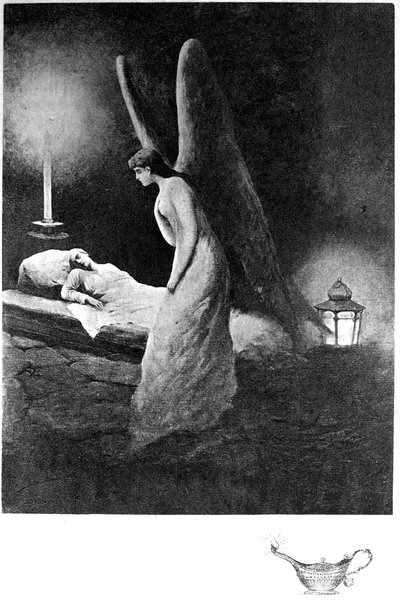
Now when it was the Hundred and Seventy-seventh Night,
She said, It hath reached me, O auspicious King, that the name
of the Jinniyah in question was Maymunah, daughter of Al-Dimiryat;
a renowned King of the Jann. And as Kamar
al-Zaman continued sleeping till the first third of the night,
Maymunah came up out of the Roman well and made for the
firmament, thinking to listen by stealth to the converse of the
angels; but when she reached the mouth of the well, she saw a
light shining in the tower, contrary to custom; and having dwelt
there many years without seeing the like, she said to herself
"Never have I witnessed aught like this"; and, marvelling much
at the matter, determined that there must be some cause therefor.
So she made for the light and found the eunuch sleeping within
the door; and inside she saw a couch spread, whereon was a
human form with the wax-candle burning at his head and the
lanthorn at his feet, and she wondered to see the light and stole
towards it little by little. Then she folded her wings and stood
by the bed and, drawing back the coverlid, discovered Kamar
al-Zaman's face. She was motionless for a full hour in admiration
and wonderment; for the lustre of his visage outshone that of the
candle; his face beamed like a pearl with light; his eyelids were
languorous like those of the gazelle; the pupils of his eyes were
224intensely black and brilliant[241]; his cheeks were rosy red; his eyebrows
were arched like bows and his breath exhaled a scent of
musk, even as saith of him the poet:—
I kissed him: darker grew those pupils,
[242] which ✿ Seduce my soul, and cheeks flushed rosier hue;
O heart, if slanderers dare to deem there be ✿ His like in charms; Say "Bring him hither, you!"
Now when Maymunah saw him, she pronounced the formula of
praise,[243] and said, "Blessed be Allah, the best of Creators!"; for
she was of the true-believing Jinn; and she stood awhile gazing
on his face, exclaiming and envying the youth his beauty and
loveliness. And she said in herself, "By Allah! I will do no hurt
to him nor let any harm him; nay, from all of evil will I ransom
him, for this fair face deserveth not but that folk should gaze upon
it and for it praise the Lord. Yet how could his family find it in
their hearts to leave him in such desert place where, if one of our
Márids came upon him at this hour, he would assuredly slay him."
Then the Ifritah Maymunah bent over him and kissed him between
the eyes, and presently drew back the sheet over his face which
she covered up; and after this she spread her wings and soaring
into the air, flew upwards. And after rising high from the circle
of the saloon she ceased not winging her way through air and
ascending skywards till she drew near the heaven of this world,
the lowest of the heavens. And behold, she heard the noisy flapping
of wings cleaving the welkin and, directing herself by the
sound, she found when she drew near it that the noise came from
an Ifrit called Dahnash. So she swooped down on him like a
sparrow-hawk and, when he was aware of her and knew her to be
Maymunah, the daughter of the King of the Jinn, he feared her
and his side-muscles quivered; and he implored her forbearance,
saying, "I conjure thee by the Most Great and August Name and
by the most noble talisman graven upon the seal-ring of Solomon,
entreat me kindly and harm me not!" When she heard these
225words her heart inclined to him and she said, "Verily, thou conjurest
me, O accursed, with a mighty conjuration. Nevertheless,
I will not let thee go, till thou tell me whence thou comest at this
hour." He replied, "O Princess, Know that I come from the
uttermost end of China-land and from among the Islands, and I
will tell thee of a wonderful thing I have seen this night. If thou
find my words true, let me wend my way and write me a patent
under thy hand and with thy sign manual that I am thy freedman,
so none of the Jinn-hosts, whether of the upper who fly or of the
lower who walk the earth or of those who dive beneath the waters,
do me let or hindrance." Rejoined Maymunah, "And what is it
thou hast seen this night, O liar, O accursed! Tell me without
leasing and think not to escape from my hand with falses, for I
swear to thee by the letters graven upon the bezel of the seal-ring
of Solomon David-son (on both of whom be peace!), except thy
speech be true, I will pluck out thy feathers with mine own hand
and strip off thy skin and break thy bones!" Quoth the Ifrit
Dahnash son of Shamhúrish[244] the Flyer, "I accept, O my lady,
these conditions."——And Shahrazad perceived the dawn of day
and ceased to say her permitted say.
Now when it was the Hundred and Seventy-eighth Night,
She said, It hath reached me, O auspicious King, that Dahnash
spoke thus to Maymunah, "I accept, O my lady, these conditions."
Then he resumed, "Know, O my mistress, that I come to-night
from the Islands of the Inland Sea in the parts of China, which
226are the realms of King Ghayúr, lord of the Islands and the Seas
and the Seven Palaces. There I saw a daughter of his, than whom
Allah hath made none fairer in her time: I cannot picture her
to thee, for my tongue would fail to describe her with her due of
praise; but I will name to thee a somewhat of her charms by way
of approach. Now her hair is like the nights of disunion and
separation and her face like the days of union and delectation;
and right well hath the poet said when picturing her:—
She dispread the locks from her head one night, ✿ Showing four-fold nights into one night run;
And she turned her visage towards the moon, ✿ And two moons showèd at moment one.
She hath a nose like the edge of the burnished blade and cheeks
like purple wine or anemones blood-red: her lips as coral and
cornelian shine and the water of her mouth is sweeter than old
wine; its taste would quench Hell's fiery pain. Her tongue is
moved by wit of high degree and ready repartee: her breast is a
seduction to all that see it (glory be to Him who fashioned it and
finished it!); and joined thereto are two upper arms smooth and
rounded; even as saith of her the poet Al-Walahán:[245]—
She hath wrists which, did her bangles not contain, ✿ Would run from out her sleeves in silvern rain.
She hath breasts like two globes of ivory, from whose brightness
the moons borrow light, and a stomach with little waves as it were
a figured cloth of the finest Egyptian linen made by the Copts,
with creases like folded scrolls, ending in a waist slender past all
power of imagination; based upon back parts like a hillock of
blown sand, that force her to sit when she would lief stand, and
awaken her, when she fain would sleep, even as saith of her and
describeth her the poet:—
She hath those hips conjoined by thread of waist, ✿ Hips that o'er me and her too tyrannise;
My thoughts they daze whene'er I think of them, ✿ And weigh her down whene'er she would uprise.
[246]
227And those back parts are upborne by thighs smooth and round
and by a calf like a column of pearl, and all this reposeth upon
two feet, narrow, slender and pointed like spear-blades,[247] the handiwork
of the Protector and Requiter, I wonder how, of their littleness,
they can sustain what is above them. But I cut short
my praises of her charms fearing lest I be tedious."——And
Shahrazad perceived the dawn of day and ceased saying her
permitted say.
Now when it was the Hundred and Seventy-ninth Night,
She said, It hath reached me, O auspicious King, that the Ifrit
Dahnash bin Shamhurish said to the Ifritah Maymunah, "Of a
truth I cut short my praises fearing lest I be tedious." Now when
Maymunah heard the description of that Princess and her beauty
and loveliness, she stood silent in astonishment; whereupon Dahnash
resumed, "The father of this fair maiden is a mighty King, a fierce
knight, immersed night and day in fray and fight; for whom death
hath no fright and the escape of his foe no dread, for that he is a
tyrant masterful and a conqueror irresistible, lord of troops and
armies and continents and islands, and cities and villages, and his
name is King Ghayur, Lord of the Islands and of the Seas and of
the Seven Palaces. Now he loveth his daughter, the young maiden
whom I have described to thee, with dearest love and, for affection
of her, he hath heaped together the treasures of all the kings and
built her therewith seven palaces, each of a different fashion; the
first of crystal, the second of marble, the third of China steel, the
fourth of precious stones and gems of price, the fifth of porcelain
and many-hued onyxes and ring-bezels, the sixth of silver and
the seventh of gold. And he hath filled the seven palaces with
all sorts of sumptuous furniture, rich silken carpets and hangings
and vessels of gold and silver and all manner of gear that kings
require; and hath bidden his daughter to abide in each by turns
for a certain season of the year; and her name is the Princess
228Budur.[248] Now when her beauty became known and her name and
fame were bruited abroad in the neighbouring countries, all the
kings sent to her father to demand her of him in marriage, and he
consulted her on the matter, but she disliked the very word wedlock
with a manner of abhorrence and said, O my father, I have no
mind to marry; no, not at all; for I am a sovereign Lady and a
Queen suzerain ruling over men, and I have no desire for a man
who shall rule over me. And the more suits she refused, the more
her suitors' eagerness increased and all the Royalties of the Inner
Islands of China sent presents and rarities to her father with letters
asking her in marriage. So he pressed her again and again with
advice on the matter of espousals; but she ever opposed to him
refusals, till at last she turned upon him angrily and cried, O my
father, if thou name matrimony to me once more, I will go into
my chamber and take a sword and, fixing its hilt in the ground,
will set its point to my waist; then will I press upon it, till it
come forth from my back, and so slay myself. Now when the
King heard these her words, the light became darkness in his sight
and his heart burned for her as with a flame of fire, because he
feared lest she should kill herself; and he was filled with perplexity
concerning her affair and the kings her suitors. So he said to her,
If thou be determined not to marry and there be no help for it:
abstain from going and coming in and out. Then he placed her
in a house and shut her up in a chamber, appointing ten old women
as duennas to guard her, and forbade her to go forth to the Seven
Palaces; moreover, he made it appear that he was incensed against
her, and sent letters to all the kings, giving them to know that she
had been stricken with madness by the Jinns; and it is now a year
since she hath thus been secluded." Then continued the Ifrit
Dahnash, addressing the Ifritah Maymunah, "And I, O my lady,
go to her every night and take my fill of feeding my sight on her
face and I kiss her between the eyes: yet, of my love to her, I do
her no hurt neither mount her, for that her youth is fair and her
grace surpassing: every one who seeth her jealouseth himself for
her. I conjure thee, therefore, O my lady, to go back with me and
look on her beauty and loveliness and stature and perfection of
proportion; and after, if thou wilt, chastise me or enslave me;
and win to thy will, for it is thine to bid and to forbid." So saying,
229the Ifrit Dahnash bowed his head towards the earth and drooped
his wings downwards; but Maymunah laughed at his words and
spat in his face and answered, "What is this girl of whom thou
pratest but a potsherd wherewith to wipe after making water?[249]
Faugh! Faugh! By Allah, O accursed, I thought thou hadst
some wondrous tale to tell me or some marvellous news to give me.
How would it be if thou were to sight my beloved? Verily, this
night I have seen a young man, whom if thou saw though but in a
dream, thou wouldst be palsied with admiration and spittle would
flow from thy mouth." Asked the Ifrit, "And who and what is
this youth?"; and she answered, "Know, O Dahnash, that there
hath befallen the young man the like of what thou tellest me befel
thy mistress; for his father pressed him again and again to marry,
but he refused, till at length his sire waxed wroth at being opposed
and imprisoned him in the tower where I dwell: and I came up
to-night and saw him." Said Dahnash, "O my lady, shew me
this youth, that I may see if he be indeed handsomer than my
mistress, the Princess Budur, or not; for I cannot believe that the
like of her liveth in this our age." Rejoined Maymunah, "Thou
liest, O accursed, O most ill-omened of Marids and vilest of
Satans![250] Sure am I that the like of my beloved is not in this
world."——And Shahrazad perceived the dawn of day and ceased
to say her permitted say.
Now when it was the Hundred and Eightieth Night,
She said, It hath reached me, O auspicious King, that the Ifritah
Maymunah spake thus to the Ifrit Dahnash, "Sure am I that the
230like of my beloved is not in this world! Art thou mad to fellow
thy beloved with my beloved?" He said, "Allah upon thee, O
my lady, go back with me and look upon my mistress, and after I
will return with thee and look upon thy beloved." She answered,
"It must needs be so, O accursed, for thou art a knavish devil;
but I will not go with thee nor shalt thou come with me, save upon
condition of a wager which is this. If the lover thou lovest and
of whom thou boastest so bravely, prove handsomer than mine
whom I mentioned and whom I love and of whom I boast, the bet
shall be thine against me; but if my beloved prove the handsomer
the bet shall be mine against thee." Quoth Dahnash the Ifrit,
"O my lady, I accept this thy wager and am satisfied thereat; so
come with me to the Islands." Quoth Maymunah; "No! for the
abode of my beloved is nearer than the abode of thine: here it is
under us; so come down with me to see my beloved and after we
will go look upon thy mistress." "I hear and I obey," said Dahnash.
So they descended to earth and alighted in the saloon which
the tower contained; then Maymunah stationed Dahnash beside
the bed and, putting out her hand, drew back the silken coverlet
from Kamar al-Zaman's face, when it glittered and glistened and
shimmered and shone like the rising sun. She gazed at him for a
moment, then turning sharply round upon Dahnash said, "Look,
O accursed, and be not the basest of madmen; I am a maid, yet
my heart he hath waylaid." So Dahnash looked at the Prince
and long continued gazing steadfastly on him then, shaking his
head, said to Maymunah, "By Allah, O my lady, thou art excusable;
but there is yet another thing to be considered, and this is,
that the estate female differeth from the male. By Allah's might,
this thy beloved is the likest of all created things to my mistress
in beauty and loveliness and grace and perfection; and it is as
though they were both cast alike in the mould of seemlihead."
Now when Maymunah heard these words, the light became darkness
in her sight and she dealt him with her wing so fierce a buffet
on the head as well-nigh made an end of him. Then quoth she
to him, "I conjure thee, by the light of his glorious countenance,
go at once, O accursed, and bring hither thy mistress whom thou
lovest so fondly and foolishly, and return in haste that we may lay
the twain together and look on them both as they lie asleep side
by side; so shall it appear to us which be the goodlier and more
beautiful of the two. Except thou obey me this very moment, O
accursed, I will dart my sparks at thee with my fire and consume
231thee; yea, in pieces I will rend thee and into the deserts cast thee,
that to stay-at-home and wayfarer an example thou be!" Quoth
Dahnash, "O my lady, I will do thy behests, for I know forsure
that my mistress is the fairer and the sweeter." So saying the
Ifrit flew away and Maymunah flew with him to guard him. They
were absent awhile and presently returned, bearing the young lady,
who was clad in a shift of fine Venetian silk, with a double edging
of gold and purfled with the most exquisite of embroidery having
these couplets worked upon the ends of the sleeves:—
Three matters hinder her from visiting us, in fear ✿ Of hate-full, slandering envier and his hirèd spies:
The shining light of brow, the trinkets' tinkling voice, ✿ And scent of essences that tell whene'er she hies:
Gi'en that she hide her brow with edge of sleeve, and leave ✿ At home her trinketry, how shall her scent disguise?
[251]
And Dahnash and Maymunah stinted not bearing that young lady
till they had carried her into the saloon and had laid her beside
the youth Kamar al-Zaman.——And Shahrazad perceived the
dawn of day and ceased saying her permitted say.
Now when it was the Hundred and Eighty-first Night,
She said, It hath reached me, O auspicious King, that the Ifrit
Dahnash and the Ifritah Maymunah stinted not bearing Princess
Budur till they descended and laid her on the couch beside Kamar
al-Zaman. Then they uncovered both their faces, and they were
the likest of all folk, each to other, as they were twins or an only
brother and sister; and indeed they were a seduction to the pious,
even as saith of them the poet Al-Mubín:—
232O heart! be not thy love confined to one, ✿ Lest thou by doting or disdain be undone:
Love all the fair, and thou shalt find with them ✿ If this be lost, to thee that shall be won.
And quoth another:—
Mine eyes beheld two lying on the ground; ✿ Both had I loved if on these eyne they lay!
So Dahnash and Maymunah gazed on them awhile, and he said,
"By Allah, O my lady, it is good! My mistress is assuredly the
fairer." She replied, "Not so, my beloved is the fairer; woe to
thee, O Dahnash! Art blind of eye and heart that lean from fat
thou canst not depart? Wilt thou hide the truth? Dost thou
not see his beauty and loveliness and fine stature and symmetry?
Out on thee, hear what I purpose to say in praise of my beloved
and, if thou be a lover true to her thou dost love, do thou the like
for her thou lovest." Then she kissed Kamar al-Zaman again
and again between the eyes and improvised this ode:—
How is this? Why should the blamer abuse thee in his pride?
What shall console my heart for thee, that art but slender bough?
A Nature-Kohl'd
[252] eye thou hast that witcheth far and wide;
From pure platonic love
[253] of it deliverance none I trow!
Those glances, fell as plundering Turk, to heart such havoc deal
As never havocked scymitar made keenest at the curve.
On me thou layest load of love the heaviest while I feel
So feeble grown that under weight of chemisette I swerve.
My love for thee as wottest well is habit, and my lowe
Is nature; to all others false is all the love I tender:
Now were my heart but like to thine I never would say No;
Only my wasted form is like thy waist so gracious-slender:
Out on him who in Beauty's robe for moon-like charms hath fame,
And who is claimed by mouth of men as marvel of his tribe!
"Of man what manner may he be" (ask they who flyte and blame)
"For whom thy heart is so distressed?" I only cry "Describe!"
233Oh stone-entempered heart of him! learn of his yielding grace
And bending form to show me grace and yielding to consent.
Oh my Prince Beautiful, thou hast an Overseer in place
[254]Who irketh me; and eke a Groom whose wrong doth ne'er relent.
Indeed he lieth who hath said that all of loveliness
Was pent in Joseph: in thy charms there's many and many a Joe!
The Genii dread me when I stand and face to face address;
But meeting thee my fluttering heart its shame and terror show.
I take aversion semblance and I turn from thee in fright,
But more aversion I assume, more love from me dost claim;
That hair of jetty black! That brow e'er raying radiant light!
Those eyne wherein white jostles black!
[255] That dearling dainty frame!
When Dahnash heard the poesy which Maymunah spake in
praise of her beloved, he joyed with exceeding joy and marvelled
with excessive wonderment.——And Shahrazad perceived the
dawn of day and ceased to say her permitted say.
Now when it was the Hundred and Eighty-second Night,
She said, It hath reached me, O auspicious King, that when the
Ifrit Dahnash heard the poesy which Maymunah spake in praise
of her beloved, he shook for exceeding joy and said, "Thou hast
celebrated thy beloved in song and thou hast indeed done well
in praise of him whom thou lovest! And there is no help for it
but that I also in my turn do my best to enfame my mistress,
and recite somewhat in her honour." Then the Ifrit went up to
the lady Budur; and, kissing her between the eyes, looked at
Maymunah and at his beloved Princess and recited the following
verses, albeit he had no skill in poesy:—
Love for my fair they chide in angry way; ✿ Unjust for ignorance, yea unjustest they!
Ah lavish favours on the love-mad, whom ✿ Taste of thy wrath and parting woe shall slay:
234In sooth for love I'm wet with railing tears, ✿ That rail mine eyelids blood thou mightest say:
No marvel what I bear for love, 'tis marvel ✿ That any know my "me" while thou'rt away:
Unlawful were our union did I doubt ✿ Thy love, or heart incline to other May.
And eke these words:—
I feed eyes on their stead by the valley's side, ✿ And I'm slain and my slayer
[256] aside hath hied:
Grief-wine have I drunken, and down my cheeks ✿ Dance tears to the song of the camel-guide:
For union-blessing I strive though sure, ✿ In Budur and Su'ád all my bliss shall bide:
[257]Wot I not which of three gave me most to 'plain, ✿ So hear them numbered ere thou decide:
Those Sworders her eyne, that Lancer her fig- ✿ ure, or ring-mail'd Locks which her forehead hide.
Quoth she (and I ask of her what so wights ✿ Or abide in towns or in desert ride
[258])
To me, "In thy heart I dwell; look there!" ✿ Quoth I, "Where's my heart, ah where? ah where?"
When Maymunah heard these lines from the Ifrit, she said, "Thou
hast done well, O Dahnash! But say thou which of the two is the
handsomer?" And he answered, "My mistress Budur is handsomer
than thy beloved!" Cried Maymunah, "Thou liest, O
accursed. Nay, my beloved is more beautiful than thine!" But
Dahnash persisted, "Mine is the fairer." And they ceased not
to wrangle and challenge each other's words till Maymunah cried
out at Dahnash and would have laid violent hands on him; but
he humbled himself to her and, softening his speech, said, "Let
not the truth be a grief to thee, and cease we this talk, for all we
say is to testify in favour of our lovers; rather let each of us withdraw
235the claim and seek we one who shall judge fairly between
us which of the two be fairer; and by his sentence we will abide."
"I agree to this," answered she and smote the earth with her foot,
whereupon there came out of it an Ifrit blind of an eye, humpbacked
and scurvy-skinned, with eye-orbits slit up and down his
face.[259] On his head were seven horns and four locks of hair fell
to his heels; his hands were pitchfork-like and his legs mast-like
and he had nails as the claws of a lion, and feet as the hoofs of the
wild ass.[260] When that Ifrit rose out of the earth and sighted Maymunah,
he kissed the ground before her and, standing with his
hands clasped behind him, said, "What is thy will, O my mistress,
O daughter of my King?"[261] She replied, "O Kashkash, I
would have thee judge between me and this accursed Dahnash."
And she made known to him the matter, from first to last, whereupon
the Ifrit Kashkash looked at the face of the youth and then
at the face of the girl; and saw them lying asleep, embraced,
each with an arm under the other's neck, alike in beauty and
loveliness and equal in grace and goodliness. The Marid gazed
long upon them, marvelling at their seemlihead; and, after carefully
observing the twain, he turned to Maymunah and Dahnash,
and repeated these couplets:—
Go, visit her thou lovest, and regard not
The words detractors utter; envious churls
Can never favour love. Oh! sure the Merciful
Ne'er made a thing more fair to look upon,
Than two fond lovers in each others' arms,
Speaking their passion in a mute embrace.
When heart has turned to heart, the fools would part them
Strike idly on cold steel. So when thou 'st found
One purely, wholly thine, accept her true heart,
And live for her alone. Oh! thou that blamest
The love-struck for their love, give o'er thy talk,
How canst thou minister to a mind diseased?
[262]
236Then he turned again to Maymunah and Dahnash and said to
them, "By Allah, if you will have the truth, I tell you fairly the
twain be equal in beauty, and loveliness and perfect grace and
goodliness, nor can I make any difference between them on account
of their being man and woman. But I have another thought
which is that we wake each of them in turn, without the knowledge
of the other, and whichever is the more enamoured shall
be held inferior in seemlihead and comeliness." Quoth Maymunah,
"Right is this recking," and quoth Dahnash, "I consent to this."
Then Dahnash changed himself to the form of a flea and bit
Kamar al-Zaman, whereupon he started from sleep in a fright——And
Shahrazad perceived the dawn of day and ceased to
say her permitted say.
Now when it was the Hundred and Eighty-third Night,
She said, It hath reached me, O auspicious King, that Dahnash
changed himself to the form of a flea and bit Kamar al-Zaman
who started from sleep in a fright and rubbed the bitten part,
his neck, and scratched it hard because of the smart. Then
turning sideways, he found lying by him something whose breath
was sweeter than musk and whose skin was softer than cream.
Hereat marvelled he with great marvel and he sat up and looked
at what lay beside him; when he saw it to be a young lady like
an union pearl, or a shining sun, or a dome seen from afar on a
well-built wall; for she was five feet tall, with a shape like the
letter[263] ا, bosomed high and rosy-cheeked; even as saith of her
the poet:—
237Four things which ne'er conjoin, unless it be ✿ To storm my vitals and to shed my blood:
Brow white as day and tresses black as night ✿ Cheeks rosy red and lips which smiles o'erflood.
And also quoth another:—
A Moon she rises, Willow-wand she waves, ✿ Breathes Ambergris, and gazes, a Gazelle:
Meseems that sorrow wooes my heart and wins ✿ And, when she wendeth hastes therein to dwell!
And when Kamar al-Zaman saw the lady Budur, daughter of
King Ghayur, and her beauty and comeliness, she was sleeping
clad in a shift of Venetian silk, without her petticoat-trousers,
and wore on her head a kerchief embroidered with gold and set
with stones of price: her ears were hung with twin earrings
which shone like constellations and round her neck was a collar
of union pearls, of size unique, past the competence of any King.
When he saw this, his reason was confounded and natural heat
began to stir in him; Allah awoke in him the desire of coition
and he said to himself, "Whatso Allah willeth, that shall be,
and what He willeth not shall never be!" So saying, he put
out his hand and, turning her over, loosed the collar of her
chemise; then arose before his sight her bosom, with its breasts
like double globes of ivory; whereat his inclination for her redoubled
and he desired her with exceeding hot desire. He
would have awakened her but she would not awake, for Dahnash
had made her sleep heavy; so he shook her and moved her,
saying, "O my beloved, awake and look on me; I am Kamar
al-Zaman." But she awoke not, neither moved her head; whereupon
he considered her case for a long hour and said to himself,
"If I guess aright, this is the damsel to whom my father would
have married me and these three years past I have refused her;
but Inshallah!—God willing—as soon as it is dawn, I will say to
him:—Marry me to her, that I may enjoy her."——And Shahrazad
perceived the dawn of day and ceased to say her permitted say,
Now when it was the Hundred and Eighty-fourth Night,
She said, It hath reached me, O auspicious King, that Kamar
al-Zaman said to himself, "By Allah, when I see dawn I will say
to my sire:—Marry me to her that I may enjoy her; nor will I let
238half the day pass ere I possess her and take my fill of her beauty
and loveliness." Then he bent over Budur to buss her, whereat
the Jinniyah Maymunah trembled and was abashed and Dahnash,
the Ifrit, was like to fly for joy. But, as Kamar al-Zaman was
about to kiss her upon the mouth, he was ashamed before Allah
and turned away his head and averted his face, saying to his heart,
"Have patience." Then he took thought awhile and said, "I will
be patient; haply my father when he was wroth with me and sent
me to this jail, may have brought my young lady and made her
lie by my side to try me with her, and may have charged her not
to be readily awakened when I would arouse her, and may have
said to her:—Whatever thing Kamar al-Zaman do to thee, make
me ware thereof; or belike my sire standeth hidden in some stead
whence (being himself unseen) he can see all I do with this young
lady; and to-morrow he will scold me and cry:—How cometh it
that thou sayest, I have no mind to marry; and yet thou didst
kiss and embrace yonder damsel? So I will withhold myself lest
I be ashamed before my sire; and the right and proper thing to
do is not to touch her at this present, nor even to look upon her,
except to take from her somewhat which shall serve as a token to
me and a memorial of her; that some sign endure between me
and her." Then Kamar al-Zaman raised the young lady's hand
and took from her little finger a seal-ring worth an immense
amount of money, for that its bezel was a precious jewel and
around it were graven these couplets:—
Count not that I your promises forgot, ✿ Despite the length of your delinquencies:
Be generous, O my lord, to me inclining; ✿ Haply your mouth and cheeks these lips may kiss:
By Allah, ne'er will I relinquish you ✿ Albe you will transgress love's boundaries.
Then Kamar al-Zaman took the seal-ring from the little finger of
Queen Budur and set it on his own; then, turning his back to her,
went to sleep.[264] When Maymunah the Jinniyah saw this, she was
glad and said to Dahnash and Kashkash, "Saw ye how my beloved
Kamar al-Zaman bore himself chastely towards this young lady?
Verily, this was of the perfection of his good gifts; for observe
you twain how he looked on her and noted her beauty and loveliness,
239and yet embraced her not neither kissed her nor put his
hand to her, but turned his back and slept." Answered they,
"Even so!" Thereupon Maymunah changed herself into a flea
and entering into the raiment of Budur, the loved of Dahnash,
crept up her calf and came upon her thigh and, reaching a place
some four carats[265] below her navel, there bit her. Thereupon she
opened her eyes and sitting up in bed, saw a youth lying beside
her and breathing heavily in his sleep, the loveliest of Almighty
Allah's creatures, with eyes that put to shame the fairest Houris
of Heaven; and a mouth like Solomon's seal, whose water was
sweeter to the taste and more efficacious than a theriack, and lips
the colour of coral-stone, and cheeks like the blood-red anemone,
even as saith one, describing him in these couplets:—
My mind's withdrawn from Zaynab and Nawár
[266] ✿ By rosy cheeks that growth of myrtle bear;
I love a fawn, a tunic-vested boy, ✿ And leave the love of bracelet-wearing Fair:
My mate in hall and closet is unlike ✿ Her that I play with, as at home we pair.
Oh thou, who blam'st my flight from Hind and Zaynab, ✿ The cause is clear as dawn uplighting air!
Would'st have me fare
[267] a slave, the thrall of thrall, ✿ Cribbed, pent, confined behind the bar and wall?
Now when Princess Budur saw him, she was seized by a transport
of passion and yearning and love-longing,——And Shahrazad perceived
the dawn of day and ceased saying her permitted say.
Now when it was the Hundred and Eighty-fifth Night,
She said, It hath reached me, O auspicious King, that when
Princess Budur saw Kamar al-Zaman she was forthwith seized
with a transport of passion and yearning and love-longing, and
she said to herself, "Alas, my shame! This is a strange youth
240and I know him not. How cometh he to be lying by my side
on one bed?" Then she looked at him a second time and
noting his beauty and loveliness, said, "By Allah, he is indeed
a comely youth and my heart[268] is well-nigh torn in sunder with
longing for him! But alas, how am I shamed by him! By the
Almighty, had I known it was this youth who sought me in marriage
of my father, I had not rejected him, but had wived with him
and enjoyed his loveliness!" Then she gazed in his face and said,
"O my lord and light of mine eyes, awake from sleep and take
thy pleasure in my beauty and grace." And she moved him with
her hand; but Maymunah the Jinniyah let down sleep upon him
as it were a curtain, and pressed heavily on his head with her
wings so that Kamar al-Zaman awoke not. Then Princess Budur
shook him with her hands and said, "My life on thee, hearken to
me; awake and up from thy sleep and look on the narcissus and
the tender down thereon, and enjoy the sight of naked waist and
navel; and touzle me and tumble me from this moment till break
of day! Allah upon thee, O my lord, sit up and prop thee against
the pillow and slumber not!" Still Kamar al-Zaman made her no
reply but breathed hard in his sleep. Continued she, "Alas! Alas!
thou art insolent in thy beauty and comeliness and grace and
loving looks! But if thou art handsome, so am I handsome; what
then is this thou dost? Have they taught thee to flout me or hath
my father, the wretched old fellow,[269] made thee swear not to speak
to me to-night?" But Kamar al-Zaman opened not his mouth
neither awoke, whereat her passion for him redoubled and Allah
inflamed her heart with love of him. She stole one glance of eyes
that cost her a thousand sighs: her heart fluttered, and her vitals
throbbed and her hands and feet quivered; and she said to Kamar
al-Zaman "Talk to me, O my lord! Speak to me, O my friend!
241Answer me, O my beloved, and tell me thy name, for indeed thou
hast ravished my wit!" And during all this time he abode
drowned in sleep and answered her not a word, and Princess Budur
sighed and said, "Alas! Alas! why art thou so proud and self-satisfied?"
Then she shook him and turning his hand over, saw
her seal-ring on his little finger, whereat she cried a loud cry, and
followed it with a sigh of passion and said, "Alack! Alack! By
Allah, thou art my beloved and thou lovest me! Yet thou seemest
to turn thee away from me out of coquetry, for all, O my darling,
thou camest to me, whilst I was asleep and knew not what thou
didst with me, and tookest my seal-ring; and yet I will not pull
it off thy finger." So saying, she opened the bosom of his shirt
and bent over him and kissed him and put forth her hand to him,
seeking somewhat that she might take as a token, but found
nothing. Then she thrust her hand into his breast and, because of
the smoothness of his body, it slipped down to his waist and thence
to his navel and thence to his yard, whereupon her heart ached and
her vitals quivered and lust was sore upon her, for that the desire
of women is fiercer than the desire of men,[270] and she was ashamed
of her own shamelessness. Then she plucked his seal-ring from
his finger, and put it on her own instead of the ring he had taken,
and bussed his inner lips and hands, nor did she leave any part
of him unkissed; after which she took him to her breast and
embraced him and, laying one of her hands under his neck and
the other under his armpit, nestled close to him and fell asleep by
his side——And Shahrazad perceived the dawn of day and ceased
to say her permitted say.
242
Now when it was the Hundred and Eighty-sixth Night,
She said, It hath reached me, O auspicious King, that when
Princess Budur fell asleep by the side of Kamar al-Zaman, after
doing that which she did, quoth Maymunah to Dahnash, "Sawst
thou, O accursed, how proudly and coquettishly my beloved bore
himself, and how hotly and passionately thy mistress showed
herself to my dearling? There can be no doubt that my beloved
is handsomer than thine; nevertheless I pardon thee." Then she
wrote him a document of manumission and turned to Kashkash
and said, "Go, help Dahnash to take up his mistress and aid him
to carry her back to her own place, for the night waneth apace and
there is but little left of it." "I hear and I obey;" answered
Kashkash. So the two Ifrits went forward to Princess Budur and
upraising her flew away with her; then, bearing her back to
her own place, they laid her on her bed, whilst Maymunah abode
alone with Kamar al-Zaman, gazing upon him as he slept, till the
night was all but spent, when she went her way. As soon as
morning morrowed, the Prince awoke from sleep and turned right
and left, but found not the maiden by him and said in his mind,
"What is this business? It is as if my father would incline me to
marriage with the damsel who was with me and have now taken
her away by stealth, to the intent that my desire for wedlock may
redouble." Then he called out to the eunuch who slept at the
door, saying, "Woe to thee, O damned one, arise at once!" So
the eunuch rose, bemused with sleep, and brought him basin and
ewer, whereupon Kamar al-Zaman entered the water-closet and
did his need;[271] then, coming out made the Wuzu-ablution and
243prayed the dawn-prayer, after which he sat telling on his beads the
ninety-and-nine names of Almighty Allah. Then he looked up
and, seeing the eunuch standing in service upon him, said, "Out on
thee, O Sawáb! Who was it came hither and took away the
young lady from my side and I still sleeping?" Asked the eunuch,
"O my lord, what manner of young lady?" "The young lady
who lay with me last night," replied Kamar al-Zaman. The
eunuch was startled at his words and said to him, "By Allah, there
hath been with thee neither young lady nor other! How should
young lady have come in to thee, when I was sleeping in the
doorway and the door was locked? By Allah, O my lord, neither
male nor female hath come in to thee!" Exclaimed the Prince,
"Thou liest, O pestilent slave!: is it of thy competence also to
hoodwink me and refuse to tell me what is become of the young
lady who lay with me last night and decline to inform me who
took her away?" Replied the eunuch (and he was affrighted at
him), "By Allah, O my lord, I have seen neither young lady nor
young lord!" His words only angered Kamar al-Zaman the
more and he said to him, "O accursed one, my father hath indeed
taught thee deceit! Come hither." So the eunuch came up to
him, and the Prince took him by the collar and dashed him to the
ground; whereupon he let fly a loud fart[272] and Kamar al-Zaman,
kneeling upon him, kicked him and throttled him till he fainted
away. Then he dragged him forth and tied him to the well-rope,
and let him down like a bucket into the well and plunged him
into the water, then drew him up and lowered him down again.
Now it was hard winter weather, and Kamar al-Zaman ceased not
to plunge the eunuch into the water and pull him up again and
douse him and haul him whilst he screamed and called for help;
and the Prince kept on saying "By Allah, O damned one, I will
not draw thee up out of this well till thou tell me and fully
acquaint me with the story of the young lady and who it was took
her away, whilst I slept."——And Shahrazad perceived the dawn
of day and ceased saying her permitted say.
244
Now when it was the Hundred and Eighty-seventh Night,
She said it hath reached me, O auspicious King, that Kamar
al-Zaman said to the eunuch, "By Allah! I will not draw thee
up out of this well until thou tell me the story of the young lady
and who it was took her away whilst I slept." Answered the
eunuch, after he had seen death staring him in the face; "O my
lord, let me go and I will relate to thee the truth and the whole
tale." So Kamar al-Zaman pulled him up out of the well, all
but dead for suffering, what with cold and the pain of dipping and
dousing, drubbing and dread of drowning. He shook like cane
in hurricane, his teeth were clenched as by cramp and his clothes
were drenched and his body befouled and torn by the rough sides
of the well: briefly he was in a sad pickle. Now when Kamar
al-Zaman saw him in this sorry plight, he was concerned for him;
but, as soon as the eunuch found himself on the floor, he said to
him,"O my lord, let me go and doff my clothes and wring them
out and spread them in the sun to dry, and don others; after
which I will return to thee forthwith and tell thee the truth of the
matter." Answered the Prince, "O rascal slave! hadst thou not
seen death face to face, never hadst thou confessed to fact nor
told me a word; but go now and do thy will, and then come back
to me at once and tell me the truth." Thereupon the eunuch
went out, hardly crediting his escape, and ceased not running,
stumbling and rising in his haste, till he came in to King Shahriman,
whom he found sitting at talk with his Wazir of Kamar al-Zaman's
case. The King was saying to the Minister, "I slept not last
night, for anxiety concerning my son, Kamar al-Zaman, and
indeed I fear lest some harm befal him in that old tower. What
good was there in imprisoning him?" Answered the Wazir,
"Have no care for him. By Allah, no harm will befal him!
None at all! Leave him in prison for a month till his temper
yield and his spirit be broken and he return to his senses." As
the two spoke behold, up rushed the eunuch, in the aforesaid
plight, making the King who was troubled at sight of him; and
he cried "O our lord the Sultan! Verily, thy son's wits are fled
and he hath gone mad; he hath dealt with me thus and thus, so
that I am become as thou seest me, and he kept saying:—A young
lady lay with me this night and stole away secretly whilst I slept.
Where is she? And he insisteth on my letting him know where
245she is and on my telling him who took her away. But I have seen
neither girl nor boy: the door was locked all through the night,
for I slept before it with the key under my head, and I opened to
him in the morning with my own hand." When King Shahriman
heard this, he cried out, saying, "Alas, my son!;" and he was
enraged with sore rage against the Wazir, who had been the cause
of all this case and said to him, "Go up, bring me news of my son
and see what hath befallen his mind." So the Wazir rose and,
stumbling over his long skirts, in his fear of the King's wrath,
hastened with the slave to the tower. Now the sun had risen and
when the Minister came in to Kamar al-Zaman, he found him
sitting on the couch reciting the Koran; so he saluted him and
seated himself by his side, and said to him, "O my lord, this
wretched eunuch brought us tidings which troubled and alarmed
us and which incensed the King." Asked Kamar al-Zaman, "And
what hath he told you of me to trouble my father? In good sooth
he hath troubled none but me." Answered the Wazir, "He came
to us in fulsome state and told us of thee a thing which Heaven
forfend; and the slave added a lie which it befitteth not to repeat,
Allah preserve thy youth and sound sense and tongue of eloquence,
and forbid to come from thee aught of offence!" Quoth
the Prince,"O Wazir, and what thing did this pestilent slave say
of me?" The Minister replied, "He told us that thy wits had
taken leave of thee and thou wouldst have it that a young lady lay
with thee last night, and thou wast instant with him to tell thee
whither she went and thou diddest torture him to that end." But
when Kamar al-Zaman heard these words, he was enraged with
sore rage and he said to the Wazir, "'Tis manifest to me in very
deed that you people taught the eunuch to do as he did"——And
Shahrazad perceived the dawn of day and ceased to say her permitted
say.
Now when it was the Hundred and Eighty-eighth Night,
She said, It hath reached me, O auspicious King, that when Kamar
al-Zaman heard the words of the Wazir he was enraged with sore
rage and said to him, "'Tis manifest to me in very deed that you
people taught the eunuch to do as he did and forbade him to tell
me what became of the young lady who lay with me last night. But
thou, O Wazir, art cleverer than the eunuch; so do thou tell me
without stay or delay, whither went the young lady who slept on my
246bosom last night; for it was you who sent her and bade her sleep
in my embrace and we lay together till dawn; but, when I awoke,
I found her not. So where is she now?" Said the Wazir, "O
my lord Kamar al-Zaman, Allah's name encompass thee about!
By the Almighty, we sent none to thee last night, but thou
layest alone, with the door locked on thee and the eunuch sleeping
behind it, nor did there come to thee young lady or any other.
Regain thy reason, O my lord, and stablish thy senses and occupy
not thy mind with vanities." Rejoined Kamar al-Zaman who was
incensed at his words, "O Wazir, the young lady in question is my
beloved, the fair one with the black eyes and rosy cheeks, whom I
held in my arms all last night." So the Minister wondered at his
words and asked him, "Didst thou see this damsel last night with
thine own eyes on wake or in sleep?" Answered Kamar al-Zaman,
"O ill-omened old man, dost thou fancy I saw her with my ears?
Indeed, I saw her with my very eyes and awake, and I touched
her with my hand, and I watched by her full half the night, feeding
my vision on her beauty and loveliness and grace and tempting
looks. But you had schooled her and charged her to speak no
word to me; so she feigned sleep and I lay by her side till dawn,
when I awoke and found her gone." Rejoined the Wazir, "O my
lord Kamar al-Zaman, haply thou sawest this in thy sleep; it
must have been a delusion of dreams or a deception caused by
eating various kinds of food, or a suggestion of the accursed
devils." Cried the Prince, "O pestilent old man! wilt thou too
make a mock of me and tell me this was haply a delusion of
dreams, when that eunuch confessed to the young lady, saying:—At
once I will return to thee and tell thee all about her?" With
these words, he sprang up and rushed at the Wazir and gripped
hold of his beard (which was long[273]) and, after gripping it, he
247twisted his hand in it and haling him off the couch, threw him on
the floor. It seemed to the Minister as though his soul departed
his body for the violent plucking at his beard; and Kamar al-Zaman
ceased not kicking the Wazir and basting his breast and
ribs and cuffing him with open hand on the nape of his neck till he
had well-nigh beaten him to death. Then said the old man in his
mind, "Just as the eunuch-slave saved his life from this lunatic youth
by telling him a lie, thus it is even fitter that I do likewise; else he
will destroy me. So now for my lie to save myself, he being mad
beyond a doubt." Then he turned to Kamar al-Zaman and said,
"O my lord, pardon me; for indeed thy father charged me to conceal
from thee this affair of the young lady; but now I am weak
and weary and wounded with tunding; for I am an old man and
lack strength and bottom to endure blows. Have, therefore, a little
patience with me and I will tell thee all and acquaint thee with
the story of the young woman." When the Prince heard this, he
left off drubbing him and said, "Wherefore couldst thou not tell
me the tale until after shame and blows? Rise now, unlucky old
man that thou art, and tell me her story." Quoth the Wazir,
"Say, dost thou ask of the young lady with the fair face and
perfect form?" Quoth Kamar al-Zaman, "Even so! Tell me,
O Wazir, who it was that led her to me and laid her by my
side, and who was it that took her away from me by night;
and let me know forthright whither she is gone, that I myself
may go to her at once. If my father did this deed to me that
he might try me by means of that beautiful girl, with a view to
our marriage, I consent to wed her and free myself of this trouble;
for he did all these dealings with me only because I refused wedlock.
But now I consent and I say again, I consent to matrimony:
so tell this to my father, O Wazir, and advise him to marry me to
that young lady; for I will have none other and my heart loveth
none save her alone. Now rise up at once and haste thee to my
248father and counsel him to hurry on our wedding and bring me his
answer within this very hour." Rejoined the Wazir, "'Tis well!"
and went forth from him, hardly believing himself out of his hands.
Then he set off from the tower, walking and tripping up as he
went, for excess of fright and agitation, and he ceased not hurrying
till he came in to King Shahriman.——And Shahrazad perceived
the dawn of day and ceased saying her permitted say.
Now when it was the Hundred and Eighty-ninth Night,
She said, it hath reached me, O auspicious King, that the Wazir
fared forth from the tower, and ceased not running till he came in
to King Shahriman, who said to him as he sighted him, "O thou
Wazir, what man hath brought thee to grief and whose mischief
hath treated thee in way unlief; how happeneth it that I see thee
dumb-foundered and coming to me thus astounded?" Replied
the Wazir, "O King! I bring thee good news." "And what is
it?" quoth Shariman, and quoth the Wazir, "Know that thy son
Kamar al-Zaman's wits are clean gone and that he hath become
stark mad." Now when the King heard these words of the Minister,
light became darkness in his sight and he said, "O Wazir,
make clear to me the nature of his madness." Answered the
Wazir, "O my lord, I hear and I obey." Then he told him that
such and such had passed and acquainted him with all that his son
had done; whereupon the King said to him, "Hear, O Wazir, the
good tidings which I give thee in return for this thy fair news of
my son's insanity; and it shall be the cutting off of thy head and
the forfeiture of my favour, O most ill-omened of Wazirs and
foulest of Emirs! for I feel that thou hast caused my son's disorder
by the wicked advice and the sinister counsel thou hast
given me first and last. By Allah, if aught of mischief or madness
have befallen my son I will most assuredly nail thee upon the
palace-dome and make thee drain the bitterest draught of death!"
Then he sprang up and, taking the Wazir with him, fared straight
for the tower and entered it. And when Kamar al-Zaman saw
the two, he rose to his father in haste from the couch whereon he
sat and kissing his hands drew back and hung down his head and
stood before him with his arms behind him, and thus remained for
a full hour. Then he raised his head towards his sire; the tears
gushed from his eyes and streamed down his cheeks and he began
repeating:—
249"Forgive the sin 'neath which my limbs are trembling,
For the slave seeks for mercy from his master;
I've done a fault, which calls for free confession,
Where shall it call for mercy, and forgiveness?"
[274]
When the King heard this, he arose and embraced his son, and
kissing him between the eyes, made him sit by his side on the
couch; then he turned to the Wazir and, looking on him with
eyes of wrath, said, "O dog of Wazirs, how didst thou say of
my son such and such things and make my heart quake for
him?" Then he turned to the Prince and said, "O my son, what
is to-day called?" He answered, "O my father, this day is the
Sabbath, and to-morrow is First day: then come Second day,
Third, Fourth, Fifth day and lastly Friday."[275] Exclaimed the
King, "O my son, O Kamar al-Zaman, praised be Allah for the
preservation of thy reason! What is the present month called in
our Arabic?" "Zú'l-Ka'adah," answered Kamar al-Zaman, "and
it is followed by Zú'l-hijjah; then cometh Muharram, then Safar,
then Rabí'a the First and Rabí'a the Second, the two Jamádás,
Rajab, Sha aban, Ramazán and Shawwál." At this the King
rejoiced exceedingly and spat in the Wazir's face, saying, "O
wicked old man, how canst thou say that my son is mad? And
now none is mad but thou." Hereupon the Minister shook his
head and would have spoken, but bethought himself to wait awhile
and see what might next befal. Then the King said to his child,
"O my son, what words be these thou saidest to the eunuch and
the Wazir, declaring:—I was sleeping with a fair damsel this
night?[276] What damsel is this of whom thou speakest?" Then
Kamar al-Zaman laughed at his father's words and replied, "O
my father, know that I can bear no more jesting; so add me not
another mock or even a single word on the matter, for my temper
hath waxed short by that you have done with me. And know, O
my father, with assured knowledge, that I consent to marry, but
on condition that thou give me to wife her who lay by my side
this night; for I am certain it was thou sentest her to me and
250madest me in love with her and then despatchedst a message to
her before the dawn and tookest her away from beside me." Rejoined
the King, "The name of Allah encompass thee about,
O my son, and be thy wit preserved from witlessness!"——And
Shahrazad perceived the dawn of day and ceased to say her
permitted say.
Now when it was the Hundred and Ninetieth Night,
She said, It hath reached me, O auspicious King, that quoth King
Shahriman to his son Kamar al-Zaman, "The name of Allah encompass
thee about, O my son, and be thy wit preserved from
witlessness! What thing be this young lady whom thou fanciest I
sent to thee last night and then again that I sent to withdraw her
from thee before dawn? By the Lord, O my son, I know nothing
of this affair, and Allah upon thee, tell me if it be a delusion of
dreaming or a deception caused by indisposition. For verily thou
layest down to sleep last night with thy mind occupied anent
marriage and troubled with the talk of it (Allah damn marriage
and the hour when I spake of it and curse him who counselled it!);
and without doubt or diffidence I can say that being moved in
mind by the mention of wedlock thou dreamedst that a handsome
young lady embraced thee and didst fancy thou sawest her when
awake. But all this, O my son, is but an imbroglio of dreams."
Replied Kamar al-Zaman, "Leave this talk and swear to me by
Allah, the All-creator, the Omniscient; the Humbler of the tyrant
Cæsars and the Destroyer of the Chosroes, that thou knowest
naught of the young lady nor of her woning-place." Quoth the
King, "By the Might of Allah Almighty, the God of Moses and
Abraham, I know naught of all this and never even heard of it;
it is assuredly a delusion of dreams thou hast seen in sleep."
Then the Prince replied to his sire, "I will give thee a self-evident
proof that it happened to me when on wake."——And Shahrazad
perceived the dawn of day and ceased saying her permitted say.
Now when it was the Hundred and Ninety-first Night,
She said, It hath reached me, O auspicious King, that Kamar
al-Zaman said to his sire, "I will give thee a self-evident proof that
this happened to me when on wake. Now let me ask thee, did it
ever befal any man to dream that he was battling a sore battle and
251after to awake from sleep and find in his hand a sword-blade besmeared
with blood? Answered the King, "No, by Allah, O my
son, this hath never been." Rejoined Kamar al-Zaman, "I will
tell thee what happened to me and it was this. Meseemed I
awoke from sleep in the middle of the past night and found a girl
lying by my side, whose form was like mine and whose favour was
as mine. I embraced her and turned her about with my hand and
took her seal-ring, which I put on my finger, and she pulled off
my ring and put it on hers. Then I went to sleep by her side,
but refrained from her for shame of thee, deeming that thou hadst
sent her to me, intending to tempt me with her and incline me to
marriage, and suspecting thee to be hidden somewhere whence
thou couldst see what I did with her. And I was ashamed even
to kiss her on the mouth for thy account, thinking over this temptation
to wedlock; and, when I awoke at point of day, I found no
trace of her, nor could I come at any news of her, and there befel
me what thou knowest of with the eunuch and with the Wazir.
How then can this case have been a dream and a delusion, when
the ring is a reality? Save for her ring on my finger I should
indeed have deemed it a dream; but here is the ring on my little
finger: look at it, O King, and see what is its worth." So saying,
he handed the ring to his father, who examined it and turned it
over, then looked to his son and said, "Verily, there is in this ring
some mighty mystery and some strange secret. What befel thee
last night with the girl is indeed a hard nut to crack, and I know
not how intruded upon us this intruder. None is the cause of all
this pother save the Wazir; but, Allah upon thee, O my son, take
patience, so haply the Lord may turn to gladness this thy grief
and to thy sadness bring complete relief: as quoth one of the
poets:—
Haply shall Fortune draw her rein, and bring ✿ Fair chance, for she is changeful, jealous, vain:
Still I may woo my want and wishes win, ✿ And see on heels of care unfain, the fain.
And now, O my son, I am certified at this hour that thou art not
mad; but thy case is a strange one which none can clear up for
thee save the Almighty." Cried the Prince, "By Allah, O my
father, deal kindly with me and seek out this young lady and
hasten her coming to me; else I shall die of woe and of my death
shall no one know." Then he betrayed the ardour of his passion;
and turned towards his father and repeated these two couplets:—
252If your promise of personal call prove untrue, ✿ Deign in vision to grant me an interview:
Quoth they, "How can phantom
[277] appear to the sight ✿ Of a youth, whose sight is fordone,
perdue?"
Then, after ending his poetry, Kamar al-Zaman again turned to
his father, with submission and despondency, and shedding tears
in flood, began repeating these lines——And Shahrazad perceived
the dawn of day and ceased to say her permitted say.
Now when it was the Hundred and Ninety-second Night,
She said, It hath reached me, O auspicious King, that when
Kamar al-Zaman had repeated to his father these verses, he wept
and complained and groaned from a wounded heart; and added
these lines:—
Beware that eye-glance which hath magic might; ✿ Wherever turn those orbs it bars our flight:
Nor be deceived by low sweet voice, that breeds ✿ A fever festering in the heart and sprite:
So soft that silky skin, were rose to touch it ✿ She'd cry and tear-drops rain for pain and fright:
Did Zephyr e'en in sleep pass o'er her land, ✿ Scented he'd choose to dwell in scented site:
Her necklets vie with tinkling of her belt; ✿ Her wrists strike either wristlet dumb with spite:
When would her bangles buss those rings in ear, ✿ Upon the lover's eyne high mysteries 'light:
I'm blamed for love of her, nor pardon claim; ✿ Eyes are not profiting which lack foresight:
Heaven strip thee, blamer mine! unjust art thou; ✿ Before this fawn must every eye low bow.
[278]
253After which he said, "By Allah, O my father, I cannot endure
to be parted from her even for an hour." The King smote hand
upon hand and exclaimed, "There is no Majesty and there is no
Might save in Allah, the Glorious, the Great! No cunning contrivance
can profit us in this affair." Then he took his son by
the hand and carried him to the palace, where Kamar al-Zaman
lay down on the bed of languor and the King sat at his head,
weeping and mourning over him and leaving him not, night or
day, till at last the Wazir came in to him and said, "O King
of the age and the time, how long wilt thou remain shut up with
thy son and hide thyself from thy troops? Haply, the order of
thy realm may be deranged, by reason of thine absence from thy
Grandees and Officers of State. It behoveth the man of understanding,
if he have various wounds in his body, to apply him
first to medicine the most dangerous; so it is my counsel to thee
that thou remove thy son from this place to the pavilion which is
in the palace overlooking the sea; and shut thyself up with him
there, setting apart in every week two days, Thursday and Monday,
for state receptions and progresses and reviews. On these days
let thine Emirs and Wazirs and Chamberlains and Viceroys and
high Officials and Grandees of the realm and the rest of the levies
and the lieges have access to thee and submit their affairs to thee;
and do thou their needs and judge among them and give and take
with them and bid and forbid. And the rest of the week thou
shalt pass with thy son, Kamar al-Zaman, and cease not thus doing
till Allah shall vouchsafe relief to you twain. Think not, O King,
that thou art safe from the shifts of Time and the strokes of Change
which come like a traveller in the night; for the wise man is ever
on his guard and how well saith the poet:—
Thou deemedst well of Time when days went well, ✿ And fearedst not what ills might bring thee Fate:
The Nights so fair and restful cozened thee, ✿ For peaceful Nights bring woes of heavy weight.
Oh children of mankind whom Time befriends, ✿ Beware of Time's deceits or soon or late!"
[279]
When the Sultan heard his Wazir's words he saw that they were
right and deemed his counsel wise, and it had effect upon him for
he feared lest the order of the state be deranged; so he rose at
254once and bade transport his son from his sick room to the pavilion
in the palace overlooking the sea. Now this palace was girt
round by the waters and was approached by a causeway twenty
cubits wide. It had windows on all sides commanding an ocean-view;
its floor was paved with parti-coloured marbles and its
ceiling was painted in the richest pigments and figured with gold
and lapis-lazuli. They furnished it for Kamar al-Zaman with
splendid upholstery, embroidered rugs and carpets of the richest
silk; and they clothed the walls with choice brocades and hung
curtains bespangled with gems of price. In the midst they set
him a couch of juniper[280]-wood inlaid with pearls and jewels, and
Kamar al-Zaman sat down thereon, but the excess of his concern
and passion for the young lady had wasted his charms and emaciated
his body; he could neither eat nor drink nor sleep; and he
was like a man who had been sick twenty years of sore sickness.
His father seated himself at his head, grieving for him with the
deepest grief, and every Monday and Thursday he gave his Wazirs
and Emirs and Chamberlains and Viceroys and Lords of the realm
and levies and the rest of his lieges leave to come up to him in
that pavilion. So they entered and did their several service and
duties and abode with him till the end of the day, when they went
their ways and the King returned to his son in the pavilion whom
he left not night nor day; and he ceased not doing on this wise
for many days and nights. Such was the case with Kamar
al-Zaman, son of King Shahriman; but as regards Princess
Budur, daughter of King Ghayur, Lord of the Isles and the Seven
Palaces, when the two Jinns bore her up and laid her on her bed,
she slept till daybreak, when she awoke and sitting upright
looked right and left, but saw not the youth who had lain in her
bosom. At this her vitals fluttered, her reason fled and she
shrieked a loud shriek which awoke all her slave-girls and nurses
and duennas. They flocked in to her; and the chief of them
came forward and asked, "What aileth thee, O my lady?"
Answered the Princess, "O wretched old woman, where is my
beloved, the handsome youth who lay last night in my bosom?
Tell me whither he is gone." Now when the duenna heard this,
the light starkened in her sight and she feared from her mischief
with sore affright, and said to her, "O my Lady Budur, what
255unseemly words are these?" Cried the Princess, "Woe to thee,
pestilent crone that thou art! I ask thee again where is my
beloved, the goodly youth with the shining face and the slender
form, the jetty eyes and the joined eyebrows, who lay with me
last night from supper-tide until near daybreak?" She rejoined,
"By Allah, O my lady, I have seen no young man nor any other.
I conjure thee, carry not this unseemly jest too far lest we all lose
our lives; for perhaps the joke may come to thy father's ears and
who shall then deliver us from his hand?"——And Shahrazad
perceived the dawn of day and ceased to say her permitted say.
Now when it was the Hundred and Ninety-third Night,
She said, "It hath reached me, O auspicious King, that the duenna
bespake the Lady Budur in these words, 'Allah upon thee, O my
lady! carry not this unseemly jest too far; for perhaps it may come
to thy father's ears, and who shall then deliver us from his hand?'"
The Princess rejoined, "In very sooth a youth lay with me last
night, one of the fairest-faced of men." Exclaimed the duenna,
"Heaven preserve thy reason! indeed no one lay with thee last
night." Thereupon the Princess looked at her hand and, finding
Kamar al-Zaman's seal-ring on her finger in stead of her own, said
to her, "Woe to thee, thou accursed! thou traitress! wilt thou lie
to me and tell me that none lay with me last night and swear to
me a falsehood in the name of the Lord?" Replied the duenna,
"By Allah, I do not lie to thee nor have I sworn falsely." Then
the Princess was incensed by her words and, drawing a sword she
had by her, she smote the old woman with it and slew her;[281]
whereupon the eunuch and the waiting-women and the concubines
cried out at her, and ran to her father and, without stay or delay,
acquainted him with her case. So the King went to her, and asked
her, "O my daughter, what aileth thee?"; and she answered,
"O my father, where is the youth who lay with me last night?"
Then her reason fled from her head and she cast her eyes right
and left and rent her raiment even to the skirt. When her sire
saw this, he bade the women lay hands on her; so they seized
her and manacled her, then putting a chain of iron about her
256neck, made her fast to one of the palace-windows and there left
her.[282] Thus far concerning Princess Budur; but as regards her
father, King Ghayur, the world was straitened upon him when he
saw what had befallen his daughter, for that he loved her and her
case was not a little grievous to him. So he summoned on it the
doctors and astrologers and men skilled in talisman-writing and
said to them, "Whoso healeth my daughter of what ill she hath,
I will marry him to her and give him half of my kingdom; but
whoso cometh to her and cureth her not, I will strike off his head
and hang it over her palace-gate." Accordingly, all who went in to
her, but failed to heal her, he beheaded and hung their heads over
the palace-gates, till he had beheaded on her account forty doctors
and crucified forty astrologers; wherefor the general held aloof
from her, all the physicians having failed to medicine her malady;
and her case was a puzzle to the men of science and the adepts in
cabalistic characters. And as her longing and passion redoubled
and love and distraction were sore upon her, she poured forth
tears and repeated these couplets:—
My fondness, O my moon, for thee my foeman is, ✿ And to thy comradeship the nights my thought compel:
In gloom I bide with fire that flames below my ribs, ✿ Whose lowe I make comparison with heat of Hell:
I'm plagued with sorest stress of pine and ecstasy; ✿ Nor clearest noontide can that horrid pain dispel.
Then she sighed and repeated these also:—
Salams fro' me to friends in every stead; ✿ Indeed to all dear friends do I incline:
Salams, but not salams that bid adieu; ✿ Salams that growth of good for you design:
I love you dear, indeed, nor less your land, ✿ But bide I far from every need of mine!
And when the lady Budur ceased repeating her poetry, she wept
till her eyes waxed sore and her cheeks changed form and hue,
and in this condition she continued three years. Now she had a
foster-brother, by name Marzawán,[283] who was travelling in far
257lands and absent from her the whole of this time. He loved her
with an exceeding love, passing the love of brothers; so when he
came back he went in to his mother and asked for his sister, the
Princess Budur. She answered him, "O my son, thy sister hath
been smitten with madness and hath passed these three years
with a chain of iron about her neck; and all the physicians and
men of science have failed of healing her." When Marzawan
heard these words he said, "I must needs go in to her; peradventure
I may discover what she hath, and be able to medicine
her;" and his mother replied, "Needs must thou visit her, but
wait till to-morrow, that I may contrive some thing to suit thy
case." Then she went a-foot to the palace of the Lady Budur and,
accosting the eunuch in charge of the gates, made him a present
and said to him, "I have a daughter, who was brought up with
thy mistress and since then I married her; and, when that befel
the Princess which befel her, she became troubled and sore concerned,
and I desire of thy favour that my daughter may go in to
her for an hour and look on her; and then return whence she came,
so shall none know of it." Quoth the eunuch, "This may not be
except by night, after the King hath visited his child and gone
away; then come thou and thy daughter." So she kissed the
eunuch's hand and, returning home, waited till the morrow at
nightfall; and when it was time she arose and sought her son
Marzawan and attired him in woman's apparel; then, taking his
hand in hers, led him towards the palace, and ceased not walking
with him till she came upon the eunuch after the Sultan had ended
his visit to the Princess. Now when the eunuch saw her, he rose
to her, and said, "Enter, but do not prolong thy stay!" So they
went in and when Marzawan beheld the Lady Budur in the aforesaid
plight, he saluted her, after his mother had doffed his woman's
garb: then he took out of their satchel books he had brought
with him; and, lighting a wax-candle, he began to recite certain
conjurations. Thereupon the Princess looked at him and recognising
him, said, "O my brother, thou hast been absent on thy
travels, and thy news have been cut off from us." He replied,
"True! but Allah hath brought me back safe and sound, I am now
minded to set out again nor hath aught delayed me but the news
I hear of thee; wherefore my heart burned for thee and I came
to thee, so haply I may free thee of thy malady." She rejoined,
"O my brother, thinkest thou it is madness aileth me?" "Yes,"
258answered he, and she said, "Not so, by Allah! 'tis even as saith
the poet:—
Quoth they "Thou rav'st on him thou lov'st:" quoth I, ✿ "The sweets of love are only for th' insane!"
Love never maketh Time his friend befriend; ✿ Only the Jinn-struck wight such boon can gain:
Well! yes, I'm mad: bring him who madded me ✿ And, if he cure my madness, blame restrain!"
Then she let Marzawan know that she was love-daft and he said,
"Tell me concerning thy tale and what befel thee: haply there
may be in my hand something which shall be a means of deliverance
for thee."——And Shahrazad perceived the dawn of day
and ceased saying her permitted say.
Now when it was the Hundred and Ninety-fourth Night,
She said, It hath reached me, O auspicious King, that Marzawan
thus addressed Princess Budur, "Tell me concerning thy tale and
what befel thee: haply Allah may inspire me with a means of
deliverance for thee." Quoth she, "O my brother, hear my story
which is this. One night I awoke from sleep, in the last third of
the night[284] and, sitting up, saw by my side the handsomest of
youths that be, and tongue faileth to describe him, for he was as a
willow-wand or an Indian rattan-cane. So methought it was my
father who had done on this wise in order thereby to try me, for
that he had consulted me concerning wedlock, when the Kings
sought me of him to wife, and I had refused. It was this thought
withheld me from arousing him, for I feared that, if I did aught or
embraced him, he would peradventure inform my father of my
doings. But in the morning, I found on my finger his seal-ring, in
place of my own which he had taken. And, O my brother, my
heart was seized with love of him at first sight; and, for the
violence of my passion and longing, I have never savoured the
taste of sleep and have no occupation save weeping alway and
repeating verses night and day. And this, O my brother, is my
259story and the cause of my madness." Then she poured forth tears
and repeated these couplets:—
"Now Love hast banished all that bred delight; ✿ With that heart-nibbling fawn my joys took flight:
Lightest of trifles lover's blood to him ✿ Who wastes the vitals of the hapless wight!
For him I'm jealous of my sight and thought; ✿ My heart acts spy upon my thought and sight:
Those long-lashed eyelids rain on me their shafts ✿ Guileful, destroying hearts where'er they light:
Now, while my portion in the world endures, ✿ Shall I behold him ere I quit world-site?
What bear I for his sake I'd hide, but tears ✿ Betray my feelings to the spy's despight.
When near, our union seemeth ever far; ✿ When far, my thoughts to him aye nearest are."
And presently she continued, "See then, O my brother, how thou
mayest aid me in mine affliction." So Marzawan bowed his head
groundwards awhile, wondering and not knowing what to do,
then he raised it and said to her, "All thou hast spoken to me I
hold to be true, though the case of the young man pass my understanding:
but I will go round about all lands and will seek for
what may heal thee; haply Allah shall appoint thy healing to be
at my hand. Meanwhile, take patience and be not disquieted."
Thereupon Marzawan farewelled her, praying that she might be
constant and left her repeating these couplets:—
Thine image ever companies my sprite, ✿ For all thou'rt distant from then pilgrim's sight;
But my heart-wishes e'er attract thee near: ✿ What is the lightning's speed to Thought's swift flight?
Then go not thou, my very light of eyes ✿ Which, when thou'rt gone, lack all the Kohl of light.
Then Marzawan returned to his mother's house, where he passed
the night. And when the morrow dawned, having equipped himself
for his journey, he fared forth and ceased not faring from city
to city and from island to island for a whole month, till he came to
a town named Al-Tayrab.[285] Here he went about scenting news of
the townsfolk, so haply he might light on a cure for the Princess's
malady, for in every capital he entered or passed by, it was reported
260that Queen Budur, daughter of King Ghayur, had lost her wits.
But arriving at Al-Tayrab city, he heard that Kamar al-Zaman,
son of King Shahriman, was fallen sick and afflicted with melancholy
madness. So Marzawan asked the name of the Prince's
capital and they said to him, "It is on the Islands of Khalidan
and it lieth distant from our city a whole month's journey by sea,
but by land it is six months' march." So he went down to the sea
in a ship which was bound for the Khalidan Isles, and she sailed
with a favouring breeze for a whole month, till they came in sight
of the capital; and there remained for them but to make the land
when, behold, there came out on them a tempestuous wind which
carried away the masts and rent the canvas, so that the sails fell
into the sea and the ship capsized, with all on board,——And
Shahrazad perceived the dawn of day and ceased to say her
permitted say.
Now when it was the Hundred and Ninety-fifth Night,
She said, It hath reached me, O auspicious King, that when the
ship capsized with all on board, each sought his own safety; and
as for Marzawan the set of the sea carried him under the King's
palace, wherein was Kamar al-Zaman. And by the decree of
destiny it so happened that this was the day on which King
Shahriman gave audience to his Grandees and high officers, and
he was sitting, with his son's head on his lap, whilst an eunuch
fanned away the flies; and the Prince had not spoken neither
had he eaten nor drunk for two days, and he was grown thinner
than a spindle.[286] Now the Wazir was standing respectfully a-foot
near the latticed window giving on the sea and, raising his eyes,
saw Marzawan being beaten by the billows and at his last gasp;
whereupon his heart was moved to pity for him, so he drew near
to the King and moving his head towards him said, "I crave thy
leave, O King, to go down to the court of the pavilion and open
the water-gate that I may rescue a man who is at the point of
drowning in the sea and bring him forth of danger into deliverance;
peradventure, on this account Allah may free thy son from
what he hath!" The King replied, "O thou Wazir, enough is
261that which hath befallen my son through thee and on thine
account. Haply, if thou rescue this drowning man, he will come
to know our affairs, and look on my son who is in this state and
exult over me; but I swear by Allah, that if this half-drowned
wretch come hither and learn our condition and look upon my
son and then fare forth and speak of our secrets to any, I will
assuredly strike off thy head before his; for thou, O my Minister,
art the cause of all that hath betided us, first and last. Now do
as thou wilt." Thereupon the Wazir sprang up and, opening
the private postern which gave upon the sea, descended to the
causeway; then walked on twenty steps and came to the water
where he saw Marzawan nigh unto death. So he put out his
hand to him and, catching him by his hair, drew him ashore in
a state of insensibility, with belly full of water and eyes half out
of his head. The Wazir waited till he came to himself, when he
pulled off his wet clothes and clad him in a fresh suit, covering
his head with one of his servants' turbands; after which he said
to him, "Know that I have been the means of saving thee from
drowning: do not thou requite me by causing my death and thine
own."——And Shahrazad perceived the dawn of day and ceased
saying her permitted say.
Now when it was the Hundred and Ninety-sixth Night,
She said, It hath reached me, O auspicious King, that when the
Wazir did to Marzawan what he did, he thus addressed him,
"Know that I have been the cause of saving thee from drowning,
so requite me not by causing my death and thine own." Asked
Marzawan, "And how so?"; and the Wazir answered, "Thou art
at this hour about to go up and pass among Emirs and Wazirs,
all of them silent and none speaking, because of Kamar al-Zaman,
the son of the Sultan." Now when Marzawan heard the name of
Kamar al-Zaman, he knew that this was he whom he had heard
spoken of in sundry cities and of whom he came in search, but
he feigned ignorance and asked the Wazir, "And who is Kamar
al-Zaman?" Answered the Minister, "He is the son of Sultan
Shahriman and he is sore sick and lieth strown on his couch restless
alway, eating not nor drinking neither sleeping night or day;
indeed he is nigh upon death and we have lost hope of his living
and are certain that he is dying. Beware lest thou look too long
262on him, or thou look on any place other than that where thou
settest thy feet: else thou art a lost man, and I also." He replied,
"Allah upon thee, O Wazir, I implore thee, of thy favour, acquaint
me touching this youth thou describest, what is the cause of the
condition in which he is." The Wazir replied, "I know none,
save that, three years ago, his father required him to wed, but he
refused; whereat the King was wroth and imprisoned him. And
when he awoke on the morrow, he fancied that during the night
he had been roused from sleep and had seen by his side a young
lady of passing loveliness, whose charms tongue can never express;
and he assured us that he had plucked off her seal-ring from her
finger and had put it on his own and that she had done likewise;
but we know not the secret of all this business. So by Allah, O
my son, when thou comest up with me into the palace, look not
on the Prince, but go thy way; for the Sultan's heart is full of
wrath against me." So said Marzawan to himself, "By Allah;
this is the one I sought!" Then he followed the Wazir up to the
palace, where the Minister seated himself at the Prince's feet; but
Marzawan found forsooth nothing to do but go up to Kamar al-Zaman
and stand before him at gaze. Upon this the Wazir died
of affright in his skin, and kept looking at Marzawan and signalling
him to wend his way; but he feigned not to see him and gave
not over gazing upon Kamar al-Zaman, till he was well assured
that it was indeed he whom he was seeking,——And Shahrazad
perceived the dawn of day and ceased to say her permitted say.
Now when it was the Hundred and Ninety-seventh Night,
She said, It hath reached me, O auspicious King, that when Marzawan
looked upon Kamar al-Zaman and knew that it was indeed
he whom he was seeking, he cried, "Exalted be Allah, Who hath
made his shape even as her shape and his complexion as her
complexion and his cheek as her cheek!" Upon this Kamar
al-Zaman opened his eyes and gave earnest ear to his speech;
and, when Marzawan saw him inclining to hear, he repeated these
couplets[287]:—
263I see thee full of song and plaint and love's own ecstasy;
Delighting in describing all the charms of loveliness:
Art smit by stroke of Love or hath shaft-shot wounded thee?
None save the wounded ever show such signals of distress!
Ho thou! crown the wine-cup and sing me singular
Praises to Sulaymá, Al-Rabáb, Tan'oum addrest;
[288]
Go round the grape-vine sun
[289] which for mansion hath a jar;
Whose East the cup-boy is, and here my mouth that opes for West.
I'm jealous of the very clothes that dare her sides enroll
When she veils her dainty body of the delicatest grace:
I envy every goblet of her lips that taketh toll,
When she sets the kissing-cup on that sweetest kissing-place.
But deem not by the keen-edged scymitar I'm slain—
The hurts and harms I dree are from arrows of her eyes.
I found her finger-tips, as I met her once again,
Deep-reddened with the juice of the wood that ruddy dyes;
[290]
And cried, "Thy palms thou stainedst when far away was I
And this is how thou payest one distracted by his pine!"
Quoth she (enkindling in my heart a flame that burnèd high
Speaking as one who cannot hide of longing love the sign),
"By thy life, this is no dye used for dyeing; so forbear
Thy blame, nor in charging me with falsing Love persist!"
"But when upon our parting-day I saw thee haste to fare,
The while were bared my hand and my elbow and my wrist;"
"I shed a flood of blood-red tears and with fingers brushed away;
Hence blood-reddened were the tips and still blood-red they remain."
Had I wept before she wept, to my longing-love a prey,
Before repentance came, I had quit my soul of pain;
264But she wept before I wept and I wept to see her care
And I said, "All the merit appertains to precedent;"
[291]
Blame me not for loving her; now on self of Love I swear
For her sake, for her only, these pains my soul torment.
She hath all the lere of Lukmán
[292] and Yúsuf's beauty lief;
Sweet singer David's voice and Maryam's chastity:
While I've all Jacob's mourning and Jonah's prison-grief,
And the sufferings of Job and old Adam's history:
Yet kill her not, albeit of my love for her I die;
But ask her why my blood to her was lawful, ask her why?
When Marzawan recited this ode, the words fell upon Kamar
al-Zaman's heart as freshness after fever and returning health;
and he sighed and, turning his tongue in his mouth, said to his
sire, "O my father, let this youth come and sit by my side."——And
Shahrazad perceived the dawn of day and ceased to say her
permitted say.
Now when it was the Hundred and Ninety-eighth Night,
She said, It hath reached me, O auspicious King, that Kamar
al-Zaman said to his sire, "O my father, allow this youth to come
and sit by my side." Now when the King heard these words
from his son, he rejoiced with exceeding joy, though at the first
his heart had been set against Marzawan and he had determined
that the stranger's head needs must be stricken off: but when he
heard Kamar al-Zaman speak, his anger left him and he arose and
drawing Marzawan to him, seated him by his son and turning to
him said, "Praised be Allah for thy safety!" He replied, "Allah
preserve thee! and preserve thy son to thee!" and called down
blessings on the King. Then the King asked, "From what
country art thou?"; and he answered, "From the Islands of the
Inland Sea, the kingdom of King Ghayur, Lord of the Isles and
the Seas and the Seven Palaces." Quoth King Shahriman,
265"Maybe thy coming shall be blessed to my son and Allah vouchsafe
to heal what is in him." Quoth Marzawan, "Inshallah,
naught shall be save what shall be well!" Then turning to Kamar
al-Zaman, he said to him in his ear unheard of the King and his
court, "O my lord! be of good cheer, and hearten thy heart and
let thine eyes be cool and clear and, with respect to her for whose
sake thou art thus, ask not of her case on thine account. But
thou keptest thy secret and fellest sick, while she told her secret
and they said she had gone mad; so she is now in prison, with an
iron chain about her neck, in most piteous plight; but, Allah
willing, the healing of both of you shall come from my hand."
Now when Kamar al-Zaman heard these words, his life returned to
him and he took heart and felt a thrill of joy and signed to his
father to help him sit up; and the King was like to fly for gladness
and rose hastily and lifted him up. Presently, of his fear for
his son, he shook the kerchief of dismissal[293]; and all the Emirs and
Wazirs withdrew; then he set two pillows for his son to lean upon,
after which he bade them perfume the palace with saffron and
decorate the city, saying to Marzawan, "By Allah, O my son, of a
truth thine aspect be a lucky and a blessed!" And he made as
much of him as he might and called for food, and when they
brought it, Marzawan came up to the Prince and said, "Rise, eat
with me." So he obeyed him and ate with him, and all the while
the King invoked blessings on Marzawan and said, "How auspicious
is thy coming, O my son!" And when the father saw his boy eat,
his joy and gladness redoubled, and he went out and told the
Prince's mother and all the household. Then he spread throughout
the palace the good news of the Prince's recovery and the
King commanded the decoration of the city and it was a day
of high festival. Marzawan passed that night with Kamar al-Zaman,
and the King also slept with them in joy and delight
for his son's recovery.——And Shahrazad perceived the dawn of
day and ceased saying her permitted say.
Now when it was the Hundred and Ninety-ninth Night,
She said, It hath reached me, O auspicious King, that King Shahriman
also passed that night with them in the excess of his joy for
266his son's recovery. And when the next morning dawned, and the
King had gone away and the two young men were left alone,
Kamar al-Zaman told his story from beginning to end to Marzawan
who said, "In very sooth I know her with whom thou didst
foregather; her name is the Princess Budur and she is daughter to
King Ghayur." Then he related to him all that had passed with
the Princess from first to last and acquainted him with the excessive
love she bore him, saying, "All that befel thee with thy father
hath befallen her with hers, and thou art without doubt her beloved,
even as she is thine; so brace up thy resolution and take
heart, for I will bring thee to her and unite you both anon and
deal with you even as saith the poet:—
Albe to lover adverse be his love, ✿ And show aversion howso may he care;
Yet will I manage that their persons
[294] meet, ✿ E'en as the pivot of a scissor-pair."
And he ceased not to comfort and solace and encourage Kamar
al-Zaman and urge him to eat and drink till he ate food and drank
wine, and life returned to him and he was saved from his ill case;
and Marzawan cheered him and diverted him with talk and songs
and stories, and in good time he became free of his disorder and
stood up and sought to go to the Hammam.[295] So Marzawan took
him by the hand and both went to the bath, where they washed
their bodies and made them clean.——And Shahrazad perceived
the dawn of day and ceased to say her permitted say.
Now when it was the Two Hundredth Night,
She said, It hath reached me, O auspicious King, that when Kamar
al-Zaman, son of King Shahriman, went to the Hammam, his
father in his joy at this event freed the prisoners, and presented
splendid dresses to his grandees and bestowed large alm-gifts
upon the poor and bade decorate the city seven days. Then
quoth Marzawan to Kamar al-Zaman, "Know, O my lord, that
I came not from the Lady Budur save for this purpose, and the
267object of my journey was to deliver her from her present case;
and it remaineth for us only to devise how we may get to her,
since thy father cannot brook the thought of parting from thee.
So it is my counsel that to-morrow thou ask his leave to go abroad
hunting. Then do thou take with thee a pair of saddle-bags full
of money and mount a swift steed, and lead a spare horse, and
I will do the like, and say to thy sire:—I have a mind to divert
myself with hunting the desert and to see the open country and
there to pass one night. Suffer not any servant to follow us, for
as soon as we reach the open country, we will go our ways."
Kamar al-Zaman rejoiced in this plan with great joy and cried,
"It is good." Then he stiffened his back and, going in to his
father, sought his leave and spoke as he had been taught, and the
King consented to his going forth a-hunting and said, "O my son,
blessed be the day that restoreth thee to health! I will not gainsay
thee in this; but pass not more than one night in the desert
and return to me on the morrow; for thou knowest that life is not
good to me without thee, and indeed I can hardly believe thee to
be wholly recovered from what thou hadst,[296] because thou art to me
as he of whom quoth the poet:—
Albe by me I had through day and night ✿ Solomon's carpet and the Chosroes' might,
Both were in value less than wing of gnat, ✿ Unless these eyne could hold thee aye in sight."
[297]
Then the King equipped his son Kamar al-Zaman and Marzawan
for the excursion, bidding make ready for them four horses, together
with a dromedary to carry the money and a camel to bear
the water and belly-timber; and Kamar al-Zaman forbade any
of his attendants to follow him. His father farewelled him and
pressed him to his breast and kissed him, saying, "I ask thee in
the name of Allah, be not absent from me more than one night,
wherein sleep will be unlawful to me, for I am even as saith the
poet:—
268Thou present, in the Heaven of heavens I dwell; ✿ Bearing thine absence is of hells my Hell:
Pledged be for thee my soul! If love for thee ✿ Be crime, my crime is of the fellest fell.
Does love-lowe burn thy heart as burns it mine, ✿ Doomed night and day Gehenna-fire to smell?"
Answered Kamar al-Zaman, "O my father, Inshallah, I will lie
abroad but one night!" Then he took leave of him, and he and
Marzawan mounted and leading the spare horses, the dromedary
with the money and the camel with the water and victual, turned
their faces towards the open country;——And Shahrazad perceived
the dawning day and ceased saying her permitted say.
Now when it was the Two Hundred and First Night,
She said, It hath reached me, O auspicious King, that Kamar al-Zaman
and Marzawan fared forth and turned their faces towards
the open country; and they travelled from the first of the day till
nightfall, when they halted and ate and drank and fed their beasts
and rested awhile; after which they again took horse and ceased
not journeying for three days, and on the fourth they came to a
spacious tract wherein was a thicket. They alighted in it and
Marzawan, taking the camel and one of the horses, slaughtered
them and cut off their flesh and stripped their bones. Then he
doffed from Kamar al-Zaman his shirt and trousers which he
smeared with the horse's blood and he took the Prince's coat
which he tore to shreds and befouled with gore; and he cast them
down in the fork of the road. Then they ate and drank and
mounting set forward again; and, when Kamar al-Zaman asked
why this was done, and said, "What is this O my brother, and
how shall it profit us?"; Marzawan replied, "Know that thy
father, when we have outstayed the second night after the night
for which we had his leave, and yet we return not, will mount and
follow in our track till he come hither; and, when he happeneth
upon this blood which I have spilt and he seeth thy shirt and
trousers rent and gore-fouled, he will fancy that some accident
befel thee from bandits or wild-beasts; so he will give up hope of
thee and return to his city, and by this device we shall win our
wishes." Quoth Kamar al-Zaman, "By Allah, this be indeed a
269rare device! Thou hast done right well."[298] Then the two fared
on days and nights and all that while Kamar al-Zaman did
naught but complain when he found himself alone, and he ceased
not weeping till they drew near their journey's end, when he
rejoiced and repeated these verses:—
Wilt tyrant play with truest friend who thinks of thee each hour, ✿ And after showing love-desire betray indifference?
May I forfeit every favour if in love I falsed thee, ✿ If thee I left, abandon me by way of recompense:
But I've been guilty of no crime such harshness to deserve, ✿ And if I aught offended thee I bring my penitence;
Of Fortune's wonders one it is thou hast abandoned me; ✿ But Fortune never wearieth of showing wonderments.
When he had made an end of his verses, Marzawan said to him,
"Look! these be King Ghayur's Islands;" whereat Kamar
al-Zaman joyed with exceeding joy and thanked him for what
he had done, and kissed him between the eyes and strained him——And
Shahrazad perceived the dawn of day and ceased saying
her permitted say.
Now when it was the Two Hundred and Second Night,
She said, It hath reached me, O auspicious King, that when
Marzawan said "Look! these be the Islands of King Ghayur;"
Kamar al-Zaman joyed with exceeding joy and thanked him for
what he had done and kissed him between the eyes and strained
him to his bosom. And after reaching the Islands and entering
the city they took up their lodging in a khan, where they rested
three days from the fatigues of their wayfare; after which Marzawan
carried Kamar al-Zaman to the bath and, clothing him in
merchant's gear, provided him with a geomantic tablet of gold,[299]
270with a set of astrological instruments and with an astrolabe of
silver, plated with gold. Then he said to him, "Arise, O my lord,
and take thy stand under the walls of the King's palace and cry
out:—I am the ready Reckoner; I am the Scrivener; I am he
who weeteth the Sought and the Seeker; I am the finished man
of Science; I am the Astrologer accomplished in experience!
Where then is he that seeketh? As soon as the King heareth
this, he will send after thee and carry thee in to his daughter the
Princess Budur, thy lover; but when about going in to her do
thou say to him:—Grant me three days' delay, and if she recover,
give her to me to wife; and if not, deal with me as thou dealtest
with those who forewent me. He will assuredly agree to this, so as
soon as thou art alone with her, discover thyself to her; and when
she seeth thee, she will recover strength and her madness will cease
from her and she will be made whole in one night. Then do thou
give her to eat and drink, and her father, rejoicing in her recovery,
will marry thee to her and share his kingdom with thee; for he hath
imposed on himself this condition and so peace be upon thee." Now
when Kamar al-Zaman heard these words he exclaimed, "May I
never lack thy benefits!", and, taking the set of instruments aforesaid,
sallied forth from the caravanserai in the dress of his order.
He walked on till he stood under the walls of King Ghayur's palace,
where he began to cry out, saying, "I am the Scribe, I am the
ready Reckoner, I am he who knoweth the Sought and the Seeker;
I am he who openeth the Volume and summeth up the Sums;[300]
who Dreams can expound whereby the sought is found! Where
then is the seeker?" Now when the city people heard this, they
flocked to him, for it was long since they had seen Scribe or
Astrologer, and they stood round him and, looking upon him,
271they saw one in the prime of beauty and grace and perfect
elegance, and they marvelled at his loveliness, and his fine stature
and symmetry. Presently one of them accosted him and said,
"Allah upon thee, O thou fair and young, with the eloquent tongue!
incur not this affray; nor throw thy life away in thine ambition
to marry the Princess Budur. Only cast thine eyes upon yonder
heads hung up; all their owners have lost their lives in this same
venture." Yet Kamar al-Zaman paid no heed to them, but cried
out at the top of his voice, saying, "I am the Doctor, the
Scrivener! I am the Astrologer, the Calculator!" And all the
townsfolk forbade him from this, but he regarded them not at
all, saying in his mind, "None knoweth desire save whoso suffereth
it." Then he began again to cry his loudest, shouting, "I am the
Scrivener, I am the Astrologer!"——And Shahrazad perceived
the dawn of day and ceased to say her permitted say.
Now when it was the Two Hundred and Third Night,
She said, It hath reached me, O auspicious King, that Kamar
al-Zaman in no wise heeded the words of the citizens, but continued
to cry out, "I am the Calculator! I am the Astrologer!"
Thereupon all the townsfolk were wroth with him and said to him,
"Thou art nothing but an imbecile, silly, self-willed lad! Have
pity on thine own youth and tender years and beauty and loveliness."
But he cried all the more, "I am the Astrologer, I am the
Calculator! Is there any one that seeketh?" As he was thus
crying and the people forbidding him, behold, King Ghayur heard
his voice and the clamour of the lieges and said to his Wazir, "Go
down and bring me yon Astrologer." So the Wazir went down in
haste, and taking Kamar al-Zaman from the midst of the crowd
led him up to the King; and when in the presence he kissed the
ground and began versifying:—
Eight glories meet, all, all conjoined in thee, ✿ Whereby may Fortune aye thy servant be:
Lere, lordliness, grace, generosity; ✿ Plain words, deep meaning, honour, victory!
When the King looked upon him, he seated him by his side and
said to him, "By Allah, O my son, an thou be not an astrologer,
272venture not thy life nor comply with my condition; for I have
bound myself that whoso goeth in to my daughter and healeth her
not of that which hath befallen her I will strike off his head; but
whoso healeth her him I will marry to her. So let not thy beauty
and loveliness delude thee: for, by Allah! and again, by Allah! if
thou cure her not, I will assuredly cut off thy head." And Kamar
al-Zaman replied, "This is thy right; and I consent, for I wot of
this ere came I hither." Then King Ghayur took the Kazis to
witness against him and delivered him to the eunuch, saying,
"Carry this one to the Lady Budur." So the eunuch took him by
the hand and led him along the passage; but Kamar al-Zaman
outstripped him and pushed on before, whilst the eunuch ran after
him, saying, "Woe to thee! Hasten not to thine own ruin: never
yet saw I astrologer so eager for his proper destruction; but thou
weetest not what calamities are before thee." Thereupon Kamar
al-Zaman turned away his face from the eunuch——And Shahrazad
perceived the dawn of day and ceased saying her permitted
say.
Now when it was the Two Hundred and Fourth Night,
She said, It hath reached me, O auspicious King, that when the
eunuch thus addressed Kamar al-Zaman, "Patience, and no indecent
hurry!"; the Prince turned away his face and began repeating
these couplets:—
A Sage, I feel a fool before thy charms; ✿ Distraught, I wot not what the words I say:
If say I "Sun," away thou dost not pass ✿ From eyes of me, while suns go down with day:
Thou hast completed Beauty, in whose praise ✿ Speech-makers fail, and talkers lose their way.
Then the eunuch stationed Kamar al-Zaman behind the curtain of
the Princess's door and the Prince said to him, "Which of the two
ways will please thee more; treat and cure thy lady from here or
go in and heal her within the curtain?" The eunuch marvelled
at his words and answered, "An thou heal her from here it were
better proof of thy skill." Upon this Kamar al-Zaman sat down
behind the curtain and, taking out ink-case, pen and paper, wrote
the following: "This is the writ of one whom passion swayeth. ✿
273and whom longing waylayeth ✿ and wakeful misery slayeth ✿ one
who despaireth of living ✿ and looketh for naught but dying ✿
with whose mourning heart ✿ nor comforter nor helper taketh part
✿ One whose sleepless eyes ✿ none succoureth from anxieties ✿
whose day is passed in fire ✿ and his night in torturing desire ✿
whose body is wasted for much emaciation ✿ and no messenger
from his beloved bringeth him consolation." And after this he
indited the following couplets:—
I write with heart devoted to thy thought, ✿ And eyelids chafed by tears of blood they bled;
And body clad, by loving pine and pain, ✿ In shirt of leanness, and worn down to thread,
To thee complain I of Love's tormentry, ✿ Which ousted hapless Patience from her stead:
A toi! show favour and some mercy deign, ✿ For Passion's cruel hands my vitals shred.
And beneath his lines he wrote these cadenced sentences, "The
heart's pain is removed ✿ by union with the beloved ✿ and
whomso his lover paineth ✿ only Allah assaineth! ✿ If we or you
have wrought deceit ✿ may the deceiver win defeat! ✿ There is
naught goodlier than a lover who keeps faith ✿ with the beloved
who works him scathe." Then, by way of subscription, he wrote,
"From the distracted and despairing man ✿ whom love and longing
trepan ✿ from the lover under passion's ban ✿ the prisoner of
transport and distraction ✿ from this Kamar al-Zaman ✿ son of
Shahriman ✿ to the peerless one ✿ of the fair Houris the pearl-union
✿ to the Lady Budur ✿ daughter of King Al-Ghayur ✿
Know thou that by night I am sleepless ✿ and by day in distress
✿ consumed with increasing wasting and pain ✿ and longing
and love unfain ✿ abounding in sighs ✿ with tear-flooded eyes ✿
by passion captive ta'en ✿ of Desire the slain ✿ with heart seared
by the parting of us twain ✿ the debtor of longing-bane, of sickness
cup-companion ✿ I am the sleepless one, who never closeth
eye ✿ the slave of love, whose tears run never dry ✿ for the fire
of my heart is still burning ✿ and never hidden is the flame of my
yearning." Then on the margin Kamar al-Zaman wrote this
admired verse:—
Salam from graces hoarded by my Lord ✿ To her, who holds my heart and soul in hoard!
274And also these:—
Pray'ee grant me some words from your lips, belike ✿ Such mercy may comfort and cool these eyne:
From the stress of my love and my pine for you, ✿ I make light of what makes me despised, indign:
Allah guard a folk whose abode was far, ✿ And whose secret I kept in the holiest shrine:
Now Fortune in kindness hath favoured me ✿ Thrown on threshold dust of this love o' mine:
By me bedded I looked on Budúr, whose sun ✿ The moon of my fortunes hath made to shine.
Then, having affixed his seal-ring to the missive, he wrote these
couplets in the place of address:—
Ask of my writ what wrote my pen in dole, ✿ And hear my tale of misery from this scroll;
My hand is writing while my tears down flow, ✿ And to the paper 'plains my longing soul:
My tears cease not to roll upon this sheet, ✿ And if they stopped I'd cause blood-gouts to roll.
And at the end he added this other verse:—
I've sent the ring from off thy finger bore ✿ I when we met, now deign my ring restore!
Then Kamar al-Zaman set the Lady Budur's ring inside the letter
and sealed it and gave it to the eunuch, who took it and went
in with it to his mistress.——And Shahrazad perceived the dawn
of day and ceased to say her permitted say.
Now when it was the Two Hundred and Fifth Night,
She said, It hath reached me, O auspicious King, that Kamar al-Zaman,
after setting the seal-ring inside the epistle, gave it to the
eunuch who took it and went in with it to his mistress; and, when
the Lady Budur opened it, she found therein her own very ring.
Then she read the paper and when she understood its purport and
knew that it was from her beloved, and that he in person stood
behind the curtain, her reason began to fly and her breast swelled
for joy and rose high; and she repeated these couplets:—
275Long, long have I bewailed the sev'rance of our loves, ✿ With tears that from my lids streamed down like burning rain;
And vowed that, if the days deign reunite us two, ✿ My lips should never speak of severance again:
Joy hath o'erwhelmed me so that, for the very stress ✿ Of that which gladdens me to weeping I am fain.
Tears are become to you a habit, O my eyes, ✿ So that ye weep as well for gladness as for pain.
[301]
And having finished her verse, the Lady Budur stood up forthwith
and, firmly setting her feet to the wall, strained with all her might
upon the collar of iron, till she brake it from her neck and snapped
the chains. Then going forth from behind the curtain she threw
herself on Kamar al-Zaman and kissed him on the mouth, like a
pigeon feeding its young.[302] And she embraced him with all the
stress of her love and longing and said to him, "O my lord, do
I wake or sleep and hath the Almighty indeed vouchsafed us
reunion after disunion? Laud be to Allah who hath our loves
repaired, even after we despaired!" Now when the eunuch saw
her in this case, he went off running to King Ghayur and, kissing
the ground before him, said, "O my lord, know that this Astrologer
is indeed the Shaykh of all astrologers, who are fools to him, all of
them; for verily he hath cured thy daughter while standing behind
the curtain and without going in to her." Quoth the King, "Look
well to it, is this news true?" Answered the Eunuch, "O my lord,
rise and come and see for thyself how she hath found strength to
break the iron chains and is come forth to the Astrologer, kissing
and embracing him." Thereupon the King arose and went in to
his daughter who, when she saw him, stood up in haste and
covered her head,[303] and recited these two couplets:—
The tooth-stick love I not; for when I say, ✿ "Siwák,"
[304] I miss thee, for it sounds "Siwá-ka":
The caper-tree I love; for when I say, ✿ "Arák"
[305] it sounds I look on thee, "Ará-ka."
276Thereupon the King was so transported for joy at her recovery
that he felt like to fly and kissed her between the eyes, for he
loved her with dearest love; then, turning to Kamar al-Zaman,
he asked him who he was, and said, "What countryman art
thou?" So the Prince told him his name and rank, and informed
him that he was the son of King Shahriman, and presently
related to him the whole story from beginning to end;
and acquainted him with what happened between himself and
the Lady Budur; and how he had taken her seal-ring from her
finger and had placed it on his own; whereat Ghayur marvelled
and said, "Verily your story deserveth in books to be chronicled,
and when you are dead and gone age after age be read." Then
he summoned Kazis and witnesses forthright and married the
Lady Budur to Prince Kamar al-Zaman; after which he bade
decorate the city seven days long. So they spread the tables
with all manner of meats, whilst the drums beat and the criers
announced the glad tidings, and all the troops donned their richest
clothes; and they illuminated the city and held high festival.
Then Kamar al-Zaman went in to the Lady Budur and the King
rejoiced in her recovery and in her marriage; and praised Allah
for that He had made her to fall in love with a goodly youth of
the sons of Kings. So they unveiled her and displayed the bride
before the bridegroom; and both were the living likeness of each
other in beauty and comeliness and grace and love-allurement.
Then Kamar al-Zaman lay with her that night and took his will
of her, whilst she in like manner fulfilled her desire of him and
enjoyed his charms and grace; and they slept in each other's arms
till the morning. On the morrow, the King made a wedding-feast
to which he gathered all comers from the Islands of the Inner and
Outer Seas, and he spread the tables with choicest viands nor
277ceased the banquetting for a whole month. Now when Kamar al-Zaman
had thus fulfilled his will and attained his inmost desire,
and whenas he had tarried awhile with the Princess Budur, he
bethought him of his father, King Shahriman, and saw him in a
dream, saying, "O my son, is it thus thou dealest with me?" and
reciting in the vision these two couplets:—
Indeed to watch the darkness-moon he blighted me, ✿ And to star-gaze through longsome night he plighted me:
Easy, my heart! for haply he'll unite with thee; ✿ And patience, Sprite! with whatso ills he dight to thee.
Now after seeing his father in the dream and hearing his reproaches,
Kamar al-Zaman awoke in the morning, afflicted and
troubled, whereupon the Lady Budur questioned him and he told
her what he had seen——And Shahrazad perceived the dawn of
day and ceased saying her permitted say.
Now when it was the Two Hundred and Sixth Night,
She said, It hath reached me, O auspicious King, that when
Kamar al-Zaman acquainted the Lady Budur with what he had
seen in his dream, she and he went in to her sire and, telling him
what had passed, besought his leave to travel. He gave the Prince
the permission he sought; but the Princess said, "O my father, I
cannot bear to be parted from him." Quoth Ghayur, her sire,
"Then go thou with him," and gave her leave to be absent a
whole twelvemonth and afterwards to visit him in every year once;
so she kissed his hand and Kamar al-Zaman did the like. Thereupon
King Ghayur proceeded to equip his daughter and her
bridegroom for the journey, and furnished them with outfit and
appointments for the march; and brought out of his stables
horses marked with his own brand, blood-dromedaries[306] which can
journey ten days without water, and prepared a litter for his
daughter, besides loading mules and camels with victual; moreover,
he gave them slaves and eunuchs to serve them and all
278manner of travelling gear; and on the day of departure, when
King Ghayur took leave of Kamar al-Zaman, he bestowed on him
ten splendid suits of cloth of gold embroidered with stones of
price, together with ten riding horses and ten she-camels, and a
treasury of money;[307] and he charged him to love and cherish his
daughter the Lady Budur. Then the King accompanied them to
the farthest limits of his Islands where, going in to his daughter
Budur in the litter, he kissed her and strained her to his bosom,
weeping and repeating:—
O thou who wooest Severance, easy fare! ✿ For love-embrace belongs to lover-friend:
Fare softly! Fortune's nature falsehood is, ✿ And parting shall love's every meeting end.
Then leaving his daughter, he went to her husband and bade him
farewell and kissed him; after which he parted from them and,
giving the order for the march he returned to his capital with his
troops. The Prince and Princess and their suite fared on without
stopping through the first day and the second and the third and
the fourth; nor did they cease faring for a whole month till they
came to a spacious champaign, abounding in pasturage, where they
pitched their tents; and they ate and drank and rested, and the
Princess Budur lay down to sleep. Presently, Kamar al-Zaman
went in to her and found her lying asleep clad in a shift of apricot-coloured
silk that showed all and everything; and on her head was
a coif of gold-cloth embroidered with pearls and jewels. The breeze
raised her shift which laid bare her navel and showed her breasts
and displayed a stomach whiter than snow, each one of whose
dimples would contain an ounce of benzoin-oinment.[308] At this
279sight, his love and longing redoubled, and he began reciting:—
An were it asked me when by hell-fire burnt, ✿ When flames of heart my vitals hold and hem,
"Which wouldst thou chose, say wouldst thou rather them, ✿ Or drink sweet cooling draught?" I'd answer, "Them!"
Then he put his hand to the band of her petticoat-trousers and
drew it and loosed it, for his soul lusted after her, when he saw a
jewel, red as dye-wood, made fast to the band. He untied it and
examined it and, seeing two lines of writing graven thereon, in a
character not to be read, marvelled and said in his mind, "Were
not this bezel something to her very dear she had not bound it to
her trousers-band nor hidden it in the most privy and precious
place about her person, that she might not be parted from it.
Would I knew what she doth with this and what is the secret that
is in it." So saying, he took it and went outside the tent to look
at it in the light,——And Shahrazad perceived the dawn of day,
and ceased to say her permitted say.
Now when it was the Two Hundred and Seventh Night,
She said, It hath reached me, O auspicious King, that when he
took the bezel to look at it in the light, the while he was holding it
behold, a bird swooped down on him and, snatching the same from
his hand, flew off with it and then lighted on the ground. Thereupon
Kamar al-Zaman fearing to lose the jewel, ran after the
bird; but it flew on before him, keeping just out of his reach,
and ceased not to draw him on from dale to dale and from hill to
hill, till the night starkened and the firmament darkened, when it
roosted on a high tree. So Kamar al-Zaman stopped under the
tree confounded in thought and faint for famine and fatigue, and
giving himself up for lost, would have turned back, but knew not
the way whereby he came, for that darkness had overtaken him.
Then he exclaimed, "There is no Majesty and there is no Might
save in Allah, the Glorious, the Great!"; and laying him down
under the tree (whereon was the bird) slept till the morning, when
he awoke and saw the bird also wake up and fly away. He arose
and walked after it, and it flew on little by little before him, after
the measure of his faring; at which he smiled and said, "By
Allah, a strange thing! Yesterday, this bird flew before me as
280fast as I could run, and to-day, knowing that I have awoke tired
and cannot run, he flieth after the measure of my faring. By
Allah, this is wonderful! But I must needs follow this bird
whether it lead me to death or to life; and I will go wherever it
goeth, for at all events it will not abide save in some inhabited
land."[309] So he continued to follow the bird which roosted every
night upon a tree; and he ceased not pursuing it for a space of
ten days, feeding on the fruits of the earth and drinking of its
waters. At the end of this time, he came in sight of an inhabited
city, whereupon the bird darted off like the glance of the eye and,
entering the town, disappeared from Kamar al-Zaman, who knew
not what it meant or whither it was gone; so he marvelled at this
and exclaimed, "Praise be to Allah who hath brought me in safety
to this city!" Then he sat down by a stream and washed his
hands and feet and face and rested awhile; and, recalling his late
easy and pleasant life of union with his beloved and contrasting
it with his present plight of trouble and fatigue and distress and
strangerhood and famine and severance, the tears streamed from
his eyes and he began repeating these cinquains:—
Fain had I hid thy handwork, but it showed, ✿ Changed sleep for wake, and wake with me abode:
When thou didst spurn my heart I cried aloud ✿ Fate, hold thy hand and cease to gird and goad:
In dole and danger aye my sprite I spy!
An but the Lord of Love were just to me, ✿ Sleep fro' my eyelids ne'er were forced to flee.
Pity, my lady, one for love o' thee ✿ From his tribe's darling brought to low degree:
Love came and doomed Wealth beggar-death to die.
The railers chide at thee: I ne'er gainsay, ✿ But stop my ears and dumbly sign them Nay:
"Thou lov'st a slender may," say they; I say, ✿ "I've picked her out and cast the rest away:"
Enough; when Fate descends she blinds man's eye!
[310]
281And as soon as he had finished his poetry and had taken his rest,
he rose and walked on little by little, till he entered the city——And
Shahrazad perceived the dawn of day and ceased saying
her permitted say.
Now when it was the Two Hundred and Eighth Night,
She said, It hath reached me, O auspicious King, that as soon as
Kamar al-Zaman had finished his poetry and had taken his rest,
he arose and entered the city-gate[311] not knowing whither he should
wend. He crossed the city from end to end, entering by the land-gate,
and ceased not faring on till he came out at the sea-gate, for
the city stood on the sea-shore. Yet he met not a single one of
its citizens. And after issuing from the land-gate he fared forwards
and ceased not faring till he found himself among the
orchards and gardens of the place; and, passing among the trees
presently came to a garden and stopped before its door; whereupon
the keeper came out to him and saluted him. The Prince
returned his greeting and the gardener bade him welcome, saying,
"Praised be Allah that thou hast come off safe from the dwellers
of this city! Quick, come into the garth, ere any of the townfolk
see thee." Thereupon Kamar al-Zaman entered that garden, wondering
in mind, and asked the keeper, "What may be the history
of the people of this city and who may they be?" The other
answered, "Know that the people of this city are all Magians:
but Allah upon thee, tell me how thou camest to this city and
what caused thy coming to our capital." Accordingly Kamar al-Zaman
told the gardener all that had befallen him from beginning
to end, whereat he marvelled with great marvel and said, "Know,
O my son, that the cities of Al-Islam lie far from us; and between
us and them is a four months' voyage by sea and a whole twelve
months' journey by land. We have a ship which saileth every year
with merchandise to the nearest Moslem country and which entereth
the seas of the Ebony Islands and thence maketh the Khalidan
Islands, the dominions of King Shahriman." Thereupon
Kamar al-Zaman considered awhile and concluded that he could
282not do better than abide in the garden with the gardener and
become his assistant, receiving for pay one fourth of the produce.
So he said to him, "Wilt thou take me into thy service, to help
thee in this garden?" Answered the gardener, "To hear is to
consent;" and began teaching him to lead the water to the roots
of the trees. So Kamar al-Zaman abode with him, watering the
trees and hoeing up the weeds and wearing a short blue frock
which reached to his knees. And he wept floods of tears; for he
had no rest day or night, by reason of his strangerhood and he
ceased not to repeat verses upon his beloved, amongst others the
following couplets:—
Ye promised us and will ye not keep plight? ✿ Ye said a say and shall not deed be dight?
We wake for passion while ye slumber and sleep; ✿ Watchers and wakers claim not equal right:
We vowed to keep our loves in secrecy, ✿ But spake the meddler and you spoke forthright:
O friend in pain and pleasure, joy and grief, ✿ In all case you, you only, claim my sprite!
'Mid folk is one who holds my prisoned heart; ✿ Would he but show some ruth for me to sight.
Not every eye like mine is wounded sore, ✿ Not every heart like mine love-pinings blight:
Ye wronged me saying, Love is wrongous aye ✿ Yea! ye were right, events have proved that quite.
Forget they one love-thralled, whose faith the world ✿ Robs not, though burn the fires in heart alight:
If an my foeman shall become my judge, ✿ Whom shall I sue to remedy his despight?
Had not I need of love nor love had sought, ✿ My heart forsure were not thus love-distraught.
Such was the case with Kamar al-Zaman; but as regards his wife,
the Lady Budur, when she awoke she sought her husband and
found him not: then she saw her petticoat-trousers undone, for
the band had been loosed and the bezel lost, whereupon she said
to herself, "By Allah, this is strange! Where is my husband? It
would seem as if he had taken the talisman and gone away,
knowing not the secret which is in it. Would to Heaven I knew
whither can he have wended! But it must needs have been some
extraordinary matter that drew him away, for he cannot brook to
leave me a moment. Allah curse the stone and damn its hour!"
Then she considered awhile and said in her mind, "If I go out
283and tell the varlets and let them learn that my husband is lost,
they will lust after me: there is no help for it but that I use a
stratagem." So she rose and donned some of her husband's clothes
and riding-boots, and a turband like his, drawing one corner of it
across her face for a mouth-veil.[312] Then, setting a slave-girl in her
litter, she went forth from the tent and called to the pages who
brought her Kamar al-Zaman's steed; and she mounted and bade
them load the beasts and resume the march. So they bound on
the burdens and departed; and she concealed her trick, none
doubting but she was Kamar al-Zaman, for she favoured him in
face and form; nor did she cease journeying, she and her suite,
days and nights, till they came in sight of a city overlooking the
Salt Sea, where they pitched their tents without the walls and
halted to rest. The Princess asked the name of the town and
was told, "It is called the City of Ebony; its King is named
Armanús, and he hath a daughter Hayát al-Nufús[313] hight,"——And
Shahrazad perceived the dawn of day and ceased to say
her permitted say.
Now when it was the Two Hundred and Ninth Night,
She said, It hath reached me, O auspicious King, that when the
Lady Budur halted within sight of the Ebony City to take her
rest, King Armanus sent a messenger, to learn what King it was
who had encamped without his capital; so the messenger, coming
to the tents, made enquiry anent their King, and was told that
she was a King's son who had lost the way being bound for
the Khalidan Islands; whereupon he returned to King Armanus
with the tidings; and, when the King heard them, he straightway
rode out with the lords of his land to greet the stranger on
arrival. As he drew near the tents the Lady Budur came to
meet him on foot, whereupon the King alighted and they saluted
each other. Then he took her to the city and, bringing her up
to the palace, bade them spread the tables and trays of food and
commanded them to transport her company and baggage to the
guest-house. So they abode there three days; at the end of
which time the King came in to the Lady Budur. Now she had
that day gone to the Hammam and her face shone as the moon
284at its full, a seduction to the world and a rending of the veil of
shame to mankind; and Armanus found her clad in a suit of silk,
embroidered with gold and jewels; so he said to her, "O my son,
know that I am a very old man, decrepit withal, and Allah hath
blessed me with no child save one daughter, who resembleth thee
in beauty and grace; and I am now waxed unfit for the conduct
of the state. She is thine, O my son; and, if this my land please
thee and thou be willing to abide and make thy home here, I will
marry thee to her and give thee my kingdom and so be at rest."
When Princess Budur heard this, she bowed her head and her
forehead sweated for shame, and she said to herself, "How
shall I do, and I a woman? If I refuse and depart from him, I
cannot be safe but that haply he send after me troops to slay
me; and if I consent, belike I shall be put to shame. I have
lost my beloved Kamar al-Zaman and know not what is become
of him; nor can I escape from this scrape save by holding my
peace and consenting and abiding here, till Allah bring about
what is to be." So she raised her head and made submission to
King Armanus, saying, "Hearkening and obedience!"; whereat
he rejoiced and bade the herald make proclamation throughout
the Ebony Islands to hold high festival and decorate the houses.
Then he assembled his Chamberlains and Nabobs, and Emirs
and Wazirs and his officers of state and the Kazis of the city;
and, formally abdicating his Sultanate, endowed Budur therewith
and invested her in all the vestments of royalty. The Emirs and
Grandees went in to her and did her homage, nothing doubting
but that she was a young man, and all who looked on her bepissed
their bag-trousers, for the excess of her beauty and loveliness.
Then, after the lady Budur had been made Sultan and the drums
had been beaten in announcement of the glad event, and she
had been ceremoniously enthroned, King Armanus proceeded
to equip his daughter Hayat al-Nufus for marriage, and in a
few days, they brought the Lady Budur in to her, when they
seemed as it were two moons risen at one time or two suns in
conjunction. So they entered the bridal-chamber and the doors
were shut and the curtains let down upon them, after the attendants
had lighted the wax-candles and spread for them the carpet-bed.
When Budur found herself alone with the Princess Hayat
al-Nufus, she called to mind her beloved Kamar al-Zaman and
grief was sore upon her. So she wept for his absence, and
estrangement and she began repeating:—
285O ye who fled and left my heart in pain low li'en, ✿ No breath of life is found within this frame of mine:
I have an eye which e'er complains of wake, but lo! ✿ Tears occupy it; would that wake content these eyne!
After ye marchèd forth the lover 'bode behind; ✿ Question of him what pains your absence could design!
But for the floods of tears mine eyelids rail and rain, ✿ My fires would flame on high and every land calcine.
To Allah make I moan of loved ones lost for aye, ✿ Who for my pine and pain no more shall pain and pine:
I never wronged them save that over-love I nurst: ✿ But Love departs us lovers into blest and curst.
And when she had finished her repeating, the Lady Budur sat
down beside the Princess Hayat al-Nufus and kissed her on the
mouth; after which rising abruptly, she made the minor ablution
and betook herself to her devotions; nor did she leave praying till
Hayat al-Nufus fell asleep, when she slipt into bed and lay with
her back to her till morning. And when day had broke the King
and Queen came in to their daughter and asked her how she did,
whereupon she told them what she had seen, and repeated to
them the verses she had heard. Thus far concerning Hayat al-Nufus
and her father; but as regards Queen Budur she went forth
and seated herself upon the royal throne and all the Emirs and
Captains and Officers of state came up to her and wished her joy
of the kingship, kissing the earth before her and calling down blessings
upon her. And she accosted them with smiling face and
clad them in robes of honour, augmenting the fiefs of the high
officials and giving largesse to the levies; wherefore all the people
loved her and offered up prayers for the long endurance of her
reign, doubting not but that she was a man. And she ceased not
sitting all day in the hall of audience, bidding and forbidding;
dispensing justice, releasing prisoners and remitting the customs-dues,
till nightfall, when she withdrew to the apartment prepared
for her. Here she found Hayat al-Nufus seated; so she sat down
by her side and, clapping her on the back, coaxed and caressed her
and kissed her between the eyes, and fell to versifying in these
couplets:—
What secret kept I these my tears have told, ✿ And my waste body must my love unfold:
Though hid my pine, my plight on parting-day ✿ To every envious eye my secret sold:
286O ye who broke up camp, you've left behind ✿ My spirit wearied and my heart a-cold:
In my heart's core ye dwell, and now these eyne ✿ Roll blood-drops with the tears they whilome rolled:
The absent will I ransom with my soul; ✿ All can my yearning for their sight behold:
I have an eye whose babe,
[314] for love of thee, ✿ Rejected sleep nor hath its tears controlled.
The foeman bids me patient bear his loss, ✿ Ne'er may mine ears accept the ruth he doled!
I trickt their deme of me, and won my wish ✿ Of Kamar al-Zaman's joys manifold:
He joins all perfect gifts like none before; ✿ Boasted such might and main no King of old:
Seeing his gifts, Bin Zá'ïdah's
[315] largesse ✿ Forget we, and Mu'áwiyah mildest-soul'd:
[316]Were verse not feeble and o'er short the time ✿ I had in laud of him used all of rhyme.
Then Queen Budur stood up and wiped away her tears and,
making the lesser ablution,[317] applied her to pray: nor did she give
over praying till drowsiness overcame the Lady Hayat al-Nufus
and she slept, whereupon the Lady Budur came and lay by her
till the morning. At daybreak, she arose and prayed the dawn-prayer;
and presently seated herself on the royal throne and
passed the day in ordering and counterordering and giving laws
and administering justice. This is how it fared with her; but as
regards King Armanus he went in to his daughter and asked her
how she did; so she told him all that had befallen her and repeated
to him the verses which Queen Budur had recited, adding, "O my
father, never saw I one more abounding in sound sense and
modesty than my husband, save that he doth nothing but weep
and sigh." He answered, "O my daughter, have patience with
287him yet this third night, and if he go not in unto thee and do
away thy maidenhead, we shall know how to proceed with him
and oust him from the throne and banish him the country."
And on this wise he agreed with his daughter what course he
would take——And Shahrazad perceived the dawn of day and
ceased saying her permitted say.
Now when it was the Two Hundred and Tenth Night,
She said, It hath reached me, O auspicious King, that when King
Armanus had agreed with his daughter on this wise and had determined
what course he would take and night came on, Queen
Budur arose from the throne of her kingdom and betaking herself
to the palace, entered the apartment prepared for her. There she
found the wax-candles lighted and the Princess Hayat al-Nufus
seated and awaiting her; whereupon she bethought her of her
husband and what had betided them both of sorrow and severance
in so short a space; she wept and sighed and groaned groan upon
groan, and began improvising these couplets:—
News of my love fill all the land, I swear, ✿ As suns on Ghazá
[318]-wold rain heat and glare:
Speaketh his geste but hard its sense to say; ✿ Thus never cease to grow my cark and care:
I hate fair Patience since I lovèd thee; ✿ E'er sawest lover hate for love to bear?
A glance that dealt love-sickness dealt me death, ✿ Glances are deadliest things with torments rare:
He shook his love-locks down and bared his chin, ✿ Whereby I spied his beauties dark and fair:
My care, my cure are in his hands; and he ✿ Who caused their dolour can their dole repair:
His belt went daft for softness of his waist; ✿ His hips, for envy, to uprise forbear:
His brow curl-diademed is murky night; ✿ Unveil't and lo! bright Morn shows brightest light.
When she had finished her versifying, she would have risen to
pray, but, lo and behold! Hayat al-Nufus caught her by the skirt
and clung to her saying, "O my lord, art thou not ashamed before
288my father, after all his favour, to neglect me at such a time as
this?" When Queen Budur heard her words, she sat down in the
same place and said, "O my beloved, what is this thou sayest?"
She replied, "What I say is that I never saw any so proud of
himself as thou. Is every fair one so disdainful? I say not this to
incline thee to me; I say it only of my fear for thee from King Armanus;
because he purposeth, unless thou go in unto me this very
night, and do away my maidenhead, to strip thee of the kingship
on the morrow and banish thee his kingdom; and peradventure
his excessive anger may lead him to slay thee. But I, O my lord,
have ruth on thee and give thee fair warning; and it is thy right
to reck."[319] Now when Queen Budur heard her speak these words,
she bowed her head groundwards awhile in sore perplexity and said
in herself, "If I refuse I'm lost; and if I obey I'm shamed. But I
am now Queen of all the Ebony Islands and they are under my
rule, nor shall I ever again meet my Kamar al-Zaman save in this
place; for there is no way for him to his native land but through
the Ebony Islands. Verily, I know not what to do in my present
case, but I commit my care to Allah who directeth all for the best,
for I am no man that I should arise and open this virgin girl."
Then quoth Queen Budur to Hayat al-Nufus, "O my beloved,
that I have neglected thee and abstained from thee is in my own
despite." And she told her her whole story from beginning to
end and showed her person to her, saying, "I conjure thee by
Allah to keep my counsel, for I have concealed my case only that
Allah may reunite me with my beloved Kamar al-Zaman and then
come what may."——And Shahrazad perceived the dawn of day
and ceased to say her permitted say.
Now when it was the Two Hundred and Eleventh Night,
She said, It hath reached me, O auspicious King, that when the
Lady Budur acquainted Hayat al-Nufus with her history and bade
her keep it secret, the Princess heard her with extreme wonderment
and was moved to pity and prayed Allah to reunite her with
her beloved, saying, "Fear nothing, O my sister; but have patience
289till Allah bring to pass that which must come to pass:" and she
began repeating:—
None but the men of worth a secret keep;
With worthy men a secret's hidden deep;
As in a room, so secrets lie with me,
Whose door is sealed, lock shot and lost the key.
[320]
And when Hayat al-Nufus had ended her verses, she said, "O my
sister, verily the breasts of the noble and brave are of secrets the
grave; and I will not discover thine." Then they toyed and embraced
and kissed and slept till near the Mu'ezzin's call to dawn-prayer,
when Hayat al-Nufus arose and took a pigeon-poult,[321] and
cut its throat over her smock and besmeared herself with its blood.
Then she pulled off her petticoat-trousers and cried aloud, whereupon
her people hastened to her and raised the usual lullilooing
and outcries of joy and gladness. Presently her mother came in
to her and asked her how she did and busied herself about her and
abode with her till evening; whilst the Lady Budur arose with
the dawn, and repaired to the bath and, after washing herself pure,
proceeded to the hall of audience, where she sat down on her
throne and dispensed justice among the folk. Now when King
Armanus heard the loud cries of joy, he asked what was the matter
and was informed of the consummation of his daughter's marriage;
whereat he rejoiced and his breast swelled with gladness and he
made a great marriage-feast whereof the merry-making lasted a
long time. Such was their case: but as regards King Shahriman
it was on this wise. After his son had fared forth to the chase
accompanied by Marzawan, as before related, he tarried patiently
awaiting their return at nightfall; but when his son did not appear,
he passed a sleepless night and the dark hours were longsome
290upon him; his restlessness was excessive, his excitement grew
upon him and he thought the morning would never dawn. And
when day broke he sat expecting his son and waited till noon, but
he came not; whereat his heart forebode separation and was fired
with fears for Kamar al-Zaman; and he cried, "Alas! my son!"
and he wept till his clothes were drenched with tears, and repeated
with a beating heart:—
Love's votaries I ceased not to oppose, ✿ Till doomed to taste Love's bitter and Love's sweet:
I drained his rigour-cup to very dregs, ✿ Self-humbled at its slaves' and freemen's feet:
Fortune had sworn to part the loves of us; ✿ She kept her word how truly, well I weet!
And when he ended his verse, he wiped away his tears and bade
his troops make ready for a march and prepare for a long expedition.
So they all mounted and set forth, headed by the Sultan,
whose heart burnt with grief and was fired with anxiety for his
son Kamar al-Zaman; and they advanced by forced marches.
Now the King divided his host into six divisions, a right wing and
a left wing, a vanguard and a rear-guard;[322] and bade them rendezvous
for the morrow at the cross-roads. Accordingly they separated
and scoured the country all the rest of that day till night,
and they marched through the night and at noon of the ensuing
day they joined company at the place where four roads met. But
they knew not which the Prince followed, till they saw the sign of
torn clothes and sighted shreds of flesh and beheld blood still
sprinkled by the way and they noted every piece of the clothes
and fragment of mangled flesh scattered on all sides. Now when
King Shahriman saw this, he cried from his heart-core a loud cry,
saying, "Alas, my son!"; and buffetted his face and pluckt his
beard and rent his raiment, doubting not but his son was dead.
Then he gave himself up to excessive weeping and wailing, and the
troops also wept for his weeping, all being assured that Prince
Kamar al-Zaman had perished. They threw dust on their heads,
and the night surprised them shedding tears and lamenting till
they were like to die. Then the King with a heart on fire and
with burning sighs spake these couplets:—
291Chide not the mourner for bemourning woe; ✿ Enough is yearning every Ill to show:
He weeps for stress of sorrow and of pain, ✿ And these to thee best evidence his lowe:
Happy!
[323] of whom Love-sickness swore that ne'er ✿ Should cease his eyelids loving tears to flow:
He mourns the loss of fairest, fullest Moon, ✿ Shining o'er all his peers in glorious glow:
But death made drink a brimming cup, what day ✿ He fared from natal country fain to go:
His home left he and went from us to grief; ✿ Nor to his brethren could he say adieu:
Yea, his loss wounded me with parting pangs, ✿ And separation cost me many a throe:
He fared farewelling, as he fared, our eyes; ✿ Whenas his Lord vouchsafed him Paradise.
And when King Shahriman had ended his verses, he returned
with the troops to his capital,——And Shahrazad perceived the
dawn of day and ceased saying her permitted say.
Now when it was the Two Hundred and Twelfth Night,
She said, It hath reached me, O auspicious King, that when King
Shahriman had ended his verses, he returned with the troops to
his capital, giving up his son for lost, and deeming that wild
beasts or banditti had set upon him and torn him to pieces; and
made proclamation that all in the Khalidan Islands should don
black in mourning for him. Moreover, he built, in his memory,
a pavilion, naming it House of Lamentations; and on Mondays
and Thursdays he devoted himself to the business of the state and
ordering the affairs of his levies and lieges; and the rest of the
week he was wont to spend in the House of Lamentations, mourning
for his son and bewailing him with elegiac verses,[324] of which
the following are some:—
My day of bliss is that when thou appearest; ✿ My day of bale
[325] is that whereon thou farest:
Though through the night I quake in dread of death; ✿ Union wi' thee is of all bliss the dearest.
292And again he said:—
My soul be sacrifice for one, whose going ✿ Afflicted hearts with sufferings sore and dread:
Let joy her widowed term
[326] fulfil, for I ✿ Divorcèd joy with the divorce thrice-said.
[327]
Such was the case with King Shahriman; but as regards Queen
Budur daughter of King Ghayur, she abode as ruler in the Ebony
Islands, whilst the folk would point to her with their fingers, and
say, "Yonder is the son-in-law of King Armanus." And every
night she lay with Hayat al-Nufus, to whom she lamented her
desolate state and longing for her husband Kamar al-Zaman,
weeping and describing to her his beauty and loveliness, and
yearning to enjoy him though but in a dream: And at times she
would repeat:—
Well Allah wots that since my severance from thee, ✿ I wept till forced to borrow tears at usury:
"Patience!" my blamer cried, "Heartsease right soon shalt see!" ✿ Quoth I, "Say, blamer, where may home of Patience be?"
This is how it fared with Queen Budur; but as regards Kamar
al-Zaman, he abode with the gardener in the garden for no short
time, weeping night and day and repeating verses bewailing the
past time of enjoyment and delight; whilst the gardener kept
comforting him and assuring him that the ship would set sail for
the land of the Moslems at the end of the year. And in this
condition he continued till one day he saw the folk crowding
together and wondered at this; but the gardener came in to him
and said, "O my son, give over work for this day nor lead water
to the trees; for it is a festival day, whereon folk visit one another.
So take thy rest and only keep thine eye on the garden, whilst I
go look after the ship for thee; for yet but a little while and I
send thee to the land of the Moslems." Upon this, he went forth
from the garden leaving to himself Kamar al-Zaman, who fell to
musing upon his case till his heart was like to break and the tears
streamed from his eyes. So he wept with excessive weeping till
293he swooned away and, when he recovered, he rose and walked
about the garden, pondering what Time had done with him and
bewailing the long endurance of his estrangement and separation
from those he loved. As he was thus absorbed in melancholy
thought, his foot stumbled and he fell on his face, his forehead
striking against the projecting root of a tree; and the blow cut
it open and his blood ran down and mingled with his tears.
Then he rose and, wiping away the blood, dried his tears and
bound his brow with a piece of rag; then continued his walk
about the garden engrossed by sad reverie. Presently, he looked
up at a tree and saw two birds quarrelling thereon, and one of them
rose up and smote the other with its beak on the neck and severed
from its body its head, wherewith it flew away, whilst the slain
bird fell to the ground before Kamar al-Zaman. As it lay, behold,
two great birds swooped down upon it alighting, one at the head
and the other at the tail, and both drooped their wings and bowed
their bills over it and, extending their necks towards it, wept.
Kamar al-Zaman also wept when seeing the birds thus bewail
their mate, and called to mind his wife and father,——And Shahrazad
perceived the dawn of day and ceased to day her permitted
say.
Now when it was the Two Hundred and Thirteenth Night,
She said, It hath reached me, O auspicious King, that Kamar al-Zaman
wept and lamented his separation from spouse and sire,
when he beheld those two birds weeping over their mate. Then
he looked at the twain and saw them dig a grave and therein bury
the slain bird; after which they flew away far into the firmament
and disappeared for a while; but presently they returned with the
murtherer-bird and, alighting on the grave of the murthered,
stamped on the slayer till they had done him to death. Then
they rent his belly and tearing out his entrails, poured the blood
on the grave of the slain[328]: moreover, they stripped off his skin
294and tare his flesh in pieces and, pulling out the rest of the bowels,
scattered them hither and thither. All this while Kamar al-Zaman
was watching them wonderingly; but presently, chancing
to look at the place where the two birds had slain the third, he
saw therein something gleaming. So he drew near to it and noted
that it was the crop of the dead bird. Whereupon he took it and
opened it and found the talisman which had been the cause of his
separation from his wife. But when he saw it and knew it, he fell
to the ground a-fainting for joy; and, when he revived, he said,
"Praised be Allah! This is a foretaste of good and a presage
of reunion with my beloved." Then he examined the jewel and
passed it over his eyes[329]; after which he bound it to his forearm,
rejoicing in coming weal, and walked about till nightfall awaiting
the gardener's return; and when he came not, he lay down and
slept in his wonted place. At daybreak he rose to his work and,
girding his middle with a cord of palm-fibre, took hatchet and
basket and walked down the length of the garden, till he came to
a carob-tree and struck the axe into its roots. The blow rang and
resounded; so he cleared away the soil from the place and discovered
a trap-door and raised it.——And Shahrazad perceived
the dawn of day and ceased saying her permitted say.
Now when it was the Two Hundred and Fourteenth Night,
She said, It hath reached me, O auspicious King, that when Kamar
al-Zaman raised the trap-door, he found a winding stair, which he
descended and came to an ancient vault of the time of Ad and
Thamúd,[330] hewn out of the rock. Round the vault stood many
brazen vessels of the bigness of a great oil-jar which he found full
of gleaming red gold: whereupon he said to himself, "Verily sorrow
is gone and solace is come!" Then he mounted from the
souterrain to the garden and, replacing the trap-door as it was
before, busied himself in conducting water to the trees till the last
of the day, when the gardener came back and said to him, "O my
son, rejoice at the good tidings of a speedy return to thy native
land: the merchants are ready equipped for the voyage and the
295ship in three days' time will set sail for the City of Ebony, which
is the first of the cities of the Moslems; and after making it, thou
must travel by land a six months' march till thou come to the
Islands of Khalidan, the dominions of King Shahriman." At
this Kamar al-Zaman rejoiced and began repeating:—
Part not from one whose wont is not to part from you; ✿ Nor with your cruel taunts an innocent mortify:
Another so long-parted had ta'en heart from you, ✿ And had his whole condition changed,—but not so I.
Then he kissed the gardener's hand and said, "O my father, even
as thou hast brought me glad tidings, so I also have great good
news for thee," and told him anent his discovery of the vault;
whereat the gardener rejoiced and said, "O my son, fourscore
years have I dwelt in this garden and have never hit on aught;
whilst thou, who hast not sojourned with me a year, hast discovered
this thing; wherefore it is Heaven's gift to thee, which
shall end thy crosses and aid thee to rejoin thy folk and foregather
with her thou lovest." Quoth Kamar al-Zaman, "There is no help
but it must be shared between me and thee." Then he carried him
to the underground-chamber and showed him the gold, which was
in twenty jars: he took ten and the gardener ten, and the old man
said to him, "O my son, fill thyself leather bottles[331] with the
sparrow-olives[332] which grow in this garden, for they are not found
except in our land; and the merchants carry them to all parts.
Lay the gold in the bottles and strew it over with olives: then stop
them and cover them and take them with thee in the ship." So
Kamar al-Zaman arose without stay or delay and took fifty leather
bottles and stored in each somewhat of the gold, and closed each
one after placing a layer of olives over the gold; and at the bottom
of one of the bottles he laid the talisman. Then sat he down to
talk with the gardener, confident of speedy reunion with his own
people and saying to himself, "When I come to the Ebony Islands
296I will journey thence to my father's country and enquire for my
beloved Budur. Would to Heaven I knew whether she returned
to her own land or journeyed on to my father's country or whether
there befel her any accident by the way." And he began versifying:—
Love in my breast they lit and fared away, ✿ And far the land wherein my love is pent:
Far lies the camp and those who camp therein; ✿ Far is her tent-shrine, where I ne'er shall tent.
Patience far fled me when from me they fled; ✿ Sleep failed mine eyes, endurance was forspent:
They left and with them left my every joy, ✿ Wending with them, nor find I peace that went:
They made these eyes roll down love-tears in flood, ✿ And lacking them these eyne with tears are drent.
When my triste spirit once again would see them, ✿ When pine and expectation but augment,
In my heart's core their counterfeits I trace, ✿ With love and yearning to behold their grace.
Then, while he awaited the end of the term of days, he told the
gardener the tale of the birds and what had passed between them;
whereat the hearer wondered; and they both lay down and slept
till the morning. The gardener awoke sick and abode thus two
days; but on the third day, his sickness increased on him, till
they despaired of his life and Kamar al-Zaman grieved with sore
grief for him. Meanwhile behold, the Master and his crew came
and enquired for the gardener; and, when Kamar al-Zaman told
them that he was sick, they asked, "Where be the youth who is
minded to go with us to the Ebony Islands?" "He is your servant
and he standeth before you!" answered the Prince and bade
them carry the bottles of olives to the ship; so they transported
them, saying, "Make haste, thou, for the wind is fair;" and he replied,
"I hear and obey." Then he carried his provaunt on board
and, returning to bid the gardener farewell, found him in the
agonies of death; so he sat down at his head and closed his eyes,
and his soul departed his body; whereupon he laid him out and
committed him to the earth unto the mercy of Allah Almighty.
Then he made for the ship but found that she had already weighed
anchor and set sail; nor did she cease to cleave the seas till she
disappeared from his sight. So he went back to whence he came
heavy-hearted with whirling head; and neither would he address
297a soul nor return a reply; and reaching the garden and sitting
down in cark and care he threw dust on his head and buffeted his
cheeks.——And Shahrazad perceived the dawn of day and ceased
saying her permitted say.
Now when it was the Two Hundred and Fifteenth Night,
She said, It hath reached me, O auspicious King, that when the
ship sped on her course, Kamar al-Zaman returned to the garden
in cark and care; but anon he rented the place of its owner and
hired a man to help him in irrigating the trees. Moreover, he repaired
the trap-door and he went to the underground chamber and
bringing the rest of the gold to grass, stowed it in other fifty
bottles which he filled up with a layer of olives. Then he enquired
of the ship and they told him that it sailed but once a year; at
which his trouble of mind redoubled and he cried sore for that
which had betided him, above all for the loss of the Princess
Budur's talisman, and spent his nights and days weeping and repeating
verses. Such was his case; but as regards the ship she
sailed with a favouring wind till she reached the Ebony Islands.
Now by decree of destiny, Queen Budur was sitting at a lattice-window
overlooking the sea and saw the galley cast anchor upon
the strand. At this sight, her heart throbbed and she took horse
with the Chamberlains and Nabobs and, riding down to the shore,
halted by the ship, whilst the sailors broke bulk and bore the bales
to the storehouses; after which she called the captain to her presence
and asked what he had with him. He answered "O King,
I have with me in this ship aromatic drugs and cosmetics and
healing powders and ointments and plasters and precious metals
and rich stuffs and rugs of Yemen leather, not to be borne of mule
or camel, and all manner of ottars and spices and perfumes, civet
and ambergris and camphor and Sumatra aloes-wood, and tamarinds[333]
and sparrow-olives to boot, such as are rare to find in this
country." When she heard talk of sparrow-olives her heart longed
298for them and she said to the ship-master, "How much of olives
hast thou?" He replied, "Fifty bottles full, but their owner is
not with us; so the King shall take what he will of them." Quoth
she, "Bring them ashore, that I may see them." Thereupon he
called to the sailors, who brought her the fifty bottles; and she
opened one and, looking at the olives, said to the captain, "I will
take the whole fifty and pay you their value, whatso it be." He
answered, "By Allah, O my lord, they have no value in our
country; moreover their shipper tarried behind us, and he is a poor
man." Asked she, "And what are they worth here?" and he
answered "A thousand dirhams." "I will take them at a thousand,"
she said and bade them carry the fifty bottles to the palace.
When it was night, she called for a bottle of olives and opened it,
there being none in the room but herself and the Princess Hayat
al-Nufus. Then, placing a dish before her she turned into it the
contents of the jar, when there fell out into the dish with the olives
a heap of red gold; and she said to the Lady Hayat al-Nufus,
"This is naught but gold!" So she sent for the rest of the bottles
and found them all full of precious metal and scarce enough olives
to fill a single jar. Moreover, she sought among the gold and
found therein the talisman, which she took and examined and
behold, it was that which Kamar al-Zaman had taken from off the
band of her petticoat trousers. Thereupon she cried out for joy
and slipped down in a swoon;——And Shahrazad perceived the
dawn of day and ceased to say her permitted say.
Now when it was the Two Hundred and Sixteenth Night,
She said, It hath reached me, O auspicious King, that when King
Budur saw the talisman she cried out for joy and slipped down in
a swoon; and when she recovered she said to herself, "Verily, this
talisman was the cause of my separation from my beloved Kamar
al-Zaman; but now it is an omen of good." Then she showed it
to Hayat al-Nufus and said to her, "This was the cause of disunion
and now, please Allah, it shall be the cause of reunion." As
soon as day dawned she seated herself on the royal throne and
sent for the ship-master, who came into the presence and kissed
the ground before her. Quoth she, "Where didst thou leave the
owner of these olives?" Quoth he, "O King of the age, we left
him in the land of the Magians and he is a gardener there." She
299rejoined, "Except thou bring him to me, thou knowest not the
harm which awaiteth thee and thy ship." Then she bade them
seal up the magazines of the merchants and said to them, "Verily
the owner of these olives hath borrowed of me and I have a claim
upon him for debt and, unless ye bring him to me, I will without
fail do you all die and seize your goods." So they went to the
captain and promised him the hire of the ship, if he would go and
return a second time, saying, "Deliver us from this masterful
tyrant." Accordingly the skipper embarked and set sail and
Allah decreed him a prosperous voyage, till he came to the Island
of the Magians and, landing by night, went up to the garden.
Now the night was long upon Kamar al-Zaman, and he sat,
bethinking him of his beloved, and bewailing what had befallen
him and versifying:—
A night whose stars refused to run their course, ✿ A night of those which never seem outworn:
Like Resurrection-day, of longsome length
[334] ✿ To him that watched and waited for the morn.
Now at this moment, the captain knocked at the garden-gate, and
Kamar al-Zaman opened and went out to him, whereupon the
crew seized him and went down with him on board the ship and
set sail forthright; and they ceased not voyaging days and nights,
whilst Kamar al-Zaman knew not why they dealt thus with him;
but when he questioned them they replied, "Thou hast offended
against the Lord of the Ebony Islands, the son-in-law of King
Armanus, and thou hast stolen his monies, miserable that thou
art!" Said he, "By Allah! I never entered that country nor do I
know where it is!" However, they fared on with him, till they
made the Ebony Islands and landing, carried him up to the Lady
Budur, who knew him at sight and said, "Leave him with the
eunuchs, that they may take him to the bath." Then she relieved
the merchants of the embargo and gave the captain a robe of
honour worth ten thousand pieces of gold; and, after returning to
300the palace, she went in that night to the Princess Hayat al-Nufus
and told her what had passed, saying, "Keep thou my counsel,
till I accomplish my purpose, and do a deed which shall be
recorded and shall be read by Kings and commoners after we be
dead and gone." And when she gave orders that they bear Kamar
al-Zaman to the bath, they did so and clad him in a royal habit so
that, when he came forth, he resembled a willow-bough or a star
which shamed the greater and lesser light[335] and its glow, and his
life and soul returned to his frame. Then he repaired to the
palace and went in to the Princess Budur; and when she saw him
she schooled her heart to patience, till she should have accomplished
her purpose; and she bestowed on him Mamelukes and
eunuchs, camels and mules. Moreover, she gave him a treasury of
money and she ceased not advancing him from dignity to dignity,
till she made him Lord High Treasurer and committed to his
charge all the treasures of the state; and she admitted him to
familiar favour and acquainted the Emirs with his rank and
dignity. And all loved him, for Queen Budur did not cease day
by day to increase his allowances. As for Kamar al-Zaman, he
was at a loss anent the reason of her thus honouring him; and he
gave gifts and largesse out of the abundance of the wealth; and
he devoted himself to the service of King Armanus; so that the
King and all the Emirs and people, great and small, adored him
and were wont to swear by his life. Nevertheless, he ever marvelled
at the honour and favour shown him by Queen Budur and
said to himself, "By Allah, there needs must be a reason for this
affection! Peradventure, this King favoureth me not with these
immoderate favours save for some ill purpose and, therefore,
there is no help but that I crave leave of him to depart his
realm." So he went in to Queen Budur and said to her, "O
King, thou hast overwhelmed me with favours, but it will fulfil
the measure of thy bounties if thou take from me all thou hast
been pleased to bestow upon me, and permit me to depart." She
smiled and asked, "What maketh thee seek to depart and plunge
into new perils, whenas thou art in the enjoyment of the highest
favour and greatest prosperity?" Answered Kamar al-Zaman,
301"O King, verily this favour, if there be no reason for it, is indeed
a wonder of wonders, more by token that thou hast advanced me
to dignities such as befit men of age and experience, albeit I am
as it were a young child." And Queen Budur rejoined, "The
reason is that I love thee for thine exceeding loveliness and thy
surpassing beauty; and if thou wilt but grant me my desire of
thy body, I will advance thee yet farther in honour and favour
and largesse; and I will make thee Wazir, for all thy tender age,
even as the folk made me Sultan over them and I no older than
thou; so that nowadays there is nothing strange when children
take the head and by Allah, he was a gifted man who said:—
It seems as though of Lot's tribe were our days, ✿ And crave with love to advance the young in years."
[336]
When Kamar al-Zaman heard these words, he was abashed and
his cheeks flushed till they seemed a-flame; and he said, "I need
not these favours which lead to the commission of sin; I will live
poor in wealth but wealthy in virtue and honour." Quoth she,
"I am not to be duped by thy scruples, arising from prudery and
coquettish ways; and Allah bless him who saith:—
To him I spake of coupling, but he said to me, ✿ 'How long this noyous long persistency?'
But when gold piece I showèd him, he cried, ✿ 'Who from the Almighty Sovereign e'er shall flee?'"
Now when Kamar al-Zaman, heard these words and understood
her verses and their import, he said, "O King, I have not the
habit of these doings, nor have I strength to bear these heavy
burthens for which elder than I have proved unable; then how
will it be with my tender age?" But she smiled at his speech
and retorted, "Indeed, it is a matter right marvellous how error
springeth from the disorder of man's intendiment! Since thou
art a boy, why standest thou in fear of sin or the doing of things
forbidden, seeing that thou art not yet come to years of canonical
responsibility; and the offences of a child incur neither punishment
nor reproof? Verily, thou hast committed thyself to a
quibble for the sake of contention, and it is thy duty to bow
302before a proposal of fruition, so henceforward cease from denial
and coyness, for the commandment of Allah is a decree foreordained:[337]
indeed, I have more reason than thou to fear falling
and by sin to be misled; and well-inspired was he who said:—
My prickle is big and the little one said, ✿ Thrust boldly in vitals with lion-like stroke!
Then I, 'Tis a sin!; and he, No sin to me! ✿ So I had him at once with a counterfeit poke."
[338]
When Kamar al-Zaman heard these words, the light became darkness
in his sight and he said, "O King, thou hast in thy household
fair women and female slaves, who have not their like in this age:
shall not these suffice thee without me? Do thy will with them
and let me go!" She replied, "Thou sayest sooth, but it is not
with them that one who loveth thee can heal himself of torment
and can abate his fever; for, when tastes and inclinations are
corrupted by vice, they hear and obey other than good advice.
So leave arguing and listen to what the poet saith:—
Seest not the bazar with its fruit in rows? ✿ These men are for figs and for sycomore
[339] those!"
And what another saith:—
Many whose anklet-rings are dumb have tinkling belts, ✿ And this hath all content while that for want must wail:
Thou bidd'st me be a fool and quit thee for her charms; ✿ Allah forfend I leave The Faith, turn Infidel!
Nay, by thy rights of side-beard mocking all her curls, ✿ Nor mott nor maid
[340] from thee my heart shall spell.
303And yet another:—
O beauty's Union! love for thee's my creed; ✿ Free choice of Faith and eke my best desire:
Women I have forsworn for thee; so may ✿ Deem me all men this day a shaveling friar.
[341]
And yet another:—
Even not beardless one with girl, nor heed ✿ The spy who saith to thee "'Tis an amiss!"
Far different is the girl whose feet one kisses ✿ And that gazelle whose feet the earth must kiss.
And yet another:—
A boy of twice ten is fit for a King!
And yet another:—
The penis smooth and round was made with anus best to match it; ✿ Had it been made for cunnus' sake it had been formed like hatchet!
And yet another said:—
My soul thy sacrifice! I chose thee out ✿ Who art not menstruous nor oviparous:
Did I with woman mell, I should beget ✿ Brats till the wide wide world grew strait for us.
And yet another:—
She saith (sore hurt in sense the most acute ✿ For she had proffered what did not besuit):—
"Unless thou stroke as man should swive his wife ✿ Blame not when horns thy brow shall incornùte!"
"Thy wand seems waxen, to a limpo grown, ✿ And more I palm it, softer grows the brute!"
And yet another:—
Quoth she (for I to lie with her forbore), ✿ "O folly-following fool, O fool to core:
304If thou my coynte for Kiblah
[342] to thy coigne ✿ Reject, we'll show thee what shall please thee more."
[343]
And yet another:—
She proffered me a tender coynte ✿ Quoth I "I will not roger thee!"
She drew back, saying, "From the Faith ✿ He turns, who's turned by Heaven's decree!"
[344]And front-wise futtering, in one day, ✿ "Is obsolete persistency!"
Then swung she round and shining rump ✿ Like silvern lump she showèd me!
I cried: "Well done, O mistress mine! ✿ No more am I in pain for thee;
O thou of all that Allah oped
[345] ✿ Showest me fairest victory!"
And yet another:—
Men craving pardon will uplift their hands; ✿ Women pray pardon with their legs on high:
Out on it for a pious, prayerful work! ✿ The Lord shall raise it in the depths to lie.
[346]
When Kamar al-Zaman heard her quote this poetry, and was
certified that there was no escaping compliance with what willed
she, he said, "O King of the age, if thou must needs have it so,
make covenant with me that thou wilt do this thing with me but
305once, though it avail not to correct thy depraved appetite; and
that thou wilt never again require this thing of me to the end of
time; so perchance shall Allah purge me of the sin." She replied,
"I promise thee this same, hoping that Allah of His favour will
relent towards us and blot out our mortal offence; for the girdle
of heaven's forgiveness is not indeed so strait, but it may compass
us around and absolve us of the excess of our heinous sins and
bring us to the light of salvation out of the darkness of error; and
indeed excellently well saith the poet:—
Of evil thing the folk suspect us twain; ✿ And to this thought their hearts and souls are bent:
Come, dear! let's justify and free their souls ✿ That wrong us; one good bout and then—repent!"
[347]
Thereupon she made with him an agreement and a covenant and
swore a solemn oath by Him who is Self-existent, that this thing
should befal betwixt them but once and never again for all time,
and that the desire of him was driving her to death and perdition.
So he rose up with her, on this condition, and went with her to
her own boudoir, that she might quench the lowe of her lust,
saying, "There is no Majesty, and there is no Might save in Allah,
the Glorious, the Great! This is the fated decree of the All-powerful,
the All-wise!"; and he doffed his bag-trousers, shamefull
and abashed, with the tears running from his eyes for stress of
affright. Thereat she smiled and making him mount upon a couch
with her, said to him, "After this night, thou shalt see naught that
will offend thee." Then she turned to him bussing and bosoming
him and bending calf over calf, and said to him, "Put thy hand
between my thighs to the accustomed place; so haply it may stand
up to prayer after prostration." He wept and cried, "I am not
good at aught of this," but she said, "By my life, an thou do as I
bid thee, it shall profit thee!" So he put out his hand, with vitals
306a-fire for confusion, and found her thighs cooler than cream and
softer than silk. The touching of them pleasured him and he
moved his hand hither and thither, till it came to a dome abounding
in good gifts and movements and shifts, and said in himself,
"Perhaps this King is an hermaphrodite,[348] neither man nor woman
quite;" so he said to her, "O King, I cannot find that thou hast a
tool like the tools of men; what then moved thee to do this
deed?" Then loudly laughed Queen Budur till she fell on her
back,[349] and said, "O my dearling, how quickly thou hast forgotten
the nights we have lain together!" Then she made herself known
to him, and he knew her for his wife, the Lady Budur, daughter of
King al-Ghayur, Lord of the Isles and the Seas. So he embraced
her and she embraced him, and he kissed her and she kissed him;
then they lay down on the bed of pleasure voluptuous, repeating
the words of the poet:—
When his softly bending shape bid him close to my embrace ✿ Which clipt him all about like the tendrils of the vine,
And shed a flood of softness on the hardness of his heart, ✿ He yielded; though at first he was minded to decline;
And dreading lest the railer's eye should light upon his form, ✿ Came armourèd with caution to baffle his design:
His waist makes moan of hinder cheeks that weigh upon his feet ✿ Like heavy load of merchandise upon young camel li'en;
Girt with his glances' scymitar which seemed athirst for blood, ✿ And clad in mail of dusky curls that show the sheeniest shine,
307His fragrance wafted happy news of footstep coming nigh, ✿ And to him like a bird uncaged I flew in straightest line:
I spread my cheek upon his path, beneath his sandal-shoon, ✿ And lo! the stibium
[350] of their dust healed all my hurt of eyne.
With one embrace again I bound the banner of our loves,
[351] ✿ And loosed the knot of my delight that bound in bonds malign:
Then bade I make high festival, and straight came flocking in ✿ Pure joys that know not grizzled age
[352] nor aught of pain and pine:
The full moon dotted with the stars the lips and pearly teeth ✿ That dance right joyously upon the bubbling face of wine:
So in the prayer-niche of their joys I yielded me to what ✿ Would make the humblest penitent of sinner most indign.
I swear by all the signs
[353] of those glories in his face ✿ I'll ne'er forget the Chapter entituled Al-Ikhlas.
[354]
Then Queen Budur told Kamar al-Zaman all that had befallen
her from beginning to end and he did likewise; after which he
began to upbraid her, saying, "What moved thee to deal with me
as thou hast done this night?" She replied, "Pardon me! for I
did this by way of jest, and that pleasure and gladness might be
increased." And when dawned the morn and day arose with its
sheen and shone, she sent to King Armanus, sire of the Lady
Hayat al-Nufus, and acquainted him with the truth of the case
and that she was wife to Kamar al-Zaman. Moreover, she told
him their tale and the cause of their separation, and how his
daughter was a virgin, pure as when she was born. He marvelled
at their story with exceeding marvel and bade them chronicle it
in letters of gold. Then he turned to Kamar al-Zaman and said,
"O King's son, art thou minded to become my son-in-law by
marrying my daughter?" Replied he, "I must consult the
308Queen Budur, as she hath a claim upon me for benefits without
stint." And when he took counsel with her, she said, "Right is
thy recking; marry her and I will be her handmaid; for I am her
debtor for kindness and favour and good offices, and obligations
manifold, especially as we are here in her place and as the King
her father hath whelmed us with benefits."[355] Now when he saw
that she inclined to this and was not jealous of Hayat al-Nufus,
he agreed with her upon this matter——And Shahrazad perceived
the dawn of day and ceased saying her permitted say.
Now when it was the Two Hundred and Seventeenth Night,
She said, It hath reached me, O auspicious King, that Kamar
al-Zaman agreed with his wife, Queen Budur, upon this matter
and told King Armanus what she had said; whereat he rejoiced
with great joy. Then he went out and, seating himself upon his
chair of estate, assembled all the Wazirs, Emirs, Chamberlains
and Grandees, to whom he related the whole story of Kamar
al-Zaman and his wife, Queen Budur, from first to last; and
acquainted them with his desire to marry his daughter Hayat
al-Nufus to the Prince and make him King in the stead of Queen
Budur. Whereupon said they all, "Since he is the husband of
Queen Budur, who hath been our King till now, whilst we deemed
her son-in-law to King Armanus, we are all content to have him
to Sultan over us; and we will be his servants, nor will we swerve
from his allegiance." So Armanus rejoiced hereat and, summoning
Kazis and witnesses and the chief officers of state, bade draw
up the contract of marriage between Kamar al-Zaman and his
daughter, the Princess Hayat al-Nufus. Then he held high
festival, giving sumptuous marriage-feasts and bestowing costly
dresses of honour upon all the Emirs and Captains of the host;
moreover he distributed alms to the poor and needy and set free
all the prisoners. The whole world rejoiced in the coming of
Kamar al-Zaman to the throne, blessing him and wishing him
endurance of glory and prosperity, renown and felicity; and, as
309soon as he became King, he remitted the customs-dues and
released all men who remained in gaol. Thus he abode a long
while, ordering himself worthily towards his lieges; and he lived
with his two wives in peace, happiness, constancy and content,
lying the night with each of them in turn. He ceased not after
this fashion during many years, for indeed all his troubles and
afflictions were blotted out from him and he forgot his father King
Shahriman and his former estate of honour and favour with him.
After a while Almighty Allah blessed him with two boy children,
as they were two shining moons, through his two wives; the elder
whose name was Prince Amjad,[356] by Queen Budur, and the
younger whose name was Prince As'ad by Queen Hayat al-Nufus;
and this one was comelier than his brother. They were
reared in splendour and tender affection, in respectful bearing
and in the perfection of training; and they were instructed in
penmanship and science and the arts of government and horsemanship,
till they attained the extreme of accomplishments and
the utmost limit of beauty and loveliness; both men and women
being ravished by their charms. They grew up side by side till
they reached the age of seventeen, eating and drinking together
and sleeping in one bed, nor ever parting at any time or tide;
wherefore all the people envied them. Now when they came to
man's estate and were endowed with every perfection, their father
was wont, as often as he went on a journey, to make them sit in
his stead by turns in the hall of judgement; and each did justice
among the folk one day at a time. But it came to pass, by confirmed
fate and determined lot, that love for As'ad (son of Queen
Hayat al-Nufus) rose in the heart of Queen Budur, and that affection
for Amjad (son of Queen Budur) rose in the heart of Queen
Hayat al-Nufus.[357] Hence it was that each of the women used to
sport and play with the son of her sister-wife, kissing him and
straining him to her bosom, whilst each mother thought that the
other's behaviour arose but from maternal affection. On this wise
310passion got the mastery of the two women's hearts and they became
madly in love with the two youths, so that when the other's
son came in to either of them, she would press him to her breast
and long for him never to be parted from her; till, at last, when
waiting grew longsome to them and they found no path to enjoyment,
they refused meat and drink and banished the solace of
sleep. Presently, the King fared forth to course and chase, bidding
his two sons sit to do justice in his stead, each one day in
turn, as was their wont.——And Shahrazad perceived the dawn of
day and ceased to say her permitted say.
Now when it was the Two Hundred and Eighteenth Night,
She said, It hath reached me, O auspicious King, that the King
fared forth to sport and hunt, bidding his two sons sit to do justice
in his stead, each one day by turn, as was their wont. Now Prince
Amjad sat in judgement the first day, bidding and forbidding, appointing
and deposing, giving and refusing; and Queen Hayat al-Nufus,
mother of As'ad, wrote to him a letter suing for his favour
and discovering to him her passion and devotion; altogether putting
off the mask and giving him to know that she desired to enjoy
him. So she took a scroll and thereon indited these cadences:—From
the love deranged ✿ the sorrowful and estranged ✿ whose
torment is prolonged for the longing of thee! ✿ Were I to recount
to thee the extent of my care ✿ and what of sadness I bear ✿ the
passion which my heart doth tear ✿ and all that I endure for
weeping and unrest ✿ and the rending of my sorrowful breast ✿
my unremitting grief ✿ and my woe without relief ✿ and all my
suffering for severance of thee ✿ and sadness and love's ardency ✿
no letter could contain it; nor calculation could compass it ✿
Indeed earth and heaven upon me are strait; and I have no hope
and no trust but what from thee I await ✿ Upon death I am come
nigh ✿ and the horrors of dissolution I aby ✿ Burning upon me
is sore ✿ with parting pangs and estrangement galore ✿ Were I
to set forth the yearnings that possess me more and more ✿ no
scrolls would suffice to hold such store ✿ and of the excess of my
pain and pine, I have made the following lines:—
Were I to dwell on heart-consuming heat, ✿ Unease and transports in my spirit meet,
Nothing were left of ink and reeden pen ✿ Nor aught of paper; no, not e'en a sheet.
311Then Queen Hayat al-Nufus wrapped up her letter in a piece of
costly silk scented with musk and ambergris; and folded it up
with her silken hair-strings[358] whose cost swallowed down treasures;
laid it in a handkerchief and gave it to a eunuch bidding him bear
it to Prince Amjad.——And Shahrazad perceived the dawn of day
and ceased saying her permitted say.
Now when it was the Two Hundred and Nineteenth Night,
She said, It hath reached me, O auspicious King, that she gave her
missive to the eunuch in waiting and bade him bear it to Prince
Amjad. And that eunuch went forth ignoring what the future hid
for him (for the Omniscient ordereth events even as He willeth);
and, going in to the Prince, kissed the ground between his hands
and handed to him the letter. On receiving the kerchief he opened
it and, reading the epistle and recognising its gist he was ware that
his father's wife was essentially an adulteress and a traitress at
heart to her husband, King Kamar al-Zaman. So he waxed wroth
with exceeding wrath and railed at women and their works, saying,
"Allah curse women, the traitresses, the imperfect in reason
and religion!"[359] Then he drew his sword and said to the eunuch,
"Out on thee, thou wicked slave! Dost thou carry messages of
disloyalty for thy lord's wife? By Allah, there is no good in thee,
O black of hue and heart, O foul of face and Nature's forming!"
So he smote him on the neck and severed his head from his body;
then, folding the kerchief over its contents he thrust it into his
breast-pocket and went in to his own mother and told her what
had passed, reviling and reproaching her, and saying, "Each one
of you is viler than the other; and, by Allah the Great and
Glorious, did I not fear ill-manneredly to transgress against the
rights of my father, Kamar al-Zaman, and my brother, Prince
As'ad, I would assuredly go in to her and cut off her head, even
as I cut off that of her eunuch!" Then he went forth from his
mother in a mighty rage; and when the news reached Queen
Hayat al-Nufus of what he had done with her eunuch, she abused
him[360] and cursed him and plotted perfidy against him. He passed
the night, sick with rage, wrath and concern; nor found he pleasure
in meat, drink or sleep. And when the next morning dawned
312Prince As'ad fared forth in his turn to rule the folk in his father's
stead, whilst his mother, Hayat al-Nufus, awoke in feeble plight
because of what she had heard from Prince Amjad concerning the
slaughter of her eunuch. So Prince As'ad sat in the audience-chamber
that day, judging and administering justice, appointing
and deposing, bidding and forbidding, giving and bestowing. And
he ceased not thus till near the time of afternoon-prayer, when
Queen Budur sent for a crafty old woman and, discovering to her
what was in her heart, wrote a letter to Prince As'ad, complaining
of the excess of her affection and desire for him in these cadenced
lines:—"From her who perisheth for passion and love-forlorn ✿ to
him who in nature and culture is goodliest born ✿ to him who is conceited
of his own loveliness ✿ and glories in his amorous grace ✿
who from those that seek to enjoy him averteth his face ✿ and refuseth
to show favour unto the self abasing and base ✿ him who is
cruel and of disdainful mood ✿ from the lover despairing of good ✿
to Prince As'ad ✿ with passing beauty endowed ✿ and of excelling
grace proud ✿ of the face moon-bright ✿ and the brow flower-white
✿ and dazzling splendid light ✿ This is my letter to him whose love
melteth my body ✿ and rendeth my skin and bones! ✿ Know that
my patience faileth me quite ✿ and I am perplexed in my plight ✿
longing and restlessness weary me ✿ and sleep and patience deny
themselves to me ✿ but mourning and watching stick fast to me ✿
and desire and passion torment me ✿ and the extremes of languor
and sickness have shent me ✿ Yet may my life be a ransom for
thee ✿ albeit thy pleasure be to slay her who loveth thee ✿ and
Allah prolong the life of thee ✿ and preserve thee from all infirmity!"
And after these cadences she wrote these couplets:—
Fate hath commanded I become thy fere, ✿ O shining like full moon when clearest clear!
All beauty dost embrace, all eloquence; ✿ Brighter than aught within our worldly sphere:
Content am I my torturer thou be: ✿ Haply shalt alms me with one lovely leer!
Happy her death who dieth for thy love! ✿ No good in her who holdeth thee undear!
And also the following couplets:—
Unto thee, As'ad! I of passion-pangs complain; ✿ Have ruth on slave of love so burnt with flaming pain:
How long, I ask, shall hands of Love disport with me, ✿ With longings, dolour, sleepliness and bale and bane?
313Anon I 'plain of sea in heart, anon of fire ✿ In vitals, O strange case, dear wish, my fainest fain!
O blamer, cease thy blame, and seek thyself to fly ✿ From Love, which makes these eyne a rill of tears to rain.
How oft I cry for absence and desire, Ah grief! ✿ But all my crying naught of gain for me shall gain:
Thy rigours dealt me sickness passing power to bear, ✿ Thou art my only leach, assain me an thou deign!
O chider, chide me not in caution, for I doubt ✿ That plaguey Love to thee shall also deal a bout.
Then Queen Budur perfumed the letter-paper with a profusion of
odoriferous musk and, winding it in her hair-strings which were of
Iráki silk, with pendants of oblong emeralds, set with pearls and
stones of price, delivered it to the old woman, bidding her carry
it to Prince As'ad.[361] She did so in order to pleasure her, and
going in to the Prince, straightway and without stay, found him
in his own rooms and delivered to him the letter in privacy; after
which she stood waiting an hour or so for the answer. When
As'ad had read the paper and knew its purport, he wrapped it up
again in the ribbons and put it in his bosom-pocket: then (for he
was wroth beyond all measure of wrath) he cursed false women
and sprang up and drawing his sword, smote the old trot on
the neck and cut off her pate. Thereupon he went in to his
mother, Queen Hayat al-Nufus, whom he found lying on her bed
in feeble case, for that which had betided her with Prince Amjad,
and railed at her and cursed her; after which he left her and foregathered
with his brother, to whom he related all that had befallen
him with Queen Budur, adding, "By Allah, O my brother, but
that I was ashamed before thee, I had gone in to her forthright
and had smitten her head off her shoulders!" Replied Prince
Amjad, "By Allah, O my brother, yesterday when I was sitting
upon the seat of judgement, the like of what hath befallen thee
this day befel me also with thy mother who sent me a letter of
similar purport." And he told him all that had passed, adding,
"By Allah, O my brother, naught but respect for thee withheld
314me from going in to her and dealing with her even as I dealt with
the eunuch!" They passed the rest of the night conversing and
cursing false womankind, and agreed to keep the matter secret,
lest their father should hear of it and kill the two women. Yet
they ceased not to suffer trouble and foresee affliction. And when
the morrow dawned, the King returned with his suite from hunting
and sat awhile in his chair of estate; after which he sent the Emirs
about their business and went up to his palace, where he found his
two wives lying a-bed and both exceeding sick and weak. Now
they had made a plot against their two sons and concerted to do
away their lives, for that they had exposed themselves before them
and feared to be at their mercy and dependent upon their forbearance.
When Kamar al-Zaman saw them on this wise, he said to
them, "What aileth you?" Whereupon they rose to him and
kissing his hands answered, perverting the case and saying,
"Know, O King, that thy two sons, who have been reared in
thy bounty, have played thee false and have dishonoured thee in
the persons of thy wives." Now when he heard this, the light
became darkness in his sight, and he raged with such wrath that
his reason fled: then said he to them, "Explain me this matter."
Replied Queen Budur, "O King of the age, know that these many
days past thy son As'ad hath been in the persistent habit of sending
me letters and messages to solicit me to lewdness and adultery
while I still forbade him from this, but he would not be forbidden;
and, when thou wentest forth to hunt, he rushed in on me, drunk
and with a drawn sword in his hand, and smiting my eunuch, slew
him. Then he mounted on my breast, still holding the sword, and
I feared lest he should slay me, if I gainsaid him, even as he had
slain my eunuch; so he took his wicked will of me by force. And
now if thou do me not justice on him, O King, I will slay myself
with my own hand, for I have no need of life in the world after
this foul deed." And Queen Hayat al-Nufus, choking with tears,
told him respecting Prince Amjad a story like that of her sister-wife.——And
Shahrazad perceived the dawn of day and ceased to
say her permitted say.
Now when it was the Two Hundred and Twentieth Night,
She said, It hath reached me, O auspicious King, that Queen
Hayat al-Nufus told her husband, King Kamar al-Zaman, a story
315like that of her sister in wedlock, Budur, and, quoth she, "The
same thing befel me with thy son Amjad;" after which she took to
weeping and wailing and said, "Except thou do me justice on him
I will tell my father, King Armanus." Then both women wept
with sore weeping before King Kamar al-Zaman who, when he
saw their tears and heard their words, concluded that their story
was true and, waxing wroth beyond measure of wrath, went forth
thinking to fall upon his two sons and put them to death. On his
way he met his father-in-law, King Armanus who, hearing of his
return from the chase, had come to salute him at that very hour;
and, seeing him with naked brand in hand and blood dripping
from his nostrils, for excess of rage, asked what ailed him. So
Kamar al-Zaman told him all that his sons Amjad and As'ad had
done and added, "And here I am now going in to them to slay
them in the foulest way and make of them the most shameful of
examples." Quoth King Armanus (and indeed he too was wroth
with them), "Thou dost well, O my son, and may Allah not bless
them nor any sons that do such deed against their father's honour.
But, O my son, the sayer of the old saw saith:—Whoso looketh not
to the end hath not Fortune to friend. In any case, they are thy
sons, and it befitteth not that thou kill them with thine own hand,
lest thou drink of their death-agony,[362] and anon repent of having
slain them whenas repentance availeth thee naught. Rather do
thou send them with one of thy Mamelukes into the desert and
let him kill them there out of thy sight, for, as saith the adage:—Out
of sight of my friend is better and pleasanter."[363] And when
Kamar al-Zaman heard his father-in-law's words, he knew them to
be just; so he sheathed his sword and turning back, sat down upon
the throne of his realm. There he summoned his treasurer, a very
old man, versed in affairs and in fortune's vicissitudes, to whom
he said, "Go in to my sons, Amjad and As'ad; bind their hands
behind them with strong bonds, lay them in two chests and load
them upon a mule. Then take horse thou and carry them into
mid-desert, where do thou kill them both and fill two vials with
their blood and bring the same to me in haste." Replied the
treasurer, "I hear and I obey," and he rose up hurriedly and went
out forthright to seek the Princes; and, on his road, he met them
316coming out of the palace-vestibule, for they had donned their best
clothes and their richest; and they were on their way to salute
their sire and give him joy of his safe return from his going
forth to hunt. Now when he saw them, he laid hands on them,
saying, "O my sons, know ye that I am but a slave commanded,
and that your father hath laid a commandment on me; will ye
obey his commandment?" They said, "Yes"; whereupon he
went up to them and, after pinioning their arms, laid them in the
chests which he loaded on the back of a mule he had taken from
the city. And he ceased not carrying them into the open country
till near noon, when he halted in a waste and desolate place and,
dismounting from his mare, let down the two chests from the
mule's back. Then he opened them and took out Amjad and
As'ad; and when he looked upon them he wept sore for their
beauty and loveliness; then drawing his sword he said to them,
"By Allah, O my lords, indeed it is hard for me to deal so evilly
by you; but I am to be excused in this matter, being but a slave
commanded, for that your father King Kamar al-Zaman hath
bidden me strike off your heads." They replied, "O Emir, do the
King's bidding, for we bear with patience that which Allah (to
Whom be Honour, Might and Glory!) hath decreed to us; and
thou art quit of our blood." Then they embraced and bade each
other farewell, and As'ad said to the treasurer, "Allah upon thee,
O uncle, spare me the sight of my brother's death-agony and
make me not drink of his anguish, but kill me first, for that were
the easier for me." And Amjad said the like and entreated the
treasurer to kill him before As'ad, saying, "My brother is younger
than I; so make me not taste of his anguish." And they both
wept bitter tears whilst the treasurer wept for their weeping;——And
Shahrazad perceived the dawn of day and ceased saying her
permitted say.
Now when it was the Two Hundred and Twenty-first Night,
She said, It hath reached me, O auspicious King, that the treasurer
wept for their weeping; then the two brothers embraced and bade
farewell and one said to the other, "All this cometh of the malice
of those traitresses, my mother and thy mother; and this is the
reward of my forbearance towards thy mother and of thy forbearance
towards my mother! But there is no Might and there
317is no Majesty save in Allah, the Glorious, the Great! Verily, we
are Allah's and unto Him we are returning."[364] And As'ad embraced
his brother, sobbing and repeating these couplets:—
O Thou to whom sad trembling wights in fear complain! ✿ O ever ready whatso cometh to sustain!
The sole resource for me is at Thy door to knock; ✿ At whose door knock an Thou to open wilt not deign?
O Thou whose grace is treasured in the one word, Be!
[365] ✿ Favour me, I beseech, in Thee all weals contain.
Now when Amjad heard his brother's weeping he wept also
and pressing him to his bosom repeated these two couplets:—
O Thou whose boons to me are more than one! ✿ Whose gifts and favours have nor count nor bound!
No stroke of all Fate's strokes e'er fell on me, ✿ But Thee to take me by the hand I found.
Then said Amjad to the treasurer, "I conjure thee by the One,
Omnipotent, the Lord of Mercy, the Beneficent! slay me before
my brother As'ad, so haply shall the fire be quencht in my heart's
core and in this life burn no more." But As'ad wept and exclaimed,
"Not so: I will die first;" whereupon quoth Amjad, "It
were best that I embrace thee and thou embrace me, so the sword
may fall upon us and slay us both at a single stroke." Thereupon
they embraced, face to face and clung to each other straitly, whilst
the treasurer tied up the twain and bound them fast with cords,
weeping the while. Then he drew his blade and said to them, "By
Allah, O my lords, it is indeed hard to me to slay you! But have
ye no last wishes that I may fulfil or charges which I may carry
out, or message which I may deliver?" Replied Amjad, "We have
no wish; and my only charge to thee is that thou set my brother below
and me above him, that the blow may fall on me first; and when
thou hast killed us and returnest to the King and he asketh thee:—What
heardest thou from them before their death?; do thou
318answer:—Verily thy sons salute thee and say to thee, Thou
knewest not if we were innocent or guilty, yet hast thou put us to
death and hast not certified thyself of our sin nor looked into our
case. Then do thou repeat to him these two couplets:—
Women are Satans made for woe o' men; ✿ I fly to Allah from their devilish scathe:
Source of whatever bale befel our kind, ✿ In worldly matters and in things of Faith."
Continued Amjad, "We desire of thee naught but that thou repeat
to our sire these two couplets"——And Shahrazad perceived
the dawn of day and ceased to say her permitted say.
Now when it was the Two Hundred and Twenty-second Night,
She said, It hath reached me O auspicious King, that Amjad
added, speaking to the treasurer, "We desire of thee naught but
that thou repeat to our sire these two couplets which thou hast just
now heard; and I conjure thee by Allah to have patience with us,
whilst I cite to my brother this other pair of couplets." Then he
wept with sore weeping and began:—
"The Kings who fared before us showed ✿ Of instances full many a show:
Of great and small and high and low ✿ How many this one road have trod!"
Now when the treasurer heard these words from Amjad, he wept
till his beard was wet, whilst As'ad's eyes brimmed with tears and
he in turn repeated these couplets:—
Fate frights us when the thing is past and gone; ✿ Weeping is not for form or face alone
[366]:
What ails the Nights?
[367] Allah blot out our sin, ✿ And be the Nights by other hand undone!
Ere this Zubayr-son
[368] felt their spiteful hate, ✿ Who fled for refuge to the House and Stone:
319Would that when Khárijah was for Amru slain
[369] ✿ They had ransomed Ali with all men they own.
Then, with cheeks stained by tears down railing he recited also
these verses:—
In sooth the Nights and Days are charactered ✿ By traitor falsehood and as knaves they lie;
The Desert-reek
[370] recalls their teeth that shine; ✿ All horrid blackness is their Kohl of eye:
My sin anent the world which I abhor ✿ Is sin of sword when sworders fighting hie.
Then his sobs waxed louder and he said:—
O thou who woost a World
[371] unworthy, learn ✿ 'Tis house of evils, 'tis Perdition's net:
A house where whoso laughs this day shall weep ✿ The next: then perish house of fume and fret!
Endless its frays and forays, and its thralls ✿ Are ne'er redeemed, while endless risks beset.
How many gloried in its pomps and pride, ✿ Till proud and pompous did all bounds forget,
Then showing back of shield she made them swill
[372] ✿ Full draught, and claimèd all her vengeance debt.
For know her strokes fall swift and sure, altho' ✿ Long bide she and forslow the course of Fate:
320So look thou to thy days lest life go by ✿ Idly, and meet thou more than thou hast met;
And cut all chains of world-love and desire ✿ And save thy soul and rise to secrets higher.
Now when As'ad made an end of these verses, he strained his
brother Amjad in his arms, till they twain were one body, and the
treasurer, drawing his sword, was about to strike them, when
behold, his steed took fright at the wind of his upraised hand, and
breaking its tether, fled into the desert. Now the horse had cost
a thousand gold pieces and on its back was a splendid saddle worth
much money; so the treasurer threw down his sword, and ran after
his beast.——And Shahrazad perceived the dawn of day and ceased
saying her permitted say,
Now when it was the Two Hundred and Twenty-third Night,
She said, It hath reached me, O auspicious King, that when his
horse ran away, the treasurer ran after it in huge concern, and
ceased not running to catch the runaway till it entered a thicket.
He followed it whilst it dashed through the wood, smiting the
earth with its hoofs till it raised a dust-cloud which towered high
in air; and snorting and puffing and neighing and waxing fierce
and furious. Now there happened to be in this thicket a lion of
terrible might; hideous to sight, with eyes sparkling light: his
look was grim and his aspect struck fright into man's sprite. Presently
the treasurer turned and saw the lion making towards him;
but found no way of escape nor had he his sword with him. So
he said in himself, "There is no Majesty and there is no Might
save in Allah, the Glorious, the Great! This strait is come upon
me for no other cause but because of Amjad and As'ad; and
indeed this journey was unblest from the first!" Meanwhile the
two Princes were grievously oppressed by the heat and grew sore
athirst, so that their tongues hung out and they cried for succour,
but none came to their relief and they said, "Would to Heaven we
had been slain and were at peace from this pain! But we know not
whither the horse hath fled, that the treasurer is gone and hath left
us thus pinioned. If he would but come back and do us die, it were
easier to us than this torture to aby." Said As'ad, "O my brother,
be patient, and the relief of Allah (extolled and exalted be He!)
shall assuredly come to us; for the horse started not away save of
321His favour towards us, and naught irketh us but this thirst." Upon
this he stretched and shook himself and strained right and left, till
he burst his pinion-bonds; then he rose and unbound his brother
and catching up the Emir's sword, said, "By Allah, we will not go
hence, till we look after him and learn what is become of him."
Then they took to following on the trail till it led them to the
thicket and they said to each other, "Of a surety, the horse and
the treasurer have not passed out of this wood." Quoth As'ad,
"Stay thou here, whilst I enter the thicket and search it;" and
Amjad replied, "I will not let thee go in alone: nor will we enter
it but together; so if we escape, we shall escape together and if
we perish, we shall perish together." Accordingly both entered and
found that the lion had sprang upon the treasurer, who lay like a
sparrow in his grip, calling upon Allah for aid and signing with his
hands to Heaven. Now when Amjad saw this, he took the sword
and, rushing upon the lion, smote him between the eyes and laid
him dead on the ground. The Emir sprang up, marvelling at this
escape and seeing Amjad and As'ad, his master's sons, standing
there, cast himself at their feet and exclaimed, "By Allah, O my
lords, it were intolerable wrong in me to do you to death. May
the man never be who would kill you! Indeed, with my very
life, I will ransom you"——And Shahrazad perceived the dawn
of day and ceased to say her permitted say.
Now when it was the Two Hundred and Twenty-fourth Night,
She said, It hath reached me, O auspicious King, that quoth the
treasurer to Amjad and As'ad, "With my life will I ransom you
both!" Then he hastily rose and, at once embracing them, enquired
how they had loosed their bonds and come thither; whereupon
they told him how the bonds of one of them had fallen loose
and he had unbound the other, whereto they were helped by the
purity of their intentions, and how they had tracked his trail till
they came upon him. So he thanked them for their deed and went
with them forth of the thicket; and, when they were in the open
country, they said to him, "O uncle, do our father's bidding." He
replied, "Allah forbid that I should draw near to you with hurt!
But know ye that I mean to take your clothes and clothe you
with mine; then will I fill two vials with the lion's blood and go
back to the King and tell him I have put you to death. But as
322for you two, fare ye forth into the lands, for Allah's earth is wide;
and know, O my lords, that it paineth me to part from you." At
this, they all fell a-weeping; then the two youths put off their
clothes and the treasurer habited them with his own. Moreover he
made two parcels of their dress and, filling two vials with the lion's
blood, set the parcels before him on his horse's back. Presently he
took leave of them and, making his way to the city, ceased not
faring till he went in to King Kamar al-Zaman and kissed the
ground between his hands. The King saw him changed in face
and troubled (which arose from his adventure with the lion) and,
deeming this came of the slaughter of his two sons, rejoiced and
said to him, "Hast thou done the work?" "Yes, O our lord,"
replied the treasurer and gave him the two parcels of clothes and
the two vials full of blood. Asked the King, "What didst thou
observe in them; and did they give thee any charge?" Answered
the treasurer, "I found them patient and resigned to what came
down upon them and they said to me:—Verily, our father is excusable;
bear him our salutation and say to him, Thou art quit
of our killing. But we charge thee repeat to him these couplets:—
Verily women are devils created for us. We seek refuge with God from the artifice of the devils.
They are the source of all the misfortunes that have appeared among mankind in the affairs of the world and of religion."
[373]
When the King heard these words of the treasurer, he bowed his
head earthwards, a long while and knew his sons' words to mean
that they had been wrongfully put to death. Then he bethought
himself of the perfidy of women and the calamities brought about
by them; and he took the two parcels and opened them and fell
to turning over his sons' clothes and weeping,——And Shahrazad
perceived the dawn of day and ceased saying her permitted
say.
Now when it was the Two Hundred and Twenty-fifth Night,
She said, It hath reached me, O auspicious King, that when King
Kamar al-Zaman opened the two bundles and fell to turning over
323his sons' clothes and weeping, it so came to pass that he found, in
the pocket of his son As'ad's raiment, a letter in the hand of his
wife enclosing her hair-strings; so he opened and read it and understanding
the contents knew that the Prince had been falsely
accused and wrongously. Then he searched Amjad's parcel of
dress and found in his pocket a letter in the handwriting of Queen
Hayat al-Nufus enclosing also her hair-strings; so he opened and
read it and knew that Amjad too had been wronged; whereupon
he beat hand upon hand and exclaimed, "There is no Majesty and
there is no Might save in Allah, the Glorious, the Great! I have
slain my sons unjustly." And he buffeted his face, crying out,
"Alas, my sons! Alas, my long grief!" Then he bade them
build two tombs in one house, which he styled "House of Lamentations,"
and had graved thereon his sons' names; and he threw
himself on Amjad's tomb, weeping and groaning and lamenting,
and improvised these couplets:—
O moon for ever set this earth below, ✿ Whose loss bewail the stars which stud the sky!
O wand, which broken, ne'er with bend and wave ✿ Shall fascinate the ravisht gazer's eye;
These eyne for jealousy I 'reft of thee, ✿ Nor shall they till next life thy sight descry:
I'm drowned in sea of tears for insomny ✿ Wherefore, indeed in Sáhirah-stead
[374] I lie.
Then he threw himself on As'ad's tomb, groaning and weeping
and lamenting and versifying with these couplets:—
Indeed I longed to share unweal with thee, ✿ But Allah than my will willed otherwise:
My grief all blackens 'twixt mine eyes and space, ✿ Yet whitens all the blackness from mine eyes:
[375]Of tears they weep these eyne run never dry, ✿ And ulcerous flow in vitals never dries:
Right sore it irks me seeing thee in stead
[376] ✿ Where slave with sovran for once levelled lies.
And his weeping and wailing redoubled; and, after he had ended
324his lamentations and his verse, he forsook his friends and intimates,
and denying himself to his women and his family, cut himself off
from the world in the House of Lamentations, where he passed his
time in weeping for his sons. Such was his case; but as regards
Amjad and As'ad they fared on into the desert eating of the fruits
of the earth and drinking of the remnants of the rain for a full
month, till their travel brought them to a mountain of black flint[377]
whose further end was unknown; and here the road forked, one
line lying along the midway height and the other leading to its
head. They took the way trending to the top and gave not over
following it five days, but saw no end to it and were overcome
with weariness, being unused to walking upon the mountains or
elsewhere.[378] At last, despairing of coming to the last of the road,
they retraced their steps and, taking the other, that led over the
midway heights,——And Shahrazad perceived the dawn of day
and ceased to say her permitted say.
Now when it was the Two Hundred and Twenty-sixth Night,
She said, It hath reached me, O auspicious King, that Princes
Amjad and As'ad returned from the path leading to the Mountain-head
and took that which ran along the midway heights, and
walked through all that day till nightfall, when As'ad, weary with
much travel, said to Amjad, "O my brother, I can walk no farther,
for I am exceeding weak." Replied Amjad, "O my brother, take
courage! May be Allah will send us relief." So they walked on
part of the night, till the darkness closed in upon them, when
As'ad became weary beyond measure of weariness and cried out,
"O my brother, I am worn out and spent with walking," and threw
himself upon the ground and wept. Amjad took him in his arms
and walked on with him, bytimes sitting down to rest till break of
day, when they came to the mountain-top and found there a stream
of running water and by it a pomegranate-tree and a prayer-niche.[379]
325They could hardly believe their eyes when they saw it; but, sitting
down by that spring, drank of its water and ate of the fruit of that
granado-tree; after which they lay on the ground and slept till sunrise,
when they washed and bathed in the spring and, eating of the
pomegranates, slept again till the time of mid-afternoon prayer.
Then they thought to continue their journey, but As'ad could not
walk, for both his feet were swollen. So they abode there three
days till they were rested, after which they set out again and fared
on over the mountain days and nights, tortured by and like to die
of thirst, till they sighted a city gleaming afar off, at which they
rejoiced and made towards it. When they drew near it, they
thanked Allah (be His Name exalted!) and Amjad said to As'ad,
"O my brother, sit here, whilst I go to yonder city and see what
it is and whose it is and where we are in Allah's wide world, that
we may know through what lands we have passed in crossing this
mountain, whose skirts had we followed, we had not reached this
city in a whole year. So praised be Allah for safety!" Replied
As'ad, "By Allah, O my brother, none shall go down into that city
save myself, and may I be thy ransom! If thou leave me alone,
be it only for an hour, I shall imagine a thousand things and be
drowned in a torrent of anxiety on thine account, for I cannot
brook thine absence from me." Amjad rejoined, "Go then and
tarry not." So As'ad took some gold pieces, and leaving his brother
to await him, descended the mountain and ceased not faring on till
he entered the city. As he threaded the streets he was met by an
old man age-decrepit, whose beard flowed down upon his breast
and forked in twain;[380] he bore a walking-staff in his hand and was
richly clad, with a great red turband on his head. When As'ad
saw him, he wondered at his dress and his mien; nevertheless, he
went up to him and saluting him said, "Where be the way to
the market, O my master?" Hearing these words the Shaykh
smiled in his face and replied, "O my son, meseemeth thou art a
stranger?" As'ad rejoined, "Yes, I am a stranger."——And Shahrazad
perceived the dawn of day and ceased saying her permitted
say.
326
Now when it was the Two Hundred and Twenty-seventh Night,
She said, It hath reached me, O auspicious King, that the Shaykh
who met As'ad smiled in his face and said to him, "O my son,
meseemeth thou art a stranger?" and As'ad replied, "Yes, I am a
stranger." Then rejoined the old man, "Verily, thou gladdenest
our country with thy presence, O my son, and thou desolatest
thine own land by reason of thine absence. What wantest thou
of the market?" Quoth As'ad, "O uncle, I have a brother, with
whom I have come from a far land and with whom I have
journeyed these three months; and, when we sighted this city,
I left him, who is my elder brother, upon the mountain and came
hither, purposing to buy victual and what else, and return therewith
to him, that we might feed thereon." Said the old man,
"Rejoice in all good, O my son, and know thou that to-day I
give a marriage-feast, to which I have bidden many guests, and
I have made ready plenty of meats, the best and most delicious
that heart can desire. So if thou wilt come with me to my place,
I will give thee freely all thou lackest without asking thee a price
or aught else. Moreover I will teach thee the ways of this city;
and, praised be Allah, O my son, that I, and none other have
happened upon thee." "As thou wilt," answered As'ad, "do as
thou art disposed, but make haste, for indeed my brother awaiteth
me and his whole heart is with me." The old man took As'ad by
the hand and carried him to a narrow lane, smiling in his face
and saying, "Glory be to Him who hath delivered thee from the
people of this city!" And he ceased not walking till he entered
a spacious house, wherein was a saloon and behold, in the middle
of it were forty old men, well stricken in years, collected together
and forming a single ring as they sat round about a lighted fire,
to which they were doing worship and prostrating themselves.[381]
When As'ad saw this, he was confounded and the hair of his
body stood on end though he knew not what they were; and the
327Shaykh said to them, "O Elders of the Fire, how blessed is this
day!" Then he called aloud, saying, "Hallo, Ghazbán!" Whereupon
there came out to him a tall black slave of frightful aspect,
grim-visaged and flat nosed as an ape who, when the old man
made a sign to him, bent As'ad's arms behind his back and
pinioned them; after which the Shaykh said to him, "Let him
down into the vault under the earth and there leave him and say
to my slave-girl Such-an-one:—Torture him night and day and
give him a cake of bread to eat morning and evening against the
time come of the voyage to the Blue Sea and the Mountain of
Fire, whereon we will slaughter him as a sacrifice." So the black
carried him out at another door and, raising a flag in the floor,
discovered a flight of twenty steps leading to a chamber[382] under
the earth, into which he descended with him and, laying his feet
in irons, gave him over to the slave-girl and went away. Meanwhile,
the old men said to one another, "When the day of the
Festival of the Fire cometh, we will sacrifice him on the mountain,
as a propitiatory offering whereby we shall pleasure the Fire."
Presently the damsel went down to him and beat him a grievous
beating, till streams of blood flowed from his sides and he fainted;
after which she set at his head a scone of bread and a cruse of
brackish water and went away and left him. In the middle of the
night, he revived and found himself bound and beaten and sore
with beating: so he wept bitter tears; and recalling his former
condition of honour and prosperity, lordship and dominion, and
his separation from his sire and his exile from his native land——And
Shahrazad perceived the dawn of day and ceased to say her
permitted say.
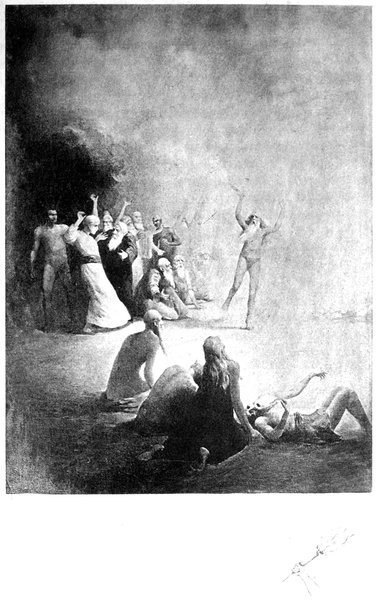
Now when it was the Two Hundred and Twenty-eight Night,
She said, It hath reached me, O auspicious King, that when As'ad
found himself bound and beaten and sore with beating he recalled
his whilome condition of honour and prosperity and dominion
and lordship, and he wept and groaned aloud and recited these
couplets:—
328Stand by the ruined stead and ask of us; ✿ Nor deem we dwell there as was state of us:
The World, that parter, hath departed us; ✿ Yet soothes not hate-full hearts the fate of us:
With whips a cursèd slave-girl scourges us, ✿ And teems her breast with rancorous hate of us:
Allah shall haply deign to unpart our lives, ✿ Chastise our foes, and end this strait of us.
And when As'ad had spoken his poetry, he put out his hand
towards his head and finding there the crust and the cruse full of
brackish water he ate a bittock, just enough to keep life in him, and
drank a little water, but could get no sleep till morning for the
swarms of bugs[383] and lice. As soon as it was day, the slave-girl
came down to him and changed his clothes, which were drenched
with blood and stuck to him, so that his skin came off with the
shirt; wherefor he shrieked aloud and cried, "Alas!" and said,
"O my God, if this be Thy pleasure, increase it upon me! O
Lord, verily Thou art not unmindful of him that oppresseth me; do
Thou then avenge me upon him!" And he groaned and repeated
the following verses:—
Patient, O Allah! to Thy destiny ✿ I bow, suffice me what Thou deign decree:
Patient to bear Thy will, O Lord of me, ✿ Patient to burn on coals of Ghazátree:
They wrong me, visit me with hurt and harm; ✿ Haply Thy grace from them shall set me free:
Far be't, O Lord, from thee to spare the wronger ✿ O Lord of Destiny my hope's in Thee!
And what another saith:—
Bethink thee not of worldly state, ✿ Leave everything to course of Fate;
For oft a thing that irketh thee ✿ Shall in content eventuate;
And oft what strait is shall expand, ✿ And what expanded is wax strait.
Allah will do what wills His will, ✿ So be not thou importunate!
But 'joy the view of coming weal ✿ Shall make forget past bale and bate.
And when he had ended his verse, the slave-girl came down upon
him with blows till he fainted again; and, throwing him a flap of
bread and a gugglet of saltish water, went away and left him sad
329and lonely, bound in chains of iron, with the blood streaming
from his sides and far from those he loved. So he wept and called
to mind his brother and the honours he erst enjoyed——And
Shahrazad perceived the dawn of day and ceased saying her permitted
say.
Now when it was the Two Hundred and Twenty-ninth Night,
She said, It hath reached me, O auspicious King, that As'ad called
to mind his brother and the honours he erst enjoyed; so he wept
and groaned and complained and poured forth tears in floods and
improvised these couplets:—
Easy, O Fate! how long this wrong, this injury, ✿ Robbing each morn and eve my brotherhood fro' me?
Is't not time now thou deem this length sufficiency ✿ Of woes and, O thou Heart of Rock, show clemency?
My friends thou wrongedst when thou madst each enemy ✿ Mock and exult me for thy wrongs, thy tyranny:
My foeman's heart is solaced by the things he saw ✿ In me, of strangerhood and lonely misery:
Suffice thee not what came upon my head of dole, ✿ Friends lost for evermore, eyes wan and pale of blee?
But must in prison cast so narrow there is naught ✿ Save hand to bite, with bitten hand for company;
And tears that tempest down like goodly gift of cloud, ✿ And longing thirst whose fires weet no satiety.
Regretful yearnings, singulfs and unceasing sighs, ✿ Repine, remembrance and pain's very ecstacy:
Desire I suffer sore and melancholy deep, ✿ And I must bide a prey to endless phrenesy:
I find me ne'er a friend who looks with piteous eye, ✿ And seeks my presence to allay my misery:
Say, liveth any intimate with trusty love ✿ Who for mine ills will groan, my sleepless malady?
To whom moan I can make and, peradventure, he ✿ Shall pity eyes that sight of sleep can never see?
The flea and bug suck up my blood, as wight that drinks ✿ Wine from the proffering hand of fair virginity:
Amid the lice my body aye remindeth me ✿ Of orphan's good in Kázi's claw of villainy:
My home's a sepulchre that measures cubits three, ✿ Where pass I morn and eve in chainèd agony:
My wines are tears, my clank of chains takes music's stead; ✿ Cares my dessert of fruit and sorrows are my bed.
330And when he had versed his verse and had prosed his prose, he
again groaned and complained and remembered what he had been
and how he had been parted from his brother. Thus far concerning
him; but as regards his brother Amjad, he awaited As'ad
till mid-day yet he returned not to him: whereupon Amjad's
vitals fluttered, the pangs of parting were sore upon him and he
poured forth abundant tears,——And Shahrazad perceived the
dawn of day and ceased to say her permitted say.
Now when it was the Two Hundred and Thirtieth Night,
She said, It hath reached me, O auspicious King, that when
Amjad awaited his brother As'ad till mid-day and he returned not
to him, Amjad's vitals fluttered; the pangs of parting were sore
upon him and he poured forth abundant tears, exclaiming, "Alas,
my brother! Alas, my friend! Alas my grief! How I feared
me we should be separated!" Then he descended from the
mountain-top with the tears running down his cheeks; and,
entering the city, ceased not walking till he made the market.
He asked the folk the name of the place and concerning its
people and they said, "This is called the City of the Magians,
and its citizens are mostly given to Fire-worshipping in lieu
of the Omnipotent King." Then he enquired of the City of
Ebony and they answered, "Of a truth it is a year's journey
thither by land and six months by sea: it was governed erst by
a King called Armanus; but he took to son-in-law and made
King in his stead a Prince called Kamar al-Zaman distinguished
for justice and munificence, equity and benevolence." When
Amjad heard tell of his father, he groaned and wept and lamented
and knew not whither to go. However, he bought a something of
food and carried it to a retired spot where he sat down thinking
to eat; but, recalling his brother, he fell a-weeping and swallowed
but a morsel to keep breath and body together, and that against
his will. Then he rose and walked about the city, seeking news
of his brother, till he saw a Moslem tailor sitting in his shop;
so he sat down by him and told him his story; whereupon
quoth the tailor, "If he have fallen into the hands of the
Magians, thou shalt hardly see him again: yet it may be Allah
will reunite you twain. But thou, O my brother," he continued,
"wilt thou lodge with me?" Amjad answered, "Yes"; and the
tailor rejoiced at this. So he abode with him many days, what
331while the tailor comforted him and exhorted him to patience and
taught him tailoring, till he became expert in the craft. Now one
day he went forth to the sea-shore and washed his clothes; after
which he entered the bath and put on clean raiment; then he
walked about the city, to divert himself with its sights and
presently there met him on the way a woman of passing beauty
and loveliness, without peer for grace and comeliness. When she
saw him she raised her face-veil and signed to him by moving her
eyebrows and her eyes with luring glances, and versified these
couplets:—
I drooped my glance when seen thee on the way ✿ As though, O slim-waist! felled by Sol's hot ray:
Thou art the fairest fair that e'er appeared, ✿ Fairer to-day than fair of yesterday:
[384]Were Beauty parted, a fifth part of it ✿ With Joseph or a part of fifth would stay;
The rest would fly to thee, thine ownest own; ✿ Be every soul thy sacrifice, I pray!
When Amjad heard these her words, they gladdened his heart
which inclined to her and his bowels yearned towards her and
the hands of love sported with him; so he sighed to her in reply
and spoke these couplets:—
Above the rose of cheek is thorn of lance;
[385] ✿ Who dareth pluck it, rashest
chevisance?
Stretch not thy hand towards it, for night long ✿ Those lances marred because we snatched a glance!
Say her, who tyrant is and tempter too ✿ (Though justice might her tempting power enhance):—
Thy face would add to errors were it veiled; ✿ Unveiled I see its guard hath best of chance!
Eye cannot look upon Sol's naked face; ✿ But can, when mist-cloud dims his countenance:
The honey-hive is held by honey-bee;
[386] ✿ Ask the tribe-guards what wants their vigilance?
An they would slay me, let them end their ire ✿ Rancorous, and grant us freely to advance:
They're not more murderous, an charge the whole ✿ Than charging glance of her who wears the mole.
332And hearing these lines from Amjad she sighed with the deepest
sighs and, signing to him again, repeated these couplets:—
'Tis thou hast trodden coyness-path not I: ✿ Grant me thy favours for the time draws nigh:
O thou who makest morn with light of brow, ✿ And with loosed brow-locks night in lift to stye!
Thine idol-aspect made of me thy slave, ✿ Tempting as temptedst me in days gone by:
'Tis just my liver fry with hottest love: ✿ Who worship fire for God must fire aby:
Thou sellest like of me for worthless price; ✿ If thou must sell, ask high of those who buy.
When Amjad heard these her words he said to her, "Wilt thou
come to my lodging or shall I go with thee to thine?" So she
hung her head in shame to the ground and repeated the words of
Him whose Name be exalted, "Men shall have the pre-eminence
above women, because of those advantages wherein Allah hath
caused the one of them to excel the other."[387] Upon this, Amjad
took the hint——And Shahrazad perceived the dawn of day and
ceased saying her permitted say.
Now when it was the Two Hundred and Thirty-first Night,
She said, It hath reached me, O auspicious King, that Amjad took
the woman's hint and understood that she wished to go with him
whither he was going; he felt himself bounden to find a place
wherein to receive her, but was ashamed to carry her to the house
of his host, the tailor. So he walked on and she walked after him,
and the two ceased not walking from street to street and place to
place, till she was tired and said to him, "O my lord, where is thy
house?" Answered he, "Before us a little way." Then he turned
aside into a handsome by-street, followed by the young woman,
and walked on till he came to the end, when he found it was no
thoroughfare and exclaimed, "There is no Majesty and there is no
Might save in Allah, the Glorious, the Great!" Then raising his
eyes, he saw, at the upper end of the lane a great door with two
stone benches; but it was locked. So Amjad sat down on one of
333the benches and she on the other; and she said to him, "O my
lord, wherefore waitest thou?" He bowed his head awhile to the
ground then raised it and answered, "I am awaiting my Mameluke
who hath the key; for I bade him make me ready meat and drink
and flowers, to deck the wine-service against my return from the
bath." But he said to himself, "Haply the time will be tedious
to her and she will go about her business, leaving me here, when
I will wend my own way." However, as soon as she was weary
of long waiting, she said, "O my lord, thy Mameluke delayeth;
and here are we sitting in the street;" and she arose and took a
stone and went up to the lock. Said Amjad, "Be not in haste,
but have patience till the servant come." However, she hearkened
not to him, but smote the wooden bolt with the stone and broke
it in half, whereupon the door opened. Quoth he, "What possessed
thee to do this deed?" Quoth she, "Pooh, pooh, my lord!
what matter it? Is not the house thy house and thy place?" He
said, "There was no need to break the bolt." Then the damsel
entered, to the confusion of Amjad, who knew not what to do for
fear of the people of the house; but she said to him, "Why dost
thou not enter, O light of mine eyes and core of my heart?"
Replied he, "I hear and obey; but my servant tarrieth long and
I know not if he have done aught of what I bade him and
specially enjoined upon him, or not." Hereupon he entered, sore
in fear of the people of the house, and found himself in a handsome
saloon with four daïs'd recesses, each facing other, and containing
closets and raised seats, all bespread with stuffs of silk
and brocade; and in the midst was a jetting fountain of costly
fashion, on whose margin rested a covered tray of meats, with
a leather tablecloth hanging up and gem-encrusted dishes, full of
fruits and sweet-scented flowers. Hard by stood drinking vessels
and a candlestick with a single wax-candle therein; and the
place was full of precious stuffs and was ranged with chests and
stools, and on each seat lay a parcel of clothes upon which was a
purse full of monies, gold and silver. The floor was paved with
marble and the house bore witness in every part to its owner's
fortune. When Amjad saw all this, he was confounded at his case
and said to himself, "I am a lost man! Verily we are Allah's
and to Allah we are returning!" As for the damsel, when she
sighted the place she rejoiced indeed with a joy nothing could
exceed, and said to him, "By Allah, O my lord, thy servant hath
not failed of his duty; for see, he hath swept the place and
cooked the meat and set on the fruit; and indeed I come at the
334best of times." But he paid no heed to her, his heart being taken
up with fear of the house-folk; and she said, "Fie, O my lord, O
my heart! What aileth thee to stand thus?" Then she sighed;
and, giving him a buss which sounded like the cracking of a
walnut, said, "O my lord, an thou have made an appointment
with other than with me, I will gird my middle and serve her and
thee." Amjad laughed from a heart full of rage and wrath and
came forwards and sat down, panting and saying to himself,
"Alack, mine ill death and doom when the owner of the place
shall return!" Then she seated herself by him and fell to
toying and laughing, whilst Amjad sat careful and frowning,
thinking a thousand thoughts and communing with himself,
"Assuredly the master of the house cannot but come, and then
what shall I say to him? he needs must kill me and my life will
be lost thus foolishly." Presently she rose and, tucking up her
sleeves, took a tray of food on which she laid the cloth and then
set it before Amjad and began to eat, saying, "Eat, O my lord."
So he came forward and ate; but the food was not pleasant to
him; on the contrary he ceased not to look towards the door, till
the damsel had eaten her fill, when she took away the tray of the
meats and, setting on the dessert, fell to eating of the dried fruits.
Then she brought the wine-service and opening the jar, filled a cup
and handed it to Amjad, who took it from her hand saying to himself,
"Ah, ah! and well-away, when the master of the house cometh
and seeth me!"; and he kept his eyes fixed on the threshold,
even with cup in hand. While he was in this case, lo! in came
the master of the house, who was a white slave, one of the chief
men of the city, being Master of the Horse[388] to the King. He had
fitted up this saloon for his pleasures, that he might make merry
therein and be private with whom he would, and he had that day
bidden a youth whom he loved and had made this entertainment
for him. Now the name of this slave was Bahádur,[389] and he was
open of hand, generous, munificent and fain of alms-giving and
charitable works.——And Shahzarad perceived the dawn of day
and ceased to say her permitted say.
335
Now when it was the Two Hundred and Thirty-second Night,
She said, It hath reached me, O auspicious King, that when
Bahadur, the Master of the Horse and the owner of the house,
came to the door of the saloon and found it open, he entered
slowly and softly and looking in, with head advanced and outstretched
neck, saw Amjad and the girl sitting before the dish of
fruit and the wine-jar in front of them. Now Amjad at that
moment had the cup in his hand and his face turned to the door;
and when his glance met Bahadur's eyes his hue turned pale yellow
and his side-muscles quivered, so seeing his trouble Bahadur signed
to him with his finger on his lips, as much as to say, "Be silent
and come hither to me." Whereupon he set down the cup and
rose and the damsel cried, "Whither away?" He shook his head
and, signing to her that he wished to make water, went out into
the passage barefoot. Now when he saw Bahadur he knew him
for the master of the house; so he hastened to him and, kissing
his hands, said to him, "Allah upon thee, O my lord, ere thou do
me a hurt, hear what I have to say." Then he told him who he
was from first to last and acquainted him with what caused him to
quit his native land and royal state, and how he had not entered
his house of his free will, but that it was the girl who had broken
the lock-bolt and done all this.[390] When Bahadur heard his story
and knew that he was a King's son, he felt for him and, taking
compassion on him, said, "Hearken to me, O Amjad, and do what
I bid thee and I will guarantee thy safety from that thou fearest;
but, if thou cross me, I will kill thee." Amjad replied, "Command
me as thou wilt: I will not gainsay thee in aught; no, never, for
I am the freedman of thy bounty." Rejoined Bahadur, "Then go
back forthwith into the saloon, sit down in thy place and be at
peace and at thine ease; I will presently come in to thee, and
when thou seest me (remember my name is Bahadur) do thou
revile me and rail at me, saying:—What made thee tarry till so
late? And accept no excuse from me; nay, so far from it, rise
and beat me; and, if thou spare me, I will do away thy life.
Enter now and make merry and whatsoever thou seekest of me at
336this time I will bring thee forthwith; and do thou spend this
night as thou wilt and on the morrow wend thy way. This I do
in honour of thy strangerhood, for I love the stranger and hold
myself bounden to do him devoir." So Amjad kissed his hand,
and, returning to the saloon with his face clad in its natural white
and red, at once said to the damsel, "O my mistress, thy presence
hath gladdened this thine own place and ours is indeed a blessed
night." Quoth the girl, "Verily I see a wonderful change in thee,
that thou now welcomest me so cordially!" So Amjad answered,
"By Allah, O my lady, methought my servant Bahadur had robbed
me of some necklaces of jewels, worth ten thousand dinars each;
however, when I went out but now in concern for this, I sought for
them and found them in their place. I know not why the slave
tarrieth so long and needs must I punish him for it." She was
satisfied with his answer, and they sported and drank and made
merry and ceased not to be so till near sundown, when Bahadur
came in to them, having changed his clothes and girt his middle
and put on shoes, such as are worn of Mamelukes. He saluted
and kissed the ground; then held his hands behind him and stood,
with his head hanging down, as one who confesseth to a fault. So
Amjad looked at him with angry eyes and asked, "Why hast thou
tarried till now, O most pestilent of slaves?" Answered Bahadur,
"O my lord, I was busy washing my clothes and knew not of thy
being here; for our appointed time was nightfall and not day-tide."
But Amjad cried out at him, saying, "Thou liest, O vilest
of slaves! By Allah, I must needs beat thee." So he rose and,
throwing Bahadur prone on the ground, took a stick and beat him
gently; but the damsel sprang up and, snatching the stick from
his hand, came down upon Bahadur so lustily, that in extreme
pain the tears ran from his eyes and he ground his teeth together
and called out for succour; whilst Amjad cried out to the girl
"Don't"; and she cried out, "Let me satisfy my anger upon
him!" till at last he pulled the stick out of her hand and
pushed her away. So Bahadur rose and, wiping away his tears
from his cheeks, waited upon them the while; after which he
swept the hall and lighted the lamps; but as often as he went
in and out, the lady abused him and cursed him till Amjad was
wroth with her and said, "For Almighty Allah's sake leave my
Mameluke; he is not used to this." Then they sat and ceased
not eating and drinking (and Bahadur waiting upon them) till
midnight when, being weary with service and beating, he fell
337asleep in the midst of the hall and snored and snorted; whereupon
the damsel, who was drunken with wine, said to Amjad,
"Arise, take the sword hanging yonder and cut me off this slave's
head; and, if thou do it not, I will be the death of thee!" "What
possesseth thee to slay my slave?" asked Amjad; and she answered,
"Our joyaunce will not be complete but by his death. If
thou wilt not kill him, I will do it myself." Quoth Amjad, "By
Allah's rights to thee, do not this thing!" Quoth she, "It must
perforce be;" and, taking down the sword, drew it and made at
Badahur to kill him; but Amjad said in his mind, "This man hath
entreated us courteously and sheltered us and done us kindness and
made himself my slave: shall we requite him by slaughtering him?
This shall never be!" Then he said to the woman, "If my Mameluke
must be killed, better I should kill him than thou." So saying, he
took the sword from her and, raising his hand, smote her on the
neck and made her head fly from her body. It fell upon Bahadur
who awoke and sat up and opened his eyes, when he saw Amjad
standing by him and in his hand the sword dyed with blood, and
the damsel lying dead. He enquired what had passed, and Amjad
told him all she had said, adding, "Nothing would satisfy her but
she must slay thee; and this is her reward." Then Bahadur rose
and, kissing the Prince's hand, said to him, "Would to Heaven
thou hadst spared her! but now there is nothing for it but to rid
us of her without stay or delay, before the day break." Then he
girded his loins and took the body, wrapped it in an Abá-cloak
and, laying it in a large basket of palm-leaves, he shouldered it
saying, "Thou art a stranger here and knowest no one: so sit thou
in this place and await my return till daybreak. If I come back
to thee, I will assuredly do thee great good service and use my
endeavours to have news of thy brother; but if by sunrise I return
not, know that all is over with me; and peace be on thee, and the
house and all it containeth of stuffs and money are thine." Then
he fared forth from the saloon bearing the basket; and, threading
the streets, he made for the salt sea, thinking to throw it therein:
but as he drew near the shore, he turned and saw that the Chief of
Police and his officers had ranged themselves around him; and, on
recognising him, they wondered and opened the basket, wherein
they found the slain woman. So they seized him and laid him in
bilboes all that night till the morning, when they carried him and
the basket, as it was, to the King and reported the case. The
King was sore enraged when he looked upon the slain and said to
338Bahadur, "Woe to thee! Thou art always so doing; thou killest
folk and castest them into the sea and takest their goods. How
many murders hast thou done ere this?" Thereupon Bahadur
hung his head——And Shahrazad perceived the dawn of day and
ceased saying her permitted say.
Now when it was the Two Hundred and Thirty-third Night,
She said, It hath reached me, O auspicious King, that Bahadur
hung down his head groundwards before the King, who cried out
at him, saying, "Woe to thee! Who killed this girl?" He replied,
"O my lord! I killed her, and there is no Majesty and there is no
Might save in Allah, the Glorious, the Great!"[391] So the King in
his anger, commanded to hang him; and the hangman went down
with him by the King's commandment, and the Chief of Police
accompanied him with a crier who called upon all the folk to witness
the execution of Bahadur, the King's Master of the Horse;
and on this wise they paraded him through the main streets and
the market-streets. This is how it fared with Bahadur; but as
regards Amjad, he awaited his host's return till the day broke and
the sun rose, and when he saw that he came not, he exclaimed,
"There is no Majesty and there is no Might save in Allah, the
Glorious, the Great! Would I knew what is become of him?"
And, as he sat musing behold, he heard the crier proclaiming
Bahadur's sentence and bidding the people to see the spectacle of
his hanging at mid-day; whereat he wept and exclaimed, "Verily,
we are Allah's and to Him we are returning! He meaneth to
sacrifice himself unjustly for my sake, when I it was who slew her.
By Allah, this shall never be!" Then he went from the saloon
and, shutting the door after him, hurriedly threaded the streets till
he overtook Bahadur, when he stood before the Chief of Police
and said to him, "O my lord, put not Bahadur to death, for he is
innocent. By Allah, none killed her but I." Now when the
Captain of Police heard these words, he took them both and,
carrying them before the King, acquainted him with what Amjad
had said; whereupon he looked at the Prince and asked him,
"Didst thou kill the damsel?" He answered, "Yes" and the
King said, "Tell me why thou killedst her, and speak the truth."
339Replied Amjad, "O King, it is indeed a marvellous event and a
wondrous matter that hath befallen me: were it graven with
needles on the eye-corners, it would serve as a warner to whoso
would be warned!" Then he told him his whole story and
informed him of all that had befallen him and his brother, first and
last; whereat the King was much startled and surprised and said
to him, "Know that now I find thee to be excusable; but list, O
youth! Wilt thou be my Wazír?" "Hearkening and obedience,"
answered Amjad; whereupon the King bestowed magnificent
dresses of honour on him and Bahadur and gave him a handsome
house, with eunuchs and officers and all things needful, appointing
him stipends and allowances and bidding him make search for his
brother As'ad. So Amjad sat down in the seat of the Wazirate
and governed and did justice and invested and deposed and took
and gave. Moreover, he sent out a crier to cry his brother
throughout the city, and for many days made proclamation in the
main streets and market-streets, but heard no news of As'ad nor
happened on any trace of him. Such was his case; but as regards
his brother, the Magi ceased not to torture As'ad night and day
and eve and morn for a whole year's space, till their festival drew
near, when the old man Bahram[392] made ready for the voyage and
fitted out a ship for himself.——And Shahrazad perceived the
dawn of day and ceased to say her permitted say.
Now when it was the Two Hundred and Thirty-fourth Night,
She said, It hath reached me, O auspicious King, that Bahram, the
Magian, having fitted out a ship for the voyage, took As'ad and
put him in a chest which he locked and had it transported on
board. Now it so came to pass that, at the very time of shipping
it, Amjad was standing to divert himself by looking upon the sea;
and when he saw the men carrying the gear and shipping it, his
heart throbbed and he called to his pages to bring him his beast.
Then, mounting with a company of his officers, he rode down to
the sea-side and halted before the Magian's ship, which he commanded
his men to board and search. They did his bidding, and
boarded the vessel and rummaged in every part, but found nothing;
340so they returned and told Amjad, who mounted again and
rode back. But he felt troubled in mind; and when he reached
his place and entered his palace, he cast his eyes on the wall and
saw written thereon two lines which were these couplets:——
"My friends! if ye are banisht from mine eyes, ✿ From heart and mind ye ne'er go wandering:
But ye have left me in my woe, and rob ✿ Rest from my eyelids while ye are slumbering."
And seeing them Amjad thought of his brother and wept. Such
was his case; but as for Bahram, the Magian, he embarked and
shouted and bawled to his crew to make sail in all haste. So they
shook out the sails and departed and ceased not to fare on many
days and nights; and, every other day, Bahram took out As'ad
and gave him a bit of bread and made him drink a sup of water,
till they drew near the Mountain of Fire. Then there came out
on them a storm-wind and the sea rose against them, so that the
ship was driven out of her course till she took a wrong line and
fell into strange waters; and, at last they came in sight of a city
builded upon the shore, with a castle whose windows overlooked
the main. Now the ruler of this city was a Queen called
Marjánah, and the captain said to Bahram, "O my lord, we have
strayed from our course and come to the island of Queen
Marjanah, who is a devout Moslemah; and, if she know that we
are Magians, she will take our ship and slay us to the last man.
Yet needs must we put in here to rest and refit." Quoth Bahram,
"Right is thy recking, and whatso thou seest fit that will I do!"
Said the ship-master, "If the Queen summon us and question us,
how shall we answer her?"; and Bahram replied, "Let us clothe
this Moslem we have with us in a Mameluke's habit and carry him
ashore with us, so that when the Queen sees him, she will suppose
and say, This is a slave. As for me I will tell her that I am a
slave-dealer[393] who buys and sells white slaves, and that I had with
me many but have sold all save this one, whom I retained to keep
341my accounts, for he can read and write." And the captain said,
"This device should serve." Presently they reached the city and
slackened sail and cast the anchors; and the ship lay still, when
behold, Queen Marjanah came down to them, attended by her
guards and, halting before the vessel, called out to the captain,
who landed and kissed the ground before her. Quoth she, "What
is the lading of this thy ship and whom hast thou with thee?"
Quoth he, "O Queen of the Age, I have with me a merchant who
dealeth in slaves." And she said, "Hither with him to me";
whereupon Bahram came ashore to her, with As'ad walking behind
him in a slave's habit, and kissed the earth before her. She
asked, "What is thy condition?"; and he answered, "I am a
dealer in chattels." Then she looked at As'ad and, taking him
for a Mameluke, asked him, "What is thy name, O youth?"
He answered, "Dost thou ask my present or my former name?"
"Hast thou then two names?" enquired she, and he replied (and
indeed his voice was choked with tears), "Yes; my name aforetime
was Al-As'ad, the most happy, but now it is Al-Mu'tarr—Miserrimus."
Her heart inclined to him and she said, "Canst thou
write?" "Yes," answered he, and she gave him ink-case and reed-pen
and paper and said to him, "Write somewhat that I may see
it." So he wrote these two couplets:—
What can the slave do when pursued by Fate, ✿ O justest Judge! whatever be his state?
[394]Whom God throws hand-bound in the depths and says, ✿ Beware lest water should thy body wet?
[395]
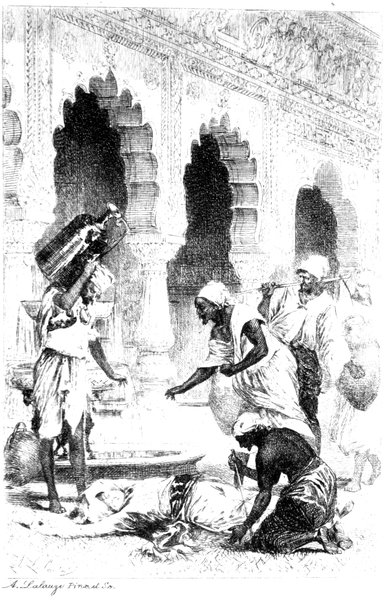
Now when she read these lines, she had ruth upon him and said to
342Bahram, "Sell me this slave." He replied, "O my lady, I cannot
sell him, for I have parted with all the rest and none is left with
me but he." Quoth the Queen, "I must need have him of thee,
either by sale or way of gift." But quoth Bahram, "I will neither
sell him nor give him." Whereat she was wroth and, taking As'ad
by the hand, carried him up to the castle and sent to Bahram,
saying, "Except thou set sail and depart our city this very night,
I will seize all thy goods and break up thy ship." Now when the
message reached the Magian, he grieved with sore grief and cried,
"Verily this voyage is on no wise to be commended." Then he
arose and made ready and took all he needed and awaited the
coming of the night to resume his voyage, saying to the sailors,
"Provide yourselves with your things and fill your water-skins,
that we may set sail at the last of the night." So the sailors did
their business and awaited the coming of darkness. Such was
their case; but as regards Queen Marjanah, when she had brought
As'ad into the castle, she opened the casements overlooking the
sea and bade her handmaids bring food. They set food before
As'ad and herself and both ate, after which the Queen called for
wine——And Shahrazad perceived the dawn of day and ceased
saying her permitted say.
Now when it was the Two Hundred and Thirty-fifth Night,
She said, It hath reached me, O auspicious King, that when Queen
Marjanah bade her handmaids bring wine and they set it before
her, she fell to drinking with As'ad. Now, Allah (be He extolled
and exalted!) filled her heart with love for the Prince and she
kept filling his cup and handing it to him till his reason fled; and
presently he rose and left the hall to satisfy a call of nature. As
he passed out of the saloon he saw an open door through which
he went and walked on till his walk brought him to a vast garden
full of all manner fruits and flowers; and, sitting down under a
tree, he did his occasion. Then he rose and went up to a jetting
fountain in the garden and made the lesser ablution and washed
his hands and face, after which he would have risen to go away;
but the air smote him and he fell back, with his clothes undone
and slept, and night overcame him thus. So far concerning him;
but as concerns Bahram, the night being come, he cried out to his
343crew, saying, "Set sail and let us away!"; and they answered,
"We hear and obey, but wait till we fill our water-skins and then
we will set sail." So they landed with their water-skins and went
round about the castle, and found nothing but garden-walls:
whereupon they climbed over into the garden and followed the
track of feet, which led them to the fountain; and there they
found As'ad lying on his back. They knew him and were glad to
find him; and, after filling their water-skins, they bore him off and
climbed the wall again with him and carried him back in haste
to Bahram to whom they said, "Hear the good tidings of thy
winning thy wish; and gladden thy heart and beat thy drums
and sound thy pipes; for thy prisoner, whom Queen Marjanah
took from thee by force, we have found and brought back to
thee"; and they threw As'ad down before him. When Bahram
saw him, his heart leapt for joy and his breast swelled with gladness.
Then he bestowed largesse on the sailors and bade them set
sail in haste. So they sailed forthright, intending to make the
Mountain of Fire and stayed not their course till the morning.
This is how it fared with them; but as regards Queen Marjanah,
she abode awhile, after As'ad went down from her, awaiting his
return in vain for he came not; thereupon she rose and sought
him, yet found no trace of him. Then she bade her women light
flambeaux and look for him, whilst she went forth in person
and, seeing the garden-door open, knew that he had gone thither.
So she went out into the garden and finding his sandals lying by
the fountain, searched the place in every part, but came upon no
sign of him; and yet she gave not over the search till morning.
Then she enquired for the ship and they told her, "The vessel set
sail in the first watch of the night"; wherefor she knew that
they had taken As'ad with them, and this was grievous to her
and she was sore angered. She bade equip ten great ships
forthwith and, making ready for fight, embarked in one of the ten
with her Mamelukes and slave-women and men-at-arms, all splendidly
accoutred and weaponed for war. They spread the sails and
she said to the captains, "If you overtake the Magian's ship, ye
shall have of me dresses of honour and largesse of money; but if
you fail so to do, I will slay you to the last man." Whereat fear
and great hope animated the crews and they sailed all that day
and the night and the second day and the third day till, on the
fourth they sighted the ship of Bahram, the Magian, and before
344evening fell the Queen's squadron had surrounded it on all sides,
just as Bahram had taken As'ad forth of the chest and was beating
and torturing him, whilst the Prince cried out for help and
deliverance, but found neither helper nor deliverer: and the
grievous bastinado sorely tormented him. Now while so occupied,
Bahram chanced to look up and, seeing himself encompassed
by the Queen's ships, as the white of the eye encompasseth the
black, he gave himself up for lost and groaned and said, "Woe to
thee, O As'ad! This is all out of thy head." Then taking him
by the hand he bade his men throw him overboard and cried, "By
Allah I will slay thee before I die myself!" So they carried him
along by the hands and feet and cast him into the sea and he
sank; but Allah (be He extolled and exalted!) willed that his life
be saved and that his doom be deferred; so He caused him to sink
and rise again and he struck out with his hands and feet, till the
Almighty gave him relief, and sent him deliverance; and the waves
bore him far from the Magian's ship and threw him ashore. He
landed, scarce crediting his escape, and once more on land he
doffed his clothes and wrung them and spread them out to dry;
whilst he sat naked and weeping over his condition, and bewailing
his calamities and mortal dangers, and captivity and strangerhood.
And presently he repeated these two couplets:—
Allah, my patience fails: I have no ward; ✿ My breast is straitened and clean cut my cord;
To whom shall wretched slave of case complain, ✿ Save to his Lord? O thou of lords the Lord!
Then, having ended his verse, he rose and donned his clothes but
he knew not whither to go or whence to come; so he fed on the
herbs of the earth and the fruits of the trees and he drank of the
streams, and fared on night and day till he came in sight of a city;
whereupon he rejoiced and hastened his pace; but when he reached
it——And Shahrazad perceived the dawn of day and ceased to
say her permitted say.
Now when it was the Two Hundred and Thirty-sixth Night,
She said, it hath reached me, O auspicious King, that when he
reached the city the shades of evening closed around him and the
345gates were shut. Now by the decrees of Fate and man's lot this
was the very city wherein he had been a prisoner and to whose
King his brother Amjad was Minister. When As'ad saw the gate
was locked, he turned back and made for the burial-ground, where
finding a tomb without a door, he entered therein and lay down
and fell asleep, with his face covered by his long sleeve.[396] Meanwhile,
Queen Marjanah, coming up with Bahram's ship, questioned
him of As'ad. Now the Magian, when Queen Marjanah overtook
him with her ships, baffled her by his artifice and gramarye; swearing
to her that he was not with him and that he knew nothing of
him. She searched the ship, but found no trace of her friend, so
she took Bahram and, carrying him back to her castle, would have
put him to death, but he ransomed himself from her with all his
good and his ship; and she released him and his men. They
went forth from her hardly believing in their deliverance, and
fared on ten days' journey till they came to their own city and
found the gate shut, it being eventide. So they made for the
burial-ground, thinking to lie the night there and, going round
about the tombs, as Fate and Fortune would have it, saw the
building wherein As'ad lay wide open; whereat Bahram marvelled
and said, "I must look into this sepulchre." Then
he entered and found As'ad lying in a corner fast asleep, with
his head covered by his sleeve; so he raised his head, and looking
in his face, knew him for the man on whose account he
had lost his goods and his ship, and cried, "What! art thou yet
alive?" Then he bound him and gagged him without further
parley, and carried him to his house, where he clapped heavy
shackles on his feet and lowered him into the underground dungeon
aforesaid prepared for the tormenting of Moslems, and he
bade his daughter by name Bostán,[397] torture him night and day,
till the next year, when they would again visit the Mountain of
Fire and there offer him up as a sacrifice. Then he beat him
grievously and locking the dungeon door upon him, gave the keys
to his daughter. By and by, Bostan opened the door and went
346down to beat him, but finding him a comely youth and a sweet-faced
with arched brows and eyes black with nature's Kohl,[398] she fell in
love with him and asked him, "What is thy name?" "My name
is As'ad," answered he; whereat she cried, "Mayst thou indeed
be happy as thy name,[399] and happy be thy days! Thou deservest
not torture and blows, and I see thou hast been injuriously entreated."
And she comforted him with kind words and loosed
his bonds. Then she questioned him of the religion of Al-Islam
and he told her that it was the true and right Faith and that our
lord Mohammed had approved himself by surpassing miracles[400]
and signs manifest, and that fire-worship is harmful and not
profitable; and he went on to expound to her the tenets of
Al-Islam till she was persuaded and the love of the True Faith
entered her heart. Then, as Almighty Allah had mixed up with
her being a fond affection for As'ad, she pronounced the Two
Testimonies[401] of the Faith and became of the people of felicity.
After this, she brought him meat and drink and talked with him
and they prayed together: moreover, she made him chicken stews
and fed him therewith, till he regained strength and his sickness
left him and he was restored to his former health. Such things
befel him with the daughter of Bahram, the Magian; and so it
happened that one day she left him and stood at the house-door
when behold, she heard the crier crying aloud and saying, "Whoso
hath with him a handsome young man, whose favour is thus and
thus, and bringeth him forth, shall have all he seeketh of money;
347but if any have him and deny it, he shall be hanged over his own
door and his property shall be plundered and his blood go for
naught." Now As'ad had acquainted Bostan bint Bahram with
his whole history: so, when she heard the crier, she knew that it
was he who was sought for and, going down to him, told him the
news. Then he fared forth and made for the mansion of the
Wazir, whom, when As'ad saw, he exclaimed, "By Allah, this
Minister is my brother Amjad!" Then he went up (and the
damsel walking behind him) to the Palace, where he again saw
his brother, and threw himself upon him; whereupon Amjad
also knew him and fell upon his neck and they embraced each
other, whilst the Wazir's Mamelukes dismounted and stood round
them. They lay awhile insensible and, when they came to themselves,
Amjad took his brother and carried him to the Sultan, to
whom he related the whole story, and the Sultan charged him to
plunder Bahram's house.——And Shahrazad perceived the dawn
of day and ceased saying her permitted say.
Now when it was the Two Hundred and Thirty-Seventh Night,
She said, It hath reached me, O auspicious King, that the Sultan
ordered Amjad to plunder Bahram's house and to hang its owner.
So Amjad despatched thither for that purpose a company of men,
who sacked the house and took Bahram and brought his daughter
to the Wazir by whom she was received with all honour, for As'ad
had told his brother the torments he had suffered and the kindness
she had done him. Thereupon Amjad related in his turn
to As'ad all that had passed between himself and the damsel;
and how he had escaped hanging and had become Wazir; and
they made moan, each to other, of the anguish they had suffered
for separation. Then the Sultan summoned Bahram and bade
strike off his head; but he said, "O most mighty King, art thou
indeed resolved to put me to death?" Replied the King, "Yes,
except thou save thyself by becoming a Moslem." Quoth Bahram,
"O King, bear with me a little while!" Then he bowed
his head groundwards and presently raising it again, made profession
of The Faith and islamised at the hands of the Sultan.
They all rejoiced at his conversion and Amjad and As'ad told
him all that had befallen them, whereat he wondered and said,
348"O my lords, make ready for the journey and I will depart with
you and carry you back to your father's court in a ship." At
this they rejoiced and wept with sore weeping; but he said, "O
my lords, weep not for your departure, for it shall reunite you with
those you love, even as were Ni'amah and Naomi." "And what
befel Ni'amah and Naomi?" asked they. "They tell," replied
Bahram, (but Allah alone is All-knowing) the following tale of