Terminal Essay. — PRELIMINARY. — § I THE ORIGIN OF THE NIGHTS. — A.—The Birthplace. — B.— The Date. — C. — § II. THE NIGHTS IN EUROPE. — § III. THE MATTER AND THE MANNER OF THE NIGHTS. — A.— The Matter. — B.— The Manner of The Nights. — § IV. SOCIAL CONDITION. — A.— Al-Islam. — B.— Woman. — C.— Pornography. — D.— Pederasty. — § V ON THE PROSE-RHYME AND THE POETRY OF THE NIGHTS. — A.— The Saj’a. — B.— The Verse.
63
The reader who has reached this terminal stage will hardly
require my assurance that he has seen the mediæval Arab at his
best and, perhaps, at his worst. In glancing over the myriad
pictures of this panorama, those who can discern the soul of goodness
in things evil will note the true nobility of the Moslem’s
mind in the Moyen Age, and the cleanliness of his life from cradle
to grave. As a child he is devoted to his parents, fond of his
comrades and respectful to his “pastors and masters,” even schoolmasters.
As a lad he prepares for manhood with a will and
this training occupies him throughout youth-tide: he is a
gentleman in manners without awkwardness, vulgar astonishment
or mauvaise-honte. As a man he is high-spirited and energetic,
always ready to fight for his Sultan, his country and, especially,
his Faith: courteous and affable, rarely failing in temperance of
mind and self-respect, self-control and self-command: hospitable
to the stranger, attached to his fellow-citizens, submissive to
superiors and kindly to inferiors—if such classes exist: Eastern
despotisms have arrived nearer the idea of equality and fraternity
than any republic yet invented. As a friend he proves a model
to the Damons and Pythiases: as a lover an exemplar to Don
Quijote without the noble old Caballero’s touch of eccentricity. As
a knight he is the mirror of chivalry, doing battle for the weak and
debelling the strong, while ever “defending the honour of women.”
As a husband his patriarchal position causes him to be loved and
64fondly loved by more than one wife: as a father affection for his
children rules his life: he is domestic in the highest degree and he
finds few pleasures beyond the bosom of his family. Lastly, his
death is simple, path ethic and edifying as the life which led to it.
Considered in a higher phase, the mediæval Moslem mind displays,
like the ancient Egyptian, a most exalted moral idea, the
deepest reverence for all things connected with his religion and a
sublime conception of the Unity and Omnipotence of the Deity.
Noteworthy too is a proud resignation to the decrees of Fate and
Fortune (Kazá wa Kadar), of Destiny and Predestination—a
feature which ennobles the low aspect of Al-Islam even in these
her days of comparative degeneration and local decay. Hence his
moderation in prosperity, his fortitude in adversity, his dignity,
his perfect self-dominance and, lastly, his lofty quietism which
sounds the true heroic ring. This again is softened and tempered
by a simple faith in the supremacy of Love over Fear, an unbounded
humanity and charity for the poor and helpless: an unconditional
forgiveness of the direst injuries (“which is the note of
the noble”); a generosity and liberality which at times seem
impossible and an enthusiasm for universal benevolence and
beneficence which, exalting kindly deeds done to man above every
form of holiness, constitute the root and base of Oriental, nay, of
all, courtesy. And the whole is crowned by pure trust and natural
confidence in the progress and perfectability of human nature,
which he exalts instead of degrading; this he holds to be the
foundation-stone of society and indeed the very purpose of its existence.
His Pessimism resembles far more the optimism which
the so-called Books of Moses borrowed from the Ancient Copt
than the mournful and melancholy creed of the true Pessimist,
as Solomon the Hebrew, the Indian Buddhist and the esoteric
European imitators of Buddhism. He cannot but sigh when contemplating
the sin and sorrow, the pathos and bathos of the
world; and feel the pity of it, with its shifts and changes ending
65in nothingness, its scanty happiness and its copious misery. But
his melancholy is expressed in—
“A voice divinely sweet, a voice no less
Divinely sad.”
Nor does he mourn as they mourn who have no hope: he has
an absolute conviction in future compensation; and, meanwhile,
his lively poetic impulse, the poetry of ideas, not of formal verse,
and his radiant innate idealism breathe a soul into the merest
matter of squalid work-a-day life and awaken the sweetest
harmonies of Nature epitomised in Humanity.
Such was the Moslem at a time when “the dark clouds of
ignorance and superstition hung so thick on the intellectual
horizon of Europe as to exclude every ray of learning that darted
from the East and when all that was polite or elegant in literature
was classed among the Studia Arabum.”[126]
Nor is the shady side of the picture less notable. Our Arab at
his worst is a mere barbarian who has not forgotten the savage.
He is a model mixture of childishness and astuteness, of simplicity
and cunning, concealing levity of mind under solemnity of aspect.
His stolid instinctive conservatism grovels before the tyrant rule of
routine, despite that turbulent and licentious independence which
ever suggests revolt against the ruler: his mental torpidity,
founded upon physical indolence, renders immediate action and
all manner of exertion distasteful: his conscious weakness shows
itself in overweening arrogance and intolerance. His crass and
self-satisfied ignorance makes him glorify the most ignoble superstitions,
while acts of revolting savagery are the natural results of
a malignant fanaticism and a furious hatred of every creed beyond
the pale of Al-Islam.
It must be confessed that these contrasts make a curious and
interesting tout ensemble.
66
Here occur the questions, Where and When was written and to
Whom do we owe a prose-poem which, like the dramatic epos of
Herodotus, has no equal?
I proceed to lay before the reader a procès-verbal of the
sundry pleadings already in court as concisely as is compatible
with intelligibility, furnishing him with references to original
authorities and warning him that a fully-detailed account would
fill a volume. Even my own reasons for decidedly taking one
side and rejecting the other must be stated briefly. And before
entering upon this subject I would distribute the prose-matter
of our Recueil of Folk-lore under three heads.
1. The Apologue or Beast-fable proper, a theme which may
be of any age, as it is found in the hieroglyphs and in the
cuneiforms.
2. The Fairy-tale, as for brevity we may term the stories
based upon supernatural agency: this was a favourite with
olden Persia; and Mohammed, most austere and puritanical of
the “Prophets,” strongly objected to it because preferred by the
more sensible of his converts to the dry legends of the Talmud
and the Koran, quite as fabulous without the halo and glamour
of fancy.
3. The Histories and historical anecdotes, analects, and acroamata,
in which the names, when not used anachronistically by
the editor or copier, give unerring data for the earliest date à
quo and which, by the mode of treatment, suggest the latest.
67Each of these constituents will require further notice when
the subject-matter of the book is discussed. The metrical portion
of The Nights may also be divided into three categories,
viz.:—
1. The oldest and classical poetry of the Arabs, e.g. the
various quotations from the “Suspended Poems.”
2. The mediæval, beginning with the laureates of Al-Rashid’s
court, such as Al-Asma’í and Abú Nowás; and ending with
Al-Harírí A.H. 446–516 = 1030–1100.
3. The modern quotations and the pièces de circonstance by
the editors or copyists of the Compilation.[127]
Upon the metrical portion also further notices must be offered
at the end of this Essay.
In considering the unde derivatur of The Nights we must
carefully separate subject-matter from language-manner. The
neglect of such essential difference has caused the remark, “It
is not a little curious that the origin of a work which has been
68known to Europe and has been studied by many during nearly
two centuries, should still be so mysterious, and that students
have failed in all attempts to detect the secret.” Hence also
the chief authorities at once branched off into two directions.
One held the work to be practically Persian: the other as persistently
declared it to be purely Arab.
Professor Galland, in his Epistle Dedicatory to the Marquise
d’O, daughter of his patron M. de Guillerague, showed his
literary acumen and unfailing sagacity by deriving The Nights
from India viâ Persia; and held that they had been reduced to
their present shape by an Auteur Arabe inconnu. This reference
to India, also learnedly advocated by M: Langlès, was
inevitable in those days: it had not then been proved that
India owed all her literature to far older civilisations and even
that her alphabet the Nágari, erroneously called Devanágari,
was derived through Phœnicia and Himyar-land from Ancient
Egypt. So Europe was contented to compare The Nights
with the Fables of Pilpay for upwards of a century. At last
the Pehlevi or old Iranian origin of the work found an able
and strenuous advocate in Baron von Hammer-Purgstall[128] who
worthily continued what Galland had begun: although a most
inexact writer, he was extensively read in Oriental history and
poetry. His contention was that the book is an Arabisation
of the Persian Hazár Afsánah or Thousand Tales and he
proved his point.
Von Hammer began by summoning into Court the “Herodotus
of the Arabs, (Ali Abú al-Hasan) Al-Mas’údi who, in A.H. 333
(= 944) about one generation before the founding of Cairo,
published at Bassorah the first edition of his far-famed Murúj
al-Dahab wa Ma’ádin al-Jauhar, Meads of Gold and Mines of
69Gems. The Styrian Orientalist[129] quotes with sundry misprints[130] an
ampler version of a passage in Chapter lxviii., which is abbreviated
in the French translation of M. C. Barbier de Meynard.[131]
“And, indeed, many men well acquainted with their (Arab)
histories[132] opine that the stories above mentioned and other
trifles were strung together by men who commended themselves
to the Kings by relating them, and who found favour with their
contemporaries by committing them to memory and by reciting
them. Of such fashion[133] is the fashion of the books which have
come down to us translated from the Persian (Fárasiyah), the
Indian (Hindíyah),[134] and the Græco-Roman (Rúmíyah)[135]: we
have noted the judgment which should be passed upon compositions
of this nature. Such is the book entituled Hazár
Afsánah or The Thousand Tales, which word in Arabic signifies
Khuráfah (Facetiæ): it is known to the public under the name of
The Book of a Thousand Nights and a Night, (Kitab Alf Laylah
wa Laylah).[136] This is an history of a King and his Wazir, the
minister’s daughter and a slave-girl (járiyah) who are named
Shírzád (lion-born) and Dínár-zád (ducat-born).[137] Such also is
70the Tale of Farzah,[138] (alii Firza), and Simás, containing details
concerning the Kings and Wazirs of Hind: the Book of Al-Sindibád[139]
and others of a similar stamp.”
Von Hammer adds, “quoting chapt. cxvi, of Al-Mas’údi that
Al-Mansúr (second Abbaside A.H. 136–158 = 754–775, and
grandfather of Al-Rashíd) caused many translations of Greek and
Latin, Syriac and Persian (Pehlevi) works to be made into Arabic,
specifying the Kalílah wa Damnah,”[140] the Fables of Bidpái
(Pilpay), the Logic of Aristotle, the Geography of Ptolemy and the
Elements of Euclid. Hence he concludes “L’original des Mille et
une Nuits * * * selon toute vraisemblance, a été traduit au
temps du Khalife Mansur, c’est-à-dire trente ans avant le règne
du Khalife Haroun al-Raschid, qui, par la suite, devait lui-même
jouer un si grand rôle dans ces histoires.” He also notes that,
about a century after Al-Mas’udi had mentioned the Hazár
Afsánah, it was versified and probably remodelled by one “Rásti,”
the Takhallus or nom de plume of a bard at the Court of
71Mahmúd, the Ghaznevite Sultan who, after a reign of thirty-three
years, ob. A.D. 1030.[141]
Von Hammer some twelve years afterwards (Journ. Asiat.
August, 1839) brought forward, in his “Note sur l’origine Persane
des Mille et une Nuits,” a second and an even more important
witness: this was the famous Kitab al-Fihrist,[142] or Index List of
(Arabic) works, written (in A.H. 387 = 987) by Mohammed bin
Is’hák al-Nadím (cup-companion or equerry), “popularly known
as Ebou Yacoub el-Werrek.”[143] The following is an extract (p. 304)
from the Eighth Discourse which consists of three arts (funún).[144]
“The first section on the history of the confabulatores nocturni
(tellers of night tales) and the relaters of fanciful adventures,
together with the names of books treating upon such subjects.
Mohammed ibn Is’hák saith:—The first who indited themes of
imagination and made books of them, consigning these works to
the libraries, and who ordered some of them as though related by
the tongues of brute beasts, were the palæo-Persians (and the
Kings of the First Dynasty). The Ashkanian Kings of the Third
Dynasty appended others to them and they were augmented and
amplified in the days of the Sassanides” (the fourth and last
royal house). “The Arabs also translated them into Arabic,
72and the loquent and eloquent polished and embellished them and
wrote others resembling them. The first work of such kind was
entituled ‘The Book of Hazár Afsán,’ signifying Alf Khuráfah,
the argument whereof was as follows. A King of their Kings was
wont, when he wedded a woman and had lain one night with
her, to slay her on the next morning. Presently he espoused a
damsel of the daughters of the Kings, Shahrázád[145] hight, one
endowed with intellect and erudition and, whenas she lay with
him, she fell to telling him tales of fancy; moreover she used to
connect the story at the end of the night with that which might
induce the King to preserve her alive and to ask her of its
ending on the next night until a thousand nights had passed over
her. Meanwhile he cohabited with her till she was blest by boon
of child of him, when she acquainted him with the device she
had wrought upon him; wherefore he admired her intelligence and
inclined to her and preserved her life. That King had also a
Kahramánah (nurse and duenna, not entremetteuse), hight
Dínárzád (Dunyázád?), who aided the wife in this (artifice). It is
also said that this book was composed for (or, by) Humái
daughter of Bahman[146] and in it were included other matters.
Mohammed bin Is’hak adds:—And the truth is, Inshallah,[147] that
the first who solaced himself with hearing night-tales was Al-Iskandar
73(he of Macedon) and he had a number of men who
used to relate to him imaginary stories and provoke him to
laughter: he, however, designed not therein merely to please
himself, but that he might thereby become the more cautious and
alert. After him the Kings in like fashion made use of the book
entitled ‘Hazár Afsán.’ It containeth a thousand nights, but less
than two hundred night-stories, for a single history often occupied
several nights. I have seen it complete sundry times; and it is,
in truth, a corrupted book of cold tales.”[148]
A writer in The Athenæum,[149] objecting to Lane’s modern date
for The Nights, adduces evidence to prove the greater antiquity of
the work. (Abu al-Hasan) Ibn Sa’id (bin Musa al-Gharnáti = of
Granada) born in A.H. 615 = 1218 and ob. Tunis A.H. 685 =
1286, left his native city and arrived at Cairo in A.H. 639 = 1241.
This Spanish poet and historian wrote Al-Muhallá bi al-Ash’ár
(The Adorned with Verses), a Topography of Egypt and Africa,
which is apparently now lost. In this he quotes from Al-Kurtubi,
the Cordovan;[150] and he in his turn is quoted by the Arab historian
of Spain, Abú al-Abbás Ahmad bin Mohammed al-Makkári, in
the “Windwafts of Perfume from the Branches of Andalusia the
Blooming”[151] (A.D. 1628–29). Mr. Payne (x. 301) thus translates
from Dr. Dozy’s published text.
“Ibn Said (may God have mercy upon him!) sets forth in
his book, El Muhella bi-s-Shaar, quoting from El Curtubi the
story of the building of the Houdej in the Garden of Cairo, the
74which was of the magnificent pleasaunces of the Fatimite Khalifs,
the rare of ordinance and surpassing, to wit that the Khalif El
Aamir bi-ahkam-illah[152] let build it for a Bedouin woman, the love
of whom had gotten the mastery of him, in the neighbourhood of
the ‘Chosen Garden’[153] and used to resort often thereto and was
slain as he went thither; and it ceased not to be a pleasuring-place
for the Khalifs after him. The folk abound in stories of the
Bedouin girl and Ibn Meyyah[154] of the sons of her uncle (cousin?)
and what hangs thereby of the mention of El-Aamir, so that the
tales told of them on this account became like unto the story
of El Bettál[155] and the Thousand Nights and a Night and what
resembleth them.”
The same passage from Ibn Sa’id, corresponding in three MSS.,
occurs in the famous Khitat[156] attributed to Al-Makrizi (ob. A.D.
1444) and was thus translated from a MS. in the British Museum
by Mr. John Payne (ix. 303).
“The Khalif El-Aamir bi-ahkam-illah set apart, in the neighbourhood
of the Chosen Garden, a place for his beloved the
Bedouin maid (Aaliyah)[157] which he named El Houdej. Quoth
Ibn Said, in the book El-Muhella bi-l-ashar, from the History
of El Curtubi, concerning the traditions of the folk of the story
of the Bedouin maid and Ibn Menah (Meyyah) of the sons of
75her uncle and what hangs thereby of the mention of the
Khalif El Aamír bi-ahkam-illah, so that their traditions (or
tales) upon the garden became like unto El Bettál[158] and the
Thousand Nights and what resembleth them.”
This evidently means either that The Nights existed in the
days of Al-’Ámir (xiith cent.) or that the author compared
them with a work popular in his own age. Mr. Payne attaches
much importance to the discrepancy of titles, which appears
to me a minor detail. The change of names is easily explained.
Amongst the Arabs, as amongst the wild Irish, there is divinity
(the proverb says luck) in odd numbers and consequently the
others are inauspicious. Hence as Sir Wm. Ouseley says
(Travels ii. 21), the number Thousand and One is a favourite in
the East (Olivier, Voyages vi. 385, Paris 1807), and quotes the
Cistern of the “Thousand and One Columns” at Constantinople.
Kæmpfer (Amœn, Exot. p. 38) notes of the Takiyahs
or Dervishes’ convents and the Mazárs or Santons’ tombs near
Koníah (Iconium), “Multa seges sepulchralium quæ virorum ex
omni ævo doctissimorum exuvias condunt, mille et unum recenset
auctor Libri qui inscribitur Hassaaer we jek mesaar (Hazár ve
yek Mezár), i.e., mille et unum mausolea.” A book, The Hazar
o yek Rúz (= 1001 Days), was composed in the mid-xviith
century by the famous Dervaysh Mukhlis, Chief Sofi of Isfahan:
it was translated into French by Petis de la Croix, with a
preface by Cazotte, and was Englished by Ambrose Phillips.
Lastly, in India and throughout Asia where Indian influence
extends, the number of cyphers not followed by a significant
number is indefinite: for instance, to determine hundreds the
Hindus affix the required figure to the end and for 100 write
101; for 1000, 1001. But the grand fact of the Hazár Afsánah
76is its being the archetype of The Nights, unquestionably proving
that the Arab work borrows from the Persian bodily its cadre
or frame-work, the principal characteristic; its exordium and its
dénoûement, whilst the two heroines still bear the old Persic
names.
Baron Silvestre de Sacy[159]—clarum et venerabile nomen—is
the chief authority for the Arab provenance of The Nights.
Apparently founding his observations upon Galland,[160] he is of
opinion that the work, as now known, was originally composed in
Syria[161] and written in the vulgar dialect; that it was never completed
by the author, whether he was prevented by death or by other
cause; and that imitators endeavoured to finish the work by
inserting romances which were already known but which formed
no part of the original recueil, such as the Travels of Sindbad the
Seaman, the Book of the Seven Wazirs and others. He accepts
the Persian scheme and cadre of the work, but no more. He
contends that no considerable body of præ-Mohammedan or non-Arabic
fiction appears in the actual texts[162]; and that all the
tales, even those dealing with events localised in Persia, India,
China and other infidel lands and dated from ante-islamitic ages,
mostly with the naïvest anachronism, confine themselves to
77depicting the people, manners and customs of Baghdad and
Mosul, Damascus and Cairo, during the Abbaside epoch; and
he makes a point of the whole being impregnated with the
strongest and most zealous spirit of Mohammedanism. He
points out that the language is the popular or vulgar dialect,
differing widely from the classical and literary; that it contains
many words in common modern use and that generally it suggests
the decadence of Arabian literature. Of one tale he remarks:—The
History of the loves of Camaralzaman and Budour, Princess
of China, is no more Indian or Persian than the others. The
prince’s father has Moslems for subjects, his mother is named
Fatimah and when imprisoned he solaces himself with reading
the Koran. The Genii who interpose in these adventures are,
again, those who had dealings with Solomon. In fine, all that
we here find of the City of the Magians, as well as of the fire-worshippers,
suffices to show that one should not expect to
discover in it anything save the production of a Moslem writer.
All this, with due deference to so high an authority, is very
superficial. Granted, which nobody denies, that the archetypal
Hazár Afsánah was translated from Persic into Arabic nearly
a thousand years ago, it had ample time and verge enough to
assume another and a foreign dress, the corpus however remaining
untouched. Under the hands of a host of editors, scribes
and copyists, who have no scruples anent changing words, names
and dates, abridging descriptions and attaching their own decorations,
the florid and rhetorical Persian would readily be converted
into the straight-forward, business-like, matter of fact Arabic.
And what easier than to islamise the old Zoroasterism, to
transform Ahrimán into Iblís the Shaytán, Ján bin Ján into
Father Adam, and the Divs and Peris of Kayomars and the
olden Guebre Kings into the Jinns and Jinniyahs of Sulayman?
Volumes are spoken by the fact that the Arab adapter did not
venture to change the Persic names of the two heroines and of
78the royal brothers or to transfer the mise-en-scène any whither
from Khorasan or outer Persia. Where the story has not been
too much worked by the literato’s pen, for instance the “Ten
Wazirs” (in the Bresl. Edit. vi. 191–343) which is the Guebre
Bakhtiyár-námah, the names and incidents are old Iranian and
with few exceptions distinctly Persian. And at times we can
detect the process of transition, e.g. when the Mázin of Khorásán[163]
of the Wortley Montagu MS. becomes the Hasan of Bassorah
of the Turner Macan MS. (Mac. Edit.).
Evidently the learned Baron had not studied such works as
the Totá-kaháni or Parrot-chat which, notably translated by
Nakhshabi from the Sanskrit Suka-Saptati,[164] has now become
as orthodoxically Moslem as The Nights. The old Hindu
Rajah becomes Ahmad Sultan of Balkh, the Prince is Maymún
and his wife Khujisteh. Another instance of such radical
change is the later Syriac version of Kalílah wa Dimnah,[165] old
“Pilpay” converted to Christianity. We find precisely the same
process in European folk-lore; for instance the Gesta Romanorum
in which, after five hundred years, the life, manners and customs
of the Romans lapse into the knightly and chivalrous, the
Christian and ecclesiastical developments of mediæval Europe.
Here, therefore, I hold that the Austrian Arabist has proved
his point whilst the Frenchman has failed.
Mr. Lane, during his three years’ labour of translation, first
accepted Von Hammer’s view and then came round to that of
De Sacy; differing, however, in minor details, especially in the
native country of The Nights. Syria had been chosen because
79then the most familiar to Europeans: the “Wife of Bath” had
made three pilgrimages to Jerusalem; but few cared to visit
the barbarous and dangerous Nile-Valley. Mr. Lane, however,
was an enthusiast for Egypt or rather for Cairo, the only part
of it he knew; and, when he pronounces The Nights to be of
purely “Arab,” that is, of Nilotic origin, his opinion is entitled to
no more deference than his deriving the sub-African and negroid
Fellah from Arabia, the land per excellentiam of pure and noble
blood. Other authors have wandered still further afield. Some
finding Mosul idioms in the Recueil, propose “Middlegates” for
its birth-place and Mr. W. G. P. Palgrave boldly says “The
original of this entertaining work appears to have been composed
in Baghdad about the eleventh century; another less
popular but very spirited version is probably of Tunisian authorship
and somewhat later.”[166]
The next point to consider is the date of The Nights in its
present form; and here opinions range between the tenth and
the sixteenth centuries. Professor Galland began by placing it
arbitrarily in the middle of the thirteenth. De Sacy, who
abstained from detailing reasons and who, forgetting the number
of editors and scribes through whose hands it must have
passed, argued only from the nature of the language and the
peculiarities of style, proposed le milieu du neuvième siècle de
l’hégire (= A.D. 1445–6) as its latest date. Mr. Hole, who
knew The Nights only through Galland’s version, had already
advocated in his “Remarks” the close of the fifteenth century;
and M. Caussin (de Perceval), upon the authority of a supposed note
80in Galland’s MS.[167] (vol. iii. fol. 20, verso), declares the compiler
to have been living in A.D. 1548 and 1565. Mr. Lane says
“Not begun earlier than the last fourth of the fifteenth
century nor ended before the first fourth of the sixteenth,”
i.e. soon after Egypt was conquered by Selim, Sultan of
the Osmanli Turks in A.D. 1517. Lastly the learned Dr.
Weil says in his far too scanty Vorwort (p. ix. 2nd Edit.):—“Das
wahrscheinlichste dürfte also sein, das im 15. Jahrhundert
ein Egyptier nach altern Vorbilde Erzählungen für 1001 Nächte
theils erdichtete, theils nach mündlichen Sagen, oder frühern
schriftlichen Aufzeichnungen, bearbeitete, dass er aber entweder
sein Werk nicht vollendete, oder dass ein Theil desselben verloren
ging, so dass das Fehlende von Andern bis ins 16. Jahrhundert
hinein durch neue Erzählungen ergänzt wurde.”
But, as justly observed by Mr. Payne, the first step when
enquiring into the original date of The Nights is to determine
the nucleus of the Repertory by a comparison of the four
printed texts and the dozen MSS. which have been collated
by scholars.[168] This process makes it evident that the tales
common to all are the following thirteen:—
- 1.
- The Introduction (with a single incidental story “The Bull and the Ass”).
- 2.
- The Trader and the Jinni (with three incidentals).
81
- 3.
- The Fisherman and the Jinni (with four).
- 4.
- The Porter and the three Ladies of Baghdad.
- 5.
- The Tale of the Three Apples.
- 6.
- The Tale of Núr al-Dín Ali and his son Badr al-Dín Hasan.
- 7.
- The Hunchback’s Tale (with eleven).
- 8.
- Nur al-Dín and Anís al-Jalís.
- 9.
- Tale of Ghánim bin ’Ayyúb (with two).
- 10.
- Alí bin Bakkár and Shams al-Nahár (with two).
- 11.
- Tale of Kamar al-Zamán.
- 12.
- The Ebony Horse; and
- 13.
- Julnár the Sea-born.
These forty-two tales, occupying one hundred and twenty
Nights, form less than a fifth part of the whole collection which
in the Mac. Edit.[169] contains a total of two hundred and sixty-four.
Hence Dr. Patrick Russell,[170] the Natural Historian of Aleppo,[171]
whose valuable monograph amply deserves study even in this our
day, believed that the original Nights did not outnumber two
hundred, to which subsequent writers added till the total of
a thousand and one was made up. Dr. Jonathan Scott,[172] who
quotes Russell, “held it highly probable that the tales of the
original Arabian Nights did not run through more than two
82hundred and eighty Nights, if so many.” So this suggestion I
may subjoin, “habent sua fata libelli.” Galland, who preserves in
his Mille et une Nuits only about one fourth of The Nights, ends
them in No. cclxiv[173] with the seventh voyage of Sindbad: after
that he intentionally omits the dialogue between the sisters and
the reckoning of time, to proceed uninterruptedly with the tales.
And so his imitator, Petis de la Croix,[174] in his Mille et un Jours,
reduces the thousand to two hundred and thirty-two.
The internal chronological evidence offered by the Collection is
useful only in enabling us to determine that the tales were not
written after a certain epoch: the actual dates and, consequently,
all deductions from them, are vitiated by the habits of the scribes.
For instance we find the Tale of the Fisherman and the Jinni
(vol. i. 41) placed in A.H. 169 = A.D. 785,[175] which is hardly
possible. The immortal Barber in the “Tailor’s Tale” (vol. i. 304)
places his adventure with the unfortunate lover on Safar 10,
A.H. 653 (= March 25th, 1255) and 7,320 years of the era of
Alexander.[176] This is supported in his Tale of Himself (vol. i.
pp. 317–348), where he dates his banishment from Baghdad
during the reign of the penultimate Abbaside, Al-Mustansir
bi ’llah[177] (A.H. 623–640 = 1225–1242), and his return to Baghdad
after the accession of another Caliph who can be no other but
83Al-Muntasim bi ’llah (A.H. 640–656 = A.D. 1242–1258). Again
at the end of the tale (vol. i. 350) he is described as “an ancient
man, past his ninetieth year” and “a very old man” in the days
of Al-Mustansir (vol. i. 318); so that the Hunchback’s adventure
can hardly be placed earlier than A.D. 1265 or seven years
after the storming of Baghdad by Huláku Khan, successor of
Janghíz Khan, a terrible catastrophe which resounded throughout
the civilised world. Yet there is no allusion to this crucial
epoch and the total silence suffices to invalidate the date.[178]
Could we assume it as true, by adding to A.D. 1265 half a century
for the composition of the Hunchback’s story and its incidentals,
we should place the earliest date in A.D. 1315.
As little can we learn from inferences which have been drawn
from the body of the book: at most they point to its several
editions or redactions. In the Tale of the “Ensorcelled Prince”
(vol. i. 77) Mr. Lane (i. 135) conjectured that the four colours of the
fishes were suggested by the sumptuary laws of the Mameluke
Soldan, Mohammed ibn Kala’un, “subsequently to the commencement
of the eighth century of the Flight, or fourteenth of
our era.” But he forgets that the same distinction of dress was
enforced by the Caliph Omar after the capture of Jerusalem in
A.D. 636; that it was revived by Harun al-Rashid, a contemporary
of Carolus Magnus and that it was noticed as a long standing
grievance by the so-called Mandeville in A.D. 1322. In the
Tale of the Porter and the Ladies of Baghdad the “Sultáni
oranges” (vol. i. 83) have been connected with Sultáníyah city in
Persian Irák, which was founded about the middle of the
thirteenth century: but “Sultáni” may simply mean “royal,”
a superior growth. The same story makes mention (vol. i. 94) of
84Kalandars or religious mendicants, a term popularly corrupted,
even in writing, to Karandal.[179] Here again “Kalandar” may be
due only to the scribes as the Bresl. Edit, reads Sa’alúk = asker,
beggar. The Khan al-Masrúr in the Nazarene Broker’s story
(i. 265) was a ruin during the early ninth century A.H. = A.D.
1420; but the Báb Zuwaylah (i. 269) dates from A.D. 1087.
In the same tale occurs the Darb al-Munkari (or Munakkari) which
is probably the Darb al-Munkadi of Al-Makrizi’s careful
topography, the Khitat (ii. 40). Here we learn that in his time
(about A.D. 1430) the name had become obsolete, and the
highway was known as Darb al-Amír Baktamír al-Ustaddar from
one of two high officials who both died in the fourteenth century
(circ. A.D. 1350). And lastly we have the Khan al-Jáwali built
about A.D. 1320. In Badr al-Din Hasan (vol. i. 237) “Sáhib”
is given as a Wazirial title and it dates only from the end of
the fourteenth century.[180] In Sindbad the Seaman, there is an
allusion (vol. vi. 67) to the great Hindu Kingdom, Vijayanagar
of the Narasimha,[181] the great power of the Deccan; but this may
be due to editors or scribes as the despotism was founded only in
the fourteenth century (A.D. 1320). The Ebony Horse (vol. v. 1)
apparently dates before Chaucer; and “The Sleeper and The
Waker” (Bresl. Edit. iv. 134–189) may precede Shakespeare’s
“Taming of the Shrew”: no stress, however, can be laid upon
such resemblances, the nouvelles being world-wide. But when we
come to the last stories, especially to Kamar al-Zaman II. and
the tale of Ma’arúf, we are apparently in the fifteenth and sixteenth
85centuries. The first contains (Night cmlxxvii.) the word
Láwandiyah = Levantine, the mention of a watch = Sá’ah in
the next Night[182]; and, further on (cmlxxvi.), the “Shaykh Al-Islam,”
an officer invented by Mohammed II. after the capture
of Stambul in A.D. 1453. In Ma’arúf the ’Ádiliyah is named;
the mosque founded outside the Bab al-Nasr by Al-Malik al-’Ádil,
Túmán Bey in A.H. 906 = A.D. 1501. But, I repeat,
all these names may be mere interpolations.
On the other hand, a study of the vie intime in Al-Islam and
of the manners and customs of the people proves that the body
of the work, as it now stands, must have been written before
A.D. 1400. The Arabs use wines, ciders and barley-beer, not
distilled spirits; they have no coffee or tobacco and, while
familiar with small-pox (judrí), they ignore syphilis. The
battles in The Nights are fought with bows and javelins,
swords, spears (for infantry) and lances (for cavalry); and,
whenever fire-arms are mentioned, we must suspect the scribe.
Such is the case with the Madfa’ or cannon by means of which
Badr al-Din Hasan breaches the bulwarks of the Lady of Beauty’s
virginity (i. 223). This consideration would determine the work
to have been written before the fourteenth century. We ignore
86the invention-date and the inventor of gunpowder, as of all old
discoveries which have affected mankind at large: all we know
is that the popular ideas betray great ignorance and we are led
to suspect that an explosive compound, having been discovered
in the earliest ages of human society, was utilised by steps so
gradual that history has neglected to trace the series. According
to Demmin[183], bullets for stuffing with some incendiary composition,
in fact bombs, were discovered by Dr. Keller in the
Palafites or Crannogs of Switzerland; and the Hindu’s Agni-Astar
(“fire-weapon”), Agni-bán (“fire-arrow”) and Shatagni
(“hundred-killer”), like the Roman Phalarica, and the Greek
fire of Byzantium, suggest explosives. Indeed, Dr. Oppert[184]
accepts the statement of Flavius Philostratus that when Appolonius
of Tyana, that grand semi-mythical figure, was travelling
in India, he learned the reason why Alexander of Macedon
desisted from attacking the Oxydracæ who live between the
Ganges and the Hyphasis (Satadru or Sutledge):—“These holy
men, beloved by the gods, overthrow their enemies with tempests
and thunderbolts shot from their walls.” Passing over the
Arab sieges of Constantinople (A.D. 668) and Meccah (A.D. 690)
and the disputed passage in Firishtah touching the Tufang or
musket during the reign of Mahmúd the Ghaznevite[185] (ob.
A.D. 1030), we come to the days of Alphonso the Valiant, whose
long and short guns, used at the Siege of Madrid in A.D. 1084,
are preserved in the Armeria Real. Viardot has noted that the
African Arabs first employed cannon in A.D. 1200, and that the
Maghribis defended Algeciras near Gibraltar with great guns in
87A.D. 1247, and utilised them to besiege Seville in A.D. 1342.
This last feat of arms introduced the cannon into barbarous
Northern Europe, and it must have been known to civilised Asia
for many a decade before that date.
The mention of wine in The Nights, especially the Nabíz or
fermented infusion of raisins well known to the præ-Mohammedan
Badawis, perpetually recurs. As a rule, except only in the case
of holy personages and mostly of the Caliph Al-Rashid, the
“service of wine” appears immediately after the hands are
washed; and women, as well as men, drink, like true Orientals,
for the honest purpose of getting drunk—la recherche de l’idéal,
as the process has been called. Yet distillation became well
known in the fourteenth century. Amongst the Greeks and
Romans it was confined to manufacturing aromatic waters, and
Nicander the poet (B.C. 140) used for a still the term ἄμβιξ,
like the Irish “pot” and its produce “poteen.” The simple
art of converting salt water into fresh, by boiling the former and
passing the steam through a cooled pipe into a recipient, would
not have escaped the students of the Philosopher’s “stone;” and
thus we find throughout Europe the Arabic modifications of
Greek terms Alchemy, Alembic (Al-ἄμβιξ), Chemistry and
Elixir; while “Alcohol” (Al-Kohl), originally meaning “extreme
tenuity or impalpable state of pulverulent substances,” clearly
shows the origin of the article. Avicenna, who died in A.H. 428
= 1036, nearly two hundred years before we read of distillation
in Europe, compared the human body with an alembic, the belly
being the cucurbit and the head the capital:—he forgot one
important difference but n’importe. Spirits of wine were first
noticed in the xiiith century, when the Arabs had overrun the
Western Mediterranean, by Arnaldus de Villa Nova, who dubs
the new invention a universal panacea; and his pupil, Raymond
Lully (nat. Majorca A.D. 1236), declared this essence of wine to
be a boon from the Deity. Now The Nights, even in the latest
88adjuncts, never allude to the “white coffee” of the “respectable”
Moslem, the Ráki (raisin-brandy) or Ma-hayát (aqua vitæ)
of the modern Mohametan: the drinkers confine themselves to
wine like our contemporary Dalmatians, one of the healthiest
and the most vigorous of seafaring races in Europe.
Syphilis also, which at the end of the xvth century began to
infect Europe, is ignored by The Nights. I do not say it
actually began: diseases do not begin except with the dawn of
humanity; and their history, as far as we know, is simple
enough. They are at first sporadic and comparatively non-lethal:
at certain epochs which we can determine, and for reasons
which as yet we cannot, they break out into epidemics raging
with frightful violence: they then subside into the endemic
state and lastly they return to the milder sporadic form. For
instance, “English cholera” was known of old: in 1831 (Oct. 26)
the Asiatic type took its place and now, after sundry violent
epidemics, the disease is becoming endemic on the Northern
seaboard of the Mediterranean, notably in Spain and Italy. So
small-pox (Al-judrí, vol. i. 254) passed over from Central Africa
to Arabia in the year of Mohammed’s birth (A.D. 570) and thence
overspread the civilised world, as an epidemic, an endemic and
a sporadic successively. The “Greater Pox” has appeared in
human bones of prehistoric graves and Moses seems to mention
gonorrhœa (Levit. xv. 12). Passing over allusions in Juvenal and
Martial,[186] we find Eusebius relating that Galerius died (A.D. 302) of
ulcers on the genitals and other parts of his body; and, about a
century afterwards, Bishop Palladius records that one Hero, after
conversation with a prostitute, fell a victim to an abscess on the penis
89(phagedænic shanker?). In 1347 the famous Joanna of Naples
founded (æt. 23), in her town of Avignon, a bordel whose inmates
were to be medically inspected—a measure to which England (proh
pudor!) still objects. In her Statuts du Lieu-publique d’Avignon,
No. iv. she expressly mentions the Mal vengut de paillardise.
Such houses, says Ricord who studied the subject since 1832, were
common in France after A.D. 1200; and sporadic venereals were
known there. But in A.D. 1493–94 an epidemic broke out with
alarming intensity at Barcelona, as we learn from the “Tractado
llamado fructo de todos los Sanctos contra el mal serpentino,
venido de la Isla espanola,” of Rodrigo Ruiz Días, the specialist.
In Santo Domingo the disease was common under the names
Hipas, Guaynaras and Taynastizas: hence the opinion in Europe
that it arose from the mixture of European and “Indian” blood.[187]
Some attributed it to the Gypsies who migrated to Western
Europe in the xvth century:[188] others to the Moriscos expelled from
Spain. But the pest got its popular name after the violent outbreak
at Naples in A.D. 1493–4, when Charles VIII. of Anjou with
a large army of mercenaries, Frenchmen, Spaniards, and Germans,
attacked Ferdinand II. Thence it became known as the Mal de
Naples and Morbus Gallicus—una gallica being still the popular
term in neo-Latin lands—and the “French disease” in England.
As early as July 1496 Marin Sanuto (Journal i. 171) describes
with details the “Mal Franzoso.” The scientific “syphilis” dates
from Fracastori’s poem (A.D. 1521) in which Syphilus the Shepherd
90is struck like Job, for abusing the sun. After crippling a Pope
(Sixtus IV.[189]) and killing a King (Francis I.) the Grosse Vérole
began to abate its violence, under the effects of mercury it is said;
and became endemic, a stage still shown at Scherlievo near Fiume,
where legend says it was implanted by the Napoleonic soldiery.
The Aleppo and other “buttons” also belong apparently to the
same grade. Elsewhere it settled as a sporadic and now it appears
to be dying out while gonorrhœa is on the increase.[190]
The Nights, I have said, belongs to the days before coffee
(A.D. 1550) and tobacco (A.D. 1650) had overspread the East.
The former, which derives its name from the Káfá or Káffá province,
lying south of Abyssinia proper and peopled by the Sidáma Gallas,
was introduced to Mokha of Al-Yaman in A.D. 1429–30 by the
Shaykh al-Sházili who lies buried there, and found a congenial
name in the Arabic Kahwah = old wine.[191] In The Nights (Mac.
Edit.) it is mentioned twelve times[192]; but never in the earlier
91tales: except in the case of Kamar al-Zaman II. it evidently does
not belong to the epoch and we may fairly suspect the scribe. In
the xvith century coffee began to take the place of wine in the
nearer East; and it gradually ousted the classical drink from daily
life and from folk-tales.
It is the same with tobacco, which is mentioned only once by
The Nights (cmxxxi.), in conjunction with meat, vegetables and
fruit and where it is called “Tábah.” Lane (iii. 615) holds it to be
the work of a copyist; but in the same tale of Abu Kir and Abu
Sir, sherbet and coffee appear to have become en vogue, in fact
to have gained the ground they now hold. The result of Lord
Macartney’s Mission to China was a suggestion that smoking might
have originated spontaneously in the Old World.[193] This is undoubtedly
true. The Bushmen and other wild tribes of Southern
Africa threw their Dakhá (cannabis indica) on the fire and sat
round it inhaling the intoxicating fumes. Smoking without
tobacco was easy enough. The North American Indians of the
Great Red Pipe Stone Quarry and those who lived above the line
where nicotiana grew, used the kinni-kinik or bark of the red
willow and some seven other succedanea.[194] But tobacco proper,
which soon superseded all materials except hemp and opium, was
first adopted by the Spaniards of Santo Domingo in A.D. 1496
and reached England in 1565. Hence the word, which, amongst
the so-called Red Men, denoted the pipe, the container, not the
contained, spread over the Old World as a generic term with
additions, like “Tutun,”[195] for especial varieties. The change in
English manners brought about by the cigar after dinner has
already been noticed; and much of the modified sobriety of the
92present day may be attributed to the influence of the Holy Herb
en cigarette. Such, we know from history was its effect amongst
Moslems; and the normal wine-parties of The Nights suggest that
the pipe was unknown even when the latest tales were written.
We know absolutely nothing of the author or authors who
produced our marvellous Recueil. Galland justly observes (Epist.
Dedic.), “probably this great work is not by a single hand; for
how can we suppose that one man alone could own a fancy fertile
enough to invent so many ingenious fictions?” Mr. Lane, and
Mr. Lane alone, opined that the work was written in Egypt by one
person or at most by two, one ending what the other had begun,
and that he or they had re-written the tales and completed the
collection by new matter composed or arranged for the purpose.
It is hard to see how the distinguished Arabist came to such a
conclusion: at most it can be true only of the editors and scribes
of MSS. evidently copied from each other, such as the Mac. and
the Bul. texts. As the Reviewer (Forbes Falconer?) in the
“Asiatic Journal” (vol. xxx., 1839) says, “Every step we have
taken in the collation of these agreeable fictions has confirmed us
in the belief that the work called the Arabian Nights is rather a
vehicle for stories, partly fixed and partly arbitrary, than a collection
fairly deserving, from its constant identity with itself, the
name of a distinct work, and the reputation of having wholly
emanated from the same inventive mind. To say nothing of the
improbability of supposing that one individual, with every license
to build upon the foundation of popular stories, a work which had
once received a definite form from a single writer, would have
been multiplied by the copyist with some regard at least to his
arrangement of words as well as matter. But the various copies
we have seen bear about as much mutual resemblance as if they
93had passed through the famous process recommended for disguising
a plagiarism: ‘Translate your English author into French
and again into English.’”
Moreover, the style of the several Tales, which will be considered
in a future page (§ iii.), so far from being homogeneous, is heterogeneous
in the extreme. Different nationalities show themselves;
West Africa, Egypt and Syria are all represented and, while some
authors are intimately familiar with Baghdad, Damascus and
Cairo, others are equally ignorant. All copies, written and
printed, absolutely differ in the last tales and a measure of the
divergence can be obtained by comparing the Bresl. Edit. with the
Mac. text: indeed it is my conviction that the MSS. preserved in
Europe would add sundry volumes full of tales to those hitherto
translated; and here the Wortley Montagu copy can be taken as
a test. We may, I believe, safely compare the history of The
Nights with the so-called Homeric poems, the Iliad and the
Odyssey, a collection of immortal ballads and old Epic formulæ
and verses traditionally handed down from rhapsode to rhapsode,
incorporated in a slowly-increasing body of poetry and finally
welded together about the age of Pericles.
To conclude. From the data above given I hold myself justified
in drawing the following deductions:—
1. The framework of the book is purely Persian perfunctorily
Arabised; the archetype being the Hazár Afsánah.[196]
2. The oldest tales, such as Sindibad (the Seven Wazirs) and
King Jili’ád, may date from the reign of Al-Mansur, eighth
century A.D.
3. The thirteen tales mentioned above (p. 81) as the nucleus of
94the Repertory, together with “Dalilah the Crafty,”[197] may be placed
in our tenth century.
4. The latest tales, notably Kamar al-Zaman the Second and
Ma’aruf the Cobbler, are as late as the sixteenth century.
5. The work assumed its present form in the thirteenth century.
6. The author is unknown for the best reason; there never was
one: for information touching the editors and copyists we must
await the fortunate discovery of some MSS.
95
The history of The Nights in Europe is one of slow and gradual
development. The process was begun (1704–17) by Galland, a
Frenchman, continued (1823) by Von Hammer, an Austro-German,
and finished by Mr. John Payne (1882–84) an Englishman. But we
must not forget that it is wholly and solely to the genius of the
Gaul that Europe owes The “Arabian Nights’ Entertainments”
over which Western childhood and youth have spent so many
spelling hours. Antoine Galland was the first to discover the
marvellous fund of material for the story-teller buried in the
Oriental mine; and he had in a high degree that art of telling a
tale which is far more captivating than culture or scholarship.
Hence his delightful version (or perversion) became one of the
world’s classics and at once made Sheherazade and Dinarzarde,
Haroun Alraschid, the Calendars and a host of other personages
as familiar to the home reader as Prospero, Robinson Crusoe,
Lemuel Gulliver and Dr. Primrose. Without the name and fame
won for the work by the brilliant paraphrase of the learned and
single-minded Frenchman, Lane’s curious hash and latinized
English, at once turgid and emasculated, would have found few
readers. Mr. Payne’s admirable version appeals to the Orientalist
and the “stylist,” not to the many-headed; and mine to the
anthropologist and student of Eastern manners and customs.
Galland did it and alone he did it: his fine literary flaire, his
pleasing style, his polished taste and perfect tact at once made his
work take high rank in the republic of letters nor will the immortal
fragment ever be superseded in the infallible judgment of childhood.
As the Encyclopædia Britannica has been pleased to
96ignore this excellent man and admirable Orientalist, numismatologist
and littérateur, the reader may not be unwilling to see
a short sketch of his biography.[198]
Antoine Galland was born in A.D. 1646 of peasant parents
“poor and honest” at Rollot, a little bourg in Picardy some two
leagues from Montdidier. He was a seventh child and his mother,
left a widow in early life and compelled to earn her livelihood,
saw scant chance of educating him when the kindly assistance of
a Canon of the Cathedral and President of the Collége de Noyon
relieved her difficulties. In this establishment Galland studied
Greek and Hebrew for ten years, after which the “strait thing at
home” apprenticed him to a trade. But he was made for letters;
he hated manual labour and he presently removed en cachette to
Paris, where he knew only an ancient kinswoman. She introduced
him to a priestly relative of the Canon of Noyon, who in
turn recommended him to the “Sous-principal” of the Collége
Du Plessis. Here he made such notable progress in Oriental
studies, that M. Petitpied, a Doctor of the Sorbonne, struck by his
abilities, enabled him to study at the Collége Royal and eventually
to catalogue the Eastern MSS. in the great ecclesiastical
Society. Thence he passed to the Collége Mazarin, where a
Professor, M. Godouin, was making an experiment which might be
revived to advantage in our present schools. He collected a class
of boys, aged about four, and proposed to teach them Latin
speedily and easily by making them converse in the classical
language as well as read and write it.[199] Galland, his assistant,
97had not time to register success or failure before he was appointed
attaché-secretary to M. de Nointel named in 1660 Ambassadeur de
France for Constantinople. His special province was to study
the dogmas and doctrines and to obtain official attestations
concerning the articles of the Orthodox (or Greek) Christianity
which had then been a subject of lively discussion amongst certain
Catholics, especially Arnauld (Antoine) and Claude the Minister,
and which even in our day occasionally crops up amongst
“Protestants.”[200] Galland, by frequenting the cafés and listening
to the tale-teller, soon mastered Romaic and grappled with the
religious question, under the tuition of a deposed Patriarch and
of sundry Matráns or Metropolitans, whom the persecutions of the
Pashas had driven for refuge to the Palais de France. M. de Nointel,
after settling certain knotty points in the Capitulations, visited
the harbour-towns of the Levant and the “Holy Places,” including
Jerusalem, where Galland copied epigraphs, sketched monuments
and collected antiques, such as the marbles in the Baudelot
Gallery of which Père Dom Bernard de Montfaucon presently
published specimens in his “Palæographia Græca,” etc. (Parisiis,
1708).
In Syria Galland was unable to buy a copy of The Nights: as he
expressly states in his Epistle Dedicatory, il a fallu le faire
venir de Syrie. But he prepared himself for translating it by
studying the manners and customs, the religion and superstitions
of the people; and in 1675, leaving his chief, who was ordered back
to Stambul, he returned to France. In Paris his numismatic
fame recommended him to MM. Vaillant, Carcary and Giraud
who strongly urged a second visit to the Levant, for the purpose
98of collecting, and he set out without delay. In 1691 he made a
third journey, travelling at the expense of the Compagnie des
Indes-Orientales, with the main object of making purchases for the
Library and Museum of Colbert the magnificent. The commission
ended eighteen months afterwards with the changes of the
Company, when Colbert and the Marquis de Louvois caused him
to be created “Antiquary to the King,” Louis le Grand, and
charged him with collecting coins and medals for the royal cabinet.
As he was about to leave Smyrna, he had a narrow escape from the
earthquake and subsequent fire which destroyed some fifteen thousand
of the inhabitants: he was buried in the ruins; but, his kitchen
being cold as becomes a philosopher’s, he was dug out unburnt.[201]
Galland again returned to Paris where his familiarity with Arabic
and Hebrew, Persian and Turkish recommended him to MM.
Thevenot and Bignon: this first President of the Grand Council
acknowledged his services by a pension. He also became a
favourite with D’Herbelot whose Bibliothèque Orientale, left unfinished
at his death, he had the honour of completing and prefacing.[202]
President Bignon died within the twelvemonth, which made
Galland attach himself in 1697 to M. Foucault, Councillor of
State and Intendant (governor) of Caen in Lower Normandy,
then famous for its academy: in his new patron’s fine library and
numismatic collection he found materials for a long succession
of works, including a translation of the Koran.[203] They recommended
him strongly to the literary world and in 1701 he was
made a member of the Académie des Inscriptions et Belles
Lettres.
99At Caen Galland issued in 1704,[204] the first part of his Mille et
une Nuits, Contes Arabes traduits en François which at once
became famous as “The Arabian Nights’ Entertainments.”
Mutilated, fragmentary and paraphrastic though the tales were,
the glamour of imagination, the marvel of the miracles and the
gorgeousness and magnificence of the scenery at once secured an
exceptional success: it was a revelation in romance, and the public
recognised that it stood in presence of a monumental literary
work. France was a-fire with delight at a something so new, so
unconventional, so entirely without purpose, religious, moral or
philosophical: the Oriental wanderer in his stately robes was a startling
surprise to the easy-going and utterly corrupt Europe of the
ancien régime with its indecently tight garments and perfectly
loose morals. “Ils produisirent,” said Charles Nodier, a genius
in his way, “dès le moment de leur publication, cet effet qui
assure aux productions de l’esprit une vogue populaire, quoiqu’ils
appartinssent à une littérature peu connue en France; et
que ce genre de composition admît ou plutôt exigeât des détails
de moeurs, de caractère, de costume et de localités absolument
étrangers à toutes les idées établies dans nos contes et nos romans.
On fut étonné du charme qui résultait de leur lecture. C’est que
la vérité des sentimens, la nouveauté des tableaux, une imagination
féconde en prodiges, un coloris plein de chaleur, l’attrait d’une
sensibilité sans prétention, et le sel d’un comique sans caricature,
c’est que l’esprit et le naturel enfin plaisent partout, et plaisent à
tout le monde.”[205]
The Contes Arabes at once made Galland’s name and a popular
tale is told of them and him known to all reviewers who, however,
100mostly mangle it. In the Biographie Universelle of Michaud[206] we
find:—Dans les deux premiers volumes de ces contes l’exorde était
toujours, “Ma chère sœur, si vous ne dormez pas, faites-nous un
de ces contes que vous savez.” Quelques jeunes gens, ennuyés
de cette plate uniformité, allèrent une nuit qu’il faisait très-grand
froid, frapper à la porte de l’auteur, qui courut en chemise
à sa fenêtre. Après l’avoir fait morfondre quelque temps
par diverses questions insignifiantes, ils terminèrent en lui disant,
“Ah, Monsieur Galland, si vous ne dormez pas, faites-nous un
de ces beaux contes que vous savez si bien.” Galland profita de
la leçon, et supprima dans les volumes suivants le préambule qui lui
avait attiré la plaisanterie. This legend has the merit of explaining
why the Professor so soon gave up the Arab framework which
he had deliberately adopted.
The Nights was at once translated from the French[207] though
when, where and by whom no authority seems to know. In
Lowndes’ “Bibliographer’s Manual” the English Editio Princeps
is thus noticed, “Arabian Nights’ Entertainments translated from
the French, London, 1724, 12mo, 6 vols.” and a footnote states
that this translation, very inaccurate and vulgar in its diction,
was often reprinted. In 1712 Addison introduced into the
Spectator (No. 535, Nov. 13) the Story of Alnaschar (= Al-Nashshár,
the Sawyer) and says that his remarks on Hope
“may serve as a moral to an Arabian tale which I find translated
into French by Monsieur Galland.” His version appears, from the
tone and style, to have been made by himself, and yet in that year
a second English edition had appeared. The nearest approach
101to the Edit. Princeps in the British Museum[208] is a set of six volumes
bound in three and corresponding with Galland’s first half dozen.
Tomes i. and ii. are from the fourth edition of 1713, Nos. iii. and
iv. are from the second of 1712 and v. and vi. are from the third
of 1715. It is conjectured that the two first volumes were reprinted
several times apart from their subsequents, as was the fashion of
the day; but all is mystery. We (my friends and I) have turned
over scores of books in the British Museum, the University Library
and the Advocates’ Libraries of Edinburgh and Glasgow: I have
been permitted to put the question in “Notes and Queries” and in
the “Antiquary”; but all our researches hitherto have been in vain.
The popularity of The Nights in England must have rivalled
their vogue in France, judging from the fact that in 1713, or nine
years after Galland’s Edit. Prin. appeared they had already
reached a fourth issue. Even the ignoble national jealousy which
prompted Sir William Jones grossly to abuse that valiant scholar,
Auquetil du Perron, could not mar their popularity. But as there
are men who cannot read Pickwick, so they were not wanting who
spoke of “Dreams of the distempered fancy of the East.”[209]
“When the work was first published in England,” says Henry
Webber,[210] “it seems to have made a considerable impression upon
102the public.” Pope in 1720 sent two volumes (French? or English?)
to Bishop Atterbury, without making any remark on the work;
but, from his very silence, it may be presumed that he was not
displeased with the perusal. The bishop, who does not appear to
have joined a relish for the flights of imagination to his other
estimable qualities, expressed his dislike of these tales pretty
strongly and stated it to be his opinion, formed on the frequent
descriptions of female dress, that they were the work of some
Frenchman (Petis de la Croix, a mistake afterwards corrected by
Warburton). The Arabian Nights, however, quickly made their way
to public favour. “We have been informed of a singular instance of
the effect they produced soon after their first appearance. Sir James
Stewart, Lord Advocate for Scotland, having one Saturday evening
found his daughters employed in reading these volumes,
seized them with a rebuke for spending the evening before the
‘Sawbbath’ in such worldly amusement; but the grave advocate
himself became a prey to the fascination of the tales, being found on
the morning of the Sabbath itself employed in their perusal, from
which he had not risen the whole night.” As late as 1780 Dr.
Beattie professed himself uncertain whether they were translated
or fabricated by M. Galland; and, while Dr. Pusey wrote of them
“Noctes Mille et Una dictæ, quæ in omnium firmè populorum
cultiorum linguas conversæ, in deliciis omnium habentur, manibusque
omnium terentur,”[211] the amiable Carlyle, in the gospel according
to Saint Froude, characteristically termed them “downright
lies” and forbade the house to such “unwholesome literature.”
What a sketch of character in two words!
103The only fault found in France with the Contes Arabes was that
their style is peu correcte; in fact they want classicism. Yet all
Gallic imitators, Trébutien included, have carefully copied their
leader and Charles Nodier remarks:—“Il me semble que l’on n’a pas
rendu assez de justice au style de Galland. Abondant sans être
prolixe, naturel et familier sans être lâche ni trivial, il ne manque
jamais de cette élégance qui résulte de la facilité, et qui présente
je ne sais quel mélange de la naïveté de Perrault et de la bonhomie
de La Fontaine.”
Our Professor, with a name now thoroughly established, returned
in 1706 to Paris, where he was an assiduous and efficient
member of the Société Numismatique and corresponded largely
with foreign Orientalists. Three years afterwards he was made
Professor of Arabic at the Collége de France, succeeding Pierre
Dippy; and, during the next half decade, he devoted himself to
publishing his valuable studies. Then the end came. In his last
illness, an attack of asthma complicated with pectoral mischief, he
sent to Noyon for his nephew Julien Galland[212] to assist him in
ordering his MSS. and in making his will after the simplest military
fashion: he bequeathed his writings to the Bibliothèque du
Roi, his Numismatic Dictionary to the Academy and his Alcoran
to the Abbé Bignon. He died, aged sixty-nine on February 17,
1715, leaving his second Part of The Nights unpublished.[213]
Professor Galland was a French littérateur of the good old
school which is rapidly becoming extinct. Homme vrai dans les
moindres choses (as his Éloge stated); simple in life and manners
and single-hearted in his devotion to letters, he was almost childish
in worldly matters, while notable for penetration and acumen in
104his studies. He would have been as happy, one of his biographers
remarks, in teaching children the elements of education as he was
in acquiring his immense erudition. Briefly, truth and honesty,
exactitude and indefatigable industry characterised his most
honourable career.
Galland informs us (Epist. Ded.) that his MS. consisted of four
volumes, only three of which are extant,[214] bringing the work down
to Night cclxxxii., or about the beginning of “Camaralzaman.”
The missing portion, if it contained like the other volumes 140
pages, would end that tale together with the Stories of Ghánim and
the Enchanted (Ebony) Horse; and such is the disposition in the
Bresl. Edit. which mostly favours in its ordinance the text used by
the first translator. But this would hardly have filled more than
two-thirds of his volumes; for the other third he interpolated, or
is supposed to have interpolated, the ten[215] following tales.
- 1.
- Histoire du prince Zeyn Al-asnam et du Roi des Génies.[216]
- 2.
- Histoire de Codadad et de ses frères.
- 3.
- Histoire de la Lampe merveilleuse (Aladdin).
- 4.
- Histoire de l’aveugle Baba Abdalla.
105
- 5.
- Histoire de Sidi Nouman.
- 6.
- Histoire de Cogia Hassan Alhabbal.
- 7.
- Histoire d’Ali Baba, et de Quarante Voleurs exterminés par une Esclave.
- 8.
- Histoire d’Ali Cogia, marchand de Bagdad.
- 9.
- Histoire du prince Ahmed et de la fée Peri-Banou.
- 10.
- Histoire de deux Sœurs jalouses de leur Cadette.[217]
Concerning these interpolations which contain two of the best
and most widely known stories in the work, Aladdin and the
Forty Thieves, conjectures have been manifold but they mostly
run upon three lines. De Sacy held that they were found by
Galland in the public libraries of Paris. Mr. Chenery, whose
acquaintance with Arabic grammar was ample, suggested that the
Professor had borrowed them from the recitations of the Rawis,
rhapsodists or professional story-tellers in the bazars of Smyrna and
other ports of the Levant. The late Mr. Henry Charles Coote (in
the “Folk-Lore Record,” vol. iii. Part ii. p. 178 et seq.), “On the
source of some of M. Galland’s Tales,” quotes from popular
Italian, Sicilian and Romaic stories incidents identical with those
in Prince Ahmad, Aladdin, Ali Baba and the Envious Sisters, suggesting
that the Frenchman had heard these paramythia in Levantine
coffee-houses and had inserted them into his unequalled
corpus fabularum. Mr. Payne (ix. 268) conjectures the probability
“of their having been composed at a comparatively recent period
by an inhabitant of Baghdad, in imitation of the legends of
Haroun er Rashid and other well-known tales of the original
work;” and adds, “It is possible that an exhaustive examination
of the various MS. copies of the Thousand and One Nights
known to exist in the public libraries of Europe might yet cast
106some light upon the question of the origin of the interpolated
Tales.” I quite agree with him, taking “The Sleeper and the
Waker” and “Zeyn Al-asnam” as cases in point; but I should
expect, for reasons before given, to find the stories in a Persic
rather than an Arabic MS. And I feel convinced that all will be
recovered: Galland was not the man to commit a literary forgery.
As regards Aladdin, the most popular tale of the whole work, I
am convinced that it is genuine, although my unfortunate friend, the
late Professor Palmer, doubted its being an Eastern story. It is
laid down upon all the lines of Oriental fiction. The mise-en-scène
is China, “where they drink a certain warm liquor” (tea); the
hero’s father is a poor tailor; and, as in “Judar and his Brethren,”
the Maghribi Magician presently makes his appearance, introducing
the Wonderful Lamp and the Magical Ring. Even the
Sorcerer’s cry, “New lamps for old lamps!”—a prime point—is
paralleled in the Tale of the Fisherman’s son,[218] where the Jew asks
in exchange only old rings and the Princess, recollecting that her
husband kept a shabby, well-worn ring in his writing-stand, and
he being asleep, took it out and sent it to the man. In either tale
the palace is transported to a distance and both end with the
death of the wicked magician and the hero and heroine living
happily together ever after.
All Arabists have remarked the sins of omission and commission,
of abridgment, amplification and substitution, and the
audacious distortion of fact and phrase in which Galland freely
indulged, whilst his knowledge of Eastern languages proves that he
knew better. But literary license was the order of his day and at
that time French, always the most bégueule of European languages,
was bound by a rigorisme of the narrowest and the straightest of lines
107from which the least écart condemned a man as a barbarian and a
tudesque. If we consider Galland fairly we shall find that he errs
mostly for a purpose, that of popularising his work; and his success
indeed justified his means. He has been derided (by scholars) for
“Hé Monsieur!” and “Ah Madame!”; but he could not write
“O mon sieur” and “O ma dame;” although we can borrow
from biblical and Shakespearean English, “O my lord!” and “O
my lady!” “Bon Dieu! ma sœur” (which our translators
english by “O heavens,” Night xx.) is good French for Wa ’lláhi—by
Allah; and “cinquante cavaliers bien faits” (“fifty handsome
gentlemen on horseback”) is a more familiar picture
than fifty knights. “L’officieuse Dinarzade” (Night lxi.),
and “Cette plaisante querelle des deux frères” (Night lxxii.)
become ridiculous only in translation—“the officious Dinarzade”
and “this pleasant quarrel;” while “ce qu’il y de remarquable”
(Night lxxiii.) would relieve the Gallic mind from the mortification
of “Destiny decreed.” “Plusieurs sortes de fruits et de bouteilles
de vin” (Night ccxxxi. etc.) europeanises flasks and
flaggons; and the violent convulsions in which the girl dies
(Night cliv., her head having been cut off by her sister) is mere
Gallic squeamishness: France laughs at “le shoking” in England
but she has only to look at home especially during the reign of
Galland’s contemporary—Roi Soleil. The terrible “Old man”
(Shaykh) “of the Sea” (-board) is badly described by “l’incommode
vieillard” (“the ill-natured old fellow”): “Brave Maimune” and
“Agréable Maimune” are hardly what a Jinni would say to a
Jinniyah (ccxiii.); but they are good Gallic. The same may be
noted of “Plier les voiles pour marque qu’il se rendait” (Night
ccxxxv.), a European practice; and of the false note struck in two
passages. “Je m’estimais heureuse d’avoir fait une si belle
conquête” (Night lxvii.) gives a Parisian turn; and, “Je ne puis
voir sans horreur cet abominable barbier que voilà: quoiqu’il soit
né dans un pays où tout le monde est blanc, il ne laisse pas à
108ressembler à un Éthiopien; mais il a l’âme encore plus noire et
horrible que le visage” (Night clvii.), is a mere affectation of
Orientalism. Lastly, “Une vieille dame de leur connaissance”
(Night clviii.) puts French polish upon the matter of fact Arab’s
“an old woman.”
The list of absolute mistakes, not including violent liberties,
can hardly be held excessive. Professor Weil and Mr. Payne
(ix. 271) justly charge Galland with making the Trader (Night i.)
throw away the shells (écorces) of the date which has only a pellicle,
as Galland certainly knew; but dates were not seen every day in
France, while almonds and walnuts were of the quatre mendiants.
He preserves the écorces, which later issues have changed to noyaux,
probably in allusion to the jerking practice called Inwá. Again in
the “First Shaykh’s Story” (vol. i. 27) the “maillet” is mentioned
as the means of slaughtering cattle, because familiar to European
readers: at the end of the tale it becomes “le couteau funeste.” In
Badr al-Din a “tarte à la crême,” so well known to the West,
displaces, naturally enough, the outlandish “mess of pomegranate-seeds.”
Though the text especially tells us the hero removed his
bag-trousers (not only “son habit”) and placed them under the
pillow, a crucial fact in the history, our Professor sends him to bed
fully dressed, apparently for the purpose of informing his readers
in a footnote that Easterns “se couchent en caleçon” (Night
lxxx). It was mere ignorance to confound the arbalète or cross-bow
with the stone-bow (Night xxxviii.), but this has universally
been done, even by Lane who ought to have known better; and it
was an unpardonable carelessness or something worse to turn Nár
(fire) and Dún (in lieu of) into “le faux dieu Nardoun” (Night lxv.):
as this has been untouched by De Sacy, I cannot but conclude that
he never read the text with the translation. Nearly as bad also
to make the Jewish physician remark, when the youth gave him
the left wrist (Night cl.), “voilà une grande ignorance de ne savoir
pas que l’on presente la main droite à un médecin et non pas la
109gauche”—whose exclusive use all travellers in the East must
know. I have noticed the incuriousness which translates “along
the Nile-shore” by “up towards Ethiopia” (Night cli.), and the
“Islands of the Children of Khaledan” (Night ccxi.) instead of
the Khálidatáni or Khálidát, the Fortunate Islands. It was by no
means “des petits soufflets” (“some tips from time to time with her
fingers”) which the sprightly dame administered to the Barber’s
second brother (Night clxxi.), but sound and heavy “cuffs” on the
nape; and the sixth brother (Night clxxx.) was not “aux lèvres
fendues” (“he of the hair-lips”), for they had been cut off by the
Badawi jealous of his fair wife. Abu al-Hasan would not greet
his beloved by saluting “le tapis à ses pieds:” he would kiss her
hands and feet. Haïatalnefous (Hayat al-Nufús, Night ccxxvi.)
would not “throw cold water in the Princess’s face:” she would
sprinkle it with eau-de-rose. “Camaralzaman” I addresses his
two abominable wives in language purely European (ccxxx.), “et
de la vie il ne s’approcha d’elles,” missing one of the fine touches
of the tale which shows its hero a weak and violent man, hasty and
lacking the pundonor. “La belle Persienne,” in the Tale of Nur
al-Din, was no Persian; nor would her master address her,
“Venez çà, impertinente!” (“come hither, impertinence”). In the
story of Badr, one of the Comoro Islands becomes “L’île de la
Lune.” “Dog” and “dog-son” are not “injures atroces et
indignes d’un grand roi:” the greatest Eastern kings allow
themselves far more energetic and significant language. Fitnah[219]
110is by no means “Force de cœurs.” Lastly the dénoûement of The
Nights is widely different in French and in Arabic; but that is
probably not Galland’s fault, as he never saw the original, and
indeed he deserves high praise for having invented so pleasant and
sympathetic a close, inferior only to the Oriental device.[220]
Galland’s fragment has a strange effect upon the Orientalist
and those who take the scholastic view, be it wide or narrow.
De Sacy does not hesitate to say that the work owes much to
his fellow-countryman’s hand; but I judge otherwise: it is
necessary to dissociate the two works and to regard Galland’s
paraphrase, which contains only a quarter of The Thousand Nights
and a Night, as a wholly different book. Its attempts to amplify
beauties and to correct or conceal the defects and the grotesqueness
of the original, absolutely suppress much of the local colour,
clothing the bare body in the best of Parisian suits. It ignores
the rhymed prose and excludes the verse, rarely and very rarely
rendering a few lines in a balanced style. It generally rejects the
proverbs, epigrams and moral reflections which form the pith and
marrow of the book; and, worse still, it disdains those finer
touches of character which are often Shakespearean in their depth
and delicacy, and which, applied to a race of familiar ways and
thoughts, manners and customs, would have been the wonder
and delight of Europe. It shows only a single side of the gem
that has so many facets. By deference to public taste it was
compelled to expunge the often repulsive simplicity, the childish
indecencies and the wild orgies of the original, contrasting with
the gorgeous tints, the elevated morality and the religious tone
of passages which crowd upon them. We miss the odeur du sang
111which taints the parfums du harem; also the humouristic tale and
the Rabelaisian outbreak which relieve and throw out into strong
relief the splendour of Empire and the havoc of Time. Considered
in this light it is a caput mortuum, a magnificent texture
seen on the wrong side; and it speaks volumes for the genius of
the man who could recommend it in such blurred and caricatured
condition to readers throughout the civilised world. But those
who look only at Galland’s picture, his effort to “transplant into
European gardens the magic flowers of Eastern fancy,” still
compare his tales with the sudden prospect of magnificent
mountains seen after a long desert-march: they arouse strange
longings and indescribable desires; their marvellous imaginativeness
produces an insensible brightening of mind and an
increase of fancy-power, making one dream that behind them
lies the new and unseen, the strange and unexpected—in fact,
all the glamour of the unknown.
The Nights has been translated into every far-extending
Eastern tongue, Persian, Turkish and Hindostani. The latter
entitles them Hikáyát al-Jalílah or Noble Tales, and the translation
was made by Munshi Shams al-Din Ahmad for the use
of the College of Fort George in A.H. 1252 = 1836.[221] All these
versions are direct from the Arabic: my search for a translation
of Galland into any Eastern tongue has hitherto been
fruitless.
I was assured by the late Bertholdy Seemann that the
“language of Hoffmann and Heine” contained a literal and
complete translation of The Nights; but personal enquiries at
Leipzig and elsewhere convinced me that the work still remains
to be done. The first attempt to improve upon Galland and to
show the world what the work really is was made by Dr. Max
Habicht and was printed at Breslau (1824–25), in fifteen small square
112volumes.[222] Thus it appeared before the “Tunis Manuscript”[223]
of which it purports to be a translation. The German version
is, if possible, more condemnable than the Arabic original. It
lacks every charm of style; it conscientiously shirks every
difficulty; it abounds in the most extraordinary blunders and
it is utterly useless as a picture of manners or a book of reference.
We can explain its lâches only by the theory that the eminent
Professor left the labour to his collaborateurs and did not take
the trouble to revise their careless work.
The next German translation was by Aulic Councillor J. von
Hammer-Purgstall[224] who, during his short stay at Cairo and
Constantinople, turned into French the tales neglected by
Galland. After some difference with M. Caussin (de Perceval) in
1810, the Styrian Orientalist entrusted his MS. to Herr Cotta the
publisher of Tubingen. Thus a German version appeared, the
translation of a translation, at the hand of Professor Zinserling,[224]
while the French version was unaccountably lost en route to
113London. Finally the “Contes inédits,” etc., appeared in a French
translation by G. S. Trébutien (Paris, mdcccxxviii.). Von
Hammer took liberties with the text which can compare only
with those of Lane: he abridged and retrenched till the likeness
in places entirely disappeared; he shirked some difficult passages
and he misexplained others. In fact the work did no honour to
the amiable and laborious historian of the Turks.
The only good German translation of The Nights is due to
Dr. Gustav Weil who, born on April 24, 1808, is still (1886)
professing at Heidelburg.[225] His originals (he tells us) were the
Breslau Edition, the Bulak text of Abd al-Rahman al-Safati
and a MS. in the library of Saxe Gotha. The venerable savant,
who has rendered such service to Arabism, informs me that Aug.
Lewald’s “Vorhalle” (pp. i.-xv.)[226] was written without his knowledge.
Dr. Weil neglects the division of days which enables him
to introduce any number of tales: for instance, Galland’s eleven
occupy a large part of vol. iii. The Vorwort wants development;
the notes, confined to a few words, are inadequate and verse is
everywhere rendered by prose, the Saj’a or assonance being wholly
ignored. On the other hand the scholar shows himself by a
correct translation, contrasting strongly with those which preceded
him, and by a strictly literal version, save where the treatment
required to be modified in a book intended for the public. Under
114such circumstances it cannot well be other than longsome and
monotonous reading.
Although Spain and Italy have produced many and remarkable
Orientalists, I cannot find that they have taken the trouble to
translate The Nights for themselves: cheap and gaudy versions
of Galland seem to have satisfied the public.[227] Notes on the
Romaic, Icelandic, Russian (?) and other versions, will be found in
a future page.
Professor Galland has never been forgotten in France where,
amongst a host of editions, four have claims to distinction;[228] and
his success did not fail to create a host of imitators and to attract
what De Sacy justly terms “une prodigieuse importation de
marchandise de contrebande.” As early as 1823 Von Hammer
numbered seven in France (Trébutien, Préface xviii.) and during
later years they have grown prodigiously. Mr. William F. Kirby,
who has made a special study of the subject, has favoured me
with detailed bibliographical notes on Galland’s imitators which
are printed in Appendix No. II.
115
Returning to my threefold distribution of this Prose Poem (§ I)
into Fable, Fairy Tale and historical Anecdote,[229] let me proceed
to consider these sections more carefully.
The Apologue or Beast-fable, which apparently antedates all
other subjects in The Nights, has been called “One of the earliest
creations of the awakening consciousness of mankind.” I should
regard it, despite a monumental antiquity, as the offspring of
a comparatively civilised age, when a jealous despotism or a
powerful oligarchy threw difficulties and dangers in the way of
speaking “plain truths.” A hint can be given and a friend or foe
can be lauded or abused as Belins the sheep or Isengrim the wolf,
when the Author is debarred the higher enjoyment of praising
them or dispraising them by name. And, as the purposes of
fables are twofold—
Duplex libelli dos est: quod risum movet,
Et quod prudenti vitam consilio monet—
The speaking of brute beasts would give a piquancy and a
pleasantry to moral design as well as to social and political
satire.
The literary origin of the fable is not Buddhistic: we must
especially shun that “Indo-Germanic” school which goes to India
116for its origins, when Pythagoras, Solon, Herodotus, Plato, Aristotle
and possibly Homer sat for instruction at the feet of the Hir-seshtha,
the learned grammarians of the pharaohnic court. Nor was it
Æsopic, evidently Æsop inherited the hoarded wealth of ages. As
Professor Lepsius taught us, “In the olden times within the
memory of man, we know only of one advanced culture; of only
one mode of writing, and of only one literary development, viz.
those of Egypt.” The invention of an alphabet, as opposed to a
syllabary, unknown to Babylonia, to Assyria and to that extreme
bourne of their civilising influences, China, would for ever fix their
literature—poetry, history and criticism,[230] the apologue and the
anecdote. To mention no others The Lion and the Mouse appears
in a Leyden papyrus dating from B.C. 1200–1166 the days of
Rameses III. (Rhampsinitus) or Hak On, not as a rude and early
attempt, but in a finished form, postulating an ancient origin and
illustrious ancestry. The dialogue also is brought to perfection in
the discourse between the Jackal Koufi and the Ethiopian Cat
(Revue Égyptologique ivme. année Part i.). Africa therefore was
the home of the Beast-fable not, as Professor Mahaffy thinks,
because it was the chosen land of animal worship, where
Oppida tota canem venerantur nemo Dianam;
[231]
117but simply because the Nile-land originated every form of literature
between Fabliau and Epos.
From Kemi the Black-land it was but a step to Phœnicia,
Judæa,[232] Phrygia and Asia Minor, whence a ferry led over to Greece.
Here the Apologue found its populariser in Αἴσωπος, Æsop, whose
name, involved in myth, possibly connects with Αἰθίοψ:—“Æsopus
et Aithiops idem sonant” says the sages. This would
show that the Hellenes preserved a legend of the land whence the
Beast-fable arose, and we may accept the fabulist’s æra as
contemporary with Crœsus and Solon (B.C. 570), about a century
after Psammeticus (Psamethik 1st) threw Egypt open to the restless
Greek.[233] From Africa too the Fable would in early ages migrate
eastwards and make for itself a new home in the second great
focus of civilisation formed by the Tigris-Euphrates Valley. The
late Mr. George Smith found amongst the cuneiforms fragmentary
Beast-fables, such as dialogues between the Ox and the Horse, the
Eagle and the Sun. In after centuries, when the conquests of
Macedonian Alexander completed what Sesostris and Semiramis
had begun, and mingled the manifold families of mankind by
joining the eastern to the western world, the Orient became
formally hellenised. Under the Seleucidæ and during the life of
the independent Bactrian kingdom (B.C. 255–125), Grecian art
and science, literature and even language overran the old Iranic
reign and extended eastwards throughout northern India. Porus
sent two embassies to Augustus in B.C. 19 and in one of them the
herald Zarmanochagas (Shramanáchárya) of Bargosa, the modern
Baroch in Guzerat, bore an epistle upon vellum written in Greek
118(Strabo xv. 1 § 78). “Videtis gentes populosque mutasse sedes”
says Seneca (De Cons. ad Helv. c. vi.). “Quid sibi volunt in mediis
barbarorum regionibus Græcæ artes? Quid inter Indos Persasque
Macedonicus sermo? Atheniensis in Asia turba est.” Upper
India, in the Macedonian days would have been mainly Buddhistic,
possessing a rude alphabet borrowed from Egypt through Arabia
and Phœnicia, but still in a low and barbarous condition: her
buildings were wooden and she lacked, as far as we know, stone-architecture—the
main test of social development. But the
Bactrian Kingdom gave an impulse to her civilisation and the
result was classical opposed to vedic Sanskrit. From Persia Greek
letters, extending southwards to Arabia, would find indigenous
imitators and there Æsop would be represented by the sundry
sages who share the name Lokman.[234] One of these was of servile
119condition, tailor, carpenter or shepherd; and a “Habashi”
(Æthiopian) meaning a negro slave with blubber lips and splay
feet, so far showing a superficial likeness to the Æsop of history.
The Æsopic fable, carried by the Hellenes to India, might have
fallen in with some rude and fantastic barbarian of Buddhistic
“persuasion” and indigenous origin: so Reynard the Fox has its
analogue amongst the Kafirs and the Vái tribe of Mandengan
negroes in Liberia[235] amongst whom one Doalu invented or rather
borrowed a syllabarium. The modern Gypsies are said also to
have beast-fables which have never been traced to a foreign
source (Leland). But I cannot accept the refinement of difference
which Professor Benfey, followed by Mr. Keith-Falconer, discovers
between the Æsopic and the Hindu apologue:—“In the former
animals are allowed to act as animals: the latter makes them act
as men in the form of animals.” The essence of the beast-fable
is a reminiscence of Homo primigenius with erected ears and hairy
hide, and its expression is to make the brother brute behave,
think and talk like him with the superadded experience of ages.
To early man the “lower animals,” which are born, live and die
like himself, showing all the same affects and disaffects, loves and
hates, passions, prepossessions and prejudices, must have seemed
quite human enough and on an equal level to become his substitutes.
The savage, when he began to reflect, would regard the
carnivore and the serpent with awe, wonder and dread; and would
soon suspect the same mysterious potency in the brute as in himself:
so the Malays still look upon the Uran-utan, or Wood-man,
as the possessor of superhuman wisdom. The hunter and the
herdsman, who had few other companions, would presently explain
the peculiar relations of animals to themselves by material
120metamorphosis, the bodily transformation of man to brute giving
increased powers of working him weal and woe. A more advanced
stage would find the step easy to metempsychosis, the beast containing
the Ego (alias soul) of the human: such instinctive belief
explains much in Hindu literature, but it was not wanted at first
by the Apologue.
This blending of blood, this racial baptism would produce a
fine robust progeny; and, after our second century, Ægypto-Græco-Indian
stories overran the civilized globe between Rome
and China. Tales have wings and fly farther than the jade
hatchets of proto-historic days. And the result was a book
which has had more readers than any other except the Bible.
Its original is unknown.[236] The volume, which in Pehlevi became
the Jávidán Khirad (“Wisdom of Ages”) or the Testament
of Hoshang, that ancient guebre King, and in Sanskrit the
Panchatantra (“Five Chapters”), is a recueil of apologues and
anecdotes related by the learned Brahman, Vishnu Sharmá, for
the benefit of his pupils the sons of an Indian Rajah. The Hindu
original has been adapted and translated into a number of languages;
Arabic, Hebrew and Syriac, Greek and Latin, Persian and
Turkish, under a host of names.[237] Voltaire[238] wisely remarks of
this venerable production:—Quand on fait réflexion que presque
toute la terre a été enfatuée de pareils contes, et qu’ils ont fait
121l’éducation du genre humain, on trouve les fables de Pilpay, de
Lokman,[239] d’Ésope, bien raisonables. But methinks the sage of
Ferney might have said far more. These fables speak with the large
utterance of early man; they have also their own especial beauty—the
charms of well-preserved and time-honoured old age. There
is in their wisdom a perfume of the past, homely and ancient-fashioned
like a whiff of pot pourri, wondrous soothing withal to
olfactories agitated by the patchoulis and jockey clubs of modern
pretenders and petit-maîtres, with their grey young heads and
pert intelligence, the motto of whose ignorance is “Connu!” Were
a dose of its antique, mature experience adhibited to the Western
before he visits the East, those few who could digest it might
escape the normal lot of being twisted round the fingers of every
rogue they meet from Dragoman to Rajah. And a quotation from
them tells at once: it shows the quoter to be a man of education,
not a “Jangalí,” a sylvan or savage, as the Anglo-Indian official
is habitually termed by his more civilised “fellow-subject.”
The main difference between the classical apologue and the
fable in The Nights is that while Æsop and Gabrias write laconic
tales with a single event and a simple moral, the Arabian fables
are often “long-continued novelle involving a variety of events,
each characterised by some social or political aspect, forming a
narrative highly interesting in itself, often exhibiting the most
exquisite moral, and yet preserving, with rare ingenuity, the
peculiar characteristics of the actors.”[240] And the distinction
between the ancient and the mediæval apologue, including the
modern which, since “Reineke Fuchs,” is mainly German, appears
equally pronounced. The latter is humorous enough and rich in
the wit which results from superficial incongruity; but it ignores
the deep underlying bond which connects man with beast. Again,
122the main secret of its success is the strain of pungent satire,
especially in the Renardine Cycle, which the people could apply
to all unpopular “lordes and prelates, gostly and worldly.”
Our Recueil contains two distinct sets of apologues.[241] The
first (vol. iii.) consists of eleven, alternating with five anecdotes
(Nights cxlvi.-cliii.), following the lengthy and knightly
romance of King Omar bin al Nu’man and followed by the
melancholy love tale of Ali bin Bakkár. The second series in
vol. ix., consisting of eight fables, not including ten anecdotes
(Nights cmi.-cmxxiv.), is injected into the romance of King
Jali’ad and Shimas mentioned by Al-Mas’udi as independent
of The Nights. In both places the Beast-fables are introduced
with some art and add variety to the subject-matter,
obviating monotony—the deadly sin of such works—and giving
repose to the hearer or reader after a climax of excitement
such as the murder of the Wazirs. And even these are not
allowed to pall upon the mental palate, being mingled with
anecdotes and short tales, such as the Hermits (iii. 125), with
biographical or literary episodes, acroamata, table-talk and
analects where humorous Rabelaisian anecdote finds a place;
in fact the fabliau or novella. This style of composition may be
as ancient as the apologues. We know that it dates as far back
as Rameses III., from the history of the Two Brothers in the
Orbigny papyrus,[242] the prototype of Yusuf and Zulaykha, the
123Koranic Joseph and Potiphar’s wife. It is told with a
charming naïveté and such sharp touches of local colour as,
“Come, let us make merry an hour and lie together! Let down
thy hair!”
Some of the apologues in The Nights are pointless enough,
rien moins qu’amusants; but in the best specimens, such as the
Wolf and the Fox[243] (the wicked man and the wily man), both
characters are carefully kept distinct and neither action nor
dialogue ever flags. Again The Flea and the Mouse (iii. 151), of
a type familiar to students of the Pilpay cycle, must strike the
home-reader as peculiarly quaint.
Next in date to the Apologue comes the Fairy Tale proper,
where the natural universe is supplemented by one of purely
imaginative existence. “As the active world is inferior to the
rational soul,” says Bacon with his normal sound sense, “so
Fiction gives to Mankind what History denies and in some
measure satisfies the Mind with Shadows when it cannot enjoy
the Substance. And as real History gives us not the success of
things according to the deserts of vice and virtue, Fiction corrects
it and presents us with the fates and fortunes of persons rewarded
and punished according to merit.” But I would say still more.
History paints or attempts to paint life as it is, a mighty maze
with or without a plan: Fiction shows or would show us life as it
124should be, wisely ordered and laid down on fixed lines. Thus
Fiction is not the mere handmaid of History: she has a household
of her own and she claims to be the triumph of Art which,
as Goëthe remarked, is “Art because it is not Nature.” Fancy,
la folle du logis, is “that kind and gentle portress who holds the
gate of Hope wide open, in opposition to Reason, the surly and
scrupulous guard.”[244] As Palmerin of England says and says well,
“For that the report of noble deeds doth urge the courageous
mind to equal those who bear most commendation of their
approved valiancy; this is the fair fruit of Imagination and of
ancient histories.” And, last but not least, the faculty of Fancy
takes count of the cravings of man’s nature for the marvellous,
the impossible, and of his higher aspirations for the Ideal, the
Perfect: she realises the wild dreams and visions of his generous
youth and portrays for him a portion of that “other and better
world,” with whose expectation he would console his age.
The imaginative varnish of The Nights serves admirably as a
foil to the absolute realism of the picture in general. We enjoy
being carried away from trivial and common-place characters,
scenes and incidents; from the matter of fact surroundings of a
work-a-day world, a life of eating and drinking, sleeping and
waking, fighting and loving, into a society and a mise-en-scène
which we suspect can exist and which we know does not. Every
man at some turn or term of his life has longed for supernatural
powers and a glimpse of Wonderland. Here he is in the midst
of it. Here he sees mighty spirits summoned to work the human
mite’s will, however whimsical, who can transport him in an eye-twinkling
whithersoever he wishes; who can ruin cities and build
palaces of gold and silver, gems and jacinths; who can serve up
delicate viands and delicious drinks in priceless chargers and impossible
cups and bring the choicest fruits from farthest Orient:
125here he finds magas and magicians who can make kings of his
friends, slay armies of his foes and bring any number of beloveds
to his arms. And from this outraging probability and outstripping
possibility arises not a little of that strange fascination
exercised for nearly two centuries upon the life and literature of
Europe by The Nights, even in their mutilated and garbled form.
The reader surrenders himself to the spell, feeling almost inclined
to enquire “And why may it not be true?”[245] His brain is dazed
and dazzled by the splendours which flash before it, by the sudden
procession of Jinns and Jinniyahs, demons and fairies, some
hideous, others preternaturally beautiful; by good wizards and
evil sorcerers, whose powers are unlimited for weal and for woe;
by mermen and mermaids, flying horses, talking animals, and
reasoning elephants; by magic rings and their slaves and by
talismanic couches which rival the carpet of Solomon. Hence,
as one remarks, these Fairy Tales have pleased and still continue
to please almost all ages, all ranks and all different capacities.
Dr. Hawkesworth[246] observes that these Fairy Tales find favour
“because even their machinery, wild and wonderful as it is, has
its laws; and the magicians and enchanters perform nothing but
what was naturally to be expected from such beings, after we had
once granted them existence.” Mr. Heron “rather supposes the
very contrary is the truth of the fact. It is surely the strangeness,
the unknown nature, the anomalous character of the supernatural
agents here employed, that makes them to operate so
powerfully on our hopes, fears, curiosities, sympathies, and, in
short, on all the feelings of our hearts. We see men and women,
who possess qualities to recommend them to our favour, subjected
to the influence of beings, whose good or ill will, power or weakness,
126attention or neglect, are regulated by motives and circumstances
which we cannot comprehend: and hence, we naturally
tremble for their fate, with the same anxious concern, as we
should for a friend wandering, in a dark night, amidst torrents
and precipices; or preparing to land on a strange island, while he
knew not whether he should be received, on the shore, by cannibals
waiting to tear him piecemeal, and devour him, or by
gentle beings, disposed to cherish him with fond hospitality.”
Both writers have expressed themselves well, but meseems each
has secured, as often happens, a fragment of the truth and holds
it to be the whole Truth. Granted that such spiritual creatures
as Jinns walk the earth, we are pleased to find them so very
human, as wise and as foolish in word and deed as ourselves:
similarly we admire in a landscape natural forms like those of
Staffa or the Palisades which favour the works of architecture.
Again, supposing such preternaturalisms to be around and
amongst us, the wilder and more capricious they prove, the
more our attention is excited and our forecasts are baffled to be
set right in the end. But this is not all. The grand source of
pleasure in Fairy Tales is the natural desire to learn more of the
Wonderland which is known to many as a word and nothing
more, like Central Africa before the last half century: thus the
interest is that of the “Personal Narrative” of a grand exploration
to one who delights in travels. The pleasure must be
greatest where faith is strongest; for instance amongst imaginative
races like the Kelts and especially Orientals, who imbibe
supernaturalism with their mother’s milk. “I am persuaded,”
writes Mr. Bayle St. John,[247] “that the great scheme of preternatural
energy, so fully developed in The Thousand and One Nights, is
believed in by the majority of the inhabitants of all the religious
127professions both in Syria and Egypt.” He might have added
“by every reasoning being from prince to peasant, from Mullah
to Badawi, between Marocco and Outer Ind.”
The Fairy Tale in The Nights is wholly and purely Persian.
The gifted Iranian race, physically the noblest and the most
beautiful of all known to me, has exercised upon the world-history
an amount of influence which has not yet been fully
recognised. It repeated for Babylonian art and literature what
Greece had done for Egyptian, whose dominant idea was that of
working for eternity a κτῆμα εἰς ἀεί. Hellas and Iran instinctively
chose as their characteristic the idea of Beauty, rejecting
all that was exaggerated and grotesque; and they made the
sphere of Art and Fancy as real as the world of Nature and Fact.
The innovation was hailed by the Hebrews. The so-called
Books of Moses deliberately and ostentatiously ignored the future
state of rewards and punishments, the other world which ruled
the life of the Egyptian in this world: the lawgiver, whoever he
may have been, Osarsiph or Moshe, apparently held the tenet
unworthy of a race whose career he was directing to conquest
and isolation in dominion. But the Jews, removed to Mesopotamia,
the second cradle of the creeds, presently caught the
infection of their Asiatic media; superadded Babylonian legend
to Egyptian myth; stultified The Law by supplementing it with
the “absurdities of foreign fable” and ended, as the Talmud
proves, with becoming the most wildly superstitious and “otherworldly”
of mankind.
The same change befel Al-Islam. The whole of its supernaturalism
is borrowed bodily from Persia, which had “imparadised
Earth by making it the abode of angels.” Mohammed,
a great and commanding genius, blighted and narrowed by surroundings
and circumstance to something little higher than a
Covenanter or a Puritan, declared to his followers,
“I am sent to ’stablish the manners and customs;”
128and his deficiency of imagination made him dislike everything
but “women, perfumes, and prayers,” with an especial aversion
to music and poetry, plastic art and fiction. Yet his system,
unlike that of Moses, demanded thaumaturgy and metaphysical
entities, and these he perforce borrowed from the Jews who had
borrowed them from the Babylonians: his soul and spirit, his
angels and devils, his cosmogony, his heavens and hells, even the
Bridge over the Great Depth are all either Talmudic or Iranian.
But there he stopped and would have stopped others. His
enemies among the Koraysh were in the habit of reciting certain
Persian fabliaux and of extolling them as superior to the silly
and equally fictitious stories of the “Glorious Koran.” The
leader of these scoffers was one Nazr ibn Háris who, taken
prisoner after the Battle of Bedr, was incontinently decapitated,
by apostolic command, for what appears to be a natural and
sensible preference. It was the same furious fanaticism and one-idea’d
intolerance which made Caliph Omar destroy all he could
find of the Alexandrian Library and prescribe burning for the
Holy Books of the Persian Guebres. And the taint still lingers in
Al-Islam: it will be said of a pious man, “He always studies
the Koran, the Traditions and other books of Law and Religion;
and he never reads poems nor listens to music or to stories.”
Mohammed left a dispensation or rather a reformation so arid,
jejune and material that it promised little more than the “Law
of Moses,” before this was vivified and racially baptised by Mesopotamian
and Persic influences. But human nature was stronger
than the Prophet and, thus outraged, took speedy and absolute
revenge. Before the first century had elapsed, orthodox Al-Islam
was startled by the rise of Tasawwuf or Sufyism[248] a revival of
classic Platonism and Christian Gnosticism, with a mingling of
modern Hylozoism; which, quickened by the glowing imagination
129of the East, speedily formed itself into a creed the most
poetical and impractical, the most spiritual and the most transcendental
ever invented; satisfying all man’s hunger for “belief”
which, if placed upon a solid basis of fact and proof, would forthright
cease to be belief.
I will take from The Nights, as a specimen of the true Persian
romance, “The Queen of the Serpents” (vol. v. 298), the subject
of Lane’s Carlylean denunciation. The first gorgeous picture is
the Session of the Snakes which, like their Indian congeners the
Nága kings and queens, have human heads and reptile bodies,
an Egyptian myth that engendered the “old serpent” of Genesis.
The Sultánah welcomes Hásib Karím al-Dín, the hapless lad who
had been left in a cavern to die by the greedy woodcutters; and,
in order to tell him her tale, introduces the “Adventures of
Bulúkiyá”: the latter is an Israelite converted by editor and
scribe to Mohammedanism; but we can detect under his assumed
faith the older creed. Solomon is not buried by authentic history
“beyond the Seven (mystic) Seas,” but at Jerusalem or
Tiberias; and his seal-ring suggests the Jám-i-Jam, the crystal
cup of the great King Jamshíd. The descent of the Archangel
Gabriel, so familiar to Al-Islam, is the manifestation of Bahman,
the First Intelligence, the mightiest of the Angels who enabled
Zarathustra-Zoroaster to walk like Bulukiya over the Dálatí or
Caspian Sea.[249] Amongst the sights shown to Bulukiya, as he
traverses the Seven Oceans, is a battle royal between the believing
and the unbelieving Jinns, true Magian dualism, the eternal
duello of the Two Roots or antagonistic Principles, Good and
Evil, Hormuzd and Ahriman, which Milton has debased into a
common-place modern combat fought also with cannon. Sakhr
the Jinni is Eshem chief of the Divs, and Kaf, the encircling
130mountain, is a later edition of Persian Alborz. So in the Mantak
al-Tayr (Colloquy of the Flyers) the Birds, emblems of souls,
seeking the presence of the gigantic feathered biped Simurgh, their
god, traverse seven Seas (according to others seven Wadys) of
Search, of Love, of Knowledge, of Competence, of Unity, of Stupefaction,
and of Altruism (i.e. annihilation of self), the several stages
of contemplative life. At last, standing upon the mysterious
island of the Simurgh and “casting a clandestine glance at him
they saw thirty birds[250] in him; and when they turned their eyes
to themselves the thirty birds seemed one Simurgh: they saw in
themselves the entire Simurgh; they saw in the Simurgh the
thirty birds entirely.” Therefore they arrived at the solution of
the problem “We and Thou;” that is, the identity of God and
Man; they were for ever annihilated in the Simurgh and the
shade vanished in the sun (Ibid. iii. 250). The wild ideas concerning
Khalít and Malít (vol. v. 319) are again Guebre. “From
the seed of Kayomars (the androgyne, like pre-Adamite man)
sprang a tree shaped like two human beings and thence proceeded
Meshia and Meshianah, first man and woman, progenitors
of mankind;” who, though created for “Shídistán, Lightland,”
were seduced by Ahriman. This “two-man-tree” is evidently
the duality of Physis and Anti-physis, Nature and her
counterpart, the battle between Mihr, Izad or Mithra with his
Surush and Feristeh (Seraphs and Angels) against the Divs who
are the children of Time led by the arch-demon Eshem. Thus
when Hormuzd created the planets, the dog, and all useful
animals and plants, Ahriman produced the comets, the wolf,
noxious beasts and poisonous growths. The Hindus represent
the same metaphysical idea by Bramhá the Creator and Visvakarma,
131the Anti-creator,[251] miscalled by Europeans Vulcan: the
former fashions a horse and a bull and the latter caricatures them
with an ass and a buffalo,—evolution turned topsy turvy. After
seeing nine angels and obtaining an explanation of the Seven
Stages of Earth which is supported by the Gav-i-Zamín, the
energy, symbolised by a bull, implanted by the Creator in the
mundane sphere, Bulukiya meets the four Archangels, to wit
Gabriel who is the Persian Rawánbakhsh or Life-giver; Michael
or Beshter, Raphael or Israfil alias Ardibihisht, and Azazel or
Azrail who is Dumá or Mordad, the Death-giver; and the four
are about to attack the Dragon, that is, the demons hostile to
mankind who were driven behind Alborz-Kaf by Tahmuras the
ancient Persian king. Bulukiya then recites an episode within an
episode, the “Story of Jánsháh,” itself a Persian name and
accompanied by two others (vol. v. 329), the mise-en-scène being
Kabul and the King of Khorasan appearing in the proem.
Janshah, the young Prince, no sooner comes to man’s estate than
he loses himself out hunting and falls in with cannibals whose
bodies divide longitudinally, each moiety going its own way:
these are the Shikk (split ones) which the Arabs borrowed from
the Persian Ním-chihrah or Half-faces. They escape to the
Ape-island whose denizens are human in intelligence and speak
articulately, as the universal East believes they can: these Simiads
are at chronic war with the Ants, alluding to some obscure
myth which gave rise to the gold-diggers of Herodotus and other
classics, “emmets in size somewhat less than dogs but bigger than
foxes.”[252] The episode then falls into the banalities of Oriental
132folk-lore. Janshah, passing the Sabbation river and reaching the
Jews’ city, is persuaded to be sewn up in a skin and is carried in
the normal way to the top of the Mountain of Gems where he
makes acquaintance with Shaykh Nasr, Lord of the Birds: he
enters the usual forbidden room; falls in love with the pattern
Swan-maiden; wins her by the popular process; loses her and
recovers her through the Monk Yaghmús, whose name, like that
of King Teghmús, is a burlesque of the Greek; and, finally, when
she is killed by a shark, determines to mourn her loss till the end
of his days. Having heard this story Bulukiya quits him; and,
resolving to regain his natal land, falls in with Khizr; and the
Green Prophet, who was Wazir to Kay Kobad (vith century B.C.)
and was connected with Macedonian Alexander (!) enables him
to win his wish. The rest of the tale calls for no comment.
Thirdly and lastly we have the histories, historical stories and the
“Ana” of great men in which Easterns as well as Westerns
delight: the gravest writers do not disdain to relieve the dullness
of chronicles and annals by means of such discussions, humorous
or pathetic, moral or grossly indecent. The dates must greatly
vary: some of the anecdotes relating to the early Caliphs appear
almost contemporary; others, like Ali of Cairo and Abu al-Shamat,
may be as late as the Ottoman Conquest of Egypt (sixteenth
century). All are distinctly Sunnite and show fierce animus
against the Shi’ah heretics, suggesting that they were written after
the destruction of the Fatimite dynasty (twelfth century) by Salah
al-Din (Saladin the Kurd) one of the latest historical personages
and the last king named in The Nights.[253] These anecdotes are so
133often connected with what a learned Frenchman terms the
“regne féerique de Haroun er-Réschid,”[254] that the Great Caliph
becomes the hero of this portion of The Nights. Aaron the
Orthodox was the central figure of the most splendid empire the
world had seen, the Viceregent of Allah combining the powers of
Cæsar and Pope, and wielding them right worthily according to
the general voice of historians. To quote a few: Ali bin Talib
al-Khorásáni described him, in A.D. 934, a century and-a-half
after his death when flattery would be tongue-tied, as, “one
devoted to war and pilgrimage, whose bounty embraced the folk
at large.” Sa’adi (ob. A.D. 1291) tells a tale highly favourable
to him in the “Gulistan” (lib. i. 36). Fakhr al-Din[255] (xivth
century) lauds his merits, eloquence, science and generosity;
and Al-Siyuti (nat. A.D. 1445) asserts “He was one of
the most distinguished of Caliphs and the most illustrious
of the Princes of the Earth” (p. 290). The Shaykh al-Nafzáwi[256]
(sixteenth century) in his Rauz al-’Átir fí Nazáh
134al-Khátir = Scented Garden-site for Heart-delight, calls Harun
(chapt. vii.) the “Master of munificence and bounty, the best
of the generous.” And even the latest writers have not ceased
to praise him. Says Alí Azíz Efendi the Cretan, in the Story of
Jewád[257] (p. 81), “Harun was the most bounteous, illustrious and
upright of the Abbaside Caliphs.”
The fifth Abbaside was fair and handsome, of noble and majestic
presence, a sportsman and an athlete who delighted in polo and
archery. He showed sound sense and true wisdom in his speech
to the grammarian-poet Al-Asma’í, who had undertaken to teach
him:—“Ne m’enseignez jamais en public, et ne vous empressez
pas trop de me donner des avis en particulier. Attendez ordinairement
que je vous interroge, et contentez-vous de me donner
une response précise à ce que je vous demanderai, sans y rien
ajouter de superflu. Gardez vous surtout de vouloir me
préoccuper pour vous attirer ma créance, et pour vous donner de
l’autorité. Ne vous étendez jamais trop en long sur les histoires
et les traditions que vous me raconterez, si je ne vous en donne la
permission. Lorsque vous verrai que je m’eloignerai de l’équité dans
mes jugements, ramenez-moi avec douceur, sans user de paroles
fâcheuses ni de réprimandes. Enseignez-moi principalement les
choses qui sont les plus nécessaires pour les discours que je dois
faire en public, dans les mosquées et ailleurs; et ne parlez point
en termes obscurs, ou mystérieux, ni avec des paroles trop
recherchées.”[258]
He became well read in science and letters, especially history
and tradition, for “his understanding was as the understanding of
135the learned;” and, like all educated Arabs of his day, “he was a
connoisseur of poetry which at times he improvised with success.”[259]
He made the pilgrimage every alternate year and sometimes on foot,
while “his military expeditions almost equalled his pilgrimages.”
Day after day during his Caliphate he prayed a hundred “bows,”
never neglecting them, save for some especial reason, till his
death; and he used to give from his privy purse alms to the
extent of a hundred dirhams per diem. He delighted in panegyry
and liberally rewarded its experts, one of whom, Abd al-Sammák
the Preacher, fairly said of him, “Thy humility in thy
greatness is nobler than thy greatness.” “No Caliph,” says
Al-Niftawayh, “had been so profusely liberal to poets, lawyers
and divines, although as the years advanced he wept over his
extravagance amongst other sins.” There was vigorous manliness
in his answer to the Grecian Emperor who had sent him an insulting
missive:—“In the name of Allah! From the Commander of
the Faithful Harun al-Rashid, to Nicephorus the Roman dog. I
have read thy writ, O son of a miscreant mother! Thou shalt
not hear, thou shalt see my reply.” Nor did he cease to make the
Byzantine feel the weight of his arm till he “nakh’d”[260] his camel
in the imperial Court-yard; and this was only one instance of his
indomitable energy and hatred of the Infidel. Yet, if the West is
to be believed, he forgot his fanaticism in his diplomatic dealings
and courteous intercourse with Carolus Magnus.[261] Finally, his
136civilised and well regulated rule contrasted as strongly with the
barbarity and turbulence of occidental Christendom, as the
splendid Court and the luxurious life of Baghdad and its carpets
and hangings devanced the quasi-savagery of London and Paris
whose palatial halls were spread with rushes.
The great Caliph ruled twenty-three years and a few months
(A.H. 170–193 = A.D. 786–808); and, as his youth was chequered
and his reign was glorious, so was his end obscure.[262] After a
vision foreshadowing his death,[263] which happened, as becomes a
good Moslem, during a military expedition to Khorasan, he
ordered his grave to be dug and himself to be carried to it in a
covered litter: when sighting the fosse he exclaimed, “O son of
man thou art come to this!” Then he commanded himself to be
set down and a perlection of the Koran to be made over him in
the litter on the edge of the grave. He was buried (æt. forty-five)
at Sanábád, a village near Tús.
Aaron the Orthodox appears in The Nights as a headstrong
and violent autocrat, a right royal figure according to the Moslem
ideas of his day. But his career shows that he was not more
tyrannical or more sanguinary than the normal despot of the East,
or the contemporary Kings of the West: in most points, indeed,
he was far superior to the historic misrulers who have afflicted the
world from Spain to furthest China. But a single great crime, a
tragedy whose details are almost incredibly horrible, marks his
reign with the stain of infamy, with a blot of blood never to be
137washed away. This tale, “full of the waters of the eye,” as
Firdausi sings, is the massacre of the Barmecides; a story which
has often been told and which cannot here be passed over in silence.
The ancient and noble Iranian house, belonging to the “Ebná”
or Arabised Persians, had long served the Ommiades till, early
in our eighth century, Khálid bin Bermek,[264] the chief, entered the
service of the first Abbaside and became Wazir and Intendant of
Finance to Al-Saffah. The most remarkable and distinguished of
the family, he was in office when Al-Mansur transferred the capital
from Damascus, the head-quarters of the hated Ommiades, to
Baghdad, built ad hoc. After securing the highest character in
history by his personal gifts and public services, he was succeeded
by his son and heir Yáhyá (John), a statesman famed from early
youth for prudence and profound intelligence, liberality and
nobility of soul.[265] He was charged by the Caliph Al-Mahdi with
the education of his son Harun, hence the latter was accustomed
to call him father; and, until the assassination of the fantastic
tyrant Al-Hádi, who proposed to make his own child Caliph, he
had no little difficulty in preserving the youth from death in
prison. The Orthodox, once seated firmly on the throne, appointed
Yahya his Grand Wazir. This great administrator had four sons,
Al-Fazl, Ja’afar, Mohammed, and Musa,[266] in whose time the house
of Bermek rose to that height from which decline and fall are, in
the East, well nigh certain and immediate. Al-Fazl was a foster-brother
of Harun, an exchange of suckling infants having taken
place between the two mothers for the usual object, a tightening
of the ties of intimacy: he was a man of exceptional mind, but
he lacked the charm of temper and manner which characterised
138Ja’afar. The poets and rhetoricians have been profuse in their
praises of the cadet who appears in The Nights as an adviser of
calm sound sense, an intercessor and a peace-maker, and even
more remarkable than the rest of his family for an almost
incredible magnanimity and generosity—une générosité effrayante.
Mohammed was famed for exalted views and nobility of sentiment
and Musa for bravery and energy: of both it was justly said,
“They did good and harmed not.”[267]
For ten years (not including an interval of seven) from the time
of Al-Rashid’s accession (A.D. 786) to the date of their fall,
(A.D. 803), Yahya and his sons, Al-Fazl and Ja’afar, were
virtually rulers of the great heterogeneous empire, which extended
from Mauritania to Tartary, and they did notable service in
arresting its disruption. Their downfall came sudden and terrible
like “a thunderbolt from the blue.” As the Caliph and Ja’afar
were halting in Al-’Umr (the convent) near Anbár-town on the
Euphrates, after a convivial evening spent in different pavilions,
Harun during the dead of the night called up his page Yásir
al-Rikhlah[268] and bade him bring Ja’afar’s head. The messenger
found Ja’afar still carousing with the blind poet Abú Zakkár
and the Christian physician Gabriel ibn Bakhtiashú, and was
persuaded to return to the Caliph and report his death; the
Wazir adding, “An he express regret I shall owe thee my life;
and, if not, whatso Allah will be done.” Ja’afar followed
to listen and heard only the Caliph exclaim, “O sucker
of thy mother’s clitoris, if thou answer me another word,
I will send thee before him!” whereupon he at once bandaged
his own eyes and received the fatal blow. Al-Asma’í, who
139was summoned to the presence shortly after, recounts that
when the head was brought to Harun he gazed at it, and
summoning two witnesses commanded them to decapitate Yasir,
crying, “I cannot bear to look upon the slayer of Ja’afar!” His
vengeance did not cease with the death: he ordered the head to
be gibbetted at one end and the trunk at the other abutment of
the Tigris bridge where the corpses of the vilest malefactors used
to be exposed; and, some months afterwards, he insulted the
remains by having them burned—the last and worst indignity
which can be offered to a Moslem. There are indeed pity and
terror in the difference between two such items in the Treasury-accounts
as these: “Four hundred thousand dinars (£200,000) to a
robe of honour for the Wazir Ja’afar bin Yahya;” and, “Ten
kírát, (5 shill.) to naphtha and reeds for burning the body of Ja’afar
the Barmecide.”
Meanwhile Yahya and Al-Fazl, seized by the Caliph Harun’s
command at Baghdad, were significantly cast into the prison
“Habs al-Zanádikah”—of the Guebres—and their immense
wealth which, some opine, hastened their downfall, was confiscated.
According to the historian, Al-Tabari, who, however,
is not supported by all the annalists, the whole Barmecide family,
men, women, and children, numbering over a thousand, were
slaughtered with only three exceptions; Yahya, his brother
Mohammed, and his son Al-Fazl. The Caliph’s foster-father, who
lived to the age of seventy-four, was allowed to die in jail
(A.H. 805) after two years’ imprisonment at Rukkah. Al-Fazl,
after having been tortured with two hundred blows in order to
make him produce concealed property, survived his father three
years and died in Nov. A.H. 808, some four months before his
terrible foster-brother. A pathetic tale is told of the son warming
water for the old man’s use by pressing the copper ewer to his
stomach.
The motives of this terrible massacre are variously recounted,
140but no sufficient explanation has yet been, or possibly ever will
be, given. The popular idea is embodied in The Nights.[269] Harun,
wishing Ja’afar to be his companion even in the Harem, had
wedded him, pro formâ, to his eldest sister Abbásah, “the loveliest
woman of her day,” and brilliant in mind as in body; but he had
expressly said, “I will marry thee to her, that it may be lawful for
thee to look upon her but thou shalt not touch her.” Ja’afar
bound himself by a solemn oath; but his mother Attábah was
mad enough to deceive him in his cups and the result was a boy
(Ibn Khallikan) or, according to others, twins. The issue was
sent under the charge of a confidential eunuch and a slave-girl
to Meccah for concealment; but the secret was divulged to
Zubaydah who had her own reasons for hating husband and
wife and cherished an especial grievance against Yahya.[270] Thence
it soon found its way to head-quarters. Harun’s treatment of
Abbásah supports the general conviction: according to the most
credible accounts she and her child were buried alive in a pit
under the floor of her apartment.
But, possibly, Ja’afar’s perjury was only “the last straw.”
Already Al-Fazl bin Rabí’a, the deadliest enemy of the Barmecides,
had been entrusted (A.D. 786) with the Wazirate which
he kept seven years. Ja’afar had also acted generously but
imprudently in abetting the escape of Yahya bin Abdillah, Sayyid
and Alide, for whom the Caliph had commanded confinement in a
close dark dungeon: when charged with disobedience the Wazir
had made full confession and Harun had (they say) exclaimed,
“Thou hast done well!” but was heard to mutter, “Allah slay
me an I slay thee not.”[271] The great house seems at times to have
141abused its powers by being too peremptory with Harun and
Zubaydah, especially in money matters;[272] and its very greatness
would have created for it many and powerful enemies and
detractors who plied the Caliph with anonymous verse and prose.
Nor was it forgotten that, before the spread of Al-Islam, they had
presided over the Naubehár or Pyræthrum of Balkh; and Harun
is said to have remarked anent Yahya, “The zeal for magianism,
rooted in his heart, induces him to save all the monuments
connected with his faith.”[273] Hence the charge that they were
“Zanádakah,” a term properly applied to those who study the
Zend scripture, but popularly meaning Mundanists, Positivists,
Reprobates, Atheists; and it may be noted that, immediately
after Al-Rashid’s death, violent religious troubles broke out in
Baghdad. Ibn Khallikan[274] quotes Sa’íd ibn Sálim, a well-known
grammarian and traditionist who philosophically remarked, “Of a
truth the Barmecides did nothing to deserve Al-Rashid’s severity,
but the day (of their power and prosperity) had been long and
whatso endureth long waxeth longsome.” Fakhr al-Din says
(p. 27), “On attribue encore leur ruine aux manières fières et
orgueilleuses de Djafar (Ja’afar) et de Fadhl (Al-Fazl), manières
que les rois ne sauroient supporter.” According to Ibn
Badrún, the poet, when the Caliph’s sister ’Olayyah[275] asked him,
“O my lord, I have not seen thee enjoy one happy day since
putting Ja’afar to death: wherefore didst thou slay him?” he
answered, “My dear life, an I thought that my shirt knew the
reason I would rend it in pieces!” I therefore hold with
Al-Mas’udi, “As regards the intimate cause (of the catastrophe)
it is unknown and Allah is Omniscient.”
142Aaron the Orthodox appears sincerely to have repented his
enormous crime. From that date he never enjoyed refreshing
sleep: he would have given his whole realm to recall Ja’afar to
life; and, if any spoke slightingly of the Barmecides in his
presence, he would exclaim, “God damn your fathers! Cease
to blame them or fill the void they have left.” And he had
ample reason to mourn the loss. After the extermination of the
wise and enlightened family, the affairs of the Caliphate never
prospered: Fazl bin Rabí’a, though a man of intelligence
and devoted to letters, proved a poor substitute for Yahya
and Ja’afar; and the Caliph is reported to have applied to him
the couplet:—
No sire to your sire,
[276] I bid you spare ✿ Your calumnies or their place replace.
His unwise elevation of his two rival sons filled him with fear
of poison, and, lastly, the violence and recklessness of the popular
mourning for the Barmecides,[277] whose echo has not yet died away,
must have added poignancy to his tardy penitence. The crime
still “sticks fiery off” from the rest of Harun’s career: it stands
out in ghastly prominence as one of the most terrible tragedies
recorded by history, and its horrible details make men write
passionately on the subject to this our day.[278]
As of Harun so of Zubaydah it may be said that she was far
superior in most things to contemporary royalties, and she was
not worse at her worst than the normal despot-queen of the
Morning-land. We must not take seriously the tales of her
143jealousy in The Nights, which mostly end in her selling off or
burying alive her rivals; but, even were all true, she acted after
the recognised fashion of her exalted sisterhood. The secret
history of Cairo, during the last generation, tells of many a
viceregal dame who committed all the crimes, without any of
the virtues which characterised Harun’s cousin-spouse. And
the difference between the manners of the Caliphate and the
“respectability” of the nineteenth century may be measured by
the Tale called, “Al-Maamun and Zubaydah.”[279] The lady, having
won a game of forfeits from her husband, and being vexed with
him for imposing unseemly conditions when he had been the
winner, condemned him to lie with the foulest and filthiest
kitchen-wench in the palace; and thus was begotten the Caliph
who succeeded and destroyed her son.
Zubaydah was the grand-daughter of the second Abbaside
Al-Mansur, by his son Ja’afar whom The Nights persistently
term Al-Kasim: her name was Amat al-Azíz or Handmaid of
the Almighty; her cognomen was Umm Ja’afar as her husband’s
was Abú Ja’afar; and her popular name “Creamkin” derives
from Zubdah,[280] cream or fresh butter, on account of her plumpness
and freshness. She was as majestic and munificent as her
husband; and the hum of prayer was never hushed in her
palace. Al-Mas’udi[281] makes a historian say to the dangerous
Caliph Al-Káhir, “The nobleness and generosity of this Princess, in
serious matters as in her diversions, place her in the highest rank”;
and he proceeds to give ample proof. Al-Siyuti relates how she
once filled a poet’s mouth with jewels which he sold for twenty
144thousand dinars. Ibn Khallikan (i. 523) affirms of her, “Her
charity was ample, her conduct virtuous, and the history of her
pilgrimage to Meccah and of what she undertook to execute on
the way is so well-known that it were useless to repeat it.” I
have noted (Pilgrimage iii. 2) how the Darb al-Sharki or Eastern
road from Meccah to Al-Medinah was due to the piety of
Zubaydah who dug wells from Baghdad to the Prophet’s burial
place and built not only cisterns and caravanserais, but even a
wall to direct pilgrims over the shifting sands. She also supplied
Meccah, which suffered severely from want of water, with the
chief requisite for public hygiene by connecting it, through levelled
hills and hewn rocks, with the Ayn al-Mushásh in the Arafat
subrange; and the fine aqueduct, some ten miles long, was
erected at a cost of 1,700,000 to 2,000,000 of gold pieces.[282] We
cannot wonder that her name is still famous among the Badawin
and the “Sons of the Holy Cities.” She died at Baghdad, after
a protracted widowhood, in A.H. 216 and her tomb, which still
exists, was long visited by the friends and dependents who
mourned the loss of a devout and most liberal woman.
The reader will bear with me while I run through the tales and
add a few remarks to the notices given in the notes: the glance
must necessarily be brief, however extensive be the theme. The
admirable introduction follows, in all the texts and MSS. known
to me, the same main lines but differs greatly in minor details as
will be seen by comparing Mr. Payne’s translation with Lane’s
and mine. In the Tale of the Sage Dúbán appears the speaking
head which is found in the Kámil, in Mirkhond and in the
Kitáb al-Uyún: M. C. Barbier de Meynard (v. 503) traces it
back to an abbreviated text of Al-Mas’udi. I would especially
recommend to students The Porter and the Three Ladies of
Baghdad (i. 82), whose mighty orgie ends so innocently in general
145marriage. Lane (iii. 746) blames it “because it represents Arab
ladies as acting like Arab courtesans”; but he must have known
that during his day the indecent frolic was quite possible in some
of the highest circles of his beloved Cairo. To judge by the
style and changes of person, some of the most “archaic” expressions
suggest the hand of the Ráwi or professional tale-teller;
yet as they are in all the texts they cannot be omitted in a loyal
translation. The following story of The Three Apples perfectly
justifies my notes concerning which certain carpers complain.
What Englishman would be jealous enough to kill his cousin-wife
because a blackamoor in the streets boasted of her favours?
But after reading what is annotated in vol. i. 6, and purposely
placed there to give the key-note of the book, he will understand
the reasonable nature of the suspicion; and I may add that the
same cause has commended these “skunks of the human race”
to debauched women in England.
The next tale, sometimes called “The Two Wazírs” is notable
for its regular and genuine drama-intrigue which, however, appears
still more elaborate and perfected in other pieces. The richness of
this Oriental plot-invention contrasts strongly with all European
literatures except the Spaniard’s, whose taste for the theatre
determined his direction, and the Italian, which in Boccaccio’s
day had borrowed freely through Sicily from the East. And the
remarkable deficiency lasted till the romantic movement dawned
in France, when Victor Hugo and Alexander Dumas showed their
marvellous powers of faultless fancy, boundless imagination and
scenic luxuriance, “raising French Poetry from the dead and not
mortally wounding French prose.”[283] The Two Wazirs is followed
by the gem of the volume, The Adventure of the Hunchback-jester
(i. 225), also containing an admirable surprise and a fine development
146of character, while its “wild but natural simplicity” and its
humour are so abounding that it has echoed through the world
to the farthest West. It gave to Addison the Story of Alnaschar[284]
and to Europe the term “Barmecide Feast,” from the “Tale of
Shacabac” (vol. i. 343). The adventures of the corpse were
known in Europe long before Galland, as shown by three fabliaux
in Barbazan. I have noticed that the Barber’s Tale of himself
(i. 317) is historical and I may add that it is told in detail by
Al-Mas’udi (chapt. cxiv).
Follows the tale of Núr al-Dín Alí, and what Galland miscalls
“The Fair Persian,” a brightly written historiette with not a few
touches of true humour. Noteworthy are the Slaver’s address
(vol. ii. 15), the fine description of the Baghdad garden (vol. ii.
21–24), the drinking-party (vol. ii. 25), the Caliph’s frolic (vol. ii.
31–37) and the happy end of the hero’s misfortunes (vol. ii. 44).
Its brightness is tempered by the gloomy tone of the tale which
succeeds, and which has variants in the Bágh o Bahár, a
Hindustani version of the Persian “Tale of the Four Darwayshes;”
and in the Turkish Kirk Vezir or “Book of the Forty Vezirs.”
Its dismal péripéties are relieved only by the witty indecency of
Eunuch Bukhayt and the admirable humour of Eunuch Káfur,
whose “half-lie” is known throughout the East. Here also the
lover’s agonies are piled upon him for the purpose of unpiling at
last: the Oriental tale-teller knows by experience that, as a rule,
doleful endings “don’t pay.”
147The next is the long romance of chivalry, “King Omar bin al-Nu’man”
etc., which occupies an eighth of the whole repertory
and the best part of two volumes. Mr. Lane omits it because
“obscene and tedious,” showing the license with which he translated;
and he was set right by a learned reviewer,[285] who truly
declared that “the omission of half-a-dozen passages out of
four hundred pages would fit it for printing in any language[286] and
the charge of tediousness could hardly have been applied more
unhappily.” The tale is interesting as a picture of mediæval Arab
chivalry and has many other notable points; for instance, the lines
(iii. 86) beginning “Allah holds the kingship!” are a lesson to the
manichæanism of Christian Europe. It relates the doings of three
royal generations and has all the characteristics of Eastern art: it
is a phantasmagoria of Holy Places, palaces and Harems; convents,
castles and caverns, here restful with gentle landscapes (ii. 240)
and there bristling with furious battle-pictures (ii. 117, 221–8,
249) and tales of princely prowess and knightly derring-do. The
characters stand out well. King Nu’man is an old lecher who
deserves his death; the ancient Dame Zát al-Dawáhí merits her
title Lady of Calamities (to her foes); Princess Abrízah appears
as a charming Amazon, doomed to a miserable and pathetic end;
Zau al-Makán is a wise and pious royalty; Nuzhat al-Zamán,
though a longsome talker, is a model sister; the Wazir Dandán,
a sage and sagacious counsellor, contrasts with the Chamberlain,
an ambitious miscreant; Kánmakán is the typical Arab knight,
gentle and brave:—
Now managing the mouthes of stubborne steedes
Now practising the proof of warlike deedes;
148And the kind-hearted, simple-minded Stoker serves as a foil to
the villains, the kidnapping Badawi and Ghazbán the detestable
negro. The fortunes of the family are interrupted by two episodes,
both equally remarkable. Taj al-Mulúk[287] is the model
lover whom no difficulties or dangers can daunt. In Azíz
and Azízah (ii. 291) we have the beau idéal of a loving woman:
the writer’s object was to represent a “softy” who had the luck
to win the love of a beautiful and clever cousin and the mad folly
to break her heart. The poetical justice which he receives at
the hands of women of quite another stamp leaves nothing to be
desired. Finally the plot of “King Omar” is well worked out;
and the gathering of all the actors upon the stage before the
curtain drops may be improbable but it is highly artistic.
The long Crusading Romance is relieved by a sequence of
sixteen fabliaux, partly historiettes of men and beasts and
partly apologues proper—a subject already noticed. We have
then (iii. 162) the saddening and dreary love-tale of Ali bin
Bakkár, a Persian youth and the Caliph’s concubine Shams al-Nahár.
Here the end is made doleful enough by the deaths of
the “two martyrs,” who are killed off, like Romeo and Juliet,[288]
a lesson that the course of true Love is sometimes troubled and
that men as well as women can die of the so-called “tender
passion.” It is followed (iii. 212) by the long tale of Kamar al-Zamán,
or Moon of the Age, the first of that name, the “Camaralzaman”
whom Galland introduced into the best European
society. Like “The Ebony Horse” it seems to have been
derived from a common source with “Peter of Provence” and
“Cleomades and Claremond”; and we can hardly wonder at its
149wide diffusion: the tale is brimful of life, change, movement,
containing as much character and incident as would fill a modern
three-volumer and the Supernatural pleasantly jostles the Natural;
Dahnash the Jinn and Maymúnah daughter of Al-Dimiryát,[289] a
renowned King of the Jann, being as human in their jealousy
about the virtue of their lovers as any children of Adam, and
so their metamorphosis to fleas has all the effect of a surprise.
The troupe is again drawn with a broad firm touch. Prince
Charming, the hero, is weak and wilful, shifty and immoral, hasty
and violent: his two spouses are rivals in abominations as his
sons, Amjad and As’ad, are examples of a fraternal affection
rarely found in half-brothers by sister-wives. There is at least
one fine melodramatic situation (iii. 228); and marvellous feats of
indecency, a practical joke which would occur only to the canopic
mind (iii. 300–305), emphasise the recovery of her husband by that
remarkable “blackguard,” the Lady Budúr. The interpolated tale
of Ni’amah and Naomi (iv. 1), a simple and pleasing narrative of
youthful amours, contrasts well with the boiling passions of the
incestuous and murderous Queens and serves as a pause before
the grand dénoûement when the parted meet, the lost are found,
the unwedded are wedded and all ends merrily as a xixth century
novel.
The long tale of Alá al-Din, our old friend “Aladdin,” is wholly
out of place in its present position (iv. 29): it is a counterpart of
Ali Núr al-Dín and Miriam the Girdle-girl (vol. ix. 1); and
the mention of the Shahbandar or Harbour-master (iv. 29), the
Kunsúl or Consul (p. 84), the Kaptán (Capitano), the use of
cannon at sea and the choice of Genoa-city (p. 85) prove that it belongs
to the xvth or xvith century and should accompany Kamar
al-Zamán II. and Ma’aruf at the end of The Nights. Despite the
150lutist Zubaydah being carried off by the Jinn, the Magic Couch,
a modification of Solomon’s carpet, and the murder of the King
who refused to islamize, it is evidently a European tale and I
believe with Dr. Bacher that it is founded upon the legend of
“Charlemagne’s” daughter Emma and his secretary Eginhardt,
as has been noted in the counterpart (vol. ix. 1).
This quasi-historical fiction is followed by a succession of
fabliaux, novelle and historiettes which fill the rest of vol. iv.
and the whole of vol. v. till we reach the terminal story, The
Queen of the Serpents (vol. v. pp. 304–329). It appears to me
that most of them are historical and could easily be traced. Not
a few are in Al-Mas’udi; for instance the grim Tale of Hatim
of Tayy (vol. iv. 94) is given bodily in “Meads of Gold” (iii. 327);
and the two adventures of Ibrahim al-Mahdi with the barber-surgeon
(vol. iv. 103) and the Merchant’s sister (vol. iv. 176) are in
his pages (vol. vii. pp. 68 and 18). The City of Lubtayt (vol. iv. 99)
embodies the legend of Don Rodrigo, last of the Goths, and may
have reached the ears of Washington Irving; Many-columned
Iram (vol. iv. 113) is held by all Moslems to be factual and
sundry writers have recorded the tricks played by Al-Maamun
with the Pyramids of Jízah which still show his handiwork.[290]
The germ of Isaac of Mosul (vol. iv. 119) is found in Al-Mas’udi
who (vii. 65) names “Burán” the poetess (Ibn Khall. i. 268); and
Harun al-Rashid and the Slave-girl (vol. iv. 153) is told by a host
151of writers. Ali the Persian is a rollicking tale of fun from some
Iranian jest-book: Abu Mohammed hight Lazybones belongs to
the cycle of “Sindbad the Seaman,” with a touch of Whittington
and his Cat; and Zumurrud (“Smaragdine”) in Ali Shar (vol. iv.
187) shows at her sale the impudence of Miriam the Girdle-girl
and in bed the fescennine device of the Lady Budur. The
“Ruined Man who became Rich,” etc. (vol. iv. 289) is historical
and Al-Mas’udi (vii. 281) relates the coquetry of Mahbúbah the
concubine (vol. iv. 291): the historian also quotes four couplets,
two identical with Nos. 1 and 2 in The Nights (vol. iv. 292) and
adding:—
Then see the slave who lords it o’er her lord ✿ In lover privacy and public site:
Behold these eyes that one like Ja’afar saw: ✿ Allah on Ja’afar reign boons infinite!
Uns al-Wujúd (vol. v. 32) is a love-tale which has been translated
into a host of Eastern languages; and The Lovers of the
Banu Ozrah belong to Al-Mas’udí’s “Martyrs of Love” (vii. 355),
with the ozrite “Ozrite love” of Ibn Khallikan (iv. 537). “Harun
and the Three Poets” (vol. v. 77) has given to Cairo a proverb
which Burckhardt (No. 561) renders “The day obliterates the
word or promise of the Night,” for
The promise of night is effaced by day.
It suggests Congreve’s Doris:—
For who o’er night obtain’d her grace,
She can next day disown, etc.
“Harun and the three Slave-girls” (vol. v. 81) smacks of Gargantua
(lib. i. c. II): “It belongs to me, said one: ’Tis mine, said
another”; and so forth. The Simpleton and the Sharper (vol. v. 83)
like the Foolish Dominie (vol. v. 118) is an old Joe Miller in Hindu
as well as Moslem folk-lore. “Kisra Anushirwán” (vol. v. 87) is
152“The King, the Owl and the Villages of Al-Mas’údi” (iii. 171),
who also notices the Persian monarch’s four seals of office
(ii. 204); and “Masrur the Eunuch and Ibn Al-Káribi” (vol. v. 109)
is from the same source as Ibn al-Magházili the Reciter and a
Eunuch belonging to the Caliph Al-Mu’tazad (vol. viii. 161). In
the Tale of Tawaddud (vol. v. 139) we have the fullest development
of the disputations and displays of learning then so common
in Europe, teste the “Admirable Crichton”; and these were affected
not only by Eastern tale-tellers but even by sober historians. To
us it is much like “padding” when Nuzhat al-Zamán (vol. ii.
156 etc.) fags her hapless hearers with a discourse covering sixteen
mortal pages; when the Wazir Dandan (vol. ii. 195 etc.) reports
at length the cold speeches of the five high-bosomed maids and
the Lady of Calamities and when Wird Khan, in presence of his
papa (Nights cmxiv-xvi.) discharges his patristic exercitations and
heterogeneous knowledge. Yet Al-Mas’udi also relates, at dreary
extension (vol. vi. 369) the disputation of the twelve sages in
presence of Barmecide Yahya upon the origin, the essence, the
accidents and the omnes res of Love; and in another place
(vii. 181) shows Honayn, author of the Book of Natural Questions,
undergoing a long examination before the Caliph Al-Wásik
(Vathek) and describing, amongst other things, the human teeth.
See also the dialogue or catechism of Al-Hajjáj and Ibn Al-Kirríya
in Ibn Khallikan (vol. i. 238–240).
These disjecta membra of tales and annals are pleasantly
relieved by the seven voyages of Sindbad the Seaman (vol. vi.
1–83). The “Arabian Odyssey” may, like its Greek brother,
descend from a noble family, the “Shipwrecked Mariner,” a Coptic
travel-tale of the twelfth dynasty (B.C. 3500) preserved on a papyrus
at St. Petersburg. In its actual condition “Sindbad” is a fanciful
compilation, like De Foe’s “Captain Singleton,” borrowed from
travellers’ tales of an immense variety and extracts from Al-Idrísi,
Al-Kazwíni and Ibn al-Wardi. Here we find the Polyphemus, the
153Pygmies and the cranes of Homer and Herodotus; the escape of
Aristomenes; the Plinian monsters well known in Persia; the
magnetic mountain of Saint Brennan (Brandanus); the aeronautics
of “Duke Ernest of Bavaria”[291] and sundry cuttings from Moslem
writers dating between our ninth and fourteenth centuries.[292] The
“Shaykh of the Seaboard” appears in the Persian romance of
Kámarupa translated by Francklin, all the particulars absolutely
corresponding. The “Odyssey” is valuable because it shows how
far Eastward the mediæval Arab had extended: already in The
Ignorance he had reached China and had formed a centre of trade
at Canton. But the higher merit of the cento is to produce one of
the most charming books of travel ever written, like Robinson
Crusoe the delight of children and the admiration of all ages.
The hearty life and realism of Sindbad are made to stand out in
strong relief by the deep melancholy which pervades “The City of
Brass” (vol. vi. 83), a dreadful book for a dreary day. It is curious
to compare the doleful verses (pp. 103, 105) with those spoken to
Caliph Al-Mutawakkil by Abu al-Hasan Ali (Al-Mas’udi, vii. 246).
We then enter upon the venerable Sindibad-nameh, the Malice of
Women (vol. vi. 122), of which, according to the Kitab al-Fihrist,
(vol. i. 305) there were two editions, a Sinzibád al-Kabír and a
Sinzibád al-Saghír, the latter being probably an epitome of the
former. This bundle of legends, I have shown, was incorporated
with The Nights as an editor’s addition; and as an independent
work it has made the round of the world. Space forbids any
154detailed notice of this choice collection of anecdotes for which a
volume would be required. I may, however, note that the “Wife’s
device” (vol. vi. 152) has its analogues in the Kathá (chapt. xiii.)
in the Gesta Romanorum (No. xxviii.) and in Boccaccio (Day iii. 6
and Day vi. 8), modified by La Fontaine to Richard Minutolo
(Contes lib. i. tale 2): it is quoted almost in the words of The
Nights by the Shaykh al-Nafzáwi (p. 207). That most witty and
indecent tale The Three Wishes (vol. vi. 180) has forced its way
disguised as a babe into our nurseries. Another form of it is
found in the Arab proverb “More luckless than Basús” (Kamus),
a fair Israelite who persuaded her husband, also a Jew, to wish
that she might become the loveliest of women. Jehovah granted
it, spitefully as Jupiter; the consequence was that her contumacious
treatment of her mate made him pray that the beauty
might be turned into a bitch; and the third wish restored her to
her original state.
The Story of Júdar (vol. vi. 207) is Egyptian, to judge from its
local knowledge (pp. 217 and 254) together with its ignorance of
Marocco (p. 223). It shows a contrast, in which Arabs delight, of
an almost angelical goodness and forgiveness with a well-nigh
diabolical malignity, and we find the same extremes in Abú Sír
the noble-minded Barber and the hideously inhuman Abú Kír.
The excursion to Mauritania is artfully managed and gives a
novelty to the mise-en-scène. Gharíb and Ajíb (vi. 207, vii. 91)
belongs to the cycle of Antar and King Omar bin Nu’man: its
exaggerations make it a fine type of Oriental Chauvinism, pitting
the superhuman virtues, valour, nobility and success of all that is
Moslem, against the scum of the earth which is non-Moslem.
Like the exploits of Friar John of the Chopping-knives (Rabelais i.
c. 27) it suggests ridicule cast on impossible battles and tales of
giants, paynims and paladins. The long romance is followed by
thirteen historiettes all apparently historical: compare “Hind,
daughter of Al-Nu’man” (vol. viii. 7–145) and “Isaac of Mosul
155and the Devil” (vol. vii. 136–139) with Al-Mas’udi v. 365 and
vi. 340. They end in two long detective-tales like those which
M. Gaboriau has popularised, the Rogueries of Dalilah and the
Adventures of Mercury Ali, based upon the principle, “One thief
wots another.” The former, who has appeared before (vol. ii. 329),
seems to have been a noted character: Al-Mas’udi says (viii. 175)
“in a word this Shaykh (Al-’Ukáb) outrivalled in his rogueries
and the ingenuities of his wiles Dállah (Dalilah?) the Crafty and
other tricksters and coney-catchers, ancient and modern.”
The Tale of Ardashir (vol. vii. 209–264) lacks originality: we
are now entering upon a series of pictures which are replicas of
those preceding. This is not the case with that charming Undine,
Julnár the Sea-born (vol. vii. 264–308) which, like Abdullah of
the Land and Abdullah of the Sea (vol. ix. Night cmxl.), describes
the vie intime of mermen and merwomen. Somewhat resembling
Swift’s inimitable creations, the Houyhnhnms for instance, they
prove, amongst other things, that those who dwell in a denser
element can justly blame and severely criticise the contradictory
and unreasonable prejudices and predilections of mankind. Sayf
al-Mulúk (vol. viii. Night dcclviii.), the romantic tale of two lovers,
shows by its introduction that it was originally an independent
work and it is known to have existed in Persia during the eleventh
century: this novella has found its way into every Moslem
language of the East even into Sindi, which calls the hero “Sayfal.”
Here we again meet the Old Man of the Sea or rather the
Shaykh of the Seaboard and make acquaintance with a Jinn
whose soul is outside his body: thus he resembles Hermotimos
of Klazamunæ in Apollonius, whose spirit left his mortal frame à
discretion. The author, philanthropically remarking (vol. viii. 4)
“Knowest thou not that a single mortal is better, in Allah’s sight,
than a thousand Jinn?” brings the wooing to a happy end which
leaves a pleasant savour upon the mental palate.
Hasan of Bassorah (vol. viii. 7–145) is a Master Shoetie on a
156large scale like Sindbad, but his voyages and travels extend into
the supernatural and fantastic rather than the natural world.
Though long the tale is by no means wearisome and the characters
are drawn with a fine firm hand. The hero with his hen-like
persistency of purpose, his weeping, fainting and versifying is
interesting enough and proves that “Love can find out the
way.” The charming adopted sister, the model of what the
feminine friend should be; the silly little wife who never knows
that she is happy till she loses happiness; the violent and hardhearted
queen with all the cruelty of a good woman, and the
manners and customs of Amazon-land are outlined with a life-like
vivacity. Khalífah the next tale (vol. viii. 145–184) is valuable as
a study of Eastern life, showing how the fisherman emerges from
the squalor of his surroundings and becomes one of the Caliph’s
favourite cup-companions. Ali Nur al-Din (vol. viii. 264) and King
Jali’ad (vol. ix., Night dcccxciv.) have been noticed elsewhere and
there is little to say of the concluding stories which bear the
evident impress of a more modern date.
Dr. Johnson thus sums up his notice of The Tempest. “Whatever
might have been the intention of their author, these tales
are made instrumental to the production of many characters,
diversified with boundless invention, and preserved with profound
skill in nature, extensive knowledge of opinions, and accurate
observation of life. Here are exhibited princes, courtiers and
sailors, all speaking in their real characters. There is the agency
of airy spirits and of earthy goblin, the operations of magic, the
tumults of a storm, the adventures of a desert island, the native
effusion of untaught affection, the punishment of guilt, and the
final happiness of those for whom our passions and reason are
equally interested.”
We can fairly say this much and far more for our Tales.
Viewed as a tout ensemble in full and complete form, they are
a drama of Eastern life, and a Dance of Death made sublime by
157faith and the highest emotions, by the certainty of expiation and
the fulness of atoning equity, where virtue is victorious, vice is
vanquished and the ways of Allah are justified to man. They are
a panorama which remains ken-speckle upon the mental retina.
They form a phantasmagoria in which archangels and angels,
devils and goblins, men of air, of fire, of water, naturally mingle
with men of earth; where flying horses and talking fishes are
utterly realistic: where King and Prince meet fisherman and
pauper, lamia and cannibal; where citizen jostles Badawi,
eunuch meets knight; the Kazi hob-nobs with the thief; the
pure and pious sit down to the same tray with the bawd and the
pimp; where the professional religionist, the learned Koranist and
the strictest moralist consort with the wicked magician, the scoffer
and the debauchee-poet like Abu Nowas; where the courtier
jests with the boor and where the sweep is bedded with the noble
lady. And the characters are “finished and quickened by a few
touches swift and sure as the glance of sunbeams.” The work is a
kaleidoscope where everything falls into picture; gorgeous palaces
and pavilions; grisly underground caves and deadly wolds; gardens
fairer than those of the Hesperid; seas dashing with clashing
billows upon enchanted mountains; valleys of the Shadow of
Death; air-voyages and promenades in the abysses of ocean; the
duello, the battle and the siege; the wooing of maidens and the
marriage-rite. All the splendour and squalor, the beauty and
baseness, the glamour and grotesqueness, the magic and the
mournfulness, the bravery and the baseness of Oriental life are
here: its pictures of the three great Arab passions, love, war and
fancy, entitle it to be called “Blood, Musk and Hashish.”[293] And
still more, the genius of the story-teller quickens the dry bones of
history, and by adding Fiction to Fact revives the dead past: the
158Caliphs and the Caliphate return to Baghdad and Cairo, whilst
Asmodeus kindly removes the terrace-roof of every tenement and
allows our curious glances to take in the whole interior. This is
perhaps the best proof of their power. Finally, the picture-gallery
opens with a series of weird and striking adventures and shows as
a tail-piece, an idyllic scene of love and wedlock in halls before
reeking with lust and blood.
I have noticed in my Foreword that the two main characteristics
of The Nights are Pathos and Humour, alternating with highly
artistic contrast, and carefully calculated to provoke tears and
smiles in the coffee-house audience which paid for them. The
sentimental portion mostly breathes a tender passion and a simple
sadness: such are the Badawi’s dying farewell (vol. i. 75); the
lady’s broken heart on account of her lover’s hand being cut off
(vol. i. 277); the Wazir’s death, the mourner’s song and the
“tongue of the case” (vol. ii. 10); the murder of Princess Abrízah
with the babe sucking its dead mother’s breast (vol. ii. 128); and,
generally, the last moments of good Moslems (e.g. vol. v. 167),
which are described with inimitable terseness and naïveté. The
sad and the gay mingle in the character of the good Hammamstoker
who becomes Roi Crotte; and the melancholy deepens in
the Tale of the Mad Lover (vol. v. 138); the Blacksmith who
could handle fire without hurt (vol. v. 271); the Devotee Prince
(vol. v. 111) and the whole Tale of Azízah (vol. ii. 298), whose
angelic love is set off by the sensuality and selfishness of her more
fortunate rivals. A new note of absolutely tragic dignity seems
to be struck in the Sweep and the Noble Lady (vol. iv. 125),
showing the piquancy of sentiment which can be evolved from the
common and the unclean. The pretty conceit of the Lute (vol. v.
244) is afterwards carried out in the Song (vol. viii. 281), which is
a masterpiece of originality[294] and (in the Arabic) of exquisite
159tenderness and poetic melancholy, the wail over the past and the
vain longing for reunion. And the very depths of melancholy, of
majestic pathos and of true sublimity are reached in Many-columned
Iram (vol. iv. 113) and the City of Brass (vol. vi. 83):
the metrical part of the latter shows a luxury of woe; it is one long
wail of despair which echoes long and loud in the hearer’s heart.
In my Foreword I have compared the humorous vein of the
comic tales with our northern “wut,” chiefly for the dryness and
slyness which pervade it. But it differs in degree as much as the
pathos varies. The staple article is Cairene “chaff,” a peculiar
banter possibly inherited from their pagan forefathers: instances
of this are found in the Cock and Dog (vol. i. 22), the Eunuch’s
address to the Cook (vol. i. 244), the Wazir’s exclamation, “Too
little pepper!” (vol. i. 246), the self-communing of Judar (vol.
vi. 219), the Hashish-eater in Ali Shár (vol. iv. 213), the scene
between the brother-Wazirs (vol. i. 197), the treatment of the
Gobbo (vol. i. 221, 228), the Water of Zemzem (vol. i. 284),
and the Eunuchs Bukhayt and Kafur[295] (vol. ii. 49, 51). At
times it becomes a masterpiece of fun, of rollicking Rabelaisian
humour underlaid by the caustic mother-wit of Sancho Panza,
as in the orgie of the Ladies of Baghdad (vol. i. 92, 93); the
Holy Ointment applied to the beard of Luka the Knight—“unxerunt
regem Salomonem” (vol. ii. 222); and Ja’afar and
the Old Badawi (vol. v. 98), with its reminiscence of “chaffy”
King Amasis. This reaches its acme in the description of ugly
old age (vol. v. 3); in The Three Wishes, the wickedest of satires on
the alter sexus (vi. 180); in Ali the Persian (vol. iv. 139); in the
Lady and her Five Suitors (vol. vi. 172), which corresponds and
contrasts with the dully told Story of Upakosa and her Four
Lovers of the Kathá (p. 17); and in The Man of Al-Yaman (vol.
iv. 245) where we find the true Falstaffian touch. But there is
160sterling wit, sweet and bright, expressed without any artifice of
words, in the immortal Barber’s tales of his brothers, especially the
second, the fifth and the sixth (vol. i. 324, 325 and 343). Finally,
wherever the honest and independent old debauchee Abu Nowas
makes his appearance the fun becomes fescennine and milesian.
And now, after considering the matter, I will glance at the
language and style of The Nights. The first point to remark is
the peculiarly happy framework of the Recueil, which I cannot
but suspect set an example to the Decamerone and its host of
successors.[296] The admirable Introduction, a perfect mise-en-scène,
gives the amplest raison d’être of the work, which thus has all the
unity required for a great romantic recueil. We perceive this
when reading the contemporary Hindu work the Kathá Sarit
Ságara,[297] which is at once so like and so unlike The Nights: here
161the preamble is insufficient; the whole is clumsy for want of a
thread upon which the many independent tales and fables should
162be strung[298]; and the consequent disorder and confusion tell upon
the reader, who cannot remember the sequence without taking
notes.
As was said in my Foreword “without the Nights no Arabian
Nights!” and now, so far from holding the pauses “an
intolerable interruption to the narrative,” I attach additional importance
to these pleasant and restful breaks introduced into
long and intricate stories. Indeed beginning again I should adopt
the plan of the Cal. Edit. opening and ending every division with
a dialogue between the sisters. Upon this point, however, opinions
will differ and the critic will remind me that the consensus of the
MSS. would be wanting: The Bresl. Edit. in many places merely
interjects the number of the night without interrupting the tale;
the MS. in the Bibliothèque Nationale used by Galland contains
only cclxxxii and the Frenchman ceases to use the division after
the ccxxxvith Night and in some editions after the cxcviith.[299] A
fragmentary MS., according to Scott whose friend J. Anderson found
it in Bengal, breaks away after Night xxix; and in the Wortley
Montagu, the Sultan relents at an early opportunity, the stories, as
in Galland, continuing only as an amusement. I have been careful
to preserve the balanced sentences with which the tales open; the
tautology and the prose-rhyme serving to attract attention, e.g.,
“In days of yore and in times long gone before there was a
King,” etc.; in England where we strive not to waste words this
163becomes “Once upon a time.” The closings also are artfully
calculated, by striking a minor chord after the rush and hurry
of the incidents, to suggest repose: “And they led the most
pleasurable of lives and the most delectable, till there came to
them the Destroyer of delights and the Severer of societies and
they became as though they had never been”. Place this by the
side of Boccaccio’s favourite formulæ:—Egli conquistò poi la
Scozia, e funne re coronato (ii, 3); Et onorevolmente visse infino
àlla fine (ii, 4),; Molte volte goderono del loro amore: Iddio
faccia noi goder del nostro (iii, 6): E cosi nella sua grossezza si
rimase e ancor vi si sta (vi, 8). We have further docked this
tail into: “And they lived happily ever after.”
I cannot take up the Nights, in their present condition, without
feeling that the work has been written down from the Ráwi or
Nakkál,[300] the conteur or professional story-teller, also called Kassás
and Maddáh, corresponding with the Hindu Bhat or Bard. To
these men my learned friend Baron A. von Kremer would attribute
the Mu’allakát vulgarly called the Suspended Poems, as being
“indited from the relation of the Ráwi.” Hence in our text the
frequent interruption of the formula Kál’ al-Ráwi = quotes the
reciter; dice Turpino. Moreover, The Nights read in many places
like a hand-book or guide for the professional, who would learn
them by heart; here and there introducing his “gag” and
“patter.” To this “business” possibly we may attribute much of
the ribaldry which starts up in unexpected places: it was meant
simply to provoke a laugh. How old the custom is and how unchangeable
is Eastern life is shown, a correspondent suggests, by
the Book of Esther which might form part of The Alf Laylah.
164“On that night (we read in Chap. vi. 1) could not the King
sleep, and he commanded to bring the book of records of the
chronicles; and they were read before the King.” The Ráwi
would declaim the recitative somewhat in conversational style;
he would intone the Saj’a or prose-rhyme and he would chant to
the twanging of the Rabáb, a one-stringed viol, the poetical
parts. Dr. Scott[301] borrows from the historian of Aleppo a life-like
picture of the Story-teller. “He recites walking to and fro in the
middle of the coffee-room, stopping only now and then, when the
expression requires some emphatical attitude. He is commonly
heard with great attention; and not unfrequently in the midst of
some interesting adventure, when the expectation of his audience
is raised to the highest pitch, he breaks off abruptly and
makes his escape, leaving both his hero or heroine and his
audience in the utmost embarrassment. Those who happen to
be near the door endeavour to detain him, insisting upon the
story being finished before he departs; but he always makes his
retreat good[302]; and the auditors suspending their curiosity are
induced to return at the same time next day to hear the sequel.
He has no sooner made his exit than the company in separate
parties fall to disputing about the characters of the drama or
the event of an unfinished adventure. The controversy by degrees
becomes serious and opposite opinions are maintained with no
less warmth than if the fall of the city depended upon the
decision.”
At Tangier, where a murder in a “coffee-house” had closed
these hovels, pending a sufficient payment to the Pasha; and
165where, during the hard winter of 1885–86, the poorer classes were
compelled to puff their Kayf (Bhang, cannabis indica) and sip
their black coffee in the muddy streets under a rainy sky, I found
the Ráwi active on Sundays and Thursdays, the market-days.
The favourite place was the “Soko de barra,” or large bazar, outside
the town whose condition is that of Suez and Bayrut half a
century ago. It is a foul slope; now slippery with viscous mud,
then powdery with fetid dust, dotted with graves and decaying
tombs, unclean booths, gargottes and tattered tents, and frequented
by women, mere bundles of unclean rags, and by men wearing the
haik or burnús, a Franciscan frock, tending their squatting camels and
chaffering over cattle for Gibraltar beef-eaters. Here the market-people
form ring about the reciter, a stalwart man affecting little raiment
besides a broad waist-belt into which his lower chiffons are
tucked, and noticeable only for his shock hair, wild eyes, broad grin
and generally disreputable aspect. He usually handles a short
stick; and, when drummer and piper are absent, he carries a tiny
tom-tom shaped like an hour-glass, upon which he taps the periods.
This Scealuidhe, as the Irish call him, opens the drama with
extempore prayer, proving that he and the audience are good
Moslems: he speaks slowly and with emphasis, varying the diction
with breaks of animation, abundant action and the most comical
grimace: he advances, retires and wheels about, illustrating every
point with pantomime; and his features, voice and gestures are
so expressive that even Europeans who cannot understand a word
of Arabic divine the meaning of his tale. The audience stands
breathless and motionless surprising strangers[303] by the ingenuousness
and freshness of feeling hidden under their hard and savage
exterior. The performance usually ends with the embryo actor
going round for alms and flourishing in air every silver bit, the
166usual honorarium being a few “f’lús,” that marvellous money of
Barbary, big coppers worth one-twelfth of a penny. All the tales
I heard were purely local, but Fakhri Bey, a young Osmanli
domiciled for some time in Fez and Mequinez, assured me that
The Nights are still recited there.
Many travellers, including Dr. Russell, have complained that
they failed to find a complete MS. copy of The Nights. Evidently
they never heard of the popular superstition which declares that
no one can read through them without dying—it is only fair that
my patrons should know this. Yacoub Artín Pasha declares that
the superstition dates from the fourteenth and fifteenth centuries
and he explains it in two ways. Firstly, it is a facetious exaggeration,
meaning that no one has leisure or patience to wade through
the long repertory. Secondly, the work is condemned as futile.
When Egypt produced savants and legists like Ibn al-Hajar, Al-’Ayni,
and Al-Kastalláni, to mention no others, the taste of the
country inclined to dry factual studies and positive science; nor,
indeed, has this taste wholly died out: there are not a few who,
like Khayri Pasha, contend that the mathematic is more useful
even for legal studies than history and geography, and at Cairo
the chief of the Educational Department has always been an
engineer, i.e., a mathematician. The Olema declared war against
all “futilities,” in which they included not only stories but also what
is politely entitled Authentic History. From this to the fatal
effect of such lecture is only a step. Society, however, cannot rest
without light literature; so the novel-reading class was thrown back
upon writings which had all the indelicacy and few of the merits
of The Nights.
Turkey is the only Moslem country which has dared to produce
a regular drama[304] and to arouse the energies of such brilliant
167writers as Muníf Pasha, statesman and scholar; Ekrem Bey,
literato and professor; Kemál Bey held by some to be the greatest
writer in modern Osmanli-land and Abd al-Hakk Hamíd Bey, first
Secretary of the London Embassy. The theatre began in its
ruder form by taking subjects bodily from The Nights; then it
annexed its plays as we do—the Novel having ousted the Drama—from
the French; and lastly it took courage to be original.
Many years ago I saw Harun al-Rashid and the Three Kalandars,
with deer-skins and all their properties de rigueur, in the courtyard
of Government House, Damascus, declaiming to the extreme
astonishment and delight of the audience. It requires only to
glance at The Nights for seeing how much histrionic matter they
contain.
In considering the style of The Nights we must bear in mind
that the work has never been edited according to our ideas of the
process. Consequently there is no just reason for translating the
whole verbatim et literatim, as has been done by Torrens, Lane
and Payne in his “Tales from the Arabic.”[305] This conscientious
168treatment is required for versions of an author like Camoens
whose works were carefully corrected and arranged by a competent
littérateur, but it is not merited by The Nights as they
now are. The Macnaghten, the Bulak and the Bayrut texts,
though printed from MSS. identical in order, often differ in minor
matters. Many friends have asked me to undertake the work:
but, even if lightened by the aid of Shaykhs, Munshis and
copyists, the labour would be severe, tedious and thankless:
better leave the holes open than patch them with fancy work
or with heterogeneous matter. The learned, indeed, as Lane
tells us (i. 74; iii. 740), being thoroughly dissatisfied with the
plain and popular, the ordinary and “vulgar” note of the
language, have attempted to refine and improve it and have more
than once threatened to remodel it, that is, to make it odious.
This would be to dress up Robert Burns in plumes borrowed
from Dryden and Pope.
The first defect of the texts is in the distribution and arrangement
of the matter, as I have noticed in the case of Sindbad the
Seaman (vol. vi. 77). Moreover, many of the earlier Nights are
overlong and not a few of the others are overshort: this, however,
has the prime recommendation of variety. Even the vagaries
of editor and scribe will not account for all the incoherences,
disorder and inconsequence, and for the vain iterations which
suggest that the author has forgotten what he said. In places
there are dead allusions to persons and tales which are left dark,
e.g. vol. i. pp. 43, 57, 61, etc. The digressions are abrupt and
useless, leading nowhere, while sundry pages are wearisome for
excess of prolixity or hardly intelligible for extreme conciseness.
The perpetual recurrence of mean colloquialisms and of words
and idioms peculiar to Egypt and Syria[306] also takes from the
169pleasure of the perusal. Yet we cannot deny that it has its
use: this unadorned language of familiar conversation in its day,
adapted for the understanding of the people, is best fitted for the
Rawi’s craft in the camp and caravan, the Harem, the bazar and
the coffee-house. Moreover, as has been well said, The Nights
is the only written half-way house between the literary and
colloquial Arabic which is accessible to all, and thus it becomes
necessary to the students who would qualify themselves for
service in Moslem lands from Mauritania to Mesopotamia. It
freely uses Turkish words like “Khátún” and Persian terms
as “Sháhbandar,” thus requiring for translation not only a
somewhat archaic touch, but also a vocabulary borrowed from
various sources: otherwise the effect would not be reproduced.
In places, however, the style rises to the highly ornate
170approaching the pompous; e.g. the Wazirial addresses in
the tale of King Jali’ad. The battle-scenes, mostly admirable
(vol. v. 365), are told with the conciseness of a despatch and
the vividness of an artist; the two combining to form perfect
“word-pictures.” Of the Badí’a or euphuistic style, “parleying
euphuism,” and of Al-Saj’a, the prose rhyme, I shall speak in
a future page.
The characteristics of the whole are naïveté and simplicity,
clearness and a singular concision. The gorgeousness is in the
imagery not in the language; the words are weak while the sense,
as in the classical Scandínavian books, is strong; and here the
Arabic differs diametrically from the florid exuberance and
turgid amplifications of the Persian story-teller, which sound so
hollow and unreal by the side of a chaster model. It abounds
in formulæ such as repetitions of religious phrases which are
unchangeable. There are certain stock comparisons, as Lokman’s
wisdom, Joseph’s beauty, Jacob’s grief, Job’s patience, David’s
music, and Maryam the Virgin’s chastity. The eyebrow is a Nún;
the eye a Sád, the mouth a Mím. A hero is more prudent than
the crow, a better guide than the Katá grouse, more generous than
the cock, warier than the crane, braver than the lion, more
aggressive than the panther, finer-sighted than the horse, craftier
than the fox, greedier than the gazelle, more vigilant than the
dog, and thriftier than the ant. The cup-boy is a sun rising
from the dark underworld symbolised by his collar; his cheek-mole
is a crumb of ambergris, his nose is a scymitar grided at the
curve; his lower lip is a jujube; his teeth are the Pleiades, or hailstones;
his browlocks are scorpions; his young hair on the upper
lip is an emerald; his side beard is a swarm of ants or a Lám
(l-letter) enclosing the roses or anemones of his cheek. The cup-girl
is a moon who rivals the sheen of the sun; her forehead is a
pearl set off by the jet of her “idiot-fringe;” her eyelashes scorn
the sharp sword; and her glances are arrows shot from the bow of
171the eyebrows. A mistress necessarily belongs, though living in
the next street, to the Wady Liwá and to a hostile clan of
Badawin whose blades are ever thirsting for the lover’s blood and
whose malignant tongues aim only at the “defilement of separation.”
Youth is upright as an Alif, or slender and bending as a
branch of the Bán-tree which we should call a willow-wand,[307]
while Age, crabbed and crooked, bends groundwards vainly
seeking in the dust his lost juvenility. As Baron de Slane says
of these stock comparisons (Ibn Khall. i. xxxvi.), “The figurative
language of Moslem poets is often difficult to be understood.
The narcissus is the eye; the feeble stem of that plant bends
languidly under its flower, and thus recalls to mind the languor
of the eyes. Pearls signify both tears and teeth; the latter are
sometimes called hailstones, from their whiteness and moisture;
the lips are cornelians or rubies; the gums, a pomegranate flower;
the dark foliage of the myrtle is synonymous with the black hair
of the beloved, or with the first down on the cheeks of puberty.
The down itself is called the izâr, or head-stall of the bridle, and
the curve of the izar is compared to the letters lâm (ل) and nûn
(ن).[308] Ringlets trace on the cheek
or neck the letter Wâw (و);
they are called Scorpions (as the Greek σκορπίος), either from their
dark colour or their agitated movements; the eye is a sword;
the eyelids scabbards; the whiteness of the complexion, camphor;
and a mole or beauty-spot, musk, which term denotes also dark
hair. A mole is sometimes compared also to an ant creeping on
the cheek towards the honey of the mouth; a handsome face is
both a full moon and day; black hair is night; the waist is a
willow-branch or a lance; the water of the face is self-respect: a
172poet sells the water of his face[309] when he bestows mercenary praises
on a rich patron.”
This does not sound promising: yet, as has been said of Arab
music, the persistent repetition of the same notes in the minor key
is by no means monotonous and ends with haunting the ear,
occupying the thought and touching the soul. Like the distant
frog-concert and chirp of the cicada, the creak of the water-wheel
and the stroke of hammers upon the anvil from afar, the murmur
of the fountain, the sough of the wind and the plash of the
wavelet, they occupy the sensorium with a soothing effect, forming
a barbaric music full of sweetness and peaceful pleasure.
173
I here propose to treat of the Social Condition which The
Nights discloses, of Al-Islam at the earlier period of its development,
concerning the position of women and about the pornology
of the great Saga-book.
A splendid and glorious life was that of Baghdad in the days
of the mighty Caliph,[310] when the Capital had towered to the
zenith of grandeur and was already trembling and tottering to
the fall. The centre of human civilization, which was then confined
to Greece and Arabia, and the metropolis of an Empire
exceeding in extent the widest limits of Rome, it was essentially
a city of pleasure, a Paris of the ixth century. The “Palace
of Peace” (Dár al-Salám), worthy successor of Babylon and
Nineveh, which had outrivalled Damascus, the “Smile of the
Prophet,” and Kufah, the successor of Hira and the magnificent
creation of Caliph Omar, possessed unrivalled advantages of
site and climate. The Tigris-Euphrates Valley, where the fabled
Garden of Eden has been placed, in early ages succeeded the
Nile-Valley as a great centre of human development; and the
prerogative of a central and commanding position still promises
it, even in the present state of decay and desolation under the
174unspeakable Turk, a magnificent future,[311] when railways and
canals shall connect it with Europe. The city of palaces and
government offices, hotels and pavilions, mosques and colleges,
kiosks and squares, bazars and markets, pleasure grounds and
orchards, adorned with all the graceful charms which Saracenic
architecture had borrowed from the Byzantines, lay couched upon
the banks of the Dijlah-Hiddekel under a sky of marvellous
purity and in a climate which makes mere life a “Kayf”—the
luxury of tranquil enjoyment. It was surrounded by far-extending
suburbs, like Rusáfah on the Eastern side and
villages like Baturanjah, dear to the votaries of pleasure; and
with the roar of a gigantic capital mingled the hum of prayer,
the trilling of birds, the thrilling of harp and lute, the shrilling
of pipes, the witching strains of the professional Almah, and
the minstrel’s lay.
The population of Baghdad must have been enormous when
the smallest number of her sons who fell victims to Huláku
Khan in 1258 was estimated at eight hundred thousand, while
other authorities more than double the terrible “butcher’s bill.”
Her policy and polity were unique. A well-regulated routine
of tribute and taxation, personally inspected by the Caliph; a
network of waterways, canaux d’arrosage; a noble system of
highways, provided with viaducts, bridges and caravanserais,
and a postal service of mounted couriers enabled it to collect
as in a reservoir the wealth of the outer world. The facilities
for education were upon the most extended scale; large sums,
from private as well as public sources, were allotted to Mosques,
each of which, by the admirable rule of Al-Islam, was expected
to contain a school: these establishments were richly endowed
175and stocked with professors collected from every land between
Khorasan and Marocco[312]; and immense libraries[313] attracted the
learned of all nations. It was a golden age for poets and
panegyrists, koranists and literati, preachers and rhetoricians,
physicians and scientists who, besides receiving high salaries and
fabulous presents, were treated with all the honours of Chinese
Mandarins; and, like these, the humblest Moslem—fisherman or
artizan—could aspire through knowledge or savoir faire to the
highest offices of the Empire. The effect was a grafting of
Egyptian, and old Mesopotamian, of Persian and Græco-Latin
fruits, by long Time deteriorated, upon the strong young stock
of Arab genius; and the result, as usual after such imping, was a
shoot of exceptional luxuriance and vitality. The educational
establishments devoted themselves to the three main objects recognized
by the Moslem world, Theology, Civil Law and Belles
Lettres; and a multitude of trained Councillors enabled the ruling
powers to establish and enlarge that complicated machinery of
government, at once concentrated and decentralized, a despotism
often fatal to the wealthy great but never neglecting the interests
of the humbler lieges, which forms the beau idéal of Oriental
administration. Under the Chancellors of the empire the Kazis
administered law and order, justice and equity; and from their
decisions the poorest subject, Moslem or miscreant, could claim
with the general approval of the lieges, access and appeal to the
Caliph who, as Imám or Antistes of the Faith was High President
of a Court of Cassation.
Under wise administration Agriculture and Commerce, the twin
176pillars of national prosperity, necessarily flourished. A scientific
canalisation, with irrigation-works inherited from the ancients, made
the Mesopotamian Valley a rival of Kemi the Black Land, and
rendered cultivation a certainty of profit, not a mere speculation
as it must ever be to those who perforce rely upon the fickle rains
of Heaven. The remains of extensive mines prove that this
source of public wealth was not neglected; navigation laws encouraged
transit and traffic; and ordinances for the fisheries
aimed at developing a branch of industry which is still backward
even during the xixth century. Most substantial encouragement
was given to trade and commerce, to manufactures and
handicrafts, by the flood of gold which poured in from all parts
of earth; by the presence of a splendid and luxurious court,
and by the call for new arts and industries which such a civilization
would necessitate. The crafts were distributed into guilds
and syndicates under their respective chiefs, whom the government
did not “govern too much”: these Shahbandars, Mukaddams
and Nakíbs regulated the several trades, rewarded the
industrious, punished the fraudulent and were personally answerable,
as we still see at Cairo, for the conduct of their constituents.
Public order, the sine quâ non of stability and progress, was
preserved first, by the satisfaction of the lieges who, despite
their characteristic turbulence, had few if any grievances; and,
secondly, by a well-directed and efficient police, an engine of
state-craft which in the West seems most difficult to perfect. In
the East, however, the Wali or Chief Commissioner can reckon
more or less upon the unsalaried assistance of society: the cities
are divided into quarters shut off one from other by night, and
every Moslem is expected, by his law and religion, to keep watch
upon his neighbours, to report their delinquencies and, if necessary,
himself to carry out the penal code. But in difficult cases the
guardians of the peace were assisted by a body of private
detectives, women as well as men: these were called Tawwábún
177= the Penitents, because like our Bow-street runners, they had
given up an even less respectable calling. Their adventures still
delight the vulgar, as did the Newgate Calendar of past generations;
and to this class we owe the Tales of Calamity Ahmad,
Dalilah the Wily One, Saladin with the three Chiefs of Police
(vol. iv. 271), and Al-Malik al-Záhir with the Sixteen Constables
(Bresl. Edit. xi. pp. 321–99). Here and in many other places we
also see the origin of that “picaresque” literature which arose in
Spain and overran Europe; and which begat Le Moyen de
Parvenir.[314]
I need say no more on this heading, the civilisation of Baghdad
contrasting with the barbarism of Europe then Germanic, The
Nights itself being the best expositor. On the other hand the
action of the state-religion upon the state, the condition of Al-Islam
during the reign of Al-Rashid, its declension from the
primitive creed and its relation to Christianity and Christendom,
require a somewhat extended notice. In offering the following
observations it is only fair to declare my standpoints.
1. All forms of “faith,” that is, belief in things unseen, not
subject to the senses and therefore unknown and (in our present
stage of development) unknowable, are temporary and transitory;
no religion hitherto promulgated amongst men shows any prospect
of being final or otherwise than finite.
2. Religious ideas, which are necessarily limited, may all be
traced home to the old seat of science and art, creeds and
polity in the Nile-valley and to this day they retain the clearest
signs of their origin.
3. All so-called “revealed” religions consist mainly of three
portions, a cosmogony more or less mythical, a history more or
less falsified and a moral code more or less pure.
178Al-Islam, it has been said, is essentially a fighting faith and
never shows to full advantage save in the field. The exceeding
luxury of a wealthy capital, the debauchery and variety of vices
which would spring up therein, naturally as weeds in a rich fallow,
and the cosmopolitan views which suggest themselves in a
meeting-place of nations, were sore trials to the primitive
simplicity of the “Religion of Resignation”—the saving faith.
Harun and his cousin-wife, as has been shown, were orthodox and
even fanatical; but the Barmecides were strongly suspected of
heretical leanings; and while the many-headed showed itself, as
usual, violent, and ready to do battle about an Azan-call, the
learned, who sooner or later leaven the masses, were profoundly
dissatisfied with the dryness and barrenness of Mohammed’s creed,
so acceptable to the vulgar, and were devising a series of schisms
and innovations.
In the Tale of Tawaddud (vol. v. 189) the reader has seen a
fairly extended catechism of the Creed (Dín), the ceremonial
observances (Mazhab) and the apostolic practices (Sunnat) of the
Shafi’í school which, with minor modifications, applies to the
other three orthodox. Europe has by this time clean forgotten
some tricks of her former bigotry, such as “Mawmet” (an idol!)
and “Mahommerie” (mummery[315]), a place of Moslem worship:
educated men no longer speak with Ockley of the “great impostor
Mahomet,” nor believe with the learned and violent Dr. Prideaux
that he was foolish and wicked enough to dispossess “certain poor
orphans, the sons of an inferior artificer” (the Banú Najjár!). A
host of books has attempted, though hardly with success, to
179enlighten popular ignorance upon a crucial point; namely, that
the Founder of Al-Islam, like the Founder of Christianity, never
pretended to establish a new religion. His claims, indeed, were
limited to purging the “School of Nazareth” of the dross of ages
and of the manifold abuses with which long use had infected
its early constitution: hence to the unprejudiced observer his
reformation seems to have brought it nearer the primitive and
original doctrine than any subsequent attempts, especially the
Judaizing tendencies of the so-called “Protestant” churches. The
Meccan Apostle preached that the Hanafíyyah or orthodox belief,
which he subsequently named Al-Islam, was first taught by Allah,
in all its purity and perfection, to Adam and consigned to certain
inspired volumes now lost; and that this primal Holy Writ
received additions in the days of his descendants Shís (Seth) and
Idris (Enoch?), the founder of the Sabian (not “Sabæan”) faith.
Here, therefore, Al-Islam at once avoided the deplorable assumption
of the Hebrews and the Christians,—an error which has been
so injurious to their science and their progress,—of placing their
“first man” in circa B.C. 4000 or somewhat subsequent to the
building of the Pyramids: the Pre-Adamite[316] races and dynasties
of the Moslems remove a great stumbling-block and square with
the anthropological views of the present day. In process of time,
when the Adamite religion demanded a restoration and a supplement,
its pristine virtue was revived, restored and further developed
by the books communicated to Abraham, whose dispensation thus
takes the place of the Hebrew Noah and his Noachidæ. In due
time the Torah, or Pentateuch, superseded and abrogated the
Abrahamic dispensation; the “Zabúr” of David (a book not
180confined to the Psalms) reformed the Torah; the Injíl or Evangel
reformed the Zabur and was itself purified, quickened and perfected
by the Koran which means κατ’ἐξοχήν the Reading or the
Recital. Hence Locke, with many others, held Moslems to be
unorthodox, that is anti-Trinitarian Christians who believe in the
immaculate Conception, in the Ascension and in the divine
mission of Jesus; and when Priestley affirmed that “Jesus was
sent from God,” all Moslems do the same. Thus they are, in the
main point of doctrine connected with the Deity, simply Arians as
opposed to Athanasians. History proves that the former was the
earlier faith which, though formally condemned in A.D. 325 by
Constantine’s Council of Nice,[317] overspread the Orient beginning
with Eastern Europe, where Ulphilas converted the Goths; which
extended into Africa with the Vandals, claimed a victim or martyr
as late as in the sixteenth century[318] and has by no means died
out in this our day.
The Talmud had been completed a full century before
Mohammed’s time and the Evangel had been translated into
Arabic; moreover travel and converse with his Jewish and
Christian friends and companions must have convinced the
Meccan apostle that Christianity was calling as loudly for reform
as Judaism had done.[319] An exaggerated Trinitarianism or rather
181Tritheism, a “Fourth Person” and Saint-worship had virtually
dethroned the Deity; whilst Mariolatry had made the faith a religio
muliebris, and superstition had drawn from its horrid fecundity
an incredible number of heresies and monstrous absurdities.
Even ecclesiastic writers draw the gloomiest pictures of the
Christian Church in the fourth and seventh centuries, and one
declares that the “Kingdom of Heaven had become a Hell.”
Egypt, distracted by the blood-thirsty religious wars of Copt and
Greek, had been covered with hermitages by a gens æterna of
semi-maniacal superstition. Syria, ever “feracious of heresies,”
had allowed many of her finest tracts to be monopolised by
monkeries and nunneries.[320] After many a tentative measure
Mohammed seems to have built his edifice upon two bases, the
unity of the Godhead and the priesthood of the paterfamilias.
He abolished for ever the “sacerdos alter Christus” whose
existence, as some one acutely said, is the best proof of
Christianity, and whom all know to be its weakest point. The
Moslem family, however humble, was to be the model in miniature
of the State, and every father in Al-Islam was made priest and
pontiff in his own house, able unaided to marry himself, to circumcise
(to baptise as it were) his children, to instruct them in the law
182and canonically to bury himself (vol. viii. 22). Ritual, properly so
called, there was none; congregational prayers were merely those
of the individual en masse and the only admitted approach to a
sacerdotal order were the Olema or scholars learned in the legistic
and the Mullah or schoolmaster. By thus abolishing the priesthood
Mohammed reconciled ancient with modern wisdom. “Scito
dominum,” said Cato, “pro totâ familiâ rem divinam facere”: “No
priest at a birth, no priest at a marriage, no priest at a death,” is
the aspiration of the present Rationalistic School.
The Meccan apostle wisely retained the compulsory sacrament
of circumcision and the ceremonial ablutions of the Mosaic law; and
the five daily prayers not only diverted man’s thoughts from the
world but tended to keep his body pure. These two institutions
had been practised throughout life by the Founder of Christianity;
but the followers who had never even seen him, abolished them for
purposes evidently political and propagandist. By ignoring the
truth that cleanliness is next to godliness they paved the way for
such saints as Simon Stylites and Sabba who, like the lowest
Hindu orders of ascetics, made filth a concominant and an
evidence of piety: even now English Catholic girls are at times
forbidden by Italian priests a frequent use of the bath as a signpost
to the sin of “luxury.” Mohammed would have accepted
the morals contained in the Sermon on the Mount much more
readily than did the Jews from whom its matter was borrowed.[321]
He did something to abolish the use of wine, which in the East
means only its abuse; and he denounced games of chance, well
knowing that the excitable races of sub-tropical climates cannot
play with patience, fairness or moderation. He set aside certain
sums for charity to be paid by every Believer and he was the first to
establish a poor-rate (Zakát): thus he avoided the shame and
scandal of mendicancy which, beginning in the Catholic countries
183of Southern Europe, extends to Syria and as far East as
Christianity is found. By these and other measures of the same
import he made the ideal Moslem’s life physically clean, moderate
and temperate.
But Mohammed the “master mind of the age,” had, we must
own, a “genuine prophetic power, a sinking of self in the Divine,
not distinguishable in kind from the inspiration of the Hebrew
prophets,” especially in that puritanical and pharisaic narrowness
which, with characteristic simplicity, can see no good outside its
own petty pale. He had insight as well as outsight, and the two
taught him that personal and external reformation were mean
matters compared with elevating the inner man. In the “purer
Faith,” which he was commissioned to abrogate and to quicken,
he found two vital defects equally fatal to its energy and to its
longevity. These were (and are) its egoism and its degradation
of humanity. Thus it cannot be a “pleroma”: it needs a Higher
Law.[322] As Judaism promised the good Jew all manner of temporal
blessings, issue, riches, wealth, honour, power, length of days, so
Christianity offered the good Christian, as a bribe to lead a godly
life, personal salvation and a future state of happiness, in fact,
the Kingdom of Heaven, with an alternative threat of Hell. It
never rose to the height of the Hindu Brahmans and Lao-Tse (the
“Ancient Teacher”); of Zeno the Stoic and his disciples the noble
Pharisees[323] who believed and preached that Virtue is its own
reward. It never dared to say, “Do good for Good’s sake[324];”
184even now it does not declare with Cicero, “The sum of all is that
what is right, should be sought for its own sake, because it is right,
and not because it is enacted.” It does not even now venture to
say with Philo Judæus, “The good man seeks the day for the sake
of the day, and the light for the light’s sake; and he labours to
acquire what is good for the sake of the good itself, and not of
anything else.” So far for the egotism, naïve and unconscious,
of Christianity, whose burden is, “Do good to escape Hell and
gain Heaven.”
A no less defect in the “School of Galilee” is its low view of
human nature. Adopting as sober and authentic history an
Osirian-Hebrew myth which Philo and a host of Rabbis explain
away, each after his own fashion, Christianity dwells, lovingly as it
were, upon the “Fall” of man[325] and seems to revel in the contemptible
condition to which “original sin” condemned him;
thus grovelling before God ad majorem Dei gloriam. To such a
point was and is this carried that the Synod of Dort declared,
Infantes infidelium morientes in infantiâ reprobatos esse statuimus;
nay, many of the orthodox still hold a Christian babe dying unbaptised
to be unfit for a higher existence, and some have
even created a “limbo” expressly to domicile the innocents “of
185whom is the kingdom of Heaven.” Here, if any where, the cloven
foot shows itself and teaches us that the only solid stratum
underlying priestcraft is one composed of £ s. d.
And I never can now believe it, my Lord! (Bishop) we come to this earth
Ready damned, with the seeds of evil sown quite so thick at our birth,
sings Edwin Arnold.[326] We ask, can infatuation or hypocrisy—for
it must be the one or the other—go farther? But the
Adamical myth is opposed to all our modern studies. The deeper
we dig into the Earth’s “crust,” the lower are the specimens of
human remains which occur; and hitherto not a single “find” has
come to revive the faded glories of
Adam the goodliest man of men since born (!)
His sons, the fairest of her daughters Eve.
Thus Christianity, admitting, like Judaism, its own saints and
santons, utterly ignores the progress of humanity, perhaps the only
belief in which the wise man can take unmingled satisfaction.
Both have proposed an originally perfect being with hyacinthine
locks, from whose type all the subsequent humans are degradations
physical and moral. We on the other hand hold, from the
evidence of our senses, that early man was a savage very little
superior to the brute; that during man’s millions of years upon
earth there has been a gradual advance towards perfection, at
times irregular and even retrograde, but in the main progressive;
and that a comparison of man in the xixth century with the caveman[327]
affords us the means of measuring past progress and of
calculating the future of humanity.
186Mahommed was far from rising to the moral heights of the
ancient sages: he did nothing to abate the egotism of Christianity;
he even exaggerated the pleasures of its Heaven and the horrors
of its Hell. On the other hand he did much to exalt human
nature. He passed over the “Fall” with a light hand; he made
man superior to the angels: he encouraged his fellow-creatures to
be great and good by dwelling upon their nobler not their meaner
side; he acknowledged, even in this world, the perfectability of
mankind, including womankind, and in proposing the loftiest
ideal he acted unconsciously upon the grand dictum of chivalry—Honneur
oblige.[328] His prophets were mostly faultless men; and,
if the “Pure of Allah” sinned, he “sinned against himself.”
Lastly, he made Allah predetermine the career and fortunes, not
only of empires, but of every created being; thus inculcating
sympathy and tolerance of others, which is true humanity, and a
proud resignation to evil as to good fortune. This is the doctrine
which teaches the vulgar Moslem a dignity observed even by the
“blind traveller,” and which enables him to display a moderation,
a fortitude, and a self-command rare enough amongst the followers
of the “purer creed.”
Christian historians explain variously the portentous rise of Al-Islam
and its marvellous spread over vast regions, not only of
pagans and idolators but of Christians. Prideaux disingenuously
suggests that it “seems to have been purposely raised up by
God, to be a scourge to the Christian church for not living in
accordance with their most holy religion.” The popular excuse is
by the free use of the sword; this, however, is mere ignorance:
in Mohammed’s day and early Al-Islam only actual fighters were
slain[329]: the rest were allowed to pay the Jizyah, or capitation-tax,
187and to become tributaries, enjoying almost all the privileges
of Moslems. But even had forcible conversion been most
systematically practised, it would have afforded an insufficient
explanation of the phenomenal rise of an empire which covered
more ground in eighty years than Rome had gained in eight
hundred. During so short a time the grand revival of Monotheism
had consolidated into a mighty nation, despite their eternal blood-feuds,
the scattered Arab tribes; a six-years’ campaign had conquered
Syria, and a lustre or two utterly overthrew Persia, humbled
the Græco-Roman, subdued Egypt and extended the Faith along
northern Africa as far as the Atlantic. Within three generations
the Copts of Nile-land had formally cast out Christianity, and the
same was the case with Syria, the cradle of the Nazarene, and
Mesopotamia, one of his strongholds, although both were backed
by all the remaining power of the Byzantine empire. Northwestern
Africa, which had rejected the idolatro-philosophic system
of pagan and imperial Rome, and had accepted, after lukewarm
fashion, the Arian Christianity imported by the Vandals, and the
“Nicene mystery of the Trinity,” hailed with enthusiasm the
doctrines of the Koran and has never ceased to be most zealous
in its Islam. And while Mohammedanism speedily reduced the
limits of Christendom by one-third, while throughout the Arabian,
Saracenic and Turkish invasions whole Christian peoples embraced
the monotheistic faith, there are hardly any instances of defection
from the new creed and, with the exception of Spain and Sicily,
it has never been suppressed in any land where once it took root.
Even now, when Mohammedanism no longer wields the sword, it is
spreading over wide regions in China, in the Indian Archipelago,
and especially in Western and Central Africa, propagated only
by self-educated individuals, trading travellers, while Christianity
188makes no progress and cannot exist on the Dark Continent
without strong support from Government. Nor can we explain
this honourable reception by the “licentiousness” ignorantly
attributed to Al-Islam, one of the most severely moral of institutions;
or by the allurements of polygamy and concubinage, slavery,[330]
and a “wholly sensual Paradise” devoted to eating, drinking[331] and
the pleasures of the sixth sense. The true and simple explanation
is that this grand Reformation of Christianity was urgently wanted
when it appeared, that it suited the people better than the creed
which it superseded and that it has not ceased to be sufficient for
their requirements, social, sexual and vital. As the practical
Orientalist, Dr. Leitner, well observes from his own experience,
“The Mohammedan religion can adapt itself better than any
other and has adapted itself to circumstances and to the needs
of the various races which profess it, in accordance with the
spirit of the age.”[332] Hence, I add, its wide diffusion and its
impregnable position. “The dead hand, stiff and motionless”
is a forcible simile for the present condition of Al-Islam; but it
results from limited and imperfect observation and it fails in the
sine quâ non of similes and metaphors, a foundation of fact.
I cannot quit this subject without a passing reference to an
admirably written passage in Mr. Palgrave’s travels[333] which is
189essentially unfair to Al-Islam. The author has had ample
opportunities of comparing creeds: of Jewish blood and born a
Protestant, he became a Catholic and a Jesuit (Père Michel Cohen)[334]
in a Syrian convent; he crossed Arabia as a good Moslem and
he finally returned to his premier amour, Anglicanism. But his
picturesque depreciation of Mohammedanism, which has found due
appreciation in more than one popular volume,[335] is a notable
specimen of special pleading, of the ad captandum in its modern
and least honest form. The writer begins by assuming the arid
and barren Wahhabi-ism, which he had personally studied, as a
fair expression of the Saving Faith. What should we say to a
Moslem traveller who would make the Calvinism of the sourest
Covenanter, model, genuine and ancient Christianity? What would
sensible Moslems say to these propositions of Professor Maccovius
and the Synod of Dort:—Good works are an obstacle to salvation.
God does by no means will the salvation of all men: he does will
sin and he destines men to sin, as sin? What would they think
of the Inadmissible Grace, the Perseverance of the Elect, the
Supralapsarian and the Sublapsarian and, finally, of a Deity the
author of man’s existence, temptation and fall, who deliberately
pre-ordains sin and ruin? “Father Cohen” carries out into the
regions of the extreme his strictures on the one grand vitalising
idea of Al-Islam, “There is no god but God”;[336] and his deduction
concerning the Pantheism of Force sounds unreal and unsound,
compared with the sensible remarks upon the same subject by
190Dr. Badger[337] who sees the abstruseness of the doctrine and does
not care to include it in hard and fast lines or to subject it to
mere logical analysis. Upon the subject of “predestination”
Mr. Palgrave quotes, not from the Koran, but from the Ahádís or
Traditional Sayings of the Apostle; but what importance attaches
to a legend in the Mischnah, or Oral Law, of the Hebrews utterly
ignored by the Written Law? He joins the many in complaining
that even the mention of “the love of God” is absent from
Mohammed’s theology, burking the fact that it never occurs in the
Jewish scriptures and that the genius of Arabic, like Hebrew, does
not admit the expression: worse still, he keeps from his reader
such Koranic passages as, to quote no other, “Allah loveth you
and will forgive your sins” (iii. 29). He pities Allah for having
“no son, companion or counsellor” and, of course, he must
equally commiserate Jehovah. Finally his views of the lifelessness
of Al-Islam are directly opposed to the opinions of Dr.
Leitner and the experience of all who have lived in Moslem lands.
Such are the ingenious but not ingenuous distortions of fact, the
fine instances of the pathetic fallacy, and the noteworthy illustrations
of the falsehood of extremes, which have engendered
“Mohammedanism a Relapse: the worst form of Monotheism,”[338]
191and which have been eagerly seized upon and further deformed
by the authors of popular books, that is, volumes written by those
who know little for those who know less.
In Al-Rashid’s day a mighty change had passed over the
primitive simplicity of Al-Islam, the change to which faiths and
creeds, like races and empires and all things sublunary, are
subject. The proximity of Persia and the close intercourse
with the Græco-Romans had polished and greatly modified the
physiognomy of the rugged old belief: all manner of metaphysical
subtleties had cropped up, with the usual disintegrating effect, and
some of these threatened even the unity of the Godhead. Musaylimah
and Karmat had left traces of their handiwork: the
Mutazilites (separatists or secessors) actively propagated their
doctrine of a created and temporal Koran. The Khárijí or Ibázi,
who rejects and reviles Abú Turáb (Caliph Ali), contended passionately
with the Shí’ah who reviles and rejects the other three
“Successors;” and these sectarians, favoured by the learned, and
by the Abbasides in their jealous hatred of the Ommiades, went
to the extreme length of the Ali-Iláhi—the God-makers of Ali—whilst
the Dahrí and the Zindík, the Mundanist and the Agnostic,
proposed to sweep away the whole edifice. The neo-Platonism
and Gnosticism which had not essentially affected Christendom,[339]
found in Al-Islam a rich fallow and gained strength and luxuriance
by the solid materialism and conservatism of its basis. Such were
a few of the distracting and resolving influences which Time had
brought to bear upon the True Believer and which, after some
half a dozen generations, had separated the several schisms by a
wider breach than that which yawns between Orthodox, Romanist
192and Lutheran. Nor was this scandal in Al-Islam abated until
the Tartar sword applied to it the sharpest remedy.
The next point I propose to consider is the position of womanhood
in The Nights, so curiously at variance with the stock ideas
concerning the Moslem home and domestic policy still prevalent,
not only in England, but throughout Europe. Many readers of
these volumes have remarked to me with much astonishment that
they find the female characters more remarkable for decision,
action and manliness than the male; and are wonderstruck by their
masterful attitude and by the supreme influence they exercise
upon public and private life.
I have glanced at the subject of the sex in Al-Islam to such an
extent throughout my notes that little remains here to be added.
Women, all the world over, are what men make them; and the
main charm of Amazonian fiction is to see how they live and
move and have their being without any masculine guidance.
But it is the old ever-new fable
“Who drew the Lion vanquished? ’Twas a man!”
The books of the Ancients, written in that stage of civilisation,
when the sexes are at civil war, make women even more than
in real life the creatures of their masters: hence from the dawn
of literature to the present day the sex has been the subject
of disappointed abuse and eulogy almost as unmerited. Ecclesiastes,
perhaps the strangest specimen of an “inspired volume”
the world has yet produced, boldly declares “One (upright) man
among a thousand I have found; but a woman among all have I
not found” (vol. vii. 28), thus confirming the pessimism of
Petronius:—
Femina nulla bona est, et si bona contigit ulla
Nescio quo fato res mala facta bona est.
193In the Psalms again (xxx. 15) we have the old sneer at the three
insatiables, Hell, Earth and the Parts feminine (os vulvæ); and
Rabbinical learning has embroidered these and other texts, producing
a truly hideous caricature. A Hadis attributed to
Mohammed runs, “They (women) lack wits and faith. When
Eve was created Satan rejoiced saying:—Thou art half of my
host, the trustee of my secret and my shaft wherewith I shoot and
miss not!” Another tells us, “I stood at the gate of Heaven,
and lo! most of its inmates were poor, and I stood at the gate
of Hell, and lo! most of its inmates were women.”[340] “Take care
of the glass-phials!” cried the Prophet to a camel-guide singing
with a sweet voice. Yet the Meccan apostle made, as has been
seen, his own household produce two perfections. The blatant
popular voice follows with such “dictes” as, “Women are made of
nectar and poison”; “Women have long hair and short wits”
and so forth. Nor are the Hindus behind hand. Woman has
fickleness implanted in her by Nature like the flashings of lightning
(Kathá s.s. i. 147); she is valueless as a straw to the heroic mind
(169); she is hard as adamant in sin and soft as flour in fear
(170) and, like the fly, she quits camphor to settle on compost
(ii. 17). “What dependence is there in the crowing of a hen?”
(women’s opinions) says the Hindi proverb; also “A virgin with
grey hairs!” (i.e. a monster) and, “Wherever wendeth a fairy face
a devil wendeth with her.” The same superficial view of holding
woman to be lesser (and very inferior) man is taken generally by
the classics; and Euripides distinguished himself by misogyny,
although he drew the beautiful character of Alcestis. Simonides,
more merciful than Ecclesiastes, after naming his swine-women,
dog-women, cat-women, etc., ends the decade with the admirable
bee-woman thus making ten per cent. honest. In mediæval or
194Germanic Europe the doctrine of the Virgin mother gave the sex a
status unknown to the ancients except in Egypt, where Isis was the
help-mate and completion of Osiris, in modern parlance “The
Woman clothed with the Sun.” The kindly and courtly Palmerin
of England, in whose pages “gentlemen may find their choice of
sweet inventions and gentlewomen be satisfied with courtly expectations,”
suddenly blurts out, “But in truth women are never
satisfied by reason, being governed by accident or appetite”
(chapt. xlix).
The Nights, as might be expected from the emotional
East, exaggerate these views. Women are mostly “Sectaries
of the god Wünsch”; beings of impulse, blown about by
every gust of passion; stable only in instability; constant
only in inconstancy. The false ascetic, the perfidious and
murderous crone and the old hag-procuress who pimps like
Umm Kulsum[341], for mere pleasure, in the luxury of sin, are drawn
with an experienced and loving hand. Yet not the less do we
meet with examples of the dutiful daughter, the model lover
matronly in her affection, the devoted wife, the perfect mother,
the saintly devotee, the learned preacher, Univira the chaste
widow and the self-sacrificing heroic woman. If we find (vol. iii.
216) the sex described as:—
An offal cast by kites where’er they list,
and the studied insults of vol. iii. 318, we also come upon an
admirable sketch of conjugal happiness (vol. vii. ? 43); and, to
mention no other, Shahryar’s attestation to Shahrazad’s excellence
195in the last charming pages of The Nights.[342] It is the same with the
Kathá whose praise and dispraise are equally enthusiastic; e.g.,
“Women of good family are guarded by their own virtue, the sole
efficient chamberlain; but the Lord himself can hardly guard the
unchaste. Who can stem a furious stream and a frantic woman?”
(i. 328). “Excessive love in woman is your only hero for daring”
(i. 339). “Thus fair ones, naturally feeble, bring about a series of evil
actions which engender discernment and aversion to the world;
but here and there you will find a virtuous woman who adorneth
a glorious house as the streak of the moon arrayeth the breadth
of the Heavens” (i. 346). “So you see, King, honourable matrons
are devoted to their husbands and ’tis not the case that women
are always bad” (ii. 624). And there is true wisdom in that even
balance of feminine qualities advocated by our Hindu-Hindi
class-book the Toti-námeh or Parrot volume. The perfect woman
has seven requisites. She must not always be merry (1) nor sad
(2); she must not always be talking (3) nor silently musing (4);
she must not always be adorning herself (5) nor neglecting her
person (6); and, (7) at all times she must be moderate and self-possessed.
The legal status of womankind in Al-Islam is exceptionally
high, a fact of which Europe has often been assured, although
the truth has not even yet penetrated into the popular brain.
Nearly a century ago one Mirza Abú Tálib Khán, an Amildár
or revenue collector, after living two years in London, wrote an
“apology” for, or rather a vindication of, his countrywomen
196which is still worth reading and quoting.[343] Nations are but
superficial judges of one another: where customs differ they
often remark only the salient distinctive points which, when
examined, prove to be of minor importance. Europeans seeing
and hearing that women in the East are “cloistered” as the
Grecian matron was wont ἔνδον μένειν and οἰκουρεῖν; that wives
may not walk out with their husbands and cannot accompany
them to “balls and parties”; moreover, that they are always
liable, like the ancient Hebrew, to the mortification of the “sister-wife,”
have most ignorantly determined that they are mere serviles
and that their lives are not worth living. Indeed, a learned lady,
Miss Martineau, once visiting a Harem went into ectasies of pity
and sorrow because the poor things knew nothing of—say trigonometry
and the use of the globes. Sonnini thought otherwise,
and my experience, like that of all old dwellers in the East, is
directly opposed to this conclusion.
I have noted (Night cmlxii.) that Mohammed, in the fifth year
of his reign,[344] after his ill-advised and scandalous marriage[345] with
197his foster-daughter Zaynab, established the Hijáb or veiling of
women. It was probably an exaggeration of local usage: a
modified separation of the sexes, which extended and still extends
even to the Badawi, must long have been customary in Arabian
cities, and its object was to deliver the sexes from temptation, as
the Koran says (xxxii. 32), “purer will this (practice) be for your
hearts and their hearts.”[346] The women, who delight in restrictions
which tend to their honour, accepted it willingly and still affect it;
they do not desire a liberty or rather a licence which they have
learned to regard as inconsistent with their time-honoured notions
of feminine decorum and delicacy, and they would think very
meanly of a husband who permitted them to be exposed, like
hetairæ, to the public gaze.[347] As Zubayr Pasha, exiled to Gibraltar
for another’s treason, said to my friend, Colonel Buckle, after
visiting quarters evidently laid out by a jealous husband, “We
Arabs think that when a man has a precious jewel, ’tis wiser to
lock it up in a box than to leave it about for anyone to take.”
The Eastern adopts the instinctive, the Western prefers the rational
method. The former jealously guards his treasure, surrounds it
with all precautions, fends off from it all risks and if the treasure
go astray, kills it. The latter, after placing it en evidence upon an
eminence in ball dress with back and bosom bared to the gaze
198of society, a bundle of charms exposed to every possible seduction,
allows it to take its own way, and if it be misled, he kills or
tries to kill the misleader. It is a fiery trial; and the few who
safely pass through it may claim a higher standpoint in the moral
world than those who have never been sorely tried. But the crucial
question is whether Christian Europe has done wisely in
offering such temptations.
The second and main objection to Moslem custom is the marriage-system
which begins with a girl being wedded to a man
whom she knows only by hearsay. This was the habit of our
forbears not many generations ago, and it still prevails amongst
noble houses in Southern Europe, where a lengthened study of
it leaves me doubtful whether the “love-marriage,” as it is called,
or wedlock with an utter stranger, evidently the two extremes, is
likely to prove the happier. The “sister-wife” is or would be a
sore trial to monogamic races like those of Northern Europe,
where Caia, all but the equal of Caius in most points mental and
physical and superior in some, not unfrequently proves herself
the “man of the family,” the “only man in the boat.” But in the
East, where the sex is far more delicate, where a girl is brought
up in polygamy, where religious reasons separate her from her
husband, during pregnancy and lactation, for three successive
years; and where often enough like the Mormon damsel she
would hesitate to “nigger it with a one-wife-man,” the case
assumes a very different aspect and the load, if burden it be, falls
comparatively light. Lastly, the “patriarchal household” is
mostly confined to the grandee and the richard, whilst Holy Law
and public opinion, neither of which can openly be disregarded,
assign command of the household to the equal or first wife and
jealously guard the rights and privileges of the others.
Mirza Abu Talib “the Persian Prince”[348] offers six reasons why
199“the liberty of the Asiatic women appears less than that of the
Europeans,” ending with,
I’ll fondly place on either eye
The man that can to this reply.
He then lays down eight points in which the Moslem wife has
greatly the advantage over her Christian sisterhood; and we may
take his first as a specimen. Custom, not contrary to law, invests
the Mohammedan mother with despotic government of the homestead,
slaves, servants and children, especially the latter: she alone
directs their early education, their choice of faith, their marriage
and their establishment in life; and in case of divorce she takes
the daughters, the sons going to the sire. She has also liberty
to leave her home, not only for one or two nights, but for a week
or a fortnight, without consulting her husband; and whilst she
visits a strange household, the master and all males above fifteen
are forbidden the Harem. But the main point in favour of the
Moslem wife is her being a “legal sharer”: inheritance is secured
to her by Koranic law; she must be dowered by the bridegroom
to legalise marriage and all she gains is secured to her; whereas
in England a “Married Woman’s Property Act” was completed
only in 1882 after many centuries of the grossest abuses.
Lastly, Moslems and Easterns in general study and intelligently
study the art and mystery of satisfying the physical woman. In
my Foreword I have noticed among barbarians the system of
“making men”[349] that is, of teaching lads first arrived at puberty
the nice conduct of the instrumentum paratum plantandis civibus;
a branch of the knowledge-tree which our modern education
200grossly neglects, thereby entailing untold miseries upon individuals,
families and generations. The mock virtue, the most immodest
modesty of England and of the United States in the xixth century,
pronounces the subject foul and fulsome: “Society” sickens at all
details; and hence it is said abroad that the English have the
finest women in Europe and least know how to use them.
Throughout the East such studies are aided by a long series of
volumes, many of them written by learned physiologists, by men
of social standing and by religious dignitaries high in office. The
Egyptians especially delight in aphrodisiac literature treating, as
the Turks say, de la partie au-dessous de la taille; and from fifteen
hundred to two thousand copies of a new work, usually lithographed
in cheap form, readily sell off. The pudibund Lane
makes allusion to and quotes (A. N. i. 216) one of the most outspoken,
a 4to of 464 pages, called the Halbat al-Kumayt or “Race-Course
of the Bay Horse,” a poetical and horsey term for grape-wine.
Attributed by D’Herbelot to the Kazi Shams al-Din Mohammed,
it is wholly upon the subject of wassail and women till
the last few pages, when his reverence exclaims:—“This much, O
reader, I have recounted, the better thou mayst know what to
avoid;” and so forth, ending with condemning all he had praised.[350]
Even the divine and historian Jalál al-Dín al-Siyuti is credited
with having written, though the authorship is much disputed, a
work entitled, “Kitáb al-Ízáh fi ’ilm al-Nikáh” = The Book of
Exposition in the Science of Coition: my copy, a lithograph of
33 pages, undated, but evidently Cairene, begins with exclaiming
“Alhamdolillah—Laud to the Lord who adorned the virginal
bosom with breasts and who made the thighs of women anvils for
the spear-handles of men!” To the same amiable theologian are
also ascribed the “Kitáb Nawázir al-Ayk fi al-Nayk” = Green
201Splendours of the Copse in Copulation, an abstract of the Kitáb
al-Wisháh fí fawáid al-Nikáh = Book of the Zone on Coitionboon.
Of the abundance of pornographic literature we may judge
from a list of the following seven works given in the second page
of the “Kitáb Rujú’a al-Shaykh ila Sabáh fi ’l-Kuwwat al-Báh”[351] =
Book of Age-rejuvenescence in the power of Concupiscence: it is
the work of Ahmad bin Sulayman, surnamed Ibn Kamál Pasha.
1. Kitáb al-Báh by Al-Nahli.
2. Kitáb al-’Ars wa al-’Aráis (Book of the Bridal and the Brides)
by Al-Jáhiz.
3. Kitáb al-Kiyán (Maiden’s Book) by Ibn Hájib al-Nu’mán.
4. Kitáb al-Ízáh fí asrár al-Nikáh (Book of the Exposition on
the Mysteries of married Fruition).
5. Kitáb Jámi’ al-Lizzah (The Compendium of Pleasure) by Ibn
Samsamáni.
6. Kitáb Barján (Yarján?) wa Janáhib (??)[352]
7. Kitáb al-Munákahah wa al-Mufátahah fí Asnáf al-Jimá’ wa
Álátih (Book of Carnal Copulation and the Initiation into the
modes of Coition and its Instrumentation), by Aziz al-Din al-Masíhí.[353]
202To these I may add the Lizzat al-Nisá (Pleasures of Women), a
text-book in Arabic, Persian and Hindostani: it is a translation
and a very poor attempt, omitting much from, and adding naught
to, the famous Sanskrit work Ananga-Ranga (Stage of the Bodiless
One i.e. Cupido) or Hindu Art of Love (Ars Amoris Indica).[354] I
have copies of it in Sanskrit and Maráthi, Guzrati and Hindostani:
the latter is an unpaged 8vo of p. 66, including eight pages of
most grotesque illustrations showing the various Ásan (the Figuræ
Veneris or positions of copulation), which seem to be the triumphs
of contortionists. These pamphlets lithographed in Bombay are
broad cast over the land.[355]
It must not be supposed that such literature is purely and simply
aphrodisiacal. The learned Sprenger, a physician as well as an
Arabist, says (Al-Mas’údi p. 384) of a tractate by the celebrated
Rhazes in the Leyden Library “The number of curious observations,
the correct and practical ideas and the novelty of the
notions of Eastern nations on these subjects, which are contained
in this book, render it one of the most important productions of
the medical literature of the Arabs.” I can conscientiously
recommend to the Anthropologist a study of the “Kutub al-Báh.”
203
Here it will be advisable to supplement what was said in my
Foreword (p. xv.) concerning the turpiloquium of The Nights.
Readers who have perused the ten volumes will probably agree
with me that the naïve indecencies of the text are rather gaudisserie
than prurience; and, when delivered with mirth and humour, they
are rather the “excrements of wit” than designed for debauching
the mind. Crude and indelicate with infantile plainness; even
gross and, at times, “nasty” in their terrible frankness, they
cannot be accused of corrupting suggestiveness or subtle insinuation
of vicious sentiment. Theirs is a coarseness of language, not
of idea; they are indecent, not depraved; and the pure and perfect
naturalness of their nudity seems almost to purify it, showing that
the matter is rather of manners than of morals. Such throughout
the East is the language of every man, woman and child, from
prince to peasant, from matron to prostitute: all are as the
naïve French traveller said of the Japanese; “si grossiers qu’ils
ne sçavent nommer les choses que par leur nom.” This primitive
stage of language sufficed to draw from Lane and Burckhardt
strictures upon the “most immodest freedom of conversation in
Egypt,” where, as all the world over, there are three several
stages for names of things and acts sensual. First we have the
mot cru, the popular term, soon followed by the technical and
scientific, and, lastly, the literary or figurative nomenclature, which
is often much more immoral because more attractive, suggestive
and seductive than the “raw word.” And let me observe that the
highest civilization is now returning to the language of nature. In
La Glu of M. J. Richepin, a triumph of the realistic school, we
find such “archaic” expressions as la petée, putain, foutue à la
six-quatre-dix; une facétieuse pétarade; tu t’es foutue de, etc.
204Eh vilain bougre! and so forth.[356] To those critics who complain
of these raw vulgarisms and puerile indecencies in The Nights I
can reply only by quoting the words said to have been said by
Dr. Johnson to the lady who complained of the naughty words in
his dictionary—“You must have been looking for them, Madam!”
But I repeat (p. xvi.) there is another element in The Nights
and that is one of absolute obscenity utterly repugnant to English
readers, even the least prudish. It is chiefly connected with what
our neighbours call Le vice contre nature—as if anything can be
contrary to nature which includes all things.[357] Upon this subject
I must offer details, as it does not enter into my plan to ignore
any theme which is interesting to the Orientalist and the Anthropologist.
And they, methinks, do abundant harm who, for shame
or disgust, would suppress the very mention of such matters: in
order to combat a great and growing evil deadly to the birth-rate—the
main-stay of national prosperity—the first requisite is careful
study. As Albert Bollstoedt, Bishop of Ratisbon, rightly says:—Quia
malum non evitatum nisi cognitum, ideo necesse est cognoscere
immundiciem coitus et multa alia quæ docentur in isto
libro. Equally true are Professor Mantegazza’s words:[358] Cacher
les plaies du cœur humain au nom de la pudeur, ce n’est au
contraire qu’hypocrisie ou peur. The late Mr. Grote had reason to
lament that when describing such institutions as the far-famed
ἱερὸς λόχος of Thebes, the Sacred Band annihilated at Chaeroneia,
205he was compelled to a reticence which permitted him to touch
only the surface of the subject. This was inevitable under the
present rule of Cant[359] in a book intended for the public: but the
same does not apply to my version of The Nights, and now
I proceed to discuss the matter sérieusement, honnêtement,
historiquement; to show it in decent nudity not in suggestive
fig-leaf or feuille de vigne.
The “execrabilis familia pathicorum” first came before me
by a chance of earlier life. In 1845, when Sir Charles Napier
had conquered and annexed Sind, despite a fraction (mostly
venal) which sought favour with the now defunct “Court
of Directors to the Honourable East India Company,” the veteran
began to consider his conquest with a curious eye. It was
reported to him that Karáchi, a townlet of some two thousand
souls and distant not more than a mile from camp, supported no
less than three lupanars or bordels, in which not women but boys
and eunuchs, the former demanding nearly a double price,[360] lay for
hire. Being then the only British officer who could speak Sindi,
I was asked indirectly to make enquiries and to report upon the
subject; and I undertook the task on express condition that my
report should not be forwarded to the Bombay Government, from
206whom supporters of the Conqueror’s policy could expect scant
favour, mercy or justice. Accompanied by a Munshi, Mirza
Mohammed Hosayn of Shiraz, and habited as a merchant, Mirza
Abdullah the Bushiri[361] passed many an evening in the townlet,
visited all the porneia and obtained the fullest details which were
duly despatched to Government House. But the “Devil’s
Brother” presently quitted Sind leaving in his office my unfortunate
official: this found its way with sundry other reports[362] to
Bombay and produced the expected result. A friend in the
Secretariat informed me that my summary dismissal from the
service had been formally proposed by one of Sir Charles Napier’s
successors, whose decease compels me parcere sepulto. But this
excess of outraged modesty was not allowed.
Subsequent enquiries in many and distant countries enabled me
to arrive at the following conclusions:—
1. There exists what I shall call a “Sotadic Zone,” bounded
westwards by the northern shores of the Mediterranean (N. Lat.
43°) and by the southern (N. Lat. 30°). Thus the depth would be
780 to 800 miles including meridional France, the Iberian Peninsula,
Italy and Greece, with the coast-regions of Africa from
Marocco to Egypt.
2. Running eastward the Sotadic Zone narrows, embracing Asia
Minor, Mesopotamia and Chaldæa, Afghanistan, Sind, the Punjab
and Kashmir.
3. In Indo-China the belt begins to broaden, enfolding China,
Japan and Turkistan.
4. It then embraces the South Sea Islands and the New World
207where, at the time of its discovery, Sotadic love was, with some
exceptions, an established racial institution.
5. Within the Sotadic Zone the Vice is popular and endemic,
held at the worst to be a mere peccadillo, whilst the races to the
North and South of the limits here defined practise it only
sporadically amid the opprobrium of their fellows who, as a rule,
are physically incapable of performing the operation and look
upon it with the liveliest disgust.
Before entering into topographical details concerning Pederasty,
which I hold to be geographical and climatic, not racial, I must
offer a few considerations of its cause and origin. We must not
forget that the love of boys has its noble sentimental side. The
Platonists and pupils of the Academy, followed by the Sufis or
Moslem Gnostics, held such affection, pure as ardent, to be the
beau idéal which united in man’s soul the creature with the
Creator. Professing to regard youths as the most cleanly and
beautiful objects in this phenomenal world, they declared that by
loving and extolling the chef-d’œuvre, corporeal and intellectual,
of the Demiurgus, disinterestedly and without any admixture of
carnal sensuality, they are paying the most fervent adoration to
the Causa causans. They add that such affection, passing as it
does the love of women, is far less selfish than fondness for
and admiration of the other sex which, however innocent, always
suggest sexuality[363]; and Easterns add that the devotion of
the moth to the taper is purer and more fervent than the Bulbul’s
love for the Rose. Amongst the Greeks of the best ages the
system of boy-favourites was advocated on considerations of
morals and politics. The lover undertook the education of the
beloved through precept and example, while the two were conjoined
208by a tie stricter than the fraternal. Hieronymus the
Peripatetic strongly advocated it because the vigorous disposition
of youths and the confidence engendered by their association
often led to the overthrow of tyrannies. Socrates declared that
“a most valiant army might be composed of boys and their
lovers; for that of all men they would be most ashamed to desert
one another.” And even Virgil, despite the foul flavour of
Formosum pastor Corydon, could write:—
The only physical cause for the practice which suggests itself to
me and that must be owned to be purely conjectural, is that
within the Sotadic Zone there is a blending of the masculine and
feminine temperaments, a crasis which elsewhere occurs only
sporadically. Hence the male féminisme whereby the man
becomes patiens as well as agens, and the woman a tribade, a
votary of mascula Sappho,[364] Queen of Frictrices or Rubbers.[365] Prof.
209Mantegazza claims to have discovered the cause of this pathological
love, this perversion of the erotic sense, one of the marvellous
list of amorous vagaries which deserve, not prosecution but the
pitiful care of the physician and the study of the psychologist.
According to him the nerves of the rectum and the genitalia, in all
cases closely connected, are abnormally so in the pathic who obtains,
by intromission, the venereal orgasm which is usually sought
through the sexual organs. So amongst women there are tribads
who can procure no pleasure except by foreign objects introduced
a posteriori. Hence his threefold distribution of sodomy; (1)
Peripheric or anatomical, caused by an unusual distribution of the
nerves and their hyperæsthesia; (2) Luxurious, when love a tergo
is preferred on account of the narrowness of the passage; and
(3) the Psychical. But this is evidently superficial: the question
is what causes this neuropathy, this abnormal distribution and
condition of the nerves.[366]
210As Prince Bismarck finds a moral difference between the male
and female races of history, so I suspect a mixed physical temperament
effected by the manifold subtle influences massed together
in the word climate. Something of the kind is necessary to
explain the fact of this pathological love extending over the
greater portion of the habitable world, without any apparent
connection of race or media, from the polished Greek to the
cannibal Tupi of the Brazil. Walt Whitman speaks of the ashen
grey faces of onanists: the faded colours, the puffy features and the
unwholesome complexion of the professed pederast with his
peculiar cachetic expression, indescribable but once seen never
forgotten, stamp the breed, and Dr. G. Adolph is justified in
declaring “Alle Gewohnneits-paederasten erkennen sich einander
schnell, oft met einen Blick.” This has nothing in common with
the féminisme which betrays itself in the pathic by womanly gait,
regard and gesture: it is a something sui generis; and the same may
be said of the colour and look of the young priest who honestly
refrains from women and their substitutes. Dr. Tardieu, in his
well-known work, “Étude Médico-légale sur les Attentats aux
Mœurs,” and Dr. Adolph note a peculiar infundibuliform disposition
of the “After” and a smoothness and want of folds even
before any abuse has taken place, together with special forms of
the male organs in confirmed pederasts. But these observations
have been rejected by Caspar, Hoffman, Brouardel and Dr. J. H.
Henry Coutagne (Notes sur la Sodomie, Lyon, 1880), and it is a
medical question whose discussion would here be out of place.
The origin of pederasty is lost in the night of ages; but its
historique has been carefully traced by many writers, especially
Virey,[367] Rosenbaum[368] and M. H. E. Meier.[369] The ancient Greeks
211who, like the modern Germans, invented nothing but were great
improvers of what other races invented, attributed the formal
apostolate of Sotadism to Orpheus, whose stigmata were worn by
the Thracian women;
—Omnemque refugerat Orpheus
Fœmineam venerem;—
Ille etiam Thracum populis fuit auctor, amorem
In teneres transferre mares: citraque juventam
Ætatis breve ver, et primos carpere flores.
Euripides proposed Laïus father of Oedipus as the inaugurator,
whereas Timæus declared that the fashion of making favourites of
boys was introduced into Greece from Crete, for Malthusian
reasons said Aristotle (Pol. ii. 10) attributing it to Minos.
Herodotus, however, knew far better, having discovered (ii. c. 80)
that the Orphic and Bacchic rites were originally Egyptian. But
the Father of History was a traveller and an annalist rather than
an archæologist and he tripped in the following passage (i. c. 135),
“As soon as they (the Persians) hear of any luxury, they
instantly make it their own, and hence, among other matters,
they have learned from the Hellenes a passion for boys” (“unnatural
lust” says modest Rawlinson). Plutarch (De Malig.
Herod. xiii.)[370] asserts with much more probability that the
Persians used eunuch boys according to the Mos Græciæ, long
before they had seen the Grecian main.
In the Holy Books of the Hellenes, Homer and Hesiod,
dealing with the heroic ages, there is no trace of pederasty,
although, in a long subsequent generation, Lucian suspected
212Achilles and Patroclus as he did Orestes and Pylades, Theseus
and Pirithous. Homer’s praises of beauty are reserved for the
feminines, especially his favourite Helen. But the Dorians of
Crete seem to have commended the abuse to Athens and Sparta
and subsequently imported it into Tarentum, Agrigentum and
other colonies. Ephorus in Strabo (x. 4 § 21) gives a curious
account of the violent abduction of beloved boys (παρασταθέντες)
by the lover (ἐραστής); of the obligations of the ravisher (φιλήτωρ)
to the favourite (κλεινός)[371] and of the “marriage-ceremonies” which
lasted two months. See also Plato Laws i. c. 8. Servius (Ad
Æneid. x. 325) informs us “De Cretensibus accepimus, quod in
amore puerorum intemperantes fuerunt, quod postea in Laconas
et in totam Græciam translatum est.” The Cretans and afterwards
their apt pupils the Chalcidians held it disreputable for a
beautiful boy to lack a lover. Hence Zeus the national Doric
god of Crete loved Ganymede[372]; Apollo, another Dorian deity,
loved Hyacinth, and Hercules, a Doric hero who grew to be a
sun-god, loved Hylas and a host of others: thus Crete sanctified
the practice by the examples of the gods and demigods. But
when legislation came, the subject had qualified itself for legal
limitation and as such was undertaken by Lycurgus and Solon,
according to Xenophon (Lac. ii. 13), who draws a broad distinction
between the honest love of boys and dishonest (αἴχιστος)
213lust. They both approved of pure pederastía, like that of
Harmodius and Aristogiton; but forbade it with serviles because
degrading to a free man. Hence the love of boys was spoken
of like that of women (Plato: Phædrus; Repub. VI. c. 19 and
Xenophon, Synop. iv. 10) e.g., “There was once a boy, or rather
a youth, of exceeding beauty and he had very many lovers”—this
is the language of Hafiz and Sa’adi. Æschylus, Sophocles
and Euripides were allowed to introduce it upon the stage, for
“many men were as fond of having boys for their favourites as
women for their mistresses; and this was a frequent fashion in
many well-regulated cities of Greece.” Poets like Alcæus,
Anacreon, Agathon and Pindar affected it and Theognis sang
of a “beautiful boy in the flower of his youth.” The statesmen
Aristides and Themistocles quarrelled over Stesileus of Teos; and
Pisistratus loved Charmus who first built an altar to Puerile Eros,
while Charmus loved Hippias son of Pisistratus. Demosthenes
the Orator took into keeping a youth called Cnosion greatly to
the indignation of his wife. Xenophon loved Clinias and
Autolycus; Aristotle, Hermeas, Theodectes[373] and others; Empedocles,
Pausanias; Epicurus, Pytocles; Aristippus, Eutichydes and
Zeno with his Stoics had a philosophic disregard for women,
affecting only pederastía. A man in Athenæus (iv. c. 40) left in
his will that certain youths he had loved should fight like
gladiators at his funeral; and Charicles in Lucian abuses
Callicratidas for his love of “sterile pleasures.” Lastly there
was the notable affair of Alcibiades and Socrates, the “sanctus
pæderasta”[374] being violemment soupçonné when under the
214mantle:—non semper sine plagâ ab eo surrexit. Athenæus
(v. c. 13) declares that Plato represents Socrates as absolutely
intoxicated with his passion for Alcibiades.[375] The ancients seem
to have held the connection impure, or Juvenal would not have
written—
Inter Socraticos notissima fossa cinædos,
followed by Firmicus (vii. 14) who speaks of “Socratici pædicones.”
It is the modern fashion to doubt the pederasty of
the master of Hellenic Sophrosyne, the “Christian before
Christianity;” but such a world-wide term as Socratic love can
hardly be explained by the lucus-a-non-lucendo theory. We are
overapt to apply our nineteenth century prejudices and prepossessions
to the morality of the ancient Greeks who would have
specimen’d such squeamishness in Attic salt.
The Spartans, according to Agnon the Academic (confirmed by
215Plato, Plutarch and Cicero), treated boys and girls in the same way
before marriage: hence Juvenal (xi. 173) uses “Lacedæmonius”
for a pathic and other writers apply it to a tribade. After the
Peloponnesian War, which ended in B.C. 404, the use became
merged in the abuse. Yet some purity must have survived, even
amongst the Bœotians who produced the famous Narcissus,[376]
described by Ovid (Met. iii. 339):—
Multi illum juvenes, multæ cupiere puellæ;
Nulli illum juvenes, nullæ tetigere puellæ:[377]
for Epaminondas, whose name is mentioned with three beloveds,
established the Holy Regiment composed of mutual lovers,
testifying the majesty of Eros and preferring to a discreditable
life a glorious death. Philip’s reflections on the fatal field of
Chaeroneia form their fittest epitaph. At last the Athenians,
according to Æschines, officially punished Sodomy with death;
but the threat did not abolish bordels of boys, like those of
Karáchi; the Porneia and Pornoboskeia, where slaves and
pueri venales “stood,” as the term was, near the Pnyx, the city
walls and a certain tower, also about Lycabettus (Æsch. contra
Tim.); and paid a fixed tax to the state. The pleasures of
society in civilised Greece seem to have been sought chiefly in
the heresies of love—Hetairesis[378] and Sotadism.
216It is calculated that the French of the sixteenth century had
four hundred names for the parts genital and three hundred for
their use in coition. The Greek vocabulary is not less copious
and some of its pederastic terms, of which Meier gives nearly a
hundred, and its nomenclature of pathologic love are curious
and picturesque enough to merit quotation.
To live the life of Abron (the Argive) i.e. that of a πάσχων, pathic
or passive lover.
The Agathonian song.
Aischrourgía = dishonest love, also called Akolasía, Akrasía,
Arrenokoitía, etc.
Alcinoan youths, or “non-conformists,”
In cute curandâ plus æquo operata Juventus.
Alegomenos, the “unspeakable,” as the pederast was termed
by the Council of Ancyra: also the Agrios, Apolaustus and
Akolastos.
Androgyne, of whom Ansonius wrote (Epig. lxviii. 15):—
Ecce ego sum factus femina de puero.
Badas and badízein = clunes torquens: also Bátalos = a
catamite.
Catapygos, Katapygosyne = puerarius and catadactylium from
Dactylion, the ring, used in the sense of Nerissa’s, but applied to
the corollarium puerile.
Cinædus (Kínaidos), the active lover (ποιῶν) derived either from
his kinetics or quasi κύων αἴδως = dog-modest. Also Spatalocinædus
(lasciviâ fluens) = a fair Ganymede.
Chalcidissare (Khalkidizein), from Chalcis in Eubœa, a city
217famed for love à posteriori; mostly applied to le léchement des
testicules by children.
Clazomenæ = the buttocks, also a sotadic disease, so called from
the Ionian city devoted to Aversa Venus; also used of a pathic,
—et tergo femina pube vir est.
Embasicoetas, prop. a link-boy at marriages, also a “night-cap”
drunk before bed and lastly an effeminate; one who perambulavit
omnium cubilia (Catullus). See Encolpius’ pun upon the Embasicete
in Satyricon, cap. iv.
Epipedesis, the carnal assault.
Geiton lit. “neighbour” the beloved of Encolpius, which has
produced the Fr. Giton = Bardache, Ital. bardascia from the
Arab. Baradaj, a captive, a slave; the augm. form is Polygeiton.
Hippias (tyranny of) when the patient (woman or boy) mounts
the agent. Aristoph. Vesp. 502. So also Kelitizein = peccare
superne or equum agitare supernum of Horace.
Mokhthería, depravity with boys.
Paidika, whence pædicare (act) and pædicari (pass): so in
the Latin poet:—
PEnelopes primam DIdonis prima sequatur,
Et primam CAni, syllaba prima REmi.
Pathikos, Pathicus, a passive, like Malakos (malacus, mollis,
facilis), Malchio, Trimalchio (Petronius), Malta, Maltha and in
Hor. (Sat. ii. 25)
Malthinus tunicis demissis ambulat.
Praxis = the malpractice.
Pygisma = buttockry, because most actives end within the
nates, being too much excited for further intromission.
Phœnicissare (φοινικίζειν) = cunnilingere in tempore menstruum,
quia hoc vitium in Phœnicia generata solebat (Thes. Erot. Ling.
Latinæ); also irrumer en miel.
Phicidissare, denotat actum per canes commissum quando
218lambunt cunnos vel testiculos (Suetonius): also applied to pollution
of childhood.
Samorium flores (Erasmus, Prov. xxiii.) alluding to the androgynic
prostitutions of Samos.
Siphniassare (σιφνιάζειν, from Siphnos, hod. Sifanto Island) =
digito podicem fodere ad pruriginem restinguendam, says Erasmus
(see Mirabeau’s Erotika Biblion, Anoscopie).
Thrypsis = the rubbing.
Pederastía had in Greece, I have shown, its noble and ideal
side: Rome, however, borrowed her malpractices, like her religion
and polity, from those ultra-material Etruscans and debauched
with a brazen face. Even under the Republic Plautus
(Casin. ii. 21) makes one of his characters exclaim, in the
utmost sang-froid, “Ultro te, amator, apage te a dorso meo!”
With increased luxury the evil grew and Livy notices (xxxix. 13),
at the Bacchanalia, plura virorum inter sese quam fœminarum
stupra. There were individual protests; for instance, S. Q.
Fabius Maximus Servilianus (Consul U.C. 612) punished his
son for dubia castitas; and a private soldier, C. Plotius, killed
his military Tribune, Q. Luscius, for unchaste proposals. The
Lex Scantinia (Scatinia?), popularly derived from Scantinius
the Tribune and of doubtful date (B.C. 226?), attempted to abate
the scandal by fine and the Lex Julia by death; but they were
trifling obstacles to the flood of infamy which surged in with the
Empire. No class seems then to have disdained these “sterile
pleasures:” l’on n’attachoit point alors à cette espèce d’amour
une note d’infamie, comme en païs de chrétienté, says Bayle
under “Anacreon.” The great Cæsar, the Cinædus calvus of
Catullus, was the husband of all the wives and the wife of all
the husbands in Rome (Suetonius, cap. lii.); and his soldiers sang
in his praise Gallias Cæsar subegit, Nicomedes Cæsarem (Suet.
cies. xlix.); whence his sobriquet “Fornix Birthynicus.” Of
Augustus the people chaunted
Videsne ut Cinædus orbem digito temperet?
219Tiberius, with his pisciculi and greges exoletorum, invented the
Symplegma or nexus of Sellarii, agentes et patientes, in which
the spinthriæ (lit. women’s bracelets) were connected in a chain
by the bond of flesh[379] (Seneca Quæst. Nat.). Of this refinement,
which in the earlier part of the nineteenth century was
renewed by sundry Englishmen at Naples, Ausonius wrote
(Epig. cxix. 1),
Tres uno in lecto: stuprum duo perpetiuntur;
And Martial had said (xii. 43)
Quo symplegmate quinque copulentur;
Qua plures teneantur a catena; etc.
Ausonius recounts of Caligula he so lost patience that he
forcibly entered the priest M. Lepidus, before the sacrifice was
completed. The beautiful Nero was formally married to
Pythagoras (or Doryphoros) and afterwards took to wife Sporus
who was first subjected to castration of a peculiar fashion; he
was then named Sabina after the deceased spouse and claimed
queenly honours. The “Othonis et Trajani pathici” were famed;
the great Hadrian openly loved Antinoüs and the wild debaucheries
of Heliogabalus seem only to have amused, instead
of disgusting, the Romans.
Uranopolis allowed public lupanaria where adults and meritorii
pueri, who began their career as early as seven years, stood for
hire: the inmates of these cauponæ wore sleeved tunics and
dalmatics like women. As in modern Egypt pathic boys, we learn
from Catullus, haunted the public baths. Debauchees had signals
like freemasons whereby they recognised one another. The Greek
Skematízein was made by closing the hand to represent the scrotum
and raising the middle finger as if to feel whether a hen had eggs,
tâter si les poulettes ont l’œuf: hence the Athenians called it
220Catapygon or sodomite and the Romans digitus impudicus or
infamis, the “medical finger[380]” of Rabelais and the Chiromantists.
Another sign was to scratch the head with the minimus—digitulo
caput scabere (Juv. ix. 133).[381] The prostitution of boys was first
forbidden by Domitian; but Saint Paul, a Greek, had formally
expressed his abomination of Le Vice (Rom. i. 26; i. Cor. vi. 8);
and we may agree with Grotius (de Verit. li. c. 13) that early
Christianity did much to suppress it. At last the Emperor
Theodosius punished it with fire as a profanation, because sacrosanctum
esse debetur hospitium virilis animæ.
In the pagan days of imperial Rome her literature makes no
difference between boy and girl. Horace naïvely says (Sat.
ii. 118):—
Ancilla aut verna est præsto puer;
and with Hamlet, but in a dishonest sense:—
—Man delights me not
Nor woman neither.
Similarly the Spaniard Martial, who is a mine of such pederastic
allusions (xi. 46):—
Sive puer arrisit, sive puella tibi.
That marvellous Satyricon which unites the wit of Molière[382] with
221the debaucheries of Piron, whilst the writer has been described,
like Rabelais, as purissimus in impuritate, is a kind of Triumph of
Pederasty. Geiton the hero, a handsome curly-pated hobbledehoy
of seventeen, with his câlinerie and wheedling tongue, is courted
like one of the sequor sexus: his lovers are inordinately jealous
of him and his desertion leaves deep scars upon the heart. But
no dialogue between man and wife in extremis could be more
pathetic than that in the scene where shipwreck is imminent.
Elsewhere every one seems to attempt his neighbour: a man
alte succinctus assails Ascyltos; Lycus, the Tarentine skipper,
would force Encolpius and so forth: yet we have the neat and
finished touch (cap. vii.):—“The lamentation was very fine (the
dying man having manumitted his slaves) albeit his wife wept not
as though she loved him. How were it had he not behaved to her
so well?”
Erotic Latin glossaries[383] give some ninety words connected with
Pederasty and some, which “speak with Roman simplicity,” are
peculiarly expressive. “Aversa Venus” alludes to women being
treated as boys: hence Martial, translated by Piron, addresses
Mistress Martial (x. 44):—
Teque puta, cunnos, uxor, habere duos.
The capillatus or comatus is also called calamistratus, the darling
curled with crisping-irons; and he is an Effeminatus i.e. qui
muliebria patitur; or a Delicatus, slave or eunuch for the use of
the Draucus, Puerarius (boy-lover) or Dominus (Mart. xi. 71). The
222Divisor is so called from his practice Hillas dividere or cædere,
something like Martial’s cacare mentulam or Juvenal’s Hesternæ
occurrere cænæ. Facere vicibus (Juv. vii. 238), incestare se invicem
or mutuum facere (Plaut. Trin. ii. 437), is described as “a puerile
vice,” in which the two take turns to be active and passive: they
are also called Gemelli and Fratres = compares in pædicatione.
Illicita libido is = præpostera seu postica Venus, and is expressed
by the picturesque phrase indicare (seu incurvare) aliquem.
Depilatus, divellere pilos, glaber, lævis and nates pervellere are
allusions to the Sotadic toilette. The fine distinction between
demittere and dejicere caput are worthy of a glossary, while
Pathica puella, puera, putus, pullipremo, pusio, pygiaca sacra,
quadrupes, scarabæus and smerdalius explain themselves.
From Rome the practice extended far and wide to her colonies
especially the Provincia now called Provence. Athenæus (xii. 26)
charges the people of Massilia with “acting like women out of
luxury”; and he cites the saying “May you sail to Massilia!” as
if it were another Corinth. Indeed the whole Keltic race is
charged with Le Vice by Aristotle (Pol. ii. 66), Strabo, (iv. 199) and
Diodorus Siculus (v. 32). Roman civilisation carried pederasty also
to Northern Africa, where it took firm root, while the negro and
negroid races to the South ignore the erotic perversion, except
where imported by foreigners into such kingdoms as Bornu and
Haussa. In old Mauritania, now Marocco,[384] the Moors proper are
223notable sodomites; Moslems, even of saintly houses, are permitted
openly to keep catamites, nor do their disciples think worse of
their sanctity for such license: in one case the English wife failed
to banish from the home “that horrid boy.”
Yet pederasty is forbidden by the Koran. In chapter iv. 20 we
read; “And if two (men) among you commit the crime, then
punish them both,” the penalty being some hurt or damage by
public reproach, insult or scourging. There are four distinct
references to Lot and the Sodomites in chapters vii. 78; xi. 77–84;
xxvi. 160–174 and xxix. 28–35. In the first the prophet commissioned
to the people says, “Proceed ye to a fulsome act wherein
no creature hath foregone ye? Verily ye come to men in lieu of
women lustfully.” We have then an account of the rain which
made an end of the wicked and this judgment on the Cities of the
Plain is repeated with more detail in the second reference. Here
the angels, generally supposed to be three, Gabriel, Michael and
Raphael, appeared to Lot as beautiful youths, a sore temptation
to the sinners and the godly man’s arm was straitened concerning
his visitors because he felt unable to protect them from the erotic
vagaries of his fellow townsmen. He therefore shut his doors and
from behind them argued the matter: presently the riotous
assembly attempted to climb the wall when Gabriel, seeing the
distress of his host, smote them on the face with one of his wings
and blinded them so that all moved off crying for aid and saying
that Lot had magicians in his house. Hereupon the “cities”
which, if they ever existed, must have been Fellah villages, were
uplifted: Gabriel thrust his wing under them and raised them so
high that the inhabitants of the lower heaven (the lunar sphere)
could hear the dogs barking and the cocks crowing. Then came
the rain of stones: these were clay pellets baked in hell-fire,
streaked white and red, or having some mark to distinguish them
from the ordinary and each bearing the name of its destination
224like the missiles which destroyed the host of Abrahat al-Ashram.[385]
Lastly the “Cities” were turned upside down and cast upon
earth. These circumstantial unfacts are repeated at full length
in the other two chapters; but rather as an instance of Allah’s
power than as a warning against pederasty, which Mohammed
seems to have regarded with philosophic indifference. The
general opinion of his followers is that it should be punished like
fornication unless the offenders made a public act of penitence.
But here, as in adultery, the law is somewhat too clement and will
not convict unless four credible witnesses swear to have seen rem
in re. I have noticed (vol. i. 211) the vicious opinion that the
Ghilmán or Wuldán, the beautiful boys of Paradise, the counterparts
of the Houris, will be lawful catamites to the True Believers in
a future state of happiness: the idea is nowhere countenanced in
Al-Islam; and, although I have often heard debauchees refer to it,
the learned look upon the assertion as scandalous.
As in Marocco so the Vice prevails throughout the old regencies
of Algiers, Tunis and Tripoli and all the cities of the South
Mediterranean seaboard, whilst it is unknown to the Nubians, the
Berbers and the wilder tribes dwelling inland. Proceeding Eastward
we reach Egypt, that classical region of all abominations
which, marvellous to relate, flourished in closest contact with men
leading the purest of lives, models of moderation and morality, of
religion and virtue. Amongst the ancient Copts Le Vice was
part and portion of the Ritual and was represented by two male
partridges alternately copulating (Interp. in Priapi Carm. xvii).
The evil would have gained strength by the invasion of Cambyses
(B.C. 524), whose armies, after the victory over Psammenitus,
settled in the Nile-Valley, and held it, despite sundry revolts, for
some hundred and ninety years. During these six generations
225the Iranians left their mark upon Lower Egypt and especially, as
the late Rogers Bey proved, upon the Fayyum the most ancient
Delta of the Nile.[386] Nor would the evil be diminished by the
Hellenes who, under Alexander the Great, “liberator and saviour
of Egypt” (B.C. 332), extinguished the native dynasties: the love
of the Macedonian for Bagoas the Eunuch being a matter of
history. From that time and under the rule of the Ptolemies the
morality gradually decayed; the Canopic orgies extended into
private life and the debauchery of the men was equalled only by
the depravity of the women. Neither Christianity nor Al-Islam
could effect a change for the better; and social morality seems to
have been at its worst during the past century when Sonnini
travelled (A.D. 1717). The French officer, who is thoroughly
trustworthy, draws the darkest picture of the widely-spread criminality,
especially of the bestiality and the sodomy (chapt. xv.)
which formed the “delight of the Egyptians.” During the
Napoleonic conquest Jaubert in his letter to General Bruix
(p. 19) says, “Les Arabes et les Mamelouks ont traité
quelques-uns de nos prisonniers comme Socrate traitait, dit-on,
Alcibiade. Il fallait périr ou y passer.” Old Anglo-Egyptians
still chuckle over the tale of Sa’id Pasha and M. de Ruyssenaer,
the high-dried and highly respectable Consul-General for the
Netherlands, who was solemnly advised to make the experiment,
active and passive, before offering his opinion upon the subject.
In the present age extensive intercourse with Europeans has
produced not a reformation but a certain reticence amongst the
upper classes: they are as vicious as ever, but they do not care
for displaying their vices to the eyes of mocking strangers.
Syria and Palestine, another ancient focus of abominations,
226borrowed from Egypt and exaggerated the worship of Androgynic
and hermaphroditic deities. Plutarch (De Iside) notes that
the old Nilotes held the moon to be of “male-female sex,” the
men sacrificing to Luna and the women to Lunus.[387] Isis also
was a hermaphrodite, the idea being that Æther or Air (the
lower heavens) was the menstruum of generative nature; and
Damascius explained the tenet by the all-fruitful and prolific
powers of the atmosphere. Hence the fragment attributed to
Orpheus, the song of Jupiter (Air)—
All things from Jove descend
Jove was a male, Jove was a deathless bride;
For men call Air, of two-fold sex, the Jove.
Julius Firmicus relates that “The Assyrians and part of the
Africans” (along the Mediterranean seaboard?) “hold Air to be
the chief element and adore its fanciful figure (imaginata figura),
consecrated under the name of Juno or the Virgin Venus. * * *
Their companies of priests cannot duly serve her unless they
effeminate their faces, smooth their skins and disgrace their
masculine sex by feminine ornaments. You may see men in
their very temples amid general groans enduring miserable dalliance
and becoming passives like women (viros muliebria pati) and
they expose, with boasting and ostentation, the pollution of the
impure and immodest body.” Here we find the religious significance
of eunuchry. It was practised as a religious rite by the
Tympanotribas or Gallus,[388] the castrated votary of Rhea or Bona
Mater, in Phrygia called Cybele, self-mutilated but not in memory
of Atys; and by a host of other creeds: even Christianity, as
227sundry texts show,[389] could not altogether cast out the old possession.
Here too we have an explanation of Sotadic love in its second
stage, when it became, like cannibalism, a matter of superstition.
Assuming a nature-implanted tendency, we see that like human
sacrifice it was held to be the most acceptable offering to the God-goddess
in the Orgia or sacred ceremonies, a something set apart
for peculiar worship. Hence in Rome as in Egypt the temples of
Isis (Inachidos limina, Isiacæ sacraria Lunæ) were centres of
sodomy and the religious practice was adopted by the grand
priestly castes from Mesopotamia to Mexico and Peru.
We find the earliest written notices of the Vice in the mythical
destruction of the Pentapolis (Gen. xix.), Sodom, Gomorrah
(= ’Ámirah, the cultivated country), Adama, Zeboïm and Zoar
or Bela. The legend has been amply embroidered by the Rabbis
who make the Sodomites do everything à l’envers: e.g. if a man
were wounded he was fined for bloodshed and was compelled to
fee the offender; and if one cut off the ear of a neighbour’s ass
he was condemned to keep the animal till the ear grew again.
The Jewish doctors declare the people to have been a race of
sharpers with rogues for magistrates, and thus they justify the
judgment which they read literally. But the traveller cannot
accept it. I have carefully examined the lands at the North and
228at the South of that most beautiful lake, the so-called Dead Sea,
whose tranquil loveliness, backed by the grand plateau of Moab,
is an object of admiration to all save patients suffering from the
strange disease “Holy Land on the Brain.”[390] But I found no
traces of craters in the neighbourhood, no signs of vulcanism, no
remains of “meteoric stones”: the asphalt which named the
water is a mineralised vegetable washed out of the limestones,
and the sulphur and salt are brought down by the Jordan into a
lake without issue. I must therefore look upon the history as a
myth which may have served a double purpose. The first would
be to deter the Jew from the Malthusian practices of his pagan
predecessors, upon whom obloquy was thus cast, so far resembling
the scandalous and absurd legend which explained the names of
the children of Lot by Pheiné and Thamma as “Moab” (Mu-ab)
the water or semen of the father, and “Ammon” as mother’s son,
that is, bastard. The fable would also account for the abnormal
fissure containing the lower Jordan and the Dead Sea, which the
late Sir R. I. Murchison used wrong-headedly to call a “Volcano
of Depression”: this geological feature, that cuts off the river-basin
from its natural outlet the Gulf of Eloth (Akabah), must
date from myriads of years before there were “Cities of the Plains.”
But the main object of the ancient lawgiver, Osarsiph, Moses
or the Moseidæ, was doubtless to discountenance a perversion
prejudicial to the increase of population. And he speaks with
no uncertain voice, Whoso lieth with a beast shall surely be put
to death (Exod. xxii. 19): If a man lie with mankind as he lieth
with a woman, both of them have committed an abomination:
they shall surely be put to death; their blood shall be upon them
(Levit. xx. 13; where v.v. 15–16 threaten with death man and
woman who lie with beasts). Again, There shall be no whore
of the daughters of Israel nor a sodomite of the sons of Israel
(Deut. xxii. 5).
229The old commentators on the Sodom-myth are most unsatisfactory
e.g. Parkhurst, s.v. Kadesh. “From hence we may observe
the peculiar propriety of this punishment of Sodom and of the
neighbouring cities. By their sodomitical impurities they meant
to acknowledge the Heavens as the cause of fruitfulness independently
upon, and in opposition to Jehovah[391]; therefore
Jehovah, by raining upon them not genial showers but brimstone
from heaven, not only destroyed the inhabitants, but also changed
all that country, which was before as the garden of God, into
brimstone and salt that is not sown nor beareth, neither any grass
groweth therein.” It must be owned that to this Pentapolis was
dealt very hard measure for religiously and diligently practising
a popular rite which a host of cities even in the present day, as
Naples and Shiraz, to mention no others, affect for simple luxury
and affect with impunity. The myth may probably reduce itself
to very small proportions, a few Fellah villages destroyed by a
storm, like that which drove Brennus from Delphi.
The Hebrews entering Syria found it religionised by Assyria
and Babylonia, whence Accadian Ishtar had passed west and had
become Ashtoreth, Ashtaroth or Ashirah,[392] the Anaitis of Armenia,
the Phœnician Astarte and the Greek Aphrodite, the great Moon-goddess,[393]
who is queen of Heaven and Love. In another phase
she was Venus Mylitta = the Procreatrix, in Chaldaic Mauludatá
230and in Arabic Moawallidah, she who bringeth forth. She was
worshipped by men habited as women and vice versâ; for which
reason in the Torah (Deut. xx. 5) the sexes are forbidden to
change dress. The male prostitutes were called Kadesh the holy,
the women being Kadeshah, and doubtless gave themselves up to
great excesses. Eusebius (De bit. Const. iii. c. 55) describes a school
of impurity at Aphac, where women and “men who were not
men” practised all manner of abominations in honour of the
Demon (Venus). Here the Phrygian symbolism of Kybele and
Attis (Atys) had become the Syrian Ba’al Tammuz and Astarte,
and the Grecian Dionæa and Adonis, the anthropomorphic forms
of the two greater lights. The site, Apheca, now Wady al-Afik
on the route from Bayrut to the Cedars, is a glen of wild and
wondrous beauty, fitting frame-work for the loves of goddess and
demigod: and the ruins of the temple destroyed by Constantine
contrast with Nature’s work, the glorious fountain, splendidior
vitro, which feeds the River Ibrahim and still at times Adonis
runs purple to the sea.[394]
The Phœnicians spread this androgynic worship over Greece.
We find the consecrated servants and votaries of Corinthian
Aphrodite called Hierodouli (Strabo viii. 6), who aided the ten
thousand courtesans in gracing the Venus-temple: from this
excessive luxury arose the proverb popularised by Horace. One
231of the head-quarters of the cult was Cyprus where, as Servius
relates (Ad Æn. ii. 632), stood the simulacre of a bearded
Aphrodite with feminine body and costume, sceptered and mitred
like a man. The sexes when worshipping it exchanged habits
and here the virginity was offered in sacrifice: Herodotus (i. c. 199)
describes this defloration at Babylon but sees only the shameful
part of the custom which was a mere consecration of a tribal rite.
Everywhere girls before marriage belong either to the father or to
the clan and thus the maiden paid the debt due to the public before
becoming private property as a wife. The same usage prevailed
in ancient Armenia and in parts of Ethiopia; and Herodotus tells
us that a practice very much like the Babylonian “is found also
in certain parts of the Island of Cyprus:” it is noticed by Justin
(xviii. c. 5) and probably it explains the “Succoth Benoth” or
Damsels’ booths which the Babylonians transplanted to the cities
of Samaria.[395] The Jews seem very successfully to have copied the
abominations of their pagan neighbours, even in the matter of the
“dog.”[396] In the reign of wicked Rehoboam (B.C. 975) “There
were also sodomites in the land and they did according to all the
abominations of the nations which the Lord cast out before the
children of Israel” (1 Kings xiv. 20). The scandal was abated by
zealous King Asa (B.C. 958) whose grandmother[397] was high-priestess
of Priapus (princeps in sacris Priapi): he “took
232away the sodomites out of the land” (1 Kings xv. 12). Yet the
prophets were loud in their complaints, especially the so-called
Isaiah (B.C. 760), “except the Lord of Hosts had left to us a
very small remnant, we should have been as Sodom” (i. 9); and
strong measures were required from good King Josiah (B.C. 641)
who amongst other things, “brake down the houses of the sodomites
that were by the house of the Lord, where the women wove
hangings for the grove” (2 Kings xxiii. 7). The bordels of boys
(pueris alienis adhæseverunt) appear to have been near the
Temple.
Syria has not forgotten her old “praxis.” At Damascus I
found some noteworthy cases amongst the religious of the great
Amawi Mosque. As for the Druses we have Burckhardt’s authority
(Travels in Syria, etc., p. 202) “unnatural propensities are very
common amongst them.”
The Sotadic Zone covers the whole of Asia Minor and
Mesopotamia now occupied by the “unspeakable Turk,” a race
of born pederasts; and in the former region we first notice a
peculiarity of the feminine figure, the mammæ inclinatæ,
jacentes et pannosæ, which prevails over all this part of the belt.
Whilst the women to the North and South have, with local exceptions,
the mammæ stantes of the European virgin,[398] those of
Turkey, Persia, Afghanistan and Kashmir lose all the fine curves
of the bosom, sometimes even before the first child; and after it
the hemispheres take the form of bags. This cannot result from
climate only; the women of Marathá-land, inhabiting a damper
and hotter region than Kashmir, are noted for fine firm breasts
even after parturition. Le Vice of course prevails more in the cities
and towns of Asiatic Turkey than in the villages; yet even these
are infected; while the nomad Turcomans contrast badly in this
233point with the Gypsies, those Badawin of India. The Kurd
population is of Iranian origin, which means that the evil is
deeply rooted: I have noted in The Nights that the great and
glorious Saladin was a habitual pederast. The Armenians, as
their national character is, will prostitute themselves for gain
but prefer women to boys: Georgia supplied Turkey with
catamites whilst Circassia sent concubines. In Mesopotamia the
barbarous invader has almost obliterated the ancient civilisation
which is ante-dated only by the Nilotic: the mysteries of old
Babylon nowhere survive save in certain obscure tribes like the
Mandæans, the Devil-worshippers and the Alí-iláhi. Entering
Persia we find the reverse of Armenia; and, despite Herodotus,
I believe that Iran borrowed her pathologic love from the peoples
of the Tigris-Euphrates Valley and not from the then insignificant
Greeks. But whatever may be its origin, the corruption is now
bred in the bone. It begins in boyhood and many Persians
account for it by paternal severity. Youths arrived at puberty
find none of the facilities with which Europe supplies fornication.
Onanism[399] is to a certain extent discouraged by circumcision, and
meddling with the father’s slave-girls and concubines would be
risking cruel punishment if not death. Hence they use each other
by turns, a “puerile practice” known as Alish-Takish, the Lat.
facere vicibus or mutuum facere. Temperament, media, and
atavism recommend the custom to the general; and after marrying
and begetting heirs, Paterfamilias returns to the Ganymede.
Hence all the odes of Hafiz are addressed to youths, as proved by
such Arabic exclamations as ’Afáka ’llah = Allah assain thee
(masculine)[400]: the object is often fanciful but it would be held
234coarse and immodest to address an imaginary girl.[401] An illustration
of the penchant is told at Shiraz concerning a certain
Mujtahid, the head of the Shi’ah creed, corresponding with a
prince-archbishop in Europe. A friend once said to him, “There
is a question I would fain address to your Eminence but I lack
the daring to do so.” “Ask and fear not,” replied the Divine. “It
is this, O Mujtahid! Figure thee in a garden of roses and
hyacinths with the evening breeze waving the cypress-heads, a
fair youth of twenty sitting by thy side and the assurance of
perfect privacy. What, prithee, would be the result?” The holy
man bowed the chin of doubt upon the collar of meditation; and,
too honest to lie, presently whispered, “Allah defend me from
such temptation of Satan!” Yet even in Persia men have not
been wanting who have done their utmost to uproot the Vice: in
the same Shiraz they speak of a father who, finding his son in
flagrant delict, put him to death like Brutus or Lynch of Galway.
Such isolated cases, however, can effect nothing. Chardin tells
us that houses of male prostitution were common in Persia whilst
those of women were unknown: the same is the case in the
present day and the boys are prepared with extreme care by diet,
baths, depilation, unguents and a host of artists in cosmetics.[402]
Le Vice is looked upon at most as a peccadillo and its mention
crops up in every jest-book. When the Isfahan man mocked
Shaykh Sa’adi by comparing the bald pates of Shirazian elders to
the bottom of a lotá, a brass cup with a wide-necked opening used
in the Hammam, the witty poet turned its aperture upwards and
thereto likened the well-abused podex of an Isfahani youth.
Another favourite piece of Shirazian “chaff” is to declare that
235when an Isfahan father would set up his son in business he provides
him with a pound of rice, meaning that he can sell the result
as compost for the kitchen-garden, and with the price buy another
meal: hence the saying Khakh-i-pái káhú = the soil at the lettuce-root.
The Isfahanis retort with the name of a station or halting-place
between the two cities where, under pretence of making
travellers stow away their riding-gear, many a Shirázi had been
raped: hence “Zín o takaltú tú bi-bar” = carry within saddle
and saddle-cloth! A favourite Persian punishment for strangers
caught in the Harem or Gynæceum is to strip and throw them
and expose them to the embraces of the grooms and negro-slaves.
I once asked a Shirazi how penetration was possible if the patient
resisted with all the force of the sphincter muscle: he smiled and
said, “Ah, we Persians know a trick to get over that; we apply a
sharpened tent-peg to the crupper-bone (os coccygis) and knock
till he opens.” A well-known missionary to the East during the
last generation was subjected to this gross insult by one of the
Persian Prince-governors, whom he had infuriated by his conversion-mania:
in his memoirs he alludes to it by mentioning his
“dishonoured person;” but English readers cannot comprehend
the full significance of the confession. About the same time
Shaykh Nasr, Governor of Bushire, a man famed for facetious
blackguardism, used to invite European youngsters serving in the
Bombay Marine and ply them with liquor till they were insensible.
Next morning the middies mostly complained that the champagne
had caused a curious irritation and soreness in la parte-poste. The
same Eastern “Scrogin” would ask his guests if they had ever
seen a man-cannon (Ádami-top); and, on their replying in the
negative, a grey-beard slave was dragged in blaspheming and
struggling with all his strength. He was presently placed on all
fours and firmly held by the extremities; his bag-trousers were
let down and a dozen peppercorns were inserted ano suo: the
target was a sheet of paper held at a reasonable distance; the
236match was applied by a pinch of cayenne in the nostrils; the
sneeze started the grapeshot and the number of hits on the butt
decided the bets. We can hardly wonder at the loose conduct of
Persian women perpetually mortified by marital pederasty. During
the unhappy campaign of 1856–57 in which, with the exception of
a few brilliant skirmishes, we gained no glory, Sir James Outram
and the Bombay army showing how badly they could work, there
was a formal outburst of the Harems; and even women of
princely birth could not be kept out of the officers’ quarters.
The cities of Afghanistan and Sind are thoroughly saturated
with Persian vice, and the people sing
Kadr-i-kus Aughán dánad, kadr-i-kunrá Kábuli:
The worth of coynte the Afghan knows: Cabul prefers the other
chose!
[403]
The Afghans are commercial travellers on a large scale and
each caravan is accompanied by a number of boys and lads
almost in woman’s attire with kohl’d eyes and rouged cheeks,
long tresses and henna’d fingers and toes, riding luxuriously in
Kajáwas or camel-panniers: they are called Kúch-i safari, or
travelling wives, and the husbands trudge patiently by their
sides. In Afghanistan also a frantic debauchery broke out
amongst the women when they found incubi who were not
pederasts; and the scandal was not the most insignificant cause
of the general rising at Cabul (Nov. 1841), and the slaughter of
Macnaghten, Burnes and other British officers.
Resuming our way Eastward we find the Sikhs and the
Moslems of the Panjab much addicted to Le Vice, although the
Himalayan tribes to the north and those lying south, the Rájputs
and Marathás, ignore it. The same may be said of the Kashmirians
237who add another Kappa to the tria Kakista, Kappadocians,
Kretans, and Kilicians: the proverb says,
Agar kaht-i-mardum uftad, az ín sih jins kam gírí;
Eki Afghán, dovvum Sindí,
[404] siyyum badjins-i-Kashmírí:
Though of men there be famine yet shun these three—
Afghan, Sindi and rascally Kashmírí.
M. Louis Daville describes the infamies of Lahore and
Lakhnau where he found men dressed as women, with flowing
locks under crowns of flowers, imitating the feminine walk and
gestures, voice and fashion of speech, and ogling their admirers
with all the coquetry of bayadères. Victor Jacquemont’s Journal
de Voyage describes the pederasty of Ranjít Singh, the “Lion
of the Panjáb,” and his pathic Guláb Singh whom the English
inflicted upon Cashmir as ruler by way of paying for his treason.
Yet the Hindus, I repeat, hold pederasty in abhorrence and are
as much scandalised by being called Gánd-márá (anus-beater) or
Gándú (anuser) as Englishmen would be. During the years
1843–44 my regiment, almost all Hindu Sepoys of the Bombay
Presidency, was stationed at a purgatory called Bandar Ghárrá,[405]
a sandy flat with a scatter of verdigris-green milk-bush some forty
miles north of Karáchi the head-quarters. The dirty heap of
mud-and-mat hovels, which represented the adjacent native
village, could not supply a single woman; yet only one case of
pederasty came to light and that after a tragical fashion some
years afterwards. A young Brahman had connection with a
soldier comrade of low caste and this had continued till, in an
unhappy hour, the Pariah patient ventured to become the agent.
The latter, in Arab. Al-Fá’il = the “doer,” is not an object of
contempt like Al-Mafúl = the “done”; and the high-caste
238sepoy, stung by remorse and revenge, loaded his musket and
deliberately shot his paramour. He was hanged by court
martial at Hyderabad and, when his last wishes were asked
he begged in vain to be suspended by the feet; the idea being
that his soul, polluted by exiting “below the waist,” would be
doomed to endless transmigrations through the lowest forms
of life.
Beyond India, I have stated, the Sotadic Zone begins to
broaden out embracing all China, Turkistan and Japan. The
Chinese, as far as we know them in the great cities, are omnivorous
and omnifutuentes: they are the chosen people of
debauchery and their systematic bestiality with ducks, goats,
and other animals is equalled only by their pederasty. Kæmpfer
and Orlof Torée (Voyage en Chine) notice the public houses for
boys and youths in China and Japan. Mirabeau (L’Anandryne)
describes the tribadism of their women in hammocks. When
Pekin was plundered the Harems contained a number of balls
a little larger than the old musket-bullet, made of thin silver
with a loose pellet of brass inside somewhat like a grelot[406]: these
articles were placed by the women between the labia and an
up-and-down movement on the bed gave a pleasant titillation
when nothing better was to be procured. They have every
artifice of luxury, aphrodisiacs, erotic perfumes and singular
applications. Such are the pills which, dissolved in water and
applied to the glans penis, cause it to throb and swell: so
according to Amerigo Vespucci American women could artificially
increase the size of their husbands’ parts.[407] The Chinese
bracelet of caoutchouc studded with points now takes the place
239of the Herisson, or Annulus hirsutus,[408] which was bound between
the glans and prepuce. Of the penis succedaneus, that imitation
of the Arbor vitæ or Soter Kosmou, which the Latins called
phallus and fascinum,[409] the French godemiché and the Italians
passatempo and diletto (whence our “dildo”), every kind abounds,
varying from a stuffed “French letter” to a cone of ribbed horn
which looks like an instrument of torture. For the use of men
they have the “merkin,”[410] a heart-shaped article of thin skin
stuffed with cotton and slit with an artificial vagina: two tapes
at the top and one below lash it to the back of a chair. The
erotic literature of the Chinese and Japanese is highly developed
and their illustrations are often facetious as well as obscene. All
are familiar with that of the strong man who by a blow with his
enormous phallus shivers a copper pot; and the ludicrous contrast
of the huge-membered wights who land in the Isle of Women
and presently escape from it, wrinkled and shrivelled, true
Domine Dolittles. Of Turkistan we know little, but what we
know confirms my statement. Mr. Schuyler in his Turkistan
(i. 132) offers an illustration of a “Batchah” (Pers. bachcheh =
catamite), “or singing-boy surrounded by his admirers.” Of
the Tartars Master Purchas laconically says (v. 419), “They
are addicted to Sodomie or Buggerie.” The learned casuist
Dr. Thomas Sanchez the Spaniard had (says Mirabeau in Kadhésch)
to decide a difficult question concerning the sinfulness
of a peculiar erotic perversion. The Jesuits brought home from
Manilla a tailed man whose moveable prolongation of the os
240coccygis measured from 7 to 10 inches: he had placed himself
between two women, enjoying one naturally while the other used
his tail as a penis succedaneus. The verdict was incomplete
sodomy and simple fornication. For the islands north of Japan,
the “Sodomitical Sea,” and the “nayle of tynne” thrust through
the prepuce to prevent sodomy, see Lib. ii. chap. 4 of Master
Thomas Caudish’s Circumnavigation, and vol. vi. of Pinkerton’s
Geography translated by Walckenaer.
Passing over to America we find that the Sotadic Zone contains
the whole hemisphere from Behring’s Straits to Magellan’s. This
prevalence of “mollities” astonishes the anthropologist, who is
apt to consider pederasty the growth of luxury and the especial
product of great and civilised cities, unnecessary and therefore
unknown to simple savagery where the births of both sexes are
about equal and female infanticide is not practised. In many parts
of the New World this perversion was accompanied by another
depravity of taste—confirmed cannibalism.[411] The forests and
campos abounded in game from the deer to the pheasant-like
penelope, and the seas and rivers produced an unfailing supply
of excellent fish and shell-fish[412]; yet the Brazilian Tupis preferred
the meat of man to every other food.
A glance at Mr. Bancroft[413] proves the abnormal development
of sodomy amongst the savages and barbarians of the New World.
Even his half-frozen Hyperboreans “possess all the passions
which are supposed to develop most freely under a milder
temperature” (i. 58). “The voluptuousness and polygamy of the
North American Indians, under a temperature of almost perpetual
241winter is far greater than that of the most sensual tropical nations”
(Martin’s Brit. Colonies iii. 524). I can quote only a few of the
most remarkable instances. Of the Koniagas of Kadiak Island
and the Thinkleets we read (i. 81–82), “The most repugnant of all
their practices is that of male concubinage. A Kadiak mother
will select her handsomest and most promising boy, and dress
and rear him as a girl, teaching him only domestic duties, keeping
him at women’s work, associating him with women and girls, in
order to render his effeminacy complete. Arriving at the age of ten
or fifteen years, he is married to some wealthy man who regards
such a companion as a great acquisition. These male concubines
are called Achnutschik or Schopans” (the authorities quoted being
Holmberg, Langsdorff, Billing, Choris, Lisiansky and Marchand).
The same is the case in Nutka Sound and the Aleutian Islands,
where “male concubinage obtains throughout, but not to the same
extent as amongst the Koniagas.” The objects of “unnatural”
affection have their beards carefully plucked out as soon as the
face-hair begins to grow, and their chins are tattooed like those
of the women. In California the first missionaries found the same
practice, the youths being called Joya (Bancroft, i. 415 and authorities
Palon, Crespi, Boscana, Mofras, Torquemada, Duflot and Fages).
The Comanches unite incest with sodomy (i. 515). “In New Mexico
according to Arlegui, Ribas, and other authors, male concubinage
prevails to a great extent, these loathsome semblances of
humanity, whom to call beastly were a slander upon beasts,
dress themselves in the clothes and perform the functions of
women, the use of weapons being denied them” (i. 585). Pederasty
was systematically practised by the peoples of Cueba, Careta, and
other parts of Central America. The Caciques and some of the
headmen kept harems of youths who, as soon as destined for the
unclean office, were dressed as women. They went by the name
of Camayoas, and were hated and detested by the goodwives
(i. 773–74). Of the Nahua nations Father Pierre de Gand (alias
242de Musa) writes, “Un certain nombre de prêtres n’avaient point
de femmes, sed eorum loco pueros quibus abutebantur. Ce péché
était si commun dans ce pays que, jeunes ou vieux, tous étaient
infectés; ils y étaient si adonnés que mêmes les enfants de six ans
s’y livraient” (Ternaux-Campans, Voyages, Série i. Tom. x. p. 197).
Among the Mayas of Yucatan Las Casas declares that the great
prevalence of “unnatural” lust made parents anxious to see their
progeny wedded as soon as possible (Kingsborough’s Mex. Ant.
viii. 135). In Vera Paz a god, called by some Chin and by others
Cavial and Maran, taught it by committing the act with another
god. Some fathers gave their sons a boy to use as a woman, and
if any other approached this pathic he was treated as an adulterer.
In Yucatan images were found by Bernal Diaz proving the
sodomitical propensities of the people (Bancroft v. 198). De
Pauw (Recherches Philosophiques sur les Américains, London,
1771) has much to say about the subject in Mexico generally: in
the northern provinces men married youths who, dressed like women,
were forbidden to carry arms. According to Gomara there were
at Tamalipas houses of male prostitution; and from Diaz and
others we gather that the pecado nefando was the rule. Both in
Mexico and in Peru it might have caused, if it did not justify, the
cruelties of the Conquistadores. Pederasty was also general
throughout Nicaragua, and the early explorers found it amongst
the indigenes of Panama.
We have authentic details concerning Le Vice in Peru and its
adjacent lands, beginning with Cieza de Leon, who must be read
in the original or in the translated extracts of Purchas (vol. v.
942, etc.), not in the cruelly castrated form preferred by the
Council of the Hakluyt Society. Speaking of the New Granada
Indians he tells us that “at Old Port (Porto Viejo) and Puna, the
Deuill so farre prevayled in their beastly Deuotions that there
were Boyes consecrated to serue in the Temple; and at the times of
their Sacrifices and Solemne Feasts, the Lords and principal men
243abused them to that detestable filthinesse;” i.e. performed their
peculiar worship. Generally in the hill-countries the Devil,
under the show of holiness, had introduced the practice; for every
temple or chief house of adoration kept one or two men or
more which were attired like women, even from the time of their
childhood, and spake like them, imitating them in everything;
with these, under pretext of holiness and religion, their principal
men on principal days had commerce. Speaking of the arrival of
the Giants[414] at Point Santa Elena, Cieza says (chap. lii.), they were
detested by the natives, because in using their women they killed
them, and their men also in another way. All the natives declare
that God brought upon them a punishment proportioned to the
enormity of their offence. When they were engaged together in
their accursed intercourse, a fearful and terrible fire came down
from Heaven with a great noise, out of the midst of which there
issued a shining Angel with a glittering sword, wherewith at one
blow they were all killed and the fire consumed them.[415] There
remained a few bones and skulls which God allowed to bide unconsumed
by the fire, as a memorial of this punishment. In the
Hakluyt Society’s bowdlerisation we read of the Tumbez Islanders
being “very vicious, many of them committing the abominable
offence” (p. 24); also, “If by the advice of the Devil any Indian
commit the abominable crime, it is thought little of and they call
him a woman.” In chapters lii. and lviii. we find exceptions.
The Indians of Huancabamba, “although so near the peoples of
Puerto Viejo and Guayaquil, do not commit the abominable sin;”
and the Serranos, or island mountaineers, as sorcerers and
magicians inferior to the coast peoples, were not so much addicted
to sodomy.
244The Royal Commentaries of the Yncas show that the evil was
of a comparatively modern growth. In the early period of
Peruvian history the people considered the crime “unspeakable:”
if a Cuzco Indian, not of Yncarial blood, angrily addressed the
term pederast to another, he was held infamous for many days.
One of the generals having reported to the Ynca Ccapacc
Yupanqui that there were some sodomites, not in all the valleys,
but one here and one there, “nor was it a habit of all the inhabitants
but only of certain persons who practised it privately,”
the ruler ordered that the criminals should be publicly burnt alive
and their houses, crops and trees destroyed: moreover, to show
his abomination, he commanded that the whole village should so
be treated if one man fell into this habit (Lib. iii. cap. 13). Elsewhere
we learn, “There were sodomites in some provinces, though
not openly nor universally, but some particular men and in secret.
In some parts they had them in their temples, because the Devil
persuaded them that the Gods took great delight in such people,
and thus the Devil acted as a traitor to remove the veil of shame
that the Gentiles felt for this crime and to accustom them to
commit it in public and in common.”
During the times of the Conquistadores male concubinage had
become the rule throughout Peru. At Cuzco, we are told by
Nuno de Guzman in 1530, “The last which was taken, and which
fought most couragiously, was a man in the habite of a
woman, which confessed that from a childe he had gotten his liuing
by that filthinesse, for which I caused him to be burned.” V. F.
Lopez[416] draws a frightful picture of pathologic love in Peru.
Under the reigns which followed that of Inti-Kapak (Ccapacc)
Amauri, the country was attacked by invaders of a giant race
coming from the sea: they practised pederasty after a fashion so
shameless that the conquered tribes were compelled to fly (p. 271).
245Under the pre-Yncarial Amauta, or priestly dynasty, Peru had lapsed
into savagery and the kings of Cuzco preserved only the name.
“Toutes ces hontes et toutes ces misères provenaient de deux vices
infâmes, la bestialité et la sodomie. Les femmes surtout étaient
offensées de voir la nature frustrée de tous ses droits. Elles
pleuraient ensemble en leurs réunions sur le misérable état dans
lequel elles étaient tombées, sur le mépris avec lequel elles étaient
traitées. * * * * Le monde était renversé, les hommes
s’aimaient et étaient jaloux les uns des autres. * * * Elles
cherchaient, mais en vain, les moyens de remédier au mal; elles
employaient des herbes et des recettes diaboliques qui leur
ramenaient bien quelques individus, mais ne pouvaient arrêter les
progrès incessants du vice. Cet état de choses constitua un
véritable moyen âge, qui dura jusqu’à l’établissement du
gouvernement des Incas” (p. 277).
When Sinchi Roko (the xcvth of Montesinos and the xcist
of Garcilazo) became Ynca, he found morals at the lowest
ebb. “Ni la prudence de l’Inca, ni les lois sévères qu’il
avait promulguées n’avaient pu extirper entièrement le péché
contre nature. Il reprit avec une nouvelle violence, et les femmes
en furent si jalouses qu’un grand nombre d’elles tuèrent leurs
maris. Les devins et les sorciers passaient leurs journées à
fabriquer, avec certaines herbes, des compositions magiques qui
rendaient fous ceux qui en mangeaient, et les femmes en faisaient
prendre, soit dans les aliments, soit dans la chicha, à ceux dont
elles étaient jalouses” (p. 291).
I have remarked that the Tupi races of the Brazil were infamous
for cannibalism and sodomy; nor could the latter be only racial
as proved by the fact that colonists of pure Lusitanian blood
followed in the path of the savages. Sr. Antonio Augusto da
Costa Aguiar[417] is outspoken upon this point. “A crime which in
246England leads to the gallows, and which is the very measure of
abject depravity, passes with impunity amongst us by the participating
in it of almost all or of many (de quasi todos, ou de muitos).
Ah! if the wrath of Heaven were to fall by way of punishing such
crimes (delictos), more than one city of this Empire, more than a
dozen, would pass into the category of the Sodoms and Gomorrahs”
(p. 30). Till late years pederasty in the Brazil was looked upon
as a peccadillo; the European immigrants following the practice
of the wild men who were naked but not, as Columbus said,
“clothed in innocence.” One of Her Majesty’s Consuls used to
tell a tale of the hilarity provoked in a “fashionable” assembly by
the open declaration of a young gentleman that his mulatto-“patient”
had suddenly turned upon him, insisting upon becoming
agent. Now, however, under the influences of improved education
and respect for the public opinion of Europe, pathologic love
amongst the Luso-Brazilians has been reduced to the normal
limits.
Outside the Sotadic Zone, I have said, Le Vice is sporadic, not
endemic: yet the physical and moral effect of great cities where
puberty, they say, is induced earlier than in country sites, has been
the same in most lands, causing modesty to decay and pederasty
to flourish. The Badawi Arab is wholly pure of Le Vice; yet
San’á the capital of Al-Yaman and other centres of population
have long been and still are thoroughly infected. History tells us
of Zú Shanátir, tyrant of “Arabia Felix,” in A.D. 478, who used
to entice young men into his palace and cause them after use to
be cast out of the windows: this unkindly ruler was at last
poinarded by the youth Zerash, known from his long ringlets as
“Zú Nowás.” The negro race is mostly untainted by sodomy and
tribadism. Yet Joan dos Sanctos[418] found in Cacongo of West
Africa certain “Chibudi, which are men attyred like women and
247behaue themselves womanly, ashamed to be called men; are also
married to men, and esteem that vnnaturale damnation an honor.”
Madagascar also delighted in dancing and singing boys dressed as
girls. In the Empire of Dahomey I noted a corps of prostitutes
kept for the use of the Amazon-soldieresses.
North of the Sotadic Zone we find local but notable instances.
Master Christopher Burrough[419] describes on the western side of the
Volga “a very fine stone castle, called by the name Oueak, and
adioyning to the same a Towne called by the Russes, Sodom,
* * * which was swallowed into the earth by the iustice of God,
for the wickednesse of the people.” Again: although as a rule
Christianity has steadily opposed pathologic love both in writing
and preaching, there have been remarkable exceptions. Perhaps
the most curious idea was that of certain medical writers in the
middle ages: “Usus et amplexus pueri, bene temperatus,
salutaris medicina” (Tardieu). Bayle notices (under “Vayer”)
the infamous book of Giovanni della Casa, Archbishop of
Benevento, “De laudibus Sodomiæ,”[420] vulgarly known as “Capitolo
del Forno.” The same writer refers (under “Sixte iv”) to the report
that the Dominican Order, which systematically decried Le Vice,
had presented a request to the Cardinal di Santa Lucia that
sodomy might be lawful during three months per annum, June to
August; and that the Cardinal had underwritten the petition
“Be it done as they demand.” Hence the Fæda Venus of
Battista Mantovano. Bayle rejects the history for a curious
reason, venery being colder in summer than in winter, and quotes
the proverb “Aux mois qui n’ont pas d’ R, peu embrasser et bien
boire.” But in the case of a celibate priesthood such scandals are
inevitable: witness the famous Jesuit epitaph Ci-gît un Jésuite, etc.
In our modern capitals, London, Berlin and Paris for instance,
248the Vice seems subject to periodical outbreaks. For many years,
also, England sent her pederasts to Italy, and especially to Naples
whence originated the term “Il vizio Inglese.” It would be
invidious to detail the scandals which of late years have startled
the public in London and Dublin: for these the curious will
consult the police reports. Berlin, despite her strong flavour of
Phariseeism, Puritanism and Chauvinism in religion, manners and
morals, is not a whit better than her neighbours. Dr. Gaspar,[421] a
well-known authority on the subject, adduces many interesting
cases especially an old Count Cajus and his six accomplices.
Amongst his many correspondents one suggested to him that not
only Plato and Julius Cæsar but also Winckelmann and Platen (?)
belonged to the Society; and he had found it flourishing in Palermo,
the Louvre, the Scottish Highlands and St. Petersburg, to name
only a few places. Frederick the Great is said to have addressed
these words to his nephew, “Je puis vous assurer, par mon
expérience personnelle, que ce plaisir est peu agréable à cultiver.”
This suggests the popular anecdote of Voltaire and the Englishman
who agreed upon an “experience” and found it far from
satisfactory. A few days afterwards the latter informed the Sage
of Ferney that he had tried it again and provoked the exclamation,
“Once a philospher: twice a sodomite!” The last revival
of the kind in Germany is a society at Frankfort and its neighbourhood,
self-styled Les Cravates Noires in opposition, I suppose, to
Les Cravates Blanches of A. Belot.
Paris is by no means more depraved than Berlin and London;
but, whilst the latter hushes up the scandal, Frenchmen do not:
hence we see a more copious account of it submitted to the public.
For France of the xviith century consult the “Histoire de la
Prostitution chez tous les Peuples du Monde,” and “La France
249devenue Italienne,” a treatise which generally follows “L’Histoire
Amoureuse des Gaules” by Bussy, Comte de Rabutin.[422] The
head-quarters of male prostitution were then in the Champ Flory, i.e.,
Champ de Flore, the privileged rendezvous of low courtesans. In
the xviiith century, “quand le Français à tête folle,” as Voltaire
sings, invented the term “Péché philosophique,” there was a
temporary recrudescence; and, after the death of Pidauzet de
Mairobert (March, 1779), his “Apologie de la Secte Anandryne”
was published in L’Espion Anglais. In those days the Allée des
Veuves in the Champs Elysees had a “fief reservé des Ebugors”[423]—“veuve”
in the language of Sodom being the maîtresse en titre,
the favourite youth.
At the decisive moment of monarchical decomposition Mirabeau[424]
declares that pederasty was reglementée and adds, Le goût
des pédérastes, quoique moins en vogue que du temps de Henri
III. (the French Heliogabalus), sous le règne desquel les hommes
se provoquaient mutuellement[425] sous les portiques du Louvre, fait
des progrès considérables. On sait que cette ville (Paris) est un
250chef-d’œuvre de police; en conséquence, il y a des lieux publics
autorisés à cet effet. Les jeunes gens qui se destinent à la profession,
sont soigneusement enclassés; car les systèmes réglementaires
s’étendent jusques-là. On les examine; ceux qui peuvent
être agents et patients, qui sont beaux, vermeils, bien faits, potelés,
sont réservés pour les grands seigneurs, ou se font payer très-cher
par les évêques et les financiers. Ceux qui sont privés de leurs
testicules, ou en termes de l’art (car notre langue est plus chaste
que nos mœurs), qui n’ont pas le poids du tisserand, mais qui donnent
et reçoivent, forment la seconde classe; ils sont encore chers,
parceque les femmes en usent tandis qu’ils servent aux hommes.
Ceux qui ne sont plus susceptibles d’érection tant ils sont usés,
quoiqu’ils aient tous ces organes nécessaires au plaisir, s’inscrivent
comme patiens purs, et composent la troisième classe: mais celle
qui préside à ces plaisirs, vérifie leur impuissance. Pour cet effet,
on les place tout nus sur un matelas ouvert par la moitié inférieure;
deux filles les caressent de leur mieux, pendant qu’une troisième
frappe doucement avec des orties naissantes le siège des
désirs vénériens. Après un quart d’heure de cet essai, on leur introduit
dans l’anus un poivre long rouge qui cause une irritation considérable;
on pose sur les échauboulures produites par les orties,
de la moutarde fine de Caudebec, et l’on passe le gland au camphre.
Ceux qui résistent à ces épreuves et ne donnent aucun signe d’érection,
servent comme patiens à un tiers de paie seulement.[426]
The Restoration and the Empire made the police more vigilant
in matters of politics than of morals. The favourite club, which
had its mot de passe, was in the Rue Doyenne, old quarter St.
Thomas des Louvre; and the house was a hôtel of the xviith century.
Two street-doors, on the right for the male gynæceum and the left
for the female, opened at 4 p.m. in winter and 8 p.m. in summer.
251A decoy-lad, charmingly dressed in women’s clothes, with big
haunches and small waist, promenaded outside; and this continued
till 1826 when the police put down the house.
Under Louis Philippe, the conquest of Algiers had evil results,
according to the Marquis de Boissy. He complained without
ambages of mœurs Arabes in French regiments, and declared that
the result of the African wars was an éffrayable débordement
pédérastique, even as the vérole resulted from the Italian campaigns
of that age of passion, the xvith century. From the military
the fléau spread to civilian society and the Vice took such expansion
and intensity that it may be said to have been democratised
in cities and large towns; at least so we gather from the Dossier
des Agissements des Pédérastes. A general gathering of “La
Sainte Congrégation des glorieux Pédérastes” was held in the old
Petite Rue des Marais where, after the theatre, many resorted
under pretext of making water. They ranged themselves along
the walls of a vast garden and exposed their podices: bourgeois,
richards and nobles came with full purses, touched the part which
most attracted them and were duly followed by it. At the Allée
des Veuves the crowd was dangerous from 7 to 8 p.m.: no policeman
or ronde de nuit dared venture in it; cords were stretched
from tree to tree and armed guards drove away strangers amongst
whom, they say, was once Victor Hugo. This nuisance was at
length suppressed by the municipal administration.
The Empire did not improve morals. Balls of sodomites were
held at No. 8 Place de la Madeleine where, on Jan. 2, ’64, some
one hundred and fifty men met, all so well dressed as women
that even the landlord did not recognise them. There was also a
club for sotadic debauchery called the Cent Gardes and the Dragons
de l’Impératrice.[427] They copied the imperial toilette and kept it in
252the general wardrobe: hence “faire l’Impératrice” meant to be
used carnally. The site, a splendid hotel in the Alleé des
Veuves, was discovered by the Procureur-Général who registered
all the names; but, as these belonged to not a few senators and
dignitaries, the Emperor wisely quashed proceedings. The club
was broken up on July 16, ’64. During the same year La Petite
Revue, edited by M. Loredan Larchy, son of the General, printed
an article, “Les échappés de Sodome”: it discusses the letter of
M. Castagnary to the Progrès de Lyons and declares that the
Vice had been adopted by plusieurs corps de troupes. For its
latest developments as regards the chantage of the tantes (pathics),
the reader will consult the last issues of Dr. Tardieu’s well-known
Études.[428] He declares that the servant-class is most infected;
and that the Vice is commonest between the ages of fifteen and
twenty-five.
The pederasty of The Nights may briefly be distributed into
three categories. The first is the funny form, as the unseemly
practical joke of masterful Queen Budúr (vol. iii. 300–306) and
the not less hardi jest of the slave-princess Zumurrud (vol. iv. 226).
The second is in the grimmest and most earnest phase of the
253perversion, for instance where Abu Nowas[429] debauches the three
youths (vol. v. 64–69); whilst in the third form it is wisely and
learnedly discussed, to be severely blamed, by the Shaykhah or
Reverend Woman (vol. v. 154).
To conclude this part of my subject, the éclaircissement des
obscénités. Many readers will regret the absence from The Nights
of that modesty which distinguishes “Amadis de Gaul;” whose
author when leaving a man and a maid together says, “And
nothing shall be here related; for these and suchlike things which
are conformable neither to good conscience nor nature, man ought
in reason lightly to pass over, holding them in slight esteem as
they deserve.” Nor have we less respect for Palmerin of England
who after a risqué scene declares, “Herein is no offence offered
to the wise by wanton speeches, or encouragement to the loose
by lascivious matter.” But these are not oriental ideas and we
must e’en take the Eastern as we find him. He still holds
“Naturalia non sunt turpia,” together with “Mundis omnia munda”;
and, as Bacon assures us the mixture of a lie doth add to pleasure,
so the Arab enjoys the startling and lively contrast of extreme
virtue and horrible vice placed in juxtaposition.
Those who have read through these ten volumes will agree
with me that the proportion of offensive matter bears a very
small ratio to the mass of the work. In an age saturated with
cant and hypocrisy, here and there a venal pen will mourn over
the “Pornography” of The Nights, dwell upon the “Ethics of
Dirt” and the “Garbage of the Brothel;” and will lament the
“wanton dissemination (!) of ancient and filthy fiction.” This self-constituted
254Censor morum reads Aristophanes and Plato, Horace
and Virgil, perhaps even Martial and Petronius, because “veiled in
the decent obscurity of a learned language;” he allows men
Latinè loqui; but he is scandalised at stumbling-blocks much
less important in plain English. To be consistent he must begin
by bowdlerising not only the classics, with which boys’ and youths’
minds and memories are soaked and saturated at schools and
colleges, but also Boccaccio and Chaucer, Shakespeare and Rabelais;
Burton, Sterne, Swift and a long list of works which are
yearly reprinted and republished without a word of protest.
Lastly, why does not this inconsistent puritan purge the Old
Testament of its allusions to human ordure and the pudenda;
to carnal copulation and impudent whoredom, to adultery and
fornication, to onanism, sodomy and bestiality? But this he will
not do, the whited sepulchre! To the interested critic of the
Edinburgh Review (No. 335 of July, 1886), I return my warmest
thanks for his direct and deliberate falsehoods:—lies are one-legged
and short-lived, and venom evaporates.[430] It appears to me
that when I show to such men, so “respectable” and so impure,
a landscape of magnificent prospects whose vistas are adorned
with every charm of nature and art, they point their unclean noses
at a little heap of muck here and there lying in a field-corner.
255
According to promise in my Foreword (p. xiv.), I here proceed
to offer a few observations concerning the Saj’a or rhymed prose
and the Shi’r, or measured sentence, that is, the verse of The
Nights. The former has in composition, metrical or unmetrical,
three distinct forms. Saj’a mutawázi (parallel), the most common,
is when the ending words of sentences agree in measure,
assonance and final letter, in fact our full rhyme: next is Saj’a
mutarraf (the affluent), when the periods, hemistichs or couplets
end in words whose terminal letters correspond, although differing
in measure and number; and thirdly, Saj’a muwázanah (equilibrium)
is applied to the balance which affects words corresponding
in measure but differing in final letters.[431]
Al-Saj’a, the fine style or style fleuri, also termed Al-Badí’a, or
euphuism, is the basis of all Arabic euphony. The whole of the
Koran is written in it; and the same is the case with the Makámát
of Al-Hariri and the prime master-pieces of rhetorical composition:
without it no translation of the Holy Book can be satisfactory
or final, and where it is not the Assemblies become the prose
of prose. Thus universally used the assonance has necessarily
been abused, and its excess has given rise to the saying “Al-Saj’a
faj’a”—prose rhyme’s a pest. English translators have, unwisely
256I think, agreed in rejecting it, while Germans have not. Mr.
Preston assures us that “rhyming prose is extremely ungraceful in
English and introduces an air of flippancy”: this was certainly
not the case with Friedrich Rückert’s version of the great original,
and I see no reason why it should be so or become so in our
tongue. Torrens (Pref. p. vii.) declares that “the effect of the
irregular sentence with the iteration of a jingling rhyme is not
pleasant in our language:” he therefore systematically neglects it
and gives his style the semblance of being “scamped” with the
object of saving study and trouble. Mr. Payne (ix. 379) deems it
an “excrescence born of the excessive facilities for rhyme afforded
by the language,” and of Eastern delight in antithesis of all kinds
whether of sound or of thought; and, aiming elaborately at grace
of style, he omits it wholly, even in the proverbs.
The weight of authority was against me but my plan compelled
me to disregard it. The dilemma was simply either to use the
Saj’a or to follow Mr. Payne’s method and “arrange the disjecta
membra of the original in their natural order;” that is to remodel
the text. Intending to produce a faithful copy of the Arabic, I
was compelled to adopt the former and still hold it to be the
better alternative. Moreover I question Mr. Payne’s dictum
(ix. 383) that “the Seja-form is utterly foreign to the genius of
English prose and that its preservation would be fatal to all
vigour and harmony of style.” The English translator of Palmerin
of England, Anthony Munday, attempted it in places with great
success as I have before noted (vol. viii. 60); and my late friend
Edward Eastwick made artistic use of it in his Gulistan. Had I
rejected the “Cadence of the cooing-dove” because un-English, I
should have adopted the balanced periods of the Anglican
marriage service[432] or the essentially English system of alliteration,
257requiring some such artful aid to distinguish from the vulgar
recitative style the elevated and classical tirades in The Nights.
My attempt has found with reviewers more favour than I expected;
and a kindly critic writes of it, “These melodious fragments, these
little eddies of song set like gems in the prose, have a charming
effect on the ear. They come as dulcet surprises and mostly
recur in highly-wrought situations, or they are used to convey a
vivid sense of something exquisite in nature or art. Their introduction
seems due to whim or caprice, but really it arises from a
profound study of the situation, as if the Tale-teller felt suddenly
compelled to break into the rhythmic strain.”
The Shi’r or metrical part of The Nights is considerable,
amounting to not less than ten thousand lines and these I could
not but render in rhyme or rather in monorhyme. This portion
has been a bugbear to translators. De Sacy noticed the difficulty
of the task (p. 283). Lane held the poetry untranslatable because
abounding in the figure Tajnís, our paronomasia or paragram, of
which there are seven distinct varieties,[433] not to speak of other
rhetorical flourishes. He therefore omitted the greater part of the
verse as tedious and, through the loss of measure and rhyme,
“generally intolerable to the reader.” He proved his position by
the bald literalism of the passages which he rendered in truly
prosaic prose and succeeded in changing the facies and presentment
of the work. For the Shi’r, like the Saj’a, is not introduced
arbitrarily; and its unequal distribution throughout The Nights may
258be accounted for by rule of art. Some tales, like Omar bin
al-Nu’man and Tawaddud, contain very little because the theme is
historical or realistic; whilst in stories of love and courtship, as that
of Rose-in-hood, the proportion may rise to one-fifth of the whole.
And this is true to nature. Love, as Addison said, makes even
the mechanic (the British mechanic!) poetical, and Joe Hume of
material memory once fought a duel about a fair object of dispute.
Before discussing the verse of The Nights it may be advisable to
enlarge a little upon the prosody of the Arabs. We know nothing
of the origin of their poetry, which is lost in the depths of
antiquity, and the oldest bards of whom we have any remains
belong to the famous epoch of the war Al-Basús, which would
place them about A.D. 500. Moreover, when the Muse of Arabia
first shows she is not only fully developed and mature, she has lost
all her first youth, her beauté du diable, and she is assuming the
characteristics of an age beyond “middle age.” No one can
study the earliest poetry without perceiving that it results from
the cultivation of centuries and that it has already assumed that
artificial type and conventional process of treatment which presages
inevitable decay. Its noblest period is included in the century
preceding the Apostolate of Mohammed and the oldest of that
epoch is the prince of Arab songsters, Imr al-Kays, “The Wandering
King.” The Christian Fathers characteristically termed poetry
Vinum Dæmonorum. The stricter Moslems called their bards
“enemies of Allah;” and when the Prophet, who hated verse and
could not even quote it correctly, was asked who was the best poet
of the Peninsula he answered that the “Man of Al-Kays,” i.e. the
worshipper of the Priapus-idol, would usher them all into Hell.
Here he only echoed the general verdict of his countrymen who
loved poetry and, as a rule, despised poets. The earliest complete
pieces of any volume and substance saved from the wreck of old
Arabic literature and familiar in our day are the seven Kasídahs
(purpose-odes or tendence-elegies) which are popularly known as
259the Gilded or the Suspended Poems; and in all of these we find,
with an elaboration of material and formal art which can go no
further, a subject-matter of trite imagery and stock ideas which
suggest a long ascending line of model ancestors and predecessors.
Scholars are agreed upon the fact that many of the earliest and
best Arab poets were, as Mohammed boasted himself, unalphabetic[434]
or rather could neither read nor write. They addressed
the ear and the mind, not the eye. They “spoke verse,” learning
it by rote and dictating it to the Ráwi, and this reciter again transmitted
it to the musician whose pipe or zither accompanied the
minstrel’s song. In fact the general practice of writing began
only at the end of the first century after The Flight.
The rude and primitive measure of Arab song, upon which the
most complicated system of metres subsequently arose, was called
Al-Rajaz, literally “the trembling,” because it reminded the
highly imaginative hearer of a pregnant she-camel’s weak and
tottering steps. This was the carol of the camel-driver, the
lover’s lay and the warrior’s chaunt of the heroic ages; and its
simple, unconstrained flow adapted it well for extempore effusions.
Its merits and demerits have been extensively discussed amongst
Arab grammarians and many, noticing that it was not originally
divided into hemistichs, make an essential difference between the
Shá’ir who speaks poetry and the Rájiz who speaks Rajaz. It
consisted, to describe it technically, of iambic dipodia (⏑ ‑ ⏑ ‑),
260the first three syllables being optionally long or short. It can
generally be read like our iambs and, being familiar, is pleasant to
the English ear. The dipodia are repeated either twice or thrice;
in the former case Rajaz is held by some authorities, as Al-Akhfash
(Sa’íd ibn Másadah), to be mere prose. Although Labíd and
Antar composed in iambics, the first Kásídah or regular poem in
Rajaz was by Al-Aghlab al-Ajibi temp. Mohammed: the Alfíyah-grammar
of Ibn Málik is in Rajaz Muzdawij, the hemistichs
rhyming and the assonance being confined to the couplet. Al-Hariri
also affects Rajaz in the third and fifth Assemblies. So
far Arabic metre is true to Nature: in impassioned speech the
movement of language is iambic: we say “I will, I will,” not
“I will.”
For many generations the Sons of the Desert were satisfied
with Nature’s teaching; the fine perceptions and the nicely trained
ear of the bard needing no aid from art. But in time came the
inevitable prosodist under the formidable name of Abu Abd al-Rahmán
al-Khalíl, i. Ahmad, i. Amrú, i. Tamím al-Faráhidi (of
the Faráhid sept), al-Azdi (of the Azd clan), al-Yahmadi (of the
Yahmad tribe), popularly known as Al-Khalíl ibn Ahmad al-Basri,
of Bassorah, where he died æt. 68, scanning verses they say, in
A.H. 170 (= 786–87). Ibn Khallikán relates (i. 493) on the
authority of Hamzah al-Isfaháni how this “father of Arabic
grammar and discoverer of the rules of prosody” invented the
science as he walked past a coppersmith’s shop on hearing the
strokes of a hammer upon a metal basin: “two objects devoid of
any quality which could serve as a proof and an illustration of
anything else than their own form and shape and incapable of
leading to any other knowledge than that of their own nature.”[435]
261According to others he was passing through the Fullers’ Bazar at
Basrah when his ear was struck by the Dak-dak (دق دق) and
the Dakak-dakak (دقق دقق) of the workmen. In these two
onomatopoetics we trace the expression which characterises the Arab
tongue: all syllables are composed of consonant and vowel, the
latter long or short as Bā and Bă; or of a vowelled consonant
followed by a consonant as Bal, Bau (بو).
The grammarian, true to the traditions of his craft which looks for
all poetry to the Badawi,[436] adopted for metrical details the language
of the Desert. The distich, which amongst Arabs is looked upon as
one line, he named “Bayt,” nighting-place, tent or house; and the
hemistich Misrá’ah, the one leaf of a folding door. To this “scenic”
simile all the parts of the verse were more or less adapted. The
metres, our feet, were called “Arkán,” the stakes and stays of the
tent; the syllables were “Usúl” or roots divided into three kinds:
the first or “Sabab” (the tent-rope) is composed of two letters, a
vowelled and a quiescent consonant as “Lam.”[437] The “Watad”
or tent-peg of three letters is of two varieties; the Majmú’, or
united, a foot in which the two first consonants are moved by
vowels and the last is jazmated or made quiescent by apocope as
“Lakad;” and the Mafrúk, or disunited, when the two moved consonants
262are separated by one jazmated, as “Kabla.” And lastly
the “Fásilah” or intervening space, applied to the main pole of
the tent, consists of four letters.
The metres were called Buhúr or “seas” (plur. of Bahr), also
meaning the space within the tent-walls, the equivoque alluding to
pearls and other treasures of the deep. Al-Khalil, the systematiser,
found in general use only five Dáirah (circles, classes or groups of
metre); and he characterised the harmonious and stately measures,
all built upon the original Rajaz, as Al-Tawíl (the long)[438], Al-Kámil
(the complete), Al-Wáfir (the copious), Al-Basít (the
extended) and Al-Khafíf (the light).[439] These embrace all the
Mu’allakát and the Hamásah, the great Anthology of Abú Tammám;
but the crave for variety and the extension of foreign intercourse
had multiplied wants and Al-Khalil deduced, from the
original five Dáirah, fifteen, to which Al-Akhfash (ob. A.D. 830)
added a sixteenth, Al-Khabab. The Persians extended the number
to nineteen: the first four were peculiarly Arab; the fourteenth,
the fifteenth and seventeenth peculiarly Persian and all the rest
were Arab and Persian.[440]
Arabic metre so far resembles that of Greece and Rome that
the value of syllables depends upon the “quantity” or position of
their consonants, not upon accent as in English and the Neo-Latin
tongues. Al-Khalil was doubtless familiar with the classic
prosody of Europe but he rejected it as unsuited to the genius
of Arabic and like a true Eastern Gelehrte he adopted a process
devised by himself. Instead of scansion by pyrrhics and spondees,
iambs and trochees, anapaests and similar simplifications he
invented a system of weights (“wuzún”). Of these there are
263nine[441] memorial words used as quantitive signs, all built upon
the root “fa’l” which has rendered such notable service to Arabic
and Hebrew[442] grammar and varying from the simple “fa’ál,” in
Persian “fa’úl,” (⏓ ‑) to the complicated “Mutafá’ilun”
(⏑ ⏑ ‑ ⏑ ‑), anapaest + iamb. Thus the prosodist would scan the
Shahnámeh of Firdausi as
Fa’úlun, fa’úlun, fa’úlun, fa’úl.
⏑ ‑ ‑ | ⏑ ‑ ‑ | ⏑ ‑ ‑ |⏒ ‑
These weights also show another peculiarity of Arabic verse. In
English we have few if any spondees: the Arabic contains about
three longs to one short; hence its gravity, stateliness and dignity.
But these longs again are peculiar, and sometimes strike the
European ear as shorts, thus adding a difficulty for those who
would represent Oriental metres by western feet, ictus and accent.
German Arabists can register an occasional success in such
attempts: Englishmen none. My late friend Professor Palmer of
Cambridge tried the tour de force of dancing on one leg instead of
two and notably failed: Mr. Lyall also strove to imitate Arabic
metre and produced only prose bewitched.[443] Mr. Payne appears
264to me to have wasted trouble in “observing the exterior form of
the stanza, the movement of the rhyme and (as far as possible)
the identity in number of the syllables composing the beits.”
There is only one part of his admirable version concerning
which I have heard competent readers complain; and that is the
metrical, because here and there it sounds strange to their
ears.
I have already stated my conviction that there are two and only
two ways of translating Arabic poetry into English. One is to
represent it by good heroic or lyric verse as did Sir William
Jones; the other is to render it after French fashion, by measured
and balanced Prose, the little sister of Poetry. It is thus and thus
only that we can preserve the peculiar cachet of the original. This
old-world Oriental song is spirit-stirring as a “blast of that dread
horn,” albeit the words be thin. It is heady as the “Golden
Wine” of Libanus, to the tongue water and brandy to the brain—the
clean contrary of our nineteenth century effusions. Technically
speaking, it can be vehicled only by the verse of the old
English ballad or by the prose of the Book of Job. And Badawi
poetry is a perfect expositor of Badawi life, especially in the good
and gladsome old Pagan days ere Al-Islam, like the creed which
it abolished, overcast the minds of men with its dull grey pall of
realistic superstition. They combined to form a marvellous
picture—those contrasts of splendour and squalor amongst the sons
of the sand. Under airs pure as æther, golden and ultramarine
above and melting over the horizon into a diaphanous green which
suggested a reflection of Kaf, that unseen mountain-wall of
emerald, the so-called Desert changed face twice a year; now
brown and dry as summer-dust; then green as Hope, beautified
with infinite verdure and broad sheetings of rain-water. The
vernal and autumnal shiftings of camp, disruptions of homesteads
and partings of kith and kin, friends and lovers, made the life
many-sided as it was vigorous and noble, the outcome of hardy
265frames, strong minds and spirits breathing the very essence of
liberty and independence. The day began with the dawn-drink,
“generous wine bought with shining ore,” poured into the crystal
goblet from the leather bottle swinging before the cooling breeze.
The rest was spent in the practice of weapons; in the favourite
arrow-game known as Al-Maysar, gambling which at least had the
merit of feeding the poor; in racing for which the Badawin had a
mania, and in the chase, the foray and the fray which formed the
serious business of his life. And how picturesque the hunting
scenes; the greyhound, like the mare, of purest blood; the falcon
cast at francolin and coney; the gazelle standing at gaze; the
desert ass scudding over the ground-waves; the wild cows or
bovine antelopes browsing with their calves and the ostrich-chickens
flocking round the parent bird! The Musámarah or
night-talk round the camp-fire was enlivened by the lute-girl and
the gleeman, whom the austere Prophet described as “roving distraught
in every vale” and whose motto in Horatian vein was,
“To-day we shall drink, to-morrow be sober; wine this day, that
day work.” Regularly once a year, during the three peaceful
months when war and even blood revenge were held sacrilegious,
the tribes met at Ukádh (Ocaz) and other fairsteads, where they
held high festival and the bards strave in song and prided themselves
upon doing honour to women and to the successful warriors
of their tribe. Brief, the object of Arab life was to be—to be free,
to be brave, to be wise; while the endeavours of other peoples
was and is to have—to have wealth, to have knowledge, to have a
name; and while moderns make their “epitome of life” to be, to
do and to suffer. Lastly the Arab’s end was honourable as his
life was stirring: few Badawin had the crowning misfortune of
dying “the straw-death.”
The poetical forms in The Nights are as follows:—The Misrá’ah
or hemistich is half the “Bayt” which, for want of a better word
I have rendered couplet: this, however, though formally separated
266in MSS. is looked upon as one line, one verse; hence a word can
be divided, the former part pertaining to the first and the latter to
the second moiety of the distich. As the Arabs ignore blank
verse, when we come upon a rhymeless couplet we know that it is
an extract from a longer composition in monorhyme. The Kit’ah
is a fragment, either an occasional piece or more frequently a
portion of a Ghazal (ode) or Kasídah (elegy), other than the Matlá,
the initial Bayt with rhyming distichs. The Ghazal and Kasídah
differ mainly in length: the former is popularly limited to
eighteen couplets: the latter begins at fifteen and is of indefinite
number. Both are built upon monorhyme, which appears twice
in the first couplet and ends all the others, e.g., aa + ba + ca,
etc.; nor may the same assonance be repeated, unless at least seven
couplets intervene. In the best poets, as in the old classic verse
of France, the sense must be completed in one couplet and not
run on to a second; and, as the parts cohere very loosely,
separate quotation can generally be made without injuring their
proper effect. A favourite form is the Rubá’í or quatrain, made
familiar to English ears by Mr. Fitzgerald’s masterly adaptation
of Omar-i-Khayyám: the movement is generally aa + ba; but it
also appears as ab + cb, in which case it is a Kit’ah or fragment.
The Murabbá, tetrastichs or four-fold song, occurs once only in The
Nights (vol. i. 98); it is a succession of double Bayts or of four-lined
stanzas rhyming aa + bc + dc + ec: in strict form the
first three hemistichs rhyme with one another only, independently
of the rest of the poem, and the fourth with that of every other
stanza, e.g., aa + ab + cb + db. The Mukhammas, cinquains
or pentastichs (Night cmlxiv.), represents a stanza of two distichs
and a hemistich in monorhyme, the fifth line being the “bob” or
burden: each succeeding stanza affects a new rhyme, except in the
fifth line, e.g., aaaab + ccccb + ddddb and so forth. The Muwwál
is a simple popular song in four to six lines; specimens of it are
given in the Egyptian grammar of my friend the late Dr.
267Wilhelm Spitta.[444] The Muwashshah, or ornamented verse, has
two main divisions: one applies to our acrostics in which the
initials form a word or words; the other is a kind of Musaddas, or
sex-tines, which occurs once only in The Nights (cmlxxxvii.) It
consists of three couplets or six-line strophes: all the hemistichs of
the first are in monorhyme; in the second and following stanzas
the three first hemistichs take a new rhyme, but the fourth resumes
the assonance of the first set and is followed by the third couplet of
No. 1, serving as bob or refrain, e.g., aaaaaa + bbbaaa + cccaaa
and so forth. It is the most complicated of all the measures and
is held to be of Morisco or Hispano-Moorish origin.
Mr. Lane (Lex.) lays down, on the lines of Ibn Khallikan
(i. 476, etc.) and other representative literati, as our sole authorities
for pure Arabic, the precedence in following order. First of
all ranks the Jáhili (Ignoramus) of The Ignorance, the Ἀραβίας ἄρειον
ἔθνος: these pagans left hemistichs, couplets, pieces and elegies which
once composed a large corpus and which is now mostly forgotten.
Hammád al-Ráwiyah, the Reciter, a man of Persian descent
(ob. A.H. 160 = 777) who first collected the Mu’allakát, once
recited by rote in a séance before Caliph Al-Walid two thousand
poems of præ-Mohammedan bards.[445] After the Jáhili stands the
Mukhadram or Muhadrim, the “Spurious,” because half Pagan
half Moslem, who flourished either immediately before or soon
after the preaching of Mohammed. The Islámi or full-blooded
Moslem at the end of the first century A.H. (= 720) began the
process of corruption in language; and, lastly, he was followed
268by the Muwallad of the second century who fused Arabic with
non-Arabic and in whom purity of diction disappeared.
I have noticed (1 § A.) that the versical portion of The Nights
may be distributed into three categories. First are the olden
poems which are held classical by all modern Arabs; then comes
the mediæval poetry, the effusions of that brilliant throng which
adorned the splendid Court of Harun al-Rashid and which ended
with Al-Haríri (ob. A.H. 516); and, lastly, are the various pièces de
circonstance suggested to editors or scribes by the occasion. It is
not my object to enter upon the historical part of the subject:
a mere sketch would have neither value nor interest whilst a
finished picture would lead too far: I must be contented to notice
a few of the most famous names.
Of the præ-islamites we have Ádi bin Zayd al-Ibadi the
“celebrated poet” of Ibn Kkallikán (i. 188); Nábighat (the
full-grown) al-Zubyáni who flourished at the Court of Al-Nu’man
in A.D. 580–602, and whose poem is compared with the
“Suspendeds,”[446] and Al-Mutalammis the “pertinacious” satirist,
friend and intimate with Tarafah of the “Prize Poem.” About
Mohammed’s day we find Imr al-Kays “with whom poetry began,”
to end with Zú al-Rummah; Amrú bin Mádi Karab al-Zubaydi,
Labíd; Ka’b ibn Zuhayr, the father one of the Mu’allakah-poets,
and the son author of the Burdah or Mantle-poem (see vol. iv. 115),
and Abbás bin Mirdás who lampooned the Prophet and had “his
tongue cut out” i.e. received a double share of booty from Ali.
In the days of Caliph Omar we have Alkamah bin Olátha followed
by Jamíl bin Ma’mar of the Banu Ozrah (ob. A.H. 82), who loved
Azzá. Then came Al-Kuthayyir (the dwarf, ironicè), the lover of
Buthaynah, “who was so lean that birds might be cut to bits with
her bones:” the latter was also a poetess (Ibn Khall. i. 87), like
Hind bint al-Nu’man who made herself so disagreeable to Al-Hajjáj
269(ob. A.H. 95). Jarír al-Khatafah, the noblest of the Islami poets in
the first century, is noticed at full length by Ibn Khallikan (i. 294)
together with his rival in poetry and debauchery, Abú Firás
Hammám or Homaym bin Ghalib al-Farazdak, the Tamími,
the Ommiade poet “without whose verse half Arabic would
be lost[447]:” he exchanged satires with Jarír and died forty days
before him (A.H. 110). Another contemporary, forming the
poetical triumvirate of the period, was the debauched Christian
poet Al-Akhtal al-Taghlibi. They were followed by Al-Ahwas
al-Ansári whose witty lampoons banished him to Dahlak Island
in the Red Sea (ob. A.H. 179 = 795); by Bashshár ibn Burd and
by Yúnus ibn Habib (ob. A.H. 182).
The well-known names of the Harun-cycle are Al-Asma’i,
rhetorician and poet, whose epic with Antar for hero is not forgotten
(ob. A.H. 216); Isaac of Mosul (Ishak bin Ibrahim of
Persian origin); Al-’Utbi “the Poet” (ob. A.H. 228); Abu al-Abbás
al-Rakáshi; Abu al-Atahiyah, the lover of Otbah; Muslim bin
al-Walíd al-Ansari; Abú Tammám of Tay, compiler of the
Hamásah (ob. A.H. 230), “a Muwallad of the first class” (says
Ibn Khallikan i. 392); the famous or infamous Abu Nowás; Abu
Mus’ab (Ahmad ibn Ali) who died in A.H. 242; the satirist Dibil
al-Khuzáí (ob. A.H. 246) and a host of others quos nunc
perscribere longum est. They were followed by Al-Bohtori “the
Poet” (ob. A.H. 286); the royal author Abdullah ibn al-Mu’tazz
(ob. A.H. 315); Ibn Abbád the Sahib (ob. A.H. 334); Mansúr
al-Halláj the martyred Sufi; the Sahib ibn Abbad; Abu Faras
al-Hamdáni (ob. A.H. 357); Al-Námi (ob. A.H. 399) who had
many encounters with that model Chauvinist Al-Mutanabbi,
nicknamed Al-Mutanabbih (the “wide-awake”), killed A.H. 354;
Al-Manázi of Manazjird (ob. A.H. 427); Al-Tughrai author of the
270Lámiyat al-’Ajam (ob. A.H. 375); Al-Haríri the model rhetorician
(ob. A.H. 516); Al-Hájiri al-Irbili, of Arbela (ob. A.H. 632);
Bahá al-Din al-Sinjari, (ob. A.H. 622); Al-Kátib or the Scribe
(ob. A.H. 656); Abdun al-Andalúsi the Spaniard (our xiith
century) and about the same time Al-Náwaji, author of the Halbat
al-Kumayt or “Race-course of the Bay-horse”—poetical slang for
wine.[448]
Of the third category, the pièces d’occasion, little need be said:
I may refer readers to my notes on the doggrels in vol. ii. 34, 35,
56, 179, 182, 186 and 261; in vol. v. 55 and in vol. viii. 50.
Having a mortal aversion to the details of Arabic prosody
I have persuaded my friend Dr. Steingass, to undertake in the
following pages the subject as far as concerns the poetry of The
Nights. He has been kind enough to collaborate with me from
the beginning, and to his minute lexicographical knowledge I am
deeply indebted for discovering not a few blemishes which would
have been “nuts to the critic.” The learned Arabist’s notes will
be highly interesting to students: mine (§ V.) are intended to
give a superficial and popular idea of the Arab’s verse-mechanism.
“The principle of Arabic Prosody” (called ’Arúz, pattern
standard, or ’Ilm al-’Arúz, science of the ’Arúz), in so far
271resembles that of classical poetry, as it chiefly rests on metrical
weight, not on accent, or in other words a verse is measured by
short and long quantities, while the accent only regulates its
rhythm. In Greek and Latin, however, the quantity of the
syllables depends on their vowels, which may be either naturally
short or long, or become long by position, i.e. if followed by two
or more consonants. We all remember from our school-days
what a fine string of rules had to be committed to and kept in
memory, before we were able to scan a Latin or Greek verse,
without breaking its neck by tripping over false quantities. In
Arabic, on the other hand, the answer to the question, what is
metrically long or short, is exceedingly simple, and flows with
stringent cogency from the nature of the Arabic Alphabet. This,
strictly speaking, knows only consonants (Harf, pl. Hurúf). The
vowels which are required, in order to articulate the consonants,
were at first not represented in writing at all. They had to be
supplied by the reader, and are not improperly called “motions”
(Harakát), because they move or lead on as it were, one letter to
another. They are three in number, a (Fathah), i (Kasrah),
u (Zammah), originally sounded as the corresponding English
vowels in bat, bit and butt respectively, but in certain cases
modifying their pronunciation under the influence of a neighbouring
consonant. When the necessity made itself felt to
represent them in writing, especially for the sake of fixing the
correct reading of the Koran, they were rendered by additional
signs, placed above or beneath the consonant, after which they are
pronounced, in a similar way as it is done in some systems of
English shorthand. A consonant followed by a short vowel
is called a “moved letter” (Muharrakah); a consonant without
such vowel is called “resting” or “quiescent” (Sákinah), and
can stand only at the end of a syllable or word.
And now we are able to formulate the one simple rule, which
determines the prosodical quantity in Arabic: any moved letter,
272as ta, li, mu, is counted short; any moved letter followed by a
quiescent one, as taf, lun, mus, i.e. any closed syllable beginning
and terminating with a consonant and having a short vowel
between, forms a long quantity. This is certainly a relief in
comparison with the numerous rules of classical Prosody, proved
by not a few exceptions, which for instance in Dr. Smith’s
elementary Latin Grammar fill eight closely printed pages.
Before I proceed to show how from the prosodical unities, the
moved and the quiescent letter, first the metrical elements, then
the feet and lastly the metres are built up, it will be necessary to
obviate a few misunderstandings, to which our mode of transliterating
Arabic into the Roman character might give rise.
The line:
“Love in my heart they lit and went their ways,” (vol. i.
232)
runs in Arabic:
“Akámú al-wajda fí kalbí wa sárú.” (Mac. Ed. i. 179).
Here, according to our ideas, the word akámú would begin with
a short vowel a, and contain two long vowels á and ú; according
to Arabic views neither is the case. The word begins with
“Alif,” and its second syllable ká closes in Alif after Fathah (a),
in the same way, as the third syllable mú closes in the letter Wáw
(w) after Zammah (u).
The question, therefore, arises, what is “Alif.” It is the first
of the twenty-eight Arabic letters, and has through the medium
of the Greek Alpha nominally entered into our alphabet, where it
now plays rather a misleading part. Curiously enough, however,
Greek itself has preserved for us the key to the real nature of the
letter. In Ἀλφα the initial a is preceded by the so-called spiritus
lenis (᾿), a sign which must be placed in front or at the top of any
vowel beginning a Greek word, and which represents that slight
aspiration or soft breathing almost involuntarily uttered, when we
try to pronounce a vowel by itself. We need not go far to find
273how deeply rooted this tendency is and to what exaggerations it
will sometimes lead. Witness the gentleman, who after mentioning
that he had been visiting his “favourite haunts” on the
scenes of his early life, was sympathetically asked, how the
dear old ladies were. This spiritus lenis is the silent h of the
French “homme” and the English “honour,” corresponding
exactly to the Arabic Hamzah, whose mere prop the Alif is, when
it stands at the beginning of a word: a native Arabic Dictionary
does not begin with Báb al-Alif (Gate or Chapter of the Alif), but
with Báb al-Hamzah. What the Greeks call Alpha and have
transmitted to us as a name for the vowel a, is in fact nothing
else but the Arabic Hamzah-Alif ( أ ), moved by Fathah, i.e.
bearing the sign ﹷ for a at
the top ( أَ ), just as it might have the
sign Zammah ( ﹹ ) superscribed
to express u ( أُ ), or the sign
Kasrah ( ﹻ ) subjoined
to represent i ( إِ ). In each case the
Hamzah-Alif, although scarcely audible to our ear, is the real
letter and might fitly be rendered in transliteration by the above-mentioned
silent h, wherever we make an Arabic word begin with
a vowel not preceded by any other sign. This latter restriction
refers to the sign ’, which in Sir Richard Burton’s translation of
The Nights, as frequently in books published in this country, is
used to represent the Arabic letter ع in whose very name ’Ayn
it occurs. The ’Ayn is “described as produced by a smart compression
of the upper part of the windpipe and forcible emission
of breath,” imparting a guttural tinge to a following or preceding
vowel-sound; but it is by no means a mere guttural vowel, as
Professor Palmer styles it. For Europeans, who do not belong
to the Israelitic dispensation, as well as for Turks and Persians,
its exact pronunciation is most difficult, if not impossible to
acquire.
In reading Arabic from transliteration for the purpose of
scanning poetry, we have therefore in the first instance to keep
in mind that no Arabic word or syllable can begin with a vowel.
274Where our mode of rendering Arabic in the Roman character
would make this appear to be the case, either Hamzah (silent h),
or ’Ayn (represented by the sign ’) is the real initial, and the only
element to be taken in account as a letter. It follows as a self-evident
corollary that wherever a single consonant stands between
two vowels, it never closes the previous syllable, but always
opens the next one. Our word “Akámú,” for instance, can only
be divided into the syllables: A (properly Ha)-ká-mú, never into
Ak-á-mú or Ak-ám-ú.
It has been stated above that the syllable ká is closed by the
letter Alif after Fathah, in the same way as the syllable mú is
closed by the letter Wáw, and I may add now, as the word fí is
closed by the letter Yá (y). To make this perfectly clear, I must
repeat that the Arabic Alphabet, as it was originally written, deals
only with consonants. The signs for the short vowel-sounds were
added later for a special purpose, and are generally not represented
even in printed books, e.g. in the various editions of The
Nights, where only quotations from the Koran or poetical passages
are provided with the vowel-points. But among those consonants
there are three, called weak letters (Hurúf al-’illah), which have a
particular organic affinity to these vowel-sounds: the guttural
Hamzah, which is akin to a, the palatal Yá, which is related to i,
and the labial Wáw, which is homogeneous with u. Where any
of the weak letters follows a vowel of its own class, either at the
end of a word or being itself followed by another consonant, it
draws out or lengthens the preceding vowel and is in this sense
called a letter of prolongation (Harf al-Madd). Thus, bearing in
mind that the Hamzah is in reality a silent h, the syllable ká
might be written kah, similarly to the German word “sah,” where
the h is not pronounced either, but imparts a lengthened sound
to the a. In like manner mú and fí are written in Arabic muw
and fiy respectively, and form long quantities not because they
contain a vowel long by nature, but because their initial
275“Muharrakah” is followed by a “Sákinah,” exactly as in the
previously mentioned syllables taf, lun, mus.[449] In the Roman
transliteration, Akámú forms a word of five letters, two of which
are consonants, and three vowels; in Arabic it represents the
combination H(a)k(a)hm(u)w, consisting also of five letters but
all consonants, the intervening vowels being expressed in writing
either merely by superadded external signs, or more frequently
not at all. Metrically it represents one short and two long
quantities (⏑ ‑ ‑), forming in Latin a trisyllabic foot, called
Bacchíus, and in Arabic a quinqueliteral “Rukn” (pillar) or
“Juz” (part, portion), the technical designation for which we
shall introduce presently.
There is one important remark more to be made with regard
to the Hamzah: at the beginning of a word it is either conjunctive,
Hamzat al-Wasl, or disjunctive, Hamzat al Kat’. The
difference is best illustrated by reference to the French so-called
aspirated h, as compared with the above mentioned silent h. If
the latter, as initial of a noun, is preceded by the article, the
article loses its vowel, and, ignoring the silent h altogether, is
read with the following noun almost as one word: le homme
becomes l’homme (pronounced lomme) as le ami becomes l’ami.
This resembles very closely the Arabic Hamzah Wasl. If, on
the other hand, a French word begins with an aspirated h, as
for instance héros, the article does not drop its vowel before the
noun, nor is the h sounded as in the English word “hero,” but
the effect of the aspirate is simply to keep the two vowel sounds
apart, so as to pronounce le éros with a slight hiatus between,
and this is exactly what happens in the case of the Arabic
Hamzah Kat’.
With regard to the Wasl, however, Arabic goes a step further
276than French. In the French example, quoted above, we have
seen it is the silent h and the preceding vowel, which are
eliminated; in Arabic both the Hamzah and its own Harakah,
i.e. the short vowel following it, are supplanted by their
antecedent. Another example will make this clear. The
most common instance of the Hamzah Wasl is the article al
(for h(a)l = the Hebrew hal), where it is moved by Fathah.
But it has this sound only at the beginning of a sentence
or speech, as in “Al-hamdu” at the head of the Fatihah, or in
“Alláhu” at the beginning of the third Surah. If the two words
stand in grammatical connection, as in the sentence “Praise be
to God,” we cannot say “Al-Hamdu li-Alláhi,” but the junction
(Wasl) between the dative particle li and the noun which it
governs must take place. According to the French principle, this
junction would be effected at the cost of the preceding element
and li Alláhi would become l’Alláhí; in Arabic, on the contrary,
the kasrated l of the particle takes the place of the following
fathated Hamzah and we read li ’lláhi instead. Proceeding in the
Fatihah we meet with the verse “Iyyáka na’budu wa iyyáka
nasta’ínu,” Thee do we worship and of Thee do we ask aid.
Here the Hamzah of iyyáka (properly hiyyáka with silent h) is
disjunctive, and therefore its pronunciation remains the same at
the beginning and in the middle of the sentence, or to put it
differently, instead of coalescing with the preceding wa into
wa’yyáka, the two words are kept separate, by the Hamzah
reading wa iyyáka, just as it was the case with the French
Le héros.
If the conjunctive Hamzah is preceded by a quiescent letter,
this takes generally Kasrah: “Tálat al-Laylah,” the night was
longsome, would become Tálati ’l-Laylah. If, however, the
quiescent letter is one of prolongation, it mostly drops out
altogether, and the Harakah of the next preceding letter becomes
the connecting vowel between the two words, which in our
277parlance would mean, that the end-vowel of the first word is
shortened before the elided initial of the second. Thus “fí
al-bayti,” in the house, which in Arabic is written f(i)y h(a)lb(a)yt(i)
and which we transliterate fí ’l-bayti, is in poetry read
fil-bayti, where we must remember, that the syllable fil, in spite
of its short vowel, represents a long quantity, because it consists
of a moved letter followed by a quiescent one. Fíl would be overlong
and could, according to Arabic prosody, stand only in certain
cases at the end of a verse, i.e. in pause, where a natural tendency
prevails to prolong a sound.
The attentive reader will now be able to fix the prosodical value
of the line quoted above with unerring security. For metrical
purposes it syllabifies into: A-ká-mul-vaj-da fí kal-bí wa sá-rú,
containing three short and eight long quantities. The initial
unaccented a is short, for the same reason why the syllables
da and wa are so, that is, because it corresponds to an Arabic
letter, the Hamzah or silent h, moved by Fathah. The syllables
ká, fí, bí, sá, rú, are long for the same reason, why the syllables
mul, waj, kal are so, that is, because the accent in the transliteration
corresponds to a quiescent Arabic letter, following a
moved one. The same simple criterion applies to the whole
list, in which I give in alphabetical order the first lines and the
metre of all the poetical pieces contained in the Mac. edition, and
which will be found at the end of this volume.
The prosodical unities, then, in Arabic are the moved and the
quiescent letter, and we are now going to show how they combine
into metrical elements, feet, and metres.
i. The metrical elements (Usúl) are:
1. The Sabab,[450] which consists of two letters and is either
khafíf (light) or sakíl (heavy). A moved letter followed by a
278quiescent, i.e. a closed syllable, like the aforementioned taf,
lun, mus, to which we may now add fá = fah, ’í = ’iy, ’ú = ’uw,
form a Sabab khafíf, corresponding to the classical long quantity
(‑). Two moved letters in succession, like muta, ’ala, constitute
a Sabab sakíl, for which the classical name would be Pyrrhic
(⏑ ⏑). As in Latin and Greek, they are equal in weight and
can frequently interchange, that is to say, the Sabab khafíf
can be evolved into a sakíl by moving its second Harf, or the
latter contracted into the former, by making its second letter
quiescent.
2. The Watad, consisting of three letters, one of which is
quiescent. If the quiescent follows the two moved ones, the
Watad is called majmú’ (collected or joined), as fa’ú (= fa’uw),
mafá (= mafah), ’ilun, and it corresponds to the classical Iambus
(⏑ ‑). If, on the contrary, the quiescent intervenes or separates
between the two moved letters, as in fá’i (= fah’i), látu (= lahtu),
taf’i, the Watad is called mafrúk (separated), and has its classical
equivalent in the Trochee (‑ ⏑).
3. The Fásilah,[451] containing four letters, i.e. three moved ones
followed by a quiescent, and which, in fact, is only a shorter name
for a Sabab sakíl followed by a Sabab khafíf, as muta + fá, or
’ala + tun, both of the measure of the classical Anapaest
(⏑ ‑ ⏑).
ii. These three elements, the Sabab, Watad and Fásilah, combine
further into feet Arkán, pl. of Rukn, or Ajzá, pl. of Juz,
two words explained supra p. 275. The technical terms by
which the feet are named, are derivatives of the root fa’l, to
do, which as the student will remember, serves in Arabic
279Grammar to form the Auzán or weights, in accordance with
which words are derived from roots. It consists of the three
letters Fá (f), ’Ayn (’), Lám (l), and, like any other Arabic
root, cannot strictly speaking be pronounced, for the introduction
of any vowel-sound would make it cease to be a root and change
it into an individual word. The above fa’l, for instance, where the
initial Fá is moved by Fathah (a), is the Infinitive or verbal noun,
“to do,” “doing.” If the ’Ayn also is moved by Fathah, we
obtain fa’al, meaning in colloquial Arabic “he did” (the classical
or literary form would be fa’ala). Pronouncing the first letter
with Zammah (u), the second with Kasrah (i), i.e., fu’il, we say
“it was done” (classically fu’ila). Many more forms are derived
by prefixing, inserting or subjoining certain additional letters
called Hurúf al-Ziyádah (letters of increase) to the original
radicals: fá’il, for instance, with an Alif of prolongation in the
first syllable, means “doer;” maf’úl (= maf’uwl), where the
quiescent Fá is preceded by a fathated Mím (m), and the zammated
’Ayn followed by a lengthening Waw, means “done”;
Mufá’alah, where in addition to a prefixed and inserted letter, the
feminine termination ah is subjoined after the Lám means “to do
a thing reciprocally.” Since these and similar changes are with
unvarying regularity applicable to all roots, the grammarians use
the derivatives of Fa’l as model-forms for the corresponding derivations
of any other root, whose letters are in this case called its
Fá, ’Ayn and Lám. From a root, e.g., which has Káf (k) for its
first letter or Fá, Tá (t) for its second letter or ’Ayn, and Bá (b)
for its third letter or Lám
fa’l would be katb = to write, writing;
fa’al would be katab = he wrote;
fu’il would be kutib = it was written;
fá’il would be kátib = writer, scribe;
maf’úl would be maktúb = written, letter;
280mufá’alah would be mukátabah = to write reciprocally, correspondence.
The advantage of this system is evident. It enables the student,
who has once grasped the original meaning of a root, to form
scores of words himself, and in his readings, to understand
hundreds, nay thousands, of words, without recourse to the
Dictionary, as soon as he has learned to distinguish their radical
letters from the letters of increase, and recognises in them a
familiar root. We cannot wonder, therefore, that the inventor of
Arabic Prosody, readily availed himself of the same plan for his
own ends. The Taf’íl, as it is here called, that is the representation
of the metrical feet by current derivatives of fa’l, has in this
case, of course, nothing to do with the etymological meaning of
those typical forms. But it proves none the less useful in another
direction: in simply naming a particular foot it shows at the same
time its prosodical measure and character, as will now be explained
in detail.
We have seen supra p. 275 that the word Akámú consists of a
short syllable followed by two long ones (⏑ ‑ ‑), and consequently
forms a foot, which the classics would call Bacchíus. In Latin
there is no connection between this name and the metrical value
of the foot: we must learn both by heart. But if we are told
that its Taf’íl in Arabic is Fa’úlun, we understand at once that it
is composed of the Watad majmú’ fa’ú (⏑ ‑) and the Sabab
khafíf lun (‑), and as the Watad contains three, the Sabab
two letters, it forms a quinqueliteral foot or Juz khamásí.
In combining into feet, the Watad has the precedence over the
Sabab and the Fásilah, and again the Watad majmú’ over the
Watad mafrúk. Hence the Prosodists distinguish between Ajzá
aslíyah or primary feet (from Asl, root), in which this precedence is
observed, and Ájzá far’íyah or secondary feet (from Far’ = branch),
in which it is reversed. The former are four in number:—
2811. Fa’ú.lun, consisting, as we have just seen of a Watad majmú’
followed by a Sabab khafíf, = the Latin Bacchíus (⏑ ‑ ‑).
2. Mafá.’í.lun, i.e. Watad majmú’ followed by two Sabab khafíf
= the Latin Epitritus primus (⏑ ‑ ‑ ‑).
3. Mufá.’alatun, i.e. Watad majmú’ followed by Fásilah = the
Latin Iambus followed by Anapaest (⏑ ‑ ⏑ ⏑ ‑).
4. Fá’i.lá.tun, i.e. Watad mafrúk followed by two Sabab khafíf
= the Latin Epitritus secundus (‑ ⏑ ‑ ‑).
The number of the secondary feet increases to six, for as No. 2
and 4 contain two Sabab, they “branch out” into two derived
feet each, according to both Sabab or only one changing place
with regard to the Watad. They are:
5. Fá.’ilun, i.e. Sabab khafíf followed by Watad majmú’, =
the Latin Creticus (‑ ⏑ ‑). The primary Fa’ú.lun becomes by
transposition Lun.fa’ú. To bring this into conformity with a
current derivative of fa’l, the initial Sabab must be made to contain
the first letter of the root, and the Watad the two remaining
ones in their proper order. Fá is therefore substituted for lun,
and ’ilun for fa’ú, forming together the above Fá.’ilun. By similar
substitutions, which it would be tedious to specify in each separate
case, Mafá.’í.lun becomes:
6. Mus.taf.’ilun, for ’Í.lun.mafá, i.e. two Sabab khafíf, followed
by Watad majmú’ = the Latin Epitritus tertius (‑ ‑ ⏑ ‑), or:
7. Fá.’ilá.tun, for Lun.mafá.’í, i.e. Watad majmú’ between two
Sabab khafíf = the Latin Epitritus secundus (‑ ⏑ ‑ ‑).
8. Mutafá.’ilun (for ’Alatun.mufá, the reversed Mufá.’alatun)
i.e. Fásilah followed by Watad majmú’ = the Latin Anapaest
succeeded by Iambus (⏑ ⏑ ‑ ⏑ ‑). The last two secondary feet
are transpositions of No. 4, Fá’.i lá.tun, namely:
9. Maf.’ú.látu, for Lá.tun.fá’i, i.e. two Sabab khafíf, followed
by Watad mafrúk = the Latin Epitritus quartus (‑ ‑ ‑ ⏑).
28210. Mus.taf’i.lun, for Tun.fá’i.lá, i.e. Watad mafrúk between
two Sabab khafíf = the Latin Epitritus tertius (‑ ‑ ⏑ ‑).[452]
The “branch”-foot Fá.’ilun (No. 5), like its “root” Fa’úlun
(No. 1), is quinqueliteral. All other feet, primary or secondary,
consist necessarily of seven letters, as they contain a triliteral
Watad (see supra i. 2) with either two biliteral Sabab khafíf (i. 1,)
or a quadriliteral Fásilah (i. 3). They are, therefore, called
Sabá’í = seven lettered.
iii. The same principle of the Watad taking precedence over
Sabab and Fásilah, rules the arrangement of the Arabic metres,
which are divided into five circles (Dawáir, pl. of Dáirah) so called
for reasons presently to be explained. The first is named:
A. Dáirat al-Mukhtalif, circle of “the varied” metre, because
it is composed of feet of various length, the five-lettered Fa’úlun
(supra ii. 1) and the seven-lettered Mafá’ílun (ii. 2) with their
secondaries Fá’ilun, Mustaf.’ilun and Fá.’ilátun (ii. 5–7), and it comprises
three Buhúr or metres (pl. of Bahr, sea), the Tawíl, Madíd
and Basít.
1. Al-Tawíl, consisting of twice
Fa’ú.lun Mafá.’ílun Fa’ú.lun Mafá.’ílun,
the classical scheme for which would be
⏑ ‑ ‑ | ⏑ ‑ ‑ ‑ | ⏑ ‑ ‑ | ⏑ ‑ ‑ ‑ |
If we transfer the Watad Fa’ú from the beginning of the line to
the end, it would read:
Lun.mafá’í Lun.fa’ú Lun.mafá’í Lun.fa’ú which, after the substitutions
indicated above (ii. 7 and 5) becomes:
2832. Al-Madíd, consisting of twice
Fá.’ilátun Fá.’ilun Fá.’ilátun Fá.’ilun,
which may be represented by the classical scheme
‑ ⏑ ‑ ‑ | ‑ ⏑ ‑ | ‑ ⏑ ‑ ‑ | ‑ ⏑ ‑ |
If again, returning to the Tawíl, we make the break after the
Watad of the second foot we obtain the line:
’Ílun.fa’ú Lun.mafá ’Ílun.fa’u Lun.mafá, and as metrically
’Ílun.fa’ú (two Sabab followed by Watad) and Lun.mafá (one
Sabab followed by Watad) are = ’Ílun.mafá and Lun.fa’ú respectively,
their Taf’il is effected by the same substitutions as in
ii. 5 and 6, and they become:
3. Basít, consisting of twice
Mustaf.’ilun Fá.’ilun Mustaf.’ilun Fá.’ilun,
in conformity with the classical scheme:
‑ ‑ ⏑ ‑ | ‑ ⏑ ‑ | ‑ ‑ ⏑ ‑ | ‑ ⏑ ‑ |
Thus one metre evolves from another by a kind of rotation,
which suggested to the Prosodists an ingenious device of representing
them by circles (hence the name Dáirah), round the circumference
of which on the outside the complete Taf’íl of the
original metre is written, while each moved letter is faced by a
small loop, each quiescent by a small vertical stroke[453] inside the
circle. Then, in the case of this present Dáirat al-Mukhtalif for
instance, the loop corresponding to the initial f of the first Fa’úlun
is marked as the beginning of the Tawíl, that corresponding to
its l (of the Sabab lun) as the beginning of the Madid, and that
corresponding to the ’Ayn of the next Mafá’ílun as the beginning
of the Basít. The same process applies to all the following circles,
but our limited space compels us simply to enumerate them,
together with their Buhúr, without further reference to the mode
of their evolution.
284
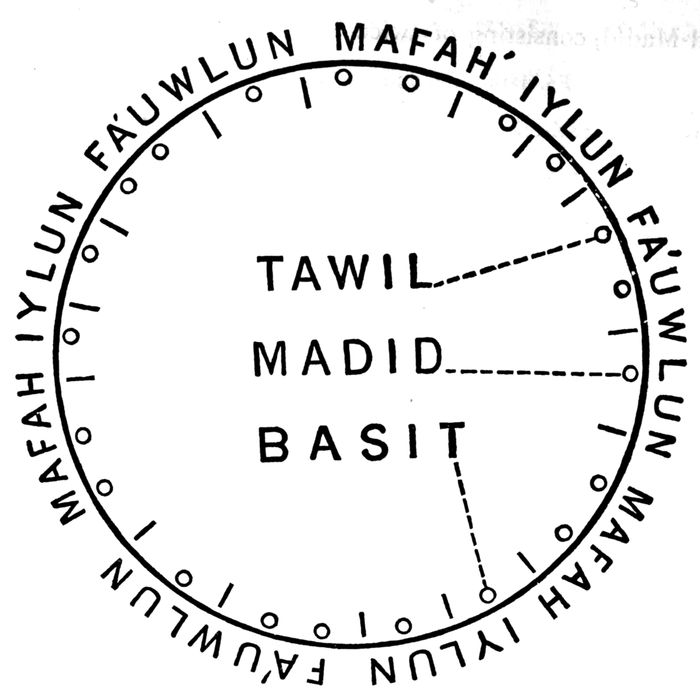
B. Dairat al-Mútalif, circle of “the agreeing” metre, so called
because all its feet agree in length, consisting of seven letters
each. It contains:
1. Al-Wáfir, composed of twice
Mufá.’alatun Mufá.’alatun Mufá’alatun (ii.
3).
= ⏑ ‑ ⏑ ⏑ ‑ | ⏑ ‑ ⏑ ⏑ ‑ | ⏑ ‑ ⏑ ⏑ ‑ |
where the Iambus in each foot precedes the Anapaest, and its
reversal:
2. Al-Kámil, consisting of twice
Mutafá.’ilun Mutafá.’ilun Mutafá.’ilun (ii.
8)
= ⏑ ⏑ ‑ ⏑ ‑ | ⏑ ⏑ ‑ ⏑ ‑ | ⏑ ⏑ ‑ ⏑ ‑ | ⏑ ⏑ ‑ ⏑ ‑ |
where the Anapaest takes the first place in every foot.
C. Dáirat al-Mujtalab, circle of “the brought on” metre, so
called because its seven-lettered feet are brought on from the first
circle.
2851. Al-Hazaj, consisting of twice
Mafá.’ílun Mafá.’ílun Mafá.’ílun (ii.
2)
= ⏑ ‑ ‑ ‑ | ⏑ ‑ ‑ ‑ | ⏑ ‑ ‑ ‑ | ⏑ ‑ ‑ ‑ |
2. Al-Rajaz, consisting of twice
Mustaf.’ilun Mustaf.’ilun Mustaf.’ilun,
and, in this full form, almost identical with the Iambic Trimeter
of the Greek Drama:
‑ ‑ ⏑ ‑ | ‑ ‑ ⏑ ‑ | ‑ ‑ ⏑ ‑ |
3. Al-Ramal, consisting of twice
Fá.’ilátun Fá.’ilátun Fá.’ilátun,
the trochaic counterpart of the preceding metre
= ‑ ⏑ ‑ ‑ | ‑ ⏑ ‑ ‑ | ‑ ⏑ ‑ ‑ |
D. Dáirat al-Mushtabih, circle of “the intricate” metre, so
called from its intricate nature, primary mingling with secondary
feet, and one foot of the same verse containing a Watad majmú’,
another a Watad mafrúk, i.e. the iambic rhythm alternating with
the trochaic and vice versa. Its Buhúr are:
1. Al-Sarí’, twice
Mustaf.’ilun Mustaf.’ilun Maf’ú.látu (ii.
6 and 9)
= ‑ ‑ ⏑ ‑ | ‑ ‑ ⏑ ‑ | ‑ ‑ ‑ ⏑
2. Al-Munsarih, twice
Mustaf.’ilun Mafú.látu Mustaf.’ilun (ii.
6. 9. 6)
= ‑ ‑ ⏑ ‑ | ‑ ‑ ‑ ⏑ | ‑ ‑ ⏑ ‑ |
3. Al-Khafíf, twice
Fá.’ílátun Mustaf’i.lun Fá.’ílátun (ii.
7. 10. 7)
= ‑ ⏑ ‑ ‑ | ‑ ‑ ⏑ ‑ | ‑ ⏑ ‑ ‑ |
4. Al-Muzári’, twice
Mafá.’ílun Fá’i.látun Mafá.’ílun (ii.
2. 4. 2)
= ⏑ ‑ ‑ ‑ | ‑ ⏑ ‑ ‑ | ⏑ ‑ ‑ ‑ |
5. Al-Muktazib, twice
Maf’ú.látu Mustaf.’ilun Maf’ú.látu (ii.
9. 6. 9)
= ‑ ‑ ‑ ⏑ | ‑ ‑ ⏑ ‑ | ‑ ‑ ‑ ⏑ |
2866. Al-Mujtass, twice
Mustaf’i.lun Fá.’ilátun Mustaf’i.lun (ii.
10. 7. 10)
= ‑ ‑ ⏑ ‑ | ‑ ⏑ ‑ ‑ | ‑ ‑ ⏑ ‑ |
E. Dáirat al-Muttafik, circle of “the concordant” metre, so
called for the same reason why circle B is called “the agreeing,”
i.e. because the feet all harmonise in length, being here, however
quinqueliteral, not seven-lettered as in the Mútalif. Al-Khalíl, the
inventor of the ’Ilm al-’Arúz, assigns to it only one metre:
1. Al-Mutakárib, twice
Fa’úlun Fa’úlun Fa’úlun Fa’úlun (ii.
1)
= ⏑ ‑ ‑ | ⏑ ‑ ‑ | ⏑ ‑ ‑ | ⏑ ‑ ‑ |
Later Prosodists added:
2. Al-Mutadárak, twice
Fá’ilun Fá’ilun Fá’ilun Fá’ilun (ii.
5)
= ‑ ⏑ ‑ | ‑ ⏑ ‑ | ‑ ⏑ ‑ | ‑ ⏑ ‑ |
The feet and metres as given above, are however to a certain
extent merely theoretical; in practice the former admit of
numerous licenses and the latter of variations brought about by
modification or partial suppression of the feet final in a verse.
An Arabic poem (Kasídah, or if numbering less than ten couplets,
Kat’ah) consists of Bayts or couplets, bound together by a
continuous rhyme, which connects the first two lines and is
repeated at the end of every second line throughout the poem.
The last foot of every odd line is called ’Arúz (fem. in contradistinction
of Arúz in the sense of Prosody which is masc.) pl.
A’áiriz, that of every even line is called Zarb, pl. Azrub, and the
remaining feet may be termed Hashw (stuffing), although in
stricter parlance a further distinction is made between the first
foot of every odd and even line as well.
Now with regard to the Hashw on the one hand, and the ’Aruz
and Zarb on the other, the changes which the normal feet undergo,
are of two kinds: Zuháf (deviation) and ’Illah (defect). Zuháf
287applies, as a rule, occasionally and optionally to the second
letter of a Sabab in those feet which compose the Hashw or body-part
of a verse, making a long syllable short by suppressing its
quiescent final, or contracting two short quantities in a long one,
by rendering quiescent a moved letter which stands second in
a Sabab sakíl. In Mustaf’ilun (ii. 6. = ‑ ‑ ⏑ ‑), for instance,
the s of the first syllable, or the f of the second, or both may be
dropped and it will become accordingly Mutaf’ilun, by substitution
Mafá’ilun, (⏑ ‑ ⏑ ‑) or Musta’ilun, by substitution, Mufta’ilun
(‑ ⏑ ⏑ ‑), or Muta’ilun, by substitution Fa’ilatun (⏑ ⏑ ⏑ ‑).[454] This
means that wherever the foot Mustaf.’ilun occurs in the Hashw of
a poem, we can represent it by the scheme ⏓ ⏓ ⏑ ‑ i.e. the Epitritus
tertius can, by poetical license change into Diiambus, Choriambus
or Paeon quartus. In Mufá’alatun (ii. 3. = ⏑ ‑ ⏑ ⏑ ‑) and Mutafá’ilun
(ii. 8. = ⏑ ⏑ ‑ ⏑ ‑), again, the Sabab ’ala and muta may become
khafíf by suppression of their final Harakah and thus turn into
Mufá’altun, by substitution Mafá’ílun (ii. 2. = ⏑ ‑ ‑ ‑), and
Mutfá’ilun, by substitution Mustaf’ilun (ii. 6. = ‑ ‑ ⏑ ‑ as above).
In other words the two feet correspond to the schemes ⏑ _ ⏑ ‑ ⏑ _ and
⏑ ‑ ⏑ _ ⏑ _, where a Spondee can take the place of the Anapaest after
or before the Iambus respectively.
’Illah, the second way of modifying the primitive or normal feet,
applies to both Sabab and Watad, but only in the ’Aruz and
Zarb of a couplet, being at the same time constant and obligatory.
Besides the changes already mentioned, it consists in adding one
or two letters to a Sabab or Watad, or curtailing them more or
less, even to cutting them off altogether. We cannot here exhaust
this matter any more than those touched upon until now, but
must be satisfied with an example or two, to show the proceeding
in general and indicate its object.
288We have seen that the metre Basít consists of the two lines:
Mustaf.’ilun Fá.’ilun Mustaf’ilun Fá’ilun
Mustaf’ilun Fá’ilun Mustaf’ilun Fá’ilun.
This complete form, however, is not in use amongst Arab
poets. If by the Zuháf Khabn, here acting as ’Illah, the Alif in
the final Fá’ilun is suppressed, changing it into Fa’ilun (⏑ ⏑ ‑), it
becomes the first ’Aruz, called makhbúnah, of the Basít, the
first Zarb of which is obtained by submitting the final Fá’ilun of
the second line to the same process. A second Zarb results, if in
Fá’ilun the final n of the Watad ’ilun is cut off and the preceding l
made quiescent by the ’Illah Kat’ thus giving Fá’il and by substitution
Fa’lun (‑ ‑). Thus the formula becomes:—
| Mustaf’ilun Fá’ilun Mustaf’ilun |
|
Fa’ilun |
| Mustaf’ilun Fá’ilun Mustaf’ilun |
{ |
Fa’ilun |
| Fa’lun |
As in the Hashw, i.e. the first three feet of each line, the Khabn
can likewise be applied to the medial Fá’ilun, and for Mustaf’ilun
the poetical licenses, explained above, may be introduced, this
first ’Arúz or Class of the Basít with its two Zarb or subdivisions
will be represented by the scheme
| ⏑ ⏑ |
⏑ |
⏑ ⏑ |
│ |
|
| ‑ ‑ ⏑ ‑ |
‑ ⏑ ‑ |
‑ ‑ ⏑ ‑ |
⏑ ⏑ ‑ |
| |
| ⏑ ⏑ |
⏑ |
⏑ ⏑ |
{ |
⏑ ⏑ ‑ |
| ‑ ‑ ⏑ ‑ |
‑ ⏑ ‑ |
‑ ‑ ⏑ ‑ |
‑ ‑ |
that is to say in the first subdivision of this form of the Basít
both lines of each couplet end with an Anapaest and every second
line of the other subdivision terminates in a Spondee.
The Basít has four more A’áriz, three called majzúah, because
each line is shortened by a Juz or foot, one called mashtúrah
(halved), because the number of feet is reduced from four to two,
and we may here notice that the former kind of lessening the
number of feet is frequent with the hexametrical circles (B. C. D.),
while the latter kind can naturally only occur in those
circles, whose couplet forms an octameter (A. E.). Besides being
289majzúah, the second ’Aruz is sahíhah (perfect) consisting of the
normal foot Mustaf’ilun. It has three Azrub: 1. Mustaf’ilán
(‑ ‑ ⏑ ‑, with an overlong final syllable, see supra p. 277),
produced by the ’Illah Tazyíl, i.e. addition of a quiescent letter at
the end (Mustaf’ilunn, by substitution Mustaf’ilán); 2. Mustaf’ilun,
like the ’Aruz; 3. Maf’úlun (‑ ‑ ‑), produced by the ’Illah Kat’
(see the preceding page; Mustaf’ilun, by dropping the final n and
making the l quiescent becomes Mustaf’il and by substitution
Maf’úlun). Hence the formula is:
| Mustaf’ilun Fá’ilun Mustaf’ilun |
| |
{ |
Mustaf’ilán |
| Mustaf’ilun Fá’ilun |
Mustaf’ilun |
| |
Maf’úlun, |
which, with its allowable licenses, may be represented by the
scheme:
| ⏑ ⏑ |
│ |
⏑ |
│ |
|
| ‑ ‑ ⏑ ‑ |
‑ ⏑ ‑ |
‑ ‑ ⏑ ‑ |
| |
|
|
{ |
⏑ ⏑ |
| |
|
|
‑ ‑ ⏑ ‑ |
| ⏑ ⏑ |
│ |
⏑ |
‑ ‑ ⏑ ‑ |
| ‑ ‑ ⏑ ‑ |
‑ ⏑ ‑ |
⏑ |
| |
|
|
‑ ‑ ‑ |
The above will suffice to illustrate the general method of the
Prosodists, and we must refer the reader for the remaining classes
and subdivisions of the Basít as well as the other metres to more
special treatises on the subject, to which this Essay is intended
merely as an introduction, with a view to facilitate the first steps
of the student in an important, but I fear somewhat neglected
field of Arabic learning.
If we now turn to the poetical pieces contained in The Nights,
we find that out of the fifteen metres, known to al-Khalíl, or the
sixteen of later Prosodists, instances of thirteen occur in the
Mac. N. edition, but in vastly different proportions. The total
number amounts to 1,385 pieces (some, however, repeated several
times), out of which 1,128 belong to the first two circles, leaving
only 257 for the remaining three. The same disproportionality
290obtains with regard to the metres of each circle. The Mukhtalif
is represented by 331 instances of Tawíl and 330 of Basít against
3 of Madíd; the Mutalif by 321 instances of Kámil against 143
of Wáfir; the Mujtalab by 32 instances of Ramal and 30 of Rajaz
against 1 of Hazaj; the Mushtabih by 72 instances of Khafíf and
52 of Sarí’ against 18 of Munsarih and 15 of Mujtass; and lastly
the Muttafik by 37 instances of Mutakárib. Neither the Mutadárak
(E. 2), nor the Muzári’ and Muktazib (D. 4. 5) are met
with.
Finally it remains for me to quote a couplet of each metre,
showing how to scan them, and what relation they bear to the
theoretical formulas exhibited on p. 282 to p. 286.
It is characteristic for the preponderance of the Tawíl over all
the other metres, that the first four lines, with which my alphabetical
list begins, are written in it. One of these belongs to a
poem which has for its author Bahá al-Dín Zuhayr (born A.D. 1186
at Mekkah or in its vicinity, ob. 1249 at Cairo), and is to be
found in full in Professor Palmer’s edition of his works, p. 164.
Sir Richard Burton translates the first Bayt (vol. i. 290):
An I quit Cairo and her pleasances ✿ Where can I hope to find so gladsome ways?
Professor Palmer renders it:
Must I leave Egypt where such joys abound?
What place can ever charm me so again
In Arabic it scans:
⏑ ‑ ⏑ | ⏑ ‑ ‑ ‑ | ‑ ⏑ ‑ | ⏑ ‑ ⏑ ‑
A-arhalu ’an Misrin wa tíbi na’ímihi
[455]⏑ ‑ ⏑ | ⏑ ‑ ‑ ‑ | ‑ ⏑ ‑ | ⏑ ‑ ⏑ ‑
Fa-ayyu makánin ba’dahá li-ya sháiku.
291In referring to iii. A. I. p. 282, it will be seen that in the Hashw
Fa’úlun (⏑ ‑ ‑) has become Fa’úlu (⏑ ‑ ⏑) by a Zuháf called
Kabz (suppression of the fifth letter of a foot if it is quiescent),
and that in the ’Arúz and Zarb Mafá’ílun (⏑ ‑ ‑ ‑) has changed
into Mafá’ilun (⏑ ‑ ⏑ ‑) by the same Zuháf acting as ’Illah.
The latter alteration shows the couplet to be of the second Zarb
of the first ’Arúz of the Tawíl. If the second line did terminate
in Mafá’ílun, as in the original scheme, it would be the first Zarb of
the same ’Arúz; if it did end in Fa’úlun (⏑ ‑ ‑) or Mafá’íl (⏑ ‑ ‑)
it would represent the third or fourth subdivision of this first class
respectively. The Tawíl has one other ’Arúz, Fa’úlun, with a
twofold Zarb, either Fa’úlun also, or Mafá’ilun.
The first instance of the Basít occurring in The Nights are the
lines translated vol. i. p. 25:
Containeth Time a twain of days, this of blessing, that of bane ✿ And holdeth Life a twain of halves, this of pleasure, that of pain.
In Arabic (Mac. N. i. 11):
‑ ‑ ⏑ ‑ | ‑ ⏑ ‑ | ‑ ‑ ⏑ ‑ | ⏑ ⏑ ‑ |
Al-Dahru yaumáni zá amnun wa zá hazaru
‑ ‑ ⏑ ‑ | ‑ ⏑ ‑ | ‑ ‑ ⏑ ‑ | ⏑ ⏑ ‑ |
Wa ’l-’Ayshu shatráni zá safwun wa zá kadaru.
Turning back to p. 283, where the A’áríz and Azrub of the Basít
are shown, the student will have no difficulty to recognise the
Bayt as one belonging to the first Zarb of the first ’Arúz.
As an example of the Madíd we quote the original of the lines
(vol. v. 131):—
I had a heart, and with it lived my life ✿ ’Twas seared with fire and burnt with loving-lowe.
They read in Arabic:—
‑ ⏑ ‑ ‑ | ‑ ⏑ ‑ | ⏑ ⏑ ‑ |
Kána lí kalbun a’íshu bihi
‑ ⏑ ‑ ‑ | ‑ ⏑ ‑ | ⏑ ‑ |
Fa’ktawà bi’l-nári wa’htarak.
If we compare this with the formula (iii. A. 2 p. 283), we find that
292either line of the couplet is shortened by a foot; it is, therefore,
majzú. The first ’Arúz of this abbreviated metre is Fá’ilátun
(‑ ⏑ ‑ ‑), and is called sahíhah (perfect) because it consists of
the normal third foot. In the second ’Arúz Fá’ilátun loses its
end syllable tun by the ’Illah Hafz (suppression of a final Sabab
khafíf), and becomes Fá’ilá (‑ ⏑ ‑), for which Fá’ilun is substituted.
Shortening the first syllable of Fá’ilun, i.e. eliminating
the Alif by Khabn, we obtain the third ’Arúz Fa’ilun (⏑ ⏑ ‑)
as that of the present lines, which has two Azrub: Fa’ilun, like
the ’Arúz, and Fa’lun (‑ ‑), here, again by Khabn, further
reduced to Fa’al (⏑ ‑).
Ishak of Mosul, who improvises the piece, calls it “so difficult
and so rare, that it went nigh to deaden the quick and to quicken
the dead;” indeed, the native poets consider the metre Madíd as
the most difficult of all, and it is scarcely ever attempted by later
writers. This accounts for its rare occurrence in The Nights,
where only two more instances are to be found, Mac. N. ii. 244
and iii. 404.
The second and third circle will best be spoken of together, as
the Wáfir and Kámil have a natural affinity to the Hazaj and
Rajaz. Let us revert to the line:—
⏑ ‑ ‑ ‑ | ⏑ ‑ ‑ ‑ | ⏑ ‑ ‑ |
Akámú ’l-wajda fí kalbí wa sárú.
Translated, as it were, into the language of the Prosodists it will
be:—
Mafá’ílun
[456] ’Mafá’ílun Fa’úlun,
and this, standing by itself, might prima facie be taken for a line
of the Hazaj (iii. C. 1), with the third Mafá’ílun shortened by
Hafz (see above) into Mafá’í for which Fa’úlun would be substituted.
293We have seen (p. 287) that and how the foot Mufá’alatun
can change into Mafá’ílun, and if in any poem which otherwise
would belong to the metre Hazaj, the former measure appears
even in one foot only along with the latter, it is considered to be
the original measure, and the poem counts no longer as Hazaj
but as Wáfir. In the piece now under consideration, it is the
second Bayt where the characteristic foot of the Wáfir first
appears:—
⏑ ‑ ‑ ‑ | ⏑ ‑ ⏑ ⏑ ‑ | ⏑ ‑ ‑ |
Naat ’anní’l-rubú’u wa sákiníhá
⏑ ‑ ⏑ ⏑ ‑ | ⏑ ‑ ⏑ ⏑ ‑ | ⏑ ‑ ‑ |
Wa kad ba’uda ’l-mazáru fa-lá mazáru.
Anglicè (vol. iii. 296):—
Far lies the camp and those who camp therein; ✿ Far is her tent-shrine where I ne’er shall tent.
It must, however, be remarked that the Hazaj is not in use as a
hexameter, but only with an ’Arúz majzúah or shortened by one
foot. Hence it is only in the second ’Arúz of the Wáfir, which is
likewise majzúah, that the ambiguity as to the real nature of the
metre can arise[457]; and the isolated couplet:—
⏑ ‑ ‑ ‑ | ⏑ ‑ ‑ ‑ | ⏑ ‑ ‑ |
Yarídu ’l-mar-u an yu’tà munáhu
⏑ ‑ ‑ ‑ | ⏑ ‑ ‑ ‑ | ⏑ ‑ ‑ |
Wa yabà ’lláhu illá má yurídu
Man wills his wish to him accorded be, ✿ But Allah naught accords save what he wills (vol. iv.
157),
being hexametrical, forms undoubtedly part of a poem in Wáfir
although it does not contain the foot Mufá’alatun at all. Thus
294the solitary instance of Hazaj in The Nights is Abú Nuwás’
abomination, beginning with:—
⏑ ‑ ‑ ‑ | ⏑ ‑ ‑ ‑ |
Fa-lá tas’au ilà ghayrí
⏑ ‑ ‑ ‑ | ⏑ ‑ ‑ ‑ |
Fa-’indí ma’dinu ’l-khayri (Mac. N. ii. 377).
Steer ye your steps to none but me ✿ Who have a mine of luxury (vol. v.
65).
If in the second ’Arúz of the Wáfir Maf’áílun (⏑ ‑ ‑ ‑) is further
shortened to Mafá’ilun (⏑ ‑ ⏑ ‑), the metre resembles the second
’Arúz of Rajaz, where, as we have seen, the latter foot can, by
license, take the place of the normal Mustaf’ilun (‑ ‑ ⏑ ‑).
The Kámil bears a similar relation to the Rajaz, as the Wáfir
bears to the Hazaj. By way of illustration we quote from
Mac. N. ii. 8 the first two Bayts of a little poem taken from the
23rd Assembly of Al-Hariri:—
‑ ‑ ⏑ ‑ | ‑ ‑ ⏑ ‑ | ⏑ ⏑ ‑ ⏑ ‑ |
Yá khátiba ’l-dunyá ’l-daniyyati innahá
⏑ ⏑ ‑ ⏑ ‑ | ⏑ ⏑ ‑ ⏑ ‑ | ‑ ‑ ‑ |
Sharaku ’l-radà wa karáratu ’l-akdári
‑ ‑ ⏑ ‑ | ‑ ‑ ⏑ ‑ | ‑ ‑ ⏑ ‑ |
Dárun matà má azhakat fí yaumihá
‑ ‑ ⏑ ‑ | ‑ ‑ ⏑ ‑ | ‑ ‑ ‑ |
Abkat ghadan bu’dan lahá min dári.
In Sir Richard Burton’s translation (vol. iii. 319):—
O thou who woo’st a World unworthy, learn ✿ ’Tis house of evils, ’tis Perdition’s net:
A house where whoso laughs this day shall weep ✿ The next; then perish house of fume and fret.
The ’Arúz of the first couplet is Mutafá’ilun, assigning the piece
to the first or perfect (sahíhah) class of the Kámil. In the Hashw
of the opening line and in that of the whole second Bayt this
normal Mutafá’ilun has, by license, become Mustaf’ilun, and the
same change has taken place in the ’Arúz of the second couplet;
for it is a peculiarity which this metre shares with a few others, to
295allow certain alterations of the kind Zuháf in the ’Arúz and Zarb
as well as in the Hashw. This class has three subdivisions: the
Zarb of the first is Mutafá’ilun, like the ’Arúz; the Zarb of the
second is Fa’alátun (⏑ ⏑ ‑ ‑), a substitution for Mutafá’il which
latter is obtained from Mutafá’ilun by suppressing the final n and
rendering the l quiescent; the Zarb of the third is Fa’lun (‑ ‑)
for Mútfá, derived from Mutafá’ilun by cutting off the Watad ’ilun
and dropping the medial a of the remaining Mutafá.
If we make the ’Ayn of the second Zarb Fa’alátun also quiescent
by the permitted Zuháf Izmár, it changes into Fa’látun, by
substitution Maf’úlun (‑ ‑ ‑) which terminates the rhyming lines
of the foregoing quotation. Consequently the two couplets taken
together, belong to the second Zarb of the first ’Arúz of the
Kámil, and the metre of the poem with its licenses may be represented
by the scheme:
| ‑ |
‑ |
‑ |
|
| ⏑ ⏑ ‑ ⏑ ‑ |
⏑ ⏑ ‑ ⏑ ‑ |
⏑ ⏑ ‑ ⏑ ‑ |
|
| |
| ‑ |
‑ |
‑ |
|
| ⏑ ⏑ ‑ ⏑ ‑ |
⏑ ⏑ ‑ ⏑ ‑ |
⏑ ⏑ ‑ ‑ |
|
Taken isolated, on the other hand, the second Bayt might be
of the metre Rajaz, whose first ’Arúz Mustaf’ilun has two Azrub:
one equal to the Arúz, the other Maf’úlun as above, but here
substituted for Mustaf’il after applying the ’Illah Kat’ (see p.
288) to Mustaf’ilun. If this were the metre of the poem throughout,
the scheme with the licenses peculiar to the Rajaz would
be:
| ⏑ ⏑ |
⏑ ⏑ |
⏑ ⏑ |
|
| ‑ ‑ ⏑ ‑ |
‑ ‑ ⏑ ‑ |
‑ ‑ ⏑ ‑ |
|
| |
| ⏑ ⏑ |
⏑ ⏑ |
⏑ |
|
| ‑ ‑ ⏑ ‑ |
‑ ‑ ⏑ ‑ |
‑ ‑ ‑ |
|
The pith of Al-Hariri’s Assembly is that the knight errant,
not to say the arrant wight of the Romance, Abú Sayd of Sarúj,
accuses before the Wáli of Baghdad his pretended pupil, in reality
his son, to have appropriated a poem of his by lopping off two
296feet of every Bayt. If this is done in the quoted lines, they
read:
‑ ‑ ⏑ ‑ | ‑ ‑ ⏑ ‑ |
Yá khátiba ’l-dunyá ’l-daniy
⏑ ⏑ ‑ ⏑ ‑ | ⏑ ⏑ ‑ ⏑ ‑ |
Yati innahá sharaku ’l-radà
‑ ‑ ⏑ ‑ | ‑ ‑ ⏑ ‑ |
Dárun matà má azhakat
‑ ‑ ⏑ ‑ | ‑ ‑ ⏑ ‑ |
Fí yaumihá abkat ghadá,
with a different rhyme and of a different variation of metre.
The amputated piece belongs to the fourth Zarb of the third
’Aruz of Kámil, and its second couplet tallies with the second subdivision
of the second class of Rajaz.
The Rajaz, a iambic metre pure and simple, is the most popular,
because the easiest, in which even the Prophet was caught napping
sometimes, at the dangerous risk of following the perilous leadership
of Imru ’l-Kays. It is the metre of improvisation, of ditties,
and of numerous didactic poems. In the latter case, when the
composition is called Urjúzah, the two lines of every Bayt rhyme,
and each Bayt has a rhyme of its own. This is the form in which
for instance, Ibn Málik’s Alfíyah is written, as well as the remarkable
grammatical work of the modern native scholar, Nasíf al-Yazijí,
of which a notice will be found in Chenery’s Introduction
to his Translation of Al-Hariri.
While the Hazaj and Rajaz connect the third circle with the
first and second, the Ramal forms the link between the third and
fourth Dáirah. Its measure Fá’ilátun (‑ ⏑ ‑ ‑) and the reversal
of it, Maf’úlátu (‑ ‑ ‑ ⏑), affect the trochaic rhythm, as opposed
to the iambic of the two first-named metres. The iambic movement
has a ring of gladness about it, the trochaic a wail of sadness:
the former resembles a nimble pedestrian, striding apace
with an elastic step and a cheerful heart; the latter is like a man
toiling along on the desert path, where his foot is ever and anon
297sliding back in the burning sand (Raml, whence probably the
name of the metre). Both combined in regular alternation, impart
an agitated character to the verse, admirably fit to express
the conflicting emotions of a passion-stirred mind.
Examples of these more or less plaintive and pathetic metres
are numerous in the Tale of Uns al-Wujúd and the Wazir’s
Daughter, which, being throughout a story of love, as has been
noted, vol. v. 33, abounds in verse, and, in particular, contains
ten out of the thirty-two instances of Ramal occurring in The
Nights. We quote:
Ramal, first Zarb of the first ’Arúz (Mac. N. ii. 361):
‑ ⏑ ‑ ‑ | ⏑ ⏑ ‑ ‑ | ‑ ⏑ ‑ |
Inna li ’l-bulbuli sautan fí ’l-sahar
‑ ⏑ ‑ ‑ | ⏑ ⏑ ‑ ‑ | ‑ ⏑ ‑ |
Ashghala ’l-’áshika ’an husni ’l-watar
The Bulbul’s note, whenas dawn is nigh ✿ Tells the lover from strains of strings to fly (vol. v.
48).
Sarí’, second Zarb of the first ’Arúz (Mac. N. ii. 359):
⏑ ‑ ⏑ ‑ | ‑ ‑ ⏑ ‑ | ‑ ⏑ ‑ |
Wa fákhitin kad kála fí nauhihi
‑ ‑ ⏑ ‑ | ‑ ‑ ⏑ ‑ | ‑ ⏑ ‑ |
Yá Dáiman shukran ’alà balwatí
I heard a ringdove chanting soft and plaintively, ✿ “I thank Thee, O Eternal, for this misery” (vol. v.
47).
Khafíf, full or perfect form (sahíh), both in Zarb and ’Arúz (Mac.
N. ii. 356):
‑ ⏑ ‑ ‑ | ⏑ ‑ ⏑ ‑ | ‑ ⏑ ‑ ‑ |
Yá li-man ashtakí ’l-gharáma ’llazí bí
⏑ ⏑ ‑ ‑ | ⏑ ‑ ⏑ ‑ | ‑ ⏑ ‑ ‑ |
Wa shujúní wa furkatí ’an habíbí
O to whom now of my desire complaining sore shall I ✿ Bewail my parting from my fere compellèd thus to fly (vol. v.
44).
Mujtass, the only ’Arúz (majzúah sahíhah, i.e. shortened by one
foot and perfect) with equal Zarb (Mac. N. ii. 367):
298‑ ‑ ⏑ ‑ | ⏑ ⏑ ‑ ‑ |
Ruddú ’alayya habíbí
‑ ‑ ⏑ ‑ | ‑ ⏑ ‑ ‑ |
Lá hajatan lí bi-málin
To me restore my dear ✿ I want not wealth untold (vol. v.
55).
As an instance of the Munsarih, I give the second occurring
in The Nights, because it affords me an opportunity to show the
student how useful a knowledge of the laws of Prosody frequently
proves for ascertaining the correct reading of a text. Mac. N. i.
33 we find the line:
‑ ⏑ ⏑ ‑ | ‑ ⏑ ⏑ ‑ | ‑ ⏑ ⏑ ‑ |
Arba’atun má ’jtama’at kattu izá.
This would be Rajaz with the license Mufta’ilun for Mustaf’ilun.
But the following lines of the fragment evince, that the metre is
Munsarih; hence, a clerical error must lurk somewhere in the second
foot. In fact, on page 833 of the same volume, we find the
piece repeated, and here the first couplet reads
‑ ⏑ ⏑ ‑ | ‑ ⏑ ‑ ⏑ | ‑ ⏑ ⏑ ‑ |
Arba’atun má ’jtama’na kattu siwà
⏑ ‑ ⏑ ‑ | ‑ ⏑ ‑ ⏑ | ‑ ⏑ ⏑ ‑ |
Alà azá mujhatí wa safki damí
Four things which ne’er conjoin unless it be ✿ To storm my vitals and to shed my blood (vol. iii.
237).
The Mutakárib, the last of the metres employed in The Nights,
has gained a truly historical importance by the part which it plays
in Persian literature. In the form of trimetrical double-lines, with
a several rhyme for each couplet, it has become the “Nibelungen-”
stanza of the Persian epos: Firdausí’s immortal “Book of Kings”
and Nizámi’s Iskander-námah are written in it, not to mention a
host of Masnawis in which Sufic mysticism combats Mohammedan
orthodoxy. On account of its warlike and heroical character,
therefore, I choose for an example the knightly Jamrakán’s challenge
to the single fight in which he conquers his scarcely less
valiant adversary Kaurajan, Mac. N. iii. 296:
299⏑ ‑ ‑ | ⏑ ‑ ⏑ | ⏑ ‑ ‑ | ⏑ ‑ ‑
Aná ’l-Jamrakánu kawiyyn ’l-janáni
⏑ ‑ ‑ | ⏑ ‑ ⏑ | ⏑ ‑ ‑ | ⏑ ‑ ‑
Jamí’u ’l-fawárisi takhshà kitálí.
Here the third syllable of the second foot in each line is shortened
by license, and the final Kasrah of the first line, standing in
pause, is long, the metre being the full form of the Mutakárib
as exhibited p. 286, iii. E. i. If we suppress the Kasrah of
al-Janáni, which is also allowable in pause, and make the second
line to rhyme with the first, saying, for instance:
⏑ ‑ ‑ | ⏑ ‑ ⏑ | ⏑ ‑ ‑ | ⏑ ‑
Aná ’l-Jamrakánu kawiyyu ’l-janán
⏑ ‑ ‑ | ⏑ ‑ ‑ | ⏑ ‑ ‑ | ⏑ ‑
La-yakshà kitálí shijá’u ’l-zamán,
we obtain the powerful and melodious metre in which the Sháhnámah
sings of Rustam’s lofty deeds, of the tender love of Rúdabah
and the tragic downfall of Siyawush.
Shall I confess that in writing the foregoing pages it has been
my ambition to become a conqueror, in a modest way, myself: to
conquer, I mean, the prejudice frequently entertained, and shared
even by my accomplished countryman, Rückert, that Arabic Prosody
is a clumsy and repulsive doctrine. I have tried to show
that it springs naturally from the character of the language, and,
intimately connected, as it is, with the grammatical system of the
Arabs, it appears to me quite worthy of the acumen of a people,
to whom, amongst other things, we owe the invention of Algebra,
the stepping-stone of our whole modern system of Mathematics.
I cannot refrain, therefore, from concluding with a little anecdote
anent al-Khalíl, which Ibn Khallikán tells in the following words.
His son went one day into the room where his father was, and on
finding him scanning a piece of poetry by the rules of prosody,
he ran out and told the people that his father had lost his wits.
300They went in immediately and related to al-Khalíl what they had
heard, on which he addressed his son in these terms:
“Had you known what I was saying, you would have excused
me, and had you known what you said, I should have blamed you.
But you did not understand me, so you blamed me, and I knew
that you were ignorant, so I pardoned you.”
L’Envoi.
Here end, to my sorrow, the labours of a quarter-century and
here I must perforce say with the “poets’ Poet,”
“Behold! I see the haven nigh at hand,
To which I mean my wearie course to bend;
Vere the main shete, and bear up with the land
The which afore is fairly to be ken’d.”
Nothing of importance now indeed remains for me but briefly
to estimate the character of my work and to take cordial leave of
my readers, thanking them for the interest they have accorded to
these volumes and for enabling me thus successfully to complete
the decade.
Without pudor malus or over-diffidence I would claim to have
fulfilled the promise contained in my Foreword. The anthropological
notes and notelets, which not only illustrate and read
between the lines of the text, but assist the student of Moslem
life and of Arabo-Egyptian manners, customs and language in
a multitude of matters shunned by books, form a repertory of
Eastern knowledge in its esoteric phase, sexual as well as
social.
To assert that such lore is unnecessary is to state, as every
301traveller knows, an “absurdum.” Few phenomena are more
startling than the vision of a venerable infant, who has lived
half his long life in the midst of the wildest anthropological
vagaries and monstrosities, and yet who absolutely ignores all
that India or Burmah enacts under his very eyes. This is crass
ignorance, not the naive innocence of Saint Francis who, seeing
a man and a maid in a dark corner, raised his hands to Heaven
and thanked the Lord that there was still in the world so much
of Christian Charity.
Against such lack of knowledge my notes are a protest; and
I may claim success despite the difficulty of the task. A traveller
familiar with Syria and Palestine, Herr Landberg, writes, “La
plume refuserait son service, la langue serait insuffisante, si celui
qui connaît la vie de tous les jours des Orientaux, surtout des
classes élevées, voulait la devoiler. L’Europe est bien loin d’en
avoir la moindre idée.”
In this matter I have done my best, at a time too when the
hapless English traveller is expected to write like a young lady
for young ladies, and never to notice what underlies the most
superficial stratum. And I also maintain that the free treatment
of topics usually taboo’d and held to be “alekta”—unknown
and unfitted for publicity—will be a national benefit to an
“Empire of Opinion,” whose very basis and buttresses are a
thorough knowledge by the rulers of the ruled. Men have been
crowned with gold in the Capitol for lesser services rendered to
the Respublica.
That the work contains errors, shortcomings and many a lapsus,
I am the first and foremost to declare. Yet in justice to myself
I must also notice that the maculæ are few and far between; even
the most unfriendly and interested critics have failed to point
out an abnormal number of slips. And before pronouncing the
“Vos plaudite!” or, as Easterns more politely say, “I implore
that my poor name may be raised aloft on the tongue of praise,
302let me invoke the fair field and courteous favour which the
Persian poet expected from his readers.
(Veil it, an fault thou find, nor jibe nor jeer:—
None may be found of faults and failings clear!)
RICHARD F. BURTON.
Athenæum Club, September 30, ’86.