They relate, O King of the age and lord of the time and of these
days, that the Caliph Harun al-Rashid summoned his Wazir
Ja'afar one night and said to him, "I desire to go down into the
city and question the common folk concerning the conduct of those
charged with its governance; and those of whom they complain
we will depose from office and those whom they commend we will
promote." Quoth Ja'afar, "Hearkening and obedience!" So the
Caliph went down with Ja'afar and Eunuch Masrur to the town
and walked about the streets and markets and, as they were threading
a narrow alley, they came upon a very old man with a fishing-net
and crate to carry small fish on his head, and in his hand a staff;
and, as he walked at a leisurely pace, he repeated these lines:—
When the Caliph heard his verses he said to Ja'afar, "See this
poor man and note his verses, for surely they point to his necessities."
Then he accosted him and asked, "O Shaykh, what be
thine occupation?" and the poor man answered, "O my lord, I
am a fisherman with a family to keep and I have been out between
midday and this time; and not a thing hath Allah made my portion
wherewithal to feed my family. I cannot even pawn myself to buy
them a supper and I hate and disgust my life and I hanker after
death." Quoth the Caliph, "Say me, wilt thou return with us to
Tigris' bank and cast thy net on my luck, and whatsoever turneth
up I will buy of thee for an hundred gold pieces?" The man
rejoiced when he heard these words and said, "On my head be it!
I will go back with you;" and, returning with them river-wards,
made a cast and waited a while; then he hauled in the rope and
dragged the net ashore and there appeared in it a chest padlocked
and heavy. The Caliph examined it and lifted it finding it
weighty; so he gave the fisherman two hundred dinars and sent
him about his business; whilst Masrur, aided by the Caliph, carried
the chest to the palace and set it down and lighted the candles.
Ja'afar and Masrur then broke it open and found therein a basket
of palm-leaves corded with red worsted. This they cut open and
saw within it a piece of carpet which they lifted out, and under it
was a woman's mantilla folded in four, which they pulled out; and at
the bottom of the chest they came upon a young lady, fair as a silver
ingot, slain and cut into nineteen pieces. When the Caliph looked
188upon her he cried, "Alas!" and tears ran down his cheeks and
turning to Ja'afar he said, "O dog of Wazirs,[354] shall folk be
murdered in our reign and be cast into the river to be a burden
and a responsibility for us on the Day of Doom? By Allah, we
must avenge this woman on her murderer and he shall be made
die the worst of deaths!" And presently he added, "Now, as
surely as we are descended from the Sons of Abbas,[355] if thou bring
us not him who slew her, that we do her justice on him, I will hang
thee at the gate of my palace, thee and forty of thy kith and kin
by thy side." And the Caliph was wroth with exceeding rage.
Quoth Ja'afar, "Grant me three days delay;" and quoth the
Caliph, "We grant thee this." So Ja'afar went out from before
him and returned to his own house, full of sorrow and saying to
himself, "How shall I find him who murdered this damsel, that I
may bring him before the Caliph? If I bring other than the
murderer, it will be laid to my charge by the Lord: in very sooth I
wot not what to do." He kept his house three days and on the
fourth day the Caliph sent one of the Chamberlains for him and,
as he came into the presence, asked him, "Where is the murderer
of the damsel?" to which answered Ja'afar, "O Commander of
the Faithful, am I inspector of murdered folk that I should ken
who killed her?" The Caliph was furious at his answer and
bade hang him before the palace-gate and commanded that
a crier cry through the streets of Baghdad, "Whoso would see
the hanging of Ja'afar, the Barmaki, Wazir of the Caliph, with
forty of the Barmecides,[356] his cousins and kinsmen, before the
palace-gate, let him come and let him look!" The people flocked
out from all the quarters of the city to witness the execution of
Ja'afar and his kinsmen, not knowing the cause. Then they set
up the gallows and made Ja'afar and the others stand underneath
189in readiness for execution, but whilst every eye was looking for
the Caliph's signal, and the crowd wept for Ja'afar and his cousins
of the Barmecides, lo and behold! a young man fair of face and
neat of dress and of favour like the moon raining light, with eyes
black and bright, and brow flower-white, and cheeks red as rose
and young down where the beard grows, and a mole like a grain
of ambergris, pushed his way through the people till he stood
immediately before the Wazir and said to him, "Safety to thee
from this strait, O Prince of the Emirs and Asylum of the poor!
I am the man who slew the woman ye found in the chest, so hang
me for her and do her justice on me!" When Ja'afar heard the
youth's confession he rejoiced at his own deliverance, but grieved
and sorrowed for the fair youth, and whilst they were yet talking
behold, another man well stricken in years pressed forwards
through the people and thrust his way amid the populace till he
came to Ja'afar and the youth, whom he saluted saying, "Ho
thou the Wazir and Prince sans-peer! believe not the words of
this youth. Of a surety none murdered the damsel but I; take
her wreak on me this moment; for, an thou do not thus, I will
require it of thee before Almighty Allah." Then quoth the young
man, "O Wazir, this is an old man in his dotage who wotteth not
whatso he saith ever, and I am he who murdered her, so do thou
avenge her on me!" Quoth the old man, "O my son, thou art
young and desirest the joys of the world and I am old and weary
and surfeited with the world: I will offer my life as a ransom for
thee and for the Wazir and his cousins. No one murdered the
damsel but I, so Allah upon thee, make haste to hang me, for no
life is left in me now that hers is gone." The Wazir marvelled
much at all this strangeness and, taking the young man and the
old man, carried them before the Caliph, where, after kissing the
ground seven times between his hands, he said, "O Commander of
the Faithful, I bring thee the murderer of the damsel!" "Where
is he?"; asked the Caliph and Ja'afar answered, "This young
man saith, I am the murderer, and this old man giving him the lie
saith, I am the murderer, and behold, here are the twain standing
before thee." The Caliph looked at the old man and the young
man and asked, "Which of you killed the girl?" The young man
replied, "No one slew her save I;" and the old man answered,
"Indeed none killed her but myself." Then said the Caliph to
Ja'afar, "Take the twain and hang them both;" but Ja'afar
rejoined, "Since one of them was the murderer, to hang the other
190were mere injustice."[357] "By Him who raised the firmament and
dispread the earth like a carpet," cried the youth, "I am he who
slew the damsel;" and he went on to describe the manner of her
murder and the basket, the mantilla and the bit of carpet, in fact
all that the Caliph had found upon her. So the Caliph was
certified that the young man was the murderer; whereat he
wondered and asked him, "What was the cause of thy wrongfully
doing this damsel to die and what made thee confess the murder
without the bastinado, and what brought thee here to yield up thy
life, and what made thee say Do her wreak upon me?" The
youth answered, "Know, O Commander of the Faithful, that this
woman was my wife and the mother of my children; also my first
cousin and the daughter of my paternal uncle, this old man who is
my father's own brother. When I married her she was a maid[358]
and Allah blessed me with three male children by her; she loved
me and served me and I saw no evil in her, for I also loved her
with fondest love. Now on the first day of this month she fell ill
with grievous sickness and I fetched in physicians to her; but
recovery came to her little by little and, when I wished her to go
to the Hammam-bath, she said:—There is a something I long for
before I go to the bath and I long for it with an exceeding longing.
To hear is to comply, said I. And what is it? Quoth she, I have
a queasy craving for an apple, to smell it and bite a bit of it. I
replied:—Hadst thou a thousand longings I would try to satisfy
them! So I went on the instant into the city and sought for apples
but could find none; yet, had they cost a gold piece each, would I
have bought them. I was vexed at this and went home and said:—O
daughter of my uncle, by Allah I can find none! She was distressed,
being yet very weakly, and her weakness increased greatly
on her that night and I felt anxious and alarmed on her account.
As soon as morning dawned I went out again and made the round
of the gardens, one by one, but found no apples anywhere. At last
there met me an old gardener, of whom I asked about them and
he answered:—O my son, this fruit is a rarity with us and is not
191now to be found save in the garden of the Commander of the
Faithful at Bassorah, where the gardener keepeth it for the
Caliph's eating. I returned to my house troubled by my ill-success;
and my love for my wife and my affection moved me to undertake
the journey. So I gat me ready and set out and travelled fifteen
days and nights, going and coming, and brought her three apples
which I bought from the gardener for three dinars. But when I
went in to my wife and set them before her, she took no pleasure
in them and let them lie by her side; for her weakness and fever
had increased on her and her malady lasted without abating ten
days, after which time she began to recover health. So I left my
house and betaking me to my shop sat there buying and selling;
and about midday behold, a great ugly black slave, long as a
lance and broad as a bench, passed by my shop holding in hand
one of the three apples wherewith he was playing. Quoth I:—O
my good slave, tell me whence thou tookest that apple, that I may
get the like of it? He laughed and answered:—I got it from my
mistress, for I had been absent and on my return I found her
lying ill with three apples by her side, and she said to me:—My
horned wittol of a husband made a journey for them to Bassorah
and bought them for three dinars. So I ate and drank with her
and took this one from her.[359] When I heard such words from the
slave, O Commander of the Faithful, the world grew black before
my face, and I arose and locked up my shop and went home
beside myself for excess of rage. I looked for the apples and
finding only two of the three asked my wife:—O my cousin, where
is the third apple?; and raising her head languidly she answered:—I
wot not, O son of my uncle, where 'tis gone! This convinced
me that the slave had spoken the truth, so I took a knife and
coming behind her got upon her breast without a word said and cut
her throat. Then I hewed off her head and her limbs in pieces and,
wrapping her in her mantilla and a rag of carpet, hurriedly sewed
up the whole which I set in a chest and, locking it tight, loaded
192it on my he-mule and threw it into the Tigris with my own hands.
So Allah upon thee, O Commander of the Faithful, make haste to
hang me, as I fear lest she appeal for vengeance on Resurrection
Day. For, when I had thrown her into the river and none knew
aught of it, as I went back home I found my eldest son crying and
yet he knew naught of what I had done with his mother. I asked
him:—What hath made thee weep, my boy?; and he answered:—I
took one of the three apples which were by my mammy and
went down into the lane to play with my brethren when behold, a
big long black slave snatched it from my hand and said, Whence
hadst thou this? Quoth I, My father travelled far for it, and
brought it from Bassorah for my mother who was ill and two other
apples for which he paid three ducats. He took no heed of my
words and I asked for the apple a second and a third time, but he
cuffed me and kicked me and went off with it. I was afraid lest
my mother should swinge me on account of the apple, so for fear
of her I went with my brother outside the city and stayed there till
evening closed in upon us; and indeed I am in fear of her; and
now by Allah, O my father, say nothing to her of this or it may
add to her ailment! When I heard what my child said I knew
that the slave was he who had foully slandered my wife, the
daughter of my uncle, and was certified that I had slain her wrongfully.
So I wept with exceeding weeping and presently this old
man, my paternal uncle and her father, came in; and I told him
what had happened and he sat down by my side and wept and we
ceased not weeping till midnight. We have kept up mourning for
her these last five days and we lamented her in the deepest sorrow
for that she was unjustly done to die. This came from the
gratuitous lying of the slave, the blackamoor, and this was the
manner of my killing her; so I conjure thee, by the honour of
thine ancestors, make haste to kill me and do her justice upon me,
as there is no living for me after her!" The Caliph marvelled at
his words and said, "By Allah the young man is excusable: I will
hang none but the accursed slave and I will do a deed which shall
comfort the ill-at-ease and suffering, and which shall please the
All-glorious King."——And Shahrazad perceived the dawn of day
and ceased saying her permitted say.
She said, It hath reached me, O auspicious King, that the Caliph
swore he would hang none but the slave, for the youth was excusable.
Then he turned to Ja'afar and said to him, "Bring before me
this accursed slave who was the sole cause of this calamity; and, if
thou bring him not before me within three days, thou shalt be slain
in his stead." So Ja'afar fared forth weeping and saying, "Two
deaths have already beset me, nor shall the crock come off safe from
every shock.[360] In this matter craft and cunning are of no avail;
but He who preserved my life the first time can preserve it a second
time. By Allah, I will not leave my house during the three days
of life which remain to me and let the Truth (whose perfection be
praised!) do e'en as He will." So he kept his house three days,
and on the fourth day he summoned the Kazis and legal witnesses
and made his last will and testament, and took leave of his children
weeping. Presently in came a messenger from the Caliph and said
to him, "The Commander of the Faithful is in the most violent
rage that can be, and he sendeth to seek thee and he sweareth that
the day shall certainly not pass without thy being hanged unless
the slave be forthcoming." When Ja'afar heard this he wept, and
his children and slaves and all who were in the house wept with
him. After he had bidden adieu to everybody except his youngest
daughter, he proceeded to farewell her; for he loved this wee one,
who was a beautiful child, more than all his other children; and he
pressed her to his breast and kissed her and wept bitterly at parting
from her; when he felt something round inside the bosom of
her dress and asked her, "O my little maid, what is in thy bosom
pocket?"; "O my father," she replied, "it is an apple with the
name of our Lord the Caliph written upon it. Rayhán our slave
brought it to me four days ago and would not let me have it till I
gave him two dinars for it." When Ja'afar heard speak of the
slave and the apple, he was glad and put his hand into his child's
pocket[361] and drew out the apple and knew it and rejoiced saying,
"O ready Dispeller of trouble!"[362] Then he bade them bring the
194slave and said to him, "Fie upon thee, Rayhan! whence haddest
thou this apple?" "By Allah, O my master," he replied, "though
a lie may get a man once off, yet may truth get him off, and well
off, again and again. I did not steal this apple from thy palace
nor from the gardens of the Commander of the Faithful. The
fact is that five days ago, as I was walking along one of the
alleys of this city, I saw some little ones at play and this apple in
hand of one of them. So I snatched it from him and beat him
and he cried and said, O youth this apple is my mother's and
she is ill. She told my father how she longed for an apple, so he
travelled to Bassorah and bought her three apples for three gold
pieces, and I took one of them to play withal. He wept again,
but I paid no heed to what he said and carried it off and brought
it here, and my little lady bought it of me for two dinars of gold.
And this is the whole story." When Ja'afar heard his words he
marvelled that the murder of the damsel and all this misery should
have been caused by his slave; he grieved for the relation of the
slave to himself, while rejoicing over his own deliverance, and he
repeated these lines:—
Then he took the slave's hand and, leading him to the Caliph,
related the story from first to last and the Caliph marvelled with
extreme astonishment, and laughed till he fell on his back and
ordered that the story be recorded and be made public amongst
the people. But Ja'afar said, "Marvel not, O Commander of the
Faithful, at this adventure, for it is not more wondrous than the
History of the Wazir Núr al-Dín Ali of Egypt and his brother
Shams al-Dín Mohammed." Quoth the Caliph, "Out with it; but
what can be stranger than this story?" And Ja'afar answered,
"O Commander of the Faithful, I will not tell it thee, save on condition
that thou pardon my slave;" and the Caliph rejoined, "If
it be indeed more wondrous than that of the three apples, I grant
thee his blood, and if not I will surely slay thy slave." So Ja'afar
began in these words the
TALE OF NÚR AL-DÍN ALÍ & HIS SON BADR AL-DÍN HASAN
195
Know, O Commander of the Faithful, that in times of yore the
land of Egypt was ruled by a Sultan endowed with justice and
generosity, one who loved the pious poor and companied with the
Olema and learned men; and he had a Wazir, a wise and an experienced,
well versed in affairs and in the art of government.
This Minister, who was a very old man, had two sons, as they were
two moons; never man saw the like of them for beauty and grace, the
elder called Shams al-Din Mohammed and the younger Nur al-Din
Ali; but the younger excelled the elder in seemliness and pleasing
semblance, so that folk heard his fame in far countries and men
flocked to Egypt for the purpose of seeing him. In course of time
their father, the Wazir, died and was deeply regretted and mourned
by the Sultan, who sent for his two sons and, investing them with
dresses of honour,[363] said to them, "Let not your hearts be troubled,
for ye shall stand in your father's stead and be joint Ministers of
Egypt." At this they rejoiced and kissed the ground before him
and performed the ceremonial mourning[364] for their father during a
full month; after which time they entered upon the Wazirate, and
the power passed into their hands as it had been in the hands of
their father, each doing duty for a week at a time. They lived
under the same roof and their word was one; and whenever the
Sultan desired to travel they took it by turns to be in attendance
on him. It fortuned one night that the Sultan purposed setting
out on a journey next morning, and the elder, whose turn it was to
accompany him, was sitting conversing with his brother and said
to him, "O my brother, it is my wish that we both marry, I
and thou, two sisters; and go in to our wives on one and the
same night." "Do, O my brother, as thou desirest," the younger
replied, "for right is thy recking and surely I will comply with
196thee in whatso thou sayest." So they agreed upon this and quoth
Shams al-Din, "If Allah decree that we marry two damsels and
go in to them on the same night, and they shall conceive on their
bride-nights and bear children to us on the same day, and by
Allah's will thy wife bear thee a son and my wife bear me a
daughter, let us wed them either to other, for they will be cousins."
Quoth Nur al-Din, "O my brother, Shams al-Din, what dower[365]
wilt thou require from my son for thy daughter?" Quoth Shams
al-Din, "I will take three thousand dinars and three pleasure gardens
and three farms; and it would not be seemly that the youth
make contract for less than this." When Nur al-Din heard such
demand he said, "What manner of dower is this thou wouldest
impose upon my son? Wottest thou not that we are brothers and
both by Allah's grace Wazirs and equal in office? It behoveth
thee to offer thy daughter to my son without marriage settlement;
or, if one need be, it should represent a mere nominal value by
way of show to the world: for thou knowest that the masculine is
worthier than the feminine, and my son is a male and our memory
will be preserved by him, not by thy daughter." "But what," said
Shams al-Din, "is she to have?"; and Nur al-Din continued,
"Through her we shall not be remembered among the Emirs of
the earth; but I see thou wouldest do with me according to the
saying:—An thou wouldst bluff off a buyer, ask him high price
and higher; or as did a man who, they say, went to a friend and
asked something of him being in necessity and was answered:—Bismillah,[366]
in the name of Allah, I will do all what thou requirest
but come to-morrow!" Whereupon the other replied in this
verse:—
When he who is asked a favour saith "To-morrow," ✿ The wise man wots 'tis vain to beg or borrow.
Quoth Shams al-Din, "Basta![367] I see thee fail in respect to me by
making thy son of more account than my daughter; and 'tis plain
197that thine understanding is of the meanest and that thou lackest
manners. Thou remindest me of thy partnership in the Wazirate,
when I admitted thee to share with me only in pity for thee, and
not wishing to mortify thee; and that thou mightest help me as a
manner of assistant. But since thou talkest on this wise, by Allah,
I will never marry my daughter to thy son; no, not for her weight
in gold!" When Nur al-Din heard his brother's words he waxed
wroth and said, "And I too, I will never, never marry my son to
thy daughter; no, not to keep from my lips the cup of death."
Shams al-Din replied, "I would not accept him as a husband for
her, and he is not worth a paring of her nail. Were I not about to
travel I would make an example of thee; however when I return
thou shalt see, and I will show thee, how I can assert my dignity
and vindicate my honour. But Allah doeth whatso He willeth."[368]
When Nur al-Din heard this speech from his brother, he was filled
with fury and lost his wits for rage; but he hid what he felt and
held his peace; and each of the brothers passed the night in a place
far apart, wild with wrath against the other. As soon as morning
dawned the Sultan fared forth in state and crossed over from Cairo[369]
to Jízah[370] and made for the Pyramids, accompanied by the
Wazir Shams al-Din, whose turn of duty it was, whilst his brother
Nur al-Din, who passed the night in sore rage, rose with the light
and prayed the dawn-prayer. Then he betook himself to his
treasury and, taking a small pair of saddle-bags, filled them with
gold; and he called to mind his brother's threats and the contempt
wherewith he had treated him, and he repeated these couplets:—
Travel! and thou shalt find new friends for old ones left behind; ✿ Toil! for the sweets of human life by toil and moil are found:
The stay-at-home no honour wins nor aught attains but want; ✿ So leave thy place of birth
[371] and wander all the world around!
198I've seen, and very oft I've seen, how standing water stinks, ✿ And only flowing sweetens it and trotting makes it sound:
And were the moon for ever full and ne'er to wax or wane, ✿ Man would not strain his watchful eyes to see its gladsome round:
Except the lion leave his lair he ne'er would fell his game; ✿ Except the arrow leave the bow ne'er had it reached its bound:
Gold-dust is dust the while it lies untravelled in the mine, ✿ And aloes-wood mere fuel is upon its native ground:
And gold shall win his highest worth when from his goal ungoal'd; ✿ And aloes sent to foreign parts grows costlier than gold.
When he ended his verse he bade one of his pages saddle him his
Nubian mare-mule with her padded selle. Now she was a dapple-grey,[372]
with ears like reed-pens and legs like columns and a back
high and strong as a dome builded on pillars; her saddle was of
gold-cloth and her stirrups of Indian steel, and her housing of
Ispahan velvet; she had trappings which would serve the Chosroës,
and she was like a bride adorned for her wedding night. Moreover
he bade lay on her back a piece of silk for a seat, and a prayer-carpet
under which were his saddle-bags. When this was done he
said to his pages and slaves, "I purpose going forth a-pleasuring
outside the city on the road to Kalyúb-town,[373] and I shall lie three
nights abroad; so let none of you follow me, for there is something
straiteneth my breast." Then he mounted the mule in haste; and,
taking with him some provaunt for the way, set out from Cairo and
faced the open and uncultivated country lying around it.[374] About
noontide he entered Bilbays-city,[375] where he dismounted and stayed
awhile to rest himself and his mule and ate some of his victual.
He bought at Bilbays all he wanted for himself and forage for his
mule and then fared on the way of the waste. Towards nightfall
he entered a town called Sa'adiyah[376] where he alighted and took
out somewhat of his viaticum and ate; then he spread his strip of
silk on the sand and set the saddle-bags under his head and slept
in the open air; for he was still overcome with anger. When
199morning dawned he mounted and rode onward till he reached the
Holy City,[377] Jerusalem, and thence he made Aleppo, where he dismounted
at one of the caravanserais and abode three days to rest
himself and the mule and to smell the air.[378] Then, being determined
to travel afar and Allah having written safety in his fate, he set out
again, wending without wotting whither he was going; and, having
fallen in with certain couriers, he stinted not travelling till he had
reached Bassorah-city albeit he knew not what the place was. It
was dark night when he alighted at the Khan, so he spread out his
prayer-carpet and took down the saddle-bags from the back of the
mule and gave her with her furniture in charge of the door-keeper
that he might walk her about. The man took her and did as he
was bid. Now it so happened that the Wazir of Bassorah, a man
shot in years, was sitting at the lattice-window of his palace
opposite the Khan and he saw the porter walking the mule up
and down. He was struck by her trappings of price and thought
her a nice beast fit for the riding of Wazirs or even of royalties;
and the more he looked the more was he perplexed till at last he
said to one of his pages, "Bring hither yon door-keeper." The
page went and returned to the Wazir with the porter who kissed
the ground between his hands, and the Minister asked him, "Who
is the owner of yonder mule and what manner of man is he?";
and he answered, "O my lord, the owner of this mule is a comely
young man of pleasant manners, withal grave and dignified, and
doubtless one of the sons of the merchants." When the Wazir
200heard the door-keeper's words he arose forthright; and, mounting
his horse, rode to the Khan[379] and went in to Nur al-Din who,
seeing the Minister making towards him, rose to his feet and
advanced to meet him and saluted him. The Wazir welcomed
him to Bassorah and dismounting, embraced him and made him
sit down by his side and said, "O my son, whence comest thou
and what dost thou seek?" "O my lord," Nur al-Din replied,
"I have come from Cairo-city of which my father was whilome
Wazir; but he hath been removed to the grace of Allah;" and he
informed him of all that had befallen him from beginning to end,
adding, "I am resolved never to return home before I have seen
all the cities and countries of the world." When the Wazir heard
this, he said to him, "O my son, hearken not to the voice of passion
lest it cast thee into the pit; for indeed many regions be waste
places and I fear for thee the turns of Time." Then he let load
the saddle-bags and the silk and prayer-carpets on the mule and
carried Nur al-Din to his own house, where he lodged him in a
pleasant place and entreated him honourably and made much of
him, for he inclined to love him with exceeding love. After a
while he said to him, "O my son, here am I left a man in years
and have no male children, but Allah hath blessed me with a
daughter who eveneth thee in beauty; and I have rejected all her
many suitors, men of rank and substance. But affection for thee
hath entered into my heart; say me, then, wilt thou be to her a
husband? If thou accept this, I will go up with thee to the
Sultan of Bassorah[380] and will tell him that thou art my nephew,
the son of my brother, and bring thee to be appointed Wazir in
my place that I may keep the house for, by Allah, O my son, I am
201stricken in years and aweary." When Nur al-Din heard the Wazir's
words, he bowed his head in modesty and said, "To hear is to
obey!" At this the Wazir rejoiced and bade his servants prepare
a feast and decorate the great assembly-hall, wherein they were
wont to celebrate the marriages of Emirs and Grandees. Then he
assembled his friends and the notables of the reign and the
merchants of Bassorah and when all stood before him he said to
them, "I had a brother who was Wazir in the land of Egypt, and
Allah Almighty blessed him with two sons, whilst to me, as well
ye wot, He hath given a daughter. My brother charged me to
marry my daughter to one of his sons, whereto I assented; and,
when my daughter was of age to marry, he sent me one of his
sons, the young man now present, to whom I purpose marrying
her, drawing up the contract and celebrating the night of unveiling
with due ceremony: for he is nearer and dearer to me than a
stranger and, after the wedding, if he please he shall abide with
me, or if he desire to travel I will forward him and his wife to
his father's home." Hereat one and all replied, "Right is thy
recking;" and they looked at the bridegroom and were pleased
with him. So the Wazir sent for the Kazi and legal witnesses and
they wrote out the marriage contract, after which the slaves perfumed
the guests with incense,[381] and served them with sherbet of
sugar and sprinkled rose-water on them and all went their ways.
Then the Wazir bade his servants take Nur al-Din to the Hammam-baths
and sent him a suit of the best of his own especial
raiment, and napkins and towelry and bowls and perfume-burners
and all else that was required. And after the bath, when he came
out and donned the dress, he was even as the full moon on the
fourteenth night; and he mounted his mule and stayed not till
he reached the Wazir's palace. There he dismounted and went in
to the Minister and kissed his hands, and the Wazir bade him
welcome.——And Shahrazad perceived the dawn of day and
ceased to say her permitted say.
202Now when it was the Twenty-First Night,
She said, It hath reached me, O auspicious King, that the Wazir
stood up to him and welcoming him said, "Arise and go in to thy
wife this night, and on the morrow I will carry thee to the Sultan,
and pray Allah bless thee with all manner of weal." So Nur
al-Din left him and went in to his wife the Wazir's daughter.
Thus far concerning him, but as regards his elder brother, Shams
al-Din, he was absent with the Sultan a long time and when he
returned from his journey he found not his brother; and he asked
of his servants and slaves who answered, "On the day of thy
departure with the Sultan, thy brother mounted his mule fully
caparisoned as for state procession saying:—I am going towards
Kalyub-town and I shall be absent one day or at most two days;
for my breast is straitened, and let none of you follow me." Then
he fared forth and from that time to this we have heard no tidings
of him. Shams al-Din was greatly troubled at the sudden disappearance
of his brother and grieved with exceeding grief at the
loss and said to himself, "This is only because I chided and
upbraided him the night before my departure with the Sultan;
haply his feelings were hurt and he fared forth a-travelling; but
I must send after him." Then he went in to the Sultan and
acquainted him with what had happened and wrote letters and
dispatches, which he sent by running footmen to his deputies in
every province. But during the twenty days of his brother's
absence Nur al-Din had travelled far and had reached Bassorah;
so after diligent search the messengers failed to come at any
news of him and returned. Thereupon Shams al-Din despaired of
finding his brother and said, "Indeed I went beyond all bounds in
what I said to him with reference to the marriage of our children.
Would that I had not done so! This all cometh of my lack of
wit and want of caution." Soon after this he sought in marriage
the daughter of a Cairene merchant[382] and drew up the marriage
contract and went in to her. And it so chanced that, on the very
203same night when Shams al-Din went in to his wife, Nur al-Din
also went in to his wife the daughter of the Wazir of Bassorah;
this being in accordance with the will of Almighty Allah, that He
might deal the decrees of Destiny to His creatures. Furthermore,
it was as the two brothers had said; for their two wives became
pregnant by them on the same night and both were brought to
bed on the same day; the wife of Shams al-Din, Wazir of Egypt,
of a daughter, never in Cairo was seen a fairer; and the wife of
Nur al-Din of a son, none more beautiful was ever seen in his time,
as one of the poets said concerning the like of him:—
That jetty hair, that glossy brow,
My slender waisted youth, of thine,
Can darkness round creation throw,
Or make it brightly shine.
The dusky mole that faintly shows
Upon his cheek, ah! blame it not;
The tulip-flower never blows
Undarkened by its spot.
[383]
And as another also said:—
His scent was musk and his cheek was rose; ✿ His teeth are pearls and his lips drop wine;
His form is a brand and his hips a hill; ✿ His hair is night and his face moonshine.
They named the boy Badr al-Din Hasan and his grandfather, the
Wazir of Bassorah, rejoiced in him and, on the seventh day after
his birth, made entertainments and spread banquets which would
befit the birth of Kings' sons and heirs. Then he took Nur al-Din
and went up with him to the Sultan, and his son-in-law, when he
came before the presence of the King, kissed the ground between his
hands and repeated these verses, for he was ready of speech, firm
of sprite and good in heart as he was goodly in form:—
The world's best joys long be thy lot, my lord! ✿ And last while darkness and the dawn o'erlap:
O thou who makest, when we greet thy gifts, ✿ The world to dance and Time his palms to clap.
[384]
204Then the Sultan rose up to honour them and, thanking Nur al-Din
for his fine compliment, asked the Wazir, "Who may be this young
man?"; and the Minister answered, "This is my brother's son,"
and related his tale from first to last. Quoth the Sultan, "And
how comes he to be thy nephew and we have never heard speak of
him?" Quoth the Minister, "O our lord the Sultan, I had a
brother who was Wazir in the land of Egypt and he died, leaving
two sons, whereof the elder hath taken his father's place and the
younger, whom thou seest, came to me. I had sworn I would not
marry my daughter to any but to him; so when he came I married
him to her.[385] Now he is young and I am old; my hearing is
dulled and my judgment is easily fooled; wherefore I would solicit
our lord the Sultan[386] to set him in my stead, for he is my brother's
son and my daughter's husband; and he is fit for the Wazirate,
being a man of good counsel and ready contrivance." The Sultan
looked at Nur al-Din and liked him, so he stablished him in office
as the Wazir had requested and formally appointed him, presenting
him with a splendid dress of honour and a she-mule from his
private stud; and assigning to him solde, stipends and supplies.
Nur al-Din kissed the Sultan's hand and went home, he and his
father-in-law, joying with exceeding joy and saying, "All this
followeth on the heels of the boy Hasan's birth!" Next day he
presented himself before the King and, kissing the ground, began
repeating:—
Grow thy weal and thy welfare day by day: ✿ And thy luck prevail o'er the envier's spite;
And ne'er cease thy days to be white as day, ✿ And thy foeman's day to be black as night!
The Sultan bade him be seated on the Wazir's seat, so he sat
down and applied himself to the business of his office and went
205into the cases of the lieges and their suits, as is the wont of
Ministers; while the Sultan watched him and wondered at his
wit and good sense, judgment and insight. Wherefor he loved
him and took him into intimacy. When the Divan was dismissed
Nur al-Din returned to his house and related what had
passed to his father-in-law who rejoiced. And thenceforward Nur
al-Din ceased not so to administer the Wazirate that the Sultan
would not be parted from him night or day; and increased his
stipends and supplies till his means were ample and he became
the owner of ships that made trading voyages at his command, as
well as of Mamelukes and blackamoor slaves; and he laid out
many estates and set up Persian wheels and planted gardens.
When his son Hasan was four years of age, the old Wazir deceased,
and he made for his father-in-law a sumptuous funeral ceremony
ere he was laid in the dust. Then he occupied himself with the
education of this son and, when the boy waxed strong and came
to the age of seven, he brought him a Fakih, a doctor of law and
religion, to teach him in his own house and charged him to give
him a good education and instruct him in politeness and good
manners. So the tutor made the boy read and retain all varieties
of useful knowledge, after he had spent some years in learning the
Koran by heart;[387] and he ceased not to grow in beauty and stature
and symmetry, even as saith the poet:—
In his face-sky shines the fullest moon; ✿ In his cheeks' anemone glows the sun:
He so conquered Beauty that he hath won ✿ All charms of humanity one by one.
The professor brought him up in his father's palace teaching him
reading, writing and cyphering, theology and belles lettres. His
grandfather the old Wazir had bequeathed to him the whole of his
property when he was but four years of age. Now during all the time
of his earliest youth he had never left the house, till on a certain
day his father, the Wazir Nur al-Din, clad him in his best clothes
and, mounting him on a she-mule of the finest, went up with him to
the Sultan. The King gazed at Badr al-Din Hasan and marvelled
206at his comeliness and loved him. As for the city-folk, when he
first passed before them with his father, they marvelled at his
exceeding beauty and sat down on the road expecting his return,
that they might look their fill on his beauty and loveliness and
symmetry and perfect grace; even as the poet said in these
verses:—
As the sage watched the stars, the semblance clear
Of a fair youth on's scroll he saw appear.
Those jetty looks Canopus o'er him threw,
And tinged his temple curls a musky hue;
Mars dyed his ruddy cheek; and from his eyes
The Archer-star his glittering arrow flies;
His wit from Hermes came; and Soha's care,
(The half-seen star that dimly haunts the Bear)
Kept off all evil eyes that threaten and ensnare,
The sage stood mazed to see such fortunes meet,
And Luna kissed the earth beneath his feet.
[388]
And they blessed him aloud as he passed and called upon Almighty
Allah to bless him.[389] The Sultan entreated the lad with especial
favour and said to his father, "O Wazir, thou must needs bring
him daily to my presence;" whereupon he replied, "I hear and
I obey." Then the Wazir returned home with his son and ceased
not to carry him to court till he reached the age of twenty. At
that time the Minister sickened and, sending for Badr al-Din Hasan,
said to him, "Know, O my son, that the world of the Present is
but a house of mortality, while that of the Future is a house of
eternity. I wish, before I die, to bequeath thee certain charges
and do thou take heed of what I say and incline thy heart to my
words." Then he gave him his last instructions as to the properest
way of dealing with his neighbours and the due management of his
affairs; after which he called to mind his brother and his home
and his native land and wept over his separation from those he had
first loved. Then he wiped away his tears and, turning to his son,
said to him, "Before I proceed, O my son, to my last charges and
injunctions, know that I have a brother, and thou hast an uncle,
Shams al-Din hight, the Wazir of Cairo, with whom I parted,
leaving him against his will. Now take thee a sheet of paper and
207write upon it whatso I say to thee. Badr al-Din took a fair leaf
and set about doing his father's bidding and he wrote thereon a
full account of what had happened to his sire first and last; the
dates of his arrival at Bassorah and of his foregathering with the
Wazir; of his marriage, of his going in to the Minister's daughter
and of the birth of his son; brief, his life of forty years from the
day of his dispute with his brother, adding the words, "And this is
written at my dictation and may Almighty Allah be with him
when I am gone!" Then he folded the paper and sealed it and
said, "O Hasan, O my son, keep this paper with all care; for it
will enable thee to stablish thine origin and rank and lineage and,
if anything contrary befal thee, set out for Cairo and ask for thine
uncle and show him this paper and say to him that I died a
stranger far from mine own people and full of yearning to see him
and them." So Badr al-Din Hasan took the document and folded
it; and, wrapping it up in a piece of waxed cloth, sewed it like a
talisman between the inner and outer cloth of his skull-cap and
wound his light turband[390] round it. And he fell to weeping over
his father and at parting with him, and he but a boy. Then Nur
al-Din lapsed into a swoon, the forerunner of death; but presently
recovering himself he said, "O Hasan, O my son, I will now
bequeath to thee five last behests. The First Behest is, Be over-intimate
with none, nor frequent any, nor be familiar with any; so
shalt thou be safe from his mischief;[391] for security lieth in seclusion
of thought and a certain retirement from the society of thy fellows;
and I have heard it said by a poet:—
In this world there is none thou mayst count upon ✿ To befriend thy case in the nick of need:
So live for thyself nursing hope of none ✿ Such counsel I give thee: enow, take heed!
The Second Behest is, O my son: Deal harshly with none
lest fortune with thee deal hardly; for the fortune of this world is
one day with thee and another day against thee and all worldly
goods are but a loan to be repaid. And I have heard a poet say:—
Take thought nor haste to win the thing thou wilt; ✿ Have ruth on man for ruth thou may'st require:
No hand is there but Allah's hand is higher; ✿ No tyrant but shall rue worse tyrant's ire!
208The Third Behest is, Learn to be silent in society and let thine
own faults distract thine attention from the faults of other men:
for it is said:—In silence dwelleth safety, and thereon I have
heard the lines that tell us:—
Reserve's a jewel, Silence safety is; ✿ Whenas thou speakest many a word withhold:
For an of Silence thou repent thee once, ✿ Of speech thou shalt repent times manifold.
The Fourth Behest, O my son, is Beware of wine-bibbing, for
wine is the head of all frowardness and a fine solvent of human
wits. So shun, and again I say, shun mixing strong liquor; for I
have heard a poet say:—[392]
From wine
[393] I turn and whoso wine-cups swill; ✿ Becoming one of those who deem it ill:
Wine driveth man to miss salvation-way,
[394] ✿ And opes the gateway wide to sins that kill.
The Fifth Behest, O my son, is Keep thy wealth and it will
keep thee; guard thy money and it will guard thee; and waste
not thy substance lest haply thou come to want and must fare
a-begging from the meanest of mankind. Save thy dirhams and
deem them the sovereignest salve for the wounds of the world.
And here again I have heard that one of the poets said:—
When fails my wealth no friend will deign befriend: ✿ When wealth abounds all friends their friendship tender:
How many friends lent aid my wealth to spend; ✿ But friends to lack of wealth no friendship render.
209On this wise Nur al-Din ceased not to counsel his son Badr al-Din
Hasan till his hour came and, sighing one sobbing sigh, his life
went forth. Then the voice of mourning and keening rose high in
his house and the Sultan and all the grandees grieved for him and
buried him; but his son ceased not lamenting his loss for two
months, during which he never mounted horse, nor attended the
Divan nor presented himself before the Sultan. At last the
King, being wroth with him, stablished in his stead one of his
Chamberlains and made him Wazir, giving orders to seize and set
seals on all Nur al-Din's houses and goods and domains. So the
new Wazir went forth with a mighty posse of Chamberlains and
people of the Divan, and watchmen and a host of idlers to do this
and to seize Badr al-Din Hasan and carry him before the King,
who would deal with him as he deemed fit. Now there was among
the crowd of followers a Mameluke of the deceased Wazir who,
when he had heard this order, urged his horse and rode at full
speed to the house of Badr al-Din Hasan; for he could not endure
to see the ruin of his old master's son. He found him sitting at the
gate with head hung down and sorrowing, as was his wont, for the
loss of his father; so he dismounted and kissing his hand said to
him, "O my lord and son of my lord, haste ere ruin come and lay
waste!" When Hasan heard this he trembled and asked, "What
may be the matter?"; and the man answered, "The Sultan is
angered with thee and hath issued a warrant against thee, and evil
cometh hard upon my track; so flee with thy life!" At these words
Hasan's heart flamed with the fire of bale, and his rose-red cheek
turned pale, and he said to the Mameluke, "O my brother, is there
time for me to go in and get me some worldly gear which may
stand me in stead during my strangerhood?" But the slave
replied, "O my lord, up at once and save thyself and leave this
house, while it is yet time." And he quoted these lines:—
Escape with thy life, if oppression betide thee, ✿ And let the house tell of its builder's fate!
Country for country thou'lt find, if thou seek it; ✿ Life for life never, early or late.
It is strange men should dwell in the house of abjection, ✿ When the plain of God's earth is so wide and so great!
[395]
At these words of the Mameluke, Badr al-Din covered his head
210with the skirt of his garment and went forth on foot till he stood
outside of the city, where he heard folk saying, "The Sultan hath
sent his new Wazir to the house of the old Wazir, now no more, to
seal his property and seize his son Badr al-Din Hasan and take
him before the presence, that he may put him to death;" and all
cried, "Alas for his beauty and his loveliness!" When he heard
this he fled forth at hazard, knowing not whither he was going, and
gave not over hurrying onwards till Destiny drove him to his
father's tomb. So he entered the cemetery and, threading his way
through the graves, at last he reached the sepulchre where he sat
down and let fall from his head the skirt of his long robe[396] which
was made of brocade with a gold-embroidered hem whereon were
worked these couplets:—
O thou whose forehead, like the radiant East, ✿ Tells of the stars of Heaven and bounteous dews:
Endure thine honour to the latest day, ✿ And Time thy growth of glory ne'er refuse!
While he was sitting by his father's tomb behold, there came to
him a Jew as he were a Shroff,[397] a money-changer, with a pair of
saddle-bags containing much gold, who accosted him and kissed
his hand, saying, "Whither bound, O my lord: 'tis late in the day
and thou art clad but lightly and I read signs of trouble in thy
face?" "I was sleeping within this very hour," answered Hasan,
"when my father appeared to me and chid me for not having
visited his tomb; so I awoke trembling and came hither forthright
lest the day should go by without my visiting him, which would
have been grievous to me." "O my lord," rejoined the Jew[398] "thy
father had many merchantmen at sea and, as some of them are
now due, it is my wish to buy of thee the cargo of the first ship
that cometh into port with this thousand dinars of gold." "I
consent," quoth Hasan, whereupon the Jew took out a bag full
of gold and counted out a thousand sequins which he gave to
211Hasan, the son of the Wazir, saying, "Write me a letter of sale
and seal it." So Hasan took a pen and paper and wrote these
words in duplicate, "The writer, Hasan Badr al-Din, son of Wazir
Nur al-Din, hath sold to Isaac the Jew all the cargo of the first of
his father's ships which cometh into port, for a thousand dinars,
and he hath received the price in advance." And after he had
taken one copy the Jew put it into his pouch and went away; but
Hasan fell a-weeping as he thought of the dignity and prosperity
which had erst been his and he began reciting:—
This house, my lady, since you left is now a home no more ✿ For me, nor neighbours, since you left, prove kind and neighbourly:
The friend, whilere I took to heart, alas! no more to me ✿ Is friend; and even Luna's self displayeth lunacy:
You left and by your going left the world a waste, a wold, ✿ And lies a gloomy murk upon the face of hill and lea:
O may the raven-bird whose cry our hapless parting croaked ✿ Find ne'er a nesty home and eke shed all his plumery!
At length my patience fails me; and this absence wastes my flesh; ✿ How many a veil by severance rent our eyes are doomèd see:
Ah! shall I ever sight again our fair past nights of yore; ✿ And shall a single house become a home for me once more?
Then he wept with exceeding weeping and night came upon him;
so he leant his head against his father's grave and sleep overcame
him: Glory to Him who sleepeth not! He ceased not slumbering
till the moon rose, when his head slipped from off the tomb and he
lay on his back, with limbs outstretched, his face shining bright in
the moonlight. Now the cemetery was haunted day and night by
Jinns who were of the True Believers, and presently came out a
Jinniyah who, seeing Hasan asleep, marvelled at his beauty and
loveliness and cried, "Glory to God! this youth can be none other
than one of the Wuldán of Paradise."[399] Then she flew firmament-wards
to circle it, as was her custom, and met an Ifrit on the wing
212who saluted her and she said to him, "Whence comest thou?"
"From Cairo," he replied. "Wilt thou come with me and look
upon the beauty of a youth who sleepeth in yonder burial place?"
she asked, and he answered, "I will." So they flew till they lighted
at the tomb and she showed him the youth and said, "Now diddest
thou ever in thy born days see aught like this?" The Ifrit looked
upon him and exclaimed, "Praise be to Him that hath no equal!
But, O my sister, shall I tell thee what I have seen this day?"
Asked she, "What is that?" and he answered, "I have seen the
counterpart of this youth in the land of Egypt. She is the
daughter of the Wazir Shams al-Din and she is a model of beauty
and loveliness, of fairest favour and formous form, and dight with
symmetry and perfect grace. When she had reached the age of
nineteen,[400] the Sultan of Egypt heard of her and, sending for the
Wazir her father, said to him:—Hear me, O Wazir: it hath
reached mine ear that thou hast a daughter and I wish to demand
her of thee in marriage. The Wazir replied:—O our lord the
Sultan, deign accept my excuses and take compassion on my
sorrows, for thou knowest that my brother, who was partner with
me in the Wazirate, disappeared from amongst us many years ago
and we wot not where he is. Now the cause of his departure was
that one night, as we were sitting together and talking of wives
and children to come, we had words on the matter and he went off
in high dudgeon. But I swore that I would marry my daughter
to none save to the son of my brother on the day her mother gave
her birth, which was nigh upon nineteen years ago. I have lately
heard that my brother died at Bassorah, where he had married the
daughter of the Wazir and that she bare him a son; and I will not
marry my daughter but to him in honour of my brother's memory
I recorded the date of my marriage and the conception of my wife
and the birth of my daughter; and from her horoscope I find that
213her name is conjoined with that of her cousin;[401] and there are
damsels in foison for our lord the Sultan. The King, hearing his
Minister's answer and refusal, waxed wroth with exceeding wrath
and cried:—When the like of me asketh a girl in marriage of the like
of thee, he conferreth an honour, and thou rejectest me and puttest
me off with cold[402] excuses! Now, by the life of my head I will
marry her to the meanest of my men in spite of the nose of thee![403]
There was in the palace a horse-groom which was a Gobbo with a
bunch to his breast and a hunch to his back; and the Sultan sent
for him and married him to the daughter of the Wazir, lief or
loath, and hath ordered a pompous marriage procession for him
and that he go in to his bride this very night. I have now just
flown hither from Cairo, where I left the Hunchback at the door of
the Hammam-bath amidst the Sultan's white slaves who were
waving lighted flambeaux about him. As for the Minister's
daughter she sitteth among her nurses and tirewomen, weeping
and wailing; for they have forbidden her father to come near her.
Never have I seen, O my sister, more hideous being than this
Hunchback[404] whilst the young lady is the likest of all folk to this
young man, albeit even fairer than he."——And Shahrazad perceived
the dawn of day and ceased saying her permitted say.
Now when it was the Twenty-Second Night,
She said, It hath reached me, O auspicious King, that when the
Jinni narrated to the Jinniyah how the King had caused the wedding
contract to be drawn up between the hunchbacked groom and the
lovely young lady who was heart-broken for sorrow; and how she
214was the fairest of created things and even more beautiful than this
youth, the Jinniyah cried at him "Thou liest! this youth is handsomer
than any one of his day." The Ifrit gave her the lie again,
adding, "By Allah, O my sister, the damsel I speak of is fairer than
this; yet none but he deserveth her, for they resemble each other
like brother and sister or at least cousins. And, well-away! how
she is wasted upon that Hunchback!" Then said she, "O my
brother, let us get under him and lift him up and carry him to Cairo,
that we may compare him with the damsel of whom thou speakest
and so determine whether of the twain is the fairer." "To hear is
to obey!" replied he, "thou speakest to the point; nor is there a
righter recking than this of thine, and I myself will carry him." So
he raised him from the ground and flew with him like a bird
soaring in upper air, the Ifritah keeping close by his side at equal
speed, till he alighted with him in the city of Cairo and set him down
on a stone bench and woke him up. He roused himself and finding
that he was no longer at his father's tomb in Bassorah-city he
looked right and left and saw that he was in a strange place; and
he would have cried out; but the Ifrit gave him a cuff which persuaded
him to keep silence. Then he brought him rich raiment
and clothed him therein and, giving him a lighted flambeau, said,
"Know that I have brought thee hither, meaning to do thee a good
turn for the love of Allah: so take this torch and mingle with the
people at the Hammam-door and walk on with them without stopping
till thou reach the house of the wedding-festival; then go
boldly forward and enter the great saloon; and fear none, but take
thy stand at the right hand of the Hunchback bridegroom; and,
as often as any of the nurses and tirewomen and singing-girls come
up to thee,[405] put thy hand into thy pocket which thou wilt find filled
215with gold. Take it out and throw to them and spare not; for as
often as thou thrustest fingers in pouch thou shalt find it full of
coin. Give largesse by handsful and fear nothing, but set thy trust
upon Him who created thee, for this is not by thine own strength
but by that of Allah Almighty, that His decrees may take effect
upon his creatures." When Badr al-Din Hasan heard these words
from the Ifrit he said to himself, "Would Heaven I knew what all
this means and what is the cause of such kindness!" However, he
mingled with the people and, lighting his flambeau, moved on with
the bridal procession till he came to the bath where he found the
Hunchback already on horseback. Then he pushed his way in
among the crowd, a veritable beauty of a man in the finest apparel,
wearing tarbush[406] and turband and a long-sleeved robe purfled with
gold; and, as often as the singing women stopped for the people to
give them largesse, he thrust his hand into his pocket and, finding it
full of gold, took out a handful and threw it on the tambourine[407] till he
had filled it with gold pieces for the music-girls and the tirewomen.
The singers were amazed by his bounty and the people marvelled at
his beauty and loveliness and the splendour of his dress. He ceased
not to do thus till he reached the mansion of the Wazir (who was
his uncle), where the Chamberlains drove back the people and forbade
them to go forward; but the singing-girls and the tirewomen
said, "By Allah we will not enter unless this young man enter with
us, for he hath given us length o' life with his largesse and we will
not display the bride unless he be present." Therewith they carried
him into the bridal hall and made him sit down defying the evil
glances of the hunchbacked bridegroom. The wives of the Emirs
and Wazirs and Chamberlains and Courtiers all stood in double
line, each holding a massy cierge ready lighted; all wore thin face-veils
and the two rows right and left extended from the bride's
throne[408] to the head of the hall adjoining the chamber whence she
was to come forth. When the ladies saw Badr al-Din Hasan and
216noted his beauty and loveliness and his face that shone like the new
moon, their hearts inclined to him and the singing-girls said to all
that were present, "Know that this beauty crossed our hands with
naught but red gold; so be not chary to do him womanly service
and comply with all he says, no matter what he ask."[409] So all the
women crowded round Hasan with their torches and gazed on his
loveliness and envied him his beauty; and one and all would gladly
have lain on his bosom an hour or rather a year. Their hearts were
so troubled that they let fall their veils from before their faces and
said, "Happy she who belongeth to this youth or to whom he belongeth!";
and they called down curses on the crooked groom and
on him who was the cause of his marriage to the girl-beauty; and
as often as they blessed Badr al-Din Hasan they damned the
Hunchback, saying, "Verily this youth and none else deserveth our
Bride: ah, well-away for such a lovely one with this hideous Quasimodo;
Allah's curse light on his head and on the Sultan who commanded
the marriage!" Then the singing-girls beat their tabrets
and lulliloo'd with joy, announcing the appearing of the bride;
and the Wazir's daughter came in surrounded by her tirewomen
who had made her goodly to look upon; for they had perfumed
her and incensed her and adorned her hair; and they had robed her
in raiment and ornaments befitting the mighty Chosroes Kings.
The most notable part of her dress was a loose robe worn over her
other garments: it was diapered in red gold with figures of wild
beasts, and birds whose eyes and beaks were of gems, and claws of
red rubies and green beryl; and her neck was graced with a necklace
of Yamani work, worth thousands of gold pieces, whose bezels
were great round jewels of sorts, the like of which was never owned
by Kaysar or by Tobba King.[410] And the bride was as the full moon
when at fullest on fourteenth night; and as she paced into the hall
217she was like one of the Houris of Heaven—praise be to Him who
created her in such splendour of beauty! The ladies encompassed
her as the white contains the black of the eye, they clustering like
stars whilst she shone amongst them like the moon when it eats up
the clouds. Now Badr al-Din Hasan of Bassorah was sitting in
full gaze of the folk, when the bride came forward with her graceful
swaying and swimming gait, and her hunchbacked bridegroom stood
up to meet[411] and receive her: she, however, turned away from the
wight and walked forward till she stood before her cousin Hasan,
the son of her uncle. Whereat the people laughed. But when the
wedding-guests saw her thus attracted towards Badr Al-Din they
made a mighty clamour and the singing-women shouted their
loudest; whereupon he put his hand into his pocket and, pulling
out a handful of gold, cast it into their tambourines and the girls
rejoiced and said, "Could we win our wish this bride were thine!"
At this he smiled and the folk came round him, flambeaux in hand
like the eyeball round the pupil, while the Gobbo bridegroom was
left sitting alone much like a tail-less baboon; for every time they
lighted a candle for him it went out willy-nilly, so he was left in
darkness and silence and looking at naught but himself.[412] When
Badr al-Din Hasan saw the bridegroom sitting lonesome in the dark,
and all the wedding-guests with their flambeaux and wax candles
crowding about himself, he was bewildered and marvelled much;
but when he looked at his cousin, the daughter of his uncle, he rejoiced
and felt an inward delight: he longed to greet her and gazed
intently on her face which was radiant with light and brilliancy.
Then the tirewomen took off her veil and displayed her in the first
bridal dress which was of scarlet satin; and Hasan had a view of
her which dazzled his sight and dazed his wits, as she moved to and
fro, swaying with graceful gait;[413] and she turned the heads of all the
guests, women as well as men, for she was even as saith the surpassing
poet:—
A sun on wand in knoll of sand she showed, ✿ Clad in her cramoisy-hued chemisette:
Of her lips honey-dew she gave me drink, ✿ And with her rosy cheeks quencht fire she set.
218Then they changed that dress and displayed her in a robe of
azure; and she reappeared like the full moon when it riseth over
the horizon, with her coal-black hair and cheeks delicately fair;
and teeth shown in sweet smiling and breasts firm rising and
crowning sides of the softest and waist of the roundest. And
in this second suit she was as a certain master of high conceits
saith of the like of her:—
She came apparelled in an azure vest, ✿ Ultramarine, as skies are deckt and dight:
I view'd th' unparallel'd sight, which show'd my eyes ✿ A moon of Summer on a Winter-night.
Then they changed that suit for another and, veiling her face in
the luxuriance of her hair, loosed her lovelocks, so dark, so long
that their darkness and length outvied the darkest nights, and she
shot through all hearts with the magical shaft of her eye-babes.
They displayed her in the third dress and she was as said of her
the sayer:—
Veiling her cheeks with hair a-morn she comes, ✿ And I her mischiefs with the cloud compare:
Saying, "Thou veilest morn with night!" "Ah no!" ✿ Quoth she, "I shroud full moon with darkling air!"
Then they displayed her in the fourth bridal dress and she came
forward shining like the rising sun and swaying to and fro with
lovesome grace and supple ease like a gazelle-fawn. And she
clave all hearts with the arrows of her eyelashes, even as saith
one who described a charmer like her:—·
The sun of beauty she to sight appears ✿ And, lovely-coy, she mocks all loveliness;
And when he fronts her favour and her smile ✿ A-morn, the Sun of day in clouds must dress.
Then she came forth in the fifth dress, a very light of loveliness
like a wand of waving willow or a gazelle of the thirsty wold.
Those locks which stung like scorpions along her cheeks were
bent, and her neck was bowed in blandishment, and her hips
quivered as she went. As saith one of the poets describing her
in verse:—
She comes like fullest moon on happy night; ✿ Taper of waist, with shape of magic might:
She hath an eye whose glances quell mankind, ✿ And Ruby on her cheeks reflects his light:
219Enveils her hips the blackness of her hair; ✿ Beware of curls that bite with viper-bite!
Her sides are silken-soft, the while the heart ✿ Mere rock behind that surface lurks from sight:
From the fringed curtains of her eyne she shoots ✿ Shafts which at farthest range on mark alight:
When round her neck or waist I throw my arms ✿ Her breasts repel me with their hardened height.
Ah, how her beauty all excels! ah how ✿ That shape transcends the graceful waving bough!
Then they adorned her with the sixth toilette, a dress which was
green. And now she shamed in her slender straightness the nut-brown
spear; her radiant face dimmed the brightest beams of full
moon and she outdid the bending branches in gentle movement
and flexile grace. Her loveliness exalted the beauties of earth's
four quarters and she broke men's hearts by the significance of her
semblance; for she was even as saith one of the poets in these
lines:—
A damsel 'twas the tirer's art had decked with snares and sleight:
[414] ✿ And robed in rays as though the sun from her had borrowed light:
She came before us wondrous clad in chemisette of green, ✿ As veilèd by its leafy screen pomegranate hides from sight:
And when he said "How callest thou the manner of thy dress?" ✿ She answered us in pleasant way with double meaning dight;
"We call this garment
crève-cœur; and rightly is it hight, ✿ For many a heart wi' this we broke
[415] and conquered many a sprite!"
Then they displayed her in the seventh dress, coloured between
safflower[416] and saffron, even as one of the poets saith:—
In vest of saffron pale and safflower red ✿ Musk'd, sandal'd, ambergris'd, she came to front:
"Rise!" cried her youth, "go forth and show thyself!" ✿ "Sit!" said her hips, "we cannot bear the brunt!"
And when I craved a bout, her Beauty said ✿ "Do, do!" and said her pretty shame, "Don't, don't!"
220Thus they displayed the bride in all her seven toilettes before
Hasan al-Basri, wholly neglecting the Gobbo who sat moping
alone; and, when she opened her eyes[417] she said, "O Allah make
this man my goodman and deliver me from the evil of this hunchbacked
groom." As soon as they had made an end of this part of
the ceremony they dismissed the wedding guests who went forth,
women children and all, and none remained save Hasan and the
Hunchback, whilst the tirewomen led the bride into an inner room
to change her garb and gear and get her ready for the bridegroom.
Thereupon Quasimodo came up to Badr al-Din Hasan and said, "O
my lord, thou hast cheered us this night with thy good company and
overwhelmed us with thy kindness and courtesy; but now why not
get thee up and go?" "Bismillah;" he answered, "In Allah's name
so be it!"; and rising, he went forth by the door, where the Ifrit met
him and said, "Stay in thy stead, O Badr al-Din, and when the
Hunchback goes out to the closet of ease go in without losing time
and seat thyself in the alcove; and when the bride comes say to
her:—'Tis I am thy husband, for the King devised this trick only
fearing for thee the evil eye, and he whom thou sawest is but a
Syce, a groom, one of our stablemen. Then walk boldly up to
her and unveil her face; for jealousy hath taken us of this matter."
While Hasan was still talking with the Ifrit behold, the groom fared
forth from the hall and entering the closet of ease sat down on
the stool. Hardly had he done this when the Ifrit came out of
the tank,[418] wherein the water was, in semblance of a mouse and
squeaked out "Zeek!" Quoth the Hunchback, "What ails
thee?"; and the mouse grew and grew till it became a coal-black
cat and caterwauled "Meeao! Meeao[419]"! Then it grew
still more and more till it became a dog and barked out "Owh!
Owh!" When the bridegroom saw this he was frightened and
221exclaimed "Out with thee, O unlucky one!"[420] But the dog grew
and swelled till it became an ass-colt that brayed and snorted in
his face "Hauk![421] Hauk!" Whereupon the Hunchback quaked
and cried, "Come to my aid, O people of the house!" But
behold, the ass-colt grew and became big as a buffalo and walled
the way before him and spake with the voice of the sons of Adam,
saying, "Woe to thee, O thou Bunch-back, thou stinkard, O thou
filthiest of grooms!" Hearing this the groom was seized with
a colic and he sat down on the jakes in his clothes with teeth
chattering and knocking together. Quoth the Ifrit, "Is the world
so strait to thee thou findest none to marry save my lady-love?"
But as he was silent the Ifrit continued, "Answer me or I will do
thee dwell in the dust!" "By Allah," replied the Gobbo, "O
King of the Buffaloes, this is no fault of mine, for they forced me
to wed her; and verily I wot not that she had a lover amongst the
buffaloes; but now I repent, first before Allah and then before
thee." Said the Ifrit to him, "I swear to thee that if thou fare
forth from this place, or thou utter a word before sunrise, I
assuredly will wring thy neck. When the sun rises wend thy
went and never more return to this house." So saying, the Ifrit
took up the Gobbo bridegroom and set him head downwards and
feet upwards in the slit of the privy,[422] and said to him, "I will
leave thee here but I shall be on the look-out for thee till sunrise;
and, if thou stir before then, I will seize thee by the feet and dash
out thy brains against the wall: so look out for thy life!" Thus
far concerning the Hunchback, but as regards Badr al-Din Hasan
of Bassorah he left the Gobbo and the Ifrit jangling and wrangling
and, going into the house, sat him down in the very middle of the
alcove; and behold, in came the bride attended by an old woman
who stood at the door and said, "O Father of Uprightness,[423]
222arise and take what God giveth thee." Then the old woman went
away and the bride, Sitt al-Husn or the Lady of Beauty hight,
entered the inner part of the alcove broken-hearted and saying in
herself, "By Allah I will never yield my person to him; no, not
even were he to take my life!" But as she came to the further
end she saw Badr al-Din Hasan and she said, "Dearling! art thou
still sitting here? By Allah I was wishing that thou wert my
bridegroom or, at least, that thou and the hunchbacked horse-groom
were partners in me." He replied, "O beautiful lady, how
should the Syce have access to thee, and how should he share in
thee with me?" "Then," quoth she, "who is my husband, thou
or he?" "Sitt al-Husn," rejoined Hasan, "we have not done
this for mere fun,[424] but only as a device to ward off the evil eye
from thee; for when the tirewomen and singers and wedding
guests saw thy beauty being displayed to me, they feared fascination
and thy father hired the horse-groom for ten dinars and a
porringer of meat to take the evil eye off us; and now he hath
received his hire and gone his gait." When the Lady of Beauty
heard these words she smiled and rejoiced and laughed a pleasant
laugh. Then she whispered him, "By the Lord thou hast
quenched a fire which tortured me and now, by Allah, O my little
dark-haired darling, take me to thee and press me to thy bosom!"
Then she began singing:—
By Allah, set thy foot upon my soul; ✿ Since long, long years for this alone I long:
And whisper tale of love in ear of me; ✿ To me 'tis sweeter than the sweetest song!
No other youth upon my heart shall lie; ✿ So do it often, dear, and do it long.
Then she stripped off her outer gear and she threw open her
chemise from the neck downwards and showed her parts genital
and all the rondure of her hips. When Badr al-Din saw the
glorious sight his desires were roused, and he arose and doffed his
clothes, and wrapping up in his bag-trousers[425] the purse of gold
223which he had taken from the Jew and which contained the thousand
dinars, he laid it under the edge of the bedding. Then he
took off his turband and set it upon the settle[426] atop of his other
clothes, remaining in his skull-cap and fine shirt of blue silk laced
with gold. Whereupon the Lady of Beauty drew him to her and
he did likewise. Then he took her to his embrace and set her
legs round his waist and point-blanked that cannon[427] placed where
it battereth down the bulwark of maidenhead and layeth it waste.
And he found her a pearl unpierced and unthridden and a filly
by all men save himself unridden; and he abated her virginity and
had joyance of her youth in his virility and presently he withdrew
sword from sheath; and then returned to the fray right
eath; and when the battle and the siege had finished, some fifteen
assaults he had furnished and she conceived by him that very
night. Then he laid his hand under her head and she did the
same and they embraced and fell asleep in each other's arms, as a
certain poet said of such lovers in these couplets:—
Visit thy lover, spurn what envy told; ✿ No envious churl shall smile on love ensoul'd
Merciful Allah made no fairer sight ✿ Than coupled lovers single couch doth hold;
Breast pressing breast and robed in joys their own, ✿ With pillowed forearms cast in finest mould:
And when heart speaks to heart with tongue of love, ✿ Folk who would part them hammer steel ice-cold:
If a fair friend
[428] thou find who cleaves to thee, ✿ Live for that friend, that friend in heart enfold.
O ye who blame for love us lover kind ✿ Say, can ye minister to diseasèd mind?
This much concerning Badr al-Din Hasan and Sitt al-Husn his
224cousin; but as regards the Ifrit, as soon as he saw the twain asleep,
he said to the Ifritah, "Arise; slip thee under the youth and let
us carry him back to his place ere dawn overtake us; for the day
is nearhand." Thereupon she came forward and, getting under
him as he lay asleep, took him up clad only in his fine blue shirt,
leaving the rest of his garments; and ceased not flying (and the
Ifrit vying with her in flight) till the dawn advised them that it
had come upon them mid-way, and the Muezzin began his call
from the Minaret, "Haste ye to salvation![429] Haste ye to salvation!"
Then Allah suffered His angelic host to shoot down the Ifrit
with a shooting star,[430] so he was consumed, but the Ifritah escaped
and she descended with Badr al-Din at the place where the Ifrit
was burnt, and did not carry him back to Bassorah, fearing lest he
come to harm. Now by the order of Him who predestineth all
things, they alighted at Damascus of Syria, and the Ifritah set down
her burden at one of the city-gates and flew away. When day
arose and the doors were opened, the folk who came forth saw a
handsome youth, with no other raiment but his blue shirt of gold-embroidered
silk and skull-cap,[431] lying upon the ground drowned
in sleep after the hard labour of the night which had not suffered
him to take his rest. So the folk looking at him said, "O her luck
with whom this one spent the night! but would he had waited to
don his garments." Quoth another, "A sorry lot are the sons of
great families! Haply he but now came forth of the tavern on
some occasion of his own and his wine flew to his head,[432] whereby
he hath missed the place he was making for and strayed till he
came to the gate of the city; and finding it shut lay him down and
went to by-by!" As the people were bandying guesses about him
suddenly the morning breeze blew upon Badr al-Din and raising
his shirt to his middle showed a stomach and navel with something
below it,[433] and legs and thighs clear as crystal and smooth as cream.
Cried the people, "By Allah he is a pretty fellow!"; and at the
225cry Badr al-Din awoke and found himself lying at a city-gate with
a crowd gathered around him. At this he greatly marvelled and
asked, "Where am I, O good folk; and what causeth you thus to
gather round me, and what have I had to do with you?"; and they
answered, "We found thee lying here asleep during the call to dawn-prayer
and this is all we know of the matter, but where diddest
thou lie last night?"[434] "By Allah, O good people," replied he, "I
lay last night in Cairo." Said somebody, "Thou hast surely been
eating Hashísh;"[435] and another, "He is a fool;" and a third, "He
is a citrouille;" and a fourth asked him, "Art thou out of thy
mind? thou sleepest in Cairo and thou wakest in the morning at
the gate of Damascus-city!"[436] Cried he, "By Allah, my good
people, one and all, I lie not to you: indeed I lay yesternight in
the land of Egypt and yesternoon I was at Bassorah." Quoth
one, "Well! well!"; and quoth another, "Ho! ho!"; and a third,
"So! so!"; and a fourth cried, "This youth is mad, is possessed
of the Jinni!" So they clapped hands at him and said to one
another, "Alas, the pity of it for his youth: by Allah a madman!
and madness is no respecter of persons." Then said they to him,
"Collect thy wits and return to thy reason! How couldest thou
be in Bassorah yesterday and in Cairo yesternight and withal
awake in Damascus this morning?" But he persisted, "Indeed I
was a bridegroom in Cairo last night." "Belike thou hast been
dreaming," rejoined they, "and sawest all this in thy sleep." So
Hasan took thought for a while and said to them, "By Allah, this
is no dream; nor vision-like doth it seem! I certainly was in
Cairo where they displayed the bride before me, in presence of a
third person, the Hunchback groom who was sitting hard by. By
Allah, O my brother, this be no dream, and if it were a dream,
where is the bag of gold I bore with me and where are my turband
and my robe, and my trousers?" Then he rose and entered the
city, threading its highways and by-ways and bazar-streets; and
the people pressed upon him and jeered at him, crying out "Madman!
madman!" till he, beside himself with rage, took refuge in
226a cook's shop. Now that Cook had been a trifle too clever, that
is, a rogue and thief; but Allah had made him repent and turn
from his evil ways and open a cook-shop; and all the people of
Damascus stood in fear of his boldness and his mischief. So when
the crowd saw the youth enter his shop, they dispersed being afraid
of him, and went their ways. The Cook looked at Badr al-Din and,
noting his beauty and loveliness, fell in love with him forthright and
said, "Whence comest thou, O youth? Tell me at once thy tale, for
thou art become dearer to me than my soul." So Hasan recounted
to him all that had befallen him from beginning to end (but in repetition
there is no fruition) and the Cook said, "O my lord Badr al-Din,
doubtless thou knowest that this case is wondrous and this story
marvellous; therefore, O my son, hide what hath betided thee, till
Allah dispel what ills be thine; and tarry with me here the meanwhile,
for I have no child and I will adopt thee." Badr al-Din
replied, "Be it as thou wilt, O my uncle!" Whereupon the Cook
went to the bazar and bought him a fine suit of clothes and made
him don it; then fared with him to the Kazi, and formally declared
that he was his son. So Badr al-Din Hasan became known in
Damascus-city as the Cook's son and he sat with him in the shop
to take the silver, and on this wise he sojourned there for a time.
Thus far concerning him; but as regards his cousin, the Lady of
Beauty, when morning dawned she awoke and missed Badr al-Din
Hasan from her side; but she thought that he had gone to the
privy and she sat expecting him for an hour or so; when behold,
entered her father Shams al-Din Mohammed, Wazir of Egypt. Now
he was disconsolate by reason of what had befallen him through
the Sultan, who had entreated him harshly and had married his
daughter by force to the lowest of his menials and he too a lump
of a groom hunchbacked withal, and he said to himself, "I will
slay this daughter of mine if of her own free will she have yielded
her person to this accursed carle." So he came to the door of the
bride's private chamber, and said, "Ho! Sitt al-Husn." She
answered him, "Here am I! here am I![437] O my lord," and came
227out unsteady of gait after the pains and pleasures of the night; and
she kissed his hand, her face showing redoubled brightness and
beauty for having lain in the arms of that gazelle, her cousin.
When her father, the Wazir, saw her in such case, he asked her,
"O thou accursed, art thou rejoicing because of this horse-groom?",
and Sitt al-Husn smiled sweetly and answered, "By Allah, don't
ridicule me: enough of what passed yesterday when folk laughed
at me, and evened me with that groom-fellow who is not worthy
to bring my husband's shoes or slippers; nay who is not worth the
paring of my husband's nails! By the Lord, never in my life
have I nighted a night so sweet as yesternight!, so don't mock by
reminding me of the Gobbo." When her parent heard her words
he was filled with fury, and his eyes glared and stared, so that little
of them showed save the whites and he cried, "Fie upon thee!
What words are these? 'Twas the hunchbacked horse-groom who
passed the night with thee!" "Allah upon thee," replied the
Lady of Beauty, "do not worry me about the Gobbo, Allah damn
his father;[438] and leave jesting with me; for this groom was only
hired for ten dinars and a porringer of meat and he took his wage
and went his way. As for me I entered the bridal-chamber, where
I found my true bridegroom sitting, after the singer-women had
displayed me to him; the same who had crossed their hands with
red gold, till every pauper that was present waxed wealthy; and I
passed the night on the breast of my bonny man, a most lively
darling, with his black eyes and joined eyebrows."[439] When her
parent heard these words the light before his face became night,
and he cried out at her saying, "O thou whore! What is this
thou tellest me? Where be thy wits?" "O my father," she
rejoined, "thou breakest my heart; enough for thee that thou hast
been so hard upon me! Indeed my husband who took my virginity
is but just now gone to the draught house and I feel that I
have conceived by him."[440] The Wazir rose in much marvel and
228entered the privy where he found the hunchbacked horse-groom
with his head in the hole and his heels in the air. At this sight he
was confounded and said, "This is none other than he, the rascal
Hunchback!" So he called to him, "Ho, Hunchback!" The
Gobbo grunted out, "Taghúm! Taghúm!"[441] thinking it was the
Ifrit spoke to him; so the Wazir shouted at him and said, "Speak
out, or I'll strike off thy pate with this sword." Then quoth the
Hunchback, "By Allah, O Shaykh of the Ifrits, ever since thou
settest me in this place, I have not lifted my head; so Allah upon
thee, take pity and entreat me kindly!" When the Wazir heard
this he asked, "What is this thou sayest? I'm the bride's father
and no Ifrit." "Enough for thee that thou hast well nigh done me
die," answered Quasimodo; "now go thy ways before he come
upon thee who hath served me thus. Could ye not marry me to
any save the lady-love of buffaloes and the beloved of Ifrits?
Allah curse her and curse him who married me to her and was the
cause of this my case."——And Shahrazad perceived the dawn of
day, and ceased to say her permitted say.
Now when it was the Twenty-third Night,
She said, It hath reached me, O auspicious King, that the hunchbacked
groom spake to the bride's father saying, "Allah curse him
who was the cause of this my case!" Then said the Wazir to
him, "Up and out of this place!" "Am I mad," cried the groom,
"that I should go with thee without leave of the Ifrit whose last
words to me were:—When the sun rises, arise and go thy gait.
So hath the sun risen or no?; for I dare not budge from this place
till then." Asked the Wazir, "Who brought thee hither?"; and
he answered "I came here yesternight for a call of nature and to
do what none can do for me, when lo! a mouse came out of the
229water, and squeaked at me and swelled and waxed gross till it was
big as a buffalo, and spoke to me words that entered my ears.
Then he left me here and went away, Allah curse the bride and
him who married me to her!" The Wazir walked up to him and
lifted his head out of the cess-pool hole; and he fared forth running
for dear life and hardly crediting that the sun had risen; and
repaired to the Sultan to whom he told all that had befallen him
with the Ifrit. But the Wazir returned to the bride's private
chamber, sore troubled in spirit about her, and said to her, "O my
daughter, explain this strange matter to me!" Quoth she, "'Tis
simply this. The bridegroom to whom they displayed me yester-eve
lay with me all night, and took my virginity and I am with
child by him. He is my husband and if thou believe me not, there
are his turband, twisted as it was, lying on the settle and his dagger
and his trousers beneath the bed with a something, I wot not
what, wrapped up in them." When her father heard this he
entered the private chamber and found the turband which had been
left there by Badr al-Din Hasan, his brother's son, and he took it
in hand and turned it over, saying, "This is the turband worn by
Wazirs, save that it is of Mosul stuff."[442] So he opened it and, finding
what seemed to be an amulet sewn up in the Fez, he unsewed
the lining and took it out; then he lifted up the trousers wherein
was the purse of the thousand gold pieces and, opening that also,
found in it a written paper. This he read and it was the sale-receipt
of the Jew in the name of Badr al-Din Hasan, son of
Nur al-Din Ali, the Egyptian; and the thousand dinars were also
there. No sooner had Shams al-Din read this than he cried out
with a loud cry and fell to the ground fainting; and as soon as he
revived and understood the gist of the matter he marvelled and
said, "There is no god, but the God, whose All-might is over all
things! Knowest thou, O my daughter, who it was that became
the husband of thy virginity?" "No," answered she, and he said,
"Verily he is the son of my brother, thy cousin, and this thousand
dinars is thy dowry. Praise be to Allah! and would I wot how
this matter came about!" Then opened he the amulet which was
sewn up and found therein a paper in the handwriting of his
deceased brother, Nur al-Din the Egyptian, father of Badr al-Din
Hasan; and, when he saw the handwriting, he kissed it again and
230again; and he wept and wailed over his dead brother and improvised
these lines:—
I see their traces and with pain I melt, ✿ And on their whilome homes I weep and yearn:
And Him I pray who dealt this parting-blow ✿ Some day he deign vouchsafe a safe return.
[443]
When he ceased versifying, he read the scroll and found in it
recorded the dates of his brother's marriage with the daughter of
the Wazir of Bassorah, and of his going in to her, and her conception,
and the birth of Badr al-Din Hasan and all his brother's history
and doings up to his dying day. So he marvelled much and
shook with joy and, comparing the dates with his own marriage
and going in unto his wife and the birth of his daughter, Sitt al-Husn,
he found that they perfectly agreed. So he took the document
and, repairing with it to the Sultan, acquainted him with
what had passed, from first to last; whereat the King marvelled
and commanded the case to be at once recorded.[444] The Wazir
abode that day expecting to see his brother's son but he came
not; and he waited a second day, a third day and so on to the
seventh day, without any tidings of him. So he said, "By Allah, I
will do a deed such as none hath ever done before me!"; and he
took reed-pen and ink and drew upon a sheet of paper the plan of
the whole house, showing whereabouts was the private chamber
with the curtain in such a place and the furniture in such another
and so on with all that was in the room. Then he folded up the
sketch and, causing all the furniture to be collected, he took Badr
al-Din's garments and the turband and Fez and robe and purse,
and carried the whole to his house and locked them up, against the
coming of his nephew, Badr al-Din Hasan, the son of his lost
brother, with an iron padlock on which he set his seal. As for the
Wazir's daughter, when her tale of months was fulfilled, she bare a
son like the full moon, the image of his father in beauty and loveliness
231and fair proportions and perfect grace. They cut his navel-string[445]
and Kohl'd his eyelids to strengthen his eyes, and gave
him over to the nurses and nursery governesses,[446] naming him Ajíb,
the Wonderful. His day was as a month and his month was as a
year;[447] and, when seven years had passed over him, his grandfather
sent him to school, enjoining the master to teach him Koran-reading,
and to educate him well. He remained at the school four
years, till he began to bully his schoolfellows and abuse them and
bash them and thrash them and say, "Who among you is like me?
I am the son of the Wazir of Egypt!" At last the boys came in
a body to complain to the Monitor[448] of what hard usage they were
wont to have from Ajib, and he said to them, "I will tell you
somewhat you may do to him so that he shall leave off coming
to the school, and it is this. When he enters to-morrow, sit ye
down about him and say some one of you to some other:—By
Allah none shall play with us at this game except he tell us the
names of his mamma and his papa; for he who knows not the
names of his mother and his father is a bastard, a son of adultery,[449]
and he shall not play with us." When morning dawned the boys
came to school, Ajib being one of them, and all flocked round him
saying, "We will play a game wherein none shall join save he can
tell the name of his mamma and his papa." And they all cried,
"By Allah, good!" Then quoth one of them, "My name is Májid
and my mammy's name is Alawiyah and my daddy's Izz al-Din."
Another spoke in like guise and yet a third, till Ajib's turn came,
and he said, "My name is Ajib, and my mother's is Sitt al-Husn,
and my father's Shams al-Din, the Wazir of Cairo." "By Allah,"
cried they, "the Wazir is not thy true father." Ajib answered,
"The Wazir is my father in very deed." Then the boys all laughed
and clapped their hands at him, saying "He does not know who is
his papa: get out from among us, for none shall play with us except
he know his father's name." Thereupon they dispersed from around
him and laughed him to scorn; so his breast was straitened and he
232well nigh choked with tears and hurt feelings. Then said the
Monitor to him, "We know that the Wazir is thy grandfather, the
father of thy mother, Sitt al-Husn, and not thy father. As for thy
father, neither dost thou know him nor yet do we; for the Sultan
married thy mother to the hunchbacked horse-groom; but the Jinni
came and slept with her and thou hast no known father. Leave,
then, comparing thyself too advantageously with the little ones of
the school, till thou know that thou hast a lawful father; for until
then thou wilt pass for a child of adultery amongst them. Seest
thou not that even a huckster's son knoweth his own sire? Thy
grandfather is the Wazir of Egypt; but as for thy father we wot
him not and we say indeed that thou hast none. So return to thy
sound senses!" When Ajib heard these insulting words from the
Monitor and the school boys and understood the reproach they
put upon him, he went out at once and ran to his mother, Sitt al-Husn,
to complain; but he was crying so bitterly that his tears
prevented his speech for a while. When she heard his sobs and
saw his tears her heart burned as though with fire for him, and she
said, "O my son, why dost thou weep? Allah keep the tears from
thine eyes! Tell me what hath betided thee?" So he told her all
that he heard from the boys and from the Monitor and ended with
asking, "And who, O my mother, is my father?" She answered,
"Thy father is the Wazir of Egypt;" but he said, "Do not lie to
me. The Wazir is thy father, not mine! who then is my father?
Except thou tell me the very truth I will kill myself with this
hanger."[450] When his mother heard him speak of his father she
wept, remembering her cousin and her bridal night with him
and all that occurred there and then, and she repeated these
couplets:—
Love in my heart they lit and went their ways, ✿ And all I love to furthest lands withdrew;
And when they left me sufferance also left, ✿ And when we parted Patience bade adieu:
They fled and flying with my joys they fled, ✿ In very constancy my spirit flew:
They made my eyelids flow with severance tears ✿ And to the parting-pang these drops are due:
And when I long to see reunion-day, ✿ My groans prolonging sore for ruth I sue:
233Then in my heart of hearts their shapes I trace, ✿ And love and longing care and cark renew:
O ye, whose names cling round me like a cloak, ✿ Whose love yet closer than a shirt I drew,
Belovèd ones! how long this hard despite? ✿ How long this severance and this coy shy flight?
Then she wailed and shrieked aloud and her son did the like; and
behold, in came the Wazir whose heart burnt within him at the
sight of their lamentations and he said, "What makes you weep?"
So the Lady of Beauty acquainted him with what happened
between her son and the school boys; and he also wept, calling
to mind his brother and what had past between them and what
had betided his daughter and how he had failed to find out what
mystery there was in the matter. Then he rose at once and,
repairing to the audience-hall, went straight to the King and told
his tale and craved his permission[451] to travel eastward to the city
of Bassorah and ask after his brother's son. Furthermore he besought
the Sultan to write for him letters patent, authorising him
to seize upon Badr al-Din, his nephew and son-in-law, wheresoever
he might find him. And he wept before the King, who had pity on
him and wrote royal autographs to his deputies in all climes[452] and
countries and cities; whereat the Wazir rejoiced and prayed for
blessings on him. Then, taking leave of his Sovereign, he returned
to his house, where he equipped himself and his daughter and his
adopted child Ajib, with all things meet for a long march; and set
out and travelled the first day and the second and the third and so
forth till he arrived at Damascus-city. He found it a fair place
abounding in trees and streams, even as the poet said of it:—
When I nighted and dayed in Damascus-town, ✿ Time sware such another he ne'er should view:
And careless we slept under wing of night, ✿ Till dappled Morn 'gan her smiles renew:
And dew-drops on branch in their beauty hung, ✿ Like pearls to be dropt when the Zephyr blew:
And the Lake
[453] was the page where birds read and note, ✿ And the clouds set points to what breezes wrote.
234The Wazir encamped on the open space called Al-Hasá;[454] and,
after pitching tents, said to his servants, "A halt here for two
days!" So they went into the city upon their several occasions,
this to sell and that to buy; this to go to the Hammam and
that to visit the Cathedral-mosque of the Banu Umayyah, the
Ommiades, whose like is not in this world.[455] Ajib also went, with
his attendant eunuch, for solace and diversion to the city and the
servant followed with a quarter-staff[456] of almond-wood so heavy
that if he struck a camel therewith the beast would never rise
again.[457] When the people of Damascus saw Ajib's beauty and
brilliancy and perfect grace and symmetry (for he was a marvel
of comeliness and winning loveliness, softer than the cool breeze of
the North, sweeter than limpid waters to man in drowth, and
pleasanter than the health for which sick man sueth), a mighty
many followed him, whilst others ran on before and sat down on
the road until he should come up, that they might gaze on him,
till, as Destiny had decreed, the Eunuch stopped opposite the shop
of Ajib's father, Badr al-Din Hasan. Now his beard had grown
long and thick and his wits had ripened during the twelve years
which had passed over him, and the Cook and ex-rogue having
died, the so-called Hasan of Bassorah had succeeded to his goods
and shop, for that he had been formally adopted before the Kazi
and witnesses. When his son and the Eunuch stepped before him
he gazed on Ajib and, seeing how very beautiful he was, his heart
fluttered and throbbed, and blood drew to blood and natural
affection spake out and his bowels yearned over him. He had
just dressed a conserve of pomegranate grains with sugar, and
Heaven-implanted love wrought within him; so he called to his
son Ajib and said, "O my lord, O thou who hast gotten the
mastery of my heart and my very vitals and to whom my bowels
yearn; say me, wilt thou enter my house and solace my soul by
eating of my meat?" Then his eyes streamed with tears which
he could not stay, for he bethought him of what he had been and
what he had become. When Ajib heard his father's words his
235heart also yearned himwards and he looked at the Eunuch and said
to him, "Of a truth, O my good guard, my heart yearns to this
cook; he is as one that hath a son far away from him: so let us
enter and gladden his heart by tasting of his hospitality. Perchance
for our so doing Allah may reunite me with my father."
When the Eunuch heard these words he cried, "A fine thing this,
by Allah! Shall the sons of Wazirs be seen eating in a common
cook-shop? Indeed I keep off the folk from thee with this quarter-staff
lest they even look upon thee; and I dare not suffer thee to
enter this shop at all." When Hasan of Bassorah heard his speech
he marvelled and turned to the Eunuch with the tears pouring
down his cheeks; and Ajib said, "Verily my heart loves him!"
But he answered, "Leave this talk, thou shalt not go in." Thereupon
the father turned to the Eunuch and said, "O worthy sir,
why wilt thou not gladden my soul by entering my shop? O thou
who art like a chesnut, dark without but white of heart within!
O thou of the like of whom a certain poet said * * *" The
Eunuch burst out a-laughing and asked—"Said what? Speak out
by Allah and be quick about it." So Hasan the Bassorite began
reciting these couplets:—
If not master of manners or aught but discreet ✿ In the household of Kings no trust could he take:
And then for the Harem! What Eunuch
[458] is he ✿ Whom angels would serve for his service sake.
The Eunuch marvelled and was pleased at these words, so he took
Ajib by the hand and went into the cook's shop: whereupon
Hasan the Bassorite ladled into a saucer some conserve of
pomegranate-grains wonderfully good, dressed with almonds and
sugar, saying, "You have honoured me with your company: eat
then and health and happiness to you!" Thereupon Ajib said to
his father, "Sit thee down and eat with us; so perchance Allah
may unite us with him we long for." Quoth Hasan, "O my son,
hast thou then been afflicted in thy tender years with parting from
those thou lovest?" Quoth Ajib, "Even so, O nuncle mine; my
heart burns for the loss of a beloved one who is none other than
236my father; and indeed I come forth, I and my grandfather,[459] to
circle and search the world for him. Oh, the pity of it, and how
I long to meet him!" Then he wept with exceeding weeping, and
his father also wept seeing him weep and for his own bereavement,
which recalled to him his long separation from dear friends and
from his mother; and the Eunuch was moved to pity for him.
Then they ate together till they were satisfied; and Ajib and the
slave rose and left the shop. Hereat Hasan the Bassorite felt as
though his soul had departed his body and had gone with them;
for he could not lose sight of the boy during the twinkling of an
eye, albeit he knew not that Ajib was his son. So he locked up
his shop and hastened after them; and he walked so fast that he
came up with them before they had gone out of the western gate.
The Eunuch turned and asked him, "What ails thee?"; and Badr
al-Din answered, "When ye went from me, meseemed my soul
had gone with you; and, as I had business without the city-gate,
I purposed to bear you company till my matter was ordered and
so return." The Eunuch was angered and said to Ajib, "This is
just what I feared! we ate that unlucky mouthful (which we are
bound to respect), and here is the fellow following us from place
to place; for the vulgar are ever the vulgar." Ajib, turning and
seeing the Cook just behind him, was wroth and his face reddened
with rage and he said to the servant, "Let him walk the highway
of the Moslems; but, when we turn off it to our tents, and find
that he still follows us, we will send him about his business with a
flea in his ear." Then he bowed his head and walked on, the
Eunuch walking behind him. But Hasan of Bassorah followed
them to the plain Al-Hasa; and, as they drew near to the tents,
they turned round and saw him close on their heels; so Ajib
was very angry, fearing that the Eunuch might tell his grandfather
what had happened. His indignation was the hotter for
apprehension lest any say that after he had entered a cook-shop
the cook had followed him. So he turned and looked at Hasan
of Bassorah and found his eyes fixed on his own, for the father
had become a body without a soul; and it seemed to Ajib that
his eye was a treacherous eye or that he was some lewd fellow.
So his rage redoubled and, stooping down, he took up a stone
weighing half a pound and threw it at his father. It struck him
237on the forehead, cutting it open from eye-brow to eye-brow and
causing the blood to stream down: and Hasan fell to the ground
in a swoon whilst Ajib and the Eunuch made for the tents. When
the father came to himself he wiped away the blood and tore off a
strip from his turband and bound up his head, blaming himself the
while, and saying, "I wronged the lad by shutting up my shop
and following, so that he thought I was some evil-minded fellow."
Then he returned to his place where he busied himself with the
sale of his sweetmeats; and he yearned after his mother at
Bassorah, and wept over her and broke out repeating:—
Unjust it were to bid the World
[460] be just ✿ And blame her not: She ne'er was made for justice:
Take what she gives thee, leave all grief aside, ✿ For now to fair and then to foul her lust is.
So Hasan of Bassorah set himself steadily to sell his sweetmeats;
but the Wazir, his uncle, halted in Damascus three days and then
marched upon Emesa, and passing through that town he made
enquiry there and at every place where he rested. Thence he fared
on by way of Hamah and Aleppo and thence through Diyár Bakr
and Máridin and Mosul, still enquiring, till he arrived at Bassorah-city.
Here, as soon as he had secured a lodging, he presented himself
before the Sultan, who entreated him with high honour and the
respect due to his rank, and asked the cause of his coming. The
Wazir acquainted him with his history and told him that the Minister
Nur al-Din was his brother; whereupon the Sultan exclaimed,
"Allah have mercy upon him!" and added, "My good Sáhib![461];
he was my Wazir for fifteen years and I loved him exceedingly.
Then he died leaving a son who abode only a single month after his
father's death; since which time he has disappeared and we could
gain no tidings of him. But his mother, who is the daughter of
my former Minister, is still among us." When the Wazir Shams
al-Din heard that his nephew's mother was alive and well, he rejoiced
and said, "O King I much desire to meet her." The King on
238the instant gave him leave to visit her; so he betook himself to the
mansion of his brother, Nur al-Din, and cast sorrowful glances on
all things in and around it and kissed the threshold. Then he
bethought him of his brother, Nur al-Din Ali, and how he had died
in a strange land far from kith and kin and friends; and he wept
and repeated these lines:—
I wander 'mid these walls, my Lavla's walls, ✿ And kissing this and other wall I roam:
'Tis not the walls or roof my heart so loves, ✿ But those who in this house had made their home.
Then he passed through the gate into a courtyard and found a
vaulted doorway builded of hardest syenite[462] inlaid with sundry kinds
of multi-coloured marble. Into this he walked and wandered about
the house and, throwing many a glance around, saw the name of
his brother, Nur al-Din, written in gold wash upon the walls. So
he went up to the inscription and kissed it and wept and thought of
how he had been separated from his brother and had now lost him
for ever, and he recited these couplets:—
I ask of you from every rising sun, ✿ And eke I ask when flasheth leven-light:
Restless I pass my nights in passion-pain, ✿ Yet ne'er I 'plain me of my painful plight:
My love! if longer last this parting throe ✿ Little by little shall it waste my sprite.
An thou wouldst bless these eyne with sight of thee ✿ One day on earth, I crave none other sight:
Think not another could possess my mind ✿ Nor length nor breadth for other love I find.
Then he walked on till he came to the apartment of his brother's
widow, the mother of Badr al-Din Hasan, the Egyptian. Now
from the time of her son's disappearance she had never ceased
weeping and wailing through the light hours and the dark; and,
when the years grew longsome with her, she built for him a tomb
of marble in the midst of the saloon and there used to weep for him
day and night, never sleeping save thereby. When the Wazir drew
near her apartment, he heard her voice and stood behind the door
while she addressed the sepulchre in verse and said:—
239Answer, by Allah! Sepulchre, are all his beauties gone? ✿ Hath change the power to blight his charms, that Beauty's paragon?
Thou art not earth, O Sepulchre! nor art thou sky to me; ✿ How comes it, then, in thee I see conjoint the branch and moon?
While she was bemoaning herself after this fashion, behold, the
Wazir went in to her and saluted her and informed her that he was
her husband's brother; and, telling her all that had passed between
them, laid open before her the whole story, how her son Badr al-Din
Hasan had spent a whole night with his daughter full ten years ago
but had disappeared in the morning. And he ended with saying,
"My daughter conceived by thy son and bare a male child who is
now with me, and he is thy son and thy son's son by my daughter."
When she heard the tidings that her boy, Badr al-Din, was still
alive and saw her brother-in-law, she rose up to him and threw herself
at his feet and kissed them, reciting these lines:—
Allah be good to him that gives glad tidings of thy steps; ✿ In very sooth for better news mine ears would never sue:
Were he content with worn-out robe, upon his back I'd throw ✿ A heart to pieces rent and torn when heard the word Adieu.
Then the Wazir sent for Ajib and his grandmother stood up and
fell on his neck and wept; but Shams al-Din said to her, "This is
no time for weeping; this is the time to get thee ready for travelling
with us to the land of Egypt; haply Allah will reunite me and thee
with thy son and my nephew." Replied she, "Hearkening and
obedience;" and, rising at once, collected her baggage and treasures
and her jewels, and equipped herself and her slave-girls for the
march, whilst the Wazir went to take his leave of the Sultan of
Bassorah, who sent by him presents and rarities for the Soldan of
Egypt. Then he set out at once upon his homeward march and
journeyed till he came to Damascus-city where he alighted in the
usual place and pitched tents, and said to his suite, "We will halt
a se'nnight here to buy presents and rare things for the Soldan."
Now Ajib bethought him of the past so he said to the Eunuch, "O
Láik, I want a little diversion; come, let us go down to the great
bazar of Damascus,[463] and see what hath become of the cook whose
sweetmeats we ate and whose head we broke, for indeed he was kind
240to us and we entreated him scurvily." The Eunuch answered,
"Hearing is obeying!" So they went forth from the tents; and the
tie of blood drew Ajib towards his father, and forthwith they
passed through the gateway, Báb al-Farádís[464] hight, and entered
the city and ceased not walking through the streets till they
reached the cook-shop, where they found Hasan of Bassorah
standing at the door. It was near the time of mid-afternoon
prayer[465] and it so fortuned that he had just dressed a confection
of pomegranate-grains. When the twain drew near to him and
Ajib saw him, his heart yearned towards him, and noticing the
scar of the blow, which time had darkened on his brow, he said
to him, "Peace be on thee, O man![466]; know that my heart is
with thee." But when Badr al-Din looked upon his son his vitals
yearned and his heart fluttered, and he hung his head earthwards
and sought to make his tongue give utterance to his words, but he
could not. Then he raised his head humbly and suppliant-wise
towards his boy and repeated these couplets:—
I longed for my beloved but when I saw his face, ✿ Abashed I held my tongue and stood with downcast eye;
And hung my head in dread and would have hid my love, ✿ But do whatso I would hidden it would not lie:
Volumes of plaints I had prepared, reproach and blame, ✿ But when we met, no single word remembered I.
And then said he to them, "Heal my broken heart and eat of my
sweetmeats; for, by Allah, I cannot look at thee but my heart
flutters. Indeed I should not have followed thee the other day,
but that I was beside myself." "By Allah," answered Ajib, "thou
dost indeed love us! We ate in thy house a mouthful when we
were here before and thou madest us repent of it, for that thou
followedst us and wouldst have disgraced us; so now we will not
eat aught with thee save on condition that thou make oath not to
go out after us nor dog us. Otherwise we will not visit thee again
during our present stay; for we shall halt a week here, whilst my
241grandfather buys certain presents for the King." Quoth Hasan of
Bassorah, "I promise you this." So Ajib and the Eunuch entered
the shop, and his father set before them a saucer-full of conserve of
pomegranate-grains. Said Ajib, "Sit thee down and eat with us,
so haply shall Allah dispel our sorrows." Hasan the Bassorite was
joyful and sat down and ate with them; but his eyes kept gazing
fixedly on Ajib's face, for his very heart and vitals clove to him;
and at last the boy said to him, "Did I not tell thee thou art a
most noyous dotard?; so do stint thy staring in my face!" But
when Hasan of Bassorah heard his son's words he repeated these
lines:—
Thou hast some art the hearts of men to clip; ✿ Close-veiled, far-hidden mystery dark and deep:
O thou whose beauties shame the lustrous moon, ✿ Wherewith the saffron Morn fears rivalship!
Thy beauty is a shrine shall ne'er decay; ✿ Whose signs shall grow until they all outstrip;
[467]Must I be thirst-burnt by that Eden-brow ✿ And die of pine to taste that Kausar
[468]-lip?
Hasan kept putting morsels into Ajib's mouth at one time and at
another time did the same by the Eunuch and they ate till they
were satisfied and could no more. Then all rose up and the cook
poured water on their hands;[469] and, loosing a silken waist-shawl,
dried them and sprinkled them with rose-water from a casting-bottle
he had by him. Then he went out and presently returned
with a gugglet of sherbet flavoured with rose-water, scented with
musk and cooled with snow; and he set this before them saying,
242"Complete your kindness to me!" So Ajib took the gugglet and
drank and passed it to the Eunuch; and it went round till their
stomachs were full and they were surfeited with a meal larger than
their wont. Then they went away and made haste in walking till
they reached the tents, and Ajib went in to his grandmother, who
kissed him and, thinking of her son, Badr al-Din Hasan, groaned
aloud and wept and recited these lines:—
I still had hoped to see thee and enjoy thy sight, ✿ For in thine absence life had lost its kindly light:
I swear my vitals wot none other love but thine ✿ By Allah, who can read the secrets of the sprite!
Then she asked Ajib, "O my son! where hast thou been?"; and
he answered, "In Damascus-city;" Whereupon she rose and set
before him a bit of scone and a saucer of conserve of pomegranate-grains
(which was too little sweetened), and she said to the Eunuch,
"Sit down with thy master!" Said the servant to himself, "By
Allah, we have no mind to eat: I cannot bear the smell of bread;"
but he sat down and so did Ajib, though his stomach was full of
what he had eaten already and drunken. Nevertheless he took a
bit of the bread and dipped it in the pomegranate-conserve and
made shift to eat it, but he found it too little sweetened, for he was
cloyed and surfeited, so he said, "Faugh; what be this wild-beast[470]
stuff?" "O my son," cried his grandmother, "dost thou find
fault with my cookery? I cooked this myself and none can cook
it as nicely as I can save thy father, Badr al-Din Hasan." "By
Allah, O my lady," Ajib answered, "this dish is nasty stuff; for we
saw but now in the city of Bassorah a cook who so dresseth pomegranate-grains
that the very smell openeth a way to the heart and
the taste would make a full man long to eat; and, as for this mess
compared with his, 'tis not worth either much or little." When his
grandmother heard his words she waxed wroth with exceeding
wrath and looked at the servant——And Shahrazad perceived the
dawn of day and ceased to say her permitted say.
243Now when it was the Twenty-Fourth Night,
She said, It hath reached me, O auspicious King, that when Ajib's
grandmother heard his words, she waxed wroth and looked at the
servant and said, "Woe to thee! dost thou spoil my son,[471] and
dost take him into common cookshops?" The Eunuch was
frightened and denied, saying, "We did not go into the shop; we
only passed by it." "By Allah," cried Ajib, "but we did go in
and we ate till it came out of our nostrils, and the dish was better
than thy dish!" Then his grandmother rose and went and told
her brother-in-law, who was incensed against the Eunuch, and
sending for him asked him, "Why didst thou take my son into a
cook-shop?"; and the Eunuch being frightened answered, "We did
not go in." But Ajib said, "We did go inside and ate conserve of
pomegranate-grains till we were full; and the cook gave us to drink
of iced and sugared sherbet." At this the Wazir's indignation
redoubled and he questioned the Castrato but, as he still denied, the
Wazir said to him, "If thou speak sooth, sit down and eat before
us." So he came forward and tried to eat, but could not and threw
away the mouthful crying "O my lord! I am surfeited since
yesterday." By this the Wazir was certified that he had eaten at
the cook's and bade the slaves throw him[472] which they did. Then
they came down on him with a rib-basting which burned him till
he cried for mercy and help from Allah, saying, "O my master,
beat me no more and I will tell thee the truth;" whereupon the
Wazir stopped the bastinado and said, "Now speak thou sooth."
Quoth the Eunuch, "Know then that we did enter the shop of a
cook while he was dressing conserve of pomegranate-grains and he
set some of it before us: by Allah! I never ate in my life its like,
nor tasted aught nastier than this stuff which is now before us."[473]
Badr al-Din Hasan's mother was angry at this and said, "Needs
must thou go back to the cook and bring me a saucer of conserved
pomegranate-grains from that which is in his shop and show it to
thy master, that he may say which be the better and the nicer,
244mine or his." Said the unsexed "I will." So on the instant she
gave him a saucer and a half dinar and he returned to the shop and
said to the cook, "O Shaykh of all Cooks,[474] we have laid a
wager concerning thy cookery in my lord's house, for they have
conserve of pomegranate-grains there also; so give me this half-dinar's
worth and look to it; for I have eaten a full meal of stick
on account of thy cookery, and so do not let me eat aught more
thereof." Hasan of Bassorah laughed and answered, "By Allah,
none can dress this dish as it should be dressed save myself and
my mother, and she at this time is in a far country." Then he
ladled out a saucer-full; and, finishing it off with musk and rose-water,
put it in a cloth which he sealed[475] and gave it to the Eunuch,
who hastened back with it. No sooner had Badr al-Din Hasan's
mother tasted it and perceived its fine flavour and the excellence
of the cookery, than she knew who had dressed it, and she screamed
and fell down fainting. The Wazir, sorely startled, sprinkled rose-water
upon her and after a time she recovered and said, "If my
son be yet of this world, none dressed this conserve of pomegranate-grains
but he; and this Cook is my very son Badr al-Din Hasan;
there is no doubt of it nor can there be any mistake, for only I and
he knew how to prepare it and I taught him." When the Wazir
heard her words he joyed with exceeding joy and said, "Oh the
longing of me for a sight of my brother's son! I wonder if the
days will ever unite us with him! Yet it is to Almighty Allah
alone that we look for bringing about this meeting." Then he
rose without stay or delay and, going to his suite said to them,
"Be off, some fifty of you with sticks and staves to the Cook's shop
and demolish it; then pinion his arms behind him with his own
turband, saying:—It was thou madest that foul mess of pomegranate-grains!
and drag him here perforce but without doing him
a harm." And they replied, "It is well." Then the Wazir rode
off without losing an instant to the Palace and, foregathering with
the Viceroy of Damascus, showed him the Sultan's orders. After
careful perusal he kissed the letter, and placing it upon his head
said to his visitor, "Who is this offender of thine?" Quoth the
Wazir, "A man which is a cook." So the Viceroy at once sent
his apparitors to the shop; which they found demolished and
245everything in it broken to pieces; for whilst the Wazir was riding
to the palace his men had done his bidding. Then they awaited
his return from the audience, and Hasan of Bassorah who was their
prisoner kept saying, "I wonder what they have found in the
conserve of pomegranate-grains to bring things to this pass!"[476]
When the Wazir returned to them, after his visit to the Viceroy
who had given him formal permission to take up his debtor and
depart with him, on entering the tents he called for the Cook.
They brought him forward pinioned with his turband; and, when
Badr al-Din Hasan saw his uncle, he wept with exceeding weeping
and said, "O my lord, what is my offence against thee?" "Art
thou the man who dressed that conserve of pomegranate-grains?";
asked the Wazir, and he answered "Yes! didst thou find in it
aught to call for the cutting off of my head?" Quoth the Wazir,
"That were the least of thy deserts!" Quoth the cook, "O my
lord, wilt thou not tell me my crime and what aileth the conserve of
pomegranate-grains?" "Presently," replied the Wazir and called
aloud to his men, saying "Bring hither the camels." So they
struck the tents and by the Wazir's orders the servants took Badr
al-Din Hasan, and set him in a chest which they padlocked and
put on a camel. Then they departed and stinted not journeying
till nightfall, when they halted and ate some victual, and took
Badr al-Din Hasan out of his chest and gave him a meal and
locked him up again. They set out once more and travelled till
they reached Kimrah, where they took him out of the box and
brought him before the Wazir who asked him, "Art thou he
who dressed that conserve of pomegranate-grains?" He answered
"Yes, O my lord!"; and the Wazir said "Fetter him!" So they
fettered him and returned him to the chest and fared on again
till they reached Cairo and lighted at the quarter called Al-Raydaniyah.[477]
Then the Wazir gave order to take Badr al-Din
Hasan out of the chest and sent for a carpenter and said to him,
"Make me a cross of wood[478] for this fellow!" Cried Badr al-Din
246Hasan, "And what wilt thou do with it?"; and the Wazir
replied, "I mean to crucify thee thereon, and nail thee thereto
and parade thee all about the city." "And why wilt thou use me
after this fashion?" "Because of thy villanous cookery of conserved
pomegranate-grains; how durst thou dress it and sell it
lacking pepper?" "And for that it lacked pepper wilt thou do
all this to me? Is it not enough that thou hast broken my shop
and smashed my gear and boxed me up in a chest and fed me
only once a day?" "Too little pepper! too little pepper! this
is a crime which can be expiated only upon the cross!" Then
Badr al-Din Hasan marvelled and fell a-mourning for his life;
whereupon the Wazir asked him, "Of what thinkest thou?"; and
he answered him, "Of maggoty heads like thine;[479] for an thou had
one ounce of sense thou hadst not treated me thus." Quoth the
Wazir, "It is our duty to punish thee lest thou do the like
again." Quoth Badr al-Din Hasan, "Of a truth my offence were
over-punished by the least of what thou hast already done to me;
and Allah damn all conserve of pomegranate-grains and curse the
hour when I cooked it and would I had died ere this!" But the
Wazir rejoined, "There is no help for it: I must crucify a man
who sells conserve of pomegranate-grains lacking pepper." All this
time the carpenter was shaping the wood and Badr al-Din looked
on; and thus they did till night, when his uncle took him and
clapped him into the chest, saying, "The thing shall be done to-morrow!"
Then he waited till he knew Badr al-Din Hasan to be
asleep, when he mounted; and, taking the chest up before him,
entered the city and rode on to his own house, where he alighted
and said to his daughter, Sitt al-Husn, "Praised be Allah who
hath reunited thee with thy husband, the son of thine uncle! Up
now, and order the house as it was on thy bridal night." So the
servants arose and lit the candles; and the Wazir took out his
plan of the nuptial chamber, and directed them what to do till
they had set everything in its stead, so that whoever saw it
would have no doubt but it was the very night of the marriage.
Then he bade them put down Badr al-Din Hasan's turband on the
247settle, as he had deposited it with his own hand, and in like manner
his bag-trousers and the purse which were under the mattress;
and told his daughter to undress herself and go to bed in the
private chamber as on her wedding-night, adding, "When the son
of thine uncle comes in to thee, say to him:—Thou hast loitered
while going to the privy; and call him to lie by thy side and keep
him in converse till day-break, when we will explain the whole
matter to him." Then he bade take Badr al-Din Hasan out of the
chest, after loosing the fetters from his feet and stripping off all
that was on him save the fine shirt of blue silk in which he had
slept on his wedding-night; so that he was well nigh naked and
trouserless. All this was done whilst he was sleeping on utterly
unconscious. Then, by doom of Destiny, Badr al-Din Hasan
turned over and awoke; and, finding himself in a lighted vestibule,
said to himself, "Surely I am in the mazes of some dream." So he
rose and went on a little to an inner door and looked in and lo!
he was in the very chamber wherein the bride had been displayed
to him; and there he saw the bridal alcove and the settle and his
turband and all his clothes. When he saw this he was confounded
and kept advancing with one foot, and retiring with the other,
saying, "Am I sleeping or waking?" And he began rubbing his
forehead and saying (for indeed he was thoroughly astounded),
"By Allah, verily this is the chamber of the bride who was displayed
before me! Where am I then? I was surely but now in a
box!" Whilst he was talking with himself, Sitt al-Husn suddenly
lifted the corner of the chamber-curtain and said, "O my lord, wilt
thou not come in? Indeed thou hast loitered long in the water-closet."
When he heard her words and saw her face he burst out
laughing and said, "Of a truth this is a very nightmare among
dreams!" Then he went in sighing, and pondered what had come
to pass with him and was perplexed about his case, and his affair
became yet more obscure to him when he saw his turband and
bag-trousers and when, feeling the pocket, he found the purse containing
the thousand gold pieces. So he stood still and muttered,
"Allah is all knowing! Assuredly I am dreaming a wild waking
dream!" Then said the Lady of Beauty to him, "What ails thee to
look puzzled and perplexed?"; adding, "Thou wast a very different
man during the first of the night!" He laughed and asked her,
"How long have I been away from thee?"; and she answered him,
"Allah preserve thee and His Holy Name be about thee! Thou
didst but go out an hour ago for an occasion and return. Are thy
248wits clean gone?" When Badr al-Din Hasan heard this, he laughed,[480]
and said, "Thou hast spoken truth; but, when I went out from
thee, I forgot myself awhile in the draught-house and dreamed that
I was a cook at Damascus and abode there ten years; and there
came to me a boy who was of the sons of the great, and with him
an Eunuch." Here he passed his hand over his forehead and,
feeling the scar, cried, "By Allah, O my lady, it must have been
true, for he struck my forehead with a stone and cut it open from
eye-brow to eye-brow; and here is the mark: so it must have been
on wake." Then he added, "But perhaps I dreamt it when we fell
asleep, I and thou, in each other's arms, for meseems it was as
though I travelled to Damascus without tarbush and trousers and
set up as a cook there." Then he was perplexed and considered
for awhile, and said, "By Allah, I also fancied that I dressed a
conserve of pomegranate-grains and put too little pepper in it. By
Allah, I must have slept in the numero-cent and have seen the
whole of this in a dream; but how long was that dream!"
"Allah upon thee," said Sitt al-Husn, "and what more sawest
thou?" So he related all to her; and presently said, "By Allah,
had I not woke up they would have nailed me to a cross of
wood!" "Wherefore?" asked she; and he answered, "For putting
too little pepper in the conserve of pomegranate-grains, and meseemed
they demolished my shop and dashed to pieces my pots
and pans, destroyed all my stuff and put me in a box; then they
sent for the carpenter to fashion a cross for me and would have
crucified me thereon. Now Alhamdolillah! thanks be to Allah,
for that all this happened to me in sleep, and not on wake." Sitt
al-Husn laughed and clasped him to her bosom and he her to his:
then he thought again and said, "By Allah, it could not be save
while I was awake: truly I know not what to think of it." Then
he lay him down and all the night he was bewildered about his
case, now saying, "I was dreaming!" and then saying, "I was
awake!", till morning, when his uncle Shams al-Din, the Wazir,
came to him and saluted him. When Badr al-Din Hasan saw him
he said, "By Allah, art thou not he who bade bind my hands
behind me and smash my shop and nail me to a cross on a matter of
conserved pomegranate-grains because the dish lacked a sufficiency
249of pepper?" Whereupon the Wazir said to him, "Know, O my
son, that truth hath shown it soothfast and the concealed hath been
revealed![481] Thou art the son of my brother, and I did all this with
thee to certify myself that thou wast indeed he who went in unto my
daughter that night. I could not be sure of this, till I saw that
thou knewest the chamber and thy turband and thy trousers and
thy gold and the papers in thy writing and in that of thy father,
my brother; for I had never seen thee afore that and knew thee
not; and as to thy mother I have prevailed upon her to come
with me from Bassorah." So saying, he threw himself on his
nephew's breast and wept for joy; and Badr al-Din Hasan, hearing
these words from his uncle, marvelled with exceeding marvel and
fell on his neck and also shed tears for excess of delight. Then
said the Wazir to him, "O my son, the sole cause of all this is
what passed between me and thy sire;" and he told him the
manner of his father wayfaring to Bassorah and all that had
occurred to part them. Lastly the Wazir sent for Ajib; and
when his father saw him he cried, "And this is he who struck me
with the stone!" Quoth the Wazir "This is thy son!" And Badr
al-Din Hasan threw himself upon his boy and began repeating:—
Long have I wept o'er severance' ban and bane, ✿ Long from mine eyelids tear-rills rail and rain:
And vowèd I if Time re-union bring ✿ My tongue from name of "Severance" I'll restrain:
Joy hath o'ercome me to this stress that I ✿ From joy's revulsion to shed tears am fain:
Ye are so trained to tears, O eyne of me! ✿ You weep with pleasure as you weep with pain.
[482]
When he had ended his verse his mother came in and threw herself
upon him and began reciting:—
When we met we complained, ✿ Our hearts were sore wrung:
But plaint is not pleasant ✿ Fro' messenger's tongue.
Then she wept and related to him what had befallen her since his
departure, and he told her what he had suffered, and they thanked
250Allah Almighty for their reunion. Two days after his arrival the
Wazir Shams al-Din went in to the Sultan and, kissing the ground
between his hands, greeted him with the greeting due to Kings.
The Sultan rejoiced at his return and his face brightened and,
placing him hard by his side,[483] asked him to relate all he had seen
in his wayfaring and whatso had betided him in his going and
coming. So the Wazir told him all that had passed from first to
last and the Sultan said, "Thanks be to Allah for thy victory[484] and
the winning of thy wish and thy safe return to thy children and
thy people! And now I needs must see the son of thy brother,
Hasan of Bassorah, so bring him to the audience-hall to-morrow."
Shams al-Din replied, "Thy slave shall stand in thy presence to-morrow,
Inshallah, if it be God's will." Then he saluted him and,
returning to his own house, informed his nephew of the Sultan's
desire to see him, whereto replied Hasan, whilome the Bassorite,
"The slave is obedient to the orders of his lord." And the result
was that next day he accompanied his uncle, Shams al-Din, to the
Divan; and, after saluting the Sultan and doing him reverence in
most ceremonious obeisance and with most courtly obsequiousness,
he began improvising these verses:—
The first in rank to kiss the ground shall deign ✿ Before you, and all ends and aims attain:
You are Honour's fount; and all that hope of you, ✿ Shall gain more honour than Hope hoped to gain.
The Sultan smiled and signed to him to sit down. So he took a
seat close to his uncle, Shams al-Din, and the King asked him his
name. Quoth Badr al-Din Hasan, "The meanest of thy slaves is
known as Hasan the Bassorite, who is instant in prayer for thee
day and night." The Sultan was pleased at his words and, being
minded to test his learning and prove his good breeding, asked
him, "Dost thou remember any verses in praise of the mole on the
cheek?" He answered, "I do," and began reciting:—
When I think of my love and our parting-smart, ✿ My groans go forth and my tears upstart:
He's a mole that reminds me in colour and charms ✿ O' the black o' the eye and the grain
[485] of the heart.
251The King admired and praised the two couplets and said to him,
"Quote something else; Allah bless thy sire and may thy tongue
never tire!" So he began:—
That cheek-mole's spot they evened with a grain ✿ Of musk, nor did they here the simile strain:
Nay, marvel at the face comprising all ✿ Beauty, nor falling short by single grain.
The King shook with pleasure[486] and said to him, "Say more: Allah
bless thy days!" So he began:—
O you whose mole on cheek enthroned recalls ✿ A dot of musk upon a stone of ruby,
Grant me your favours! Be not stone at heart! ✿ Core of my heart whose only sustenance you be!
Quoth the King, "Fair comparison, O Hasan![487] thou hast spoken
excellently well and hast proved thyself accomplished in every
accomplishment! Now explain to me how many meanings be
there in the Arabic language[488] for the word Khál or mole." He
replied, "Allah keep the King! Seven and fifty and some by
tradition say fifty." Said the Sultan, "Thou sayest sooth," presently
adding, "Hast thou knowledge as to the points of excellence
in beauty?" "Yes," answered Badr al-Din Hasan, "Beauty
consisteth in brightness of face, clearness of complexion, shapeliness
of nose, gentleness of eyes, sweetness of mouth, cleverness of
speech, slenderness of shape and seemliness of all attributes." But
the acme of beauty is in the hair and, indeed, al-Shiháb the Hijazi
hath brought together all these items in his doggrel verse of the
metre Rajaz[489] and it is this:—
252Say thou to skin "Be soft," to face "Be fair;" ✿ And gaze, nor shall they blame howso thou stare:
Fine nose in Beauty's list is high esteemed; ✿ Nor less an eye full, bright and debonnair
Eke did they well to laud the lovely lips ✿ (Which e'en the sleep of me will never spare);
A winning tongue, a stature tall and straight;
[490] ✿ A seemly union of gifts rarest rare:
But Beauty's acme in the hair one views it; ✿ So hear my strain and with some few excuse it!
The Sultan was captivated by his converse and, regarding him as
a friend, asked, "What meaning is there in the saw "Shurayh is
foxier than the fox"?" And he answered, "Know, O King (whom
Almighty Allah keep!) that the legist Shurayh[491] was wont, during
the days of the plague, to make a visitation to Al-Najaf; and, whenever
he stood up to pray, there came a fox which would plant himself
facing him and which, by mimicking his movements, distracted
him from his devotions. Now when this became longsome to him,
one day he doffed his shirt and set it upon a cane and shook out
the sleeves; then placing his turband on the top and girding its
middle with a shawl, he stuck it up in the place where he used to
pray. Presently up trotted the fox according to his custom and
stood over against the figure, whereupon Shurayh came behind
him, and took him." Hence the sayer saith, "Shurayh is foxier than
the fox." When the Sultan heard Badr al-Din Hasan's explanation
he said to his uncle, Shams al-Din, "Truly this the son of thy
brother is perfect in courtly breeding and I do not think that his
like can be found in Cairo." At this Hasan arose and kissed the
ground before him and sat down again as a Mameluke should sit
before his master. When the Sultan had thus assured himself of
his courtly breeding and bearing and his knowledge of the liberal
arts and belles-lettres, he joyed with exceeding joy and invested
him with a splendid robe of honour and promoted him to an
253office whereby he might better his condition.[492] Then Badr al-Din
Hasan arose and, kissing the ground before the King, wished him
continuance of glory and asked leave to retire with his uncle, the
Wazir Shams al-Din. The Sultan gave him leave and he issued
forth and the two returned home, where food was set before them
and they ate what Allah had given them. After finishing his meal
Hasan repaired to the sitting-chamber of his wife, the Lady of
Beauty, and told her what had past between him and the Sultan;
whereupon quoth she, "He cannot fail to make thee a cup-companion
and give thee largesse in excess and load thee with favours
and bounties; so shalt thou, by Allah's blessing, dispread, like the
greater light, the rays of thy perfection wherever thou be, on shore
or on sea." Said he to her, "I purpose to recite a Kasídah, an ode,
in his praise, that he may redouble in affection for me." "Thou art
right in thine intent," she answered, "so gather thy wits together
and weigh thy words, and I shall surely see my husband favoured
with his highest favour." Thereupon Hasan shut himself up and
composed these couplets on a solid base and abounding in inner
grace and copied them out in a handwriting of the nicest taste.
They are as follows:—
Mine is a Chief who reached most haught estate, ✿ Treading the pathways of the good and great:
His justice makes all regions safe and sure, ✿ And against froward foes bars every gate:
Bold lion, hero, saint, e'en if you call ✿ Seraph or Sovran
[493] he with all may rate!
The poorest suppliant rich from him returns, ✿ All words to praise him were inadequate.
254He to the day of peace is saffron Morn, ✿ And murky Night in furious warfare's bate.
Bow 'neath his gifts our necks, and by his deeds ✿ As King of freeborn
[494] souls he 'joys his state:
Allah increase for us his term of years, ✿ And from his lot avert all risks and fears!
When he had finished transcribing the lines, he despatched them,
in charge of one of his uncle's slaves, to the Sultan, who perused
them and his fancy was pleased; so he read them to those present
and all praised them with the highest praise. Thereupon he sent
for the writer to his sitting chamber and said to him, "Thou art
from this day forth my boon-companion and I appoint to thee a
monthly solde of a thousand dirhams, over and above that I
bestowed on thee aforetime." So Hasan rose and, kissing the
ground before the King several times, prayed for the continuance
of his greatness and glory and length of life and strength. Thus
Badr al-Din Hasan the Bassorite waxed high in honour and his
fame flew forth to many regions and he abode in all comfort and
solace and delight of life with his uncle and his own folk till Death
overtook him. When the Caliph Harun al-Rashid heard this story
from the mouth of his Wazir, Ja'afar the Barmecide, he marvelled
much and said, "It behoves that these stories be written in letters of
liquid gold." Then he set the slave at liberty and assigned to the
youth who had slain his wife such a monthly stipend as sufficed to
make his life easy; he also gave him a concubine from amongst his
own slave-girls and the young man became one of his cup-companions.
"Yet this story" (continued Shahrazad) "is in no wise
stranger than the tale of the Tailor and the Hunchback and the
Jew and the Reeve and the Nazarene, and what betided them."
Quoth the King, "And what may that be?" So Shahrazad began,
in these words,[495]
THE HUNCHBACK'S TALE. — THE NAZARENE BROKER'S STORY. — THE REEVE'S TALE. — TALE OF THE JEWISH DOCTOR. — TALE OF THE TAILOR. — THE BARBER'S TALE OF HIMSELF. — THE BARBER'S TALE OF HIS FIRST BROTHER. — THE BARBER'S TALE OF HIS SECOND BROTHER. — THE BARBER'S TALE OF HIS THIRD BROTHER. — THE BARBER'S TALE OF HIS FOURTH BROTHER. — THE BARBER'S TALE OF HIS FIFTH BROTHER. — THE BARBER'S TALE OF HIS SIXTH BROTHER. — THE END OF THE TAILOR'S TALE.
255
It hath reached me, O auspicious King, that there dwelt during
times of yore, and years and ages long gone before, in a certain
city of China,[496] a Tailor who was an open-handed man that loved
pleasuring and merry making; and who was wont, he and his
wife, to solace themselves from time to time with public diversions
and amusements. One day they went out with the first of the
light and were returning in the evening when they fell in with a
Hunchback, whose semblance would draw a laugh from care and
dispel the horrors of despair. So they went up to enjoy looking
at him and invited him to go home with them and converse and
carouse with them that night. He consented and accompanied
them afoot to their home; whereupon the Tailor fared forth to the
bazar (night having just set in) and bought a fried fish and bread
and lemons and dry sweetmeats for dessert; and set the victuals
before the Hunchback and they ate. Presently the Tailor's wife
took a great fid of fish and gave it in a gobbet to the Gobbo,
stopping his mouth with her hand and saying, "By Allah, thou
must down with it at a single gulp; and I will not give thee time
to chew it." So he bolted it; but therein was a stiff bone which
stuck in his gullet and, his hour being come, he died.——And
Shahrazad perceived the dawn of day and ceased saying her permitted
say.
Now when it was the Twenty-Fifth Night,
She said, It hath reached me, O auspicious King, that when the
Tailor's wife gave the Hunchback that mouthful of fish which
ended his term of days he died on the instant. Seeing this the
Tailor cried aloud, "There is no Majesty and there is no Might
save in Allah! Alas, that this poor wretch should have died in
so foolish fashion at our hands!" and the woman rejoined,
"Why this idle talk? Hast thou not heard his saying who
said?—
256Why then waste I my time in grief, until ✿ I find no friend to bear my weight of woe?
How sleep upon a fire that flames unquenched? ✿ Upon the flames to rest were hard enow!"
Asked her husband, "And what shall I do with him?"; and she
answered, "Rise and take him in thine arms and spread a silken
kerchief over him; then I will fare forth, with thee following me,
this very night and if thou meet any one say:—This is my son,
and his mother and I are carrying him to the doctor that he may
look at him." So he rose and taking the Hunchback in his arms
bore him along the streets, preceded by his wife who kept crying,
"O my son, Allah keep thee! what part paineth thee and where
hath this small-pox[497] attacked thee?" So all who saw them said
"'Tis a child sick of small-pox."[498] They went along asking for
the physician's house till folk directed them to that of a leach
which was a Jew. They knocked at the door, and there came
down to them a black slave-girl who opened and, seeing a man
bearing a babe, and a woman with him, said to them, "What is
the matter?" "We have a little one with us," answered the
Tailor's wife "and we wish to show him to the physician: so take
this quarter dinar and give it to thy master and let him come
down and see my son who is sore sick." The girl went up to tell
her master, whereupon the Tailor's wife walked into the vestibule
and said to her husband, "Leave the Hunchback here and let us
fly for our lives." So the Tailor carried the dead man to the top
of the stairs and propped him upright against the wall and ran
away, he and his wife. Meanwhile the girl went in to the Jew
257and said to him, "At the door are a man and a woman with a sick
child and they have given me a quarter-dinar for thee, that thou
mayest go down and look at the little one and prescribe for it."
As soon as the Jew saw the quarter-dinar he rejoiced and rose
quickly in his greed of gain and went forth hurriedly in the dark;
but hardly had he made a step when he stumbled on the corpse
and threw it over, when it rolled to the bottom of the staircase.
So he cried out to the girl to hurry up with the light, and she
brought it, whereupon he went down and examining the Hunchback
found that he was stone dead. So he cried out, "O for
Esdras![499] O for Moses! O for Aaron! O for Joshua, son of
Nun! O the Ten Commandments! I have stumbled against the
sick one and he hath fallen downstairs and he is dead! How shall
I get this man I have killed out of my house? O by the hoofs of
the ass of Esdras!" Then he took up the body and, carrying it
into the house, told his wife what had happened and she said to
him, "Why dost thou sit still? If thou keep him here till day-break
we shall both lose our lives. Let us two carry him to the
terrace-roof and throw him over into the house of our neighbour,
the Moslem, for if he abide there a night the dogs will come down
on him from the adjoining terraces and eat him up." Now his
neighbour was a Reeve, the controller of the Sultan's kitchen, and
was wont to bring back great store of oil and fat and broken
meats; but the cats and rats used to eat it, or, if the dogs scented
a fat sheep's tail they would come down from the nearest roofs
and tear at it; and on this wise the beasts had already damaged
much of what he brought home. So the Jew and his wife carried
the Hunchback up to the roof; and, letting him down by his hands
and feet through the wind-shaft[500] into the Reeve's house, propped
258him up against the wall and went their ways. Hardly had they
done this when the Reeve, who had been passing an evening with
his friends hearing a recitation of the Koran, came home and
opened the door and, going up with a lighted candle, found a son
of Adam standing in the corner under the ventilator. When he
saw this, he said, "Wah! by Allah, very good forsooth! He who
robbeth my stuff is none other than a man." Then he turned to the
Hunchback and said, "So 'tis thou that stealest the meat and the
fat! I thought it was the cats and dogs, and I kill the dogs and
cats of the quarter and sin against them by killing them. And all
the while 'tis thou comest down from the house terrace through the
wind-shaft. But I will avenge myself upon thee with my own
hand!" So he snatched up a heavy hammer and set upon him
and smote him full on the breast and he fell down. Then he
examined him and, finding that he was dead, cried out in horror,
thinking that he had killed him, and said, "There is no Majesty
and there is no Might save in Allah, the Glorious, the Great!"
And he feared for his life, and added, "Allah curse the oil and the
meat and the grease and the sheep's tails to boot! How hath fate
given this man his quietus at my hand!" Then he looked at the
body and seeing it was that of a Gobbo, said, "Was it not
enough for thee to be a hunchback,[501] but thou must likewise be a
thief and prig flesh and fat! O thou Veiler,[502] deign to veil me with
Thy curtain of concealment!" So he took him up on his shoulders
and, going forth with him from his house about the latter end of
the night, carried him to the nearest end of the bazar, where he set
him up on his feet against the wall of a shop at the head of a dark
lane, and left him and went away. After a while up came a
Nazarene,[503] the Sultan's broker who, much bemused with liquor, was
purposing for the Hammam-bath as his drunkenness whispered in
his ear, "Verily the call to matins[504] is nigh." He came plodding
along and staggering about till he drew near the Hunchback and
259squatted down to make water[505] over against him; when he happened
to glance around and saw a man standing against the wall. Now
some person had snatched off the Christian's turband[506] in the first of
the night; so when he saw the Hunchback hard by he fancied that
he also meant to steal his head-dress. Thereupon he clenched
his fist and struck him on the neck, felling him to the ground, and
called aloud to the watchman of the bazar, and came down on the
body in his drunken fury and kept on belabouring and throttling
the corpse. Presently the Charley came up and, finding a Nazarene
kneeling on a Moslem and frapping him, asked, "What harm hath
this one done?"; and the Broker answered, "The fellow meant to
snatch off my turband." "Get up from him," quoth the watchman.
So he arose and the Charley went up to the Hunchback and finding
him dead, exclaimed, "By Allah, good indeed! A Christian killing
a Mahometan!" Then he seized the Broker and, tying his hands
behind his back, carried him to the Governor's house,[507] and all the
while the Nazarene kept saying to himself, "O Messiah! O Virgin!
how came I to kill this fellow? And in what a hurry he must
have been to depart this life when he died of a single blow!"
Presently, as his drunkenness fled, came dolour in its stead. So the
broker and the body were kept in the Governor's place till morning
morrowed, when the Wali came out and gave order to hang the
supposed murderer and commanded the executioner[508] make proclamation
260of the sentence. Forthwith they set up a gallows under
which they made the Nazarene stand and the torch-bearer, who
was hangman, threw the rope round his neck and passed one end
through the pulley, and was about to hoist him up[509] when lo! the
Reeve, who was passing by, saw the Broker about to be hanged;
and, making his way through the people, cried out to the executioner,
"Hold! Hold! I am he who killed the Hunchback!"
Asked the Governor, "What made thee kill him?"; and he
answered, "I went home last night and there found this man who
had come down the ventilator to steal my property; so I smote
him with a hammer on the breast and he died forthright. Then I
took him up and carried him to the bazar and set him up against
the wall in such a place near such a lane;" adding, "Is it not
enough for me to have killed a Moslem without also killing a
Christian? So hang none other but me." When the Governor
heard these words he released the Broker and said to the torch-bearer,
"Hang up this man on his own confession." So he loosed
the cord from the Nazarene's neck and threw it round that of
the Reeve and, making him stand under the gallows-tree, was
about to string him up when behold, the Jewish physician
pushed through the people and shouted to the executioner,
"Hold! Hold! It was I and none else killed the Hunchback!
Last night I was sitting at home when a man and a woman
knocked at the door carrying this Gobbo who was sick, and gave
my handmaid a quarter-dinar, bidding her hand me the fee and
tell me to come down and see him. Whilst she was gone the man
and the woman brought him into the house and, setting him on the
stairs, went away; and presently I came down and not seeing him,
for I was in the dark, stumbled over him and he fell to the foot of
the staircase and died on the moment. Then we took him up, I and
my wife, and carried him on to the top terrace; and, the house of
this Reeve being next door to mine, we let the body down through
the ventilator. When he came home and found the Hunchback in
his house, he fancied he was a thief and struck him with a hammer,
so that he fell to the ground, and our neighbour made certain that
he had slain him. Now is it not enough for me to have killed one
Moslem unwittingly, without burdening myself with taking the life
of another Moslem wittingly?" When the Governor heard this he
said to the hangman, "Set free the Reeve, and hang the Jew."
261Thereupon the torch-bearer took him and slung the cord round his
neck when behold, the Tailor pushed through the people, and
shouted to the executioner, "Hold! Hold! It was I and none
else killed the Hunchback; and this was the fashion thereof. I
had been out a-pleasuring yesterday and, coming back to supper,
fell in with this Gobbo, who was drunk and drumming away and
singing lustily to his tambourine. So I accosted him and carried
him to my house and bought a fish, and we sat down to eat.
Presently my wife took a fid of fish and, making a gobbet of it,[510]
crammed it into his mouth; but some of it went down the wrong
way or stuck in his gullet and he died on the instant. So we
lifted him up, I and my wife, and carried him to the Jew's house
where the slave-girl came down and opened the door to us and I
said to her:—Tell thy master that there are a man and a woman
and a sick person for thee to see! I gave her a quarter-dinar and
she went up to tell her master; and, whilst she was gone, I carried
the Hunchback to the head of the staircase and propped him up
against the wall, and went off with my wife. When the Jew came
down he stumbled over him and thought that he had killed him."
Then he asked the Jew, "Is this the truth?"; and the Jew
answered, "Yes." Thereupon the Tailor turned to the Governor,
and said, "Leave go the Jew and hang me." When the Governor
heard the Tailor's tale he marvelled at the matter of this Hunchback
and exclaimed, "Verily this is an adventure which should be
recorded in books!" Then he said to the hangman, "Let the Jew
go and hang the Tailor on his own confession." The executioner
took the Tailor and put the rope around his neck and said, "I am
tired of such slow work: we bring out this one and change him for
that other, and no one is hanged after all!" Now the Hunchback
in question was, they relate, jester to the Sultan of China who
could not bear him out of his sight; so when the fellow got drunk
and did not make his appearance that night or the next day till
noon, the Sultan asked some of his courtiers about him and they
answered, "O our lord, the Governor hath come upon him dead
and hath ordered his murderer to be hanged; but, as the hangman
was about to hoist him up there came a second and a third
and a fourth and each one said:—It is I, and none else killed the
262Hunchback!; and each gave a full and circumstantial account of
the manner of the jester being killed." When the King heard this
he cried aloud to the Chamberlain-in-waiting, "Go down to the
Governor and bring me all four of them." So the Chamberlain
went down at once to the place of execution, where he found the
torch-bearer on the point of hanging the Tailor and shouted to
him, "Hold! Hold!" Then he gave the King's command to the
Governor who took the Tailor, the Jew, the Nazarene and the
Reeve (the Hunchback's body being borne on men's shoulders)
and went up with one and all of them to the King. When he
came into the presence, he kissed the ground and acquainted the
ruler with the whole story which it is needless to relate for, as they
say:—There is no avail in a thrice-told tale. The Sultan hearing
it marvelled and was moved to mirth and commanded the story to
be written in letters of liquid gold, saying to those present, "Did
ye ever hear a more wondrous tale than that of my Hunchback?"
Thereupon the Nazarene broker came forward and said, "O King
of the age, with thy leave I will tell thee a thing which happened
to myself and which is still more wondrous and marvellous and
pleasurable and delectable than the tale of the Hunchback."
Quoth the King, "Tell us what thou hast to say!" So he began
in these words
O King of the age, I came to this thy country with merchandise
and Destiny stayed me here with you: but my place of birth was
Cairo, in Egypt, where I also was brought up, for I am one of the
Copts and my father was a broker before me. When I came to
man's estate he departed this life and I succeeded to his business.
One day, as I was sitting in my shop, behold, there came up to me
a youth as handsome as could be, wearing sumptuous raiment and
riding a fine ass.[511] When he saw me he saluted me, and I stood up
263to do him honour: then he took out a kerchief containing a sample
of sesame and asked, "How much is this worth per Ardabb[512]?";
whereto I answered, "An hundred dirhams." Quoth he, "Take
porters and gaugers and metesmen and come to-morrow to the
Khan al-Jawáli,[513] by the Gate of Victory quarter where thou wilt
find me." Then he fared forth leaving with me the sample of
sesame in his kerchief; and I went the round of my customers and
ascertained that every Ardabb would fetch an hundred and twenty
dirhams. Next day I took four metesmen and walked with them to
the Khan, where I found him awaiting me. As soon as he saw me
he rose and opened his magazine, when we measured the grain till
the store was empty; and we found the contents fifty Ardabbs,
making five thousand pieces of silver. Then said he, "Let ten
dirhams on every Ardabb be thy brokerage; so take the price and
keep in deposit four thousand, and five hundred dirhams for me;
and, when I have made an end of selling the other wares in my
warehouses, I will come to thee and receive the amount." "I will
well," replied I and kissing his hand went away, having made that
day a profit of a thousand dirhams. He was absent a month, at
the end of which he came to me and asked, "Where be the
dirhams?" I rose and saluted him and answered to him, "Wilt
thou not eat somewhat in my house?" But he refused with the
remark, "Get the monies ready and I will presently return and
take them." Then he rode away. So I brought out the dirhams
and sat down to await him, but he stayed away for another month,
when he came back and said to me, "Where be the dirhams?" I
rose and saluting him asked, "Wilt thou not eat something in my
house?" But he again refused adding, "Get me the monies ready
and I will presently return and take them." Then he rode off. So
I brought out the dirhams and sat down to await his return; but
he stayed away from me a third month, and I said, "Verily this
young man is liberality in incarnate form." At the end of the
month he came up, riding a mare-mule and wearing a suit of
sumptuous raiment; he was as the moon on the night of fullness,
and he seemed as if fresh from the baths, with his cheeks rosy
bright, and his brow flower-white, and a mole-spot like a grain of
264ambergris delighting the sight; even as was said of such an one by
the poet:—
Full moon with sun in single mansion ✿ In brightest sheen and fortune rose and shone,
With happy splendour changing every sprite: ✿ Hail to what guerdons prayer with blissfull boon!
Their charms and grace have gained perfection's height, ✿ All hearts have conquered and all wits have won.
Laud to the Lord for works so wonder-strange, ✿ And what th' Almighty wills His hand hath done!
When I saw him I rose to him and invoking blessings on him
asked, "O my lord, wilt thou not take thy monies?" "Whence the
hurry?"[514] quoth he, "Wait till I have made an end of my business
and then I will come and take them." Again he rode away and I
said to myself, "By Allah, when he comes next time needs must
I make him my guest; for I have traded with his dirhams and
have gotten large gains thereby." At the end of the year he came
again, habited in a suit of clothes more sumptuous than the former;
and, when I conjured him by the Evangel to alight at my house
and eat of my guest-food, he said, "I consent, on condition that
what thou expendest on me shall be of my monies still in thy
hands." I answered, "So be it," and made him sit down whilst I
got ready what was needful of meat and drink and else besides;
and set the tray before him, with the invitation "Bismillah"![515]
Then he drew near the tray and put out his left hand[516] and ate
with me; and I marvelled at his not using the right hand. When
we had done eating, I poured water on his hand and gave him
wherewith to wipe it. Upon this we sat down to converse after I
had set before him some sweetmeats; and I said to him, "O my
master, prithee relieve me by telling me why thou eatest with thy
265left hand? Perchance something aileth thy other hand?" When
he heard my words, he repeated these verses:—
Dear friend, ask not what burneth in my breast, ✿ Lest thou see fiery pangs eye never saw:
Wills not my heart to harbour Salmá in stead ✿ Of Laylá's
[517] love, but need hath ne'er a law!
And he put out his right arm from his sleeve and behold, the hand
was cut off, a wrist without a fist. I was astounded at this but he
said, "Marvel not, and think not that I ate with my left hand for
conceit and insolence, but from necessity; and the cutting off my
right hand was caused by an adventure of the strangest." Asked
I, "And what caused it?"; and he answered:—Know that I am
of the sons of Baghdad and my father was of notables of that city.
When I came to man's estate I heard the pilgrims and wayfarers,
travellers and merchants talk of the land of Egypt and their words
sank deep into my mind till my parent died, when I took a large
sum of money and furnished myself for trade with stuffs of
Baghdad and Mosul and, packing them up in bales, set out on my
wanderings; and Allah decreed me safety till I entered this your
city. Then he wept and began repeating:—
The blear-eyed scapes the pits ✿ Wherein the lynx-eyed fall:
A word the wise man slays ✿ And saves the natural:
The Moslem fails of food ✿ The Káfir feasts in hall:
What art or act is man's? ✿ God's will obligeth all!
Now when he had ended his verse he said, So I entered Cairo and
took off my loads and stored my stuffs in the Khan "Al-Masrúr."[518]
Then I gave the servant a few silvers wherewith to buy me some
food and lay down to sleep awhile. When I awoke I went to the
street called "Bayn al-Kasrayn"—Between the two Palaces—and
presently returned and rested my night in the Khan. When it
was morning I opened a bale and took out some stuff saying to
myself, "I will be off and go through some of the bazars and see
the state of the market." So I loaded the stuff on some of my
slaves and fared forth till I reached the Kaysariyah or Exchange
266of Jahárkas;[519] where the brokers who knew of my coming came to
meet me. They took the stuffs and cried them for sale, but could
not get the prime cost of them. I was vexed at this, however the
Shaykh of the brokers said to me, "O my lord, I will tell thee
how thou mayest make a profit of thy goods. Thou shouldest
do as the merchants do and sell thy merchandise at credit for a
fixed period, on a contract drawn up by a notary and duly witnessed;
and employ a Shroff to take thy dues every Monday
and Thursday. So shalt thou gain two dirhams and more, for
every one; and thou shalt solace and divert thyself by seeing
Cairo and the Nile." Quoth I, "This is sound advice," and carried
the brokers to the Khan. They took my stuffs and went with
them on 'Change where I sold them well taking bonds for the
value. These bonds I deposited with a Shroff, a banker, who
gave me a receipt with which I returned to the Khan. Here I
stayed a whole month, every morning breaking my fast with a
cup of wine and making my meals on pigeon's meat, mutton and
sweetmeats, till the time came when my receipts began to fall
due. So, every Monday and Thursday I used to go on 'Change
and sit in the shop of one or other of the merchants, whilst the
notary and money-changer went round to recover the monies from
the traders, till after the time of mid-afternoon prayer, when
they brought me the amount, and I counted it and, sealing the
bags, returned with them to the Khan. On a certain day which
happened to be a Monday,[520] I went to the Hammam and thence
back to my Khan, and sitting in my own room[521] broke my fast
with a cup of wine, after which I slept a little. When I awoke
I ate a chicken and, perfuming my person, repaired to the shop
of a merchant hight Badr al-Din al-Bostáni, or the Gardener,[522] who
welcomed me; and we sat talking awhile till the bazar should
open. Presently, behold, up came a lady of stately figure wearing
267a head-dress of the most magnificent, perfumed with the sweetest
of scents and walking with graceful swaying gait; and seeing me
she raised her mantilla allowing me a glimpse of her beautiful
black eyes. She saluted Badr al-Din who returned her salutation
and stood up, and talked with her; and the moment I heard her
speak, the love of her gat hold of my heart. Presently she said
to Badr al-Din "Hast thou by thee a cut piece of stuff woven
with thread of pure gold?" So he brought out to her a piece from
those he had bought of me and sold it to her for one thousand two
hundred dirhams; when she said, "I will take the piece home with
me and send thee its price." "That is impossible, O my lady,"
the merchant replied, "for here is the owner of the stuff and I owe
him a share of profit." "Fie upon thee!" she cried, "Do I not
use to take from thee entire rolls of costly stuff, and give thee a
greater profit than thou expectest, and send thee the money?"
"Yes," rejoined he; "but I stand in pressing need of the price
this very day." Hereupon she took up the piece and threw it
back upon his lap, saying "Out on thee! Allah confound the
tribe of you which estimates none at the right value;" and she
turned to go. I felt my very soul going with her; so I stood
up and stayed her, saying, "I conjure thee by the Lord, O my
lady, favour me by retracing thy gracious steps." She turned back
with a smile and said, "For thy sake I return," and took a seat
opposite me in the shop. Then quoth I to Badr al-Din "What is
the price they asked thee for this piece?"; and quoth he, "Eleven
hundred dirhams." I rejoined, "The odd hundred shall be thy
profit: bring me a sheet of paper and I will write thee a discharge
for it." Then I wrote him a receipt in my own handwriting and
gave the piece to the lady, saying, "Take it away with thee and,
if thou wilt, bring me its price next bazar-day; or better still,
accept it as my guest-gift to thee." "Allah requite thee with
good," answered she, "and make thee my husband and lord and
master of all I have!"[523] And Allah favoured her prayer. I saw
the Gates of Paradise swing open before me and said, "O my lady,
let this piece of stuff be now thine and another like it is ready for
thee; only let me have one look at thy face." So she raised her
veil and I saw a face the sight of which bequeathed to me a thousand
sighs, and my heart was so captivated by her love that I was
268no longer ruler of my reason. Then she let fall her face-veil and
taking up the piece of stuff said, "O my lord make me not desolate
by thine absence!" and turned away and disappeared from my
sight. I remained sitting on 'Change till past the hour of afternoon
prayer, lost to the world by the love which had mastered me;
and the violence of my passion compelled me to make enquiries
concerning her of the merchant, who answered me, "This is a
lady and a rich: she is the daughter of a certain Emir who lately
died and left her a large fortune." Then I took leave of him and
returned home to the Khan where they set supper before me; but
I could not eat for thinking of her and when I lay down to sleep,
sleep came not near me. So I watched till morning, when I arose
and donned a change of raiment and drank a cup of wine; and,
after breaking my fast on some slight matter, I went to the merchant's
shop where I saluted him and sat down by him. Presently
up came the lady as usual, followed by a slave-girl and wearing a
dress more sumptuous than before; and she saluted me without
noticing Badr al-Din and said in fluent graceful speech (never
heard I voice softer or sweeter), "Send one with me to take the
thousand and two hundred dirhams, the price of the piece." "Why
this hurry?" asked I and she answered, "May we never lose
thee!"[524] and handed me the money. Then I sat talking with her
and presently I signed to her in dumb show, whereby she understood
that I longed to enjoy her person,[525] and she rose up in haste
with a show of displeasure. My heart clung to her and I went
forth from the bazar and followed on her track. As I was walking
suddenly a black slave-girl stopped me and said, "O my master,
come speak with my mistress."[526] At this I was surprised and
replied, "There is none who knows me here;" but she rejoined,
"O my lord, how soon hast thou forgotten her! My lady is the
same who was this day at the shop of such a merchant." Then I
went with her to the Shroff's, where I found the lady who drew
me to her side and said, "O my beloved, thine image is firmly
stamped upon my fancy, and love of thee hath gotten hold of my
heart: from the hour I first saw thee nor sleep nor food nor drink
hath given me aught of pleasure." I replied, "The double of that
269suffering is mine and my state dispenseth me from complaint."
Then said she, "O my beloved, at thy house, or at mine?" "I
am a stranger here and have no place of reception save the Khan,
so by thy favour it shall be at thy house." "So be it; but this is
Friday[527] night and nothing can be done till to-morrow after public
prayers; go to the Mosque and pray; then mount thine ass,
and ask for the Habbániyah[528] quarter; and, when there, look out
for the mansion of Al-Nakib[529] Barakát, popularly known as Abu
Shámah the Syndic; for I live there: so do not delay as I shall
be expecting thee." I rejoiced with still greater joy at this; and
took leave of her and returned to my Khan, where I passed a
sleepless night. Hardly was I assured that morning had dawned
when I rose, changed my dress, perfumed myself with essences
and sweet scents and, taking fifty dinars in a kerchief, went from
the Khan Masrúr to the Zuwaylah[530] gate, where I mounted an ass
and said to its owner, "Take me to the Habbaniyah." So he set
off with me and brought up in the twinkling of an eye at a street
known as Darb al-Munkari, where I said to him, "Go in and ask
for the Syndic's mansion." He was absent a while and then
returned and said, "Alight." "Go thou before me to the house,"
quoth I, adding, "Come back with the earliest light and bring me
home;" and he answered, "In Allah's name;" whereupon I gave
him a quarter-dinar of gold, and he took it and went his ways.
Then I knocked at the door and out came two white slave-girls,
both young; high-bosomed virgins, as they were moons, and said
to me, "Enter, for our mistress is expecting thee and she hath not
270slept the night long for her delight in thee." I passed through
the vestibule into a saloon with seven doors, floored with particoloured
marbles and furnished with curtains and hangings of
coloured silks: the ceiling was cloisonné with gold and corniced
with inscriptions[531] emblazoned in lapis lazuli; and the walls were
stuccoed with Sultání gypsum[532] which mirrored the beholder's face.
Around the saloon were latticed windows overlooking a garden
full of all manner of fruits; whose streams were railing and rilling
and whose birds were trilling and shrilling; and in the heart of the
hall was a jetting fountain at whose corners stood birds fashioned
in red gold crusted with pearls and gems and spouting water
crystal-clear. When I entered and took a seat,——And Shahrazad
perceived the dawn of day and ceased saying her permitted say.
Now when it was the Twenty-Sixth Night,
She said, It hath reached me, O auspicious King, that the young
merchant continued, When I entered and took a seat, the lady at
once came in crowned with a diadem[533] of pearls and jewels; her
face dotted with artificial moles in indigo,[534] her eyebrows pencilled
with Kohl and her hands and feet reddened with Henna. When
she saw me she smiled in my face and took me to her embrace
and clasped me to her breast; then she put her mouth to my
mouth and sucked my tongue[535] (and I did likewise) and said,
271"Can it be true, O my little darkling, thou art come to me?"
adding, "Welcome and good cheer to thee! By Allah, from the
day I saw thee sleep hath not been sweet to me nor hath food
been pleasant." Quoth I, "Such hath also been my case: and I
am thy slave, thy negro slave." Then we sat down to converse
and I hung my head earthwards in bashfulness, but she delayed
not long ere she set before me a tray of the most exquisite viands,
marinated meats, fritters soaked in bee's honey[536] and chickens
stuffed with sugar and pistachio-nuts, whereof we ate till we were
satisfied. Then they brought basin and ewer and I washed my
hands and we scented ourselves with rose-water musk'd and
sat down again to converse. So she began repeating these
couplets:[537]—
Had we wist of thy coming, thy way had been strown
With the blood of our heart and the balls of our sight:
Our cheek as a foot-cloth to greet thee been thrown,
That thy step on our eyelids should softly alight.
And she kept plaining of what had befallen her and I of what
had betided me; and love of her gat so firm hold of my heart
that all my wealth seemed a thing of naught in comparison with
her. Then we fell to toying and groping and kissing till nightfall,
when the handmaidens set before us meats and a complete
wine service, and we sat carousing till the noon of night; when
we lay down and I lay with her, never in my life saw I a night
like that night. When morning morrowed I arose and took leave
of her, throwing under the carpet-bed the kerchief wherein were
the dinars[538] and as I went out she wept and said, "O my lord,
when shall I look upon that lovely face again?" "I will be with
thee at sunset," answered I, and going out found the donkey-boy,
who had brought me the day before, awaiting at the door. So I
mounted ass and rode to the Khan of Masrur where I alighted
and gave the man a half-dinar, saying, "Return at sunset;" and
he said "I will." Then I breakfasted and went out to seek the
price of my stuffs; after which I returned, and taking a roast lamb
and some sweetmeats, called a porter and put the provision in his
272crate, and sent it to the lady paying the man his hire.[539] I went
back to my business till sunset, when the ass-driver came to me;
and I took fifty dinars in a kerchief and rode to her house where
I found the marble floor swept, the brasses burnisht, the branch-lights
burning, the wax-candles ready lighted, the meat served up
and the wine strained.[540] When my lady saw me she threw her
arms about my neck, and cried, "Thou hast desolated me by thine
absence." Then she set the tables before me and we ate till we
were satisfied, when the slave girls carried off the trays and served
up wine. We gave not over drinking till half the night was
past; and, being well warmed with drink, we went to the sleeping-chamber
and lay there till morning. I then arose and fared forth
from her leaving the fifty dinars with her as before; and, finding
the donkey-boy at the door, rode to the Khan and slept awhile.
After that I went out to make ready the evening meal and took a
brace of geese with gravy on two platters of dressed and peppered
rice, and got ready colocasia[541]-roots fried and soaked in honey, and
wax-candles and fruits and conserves and nuts and almonds and
sweet-scented flowers; and I sent them all to her. As soon as it
was night I again tied up fifty dinars in a kerchief and, mounting
the ass as usual, rode to the mansion where we ate and drank and
lay together till morning when I threw the kerchief and dinars[542] to
her and rode back to the Khan. I ceased not doing after that
fashion till, after a sweet night, I woke one fine morning and found
myself beggared, dinar-less and dirham-less. So said I to myself
"All this be Satan's work;" and began to recite these couplets:—
Poverty dims the sheen of man whate'er his wealth has been, ✿ E'en as the sun about to set shines with a yellowing light:
Absent he falls from memory, forgotten by his friends; ✿ Present he shareth not their joys for none in him delight:
He walks the market shunned of all, too glad to hide his head; ✿ In desert places tears he sheds and moans his bitter plight:
By Allah, 'mid his kith and kin a man, however good, ✿ Waylaid by want and penury is but a stranger-wight!
273I fared forth from the Khan and walked down "Between the
Palaces" street till I came to the Zuwaylah Porte, where I found
the people crowding and the gateway blocked for the much folk.
And by the decree of Destiny I saw there a trooper against whom
I pressed unintentionally, so that my hand came upon his bosom
pocket and I felt a purse inside it. I looked and seeing a string
of green silk hanging from the pocket knew it for a purse; and
the crush grew greater every minute and just then, a camel laden
with a load of fuel happened to jostle the trooper on the opposite
side, and he turned round to fend it off from him, lest it tear his
clothes; and Satan tempted me, so I pulled the string and drew
out a little bag of blue silk, containing something which chinked
like coin. But the soldier, feeling his pocket suddenly lightened,
put his hand to it and found it empty; whereupon he turned to
me and, snatching up his mace from his saddle-bow, struck me
with it on the head. I fell to the ground, whilst the people came
round us and seizing the trooper's mare by the bridle said to him,
"Strikest thou this youth such a blow as this for a mere push!"
But the trooper cried out at them, "This fellow is an accursed
thief!" Whereupon I came to myself and stood up, and the
people looked at me and said, "Nay, he is a comely youth: he
would not steal anything;" and some of them took my part and
others were against me and question and answer waxed loud and
warm. The people pulled at me and would have rescued me
from his clutches; but as fate decreed behold, the Governor, the
Chief of Police, and the watch[543] entered the Zuwaylah Gate at this
moment and, seeing the people gathered together around me and
the soldier, the Governor asked, "What is the matter?" "By
Allah! O Emir," answered the trooper, "this is a thief! I had
in my pocket a purse of blue silk lined with twenty good gold
pieces and he took it, whilst I was in the crush." Quoth the
Governor, "Was any one by thee at the time?"; and quoth the
soldier, "No." Thereupon the Governor cried out to the Chief of
Police who seized me, and on this wise the curtain of the Lord's
protection was withdrawn from me. Then he said "Strip him;"
and, when they stripped me, they found the purse in my clothes.
The Wali took it, opened it and counted it; and, finding in it
twenty dinars as the soldier had said, waxed exceeding wroth and
274bade his guard bring me before him. Then said he to me, "Now,
O youth, speak truly: didst thou steal this purse?"[544] At this I
hung my head to the ground and said to myself, "If I deny
having stolen it, I shall get myself into terrible trouble." So I
raised my head and said, "Yes, I took it." When the Governor
heard these words he wondered and summoned witnesses who
came forward and attested my confession. All this happened at
the Zuwaylah Gate. Then the Governor ordered the link-bearer to
cut off my right hand, and he did so; after which he would have
struck off my left foot also; but the heart of the soldier softened
and he took pity on me and interceded for me with the Governor
that I should not be slain.[545] Thereupon the Wali left me, and
went away and the folk remained round me and gave me a cup
of wine to drink. As for the trooper he pressed the purse upon
me, and said, "Thou art a comely youth and it befitteth not thou
be a thief." So I repeated these verses:—
I swear by Allah's name, fair sir! no thief was I, ✿ Nor, O thou best of men! was I a bandit bred:
But Fortune's change and chance o'erthrew me suddenly, ✿ And cark and care and penury my course misled:
I shot it not, indeed, 'twas Allah shot the shaft ✿ That rolled in dust the Kingly diadem from my head.
[546]
The soldier turned away after giving me the purse; and I also
went my ways having wrapped my hand in a piece of rag and
thrust it into my bosom. My whole semblance had changed, and
my colour had waxed yellow from the shame and pain which had
befallen me. Yet I went on to my mistress's house where, in
extreme perturbation of spirit I threw myself down on the carpet-bed.
275She saw me in this state and asked me, "What aileth thee
and why do I see thee so changed in looks?"; and I answered,
"My head paineth me and I am far from well." Whereupon she was
vexed and was concerned on my account and said, "Burn not my
heart, O my lord, but sit up and raise thy head and recount to me
what hath happened to thee to-day, for thy face tells me a tale."
"Leave this talk," replied I. But she wept and said, "Meseems
thou art tired of me, for I see thee contrary to thy wont." But I
was silent; and she kept on talking to me albeit I gave her no
answer, till night came on. Then she set food before me, but I
refused it fearing lest she see me eating with my left hand and said
to her, "I have no stomach to eat at present." Quoth she, "Tell
me what hath befallen thee to-day, and why art thou so sorrowful
and broken in spirit and heart?" Quoth I, "Wait awhile; I will
tell thee all at my leisure." Then she brought me wine, saying,
"Down with it, this will dispel thy grief: thou must indeed drink
and tell me of thy tidings." I asked her, "Perforce must I tell
thee?"; and she answered, "Yes." Then said I, "If it needs must
be so, then give me to drink with thine own hand." She filled and
drank,[547] and filled again and gave me the cup which I took from her
with my left hand and wiped the tears from my eyelids and began
repeating:—
When Allah willeth aught befal a man ✿ Who hath of ears and eyes and wits full share;
His ears He deafens and his eyes He blinds ✿ And draws his wits e'en as we draw a hair
[548]Till, having wrought His purpose, He restores ✿ Man's wits, that warned more circumspect he fare.
When I ended my verses I wept, and she cried out with an exceeding
loud cry, "What is the cause of thy tears? Thou burnest my
heart! What makes thee take the cup with thy left hand?" Quoth
I, "Truly I have on my right hand a boil;" and quoth she, "Put
it out and I will open it for thee."[549] "It is not yet time to open it,"
I replied, "So worry me not with thy words, for I will not take it
out of the bandage at this hour." Then I drank off the cup, and
276she gave not over plying me with drink until drunkenness overcame
me and I fell asleep in the place where I was sitting; whereupon
she looked at my right hand and saw a wrist without a fist. So she
searched me closely and found with me the purse of gold and my
severed hand wrapped up in the bit of rag.[550] With this such sorrow
came upon her as never overcame any and she ceased not lamenting
on my account till the morning. When I awoke I found that
she had dressed me a dish of broth of four boiled chickens, which
she brought to me together with a cup of wine. I ate and drank
and laying down the purse, would have gone out; but she said to
me, "Whither away?"; and I answered, "Where my business calleth
me;" and said she, "Thou shalt not go: sit thee down." So I sat
down and she resumed, "Hath thy love for me so overpowered
thee that thou hast wasted all thy wealth and hast lost thine hand
on my account? I take thee to witness against me and also Allah
be my witness that I will never part with thee, but will die under
thy feet; and soon thou shalt see that my words are true." Then
she sent for the Kazi and witnesses and said to them, "Write my
contract of marriage with this young man, and bear ye witness that
I have received the marriage-settlement."[551] When they had drawn
up the document she said, "Be witness that all my monies which
are in this chest and all I have in slaves and handmaidens and
other property is given in free gift to this young man." So they
took act of this statement enabling me to assume possession in right
of marriage; and then withdrew, after receiving their fees. Thereupon
she took me by the hand and, leading me to a closet, opened
a large chest and said to me, "See what is herein;" and I looked
and behold, it was full of kerchiefs. Quoth she, "This is the money
I had from thee and every kerchief thou gavest me, containing
fifty dinars, I wrapped up and cast into this chest; so now take
thine own, for it returns to thee, and this day thou art become of
high estate. Fortune and Fate afflicted thee so that thou didst
lose thy right hand for my sake; and I can never requite thee;
nay, although I gave my life 'twere but little and I should still
277remain thy debtor." Then she added, "Take charge of thy property;"
so I transferred the contents of her chest to my chest,
and added my wealth to her wealth which I had given her, and
my heart was eased and my sorrow ceased. I stood up and kissed
her and thanked her; and she said, "Thou hast given thy hand
for love of me and how am I able to give thee an equivalent?
By Allah, if I offered my life for thy love, it were indeed but little
and would not do justice to thy claim upon me." Then she made
over to me by deed all that she possessed in clothes and ornaments
of gold and pearls, and goods and farms and chattels, and lay not
down to sleep that night, being sorely grieved for my grief, till
I told her the whole of what had befallen me. I passed the night
with her. But before we had lived together a month's time she
fell sorely sick and illness increased upon her, by reason of her
grief for the loss of my hand, and she endured but fifty days
before she was numbered among the folk of futurity and heirs of
immortality. So I laid her out and buried her body in mother
earth and let make a pious perlection of the Koran[552] for the
health of her soul, and gave much money in alms for her; after
which I turned me from the grave and returned to the house.
There I found that she had left much substance in ready money
and slaves, mansions, lands and domains, and among her storehouses
was a granary of sesame-seed, whereof I sold part to thee;
and I had neither time nor inclination to take count with thee till I
had sold the rest of the stock in store; nor, indeed, even now have
I made an end of receiving the price. So I desire thou baulk
me not in what I am about to say to thee: twice have I eaten of
thy food and I wish to give thee as a present the monies for the
sesame which are by thee. Such is the cause of the cutting of
my right hand and my eating with my left. "Indeed," said I,
"thou hast shown me the utmost kindness and liberality." Then
he asked me, "Why shouldst thou not travel with me to my native
country whither I am about to return with Cairene and Alexandrian
stuffs? Say me, wilt thou accompany me?;" and I
answered "I will." So I agreed to go with him at the head of
the month, and I sold all I had and bought other merchandise;
then we set out and travelled, I and the young man, to this country
278of yours, where he sold his venture and bought other investment
of country stuffs and continued his journey to Egypt. But it
was my lot to abide here, so that these things befel me in my
strangerhood which befel last night, and is not this tale, O King
of the age, more wondrous and marvellous than the story of the
Hunchback? "Not so," quoth the King, "I cannot accept
it: there is no help for it but that you be hanged, every one of
you."——And Shahrazad perceived the dawn of day, and ceased
saying her permitted say.
Now when it was the Twenty-seventh Night,
She said, It hath reached me, O auspicious King, that when the
King of China declared "There is no help for it but that you be
hanged," the Reeve of the Sultan's Kitchen came forward and said,
"If thou permit me I will tell thee a tale of what befel me just
before I found this Gobbo; and, if it be more wondrous than his
story, do thou grant us our lives." And when the King answered
"Yes" he began to recount
Know, O King, that last night I was at a party where they made
a perlection of the Koran and got together doctors of law and
religion skilled in recitation and intoning; and, when the readers
ended, the table was spread and amongst other things they set
before us was a marinated ragout[553] flavoured with cumin-seed. So
we sat down, but one of our number held back and refused to
touch it. We conjured him to eat of it but he swore he would
not; and, when we again pressed him, he said, "Be not instant with
me; sufficeth me that which hath already befallen me through
eating it"; and he began reciting:—
Shoulder thy tray and go straight to thy goal; ✿ And, if suit thee this Kohl, why,—use this Kohl!
[554]
When he ended his verse we said to him, "Allah upon thee, tell
us thy reason for refusing to eat of the cumin-ragout?" "If so it
279be," he replied, "and needs must I eat of it, I will not do so except
I wash my hand forty times with soap, forty times with potash
and forty times with galangale,[555] the total being one hundred and
twenty washings." Thereupon the hospitable host bade his slaves
bring water and whatso he required; and the young man washed
his hand as afore mentioned. Then he sat down, as if disgusted
and frightened withal, and dipping his hand in the ragout, began
eating and at the same time showing signs of anger. And we
wondered at him with extreme wonderment, for his hand trembled
and the morsel in it shook and we saw that his thumb had been
cut off and he ate with his four fingers only. So we said to him,
"Allah upon thee, what happened to thy thumb? Is thy hand
thus by the creation of God or hath some accident befallen it?"
"O my brothers," he answered, "it is not only thus with this thumb,
but also with my other thumb and with both my great toes, as
you shall see." So saying he uncovered his left hand and his feet,
and we saw that the left hand was even as the right and in like
manner that each of his feet lacked its great toe. When we saw
him after this fashion, our amazement waxed still greater and we
said to him, "We have hardly patience enough to await thy
history and to hear the manner of the cutting off of thy thumbs,
and the reason of thy washing both hands one hundred and
twenty times." Know then, said he, that my father was chief of
the merchants and the wealthiest of them all in Baghdad-city
during the reign of the Caliph Harun al-Rashid; and he was much
given to wine-drinking and listening to the lute and the other
instruments of pleasaunce; so that when he died he left nothing.
I buried him and had perlections of the Koran made for him, and
mourned for him days and nights: then I opened his shop and
found that he had left in it few goods, while his debts were many.
However I compounded with his creditors for time to settle their
demands and betook myself to buying and selling, paying them
something from week to week on account; and I gave not over
doing this till I had cleared off his obligations in full and began
adding to my principal. One day, as I sat in my shop, suddenly
and unexpectedly there appeared before me a young lady, than
whom I never saw a fairer, wearing the richest raiment and ornaments
and riding a she mule, with one negro-slave walking before
280her and another behind her. She drew rein at the head of the
exchange-bazar and entered followed by an eunuch who said to
her, "O my lady come out and away without telling any one, lest
thou light a fire which will burn us all up." Moreover he stood
before her guarding her from view whilst she looked at the merchants'
shops. She found none open but mine; so she came up
with the eunuch behind her and sitting down in my shop saluted
me; never heard I aught fairer than her speech or sweeter than her
voice. Then she unveiled her face, and I saw that she was like the
moon and I stole a glance at her whose sight caused me a thousand
sighs, and my heart was captivated with love of her, and I kept
looking again and again upon her face repeating these verses:—
Say to the charmer in the dove-hued veil, ✿ Death would be welcome to abate thy bale!
Favour me with thy favours that I live: ✿ See, I stretch forth my palm to take thy vail!
When she heard my verse she answered me saying:—
I've lost all patience by despite of you; ✿ My heart knows nothing save love-plight to you!
If aught I sight save charms so bright of you; ✿ My parting end not in the sight of you!
I swear I'll ne'er forget the right of you; ✿ And fain this breast would soar to height of you:
You made me drain the love-cup, and I lief ✿ A love-cup tender for delight of you:
Take this my form where'er you go, and when ✿ You die, entomb me in the site of you:
Call on me in my grave, and hear my bones ✿ Sigh their responses to the shright of you:
And were I asked "Of God what wouldst thou see?" ✿ I answer, "first His will then Thy decree!"
When she ended her verse she asked me, "O youth, hast thou any
fair stuffs by thee?"; and I answered, "O my lady, thy slave is
poor; but have patience till the merchants open their shops, and
I will suit thee with what thou wilt." Then we sat talking, I and
she (and I was drowned in the sea of her love, dazed in the desert[556]
of my passion for her), till the merchants opened their shops; when
I rose and fetched her all she sought to the tune of five thousand
dirhams. She gave the stuff to the eunuch and, going forth by
281the door of the Exchange, she mounted mule and went away,
without telling me whence she came, and I was ashamed to speak
of such trifle. When the merchants dunned me for the price, I
made myself answerable for five thousand dirhams and went home,
drunken with the love of her. They set supper before me and I
ate a mouthful, thinking only of her beauty and loveliness, and
sought to sleep, but sleep came not to me. And such was my
condition for a whole week, when the merchants required their
monies of me, but I persuaded them to have patience for another
week, at the end of which time she again appeared mounted on a
she-mule and attended by her eunuch and two slaves. She saluted
me and said, "O my master, we have been long in bringing thee
the price of the stuffs; but now fetch the Shroff and take thy
monies." So I sent for the money-changer and the eunuch counted
out the coin before him and made it over to me. Then we sat
talking, I and she, till the market opened, when she said to me,
"Get me this and that." So I got her from the merchants whatso
she wanted, and she took it and went away without saying a word
to me about the price. As soon as she was out of sight, I repented
me of what I had done; for the worth of the stuffs bought for her
amounted to a thousand dinars, and I said in my soul, "What
manner of love is this? She hath brought me five thousand
dirhams, and hath taken goods for a thousand dinars."[557] I feared
lest I should be beggared through having to pay the merchants
their money, and I said, "They know none other but me; this
lovely lady is naught but a cheat and a swindler, who hath diddled
me with her beauty and grace; for she saw that I was a mere
youth and laughed at me for not asking her address. I ceased
not to be troubled by these doubts and fears, as she was absent
more than a month, till the merchants pestered me for their money
and were so hard upon me that I put up my property for sale and
stood on the very brink of ruin." However, as I was sitting in
my shop one day, drowned in melancholy musings, she suddenly
rode up and, dismounting at the bazar-gate, came straight towards
me. When I saw her all my cares fell from me and I forgot every
trouble. She came close up to me and greeted me with her sweet
voice and pleasant speech and presently said, "Fetch me the Shroff
and weigh thy money.[558]" So she gave me the price of what goods
282I had gotten for her and more, and fell to talking freely with me,
till I was like to die of joy and delight. Presently she asked me,
"Hast thou a wife?"; and I answered "No, indeed: I have never
known woman"; and began to shed tears. Quoth she "Why
weepest thou?" Quoth I "It is nothing!" Then giving the eunuch
some of the gold pieces, I begged him to be go-between[559] in the
matter; but he laughed and said, "She is more in love with thee
than thou with her: she hath no occasion for the stuffs she hath
bought of thee and did all this only for the love of thee; so ask
of her what thou wilt and she will deny thee nothing." When she
saw me giving the dinars to the eunuch, she returned and sat down
again; and I said to her, "Be charitable to thy slave and pardon
him what he is about to say." Then I told her what was in my
mind and she assented and said to the eunuch, "Thou shalt carry
my message to him," adding to me, "And do thou whatso the
eunuch biddeth thee." Then she got up and went away, and I paid
the merchants their monies and they all profited; but as for me,
regret at the breaking off of our intercourse was all my gain; and
I slept not the whole of that night. However, before many days
passed her eunuch came to me, and I entreated him honourably
and asked him after his mistress. "Truly she is sick with love of
thee," he replied and I rejoined, "Tell me who and what she is."
Quoth he, "The Lady Zubaydah, queen-consort of Harun al-Rashid,
bought her up as a rearling[560] and hath advanced her to be stewardess
of the Harim, and gave her the right of going in and out of her
own sweet will. She spoke to her lady of thee and begged her to
marry her to thee; but she said:—I will not do this, till I see the
young man; and, if he be worthy of thee, I will marry thee to him. So
now we look for the moment to smuggle thee into the Palace and
if thou succeed in entering privily thou wilt win thy wish to wed
her; but if the affair get wind, the Lady Zubaydah will strike off
thy head.[561] What sayest thou to this?" I answered, "I will go
283with thee and abide the risk whereof thou speakest." Then said he,
"As soon as it is night, go to the Mosque built by the Lady
Zubaydah on the Tigris and pray the night-prayers and sleep
there." "With love and gladness," cried I. So at nightfall I
repaired to the Mosque, where I prayed and passed the night. With
earliest dawn, behold, came sundry eunuchs in a skiff with a number
of empty chests which they deposited in the Mosque, then all of
them went their ways but one, and looking curiously at him,
I saw he was our go-between. Presently in came the handmaiden,
my mistress, walking straight up to us; and I rose to her and
embraced her while she kissed me and shed tears.[562] We talked
awhile; after which she made me get into one of the chests which
she locked upon me. Presently the other eunuchs came back with
a quantity of packages and she fell to stowing them in the chests,
which she locked down, one by one, till all were shut. When all
was done the eunuchs embarked the chests in the boat and made
for the Lady Zubaydah's palace. With this, thought began to beset
me and I said to myself, "Verily thy lust and wantonness will be
the death of thee; and the question is after all shalt thou win to
thy wish or not?" And I began to weep, boxed up as I was in
the box and suffering from cramp; and I prayed Allah that He
deliver me from the dangerous strait I was in, whilst the boat gave
not over going on till it reached the Palace-gate where they lifted
out the chests and amongst them that in which I was. Then they
carried them in, passing through a troop of eunuchs, guardians of
the Harim and of the ladies behind the curtain, till they came to
the post of the Eunuch-in-Chief[563] who started up from his slumbers
and shouted to the damsel "What is in those chests?" "They
are full of wares for the Lady Zubaydah!" "Open them, one by
284one, that I may see what is in them." "And wherefore wouldst thou
open them?" "Give me no words and exceed not in talk! these
chests must and shall be opened." So saying, he sprang to his feet,
and the first which they brought to him to open was that wherein
I was; and, when I felt his hands upon it, my senses failed me and
I bepissed myself in my funk, the water running out of the box.
Then said she to the Eunuch-in-Chief, "O steward! thou wilt
cause me to be killed and thyself too, for thou hast damaged goods
worth ten thousand dinars. This chest contains coloured dresses,
and four gallon flasks of Zemzem water;[564] and now one of them
hath got unstoppered and the water is running out over the clothes
and it will spoil their colours." The eunuch answered, "Take up
thy boxes and get thee gone to the curse of God!" So the slaves
carried off all the chests, including mine; and hastened on with
them till suddenly I heard the voice of one saying, "Alack, and
alack! the Caliph! the Caliph!" When that cry struck mine ears
I died in my skin and said a saying which never yet shamed the
sayer, "There is no Majesty and there is no Might save in Allah,
the Glorious, the Great! I and only I have brought this calamity
upon myself." Presently I heard the Caliph say to my mistress,
"A plague on thee, what is in those boxes?"; and she answered,
"Dresses for the Lady Zubaydah";[565] whereupon he, "Open them
before me!" When I heard this I died my death outright and
said to myself, "By Allah, to-day is the very last of my days in
this world: if I come safe out of this I am to marry her and
no more words, but detection stares me in the face and my head is
as good as stricken off." Then I repeated the profession of Faith,
saying, "There is no god but the God, and Mohammed is the
Apostle of God!"——And Shahrazad perceived the dawn of day
and ceased to say her permitted say.
Now when it was the Twenty-Eighth Night,
She said, It hath reached me, O auspicious King, that the young
merchant continued as follows: Now when I testified, "I bear
witness that there is no god save the God, I heard my mistress the
285handmaid declare to the Caliph, "These chests, O Commander of the
Faithful, have been committed to my charge by the Lady Zubaydah,
and she doth not wish their contents to be seen by any one." "No
matter!" quoth the Caliph, "needs must they be opened, I will see
what is in them"; and he cried aloud to the eunuchs, "Bring the
chests here before me." At this I made sure of death (without
benefit of a doubt) and swooned away. Then the eunuchs brought
the chests up to him one after another and he fell to inspecting the
contents, but he saw in them only ottars and stuffs and fine dresses;
and they ceased not opening the chests and he ceased not looking
to see what was in them, finding only clothes and such matters, till
none remained unopened but the box in which I was boxed. They
put forth their hands to open it, but my mistress the handmaid
made haste and said to the Caliph, "This one thou shalt see only
in the presence of the Lady Zubaydah, for that which is in it is her
secret." When he heard this he gave orders to carry in the chests;
so they took up that wherein I was and bore it with the rest into
the Harim and set it down in the midst of the saloon; and indeed
my spittle was dried up for very fear.[566] Then my mistress opened
the box and took me out, saying, "Fear not: no harm shall betide
thee now nor dread; but broaden thy breast and strengthen thy
heart and sit thee down till the Lady Zubaydah come, and surely
thou shalt win thy wish of me." So I sat down and, after a while,
in came ten handmaidens, virgins like moons, and ranged themselves
in two rows, five facing five; and after them twenty other
damsels, high-bosomed virginity, surrounding the Lady Zubaydah
who could hardly walk for the weight of her raiment and ornaments.
As she drew near, the slave-girls dispersed from around her, and I
advanced and kissed the ground between her hands. She signed
to me to sit and, when I sat down before her chair, she began questioning
me of my forbears and family and condition, to which I
made such answers that pleased her, and she said to my mistress,
"Our nurturing of thee, O damsel, hath not disappointed us." Then
she said to me, "Know that this handmaiden is to us even as our
own child and she is a trust committed to thee by Allah." I again
kissed the ground before her, well pleased that I should marry my
mistress, and she bade me abide ten days in the palace. So I abode
there ten days, during which time I saw not my mistress nor any
body save one of the concubines, who brought me the morning and
286evening meals. After this the Lady Zubaydah took counsel with the
Caliph on the marriage of her favourite handmaid, and he gave leave
and assigned to her a wedding portion of ten thousand gold pieces.
So the Lady Zubaydah sent for the Kazi and witnesses who wrote
our marriage-contract, after which the women made ready sweetmeats
and rich viands and distributed them among all the Odahs[567]
of the Harim. Thus they did other ten days, at the end of which
time my mistress went to the baths.[568] Meanwhile, they set before
me a tray of food whereon were various meats and among those
dishes, which were enough to daze the wits, was a bowl of cumin-ragout
containing chickens' breasts, fricandoed[569] and flavoured
with sugar, pistachios, musk and rose-water. Then, by Allah, fair
sirs, I did not long hesitate; but took my seat before the ragout
and fell to and ate of it till I could no more. After this I wiped
my hands, but forgot to wash them; and sat till it grew dark, when
the wax-candles were lighted and the singing women came in with
their tambourines and proceeded to display the bride in various
dresses and to carry her in procession from room to room all round
the palace, getting their palms crossed with gold. Then they
brought her to me and disrobed her. When I found myself alone
with her on the bed I embraced her, hardly believing in our union;
but she smelt the strong odours of the ragout upon my hands and
forthwith cried out with an exceeding loud cry, at which the slave-girls
came running to her from all sides. I trembled with alarm,
unknowing what was the matter, and the girls asked her, "What
aileth thee, O our sister?" She answered them, "Take this madman
away from me: I had thought he was a man of sense!" Quoth
I to her, "What makes thee think me mad?" Quoth she,
"Thou madman! what made thee eat of cumin-ragout and
forget to wash thy hand? By Allah, I will requite thee for thy
misconduct. Shall the like of thee come to bed with the like of
me with unclean hands?[570]" Then she took from her side a plaited
scourge and came down with it on my back and the place where I
sit till her forearms were benumbed and I fainted away from the
much beating; when she said to the handmaids, "Take him and
287carry him to the Chief of Police, that he may strike off the hand
wherewith he ate of the cumin-ragout, and which he did not wash."
When I heard this I said, "There is no Majesty and there is no
Might save in Allah! Wilt thou cut off my hand, because I ate of a
cumin-ragout and did not wash?" The handmaidens also interceded
with her and kissed her hand saying, "O our sister, this man
is a simpleton, punish him not for what he hath done this nonce;"
but she answered, "By Allah, there is no help but that I dock him
of somewhat, especially the offending member." Then she went
away and I saw no more of her for ten days, during which time
she sent me meat and drink by a slave-girl who told me that she
had fallen sick from the smell of the cumin-ragout. After that
time she came to me and said, "O black of face[571]! I will teach
thee how to eat cumin-ragout without washing thy hands!" Then
she cried out to the handmaids, who pinioned me; and she took
a sharp razor and cut off my thumbs and great toes; even as
you see, O fair assembly! Thereupon I swooned away, and she
sprinkled some powder of healing herbs upon the stumps and
when the blood was staunched, I said, "Never again will I eat of
cumin-ragout without washing my hands forty times with potash
and forty times with galangale and forty times with soap!" And
she took of me an oath and bound me by a covenant to that effect.
When, therefore, you brought me the cumin-ragout my colour
changed and I said to myself, "It was this very dish that caused
the cutting off of my thumbs and great toes;" and, when you
forced me, I said, "Needs must I fulfil the oath I have sworn."
"And what befel thee after this?" asked those present; and he
answered, When I swore to her, her anger was appeased and I
slept with her that night. We abode thus awhile till she said to
me one day, "Verily the Palace of the Caliph is not a pleasant
place for us to live in, and none ever entered it save thyself; and
thou only by grace of the Lady Zubaydah. Now she hath given
me fifty thousand dinars," adding, "Take this money and go out
and buy us a fair dwelling-house." So I fared forth and bought a
fine and spacious mansion, whither she removed all the wealth she
owned and what riches I had gained in stuffs and costly rarities.
Such is the cause of the cutting off of my thumbs and great toes."
We ate, (continued the Reeve) and were returning to our homes
when there befel me with the Hunchback that thou wottest of.
288This then is my story, and peace be with thee! Quoth the King,
"This story is on no wise more delectable than the story of the
Hunchback; nay, it is even less so, and there is no help for the
hanging of the whole of you." Then came forward the Jewish
physician and kissing the ground said, "O King of the age, I will
tell thee an history more wonderful than that of the Hunchback."
"Tell on," said the King of China; so he began the
Right marvellous was a matter which came to pass to me in my
youth. I lived in Damascus of Syria studying my art and, one
day, as I was sitting at home behold, there came to me a Mameluke
from the household of the Sáhib and said to me, "Speak with
my lord!" So I followed him to the Viceroy's house and, entering
the great hall, saw at its head a couch of cedar plated with gold
whereon lay a sickly youth beautiful withal; fairer than he one
could not see. I sat down by his head and prayed to Heaven for
a cure; and he made me a sign with his eyes, so I said to him,
"O my lord! favour me with thy hand, and safety be with thee!"[572]
Then he put forth his left hand and I marvelled thereat and said,
"By Allah, strange that this handsome youth, the son of a great
house, should so lack good manners. This can be nothing but
pride and conceit!" However I felt his pulse and wrote him a prescription
and continued to visit him for ten days, at the end of
which time he recovered and went to the Hammam,[573] whereupon
the Viceroy gave me a handsome dress of honour and appointed
me superintendent of the hospital which is in Damascus.[574] I accompanied
289him to the baths, the whole of which they had kept
private for his accommodation; and the servants came in with
him and took off his clothes within the bath, and when he was
stripped I saw that his right hand had been newly cut off, and
this was the cause of his weakliness. At this I was amazed and
grieved for him: then, looking at his body, I saw on it the scars of
scourge-stripes whereto he had applied unguents. I was troubled at
the sight and my concern appeared in my face. The young man
looked at me and, comprehending the matter, said, "O Physician
of the age, marvel not at my case; I will tell thee my story as soon
as we quit the baths." Then we washed and, returning to his house,
ate somewhat of food and took rest awhile; after which he asked
me, "What sayest thou to solacing thee by inspecting the supper-hall";
and I answered "So let it be." Thereupon he ordered the
slaves to carry out the carpets and cushions required and roast a
lamb and bring us some fruit. They did his bidding and we ate
together, he using the left hand for the purpose. After a while I
said to him, "Now tell me thy tale." "O Physician of the age,"
replied he, "Hear what befel me. Know that I am of the sons of
Mosul, where my grandfather died leaving nine children of whom
my father was the eldest. All grew up and took to them wives,
but none of them was blessed with offspring except my father, to
whom Providence vouchsafed me. So I grew up amongst my
uncles who rejoiced in me with exceeding joy, till I came to man's
estate. One day which happened to be a Friday, I went to the
Cathedral-mosque of Mosul with my father and my uncles, and we
prayed the congregational prayers, after which the folk went forth,
except my father and uncles, who sat talking of wondrous things in
foreign parts and the marvellous sights of strange cities. At last
they mentioned Egypt, and one of my uncles said, "Travellers tell
us that there is not on earth's face aught fairer than Cairo and her
290Nile;" and these words made me long to see Cairo. Quoth my
father, "Whoso hath not seen Cairo hath not seen the world. Her
dust is golden and her Nile a miracle holden; and her women are
as Houris fair; puppets, beautiful pictures; her houses are palaces
rare; her water is sweet and light[575] and her mud a commodity and
a medicine beyond compare, even as said the poet in this his
poetry:—
The Nile
[576]-flood this day is the gain you own; ✿ You alone in such gain and bounties wone:
The Nile is my tear-flood of severance, ✿ And here none is forlorn but I alone.
Moreover temperate is her air, and with fragrance blent, which surpasseth
aloes-wood in scent; and how should it be otherwise, she
being the Mother of the World? And Allah favour him who wrote
these lines:—
An I quit Cairo and her pleasaunces, ✿ Where can I wend to find so gladsome ways?
Shall I desert that site, whose grateful scents ✿ Joy every soul and call for loudest praise?
Where every palace, as another Eden, ✿ Carpets and cushions richly wrought displays;
A city wooing sight and sprite to glee, ✿ Where Saint meets Sinner and each 'joys his craze;
Where friend meets friend, by Providence united ✿ In greeny garden and in palmy maze:
People of Cairo, an by Allah's doom ✿ I fare, with you in thoughts I wone always!
Whisper not Cairo in the ear of Zephyr, ✿ Lest for her like of garden scents he reave her.
[577]
And if your eyes saw her earth, and the adornment thereof with
bloom, and the purfling of it with all manner blossoms, and the
islands of the Nile and how much is therein of wide-spread and
291goodly prospect, and if you bent your sight upon the Abyssinian
Pond[578], your glance would not revert from the scene quit of wonder;
for nowhere would you behold the fellow of that lovely view; and,
indeed, the two arms of the Nile embrace most luxuriant verdure[579],
as the white of the eye encompasseth its black or like filagree'd
silver surrounding chrysolites. And divinely gifted was the poet
who thereanent said these couplets:—
By th' Abyssinian Pond, O day divine! ✿ In morning twilight and in sunny shine:
The water prisoned in its verdurous walls, ✿ Like sabre flashes before shrinking eyne:
And in The Garden sat we while it drains ✿ Slow draught, with purfled sides dyed finest fine:
The stream is rippled by the hands of clouds; ✿ We too, a-rippling, on our rugs recline,
Passing pure wine, and whoso leaves us there ✿ Shall ne'er arise from fall his woes design:
Draining long draughts from large and brimming bowls, ✿ Administ'ring thirst's only medicine—wine.
And what is there to compare with the Rasad, the Observatory,
and its charms whereof every viewer as he approacheth saith:—"Verily
this spot is specialised with all manner of excellence! And
if thou speak of the Night of Nile-full,[580] give the rainbow and distribute
it![581] And if thou behold The Garden at eventide, with the
cool shades sloping far and wide, a marvel thou wouldst see and
wouldst incline to Egypt in ecstacy. And wert thou by Cairo's
river side,[582] when the sun is sinking and the stream dons mail-coat
and habergeon[583] over its other vestments, thou wouldst be quickened
to new life by its gentle zephyrs and by its all-sufficient shade." So
292spake he and the rest fell to describing Egypt and her Nile. As I
heard their accounts, my thoughts dwelt upon the subject and when,
after talking their fill, all arose and went their ways, I lay down to
sleep that night, but sleep came not because of my violent longing
for Egypt; and neither meat pleased me nor drink. After a few
days my uncles equipped themselves for a trade-journey to Egypt;
and I wept before my father till he made ready for me fitting
merchandise, and he consented to my going with them, saying
however, "Let him not enter Cairo, but leave him to sell his wares
at Damascus." So I took leave of my father and we fared forth
from Mosul and gave not over travelling till we reached Aleppo[584]
where we halted certain days. Then we marched onwards till we
made Damascus and we found her a city as though she were a
Paradise, abounding in trees and streams and birds and fruits of all
kinds. We alighted at one of the Khans, where my uncles tarried
awhile selling and buying; and they bought and sold also on my
account, each dirham turning a profit of five on prime cost, which
pleased me mightily. After this they left me alone and set their
faces Egyptwards; whilst I abode at Damascus, where I had hired
from a jeweller, for two dinars a month, a mansion[585] whose beauties
would beggar the tongue. Here I remained, eating and drinking
and spending what monies I had in hand till, one day, as I was
sitting at the door of my house behold, there came up a young
lady clad in costliest raiment—never saw my eyes richer. I
winked[586] at her and she stepped inside without hesitation and
stood within. I entered with her and shut the door upon myself
and her; whereupon she raised her face-veil and threw off her
mantilla, when I found her like a pictured moon of rare and marvellous
loveliness; and love of her gat hold of my heart. So I
rose and brought a tray of the most delicate eatables and fruits and
whatso befitted the occasion, and we ate and played and after
that we drank till the wine turned our heads. Then I lay with her
the sweetest of nights and in the morning I offered her ten gold
pieces; when her face lowered and her eyebrows wrinkled and
293shaking with wrath she cried, "Fie upon thee, O my sweet companion!
dost thou deem that I covet thy money?" Then she
took out from the bosom of her shift[587] fifteen dinars and, laying
them before me, said, "By Allah! unless thou take them I will
never come back to thee." So I accepted them and she said to
me, "O my beloved! expect me again in three days' time, when I
will be with thee between sunset and supper-tide; and do thou
prepare for us with these dinars the same entertainment as yesternight."
So saying, she took leave of me and went away and all
my senses went with her. On the third day she came again, clad
in stuff weft with gold wire, and wearing raiment and ornaments
finer than before. I had prepared the place for her ere she arrived
and the repast was ready; so we ate and drank and lay together,
as we had done, till the morning, when she gave me other fifteen
gold pieces and promised to come again after three days. Accordingly,
I made ready for her and, at the appointed time, she
presented herself more richly dressed than on the first and second
occasion, and said to me, "O my lord, am I not beautiful?" "Yea,
by Allah thou art!" answered I, and she went on, "Wilt thou
allow me to bring with me a young lady fairer than I, and younger
in years, that she may play with us and thou and she may laugh
and make merry and rejoice her heart, for she hath been very sad
this long time past, and hath asked me to take her out and let her
spend the night abroad with me?" "Yea, by Allah!" I replied;
and we drank till the wine turned our heads and slept till the
morning, when she gave me other fifteen dinars, saying, "Add
something to thy usual provision on account of the young lady who
will come with me." Then she went away, and on the fourth day
I made ready the house as usual, and soon after sunset behold, she
came, accompanied by another damsel carefully wrapped in her
mantilla. They entered and sat down; and when I saw them I
repeated these verses:—
How dear is our day and how lucky our lot, ✿ When the cynic's away with his tongue malign!
When love and delight and the swimming of head ✿ send cleverness trotting,—the best boon of wine.
294When the full moon shines from the cloudy veil, ✿ And the branchlet sways in her greens that shine:
When the red rose mantles in freshest cheek, ✿ And Narcissus
[588] opeth his love-sick eyne:
When pleasure with those I love is so sweet, ✿ When friendship with those I love is complete!
I rejoiced to see them, and lighted the candles after receiving them
with gladness and delight. They doffed their heavy outer dresses
and the new damsel uncovered her face when I saw that she was
like the moon at its full—never beheld I aught more beautiful.
Then I rose and set meat and drink before them, and we ate and
drank; and I kept giving mouthfuls to the new comer, crowning
her cup and drinking with her till the first damsel, waxing inwardly
jealous, asked me, "By Allah, is she not more delicious than I?";
whereto I answered, "Ay, by the Lord!" "It is my wish that
thou lie with her this night; for I am thy mistress but she is our
visitor." "Upon my head be it, and my eyes." Then she rose and
spread the carpets for our bed[589] and I took the young lady and lay
with her that night till morning, when I awoke and found myself
wet, as I thought, with sweat. I sat up and tried to arouse the
damsel; but when I shook her by the shoulders my hand became
crimson with blood and her head rolled off the pillow. Thereupon
my senses fled and I cried aloud, saying, "O All-powerful Protector,
grant me Thy protection!" Then finding her neck had been
severed, I sprung up and the world waxed black before my eyes,
and I looked for the lady, my former love, but could not find her.
So I knew that it was she who had murdered the damsel in her
295jealousy[590], and said, "There is no Majesty and there is no Might
save in Allah, the Glorious, the Great! What is to be done now?"
I considered awhile then, doffing my clothes, dug a hole in the
middle of the courtyard, wherein I laid the murdered girl with her
jewellery and golden ornaments; and, throwing back the earth on
her, replaced the slabs of the marble[591] pavement. After this I
made the Ghusl or total ablution,[592] and put on pure clothes; then,
taking what money I had left, locked up the house and summoned
courage and went to its owner to whom I paid a year's rent, saying,
"I am about to join my uncles in Cairo." Presently I set out and,
journeying to Egypt, foregathered with my uncles who rejoiced
in me, and I found that they had made an end of selling their
merchandise. They asked me, "What is the cause of thy coming?;"
and I answered "I longed for a sight of you;" but did not let them
know that I had any money with me. I abode with them a year,
enjoying the pleasures of Cairo and her Nile,[593] and squandering the
rest of my money in feasting and carousing till the time drew near
for the departure of my uncles, when I fled from them and hid
myself. They made enquiries and sought for me, but hearing no
tidings they said, "He will have gone back to Damascus." When
they departed I came forth from my hiding-place and abode in
Cairo three years, until naught remained of my money. Now
every year I used to send the rent of the Damascus house to its
owner, until at last I had nothing left but enough to pay him for
one year's rent and my breast was straitened. So I travelled to
Damascus and alighted at the house whose owner, the jeweller,
was glad to see me and I found everything locked up as I had left
it. I opened the closets and took out my clothes and necessaries
and came upon, beneath the carpet-bed whereon I had lain that
night with the girl who had been beheaded, a golden necklace set
296with ten gems of passing beauty. I took it up and, cleansing it of
the blood, sat gazing upon it and wept awhile. Then I abode in
the house two days and on the third I entered the Hammam and
changed my clothes. I had no money by me now; so Satan whispered
temptation to me that the Decree of Destiny be carried out.
Next day I took the jewelled necklace to the bazar and handed it
to a broker who made me sit down in the shop of the jeweller, my
landlord, and bade me have patience till the market was full[594],
when he carried off the ornament and proclaimed it for sale, privily
and without my knowledge. The necklet was priced as worth two
thousand dinars but the broker returned to me and said, "This
collar is of copper, a mere counterfeit after the fashion of the
Franks[595] and a thousand dirhams have been bidden for it." "Yes,"
I answered, "I knew it to be copper, as we had it made for a
certain person that we might mock her: now my wife hath inherited
it and we wish to sell it; so go and take over the thousand dirhams."——And
Shahrazad perceived the dawn of day and ceased
to say her permitted say.
Now when it was the Twenty-ninth Night,
She said, It hath reached me, O auspicious King, that the beautiful
youth said to the broker, "Take over the thousand dirhams"; and
when the broker heard this, he knew that the case was suspicious.
So he carried the collar to the Syndic of the bazar, and the Syndic
took it to the Governor who was also prefect of police, and said to
him falsely enough, "This necklet was stolen from my house, and
we have found the thief in traders' dress." So before I was aware
of it the watch got round me and, making me their prisoner, carried
me before the Governor who questioned me of the collar. I told
him the tale I had told to the broker; but he laughed and said,
"These words are not true." Then, before I knew what was doing,
the guard stripped off my clothes and came down with palm-rods
upon my ribs, till for the smart of the stick I confessed, "It was I
who stole it;" saying to myself, "'Tis better for thee to say, I stole
297it, than to let them know that its owner was murdered in thy
house, for then would they slay thee to avenge her." So they
wrote down that I had stolen it and they cut off my hand and
scalded the stump in oil,[596] when I swooned away for pain; but they
gave me wine to drink and I recovered and, taking up my hand, was
going to my fine house, when my landlord said to me, "Inasmuch,
O my son, as this hath befallen thee, thou must leave my house and
look out for another lodging for thee, since thou art convicted of
theft. Thou art a handsome youth, but who will pity thee after
this?" "O my master" said I, "bear with me but two days or
three, till I find me another place." He answered, "So be it," and
went away and left me. I returned to the house where I sat weeping
and saying, "How shall I go back to my own people with my
hand lopped off and they know not that I am innocent? Perchance
even after this Allah may order some matter for me." And I
wept with exceeding weeping; grief beset me and I remained in
sore trouble for two days; but on the third day my landlord came
suddenly in to me, and with him some of the guard and the Syndic
of the bazar, who had falsely charged me with stealing the necklet.
I went up to them and asked, "What is the matter?" however, they
pinioned me without further parley and threw a chain about my
neck, saying, "The necklet which was with thee hath proved to be
the property of the Wazir of Damascus who is also her Viceroy;"
and they added, "It was missing from his house three years ago
at the same time as his younger daughter." When I heard these
words, my heart sank within me and I said to myself, "Thy life is
gone beyond a doubt! By Allah, needs must I tell the Chief my
story; and, if he will, let him kill me, and if he please, let him
pardon me." So they carried me to the Wazir's house and made
me stand between his hands. When he saw me, he glanced at
me out of the corner of his eye and said to those present, "Why
did ye lop off his hand? This man is unfortunate, and there is no
fault in him; indeed ye have wronged him in cutting off his hand."
When I heard this, I took heart and, my soul presaging good, I
said to him, "By Allah, O my lord, I am no thief; but they calumniated
me with a vile calumny, and they scourged me midmost
the market, bidding me confess till, for the pain of the rods, I lied
against myself and confessed the theft, albeit I am altogether
298innocent of it." "Fear not," quoth the Viceroy, "no harm shall
come to thee." Then he ordered the Syndic of the bazar to be imprisoned
and said to him, "Give this man the blood-money for his
hand; and, if thou delay I will hang thee and seize all thy
property." Moreover he called to his guards who took him and
dragged him away, leaving me with the Chief. Then they loosed
by his command the chain from my neck and unbound my arms;
and he looked at me, and said, "O my son, be true with me, and
tell me how this necklace came to thee." And he repeated these
verses:—
Truth best befits thee, albeit truth ✿ Shall bring thee to burn on the threatened fire.
"By Allah, O my lord," answered I, "I will tell thee nothing but
the truth." Then I related to him all that had passed between me
and the first lady, and how she had brought me the second and had
slain her out of jealousy, and I detailed for him the tale to its full.
When he heard my story, he shook his head and struck his right
hand upon the left,[597] and putting his kerchief over his face wept
awhile and then repeated:—
I see the woes of the world abound, ✿ And worldings sick with spleen and teen;
There's One who the meeting of two shall part, ✿ And who part not are few and far between!
Then he turned to me and said, "Know, O my son, that the elder
damsel who first came to thee was my daughter whom I used to
keep closely guarded. When she grew up, I sent her to Cairo
and married her to her cousin, my brother's son. After a while he
died and she came back: but she had learnt wantonness and
ungraciousness from the people of Cairo[598]; so she visited thee four
299times and at last brought her younger sister. Now they were
sisters german and much attached to each other; and, when that
adventure happened to the elder, she disclosed her secret to her
sister who desired to go out with her. So she asked thy leave and
carried her to thee; after which she returned alone and, finding her
weeping, I questioned her of her sister, but she said:—I know
nothing of her. However, she presently told her mother privily
of what had happened and how she had cut off her sister's head
and her mother told me. Then she ceased not to weep and say:—By
Allah! I shall cry for her till I die. Nor did she give over
mourning till her heart broke and she died; and things fell out
after that fashion. See then, O my son, what hath come to pass;
and now I desire thee not to thwart me in what I am about to
offer thee, and it is that I purpose to marry thee to my youngest
daughter; for she is a virgin and born of another mother[599]; and I
will take no dower of thee but, on the contrary, will appoint thee
an allowance, and thou shalt abide with me in my house in the
stead of my son." "So be it," I answered, "and how could I
hope for such good fortune?" Then he sent at once for the Kazi
and witnesses, and let write my marriage-contract with his daughter
and I went in to her. Moreover, he got me from the Syndic of the
bazar a large sum of money and I became in high favour with
him. During this year news came to me that my father was dead
and the Wazir despatched a courier, with letters bearing the
royal sign-manual, to fetch me the money which my father had left
behind him, and now I am living in all the solace of life. Such
300was the manner of the cutting off my right hand. "I marvelled at
his story (continued the Jew), and I abode with him three days
after which he gave me much wealth, and I set out and travelled
Eastward till I reached this your city and the sojourn suited me
right well; so I took up my abode here and there befel me what
thou knowest with the Hunchback." Thereupon the King of
China shook his head[600] and said, "This story of thine is not
stranger and more wondrous and marvellous and delectable than
the tale of the Hunchback; and so needs must I hang the whole
number of you. However there yet remains the Tailor who is the
head of all the offence;" and he added, "O Tailor, if thou canst
tell me any thing more wonderful than the story of the Hunchback,
I will pardon you all your offences." Thereupon the man came
forward and began to tell the
Know, O King of the age, that most marvellous was that which
befel me but yesterday, before I foregathered with the Hunchback.
It so chanced that in the early day I was at the marriage-feast of
one of my companions, who had gotten together in his house some
twenty of the handicraftsmen of this city, amongst them tailors and
silk-spinners and carpenters and others of the same kidney. As
soon as the sun had risen, they set food[601] before us that we might
eat when behold, the master of the house entered, and with him a
foreign youth and a well-favoured of the people of Baghdad,
wearing clothes as handsome as handsome could be; and he was
of right comely presence save that he was lame of one leg. He
came and saluted us and we stood up to receive him; but when he
was about to sit down he espied amongst us a certain man which
was a Barber; whereupon he refused to be seated and would have
301gone away. But we stopped him and our host also stayed him,
making oath that he should not leave us and asked him, "What is
the reason of thy coming in and going out again at once?";
whereto he answered, "By Allah, O my lord, do not hinder me;
for the cause of my turning back is yon Barber of bad omen,[602] yon
black o' face, yon ne'er-do-well!" When the house-master heard
these words he marvelled with extreme marvel and said, "How
cometh this young man, who haileth from Baghdad, to be so troubled
and perplexed about this Barber?" Then we looked at the
stranger and said, "Explain the cause of thine anger against the
Barber." "O fair company," quoth the youth, "there befel me a
strange adventure with this Barber in Baghdad (which is my
native city); he was the cause of the breaking of my leg and of my
lameness, and I have sworn never to sit in the same place with
him, nor even tarry in any town where he happens to abide; and
I have bidden adieu to Baghdad and travelled far from it and
came to stay in this your city; yet I have hardly passed one night
before I meet him again. But not another day shall go by ere I
fare forth from here." Said we to him, "Allah upon thee, tell us
the tale;" and the youth replied (the Barber changing colour from
brown to yellow as he spoke):—Know, O fair company, that my
father was one of the chief merchants of Baghdad, and Almighty
Allah had blessed him with no son but myself. When I grew up
and reached man's estate, my father was received into the mercy
of Allah (whose Name be exalted!) and left me money and
eunuchs, servants and slaves; and I used to dress well and diet
well. Now Allah had made me a hater of women-kind and one
day, as I was walking along a street in Baghdad a party of females
met me face to face in the footway; so I fled from them and,
entering an alley which was no thoroughfare, sat down upon a
stone-bench at its other end. I had not sat there long before the
latticed window of one of the houses opposite was thrown open,
and there appeared at it a young lady, as she were the full moon
at its fullest; never in my life saw I her like; and she began to
water some flowers on the window-sill.[603] She turned right and left
and, seeing me watching her, shut the window and went away.
302Thereupon fire was suddenly enkindled in my heart; my mind
was possessed with her and my woman-hate turned to woman-love.
I continued sitting there, lost to the world, till sunset when
lo! the Kazi of the city came riding by with his slaves before him
and his eunuchs behind him, and dismounting entered the house
in which the damsel had appeared. By this I knew that he was
her father; so I went home sorrowful and cast myself upon my
carpet-bed in grief. Then my handmaids flocked in and sat about
me, unknowing what ailed me; but I addressed no speech to them,
and they wept and wailed over me. Presently in came an old
woman who looked at me and saw with a glance what was the
matter with me: so she sat down by my head and spoke me fair,
saying, "O my son, tell me all about it and I will be the means of
thy union with her."[604] So I related to her what had happened and
she answered, "O my son, this one is the daughter of the Kazi
of Baghdad who keepeth her in the closest seclusion; and the
window where thou sawest her is her floor, whilst her father
occupies the large saloon in the lower story. She is often there
alone and I am wont to visit at the house; so thou shalt not
win to her save through me. Now set thy wits to work and
be of good cheer." With these words she went away and I
took heart at what she said and my people rejoiced that day,
seeing me rise in the morning safe and sound. By and by the
old woman returned looking chopfallen[605], and said, "O my son,
do not ask me how I fared with her! When I told her that, she
cried at me:—If thou hold not thy peace, O hag of ill-omen, and
leave not such talk, I will entreat thee as thou deservest and do
thee die by the foulest of deaths. But needs must I have at her
a second time.[606]" When I heard this it added ailment to my
ailment and the neighbours visited me and judged that I was not
long for this world; but after some days, the old woman came to
me and, putting her mouth close to my ear, whispered, "O my son;
I claim from thee the gift of good news." With this my soul
returned to me and I said, "Whatever thou wilt shall be thine."
Thereupon she began, "Yesterday I went to the young lady who,
seeing me broken in spirit and shedding tears from reddened eyes,
303asked me:—O naunty[607] mine, what ails thee, that I see thy breast
so straitened?"; and I answered her, weeping bitterly, "O my lady,
I am just come from the house of a youth who loves thee and who
is about to die for sake of thee!" Quoth she (and her heart was
softened), "And who is this youth of whom thou speakest?"; and
quoth I, "He is to me as a son and the fruit of my vitals. He saw
thee, some days ago, at the window watering thy flowers and espying
thy face and wrists he fell in love at first sight. I let him know
what happened to me the last time I was with thee, whereupon his
ailment increased, he took to the pillow and he is naught now but
a dead man, and no doubt whatever of it." At this she turned
pale and asked, "All this for my sake?"; and I answered, "Ay, by
Allah![608] what wouldst thou have me do?" Said she, "Go back to
him and greet him for me and tell him that I am twice more heartsick
than he is. And on Friday, before the hour of public prayer,
bid him here to the house, and I will come down and open the
door for him. Then I will carry him up to my chamber and foregather
with him for awhile, and let him depart before my father
return from the Mosque." When I heard the old woman's words,
all my sickness suddenly fell from me, my anguish ceased and my
heart was comforted, I took off what clothes were on me and gave
them to her and, as she turned to go, she said; "Keep a good
heart!" "I have not a jot of sorrow left," I replied. My household
and intimates rejoiced in my recovery and I abode thus till Friday,
when behold, the old woman came in and asked me how I did, to
which I answered that I was well and in good case. Then I
donned my clothes and perfumed myself and sat down to await the
congregation going in to prayers, that I might betake myself to
her. But the old woman said to me, "Thou hast time and to
spare: so thou wouldst do well to go to the Hammam and have
thy hair shaven off (especially after thy ailment), so as not to show
traces of sickness." "This were the best way," answered I, "I
304have just now bathed in hot water; but I will have my head
shaved." Then I said to my page, "Go to the bazar and bring
me a barber, a discreet fellow and one not inclined to meddling
or impertinent curiosity or likely to split my head with his excessive
talk."[609] The boy went out at once and brought back with him this
wretched old man, this Shaykh of ill-omen. When he came in he
saluted me and I returned his salutation; then quoth he, "Of a
truth I see thee thin of body;" and quoth I, "I have been ailing."
He continued, "Allah drive far away from thee thy woe and thy
sorrow and thy trouble and thy distress." "Allah grant thy
prayer!" said I. He pursued, "All gladness to thee, O my
master, for indeed recovery is come to thee. Dost thou wish to be
polled or to be blooded? Indeed it was a tradition of Ibn Abbas[610]
(Allah accept of him!) that the Apostle said:—Whoso cutteth his
hair on a Friday, the Lord shall avert from him threescore and ten
calamities; and again is related of him also that he said:—Cupping
on a Friday keepeth from loss of sight and a host of diseases."
"Leave this talk," I cried; "come, shave me my head at once for
I can't stand it." So he rose and put forth his hand in most
leisurely way and took out a kerchief and unfolded it, and lo!
it contained an astrolabe[611] with seven parallel plates mounted in
silver. Then he went to the middle of the court and raised head
and instrument towards the sun's rays and looked for a long while.
When this was over, he came back and said to me, "Know that
there have elapsed of this our day, which be Friday, and this
Friday be the tenth of the month Safar in the six hundred and
fifty-third year since the Hegira or Flight of the Apostle (on whom
be the bestest of blessings and peace!) and the seventh thousand
three hundred and twentieth year of the era of Alexander, eight
degrees and six minutes. Furthermore the ascendant of this our
305day is, according to the exactest science of computation, the planet
Mars; and it so happeneth that Mercury is in conjunction with him,
denoting an auspicious moment for hair-cutting; and this also maketh
manifest to me that thou desirest union with a certain person and
that your intercourse will not be propitious. But after this there
occurreth a sign respecting a matter which will befal thee and whereof
I will not speak." "O thou," cried I, "by Allah, thou weariest
me and scatterest my wits and thy forecast is other than good; I
sent for thee to poll my head and naught else: so up and shave
me and prolong not thy speech." "By Allah," replied he, "if thou
but knew what is about to befal thee, thou wouldst do nothing this
day, and I counsel thee to act as I tell thee by computation of the
constellations." "By Allah," said I, "never did I see a barber
who excelled in judicial astrology save thyself: but I think and I
know that thou art most prodigal of frivolous talk. I sent for thee
only to shave my head, but thou comest and pesterest me with this
sorry prattle." "What more wouldst thou have?" replied he.
"Allah hath bounteously bestowed on thee a Barber, who is an
astrologer, one learned in alchemy and white magic[612]; syntax,
grammar, and lexicology; the arts of logic, rhetoric and elocution;
mathematics, arithmetic and algebra; astronomy, astromancy and
geometry; theology, the Traditions of the Apostle and the Commentaries
on the Koran. Furthermore, I have read books galore
and digested them and have had experience of affairs and comprehended
them. In short I have learned the theorick and the practick
of all the arts and sciences; I know everything of them by rote
and I am a past master in totâ re scibili. Thy father loved me
for my lack of officiousness, argal, to serve thee is a religious duty
incumbent on me. I am no busy-body as thou seemest to suppose,
and on this account I am known as The Silent Man, also, The
Modest Man. Wherefore it behoveth thee to render thanks to
Allah Almighty and not cross me, for I am a true counsellor to
thee and benevolently minded towards thee. Would that I were
306in thy service a whole year that thou mightest do me justice; and
I would ask thee no wage for all this." When I heard his flow of
words, I said to him, "Doubtless thou wilt be my death this
day!"——And Shahrazad perceived the dawn of day and ceased
saying her permitted say.
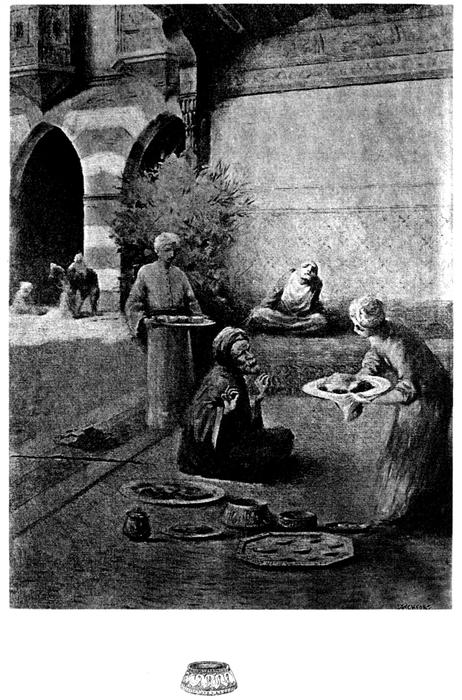
Now when it was the Thirtieth Night,
She said, It hath reached me, O auspicious King, that the young
man said to the Barber, "Thou certainly wilt be the death of me
this very day!" "O master mine," replied he, "I am he, The
Silent Man hight, by reason of the fewness of my words, to
distinguish me from my six brothers. For the eldest is called
Al-Bakbúk, the prattler; the second Al-Haddár, the babbler; the
third Al-Fakík, the gabbler; the fourth, his name is Al-Kuz
al-aswáni, the long-necked Gugglet, from his eternal chattering;
the fifth is Al-Nashshár, the tattler and tale-teller; the sixth
Shakáshik, or many-clamours; and the seventh is famous as
Al-Sámit, the Silent Man, and this is my noble self!" Whilst he
redoubled his talk, I thought my gall-bladder would have burst;
so I said to the servant, "Give him a quarter-dinar and dismiss
him and let him go from me in the name of God who made him.
I won't have my head shaved to-day." "What words be these, O
my lord?" cried he. "By Allah! I will accept no hire of thee till
I have served thee and have ministered to thy wants; and I
care not if I never take money of thee. If thou know not my
quality, I know thine; and I owe thy father, honest man, on
whom Allah Almighty have mercy! many a kindness, for he was
a liberal soul and a generous. By Allah, he sent for me one day,
as it were this blessed day, and I went in to him and found a
party of his intimates about him." Quoth he to me, "Let me
blood;" so I pulled out my astrolabe and, taking the sun's altitude
for him, I ascertained that the ascendant was inauspicious
and the hour unfavourable for blooding. I told him of this,
and he did according to my bidding and awaited a better opportunity.
So I made these lines in honour of him:—
I went to my patron some blood to let him, ✿ But found that the moment was far from good:
So I sat and I talked of all strangenesses, ✿ And with jests and jokes his good will I wooed:
They pleased him and cried he, 'O man of wit, ✿ Thou hast proved thee perfect in merry mood!'
307Quoth I, 'O thou Lord of men, save thou ✿ Lend me art and wisdom I'm fou and wood:
In thee gather grace, boon, bounty, suavity; ✿ And I guerdon the world with lore, science and gravity.
Thy father was delighted and cried out to the servant, "Give him
an hundred and three gold pieces with a robe of honour!" The
man obeyed his orders, and I awaited an auspicious moment, when
I blooded him; and he did not baulk me; nay he thanked me and
I was also thanked and praised by all present. When the bloodletting
was over I had no power to keep silence and asked him,
"By Allah, O my lord, what made thee say to the servant:—Give
him an hundred and three dinars?"; and he answered, "One dinar
was for the astrological observation, another for thy pleasant conversation,
the third for the phlebotomisation, and the remaining
hundred and the dress were for thy verses in my commendation."
"May Allah show small mercy to my father," exclaimed I, "for
knowing the like of thee." He laughed and ejaculated, "There is
no god but the God and Mohammed is the Apostle of God!
Glory to Him that changeth and is changed not! I took thee
for a man of sense, but I see thou babblest and dotest for illness.
Allah hath said in the Blessed Book[613]:—Paradise is prepared for
the goodly who bridle their anger and forgive men, and so forth;
and in any case thou art excused. Yet I cannot conceive the
cause of thy hurry and flurry; and thou must know that thy
father and thy grandfather did nothing without consulting me,
and indeed it hath been said truly enough:—Let the adviser be
prized; and:—There is no vice in advice; and it is also said in
certain saws, Whoso hath no counsellor elder than he, will never
himself an elder be[614]; and the poet says:—
Whatever needful thing thou undertake, ✿ Consult th' experienced and contraire him not!"
And indeed thou shalt never find a man better versed in affairs
than I, and I am here standing on my feet to serve thee. I am
not vexed with thee: why shouldest thou be vexed with me? But
whatever happen I will bear patiently with thee in memory of the
much kindness thy father shewed me." "By Allah," cried I, "O
308thou with tongue long as the tail of a jackass, thou persistest in
pestering me with thy prate and thou becomest more longsome in
thy long speeches, when all I want of thee is to shave my head and
wend thy way!" Then he lathered my head saying, "I perceive
thou art vexed with me, but I will not take it ill of thee, for thy wit
is weak and thou art but a laddy: it was only yesterday I used to
take thee on my shoulder[615] and carry thee to school." "O my
brother," said I, "for Allah's sake do what I want and go thy
gait!" And I rent my garments.[616] When he saw me do this he
took the razor and fell to sharpening it and gave not over stropping
it until my senses were well nigh leaving me. Then he came
up to me and shaved part of my head; then he held his hand and
then he said, "O my lord, haste is Satan's gait whilst patience is
of Allah the Compassionate. But thou, O my master, I ken thou
knowest not my rank; for verily this hand alighteth upon the
heads of Kings and Emirs and Wazirs, and sages and doctors
learned in the law, and the poet said of one like me:—
All crafts are like necklaces strung on a string, ✿ But this Barber's the union pearl of the band:
High over all craftsmen he ranketh, and why? ✿ The heads of the Kings are under his hand!"
[617]
309Then said I, "Do leave off talking about what concerneth thee
not: indeed thou hast straitened my breast and distracted my
mind." Quoth he, "Meseems thou art a hasty man;" and quoth
I, "Yes! yes! yes!" and he, "I rede thee practise restraint of self,
for haste is Satan's pelf which bequeatheth only repentance and
ban and bane, and He (upon whom be blessings and peace!) hath
said, The best of works is that wherein deliberation lurks: but I,
by Allah! have some doubt about thine affair; and so I should
like thee to let me know what it is thou art in such haste to do;
for I fear me it is other than good." Then he continued, "It wanteth
three hours yet to prayer-time; but I do not wish to be in doubt
upon this matter; nay, I must know the moment exactly, for
truly:—A guess shot in times of doubt, oft brings harm about;
especially in the like of me, a superior person whose merits are
famous amongst mankind at large; and it doth not befit me to
talk at random, as do the common sort of astrologers." So saying,
he threw down the razor and taking up the astrolabe, went forth
under the sun and stood there a long time; after which he returned
and counting on his fingers said to me, "There remain still to
prayer-time three full hours and complete, neither more nor yet
less, according to the most learned astronomicals and the wisest
makers of almanacks." "Allah upon thee," cried I, "hold thy
tongue with me, for thou breakest my liver in pieces." So he took
the razor and, after sharpening it as before and shaving other
two hairs of my head, he again held his hand and said, "I am concerned
about thy hastiness and indeed thou wouldst do well to let
me into the cause of it; 'twere the better for thee, as thou knowest
that neither thy father nor thy grandfather ever did a single thing
save by my advice." When I saw that there was no escape from
him I said to myself, "The time for prayer draws near and I wish
to go to her before the folk come out of the mosque. If I am
delayed much longer, I know not how to come at her." Then said
I aloud, "Be quick and stint this talk and impertinence, for I
have to go to a party at the house of some of my intimates."
When he heard me speak of the party, he said, "This thy day is a
blessed day for me! In very sooth it was but yesterday I invited
a company of my friends and I have forgotten to provide anything
for them to eat. This very moment I was thinking of it: Alas,
how I shall be disgraced in their eyes!" "Be not distressed about
this matter," answered I; "have I not told thee that I am bidden
to an entertainment this day? So everything in my house, eatable
310and drinkable, shall be thine, if thou wilt only get through thy
work and make haste to shave my head." He replied, "Allah
requite thee with good! Specify to me what is in thy house for my
guests that I may be ware of it." Quoth I, "Five dishes of meat
and ten chickens with reddened breasts[618] and a roasted lamb."
"Set them before me," quoth he, "that I may see them." So I
told my people to buy, borrow or steal them and bring them in
anywise, and had all this set before him. When he saw it he cried,
"The wine is wanting," and I replied, "I have a flagon or two of
good old grape-juice in the house," and he said, "Have it brought
out!" So I sent for it and he exclaimed, "Allah bless thee for a
generous disposition! But there are still the essences and perfumes."
So I bade them set before him a box containing
Nadd,[619] the best of compound perfumes, together with fine lign-aloes,
ambergris and musk unmixed, the whole worth fifty dinars.
Now the time waxed strait and my heart straitened with it; so I
said to him, "Take it all and finish shaving my head by the life of
Mohammed (whom Allah bless and keep!)." "By Allah," said he,
"I will not take it till I see all that is in it." So I bade the page
open the box and the Barber laid down the astrolabe, leaving the
greater part of my head unpolled; and, sitting on the ground, turned
over the scents and incense and aloes-wood and essences till I was
well nigh distraught. Then he took the razor and coming up to
me shaved off some few hairs and repeated these lines:—
The boy like his father shall surely show, ✿ As the tree from its parent root shall grow.
[620]
Then said he, "By Allah, O my son, I know not whether to thank
thee or thy father; for my entertainment this day is all due to thy
bounty and beneficence; and, although none of my company be
worthy of it, yet I have a set of honourable men, to wit Zantút
the bath-keeper and Salí'a the corn-chandler; and Sílat the bean-seller;
311and Akrashah the greengrocer; and Humayd the scavenger;
and Sa'íd the camel-man; and Suwayd the porter; and Abu
Makárish the bathman[621]; and Kasím the watchman; and Karím
the groom. There is not among the whole of them a bore or a
bully in his cups; nor a meddler nor a miser of his money, and
each and every hath some dance which he danceth and some of his
own couplets which he caroleth; and the best of them is that, like
thy servant, thy slave here, they know not what much talking is
nor what forwardness means." The bath-keeper sings to the tom-tom[622]
a song which enchants; and he stands up and dances and
chants,
I am going, O mammy, to fill up my pot.
As for the corn-chandler he brings more skill to it than any; he
dances and sings,
O Keener,
[623] O sweetheart, thou fallest not short
and he leaves no one's vitals sound for laughing at him. But the
scavenger sings so that the birds stop to listen to him and dances
and sings,
News my wife wots is not locked in a box!
[624]
And he hath privilege, for 'tis a shrewd rogue and a witty;[625] and
speaking of his excellence I am wont to say:—
312"My life for the scavenger! right well I love him, ✿ Like a waving bough he is sweet to my sight:
Fate joined us one night, when to him quoth I ✿ (The while I grew weak and love gained more might)
'Thy love burns my heart!' 'And no wonder,' quoth he ✿ 'When the drawer of dung turns a stoker wight.'
[626]
And indeed each is perfect in whatso can charm the wit with joy
and jollity;" adding presently, "But hearing is not seeing; and
indeed if thou make up thy mind to join us and put off going to thy
friends, 'twill be better for us and for thee. The traces of illness are
yet upon thee and haply thou art going among folk who be mighty
talkers, men who commune together of what concerneth them not;
or there may be amongst them some forward fellow who will split
thy head, and thou half thy size from sickness." "This shall be
for some other day," answered I, and laughed with heart angered:
"finish thy work and go, in Allah Almighty's guard, to
thy friends, for they will be expecting thy coming." "O my lord,"
replied he, "I seek only to introduce thee to these fellows of infinite
mirth, the sons of men of worth, amongst whom there is neither
procacity nor dicacity nor loquacity; for never, since I grew to
years of discretion, could I endure to consort with one who asketh
questions concerning what concerneth him not, nor have I ever frequented
any save those who are, like myself, men of few words.
In sooth if thou were to company with them or even to see them
once, thou wouldst forsake all thy intimates." "Allah fulfil thy
joyance with them," said I, "needs must I come amongst them
some day or other." But he said, "Would it were this very day,
for I had set my heart upon thy making one of us; yet if thou
must go to thy friends to-day, I will take these good things, wherewith
thou hast honoured and favoured me, to my guests and leave
them to eat and drink and not wait for me; whilst I will return to
thee in haste and accompany thee to thy little party; for there is
no ceremony between me and my intimates to prevent my leaving
them. Fear not, I will soon be back with thee and wend with thee
whithersoever thou wendest. There is no Majesty and there is no
Might save in Allah, the Glorious, the Great!" I shouted; "Go
thou to thy friends and make merry with them; and do let me go
313to mine and be with them this day, for they expect me." But the
Barber cried, "I will not let thee go alone;" and I replied, "The
truth is none can enter where I am going save myself." He
rejoined, "I suspect that to-day thou art for an assignation with
some woman, else thou hadst taken me with thee; yet am I the
right man to take, one who could aid thee to the end thou wishest.
But I fear me thou art running after strange women and thou wilt
lose thy life; for in this our city of Baghdad one cannot do any
thing in this line, especially on a day like Friday: our Governor is
an angry man and a mighty sharp blade." "Shame on thee, thou
wicked, bad, old man!" cried I, "Be off! what words are these
thou givest me?" "O cold of wit,"[627] cried he, "thou sayest to me
what is not true and thou hidest thy mind from me, but I know the
whole business for certain and I seek only to help thee this day
with my best endeavour." I was fearful lest my people or my
neighbours should hear the Barber's talk, so I kept silence for a
long time whilst he finished shaving my head; by which time the
hour of prayer was come and the Khutbah, or sermon, was about
to follow. When he had done, I said to him, "Go to thy friends
with their meat and drink, and I will await thy return. Then we
will fare together." In this way I hoped to pour oil on troubled
waters and to trick the accursed loon, so haply I might get quit of
him; but he said, "Thou art cozening me and thou wouldst go
alone to thy appointment and cast thyself into jeopardy, whence
there will be no escape for thee. Now by Allah! and again by
Allah! do not go till I return, that I may accompany thee and
watch the issue of thine affair." "So be it," I replied, "do not be
long absent." Then he took all the meat and drink I had given
him and the rest of it and went out of my house; but the accursed
carle gave it in charge of a porter to carry to his home but hid
himself in one of the alleys. As for me I rose on the instant, for
the Muezzins had already called the Salám of Friday, the salutation
to the Apostle;[628] and I dressed in haste and went out alone and,
314hurrying to the street, took my stand by the house wherein I had
seen the young lady. I found the old woman on guard at the door
awaiting me, and went up with her to the upper story, the damsel's
apartment. Hardly had I reached it when behold, the master of
the house returned from prayers and entering the great saloon,
closed the door. I looked down from the window and saw this
Barber (Allah's curse upon him!) sitting over against the door and
said, "How did this devil find me out?" At this very moment, as
Allah had decreed it for rending my veil of secrecy, it so happened
that a handmaid of the house-master committed some offence for
which he beat her. She shrieked out and his slave ran in to intercede
for her, whereupon the Kazi beat him to boot, and he also
roared out. The damned Barber fancied that it was I who was
being beaten; so he also fell to shouting and tore his garments and
scattered dust on his head and kept on shrieking and crying Help!
Help! So the people came round about him and he went on
yelling, "My master is being murdered in the Kazi's house!"
Then he ran clamouring to my place with the folk after him, and
told my people and servants and slaves; and, before I knew what
was doing, up they came tearing their clothes and letting loose
their hair[629] and shouting, "Alas, our master!"; and this Barber
leading the rout with his clothes rent and in sorriest plight; and he
also shouting like a madman and saying, "Alas for our murdered
master!" And they all made an assault upon the house in which
I was. The Kazi, hearing the yells and the uproar at his door
said to one of his servants, "See what is the matter"; and the man
went forth and returned and said, "O my master, at the gate there
are more than ten thousand souls what with men and women, and
all crying out, Alas for our murdered master!; and they keep
pointing to our house." When the Kazi heard this, the matter
seemed serious and he waxed wroth; so he rose and opening the
door saw a great crowd of people; whereat he was astounded and
315said, "O folk! what is there to do?" "O accursed! O dog! O
hog!" my servants replied; "'Tis thou who hast killed our
master!" Quoth he, "O good folk, and what hath your master
done to me that I should kill him?"——And Shahrazad perceived
the dawn of day and ceased saying her permitted say.
Now when it was the Thirty-first Night,
She said, It hath reached me, O auspicious King, that the Kazi
said to the servants, "What hath your master done to me that I
should kill him? This is my house and it is open to you all."
Then quoth the Barber, "Thou didst beat him and I heard him
cry out;" and quoth the Kazi, "But what was he doing that I
should beat him, and what brought him in to my house; and
whence came he and whither went he?" "Be not a wicked, perverse
old man!" cried the Barber, "for I know the whole story;
and the long and short of it is that thy daughter is in love with
him and he loves her; and when thou knewest that he had entered
the house, thou badest thy servants beat him and they did so: by
Allah, none shall judge between us and thee but the Caliph; or
else do thou bring out our master that his folk may take him,
before they go in and save him perforce from thy house, and thou
be put to shame." Then said the Kazi (and his tongue was bridled
and his mouth was stopped by confusion before the people), "An
thou say sooth, do thou come in and fetch him out." Whereupon
the Barber pushed forward and entered the house. When I saw
this I looked about for a means of escape and flight, but saw no
hiding-place except a great chest in the upper chamber where I
was. So I got into it and pulled the lid down upon myself and
held my breath. The Barber was hardly in the room before he
began to look about for me, then turned him right and left and
came straight to the place where I was, and stepped up to the chest
and, lifting it on his head, made off as fast as he could. At this, my
reason forsook me, for I knew that he would not let me be; so I
took courage and opening the chest threw myself to the ground.
My leg was broken in the fall, and the door being open I saw a
great concourse of people looking in. Now I carried in my sleeve
much gold and some silver, which I had provided for an ill day
like this and the like of such occasion; so I kept scattering it
amongst the folk to divert their attention from me and, whilst
316they were busy scrambling for it, I set off, hopping as fast as I
could, through the by-streets of Baghdad, shifting and turning right
and left. But whithersoever I went this damned Barber would go
in after me, crying aloud, "They would have bereft me of my
maa-a-ster! They would have slain him who was a benefactor to
me and my family and my friends! Praised be Allah who made
me prevail against them and delivered my lord from their hands!"
Then to me, "Where wilt thou go now? Thou wouldst persist in
following thine own evil devices, till thou broughtest thyself to this
ill pass; and, had not Allah vouchsafed me to thee, ne'er hadst
thou escaped this strait into which thou hast fallen, for they would
have cast thee into a calamity whence thou never couldest have
won free. But I will not call thee to account for thine ignorance, as
thou art so little of wit and inconsequential and addicted to hastiness!"
Said I to him, "Doth not what thou hast brought upon me
suffice thee, but thou must run after me and talk me such talk in
the bazar-streets?" And I well-nigh gave up the ghost for excess
of rage against him. Then I took refuge in the shop of a weaver
amiddlemost of the market and sought protection of the owner
who drove the Barber away; and, sitting in the back-room,[630] I said
to myself, "If I return home I shall never be able to get rid of this
curse of a Barber, who will be with me night and day; and I cannot
endure the sight of him even for a breathing-space." So I sent
out at once for witnesses and made a will, dividing the greater part
of my property among my people, and appointed a guardian over
them, to whom I committed the charge of great and small, directing
him to sell my houses and domains. Then I set out on my
travels that I might be free of this pimp[631]; and I came to settle in
your town where I have lived some time. When you invited me
and I came hither, the first thing I saw was this accursed pander
seated in the place of honour. How then can my heart be glad
and my stay be pleasant in company with this fellow who brought
all this upon me, and who was the cause of the breaking of my leg
and of my exile from home and native land? And the youth
refused to sit down and went away. When we heard his story
(continued the Tailor) we were amazed beyond measure and
amused and said to the Barber, "By Allah, is it true what this
317young man saith of thee?" "By Allah," replied he, "I dealt thus
by him of my courtesy and sound sense and generosity. Had it
not been for me he had perished and none but I was the cause of
his escape. Well it was for him that he suffered in his leg and not
in his life! Had I been a man of many words, a meddler, a busy
body, I had not acted thus kindly by him; but now I will tell you
a tale which befel me, that you may be well assured I am a man
sparing of speech in whom is no forwardness and a very different
person from those six Brothers of mine; and this it is."
I was living in Baghdad during the times of Al-Mustansir bi'llah,[632]
son of Al-Mustazi bi'llah the then Caliph, a prince who loved the
poor and needy and companied with the learned and pious. One day
it happened to him that he was wroth with ten persons, highwaymen
who robbed on the Caliph's highway, and he ordered the Prefect of
Baghdad to bring them into the presence on the anniversary of the
Great Festival.[633] So the Prefect sallied out and, making them his
prisoners, embarked with them in a boat. I caught sight of them
as they were embarking and said to myself, "These are surely
assembled for a marriage-feast; methinks they are spending their
day in that boat eating and drinking, and none shall be companion
of their cups but I myself." So I rose, O fair assembly; and, of
the excess of my courtesy and the gravity of my understanding, I
embarked with them and entered into conversation with them.
They rowed across to the opposite bank, where they landed and
there came up the watch and guardians of the peace with chains,
which they put round the robbers' necks. They chained me among
the rest of them; and, O people, is it not a proof of my courtesy
318and spareness of speech, that I held my peace and did not please
to speak? Then they took us away in bilbos and next morning
carried us all before Al-Mustansir bi'llah, Commander of the
Faithful, who bade smite the necks of the ten robbers. So the
Sworder came forward after they were seated on the leather of
blood:[634] then drawing his blade, struck off one head after another
until he had smitten the neck of the tenth; and I alone remained.
The Caliph looked at me and asked the Headsman, saying,
"What ails thee that thou hast struck off only nine heads?"; and
he answered, "Allah forbid that I should behead only nine, when
thou biddest me behead ten!" Quoth the Caliph, "Meseems thou
hast smitten the necks of only nine, and this man before thee is
the tenth." "By thy beneficence!" replied the Headsman, "I have
beheaded ten." "Count them!" cried the Caliph and whenas
they counted heads, lo! there were ten. The Caliph looked at me
and said, "What made thee keep silence at a time like this and
how camest thou to company with these men of blood. Tell me
the cause of all this, for albeit thou art a very old man, assuredly
thy wits are weak." Now when I heard these words from the
Caliph I sprang to my feet and replied, "Know, O Prince of the
Faithful, that I am the Silent Shaykh and am thus called to distinguish
me from my six brothers. I am a man of immense
learning whilst, as for the gravity of my understanding, the
wiliness of my wits and the spareness of my speech, there is no
end to them; and my calling is that of a barber. I went out
early on yesterday morning and saw these men making for a skiff;
and, fancying they were bound for a marriage-feast, I joined them
and mixed with them. After a while up came the watch and
guardians of the peace, who put chains round their necks and
round mine with the rest; but, in the excess of my courtesy, I
held my peace and spake not a word; nor was this other but
generosity on my part. They brought us into thy presence, and
thou gavest an order to smite the necks of the ten; yet did I not
make myself known to thee and remained silent before the
Sworder, purely of my great generosity and courtesy which led
319me to share with them in their death. But all my life long have I
dealt thus nobly with mankind, and they requite me the foulest
and evillest requital!" When the Caliph heard my words and
knew that I was a man of exceeding generosity and of very few
words, one in whom is no forwardness (as this youth would have
it whom I rescued from mortal risk and who hath so scurvily
repaid me), he laughed with excessive laughter till he fell upon
his back. Then said he to me, "O Silent Man, do thy six brothers
favour thee in wisdom and knowledge and spareness of speech?"
I replied, "Never were they like me! Thou puttest reproach upon
me, O Commander of the Faithful, and it becomes thee not to
even my brothers with me; for, of the abundance of their speech
and their deficiency of courtesy and gravity, each one of them
hath gotten some maim or other. One is a monocular, another
palsied, a third stone-blind, a fourth cropped of ears and nose and
a fifth shorn of both lips, while the sixth is a hunchback and a
cripple. And conceive not, O Commander of the Faithful, that I
am prodigal of speech; but I must perforce explain to thee that I
am a man of greater worth and fewer words than any of them.
From each one of my brothers hangs a tale of how he came by
his bodily defect and these I will relate to thee." So the Caliph
gave ear to
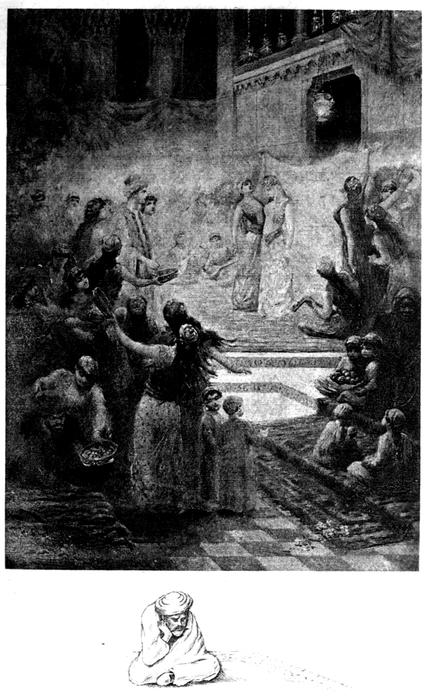
Know then, O Commander of the Faithful, that my first brother,
Al-Bakbuk, the prattler, is a Hunchback who took to tailoring in
Baghdad, and he used to sew in a shop hired from a man of much
wealth, who dwelt over the shop,[635] and there was also a flour-mill
in the basement. One day as my brother, the Hunchback, was
sitting in his shop a-tailoring, he chanced to raise his head and
saw a lady like the rising full moon at a balconied window of his
landlord's house, engaged in looking out at the passers-by.[636] When
my brother beheld her, his heart was taken with love of her and he
passed his whole day gazing at her and neglected his tailoring till
320eventide. Next morning he opened his shop and sat him down to
sew; but, as often as he stitched a stitch, he looked to the window
and saw her as before; and his passion and infatuation for her
increased. On the third day as he was sitting in his usual place,
gazing on her, she caught sight of him and, perceiving that he had
been captivated with love of her, laughed in his face,[637] and he
smiled back at her. Then she disappeared and presently sent her
slave-girl to him with a bundle containing a piece of red flowered
silk. The handmaid accosted him and said, "My lady salameth to
thee and desireth thee, of thy skill and good will, to fashion for her
a shift of this piece and to sew it handsomely with thy best
sewing." He replied, "Hearkening and obedience"; and shaped
for her a chemise and finished sewing it the same day. When the
morning morrowed the girl came back and said to him, "My lady
salameth to thee and asks how thou hast passed yesternight; for she
hath not tasted sleep by reason of her heart being taken up with
thee." Then she laid before him a piece of yellow satin and said,
"My lady biddeth thee cut her two pair of petticoat-trousers out
of this piece and sew them this very day." Hearkening and
obedience!" replied he, "greet her for me with many greetings
and say to her, Thy slave is obedient to thine order; so command
him as thou wilt." Then he applied himself to cutting out
and worked hard at sewing the trousers; and after an hour the
lady appeared at the lattice and saluted him by signs, now casting
down her eyes, then smiling in his face, and he began to assure
himself that he would soon make a conquest. She did not let him
stir till he had finished the two pair of trousers, when she withdrew
and sent the handmaid to whom he delivered them; and
she took them and went her ways. When it was night, he threw
himself on his carpet-bed, and lay tossing about from side to side
till morning, when he rose and sat down in his place. Presently
the damsel came to him and said, "My master calleth for thee."
Hearing these words he feared with exceeding fear; but the slave-girl,
seeing his affright, said to him, "No evil is meant to thee:
naught but good awaiteth thee. My lady would have thee make
acquaintance with my lord." So my brother the tailor, rejoicing
with great joy, went with her; and when he came into the presence
of his landlord, the lady's husband, he kissed the ground before
him, and the master of the house returned his greeting and gave
321him a great piece of linen saying, "Shape me shirts out of this
stuff and sew them well;" and my brother answered, "To hear is
to obey." Thereupon he fell to work at once, snipping, shaping
and sewing till he had finished twenty shirts by supper time,
without stopping to taste food. The house-master asked him,
"How much the wage for this?"; and he answered, "Twenty
dirhams." So the gentleman cried out to the slave-girl, "Bring
me twenty dirhams," and my brother spake not a word; but the
lady signed, "Take nothing from him;" whereupon my brother
said, "By Allah I will take naught from thy hand." And he
carried off his tailor's gear and returned to his shop, although he
was destitute even to a red cent.[638] Then he applied himself to do
their work; eating, in his zeal and diligence, but a bit of bread
and drinking only a little water for three days. At the end of this
time came the handmaid and said to him, "What hast thou
done?" Quoth he, "They are finished," and carried the shirts to
the lady's husband, who would have paid him his hire: but he
said, "I will take nothing," for fear of her and, returning to his
shop, passed the night without sleep because of his hunger. Now
the dame had informed her husband how the case stood (my
brother knowing naught of this); and the two had agreed to make
him tailor for nothing, the better to mock and laugh at him. Next
morning he went to his shop, and, as he sat there, the handmaid
came to him and said, "Speak with my master." So he accompanied
her to the husband who said to him, "I wish thee to cut
out for me five long-sleeved robes.[639]" So he cut them out[640] and
took the stuff and went away. Then he sewed them and carried
them to the gentleman, who praised his sewing and offered him a
purse of silver. He put out his hand to take it, but the lady
signed to him from behind her husband not to do so, and he
replied, "O my lord, there is no hurry, we have time enough for
this." Then he went forth from the house meaner and meeker
322than a donkey, for verily five things were gathered together in him
viz:—love, beggary, hunger, nakedness and hard labour. Nevertheless
he heartened himself with the hope of gaining the lady's
favours. When he had made an end of all their jobs, they played
him another trick and married him to their slave-girl; but, on the
night when he thought to go in to her, they said to him, "Lie this
night in the mill; and to-morrow all will go well." My brother
concluded that there was some good cause for this and nighted
alone in the mill. Now the husband had set on the miller to make
the tailor turn the mill: so when night was half spent the man
came into him and began to say, "This bull of ours hath become
useless and standeth still instead of going round: he will not turn
the mill this night, and yet we have great store of corn to be
ground. However, I'll yoke him perforce and make him finish
grinding it before morning, as the folk are impatient for their
flour." So he filled the hoppers with grain and, going up to my
brother with a rope in his hand, tied it round his neck and said to
him, "Gee up! Round with the mill! thou, O bull, wouldst do
nothing but grub and stale and dung!" Then he took a whip and
laid it on the shoulders and calves of my brother, who began to
howl and bellow; but none came to help him; and he was forced
to grind the wheat till hard upon dawn, when the house-master
came in and, seeing my brother still tethered to the yoke and the
man flogging him, went away. At day-break the miller returned
home and left him still yoked and half dead; and soon after in
came the slave-girl who unbound him, and said to him, "I and my
lady are right sorry for what hath happened and we have borne
thy grief with thee." But he had no tongue wherewith to answer
her from excess of beating and mill-turning. Then he retired to
his lodging and behold, the clerk who had drawn up the marriage-deed
came to him[641] and saluted him, saying, "Allah give thee long
life! May thy espousal be blessed! This face telleth of pleasant
doings and dalliance and kissing and clipping from dusk to dawn."
"Allah grant the liar no peace, O thou thousandfold cuckold!",
my brother replied, "by Allah, I did nothing but turn the mill in
the place of the bull all night till morning!" "Tell me thy tale,"
quoth he; and my brother recounted what had befallen him and
he said, "Thy star agrees not with her star; but an thou wilt I can
alter the contract for thee," adding, "'Ware lest another cheat be
323not in store for thee." And my brother answered him, "See if
thou have not another contrivance." Then the clerk left him and
he sat in his shop, looking for some one to bring him a job whereby
he might earn his day's bread. Presently the handmaid came to
him and said, "Speak with my lady." "Begone, O my good girl,"
replied he, "there shall be no more dealings between me and thy
lady." The handmaid returned to her mistress and told her what
my brother had said and presently she put her head out of the
window, weeping and saying, "Why, O my beloved, are there to be
no more dealings 'twixt me and thee?" But he made her no
answer. Then she wept and conjured him, swearing that all which
had befallen him in the mill was not sanctioned by her and that
she was innocent of the whole matter. When he looked upon
her beauty and loveliness and heard the sweetness of her speech,
the sorrow which had possessed him passed from his heart; he
accepted her excuse and he rejoiced in her sight. So he saluted
her and talked with her and sat tailoring awhile, after which the
handmaid came to him and said, "My mistress greeteth thee and
informeth thee that her husband purposeth to lie abroad this night
in the house of some intimate friends of his; so, when he is gone,
do thou come to us and spend the night with my lady in delightsomest
joyance till the morning." Now her husband had asked
her, "How shall we manage to turn him away from thee?;" and
she answered, "Leave me to play him another trick and make him
a laughing-stock for all the town." But my brother knew naught
of the malice of women. As soon as it was dusk, the slave-girl
came to him and carried him to the house, and when the lady saw
him she said to him, "By Allah, O my lord, I have been longing
exceedingly for thee." "By Allah," cried he, "kiss me quick before
thou give me aught else.[642]" Hardly had he spoken, when the lady's
husband came in from the next room[643] and seized him, saying, "By
Allah, I will not let thee go, till I deliver thee to the chief of the
town watch." My brother humbled himself to him; but he would
not listen to him and carried him before the Prefect who gave him
an hundred lashes with a whip and, mounting him on a camel,
promenaded him round about the city, whilst the guards proclaimed
aloud, "This is his reward who violateth the Harims of
324honourable men!" Moreover, he fell off the camel and broke his
leg and so became lame. Then the Prefect banished him from the
city; and he went forth unknowing whither he should wend; but
I heard of him and fearing for him went out after him, and brought
him back secretly to the city and restored him to health and took
him into my house where he still liveth." The Caliph laughed at
my story and said, "Thou hast done well, O Samit, O Silent Man,
O spare of speech!"; and he bade me take a present and go
away. But I said, "I will accept naught of thee except I tell thee
what befel all my other brothers; and do not think me a man of
many words." So the Caliph gave ear to,
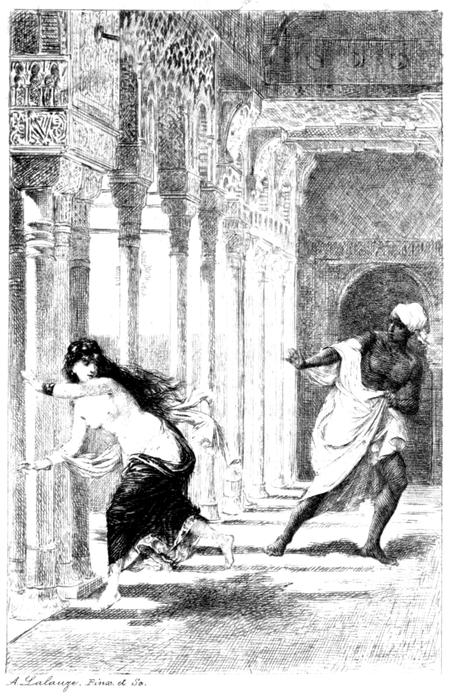
Know, O Commander of the Faithful, that my second brother's
name was Al-Haddár, that is the babbler, and he was the paralytic.
Now it happened to him one day, as he was going about his
business, that an old woman accosted him and said, "Stop a little,
my good man, that I may tell thee of somewhat which, if it be to
thy liking, thou shalt do for me and I will pray Allah to give thee
good of it!" My brother stopped and she went on, "I will put
thee in the way of a certain thing, so thou not be prodigal of
speech." "On with thy talk," quoth he; and she, "What sayest
thou to handsome quarters and a fair garden with flowing waters,
flowers blooming, and fruit growing, and old wine going and a
pretty young face whose owner thou mayest embrace from dark
till dawn? If thou do whatso I bid thee thou shalt see something
greatly to thy advantage." "And is all this in the world?" asked
my brother; and she answered, "Yes, and it shall be thine, so thou
be reasonable and leave idle curiosity and many words, and do my
bidding," "I will indeed, O my lady," said he, "how is it thou
hast preferred me in this matter before all men and what is it that
so much pleaseth thee in me?" Quoth she, "Did I not bid thee
be spare of speech? Hold thy peace and follow me. Know, that
the young lady, to whom I shall carry thee, loveth to have her own
way and hateth being thwarted and all who gainsay; so, if thou
humour her, thou shalt come to thy desire of her." And my
brother said, "I will not cross her in anything." Then she went on
and my brother followed her, an-hungering after what she described
325to him till they entered a fine large house, handsome and choicely
furnished, full of eunuchs and servants and showing signs of prosperity
from top to bottom. And she was carrying him to the
upper story when the people of the house said to him, "What dost
thou here?" But the old woman answered them, "Hold your
peace and trouble him not: he is a workman and we have occasion
for him." Then she brought him into a fine great pavilion, with a
garden in its midst, never eyes saw a fairer; and made him sit upon
a handsome couch. He had not sat long, before he heard a loud
noise and in came a troop of slave-girls surrounding a lady like the
moon on the night of its fullest. When he saw her, he rose up and
made an obeisance to her, whereupon she welcomed him and bade
him be seated. So he sat down and she said to him, "Allah
advance thee to honour! Is all well with thee?" "O my lady,"
he answered, "all with me is right well." Then she bade bring in
food, and they set before her delicate viands; so she sat down to
eat, making a show of affection to my brother and jesting with him,
though all the while she could not refrain from laughing; but as
often as he looked at her, she signed towards her handmaidens as
though she were laughing at them. My brother (the ass!) understood
nothing; but, in the excess of his ridiculous passion, he fancied
that the lady was in love with him and that she would soon grant
him his desire. When they had done eating, they set on the wine
and there came in ten maidens like moons, with lutes ready strung
in their hands, and fell to singing with full voices, sweet and sad,
whereupon delight gat hold upon him and he took the cup from
the lady's hands and drank it standing. Then she drank a cup of
wine and my brother (still standing) said to her "Health," and
bowed to her. She handed him another cup and he drank it off,
when she slapped him hard on the nape of his neck.[644] Upon this
my brother would have gone out of the house in anger; but the
old woman followed him and winked to him to return. So he
came back and the lady bade him sit and he sat down without a
word. Then she again slapped him on the nape of his neck; and
the second slapping did not suffice her, she must needs make all
her handmaidens also slap and cuff him, while he kept saying to
the old woman, "I never saw aught nicer than this." She on her
side ceased not exclaiming, "Enough, enough, I conjure thee, O
326my mistress!"; but the women slapped him till he well nigh
swooned away. Presently my brother rose and went out to obey a
call of nature, but the old woman overtook him, and said, "Be
patient a little and thou shalt win to thy wish." "How much
longer have I to wait," my brother replied, "this slapping hath
made me feel faint." "As soon as she is warm with wine," answered
she, "thou shalt have thy desire." So he returned to his place and
sat down, whereupon all the handmaidens stood up and the lady
bade them perfume him with pastiles and besprinkle his face with
rose-water. Then said she to him, "Allah advance thee to honour!
Thou hast entered my house and hast borne with my conditions,
for whoso thwarteth me I turn him away, and whoso is patient hath
his desire." "O mistress mine," said he, "I am thy slave and in the
hollow of thine hand!" "Know, then," continued she, "that Allah
hath made me passionately fond of frolic; and whoso falleth in with
my humour cometh by whatso he wisheth." Then she ordered
her maidens to sing with loud voices till the whole company was
delighted; after which she said to one of them, "Take thy lord,
and do what is needful for him and bring him back to me forthright."
So the damsel took my brother (and he not knowing what
she would do with him); but the old woman overtook him and
said, "Be patient; there remaineth but little to do." At this his face
brightened and he stood up before the lady while the old woman
kept saying, "Be patient; thou wilt now at once win to thy wish!";
till he said, "Tell me what she would have the maiden do with
me?" "Nothing but good," replied she, "as I am thy sacrifice!
She wisheth only to dye thy eyebrows and pluck out thy mustachios."
Quoth he, "As for the dyeing of my eyebrows, that will
come off with washing,[645] but for the plucking out of my mustachios
that indeed is a somewhat painful process." "Be cautious how
thou cross her," cried the old woman; "for she hath set her heart
on thee." So my brother patiently suffered her to dye his eyebrows
and pluck out his mustachios; after which the maiden
returned to her mistress and told her. Quoth she, "Remaineth now
only one other thing to be done; thou must shave his beard and
327make him a smooth o' face.[646]" So the maiden went back and told
him what her mistress had bidden her do; and my brother (the
blockhead!) said to her, "How shall I do what will disgrace me
before the folk?" But the old woman said, "She would do on
this wise only that thou mayst be as a beardless youth and that no
hair be left on thy face to scratch and prick her delicate cheeks;
for indeed she is passionately in love with thee. So be patient and
thou shalt attain thine object." My brother was patient and did
her bidding and let shave off his beard and, when he was brought
back to the lady, lo! he appeared dyed red as to his eyebrows,
plucked of both mustachios, shorn of his beard, rouged on both
cheeks. At first she was affrighted at him; then she made
mockery of him and, laughing till she fell upon her back, said,
"O my lord, thou hast indeed won my heart by thy good nature!"
Then she conjured him, by her life, to stand up and dance, and he
arose, and capered about, and there was not a cushion in the house
but she threw it at his head, and in like manner did all her women
who also kept pelting him with oranges and lemons and citrons
till he fell down senseless from the cuffing on the nape of the neck,
the pillowing and the fruit-pelting. "Now thou hast attained thy
wish," said the old woman when he came round; "there are no
more blows in store for thee and there remaineth but one little thing
to do. It is her wont, when she is in her cups, to let no one have
her until she put off her dress and trousers and remain stark
naked.[647] Then she will bid thee doff thy clothes and run; and
she will run before thee as if she were flying from thee; and do
thou follow her from place to place till thy prickle stands at fullest
point, when she will yield to thee[648];" adding, "Strip off thy clothes
at once." So he rose, well nigh lost in ecstacy and, doffing his
raiment, showed himself mother-naked.——And Shahrazad perceived
the dawn of day and ceased to say her permitted say.
328
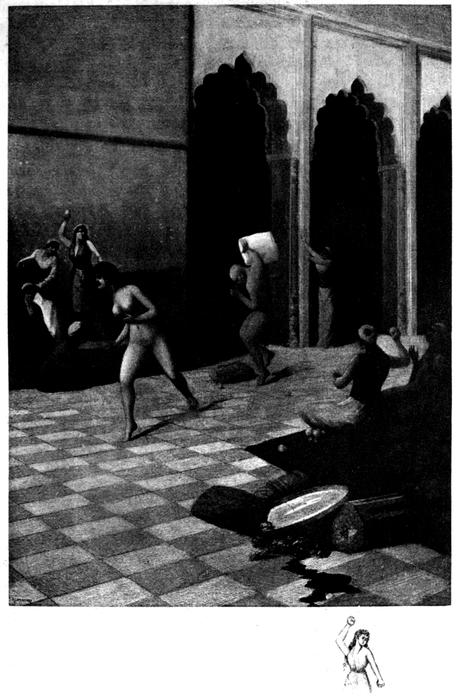
Now when it was the Thirty-Second Night,
She said, It hath reached me, O auspicious King, that when the old
woman said to the Barber's second brother, "Doff thy clothes," he
rose, well nigh lost in ecstacy; and, stripping off his raiment, showed
himself mother-naked. Whereupon the lady stripped also and said
to my brother, "If thou want anything run after me till thou catch
me." Then she set out at a run and he ran after her while she
rushed into room after room and rushed out of room after room,
my brother scampering after her in a rage of desire like a veritable
madman, with yard standing terribly tall. After much of this kind
she dashed into a darkened place, and he dashed after her; but
suddenly he trod upon a yielding spot, which gave way under his
weight; and, before he was aware where he was, he found himself
in the midst of a crowded market, part of the bazar of the leather-sellers
who were crying the prices of skins and hides and buying
and selling. When they saw him in his plight, naked, with standing
yard, shorn of beard and moustachios, with eyebrows dyed red,
and cheeks ruddled with rouge, they shouted and clapped their
hands at him, and set to flogging him with skins upon his bare
body till a swoon came over him. Then they threw him on the
back of an ass and carried him to the Chief of Police. Quoth the
Chief "What is this?" Quoth they, "This fellow fell suddenly
upon us out of the Wazir's house[649] in this state." So the Prefect
gave him an hundred lashes and then banished him from Baghdad.
However I went out after him and brought him back secretly into
the city and made him a daily allowance for his living: although,
were it not for my generous humour, I could not have put up with
the like of him. Then the Caliph gave ear to
My third brother's name was Al-Fakík, the Gabbler, who was
blind. One day Fate and Fortune drove him to a fine large house,
and he knocked at the door, desiring speech of its owner that he
329might beg somewhat of him. Quoth the master of the house,
"Who is at the door?" But my brother spake not a word and
presently he heard him repeat with a loud voice, "Who is this?"
Still he made no answer and immediately heard the master walk
to the door and open it and say, "What dost thou want?" My
brother answered "Something for Allah Almighty's sake.[650]" "Art
thou blind?" asked the man, and my brother answered "Yes."
Quoth the other, "Stretch me out thy hand." So my brother put
out his hand thinking that he would give him something; but he
took it and, drawing him into the house, carried him up from stair
to stair till they reached the terrace on the house-top, my brother
thinking the while that he would surely give him something of
food or money. Then he asked my brother, "What dost thou
want, O blind man?" and he answered, "Something for the
Almighty's sake." "Allah open for thee some other door!" "O
thou! why not say so when I was below stairs?" "O cadger,
why not answer me when I first called to thee?" "And what
meanest thou to do for me now?" "There is nothing in the
house to give thee." "Then take me down the stair." "The path
is before thee." So my brother rose and made his way downstairs,
till he came within twenty steps of the door, when his foot slipped
and he rolled to the bottom and broke his head. Then he went
out, unknowing whither to turn, and presently fell in with two other
blind men, companions of his, who said to him, "What didst thou
gain to-day?" He told them what had befallen him and added,
"O my brothers, I wish to take some of the money in my hands
and provide myself with it." Now the master of the house had
followed him and was listening to what they said; but neither my
brother nor his comrades knew of this. So my brother went to his
lodging and sat down to await his companions, and the house-owner
entered after him without being perceived. When the other blind
men arrived, my brother said to them, "Bolt the door and search
the house lest any stranger have followed us." The man, hearing
this, caught hold of a cord that hung from the ceiling and clung to
it, whilst they went round about the house and searched but found
no one. So they came back, and, sitting beside my brother, brought
out their money which they counted and lo! it was twelve thousand
dirhams. Each took what he wanted and they buried the rest in
330a corner of the room. Then they set on food and sat down, to eat.
Presently my brother, hearing a strange pair of jaws munching by
his side,[651] said to his friends, "There is a stranger amongst us;"
and, putting forth his hand, caught hold of that of the house-master.
Thereupon all fell on him and beat him;[652] and when tired of
belabouring him they shouted, "O ye Moslems! a thief is come in
to us, seeking to take our money!" A crowd gathered around
them, whereupon the intruder hung on to them; and complained
with them as they complained; and, shutting his eyes like them, so
that none might doubt his blindness, cried out, "O Moslems, I take
refuge with Allah and the Governor, for I have a matter to make
known to him!" Suddenly up came the watch and, laying hands
on the whole lot (my brother being amongst them), drove them[653] to
the Governor's who set them before him and asked, "What news
with you?" Quoth the intruder, "Look and find out for thyself,
not a word shall be wrung from us save by torture, so begin by
beating me and after me beat this man our leader."[654] And he pointed
to my brother. So they threw the man at full length and gave
him four hundred sticks on his backside. The beating pained
him, whereupon he opened one eye and, as they redoubled their
blows, he opened the other eye. When the Governor saw this
he said to him, "What have we here, O accursed?"; whereto
he replied, "Give me the seal-ring of pardon! We four have
shammed blind, and we impose upon people that we may enter
houses and look upon the unveiled faces of the women and contrive
for their corruption. In this way we have gotten great gain
331and our store amounts to twelve thousand dirhams. Said I to my
company:—Give me my share, three thousand; but they rose and
beat me and took away my money, and I seek refuge with Allah
and with thee; better thou have my share than they. So, if thou
wouldst know the truth of my words, beat one and every of the
others more than thou hast beaten me, and he will surely open his
eyes." The Governor gave orders for the question to begin with
my brother, and they bound him to the whipping-post,[655] and the
Governor said, "O scum of the earth, do ye abuse the gracious
gifts of Allah and make as if ye were blind!" "Allah! Allah!"
cried my brother, "by Allah, there is none among us who can
see." Then they beat him till he swooned away and the Governor
cried, "Leave him till he come to and then beat him again."
After this he caused each of the companions to receive more than
three hundred sticks, whilst the sham-abraham kept saying to them
"Open your eyes or you will be beaten afresh." At last the man
said to the Governor, "Dispatch some one with me to bring thee
the money; for these fellows will not open their eyes, lest they
incur disgrace before the folk." So the Governor sent to fetch
the money and gave the man his pretended share, three thousand
dirhams; and, keeping the rest for himself, banished the three
blind men from the city. But I, O Commander of the Faithful,
went out and overtaking my brother questioned him of his case;
whereupon he told me of what I have told thee; so I brought him
secretly into the city, and appointed him (in the strictest privacy)
an allowance for meat and drink! The Caliph laughed at my
story and said, "Give him a gift and let him go;" but I said, "By
Allah! I will take naught till I have made known to the Commander
of the Faithful what came to pass with the rest of my
brothers; for truly I am a man of few words and spare of speech."
Then the Caliph gave ear to
Now as for my fourth brother, O Commander of the Faithful,
Al-Kuz al-aswáni, or the long-necked Gugglet hight, from his
brimming over with words, the same who was blind of one eye, he
332became a butcher in Baghdad and he sold flesh and fattened rams;
and great men and rich bought their meat of him, so that he
amassed much wealth and got him cattle and houses. He fared
thus a long while, till one day, as he was sitting in his shop, there
came up an old man and long o' the beard, who laid down
some silver and said, "Give me meat for this." He gave him his
money's worth of flesh and the oldster went his ways. My brother
examined the Shaykh's silver, and, seeing that the dirhams were
white and bright, he set them in a place apart. The grey-beard
continued to return to the shop regularly for five months, and my
brother ceased not to lay up all the coin he received from him in its
own box. At last he thought to take out the money to buy sheep;
so he opened the box and found in it nothing, save bits of white
paper cut round to look like coin[656]; so he buffetted his face and
cried aloud till the folk gathered about him, whereupon he told
them his tale which made them marvel exceedingly. Then he
rose as was his wont, and slaughtering a ram hung it up inside his
shop; after which he cut off some of the flesh, and hanging it
outside kept saying to himself, "O Allah, would the ill-omened
old fellow but come!" And an hour had not passed before the
Shaykh came with his silver in hand; whereupon my brother rose
and caught hold of him calling out, "Come aid me, O Moslems, and
learn my story with this villain!" When the old man heard this,
he quietly said to him, "Which will be the better for thee, to let
go of me or to be disgraced by me amidst the folk?" "In what
wilt thou disgrace me?" "In that thou sellest man's flesh for
mutton!" "Thou liest, thou accursed!" "Nay, he is the accursed
who hath a man hanging up by way of meat in his shop." "If
the matter be as thou sayest, I give thee lawful leave to take my
money and my life." Then the old man cried out aloud, "Ho, ye
people! if you would prove the truth of my words, enter this man's
shop." The folk rushed in and found that the ram was become
a dead man[657] hung up for sale. So they set upon my brother
crying out, "O Infidel! O villain!"; and his best friends fell to
cuffing and kicking him and kept saying, "Dost thou make us eat
flesh of the sons of Adam?" Furthermore, the old man struck
333him on the eye and put it out. Then they carried the carcass,
with the throat cut, before the Chief of the city-watch, to whom the
old man said, "O Emir, this fellow butchers men and sells their
flesh for mutton and we have brought him to thee; so arise and
execute the judgments of Allah (to whom be honour and glory!)"
My brother would have defended himself, but the Chief refused to
hear him and sentenced him to receive five hundred sticks and to
forfeit the whole of his property. And, indeed, had it not been for
that same property which he expended in bribes, they would have
surely slain him. Then the Chief banished him from Baghdad;
and my brother fared forth at a venture, till he came to a great
town, where he thought it best to set up as a cobbler; so he opened
a shop and sat there doing what he could for his livelihood. One
day, as he went forth on his business, he heard the distant tramp of
horses and, asking the cause, was told that the King was going out
to hunt and course; so my brother stopped to look at the fine
suite. It so fortuned that the King's eye met my brother's; whereupon
the King hung down his head and said, "I seek refuge with
Allah from the evil of this day!"[658]; and turned the reins of his steed
and returned home with all his retinue. Then he gave orders to
his guards, who seized my brother and beat him with a beating so
painful that he was well-nigh dead; and my brother knew not
what could be the cause of his maltreatment, after which he returned
to his place in sorriest plight. Soon afterwards he went to one of
the King's household and related what had happened to him;
and the man laughed till he fell upon his back and cried, "O
brother mine, know that the King cannot bear to look at a monocular,
especially if he be blind of the right eye, in which case he doth
not let him go without killing him." When my brother heard this,
he resolved to fly from that city; so he went forth from it to
another wherein none knew him and there he abode a long while.
One day, being full of sorrowful thought for what had befallen him,
he sallied out to solace himself; and, as he was walking along, he
heard the distant tramp of horses behind him and said, "The
judgment of Allah is upon me!" and looked about for a hiding-place
334but found none. At last he saw a closed door which he
pushed hard: it yielded and he entered a long gallery in which he
took refuge, but hardly had he done so, when two men set upon
him crying out, "Allah be thanked for having delivered thee into
our hands, O enemy of God! These three nights thou hast robbed
us of our rest and sleep, and verily thou hast made us taste of the
death-cup." My brother asked, "O folk, what ails you?"; and
they answered, "Thou givest us the change and goest about to
disgrace us and plannest some plot to cut the throat of the house-master!
Is it not enough that thou hast brought him to beggary,
thou and thy fellows? But now give us up the knife wherewith
thou threatenest us every night." Then they searched him and
found in his waist-belt the knife used for his shoe-leather; and he
said, "O people, have the fear of Allah before your eyes and maltreat
me not, for know that my story is a right strange!" "And
what is thy story?" said they; so he told them what had befallen
him, hoping they would let him go; however they paid no heed to
what he said and, instead of showing some regard, beat him
grievously and tore off his clothes: then, finding on his sides the
scars of beating with rods, they said, "O accursed! these marks
are the manifest signs of thy guilt!" They carried him before the
Governor, whilst he said to himself, "I am now punished for my
sins and none can deliver me save Allah Almighty!" The Governor
addressing my brother asked him, "O villain, what led thee to
enter their house with intention to murther?"; and my brother
answered, "I conjure thee by Allah, O Emir, hear my words and
be not hasty in condemning me!". But the Governor cried, "Shall
we listen to the words of a robber who hath beggared these people,
and who beareth on his back the scar of his stripes?" adding, "They
surely had not done this to thee, save for some great crime." So
he sentenced him to receive an hundred cuts with the scourge, after
which they set him on a camel and paraded him about the city,
proclaiming, "This is the requital and only too little to requite him
who breaketh into people's houses." Then they thrust him out of
the city, and my brother wandered at random, till I heard what had
befallen him; and, going in search of him, questioned him of his
case; so he acquainted me with his story and all his mischances,
and I carried him secretly to the city where I made him an allowance
for his meat and drink. Then the Caliph gave ear to
335
My fifth brother Al-Nashshár,[659] the Babbler, the same who was
cropped of both ears, O Commander of the Faithful, was an asker
wont to beg of folk by night and live on their alms by day. Now
when our father, who was an old man well stricken in years,
sickened and died, he left us seven hundred dirhams whereof
each son took his hundred; but, as my fifth brother received his
portion, he was perplexed and knew not what to do with it.
While in this uncertainty he bethought him to lay it out on glass-ware
of all sorts and turn an honest penny on its price. So he
bought an hundred dirhams worth of verroterie and, putting it into
a big tray, sat down to sell it on a bench at the foot of a wall
against which he leant back. As he sat with the tray before him
he fell to musing and said to himself, "Know, O my good Self,
that the head of my wealth, my principal invested in this glass-ware,
is an hundred dirhams. I will assuredly sell it for two hundred,
with which I will forthright buy other glass and make by it four
hundred; nor will I cease to sell and buy on this wise, till I have
gotten four thousand and soon find myself the master of much
money. With these coins I will buy merchandize and jewels and
ottars[660] and gain great profit on them; till, Allah willing, I will
make my capital an hundred thousand dirhams. Then I will
purchase a fine house with white slaves and eunuchs and horses;
and I will eat and drink and disport myself; nor will I leave a
singing man or a singing woman in the city, but I will summon
336them to my palace and make them perform before me." All this
he counted over in his mind, while the tray of glass-ware, worth an
hundred dirhams, stood on the bench before him, and, after
looking at it, he continued, "And when, Inshallah! my capital shall
have become one hundred thousand[661] dinars, I will send out
marriage-brokeresses to require for me in wedlock the daughters of
Kings and Wazirs; and I will demand to wife the eldest daughter
of the Prime Minister; for it hath reached me that she is perfect
in beauty and prime in loveliness and rare in accomplishments. I
will give a marriage-settlement of one thousand dinars; and, if her
father consent, well: but if not I will take her by force from under
his very nose. When she is safely homed in my house, I will buy
ten little eunuchs[662] and for myself a robe of the robes of Kings and
Sultans; and get me a saddle of gold and a bridle set thick with
gems of price. Then I will mount with the Mamelukes preceding
me and surrounding me, and I will make the round of the city
whilst the folk salute me and bless me; after which I will repair to
the Wazir (he that is father of the girl), with armed white slaves
before and behind me and on my right and on my left. When he
sees me, the Wazir stands up, and seating me in his own place sits
down much below me; for that I am to be his son-in-law. Now I
have with me two eunuchs carrying purses, each containing a
thousand dinars; and of these I deliver to him the thousand, his
daughter's marriage-settlement, and make him a free gift of the
other thousand, that he may have reason to know my generosity
and liberality and my greatness of spirit and the littleness of the
world in my eyes. And for ten words he addresses to me I answer
him two. Then back I go to my house, and if one come to me on
the bride's part, I make him a present of money and throw on him
a dress of honour; but if he bring me a gift, I give it back to him
and refuse to accept it,[663] that they may learn what a proud spirit is
mine which never condescends to derogate. Thus I establish my
rank and status. When this is done I appoint her wedding night
and adorn my house showily! gloriously! And as the time for
337parading the bride is come, I don my finest attire and sit down on
a mattress of gold brocade, propping up my elbow with a pillow,
and turning neither to the right nor to the left; but looking only
straight in front for the haughtiness of my mind and the gravity of
my understanding. And there before me stands my wife in her
raiment and ornaments, lovely as the full moon; and I, in my
loftiness and dread lordliness,[664] will not glance at her till those
present say to me, "O our lord and our master, thy wife, thy
handmaid, standeth before thee; vouchsafe her one look for
standing wearieth her." Then they kiss the ground before me
many times; whereupon I raise my eyes and cast at her one single
glance and turn my face earthwards again. Then they bear her
off to the bride-chamber,[665] and I arise and change my clothes for a
far finer suit; and, when they bring in the bride a second time, I
deign not to throw her a look till they have begged me many times;
after which I glance at her out of the corner of one eye, and then
bend down my head. I continue acting after this fashion till the
parading and displaying are completed"[666]——And Shahrazad perceived
the dawn of day and ceased saying her permitted say.
Now when it was the Thirty-Third Night,
She said, It hath reached me, O auspicious King, that the Barber's
fifth brother proceeded:—Then I bend down my head and continue
acting after this fashion till her parading and displaying are completed.
Thereupon I order one of my eunuchs to bring me a bag
of five hundred dinars which I give as largesse to the tirewomen
present and bid them one and all lead me to the bride-chamber.
When they leave me alone with her I neither look at her nor speak
to her, but lie[667] by her side with my face to the wall showing my
contempt, that each and every may again remark how high and
haughty I am. Presently her mother comes in to me; and kissing[668]
my head and hand, says to me, "O my lord, look upon thine
handmaid who longs for thy favour; so heal her broken spirit!"
I give her no answer; and when she sees this she rises and busses
338my feet many times and says, "O my lord, in very sooth my
daughter is a beautiful maid, who hath never known man; and if
thou show her this backwardness and aversion, her heart will
break; so do thou incline to her and speak to her and soothe her
mind and spirit." Then she rises and fetches a cup of wine; and
says to her daughter, "Take it and hand it to thy lord." But as
she approaches me I leave her standing between my hands and sit,
propping my elbow on a round cushion purfled with gold thread,
leaning lazily back, and without looking at her in the majesty of
my spirit, so that she may deem me indeed a Sultan and a mighty
man. Then she says to me, "O my lord, Allah upon thee, do not
refuse to take the cup from the hand of thine handmaid, for verily
I am thy bondswoman." But I do not speak to her and she
presses me, saying, "There is no help but that thou drink it;" and
she puts it to my lips. Then I shake my fist in her face and
kick her with my foot thus. So he let out with his toe and
knocked over the tray of glass-ware which fell to the ground
and, falling from the bench, all that was on it was broken to bits.
"O foulest of pimps,[669] this comes from the pride of my spirit!"
cried my brother; and then, O Commander of the Faithful, he
buffeted his face and rent his garments, and kept on weeping and
beating himself. The folk who were flocking to their Friday
prayers saw him; and some of them looked at him and pitied
him, whilst others paid no heed to him, and in this way my
brother lost both capital and profit. He remained weeping a long
while, and at last up came a beautiful lady, the scent of musk exhaling
from her, who was going to Friday prayers riding a mule
with a gold saddle and followed by several eunuchs. When she
saw the broken glass and my brother weeping, her kind heart was
moved to pity for him, and she asked what ailed him and was told
that he had a tray full of glass-ware by the sale of which he hoped
to gain his living, but it was broken, and (said they), "there befel
him what thou seest." Thereupon she called up one of her eunuchs
and said to him, "Give what thou hast with thee to this poor
fellow!" And he gave my brother a purse in which he found five
hundred dinars; and when it touched his hand he was well-nigh
339dying for excess of joy and he offered up blessings for her. Then
he returned to his abode a substantial man; and, as he sat considering,
some one rapped at the door. So he rose and opened
and saw an old woman whom he had never seen. "O my son,"
said she, "know that prayertide is near and I have not yet made
my Wuzu-ablution[670]; so kindly allow me the use of thy lodging for
the purpose." My brother answered, "To hear is to comply;" and
going in bade her follow him. So she entered and he brought her
an ewer wherewith to wash, and sat down like to fly with joy
because of the dinars which he had tied up in his belt for a purse.
When the old woman had made an end of her ablution, she came
up to where he sat, and prayed a two-bow prayer; after which she
blessed my brother with a godly benediction, and he while thanking
her put his hand to the dinars and gave her two, saying to
himself "These are my voluntaries."[671] When she saw the gold she
cried, "Praise be to Allah! why dost thou look on one who loveth
thee as if she were a beggar? Take back thy money: I have no
need of it; or, if thou want it not, return it to her who gave it thee
when thy glass-ware was broken. Moreover, if thou wish to be
united with her, I can manage the matter, for she is my mistress."
"O my mother," asked my brother, "by what manner of means
can I get at her?"; and she answered, "O my son! she hath an
inclination for thee, but she is the wife of a wealthy man; so take
the whole of thy money with thee and follow me, that I may guide
thee to thy desire: and when thou art in her company spare
neither persuasion nor fair words, but bring them all to bear
upon her; so shalt thou enjoy her beauty and wealth to thy heart's
content." My brother took all his gold and rose and followed the
old woman, hardly believing in his luck. She ceased not faring
on, and my brother following her, till they came to a tall gate at
which she knocked and a Roumi slave-girl[672] came out and opened
to them. Then the old woman led my brother into a great sitting-room
340spread with wondrous fine carpets and hung with curtains,
where he sat down with his gold before him, and his turband on his
knee.[673] He had scarcely taken seat before there came to him a
young lady (never eye saw fairer) clad in garments of the most
sumptuous; whereupon my brother rose to his feet, and she smiled
in his face and welcomed him, signing to him to be seated. Then
she bade shut the door and, when it was shut, she turned to my
brother, and taking his hand conducted him to a private chamber
furnished with various kinds of brocades and gold-cloths. Here he
sat down and she sat by his side and toyed with him awhile; after
which she rose and saying, "Stir not from thy seat till I come back
to thee;" disappeared. Meanwhile as he was on this wise, lo!
there came in to him a black slave big of body and bulk and holding
a drawn sword in hand, who said to him, "Woe to thee! Who
brought thee hither and what dost thou want here?" My brother
could not return him a reply, being tongue-tied for terror; so the
blackamoor seized him and stripped him of his clothes and bashed
him with the flat of his sword-blade till he fell to the ground,
swooning from excess of belabouring. The ill-omened nigger
fancied that there was an end of him and my brother heard him
cry, "Where is the salt-wench?"[674] Whereupon in came a handmaid
holding in hand a large tray of salt, and the slave kept rubbing it
into my brother's wounds;[675] but he did not stir fearing lest the
slave might find out that he was not dead and kill him outright.
Then the salt-girl went away, and the slave cried "Where is the
souterrain[676]-guardianess?" Hereupon in came the old woman and
dragged my brother by his feet to a souterrain and threw him down
upon a heap of dead bodies. In this place he lay two full days,
but Allah made the salt the means of preserving his life by staunching
the blood and staying its flow. Presently, feeling himself able
341to move, Al-Nashshár rose and opened the trap-door in fear and
trembling and crept out into the open; and Allah protected him,
so that he went on in the darkness and hid himself in the vestibule
till dawn, when he saw the accursed beldam sally forth in quest of
other quarry. He followed in her wake without her knowing it,
and made for his own lodging where he dressed his wounds and
medicined himself till he was whole. Meanwhile he used to watch
the old woman, tracking her at all times and seasons, and saw her
accost one man after another and carry them to the house. However
he uttered not a word; but, as soon as he waxed hale and
hearty, he took a piece of stuff and made it into a bag which he
filled with broken glass and bound about his middle. He also disguised
himself as a Persian that none might know him, and hid a
sword under his clothes of foreign cut. Then he went out and
presently, falling in with the old woman, said to her, speaking
Arabic with a Persian accent, "Venerable lady,[677] I am a stranger
arrived but this day here where I know no one. Hast thou a pair
of scales wherein I may weigh eleven hundred dinars? I will give
thee somewhat of them for thy pains." "I have a son, a money-changer,
who keepeth all kinds of scales," she answered, "so come
with me to him before he goeth out and he will weigh thy gold."
My brother answered "Lead the way!" She led him to the house
and the young lady herself came out and opened it, whereupon the
old woman smiled in her face and said, "I bring thee fat meat
to-day."[678] Then the damsel took my brother by the hand, and led
him to the same chamber as before; where she sat with him awhile
then rose and went forth saying, "Stir not from thy seat till I come
back to thee." Presently in came the accursed slave with the drawn
sword and cried to my brother, "Up and be damned to thee!"
So he rose, and as the slave walked on before him he drew the
sword from under his clothes and smote him with it, making head
fly from body. Then he dragged the corpse by the feet to the
souterrain and called out, "Where is the salt-wench?" Up came
the girl carrying the tray of salt and, seeing my brother sword in
hand, turned to fly; but he followed her and struck off her head.
Then he called out "Where is the souterrain-guardianess?"; and
in came the old woman to whom he said, "Dost know me again, O
ill-omened hag?" "No my lord," she replied, and he said, "I am the
342owner of the five hundred gold pieces, whose house thou enteredst
to make the ablution and to pray, and whom thou didst snare
hither and betray." "Fear Allah and spare me," cried she; but
he regarded her not and struck her with the sword till he had cut
her in four. Then he went to look for the young lady; and when
she saw him her reason fled and she cried out piteously "Amán![679]
Mercy!" So he spared her and asked, "What made thee consort
with this blackamoor?;" and she answered, "I was slave to a
certain merchant, and the old woman used to visit me till I took a
liking to her. One day she said to me:—We have a marriage
festival at our house the like of which was never seen and I wish
thee to enjoy the sight. To hear is to obey, answered I and
rising arrayed myself in my finest raiment and ornaments, and took
with me a purse containing an hundred gold pieces. Then she
brought me hither and hardly had I entered the house when the
black seized on me, and I have remained in this case three whole
years through the perfidy of the accursed beldam." Then my
brother asked her, "Is there anything of his in the house?";
whereto she answered, "Great store of wealth, and if thou art able
to carry it away, do so and Allah give thee good of it!" My
brother went with her and she opened to him sundry chests wherein
were money bags, at which he was astounded; then she said to him,
"Go now and leave me here, and fetch men to remove the money."
He went out and hired ten men, but when he returned he found the
door wide open, the damsel gone and nothing left but some small
matter of coin and the household stuffs.[680] By this he knew that the
girl had overreached him; so he opened the store rooms and seized
what was in them, together with the rest of the money, leaving
nothing in the house. He passed the night rejoicing, but when morning
dawned he found at the door some twenty troopers who laid
hands on him saying, "The Governor wants thee!" My brother
implored them hard to let him return to his house; and even,
offered them a large sum of money; but they refused and, binding
him fast with cords, carried him off. On the way they met a friend
of my brother who clung to his skirt and implored his protection,
begging him to stand by him and help to deliver him out of their
hands. The man stopped, and asked them what was the matter,
343and they answered, "The Governor hath ordered us to bring this
fellow before him and, look ye, we are doing so." My brother's
friend urged them to release him, and offered them five hundred
dinars to let him go, saying, "When ye return to the Governor tell
him that you were unable to find him." But they would not listen
to his words and took my brother, dragging him along on his face,
and set him before the Governor who asked him, "Whence gottest
thou these stuffs and monies?"; and he answered, "I pray for
mercy!" So the Governor gave him the kerchief of mercy;[681] and
he told him all that had befallen him from first to last with the old
woman and the flight of the damsel; ending with, "Whatso I have
taken, take of it what thou wilt, so thou leave me sufficient to
support life."[682] But the Governor took the whole of the stuffs and
all the money for himself; and, fearing lest the affair come to the
Sultan's ears, he summoned my brother and said, "Depart from this
city, else I will hang thee." "Hearing and obedience" quoth my
brother and set out for another town. On the way thieves fell foul
of him and stripped and beat him and docked his ears; but I
heard tidings of his misfortunes and went out after him taking him
clothes; and brought him secretly into the city where I assigned
to him an allowance for meat and drink. And presently the Caliph
gave ear to,
My sixth brother, O Commander of the Faithful, Shakashik,[683] or
Many-clamours, the shorn of both lips, was once rich and became
poor; so one day he went out to beg somewhat to keep life in him.
As he was on the road he suddenly caught sight of a large and
handsome mansion, with a detached building wide and lofty at the
entrance, where sat sundry eunuchs bidding and forbidding.[684] My
brother enquired of one of those idling there and he replied. "The
344palace belongs to a scion of the Barmaki house;" so he stepped up
to the door-keepers and asked an alms of them. "Enter," said
they, "by the great gate and thou shalt get what thou seekest from
the Wazir our master." Accordingly he went in and, passing
through the outer entrance, walked on a while and presently came
to a mansion of the utmost beauty and elegance, paved with
marble, hung with curtains and having in the midst of it a
flower garden whose like he had never seen.[685] My brother stood
awhile as one bewildered not knowing whither to turn his steps;
then, seeing the farther end of the sitting-chamber tenanted, he
walked up to it and there found a man of handsome presence and
comely beard. When this personage saw my brother he stood up
to him and welcomed him and asked him of his case; whereto he
replied that he was in want and needed charity. Hearing these
words the grandee showed great concern and, putting his hand to
his fine robe, rent it exclaiming, "What! am I in a city, and thou
here an-hungered? I have not patience to bear such disgrace!"
Then he promised him all manner of good cheer and said, "There
is no help but that thou stay with me and eat of my salt.[686]" "O
my lord," answered my brother, "I can wait no longer; for I am
indeed dying of hunger." So he cried, "Ho boy! bring basin and
ewer;" and, turning to my brother, said, "O my guest come forward
and wash thy hands." My brother rose to do so but he saw
neither ewer nor basin; yet his host kept washing his hands with
invisible soap in imperceptible water and cried, "Bring the table!"
But my brother again saw nothing. Then said the host, "Honour
me by eating of this meat and be not ashamed." And he kept
moving his hand to and fro as if he ate and saying to my brother,
"I wonder to see thee eating thus sparely: do not stint thyself for
I am sure thou art famished." So my brother began to make as
345though he were eating whilst his host kept saying to him, "Fall
to, and note especially the excellence of this bread and its whiteness!"
But still my brother saw nothing. Then said he to
himself, "This man is fond of poking fun at people;" and replied,
"O my lord, in all my days I never knew aught more winsome than
its whiteness or sweeter than its savour." The Barmecide said,
"This bread was baked by a handmaid of mine whom I bought
for five hundred dinars." Then he called out, "Ho boy, bring in
the meat pudding[687] for our first dish, and let there be plenty of fat
in it;" and, turning to my brother said, "O my guest, Allah upon
thee, hast ever seen anything better than this meat-pudding?
Now by my life, eat and be not abashed." Presently he cried out
again, "Ho boy, serve up the marinated stew[688] with the fatted sand-grouse
in it;" and he said to my brother, "Up and eat, O my
guest, for truly thou art hungry and needest food." So my
brother began wagging his jaws and made as if champing and
chewing,[689] whilst the host continued calling for one dish after
another and yet produced nothing save orders to eat. Presently
he cried out, "Ho boy, bring us the chickens stuffed with pistachio
nuts;" and said to my brother, "By thy life, O my guest, I have
fattened these chickens upon pistachios; eat, for thou hast never
eaten their like." "O my lord," replied my brother, "they are
indeed first-rate." Then the host began motioning with his hand
as though he were giving my brother a mouthful; and ceased not
to enumerate and expatiate upon the various dishes to the hungry
man whose hunger waxt still more violent, so that his soul lusted
after a bit of bread, even a barley-scone.[690] Quoth the Barmecide,
"Didst thou ever taste anything more delicious than the seasoning
of these dishes?"; and quoth my brother, "Never O my lord!"
"Eat heartily and be not ashamed," said the host, and the guest,
346"I have eaten my fill of meat." So the entertainer cried, "Take
away and bring in the sweets;" and turning to my brother said,
"Eat of this almond conserve for it is prime and of these honey
fritters; take this one, by my life, the syrup runs out of it." "May
I never be bereaved of thee, O my lord," replied the hungry one
and began to ask him about the abundance of musk in the fritters.
"Such is my custom," he answered: "they put me a dinar-weight
of musk in every honey-fritter and half that quantity of ambergris."
All this time my brother kept wagging head and jaws till
the master cried, "Enough of this. Bring us the dessert!" Then
said he to him, "Eat of these almonds and walnuts and raisins;
and of this and that (naming divers kinds of dried fruits), and be
not abashed." But my brother replied, "O my lord, indeed I am
full: I can eat no more." "O my guest," repeated the host, "if
thou have a mind to these good things eat: Allah! Allah![691] do not
remain hungry;" but my brother rejoined, "O my lord, he who hath
eaten of all these dishes how can he be hungry?" Then he considered
and said to himself, "I will do that shall make him repent
of these pranks." Presently the entertainer called out "Bring me
the wine;" and, moving his hands in the air, as though they had
set it before them, he gave my brother a cup and said, "Take this
cup and, if it please thee, let me know." "O my lord," he replied,
"it is notable good as to nose but I am wont to drink wine some
twenty years old." "Knock then at this door,[692]" quoth the host,
"for thou canst not drink of aught better." "By thy kindness,"
said my brother, motioning with his hand as though he were
drinking. "Health and joy to thee," exclaimed the house-master
and feigned to fill a cup and drink it off; then he handed another
to my brother who quaffed it and made as if he were drunken.
Presently he took the host unawares; and, raising his arm till the
white of his armpit appeared, dealt him such a cuff on the nape
of his neck that the palace echoed to it. Then he came down
upon him with a second cuff and the entertainer cried aloud,
"What is this, O thou scum of the earth?" "O my lord,"
replied my brother, "thou hast shown much kindness to thy slave,
and admitted him into thine abode and given him to eat of thy
victual; then thou madest him drink of thine old wine till he
347became drunken and boisterous; but thou art too noble not to
bear with his ignorance and pardon his offence." When the Barmaki
heard my brother's words he laughed his loudest and said,
"Long have I been wont to make mock of men and play the
madcap among my intimates, but never yet have I come across a
single one who had the patience and the wit to enter into all my
humours save thyself: so I forgive thee, and thou shalt be my
boon-companion in very sooth and never leave me." Then he
ordered the servants to lay the table in earnest and they set on all
the dishes of which he had spoken in sport; and he and my
brother ate till they were satisfied; after which they removed to
the drinking-chamber, where they found damsels like moons who
sang all manner songs and played on all manner instruments.
There they remained drinking till their wine got the better of
them and the host treated my brother like a familiar friend, so
that he became as it were his brother, and bestowed on him a robe
of honour and loved him with exceeding love. Next morning
the two fell again to feasting and carousing, and ceased not to
lead this life for a term of twenty years; at the end of which the
Barmecide died and the Sultan took possession of all his wealth
and squeezed my brother of his savings, till he was left a pauper
without a penny to handle. So he quitted the city and fled forth
following his face;[693] but, when he was half way between two towns,
the wild Arabs fell on him and bound him and carried him to their
camp, where his captor proceeded to torture him, saying, "Buy
thy life of me with thy money, else I will slay thee!" My brother
began to weep and replied, "By Allah, I have nothing, neither
gold nor silver; but I am thy prisoner; so do with me what thou
wilt." Then the Badawi drew a knife, broad-bladed and so sharp-grinded
that if plunged into a camel's throat[694] it would sever it clean
across from one jugular to the other, and cut off my brother's lips
and waxed more instant in requiring money. Now this Badawi
had a fair wife who in her husband's absence used to make
advances to my brother and offer him her favours, but he held off
from her. One day she began to tempt him as usual and he
348played with her and made her sit on his lap, when behold, in came
the Badawi who, seeing this, cried out, "Woe to thee, O accursed
villain, wouldest thou debauch my wife for me?" Then he took out
a knife and cut off my brother's yard, after which he bound him on
the back of a camel and, carrying him to a mountain, left him
there. He was at last found by some who recognised him and
gave him meat and drink and acquainted me with his condition;
whereupon I went forth to him and brought him back to Baghdad
where I made him an allowance sufficient to live on. This, then,
O Commander of the Faithful, is the history of my six brothers
and I feared to go away without relating it all to thee and leave
thee in the error of judging me to be like them. And now thou
knowest that I have six brothers upon my hands and, being more
upright than they, I support the whole family. When the Caliph
heard my story and all I told him concerning my brothers, he
laughed and said, "Thou sayest sooth, O Silent Man! thou art
indeed spare of speech nor is there aught of forwardness in thee;
but now go forth out of this city and settle in some other." And he
banished me under edict. I left Baghdad and travelled in foreign
parts till I heard of his death and the accession of another to the
Caliphate. Then I returned to Baghdad where I found all my
brothers dead and chanced upon this young man, to whom I
rendered the kindliest service, for without me he had surely been
killed. Indeed he slanders me and accuses me of a fault which
is not in my nature; and what he reports concerning impudence
and meddling and forwardness is idle and false; for verily on his
account I left Baghdad and travelled about full many a country
till I came to this city and met him here in your company. And
was not this, O worthy assemblage, of the generosity of my
nature?
Then quoth the Tailor to the King of China:—When we heard
the Barber's tale and saw the excess of his loquacity and the way
in which he had wronged this young man, we laid hands on him
and shut him up, after which we sat down in peace, and ate and
drank and enjoyed the good things of the marriage-feast till the
349time of the call to mid-afternoon prayer, when I left the party and
returned home. My wife received me with sour looks and said,
"Thou goest a-pleasuring among thy friends and thou leavest me
to sit sorrowing here alone. So now, unless thou take me abroad
and let me have some amusement for the rest of the day, I will
cut the rope[695] and it will be the cause of my separation from
thee." So I took her out and we amused ourselves till supper
time, when we returned home and fell in with this Hunchback
who was brimful of drink and trolling out these rhymes:—
Clear's the wine, the cup's fine; ✿ Like to like they combine:
It is wine and not cup! ✿ 'Tis a cup and not wine!
So I invited him to sup with us and went out to buy fried fish;
after which we sat down to eat; and presently my wife took a
piece of bread and a fid of fish and stuffed them into his mouth
and he choked; and, though I slapped him long and hard between
the shoulders, he died. Then I carried him off and contrived to
throw him into the house of this leach, the Jew; and the leach
contrived to throw him into the house of the Reeve; and the
Reeve contrived to throw him on the way of the Nazarene broker.
This, then, is my adventure which befel me but yesterday. Is not
it more wondrous than the story of the Hunchback? When the
King of China heard the Tailor's tale he shook his head for
pleasure; and, showing great surprise, said, "This that passed
between the young man and the busy-body of a Barber is indeed
more pleasant and wonderful than the story of my lying knave of
a Hunchback." Then he bade one of his Chamberlains go with
the Tailor and bring the Barber out of jail, saying, "I wish to hear
the talk of this Silent Man and it shall be the cause of your deliverance
one and all: then we will bury the Hunchback, for that
he is dead since yesterday, and set up a tomb over him."——And
Shahrazad perceived the dawn of day and ceased to say her permitted
say.
Now when it was the Thirty-fourth Night,
She said, It hath reached me, O auspicious King, that the King of
China bade, "Bring me the Barber who shall be the cause of your
350deliverance; then we will bury this Hunchback, for that he is dead
since yesterday and set up a tomb over him." So the Chamberlain
and the Tailor went to the jail and, releasing the Barber, presently
returned with him to the King. The Sultan of China looked at
him and considered him carefully and lo and behold! he was an
ancient man, past his ninetieth year; swart of face, white of beard,
and hoar of eyebrows; lop-eared and proboscis-nosed,[696] with a vacant,
silly and conceited expression of countenance. The King laughed
at this figure o' fun and said to him, "O Silent Man, I desire thee
to tell me somewhat of thy history." Quoth the Barber, "O King
of the age, allow me first to ask thee what is the tale of this Nazarene
and this Jew and this Moslem and this Hunchback (the
corpse) I see among you? And prithee what may be the object
of this assemblage?" Quoth the King of China, "And why dost
thou ask?" "I ask," he replied, "in order that the King's majesty
may know that I am no forward fellow or busy-body or impertinent
meddler; and that I am innocent of their calumnious charges of
overmuch talk; for I am he whose name is the Silent Man, and
indeed peculiarly happy is my sobriquet, as saith the poet:—
When a nickname or little name men design, ✿ Know that nature with name shall full oft combine."
Then said the King, "Explain to the Barber the case of this
Hunchback and what befel him at supper-time; also repeat to him
the stories told by the Nazarene, the Jew, the Reeve, and the
Tailor; and of no avail to me is a twice told tale." They did his
bidding, and the Barber shook his head and said, "By Allah, this
is a marvel of marvels! Now uncover me the corpse of yonder
Hunchback." They undid the winding-sheet and he sat down and,
taking the Hunchback's head in his lap, looked at his face, and
laughed and guffaw'd[697] till he fell upon his back and said, "There
351is wonder in every death,[698] but the death of this Hunchback is
worthy to be written and recorded in letters of liquid gold!" The
by-standers were astounded at his words and the King marvelled
and said to him, "What ails thee O Silent Man? Explain to us
thy words!" "O King of the age," said the Barber, "I swear by
thy beneficence that there is still life in this Gobbo Golightly!"
Thereupon he pulled out of his waist-belt a barber's budget, whence
he took a pot of ointment and anointed therewith the neck of the
Hunchback and its arteries. Then he took a pair of iron tweezers
and, inserting them into the Hunchback's throat, drew out the fid
of fish with its bone; and, when it came to sight, behold, it was
soaked in blood. Thereupon the Hunchback sneezed a hearty
sneeze and jumped up as if nothing had happened and passing his
hand over his face said, "I testify that there is no god, but the God,
and I testify that Mohammed is the Apostle of God." At this
sight all present wondered; the King of China laughed till he
fainted and in like manner did the others. Then said the Sultan,
"By Allah, of a truth this is the most marvellous thing I ever saw!
O Moslems, O soldiers all, did you ever in the lives of you see a
man die and be quickened again? Verily had not Allah vouchsafed
to him this Barber, he had been a dead man!" Quoth they, "By
Allah, 'tis a marvel of marvels." Then the King of China bade
record this tale, so they recorded it and placed it in the royal
muniment-rooms; after which he bestowed costly robes of honour
upon the Jew, the Nazarene and the Reeve, and bade them depart
in all esteem. Then he gave the Tailor a sumptuous dress and
appointed him his own tailor, with suitable pay and allowances;
and made peace between him and the Hunchback, to whom also he
presented a splendid and expensive suit with a suitable stipend.
He did as generously with the Barber giving him a gift and a dress
of honour; moreover he settled on him a handsome solde and
created him Barber-surgeon[699] of state and made him one of his cup-companions.
So they ceased not to live the most pleasurable life
and the most delectable, till there came to them the Destroyer of
352all delights and the Sunderer of all societies, the Depopulator of
palaces and the Garnerer for graves. Yet, O most auspicious King!
(continued Shahrazad) this tale is by no means more wonderful than
that of the two Wazirs and Anís al-Jalís. Quoth her sister
Dunyazad, "And what may that be?"; whereupon she began to
relate the following tale of