Yosemite National Park, Middle Eastern California. Area, 1,125 Square
Miles
The first emotion inspired by the sight of Yosemite is surprise. No
previous preparation makes the mind ready for the actual revelation. The
hardest preliminary reading and the closest study of photographs, even
familiarity with other mountains as lofty, or loftier, fail to dull
one's first astonishment.
Hard on the heels of astonishment comes realization of the park's
supreme beauty. It is of its own kind, without comparison, as individual
as that of the Grand Canyon or the Glacier National Park. No single
visit will begin to reveal its sublimity; one must go away and return to
look again with rested eyes. Its devotees grow in appreciative enjoyment
with repeated summerings. Even John Muir, life student, interpreter, and
apostle of the Sierra, confessed toward the close of his many years that
the Valley's quality of loveliness continued to surprise him at each
renewal.
And lastly comes the higher emotion which is born of knowledge. It is
only when one reads in these inspired rocks the stirring story of their
making that pleasure reaches its fulness. The added joy of the
collector upon finding that the unsigned canvas, which he bought only
for its beauty, is the lost work of a great master, and was associated
with the romance of a famous past is here duplicated. Written history
never was more romantic nor more graphically told than that which Nature
has inscribed upon the walls of these vast canyons, domes and monoliths
in a language which man has learned to read.
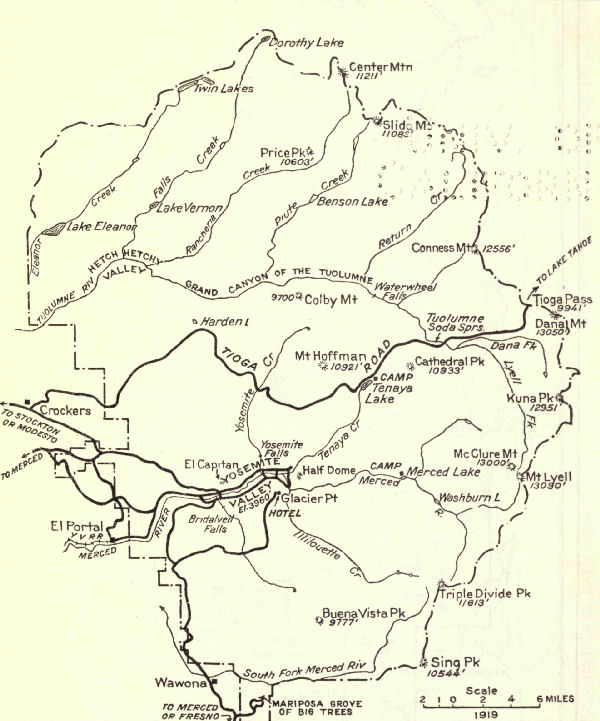
The Yosemite National Park lies on the western slope of the Sierra
Nevada Mountains in California, nearly east of San Francisco. The snowy
crest of the Sierra, bellying irregularly eastward to a climax among the
jagged granites and gale-swept glaciers of Mount Lyell, forms its
eastern boundary. From this the park slopes rapidly thirty miles or more
westward to the heart of the warm luxuriant zone of the giant sequoias.
This slope includes in its eleven hundred and twenty-five square miles
some of the highest scenic examples in the wide gamut of Sierra
grandeur. It is impossible to enter it without exaltation of spirit, or
describe it without superlative.
A very large proportion of Yosemite's visitors see nothing more than the
Valley, yet no consideration is tenable which conceives the Valley as
other than a small part of the national park. The two are inseparable.
One does not speak of knowing the Louvre who has seen only the Venus de
Milo, or St. Mark's who has looked only upon its horses.
Considered as a whole, the park is a sagging plain of solid granite,
hung from Sierra's saw-toothed crest, broken into divides and transverse
mountain ranges, punctured by volcanic summits, gashed and bitten by
prehistoric glaciers, dotted near its summits with glacial lakes,
furrowed by innumerable cascading streams which combine in singing
rivers, which, in turn, furrow greater canyons, some of majestic depth
and grandeur. It is a land of towering spires and ambitious summits,
serrated cirques, enormous isolated rock masses, rounded granite domes,
polished granite pavements, lofty precipices, and long, shimmering
waterfalls.
Bare and gale-ridden near its crest, the park descends in thirty miles
through all the zones and gradations of animal and vegetable life
through which one would pass in travelling from the ice-bound shores of
the Arctic Ocean the continent's length to Mariposa Grove. Its tree
sequence tells the story. Above timber-line there are none but inch-high
willows and flat, piney growths, mingled with tiny arctic flowers, which
shrink in size with elevation; even the sheltered spots on Lyell's lofty
summit have their colored lichens, and their almost microscopic bloom.
At timber-line, low, wiry shrubs interweave their branches to defy the
gales, merging lower down into a tangle of many stunted growths, from
which spring twisted pines and contorted spruces, which the winds curve
to leeward or bend at sharp angles, or spread in full development as
prostrate upon the ground as the mountain lion's skin upon the home
floor of his slayer.
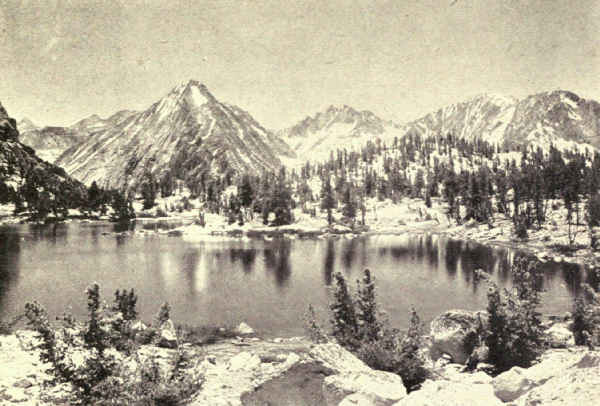
Descending into the great area of the Canadian zone, with its thousand
wild valleys, its shining lakes, its roaring creeks and plunging rivers,
the zone of the angler, the hiker, and the camper-out, we enter forests
of various pines, of silver fir, hemlock, aged hump-backed juniper, and
the species of white pine which Californians wrongly call tamarack.
This is the paradise of outdoor living; it almost never rains between
June and October. The forests fill the valley floors, thinning rapidly
as they climb the mountain slopes; they spot with pine green the broad,
shining plateaus, rooting where they find the soil, leaving unclothed
innumerable glistening areas of polished uncracked granite; a striking
characteristic of Yosemite uplands. From an altitude of seven or eight
thousand feet, the Canadian zone forests begin gradually to merge into
the richer forests of the Transition zone below. The towering sugar
pine, the giant yellow pine, the Douglas fir, and a score of deciduous
growths—live oaks, bays, poplars, dogwoods, maples—begin to appear and
become more frequent with descent, until, two thousand feet or more
below, they combine into the bright stupendous forests where, in
specially favored groves, King Sequoia holds his royal court.
Wild flowers, birds, and animals also run the gamut of the zones. Among
the snows and alpine flowerets of the summits are found the ptarmigan
and rosy finch of the Arctic circle, and in the summit cirques and on
the shores of the glacial lakes whistles the mountain marmot.
The richness and variety of wild flower life in all zones, each of its
characteristic kind, astonishes the visitor new to the American
wilderness. Every meadow is ablaze with gorgeous coloring, every copse
and sunny hollow, river bank and rocky bottom, becomes painted in turn
the hue appropriate to the changing seasons. Now blues prevail in the
kaleidoscopic display, now pinks, now reds, now yellows. Experience of
other national parks will show that the Yosemite is no exception; all
are gardens of wild flowers.
The Yosemite and the Sequoia are, however, the exclusive possessors
among the parks of a remarkably showy flowering plant, the brilliant,
rare, snow-plant. So luring is the red pillar which the snow-plant lifts
a foot or more above the shady mould, and so easily is it destroyed,
that, to keep it from extinction, the government fines covetous visitors
for every flower picked.
The birds are those of California—many, prolific, and songful. Ducks
raise their summer broods fearlessly on the lakes. Geese visit from
their distant homes. Cranes and herons fish the streams. Every tree has
its soloist, every forest its grand chorus. The glades resound with the
tapping of woodpeckers. The whirr of startled wings accompanies passage
through every wood. To one who has lingered in the forests to watch and
to listen, it is hard to account for the wide-spread fable that the
Yosemite is birdless. No doubt, happy talkative tourists, in companies
and regiments, afoot and mounted, drive bird and beast alike to silent
cover—and comment on the lifeless forests. "The whole range, from
foothill to summit, is shaken into song every summer," wrote John Muir,
to whom birds were the loved companions of a lifetime of Sierra summers,
"and, though low and thin in winter, the music never ceases."
There are two birds which the unhurried traveller will soon know well.
One is the big, noisy, gaudy Clark crow, whose swift flight and
companionable squawk are familiar to all who tour the higher levels. The
other is the friendly camp robber, who, with encouragement, not only
will share your camp luncheon, but will gobble the lion's share.
Of the many wild animals, ranging in size from the great, powerful,
timid grizzly bear, now almost extinct here, whose Indian name, by the
way, is Yosemite, to the tiny shrew of the lowlands, the most frequently
seen are the black or brown bear, and the deer, both of which, as
compared with their kind in neighborhoods where hunting is permitted,
are unterrified if not friendly. Notwithstanding its able protection,
the Yosemite will need generations to recover from the hideous slaughter
which, in a score or two of years, denuded America of her splendid
heritage of wild animal life.
Of the several carnivora, the coyote alone is occasionally seen by
visitors. Wolves and mountain lions, prime enemies of the deer and
mountain sheep, are hard to find, even when officially hunted in the
winter with dogs trained for the purpose.
The Yosemite Valley is the heart of the national park. Not only is it
the natural entrance and abiding place, the living-room, so to speak,
the central point from which all parts of the park are most comfortably
accessible; it is also typical in some sense of the Sierra as a whole,
and is easily the most beautiful valley in the world.
It is difficult to analyze the quality of the Valley's beauty. There
are, as Muir says, "many Yosemites" in the Sierra. The Hetch Hetchy
Valley, in the northern part of the park, which bears the same relation
to the Tuolumne River that the Yosemite Valley bears to the Merced, is
scarcely less in size, richness, and the height and magnificence of its
carved walls. Scores of other valleys, similar except for size, abound
north and south, which are, scientifically and in Muir's meaning,
Yosemites; that is, they are pauses in their rivers' headlong rush, once
lakes, dug by rushing waters, squared and polished by succeeding
glaciers, chiselled and ornamented by the frosts and rains which
preceded and followed the glaciers. Muir is right, for all these are
Yosemites; but he is wrong, for there is only one Yosemite.
It is not the giant monoliths that establish the incomparable Valley's
world supremacy; Hetch Hetchy, Tehipite, Kings, and others have their
giants, too. It is not its towering, perpendicular, serrated walls; the
Sierra has elsewhere, too, an overwhelming exhibit of titanic granite
carvings. It is not its waterfalls, though these are the highest, by
far, in the world, nor its broad, peaceful bottoms, nor its dramatic
vistas, nor the cavernous depths of its tortuous tributary canyons. Its
secret is selection and combination. Like all supremacy, Yosemite's lies
in the inspired proportioning of carefully chosen elements. Herein is
its real wonder, for the more carefully one analyzes the beauty of the
Yosemite Valley, the more difficult it is to conceive its ensemble the
chance of Nature's functioning rather than the master product of supreme
artistry.
Entrance to the Yosemite by train is from the west, by automobile from
east and west both. From whatever direction, the Valley is the first
objective, for the hotels are there. It is the Valley, then, which we
must see first. Nature's artistic contrivance is apparent even in the
entrance. The train-ride from the main line at Merced is a constant
up-valley progress, from a hot, treeless plain to the heart of the
great, cool forest. Expectation keeps pace. Changing to automobile at El
Portal, one quickly enters the park. A few miles of forest and
behold—the Gates of the Valley. El Capitan, huge, glistening, rises
upon the left, 3,000 feet above the valley floor. At first sight its
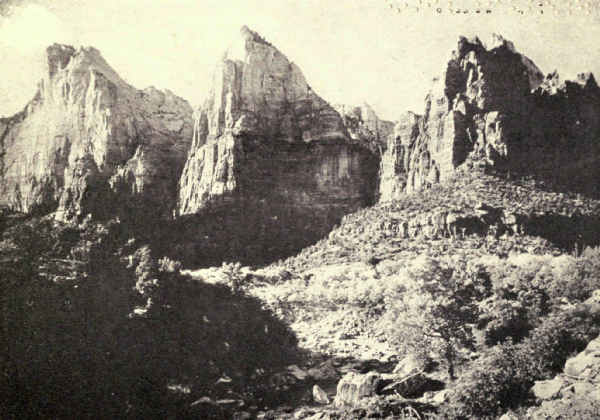
bulk almost appalls. Opposite upon the right Cathedral Rocks support the
Bridal Veil Fall, shimmering, filmy, a fairy thing. Between them, in the
distance, lies the unknown.
Progress up the valley makes constantly for climax. Seen presently
broadside on, El Capitan bulks double, at least. Opposite, the valley
bellies. Cathedral Rocks and the mediæval towers known as Cathedral
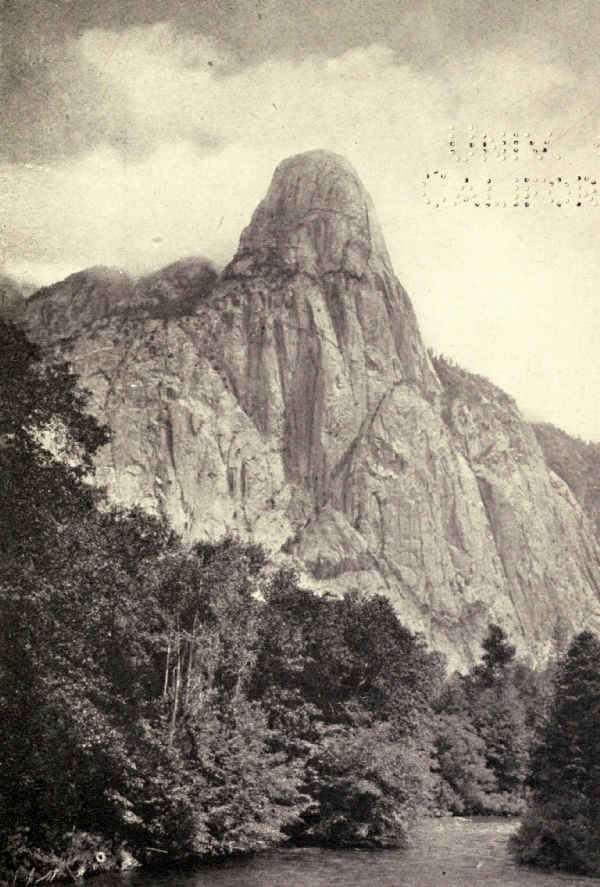
Spires, are enclosed in a bay, which culminates in the impressive needle
known as Sentinel Rock—all richly Gothic. Meantime the broadened
valley, another strong contrast in perfect key, delightfully alternates
with forest and meadow, and through it the quiet Merced twists and
doubles like a glistening snake. And then we come to the Three Brothers.
Already some notion of preconception has possessed the observer. It
could not have been chance which set off the filmy Bridal Veil against
El Capitan's bulk; which designed the Gothic climax of Sentinel Rock;
which wondrously proportioned the consecutive masses of the Three
Brothers; which made El Capitan, now looked back upon against a new
background, a new and appropriate creation, a thing of brilliance and
beauty instead of bulk, mighty of mass, powerful in shape and poise, yet
mysteriously delicate and unreal. As we pass on with rapidly increasing
excitement to the supreme climax at the Valley's head, where gather
together Glacier Point, Yosemite Falls of unbelievable height and
graciousness, the Royal Arches, manifestly a carving, the gulf-like
entrances of Tenaya and the Merced Canyons, and above all, and pervading
all, the distinguished mysterious personality of Half Dome, presiding
priest of this Cathedral of Beauty, again there steals over us the
uneasy suspicion of supreme design. How could Nature have happened upon
the perfect composition, the flawless technique, the divine inspiration
of this masterpiece of more than human art? Is it not, in fact, the
master temple of the Master Architect?
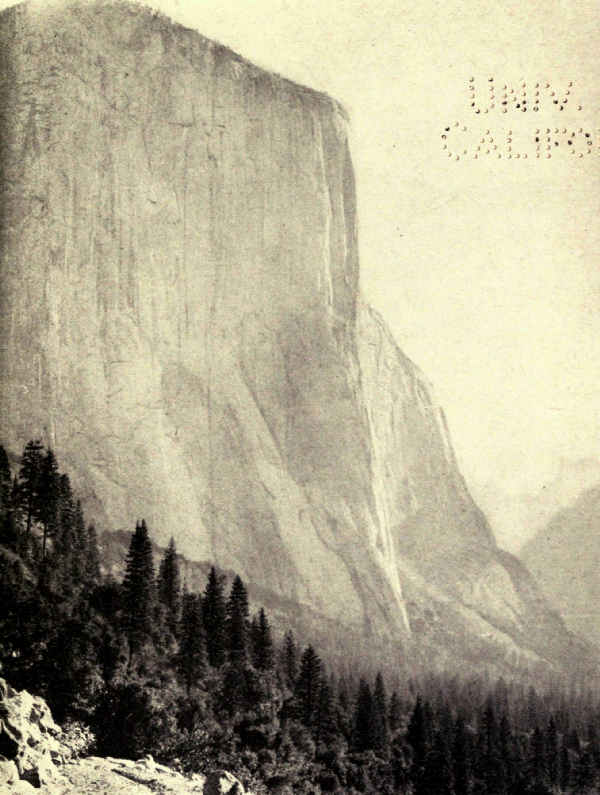
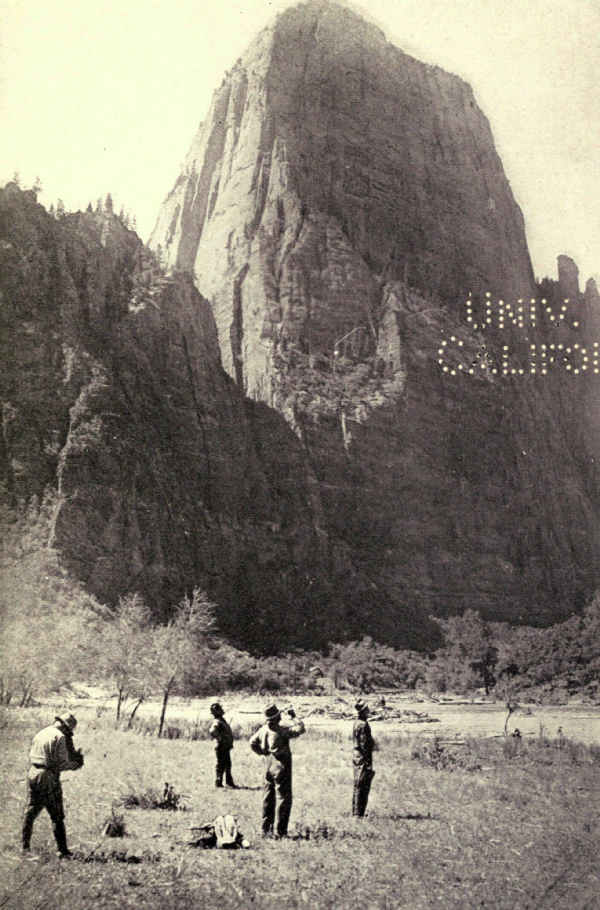
From a photograph by J.T. Boysen
EL CAPITAN, SURVIVOR OF THE GLACIERS
Looking eastward up the Yosemite Valley, Half Dome is seen on the right
horizon
To appreciate the Valley we must consider certain details. It is eight
miles long, and from half a mile to a mile wide. Once prehistoric Lake
Yosemite, its floor is as level as a ball field, and except for
occasional meadows, grandly forested. The sinuous Merced is forested to
its edges in its upper reaches, but lower down occasionally wanders
through broad, blooming opens. The rock walls are dark pearl-hued
granite, dotted with pines wherever clefts or ledges exist capable of
supporting them; even El Capitan carries its pine-tree half way up its
smooth precipice. Frequently the walls are sheer; they look so
everywhere. The valley's altitude is 4,000 feet. The walls rise from
2,000 to 6,000 feet higher; the average is a little more than 3,000 feet
above the valley floor; Sentinel Dome and Mount Watkins somewhat exceed
4,000 feet; Half Dome nearly attains 5,000 feet; Cloud's Rest soars
nearly 6,000 feet.
Two large trench-like canyons enter the valley at its head, one on
either side of Half Dome. Tenaya Canyon enters from the east in line
with the valley, looking as if it were the Valley's upper reach. Merced
Canyon enters from the south after curving around the east and south
sides of Half Dome. Both are extremely deep. Half Dome's 5,000 feet form
one side of each canyon; Mount Watkin's 4,300 feet form the north side
of Tenaya Canyon, Glacier Point's 3,200 feet the west side of Merced
Canyon. Both canyons are superbly wooded at their outlets, and lead
rapidly up to timber-line. Both carry important trails from the Valley
floor to the greater park above the rim.
To this setting add the waterfalls and the scene is complete. They are
the highest in the world. Each is markedly individualized; no two
resemble each other. Yet, with the exception of the Vernal Fall, all
have a common note; all are formed of comparatively small streams
dropping from great heights; all are wind-blown ribbons ending in clouds
of mist. They are so distributed that one or more are visible from most
parts of the Valley and its surrounding rim. More than any other
feature, they differentiate and distinguish the Yosemite.
The first of the falls encountered, Bridal Veil, is a perfect example of
the valley type. A small stream pouring over a perpendicular wall drops
six hundred and twenty feet into a volume of mist. The mist, of course,
is the bridal veil. How much of the water reaches the bottom as water is
a matter of interesting speculation. This and the condensed mists reach
the river through a delta of five small brooks. As a spectacle the
Bridal Veil Fall is unsurpassed. The delicacy of its beauty, even in the
high water of early summer, is unequalled by any waterfall I have seen.
A rainbow frequently gleams like a colored rosette in the massed chiffon
of the bride's train. So pleasing are its proportions that it is
difficult to believe the fall nearly four times the height of Niagara.
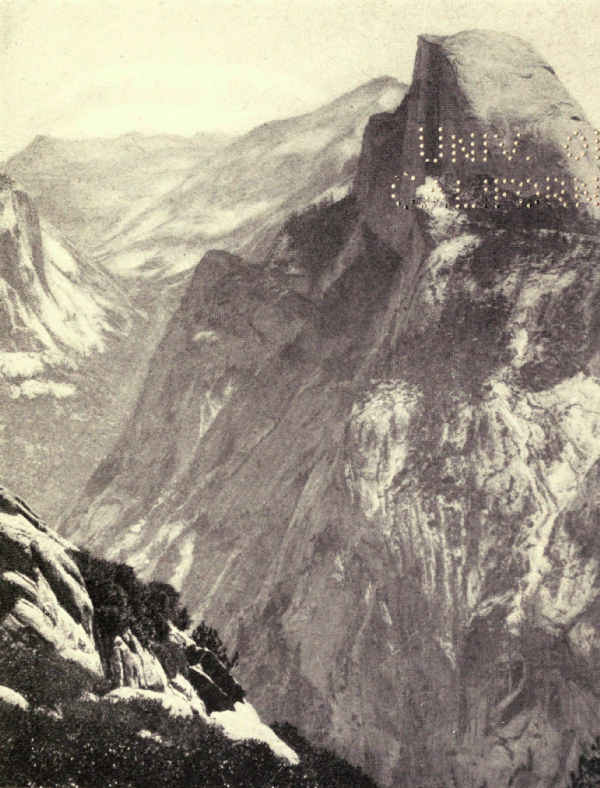
From a photograph by J.T. Boysen
HALF DOME, YOSEMITE'S HOODED MONK
Rising nearly four thousand feet above the valley floor; the view is up
Tenaya Canyon to the High Sierra
The Ribbon Fall, directly opposite Bridal Veil, a little west of El
Capitan, must be mentioned because for a while in early spring its
sixteen hundred foot drop is a spectacle of remarkable grandeur. It is
merely the run of a snow-field which disappears in June. Thereafter a
dark perpendicular stain on the cliff marks its position. Another minor
fall, this from the south rim, is that of Sentinel Creek. It is seen
from the road at the right of Sentinel Rock, dropping five hundred feet
in one leap of several which aggregate two thousand feet.
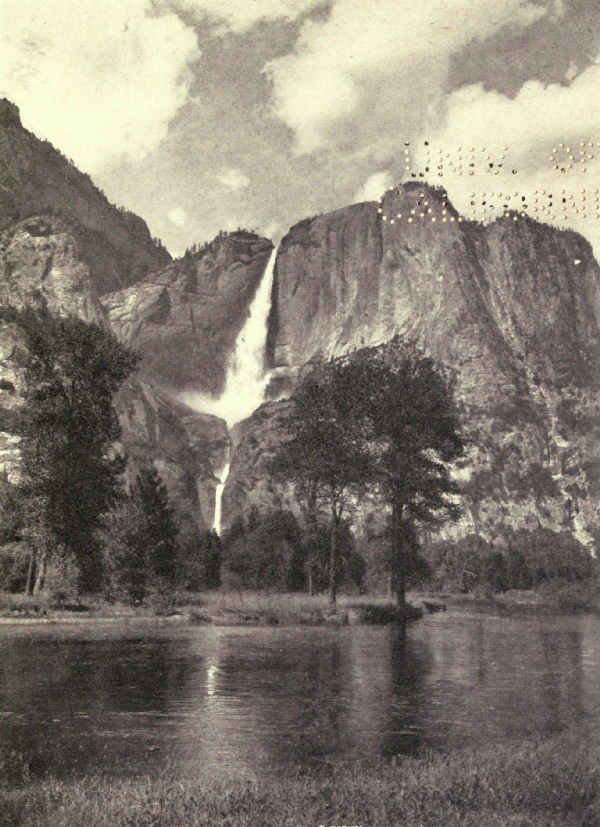
Next in progress come Yosemite Falls, loftiest by far in the world, a
spectacle of sublimity. These falls divide with Half Dome the honors of
the upper Valley. The tremendous plunge of the Upper Fall, and the
magnificence of the two falls in apparent near continuation as seen from
the principal points of elevation on the valley floor, form a spectacle
of extraordinary distinction. They vie with Yosemite's two great rocks,
El Capitan and Half Dome, for leadership among the individual scenic
features of the continent.
The Upper Fall pours over the rim at a point nearly twenty-six hundred
feet above the valley floor. Its sheer drop is fourteen hundred and
thirty feet, the equal of nine Niagaras. Two-fifths of a mile south of
its foot, the Lower Fall drops three hundred and twenty feet more. From
the crest of the Upper Fall to the foot of the Lower Fall lacks a little
of half a mile. From the foot of the Lower Fall, after foaming down the
talus, Yosemite Creek, seeming a ridiculously small stream to have
produced so monstrous a spectacle, slips quietly across a half mile of
level valley to lose itself in the Merced.
From the floods of late May when the thunder of falling water fills the
valley and windows rattle a mile away, to the October drought when the
slender ribbon is little more than mist, the Upper Yosemite Fall is a
thing of many moods and infinite beauty. Seen from above and opposite at
Glacier Point, sideways and more distantly from the summit of Cloud's
Rest, straight on from the valley floor, upwards from the foot of the
Lower Fall, upwards again from its own foot, and downwards from the
overhanging brink toward which the creek idles carelessly to the very
step-off of its fearful leap, the Fall never loses for a moment its
power to amaze. It draws and holds the eye as the magnet does the iron.
Looking up from below one is fascinated by the extreme leisureliness of
its motion. The water does not seem to fall; it floats; a pebble dropped
alongside surely would reach bottom in half the time. Speculating upon
this appearance, one guesses that the air retards the water's drop, but
this idea is quickly dispelled by the observation that the solid inner
body drops no faster than the outer spray. It is long before the
wondering observer perceives that he is the victim of an illusion; that
the water falls normally; that it appears to descend with less than
natural speed only because of the extreme height of the fall, the eye
naturally applying standards to which it has been accustomed in viewing
falls of ordinary size.
On windy days the Upper Fall swings from the brink like a pendulum of
silver and mist. Back and forth it lashes like a horse's tail. The gusts
lop off puffy clouds of mist which dissipate in air. Muir tells of
powerful winter gales driving head on against the cliff, which break the
fall in its middle and hold it in suspense. Once he saw the wind double
the fall back over its own brink. Muir, by the way, once tried to pass
behind the Upper Fall at its foot, but was nearly crushed.
By contrast with the lofty temperamental Upper Fall, the Lower Fall
appears a smug and steady pigmy. In such company, for both are always
seen together, it is hard to realize that the Lower Fall is twice the
height of Niagara. Comparing Yosemite's three most conspicuous features,
these gigantic falls seem to appeal even more to the imagination than to
the sense of beauty. El Capitan, on the other hand, suggests majesty,
order, proportion, and power; it has its many devotees. Half Dome
suggests mystery; to many it symbolizes worship. Of these three, Half
Dome easily is the most popular.
Three more will complete the Valley's list of notable waterfalls. All
of these lie up the Merced Canyon. Illilouette, three hundred and
seventy feet in height, enters from the west, a frothing fall of great
beauty, hard to see. Vernal and Nevada Falls carry the Merced River over
steep steps in its rapid progress from the upper levels to the valley
floor. The only exception to the valley type, Vernal Fall, which some
consider the most beautiful of all, and which certainly is the
prettiest, is a curtain of water three hundred and seventeen feet high,
and of pleasing breadth. The Nevada Fall, three-fifths of a mile above,
a majestic drop of nearly six hundred feet, shoots watery rockets from
its brink. It is full-run, powerful, impressive, and highly
individualized. With many it is the favorite waterfall of Yosemite.
In sharp contrast with these valley scenes is the view from Glacier
Point down into the Merced and Tenaya Canyons, and out over the magical
park landscape to the snow-capped mountains of the High Sierra. Two
trails lead from the valley up to Glacier Point, and high upon the
precipice, three thousand feet above the valley floor, is a picturesque
hotel; it is also reached by road. Here one may sit at ease on shady
porches and overlook one of the most extended, varied and romantic views
in the world of scenery. One may take dinner on this porch and have
sunset served with dessert and the afterglow with coffee.
Here again one is haunted by the suggestion of artistic intention, so
happy is the composition of this extraordinary picture. The foreground
is the dark, tremendous gulf of Merced Canyon, relieved by the silver
shimmer of Vernal and Nevada Falls. From this in middle distance rises,
in the centre of the canvas, the looming tremendous personality of Half
Dome, here seen in profile strongly suggesting a monk with outstretched
arms blessing the valley at close of day. Beyond stretches the horizon
of famous, snowy, glacier-shrouded mountains, golden in sunset glow.
Every summer many thousands of visitors gather in Yosemite. Most of
them, of course, come tourist-fashion, to glimpse it all in a day or two
or three. A few thousands come for long enough to taste most of it, or
really to see a little. Fewer, but still increasingly many, are those
who come to live a little with Yosemite; among these we find the lovers
of nature, the poets, the seers, the dreamers, and the students.
Living is very pleasant in the Yosemite. The freedom from storm during
the long season, the dry warmth of the days and the coldness of the
nights, the inspiration of the surroundings and the completeness of the
equipment for the comfort of visitors make it extraordinary among
mountain resorts. There is a hotel in the Valley, and another upon the
rim at Glacier Point. There are three large hotel-camps in the Valley,
where one may have hotel comforts under canvas at camp prices. Two of
these hotel-camps possess swimming pools, dancing pavilions, tennis
courts electrically lighted for night play, hot and cold-water tubs and
showers, and excellent table service. One of the hotel-camps, the
largest, provides evening lectures, song services, and a general
atmosphere suggestive of Chatauqua. Still a third is for those who
prefer quiet retirement and the tradition of old-fashioned camp life.
Above the valley rim, besides the excellent hotel upon Glacier Point,
there are at this writing hotel-camps equipped with many hotel comforts,
including baths, at such outlying points as Merced Lake and Tenaya Lake;
the former centering the mountain climbing and trout fishing of the
stupendous region on the southwest slope of the park, and the latter the
key to the entire magnificent region of the Tuolumne. These camps are
reached by mountain trail, Tenaya Lake Camp also by motor road. The
hotel-camp system is planned for wide extension as growing demand
warrants. There are also hotels outside park limits on the south and
west which connect with the park roads and trails.
The roads, by the way, are fair. Three enter from the west, centering at
Yosemite Village in the Valley; one from the south by way of the
celebrated Mariposa Grove of giant sequoias; one from El Portal,
terminus of the Yosemite Railway; and one from the north, by way of
several smaller sequoia groves, connecting directly with the Tioga Road.
Above the valley rim and north of it, the Tioga Road crosses the
national park and emerges at Mono Lake on the east, having crossed the
Sierra over Tioga Pass on the park boundary. The Tioga Road, which was
built in 1881, on the site of the Mono Trail, to connect a gold mine
west of what has since become the national park with roads east of the
Sierra, was purchased in 1915 by patriotic lovers of the Yosemite and
given to the Government. The mine having soon failed, the road had been
impassable for many years. Repaired with government money it has become
the principal highway of the park and the key to its future development.
The increase in motor travel to the Yosemite from all parts of the
country which began the summer following the Great War, has made this
gift one of growing importance. It affords a new route across the
Sierra.
But hotels and hotel-camps, while accommodating the great majority of
visitors, by no means shelter all. Those who camp out under their own
canvas are likely to be Yosemite's most appreciative devotees. The
camping-out colony lives in riverside groves in the upper reaches of the
Valley, the Government assigning locations without charge. Many families
make permanent summer homes here, storing equipment between seasons in
the village. Others hire equipment complete, from tents to salt-cellars,
on the spot. Some who come to the hotels finish the season under hired
canvas, and next season come with their own. An increasing number come
in cars, which they keep in local garages or park near their canvas
homes.
Living is easy and not expensive in these camp homes. Midday
temperatures are seasonable, and nights are always cool. As it does not
rain, tents are concessions to habit; many prefer sleeping under the
trees. Markets in the village supply meats, vegetables, milk, bread, and
groceries at prices regulated by Government, and deliver them at your
kitchen tent. Shops furnish all other reasonable needs. It is not
camping out as commonly conceived; you are living at home on the banks
of the Merced, under the morning shadow of Half Dome, and within sight
of Yosemite Falls.
From these Valley homes one rides into the High Sierra on horses hired
from the government concessioner, tours to the Tuolumne Meadows or the
Mariposa Grove by automobile, wanders long summer afternoons in the
Valley, climbs the great rocks and domes, picnics by moonlight under the
shimmering falls or beneath the shining tower of El Capitan, explores
famous fishing waters above the rim, and, on frivolous evenings, dances
or looks at motion pictures at the greater hotel-camps.
No wonder that camp homes in the Yosemite are growing in popularity.
The trail traveller finds the trails the best in the country, and as
good as the best in the world; they are the models for the national
system. Competent guides, horses, supplies, and equipment are easy to
hire at regulated prices in the village.
As for the field, there is none nobler or more varied in the world.
There are dozens of divides, scores of towering, snow-splashed peaks,
hundreds of noble valleys and shining lakes, thousands of cascading
streams, great and small, from whose depths fighting trout rise to the
cast fly. There are passes to be crossed which carry one through
concentric cirques of toothed granite to ridges from which the High
Sierra spreads before the eye a frothing sea of snowy peaks.
Such a trip is that through Tuolumne Meadows up Lyell Canyon to its
headwaters, over the Sierra at Donohue Pass, and up into the birth
chambers of rivers among the summit glaciers of Lyell and McClure—a
never-to-be-forgotten journey, which may be continued, if one has time
and equipment, down the John Muir Trail to Mount Whitney and the Sequoia
National Park. Or one may return to the park by way of Banner Peak and
Thousand Island Lake, a wonder spot, and thence north over Parker and
Mono Passes; trips like these produce views as magnificent as the land
possesses.
Space does not permit even the suggestion of the possibilities to the
trail traveller of this wonderland above the rim. It is the summer
playground for a nation.
Second in magnificence among the park valleys is Hetch Hetchy, the
Yosemite of the north. Both are broad, flowered and forested levels
between lofty granite walls. Both are accented by gigantic rock
personalities. Kolana Rock, which guards Hetch Hetchy at its western
gateway as El Capitan guards Yosemite, must be ranked in the same class.
Were there no Yosemite Valley, Hetch Hetchy, though it lacks the
distinction which gives Yosemite Valley its world-wide fame, would be
much better known than it now is—a statement also true about other
features of the national park.
Hetch Hetchy is now being dammed below Kolana Rock to supply water for
San Francisco. The dam will be hidden from common observation, and the
timber lands to be flooded will be cut so as to avoid the unsightliness
usual with artificial reservoirs in forested areas. The reservoir will
cover one of the most beautiful bottoms in America. It will destroy
forests of luxuriance. It will replace these with a long sinuous lake,
from which sheer Yosemite-like granite walls will rise abruptly two or
three thousand feet. There will be places where the edges are forested.
Down into this lake from the high rim will cascade many roaring streams.
The long fight in California, in the press of the whole country, and
finally in Congress, between the advocates of the Hetch Hetchy reservoir
and the defenders of the scenic wilderness is one of the stirring
episodes in the history of our national parks. At this writing, time
enough has not yet passed to heal the wounds of battle, but at least we
may look calmly at what remains. One consideration, at least, affords a
little comfort. Hetch Hetchy was once, in late prehistoric times, a
natural lake of great nobility. The remains of Nature's dam, not far
from the site of man's, are plain to the geologist's eye. It is possible
that, with care in building the dam and clearing out the trees to be
submerged, this restoration of one of Nature's noble features of the
past may not work out so inappropriately as once we feared.
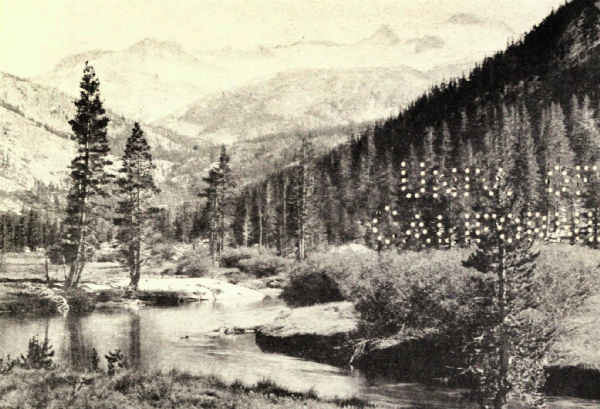
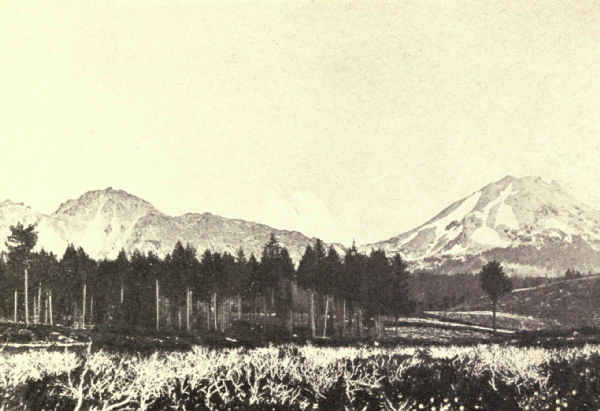
From a photograph by J.T. Boysen
THE CLIMAX OF YOSEMITE NATIONAL PARK
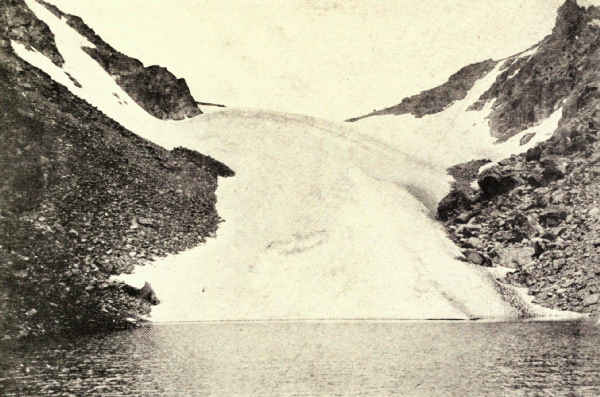
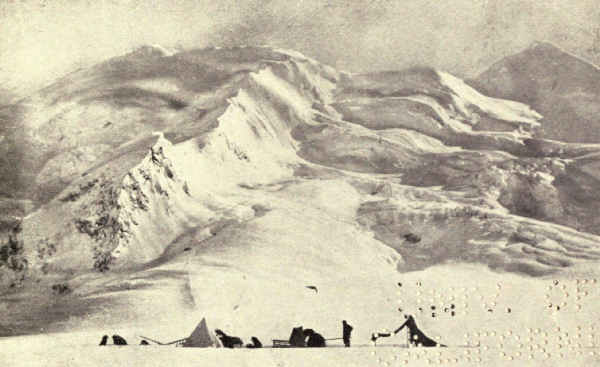
Mount Lyell and its glacier from Lyell Fork
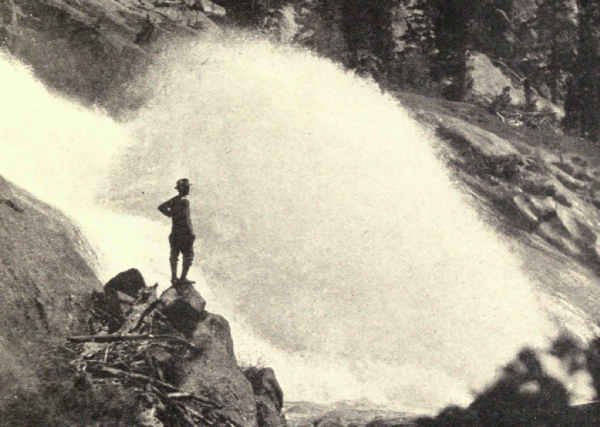 THE GREATEST WATERWHEEL OF THE TUOLUMNE
It is fifty feet in height and seventy-five feet long; Yosemite National
Park
The Grand Canyon of the Tuolumne, through which the river descends from
the level of the Tuolumne Meadows almost five thousand feet to the Hetch
Hetchy Valley, possesses real Yosemite grandeur. Much of this enormous
drop occurs within a couple of amazing miles west of the California
Falls. Here the river slips down sharply tilted granite slopes at
breathless speed, breaking into cascades and plunging over waterfalls at
frequent intervals. It is a stupendous spectacle which few but the
hardiest mountaineers saw previous to 1918, so steep and difficult was
the going. During that season a trail was opened which makes accessible
to all one of the most extraordinary examples of plunging water in the
world.
The climax of this spectacle is the Waterwheels. Granite obstructions in
the bed of the steeply tilted river throw solid arcs of frothing water
fifty feet in air. They occur near together, singly and in groups.
The fine camping country south of the Yosemite Valley also offers its
sensation. At its most southern point, the park accomplishes its forest
climax in the Mariposa Grove. This group of giant sequoias (Sequoia
washingtoniana) ranks next, in the number and magnificence of its trees,
to the Giant Forest of the Sequoia National Park and the General Grant
grove.
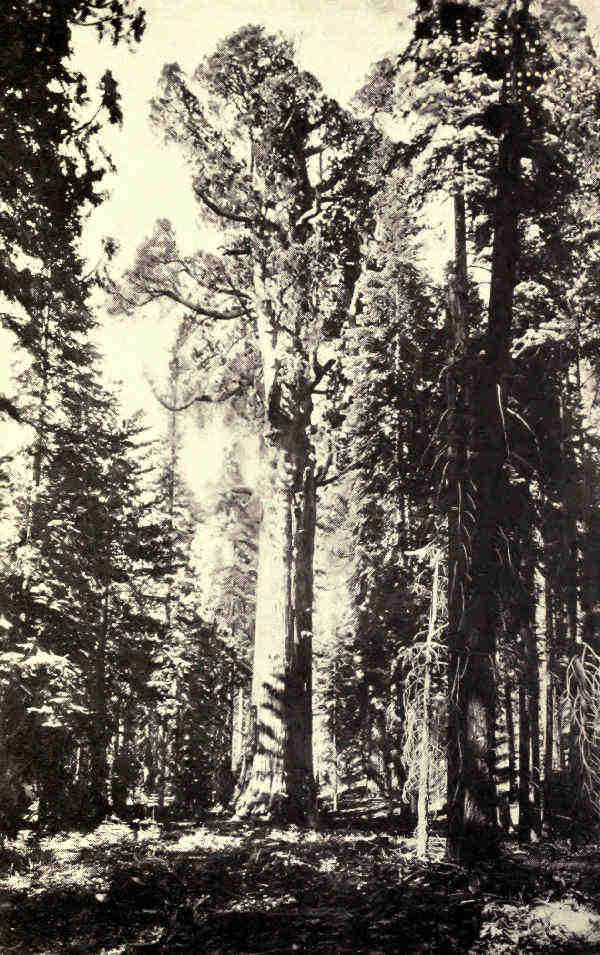
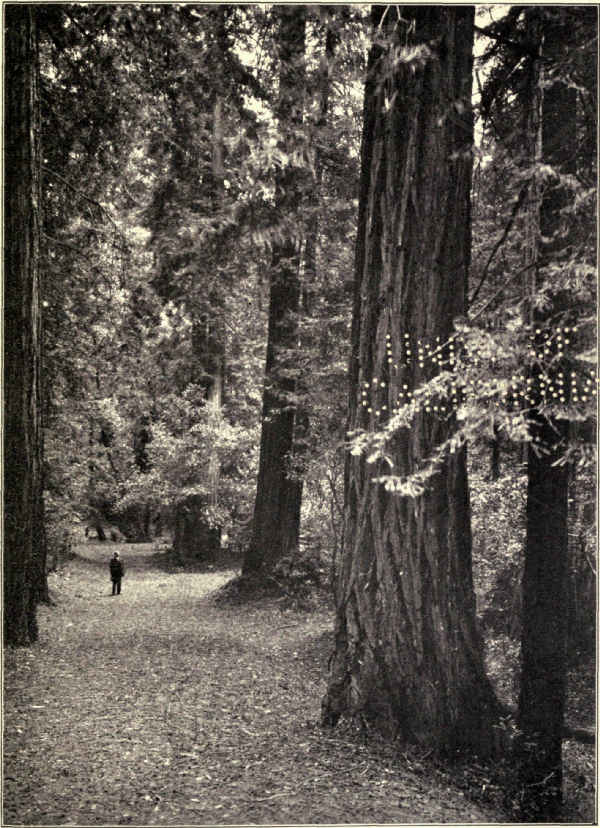
The largest tree of the Mariposa Grove is the Grizzly Giant, which has a
diameter of twenty-nine feet, a circumference of sixty-four feet, and a
height of two hundred and four feet. One may guess its age from three
thousand to thirty-two hundred years. It is the third in size and age of
living sequoias; General Sherman, the largest and oldest, has a diameter
of thirty-six and a half feet, and General Grant a diameter of
thirty-five feet, and neither of these, in all probability, has attained
the age of four thousand years. General Sherman grows in the Sequoia
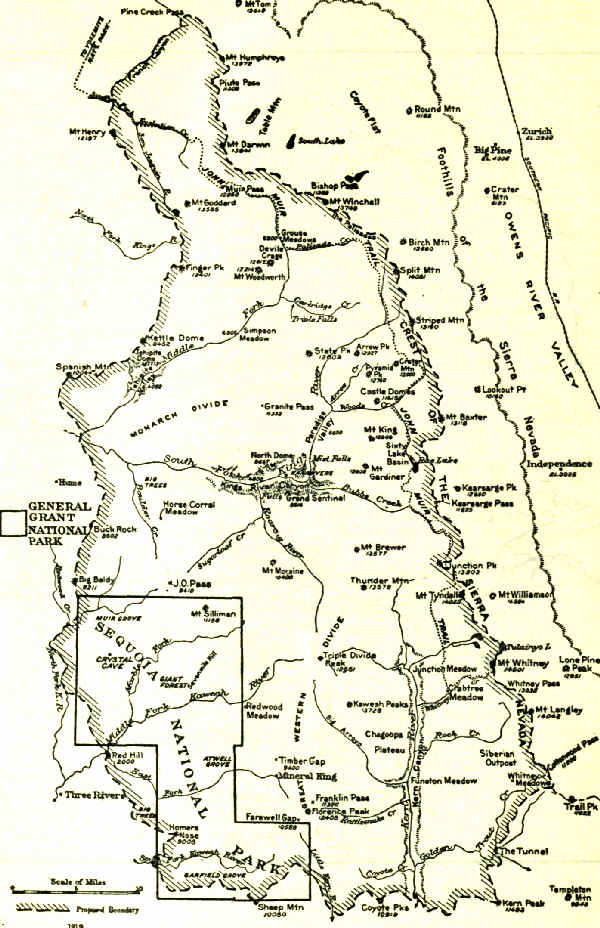
National Park, seventy miles or more south of Yosemite; General Grant
has a little national park of its own a few miles west of Sequoia.
The interested explorer of the Yosemite has so far enjoyed a wonderfully
varied sequence of surprises. The incomparable valley with its towering
monoliths and extraordinary waterfalls, the High Sierra with its
glaciers, serrated cirques and sea of snowy peaks, the Grand Canyon of
the Tuolumne with its cascades, rushing river and frothing Waterwheels,
are but the headliners of a long catalogue of the unexpected and
extraordinary. It only remains, to complete this new tale of the Arabian
Nights, to make one's first visit to the sequoias of Mariposa Grove. The
first sight of the calm tremendous columns which support the lofty roof
of this forest temple provokes a new sensation. Unconsciously the
visitor removes his hat and speaks his praise in whispers.
The sequoias are considered at greater length in the chapter describing
the Sequoia National Park, which was created especially to conserve and
exhibit more than a million of these most interesting of trees. It will
suffice here to say that their enormous stems are purplish red, that
their fine, lace-like foliage hangs in splendid heavy plumes, that their
enormous limbs crook at right angles, the lowest from a hundred to a
hundred and fifty feet above the ground, and that all other trees, even
the gigantic sugar pine and Douglas fir, are dwarfed in their presence.
Several of the sequoias of the Mariposa grove approach three hundred
feet in height. The road passes through the trunk of one.
The human history of the Yosemite is quickly told. The country north of
the Valley was known from early times by explorers and trappers who used
the old Mono Indian Trail, now the Tioga Road, which crossed the divide
over Mono Pass. But, though the trail approached within a very few miles
of the north rim of the Yosemite Valley, the valley was not discovered
till 1851, when Captain Boling of the Mariposa Battalion, a volunteer
organization for the protection of settlers, entered it from the west in
pursuit of Indians who had raided mining settlements in the foothills.
These savages were known as the Yosemite or Grizzly Bear Indians.
Tenaya, their chief, met their pursuers on the uplands and besought them
to come no further. But Captain Boling pushed on through the heavy
snows, and on March 21, entered the valley, which proved to be the
Indians' final stronghold. Their villages, however, were deserted.
The original inhabitants of the Valley were called the Ahwahneechees,
the Indian name for the Valley being Ahwahnee, meaning a deep grassy
canyon. The Ahwahneechees, previous to Captain Boling's expedition, had
been decimated by war and disease. The new tribe, the Yosemites, or
Grizzly Bears, was made up of their remainder, with Monos and Piutes
added.
Captain Boling's report of the beauty of the valley having been
questioned, he returned during the summer to prove his assertions to a
few doubters. Nevertheless, there were no further visitors until 1853,
when Robert B. Stinson of Mariposa led in a hunting-party. Two years
later J.M. Hutchings, who was engaged in writing up the beauties of
California for the California Magazine, brought the first tourists;
the second, a party of sixteen, followed later the same year.
Pleasure travel to the Yosemite Valley may be said to have commenced
with 1856, the year the first house was built. This house was enlarged
in 1858 by Hite and Beardsley and used for a hotel. Sullivan and Cushman
secured it for a debt the following year, and it was operated in turn by
Peck, Longhurst, and Hutchings until 1871. Meantime J.C. Lamon settled
in 1860, the first actual resident of the valley, an honor which he did
not share with others for four years.
The fame of the valley spread over the country and in 1864 Congress
granted to the State of California "the Cleft or Gorge of the Granite
Peak of the Sierra Nevada Mountains" known as the Yosemite Valley, with
the understanding that all income derived from it should be spent for
improving the reservation or building a road to it. The Mariposa Big
Tree Grove was also granted at the same time. California carefully
fulfilled her charge. The Yosemite Valley became world-famous, and in
1890 the Yosemite National Park was created.
The Yosemite's geological history is much more thrilling. Everyone who
sees it asks, How did Nature make the Yosemite Valley? Was it split by
earth convulsions or scooped by glacier? Few ask what part was played by
the gentle Merced.
The question of Yosemite's making has busied geologists from Professor
Whitney of the University of California, who first studied the problem,
down to F.E. Matthes, of the United States Geological Survey, whose
recent exhaustive studies have furnished the final solution. Professor
Whitney maintained that glaciers never had entered the valley; he did
not even consider water erosion. At one time he held that the valley
was simply a cleft or rent in the earth's crust. At another time he
imagined it formed by the sudden dropping back of a large block in the
course of the convulsions that resulted in the uplift of the Sierra
Nevada. Galen Clark, following him, carried on his idea of an origin by
force. Instead of the walls being cleft apart, however, he imagined the
explosion of close-set domes of molten rock the riving power, but
conceived that ice and water erosion finished the job. With Clarence
King the theory of glacial origin began its long career. John Muir
carried this theory to its extreme.
Since the period of Muir's speculations, the tremendous facts concerning
the part played by erosion in the modification of the earth's surface
strata have been developed. Beginning with W.H. Turner, a group of
Yosemite students under the modern influence worked upon the theory of
the stream-cut valley modified by glaciers. The United States Geological
Survey then entered the field, and Matthes's minute investigations
followed; the manuscript of his monograph has helped me reconstruct the
dramatic past.
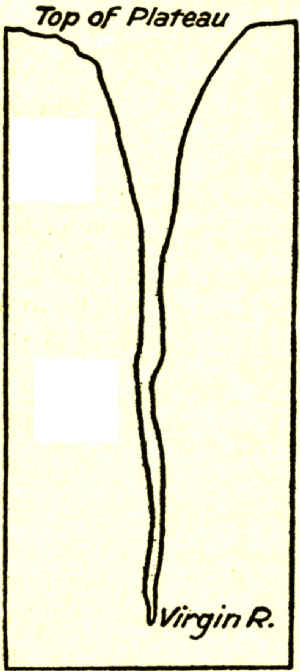
The fact is that the Yosemite Valley was cut from the solid granite
nearly to its present depth by the Merced River; before the glaciers
arrived, the river-cut valley was twenty-four hundred feet deep opposite
El Capitan, and three thousand feet deep opposite Eagle Peak. The valley
was then V-shaped, and the present waterfalls were cascades; those which
are now the Yosemite Falls were eighteen hundred feet deep, and those
of Sentinel Creek were two thousand feet deep. All this in pre-glacial
times.
Later on the glaciers of several successive epochs greatly widened the
valley, and measurably deepened it, making it U-shaped. The cascades
then became waterfalls.
But none will see the Yosemite Valley and its cavernous tributary
canyons without sympathizing a little with the early geologists. It is
difficult to imagine a gash so tremendous cut into solid granite by
anything short of force. One can think of it gouged by massive glaciers,
but to imagine it cut by water is at first inconceivable.
To comprehend it we must first consider two geological facts. The first
is that no dawdling modern Merced cut this chasm, but a torrent
considerably bigger; and that this roaring river swept at tremendous
speed down a sharply tilted bed, which it gouged deeper and deeper by
friction of the enormous masses of sand and granite fragments which it
carried down from the High Sierra. The second geological fact is that
the Merced and Tenaya torrents sand-papered the deepening beds of these
canyons day and night for several million years; which, when we remember
the mile-deep canyons which the Colorado River and its confluents cut
through a thousand or more miles of Utah and Arizona, is not beyond
human credence, if not conception.
But, objects the sceptical, the Merced couldn't keep always tilted; in
time it would cut down to a level and slow up; then the sand and gravel
it was carrying would settle, and the stream stop its digging. Again, if
the stream-cut valley theory is correct, why isn't every Sierra canyon a
Yosemite?
Let us look for the answer in the Sierra's history.
The present Sierra Nevada is not the first mountain chain upon its site.
The granite which underlay the folds of the first Sierra are still
disclosed in the walls of the Yosemite Valley. The granites which
underlay the second and modern Sierra are seen in the towering heights
of the crest.
Once these mountains overran a large part of our present far west. They
formed a level and very broad and high plateau; or, more accurately,
they tended to form such a plateau, but never quite succeeded, because
its central section kept caving and sinking in some of its parts as fast
as it lifted in others. Finally, in the course, perhaps, of some
millions of years, the entire central section settled several thousand
feet lower than its eastern and western edges; these edges it left
standing steep and high. This sunken part is the Great Basin of to-day.
The remaining eastern edge is the Wasatch Mountains; the remaining
western edge is the Sierra. That is why the Sierra's eastern front rises
so precipitously from the deserts of the Great Basin, while its western
side slopes gradually toward the Pacific.
But other crust changes accompanied the sinking of the Great Basin. The
principal one was the rise, in a series of upward movements, of the
remaining crest of the Sierra. These movements may have corresponded
with the sinkings of the Great Basin; both were due to tremendous
internal readjustments. And of course, whenever the Sierra crest lifted,
it tilted more sharply the whole granite block of which it was the
eastern edge. These successive tiltings are what kept the Merced and
Tenaya channels always so steeply inclined that, for millions of years,
the streams remained torrents swift enough to keep on sandpapering their
beds.
The first of these tiltings occurred in that far age which geologists
call the Cretaceous. It was inconsiderable, but enough to hasten the
speed of the streams and establish general outlines for all time. About
the middle of the Tertiary Period volcanic eruptions changed all things.
Nearly all the valleys except the Yosemite became filled with lava. Even
the crest of the range was buried a thousand feet in one place. This was
followed by a rise of the Sierra Crest a couple of thousand feet, and of
course a much sharper tilting of the western slopes. The Merced and
Tenaya Rivers must have rushed very fast indeed during the many thousand
years that followed.
The most conservative estimate of the duration of the Tertiary Period is
four or five million years, and until its close volcanic eruptions
continued to fill valleys with lava, and the Great Basin kept settling,
and the crest of the Sierra went on rising; and with each lifting of the
crest, the tilt of the rivers sharpened and the speed of the torrents
hastened. The canyon deepened during this time from seven hundred to a
thousand feet. The Yosemite was then a mountain valley whose sloping
sides were crossed by cascades.
Then, about the beginning of the Quaternary Period, came the biggest
convulsion of all. The crest of the Sierra was hoisted, according to
Matthes's calculations, as much as eight thousand feet higher in this
one series of movements, and the whole Sierra block was again tilted,
this time, of course, enormously.
For thousands of centuries following, the torrents from Lyell's and
McClure's melting snows must have descended at a speed which tore
boulders from their anchorages, ground rocks into sand, and savagely
scraped and scooped the river beds. Armed with sharp hard-cutting tools
ripped from the granite cirques of Sierra's crest, these mad rivers must
have scratched and hewn deep and fast. And because certain valleys,
including the Yosemite, were never filled with lava like the rest, these
grew ever deeper with the centuries.
The great crust movement of the Quaternary Period was not the last, by
any means, though it was the last of great size. There were many small
ones later. Several even have occurred within historic times. On March
26, 1872, a sudden earth movement left an escarpment twenty-five feet
high at the foot of the range in Owens Valley. The village of Lone Pine
was levelled by the accompanying earthquake. John Muir, who was in the
Yosemite Valley at the time, describes in eloquent phrase the
accompanying earthquake which was felt there. A small movement,
doubtless of similar origin, started the San Francisco fire in 1906.
Conditions created by the great Quaternary tilting deepened the valley
from eighteen hundred feet at its lower end to twenty-four hundred feet
at its upper end. It established what must have been an unusually
interesting and impressive landscape, which suggested the modern aspect,
but required completion by the glaciers.
Geologically speaking, the glaciers were recent. There were several ice
invasions, produced probably by the same changes in climate which
occasioned the advances of the continental ice sheet east of the
Rockies. Matthes describes them as similar to the northern glaciers of
the Canadian Rockies of to-day. For unknown thousands of years the
Valley was filled by a glacier three or four thousand feet thick, and
the surrounding country was covered with tributary ice-fields. Only
Cloud's Rest, Half Dome, Sentinel Dome, and the crown of El Capitan
emerged above this ice. The glacier greatly widened and considerably
deepened the valley, turned its slopes into perpendiculars, and changed
its side cascades into waterfalls. When it receded it left Yosemite
Valley almost completed.
There followed a long period of conditions not unlike those of to-day.
Frosts chipped and scaled the granite surfaces, and rains carried away
the fragments. The valley bloomed with forests and wild flowers. Then
came other glaciers and other intervening periods. The last glacier
advanced only to the head of Bridal Veil Meadow. When it melted it left
a lake which filled the Valley from wall to wall, three hundred feet
deep. Finally the lake filled up with soil, brought down by the streams,
and made the floor of the present valley.
The centuries since have been a period of decoration and enrichment.
Frost and rain have done their perfect work. The incomparable valley is
complete.