WHEN I consider the miseries and ill-adventures of that beautiful Queen
of Scotland of whom I have heretofore spoken, and of other princesses
and ladies whom I shall not name, fearing by such digression to impair
my discourse on the Queen of Navarre, of whom I now speak, not being as
yet Queen of France, I cannot think otherwise than that Fortune,
omnipotent goddess of weal and woe, is the opposing enemy of human
beauty; for if ever there was in the world a being of perfect beauty it
is the Queen of Navarre, and yet she has been little favoured by
Fortune, so far; so that one may indeed say that Fortune was so jealous
of Nature for having made this princess beautiful that she wished to run
counter in fate. However that may be, her beauty is such that the blows
of said Fortune have no ascendency upon her, for the generous courage
she drew at birth from so many brave and valorous kings, her father,
grandfather, great-grandfather, and their ancestors, has enabled her
hitherto to make a brave resistance.
To speak now of the beauty of this rare princess: I think that all those
who are, will be, or ever have been beside it are plain, and cannot have
beauty; for the fire of hers so burns the wings of others that they dare
not hover, or even appear, around it. If there be any unbeliever so
chary of faith as not to give credence to the miracles of God and
Nature, let him contemplate her fine face, so nobly formed, and become
converted, and say that Mother Nature, that perfect workwoman, has put
all her rarest and subtlest wits to the making of her. For whether she
shows herself smiling or grave, the sight of her serves to enkindle
every one; so beauteous are her features, so well defined her
lineaments, so transparent and agreeable her eyes that they pass
description; and, what is more, that beautiful face rests on a body
still more beautiful, superb, and rich,—of a port and majesty more like
to a goddess of heaven than a princess of earth; for it is believed, on
the word of several, that no goddess was ever seen more beautiful; so
that, in order to duly proclaim her beauty, virtues, and merit, God must
lengthen the earth and heighten the sky beyond where they now are, for
space in the airs and on the land is lacking for the flight of her
perfection and renown.
Those are the beauties of body and mind in this fair princess, which I
at this time represent, like a good painter, after nature and without
art. I speak of those to be seen externally; for those that are secret
and hidden beneath white linen and rich accoutrements cannot be here
depicted or judged except as being very beautiful and rare; but this
must be by faith, presumption, and credence, for sight is interdicted.
Great hardship truly to be forced to see so beautiful a picture, made by
the hand of a divine workman, in the half only of its perfection; but
modesty and laudable shamefacedness thus ordain it—for they lodge among
princesses and great ladies as they do among commoner folk.
To bring a few examples to show how the beauty of this queen was admired
and held for rare: I remember that when the Polish ambassadors came to
France, to announce to our King Henri [then Duc d’Anjou] his election
to the kingdom of Poland, and to render him homage and obedience, after
they had made their reverence to King Charles, to the queen-mother, and
to their king, they made it, very particularly, and for several days, to
Monsieur, and to the King and Queen of Navarre; but the day when they
made it to the said Queen of Navarre she seemed to them so beautiful and
so superbly and richly accoutred and adorned, and with such great
majesty and grace that they were speechless at such beauty. Among
others, there was Lasqui, the chief of the embassy, whom I heard say, as
he retired, overcome by the sight: “No, never do I wish to see such
beauty again. Willingly would I do as do the Turks, pilgrims to Mecca,
where the sepulchre of their prophet Mahomet is, and where they stand
speechless, ravished, and so transfixed at the sight of that superb
mosque that they wish to see nothing more and burn their eyes out with
hot irons till they lose their sight, so subtly is it done; saying that
nothing more could be seen as fine, and therefore would they see
nothing.” Thus said that Pole about the beauty of our princess. And if
the Poles were won to admiration, so were others. I instance here Don
Juan of Austria, who (as I have said elsewhere), passing through France
as stilly as he could, and reaching Paris, knowing that that night a
solemn ball was given at the Louvre, went there disguised, as much to
see Queen Marguerite of Navarre as for any other purpose. He there had
means and leisure to see her at his ease, dancing, and led by the king,
her brother, as was usual. He gazed upon her long, admired her, and then
proclaimed her high above the beauties of Spain and Italy (two regions,
nevertheless, most fertile in beauty), saying these words in Spanish:
“Though the beauty of that queen is more divine than human, she is made
to damn and ruin men rather than to save them.”
Shortly after, he saw her again as she went to the baths of Liège, Don
Juan being then at Namur, where she had to pass; the which crowned all
his hopes to enjoy so fine a sight, and he went to meet her with great
and splendid Spanish magnificence, receiving her as though she were the
Queen Élisabeth, her sister, in the latter’s lifetime his queen, and
Queen of Spain. And though he was most enchanted with the beauty of her
body, he was the same with that of her mind, as I hope to show in its
proper place. But it was not Don Juan alone who praised and delighted to
praise her, but all his great and brave Spanish captains did the same,
and even the very soldiers of those far-famed bands, who went about
saying among themselves, in soldierly chorus, that “the conquest of such
beauty was better than that of a kingdom, and happy would be the
soldiers who, to serve her, would die beneath her banner.”
It is not surprising that such people, well-born and noble, should think
this princess beautiful, but I have seen Turks coming on an embassy to
the king her brother, barbarians that they were, lose themselves in
gazing at her, and say that the pomp of their Grand Signior in going to
his mosque or marching with his army was not so fine to see as the
beauty of this queen.
In short, I have seen an infinity of other strangers who have come to
France and to the Court expressly to behold her whose fame had gone from
end to end of Europe, so they said.
I once saw a gallant Neapolitan knight, who, having come to Paris and
the Court, and not finding the said queen, delayed his return two months
in order to see her, and having seen her he said these words: “In other
days, the Princess of Salerno bore the like reputation for beauty in our
city of Naples, so that a foreigner who had gone there and had not seen
her, when he returned and related his visit, and was asked had he seen
that princess, and answered no, was told that in that case he had not
seen Naples. Thus I, if on my return without seeing this beautiful
princess I were asked had I seen France and the Court, could scarcely
say I had, for she is its ornament and enrichment. But now, having seen
and contemplated her so well, I can say that I have seen the greatest
beauty in the world, and that our Princess of Salerno is as nothing to
her. Now I am well content to go, having enjoyed so fine a sight. I
leave you Frenchmen to think how happy you should be to see at your ease
and daily her fine face; and to approach that flame divine, which can
warm and kindle frigid hearts from afar more than the beauty of our most
beauteous dames near-by.” Such were the words said to me one day by that
charming Neapolitan knight.
An honourable French gentleman, whom I could name, seeing her one
evening, in her finest lustre and most stately majesty in a ball-room,
said to me these words: “Ah! if the Sieur des Essarts, who, in his books
of ‘Amadis’ forced himself with such pains to well and richly describe
to the world the beautiful Nicquée and her glory, had seen this queen in
his day he would not have needed to borrow so many rich and noble words
to depict and set forth Nicquée’s beauty; ‘t would have sufficed him to
declare she was the semblance and image of the Queen of Navarre, unique
in this world; and thus the beauteous Nicquée would have been better
pictured than she has been, and without superfluity of words.”
Therefore, M. de Ronsard had good reason to compose that glorious elegy
found among his works in honour of this beautiful Princess Marguerite of
France, then not married, in which he has introduced the goddess Venus
asking her son whether in his rambles here below, seeing the ladies of
the Court of France, he had found a beauty that surpassed her own. “Yes,
mother,” Love replied, “I have found one on whom the glory of the finest
sky is shed since ever she was born.” Venus flushed red and would not
credit it, but sent a messenger, one of her Charites, to earth to
examine that beauty and make a just report. On which we read in the
elegy a rich and fine description of the charms of that accomplished
princess, in the mouth of the Charite Pasithea, the reading of which
cannot fail to please the world. But M. de Ronsard, as a very honourable
and able lady said to me, stopped short and lacked a little something,
in that he should have told how Pasithea returned to heaven, and there,
discharging her commission, said to Venus that her son had only told the
half; the which so saddened and provoked the goddess into jealousy,
making her blame Jupiter for the wrong he did to form on earth a beauty
that shamed those of heaven (and principally hers, the rarest of them
all), that henceforth she wore mourning and made abstinence from
pleasures and delights; for there is nothing so vexatious to a beautiful
and perfect lady as to tell her she has her equal, or that another can
surpass her.
Now, we must note that if our queen was beauteous in herself and in her
nature, also she knew well how to array herself; and so carefully and
richly was she dressed, both for her body and her head, that nothing
lacked to give her full perfection.
To the Queen Isabella of Bavaria, wife of King Charles VI., belongs the
praise of having brought to France the pomps and gorgeousness that
henceforth clothed most splendidly and gorgeously the ladies;[13] for in
the old tapestries of that period in the houses of our kings we see
portrayed the ladies attired as they then were, in nought but
drolleries, slovenliness, and vulgarities, in place of the beautiful,
superb fashions, dainty headgear, inventions, and ornaments of our
queen; from which the ladies of the Court and France take pattern, so
that ever since, appearing in her modes, they are now great ladies
instead of simple madams, and so a hundredfold more charming and
desirable. It is to our Queen Marguerite that ladies owe this
obligation.
I remember (for I was there) that when the queen-mother took this queen,
her daughter, to the King of Navarre, her husband, she passed through
Coignac and made some stay. While they were there, came various grand
and honourable ladies of the region to see them and do them reverence,
who were all amazed at the beauty of the princess, and could not surfeit
themselves in praising her to her mother, she being lost in joy.
Wherefore she begged her daughter to array herself one day most
gorgeously in the fine and superb apparel that she wore at Court for
great and magnificent pomps and festivals, in order to give pleasure to
these worthy dames. Which she did, to obey so good a mother; appearing
robed superbly in a gown of silver tissue and dove-colour, à la
bolonnoise [bouillonnée—with puffs?], and hanging sleeves, a rich
head-dress with a white veil, neither too large nor yet too small; the
whole accompanied with so noble a majesty and good grace that she seemed
more a goddess of heaven than a queen of earth. The queen-mother said to
her: “My daughter, you look well.” To which she answered: “Madame, I
begin early to wear and to wear out my gowns and the fashions I have
brought from Court, because when I return I shall bring nothing with me
only scissors and stuffs to dress me then according to current
fashions.” The queen-mother asked her: “What do you mean by that, my
daughter? Is it not you yourself who invent and produce these fashions
of dress? Wherever you go the Court will take them from you, not you
from the Court.” Which was true; for after she returned she was always
in advance of the Court, so well did she know how to invent in her
dainty mind all sorts of charming things.
But the beauteous queen in whatsoever fashion she dressed, were it à la
française with her tall head-dress, or in a simple coif, with her grand
veil, or merely in a cap, could never prove which of these fashions
became her most and made her most beautiful, admirable, and lovable; for
she well knew how to adapt herself to every mode, adjusting each new
device in a way not common and quite inimitable. So that if other ladies
took her pattern to form it for themselves they could not rival her, as
I have noticed a hundred times. I have seen her dressed in a robe of
white satin that shimmered much, a trifle of rose-colour mingling in it,
with a veil of tan crêpe or Roman gauze flung carelessly round her head;
yet nothing was ever more beautiful; and whatever may be said of the
goddesses of the olden time and the empresses as we see them on ancient
coins, they look, though splendidly accoutred, like chambermaids beside
her.
I have often heard our courtiers dispute as to which attire became and
embellished her the most, about which each had his own opinion. For my
part, the most becoming array in which I ever saw her was, as I think,
and so did others, on the day when the queen-mother made a fête at the
Tuileries for the Poles. She was robed in a velvet gown of Spanish rose,
covered with spangles, with a cap of the same velvet, adorned with
plumes and jewels of such splendour as never was. She looked so
beautiful in this attire, as many told her, that she wore it often and
was painted in it; so that among her various portraits this one carries
the day over all others, as the eyes of good judges will tell, for
there are plenty of her pictures to judge by.
When she appeared, thus dressed, at the Tuileries, I said to M. de
Ronsard, who stood next to me: “Tell the truth, monsieur, do you not
think that beautiful queen thus apparelled is like Aurora, as she comes
at dawn with her fair white face surrounded with those rosy tints?—for
face and gown have much in sympathy and likeness.” M. de Ronsard avowed
that I was right; and on this my comparison, thinking it fine, he made a
sonnet, which I would fain have now, to insert it here.
I also saw this our great queen at the first States-general at Blois on
the day the king, her brother, made his harangue. She was dressed in a
robe of orange and black (the ground being black with many spangles) and
her great veil of ceremony; and being seated according to her rank she
appeared so beautiful and admirable that I heard more than three hundred
persons in that assembly say they were better instructed and delighted
by the contemplation of such divine beauty than by listening to the
grave and noble words of the king, her brother, though he spoke and
harangued his best. I have also seen her dressed in her natural hair
without any artifice or peruke; and though her hair was very black
(having derived that from her father, King Henri), she knew so well how
to curl and twist and arrange it after the fashion of her sister, the
Queen of Spain, who wore none but her own hair, that such coiffure and
adornment became her as well as, or better than, any other. That is what
it is to have beauties by nature, which surpasses all artifice, no
matter what it may be. And yet she did not like the fashion much and
seldom used it, but preferred perukes most daintily fashioned.
In short, I should never have done did I try to describe all her
adornments and forms of attire in which she was ever more and more
beauteous; for she changed them often, and all were so becoming and
appropriate, as though Nature and Art were striving to outdo each other
in making her beautiful. But this is not all; for her fine accoutrements
and adornments never ventured to cover her beautiful throat or her
lovely bosom, fearing to wrong the eyes of all the world that roved upon
so fine an object; for never was there seen the like in form and
whiteness, and so full and plump that often the courtiers died with envy
when they saw the ladies, as I have seen them, those who were her
intimates, have license to kiss her with great delight.
I remember that a worthy gentleman, newly arrived at Court, who had
never seen her, when he beheld her said to me these words: “I am not
surprised that all you gentlemen should like the Court; for if you had
no other pleasure than daily to see that princess, you have as much as
though you lived in a terrestrial paradise.”
Roman emperors of the olden time, to please the people and give them
pleasure, exhibited games and combats in their theatres; but to give
pleasure to the people of France and gain their friendship, it was
enough to let them often see Queen Marguerite, and enjoy the
contemplation of so divine a face, which she never hid behind a mask
like other ladies of our Court, for nearly all the time she went
uncovered; and once, on a flowery Easter Day at Blois, still being
Madame, sister of the king (although her marriage was then being treated
of), I saw her appear in the procession more beautiful than ever,
because, besides the beauty of her face and form, she was most superbly
adorned and apparelled; her pure white face, resembling the skies in
their serenity, was adorned about the head with quantities of pearls and
jewels, especially brilliant diamonds, worn in the form of stars, so
that the calm of the face and the sparkling jewels made one think of
the heavens when starry. Her beautiful body with its full, tall form was
robed in a gown of crinkled cloth of gold, the richest and most
beautiful ever seen in France. This stuff was a gift made by the Grand
Signior to M. de Grand-Champ, our ambassador, on his departure from
Constantinople,—it being the Grand Signior’s custom to present to those
who are sent to him a piece of the said stuff amounting to fifteen ells,
which, so Grand-Champ told me, cost one hundred crowns the ell; for it
was indeed a masterpiece. He, on coming to France and not knowing how to
employ more worthily the gift of so rich a stuff, gave it to Madame, the
sister of the king, who made a gown of it, and wore it first on the said
occasion, when it became her well—for from one grandeur to another
there is only a hand’s breadth. She wore it all that day, although its
weight was heavy; but her beautiful, rich, strong figure supported it
well and served it to advantage; for had she been a little shrimp of a
princess, or a dame only elbow-high (as I have seen some), she would
surely have died of the weight, or else have been forced to change her
gown and take another.
That is not all: being in the precession and walking in her rank, her
visage uncovered, not to deprive the people of so good a feast, she
seemed more beautiful still by holding and bearing in her hand her palm
(as our queens of all time have done) with royal majesty and a grace
half proud half sweet, and a manner little common and so different from
all the rest that whoso had seen her would have said: “Here is a
princess who goes above the run of all things in the world.” And we
courtiers went about saying, with one voice boldly, that she did well to
bear a palm in her hand, for she bore it away from others; surpassing
them all in beauty, in grace, and in perfection. And I swear to you that
in that procession we forgot our devotions, and did not make them while
contemplating and admiring that divine princess, who ravished us more
than divine service; and yet we thought we committed no sin; for whoso
contemplates divinity on earth does not offend the divinity of heaven;
inasmuch as He made her such.
When the queen, her mother, took her from Court to meet her husband in
Gascoigne, I saw how all the courtiers grieved at her departure as
though a great calamity had fallen on their heads. Some said: “The Court
is widowed of her beauty;” others: “The Court is gloomy, it has lost its
sun;” others again: “How dark it is; we have no torch.” And some cried
out: “Why should Gascoigne come here gascoigning to steal our beauty,
destined to adorn all France and the Court, Fontainebleau,
Saint-Germain, the hôtel du Louvre, and all the other noble places of
our kings, to lodge her at Pau and Nérac, places so unlike the others?”
But many said: “The deed is done; the Court and France have lost the
loveliest flower of their garland.”
In short, on all sides did we hear resound such little speeches upon
this departure,—half in vexed anger, half in sadness,—although Queen
Louise de Lorraine remained behind, who was a very handsome and wise
princess, and virtuous (of whom I hope to speak more worthily in her
place); but for so long the Court had been accustomed to that beauteous
sight it could not keep from grieving and proffering such words. Some
there were who would have liked to kill M. de Duras, who came from his
master the King of Navarre to obtain her; and this I know.
Once there came news to Court that she was dead in Auvergne some eight
days. On which a person whom I met said to me: “That cannot be, for
since that time the sky is clear and fine; if she were dead we should
have seen eclipse of sun, because of the great sympathy two suns must
have, and nothing could be seen but gloom and clouds.”
Enough has now been said, methinks, upon the beauty of her body, though
the subject is so ample that it deserves a decade. I hope to speak of it
again, but at present I must say something of her noble soul, which is
lodged so well in that noble body. If it was born thus noble within her
she has known how to keep it and maintain it so; for she loves letters
much and reading. While young, she was, for her age, quite perfect in
them; so that we could say of her: This princess is truly the most
eloquent and best-speaking lady in the world, with the finest style of
speech and the most agreeable to be found. When the Poles, as I have
said before, came to do her reverence they brought with them the Bishop
of Cracovie, the chief and head of the embassy, who made the harangue in
Latin, he being a learned and accomplished prelate. The queen replied so
pertinently and eloquently without the help of an interpreter, having
well understood and comprehended the harangue, that all were struck with
admiration, calling her with one voice a second Minerva, goddess of
eloquence.
When the queen her mother took her to the king her husband, as I have
said, she made her entry to Bordeaux, as was proper, being daughter and
sister of a king, and wife of the King of Navarre, first prince of the
blood, and governor of Guyenne. The queen her mother willed it so, for
she loved and esteemed her much. This entry was fine; not so much for
the sumptuous magnificence there made and displayed, as for the triumph
of this most beautiful and accomplished queen of the world, mounted on a
fine white horse superbly caparisoned; she herself dressed all in orange
and spangles, so sumptuously as never was; so that none could get their
surfeit of looking at her, admiring and lauding her to the skies.
Before she entered, the State assembly of the town came to do reverence
and offer their means and powers, and to harangue her at the Chartreux,
as is customary. M. de Bordeaux [the bishop] spoke for the clergy; M. le
Maréchal de Biron, as mayor, wearing his robes of office, for the town,
and for himself as lieutenant-general afterwards; also M. Largebaston,
chief president for the courts of law. She answered them all, one after
the other (for I heard her, being close beside her on the scaffold, by
her command), so eloquently, so wisely and promptly and with such grace
and majesty, even changing her words to each, without reiterating the
first or the second, although upon the same subject (which is a thing to
be remarked upon), that when I saw that evening the said president he
said to me, and to others in the queen’s chamber, that he had never in
his life heard better speech from any one; and that he understood such
matters, having had the honour to hear the two queens, Marguerite and
Jeanne, her predecessors, speak at the like ceremonies,—they having had
in their day the most golden-speaking lips in France (those were the
words he used to me); and yet they were but novices and apprentices
compared to her, who truly was her mother’s daughter.
I repeated to the queen, her mother, this that the president had said to
me, of which she was glad as never was; and told me that he had reason
to think and say so, for, though she was her daughter, she could call
her, without falsehood, the most accomplished princess in the world,
able to say exactly what she wished to say the best. And in like manner
I have heard and seen ambassadors, and great foreign seigneurs, after
they had spoken with her, depart confounded by her noble speech.
I have often heard her make such fine discourse, so grave and so
sententious, that could I put it clearly and correctly here in writing I
should delight and amaze the world; but it is not possible; nor could
any one transcribe her words, so inimitable are they.
But if she is grave, and full of majesty and eloquence in her high and
serious discourses, she is just as full of charming grace in gay and
witty speech; jesting so prettily, with give and take, that her company
is most agreeable; for, though she pricks and banters others, ‘tis all
so à propos and excellently said that no one can be vexed, but only
glad of it.
But further: if she knows how to speak, she knows also how to write; and
the beautiful letters we have seen from her attest it. They are the
finest, the best couched, whether they be serious or familiar, and such
that the greatest writers of the past and present may hide their heads
and not produce their own when hers appear; for theirs are trifles near
to hers. No one, having read them, would fail to laugh at Cicero with
his familiar letters. And whoso would collect Queen Marguerite’s
letters, together with her discourses, would make a school and training
for the world; and no one should feel surprised at this, for, in
herself, her mind is sound and quick, with great information, wise and
solid. She is a queen in all things, and deserves to rule a mighty
kingdom, even an empire,—about which I shall make the following
digression, all the more because it has to do with the present subject.
When her marriage was granted at Blois to the King of Navarre,
difficulties were made by Queen Jeanne [d’Albret, Henri IV.’s mother],
very different then from what she wrote to my mother, who was her lady
of honour, and at this time sick in her own house. I have read the
letter, writ by her own hand, in the archives of our house; it says
thus:—
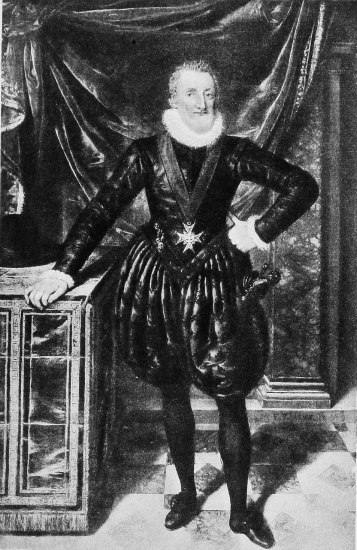
Henry IV
“I write you this, my great friend, to rejoice and give you health with
the good news my husband sends me. He having had the boldness to ask of
the king Madame, his young daughter, for our son, the king has done him
the honour to grant it; for which I cannot tell you the happiness I
have.”
There is much to be said thereon. At this time there was at our Court a
lady whom I shall not name, as silly as she could be. Being with the
queen-mother one evening at her coucher, the queen inquired of her
ladies if they had seen her daughter, and whether she seemed joyful at
the granting of her marriage. This silly lady, who did not yet know her
Court, answered first and said: “How, madame, should she not be joyful
at such a marriage, inasmuch as it will lead to the crown and make her
some day Queen of France, when it falls to her future husband, as it
well may do in time.” The queen, hearing so strange a speech, replied:
“Ma mie, you are a great fool. I would rather die a thousand deaths
than see your foolish prophecy accomplished; for I hope and wish long
life and good prosperity to the king, my son, and all my other
children.” On which a very great lady, one of her intimates, inquired:
“But, madame, in case that great misfortune—from which God keep
us!—happens, would you not be very glad to see your daughter Queen of
France, inasmuch as the crown would fall to her by right through that of
her husband?” To which the queen made answer: “Much as I love this
daughter, I think, if that should happen, we should see France much
tried with evils and misfortunes. I would rather die (as she did in
fact) than see her in that position; for I do not believe that France
would obey the King of Navarre as it does my sons, for many reasons
which I do not tell.”
Behold two prophecies accomplished: one, that of the foolish lady, the
other, but only till her death, that of the able princess. The latter
prophecy has failed to-day, by the grace which God has given our king
[Henri IV.], and by the force of his good sword and the valour of his
brave heart, which have made him so great, so victorious, so feared, and
so absolute a king as he is to-day after too many toils and hindrances.
May God preserve him by His holy grace in such prosperity, for we need
him much, we his poor subjects.
The queen said further: “If by the abolition of the Salic law, the
kingdom should come to my daughter in her own right, as other kingdoms
have fallen to the distaff, certainly my daughter is as capable of
reigning, or more so, as most men and kings whom I have known; and I
think that her reign would be a fine one, equal to that of the king her
grandfather and that of the king her father, for she has a great mind
and great virtues for doing that thing.” And thereupon she went on to
say how great an abuse was the Salic law, and that she had heard M. le
Cardinal de Lorraine say that when he arranged the peace between the two
kings with the other deputies in the abbey of Cercan, a dispute came up
on a point of the Salic law touching the succession of women to the
kingdom of France; and M. le Cardinal de Grandvelle, otherwise called
d’Arras, rebuked the said Cardinal de Lorraine, declaring that the Salic
law was a veritable abuse, which old dreamers and chroniclers had
written down, without knowing why, and so made it accepted; although, in
fact, it was never made or decreed in France, and was only a custom that
Frenchmen had given each other from hand to hand, and so introduced;
whereas it was not just, and, consequently, was violable.
Thus said the queen-mother. And, when all is said, it was Pharamond, as
most people hold, who brought it from his own country and introduced it
in France; and we certainly ought not to observe it, because he was a
pagan; and to keep so strictly among us Christians the laws of a pagan
is an offence against God. It is true that most of our laws come from
pagan emperors; but those which are holy, just, and equitable (and truly
there are many), we ourselves have ruled by them. But the Salic law of
Pharamond is unjust and contrary to the law of God, for it is written in
the Old Testament, in the twenty-seventh chapter of Numbers: “If a man
die and have no son ye shall cause his inheritance to pass to his
daughter.” This sacred law demands, therefore, that females shall
inherit after males. Besides, if Scripture were taken at its word on
this Salic law, there would be no such great harm done, as I have heard
great personages say, for they speak thus: “So long as there be males,
females can neither inherit nor reign. Consequently, in default of
males, females should do so. And, inasmuch as it is legal in Spain,
Navarre, England, Scotland, Hungary, Naples, and Sicily that females
should reign, why should it not be the same in France? For what is right
in one place is right everywhere and in all places; places do not make
the justice of the law.”
In all the fiefs we have in France, duchies, counties, baronies, and
other honourable lordships, which are nearly and even greatly royal in
their rights and privileges, many women, married and unmarried, have
succeeded; as in Bourbon, Vendôme, Montpensier, Nevers, Rhétel,
Flandres, Eu, Bourgogne, Artois, Zellande, Bretaigne; and even like
Mathilde, who was Duchesse de Normandie; Eléonore, Duchesse de Guyenne,
who enriched Henry II., King of England; Béatrix, Comtesse de Provence,
who brought that province to King Louis, her husband; the only daughter
of Raimond, Comtesse de Thoulouse, who brought Thoulouse to Alfonse,
brother of Saint-Louis; also Anne, Duchesse de Bretaigne, and others.
Why, therefore, should not the kingdom of France call to itself in like
manner the daughters of France?
Did not the beautiful Galatea rule in Gaul when Hercules married her
after his conquest of Spain?—from which marriage issued our brave,
valiant, generous Gauls, who in the olden time made themselves laudable.
Why should the daughters of dukes in this kingdom be more capable of
governing a duchy or a county and administering justice (which is the
duty of kings) than the daughters of kings to rule the kingdom of
France? As if the daughters of France were not as capable and fitted to
command and reign as those of other kingdoms and fiefs that I have
named!
For still greater proof of the iniquity of the Salic law it is enough to
show that so many chroniclers, writers, and praters, who have all
written about it, have never yet agreed among themselves as to its
etymology and definition. Some, like Postel, consider that it takes its
ancient name and origin from the Gauls, and is only called Salic instead
of Gallic because of the proximity and likeness in old type between the
letter S and the letter G. But Postel is as visionary in that (as a
great personage said to me) as he is in other things.
Jean Ceval, Bishop of Avranches, a great searcher into the antiquities
of Gaul and France, tried to trace it to the word salle, because this
law was ordained only for salles and royal palaces.
Claude Seissel thinks, rather inappropriately, that it comes from the
word sal in Latin, as a law full of salt, that of sapience, wisdom, a
metaphor drawn from salt.
A doctor of laws, named Ferrarius Montanus, will have it that Pharamond
was otherwise called Salicq. Others derive it from Sallogast, one of the
principal councillors of Pharamond.
Others again, wishing to be still more subtle, say that the derivation
is taken from the frequent sections in the said law beginning with the
words: si aliquis, si aliqua. But some say it comes from François
Saliens; and it is so mentioned in Marcellin.[14]
So here are many puzzles and musings; and it is not to be wondered at
that the Bishop of Arras disputed the matter with the Cardinal de
Lorraine: just as those of his nation in their jests and jugglings,
supposing that this law was a new invention, called Philippe de Valois
le roi trouvé, as if, by a new right never recognized before in
France, he had made himself king. On which was founded that, the county
of Flanders having fallen to a distaff, King Charles V. of France did
not claim any right or title to it; on the contrary, he portioned his
brother Philippe with Bourgogne in order to make his marriage with the
Countess of Flanders; not wishing to take her for himself, thinking her
less beautiful, though far more rich, than her of Bourbon. Which is a
great proof and assurance that the Salic law was not observed except as
to the crown. And it cannot be doubted that women, could they come to
the throne, beautiful, honourable, and virtuous as the one of whom I
here speak, would draw to them the hearts of their subjects by their
beauty and sweetness far more than men do by their strength.
M. du Tillet says that Queen Clotilde made France accept the Christian
religion, and since then no queen has ever wandered from it; which is a
great honour to queens, for it was not so with the kings after Clovis;
Chilperic I. was stained with Arian error, and was checked only by the
firm resistance of two prelates of the Gallican church, according to the
statement of Grégoire de Tours.
Moreover, was not Catherine, daughter of Charles VI., ordained Queen of
France by the king, her father, and his council [in 1420]?
Du Tillet further says that the daughters of France were held in such
honour that although they were married to less than kings they
nevertheless kept their royal titles and were called queens with their
proper names; an honour which was given them for life to demonstrate
forever that they were daughters of the kings of France. This ancient
custom shows dumbly that the daughters of France can be sovereigns as
well as the sons.
In the days of the King Saint-Louis it is recorded of a court of peers
held by him that the Countess of Flanders was present, taking part with
the peers. This shows how the Salic law was not kept, except as to the
crown. Let us see still further what M. du Tillet says:—
“By the Salic law, written for all subjects, where there were no sons
the daughters inherited the patrimony; and this should rule the crown
also, so that Mesdames the daughters of France, in default of sons,
should take it; nevertheless, they are perpetually excluded by custom
and the private law of the house of France, based on the arrogance of
Frenchmen, who cannot endure to be governed by women.” And elsewhere he
says: “One cannot help being amazed at the long ignorance that has
attributed this custom to the Salic law, which is quite the contrary of
it.”
King Charles V., treating of the marriage of Queen Marie of France, his
daughter, with Guillaume, Count of Hainault, in the year 1374,
stipulated for the renunciation by the said count of all right to the
kingdom and to Dauphiné; which is a great point, for see the
contradictions!
Certainly if women could handle arms like men they could make themselves
accredited; but by way of compensation, they have their beautiful faces;
which, however, are not recognized as they deserve; for surely it is
better to be governed by beautiful, lovely, and honourable women than by
tiresome, conceited, ugly, and sullen men such as I have seen in this
France of ours.
I would like to know if this kingdom has found itself any better for an
infinitude of conceited, silly, tyrannical, foolish, do-nothing,
idiotic, and crazy kings—not meaning to accuse our brave Pharamond,
Clodion, Clovis, Pépin, Martel, Charles, Louis, Philippe, Jean,
François, Henri, for they are all brave and magnanimous, those kings,
and happy they who were under them—than it would have been with an
infinitude of the daughters of France, very able, very prudent, and very
worthy to govern. I appeal to the regency of the mothers of kings to
show this, to wit:—
Frédégonde, how did she administer the affairs of France during the
minority of King Clothaire, her son, if not so wisely and dexterously
that he found himself before he died monarch of Gaul and of much of
Germany?
The like did Mathilde, wife of Dagobert, as to Clovis II., her son; and,
long after, Blanche, mother of Saint-Louis, who behaved so wisely, as I
have read, that, just as the Roman emperors chose to call themselves
“Augustus” in commemoration of the luck and prosperity of Augustus, the
great emperor, so the former queen-mothers after the decease of the
kings, their husbands, desired each to be called “Reine Blanche,” in
honourable memory of the government of that wise princess. Though M. du
Tillet contradicts this a little, I have heard it from a very great
senator.
And, to come lower down, Isabeau of Bavaria had the regency of her
husband, Charles VI. (who lost his good sense), by the advice of the
Council; and so had Madame de Bourbon for little King Charles VIII.
during his minority; Madame Louise de Savoie for King François I.; and
our queen-mother for King Charles IX., her son.
If, therefore, foreign ladies (except Madame de Bourbon, who was
daughter of France) were capable of governing France so well, why should
not our own ladies do as much, having good zeal and affection, they
being born here and suckled here, and the matter touching them so
closely?
I should like to know in what our last kings have surpassed our last
three daughters of France, Élisabeth, Claude, and Marguerite; and
whether if the latter had come to be queens of France they would not
have governed it (I do not wish to accuse the regency, which was very
great and very wise) as well as their brothers. I have heard many great
personages, well-informed and far-seeing, say that possibly we should
not have had the evils we did have, now have, and shall have still;
adducing reasons too long to put here. But the common and vulgar fool
says: “Must observe the Salic law.” Poor idiot that he is! does he not
know that the Germans, from whose stock we issued, were wont to call
their women to affairs of State, as we learn from Tacitus? From that, we
can see how this Salic law has been corrupted. It is but mere custom;
and poor women, unable to enforce their rights by the point of the
sword, men have excluded, and driven them from everything. Ah! why have
we no more brave and valiant paladins of France,—a Roland, a Renaud, an
Ogier, a Deudon, an Olivier, a Graffon, an Yvon, and an infinity of
other braves, whose glory and profession it was to succour ladies and
support them in the troubles and adversities of their lives, their
honour, and their fortunes? Why are they here no longer to maintain the
rights of our Queen Marguerite, daughter of France, who barely enjoys
an inch of land in France, which she quitted in noble state, though to
her, perhaps, the whole belongs by right divine and human? Queen
Marguerite, who does not even enjoy her county of Auvergne, which is
hers by law and equity as the sole heiress of the queen, her mother, is
now withdrawn into the castle of Usson, amid the deserts, rocks, and
mountains of Auvergne,—a different habitation, verily, from the great
city of Paris, where she ought now to be seated on her throne and place
of justice, which belongs to her in her own right as well as by that of
her husband. But the misfortune is that they are not there together. If
both were again united in body and soul and friendship, as they once
were, possibly all would go right once more, and together they would be
feared, respected, and known for what they are.
(Since this was written God has willed that they be reconciled, which is
indeed great luck.)
I heard M. de Pibrac say on one occasion that these Navarre marriages
are fatal, because husband and wife are always at variance,—as was the
case with Louis Hutin, King of France and of Navarre, and Marguerite de
Bourgogne, daughter of Duc Robert III.; also Philippe le Long, King of
France and Navarre, with Jeanne, daughter of Comte Othelin of Bourgogne,
who, being found innocent, was vindicated well; also Charles le Bel,
King of France and of Navarre, with Blanche, daughter of Othelin,
another Comte de Bourgogne; and further, King Henri d’Albret with
Marguerite de Valois, who, as I have heard on good authority, treated
her very ill, and would have done worse had not King François, her
brother, spoken sternly to him and threatened him for honouring his
sister so little, considering the rank she held.
The last King Antoine of Navarre died also on ill terms with Queen
Jeanne, his wife; and our Queen Marguerite is now in dispute and
separation from her husband; but God will some day happily unite them in
spite of these evil times.
I have heard a princess say that Queen Marguerite saved her husband’s
life on the massacre of Saint-Bartholomew; for indubitably he was
proscribed and his name written on the “red paper,” as it was called,
because it was necessary, they said, to tear up the roots, namely, the
King of Navarre, the Prince de Condé, Amiral de Coligny, and other great
personages; but the said Queen Marguerite flung herself on her knees
before King Charles, to implore him for the life of her husband and
lord.[15] King Charles would scarcely grant it to her, although she was
his good sister. I relate this for what it is worth, as I know it only
by hearsay. But she bore this massacre very impatiently and saved
several, among them a Gascon gentleman (I think his name was Léran),
who, wounded as he was, took refuge beneath her bed, she being in it,
and the murderers pursuing him to the door, from which she drove them;
for she was never cruel, but kind, like a daughter of France.
They say that the quarrel between herself and her husband came more from
the difference in their religion than from anything else; for they each
loved his and her own, and supported it strongly. The queen having gone
to Pau, the chief town of Béarn, she caused the mass to be said there;
and a certain secretary of the king, her husband, named le Pin, who had
formerly belonged to M. l’Amiral, not being able to stomach it, put
several of the inhabitants of the town who had been present at the mass
into prison. The queen was much displeased; and he, wishing to
remonstrate, spoke to her much louder than he should, and very
indiscreetly, even before the king, who gave him a good rebuke and
dismissed him; for King Henri knows well how to like and respect what he
ought; being as brave and generous as his fine and noble actions have
always manifested; of which I shall speak at length in his life.
The said le Pin fell back upon the edict which is there made, and to be
observed under penalty, namely, that mass shall not be said. The queen,
feeling herself insulted, and God knows she was, vowed and declared she
would never again set foot in that country because she chose to be free
in the exercise of her religion; whereupon she departed, and has ever
since kept her oath very carefully.
I have heard it said that nothing lay so heavily on her heart as this
indignity of being deprived of the exercise of her religion; for which
reason she begged the queen, her good mother, to come and fetch her and
take her to France to see the king and Monsieur, his brother, whom she
honoured and loved much. Having arrived, she was not received and seen
by the king, her brother, as she should have been. Seeing this great
change since she had left France, and the rise of many persons she would
never have thought of to grandeurs, it irked her much to be forced to
pay court to them, as others, her equals, were now doing; and far from
doing so herself, she despised them openly, as I well saw, so high was
her courage. Alas! too high, certainly, for it caused her misfortunes;
had she been willing to restrain herself and lower her courage the least
in the world she would not have been thwarted and vexed as she has been.
As to which I shall relate this story: when the king, her brother, went
to Poland, he being there, she knew that M. du Gua, much favoured by her
brother, had made some remarks to her disadvantage, enough to set
brother and sister at variance or enmity. At the end of a certain time
M. du Gua returned from Poland and arrived at Court, bearing letters
from the king to his sister, which he went to her apartment to give her
and kiss hands. This I saw myself. When she beheld him enter she was in
great wrath, and as he came to her to present the letter she said to
him, with an angry face: “Lucky for you, du Gua, that you come before me
with this letter from my brother, which serves you as a safeguard, for I
love him much and all who come from him are free from me; but without
it, I would teach you to speak about a princess like myself, the sister
of your kings, your masters and sovereigns.” M. du Gua answered very
humbly: “I should never, madame, have presented myself before you,
knowing that you wish me ill, without some good message from the king,
my master, who loves you, and whom you love also; or without feeling
assured, madame, that for love of him, and because you are good and
generous, you would hear me speak.” And then, after making her his
excuses and telling his reasons (as he knew well how to do), he denied
very positively that he had ever spoken against the sister of his kings
otherwise than very reverently. On which she dismissed him with an
assurance that she would ever be his cruel enemy,—a promise which she
kept until his death.
After a while the king wrote to Mme. de Dampierre and begged her, for
the sake of giving him pleasure, to induce the Queen of Navarre to
pardon M. du Gua, which Mme. de Dampierre undertook with very great
regret, knowing well the nature of the said queen; but because the king
loved her and trusted her, she took the errand and went one day to see
the said queen in her room. Finding her in pretty good humour, she
opened the matter and made the appeal, namely: that to keep the good
graces, friendship, and favour of the king, her brother, who was now
about to become King of France, she ought to pardon M. du Gua, forget
the past, and take him again into favour; for the king loved and
favoured him above his other friends; and by thus taking M. du Gua as a
friend she would gain through him many pleasures and good offices,
inasmuch as he quietly governed the king, his master, and it was much
better to have his help than to make him desperate and goad him against
her, because he could surely do her much harm; telling her how she had
seen in her time during the reign of François I., Mesdames Madeleine and
Marguerite, one Queen of Scotland later, the other Duchesse de Savoie,
her aunts, although their hearts were as high and lofty as her own,
bring down their pride so low as to pay court to M. de Sourdis, who was
only master of the wardrobe to the king, their father; yet they even
sought him, hoping by his means, to obtain the favour of the king; and
thus, taking example by her aunts, she ought to do the same herself in
relation to M. du Gua.
The Queen of Navarre, having listened very attentively to Mme. de
Dampierre, answered her rather coldly, but with a smiling face, as her
manner was: “Madame de Dampierre, what you say to me may be good for
you; you need favours, pleasures, and benefits, and were I you the words
you say to me might be very suitable and proper to be received and put
in practice; but to me, who am the daughter of a king, the sister of
kings, and the wife of a king, they have no meaning; because with that
high and noble rank I cannot, for my honour’s sake, be a beggar of
favours and benefits from the king, my brother; and I hold him to be of
too good a nature and too well acquainted with his duty to deny me
anything unless I have the favour of a du Gua; if otherwise, he will do
great wrong to himself, his honour, and his royalty. And even if he be
so unnatural as to forget himself and what he owes to me, I prefer, for
my honour’s sake and as my courage tells me, to be deprived of his good
graces, because I would not seek du Gua to gain his favours, or be even
suspected of gaining them by such means and intercession; and if the
king, my brother, feels himself worthy to be king, and to be loved by me
and by his people, I feel myself, as his sister, worthy to be queen and
loved, not only by him but by all the world. And if my aunts, as you
allege, degraded themselves as you say, let them do as they would if
such was their humour, but their example is no law to me, nor will I
imitate it, or form myself on any model if not my own.” On that she was
silent, and Mme. de Dampierre retired; not that the queen was angry with
her or showed her ill-will, for she loved her much.
Another time, when M. d’Épernon went to Gascoigne after the death of
Monsieur (a journey made for various purposes, so they said), he saw the
King of Navarre at Pamiers, and they made great cheer and caresses to
each other. I speak thus because at that time M. d’Épernon was semi-king
of France because of the dissolute favour he had with his master, the
King of France. After having caressed and made good cheer together the
King of Navarre asked him to go and see him at Nérac when he had been to
Toulouse and was on his way back; which he promised to do. The King of
Navarre having gone there first to make preparations to feast him well,
the Queen of Navarre, who was then at Nérac, and who felt a deadly
hatred to M. d’Épernon, said to the king, her husband, that she would
leave the place so as not to disturb or hinder the fête, not being able
to endure the sight of M. d’Épernon without some scandal or venom of
anger which she might disgorge, and so give annoyance to the king, her
husband. On which the king begged her, by all the pleasures that she
could give him, not to stir, but to help him to receive the said Sieur
d’Épernon and to put her rancour against him underfoot for love of him,
her husband, and all the more because it greatly concerned both of them
and their grandeur.
“Well, monsieur,” replied the queen, “since you are pleased to command
it, I will remain and give him good cheer out of respect to you and the
obedience that I owe to you.” After which she said to some of her
ladies: “But I will answer for it that on the days that man is here I
will dress in habiliments I never yet have worn, namely: dissimulation
and hypocrisy; I will so mask my face with shams that the king shall see
there only good and honest welcome and all gentleness; and likewise I
will lay discretion on my lips, so that externally I will make him think
my heart internally is kind, which otherwise I would not answer for; I
do this being nowise in my own control, but wholly in his,—so lofty is
he and full of frankness, unable to bear vileness or the venom of
hypocrisy, or to abase himself in any way.”
Therefore, to content the king, her husband, for she honoured him much,
as he did her, she disguised her feelings in such a way that, M.
d’Épernon being brought to her apartment, she received him in the same
manner the king had asked of her and she had promised; so that all
present, the chamber being full of persons eager to see the entrance and
the interview, marvelled much, while the king and M. d’Épernon were
quite content. But the most clear-sighted and those who knew the nature
of the queen misdoubted something hidden within; and she herself said
afterwards it was a comedy in which she played a part unwillingly.
These are two tales by which to see the lofty courage of this queen, the
which was such, as I have heard the queen, her mother, say (discoursing
of this topic), that she resembled in this her father; and that she, the
queen-mother, had no other child so like him, as much in ways, humours,
lineaments, and features of the face as in courage and generosity;
telling also how she had seen King Henri during King François’ lifetime
unable for a kingdom to pay his court and cringe to Cardinal de Tournon
or to Amiral d’Annebault, the favourites of King François, even though
he might often have had peace with Emperor Charles had he been willing
so to do; but his honour could not submit to such attentions. And so,
like father, like daughter. Nevertheless, all that injured her much. I
remember an infinite number of annoyances and indignities she received
at Court, which I shall not relate, they are too odious; until at last
she was sent away, with great affront and yet most innocent of what they
put upon her; the proofs of which were known to many, as I know myself;
also the king, her husband, was convinced of it, so that he brought King
Henri to account, which was very good of him, and henceforth there
resulted between the two brothers [-in-law] a certain hatred and
contention.
The war of the League happened soon after; and because the Queen of
Navarre feared some evil at Court, being a strong Catholic, she retired
to Agen, which had been given to her with the region about it by her
brothers, as an appanage and gift for life. As the Catholic religion was
concerned, which it was necessary to maintain, and also to exterminate
the other, she wished to fortify her side as best she could and repress
the other side. But in this she was ill-served by means of Mme. de
Duras, who governed her much, and made, in her name, great exactions and
extortions. The people of the town were embittered, and covertly sought
their freedom and a means to drive away their lady and her bailiffs. On
which disturbance the Maréchal de Matignon took occasion to make
enterprise against the town, as the king, having learned the state of
things, commanded him with great joy to do in order to aggravate his
sister, whom he did not love, to more and more displeasure. This
enterprise, which failed at first, was led the second time so
dexterously by the said marshal and the inhabitants, that the town was
taken by force with such rapidity and alarm that the poor queen, in
spite of all she could do, was forced to mount in pillion behind a
gentleman, and Mme. de Duras behind another, and escape as quickly as
they could, riding a dozen leagues without stopping, and the next day as
much more, to find safety in the strongest fortress of France, which is
Carlat. Being there, and thinking herself in safety, she was, by the
manœuvres of the king, her brother (who was a very clever and very
subtle king, if ever there was one), betrayed by persons of that country
and the fortress, so that when she fled she became a prisoner in the
hands of the Marquis de Canillac, governor of Auvergne, and was taken to
the castle of Usson, a very strong fortress also, almost impregnable,
which that good and sly fox Louis XI. had made such, in order to lodge
his prisoners in a hundred-fold more security than at Loches, Bois de
Vincennes, or Lusignan.
Here, then, was this poor princess a prisoner, and treated not as a
daughter of France or the great princess that she was. But, at any rate,
if her body was captive, her brave heart was not, and it never failed
her, but helped her well and did not let her yield to her affliction.
See what a great heart can do, led by great beauty! For he who held her
prisoner became her prisoner in time, brave and valiant though he was.
Poor man! what else could he expect? Did he think to hold subject and
captive in his prison one whose eyes and beauteous face could subject
the whole world to her bonds and chains like galley-slaves!
So here was the marquis ravished and taken by her beauty; but she, not
dreaming of the delights of love, only of her honour and her liberty,
played her game so shrewdly that she soon became the stronger, seized
the fort, and drove away the marquis, much dumfounded at such surprise
and military tactics.
There she has now been six or seven years,[16] not, however, with all
the pleasures of life, being despoiled of the county of Auvergne by M.
le Grand Prieur de France, whom the king induced the queen-mother to
institute count and heir in her will; regretting much that she could not
leave the queen, her good daughter, anything of her own, so great was
the hatred that the king bore her. Alas! what mutation was this from the
time when, as I saw myself, they loved each other much, and were one in
body, soul, and will! Ah! how often was it fine to see them discourse
together; for, whether they were grave or gay, nothing could be finer
than to see and hear them, for both could say what they wished to say.
Ah! how changed the times are since we saw them in that great ball-room,
dancing together in such beautiful accord of dance and will! The king
always led her to the dance at the great balls. If one had a noble
majesty the other had none the less; the eyes of all were never
surfeited or delighted enough by so agreeable a sight; for the sets were
so well danced, the steps so correctly performed, the stops so finely
made that we knew not which to admire most, their beautiful fashion of
dancing or their majesty in pausing; representing now a gay demeanour
and next a noble, crave disdain; for no one ever saw them in the
dance that did not say they had seen no dance so fine with grace and
majesty as this of the king-brother and the queen-sister. As for me, I
am of that opinion; and yet I have seen the Queen of Spain and the Queen
of Scotland dance most beautifully.
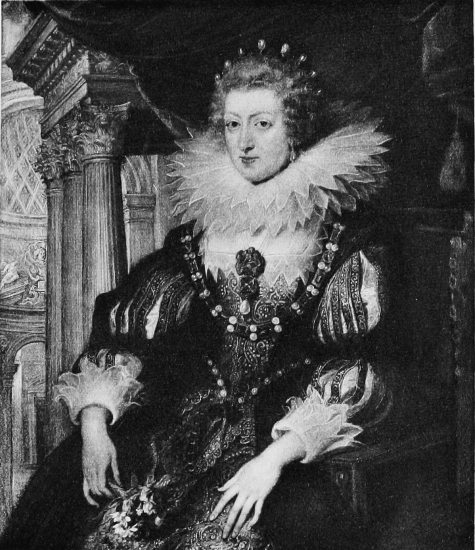
Élisabeth de France Queen of Spain
Also I have seen them dance the Italian pazzemeno [the minuet, menu
pas], now advancing with grave port and majesty, doing their steps so
gravely and so well; next gliding only; and anon making most fine and
dainty and grave passages, that none, princes or others, could approach,
nor ladies, because of the majesty that was not lacking. Wherefore this
queen took infinite pleasure in these grave dances on account of her
grace and dignity and majesty, which she displayed the better in these
than in others like bransles, and volts, and courants. The latter
she did not like, although she danced them well, because they were not
worthy of her majesty, though very proper for the common graces of other
ladies.
I have seen her sometimes like to dance the bransle by torchlight. I
remember that once, being at Lyon, on the return of the king from
Poland, at the marriage of Besne (one of her maids of honour) she danced
the bransle before many foreigners from Savoie, Piedmont, Italy, and
elsewhere, who declared they had never seen anything so fine as this
queen, a grave and noble lady, as indeed she is. One of them there was
who went about declaring that she needed not, like other ladies, the
torch she carried in her hand; for the light within her eyes, which
could not be extinguished like the other, was sufficient; the which had
other virtue than leading men to dance, for it inflamed all those about
her, yet could not be put out like the one she had in hand, but lit the
night amid the darkness and the day beneath the sun.
For this reason must we say that Fortune has been to us as great an
enemy as to her, in that we see no longer that bright torch, or rather
that fine sun which lighted us, now hidden among those hills and
mountains of Auvergne. If only that light had placed itself in some fine
port or haven near the sea, where passing mariners might be guided, safe
from wreck and peril, by its beacon, her dwelling would be nobler, more
profitable, more honourable for herself and us. Ah! people of Provence,
you ought to beg her to dwell upon your seacoasts or within your ports;
then would she make them more famous than they are, more inhabited and
richer; from all sides men in galleys, ships, and vessels would flock to
see this wonder of the world, as in old times to that of Rhodes, that
they might see its glorious and far-shining pharos. Instead of which,
begirt by barriers of mountains, she is hidden and unknown to all our
eyes, except that we have still her lovely memory. Ah! beautiful and
ancient town of Marseille, happy would you be if your port were honoured
by the flame and beacon of her splendid eyes! For the county of Provence
belongs to her, as do several other provinces in France. Cursèd be the
unhappy obstinacy of this kingdom which does not seek to bring her
hither with the king, her husband, to be received, honoured and welcomed
as they should be. (This I wrote at the very height of the Wars of the
League.)
Were she a bad, malicious, miserly, or tyrannical princess (as there
have been a plenty in times past in France, and will be, possibly,
again), I should say nothing in her favour; but she is good, most
splendid, liberal, giving all to others, keeping little for herself,
most charitable, and giving freely to the poor. The great she made
ashamed with liberalities; for I have seen her make presents to all the
Court on New Year’s Day such as the kings, her brothers, could not
equal. On one occasion she gave Queen Louise de Lorraine a fan made of
mother-of-pearl enriched with precious stones and pearls of price, so
beautiful and rich that it was called a masterpiece and valued at more
than fifteen thousand crowns. The other, to return the present, sent her
sister those long aiguillettes which Spaniards call puntas, enriched
with certain stones and pearls, that might have cost a hundred crowns;
and with these she paid for that fine New Year’s gift, which was,
certainly, most dissimilar.
In short, this queen is in all things royal and liberal, honourable and
magnificent, and, let it not displease the empresses of long past days,
their splendours described by Suetonius, Pliny, and others, do not
approach her own in any way, either in Court or city, or in her journeys
through the open country; witness her gilded litters so superbly covered
and painted with fine devices, her coaches and carriages the same, and
her horses so fine and so richly caparisoned.
Those who have seen, as I have, these splendid appurtenances know what I
say. And must she now be deprived of all this, so that for seven years
she has not stirred from that stern, unpleasant castle?—in which,
however, she takes patience; such virtue has she of self-command, one of
the greatest, as many wise philosophers have said!
To speak once more of her kindness: it is such, so noble, so frank,
that, as I believe, it has done her harm; for though she has had great
grounds and great means to be revenged upon her enemies and injure them,
she has often withheld her hand when, had she employed those means or
caused them to be employed, and commanded others, who were ready enough,
to chastise those enemies with her consent, they would have done so
wisely and discreetly; but she resigned all vengeances to God.
This is what M. du Gua said to her once when she threatened him:
“Madame, you are so kind and generous that I never heard it said you did
harm to any one; and I do not think you will begin with me, who am your
very humble servitor.” And, in fact, although he greatly injured her,
she never returned him the same in vengeance. It is true that when he
was killed and they came to tell her, she merely said, being ill: “I am
sorry I am not well enough to celebrate his death with joy.” She had
also this other kindness in her: that when others had humbled themselves
and asked her pardon and favour, she forgave and pardoned, with the
generosity of a lion which never does harm to those who are humble to
him.
I remember that when M. le Maréchal de Biron was lieutenant of the king
in Guyenne, war having broken out around him (possibly with his
knowledge and intent), he went one day before Nérac, where the King and
Queen of Navarre were living at that time. The marshal prepared his
arquebusiers to attack, beginning with a skirmish. The King of Navarre
brought out his own in person, and, in a doublet like any captain of
adventurers, he held his ground so well that, having the best marksmen,
nothing could prevail against him. By way of bravado the marshal let fly
some cannon against the town, so that the queen, who had gone upon the
ramparts to see the pastime, came near having her share in it, for a
ball flew right beside her; which incensed her greatly, as much for the
little respect Maréchal de Biron showed in braving her to her face, as
because he had a special command from the king not to approach the war
nearer than five hundred leagues to the Queen of Navarre, wherever she
might be. The which command he did not observe on this occasion; for
which she felt resentment and revenge against the marshal.
About a year and a half later she came to Court, where was the marshal,
whom the king had recalled from Guyenne, fearing further disturbance;
for the King of Navarre had threatened to make trouble if he were not
recalled. The Queen of Navarre, resentful to the said marshal, took no
notice of him, but disdained him, speaking everywhere very ill of him
and of the insult he had offered her. At last, the marshal, dreading the
hatred of the daughter and sister of his masters, and knowing the nature
of the princess, determined to seek her pardon by making excuses and
humbling himself; on which, generous as she was, she did not contradict
him, but took him into favour and friendship and forgot the past. I knew
a gentleman by acquaintance who came to Court about this time, and
seeing the good cheer the queen bestowed upon the marshal was much
astonished; and so, as he sometimes had the honour of being listened to
by the queen, he said to her that he was much amazed at the change and
at her good welcome, in which he could not have believed, in view of the
affront and injury. To which she answered that as the marshal had owned
his fault and made his excuses and sought her pardon humbly, she had
granted it for that reason, and did not desire further talk about his
bravado at Nérac. See how little vindictive this good princess is,—not
imitating in this respect her grandmother, Queen Anne, towards the
Maréchal de Gié, as I have heretofore related.
I might give many other examples of her kindness in her reconciliations
and forgivenesses.
Rebours, one of her maids of honour, who died at Chenonceaux, displeased
her on one occasion very much. She did not treat her harshly, but when
she was very ill she went to see her, and as she was about to die
admonished her, and then said: “This poor girl has done great harm, but
she has suffered much. May God pardon her as I have pardoned her.” That
was the vengeance and the harm she did her. Through her generosity she
was slow to revenge, and in all things kind.
Alfonso, the great King of Naples, who was subtle in loving the beauties
of women, used to say that beauty is the sign manual of kindness and
gentle goodness, as the beautiful flower is that of a good fruit. As to
that it cannot be doubted that if our queen had been ugly and not
composed of her great beauty, she would have been very bad in view of
the great causes to be so that were given her. Thus said the late Queen
Isabella of Castile, that wise and virtuous and very Catholic princess:
“The fruit of clemency in a queen of great beauty and lofty heart,
covetous of honour, is sweeter far than any vengeance whatever, even
though it be undertaken for just claims and reason.”
This queen most sacredly observes that rule, striving to conform to the
commandments of her God, whom she has always loved and feared and served
devotedly. Now that the world has abandoned her and made war upon her,
she takes her sole resource in God, whom she serves daily, as I am told
by those who have seen her in her affliction; for never does she miss a
mass, taking the communion often and reading much in Holy Scripture,
finding there her peace and consolation.
She is most eager to obtain the fine new books that are composed, as
much on sacred subjects as on human; and when she undertakes to read a
book, however large and long it be, she never stops or quits it until
she sees the end, and often loses sleep and food in doing so. She
herself composes, both in prose and verse. As to which no one can think
otherwise than that her compositions are learned, beautiful, and
pleasing, for she knows the art; and could we bring them to the light,
the world would draw great pleasure and great profit from them. Often
she makes very beautiful verses and stanzas, that are sung to her by
choir-boys whom she keeps, and which she sings herself (for her voice is
beautiful and pleasant) to a lute, playing it charmingly. And thus she
spends her time and wears away her luckless days,—offending none, and
living that tranquil life she chooses as the best.
She has done me the honour to write me often in her adversity, I being
so presumptuous as to send for news of her. But is she not the daughter
and sister of my kings, and must I not wish to know her health, and be
glad and happy when I hear ‘tis good? In her first letter she writes
thus:—
“By the remembrance you have of me, which is not less new than pleasant
to me, I see that you have well preserved the affection you have always
shown to our family and to the few now left of its sad wreck, so that I,
in whatever state I be, shall ever be disposed to serve you; feeling
most happy that ill fortune has not effaced my name from the remembrance
of my oldest friends, of whom you are. I know that you have chosen, like
myself, a tranquil life; and I count those happy who can maintain it, as
God has given me the grace to do these five years, He having brought me
to an ark of safety, where the storms of all these troubles cannot, I
thank God, hurt me; so that if there remain to me some means to serve my
friends, and you particularly, you will find me wholly so disposed with
right good will.”
Those are noble words; and such was the state and resolution of our
beautiful princess. That is what it is to be born of a noble house, the
greatest in the world, whence she drew her courage by inheritance from
many brave and valiant kings, her father, grandfather,
great-grandfather, and all their ancestors. And be it, as she says,
that from so great a shipwreck she alone remains, not recognized and
reverenced as she should be by her people, I believe this people of
France has suffered much misery for that reason, and will suffer more
for this war of the League. But to-day this is not so;[17] for by the
valour and wisdom and fine government of our king never was France more
flourishing, or more pacific, or better ruled; which is the greatest
miracle ever seen, having issued from so vast an abyss of evils and
corruptions; by which it seems that God has loved our queen,—He being
good and merciful.
Oh! how ill-advised is he who trusts in the people of to-day! Oh! how
differently did the Romans recognize the posterity of Augustus Cæsar,
who gave them wealth and grandeurs, from the people of France, who
received so much from their later kings these hundred years, and even
from François I. and Henri II., so that without them France would have
been tumbled topsy-turvy by her enemies watching for that chance, and
even by the Emperor Charles, that hungry and ambitious man. And thus it
is they are so ungrateful, these people, toward Marguerite, sole and
only remaining daughter and princess of France! It is easy to foresee
the wrath of God upon them, because nothing is to Him so odious as
ingratitude, especially to kings and queens, who here below fulfil the
place and state of God. And thou, disloyal Fortune, how plainly dost
thou show that there are none, however loved by heaven and blessed by
nature, who can be sure of thee and of thy favours a single day! Art
thou not dishonoured in thus so cruelly affronting her who is all
beauty, sweetness, virtue, magnanimity and kindness?
All this I wrote during those wars we had among us for ten years. To
make an end, did I not speak elsewhere of this great queen in other
discourses I would lengthen this still more and all I could, for on so
excellent a subject the longest words are never wearisome; but for a
time I now postpone them.
Live, princess, live in spite of Fortune! Never can you be other than
immortal upon earth and in heaven, whither your noble virtues bear you
in their arms. If public voice and fame had not made common praise of
your great merits, or if I were of those of noble speech, I would say
further here; for never did there come into the world a figure so
celestial.
This queen who should by good right order us
By laws and edicts and above us reign,
Till we behold a reign of pleasure under her,
As in her father’s days, a Star of France,
Fortune hath hindered. Ha! must rightful claim
Be wrongly lost because of Fortune’s spite?
Never did Nature make so fine a thing
As this great unique princess of our France!
Yet Fortune chooses to undo her wholly.
Behold how evil balances with good!
In the sixteenth century there were three Marguerites: one, sister of
François I. and Queen of Navarre, celebrated for her intellect, her
Tales in the style of Boccaccio, and her verses, which are less
interesting; another, Marguerite, niece of the preceding, sister of
Henri II., who became Duchesse de Savoie, very witty, also a writer of
verses, and, in her youth, the patroness of the new poets at Court; and
lastly, the third Marguerite, niece and great-niece of the first two,
daughter of Henri II. and Catherine de’ Medici, first wife of Henri IV.,
and sister of the last Valois. It is of her that I speak to-day as
having left behind her most agreeable historical pages and opened in our
literature that graceful series of women’s Memoirs which henceforth
never ceases, but is continued in later years and lively vein by
Mesdames de La Fayette, de Caylus and others. All of these Memoirs are
books made without intending it, and the better for that. The following
is the reason why Queen Marguerite took the idea of writing those in
which she describes herself with so lightsome a pen.
Brantôme, who was making a gallery of illustrious French and foreign
ladies, after bringing Marie Stuart into it, bethought him of placing
Marguerite beside her as another example of the injustice and cruelty of
Fortune. Marguerite, at the period when Brantôme indited his impulsive,
enthusiastic portrait of her, flinging upon his paper that eulogy which
may truly be called delirious, was confined at the castle of Usson in
Auvergne (1593), where she was not so much a prisoner as mistress.
Prisoner at first, she soon seduced the man who held her so and took
possession of the place, where she passed the period of the League
troubles, and beyond it, in an impenetrable haven. The castle of Usson
had been fortified by Louis XI., well-versed in precautions, who wanted
it as a sure place in which to lodge his prisoners. There Marguerite
felt herself safe, not only from sudden attack, but also from the trial
of a long siege and repeated assault. Writing to her husband, Henri IV.,
in October, 1594, she says to him, jokingly, that if he could see the
fortress and the way in which she had protected herself within it he
would see that God alone could reduce it, and she has good reason to
believe that “this hermitage was built to be her ark of safety.”
The castle which she thus compares to Noah’s ark, and which some of her
panegyrists, convinced that she who lived there was given to celestial
contemplations, compare to Mount Tabor, was regarded as a Caprea and an
abominable lair by enemies, who, from afar, plunged eyes of hatred into
it. It is very certain, however, that Queen Marguerite lost nothing in
that retreat of the delicate nicety of her mind, for it was there that
she undertook to write her Memoirs in a few afternoons, in order to come
to Brantôme’s assistance and correct him on certain points. We will
follow her, using now and then some contemporary information, without
relying too much upon either, but endeavouring to draw with simple truth
a singular portrait in which there enters much that was enchanting and,
towards the end, fantastic.
Marguerite, born at Saint-Germain-en-Laye, May 14, 1553, was six years
old when her father, Henri II., was killed at that fatal tournament
which ruined the fortunes of the house of Valois. She tells us several
anecdotes of herself and her childish repartees which prove a precocious
mind. She takes great pains to call attention to a matter which in her
is really a sign, a distinctive note through all excesses, namely: that
as a child and when it was the fashion at Court to be “Huguenot,” and
when all those who had intelligence, or wished to pass for having it,
had withdrawn from what they called “bigotry,” she resisted that
influence. In vain did her brother, d’Anjou, afterward Henri III., fling
her Hours into the fire and give her the Psalms and the Huguenot prayers
in place of it; she held firm and preserved herself from the mania of
Huguenotism, which at that date (1561) was a fancy at Court, a French
and mundane fashion, attractive for a time to even those who were soon
to turn against it and repress it. Marguerite, in the midst of a life
that was little exemplary, will always be found to have kept with
sincerity this corner of good Catholicism which she derived from her
race, and which made her in this respect and to this degree more of an
Italian than a Frenchwoman; however, that which imports us to notice is
that she had it.
Still a child when the first religious wars began, she was sent to
Amboise with her young brother, d’Alençon. There she found herself in
company with several of Brantôme’s female relations: Mme. de Dampierre,
his aunt, Mme. de Retz, his cousin; and she began with the elder of
these ladies a true friendship; with the younger, the cousin, the
affection came later. Marguerite gives the reason for this very
prettily:—
“At that time the advanced age of your aunt and my childish youthfulness
had more agreement; for it is the nature of old people to love children;
and those who are in the perfection of their age, like your cousin,
despise and dislike their annoying simplicity.”
Childhood passed, and the first awakening to serious things was given to
Marguerite about the time of the battle of Moncontour (1569). She was
then sixteen. The Duc d’Anjou, afterwards Henri III., aged eighteen,
handsome, brave, and giving promise of a virtue and a prudence he never
justified, took his sister aside one day in one of the alleys of the
park at Plessis-lez-Tours to tell her of his desire, on starting for the
army, to leave her as his confidant and support with their mother,
Catherine de’ Medici, during his absence at the wars. He made her a long
speech, which she reports in full with some complacency:—
“Sister, the nourishment we have taken together obliges us, not less
than proximity, to love each other.... Until now we have naturally been
guided to this without design and without the said union being of any
utility beyond the pleasure we have had in conversing together. That was
good for our childhood; but now it is time to no longer live like
children.”
He then points out to her the great and noble duties to which God calls
him, in which the queen, their mother, brought him up, and which King
Charles IX., their brother, lays upon him. He fears that this king,
courageous as he is, may not always be satisfied with hunting, but will
become ambitious to put himself at the head of the armies, the command
of which has been hitherto left to him. It is this that he wishes to
prevent.
“In this apprehension,” he continues, “thinking of some means of remedy,
I believe that it is necessary to leave some very faithful person behind
me who will maintain my side with the queen, my mother. I know no one as
suitable as you, whom I regard as a second myself. You have all the
qualities that can be desired,—intelligence, judgment, and fidelity.”
The Duc d’Anjou then proposes to his sister to change her manner of
life, to be assiduous towards the queen, their mother, at all hours, at
her lever, in her cabinet during the day, at her coucher, and so act
that she be treated henceforth, not as a child, but as a person who
represents him during his absence. “This language,” she remarks, “was
very new to me, having lived until then without purpose, thinking of
nothing but dancing and hunting; and without much interest even in
dressing and in appearing beautiful, not having yet reached the age of
such ambitions.” The fear she always felt for the queen, her mother, and
the respectful silence she maintained in her presence, held her back
still further. “I came very near,” she says, “replying to him as Moses
did to God in the vision of the bush: ‘Who am I? Send, I pray thee, by
him whom thou shouldest send.’” Nevertheless, she felt within her at her
brother’s words a new courage, and powers hitherto unknown to her, and
she soon consented to all, entering zealously into her brother’s design.
From that moment she felt herself “transformed.”
This fraternal and politic union thus created by the Duc d’Anjou did not
last. On his return from the victory of Moncontour she found him
changed, distrustful, and ruled by a favourite, du Gua, who possessed
him as so many others possessed him later. Henceforth his sister was out
of favour with him, and it was with her younger brother, the Duc
d’Alençon, that Marguerite renewed and continued as long as she could a
union of the same kind, which gave room for all the feelings and all the
ambitious activities of youth.
Did she at that time give some ground for the coolness of her brother
d’Anjou by her liaison with the young Duc de Guise? An historian who
knew Marguerite well and was not hostile to her, says: “She had long
loved Henri, Duc de Guise, who was killed at Blois, and had so fixed the
affections of her heart from her youth upon that prince of many
attractions that she never loved the King of Navarre, afterwards King of
France of happy memory, but hated him from the beginning, and was
married to him in spite of herself, and against canonical law.”[18]
However this may be, the Duc d’Anjou seized the pretext of the Duc de
Guise to break with his sister, whose enemy he became insensibly, and he
succeeded in alienating her from her mother.
Marguerite, in this flower of her youth, was, according to all
testimony, enchantingly beautiful. Her beauty was not so much in the
special features of her face as in the grace and charm of her whole
person, with its mingling of seduction and majesty. Her hair was dark,
which was not thought a beauty in those days; blond hair reigned. “I
have seen her sometimes wearing her natural hair without any peruke
artifice,” Brantôme tells us, “and though it was black (having inherited
that colour from King Henri, her father), she knew so well how to twist
and curl and arrange it, in imitation of her sister, the Queen of Spain,
who never wore any hair but her own, that such arrangement and coiffure
became her as well as, or better than, any other.” Toward the end of her
life Marguerite, becoming in her turn antiquated, with no brown hair to
dress, made great display of blond perukes. “For them she kept great,
fair-haired footmen, who were shaved from time to time;” but in her
youth, when she dared to be dark-haired as nature made her, it was not
unbecoming to her; for she had a most dazzling complexion and her
“beautiful fair face resembled the sky in its purest and greatest
serenity” with its “noble forehead of whitening ivory.” Nor must we
forget her art of adorning and dressing herself to advantage, and the
new inventions of that kind she gave to women, she being then the queen
of the modes and fashion. As such she appeared on all solemn occasions,
and notably on that day when, at the Tuileries, the queen-mother fêted
the Polish seigneurs who came to offer the crown of Poland to the Duc
d’Anjou, and Ronsard, who was present, confesses that the beautiful
goddess Aurora was vanquished; but more notably still on that flowery
Easter at Blois, when we see her in procession, her dark hair starred
with diamonds and precious stones, wearing a gown of crinkled cloth of
gold from Constantinople, the weight of which would have crushed any
other woman, but which her beautiful, rich, strong figure supported
firmly, bearing the palm in her hand, her consecrated branch, “with
regal majesty, and a grace half proud, half tender.” Such was the
Marguerite of the lovely years before the disasters and the flights,
before the castle of Usson, where she aged and stiffened.
This beauty, so real, so solid, which had so little need of borrowed
charms, had, like all her being, its fantasticalities and its
superstition. I have said already that she frequently disguised her
rich, brown hair, preferring a blond wig, “more or less charmingly
fashioned.” Her beautiful face was presented to view “all painted and
stained.” She took such care of her skin that she spoiled it with washes
and recipes of many kinds, which gave her erysipelas and pimples. In
fact, she was the model and eke the slave of the fashions of her time;
and as she survived those days she became in the end a species of
preserved idol and curiosity, such as may be seen in a show-case. The
great Sully, when he one day reappeared at the Court of Louis XIII. with
his ruff and his costume of the time of Henri IV., gave that crowd of
young courtiers something to laugh at; and so, when Queen Marguerite,
having returned from Usson to Paris, showed herself at the remodelled
Court of Henri IV. she produced the same effect on that young century,
which smiled at beholding this solemn survival of the Valois.
Like all those Valois, a worthy granddaughter of François I., she was
learned. To the Poles who harangued in Latin she showed that she
understood them by replying on the spot, eloquently and pertinently,
without the help of an interpreter. She loved poetry and wrote it, and
had it written for her by salaried poets whom she treated as friends.
When she had once begun to read a book she could not leave it, or pause
till she came to the end, “and very often she would lose both her eating
and drinking.” But let us not forestall the time. She herself tells us
that this taste for study and reading came to her for the first time
during a previous imprisonment in which Henri III. held her for several
months in 1575, and we are still concerned with her cloudless years.
She was married, in spite of her objections as a good Catholic, to
Henri, King of Navarre, six days before the Saint-Bartholomew (August,
1572). She relates with much naïveté and in a simple tone the scenes of
that night of horror, of which she was ignorant until the last moment.
We see in her narrative that wounded and bleeding gentleman pursued
through the corridors of the Louvre, and taking refuge in Marguerite’s
chamber, and flinging himself with the cry “Navarre! Navarre!” upon her;
shielding his own body from the murderers with that of his queen, she
not knowing whether she had to do with a madman or an assailant. When
she did know what the danger was she saved the poor man, keeping him in
bed and dressing his wounds in her cabinet until he was cured. Queen
Marguerite, so little scrupulous in morality, is better than her
brothers; of the vanishing Valois she has all the good qualities and
many of their defects, but not their cruelty.
After this half-missed blow of the Saint-Bartholomew, which did not
touch the princes of the blood, an attempt was made to unmarry her from
the King of Navarre. On a feast day when she was about to take the
sacrament, her mother asked her to tell her under oath, truly, whether
the king, her husband, had behaved to her as yet like a husband, a man,
and whether there was not still time to break the union. To this
Marguerite played the ingénue, so she asserts, apparently not
comprehending. “I begged her,” she says, “to believe that I knew nothing
of what she was speaking. I could then say with truth as the Roman lady
said, when her husband was angry because she had not warned him his
breath was bad, ‘that she had supposed all men were alike, never having
been near to any one but him.’”
Here Marguerite wishes to have it understood that she had never, so far,
made comparison of any man with another man; she plays the innocent, and
by her quotation from the Roman lady she also plays the learned; which
is quite in the line of her intelligence.
It would be a great error of literary judgment to consider these
graceful Memoirs as a work of nature and simplicity; it is rather one of
discrimination and subtlety. Wit sparkles throughout; but study and
learning are perceptible. In the third line we come upon a Greek word:
“I would praise your work more,” she writes to Brantôme, “if you had
praised me less; not wishing that the praise I give should be attributed
to philautia rather than to reason;” by philautia she means
self-love. Marguerite (she will remind us of it if we forget it) is by
education and taste of the school of Ronsard, and a little of that of Du
Bartas. During her imprisonment in 1575, giving herself up, as she tells
us, to reading and devotion, she shows us the study which led her back
to religion; she talks to us of the “universal page of Nature;” the
“ladder of knowledge;” the “chain of Homer;” and of “that agreeable
Encyclopædia which, starting from God, returns to God, the principle
and the end of all things.” All that is learned, and even
transcendental.
She was called in her family Venus-Urania. She loved fine discourses on
elevated topics of philosophy or sentiment. In her last years, during
her dinners and suppers, she usually had four learned men beside her, to
whom she propounded at the beginning of the meal some topic more or less
sublime or subtile, and when each had spoken for or against it and given
his reasons, she would intervene and renew the contest, provoking and
attracting to herself at will their contradiction. Here Marguerite was
essentially of her period, and she bears the seal of it on her style.
The language of her Memoirs is not an exception to be counted against
the mannerism and taste of her time; it is only a more happy employment
of it. She knows mythology and history; she cites readily Burrhus,
Pyrrhus, Timon, the centaur Chiron, and the rest. Her language is by
choice metaphorical and lively with poesy. When Catherine de’ Medici,
going to see her son, the Duc d’Anjou, travels from Paris to Tours in
three days and a half (very rapid in those times, and the journey put
that poor Cardinal de Bourbon, little accustomed to such discomfort,
entirely out of breath), it is because the queen-mother is “borne,” says
Marguerite, “on the wings of desire and maternal affection.”
Marguerite likes and affects all comparisons borrowed from fabulous
natural history, and she varies them with reminiscences of ancient
history. When, in 1582, they recall her to the Court of France, taking
her from her husband and from Nérac, where she had then been three or
four years, she perceives a project of her enemies to blow up a quarrel
between herself and her husband during this absence. “They hoped,” she
says, “that separation would be like the breaking of the Macedonian
battalion.” When the famous Phalanx was once broken entrance was easy.
This style, so ornate and figurative, usually delicate and graceful, has
also its outspokenness and firmness of tone. Speaking of the expedition
projected by her brother, the Duc d’Alençon, in Flanders, she explains
it in terms of energetic beauty, representing to the king that “it is
for the honour and aggrandizement of France; it will prove an invention
to prevent civil war, all restless spirits desirous of novelty having
means to pass into Flanders and blow off their smoke and surfeit
themselves with war. This enterprise will also serve, like Piedmont, as
a school for the nobility in the practice of arms; we shall there revive
the Montlucs and Brissacs, the Termes and the Bellegardes, and all those
great marshals who, trained to war in Piedmont, have since then so
gloriously and successfully served their king and their country.”
One of the most agreeable parts of these Memoirs is the journey in
Flanders, Hainault, and the Liège country which Marguerite made in 1577;
a journey undertaken ostensibly to drink the waters of Spa, but in
reality to gain partisans for her brother d’Alençon, in his project of
wrenching the Low Countries from Spain. The details of her coquettish,
and ceremonial magnificence, so dear to ladies, are not omitted:—
“I went,” says Marguerite, “in a litter with columns covered with
rose-coloured Spanish velvet, embroidered in gold and shaded silks with
a device; this litter was enclosed in glass, and each glass also bore a
device, there being, whether on the velvet or on the glass, forty
different devices about the sun and its effects, with the words in
Spanish and Italian.”
Those forty devices and their explanation were an ever fresh subject of
gallant conversation in the towns through which she passed. Amid it
all, Marguerite, then in the full bloom of her twenty-fourth year, went
her way, winning all hearts, seducing the governors of citadels, and
persuading them to useful treachery. On this journey she meets with
charming Flemish scenes which she pictures delightfully. Take, for
example, the gala festival at Mons, where the beautiful Comtesse de
Lalain (Marguerite, Princesse de Ligne), whose beauty and rich costume
are described most particularly, has her child brought to her in
swaddling-clothes and suckles it before the company; “which,” remarks
Marguerite, “would have been an incivility in any one else; but she did
it with such grace and simplicity, like all the rest of her actions,
that she received as much praise as the company did pleasure.”
Leaving Namur, we have at Liège a touching and pathetic story of a poor
young girl, Mlle. de Tournon, who dies of grief for being slighted and
betrayed by her lover, to whom she was going in the utmost confidence;
and who himself, coming to a better mind too late, rushes to console
her, and finds her coffin on arrival. We have here from Queen
Marguerite’s pen the finished sketch of a tale in the style of Mme. de
La Fayette, just as above we had the drawing of a perfect little Flemish
picture. On her return from this journey, the scenes Marguerite passes
through at Dinant prove her coolness and presence of mind, and present
us with another Flemish picture, but not so graceful as that of Mons and
the beautiful nursing countess; this time it is a scene of public
drunkenness, grotesque burgher rioting, and burgomasters in their cups.
A painter need only transfer and copy the very lines which Marguerite
has so happily traced, to make a faithful picture.
After these journeys, being now reunited at her house of La Fère in
Picardy with her dear brother d’Alençon, she realizes there for nearly
two months, “which were to us” she says, “like two short days,” one of
those terrestrial paradises which were at all times the desire of her
imagination and of her heart. She loved beyond all things those spheres
of enchantment, those Fortunate Isles, alike of Urania and of Calypso,
and she was ever seeking to reproduce them in all places and under all
forms, whether at her Court at Nérac or amid the rocks of Usson, or, at
the last, in that beautiful garden on the banks of the Seine (which
to-day is the Rue des Petits-Augustins) where she strove to cheat old
age.
“O my queen! how good it is to be with you!” exclaims continually her
brother d’Alençon, enchanted with the thousand graceful imaginations
with which she varied and embellished this sojourn at La Fère. And she
adds naïvely, mingling her Christian erudition with sentiment: “He would
gladly have said with Saint Peter: ‘Let us make our tabernacle here,’ if
the regal courage he possessed and the generosity of his soul had not
called him to greater things.” As for her, we can conceive that she
would gladly have remained there, prolonging without weariness the
enchantment; she would willingly have arranged her life like that
beautiful garden at Nérac of which she constantly speaks, “which has
such charming alleys of laurel and cypress,” or like the park she had
made there, “with paths three thousand paces long beside the river;” the
chapel being close at hand for morning mass, and the violins at her
orders for the evening ball.
Whatever ability and shrewdness Queen Marguerite may have shown in
various political circumstances in the course of her life, we
nevertheless perceive plainly that she was not a political woman; she
was too essentially of her sex for that. There are very few women who,
like the Princess Palatine [Anne de Gonzaga] or the illustrious
Catherine of Russia, know how to be libertine yet sure of themselves;
able to establish an impenetrable partition between the alcove and the
cabinet of public affairs. Nearly all the women who have mingled in the
intrigues of politics have introduced and confused with them their
intrigues of heart or senses. Consequently, whatever intelligence they
may have, they elude or escape at a certain moment, and unless there be
a man who holds the tiller and gives them with decision their course, we
find them unfaithful, treacherous, not to be relied on, and capable at
any moment of colloguing through a secret window with an emissary of the
opposite side. Marguerite, with infinite intelligence and grace, was one
of those women. Distinguished but not superior, and wholly influenced by
passions, she had wiles and artifices of a passing kind, but no views,
and still less stability.
One of the remarkable features of her Memoirs is that she does not tell
all, nor even the half of all, and in the very midst of the odious and
extravagant accusations made against her she sits, pen in hand, a
delicate and most discreet woman. Nothing can be less like confession
than her Memoirs. “We find there,” says Bayle, “many sins of omission;
but could we expect that Queen Marguerite would acknowledge the things
that would blast her? Such avowals are reserved for the tribunal of
confession; they are not meant for history.” At the most, when
enlightened by history and by the pamphlets of the period, we can merely
guess at certain feelings of which she presents to us only the
superficial and specious side. When she speaks of Bussy d’Amboise she
scarcely restrains her admiration for that gallant cavalier, and we
fancy we can see in the abundance of that praise that her heart
overflows.
Even the letters that we have from her say little more. Among them are
love letters addressed to him whom at one time she loved the most,
Harlay de Chanvalon. Here we find no longer the charming, moderately
ornate, and naturally polished style of the Memoirs; this is all of the
highest metaphysics and purest fustian, nearly unintelligible and most
ridiculous. “Adieu, my beauteous sun! adieu, my noble angel! fine
miracle of nature!” those are the most commonplace and earthly of her
expressions; the rest mount ever higher till lost in the Empyrean. It
would really seem, from reading these letters, as if Marguerite had
never loved with heart-love, only with the head and the imagination; and
that, feeling truly no love but the physical, she felt herself bound to
refine it in expression and to petrarchize in words, she, who was so
practical in behaviour. She borrows from the false poetry of her day its
tinsel in order to persuade herself that the fancy of the moment is an
eternal worship. A practical observation is quoted of her which tells us
better than her own letters the secret of her life. “Would you cease to
love?” she said, “possess the thing beloved.” It is to escape this quick
disenchantment, this sad and rapid awakening, that she is so prodigal of
her figurative, mythological, impossible expressions; she is trying to
make herself a veil; the heart counts for nothing. She seems to be
saying to love: “Thy base is so trivial, so passing a thing, let us try
to support it by words, and so prolong its image and its play.”
Her life well deduced and well related would make the subject of a
teeming and interesting volume. Having obtained, after the persecutions
and troubles, permission to rejoin her husband in Gascogne (1578), she
remained there three and a half years, enjoying her liberty and leaving
him his. She counts these days at Nérac, mingled, in spite of the
re-beginning wars, with balls, excursions, and “all sorts of virtuous
pleasures,” as an epoch of happiness. Henri’s weaknesses and her own
harmonized remarkably, and never clashed. But Henri soon crossed the
limit of license, and she, on her side, equally. It is not for us to
hold the balance or enter here into details which would soon become
indelicate and shameful. Marguerite, who had gone to spend some time in
Paris at her brother’s Court (1582, 1583) did not return to her husband
until after an odious scandal had made public her frailty.
From that time forth her life did not retain its early, smiling
joyfulness. She was now past thirty; civil wars were lighted, never to
be extinguished until after the desperate struggles and total defeat of
the League. Marguerite, becoming a queen-adventuress, changed her abode
from time to time, until she found herself in the castle of Usson, that
asylum of which I have spoken, where she passed no less than eighteen
years (1587-1605). What happened there? Doubtless many common frailties,
but less odious than are told by bitter and dishonourable chroniclers,
the only authorities for the tales they put forth.
During this time Queen Marguerite did not entirely cease to correspond
with her husband, now become King of France. If the conduct of the royal
pair leaves much to be desired with regard to each other, and also with
regard to the public, let us at least recognize that their
correspondence is that of honourable persons, persons of good company,
whose hearts are much better than their morals. When reasons of State
determined Henri to unmarry himself, to break a union which was not
only sterile but scandalous, Marguerite agreed without
resistance,—seeming, however, to be fully conscious of what she was
losing. To accomplish the formalities of divorce, the pope delegated
certain bishops and cardinals to interrogate separately the husband and
wife. Marguerite expresses the desire, inasmuch as she must be
questioned, that this may be done “by more private and familiar”
persons, her courage not being able to endure publicly so great a
diminution; “fearing that my tears,” she writes, “may make these
cardinals think I am acting from force or constraint, which would injure
the effect the king desires” (Oct. 21, 1599). King Henri was touched by
the feelings she showed throughout this long negotiation. “I am very
satisfied,” he writes, “at the ingenuousness and candour of your
procedure; and I hope that God will bless the remainder of our days with
fraternal affection, accompanied by the public good, which will render
them very happy.” He calls her henceforth his sister; and she herself
says to him: “You are father, brother, and king to me.” If their
marriage was one of the least noble and the most bourgeois, their
divorce, at any rate, was royal.
[Here Sainte-Beuve does not keep strictly to history. Henri IV. had long
urged Marguerite to consent to a divorce; but she, aware that he was
taking steps to divorce Gabrielle d’Estrées from her husband, in order
to marry her, and feeling the indignity of such a marriage, firmly
refused, and continued to do so until the sudden death of Gabrielle in
Paris during Holy Week of 1599; on which Marguerite consented at once to
the divorce, and Henri married Marie de’ Medici, December 17 of the same
year.
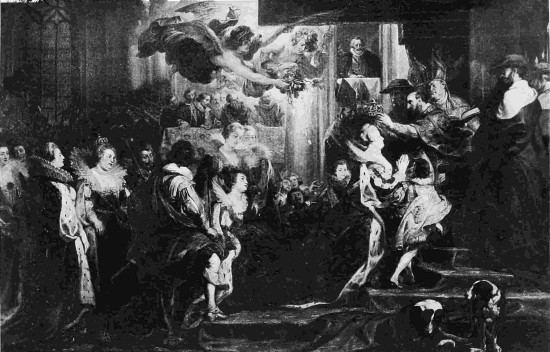
The Coronation of Marie de’ Medici
Five years later (1605) Marguerite returned from the castle of Usson and
held her Court in Paris at the hôtel de Sens (which still exists) and at
her various châteaux in Languedoc; no longer, alas! the Reine Margot of
our ill-regulated affections, and somewhat open to the malicious
comments of Tallemant des Reaux, but appearing at times with all her
wonted spirit and regal dignity. These were the days when she kept
a brigade of golden-haired footmen who were shorn for the wigs; and the
story goes that her gowns were made with many pockets, in each of which
she kept the mummied heart of a lover. But such tales must be taken for
what they are worth, and a better chronicler than the satirists of the
Valois has given us ocular proof of her last majestic presence at a
public ceremony five years before her death.
In 1610, Henri IV. preparing to leave France for the war in Germany, and
wishing to appoint Queen Marie de’ Medici regent, it became necessary to
have the latter crowned. This was done in the cathedral of Saint-Denis,
May 13, 1610. The Queen of Navarre, as Marguerite, daughter of France
and first princess of the blood, was required to be present at the
ceremony. Rubens’ splendid picture (reproduced in this volume) gives the
scene. Marie de’ Medici, kneeling before the altar, is being crowned by
Cardinal de Joyeuse, assisted by his clergy and two other cardinals;
beside the queen are the dauphin (Louis XIII.) and his sister,
Élisabeth, afterwards Queen of Spain. The Princesse de Conti and the
Duchesse de Montpensier carry the queen’s train; the Duc de Ventadour,
his back to the spectator, bears the sceptre, and the Chevalier de
Vendôme the sword of Justice. To the left, leading the cortège of
princesses and nobles, is the Queen of Navarre, easily recognized by her
small closed crown, all the other princesses wearing coronets. In the
background, to right, in a gallery, sits Henri IV. viewing the ceremony.
As he did so he turned with a shudder to the man behind him and said: “I
am thinking how this scene would appear if this were the Last Day and
the Judge were to summon us all before Him.” Henri IV. was killed by
Ravaillac the following morning, while his coach stood blocked in the
streets by the crowds who were collecting for the public entry of Marie
de’ Medici into Paris.
The young Élisabeth, eldest daughter of the king and Marie de’ Medici,
who appears at the coronation of her mother, was afterwards wife of
Philip IV. of Spain, and mother of the Infanta Maria Theresa, wife of
Louis XIV, also of Carlos II., at whose death Louis XIV. obtained the
crown of Spain for his grandson, the Duc d’Anjou, Philip V. This
Élisabeth of France, Queen of Spain, is the original of Rubens’
magnificent portrait reproduced in this chapter.—Tr.]
Queen Marguerite returned from Usson to Paris in 1605; and here we find
her in her last estate, turned slightly to ridicule by Tallemant, the
echo of the new century. Eighteen years of confinement and solitude had
given her singularities, and even manias; they now burst forth in open
day. She still had adventures both gallant and startling: an equerry
whom she loved was killed at her carriage door by a jealous servant, and
the poet Maynard, a young disciple of Malherbe, one of Marguerite’s
beaux-esprits, wrote stanzas and plaints about it. During the same
period Marguerite had many sincere thoughts that were more than fits of
devotion. With Maynard for secretary, she had also Vincent de Paul,
young in those days, for her chaplain. She founded and endowed convents,
all the while paying learned men to instruct her in philosophy, and
musicians to amuse her during divine service and at hours more profane.
She gave many alms and gratuities and did not pay her debts. It was not
precisely good sense that presided over her life. But amidst it all she
was loved. “On the 27th day of the month of March” (1615), says a
contemporary, “died in Paris Queen Marguerite, sole remains of the race
of Valois,—a princess full of kindness and of good intentions for the
good and the peace of the State, who did no harm to any but herself.
She was greatly regretted. She died at the age of sixty-two.”
Certain persons have attempted to compare her for beauty, for
misfortunes, for intellect, with Marie Stuart. Certainly, at a point of
departure there was much in common between the two queens, the two
sisters-in-law, but the comparison cannot be maintained historically.
Marie Stuart, who had in herself the wit, grace, and manners of the
Valois, who was scarcely more moral as a woman than Marguerite, and was
implicated in acts that were far more monstrous, had, or seemed to have,
a certain elevation of heart, which she acquired, or developed, in her
long captivity crowned by her sorrowful death. Of the two destinies, the
one represents definitely a great cause, and ends in a pathetic legend
of victim and martyr; the reputation of the other is spent and scattered
in tales and anecdotes half smutty, half devout, into which there enters
a grain of satire and of gayety. From the end of one comes many a
tearful tragedy; from that of the other nought can be made but a
fabliau.
That which ought to be remembered to Marguerite’s honour is her
intelligence, her talent for saying the right word; in short, that which
is said of her in the Memoirs of Cardinal de Richelieu: “She was the
refuge of men of letters; she loved to hear them talk; her table was
always surrounded by them, and she learned so much from their
conversation that she talked better than any other woman of her time,
and wrote more elegantly than the ordinary condition of her sex would
warrant.” It is in that way, by certain exquisite pages which form a
date in our language, that she enters, in her turn, into literary
history, the noble refuge of so many wrecks, and that a last and a
lasting ray shines from her name.
C. A. Sainte-Beuve, Causeries du Lundi (1852).